
2013 African Development Bank Group
|
|
|
- Adrian Hudson
- 10 years ago
- Views:
Transcription
1
2

3 2013 African Development Bank Group The views expressed in this book are those of the authors and do not necessarily reflect the views and policies of the African Development Bank (AfDB) or its Board of Governors or its Board of Directors or the governments they represent. The AfDB and its Board of Directors do not guarantee the accuracy of the data included in this publication and accept no responsibility for any consequence of their use. By making any designation of or reference to a particular territory or geographic area, or by using the term country in this document, the AfDB does not intend to make any judgments as to the legal or other status of any territory or area. The AfDB encourages printing or copying information exclusively for personal and noncommercial use with proper acknowledgment of the AfDB. Users are restricted from reselling, redistributing, or creating derivative works for commercial purposes without the express, written consent of the AfDB. Published by: The African Development Bank (AfDB) Temporary Relocation Agency (ATR) Angle de l Avenue du Ghana et des rues Pierre de Coubertin et Hédi Nouira B.P Tunis Belvédère Tel : (216) Fax : (216) Design and layout African Development Bank External relations and Communications Unit(ERCU) Yattien-Amiguet L. Kabasale Justin Printing Imprimerie Maghreb Editions All rights reserved 2013 The African Development Bank Webpage:

4 3 Glossary Availability Payment Direct payments by government to a private entity to cover the operating, investment and financing costs associated with a given asset, according to key performance indicators. Private-sector revenues are therefore not subject to end-user demand. Concession Business operated under an exclusive contract. Parastatal A company owned or controlled wholly or partly by government, including utilities. Power Purchase Agreement Sets the terms, including price structure and volumes, of power purchases by a utility from an IPP. Project Finance Long-term financing of a project based on the cash-flows of that project rather than the balance sheet of its sponsors. Public Private Partnership Provision of a specific public service and/ or capital asset which is wholly or partly operated and financed by the private-sector. Securitization Aggregation of different contractual credits into a single vehicle which is then bond financed. These bonds are then called asset backed securities. Special Purpose Vehicle A company created solely for a particular financial transaction or series of transactions, legally separate from its principal shareholders. Take-or-Pay Contract obliging the buyer to purchase a given volume from a supplier at a predetermined price, or else pay the equivalent. The supplier therefore has a fixed contract.

5

6 5 Abbreviations & Acronyms ABAKIR Lake Kivu and River Rusizi Basin Authority ACSA Airport Company of South Africa AFC Africa Finance Corporation AFDB African Development Bank AfLife African Life Assurance AFMI African Financial Markets Initiative AFD Agence Franciase de Developpment AFP Administradoras de Fondos de Pensiones AIFF African Infrastructure Financing Facility AIIF African Infrastructure Investment Fund ARM Asset and Resource Management Company Limited B/S Balance Sheet BIT Bilateral Investment Treaties BNDES Banco Nacional de Desenvolvimento Econômico e Social BOAD Banque Ouest Africaine de Developpment BPOPF Botswana Public Officers Pension Fund CCR Comisión Clasificadora de Riesgos CEMAC Economic and Monetary Community of Central Africa CEPGL Economic Community of the Great Lakes Countries CISNA Committee of Insurance, Securities & Non-Banking Financial Authorities (in SADC) CMA Capital Markets Authority (Kenya) CMSA Capital Markets and Securities Authority (Tanzania) Comesa Common Market for Eastern and Southern Africa CPI Consumer Price Index CRPAO Certificado de Reconocimiento de Pago Annual de Obras DBSA Development Bank of South Africa DBZ Development Bank of Zambia D/E Debt to Equity Ratio DEG Deutsche Investitions-und Entwicklungsgesellschaft DFI Development Finance Institution DFID Department for International Development DMO Debt Management Office DSCR Debt Service Cover Ratio

7 6 EAC East African Community EADB East African Development Bank EAIF Emerging Africa Infrastructure Fund ECA Export Credit Agency ECOWAS Economic Community of West African States EDM Electricidade de Moçambique EEPCO Ethiopian Electric Power Corporation EGL Energie des Grands Lacs EIB European Investment Bank EPC Engineering, Procurement and Construction EPF Employees Provident Fund (Malaysia) EUR European Economic and Monetary Union Single Currency FIAP Federación Internacional de Administradoras de Fondos de Pensionnes FMO Financieringsmaatschappij voor Ontwikkelingslanden FGN Federal Government of Nigeria FSB Financial Services Board (SA) GDP Gross Domestic Product GEPF Government Employees Pension Fund (RSA, Namibia) GNAT Ghana National Association of Teachers GRE Government Related Entity IADB Inter American Development Bank ICRC Infrastructure Concession Regulator Commission ICT Information and Communications Technology IDA International Development Association IFC International Finance Corporation IFI International Financing Institution IMF International Monetary Fund IOPS International Organization of Pension Supervisors IPO Initial Public Offering IPP Independent Power Producer IPPF Infrastructure Project Preparation Facility (Nepad) ISPO Irrevocable State Payment Obligation

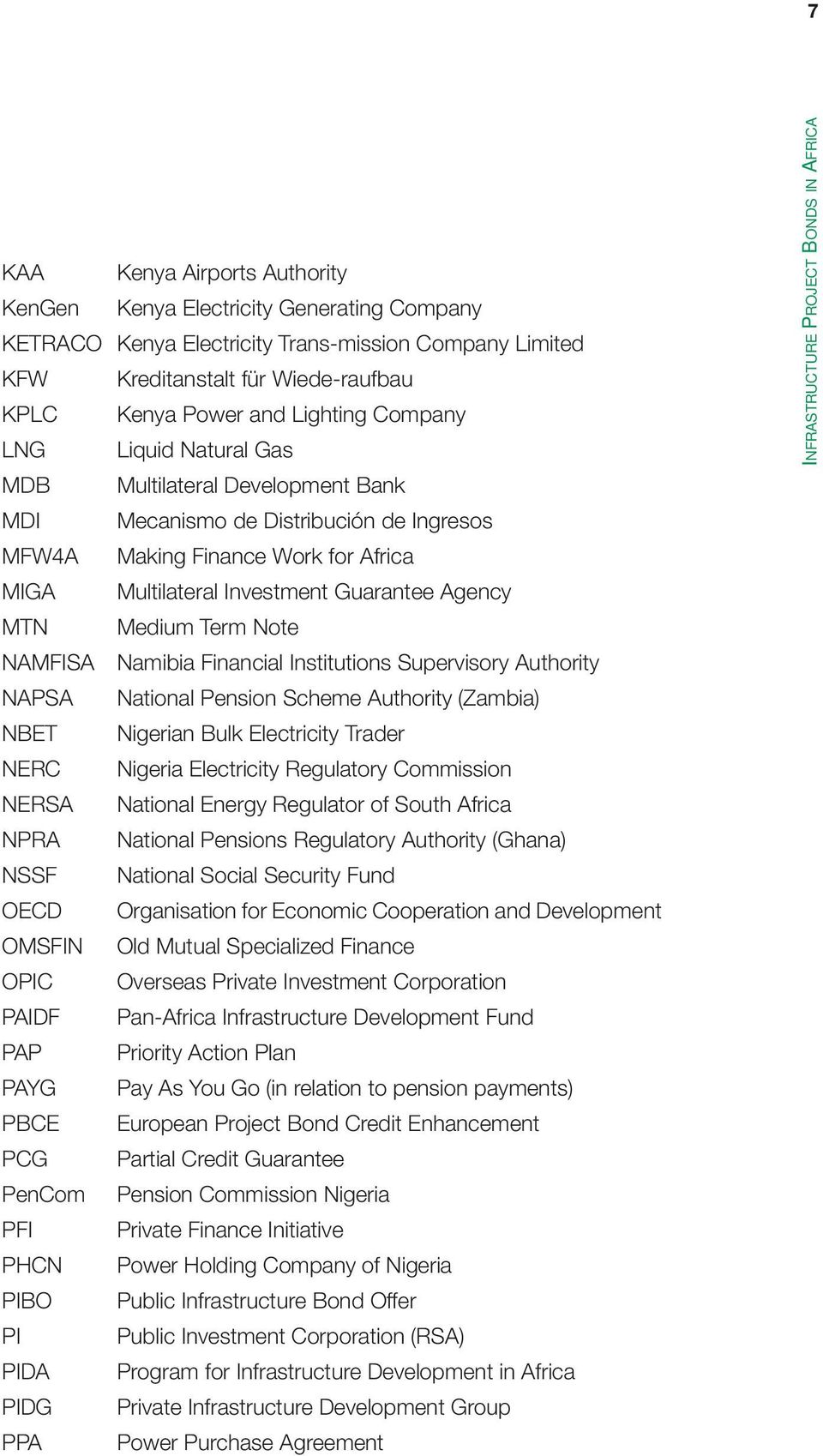
8 7 KAA Kenya Airports Authority KenGen Kenya Electricity Generating Company KETRACO Kenya Electricity Trans-mission Company Limited KFW Kreditanstalt für Wiede-raufbau KPLC Kenya Power and Lighting Company LNG Liquid Natural Gas MDB Multilateral Development Bank MDI Mecanismo de Distribución de Ingresos MFW4A Making Finance Work for Africa MIGA Multilateral Investment Guarantee Agency MTN Medium Term Note NAMFISA Namibia Financial Institutions Supervisory Authority NAPSA National Pension Scheme Authority (Zambia) NBET Nigerian Bulk Electricity Trader NERC Nigeria Electricity Regulatory Commission NERSA National Energy Regulator of South Africa NPRA National Pensions Regulatory Authority (Ghana) NSSF National Social Security Fund OECD Organisation for Economic Cooperation and Development OMSFIN Old Mutual Specialized Finance OPIC Overseas Private Investment Corporation PAIDF Pan-Africa Infrastructure Development Fund PAP Priority Action Plan PAYG Pay As You Go (in relation to pension payments) PBCE European Project Bond Credit Enhancement PCG Partial Credit Guarantee PenCom Pension Commission Nigeria PFI Private Finance Initiative PHCN Power Holding Company of Nigeria PIBO Public Infrastructure Bond Offer PI Public Investment Corporation (RSA) PIDA Program for Infrastructure Development in Africa PIDG Private Infrastructure Development Group PPA Power Purchase Agreement
9 8 PPIAF PPP PRG QGPC RBA RBRA REFIT SADC SANRAL SBIF SEC SOE S&P SPV SSC SSNIT SSRA TANESCO TCTA TIB TPDC USAID VRA WDI ZRA BLR BWP CFA GHS KES NGN NMD TSH Public Private Infrastructure Advisory Facility Public Private Partnership Partial Risk Guarantee Qatar General Petroleum Company Retirement Benefits Authority (Kenya) Retirement Benefits Regulatory Authority (Uganda) Renewable Energy Feed-in-Tariff Southern Africa Development Community South African National Roads Agency Limited Superintendency of Banks and Financial Institutions Securities and Exchange Commission State Owned Enterprise Standard & Poor s Special Purpose Vehicle Social Security Commission (Namibia) Social Security and National Insurance Trust Social Security Regulatory Authority (Tanzania) Tanzania Electric Supply Company Trans-Caledon Tunnel Authority Tanzania Investment Bank Tanzania Petroleum Development Corporation United States Agency for International Development Volta River Authority World Development Indicators Zambezi River Authority Currencies Brazilian Lira Botswana Pula Central Africa Franc Ghana Cedi Kenya Shilling Nigeria Naira Namibian Dollar Tanzania Shilling

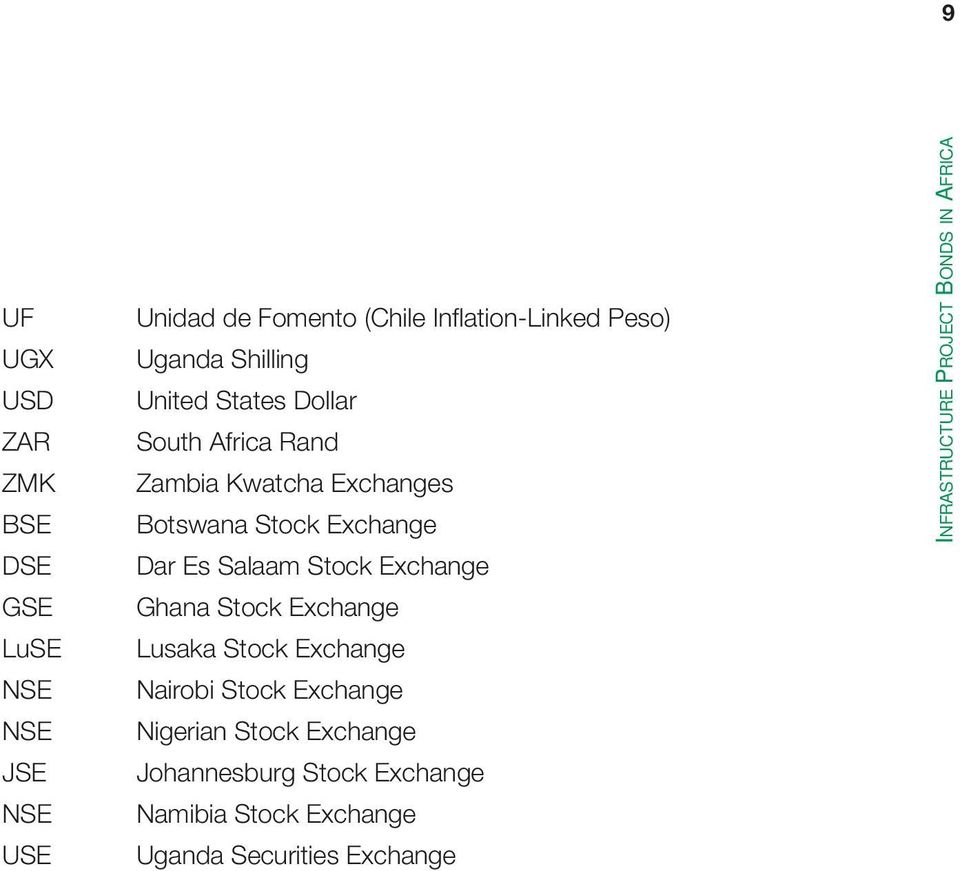
10 9 UF UGX USD ZAR ZMK BSE DSE GSE LuSE NSE NSE JSE NSE USE Unidad de Fomento (Chile Inflation-Linked Peso) Uganda Shilling United States Dollar South Africa Rand Zambia Kwatcha Exchanges Botswana Stock Exchange Dar Es Salaam Stock Exchange Ghana Stock Exchange Lusaka Stock Exchange Nairobi Stock Exchange Nigerian Stock Exchange Johannesburg Stock Exchange Namibia Stock Exchange Uganda Securities Exchange
11 10

12 11 Foreword Investment in infrastructure is vital for sustained economic growth in Africa. Energy, transport, water and information technology services remain well below international standard on the continent, and this creates serious bottlenecks for African economies trying to achieve the transformational rates of growth that have been witnessed in other emerging markets. The need is particularly stark in the light of rising populations, and rapid urbanization. The African Development Bank is developing a financing strategy for infrastructure that aims to increase the resources available for investment in these key sectors. Such a large and complex initiative will require Africa to mobilize different sources of capital through a variety of financial instruments, vehicles and markets. Financial sector development in many African countries has been hampered by the lack of liquid, longer-term, domestic investment instruments. This has made it difficult to address the vast and growing infrastructure and housing development needs. Declining access to external funding has highlighted the urgent need for governments to mobilize resources from domestic capital markets to meet their development needs. In addition to funding, new structures are required to channel resources for the development of the continent. Given the nature of physical infrastructure projects that normally require large-scale and long-term financing in a mix of local and foreign currencies, attention has recently been paid to infrastructure project bonds. Some emerging countries, like Malaysia, Korea, Hong Kong, Chile, and Brazil have already begun to do this. Infrastructure bonds can be a more efficient form of financing as they reflect the long-term nature of infrastructure financing, which is often not available from the banking system. They also bring more transparency to the transaction, and to the financial market as a

13 12 whole. To convince the private sector to increase its involvement in infrastructure financing, African governments need to continue financial market reforms. This will develop efficient markets for infrastructure bond financing, and foster an investment environment suitable for private sector activities. Contractual, political, and regulatory risks as well as investor protection provisions also have to be re-examined. Adequate measures need to be adopted to stimulate local, regional, and international investment in infrastructure bonds. Africa can draw useful lessons from emerging countries in terms of infrastructure development. These countries have positioned their own private sector to play a role in infrastructure projects, and also to engage in strategic partnerships with foreign companies. They have also created an enabling environment for effective Public-Private Partnerships (PPPs). Since a major challenge in Africa is a weak and fledgling private sector, it is clear that lessons need to be learned from these countries as to how to nurture the private sector. The Bank is focused on helping the Continent, and is poised to take significant steps in mobilizing new sources of funding to finance its growth and development. In this study, it unveils innovative financing mechanisms, and stands ready with technical assistance to strengthen domestic markets. It points in the right direction, and I hope it will be useful for all Africans who are involved in infrastructure development. Donald KABERUKA PRESIDENT AFRICAN DEVELOPMENT BANK
14 13 Acknowledgements This Study is a product of the African Development Bank Regional Integration Department (ONRI) which is chaired by Mr. Alex Rugamba. It has been produced under the strategic guidance of Ms. Moono Mupotola, Manager of the Regional Integration and Trade Division (ONRI.2). The coordinator and lead author was Cedric Achille Mbeng Mezui, Senior Financial Economist (ONRI.2). It is a product of collaboration both across the Bank and with external partners. Within the Bank the team comprises Olivier Eweck (Manager FTRY.4), Stephen Mulema (Principal Financial Analyst, FTRY.4), Richard Offori-Mante (Chief Financial Analyst, FTRY.4); Ralph Olaye (Manager ONRI.1); Marie-Laure Akin-Olugbade (Resident Representive GHFO); Uche Duru (ONEC.3); Soumendra Dash (FFMA.2); Nontle Kabanyane (AFMI); Densil Magume (FNVP); Guirane Ndiaye (EDRE.1); Richard Claudet (OPSM.3); Nanette Derby (GHFO); Michelle Tutt (ICA); Baboucarr Koma (OSGE.2); Cecile Ambert (OPSM); Shem Simuyemba (ONRI.1) and D. Amouzou (ONRI.0). Externally also, the Bank collaborated with a Consortium of Consulting firms comprising Lion s Head Global Partners represented by Bim Hundal (Partner); Clemens Calice (Partner) and James Doree (Director); Clifford Chance represented by David Bickerton (Partner); Jeremy Connick (Partner), Titus Edjua (Africa Group Director) and Derwin Jenkinson (Senior Associate); CPCS Transcom represented by Cezley Sampson (Principal Consultant). This broad collaboration allowed the paper to benefit from various perspectives and it was prepared with a number of objectives in mind: firstly, to highlight the opportunity for project bonds; secondly, to elaborate on the conditions for efficient capital markets; thirdly, to explain the crucial role of constructive government policies; and, lastly to highlight lessons learned in other markets that might be useful for Africa.

15

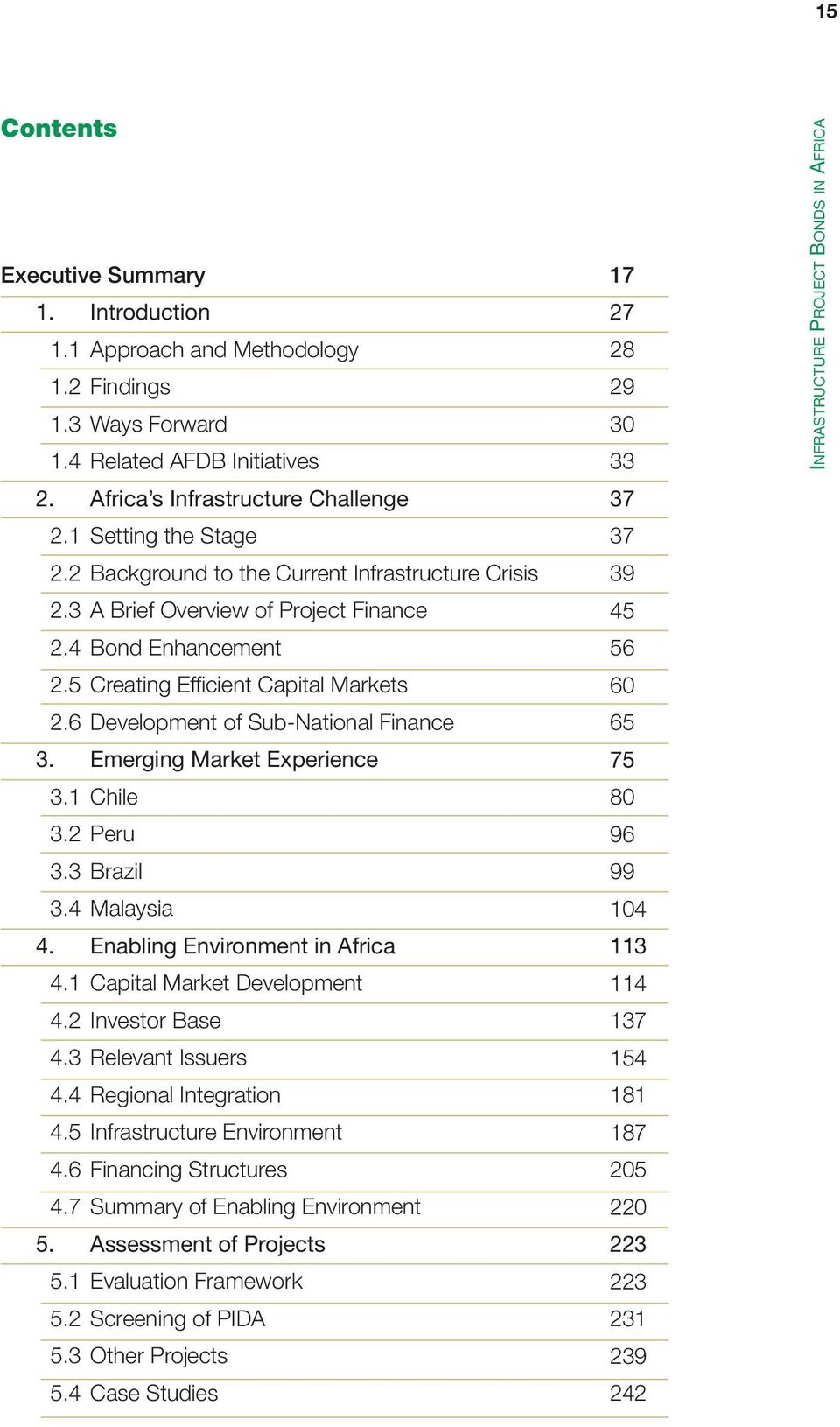
16 15 Contents Executive Summary 1. Introduction 1.1 Approach and Methodology 1.2 Findings 1.3 Ways Forward 1.4 Related AFDB Initiatives 2. Africa s Infrastructure Challenge 2.1 Setting the Stage 2.2 Background to the Current Infrastructure Crisis 2.3 A Brief Overview of Project Finance 2.4 Bond Enhancement 2.5 Creating Efficient Capital Markets 2.6 Development of Sub-National Finance 3. Emerging Market Experience 3.1 Chile 3.2 Peru 3.3 Brazil 3.4 Malaysia 4. Enabling Environment in Africa 4.1 Capital Market Development 4.2 Investor Base 4.3 Relevant Issuers 4.4 Regional Integration 4.5 Infrastructure Environment 4.6 Financing Structures 4.7 Summary of Enabling Environment 5. Assessment of Projects 5.1 Evaluation Framework 5.2 Screening of PIDA 5.3 Other Projects 5.4 Case Studies
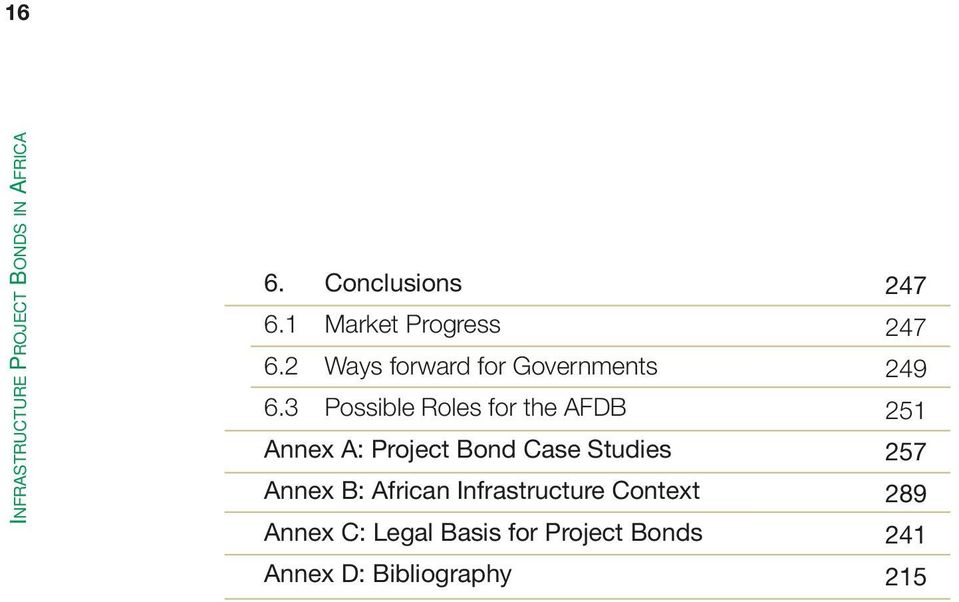
17 16 6. Conclusions 6.1 Market Progress 6.2 Ways forward for Governments 6.3 Possible Roles for the AFDB Annex A: Project Bond Case Studies Annex B: African Infrastructure Context Annex C: Legal Basis for Project Bonds Annex D: Bibliography
18 17 Executive Summary Infrastructure remains the dominant challenge for Africa as it seeks to maintain the pace of development and economic growth that has been achieved in the years since The challenge is huge and daunting, but it is possible to identify specific areas that need to be prioritized. Indeed it is important to do this, in order to ensure that resources are allocated efficiently and that the most pressing needs are met. Financing is a key constraint. Various studies have been carried out to estimate the amount of funding required to develop Africa s infrastructure. The UNECA s Economic Report on Africa (2012) highlights annual investments needs of USD 93bn and a shortfall of USD 31bn per annum. The Program for Infrastructure Development in Africa (PIDA) Priority Action Plan (PAP) envisages USD 68bn of infrastructure financing needs in the period to 2020 for regional projects alone. In this report we focus on how domestic capital markets can contribute to funding some of the most important local and regional infrastructure projects and thereby contribute to closing the identified financing gap. Specifically, given the limited ability of local banks to provide long-term funding, can project sponsors turn to domestic institutional investors by issuing Infrastructure Project Bonds? The answer is yes provided certain market conditions are in place. There is no single solution to Africa s infrastructure financing gap. For policy makers and development partners, the most effective approach lies in creating a series of initiatives which help to catalyze a response from a broad spectrum of players in the financial markets. The infrastructure financing gap cannot be tackled by the public or private sectors in isolation. What is needed is an effective collaboration of the public and private markets.

19 18 What are Infrastructure Project Bonds? Infrastructure is a far reaching topic and ranges from tangible physical assets to services and human resources. It includes different types of projects and businesses with very different characteristics, for example in relation to capital requirements, user charges and the role of government. In this Study, we distinguish between infrastructure that provide a public good, available to all at no cost (or highly subsidized) and services where end-users are charged directly through tariffs and fees. Those projects that generate revenues often can, but don t always have to, raise funds from private investors, including from domestic capital markets. For example, a government owned utility building a power plant may raise capital from its shareholder (i.e. the government) or establish a project company and raise money from local banks, international and/or domestic investors. In this Study, Infrastructure Project Bonds are defined as bonds that meet all of the following conditions: They are issued to raise capital for specific stand-alone projects; They are repaid from cash generated by the project; and They assume, and their performance is subject to, certain project specific risk. This definition therefore can include projects with participation by government, parastatals and private entities to ensure optimal allocation of risk for potential bondholders and efficient financing of important infrastructure. What are the lessons from other Emerging Markets? As countries have developed they had to build roads, railways, ports, power and water infrastructure. In many countries private capital contributed meaningfully to this infrastructure roll-out. Many of the

20 19 challenges confronting Africa in meeting its infrastructure challenge had to be overcome by other emerging markets in the past. Important lessons can be drawn from the experiences of countries such as Chile and Malaysia, where governments took an active role in creating an enabling environment for infrastructure investment and capital market development (Mbeng Mezui, 2012). Such features include: Political and economic stability combined with falling inflation and interest rates, allowing for an investment grade credit rating attractive conditions for investors and issuers. Measures to increase the domestic investor base through pension fund reform. Encouragement of capital market development through suitable regulation and long-dated issuance by government and parastatals. Restructuring of key infrastructure sectors and parastatals, and provision of a regulatory environment suitable for private participation, including risk mitigation instruments. Governments played a leading role in encouraging the use of Infrastructure Project Bonds in local capital markets. This included risk mitigation through minimum revenue and other guarantees, or participation in concession companies. It should also be noted that pension funds in all markets are reluctant to assume construction risk. In Europe, the European Investment Bank (EIB) has launched an initiative to guarantee Infrastructure Project Bonds to encourage institutional investor participation. Are there suitable conditions in Africa? We apply these lessons to our target countries, namely Kenya, Uganda and Tanzania in the East African Community (EAC); Nigeria and Ghana in West Africa; and South Africa, Namibia, Botswana and Zambia

21 20 in Southern Africa. These countries were selected as an outcome of the African Financial Markets Initiative (AFMI) and its feasibility study for a bond fund. There has been enormous progress in achieving economic stability in the target countries, with strong rates of growth and overall longterm declining trends in inflation. However, in key markets such as Kenya and Nigeria, high interest rates act as a disincentive to non-government issuers. Several of the target countries have taken steps to promote increased pension contributions, while some have also introduced formal regulation and competition among pension fund administrators. Pension funds are usually able to buy non-government bonds up to a certain limit. While South Africa has a large and sophisticated investor base totaling in the region of USD 600bn (more than the other countries combined), there has been significant progress in markets such as Kenya and Nigeria since 2000 and governments have shown willingness to reform. The legal and regulatory framework for bond issuance exists in the target countries, as highlighted by AFMI. While the specific needs and requirements of Corporate and Project Bond issuers are not directly considered by securities exchanges and regulators, it would generally be possible to bring well-structured projects with strong sponsorship to the market in the target countries. Most of the target countries are active issuers of bonds for their own funding needs. The more advanced markets such as Kenya, Nigeria and South Africa as well as smaller markets have long-dated government bonds beyond 15 years, providing a benchmark for non-government issuers. However, competition between the Sovereign and other issuers is a potential issue in all markets.
22 21 Different entities have issued bonds specifically to invest in infrastructure, even if there is limited exposure to project risk. These include central government in Kenya, where tax incentives were offered to in vestors; parastatals in South Africa, Kenya and Namibia; and sub-sovereign issuers in Nigeria and South Africa. Corporate infrastructure issuers tend to be restricted to the telecoms sector. Importantly, there have been various instances of pension funds and other institutional investors participating directly in projects through loans and private placements in South Africa and the EAC. In the latter, these have also involved credit enhancement, albeit for small projects. In summary, many of the ingredients for Infrastructure Project Bond issuance are present, but more needs to be done to make it attractive for sponsors to tap into local markets. Often projects can borrow in hard currency at competitive rates. For example, payments to Independent Power Producers (IPPs) in Kenya are indexed to foreign exchange. From a sponsor s perspective, issuing an Infrastructure Project Bond must offer the optimal tenor and pricing compared to other options, so governments must do more to reduce local market rates and lengthen the yield curve. A crucial barrier in African markets is the enabling environment for infrastructure. Utilities in countries such as Tanzania suffer from financial and governance-related problems. The regulatory and tariff framework in many sectors is incomplete. Many countries have established PPP laws and institutions, but often they lack the resources and capacity to prepare bankable projects for the market. There is often a lack of advocacy and political support for driving concessions and PPP projects through government, and too few are coming to market, although these processes are still in their early stages in many countries. In most countries, parastatals are the most common sponsors of projects.
23 22 Are there projects that can use Infrastructure Project Bonds? In order to promote Infrastructure Project Bonds, the most important thing at this stage is that stakeholders have a clear framework for assessing whether projects are suitable for the bond markets. This includes evaluation of the credit features of the project, market conditions, and the costs of execution. Specific projects characteristics include: Fixed off-take from credible counterparties, possibly underwritten by Government; Full commercial operations such that construction and other risks are mitigated, or at least manageable (e.g. large hydro projects are often subject to delay); and Local currency revenues/ tariffs such as projects in water and many road and power sectors. There are certainly projects in the target countries that are capable of accessing local capital markets. For example, Nigerian power privatizations and Southern Africa renewables IPPs are likely to be refinanced either individually or at the portfolio level in the coming years. Toll road concessions in West Africa such as the Lekki-Epe Expressway, which is considering a refinancing, and the proposed Abidjan Lagos Highway could use the example of South African or Chile toll models. Also, projects sponsored by parastatals and corporates but linked to underlying project revenues might be suitable. Entities such Transnet, Nampower and Zesco are considering off-balance-sheet structures. Multinational power projects where off-take is provided in currencies such as Kenyan Shillings and South African Rand may also consider issuing a bond in these markets. For the most advanced PIDA projects, some clearly have features suitable for bond financing, including fixed off-take. Others are lesssuitable, such as complex and lengthy greenfield hydropower projects, those with revenues denominated in hard currency, and
24 23 others located in countries with limited capital markets. What is needed on those projects with the most potential is further preparation work to develop a commercial structure and selection of a sponsor to move the projects forward. It is at this point that financial advisers can undertake detailed assessment of the most efficient financing option, perhaps based on the framework presented in this Study. What measures can be taken to promote Infrastructure Project Bonds? There is a crucial role for governments in promoting Infrastructure Project Bonds. This includes in supporting stable economic conditions, developing local capital markets and strengthening institutions to encourage all issuers to come to market, particularly corporations for whom bond issuance has been limited to date. Promoting reform and corporatization of utilities and parastatals, including professional management and a clear regulatory environment, are preconditions for such entities to issue in the local bond markets an important landmark in the development of local capital markets and the emergence of Infrastructure Project Bonds. In addition to the well-developed South African market, there has been progress towards these goals in Kenya, Nigeria and elsewhere. However, the flow of bankable projects remains a constraint. Projects are likely to be more bankable, particularly for bond market investors, if fiscally sound governments are able to mitigate certain risks, as has been the case in other emerging markets. There are various roles that the AFDB can play. These include technical assistance in infrastructure, capital markets and domestic issuance, as well as working with intermediaries. For specific projects, it can use instruments such as the partial credit guarantee as well as any new tailored instruments, to enhance bond issuance and catalyze the market. Direct funding for projects in early-stage preparation and through debt and equity investments at financial close will help to promote the overall market. Finally, the AFDB can play a role in
25 24 unblocking the political bottlenecks that obstruct projects from being developed and implemented. Table 1 below summarizes some of the possible measures open to government and the AFDB. This report starts off by defining the infrastructure challenge (Section 2) before proceeding to examine other emerging economies to identify similarities and draw a number of lessons (Section 3). We argue that the enabling environment in each African country is critical and describe the state of play in target markets included in the study (Section 4). Capital markets tend to develop through a series of established stages as it relates to their structure and regulatory framework. We establish an evaluation framework (Section 1) that puts the question at the outset is it possible to issue infrastructure projects bonds in African markets? in the context of capital markets development. We end our report with specific conclusions and recommendations (Section 6).
26 25 Table 1 Summary of Ways Forward for African Governments and the AFDB Aspect Government and Policy-makers Role for AFDB Focus on low and stable inflation and Support macro-econo domestic interest rates to improve mic targets and fiscal market conditions for issuers. management frame work. Seek to establish a local and international Work with Governments Macro-Economy credit rating to serve as a benchmark to promote credit rating. and promote ratings process. Prioritize strong fiscal position for rating Assist with development and wider economic stability and to allow of fiscal framework for government to have the fiscal capacity to contingent liabilities. promote and incentivize PPPs. Update listing process and disclosure rules Capacity building in to be consistent with fixed income (rather regulators, exchanges, than equities) DMOs and central banks. Allow for bonds issued by SPVs or project Expand AFDB local cur companies and improve legal framework rency program o deepent for structured finance. market and consider Capital Market Provide tax incentives for infrastructure promoting hedging bonds. instruments. Encourage credit ratings, for example by Work with national and requiring issuers to get rated as part of the regional DFIs to encou listing process. rage local market Government issues long-dated bond issuance. benchmarks and may consider Encourage corporate inflation-linked issue. clients to get rated and For countries with small markets, issue bonds in local consider issuing in neighboring markets market. to tap liquidity and set benchmark. Continue progress on pension-sector Capacity building among growth, including mandatory employee/ pension funds and pension employer contribution, tax incentives, and fund managers, including professional asset management. portfolio management Pension Sector Establish independent regulator who and investment appraisal. permits holding of infrastructure assets, perhaps as a defined category. Corporatization and professional Provide technical management of utilities and parastatals assistance and funding in order to prepare them for primary bond for regulatory/ utility market issuance and to provide bankable reform and PPP off-take agreements for private-sector project preparation. projects. Encourage issuance to finance Provide advocacy for investment programs. projects to overcome Transparent, rules based regulatory political hurdles. environment including licensing for IPPs, Fund project preparation PPP grid access and tariff setting. as well as development Infrastructure Establish laws and institutions with strong and equity capital for political support to ensure projects are projects. ready for market. Act as co-lender Ensure IPPs, PPPs and private projects (along-side national share currency risk to incentivize local and regional DFIs), market borrowing. This will also limit the lead arranger and currency exposure of utilities. controlling creditor Promote projects with structures for projects financed that remove demand or market through loan and bond risks so more acceptable to bond tranches. investors. Consider partial guarantees to improve bankability. Raise capital for possible co-investment in local bond markets.
27
28 27 1. Introduction Infrastructure needs in Africa are substantial and meeting those needs is crucial to ensuring continued economic growth across the African continent. Because of the fundamental role it plays in virtually every aspect of an economy, it is closely linked to capital markets and regional integration, as shown in Figure 1. Infrastructure investment can facilitate regional integration through cross-border trade and capital market development through long-dated securities. Capital market development provides a source of funding for infrastructure and a medium for regional investors. Regional integration and trade can reinforce these mechanisms. Figure 1 Inter-action of Key Aims Infrastructure Investment Regional Integration Capital Market Developemnt Source: Source: Lion s Head The capital required to establish energy, transport, water and telecoms infrastructure exceeds the funds available to local governments, the donor community or any other single source of funding. This therefore raises the question of what new sources of capital can be mobilized to plug a gap that currently threatens to undermine ongoing economic development in Africa. Public capital, including concessionary funding is increasingly directed towards meeting infrastructure development goals. The private sector, however, to date has played only a minor role in financing infrastructure. International institutional investors represent the largest pool of private capital. Attracting this source of capital to meet Africa s funding need
29 28 will be critical to the successful build-out of Africa s infrastructure. This study seeks to shed some light on the question whether local African capital markets can play a role in meeting overall additional funding needs of up to USD 30bn per annum. 1.1 Approach and Methodology The main objective of this study is to promote the development of Infrastructure Project Bonds denominated in local currency to: Finance projects contained in the Priority Action Plan (PAP) of the Program for Infrastructure Development in Africa (PIDA); Facilitate the issuance by disseminating lessons from other regions and providing practical recommendations and ways forward; and Encourage investment in such securities and create awareness among stakeholders (pension and insurance funds, banks, regulators, securities exchanges and governments). In fulfilling these objectives, our approach is founded upon using best international and regional practice and to provide practical recommendations that will move forward this agenda. We have undertaken specific tasks including the following: African Market Review and Assessment, including a desk based analysis and in-country consultations in the East African Community (EAC Kenya, Uganda and Tanzania), Southern Africa Development Community (SADC South Africa, Namibia, Botswana and Zambia) and in West Africa (Nigeria and Ghana), covering the following areas: - Capital market development including market conditions and rules and the role of intermediaries. - Progress in establishing an investor base through pension and other reforms. - Infrastructure project financing, including the institutional and governance framework and typical financial structures.
30 29 - Bond market issuers, including Government, utilities, corpo rates and other entities. Lessons from emerging market countries where local currency Infrastructure Project Bonds have been extensively used, such as Chile and Malaysia. Evaluation Framework, designed to be sued as a practical and high-level tool for stakeholders to understand whether bond market financing is possible for a project and offers best value for its sponsors. An important part of this assessment should be to understand where bond markets are more favorable to loan markets, and where local currency financing offers advantages over hard currency. Assessment of PAP Projects, including a simple framework for screening national and regional projects and the development of several case studies for projects that can be considered for Infrastructure Project Bonds. These Case Studies are designed to both be indicative and to provide a usable roadmap for the use of Infrastructure Project Bonds. A key aim is for stakeholders in the three regions to be equipped with the understanding to make informed decisions on the development of bond markets for infrastructure projects to support national and cross-border infrastructure projects. This will also contribute towards regional cooperation, trade and investment. It is also our aim that the private sector will be able to identify possible investment opportunities 1.2 Findings As set out above, various features determine the feasibility and suitability of Infrastructure Project Bonds. South Africa stands out in the region in terms of local market liquidity, capital market development and experience with project finance. Markets such as Namibia and Botswana have significant liquidity relative to GDP but less project finance and bond market activity. Kenya and Nigeria have fast
31 30 developing capital markets and investor bases, and some track-record in private infrastructure and project finance. Finally, markets such as Uganda, Tanzania, Ghana and Zambia have more nascent markets, albeit with fast growth potential. All four countries are taking steps to develop their local capital markets and instigate significant infrastructure investment. 1.3 Ways Forward Rather than simply asking whether a specific project can raise funding from domestic capital markets, we lay out a framework that provides steps that can be taken to create liquid local capital markets that participate in a meaningful way in solving Africa s infrastructure funding needs. While no two capital markets are identical, and each country develops its financial systems at different speeds and in a response to very specific local issues and economic opportunities, certain trends of capital market development can be observed across a range of developing economies, today and historically. The question of whether domestic investors can play a role in the funding of African infrastructure projects therefore has to be seen in the context of overall capital markets trends within each country. Country specific circumstances can play a role in fast tracking certain global trends, or indeed may provide opportunities to take certain shortcuts to significantly shorten the time required to develop domestic capital markets. To understand where interventions are most useful we therefore need to first look at basic market trends. Figure 2 summarizes high level themes in the development of emerging markets.
32 31 Figure 2 Steps for Developing Infrastructure Bonds Infrastructure Development Capital Markets Development Investor Development Step 1: Infrastructure (roads, power/utility, water/sanitation, hospitals) is provided as a public good, financed directly by governments Step 2: As basic infrastructure services are secured, utilities and other government owned entities raise financing directly from the private sector (banks as well through capital markets) Step 1: A government bond market develops with a range of maturities creating a domestic currency fund yield curve Step 2: A bond market is established ; principal issuers are financial institutions (often government controlled or backed) and government owned utilities Step 1: Markets dominated by banks and development finance institutions. Pension fund reforms lead to an increase in institutional assets Step 2: Local institutions are permitted to invest in non-government securities. International investors increasingly show interest in domestic issuers Step 3: As infrastructure systems mature, private players enter the market (via privatizations, concessions or through public private partnerships) Step 3: Corporate issuers enter the market. Bond issuing sizes increase and maturities extend Step 3: Government bond yields drop. Domestic institutions are looking for additional yield Source: Lion s Head Figure 2 outlines the different steps capital markets go through, but it is only really instructive if we ask ourselves what the necessary conditions are that have to exist for capital markets, or the infrastructure sector, to progress from one stage to the next. For example: A fundamental feature of debt capital markets is the need to benchmark risk and return of a potential investment instrument against the overall market. Fixed income instruments in local currency require a local benchmark to achieve efficient pricing. The starting point for creating a benchmark (and ideally a benchmark that extends across a range of maturities) is typically the government bond market. As a general rule, those countries that were successful in creating a domestic bond market have a liquid government bond market where pricing is determined by a diverse group of local fixed income investors. A corollary of this is that markets without reliable government benchmarks of longer maturities, are unlikely to see local institutional investors providing long-term capital for infrastructure projects.
33 32 Infrastructure by its very nature provides long-term and relatively stable returns. Most infrastructure projects therefore seek long-term financing. Long-term financing in turn requires a stable interest rate environment and particularly low levels of inflation. The latter in particular, represents a key hurdle for many developing countries as they try to move their short dated capital markets to longer-term structures. The reason why investors struggle to provide long term financing in a high interest rate / inflationary environment is both a function of the risks that high interest rates pose for economic development as well as simple bond economics. In a high interest rate environment the present value of future cash flows is small and at some point becomes negligible. In simple terms, there is little reason for an investor to take a long-term view and invest in a long dated instrument that creates little additional value. The discussion about possible domestic infrastructure bond financings will remain hypothetical unless local financial institutions (pension funds and insurance companies) have sufficient investable assets. In addition, governments have to establish a regulatory environment that enables (or requires) local institutions to invest in long dated project finance bonds. Government controls many aspects of domestic infrastructure. The latter s role is safeguarded by regulation; legislation ensures that project counterparties can be held accountable for their actions. In many emerging economies, governments had to reform local infrastructure such as utilities, before private capital agreed to invest. Markets development is fundamentally predicated on a legal framework that ensures enforceability of contracts. Regulation has to be unambiguous and if possible, be tailored towards the needs of capital markets. If capital markets develop sequentially along these lines and in parallel to an evolving public and private infrastructure sector, then
34 33 the question of how to fund Africa s overall infrastructure needs to be answered relative to the progress and stage of development of specific African capital markets today. The African Development Bank can meaningfully contribute towards these aims through different measures, including technical assistance, guarantee and financing instruments, and political influence. As the principal African Development Finance Institution (DFI), it has a leading role, working with national, regional and bilateral DFIs to promote infrastructure investment, capital market development and regional integration. 1.4 Related AFDB Initiatives The Africa Financial Markets Initiative (AFMI) to advance the development of African capital markets. The aims of AFMI include reducing the dependence of African countries on external debt; enlarging the investor base in African debt markets; improving the availability and quality of fixed income data; and providing alternative sources of long term funding for African borrowers. In 2010, AFMI produced a Feasibility Report for an African Domestic Bond Fund. This will be an Index Fund for Sovereign credits in the most advanced capital markets, i.e. those with the most functional bond markets. The AFDB has, since 2006, had a policy framework for lending in the local currencies of Regional Member Currencies. Several currencies have been approved under the framework and in 2012 the AFDB issued a 10 year bond in Uganda Shillings to fund its lending operations there. The aims are to improve the availability of local currency funding for domestic borrowers and to contribute towards capital market development. Making Finance Work for Africa (MFW4A) is an initiative to support the development of African financial markets, coordinating governments,
35 34 the private-sector and development partners. Its Secretariat is housed at the AFDB, which gathers and compiles information on active financial sector projects across Africa. Sokoni ( I go to the market in Swahili) is an online platform being developed to enhance infrastructure financing by bringing together buyers (i.e. those with the funds) and sellers (i.e. those with the potential projects). Participants will have access to various integrated process management tools that will enable optimal decisions to be made on infrastructure project financing. It will include a team of seasoned infrastructure specialists, versed in project finance and Africa to act as Project Champions, building up the network of project sponsors and capital providers on the platform, provide computer assisted matchmaking services, support with uploading/consulting project information, and sensitizing the member-base as the technology evolves. The AFDB is establishing an African Infrastructure Financing Facility (AIFF) to mobilize significant resources in the most targeted and cost effective manner for the Bank. To maximize bang for buck, this Initiative will match the risk profile and financing needs of projects largely through senior debt and innovative products such as guarantees. In addition to direct lending to projects is the need to avail more resources to finance project preparation activities to complement those which already exist. To most effectively mobilize the different sources of capital, the Bank will analyze a variety of vehicles tailored to different investors and the financing needs of projects. Targeted sources of capital will include African Central Banks, who preside over more than USD 500bn in foreign exchange reserves; and international capital markets (pension funds, insurance companies, high net worth individuals as well as sovereign wealth funds), who have an established appetite for African risk.
36 35 The remainder of this report is structured as follows: Section 2 sets out Africa s infrastructure challenge, including the urgent need for investment, the current status of project finance on the continent and the need to create efficient capital market financing. Section 3 sets out relevant experience from other emerging markets, particularly Chile, Peru, Brazil and Malaysia, who have, to varying degrees, succeeded in financing infrastructure through project bonds. Section 4 assesses the enabling environment for Infrastructure Project Bonds in selected African countries, including market rules, investors, issuers and regional integration, as well as specific features of the policy, regulatory and institutional environment for project finance. Section 5 provides and evaluation framework for using Infrastructure Project Bonds, applying this to PIDA and other projects and particularly looking at indicative case studies. Section 6 offers conclusions relating to current progress in the market, ways forward for Governments and possible roles for the AFDB. The Annexes provide Case Studies relating to project bonds in emerging markets, a detailed assessment of the infrastructure enabling environment, and analysis of the legal environment for project bonds in Africa. We also provide a bibliography for further reading.
37
38 37 2 Africa s Infrastructure Challenge Summary of Key Points Infrastructure is a priority for Africa. Inadequate quality and coverage if energy, transport, water and telecommunications is one of the largest barriers to sustained and inclusive economic growth. The African Union, with the support of Nepad and the AfDB, have identified 51 key priority projects that have regional significance have been approved by heads of government. The availability of affordable long-term finance is a key constraint. Overcoming this constraint will require mobilizing capital from various sources, including long-term savings in local African markets. Infrastructure can be financed by government, parastatals, utilities, corporates and project companies. Project finance involves several risks across the project cycle, for which different financing solutions are required. Infrastructure Project Bonds, where servicing of principal and interest is tied directly to the cash-flows of a given project, can be one mechanism for channeling capital from African markets into infrastructure projects. Such instruments require various conditions and market development, which is the subject of this study. In this section we will describe in more detail the role of infrastructure in Africa and why it is so critical for future economic development. In order to put domestic infrastructure bonds into context with other financing sources we will enumerate on the different infrastructure investors currently active in Africa. Finally, we will discuss some of the risk parameters that are typical for project finance, why they matter to investors and some of the tools to mitigate them. 2.1 Setting the Stage Upfront, however, we want to set out a few parameters and concepts that will be recurring in this section and throughout this study. As we will discuss in more detail below, the infrastructure sector that we are focusing on is part of the very fabric that underpins economic activity.
39 38 As such it is closely intertwined with government, regulation and the legal systems prevalent in a country. Fundamentally, we distinguish between infrastructure that provides a public good, available to all at no cost (or highly subsidized) e.g. defense, roads (except toll roads) and services where users are charged directly e.g. electric utilities. The former are part of a set of services that governments offer to all their citizens and funded through budget expenditures. The latter generally are set up as going concerns, often as a separate legal entity with dedicated management and stand-alone financial reporting. Such projects, like any other corporate business, are funded either by the project sponsors/owners or by third party capital providers. The performance of such projects is dependent on their operations and their ability to attract paying customers. For the purpose of the discussion herein, we ignore projects that are classified as free public goods and therefore can receive funding only directly from governments or municipalities. Figure 3 sets out the parameters for defining Infrastructure Project Bonds. Figure 3 Defining Infrastructure Project Bonds Kenya Infrastructure Bond Program Infrastructure Project Bonds SEACOM Project Financing Project Risk Government / Sovereign Risk Degree of Risk Transfer Away From Government Balance Sheet Source: Lion s Head Those projects that generate revenues often can, but don t always have to, raise funds from private investors, including from domestic
40 39 capital markets. For example, a government owned utility building a power plant may raise capital from its shareholder (i.e. the government) or establish a project company and raise money from local banks, international or domestic investors. In this Study, Infrastructure Project Bonds are defined as meeting the following conditions: They are issued to raise capital for specific stand-alone projects; and They are repaid from cash generated by the project; and They assume, and their performance is subject to, certain project specific risk. Kenya s Government Infrastructure Bonds (or any other sovereign bond issuance where the proceeds are designated for infrastructure), while serving an important role in creating an enabling environment, do not meet the above definition they are not repaid from specific project cash flows and investors don t assume any project risk. Government linkage, however, e.g. equity ownership by the government, off-take guarantees by government or multilaterals or minimum revenue guarantees are all possible features of infrastructure project bonds. In fact, as we will show in Section 3, in most instances, project bond markets have evolved from initially high levels of government support to become increasingly non-recourse over time and as investors got more comfortable with technology, regulatory and legal risks. 2.2 Background to the Current Infrastructure Crisis Infrastructure in Development Most analyses of development will focus on the need to invest in infrastructure to create and maintain a high level of economic growth. This is supported by a body of academic work.
41 40 There is established academic and empirical literature on the relationship between infrastructure coverage, economic growth and job creation in developing countries. Looking at African countries, specifically, Calderon (2008) finds that the poor coverage of energy, transport, water, sanitation and ICT infrastructure has a particularly negative impact on the productivity of firms in lower income countries on the continent. Many cross-country econometric studies find that the volume of infrastructure development has a large and positive effect on long term growth, but also lowers income inequality (see Calderon and Serven). The UK Government funded African Community Access Project has published research showing the large economic costs created by unpaved roads in various African countries. More topically, international investors in fast growing African countries are increasingly facing infrastructure bottlenecks. In Mozambique for example, transport, power and other deficiencies have caused large industrials such as Rio Tinto to significantly write-down the value of investments. Infrastructure is an issue not only for developing countries but also for the developed world that needs to update its existing capital stock and also to invest in new technology. This illustrates very well one of the challenges for policy makers which is that investment in infrastructure is extremely diverse and is likely to be something that is ongoing. While a developing country may focus on aspects of hard infrastructure such roads, railways, ports and airports in order to ensure fundamental services exist to support industry, a more advanced country will focus on using the latest technology in transport and may seek to ensure that its telecommunications network is internationally competitive. Beyond hard infrastructure is the equally important need to invest in soft infrastructure such as health, education and governance. In many respects, these are equally necessary for an economy to
42 41 achieve and maintain a healthy rate of growth. In this study, however, we focus mainly on the financing issues related to physical assets. In Africa, many countries have seen very healthy rates of growth over the last decade. Many African economies have benefited from the seemingly insatiable global demand for minerals and commodities. This has improved average living standards and given hope to the creation of a growing middle class which is already gaining importance in countries such as Nigeria, Kenya, Botswana and of course South Africa. But to date much of this growth has come from fairly modest levels and has been generated simply on the back of the commodities boom. Going forward, the growth needs to become more broadly based within each of the economies and will become constrained without better transportation, logistics and most acutely without access to power Quantifying the Infrastructure Gap There are many different analyses of the total infrastructure need in Africa. As mentioned above any such exercise is impacted directly by how infrastructure is defined and prioritization. The analysis can be done at a national level or indeed at a continental or regional level. The important thing is to define a list of priority infrastructure projects on the basis that funding those is actionable and can possibly be done over a manageable period of time. The African Union recently declared its renewed emphasis on the development of the African Common Market through integrated regional/ continental infrastructure networks. The African Union Commission, working together with the African Development Bank and NEPAD Planning and Coordinating Agency, have developed PIDA, which includes a Priority Action Plan (PAP) including a total of USD 68bn of investments up to 2020, focusing on regional infrastructure connecting markets and the growing number of large cities (estimated to be 100 cities > 1m people by 2040).
43 42 As outlined by PIDA, the underlying assumption is that Africa will grow at 6% per annum between 2010 and 2040 and that per capita incomes will be above $10,000 across the continent. This sustained growth will create a number of infrastructure needs: Power: Power demand will increase from 590 TWh in 2010 to over 3,100 TWh by To meet the increased demand requires that capacity is increased from the present level of 125 GW toalmost 700 GW by Transport: transport volumes will increase 6-8 times with much higher increases in some landlocked countries. Ports: Volumes that go through the various African ports will increase from current levels of less than 300 million tons to over two billion tons by Data: Data traffic volumes are expected to increase from around 300 GB per second today to over 6000 GB per second by In addition to these basic infrastructure demands there will be a rising need for water, sanitation, housing, medical facilities and other services which will only be exacerbated further by the relentless push of urbanization. As Africa grows, it must ensure that its infrastructure investments not only address basic needs and goals of poverty alleviation but also seek to allow Africa to compete in high-end technology. These are daunting challenges. Since Africa is not a single country or economic unit there are coordination challenges to overcome. Many of the most important projects will benefit more than one country. Working towards regional cooperation for the joint development of these high-priority projects is paramount. Of the total USD 68bn required for the PIDA PAP, current sources amount to approximately USD 30bn. The remainder must come from:
44 43 international capital markets; concessional financing from governments and MDBs; FDI, concessions, privatizations and other forms of inward investment; and domestic sources, including banks and capital markets Sources of Capital Historically African economies have been dependent on concessional financing from governments and development banks. Because of weak internal revenue generation and tax collection, most governments still depend on the international donor community to meet its budget obligations. However after a decade of healthy growth rates and with many economies largely defying the recent global financial crisis, African countries today enjoy more funding options, including: International Capital markets Recent experience shows there is strong appetite for African sovereign risk in the global capital markets. Developed market bond yields are low or subject to significant event risk (e.g. Euro-crisis). African countries credit profile has improved significantly on the back of consistently high GDP growth rates. This was most clearly illustrated by the recent dollar bond offering for Zambia that was upsized from the initial target size of $500 million to $750 million and was hugely oversubscribed. International capital markets represent the largest pool of fund; however, international investors typically lend in USD or EUR, which creates significant currency risk for the issuing country. Development finance Development Finance Institutions and multilaterals remain one of the most important funding sources for many African countries. Since the financial crisis, however, many Western countries significantly reduced their development budgets. China, India and Brazil on the other hand have become much more active.
45 44 In particular the Chinese have taken a leading role in financing African governments and infrastructure. Their demand for natural resources is driving an agenda of securing supplies of commodities in return for financing key parts of infrastructure at concessional rates. A number of roads, railways and airports have been funded and built by the Chinese. Foreign Direct Investment As African economies have grown and especially as a result of the commodity boom of the last years many more major multinationals have begun to invest in Africa. Many of the large mining companies have made large investments over this period, but foreign direct investment flows today are increasingly diverse (e.g. Walmart s recent acquisition of Massmart in South Africa). In many instances, infrastructure is a critical bottleneck for these foreign operators. As a result they have shown increasing willingness to take a leading role in funding transport links or power supply. Domestic financial markets One of the key objectives of the PIDA initiative is to consider whether domestic capital can play a role in meeting the infrastructure funding gap. The attraction of domestic capital is that they can help mitigate currency risk and often have a better understanding of operational and political risks. Domestic funding has become significant in other emerging markets most notably in Latin America and in Asia. Domestic financing can come from the banks or from institutional investors such as pension funds and insurance companies. This will be explored in greater detail below. In essence infrastructure projects need longer dated financing which is most suitable for institutional investors; but in many countries that part of the market is very much in its infancy.
46 45 We will consider in more detail the importance of different types of investors and more importantly, what policy measures might be undertaken in order to increase the institutional demand. Where appropriate we will present case studies from other emerging markets and highlight lessons to be drawn from them. 2.3 A Brief Overview of Project Finance Project finance is a financing structure that is used by the capital markets to finance large, risky projects or initiatives. Project finance is very commonly used in infrastructure financing. It is characterized by a system of support and risk mitigation mechanisms that address certain key risks that otherwise could not be financed on a stand-alone basis. Project finance enables sponsors who do not have a large balance sheet to undertake large and ambitious. Figure 4 shows a typical project financing, including the roles of different counterparties, various agreements and financial structure. Figure 4 Typical African Project Finance Structure Government Equity/ Golden Share Debt Guarantees Concession Agreement Guarantees Subsidies Equity investors Sponsor (developer, construction firm, etc.) Infrastructure funds Institutional investors Debt investors DFIs/ ECAs/ MDBs Commercial banks Capital markets Recourse Agreement 20-40% 60-80% Financing Agreement SPV Project assets and specific cash-flows Dedicated Governance and Management Off-take Agreement EPC Contract Supply Agreements Off-takers Utilities Industrial firms End-users Government availability payment or subsidy Other Counterparties EPC Contractors Equipment suppliers Input suppliers Source: Lion s Head
47 Counterparties Project Finance, attempts to mitigate certain risks by setting out the obligations, and remedies for failures, for each counterpart through a series of legal agreements. A typical project finance transaction brings together a range of counterparties, the most important of which typically are: Government: For many projects the host government often becomes a party to the transaction, either by granting the concession or by regulating certain aspects of the project s operations. In some cases the government may retain an equity stake or even seek to have an active role in the project/spv. Sponsors: Will take equity risk in the project. The sponsors assume the overall responsibility for getting a project built and will typically retain an ownership stake once the project becomes operational. Sponsors will manage each phase of theproject until they sell their stake or until the project is wound down. Contractors: Responsible for building the project to specification and for ensuring it is completed on time. In many instances the construction of the project is contracted for through an engineering, procurement and construction contract (EPC). To support the project financing, EPC contracts are sometimes offered on a fixed price, date certain basis, with liquidated damages for non-performance Input supplier: Most projects will need raw materials or other inputs in order to function and create the product which is sold to off-takers to generate revenues/cash. The nature of this supplier will vary according to the project. Off-taker: This is the purchaser for the output from the project and the main source of revenues for a project (e.g. a utility buying power from an independent power producer). Its creditworthiness is fundamental to any project financing. Project Vehicle: A Project (as opposed to a corporation) is typically a standalone vehicle that will have only the assets of the
48 47 project. The main (if not only) source of cash for debt service and repayment will be the revenues generated by the project itself. Lenders/investors: The project will seek to put together a financing package to construct and operate the project. The nature of the package will vary according to the project itself and it is likely that it will change over the life of the project as the risk profile changes Project Risks It is also helpful to consider the main risks in a project and what this means for the commercial outcomes: Development risk: The development phase takes the project from the idea stage to bankability. At this point there is often little certainty that the project will go ahead let alone what the project economics will be. The private-sector often does not have the development budget to assume full development risk. To address this issue preparation of concession and PPP projects is often undertaken by the public sector. Construction Risk: The risk of completing a project on time and within budget remains significant, even for well understood technologies. Project returns are often agreed upfront based on the budgeted cost of building the project (e.g. electricity tariffs for a power plant). Cost overruns or start up delays can quickly erode the economic performance of a project, including preventing it from meetings its debt service obligations. Project finance providers often require the construction to be carried out by a reputable international EPC contractor on a fixed price, time certain basis. Operating Risk: Because project financing relies on the cash flows from a single project, operational performance against a preagreed budget is paramount. A lenders main source of comfort is derived from the experience of the operator. For certain projects insurance against breakdown of material can mitigate certain operational risks.
49 48 Credit risk: The risk of payment default by an off-taker is referred to as credit risk. The risk of projects with a single off-taker is intrinsically linked to the credit strength of that entity. Political risk: Dependent on the jurisdiction, the regulatory environment and the degree of government involvement, projects can be subject to significant political risk. Many emerging economies with weak political institutions are considered by foreign investors to have unacceptably high political risk. Various forms of political risk mitigation and insurance are available from multilaterals, bilaterals and export credit agencies (see Section below). Risks covered can range from expropriation risk to government non-payment risk. Refinancing and Liquidity Risk: At each stage of the project there is the risk that financing cannot be raised or the costs of financing spiral out of control. The sponsors need to have the cash to prepare all of the pre-feasibility and feasibility work that will get the project under way and then they will need to prepare a financing plan which covers the construction costs. In many instances supplementary liquidity facilities, cash reserve accounts and other financial structuring tools (e.g. interest rate hedging) are implemented to limit financing and capital market risks Sources of Private Capital Project Financing Over the life of the project funds are available from a number of sources. The main sources are: Commercial Banks have always been the mainstay of the project finance markets. Banks are used to working together in large syndicates which is often the case with project financings. Loan structures were preferred by borrowers in the early days of the market since they allowed more flexible drawdown and repayment. Also the syndicated loan market more easily allowed for refinancing since syndicates did not impose penal-
50 49 ties for early redemption; in financial terms the loan market offers a call option at little or no cost. Export Credit Agencies: Many large infrastructure projects will require large equipment to be purchased from certain developed countries. It is routinely the case that exporting countries will make financing available through their export credit agencies to support the purchase of their exported goods and, where applicable, services. Export credit agencies generally provide political risk insurance against which commercial banks provide funding or they may provide funding directly. ECA facilities usually work very well with syndicated loans and the underlying documents tend to be similar. The role of ECAs has increased substantially since the financial crisis of In the preceding years as risk appetite had increased among commercial banks and as credit spreads had declined so ECAs were often struggling to find a role. Indeed in the years immediately preceding the crisis many ECAs had been actively lobbying for greater flexibility in their financing activities. But clearly since 2008 as commercial banks have retreated from the market or have reduced their risk appetite so ECAs have moved in to fill some of the gap. International Financing Institutions such the AFDB, European DFIs and the World Bank/ IFC are active sources of funding in the international markets for infrastructure. They act by providing direct funding as well as different types of credit enhancement which can make it easier to secure better pricing or better commercial terms in the commercial markets. In some cases the multilateral institutions are able to offer concessional rates on the financing they make available by lending through government. International capital markets: Some of the larger projects, many of those in resource extractions, transport and processing have in the past successfully tapped international investor demand. Pension funds, insurance companies, mutual fund managers and hedge funds have been buyers of project bonds. Beyond accessing a large pool of money, projects have targeted international
51 50 project bond investors for their ability to offer long-maturities and attractive pricing. Project bonds and banks often participate in the same project. Banks providing flexibility of drawdown and pre-payment, bond investors maturity and increased disclosure requirements. In general bond investors are not prepared to take construction and project completion risk. Domestic capital markets: Where applicable and where the depth of the institutional investor base permits it projects can also be funded by domestic bond markets. A range of emerging markets have over the past decade transitioned from relying predominantly on foreign investors to sourcing funding largely from local institutional investors. Russia and China have successfully completed this transition. Other notable examples are Latin American countries such as Chile or some of the Asian countries including Malaysia. A central part of the study is to explore where in Africa bond investorscan potentially play a significant role in the infrastructure financing challenge. In order to do that we need to analyze the factors needed for a domestic bond to work; the existence of institutional investors (pension funds, insurance companies), the regulatory framework for issuing securities, acceptable borrowers and strong and innovative intermediaries. Box 1 Evolution of Ras Laffan LNG Project Bond, Qatar Ras Laffan in Qatar was one of the first large-scale emerging markets project financing where a significant part of the financing package was done through the international bond markets rather than the traditional loan market This was ground breaking and stimulated a series of for other project bond financings in the Middle East. Background
52 51 Ras Laffan Liquified Natural Gas Company (Ras Laffan) was seeking to raise funds to construct a single train LNG facility in- Qatar. The sponsors of the project were Mobil Corporation, a AA rated US energy company, and Qatar General Petroleum Company (QGPC), the national energy company of the State of Qatar and rated BBB. Kogas, owned jointly by the Republic of Korea and Korea Electric Power Company, provided a 25 year off-take. Structure The financial advisers proposed that a portion of the financing package be raised in the capital markets rather than the traditional loan markets. The purpose was to increase the pool of capital available to Ras Laffan but also to raise longer dated funds (beyond 10 years). For maturities beyond what the bank market had to offer, it was critical to access the US investors where insurance companies and pension funds are natural buyers on longer dated assets. These investors, however, traditionally have a strong preference to buy securities with investment grade ratings. Based on the following key strengths of the project the bonds were rated BBB+ (one notch higher than the country in which the project was based: a) the strategic importance of the project to Qatar, QGPC, Mobil Corporation and to Kogas b)an off-take agreement with Kogas that paid the higher of a crude oil linked LNG price or a minimum floor price that sufficiently ensures debt service c) high quality construction team with unconditional completion guarantees from the sponsors d)use of proven technology e) proven gas reserves to supply the project The key challenges with the credit story were the fact that the project is located in a politically volatile part of the world and that the Qatari legal system was seen lacking in such critical
53 52 areas as contract enforcement, dispute resolution and the award of remedies. The financing was marketed through a roadshow targeting the main global financial centers. This was the first major international financing from Qatar and at the time was the largest bond offering from Qatar. Ultimately the major US investors were convinced by the credit quality of the project and two long dated tranches (USD 400 million 10 years and $800 million 18 years) were both successfully launched and placed. This provided the framework for billions of dollars of follow on financing for Ras Laffan and its subsequent incarnation Rasgas. The borrower is well accepted in the international capital markets and the ratings of the project have moved up over the years in line with the sponsors (Qatar and ExxonMobil). The example of Ras Laffan in Box 1 describes how a variety of sources and types of capital can be brought to bear, and how this evolves over the project cycle. Given the project risks and available sources of capital identified, project finance often requires different types of capital at different stages of the project cycle, for example: During project development, venture capital (i.e. equity) is required as projects remain far from operation and highly risky, with a reasonable chance of not going forward. During construction, projects need equity as well as bridge and term loans from lenders comfortable with the risks of delay and cost over-run. Subsequently, once construction is completed and there is more certainty on operational and market conditions, projects have been de-risked and can be refinanced accessing new debt and equity investors. Figure 5 describes the change in risk profile over the project cycle and types of financing commonly used to match these risks at different points in time.
54 53 Figure 4 Typical African Project Finance Structure RISKS Development Construction (cost/ time) Demand (traffic/ price) Operating performance FINANCING Developer Equity Sponsor/ 3rd Party Equity Construction Debt Post-Completion Refinancing Project Preparation Construction Commercial Operation Date Refinancing Scale of finance required Source: Lion s Head While bond financing is often most appropriate once a project has been de-risked after construction and initial operations, with the right credit enhancement and completion guarantees it has been possible to use bonds pre-completion. Some of the considerations for sponsors in comparing loans and bonds are described in Box 2. As can be seen, the vast majority of project finance comes from the loan market. Box 2 Comparing Loans and Bonds in Project Finance Key considerations in evaluating the merits of accessing capital markets with a project/infrastructure bond include: Tenor. One motivation for tapping capital markets for infrastructure finance is to access pools of liquidity seeking relatively safe long-dated securities at higher yield than sovereign debt. Such investors include pension and insurance funds and other pools of capital with long-dated liabilities. Tenors through the bond markets are typically longer than in the bank market.
55 54 Pricing. Bond market pricing can be more attractive than that of the bank market in particular as banks migrate towards a Basel III regime and their funding costs in crease. Size. Investments in energy, road, rail and water basins require significant capital, with projects typically costing hundreds of millions of dollars. There may be greater scale of finance available in the capital markets, or a local market bond may be one component of an overall financing package. The capacity for sub-investment grade project financing in the bond market is limited. Drawdown. Many infrastructure projects require a staggered drawdown of capital to match the timing of investments. While the bank market is flexible enough to accommodate such a drawdown schedule, funds raised in the public markets are drawn down on a single date. For a project this means incurring interest costs on capital drawn but not used (so called negative carry). Repayment. Many projects have a finite lifespan, or revenue streams that increase in uncertainty as time passes. To accommodate the cash flow profile of a project, the bank market allows for amortizing debt repayment. Most bond investors prefer bullet repayment, however, amortizing structures have been sold to public market investors. Interest Rate Risk. Most infrastructure bonds are issued at fixed rates and carry pre-payment penalties. The bank market, on the other hand, is generally priced at a spread over Libor and can be repaid at any time (banks offer a free interest option to the issuer). A high and volatile interest rate environment is a disincentive to issuing fixed rate bonds. Ratings and Disclosure. Public market investors generally require a third party rating for a bond investment. A ratings process is lengthy and can be expensive; in addition, not all
56 55 African countries are themselves rated. In addition, capital markets require a degree of disclosure and transparency that some firms find onerous. Key challenges in promoting the use of infrastructure bonds include identifying sufficient liquidity at the requisite tenor, structuring a cash profile to best match investments, and achieving a strong rating from a recognized agency. There is likely to be a key role for credit enhancement from an International Financing Institution (IFI). Unless these factors can be structured to the issuer s advantage, bank markets remain the more likely option. As shown in the Figure below (Moody s Investor Services), project finance is still predominantly loan financed. Funding sources for project finance EXHIBIT 1 Global volumes of project finance funding US$bn H H H H H H H H H H H H Government/ Multilateral Support Loans Bonds Equity Source: Infrastructure journal-global infrastructure Finance Review 2010
57 Bond Enhancement Forms of Enhancement One of the developments that facilitated the use of project bonds for infrastructure financing was the establishment of an insurance market for bond re-payments. In particular, the monoline insurance sector offered a product to investors whereby timely payment of interest and principal was guaranteed. Other insurance companies agreed to insure certain specific risks. It is important to note that the monolines assumed all risks of default and recovery, i.e. repayment of a monoline wrapped bond was only subject to the ability of the mono-line insurer to meet its payment guarantee. More traditional insurance products require investor to make a claim first. Only upon establishing the size of the payment default could a claim be made to the insurance company. Whereas monolines guarantee to always pay out in full and on time, insurance company claims can take years to settle and are subject to legal risks. Monoline Insurance Companies: prior the financial crisis, mono-line insurer such as MBIA and AMBAC played an important part in the structured and project finance bond market. A mono-line wrap of a bond issuance would not only broaden the investor base (mono-line wrapped bonds were rated AAA and attracted the largest segment of international institutional demand), it was also considered an endorsement of a transaction. Monolines were trusted as carrying out independent due diligence with incentives aligned to other investors. After the financial crisis the role of mono-line insurers has drastically diminished. Multilaterals: One of the roles of MDBs in promoting infrastructure bonds is to offer credit enhancement. This can come in the form of first loss or pari passu guarantees, limited recourse or political risk guarantees (e.g. MIGA, OPIC). For example, MIGA offers products specifically tailored to certain types of infrastructure and certain countries (e.g. power plants in
58 57 Kenya). Multilaterals are the main source of credit guarantee in Africa markets. Other Guarantee Vehicles: for example, GuarantCo, an entity established by the Private Infrastructure Development Group (PIDG), issues partial credit guarantees to bondholders (up to USD 20m) through a trustee acting on their behalf. GuarantCo provided a guarantee in a recent Celtel Kenya transaction. GuarantCo can also guarantee Project and Special Facilities Bonds where ringfenced revenues could be used to support a higher credit rating. A private placement bond for an InfraCo infrastructure project in Uganda has recently received a rating of A+ from an international ratings agency, which is above the sovereign ceiling, because of credit enhancement from GuarantCo and USAID. Europe has historically made heavy use of project finance in infrastructure. These have mostly involved loan markets; prior to the financial crisis, when project bonds were typically wrapped by monoline insurers, bond markets were a very small share of project finance investments. The typical project finance model involved governments removing any demand (volume/ price) risk by making availability payments to private-sector operators for a particular public service. Monoline insurers covered development and construction risk. Both EU Governments and monolines tended to be investment grade, offering considerable credit enhancement and allowed projects to achieve investment grade ratings. The disappearance of the monolines and the Sovereign credit crisis in Europe has meant that project bond financing is even less likely in the current climate Initiatives in Developed Countries Given difficulties faced by many project finance lenders since the Global Financial Crisis and subsequent regulatory initiatives, Governments and multinational bodies are seeking means to enhance financing structures
59 58 so that projects are able to issue bonds pre-completion. In the UK, which has a long history of project finance and PPP, Guarantees will be provided directly by the Treasury and, in the case of renewables, through a Green Investment Bank. The European Project Bond Credit Enhancement (PBCE) Proposal is a new facility that has been sponsored by the European Union to catalyze increased investment in the European Infrastructure sector. As shown in Figure 6, it is proposed that the facility will provide subordinated debt or callable subordinated debt to qualifying project financing programs. The European Investment Bank (EIB) will serve as the manager of the PBCE. The proposed PBCE is a reaction to the sharp contraction of available capital to fund infrastructure globally after the financial crisis. Europe has been particularly impacted due to the previous reliance on the commercial bank market as the provider of senior debt to projects and sharply reduced equity funding. Figure 6 Europe 2020 Project Bond Guarantees FUNDED STRUCTURE UNFUNDED STRUCTURE Institutional Investors Project Bonds (rated A-) Institutional Investors Project Bonds (rated A-) EIB Sub-Debt EIB Guarantee Sponsors Equity Sponsors Equity Reduces the volume of bond financing required Reduces probability of default & loss given default Subordinated guarantee covers shortfalls during construction Used flexibly to ensure target rating Available through project life Source: EIB The facility has been designed to strengthen the senior debt ratings of project. One additional impact of the proposal will be to enable pro-
60 59 jects with similar debt amounts to be funded with less equity. In this regard the facility will provide genuinely incremental capital to the sector. The PBCE will enter full operation in 2014 and run to 2020 with a target size of stimulating EUR 4.4bn of investments. During 2013 a pilot phase will operate for which the EU has identified EUR 230m of funding. The main EUR 200m of which will be dedicated to trans-european transport networks, EUR 20mm for broadband rollout and EUR 10m for trans-european energy networks. The program will be managed by the EIB, building on their core strength of providing senior debt funding to trans-european infrastructure projects. All three of the leading corporate rating agencies Fitch, Moody s and Standard & Poor s have supported the proposal. One feature of project bond financing is that institutional investors lack the in-house expertise and capacity to perform complex credit analysis in-house, and this has traditionally been a constraint. Creditor oversight is particularly important during construction to ensure incentives and controls are included in documentation and implemented. Such considerations are vital to how projects are rated. The initiative seeks to resolve this by assigning the EIB as controlling creditor. For large projects, where bank loans and bonds are part of the financing package, bondholders can benefit from the role of third-party banks as controlling creditor. For many projects too small to warrant direct investment from the institutional market (insurance and pension funds), there will remain the need for banks or new specialist sector lending facilities, such as the traditional project finance market, to enable the wholesaling of funding needs and the subsequent funding from the institutional market. It should be noted that the culture of amortizing project bonds, frequently found in the US, is not strong in Europe and the banks will likely remain the primary source of such flexible funding.
61 60 With Basle III expected to penalize commercial banks for holding project debt, the European PBCE initiative is a powerful new support to a key driver of economic growth. 2.5 Creating Efficient Capital Markets As countries develop and adopt a market orientated economy they need efficient mechanisms for allocating capital. This process of development is continuous and needs to adapt to changes in financial conditions as we have seen since the financial crisis of An efficient market will be the outcome of the interaction between a number of stakeholders. Over time they develop from basic systems to the sophisticated financial systems we see in many countries today. African countries are at various different stages of development but all must understand that adopting sophisticated financial systems is a crucial part of building modern economies Banks Banks tend to be the main conduit for savings in any economy. They will accumulate savings and be the main source of credit creation. Banks will develop and grow over time to become more sophisticated in their operations and in the type of loans they make and the activities they undertake. As economies develop the proportion of financial assets will inevitably increase. The main function that banks perform is to intermediate credit. They help business and consumers by making loans. The type of loan business they conduct will be a function of their business model, their funding capacity and their desire to take maturity risk. In general it is true to say that banks are happiest lending out to 5-7 years and find it quite difficult beyond 10 years.
62 61 Banks are the bedrock of most economies. They manage the savings of individuals through taking deposits and they provide leverage to the economy through loans. As such they pose certain risks to an economy and need to be regulated. Depending on the regulations of a particular country they may also be involved in the securities market as intermediary, as market maker and possibly as investor Institutional Investors As an economy grows so savings accumulate in different parts of the economy. One natural place is that they should begin to accumulate in pension funds as people save for their retirement and for their older years. Pension funds invest the proceeds on behalf of clients by using professional fund managers and investing for long term returns. Pension funds prefer low risk, long term assets so they match accurately their assets and liabilities. The natural starting point is the government bond market which tends to be risk free asset for any specific market. From that they can look to buy other fixed income assets which can be corporate or other non government issuers. Pension funds are required to manage their investments in a low risk manner so they can target giving their client satisfactory returns upon retirement. Pension funds will also seek to buy liquid assets unless suitably compensated in higher return for private placements and other less liquid instruments. Pension funds are the natural constituency of investors for infrastructure. They are natural buyers of long term debt and they have been the
63 62 biggest investors in infrastructure private equity funds targeted at the developed markets. In emerging markets pension funds tend to start life as investors mainly in the domestic government bond market. Over time they seek to diversify into other risk. Clearly pension funds have a responsible position in the economy and hence will need to be regulated Regulators The regulatory framework in any economy needs to address the various systemic risks, to protect consumers and to ensure there is in place a coherent framework for setting policy. The main entities will include: Central bank: the Central bank has responsibility over aspects of monetary policy but will also have a direct role to play in monitoring the banking system. In particular the central bank will set limits on bank strategy regarding leverage and other aspects. Pension Fund regulator: to protect the policy holders and to ensure that investment is conducted in a prudent and conservative manner. Securities Regulator: In most of the African markets assessed there is an independent regulator for securities and capital market transaction. They determine the process and requirements for issuance and disclosure. Bank regulator: In some cases the bank regulator may be separate from the central bank. But clearly such a body would need to be closely connected with the central bank and seek to regulate deposit taking, operational risk and other aspects of bank activity.
64 Government The government is critical to several different aspects of policy pertinent to infrastructure investment. Firstly the government is a major builder of infrastructure and hence needs to raise funds for this purpose. But as a procurer of infrastructure the government must ensure there is coherent policy in place to set priorities, to evaluate different projects and to raise finance in the most cost effective manner. All manner of different initiatives are being used such as PPPs which are becoming increasingly important in Africa. Secondly, the government also issues debt in the host country s domestic market. This is effectively the risk free rate and hence the pricing benchmark for the domestic bond market. As such it plays a vital role in the development of the market. Having said the role of the government as issuer is vital it is also important to realize that there is the potential for the government to crowd out the private sector and this is an ongoing tension in most markets but in particular in emerging markets. Thirdly, the government needs to create financial policies that are conducive to the development of the financial sector and that promote stable economic conditions. In particular it is important that interest rates are deemed to be stable and at acceptable levels, that inflation is within acceptable bounds and there are no immediate risks in the system that might create undue volatility Legal System Financial markets work more efficiently in markets with established rules for rule of law and for protecting investor rights. Transparency in the legal process gives confidence to all important stakeholders. Savers are confident enough to entrust their savings to banks and institutional investors. Securities markets need regulators that monitor the actions of financial
65 64 intermediaries and protect rights of investors in all financial instruments including stock and bonds. A very important legal concept in a market economy is to have a process whereby borrowers can be sued if they fail to honor their contracts i.e. bankruptcy law Securities Brokers/ Investment banks Investment banks are vital for helping the capital markets to function. They structure and distribute securities offerings and maintain effective liquidity in the secondary market. Investment banks are likely to be an important source of innovation and product development. An important decision for the government might be to consider whether to encourage foreign banks to enter the market. They can often be catalyst for change in the domestic market. For example in Central Europe and in Turkey a great deal of financial reform was instigated by foreign banks coming into the market. Foreign banks will often raise standards by importing best practices, by raising standards of the employees and introducing competition The Stock Exchange The stock exchange offers the capability to list securities such that institutional investors can then buy them. To be effective the exchange must offer easy to use systems and procedures that are not too onerous in the context of fixed income markets. It is true that most fixed income securities don t actively trade on exchange but the listing is often important to allow institutional investors to purchase them The African Context In the African context, capital markets are at various stages of development. However, it is important that over time the markets do
66 65 develop in a constructive manner to allow them to function effectively in mediating capital flows. It is particularly important that governments recognize their responsibilities in moving specific aspects of the picture forward. There has been progress in the last few years but there is still a long way to go. In particular bond markets need to evolve to the point where non government has a deep and liquid investor base to issue into. 2.6 Development of Sub-National Finance Most economies will have a system of regional government or municipalities. Depending on the government or country in question these regions may have a degree of economic and political autonomy. In some countries it is possible that they will be able to levy local taxes or may benefit from certain royalties. In some countries there are even regional utilities which potentially could operate independently The US Example The most sophisticated municipal market is in the US, as States are given considerable autonomy and the US capital markets are sophisticated and liquid. Individual States are usually large enough to have a meaningful financing strategy that is stand alone. On top of that single regional utilities, schools and hospitals have also been able to finance themselves. Until the financial crisis of 2008 credit enhancement by monoline insurance companies made municipal finance something that all major institutional and retail investors found acceptable. Since the collapse of the monolines municipal issuers in the US have gone back to relying on their own credits. The key factors contributing to the success of the US municipal market include: (i) Debt securities are tax exempt for investors; and (ii) the credit of issuers is sufficiently independent of the Federal government but, at
67 66 the same time, robust enough to support a financing program. The use of project bonds to finance infrastructure projects evolved from this, particularly in the power sector where projects have bankable off-take from a municipal utility. Other domestic markets with large and vibrant markets for municipalities include Japan where local authorities are active borrowers. Since the mid 1990s capital markets experts have been trying to export the US model to other emerging markets. To date there has been mixed success Developing countries One of the main issues is that in most developing countries the bankruptcy of a region or a municipality is something that could precipitate a crisis in the whole market including the market for the government s own securities both domestic and international. It has been difficult to accept that a central government would or could actually allow a regional government to proceed to bankruptcy. For this reason some emerging market countries have sought to limit regional borrowing and have resisted the idea that simply by borrowing at the regional level they could somehow convince markets not to count that debt on the country s total debt burden. For example, in Russia prior to 1998 many regional governments behaved fairly autonomously and many of them had their own borrowing programs. Indeed some of them even began to access the international markets. They were rated below the sovereigns rating but welcomed the independence to manage their own financial affairs and were willing to pay the premium to access foreign markets. However, market sentiment was that some regions would fail to act responsibly and would most likely manage to get into financial
68 67 difficulties. After 1998 and the Russian crisis, the Federal Government launched a tightly controlled system for regional borrowings. The success in developing domestic markets for regional governments requires a clear economic landscape. The regions must be remote from the central government and it must be the case that they will be allowed to go bankrupt in situations of distress. Without that clarity investors will remain confused and may buy for the wrong reason. They may buy because they feel the central government would not risk letting a region fail. This creates problems of moral hazard but more importantly will affect the central government s financing flexibility. Many of the same issues apply to parastatals, which tend to be strategic utilities in important sectors such as power and communications. To raise capital for infrastructure spending, a utility may need credit enhancement from central government. If different utilities are able to issue bonds in the market alongside the host government that will in effect create diversity and choice for investors. However, it is important to understand exactly the nature of the credit enhancement necessary from the government to enable any utility to raise debt. If it needs a full faith and credit guarantee that will definitely impact the debt capacity of the host government. It is not good practice for government to credit enhance a utility that is not creditworthy. Credit enhancement from the central government should be used in general be used to improve commercial terms such as price, tenor or access a broader group of investors Utilities and Parastatals In developing countries and emerging markets, utilities and parastatals engaged in the infrastructure sector can be initial and important issuers in local bond markets, offering a diversity of issuer and access
69 68 to long-term stable cash-flows. Such entities often benefit from explicit or implicit government support. Box 3 describes some of the considerations when rating parastatals, or Government Related Entities as defined by S&P, as distinct from the sovereign. Box 3 Rating a Government Related Entity (GRE) Standard and Poor s (S&P) defines a Government Related Entity (GRE) as enterprises potentially affected by extraordinary government intervention during periods of stress. GREs are often partially or totally controlled by a government (or governments) and contribute to implementing policies or delivering key services to the population. In looking at a GRE s rating, S&P analyses the following elements: The GRE s Stand-Alone Credit Profile (SACP), which represents the GRE's credit quality in the absence of extraordinary support or burden. The government's rating, which determines the government's ability to support (or, in a negative scenario, its need to avail itself of the resources of) the GRE. S&P s opinion of the likelihood of sufficient and timely extraordinary government intervention in support of the GRE meeting its financial obligations, as derived from its assessment of the importance of the GRE's role to the government, as well as the strength and durability of the links between the two.
70 69 The matrix in the figure below shows S&P s view of the likelihood of extraordinary government support given various assessments of extent of these Importance and Link factors. Figure A: Assessing the likelihood of extraordinary government support Role-Link Matrix For Assessing The Likelihood Of Extraordinary Government Support Likelihood of extraordinary government support Importance of the GRE s role to the governement Critical Very important Important Limited importance Link between the GRE and the government Integral Very strong Strong Limited Almost certain Extremely high Extremely high Very high High Moderately high High Moderately high High High Moderately high Moderate Moderately high Moderately high Moderate Low Source: Standard & Poor s 2009 Key national providers of critical infrastructure, typically have Very strong to Integral links with government and similarly, their role is Critical to Very important. Table A below shows S&P s assessment of Likelihood of Support for certain typical sectors.
71 70 Table A: Examples Of Sectors Of Activity For Each Category Of "Likelihood Of Support" Likelihood of support Examples of sectors of activity Almost certain Certain government-owned development agecies, export credit institutions, strategic petroleum reserves, national health care, social security funding agencies, national housing agencies, some owners of key national infrastructure (e.g. rail), government treasury corporations, or funding authorities. Extremely high/ very high Certain local public transportation authorities, government-owned providers of essential utility services (water, power grids), providers of important public infrastructure, financial institutions with a public mission. High/ moderately high Certain utilities in interventionist countries, postal services, national oil or energy producers, rail services, and electricity distributors. Moderate/ low Some government-owned real estate development entities and local housing companies. As can be seen from Table B, S&P does not envisage a GRE to have a SACP higher than the Sovereign. Thus, it is likely that a rating for a utility, based on High to Almost Certain Lik
72 71 lihood of extraordinary government support, will be rated at the level of the Sovereign. Table B: Determining A GRE's Issuer Credit Rating: Government With A Local Currency Rating In The 'B' Category GRE s SACP Likelihood of extraordinary government support Almost Extremely Very High Moderately Moderate Low certain high high High B B B B B B B B CCC B B- CCC+ CCC+ CCC CCC CCC CC B CCC+ CCC CCC- CC CC CC Source: Absa Capital and S&P Despite the links to the Sovereign, parastatals will usually require a sound economic and financial profile in their own right in order to borrow in capital markets. For policy makers and development partners, there must be an emphasis on corporatization of utilities, including independent governance and professional management. The enabling environment, and specifically the regulatory and tariff regime, will determine the certainty of revenues and ability of the utility to recover ongoing costs and other obligations such as long-term PPAs offered to the private-sector. Financial management systems and the ability to service or restructure existing debts such that it has a long-term sustainable position are also crucial. Box 4 describes some of the considerations including in the Fitch Rating Scheme for the evaluation of sub-national infrastructure bond offerings in the US.
73 72 Box 4 Fitch Rating Scheme for US Sub-Sovereign Infrastructure Entities A number of benchmarks can be summarized in the 10 Cs : Tommunity Characteristics including economic diversity, income and wealth levels, population growth, customer concentration and sector volatility, Customer Base including rates of growth, investment requirements, and reliance on growth sensitive fees. Capacity including sources of supply (commodity, water, etc.), core facilities and related infrastructure, managerial and technical capabilities. Compliance with Environmental Laws and Regulations including compliance with regulatory requirements, status of any consents or litigation, new regulations and costs of implementation. Capital Demands and Debt Policies including the costs of meeting capex, regulations and maintenance; the impact on rates charged, financial headroom and internal cash generation. Coverage and Financial Performance including annual targets, budget assumptions, ability to enforce payments, causes of past financial performance, and ring-fencing of funds for debt service. Cash and Balance Sheet including financial cushion in relation to operation stability; and reserves for operations, repairs, replacements, tariff fluctuations and debt service (principal and interest). Covenants including target debt service cover to reflect the risks faced, history of meeting these targets and minimum credit protection provided it utility is likely to breach covenants.
74 73 Charges and Affordability including the record of decision makers (political, regulatory and managerial) to raise tariffs when needed, and affordability for different classes of customers. Crew, i.e. management including management and administrative practices that link the other credit features together and whether these have survived volatility or personnel changes in the past. Specific management practices in bankable institutions: Long-term financial forecasting that considers future growth in demand, regulations, and infrastructure renovation and renewal needs. Policies to ensure appropriate financial margins, including debt service coverage levels and levels of reserves for operating, maintenance, and debt service needs. Issuers with variable-rate debt should establish financial reserves to enable them to cope with interest rate fluctuations. Rate affordability guidelines, considering absolute levels of rates and their affordability relative to incomes. Prioritized capital improvement plans that consider growth, capacity, regulatory, and replacement/ renewal. Regular financial reporting and monitoring systems that allows policy-makers access to timely information on fiscal performance relative to budget. Collection policies that regularly track the rate of timely receipts and enforce penalties against late payers. Strategies to track and anticipate future regulatory mandates, including active membership in state, regional, and national trade associations by some utility officials. Limiting operating exposure to growth-sensitive revenues, such as connection or impact fees.
75 74 Regular consultation with regional and local growth planners, community development officials, and demographers to predict infrastructure needs related to population and business growth. Informing customers of service quality and environmental benefits made possible by their rate payments. Use of professional engineers, either within the utility or outside of it, to prepare objective reviews of system performance and needs on a regular basis. Limited exposure to financial operations of the general government, so that system revenues can be relied on for use to operate and improve the utility. Where transfers to the general fund are used, policies should specifically limit their scope and growth. Budget and financial reporting standards and awards. Source: Fitch, Deloitte (2012 These benchmarks and assessments made by ratings agencies are crucial determinants of the development of sub-national issuers in bond markets.
76 75 3 Emerging Market Experience Summary of Key Points Creating a conducive environment for bond market financing takes time. Reducing inflation and interest rates in emerging markets requires interaction of economic growth and macro-economic management. Pension sector reform began in Chile in 1982 and in the early 1990s in Peru. Establishing a government bond program with long dated paper stimulates market development. It is also crucial for utilities, parastatals and corporates engaged in the infrastructure sector to issue in the local market. Inflation and market conditions are vital. Long-dated bonds are not a viable alternative in a high inflation environment, as debt service becomes meaningless at long maturities. Countries such as Chile have addressed this by developing an index linked fiat currency following specific events there. This pays investors a real interest rate and protects the value of their principal. Assuming Purchasing Power Parity, bonds linked to inflation are similar to a synthetic dollar financing. However, in order for this to work, government needs to facilitate inflation indexing, issuing its own bonds and allowing them to be exchanged at a transparent rate, so that the inflation linked notes become legal tender. Achieving an investment grade rating by one of the international rating agencies is one of the key characteristics of accelerating domestic capital markets activity. Governments play an important role in facilitating long-dated debt issuance. The government bond market serves as they key benchmark for almost all domestic financial transactions. By issuing long dated debt and creating a yield curve, governments create the backdrop for private sector debt financing. Pension sector development creates an institutional investor base for long-dated securities, as the liabilities of pension funds are themselves long-dated. The rules governing contributions, competition among fund managers, regulation of portfolio allocations (e.g. bonds versus stocks, corporate versus sovereign bonds, and specificreference to infrastructure) are crucial. Governments can contribute towards the market for long-term bonds (10-30 years) by issuing themselves, such that the market becomes familiar.
77 76 Whether the development of project finance was focused on institutional investors or development banks, governments were instrumental in setting policy and encouraging investment. This commitment is important in the credit, concession and financing features of projects. Fixed off-take on a take-or pay basis and availability payments with a large fixed component have been utilized in the power sector in Malaysia. Payment obligations linked to construction milestones have been used in Peru for water and roads. Minimum traffic/ revenue guarantees have been used in Chile. The government has been actively involved in reopening concession agreements to ensure bondholders are protected. All of these factors de-risk projects but, to some extent, tie them to the Sovereign credit. Bond investors will almost always look for protection from construction risk. A large majority of the projects featured in Annex A and above are refinancing, either of project finance term loans or construction bridge facilities. Often, though by no means exclusively, sponsors offer completion guarantees either on a stand-alone basis or backed by a letter of credit. In Latin America, the monoline insurers were attracted to the market by large deals and were vital in enhancing bonds sold to local pension funds pre-completion. Even in developed markets, pension funds do not generally accept construction risk in project finance, which has led to the emergence of various bond guarantee schemes. Development Banks can play a role in catalyzing the market as a lender but also as an issuer in local markets. This has been the case in Malaysia, where the government has also established a guarantee company to wrap Infrastructure Project Bonds. BNDES is becoming increasingly involved in the development of local capital market financing of infrastructure in Brazil, co-investing and arranging deals for pension funds. The Inter-American Development Bank provided a partial credit guarantee on the first project bond in Chile, as the Sovereign itself was not investment grade. The European Investment Bank has initiated a project bond guarantee scheme to stimulate the market. The past two decades of growth among the emerging markets has been unprecedented. Such growth has been self-reinforcing, as growth allows accumulated savings to be reinvested in long-term fixed assets such as infrastructure. Capital accumulation through the emergence of pension funds and other institutional investors generates a
78 77 need for capital market instruments to channel these into the real economy. Similarly, there must be suitable public and private institutions and entities to channel investment into infrastructure. These lessons are crucial in order for improved economic performance in Sub-Saharan Africa to contribute towards sustained and balanced economic growth through energy, transport, water and telecoms services. Figure 7 shows a typical progression of local capital market financing of infrastructure. Figure 7 Evolution of Infrastructure Bonds MACRO FUNDAMENTALS Fiscal and Monetary Stabilization Reduced Inflation Stable Interest Rates Increased Savings Rate CAPITAL MARKET Public Securities Market Effective Independent Regulation Bond Listing Rules/ Procedures Intermediation and Credit Ratings PENSION-SECTOR Incentives for Contributions Professional Asset Management Effective Independent Regulation Flexible Sector Allocation of Portfolio ISSUERS Long-term Government Bonds Parastatal and Municipal bonds Corporate Bonds in Different Sectors Innovative Structures, such as ABS INFRASTRUCTURE Infrastructure as Policy Priority Utility Regulation and Tariff Reform Independent Power Producers (IPPs) Enabling Law for Concessions/ PPP International experience from emerging markets such as Malaysia, Chile and Peru shows that infrastructure bond financing was made possible because certain pre-conditions existed that enabled the development of capital and infrastructure markets. Financial innovation through new instruments is an effect of this process rather than some-
79 78 thing that can be engineered without the right parameters in place. Specifically, there are four factors at work: 1. Macroeconomic stability and management is crucial for the accumulation of savings and the development of capital markets. High rates of inflation deter savings and generate volatility that prevents investment, particularly in capital intensive long-term assets such as infrastructure. Excessive rates of government borrowing from domestic sources have the potential to crowd out investment in the private sector, in particular in a high interest rate environment. Borrowers on the other hand are unlikely get access to long term bond financing in a high interest rate environment as this would mean locking in high coupons for the long-term. In almost all instances, markets have started to flourish in an environment of sustainable economic growth and declining inflation and interest rates. 2. Capital market development requires several factors, including a transparent and effective regulation and institutional framework, the development of an institutional investor base through pension and insurance sector reforms, and vibrant demand for capital market debt and equity instruments from the private sector. Encouraging a culture of credit analysis, including ratings, is an important step in bond market development. Intermediaries such as investment banks are important sources of market intelligence, execution support and underwriting. Simplifying and tailoring listing procedures and requirements is particularly important for project bonds. 3. Local commercial banks typically provide the bulk of capital for the private sector. However, bank lending is constraint by domestic and international banking regulations as well as banks ability to fund themselves long term (through deposits or in the whole-sale markets). The most important source of non-banking domestic funding in developing
80 79 economies are pension funds and insurance companies. Without them, domestic capital market cannot develop. Reforms that have been successfully implemented in other countries include compulsory pension contributions, independent pension regulation and greater flexibility on the financial assets held in the pension sector. 4. Infrastructure market development is complex and involves regulatory, institutional and commercial factors. In many markets this begins with the corporatization of parastatals and utilities engaged in energy, transport and other infr structure. This will include professional management and financial independence from government and might be combined with reforms such as independent tariff setting and regulation, vertical unbundling of the value chain, and private-sector capital infusion. Such reforms are part of a process to increase investment in infrastructure through private-sector participation. An enabling policy and regulatory framework for procurement, concessions and Public Private Partnerships (PPPs) is part of this process. Often, the initial projects will be Independent Power Producers (IPPs), management contracts or leases for water utilities, and port and rail concessions. In particular, more complex projects such as toll road concessions and PPPs require public-sector commitments and capabilities in order to ensure deal flow. 5. Infrastructure bonds can be issued by companies, parastatals, utilities, municipalities and project special purpose vehicles (SPVs) in this environment, i.e. a stable macro-economy with favorable local interest rates and a capital market with an established investor base and transparent bond market institutions. With sufficient deal flow and increasingly sophisticated investors, innovation can follow, for example through medium term note (MTN) programs, shelf registration, sinking funds, securitization and other features.
81 80 The remainder of this section summarizes some of the characteristics of market development in certain successful emerging markets. 3.1 Chile Since the 1990s, Chile has successfully used its local capital markets to finance infrastructure, including through the use of projects finance bonds. By 2008, Infrastructure Project Bonds accounted for 20 percent of corporate bonds, or 2¼ percent of GDP, 90% of which is held by pension and insurance funds (Mbeng-Mezui 2012). This section examines the key drivers of this Macroeconomic Stability Chile implemented many financial and economic reforms before its regional peers, with consolidation and standardization of financial market institutions during the 1980s. A financial crisis in 1982 led to recapitalization of the banking system and financial market regulatory reforms, including expanded powers for the Superintendency of Banks and Financial Institutions (SBIF) and a 1986 Banking Act imposing reserve requirements, leverage limits, mandatory disclosure, partial State guarantees of deposits and the separation of banking and non-banking activities. In order to finance bank recapitalization in the then prevailing high inflationary environment, the government began to issue long-dated index-linked bonds. In 1989, Chile was one of the first emerging markets to implement Central Bank independence with a mandate to control inflation. During the 1990s, Chile became more open to inward investments, with highly rated local firms permitted to borrow in the international capital markets. Figure 8 shows a long-term decline in inflation and local market interest rates from the 1980s, and a sustained reduction in debt in the 1990s. As a result, Chile has been rated investment grade since its first rating in 1993.
82 81 Figure 8 Historical Inflation and Interest Chile Inflation and Interest Rates, % IMF Annual CPI % WDI Deposit Interest Rate % IMF Bank Prime Loan Rate % 0,35 Central government debt, total (% of GDP) 0,3 0,25 0,2 0,15 0,1 0, Chile Sources: Bloomberg, IMF, World Development Indicators, Ministry of Finance Chile This development was enabled by political stability, a strong legal system and lower corruption compared with regional competitors. In , the World Economic Forum reported that Chile had the best environment for private infrastructure in Latin America due to macroeconomic and political stability;
83 82 effective governance; andpolicy making process. According to Moody s: The breadth and depth of the structural reforms (in Chile), in addition to sound economic management..., have led to a level of domestic savings that should sustain high growth rates in the medium-term, without placing undue pressure on the external accounts. Source: Moody s (1998) Inflation Indexing of Financial Markets One of the key features of capital markets reform in Chile was the decision to link most financial transactions to an inflation index. The government created a new accounting currency, the Unidad de Fomento (UF) which was universally applied. The UF, which linked the value of one unit to an inflation basket, allowed financial institutions to plan long-term without worrying about the impact of high inflation on the value of money. In essence, the UF isolated inflation risk and enabled long dated financial transactions. Today, most bonds (and other instruments of longer than 60 days) are denominated in UF. Government Bonds started issuing bonds of up to 20 years during the late 1980s and 90s. Institutional investors such as pension funds and insurance companies had liabilities linked to the government s inflation index and became significant buyers of these long dated government bonds. When infrastructure was privatized and a large program of highway construction was launched under systems of private concession from the government, local institutions became significant investors. Initial concerns that an inflation linked financial market would perpetuate inflation and contaminate the pricing of non-financial commodities were largelyunfounded.
84 Pension Reform Chile s often cited pension reform was the most comprehensive and sustained in Latin America. Pension fund managers are now the target of takeovers by large international asset managers (Financial Times 2012). The 1981 Capital Markets Act created a system of private pensions (AFP Administradoras de Fondos de Pensiones) using individual capitalization accounts rather than a pay-as-you-go system and partly designed to reduce evasion of contributions. Reform has created a new class of institutional investor one with long-term domestic investment requirements to match its risk profile that has brought the benefit of deepening domestic capital markets, allowing the governments with reformed systems to extend their debt maturity profiles and reduce their debt s foreign-currency components, helping to improve their financial strength. Moody s Investors Service (2011): Latin America s Pension Reform 30 Years On: The AFPs, operational by 1982, were set up as joint stock companies and subsequently became the dominant institutional investors in domestic markets. Workers were able to open accounts with AFPs, accumulating automatic monthly deposits and benefitting from bono de reconocimiento to reflect contributions to the prior government pay-as-you-go system. In 1985 there was a partial removal of restrictions of AFPs buying corporate shares. This system increased the size of the pension sector and also led to greater transparency and competition among asset managers, with systematic reporting and performance monitoring.
85 84 Figure 9 shows the growth of the AFPs as a percentage of GDP as well as the gradual increase in corporate bond holdings over time. Figure 9 Development of Chile Pension Sector Assets of Privatized Pension Fund Managers (AFP) % GDP 0,7 0,6 0,5 0,4 0,3 0,2 0, Sources: Superintendancy of PFAs; IMF Chile GDP Current Prices National Currency (Bloomberg) 100 Peso Long-Term Bonds Issued Under Domestic Law % GDP Central Government Nominal Central Bank Nominal Corporate Nominal Central Government Indexed Central Bank Indexed Corporate Indexed Source: Superintendency of PFAs, IMF, Braun and Briones 2006
86 85 Today, the AFPs are the biggest institutional investor, with USD 159bn under management in September 2012, 9.6% higher than in 2011 (Financial Times, 2012). The AFPs are comfortable with a diversity of securities and tenors in excess of 25 years. The second most important institutional investors are insurance funds, whose combined assets in Chile in 2004 reached 20% of GDP, virtually all of which was accounted for by life insurance companies, by which point they became the largest holder of corporate bonds at close to 50% (Braun and Briones 2006). This largely resulted from revised investment restrictions for insurance and mutual funds in 2001, which permitted insurance companies to invest up to 25% of their portfolio in investment grade bonds (BBB or higher) and up to 5% in non-investment grade. Mutual funds are the third largest investor group and have even more liberal investment guidelines. Box 5 provides an overview of pension reform across Latin America Capital Market Development In Chile, two major capital markets reform packages (MK1 in 2001 and MK2 in 2003) were designed to increase domestic savings, liquidity and market depth, as well as stimulate competition between banks and asset managers (Braun and Briones 2006). This is shown in Table 2. They largely focused on taxation features and institutional development, as well as the growth of pension funds. For example, the investment and other activities of insurance and pension funds as well as trading of securities were liberalized; tax incentives for pension contributions increased; and standards of regulation and corporate governance strengthened.
87 86 Box 5 Pension Reform Across Latin America Pension reforms in Peru and other Latin American countries followed during the 1990s in other Latin American countries. While Chile fully substituted its PAYG system for the AFPs, the next countries in line, Peru and Colombia, provided workers with a choice between public PAYG pensions and private pension fund administrators. Other countries implemented a mixed system where private contributions supplemented the public system. Argentina and Bolivia both subsequently reversed their reform. As shown below and in Annex A, after Chile much of the experience in financing infrastructure through local currency project bonds comes from Peru and, to some extent, Colombia. The former experienced strong growth in its pension fund sector in the decade following reform, at the same time as its credit rating improved. The counterfactual is Brazil, which chose not to reform its system in the 1990s because of its precarious public finances and the short term fiscal costs in moving to an individual contribution system (Moody s 2011a). According to Moody s in 2010 the private pension fund managers across Latin America managed more than USD 300bn in assets and had 70 million individual accounts, while portfolio returns have averaged 10 and eight percent since reforms in both Chile and Peru. Central government debt denominated in foreign currency as a percentage of total debt fell from more than 90% in 2002 to around 60% in 2011 across the region (and the less than 25% in Chile), representing a significant deepening of local capital markets:
88 87 These investors have a long-term investment outlook and solid risk management practices Additionally within a stringent regulatory environment, these institutions are more likely to ensure contributors improved returns and post-retirement benefits. the appearance of these new institutional investors who have a greater demand for longer-dated, local currency sovereign debt, has allowed governments to extend their debt maturity profiles and reduce their exposure to foreign-exchange rate risk. During the 1990s, Governments in the region allowed pension funds to invest conservatively in infrastructure stocks and bonds and to hold a certain portion of their portfolio abroad. Several countries explicitly allowed infrastructure investments including green-field projects (including Chile, Colombia and Peru), albeit with restrictions. Country Rating Year of Reform Type of Reform Chile Aa Substituted pay as you go for individual capital accounts. Peru Baa One-off choice between public and private. Colombia Baa Ongoing choice between public and private. Argentina B Private as optional supplement to private. Reform was reversed to PAYG in Uruguay Ba Private as mandatory supplement to private. El Salvador Ba Choice between public and private, with young workers automatically enrolled in private system. Mexico Baa Substituted pay as you go for individual capital accounts. Panama Baa Substituted PAYG for individual accounts for public workers. Bolivia B Substituted pay as you go for individual capital accounts. Reform was reversed to PAYG in Costa Rica Baa Private as supplement to private. Nicaragua B Substituted PAYG for individual accounts but not implemented. Dom Rep B Private as supplement to private. Ecuador Caa Private as supplement to private. Source: Moody s Investor Services (2011), FIAP; Cheikhrouhou, Hela, et al (2007)
89 88 Table 2 Summary of capital market reforms in Chile Reform Incentives and Tax Regulation and Institutions MK1, 2001 Removal of capital gains tax on the sale of highly traded stocks/ securities; on stocks three years after an IPO; and on the short selling of stocks and bonds. Raised the tax free limit on individual voluntary pension contributions. Deregulation of the insurance industry by relaxing limits on their portfolios, allowing new instruments, and new disclosure requirements. Permitted pension fund administrators to manage five rather than two different risk profile funds. Simplified trading of stocks, allowed other activities, and standardized capital requirements for mutuals. Creations of general fund administrators to manage multiple funds/ portfolios. MK2, 2003 Temporary tax exemption on capital gains to boost venture capital industry. Extension of incentives for voluntary savings by opening schemes where employer contributions are considered expenses rather than taxable employee benefits. Increased flexibility for limited liability companies; establish register of assets to provide collateral assets. Corporate governance standards: disclosure requirements, minority shareholder protection, transactions between related parties, supervision and insider trading. Reinforced supervision and enforcement abilities of regulators through increased transparency in the securities market, electronic issue and trading, new minimal capital requirements for intermediaries, and self-regulation of stock exchanges. Broader license criteria to operate banks, life insurance companies and pension funds. Source: Superintendency of PFAs, IMF, Braun and Briones 2006 Following the reform and growth of Chile s pension sector, the expansion of the financial system and the substitution of external for domestic debt, the Central bank has become the benchmark issuer. Between the 1980s and 90s, total financial liabilities doubled from 100 to 200% GDP. In the early 1990s, Sovereign bonds represented 80% fixedincome transactions at Santiago Stock Exchange, In the 2000s, this remained at around 50%, with a turnover twice as high
90 89 as corporate bonds. Central government bonds tend to be held by the private pension funds and insurance companies to maturity. This shows that the bond markets in Chile, even up to today, share many characteristics with emerging bond markets in Sub-Saharan Africa, with modest corporate issuance, limited secondary trading of corporate securities, and investors holding to maturity. In Chile, many of the key reforms were enacted in the years after the AFPs were established to improve market transparency and governance. For example, a new Bankruptcy law set out owner responsibilities when businesses failed. Importantly, an Insurance Law and Securities Market Law in 1987 required that securities must be rated by a private agency and the official Risk Rating Commission in order for private pension funds to be able to invest. Such reforms go hand in hand with the reform and expansion of pension funds Intermediaries As noted, intermediation is an important feature of capital markets. In Chile, between 2000 and 2006, 26 investment banks participated in corporate bonds, indicating competition and deal flow. Many of these included international players such as Citigroup and Santander. At the same time, there are four operating ratings agencies including affiliates of Fitch and S&P. The Comisión Clasificadora de Riesgos (CCR) was set up in 1985 as a public entity designed to classify securities suitable for pension fund investment (it is now a private entity funded by PFAs).
91 Private-Sector Infrastructure In Chile, infrastructure reform began in the 1980s and resulted in considerable innovation in PPP and project finance by the 1990s and 2000s. From the mid-1980s the State began to disengage from the operation of public utility companies such as power and telecoms in preparation for privatization. From the 1990 to 2005, there were 47 Built-Own-Transfer concessions awarded with a value of USD 6.1bn, mostly in transport sectors such as inter-urban highways (Vassallo and Sanchez Solino 2006). Figure 10 shows investment commitments to physical assets (i.e. excluding payments to government, with a clear emphasis on greenfield projects and concessions. Beyond roads, PPPs have also been used for investment in public transport and improve airports (Mbeng-Mezui 2012). Figure 10 Private participation in infrastructure in Chile 4,000 Chile Investment Commitments in Physical Assets through PPI (Millions of USD) 3,500 3,000 2,500 2,000 1,500 1, Energy Telecom Transport Water and sewerage
92 Chile Investment Commitments in Physical Assets through PPI (Millions of USD) Divestiture Concession Greenfield project Source: PPI Database Deal-flow of large projects was crucial to the emergence of infrastructure project bonds in Chile, since it allowed sufficiently large and numerous transactions to attract monoline insurers and to justify complex structures that provide standard bondholder protections. It also attracted international sponsors capable of raising long-term debt. In this environment, infrastructure parastatals began coming to the market in the 1990s. Issuers in the local market during the 1990s included Telefonica, the telecoms firm, Metrogas, the gas supply company, and Empresa de los Ferrocarriles del Estado (EFE), the national rail company, with tenors of up to 30 years. Endesa, the privatized power company, issued USD 650m in 30, 40 and 100 year dollar bonds in 1997, rated BBB; its first local currency bond was an 11 year offering in Other dollar issuers include AES Chile,
93 92 Colburn Energy and Enersis (Bloomberg). Purchasers of these local market bonds were mostly the pension and insurance funds (Mbeng- Mezui 2012). Chile s strong fiscal position meant it was able to play a catalytic role in infrastructure project finance through risk-sharing instruments like revenue guarantees and a willingness to reopen concessions to protect bondholders. It was able to develop a concerted private-sector infrastructure program from a position of strength, not driven by lack of alternatives but by a commitment to the financial and operational efficiencies of private-sector participation. Box 6 describes a pioneering alternative to minimum revenue guarantees for concessions. Box 6 Mecanismo de Distribución de Ingresos (MDI) The Mecanismo de Distribución de Ingresos (MDI) was first used on a toll road in 2004 and was partially a response to the economic slowdown in Chile, which put pressure on sponsors, bondholders and monolines who had strong exposure to toll road projects: Sponsors assign a net present value to the revenues that they expect to be generated from tolling. If traffic volumes are insufficient to generate the cash-flows required to hit the NPV target, the concession is extended. If traffic is better than expected, ownership reverts to the government early. The length of the extension corresponds to the amount of time it would take to make up the shortfall caused by lower traffic, plus an additional 9.5% to reflect the sponsor's cost of capital; this process will be repeated up to a fixed present value. Hence the approach is sometimes called a net present value of revenue guarantee.
94 93 Use of the MDI mechanism required government to do their own project analysis. Government expected a return in the form of an additional fee in the concession structure and for sponsors to undertake additional work and investments. By offering to extend the length of the concession rather than offering minimum traffic and revenue guarantees, the government was able to somewhat limit its contingent liabilities. The mechanism was optional, such that bidders for concessions could decide whether to make use of the mechanism. Almost all transport sector bidders did so in the mid 2000s. It was originally hoped that the MDI would enable sponsors to avoid using a monoline wrap particularly for refinancing, but the monolines were vital to bond financings and particularly for greenfield. While the mechanism reduced some of the commercial risks of a project and was attractive for lenders and bond investors, it limited equity upside. This in turn restricted the pool of interested investors, particularly overseas emerging market infrastructure funds Risk Mitigation Bonds issued by infrastructure companies and utilities provide a platform for specific revenue bonds and limited recourse project bonds, as investors, intermediaries and regulators become familiar with the assets class and aspects of credit risk. The model that emerged in Chile from 1998 onwards was for projects to issue inflation-linked bonds for which pension funds were generally insulated from construction and demand risk. This has subsequently led to innovation in structured finance and the emergence of banks in the project finance markets.
95 94 Construction Risk Many projects were refinancing and bondholders were not generally exposed to construction risk as guarantees were provided by an investment grade entity. Monolines offered timely payment of principal and interest rather than simple recovery in the event of default, which is a much stronger form of credit enhancement. They were also heavily involved in structuring the financial package, given their expertise in infrastructure credits and project exposures. The Inter-American Development Bank also participated in early transactions through its partial risk guarantee covering political and regulatory risk. In some instances, such as the Autopista Del Bosque Toll Road, a Sponsor Support Agreement allowed for sponsor contributions in the event of higher than contracted operation and maintenance costs (providing effective partial recourse to the sponsor). The downgrading and exit of many monoline insurers in led to ratings agencies such as Moody s publishing underlying credit ratings and downgrades of projects. The Vespucio Surand del Bosque toll road concessions were assigned an Aaa rating by Moody s based on the monoline insurance guarantee from XL Capital Assurance. Once XLCA was downgraded, Moody's published the underlying rating of the senior secured debt at Baa3. Demand Risk As described in Box 7, the concession structure and payment mechanism also substantially de-risked the projects, as lenders were unwilling to assume traffic risk. These included minimum revenue and minimum traffic guarantees as well as the MDI, which were partly designed to reduce the reliance on monoline insurers for refinancing. The economic downturn in the early 2000s combined with lower than expected traffic put pressure on monolines such as MBIA and XLCA who had insured majority of the road concessions in Chile. The Ministry of Public Works, in seeking to protect bondholders such as the pension funds who had built up a sizeable exposure to the
96 95 concession program, reopened the terms of concessions with the introduction of MDI. Once the toll road sector recovered (traffic growth averaged 4.7% ), many projects went to the market to refinance, as this was one of the few ways to release equity under the MDI structure1. These represented a strong degree of government support for projects. Box 7 describes some of the innovations that emerged in Chilean project finance. These are described in the Case Studies included in Annex A. Box 7 Innovation in Infrastructure Finance The growth of Infrastructure Project Bonds in Chile in a stable macro-economic environment and with a growing investor base led to various innovations in projects as set out in the Case Studies in Annex A: Securitization of government subsidies for additional works under MDI. In the Autopista Vespucio Sur Toll Road Concession, three government payments designed to fund additional urban transport works were monetized through a loan from Banco Santander, who were assigned rights to the payments. Shelf registration, first used in the Autopista del Maipo Toll Road Concession to avoid negative carry on the proceeds of bond issuance (and the first toll road financed in the dollar market). The full shelf was not required under the base case but can be issued when required below and above a certain volume. It was also the first time MBIA provided an umbrella guarantee. 1- The investment strategies and regulatory requirements of pension funds and insurers also prevented full and partial sales of equity. Parties had to agree a price and then get the approval of government and the participating monolines.
97 96 Government provided a currency swap for the del Maipo concession, the first to access the dollar markets in 2001, to hedge the mismatch with peso revenues. The loan market has since 2005 been increasingly able to compete due to lower interest rates and an appetite among banks. The Autopista de Antofagasta road concession was financed through local syndicated loans in 2010, for example. The reason overall deal-flow has slowed is because there are fewer larger projects in the pipeline and because of problems with projects coming to market, such as a corruption in the public auction system and environmental opposition to power generation projects. 3.2 Peru Many of the same processes have taken place in Peru, albeit a decade later: Macro-economy: Peru recovered from damagingly high inflation in the early 1990s, and has, since 2000 achieved price and interest rate stability. Government finances have improved dramatically and it has improved from a B2 rating in 1995 to a Baa3 rating in This is shown in Figure 11. Pension reform: In the early 1990s, as noted in Box 7, Peru went through a process of pension reform, providing workers with a choice between public PAYG pensions and private pension fund administrators. Pension funds in Peru hold a higher proportion of assets in non-financial corporate bonds than their equivalents in any other country in the region (Cheikhrouhou et al 2007).
98 97 Capital market development: Total bond market issuance grew from less than PEN 30m in 1990 to PEN 7bn in 2001 and averaged PEN 150bn per annum Many bonds are issued in Peru s valor adquisición constant, an index for instruments derived from CPI. Utilities issuance. Agua Azul was one of the first infrastructure issuers, placing three bonds in Electroandes subsequently, a privatized hydropower generator, subsequently issued a dollar bond in 2003, shortly after the Sovereign, with several subsequent issues and a dollar bond by Transmantaro, a grid operator. Since 2004, Edelnor, a large power distribution company, has issued seven year bonds in the local market. Figure 11 Macro-economic Features in Peru 200 Peru Inflation and Interest Rates, % IMF Annual CPI % WDI Deposit Interest Rate % IMF Bank Prime Loan Rate %
99 Central government debt, total (% of GDP) Source: IMF, Bloomberg, WDI The most striking feature in Peru has been the Government s supportive approach to PPPs. As with PPP projects in Europe, the government offers an availability payment and removes the project company s exposure to demand risk. The innovation is to securitize these payments by offering certificates for completion of construction. In the roads sector, at certain construction milestones, the company requests a CRPAO (certificate acknowledging the right to receive a payment for work) from the regulator, which represents an irrevocable payment in hard currency to the bond s trustee equal to debt service. The IIRSA Norte Road Concession was the first project structured this way, issuing USD 220m hard currency bonds rated Ba2 by Moody s, at a time when government was rated Ba3. Since Peru was not investment grade, the Inter-American Development Bank was involved in the deal, providing a liquidity facility to the government to cover two years debt service payments and a partial credit guarantee to the project of up to USD 60m for timely payment of principal and interest.
100 99 Although the Government did not regard the irrevocable availability payments as Sovereign debt obligations, ratings agencies took them into consideration in undertaking its rating of both the project and the country (assuming that they rank equally to all other obligations). However, the IMF later determined that payment commitments constituted explicit Sovereign debt obligations and they were brought on-balance sheet. In the water sector, a modified approach was taken but with SEDAPAL, the water utility, providing the payments for two projects financed in the local markets in (Huascacocha-Rimac water derivation project and Taboada wastewater treatment). These payments are on the utility s balance sheet; bond investors and ratings agencies take comfort from the explicit Sovereign guarantee afforded to SEDAPAL. The main difference with the road projects is that SEDAPAL has its own credit and a diversity of cash-flows, and the Sovereign guarantee is booked by the government as a contingent liability. Pension funds were significant buyers of the water bonds. Pension fund managers established an Infrastructure Debt Trust Fund for the projects to pool their resources. This reduced the need for separate due diligence as one of the four fund managers took the lead. For the water projects, this was done by Prima, which was owned by Banco de Credito. Peru is also able to attract international interest in its bonds because of the links between its economic performance and international commodity markets. 3.3 Brazil Brazil is an interesting counterfactual in Latin America, because, despite strong economic growth, a large infrastructure need and a large internal market, it has not to date established a successful project bond program. The strengths in Chile can be seen, to an extent, in reverse in Brazil.
101 Macro-economic Environment Like Peru, Brazil suffered from a high inflation and interest rate environment into the 1990s. As shown in Figure 12, it was only recently upgraded to investment grade. In Brazil, tighter monetary and fiscal policy has led to a drop in interest rates and growth in local equities markets, with increased participation from local and international investors seeking yield (Moody s 2011b). However, according to Moody s, the main obstacles for companies seeking to raise money on Brazil s debt capital markets are high interest rates, competition from the Sovereign, maximum tenors of around five years and no secondary market. These are features common in African markets. Government debt accounted for 50% of GDP in 2010, with low risk and attractive interest rates for investors (overnight rate was 10.75% versus inflation of %, although this has fallen to as low as 7.5% in 2012). Figure 12 Macro-economic Features in Peru 200 Peru Inflation and Interest Rates, % IMF Annual CPI % WDI Deposit Interest Rate % IMF Bank Prime Loan Rate %
102 101 Aa3 A2 Baa1 Moody's Ratings of Government Debt Baa3 Ba Chine Peru Brazil Malaysia Min Inv Grade Source: Bloomberg, Moody s Investor Service The Concessionaria Rodovias do Tiete toll road concession in Sao Paulo was due to go to the bond market in mid-2012 to refinance a bridge loan used for construction. However, it was determined that the timing was not right given market conditions (Project Finance Magazine 2012). The sponsors raised a new bridge loan and will go back to the market in This highlights the importance of timing in the bond markets and also the difficulty in testing out new legislation. Moody s did not downgrade the project but changed its outlook to negative Pension Reform As noted above, Brazil is the major regional exception to pension fund reform. While the banking and corporate sectors in Brazil are relatively sophisticated (large regional banks, foreign currency derivatives markets, and a growing stock market with capitalization at 75% GDP) pension funds remain small with assets of around 15% GDP, mostly within the corporate sector (Mbeng-Mezui, 2012). Three Federally-
103 102 owned funds control half of Brazilian pension funds investment portfolio (Moody s 2011b). Other institutional investors are not yet well developed. Brazil s pension funds did participate in the privatizations of the late 1990s on the equity side but were not active in fixed income due to a higher interest rate environment. Analysts expect them to be more active as interest rates fall and fund managers become more aggressive in search of yield. There are more recent reform efforts, with the Brazilian Monetary Council increasing the limit on pension fund investment in infrastructure and real estate securities to 20% in September The government is now providing tax incentives for domestic and overseas investors in infrastructure assets. The main example of a project financing in the local capital markets is the Dom Pedro Toll Road refinancing, in which only a few sophisticated pension funds participated Infrastructure Environment There have been various attempts to increase private investment and participation infrastructure, including the privatizations of the 1990s. However, these have been fitful, despite economic and political stability and disciplined fiscal and monetary policies (Moody s 2011b): Brazil s infrastructure investment rate has been significantly below its peer group of emerging economies. China has spent about 10% of its GDP on infrastructure since the mid-1990s, according to the World Bank. India invested 4.5% from 2004 to 2005, 5% between 2006 and 2007, and 6% in 2008, according to the Indian government. In contrast, Brazil only spent 2.3% of its GDP on infrastructure from 2000 to 2008.
104 103 Analysts argue that recent strong rates of economic growth are not sustainable due to inadequate infrastructure. There is a renewed effort because of this and because of the 2014 World Cup and 2016 Rio Olympic Games. The Accelerated Growth Plan (PAC) envisaged BL 504bn investment in power, housing and logistics between 2007 and 2010, while the second stage plans BL 955bn between 2011 and However, according to Moody s, the problem to date has been executing these plans, particularly because of the regulatory environment and availability of finance: Private investors are showing an increasing willingness to participate in various infrastructure projects Nevertheless, we believe that carrying out such a comprehensive investment plan will require a more streamlined regulatory process and more long term financing alternatives. For private investors, the biggest obstacles are the slow pace of environmental listing, entrenched bureaucracy and difficulty obtaining timely long-term funding at reasonable rates. The legal framework for PPPs was established in 2004, but investments in the project pipeline have been less than in other regional countries such as Chile. Moody s identifies the slow pace of the concessions program, bureaucracy in obtaining permits and environmental licenses, and overly complex PPP structures such as pricing, post-completion upside sharing and termination payments. Brazil s stunted private-sector infrastructure program holds important lessons for African economies, for which many of these same barriers apply. In particular, utility reform and a PPP Law are important but insufficient conditions to create an enabling environment for infrastructure if planning processes remain an obstacle or if there is a lack of political buy-in.
105 104 Brazil s development bank, BNDES, is supporting the government s efforts to encourage bond market participation through: Structuring bond or debenture transactions, such that bond investors share collateral and cross-default clauses with BNDES in the financing agreements. Providing liquidity to offerings in the market alongside conventional investors (increasing its maximum participation in a bond issue from 20% to 30%). Increased flexibility for issuers, allowing them to refinancing construction and bridge financing. The participation of BNDES, to be piloted in established sectors such as roads and power, will aim to provide greater flexibility with tenors and payment profiles tailored for lenders and bond market investors respectively. 3.4 Malaysia Malaysia established a large local market for infrastructure financing in the 1990s. By 2006, Infrastructure debt was up to 40% of Malaysia's private debt securities issuance (ref). Again this is based on solid fundamentals, but also significant government support for local pension funds and developers Macro-Economic Environment The growth of the Malaysian bond market was really driven by the desire of investors to take advantage of historically low interest rates by fixing their borrowing costs in long-term instruments. Such longdated finance had not been available from the bank market. As shown in Figure 13, even through the Asian Financial Crisis, Malaysia kept inflation and borrowing down.
106 105 Figure 13 Macro-economic Environment Malaysia Inflation and Interest Rates, % IMF Annual CPI % WDI Deposit Interest Rate % IMF Bank Prime Loan Rate % 0,9 0,8 0,7 0,6 0,5 0,4 0,3 0,2 0,1 0 Central government debt, total (% of GDP) Source: IMF, Bloomberg, WDI, NB Panel B Missing Data Investor Base Malaysia has a deep and established institutional investor base, including mutual funds, insurance companies and pension funds, led by
107 106 Employees Provident Fund (EPF). The EPF was established in 1991 mostly for private-sector contributions. By 2004, its portfolio had grown to more than 50% of GDP; Figure 14 shows the stability of its portfolio across different asset classes, indicating a mature and established investor profile, showing a consistently high proportion in fixed income instruments. Pension funds must invest half of their portfolio in government securities and require a minimum rating of A or better for other issuers. For insurance companies, a maximum of 20% of assets can be held in secured corporate bonds and 10% in unsecured corporate bonds rated A or better. Despite these conservative guidelines, investors have tended to have fairly sophisticated investment criteria and credit analysis. Figure 14 Portfolio of EPF 70 EPF Portfolio Distribution, % GDP Gov Securities Loans/Bonds Equity Money Market Properties Source: EPF Annual Reports, WDI
108 Capital Market Development Capital market reforms happened in two phases. Firstly, following the publication of Guidelines on the Issuance of Private Debt Securities in 1989, credit ratings of corporate bonds were made mandatory in These coincided with reform and restructuring of parastatals who subsequently became important issuers in the local market. There was subsequently a particularly concerted effort to expand the domestic investor base and develop local capital markets following the crisis, which had a large impact on Malaysia. This was partly driven by market rules and government local currency issuance, but also the growth of pension fund industry demanding long-term instruments. Another key feature of market development in Malaysia after the Crisis was the emergence of Islamic Finance. Shariah-compliant securities require enabling institutions such as clerical councils, as well as specialist intermediary skills. The government was able to cultivate and pioneer the use of Islamic finance in infrastructure, initially through tax breaks on registration fees applicable to issuing vehicles and for Labuan-domiciled fund managers. It is widely acknowledged that the Islamic principles applied are less strenuous than in the Gulf Countries providing flexibility for issuers. The development of this market has contributed to liquidity and diversity in structures. As shown in Figure 15, Malaysia had a mature capital market over the period Chile has approached similar levels in the past 15 years.
109 108 Figure 15 Stock Market Capitalization Stock Market Capitalization as % GDP Malaysia Peru Chile Brazil Average Source: WDI Infrastructure Environment Early infrastructure issuance was in the dollar market, with Tenaga Nasional, Petronas, TNB Capital and Telekom Malaysia placing longterm investment grade bonds. The main exception was Kuala Lumpur Airport and subsequent project bond listings. Firms in industrial, retail and financial sectors have subsequently entered the market as it has matured. Since the late 1990s, issuance in international markets has been extremely limited, reflecting Government policy in the wake of the financial crisis. From 1997 bond issuance in dollars by the Government or Companies was extremely limited, reflecting the attempts to source long-term capital from local markets. As shown in Figure 16, Malaysia achieved significant levels of Private Participation in Infrastructure (PPI) other than the years surrounding the Asian crisis, including transport and water sectors and mostly consisting of greenfield investments and concessions.
110 109 Figure 16 Private participation in infrastructure in Malaysia 8,000 7,000 Malaysia Investment Commitments in Physical Assets through PPI (Millions of USD) 6,000 5,000 4,000 3,000 2,000 1, Energy Telecom Transport Water and sewerage 8,000 Malaysia Investment Commitments in Physical Assets through PPI (Millions of USD) 7,000 6,000 5,000 4,000 3,000 2,000 1, Concession Greenfield project Divestiture Management and lease contact Source: PPI Database
111 110 Figure 17 shows the increase in local market bond issuance after the Asian Crisis, including the greater volume and diversity of infrastructure (corporate and project) issuers. In the period , infrastructure bonds totaled RM 108.4bn, or around USD 35bn in 2012 (Deloitte 2012). IPPs have been particularly frequent bond issuers. Figure 17 New Bond issuance and infrastructure New bond issuance in Malaysia, % GDP Non Infrastructure Power Transport Water Telecom Source: Deloitte (2012), WDI The development of local markets was actively encouraged by the government as part of a wider indigenization program. In the power sector, virtually all early IPPs were won, financed and operated by domestic developers, creating large energy companies such as YTL who have now expanded regionally (YTP Power Generation issued the first infrastructure project bond by an IPP alongside bank and mezzanine loans in 1993). Bid requirements placed limits on fo
112 111 reign participation, while many project companies had off-takers and other public entities as minority shareholders. Power projects tended to have some form of recourse to underlying sponsors. This led to a virtuous cycle of familiarity and trust between pension funds and developers, with tender documents also requiring well-funded bidders. In general, there is a history of heavy State involvement in promoting local capital market financing: The power utility Tenaga Nasional, whose long-term PPAs have been vital to the development of Independent Power Producers, is 35% owned by Malaysia s sovereign wealth fund. From the early 1990s onwards, Tenaga offered fixed take-or-pay tariffs to IPPs, ensuring that the projects were supported by a strong local credit. The first generation of PPAs offered favorable returns for developers. Employees Provident Fund is a government agency under the Ministry of Finance and the largest institutional investor in Malaysia. Along with CIMB and Standard Bank it has also established an infrastructure equity fund, South East Asian Strategic Assets Fund (SEASAF) to buy secondary assets in the region. The State Infrastructure Bank (Bank Pembangunan Malaysia) issues medium and long-term Islamic Bonds and on-lends to projects and companies. A new State bond insurer (Danajamin) set up in 2009 and designed to help projects to access longer-dated finance, including in the capital markets. Between 2009 and 2012, it wrapped 17 bond and sukuk issues to AAA (local). It is partly owned by the Ministry of Finance and partly by Credit Guarantee Corporation Malaysia, itself 50% owned by the Central Bank.
113
114 113 4 Enabling Environment in Africa Summary of Key Points Our approach is to use the experience of how Infrastructure Project Bonds have evolved in emerging markets to assess their feasibility in African markets. We look at the macroeconomic framework, pension reform and capital market development, the infrastructure enabling environment, and experience with financing infrastructure in the bond market to date. In summary, South Africa is at the vanguard of sophisticated capital markets in Africa. Kenya and Nigeria are moving ahead quickly and now also offer meaningful capacity in their domestic markets. Namibia and Botswana have liquidity in domestic markets, although limited track-record in project finance. In the first instance governments across Africa need to take action to provide stable macroeconomic conditions in their economies. In particular they need to aim for stability in interest rates and inflation. High inflation inevitably leads to high interest rates which act as a significant deterrent for investors to buy long dated assets. Some countries such as Ghana are forced to use high rates to protect the currency. Most African countries are active issuers of bonds for their own funding needs. They tend to be the main asset bought by local institutional investors such as pension funds. Governments need to take steps to ensure liquidity and transparency in their own debt, e.g. they can focus issuance around building liquid tranches at key maturities. The more advanced markets have long-dated government bonds beyond 15 years. At the same time, Governments must be careful not to crowd out the private-sector or compromise fiscal sustainability. Several African governments have taken steps to promote increased pension contributions, while some have also introduced formal regulation and competition among pension fund administrators. As part of the local investor base, pension funds in most countries included in this study are permitted to buy non-government assets. This also benefits investors since it enables them to have diversified portfolios. African governments should continue to follow best regional and international practice in growing their pension sectors. In nascent markets, Governments must establish an enabling environment for capital market development, including regulation to monitor the use of securities for financing; creation and regulation of a stock exchange that can list debt securities; a legal framework that legislates for investor rights; and suitability of entities to raise money by issuing bonds. The African Financial Markets Initiative (AFMI) identifies nine coun-
115 114 tries that largely meet these criteria. Further progress must be made in streamlining and tailoring the listing process for bonds, specifying listing criteria for special purpose vehicles, and general framework for structured finance. Increased primary issuance, sophisticated intermediation by investment banks and others, and conducive market conditions will drive further capital market development. Some African countries have already taken steps to build a market for infrastructure bonds even though these are not project bonds. Kenya is an example where the government has raised money through bonds and earmarked it for infrastructure. Investors have been granted certain tax privileges in order to invest. Even though these are not project bonds, such measures are helpful to build awareness of infrastructure finance. In general, tax incentives for bonds used to fund infrastructure are a sensible measure for public and private issuers. Utilities and parastatals are important issuers of bonds to fund infrastructure investments in Africa. They benefit from either implicit or explicit government guarantees. Examples include KenGen, Eskom, Transnet, SANARAL and Nampower. As with government infrastructure bonds, these help familiarize the market with infrastructure assets. Various parastatals are considering off-balance sheet structures. Sub-sovereign entities such as States in Nigerian and Provinces in South Africa also issue bonds for infrastructure investments. The main corporate entities issuing bonds for infrastructure have been telecoms firms such as MTN and Safaricom. Where it makes sense for a project to raise local currency funding, sponsors should be encouraged to interact with the local investor base. Even if they decide not to issue a listed bond and instead raise money directly from pension funds and insurance companies through loan participations or through private placements, this can still contribute towards capital market development. Some projects in African markets have been financed this way, such as the N3 Toll Road in South Africa, as well as various corporate bonds in Kenya. 4.1 Capital Market Development Africa Financial Markets Initiative The African Development Bank has launched the Africa Financial Markets Initiative (AFMI) to advance the development of African
116 115 capital markets. Promoting the use of local currency Infrastructure Project Bonds is directly complementary to AFMI. In 2010, AFMI produced a Feasibility Report for an African Domestic Bond Fund. This will be an Index Fund for Sovereign credits in the most advanced capital markets, i.e. those with the most functional bond markets. In order to judge which countries are part of the index, certain criteria have been set and an assessment undertaken: Macroeconomic environment, weighted 10% and including GDP per capita, inflation, national debt and exchange rates. Weconsider this further below, as the inflation and interest rate environment determine the commercial attractiveness of Infrastructure Project Bonds, while foreign exchange volatility determines the relative benefit of local currency versus hard currency financing. Legal, regulatory and tax environment, weighted 20% and including political stability, effective government, regulatory quality, rule of law, tax and the capital account. Market infrastructure, weighted 25% and including efficiency of clearing, safeguard arrangements, asset servicing and availability of data. Issuers and market access, including country risk, bonds issued, maturity structure and issuing strategy. Investor base, weighted 10% and including the value of combined investor assets compared to various aggregates. Participation of economic agents, weighted 10% and including institutions, organizations, diversity, sophistication and control of corruption. Table 3 summarizes the AFMI country analysis for the nine shortlisted countries.
117 116 Table3 Results of AFMI Domestic Bond Fund Feasibility Report East Africa Overall Rank Weighted Score Macroeconomic Legal/ Regulatory Bond Market Issuers Investors Agents & Environment Environment Infrastructure Intermediaries Kenya Uganda Tanzania West Africa Overall Rank Weighted Final Macroeconomic Legal/ Regulatory Bond Market Issuers Investors Agents & Score (Position) Environment Environment Infrastructure Intermediaries Ghana Nigeria West Africa Overall Rank Weighted Final Macroeconomic Legal/ Regulatory Bond Market Issuers Investors Agents & Score (Position) Environment Environment Infrastructure Intermediaries South Africa Namibia Botswana Zambia Source: AFMI Feasibility Study
118 117 This assessment resulted in the selection of the countries that are the focus of this study. We do not seek to replicate the findings of AFMI, but we summarize the features of capital market development as they relate to the emergence of Infrastructure Project Bonds. This includes features such as: Domestic pension fund investment strategy, including holdings of non-government securities and views on infrastructure and project finance structures. Government and non-government issuance and potential competition and crowding out. Bond market listing requirements, for example timing and treatment of an SPV. Intermediation, particularly the role of ratings agencies and underwriters. Cross-border listing and investment for regional issuers Macro-Economic Stability Countries in Latin America and Asia successfully reduced interest rates and inflation through tighter fiscal and monetary policies. In other markets such as Russia and Turkey, structural adjustment, following financial crisis and external default, led to the emergence and growth of domestic bond markets. There has been progress towards these goals in many African countries. However, a key potential issue in most markets is that borrowing by the Sovereign where liquidity is limited will crowd-out other issuers and drive up domestic interest rates. Below we discuss these in the context of Sovereign credit ratings, which themselves indicate political and economic stability, growth prospects and debt sustainability. Government ratings are important because they set the ceiling on ratings in that country. We also focus on: (i) inflation and interest rates to indicate cost of issuance (including the yield curve in key markets); and
119 118 (ii) growth rates and debt to GDP to indicate fiscal position and sustainability. East Africa Kenya, Uganda and Tanzania are the three largest members of the East African Community and are relatively integrated in terms of economic and financial governance. There has been recent correlation in macro-economic fundamentals as the EAC region experienced spikes in inflation and currency depreciation, followed by tightening of monetary policy. This was mainly driven by surging import prices for food and energy. For example, Kenyan inflation went from 3.1% year on year in October 2010 to 19.7% in November 2011, while the currency depreciated 24% (Absa Capital 2011). Import restrictions and tighter monetary policy have led to sub sequent appreciation. Similar conditions have occurred in Uganda and Tanzania. The latter has, for example, used its short term issuance in the market to constrain liquidity. Inflation has fallen to around 13%. Figure 18 shows key inflation and interest rates in East Africa. Figure 18 Inflation and Interest Rates in East Africa Kenya Inflation and Interest Rates, % Feb-05 Feb-06 Feb-07 Feb-08 Feb-09 Feb-10 Feb-11 Feb-12 CPI Annual % Bank Prime Lending Rate % T-Bill Rates %
120 Kenya Yield Curve M 2M 3M 6M 9M 1Y 2Y 3Y 4Y 5Y 6Y 7Y 8Y 9Y 10Y 15Y 20Y 25Y 30Y 05/12/ /11/ Uganda Inflation and Interest Rates, % Feb-05 Feb-06 Feb-07 Feb-08 Feb-09 Feb-10 Feb-11 Feb-12 CPI Annual % Bank Prime Lending Rate % T-Bill Rates % 25 Tanzania Inflation and Interest Rates, % Feb-05 Feb-06 Feb-07 Feb-08 Feb-09 Feb-10 Feb-11 Feb-12 CPI Annual % Bank Prime Lending Rate % T-Bill Rates % Source: IMF, Bloomberg
121 120 All three countries have achieved consistently strong growth rates, with the exception of the post-election violence in Kenya in In all cases, key macro-economic fundamentals are likely to change going forward if oil resources are exploited in Kenya and Uganda and gas and mineral extraction increases in Tanzania. Figure 19 shows recent growth and government borrowing trends in East Africa. Figure 19 Growth and Borrowing in East Africa Growth Rates GDP, % Kenya Tanzania Uganda Gross Government Debt to GDP, % Uganda Kenya Tanzania IMF, Bloomberg
122 121 As shown in Table 4, Kenya is the only of the three countries rated internationally, having borrowed through a syndicated loan in 2011 and with plans to issue a Eurobond in Tanzania is in the process of getting an international rating. All three countries have IMF programs: Kenya had a USD 760m extended credit facility approved in December 2011 aiming to protect its external position while allowing for gradual fiscal adjustment. Uganda follows a policy support instrument (PSI) and targets a budget deficit of five percent of GDP. Tanzania has a three year PSI with the IMF and is reliant on multilateral institutions to fund its budget deficit. Table 4 Credit Ratings Country Moody s S&P Fitch Kenya B1 USD B1 USD B+ USD B+ KES B+ KES BB- KES Tanzania NR NR NR Uganda NR NR NR IMF, Bloomberg West Africa Nigeria stabilized previously high inflation of almost 30% in 2005 to between five and 10% in Since the global financial crisis, when Nigeria was forced to restructure its banking sector and introduced a new measure of CPI, inflation has fluctuated between 10% and 15%. It has seen a reduction and flattening out of its yield curve as short term rates have fallen in the past year. However, yields to maturity remain above 12% across the curve. Ghana experienced a surge of inflation in , rising to 30% into 2009 and pushing T-Bill rates up to 25%. Inflation has consistently been 10% since 2010, although had fallen back to eight percent by the end of 2012.
123 122 Figure 20 shows key inflation and interest rates over time in Nigerian and Ghana. Figure 20 Inflation and Interest Rates in Nigeria and Ghana Nigeria Inflation and Interest Rates % Feb-05 Feb-06 Feb-07 Feb-08 Feb-09 Feb-10 Feb-11 Feb-12 CPI Annual % Bank Prime Lending Rate % T-Bill Rates % 30 Ghana Inflation and Interest Rates % Feb-05 Feb-06 Feb-07 Feb-08 Feb-09 Feb-10 Feb-11 Feb-12 CPI Annual % Bank Prime Lending Rate % T-Bill Rates %
124 Nigeria Yield Curve M 2M 3M 6M 9M 1Y 2Y 3Y 4Y 5Y 6Y 7Y 8Y 9Y 10Y 15Y 20Y 25Y 30Y 05/12/ /11/2012 Source: IMF, Bloomberg Both countries use a managed float currency regime. The Naira has been relatively stable since the onset of the financial crisis, owing to strong oil revenues and export earnings. Ghana has experienced nearly a halving of the Cedi s value against the dollar since Both countries have experienced currency volatility and, as oil exporters, are exposed to external commodity prices. Both countries have debt outstanding in the international capital markets and are rated sub-investment grade, as shown in Table 5. Nigeria has a medium term fiscal framework tied to the oil price. Ghana s fiscal framework is supported by a three year extended credit facility from the IMF, the final disbursement of which was made in 2012 following steps to reduce the budget deficit. As part of its resource management program, it is establishing a fiscal stabilization fund.
125 124 Table 5 Currency Ratings Country S&P Fitch Other Ghana B USD B+ USD B USD (B Berg) B+ GHS Nigeria BB- NGN BB- NGN BB- USD (B Berg) BB- USD BB- USD Figure 21 shows recent rates of GDP growth and government debt in Nigeria and Ghana. Figure 21 Growth and Government Debt Growth Rates GDP, % Ghana Nigeria
126 Gross Government Debt to GDP, % Ghana Nigeria Southern Africa Southern Africa is dominated by the Rand Common Monetary Area and is the only region where countries included in the study are rated investment grade (see Table 6). Notably, South Africa and its parastatals have been recently downgraded owing to instability in the mining sector. Namibia has two international bonds maturing in 2021, totaling USD 1bn and has also issued recently in Rand. Zambia issued a USD 750m Eurobond in 2012 that was oversubscribed. Table 6 Credit Ratings in Southern Africa Country Moody s S&P Fitch Other Botswana A2 BWP A- BWP A- BWP (B Berg) Namibia Baa3 USD BBB- USD BBB- USD (B Berg) Baa3 NAD South Africa Baa1 USD BBB USD BBB USD BBB USD Baa1 ZAR A- ZAR A ZAR Zambia B+ USD B+ USD Source: Bloomberg
127 126 Inflation in South Africa peaked at around 13% in 2007 before falling back to around five percent. Falling inflation is reflected in lower interest rates; which have fallen to around five percent at the short end of the yield curve and eight percent for 30 years government debt. The South African Reserve Bank has a dual mandate of price stability and economic growth, also intervening occasionally to protect foreign exchange reserves. Inflation in Namibia and Botswana has also fallen to around five percent since Figure 22 shows a slight downward trend in the South African yield curve over the past year. Figure 22 South African Yield Curve South Africa Yield Curve M 2M 3M 6M 9M 1Y 2Y 3Y 4Y 5Y 6Y 7Y 8Y 9Y 10Y 15Y 20Y 25Y 30Y 05/12/ /11/2012 Source: Bloomberg In Zambia, there has been a long term fall in inflation to single digits (around six percent), aside from a spike in 2008 due to a rapid increase of the copper price. Long term nominal interest rates have also been falling, with average lending rates still high at around 16%.
128 127 Regional inflation and interest rates are shown in Figure 23. Figure 23 Inflation and Interest Rates in Southern Africa South Africa Inflation and Interest Rates, % Feb-05 Feb-06 Feb-07 Feb-08 Feb-09 Feb-10 Feb-11 Feb-12 CPI Annual % Bank Prime Lending Rate % T-Bill Rates % 30 Namibia Inflation and Interest Rates, % Feb-05 Feb-06 Feb-07 Feb-08 Feb-09 Feb-10 Feb-11 Feb-12 CPI Annual % Bank Prime Lending Rate % T-Bill Rates % Source: Bloomberg
129 Botswana Inflation and Interest Rates, % 5 0 Feb-05 Feb-06 Feb-07 Feb-08 Feb-09 Feb-10 Feb-11 Feb-12 CPI Annual % Bank Prime Lending Rate % T-Bill Rates % Zambia Inflation and Interest Rates, % 0 Feb-05 Feb-06 Feb-07 Feb-08 Feb-09 Feb-10 Feb-11 Feb-12 CPI Annual % Bank Prime Lending Rate % T-Bill Rates % The Namibian Dollar is pegged to the Rand, which also serves as legal tender within the Common Monetary Area. The Botswana Pula operates under a crawling band exchange rate against the IMF s special drawing rights and the Rand, driven by relative inflation. The price of copper largely drives Zambia s terms of trade and macroeconomic fundamentals, as the Kwacha trades freely with other currencies. Currency volatility has fallen as domestic inflation has fallen, with less in-year variation.
130 129 All of the countries have moderate levels of Government debt outstanding, as shown in Figure 24. Figure 24 Growth and Government Debt in Southern Africa Economic Growth GDP, % Botswana Namibia South Africa Zambia Gross Government Debt to GDP, % Botswana Namibia South Africa Zambia Source: IMF, Bloomberg
131 130 In summary: Many African Governments have made progress in reducing inflation and interest rate volatility over the long term through improved fiscal and monetary management. Several countries have experienced volatile macroeconomic conditions in specific periods: East Africa in 2011, Nigeria and Ghana in 2008, and Southern Africa more recently. Inflation and interest rates in key markets such as Kenya and Nigeria remain high, acting as a disincentive to borrowers. Several governments have high debt to GDP ratios which limit their borrowing capacity and as a result their ability to fund infrastructure spending through borrowing Legal and Regulatory Environment The AFMI study provides a full report of bond market development across the continent. In Annex C, we provide an overview of legal and regulatory conditions in each target market, in particular as they relate to the issuance of corporate and infrastructure bonds. Some of the features evaluated include transferability of bonds, listing requirements, the tax regime and investments by local institutional investors. In all markets, listing requirements require the submission of a prospectus to the exchange and capital market regulator for approval, with the terms and contents of the prospectus varying by market. Infrastructure specific features include: Listing requirements capable of being satisfied by project special purpose companies, i.e. those with no previous trading or operating history. Restrictions on gearing of issuers, i.e. that prevent leverage suitable for infrastructure project finance. Ability to enforce security, i.e. will physical assets and/ or concession agreements are recognized as effective security enforceable by creditors.
132 131 Recognition of revenue bonds, i.e. revenues for which cash management and payment priorities can be enforceable against the issuing entity. Possibility of a true sale securitization whereby a particular asset or loan receivable is sold to an issuer without being considered security. In general, there are no insurmountable barriers to issuing Infrastructure Project Bonds, even if legislation is often not completely accommodating: Kenya only permits profitable issuers, but has regulations governing the issue of asset-backed securities by an SPV that can be used. Regulators regard disclosure rules as flexible and can make an assessment of lead sponsors within the ownership of the SPV. The CMA is keen to approve high quality products and facilitate non-vanilla structures, but this needs to be tested in order for the market to progress. Asset backed securities are permitted under new regulations, although some market participants believe they are not consistent with companies law and the CMA cannot influence the latter. In Tanzania, the CMSA Act has been amended to allow securitization and structured finance. An SPV can be guaranteed by a party with a track record, meaning three years locally audited accounts (including showing a profit for two of the three years); or be rated by a registered agency. The current review and reform process is designed to move towards a credit based approach emphasizing ratings. In Nigeria, issuers usually need a five-year track record, but the regulator will accept fewer for new companies. In addition, the SEC has rules before their committee for securitization, where the financial records of sponsors, statements of affairs for the SPV, and details of any guarantors are acceptable documentation. This has been instigated to allow Islamic Finance, which relies on the creation of SPVs, but can be applied across the board.
133 132 In Uganda, Ghana, South Africa and Botswana, an SPV can apply to their respective regulator for an exemption from certain listing requirements, such as providing several years of financial statements. In the former, Debt Listing Requirements require that the details of any guarantee and guarantor must be disclosed in the prospectus. In Namibia, local currency bonds are effectively listed on the JSE and so must follow those market rules. In Namibia itself, SPVs are able to satisfy the requirements of the development capital board ( DCB ) and must appoint a sponsor to bring it to the market. Table 7 summarizes the main exchange and regulator in key target countries. Country Main Exchange Regulator Kenya Nairobi Stock Exchange Capital Markets Authority Kenya (CMA) Uganda Uganda Securities Exchange Capital Markets Authority Uganda (CMA) Tanzania Dar Es Salaam Stock Exchange Capital Markets and Securities Authority (CMSA) Nigeria Nigerian Stock Exchange Securities and Exchange Commission (SEC) Ghana Ghana Stock Exchange Securities and Exchange Commission (SEC) South Africa Johannesburg Stock Exchange Financial Services Board Namibia Namibia Stock Exchange Namibia Financial Institutions Supervisory (bonds are traded on the JSE) Authority (NAMFISA) Botswana Botswana Stock Exchange Self regulated with Ministerial approval Zambia Lusaka Stock Exchange (LuSE) Securities and Exchange Commission (SEC) Sources: OECD 2012, Regulator websites That, said, the procedural and disclosure requirements of public capital markets are often considered onerous and serve as a disincentive to issuers. Furthermore, many medium to large firms in
134 133 Africa are family firms who are not comfortable with significant disclosure. The Nigerian SEC recently conducted an outreach to issuers to understand the lack of activity in the market and the preference for bank loans. Banks can approve and execute quickly and compete strongly for their business. In the bond market, documentation, filing and consultations can lead to delays. The process for bond issuance varies by market. In Kenya, once an issuer approaches the CMA, the latter undertakes an initial market sounding exercise and makes an assessment of the issuer. It then reviews regulations to make sure there,is consistency and consults with the NSE, who has its own requirements. In general, it is guided by the advice of the transaction advisers, working closely with them and making the role of intermediaries vital. Thereafter, the role of the CMA is to ensure uptake. The Nigerian issuance process involves ongoing consultation between stakeholders (SEC, NSE) and is set in three parts: (i) presentation of required documentation; (ii) assessment by relevant parties; and (iii) transaction structuring. A market sounding exercise undertaken by the SEC found reluctance among potential issuers to go through the process and disclosure requirements of bond issuance. It is pursuing various measures to make issuance easier, such as book building and shelf filing, allowing approved issuers to issue supplementary prospectuses of two to three pages to tap the market. There are waivers for internationally rated entities looking to issue locally. In Ghana, a National Bond Committee has been established to look at market improvements such as simplifying SEC guidelines. The Securities Law is currently being updated to accommodate new instruments. There is a perception in the market that cost of issuance is high, even though fees are capped. Tax regimes can also provide a barrier to issuance in some markets. In Nigeria, corporate bonds have been tax exempt since 2012, while
135 134 Kenya has a specific exemption scheme for Infrastructure Bonds (see Section 4.3). Listed bonds in South Africa are exempt from withholding tax, while all securities issued by government or national DFIs are exempt. Markets where only Government bonds are tax exempt are another reflection of competition for investors with non-government issuers. Countries can stimulate Infrastructure Project Bonds (and other infrastructure issuers) by offering withholding tax exemptions on bonds used to fund infrastructure investments, subject to fiscal considerations. Since revenue authorities would need to verify use of proceeds, this might contribute towards greater transparency and consideration of project bonds. Table 8 Table 8 Tax Treatment of Bonds Country Withholding Tax Transfer Taxes Kenya WHT payable at 15% on interest No stamp duty on issue or transfer; no payments; infrastructure bonds capital gains tax (CGT) on secondary are exempt bond sales. Uganda WHT at 15% interest payments Stamp duty at UGX 5,000 on any issue to non-residents; WHT at 20% on or transfer of a bond interest payments of government securities paid to a resident. Tanzania WHT payable at 10% on interest No stamp duty on issue or transfer; no payments capital gains tax on secondary bond sales. Nigeria No WHT applies to bonds Government bonds exempt from CGT/ stamp duty; Creation and transfer of secured corporate bonds subject to stamp duty. Ghana WHT payable on interest; Law specifically exempts bonds from individual income derived from stamp duty Government bonds is tax exempt South Africa WHT non-applicable to residents No taxes on documentation, registration for any instruments and all listed or transfer taxes or stamp duty. securities are exempt Transfer of bonds subject to CGT For non-residents, Sovereign at 18.6%. bonds and those issued by banks, DBSA and IDC are exempt Namibia WHT is expressly non-applicable Stamp duty payable on marketable to interest payments from listed instruments securities NSX also requires a listing fee Botswana WHT on interest from bonds is No taxes on documentation, registration charged at 15% to non- or transfer taxes or stamp duty. residents and 10% to residents. Can vary with double tax avoidance agreements Zambia WHT on all interest payments No taxes on documentation, registration other than Government bonds. or transfer taxes or stamp duty. Fees may be charged on registration or transfer See Annex C for further details
136 Intermediaries One of the key challenges for African bond market development is for intermediaries to play a more active role. This includes diffusing information, educating stakeholders and driving innovation. They can be particularly important in assisting parastatals and corporates to assess demand in order to efficiently access long-term capital in the bond markets. They can also play a role through underwriting and secondary trading. There are several African banks promoting capital markets in the major markets, including NIC Capital and Stanbic in Kenya and UBA Capital and Access Bank in Nigeria. If this progress continues, large international banks may enter the market, increasing competition. A major barrier to market development at the moment is a lack of primary issuance. In addition to banks, local brokerage and securities companies may also become important: Tanzania Securities is a private firm undertaking broking (IPOs, Private Placements, Bonds), Investment Advisory, and Asset Management (money market). In the primary market, they have provided transaction advice for the major local deals (e.g. Tanzania Breweries). In the secondary market, they act as a pure brokerage trading government bonds. African Alliance operates in SADC and West Africa as a multipurpose investment bank and has a securities business providing stock-broking and research services. Old Mutual Securities is a Kenyan trading company linked to the asset management company and engaged in brokerage, trading and research for equities and fixed income, serving institutional and individual investors. Money markets tend to be most active, with higher volumes and trading of Government securities. Intermediaries have only limited
137 136 capacity to act as counterparts for derivatives and mainly provide short dated currency swaps for importers. Long-term hedging instruments of the sort used for project finance (interest rate swaps and commodity derivatives) are not available. Otherwise, the focus is on vanilla debt and equity products. Institutional investors have limited familiarity with capital market instruments. Ratings agencies provide an important function in more developed markets. In Africa, they have a vested interest in market development, including greater penetration of ratings services, a greater emphasis on credit analysis, and greater deal-flow. Ratings are increasingly important for fund management but are not yet embedded into the investment culture or regulatory structure. Outside of South Africa, bond market investors rely mostly on familiarity of the issuer than detailed credit analysis and the support of ratings agencies. Active agencies include: In East Africa, Metropol (owned by Global Credit Ratings in South Africa) is the only regulated agency. It currently rates 70 entities in the region, including banks and insurance companies, with the latter an important source of growth. In 2012, they staged a seminar on structured finance in the capital markets. They are promoting this among issuers and trying to educate regulators and investors. Regulators in Kenya, Uganda and Tanzania are planning reforms and pilot transactions. In Nigeria, Augusto & Co is Nigeria s main rating agency and was the first licensed by the SEC. It provides research, ratings and credit risk management services. The lack of corporate bond issuers is a challenge, and they are taking an active role in trying to drive the market.
138 Investor Base Outside of South Africa, which is by far the largest and most advanced market, there are several themes among institutional investors in bond markets: Experience from other emerging markets tells us that the development of an institutional investor base participating in capital markets requires macro-economic stability. In Africa, there has been strong growth in the pension and insurance sectors in response to greater stability, economic growth and importantly reforms in many markets which formalize contributions how contributions are made. Most markets have independent pension regulation, competition among professional fund managers, and investment guidelines. However, holdings of corporate bonds remain low due to the combination of high rates for Sovereign paper and a lack of corporate paper available in the market. Investors in more advanced markets have an appetite for non-government paper (corporate and sub-sovereign), of which there is a shortage. Structured finance and innovative models have been limited to date and will require education from intermediaries and other stakeholders. The pensions sector remains small in absolute terms and as a proportion of GDP, totaling in the region of USD 40bn in the eight target countries excluding South Africa, compared to USD 320bn in South Africa alone. Commercial banks are also buyers of bonds taking around half of new issuance. This (and other data) suggests that the domestic investor base is roughly double the size of the pension sector. They have demand at the short end and are reasonably active in the secondary market.
139 138 There is interest from international investors in African bond markets, particularly government paper and particularly in Nigeria and Ghana. The assessment below largely focuses on the pension sector as the most transparent and best suited to infrastructure bonds, as shown in Chile. Such investors have primarily been restricted to investing in government paper and have an appetite for long-term, stable and inflation-linked assets. As well as being an active and important component of South Africa s investor base, in other markets, they have shown appetite for infrastructure issuers such as power utilities and telecoms firms, and even specific projects through private placement. One avenue for stakeholders such as the AFDB to catalyze the participation of institutional investors in the market would be to help build the capacity of such investors and their fund managers. This includes improving familiarity with structured finance and infrastructure sectors and facilitating the use of intermediaries including investment banks and brokerages East Africa In the EAC, Kenya has the most advanced pension system, having grown substantially over the past decade. Many of the measures undertaken, such as establishing an independent regulator and encouraging competition, are now being replicated, in Tanzania for example.
140 139 Table 9 Summary of EAC Pension Sector Country Regulator Concentration Assets Corporate Bonds BKenya Retirement 17 fund managers KES 450bn Can hold up to 30% Benefits NSSF has 1/3 assets (USD 5bn) of portfolio, but Authority (RBA) currently 6% Uganda Retirement NSSF accounts for UGX 2.13trn NSSF hold 2.5% of Benefits 95% of pension (USD 800m) assets in corporate Regulatory assets bonds Authority Tanzania Social Security Five largest funds TSH 3.5trn (i) New guidelines put Regulatory account for 60% (USD 2.1bn) 30% limit on Authority AUM corporate bonds Source: RBA Kenya, Africa Report, Discussion with Market Actors, (i) denotes 2010 The main feature of the Kenyan market is a diversity of funds and managers and healthy competition. Kenyan workers must establish a personal pension scheme contributing five percent of monthly salary. The large minimum tax exempt threshold encourages contributions among low income groups. It is mandatory for all employers with more than five members to enroll their employees. There are further tax incentives to delay withdrawal of benefits until the age of 65. The National Social Security Fund, a State pension fund and the largest in Kenya, was restructured as an autonomous parastatal in It is now in the process of appointing professional fund managers to oversee its portfolio. The four biggest professional fund managers in Nairobi are CFC Stanbic, Genesis, Pinebridge and Old Mutual Asset Management.
141 140 Kenya s pension regulator, the Retirement Benefits Authority, oversees the 17 registered fund managers. In 2011, total assets under management amounted to KES 432.8bn (USD 5.1bn). Figure 25 shows the growth of the assets of Kenyan pension funds by portfolio allocation. Figure 25 Combined assets of Kenyan Pension Funds Combined Assets of Kenyan Pension Funds, % GDP 18,0 16,0 14,0 12,0 10,0 8,0 6,0 4,0 2,0 0, Fixed Deposits Quoted Equity Immovable Property Fixed Income Unquoted Equity Guaranteed Funds Government Securites Offshore Other Sources: RBA, WDI According to the RBA, the Kenyan pension industry s limit of holding corporate bonds is 30% of its portfolio. It currently holds six percent (KES 21.1bn or less than USD 250m), including corporate paper such as Athi River Mining, Safaricom and financial institutions such as Barclays, CFC Stanbic and the Housing Finance Corporation. KenGen is regarded by the RBA as Sovereign paper rather than corporate because it is fully controlled by the government (unlike, for example, Safaricom in which government has an indirect minority interest).
142 141 Corporate bonds must be listed on the stock exchange or be rated local investment grade. In general, there is an appetite among pension funds in Kenya for more corporate paper; supply has been the main constraint to date. Government securities are 32% of assets, with a cap of 90%. Restrictions are set at high levels to provide flexibility and discretion for fund managers. In 2011, Uganda introduced legislation including the Retirement Benefits Regulatory Authority Bill, establishing an independent regulatory authority which, among other things, will license fund managers; and the Retirement Benefits Sector Liberalization Bill. Regional asset manager African Alliance has established a Uganda operation. The reforms prohibit the National Social Security Fund providing direct loans and can only invest through securities traded in the open market. Pension funds must submit investment plans to their managers and to the regulator. In 2011, NSSF had total assets of UGX 2.13trn (USD 800m) and accounts for 95% of the market. They account specifically for investments in securities held to maturity, including T-Bills (1.2% of total assets), Government Bonds (24%) and corporate bonds (2.5%). Around 45% is held as deposits with commercial banks. In Tanzania, total pension assets under management were around TSH 2.5trn in 2010 (USD 2.1bn), growing by 25% year on year (Africa Report 2012). According to Tanzania s NSSF s 2011 accounts, they currently hold the equivalent of USD 100m in corporate debt securities, or around 13% of their investment portfolio (against a target of 10% in their 2007 Investment Policy). In total, there are five pension funds accounting for 60% of assets under management. All pension fund managers are State owned, in contrast to competition among private funds in Kenya.
143 142 Civil servant pension schemes have been defined contribution schemes since The Social Security Regulatory Act 2008 established the Social Security Regulatory Authority (SSRA) and formalized investment guidelines for pension funds. The SSRA is currently preparing a new investment policy for pension funds, which replicates Kenya s approach of limiting portfolio exposure by sector, with an upper limit on corporate bonds of 30%. Further reforms planned include the introduction of professional fund managers. It is hoped that this will contribute towards more sophisticated portfolio management. It moves the system away from a State directed system, since there is currently only really appetite for Sovereign paper and no culture of credit analysis. The NSSF has invested in projects guaranteed by the Government, such as Dodoma University and the Kigegomi Bridge. NSSF is keen to build a portfolio of longer dated infrastructure related assets and has approached one of the power developers about financing their gas processing facilities. They have also approached counterparts in Asian countries for insight into how to build an infrastructure related portfolio. Commercial banks are important buyers of bonds in most markets. Kenyan banks have KES 1.4trn in deposits on their balance sheets. They have in the past bought between 40-60% of government bonds and are particularly active at the short end of the yield curve. For example, banks were initially 50% of the demand for KenGen s Infrastructure Bond, but subsequently sold down to pension funds in the secondary market, now holding less than 30%. In Tanzania, commercial banks currently buy 60% of government securities. The East African Development Bank (EADB), as well as being an issuer, is also a buyer of bonds and has a strategy to provide
144 143 additional liquidity for new issuers that they believe are strong credit but are new to the market. For example, they acted as liquidity provider for DFCU in Uganda. EADB purchases securities in the primary market and subsequently trades of their positions once the securities are established. The strategy is to undertake extensive credit analysis and generate publicity on the issue to crowd in pension funds and other sources of liquidity. They can also be involved in transaction structuring and distribution. There is appetite from international investors in East African markets. Kenya has a fully open capital account, with no Central Bank approvals for repatriation or other regulatory hurdles. Interest comes from South African money managers but also European funds and off-shore US hedge funds. Infrastructure bonds have also been popular with London-based investors. During 2011, there was significant overseas interest as investors looked to arbitrage currency movements. The main barrier to greater international participation in the local bond market is issuance size. For international investors to participate a capital markets issue needs to be upwards of USD 200m. The most recent Kenyan infrastructure bond was part marketed at Kenyans in the Diaspora. A portal on the Central Bank of Kenya website was established as a platform for investments, and the Central Bank sent a marketing team to present the bond in Washington. Around one percent of the subscription came through this mechanism, but there are various legal and regulatory obstacles to overcome before this can be scaled up West Africa Nigeria and Ghana are two very different markets in terms of capital market development and investment culture among pension funds.
145 144 Table 10 Summary of Nigeria and Ghana Pension Sector Country Regulator Concentration Assets Corporate Bonds Nigeria National Top 3 control 55% NGN 2.25trn 35% limit in non- Pension assets; top 5 (USD 14.3bn) sovereign bonds; Commission control 69% currently hold 2.5% (PenCom) Ghana National SSNIT dominant; GHS 3.5bn 30% limit; currently Pensions 14 PFAs registered (USD 2bn) no corporates in Regulatory for new fund market Authority Sources: Pencom, SSNIT (2010), Africa Report, Ghana excludes GNAT In Nigeria, the biggest players in the markets are pension funds, banks and discretionary asset managers. A Pension Reform Act 2004 established the National Pensions Commission (PenCom) and privately managed retirement savings accounts with mandatory tax exempt employer and employee contributions. The system also includes mandatory life insurance cover for workers. The assets of r gistered pension funds grew to USD 14bn in 2011 (6-7% GDP) and as high as USD 17bn by the end of 2012 (NRN 2.7trn), from just USD 3bn in 2007, and are currently growing at N25bn per month (according to market stakeholders). Figure 26 shows the absolute growth over time of pension fund administrators (PFA), closed PFAs (CPFA), and approved existing schemes (AES).
146 145 Figure 26 Growth of Pension Fund Assets Pension Fund Assets - Growth USD Billion 16,0 14,0 12,0 10,0 8,0 6,0 4,0 2,0 0, Q Q Q Q Q1 RSA CPFA AES Source: IOPS Supervisory Reform Workshop 2011 There have been efforts by PenCom in recent years to liberalize pension fund management. One of its stated goals is to achieve an optimal trade-off between risk and return through strategic asset allocation. Its risk management strategy uses the principle of a prudent man i.e. preservation of capital while obtaining reasonable return. The regulator allows investors to hold a proportion of assets in infrastructure bonds, although the definition of this asset class is unclear. Pension funds can also invest in Specialist Infrastructure Funds managed by experienced fund managers with a minimum 75% to be
147 146 invested in Nigeria. Pension fund managers may not invest more than 20% of assets in sub-sovereign, corporate and infrastructure bonds rated below BBB by at least two regulated agencies. The total ceiling on portfolio allocation to sub-sovereign, corporate and infrastructure bonds is 35%, subject to a maximum 35% in Infrastructure Bonds. As shown in Figure 27, this is much lower in reality, with corporate bond holdings 2.5%. As in other countries, the reason for this is a combination of relatively yields on Federal and State Governments securities and a lack of corporate paper available in the market. Federal Government securities account for 50% of total pension fund assets. This increased in 2011 as fund managers have divested from equities due to low returns. Figure 27 Portfolio Holdings of Nigerian Pension Funds Portfolio Holdings of Nigerian Pension Funds NGNbn 178,07 57,03 65,03 421,22 Ordinary Shares FGN Securities 390,75 State Government Bonds Money Market Securities Corporate Debt Securities 79,01 Real Estate Propperty Other Assets 1 060,01 Source: PenCom Quarterly Report Experienced investors such as Sanlam have an appetite for well-structured long dated (15-20 years) infrastructure assets, which PenCom and the SEC have been keen to support. While there have been few corporate issuers and no utilities have come to the market,
148 147 pension funds have been eager buyers of State bonds used to fund infrastructure projects. Fund managers generally follow conservative investment strategies, with a focus on vanilla issuance from government and well known, established corporates. Furthermore, they are able to earn reasonable returns on T-bills which discourages buying relatively riskier long-term bonds. Credit ratings are a regulatory requirement rather than being fully accepted as an integral part of business culture and investment policy. Some investors do their own credit analysis but many others free ride on the decisions of others and prefer lending to entities with broad name recognition and reputation (e.g. Lagos State is regarded a particularly good credit). Again, while the market has experience of long-dated Sovereign issues and innovative municipal bonds, investors in Infrastructure Project Bonds would need guidance on structure and risk analysis from intermediaries and stakeholders such as the AFDB the AFDB. Ghana undertook significant pension reform through the National Pensions Act 2008, which introduced Tier 2 schemes (managed by licensed corporate trustees) with a 5% mandatory defined contributions and Tier 3 schemes (voluntary employer contributions). It also established a National Pensions Regulatory Authority to distribute contributions to the corporate trustees. One of the key aims is to create longer dated commitments for pension funds and so a pool of longterm capital. The system has been in place since 2010, with more than GHC 500m accumulated so far in a temporary account held at the Central Bank. There are currently 14 registered trust funds manage these funds. This is in addition to the assets held by Social Security and National Insurance Trust (SSNIT), whose assets grew from less than GHC 1bn in 2004 to GHC 3bn in 2010 in nominal terms (see Figure 28, although
149 148 this was a fall from 11% of GDP to less than seven percent, owing to the large increases in Ghanaian GDP in ). The pension fund of the Ghana National Association of Teachers (GNAT) may also be a pool of liquidity. Figure 28 Growth of SSNIT Assets 3,5 3,0 SSNIT Assets, GHS bn 2,5 2,0 1,5 1,0 0,5 0, Source: SSNIT Annual Reports The regulatory guidelines permit investment in corporate debt instruments that are listed/ quoted on an approved Stock Exchange. Pension funds may invest up to 30% of their portfolio in corporate bonds (with no requirements over ratings) and 30% in local government bonds. There is currently no corporate paper in the market, and the fixed income sector in general is at an early stage of development. Since mid-2012, Nigeria s seven and 10 year bonds have been part of the JP Morgan Emerging Market Government Bond Index and there is substantial foreign interest in the Naira market (8-9% of bonds are held by foreigners). Currently, around 80% of demand for Ghanaian Government paper comes from international investors
150 149 attracted by high interest rates (driven by monetary policy) and confidence in the economy. However, this also indicates a weak local market Southern Africa Southern Africa, specifically South Africa, Namibia and Botswana, has larger pools of long-term capital than other regions. South Africa specifically is set apart from the other countries; its public pension fund has more assets under management than the other eight countries in the study combined. Pension funds in all countries considered are growing. Table 11 Summary of Southern Africa Pension Sector Country Regulator Concentration Assets Corporate Bonds S Africa Financial GEPF has c.37% ZAR 2.2trn Regulation 28 allows Services assets; competitive (USD 312bn) 100% investment Board private FMs in fixed income Namibia NAMFISA GIPF has 82% N67bn Permissive regulation assets; Largest (USD 8.5bn) allows corporate PFA has 60% bonds Botswana Non-Bank Fin BPOPF is largest BWP 44.1bn Permitted but limited Institutions fund; no data for (USD 5.6bn) availability in BWP Regulatory others Authority Zambia Pension and NAPSA and AfLife ZMK 10trn (a) 20% in a single sector Insurance are around 80% (USD 2bn) Authority of market Source: OECD, WDI, IPOS, Africa Report, Financial Services Board, Market Interviews, Botswana International Financial Services Centre, (a) Conservative estimate: could be up to ZMK 20trn The Public Investment Corporation (PIC) is the government s pension fund manager, with control of the Government Employees Pension Fund (GEPF), established in 1996 to consolidate the assets of 10 civil servant schemes. GEPF s assets have grown from ZAR 127bn to ZAR
151 bn (USD 85.5bn) and has 1.2m members. There are also private pension funds such as Old Mutual and Sanlam with ZAR 1.1trn assets under management. Pension funds and long term insurance fund together control 43% of the assets under management of the South African financial system. The USD value of South Africa s pension funds grew by 14% per year from , and total investments in 2010 amounted to 82.5% GDP (OECD, see Figure 29). Despite this and tax incentives on contributions, there are concerns in South Africa about a declining savings rate. Figure 29 South African Pension Funds Investments 100,0 90,0 80,0 70,0 60,0 50,0 40,0 30,0 20,0 10,0 0,0 South African Pension Funds' Investments, % GDP Source: OECD Pension funds are regulated by the Registrar of Pension Funds at the Financial Services Board. In 2008, PIC (mainly the GEPF) and private pension funds held 60% of government bonds, with 20% held by long-term insurers. In 2009, private pension funds held around 31% of their total assets in government bonds. Bills and bonds accounted for ZAR 91bn (USD 13bn) of total pension assets in Pension funds are also permitted to invest in derivative instruments.
152 151 South African pension funds have taken a much more activist approach towards infrastructure than their counterparts in the rest of the continent. They have lent directly to projects in South Africa (N3 Toll Road) and elsewhere in Africa (Zamia Railways). Old Mutual is leading a consortium investing in the South African Renewables program through its IDEAS fund. In addition, PIC is an anchor investor in the Harithmanaged Pan-Africa Infrastructure Development Fund (PAIDF). Figure 30 shows the combined portfolio of South African pension funds. Figure 30 Portfolio Holdings of SA Pension Funds, 2010 Portfolio Holdings of SA Pension Funds ZARbn 8,62 20,36 129,92 81,34 594,31 Sources: RBA, WDI 91,02 14,82 0,50 0,79 97,58 97,58 Immovable properties Bills and bonds Morgage bonds Debentures Loans Equities Collective investment schemes Insurance policies Deposits and Krugerrands Foreign Investments Other Assets The Namibian pensions sector is governed by the National Pensions Act 1992 and Namibia Financial Institutions Supervisory Authority Act Both defined benefit and defined contributions schemes operate in the country, while contributions and investment income by pension funds are tax exempt. The largest pension fund is the Government
153 152 Employees Pension Fund (GEPF). Other funds are small and managed by pension fund administrators, who do not need to be registered with the Namibia Financial Institutions Supervisory Authority (NAM- FISA). As of September 2012, the market value of GIPF was NMD 55bn out of a market of NMD 67bn (USD 6.1bn). Pension funds invest mainly in Namibia and South Africa, and do not require ratings for fixed income instruments. GIPF is in the process of modernizing their operations and investment process. They have appointed specialist asset managers, introduced liability and asset modeling and now separate their portfolio by asset class. By regulation, they must also now hold a minimum of 35% of assets in local securities including equities and fixed income, and GIPF s current position is close to this. They would like to hold more Namibian corporate securities but there is a lack of assets in the market. The Social Security Commission s (SSC) portfolio is split between Namibia and South Africa. While they hold large amounts of South African securities, investment guidelines limiting currency risk make pan-african investments difficult. Their board is providing pressure to invest more in Namibian development projects such as infrastructure but there is a lack of issuers. They no longer look at private placements, since they have had to write-off a around NMD 600m since 2010 due to a series of bad investments and investment controversies. In previous years, IMF reports suggest that 60-70% of assets were invested in equities and unit trusts, with government bills and bonds 10-20%. There is appetite for bonds issued by corporates and parastatals, and the Nampower bonds have been very popular. The
154 153 GIPF is currently discussing a private placement with Namports, the national ports operator. The Central Bank is trying to encourage more parastatals to go to the market. Botswana moved to a defined contribution system in 2001, when it reformed its main fund, the Botswana Public Officers Pension Fund (BPOPF) which is a defined contribution scheme and sits along-side an unfunded pension plan for those who did not opt-in. The BPOPF has assets of BWP 44.1bn (USD 5.6bn - Africa Report 2012); in general, there is significant liquidity in the market but a lack of long-term instruments. BPOPF may invest in corporate bonds, but up to 70% of funds are invested abroad (IOPS Country Profile). BPOPF recently announced that it will allocate 14% of funds to alternative assets including property, private equity, infrastructure and hedge funds (Botswana International Financial Services Centre). In Zambia, the main public sector funds are the National Pension Scheme Authority (NAPSA), the Public Service Pension Fund and the Local Authority Superannuation Fund, as well as significant private pension schemes. NAPSA consolidated several public schemes in Defined contribution schemes require employer contributions. The largest private schemes are African Life Assurance (AfLife), part of the Sanlam Group and Madison. Pension funds are growing annually and there are planned reforms to increase contributions. Pension Funds are regulated by the Pension and Insurance Authority. There are ongoing reform proposals to tighten subscription and increase membership. Currently only government and formal sector employees make contributions. Regulation is generally permissive and fund managers are driven more by their own investment policies. For example, AfLife targets around a 20% holding in fixed income.
155 154 There is liquidity in the local market through insurance and pension funds, but this mostly goes into commercial bank deposits and government bonds. They do not hold large amounts of longer-dated Government bonds. The main investors at the long end of the bond market are overseas money managers. There is a lack of corporate paper, with only a handful of local blue chips in the market. 4.3 Relevant Issuers Governments are the dominant issuers in African bond markets. The scale and tenor of Government Bond issues are vital to the development of a corporate market requires a benchmark issuer and a well developed yield curve, without crowding private issuers out from the market. Banks are the most active corporate issuers in African markets. In order for the market to subsequently evolve, a diversity of issuers, including parastatals, utilities and non-financial corporates, must come to the market. Key features of selected African markets include: Outside of Kenya, Nigeria and South Africa, the government yield curve does not extend beyond short to intermediate maturities. There is a lack of regular corporate bond issuances outside of South Africa, including in Kenya and Nigeria. Strong corporates have access to capital from a variety of sources. Due to listing and disclosure requirements they are reluctant to access bond markets. Utilities and parastatals have issued bonds to fund infrastructure in East and Southern Africa. In Kenya, they can issue exempt from certain taxes.
156 155 Experience with project bonds is largely restricted to private placements. This has been the case for Infrastructure Project Bonds such as those wrapped by third parties. Bond listing rules and procedures are not an explicit barrier, but are not generally tailored to fixed-income instruments vis-à-vis equities, increasing the cost and time of issuance East Africa The modern Kenyan bond market has evolved from an EADB private placement in From 2001, the Government has sought to promote the domestic capital market as a more viable source of longterm funding for public and private issuers. As noted above, a significant feature of this has been pension reform. Several additional market reforms were initiated, including a policy to meet borrowing needs from the local market. As a result, demand for long-term paper has increased and the government has been able to extend the tenor of its local currency debt and reduce average borrowing costs. Its longest dated bond is 30 years issued in 2012 for KES 28.5bn. Kenya has only recently gone to the international markets, through a two year syndicated loan (LIBOR +475bps) which it will seek to refinance through a Eurobond after the 2013 election. The NSE recently established a Kenyan Sovereign Bond Index with in partnership with FTSE. There is significant interest in the bond index, which FTSE is presenting to the Bond Traders Association. The ultimate aim is to move on to other products, such as corporate bonds and other securities. 0 shows bonds outstanding in the region.
157 156 Figure 31 Issuers and Market Depth in East Africa Kenya KES Bonds Outstanding by Maturity (Dec 2012), USDm T-Bills Sovereign Central Bank Parastatals/DB Non-Government 25,0 Total Local Currency Paper Outstanding, % GDP 20,0 15,0 10,0 5,0 0,0 T-Bills Sovereign Central Bank Parastatals Non-Gov Kenya Tanzania Uganda
158 UGX Bonds Outstanding by Maturity (Dec 2012), USDm T-Bills Sovereign Central Bank Parastatals/DB Non-Government Tanz TZS Bonds Outstanding by Maturity (Dec 2012), USDm T-Bills Sovereign Central Bank Parastatals/DB Non-Government Source: Bloomberg (NB, Uganda excludes AFDB)
159 158 Kenya has launched Government bonds that are specifically earmarked for infrastructure. While they are not Project Bonds, they are nevertheless a useful and proactive mechanism for promoting infrastructure finance. These bonds must be a minimum of three years and provide investors who are not otherwise exempt (such as retail investors, banks and offshore investors targeting the Kenyan Diaspora) with an exemption on withholding tax (usually 16% on interest payments) in addition to not incurring capital gains tax. The first Infrastructure Bond was issued in 2009 and has been followed by four more. In line with their use of proceeds the bonds are structured to redeem in three phases in 2015, 2017 and. The bonds are actively traded in the market due to their size and tenor and there is no spread to other sovereign bonds. Table 12 summarizes the Kenyan Infrastructure Bonds issued to date. Table 12 Infrastructure Bonds Issued by the Kenyan Government Year of Issue Year of Maturity Coupon Amount (USD Million) (KES Million) % 18, % 18, % 16, % 30, % 35, Source: Bloomberg Investments in roads, power, water and urban infrastructure were all included in the bond prospectus. This includes the Nairobi-Thika Highway which was completed in However, there is no specific
160 159 governance to oversee or verify or evaluate the investments being made. By design, servicing the interest and principal payments is not tied to the revenues of the projects being funded. While projects like the Thika Highway have been visible and somewhat accountable, there is no exposure of bond investors to procurement and construction performance. Box 8 summarizes a report by the Central Bank of Kenya on the first bond issue in Box 8 Summary of the Infrastructure Bond Performance Report, 2009 Incentives to investors: Partial redemption after six and eight years to target medium term investors such as commercial banks. Exemption on all withholding and income taxes on interest. Relaxation by the Central Bank on the requirements for opening central depository system (CDS) accounts. Increased agency commission from 0.15% to 0.25%. Qualification for statutory liquidity requirements for banks so the bond could be used as collateral. Bond listed at the exchange, allowing trading. Coupon of 12.5% with average maturity of 8.3 years was attractive in the market. Bond servicing came from a consolidated fund (Internal Loans Act Cap 420 and CMA Act Cap 485A) with features common to asset backed securities regulations. However, debt service was not tied to the revenues of the projects being funded. Single issue of a large amount was designed to generate interest and ensure many investors could buy the bond at a strong coupon. Success strategies: Aggressive marketing by the Central Bank and Ministry of Finance. Identification of projects in the prospectus to provide transparency, e.g. the Nairobi- Thika Highway Reopening, underwriting and syndicated reopening were all strategies to ensure full subscription. Timing of issue at a period of relative inactivity in the equities markets and there was a flight to safety at a time of global financial strife. Lowering of the threshold for Treasury Bond bids enabled retail participation. Redemption strategy to crowd-in as many investors as possible.
161 160 Overall, secondary trading in Kenya remains thin with only Kengen and the sovereign infrastructure bonds traded in any volume. Table 13 summarizes selected issuers in the market. Table 13 Selected Issuers in East Africa Selected Year of Issue Year of Coupon Amount (USD Million) KES Issuer Maturity (KES Million) KenGen % 25, Mabati Rolling Mills % n/a n/a Safaricom % 7, % 4, MShelter Afrique n/a 1, % 1, Selected Year of Issue Year of Coupon Amount (USD Million) TZS Issuer Maturity (TZS Million) ALAF n/a 1, % 13, Selected Year of Issue Year of Coupon Amount (USD Million) TZS Issuer Maturity (UGX Million) EADB % 20, Source: Bloomberg Government controlled parastatals and utilities are able to raise funds under the Infrastructure Bonds program. This has applied in the past to KenGen, which is 70% owned by the government. Public entities such as KPLC (51% owned by government), the Kenya Airports Au-
162 161 thority (KAA, 100% owned by government), and the Kenya Roads Board are considering issuing similar bonds and may consider structured solutions such as revenue bonds or offering security over certain cashflows. SafariCom, whose government interest is indirect through Telkom and is only 35% State owned, issued a corporate bond (without government guarantee) and trades 125bps above the sovereign. The main difference is that Kengen went through a process with market stakeholders including the Ministry of Energy, CMA and NSE, but Safaricom did not take this approach. The Kenya Revenue Authority is the ultimate adjudicator on which issuers and issuances qualify. KenGen previously financed its expansion projects (including geothermal) through concessional lending from IFIs. In order to diversify their sources of finance, as well as being restructured as a part privatized parastatal, they began to access the local capital market, initially with an IPO and subsequently through a Public Infrastructure Bond Offer (PIBO). As a parastatal, they are regarded as a good local credit and are even considering an international bond. The PIBO is a 10 year KES 250bn unsecured general revenue bond and is the largest in the market. It benefits from: Classification as an Infrastructure Bond and subject to tax incentives. A letter of support from the Ministry of Finance (Box 9) as well as a near monopoly position. Timing to coincide with strong investor appetite, particularly for Infrastructure Bonds. Investors regard Kengen as a quasi-sovereign credit. There is implicit government guarantee through public ownership and the letter of support provided with the Investor Memorandum for the bond. This is done
163 162 at arm s length to get around World Bank and IMF restrictions on borrowing which prevents explicit guarantees. Use of proceeds specified in the IM included hydro, geothermal, thermal and wind power investments plus capitalized interest during construction. In general, investors demand parastatal credit because they are high profile, with implicit Sovereign guarantee, and have significant and strong cash-flows. This outweighs any concerns over performance, financial strength, management and government interference. Box 9 Fiscal Treatment of Africa s Parastatal Debt In many cases, the acceptability of the bond market for parastatals and utility financing is driven by the fiscal treatment of their obligations. Specifically, given many Governments are financially constrained and have borrowing limits set by the IMF and World Bank. Since parastatals tend to have a diversity of cash-flows, an attractive project pipeline, and strong ability to execute (e.g. Eskom in South Africa), Governments legitimately feel they can be financed offbalance sheet, i.e. without limiting the Government s borrowing ability. At the same time investors show strong demand for parastatal debt in part because they regard it as Government credit risk. In 2008, the South African National Roads Agency (SANRAL) sold ZAR 2bn (USD 260m) of bonds that were the first to be issued without a guarantee from the National Treasury. The bonds were thus not included in the Government s consolidated balance sheet. Moody s rated the issue Aa2 (domestic currency rating), judging that SANARAL is operationally but not economically independent of Government and therefore enjoyed an implicit guarantee in the event of default. While the diversity of activities and revenues was a positive credit
164 163 feature, SANARAL has subsequently been downgraded following High Court rulings against tolling (and the Sovereign downgrade). Any default on the half of its debt not guaranteed by Government would test the implicit support afforded. In 2009, KenGen issued an Infrastructure Bond without an explicit State guarantee. This meant the IMF did not count the bond as a Sovereign obligation. However, in order to provide comfort to bondholders, the Ministry of Finance provided a letter in the bond prospectus, stating that it was a 70% shareholder in KenGen; that it was Government policy to ensure KenGen obtains sufficient revenues to maintain its financial integrity; and that it was obliged to convert any foreign currency liabilities to protect KenGen from losses. In Section 3, we described Peru s attempt to balance not crowding its fiscal capacity with protecting bondholders from construction risk. Road projects were initially financed through securitization of availability payments that were pledged to bondholders and triggered by construction certificates. The IMF deemed these to be Sovereign obligations. In the water sector, it instead made the payments through the utility company, which benefitted from an explicit guarantee. These were booked as contingent liabilities. As part of the new constitution, more autonomy is being given to regional authorities who will receive a block grant from central government. Funding arrangements including the allocation of local property taxes is not yet clear and the system will take several years to implement. Kenya s municipal bond market is held back because of these funding uncertainties and because not enough revenue generating projects are being developed. There is potential for structured bonds linked to revenue in sector such as urban water, but municipalities must grow their overall revenue base to improve their credit.
165 164 In 2005, Celtel Kenya (later Zain Kenya) placed a KES 3.5bn bond (around USD 60m) wrapped by GuarantCo. The bond was the largest-ever issued on the NSE and attracted strong interest from international investors, with 30% of the issue placed offshore. The biggest corporate issuer in the market today is Safaricom, the largest mobile services operator. In 2009 it established a medium term note program issuing KES 7.5bn in five year fixed (12.5%) and floating tranches and followed-up with a further five year offering of KES 4.5bn in Outside of telecoms, corporate issuance slowed dramatically in , with some exceptions: Centum is an investment company involved in private equity and real estate, operating financial services, telecoms and geothermal. In December 2012, it received approval from the CMA for bonds totaling KES 5bn to be listed in the NSE in This includes listing a KES 3.2bn private placement in 2012 and an additional KES 1.8bn, including a KES 1bn greenshoe option. The original private placement was split between a fixed rate note with a coupon of 13.5% and an equity-linked fixed rate note of 12.5%. Shelter Afrique are a developer of housing projects in East and West Africa. They have issued local currency bonds in Kenya, Cote D Ivoire and Senegal, and are planning issues in Nigeria and Ghana. They issue at the corporate level to fund specific projects, usually 3-6 years at 130bps over government bonds. Issuers feel that investors have limited understanding of structuring devices in the bond market. For example, innovations have not been seen as trying to improve the structure, but rather as added complexity that interferes with simple pricing information. This is one reason why some issuers go through private placement as it allows them to market tailored products directly to sophisticated investors and to optimize financial structure:
166 165 Athi River Mining is a Nairobi-listed mining and industrial company in East Africa. In 2010 they raised KES 1.6bn through a privately placed equity linked bond. This ties investor returns to the performance of the company s share price: below a strike price, bond investors receive the principal and coupon payments; above the strike price, they also receive some equity upside. The bond is backed by the company s credit and was placed with banks, fund managers and insurance companies. Transcentury is a Nairobi-based infrastructure project developer. In 2011 they placed an unrated convertible Eurobond in Mauritius with asset managers, family offices and hedge funds through a small merchant bank and brokerage. The bond is funding their investments in Rift Valley Railways (RVR) and acquisition of an engineering company. - Their preference was for a corporate bond as investors tend to understand corporate credit better and derive comfort from track-record and a diversity of revenue sources and cash-flows. - They chose to issue in hard currency rather than Kenya Shillings because local market rates were high due to the volatility of The markets in Uganda and Tanzania are smaller and less advanced than Kenya. Both Governments go out 10 years with fixed coupon bonds but secondary trading and corporate issuance remain limited. T-Bills are used as a monetary policy instrument in Uganda, while Tanzania has limited the issuance of government paper as a monetary instrument following volatile inflation, currency and interest rates in Primary capital market issuance has grown but maturities remain short and the secondary market muted. Sovereign bonds are the only source of tenor and liquidity. Surveys conducted by the DSE suggest there is an appetite for even longer dated maturities, and an infrastructure bond is being considered
167 166 to fund investments in rail and ports. However, at the same time, the Tanzanian Government is raising money through the syndicated loan market rather than issuing long-dated maturities on the DSE. It believes that local currency financing can only ever be 20-30% of Government financing needs. Tanzania also has revived plans for a 10 year Eurobond, the proceeds of which will be invested in infrastructure and is currently seeking a credit rating. The DSE and other stakeholders in Tanzania have been promoting a municipal finance initiative, launching a feasibility study in 2010 for municipal bonds including local government authorities and sub-national parastatals. Most have large financing needs and some have limited experience with borrowing for particular projects (e.g. parking lots), but none have experience with long-term market based borrowing. Part of the ongoing reforms involves building financial capacity, and there is an underlying need to improve financial management before bonds can be issued (CEPA 2010). As with Kenya, there is a shortage of corporate paper in Uganda and Tanzania. Umeme, the listed Ugandan power utility with a concession to operate the distribution network, may issue bonds in the future. Tanesco has a note program with local banks which has to be guaranteed by the government given its financial and management problems. The Tanzania Petroleum Development Corporation (TPDC) is currently restructuring with a view to raising capital and may consider local market financing of its various gas developments. There are some corporate bonds going out five years, mostly the local subsidiaries of blue chip multinationals, such as Tanzania Breweries (a subsidiary of SAB Miller). In 2007, Alaf Limited issued a credit enhanced bond to finance the TZS 37.3bn (USD 23m) expansion of a steel production facility. As noted above, Tanzania s NSSF has
168 167 invested directly in projects such as accommodation for Dodoma University and a USD 82m loan for the Kigegomi Bridge project. In both instances, the underlying credit was government. The Kigegomi loan was negotiated directly with government (10 year fixed rate at bps above the sovereign). Aside from banks such as Housing Finance Bank, Stanbic and Standard Chartered, the most notable issuers in Uganda are the development banks: African Development Bank Local Currency Program made its first issue in Uganda to fund its local lending portfolio including two financial institutions. In 2012 it issued a UGX 12.5bn tranche of a UGX 37.5bn program, maturing in 2022 and redeemed in installments. The East Africa Development Bank is a regular issuer in the region and has a seven year UGX 20bn bond maturing in December PTA Bank issued its first five year UGX 8.6bn Uganda bond in As things stand, private placements are more likely in Uganda and Tanzania because the public markets are not as deep as Nairobi. In Uganda, these have included the infrastructure sectors, MTN, the telecoms firm, issued three four year privately placed bonds in 2001 totaling UGX 9.5bn. The Kalangala Infrastructure Project is a small project financing in Uganda consisting of upgrade and expansion of transportation facilities. The project, sponsored by InfraCo, placed around UGX 32bn (USD 12m) to local investors, USD 5m of which was jointguaranteed by GuarantCo and USAID. It is structured as a PPP where the government makes availability payments to the project company. The guarantees, limited construction period and commercial structure substantially limit risk exposure for the investors. This structure was also a key lesson in Chile and Malaysia.
169 West Africa Unlike East Africa, there is much less integration and much less coordination between the Nigeria and Ghana markets. Consequently, they have very different features. Figure 32 shows the tenor profile of bonds outstanding in Nigeria and compares the composition to Ghana. Figure 32 Market Summary for Nigeria and Ghana NGN Bonds Outstanding by Maturity (Dec 2012), USDm T-Bills Sovereign Central Bank Parastatals/DB Non-Government 25,0 Total Local Currency Paper Outstanding, % GDP 20,0 15,0 10,0 5,0 0,0 T-Bills Sovereign Central Bank Parastatals Non-Gov Ghana Nigeria Source: Bloomberg
170 169 Federal Government paper makes up a large proportion of the USD 35bn Naira denominated bonds listed in Nigeria. The Sovereign bond market is deep and liquid, going out as far as 20 years. Between joining the JP Morgan Index and the end of 2012, the yield on its 10 year bond fell around 300 basis points. The Federal Government has publicly committed to issuing a new USD 1bn international bond, and is keen for States to do the same. The telecoms sector was an early issuer in the market. MTN issued a bond in 2003 with an IFC back-end guarantee. The market was particularly active in when the CBN benchmark rate was less than 10%. Firms such as MTN and WAPCO Cement issued five year bonds in 2010 at 10% and 12% respectively. Subsequently, the central bank raised its benchmark interest rate by six percentage points to 12% between September 2010 and March 2012, with T-Bills rising to 14% and the yield to maturity on 10 year bonds rising to more than 16%. The DMO postponed several monthly bond auctions in 2012 as borrowing costs increased. Even though Naira financing is becoming more viable and corporate bonds have been tax exempt since January 2012, borrowers continue to access the loan market. The only corporate issuers are strong high profile local credits, such as Flour Mills. There are fewer than five corporate bonds outstanding on the NSE, with holdings among pension funds well below the PenCom limit. Citibank were the only corporate issuer in Private placements are not popular as investors require rated securities. Several factors might be driving the overall lack of corporate paper: High inflation and interest rates push up borrowing costs and give incentives for investors to hold to maturity. Several blue chip firms went to the market when rates were lower in Strong corporate credits are able to borrow at attractive rates from banks which compete strongly for their overall business, of
171 170 fering five year money at close to government borrowing costs. Many corporates interested in issuing in 2010 found that they were not rated investment grade and could therefore not access the market. The amount of disclosure required and the arduous process of issuing a bond is not attractive to many issuers, who must demonstrate at regular periods their viability, a criteria that is not mandatory for bank borrowing. Many private firms prefer not to get a rating. Table 14 shows selected corporate issuers in the Nigerian market. Table 14 Selected Corporate Issuers Selected Year of Issue Year of Coupon Amount (USD Million) NGN Issuer Maturity (KES Million) UACN Property % 15, % 15, Flour Mills % 37, More recently, States have been issuing sub-sovereign bonds, with around N 370bn (USD 2.35bn) outstanding as of December River State issued a $700m Series 1 bond, while Lagos State Government was able to issue at nine percent (tighter than the Sovereign) as it generates significant internal revenues beyond Federal transfers. In all, 10 States have gone to the market, with tenors of between five and seven years and pricing bps above the Sovereign. In most cases, bonds are marketed as funding vital infrastructure projects. State bonds are not guaranteed by the Federal Government and so do not require approval from the SEC. However, bonds are secured
172 171 against a pledge on transfers from central government. States create a ring-fenced sinking fund with its own trustees and legal form, into which Federal transfers from oil revenue are paid and to which bond holders have senior access. This Irrevocable State Payment Obligation (ISPO) is guaranteed by the constitution. The SEC requires that States are rated, taking into account oil prices, revenues, debt capacity and use of funds. The implementation of infrastructure projects is monitored by the SEC. Beyond this, there is no track record of project bonds. For example, Cross River State issued a bond guaranteed by the Federal Government and on-lent the proceeds to the Tenapa Project, a tourism and business development, as a mezzanine loan. The guarantee, rather than the strength of the underlying project, was critical to investors buying the bond. The project was ultimately unsuccessful and the guarantee was eventually called by investors. The lack of track-record of project and structured finance for infrastructure in Nigeria is a potential barrier to the issuance of Infrastructure Project Bonds. PPPs and concessions have not been universally successful, while many investors are suspicious of off-balance sheet structures that have been used to ring-fence bad assets by companies in the past. For example, the Federal Mortgage Bank issued an asset backed security and could only get five years with a government guarantee. One area for progress is in the power privatization program. The likely financing strategy for many of the generators will be to borrow from the bank market for five years and for projects to carry the refinancing risk. For privatizations there will be three stages: 1. Acquisition finance for existing assets and concessions. 2. Additional finance for expansion and upgrades from ECAs, DFIs and local banks. 3. Refinancing through capital markets.
173 172 Given that generators will be paid regulated and inflation adjusted tariffs in Naira by a central buyer guaranteed by the World Bank, they can be expected to seek long-term local financing from the bond markets once projects are de-risked. There is not enough capacity in the local banking market for all project financings in power as well as oil and gas. Bonds could be viable in some cases where the advantages of fixed price and long tenor are most relevant. A viable strategy for the DISCOs (distribution companies) might be to isolate the strongest cash-flows for generally sound and well structured projects where commercial and market risks are limited. They can then get a rating and issue bonds against these cash-flows. However, the reforms remain at an early stage, while revenue collection has historically been a problem and a key challenge for the private operators. The DISCOs did not attract the same international interest as the generators as investors do not benefit from a World Bank guarantee. The bond market may also be an option for parastatals and corporate such as the Federal Airports Authority and the Highways Agency. Investors will be more familiar with these credits than that of individual projects, and they are able to tie repayment to project cash-flows. In telecoms, corporates active in the network infrastructure space should be prime candidates for the bond markets once conditions improve. It is also possible that Lagos State could issue a revenue bond based on local revenues and taxes rather than using the ISPO transfers from Government. One project considering refinancing part of its debt through the bond market is the Lekki-Epe Expressway, which could sustain a portion ofdebt as a Naira bond (see Section 5). Despite its initial difficulties, it is nearly complete and tolling is reportedly now functioning as envisaged.
174 173 Bonds issued by the Government of Ghana only go out to five years although there are plans to extend maturities to seven and 10 years. Currently the market is small with limited paper, trading and liquidity. The Government has established a National Bond Committee designed to promote an infrastructure bond program similar to that in Kenya and to provide better incentives for corporate bond issuers. Tax rates on corporate bonds are low and apply only to non-retail investors, while government bonds are fully exempt. There are no restrictions on nonresidents buying government bonds of longer than two years and none at all in the corporate sector. Ghana has two USD 750m bonds outstanding rated B+ by Fitch. The corporate sector is dominated by family businesses which generally do not like the process, disclosure requirements and transparency associated with the capital markets. There is a perception that coming to the market is costly even though fees are capped. Technically, the processes and procedures are in place for corporate bonds to be either listed or privately placed. In the infrastructure space, the GSE has been encouraging the Ghana Water Company and the Volta River Authority to issue in order to boost the market. In the past, banks like Standard Chartered were issuers, and Shelter Afrique is considering a bond issue in both Ghana and Nigeria. The main barrier is currently the market backdrop, where T-Bills and five year bonds are currently being issued above 20%. The Bank of Ghana uses the money and bond markets to manage monetary policy by soaking up liquidity. The PPP program is being funded by the World Bank through a USD 225m IDA credit. It includes establishing an Infrastructure Financing Facility for local currency funding, which would co-lend through local banks such as Ecobank and Stanbic. It is also intended to be a medium for local pension fund participation, since there is currently a lack of market infrastructure and capacity for infrastructure bonds tied to projects.
175 Southern Africa The Southern Africa market is dominated by the ZAR 1.45trn Rand market which is the largest and most active on the continent. To date, local currency infrastructure bonds have not been considered as the Government feels it is too far removed from projects. They see it as more appropriate for parastatals to issue bonds and for the Government to provide guarantees for certain projects. In order to improve clarity, particularly in relation to PPPs, the Government Compact for Infrastructure Development was developed, setting out what government is willing to do and what the roles are for the private sector. Municipalities including Johannesburg and Cape Town have access to the capital markets. They have revenues from central grants, local taxes and water/ power fees. They require Treasury approval to issue and are rated in rand by Fitch. Innovation is fairly limited, since cash-flows for socially vital services such as water cannot legally be pledged. In addition to the Sovereign and corporates, the local market has been a credible source of funding for infrastructure projects for some time: Eskom is an integrated power utility wholly owned by the government and with a track record of issuing locally in rand as well as internationally in Euro and Dollars. It currently has ZAR 105bn outstanding in the market, with its longest maturity The South African National Roads Agency (SANRAL) has a domestic capital markets program totaling ZAR 44bn. In 2008 it issued four bonds totaling ZAR 2bn to fund new tolled highways in Gauteng as well as other road upgrades. This included inflation-linked floating-rate bonds and three fixed rate bonds
176 175 with maturities up to 20 years. It was the first time SANRAL issued without a guarantee from the National Treasury. The Airport Company of South Africa (ASCA) rolled out a ZAR 1bn three month commercial paper program in , which subsequently refinanced using long-term bonds. They issued bonds totaling ZAR 2.96bn, including a ZAR 0.75bn inflation linked private placement (reflecting its indexed revenues); and a ZAR 1.3bn issue. This latter issue was divided into a fixed rate bond, an inflation linked note and a tap issue of their existing bond issue program. Transnet, the state-owned freight rail operator, began an investment and financing program in 2007 involving a ZAR 30bn domestic MTN program that increased to ZAR 55bn in Transnet has a global MTN program, issuing USD 750m five years in 2011 and USD 1bn 10 years in This is part of the process of moving away from explicit government guarantees, borrowing on its own credit, and diversifying their sources of capital. Trans-Caledon Tunnel Authority (TCTA) issues bonds to fund water projects such as Lesotho Highlands. They are a small and regular issuer, with bonds guaranteed by the Government. South African pension funds such as GEPF were large buyers of the Industrial Development Corporation s (IDC) ZAR 5.2bn (USD 595m) green bond issued in 2012 to fund its investments in the renewables program. There have also been various project financings involving institutional investors through direct lending and private placements. Pension and insurance funds lent directly to toll roads between 1998 and 2003 through long dated inflation-linked tranches (See Box 12). Pension funds such as Old Mutual are participating in the debt and equity side of the renewables program.
177 176 In Namibia, Government has long-dated bonds going out to Notably, it became the first foreign Sovereign to issue in the Rand market in 2012 with a ZAR 850m 10 year offering priced 105bps above the South African Government. Figure 33 shows the maturity profile and composition by issuer of local bonds in the region. Figure 33 Market Features in Southern Africa NAD Bonds Outstanding by Maturity (Dec 2012), USDm T-Bills Sovereign Central Bank Parastatals/DB Non-Government 12,0 Total Local Currency Paper Outstanding, % GDP 10,0 8,0 6,0 4,0 2,0 0 T-Bills Sovereign Central Bank Parastatals Non-Gov Botswana Namibia Zambia
178 BWP Bonds Outstanding by Maturity (Dec 2012), USDm T-Bills Sovereign Central Bank Parastatals/DB Non-Government ZMK Bonds Outstanding by Maturity (Dec 2012), USDm T-Bills Sovereign Central Bank Parastatals/DB Non-Government Source: Bloomberg There are several parastatals issuing in the Namibian market. Notably, Nampower is an issuer in Namibian Dollars, Rand and US Dollars. It has two 10 year bonds in the local market and cap tap flexibly depending on market timing and its own needs. Bonds are issued to fund specific projects, but remain general corporate credit. Initially, its loans were supported by the government but it now borrows on a stand-
179 178 alone basis, although they are rated the same of the Sovereign and trade only 10-20bps above. The lack of other paper in the market gives them a strong position. Currently, the ports operator, NamPort, is considering placing an inflation-linked instrument with GIPF to fund investment in dredging and expansion. Since GIPF itself benefits from a Government guarantee and Namport is a parastatal, the bond will be issued without thirdparty enhancement. Table 4.10 describes some of the non-government issuers in Namibia and Botswana. Table 15 Selected Issuers in Namibia and Botswana Selected Year of Issue Year of Coupon Amount (USD Million) NAD Issuer Maturity (NAD Million) Nampower % (a) % Road Fund % Ohlthaver % % % Telecom Namibia % % % Selected Year of Issue Year of Coupon Amount (USD Million) BWP Issuer Maturity (NAD Million) African Copper PLC % Botswana Housing % Corp % % Water Utility Corp % Source: Bloomberg; (a) issued in ZAR
180 179 In Botswana, Government bonds go out as far as 15 years and are issued by the Central Bank on behalf of the DMO twice a year. The size of the market is small and demand for Government paper vastly outweighs supply. This provides liquidity for the handful of corporate issuers, as well as issuers in other regional markets. Infrastructure bonds have been discussed by the Director of Financial Planning who also oversees the stock exchange, but no steps have yet been taken. In Zambia the Government has issued small amounts at 15 year maturities, with the three, five and 10 year bonds the most liquid benchmarks. Principal buyers are pension funds and commercial banks. The Government issues around ZMK 500bn in new bonds every quarter as there is no shelf or note program). Pricing ranges from nine percent at the short end to 15% for the 10 year, while the weighted average coupon is 14%. According to the Ministry of Finance, municipalities generate significant revenues and so have the financial capacity to borrow in their own right. There is some budgetary allocation to local government for technical assistance relating to bonds. From 2013 certain services will be devolved to local governments. A municipal bond program is likely to be a long way off. Zambia issued a successful Eurobond in September 2012, the proceeds of which will be used in the roads and energy sectors. The total net issuance amount of USD734 million is distributed between USD 500m in the 2012 budget for roads and energy; and USD 234m in the 2013 budget. The Kafue Gorge Lower Project will cost USD 2bn, requiring USD 600m in equity, of which the government has allocated ZESCO USD 200m for their share of the joint venture with Chinese companies.
181 180 Given the dominance of the mining sector and dollarization in other sectors, the Government has instigated directive SI 33, requiring all transactions in Zambia to be denominated in Kwacha. While the legal interpretation is broad and unclear, the regulation may make ZMK financing more attractive, particularly if inflation-linked structures can be used. The private capital market has, so far, largely been absent in relation to infrastructure financing. Information and awareness of capital markets is lacking and no high quality issuer has accessed the market directly. Family firms are deterred by disclosure requirements, fees and general market awareness. There is also a lack of intermediation in Zambia, with few investment banking operations looking to push innovation in the local capital market. That said, smaller issues have been heavily bought in the market. Some domestic companies have funded growth through capital markets, notably in the property sector with the Real Estate Investment House and Farmers House, the latter of which issued a 12 year USD 15m bond in In the past, they have used ring-fenced structures for bond issues and are considering a new private placement for a real estate project. In 2003, the Lunsenfum hydro power project (51% owned by Eskom) issued a six year USD 7m floating dollar bond, underwritten by DBSA, to fund rehabilitation. ZESCO is a corporatized power utility and has a project pipeline amounting to USD 5.3bn. Given the Government s fiscal constraints, they are eager to examine joint ventures such as with Chinese, Indian and Western investors. They are likely to access the capital markets in the medium term in order to refinance their debt. Currently, banks extend credit secured by revenues from mining clients. Other parastatal issuers may include the Roads Development Agency, who will
182 181 consider ring-fencing cash-flows to assist in raising funds. In addition, Zambian municipalities such as Lusaka, Solwezi and Livingstone are also looking at local and international bond markets. 4.4 Regional Integration Integration of regional capital markets is a key development goal for Africa, increasing access to capital for undeveloped frontier markets and allowing cross-border projects to raise finance. This section summarizes capital market regulation, investors and issuers in terms of regional dynamics in East, West and Southern Africa East Africa Although the East African Community is the most integrated region at the institutional level, the emergence of a single EAC capital market will require significant political, legal and economic measures to advance this agenda. A single market and the removal of trade barriers, harmonization of capital market rules, and governance are official policies of EAC Governments, although there remain barriers to moving of goods, people and capital across borders. An EAC common market protocol includes a financial sector regionalization project and sub-committees dealing with pensions, banking and insurance. A new protocol aims to set out a detailed roadmap for monetary union, including fiscal requirements and centralized monetary monitoring. Capital controls remain in Tanzania, although these are due to be removed in 2013 such that investors can freely buy cross-border assets and securities. Harmonization of the fixed income markets to enable easier cross-listing is part of the East African Securities Regulation initiative. For a regional bond, the regulator in the main issuing market will circulate documentation to other authorities so that issuers can tap different cur-
183 182 rencies as they choose. The different regulators are part of the East African Regulators Association, which works together to harmonize market requirements and processes. It feeds into the EAC protocols particularly through legal, market development and single market rules. There is also an East African Securities Exchange Association which is looking at a joint certification program between markets to avoid repetition of disclosure. The NSE is in the process of demutualising, following the example of Uganda, which may precipitate some regional consolidation. An IMF Working Paper (Yabara 2012) examines progress towards capital market integration in EAC ahead of monetary union, finding that member states have made considerable progress in removing capital transaction barriers and harmonizing market infrastructure. This has been effective in banking markets. In addition, from 2013, EAC investors will be able to buy long-term traded Tanzanian securities without being cross-listed on the DSE. The NSE is in the process of demutualizing (Uganda has already) raising the possibility of regional consolidation. Despite these measures, in practice, there remains a lack of integration of markets. Indeed, market feedback suggests that exchanges such as the NSE will find it difficult to approve issuers from other countries. One of the IMF Report s recommendations made is to encourage local currency bond issuance by multilateral bodies such as the AFDB. Pension sector reform is another area in which moves are being taken to integrate the EAC markets, as Ugandan and Tanzanian authorities seek to replicate the independent regulation, management and competition in Kenya as well as the rapid increase in contributions and
184 183 assets under management. The common market protocol requires that pension regulators and funds define EAC countries as domestic markets in their investment guidelines. Regulators increasingly regard EAC as one market and are freely able to invest across borders. However, feedback from investors is that, at this stage, cross-border investments within the EAC were unlikely. This was partly because of the familiarity with opportunities in home markets, and partly because differences in yields and returns did not justify assuming the currency risk, despite correlation between Kenyan, Ugandan and Tanzanian Shillings. As hedging instruments improve and monetary union advances, this may change. A significant development in 2012 was the cross-listing in Kampala and Nairobi of Umeme, the company holding the long-term concession to the Ugandan distribution network. It was able to circulate a single prospectus in both markets, taking advantage of recently harmonized listing rules. However, the initial market demand for the stock was disappointing according to media reports. One of the reported problems with cross-listings is the lack of integration in market infrastructure, causing delays in electronic trading and transfers. The NSE is currently undertaking a review of regional trading platforms with the aim of implementing reforms in On the fixed income side, the main multi-national issuers are the EADB and PTA Bank, although issuance has been limited recently. At the same time, there are various companies operating across EAC borders. Feedback from firms issuing bonds in Nairobi and with regional operations was that Ugandan and Tanzanian markets are too small for listed bonds. One suggested solution would be issuing a notes program on the NSE with a single Investor Memorandum and the ability to draw
185 184 down in different EAC currencies on a preapproved basis, so that tapping the Ugandan and Tanzanian markets was not prohibited by lack of scale. The lack of precedence and familiarity with multi-country tranches mean that legal fees are prohibitively expensive. In addition, investor education and effective intermediation are needed to facilitate this process. The AFDB might facilitate this process, in partnership with the EADB, through a pilot regional program (under the Local Currency Program), by providing liquidity to other pilot transactions, or by providing technical assistance to assist with legal costs West Africa The main institutional basis for regional integration between Nigeria and Ghana is the Economic Community of West Africa States (ECO- WAS). It promotes regional coordination and economic integration through trade and policy harmonization. ECOWAS have an initiative designed to support project preparation for regional projects, but this is still in the design phase. Additionally, the West African Monetary Zone was formed in 2000, led by Nigeria and Ghana and including Gambia, Liberia, Sierra Leone and Guinea (which opted out of the CFA Zone). Its ultimate aim is for monetary union, for which the West African Monetary Institute (WAMI) was established, and eventual consolidation with the CFA franc. The IMF and AFDB have been involved with trying to advance the banking payments systems in Gambia, Guinea, Sierra Leone and Liberia in coordination with WAMI, who is working with a committee of central bank governors on cross-border banking regulation and Electronic Financial Analysis and Surveillance System (e-fass). In practice, monetary and financial integration is not well advanced and not high on the political agenda. While Nigeria and Ghana share
186 185 economic characteristics as oil exporting economies, regional leaders and with heavy overseas investment in their domestic bond markets, there is limited progress towards capital market integration. The Nigerian market is significantly more advanced than in Ghana, and investors and intermediaries (such as brokers) in the former do not regard the latter as an active market. Financial institutions such as UBA Bank and Ecobank operate in both Nigeria and Ghana, but tend to have greater focus and presence in respective markets. As a regional institution, the AFC borrows and lends in international currency rather than local currencies. One option for promoting capital market development and cross-border investments would be to assist regional entities to tap the local markets, and particularly support the AFC in its infrastructure investments Southern Africa In Southern Africa, regional organizations such as the Common Market for Eastern and Southern Africa (Comesa, which excludes South Africa) and the Southern African Development Community (SADC) coordinate economic integration and cooperation. The Namibian Dollar is formally tied to the Rand, while the Botswana Pula is effectively pegged. There is significant trade and economic integration between South Africa and these countries (albeit bilaterally). Indeed, there is no specialized bond exchange in Namibia since NMD securities are traded on the JSE. Under SADC s Trade, Industry, Finance and Investment Directorate, the Committee of Insurance, Securities and Non-Banking Financial Authorities (CISNA) is an association of non-bank regulators and authorities relating to pensions, insurance and capital markets industries. CISNA provides a Ministerial platform for coordination of regional regulators. However, as an institution, it lacks capacity and resources. Technical assistance might contribute further to this initiative.
187 186 As noted above, the South African investor base is large and sophisticated. One of the large pension funds holds around ZAR 85bn in African assets outside of South Africa, currently mostly equities. Asset managers can only invest up to 20% outside of South Africa, plus an additional five percent in other African markets, providing a potential pool of liquidity for projects in Zambia, Mozambique and Zimbabwe. South African investors were strong buyers of Kenyan Government bonds in Increased issuance by strong credits in these markets is likely to increase regional demand further. Investors in Namibia and Botswana, where there is significant liquidity (relative to GDP), invest a significant proportion of funds in South Africa. For example, Namibia s GIPF and SSC hold around half of their portfolios is in South Africa. Despite this, they do not generally have an appetite for assets in the wider region due to investment guidelines over currency risk. Greater cross-border investment for example, Namibian pension funds buying a Zambian Infrastructure Project Bond will require greater flexibility in investment policies and may be an area of focus for CISNA. Alternatively, a Namibian fund might consider a listed and rated Rand bond from a SADC issuer. In 2012, the Namibian Government became the first foreign Sovereign to issue in the Rand market with a ZAR 850m 10 year offering priced 105bps above the South African Government. This followed Nampower s 13 year cross listed bond in Tapping South African investors is a serious consideration for SADC issuers, although they need exchange control approval in order to issue in Rand. Several regional power projects will ultimately have Rand off-take from Eskom. This provides a rationale for an SPV to raise capital in South
188 187 Africa. Projects such as the Zizambona regional interconnector and the Mozambique transmission backbone are examples. In the latter, establishing a benchmark through a Mozambique Sovereign bond may facilitate a project bond. In 2012, SADC heads of state approved a 15 year infrastructure master plan in cooperation with the AU s PIDA initiative. As part of this, SADC is pursuing a Regional Development Fund. Despite some political support, a regional SADC bond is unlikely since governments are able to tap regional markets directly with a single approval. Comesa has been in the process of establishing a regional infrastructure fund since 2011, based in Mauritius, although this is not yet operational. The Development Bank of Southern Africa (DBSA) is the most established cross-border investor, issuing in the ZAR market (where Namibia and Botswana invests hold significant assets). One avenue for channeling liquidity from Zambian or Tanzanian markets (or even Mozambique and Zimbabwe) into infrastructure projects would be for DBSA to replicate the AFDB s Local Currency Program. 4.5 Infrastructure Environment An effective enabling environment for infrastructure investments involves several specific legal, regulatory and fiscal features, as well as a less tangible need for high-level political buy-in. Such an environment is required for a flow of projects to emerge and for bond investors to be comfortable with the credit risk of individual projects. A substantial deal flow of large, well structured road projects in Chile attracted monoline insurers into the domestic bond market. Monoline insurers covered construction risk, while the government, rated investment grade, covered demand risk.
189 188 The infrastructure enabling environment entails: Commitment to a stable regulatory regime in key infrastructure sectors, with a clear mechanism for awarding projects and setting tariffs. Well governed, independently managed parastatals with effective procurement, billing and revenue collection and healthy balance sheet. Legal basis for O&M contracts, leases, concessions and PPP structures. What is often not fully appreciated is the need for public-sector capacity to prepare projects such that they are ready for market. This involves two aspects: Project preparation requires resources and skills, including technical, financial and legal skills. These are not necessary naturally found in the public sector. For example, in the UK, the Treasury s infrastructure unit seconded bankers and lawyers from the private sector. According to the Nepad Infrastructure Project Preparation Facility (IPPF), project preparation costs in Africa average % of total project cost. At that rate the cost of preparing the PIDA project pipeline could be as high as USD 2.5bn per year. Project development requires political buy-in and strong governance to overcome bottlenecks for example at the planning, licensing, financing stages. The process for sourcing and approving projects and the need for viability to be assessed at each stage are vital. Table 16 below shows the typical process for infrastructure projects with private participation such as PPPs and concession, including designing an effective enabling environment followed by, structuring and financing stages. We discuss each region in relation to progress in these areas.
190 189 Table 16 Typical Project Preparation Cycle Project development phase Phase 1: Enabling environment Phase 2: Project definition Phase 3: Project feasibility Phase 4: Project structuring Phase 5: Transaction support Phase 6: Post-implementation support Types of activities Designing enabling legislation Designing regulatory approaches Project related institutional reforms Capacity building; consensus building Identification of desired outputs Prioritization vs. other projects Identification of project partners Action planning & pre-feasibility studies Organizational / administrative Financial / financial modeling Economic and social impact assessment Environmental impact assessment Technical / engineering Public / private options assessment Project finance Legal structuring, Technical/ engineering Project financing (ongoing) Legal structuring (ongoing) Technical / engineering (ongoing) Procurement Monitoring, Evaluation Renegotiation / refinancing Source: Cambridge Economic Policy Associates As discussed in relation to other emerging markets, government has a role in mitigating regulatory risks demand risks in order to make projects suitable for bond market financing. This can be on an ad hoc basis, providing guarantees for specific projects; or systematically, for example: Fixed utility off-take underwritten by government as was the case with early IPPs in Asia and is also already common in some African markets. Minimum traffic or revenue guarantees as used for road projects in Chile, which had an investment grade rating (and subsequently introduced innovative models such as MDI ). Paying private operators availability payments to cover operating and capital costs, subject to Key Performance Indicators (KPIs), as is common in the European PPP model.
191 East Africa The Kenyan Government has an investment program of USD 50-60bn up to 2020, in addition to its public-private energy program of USD 3bn a year. There is a USD 30-40bn shortfall of public finance available and a commitment in government to engage the private sector. The Public Procurement and Disposal Regulations of 2009 provide a relatively clear framework for PPP procurement and for the establishment of a PPP unit. A more robust PPP bill is currently before parliament to provide for the development of PPP and institutions to monitor and regulate the implementation of project agreements. It includes measures to streamline procurement and establish a viabilitygap fund, partial risk guarantees and other to projects. A privatization law in 2008 regulated the privatization of public assets and established a privatization commission. The dedicated PPP unit in Kenya has separate budget support and decision making which is made by the PPP Steering Committee. In Kenya the electricity, port and rail sectors has been partially unbundled, and in the telecoms sector four mobile operators have been issued licenses as of There is still a need to develop sector specific enabling frameworks, for example in tariff adjustment mechanisms in water. The World Bank is supporting the PPP program by funding capacity building, sector regulation and the preparation of pilot projects. Kenya has been successful in establishing private participation in the power sector, including thermal, geothermal and wind. Sector unbundling, regulation and reform began in the 1990s, with separation and subsequent part-listing of the generator, KenGen, and network operator, KPLC. There is a deal flow of IPPs, involving 20 year takeor-pay power purchase agreements (PPAs) denominated in US Dollars, designed to enable developers to access international capital.
192 191 PPP and power markets in Uganda and Tanzania are more nascent. In Uganda a specific Privatization Law, Procurement Laws and a forthcoming PPP law and policy (a PPP bill has been approved by cabinet and now needs to be passed by parliament) exist. To support these initiatives, the Ministry of Finance set up a PPP Unit. In the electricity sector there has been vertical unbundling and private IPPs have been established. Two state owned hydro plants and a distribution network have been granted concession under 20 year contracts to Eskom and Umeme (a private entity) respectively. In rail there has been partial institutional unbundling and a railway concession granted to RVR in In the Telecommunications sector there were five licensed mobile operators as of 2009 and the national operator was also privatized. Attempts in 2012 to amend the power regulatory regime, such that end used tariffs would be adjusted for inflation, exchange rate movements and fuel prices as is the case in Kenya, were not successful due to public opposition. The Public Private Partnership Act (2010), the Public Corporations Act (1993), and the Public Procurement Act (2004), provide a legal basis for PPP in Tanzania. There is a PPP Coordination Unit in the Tanzania Investment Centre responsible for the promotion and packaging of PPP projects and a PPP Unit within the Ministry of Finance responsible for budgetary approvals. PPP has been utilized through concession in the rail sector where an independent regulator has been established. In the port sector, the Dar es Salaam terminal was concessioned in 2000 under a landlord port model. In the telecommunications sector there are 5 mobile operators and a private fixed line operator. The major constraint to the emergence of deals in the power sector is the structure and governance of the sector, where management and financial problems persist. For example, there has been slow progress in preparing IPPs since the initial projects in the early 2000s, while one the existing IPPs has been fighting protracted court cases. A lack of
193 192 investment in new generating capacity and failure to execute IPPs has led to a reliance on temporary generators. The Government is consulting with stakeholders on how to restructure Tanesco, recognizing that temporary power is expensive West Africa In Nigeria, the major recent development has been the power sector privatization (see Box 10) which presents possibilities for local currency finance. The process has made significant progress with the award of power generating assets and of the distribution companies, although it is still relatively early in the process. Between 2003 and 2006, the port sector was also opened to private participation, as described in Annex B. In Nigeria there is a relatively strong legal framework for private participation including the Privatization Act (1999), Infrastructure Concession Regulator Commission Act (2005), PPP policy of 2010 and Procurement Acts that all are currently in existence although the legal framework is sometimes found as vague or lacking consistency. There exist industry specific acts to enable restructure in telecommunications sector and Electricity sector and Acts in draft form for Road, Ports and Rail. ICRC is a coordinating unit and resource centre, charged with supporting the institutional and regulatory process required to get projects to market. In addition, a new PPP Unit is now being created in the Ministry of Finance with the specific remit of assessing contingent and funded liabilities and approving viability gap funding/ support. Despite this, private-sector participation in infrastructure has only made partial progress. A large part of this relates to trust of government in the private sector. Another driver is the perceived problems with the Lekki-Epe Expressway and Lagos Airport projects. In the latter, Government reneged on the concession during the construction
194 193 period, expanding a competing airport. PPP projects also often involve issues of State versus Federal authority and many projects require fiscal financial capacity for guarantees or subsidies. Planning and project structuring is fragmented, with individual States replicating capacities and processes rather than coordinating. For example, only now are the Land Ownership and Land Use Acts and how they interact with local governments being considered as crucial for road projects. This was important in the Lekki-Epe Expressway where land purchase was delayed. Currently, the PPP laws do not clearly specify allocation of risks, roles and responsibilities, particularly on a sector basis. Line Ministries have little understanding of the requirements of private participation, submitting largely inappropriate projects to the ICRC. This requires the latter to undertake project screening and analysis even it is clear that the project is not bankable. There is also a need for reform of sector regulation such as tariff setting frameworks. Line Ministries have limited incentive to create an enabling environment for PPP. Lagos State has a comprehensive PPP program. The 2005 Law and 2007 Amendment provided the initial legal basis; these were superceded in 2011 by a comprehensive new law on PPP and Public Procurement. The PPP Unit is a resource centre for the Line Ministries, hiring expertise from the private sector (lawyers, bankers, consulting, and sector specialists). The other major project is a 270MW IPP managed by AES which is guaranteed by the State. Privatization has been attempted in the rail sector but has so far not been successful. The port concessioning in Nigeria has been widely deemed as successful and private operators are currently working in the ports under a landlord model. In the mobile telecoms sector there exist strong competition between private operators.
195 194 Box 10 Nigerian Power Privatization see Annex B The Federal Government s 2005 Electric Policy enshrined in the Power Sector Reform Act mandated horizontal unbundling of the vertically integrated, state-owned electricity monopoly; National Electric Power Authority (NEPA) into Successor generating, transmission and distribution companies. The purpose is to increase reliability and access of electricity in Nigeria through involvement of the private sector in the ownership, operation and management of the state-owned electricity assets and in particular the generation and distribution assets. The objective is to relieve the pressure on the Federal Government s budget for the financing of the electricity sector. The set of transactions involve the privatization of 18 electricity successor generation and distribution companies (SGCs and SDCs) unbundled from the Power Holding Company of Nigeria, the state utility. The approaches taken in respect of the privatization modality is shown below: 1 generation company previously privatized in 2007 went by 51% trade sale. 3 thermal generation companies for 100% trade share sale 1 thermal generation company for 51% trade share sale 2 hydroelectric generation companies under long term concession 11 distribution companies for 60% share trade sale. In preparation for privatization and to mitigate some of the payment risk between distribution and generation companies, a principal buyer structure was introduced (as an interim measure) and a public intermediary entity; the Nigerian Bulk Elec
196 195 tricity Trader (NBET) was established as the principal buyer During the transitional phase of market development, NBET s role is to purchase all power produced by the SGCs through take or pay power purchase agreements and to on-sell this power to SDCs though vesting contracts or to eligible customers. Financing features are as follows: Equity: Investors are required to provide a minimum of 30% equity financing. Acquisition costs were to be paid up front, except for hydro-electric generation companies where bidders are to pay fixed entry fee of USD15-30 and net present value discounted a 10% for the first five years of annual payments. Investors are not allowed to pledge the assets of the companies they purchase for acquisition finance. The federal government has provided warranties that companies will be handed over without any liabilities. Local currency debt: Most debt is being financed through domestic financial market. Indicative term sheets to this effect were provided by bidders. Most of the debt financing offered have tenors ranging from 7 to 10 years, with interest rates ranging from 14-20% per annum. This potentially presents a major financial sustainability problem to the new private electivity operator/ investor in future. Projects are likely to be refinanced once they have been de-risked, i.e. once capital expenditures have been undertaken. External debt: An absence of a track record from the newly created NBET, as the off-taker to the generation companies, and Nigeria Electricity Regulatory Commission, combined with the illiquidity of the electricity market has seen as a disincentive to most foreign financiers.
197 196 Enhancements: World Bank partial risk guarantees have been offered, subject to appropriate due diligence reviews of each project sponsor before the PRG can be awarded. Investors may also set aside funds in an escrow account to cover warranties and other obligations of government following handover of facilities. The mechanics of this PRG are as follows : NBET posts a letter of credit (LC) equal to 12 months of payments under a PPA for each generation company. World Bank provides a guarantee to the bank providing the LC for an equal amount. If the LC is called, the Federal Government is required to replenish the LC back to 12 months cover. An indemnity agreement is created between the FGN and the World Bank in the event the PRG is called. Payments under a PPA are paid in Naira but part is indexed to USD. In Ghana, recently released 2011 National PPP Policy, the imminent passing of specific PPP law, the 1993 Divestiture of State Interests (Implementation) Law, the Public Procurement Act of 2003 provide a legal basis for PPP. Institutionally, there exists a dedicated PPP unit that sits within the Public Investment Division of the Ministry of Finance (currently looking at five pilot projects), while the SEC is drafting a new investor protection law. Under the World Bank Funded PPP program, MOFEP is focusing on a number of priority projects including the Ghana-Takoradi Expressway and projects in the Ghana Ports and Harbour Authority. The electricity sector has been unbundled and includes private participation overseen by a regulator, some concessioning has taken place in the port sector and five mobile operators were issued licenses in the telecoms sector as of 2009.
198 197 Despite this, the PPP program remains at an early stage, and capacity within the public sector to develop, structure and execute transactions. Capacity building and experience with successful transactions is needed to move the project forward Southern Africa South Africa has a specific PPP and public procurement law, but there is not specific PPP policy or privatization law. Several existing manuals and toolkits together could be considered to make up the pieces of a PPP policy. A dedicated PPP unit exists as a division of the Budget Office Directorate in the National Treasury. The PPP unit s functions are limited to promoting and packaging PPPs while budgetary and gate-keeping functions are kept in a separate division of the National Treasury. Despite significant achievements in the 2000s with Toll Road Concessions, Prisons and the Gautrain Rail project, the deal flow for PPP in South Africa has been limited in recent years. The consensus view in government and the private sector is that there is a lack of execution capacity and support for the PPP Unit and Line Ministries. There is a large pipeline of projects planned for PPPs but few are ready to be implemented. The Treasury, working with the Department of Energy, has recently had more success with instigating a program of renewable energy IPPs. Previously, the integrated power company, Eskom, while an effective promoter of projects in the region, had not developed a comprehensive private-sector participation program of its own. Box 11 describes the progress and structure of the current Renewable Energy IPP program. Many of the Toll Road Concessions between 1998 and 2003 were developed and tendered by SANRAL, the national roads agency. Given South African infrastructure parastatals are generally trusted, with
199 198 strong execution capacity, they have the potential to be a centre for PPPs in the future. In particular, Transnet is planning to off-balance sheet projects, including a rail link to Swaziland. Zambia has established a nascent PPP program, with a law passed in There is a unit that reports to the Ministry of Finance (but that is not located there), and they are in the process of establishing PPP focal points in all the Line Ministries. The rail sector is a major priority, given the strain that the mining sector is putting on the roads in the Copperbelt. There is also a USD 200m project to connect TA- ZARA Railway with Angola. However, progress has been held back by certain market precedents. The Case Study in Annex B describes the concession of Zambia Railways, which was recently taken back into public hands due to seeming failure to fulfill investment obligations. The only project completed under the new legislation was the Kasumbalesa Border Crossing, which has been subject to problems since the change of government due to disagreements over revenue sharing between government and the private developer. Zesco, the Zambian power utility, is following a diversified strategy to increase power generating capacity in the country, including project finance in which they are a joint venture partner with an external party. They are a shareholder in the Itezhi-Tezhi hydropower project and are following a similar approach with projects such as Batoka Gorge. EDM in Mozambique is also following a similar approach, albeit partnering with other utilities from South Africa and Brazil who will be off-takers or EPC contractors respectively.
200 199 Box 11 South Africa Renewables Program South Africa s Integrated Resource Plan (IRP) developed by the Department of Energy (DoE) in May 2011 includes a 18GW renewable energy program up to 2030 in order to meet power supply requirements necessary for economic development in South Africa and to contribute towards climate change initiatives. In 2009, the plan was to have a feed-in-tariff framework for renewables with a single buyer, guaranteed off-take, and guaranteed priority grid connection. It was expanded in late 2009 to a total of nine technologies (including wind, several varieties of solar, biomass, biogas, and small hydro). The National Energy Regulator (NERSA) prepared a standardized form PPA, but the program was otherwise lacking in vital detail (e.g. the identity of the single buyer was not determined, the IRP was not finished, the PPA was viewed as un-bankable, grid access was unclear, procurement rules has not been finalized, and the final REFIT rates were changeable). This combined with the lack of trackrecord for IPPs in South Africa meant there was considerable investor skepticism. The IRP replaced the REFIT program with REBID, which sets tariff ceilings for a series of competitive bidding windows. By August 2011, bid documents including a draft PPA, IA, Direct Agreement, and Connection Agreement were circulated for an initial of 3,725 MW of renewable generation capacity. The first round of 28 projects totals 1,416 MW of renewable energy and selected preferred bidders in December 2011.
201 200 Various conditions precedent were being finalized at the time of writing, with 20 year PPAs and financial documentation signed on 5 November and a deadline of 16 November to reach financial close. Financing of the deals was specified at a gearing of 70/30, with ZAR project loans of years. Developers include Globeleq (backed by Actis), Biotherm Energy (backed by Denham Capital), and international players such as Sumitomo Corporation, ACWA, Tata Power, GDF Suez and EDF EN. Other equity participants include the Pan African Infrastructure Development Fund (PAIDF Harith Fund Managers) and African Infrastructure Investment Fund (AIIF Old Mutual and Macquarie). In addition, Old Mutual the asset manager are participating in two 75MW solar PV projects through its IDEAS fund, providing 50% of the equity, totaling up to ZAR 750m. Technology providers and contractors include Siemens as well as BEE groups. Local lenders include the Industrial Development Corporation, Development Bank of South Africa, Standard Bank, Absa Capital, Nedbank, First Rand and Rand National Bank. Old Mutual is a debt provider through Old Mutual Specialized Finance (OMSFIN), providing a 17 year project loan bps above the Johannesburg Interbank Rate. International lenders include the Emerging Africa Infrastructure Fund (EAIF) and the International Finance Corporation (IFC). The EIB and Investec established a EUR 100m facility to lend to smaller scale renewables projects, while other specialist renewables funds have been raised in the space. Despite the wide interest and relative success of moving projects forward, many sponsors have found financing onerous. Borrowing in international markets was not possible in the first
202 201 round, as local banks are the only source of currency swaps and they were keen to lend in Rand. One developer sought to bring in one of the DFIs but found the partner bank in their host market too expensive for a year Rand-Dollar swap. The lending capacity of local banks is likely to become a constraint for the program in coming rounds. Local banks have put a six year moratorium on refinancing the Round 1 projects and have structured their project loans so that they can refinance their whole loan portfolio after the commercial operating date. Banks may allow sponsors to refinance larger individual projects if they are facing tight financing constraints. The DBSA hopes to refinance through syndication to institutional investors and have considered a wholesale bond, while the IDC issued a green bond in During the COP17 conference in Durban, the Government concluded agreements with four European countries and the European Investment Bank to mobilize domestic and international funding through a Renewable Energy IPP Fund. This recognizes the need for a variety of funding sources for the ambitious program. There is no specific PPP law or policy in Namibia. The 1992 local Authorities Act as amended in 2001 provides two mechanisms: joint venture and commercialization of services. Similarly, there are no specific institutional arrangements for PPPs. There is not yet any private sector participation in the rail or port sectors. In telecoms the incumbent fixed line public operator still holds a monopoly while two mobile operators have been granted licenses. The most likely source of project financings will be from Nampower and Namport. The Botswana Public Private Partnership Policy and Implementation Guide that was approved in 2009 and the draft Privatization Master
203 202 Plan for along with the Public Procurement and Asset Disposal Act provide a legal basis for potential PPP projects in Botswana. The PPP Unit is the Public Enterprise Evaluation and Privatization Agency, established in 2001, supported by specific budget support. Overall, aside from the telecommunications sector where private mobile operators are operating (including two major independent operators), Botswana has not made significant progress in private participation with most key sectors remaining unbundled and state controlled Regional Projects Many African infrastructure projects planned by the PAP connect multiple countries. The financing of cross-border projects creates a set of issues that need to be considered carefully. In particular, governance and enforcement laws can be conflicting between countries. Multiple currencies between countries limit the ability to issue domestic currency denominated project/ infrastructure bonds without introducing currency risk into the project. Untested or poorly understood governance structures are an obvious impediment to financing, especially for capital markets. Multinationals bodies can be established by treaty, or else governments can jointly issue a concession. Examples are considered below. Kenya-Uganda Railways: The State-owned Kenya Railways Corporation and Uganda Railways Corporation provided two legally separate concessions for the operation, maintenance and upgrade of the main railway networks in the countries. The tender documents were undertaken as a single process by the governments with substantially identical contract. The two countries retained separate transaction advisers (IFC and Canarail respectively). Multilateral funding through government included a partial risk guarantee worth USD 45m for Kenya and USD 10m for Uganda, as well as an IDA credit of USD 45m for
204 203 workforce retrenchment in Kenya (ComSec 2010). Remaining capital was initially raised (and subsequently refinanced) through the project company. The main difficulties faced by the project have related to the legal structure of the project company and the capacity to deliver of the original sponsors. Despite the legal separation of concession agreements, the contracts are inter-dependent due to the operational and logistical features of rail transport. As problems with the project company arose, the Kenyan Government was more eager to terminate the contract than the Ugandan. Governments were facing competing political pressures in relation to alternative projects and access to Mombasa Port. Political cooperation between countries is crucial to project governance. Ruzizi III Hydro Project is sponsored by the Economic Community of the Great Lakes Countries (CEPGL through the French) through its subsidiary Energie des Grands Lacs (EGL) and was recently awarded to a consortium of Sithe Global and Industrial Promotion Services of Kenya. The project will sell power equally to off-takers in Burundi, DR Congo, and Rwanda. It is a 145MW project costing USD 517m with participation from AFDB, KFW, AFD, FMO, DBSA, IFC and Proparco. CEPGL was established through the signing of an Agreement between the three countries in 1976, and was revived in EGL itself was set up by treaty and subsequently put under the auspices of CEPGL. They have the top level management of a utility and hire consultants to get projects off the ground. It owns and operates the earlier Ruzizi I and II hydro facilities and has a monopoly on development on the Ruzizi River. Their other role is to coordinate governments and they have close ties with the respective Ministries of Energy and national utilities. In 2012, EGL established a new treaty for the Lake Kivu and River Rusizi Basin
205 204 Authority (ABAKIR) to oversee management of regional water resources and is concerned with watershed improvement. The main lessons from this governance structure is the need to establish riparian rights for cross-border hydropower and the need for an effective multinational body to coordinate various parties. Batoka Gorge Project is being sponsored by the Zambezi River Authority who also oversees the Kariba Dam, an earlier hydro project. It was established as a body corporate in 1987 by parallel legislation in Zambia and Zimbabwe following the reconstitution of Central African Power Corporation. The Authority is jointly and equally owned by the governments and governed by a Council of Ministers. It is a 1,600MW hydro project costing USD 4bn to be developed with the private sector. The two utilities will offer a long-term PPA and may export some power to South Africa. Having recently resolved a dispute between the respective utilities relating to liabilities of the Authority s existing activities, it now needs to secure project preparation funding, appoint a transaction adviser and review/ update the previous feasibility studies. One of the problems with cross-border projects is the maximum credit rating is usually the weakest government. For example, as things stand, it would be difficult for lenders to have comfort that Zimbabwe is able to commit to a long-term PPA. In general, for power and PPP projects, it s difficult to separate country and project risk and so may not put a high value on structured solutions. The converse of this is that well structured projects should be able to tap liquidity in more advanced regional markets. The most credible example of this is for regional power projects, for which Eskom is the ultimate off-taker (paying tariffs in Rand), to issue in the South African
206 205 markets. As indicated above, the governance of the project is crucial. Regional projects should be established as an SPV, to which the sponsors (including national utilities) should contribute equity, with a clear responsibility for execution and carrying out construction, operations, etc. 4.6 Financing Structures As noted, and regardless of variations in the enabling environment, the majority of project finance transactions have involved loan finance from development finance institutions and export credit agencies, as well as some participation of commercial banks. This may be partly driven by market conditions, but also because loan financing is flexible and tailored. In addition, DFIs and banks have more comfort with construction risk than institutional investors. With the prolonged worldwide credit crisis some traditional project finance lenders have either exited or greatly curtailed their exposure to African project financing (BNP Paribas, Fortis, ABN Amro). This has been reinforced by capital requirements under Basel III. The reduced resources are increasingly prioritizing the extractive industry sectors with fewer funds available for other sectors. In order to meet the infrastructure needs of Africa in coming years, additional liquidity needs to be identified Transactions Table 17 provides a summary of selected deals financed in Africa. They typically have a gearing of 70-80% total capital, with the project company involving an external sponsor and equity participation from DFIs. Occasionally, concessional finance is made available. Participants typically include the AFDB and IFC, as well as European DFIs such as FMO and DEG.
207 206 Table17 Project Indicative Project Financings in Africa Thika Power IPP, Kenya Summary Kenya s most recent IPP to reach financial close follows an established model 87MW Heavy Fuel Oil IPP costing EUR 112m 20 year concession with matching take-or-pay PPA from KPLC Debt: EUR 84m (75/25 gearing), 15 year project loans provided by IFC, AFDB, Absa Initial construction funded by equity and corporate bridge loans provided by Citigroup Sponsors: Melec Powergen (Lebanon), Africa Energy Resources EPC: Man Diesel & Turbo (Germany) East Africa Sub-Marine USD 235m fiber optic cable extending 10,000 km reached Cable System (EASSy) financial close in 2007 Debt: USD 71m (30/70 gearing) provided by AFDB, AFD, KFW, EIB and IFC Sponsors: African telecoms firms in the countries of off-take Provides data services to telecos who are also the shareholders Competes with SEACOM, a rival cable with a similar financial structure Rift Valley Railways, Kenya and Uganda Bujagali Hydro, Uganda Songas IPP, Tanzania Refinancing of 2,352km Kenya and Uganda Rail Concession USD 234m Connects Mombasa, Nairobi and Kampala including commodities tariff to port Sponsors: Citadel Capital (Egypt); equity investments from DEG, FMO, AFD, IFC Debt: USD 164m (gearing 70/30) 15 year project loans provided by AFDB, IFC, KFW, FMO, BIO and Equity Bank Currently executing a five year Capex plan following previous delays 250 MW hydroelectric power project costing USD 880m closed in 2007 Take or pay PPA backed by the Ugandan government Sponsors: Sithe Global Power, Industrial Promotion Services, and the Government World Bank (IDA) Partial Risk Guarantee and MIGA Investment Guarantee Debt: USD 682m (gearing 77.5/22.5) provided by AFDB, IFC, EIB, FMO, Proparco as well as wrapped commercial loans from Absa, Standard Chartered and KFW EPC Contractors taking construction risk Gas to electricity project costing USD 340m was Tanzania s first IPP at 112MW Take or pay PPA between Songas and TANESCO agreed in 2001; World Bank made restructuring of the utility a prerequisite, but this has not happened Commodity risk managed through supply, sharing, processing, transport agreements Debt: Concessional World Bank IDA credit of USD 183m to government on lent, plus similar loan from EIB of USD 55m (gearing of 79/21 but low interest) Sponsor: Originally AES (with CDC and EIB equity), now Globeleq
208 207 Project Dar Es Salaam Container Terminal, Tanzania Summary Initial 10-year Concession in 2000 with exclusive rights for container business at the port further; extended to 2010 and then to 2025 on non-exclusive basis Tanzania Harbour Authority (THA) as domestic and regional monopoly Sponsors: International Container Terminal Inc.-Philippines (ICTSI) and Vertex In 2000, Hutchison Port Holdings (HPH) bought project company Financing of new investment: Shareholder equity of USD 8.4m, six year project loan USD $7.8m (gearing of 48/52) Total transaction value USD 300m comprising fixed annual payments of USD 3.68m Takoradi 2 IPP, Ghana Apapa Terminal, Nigeria Itezhi-Tezhi Hydropower, Zambia Expansion of gas fired power plant from 220MW to 330MW Offtake from the Volta River Authority Sponsors: Abu Dhabi National Energy Company and VRA (minority) Debt: USD 330m in year project loans from AFDB, IFC, FMO, OFID, Proparco, DEG and Emerging Africa EPC: Mitsui & Co (Japan) and Kepco (Korea) 25-year Concession Agreements between Nigerian Port Authority and Concession fee: initial payment of USD 10m; annual fixed lease fee in USD for next 25 years; throughput fee of USD 16 per TEU adjusted for US CPI inflation. Sponsor: ENL Consortium including local, South African and European companies Debt: Local banks including Union Bank, Oceanic Bank, Gateway Bank, Nedcor Zesco, the Zambian power utility, is developing a 120 MW project on the Kafue River. Zambian government has offered a 25-year PPA to the Project acompany. Sponsors are ZESCO and Tata Africa Holdings Limited (TATA), which provided USD 38.5m in equity each (the ZESCO share coming from donors). EPC contractor is Sinohydro of China; equipment supplier is Alstom of France. Project costs USD 240m and is being financed 70/30 debt to equity. Construction debt was provided by the Exim Bank of India in 2010, the remaining debt is divided equally between the AFDB, Proparco, FMO, and DBSA. Source: AFDB, CPCS, Project Finance Magazine There are significant barriers to project finance in Africa relative to Brazil or India, where local banks (including development banks such as BNDES and IDFC) are freely able to provide long-term local currency loans. Sophisticated project developers in Africa emphasize the importance of execution and the problems and loss of value caused by delay. Mainstream lenders in Africa require extensive documentation, process
209 208 and legal advice to disburse funds, which adds to cost and delay, as well as detailed social and environmental assessment Hedging While credit risk is typically directly and solely linked to the underlying project, interest rate, currency and commodity price risks are extrinsic to the project and in certain circumstances can be hedged in developed financial markets. Many bank project financings include interest rate swaps to fix a percentage of the floating rate exposure. Where commodity prices are involved (e.g. linkage to world oil prices) sophisticated markets can allow projects protection against price fluctuations. African currency and interest rate markets are less developed and currently offer limited tools to manage price movements. The ability to hedge the major African currencies in the target markets is very limited (especially beyond the shorter maturities). In South Africa, currency swaps are only available from banks which would generally prefer to lend in Rand. One notable use of a currency swap in project finance was the Lekki-Epe Expressway, where an USD 85m 15 year loan from AFDB was swapped into Naira. Another typical feature of African project financings is the need to formal and litigious project structures, increasing legal costs and processes. One developer estimates that heavy fuel oil power plants cost 50% more per MW in Africa than in India, where developers tend to build plant in house rather than through complex contracting. The need for complex and open EPC contracting can inflate costs, while PPAs in Africa are much more detailed and complex than in India. Local currency loans are being used extensively to fund the privatization of the Nigerian power sector and the renewables program in South Africa. In the former, tenors are limited to five to seven years,
210 209 and are likely to need refinancing. While much longer tenors are possible in South Africa, the capacity of thee bank market to cope with subsequent rounds of projects is untested. There has been experience of South African pension fund participation in project financings, including recent renewables projects. The most interesting example were the Toll Road Concessions between 1998 and 2003, where long-dated (20 year) inflation-linked loans were placed with pension funds as part of an overall financing package (see Box 12). Box 12 Institutional Lending to South African Toll Road Concessions Between 1999 and 2003 there was a wave of Highway Road Concessions involving upgrade works and tolling. These projects pioneered inflation-linked debt in local project finance. Some of these projects were later refinanced, including an agreement for sharing of gains from refinancing. Projects included the N4 Maputo Road in 1998, N1, N3, Platinum Toll Highway and Chapman's Peak Drive The N3 Toll Concession (N3TC) in 1999 was the largest infrastructure project financing at the time, costing ZAR 3.5bn (USD 570m at the time). It involved a 30 year concession to upgrade and increase tolling on the 418km road. An affiliate of Standard and Poor s CA-Ratings gave the project a zaa indicative rating (National Scale), the highest awarded on a project financing. The financing package included: sponsor equity plus a contribution from institutional investors; and a debt package from the EIB (ZAR 300m), DBSA and Southern Life Insurance (ZAR 350m), and an inflation-linked facility placed by RMB to pension funds (ZAR 950m). Costs included an upfront payment to SANRAL equal to its existing debt on the roads in return for
211 210 revenues from existing tolled section, providing the project with an upfront revenue stream. Once construction works are complete, tolls can be increased with inflation. The project was refinanced in 2008 on the basis of strong and stable cash-flows since COD. The ZAR 750m mezzanine deal involved a preference share issue with fixed dividends linked to Jibor. The N1-N4 Toll Concession (Platinum Toll Highway) is a ZAR 3.5bn upgrade and expansion includes the two main routes to Pretoria. The 2001 project was part financed through a ZAR 820m 20-year inflation-linked debt with a redemption profile structured similar to a bond, placed with pension and insurance funds, and underwritten by local banks. Any portion that the underwriters could not place would swap into ordinary variable bank debt. The remaining ZAR 1.19bn debt was taken up by a 20 year senior and subordinated tranches from the EIB. Uncertain inflation was mitigated through a fixed real (inflation linked) construction contract price; inflation-linked payments for operations and maintenance; and a third of debt being inflation linked. The project was fully exposed to traffic risk such that extensive modeling was carried out to provide comfort to lenders in relation to diversions to nearby free roads. To hedge the risk of low inflation combined with fixed interest rates on the rest of the debt, the project was given protection against default in the event of a sudden increase in real interest rates or fall in inflation. Lenders also required that 25% of the project be equity financed and that 40% be held with the company for at least seven years. This required the participation of Dra-
212 211 gados a international industrial firm with significant credibility and access to capital in the consortium alongside the Spanish development agency. Construction was phased to take into account physical features of the works needed and the requirement that tolls could only be introduced once upgrades were completed on a given stretch. The concession includes a Highway Usage Fee that enables SANRAL to participate in equity upside in response to a triggered IRR. The initial ZAR 2.1bn debt was refinanced in 2009, extending the tenor by 12 years virtually to the full length of the concession and involves four tranches with a series of principal repayments similar to a bond issue: ZAR 1.4bn Senior Term Loan provided by Nedbank and Absa ZAR 650m sculpted term loan provided by Nedbank ZAR 1.5bn term loan linked to CPI and provided by Nedbank and Absa ZAR 150m unsecured debt service reserve provided by Nedbank Source: Project Finance Magazine Credit Enhancement Credit enhancement is often an important means the get project bonds to financial close. Table 18 summarizes the forms of risk mitigation available in Africa for different instruments. Commercial and monoline insurance for bond financings has not generally been used in Africa as the key monoline insurers, including MBIA and AMBAC, are not active on the continent. The main sources of credit enhancement for project finance are from multilateral initiatives in
213 212 the form of first loss and pari passu investment guarantees, limited recourse or political risk guarantees. Commercial insurance is increasingly available for expropriation, war and terrorism and other risks. These can be procured through various brokers, especially in the London market. Commercial insurance can provide flexible policies that are tailored to the particular risks. The tenor can be an issue and compared to MIGA, availability is subject to the prevailing conditions in the host country of the project at the relevant time with the consequence that cover may not be available when a project is about to reach financial close, even though cover had been available throughout the period leading towards financial close. The AFDB provides a partial risk guarantee, which is open to privatesector clients only, as well as a partial credit guarantee, which can be used by public and private-sector clients (Financial Products Presentation 2012). A PRG is provided to lenders to a project, covering debt service defaults following failure of a government entity to fulfill its obligations. The PCG covers a portion of debt repayments against nonrepayment by the issuer or borrower. It is designed to boost available tenors in local markets. The World Bank provides its own guarantees through MIGA and IDA. The mechanics of the partial risk guarantee in relation to the Nigerian power sector are summarized in Box 10 and Annex B. MIGA is able to provide cover for the risks identified in this matrix for tenors of between 3 to 15 years (but this could go up to 20 years). MIGA cover will require that the insured remains at risk for a portion of the risk. MIGA will typically provide cover for complex deals in infrastructure and extra active resources especially those involving project finance and environmental and social considerations. Investments in (i) a countries that are eligible for assistance from the International Development Association (IDA), the World Bank arm that deals with the
214 213 poorest countries and (ii) in conflict-affected environments, will also be able to benefit. Table 18 compares the risk mitigation mechanisms open to projects in loan and bond markets. GuarantCo is a donor backed company managed by Frontier Market Fund Managers providing guarantees to bondholders of (through a trustee acting on their behalf) of timely payment of principal and interest). GuarantCo can cover Project Bonds where ring-fenced revenues could be used to support a higher credit rating. A private placement bond for an InfraCo infrastructure project in Uganda has recently received a rating of A+ from an international ratings agency, which is above the sovereign ceiling, because of credit enhancement from GuarantCo and USAID. The terms of the guarantee are crucial for investors. USAID only pays in the event of default after the recovery process, rather than guaranteeing timely payment of principal and interest as a monoline would. Credit enhancement instruments in Africa are costly, particularly when different risks are covered by different counterparts. Projects require a certain scale, since complex structuring for small projects is not particularly efficient. Another form of risk mitigation is Bilateral Investment Treaties, which, although not insurance, provide valuable protection to foreign investors against government interference. BITs require the host state to accord foreign investments (which will include, among other things, a loan made by a foreign lender or a bond held by a foreign investor) fair and equitable treatment, and to pay compensation in the event of expropriation. Crucially, BITs provide that the investor may bring independent international arbitration against the host state for violation of its BIT obligations. There has to be a BIT in force between the host state of the investing entity and the host state of the investment.
215 214 Table18 Risks and Risk Mitigants Risks Mitigants Loans Mitigants International Bonds Mitigants Local Bonds Expropriation Bilateral Investment Treaties (BITs) I As for loan financing BITs not relevant nsurance MIGA insurance Currency convertibility Lending under the umbrella of the IFC/AFDB A/B AFDB/IFC guarantee Not applicable and transfer restrictions loan structure or partnering with them to take advantage of their preferred creditor status MIGA Insurance Currency Depreciation "Externalize the project revenues". However this is As for loan financing Not applicable for local currency only possible in mining and oil and gas projects with denominated bonds significant off-take from abroad. For power, water, transport and similar infrastructure projects, the project is structured so that all or some of the tariff is linked to the investment currency. War and terrorism Commercial insurance As for loan financing Commercial insurance MIGA insurance Credit/ revenue risk MIGA Insurance MIGA Insurance Commercial insurance including breach of Commercial insurance Commercial insurance contract/payment default AFDB/IFC/EIB involvement Guarantees provided by AFDB/IFC/EIB ECAs/bilateral agencies such as PROPARCO (France), FMO (Holland), CDC (UK)
216 215 Risks Mitigants Loans Mitigants International Bonds Mitigants Local Bonds Transaction counterparty Intensive due diligence and KYC checks plus constant Offering circular liability for issuer (and Depends on local requirements requirements monitoring and Events of Default in Loan documents. potentially arrangers/dealers) Onshore Security Offshore holding companies and offshore security to Offshore holding companies and security Risk not equivalent for local investors Enforcement the extent possible, for example, offshore accounts that are charged to the lenders. Tax Risks (withholding tax and other) Gross-up provisions Typically no-gross up on bonds, but Depends on terms of local securities Special tax treatment or designated favorable tax zones offshore loan may include gross-up Tax treatment subject to prevailing IFC/AFDB are tax exempt in these jurisdictions to mitigate risk Special tax treatment or government policy. designated favorable tax zones Change in law Related prepayment provisions; increased costs (i.e. May include put-option or other Risk not equivalent for local investors cost passed on to consumers or host state pays). redemption provisions Completion Risk Completion guarantees from sponsors or third parties As for loans As for loans Interest rate and currency Appropriate hedging transactions if required Issuance in matched (international) Risk not equivalent for local investors exchange rate risks currency or index linked instruments. Otherwise appropriate hedging transactions if required Amendments, consents Appropriate majority voting thresholds. Less active investors may require a Tailored solution for local investor base ans waivers controlling creditor role (e.g. performed by credit enhancement provider)
217 216 Risks Mitigants Loans Mitigants International Bonds Mitigants Local Bonds Negative carry Flexible/staged drawdown Typically full drawdown on issuance. Typically full drawdown on issuance. Entry into Guaranteed Investment Entry into Guaranteed Investment Contracts mitigates. Contracts mitigates. Price sensitive information Confidentiality provisions apply Public disclosure requirements only Subject to local law requirements. (e.g. concession terms include very limited exceptions and business/project performance) Project counterparty Minimum ratings, letters of credit/guarantees/ As for loans As for loans subject to local investor default risk collateral posting requirements, replacement provisions requirements Project underperformance Step-in rights exercisable by lenders subject to provision Rarely exercised by bondholders and As for bonds subject to local investor of indemnity if required therefore limited mitigants. May be requirements. effective if exercisable by controlling creditor. Source: Clifford Chance
218 African DFIs National and regional DFIs have been active in infrastructure sectors, albeit at a limited scale. They are also a potential avenue for channeling liquidity in the capital markets into infrastructure projects as aggregators lending to projects in local currency and issuing bonds along the AFDB model. In addition to the AFDB s local currency financing program, examples include: East African Development Bank (EADB) which has been an issuer in Kenya since the 1990s. It recently raised USD 24m in equity from the AFDB to improve its international credit rating (currently B). It is also currently seeking to scale-up its investments in infrastructure. PTA Bank, which has been an issuer in Kenya and Uganda, recently raised USD 150m through a syndicated loan in the international markets, following a USD 300m 2010 Eurobond. They are rated BB- by Fitch, and provide infrastructure finance of up to 10 years. Africa Finance Corporation (AFC) is a DFI operating across West Africa and owned by the Central Bank of Nigeria, financial institutions and corporates. It recently secured a USD 50m loan facility with Rand Merchant Bank and a USD 200m 10 year line of credit with the AFDB. Among its infrastructure investments are the Konan Bedie Toll Bridge in Cote D Ivoire and a partnership with Ghana s Volta River Authority. The Infrastructure Bank is a Nigerian DFI formerly known as the Urban Development Bank with a mandate to develop and invest in infrastructure projects in the public and private sectors. They are, for example, involved in the Lagos Metro Phase 2. They are publicly owned, but are seeking to diversify their capital base. Nigerian Sovereign Wealth Investment Authority has been recently established with seed capital and a mandate that includes infrastructure investment.
219 218 Ghana Infrastructure Financing Facility for local currency funding is currently in development with World Bank support. The aim is that this will co-lend through local banks such as Ecobank and Stanbic, with participation from local pension funds. DBSA is an establish infrastructure lender in Southern Africa (and is reducing its equity investing activities). They have long term bonds in the ZAR market and are rated A- (local currency) and BBB (international) by S&P. Industrial Development Corporation (IDC) is an infrastructure investor in South Africa and has itself issued bonds to finance projects, most recently a green bond for renewables. Other national DFIs with a traditional focus away from infrastructure such as Tanzania Investment Bank (TIB), Botswana Development Corporation (BDC), Namibia Development Corporation (NDC) and the Development Bank of Zambia (DBZ). In addition, entities such as SADC and Comesa are reported to be promoting regional capital markets initiatives for infrastructure. As shown in Box 13, non-bank financial institutions, often with government involvement, have been important in finance infrastructure projects in India. The Government has recently established a program to encourage Infrastructure Finance Companies to fund themselves in the capital markets. Box 13 Infrastructure Finance Companies in India Investment in Indian infrastructure grew from 4.5% of GDP in 2004 to 6% in 2006 (Moody s 2011b). Much of this was achieved through a model of PPPs for greenfield projects rather than public utilities. Despite more recent problems in the performance and pipeline of PPPs, USD 225bn was invested in private-sector infrastructure between 2007 and 2012, with 758 PPP projects financed in roads, ports and power (The Economist, 2012).
220 219 A significant feature of the Indian market has been the role of non-banking financial institutions in providing debt and equity for projects. The Reserve Bank of India authorizes Infrastructure Finance Companies as those with a minimum of 75% of total assets deployed in infrastructure loans, with a credit rating of A or better. Infrastructure Finance Companies are often quasi-public or formerly quasi-public entities or sponsored by large conglomerates. They include: Power Finance Corporation Housing and Urban Development Corp (Hudco) Life Insurance Corporation of India Industrial Credit and Investment Corporation of India (ICICI) Industrial Development Bank of India (IDBI) Infrastructure Development Finance Company (IDFC) India Infrastructure Finance Company Limited (IIFCL) L&T Infrastructure Finance Company Industrial Finance Corporation of India Rural Electrification Corporation The corporate bond market in India is not as developed as the equities market and far behind that of comparable emerging markets. In 2010, the Government launched an Infrastructure Bond Tax Exemption Program to increase bond market participation in infrastructure finance. The program allows Infrastructure Finance Companies to issue bonds with certain tax incentives. These bonds must be of more than 10 years maturity. Individual investors are allowed to invest up to INR 20,000 deductible against their tax liability and are locked-in to the security for at least five years. Yields are capped at those of the Government 10 year benchmark each month. So far, several entities are participating in the Program.
221 Summary of Enabling Environment The key question arising from the above is whether Infrastructure Project Bonds can be used to contribute towards Africa s financing needs. We consider this in the following section in relation to specific projects. More generally, as set out in Section 4 above) lower interest rates in East and West Africa are vital to attract issuers into the market and to local currency finance more generally. Inflation-linked bonds may be an interesting innovation in African markets. There are no a priori legal or regulatory barriers to project companies issuing bonds, as SPVs can get waivers from certain listing requirements. The enabling environment for infrastructure is crucial. In order for a sustained pipeline of infrastructure projects, including PPPs and concessions, to come to the market, there must be public sector capacity to structure projects and provide risk mitigation instruments. Multilateral bodies can help through credit enhancement instruments. We might group the markets according to the depth and development in local markets and experience with project finance, as shown in Figure 34. South Africa stands out as having the investor base and capital market sophistication combined with pipeline of projects for Infrastructure Project Bonds to be widely used. Group B: Namibia and Botswana have relative investor liquidity, but do not have as active a primary market or such a track-record with project finance. Group C: Kenya and Nigeria, there is both experience with project finance combined with developing pension sectors and an emerging bond market. Primary issuance has been limited in recent years, although recent easing of interest rates may encourage new bond issuance.
222 221 Group D: In Uganda, Tanzania, Ghana and Zambia, bond markets remain nascent, with limited tenor in the Sovereign market and very limited issuance in the corporate market. They may also lack the sophistication for structured project bonds. Longerdated issuance by government, as well as bonds issued by municipalities and utilities can be a way to move these markets forward. Measures are being taken particularly in Zambia to increase capital market development. Figure 34 Possible Grouping of Markets by readiness for project bonds Experience with project finance for infrastructure Group C RSA KEN NRA Group D GHA ZMK Group B TANZ UGA BOT NAM Investor Base & Capital Market Development Table 19 below provides an overall summary according to criteria discussed in this section.
223 222 Table19 Summary of Market Readiness Feature Issuers face acceptable local market interest rates? Kenya Uganda Tanzania Nigeria Ghana S. Africa Namibia Botswana Zambia Government has international credit rating? Is it possible for an SPV to issue bonds? Tax incentives for infrastructure bonds? Are pension sector assets large (~50% GDP or more)? Is the pension sector growing? Have pension reforms (professional management, compulsory contributions) been enacted? Does Sovereign issue long-dated bonds (>=10yrs)? Active corporate bond market? Municipalities are issuers in local market? Utilities/ Infra Cos are issuers in the local market? Are utilities operated as independent entities with professional management? Have IPPs been successfully executed? Established PPP legal framework? Private projects debt financed in local currency? Pension funds participate in private project finance? criteria; partially meet criteria; Do not generally meet criteria.
224 223 5 Assessment of Projects This Section provides a high-level User Guide to analyzing projects in the context of Infrastructure Project Bonds, an indicative timetable for bond issuance, an initial assessment of projects in the pipeline, and three indicative Case Studies for possible bond financing. 5.1 Evaluation Framework Assessing the use of project bonds requires: (i) Evaluation of the project features, i.e. to determine whether its credit profile is suitable for institutional investors; (ii) Evaluation of the intended market to sell the bond(s), i.e. whether it offers the best value financing for the sponsor; and (iii) Evaluation of the time and process involved in execution. This section provides a simple framework for assessing the suitability of a project that might be used by governments and project sponsors Credit features Stakeholders must understand whether the underlying credit features of a project are acceptable in a given market where it is trying to sell bonds. This can be summarized by the simple check-list in Table 20. Clearly, one or more of these risks can be mitigated by third parties through credit enhancement or partial recourse agreements.
225 224 Table20 Credit Features Check-list Aspect or X Features Country Project Sponsor X X Country is viewed by investors in target market as stable and attractive Country is viewed by investors as risky and volatile Project sponsor has been selected and established SPV Sponsor has a strong track-record of similar projects Sponsorship and governance of the project is unclear Sponsor is unknown or has previously made poor investments Enabling Environment Off-take Competition Construction X X X X Legal basis for concession or PPP, including termination clauses Well established framework for tariff and price setting Legal uncertainty around project and sector governance Track-record of political interference and contract termination Fixed off-take or revenue guarantee from a credit-worthy counterparty History and data of traffic and fee payments, e.g. for operational projects Exposure to traffic and price uncertainty with limited history or data Volatile demand associated with particularly sectors Monopoly service with strategic national importance Competing services, particularly priced below cost Construction has been completed Completion guarantee from sponsor, EPC contractor or insurer Project is completely greenfield with few comparables The project company is liable for cost over runs and delays `
226 Market Features Crucially, projects will only issue bonds if it can do so at commercial terms. Evaluation of the different market in which a project can issue bonds is critical. This may include local, regional or international markets, and trade-offs have to be considered between depth of market and tenor in foreign markets versus reduced currency risk in domestic markets. Some of the commercial features are considered below. The main requirement is to understand the needs and appetite of investors (see Table 21). Table21 Commercial Features Check-list Aspect or X Features Depth of Market Tenor Cost Currency X X X X Established investor base and bond market, including Sove reign yield curve Limited liquidity and appetite for non-government debt Bonds in the market of more than years; appetite from investors Short maturity in Government and any other bonds; short dated investors Interest rates are affordable for project; inflation and interest rates are stable Interest rates are high and unaffordable Match revenues; or there is stability between revenue/ finance currencies History of sharp depreciations and currency volatility Execution Features Also important are the measures and steps required for a project company to issue a bond. Issuance must be feasible from an execution point of view in order to be commercially efficient. A variety of considerations are listed in Table 22.
227 226 Table22 Execution Features Check-list Aspect or X Features Legal basis Advisors X X Acceptable and tested securities regulation and protection of investor rights Lack of clarity, precedent and supporting legislation Strong market for capital markets advisers (investment banks, lawyers) Lack of experience and sophistication in the local market Ratings Agencies Listing Process Disclosure X X X Registered agencies with experience of non-government ratings No ratings culture, agencies or track-record of rating bonds Clear and efficient guidelines/ procedures with regulators and exchanges Onerous and lengthy process and/ or lack of clarity Matches features of SPV companies and needs of sponsors Level of disclosure beyond what issuers/ sponsors are willing to provide Financing Process Project finance requires significant preparatory work from Government, sponsors and other stakeholders, including development partners such as the AFDB. Initial work around technical and commercial feasibility and the preparation of environmental and social impact assessments must be taken into account. All these considerations combined with the commercial terms determine whether the project is bankable. Part of this process is to determine the most efficient source and type of financing package. Below we consider key phases in the financing process for a project bond financing strategy.
228 227 Phase 1: Commercial Structuring The commercial business case has to be sound regardless of the type of financing. The initial preparation phase (Phase 1) will determine the desirability of bond financing. Select sponsor through negotiated or competitive tender process. Sponsors establish SPV and commit equity. Appoint transaction advisory team (legal and financial). Explore key terms with stakeholders (off-take, concession). Build on feasibility stage to elaborate financial model, including options analysis (instrument, tenor, cost, currency, draw-down, redemption, etc). Drafting of concession, off-take, EPC and other agreements. Protection of bondholders is one of the key strategic goals. Financial advisers begin investor/ market consultation process, including rating agencies. Phase 2: Financing decision Undertake detailed consultations with lenders (banks, DFIs, ECAs) and capital markets. Finalize financial model under market assumptions and given different debt options. Explore what credit enhancements are needed to make capital markets financing feasible. Appoint an approved credit rating agency to undertake a ratings exercise. This involves a process of several weeks in which the agency applies their own credit analysis and sustainability metrics to determine a rating contingent on the final structure.
229 228 Finalize optimal financing structure with advisors. Financial advisors begin to negotiate different parts of the financing package. Negotiate guarantees and other credit enhancements necessary for debt package. Finalize all documentation in preparation for financial close. Address conditions precedent. Phase 3: Construction Project begins drawdown of facilities to finance construction. Monitor cost of debt to ensure its impact is understood on the financial model. If changes are required for construction period or cost overruns are anticipated, these should be done in a timely manner. Ensure construction process completed on time and in budget. Phase 4: Completion Once construction is completed and the project becomes operational, the risk profile of the project changes. Once track-record is established and operational data is available, it s appropriate to approach the financial advisor or other market participants about refinancing opportunities, if the project was initially loan financed. Financial adviser begins market consultations to explore refinancing in the bank market and capital markets. Explore whether changes in the financial model are necessary in light of market conditions and the new risk profile of the project. Identify any need to negotiate new metrics on finance facilities or new milestones for equity providers.
230 229 Phase 5: Repayment phases Once fully operational, the SPV begins to generate cash which can support the operations and at some point in time the cash can begin to repay the debt. This will be according to the agreed repayment profile in the most recent financing package. Sponsors need to monitor financial conditions to ensure revenues and financing costs stay within acceptable boundaries. The sponsor will also have to ensure that credit metrics are within the target ranges set out in the loan agreement before any dividends can be paid to the equity holders. Figure 35 provides a summary of the timetable for preparing project bonds, corresponding to Phases 1 and 2 above. It distinguishes between the preparation, tender and selection processes (18 months), the documentation phase including getting rated (four to six months), and the market, launch and pricing phase (one month). Significant financial and legal support is required and there is a need for strong and credible sponsorship of the process in order to reach financial close. Many African infrastructure projects financed through DFIs and banks take considerably more than seven months to raise capital. This is particularly the case where there are complex negotiations over partial risk guarantees and similar products. Since bond market conditions change over time, seven months is an indicative timeframe taking an issuer from the financing decision to bond execution. If a project actively seeks financing from different sources, including multilaterals, it may take considerably longer.
231 230 Figure 35 Project Bond Issuance Timetable 18 months Week 1 Months 4-6 Month 7 Procurement/ Bidding Phase Selection of Arrangers / JMLs Agree on Mandate Letter Kickoff Conference Call Due Diligence Project Financial Legal Prepare Legal Documentation, Prospectus, Marketing Materials and Project Documentation Finalise Issue Terms Announcement & Roadshows Book building Pricing After Market Support Rating Process (Review of transaction documents, financial model, opinions, ratings report) Tender / RFP Process Selection Documentation Marketing, Launch and Pricing Sponsor / Equity Consortium Assemble relevant expertise Pricing Bid Advisers and Arrangers/ JLMs/ Credit Enhancement Providers/ Transaction execution, coordination and guidance Marketing strategy, distribution and execution Rating advisory Legal Counsels/Advisers Issuer s Counsel drafts Prospectus Disclosure JLM s Counsel drafts, Finance Documents and Documentation Both provide legal opinions Technical Advisers report on project scope and requirements Issuer/Sponsors Work with lawyers in developing the Prospectus, Finance Documents and Project Documentation Work with JLMs to obtain credit ratings Deliver marketing presentation on the roadshow Auditors Prepare and provide audited financials (if applicable) Prepare and provide comfort Letters Review Prospectus to confirm accuracy of financial information Source: Clifford Chance
232 Screening of PIDA The AFDB and its partners have identified 51 regional priority projects with a combined projected cost of USD 81bn. These are at different stages of preparedness: Stage 1 represents an early concept proposal. Stage 2 means the feasibility of the project is being assessed. Stage 3 means the project is being structured. Stage 4 is implementation. To determine possible project bond pilot projects from the PIDA list, we focus on the 27 projects (USD 30bn) in Stages 3 and 4, i.e. those which are likely to require financing in the short term and are more likely to be implemented as the feasibility work has been concluded. As shown in Figure 36 these are mostly energy projects. Figure 36 Sectors and Progress of PIDA Sectors and Progress of PIDA Projects, USD M Stage 1 Stage 2 Stage 3 Stage 4 Energy Transport Transboundary Water Ressources ICT Source: African Development Bank
233 232 Building on the principles of the Evaluation Framework and in order to identify possible projects, we can apply several high level criteria to the list. These are rules of thumb designed to assist project sponsors in their assessment of appropriate finance: Sponsor: Has a suitable sponsor been identified and Project Company established? Are they credible and do they have a track-record? Projects such as Rift Valley Railways struggled to implement their agreed investments because the original sponsor could not deliver. Otherwise, it is assumed that utility companies can issue bonds to finance specific projects provided there is a local capital market. Off-take: Does the project generate revenues and is there a suitable off-taker to protect bondholders from demand risk? Crucially, are a proportion of project revenues denominated in local currency? While many projects in Africa will require Government guarantees for off-take, projects ought to be structured such that the debt service is covered in the first instance by the project revenues. Construction: How much construction work is outstanding and how far is the commercial operation date (COD)? For example, many hydro projects take four or five years to build, requiring interest grace periods and flexible loan drawdown rather than a project bond. Upgrades or expansions of existing projects tend to have shorter construction as well as an existing asset, the revenues of which can service debt. Existing projects tend to have less demand risk, for example, in the case of roads, as there is already traffic history and data. Market: Is there a local or regional capital market in which to issue bonds and does this offer the most efficient terms of fi
234 233 nance? For example, a project bond can be issued in Kenya or Nigeria, but at this stage probably not in the DR Congo. We apply these to the PIDA projects in Table 23. This should not be seen as a definitive evaluation of the projects, but more an indicative assessment based on the limited information available in the PIDA documents and the public domain. Two considerations are crucial: Projects need to be commercially structured with experienced transaction advisers in order to ensure bankability and to determine the best value financing. Ultimately, with sufficient recourse to, or guarantee from, the Government or parastatal, projects can be financed in the bond markets. The overall observation on the PIDA pipeline is that there is a need to clarify the commercial structure and sponsor of the majority of projects (whether private or a utility). For example, in the case of the Grand Renaissance Dam, the Ethiopian power utility is the sponsor, and has the ability to implement separately certain parts of the project such as the high voltage line to Kenya. For Ruzizi Hydro, Sithe Global has been appointed the private-sector partner. Many projects are yet to reach the commercial structuring stage. Other projects like the Abidjan-Lagos Coastal Road appear similar in scope to the large road financings in Chile in the period , known as the Trans-American Highway, albeit with more established traffic flows and predictable demand. Such projects can be considered for capital market financing under an appropriate structure, but key commercial features must first be determined.
235 234 Table23 Initial Screening of PIDA Projects Project Description Cost Region Sponsor Revenue/ Construction Market Note USD M Off-take Great Millennium Renaissance Dam 8,000 Eastern Ethiopian Electric Power Corp Possible to issue bond in Kenya backed by KPLC off-take, but transmission funded by MDBs Sambagalou 128 MW of hydropower capacity, 930 km from the mouth of the Gambia River to supply 300 Western Sponsor not identified Senegal, Guinea, Guinea Bissau, Gambia CFA market capacity unknown Kaleta Hydropower generation of 117 MW 179 Western Hydroelectric plant with a capacity of 1,600 Batoka 2,800 Eastern MW to enable export of electricity Ruzizi III 450 Eastern Rusumo Falls 360 Eastern Uganda-Kenya Petroleum Products Pipeline ICT Terrestrial for Connectivity Internet Exchange Point (IXP) programme Develop a 5,250 MW plant to supply domestic market and export electricity on EAPP market Hydroelectric plant with a capacity of 145 MW to share power among Rwanda, Burundi and DRC promoted by CEPGL Hydropower production of 61 MW for Burundi, Rwanda and Tanzania 300 km long pipeline for a lower cost mode of transport of petroleum products This programme has two main components: (a) secure each country connection by at least two broadband infrastructure and (b) ensure the access to submarine cable to all landlocked countries The aim of this programme is to provide Africa with adequate internet node exchange to maximize internal traffic 150 Eastern 320 Continental? 130 Continental? Sponsor not identified Bankable PPA likely to require Government guarantee ZESA and ZESCO off-take Feasibility studies need update Private partner not selected Sithe Global are the sponsor No suitable bond market Sponsor not identified Bankable PPA likely to require Government guarantee Able to access dollar finance as transporting resources for export Telcecoms companies important issuers in local markets Structure of project needs to be elaborated and sponsor chosen Telcecoms companies important issuers in local markets Structure of project needs to be elaborated and sponsor chosen
236 235 Project Description Cost Region Sponsor Revenue/ Construction Market Note USD M Off-take Single African Sky Phase 1 (Design and Initial Implementation) Single African Sky is a continental programme that will create a high-level, satellite-based air navigation system for the African continent 275 Continental? Off-take from air traffic control agencies/ airports Structure of project needs to be elaborated and sponsor chosen Yamoussoukro Decision Implementation Accelerate Yamoussoukro Decision implementation by identifying countries that are ready to fully implement it; and discussing and agreeing with both their governments and airlines to launch the voluntary club on a full membership basis 5 Continental Not fully defined Too small for bond financing Northern Multi-modal Corridor This programme is designed to modernize the highest priority multimodal ARTIN corridor on modern standards (climbing lanes and urban bypasses) in East Africa. This programme aims to facilitate travel by people and goods across the borders between Kenya, Uganda, Rwanda, Burundi and DRC with a spur to South Sudan 1,000 Eastern Structure of project needs to be elaborated and sponsor chosen Minimum Revenue Guarantee likely to be required Flexible debt likely to be required for lengthy construction North-South Multi-modal Corridor This programme is designed to modernize the highest priority multimodal ARTIN corridor in Southern Africa on modern standards and facilitate travel of people and goods across the borders between South Africa, Botswana, Zimbabwe, Zambia, Malawi and DRC 2,325 Eastern Structure of project needs to be elaborated and sponsor chosen Minimum Revenue Guarantee likely to be required Flexible debt likely to be required for lengthy construction
237 236 Project Description Cost Region Sponsor Revenue/ Construction Market Note USD M Off-take Djibouti-Addis Corridor This programme would resuscitate the rail system in a high priority multimodal ARTIN corridor in Eastern Africa and increase the flow of goods across the border between Djibouti and Ethiopia. It would also design and implement a smart corridor system for both road and rail transport 1,000 Eastern Structure of project needs to be elaborated and sponsor chosen Likely to access hard currency Flexible debt likely to be required for lengthy construction Local market not suitable Central Corridor This programme would modernize the third priority ARTIN corridor in East Africa and facilitate travel for people and goods across the borders between Tanzania, Uganda, Rwanda, Burundi and DRC 840 Eastern Structure of project needs to be elaborated and sponsor chosen Minimum Revenue Guarantee likely to be required Flexible debt likely to be required for lengthy construction Beira / Nacala Multimodal Corridors Rehabilitation / reconstruction of railway and road links, including One Stop Border Posts along the Corridors. Improvement of capacity at the ports, including capital dredging at Beira Port. Natural resources development, including Moatize Coal Field in the Zambezi Valley will use the ports as main export gateways 450 Eastern Several projects requiring sponsorship and structure Border crossing PPP possible; relatively short construction Port likely to be able to access hard currency finance due to export of natural resources Lamu Gateway Development This programme aims at responding to the Eas-tern Africa challenge in developing sufficient port capacity to handle future demand from both domestic sources and landlocked countries. The priority action will be to develop the Lamu gateway 5,900 Eastern Structure of project needs to be elaborated and sponsor chosen Port likely to be able to access hard currency finance due to export of natural resources Flexible debt likely to be required for lengthy construction
238 237 Project Description Cost Region Sponsor Revenue/ Construction Market Note USD M Off-take Southern Africa Hub Port and Rail Programme This programme aims at responding to Southern Africa challenge in developing sufficient port capacity to handle future demand from both domestic sources and landlocked countries 2,270 Southern Structure of project needs to be elaborated and sponsor chosen Port likely to be able to access hard currency finance due to export of natural resources Flexible debt likely to be required for lengthy construction Abidjan-Lagos Coastal Corridor This programme would modernize the most heavily travelled ARTIN corridor in West Africa (trade facilitation, OSBPs, capacity enhancement and implementation of PPP) for five countries: Côte d Ivoire, Ghana, Togo, Benin and Nigeria 290 Western Upgrade on an existing project; construction manageable Strong demand & traffic data Minimum Revenue Guarantee likely to be required Dakar-Niamey multimodal Corridor This programme is designed to modernize the most heavily travelled ARTIN corridor in West Africa (trade facilitation, OSBPs, capacity enhancement and implementation of PPP) for four countries: Senegal, Mali, Burkina Faso, Niger 590 Western Upgrade on an existing project; construction manageable Strong demand & traffic data Minimum Revenue Guarantee likely to be required Abidjan- Ouagadougou/ Bamako Pointe Noire, Brazzaville/ Kinshasa, Bangui, N'djamena corridor This programme would modernize and rehabilitate the multimodal corridor that suffered during civil war in Cote d'ivoire This multimodal programme would resuscitate the river transport in the Congo-Ubangi River Basin and modernize road transport along the corridor Western Central Upgrade on an existing project; construction manageable Structure of project needs to be elaborated and sponsor chosen Minimum Revenue Guarantee likely to be required Structure of project needs to be elaborated and sponsor chosen Likely to require Gov revenue support or availability payment
239 238 Project Description Cost Region Sponsor Revenue/ Construction Market Note USD M Off-take Douala-Bangui Douala-Ndjamena Corridor This programme would modernize the highest priority multi-modal ARTIN corridor in Central Africa and facilitate travel for people and goods across the borders between Cameroon, Chad and the Central African Republic 290 Central Upgrade on an existing project; construction manageable Structure of project needs to be elaborated and sponsor chosen Minimum Revenue Guarantee likely to be required Trans-Maghreb Highway Fomi Lesotho HWP Phase II water transfer component This programme is designed to improve travel for people and goods across the Maghreb countries, which have had their trade and travel limited by artificial barriers between countries at the borders. This programme would design and implement a smart corridor system along the highway and install one-stop border posts Hydropower station in Guinea with irrigation water supply for Mali and regulation of the Niger river (nine countries) Water transfer programme supplying water to Gauteng Province in South Africa 75 Northern 384 1,100 Western Southern Upgrade of existing road and border infrastructure; construction manageable Structure of project needs to be elaborated and sponsor chosen Possible to issue bond in Morocco Smaller hydro has short construction Structure of project needs to be elaborated and sponsor chosen PPA and irrigation off-take likely to need Government support Off-take from Guateng Provice or its Utility Company Structure of project needs to be elaborated and sponsor chosen Nubian Sandstone Aquifer System Implementation of regional strategy for the use of the aquifer system 5 Northern Not fully defined Too small for bond financing
240 Other Projects National projects are often more naturally suited to bond market financing, as they have revenues either in a single local currency (or in hard currency); have fewer counter parties (for example, a single off-take agreement and concession agreement); and a single legal jurisdiction. In this Section we provide some examples of national projects that are suitable for bond market financing and others that are no AFDB Portfolio The AFDB s private-sector department has approved loans (broadly defined, including senior loans, subordinated loans and guarantees) equivalent to more than USD 2bn since 2006, denominated in Rand, Euro and Dollars. Many of these projects have reached commercial operation. These projects can be considered for refinancing in local and regional bond markets, enabling the AFDB commitment to be recycled for new lending. Several considerations should be borne in mind: Sponsors will only refinance if there are more commercially attractive terms available in a local bond market. For example, Bujagali Hydro was financed just prior to the Global Financial Crisis with a debt/ equity ratio of 77.5/22.5 and 18 year loans priced 400bps over LIBOR it is unlikely the project could achieve better terms in the Ugandan market. Projects with dollar revenues and which have already had access to the dollar loan market will not find it commercially attractive to refinance in local currency. For example, PPAs for Kenyan IPPs or for the Bujagali Hydro project are indexed to the respective shilling exchange rates. Many airport, port and rail projects have revenues denominated in hard currency.
241 240 While many projects are commercially operational, they still involve execution risks that are likely to be unattractive to bond investors. For example, Rift Valley Railways is in the first year of a five year Capex plan to make upgrades and expansions necessary for the improvement of operating performance and to increase capacity. The AFDB should similarly only consider refinancing aggregated projects at the portfolio level if it has a large enough book in a given market and if that market offers a premium. Both are unlikely Regional, National and Sub-National Projects PPP Units in Nigeria and Kenya as well as other countries have project pipelines which represent significant investment requirements. These projects tend to be at the early stage of project development and significant resources are required in order to assist with project development. Transaction Advisers need to be appointed to determine a commercial structure and financing package most suitable for these projects. National power programs in some countries have been financed first through local bank loans, and may be suitable candidates for refinancing in local bond markets: Nigerian power generation projects and DISCOs. As noted in Section 4, transactions in the privatization of the Nigerian power sector involve five to seven year Naira denominated loans. Since revenues are in Naira (indexed to inflation), longer-dated local currency finance would be appropriate. However, currently, the new regulatory regime and commercial operation of the sector is untested, and many power assets require significant Capex for upgrades. Refinancing the projects in the Nigerian capital market is likely but may only occur once projects are somewhat de-risked. South African renewables projects have largely been financed in the local bank market. These have Rand denominated PPAs
242 241 from Eskom. Again, these projects will be commercially operational in the next months, by which stage other rounds of projects will have come to the market. Banks have restrictions on the ability of sponsors to refinance individual projects, but are also likely to need to free up lending capacity for future projects. One scenario is that banks refinance their portfolio of projects in the capital market. In Kenya and Zambia, given the example of the Infrastructure Bond program and KenGen in the former and the international Eurobond in the latter, are keen to access capital markets to fund development projects. In Kenya, KPLC, KAA and the Kenya Roads Board are known to be considering local bond options including revenue bonds, while, in Zambia, Zesco and the Roads Development Agency are keen to access the local market. It is possible that States or provinces in Nigerian and South Africa respectively, or their local utilities, can issue bonds linked to specific revenues or projects. In Nigeria in particular, there is significant appetite for State-level bonds; in 2010, Lagos State was able to issue below the Sovereign. In South Africa, market appetite for Transnet s bonds has been strong and they have a pipeline projects, albeit at an early stage, which it is seeking to finance off-balance sheet. Power utilities such as Nampower and Zesco have similar plans, while roads agencies in Kenya and Zambia are considering bonds secured against specific revenue streams. While all the considerations above relating to timing, pricing and construction still apply, local authorities and parastatals should explore which investments could be appropriately structured for the local bond markets. There are also regional projects that are not part of PIDA: Vale are sponsoring a rail project that will see them become a majority shareholder in the existing CDN rail concession in Mo
243 242 zambique, build new infrastructure to their coal mine and a completely new segment of rail in Malawi, at a total cost of around USD 4bn. This is being project financed, albeit with a completion guarantee and anchor off-take from Vale. The project could be a candidate for the bond markets. However, there is limited commercial logic borrowing in Metacais or even Rand, since the project s revenues will be denominated in an international currency. The Zizambona Interconnector Project is a joint venture between four utilities (Zimbabwe, Zambia, Botswana and Namibia) and a private partner, with a total cost of USD 225m. While the project is non-recourse to the sponsors, the debt package may involve specific government guarantees. Off-take is provided by Eskom which could justify financing the project in the Rand market. However, there are full commitments of concessional loans from development partners including DBSA, EIB, AFD and the EU. Project sponsors will always seek the most cost effective finance available. 5.4 Case Studies In this Section we provide indicative Case Studies in each of the three regions. These should not be considered comprehensive transaction proposals. Rather, we take available information on the project and undertake some analysis of credit features and the prospective market of issuance, with the goal of setting out a prospective financing structure that can tap African markets. The three possible projects are: Kenya Shilling Tranche of Kenya-Ethiopia Transmission Project. Refinancing of the Naira Debt for the Lekki-Epe Expressway. Rand Bond Tranche of the Mozambique Regional Transmission Backbone Project ( CESUL ).
244 243 EAC Case Study Project Summary Credit Features Kenya Shilling Tranche of Kenya-Ethiopia Transmission Project The Ethiopia Electric and Power Corporation (EEPCo), is undertaking several large power projects in order to become a regional exporter. One component involves the Kenya-Ethiopia Transmission Project, costing USD 1.26bn and involving a 1,068km high voltage transmission line of capacity up to 2,000MW, of which 400km is in Kenya. The two governments established a Joint Ministerial Commission in 2006 to oversee the project, with a Joint Steering Committee and Joint Project Coordination Unit. Bond Financing Challenges EEPCo is the sponsor of the project in Ethiopia, while Kenya Electricity Transmission Company Limited (KETRACO) is the sponsor on the Kenyan side, and has a mandate to develop high voltage transmission infrastructure. Both are fully state-owned companies. Ultimate off-take in Kenya comes from KPLC, who are part listed on the NSE and have a track-record of providing bankable take-or-pay PPAs. They themselves are planning a debut Kenya Shilling bond in Demand for power remains robust, although there are concerns about the ability of the grid to handle new sources of generation coming online. The AFDB has approved a loan of USD 115m for the project, while the World Bank and French Governments are also participating. The remainder is being financed by the respective countries. Committed funding to date is around USD 1.03bn, such that there is USD 226m still to be sourced for the project. Given off-take from Kenya, a KES bond might be considered as an option for part of the project. A project company can be established to which a proportion of the fixed off-take is pledged. It would then go the market to raise the balance of finance. This can be a Kenyan SPV jointly owned by EEPCo and KETRACO (plus any other participants such as the contractor). Completion may require a guarantee from one of the parastatals. To provide an indication of where quasi-government bonds would trade in Kenya, we can compare the Sovereign to KenGen, who is implicitly guaranteed. The Kenyan Government and KenGen both issued a 10 year bond in 2009, the pricing on the former was 10.75% and 12.5% on the latter. The yield to maturity on the Government bond rose to 18.5% in January 2012, subsequently falling back to 12% in December 2012 (trading data is not available for KenGen). The line is due to be commissioned in 2017, providing a long period before commercial operation. The timing and structure of a bond will need to be tailored to the stage, progress and structure of the project company. Ring-fencing part of the works and project from other contributions may itself be a procurement challenge and require coordination with donors. Source: TradeMark East Africa
245 244 WAF Case Study Refinancing of the Naira Debt for the Lekki-Epe Expressway Project The Lekki-Epe Expressway is an urban toll road in Lagos that reached Summary financial close in The original NGN 28bn debt package was mostly denominated in Naira with a USD 85m tranche from AFDB swapped into Naira. Lagos States the contracting authority) provides a USD 43m equivalent mezzanin loan; First, UBA, Zenith, Diamond and Fidelity Banks provided a USD 78m 12 year loan; a 15-year loan from Stanbic; and a USD 30m equivalent local stand-by facility. Pricing was benchmarked to the yield on 10 year Government bonds. Lender protections included standby equity and debt, a debt service reserve account, and a maintenance reserve account. Credit Features Sponsors of Lekki Concession Company: Asset and Resource Management Company Limited (ARM); Larue Project Limited; Macquarie s African Infrastructure Investment Fund (AIIF) Concession for 30 years to upgrade and expand the 49.4km of the Lekki-Epe Expressway. Tolls can be adjusted up to the rate of inflation. Certain events give the concessionaire the right to raise tolls or request additional support from Lagos State. The Federal Government provides a guarantee to cover termination of the concession. There were no initial revenue guarantees. Traffic projections are strong based on strong growth in the urban economy, existing traffic congestion, and the willingness of users commuters to experience long traffic times. However, traffic growth is highly dependent on complementary projects such as a Free Trade Zone and new airport, the timing of which are uncertain. Traffic modeling was updated in 2011, forecasting growth of 5-6% per annum (below the original level). Tolling is a potential concern, as there was initially opposition and gates were opened during peak hours to facilitate traffic flow. Payment of tolls in certain areas was suspended by Lagos State Government, who instead made payments (as shadow tolls) to the Concession Company. Many of these problems have eased in Bond Financing In the original deal, the sponsor was keen to maximize tenor to avoid refinancing risk. There is an appetite to refinance the project, partly given the appetite for Lagos State related credit. A new financial model will be needed for the refinancing. The Concession Company proposes to increase real tolls by 30% by June In addition, given the credit risks identified above, it is highly likely that bondholders will need Government support. These can include full mitigation through availability payments or shadow tolls, or alternatively minimum traffic or revenue guarantees, or even a structure such as the
246 245 WAF Case Study Refinancing of the Naira Debt for the Lekki-Epe Expressway MDI used in Chile. The provision of a guarantee can be linked to the realization of complementary projects such as Lekki Airport. Timing in the market is important. The Nigerian Government 10 year bond has fallen to around 12% in December 2012 compared with >16% in February. The equivalent benchmark was less than 8% in It will only make sense to go to the market to lock in a competitive rate of interest, otherwise the sponsors will go to the bank market. Challenges The original 2008 deal took five years to close. There were several execution problems between including delays in land purchasing and construction, performance problems with tolling equipment, and public opposition and suspension of tolling. This has led to various claims and disputes. Project governance needs to bereformed before refinancing. Source: Conversations with stakeholders, Project Finance Magazine SADC Case Study Project Summary Rand Bond Tranche of the Mozambique Regional Transmission Backbone Project ( CESUL ) The Maputo-Tete Transmission Backbone Project will cost up to USD 2bn, connecting large mega-projects in the north with demand in the south, including export to South Africa. Crucial for the development of coal (Moatize and Benga in Tete) and hydropower (Mpanda Nkua and Cahora Bassa North) resources. Existing transmission lines have reached full capacity. Project company is Sociadade Nacional de Transporte de Energie (STE) Credit Features The Project Company is owned 51% by EDM, the national power utility, with stakes for Electrobas (Brazil), Electrotech (UK) and Eskom (SA). Additionally, EDF of France and SEN of Portugal have expressed interest in taking equity stakes. Commercial agreements (PPA, O&M, etc.) are being finalized. EDM and Eskom, as the main stakeholders, will guarantee completion. A Joint Development Agreement is in pace between principal sponsors. Eskom will provide anchor off-take, with the balance taken by EDM. This provides the Project Company with Rand-based revenues. Eskom is also participating in the associated generation projects in the north.
247 246 SADC Case Study Bond Financing Rand Bond Tranche of the Mozambique Regional Transmission Backbone Project ( CESUL ) The financing will involve different participants, including donors and multilaterals supporting EDM to raise equity for the Project Company, as well as export credit agencies. Since the project has a proportion of off-take in Rand and can make use of completion guarantees by EDM (and potentially Eskom, which has a good track-record of delivery), the project should examine the economics of raising a bond in the Rand market. Challenges The credit profile of the project can be compared to Eskom, the off-taker, whose most recent average yield to maturity for its 2021Rand bond was 7.2%. This is relatively low compared with recenthistory. We can also compare with the Namibian Sovereign, i.e. a regional entity issuing in Rand, with an average yield to maturity of 8.1% in December 2012 (trading data is not available for Nampower s ZAR Bond). Mozambique is reported to be looking at a Rand bond (and would need a ZAR rating), which should indicate possible pricing of Mozambican risk in the Rand market. It is highly likely to price above Namibia, which is investment grade. There could be a role for a credit enhancement product to be provided by the AFDB. This could include a partial risk guarantee on Mozambique risk or even a partial credit guarantee on project risk. This is likely to improve the rating of the Project Company. There is a precedent for a Mozambican cross-border infrastructure financing in Rand, albeit in the loan rather than bond market. The Republic of Mozambique Pipeline Investment Company (ROMPCO) raised ZAR 600m in subordinated debt in 2011 to finance pipeline expansion. Key features were that there was substantial sponsor support and the project was already operational (so greenfield risk was limited). The pipeline runs from Mozambique gas fields in Teman and Pande to Sasol s processing facility in Secunda, such that there is South African off-take from a strong/ established corporate. Timing and construction is likely to be a challenge. Construction is scheduled to take place between 2014 and 2017, and the hydropower projects in the north are further behind this implementation schedule. It may be possible that coal-fired generation, if brought online, can be sold to Eskom to service the Rand debt before the hydro comes online. Source: Conversations with Stakeholders, Agência de Informação de Moçambique
248 247 6 Conclusions Africa has the potential to meet a significant part of its infrastructure investment needs from domestic sources. Specifically, some African capital markets across the continent already have the capacity to provide part of the financing that is needed to help build the burgeoning infrastructure needs across the continent. 6.1 Market Progress As markets develop, investors will seek diversification from government bonds and be willing to consider infrastructure related bonds provided they offer acceptable risk and return characteristics compared with other securities. Over time, this may provide an opportunity for issuers to raise funds by launching sophisticated products, including SPVs and project companies issuing Infrastructure Project Bonds where debt is serviced by the cash flows of the project. This process is usually brought together by innovative and commercially driven financial intermediaries. They observe changes and developments in the economic framework of the economy and develop products to benefit from those changes. Hence as savings grow in institutional hands they develop securities products that meet the needs of investors but provide borrowers with cost effective funding. Such a transition has succeeded in a number of emerging markets from Chile to Malaysia. These countries were able to create markets conducive for issuing long dated debt securities and ultimately they were able to finance sizeable infrastructure investment programs from their domestic markets through the issuance of Infrastructure Project Bonds. Governments took an active role, providing guarantees to de-risk projects. Such securities appealed to growing pension and insurance fund buyers. These examples offer a road map to African nations of the policies needed to create markets that can effectively channel savings to meet the infrastructure challenge.
249 248 In Africa there remains the need for all market participants to develop further. Investors need to collect more funds and borrowers need to develop confidence that bond markets can offer financing at competitive rates. Intermediaries must bring the different stakeholders together. This process is tentatively moving forward in several countries: South Africa has a deep institutional investor base that sits alongside its sophisticated banking system, both of which are active in providing finance for infrastructure. There are established infrastructure issuers such as Eskom and SANRAL, so that investors are familiar with the infrastructure sectors. Pension funds such as Old Mutual and Sanlam have participated in project financings such as toll roads and energy projects. Namibia and Botswana share many features with South Africa and are additionally a source of liquidity in the South African market. In Namibia, the power utility is a notable issuer in the bond markets. However, market activity is limited and there is limited track-record with project finance. Kenya and Nigeria both have a growing institutional investor base and deep Sovereign debt markets. In Nigeria, corporate bonds are tax exempt while Kenya has specific exemptions for infrastructure bonds. Corporates in the telecoms sector have issued bonds in both markets. In Kenya, parastatals such as Kengen have issued infrastructure bonds, while, in Nigeria, there is a thriving municipal bond market. In both countries, there has been some progress in promoting project finance for infrastructure projects. The major challenges are to ensure that public borrowing, high inflation and high interest rates do not crowdout issuance by corporates and other non-government entities. Uganda, Tanzania, Ghana and Zambia are at an earlier stage of capital market development, with less liquid government bond markets and extremely limited corporate bond issuance. Similarly, experience with private-sector infrastructure is limited. However, governments are taking active measures, with pension sector reform established or ongoing in all markets.
250 249 Ghana and Zambia are rated internationally; there are plans for municipal bond issues in Tanzania and particularly Zambia; and there have been small local private placements for projects in Uganda and Zambia. One area where more progress is required in all markets is in providing an enabling environment for infrastructure development. This includes establishing independent and professionally managed utilities and providing a regulatory framework for private-sector participation. Experience with private-sector participation in road, rail and ports is mixed. Only South Africa and Kenya have a consistent deal-flow of IPPs, although Nigeria is undertaking promising reforms. Capacity to develop PPPs and the process for approving and regulating projects must be improved in most markets. Too often, key projects remain at the drawing board because they are perceived to be too risky or they lack funds for the development phase. The process in Africa will not be completed overnight. It takes time to build a strong capital market but the broad rules for doing this are available from other countries. 6.2 Ways forward for Governments For the domestic potential to be fully realized governments across the continent need to understand they must bear a substantial responsibility: They must ensure general economic conditions remain stable to give confidence to investors to invest in long term assets. This relates both to the political and business environment and economic growth, but also monetary and fiscal management. High interest rates discourage private-sector issuers in the market in high-potential markets such as Kenya and Nigeria. They should seek to get a credit rating and to promote their use in the local capital market. They add to market transparency and
251 250 provide a benchmark or private issuers. It is also worth noting that countries such as Malaysia and Chile who have made extensive use of Infrastructure Project Bonds were rated investment grade by international ratings agencies. Governments with strong fiscal and economic management are also in a better position to de-risk and credit-enhance infrastructure and PPP projects to make them more bankable. They should seek greater efficiency and transparency in local bond markets. While progress has been made in some countries, such measures might include tailoring the processes and procedures for bond market issuance to fixed income instruments rather than equities; empower regulators to allow innovations such as sinking funds and shelf registration; update regulations to allow for bond issuance by SPVs with a minimum credit rating; and provide tax incentives for infrastructure issuers. They also have an active role to play in the development of the domestic capital markets, as a prominent benchmark issuer. The government must accept the responsibility to establish a liquid yield curve that can be efficiently by others for pricing purposes. Over time, it is also helpful if the government can lengthen the maturity profile of its debt since that can be a precursor to other issuers also being able to raise longer dated debt. An innovation that contributed to the emergence of very long-dated bonds in Chile was the establishment and use of index-linked instruments. They need to be proactive in pushing reforms that strengthen institutions and market structure. For example governments can promote professionally managed and independently regulated pension and mutual funds to catalyze the accumulation of savings with institutional investors. Given the natural liability profile of such institutions they have an affinity for high quality, fixed income assets and also will be receptive to buying for longer maturities. These investors are ideally suited to infrastructure projects.
252 251 They should commit to reforms of the infrastructure sector that result in efficient governance and management of utilities and parastatals; clear sector regulation and tariff-setting frameworks; and incentives for private-sector participation. Government should support the preparation and execution of concessions and PPPs through public-sector capacity building and by aligning public-sector incentives and processes (planning rules, land purchase, procurement, etc.). They should also promote project structures that are bankable in the bond markets, mitigating demand risk for projects through availability payments or minimum revenue/ traffic guarantees (requiring a strong fiscal position). Again a strong fiscal position and credit rating will facilitate this. 6.3 Possible Roles for the AFDB As the preeminent development partner for African countries, the AFDB has a crucial role to play in meeting the infrastructure challenge. It can play a role on several levels which will contribute to the overall aim of unlocking sources of finance for African infrastructure Technical Assistance The AFDB has significant internal resources and experience of capital markets and direct lending to infrastructure projects. There is a tremendous opportunity to play a role in technical assistance across a variety of different capacity constraints. These include: Supporting governments on establishing a supportive enabling environment for infrastructure, including regulation and procurement policies. This could include providing skills, capacity and influence within government for PPP Units or Line Ministries. It should also include support for corporatization and professional management of utilities and other public companies in the infrastructure space to prepare them for bond market issuance.
253 252 Unlocking experience gained in the regional and international capital markets as an AAA issuer and making this available to African countries. This can include advising debt management offices, external finance office (i.e. coordinating with development partners), and even institutions such as Central Banks, securities regulators and stock exchanges. They could also offer advice on how specific projects can be structured in the capital markets. Importantly, the AFDB can assist as-yet unrated governments to get a credit rating and to promote use of local capital markets by public and private entities. Promoting reforms and disseminating best practice across the continent relating to building the institutional frameworks for domestic capital markets. This will include reforms aimed at growing the pension sector and expanding the local investor base, as well as question of how the securities market and the banking market are regulated. The AFDB has the advantage of understanding these issues from both country and continental perspectives. It can also play a role in building capacity in the institutional investor community through training of pension and insurance fund managers, including portfolio management and investment appraisal. At a more basic level, the Bank can also help to promote the roles of intermediaries in capital markets, including the benefits of local ratings agencies, the value of proper advisory services, and other best practices from the global capital markets Credit Enhancement A clear role for the AFDB in relation to infrastructure and specifically Infrastructure Project Bonds is credit enhancement. This can be through its existing PRG and PCG mechanism depending on the risks that need to be mitigated and the economics of the project (see
254 253 Section Erreur! Source du renvoi introuvable.). In either case the objective is to enhance the financing capacity of the project either in terms of the volume of funding or in terms of the maturities that can be accessed. The AFDB s role can be catalytic in each market, allowing path-finding transactions to achieve bankability and helping investors understand credit risk in infrastructure sectors Project Preparation One of the major constraints in getting more funds flowing into African infrastructure projects is that many of them are unable to raise funds for the development phase and hence fail to get to the point of project implementation. This is true for projects originating in the publicsector (concessions, PPPs and parastatal investments) and the private-sector. In many cases the obstacles to a well structured and bankable project coming to market include a failure to get necessary approvals and political issues surrounding a particular project. Again, the influence of the AFDB and its ability to assume certain risks that commercial investors may avoid is in a position to help move this process forward. The specific disbursement mechanism for project preparation funding can vary; examples include: Grants to project sponsors for feasibility studies, typical of project preparation facilities, possibly through competitive windows. Taking equity stakes in early-stage projects in return for funding through a venture style fund that seeks to exit downstream. Funding project development companies such as InfraCo Africa, or establishing a new vehicle with a specific mandate.
255 Lending and Investment As noted, many projects will require a mix of funding at financial close, including equity, loans and bonds. By being a lender and/ or equity provider as part of an overall financial package, the AFDB can provide substantial credibility and will often crowd in other DFIs, MDBs and bilateral agencies, as well as financial institutions in the private sector. Its commitment to a project, coordination of different interests and influence with government can help move projects forward. The AFDB is an issuer in African bond markets through its local currency program. This program can be expanded to encourage further primary issuance, market benchmarks and to expand access to long-date local currency funding. The AFDB can also encourage national and regional DFIs such as the EADB, PTA Bank, AFC and Nigerian Infrastructure Bank to raise money in local markets for on-lending to infrastructure projects, acting as an aggregator. The AFDB and regional and private-sector partners might also consider strategies to promote hedging instruments in local markets. Many projects will require multiple sources of funding. Particularly outside of South Africa, an Infrastructure Project Bond may be one tranche of an overall package which is likely to include the AFDB and other DFIs. In such instances, the AFDB can facilitate bond market issuance as a lead arranger, or even by acting as the controlling creditor on behalf of bondholders. This is likely to be the role performed by the EIB in its project bond initiative. This is all subject to the Bank s internal constraints which often restrict the ability to lend to Low Income Countries (LICs). Project finance in general and Infrastructure Project Bonds specifically might enable the AFDB to increase participation in LICs. This is likely to be
256 255 on a case by case basis any such transactions will require careful structuring such that the particular project had cash flows which could be isolated Political Influence One of the enduring issues with African infrastructure projects the delay related to regional, national and local politics. Often approvals are not forthcoming and when projects have a regional perspective it is sometimes difficult to achieve a coalition of interested parties. The bank with its ability to work across boundaries and its ability to forge political consensus is a natural place to help catalyze some of these projects. In particular with regional project the Bank has the capacity to play the role of honest broker to ensure that initiatives move forward on a commercial footing.
257 256
258 257 Annex A: Project Bond Case Studies Chile Talca Chillan Toll Road Concession Autopista del Bosque Toll Road Concession Aeropuerto Internacional Santiago Concession Autopista Vespucio Sur Toll Road Concession Autopista Vespucio Norte Toll Road Concession Autopista del Maipo Toll Road Concession Brazil Dom Pedro I Toll Road Concession Norbe VIII and IX Oil Rigs Peru Huascacocha-Rimac Water Concession Taboada Water Concession IIRSA Norte and Sur Road Concessions Lima Airport Partners Paita Port Concession Malaysia Paka and Pasir Gudang IPPs Lekir Bulk Terminal Powertron II IPP Jimah Energy Ventures Senai-Desaru Expressway
259 258 Autopista del Bosque Toll Road Concession, Chile Features Autopista del Bosque Toll Road Concession Deal Features: Original Financing in 1997; Refinancing in 2001; Refinancing in 2006; Downgrade in 2008 Concession for a 160km stretch of Ruta 5 between Chillan and Collipuli, one of eight toll road concessions located along national Route 5. Original holder of the 1997 concession was Mexican construction concern Tribasa; sold the concession to France's GTM in 1999; merged with Vinci in 2000, took over developing the concession; Vinci's background and expertise was up to bringing the project into operation. Restructured due since traffic did not ramp up as quickly as planned and the economic downturn reduced trade flows in the early 2000s. Refinancing in 2001 by Vinci using the MDI, issuing UF7.8 million ($210 million) local currency bonds wrapped by XLCA, underwritten by Santander and priced for a coupon of 6.3%. Refinancing in 2006 to realize the value of improved traffic and economic conditions, strong underlying credit features, and the fact that the monoline XLCA was upgraded to AAA since the original financing. Additional UF1.5m ($52m) of bonds issued and underwritten by ABN Amro and local brokerage Celfin. New bonds have a coupon of 3.32%, a 24-year maturity and rank pari passu with existing debt. Credit Features: Strategic location on the only continuous high speed north-south expressway in Chile in the middle of a favourable region enjoying strong growth in the agricultural and forestry sectors and with proximity to Concepcion port. Consolidates Cintra s control of the southern extremes of the Ruta 5, Chile's backbone and its designation for the PanAmerican Highway. Cintra able to realize significant savings from controlling operations (e.g. payment system) and maintenance on an unbroken stretch of highway. Lack of comparable free alternative roads. History of usage and tolling on the facility and predictable user profile. Lack of construction risk and the low level of operating risk. Vehicle growth from averaged 5%; in 2007 traffic growth reached 7.7% Concession Features: Concession structure is highly supportive for the sponsors, with: a minimum revenue guarantee payable by the government no matter commercial performance included in the original concession; use of the MDI from 2001 which allows the concession to convert to a flexible term based on a pre-determined income target; and pricing structure that allows raising of tolls on the stretch by 25% (max 5% in one year) in addition to inflation. In reality, the improvement in traffic conditions means that the concession may revert to government earlier under the MPI.
260 259 Autopista del Bosque Toll Road Concession, Chile Features Autopista del Bosque Toll Road Concession Financial Structure: Credit facility insured by XL Capital Assurance, no restrictions on facility disbursements, and can only be cancelled in the event of a downgrade of the monoline insurer; when this occurred in 2008, the facility was available for 6 years and extended at the option of the facility provider. Evergreen credit facility of up to UF 1.5m provided by ABN Amro that included amounts set aside as a debt service reserve fund equal to six-months of debt service to support any shortfalls in revenue between when debt needs to be serviced and when the MOP meets its obligations under the minimum revenue guarantee. XLCA also guarantees this letter of credit. Restrictions on sponsor dividends until all of the bonds have matured. Sponsor Support Agreement enhances the project through sponsor contributions in the event of higher than contracted operation and maintenance costs. Investors therefore have partial recourse to the sponsor. Tighter DSCR than in other comparable toll roads is acceptable given: ability to raise tariffs; availability of the credit facility; trapping of excess cash flows until all debt is repaid; and extensions of the concession term due to lower than expected traffic and revenue growth. Moody's... assigned a Aaa rating... based on the monoline insurance guarantee from XL Capital Assurance. Once XLCA was downgraded, Moody's published the underlying rating of the senior secured debt at Baa3.
261 260 Aeropuerto Internacional Arturo Merino Benitez de Santiago Concession, Chile Features Aeropuerto Internacional Arturo Merino Ben tez de Santiago Concession Deal Features: Original $314m financing in 1998, Refinancing in Expansion and renovation of the Arturo Merino Benitez de Santiago international airport designed to accommodate expected increase in passenger capacity of 13.5 million per year by Credit Features: Chile in 1998 was the highest rated country in Latin America, with a foreign-currency rating Baa1 reflecting economic and social indicators, its institutional framework, and political consensus around macroeconomic stability. Airport essential to Chile as its main international gateway, representing 85% of Chile's departing or arriving air passengers. Lack of competing facilities: located 15km from Santiago such that most connecting routes come through the airport. Annual passenger growth required cover future debt service obligations is a modest 4%: Forecast domestic passenger growth 10.3% pa based on sustained economic growth, compared with 16.9% Stronger growth in the near term reduces growth requirement in future years Good possibility of increasing non-aeronautical revenues through terminal concessions given planned expansion and passenger growth. One of the main projects in the government's privatization program in a country committed to structural reform. These credit strengths mitigate concerns: aggressive implementation and construction schedule requiring coordination between governmental agencies; untested privatization statutes implies weak legal provisions with respect to project cash-flow; and lack diversity among airlines, creating reliance on jointly owned LanChile and Ladeco representing 78% domestic and 45% international. Concession Features: 15 year BOT concession sponsored by multinational consortium with access to capital and industry experience and expertise, including Agunsa (a sister company of the second largest shipping company in Chile), Gener (rated Baa1 and leading power provider), Dragados (Spanish owner of Chilean toll roads). Operator is YVR Airport Services, a subsidiary of Vancouver International Airport owning 10% of the SPV. The Direccion General de Aeronautica Civil (DGAC) collects a portion of the revenues, which represents a weakness in structure. Concession was restructured using the MDI in 2004 to stabilize cash-flows and allow the issue of further local currency bonds: Minimum passenger tariff revenue guarantee based. Possible extension of concession term by 6.5 years if not achieved. Enhancements to revenue of US $9.4m per annum. Tighter enforcement of aeronautical revenues.
262 261 Aeropuerto Internacional Arturo Merino Benitez de Santiago Concession, Chile Features Aeropuerto Internacional Arturo Merino Ben tez de Santiago Concession Financial Structure: Original $314m financing: Structure is debt (68%), equity (11%), ongoing cash-flow (14%) and interest income on deposits and reserves (8%). Sponsors provided $35.9m in equity upfront. Moody s Baa2 underlying rating of USD220m 14 year private placement bonds (issued as 144A securities) at coupon of 6.95%. Insured by Ambac and rated Aaa (Moody s who carry underlying rating also) and AAA (S&P), making the bonds saleable to new investor groups. Debt service reserve fund equal to 12 months debt service ($15m at the completion of construction and $25m after operations). Ranks senior. Construction contingency reserve of $6m; Reserve fund of $20m for additional works id results are below defined levels No O&M reserve fund though, but the company commits to maintain O&M account equal to 25% of the previous year s O&M costs. No dividend is paid before 12 months after closing; future distributions during construction phases depend on: certification by an independent engineer that there are no delays; actual passenger growth is >95% of projected growth; and projected cash from operations (excluding capitalized interest) > 1.25x annual debt service. Underlying rating downgrades, although bonds remain AAA based on MBIA wrap: In 2001to Ba1 from Baa2 due to economic recession, industry downturn and September 11th In 2002 to Ba3 (negative) due to further financial and operational stress and dispute between concessionaire, MOP and DGAC. In 2003 to Caa1 (negative) due to worsening financial situation. Issue of $85m new MBIA wrapped local currency bonds in 2004: Proceeds for additional works required by MDI and for additional reserves to credit enhance the overall financing. Repayment of 2004 bonds only after 1998 bond maturity (2012) and prohibition on dividend distribution until all bonds are repaid. In 2004 underlying credit was upgraded to B1 and then Ba3 based on improved operating and financial situation and restructured project. In 2007 upgraded to Ba1based on improvements in the economy and the country ceiling improving to Aa3 (international rating).
263 262 Autopista Vespucio Sur Toll Road Concession, Chile Features Autopista Vespucio Sur Toll Road Concession Deal Features: Greenfield project costing UF 21m to construct a 23.5km section of electronic toll road project serving metropolitan Santiago. Credit Features: Funds for repayment are net operating revenues generated by the toll facility. The route is important to the Santiago transportation network, as one of four urban electronic toll roads. Over 90% of traffic is passenger cars and about 35% of toll clients are very frequent users. Central location, connected with key urban expressways, and interoperable with other toll roads (free-flow electronic tolling). Limited comparable alternative routes and the road is an integral part of a partial ring road. Users mostly lower middle income undertaking short to medium distance trips, representing a slight credit weakness. Constructed on time, opening for traffic in December 2005 ahead of schedule. Part of integrated transport project: high speed tolled facility, lower speed free road for buses, other traffic at intersections and lights, Metro line, pedestrian overpasses/walkways, and various green areas. Concession Features: First use of MDI in greenfield road project after the sponsors agreed for the inclusion of substantial additional public works (seven new stations and the tracks for City Metro Line running between the two sides of the motorway and inclusion of a rainwater collection system). Requirement to build free lanes in each direction flanking the tolled express lanes in each direction. Concession was awarded to Autopista Vespucio Sur (AVS) consortium including Sacyr and Acciona of Spain with experience of toll roads in the region by Chilean MOP (Ministry of Public Works) in In 2003 there were substantial changes to original specifications of the project. Concession to 2040 with an established, stable and supportive regulatory environment to other toll road concessions in Chile. Last of major road projects to complete and able to make use of toll collection framework from other concessions. Financial Structure: Bond issue: Led by Santander, the project was the first co-financed by bank and bond markets, although the bond was a relatively small tranche. Debt was UF 11m ($275m): UF 5m as local bonds, UF 4m from Instituto de Credito Oficial (ICO, a Spanish DFI) and a UF 2.5m VAT facility. ICO were forced to lower pricing to compete with Spanish banks as market rates fell. Pricing of 4.59% was lowest interest rate on a concession. The loan and bond rank pari passu and have similar terms, with a tenor of 24 years and amortization profile tailored to revenue projections. There is a 12 year tail after the debt is repaid before the concession expires.
264 263 Autopista Vespucio Sur Toll Road Concession, Chile Features Autopista Vespucio Sur Toll Road Concession Drawdown is staggered to avoid negative carry, i.e. so the bond is drawn upfront and loan is called when needed. Bonds insured by XL Capital Assurance who was assigned by ICO as controlling party, although the loan is not wrapped. Reserve Accounts Debt Service Reserve Fund equal to 12 months of debt service. Major Maintenance Reserve and a Cash Collateral Account: trap cash when DSCR is less than x1.2 up to additional one year debt service Equity distributions only made if DSCR is over x1.25; projected average DSCR was x2.5; minimum expected DSCR is x1.6 times. Resoluciones Subsidy: Government provides three payments to the project company in return for the additional works (rail and water) totaling UF 12m, which was monetized through a UF 11m loan from Banco Santander. Rights to the payments assigned to lender. Santander also provided a UF 3.5m bridge loan to fund costs in excess of sponsor equity. Rating Rated Aaa by Moody s, based on the financial strength of XLCA. Strong appetite from pension and life companies. In 2008, Moody s published a Baa3 underlying rating after the downgrade of XLCA to B2. At this point, they had UF 5.2m bonds outstanding. Financial performance in 2006 below projections by ~15%, but DSCR was x1.6 as projected; over the next ten years, project s average DSCR ~20% lower than 2004 projections, but is consistent with toll roads rated Baa3.
265 264 Autopista del Maipo Toll Road Concession, Chile Features Autopista del Maipo Toll Road Concession Deal Features: Pan-American Highway: $700m 266km section of the Ruta 5 between Santiago and Talca, including section of the road leading into the city. Credit Features: One of the more robust of the non-urban toll road sections, since it includes a certain and sizeable number of commuters. As of 2009, there was no comparable alternative route; construction of alternatives is unlikely due to geographic and funding constraints. Major portion of Route 5 spanning the length of Chile from Peru to the South. Annual increases in traffic and revenue generating DSCR well in line with expectations and toll roads in the same rating category. Traffic patterns along Route 5 are well established and there is historical data of tolled and non-tolled operations. Traffic along the toll road has increased 9.9% pa ; Moody's expected that the concession could manage slower traffic with the application of conservative management and tapping into additional liquidity. Toll revenues have averaged 13% in the same period. Concession Features: Concession was granted by MOP in 1998 for a period of 25 years and in its original form was exposed to full traffic risk. Toll rises are allowed under the concession and could provide revenue growth if traffic slowed down more than expected. Restructuring of Concession in 2004: MOP allowed Minimum Revenue Guarantee and implemented first MDI on toll road. Allows for a flexible concession term based on achieving a predetermined amount of revenue, calculated at net present value. Cintra is building a sewage and wastewater drainage system along the route of some of the road in return for use of the MDI. Financial Structure: Financing in 2001 First Chilean road to access dollar market: $421 million Series 144A financing, led by Morgan Stanley, insured by MBIA, closed in August Government through MOP provided a currency swap to hedge the mismatch between peso-denominated revenues and dollar debt. Follow-on financing in 2004 The sponsor needed to raise capital to finance the remaining works on the project, but had changed owner several times (Cintra was owned by Ferrovial, Macquarie Infrastructure Group and subsequently independent. MDI structure was the key to reopening the bond markets to the project, issuing along-side existing debt and overcoming inter-creditor issues by structuring as a shelf-deal (see below). Issued UF 23.1m ($565 m) issue of 19 year local bonds ranking pari passu with international bonds, wrapped by MBIA and rated AAA by S&P.
266 265 Autopista del Maipo Toll Road Concession, Chile Features Autopista del Maipo Toll Road Concession Pricing at 29bps over the local benchmark, with an all-in cost of 4.69%. First time that MBIA provided umbrella coverage for a shelf registration. Despite unfamiliarity of investors / regulators with MDI and shelf registration, the deal was x12.16 oversubscribed and issued at a premium. No dividend distribution until all debt is paid, except for those permitted by MBIA and derived from MOP funds (under MDI). Over the course of 2008, MBIA was downgraded from Aaa to B3, causing the project to be downgraded. Standby liquidity facility Facility provided by book-runner ABN Amro to bridge repayments required before capital needs large enough to make a new issue; and to bridge any temporary disruption in the bond markets. The tenor of the facility is seven years and will be renewed automatically provided both MBIA and ABN Amro stay rated at AA or better. Extension of the line of credit for a longer period was not possible because MBIA was downgraded in Moody's expects concessionaire will replace the line of credit facility with one of equal quality in Shelf Registration First deal of its kind in infrastructure sector in Chile and first umbrella financing by MBIA. Shelf registration avoids negative carry on the proceeds of bond issuance. Full $450m shelf not required under the base case; new bonds are only required were debt service is under pressure from low traffic. Can be issued when required, with the minimum size of an issue UF 1.5m.
267 266 Autopista Vespucio Norte Toll Road Concession, Chile Features Autopista Vespucio Norte Toll Road Concession Deal Features: Three lanes in each direction with design speed kmph running through the northern suburbs of the city and flanking free service roads. Construction during costing $600m; financing raised in two staged. Credit Features: Market risk One of four restricted access, free-flow electronic tolling expressways serving the greater Santiago metropolitan area and together comprising high speed transport grid providing road access to the most important region in the country. Alignment follows that of established road such that traffic patterns are understood, eliminating need for ramp-up period. The socio-economic characteristics of the market are credit weaknesses, but this is mitigated by the overall scale and diversity of the market. Santiago includes 33% of Chile s population; centre of business and government. Road runs through well-developed and growing portion. Projected Average annual daily traffic (AADT) growth equal to historic growth of 10% pa. Reasonable GDP assumptions in financial model. Established and diversified customer base connecting residential areas to industrial, commercial and manufacturing areas. Principal route to Santiago Airport and to industrial zone being developed. Large supermarkets, distribution centres and shopping malls within service area. New alternative free road is unlikely given housing patterns and limited fiscal resources. Main competitor will attract different customer base. Moody s: It is likely that all four urban toll roads will induce traffic growth and there will be seamless use for trips in the Santiago region. S&P s local subsidiary expressed concern at aggressive traffic growth and uncertainties over capture rate. Construction Not Greenfield but an expansion and upgrade of the existing east-west highway in continuous use for over 10 years. Technologically the road is structurally straight forward: four bridges and 19 overpasses or underpasses to provide uninterrupted flows. Began construction in 2003 and is expected to be completed in 2006; expected to reach 60% completion by the end of Construction risk lies in the need for traffic flow management and diversion around construction activity. Land appropriation process is the responsibility of the MOP; delays in handover of land will result in compensation. Revenue collection Moody's had concerns over the execution of the Electronic Toll Collection (ETC) system installation. Experience elsewhere indicates teething problems with ETC systems.
268 267 Autopista Vespucio Norte Toll Road Concession, Chile Features Autopista Vespucio Norte Toll Road Concession Toll technology implementation problems will be ironed out by the other roads before project is operational. One of the sponsors distributed 350,000 transponders to support the capture rate and establishing central billing company. Concession Features: All four urban toll road concessions are free-flow electronic toll facilities with inter-operable technology and standardized fare structures. Base tariff per km with adjustments based on vehicle size and congestion. Concession can increase or decrease tolls based on congestion le vels upon 15 days public notice. S&P expressed concern that permitted 3.5% raise in tariffs maybe not commercially feasible. Tolls adjusted once a year for inflation plus a real increase of 3.5% at the discretion of the concession company for congestion management. Company is a consortium experienced in international infrastructure construction and local toll road management: Hochtief and Grupo ACS. MOP had indicated in the past that it was willing to restructure troubled concessions to reassure investors. Financial Structure: Original Financing 2003 $130m bridge loan from Citigroup to finance construction on the road. Sponsors also contributed $160m equivalent in equity. Refinancing in 2004 Proceeds from 2004 bond: repay a bridge financing and to fund remaining construction, capitalized interest during construction, and fees. Refinanced when project was only 50% complete: equity of $75m, sub-debt of $80m and the largest ever domestic bond of UF 16m ($432m). Underwritten by Citigroup and insured by MBIA; four-year interest-only period after completion. Over-subscribed by x1.8: sold out in 45 seconds with record low spread for monoline debt (60bps over the equivalent government benchmark). Final coupon 5.3%: level of demand enabled the sponsor to sell the bonds at a premium and reduce effective coupon to 5.25%. No explicit government revenue support such as MRG or MDI since sponsors did not want to share potential upside with Government. Traffic growth strongly correlated to GDP: financial breakeven requires 1.65% average growth, while 4.5-5% is more like the long-term average. Underlying 2004 rating by Moody s of Baa3; downgraded to Ba1 in 2009 on slow economic and traffic growth and construction delays.
269 268 Autopista Vespucio Norte Toll Road Concession, Chile Features Autopista Vespucio Norte Toll Road Concession Recourse to sponsors Contingent equity support for the project is ~28% of total project funding to provide cushion: DSCR of x1.3 triggers contingent equity. Sponsors also guarantee completion: ACS finance provided by BBVA, HSBC and Citigroup; Hochtief is KfW, BBVA and Citigroup. Level of sponsor support was a new feature in the market and reflected strong investor confidence in the market. Other bondholder protections Dividend restrictions requiring x DSCR (2 year forward, 2 year back), subject to retaining cash in excess of one year of debt service. Standard cash-flow waterfall with debt service and reserves fully funded before any excess can flow to the general account available to owners. Debt service reserve fund funded initially with a Letter of Credit equal to the next two debt service payments (1 year). Additional senior secured debt can only be issued if DSCR (2by2) x2.0 and there is no change in the project rating. First principal payment is in 2010 allowing some financial flexibility in the first years of ramp-up and operations.
270 269 Talca Chillan Toll Road Concession, Chile Features Talca Chillan Toll Road Concession Deal Features: Original 193km section of the Pan-American Highway awarded as a concession in Refinanced in 2005 to pay down 1998 bonds, new construction and additional improvements to the project. Credit Features: Low regulatory and political risk and no inflation or currency concerns (bonds, operating revenues and MRG payments denominated in UF). No major construction risk, since this was completed in 1999 and operations and toll collections have been continuous since Market Minimum revenue guarantee from 2001 means that the main credit risk is government default. Chile rated at Baa1 in Favorable alignment along the only continuous north-south highway in Chile. Lack of comparable high speed alternatives due to geographic and government funding constraints History of toll collections and traffic counts since the 1980's, including traffic studies up to User base well-established and there is no ramp-up risk. Highest profile expressway in Chile, essential for inter-region transport as well as travel to Peru and beyond. Origin and Destination surveys reveal a consistent user profile (work-related trips, more than two per week). In 2005, there was an overall improvement in traffic of 6.2% over the previous year and growth in revenues of 5.4%. Operations Operating risks are manageable. The road consists of two lanes in each direction, 31 bridges and some at-grade crossings. Maintenance of the road and toll collections relatively straightforward. Tolls are collected manually and current tolls are consistent with other toll roads in Chile. Concession Features: Concession granted in 1996 for 19 years with an initial investment pledge of US $169m. Original joint venture: Tribasa, Grupo Ferrovial and Constructora Delta; later majority owned by Cintra. Amendments to the concession structure negotiated by the sponsor include compensation for delays in ramp openings and land expropriation and for new works to improve the project. Key 2001 amendment for Minimum Revenue Guarantee from MOP until 2015 de-risked the project. Further restructuring in 2005 with use of MDI from 2015 to minimise minimises traffic risk for the life of the concession and up-front approval of <25% real toll increase in addition to annual inflation increases.
271 270 Talca Chillan Toll Road Concession, Chile Features Talca Chillan Toll Road Concession Financial Structure: Original financing 1998 Chile's first domestic project bond in the road sector to finance the construction of the Talca to Chillan section of Chile's Ruta 5 toll-road. Banco Santander led the UF 4.8m ($150m) peso-denominated bond wrapped by the MBIA-AMBAC insurance guarantee The economic downturn in 1998 put severe stress on the project, leading to a restructuring in Delays out of control of concessionaire: negotiations and financial restructuring has enabled the issuer to meet debt service payments on time. Refinancing 2005 Moody s published underlying rating of Baa2 for restructured and refinanced project. Based on restructurings such as Autopista Maipa, with MDI, shelf registration, umbrella guarantees, reserve accounts, etc. Umbrella guarantee from MBIA of both the facility and shelf bonds enhanced rating to Aaa (Moody s) AAA (S&P) and eliminated negative carry. UF 5.65m bonds in first issue of UF 6.775m shelf registration. Initial offering was x1.6 times oversubscribed. S&P affiliate gave an AAA rating to UF 12m worth of bonds included in a shelf registration. Expected maturity of 14.5 years. Launch spread of 3.04% plus monoline costs of the wrap. Liquidity facility provided by ABN Amro goes out 21 years (UF 2.1m or $63m). Around UF 1m is set aside for debt service, UF 0.6m is for general reserves, and UF 0.5m for general projects. Account is cancelled if MBIA is downgraded or defaults. No restricted payments to project sponsors without approval of MBIA until debt is paid off. Limitations to future debt issuance in terms of debt type, amount and security pledge. Financial Model based on reasonable GDP and traffic assumptions, with no increase in real tolls before matuirty: minimum DSCR of x1.6. Shareholder support Less restrictive set of covenants for borrower than original financing, reflecting Cintra s standing in the market in recent deals. Shareholder support under limited circumstances including O&M cost over-runs and high extraordinary maintenance expenses. Option to issue another $30m in subordinate bonds payable after the Covenant Termination Date (i.e. the final maturity of the Bonds). Sponsor can also provide corporate guarantee of letter of credit.
272 271 Dom Pedro I Toll Road Concession, Brazil Features Dom Pedro I Toll Road Concession, Brazil Deal Features: 278.5km Dom Pedro I toll road concession in the interior of Sao Paulo state, originally reaching first close in 2009 and refinanced in Connects Campinas to Paraiba Valley and estimated to cost R1.34bn. Credit Features: Market Limited track record of tolling (traffic risk, toll collection, price sensitivity, response to economic growth, etc.) is the main credit risk. Traffic studies show heavy trucks represent over 60% of the road traffic in terms of equivalent vehicles. Road is in densely populated and diverse metropolitan region of 2.4m people comprising 17 cities whose economic prospects drive expected traffic growth of 4-5% per annum in the first 10 years of the concession. Moody s: From a credit perspective, the regulatory framework of Sao Paulo could be considered above the Brazilian average in terms of trans parency for the tariff setting mechanisms and protection against events outside the control of the concessionaire. Construction Construction risk viewed as manageable by Moody s, given the strength of Odebrecht s subsidiary contractor, Construtora Norberto Odebrecht (CNO), the largest engineering and construction company in Latin America and has limited recourse mechanisms. EPC contract covers all capex under a fixed price contract; CNO covers all overruns not related to changes to the project scope. Contract price adjusted for inflation at the same time as regulated toll tariffs, with provisions for completion dates. Concession Features: Rota das Bandeiras is a Joint Venture of Odebrecht Investimentos em Infraestrutura (60%) and Odebrecht Servicos de Engenharia e Construcao (40%). Project company s 30 year concession involves upgrades (widening and extension), and maintenance. Construction due to be complete in 2016; will collect tolls directly through one of its seven new toll plazas. Tariffs indexed to consumer price index (IPCA); Sao Paulo concession regulatory environment allows roads with double lanes to be tolled 40% higher than single lane roads, meaning that the construction works will enabling an increase in real tariffs up to ARTESP (Agencia de Transporte do Estado de Sao Paulo) tendered the project as one of five in 2008, modeled on an earlier concession. Project Company pays large upfront payment to the government, 20% at financial close and the rest within 18 months.
273 272 Dom Pedro I Toll Road Concession, Brazil Features Dom Pedro I Toll Road Concession, Brazil Financial Structure: Original financing Original financing involved a R1.1bn ($659.1m) bridge loan, R240m equity and R100m existing revenues to pay R1.34bn concession fee. Bridge loan of 18 months provided by Banco Santander, Banco do Brasil, Banco do Nordeste, Banco Votorantim and HSBC. Refinancing R1.1bn bonds repay bridge/ concession fee and were underwritten by Banco Santander, Banco do Brasil, Banco Itau and Banco Bradesco. Strong investor interest meant that the underwriters exercised their green-shoe option and issued R200m more than originally planned. Security package includes pledge of stock, future toll receivables and the indemnification rights over the concession assets. Bonds were issued as unsecured and subordinated instruments until the bridge loan was repaid and its security freed up, as per securities exchange guidelines. Brazil s first non-recourse project bond for a toll road, rated Ba1 (Moody s global and Aa2 national). Two senior secured tranches of R550m: First matures in January 2022 (11.5 years) with a 2 year grace period and is priced at 9.57 % over consumer price index (IPCA) Second matures in July 2022 (12 years) with 2.5 year grace period and the same pricing. BNDES participated in the refinancing rather than bridge in order to meet requirement to lend for capex; shares pledge pari passu with bond holders for its R921.5m loan. Participation is viewed as crucial to rating. Three tranches with a 2.5 year grace period and 12-year maturities: R737.2m priced at 232bp over the TJLP the BNDES benchmark accounting for current and forward inflation R184.3m priced at 9.8% over IPCA Bondholder protections include minimum DSCR of x1.2, restrictions on distributions and further loans, and reserve fund requirements. Amount of new debt restricted to one month of gross revenues prior to bond maturity. Additional debt allowed only when net debt to EBITDA is less than x3. Dividend distributions allowed only when DSCR has been greater than x1.3 for 12 months. 6-month debt service reserve. 3-month operations and maintenance reserve. Rating potentially upgraded if company improves liquidity profile and credit metrics reach expectations on a sustained basis (FFO to debt in high teens; interest coverage above x3.0).
274 273 Aeropuerto Internacional Arturo Merino Benitez de Santiago Concession, Chile Features Aeropuerto Internacional Arturo Merino Ben tez de Santiago Concession Deal Features: Norbe VIII and Norbe IX are Dynamically Positioned drilling vessels that will be utilized to drill wells for oil and gas in depths of 3km. Project is the construction and operation of drillships; key deal feature was the structuring around residual construction and refinancing risks. Odebrecht Oil & Gas: size, relationship with Petrobas, and experience operating rig ships provided comfort to bond investors. Strategic focus of issuer: willing and able to tap the bond markets to lock-in long-term finance rather than relying on interim deals. Credit Features: Market Vessels have 10 year charter with national oil company, Petrobras; Residual value risk overcome through financial structure (see below) Credit strength of Petrobas ( stable and predictable revenue source; foreign currency rating Baa1 ) crucial to project s investment grade rating. Petrobras pays Project Company a fixed daily availability payment for the availability of the drillship. Charter requires company to insure the ships and related assets. Construction Refinancing launched pre-completion, i.e. while the rigs were under construction in South Korea. Both rigs close to completion and with proximate delivery date: Residual completion risk covered by a builder guarantee from Daewoo Shipping and Marine Engineering, a well regarded shipyard with a strong track-record building the vessels under a fixed price EPC contract. Kexim (rated A1) provides a refund guarantee to the project through an irrevocable standby letter of credit should the EPC be breached. Provision in the charter schedule to accommodate a six-month delay to completion. Retention Account Economic life of the rigs is 40-years and cash generation is not sufficient to pay back during 10 year Petrobas charter. High likelihood of being re-chartered by Petrobas or another shipper, but unable to achieve investment grade with refinancing risk. Retention account traps cash from years 8-10 inclusively in the charter; used to pay 30% balloon payment at maturity. Assessment of residual value at the payment date is likely to be higher than the outstanding balloon amount. Amount outstanding at maturity is 15% rather than 30% including the Debt Service, O&M Reserve and the Balloon Retention Accounts.
275 274 Aeropuerto Internacional Arturo Merino Benitez de Santiago Concession, Chile Features Aeropuerto Internacional Arturo Merino Ben tez de Santiago Concession Call protection period Bonds are callable but with a call protection period Period ends once sponsor support (covering up to $110m of overruns) has been exhausted Issuer can only call bonds at the point where cost over runs would otherwise require additional capital Financial Structure: Original financing Construction financing of $1.34bn construction financing in 2009 through commercial and export credit agency lenders. $274m direct loan from Eksportfinans covered by GIEK; $165m direct Kexim loan; and $135m Kexim-covered loan. $770m commercial bank syndicated loan arranged by BNP Paribas, Santander, Societe Generale, Banco do Brasil, Banco Espirito Santo, Calyon, HSBC, Caixo Geral de Depositos, NIBC, ING, WestLB, Credit Industriel et Commercial. Original financing put together during the financial crisis not favourable for sponsor in terms of tenor, cover ratios and structure. Bank deal still the preferred option due to onerous cost of carry in a large financing. Refinancing Proceeds of $1.5bn used to repay initial bank loans; largest of any capital market energy financing in year USD denominated 144A bond priced at a spread of 370.3bps over the equivalent Treasury for a coupon of 6.35%. Rated BBB (Fitch) and Baa3 (Moody s); book-runners were HSBC and Santander, Banco do Brasil and Deutsche Bank. Like to be an upgrade on the project if cost savings in construction were used to secure the bullet repayment at maturity. No cross-default between the two Charter Agreements. Security package takes many of the terms from the original bank financing: Pledges over revenues from Petrobras, bond proceeds accounts, and the shares of the issuer and guarantor. An obligation to mortgage the drillships once completed. A letter of credit covering the sponsor s contributions prior to delivery. Assignment of the project contracts and insurance policies.
276 275 Aeropuerto Internacional Arturo Merino Benitez de Santiago Concession, Chile Features Aeropuerto Internacional Arturo Merino Ben tez de Santiago Concession Execution The major challenge in deal execution was drafting documentation and efficiently registering entities in different jurisdictions. Construction, maintenance and charter contracts allocated to different parts of the holding company structure. The bond issuer was Norbe VIII/IX Finance Ltd, registered in the Cayman Islands, while the Vessels were Bahamas-flagged The bonds were placed before the final structure was in place to take advantage of favorable market conditions. Project companies Delaware registered Contracts subsequently reassigned to an Austrian entity due to Austria-Brazil double taxation treaty Delaware companies then liquidated Offering circular provided all information about investing in an Austrian company
277 276 Huascacocha-Rimac and Taboada Water Concessions, Peru Features Huascacocha-Rimac and Taboada Water Concessions Deal Features: $118m Huascacocha-Rimac water derivation concession in 2010 involved a dam, water conveyance and tunneling to an existing water treatment facility and a hydro-electric plant. OAS of Brazil won the concession in Similar concession structure was used for ACS construction of the $340m Taboada wastewater treatment plant in Callao, also in Credit Features: Projects feature new approach for government availability payments for water projects, similar to earlier roads projects. Off-take is from SEDAPAL, the state water utility company and sole provider of water services for Lima and Callao. There is Sovereign guarantee for SEDAPAL through the Ministry of Housing, Construction and Sanitation, sitting as a contingent fiscal liability. This clarifies one of the issues with the earlier road projects, where the IMF ruled that the Government s full payment commitment constituted explicit Sovereign debt obligations. The main difference is that SEDAPAL has its own credit and a diversity of cash-flows. Concession Features: Peruvian concessions model isolates lenders from construction and performance risk through securitization of availability payments. Project Company receives certificados de avance de obras (CAOs) from SEDAPAL as certain construction milestones are reached. Retribucion por inversiones (RPIs) are irrevocable payment obligations denominated in local currency and linked to inflation. Issuance of a CAO triggers the payment of quarterly fixed payments (RPICAOs) for 20 years in proportion to works completed. The project company sells the RPICAOs upfront to bondholders through a securitization vehicle. Financial Structure: Execution Both bonds were led by BNP Paribas and issued off-shore (under Reg S and 144A) to keep the option of selling to international investors. For the later project, the issuer is Taboada Finance Limited, an SPV registered in the Caymans for the purpose of issuing bonds to buy the RPIs. Taboada Finance buys the RPICAOs from Delaware-registered Taboada RPICAO Purchase LLC, which buys them from the concession company. This is similar to the earlier structure, where Huascacocha Finance used the bonds to buy the RPICAOs issued to the concessionaire by Sedapal.
278 277 Huascacocha-Rimac and Taboada Water Concessions, Peru Features Huascacocha-Rimac and Taboada Water Concessions Bond features Huascacocha s bond was bought locally, pricing 520bps over the benchmark Government inflation-linked bond. This was mostly local life insurance funds, with 30% being bought by a new Infrastructure Debt Trust Fund owned by the privatized pension funds. Taboada involved the sale of S.942m ($340m) local currency bonds locally and in the US rated BBB (Fitch) with a coupon of 5.965%. There were two tranches due in 2029 and 2033 drawn at financial close and a third drawn after completion. Bond coupons adjusted by an index based on the consider price index. Since wholesale prices used to adjust RPICAO, a reserve account bridges between divergence between wholesale and consumer prices. Four-month debt service reserve account as additional bondholder protection. Off-taker commitments SEDAPAL s financial capacity is central to the transactions. Bondholders have access to a master trust account (i.e. receiving bill payments directly from customer bank accounts) on a pari passu basis to the other PPP projects to which SEDAPAL is a counterparty. SEDAPAL maintains a 9 month payment reserve, must top the account up if needed, and has a contingent guarantee from the Government. SEDAPAL can also make allocations from the account to a third project in development, but is required to maintain a DSCR of x1.1. Fitch s ratings are based on SEDAPAL s debt service coverage from existing off-take commitments of x2.4 (i.e. before the third project). Cost of carry To mitigate negative carry, bonds were drawn on a delayed basis and stayed on deposit with Citibank (not invested in other instruments) before the construction certificates are issued, albeit earning less than their coupon payments. For Taboada, ACS has effectively provided bondholders with a corporate guarantee through one of its subsidiaries, backed by a letter of credit, to cover any termination of the concession before the construction certificates (CAOs) are approved and payments (RPICAOs) made. Taboada has a more staggered construction period with three phases unaffected by the rainy season. These factors meant that payments were triggered before full drawdown and that there could be a third contingent tranche of the bond.
279 278 IIRSA Norte and Sur Road Concessions, Peru Features IIRSA Norte and Sur Road Concession Deal Features: Separate road concession projects which pioneered a new model for PPP financing through the capital markets. 25 year concession agreed in 2005 for the upgrade, construction and O&M of the 960km IIRSA Amazonas Norte Road in northern Peru. Odebrecht is the dominant shareholder in both project companies using similar concession structures. Credit Features: The payment certificates with Government and partial credit guarantee from the IADB are the key credit features. Moody s also highlights the economic importance of the route. Extends from Paita Port to Yurimaguas, a port on the Amazon River. Construction works are separated into two phases and are mainly upgrades, being undertaken through a turnkey EPC contract. Annual availability payments from Government (rated Ba3) insulate bondholders from traffic, pricing and revenue risks. Concession Features: At construction milestones, the company request a CRPAO (Certificado de Reconocimiento Por Avance de Obra, or certificate acknowledging the right to receive a payment for work) from Ositran (the regulator). Each CRPAO represents an unconditional and irrevocable USD payment. Ministry of Transportation and Communications issues a Pago Anuales por Mantenimiento y Operación (PAMOs, or annual payment for operations and maintenance). After issuance, the receipt of payment is not subject to any operating or construction risks, e.g. company performance, destruction of works, change of company control, or termination of the concession. Government completely absorbs traffic and revenue risks, making two payments per annum to the trustee equal to the debt service. Tolls collections are deposited to the trustee for the Government, but this does not offset the annual payments. Despite this upfront commitment, the Government budgets and approves the payments annually to avoid calling them Sovereign debt obligations. Moody s assumption for their rating is that CRPAO s rank equally to all other Government obligations. Financial Structure: Bond issue $220m senior secured notes (Rule 144A Reg S) issued in 2006 and due in 2024 rated Ba2 by Moody s. Construction credit facility with Corporacion Andina de Fomento (CAF) fully repaid from the debt issue. Interest through construction to first payment of principal 2008 was capitalized.
280 279 IIRSA Norte and Sur Road Concessions, Peru Features IIRSA Norte and Sur Road Concession First Peruvian PPP and the first to use the securitization of availability payments method. The Company assigns rights to CRPAOs, tolls revenues and payments from the IADB to the trustee and there are no restricted payments. CRPAOs governed by laws of New York State, with authorization governed by Peruvian law. The issue of 144A Reg S recognized the need for domestic and non-domestic investors as Peruvian pension funds would struggle to absorb many of the larger financings. Bonds drawn but not used until CRPAOs were issued and then bought by trustee. The underwriters minimized the negative carry through reinvestment agreements and total return swaps. A further project in 2007 was structured and financed in a similar way, issuing $630m for the IIRSA Sur Section, was open to Peruvian investors. Peruvian pension funds and US Hedge funds were the main sources of capital during the credit crunch. The IMF subsequently reclassified the payments as debt obligations of the Peruvian government, effectively brining them on-balance sheet. Despite this, the bonds were repeatedly upgraded by Moody s as the Peruvian Sovereign was upgraded. Credit enhancement Liquidity facility provided to the Government by the Inter-American Development Bank (rated Aaa) covers two years debt service payments. IADB partial credit guarantee covers Government payments to trustee up to $60m to facilitate timely payment of principal and interest. The trustee must notify the IADB of insufficient advance payment of PRPAOs in 10 business days The IADB directly pays the trustee within 10 working days the amount due at the end of the month. Repayments to the facility by the Government within 30 days are available for future draws under the guarantee. Draws not repaid in 30 days are converted to Sovereign loans. The IADB facility means there are few other needs for bondholder protections, other than a specific reserve fund linked to completion.
281 280 Lima Airport Partners, Peru Features Lima Airport Partners Deal Features: Concession of Jorge Chavez International Airport awarded in 2001 for a small upfront fee. 30-year Build, Operate and Transfer agreement to refurbish and expand the existing terminal in several phases. Credit Features: Credit strength is driven by its hub status: strong demographics in one of the regions large cities, connectivity to regional economic centers and limited viable competition (handling 95% of Peru s air traffic). According to Fitch, only modest traffic growth was needed to fully service senior notes and implement investments under the concession. Revenue projections included a significant increase in non-aeronautical revenues due to the construction of new retail facilities. Sponsor strength important, with Bechtel and Fraport, the owner of Frankfurt Airport, in the consortium. Construction of new facilities was planned to be completed within 24 months under a fixed price contract. Access to hard currency revenues from strong credit counterparties, i.e. international airlines. Clear regulatory framework, with a standard price cap formula (RPI-X). S&P note in recent ratings analysis that the stringent regulatory framework with limited track-record is a negative credit factor. Concession Features: Government airport company Corpac retains 46.5% of airport revenues senior to debt holders. This has allowed the government to share in the strong growth outcomes of the project. Sponsor later sought to renegotiate the split of revenues to allow accelerated investment. Due to the terrorist attacks of September 2001 and their impact on global aviation, the original concession agreement was modified to delay certain infrastructure requirements including a second runway, which must now be operational by S&P view the Concession Agreement today as positive from a credit perspective due to currency denomination, and the focus of capex on traffic growth. Financial Structure: Original In 2003, LAP secured $125m in project finance loans to part-fund construction at $200m: $89m floating rate loan provided by Citibank and fixed and guaranteed by OPIC; $36m was provided by Kreditanstalt fur Wiederaufbau at a fixed rate.
282 281 Lima Airport Partners, Peru Features Lima Airport Partners $55m of operating cash-flow during construction minimized the cash equity requirement to $20m. Loan margin and tenor, at 16 years, compared favourably with other foreign currency borrowings in Peru but was highly restrictive for the sponsors following the 2001 attacks. It was larger than originally planned in order to cover the funds spent in Government provided significant support by providing a separate guarantee on dividend distributions and tax rate stability. Refinancing By 2006, the first phase of redevelopment was complete and the project was producing a 25% EBITDA margin. Financial advisers felt that the original financing assigned too high a risk to passenger growth numbers and saw value in refinancing Fitch and S&P rate Peru BB+ foreign currency with a BBB- country ceiling. The refinancing achieved the country ceiling by siphoning dollar revenues into an offshore trust for the benefit of bondholders and ring-fences the concession from the operator. $165 million bond underwritten by Merrill Lynch refinances construction financing and provides additional capital for a second phase. Debt service reserve account was replaced by a bond insurance policy provided by a Merrill Lynch subsidiary at a premium freed-up capital. Merrill Lynch bought the entire bond at a coupon of 6.88% to feed into its derivatives trading business. They have effectively taken the bet on improvements to the concessions terms and performance or a Sovereign upgrade. The ratings agencies have noted continuously strong performance in traffic, earnings and credit metrics. In 2010, JCIA still received more than 90% of national international traffic. Airport experienced a compound annual growth rate of 14% from Fitch upgraded the bonds to BBB in 2011, while S&P reaffirmed a BBB- rating with stable outlook in 2012 based on operating performance and manageable financial burden. This is likely to be upgraded depending on the outcome of negotiations over the concession agreement.
283 282 Paita Port Concession, Peru Features Paita Port Concession Deal Features: Concession to construct the Port of Paita Container Terminal in northern Peru for 30 years, handling agricultural and hydrobiological exports. Credit Features: Strengths Minimum revenue guarantee of $22m is not large enough to affect the credit; would need to be larger to achieve investment grade. Concession agreement includes clear mechanisms/ schedules for tariff adjustment, service quality requirements and mandatory investments. Construction risk mitigated by a fixed-price turnkey EPC contract backed by letters of credit from investment-grade financial institutions. S&P expects improving traffic fundamentals linked to strong economic growth. Weaknesses Effectively a brown-field incorporating construction risk, albeit with phased extensions. Cited for lower Fitch rating. Exposure to the volatile commodity and container industry, which is considered risky in light of volatile traffic and risks to regional growth. The Project Company is small compared with other regional ports, with a concentrated customer base (top-10 clients generate 75% revenues). Exposure to weather conditions and natural disasters beyond the operator's control. Size of the bond is x10 annual EBITDA, with more than half of the bonds being redeemed in the final quarter of the bonds life. Concession Features: Project Company is Terminales Portuarios Euroandinos whose shareholders are Tertir Terminais de Portugal, Mota Engil Peru and Cosmos. Mota Engil Peru also holds the EPC contract. Mandatory and additional investments totaling $270m over four stages. Financial Structure: Bond First bond financing in Peru to not be based on the securitization of fixed payments and incorporating demand and construction risks. Stage 1 of the project is financed by $53m in equity and $110 million 25-year senior secured notes (BB, S&P; BB- Fitch) with a coupon of 8.125% to finance its mandatory and additional investments in line with the requirements of its concession contract.
284 283 Paita Port Concession, Peru Features Paita Port Concession Structural protections: six-month debt service reserve account, minimum x1.5 DSCR, and a three-year concession tail. Issued as 144A regulation S bonds and strongly marketed off-shore as non-investment grade paper is not attractive for local investors. Protections Transaction costs, six-month debt service reserve and liquidity reserve account funded through phase 1 financing. Around $20m will go to fund additional Phase 1 works plus pre-fund future capex. Additional investment account funds later construction phases (totaling $293m and triggered by traffic milestones). It will capture some concession revenues during phase 1 to prefund things like in the form of advance payments to EPC contractors. Under extreme weather circumstances it can be used to fund debt service. Lock on dividend distributions where DSCR is less than x1.5 at a given point and x2 on average while the bond is outstanding. Project Company can draw on a $5m working capital facility if required for Phase 3 construction. Stand-by letter of credit to back EPC contractor (10% price) from a BBB-rated bank equal to 10%.
285 284 Paka and Pasir Gudang IPPs, Malaysia Features Paka and Pasir Gudang IPPs Deal Features: Construction and operation of two gas fired combined cycle power plants, combined capacity of 1,212 MW. Paka and Pasir Gudang Power Stations were the first projects in Malaysia's privatization policy. Credit Features: Key credit strength was the 21-year take-or-pay off-take contract with Tenaga Nasional Berhad, such that investors view the deal as TNB risk. Turnkey EPC contractor is a joint venture between Syarikat Pembenaan Yeoh Tiong Lay Sdn Bhd (civil construction expertise and local support) and Siemens AG (design, construction, installation and commissioning of the plants). Construction in 22 months one year ahead of schedule. Efficient equipment approval and orders through Siemens were possible through contractual incentives. Unusually, Siemens retained a long-term role in the project through an interest in the O&M company. The initial O&M agreement lasts six years. Counterparties were highly accommodating for the project: EPC, (Siemens), commodity (Petronas) and offtake (TNB). Concession Features: YTL Power International, through YTL Power Generation, is the concession holder for both IPPs for period of 21 years. Virtually all early IPPs in Malaysia were won by indigenous developers due to limits on foreign participation. Gas contract with Petronas and PPA with TNB signed and generating license issued in TNB buy 75% of plant output fixed for monthly and quarterly periods. Other licensed IPPs are paid on a fee basis with operation conditions determined by the utility, which will pay 6.2 cents /kwh for the whole period. If the daily amount agreed in the PPA cannot be generated ( failed generation ) the missing amount may be re-scheduled. Favorable PPAs for private contractor put significant pressure on the utility s balance sheet and created pressure for a different approach to tariffs in new projects and possible renegotiation of existing PPAs. Subsequent generations of IPPs have involved PPAs where 80-90% of payments are based on availability. One solution is to reduce tariffs in return for longer concessions, allowing sponsors to refinance. Financial Structure: YTL raised RM2.66bn (over $1bn) from local loan and bond markets, the largest private, Ringgit-denominated funding at the time. Malaysia's Bank Bumiputra was the lead bank arranger for a RM1.16bn loan ($460m) variable rate loan. First long-dated bond issue for a greenfield project (RM1.5bn, or $570m), fully subscribed by the Employees Provident Fund (EPF), the leading institutional investor in Malaysia. YTL Corporation has since restructured, carrying out utilities activities through its subsidiary YTL Power International Berhad (YTLPI), which is listed on the Malaysia Stock Exchanges; and has since expanded into communications as well as across Asia, Australia and the UK.
286 285 Lekir Bulk Terminal, Malaysia Features Lekir Bulk Terminal Deal Features: Lekir Bulk Terminal was a 2000 port development project to build a new jetty terminal to supply coal to the 2.1GW Manjung power plant. Credit Features: Coal off-take backed by TNB Janamanjung, an SPV owned by Tenaga Nasional, the power utility, with whom it also has a PPA. The substantial importance of the Manjung power plant to Tenaga Nasional and its financial strength and link to government were credit strengths. O&M Agreement with full risk transfer to Lumut Maritime Terminal, who also operated an existing port. Both the concession company and the O&M Company are part of the Integrax Berhad group. Concession Features: Lekir Bulk Terminal is an SPV with a 25 year concession to build the jetty and provide coal import handling and delivery. LBT are able to provide bulk handling services to third-parties without reference to the off-take agreement. Financial Structure: HSBC Bank Malaysia Bhd was lead arranger and underwriter for RM$445m (USD 117m) Nominal Serial Bonds, rated AA3 by Rating Agency Malaysia. Bonds were secured by revenues from an off-take agreement TNB Jamananjung and were redeemed twice a year between The original rating by RAM Ratings was upgraded eventually to AAA. It was initially upgraded after the completion of the construction period in First structured bond placement of its kind in the local debt capital market, with investors having a pledge on the revenues. Given strong investor demand, HSBC Bank Malaysia acted as facility agent and guarantor, selling the bonds and fully redeeming in Tenaga Nasional provided a Financial Support Agreement, i.e. with recourse to the utility in the event the off-take SPV failed.
287 286 Powertron II IPP, Malaysia Features Powertron II IPP Deal Features: Upgrade of the 120 MW Teluk Salut combined-cycle gas-fired power plant located in Kota Kinabalu to a 190 MW facility. Credit Features: Off-taker is state-owned Sabah Electricity under a 21 year PPA; they are also a 20% shareholding in the project company. Concession Features: Concession holder is Ranhill Powertron Sdn Bhd (RPSB) as per the original project. Construction completed in Financial Structure: Original, 2005 Islamic Medium Term Notes program totaling RM 540m under BBA principle (Bai Botharman Ajil). The Facility Agent buys and then resells the project assets at prices approved by the Syariah Advisory Council Guidelines (repeated for each issue under the MTN). Fully redeemed existing RM 260m revolving credit facility. Remainder for construction costs. Rating of AA3 RAM Ratings. Tenor is 14 years with redemption from year three onwards. Profit from the issue is paid semi-annually. Full security over assets and receivables (including in the PPA). Issuer set up finance service reserve account as a sinking fund with six months profit. Minimum Finance Service Cover Ratio (FSCR) of x1.25; maximum leverage of 80/20. Refinancing, 2011 Sukuk refinancing under Mushurakah principle, with guarantee from Danajamin, a AAA government backed insurer established during the financial crisis. Wrapped portion of the deal is RM 350m with maturities of years. Unwrapped bonds of RM 350m with maturity up to 11 years rated AA by MARC. Guarantor agrees to provide unconditional and irrevocable Kafalah Guarantee to Tranche 2 Sukukholders. RM 610m used to repay of existing facilities, plus RM 90m advance to shareholders and RM 10m in Capex.
288 287 Jimah Energy Ventures, Malaysia Features Paka and Pasir Gudang IPPs Deal Features: Jimah Energy Ventures is an IPP for a 1.4GW coal-fired project in Western Malaysia that closed financing in Credit Features: 25-year PPA from the Tenaga Nasional Berhad. One of a third generation of IPP projects (meaning that up to 20% of the payments under the PPA are paid according to dispatch, transferring some demand risk to the project company). Coal supplied by a subsidiary of Tenaga Nasional Berhad under terms matching the PPA. Capex timetable and EPC contractors (Sumitomo, Ishikawajima-Harima Heavy Industries and Toshiba) are key mitigants to construction risk. Prior to financial close, 15 IPP projects had been financed in Malaysia, providing cash-flow data and a deal track-record. Concession Features: JEV is a 25-year BOO concession sponsored by the royal family of one of the Malaysian States and is a non-listed company. Favorable PPAs had caused concerns over value for money and on the strength of the utility s balance sheet, necessitating a revised PPA approach. Financial Structure: Islamic bonds arranged and underwritten by Malaysian banks: AmMerchant Bank, RHB Sakura Merchant Bankers, Malaysian International Merchant Bankers and Bank Muamalat Malaysia. Three classes of bonds totaling RM 5.865bn. Notes underwritten by lead arrangers, who swapped out interest rate risk. Class 1: RM 4.85bn senior MTNs rated AA3 by RAM Ratings. Issued in nine tranches at six monthly intervals. Tenors of years and pricing of %. Final two tranches were the first floating rate project bonds in Malaysia and are priced against LIBOR. Class 2: RM 800m junior notes rated A1 issued in two tranches. Longest dated deferred issuance in Malaysian market at 16.5 years, with a profit share after Y6. Class 3: RM 215m in junior notes bought by the project sponsor and rated C1 with a 25 year maturity. Yield zero until Y5 and to take 100% of profit thereafter. Senior debt structured as Istisna (like a lease) and junior debt issued as Bai'Inah through an SPV. Sponsors: private family unable to raise typical equity share but with flexibility to use tiered capital structure (which was more difficult for listed firms). Bondholder protections: contingencies equal to 10% of the EPC contract price: banks provided RM 285m cost-overrun liquidity facility in addition to sponsor contingency of RM101.83m. Base case DSCR similar to other Malaysian IPPs.
289 288 Senai-Desaru Expressway, Malaysia Features Senai-Desaru Expressway Deal Features: Toll road 77km at the southern end of the Malay peninsula connecting Pennawar and the Malaysia Singapore Second Crossing. Links Senai with Pasir Gudang and Desaru in Johor. Credit Features: Incorporates Kuala Lumpur and suburbs, is the site of existing toll projects, and faces competition from the free Pasir Gudang Highway. Completion guarantee provided by the principal sponsor, Ranhill Berhad. Concession Features: Concession Agreement dated 2004; Design and Build Contract, Recourse Agreement, Financial Structure: Islamic bond of RM 1.46bn issued in 2005 through Bai Bithaman Ajil (deferred payment sale contracts) arranged by Aseambankers and Standard Chartered. Maturities years, coupon of 3.5%, rated AA3 rating by RAM Ratings. Profit payable semi-annually at 3.5% per annum. Finance construction, Interest During Construction, Finance Service Reserve Account and contingencies.
290 289 Annex B: African Infrastructure Context Introduction Almost all the countries now have a legal structure consisting of of Public Procurement Law dealing with competitive tendering for the procurement of goods and services by the public sector; a Privatisation Law, except for South Africa and Namibia dealing with sale and concession/lease of government assets and Public Private Partnership Law (PPP), except for South Africa and Namibia, dealing mostly greenfield projects (providing for the private sector to deliver services previously the preserve of the public sector). The PPP Law has clearly separated procurement or tendering (Public Procurement Act) for of goods and services by the public sector and privatisation (Privatisation Law) for existing government assets from the PPP procurement process (providing for private sector to deliver public service). Most of the Public Procurement and Privatisation Acts were enacted between 1995 and The wave of, or enthusiasm for privatisation by Sub-Saharan African governments more or less came to an end in mid Since then governments have been focussing on Greenfield infrastructure projects under PPP arrangement. The view is that privatisation of itself does not necessarily add to gross domestic project (GDP) whereas PPP tends to create a new set of economic activities. PPP Institutional Structure PPP institutional structure tends to be made up of a PPP Resource Centre/Unit, responsible for promoting public private partnership activities and capacity building, and with the PPP gatekeeping (approving government obligation and guarantees) responsibility falling under a separate Unit within the Ministry of Finance. Except for Nigeria, the PPP Resource Centre / Unit is typically housed within the Ministry of Finance, and with the gate keeping responsibility housed within the Budget Division of the Ministry of Finance.
291 290 Kenya only enacted its PPP law in September 2012, whilst Uganda is still at the Draft PPP Bill stage. South Africa s PPP legal formwork is derived from the Finance Administration Act, as distinct from a special purpose PPP Act. Namibia is still to develop a special purpose a PPP Act. Both Namibia and South Africa have shown less enthusiasm for unbundling their infrastructure industries and promoting privatisation, hence the infrastructure sector is largely operated as vertically integrated state owed monopolies. Institutional Unbundling Most governments have been moving towards a structure where the sector ministry is assigned responsibility for policy making, provision of legislative frameworks and to be responsible for overall monitoring, with regulation provided by a separate independent regulatory authority, outside the hierarchal structure of the sector ministry, and with service delivery provided by corporatized commercial state owned entities or by the private sector. This structure is most advanced in the telecommunications industry, and least advanced in the water sector. Coincidentally, private sector involvement in operating activities, investments and competition is most advanced in the telecommunications sector and least advanced in the water sector. Unbundling Industry Structures Sub-Saharan African Country governments, from the case studies have been moving towards vertical and horizontal unbundling of the incumbent infrastructure state owned enterprise (SOEs) and providing for competition and private sector service delivery in the competitive sections of the industry, with the monopoly sector (network sections) subject to public regulation. This structure is most advanced in telecommunications and electricity industries. In the case of the railways and ports the approach has been to separate the core infrastructure sector into a land lord/ asset holding SOE, with service delivery provided, either by the private sector, or limited liability SOE.
292 291 The Telecommunication Sector All the countries have liberalised their telecommunications industry, established independent regulatory authority and provided for commercialisation of the incumbent electricity company. All the countries have also issued operating licenses to 2-4 cellular telephone operators, providing competition to the incumbent fixed line operator. Most countries have retained the incumbent fixed line operator in the public sector, or have sold minority or majority stake to the private sector. Private sector investments are most marked for telecommunications, of the infrastructure sectors. Investments in the telecommunications industry has largely been on the basis of the sponsor s corporate balance sheet, with little or no public participation. Electricity Sector In most of the countries there is institutional unbundling; with the sector ministry carrying responsibility for policy, and legislative matters; an independent regulatory authority carrying responsibility for regulatory matters and with service delivery provided by commercial SOEs or the private sector. Most governments have proceeded to vertically unbundle the electricity sector into generation, transmission and distribution/ retail business and to provide for entry competition: competitive entry of Independent power producers through single buyer market arrangement or have announced a policy toward competitive entry of IPPs. The single buyer marketing model typically adopted can either be the vertically integrated generation, transmission and distribution company, as in the case of ESKOM in South Africa, NAMPO- WER in Namibia, TENESCO in Tanzania, and ZESCO in Zambia, a transmission and distribution company, as in the case of Kenya Power and Lighting company in Kenya or a an unbundled transmission company, as is the case with Uganda Electricity Transmission Company.
293 292 Both Nigeria and Kenya have initiated policies and programmes aimed at creating competitive wholesale and retail electricity markets. All the counties have created an independent Electricity Regulatory Authority, either as a industry specific regulator as is the case in Nigeria, South Africa, Zambia and Namibia or a multi-sector authority, as is the case in Tanzania (regulation of electricity and water), Kenya (electricity and petroleum product) and Ghana (Public Utilities Regulatory Commission). Botswana is still to create an independent electricity regulator. IPPs have been the most popular form of private sector participation, however in Kenya 30 % of the state majority owned generation company is held by the private sector, with 49 % of the transmission and distribution company; KPLC owned by the private sector. Nigeria is in the process of privatising some 27 generation and 11 distribution companies, either by outright sales, concession or sale of majority stake to the private sector. In Uganda the private sector operates the generation and distribution businesses, whilst in Namibia; one of the distribution companies is operated by the private sector. Namibia and South Africa also provide for municipalities to own and operate unbundled distribution businesses. Railway and Ports In the railway and port sectors the trend has been to unbundle the core infrastructure business and create a state owned land lord/asset holding company, carrying responsibility for the provision of investments for the core infrastructure and for service delivery (delivery of train services and port services) to be provided by the private sector companies; either publicly owned like the port authorities as in South Africa, or privately operated port services companies, as in Nigeria. In Uganda Railway Company is the infrastructure asset holder and Rift Valley Railway the train services provider; in Kenya the Kenya Railway Company is he SOE assert holder and Rift Valley Railway operate the train services. In Ghana, the Ghana Railway Company (an SOE)
294 293 is the train services provider and Ghana Railway Development Company (GRDA) is the asset holding company and industry regulator. Until the recent cancellation of the concessions, private companies operated train services in Zambia and Tanzania. In South Africa, a vertically integrated modal transport company; TRANSNET operates the railway. In Botswana, Nigeria and Namibia all operations are still vertically integrated and operated by an SOE. In almost all the countries, except Tanzania the sector ministry or the SOE Railway Company provides self-regulation (there is no independent regulatory authority). In Tanzania there is a multi- sector regulator; SUMMATRA regulating rail, ports and public road transport. Nigeria has a draft bill for the creation of a multisector Transport Regulatory Commission. Water Sector In the water sector there has been little or no private sector participation or private sector investments, other than a few instances where external management contracts have been awarded. In most countries water services function is divided between the national or federal government, usually responsible for policy and with the state or municipal government carrying responsibility for water service delivery. In some instances states provide bulk water services, whilst the municipalities carry responsibility for distribution of water and sewerage disposal. Sewerage disposal is invariably vertically integrated with utility water services. A few counties have introduced legislation providing for private sector to enter the water services delivery business. Going Forward The most critical requirement for the delivery of PPP is the development of a list of potential PPP Projects and then to subject these to feasibility studies. Except for South Africa and Kenya very few countries have race the stage of being able to offer bankable projects to the market. Nigeria for example has established the PPP Unit in 2009 at the ICRC and to date no PPP project have been executed. SSA counties are badly in need on financing facilities to carry out feasibility (technical, en-
295 294 FINAL REPORT vironmental, social and financial, as well PPP option studies. This is the crucial missing link in the PPP delivery process. Private investors are unwilling or reluctant to finance feasibility studies. In any case it is inappropriate for the private sector to fund such studies. When they do it crate the expectation of sole source procumbent process; The second area where funding support is needed is in the actual provision of financing for the PPP projects to support the financing of equity or loan. Currently there are several regional or international infrastructure funds; however their capital base is very small. Secondly, the domestic financial market of the individual countries has hardly been tapped for PPP financing. Detailed Summaries of the situation in each country are provided below.
296 295 Kenya Legal Framework Law/Policy Status/Year Comment PPP Policy PPP Law 2010, approved in 2011 Expected to be passed by end of 2012 March, 2009 Draft policy for legal, regulatory and institutional framework for PPPs was produced. PPP regulations issued in A PPP Bill is currently in Parliament and expected to be voted shortly. The PPP Bill is, an Act of Parliament to provide for the participation of the private sector in the financing, construction, development, operation, or maintenance of infrastructure or development projects of the Government through concession or other contractual arrangements; the establishment of the institutions to regulate, monitor and supervise the implementation of project agreements on infrastructure or development projects and for connected purposes. Public Procurement and Disposal (Public Private Partnerships) Regulations, According to the World Bank, these regulations are clear and straightforward and provide for the establishment of a PPP unit to oversee the preparation of PPP projects. It is Kenya specific in that the regulations have been tailored to fit within the constraints of the Public Procurement and Disposal Act, which is an act dealing predominantly with traditional public procurement of works and services contracts made under Public Procurement and Disposal Act 2005 (see below). 3 Privatization law Public Procurement Law Industry Specific Law Yes, 2008 Yes, 2005 The Energy Act, 2006 Kenya Communications Act 2008 Water Act No. 8 of 2002 Privatization Act 2008, Chapter 485C This is an Act of Parliament to provide for the privatization of public assets and operations, including state corporations, by requiring the formulation and implementation of a privatization program by a Privatization Commission to be established by this Act and for related purposes. Public Procurement and Disposal Act ) Government of Kenya (November 2012), PPP Unit, Minister of Finance, Eng. Stanley Kamau, Director/Head, PPP Secretariat, Legal and Institutional Framework for PPPs in Kenya : 3) World Bank, PPP in Infrastructure Resource Center, nership/library/public-procurement-and-disposal-public-private-partnerships-regulations-kenya
297 296 Institutional Arrangements Feature Status/ Year Comments Existence of dedicated PPP unit 2010 In March of 2010, following the release of a draft policy for PPP framework, a PPP unit was established in the Ministry of Finance officially called the PPP Secretariat. It is also often referred to as the PPP Unit. The role of the PPP Secretariat/PPP Unit is: (i) To assist ministries, departments, and government agencies in identifying and developing PPP projects; (ii) To develop institutional procedures, inclu ding a revised PPP guidance manual; and, (iii) To assist contracting authorities review the work of PPP transaction. 4 At a municipal level, there are contracting authorities or municipal representatives that manage PPP projects under the PPP unit. Separation of functions Process for PPP initiation Process for project development/ approval Yes Yes Yes Ultimately an approval decision lies with the PPP Steering Committee a committee headed by a PPP Director who reports to Minister of Finance, and made up of the head of the PPP Secretariat, the Permanent Secretary of Finance. The PPP Unit is responsible for packaging and promotion functions while the PPP Steering Committee is responsible for approval decisions. Section I, 22 and Section J.2., 27 of the 2008 PPP Guidelines. Specified in the PPP law Process for procurement of private operator Yes Specified in the PPP law and Section I, 22 of the 2008 PPP Guidelines. PPP development or infrastructure fund Readiness of pipeline of PPP projects PPP post-contract monitoring mechanism Non Yes Yes However, the World Bank is providing USD 40 million to develop a pipeline of bankable PPPs The PPP Unit/PPP Secretariat, as of November 2012 has a pipeline of 18 projects Section M of the 2008 PPP Guidelines. 4) World Bank, PPIAF (January 2012), PPIAF Assistance to PPP Units in Africa : s%20in%20africa.pdf
298 297 Institutional Arrangements Power Status Comments Vertical Unbundling of State Monopoly IPPs Privatization of SOEs Partial Yes No Generation has been unbundled from transmission and distribution. KenGen is responsible for generation while Kenya Power and Lighting Company is responsible for transmission and distribution. In addition, the Kenya Ministry of Energy is responsible for policy. The Energy Regulatory Commission is responsible for regulating the sector. IPPs currently represent 30% of Kenya s generation capacity. No. Although Kengen is 30% private and KPLC is 49% private. Independent Regulator Degrees of Competition Rail Institutional unbundling Independent regulator Yes Single buyer Status Partial No Energy Regulatory Commission, which is responsible for both electricity and petroleum products Comments The Ministry of Transport is responsible for policy and regulatory functions for the sector. The Kenya Railway Corporation (KRC) is the asset holding company. Operation Unbundling Private participation in train operations On-rail competition Ports Institutional unbundling Independent regulator Yes Yes No Status Partial No The railway was conceded in KRC is since responsible for rail infrastructure. Rift Valley Railway, the concessionaire, is responsible for train operations. The railway was conceded to RVR in Magadi soda also operates trains partly on KRC network. Comments Transport Ministry is responsible for policy and regulation. Kenya Ports Authority is responsible for ownership and management of infrastructure as well as port operations. Port model management Tool port Infrastructure owned and managed by KPA. Superstructure owned by PA but privately managed. Services are partly privately managed. Private Participation in port sector Types of PSP Minimum Management contract
299 298 Water Institutional unbundling Vertical unbundling SOE corporatization Independent regulator Private participation Telecoms Status Yes no Yes 2003 Yes Status Comments The Ministry of Water and Irrigation is responsible for policy. The Water Services Regulatory Board regulates the sectors. Assets are owned and managed by Water Service Boards. Water Service Boards are legally responsible for both. WSB can delegate service provision to commercially oriented enterprises, Water Service Providers. Water Services Regulatory Board Allowed by law and de facto in the management of water provision in Runda Estate in Nairobi. Comments Institutional unbundling Yes The Ministry of Information and Communication is responsible for policy. The Communications Commission of Kenya is responsible for regulating the sector. Assets ownership and services provision is hands of several private entities. Independent regulator 1998 Communications Commission of Kenya End of Monopoly of incumbent fixed line and international operator Yes Telkom Kenya s exclusivity ended in 2004 Issuance of fixed lines and int l licenses Issuance of licenses to mobile operators Privatization of incumbent operator Yes Yes 2007 Mobile operators received international licenses in Telkom Kenya however remains the only fixed line operator. Four as of % shares sale PPP Track-record 5 Criteria Data Projects reaching financial close 21 Sector with largest investment share Telecom Type of PPI with largest share in investment Greenfield project Projects cancelled or distressed (number and percentage of total investment 2 / 6% Sector Concession Divestiture Greenfield O&M/Lease Contract Total Energy Telecom Transport Water & Sewerage Total ) Source: ppi.worldbank.org - country snapshots: Sectors reported on: Energy, Telecom, Transport, Water and Sewage
300 299 Uganda Legal Framework Law/Policy Status/Year Comments PPP Policy 2010 The National Public-Private Partnership Framework Policy, According to the PPP Unit Ministry of Finance, the PPP Policy provides for: Fundamental Principles Central in PPP Dev t Phases for PPP Project Development Stakeholder Consultations Public Awareness Roles & Responsibilities of diff Authorities Monitoring & Evaluation Audit of PPP Programs 6 PPP Law Privatization law Public Procurement Law Industry Specific Law Forthcoming The Draft Local Governments Public-Private Partnership Policy. The PPP Bill has been approved by Cabinet and now needs to be passed by Parliament. The Bill defines projects, provides authority to establish a PPP Unit, management of PPPs and process and clarify roles of parties involved. The Public Procurement and Disposal of Public Assets Act, 2003 The Public Procurement and Disposal of Public Assets Act, Among other things, the Act establishes the Public Procurement and Disposal of Public Assets Authority (PPDA). The PPDA website is here: Electricity Act 1999 Uganda Communications Act 2000 Water Act 1997, revised in 2001 and ) Government of Uganda, PPP Unit Ministry of Finance (2012), Presented by Beatrice Florah Ikilai, Ugandan PPP Projects, Public Private Partnerships Africa, Abuja Conference, Nigeria
301 300 Institutional Arrangements Feature Status/ Year Comments Existence of dedicated PPP unit Process for procurement of private operator PPP development or infrastructure fund Readiness of pipeline of PPP projects PPP post-contract monitoring mechanism Yes Separation of functions To be determined Process for PPP initiation Expected Process for project development/ Expected approval Expected No Yes Expected There is an entity often referred to as the PPP Unit within the Ministry of Finance, Planning and Economic Development. However, given that the PPP Bill has not yet been passed, it is not presently possible to confirm what the current status and functions of this unit or whether this Unit will remain as the legally established PPP unit. This will be clarified in the PPP law. Expected with the new PPP law. The PPP pipeline is a 5 year rolling plan with at least ten specific projects already identified in power, road, rail and air transport, security, health, and other infrastructure. 7 Expected with the new PPP law. Sector Reform and Restructuring Power Status Comments Vertical Unbundling of State Monopoly IPPs Yes Yes Uganda Electricity Generation Company is responsible for generation. The Uganda Electricity Transmission Company Limited ("UETCL") is responsible for transmission. It also acts as the System Operator, bulk supplier and single buyer of power for the national grid in Uganda. The Uganda Electricity Distribution Company Limited ("UEDCL") is responsible for distribution. Privatization of SOEs Yes Eskom operates two hydropowerplants under a not as sale of shares 20 year concession agreement. Umeme (private entity) is operating the distribution network under a 20 year concession. Independent Regulator Degrees of Competition Rail Institutional unbundling Independent regulator Operation Unbundling Private participation in train operations On-rail competition 1999 Single buyer Status Partial No Yes Yes No Electricity Regulatory Authority ("ERA") Comments Ministry of Works and Transport is responsible for policy and regulation. Uganda Railway Corporation (URC) is responsible for asset holding and management. URC is responsible for rail infrastructure. Rift Valley Railway responsible for train operation Railway conceded to RVR in ) Government of Uganda, PPP Unit Ministry of Finance (2012).
302 301 Water Institutional unbundling Vertical unbundling SOE corporatization Independent regulator Private participation Status Yes Yes Yes No Yes Comments The Ministry of Water and Environment is responsible for policy and regulation. The National Water and Sewerage Corporation owns the assets and is responsible for water supply. The management of water resources rests with the Ministry of Water and Environment while NWSC is responsible for water distribution Allowed by law and de facto in the management of water utilities Busembatia water utility 2010 Telecoms Status Comments Institutional unbundling Yes Ministry of Information and Communications Technology is responsible for policy. The Uganda Communications Commission is responsible for regulation. Several entities own and operate assets. Independent regulator 1997 Uganda Communications Commission End of Monopoly of incumbent fixed line and international operator 2005 Issuance of fixed lines and int l licenses Yes Yes, as of Issuance of licenses to mobile operators Yes Five as of 2009 Privatization of incumbent operator Yes 51% sold in Now 69% private. PPP Track-record Criteria Data Projects reaching financial close 25 Sector with largest investment share Telecom Type of PPI with largest share in investment Greenfield project Projects cancelled or distressed (number and percentage of total investment 3 / 17% Sector Concession Divestiture Greenfield O&M/ Lease Contract Total Energy Telecom Transport Water & Sewerage Total ) Source: AICD report: Africa s ICT Infrastructure
303 302 Tanzania Legal Framework Law/Policy Status/Year Comments PPP Policy PPP Law Privatization law Available online 9 Public Private Partnership Act No. 18 of The Act promotes private sector participation and established the PPP Coordination Unit in the Tanzania Investment Centre as well as the PPP Unit within the Ministry of Finance to assess proposed PPP projects involving public finance. Public Private Partnership Regulations passed in The Public Corporations Act, Cap 257 as amended by Act No. 16 of The amendment of 1993 provided for the process of restructuring public corporations in Tanzania. Public Procurement Law 2004 Public Procurement Act (PPA) No. 21 of 2004 Industry Specific Law The Tanzania Communications Regulatory Authority Act, 2003 (amendment of the Tanzania Communications Act, 1993). Tanzania Energy and Water Utilities Regulatory Authority Act, 2001 Rural Energy Act, 2005 The Railway Act, 2002 was enacted to assist in the process of restructuring the Tanzania Railways Corporation (TRC). Ports Act 2004 Surface and Maritime Transport Regulatory Authority (SUMATRA) Act, Water Supply and Sanitation Act Nr. 12, 2009 Institutional Arrangements Feature Status / Year Comments Existence of dedicated PPP unit Separation of functions Process for PPP initiation 2010 Yes Yes The 2010 PPP Act established a central PPP Coordination Unit under the Tanzania Investment Centre (TIC) and a PPP Finance Unit within the Ministry of Finance. There are two units: one responsible for promotion, identification and packaging (the PPP Coordination Unit) and one responsible for budgetary approvals for PPP projects (the Ministry of Finance PPP Unit). Part 2 of the 2011 PPP Regulations. Process for project development/ approval Process for procurement of private operator Yes Yes Part 3 and 4 of the 2011 PPP Regulations. Part 5 and 6 of the 2011 PPP Regulations. 9) November% pdf
304 303 PPP development or infrastructure fund Readiness of pipeline of PPP projects PPP post-contract monitoring mechanism No Not yet published Yes Sector Reform and Restructuring Power Status Comments Vertical Unbundling of State Monopoly No However the 2009 PPP Policy called for appropriate instruments to enable mobilization of resources for the development of PPPs (2009 PPP Policy). Pursuant to the Five-year Development Plan and Vision 2025, the PPP Coordination Unit has announced in October 2012 it would be releasing a list of PPP projects shortly. Part 8 of the 2011 Regulations. The Tanzania Electric Supply Company is a vertically integrated, wholly government owned structure carrying out generation, transmission, distribution and supply. 10 IPPs Yes IPTL (Independent Power Tanzania Ltd) and SONGAS (Songo Songo gas project), plus temporary generators Privatization of SOEs No Independent Regulator 2001 Energy and Water Utilities Regulatory Authority (EWURA) Degrees of Competition Rail Institutional unbundling Single buyer Status Yes Comments The Ministry of Transport is responsible for policy. The Surface and Marine Transport Regulatory Authority (SUMATRA) is responsible for regulations The Reli Assets Holding Company (RAHCO) is responsible for ownership and management of the infrastructure assets. Independent regulator 2004 Operation Unbundling Yes SUMATRA RAHCO is the railway asset holding company while Tanzania Railways Corporation operates the service. Private participation in train operations On-rail competition Ports Institutional unbundling Independent regulator Yes, until recently No Status Yes 2004 Part of the network had been concessioned to RITES of India, operating as Tanzania Railways Limited. However the concession in Comments The Ministry of Transport is responsible for policy. The Surface and Marine Transport Regulatory Authority (SUMATRA) is responsible for regulations. Tanzania Ports Authority is responsible for assets ownership and management SUMATRA 10) The PPP Coordination Unit Manager, Mr. Said Amiri was quoted stating, People should start preparations now because projects under PPP are about to be launched, The Citizen:
305 304 Port management model Private Participation in port sector Types of PSP Water Institutional unbundling Vertical unbundling No Partial Landlord Yes Concession Status Yes Concession for the Dar es Salaam container terminal has been awarded (landlord port model) but Tanzania Ports Authority still operates other facilities (service port model). Concession of the Dar es Salaam terminal in 2000 Comment The Ministry of Water is responsible for policy. Local Government Authorities (LGAs) are responsible for service provision. The Energy and Water Utilities Regulatory Authority (EWURA) is responsible for regulation. SOE corporatization Independent regulator Private participation Telecoms Institutional unbundling Independent regulator Yes Yes 12 Status Yes 1994 Provision of water services has been decentralized to local governments. In urban areas, Urban Water and Sanitation Authorities, which are supposed to operate on a commercial basis. Eg: Dar es Salaam Water and Sewage Corporation. Energy and Water Utilities Regulatory Authority (EWURA) Allowed by law and de facto in management of water utilities. Comments The Ministry of Communication, Science and Technology is responsible for policy, the Tanzania Communications and Regulatory Authority is responsible for regulations. Various entities own and operate assets and provide services. Tanzania Communications Regulatory Authority (AICD A2.8) End of Monopoly of incumbent fixed line and international operator Issuance of fixed lines and int l licenses 2005 Yes A new licensing framework, called the Converged licensing framework was put in place in 2005 Zanzibar Telecoms Limited (Zantel) is second fixed line operator. Issuance of licenses to mobile operators Privatization of incumbent operator Yes Partial 5 as of % shares sale in ) Source: AICD Report: Africa s Water and Sanitation Infrastructure 12) Source: same as previous 13) Source: same as previous
306 305 PPP Track-record Criteria data Projects reaching financial close 24 Sector with largest investment share Telecom Type of PPI with largest share in investment Greenfield project Projects cancelled or distressed (number and percentage of total investment 4 / 1% Sector Concession Divestiture Greenfield O&M/ Lease Contract Total Energy Telecom Transport Water & Sewerage Total Case Study 1 Songo Songo Power Project Description: Commercial Structure: Name: Songo Songo Gas Project Year: 2001 Country: Tanzania Sector: Gas and Electricity Purpose: Utilize gas resources in the Songo Songo gas field for gas to power and other gas related industry Concession Type: Build-Own-Operate (BOO) Off-take Arrangements: 20 year PPA between Songas and TANESCO (take or pay). TANESCO makes monthly fixed (capacity) and variable (energy) payments to cover O&M, debt service, and target return on equity, cost of fuel and any required build-up of reserves to finance anticipated gas-field development. The government, the sponsor, PAE and two development finance institutions the Commonwealth Development Corporation (CDC) and the Tanganyika Development Finance Company Limited (TDFL) (via the European Investment Bank, EIB) have structured a set of contractual agreements with provisions for establishing mechanisms to achieve a steady and secure stream of revenues from the project. These agreements also prescribe the remedies for dealing with the full range of risks faced by the various parties, and allocate the commercial, technical and political risks to the parties best able to manage them. The Songas component is structured as a buildown-operate arrangement, underpinned by a 20 year PPA between Songas and TANESCO on a take-or-pay basis. TANESCO make monthly fixed (capacity) and variable (energy) payments to Songas that cover all operation and maintenance (O&M) costs, debt service, a target return on equity, the cost of fuel (gas) and any required build-up of reserves to finance anticipated gas-field development. An important feature of Songas financial structure is that the return on equity is not guaranteed it is a target rate of return based on Songas operating the facilities at agreed efficiency targets and O&M budgets. The major risks borne by the sponsor include: capital cost overruns; delays due to either the contractors or the sponsors failure to properly design the project and adequately manage the construction or commissioning of the project facilities; gas plant, pipeline and power plan performance, including failure
307 306 to maintain dependable capacity or to maintain the agreed heat rates, or gas quality changes; and operating costs increases exceeding the agreed O&M budget. Additional serious risks are payment defaults by TANESCO and currency inconvertibility. The Gas Agreement, the Production Sharing Agreement, and the Gas Processing and Transportation Agreement spell out the arrangements for: the use of reserve gas set aside for the Songas project over the 20 year PPA (for the Ubongo Power Plant and the Twiga Cement Plant) at a preferred price; the setting aside by the government of 100 billion cubic feet of reserve gas for electricity generation in the future; and the production and sale of additional gas for power and industrial use by PAT/TPDC. Under the arrangements, PAT/TPCD is responsible for developing a commercial market for gas. Almost all revenue resulting from incremental sales of gas accrues to: TA- NESCO, in the form of lower gas transmission charges (and, thus lower capacity charges to be paid to Songas); the government in additional gas fees; and PAT/TPDC, for the production of gas in accordance with the Production Sharing Agreement. Despite charging an average retail tariff that should be adequate (around USD0.093 per kwh), TANESCO has been unable to cover its O&M costs and debt service requirements. Revenue shortfalls have been due largely to weak operational performance and poor collection rates. As a consequence, maintenance has been deferred and system reliability has suffered (with losses of around 20%). Sponsors: Lenders: The project was originally started by a Canadian company and subsequently this company s interest was bought out by AES of the US. Subsequently AES sold its interest to Globaleq (a Subsidiary of CDC/DFID), Pan African Energy Tanzania Limited (PAT) through Pan African Energy Corporation (PAE). Gas from the Songo Songo gas field, produced by Pan African Energy Tanzania (PAT), is processed at the Songo Songo Islands facility and then transported through a 225km pipeline to Dar es Salaam, where it is used in Songas Ubungo Power Plant, then the largest gas-fired power station in East Africa (exhibit A). Songas also provides gas transportation services to approximately 30 industrial customers. The Ubungo power generation facility, operated by Globeleq, generates about one quarter of Tanzania s electricity (estimated at 700 MW). The electricity is supplied to the national electricity grid and distributes to end users by the Tanzania Electricity Supply Company (TANESCO). Under the project, a private sector joint venture consortium between Pan African Energy Tanzania Limited (PAT) and the Tanzania Petroleum Development Corporation (TPDC) has been established. It is responsible for developing and marketing gas from the Songo Songo gas field to commercial DFI s: The World Bank (through IDA credit to the government and then on-lent from government of Tanzania), EIB, The Commonwealth Development Corporation (CDC), Tanganyika Development Finance Company Limited (TDFL) (via the EIB) There were two components of this project requiring financing. 1. Gas to electricity: USD273.5 million 2. Environmental and Social Management Plan USD13.5 million World Bank (under IDA credit, provided to the government SDR 120,300,000 and this was on-lent from Government):
308 307 and industrial users and for exploiting opportunities for export to neighbouring countries. In terms of the projects contractual arrangements, Songas is obliged to transport gas to end-users, applying a transparent transportation pricing mechanism. Songas has prepared environmental and social assessments and a management plan report, which synthesis the environmental and social impacts of the project, and provides a detailed environmental and social management plan (ESMP) for eliminating or mitigating and monitoring these impacts. There are environmental impacts on forests and fauna, and on sea grass beds along the marine part of the pipeline. The major impacts of this project, however, are due to resettlement and land acquisition. In total, about 2,945 households have been affected by the project. This includes the resettlement of 188 households along the pipeline corridor and of 155 households along the urban section of the pipeline around the outskirts of Dar es Salaam. In addition to these 155 household, another 155 households in these host communities were residing in areas designated for public use (roads, churches etc) and has to be moved to the resettlement areas. Finally, the pipeline corridor affected another 2,602 households in some way, including through loss of crops and/or productive capacity, damage disturbance and/or inconvenience that occurred during the construction period within the 30 metre way leave in the urban areas, and within the 60 metre way leave in the rural areas. In 1993, on the basis of a specified list of criteria, the government contacted 14 oil and gas companies and IPPs requesting the submission of investment proposals for the Songo Songo project. In 1994, the following an evaluation of proposals, Ocelot Energy and TransCanada Pipelines were selected by the government to develop the project. An agreement of intent for the project was signed between the government and Ocelot Energy/TransCanada Pipelines in October The project negotiation resumed in PAE s equity interests in the project were purchased by the private partner, leaving PAT (through PAE) to concentrate on its operational roles and responsibilities in the optimum development of the Songo Songo gas field. In 2003, Globeleq acquired the private equity in the project and became the project s sponsor.
309 308 Financing: Most of the funding was by debt financing through the Multilateral sources Security arrangements: The PPA with TANESCO is supported by a liquidity facility provided by the Government of Tanzania, whereby if TANESCO fails to pay within an agreed period Songas can withdraw from the escrow account (maintained at Citibank Tanzania Ltd.). Required amount of facility is equal to four months of Non-Subordinated Obligations. The Government is required to replenish the facility immediately if it falls below the required amount. Songas reported the account empty as at 2009 with negotiations to replenish the account. Alternative financing: An IDA partial risk guarantee, IFC support and backing from the Multilateral Investment Guarantee Agency (MIGA) were considered initially, instead of an investment credit. In September 1995, the government and sponsors signed a letter of intent spelling out the principles pertaining to the scope, structure and commercial arrangements of the project. The effectiveness of a partial risk guarantee was reviewed then, even though this programme only became available for IDA countries in mid At the time, it was determined that: there was no interest from traditional providers of funds (e.g. export credit agencies) for a project in Tanzania, consequently requiring almost all of the debt to be covered by a partial risk guarantee; and there was little potential for mobilizing large amounts of commercial debt for the project on reasonable terms. Financing Structure, Government of Tanzania (under IDA credit) Loan Limit: SDR 120,300,000, Interest: 7.1% p.a. Loan principal and Interest during construction repayable in 198 equal monthly installments commencing in the 44th month after the month in which financial close took place (October 2001). Government of Tanzania (under EIB credit); Loan Limit: Euro 50,000,000, Interest: 6.0% p.a. The Loan principal and interest during construction is repayable in 192 monthly instalments commencing on the 50th month following the month in which financial close took place (October 2001). ABB Loan: Loan Amount: US $15,592,500, Interest: 7.43% p.a. Repayable in equal monthly instalments in amounts sufficient to amortise loan by 31 December 2017; commencing the second month after transfer date occurs. Transfer date was 31 July Emergency Power Plan Loan (GE Loan): Loan Amount: US $22,296,000 Repayable in equal monthly instalments in amounts sufficient to amortise the entire loan by 31 December 2017; commencing the second month after the month in which Transfer Date occurs. Transfer Date was 31 July Lessons Learned: Feasibility studies are essential to determine bankability of the project especially for private finial financing. The feasibility needs to look a technical/engineering economy and financial, social and environment and the legal, regulatory and institutional structures. Commercial exploitation of nature gas was relatively new to SSA counties in the 1990s. Private financing supported by PRG was seen to be very risky at the time and did provide any advantages over investment credit financing via lending from the World Bank and then on-lending to the project. PRGs would also have delayed the project that was already at a fairly advanced stage when consideration was given to PRG and private financing. 1. While PRGs can be useful to enhance credit worthiness of public sector buyers, there still has to be appetite in the private financial market to provide the financing. If the financial markets do not have the appetite to lend, then a PRG while enhancing the credit of the buyer will not secure sufficient financing. 2. PRGs can be a useful tool but need to be decided upon at the beginning of a project in order to provide an impact on the procurement process with the private sector. In this case, bringing in a PRG at a later stage was not seen to add any benefits to the project and would have potentially delayed the implementation of the project. Case Study 2 DES Container Terminal Project Description: Name: Dar Es Salaam Container Terminal (CT) Concession Country: Tanzania Year: September 2000 Sector: Marine Transport The container terminal concession comprises 550 metre of quay equipped with three gantry cranes, 12 hectares of exclusive stacking area and a share of an adjacent area. Tanzania Harbour Authority (THA) was the monopoly provider of Container Terminal (CT) services to Tanzania Commercial Structure: Initial 10-year lease with exclusive rights for container business at the port further extended by 5 years in 2005; Fixed annual fee plus royalty based on TEU handled. The period of the concession was recently extended up to 2025 however the exclusivity condition has been rescinded. There was controversy over the transparency of the
310 309 and bordering hinterland markets, such as Rwanda, extension for an additional 15 years Burundi, and to some extent Uganda. For years the to 25 years just prior to the departure of the last President. primary concern of shippers was the price of port services, cargo handling efficiency, storage, and the rail/road interface (Inter-modal transport). These long container dwell times and low operating efficiencies negatively affected the international competitiveness of Dar es Salam as well as the competitiveness and exporters in regional and global markets. The aim was to ensure greater efficiency improvements to the users of the CT by the cost effective operations of a private operator. Barcelona Container Terminal (TCB), Hutchinson Port Holdings, Mersey Docks & Harbour Co (MDHC), International container Terminal Services Inc. (ICTSI) and AP Moller/Maersk were shortlisted and invited to bid for a 10-year concession to operate at the Dar-Es-Salaam container terminal. Sponsors: Financiers/Lenders: Tanzania International Container Terminal Services Inc. (TICTSI) was the winning bidder through a competitive bid process in The consortium was made up of International Container Terminal Inc.-Philippines (ICTSI) with 70% and Vertex Financial Services (Vertex) with 30%. Subsequent to the handover on September 10, 2000, Hutchison Port Holdings (HPH) bought out ICTSI and purchased its shares in TICTSI. HPH had previously bid and lost on this project. Vertex s shares were transferred to Harbour Investments Limited (HIL). ICTSI was established in 1987 in the Philippines with first port container terminal, Manila International Container Terminal, and pursued international opportunities and domestic expansions in Its focus is to develop, acquire, own and operate common use container terminals ranging from 50,000 2,500,000 TEUs. Vertex Financial Services was established in mid-1990s provides financial and advisory services to companies in Tanzania and E Africa. Hutchison Port Holdings is a subsidiary of Hutchison Whampoa Limited (HWL), and HPH was established in 1866 as a ship construction and repair company, the company began to offer cargo and container handling operation services in 1969 at Hong Kong International Terminals (HIT). In 1994, HPH was later organised to pursue and manage international port and logistic opportunities and now own or manages 318 berths in 52 ports in over 26 countries. Its reported worldwide activities of 75.1 million TEUs in Unknown Financing: Equity: The investor financed the transaction with a 48/52 debt to equity ratio (equity commitment from shareholders amounted to USD $8.4million, and was based on a 15% internal rate of return on equity, over 10 years). 51% of the shares were required to be held by the strategic investor throughout the duration of the lease agreement. The strategic investor refers to the owner of the majority of the shares. Local currency debt: Debt provided was all in US dollars with USD $7.8 million, tenor of 6- years, 8.5% p.a. at a foreign exchange rates of about 690 Tsh to 1 USD. Security arrangements: Each bidder was required to submit a USD 100,000 bid bond with their submissions to be in effect until the effective date of the lease agreement. In addition, there was a performance bond providing coverage of approximately 6 month of payment to THA, or USD $5 million, with an interest rate of 2% p.a. Credit Enhancement: unknown
311 310 Any other features: The total transaction value was approximately $300 million. The lease agreement included a fixed annual payment of USD$ 3.68 million per year which was projected to provide approximately two thirds of the revenue from the Operator to THA (in the base case scenario) and a throughput fee of USD $13.00 per TEU payable to THA. The financial offer was based on the highest royalty payment per TEU payable to THA. Performance targets were set at: Years 2-4: 20 crane moves per hour; and Years 5-10: 25 crane moves per hour. Tariffs were to be reduced by 3% of the starting level each year for the first five years. New Investments of USD $13 million into improvements in the container facility were to take place over 10 years and provide 22% in payment commitments to the government. The Lessee was required to have a general liability of not less than USD 20 million. The Concession Agreement stipulated the maximum tariff per TEU. The maximum tariff was programmed to reduce by 2% every year for the first five years of the concession. Although this resulted in a lower fixed annual fee, the objective of this was to share the benefits with the port users. The requirement to reduce the tariff was eliminated after 2 years. Lessons Learned: The privatisation of the Dar es Salaam Port has been hailed as one of privatisation success story. In addition to significant level of investment acquiring four gantry cranes and state of the arts computer system workforce was reduced for 600 to 400 resulting in marked improvements in productivity. Additionally, from its improved performances and competiveness the number of ships calling at the port has gone up by over 65 % over the years providing strong competition to Durban south Africa and Mombasa in Kenya. The Port has also brought improvement revenue flows to the Tanzanian government through royalty and lease fees. Lessons learned from this transaction can be summarized as follows: Concession Modality: With proper structuring of the privatisation modality it is possible to attract major international private investor to the privatisation market for ports. A major advantage of Port privatisation unlike railways and energy is that its user fee based tariff and income flows are in USD, significantly reducing the foreign exchange risk to the potential private investor. This project was ideal for equity and local debt as the capital required was very limited. The Right Mix of Fixed fee and Royalty Payments: 14 A judicious mix of fixed fee and royalty payments over the life of the concession ensures high income flows to the privatising government and can incentivise a private operator to carry out the needed investment. Although the Advisor (CPCS) recommended a blend of two thirds from the royalty and one third from the fixed lease payment since this sharing of traffic risk was likely to maximize the government revenue, the GOT selected a more conservative blend favouring a larger fixed fee. Given the subsequent sharp increase in traffic above the projections, the GOT would have received approximately 25% more revenue had they followed the advisor s recommendation. Tenure: A major concern by the bidders was the short tenure of the lease as this limits the period to recover costs. The lease was deliberately set at 10 years as the handling equipment was brand new and the level of new investment was quite small. The 10 year period was based on the estimated life and capacity of the equipment. CPCS estimated that major new investment would be required in 10 years and that this would be an ideal time to go out for a rebid. After five years TICTS claimed that they had reached capacity due to higher than expected traffic increases and that new investment was required. The concession/lease was extended to 25 years. Post contract control over transfer of shares of the special purpose vehicle: Hutchinson was definitely not the preferred bidder to the Tanzanian Government however within three months after selection of a competitive firm to Hutchinson there was a change of ownership of the winning firm shares at the international level eventually giving control of the port to Hutchinson which had lost out in the bid process. Small developing countries are exposed to events totally outside their domestic environment and appropriate clauses could have been incorporated requiring consent of the Tanzanian Government to change of ownership of the Tanzanian lessee company. 14) USAID,
312 311 Nigeria Legal Framework Note: Nigeria being a federation, PPPs can be initiated, developed and implemented at both the Federal and State levels. Some States have therefore developed institutional structures, policies and laws for PPPS (eg Lagos State Roads, Bridges and Highway Infrastructure Development Board Law Niger State has also set up a PPP Unit which issued policy and operational guidelines). This country sheet focuses on the legal and institutional framework at the Federal level. Law/Policy Status/Year Comments PPP Policy PPP Law Privatization law 2010 Infrastructure Concession Regulatory Commission (ICRC) Act 2005 Privatization Act 1999 In many ways ICRC Act falls short of acting as proper PPP law. It is incomplete, inconsistent and uncertain. Overal l the legal PPP framework is vague and lack consistency. The various legislations overlap. Public Procurement Law Industry Specific Law Procurement Act Nigerian Communications Act 2003 Electricity Power Sector Reform Act 2005 Rail, ports and roads laws are in draft form Institutional Arrangements Feature Status / Year Comments Existence of dedicated PPP unit Partly The PPP Resource Centre acts a PPP unit. However it does not have legal status. It is part of ICRC. Separation of functions Process for PPP initiation Process for project development/ approval Process for procurement of private operator PPP development or infrastructure fund Readiness of pipeline of PPP projects PPP post-contract monitoring mechanism Yes Specified in ICRC PPP toolkit Specified in ICRC PPP toolkit Yes No Yes As guideline ICRC is responsible PPP packaging and promotion. Ministry of Finance is responsible for gatekeeping function. The ICRC Act only includes very general provisions on these matters. A more detailed process is described in the ICRC PPP tool kit. The provisions in the toolkit regarding PPP initiation, development, and procurement of private operator / investor appear to be followed in practice. ICRC has identified a number of projects to be developed as PPPs. However, no PPP projects coming out of ICRC have actually yet closed. The weak legal framework is often mentioned as one of the causes. Specified in PPP toolkit. The PPP toolkit contains a series of guidelines and best practices for contract management.
313 312 Power Status Comments Vertical Unbundling of State Monopoly IPPs Privatization of SOEs Independent Regulator Degrees of Competition 2005 Yes Under way 2005 Currently no competition but soon: Single buyer with bypass competition National Electric Power Authority has ben unbundled into generation, transmission and distribution companies. Power Holding Company of Nigeria created to handle the transition. The generation and distribution companies which came out of the Power Holding Company of Nigeria will be privatized (equity sale). The transmission company will be placed under a private company s management contract. Nigerian Electricity Regulatory Commission Rail Status Comments Institutional unbundling Partial Ownership and regulatory functions sits with National Railway Company while Federal Ministry of Transport is responsible for policy and functions. However the Managing Director of NRC reports to the Federal Minister of Transport. Independent regulator Operation Unbundling Private participation in train operations On-rail competition No No No No NRC at the same time regulates, owns/manages the infrastructure assets and operates the services. A draft bill to create an independent land transport regulator is currently under consideration. Nigeria railway corporation is responsible for regulation, management, planning and operations of rail infrastructure and services. Privatization has been attempted, some concessions were actually granted but later cancelled. Ports Status Comments Institutional unbundling Yes Nigeria Ports Authority is responsible for regulation of the sector, ownership and management of infrastructure. Federal Ministry of transport responsible for policy. The Managing Director of NPA reports to the Federal Minister of Transport. Independent regulator Port management model Private Participation in port sector Types of PSP No Landlord Port Yes Concessions NPA both regulates and owns/manages the infrastructure assets The Nigeria port sector was privatized Water Status Comments Institutional unbundling See note Responsibility for the supply of water is shared by the three levels of Government. The Federal Ministry of Water Resources is charged with the responsibilities of policy advice and formulation, data collection, monitoring and co-ordination of water resources development (of which water supply is a component) at the National level. The State Water Agencies are responsible mainly for urban, semi-urban and rural water supplies. In some States separate agencies exist for rural water sup-
314 313 Vertical unbundling SOE corporatization Independent regulator Private participation Institutional unbundling No Yes No No 17 plies and urban and semi-urban water supplies. Local Government Authorities are responsible for the provision of potable water to rural communities in their jurisdiction. 15 At least one 16 Telecoms Status Comments Yes The absence of an independent regulator and the division of responsibilities between the three levels of government results in some confusion. The Nigerian communications commission is responsible for regulating the sector. The Federal Ministry of Information Technology is responsible for policy. Several entities own/manage infrastructure assets and provides services. Independent regulator 1992 National Communications Commission End of Monopoly of incumbent fixed line and international operator Yes The incumbent fixed line operator is Nitel. Issuance of fixed lines and int l licenses Issuance of licenses to mobile operators Privatization of incumbent operator Yes Yes No Globacom is the second national carrier. Five as of Competition between companies is strong as well as competition between fixed and mobile operators. Failed attempt in 2006 PPP Track-record Criteria Data Projects reaching financial close 53 Sector with largest investment share Telecom Type of PPI with largest share in investment Greenfield project Projects cancelled or distressed (number and percentage of total investment 5 / 4% Sector Concession Divestiture Greenfield O&M/ Lease Contract Total Energy Telecom Transport Water & Sewerage Total ) National Water Supply and Sanitation Policy, ) Source: AICD report: Africa s Water and Sanitation Infrastructure 17) Source: PPIAF country snapshots
315 314 Case Study 1 Power Sector Restructuring Project Description: Name: Power Holding Company of Nigeria (PHCN) Electricity Privatisation Year: Sector: Electricity Country: Nigeria Purpose: The purpose of the transaction was to increase reliability and access of electricity in Nigeria through involvement of the private sector in the ownership, operation and management of the state-owned electricity assets and in particular the generation and distribution assets. The objective is to relieve the pressure on the Federal Government s budget for the financing of the electricity sector, allowing for more investments in other areas less appropriate for private sector participation. Commercial Structure: The set of transactions involve the privatisation of 18 electricity successor generation and distribution companies (SGCs and SDCs) unbundled from the Federal Government s state-owned electricity company, Power Holding Company if Nigeria (PHCN). The approaches taken in respect of the privatization modality is shown below: 1 generation company previously privatised in 2007 went by 51% trade sale. 3 thermal generation companies for 100% trade sale 1 thermal generation company for 51% trade sale 2 hydroelectric generation companies under long term concession 11 distribution companies for 60% share trade sale (2 % of share to go to employees and the rest to be distributed between Federal Government and State Governments with a condition that the Federal Government shares be placed on the stock market for sale to the public over the medium term. Acquisition costs were to be paid up front, except in the case of the hydro-electric generation companies where bidders are to pay fixed entry fee of USD15-30 and net present value discounted a 10% for the first five years of annual payments. Credit enhancement to the generation sector is being developed through a World Bank Partial Risk Guarantee program to NEBT. The PRG is optional. MIGA support is also being considered in respect of the distribution companies. These transactions stemmed from the Federal Government of Nigeria s 2005 Electric Policy enshrined in the Power Sector Reform Act mandating horizontal unbundling of the vertically integrated, state-owned electricity monopoly; National Electric Power Authority (NEPA) into Successor generating, transmission and distribution companies. The Act also empowered the national privatization agency; Bureau of Public Enterprises (BPE), through the National Council on Privatization (NCP), to undertake the privatization of these SCs exercise. The Transmission company was to remain stale owned but was to be the subject of an external management contract. The policy and the Act also provided for the phased introduction of product market competition in the in the wholesale electricity and retail markets. Government policy and the Act also mandated the introduction of cost reflective tariff by the NERC; the industry regulator and the elimination of subsidies, except for life tariff. In order to meet this policy requirement NERC has resorted to the introduction of Multi-Year Tariff Order (MYTO) designed to ensure the entire value chain (generation, transmission and distribution) is cost reflective. The most recent, MYTO II was made effective as 1 June 2012 with an overall average consumer retail tariff of USD 0.15/kWh. For the first the period 2005 to 2012, prior to privatisation, the unbundled SCs were operated by the Federal Government through the Ministry of Power along commercial lines. Because of the high technical and commercial losses, poor payable performances, excessive over manning and unrealistically low tariffs and the companies were unable to meet their financial obligation. Severe constraints a the transmission
316 315 level and low equipment availability at generation level resulted in available generation of 4,000 MW, less than 30% demand, with continuous and long periods of power outages. In response, the manufacturing industry and wealthy consumers has had to operate expensive back diesel and petrol plant self-generating over 66% of their electricity needs. In preparation for privatisation and to mitigate some of the payment risk between distribution and generation companies, a principal buyer structure was introduced (as an interim measure) and a public intermediary entity; the Nigerian Bulk Electricity Trader (NBET) was established as the principal buyer During the transitional phase of market development, NBET s role is to purchase all power produced by the SGCs through take or pay PPAs and to on-sell power to SDCs though vesting contracts or to eligible customers. With abundant supply of natural gas, Nigeria has decided to broaden the fuel mix, and in so doing move away from a hydro-based generation business. As part of FGN s policy to expand generation capacity construction of some 10 new gas powered generation plants with total capacity of 4,700 MW were initiated in 2004 under the National Integrated Power Project (NIPP). All gas-fired plants (4 in this transaction and the 10 new plants under constructions will enter the system under offtake agreement (Gas Supply and Aggregation Agreement (GSAA) with take or pay conditions. Sponsors: Financiers/Lenders: Preferred bidders for 15 SCs were declared by NCP in October 2012, and negotiations are scheduled to commence in January Of the 17 companies up for privatization, fifteen received bids which met the technical and commercial requirements. One distribution company and one generation company did not receive technically qualified bids. Government has taken the decision that these will be the subject of a rebidding exercise form amongst all qualified/ shortlisted bidders. Bidders are mostly consortia made up largely of international/regional and domestic private partners. Bidders are required to have tangible net worth of USD100 million (assets plus intangible assets less liabilities) and strong technical competence or a signed Technical Services Agreement with a technical partner valid for a minimum period of 5 years. Equity participation in bidding consortia or special purpose vehicle is largely via major Nigerian investors. Where international energy firms are involved in the equity stake their equity shareholding is typically between 5-20%. The list of major local sponsor/investors are as follows: Transnational Corporation of Nigeria Plc (Transcorp) high profile Nigerian company Forte Oil Plc. oil company and There are two financing requirements: acquisition financing and investment enhancement. The latter is designed to expand or improve the capacity and efficiency of the privatised generation and distribution companies. Local Banks: With respect to acquisition financing funding by the sponsors is by sponsor s equity and loans from loan financial institutions based on balance sheet support or combined local/ foreign syndicates. Foreign Banks: Involvement of foreign banks is through syndication with domestic banks. World Bank: PRG is not mandatory but is optional.
317 316 refiner of petroleum Eurafric Energy EPC contractor in power transmission, distribution, oil and gas development and aviation Amni International Petroleum Development oil and gas exploration BP Investment Ltd infrastructure and civil works Xerxes Global Investments private investment and asset management Sahara Energy oil and gas company The list of major foreign technical partners / investors: SEPCO Electric (China) - 50% equity KCETAS (Turkey) - 10% equity KEPCO (Korea) - 10% equity Meralco (Philippines) - 5% equity CMEC (China) - 50% equity Shanghai Municipal Electric Power Company (China) - 5% equity Symbion Power (USA) - 32% equity Financing: Equity: Investors are required to provide a minimum of 30% equity financing. Local currency debt: Most debt is being financed through domestic financial market. Indicative term sheets to this effect were provided by bidders. Most of the debt financing offered have tenors ranging from 7 to 10 years, with interest rates ranging from 14-20% per annum. External debt: A absence of a track record from the newly created NBET, as the off-taker to the generation companies, and Nigeria Electricity Regulatory Commission, combined with the illiquidity of the electricity market has seen as a disincentive to most foreign financiers. Recourse to Investors: Investors are not allowed to pledge the assets of the companies they purchase for acquisition finance. Security arrangements: NBET is required to post an LC in favour of generation SCs, and they are in turn required to post an LC in favour of gas suppliers. Bidders were required to post escalating LCs in favour of the government to ensure ability to pay the purchase price. Other security arrangements include: - USD0.5-2 million bid bond at time of bid submission, - USD5 - $15 million LC at time of being notified as a qualified technical bidder, and - LC for 15% of payment for acquisition at time of being declared preferred bidder. Most banks providing these securities imposed a minimum of 100% coverage or have requested are cash backed securities. Credit Enhancements: World Bank PRG has been offered, subject to appropriate due diligence reviews of each project sponsor before the PRG can be awarded. Investors may also set aside funds in an escrow account to cover warranties and other obligations of government following handover of facilities. The mechanics of this PRG are as follows : - NBET posts an LC for an amount equal to 12 months of payments under a PPA in favour of each generation company, - World Bank provides a guarantee to LC bank for LC amount, - If LC is called, the Federal Government of Nigeria (FGN) is required to replenish the LC back to 12 months cover, - An indemnity agreement is created between the FGN and the World Bank in the event the PRG is called, - Payments under a PPA are paid in Naira but part is indexed to USD, Any other features: The federal government has provided warranties that companies will be handed over without any liabilities. Audited financial statements of companies were not available during bid phase and therefore government has state that it will indemnify bidders against any liability attributable for the period prior to handover of facilities. Current assets and liabilities are to be transferred to the Nigerian Electricity Liability Management Company (NELMCO), established to take over sector liabilities attributed to the period prior to handover.
318 317 Lessons Learned: 1. Challenge of Large Privatisation Portfolio: Presenting such a large privatisation portfolio to the market during one single translation period presents serious challenges with respect to the absorptive capacity of the financial market and especially the domestic financial market to fund the transaction. 2. Limited Long Term Financing Capacity from Local Banks: Local banks are more willing to provide short term financing typically 5-7 years which does not match the requirements for long term yielding infrastructure investments. Quite high costs of capital from private domestic financing sources (14-20%) and short tenors for infrastructure financing (typically less than 7 years), potentially present a major financial sustainability problem to the new private electivity operator/investor in future. Infrastructure financing requires longer term financing with participation from a long term bond market, capital market, pension funds and insurance companies; sources more suitable for financing long yielding infrastructures assets. 3. Country Risks for International Investors: The international financing institutions, especially the commercial banks in an environment of turmoil and tight credit situation in Europe have been shy of taking on Nigeria s country risks. 4. Lengthy Process for PRG Support: The World Bank Partial Risk Guarantee has not been seen to be attractive, partly because of the administrative processes and time to secure PRG. The World Bank has indicated that there is a window of up to $1 billion to support Nigeria s generation sector privatisation programme. 5. Cost-Reflective Tariff Regime: Ensuring a cost-reflective tariff regime is in place, regulator decisions on tariffs are independent of the political process and that there is minimum subsidy at an early stage is critical to sending the right signal to private investors. The MYTO provides a clear tariff path for five years subject to annual changes in exchange rate, inflation rate and fuel prices. Case Study 2 Nigeria Port Concessions Project Description: Name: Nigeria Port Concession Project Year: 2003 and 2006 Sector: Port Purpose: To increase efficiency of port operations, decrease costs to government for support of a viable port sector and costs of port services to port users. The project included concession of services at the following seaports: 1. Apapa, Lagos 2. Tin Can Island 3. Port-Harcourt 4. Onne 5. Warri 6. Calabar Commercial Structure: Concession Type: 10 to 25-year Concession Agreements (Lease Agreements) between Nigerian Port Authority (NPA) and winning bidder for operations and improvements at Container Terminals (CTs). 10 to 25-year Concession Agreements (Lease Agreements) between Nigerian Port Authority (NPA) and winning bidder for operations and improvements at Break Bulk Terminals. The lease agreements included an initial payment in USD, a fixed annual fee for the term of the lease and a royalty, or throughput fee. The amounts of each of these varied for each concession package. The term of the lease agreements varied between 10 to 25 years: Lease agreement for Apapa Container terminal included an initial payment of USD 10 million to be paid within 15 days after execution of the contract and an annual fixed lease fee in USD for next 25 years to be paid on the first day of the first month of every operational year, plus a throughput fee of USD 16 per TEU to be adjusted on an annual basis in accordance with the Consumer Price Index for All Urban Consumers (CPI-U) for the US City Average for All Items during the annual period. The lease agreement for Apapa A included an initial payment of USD 2 million to be paid within 5 days after execution of the contract and an annual fixed lease fee in USD for 25 years plus a royalty fee ( throughput fee ) of USD 1.00 per ton of General Cargo to be paid monthly. The lease agreement for Apapa C and D included an initial payment of USD 1 million to be paid within 15 days of commencement and an annual fixed lease fee for 10 years plus a throughput fee
319 318 of USD $1.00 per ton of General Cargo and USD 16 per TEU to be paid monthly. Many of the port services were already under long term lease agreements. Three options to reach the objective of transferring to new owners were: terminate lease agreements, co-exist new concessionaire with current lessee, or, re-assignment of lease agreement to new concessionaire. Bidders were required to provide USD10,000 bank draft in favour of Bureau of Public Enterprises (BPE) for each concession of interest. Bidding restrictions: Bidders wining one Container Terminal concession were automatically disqualified from bidding for other Container Terminals; Bidders were only eligible to win one General Cargo concession per port and limited to win three General Cargo concessions in total, one in each region. Concession Packages: Apapa Port 1. Container Terminal 2. Terminal A 3. Terminal B 4. Terminal C 5. Terminal D 6. Terminal E: Tin Can Island Port 7. RoRo 8. Container Terminal 9. Terminal A 10. Terminal B 11. Terminal C 12. Lilypond Inland Container Depot Onne Port 13. Lighter Terminal 14. Ocean Terminal Port Harcourt 15. Terminal A 16. Terminal B 17. Okrika Calabar Port 18. New Port A 19. New Port B 20. Old Port Warri Port 21. New Port 22. Old Port Sponsors: Financiers/Lenders: 1. ENL Consortium Limited ENL Consortium is a Nigerian company with offices in Abuja, specialising in public utility management. Haastrup Line (WA) Ltd. is a Nigerian technical shipping company that owns and operates two private wharfs near Port Harcourt (Haastrup Jetty and the Eastern Bulkcem Jetty). Global Success Investment Ltd. (GSI) is a Nigerian company and lead member of the GSI Consortium, with specialty in customs clearing and stevedoring. Estisione-H Plc is a Nigerian company with draft surveyors and cargo assessment agents, and intends to act as broker for local investment. ENL Consortium Limited had backing from the following: Union Bank through its investment program with the RCM project of NEPA Oceanic Bank through investment funding and finance for the project, as well as providing cash collection an couriering resources for the project. GatewayBank through investment funding and finance for the project. Nedcor will finance all or part of the capital needed for the project.
320 319 Dublin Port Company is the international technical partner of ENL Consortium and will be responsible for the strategic management of terminal operations. Civil & Coastal (Pty) Ltd. is a South African company responsible for harbour infrastructure development. ICIL Plc is a company registered in Ireland and represents the international investment and project management partners. Terminal C and D at Apapa Port Break Bulk Terminal C and D at 2. Apapa Bulk Terminal Limited Terminal A at Apapa Port 3. Greenview Development Nigeria Limited Terminal B and E at Apapa Port 4. BUA Ports and Terminals Limited Port Harcourt Terminal B 5. Intels Nigeria Limited Calabar Terminal A Federal Lighter Terminal B Federal Ocean Terminal A Warri New Terminal Warri Old Terminal 6. APM Terminals Apapa Limited Container Terminal at Apapa Port 7. Brawal Oil Services Limited Federal Lighter Terminal A 8. Ports and Cargo Handlings Services Limited Tin Can Island Terminal C Port Harcourt Terminal A 9. Tin-Can Island Container Terminal Limited Tin Can Island Terminal B 10. Five Star Logistics Limited Tin Can Island Ro Ro Terminal FINAL REPORT Financing: Equity: The transaction structure involved the bidders to pay the nominal initial payments with bulk of the payments in terms of fixed annual fee over the term of the concessions. This resulted in majority of the bidders make the initial payments with equity accompanied by fixed annual payments from operating cash flow. Although there was no hard and fast rule in terms of minimum expected investments, the investment plan was part of the technical bid evaluation and the bidders proposed plans were included in the contracts. The transaction payment structure with minimal initial payment also paved the way towards utilising the funds in capital investments to improve the capacity and efficiency of the terminals. Moreover, the government did not impose any minimum equity requirements for the capital investments and left it on the bidders to negotiate with financiers. The concession agreements allowed the investors to use the agreement to raise funds required for Capex. Recourse to Sponsor: n/a Security arrangements: The sole security to protect government s effort and investment in the bidding process was the bid bond from the bidders. Credit Enhancements: n/a Lessons Learned: 1. Minimal Initial Payment. Payment structure with minimal initial payment allows bidders to better arrange their finances. This also minimises the probability of failure of transactions due to non-payments 2. Government Payment Intervals. Spreading payments to Government over a period helps the investors to make required capital investments. 3. Minimize Bidders Transaction Costs to Focus on Technical Capability and Experience. Minimum security at the bidding stage minimizes bidders transaction costs and focuses attention on technical capacity and experience.
321 320 Ghana Legal Framework Law/Policy Status/Year Comments PPP Policy PPP Law Privatization law Yes, 2011, 2004 No 1993 Implemented in 2011, the National PPP Policy was harmonized with the earlier released in 2004 Policy Guidelines for the Implementation of PPPs in Ghana and approved by Cabinet in June Bill is to be passed imminently As part of the State-Owned Enterprise (SOE) reform program beginning in 1988, the government created the Divestiture Implementation Committee (DIC) to implement and execute all government policies with respect to all forms of divestitures. A law was enacted in 1993 empowering the DIC and legislating divestitures called Divestiture of State Interests (Implementation) Law, 1993, (PNDC Law 326). 18 Public Procurement Law 2003 Public Procurement Act, 2003 legislating procurement procedures and processes. Industry Specific Law National Communications Authority Act 2008 Railway Act 2008 Public Utilities Regulatory Commission (PURC) Act 538, 1997 Energy Commission (EC) Act 541, 1997 Institutional Arrangements Feature Status / Year Comments Existence of dedicated PPP unit Separation of functions Process for PPP initiation Yes Yes Yes A PPP Advisory Unit (PAU) sits within the Public Investment Division of the Ministry of Finance and Economic Planning (MOFEP). Its role is to support the Municipal, Departments and Agencies (MDAs) in the development and management of prospective PPP transaction whose role is defined as follows: To advise on resolving any obstacles to the wide use of "PPP" including legal, taxation, financial and other issues; To serve as a centre of expertise and assist line ministries and districts in reaching financial close of "PPP" projects; To manage the "PPP" and joint venture facility and study funds, as well as the "PPP" advisory funding at preparation and negotiation levels; To ensure "PPP" general oversight and make sure that efficient contract monitoring systems are in place; and, To prepare the draft internal regulations of the Approvals Committee and to help the Chairperson of the Committee to fulfill duties and ensure the organization of meetings. Budgetary/gate-keeping functions and PPP promotion and packaging functions are handled by different divisions within the Ministry of Finance. National PPP Policy, 2011 (referenced above). 18) and
322 321 Process for project development/ approval Process for procurement of private operator PPP development or infrastructure fund Readiness of pipeline of PPP projects PPP post-contract monitoring mechanism Yes Yes No Yes Yes National PPP Policy, 2011 (referenced above). National PPP Policy, 2011 (referenced above). Under the World Bank funded PPP programme, MOFEP is focusing on a number of priority projects including the Ghana-Takoradi Expressway as well as a series of projects with the Ghana Ports and Harbour Authority National PPP Policy, 2011 (referenced above). Sector Reform and Restructuring Power Status Comments Vertical Unbundling of State Monopoly Yes Volta River Authority is responsible for generation, GRIDCO for transmission and the Electricity Company of Ghana for distribution. Horizontal unbundling is also present in Ghana with the existence of IPPs. IPPs Yes First licenses was issued in 2000 to Takoradi International Privatization of SOEs No Independent Regulator 1997 Public Utilities Regulatory Commission (PURC), which provides guidelines on and approves rates for electricity services, protects the interests of consumers and providers of utility services, monitor the standard of performance of utilities and promotes fair competition The Energy Commission grants licenses, establishes and enforces performance standards for utilities and promotes and ensures uniform rules of practice for transmission, wholesale supply and distribution of electricity. Degrees of Competition Rail Institutional unbundling Independent regulator Single Buyer Status Partial No Comments Ghana Railway Development Authority (GRDA) owns/administer railway assets and regulates the sector. The Ministry of Transport is responsible for policy. GRDA acts both as asset owner and regulator Operation Unbundling Yes GRDA responsible to rail infrastructure Ghana Railway Company responsible for train operations Private participation in train operations On-rail competition No No Attempted but as of today, only GRC operates.
323 322 Ports Status Comments Institutional unbundling Independent regulator Port management model Private Participation in port sector Types of PSP Institutional unbundling Yes No Partial Landlord port Yes Concessions Water Status Comments Yes Policy and regulatory functions belong to the Ministry of Transport. Ghana Ports and Harbour Authority (GPHA) owns and manages port infrastructure. The port management system includes concessions (landlord model). At the same time Ghana Ports and Harbour Authority still operates ports infrastructure and services (service port model). Concessions at port of Takoradi and port of Tema. The Ministry of Water Resources, Works and Housing is responsible for policy. The Water Resources Commission and Public Utilities Regulatory Commission (PURC) are responsible for regulation. Ownership asset and management is shared between Ghana Water Company Limited and Ghana Urban Water Limited. Vertical unbundling SOE corporatization Independent regulator Private participation No Yes 1996/1999 No Ghana Water Company / Ghana Urban water limited are responsible for both. Ghana Water Company Limited became a 100% state owned limited liability company in 1999 The Water Resources Commission and Public Utilities Regulatory Commission (PURC) Allowed by law. A management contract with Vitens Rand Water Services was in place between 2006 and The Government decided not to renew it in Ghana Urban Water Limited was created to take over the operation of the urban water systems temporarily. Telecoms Status Comments Institutional unbundling Independent regulator Yes Yes The Ministry of Communications is responsible for policy, the National Communications Authority is responsible for regulation. The incumbent fixed line operator and mobile service providers are responsible for service provision. National Communications Authority 1996 End of Monopoly of incumbent fixed line and international operator 2002 New licensing framework in 2003 Issuance of fixed lines and int l licenses Issuance of licenses to mobile operators Privatization of incumbent operator No Yes Yes Vodafone Ghana /Ghana Telecom still enjoys a monopoly position on these services. Five as of 2009 Initial 1996 (30%) but government bought back the shares in Ghana Telecom was finally sold to Vodafone (70% share sales) in 2008.
324 323 PPP Track-record Criteria Data Projects reaching financial close 20 Sector with largest investment share Telecom Type of PPI with largest share in investment Greenfield project Projects cancelled or distressed (number and percentage of total investment 3 / 7% Sector Concession Divestiture Greenfield O&M/ Lease Contract Total Energy Telecom Transport Water & Sewerage Total
325 324 South Africa Legal Framework Law/Policy Status/Year Comments PPP Policy PPP Law None per se Yes There is not current document explicitly named PPP policy However a number of manuals, toolkits and PPP provisions could be considered as making up pieces of a PPP Policy. Moreover, the absence of a PPP policy as such does not constitute a gap in the enabling environment given the existence of a detailed legal framework as well as the PPP Manual and other guidelines issued by the PPP unit. At the national level: Treasury Regulations 16 to the Public Finance Management Act (PFMA) The PPP Manual, or PPP Practice Note is issued by the Treasury and constitute instructions in terms of section 76 of the PFMA, aimed at facilitating the application of the PFMA and its regulations At the municipal level: Municipal Systems Act, 2000, and the Municipal Finance Management Act, 2003 Privatization law Public Procurement Law None per se Yes Covered by the above legislation National level: Public Finance Management Act Municipal level: Municipal Finance Management Act Industry Specific Law National Energy Regulator Act 2004 Electronic Communications Act 2005 Institutional Arrangements Feature Status / Year Comments Existence of dedicated PPP unit Separation of functions Process for PPP initiation 2000 Yes Yes The PPP Unit is a division of the Budget Office Directorate in the National Treasury. It reports through the Deputy Director-General: Budget Office to the Director-General and the Minister of Finance. The PPP Unit s functions are limited to promoting and packaging PPPs. Another division of the National Treasury is responsible for budgetary and gatekeeping functions. Specified in PPP Manual Process for project development/ approval Process for procurement of private operator PPP development or infrastructure fund Readiness of pipeline of PPP projects PPP post-contract monitoring mechanism Yes Yes Yes Yes Specified in PPP Manual Specified in PPP Manual For feasibility studies, allow for public authority to form JV partner and invest On website, the PPP unit lists over 60 projects in the pipeline. Specified in PPP Manual
326 325 Sector Reform and Restructuring Power Status Comments Vertical Unbundling of State Monopoly IPPs No No The electricity sector is a state monopoly held by Eskom a corporatized but vertically integrated public utility. The structure of the power sector is currently being considered by the Department of Energy and National Treasury, together with NERSA, and it is possible that Eskom may be split into separate entities in respect of generation, transmission, systems operations and buyer's office. Allowed by law but so far only few IPPs which only sell to private buyers, not to Eskom as longterm committed buyer. Renewables program instigated as IPPs with Eskom as off-taker. Stage 1 reached financial close in November Privatization of SOEs Independent Regulator Degrees of Competition No 2005 Single buyer Eskom is South Africa s vertically integrated public utility. However some municipal distribution companies also exist. National Energy Regulator of South Africa Rail Status Comments Institutional unbundling Independent regulator Operation Unbundling Private participation in train operations On-rail competition Partial No No No No The Department of transport is responsible for policy and regulation. Transnet is responsible for transport service delivery, ownership and management. Transnet responsible of ownership and maintenance of infrastructure as well as train operations Ports Status Comments Institutional unbundling Independent regulator Port management model Private Participation in port sector Types of PSP Partial Yes Service Port No NA Ministry of Transport is responsible for policy. The Ports Regulator of South Africa is responsible for regulation. Transnet National Port Authority owns/ operate infrastructure The Ports Regulator of South Africa Public service port, tool port, landlord port, fully private port. South Africa is moving towards the landlord port model. All ports controlled and managed by Transnet. However some services delivery in some South African ports (e.g. Durban) are provided by the private sector. Water Status Comments Institutional unbundling Partial The Department of Water Affairs and Forestry (DWAF) is responsible for sector policy, support and regulation. Water services authorities (metropolitan municipalities, some district municipalities and authorised local municipalities) are responsi-
327 326 Vertical unbundling SOE corporatization Independent regulator Private participation Yes 19 Yes No Yes ble for ensuring provision of water services within their area of jurisdiction. Municipalities and Water boards operate some water resource infrastructure Example: Set up as a company in 2001, The Johannesburg Water is wholly owned by the City of Johannesburg and is mandated to provide water and sanitation to residents. Department of Water Affairs responsible for sector regulation. Allowed by law and de facto in the management of utilities. Telecoms Status Comments Institutional unbundling Independent regulator End of Monopoly of incumbent fixed line and international operator Issuance of fixed lines and int l licenses Issuance of licenses to mobile operators Yes Yes Yes The Department of Communications is responsible for developing policies and legislation for the ICT sector. The Independent Communications Authority of South (ICASA) is responsible for regulating the sector. Several entities own/operate ICT infrastructure and provide services. Independent Communications Authority of South Africa First license issued in 2005 Three as of 2009 Privatization of incumbent operator PPP Track-record Criteria Partial Initial privatization in 1997 (30%) followed by additional rounds of share sales and purchases. 34% private as of 2008 Data Projects reaching financial close 34 Sector with largest investment share Telecom Type of PPI with largest share in investment Greenfield project Projects cancelled or distressed (number and percentage of total investment 2 / 0% Sector Concession Divestiture Greenfield O&M/ Lease Contract Total Energy Telecom Transport Water & Sewerage Total ) Source: AICD report: Africa s Water and Sanitation Infrastructure.
328 327 Namibia Legal Framework Law/Policy Status/Year Comments PPP Policy PPP Law No No There is no specific PPP Law in Namibia 20. The Local Authorities Act 1992 as amended, and promulgated in 2001, provides two PPP mechanisms: 1. Joint business ventures 2. Commercializing services, functions and duties The Act empowers the Minister of Regional and Local Government to make regulations relating to the entering into of joint business ventures by a LA and the commercialization of any service rendered or function or duty exercised or carried out by a local authority, respectively. Privatization law Public Procurement Law State-Owned Enterprises Governance Act, This Act provides for a provision for the restructuring of State-owned enterprises, among other things. Schedule 1 of the Act lists 52 SOEs to which the Act applies. Tender Board Act, with Tender Board Regulations and Tender Board of Namibia Code of Procedure. 21 Industry Specific Law Electricity Act 2007; Communications Act, 2009; Water Resources Management Act 2004 Institutional Arrangements Feature Status / Year Comments Existence of dedicated PPP unit No Separation of functions Process for PPP initiation Process for project development/ approval Process for procurement of private operator PPP development or infrastructure fund Readiness of pipeline of PPP projects PPP post-contract monitoring mechanism No No No No No No No 20) Government of Namibia, Director of Decentralisation Coordination, July ) 2010, Eurodad Report on Procurement in Namibia:
329 328 Sector Reform and Restructuring Power Status Comments Vertical Unbundling of State Monopoly IPPs Privatization of SOEs Independent Regulator Degrees of Competition Partial No No 2000 Single Buyer Market Rail Status Comments NamPower is responsible for generation and transmission. Distribution is managed by Local authorities and Northern Electricity (private company) in the North. Allowed by law and several planned but no actual IPP yet. However there is private participation in the management of distribution utilities Electricity Control Board In practice the situation in the generation sector is that of state monopoly. Institutional unbundling Independent regulator Operation Unbundling Private participation in train operations No No Yes No The Ministry of Works and Transport is responsible for policy, regulatory and ownership functions. Transnamib is responsible for operations and maintenance of the railways However Transnamib has been corporatized On-rail competition No Ports Status Comments Institutional unbundling Independent regulator Port management model Private Participation in port sector Types of PSP Yes No Service port None NA The Ministry of Works and Transport is responsible for policy and regulations. The Namibia Port Authority owns and manages the port assets. The Port Authority is the regulator Water Status Comments Institutional unbundling Vertical unbundling SOE corporatization Yes Yes Yes The Ministry of Agriculture, Water and Forestry is responsible for policy and regulations. Ownership and management functions are split between Namwater and local municipalities/authorities. NamWater is responsible for supplying water in bulk to industries, municipalities and the Directorate of Rural Water Supply in the Ministry of Agriculture, Water and Forestry (for rural communities). Local authorities are responsible for water supply to local consumers. The Namibia Water Corporation Ltd (NamWater) was officially registered as a company on 9 December 1997.
330 329 Independent regulator Private participation Institutional unbundling No Yes 22 Telecoms Status Comments Yes The Ministry of Agriculture, Water and Forestry is responsible for regulating the sector Could not identify the project/service under private management The Ministry of Information and Communication Technology is responsible for policy, the Communications Regulatory Authority of Namibia is responsible for regulation and Telecom Namibia as well as other providers are responsible for asset ownership and management. Competition exists between the incumbent fixed line operator (Telecom Namibia) and mobile operators. However, Telecom Namibia is only fixed line operator. Independent regulator 1992 Communications Regulatory Authority of Namibia, 2011 End of Monopoly of incumbent fixed line and international operator No Issuance of fixed lines and int l licenses Issuance of licenses to mobile operators Privatization of incumbent operator No Yes No Two as of 2009 PPP Track-record Criteria Data Projects reaching financial close 5 Sector with largest investment share Telecom Type of PPI with largest share in investment Divestiture Projects cancelled or distressed (number and percentage of total investment 0 / 0% Sector Concession Divestiture Greenfield O&M/ Lease Contract Total Energy Telecom Transport Water & Sewerage Total ) Source: PPIAF country snapshots
331 330 Botswana Legal Framework Law/Policy Status/Year Comments PPP Policy 2000, 2009 The first privatization policy was introduced in 2000, the Privatization Policy for Botswana of 2000, and passed by the government in It identified a list of publicly-owned enterprises suitable for privatization through divestiture, restructuring, contracting, commercialization, executive agencies and PPPs. A draft privatization master plan was prepared to align with the country s National Development Plan (NDP10), which can be found online 23. The new Public Private Partnership (PPP) Policy and Implementation Framework, including Implementation Guidelines, Standardized Contract Provisions and the Institutional Structure, was approved in PPP Law Privatization law Public Procurement Law Industry Specific Law None Public Procurement and Asset Disposal Act, 2002 The Public Procurement and Asset Disposal Act (Cap. 42:8) came into force on 2 July Established by Parliament in 2002, the Public Procurement and Asset Disposal Board (PPADB) is an independent authority responsible for the coordination and management of public procurement of public works, supplies, services for government and to dispose of assets The Telecommunications Act was enacted in 1996, establishing the Telecommunication Authority which would license operators in the unbundled sector. Institutional Arrangements Feature Status / Year Comments Existence of dedicated PPP unit Separation of functions Yes Yes The Public Enterprise Evaluation and Privatization Agency (PEEPA) was established in 2001 and is responsible for advising the government on privatization strategies as well as implementation of privatization, which includes commercialization, restructuring, outsourcing and divesture interventions for the effectiveness and efficiency of PEs and Ministries as well as promoting good corporate governance. A PPP Unit in the Ministry of Finance and National Planning Department (MFDP) was established in 2012 and is to harmonize with the roles of other players such as PEEPA and Public Procurement & Asset Disposal Board (PPADB). The mandate of the Unit will be to coordinate and guide policy, provide technical support to line ministries, capacity building, and promotion of investments in PPPs. Budgetary and gate-keeping functions do not belong to the PPP Unit. 23) Feb%202010%20edited.pdf
332 331 Process for PPP initiation Process for project development/ approval Process for procurement of private operator PPP development or infrastructure fund Yes Yes Yes No As outlined in the Public Private Partnership (PPP) Policy and Implementation Framework of As outlined in the Public Private Partnership (PPP) Policy and Implementation Framework of As outlined in the Public Private Partnership (PPP) Policy and Implementation Framework of Readiness of pipeline of PPP projects PPP post-contract monitoring mechanism No Yes As outlined in the Public Private Partnership (PPP) Policy and Implementation Framework of Power Status Comments Vertical Unbundling of State Monopoly IPPs Privatization of SOEs Independent Regulator Degrees of Competition No 1 None. None. Single market The Ministry of Minerals, Energy and Water Resources is responsible for policy and regulations for the sector. The Botswana Power Corporation (BPC) is vertically integrated state owned utility created in BPC reports to the Ministry of Mineral Resources and Water resources. Karoo Sustainable Energy (KSE) is the first and only IPP in Botswana. The existence of an IPP suggests a single buyer market, even if the industry structure is dominated by a vertically integrated state utility controlled by the Ministry of Minerals, Energy and Water Resources. Rail Status Comments Institutional unbundling Independent regulator No No Botswana Railway (BR) is state-owned rail company which owns and operates the railway. It seems that the Ministry of Transport and Communications is responsible for policy and regulation. The regulatory and institutional framework in the rail sector in Botswana is at a very early stage in terms of reform and public sector participation. Operation Unbundling No With the exception of senior management staffed from Indian RITES company in 1990s.
333 332 Private participation in train operations On-rail competition Institutional unbundling 1990s No Water Status Comments No The Indian RITES company supplied senior management to BR in 1990s. 24 The water sector in Botswana is very much under state control, with the Ministry of minerals, energy and water resources (MMEWR) (Department of Water Affairs) playing a significant role in policy, regulations and service provision. By 2012 the stateowned Water Utilities Corporation (WUC) was supposed to take over all potable water services in Botswana, while the Department of Water Affairs focuses on water management. But this has not yet been completed. Vertical unbundling SOE corporatization No Yes The National Water Master Plan Review of recommended the separation of water resources management from water service delivery. However this has not yet fully been implemented. The WUC is a corporatized entity operating on a commercial basis to meet water needs of Botswana. Independent regulator No Private participation No Telecoms Status Comments Institutional unbundling Independent regulator End of Monopoly of incumbent fixed line and international operator Partly The Ministry of Transport and Communications is responsible for policy. The Botswana telecommunications Authority regulates the sector. The Botswana telecommunications corporation is the sole fixed line operator. It competes with several mobile operators. Botswana Telecommunications Authority (BTA) was established in 1996 empowered as regulator of sector by BTA Act of However, BTA reports to the Ministry of Transport and Communications. All members of BTA s Board are also appointed by the Ministry. In a June 2006 statement, the regulator published deadlines for market liberalization including international gateways as of October 2006 for existing operators and new national licenses as of July It is not clear whether this has been enacted. Issuance of fixed lines and int l licenses No In practice, BTC remains the only fixed line operator. 24) AICD re: transport, p. 107.
334 333 Issuance of licenses to mobile operators Privatization of incumbent operator Yes No PPP Track-record Criteria Three major mobile operators currently offer services in Botswana, including two independent: Mascom Wireless (independent), Orange Botswana (independent) and BeMobile (subsidiary of BTC). But currently underway. The Government s plan is to launch an Initial Public Offer of 49% of BTC s shares. The Government has in this perspective begun the institutional restructuring of BTC in preparation for the privatization. Data Projects reaching financial close 3 Sector with largest investment share Telecom Type of PPI with largest share in investment Greenfield project Projects cancelled or distressed (number and percentage of total investment 0 / 0% Sector Concession Divestiture Greenfield O&M/ Lease Contract Total Energy Telecom Transport Water & Sewerage Total
335 334 Zambia Legal Framework Law/Policy Status/Year Comments PPP Policy PPP Law Privatization law Public Procurement Law , 2011 In 2006 a draft Policy on PPPs by Ministry of Works and Supply was created. In 2008 the PPP Policy was approved. Implemented on August 26th, In 1992 the Privatisation Act (No. 21 of 1992) was passed, establishing the Zambia Privatisation Agency (ZPA). The Public Procurement Act of 2008 was amended by The Public Procurement (Amendement) Bill and The Public Procurement Regulations in Industry Specific Law Electricity Act 1994 The Energy Regulation Act, Cap 436, 1995 The Telecommunication Act of June 1994 Institutional Arrangements Feature Status / Year Comments Existence of dedicated PPP unit Separation of functions Process for PPP initiation No N/A Yes The PPP Act created a PPP Unit within the Ministry of Finance and a PPP Council. Although created by law, the PPP unit is till in the process of building capacity, a project pipeline and wider buy-in through government. Recently, in November, 2012, Zambia s president, Michael Sata announced that any functions responsible for PPPs in the Zambia Development Agency (ZDA) and the MFNP would be merged to create an Industrial Development Commission, taking control of all roles and responsibilities related to PPP development and implementation in the country. 25 ZDA is also playing a role in promoting PPPs in Zambia. Responsibilities for PPP packaging and promotion are not officially allocated to one particular institution. PPP Policy 2007 and PPP Law 2009, referenced above. Process for project development/ approval Process for procurement of private operator Yes Yes Part IV of the PPP Act of 2009 established a competitive selection process award proceeding, defining a procurement, selection and approval procedure of PPPs. PPP law, referenced above PPP development or infrastructure fund No 25) Times of Zambia (November 28, 2012), Report on 8th Zambia International Business Advisory Council (ZIBAC) meeting:
336 335 Readiness of pipeline of PPP projects Yes According to a presentation given by the MFNP in 2011, there is a readiness of PPP projects in the following sectors 26 : transport sector, specifically rail, air transport, inland ports, and water transport; Information and communications technologies Housing Energy, particularly hydropower and mini-hydros. There is an Infrastructure Sector Profile report available online through the Government of Zambia, listing specific projects marked for PPP development in the above-noted sectors. PPP post-contract monitoring mechanism No The 2009 PPP Law, referenced above does not explicitly refer to a post-contract monitoring mechanism. Sector Reform and Restructuring Power Status Comments Vertical Unbundling of State Monopoly IPPs Privatization of SOEs Independent Regulator Degrees of Competition No Yes No 1995 Single Buyer ZESCO is the government owned, vertically integrated power company responsible for generation, transmission and distribution. Lunsemfwa Hydro Power Company, plus several at varying stages of development. Energy Regulation Board of Zambia Rail Status Comments Institutional unbundling Independent regulator Operation Unbundling Private participation in train operations On-rail competition Partial No No longer No longer No The Ministry of Transport and Communications is responsible for policy and regulation. Until the recent cancellation of the railway concession, Zambia railways acted as the asset holding company while the concessionaire was responsible for operations. With the cancellation of the concession, Zambia Railways is now again involved in train operations. The Ministry acts as regulator for the sector. However it relies on the inspectorate Zambia railways regulates (railway inspectorate) for technical analysis. Concession terminated with Zambia Railway taking over train operation in September See above 26) Minister of Finance and National Planning (2011), Public Private Partnerships: Framework in Zambia, Presentation at the Zambia Investment Forum in Kuala Lumpur, Malaysia, presented by Hibene Mwiinga, Deputy Director of National Policy and Programme Implementation.
337 336 Water Status Comments Institutional unbundling Vertical unbundling SOE corporatization Independent regulator Private participation Yes No 27 Yes Yes no The Ministry of Local Government and Housing and the Ministry of Energy and Water Development are responsible for policy while the National Water Supply and Sanitation Council (NWASCO) is responsible for regulation. Service provision is the responsibility of local authorities. Local authorities have formed eleven commercial utilities, which provide water supply and sanitation services in most of the provinces. Authorized by law. So far private involvement has been limited to large private companies (e.g. Lafarge cement or Zambia Sugar Plc) supplying water and sanitation services to their employees as a fringe benefit. They are nonetheless officially licensed by NWASCO. Telecoms Status Comments Institutional unbundling Independent regulator Yes 1994 The Communications Authority of Zambia is responsible for regulation only. Various operators own and operate ICT infra. Communications Authority of Zambia End of Monopoly of incumbent fixed line and international operator 2010 Monopoly for both fixed landline and international services ended in Licenses were granted for international gateway services this same year. Issuance of fixed lines and int l licenses Issuance of licenses to mobile operators Privatization of incumbent operator No Yes No Three 75% were sold in However the Government took back its shares in January 2012 PPP Track-record Criteria Data Projects reaching financial close 8 Sector with largest investment share Telecom Type of PPI with largest share in investment Greenfield project Projects cancelled or distressed (number and percentage of total investment 1 (23% of investment) 27) Source: AICD report: Africa s Water and Sanitation Infrastructure.
338 337 Sector Concession Divestiture Greenfield O&M/ Lease Contract Total Energy Telecom Transport Water & Sewerage Total Case Study Zambia Railways Concession Project Description: Name: Concessioning of Zambia Railways Limited (ZRL) Year: 2003 Sector: Rail Transport Country: Zambia The transaction was part of the Zambia Railways Restructuring Project and sponsored by the World Bank. The Zambia rail network comprises over 900 km of mainline railway connecting DRC, Tanzania, and Zimbabwe and over 300 km of branch railway. In July 1998, the Government of Zambia directed that Zambia Railways and Mulobezi Railway be passed to the Zambia Privatization Agency (ZPA) for commercialization and exploration of the possibility of entering into concessions for some of its operations. The purpose of the transaction was to obtain finance for much needed upgrading of the rail network, increase efficiency and capacity to handle expected projected increase demand in freight tonnage, and finally to alleviate the high public expenditure on the rail system. The concession was by competitive tender and the winning bidder Railway Systems of Zambia (RSZ) estimated that it would pay USD 253 million to the Government of Zambia over the 20-year life of the concession. Additionally, RSZ committed to invest USD 40 million over the first five years of the concession in improvements of the infrastructure and rolling stock. Update: Dispute developed between the Government of Zambia and the concessionaire following failure of the concessionaire to meet its investment obligation under the concession. As a result the concessionaire was not able to meet its key performance target resulting in the Government of Zambia revoking the concession awarded to Railway Systems of Zambia and returning control of the railway to Zambia Railways Limited on September 11, Commercial Structure: Package (A + B) 20-year concession agreement, covering exclusive provision of Rail Freight Services. Package (C) 7-year concession agreement, covering exclusive provision of Rail Passenger Services between Livingstone and Kitwe. Concessionaire awarded (A) + (B) + (C) Sponsors: Railway Systems of Zambia Limited (RSZ), consisted of a consortium led by New Limpopo Bridge Projects Investments Ltd. (NLPI), with Spoornet Division of Transnet of South Africa a major consortium shareholder. RSZ is a partnership of New Limpopo Bridge Projects Investments Ltd. Spoornet and with a minority participation of 6% by private lenders. NLPI is a holding company focused on infrastructurerelated investments throughout Southern Africa. Major shareholders include Nedbank, Old Mutual and San- Lenders: Nedbank, Old Mutual, Sanlam World Bank USD million A. Railway Concessioning USD 1.0m B. Staff Rationalization USD 16.9m C. Assets Rehabilitation USD 6.7m D. Environmental Mitigation $0.3m
339 338 lam; all significant South African financial institutions. In particular, NLPI has invested in transportation projects, but recently pursues projects in energy, electricity generation and in the mining sector. NLPI tend to follow Build-Operate-Transfer (BOT) model. Since 2007, Spoornet of South Africa has changed names to Transnet Freight Rail, the freight division of Transnet Limited. Transnet Limited was incorporated in 1990 with the government of SA as the majority shareholder. Previously, in 1981 Transnet was the government of SA s restructured railway network called South African Transport Services (SATS). E. ZRL Restructuring / Winding Up USD 0.5m F. Regulatory and Legal Framework USD 0.8 million G. MCT Strengthening USD 0.5 million H. Social Mitigation USD 1.0 million Swedish International Development Cooperation Agency (SIDA) supporting partner. Equity Shareholder Amount USD $ Per cent of Total Equity NLPI 3,597, % NILI 503, % 8.23% Old Mutual 704, % 11.52% Sanlam 1,182, % Gensec 126, % 2.07% Financing: Debt to Equity Ratio: 65/35 Equity: USD 6,114,546 (4,793,699, yr ,320,846, yr. 2) (35%) Local currency debt: n/a External debt: USD $11,355,585, 10 years (2 year grace), 10% (USD $20,899,041 total debt service) (65%) Limited Recourse to Sponsor: 10% on debt and 14% on equity Credit Enhancements: Export Credit Insurance Corporation of South Africa (ECIC) through Nedbank in amount of RSZ, $2.62 R140million, ECIC premiums (9%) USD 1,198,950. Payment structure of the Concession fee: Three types of concession fees: (i) fixed concession fee (payable in Kwacha), (ii) variable fee (payable in Kwacha), 5% of railway income; and (iii) entry fee, USD 750,000 (excl. VAT) (payable in USD). Total transaction value approximately $480 million. The initial capital stock of RSZ would be $6.1 million and except for the employee portion (3%). Government of Zambia bore certain demand (volume traffic) risk and NLPI bore tariff risk. Lessons Learned: Allowance for Negotiations With Selected Bidder. According to the World Bank negotiations were overly long as a result of conducting negotiations following identification of the winning bidder. This was a problem for a number of reasons: Once the bidding bond is returned to the second preferred bidder the preferred bidder is put in a position to open up new arras not provisory provided for in the RFP The private bidders are usually are able to put together a much stronger negotiating team comprising international lawyers and investment banker/financiers than public sector negotiators, affording them an opportunity to downgrade promises made in proposals that led them to win the process in the first place; Almost all the clauses in the RFP concession agreement were opened up to be following nomination of the preferred bidder. This led to a very long process of back and forth between the bidder and public authorities. During this process of negotiation, the Government of Zambia found it negotiating power severely weakened since the investment in the process had already been made and not conceding to the selected bidder would have jeopardized the entire process. As a result, the government conceded during negotiations. The authorities were required to make several concessions during negotiations and this changed the conditions under which the project was put out for tender, therefore undermining the transparency of the procurement bidding process. If the concessions made during negotiations were offered to all bidders, the results of the bidding process may have been very different. The allowance for changes to draft agreements during negotiations compromised the bidding process allowing bidders to over-promise in their proposal and negotiate promises 28) Reported on ECIC website, currency unknown. 29) Reported in ECIC Annual Report ) World Bank (2005). Implementation Completion Report (ICR) on a Credit in of US27 million to Republic of Zambia for a Railway Restructuring Project.
340 339 down during negotiations. Recommendation: Ensure draft agreements are acceptable to bidders prior to bid submission by having them initial entire agreement. Negotiation process is only for clarifying clauses not overhauling agreements. This levels the playing field, ensuring all bidders are bidding on same agreements. Consultations With All Stakeholders Prior to Concession Institutional knowledge of public private partnership transactions has grown in recent years, though knowledge of the details of these transactions is still limited. Specifically, there are gaps in knowledge of purpose, objectives, benefits, disadvantages, structure, financing arrangements, risk allocation, roles and responsibilities of involved parties, suitable monitoring frameworks, risk mitigation measures, solutions to unanticipated projects risks (e.g. construction risks, loss of revenue, third party liability, environmental liability, labour liability), and generating private investor interest to ensure competition. The effect of a lack of institutional knowledge is compounded by the complexity of having many various stakeholders (e.g. government agencies, private sector businesses, etc.) directly or indirectly involved in the process. If stakeholders do not understand transaction details or benefits, they can oftentimes assume the worst and resist the project. Recommendation: Regular reporting to stakeholders combined with capacity building programs will help to enhance institutional knowledge and educate stakeholders on the benefits of the transaction arrangement, ultimately helping to gain support for the transaction and reduce possibility of resistance. Monitoring Framework and Roles and Responsibilities Post Take Over A post-contract monitoring framework was not in place. Responsibilities of parties during the concession life of the project were not clearly defined, leading to conflict between concessionaire and government of Zambia. Moreover the lack of monitoring framework led to the concessionaire not meeting its promised investments and performance targets, disappointing the government of Zambia, ultimately leading to the termination of the concession in Recommendation: Ensure the installment of an effective monitoring framework that clearly defines the roles and responsibilities of concessionaire and public sector agency, and indicates the performance benchmarks.
341
342 341 Annex C: Legal Bassis for Project Bonds Kenya Requirements Criteria Satisfied Commentary 1. Certainty of legal system The Kenyan legal system is largely based on common law and with the recent reforms in the Judiciary and There is a clearly identifiable body Judicial Reporting, there is now developing a developed body of law with regards to the governing of of statute and precedent-based commercial contracts. There are established procedures for the making and development of law by way of both case law. statute (through Parliament) and precedent based case law developed by judges. Where there is no Kenyan Court processes are well judicial precedent on any issue, the Kenyan courts can be persuaded by authorities from commonwealth understood and impartial. countries. Whilst the Kenyan courts are experienced in settling commercial disputes, they are not experienced in relation to complex financial transactions e.g. involving ISDA. A large number of complex commercial transactions in Kenya are governed by English Law. The Kenyan judiciary had undergone significant reform. Whilst allegations of corruption in the judiciary are still there, significant progress has been made to reform the Judiciary and to rid it of corruption. The impartiality of courts is now more visible. 2. Transferability of bonds Legal title to bearer bonds is transferred by delivery and legal title to registered bonds is transferred by a change Bonds in bearer form are of name in the register of bondholders. transferable by delivery. There are established legal mechanisms and principles in place that address common disputes relating to bond Registered bonds are transferable transfers, for example, the rights and obligations of a third party purchaser that has paid good value for a bond by entry in register of bondholders. where the intended transfer does not take place, for example, because the transferor did not have good title to Good title is obtained by the the bond at the time of sale, or because the transfer was prohibited under the terms and conditions of the purchaser. bond. 3. Clear distribution regime for The Capital Markets legislation and regulations govern and impose restrictions on the circumstances in which distribution and underwriting offers and sales of securities can be made. of bond issues These laws and regulations require issuers and underwriters to comply with relevant selling restrictions, which There are clear regulatory set out details of the persons to whom the securities can be marketed. The most pertinent selling restrictions requirements on the distribution are usually expressly set out in the prospectus, and the underwriting agreement. and underwriting of bond issues The underwriting agreement will also contain details of the relationship between the arrangers and underwriters by the arrangers/underwriters. e.g. whether the underwriting is a hard or soft underwrite and whether multiple underwriters have joint and several, or several responsibility.
343 342 Requirements Criteria Satisfied Commentary Where there are multiple underwriters, they will usually enter into an sub-underwriting agreements or will be parties to the main underwriting agreement which will govern the relationship between them. 4. Clear listing requirements The Capital Markets legislation and regulations provide that securities may only be offered to the public in Kenya There are clear legal and regulatory or traded on a regulated market if an approved prospectus relating to the issue is made available to the public requirements on the level of disclosure to be included in a prospectus. and the regulations complied with. The offer and listing regulations dictate the form and content of the prospectus and each prospectus will be reviewed by the Capital Markets Authority ( CMA ) to ensure compliance before being approved. The general standard is that the prospectus must contain all information necessary to enable investors to make an informed assessment of the assets, liabilities, financial position and prospects of the issuer and the rights attaching to the securities. There are also more detailed rules of disclosure, for example, the requirement to provide an accountants report in certain cases. The prospectus approval process is generally considered predictable. The prospectus must be published in one of the ways prescribed by the regulations. 5. Listing requirements capable of Currently, only companies which have a profit and trading history can issue fixed income securities. being satisfied by project special However, Kenya does have regulations governing the issue of asset backed securities by SPVs which have purpose companies no previous trading or operating history. Whether special purpose vehicles established in respect of a project which have no previous trading/operating history can comply with the listing requirements or apply for exemption (for instance, whether the requirement to include previous years' financials in the prospectus could be waived in the case of newly established special purpose companies?).
344 343 Requirements Criteria Satisfied Commentary 6. Clear continuing obligations There are regulations prescribing continuing obligations and ongoing disclosure obligations on issuers including regime a general requirement to disclose inside information relating the bonds (being information that would have a There are clear continuing obligations which the issuer of the listed Information is usually disclosed by way of notices published in the local newspapers. There are rules governing significant impact on the price of the bonds) and to provide regular financial reporting. bonds will need to comply with how information can be disclosed to the public. post-sale (for instance, publication There are both civil and criminal market abuse regimes. Offences govern the disclosure and use of inside infor of financial and other information, mation and include: insider dealing, improper disclosure of inside information, misuse of information and mani compliance with insider dealing, pulation of transactions. market abuse provisions etc.). 7. Transferability of currency Confirmed. There are no exchange controls or restrictions on the transfer of the domestic currency. 8. Any restrictions on maturity of No restrictions. bonds? Note that infrastructure bonds must be for a minimum of three years and have tax benfits accruing to bond As a project will require long-term holders (i.e. no withholding tax on interest) financing, project bonds tend to be more long-dated to coincide with the term of the project concession. Are there any restrictions on the maturity of bonds? 9. Any restrictions on debt/equity Total indebtedness, including the new issue of fixed income securities shall not exceed four hundred per proportions of bond issuers? centum of the company s net worth (or gearing ratio of 4:1) as at the latest balance sheet. The robustness of bankable The funds from operations to total debt for the three trading periods preceding the issue shall be maintained projects tends to support debt: at a weighted average of forty per centum or more. equity proportions of up to 90:10. The conditions as provided must be maintained as long as the fixed income securities remain outstanding Are there any restrictions on the debt/equity proportions of bond issuers?
345 344 Requirements Criteria Satisfied Commentary 10. Withholding tax on payments under bonds? Is any withholding tax applicable on payments under the bonds? If no, criteria should be marked "satisfied". Withholding tax of 15% is applicable on all interest payments. Note that infrastructure bonds have tax benefits accruing to bond holders (i.e. no withholding tax on interest). 11. Withholding tax on payments under hedging instruments? Is withholding tax applicable on payments under the hedging instruments (which may be entered into to swap the income stream of the underlying project into the currency of the bonds)? If no, criteria should be marked "satisfied". Withholding tax of 15% is applicable on all interest payments. 12. Netting of hedging exposures In the event of the insolvency or other default of the borrower, either (i) the close-out netting provisions in the hedging documents which value and net the obligations of the issuer/project company and the hedging counterparty to produce a single net settlement amount, are effective and enforceable or (ii) any mandatory set-off provisions of the applicable insolvency law would apply to achieve an equivalent effect, such that the hedging counterparty will not be required to Unlike loans, hedging agreements involve bilateral obligations owed by both the borrower and the hedging counterparty on an ongoing basis. For example, in a "fixed/floating" interest rate swap, the borrower will pay an amount equivalent to a fixed rate of interest and the hedging counterparty will pay an amount equivalent to a floating rate of interest on each interest payment date. These amounts will then be netted to produce a single payment by whichever party owes the larger amount. If there is an event of default (including insolvency) under the hedging documents, the swaps can be terminated, and the future payment obligations are replaced by a single net sum which represents the cost of replacing the swap. This can also be seen as the net present value of both parties' future payment obligations. However, in many jurisdictions, where a party becomes insolvent, it is prevented from making any further payments to individual creditors. Rather, all creditors are required to prove for amounts owed to them as part of a common insolvency process and will be paid pari passu with all other creditors. At the same time, where those creditors owe amounts to the insolvent party, they are required to make those payments in full. However, in many jurisdictions, there are also protections for hedging agreements which either (i) permit netting or set-off as described in the previous paragraph or (ii) provide a statutory set-off mechanic with achieves a similar result.
346 345 Requirements Criteria Satisfied Commentary make gross payments to the borrower and claim in the insolvency for the gross payments owed to it by the borrower. This conclusion should be supported by a netting opinion on the hedging agreement. The availability and enforceability of such netting or set-off arrangements is important for hedging counterparties because this allows the hedging counterparty to report only the net exposure for both credit and regulatory capital purposes. If netting or set-off is not available, it will need to report its gross exposure, which will generally be significantly higher than the net exposure, thus increasing the cost of the hedging transactions. Many regulators require this conclusion to be supported by a legal opinion. 13. Taxes on documentation, creation or transfer bonds? Are there any documentary or registration taxes payable on the documentation or the creation of the bonds? Are there any transfer taxes/stamp duty payable on transfer of the bonds? No such taxes are generally chargeable. No stamp-duty is generally payable on the issue of bonds or the transfer of bonds. 14. Ability to enforce security, notwithstanding insolvency The bonds will be secured by security over the underlying project assets, concession agreement etc. in favour of the security trustee holding on trust for the creditors, including the bondholders. Will such security be recognised and be effective (for instance, security trust will be recognised or if not, a parallel debt structure (with direct liability to the security trustee) will be created)? Are creditors able to The Kenyan legal system recognises and enforces security trust arrangements where security is granted by a borrower in favour of a trustee to be held on trust for multiple secured parties. Parallel debt structures can be adopted to the extent necessary if certain transaction parties are established in jurisdictions that do not recognise trust law. Companies that grant security are required to register the security with the company registrar within 42 days, where it will be published on the company register. The company register is searchable by the public for a minimum charge and a prudent creditor would conduct a search of the register before agreeing to lend to check there is no existing security in place. The timing of registration is key in determining priority between different creditors. Creditors may enforce security notwithstanding insolvency. There are clear rules governing priority on insolvency, including what happens if (i) multiple security of the same type has been granted over the same asset e.g. a first and second ranking mortgage the general rule is that the security registered first takes priority; and (ii) different types of security have been granted to different creditors over the same assets the general rule is that fixed security takes priority over floating security.
347 346 Requirements Criteria Satisfied Commentary enforce security notwithstanding insolvency? Are there are any other impediments and risks to relying on onshore security? The only key risks are: (i) the imposition of a moratorium or security enforcement appointment of a liquidatir though this is capable of being blocked in certain limited circumstance by the holder of floating charge over the whole or substantially the whole of the companies assets (these limited circumstances would usually be capable of applying in the case of a project fund); (ii) if the security granted is equitable (not legal) security and the secured asset is subsequently sold to a third party for value who does not have notice of the security, the third party can generally take the asset free of security; (iii) security is generally invalid against other creditors of the company if it is not registered within 42 days. 15. Enforceability of intercreditor arrangements/ subordination provisions Are the contractual intercreditor and subordination provisions (regulating the priority/ranking and relationships between the various secured creditors of the project) recognised and enforceable? Yes, creditors can agree to contract out of statutory rules and put in place their own intercreditor and subordination arrangements. 16. Revenue bonds Would a revenue bond be enforceable (i.e. repayment is linked to a specific revenue stream associated with a project for which cash management and payment priorities must be enforceable against the issuing entity, which may be affiliated to a municipal entity)? Revenue bonds would be enforceable in Kenya 17. "True sale" securitisation Is it possible to effect a securitisation "true sale", whereby a particular asset or loan receivables are It is possible to effect a securitisation "true sale" provided certain conditions are satisfied, for example, the seller must not be insolvent at the time of sale (or become insolvency as a result of the sale) and the sale must not be a sale at an undervalue or a preference. The rights of the seller to repurchase the assets sold to the issuing company must be limited.
348 347 Requirements Criteria Satisfied Commentary sold to an issuing company without the risk of that transaction being set aside as a secured loan? 18. Clear procurement rules regime Is there a clear procurement rules regime, and will contracts with governments be upheld subject to complying with those rules and other public policy requirements? The Public Procurement and Disposal Act regulates the purchase of goods and services by public sector bodies and certain utility sector bodies. Contracts with governments will be upheld assuming such rules and general public policy requirements are complied with. 19. Sovereign bond market Is there a sovereign bond market which is rated by international/local rating agencies? AT present, there are no rated Kenyan sovereign bonds. However, the Kenyan Government has issued bonds (both short and long term) and there is a robust domestic market for these, and these bonds are also traded locally (under a proper regulatory framework). 20. Investment requirements of local pension/insurance funds Do local pension/insurance funds (which make up a large part of the potential investor base) have an investment requirement that debt must have a rating/minimum rating? Insurance funds and pension funds are subject to regulatory requirements regarding the bonds they can invest in. 21. Stable inflation index measure Many project bonds are index linked. Is there a stable inflation index measure? There is stable measures of inflation in Kenya published by the Kenyan National Bureau of Statistcs
349 348 Requirements Criteria Satisfied Commentary 22. Contractual restrictions on payments of dividends or other distributions Are contractual restrictions on the payment of dividends or other distributions effective? Yes contractual provisions can effectively restrict the payment of dividends and other distributions. Regard would need to be given to the constitutional documents of the company and the terms of its shares to ensure the restrictions put in place do not breach the duties of the company to its equity investors. 23. Shares owned by a minimum percentage of local investors Must the shares or debt issued by companies incorporated within the jurisdiction be owned by a minimum percentage of local investors? If no, criteria should be marked "satisfied". The Capital Markets (Foreign Investors) Regulations, 2002 (as amended) ( the Foreign Investor Regulations ) provide that a foreign investor ( Foreign Investor ) is any person who is not a local investor. A local investor is defined to mean (a) an individual being a natural person who is a citizen of an East African Community Partner State or (b) a body corporate being a company incorporated under the Kenya Companies Act or such other similar statute or an East African Community Partner State in which the citizen or the government of an East African Community Partner State have beneficial interest in 100 per cent of its ordinary shares or any other body corporate established or incorporated in an East African Community Partner State under the provisions of any written law. An East African Community Partner State means States that are members of the East African Community Shares in a listed company in Kenya must be owned by at least 25% of East African investors. There are no foreign owenership restrictions in relation to bonds 24. Prohibition on offshore ownership/investment in shares Many emerging market project bond structures include offshore ownership structures. Is there any prohibition on offshore ownership/investment in shares and debt issued by local companies?? No general restrictions provided there is no breach of any tax avoidance rules.
350 349 Uganda Requirements Criteria Satisfied Commentary 1. Certainty of legal system There is a clearly identifiable body of statute and precedent-based case law. Court processes are well understood and impartial. Uganda has established procedures for the making and development of law by way of statute, through Parliament which is the legislative arm of the Government of Uganda, and through precedent based law developed by Judges of the Supreme Court, Court of Appeal and High Court of Uganda. Court processes in Uganda are as provided in the relevant legislation. Uganda has a dedicated division of the High Court that handles commercial disputes. This division was set up to ensure that commercial disputes are expedited. Whereas most commercial commercial transactions are governed by the laws of Uganda, it is not uncommon for foreign investors involved in sophisticated transactions of high value to opt for the use of English law or New York as well as international commercial arbitration. 2. Transferability of bonds Bonds in bearer form are transferable by delivery. Registered bonds are transferable by entry in register of bondholders. Good title is obtained by the purchaser. Legal title to bearer bonds is transferred by delivery and legal title to registered bonds is transferred by a change of name in the register of bondholders. Good title is obtained by the purchaser of a bond in circumstances where the purchaser purchases the bond in good faith and has no knowledge and or is not a party to fraud that impeaches the good title of the previous bondholder. 3. Clear distribution regime for distribution and underwriting of bond issues There are clear regulatory requirements on the distribution and underwriting of bond issues by the arrangers/underwriters. There is no substantive regime regarding distribution and underwriting of bonds. However, the Uganda Securities Exchange Listing Rules of 2003 ( the Listing Rules ) and Capital Markets Authority (Prospectus Requirements) Regulations, require a bond issuer to disclose the details of its underwriter in its prospectus and provide a copy of any proposed underwriting agreement. 4. Clear listing requirements There are clear legal and regulatory requirements on the level of disclosure to be included in a prospectus. The Capital Markets Authority (Amendment) Act of 2011 ( the Act ) provides that securities may only be offered to the public in Uganda for subscription if an approved prospectus is made available to the public. The Act stipulates the form and content of the prospectus and each prospectus is to be approved by the Capital Markets Authority ( CMA ) to ensure that is complies with the requirements of the Act and regulations made
351 350 Requirements Criteria Satisfied Commentary under the Act. However the requirement to issue a prospectus is not applicable to securities issued by the Government of Uganda or the Bank of Uganda. It would also not be applicable in case of a private placement of securities, as defined under the Act. The general standard is that the prospectus must contain information to enable investors make an informed assessment of the assets, liabilities, financial position and prospects of the issuer and the rights attaching to the securities. There are also more detailed rules of disclosure, for example, the requirement to provide a statement showing the financial performance of the issuer and its subsidiaries during the preceding five financial years or such shorter period as the CMA shall permit. The prospectus must be published and issued in the format stipulated by the Act and the regulations thereunder. 5. Listing requirements capable of being satisfied by project special purpose companies Whether special purpose vehicles established in respect of a project which have no previous trading/operating history can comply with the listing requirements or apply for exemption (for instance, whether the requirement to include previous years' financials in the prospectus could be waived in the case of newly established special purpose companies?). A special purpose vehicle without previous trading history can apply to the CMA for an exemption from certain listing requirements that it may be incapable of satisfying. For example, a waiver would be required in respect of the requirement to provide financial statements for five preceding years.
352 351 Requirements Criteria Satisfied Commentary 6. Clear continuing obligations regime There are clear continuing obligations which the issuer of the listed bonds will need to comply with post-sale (for instance, publication of financial and other information, compliance with insider dealing, market abuse provisions etc.). Yes. The Listing Rules require an issuer to comply with certain disclosures including disclosure of any circumstances or events that may have a material effect on the financial results or position of the issuer and disclosure of the periodic financial performance of the issuer. The Capital Markets Authority Act Cap 84 also prohibits an issuer from engaging in any insider dealing, any false trading and marketing rigging transactions, any stock market manipulation and from issuing any false or misleading statements. 7. Transferability of currency There are no exchange controls or restrictions on the transfer of the domestic currency. Confirmed 8. Any restrictions on maturity of bonds? As a project will require long-term financing, project bonds tend to be more long-dated to coincide with the term of the project concession. Are there any restrictions on the maturity of bonds? No 9. Transferability of currency The robustness of bankable projects tends to support debt: equity proportions of up to 90:10. Are there any restrictions on the debt/equity proportions of bond issuers? Yes. Under the Listing Rules, it is a requirement for a bond issuer to have net assets of 100,000 currency points (Ug. Shs. 2,000,000,000/=) and the total indebtedness of the issuer, including the new issue of the Commerical Paper or Corporate Bond shall not exceed 400% (or a gearing ration of 4:1) of the issuer s net worth as at the date of the latest balance sheet.
353 352 Requirements Criteria Satisfied Commentary 10. Withholding tax on payments under bonds? Is any withholding tax applicable on payments under the bonds? If no, criteria should be marked "satisfied". Yes. Under the Income Tax Act Cap 340, laws of Uganda, as amended withholding tax at the rate of 15% is imposed on any payment of interest to a non-resident person. The Act also imposes withholding tax of 20% for payment of any interest of government securities paid to a resident. 11. Withholding tax on payments under hedging instruments? Is withholding tax applicable on payments under the hedging instruments (which may be entered into to swap the income stream of the underlying project into the currency of the bonds)? If no, criteria should be marked "satisfied". The Income Tax Act covers a broad list of payments to non-residents that attract withholding tax, including Interest which is broadly defined to include any swap or other payments functionally equivalent to interest or any commitment, guarantee, or service fee paid in respect of a debt obligation or swap agreement. Any payment of such nature to a non-resident will attract withholding tax at the rate of 15%. 12. Netting of hedging exposures In the event of the insolvency or other default of the borrower, either (i) the close-out netting provisions in the hedging documents which value and net the obligations of the issuer/project company and the hedging counterparty to produce a single net settlement amount, are Close-out netting arrangements are effective and enforceable against parties. There is no statutory provision for mandatory set-offs. 31- Currently, one currency point is Ug. Shs. 20,000/=
354 353 Requirements Criteria Satisfied Commentary effective and enforceable or (ii) any mandatory set-off provisions of the applicable insolvency law would apply to achieve an equivalent effect, such that the hedging counterparty will not be required to make gross payments to the borrower and claim in the insolvency for the gross payments owed to it by the borrower. This conclusion should be supported by a netting opinion on the hedging agreement. 13. Taxes on documentation, creation or transfer bonds? Are there any documentary or registration taxes payable on the documentation or the creation of the bonds? Are there any transfer taxes/stamp duty payable on transfer of the bonds? Nominal stamp duty of Ug. Shs 5000/= is payable on a bond or transfer thereof. 14. Ability to enforce security, notwithstanding insolvency The bonds will be secured by security over the underlying project assets, concession agreement etc. in favour of the security trustee holding on trust for the creditors, The Ugandan legal system recognises and enforces security trust arrangements where security is granted by a borrower in favour or a trustee to be held on trust for multiple secured parties. A company that creates a charge over its assets is required to register the security with the Company Registry within 42 days from the date of its creation. The charge register is searchable by the public for a minimum charge and it would be prudent for a creditor to conduct a search of the register before agreeing to lend to check whether or not there is any existing security in place. The timing of registration is key in determining priority between different creditors.
355 354 Requirements Criteria Satisfied Commentary including the bondholders. Will such security be recognised and be effective (for instance, security trust will be recognised or if not, a parallel debt structure (with direct liability to the security trustee) will be created)? Are creditors able to enforce security notwithstanding insolvency? Are there are any other impediments and risks to relying on onshore security? Nominal stamp duty of Ug. Shs 5000/= is payable on a bond or transfer thereof. A secured creditor may enforce security notwithstanding insolvency. Otherwise, there are clear rules governing priority on insolvency. Under the Companies Act Cap 110, the following shall be paid in priority of all other debts: all taxes and local rates due from the company; all rents payable to the Uganda Land Commission or a district Land Board; all wages of salaries of the Company s employees, not being directors for services rendered to the company four months before the relevant date; all amounts due in respect of compensation to workers under any relevant law; all contributions payable by the company under the National Social Security Fund Act; the costs of liquidation; claims of secured creditor which are to be paid in the order of priority of creation i.e. the first in time shall be paid first; floating charge holders; unsecured creditors; interest of all debts paid in winding up of the company; and repayment of capital to shareholders.if security granted is equitable (not legal) security and the secured asset of a company is subsequently sold to a third party for value who does not have prior notice of the security, the third party can generally take the asset free of security. Security is also generally invalid against other creditors of the company if it is not registered within the stipulated 42 days. 15. Enforceability of intercreditor arrangements/ subordination provisions Are the contractual intercreditor and subordination provisions (regulating the priority/ranking and relationships between the various secured creditors of the project) recognised and enforceable? Yes, secured creditors can agree to contract out of statutory rules and put in place their own intercreditor and subordination arrangements with respect to their ranking and relationships. 16. Revenue bonds Would a revenue bond be enforceable (i.e. repayment is linked to a specific revenue stream associated with a project for which cash Yes a revenue bond would be enforceable under Uganda law.
356 355 Requirements Criteria Satisfied Commentary management and payment priorities must be enforceable against the issuing entity, which may be affiliated to a municipal entity)? 17. "True sale" securitisation Is it possible to effect a securitisation "true sale", whereby a particular asset or loan receivables are sold to an issuing company without the risk of that transaction being set aside as a secured loan? Yes it is possible. 18. Clear procurement rules regime Is there a clear procurement rules regime, and will contracts with governments be upheld subject to complying with those rules and other public policy requirements? Yes the Public Procurement and Disposal of Public Assets Act of 2003 and the regulations thereunder, regulate the purchase of goods and services by government bodies. Contracts with government will be upheld upon compliance with these rules and regulations. 19. Sovereign bond market Is there a sovereign bond market which is rated by international/local rating agencies? The sovereign bond market participation has only had treasury bills and bonds issued by Bank of Uganda on behalf of the Government of Uganda. The bonds being sovereign can carry the rating attributed to Uganda by international rating agencies. There are no local rating agencies. 20. Investment requirements of local pension/insurance funds Do local pension/insurance funds (which make up a large part No such requirement by law.
357 356 Requirements Criteria Satisfied Commentary of the potential investor base) have an investment requirement that debt must have a rating/minimum rating? 21. Stable inflation index measure Many project bonds are index linked. Is there a stable inflation index measure? There is a public inflation index measure carried out by the Uganda Bureau of Statistics, an entity created by statute, which publishes CPI information on a monthly basis. 22. Contractual restrictions on payments of dividends or other distributions Are contractual restrictions on the payment of dividends or other distributions effective? Yes contractual provisions can be used to effectively restrict the payment of dividends and other distributions. However, regard would have to be had to provisions of the constitutional documents of the company to ensure that such restriction is not in in breach the company s obligations to its shareholders. 23. Shares owned by a minimum percentage of local investors Must the shares or debt issued by companies incorporated within the jurisdiction be owned by a minimum percentage of local investors? If no, criteria should be marked "satisfied". No there is no such requirement. 24. Prohibition on offshore ownership/investment in shares Many emerging market project bond structures include offshore ownership structures. Is there any prohibition on offshore ownership/investment in shares and debt issued by local companies? No there is no such general prohibition under Ugandan law.
358 357 Tanzania Requirements Criteria Satisfied Commentary 1. Certainty of legal system There is a clearly identifiable body of statute and precedent-based case law. Court processes are well understood and impartial. YThe Tanzania legal system is a sophisticated, reliable and highly developed body of law with regards to the governing of commercial contracts. There are established procedures for the making and development of law by way of both statute (through Parliament) and precedent based case law developed by superior courts judges. The Tanzania courts are experienced in settling commercial disputes including in relation to complex financial transactions and products of substantial value. Also the Tanzanian law is a governing law of choice when the parties choose for commercial transaction either established in Tanzania or other country. Foristance there is a couirt established out of the normal courts so that to entertain commercial dispute and this is called High Court of Tanzania (Commercial Division) 2. Transferability of bonds Bonds in bearer form are transferable by delivery. Registered bonds are transferable by entry in register of bondholders. Good title is obtained by the purchaser. According to Item 5.80 of Chapter 5 of the Dar es Salaam Stock Exchange Blue Print (the Blue Print ) all transfers of listed bonds are effected through the Dar es Salaam Stock Exchange Central Depository System (the DSE-CDS ). Bonds are delivered into the CDS before the transactions are posted on the Dates. The book entry for effecting the transfer of securities shall be effected and immediately after transfers by book entries are effected at the DSE-CDS, a report shall be sent to the Bond Registrar of the bond together with complete sets of transfer forms (as per item 5.85 of the Blue Print). The ownership of a bond together with all its rights in respect of which the transactions was effected passes from the seller(s) to the buyer(s) immediately a transaction is executed on the Dates. 3. Clear distribution regime for distribution and underwriting of bond issues There are clear regulatory requirements on the distribution and underwriting of bond issues by the arrangers/underwriters. According to item 4.5 of chapter 4 of the Blue Print, to apply for listing, an applicant shall also be required to provide details of the existing and intended distribution of the applicant's ordinary shares (including particulars of any beneficial owners of 5% or more of the ordinary shares) and copy of the proposed underwriting agreements
359 358 Requirements Criteria Satisfied Commentary 4. Clear listing requirements There are clear legal and regulatory requirements on the level of disclosure to be included in a prospectus. The Capital Markets and Securities Act (the CMSA ) and the Capital Markets and Securities (Prospectus Requirements) Regulations, 1997 ( the CMS Prospectus Requirement Regulation ) provide that securities may only be offered to the public in Tanzania if an approved prospectus relating to the issue is made available to the public. The rules dictate the form and content of the prospectus and each prospectus will be reviewed by the Capital Markets and Securities Authority (the Authority ) to ensure compliance before being approved. The general standard is that the prospectus must contain the following information; rights of holders, information on bankers, statement on legal status and affairs of the issuer, information relating to directors, capital of the issuer, land and fixed assets of the issuer and subsidiaries, valuation report, material contracts, risks factors and the use of proceeds if the issuance. 5. Listing requirements capable of being satisfied by project special purpose companies Whether special purpose vehicles established in respect of a project which have no previous trading/ operating history can comply with the listing requirements or apply for exemption (for instance, whether the requirement to include previous years' financials in the prospectus could be waived in the case of newly established special purpose companies?). According to item 4.5(f) of the Blue Print, company that qualifies to apply for listing must have published or filed annual accounts covering a period of three years (two years for the second tier) preceding application for listing. However, the Council may accept a shorter period if for instance the company, although newly established has acquired a business (or businesses) which satisfies the three year trading record requirement under a management which will be continuing to manage the business subsequent to the acquisition by the company. 6. Clear continuing obligations regime There are clear continuing obligations which the issuer of the listed bonds will need to comply with post-sale (for instance, publication Appendix 4 to the Blue Print provides for the continuing obligations of the listed company.
360 359 Requirements Criteria Satisfied Commentary of financial and other information, compliance with insider dealing, market abuse provisions etc.). 7. Transferability of currency There are no exchange controls or restrictions on the transfer of the domestic currency. A non-resident may not receive payment in Tanzanian Shillings without the approval of the Governor of the Bank of Tanzania (As per section 8 of the Foreign Exchange Act, Cap 271) 8. Any restrictions on maturity of bonds? As a project will require long-term financing, project bonds tend to be more long-dated to coincide with the term of the project concession. Are there any restrictions on the maturity of bonds? No restrictions 9. Any restrictions on debt/equity proportions of bond issuers? The robustness of bankable projects tends to support debt: equity proportions of up to 90:10. Are there any restrictions on the debt/equity proportions of bond issuers? According to the Guidelines for the Issuance of Corporate Bonds and Commercial Papers, issued by the Authority in September, 1999 (the Guidelines ), for the company to qualify to issue corporate bonds its total indebtedness including the new issue of bonds is not to exceed four hundred per cent (400%) of the company s net worth, which is a gearing ratio of 4:1 as at the date of the latest balance of the sheet. It is further provided that the funds from operations to total debt for the three trading periods presiding the issue shall be maintained at a weighed average of forty per cent (40%) or more. 10. Withholding tax on payments under bonds? Is any withholding tax applicable on payments under the bonds? If no, criteria should be marked "satisfied". Yes. According to the first schedule to the Income Tax Act, 2004 (the ITA ), Item No. 4, the withholding tax on payment under the bonds is ten per cent (10%)
361 360 Requirements Criteria Satisfied Commentary 11. Withholding tax on payments under hedging instruments? Is withholding tax applicable on payments under the hedging instruments (which may be entered into to swap the income stream of the underlying project into the currency of the bonds)? If no, criteria should be marked "satisfied". The legal framework on equity derivatives (swap arrangements) is very undeveloped. However the Authority is working on the regulation for it. 12. Netting of hedging exposures In the event of the insolvency or other default of the borrower, either (i) the close-out netting provisions in the hedging documents which value and net the obligations of the issuer/project company and the hedging counterparty to produce a single net settlement amount, are effective and enforceable or (ii) any mandatory set-off provisions of the applicable insolvency law would apply to achieve an equivalent effect, such that the hedging counterparty will not be required to make gross payments to the borrower and claim in the insolvency for the gross payments owed to it by the borrower. This conclusion should be supported by a netting opinion on the hedging agreement. The legal framework on equity derivatives (swap arrangements) is very undeveloped in Tanzania. However the Authority is working on the regulation for it.
362 361 Requirements Criteria Satisfied Commentary 13. Taxes on documentation, creation or transfer bonds? Are there any documentary or registration taxes payable on the documentation or the creation of the bonds? Are there any transfer taxes/stamp duty payable on transfer of the bonds? There is no stamp duty chargeable on Dar es Salaam Stock Exchange (DSE) transactions 14. Ability to enforce security, notwithstanding insolvency The bonds will be secured by security over the underlying project assets, concession agreement etc. in favour of the security trustee holding on trust for the creditors, including the bondholders. Will such security be recognised and be effective (for instance, security trust will be recognised or if not, a parallel debt structure (with direct liability to the security trustee) will be created)? Are creditors able to enforce security notwithstanding insolvency? Are there are any other impediments and risks to relying on onshore security? The Tanzania legal system recognises and enforces security trust arrangements where security is granted by a borrower in favour of a trustee to be held on trust for multiple secured parties. Parallel debt structures can be adopted to the extent necessary if certain transaction parties are established in jurisdictions that do not reco gnise trust law. Companies that grant security are required to register the security with the company registrar within forty two (42) days, where it will be published on the company register. The company register is searchable by the public for a minimum charge and a prudent creditor would conduct a search of the register before agreeing to lend to check there is no existing security in place. The timing of registration is key in determining priority between different creditors. Creditors may enforce security notwithstanding insolvency. There are clear rules governing priority on insolvency, including what happens if (i) multiple security of the same type has been granted over the same asset e.g. a first and second ranking mortgage the general rule is that the security registered first takes priority; and (ii) different types of security have been granted to different creditors over the same assets the ge neral rule is that fixed security takes priority over floating security. A portion of the assets secured by way of floating security only is ring-fenced for the benefit of unsecured creditors. The only key risks are: (i) the imposition of a moratorium or security enforcement appointment of an administration though this is capable of being blocked in certain limited circumstance by the holder of floating charge over the whole or substantially the whole of the companies assets (these limited circumstances would usually be capable of applying in the case of a project fund); (ii) if the security granted is equitable (not legal) security and the secured asset is subsequently sold to a third party for value who does not have notice of the security, the third party can generally take the asset free of security; (iii) security is generally invalid against other creditors of the company if it is not registered within forty two (42) days.
363 362 Requirements Criteria Satisfied Commentary 15. Enforceability of intercreditor arrangements/ subordination provisions Are the contractual intercreditor and subordination provisions (regulating the priority/ranking and relationships between the various secured creditors of the project) recognised and enforceable? Yes, there are recognizeable and they will be enforceable as long as they are not against the public policy and comply with the provisions of the Law of Contract in Tanzania 16. Revenue bonds Would a revenue bond be enforceable (i.e. repayment is linked to a specific revenue stream associated with a project for which cash management and payment priorities must be enforceable against the issuing entity, which may be affiliated to a municipal entity)? In Tanzania we have the following types of bonds; the Treasury bills, Treasury bonds and Corporate bonds. Revenue bonds have not been used and there is no track-record. 17. "True sale" securitisation Is it possible to effect a securitisation "true sale", whereby a particular asset or loan receivables are sold to an issuing company without the risk of that transaction being set aside as a secured loan??
364 363 Requirements Criteria Satisfied Commentary 18. Clear procurement rules regime Is there a clear procurement rules regime, and will contracts with governments be upheld subject to complying with those rules and other public policy requirements? In Tanzania the Public Procurement Act 2004 (the PPRA ) is a statute enacted by the parliament to govern the all procurement procedures for the public bodies. The PPRA has established the Public Procurement Regulatory Authority which regulates the procurement of the public bodies. The procurement contracts with governments will be legally accepted if they are in compliance with the rules and the policy of the PPRA. 19. Sovereign bond market Is there a sovereign bond market which is rated by international/local rating agencies? The Dar es Salaam Stock Exchange (the DSE ) is the bond market which is rated by local and international rating agencies. The DSE operates with its Central Depository System. 20. Investment requirements of local pension/insurance funds Do local pension/insurance funds (which make up a large part of the potential investor base) have an investment requirement that debt must have a rating/minimum rating? Insurance funds and pension funds are subject to regulatory requirements regarding the bonds they can invest in. 21. Stable inflation index measure Many project bonds are index linked. Is there a stable inflation index measure? 22. Contractual restrictions on payments of dividends or other distributions Are contractual restrictions on the payment of dividends or other distributions effective? Under the Companies Act, company is required to pay dividends from its profits as declared by directors. There can be contractual provisions which would effectively restrict the payment of dividends and other distributions but the restrictions put in place should not breach the duties of the company to its equity investors.
365 364 Requirements Criteria Satisfied Commentary 23. Shares owned by a minimum percentage of local investors Must the shares or debt issued by companies incorporated within the jurisdiction be owned by a minimum percentage of local investors? If no, criteria should be marked "satisfied". Regulation 3 of the Capital Markets and Securities (Foreign Investors) Rgulations, 2003 (the CMS Foreign Investors Regulations ) requires every listed company or issuer to reserve at least 40% of its ordinary shares for investment by local investors 24. Prohibition on offshore ownership/investment in shares Many emerging market project bond structures include offshore ownership structures. Is there any prohibition on offshore ownership/investment in shares and debt issued by local companies? Foreign investor may not participate in selling or purchasing of Government securities as per regulation 3 (2) CMS Foreign Investors Regulations Foreign investors may purchase the securities of a listed company or of an issuer, subject to the following restrictions: - a foreign individual (or two or more individuals acting jointly) may not acquire more than 1% of the total issued securities of an issuer (as per regulation 3(6) of the CMS Foreign Investors Regulations); - a foreign institutional investor (or two or more institutional investors acting jointly) may not acquire more than 5% of the total issued securities of an issuer (as per regulation 3(7) of the CMS Foreign Investors Regulations); - unless by a written authorisation of the Authority, an issuer may not issue more than 60% of its securities to foreign investors (as per regulation 3(4) and regulation 3(8) of the CMS Foreign Investors Regulations).
366 365 Nigeria Requirements Criteria Satisfied Commentary 1. Certainty of legal system There is a clearly identifiable body of statute and precedent-based case law. Court processes are well understood and impartial. The Nigerian Legal System is relatively well-developed with regard to the governing of commercial contracts. There are established procedures for the making and development of law by way of both statutes (through the National Assembly) and judicial precedents. The Nigerian legal system is also governed by principles of common law, equity and provisions of statutes of general application (these are statutes applicable in the United Kingdom in 1900 and introduced into the Nigerian legal system by the colonial government). 2. Transferability of bonds Bonds in bearer form are transferable by delivery. Registered bonds are transferable by entry in register of bondholders. Good title is obtained by the purchaser. Bearer bonds are transferable by delivery Legal title to registered bonds is transferable by a change of name in the register of bondholders upon presentation to the Registrar of an instrument of transfer, surrender of the bond certificate and payment of any prescribed fees. Principles and mechanisms exist to address situations where good title has not been passed. 3. Clear distribution regime for distribution and underwriting of bond issues There are clear regulatory requirements on the distribution and underwriting of bond issues by the arrangers/underwriters. The Securities and Exchange Commission ( SEC ) prescribes clear regulatory requirements and restrictions on the distribution and underwriting of bond issues including provisions for warehousing by the underwriters where an issue is under subscribed, the compulsory requirement for underwriters to remit quarterly returns to the SEC until the securities are disposed of and the level of underwriting commitment by a single underwriter. 4. Clear listing requirements There are clear legal and regulatory requirements on the level of disclosure to be included in a prospectus. The SEC prescribes very clear requirements as to the information to be included in a prospectus. The prospectus must be submitted to the SEC for registration to ensure full compliance with its requirements. Exemptions from the pre-approval process are limited to where the issue is made to existing members of a company and where it relates to securities which are uniform with securities previously issued and for the time being dealt in or quoted on a securities exchange or a capital trade point.
367 366 Requirements Criteria Satisfied Commentary 5. Listing requirements capable of being satisfied by project special purpose companies Whether special purpose vehicles established in respect of a project which have no previous trading/ operating history can comply with the listing requirements or apply for exemption (for instance, whether the requirement to include previous years' financials in the prospectus could be waived in the case of newly established special purpose companies?). The Nigeria Stock Exchange Listing Requirements that a company applying to be listed provide an operating/trading history of 3 to 5 years. This requirement can be waived by the Stock Exchange where an SPV is being listed in respect of a project, for instance to issue bonds, or an already listed entity is being replaced by an SPV. 6. Clear continuing obligations regime There are clear continuing obligations which the issuer of the listed bonds will need to comply with post-sale (for instance, publication of financial and other information, compliance with insider dealing, market abuse provisions etc.). The SEC requires Issuers to comply with KYC, Anti-money laundering and market abuse provisions. Additionally, SEC places an obligation on Issuers to file quarterly reports and annual accounts with the Commission and the Exchange to which it is a member. 7. Transferability of currency There are no exchange controls or restrictions on the transfer of the domestic currency. There are applications and approval formalities in relation to foreign exchange remittances. Nigeria s foreign exchange regulations stipulate that in order to remit interest and principal payments through the official foreign exchange market, there must be evidence, in the form of a certificate of capital importation issued by a Nigerian bank (commonly referred to as a CCI ), to the effect that money was brought into Nigeria. In the absence of a CCI, one will be unable to access the official foreign exchange market for the purpose of remitting interest and principal payments.
368 367 Requirements Criteria Satisfied Commentary Nigerian banks are also required to notify the Central Bank of Nigeria of any transfer to and from any country of a sum greater than USD10, Any restrictions on maturity of bonds? As a project will require long-term financing, project bonds tend to be more long-dated to coincide with the term of the project concession. Are there any restrictions on the maturity of bonds? The date of maturity of any registered bond shall not be later than twenty-five (25) years from the date of issuance of the registered bond. 9. Any restrictions on debt/equity proportions of bond issuers? The robustness of bankable projects tends to support debt: equity proportions of up to 90:10. Are there any restrictions on the debt/equity proportions of bond issuers? The government can only raise debt which is not more than 50% of its actual revenue in the preceding year. There are no restrictions with respect to corporate bonds. 10. Withholding tax on payments under bonds? Is any withholding tax applicable on payments under the bonds? If no, criteria should be marked "satisfied". There is no withholding tax on payments under bonds.
369 368 Requirements Criteria Satisfied Commentary 11. Withholding tax on payments under hedging instruments? Is withholding tax applicable on payments under the hedging instruments (which may be entered into to swap the income stream of the underlying project into the currency of the bonds)? If no, criteria should be marked "satisfied". There is no withholding tax on payments under hedging instruments. 12. Netting of hedging exposures In the event of the insolvency or other default of the borrower, either (i) the close-out netting provisions in the hedging documents which value and net the obligations of the issuer/ project company and the hedging counterparty to produce a single net settlement amount, are effective and enforceable or (ii) any mandatory set-off provisions of the applicable insolvency law would apply to achieve an equivalent effect, such that the hedging counterparty will not be required to make gross payments to the borrower and claim in the insolvency for the gross payments owed to it by the borrower. This conclusion should be supported by a netting opinion on the hedging agreement. Provisions regarding insolvency stipulate that in mutual credits, debts or dealings, an account shall be taken of what is due to all parties and a mandatory set-off applied to the amount. The balance of the account only and no more shall be paid or claimed by either party respectively. There is no provision for the parties to contract out of the set-off requirement.
370 369 Requirements Criteria Satisfied Commentary 13. Taxes on documentation, creation or transfer bonds? Are there any documentary or registration taxes payable on the documentation or the creation of the bonds? Are there any transfer taxes/ stamp duty payable on transfer of the bonds? Generally, all types of bonds are exempt from payment of value added tax, companies and personal income tax. However this exemption subsists for a period of ten (10) years from 2012 save for federal government bonds which are tax exempt in perpetuity. The creation and transfer of government bonds is not subject to capital gains tax or stamp duty. However, the creation and transfer of secured corporate bonds are subject to stamp duty. 14. Ability to enforce security, not withstanding insolvency Ability to enforce security, notwithstanding insolvency The bonds will be secured by security over the underlying project assets, concession agreement etc. in favour of the security trustee holding on trust for the creditors, including the bondholders. Will such security be recognised and be effective (for instance, security trust will be recognised or if not, a parallel debt structure (with direct liability to the security trustee) will be created)? Are creditors able to enforce security notwithstanding insolvency? Are there are any other impediments and risks to relying on onshore security? Nigerian law recognises security trust arrangements and they are enforceable and effective provided the relevant registration requirements have been met. Creditors are able to enforce security notwithstanding insolvency. There are regulatory prescriptions with respect to the priority on insolvency. Generally, creditors are prioritized by the date of creation of any security in their favour and the nature of their interest. The Corporate Affairs Commission ( CAC (Nigeria s Companies Registry) requires that every charge created by a company be registered. Where the charge is not registered at the within 90 days of its creation, it will be void as against other creditors of the company and against the company s liquidator.
371 370 Requirements Criteria Satisfied Commentary 15. Enforceability of intercreditor arrangements/ subordination provisions Are the contractual intercreditor and subordination provisions (regulating the priority/ranking and relationships between the various secured creditors of the project) recognised and enforceable? Yes, inter-creditor and subordination agreements as between secured creditors are recognized and enforceable in Nigeria. 16. Revenue bonds Would a revenue bond be enforceable (i.e. repayment is linked to a specific revenue stream associated with a project for which cash management and payment priorities must be enforceable against the issuing entity, which may be affiliated to a municipal entity)? Revenue bonds are enforceable in Nigeria. 17. "True sale" securitisation Is it possible to effect a securitisation "true sale", whereby a particular asset or loan receivables are sold to an issuing company without the risk of that transaction being set aside as a secured loan? It is possible to effect a securitisation true sale in Nigeria. The transaction may be set aside as a fraudulent preference against the company s creditors where the sale occurs within 3 months prior to the commencement of a winding up petition or of a voluntary winding up of the company. The issuing house will have to prove that the company immediately after the transaction was solvent.
372 371 Requirements Criteria Satisfied Commentary 18. Clear procurement rules regime Is there a clear procurement rules regime, and will contracts with governments be upheld subject to complying with those rules and other public policy requirements? The Infrastructure Concession Regulatory Commission Act 2005 and the Public Procurement Act 2007 regulate the participation of business entities in government contracts or concessions. Contracts with government will be upheld subject to compliance with these Acts and general public policy requirements. 19. Sovereign bond market Is there a sovereign bond market which is rated by international/local rating agencies? There is a sovereign bond market which is rated by international and local rating agencies such as Standard and Poor s, Moody s, and Fitch. 20. Investment requirements of local pension/insurance funds Do local pension/insurance funds (which make up a large part of the potential investor base) have an investment requirement that debt must have a rating/minimum rating? There are regulatory restrictions imposed on the type of investments pension and insurance funds can make. Pension funds, in particular, have statutory prescriptions with respect to the rating of investments they make. 21. Stable inflation index measure Many project bonds are index linked. Is there a stable inflation index measure? Nigeria makes use of quite a number of inflation index measures. Producer Price Index (PPI) and Consumer Price Index (CPI) are however the most commonly used.
373 372 Requirements Criteria Satisfied Commentary 22. Contractual restrictions on payments of dividends or other distributions Are contractual restrictions on the payment of dividends or other distributions effective? Payment of dividends or other distributions may be restricted by contractual provisions. The terms of a contract are deemed binding on the contracting parties and are enforceable against them. Parties cannot go outside the contract, except by agreement. A company s articles, as well as the terms of issue of the shares may also provide for restrictions on payments of dividends and other distributions. 23. Shares owned by a minimum percentage of local investors Must the shares or debt issued by companies incorporated within the jurisdiction be owned by a minimum percentage of local investors? If no, criteria should be marked "satisfied". There is no requirement for minimum percentage ownership of shares by local investors in a company incorporated in Nigeria generally. However, companies engaged in oil and gas operations are required by the Nigerian Oil & Gas Industry Content Development Act 2010 to have at least 51% Nigerian ownership. 24. Prohibition on offshore ownership/investment in shares Many emerging market project bond structures include offshore ownership structures. Is there any prohibition on offshore ownership/investment in shares and debt issued by local companies? There are no such prohibitions.
374 373 Ghana Requirements Criteria Satisfied Commentary 1. Certainty of legal system There is a clearly identifiable body of statute and precedent-based case law. Court processes are well understood and impartial. The Ghanaian legal system has a clearly identifiable body of laws governing bond financing including Companies Code, Security Industries Law and Regulations. There are also a number of precedent-based case law. The court processes are also well understoond. The Judiciary has implemented a number of reforms to ensure speedy resolution of disputes including the establishment of a specialized Commercial High Court for resolution of commercial matters. 2. Transferability of bonds Bonds in bearer form are transferable by delivery. Registered bonds are transferable by entry in register of bondholders. Good title is obtained by the purchaser. Under Ghanaian law, bonds are transferrable without any restrictions (unless provided in the terms of the bond). There must, however, be a written transfer and the name of the new holder must be entered into the Company register of holders. 3. Clear distribution regime for distribution and underwriting of bond issues There are clear regulatory requirements on the distribution and underwriting of bond issues by the arrangers/underwriters. The securities market in Ghana has very detailed laws that regulate the securities market including the activities of underwriters. The Securities and Exchanges Commission Regulations prescribe the procedure for the making of offers and sale of securities. This law prescribes the legal requirements a person ought to satisfy before gaining the approval of the SEC to issue securities to the public. 4. Clear listing requirements There are clear legal and regulatory requirements on the level of disclosure to be included in a prospectus. The Companies Code, Securities Industry Law, Securities And Securities and Exchange Commission Regulations, and the Stock Exchange (Ghana Stock Exchange) Regulations provide detailed rules on the requirements of listing including the level of disclosure in a prospectus. The Companies Code prescribes in detail matters that must be specified in a prospectus for public companies. In addition, the Securities and Exchange Regulations provide that securities may be offered to the public only upon a submission of a
375 374 Requirements Criteria Satisfied Commentary prospectus or offer document in respect of the offer or invitation to the Securities and Exchange Commission (SEC) for approval. Thus an offer or invitation cannot be made to the public without obtaining the approval of the SEC. The Regulations also specify what information is required by the SEC in that Prospectus or offer docu ment. The offer document should among other things state how the prices of the securities are determined in cluding the other factors taken into account in determining the prices. The invitation or offer should also state whether an application has been or is being made to a stock exchange or stock market for permission to deal in the securities concerned. 5. Listing requirements capable of being satisfied by project special purpose companies Whether special purpose vehicles established in respect of a project which have no previous trading/ operating history can comply with the listing requirements or apply for exemption (for instance, whether the requirement to include previous years' financials in the prospectus could be waived in the case of newly established special purpose companies?). The Law allows for a company to file a statement in lieu of prospectus if it is unable to meet the requirements of prospectus. In addition, the Companies Code allows a company to apply for a Certificate of Exemption from particular stock exchange which exempt them from the listing requirements including the requirement of providing the previous years financial statement. 6. Clear continuing obligations regime There are clear continuing obligations which the issuer of the listed bonds will need to comply with post-sale (for instance, publication of financial and other information, compliance with insider dealing, market abuse provisions etc.). There are clear continuing obligations that the issuer is required by law to comply with including submission of quarterly and annual financial reports to the Commission, prohibition of false trading and market rigging transactions, provision against stock market manipulation, false or misleading provisions, etc.
376 375 Requirements Criteria Satisfied Commentary 7. Transferability of currency There are no exchange controls or restrictions on the transfer of the domestic currency. There are restrictions on foreign exchange activities. Though there is no restriction on transfer of currency, there are clear procedures that must be followed including approval for transfer. In addition, the Anti Money Laundering Act imposes disclosure requirements on persons who intend to convey currency that exceeds the amount prescribed by the Bank of Ghana to or from Ghana. 8. Any restrictions on maturity of bonds? As a project will require long-term financing, project bonds tend to be more long-dated to coincide with the term of the project concession. Are there any restrictions on the maturity of bonds? There are no restrictions on the maturity of bonds 9. Any restrictions on debt/equity proportions of bond issuers? The robustness of bankable projects tends to support debt: equity proportions of up to 90:10. Are there any restrictions on the debt/equity proportions of bond issuers? The companies listed on the Ghana Stock Exchange are Public Limited Liability Companies and thus are required by law to have an issued minimum capital of GHS There are however no restriction on debt to equity ratio. 10. Withholding tax on payments under bonds? Is any withholding tax applicable on payments under the bonds? If no, criteria should be marked "satisfied". The law does not grant exemption to income/interest derived from payments under bonds. The law, however, exempts the interest paid to individuals on bonds issued by the Government of Ghana from taxation.
377 376 Requirements Criteria Satisfied Commentary 11. Withholding tax on payments under hedging instruments? Is withholding tax applicable on payments under the hedging instruments (which may be entered into to swap the income stream of the underlying project into the currency of the bonds)? If no, criteria should be marked "satisfied". The Internal Revenue Act does not impose withholding tax on payments under a hedging instrument. However, where payment qualifies as income to a person accruing in or derived from Ghana, that income may be taxable. 12. Netting of hedging exposures In the event of the insolvency or other default of the borrower, either (i) the close-out netting provisions in the hedging documents which value and net the obligations of the issuer/ project company and the hedging counterparty to produce a single net settlement amount, are effective and enforceable or (ii) any mandatory set-off provisions of the applicable insolvency law would apply to achieve an equivalent effect, such that the hedging counterparty will not be required to make gross payments to the borrower and claim in the insolvency for the gross payments owed to it by the borrower. This conclusion should be supported by a netting opinion on the hedging agreement. There are no statutory provisions mandating automatic measures in the event of default. The terms of the hedging agreement (close-out netting provisions) are therefore effective and enforceable.
378 377 Requirements Criteria Satisfied Commentary 13. Taxes on documentation, creation or transfer bonds? Are there any documentary or registration taxes payable on the documentation or the creation of the bonds? Are there any transfer taxes/stamp duty payable on transfer of the bonds? Taxes are not imposed on documentation, creation or transfer of bonds. Stamp duty is not payable on the issue of bonds or other securities. Ghana s Stamp Duty Act expressly exempts bonds and other securities from stamp duty tax. 14. Ability to enforce security, notwithstanding insolvency The bonds will be secured by security over the underlying project assets, concession agreement etc. in favour of the security trustee holding on trust for the creditors, including the bondholders. Will such security be recognised and be effective (for instance, security trust will be recognised or if not, a parallel debt structure (with direct liability to the security trustee) will be created)? Are creditors able to enforce security notwithstanding insolvency? Are there are any other impediments and risks to relying on onshore security? The Ghanaian legal system recognises and enforces security arrangements where security is granted by a borrower in favour of a lender. Companies that create charges over assets are required to register the charge with the Registrar General of Companies and in some cases the Collateral Registry. Persons may conduct searches in the Company and/or Collateral Registery before agreeing to lend to the company to check there is no existing security in place. The timing of registration is key in determining priority between different creditors. Such charges are enforceable notwithstanding the insolvency.
379 378 Requirements Criteria Satisfied Commentary 15. Enforceability of intercreditor arrangements/ subordination provisions Are the contractual intercreditor and subordination provisions (regulating the priority/ranking and relationships between the various secured creditors of the project) recognised and enforceable? Intercreditor arrangement or subordination agreed per contractual arrangements are recognized and enforceable. 16. Revenue bonds Would a revenue bond be enforceable (i.e. repayment is linked to a specific revenue stream associated with a project for which cash management and payment priorities must be enforceable against the issuing entity, which may be affiliated to a municipal entity)? There is no law which prohibits the enforcement of revenue bonds and since it is contractual in nature the courts would give effect to any such contract. The usual practice is to create a charge over particular account(s) and this may include instruction on payment priorities. 17. "True sale" securitisation Is it possible to effect a securitisation "true sale", whereby a particular asset or loan receivables are sold to an issuing company without the risk of that transaction being set aside as a secured loan? Yes, it is possible to effect a securitisation true sale.
380 379 Requirements Criteria Satisfied Commentary 18.Clear procurement rules regime Is there a clear procurement rules regime, and will contracts with governments be upheld subject to complying with those rules and other public policy requirements? The Public Procurement Act, passed in 2003, governs the procurement of goods, works and services financed from public funds. Public Private Partnership (PPP) arrangements are regulated by the National Policy on PPP. Contracts entered into in accordance with the Act are valid and enforceable. However, where the contract requires a waiver or deferment or variation of tax, or qualifies as international business transaction to which the Government is a party, parliamentary approval is required for the contract to be valid and enforceable. 19. Sovereign bond market Is there a sovereign bond market which is rated by international/local rating agencies? There is currently no well established or developed sovereign bond market rated internationally or locally in Ghana. However, the Bank of Ghana (BoG) is gradually developing the country s bond market with the issuance of short, medium to long-term bonds. 20. Investment requirements of local pension/insurance funds Do local pension/insurance funds (which make up a large part of the potential investor base) have an investment requirement that debt must have a rating/minimum rating? Pension funds are subject to regulatory requirements regarding the investment that can be made. The National Pension Regulatory Authority Act requires that the Board of Trustee (or other Trustee) prepare an investment policy that complies with guidelines issued by the Authority. The Act further indicates permitted investments that can be made including bonds and bills issued or guaranteed by the Government, bonds and other debt instruments issued by corporate entities listed on the stock exchange, etc. It also imposes a number of restrictions on investments. 21. Stable inflation index measure Many project bonds are index linked. Is there a stable inflation index measure?". In Ghana, the Consumer Price Index (CPI) is used by the Statistical Service to calculate inflation. This index has been used by the Statistical Service over the years and can thus be said to be stable. 22. Contractual restrictions on payments of dividends or other distributions Are contractual restrictions on the payment of dividends or other distributions effective? Under the company law of Ghana, the regulations of the company are considered as a contract between the company and its members. Thus the regulations of the company can restrict the payment of dividends and other distributions to members. This is however subject to legal requirements.
381 380 Requirements Criteria Satisfied Commentary 23. Shares owned by a minimum percentage of local investors Must the shares or debt issued by companies incorporated within the jurisdiction be owned by a minimum percentage of local investors? If no, criteria should be marked "satisfied". There is no such restriction 24. Prohibition on offshore ownership/investment in shares Many emerging market project bond structures include offshore ownership structures. Is there any prohibition on offshore ownership/investment in shares and debt issued by local companies? There are no prohibitions on offshore ownership/investment provided it is not used as a means to evade tax or for the purposes of money laundering.
382 381 South Africa Requirements Criteria Satisfied Commentary 1. Certainty of legal system There is a clearly identifiable body of statute and precedent-based case law. Court processes are well understood and impartial. South African law, which is not codified, draws a clear distinction between sources with binding authority and sources with mere persuasive authority. Judicial decisions, with binding authority, form part of a strict hierarchy of sources and follow legislation as the second and most important authority, followed by the common law which is grounded in English law, Roman Dutch law and African customary law. If nothing can be found in one or more of the above sources, a judge will turn to the law of other modern countries for guidance, but as persuasive authority only. South African courts are experienced in settling commercial disputes including in relation to complex financial transactions and products of substantial value. Alternative dispute resolution (ADR) is often used outside or as an addition to formal court proceedings in accordance with the rules and regulations of selected forums, for example the Association of Arbitrators and the Arbitration Foundation of South Africa (AFSA). 2. Transferability of bonds Bonds in bearer form are transferable by delivery. Registered bonds are transferable by entry in register of bondholders. Good title is obtained by the purchaser. The consent of the Financial Surveillance Department of the South African Reserve Bank ( SARB ) is required prior to the issue of bonds in bearer form. Additional conditions may apply to specific issuers. An issuer licensed as a bank in terms of the Banks Act, 1990 (the Banks Act ) cannot, for example, issue bearer bonds if the proceeds of such bonds are intended to qualify as secondary or tertiary capital. Subject to any conditions which the SARB may impose upon bearer bonds, legal title thereto is transferred by delivery of the relevant instrument and legal title to registered bonds is transferred in accordance with the applicable rules and procedures of the central securities depository. Upon transfer good legal title is obtained by the purchaser. 3. Clear distribution regime for distribution and underwriting of bond issues There are clear regulatory requirements on the distribution and underwriting of bond issues by the arrangers/underwriters The Companies Act, 2008 (the "Companies Act"), the Banks Act and the Commercial Paper Regulations promulgated thereunder (the CP Regulations ) and the Exchange Control Regulations (promulgated pursuant to the Currency and Exchanges Act, 1933) (the Exchange Control Regulations ), regulate the distribution and/or underwriting of bonds. Where the bonds issued are regulated by the Companies Act and the applicable prospectus contains a statement to the effect that the whole or a portion of the bonds issued under such prospectus are underwritten, such prospectus may not be registered until a copy of the underwriting agreement has been filed, together with a sworn declaration by the person named as underwriter, stating that to the best of the deponent's knowledge and belief the underwriter is and will be in a position to carry out the obligations contemplated in the agreement.
383 382 Requirements Criteria Satisfied Commentary 4. Clear listing requirements There are clear legal and regulatory requirements on the level of disclosure to be included in a prospectus. The following pieces of legislation and rules regulate the form and level of disclosure that is required to be included in a prospectus: the Companies Act (for bonds regulated by this statute, there are however exceptions which can be relied upon to exclude the application of the Companies Act to certain bonds); the CP Regulations; the Johannesburg Stock Exchange (the JSE ) debt listing requirements (the Debt Listing Requirements ), for bonds to be listed on the JSE. Disclosure: Generally, and in addition to the regulatory disclosure requirements set out in the rules above, the standard of disclosure that is required is that the prospectus must contain sufficient information to enable a potential investor to gleen sufficient information about the bonds and the issuer s operations, financial position and risks associated with the issuer, the issuer s business and the issuer s business environment. 5. Listing requirements capable of being satisfied by project special purpose companies Whether special purpose vehicles established in respect of a project which have no previous trading/ operating history can comply with the listing requirements or apply for exemption (for instance, whether the requirement to include previous years' financials in the prospectus could be waived in the case of newly established special purpose companies? A newly established special purpose company (SPC) can be used to issue bonds. Where the bonds are listed on the JSE, permission must be sought from the JSE to waive the requirement that the issuer submit its historical financial statements. If the issue of bonds by a newly established SPC is done in conjunction with a guarantee or credit enhancement and is listed on the JSE, the Debt Listing Requirements require that the details of the guarantee, the guarantor, the credit enhancement agreement and the party providing the credit enhancement must be disclosed in the prospectus. 6. Clear continuing obligations regime There are clear continuing obligations which the issuer of the listed bonds will need to comply with post-sale The Debt Listing Requirements place ongoing filing and disclosure obligations on an issuer to provide, amongst other things, regular financial reporting (which can be incorporated by reference), and to disclose any change in the information already provided.
384 383 Requirements Criteria Satisfied Commentary (e.g. publication of financial and other information, compliance with insider dealing, market abuse provisions). The civil abuse regime in South Africa is contained in the Insider Trading Directorate (renamed as the Diretorate of Market Abuse) established by section 12 of the Insider Trading Act, 1998 (the Insider Trading Act ) which continues to exist despite the repeal of the Insider Trading Act by the Securities Sercives Act, 2004 (the Security Services Act ). Chapter 9 of the Security Services Act prohibits and regulates offences such as insider trading, certain prohibited trading practices, the making of false, misleading or deceptive statements, promises or forecasts. 7. Transferability of currency There are no exchange controls or restrictions on the transfer of the domestic currency. South Africa has exchange controls which are monitored by the SARB. Transactions involving any cross border aspect are conducted via authorised dealers who are commercial banks that have been appointed to act as agents of the SARB in respect of certain forex transactions. Where the transaction is not one which the authorised dealer can act on based on the prior authority granted to it, the authorised dealer must approach the SARB for permission. 8. Any restrictions on maturity of bonds? As a project will require long-term financing, project bonds tend to be more long-dated to coincide with the term of the project concession. Are there any restrictions on the maturity of bonds? Although there are generally no restrictions on the maturity of bonds, some issuers (for example certain banks) may have maturity restrictions/conditions imposed on them in respect of certain bonds or in terms of its constitutive documents. 9. Any restrictions on debt/equity proportions of bond issuers? The robustness of bankable projects tends to support debt: equity proportions of up to 90:10. Are there any restrictions on the debt/equity proportions of bond issuers? Although there are generally no restrictions on debt/equity proportions of local bond issuers, the constitutive documents of a particular issuer may impose such restrictions.
385 384 Requirements Criteria Satisfied Commentary 10. Withholding tax on payments under bonds? Is any withholding tax applicable on payments under the bonds? If no, criteria should be marked "satisfied". The interest withholding tax is not levied on interest payments made to South African tax residents. The interest withholding tax is only levied on interest payments made to foreign persons (i.e. those persons other that South Africa tax residents). All interest payments made to a foreign person by inter alia the following persons will be exempt from withholding tax in South Africa: government of South Africa; any bank (subject to certain exclusions); the South African Reserve Bank; the Development Bank of Southern Africa; and the Industrial Development Corporation. Any interest payments made in respect of a listed debt instrument will also be exempt from withholding tax in South Africa. Accordingly, interest payments made by a South African ta resident to a foreign person in terms of an unlisted debt instrument will be subject to interest withholding tax in South Africa, unless the interest payments are made by any one of the abovementioned exempt persons. 11. Withholding tax on payments under hedging instruments? Is withholding tax applicable on payments under the hedging instruments (which may be entered into to swap the income stream of the underlying project into the currency of the bonds)? If no, criteria should be marked "satisfied". There is generally no withholding tax payable on payments under hedging instruments. Withholding tax is only payable on the amount of interest paid by a South African resident to a non-resident. 12. Netting of hedging exposures In the event of the insolvency or other default of the borrower, either (i) the close-out netting provisions in the hedging documents which value and The close out netting provisions in the hedging documents will not suffice to produce a single net settlement amount upon the insolvency of the issuer (as between issuer and hedging counterparty).
386 385 Requirements Criteria Satisfied Commentary net the obligations of the issuer/ project company and the hedging counterparty to produce a single net settlement amount, are effective and enforceable or (ii) any mandatory set-off provisions of the applicable insolvency law would apply to achieve an equivalent effect, such that the hedging counterparty will not be required to make gross payments to the borrower and claim in the insolvency for the gross payments owed to it by the borrower. This conclusion should be supported by a netting opinion on the hedging agreement. However, where the issuer and the hedging counterparty have entered into the hedging arrangements under a master agreement (as defined in, and in accordance with the provisions of section 35B of the Insolvency Act, 1936), the close out netting provisions will automatically apply so as to produce a single net settlement amount upon the insolvency of the issuer. Such single net settlement amount will additionally include payments due between the issuer and the hedging counterparty under any other master agreements. 13. Taxes on documentation, creation or transfer bonds? Are there any documentary or registration taxes payable on the documentation or the creation of the bonds? Are there any transfer taxes/stamp duty payable on transfer of the bonds? There are no documentary or registration taxes payable on the documentation or creation of the bonds. In addition, there are no transfer taxes/stamp duty payable on the transfer of the bonds. However, a transfer of the bonds will be regarded as a disposal for Capital Gains Tax ( CGT ) purposes and such disposal will be subject to CGT at a rate of 18,6%. 14. Ability to enforce security, notwithstanding insolvency The bonds will be secured by security over the underlying project assets, For purposes of security arrangements created in South Africa, it is moot in South African law as to whether security can be held directly through a security trust or other similar agency type arrangement. In the case of security requiring registration, however, it is not possible to hold security through a security trust or other similar agency type arrangement. In order to overcome challenges in this regard, a special purpose company ( SPC )
387 386 Requirements Criteria Satisfied Commentary concession agreement etc. in favour of the security trustee holding on trust for the creditors, including the bondholders. Will such security be recognised and be effective (for instance, security trust will be recognised or if not, a parallel debt structure (with direct liability to the security trustee) will be created)? Are creditors able to enforce security notwithstanding insol vency? Are there are any other impediments and risks to relying on onshore security? is typically incorporatedas a separate legal entity, to hold or house the security interests on behalf of third parties. The SPC enters into several contractual arrangements, the purpose and effect of which is to grant security interests to the relevant third parties. The security SPC is ringfenced to restrict it from performing any other function other than to house the security, thereby making it insolvency remote (barring any statutory claims which may be brought against it). 15. Enforceability of intercreditor arrangements/ subordination provisions Are the contractual intercreditor and subordination provisions (regulating the priority/ranking and relationships between the various secured creditors of the project) recognised and enforceable? Generally yes. Prior to insolvency creditors can agree to put in place their own intercreditor and subordination arrangements. Upon insolvency however, the rules of insolvency under South African law take precedence over any such prior arrangements. 16. Revenue bonds Would a revenue bond be enforceable (i.e. repayment is linked to a specific revenue stream associated with a project for which cash management and payment priorities must be enforceable against the issuing entity, which may be affiliated to a municipal entity)? Yes. Revenue Bonds (project bonds) are enforceable in South Africa. Additional statutory considerations apply for issuers who are also municipal bodies or public entities.
388 387 Requirements Criteria Satisfied Commentary 17. "True sale" securitisation Is it possible to effect a securitisation "true sale", whereby a particular asset or loan receivables are sold to an issuing company without the risk of that transaction being set aside as a secured loan? Yes, provided the conditions set out in the Securitisation Regulations (as promulgated pursuant to the Banks Act) are complied with. 18. Clear procurement rules regime Is there a clear procurement rules regime, and will contracts with governments be upheld subject to complying with those rules and other public policy requirements? Contracts for the acquisition of goods, works and services entered into by public sector bodies, certain utility providers and private sector companies contracting with government bodies are bound by the Public Finance Management Act, 1999 ("PFMA"). The PFMA regulates the management of finances in national and provincial governments. The Municipal Finance Management Act, 2003 regulates the management of finances in local government. These pieces of legislation have been implemented and aligned to give effect to certain sections of the Constitution of the Republic South Afica, 1996 ("Constitution"). For example, section 216(1) of the Constitution requires national legislation to establish a national treasury and prescribes measures to ensure transparency and expenditure control in each sphere of government. South Africa has elevated public procurement to a constitutional issue and seeks, through public procurement law such as the PFMA, to prevent discrimination and encourage healthy competition between suppliers and purchasers. Contracts with government will be upheld assuming public procurement law and general public policy requirements are complied with. 19. Sovereign bond market Is there a sovereign bond market which is rated by international/local rating agencies? For bonds traded on-exchange, the Interest Rate Market of the JSE is the primary board where bonds are listed and traded in South Africa. The JSE is the only stock exchange in South Africa and is one of the top 20 exchanges in the world in terms of market capitalization. Its rules must comply with the Securities Services Act. More recently the JSE acquired the Bond Exchange of South Africa so that, at present, both equities and debt instruments can be listed on the JSE. 20. Investment requirements of local pension/insurance funds Do local pension/insurance funds (which make up a large part of the Local pension/insurance funds do not have an investment requirement that debt must have a minimum rating. Howver, there are regulations which prescribe and restrict the kinds of assets (equities etc) in which a pension fund is entitled to invest. Insurance regulation, in turn, restricts insurers from certain activities, including pledging its assets.
389 388 Requirements Criteria Satisfied Commentary potential investor base) have an investment requirement that debt must have a rating/minimum rating? 21. Stable inflation index measure Many project bonds are index linked. Is there a stable inflation index measure? The consumer price index (CPI) is the official measure of inflation in South Africa. 22. Contractual restrictions on payments of dividends or other distributions Are contractual restrictions on the payment of dividends or other distributions effective? Yes, contractual provisions can effectively restrict the payment of dividends and other distributions. Regard must be given to the constitutional documents of the company and the terms of its shares to ensure that the restrictions put in place do not breach the duties of the company to its equity investors. 23. Shares owned by a minimum percentage of local investors Must the shares or debt issued by companies incorporated within the jurisdiction be owned by a minimum percentage of local investors? If no, criteria should be marked "satisfied". There is no such restriction. 24. Prohibition on offshore ownership/investment in shares Many emerging market project bond structures include offshore ownership structures. Is there any prohibition on offshore ownership/investment in shares and debt issued by local companies? No general restrictions provided there is no breach of any tax avoidance rules.
390 389 Namibia Requirements Criteria Satisfied Commentary 1. Certainty of legal system There is a clearly identifiable body of statute and precedent-based case law. Court processes are well understood and impartial. The Namibian Legal system is a developed and mature legal system, but lacks substantive rules and modernisation in relation to more recent and sophisticated financial products, such as derivatives. Namibia features a mixed legal jurisdiction, comprising both Roman Dutch common law (the main body of private law, including contract law) as well as English law (the main body of mercantile, corporate, banking and finance law). Namibian law consists of uncodified common law and statutes and generally provides for a high degree of legal certainty. The Companies Act, 2004 specifically deals with corporate bonds (hereinafter referred to as debentures ). The procedures for dispute resolution in the Namibian courts are clear and fair, but the Namibian judiciary does not feature specialised commercial courts or judges, and litigation has a tendency to take considerable time. 2. Transferability of bonds Bonds in bearer form are transferable by delivery. Registered bonds are transferable by entry in register of bondholders. Good title is obtained by the purchaser. Bearer debentures are negotiable instruments and transferable by delivery. Debentures are normally transferred in the manner provided for in the conditions of their issue, which usually provide for a methodology similar to the procedure followed in transferring shares in a company, i.e. by way of the execution of a transfer form and entry into the company s register of debentures. 3. Clear distribution regime for distribution and underwriting of bond issues There are clear regulatory requirements on the distribution and underwriting of bond issues by the arrangers/underwriters. The Companies Act, 2004 expressly deals with the allotment and issue of debentures. The Companies Act, 2004 provides that a company may not allot or issue debentures for subscription to the public without a prospectus. The Companies Act, 2004 contains relevant details on the contents of a prospectus and disclosure requirements for public offerings, as well as selling restrictions. In relation to listed securities, the Stock Exchanges Control Act, 1985 and the rules of the relevant stock exchange (the Namibian Stock Exchange ( NSX )) provide for the further framework within which the public can subscribe to, be allotted and be issued with listed securities.
391 390 Requirements Criteria Satisfied Commentary 4. Clear listing requirements There are clear legal and regulatory requirements on the level of disclosure to be included in a prospectus. Every prospectus is required to contain a fair presentation of the affairs of the company and to state at least certain specified matters (such as reports) as required by the by the different sections and Schedules of the Companies Act, There are liability and criminal penalty provisions for providing untrue statements in a prospectus. 5. Listing requirements capable of being satisfied by project special purpose companies Whether special purpose vehicles established in respect of a project which have no previous trading/ operating history can comply with the listing requirements or apply for exemption (for instance, whether the requirement to include previous years' financials in the prospectus could be waived in the case of newly established special purpose companies?). Project special purpose companies will generally not be capable of being listed on the main board of the NSX, since they would ordinarily not satisfy the requirements for main board listing. However, they may satisfy the development capital board ( DCB) requirements. To be listed on the DCB, the following considerations become relevant: In the event that the company does not have a profitable trading record for three years, the company should have a share capital amounting to N$ , A minimum of 10% of the issued shares must be held by the public, there must be a minimum of 25 shareholders as well as a working capital plan. The company should be able to show appropriate and acceptable records in its field of business, as well as adequate management to maintain business. The applicant company must also appoint a sponsor to bring it to the market in terms of the Companies Act 2004 and NSX listing requirements (the latter being modeled after the Johannesburg Stock Exchange ( JSE ) listing requirements). 6. Clear continuing obligations regime There are clear continuing obligations which the issuer of the listed bonds will need to comply with post-sale (e.g. publication of financial and other information, compliance with insider dealing, market abuse provisions). The Companies Act, 2004 requires directors to disclose their interests in debentures of the company, and penalizes insider trading by directors. The Companies Act, 2004 provides for both civil and criminal liability for contravention of its provisions. Public Companies are also required to keep a register of all the debentures and other securities they have issued with relevant details at their registered office. In terms of the NSX rules there is a strict duty on listed companies to publish cautionary announcements that will be considered and decided on by their sponsor, who if uncertain, my ask for a confidential ruling by the NSX.
392 391 Requirements Criteria Satisfied Commentary 7. Transferability of currency There are no exchange controls or restrictions on the transfer of the domestic currency. Being part of the Rand Common Monetary Area with South Africa, Swaziland and Lesotho, Namibia applies a comprehensive regime of exchange controls in terms of the Exchange Control Regulations. 8. Any restrictions on maturity of bonds? As a project will require long-term financing, project bonds tend to be more long-dated to coincide with the term of the project concession. Are there any restrictions on the maturity of bonds? The Companies Act, 2004 makes no provision for restrictions on the maturity of debentures. 9. Any restrictions on debt/equity proportions of bond issuers? The robustness of bankable projects tends to support debt: equity proportions of up to 90:10. Are there any restrictions on the debt/equity proportions of bond issuers? In terms of the Exchange Control Regulations, 1961, and in respect of non-resident shareholders, the Bank of Namibia generally requires a debt to equity ratio of 3:1. In terms of the Exchange Control Regulations, 1961, Namibian companies which are 75 percent or more foreign owned are subject to compliance with a local financial assistance ratio, and the permitted percentage of effective capital is: (300% + (% Namibian interest) x 100) / (% Non resident interest) For publicly listed companies the Namibian Stock Exchange listing requirements dictate that the company must have a minimum of equity share in issue with a satisfactory audit profit history for the preceding three years. 10. Withholding tax on payments under bonds? Is any withholding tax applicable on payments under the bonds? If no, criteria should be marked "satisfied". Although the Income Tax Act, 1981 provides for a withholding tax on interest paid by banking institutions and unit trust schemes, such withholding tax is expressly not applicable to interest accruing from stock or securities, including treasury bills issued by the Government of Namibia, any regional council or local authority in Namibia. It must be noted that the term securities is not defined for the purposes of the Income Tax Act, 1981, but should, in its ordinary understanding, include debentures.
393 392 Requirements Criteria Satisfied Commentary 11. Withholding tax on payments under hedging instruments? Is withholding tax applicable on payments under the hedging instruments (which may be entered into to swap the income stream of the underlying project into the currency of the bonds)? If no, criteria should be marked "satisfied". There are no express provisions in the Namibian law we are aware of, providing for withholding tax on hedging instruments. However, taxes on hedging instruments may, depending on the nature of the hedging instrument, be payable in accordance with the ordinary provisions and principles of the Income Tax Act, Netting of hedging exposures In the event of the insolvency or other default of the borrower, either (i) the close-out netting provisions in the hedging documents which value and net the obligations of the issuer/project company and the hedging counterparty to produce a single net settlement amount, are effective and enforceable or (ii) any mandatory set-off provisions of the applicable insolvency law would apply to achieve an equivalent effect, such that the hedging counterparty will not be required to make gross payments to the borrower and claim in the insolvency for the gross payments General Upon insolvency (concursus creditorum) a person is disallowed from making any further payments to creditors. The law provides that the creditors prove their claims and the trustee has is entitled to enforce or terminate a contract not yet completed for the best interest of the collective creditors. Creditors are liable to pay what they owe to the insolvent and then claim what is owed to them by proving such claims at the creditors meeting held with the trustee. Effect of Insolvency on Contracts The Insolvency Act, 1936 only expressly regulates the effect of insolvency on contracts on the purchase of movable property, lease, employment and credit agreements. In respect of other contracts, the position is as follows: In terms of Common Law, the insolvency of a party to a contract does not automatically terminate such a contract. The operation of the contract is suspended until a trustee / liquidator is appointed and the trustee / liquidator has in the case of uncompleted contracts made an election whether or not to abide by or terminate the contract. More specifically, the position is as follows: Contract completed by insolvent: If the insolvent has performed all obligations under a contract and only the (solvent) counterparty s obligations are outstanding, the trustee / liquidator may claim specific performance from such (solvent) counterparty, or dispose of the claim against the (solvent) counterparty as an asset in the insolvent s estate.
394 393 Requirements Criteria Satisfied Commentary owed to it by the borrower. This conclusion should be supported by a netting opinion on the hedging agreement. Contract not completed by the insolvent: In the case of a contract under which the insolvent has not yet performed, the (solvent) counterparty is not entitled to enforce its rights under the contract to the detriment of the creditors of the insolvent. Therefore, the trustee / liquidator may (on instructions of the creditors) choose whether to abide by the contract or not. Where the liquidator chooses to abide by the contract, all obligations of the insolvent must be performed by the trustee / liquidator in order to claim specific performance from the (solvent) counterparty. If the liquidator chooses to terminate the contract, there is no duty on the liquidator to perform the unfulfilled obligations of the insolvent. The non-performance by the liquidator does not entitle the (solvent) counterparty to a claim for specific performance and such (solvent) counterparty only has an unliquidated concurrent claim for damages on account of breach of contract. Close-out Netting Namibia does not have any specific provisions addressing or dealing with close-out netting of derivative agreements under the International Swaps and Derivatives Association (ISDA), and subsequently, as set out above, the liquidator would ordinarily be allowed to cherry pick. We wish to caution also, that there currently exists no ISDA country opinion for Namibia. 13. Taxes on documentation, creation or transfer bonds? Are there any documentary or registration taxes payable on the documentation or the creation of the bonds? Are there any transfer taxes/stamp duty payable on transfer of the bonds? Stamp duties are payable on marketable instruments up to N$2, 00 per N$ (Schedule 1 of Stamp Duties Act,1993) The NSX also require a listing fee of N$ for debentures. 14. Ability to enforce security, notwithstanding insolvency The bonds will be secured by security over the underlying project assets, concession agreement etc. in favour of the security trustee holding on trust for the creditors, including the The Companies Act, 2004 makes express provision for issuing secured debentures, i.e. for the binding of mo vable property of the company as security for such debentures. Such security may be given to a security trustee. In terms of section 128 of the Companies Act, 2004, every holder of a debenture secured by a pledge or a bond executed in favour of a trustee for debenture holders is (subject to the terms of the security) generally entitled to enforce his or her rights under that debenture as soon as it has been issued to him or her in the same manner as if he or she were himself or herself the pledgee or holder of the security.
395 394 Requirements Criteria Satisfied Commentary bondholders. Will such security be recognised and be effective (for instance, security trust will be recognised or if not, a parallel debt structure (with direct liability to the security trustee) will be created)? Are creditors able to enforce security notwithstanding insolvency? Are there are any other impediments and risks to relying on onshore security? Namibian law does not recognise non-possessory security over movable assets. However, to the extent that any security over assets has been properly perfected (whether by delivery and possession in the case of movables or registration in the deeds registry in the case of immovable property), such security would constitute real security notwithstanding insolvency. 15. Enforceability of intercreditor arrangements/ subordination provisions Are the contractual intercreditor and subordination provisions (regulating the priority/ranking and relationships between the various secured creditors of the project) recognised and enforceable? Generally, contractual intercreditor agreements and subordination agreements will be recognised and be enforceable in Namibia. 16. Revenue bonds Would a revenue bond be enforceable (i.e. repayment is linked to a specific revenue stream associated with a project for which cash management and payment priorities must be enforceable against the issuing entity, which may be affiliated to a municipal entity)? The concept of revenue bonds is not known in Namibia. We are not aware of any provisions in the law which would restrict a debenture from being issued with reference to a particular revenue stream.
396 395 Requirements Criteria Satisfied Commentary 17. "True sale" securitisation Is it possible to effect a securitisation "true sale", whereby a particular asset or loan receivables are sold to an issuing company without the risk of that transaction being set aside as a secured loan? Depends on the circumstances of the sale. Generally speaking, a disposition made in the ordinary course of the business would stand. However, the Insolvency Act, 1936 contains various provisions for the setting aside of dispositions made prior to insolvency under the following headings (1) Certain dispositions made without value. (2) Certain dispositions which are voidable on account of preference given to a creditor. (3) Dispositions liable to be set aside on account of undue preference to creditors. (4) Dispositions which constitute collusive dealings. 18. Clear procurement rules regime Is there a clear procurement rules regime, and will contracts with governments be upheld subject to complying with those rules and other public policy requirements? The Tender Board Act, 1996 regulates the procurement of goods and services, the letting, hiring, acquisition or disposal of property by the Government. The Tender Board concludes, on behalf of the Government, agreements with any person within or outside Namibia for the furnishing of goods or services to the Government or for the letting or hiring of anything or the acquisition or granting of any right for or on behalf of the Government and with a view to conclude such agreements invite tenders and determine the manner in which and the conditions subject to which such tenders shall be submitted. 19. Sovereign bond market Is there a sovereign bond market which is rated by international/local rating agencies? Namibia has issued a Eurobond in international markets. In late 2012, Namibia also issued a R bond in the capital markets in the Republic of South Africa. Listings on the Namibian Stock Exchanges, there is no specialized bond exchange in Namibia, as there is one in South Africa. 20. Investment requirements of local pension/insurance funds Do local pension/insurance funds (which make up a large part of the potential investor base) have an investment requirement that debt must have a rating/minimum rating? The Pension Funds Act, 1956 contains some investment directives and restrictions, but these do not refer to any specific investment ratings. The Long-Term Insurance Act, 1998 refers to classes of assets that may be held by insurers, but these do not refer to any specific investment ratings. We are not aware of regulations made under the aforesaid laws which specify any particular investment ratings.
397 396 Requirements Criteria Satisfied Commentary 21. Stable inflation index measure Many project bonds are index linked. Is there a stable inflation index measure? The National Planning Commission from time to time publishes the inflation rate of Namibia. The inflation rate in Namibia is measured by the Namibia Consumer Price Index (NCPI). Concerns have been raised about the me thod of gathering and the accuracy of some statistics gathered by the statistics authorities in Namibia. 22. Contractual restrictions on payments of dividends or other distributions Are contractual restrictions on the payment of dividends or other distributions effective? Shareholders are free to agree on restrictions on the payment of dividends. 23. Shares owned by a minimum percentage of local investors Must the shares or debt issued by companies incorporated within the jurisdiction be owned by a minimum percentage of local investors? If no, criteria should be marked "satisfied". No. Generally speaking, there are no such restrictions. 24. Prohibition on offshore ownership/investment in shares Many emerging market project bond structures include offshore ownership structures. Is there any prohibition on offshore ownership/investment in shares and debt issued by local companies? The Bank of Namibia, in applying the Exchange Control Regulations, 1961, may regard the investment by a Namibian resident in an offshore company holding an investment in Namibia as a prohibited looping structure.
398 397 Botswana Requirements Criteria Satisfied Commentary 1. Certainty of legal system There is a clearly identifiable body of statute and precedent-based case law. Court processes are well understood and impartial. The legal system which is based on Roman Dutch law, common law principle, statutes and judicial precedents in Botswana is fast developing to be at par with developed countries. Botswana has well established procedures for the making and development of law by way of both statute (through Parliament) and precedent based case law developed by judges. Courts in Botswana have not had the opportunity to adjudicate on complex financial transactions and products of substantial value as these are usually settled through arbitration and mediation. However since the common law of Botswana is similar to the common law in South Africa, there is a wealth of precedents through South Africa case law that is followed in Botswana. Botswana does recognise the concept of choice of law for commercial transactions and there are number of commercial transaction where English law has been used as the governing law of choice of international contracts. 2. Transferability of bonds Bonds in bearer form are transferable by delivery. Registered bonds are transferable by entry in register of bondholders. Good title is obtained by the purchaser. Legal title to bearer bonds is transferred like any other incorporeal property by delivery of the document of title completed with the intent to transfer ownership. There are no established statutory mechanisms and principles in place that address common disputes relating to bond transfers. In the absence of such we rely on the common law,which entitles a purchaser to be reimbursed if he has paid good value for a bond where the intended transfer does not take place, for example, because the transferor did not have good title to the bond at the time of sale, or because the transfer was prohibited under the terms and conditions of the bond. 3. Clear distribution regime for distribution and underwriting of bond issues There are clear regulatory requirements on the distribution and underwriting of bond issues by the arrangers/underwriters. There are fairly easy investor protection laws which govern and impose restrictions on the circumstances in which offers and sales of securities can be made In respect of Bonds that intend to be listed on the Botswana Stock Exchange market, they are clear regulatory requirements that need to be complied with in terms of the Botswana Stock Exchange Listing Rules. The BSE Listing Rules provides that bonds should contain a statement indicating whether or not their listing is secured (guaranteed/underwritten) or unsecured. The governance of the relationship between the advisors, marketers, arrangers and underwriters and any relevant selling restrictions is usually set out in the agreements (subscription, programme memorandum and service level agreements)
399 398 Requirements Criteria Satisfied Commentary The agreements ensures that there is an undertaking from the managers and underwriters to comply with such selling restrictions and all other laws in general. Bonds that do not intend to be listed are unregulated and do not have to comply with any regulatory requirements. 4. Clear listing requirements There are clear legal and regulatory requirements on the level of disclosure to be included in a prospectus. The Companies Act Cap 42;01 of Botswana provide that securities may only be offered to the public in Botswana or traded on a regulated market if an approved prospectus relating to the issue is made available to the public. The rules dictate the form and content of the prospectus and each prospectus will be reviewed by the Registrar of Companies and the Botswana Stock Exchnage Listing Committtee to ensure compliance before being approved. There are more onerous disclosure requirements for the issuance of retail bonds to the general public, compared with private investors (bank, insurer, pension fund managers, collective invstement undertakings or an offer is being made to denominations of at least BWP 100k or or a signle once-off offer for subscription is accepted by not more than 20 persons acting as principles. The general standard is that the prospectus must contain all information necessary to enable investors to make an informed assessment of the assets, liabilities, financial position and prospects of the issuer and the rights attaching to the securities. There are also more detailed rules of disclosure provided in Schedule 10 of the Companies Act and Section 7 of the BSE Listing Requirements, for example, the requirement to provide at least three years financial statements. The prospectus approval process is generally considered predictable as provided in the Companies Act and the BSE Listing RequirementsThere are no prescribed regulations on how the Prospectus should be distributed, the common practice is to distribute prospectus via branches of a known bank and with advisors.is 5. Listing requirements capable of being satisfied by project special purpose companies Whether special purpose vehicles established in respect of a project which have no previous trading/ operating history can comply with the The BSE Listing Requirements adjusts their usual listing regime to accommodate issuers that are special purpose vehicles. For example, the requirement to include previous years' financials in the prospectus is waived in the case of newly established companies that have not yet produced accounts. Project companies need to be aware that the need to disclose all relevant information limits confidentially.
400 399 Requirements Criteria Satisfied Commentary listing requirements or apply for exemption (for instance, whether the requirement to include previous years' financials in the prospectus could be waived in the case of newly established special purpose companies?). 6. Clear continuing obligations regime There are clear continuing obligations which the issuer of the listed bonds will need to comply with post-sale (e.g. publication of financial and other information, compliance with insider dealing, market abuse provisions). The BSE Listing Requirements places ongoing disclosure obligations on issuers including a general requirement to disclose inside information relating the bonds (being information that would have a significant impact on the price of the bonds) and to provide regular financial reporting. Information is usually disclosed by way of announcements that are published in the local newspaper and publication on the BSE website or the Company s website. The BSE Listing Requirements govern how information can be disclosed to the public. There are criminal market abuse regimes. The criminal insider dealing, market manipulation and misleading statement offences are contained in the Companies Act Cap 42;01 of Botswana. The prescribed penalty should not exceed BWP 100K, this is at the discretion of the Registrar of Companies. In respect of the BSE Listing Requirements the penalty should not exceed BWP Currently there are no civil market abuse regimes. 7. Transferability of currency There are no exchange controls or restrictions on the transfer of the domestic currency. Confirmed. 8. Any restrictions on maturity of bonds? As a project will require long-term financing, project bonds tend to be No restrictions.
401 400 Requirements Criteria Satisfied Commentary more long-dated to coincide with the term of the project concession. Are there any restrictions on the maturity of bonds? 9. Any restrictions on debt/equity proportions of bond issuers? There The robustness of bankable projects tends to support debt: equity proportions of up to 90:10. Are there any restrictions on the debt/equity proportions of bond issuers? There are no restrictions on the debt/equity proportions of bond issuers. All companies listed on a stock exchange are public limited companies. Public limited companies are required to have issued share capital of at least BWP all paid up. 10. Withholding tax on payments under bonds? Is any withholding tax applicable on payments under the bonds? If no, criteria should be marked "satisfied". Withholding of tax is applicable in respect of the interest payable on the bonds. A 15% withholding tax is levied on interest paid to nonresidents and 10% on interest to residents. This rates can be varied with the double tax avoidance agreements, if applicable. 11. Withholding tax on payments under hedging instruments? Is withholding tax applicable on payments under the hedging instruments (which may be entered into to swap the income stream of the underlying project into the currency of the bonds)? If no, criteria should be marked "satisfied". No
402 401 Requirements Criteria Satisfied Commentary 12. Netting of hedging exposures In the event of the insolvency or other default of the borrower, either (i) the close-out netting provisions in the hedging documents which value and net the obligations of the issuer/ project company and the hedging counterparty to produce a single net settlement amount, are effective and enforceable or (ii) any mandatory set-off provisions of the applicable insolvency law would apply to achieve an equivalent effect, such that the hedging counterparty will not be required to make gross payments to the borrower and claim in the insolvency for the gross payments owed to it by the borrower. This conclusion should be supported by a netting opinion on the hedging agreement. In Botswana where a party becomes insolvent, it is prevented from making any further payments to individual creditors. Rather, all creditors are required to prove for amounts owed to them as part of a common insolvency process and will be paid pari passu with all other creditors. At the same time, where those creditors owe amounts to the insolvent party, they are required to make those payments in full. 13. Taxes on documentation, creation or transfer bonds? Are there any documentary or registration taxes payable on the documentation or the creation of the bonds? Are there any transfer taxes/stamp duty payable on transfer of the bonds? No such taxes are generally chargeable on documentation, creation or transfer bonds
403 402 Requirements Criteria Satisfied Commentary 14. Ability to enforce security, notwithstanding insolvency The bonds will be secured by security over the underlying project assets, concession agreement etc. in favour of the security trustee holding on trust for the creditors, including the bondholders. Will such security be recognised and be effective (for instance, security trust will be recognised or if not, a parallel debt structure (with direct liability to the security trustee) will be created)? Are creditors able to enforce security notwithstanding insolvency? Are there are any other impediments and risks to relying on onshore security? In terms of Section 115 of the Companies Act of Botswana, if a company issues or agrees to issue debentures of the same class to more than ten persons, or to any one or more persons with a view to the debentures, or any of them being offered to sell to more that ten persons, the company shall, before issuing such debentures: sign under its seal a debenture trust deed; procure the signature to the deed by a person qualified to act as a trustee for debenture holders. These provisions are mandatory. It is therefore imperative, where notes are intended to be issued, or likely to be resold to ten or more persons, that a debenture trust deed must be created and a trustee be appointed (subject to the qualification provided in the Companies Act), in terms of that Trust Deed. Section 112 of the Companies Act further provides that: 112 (1) The binding of movable property as security for any debenture(s) may be effected by: (a) a deed of pledge and the delivery of a movable property concerned to one or more of the debenture holders or to a trustee for debentures holders; or (b) a Notarial Bond, collateral notarial bond, or notarial surety bond executed in favour of one or more debenture holders or a trustee for debenture holders; or (c) the pledging of incorporeal rights by means of a cession, whether present or future in due and proper form. (2) The binding of the aforesaid of immovable property may be effected by a mortgage bond, collateral mortgage bond or surety bond executed in favour of one or more debenture holders or a trustee of debenture holders. The use of the word may indicates that these provisions are merely permissive. Therefore the bonds may be secured by ecurity in favour of the security trustee holding on trust for the bondholders. There is no requirement for companies to register the security with the Registrar of Companies or cause the publication of such a register. However there is an obligation on the company to maintain a register of security at its registered office. Creditors may enforce security notwithstanding insolvency. There are clear rules governing priority on insolvency, including what happens if (i) multiple security of the same type has been granted over the same asset e.g. a first and second ranking mortgage the general rule is that the security registered first takes priority; and (ii) different types of security have been granted to different creditors over the same assets the general rule is that fixed security takes priority over floating security.
404 403 Requirements Criteria Satisfied Commentary The only key risks are: (i) the imposition of a moratorium or security enforcement appointment of an administration (ii) if the security granted is equitable (not legal) security and the secured asset is subsequently sold to a third party for value who does not have notice of the security, the third party can generally take the asset free of security. 15. Enforceability of intercreditor arrangements/ subordination provisions Are the contractual intercreditor and subordination provisions (regulating the priority/ranking and relationships between the various secured creditors of the project) recognized and enforceable? Yes, creditors can agree to contract out of statutory rules and put in place their own intercreditor and subordination arrangements. 16. Revenue bonds Would a revenue bond be enforceable (i.e. repayment is linked to a specific revenue stream associated with a project for which cash management and payment priorities must be enforceable against the issuing entity, which may be affiliated to a municipal entity)? Revenue bonds are enforceable in Botswana. 17. "True sale" securitisation Is it possible to effect a securitisation "true sale", whereby a particular asset or loan receivables are sold to an issuing company without the risk of that transaction being set aside as a secured loan? It is possible to effect a securitisation "true sale" provided certain conditions are satisfied, for example, the seller must not be insolvent at the time of sale (or become insolvency as a result of the sale) and the sale must not be a sale at an undervalue or a preference. The rights of the seller to repurchase the assets sold to the issuing company must be limited.
405 404 Requirements Criteria Satisfied Commentary 18. Clear procurement rules regime Is there a clear procurement rules regime, and will contracts with governments be upheld subject to complying with those rules and other public policy requirements? The Public Procurement Asset Disposal Act Cap 48;02 regulates the purchase of goods and services by public sector bodies and certain utility sector bodies. Contracts with governments will be upheld assuming such rules and general public policy requirements are complied with. 19. Sovereign bond market Is there a sovereign bond market which is rated by international/local rating agencies? The bonds issued by the Bank of Botswana are well established and rated by international and local rating agencies such as Moody and S&P. 20. Investment requirements of local pension/insurance funds Do local pension/insurance funds (which make up a large part of the potential investor base) have an investment requirement that debt must have a rating/minimum rating? Insurance funds and pension funds are subject to their own regulatory requirements regarding the bonds they can invest in. 21. Stable inflation index measure Many project bonds are index linked. Is there a stable inflation index measure? There are a number of stable measures of inflation in Botswana The most commonly used is the Consumer Prices Index (CPI). 22. Contractual restrictions on payments of dividends or other distributions Are contractual restrictions on the payment of dividends or other distributions effective? Yes contractual provisions can effectively restrict the payment of dividends and other distributions. Regard would need to be given to the constitutional documents of the company and the terms of its shares to ensure the restrictions put in place do not breach the duties of the company to its equity investors.
406 405 Requirements Criteria Satisfied Commentary 23. Shares owned by a minimum percentage of local investors Must the shares or debt issued by companies incorporated within the jurisdiction be owned by a minimum percentage of local investors? If no, criteria should be marked "satisfied". There is no such restriction. 24. Prohibition on offshore ownership/investment in shares Many emerging market project bond structures include offshore ownership structures. Is there any prohibition on offshore ownership/investment in shares and debt issued by local companies? No general restrictions provided there is no breach of any tax avoidance rules.
407 406 Zambia Requirements Criteria Satisfied Commentary 1. Certainty of legal system There is a clearly identifiable body of statute and precedent-based case law. Court processes are well understood and impartial. The Zambian Legal system comprises the Constitution of Zambia as the supreme source of Law, Acts of Parliament, Statutory Instruments, Common Law and Equity, Customary Law and Case Law. Much like the English System of Law, Zambian Courts apply a precedent based system such that judgments of a higher court are binding on lower courts but judgments of a lower or equal ranking court have a persuasive effect. The Zambian Courts will often apply English Law as esponsed by English Courts in instances where there is no Zambian Law precedent or statute relating to the issue in question. Court processes are well governed by the various statutes constituting the various courts. The Judicature of Zambia is made up of the Supreme Court of Zambia, The High Court for Zambia, The Industrial and Labour Relations Court, The Subordinate Courts, The Small Claims Court and the Local Court. Within the High Court there is a specialist commercial court which adjudicates on commercial matters. Zambian Courts generally apply laws in an impartial manner based on how the relevant Judge interprets the law. 2. Transferability of bonds Bonds in bearer form are transferable by delivery. Registered bonds are transferable by entry in register of bondholders. Good title is obtained by the purchaser. A person dealing with Securities under the Securities Act must do so through a securities exchange, failing to do so will render such a person guilty of an offence and liable upon conviction to a fine not exceeding 100,000 penalty units or to imprisonment for a term not exceeding 5 years or both under Section 35 of the Securities Act Chpater 354 of the Laws of Zambia. A bond issued by a company registered under the Zambian Companies Act or the Government is included in the definition of Securities under the Securities Act. Where a bond is traded on an exchange, transfer of title is effected by entry in the register of bondholders. However under the Companies Act the a bond is not required to be registered if it is not deemed to be an offer to the public. An offer to the public is deemed to arise where the offer is made to fifteen or more persons. Thus a bond issued by a company which is not an offer to the public may not be required to be traded on an exchange and as such such bond could expressed to be a bearer bond which would then be transferable by delivery. Securities under the securities Act must be traded through a licenced dealer. Under Section 42 of the Act, a dealer must make out a contract note when purchasing, selling or exchanging securities. This must be done no later than the end of the next trading day after the contract for the sale, purchase or exchange of security was entered into.
408 407 Requirements Criteria Satisfied Commentary 3. Clear distribution regime for distribution and underwriting of bond issues There are clear regulatory requirements on the distribution and underwriting of bond issues by the arrangers/underwriters. Yes. The Securities Act provides for a number of investor protection mechanisms, principal of which are the selling restrictions and the requirement that all securities dealings be through a licenced dealer. Outside of the regulatory framework, underwriting agreements will contractually provide for protections. 4. Clear listing requirements There are clear legal and regulatory requirements on the level of disclosure to be included in a prospectus. The Zambian Companies Act provides that for an invitation to be made to the public by a public company six months prior to the making of the invitation the company must show that there was a prospectus registered by the Registrar relating to the shares or debentures and such copy is supplied to every person to whom the invitation is made and every copy of the prospectus supplied states on the face of it that it has been registered by the Registrar and the date of registration is reflected. Section 124 of the Companies Act goes further to set out the contents of a prospectus. In addition, the Securities Act Chapter further prescribed what ought to be contained in a prospectus. According to that section the prospectus must contain or be accompanied by all such information as investors and their professional advisers would reasonably require, and reasonably expect to find there, for the purpose of making an informed assessment of the assets and liabilities, financial position, profits and losses and prospects of the issuer of the securities and the rights attaching to the securities. It must also contain or be accompanied by such other information and particulars, and shall comply with such other requirements as may be prescribed by rules made by the Commission. 5. Listing requirements capable of being satisfied by project special purpose companies Whether special purpose vehicles established in respect of a project which have no previous trading/ The Listing Rules of the Lusaka Stock Exchange set out the requirements for listing and requires that all applications for listing are to be submitted to the Board through a sponsoring broker. The Board may however grant a listing to an applicant who does not fulfil the requirement set out in the rules. This power of the Board is discretionary. Some of the requirements set out by the Listing Rules include: the company must be duly incorporated or validly established in the law of the country of its incopration or establishment, financial statements must be
409 408 Requirements Criteria Satisfied Commentary operating history can comply with the listing requirements or apply for exemption (for instance, whether the requirement to include previous years' financials in the prospectus could be waived in the case of newly established special purpose companies?). drawn up in accordance with the applicants national law and independently audited, securities must be issued in accordance with the Applicant s national law and must be registered in accordance with the provisions of the Securities Act. It is also a requirement that the securities for which listing is sought be fully paid up and freely transferable. The Board of the Lusaka Stock Exchange has power to waive listing requirements. The application for such waiver must be accompanied by sufficient reasons in support of the application. 6. Clear continuing obligations r egime There are clear continuing obligations which the issuer of the listed bonds will need to comply with post-sale (e.g. publication of financial and other information, compliance with insider dealing, market abuse provisions). The Securities Act provides for continuing obligations for registered securities. This section requires that once registered securities have been issued, the issuer must inform and keep the public informed of all matters which affect the value of the securities immediately upon becoming known to the directors of the issuer, by placing an advertisement in a newspaper of general circulation and by reports to the Commission and to any securities exchange on which they are listed. The Securities Act further prohibits improper trading practices which includes false trading and manipulation of the market, the use of deceptive statements, dishonest concealment of facts, reckless or dishonest making or publishing of statements and insider dealing. The Securities (Registration of Securities) rules provides for distribution of director s reports and annual accounts as well as publication of notices of general meetings. Also provided for is a corporate disclosure policy. 7. Transferability of currency There are no exchange controls or restrictions on the transfer of the domestic currency. There are currently no restrictions. 8. Any restrictions on maturity of bonds? As a project will require long-term financing, project bonds tend to be more long-dated to coincide with the There are no restrictions on the maturity of bonds.
410 409 Requirements Criteria Satisfied Commentary term of the project concession. Are there any restrictions on the maturity of bonds? 9. Any restrictions on debt/equity proportions of bond issuers? The robustness of bankable projects tends to support debt: equity proportions of up to 90:10. Are there any restrictions on the debt/equity proportions of bond issuers? There are no specific debt equity proportions for bond issuers. 10. Withholding tax on payments under bonds? Is any withholding tax applicable on payments under the bonds? If no, criteria should be marked "satisfied". Section 82A of the Income Tax Act Chapter 323 of the Laws of Zambia provides that withholding tax is to be paid on interest from a source within or deemed to be within Zambia. Therefore withholding tax would be payable on any such interest paid on the bond repayments. Bond repayments made by the Government are exempt from withholding tax. 11. Withholding tax on payments under hedging instruments? Is withholding tax applicable on payments under the hedging instruments (which may be entered into to swap the income stream of the underlying project into the currency of the bonds)? If no, criteria should be marked "satisfied". Zambian withholding tax legislation does not appear to capture payments made under hedging transactions.
411 410 Requirements Criteria Satisfied Commentary 12. Netting of hedging exposures In the event of the insolvency or other default of the borrower, either (i) the close-out netting provisions in the hedging documents which value and net the obligations of the issuer/ project company and the hedging counterparty to produce a single net settlement amount, are effective and enforceable or (ii) any mandatory set-off provisions of the applicable insolvency law would apply to achieve an equivalent effect, such that the hedging counterparty will not be required to make gross payments to the borrower and claim in the insolvency for the gross payments owed to it by the borrower. This conclusion should be supported by a netting opinion on the hedging agreement. There is no statutory mandatory set off in terms of settlement amounts. 13. Taxes on documentation, creation or transfer bonds? Are there any documentary or registration taxes payable on the documentation or the creation of the bonds? Are there any transfer taxes/stamp duty payable on transfer of the bonds? No taxes are payable on the registration or transfer of bonds. Registration fees may, however, be payable on registration of and/or transfer of bonds.
412 411 Requirements Criteria Satisfied Commentary 14. Ability to enforce security, notwithstanding insolvency The bonds will be secured by security over the underlying project assets, concession agreement etc. in favour of the security trustee holding on trust for the creditors, including the bondholders. Will such security be recognised and be effective (for instance, security trust will be recognised or if not, a parallel debt structure (with direct liability to the security trustee) will be created)? Are creditors able to enforce security notwithstanding insolvency? Are there are any other impediments and risks to relying on onshore security? Zambian law permits security trust arrangements Any such collective investments schemes require approval from the Commission. The Securities (Collective Investment Schemes) apply to all collective investment schemes owned by, or managed by or on behalf of, open-ended investment companies. 15. Enforceability of intercreditor arrangements/ subordination provisions Are the contractual intercreditor and subordination provisions (regulating the priority/ranking and relationships between the various secured creditors of the project) recognised and enforceable? Intercreditor Agreements are enforceable in Zambia.
413 412 Requirements Criteria Satisfied Commentary 16. Revenue bonds Would a revenue bond be enforceable (i.e. repayment is linked to a specific revenue stream associated with a project for which cash management and payment priorities must be enforceable against the issuing entity, which may be affiliated to a municipal entity)? These would be enforceable. 17. "True sale" securitisation Is it possible to effect a securitisation "true sale", whereby a particular asset or loan receivables are sold to an issuing company without the risk of that transaction being set aside as a secured loan? Zambian Courts generally in assessing a transaction will take a substance over form approach. And if in the findings of the court, the agreement bears the charecteristics of the sale the court will hold it as such notwithstanding the fact that the agreements is expressed to be a loan. 18. Clear procurement rules regime Is there a clear procurement rules regime, and will contracts with governments be upheld subject to complying with those rules and other public policy requirements? Public Procurement is governed by the Public Procurement Act No.12 of The Act regulates and controls processes relating to procurement. Therefore any contract for procurement must be guided by the provisions of the Act. The Act provides for the circumstances in which public tender is required in respect of goods and services. Additionally, the public Procurement Act provides for circumstances where the requirement for public tender may be dispensed with. Generally speaking, contracts which have followed the correct procurement procedures will be upheld and respected. 19. Sovereign bond market Is there a sovereign bond market which is rated by international/local rating agencies? Internationally the Zambian government has issued a Eurobond which is rated by international rating agencies. There is local market for local bonds issued by the Zambian government which is managed and administered by the Bank of Zambia. The Sovereign is rated B+ by S&P and Fitch.
414 413 Requirements Criteria Satisfied Commentary 20. Investment requirements of local pension/insurance funds Do local pension/insurance funds (which make up a large part of the potential investor base) have an investment requirement that debt must have a rating/minimum rating? There is no statutory requirements on debt ratings of investments made by a pension or insurance fund. The internal policies of a fund may however contain such restrictions and limitations. 21. Stable inflation index measure Many project bonds are index linked. Is there a stable inflation index measure?public policy requirements? A stable inflation index measure does exist and inflation rate in Zambia is reported by the Bank of Zambia. 22. Contractual restrictions on payments of dividends or other distributions Are contractual restrictions on the payment of dividends or other distributions effective? Contractual restrictions on the payment of dividends or other distributions are effective. 23. Shares owned by a minimum percentage of local investors Must the shares or debt issued by companies incorporated within the jurisdiction be owned by a minimum percentage of local investors? If no, criteria should be marked "satisfied". Where a company wishes to own property in Zambia, it must under the Lands Act Chpater 184 of the Laws of Zambia have a minimum of 75% Zambian Shareholders. However a company with an investment licence issued under the Zambia Development Agency Act is exempt from this requirement.
415 414 Requirements Criteria Satisfied Commentary 24. Prohibition on offshore ownership/investment in shares Many emerging market project bond structures include offshore ownership structures. Is there any prohibition on offshore ownership/investment in shares and debt issued by local companies? There are currently no restrictions on offshore ownership of investments/shares.
416 415 Annex D: Bibliography Documents Adelgang, O.J., and Radzewicz-Bak, B. (2009): What determines bond market development in Africa, IMF Working Paper Absa Capital (2011): African Local Markets Guide 2012 AXCO (2012): Namibia Insurance Market Report Braun, M. and Briones, I. (2006); The Development of the Chilean Bond Market Calderon, C. (2008): Infrastructure and Growth in Africa, AICD, Working Paper, World Bank Calderon, C. and Servén, L. (2004): The Effects of Infrastructure Development on Growth and Income Distribution, Central Bank of Chile Working Papers Central Bank of Kenya (2009): Infrastructure Bond Performance Report CEPA (2010): Establishing feasibility and recommending policy options for development of a municipal bonds market in Tanzania Cheikhrouhou, H., Britt Gwinner, W., Pollner, J., Salinas, E., Sirtaine, S., and Vittas, D. (2007): Structure Finance in Latin America, World Bank Commonwealth Secretariat/ Cambridge Economic Policy Associates (CEPA) (2010): Public Private Partnerships, Policy and Practice Corkin, L., Burke, C. and Davies, M. (2008): China s Role in the Development of Africa s Infrastructure, SAIS Working Paper Deloitte, USAID (2012): Uganda Infrastructure Fund Feasibility Study Draft Report Financial Services Board, Registrar of Pension Funds: Annual Report 2010 Financial Times (2012): Chile s Privatized Pension Funds Draw Principal Interest Foster, V. (2008): Overhauling the Engine of Growth: Infrastructure in Africa, Africa Infrastructure Country Diagnostic, September
417 416 Hurlin, C. (2006): Network Effects of the Productivity of Infrastructure in Developing Countries, World Bank Policy Research Working Paper 3808 Kenya Electricity Generating Company (2009): Investor Memorandum Mbeng-Mezui, C. A. (2012): Accessing Local Markets for Infrastructure: Lessons for Africa, African Development Bank Working Paper No 153. Moody s Investor Service, Special Comment (2010): Brazil Infrastructure: Key Trends and Challenges Moody s Investor Service, Special Comment (2011a): Europe 2020 Bond Initiative Moody s Investor Service, Special Comment (2011b): Latin America s Pension Reforms 30 years on National Pensions Regulatory Authority (Ghana): Guidelines on Investment of Pension Scheme Funds National Treasury South Africa (2011): A safer financial sector to serve South Africa Nepad IPPF (2012): Fostering Infrastructure Development in Africa (Presentation) OECD Working Papers (1998): The Chilean Pension System, AWP 5.6 Pencom Nigeria (2010): Regulation on Investment of Pension Fund Assets Program for Infrastructure Development in Africa (2012): Interconnecting, integrating and transforming a continent Social Security and National Insurance Trust: Annual Reports Standard & Poor s, Global Project Finance (2006): Ras Laffan Liquified Natural Gas Company
418 417 Straub, S. (2008): Infrastructure and Growth in Developing Countries, World Bank Policy Research Working Paper 4460 The Africa Report, Finance Special Edition (2012): Pensions; Wake up, domestic giants World Bank Economic Report on Africa (2012) World Economic Forum (2012): Global Agenda Council, Latin America, Global Agenda Councils Reports Yabara, M. (2012): Capital Market Integration: Progress Ahead of the East African Community Monetary Union, IMF Working Paper WP/12/18 Websites and Resources African Community Access Programme Bloomberg Europe 2020 Project Bond Initiative OECD Pension Markets in Focus 2012 Project Finance Magazine International Organization of Pension Supervisors (IOPS) Briefing Papers Infrastructure Journal Online Moody s Global Credit Research: Press Releases
419 418
420 The Book Structured Finance - Conditions for infrastructure project bonds in African markets explores how structured finance techniques can mobilize African domestic capital to support economic infrastructure projects and economic growth. It was prepared with a number of objectives in mind: firstly, to highlight the opportunity for project bonds; secondly, to elaborate on the conditions for efficient capital markets; thirdly, to explain the crucial role of constructive government policies; and finally to highlight lessons learned in other markets that might be useful for Africa. Project finance bonds can become the innovative financing technique that brings together capital market development and infrastructure finance in African markets. Project finance bonds can be used to mobilize African investors, provided governments can create an enabling environment for infrastructure projects and develop the domestic capital market. Several African countries (like Nigeria and Uganda) have prioritized the issuance of infrastructure bonds. These countries have been inspired to emulate Kenya s successful launched of infrastructure bonds both from the central government and state-owned enterprises such as Kengen. There are examples of other emerging markets such as Chile, Peru and Malaysia using project bonds as a way to catalyze investor interest in infrastructure projects. Such examples provide valuable lessons for African countries on how to develop their own bond markets. In particular, governments should be pro-active and prudent in pension regulation in order to build the investor base. More, the creditworthiness of local institutions and the bankability of projects remains a critical underlying requirement in structuring successful investment-worthy projects. Beyond this, there are other opportunities depending on the ambition and determination of member countries for example in developing regional bond markets. Structured Finance - Conditions for infrastructure project bonds in African markets is a practical guide for development practitioners, policy makers and financial institutions focusing on mobilizing African capital markets for infrastructure. Contacts : Avenue du Ghana Angle des Rue Pierre de Coubertin et Hédi Nouira BP 323 Tunis Belvédère 1002 Tunisie Tél. : (216) Fax : (216) Eamil : [email protected] Internet :
Optimizing World Bank Group Resources and Supporting Infrastructure Financing 1
 Optimizing World Bank Group Resources and Supporting Infrastructure Financing 1 At their meeting in February 2014, G20 Ministers of Finance and Central Bank Governors requested the World Bank Group (WBG)
Comparative Study of Frameworks to protect the Long Term Interests of Pension Funds Investing in Public-Private Partnerships
 EMAIL [email protected] WEB www.fosterinfrastructure.com Comparative Study of Frameworks to protect the Long Term Interests of Pension Funds Investing in Public-Private Partnerships Pty
PROJECT FINANCE & PPPs
 PROJECT FINANCE & PPPs EIB Presentation, BOAD, 40 th Anniversary 1 14 November 2013 Definition of PPPs 1) An agreement between a government and one or more private partners whereby the private partner(s)
G20/OECD HIGH-LEVEL PRINCIPLES OF LONG-TERM INVESTMENT FINANCING BY INSTITUTIONAL INVESTORS
 G20/OECD HIGH-LEVEL PRINCIPLES OF LONG-TERM INVESTMENT FINANCING BY INSTITUTIONAL INVESTORS July 2013 This document contains the eighth version of the G20/OECD High-Level Principles on Long-Term Investment
Financing for investment in Africa: a role for the G20
 Financing for investment in Africa: a role for the G20 Chijioke Oji and Catherine Grant Makokera 1 South African Institute of International Affairs G20 and Africa: infrastructure for development In June
Infrastructure and Project Financing Asia Pacific Scenario. Ajay Sagar
 Infrastructure and Project Financing Asia Pacific Scenario by Ajay Sagar This article was originally published in the June 2006 Global Infrastructure Report of Project Finance International Magazine The
Prudential Standards, Guidelines and Rating System for SADC DFIs 2013 Results
 Prudential Standards, Guidelines and Rating System for SADC DFIs 2013 Results Dr Herrick Mpuku Programmes Manager Development Finance Resource Centre Chief Executive Officers Forum Gaborone, Botswana 5
ENCOURAGING A DYNAMIC LIFE INSURANCE INDUSTRY: ECONOMIC BENEFITS AND POLICY ISSUES
 ENCOURAGING A DYNAMIC LIFE INSURANCE INDUSTRY: ECONOMIC BENEFITS AND POLICY ISSUES by Gerry Dickinson Professor and Director, Centre for Insurance & Investment Studies, City University Business School,
World Bank Guarantee Program
 World Bank Guarantee Program for the Consultation of Modernizing the World Bank s Operational Policy on Guarantees January 2012 Why World Bank Guarantees? Guarantees are viewed as a key financial instrument
SPEAKER EBOOK. Some of our key speakers share their thoughts, concerns and expectations for the market leading up to the conference
 SPEAKER EBOOK Some of our key speakers share their thoughts, concerns and expectations for the market leading up to the conference Discover what these key names have said about the market inside: Jose
TRANSPORT INFRASTRUCTURE DEVELOPMENT IN AFRICA
 AFRICAN INSTITUTE FOR ECONOMIC DEVELOPMENT AND PLANNING ARAB BANK FOR ECONOMIC DEVELOPMENT IN AFRICA (IDEP/BADEA) TRANSPORT INFRASTRUCTURE DEVELOPMENT IN AFRICA ---------------------------------------------------------------
SECTOR ASSESSMENT (SUMMARY): FINANCE 1. 1. Sector Performance, Problems, and Opportunities
 Country Partnership Strategy: Bangladesh, 2011 2015 SECTOR ASSESSMENT (SUMMARY): FINANCE 1 Sector Road Map 1. Sector Performance, Problems, and Opportunities 1. The finance sector in Bangladesh is diverse,
Benjamin Mugisha Resident Underwriter African Trade Insurance Agency (ATI) Central, East & Southern Africa
 Benjamin Mugisha Resident Underwriter African Trade Insurance Agency (ATI) Central, East & Southern Africa Place your company logo here (i.e. replace the Spintelligent logo with your company s logo). NB:
A NON BANK INVESTORS VIEW. MARKET 8 October, 2013. STANLIB Kenya Limited
 A NON BANK INVESTORS VIEW ON THE REGIONAL LOAN MARKET 8 October, 2013 K th K i Chi f I t t Offi Kenneth Kaniu Chief Investment Officer, STANLIB Kenya Limited Group Structure Loan Market Association STANLIB
OVERVIEW OF THE NIGERIA MORTGAGE REFINANCE COMPANY (NMRC)
 OVERVIEW OF THE NIGERIA MORTGAGE REFINANCE COMPANY (NMRC) NMRC was established to bridge the funding cost of residential mortgages and promote the availability as well as the affordability of good housing
Developing Securities Markets in East Africa: Challenging, but Well Worth the Effort
 NOVEMBER 2010 ABOUT THE AUTHORS GRACE KIBUTHU ([email protected]) is an Associate Operations Officer for Global Capital Markets Development, based in Nairobi, Kenya. Prior to joining IFC, she worked for
Australia s B20 2014: Infrastructure Investment Options
 Australia s B20 2014: Infrastructure Investment Options Coordinating Chair: Michael Smith Chief Executive Officer, ANZ Bank Co-Chair (West): Peter Sands Group Chief Executive, Standard Chartered MEASURES
REPUBLIC OF KENYA COUNTY GOVERNMENT OF LAIKIPIA MEDIUM TERM DEBT MANAGEMENT STRATEGY 2013/14-2017/18
 REPUBLIC OF KENYA COUNTY GOVERNMENT OF LAIKIPIA MEDIUM TERM DEBT MANAGEMENT STRATEGY 2013/14-2017/18 COUNTY EXECUTIVE MEMBER, FINANCE, PLANNING AND COUNTY DEVELOPMENT LAIKIPIA COUNTY February 2014 i EXECUTIVE
FROM BILLIONS TO TRILLIONS:
 FROM BILLIONS TO TRILLIONS: MDB Contributions to Financing for Development In 2015, the international community is due to agree on a new set of comprehensive and universal sustainable development goals
2009 Ghana PPP Conference
 2009 Ghana PPP Conference Public-Private Partnership for Social Services and Infrastructure 10 September 2009 An Authorised Financial Services Provider Agenda: Introduction to Rand Merchant Bank Debt &
SURVEY ON HOW COMMERCIAL BANKS DETERMINE LENDING INTEREST RATES IN ZAMBIA
 BANK Of ZAMBIA SURVEY ON HOW COMMERCIAL BANKS DETERMINE LENDING INTEREST RATES IN ZAMBIA September 10 1 1.0 Introduction 1.1 As Government has indicated its intention to shift monetary policy away from
Infrastructure Australia. Submission to the Financial System Inquiry
 Infrastructure Australia Submission to the Financial System Inquiry August 2014 Contents 1. Introduction... 1 2. Impediments to the development of a liquid infrastructure bond market.. 2 Supply side factors
DEBT MANAGEMENT OFFICE NIGERIA
 DEBT MANAGEMENT OFFICE NIGERIA MANAGING NIGERIA S DEBT STOCK Presentation at the Investor/Issuer Education Outreach Programme Organised by Securities and Exchange Commission on July 27, 2011 By Patience
On Corporate Debt Restructuring *
 On Corporate Debt Restructuring * Asian Bankers Association 1. One of the major consequences of the current financial crisis is the corporate debt problem being faced by several economies in the region.
Standard Bank Approach
 FINANCING AGRICULTURE & COMMODITY TRADE Standard Bank Approach Presented by: Douglas Joseph Turkson Outline Standard Bank/Stanbic Bank: Who Are We? Overview Standard Bank is the largest bank in Africa
Green Paper of the European Commission on Long-Term Financing of the Economy
 June 2013 Green Paper of the European Commission on Long-Term Financing of the Economy Reply of NASDAQ OMX The NASDAQ OMX Group, Inc. delivers trading, exchange technology and public company services across
Web. Chapter FINANCIAL INSTITUTIONS AND MARKETS
 FINANCIAL INSTITUTIONS AND MARKETS T Chapter Summary Chapter Web he Web Chapter provides an overview of the various financial institutions and markets that serve managers of firms and investors who invest
PUBLIC DEBT MANAGEMENT OFFICE: MAIN FUNCTIONS AND REQUIRED SKILLS
 PUBLIC DEBT MANAGEMENT OFFICE: MAIN FUNCTIONS AND REQUIRED SKILLS The functions and required skills of the three main divisions of a Debt Management Office (DMO) - namely, the Front, Middle and Back Offices-
Principles and Trade-Offs when Making Issuance Choices in the UK
 Please cite this paper as: OECD (2011), Principles and Trade-Offs when Making Issuance Choices in the UK, OECD Working Papers on Sovereign Borrowing and Public Debt Management, No. 2, OECD Publishing.
Course Brochure. New York. Doha
 Course Brochure LONDON New York Dubai Hong Kong Singapore Johannesburg Doha Aberdeen abuja kuala lumpur Table of contents Background page 3 Oil & Gas Faculty pages 5-8 Mining Faculty pages 9-11 Public
Importance of Credit Rating
 Importance of Credit Rating A credit rating estimates ability to repay debt. A credit rating is a formal assessment of a corporation, autonomous governments, individuals, conglomerates or even a country.
Presentation to the KZN Exporter Week
 Presentation to the KZN Exporter Week Chris Thirion Stakeholder Management & Marketing 17 November 2014 ECIC Environment Self-sustained state-owned public entity registered as a Schedule 3 (b) business
DEPFA BANK plc: Presentation to Merrill Lynch s Banking & Insurance Conference 2005
 DEPFA BANK plc: Presentation to Merrill Lynch s Banking & Insurance Conference 2005 DEPFA BANK: History 1922... 1991 1993... 1998 1999 2001/02 2003/04 2005 DEPFA is established as a non profit German State
IMPLICATIONS OF OVERLAPPING MEMBERSHIP ON THE EXPECTED GAINS FROM ACCELERATED PROGRAM FOR ECONOMIC INTEGRATION (APEI)
 IMPLICATIONS OF OVERLAPPING MEMBERSHIP ON THE EXPECTED GAINS FROM ACCELERATED PROGRAM FOR ECONOMIC INTEGRATION (APEI) ABSTRACT In September 2012, five like-minded and reform oriented countries namely Malawi,
KENYA UNIT TRUSTS EQUITY FUND MANAGED FUND SHILLING FUND FIXED INCOME FUND
 KENYA UNIT TRUSTS EQUITY FUND MANAGED FUND SHILLING FUND FIXED INCOME FUND African Alliance is an investment banking group operating in Africa. We provide local and on-the-ground investment banking services
Reducing Poverty, Improving Lives
 Reducing Poverty, Improving Lives Better Education for Children in Africa: IFC s Unique Combination of Investment and Advisory Services Shows Results The demand for education services is rising at a faster
Annual Borrowing Plan
 20154 Bosnia and Herzegovina Federation of Bosnia and Herzegovina Federal Ministry of Finance Annual Borrowing Plan 2016 January 2016 www.fmf.gov.ba INTRODUCTION In order to increase transparency, fiscal
FINANCIAL INCLUSION, REGULATION AND STABILITY: KENYAN EXPERIENCE AND PERSPECTIVE
 UNITED NATIONS CONFERENCE ON TRADE AND DEVELOPMENT MULTI-YEAR EXPERT MEETING ON TRADE, SERVICES AND DEVELOPMENT Geneva, 11 13 May 2015 FINANCIAL INCLUSION, REGULATION AND STABILITY: KENYAN EXPERIENCE AND
NMRC AND THE NIGERIAN MORTGAGE MARKET:
 NMRC AND THE NIGERIAN MORTGAGE MARKET: An Intermediate Step to a full Secondary Mortgage Market 2014 CAPITAL MARKET COMMITTEE (CMC) RETREAT & CONFERENCE Sonnie Ayere Interim CEO, NMRC Chairman, Dunn Loren
PPP Basics and Principles of a PPP Framework
 Note 1 May 2012 PPP Basics and Principles of a PPP Framework This note is the first in a series of notes on developing a comprehensive policy, legal, and institution framework for public-private partnership
Infrastructure Development Funding and Financing
 Infrastructure Development Funding and Financing 09 December 2013 2 Presentation outline 1. Role of infrastructure development 2. Public sector infrastructure investment 3. Funding options i. Recent airport
KEY CONSIDERATIONS IN POWER PURCHASE AGREEMENT (PPA) RISK ALLOCATION AND COMMON CLAUSES WHICH FORM PART OF A PPA
 KEY CONSIDERATIONS IN POWER PURCHASE AGREEMENT (PPA) RISK ALLOCATION AND COMMON CLAUSES WHICH FORM PART OF A PPA AFRICA UTILITY WEEK CONFERENCE Yesufu Longe Alonge Head, Power Procurement & Power Contracts
Developing Credit Reporting in Africa: Opportunities and Challenges
 African Finance for the 21 st Century High-Level Seminar organized by the IMF Institute in collaboration with the Joint Africa Institute Tunis, Tunisia, March 4 5, 2008 Session VI: Designing Context-Specific
Mortgage Banking Association of Nigeria Housing Finance & Exhibition Lagos, Nigeria November 17-18, 2011
 Mortgage Banking Association of Nigeria Housing Finance & Exhibition Lagos, Nigeria November 17-18, 2011 Secondary Mortgage Market Models Post Crisis Mortgage Liquidity Facilities Rished Bade Chief Executive
The relationship of accounting ratios in balance sheets
 The relationship of accounting ratios in balance sheets Accounting Ratios are the ratios show the relationship between accounting data in a balance sheet, profit and loss account in a particular organization.
THE ROLE OF FINANCIAL MARKETS IN ECONOMIC GROWTH
 THE ROLE OF FINANCIAL MARKETS IN ECONOMIC GROWTH Dr. MOHAMED JALLOH DIRECTOR GENERAL /CHIEF EXECUTIVE OFFICER SIERRA LEONE STOCK EXCHANGE C/O BANK OF SIERRA LEONE WAIFEM REGIONAL COURSE ON OPERATIONS AND
Infrastructure Financing by the EIB
 Infrastructure Financing by the EIB Regional conference on Infrastructure Financing in Central Africa Yaoundé, 10 March 2014 Laurence Doumenc, ACP-IF Department 1 I who is the EIB? 2 The (EIB) The Bank
Thierry Déau is Founder and Chief Executive Officer of Meridiam Infrastructure. This article is based on a keynote speech delivered by the author at
 * * Thierry Déau is Founder and Chief Executive Officer of Meridiam Infrastructure. This article is based on a keynote speech delivered by the author at the OECD High-Level Financial Roundtable on Fostering
Financing of Wind Projects: IFC s Perspective. Walid Labadi 2nd IEL-ANADE May, 2012
 Financing of Wind Projects: IFC s Perspective Walid Labadi 2nd IEL-ANADE May, 2012 IFC was established in 1956 to promote private sector development and is a member of the World Bank Group IFC Power Sector
Financing Urbanization
 Commission des finances locales pour le développement Committee on Local Finance for Development Comisión de Financiación Local para el Desarrollo 1. INTRODUCTION Think Piece on Financing Urbanization
PRIVATE EQUITY IN THE DEVELOPING WORLD
 PRIVATE EQUITY IN THE DEVELOPING WORLD Aditi Kapoor, Reed Smith LLP Type: Published: Last Updated: Keywords: Legal Guide June 2012 June 2012 Private Equity, Funds, Investors This document provides general
Investment Brief for the Electricity Sector in Ghana
 Investment Brief for the Electricity Sector in Ghana Overview Ghana s economy growth decelerated sharply to an estimated 4.2% in 2014, down from 7.4 % in 2013. Manufacturing and oil production from the
(Intercontinental CityStars Hotel, Cairo, Egypt, May 9 11, 2016) -------------------------
 ASSOCIATION OF AFRICAN CENTRAL BANKS (AACB) -------------------------------------- AACB 2016 CONTINENTAL SEMINAR ON THE THEME: FINANCIAL STABILITY- NEW CHALLENGES FOR CENTRAL BANKS (Intercontinental CityStars
Mr Duisenberg discusses the role of capital markets and financing in the euro area Speech by Willem F Duisenberg, President of the European Central
 Mr Duisenberg discusses the role of capital markets and financing in the euro area Speech by Willem F Duisenberg, President of the European Central Bank, at the Waarborgfonds Sociale Woningbouw in Utrecht,
INFORMATION NOTE. The development of government bond market in Singapore
 INFORMATION NOTE The development of government bond market in Singapore 1. Background 1.1 Announced in the 2009-2010 budget speech by the Financial Secretary, the Government intends to implement a programme
TAXATION AND AID FOR DOMESTIC RESOURCE MOBILIZATION (D.R.M.) AID: HELPING OR HARMING DOMESTIC RESOURCE MOBILIZATION IN AFRICA
 TAXATION AND AID FOR DOMESTIC RESOURCE MOBILIZATION (D.R.M.) AID: HELPING OR HARMING DOMESTIC RESOURCE MOBILIZATION IN AFRICA My presentation deals with i. Definition and Importance of Domestic Resource
Agreements, bonds and guarantees
 Agreements, bonds and guarantees SPV Formation The Special Project Vehicle (SPV) may take a variety of forms, including a corporation, limited liability company, general partnership, limited partnership,
Capital Market Integration and Stock Exchange Consolidation in the Asia-Pacific
 Joint Statement Asian Shadow Financial Regulatory Committee and Australia-New Zealand Shadow Financial Regulatory Committee Queenstown, New Zealand 6 April, 2011 * Capital Market Integration and Stock
GLOBAL LISTED INFRASTRUCTURE
 JUNE 2016 GLOBAL LISTED INFRASTRUCTURE A Case for Investing Jeremy Anagnos, CFA Chief Investment Officer - Infrastructure INTRODUCTION Listed appeals to investors in many ways. It has a history of attractive
IS SOVEREIGN DEBT AN ISSUE FOR SUBSAHARAN AFRICA? By Fanwell Kenala Bokosi, PhD. Introduction
 IS SOVEREIGN DEBT AN ISSUE FOR SUBSAHARAN AFRICA? By Fanwell Kenala Bokosi, PhD Introduction The issue of sovereign debt has been a continuous issue on the continent. Concern with the high levels of debt
for Analysing Listed Private Equity Companies
 8 Steps for Analysing Listed Private Equity Companies Important Notice This document is for information only and does not constitute a recommendation or solicitation to subscribe or purchase any products.
Foreign Currency Exposure and Hedging in Australia
 Foreign Currency Exposure and Hedging in Australia Anthony Rush, Dena Sadeghian and Michelle Wright* The 213 Australian Bureau of Statistics (ABS) Foreign Currency Exposure survey confirms that Australian
Investment forum on Phase II of the LHWP. Maseru (Lesotho) 14 July 2014
 Investment forum on Phase II of the LHWP Maseru (Lesotho) 14 July 2014 Private and confidential About Standard Lesotho Bank 2 3 4 Standard Bank Overview 5 Key points Full Service Corporate & Investment
HSBC GLOBAL RESEARCH RUSSIA TRIP NOTES. Struggles with growth 1
 HSBC GLOBAL RESEARCH RUSSIA TRIP NOTES Struggles with growth 1 Russian economy is macroeconomically stable backed by broadly prudent fiscal and monetary policies yet with weak growth, structurally constrained
Response to European Commission Consultation Document on Undertakings for Collective Investment in Transferable Securities ( UCITS )
 Association for Financial Markets in Europe Response to European Commission Consultation Document on Undertakings for Collective Investment in Transferable Securities ( UCITS ) 24 October 2012 The Association
Understanding Fixed Income
 Understanding Fixed Income 2014 AMP Capital Investors Limited ABN 59 001 777 591 AFSL 232497 Understanding Fixed Income About fixed income at AMP Capital Our global presence helps us deliver outstanding
advisory council INVESTMENT LEADERS SUPPORTING REGIONAL ECONOMIC INTEGRATION IN AFRICA An initiative supported by:
 advisory council INVESTMENT LEADERS SUPPORTING REGIONAL ECONOMIC INTEGRATION IN AFRICA An initiative supported by: Executive Summary: Investment Leader s Supporting Regional Economic Integration in Africa
Facilitating Remittances to Help Families and Small Businesses
 G8 ACTION PLAN: APPLYING THE POWER OF ENTREPRENEURSHIP TO THE ERADICATION OF POVERTY The UN Commission on the Private Sector and Development has stressed that poverty alleviation requires a strong private
Liberia Leasing Investment Forum
 Finance Leasing in Liberia: Unlocking Accelerated Market and Business Development Adopting Best Practice Models to Make Leasing Work in Liberia Minerva Kotei Monrovia, A 40 Year Commitment to Leasing A
Mr Friday Ndhlovu, LuSE Chairman s Speech. Media Breakfast on the Capital Market Week. Taj Pamodzi Hotel, 17 th February, 2014
 Ladies and gentlemen in the media Mr Friday Ndhlovu, LuSE Chairman s Speech Media Breakfast on the Capital Market Week Taj Pamodzi Hotel, 17 th February, 2014 I am delighted to address you and through
NATIONAL TREASURY STRATEGIC PLAN 2011/14
 NATIONAL TREASURY STRATEGIC PLAN 2011/14 PRESENTATION TO PARLIAMENTARY FINANCE COMMITTEES Presenter: Lungisa Fuzile Director General, National Treasury 31 May 2011 TREASURY AIMS AND OBJECTIVES Chapter
United States of America. Presentation of financial resources available to US investors in Afghanistan; Financial Tools
 United States of America Presentation of financial resources available to US investors in Afghanistan; Financial Tools Kabul, February 2007 Research categories for all countries Finance Categories 1. Equity
The Role of Public Policy in Sustainable Infrastructure
 The Role of Public Policy in Sustainable Infrastructure Zia Qureshi Nonresident Senior Fellow, Global Economy and Development, Brookings Institution Infrastructure development, economic growth, and climate
Creating Wealth Worth Having. Green Infrastructure Bonds: Accessing the scale of low cost capital required to tackle climate change.
 Creating Wealth Worth Having Green Infrastructure Bonds: Accessing the scale of low cost capital required to tackle climate change Ben Caldecott Summary 1. There are a wide variety of different green or
Recent Developments in Local Currency Bond Markets (LCBMs) 1. October 2013
 Recent Developments in Local Currency Bond Markets (LCBMs) 1 October 2013 Given the importance of local currency bond markets (LCBMs), including in the context of the work now underway on financing for
SURVEY OF INVESTMENT REGULATION OF PENSION FUNDS. OECD Secretariat
 SURVEY OF INVESTMENT REGULATION OF PENSION FUNDS OECD Secretariat Methodological issues The information collected concerns all forms of quantitative portfolio restrictions applied to pension funds in OECD
International Monetary and Financial Committee
 International Monetary and Financial Committee Twenty-Seventh Meeting April 20, 2013 Statement by Koen Geens, Minister of Finance, Ministere des Finances, Belgium On behalf of Armenia, Belgium, Bosnia
Concept Paper. Effective Project Preparation for Africa s Infrastructure Development
 Concept Paper Effective Project Preparation for Africa s Infrastructure Development 2014 ICA ANNUAL MEETING Cape Town, South Africa November, 2014 Document Reference: Concept Paper for the 2014 ICA Annual
Domestic steel market overview
 Domestic steel market overview Chifipa Mhango Chief Economist: ArcelorMittal South Africa Investor Session: Cape Town & Johannesburg September 2011 The Economy in a nutshell Global overview Advanced economies
Bond Markets in Emerging Asia: Progress, Challenges, and ADB Work Plan to Support Bond Market Development. Asian Development Bank
 Bond Markets in Emerging Asia: Progress, Challenges, and ADB Work Plan to Support Bond Market Development Asian Development Bank November 2009 A. Noy Siackhachanh Advisor Office of Regional Economic Integration
LABOUR S PLAN FOR A STRATEGIC INVESTMENT BANK
 LABOUR S PLAN FOR A STRATEGIC INVESTMENT BANK Table of Contents Executive Summary...3 Overview...3 Operation...3 Introduction...5 An investment economy...5 The Long-term Case for a Strategic Investment
Credit Risk Insurance. We protect Africa s Trade & Investments
 Credit Risk Insurance We protect Africa s Trade & Investments About ATI What is Credit Insurance? Benefits of Credit Insurance Export Credit Insurance Our Partners & Credit Rating ATI s Relationship with
1. The Debt Management Unit Structure and Functions
 Part B 1. The Debt Management Unit Structure and Functions The Government Debt Management Unit is responsible for management of the domestic and external debts and for developing an overall model of debt
Electronic Finance: A New Approach to Financial Sector Development?
 Geneva, Palais des Nations, 22-24 October 2001 UNCTAD Expert Meeting Electronic Finance: A New Approach to Financial Sector Development? Stijn Claessens (University of Amsterdam), Thomas Glaessner (World
Effective Debt Management. Improving Debt Management Practices Worldwide
 Effective Debt Management Improving Debt Management Practices Worldwide Effective debt management is essential for economic development. As countries develop they confront increasing challenges in managing