
A New Empirical Relationship between Thrust Coefficient and Induction Factor for the Turbulent Windmill State
|
|
|
- Reynold Wilcox
- 10 years ago
- Views:
Transcription

1 National Renewable Energy Laboratory Innovation for Our Energy Future A national laboratory of the U.S. Department of Energy Office of Energy Efficiency & Renewable Energy A New Empirical Relationship between Thrust Coefficient and Induction Factor for the Turbulent Windmill State Technical Report NREL/TP August 005 Marshall L. Buhl, Jr. NREL is operated by Midwest Research Institute Battelle Contract No. DE-AC36-99-GO10337

2 A New Empirical Relationship between Thrust Coefficient and Induction Factor for the Turbulent Windmill State Technical Report NREL/TP August 005 Marshall L. Buhl, Jr. Prepared under Task No(s). WER National Renewable Energy Laboratory 1617 Cole Boulevard, Golden, Colorado Operated for the U.S. Department of Energy Office of Energy Efficiency and Renewable Energy by Midwest Research Institute Battelle Contract No. DE-AC36-99-GO10337

3 NOTICE This report was prepared as an account of work sponsored by an agency of the United States government. Neither the United States government nor any agency thereof, nor any of their employees, makes any warranty, express or implied, or assumes any legal liability or responsibility for the accuracy, completeness, or usefulness of any information, apparatus, product, or process disclosed, or represents that its use would not infringe privately owned rights. Reference herein to any specific commercial product, process, or service by trade name, trademark, manufacturer, or otherwise does not necessarily constitute or imply its endorsement, recommendation, or favoring by the United States government or any agency thereof. The views and opinions of authors expressed herein do not necessarily state or reflect those of the United States government or any agency thereof. Available electronically at Available for a processing fee to U.S. Department of Energy and its contractors, in paper, from: U.S. Department of Energy Office of Scientific and Technical Information P.O. Box 6 Oak Ridge, TN phone: fax: mailto:[email protected] Available for sale to the public, in paper, from: U.S. Department of Commerce National Technical Information Service 585 Port Royal Road Springfield, VA 161 phone: fax: [email protected] online ordering: Printed on paper containing at least 50% wastepaper, including 0% postconsumer waste

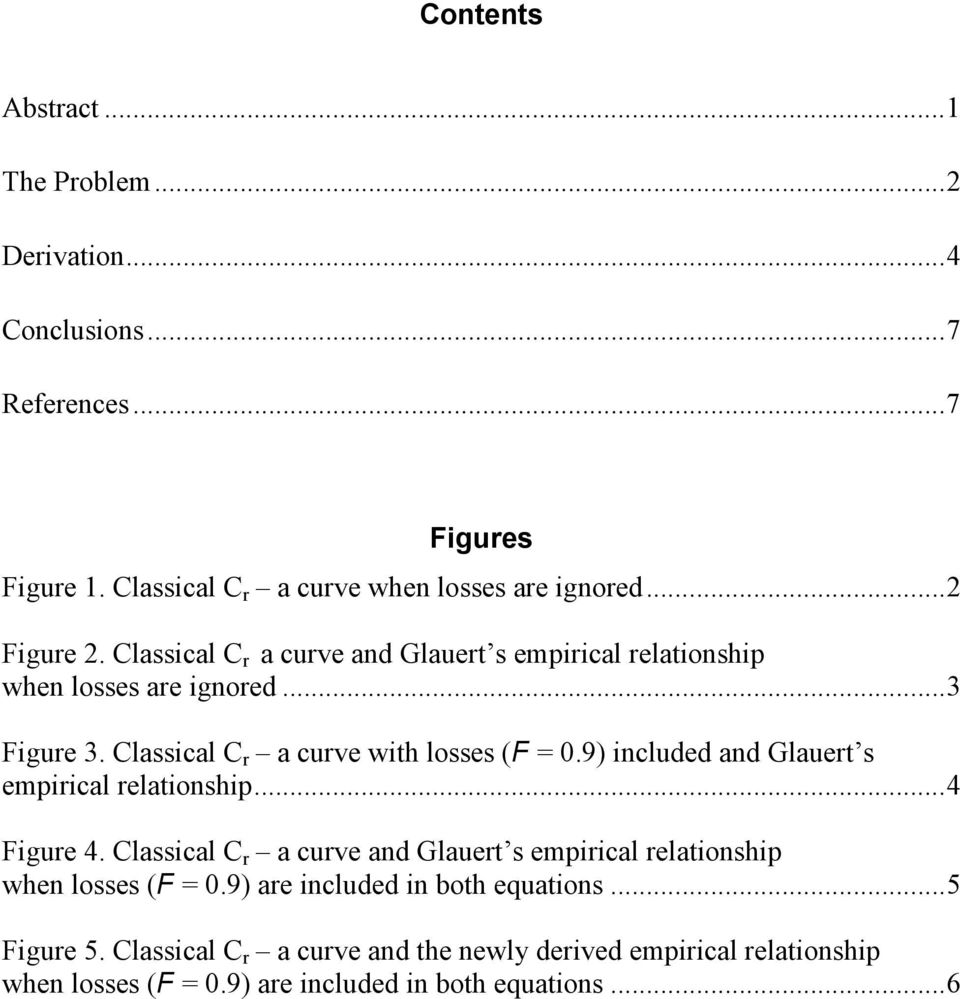
4 Contents Abstract...1 The Problem... Derivation...4 Conclusions...7 References...7 Figures Figure 1. Classical C r a curve when losses are ignored... Figure. Classical C r a curve and Glauert s empirical relationship when losses are ignored...3 Figure 3. Classical C r a curve with losses (F = 0.9) included and Glauert s empirical relationship...4 Figure 4. Classical C r a curve and Glauert s empirical relationship when losses (F = 0.9) are included in both equations...5 Figure 5. Classical C r a curve and the newly derived empirical relationship when losses (F = 0.9) are included in both equations...6
5 Abstract Wind turbines sometimes experience the turbulent windmill state during startup or shutdown. This rarely happens during normal operation, so it has little effect on power curves or energy production. However, for completeness we need to be able to model situations where the axial induction factor exceeds 0.5. Classical momentum theory, which shows a relationship between the thrust coefficient and the axial induction factor, is not valid in this region. Glauert plotted some experimental data taken by Lock in the 190s against this parabolic relationship and found very poor agreement for operation in this high-induction state. He proposed a new empirical relationship to fit the experimental data. Unfortunately, the new empirical curve does not account for tip or hub losses. Others have proposed multiplying the axial induction factor by the loss factor to correct the curve, but this still leaves a mathematical no-man s-land between the classical curve and the modified version of Glauert s empirical curve. The purpose of this paper is to document the derivation of a new curve that accounts for tip and hub losses and eliminates the numerical problems of the previous approaches. 1

6 The Problem A review of several textbooks on wind turbine theory revealed that no one has addressed the numerical discontinuity problem associated with the Glauert empirical relationship (Lock et al. [196], Glauert [196]) between thrust coefficient and axial induction when tip losses are applied to the turbulent windmill state. (See Burton et al. [001], Eggleston and Stoddard [1987], Manwell et al. [00], and Spera [1994] for discussions of classical momentum theory and the Glauert empirical equation.) Eggleston and Stoddard discussed the classical thrust coefficient, C T, versus induction factor, a, curve, which is shown in Equation 1 and Figure 1. The dotted portion of the curve above the induction value of 0.5 represents the portion of the curve that violates the basic assumptions used to derive it. C = 4 a(1 a ) (1) T.0 Thrust coefficient, C T Windmill State Turbulent Windmill State Axial induction factor, a Figure 1. Classical C T a curve when losses are ignored Glauert fit a parabola to some experimental data of rotors operating in the turbulent windmill state. This parabola touched the classical momentum curve at a = 0.4 and went through.0 for a = 1.0. The curve, as documented by Eggleston and Stoddard, is given by the formula shown in Equation after solving for C T. Burton et al. used a line that is tangential to the theory parabola to fit the data. The choice of the intersection determines the slope and fit of the curve. The Burton textbook proposed an induction value of 0.36 for the intersection of the two curves. The book also reported that Wilson and Lissaman chose a value of A plot of the three empirical curves with the classical momentum theory curve and the test data is shown in Figure. We digitized the test data from Figure 3.16 of Burton s book. There is a large spread in the data, which indicates that the thrust coefficient is not a simple function of induction factor in the turbulent windmill state. C T ( a 0.143) = () 0.647
![[001], Eggleston and Stoddard [1987], Manwell et al. [00], and Spera [1994] for discussions of classical momentum theory and the Glauert empirical equation.](/docs-images/46/142273/images/page_6.jpg ") Eggleston and Stoddard discussed the classical thrust coefficient, C T, versus induction factor, a, curve, which is shown in Equation 1 and Figure 1.")
7 Thrust coefficient, C T Theory Lock Data Glauert Burton Wilson Windmill State Axial induction factor, a Turbulent Windmill State Figure. Classical C T a curve and Glauert s empirical relationship when losses are ignored A numerical problem arises when one applies the tip/hub loss correction factor, F, to the classical momentum balance equation (see Equation 3). C = 4 af (1 a) (3) T Plotting this modified equation shows a gap between the momentum curve and Glauert s curve (Figure 3) for a loss factor of 0.9. This gap creates a discontinuity when a computer is used to iterate for the induction factor. Eggleston and Stoddard modified Equation to multiply the induction factor by the loss factor. This modification to the Glauert empirical relationship lowers the entire curve, but not enough to eliminate all of the discontinuity (see Figure 4). 3

8 Derivation For the turbulent windmill state we need a curve that tangentially touches the classical momentum curve and thereby eliminates the numerical no-man s-land. The data Glauert used exhibit a very wide scatter. The resulting equation was probably chosen to resolve the numerical problem rather than to obtain a good fit for the data. (See Eggleston and Stoddard, p. for a plot of the data.) Therefore, choosing a parabolic curve that has the same value and slope for a = 0.4 as the classical equation with losses, and that goes through.0 at a = 1.0, should be somewhat reasonable. We can do this with simple algebra. The derivative of Equation 1 (assuming fixed F for a given iteration) gives dc T da = 4 F(1 a). (4) At a = 0.4, Equations 3 and 4 become and C = 0.96F (5) T dc T da = 0.8F. (6).0 Thrust coefficient, C T 1.5 Gap Windmill Turbulent Windmill Axial induction factor, a Figure 3. Classical C T a curve with losses (F = 0.9) included and Glauert s empirical relationship 4

9 .0 Thrust coefficient, CT Windmill State Axial induction factor, a Gap Turbulent Windmill State Figure 4. Classical C T a curve and Glauert s empirical relationship when losses (F = 0.9) are included in both equations A general quadratic equation for thrust coefficient is CT = b0 + ba 1 + ba, (7) where b 0, b 1, and b, must be selected to satisfy the conditions stated above. The slope of this equation is dc T da = b +b a. (8) 1 At an induction factor of 0.4, Equations 7 and 8 become and C = b + 0.4b b, (9) T 0 1 dc T da = b b. (10) When we equate Equations 5 and 9, we get b + 0.4b b = 0.96F. (11) 0 1 Equating Equations 6 and 10 yields b + 0.8b = 0.8F. (1) 1 At an induction factor of 1, we want our quadratic to be equal to, so 5

10 C = b + b + b =. (13) T 0 1 If we subtract Equation 11 from Equation 13, we get 0.6b b = 0.96F. (14) 1 Next, if we subtract 0.6*Equation 1 from Equation 14 and solve for b we get 50 b = 4F. (15) 9 Solving Equation 1 for b 1 yields b1 = F b = 4F, (16) 5 9 And solving Equation 13 for b 0 yields 8 b0 = b1 b =. (17) 9 We now have an equation that produces a curve that just touches the classical momentum equation at a = 0.4 and goes through at a = 1 (see Figure 5) CT = + 4F a+ F a. (18).0 Thrust coefficient, C T 1.5 No Gap Windmill Turbulent Windmill Axial induction factor, a Figure 5. Classical C T a curve and the newly derived empirical relationship when losses (F = 0.9) are included in both equations 6

11 Conclusions We have shown that previous relationships between the thrust coefficient and the induction factor in the turbulent windmill state have produced numerical discontinuities in the induction iteration with tip or hub losses. We derived a new equation that solves the discontinuity problem and provides a reasonable approximation to the experimental data. Although it is not a perfect fit to the data, it is probably as good as the original Glauert equation. This is the best-known method to compute the induction in the turbulent windmill state. However, it does not account for the spread in the data, which is a problem that needs further investigation. References Burton, T.; Sharpe, D.; Jenkins, N.; Bossanyi, E.. (001). Wind Energy Handbook. West Sussex, England: John Wiley & Sons, Ltd.; pp Eggleston, D.M.; Stoddard, F.S. (1987). Wind Turbine Engineering Design. New York, NY: Van Nostrand Reinhold; pp , 58. Glauert, H. (196). The Analysis of Experimental Results in the Windmill Brake and Vortex Ring States of an Airscrew, Rept Aeronautical Research Committee Reports and Memoranda, London: Her Majesty s Stationery Office. Lock, C.N.H.; Batemen, H.; Townsend, H.C.H. (196). An Extension of the Vortex Theory of Airscrews with Applications to Airscrews of Small Pitch, Including Experimental Results. No Aeronautical Research Committee Reports and Memoranda, London: Her Majesty s Stationery Office. Manwell, J.F.; McGowan, J.G.; Rogers, A.L. (00). Wind Energy Explained. West Sussex, England: John Wiley & Sons, Ltd.; pp Wilson, R.E. (1994). Aerodynamic Behavior of Wind Turbines, Chapter 5. Spera, D.A., ed. Wind Turbine Technology. New York, NY: The American Society of Mechanical Engineers; pp

12 REPORT DOCUMENTATION PAGE Form Approved OMB No The public reporting burden for this collection of information is estimated to average 1 hour per response, including the time for reviewing instructions, searching existing data sources, gathering and maintaining the data needed, and completing and reviewing the collection of information. Send comments regarding this burden estimate or any other aspect of this collection of information, including suggestions for reducing the burden, to Department of Defense, Executive Services and Communications Directorate ( ). Respondents should be aware that notwithstanding any other provision of law, no person shall be subject to any penalty for failing to comply with a collection of information if it does not display a currently valid OMB control number. PLEASE DO NOT RETURN YOUR FORM TO THE ABOVE ORGANIZATION. 1. REPORT DATE (DD-MM-YYYY) August 005. REPORT TYPE Technical Report 4. TITLE AND SUBTITLE A New Empirical Relationship between Thrust Coefficient and Induction Factor for the Turbulent Windmill State 3. DATES COVERED (From - To) 5a. CONTRACT NUMBER DE-AC36-99-GO b. GRANT NUMBER 5c. PROGRAM ELEMENT NUMBER 6. AUTHOR(S) Marshall L. Buhl, Jr. 5d. PROJECT NUMBER NREL/TP e. TASK NUMBER WER f. WORK UNIT NUMBER 7. PERFORMING ORGANIZATION NAME(S) AND ADDRESS(ES) National Renewable Energy Laboratory 1617 Cole Blvd. Golden, CO PERFORMING ORGANIZATION REPORT NUMBER NREL/TP SPONSORING/MONITORING AGENCY NAME(S) AND ADDRESS(ES) 10. SPONSOR/MONITOR'S ACRONYM(S) NREL 11. SPONSORING/MONITORING AGENCY REPORT NUMBER 1. DISTRIBUTION AVAILABILITY STATEMENT National Technical Information Service U.S. Department of Commerce 585 Port Royal Road Springfield, VA SUPPLEMENTARY NOTES 14. ABSTRACT (Maximum 00 Words) Classical momentum theory shows a relationship between the thrust coefficient and the axial induction factor. Glauert plotted some experimental results against this parabolic relationship and found very poor agreement for operation in the turbulent windmill state. He proposed a new empirical relationship to fit the experimental data. Unfortunately, the new empirical curve does not account for tip or hub losses. Others have proposed that one simply multiply the axial induction factor but the loss factor to correct the curve, but this still leaves a mathematical no man s land between the classical curve and the modified version of Glauert s empirical curve. This paper derives a new curve that accounts for tip and hub losses and eliminates the discontinuity. 15. SUBJECT TERMS momentum theory; Glauert; induction; wind turbine; turbulent windmill state 16. SECURITY CLASSIFICATION OF: 17. LIMITATION 18. NUMBER 19a. NAME OF RESPONSIBLE PERSON OF ABSTRACT OF PAGES a. REPORT b. ABSTRACT c. THIS PAGE Unclassified Unclassified Unclassified UL 19b. TELEPHONE NUMBER (Include area code) Standard Form 98 (Rev. 8/98) Prescribed by ANSI Std. Z39.18 F1147-E(1/004)

Optical Blade Position Tracking System Test
 National Renewable Energy Laboratory Innovation for Our Energy Future A national laboratory of the U.S. Department of Energy Office of Energy Efficiency & Renewable Energy Optical Blade Position Tracking
Elastomer Compatibility Testing of Renewable Diesel Fuels
 National Renewable Energy Laboratory Innovation for Our Energy Future A national laboratory of the U.S. Department of Energy Office of Energy Efficiency & Renewable Energy Elastomer Compatibility Testing
Regional Field Verification Operational Results from Four Small Wind Turbines in the Pacific Northwest
 National Renewable Energy Laboratory Innovation for Our Energy Future A national laboratory of the U.S. Department of Energy Office of Energy Efficiency & Renewable Energy Regional Field Verification Operational
Small PV Systems Performance Evaluation at NREL's Outdoor Test Facility Using the PVUSA Power Rating Method
 National Renewable Energy Laboratory Innovation for Our Energy Future A national laboratory of the U.S. Department of Energy Office of Energy Efficiency & Renewable Energy Small PV Systems Performance
Computer Simulations of Edge Effects in a Small-Area Mesa N-P Junction Diode
 Computer Simulations of Edge Effects in a Small-Area Mesa N-P Junction Diode Preprint Conference Paper NREL/CP-520-45002 February 2009 J. Appel and B. Sopori National Renewable Energy Laboratory N.M. Ravindra
Rate Analysis of Two Photovoltaic Systems in San Diego
 Rate Analysis of Two Photovoltaic Systems in San Diego Technical Report NREL/TP-6A2-43537 July 2009 Elizabeth Doris, Sean Ong, and Otto Van Geet Rate Analysis of Two Photovoltaic Systems in San Diego Technical
Early Fuel Cell Market Deployments: ARRA and Combined (IAA, DLA, ARRA)
 Technical Report NREL/TP-56-588 January 3 Early Fuel Cell Market Deployments: ARRA and Combined (IAA, DLA, ARRA) Quarter 3 Composite Data Products Jennifer Kurtz, Keith Wipke, Sam Sprik, Todd Ramsden,
Financing Projects That Use Clean-Energy Technologies: An Overview of Barriers and Opportunities
 National Renewable Energy Laboratory Innovation for Our Energy Future A national laboratory of the U.S. Department of Energy Office of Energy Efficiency & Renewable Energy Financing Projects That Use Clean-Energy
Wind Energy and Production of Hydrogen and Electricity Opportunities for Renewable Hydrogen
 National Renewable Energy Laboratory Innovation for Our Energy Future A national laboratory of the U.S. Department of Energy Office of Energy Efficiency & Renewable Energy Wind Energy and Production of
Wind Forecasting stlljectives for Utility Schedule and Energy Traders
 NREUCP 500 24680 UC Category: 1210 Wind Forecasting stlljectives for Utility Schedule and Energy Traders Marc N. Schwartz National Renewable Energy Laboratory Bruce H. Bailey A WS Scientific, Inc. Presented
Using HOMER Software, NREL s Micropower Optimization Model, to Explore the Role of Gen-sets in Small Solar Power Systems
 National Renewable Energy Laboratory Innovation for Our Energy Future A national laboratory of the U.S. Department of Energy Office of Energy Efficiency & Renewable Energy Using HOMER Software, NREL s
NREL Job Task Analysis: Crew Leader
 NREL Job Task Analysis: Crew Leader Chuck Kurnik National Renewable Energy Laboratory Cynthia Woodley Professional Testing Inc. NREL is a national laboratory of the U.S. Department of Energy, Office of
Measurement of BET Surface Area on Silica Nanosprings
 PNNL-17648 Prepared for the U.S. Department of Energy under Contract DE-AC05-76RL01830 Measurement of BET Surface Area on Silica Nanosprings AJ Karkamkar September 2008 DISCLAIMER This report was prepared
Energy Systems Integration
 Energy Systems Integration A Convergence of Ideas Ben Kroposki, Bobi Garrett, Stuart Macmillan, Brent Rice, and Connie Komomua National Renewable Energy Laboratory Mark O Malley University College Dublin
Second Line of Defense Virtual Private Network Guidance for Deployed and New CAS Systems
 PNNL-19266 Prepared for the U.S. Department of Energy under Contract DE-AC05-76RL01830 Second Line of Defense Virtual Private Network Guidance for Deployed and New CAS Systems SV Singh AI Thronas January
Situated Usability Testing for Security Systems
 PNNL-20201 Prepared for the U.S. Department of Energy under Contract DE-AC05-76RL01830 Situated Usability Testing for Security Systems FL Greitzer February 2011 DISCLAIMER This report was prepared as an
Guide to Using DoD PKI Certificates in Outlook 2000
 Report Number: C4-017R-01 Guide to Using DoD PKI Certificates in Outlook 2000 Security Evaluation Group Author: Margaret Salter Updated: April 6, 2001 Version 1.0 National Security Agency 9800 Savage Rd.
Method to Calculate Uncertainties in Measuring Shortwave Solar Irradiance Using Thermopile and Semiconductor Solar Radiometers
 Method to Calculate Uncertainties in Measuring Shortwave Solar Irradiance Using Thermopile and Semiconductor Solar Radiometers Ibrahim Reda NREL is a national laboratory of the U.S. Department of Energy,
Electrical Collection and Transmission Systems for Offshore Wind Power
 National Renewable Energy Laboratory Innovation for Our Energy Future A national laboratory of the U.S. Department of Energy Office of Energy Efficiency & Renewable Energy Electrical Collection and Transmission
System Advisor Model, SAM 2014.1.14: General Description
 System Advisor Model, SAM 2014.1.14: General Description Nate Blair, Aron P. Dobos, Janine Freeman, Ty Neises, and Michael Wagner National Renewable Energy Laboratory Tom Ferguson, Paul Gilman, and Steven
An Oil-Free Thrust Foil Bearing Facility Design, Calibration, and Operation
 NASA/TM 2005-213568 An Oil-Free Thrust Foil Bearing Facility Design, Calibration, and Operation Steve Bauman Glenn Research Center, Cleveland, Ohio March 2005 The NASA STI Program Office... in Profile
Improving a Gripper End Effector
 PNNL-13440 Improving a Gripper End Effector OD Mullen CM Smith KL Gervais January 2001 Prepared for the U.S. Department of Energy under Contract DE-AC06-76RL01830 DISCLAIMER This report was prepared as
Laser Safety Audit and Inventory System Database
 SAND REPORT SAND2003-1144 Unlimited Release Printed May 2003 Laser Safety Audit and Inventory System Database Arnold L. Augustoni Prepared by Sandia National Laboratories Albuquerque, New Mexico 87185
Derived Intervention Levels for Tritium Based on Food and Drug Administration Methodology Using ICRP 56 Dose Coefficients (U)
 .' I Keywords: Retention: Tritium ICRP 56 Dose Coefficients Derived Intervention Level Lifetime Derived Intervention Levels for Tritium Based on Food and Drug Administration Methodology Using ICRP 56 Dose
Integrated Force Method Solution to Indeterminate Structural Mechanics Problems
 NASA/TP 2004-207430 Integrated Force Method Solution to Indeterminate Structural Mechanics Problems Surya N. Patnaik Ohio Aerospace Institute, Brook Park, Ohio Dale A. Hopkins and Gary R. Halford Glenn
Rounding and Significant Figures
 National Renewable Energy Laboratory Innovation for Our Energy Future A national laboratory of the U.S. Department of Energy Office of Energy Efficiency & Renewable Energy Rounding and Significant Figures
Wind Turbine Post-Stall Airfoil Performance Characteristics Guidelines for Blade-Element Momentum Methods
 October 004 NREL/CP-500-36900 Wind Turbine Post-Stall Airfoil Performance Characteristics Guidelines for Blade-Element Momentum Methods Preprint J. Tangler National Renewable Energy Laboratory J. David
Cost and Performance Assumptions for Modeling Electricity Generation Technologies
 Cost and Performance Assumptions for Modeling Electricity Generation Technologies Rick Tidball, Joel Bluestein, Nick Rodriguez, and Stu Knoke ICF International Fairfax, Virginia NREL is a national laboratory
Penetration Testing of Industrial Control Systems
 SF-1075-SUR (8-2005) SANDIA REPORT SAND2005-2846P Unlimited Release Printed March, 2005 Penetration Testing of Industrial Control Systems David P. Duggan Prepared by Sandia National Laboratories Albuquerque,
Overview Presented by: Boyd L. Summers
 Overview Presented by: Boyd L. Summers Systems & Software Technology Conference SSTC May 19 th, 2011 1 Report Documentation Page Form Approved OMB No. 0704-0188 Public reporting burden for the collection
Report Documentation Page
 (c)2002 American Institute Report Documentation Page Form Approved OMB No. 0704-0188 Public reporting burden for the collection of information is estimated to average 1 hour per response, including the
Simulation of Air Flow Through a Test Chamber
 Simulation of Air Flow Through a Test Chamber by Gregory K. Ovrebo ARL-MR- 0680 December 2007 Approved for public release; distribution unlimited. NOTICES Disclaimers The findings in this report are not
This document was prepared in conjunction with work accomplished under Contract No. DE-AC09-96SR18500 with the U. S. Department of Energy.
 This document was prepared in conjunction with work accomplished under Contract No. DE-AC09-96SR18500 with the U. S. Department of Energy. DISCLAIMER This report was prepared as an account of work sponsored
NEAMS Software Licensing, Release, and Distribution: Implications for FY2013 Work Package Planning
 ORNL/TM-2012/246 NEAMS Software Licensing, Release, and Distribution: Implications for FY2013 Work Package Planning Preliminary Report (NEAMS Milestone M4MS-12OR0608113) Version 1.0 (June 2012) David E.
How To Find Out What People Think About Renewable Energy
 Consumer Attitudes About Renewable Energy: Trends and Regional Differences Natural Marketing Institute Harleysville, Pennsylvania NREL is a national laboratory of the U.S. Department of Energy, Office
IDC Reengineering Phase 2 & 3 US Industry Standard Cost Estimate Summary
 SANDIA REPORT SAND2015-20815X Unlimited Release January 2015 IDC Reengineering Phase 2 & 3 US Industry Standard Cost Estimate Summary Version 1.0 James Mark Harris, Robert M. Huelskamp Prepared by Sandia
Wind Electrolysis: Hydrogen Cost Optimization
 Wind Electrolysis: Hydrogen Cost Optimization Genevieve Saur and Todd Ramsden NREL is a national laboratory of the U.S. Department of Energy, Office of Energy Efficiency & Renewable Energy, operated by
Drupal Automated Testing: Using Behat and Gherkin
 PNNL-23798 Prepared for the U.S. Department of Energy under Contract DE-AC05-76RL01830 Drupal Automated Testing: Using Behat and Gherkin Thomas Williams [email protected] Carolyn Wolkenhauer [email protected]
Headquarters U.S. Air Force
 Headquarters U.S. Air Force I n t e g r i t y - S e r v i c e - E x c e l l e n c e Air Force Technology Readiness Assessment (TRA) Process for Major Defense Acquisition Programs LtCol Ed Masterson Mr
Automated Transportation Management System
 - BOE/RL-93-52 Rev. 1 Automated Transportation Management System (ATMS) Configuration Management Plan /, MAR 2 2 1995 OSTI 1 United States Department of Energy Richland, Washington - Approved for Public
WET BULB GLOBE TEMPERATURE MEASUREMENT AT THE Y-12 NATIONAL SECURITY COMPLEX
 WET BULB GLOBE TEMPERATURE MEASUREMENT AT THE Y-12 NATIONAL SECURITY COMPLEX Thomas E. Bellinger, CCM Y-12 National Security Complex Oak Ridge, Tennessee 1. INTRODUCTION To better serve the needs of the
W. C. Reinig. Savannah River Laboratory E. I. du Pent de Nemours and Company Aiken, South Carolina 298o1
 .*. *.-a /dp73j/3~ DP-MS-68-48 calforn1um-252: A NEW SOTOPC SOUR(!EFOR NEUTRON RADOGRAPHY by W. C. Reinig Savannah River Laboratory E.. du Pent de Nemours and Company Aiken, South Carolina 298o1. SRL7
High-Speed Shaft Bearing Loads Testing and Modeling in the NREL Gearbox Reliability Collaborative
 High-Speed Shaft Bearing Loads Testing and Modeling in the NREL Gearbox Reliability Collaborative Preprint B. McNiff McNiff Light Industry Y. Guo, J. Keller, and L. Sethuraman National Renewable Energy
Dynamic Vulnerability Assessment
 SANDIA REPORT SAND2004-4712 Unlimited Release Printed September 2004 Dynamic Vulnerability Assessment Cynthia L. Nelson Prepared by Sandia National Laboratories Albuquerque, New Mexico 87185 and Livermore,
Investigating the Influence of the Added Mass Effect to Marine Hydrokinetic Horizontal-Axis Turbines Using a General Dynamic Wake Wind Turbine Code
 Investigating the Influence of the Added Mass Effect to Marine Hydrokinetic Horizontal-Axis Turbines Using a General Dynamic Wake Wind Turbine Code D.C. Maniaci Pennsylvania State University Y. Li National
Algorithmic Research and Software Development for an Industrial Strength Sparse Matrix Library for Parallel Computers
 The Boeing Company P.O.Box3707,MC7L-21 Seattle, WA 98124-2207 Final Technical Report February 1999 Document D6-82405 Copyright 1999 The Boeing Company All Rights Reserved Algorithmic Research and Software
Advanced Micro Ring Resonator Filter Technology
 Advanced Micro Ring Resonator Filter Technology G. Lenz and C. K. Madsen Lucent Technologies, Bell Labs Report Documentation Page Form Approved OMB No. 0704-0188 Public reporting burden for the collection
Using the Advancement Degree of Difficulty (AD 2 ) as an input to Risk Management
 Using the Advancement Degree of Difficulty (AD 2 ) as an input to Risk Management James W. Bilbro JB Consulting International Huntsville, AL Multi-dimensional Assessment of Technology Maturity Technology
Dynamic Programming Applied to Investigate Energy Management Strategies for a Plug-in HEV
 National Renewable Energy Laboratory Innovation for Our Energy Future A national laboratory of the U.S. Department of Energy Office of Energy Efficiency & Renewable Energy Dynamic Programming Applied to
DEFENSE CONTRACT AUDIT AGENCY
 DEFENSE CONTRACT AUDIT AGENCY Fundamental Building Blocks for an Acceptable Accounting System Presented by Sue Reynaga DCAA Branch Manager San Diego Branch Office August 24, 2011 Report Documentation Page
DCAA and the Small Business Innovative Research (SBIR) Program
 Defense Contract Audit Agency (DCAA) DCAA and the Small Business Innovative Research (SBIR) Program Judice Smith and Chang Ford DCAA/Financial Liaison Advisors NAVAIR 2010 Small Business Aviation Technology
Asset Management- Acquisitions
 Indefinite Delivery, Indefinite Quantity (IDIQ) contracts used for these services: al, Activity & Master Plans; Land Use Analysis; Anti- Terrorism, Circulation & Space Management Studies; Encroachment
AP Physics 1 and 2 Lab Investigations
 AP Physics 1 and 2 Lab Investigations Student Guide to Data Analysis New York, NY. College Board, Advanced Placement, Advanced Placement Program, AP, AP Central, and the acorn logo are registered trademarks
How To Find Out If The Winds From The Oak Ridge Site Are Calm
 EVALUATING THE WIND DATA FROM THE AUTOMATED SURFACE OBSERVING SYSTEM IN OAK RIDGE, TENNESSEE - IS KOQT THE CALMEST SITE IN THE US? Thomas E. Bellinger, CCM Y-12 National Security Complex Oak Ridge, Tennessee
Regional Differences in the Price-Elasticity of Demand for Energy
 National Renewable Energy Laboratory Innovation for Our Energy Future A national laboratory of the U.S. Department of Energy Office of Energy Efficiency & Renewable Energy Regional Differences in the Price-Elasticity
Risk D&D Rapid Prototype: Scenario Documentation and Analysis Tool
 PNNL-18446 Risk D&D Rapid Prototype: Scenario Documentation and Analysis Tool Report to DOE EM-23 under the D&D Risk Management Evaluation and Work Sequencing Standardization Project SD Unwin TE Seiple
Nuclear Engineering Enrollments and Degrees Survey, 2014 Data
 Nuclear Engineering Enrollments and Degrees Survey, 2014 Data Number 74 Oak Ridge Institute for Science and Education 2015 SURVEY UNIVERSE The 2014 survey includes degrees granted between September 1,
RT 24 - Architecture, Modeling & Simulation, and Software Design
 RT 24 - Architecture, Modeling & Simulation, and Software Design Dennis Barnabe, Department of Defense Michael zur Muehlen & Anne Carrigy, Stevens Institute of Technology Drew Hamilton, Auburn University
Pima Community College Planning Grant For Autonomous Intelligent Network of Systems (AINS) Science, Mathematics & Engineering Education Center
 Pima Community College Planning Grant For Autonomous Intelligent Network of Systems (AINS) Science, Mathematics & Engineering Education Center Technical Report - Final Award Number N00014-03-1-0844 Mod.
EAD Expected Annual Flood Damage Computation
 US Army Corps of Engineers Hydrologic Engineering Center Generalized Computer Program EAD Expected Annual Flood Damage Computation User's Manual March 1989 Original: June 1977 Revised: August 1979, February
HEC-DSS Add-In Excel Data Exchange for Excel 2007-2010
 HEC-DSS Add-In Excel Data Exchange for Excel 2007-2010 User's Manual Version 3.2.1 January 2010 Approved for Public Release. Distribution Unlimited. CPD-79b REPORT DOCUMENTATION PAGE Form Approved OMB
THE NATIONAL SHIPBUILDING RESEARCH PROGRAM
 SHIP PRODUCTION COMMITTEE FACILITIES AND ENVIRONMENTAL EFFECTS SURFACE PREPARATION AND COATINGS DESIGN/PRODUCTION INTEGRATION HUMAN RESOURCE INNOVATION MARINE INDUSTRY STANDARDS WELDING INDUSTRIAL ENGINEERING
Microstructural Evaluation of KM4 and SR3 Samples Subjected to Various Heat Treatments
 NASA/TM 2004-213140 Microstructural Evaluation of KM4 and SR3 Samples Subjected to Various Heat Treatments David Ellis and Timothy Gabb Glenn Research Center, Cleveland, Ohio Anita Garg University of Toledo,
Nuclear Engineering Enrollments and Degrees Survey, 2013 Data
 Nuclear Engineering Enrollments and Degrees Survey, 2013 Data Number 72 Oak Ridge Institute for Science and Education 2014 SURVEY UNIVERSE The survey includes degrees granted between September 1, 2012
An Application of an Iterative Approach to DoD Software Migration Planning
 An Application of an Iterative Approach to DoD Software Migration Planning John Bergey Liam O Brien Dennis Smith September 2002 Product Line Practice Initiative Unlimited distribution subject to the copyright.
DISCLAIMER. This document was prepared as an account of work sponsored by an agency of the United States
 DISCLAIMER This document was prepared as an account of work sponsored by an agency of the United States Government. Neither the United States Government nor the University of California nor any of their
S.L. Chang, S.A. Lottes, C.Q. Zhou,** B. Golchert, and M. Petrick
 3 -- 3 CFD CODE DEVELOPMENT FOR PERFORMANCE EVALUATION OF A PILOT-SCALE FCC RISER REACTOR* S.L. Chang, S.A. Lottes, C.Q. Zhou,** B. Golchert, and M. Petrick Ekergy Systems Division Argonne National Laboratory
COMPARISON OF INDIRECT COST MULTIPLIERS FOR VEHICLE MANUFACTURING
 COMPARISON OF INDIRECT COST MULTIPLIERS FOR VEHICLE MANUFACTURING Technical Memorandum in support of Electric and Hybrid Electric Vehicle Cost Estimation Studies by Anant Vyas, Dan Santini, and Roy Cuenca
Proposal: Application of Agile Software Development Process in xlpr ORNL- 2012/41412 November 2012
 Proposal: Application of Agile Software Development Process in xlpr ORNL- 2012/41412 November 2012 Prepared by Hilda B. Klasky Paul T. Williams B. Richard Bass This report was prepared as an account of
Issue Paper. Wargaming Homeland Security and Army Reserve Component Issues. By Professor Michael Pasquarett
 Issue Paper Center for Strategic Leadership, U.S. Army War College May 2003 Volume 04-03 Wargaming Homeland Security and Army Reserve Component Issues By Professor Michael Pasquarett Background The President
Mr. Steve Mayer, PMP, P.E. McClellan Remediation Program Manger Air Force Real Property Agency. May 11, 2011
 Mr. Steve Mayer, PMP, P.E. McClellan Remediation Program Manger Air Force Real Property Agency May 11, 2011 Report Documentation Page Form Approved OMB No. 0704-0188 Public reporting burden for the collection