
Identifying Peer-to-Peer Traffic Based on Traffic Characteristics
|
|
|
- Aldous Bell
- 10 years ago
- Views:
Transcription
1 Identifying Peer-to-Peer Traffic Based on Traffic Characteristics Prof S. R. Patil Dept. of Computer Engineering SIT, Savitribai Phule Pune University Lonavala, India Suraj Sanjay Dangat Dept. of Computer Engineering SIT, Savitribai Phule Pune University Lonavala, India Abstract The P2P (Peer-to-Peer) network is dynamic, selforganized and has some other features. So, P2P traffic has become one of the most significant portions of the network traffic. But, it has also caused network congestion problems because of resource occupation (mainly bandwidth). Accurate identification of P2P traffic makes great sense for efficient network management and efficient utility of network resources. In this paper we address traffic identification technology, such as traffic identification by using network characteristics have been considered for solving the problem with different parameters, improved accuracy rate and efficiency. Experiments on various P2P applications demonstrate that the method is generic and it can be applied to most of P2P applications. Experimental result shows that the algorithm can identify P2P application accurately. In this paper we first briefly introduce P2P technology and then we made a short survey on the overall progress in P2P traffic identification technologies. Finally we discuss the proposed method and its result analysis. Keywords P2P; Peer-to-Peer, Traffic characteristics, Peer-to- Peer Traffic identification I. INTRODUCTION A network is a group or system of interconnected people or some things. A computer network or data network is a telecommunications network in which a group of two or more computer systems linked together and it allows computers to exchange data. In computer networks, networked computing devices pass data to each other along network links and these links between nodes are established using either wired media or wireless media. The widely-known example of computer network is the Internet. In a P2P network, the "peers" are computer systems which are connected to each other via the Internet and peers are configured to allow certain files and folders to be shared with every peer or with selected peers. Files can be shared directly between the different peers on the network without the need of a central server. In short, each computer on a P2P network acts as a file server as well as a client. With the extensive application of P2P technology, P2P applications consume a large amount of network bandwidth, which ultimately increase the burden of the network. According to the available statistics, P2P applications account for 60% to 80% of total ISP business and become the largest consumer of network bandwidth. According to the statistics, about 60 percent of the bandwidth is occupied by P2P applications and from these 60%, 80% of which were occupied by P2P file-sharing applications. But these P2P filesharing users are very low in number and they are only 5% of the total number of Internet users. The P2P has many characterizes, such as large flow, automatic operation, connection for a long time, regardless of time running, and so on. Therefore, P2P applications can take up more bandwidth than other applications. As number of P2P user s increases, network traffic will also increase significantly. At the same time, increasing the size of the network will lead a large number of broadcast news to flood in the entire network and so the network traffic increases. In the end, it led to bottlenecks of the network and network congestion damages the services provided by the Internet Service Providers and common users [1]. The solution to this bandwidth congestion problem is that we limit the users who use large amount of bandwidth to protect those user who use a small amount of bandwidth when the network resource constraints. On the contrary, when there are no constraints on network resources, we remove these restrictions so that each user can use the lines efficiently. How to effectively control the available network resources and how to effectively control the P2P traffic have become quite important questions. Therefore, P2P traffic identification is a key technology for effective control over it. P2P traffic which is produced by P2P application has different characteristics than the other applications. In P2P traffic identification based on traffic characteristics, these characteristics are used to identify the network traffic. This approach can detect P2P traffics with dynamic ports and encrypted transmission. This method easily detects the flow of encrypted payload and unknown payload characteristics of P2P traffic [2]. In recent years, researchers have been using traffic characteristics in the area of computer network for identifying P2P traffic. It is very relevant for the study of network traffic control, traffic congestion, resource utilization and it also has an economic importance. In this paper, the main focus is on three things i.e. on classifying all the incoming traffic in the network, identify the P2P traffic in the network and to minimize the rate of false detection and the rate of negative detection. The rest sections of this paper are arranged as ISBN:

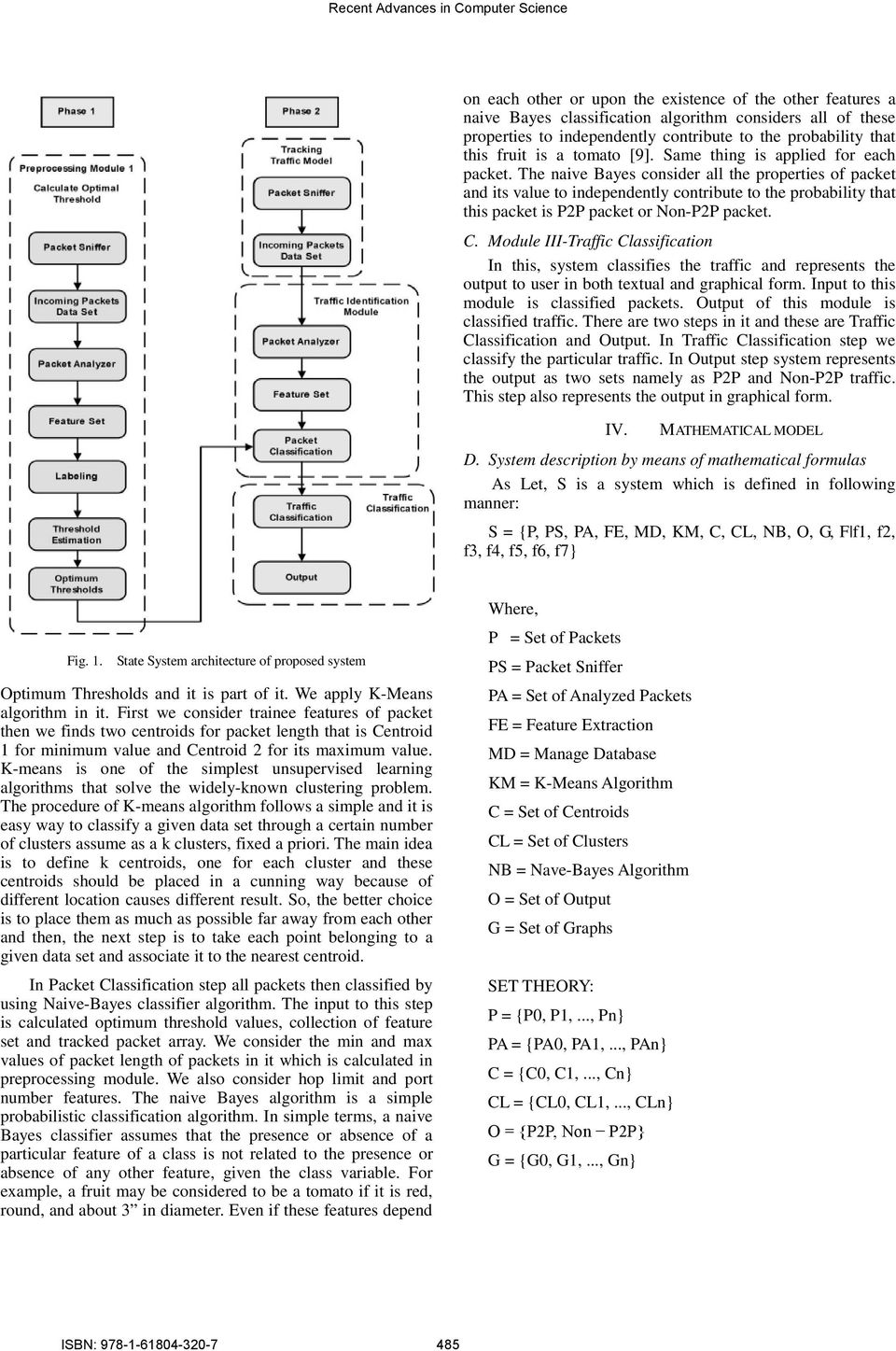
2 follow. In section II, we briefly introduce Details of P2P traffic classification technologies. In Section III, we briefly discuss the System Architecture. In Section IV, we represent proposed method by means of Mathematical model. In Section V, we analyse the Result of proposed system. In Section VI, we discuss the conclusion of proposed system. II. EXISTING METHODS OF P2P TRAFFIC CLASSIFICATION TECHNOLOGIES There are various techniques available for P2P traffic identification and classification. It includes Port-based classification, Payload-based classification, Feature-based classification and Hybrid classification method. It is discussed in following paragraphs. Port-based classification method is the simplest and traditional method. It identifies the application traffic by identifying the application type and this application type is identified from the port number used in the transport layer. For example, TCP port 80/443/1024 is Skype traffic, TCP port 1214 is Kazaa P2P traffic and so on. This approach is extremely easy for implementation and it gives very little overhead on the traffic classifier. But, it also has some limitation and it becomes less accurate because of several reasons. These are, many applications uses random ports and some P2P applications use dynamic ports which are not known in advance [3]. To remove the drawbacks of port-based classification method, several payload-based classification techniques have been proposed. Most protocols contain a protocol specific string in the payload namely signatures that can be used for identification. The information about this strings are publicly available. Subhabrata [4] presented an analysis of a number of P2P application and their signatures. For example 0x13Bit corresponds to the BitTorrent application. By comparing every packet payload with a set of previously determined signatures, this method can identify application traffic more accurately than the traditional Port-based method. The benefits of this method are high accuracy and robustness, and have a good classification functions. However, there are still some disadvantages of this method. These methods identify only P2P traffic for those signatures which is known in advance and it is unable to classify any other traffic. Because of the disadvantages of these two methods, the research community started developing the new methods which are less dependent on particular individual applications, but focused on capturing and extracting common things in the behavior of P2P applications. We refer this as feature-based technique. This kind of approach is to classify traffic based on the analysis of hidden transition patterns of traffic flows. Such nonlinear properties cannot be affected by dynamic port change or payload encryption. These methods provide an alternative for effective traffic classification. There are also some hybrid P2P traffic classification methods available. This approach includes most of the proposed methods for improving classification accuracy. Most of the traffic identification method of P2P based on traffic characteristics is to select particular feature from the P2P features [5, 6]. There are four main P2P features. First is that the number of other hosts that P2P hosts are connecting to be bigger than the traditional hosts. Second, P2P traffics of up and down are roughly equal and it is different from the traditional characteristics of the host. Third, P2P hosts are act as a both servers as well as clients, which differ from the traditional hosts. Fourth, the connection features of P2P hosts listening port are different from the traditional ones [7]. In the reference [8], the authors proposed a simple algorithm based on the first feature. In the second reference, the authors proposed a flow characteristics identification algorithm based on first and fourth feature and also uses factors that affect the efficiency of identification algorithm. Proposed system considers different features and uses K-means and Naive- Bayes algorithm to improve accuracy rate. It minimizes the rate of false detection and the rate of the negative detection. The next section describes the system architecture of the proposed system. III. SYSTEM ARCHITECTURE The system architecture of our proposed system is discussed briefly below. It is shown in following figure1. It has two phases, In Phase 1 we calculate the optimum thresholds and in Phase 2 we apply these optimum thresholds values for classifying P2P traffic. Input to the proposed system is all traffic. We get output as classified traffic. There are one preprocessing module and three main modules. In preprocessing module, means in Calculate Optimum Threshold We calculate the optimum threshold value in it. Main modules are namely Tracking Traffic Model, Traffic Identification Module and Traffic Classification. A. Module I-Tracking Traffic Model In this module, System tracks the traffic using Packet Sniffer and represents it in the form of array of packet objects. Input to this module is all traffic. The output of this module is Tracked Traffic. There are two steps in it and these are Packet Sniffer and Incoming Packets Dataset. In Packet Sniffer step all traffic is passed to the Packet Sniffer and it continually tracks the maximum traffic as much as possible. Then in Incoming Packets Dataset step, all traffic which is tracked by Packet Sniffer is representing in the form of Packet class objects. The array for this is maintained. B. Module II-Traffic Identification Module In this module three things take place and these are packet analysis, feature set, packet classification takes places. Input to this module is the array of packets. Output of this module is classified packets. There are three steps in it and these are Packet Analyzer, Feature Set and Packet Classification. In Packet Analyzer step, the array of packets which is tracked by Packet Sniffer is passed to Packet Analyzer to analyze each packet in details. Additional information which is getting by this step we represent and maintained using collection objects. In Feature Set step, system maintains the particular features and its ideal value for packet classification. These features include packets destination IP, hop limit, packet length and port number. We determine the optimal threshold value for particular traffic in preprocessing module namely calculate ISBN:

3 on each other or upon the existence of the other features a naive Bayes classification algorithm considers all of these properties to independently contribute to the probability that this fruit is a tomato [9]. Same thing is applied for each packet. The naive Bayes consider all the properties of packet and its value to independently contribute to the probability that this packet is P2P packet or Non-P2P packet. C. Module III-Traffic Classification In this, system classifies the traffic and represents the output to user in both textual and graphical form. Input to this module is classified packets. Output of this module is classified traffic. There are two steps in it and these are Traffic Classification and Output. In Traffic Classification step we classify the particular traffic. In Output step system represents the output as two sets namely as P2P and Non-P2P traffic. This step also represents the output in graphical form. IV. MATHEMATICAL MODEL D. System description by means of mathematical formulas As Let, S is a system which is defined in following manner: S = {P, PS, PA, FE, MD, KM, C, CL, NB, O, G, F f1, f2, f3, f4, f5, f6, f7} Fig. 1. State System architecture of proposed system Optimum Thresholds and it is part of it. We apply K-Means algorithm in it. First we consider trainee features of packet then we finds two centroids for packet length that is Centroid 1 for minimum value and Centroid 2 for its maximum value. K-means is one of the simplest unsupervised learning algorithms that solve the widely-known clustering problem. The procedure of K-means algorithm follows a simple and it is easy way to classify a given data set through a certain number of clusters assume as a k clusters, fixed a priori. The main idea is to define k centroids, one for each cluster and these centroids should be placed in a cunning way because of different location causes different result. So, the better choice is to place them as much as possible far away from each other and then, the next step is to take each point belonging to a given data set and associate it to the nearest centroid. In Packet Classification step all packets then classified by using Naive-Bayes classifier algorithm. The input to this step is calculated optimum threshold values, collection of feature set and tracked packet array. We consider the min and max values of packet length of packets in it which is calculated in preprocessing module. We also consider hop limit and port number features. The naive Bayes algorithm is a simple probabilistic classification algorithm. In simple terms, a naive Bayes classifier assumes that the presence or absence of a particular feature of a class is not related to the presence or absence of any other feature, given the class variable. For example, a fruit may be considered to be a tomato if it is red, round, and about 3 in diameter. Even if these features depend Where, P = Set of Packets PS = Packet Sniffer PA = Set of Analyzed Packets FE = Feature Extraction MD = Manage Database KM = K-Means Algorithm C = Set of Centroids CL = Set of Clusters NB = Nave-Bayes Algorithm O = Set of Output G = Set of Graphs SET THEORY: P = {P0, P1,..., Pn} PA = {PA0, PA1,..., PAn} C = {C0, C1,..., Cn} CL = {CL0, CL1,..., CLn} O = {P2P, Non P2P} G = {G0, G1,..., Gn} ISBN:
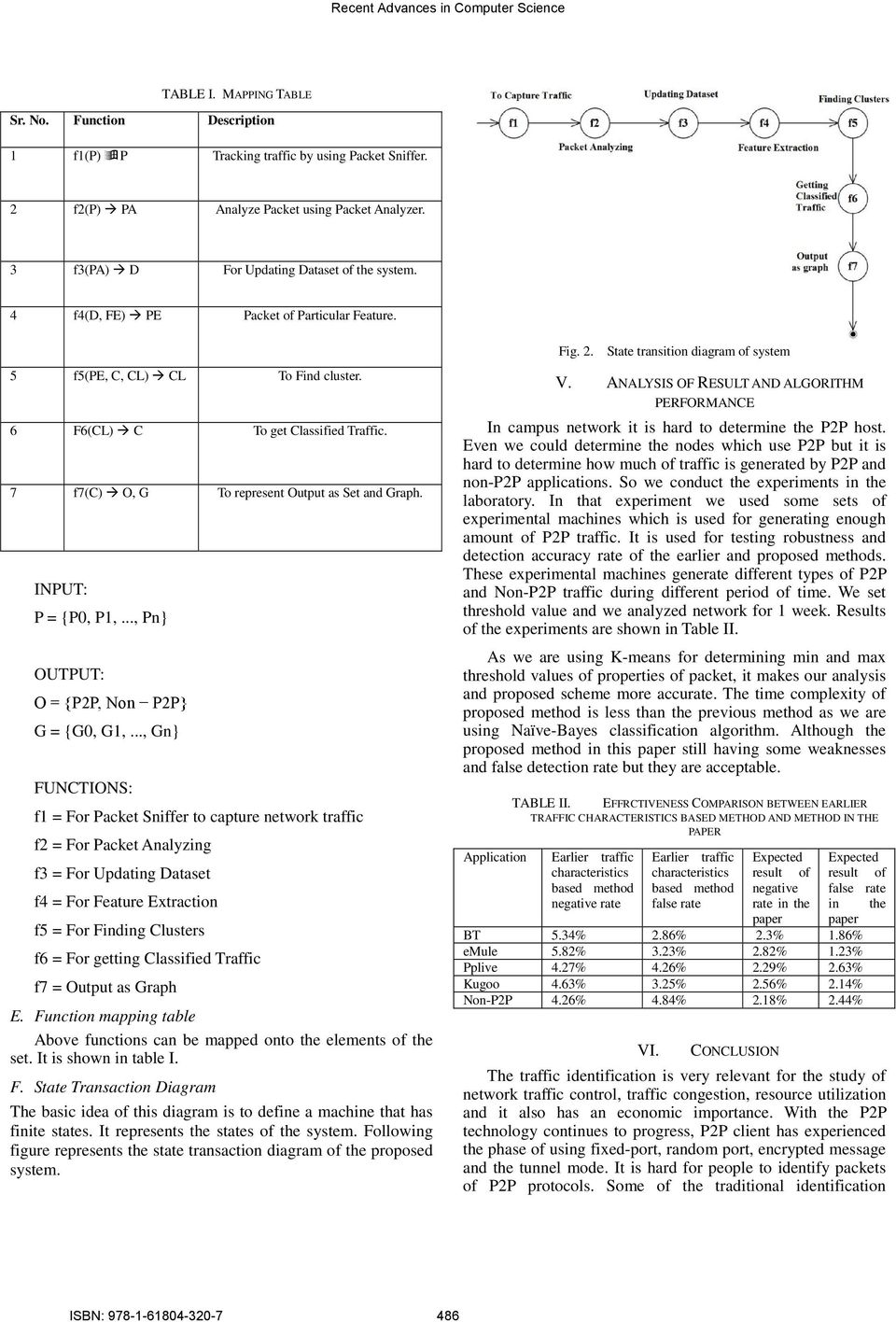
4 TABLE I. MAPPING TABLE Sr. No. Function Description 1 f1(p) P Tracking traffic by using Packet Sniffer. 2 f2(p) PA Analyze Packet using Packet Analyzer. 3 f3(pa) D For Updating Dataset of the system. 4 f4(d, FE) PE Packet of Particular Feature. 5 f5(pe, C, CL) CL To Find cluster. 6 F6(CL) C To get Classified Traffic. 7 f7(c) O, G To represent Output as Set and Graph. INPUT: P = {P0, P1,..., Pn} OUTPUT: O = {P2P, Non P2P} G = {G0, G1,..., Gn} FUNCTIONS: f1 = For Packet Sniffer to capture network traffic f2 = For Packet Analyzing f3 = For Updating Dataset f4 = For Feature Extraction f5 = For Finding Clusters f6 = For getting Classified Traffic f7 = Output as Graph E. Function mapping table Above functions can be mapped onto the elements of the set. It is shown in table I. F. State Transaction Diagram The basic idea of this diagram is to define a machine that has finite states. It represents the states of the system. Following figure represents the state transaction diagram of the proposed system. Fig. 2. State transition diagram of system V. ANALYSIS OF RESULT AND ALGORITHM PERFORMANCE In campus network it is hard to determine the P2P host. Even we could determine the nodes which use P2P but it is hard to determine how much of traffic is generated by P2P and non-p2p applications. So we conduct the experiments in the laboratory. In that experiment we used some sets of experimental machines which is used for generating enough amount of P2P traffic. It is used for testing robustness and detection accuracy rate of the earlier and proposed methods. These experimental machines generate different types of P2P and Non-P2P traffic during different period of time. We set threshold value and we analyzed network for 1 week. Results of the experiments are shown in Table II. As we are using K-means for determining min and max threshold values of properties of packet, it makes our analysis and proposed scheme more accurate. The time complexity of proposed method is less than the previous method as we are using Naïve-Bayes classification algorithm. Although the proposed method in this paper still having some weaknesses and false detection rate but they are acceptable. TABLE II. EFFRCTIVENESS COMPARISON BETWEEN EARLIER TRAFFIC CHARACTERISTICS BASED METHOD AND METHOD IN THE PAPER Application Earlier traffic Earlier traffic Expected Expected characteristics characteristics result of result of based method based method negative false rate negative rate false rate rate in the in the paper paper BT 5.34% 2.86% 2.3% 1.86% emule 5.82% 3.23% 2.82% 1.23% Pplive 4.27% 4.26% 2.29% 2.63% Kugoo 4.63% 3.25% 2.56% 2.14% Non-P2P 4.26% 4.84% 2.18% 2.44% VI. CONCLUSION The traffic identification is very relevant for the study of network traffic control, traffic congestion, resource utilization and it also has an economic importance. With the P2P technology continues to progress, P2P client has experienced the phase of using fixed-port, random port, encrypted message and the tunnel mode. It is hard for people to identify packets of P2P protocols. Some of the traditional identification ISBN:
5 methods like the Port-based identification method, Payloadbased identification method and Feature-based identification are not very effective. Traffic identification technologies such as traffic identification by using network characteristics have been considered for solving the problem with improved accuracy rate and improved algorithm efficiency. The previous work of P2P traffic identification based on traffic characteristics, it gives the high rate of false detection and high rate of negative detection and it is not efficient when we consider time as a factor. So we designed a system in such a way that it minimizes the rate of false detection and the rate of negative detection and classifies the traffic in efficient manner. The presented method in this paper can able to detect P2P traffics with dynamic ports and encrypted transmission, and the efficiency of the implementation of the algorithm is also improved to some extent. These techniques are useful for increasing the performance of the network. This system can easily extend for working with other regions of the network in order to solve the problems in it. ACKNOWLEDGMENT We are thankful to Mr. S. D. Baber and Mr. P. J. Pandit, for the encouragement and the support they have extended to us for completing this paper. We are also thankful to the Mrs. S. R. Patil and Mr. Sanjay Dangat for their support to make this paper as good as it is. We are also thankful to our family members and friends for patience and encouragement. REFERENCES [1] Yu-shui Geng, Tao Han and Xue-song Jiang The research of P2P traffic identification technology. ( /09, 2009, IEEE). [2] Jingyu Wang, Jiyuan Zhang, Yuesheng Tan Research of P2P Traffic Identification Based on Traffic Characteristics ( /11, 2011, IEEE). [3] Jian Feng Research on the Technology of Peer-to-Peer Traffic Classification. ( /10,2010, International Symposium on Computer, Communication, Control and Automation, IEEE). [4] S. Subhabrata, S. Oliver, D. Wang, Accurate, scalable in-network identification of p2p traffic using application signatures, Proc. The 13 th international conference on World Wide Web, ACM Press, Oct. 2004, pp , doi: / [5] Ke Xu, Ming Zhang, Mingjiang Ye, Dah Ming Chiu, Jianping Wu Identify P2P traffic by inspecting data transfer behavior. ( , Elsevier B.V., 2010, Computer Communications). [6] CHENG Wei-qing, GONG Jian, DING Wei Identifying file-sharing P2P traffic based on traffic characteristics. (15(4): , December 2008, paper number: , Sciencedirect). [7] Haiming Jiang, Jianying Zhang, Qingqing Wang, P2P traffic detection and analysis, J. Computer Technology and Development, 2008, 18 (7): [8] Chao Wen, Xuefeng ZHENG, The study of P2P protocol identification method based on the traffic analysis J. Micro Computer Applications, 2007 (7): [9] Mrs.G.Subbalakshmi, Mr. K. Ramesh, Mr. M. Chinna Rao Decision Support in Heart Disease Prediction System using Naive Bayes (ISSN : , Vol. 2 No. 2 Apr-May 2011, Indian Journal of Computer Science and Engineering (IJCSE) ). ISBN:

Encrypted Internet Traffic Classification Method based on Host Behavior
 Encrypted Internet Traffic Classification Method based on Host Behavior 1,* Chengjie GU, 1 Shunyi ZHANG, 2 Xiaozhen XUE 1 Institute of Information Network Technology, Nanjing University of Posts and Telecommunications,
A Review of Anomaly Detection Techniques in Network Intrusion Detection System
 A Review of Anomaly Detection Techniques in Network Intrusion Detection System Dr.D.V.S.S.Subrahmanyam Professor, Dept. of CSE, Sreyas Institute of Engineering & Technology, Hyderabad, India ABSTRACT:In
Hadoop Technology for Flow Analysis of the Internet Traffic
 Hadoop Technology for Flow Analysis of the Internet Traffic Rakshitha Kiran P PG Scholar, Dept. of C.S, Shree Devi Institute of Technology, Mangalore, Karnataka, India ABSTRACT: Flow analysis of the internet
Dual Mechanism to Detect DDOS Attack Priyanka Dembla, Chander Diwaker 2 1 Research Scholar, 2 Assistant Professor
 International Association of Scientific Innovation and Research (IASIR) (An Association Unifying the Sciences, Engineering, and Applied Research) International Journal of Engineering, Business and Enterprise
Using UDP Packets to Detect P2P File Sharing
 188 IJCSNS International Journal of Computer Science and Network Security, VOL.7 No.8, August 27 Using UDP Packets to Detect P2P File Sharing Tsang-Long Pao and Jian-Bo Chen Tatung University, Taipei,
Botnet Detection Based on Degree Distributions of Node Using Data Mining Scheme
 Botnet Detection Based on Degree Distributions of Node Using Data Mining Scheme Chunyong Yin 1,2, Yang Lei 1, Jin Wang 1 1 School of Computer & Software, Nanjing University of Information Science &Technology,
International Journal of Innovative Research in Advanced Engineering (IJIRAE) ISSN: 2349-2163 Volume 1 Issue 11 (November 2014)
 Denial-of-Service Attack Detection Mangesh D. Salunke * Prof. Ruhi Kabra G.H.Raisoni CEM, SPPU, Ahmednagar HOD, G.H.Raisoni CEM, SPPU,Ahmednagar Abstract: A DoS (Denial of Service) attack as name indicates
Predicting the Risk of Heart Attacks using Neural Network and Decision Tree
 Predicting the Risk of Heart Attacks using Neural Network and Decision Tree S.Florence 1, N.G.Bhuvaneswari Amma 2, G.Annapoorani 3, K.Malathi 4 PG Scholar, Indian Institute of Information Technology, Srirangam,
A SYSTEM FOR DENIAL OF SERVICE ATTACK DETECTION BASED ON MULTIVARIATE CORRELATION ANALYSIS
 Journal homepage: www.mjret.in ISSN:2348-6953 A SYSTEM FOR DENIAL OF SERVICE ATTACK DETECTION BASED ON MULTIVARIATE CORRELATION ANALYSIS P.V.Sawant 1, M.P.Sable 2, P.V.Kore 3, S.R.Bhosale 4 Department
Flexible Deterministic Packet Marking: An IP Traceback Scheme Against DDOS Attacks
 Flexible Deterministic Packet Marking: An IP Traceback Scheme Against DDOS Attacks Prashil S. Waghmare PG student, Sinhgad College of Engineering, Vadgaon, Pune University, Maharashtra, India. [email protected]
Packet Flow Analysis and Congestion Control of Big Data by Hadoop
 Available Online at www.ijcsmc.com International Journal of Computer Science and Mobile Computing A Monthly Journal of Computer Science and Information Technology IJCSMC, Vol. 4, Issue. 6, June 2015, pg.456
Near Real Time Online Flow-based Internet Traffic Classification Using Machine Learning (C4.5)
 Near Real Time Online Flow-based Internet Traffic Classification Using Machine Learning (C4.5) Abuagla Babiker Mohammed Faculty of Electrical Engineering (FKE) Deprtment of Microelectronics and Computer
An apparatus for P2P classification in Netflow traces
 An apparatus for P2P classification in Netflow traces Andrew M Gossett, Ioannis Papapanagiotou and Michael Devetsikiotis Electrical and Computer Engineering, North Carolina State University, Raleigh, USA
NETWORK INTRUSION DETECTION SYSTEM USING HYBRID CLASSIFICATION MODEL
 NETWORK INTRUSION DETECTION SYSTEM USING HYBRID CLASSIFICATION MODEL Prof. Santosh T. Waghmode 1, Prof. Vinod S. Wadne 2 Department of Computer Engineering, 1, 2 JSPM s Imperial College of Engineering
CHAPTER 1 INTRODUCTION
 21 CHAPTER 1 INTRODUCTION 1.1 PREAMBLE Wireless ad-hoc network is an autonomous system of wireless nodes connected by wireless links. Wireless ad-hoc network provides a communication over the shared wireless
A Catechistic Method for Traffic Pattern Discovery in MANET
 A Catechistic Method for Traffic Pattern Discovery in MANET R. Saranya 1, R. Santhosh 2 1 PG Scholar, Computer Science and Engineering, Karpagam University, Coimbatore. 2 Assistant Professor, Computer
A Topology-Aware Relay Lookup Scheme for P2P VoIP System
 Int. J. Communications, Network and System Sciences, 2010, 3, 119-125 doi:10.4236/ijcns.2010.32018 Published Online February 2010 (http://www.scirp.org/journal/ijcns/). A Topology-Aware Relay Lookup Scheme
From Centralization to Distribution: A Comparison of File Sharing Protocols
 From Centralization to Distribution: A Comparison of File Sharing Protocols Xu Wang, Teng Long and Alan Sussman Department of Computer Science, University of Maryland, College Park, MD, 20742 August, 2015
Classifying P2P Activity in Netflow Records: A Case Study on BitTorrent
 IEEE ICC 2013 - Communication Software and Services Symposium 1 Classifying P2P Activity in Netflow Records: A Case Study on BitTorrent Ahmed Bashir 1, Changcheng Huang 1, Biswajit Nandy 2, Nabil Seddigh
Network Intrusion Detection Systems
 Network Intrusion Detection Systems False Positive Reduction Through Anomaly Detection Joint research by Emmanuele Zambon & Damiano Bolzoni 7/1/06 NIDS - False Positive reduction through Anomaly Detection
Journal of Chemical and Pharmaceutical Research, 2015, 7(3):1388-1392. Research Article. E-commerce recommendation system on cloud computing
 Available online www.jocpr.com Journal of Chemical and Pharmaceutical Research, 2015, 7(3):1388-1392 Research Article ISSN : 0975-7384 CODEN(USA) : JCPRC5 E-commerce recommendation system on cloud computing
PEER TO PEER FILE SHARING USING NETWORK CODING
 PEER TO PEER FILE SHARING USING NETWORK CODING Ajay Choudhary 1, Nilesh Akhade 2, Aditya Narke 3, Ajit Deshmane 4 Department of Computer Engineering, University of Pune Imperial College of Engineering
CLASSIFYING NETWORK TRAFFIC IN THE BIG DATA ERA
 CLASSIFYING NETWORK TRAFFIC IN THE BIG DATA ERA Professor Yang Xiang Network Security and Computing Laboratory (NSCLab) School of Information Technology Deakin University, Melbourne, Australia http://anss.org.au/nsclab
Impelling Heart Attack Prediction System using Data Mining and Artificial Neural Network
 General Article International Journal of Current Engineering and Technology E-ISSN 2277 4106, P-ISSN 2347-5161 2014 INPRESSCO, All Rights Reserved Available at http://inpressco.com/category/ijcet Impelling
Optimizing Congestion in Peer-to-Peer File Sharing Based on Network Coding
 International Journal of Emerging Trends in Engineering Research (IJETER), Vol. 3 No.6, Pages : 151-156 (2015) ABSTRACT Optimizing Congestion in Peer-to-Peer File Sharing Based on Network Coding E.ShyamSundhar
A Measurement of NAT & Firewall Characteristics in Peer to Peer Systems
 A Measurement of NAT & Firewall Characteristics in Peer to Peer Systems L. D Acunto, J.A. Pouwelse, and H.J. Sips Department of Computer Science Delft University of Technology, The Netherlands [email protected]
Back-End Forwarding Scheme in Server Load Balancing using Client Virtualization
 Back-End Forwarding Scheme in Server Load Balancing using Client Virtualization Shreyansh Kumar School of Computing Science and Engineering VIT University Chennai Campus Parvathi.R, Ph.D Associate Professor-
Two State Intrusion Detection System Against DDos Attack in Wireless Network
 Two State Intrusion Detection System Against DDos Attack in Wireless Network 1 Pintu Vasani, 2 Parikh Dhaval 1 M.E Student, 2 Head of Department (LDCE-CSE) L.D. College of Engineering, Ahmedabad, India.
An Anomaly-Based Method for DDoS Attacks Detection using RBF Neural Networks
 2011 International Conference on Network and Electronics Engineering IPCSIT vol.11 (2011) (2011) IACSIT Press, Singapore An Anomaly-Based Method for DDoS Attacks Detection using RBF Neural Networks Reyhaneh
CHAPTER 8 CONCLUSION AND FUTURE ENHANCEMENTS
 137 CHAPTER 8 CONCLUSION AND FUTURE ENHANCEMENTS 8.1 CONCLUSION In this thesis, efficient schemes have been designed and analyzed to control congestion and distribute the load in the routing process of
An Optimization Model of Load Balancing in P2P SIP Architecture
 An Optimization Model of Load Balancing in P2P SIP Architecture 1 Kai Shuang, 2 Liying Chen *1, First Author, Corresponding Author Beijing University of Posts and Telecommunications, [email protected]
Comparative Analysis of Congestion Control Algorithms Using ns-2
 www.ijcsi.org 89 Comparative Analysis of Congestion Control Algorithms Using ns-2 Sanjeev Patel 1, P. K. Gupta 2, Arjun Garg 3, Prateek Mehrotra 4 and Manish Chhabra 5 1 Deptt. of Computer Sc. & Engg,
Lab VI Capturing and monitoring the network traffic
 Lab VI Capturing and monitoring the network traffic 1. Goals To gain general knowledge about the network analyzers and to understand their utility To learn how to use network traffic analyzer tools (Wireshark)
Bisecting K-Means for Clustering Web Log data
 Bisecting K-Means for Clustering Web Log data Ruchika R. Patil Department of Computer Technology YCCE Nagpur, India Amreen Khan Department of Computer Technology YCCE Nagpur, India ABSTRACT Web usage mining
An Overview of Knowledge Discovery Database and Data mining Techniques
 An Overview of Knowledge Discovery Database and Data mining Techniques Priyadharsini.C 1, Dr. Antony Selvadoss Thanamani 2 M.Phil, Department of Computer Science, NGM College, Pollachi, Coimbatore, Tamilnadu,
QUALITY OF SERVICE METRICS FOR DATA TRANSMISSION IN MESH TOPOLOGIES
 QUALITY OF SERVICE METRICS FOR DATA TRANSMISSION IN MESH TOPOLOGIES SWATHI NANDURI * ZAHOOR-UL-HUQ * Master of Technology, Associate Professor, G. Pulla Reddy Engineering College, G. Pulla Reddy Engineering
MAXIMIZING RESTORABLE THROUGHPUT IN MPLS NETWORKS
 MAXIMIZING RESTORABLE THROUGHPUT IN MPLS NETWORKS 1 M.LAKSHMI, 2 N.LAKSHMI 1 Assitant Professor, Dept.of.Computer science, MCC college.pattukottai. 2 Research Scholar, Dept.of.Computer science, MCC college.pattukottai.
Using Data Mining for Mobile Communication Clustering and Characterization
 Using Data Mining for Mobile Communication Clustering and Characterization A. Bascacov *, C. Cernazanu ** and M. Marcu ** * Lasting Software, Timisoara, Romania ** Politehnica University of Timisoara/Computer
Impact of Feature Selection on the Performance of Wireless Intrusion Detection Systems
 2009 International Conference on Computer Engineering and Applications IPCSIT vol.2 (2011) (2011) IACSIT Press, Singapore Impact of Feature Selection on the Performance of ireless Intrusion Detection Systems
Scaling 10Gb/s Clustering at Wire-Speed
 Scaling 10Gb/s Clustering at Wire-Speed InfiniBand offers cost-effective wire-speed scaling with deterministic performance Mellanox Technologies Inc. 2900 Stender Way, Santa Clara, CA 95054 Tel: 408-970-3400
Wireless Encryption Protection
 Wireless Encryption Protection We re going to jump around a little here and go to something that I really find interesting, how do you secure yourself when you connect to a router. Now first and foremost
International Journal of Advanced Research in Computer Science and Software Engineering
 Volume 2, Issue 9, September 2012 ISSN: 2277 128X International Journal of Advanced Research in Computer Science and Software Engineering Research Paper Available online at: www.ijarcsse.com An Experimental
How To Detect Denial Of Service Attack On A Network With A Network Traffic Characterization Scheme
 Efficient Detection for DOS Attacks by Multivariate Correlation Analysis and Trace Back Method for Prevention Thivya. T 1, Karthika.M 2 Student, Department of computer science and engineering, Dhanalakshmi
INTERNATIONAL JOURNAL OF PURE AND APPLIED RESEARCH IN ENGINEERING AND TECHNOLOGY
 INTERNATIONAL JOURNAL OF PURE AND APPLIED RESEARCH IN ENGINEERING AND TECHNOLOGY A PATH FOR HORIZING YOUR INNOVATIVE WORK AN OVERVIEW OF MOBILE ADHOC NETWORK: INTRUSION DETECTION, TYPES OF ATTACKS AND
ACO ALGORITHM FOR LOAD BALANCING IN SIMPLE NETWORK
 ACO ALGORITHM FOR LOAD BALANCING IN SIMPLE NETWORK Mrs Minal.Nerkar Faculty of Dept of Computer Engineering. Bhagyashree Kale,Shivani Bhutada,Chetan Darshale,Poonam Patil Dept of Computer Engineering.
The QoS of the Edge Router based on DiffServ
 The QoS of the Edge Router based on DiffServ Zhang Nan 1, Mao Pengxuan 1, Xiao Yang 1, Kiseon Kim 2 1 Institute of Information and Science, Beijing Jiaotong University, Beijing 100044, China 2 Dept. of
SECURE DATA TRANSMISSION USING INDISCRIMINATE DATA PATHS FOR STAGNANT DESTINATION IN MANET
 SECURE DATA TRANSMISSION USING INDISCRIMINATE DATA PATHS FOR STAGNANT DESTINATION IN MANET MR. ARVIND P. PANDE 1, PROF. UTTAM A. PATIL 2, PROF. B.S PATIL 3 Dept. Of Electronics Textile and Engineering
Anonymous Communication in Peer-to-Peer Networks for Providing more Privacy and Security
 Anonymous Communication in Peer-to-Peer Networks for Providing more Privacy and Security Ehsan Saboori and Shahriar Mohammadi Abstract One of the most important issues in peer-to-peer networks is anonymity.
ENHANCED HYBRID FRAMEWORK OF RELIABILITY ANALYSIS FOR SAFETY CRITICAL NETWORK INFRASTRUCTURE
 ENHANCED HYBRID FRAMEWORK OF RELIABILITY ANALYSIS FOR SAFETY CRITICAL NETWORK INFRASTRUCTURE Chandana Priyanka G. H., Aarthi R. S., Chakaravarthi S., Selvamani K. 2 and Kannan A. 3 Department of Computer
MODIFIED BITTORRENT PROTOCOL AND ITS APPLICATION IN CLOUD COMPUTING ENVIRONMENT
 MODIFIED BITTORRENT PROTOCOL AND ITS APPLICATION IN CLOUD COMPUTING ENVIRONMENT Soumya V L 1 and Anirban Basu 2 1 Dept of CSE, East Point College of Engineering & Technology, Bangalore, Karnataka, India
NETWORK DELAY: HOW RELIABLE NETWORK ANALYZER SOFTWARE DEVELOPMENT
 NETWORK DELAY: HOW RELIABLE NETWORK ANALYZER SOFTWARE DEVELOPMENT 1 MOHD NAZRI ISMAIL, 2 ABDULLAH MOHD ZIN 1 Faculty of MIIT, University of Kuala Lumpur (UniKL), Malaysia 2 Faculty of FTSM, University
Detection of Distributed Denial of Service Attack with Hadoop on Live Network
 Detection of Distributed Denial of Service Attack with Hadoop on Live Network Suchita Korad 1, Shubhada Kadam 2, Prajakta Deore 3, Madhuri Jadhav 4, Prof.Rahul Patil 5 Students, Dept. of Computer, PCCOE,
CHARACTERIZING OF INFRASTRUCTURE BY KNOWLEDGE OF MOBILE HYBRID SYSTEM
 INTERNATIONAL JOURNAL OF ADVANCED RESEARCH IN ENGINEERING AND SCIENCE CHARACTERIZING OF INFRASTRUCTURE BY KNOWLEDGE OF MOBILE HYBRID SYSTEM Mohammad Badruzzama Khan 1, Ayesha Romana 2, Akheel Mohammed
How To Compare Available Bandwidth On A Network With A Powerline To A Network On A Testbed On A Computer Or Network On An Ipad Or Ipad On A 2Mbb (Or Ipad) On A 4Ghz Network On The
 2009 International Symposium on Computing, Communication, and Control (ISCCC 2009) Proc.of CSIT vol.1 (2011) (2011) IACSIT Press, Singapore Path-F3: Improving Accuracy and Network Load in Available Estimation
Securing MANET Using Diffie Hellman Digital Signature Scheme
 Securing MANET Using Diffie Hellman Digital Signature Scheme Karamvir Singh 1, Harmanjot Singh 2 1 Research Scholar, ECE Department, Punjabi University, Patiala, Punjab, India 1 [email protected] 2
Preprocessing Web Logs for Web Intrusion Detection
 Preprocessing Web Logs for Web Intrusion Detection Priyanka V. Patil. M.E. Scholar Department of computer Engineering R.C.Patil Institute of Technology, Shirpur, India Dharmaraj Patil. Department of Computer
Quantifying the Performance Degradation of IPv6 for TCP in Windows and Linux Networking
 Quantifying the Performance Degradation of IPv6 for TCP in Windows and Linux Networking Burjiz Soorty School of Computing and Mathematical Sciences Auckland University of Technology Auckland, New Zealand
An Analysis on Density Based Clustering of Multi Dimensional Spatial Data
 An Analysis on Density Based Clustering of Multi Dimensional Spatial Data K. Mumtaz 1 Assistant Professor, Department of MCA Vivekanandha Institute of Information and Management Studies, Tiruchengode,
A Content based Spam Filtering Using Optical Back Propagation Technique
 A Content based Spam Filtering Using Optical Back Propagation Technique Sarab M. Hameed 1, Noor Alhuda J. Mohammed 2 Department of Computer Science, College of Science, University of Baghdad - Iraq ABSTRACT
Traffic Identification Based on Applications using Statistical Signature Free from Abnormal TCP Behavior *
 JOURNAL OF INFORMATION SCIENCE AND ENGINEERING 31, 1669-1692 (2015) Traffic Identification Based on Applications using Statistical Signature Free from Abnormal TCP Behavior * HYUN-MIN AN 1, SU-KANG LEE
LOAD BALANCING AND EFFICIENT CLUSTERING FOR IMPROVING NETWORK PERFORMANCE IN AD-HOC NETWORKS
 LOAD BALANCING AND EFFICIENT CLUSTERING FOR IMPROVING NETWORK PERFORMANCE IN AD-HOC NETWORKS Saranya.S 1, Menakambal.S 2 1 M.E., Embedded System Technologies, Nandha Engineering College (Autonomous), (India)
An Efficient Way of Denial of Service Attack Detection Based on Triangle Map Generation
 An Efficient Way of Denial of Service Attack Detection Based on Triangle Map Generation Shanofer. S Master of Engineering, Department of Computer Science and Engineering, Veerammal Engineering College,
Prediction of DDoS Attack Scheme
 Chapter 5 Prediction of DDoS Attack Scheme Distributed denial of service attack can be launched by malicious nodes participating in the attack, exploit the lack of entry point in a wireless network, and
Traffic Prediction in Wireless Mesh Networks Using Process Mining Algorithms
 Traffic Prediction in Wireless Mesh Networks Using Process Mining Algorithms Kirill Krinkin Open Source and Linux lab Saint Petersburg, Russia [email protected] Eugene Kalishenko Saint Petersburg
Quality of Service Routing Network and Performance Evaluation*
 Quality of Service Routing Network and Performance Evaluation* Shen Lin, Cui Yong, Xu Ming-wei, and Xu Ke Department of Computer Science, Tsinghua University, Beijing, P.R.China, 100084 {shenlin, cy, xmw,
Detecting Multiple Selfish Attack Nodes Using Replica Allocation in Cognitive Radio Ad-Hoc Networks
 Detecting Multiple Selfish Attack Nodes Using Replica Allocation in Cognitive Radio Ad-Hoc Networks Kiruthiga S PG student, Coimbatore Institute of Engineering and Technology Anna University, Chennai,
A Novel Distributed Denial of Service (DDoS) Attacks Discriminating Detection in Flash Crowds
 International Journal of Research Studies in Science, Engineering and Technology Volume 1, Issue 9, December 2014, PP 139-143 ISSN 2349-4751 (Print) & ISSN 2349-476X (Online) A Novel Distributed Denial
Realtime Classification for Encrypted Traffic
 Realtime Classification for Encrypted Traffic Roni Bar-Yanai 1, Michael Langberg 2,, David Peleg 3,, and Liam Roditty 4 1 Cisco, Netanya, Israel [email protected] 2 Computer Science Division, Open University
SUITABLE ROUTING PATH FOR PEER TO PEER FILE TRANSFER
 SUITABLE ROUTING PATH FOR PEER TO PEER FILE TRANSFER R. Naga Priyadarsini, S. Suma and V. Dhanakoti Department of Computer Science Engineering, Valliammai Engineering College, Kanchipuram, India ABSTRACT
A Novel QoS Framework Based on Admission Control and Self-Adaptive Bandwidth Reconfiguration
 Int. J. of Computers, Communications & Control, ISSN 1841-9836, E-ISSN 1841-9844 Vol. V (2010), No. 5, pp. 862-870 A Novel QoS Framework Based on Admission Control and Self-Adaptive Bandwidth Reconfiguration
Real-Time Analysis of CDN in an Academic Institute: A Simulation Study
 Journal of Algorithms & Computational Technology Vol. 6 No. 3 483 Real-Time Analysis of CDN in an Academic Institute: A Simulation Study N. Ramachandran * and P. Sivaprakasam + *Indian Institute of Management
A NOVEL RESOURCE EFFICIENT DMMS APPROACH
 A NOVEL RESOURCE EFFICIENT DMMS APPROACH FOR NETWORK MONITORING AND CONTROLLING FUNCTIONS Golam R. Khan 1, Sharmistha Khan 2, Dhadesugoor R. Vaman 3, and Suxia Cui 4 Department of Electrical and Computer
International Journal of Computer Science Trends and Technology (IJCST) Volume 3 Issue 3, May-June 2015
 RESEARCH ARTICLE OPEN ACCESS Data Mining Technology for Efficient Network Security Management Ankit Naik [1], S.W. Ahmad [2] Student [1], Assistant Professor [2] Department of Computer Science and Engineering
Keywords - Intrusion Detection System, Intrusion Prevention System, Artificial Neural Network, Multi Layer Perceptron, SYN_FLOOD, PING_FLOOD, JPCap
 Intelligent Monitoring System A network based IDS SONALI M. TIDKE, Dept. of Computer Science and Engineering, Shreeyash College of Engineering and Technology, Aurangabad (MS), India Abstract Network security
Thwarting Selective Insider Jamming Attacks in Wireless Network by Delaying Real Time Packet Classification
 Thwarting Selective Insider Jamming Attacks in Wireless Network by Delaying Real Time Packet Classification LEKSHMI.M.R Department of Computer Science and Engineering, KCG College of Technology Chennai,
AN EFFICIENT STRATEGY OF AGGREGATE SECURE DATA TRANSMISSION
 INTERNATIONAL JOURNAL OF REVIEWS ON RECENT ELECTRONICS AND COMPUTER SCIENCE AN EFFICIENT STRATEGY OF AGGREGATE SECURE DATA TRANSMISSION K.Anusha 1, K.Sudha 2 1 M.Tech Student, Dept of CSE, Aurora's Technological
Bandwidth based Distributed Denial of Service Attack Detection using Artificial Immune System
 Bandwidth based Distributed Denial of Service Attack Detection using Artificial Immune System 1 M.Yasodha, 2 S. Umarani 1 PG Scholar, Department of Information Technology, Maharaja Engineering College,
A Dynamic Load Balancing Algorithm For Web Applications
 Computing For Nation Development, February 25 26, 2010 Bharati Vidyapeeth s Institute of Computer Applications and Management, New Delhi A Dynamic Load Balancing Algorithm For Web Applications 1 Sameena
Performance Analysis of AQM Schemes in Wired and Wireless Networks based on TCP flow
 International Journal of Soft Computing and Engineering (IJSCE) Performance Analysis of AQM Schemes in Wired and Wireless Networks based on TCP flow Abdullah Al Masud, Hossain Md. Shamim, Amina Akhter
Intrusion Detection Using Data Mining Along Fuzzy Logic and Genetic Algorithms
 IJCSNS International Journal of Computer Science and Network Security, VOL.8 No., February 8 7 Intrusion Detection Using Data Mining Along Fuzzy Logic and Genetic Algorithms Y.Dhanalakshmi and Dr.I. Ramesh
International Journal of Advanced Computer Technology (IJACT) ISSN:2319-7900 PRIVACY PRESERVING DATA MINING IN HEALTH CARE APPLICATIONS
 PRIVACY PRESERVING DATA MINING IN HEALTH CARE APPLICATIONS First A. Dr. D. Aruna Kumari, Ph.d, ; Second B. Ch.Mounika, Student, Department Of ECM, K L University, [email protected]; Third C.
Performance of voice and video conferencing over ATM and Gigabit Ethernet backbone networks
 Res. Lett. Inf. Math. Sci., 2005, Vol. 7, pp 19-27 19 Available online at http://iims.massey.ac.nz/research/letters/ Performance of voice and video conferencing over ATM and Gigabit Ethernet backbone networks
G.Vijaya kumar et al, Int. J. Comp. Tech. Appl., Vol 2 (5), 1413-1418
 An Analytical Model to evaluate the Approaches of Mobility Management 1 G.Vijaya Kumar, *2 A.Lakshman Rao *1 M.Tech (CSE Student), Pragati Engineering College, Kakinada, India. [email protected]
A Comparison Study of Qos Using Different Routing Algorithms In Mobile Ad Hoc Networks
 A Comparison Study of Qos Using Different Routing Algorithms In Mobile Ad Hoc Networks T.Chandrasekhar 1, J.S.Chakravarthi 2, K.Sravya 3 Professor, Dept. of Electronics and Communication Engg., GIET Engg.
Layered Approach of Intrusion Detection System with Efficient Alert Aggregation for Heterogeneous Networks
 Layered Approach of Intrusion Detection System with Efficient Alert Aggregation for Heterogeneous Networks Lohith Raj S N, Shanthi M B, Jitendranath Mungara Abstract Protecting data from the intruders
2. Research and Development on the Autonomic Operation. Control Infrastructure Technologies in the Cloud Computing Environment
 R&D supporting future cloud computing infrastructure technologies Research and Development on Autonomic Operation Control Infrastructure Technologies in the Cloud Computing Environment DEMPO Hiroshi, KAMI
Survey on Load balancing protocols in MANET S (mobile ad-hoc networks)
 Survey on Load balancing protocols in MANET S (mobile ad-hoc networks) Ramandeep Kaur 1, Gagandeep Singh 2, Sahil Vashist 3 1 M.tech Research Scholar, Department of Computer Science & Engineering, Chandigarh
A Study of Network Security Systems
 A Study of Network Security Systems Ramy K. Khalil, Fayez W. Zaki, Mohamed M. Ashour, Mohamed A. Mohamed Department of Communication and Electronics Mansoura University El Gomhorya Street, Mansora,Dakahlya
A Review on Network Intrusion Detection System Using Open Source Snort
 , pp.61-70 http://dx.doi.org/10.14257/ijdta.2016.9.4.05 A Review on Network Intrusion Detection System Using Open Source Snort Sakshi Sharma and Manish Dixit Department of CSE& IT MITS Gwalior, India [email protected],
Improving the Performance of TCP Using Window Adjustment Procedure and Bandwidth Estimation
 Improving the Performance of TCP Using Window Adjustment Procedure and Bandwidth Estimation R.Navaneethakrishnan Assistant Professor (SG) Bharathiyar College of Engineering and Technology, Karaikal, India.
A Study on the Application of Existing Load Balancing Algorithms for Large, Dynamic, Heterogeneous Distributed Systems
 A Study on the Application of Existing Load Balancing Algorithms for Large, Dynamic, Heterogeneous Distributed Systems RUPAM MUKHOPADHYAY, DIBYAJYOTI GHOSH AND NANDINI MUKHERJEE Department of Computer