
WORKABOUT PRO 3 Hand-Held Computer With Windows Mobile 6.1 Classic & Professional
|
|
|
- Morgan Poole
- 10 years ago
- Views:
Transcription
1 WORKABOUT PRO 3 Hand-Held Computer With Windows Mobile 6.1 Classic & Professional (Model No. 7527C-G2 & 7527S-G2) User Manual February 22, 2010 Part No A ISO 9001 Certified Quality Management System

2 Copyright 2010 by Psion Teklogix Inc., Mississauga, Ontario 2100 Meadowvale Boulevard, Mississauga, Ontario, Canada L5N 7J9 This document and the information it contains is the property of Psion Teklogix Inc., is issued in strict confidence, and is not to be reproduced or copied, in whole or in part, except for the sole purpose of promoting the sale of Psion Teklogix manufactured goods and services. Furthermore, this document is not to be used as a basis for design, manufacture, or sub-contract, or in any manner detrimental to the interests of Psion Teklogix Inc. WORKABOUT PRO 3 is a trademark of Psion Teklogix Inc. Windows and the Windows Logo are trademarks or registered trademarks of Microsoft Corporation in the United States and/or other countries. The Bluetooth word mark and logos are owned by Bluetooth SIG, Inc. and any use of such marks by Psion Teklogix Inc. is under license. All trademarks and trade names are the property of their respective holders.

3 Return-To-Factory Warranty Psion Teklogix Inc. provides a return to factory warranty on this product for a period of twelve (12) months in accordance with the Statement of Limited Warranty and Limitation of Liability provided at (If you are not already a member of Teknet and you attempt to view this warranty, you will be asked to register. As a member of Teknet, you will have access to helpful information about your Psion Teklogix products at no charge to you.) In some regions, this warranty may exceed this period. Please contact your local Psion Teklogix office for details. The warranty on Psion Teklogix manufactured equipment does not extend to any product that has been tampered with, altered, or repaired by any person other than an employee of an authorized Psion Teklogix service organization. See Psion Teklogix terms and conditions of sale for full details. Important: Psion Teklogix warranties take effect on the date of shipment. Disclaimer Every effort has been made to make this material complete, accurate, and up-to-date. In addition, changes are periodically added to the information herein; these changes will be incorporated into new editions of the publication. Psion Teklogix Inc. reserves the right to make improvements and/or changes in the product(s) and/or the program(s) described in this document without notice, and shall not be responsible for any damages, including but not limited to consequential damages, caused by reliance on the material presented, including but not limited to typographical errors.

4

5 TABLE OF CONTENTS Chapter 1: Introduction 1.1 About This Manual Text Conventions WORKABOUT PRO 3 Features The WORKABOUT PRO 3 C Hand-Held The WORKABOUT PRO 3 S Hand-Held Chapter 2: Basic Checkout 2.1 Preparing the WORKABOUT PRO 3 for Operation The Main Battery The Backup Battery Turning the WORKABOUT PRO 3 On and Off Installing the Battery and Switching the Unit On Switching the Unit Off (Suspend) Connecting the WORKABOUT PRO 3 to a PC Data Transfer Between the PC & the Hand-Held Using Microsoft ActiveSync Using Microsoft Vista Aligning (Calibrating) the Touchscreen The Getting Started Centre Setting Up a RA2041 Radio Summit Client Utility Assigning the IP Address Using the SCU to Connect to the WLAN The Phone (Windows Mobile 6.1 Professional Only) The Phone Keypad Send & End Calls Using the WORKABOUT PRO 3 Keyboard Managing Phone Settings Resetting the WORKABOUT PRO 3 Hand-Held Performing a Warm Reset Performing a Cold Reset to the Windows Mobile 6.1 OS WORKABOUT PRO 3 with Windows Mobile 6.1 User Manual i

6 Contents Chapter 3: Get To Know WORKABOUT PRO Features of the WORKABOUT PRO The Batteries Battery Safety Removing the Battery Pack Battery Swap Time Charging the Battery Switching the Hand-Held On and Off The Keyboards The WORKABOUT PRO 3 Keyboard Modifier Keys The Keys Alpha Keyboard Accessing Keys QWERTY Keyboard Accessing Numeric Keys Numeric Keyboard Accessing Alpha Keys The Keypad Backlight The Display Adjusting the Backlight Aligning (Calibrating) the Touchscreen Screen Orientation Indicators The LED Audio Indicators Adjusting Speaker Volume Monitoring the Battery and Maximizing Run Time Storing Batteries Uploading Data in a Docking Station Bluetooth Radio Pairing a Bluetooth Device Inserting the SD/MMC Card and SIM Card Inserting and Removing the Card General Maintenance Caring for the Touchscreen Cleaning the WORKABOUT PRO Chapter 4: Working With Windows Mobile Navigating in Windows Mobile 6.1 and Applications Navigating Using a Touchscreen and Stylus ii WORKABOUT PRO 3 with Windows Mobile 6.1 User Manual

7 Contents 4.2 Windows Mobile 6.1 Desktop Today Screen Windows Mobile 6.1 Navigation Bar Today s Date, Clock and Alarm Ownership Information Notification Task Notification Calendar of Upcoming Appointments Start Menu Customising the Start Menu Managing Files and Folders Creating a New Folder Renaming a File Copying a File Deleting a File Using Menus Pop-Up Menus The Softkey Bar Programs Using Applications Settings Help Entering Text Soft Keyboard The Transcriber Block Recognizer and Letter Recognizer...85 Chapter 5: Programs 5.1 Programs Games ActiveSync Synchronization Calculator Office Mobile Excel Mobile OneNote Mobile Word Mobile PowerPoint Mobile Demo Scanner File Explorer WORKABOUT PRO 3 with Windows Mobile 6.1 User Manual iii

8 Contents 5.8 Getting Started PTSI Imager Demo Internet Sharing Creating an Internet Connection Using Internet Sharing Notes Creating a Note Converting Handwritten Notes to Text Renaming a Note Recording Notes Synchronizing a Note Pictures & Videos Moving Photos to the WORKBOUT PRO Opening a Photo Deleting a Photo Editing a Photo Creating a Slide Show Internet Explorer Browsing Web Sites Messaging Folders Synchronizing with Outlook Changing Synchronization Settings Remote Desktop Mobile Connecting to a Terminal Server Disconnecting without Ending a Session Ending a Session Summit Client Utility (SCU) Search Task Manager Tasks Windows Live Windows Media Chapter 6: Settings 6.1 Settings Personal Settings iv WORKABOUT PRO 3 with Windows Mobile 6.1 User Manual

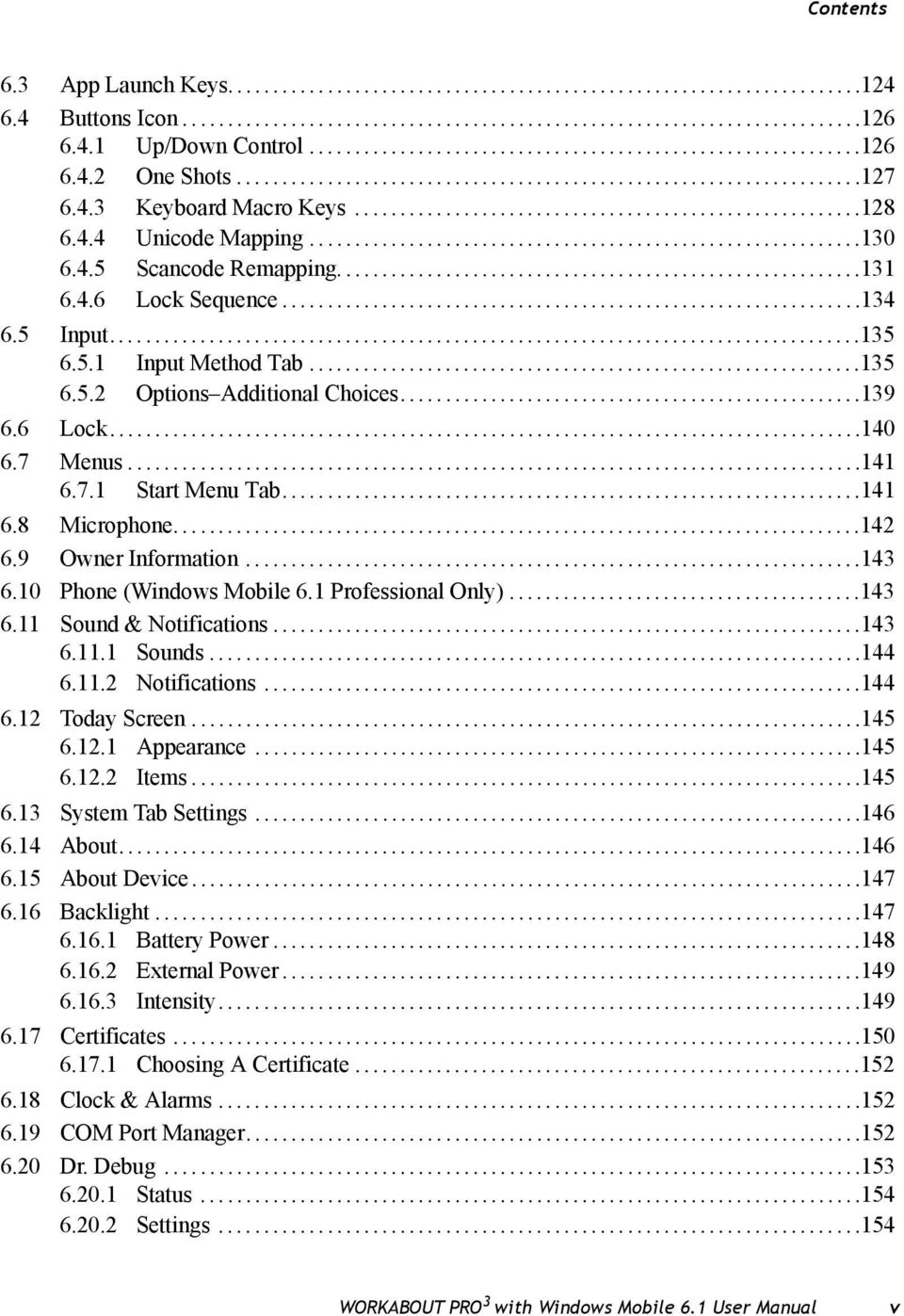
9 Contents 6.3 App Launch Keys Buttons Icon Up/Down Control One Shots Keyboard Macro Keys Unicode Mapping Scancode Remapping Lock Sequence Input Input Method Tab Options Additional Choices Lock Menus Start Menu Tab Microphone Owner Information Phone (Windows Mobile 6.1 Professional Only) Sound & Notifications Sounds Notifications Today Screen Appearance Items System Tab Settings About About Device Backlight Battery Power External Power Intensity Certificates Choosing A Certificate Clock & Alarms COM Port Manager Dr. Debug Status Settings WORKABOUT PRO 3 with Windows Mobile 6.1 User Manual v
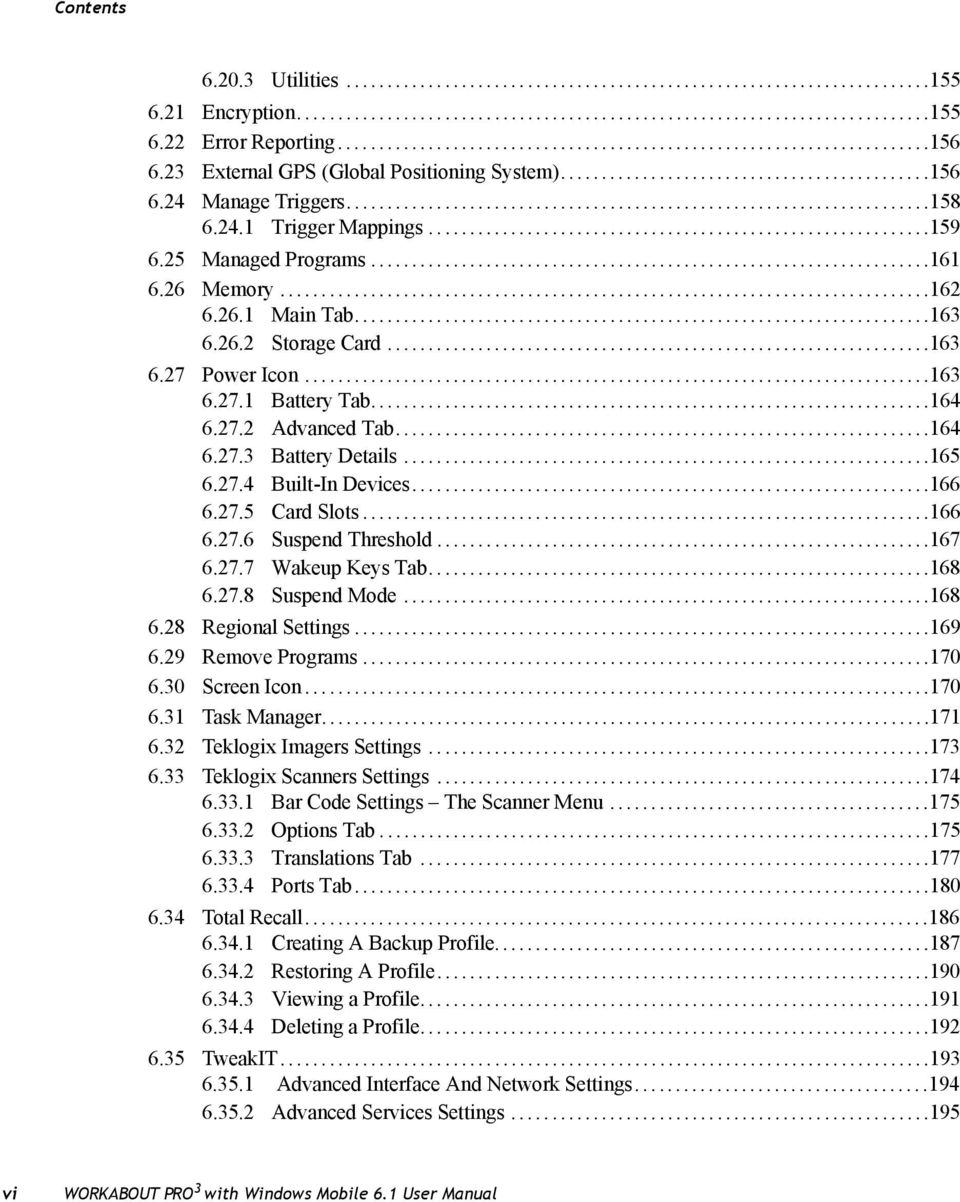
10 Contents Utilities Encryption Error Reporting External GPS (Global Positioning System) Manage Triggers Trigger Mappings Managed Programs Memory Main Tab Storage Card Power Icon Battery Tab Advanced Tab Battery Details Built-In Devices Card Slots Suspend Threshold Wakeup Keys Tab Suspend Mode Regional Settings Remove Programs Screen Icon Task Manager Teklogix Imagers Settings Teklogix Scanners Settings Bar Code Settings The Scanner Menu Options Tab Translations Tab Ports Tab Total Recall Creating A Backup Profile Restoring A Profile Viewing a Profile Deleting a Profile TweakIT Advanced Interface And Network Settings Advanced Services Settings vi WORKABOUT PRO 3 with Windows Mobile 6.1 User Manual
11 Contents Radio Features User System Setting Registry Editor Windows Update Connections Tab Beam Bluetooth Setup Paired Tab Device Tab Servers Tab Mode Tab About Tab The Bluetooth GPRS Phone Connection Properties Port Settings Call Options Connections Connecting To The Internet Modem Connection Setup Wireless Manager Icon Flight Mode Disabling Wireless Components Setting Up A Network Card Network Adaptor Cards Changing Network Card Settings VPN Connection Setup Managing An Existing Connection Selecting A Network Proxy Server Setup Wireless Statistics Wireless WAN (Windows Mobile 6.1 Classic Only) Softkey Bar Icons Establishing A Connection Disconnecting From A Network Advanced Information Tools Menu SMS Menu Chapter 7: Peripheral Devices & Accessories 7.1 Carrying Accessories WORKABOUT PRO 3 with Windows Mobile 6.1 User Manual vii

12 Contents 7.2 Attaching The Hand Strap Attaching The Pistol Grip The Trigger Back Plate Kit With Flush Mount Pistol Grip Protective Carrying Case Soft Shell Holster The Batteries Secure Battery Cover Adaptor Cable Options Chargers And Docking Stations Installation Chargers And Docking Stations Power Consumption Considerations Operator Controls Important Charger Safety Instructions Desktop Docking Station Charging A Battery Installed In The WORKABOUT PRO Charging A Spare Battery Battery Charge Duration Charger LED Indicators Troubleshooting The Charging Operation Of The Dock Linking A WORKABOUT PRO 3 To A PC Linking A WORKABOUT PRO 3 To An Ethernet Network Network Access Troubleshooting The Docking Station Operations AC Wall Adaptor Model #PS1050-G Automotive Adaptor Model #WA3113-G Single Battery Charger Model #WA3001-G Inserting A Battery In The Single Battery Charger Battery Charge Duration Charge Indicators Single Battery Charge LED Quad Battery Charger Model #WA3004-G Charging Batteries Battery Charge Duration Charge Indicators The LEDs Troubleshooting Excessive Charge Duration Indicator Flashing Red Power LED Does Not Light Up viii WORKABOUT PRO 3 with Windows Mobile 6.1 User Manual

13 Contents Indicator Does Not Light When Battery Installed Quad Docking Station WA4204-G2 & WA4304-G Quad Docking Station Setup Quad Indicators Inserting A WORKABOUT In The Quad Docking Station Network Access Battery Charging LED Behaviour Troubleshooting The Vehicle Cradle Vehicle Cradle Mounting Recommendations Mounting Template Wiring Guidelines Using The Vehicle Cradle Maintaining The Vehicle Cradle Powered Cradle Installation In High Voltage Vehicles Powered Vehicle Cradle Installation Wiring Vehicle Power To The Cradle The Port Replicator Scanners And Imagers Scanning Techniques Troubleshooting Operating One Dimensional (1D) Laser Scanners Operating Two Dimensional (2D) Imagers Bluetooth Peripherals Chapter 8: Specifications 8.1 Hand-Held Computer Specifications Radio Specifications Model RA2041: b/g Direct Sequence Spread Spectrum (DSSS) Model RA3030-G2 GSM/GPRS/EDGE Radio Model RA3040-G2 (Siemens HC25 UMTS Modem) Bluetooth Battery Specifications High-Capacity (Model WA3006) Super High-Capacity (Model WA3010) Scanner/Imager Model Numbers Scanner Specifications SE1223HP, LR And SE955HP Specifications WORKABOUT PRO 3 with Windows Mobile 6.1 User Manual ix

14 Contents SE1524ER Scanner Specifications EV15 Imager Specifications SX5400* Imager HHP5180 Imager Appendix A: Summit Client Utility (SCU) A.1 SCU Tabs A-1 A.2 Main Tab A-1 A.3 Profile Tab A-2 A.3.1 SCU Security Capabilities A-4 A.3.2 EAP Credentials A-6 A.3.3 ThirdPartyConfig A-6 A.4 Status Tab A-7 A.5 Diags Tab A-7 A.6 Global Settings Tab A-8 Appendix B: Port Pinouts B.1 LIF (Low Insertion Force) Port Pinout B-1 B.2 Tether Port Pinout B-2 B.3 Battery Contact Pinout WA3006 & WA B-3 B.4 Positive Female Battery Connector B-3 Appendix C: Teklogix Imagers Applet C.1 Required Applets C-1 C.2 Presets C-1 C.2.1 Predefined Presets C-2 C.2.2 Bar Code Predefined Presets C-2 C.2.3 Bar Code Decoding Camera Predefined Presets C-3 C.2.4 Image Capture Predefined Presets C-4 C.3 Using The Teklogix Imagers Applet C-4 C.3.1 Configuring The Image Capture Presets C-4 C.3.2 Selecting A Camera C-5 C.3.3 Setting The Active Preset C-5 C.3.4 Viewing A Preset C-5 C.3.5 Creating A Custom Preset C-6 C.3.6 Modifying A Custom Preset C-7 C.3.7 Removing A Custom Preset C-8 C.4 Configuring The Bar Code Decoding Camera Presets C-8 C.4.1 Selecting A Camera C-9 x WORKABOUT PRO 3 with Windows Mobile 6.1 User Manual

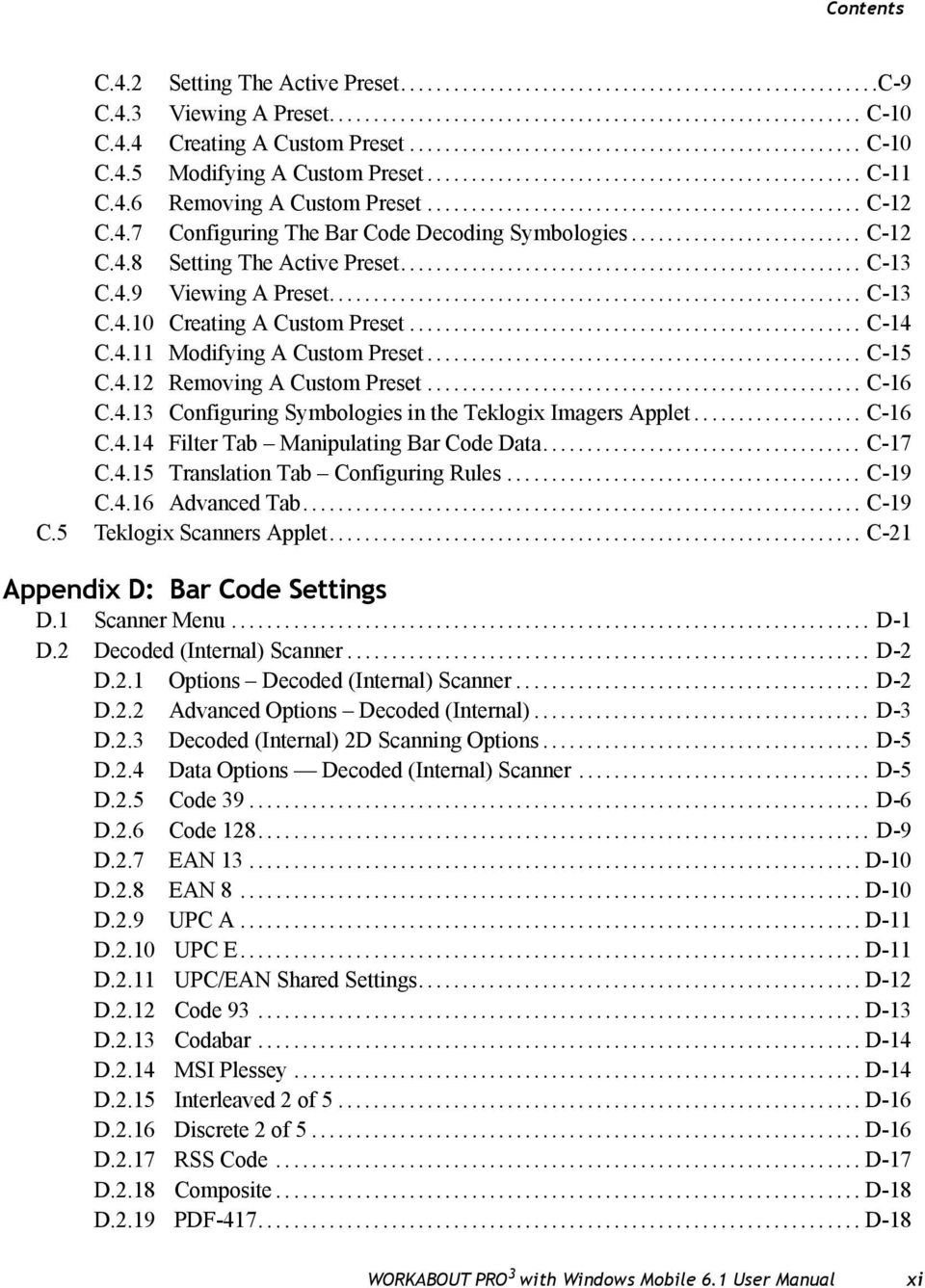
15 Contents C.4.2 Setting The Active Preset C-9 C.4.3 Viewing A Preset C-10 C.4.4 Creating A Custom Preset C-10 C.4.5 Modifying A Custom Preset C-11 C.4.6 Removing A Custom Preset C-12 C.4.7 Configuring The Bar Code Decoding Symbologies C-12 C.4.8 Setting The Active Preset C-13 C.4.9 Viewing A Preset C-13 C.4.10 Creating A Custom Preset C-14 C.4.11 Modifying A Custom Preset C-15 C.4.12 Removing A Custom Preset C-16 C.4.13 Configuring Symbologies in the Teklogix Imagers Applet C-16 C.4.14 Filter Tab Manipulating Bar Code Data C-17 C.4.15 Translation Tab Configuring Rules C-19 C.4.16 Advanced Tab C-19 C.5 Teklogix Scanners Applet C-21 Appendix D: Bar Code Settings D.1 Scanner Menu D-1 D.2 Decoded (Internal) Scanner D-2 D.2.1 Options Decoded (Internal) Scanner D-2 D.2.2 Advanced Options Decoded (Internal) D-3 D.2.3 Decoded (Internal) 2D Scanning Options D-5 D.2.4 Data Options Decoded (Internal) Scanner D-5 D.2.5 Code D-6 D.2.6 Code D-9 D.2.7 EAN D-10 D.2.8 EAN D-10 D.2.9 UPC A D-11 D.2.10 UPC E D-11 D.2.11 UPC/EAN Shared Settings D-12 D.2.12 Code D-13 D.2.13 Codabar D-14 D.2.14 MSI Plessey D-14 D.2.15 Interleaved 2 of D-16 D.2.16 Discrete 2 of D-16 D.2.17 RSS Code D-17 D.2.18 Composite D-18 D.2.19 PDF D-18 WORKABOUT PRO 3 with Windows Mobile 6.1 User Manual xi
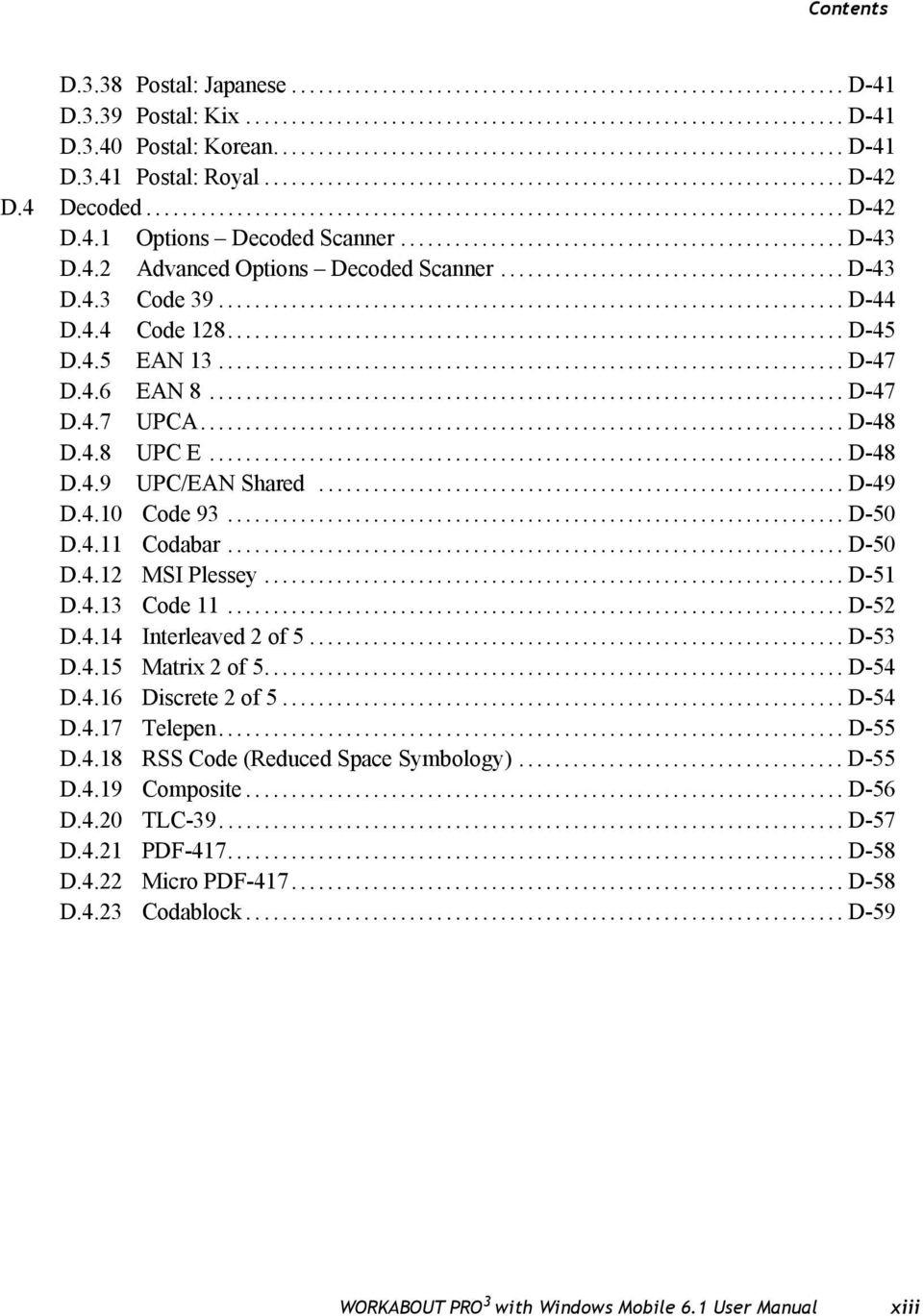
16 Contents D.2.20 Micro PDF D-19 D.3 Decoded (HHP) D-20 D.3.1 Options Decoded (HHP) D-20 D.3.2 Advanced Options Decoded (HHP) D-20 D.3.3 Code D-22 D.3.4 Trioptic Code D-23 D.3.5 Code D-23 D.3.6 EAN 13 Settings D-24 D.3.7 EAN D-25 D.3.8 UPC A Settings D-25 D.3.9 UPC E Settings D-26 D.3.10 UPC/EAN Shared Settings D-27 D.3.11 Code D-27 D.3.12 Codabar D-27 D.3.13 MSI Plessey D-29 D.3.14 Code D-29 D.3.15 Interleaved 2 of D-30 D.3.16 Matrix 2 of D-31 D.3.17 IATA 2 of D-31 D.3.18 Discrete 2 of D-32 D.3.19 Telepen D-32 D.3.20 RSS Code (Reduced Space Symbology)... D-33 D.3.21 PosiCode (Reduced Space Symbology).... D-33 D.3.22 Composite D-34 D.3.23 TLC D-35 D.3.24 PDF D-35 D.3.25 Micro PDF D-35 D.3.26 Code 16K D-36 D.3.27 Code D-36 D.3.28 Codablock D-37 D D Data Matrix D-37 D D QR Code D-38 D D Maxicode D-38 D D Aztec D-39 D.3.33 Postal: PlaNET D-39 D.3.34 Postal: PostNET D-39 D.3.35 Postal: Australian D-40 D.3.36 Postal: Canadian D-40 D.3.37 Postal: China D-40 xii WORKABOUT PRO 3 with Windows Mobile 6.1 User Manual

17 Contents D.3.38 Postal: Japanese D-41 D.3.39 Postal: Kix D-41 D.3.40 Postal: Korean D-41 D.3.41 Postal: Royal D-42 D.4 Decoded D-42 D.4.1 Options Decoded Scanner D-43 D.4.2 Advanced Options Decoded Scanner D-43 D.4.3 Code D-44 D.4.4 Code D-45 D.4.5 EAN D-47 D.4.6 EAN D-47 D.4.7 UPCA D-48 D.4.8 UPC E D-48 D.4.9 UPC/EAN Shared D-49 D.4.10 Code D-50 D.4.11 Codabar D-50 D.4.12 MSI Plessey D-51 D.4.13 Code D-52 D.4.14 Interleaved 2 of D-53 D.4.15 Matrix 2 of D-54 D.4.16 Discrete 2 of D-54 D.4.17 Telepen D-55 D.4.18 RSS Code (Reduced Space Symbology)... D-55 D.4.19 Composite D-56 D.4.20 TLC D-57 D.4.21 PDF D-58 D.4.22 Micro PDF D-58 D.4.23 Codablock D-59 WORKABOUT PRO 3 with Windows Mobile 6.1 User Manual xiii
18

19 INTRODUCTION About This Manual Text Conventions WORKABOUT PRO 3 Features The WORKABOUT PRO 3 C Hand-Held The WORKABOUT PRO 3 S Hand-Held WORKABOUT PRO 3 with Windows Mobile 6.1 User Manual 1
20

21 Chapter 1: Introduction About This Manual 1.1 About This Manual This manual describes how to configure, operate and maintain the WORKABOUT PRO 3 (Model Numbers 7527C-G2 and 7527S-G2) hand-held computer. Chapter 1: Introduction provides a basic overview of the WORKABOUT PRO 3 hand-held. Chapter 2: Basic Checkout describes the steps required to get the unit ready for operation. Chapter 3: Get To Know WORKABOUT PRO 3 describes the features and outlines how to charge and maintain the battery. This chapter also provides information about indicators, SD/MMC card installation and general maintenance. Chapter 4: Working With Windows Mobile 6.1 describes the Microsoft Windows Mobile 6.1 Today screen and how to use it. This chapter also outlines basics like moving around a window, displaying menus, and so on. Chapter 5: Programs provides a description of the Windows Mobile 6.1 Programs options and how to use them. Chapter 6: Settings provides details about Windows Mobile 6.1 Settings options and how to use them. Chapter 7: Peripheral Devices & Accessories describes the peripherals and accessories available for your hand-held. Chapter 8: Specifications details radio, hand-held computer, scanner and battery specifications. Appendix A: Summit Client Utility (SCU) provides details about the Summit Client Utility (SCU) screens. Appendix B: Port Pinouts describes port pinouts. Appendix C: Teklogix Imagers Applet describes the Teklogix Imagers applet and how to use it. Appendix D: Bar Code Settings describes the bar codes supported by the scanners and imagers available for the WORKABOUT PRO 3. WORKABOUT PRO 3 with Windows Mobile 6.1 User Manual 3
22 Chapter 1: Introduction Text Conventions 1.2 Text Conventions Note: Notes highlight additional helpful information. Important: These statements provide particularly important instructions or additional information that is critical to the operation of the equipment. Warning: These statements provide critical information that may prevent physical injury, equipment damage or data loss. 1.3 WORKABOUT PRO 3 Features Important: For all safety, regulatory and warranty information, refer to the WORKA- BOUT PRO Hand-Held Computer Regulatory & Warranty Guide, PN The WORKABOUT PRO 3 is a ruggedized hand-held personal computer that can be ordered with two possible operating systems: Windows Mobile 6.1 Professional with a phone option or Windows Mobile 6.1 Classic. This hand-held is intended for use in commercial and light industrial applications with a focus on real time wireless data transactions. All possible bar code input methodologies are supported by one of a variety of scanners available. Optimization for specific operational environments is supported with a wide range of peripheral options and carrying accessories. Note: For a complete list of WORKABOUT PRO 3 specifications, refer to Hand-Held Computer Specifications on page 287 Model Variants WORKABOUT PRO 3 C Model 7527C-G2 WORKABOUT PRO 3 S Model 7527S-G2 Platform 624 MHz, 32 bit RISC CPU 1024 MB Flash ROM, 256 MB RAM 4 WORKABOUT PRO 3 with Windows Mobile 6.1 User Manual
23 Chapter 1: Introduction WORKABOUT PRO 3 Features Operating System Microsoft Windows Mobile 6.1 Professional Microsoft Windows Mobile 6.1 Classic Multi-Media Chipset NVIDIAGoForce 4000 Multi-Media Processor Real-Time Clock CPU independent RTC capable of maintaining the system date and time for at least 3 months with a fully charged backup battery User Interface Color Touchscreen Display 3.6 in. (9.144 cm) diagonal - Full VGA 480 x 640 resolution - Transflective, portrait mode TFT - Adjustable Backlight Touchscreen - Passive stylus or finger operation - Signature capture Keyboards - Full Alpha-Numeric (C model) - Numeric (S model) - Ergonomically enhanced for ambidextrous, one-hand operation - Backlit, high durability hard-capped keys Wireless Communication Optional expansion modules for: b/g (via Compact Flash) operating in the 2.4GHz band: - Supports IEEE b data rates of 1,2,5.5 and 11Mbps using Direct Sequence Spread Spectrum (DSSS) - Supports IEEE g data rates of 6,9,12,24,36,48 and 54Mbps,using Orthagonal Frequency Division Multiplexing (OFDM) base band modulation GSM/GPRS EDGE (via expansion interface) - Quad-Band 850/900/1800/1900 MHz Voice and Data WORKABOUT PRO 3 with Windows Mobile 6.1 User Manual 5
24 Chapter 1: Introduction The WORKABOUT PRO 3 C Hand-Held - GPRS Class B, Multi-Slot Class 12 - EGPRS Class B, Multi-Slot Class 12 UMTS/HSDA (via expansion interface) - Triple-Band 850/1900/2100 MHz Voice and Data Integrated Bluetooth class II, ver Working Range: 16.4 ft.to ft. (5m to 10m) Note: b/g, GSM, and Bluetooth are available simultaneously The WORKABOUT PRO 3 C Hand-Held Figure 1.1 WORKABOUT PRO 3 C with Alphanumeric Keyboard 6 WORKABOUT PRO 3 with Windows Mobile 6.1 User Manual
25 1.3.2 The WORKABOUT PRO 3 S Hand-Held Figure 1.2 WORKABOUT PRO 3 S with QWERTY Keyboard
26 Chapter 1: Introduction The WORKABOUT PRO 3 S Hand-Held Figure 1.3 WORKABOUT PRO 3 S with Numeric Keyboard Figure 1.4 Phone Labels Send End Note: The [Send] and [End] phone keys printed on the hand-held shown in the sample above are useful for units equipped with Windows Mobile 6.1 Professional that support the phone feature. Refer to Send & End Calls Using the WORKABOUT PRO 3 Keyboard on page 24 for details. 8 WORKABOUT PRO 3 with Windows Mobile 6.1 User Manual
27 BASIC CHECKOUT Preparing the WORKABOUT PRO 3 for Operation The Main Battery Charging the Main Battery The Backup Battery Backup Battery Gas Gauge Turning the WORKABOUT PRO 3 On and Off Installing the Battery and Switching the Unit On Switching the Unit Off (Suspend) Connecting the WORKABOUT PRO 3 to a PC Connecting the WORKABOUT PRO 3 to a PC Data Transfer Between the PC & the Hand-Held Using Microsoft ActiveSync Using Microsoft Vista Aligning (Calibrating) the Touchscreen The Getting Started Centre Setting Up a RA2041 Radio Summit Client Utility Assigning the IP Address Using the SCU to Connect to the WLAN The Phone (Windows Mobile 6.1 Professional Only) The Phone Keypad Send & End Phone Calls Using the Phone Keypad Make a Conference Call Receive an Incoming Call Program Speed Dial Send & End Calls Using the WORKABOUT PRO 3 Keyboard Managing Phone Settings Phone Tab Security Tab Services Tab Network Tab WORKABOUT PRO 3 with Windows Mobile 6.1 User Manual 9
28 Data Tab Bands Resetting the WORKABOUT PRO 3 Hand-Held Performing a Warm Reset Performing a Cold Reset to the Windows Mobile 6.1 OS WORKABOUT PRO 3 with Windows Mobile 6.1 User Manual
29 2.1 Preparing the WORKABOUT PRO 3 for Operation The Main Battery Chapter 2: Basic Checkout Preparing the WORKABOUT PRO 3 for Operation Before charging the battery, it is critical that you review the battery safety guidelines in the WORKABOUT PRO Hand-Held Computer Warranty & Regulatory Guide, PN The WORKABOUT PRO 3 C and WORKABOUT PRO 3 S can be powered with one of the following lithium-ion battery packs: High-Capacity Model No. WA3006, and Super High-Capacity Model No. WA Charging the Main Battery Important: Before opening the battery cover on your WORKABOUT PRO 3, press the Power button to turn off the hand-held. Important: Before replacing a battery, please read Removing the Battery Pack on page 38 and Safely Swapping the Main Battery on page 38. Battery packs shipped from the factory are charged to approximately 40% and must be fully charged prior to use. Batteries can be charged using a variety of chargers and docking stations along with a WORKABOUT PRO 3 internal charger. When using the internal charger, a suitable power source is required. All chargers and docking stations are described in Chapter 7: Peripheral Devices & Accessories beginning on page 245 for details. Note: If you are powering up a new unit, a warning message may appear on the screen indicating that the backup battery capacity is low. To recharge the internal battery, you must fully charge the WORKABOUT PRO 3 with the main battery installed in the unit The Backup Battery To preserve data stored in your WORKABOUT PRO 3 while you swap the main battery, the unit is equipped with an internal backup battery a replaceable, rechargeable Lithium-Ion backup battery that can be ordered through Psion Teklogix. The backup battery will supply 5 minutes of continuous power while you install a charged, main battery. The backup battery is trickle charged from the main battery. Provided that the main battery contains power, the backup battery will maintain a charge whether the WORKABOUT WORKABOUT PRO 3 with Windows Mobile 6.1 User Manual 11
30 Chapter 2: Basic Checkout Turning the WORKABOUT PRO 3 On and Off PRO 3 is switched on or off, in a docking station or a cradle. Even when the main battery reaches its Suspend Threshold (refer to Suspend Threshold on page 167) and the handheld shuts down, the backup battery will continue to draw a trickle charge from the main battery to protect the data stored in the unit until a charged main battery is installed. Note: The backup battery takes approximately 3 to 4 hours to fully charge from a fully discharged (flat) state, generally the same amount of time it takes to fully charge the main battery. While you can continue to use the WORKABOUT PRO 3, replacing the main battery while the backup battery is not fully charged is not recommended because you risk losing the data stored on the unit Backup Battery Gas Gauge To safely replace the main battery and preserve the data stored in the WORKABOUT PRO 3, the backup battery should contain a minimum of 80% of its charge capacity. The Battery tab in the Power applet displays a gas gauge to indicate the charge remaining in the backup battery from 0 to 100%. To check the backup battery capacity: Tap on Start>Settings and then tap on System tab. Tap on the Power icon. For more details about replacing batteries, refer to Removing the Battery Pack on page 38 and Battery Swap Time on page Turning the WORKABOUT PRO 3 On and Off Installing the Battery and Switching the Unit On Important: Before opening the battery cover on your WORKABOUT PRO 3, press the Power button to turn off the hand-held. To unlock the battery cover, turn the left-hand battery fastener to the left, and turn the right-hand battery fastener to the right. You can either use your fingers or the top of your stylus to turn the fasteners. (For details about how to lock and unlock the optional safety battery cover, refer to Secure Battery Cover on page 259.) Remove the battery cover. Ensure that the ON/OFF switch in the battery compartment is set to ON before inserting the battery. Snap the charged battery into the unit. Replace the battery cover, and lock the fasteners in place. 12 WORKABOUT PRO 3 with Windows Mobile 6.1 User Manual
31 Chapter 2: Basic Checkout Switching the Unit Off (Suspend) Note: If you are using a docking station or an external power supply, you can insert an uncharged battery, dock the unit and switch it on. To switch on the WORKABOUT PRO 3 : Press and hold down the Power button for at least one second. When the LED flashes green, release the [ENTER] button. The desktop Today screen is displayed. Note: If the unit was already in use the unit may be off (suspend state) pressing [ENTER] wakes the unit from this state. The screen in which you were working prior to the suspend state is displayed. Wakeup Keys Tab on page 168 describes how you can assign other wakeup keys or enable a two-key power on sequence Switching the Unit Off (Suspend) Press the [FN/BLUE] key, and then press and hold down the [ENTER] key. A Shutdown screen like the one below is displayed. Each option switches off different elements of the WORKABOUT PRO 3 ; each shutdown option displays an associated description. Choosing Suspend places the hand-held into a power-saving suspend state. In this state, all radios remain on, but the display, keyboard backlight and processor are switched off. When the WORKABOUT PRO 3 is turned on from this state, operation resumes within a few seconds in the screen in which you were working prior to suspend. If you choose Standby, the display is turned off, the keyboard is locked and the touchscreen is locked. The processor remains on so that any running applications will continue while the WORKABOUT PRO 3 with Windows Mobile 6.1 User Manual 13
32 Chapter 2: Basic Checkout Connecting the WORKABOUT PRO 3 to a PC hand-held is in a Standby state. In addition, the radios remain on. You should be aware that because the processor continues to run, Standby mode consumes more power than Suspend mode. Keep in mind that only by pressing and holding down the [ENTER] key until the Shutdown dialog box is displayed can you choose between Suspend and Standby. 2.3 Connecting the WORKABOUT PRO 3 to a PC Note: Refer to Refer to Linking A WORKABOUT PRO 3 To A PC on page 266 for more details about the desktop docking station and how to link to a PC. The WORKABOUT PRO 3 can be connected to a PC using the desktop docking station. Insert the unit in the desktop docking station. Use a Client USB connector to complete the communication link between the hand-held and the PC. 2.4 Data Transfer Between the PC & the Hand-Held Data transfer options vary slightly depending on the type of operating system installed in your PC. Microsoft ActiveSync is PC connectivity software that can be used to connect your hand-held to PCs running this software. ActiveSync works only with the Windows XP SP2 operating system or earlier. If the Microsoft Vista operating system is installed in your PC, ActiveSync is not required to transfer data between your WORKABOUT PRO 3 and your PC. By connecting the WORKABOUT PRO 3 to a PC with a cable, you can: View WORKABOUT PRO 3 files from Windows Explorer. Drag and drop files between the WORKABOUT PRO 3 and the PC in the same way that you would between PC drives. Back up WORKABOUT PRO 3 files to the PC, then restore them from the PC to the hand-held again, if needed, and so on Using Microsoft ActiveSync To install ActiveSync, follow the step-by-step instructions provided at this website: 14 WORKABOUT PRO 3 with Windows Mobile 6.1 User Manual
33 2.4.2 Using Microsoft Vista Chapter 2: Basic Checkout Using Microsoft Vista If you have Windows Vista, your WORKABOUT PRO 3 data transfers do not require Active- Sync. To transfer data between your PC and your hand-held: Tap on Start>Computer to display the drives. Your WORKABOUT PRO 3 will be visible here. Open drives, files and folders as you would on your PC. 2.5 Aligning (Calibrating) the Touchscreen Refer to Aligning (Calibrating) the Touchscreen on page 47 for details. 2.6 The Getting Started Centre The Getting Started centre outlines how to perform basic tasks when initially setting up your WORKABOUT PRO 3. You can access the Getting Started centre from the Today screen, or you can tap on Start>Programs, and then tap on the Getting Started icon. Tapping on Getting Started displays a list of the basic setup option you may need to get your WORKABOUT PRO 3 ready for operation. WORKABOUT PRO 3 with Windows Mobile 6.1 User Manual 15
34 Chapter 2: Basic Checkout Setting Up a RA2041 Radio Summit Client Utility To get instructions about an operation, tap on an option in the Getting Started list. Follow the instructions provided. Where applicable, a link to an associated screen is provided.tap on the link to display the screen and complete your task. To go back to the Getting Started menu, tap on the Back softkey in the taskbar at the bottom of the screen. 2.7 Setting Up a RA2041 Radio Summit Client Utility This section describes the steps required to set up the RA2041 Summit Radio using the Summit Client Utility (SCU). To review details about the option within the SCU tabs Main, Profile, Status, Diags and Global Settings review Appendix A: Summit Client Utility (SCU) Assigning the IP Address Before launching the SCU, you need to configure the method by which the IP address will be obtained. Tap on Start>Settings>Connections tab>wireless Manager icon. In the Wireless Manager dialog box, tap on the Settings button. In the Configure Network Adaptors dialog box: Tap on Summit WLAN Adapter in the adaptor list. The Summit WLAN Adapter dialog box is displayed. You have two options: Tap on Use server-assigned IP address to have an address assigned automatically, or 16 WORKABOUT PRO 3 with Windows Mobile 6.1 User Manual
35 Chapter 2: Basic Checkout Using the SCU to Connect to the WLAN If you want to use a particular IP address, tap on Use specific IP address, and type the preferred address. If you tap on the Name Servers tab, you can statically configure the DNS servers; however, if you use DHCP for IP address assignment, DNS is usually supplied by the same server that supplied the IP addresses Using the SCU to Connect to the WLAN This section provides a quick set of steps to create a profile (referred to as a Profile). Detailed information about each of the SCU tabs Main, Profile, Status, Diags and Global Settings is provided under Appendix A: Summit Client Utility (SCU). To launch the SCU so that your hand-held can connect to a wireless LAN: Tap on Start>Programs, and then tap on the SCU icon. WORKABOUT PRO 3 with Windows Mobile 6.1 User Manual 17
36 Chapter 2: Basic Checkout Using the SCU to Connect to the WLAN Tap on the Profile tab. Tap on New to define a new profile. Type a unique name for your configuration using any alpha-numeric combination to uniquely identify this profile. Tap on OK to return to the Profile tab. To configure the SSID for the network to which you want to associate: Type an SSID in the text box to the right of SSID. This field is limited to 32 characters. Tap on Commit to save your SSID setting. Important: To learn more about the other options available in the radio attributes list, refer to Profile Tab in Appendix A: Summit Client Utility (SCU). To configure authentication and encryption, use the appropriate drop-down menus in the Profile dialog box, and enter credentials for IEEE 802.1X EAP types or WEP keys by tapping on the Credentials button just below the drop-down menus. Tap on the EAP type drop-down menu, and choose the appropriate type of authentication LEAP, EAP-FAST, PEAP-MSCHAP,PEAP-GTC and EAP_TLS. Once you ve chosen an EAP type, tap on the Credentials button, and type credentials for IEEE 802.1X EAP types. Important: Refer to SCU Security Capabilities and EAP Credentials in Appendix A: Summit Client Utility (SCU). 18 WORKABOUT PRO 3 with Windows Mobile 6.1 User Manual
37 To configure encryption: Chapter 2: Basic Checkout Using the SCU to Connect to the WLAN Tap on the Encryption drop-down menu, and choose the appropriate type of encryption Manual WEP, Auto WEP, WPA PSK, WPA TKIP, WPA2 PSK, WPA2 AES, CCKM TKIP, CKIP Manual or CKIP Auto. If you choose Manual WEP, WPA PSK or WPA2 PSK: Tap on the WEP/PSK Keys button. For Manual WEP, choose up to four static WEP keys. For PSK, type an ASCII passphrase or hex PSK. Configure any other settings that are supplied by the network administrator for the SSID to which you will associate. Make certain that you tap on Commit following each change. Once you ve completed the configuration: Tap the Main tab. Tap on the Active Profile drop-down menu your new profile will be listed in the drop-down menu. When you tap on the profile you created, the b/g radio module attempts to connect to the network using the following steps: 1. Associate with SSID. 2. Authenticate to network. 3. If EAP authentication is being used, derive dynamic encryption keys. 4. If DHCP is being used by the network, obtain an IP address. If the b/g is not connecting properly: Tap on the Status tab. The Status dialog box lists the IP and MAC address, and indicates the current state of the radio, the signal strength, channel and so on. You can also use the Status screen for DHCP renewal and ICMP Echo Requests (Pings). Important: For details about the Status dialog box, refer to Status Tab on page A-7 in Appendix A: Summit Client Utility (SCU). WORKABOUT PRO 3 with Windows Mobile 6.1 User Manual 19
38 Chapter 2: Basic Checkout The Phone (Windows Mobile 6.1 Professional Only) 2.8 The Phone (Windows Mobile 6.1 Professional Only) WORKABOUT PRO 3 s running Windows Mobile 6.1 Professional are equipped with phone capabilities. Note: Remember that you can use the Help feature to find more details about phone options. Help screens are context-sensitive that is, the help displayed is generally specific to the dialog box you have opened. To further narrow your search, tap on the Search softkey in the Help screen, and type the topic about which you require additional information The Phone Keypad The phone keypad provides phone services like those you use on your cellular phone. You can use the phone keypad provided with your WORKABOUT PRO 3 to, for example, send and receive phone calls, make conference calls, view a list of your phone calls (call history), set up speed dial numbers, etc Send & End Phone Calls Using the Phone Keypad To display the phone keypad: In the Today screen, tap the Phone softkey in the softkey bar at the bottom of the screen. Phone settings Network emergency number Directory Assistance Note: You can also press the Send button on the WORKABOUT PRO 3 keyboard to display the phone keypad providing it s been activated. The Send button is located on the [TAB] key just below the hand-held display to send the phone number; it is labelled with a green telephone receiver icon.refer to Send & End Phone Calls Using the Phone Keypad on page 20 for details. 20 WORKABOUT PRO 3 with Windows Mobile 6.1 User Manual
39 To send a number: Chapter 2: Basic Checkout The Phone Keypad Use the phone keypad to enter the phone number, and tap on Send to dial the phone number. To end a phone call: Tap on End key on the phone keypad. Note: You can also tap on the [End] key on the physical keyboard of the WORKABOUT PRO 3 to end the call providing this key has been activated. The [End] key is mapped to the [ESC] key just below the hand-held display and is labelled with a red phone receiver. Refer to Send & End Calls Using the WORKABOUT PRO 3 Keyboard on page 24 for details Make a Conference Call To set up a conference call between yourself and two or more other parties: In the phone keypad, enter the first phone number. Tap on the Send button. While you are connected to the first number, tap on Menu>Hold. Enter the second number. Tap on Send. Tap on Menu>Conference. To add another party, tap on Menu>Hold, enter the number, and then tap Menu>Conference. Tap on End to disconnect all calls Receive an Incoming Call To answer an incoming call: Tap on the Send button located on the [TAB] key on the WORKABOUT PRO 3 keyboard. It s labelled with a green phone receiver Program Speed Dial The phone keypad provides a Speed Dial button for quick access to often used numbers. WORKABOUT PRO 3 with Windows Mobile 6.1 User Manual 21
40 Chapter 2: Basic Checkout The Phone Keypad In the phone keypad, tap on the Speed Dial button to display the speed dial Phone dialog box. Speed Dial Number This dialog box lists the phone numbers and the speed dial key to which the phone number has been assigned. Tap on the Speed Dial Number (to the left of the phone number you want to dial), or Tap on the Call softkey; the number is dialed for you. Using the Phone Keypad to Program a Speed Dial There are a number of ways to add a speed dial number. You can create a speed dial number using the Contacts list or by using the Speed Dial button on the phone keypad. Adding a New Phone Number In the phone keypad, tap on the Speed Dial button. In the speed dial Phone dialog box, tap on Menu>New. 22 WORKABOUT PRO 3 with Windows Mobile 6.1 User Manual
41 Chapter 2: Basic Checkout The Phone Keypad In the list, choose a contact for a speed dial. Tap on Enter a name, and type a contact name, or tap on a name in the list. A sequential speed dial key is automatically assigned in the Location field. You can tap on the Location drop-down menu and change the auto assignment. WORKABOUT PRO 3 with Windows Mobile 6.1 User Manual 23
42 Chapter 2: Basic Checkout Send & End Calls Using the WORKABOUT PRO 3 Keyboard Using the Contact List to Program a Speed Dial Tap Contact in the softkey bar at the bottom of the Today screen. Tap on the Contact to which you want to assign a speed dial number. In the Summary screen, tap on Menu>Add to Speed Dial Send & End Calls Using the WORKABOUT PRO 3 Keyboard WORKABOUT PRO 3 s are equipped with a Send and an End phone buttons. The sample below illustrates where these phone buttons are located on the QWERTY keyboard. On al- 24 WORKABOUT PRO 3 with Windows Mobile 6.1 User Manual
43 Chapter 2: Basic Checkout Send & End Calls Using the WORKABOUT PRO 3 Keyboard phanumeric and numeric keyboards, these button are mapped to the [F3] and [F4] function keys near the top of the keyboard. Send End Using these phone keys, you can display the phone keypad and answer, send and terminate phone calls. If you press the Send or End buttons with no result, you may first need to activate them. Activating the Send and End Keyboard Phone Buttons To activate the phone function of these keys: Tap on Start>Settings>System tab>about Device icon. Tap on the Experience tab. If it s not chosen by default, choose Psion Teklogix Settings in the drop-down menu at the top of the screen. The checkbox next to Enable Phone keys (Send and End) in place of the [Tab] and [Esc] keys should be checked automatically. If not, check it and tap on OK. WORKABOUT PRO 3 with Windows Mobile 6.1 User Manual 25
44 Chapter 2: Basic Checkout Managing Phone Settings Managing Phone Settings You can adjust phone settings such as the ring type and tone, choose phone services such as barring calls, and you can also determine network selections. There are a number of ways you can access phone settings. In the Navigation Bar, tap on the Phone Settings hotkey. In the pop-up Phone bubble, tap on Settings, or Tap on Start>Settings>Phone icon. Phone Settings Hotkey Tap on Settings Note: If the phone keypad is opened, tap on Menu>Options to display the Phone Settings dialog box Phone Tab Ring Type and Ring Tone Ring Type allows you to tailor the type of ring used for incoming calls. The Ring Tone dropdown menu allows you to determine the ring tone of incoming phone calls. Keypad This option allows you to determine the type of sound that keypad keys emit as you tap them. You can also turn off keypad sounds. 26 WORKABOUT PRO 3 with Windows Mobile 6.1 User Manual
45 Chapter 2: Basic Checkout Managing Phone Settings Security Tab Tap in the checkbox (add a checkmark) to enable PIN Security. This option allows you to assign a PIN (Personal Identification Number) so that your handheld is protected from unauthorized use. Your SIM card manufacturer provides the default PIN which you can change in this field. Changing a PIN Tap on the Change PIN button and use the phone keypad to enter your existing SIM card PIN. Tap on the [Enter] button in the phone keypad. WORKABOUT PRO 3 with Windows Mobile 6.1 User Manual 27
46 Chapter 2: Basic Checkout Managing Phone Settings Important: If you enter an incorrect PIN, a message is displayed letting you know that you ll need to reenter the correct value. You have five chances to enter the correct PIN. If you exceed this number, the SIM will be disabled automatically. You will be asked to enter a PUK (Personal Unlocking Key). Your system administrator will be able to provide this information. Once you ve entered the correct PIN, a new screen appears asking that you enter you new PIN. Type your new PIN a number consisting of between 4 and 8 digits in length. Tap on Enter. A new message lets you know that you need to confirm your new PIN. Retype your new PIN. Tap on [Enter] when you re finished. Enabling PIN Security To activate PIN security: Tap in the checkbox to the left of Require PIN when phone is used. When security is enabled, you will be prompted to enter a PIN before you are allowed to use the phone. Note: Whenever this option is enabled or disabled, you will be asked to enter your PIN. 28 WORKABOUT PRO 3 with Windows Mobile 6.1 User Manual
47 Chapter 2: Basic Checkout Managing Phone Settings Services Tab The Services tab allows you to customize the behaviour of your phone. You can, for example, block all incoming calls, tailor to whom your caller ID will be transmitted, set up call forwarding and so on. Tap on the service you want to set up. Tap on Get Settings. The service dialog boxes allow you to tailor your available services to meet your requirements. Remember that when a particular service dialog box you ve chosen is displayed, you can always tap on Start>Help to get additional information. Voice Mail Setup If your service includes Voice Mail, a temporary passcode is automatically assigned. It is mailed to you as a text message. Tap on Start>Messaging to display your temporary passcode. To activate your voice mail: From a land line, dial your wireless phone number. Allow the WORKABOUT PRO 3 to ring until it is automatically picked up by the voice mail service. At the greeting, type #. You will be prompted to enter your temporary passcode. A tutorial will lead you through the voice mail setup. When you ve assigned your personalized passcode, keep it in a secure place. WORKABOUT PRO 3 with Windows Mobile 6.1 User Manual 29
48 Chapter 2: Basic Checkout Managing Phone Settings Network Tab Data Tab This dialog box identifies your current network, and allows you to view available networks and determine the order in which other preferred networks will be accessed if the current one is unavailable.you can also specify manual or automatic network changes, and you can add a network. This screen is used to configure the connection to the ISP. You can select a network connection from the drop-down menu. By default the connection uses CHAP (Challenge Handshake Authentication Protocol); however, if your ISP does not support CHAP, tapping in the box to the left of PAP only authentication for: directs the connection to use PAP (Password Authentication Protocol) instead. Note: If your are not using PAP, the hand-held automatically defaults to CHAP. 30 WORKABOUT PRO 3 with Windows Mobile 6.1 User Manual
49 Chapter 2: Basic Checkout Resetting the WORKABOUT PRO 3 Hand-Held Bands By default, all frequency bands are enabled. Bands should not be disabled without knowledge about which bands are used by your network; an incorrect setting will prevent the WWAN modem from finding the network. 2.9 Resetting the WORKABOUT PRO 3 Hand-Held There are two types of reset available: warm and cold reset Performing a Warm Reset On a WORKABOUT PRO 3 running the Windows Mobile operating system, a warm reset completely reloads and restarts the operating system. Registry settings, installed programs and any data files that reside in flash memory are all preserved through the reset. Files and data stored in the RAM Drive partition are not preserved during a reset. To protect files stored in the RAM Drive through a reset procedure, you must create a Total Recall profile (refer to Total Recall on page 186) and store it on the flash ( My Device ) file system. Press and hold down the [FN/BLUE] key and the [ENTER] key simultaneously for a minimum of two seconds. When the screen goes blank, release the keys. Note: You do not need to reset your WORKABOUT PRO 3 after configuring the radio. WORKABOUT PRO 3 with Windows Mobile 6.1 User Manual 31
50 Chapter 2: Basic Checkout Performing a Cold Reset to the Windows Mobile 6.1 OS Performing a Cold Reset to the Windows Mobile 6.1 OS A cold reset in Windows Mobile is almost identical to a warm reset, except that some lower level hardware (PCon) is also reset before the operating system boots. For this reason, a cold reset should only be used in rare, critical situations. To perform a cold reset and launch the Windows Mobile 6.1 operating system (bypassing the BooSt menu): Press and hold down the [SCAN] [FN/BLUE] and [ENTER] keys simultaneously for a minimum of two seconds. After a cold reset, the BooSt menu appears, listing possible BooSt commands. Type 1 to load the Windows Mobile 6.1 operating system. 32 WORKABOUT PRO 3 with Windows Mobile 6.1 User Manual
51 GET TO KNOW WORKABOUT PRO Features of the WORKABOUT PRO The Batteries Removing the Battery Pack Battery Swap Time Safely Swapping the Main Battery Charging the Battery Chargers and Docking Stations Switching the Hand-Held On and Off The Keyboards The WORKABOUT PRO 3 Keyboard Modifier Keys Activating Modifier Keys & the Shift-State Indicator Locking Modifier Keys The Keys Numeric Keyboard Accessing Alpha Keys Choosing a Single Alpha Character Creating Uppercase Letters Choosing Multiple Alpha Characters The Keypad Backlight The Display Adjusting the Backlight Aligning (Calibrating) the Touchscreen Indicators The LED Audio Indicators Adjusting Speaker Volume Monitoring the Battery and Maximizing Run Time Storing Batteries Uploading Data in a Docking Station Bluetooth Radio WORKABOUT PRO 3 with Windows Mobile 6.1 User Manual 33
52 Pairing a Bluetooth Device Inserting the SD/MMC Card and SIM Card Inserting and Removing the Card General Maintenance Caring for the Touchscreen Cleaning the WORKABOUT PRO WORKABOUT PRO 3 with Windows Mobile 6.1 User Manual
53 Chapter 3: Get To Know WORKABOUT PRO 3 Features of the WORKABOUT PRO Features of the WORKABOUT PRO 3 Figure 3.1 Front of WORKABOUT PRO 3 Speaker LED (Light Emitting Diode) Microphone Port WORKABOUT PRO 3 with Windows Mobile 6.1 User Manual 35
54 Chapter 3: Get To Know WORKABOUT PRO 3 Features of the WORKABOUT PRO 3 Figure 3.2 Back of WORKABOUT PRO 3 Stylus (pointing tool) End Cap Back Cover Battery Cover Battery Latches 36 WORKABOUT PRO 3 with Windows Mobile 6.1 User Manual
55 Chapter 3: Get To Know WORKABOUT PRO 3 The Batteries Figure 3.3 Ports Tether Port Beeper Port Low Insertion Force Port (LIF) 3.2 The Batteries The hand-held operates with a Lithium-Ion battery pack. Preparing the unit for operation requires that a battery pack be charged and installed in the WORKABOUT PRO 3. Two levels of battery packs are available for the WORKABOUT PRO 3 : Battery Safety DC IN Socket High-Capacity Model No. WA3006, and Super High-Capacity Model No. WA3010 Important: Before attempting to install, use or charge the battery pack, it is critical that you review and follow the important safety guidelines in the quick reference guide entitled WORKABOUT PRO Hand-Held Computer Regulatory & Warranty Guide, PN WORKABOUT PRO 3 with Windows Mobile 6.1 User Manual 37
56 Chapter 3: Get To Know WORKABOUT PRO 3 Removing the Battery Pack Removing the Battery Pack Important: Always switch the unit off before opening the battery cover to remove the battery. When the cover is removed, a power-off switch is automatically activated and the unit power is switched off; if the battery cover is opened while the hand-held is still powered on, the unit may reboot. Any active sessions may be lost. Refer to Installing the Battery and Switching the Unit On on page Battery Swap Time Assuming the default power saving parameters and battery reserve level have not been altered, battery swap time is approximately 5 minutes you will not lose data if the battery is replaced within this time frame. To protect data, the safest place to store data is on a SD/MMC memory card or externally to the device on a USB memory stick or on a PC. The Suspend Threshold feature allows you to determine the battery capacity at which the hand-held will be shut down. If left at the default value, Maximum Operating Time, the unit will run until the battery is completely empty; the RAM is only backed up for a short period of time. If you choose Maximum Back Time, the hand-held shuts off with more energy left in the battery so RAM can be backed up for a longer period of time. (Refer to Suspend Threshold on page 167 for details about reserving battery power for data backup purposes.) Safely Swapping the Main Battery There are a few steps you need to take to ensure that no data is lost during a battery swap. First, you need to make certain that the backup battery is holding at least 80% of its charge capacity. This information is displayed in the Battery tab. Tap on Start>Settings>System tab and then tap on the Power icon. Check the Backup battery gas gauge to determine the battery charge remaining. If the backup battery charge capacity is less than 80%: Keep in mind also that while the battery is being installed, the WORKA- BOUT PRO 3 backup battery will save the current data for up to 5 minutes. Insert the WORKABOUT PRO 3 in a docking station or cradle to top up the power supply before removing the main battery from the unit. 38 WORKABOUT PRO 3 with Windows Mobile 6.1 User Manual
57 Chapter 3: Get To Know WORKABOUT PRO 3 Charging the Battery Important: Before opening the battery cover on your WORKABOUT PRO 3 to remove the battery, you must turn press the Power button to turn off the hand-held Charging the Battery Batteries shipped from the factory are charged to approximately 40% of capacity. They must be fully charged prior to use. Keep in mind also that, along with the main battery, the WORKABOUT PRO 3 is equipped with an internal, backup battery that preserves data stored on the unit while the main battery is swapped. Important: The backup battery is trickle charged from the main battery. To maximize battery life, avoid excessive discharging and recharging of the backup battery by keeping the main battery fully charged Chargers and Docking Stations Lithium-Ion battery packs must be charged before use. These batteries can be charged with a variety of chargers and docking stations. These include: IF YOU ARE POWERING UP A NEW UNIT, a warning message may appear on the screen indicating that the backup battery capacity is low. To recharge the backup battery, you must fully charge the WORKABOUT PRO 3 with the main battery installed in the unit. Important: FOR DETAILED INFORMATION about chargers and docking stations, refer to Chapter 7: Peripheral Devices & Accessories. AC wall adaptor (Model # PS1050-G1) operates as an AC power source and when plugged in, also charges the battery installed in the unit. Desktop Docking Station (Model # WA4003-G2) operates as both a charger and a docking station. Operating as a charger, both the battery installed in the hand-held and a spare battery can be charged simultaneously. Quad Docking Station (Model # WA4204-G2 for WORKABOUT PRO 3 C & Model # WA4304-G2 for WORKABOUT PRO 3 S) can charge the battery of up to four WORKABOUT PRO 3 s inserted in the docking station. Single Battery Charger (Model # WA3001-G1) charges a single battery. Quad Battery Charger (Model # WA3004-G1) charges up to four spare High-Capacity or Super High-Capacity WORKABOUT PRO 3 battery packs. WORKABOUT PRO 3 with Windows Mobile 6.1 User Manual 39
58 Chapter 3: Get To Know WORKABOUT PRO 3 Switching the Hand-Held On and Off It can take up to 4 hours to charge a battery. The WORKABOUT PRO 3 intelligent charging system protects the battery from over-charging by terminating the charge process when the battery is at maximum capacity. Note: Refer to Monitoring the Battery and Maximizing Run Time on page 50 for additional information about the battery. Important: To avoid damaging the battery, chargers will not begin the charge process until the battery temperature is between 0 C to 45 C (32 F to 113 F). 3.3 Switching the Hand-Held On and Off Switching On the WORKABOUT PRO 3 Press and hold down the Power button for at least two seconds. When the LED flashes green, release the Power button. The startup Today screen is displayed. Note: If the WORKABOUT PRO 3 is in suspend state, pressing [ENTER] wakes the unit from this state. The screen in which you were working before the computer entered suspend state is displayed. Wakeup Keys Tab on page 168 describes how you can assign other wakeup keys or enable a two-key power on sequence. Switching Off the WORKABOUT PRO 3 (Suspend) Important: Keep in mind that turning off the WORKABOUT PRO 3 does not result in a complete reboot; rather, the unit enters a power-saving, suspend state. When the unit is turned on from suspend state, operation resumes within a few seconds. To switch off the WORKABOUT PRO 3 : Press the Power button. 40 WORKABOUT PRO 3 with Windows Mobile 6.1 User Manual
59 Chapter 3: Get To Know WORKABOUT PRO 3 The Keyboards 3.4 The Keyboards The WORKABOUT PRO 3 Keyboard This hand-held computer is available in two models, C and S. The WORKABOUT PRO 3 C model is available with an alphanumeric keyboard; the WORKABOUT PRO 3 S model is available with either a QWERTY or numeric keyboard. Most of the keys on these keyboards operate much like a desktop computer. Where a key or key function is not consistent with the PC keyboard, the differences are noted. The WORKABOUT PRO 3 is equipped with a Power button that allows you to switch the unit on and to shut down the unit to Suspend or Standby mode. For details about the Power button, refer to Turning the WORKABOUT PRO 3 On and Off on page 12. The [FN/BLUE] and [FN/ORANGE] modifier keys provide access to additional keys and system functions. These functions are colour coded in orange and blue print above the keyboard keys. Note: Almost all keys can be reprogrammed to suit your requirements Modifier Keys The [SHIFT], [CTRL], [ALT], [FN/BLUE] and [FN/ORANGE] keys are modifier keys. Pressing a modifier key changes the function of the next key pressed. For example, on a WORKABOUT PRO 3 C, a square bracket is printed in orange print above the [G] key. Pressing the [FN/ORANGE] key followed by the [G] key displays a square bracket rather than the letter G. The [SHIFT], [CTRL] and [ALT] keys operate much like a desktop keyboard except that they are not chorded (two keys held down simultaneously). The modifier key must be pressed first followed by the key whose function you want modified Activating Modifier Keys & the Shift-State Indicator When a modifier key is pressed, it is represented in the shift-state indicator icon in the softkey bar at the bottom of the screen, making it easier to determine whether or not a modifier key is active. If the shift-state indicator icon is not visible (you can only see the soft keyboard icon), you may need to take a few steps to display the shift-state indicator icon. Tap on Start>Settings followed by the Buttons icon. Tap on the One Shots tab at the bottom of the screen. WORKABOUT PRO 3 with Windows Mobile 6.1 User Manual 41
60 Chapter 3: Get To Know WORKABOUT PRO 3 Modifier Keys Tap in the check box next to Show modifier key state to display the shift-state indicator icon. Figure 3.4 Shift-State Indicator Icon Soft Keyboard Icon Shift-State Indicator Icon replaces Soft Keyboard Icon Locking Modifier Keys Note: The locking behaviour of the modifier keys can be changed so that, for example, pressing a modifier key once will lock the key on. Refer to One Shots on page 127 for details. Note too that by default, the [FN/ORANGE] key is locked on when pressed only once. When a modifier key is locked on, it will remain active until it is pressed again to unlock or turn it off. To help you identify when a modifier key is locked on, the key is represented in the shiftstate indicator icon with a black frame around it. Figure 3.5 Shift-State Indicator Icon Locked Modifier Key Once a modifier key is unlocked or turned off, it is no longer displayed in the shift-state indicator icon. 42 WORKABOUT PRO 3 with Windows Mobile 6.1 User Manual
61 Chapter 3: Get To Know WORKABOUT PRO 3 The Keys The Keys The [SHIFT] Key The [SHIFT] key is used to display uppercase alpha characters and provide access to the symbols above the numeric keys. You can lock this key on so that when you press an alpha key, an upper case character is displayed. When you press a numeric key, the associated symbol on the numeric key is displayed on the screen. If you press the [SHIFT] key twice, it is locked on essentially acting as a [CAPS] key, displaying uppercase characters. In this state, if you type a numeric key, the number rather than the symbol above it is displayed. Press [SHIFT] again to turn the [CAPS] function off. The Arrow Keys The grey Arrow keys are located near the top of the keyboard, directly below the [SCAN] bar. The arrow keys move the cursor around the screen up, down, left and right. The cursor is the flashing box or underline character that indicates where the next character you type will appear. The [BKSP/DEL] Key The [BKSP] key (sometimes referred to as destructive backspace) moves the cursor one character to the left, erasing the incorrectly entered key stroke. The [DEL] key ([FN/BLUE] [BKSP]) erases the character at the cursor position. The [CTRL] and [ALT] Keys The [CTRL] and [ALT] keys modify the function of the next key pressed and are application dependent. These keys are printed in blue type on the keys to the left and right of the [SCAN] key at the top of the keyboard. They are accessed using a key combination [FN/BLUE] followed by the [CTRL] or the [ALT] key. The [TAB] Key Typically, the [TAB] key moves the cursor to the next field to the right or downward. The [ESC] Key Generally, this key is used as a keyboard shortcut to close the current menu, dialog box or activity and return to the previous one. On the QWERTY keyboard, a key combination is required to access the [ESC] key. Press [FN/BLUE] [TAB]. The Windows [START] Key This key displays the Start menu. WORKABOUT PRO 3 with Windows Mobile 6.1 User Manual 43
62 Chapter 3: Get To Know WORKABOUT PRO 3 The Keys The [SPACE] Key Pressing this key inserts a blank space between characters. In a Windows dialog box, pressing the [SPACE] key enables or disables a checkbox. On the WORKABOUT PRO 3 S numeric keyboard, this key is accessed by key combination [FN/ORANGE] [0] (zero). The [SCAN] Keys The WORKABOUT PRO 3 is equipped with a [SCAN] bar located just below the display and two [SCAN] keys situated on the left and the right sides of the unit. [SCAN] keys activate the scanner beam. For units that do not have internal scanners, these keys can be remapped to serve other functions. Volume Keys - [UP ARROW] and [DOWN ARROW] The volume keys are located above the [UP ARROW] and [DOWN ARROW]. The [UP ARROW] key the increase volume key is labelled with a plus symbol. The [DOWN ARROW] key the decrease volume key is labelled with a minus symbol. The Function Keys With the exception of the QWERTY keyboard which has 10 function keys, the WORK- ABOUT PRO 3 keyboard is equipped with a total of 14 function keys. On the alpha and numeric keyboards, function keys [F1] to [F4] are located across the top of the keyboard to the left a right of the Scan key; these function keys are directly accessible a key combination is not required. Ten additional function keys are colour coded in blue print on the unit body; these keys are accessed by executing a key combination, [FN/BLUE] followed by the appropriate key. For example, to access function key [F7] on a numeric keyboard: Press the [FN/BLUE] key followed by the [7] key the numeric key to which function key [F7] is mapped. To access function key [F8], press [FN/BLUE] [8], and so on. The Macro Keys (WORKABOUT PRO 3 C Only) WORKABOUT PRO 3 C hand-helds are equipped with a series of macro keys that can be programmed to replace frequently used keystrokes, along with the function of executable keys like the [ENTER] key, the [BKSP] key, any function key and arrow key, and so on. Alphanumeric keyboards have ten macro keys: [M1] to [M10]. These keys are colour coded in orange print above the numeric keys. To access a macro key: Press the [FN/ORANGE] key followed by the appropriate numeric key from [1] to [0]. 44 WORKABOUT PRO 3 with Windows Mobile 6.1 User Manual
63 To access macro key [M1], press [FN/ORANGE] [1]. To access macro key [M2], press [FN/ORANGE] [2], and so on Alpha Keyboard Accessing Keys Chapter 3: Get To Know WORKABOUT PRO 3 Alpha Keyboard Accessing Keys The alpha and numeric keys on WORKABOUT PRO 3 C units are directly accessible from the keyboard no key combination is required QWERTY Keyboard Accessing Numeric Keys Alpha keys on a QWERTY keyboard are directly accessible. Numeric keys are printed in orange type above some of the alpha keys and require a key combination to access them. To access a numeric key: Press the [FN/ORANGE] key followed by the appropriate alpha key in the left-hand panel of the keyboard. To access [1], press [FN/ORANGE] [W]. To access [2], press [FN/ORANGE] [E], and so on Numeric Keyboard Accessing Alpha Keys While numeric keys are directly accessible on the numeric keyboard, all alpha characters are printed on the unit plastic in orange typeface above the numeric keys. An indicator in the left corner of the taskbar displays the currently selected character. To access an alpha character, first press the [FN/ORANGE] key and then press the numeric key above which the alpha character you want to type is printed Choosing a Single Alpha Character The examples below illustrate how to access, A, B and C, all of which are printed in orange characters above the numeric key [2]. Important: The letters you choose appear in the softkey bar, providing a visual indicator of which letter will be displayed on the screen. To choose the letter a: Press the [FN/ORANGE] key, and press the numeric key [2]. WORKABOUT PRO 3 with Windows Mobile 6.1 User Manual 45
64 Chapter 3: Get To Know WORKABOUT PRO 3 Numeric Keyboard Accessing Alpha Keys Note: To choose the second, third or fourth alpha character assigned to a numeric key, you may want to lock the [FN/ORANGE] key on. By default, the [FN/ORANGE] key is locked on when pressed once. However, depending on how your unit is set up in the One Shots tab, you may find that you need to press the [FN/ORANGE] key twice to lock it on. Refer to One Shots on page 127 for details. To choose the second letter in the sequence in this example, the letter b: Lock the [FN/ORANGE] key on. A shift-state indicator icon in the softkey bar represents the orange key with a black frame around it to indicate that this key is locked on. Press numeric key [2] twice to display the letter b. To choose the third letter in the sequence in this example, the letter c: Lock the [FN/ORANGE] key on. Press numeric key [2] three times to display the letter c. Note: Keep in mind that there is a timeout if you pause for one second between key presses when selecting the second, third or fourth letters on a key. For example, suppose you want to type the letter c you would need to press the [2] key three times. With the [FN/ORANGE] key locked on, if you press [2] twice and then pause between key presses for 1 second, the letter b will be selected automatically Creating Uppercase Letters To display capital letters, you need to first lock the [SHIFT] key on. Press the [SHIFT] key twice. All alpha keys are displayed in uppercase until you press the [SHIFT] key again to unlock (switch off) the function of this key Choosing Multiple Alpha Characters Lock the [FN/ORANGE] key on. Each time you press a numeric key from [2] through [9], an alpha character will be displayed on the screen. Remember that you can refer to the softkey bar for a visual indication of which alpha key will be displayed on the screen. Important: Once you have finished typing alpha characters, remember to turn off or unlock the [FN/ORANGE] key. Check the shift-state indicator icon (refer to Figure 3.4 on page 42) to make certain that the key is turned off. 46 WORKABOUT PRO 3 with Windows Mobile 6.1 User Manual
65 3.4.7 The Keypad Backlight Chapter 3: Get To Know WORKABOUT PRO 3 The Keypad Backlight The intensity of the keypad backlight can be configured using the Backlight icon accessed by tapping on Start>Settings. Refer to Backlight on page 147 for details about this option. 3.5 The Display WORKABOUT PRO 3 s are equipped with display backlighting to improve character visibility in low light conditions. The backlight switches on when a key is pressed or the screen is tapped Adjusting the Backlight To set the backlight intensity and the duration of time that the backlight will remain on, you ll need to choose the Backlight icon. Tap on Start>Settings and then, tap on System tab>backlight icon. Refer to Backlight on page 147 for details Aligning (Calibrating) the Touchscreen If your touchscreen has never been aligned (calibrated) or if you find that the stylus pointer is not accurate when you tap on an item, follow the steps below. Tap on Start>Settings. Tap on the System tab to display the Screen icon. WORKABOUT PRO 3 with Windows Mobile 6.1 User Manual 47
66 Chapter 3: Get To Know WORKABOUT PRO 3 Screen Orientation Tap on the Screen icon to display the Alignment tab. Tap on the Align Screen button, and follow the directions on the screen to align (calibrate) the screen. Note: This window provides two additional tabs: ClearType and Text Size. Tapping on the ClearType tab allows you to enable the ClearType option to smooth screen font appearance. The Text Size tab allows you to increase or decrease the size of the font displayed on the screen Screen Orientation In addition to screen calibration, the Screen icon allows you to determine how your screen will be oriented portrait or landscape (right- or left-handed). Tap on Start>Settings>System tab. 48 WORKABOUT PRO 3 with Windows Mobile 6.1 User Manual
67 Chapter 3: Get To Know WORKABOUT PRO 3 Indicators Tap on the Screen icon. In the General tab, tap on the orientation that best suits the way in which you use your WORKABOUT PRO Indicators The WORKABOUT PRO 3 uses an LED (Light Emitting Diode), onscreen messages and audio tones to indicate the various conditions of the hand-held, the batteries, the scans and so on The LED A single, two-coloured LED is located on the upper-right side of the keyboard, just above the [ENTER] key. When you press [ENTER], the LED flashes green to indicate that the unit has been powered up. The LED table following outlines the behaviour of the LED while the unit is docked in a charger. Keep in mind that the application running on the WORKABOUT PRO 3 can dictate how the LED operates. Review the documentation provided with your application to determine LED behaviour. If the unit is attached to an external power supply, the hand-held LED reflects the battery charge status. Figure 3.6 WORKABOUT PRO 3 LED Behaviour LED Behaviour Charge Status Solid Green Charge complete. Flashing Green Charge in progress. Battery charged to less than 80% capacity. Slow Flashing Green Battery charged to greater than 80% of capacity. Solid Red Battery fault; battery is not charging. *Fast Flashing Green Battery temperature condition. Battery temperature is greater than 45 C; the battery will not charge. *Older WORKABOUT PRO 3 s using Keyboard micro and Power micro firmware earlier than version indicate the battery temperature condition using a Flashing Red LED. 3.7 Audio Indicators The audio speaker provides a variety of sounds when a key is pressed, a keyboard character is rejected, scan input is accepted or rejected, an operator s entry does not match in a match WORKABOUT PRO 3 with Windows Mobile 6.1 User Manual 49
68 Chapter 3: Get To Know WORKABOUT PRO 3 Adjusting Speaker Volume field or the battery is low. To specify how you want your WORKABOUT PRO 3 to respond under various conditions, refer to Sound & Notifications on page 143. The volume can be adjusted using the [UP ARROW] and [DOWN ARROW]. The increase volume key is labelled with a plus symbol and the decrease volume key is labelled with a minus symbol Adjusting Speaker Volume Lock the [FN/BLUE] key on and then, press [UP ARROW] the increase volume key or [DOWN ARROW] the decrease volume key until the volume meets your requirements. When you re done, you will need to unlock (turn off ) the [FN/BLUE] key. Press [FN/BLUE] again to unlock the key. 3.8 Monitoring the Battery and Maximizing Run Time Note: When the main battery is at 50% capacity, a low battery warning is displayed. When the battery is at approximately 10% capacity, a very low main battery notification bubble appears. As Lithium Ion batteries age, their capacity decreases gradually, and they are generally considered depleted after approximately 2 years of use (less than 60% of original capacity remaining). Keep in mind however that heavy usage or operating the unit at temperature extremes will shorten the battery life. Lithium Ion batteries do not require conditioning cycles and the WORKABOUT PRO 3 battery system (including chargers) requires no user interaction to maintain peak performance. To maximize the run time of your batteries, consider the following: The display backlight is the largest drain on the battery. Try to keep its brightness as low as possible. The hand-held is event driven that is, when the unit is not in use, it reverts to sleep mode (even when it appears to be running), saving battery power. Events include a key press, touchscreen taps and scan triggers. Power consumption is reduced if you avoid unnecessary events, and allow the unit to sleep as much as possible. The battery is a smart battery with built-in intelligence. Tapping on the Power icon under Start>Settings>System tab displays a dialog box that provides detailed information about the battery status of the main and backup batteries installed in your unit. 50 WORKABOUT PRO 3 with Windows Mobile 6.1 User Manual
69 Chapter 3: Get To Know WORKABOUT PRO 3 Storing Batteries When the hand-held is switched off, it goes into a low-power, suspend state but continues to draw a small amount of power from the battery. This should not be an issue unless the unit is left in suspend state for more than a week for long-term storage, the battery should be removed from the unit. Keep in mind also that some components and settings can affect the battery life while in suspend state. For example, if the GSM module power mode is set to Always On, the battery life in suspend state is reduced Storing Batteries Long term battery storage is not recommended. If storage is necessary: Always try to use a first-in first-out approach to minimize storage time. Lithium Ion batteries age much faster at elevated temperatures. Store batteries at temperatures between 0 C and 20 C. Always charge batteries to at least 40 to 60% before storing them. Batteries can be damaged by an over-discharge phenomenon that occurs when an empty battery is stored for a long period of time such that the cell voltage drops below a lower limit. To minimize storage degradation, recharge stored batteries to 40 to 60% every 4 or 6 months to prevent over-discharge damage. A never used Li-Ion battery that has been stored for 3 years may have limited or no useful life remaining once put into service. Think of batteries as perishable goods. 3.9 Uploading Data in a Docking Station Important: Review the documentation provided with the user application installed in your WORKABOUT PRO 3 before performing data uploads. The desktop docking station and quad docking station are typically used to upload transaction data to a server computer when a radio link is not available. Note: Refer to Chargers And Docking Stations on page 261 for more details. The desktop docking station can complete batch uploads to a Client USB connected PC or server. An optional 10/100baseT Ethernet module is also available. Unlike the desktop docking station, the quad docking station supports only TCP/IP connections to a PC or server through a 10/100baseT Ethernet connection. WORKABOUT PRO 3 with Windows Mobile 6.1 User Manual 51
70 Chapter 3: Get To Know WORKABOUT PRO 3 Bluetooth Radio When a WORKABOUT PRO 3 is properly inserted in a docking station, a dock icon is displayed in the navigation bar at the top of the screen. The unit also detects the presence of the Ethernet network Bluetooth Radio Note: Integrated Bluetooth radios are standard on WORKABOUT PRO 3 C and S units. Keep in mind also that Bluetooth is available simultaneously with WAN and g on a single unit. The WORKABOUT PRO 3 is equipped with an on-board Bluetooth radio. This type of radio enables short range data communication between devices. The Bluetooth also provides the capability to use a Bluetooth-enabled cellular phone as a data modem, exchanging information with other Bluetooth devices and providing network access. Refer to The Bluetooth GPRS Phone on page 210 for setup details Pairing a Bluetooth Device Note: Headset pairing information is also available in the Getting Started Centre in the Today screen on your WORKABOUT PRO 3. Turning the Bluetooth Radio On Before pairing a headset or any other Bluetooth device with your WORKABOUT PRO 3, make certain that the Bluetooth device power is enabled; it is enabled by default. If, for some reason, it has been disabled: Tap on Start>Settings>System tab and then, tap on the Power icon to display the Power dialog box. Tap on the Built-in Devices tab, and tap in the checkbox next to Enable Bluetooth. Next, tap on Start>Settings>Connections tab>bluetooth icon. Tap on the Mode tab, and check Turn on Bluetooth. Tap OK. Turn your Bluetooth device on and place it within a few feet of your WORKABOUT PRO 3. If needed, set your Bluetooth device to visible (discoverable) so that the hand-held can detect it and establish a connection. Pairing a Device To pair devices: Follow the manufacturer s instructions to place the remote device in pairing mode. 52 WORKABOUT PRO 3 with Windows Mobile 6.1 User Manual
71 Chapter 3: Get To Know WORKABOUT PRO 3 Pairing a Bluetooth Device Choose the Devices tab, and tap on the Scan button to scan for devices in the area. When the scan is complete, tap and hold the stylus on the device to which you want to pair. In the pop-up Device menu, tap on Pair. An Authentication dialog box is displayed. If the remote device has authentication enabled, type the PIN in this dialog box. To proceed without authentication, tap on Next. Note: If a remote device has authentication enabled and you ve skipped the authentication process, a pop-up screen will ask if you want to allow the remote device to connect to the WORKABOUT PRO 3. Tap on Yes and type the PIN. When authentication is complete, tap on Done. WORKABOUT PRO 3 with Windows Mobile 6.1 User Manual 53
72 Chapter 3: Get To Know WORKABOUT PRO 3 Pairing a Bluetooth Device After entering the device PIN, the Services dialog appears with a list of services available for that device. Click in the checkbox to the left of the service to activate it. Click on Done. Note: If you choose a service requiring additional information, a dialog box is automatically displayed where further details can be completed. The sample dialog box below is an example of a service requiring additional information in this case, the Serial Port Service. This dialog box offers a number of additional options such as enabling Encryption and selecting three different modes: Serial, ActiveSync and Scanner 54 WORKABOUT PRO 3 with Windows Mobile 6.1 User Manual
73 Serial is used for simple serial port communication. ActiveSync is for ActiveSync-over-Bluetooth. Chapter 3: Get To Know WORKABOUT PRO 3 Inserting the SD/MMC Card and SIM Card Scanner is used to create a seamless connection between the incoming Bluetooth bar code and the WORKABOUT PRO 3. Once you ve completed the information: Tap on Next and then in the Services screen, click on Done. The device you paired is listed in the Pair tab Inserting the SD/MMC Card and SIM Card There are two card slots available in the battery compartment of the hand-held the lower slot is provided for a SD/MMC (Secure Digital/Multi-Media Card) and the upper slot is for a SIM (Subscriber Identity Module) card. SD/MMC cards provide additional non-volatile memory to your hand-held. SIM cards provide access to the hand-held s voice option, the Internet, and so on Inserting and Removing the Card Switch off the WORKABOUT PRO 3. Remove the battery cover and the battery. A hinged door at the top of the battery compartment protects the connectors. This door differs slightly depending on the type of unit you are using. On the WORKABOUT PRO 3 C, a plastic SD/MMC door is hinged on the left-hand side of the unit. If you are working with a WORKABOUT PRO 3 S, a metal door is hinged on the right-hand side of the unit. WORKABOUT PRO 3 with Windows Mobile 6.1 User Manual 55
74 Chapter 3: Get To Know WORKABOUT PRO 3 Inserting and Removing the Card On a WORKABOUT PRO 3 C, pull the hinged door down as the arrow icon on the door indicates. On a WORKABOUT PRO 3 S, pull the metal door upward to expose the SD/MMC slots. Orient the SD/MMC or SIM card according to the legend stamped into the battery well plastic. For a SD/MMC card, slide the card into the lower slot, pushing it inward until it latches into place. For a SIM card, slide the card into the upper slot, pushing it inward until it latches into place. Note that a label over the SIM opening needs to be removed before the card can be inserted (only after a GSM/UMTS radio is installed). On a WORKABOUT PRO 3 C, swing the hinged door back up into place, and gently snap it shut. On a WORKABOUT PRO 3 S, the metal SD door incorporates dimples that act as a locking feature. Dimples Push the door down so the dimples fit into the slot cut into the battery compartment plastic. To remove the card: Gently press the card inward until it unlatches, and the card is ejected from the slot. 56 WORKABOUT PRO 3 with Windows Mobile 6.1 User Manual
75 Chapter 3: Get To Know WORKABOUT PRO 3 General Maintenance 3.12 General Maintenance Caring for the Touchscreen The top of the touchscreen is a thin, flexible polyester plastic sheet with a conductive coating on the inside. The polyester can be permanently damaged by harsh chemicals and is susceptible to abrasions and scratches. Using sharp objects on the touchscreen can scratch or cut the plastic, or crack the internal conductive coating. The chemicals listed below must not come into contact with the touchscreen: sodium hydroxide, concentrated caustic solutions, benzyl alcohol, and concentrated acids. If the touchscreen is used in harsh environments, consider applying a disposable screen protector (WA6111-G2). These covers reduce the clarity of the display slightly but will dramatically extend the useful life of the touchscreen. When they become scratched and abraded, they are easily removed and replaced Cleaning the WORKABOUT PRO 3 Important: Do not immerse the unit in water. Dampen a soft cloth with mild detergent to wipe the unit clean. Use only mild detergent or soapy water to clean the hand-held unit. Avoid abrasive cleaners, solvents or strong chemicals for cleaning. The plastic case is susceptible to harsh chemicals. The plastic is partially soluble in oils, mineral spirits and gasoline. The plastic slowly decomposes in strong alkaline solutions. To clean ink marks from the keypad or touchscreen, use isopropyl alcohol. WORKABOUT PRO 3 with Windows Mobile 6.1 User Manual 57
76
77 WORKING WITH WINDOWS MOBILE Navigating in Windows Mobile 6.1 and Applications Navigating Using a Touchscreen and Stylus Windows Mobile 6.1 Desktop Today Screen Windows Mobile 6.1 Navigation Bar Today s Date, Clock and Alarm Ownership Information Notification Task Notification Calendar of Upcoming Appointments Creating and Editing Appointments Adding Reminders Using Categories Deleting Appointments Start Menu Customising the Start Menu Managing Files and Folders Creating a New Folder Renaming a File Copying a File Deleting a File Using Menus Pop-Up Menus The Softkey Bar Programs Using Applications Settings Help Entering Text Soft Keyboard The Transcriber WORKABOUT PRO 3 with Windows Mobile 6.1 User Manual 59
78 Block Recognizer and Letter Recognizer WORKABOUT PRO 3 with Windows Mobile 6.1 User Manual
79 Chapter 4: Working With Windows Mobile 6.1 Navigating in Windows Mobile 6.1 and Applications 4.1 Navigating in Windows Mobile 6.1 and Applications Graphic user interfaces like Windows Mobile 6.1 for portable devices or desktop Windows (2000, XP, etc.) utilize point and click navigation. On the WORKABOUT PRO 3, this is accomplished using a touchscreen and stylus rather than a mouse Navigating Using a Touchscreen and Stylus Note: If the touchscreen is not registering your screen taps accurately, it may need recalibration. Refer to Aligning (Calibrating) the Touchscreen on page 47. A touchscreen is a standard feature on all WORKABOUT PRO 3 s. Each is equipped with a stylus a pointing tool stored in a slot at the top of the unit. Use the stylus to tap on the appropriate icon to open files and folders, launch applications and programs, make selections, and so on. 4.2 Windows Mobile 6.1 Desktop Today Screen Keep in mind that if your hand-held is running Windows Mobile 6.1 Professional, the Today screen will offer Phone connectivity in the Navigation Bar at the top of the screen and a Phone softkey in the Softkey Bar at the bottom of the screen. Units running Windows Mobile 6.1 Classic provide a Calendar option in the Softkey Bar; phone options are not available with this version of Windows Mobile 6.1. Start Button Today s Date Owner Information Notification Tasks To Complete Calendar-Upcoming Appointments Connectivity Indicator Volume Control Battery Charge State Navigation Bar Clock Phone Settings Softkey Bar Windows Mobile 6.1 Classic Phone Softkey Windows Mobile 6.1 Professional WORKABOUT PRO 3 with Windows Mobile 6.1 User Manual 61
80 Chapter 4: Working With Windows Mobile 6.1 Windows Mobile 6.1 Navigation Bar The Today screen displays all your important information tasks, unread s and upcoming appointments all in one place. The Start menu provides access to everything else you ll need Windows Mobile 6.1 Navigation Bar The navigation bar along the top of the screen provides icons that, when tapped, open their associated programs. If you re unit is equipped with Windows Mobile 6.1 Professional, you ll be see a Phone hotkey for quick access to phone settings. Start Button Connectivity Hotkeys Volume Control Battery Capacity Windows Mobile 6.1 Classic Navigation Bar Phone Settings Start Button Windows Mobile 6.1 Professional Navigation Bar Note: When a peripheral is attached to the tether or LIF port of the WORKABOUT PRO 3, an associated icon is displayed briefly in the navigation bar to indicate that the handheld has recognized the connection. Tapping on the Start button displays the Start menu. 62 WORKABOUT PRO 3 with Windows Mobile 6.1 User Manual
81 Connectivity Chapter 4: Working With Windows Mobile 6.1 Windows Mobile 6.1 Navigation Bar The Connectivity hotkey provides a shortcut to the Connections tab in the Settings window. This tab provides access to Bluetooth, network, network card and internet connection setups. Phone Settings If you re hand-held is running Windows Mobile 6.1 Professional, it is equipped with a phone option. A hand-held in which a SIM card and GSM radio are installed can access phone settings along with the Wireless Manager from this pop-up bubble. Any active connections are also listed here. WORKABOUT PRO 3 with Windows Mobile 6.1 User Manual 63
82 Chapter 4: Working With Windows Mobile 6.1 Windows Mobile 6.1 Navigation Bar Volume Control Tapping on this icon displays a sliding tab that allows you to adjust the speaker volume or turn the speaker on and off. On units running Windows Mobile 6.1 Professional, two volume adjustments are provided one for the speaker volume and the other for the phone dialer volume. Phone Dialer Volume Windows Mobile 6.1 Classic Windows Mobile 6.1 Professional Battery Capacity Tapping on the Battery hotkey displays the Battery tab allowing you to view the remaining battery capacity in the main battery and the backup battery. 64 WORKABOUT PRO 3 with Windows Mobile 6.1 User Manual
83 4.2.2 Today s Date, Clock and Alarm Chapter 4: Working With Windows Mobile 6.1 Today s Date, Clock and Alarm This option displays the current date. If you need to adjust the date or set an alarm: In the Today screen, tap on today s date. The Clock & Alarms screen is displayed. Time Tab Tap on the Time Zone drop-down menu to set the GMT. Next, tap in the Date and Time drop-down menus to set the current date and time. Note: A checkmark next to Sync to current time zone automatically adjusts to the time zone, and a checkmark next to Notify me when time is updated displays a notification message if the time is adjusted. WORKABOUT PRO 3 with Windows Mobile 6.1 User Manual 65
84 Chapter 4: Working With Windows Mobile 6.1 Today s Date, Clock and Alarm Alarms Tab To set an alarm: Tap on the Alarms tab. You can set a maximum of three alarms. Tap in the checkbox to enable an alarm. Tap the day on which you want the alarm to go off Sunday through Saturday. Tap on the time to display the clock. Time Field 66 WORKABOUT PRO 3 with Windows Mobile 6.1 User Manual
85 Chapter 4: Working With Windows Mobile 6.1 Ownership Information To set the time, in the time field below the clock, tap on the hour to highlight it, and type the hour at which you want the alarm to ring. To set the minutes, highlight the minutes, and type the appropriate minutes, or You can also assign the alarm activation time using the clock graphic. Position the stylus on the hour hand of the clock, and drag it to the correct hour. Do the same for the minute hand. Tap on OK to save your changes. Note: Tapping on the More tab displays a dialog box in which you can choose to Display the clock on the title bar in all programs and/or to Sound alarms even when the device is set to silent or vibrate Ownership Information This option allows you to add your personal information to the WORKABOUT PRO 3. Some of this information will be displayed in the desktop Today screen. Tap on Owner to display a screen in which you can type information. Type your name, company name, address, telephone number and address. Note: You can type information using the WORKABOUT PRO 3 keyboard, or you can tap on the soft keyboard icon in the bottom right corner of the softkey bar to display an onscreen keyboard. The Ownership screen has two additional tabs Notes where you can add any pertinent, additional information and Options where you can specify whether you want the desktop to display your identification information or your note information. WORKABOUT PRO 3 with Windows Mobile 6.1 User Manual 67
86 Chapter 4: Working With Windows Mobile 6.1 Notification Notification If you have any , it will be indicated in the Today desktop screen. To view your , tap on the Notification option. Refer to Messaging on page 111 for details about setting up your Inbox Task Notification Tasks lets you create lists of entries representing your responsibilities, upcoming projects, and so on. If you ve assigned any tasks, this option lets you know how many active tasks you have. Note: You can synchronize the Task Notification option using ActiveSync so that any tasks are displayed on your WORKABOUT PRO 3 as well as your PC. Refer to Synchronization on page 90 for details. Tap on the Tasks option to display a list of tasks. Creating a Task Tap in the field labelled Tap here to add a new task. The text is replaced with a blinking cursor. If you prefer to type the task using the soft keyboard, tap on the soft keyboard icon in the softkey bar. Type your task description. Tap anywhere in the blank part of the screen, or press [ENTER] to add the task to your list. 68 WORKABOUT PRO 3 with Windows Mobile 6.1 User Manual
87 Editing a Task Chapter 4: Working With Windows Mobile 6.1 Task Notification Tap on a task in the task list to highlight it. Tap Edit in the softkey bar to display a detailed task screen where you can define task characteristics. Figure 4.1 Task Details Screen Each of the nine items in this screen, when tapped, displays a drop-down menu where you can choose from a list of options. Once you ve completed all the appropriate fields, tap on OK to save your changes. Note: You can also tap on the Notes tab to add additional information about the task your are defining. Deleting a Task Press and hold the stylus on a task until a pop-up menu is displayed. Tap on Delete Task. Marking a Task as Completed In the Tasks list, tap the checkbox next to the items that are completed. Sorting Tasks Tap on the Menu option in the lower-right corner of softkey bar, and tap on Sort By. You can choose from Status, Priority, Subject, Start Date or Due Date. The tasks are arranged in the list according to the criterion you chose. Limiting the Tasks Displayed in the Task Screen Tap on Menu in the lower-right corner of softkey bar, and tap on Filter. WORKABOUT PRO 3 with Windows Mobile 6.1 User Manual 69
88 Chapter 4: Working With Windows Mobile 6.1 Calendar of Upcoming Appointments You can choose All Tasks, Recently Viewed, No Categories, Active Tasks or Completed Tasks. The tasks are displayed on the screen according to the preference you chose Calendar of Upcoming Appointments This option is used to map out all your upcoming appointments, meetings and so on in the weeks, months and years ahead. Note: You can synchronize the Calendar using ActiveSync so that any meetings, appointments and so on are displayed on your WORKABOUT PRO 3 Today screen as well as on your PC. Refer to Synchronization on page 90 for details. Tap on the Upcoming Appointments option in the Today screen, or tap on Start>Calendar to display the calendar. If your unit is running Windows Mobile 6.1 Classic, you can tap on Calendar in the Softkey Bar. The default calendar displays an Agenda of appointments for the week, divided into days. You can choose to leave the calendar as is, or you can tap on the Day softkey to reflect the Week, Month or Year Creating and Editing Appointments In the Calendar screen, tap on Menu in the softkey bar, and then tap on New Appointment. 70 WORKABOUT PRO 3 with Windows Mobile 6.1 User Manual
89 Chapter 4: Working With Windows Mobile 6.1 Calendar of Upcoming Appointments Figure 4.2 Appointment Detail Screen In the Subject field, name the appointment. Complete the remaining fields to reflect your appointment details. Note: Refer to Adding Reminders on page 71 for details. Refer to Using Categories on page 72 for information about this option. Tap on OK to save your changes and close the screen Adding Reminders In the Today screen, tap on the appointment for which you d like a reminder. In the next screen, tap on the appointment title. Finally, in the summary screen, tap on the Menu softkey and then, choose the Edit command. If you want to be reminded in advance of an appointment: In the Reminder field, choose Remind me from the drop-down menu. WORKABOUT PRO 3 with Windows Mobile 6.1 User Manual 71
90 Chapter 4: Working With Windows Mobile 6.1 Calendar of Upcoming Appointments In the second Reminder field, tap on the number in the field to display a drop-down menu where you can define a numeric value of 1, 5, 10, 15, 30. Tap on minute(s) to display a drop-down menu from which you can choose the time unit for your reminder minute(s), hour(s), day(s) or week(s). Tap OK to finish. You are returned to the view you were in before adding the reminder. Tap on the appointment in the Calendar screen to display it in a summary screen. The reminder is indicated by the small, bell icon Using Categories Categories help you organize and track the different types of data you keep on your handheld. To assign an appointment to a category: Tap on an appointment in the Today screen. In the Calendar screen, tap on the appointment again. 72 WORKABOUT PRO 3 with Windows Mobile 6.1 User Manual
91 Chapter 4: Working With Windows Mobile 6.1 Calendar of Upcoming Appointments Tap the Categories field to display the Categories screen. Tap in the checkbox next to the category to which you want to assign the appointment. Tap OK. Your appointment is assigned to the category or categories you chose. Note: You can create a new category by tapping on New in the softkey bar at the bottom of the screen Deleting Appointments Tap and hold the stylus on the appointment you want to delete. Tap on Delete Appointment in the pop-up menu. WORKABOUT PRO 3 with Windows Mobile 6.1 User Manual 73
92 Chapter 4: Working With Windows Mobile 6.1 Start Menu 4.3 Start Menu To display the Start menu: Tap on the Start button in the upper-left corner of the Navigation Bar. Start Button Navigation Bar Custom-chosen programs Most recently used programs Windows Mobile command centre Tap on the Start menu item with which you want to work. Note: Keep in mind that if your hand-held is running Windows Mobile 6.1 Classic, the Phone option displayed in the sample screen above is not available; this option is only offered on units running Windows Mobile 6.1 Professional Customising the Start Menu You can choose the items you want to appear in the Start menu items you use most often. Tap on Start>Settings. 74 WORKABOUT PRO 3 with Windows Mobile 6.1 User Manual
93 Chapter 4: Working With Windows Mobile 6.1 Managing Files and Folders In the Personal tab, tap on the Menus icon. Tap the checkboxes next to the items you would like to appear in your Start menu. When you ve finished your selections, tap on OK. 4.4 Managing Files and Folders Windows Mobile 6.1 files are stored in folders and sub-folders that are accessible with File Explorer. You can open, save, rename, copy and paste files in the same manner as you would on any desktop PC. Tap on Start>Programs>File Explorer. Tap to display sorting options Tap to display additional storage/files Files stored here automatically Tap to move back one level WORKABOUT PRO 3 with Windows Mobile 6.1 User Manual 75
94 Chapter 4: Working With Windows Mobile 6.1 Creating a New Folder Creating a New Folder Tap Start>Programs>File Explorer. Tap Menu>New Folder in the softkey bar at the bottom of the screen. Use the WORKABOUT PRO 3 keyboard or the soft keyboard to assign a name to the folder Renaming a File Copying a File Deleting a File Press and hold the stylus on the file you want to rename. A ring of dots is displayed followed by a pop-up menu. Tap Rename. The file name is highlighted. Type a new name. Press and hold the stylus on the file you want to copy. A ring of dots is displayed followed by a pop-up menu. Tap on Copy in the pop-up menu. Navigate to the location where you want to copy the file. Press and hold the stylus in a blank area of the screen away from other icons until a pop-up menu is displayed. Tap Paste to copy the file to the new location. Press and hold the stylus on the file or folder you want to delete until a pop-up menu is displayed. Tap Delete to remove the file. 76 WORKABOUT PRO 3 with Windows Mobile 6.1 User Manual
95 Chapter 4: Working With Windows Mobile 6.1 Using Menus 4.5 Using Menus In Windows Mobile 6.1 Classic and Professional, the menu is located in the softkey bar at the bottom of the screen. To execute a command: Pop-Up Menus Tap on Menu to display the commands associated with it, and then tap on the command you want to execute. Pop-up menus are available in many screens and programs. They offer quick access to a group of useful commands in addition to those available in the menu bar. Softkey Bar To display this menu, gently press and hold the stylus on the screen. A ring of dots is displayed on the screen followed by a pop-up menu. Menu Tap on the command you want to execute. WORKABOUT PRO 3 with Windows Mobile 6.1 User Manual 77
96 Chapter 4: Working With Windows Mobile 6.1 The Softkey Bar 4.6 The Softkey Bar The WORKABOUT PRO 3 is equipped with a softkey bar at the bottom of the screen. It displays softkeys that allow you to access menus and commands. It also displays the soft keyboard icon. Soft keyboard icon Soft keyboard Softkeys Softkey Bar Softkey Tapping on a softkey displays information associated with the softkey for example, in the sample screen above, the Menu softkey displays the commands associated with Word Mobile. The View softkey lets you to tailor how the Word document will be displayed. The Soft Keyboard Tapping on the soft keyboard icon displays an onscreen keyboard you can use as an alternative to the hand-held keyboard. Shift-State Indicator Icon The softkey bar can also display the shift-state indicator icon. This icon indicates active modifier keys [SHIFT], [ALT], [CTRL], [FN/ORANGE] and [FN/BLUE]. 78 WORKABOUT PRO 3 with Windows Mobile 6.1 User Manual
97 Chapter 4: Working With Windows Mobile 6.1 The Softkey Bar Tap on Start>Settings>Buttons>One Shots. Tap in the checkbox next to Show modifier key state, to replace the soft keyboard icon with the shift-state indicator icon. Shift-state indicator icon When a modifier key is pressed, it is displayed in the shift-state indicator icon. In the example above, the [FN/ORANGE] key was activated. To distinguish a locked modifier key a key that has been locked on from a modifier key that is only active until the next key is pressed, locked keys are encircled in a black frame in the shift-state indicator icon. Refer to Activating Modifier Keys & the Shift-State Indicator on page 41 for details. Note: You can still access the soft keyboard while the shift-state indicator icon is displayed. Tapping on this icon displays the soft keyboard. Tapping on the shift-state indicator icon again removes the soft keyboard. WORKABOUT PRO 3 with Windows Mobile 6.1 User Manual 79
98 Chapter 4: Working With Windows Mobile 6.1 Programs Using Applications 4.7 Programs Using Applications Tap Start>Programs to display the programs installed on your WORKABOUT PRO 3. Figure 4.3 Program Screen Icons Opening an Application Tap on an icon in this screen to launch the associated program. Minimizing an Application Tap on the X button in the upper-right corner of an application screen to minimize the application. Note that sometimes, an [OK] button is displayed. Note: Although it looks like the application is closed, it is only minimized. To close the application, you ll need to tap on Start>Settings>System tab>task Manager icon. Follow the steps in Switching Between And Closing Applications below. Switching Between and Closing Applications The Task Manager lists all running tasks (applications). 80 WORKABOUT PRO 3 with Windows Mobile 6.1 User Manual
99 Chapter 4: Working With Windows Mobile 6.1 Programs Using Applications Tap on Start>Settings. Tap on the System tab and then the Task Manager icon the Task Manager screen is opened. This applet provides a number of options to manage your opened applications. End Task: To shut down an application, highlight the program in the list and tap on the End Task softkey in the taskbar at the bottom of the screen. End All Tasks: To shut down all applications, tap on the Menu softkey and choose End All Tasks. Switch To: To make an application listed in this screen active, highlight the application and tap on Menu>Switch To. For additional information about this applet, refer to Task Manager on page 171. WORKABOUT PRO 3 with Windows Mobile 6.1 User Manual 81
100 Chapter 4: Working With Windows Mobile 6.1 Settings 4.8 Settings Tap Start>Settings to display the setting options for your hand-held. Figure 4.4 Settings Icons Settings are divided into three tabs Personal, System and Connections. Refer to Chapter 6: Settings for details about the options available to you. 4.9 Help Tapping on the Start>Help displays a screen of help topics that are content-specific; if for example, the Today screen is displayed and you tap on Start>Help, the help screen will provide topics about the Today screen. You can perform a help content search by tapping on the Contents or Search softkeys. Keep in mind that help is not always available. 82 WORKABOUT PRO 3 with Windows Mobile 6.1 User Manual
101 Chapter 4: Working With Windows Mobile 6.1 Entering Text 4.10 Entering Text Note: For additional information about tailoring text entry using the soft keyboard, the transcriber, the block recognizer and the letter recognizer, refer to Input on page 135. You can enter text using either the soft keyboard or the WORKABOUT PRO 3 keyboard. You can also use the Transcriber to handwrite information directly on the touchscreen using your stylus. Open an existing document or create a new one tap Start>Office Mobile>Word Mobile and tap on New in the softkey bar to create a new document. If you re using the WORKABOUT PRO 3 keyboard to enter text, there are no special steps. Just begin typing the text, spaces, etc. will appear in the document Soft Keyboard The soft keyboard is laid out just like the keypad on a PC keyboard. By tapping the stylus on letters and modifier keys like the [SHIFT] key, you can enter text in a document. If the soft keyboard is not already displayed: Tap on the soft keyboard icon in the softkey bar. Tap on the letters in the keyboard to enter text in your document. To switch to a numeric keyboard: Tap on the 123 key in the upper-left corner of the soft keyboard. Tap on this key again to return to the standard keyboard. WORKABOUT PRO 3 with Windows Mobile 6.1 User Manual 83
102 Chapter 4: Working With Windows Mobile 6.1 The Transcriber The Transcriber To access the Transcriber, with your document opened: Tap on the arrow next to the keyboard icon, and choose Transcriber from the pop-up menu. Review the introductory screen. It provides some shortcut symbols you can draw on your screen to work with the Transcriber. When you ve finished reading the introductory screen, tap OK. The Transcriber menu and icon bars are displayed at the bottom of the document. Figure 4.5 Transcriber Screen Transcriber icon Use your stylus to write a few words anywhere on the screen. After a few seconds, your words are recognized (or not) and are transcribed into typed text. Note: Character recognition is more successful if you write using large letters. Editing Text within the Transcriber With your document open, make certain that you are in transcriber mode the Transcriber icon should be displayed in the lower-right corner of the softkey bar. Double-tap to select a word or triple-tap to select a paragraph, or Draw a line through the text you want to select and wait a few seconds until the Transcriber highlights the text. Once the text is highlighted, write the new text that is to replace the highlighted information, or 84 WORKABOUT PRO 3 with Windows Mobile 6.1 User Manual
103 Chapter 4: Working With Windows Mobile 6.1 Block Recognizer and Letter Recognizer Press and hold the stylus on the selected text to display a pop-up menu. Choose Cut, Copy, Paste or Clear (delete). Note: You can also use the softkey bar tools or the shortcuts listed in the introductory screen to help you edit a document within the Transcriber Block Recognizer and Letter Recognizer While the Transcriber attempts to recognize natural handwriting and transcribe it, Block Recognizer and Letter Recognizer attempt to teach you how to conform your handwriting to what the hand-held can recognize. Block Recognizer Open a document, and tap on the arrow next to the input icon. Choose Block Recognizer. Input Panel Recognizer Icon Bar Input Icon There are two points to remember when using Block Recognizer. First, limit your writing to the Block Recognizer input panel do not write in the body of the document. Second, write only uppercase letters with your stylus. Tap on the? icon in the Recognizer Icon Bar to display the Character Recognizer screen. This screen provides a visual demonstration of how to enter letters that will be recognized. Tap on a character in the soft keyboard for a demonstration of how to form a recognizable letter. In the Block Recognizer panel, write letters to the left (abc) and numbers to the right (123) on the input panel. Remember to write using uppercase letters they will be printed on the screen as lowercase unless you follow the step below to create an uppercase letter. WORKABOUT PRO 3 with Windows Mobile 6.1 User Manual 85
104 Chapter 4: Working With Windows Mobile 6.1 Block Recognizer and Letter Recognizer To create an uppercase character, draw a line straight up the abc panel. Use the Recognizer Icon Bar to move around the screen, add spaces, special characters, and so on. Letter Recognizer Open a document, and tap on the arrow next to the input icon. Choose Letter Recognizer. Input Panel Recognizer Icon Bar There are two points to remember when using Letter Recognizer. First, limit your writing to the Letter Recognizer Input Panel do not write in the body of the document. Second, write only lowercase letters with your stylus. Tap on the? icon in the Recognizer Icon Bar to display the Character Recognizer screen. This screen provides a visual demonstration of how to enter letters that will be recognized. Tap on a character in the soft keyboard for a demonstration of how to form a recognizable letter. To create an uppercase character, write a lowercase letter on the left side (ABC) of the input panel. To create a lowercase character, write a lowercase letter in the middle (abc) of the input panel. Write numbers on the right side (123) of the input panel. Input Icon 86 WORKABOUT PRO 3 with Windows Mobile 6.1 User Manual
105 PROGRAMS Programs Games ActiveSync Synchronization Calculator Office Mobile Excel Mobile Workbook Components OneNote Mobile Word Mobile Data Entry Modes Sharing Documents with Your PC PowerPoint Mobile Demo Scanner File Explorer Getting Started PTSI Imager Demo Internet Sharing Creating an Internet Connection Using Internet Sharing Notes Creating a Note Converting Handwritten Notes to Text Renaming a Note Recording Notes Synchronizing a Note Pictures & Videos Moving Photos to the WORKBOUT PRO Opening a Photo WORKABOUT PRO 3 with Windows Mobile 6.1 User Manual 87
106 Deleting a Photo Editing a Photo Creating a Slide Show Internet Explorer Browsing Web Sites Messaging Folders Synchronizing with Outlook Changing Synchronization Settings Remote Desktop Mobile Connecting to a Terminal Server Disconnecting without Ending a Session Ending a Session Summit Client Utility (SCU) Search Task Manager Tasks Windows Live Windows Media WORKABOUT PRO 3 with Windows Mobile 6.1 User Manual
107 Chapter 5: Programs Programs 5.1 Programs The Programs menu provides access to all the applications available on your hand-held. Tap on Start>Programs to display this screen. Tapping on an icon in this screen launches the associated applet. Figure 5.1 Programs Tabs 5.2 Games Your WORKABOUT PRO 3 is equipped with a few standard games Bubble Breaker and Solitaire should you feel the need to pass the time. 5.3 ActiveSync For PCs using the Microsoft Windows XP operating system, ActiveSync Microsoft PC connectivity software can be used to connect the WORKABOUT PRO 3 to PCs running this software. By connecting the hand-held to a PC through your desktop docking station and WORKABOUT PRO 3 with Windows Mobile 6.1 User Manual 89
108 Chapter 5: Programs Synchronization running ActiveSync on the PC, you can view WORKABOUT PRO 3 files, drag and drop files between the hand-held and the PC, connect to the Internet, and so on. If you need help installing ActiveSync, go to the website below and navigate to the Active- Sync download information: Synchronization For details about synchronizing your PC with you hand-held, visit the following Microsoft internet site: Calculator Tapping on Start>Programs>Calculator displays a standard calculator with regular functions. 5.5 Office Mobile Use your stylus to tap on the calculator buttons. This icon contains the following abridged Microsoft programs: Excel Mobile, OneNote Mobile, PowerPoint Mobile and Word Mobile. Keep in mind that if Office Mobile is listed in your Start menu, this icon will not be displayed in the Programs window Excel Mobile Excel Mobile is an abridged version of Microsoft Excel, an electronic spreadsheet program. If you re familiar the Excel application on your PC, you ll be able to navigate Excel Mobile. 90 WORKABOUT PRO 3 with Windows Mobile 6.1 User Manual
109 Chapter 5: Programs Excel Mobile In addition to providing the tools to manipulate text and numeric values like statistics, percentages, using formulas that perform calculations, and so on, this program can also include graphics such as pie charts. Excel Mobile allows you to copy Excel workbooks from your PC onto your WORKABOUT PRO 3 and update them while you re away from your desk. Tap on Start>Programs>Office Mobile>Excel Mobile. If Office Mobile is listed in your Start menu, tap on Start>Office Mobile and then tap on Excel Mobile. If a list of workbooks is displayed rather than a new sheet, you ll need to create a new workbook. To create a workbook: In Excel Mobile, tap the Menu>File>New Workbook Components Columns Address of selected text Rows Entry bar Cell Selected cell Status bar Toolbar Menu bar Formula drop-down menu Sheet1 drop-down menu If the toolbar is not visible, tap on the View>Toolbar. You can enter data, work with rows and columns and create formulas as you would when working with Excel on your PC. Using Excel Mobile Help If you need help using this application, you can review the instructions in the associated help files. To display Excel Mobile help files: Launch the Excel Mobile program. Tap on Start>Help, and review the instructions provided. WORKABOUT PRO 3 with Windows Mobile 6.1 User Manual 91
110 Chapter 5: Programs OneNote Mobile OneNote Mobile You can use OneNote Mobile to take notes wherever you are and then synchronize your notes with a notebook section in the OneNote version on your PC. For example, you can: Snap pictures of business cards on your WORKABOUT PRO 3 and then bring them into OneNote on your PC. Create short text notes and voice recordings on your WORKABOUT PRO 3 to remind you about important meetings, ideas, etc. and synchronize them with your notes. Prepare information in OneNote on your PC and then transfer it to your WORKABOUT PRO 3 where it will be available to you wherever you and your WORKABOUT PRO 3 go. Important: Remember that you must have Microsoft Office OneNote 2007 and the latest version of ActiveSync installed on your PC before you can set up a partnership between your WORKABOUT PRO 3 and your PC. Setting Up a Partnership Start Office OneNote and ActiveSync on your PC. Connect the WORKABOUT PRO 3 to your PC; you can use a USB cable or a Bluetooth connection. 92 WORKABOUT PRO 3 with Windows Mobile 6.1 User Manual
111 Chapter 5: Programs OneNote Mobile When a connection is established between the WORKABOUT PRO 3 and your PC, Active- Sync displays a New Partnership screen. Choose Standard partnership, and tap on Next. To share information between OneNote Mobile and Office OneNote 2007 on your PC, tap Synchronize with this desktop computer, and then tap on Next. Tap on Finish to begin the partnership between the WORKABOUT PRO 3 and the PC. Now you ll be able to pass notes back and forth between your PC and hand-held. Creating A Note If Office Mobile is listed in your Start menu, tap on Start>Office Mobile>OneNote Mobile icon. WORKABOUT PRO 3 with Windows Mobile 6.1 User Manual 93
112 Chapter 5: Programs OneNote Mobile If this is not the case, tap on Start>Programs>Office Mobile icon. Tap on the OneNote Mobile icon. Tap on New to create a note page. Begin typing. When you complete your note, tap on Done. Note: Remember that you can tap on the Menu softkey to Undo typing, add Formats (Bold, Italic, Underline, Strikethrough), include Lists (Numbered, Bulleted, Clear) 94 WORKABOUT PRO 3 with Windows Mobile 6.1 User Manual
113 Using the OneNote Menu Chapter 5: Programs OneNote Mobile Tapping on Menu displays a list of options to help you work with the OneNote Mobile applet. Undo, Redo, Cut, Copy and Paste: These commands operate in the same way as they do in any Windows Office application. Format: Tapping on this command lists the formatting options you can apply to your note: Bold, Italic, Underline, Strikethrough and Clear All. Take Picture: When you tap on this option, the WORKABOUT PRO 3 switches to camera mode so that you can snap a picture to include in your note. WORKABOUT PRO 3 with Windows Mobile 6.1 User Manual 95
114 Chapter 5: Programs OneNote Mobile Press [ENTER] to snap a photo that is automatically inserted into your note. Insert Picture: Tapping on this command automatically displays your My Pictures folder where you can tap on an existing picture to insert it into your note. 96 WORKABOUT PRO 3 with Windows Mobile 6.1 User Manual
115 Chapter 5: Programs OneNote Mobile Insert Recording: When you tap on this command, a recording panel is displayed. Cancel Save Play Stop Record Tap on the Record button to record your message. Tap on Stop when you ve completed your message. Tap on Play to listen to your voice message. To discard your message, tap on X the Cancel button. To save your message, tap on OK. An audio icon is displayed in your note. You can tap on it to listen to your message. Synchronizing WORKABOUT PRO 3 One Note With PC OneNote Connect the WORKABOUT PRO 3 to your PC using either a USB cable or Bluetooth. When the connection is complete, take one of the following steps: WORKABOUT PRO 3 with Windows Mobile 6.1 User Manual 97
116 Chapter 5: Programs Word Mobile In Microsoft ActiveSync on your PC, choose Sync. or On your WORKABOUT PRO 3, tap on Start>ActiveSync, and then tap on Sync. During synchronization, the notes you created on your WORKABOUT PRO 3 are copied to a new Office OneNote 2007 notebook called OneNote Mobile on your PC. When synchronization is done, you can drag the transferred notes into any other sections and other notebooks on your PC. Note: If you prefer to synchronize WORKABOUT PRO 3 notes automatically, you can set up ActiveSync so that synchronization is continuous or occurs on a schedule. In ActiveSync on your PC, in the Tools menu, tap Options, and then tap on the Schedule tab Word Mobile If you ve used Microsoft Word on your Mac or PC, Word Mobile will be familiar to you. Keep in mind however that Word Mobile is designed for a small screen and limited memory. Note: Keep in mind also that a Word document created on your PC can lose key formatting features such as styles and tables if you make changes to it on your WORKABOUT PRO 3. Tap on Start>Programs>Office Mobile>Word Mobile. If Office Mobile is listed in your Start menu, tap on Start>Office Mobile and then tap on Word Mobile. 98 WORKABOUT PRO 3 with Windows Mobile 6.1 User Manual
117 Chapter 5: Programs Word Mobile If you ve already create a Word Mobile document, it will be listed in the Word Mobile window. Tap on New in the softkey bar to create a new Word document. Using Word Mobile Help If you need help using this application, you can review the instructions in the associated help files. To display Word Mobile help files: Launch the Word Mobile program. Tap on Start>Help, and review the instructions provided Data Entry Modes In addition to the soft keyboard, you can enter text using Block Recognizer, Letter Recognizer or Transcriber. Refer to Entering Text on page 83 for details. You can also use the WORKABOUT PRO 3 keyboard for data entry Sharing Documents with Your PC Documents created on a PC are recognized by your WORKABOUT PRO 3. However, some formatting is lost when a Word document is converted to a Word Mobile document. This loss also occurs when you open a.doc file and change it on the WORKBOUT PRO. WORKABOUT PRO 3 with Windows Mobile 6.1 User Manual 99
118 Chapter 5: Programs PowerPoint Mobile Important: To avoid translation problems, you can work on copies of.doc files. In addition, keep in mind that you can use the Terminal Services Client program to log onto a desktop PC that is also running Terminal Services, and then you can use any program on your PC, including Microsoft Word (rather than Word Mobile). Refer to Remote Desktop Mobile on page 114 for details PowerPoint Mobile PowerPoint Mobile works just like the desktop version that may be installed on your PC. To launch this program on your hand-held: Tap on Start>Programs>Office Mobile>PowerPoint Mobile. If Office Mobile is listed in your Start menu, tap on Start>Office Mobile and then tap on PowerPoint Mobile. Using PowerPoint Mobile Help If you need help using this application, you can review the instructions in the associated help files. To display PowerPoint help files: Launch the PowerPoint Mobile program as described above. Tap on Start>Help, and review the instructions provided. 5.6 Demo Scanner If a scanner is installed in your unit, you can use the Demo Scanner applet to set up and test your scanner. Tap on Start>Programs>Demo Scanner icon. A Demo Scanner dialog box is displayed. 100 WORKABOUT PRO 3 with Windows Mobile 6.1 User Manual
119 Chapter 5: Programs File Explorer Tap on the Settings button to display the Scanner Settings dialog box. Use this dialog box to tailor the scanner settings for your hand-held. Tap on the Scan button to test the scanner. Important: For details about the Scanner Settings, refer toappendix D: Bar Code Settings. 5.7 File Explorer Windows Mobile 6.1 files are stored in folders and sub-folders that are accessible through File Explorer. You can open, save, rename, copy and paste files in the same manner as you would on any desktop PC. Important: Refer to Managing Files and Folders on page 75 for details about this program. 5.8 Getting Started For information about the Getting Started applet, refer to The Getting Started Centre on page PTSI Imager Demo Note: This icon is only available when an HHP 5000 imager is installed in your unit. To run a demonstration of the Teklogix Imager applet features: Tap on Start>Programs>PTSI Imager icon. Important: For details about this applet, refer to Appendix C: Teklogix Imagers Applet. WORKABOUT PRO 3 with Windows Mobile 6.1 User Manual 101
120 Chapter 5: Programs Internet Sharing 5.10 Internet Sharing This option allows you to use your WORKABOUT PRO 3 to connect your PC to the Internet. Before you can use Internet Sharing, you must make certain that you have established a data connection on your WORKABOUT PRO Creating an Internet Connection Follow the steps in this section only if you have not already setup an Internet connection. You ll need the following information before you begin: From your cellular service provider: data connectivity information, access point name and PAP/CHAP security settings. From your Internet service provider (ISP) or wireless service provider: access point name and password and any additional security information. For a GPRS, 1xRTT or dialup connection: Tap on Start>Settings>Connections tab. Tap on the Connections icon. Under My Work Network, tap Add a new modem connection. Type a name for the connection, and choose Cellular Line (GPRS), or for 1xRTT connections, choose Cellular Line. Tap on Next. Type the phone number or access point name provided by your service provider, and tap Next. Type the credentials supplied by your service provider, and tap Finish Using Internet Sharing Make certain that your data connect is running, and that you can access the Internet from the WORKABOUT PRO 3. If you are using a USB cable to connect to your PC, you will need to disable the ActiveSync USB connection. On your PC, open the ActiveSync window, and click on File>Connection Settings. Disable Allow USB connection by clicking in the checkbox to the left of this option. Connect the WORKAOBUT PRO to your PC using Bluetooth or a USB cable. 102 WORKABOUT PRO 3 with Windows Mobile 6.1 User Manual
121 5.11 Notes On your WORKABOUT PRO 3, tap Start>Programs>Internet Sharing. Choose the PC Connection type USB or Bluetooth. Chapter 5: Programs Notes Choose the network connection that the WORKABOUT PRO 3 should use to connect to the Internet. Tap Connect. It takes approximately 30 seconds to establish a connection. (If you are prompted to turn on Bluetooth, tap Yes.) If your are using a Bluetooth connection, execute the following steps on your PC: Click Start>Control Panel>Network Connections. Right-click on Bluetooth Network Connections, and click on View Bluetooth Network Devices. If the WORKABOUT PRO 3 is listed as a Network Access Point, click Connect. If it is not listed, click Create a new connection and use the New Connection Wizard to add the WORKABOUT PRO 3 to the list. The Notes application is an electronic notepad you can use to jot down your ideas quickly. You can enter text using the soft keyboard, the WORKABOUT PRO 3 keyboard, or you can write on the screen using your stylus. You can also record a message. Notes can also be shared through and synchronization with your PC. Tap on Start>Programs>Notes to launch this application. WORKABOUT PRO 3 with Windows Mobile 6.1 User Manual 103
122 Chapter 5: Programs Creating a Note If a blank Note like the sample screen here is not displayed, tap on New in the softkey bar Creating a Note Choose an entry mode for your note. To enter text with the soft keyboard, Transcriber or the Block or Letter Recognizer, tap the stylus on the arrow to the right on the soft keyboard icon to choose your text input method. To use your stylus to handwrite on the screen, tap on the pen icon. Important: Refer to Entering Text on page 83 for text entry details. Compose your note using the method you ve chosen. Tap on OK when you re done. Your note is automatically saved. The file name is the first line of the note if you used the keyboard otherwise, it s named Note1, Note2 and so on Converting Handwritten Notes to Text When you use the pen tool, you can write notes in your own handwriting and keep them as is, if you like. You can also teach the WORKABOUT PRO 3 to recognize your handwriting and convert it into printed text. To convert handwriting into text: 104 WORKABOUT PRO 3 with Windows Mobile 6.1 User Manual
123 Tap on the pen tool and compose a note using your stylus. Chapter 5: Programs Converting Handwritten Notes to Text Tap on Menu>Tools>Recognize. The text in the note is converted from handwritten to printed text. Note: To convert only a specific portion of your handwritten note into printed type, tap the stylus just before the first letter of the text, pause for a second, and then drag your stylus across the text you want to select. Then, tap on Tools>Recognize to convert only the highlighted text. Failed Conversions The Recognize tool sometimes gets the conversion wrong. If some words are not converted properly: Press and hold the stylus on the incorrectly converted word. WORKABOUT PRO 3 with Windows Mobile 6.1 User Manual 105
124 Chapter 5: Programs Renaming a Note In the pop-up menu, choose Alternative to display a list of possible alternatives to the incorrectly converted word. Your handwritten version is displayed along the top of the menu. Figure 5.2 Incorrect Conversions Tap on the correct word in the list. If the correct word is not listed, as is the case in the sample screen above, tap on the soft keyboard icon to display the soft keyboard, and type the correct word Renaming a Note Press and hold the stylus on the file name in the Notes screen that you want to rename. In the pop-up menu, choose Rename/Move, or Tap the file name to select it, and tap on Menu>Rename/Move. In the Name field, type the new name, and tap OK Recording Notes It s sometimes easier to record a note than to write it down just to make certain that you ve captured an idea before it drifts away. To make an audio recording: Tap on New to open a fresh note. 106 WORKABOUT PRO 3 with Windows Mobile 6.1 User Manual
125 Chapter 5: Programs Recording Notes Tap on Menu>View Recording Toolbar. Volume Skip to end Skip to beginning Record Stop Play Progress Indicator Tap on the Record button a beep alerts you that your device is now ready to record. Begin speaking into the microphone on the WORKABOUT PRO 3, or move the handheld to within a few feet of the source of the sound you want to record. Tap on the Stop button when you ve completed your recording. Tap on OK to save the note. A speaker icon is displayed in the note indicating the presence of a recording within the note. To play the recorded note, tap on the speaker icon. WORKABOUT PRO 3 with Windows Mobile 6.1 User Manual 107
126 Chapter 5: Programs Synchronizing a Note Synchronizing a Note Like Tasks, Contacts and so on, the Notes program can be synchronized with Outlook on your PC. In this way, all notes, recordings and drawings created in the Notes program are copied to your PC and can be edited in Outlook s Notes module. To review the steps required to synchronize a note, with a Note page opened, tap on Start>Help. Follow the steps in the WORKABOUT PRO 3 help file to synchronize your note Pictures & Videos Pictures & Videos is a photo and video viewing program. This program also provides a number of tools that allow you to crop, adjust picture contrast and brightness, zoom in and out of photos and save your adjustments. Important: The Pictures & Videos program can only display.bmp or.jpg formats. Photos in other formats will need to be converted on your PC before they are transferred to the WORKABOUT PRO Moving Photos to the WORKBOUT PRO Connect your device to your PC with ActiveSync. On your PC, using Windows Explorer (right-click My Computer and click on Explorer), drag photos from their folder to the Mobile Device, My Pictures folder. 108 WORKABOUT PRO 3 with Windows Mobile 6.1 User Manual
127 Opening a Photo Chapter 5: Programs Opening a Photo Tap on Start>Programs>Pictures & Videos. You ll see a thumbnail of your photos. Note: If you ve stored your photos on a storage card, you ll need to tap on the storage card icon to display your photos. Tap on a thumbnail to open a photo Deleting a Photo Press and hold the stylus on the thumbnail photo you want to delete to display a pop-up menu. Tap on Delete Editing a Photo Confirm your choice when prompted. Tap a thumbnail photo to open it. Tap on Menu>Edit. The Rotate command is now displayed in the softkey bar. Additional editing tools are now listed in the Menu Creating a Slide Show To view a slide show: Tap on the Menu>Play Slide Show. The slide show begins in slide show mode, photos are displayed for about five seconds, one after the other. WORKABOUT PRO 3 with Windows Mobile 6.1 User Manual 109
128 Chapter 5: Programs Internet Explorer To display the slide show tool bar, tap anywhere on the photo. Pause Play Flip View Previous Next Close 5.13 Internet Explorer You can connect to Internet Explorer in two ways: by connecting the WORKABOUT PRO 3 directly to the Internet or by connecting through your PC while the hand-held is attached via ActiveSync (see ActiveSync on page 89) Browsing Web Sites There is little difference between the standard Internet Explorer found on your PC and that found on your WORKABOUT PRO 3, sometimes referred to as Pocket Internet Explorer. You can enter URLs, set a home page, turn images on and off, links to friends, and so on. To go to a web site: Connect your WORKABOUT PRO 3 to the Internet. (If you re not certain how to do this, tap on Start>Internet Explorer to display a blank window. Next, tap on Start>Help and follow the steps listed.) 110 WORKABOUT PRO 3 with Windows Mobile 6.1 User Manual
129 Tap on Start>Programs>Internet Explorer to open Internet Explorer. Chapter 5: Programs Messaging If Internet Explorer is also from the Today screen, tap on Start>Internet Explorer. Tap on the address bar the field near the top of the screen where URLs are entered to highlight the current URL. Type a new URL in the address bar. Tapping on the softkeys in the softkey bar at the bottom of the screen display Internet Explorer commands like those you find on your PC Messaging Folders The Messaging program is used to send and receive on your WORKABOUT PRO 3. To send and receive , you ll need to synchronize your PC or connect to a Post Office Protocol 3 (POP3) or Internet Message Access Protocol 4 (IMAP4) mail server. For each of these methods, you need to set up an account with one exception Outlook accounts are set up by default. If you use an Outlook account, messages in the Inbox folder in Outlook are automatically synchronized with your WORKABOUT PRO 3. You can use ActiveSync on your PC WORKABOUT PRO 3 with Windows Mobile 6.1 User Manual 111
130 Chapter 5: Programs Synchronizing with Outlook to synchronize additional folders. The folders and messages you move are mirrored on the server. For POP3 accounts, if you move messages to a folder you create, the link between the messages on the WORKABOUT PRO 3 and the copies on the mail server are broken. When you next connect, the mail server will recognize that the messages are missing from the WORKABOUT PRO 3 Inbox folder and delete them from the server, preventing duplication of messages. Keep in mind however that you will not have further access to messages that you moved to folders from anywhere except with the hand-held. For IMAP4 accounts, the folders you create and the messages you move are reflected on the server, making messages available any time whether you connect to your mail server from your WORKABOUT PRO 3 or your PC Synchronizing with Outlook By synchronizing the WORKABOUT PRO 3 Messaging program with Outlook on your PC, your is available on both the hand-held and on your PC. Note: Synchronizing does not require that the WORKABOUT PRO 3 have an independent connection to the Internet. In ActiveSync on your PC, tap on Tools>Options in the tool bar at the top of the screen. Make certain that a check mark is displayed in the checkbox next to . Tap on OK. 112 WORKABOUT PRO 3 with Windows Mobile 6.1 User Manual
131 Chapter 5: Programs Changing Synchronization Settings Once you check for synchronization, Outlook messages are synchronized as part of the general synchronization process. The next time you synchronize with Active- Sync, the in Outlook on your PC will be transferred to the Messaging program on your WORKABOUT PRO Changing Synchronization Settings In ActiveSync on your PC, double-tap the item in the Sync Options tab. Tap on the Select Folder button. WORKABOUT PRO 3 with Windows Mobile 6.1 User Manual 113
132 Chapter 5: Programs Remote Desktop Mobile Add a checkmark next to the folders in this screen that you want to synchronize with your WORKABOUT PRO 3, and tap on OK. The Synchronization screen is displayed again. If you want to accept file attachments, add a check mark next to Include file attachments. To limit the size, tap on Only if smaller than, and specify a size in the KB box. Tap on OK Remote Desktop Mobile This program allows you to log onto a Windows Terminal Server and run the desktop programs from the server on your WORKABOUT PRO Connecting to a Terminal Server Tap on Start>Programs>Remote Desktop Mobile In the Server dialog box, type the Terminal Server name or TCP/IP address, or choose a server from the drop-down menu. Tap on Connect. In the Remote Desktop Connection window, type your user name, password, and domain (if required). Tap on OK Disconnecting without Ending a Session Important: These commands are accessed from the Start menu in the Terminal Services screen used to access the PC s commands. Do NOT use the Start menu on your WORKABOUT PRO 3. In the Remote Desktop Connection window, tap on Start>Shutdown. Tap on Disconnect>OK Ending a Session In the Terminal Services Client screen, tap on Start>Shutdown. Tap on Log Off>OK. 114 WORKABOUT PRO 3 with Windows Mobile 6.1 User Manual
133 Chapter 5: Programs Summit Client Utility (SCU) 5.16 Summit Client Utility (SCU) 5.17 Search The SCU provides the utilities you will need to configure the Summit g Compact Flash radio module, model number RA2041 so that it can communicate through a wireless LAN network effectively and securely. Refer to Using the SCU to Connect to the WLAN on page 17 for setup details. Tap Start>Programs, and then tap on the Search icon. In the Search for field, type the item for which you re looking. To narrow your search, tap on the Type drop-down menu and choose from a list of preexisting programs. To search through all files, leave this option at All Data. WORKABOUT PRO 3 with Windows Mobile 6.1 User Manual 115
134 Chapter 5: Programs Task Manager 5.18 Task Manager 5.19 Tasks The Task Manager lists all running tasks (applications) or processes. This applet provides a number of options to manage these. Refer to Task Manager on page 171 for details. This program helps you stay ahead of your schedule by managing your tasks, appointments, and so on. For details about Tasks, refer to Task Notification on page Windows Live This applet provides access to group of Windows Live services from your WORKABOUT PRO 3 such as Hotmail, Messenger, Maps, and so on. Tapping on this icon displays a setup wizard that will walk you through setting up a Windows Live ID Windows Media Windows Media Player Mobile allows you to play music and videos on your WORK- ABOUT PRO 3. You can use Windows Media to play digital audio and video files that are stored on your device or on the Web. To work with this applet, tap on Start>Programs>Windows Media. To find detailed instructions about this option, tap on Start>Help. 116 WORKABOUT PRO 3 with Windows Mobile 6.1 User Manual
135 SETTINGS Settings Personal Settings App Launch Keys Buttons Icon Up/Down Control One Shots Keyboard Macro Keys Unicode Mapping Scancode Remapping Lock Sequence Input Input Method Tab Word Completion Options Additional Choices Lock Menus Start Menu Tab Microphone Owner Information Phone (Windows Mobile 6.1 Professional Only) Sound & Notifications Sounds Notifications Today Screen Appearance Items System Tab Settings About WORKABOUT PRO 3 with Windows Mobile 6.1 User Manual 117
136 6.15 About Device Backlight Battery Power External Power Intensity Certificates Choosing A Certificate Clock & Alarms COM Port Manager Dr. Debug Status Settings Utilities Encryption Error Reporting External GPS (Global Positioning System) Manage Triggers Trigger Mappings Add And Edit Trigger Mapping Managed Programs Memory Main Tab Storage Card Power Icon Battery Tab Advanced Tab Battery Details Built-In Devices Card Slots Suspend Threshold Suspend Threshold And Estimated Battery Backup Wakeup Keys Tab Suspend Mode WORKABOUT PRO 3 with Windows Mobile 6.1 User Manual
137 6.28 Regional Settings Remove Programs Screen Icon Task Manager Teklogix Imagers Settings Teklogix Scanners Settings Bar Code Settings The Scanner Menu Options Tab Double Click Parameters Display Parameters Data Handling Translations Tab Case Rules Ports Tab Tether Port (\$device\com21:) Port Replicator Ports A, B And C Total Recall Creating A Backup Profile Restoring A Profile Viewing a Profile Deleting a Profile TweakIT Advanced Interface And Network Settings Advanced Services Settings Radio Features User System Setting Registry Editor Windows Update Navigation Bar Connectivity Hotkeys Connections Tab Beam Bluetooth Setup Paired Tab Device Tab WORKABOUT PRO 3 with Windows Mobile 6.1 User Manual 119
138 Discovering and Removing Devices Filtering By Class of Device (COD) Device Pop-up Menu Pairing a Device Servers Tab Mode Tab About Tab The Bluetooth GPRS Phone Connection Properties Port Settings Call Options Connections Connecting To The Internet Modem Connection Setup Advanced Modem Settings Wireless Manager Icon Flight Mode Disabling Wireless Components Setting Up A Network Card Network Adaptor Cards Changing Network Card Settings VPN Connection Setup Managing An Existing Connection Editing A Connection Changing A Connection Setting Name Selecting A Network Proxy Server Setup Changing Advanced Proxy Server Settings Wireless Statistics Wireless WAN (Windows Mobile 6.1 Classic Only) Softkey Bar Icons Establishing A Connection Disconnecting From A Network Shutting Down The Wireless WAN User Interface Advanced Information Entering A PIN Error States Tools Menu WORKABOUT PRO 3 with Windows Mobile 6.1 User Manual
139 Data Connection Configuration Security Configuration Network Configuration Driver Mode Configuration Modem Information SMS Menu New SMS Inbox Outbox SMS Configuration WORKABOUT PRO 3 with Windows Mobile 6.1 User Manual 121
140
141 Chapter 6: Settings Settings 6.1 Settings The Settings screen is divided into three tabs Personal, System and Connections. Note: Keep in mind that the Phone applet is only available when your hand-held is equipped with Windows Mobile 6.1 Professional. Tap on Start>Settings to display this screen. Figure 6.1 Settings Tabs 6.2 Personal Settings The Personal tab allows you to tailor the general behaviour of your WORKABOUT PRO 3 such as defining input methods, Start menu options, owner information, password assignment, sound specifications, and so on. WORKABOUT PRO 3 with Windows Mobile 6.1 User Manual 123
142 Chapter 6: Settings App Launch Keys 6.3 App Launch Keys This icon allows you to map a key to an application so that you can then launch the application from a single key-press. To assign an application key: Tap the Add button. Press the key you want to use to launch an application. (If an unsupported key is pressed, a message appears on this screen letting you know.) The cursor moves to the App field and a new screen is displayed where you can choose the application to which you want to assign the application key. If you need to, you can Browse 124 WORKABOUT PRO 3 with Windows Mobile 6.1 User Manual
143 Chapter 6: Settings App Launch Keys through the information in your hand-held until you locate the application you want to launch. Once you ve selected the file you want to map, tap on OK. The cursor moves to the Data field. You can use this field if you need to define special parameters to your application launch key. If you don t want to assign any parameters, you can leave the Data field blank. If, for example, you want to assign an application launch key to launch the Word Mobile application, you can leave this field blank. If you want to assign an application launch key that will open a specific document in the Word Mobile application, you need to browse to and choose that document while the cursor is in the Data field. Tap on OK. If you need to Edit, Remove or Add another App Launch Key, you can do it from this final screen. Otherwise, tap on OK to save you Application Launch Key. To launch the application you chose, press the application key you assigned. WORKABOUT PRO 3 with Windows Mobile 6.1 User Manual 125
144 Chapter 6: Settings Buttons Icon 6.4 Buttons Icon Tap on this icon to display your options. Note: The Program Buttons option is not available on this unit Up/Down Control Sliding the Delay before first repeat bar to the left decreases the delay between key repeats while sliding the bar to the right increases the repeat delay time. Sliding the Repeat rate bar to the left slows the rate at which an [Up/Down] button repeats when pressed. Sliding the bar to the right increases the key repeat rate. 126 WORKABOUT PRO 3 with Windows Mobile 6.1 User Manual
145 Chapter 6: Settings One Shots One Shots The options in this tab allows you to determine how modifier keys on your WORKABOUT PRO 3 behave. For each modifier key [ALT], [SHIFT], [CTRL], [FN/ORANGE] and [FN/BLUE] you have the following options in the drop-down menu: Lock, OneShot, and OneShot/Lock. Important: Once you ve assigned a One Shot mode to a modifier key, you need to tap on the OK button at the top of the tab to activate your selection. Lock If you choose Lock from the drop-down menu, pressing a modifier key once locks it on until you press the modifier key a second time to unlock or turn it off. OneShot If you choose OneShot, the modifier key remains active only until the next key is pressed. OneShot/Lock OneShot/Lock allows you to combine these functions. When you choose this option and you press the modifier key once, it remains active only until the next key is pressed. If you press the modifier key twice, it is locked on, remaining active until the modifier key is pressed a third time to turn it off. Show Modifier Key State When you enable Show modifier key state, a shift-state indicator icon WORKABOUT PRO 3 with Windows Mobile 6.1 User Manual 127
146 Chapter 6: Settings Keyboard Macro Keys replaces the soft keyboard icon in the softkey bar at the bottom of the screen. When a modifier key is pressed, a square in this icon is highlighted. A locked modifier key is displayed in the shift-state indicator icon with a black frame around it Keyboard Macro Keys A macro has 20 programmable characters (or positions ). The macro keys can be programmed to replace frequently used keystrokes, along with the function of executable keys including [ENTER], [BKSP] and [DEL] ([FN/BLUE]-[BKSP]), function keys, and arrow keys. Recording And Saving A Macro Only the WORKABOUT PRO 3 C is equipped with Macro keys. You can program up to 10 macro keys. In the Macro menu, highlight a macro key number for example, macro 1 to assign a macro to macro key [M1]. Tap on the Record button. 128 WORKABOUT PRO 3 with Windows Mobile 6.1 User Manual
147 Chapter 6: Settings Keyboard Macro Keys A Record Macro screen is displayed. Type the macro sequence you want to assign to the Macro key. You can type text and numbers, and you can program the function of special keys into a macro. When you ve finished recording your macro sequence, tap on the Stop Recording button. A new screen Verify Macro displays the macro sequence you created. Tap on the Save button to save your macro. Your macro key sequence is listed in the Macro screen. Tap on OK to save your macro key assignment. Executing A Macro Press the macro key to which you ve assigned the macro. For example, if you created a macro for macro key 1, press [M1] ([FN/ORANGE][O]) to execute the macro. Deleting A Macro In the Macros tab, highlight the macro number you want to delete. Tap on the Delete button. WORKABOUT PRO 3 with Windows Mobile 6.1 User Manual 129
148 Chapter 6: Settings Unicode Mapping Unicode Mapping Tap on the Unicode Mapping tab to display this screen. The Unicode Mapping tab is used to map combinations of virtual key values and [CTRL] and [SHIFT] states to Unicode values. This tab shows the configured Unicode character along with the Unicode value. For example, a (U+0061) indicates that the character a is represented by the Unicode value 0061, and so on. Keep in mind that Unicode configurations are represented as hexidecimal rather than decimal values. All user-defined Unicode mappings are listed in the Unicode Mapping tab in order of virtual key value, and then by order of the shift state. If a Unicode mapping is not listed, the Unicode mapping is mapped to the default Unicode value. Adding And Changing Unicode Values Important: Changes to Unicode mappings are not saved until you exit the Unicode Mapping tab by tapping on [OK]. 130 WORKABOUT PRO 3 with Windows Mobile 6.1 User Manual
149 Chapter 6: Settings Scancode Remapping Tap on the Add/Change button. Highlight a value in the Unicode mapping list. Position the cursor in the Unicode Mapping field, and type a Unicode value for the highlighted key. Note: To add a shifted state [SHIFT] and/or [CTRL], tap on the checkbox next to SHIFT Pressed and/or CTRL Pressed. Removing Unicode Values In the Unicode Mapping tab, highlight the item you want to delete, and tap on the Remove button Scancode Remapping A scancode is a number that is associated with a physical key on a keyboard. Every key has a unique scancode that is mapped to a virtual key, a function, or a macro. Scancode Remapping allows you to change the functionality of any key on the keyboard. A key can be remapped to send a virtual key (e.g. VK_F represents the F key; VK_RETURN represents the [ENTER] key, etc.), perform a function (e.g. turn the scanner on, change volume/contrast, etc.) or run a macro. There are three different tables of scancode mappings: the Normal table, the Blue table and the Orange table. The Normal table defines unmodified key presses; the Blue table defines key presses that occur when the [FN/BLUE] modifier is on; the Orange table defines key WORKABOUT PRO 3 with Windows Mobile 6.1 User Manual 131
150 Chapter 6: Settings Scancode Remapping presses that occur when the [FN/ORANGE] modifier is on. The default mappings of these scancodes can be overwritten for each of these three tables using Scancode Remapping. The first column in the Scancode Remapping tab displays the Scancodes in hexidecimal. If the scancode is remapped to a virtual key, that virtual key is displayed in the next column labelled V-Key. A virtual key that is Shifted or Unshifted is displayed in the third column labelled Function. If the scancode is remapped to a function or a macro, the first and second columns remain blank while the third column contains the function name or macro key number (e.g., Macro 2). Adding A Remap To add a new remapping: Tap the Add button at the bottom of the dialog box. 132 WORKABOUT PRO 3 with Windows Mobile 6.1 User Manual
151 Chapter 6: Settings Scancode Remapping The Remap Scancode dialog box is displayed. Type the scan code in hexidecimal in the field labelled Scancode. Note: The Label field displays the default function of the scancode you are remapping. Virtual Key, Function And Macro The radio buttons at the bottom of the dialog box allow you to define to what the scan code will be remapped to: Virtual Key, Function or Macro. When Virtual Key is selected, you can choose to force [SHIFT] to be on or off when the virtual key is sent. If No Force is selected, the shift state is dependent on whether the shift state is on or off at the time the virtual key is sent. When Function is selected, a list of valid functions appears in the dialog box. When Macro is selected, the macro keys available on your unit are listed in the dialog box. Choose Virtual Key>Function or Macro. Choose a function from the Function list, and tap on OK. Editing A Scancode Remap In the Scancode Remapping tab, tap on the remap you want to edit. Tap on the Edit button, and make the appropriate changes. Tap on OK to save your changes. WORKABOUT PRO 3 with Windows Mobile 6.1 User Manual 133
152 Chapter 6: Settings Lock Sequence Removing A Remap In the Scancode Remapping tab, highlight the scancode you want to delete, and tap on the Remove button. Tap on OK Lock Sequence The Lock Sequence tab allows you to lock the hand-held keyboard to prevent keys from being pressed accidentally when, for example, the unit is inserted in a holster. To lock the keyboard, tap in the checkbox next to Enable key lock sequence. Tap in the checkbox next to Keyboard locked at startup. In the Key sequence drop-down menu, choose the key sequence you need to type to unlock the keyboard. Note: It is useful to leave the Show popup message enabled (default) so that anyone attempting to use the WORKABOUT PRO 3 keyboard will see the key sequence they will need to enter to unlock the keyboard displayed on the screen. 134 WORKABOUT PRO 3 with Windows Mobile 6.1 User Manual
153 Chapter 6: Settings Input A locked keyboard icon is displayed in the softkey bar when the keyboard is locked. Locked Keyboard Icon Type the key sequence to unlock the keyboard. 6.5 Input The Input applet provides access to text input options you can use to tailor the soft keyboard, block recognizer, letter recognizer and transcriber along with voice recording options Input Method Tab A drop-down menu next to Input method allows you to tailor your methods of input Block Recognizer, Keyboard, Letter Recognizer and Transcriber. WORKABOUT PRO 3 with Windows Mobile 6.1 User Manual 135
154 Chapter 6: Settings Input Method Tab Block Recognizer Block Recognizer teaches you how to conform your handwriting to what the hand-held can recognize. Important: Refer to Block Recognizer and Letter Recognizer on page 85 for additional details. Keyboard Options This screen is displayed when you choose Keyboard in the Input method drop-down menu. You can use it to customize the soft keyboard. You can choose Large Keys or Small Keys to increase or decrease the size of the keys displayed on the soft keyboard. If you enable Use gestures for the following keys these keys are removed from the soft keyboard. Gestures are handwriting shortcuts for the keyboard keys. Letter Recognizer Options Letter Recognizer teaches you how to conform your handwriting to what the hand-held can recognize. Important: Refer to Block Recognizer and Letter Recognizer on page 85 for additional details. To display additional letter recognition options, tap on the Options button in the Letter Recognizer screen. 136 WORKABOUT PRO 3 with Windows Mobile 6.1 User Manual
155 Chapter 6: Settings Input Method Tab Figure 6.2 Letter Recognizer Quick Settings These options allow the Letter Recognizer to better interpret any specialized strokes and accents you may wish to use. Transcriber Options Note: Before you can display the Options for Transcriber, you need to select Transcriber as the active input method. Tap on the arrow to the right of the keyboard icon in the taskbar, and choose Transcriber. When you choose Transcriber as the input method, three tabs of options are available to you Quick Settings, Inking and Advanced. Quick Settings The Quick Settings tab allows you choose the writing direction the icons indicate direction. In addition, you can choose to enable or disable the display of the Intro screen and the sound each time you launch the Transcriber. WORKABOUT PRO 3 with Windows Mobile 6.1 User Manual 137
156 Chapter 6: Settings Input Method Tab Inking In the Inking tab, you are presented with a number of options. Recognition Delay allows you to determine the time delay between writing something on the Transcriber screen and its recognition into printed text. Enabling Add space after automatically adds a space after each word you write. The Pen option allows you to choose the line Width and Colour. Finally, tapping on Match Letter Shapes to your writing displays a screen in which you can learn how to form letters to help the hand-held to recognize the most often used characters. Advanced In this tab, Shorthand allows you to create a shortened word that the Transcriber will recognize and expand into a complete word automatically. You can also insert data such as a date or run a program. 138 WORKABOUT PRO 3 with Windows Mobile 6.1 User Manual
157 Chapter 6: Settings Options Additional Choices Word Completion This tab speeds the writing process regardless of the input method chosen. When you begin entering a word, this option displays what it assumes is the complete word, saving you having to type the word in its entirety. You can also tailor how and when you want word suggestions made Options Additional Choices This tab offers a few choices including choosing a voice recording format, zoom percentage for writing and typing, automatic capitalization of the first letter in a sentence and automatic scrolling when you ve reached the bottom of the screen. WORKABOUT PRO 3 with Windows Mobile 6.1 User Manual 139
158 Chapter 6: Settings Lock 6.6 Lock To protect the data stored in your WORKBOUT PRO, you can assign a password that must be entered each time the unit is switched on. Tap on Start>Settings, and then tap on the Lock icon. It is critical that you store your password in a safe place. If you forget it, a clean start must be performed by certified Psion Teklogix personnel. A clean start returns the hand-held to factory settings. Only the data stored in a CF or SD memory card are preserved. Tap in the checkbox next to Prompt if device unused to turn on password protection. Choose the amount of time that the unit can remain idle before you are prompted to enter your password. In the Password type drop-down menu, choose the type of password you prefer to assign. Simple PIN allows you to enter a minimum of four numeric characters. Strong alphanumeric requires a minimum of 7 characters and must contain at least three of the following: uppercase and lowercase alpha characters, numbers and punctuation. Tap on the Hint tab to enter a word or phrase that will remind you of your password. The WORKABOUT PRO 3 will display the hint after the wrong password is entered five times. Tap on OK. A dialog box asks whether or not you want to save you password settings. Tap on YES to save your password assignment. 140 WORKABOUT PRO 3 with Windows Mobile 6.1 User Manual
159 Chapter 6: Settings Menus 6.7 Menus Tap on Start>Settings>Menu icon to display options to help customise menus Start Menu Tab This tab allows you to define the items that will be listed in your Start menu. In the Start Menu dialog box, tap on the items you want to appear in your Start menu. The checked items will be listed in your Start menu. WORKABOUT PRO 3 with Windows Mobile 6.1 User Manual 141
160 Chapter 6: Settings Microphone 6.8 Microphone Use this dialog box to adjust the gain for the specific microphones associated with your hand-held. Tap on the drop-down menu, and choose the microphone for which you want to adjust the gain. Slide the tab at the top of the dialog box to the left to decrease the gain and to the right to increase the gain. Tapping on the Default button sets the current microphone you ve chosen to the default gain. Tapping on Default All sets all microphones listed to their default gain. 142 WORKABOUT PRO 3 with Windows Mobile 6.1 User Manual
161 Chapter 6: Settings Owner Information 6.9 Owner Information This icon allows you to add your personal information to the WORKABOUT PRO 3. Some of this information will be displayed in the desktop Today screen. Important: Refer to Ownership Information on page 67 for details about this option Phone (Windows Mobile 6.1 Professional Only) This option allows you to adjust phone settings such as the ring type and tone, choose phone services such as barring calls, and you can also determine network selections. Important: Refer to Managing Phone Settings on page 26 for details about this option Sound & Notifications This icon allows you to specify when your WORKABOUT PRO 3 will emit sounds. WORKABOUT PRO 3 with Windows Mobile 6.1 User Manual 143
162 Chapter 6: Settings Sounds Sounds Tap in the checkboxes and radio buttons to enable the event(s) that will cause your unit to emit a sound Notifications Tap here to play your ring choices Tap here to end the ring test This tab allows you to determine how you are notified about different events. Choose an event from the Events drop-down menu. Choose the type of reminder a special sound, a message or a flashing light from the drop-down menu next to Play sound. 144 WORKABOUT PRO 3 with Windows Mobile 6.1 User Manual
163 Chapter 6: Settings Today Screen 6.12 Today Screen This option allows you to tailor the appearance of the Today screen the desktop screen Appearance This screen allows you to customize the background displayed on the Today screen. Choose the background you want to use from the list Items This tab allows you to choose and to sort the item(s) that you want listed in the Today screen. Tap in the checkbox to the left of the item(s) you want displayed in the Today screen. WORKABOUT PRO 3 with Windows Mobile 6.1 User Manual 145
164 Chapter 6: Settings System Tab Settings To rearrange the list of items, highlight the item you want to move up or down and tap on the Move Up or Move Down button. Keep in mind that the Date cannot be moved System Tab Settings To display the icons grouped in the System tab: Tap on Start>Settings, and tap on the System tab About Tapping on Start>Settings>System tab, and then the About icon displays a grouping of tabs that provide device information. Version Tab This tab outlines the Windows Mobile 6.1 version, processor information, memory size and a description of the expansion card, if one is in use. Device ID Tab This tab provides fields in which you can assign a Device name and Description (optional) for the WORKABOUT PRO 3. This name is used by the WORKABOUT PRO 3 to identify itself to other devices. Keep in mind that this must be a unique name across a network. If you are unable to connect to a network because another device with the same name is already connected, you ll need to assign a new name here. 146 WORKABOUT PRO 3 with Windows Mobile 6.1 User Manual
165 Copyrights The Copyright tab lists the copyright information for the software loaded on your WORKABOUT PRO About Device Chapter 6: Settings About Device Tapping on the About Device icon under Settings>System tab provides access to three tabs related to your WORKABOUT PRO 3. The Properties tab lists hardware information related to your WORKABOUT PRO 3. The Copyrights tab lists the copyrights that apply to your hand-held. The Experience tab allows you to choose a category to help you define your Experience. These categories include Microsoft settings, Psion Teklogix settings and Custom settings in a drop-down menu. Each category contains a group of default settings. If you change a default setting, the category is automatically changed to Custom settings Backlight Tapping on Start>Settings>System tab followed by the Backlight icon allows you to determine the power properties of the WORKABOUT PRO 3. WORKABOUT PRO 3 with Windows Mobile 6.1 User Manual 147
166 Chapter 6: Settings Battery Power Battery Power This tab allows you to tailor the WORKABOUT PRO 3 backlight behaviour to best preserve battery life. To define how long the backlight should stay on when the WORKABOUT PRO 3 is not in use, tap in the checkbox to the left of Turn off backlight if device is not used for. Tap on the drop-down menu, and choose the number of seconds or minutes the backlight will remain on when the hand-held is idle. To Turn on backlight when a button is pressed or the screen is tapped, tap in the checkbox to the left of this option. 148 WORKABOUT PRO 3 with Windows Mobile 6.1 User Manual
167 Chapter 6: Settings External Power External Power This tab determines the behaviour of the backlight when the hand-held is using external rather than battery power. Important: Refer to Battery Power on page 148 for details Intensity This tab is used to adjust the light intensity of the display backlight and the keyboard backlight. Sliding the bar to the left lowers the light intensity, and sliding it to the right raises the intensity. WORKABOUT PRO 3 with Windows Mobile 6.1 User Manual 149
168 Chapter 6: Settings Certificates 6.17 Certificates Tap on Start>Settings, and then tap on the System tab. Tap on the Certificates icon. A public key is transmitted as part of a certificate. The certificates listed in the Certificates tabs ensure that the submitted public key is, in fact, the public key that belongs to the submitter. The hand-held checks that the certificate has been digitally signed by a certification authority that the hand-held explicitly trusts. Your WORKABOUT PRO 3 has certificates already preinstalled in the unit. Personal certificates establish your identity, intermediate certificates, as the name suggests, identifies intermediate certification authorities and root certificates establish the identity of the servers with which you can connect. Personal Tab The Personal tab lists the name of the certificate issuer and the expiration date. To view additional information about a personal certificate, tap on a certificate in the list. To delete a certificate, tap and hold the stylus on the item you want to delete until a popup menu is displayed. Tap on the Delete command. 150 WORKABOUT PRO 3 with Windows Mobile 6.1 User Manual
169 Chapter 6: Settings Certificates Intermediate Certificates The items in this list help identify intermediate certification authorities. Root Certificates To view details about a certificate who issued the certificate, to whom it was issued, the issue date and the expiry date tap on a certificate in the list. To delete a certificate, tap and hold the stylus on a certificate. In the pop-up menu, tap on the Delete command. WORKABOUT PRO 3 with Windows Mobile 6.1 User Manual 151
170 Chapter 6: Settings Choosing A Certificate Choosing A Certificate Normally, certificates already configured for your network are chosen automatically by the WORKABOUT PRO 3. If a certificate cannot be chosen automatically, you must choose it from the Certificates list. To choose a certificate, tap the desired certificate. Your WORKABOUT PRO 3 will connect automatically Clock & Alarms Located under Start>Settings>System tab, the Clock & Alarm icon allows you to set the current date and time, and it allows you to set up to three alarms. Important: Refer to Today s Date, Clock and Alarm on page 65 for details about these options COM Port Manager The COM Port Manager dialog box lists the device names and COM port mappings stored in the registry for the currently active and for dynamic devices like port replicators, USB serial dongles and virtual ports. 152 WORKABOUT PRO 3 with Windows Mobile 6.1 User Manual
171 Chapter 6: Settings Dr. Debug The COM Port Manager allows you to edit the COM port mappings and add new ports for Bluetooth external connections. Note: A grey box to the left of a Device name indicates that this is a fixed port; the COM Port assignment cannot be changed. For those ports that can be changed, each COM Port has a drop-down menu. Tap on COM# in the Ports column to display a menu from which you can choose the COM Port you want to assign. If you assign a conflicting port, an asterisk * is displayed to the left of device name indicating that this port has already been assigned. A double-dash --- in the Port column indicates that a COM port has not been assigned. Tapping on the drop-down menu allows you to assign a port Dr. Debug Dr. Debug is an error diagnostic tool. Tap on Start>Settings. Tap on Control Panel followed by the Dr. Debug icon. WORKABOUT PRO 3 with Windows Mobile 6.1 User Manual 153
172 Chapter 6: Settings Status Status Settings This tab indicates the status (on/off) of the tools. Tapping on Browse logs displays error logs for your review. Choose an Error Level from the drop down menu. To change the location where debug information will be stored, tap on the button to the right of the Log Folder option. 154 WORKABOUT PRO 3 with Windows Mobile 6.1 User Manual
173 Chapter 6: Settings Utilities Utilities Two utilities are available: NetLog and RilLog. The NetLog utility is used to log network traffic. The RilLog utility captures Radio Interface Layer (RIL) debug outputs. When you tap on the Start button, debug data is collected so that, if necessary, it can be forwarded to a Psion Teklogix technician for evaluation Encryption This option allows you to encrypt the data on your storage card. Tap on Start>Settings>System tab>encryption icon. WORKABOUT PRO 3 with Windows Mobile 6.1 User Manual 155
174 Chapter 6: Settings Error Reporting 6.22 Error Reporting Error Reporting allows you to enable or disable Microsoft error reporting prompts External GPS (Global Positioning System) With a Global Positioning System (GPS) receiver, you can locate your exact position on a map. However, even without a GPS receiver, several different mapping programs can run on your hand-held. 156 WORKABOUT PRO 3 with Windows Mobile 6.1 User Manual
175 Chapter 6: Settings External GPS (Global Positioning System) Tap on Start>Settings>System>External GPS. Tap on the GPS program port drop-down menu and choose the communication (COM) port that the GPS software will use to communicate with the GPS receiver. Note: Your WORKBOUT PRO may automatically detect the GPS receiver that you are using and enter the settings in the Hardware tab. If not, you ll need to enter this information yourself. You can find this information in the user manual of the GPS receiver. Tap on the Hardware tab, and choose a GPS hardware port and the appropriate Baud rate. Windows Mobile 6.1 automatically manages access to the GPS receiver. However, some programs may not work with automatic configuration. If this is the case: WORKABOUT PRO 3 with Windows Mobile 6.1 User Manual 157
176 Chapter 6: Settings Manage Triggers Tap on the Access tab, and disable Manage GPS automatically (recommended). You can go to if a map-viewing program is not included with your hand-held, and copy the file to your hand-held Manage Triggers Manage Triggers allows you to configure how bar code scanners and other devices such as RFID readers are triggered. You can configure the trigger ID for each trigger button for both single- and double-click, and the double-click time. Tap on Start>Settings>Manage Triggers. 158 WORKABOUT PRO 3 with Windows Mobile 6.1 User Manual
177 Trigger Mappings Chapter 6: Settings Trigger Mappings A trigger mapping is an association between a particular key on the keyboard and a driver or application, the module(s) sometimes referred to as trigger consumer(s) of the trigger source. Along with keyboard keys, trigger sources can also be grip triggers, external hardware triggers or software-based. When the specified key is pressed, the trigger consumer (for example, a decoded scanner) is sent a message. Important: It is not possible to have two or more identical mappings for example [F1] cannot be mapped to the Non-Decoded Scanner twice even if the trigger type is different. Double-Click When a key is pressed and released, then pressed again within the configured time (between 0 to 1000 milliseconds), a double-click occurs. See also Trigger Press Type on page 161. Show All Modules By default, the trigger mapping list only shows active mappings. Mappings for drivers or applications that are not currently active are not normally displayed. By checking this checkbox, all mappings, both active and inactive, are displayed. Add Tapping this button brings up the Add mapping dialog (see below), so that you can add new trigger mappings. Edit Tapping this button brings up the Edit mapping dialog, so that you can edit existing trigger mappings. Remove Tapping this button removes an existing mapping. OK A keyboard key that is used as a trigger source will no longer generate key data or perform its normal function. For example, if the space button is used as a trigger source, it will not be able to send space characters to applications. The OK button in the top right of the Manage Triggers screen saves all changes made. If the [ESC] key is pressed, all changes made will be discarded. WORKABOUT PRO 3 with Windows Mobile 6.1 User Manual 159
178 Chapter 6: Settings Trigger Mappings Add And Edit Trigger Mapping Tap on Add to add a new trigger map, or tap on Edit to edit an existing trigger map. Trigger Key This drop-down list allows you to specify the source of the trigger events, such as the Grip Trigger, Left Scan, etc., for the trigger module selected. Note: It is possible to map the same source to different modules (trigger consumers for example, to both the Imager and Non-Decoded Scanner. If so, both devices/operations will occur simultaneously. This is not recommended in most cases, especially with devices such as Imagers or RFID Readers. It is also possible to map different sources to the same module (trigger consumer) for example, two different trigger keys can be mapped to the RFID File System. 160 WORKABOUT PRO 3 with Windows Mobile 6.1 User Manual
179 Add Key Chapter 6: Settings Managed Programs Only existing trigger sources are shown in the Source combo-box. To add a new source to this list, tap on the Add Key button. A dialog box pops up, allowing you to select the keyboard key to use as a trigger source. Trigger Press Type You can enable either an Up/Down or Double Click response to a trigger press. Normally, when a trigger (keyboard key, etc.) is pressed and released, a trigger down event is sent to the owner that is, the application receiving the trigger press information followed by a trigger up. If Double Click is chosen in this menu, when the trigger is pressed, released, and then pressed again, a double-click event will occur. If a mapping with the Up/down type has also been configured for the same source, it will only receive the first set of trigger events. Module To Trigger This identifies the driver or application receiving the trigger presses. Show All Modules By default, inactive owners are not shown. By checking this checkbox, all owners, both active and inactive, are displayed Managed Programs Managed Programs lets you view, download and install applications that are deployed by the System Center Mobile Device Manager (a server-side solution that helps enable IT to have control of their device deployment with respect to security, management and access to the corporate network). To access Managed Program: WORKABOUT PRO 3 with Windows Mobile 6.1 User Manual 161
180 Chapter 6: Settings Memory Tap on Start>Settings>System tab>managed Programs icon. Note: Your system administrator can provide the details you ll need to use Managed Programs effectively Memory This applet allows you to view memory use and storage card memory allocation. 162 WORKABOUT PRO 3 with Windows Mobile 6.1 User Manual
181 Chapter 6: Settings Main Tab Main Tab This tab lists the memory allocated for file and data storage and for program storage Storage Card The Storage Card screen indicates the total storage card or RAM disk memory along with the amount in use Power Icon This icon allows you to view and manage battery use. WORKABOUT PRO 3 with Windows Mobile 6.1 User Manual 163
182 Chapter 6: Settings Battery Tab Battery Tab This tab allows you to view the remaining battery capacity of the main battery and the internal, backup battery Advanced Tab The Advanced tab allows you to manage battery consumption. On Battery Power When the WORKABOUT PRO 3 is operating on battery power, this option allows you to determine how long the unit will remain on when it is not in use. Tap in the checkbox to the left of On battery power to enable this option. Tap in the drop-down menu to choose the number of minutes your unit can remain idle before it shuts down. 164 WORKABOUT PRO 3 with Windows Mobile 6.1 User Manual
183 On External Power Chapter 6: Settings Battery Details When the hand-held is drawing external rather than battery power, this option allows you to determine the number of minutes the unit will remain on when not in use Battery Details Tap in the checkbox to the left of On external power to enable this option. Tap in the drop-down menu to choose the number of minutes your unit can remain idle before it shuts down. This tab lists the specifications and battery capacity status of the battery installed in the WORKABOUT PRO 3. This is a view-only screen. WORKABOUT PRO 3 with Windows Mobile 6.1 User Manual 165
184 Chapter 6: Settings Built-In Devices Built-In Devices Built-In Devices Power Status This section of the dialog box allows you to enable (provide power) to the device(s) installed in your unit. Keep in mind that the content of this screen varies depending on the devices installed in your hand-held. Tapping on OK activates your selections Card Slots Slot Power Status When you select one or more of the card slots listed, power is supplied to the enabled slot(s). Clicking on the Apply button activates your selections. Keep in mind that if the characters on this button appear in grey typeface, the checked slots have already been enabled. 166 WORKABOUT PRO 3 with Windows Mobile 6.1 User Manual
185 Suspend Threshold Chapter 6: Settings Suspend Threshold This applet allows you to determine the amount of battery power that you want to reserve in the main battery to protect the data stored in the WORKABOUT PRO Suspend Threshold And Estimated Battery Backup The Estimated Battery Backup is the amount of battery power that is reserved to protect data until a charged battery can be installed in the hand-held. When the main battery capacity is depleted up to the Estimated Battery Backup reserve specified in the Suspend Threshold tab, the hand-held shuts off automatically and uses the reserve power to preserve the data stored on the WORKABOUT PRO 3. Once the hand-held shuts down, it cannot be switched on until a fresh battery is installed, or the unit is inserted in a docking station or cradle. Slide the Suspend Threshold button to the right to increase the battery capacity reserved for backup purposes. Data will be preserved to a maximum of 124 hours. Slide the Suspend Threshold button to the left to decrease the power reserved for backup purposes; this increases the hand-held s operating time the amount of time the hand-held will operate before shutting down but reduces the power reserved for backup purposes to a minimum of 24 hours. The backup battery draws a trickle charge from the reserved main battery power to maintain the data even after the unit power is shut down. It will protect the data stored in the WORKABOUT PRO while the main battery is swapped for a fully charged one. Important: Once the main battery is removed, the backup battery will preserve the data stored on the WORKABOUT PRO 3 for approximately 5 minutes. It is critical that you install a charged main battery before this time elapses. WORKABOUT PRO 3 with Windows Mobile 6.1 User Manual 167
186 Chapter 6: Settings Wakeup Keys Tab Wakeup Keys Tab This option allows you to define which key can be pressed to wake the hand-held from a suspend state. If the Two key wakeup option is checked, the operator will need to press two keys [FN/BLUE][ENTER] to switch the hand-held on Suspend Mode When this option is enabled, any time the WORKABOUT PRO 3 enters suspend mode (e.g., following an idle timeout), Go to standby on suspend forces the WORKABOUT PRO 3 to enter Standby mode. In Standby mode, the display is turned off, the keyboard is locked and the touchscreen is locked. The processor remains on so that any running applications will 168 WORKABOUT PRO 3 with Windows Mobile 6.1 User Manual
187 Chapter 6: Settings Regional Settings continue while the hand-held is in a Standby state. In addition, the radios continue to run, making them instantly available when the unit is powered up again Regional Settings To display the Regional Settings screen, tap on Start>Settings, and then tap on the System tab followed by the Regional Settings icon. Tap on the drop-down menu to choose your language and region. Once you ve selected a language and region, you may need to adjust the way numbers, currency, the time and the date appear in your WORKABOUT PRO 3. Tap on the tab associated with each of the items and choose how each item will be displayed on your WORKABOUT PRO 3. WORKABOUT PRO 3 with Windows Mobile 6.1 User Manual 169
188 Chapter 6: Settings Remove Programs 6.29 Remove Programs Tapping on the Remove Programs icon displays a screen listing the programs that can be removed from your unit. To remove a program, highlight it and then click on the Remove button Screen Icon This icon allows you to align (calibrate) your touchscreen, turn ClearType on and off and adjust the size of the text displayed on the WORKABOUT PRO 3 screen. 170 WORKABOUT PRO 3 with Windows Mobile 6.1 User Manual
189 Chapter 6: Settings Task Manager Tap Start>Settings>System tab, and then tap on the Screen icon. Important: Refer to Aligning (Calibrating) the Touchscreen on page 47 for details Task Manager The Task Manager screen lists all running tasks (applications) or processes. This applet provides a number of options to manage these. Tap on Start>Settings. Tap on the System tab and then the Task Manager icon the Task Manager screen is opened. To shut down an application, highlight the program in the list, and tap on the End Task softkey in the taskbar at the bottom of the screen. Task Manager Menu The Task Manager menu provides additional options to help you manage your applications. WORKABOUT PRO 3 with Windows Mobile 6.1 User Manual 171
190 Chapter 6: Settings Task Manager Tap on the Menu softkey in the taskbar. Switch To: Makes the highlighted application active. End All Tasks: Shuts down all applications listed. View: Allows you to list either all running applications or all processes. Sort By: Allows you to sort active applications or processes based on Memory size, CPU or application or process Name. Refresh: Updates the list of applications or processes. Exit: Closes the Task Manager. 172 WORKABOUT PRO 3 with Windows Mobile 6.1 User Manual
191 Chapter 6: Settings Teklogix Imagers Settings 6.32 Teklogix Imagers Settings The Teklogix Imagers applet is used to create, modify, delete and activate imager settings. The principle uses of the applet are to decode bar codes and to capture images. Note: This icon is only when displayed when the appropriate imager is installed in your hand-held. To launch this applet: Tap on Start>Settings>System tab, and then tap on the Teklogix Imagers icon. Important: Refer to Appendix C: Teklogix Imagers Applet for details about this applet. A PTSI Imager demo applet is also provided to illustrate how the imager works. WORKABOUT PRO 3 with Windows Mobile 6.1 User Manual 173
192 Chapter 6: Settings Teklogix Scanners Settings Tap on Start>Programs, and then tap on the PTSI Imager icon Teklogix Scanners Settings The Teklogix Scanners icon in the Settings menu provides access to dialog boxes in which you can tailor bar code options and choose the bar codes your scanner will recognize. Tap on Start>Settings, and then tap on the System tab followed by the Teklogix Scanner icon. 174 WORKABOUT PRO 3 with Windows Mobile 6.1 User Manual
193 Bar Code Settings The Scanner Menu Chapter 6: Settings Bar Code Settings The Scanner Menu The drop-down menu to the right of the Scanner option allows you to choose from one of the following: Decoded (internal), Decoded (HHP), and Decoded (Intermec ISCP). The symbologies listed change to reflect the scanner you choose and the bar codes it supports. Important: Appendix D: Bar Code Settings provides descriptions of the bar codes listed in the scanner menus Options Tab This tab allows you to tailor the double-click parameters and the display options associated with your scanner Double Click Parameters Click Time (msec) This parameter controls the maximum gap time (in milliseconds) for a double-click. If the time between the first and second clicks of the scanner trigger is within this time, it is considered a double-click. The allowable range is 0 to A value of zero disables this feature. A double-click produces different results depending on whether or not a value is assigned in the Click Data parameter. When a value is not assigned for the Click Data, double-clicking the scanner trigger overrides the target dot delay set in the Dot Time parameter and WORKABOUT PRO 3 with Windows Mobile 6.1 User Manual 175
194 Chapter 6: Settings Options Tab initiates a normal scan sweep. If a value is assigned for the Click Data parameter, doubleclicking the scanner trigger inserts the Click Data value rather than initiating a scan. Click Data For both integrated and external scanners, this parameter determines which character is sent to the application installed in your hand-held following a double-click. A dialog box appears, asking that you press the key you want to insert. The ASCII/Unicode key value of the keypress is displayed Display Parameters Scan Result When this parameter is enabled, the type of bar code and the result of the scan appear on the screen. Note that this information is only displayed after a successful decode and is visible only while the scanner trigger is pressed. When the trigger is released, this information is cleared from the screen. Scan Indicator When this parameter is enabled, the laser warning logo appears on the display whenever the scanner is activated. Scan Result Time (sec) The value assigned to the Scan Result Time (sec) parameter determines how long the scan results of a successful scan are displayed on the screen. Time is measured in seconds, and a value of 0 (zero) disables the parameter. When you choose this option, a dialog box appears where you can enter a value. Note: To remove the scan result from the screen before the Result Time has expired, point the scanner away from the bar code and press the trigger. Good Scan Beep And Bad Scan Beep These parameters determine whether or not the hand-held emits an audible scanner beep when a good (successful) scan or a bad (unsuccessful) scan is performed. Set these parameters to either on to enable the beeper or off to disable it. Soft Scan Timeout This parameter is used by the SDK Scan function (soft-scan: starting a scan session via the SDK function, instead of a physical user trigger press). The value assigned to this parameter determines the soft-scan timeout from 1 to 10 sec. (default is 3 sec.). 176 WORKABOUT PRO 3 with Windows Mobile 6.1 User Manual
195 Scan Log File Chapter 6: Settings Translations Tab If this parameter is enabled, the input barcode and the modified/translated output bar code are logged in the file \Flash Disk\ScanLog.txt. Keep in mind that if the Scan Log File is enabled, there is a slight performance effect when performing multiple scans since the log file is written to persistent storage Data Handling This option allows you to choose the code page your WORKABOUT PRO 3 will use to display data Default Local ASCII or ISO Latin 1. Codepage: Tapping on this option displays a window in which you can define the code page your WORKABOUT PRO 3 will use. If you choose Default Local ASCII, the code page of the local OS is used. For example, if the local OS uses double-byte Chinese characters, choosing this option will filter data through the local ASCII of that OS and display it accurately, in this example, using doublebyte characters. If you choose ISO Latin 1, data will be displayed according to the character mapping of this Latin 1 code page, ignoring the local OS code page Translations Tab The Translations tab allows you to define up to 10 cases, each consisting of up to 10 rules in sequential order. Only one case will be applied to a bar code and a case will only be applied WORKABOUT PRO 3 with Windows Mobile 6.1 User Manual 177
196 Chapter 6: Settings Translations Tab if all rules specified in the case are successful if a rule within a case fails, the entire case fails. In the Translation tab, tap on the Case # to create rules. 178 WORKABOUT PRO 3 with Windows Mobile 6.1 User Manual
197 Chapter 6: Settings Translations Tab Tap on the No rule drop-down menu to display the rules. When you choose a rule, an associated screen is displayed in which you can define the rule Case Rules The case rules are defined as follows: No rule ignored. Match at index matches the match string at a specified index. Match and replace at index matches the match string at a specified index and replaces/changes it. Replace at index replaces/changes unspecified data in a given range. Add barcode prefix/suffix adds a global prefix or suffix. WORKABOUT PRO 3 with Windows Mobile 6.1 User Manual 179
198 Chapter 6: Settings Ports Tab Verify barcode size verifies the bar code size. This rule should generally be assigned first, before creating subsequent rules. Search and replace replaces all instances of the match string. (Note that this rule cannot fail.) Note: Keep in mind that the effects of previously applied rules must be taken into account when creating subsequent rules. For example, if the bar code size is important, it should be checked before any rules that might change the size are applied. Translation information about the status of each case/rule is displayed in the scan log file (see Scan Log File on page 177) when enabled. This is useful if a case fails, and you are trying to determine why a rule is failing Ports Tab While you cannot configure the scanner, you can configure communications with a serial decoded scanner using the options in this tab. 180 WORKABOUT PRO 3 with Windows Mobile 6.1 User Manual
199 Chapter 6: Settings Ports Tab Tether Port (\$device\com21:) Enabled This parameter allows you to turn the tether port on (enable) and off. Baud Double-tapping on this parameter displays a pop-up window in which you can choose an appropriate baud rate. Data Bits This parameter determines the number of data bits included in each asynchronous data byte. Most devices use 8 bit data bytes. Double-tapping on this option displays a pop-up window in which you can choose either 7 or 8 data bits. WORKABOUT PRO 3 with Windows Mobile 6.1 User Manual 181
200 Chapter 6: Settings Ports Tab Parity This parameter determines the type of parity checking used on the data going through the tether port. Double-tapping on this option displays a pop-up window in which you can choose the appropriate Parity. Stop Bits This parameter specifies the number of stop bits 1, 1.5, 2 used for asynchronous communication. Trigger On Sequence And Trigger Off Sequence If a SICK scanner connected to the WORKABOUT PRO 3 port requires a serial stream of data bytes to trigger the scanner on and another to trigger the scanner off, the Trigger On Sequence and Trigger Off Sequence parameters allow you to define these serial streams. 182 WORKABOUT PRO 3 with Windows Mobile 6.1 User Manual
201 Chapter 6: Settings Ports Tab Double-tapping on Trigger On Sequence or Trigger Off Sequence displays a screen with a hex array of 10 elements. These parameters work in conjunction with Manage Triggers sending on and off data streams to the trigger module you assigned. For example, supposed you launch Manage Triggers and choose Decoded Scanner as the module to trigger. Next, you assign a trigger key for this example,. (period). To define the serial stream of data bytes to control the on and off function of the trigger key, enter a hex value in the Trigger On Sequence and the Trigger Off Sequence fields. When you press the trigger key, the Trigger On Sequence is sent and when you release the trigger key, the Trigger Off Sequence is sent, turning the trigger key on and off. WORKABOUT PRO 3 with Windows Mobile 6.1 User Manual 183
202 Chapter 6: Settings Ports Tab Port Replicator Ports A, B And C The following COM ports are available: COM5:, COM6: and COM7:. Note: Each port provides identical parameters to help you set up the port you choose. They are described in this section. Enabled This parameter allows you to turn this port on (enable) and off. Baud Double-tapping on this parameter displays a pop-up window in which you can choose an appropriate baud rate. 184 WORKABOUT PRO 3 with Windows Mobile 6.1 User Manual
203 Data Bits Chapter 6: Settings Ports Tab This parameter determines the number of data bits included in each asynchronous data byte. Most devices use 8 bit data bytes. Double-tapping on this option displays a pop-up window in which you can choose either 7 or 8 data bits. Parity This parameter determines the type of parity checking used on the data going through the tether port. Double-tapping on this option displays a pop-up window in which you can choose the appropriate Parity. Stop Bits This parameter specifies the number of stop bits 1, 1.5, 2 used for asynchronous communication. Trigger On Sequence And Trigger Off Sequence If a SICK scanner connected to the WORKABOUT PRO 3 port requires a serial stream of data bytes to trigger the scanner on and another to trigger the scanner off, the Trigger On Sequence and Trigger Off Sequence parameters allow you to define these serial streams. WORKABOUT PRO 3 with Windows Mobile 6.1 User Manual 185
204 Chapter 6: Settings Total Recall Double-tapping on Trigger On Sequence or Trigger Off Sequence displays a screen with a hex array of 10 elements. These parameters work in conjunction with Manage Triggers sending on and off data streams to the trigger module you assigned. For example, supposed you launch Manage Triggers and choose Decoded Scanner as the module to trigger. Next, you assign a trigger key for this example,. (period). To define the serial stream of data bytes to control the on and off function of the trigger key, enter a hex value in the Trigger On Sequence and the Trigger Off Sequence fields. When you press the trigger key, the Trigger On Sequence is sent and when you release the trigger key, the Trigger Off Sequence is sent, turning the trigger key on and off Total Recall Total Recall is a Psion Teklogix utility developed to back up/restore applications and settings. Note: In Windows Mobile 6.1, the registry and installed programs are stored in the Flash file system and are not lost on reset. However, in special cases where Psion Teklogix personnel find it necessary to perform a clean start, this will reset not only the registry settings to factory defaults, but will also erase any files or applications stored or installed on the built-in Flash file system, including any Total Recall profiles. This is why any data that needs to be protected must be stored on a SD/MMC card or externally to the device on a USB memory stick or on a PC. 186 WORKABOUT PRO 3 with Windows Mobile 6.1 User Manual
205 Chapter 6: Settings Creating A Backup Profile Tap on Start>Settings>System tab. Tap on the Total Recall icon Creating A Backup Profile In the start up screen, you can choose from four options: Create Profile, Restore Profile, View Profile and Delete Profile. Tap on the Create Profile button to begin the process. Profile Information This dialog box displays the default profile name, the type of restore AutoRestore or ManualRestore, and the possible storage destination for the profile file. WORKABOUT PRO 3 with Windows Mobile 6.1 User Manual 187
206 Chapter 6: Settings Creating A Backup Profile To change the Profile Name (optional), tap on the [...] button to the right of the Profile Location field. In the Name field, type a new name. (You may need to move the onscreen keyboard down to make the Name field visible.) Tap on OK to save the new profile name. Next, choose the profile Type you want to create: - AutoRestore creates a profile that automatically restores itself following a cold reset or a clean reset. - ManualRestore creates a backup that is manually restored by the operator. Finally, if you want to choose another location for your backup file (optional), tap on the [...] button to the right of the Profile Location field. Navigate to the new location, and tap on OK to save it. Tap on the [-->] (Next) button. Defining the Type of Backup Default Backup Default Backup is selected so that all installed or copied files, database entries, and the Registry are saved. Choose Advanced Backup only if you want to tailor your backup. 188 WORKABOUT PRO 3 with Windows Mobile 6.1 User Manual
207 Chapter 6: Settings Creating A Backup Profile Advanced Backup Choosing Advanced Backup allows you to define what you would like to include in your backup profile. Tap in the checkbox next to the option(s) listed here to tailor how what you want included in the backup. Once you ve defined the type of profile you want to create: Tap on the Create Profile button. WORKABOUT PRO 3 with Windows Mobile 6.1 User Manual 189
208 Chapter 6: Settings Restoring A Profile The options you chose to back up appear in on the screen as the backup progresses. When the backup is complete, the last item in the list indicates the location and name of the backup profile Restoring A Profile To manually restore a profile: In the Total Recall home screen, tap on Restore Profile. Tap on the [...] button to the right of the Profile field, and locate your backup file. Tap on the backup profile you want to restore. 190 WORKABOUT PRO 3 with Windows Mobile 6.1 User Manual
209 Chapter 6: Settings Viewing a Profile In the Profile restore screen, click on the [-->] (Next) button. In the final screen, click on Restore Profile to restore the files to your WORKABOUT PRO Viewing a Profile To view a profile: In the Total Recall home screen, tap on View Profile. Tap on the [...] button to the right of the Profile field, and locate your backup file. Tap on the backup profile you want to view. WORKABOUT PRO 3 with Windows Mobile 6.1 User Manual 191
210 Chapter 6: Settings Deleting a Profile In the Profile view screen, click on the [-->] (Next) button. In the final screen, click on View Details to display the backup file on your WORKABOUT PRO Deleting a Profile In the Total Recall home screen, tap on Delete Profile. Locate your backup file, and tap on it. 192 WORKABOUT PRO 3 with Windows Mobile 6.1 User Manual
211 Chapter 6: Settings TweakIT A warning pop-up screen appears asking if you re certain that you want to delete this file. Tap on Yes to delete the file TweakIT Tap on Start>Settings>System tab. Tap on the TweakIT Settings icon. This utility allows you to tweak or adjust Advanced system settings (interface, network and servers), User settings (font size and docking port message), and provides a Registry Editor. WORKABOUT PRO 3 with Windows Mobile 6.1 User Manual 193
212 Chapter 6: Settings Advanced Interface And Network Settings Advanced Interface And Network Settings Enable IPv6 This option allows you to enable Internet Protocol, version 6, that has been published to use 128-bit IP address (replacing version 4). Modem Logging When this option is enabled, the WORKABOUT PRO 3 logs AT commands (e.g., dial-out information, password string, etc.) that the administrator can monitor for debugging purposes. Modem commands are stored in: \MdmLog.txt. 194 WORKABOUT PRO 3 with Windows Mobile 6.1 User Manual
213 Chapter 6: Settings Advanced Services Settings Advanced Services Settings SNTP (Simple Network Time Protocol) Server The SNTP Server Name typed in this dialog box is used to synchronize WORKABOUT PRO 3 time with that of the time server. A warm reset must be performed once the server name has been entered. WORKABOUT PRO 3 with Windows Mobile 6.1 User Manual 195
214 Chapter 6: Settings Radio Features Radio Features AP Density This option allows you to determine the signal strength at which the WORKABOUT PRO 3 radio will begin searching for a new Access Point (AP): High, Medium or Low. If this option is set to High, the radio will begin searching for a new Access Point while still at a fairly strong signal strength. Setting AP Density to Low will cause the radio to wait until the signal strength is significantly low before attempting to connect to another Access Point. Depending on your site configuration for example, the shelving, the Access Point coverage, etc. a higher setting may improve through-put, increase and maintain signal strength, and reduce missed transmissions. Radio Power Management When this option is enabled, access points that support it will use Radio Power Management guidelines to control the WORKABOUT PRO 3 radio. Access points determine how often 196 WORKABOUT PRO 3 with Windows Mobile 6.1 User Manual
215 Chapter 6: Settings User System Setting the WORKABOUT PRO 3 radio enters sleep mode when no activity is detected to reduce power consumption. Another benefit is that when Radio Power Management is enabled, even when no activity is detected, the access point does not disassociate the WORKABOUT PRO User System Setting Docking Port Message Checking this box blocks the message that normally pops up on the display when the WORKABOUT PRO 3 is docked. WORKABOUT PRO 3 with Windows Mobile 6.1 User Manual 197
216 Chapter 6: Settings Registry Editor Registry Editor This option is reserved for senior administrators who have a strong understanding of registry keys and values. Careless registry editing can cause irreversible damage to the WORKABOUT PRO Windows Update This program checks for software updates, and if found, downloads updates to your WORK- ABOUT PRO 3. You can choose to have updates checked automatically, or if you prefer, you can determine when your unit will check for updates Connections Tab This tab is used to setup connections using Bluetooth, radios, and you can also set up Wireless WAN connections. The Wireless WAN icon is only visible when Windows Mobile 6.1 Classic is installed in your WORKABOUT PRO WORKABOUT PRO 3 with Windows Mobile 6.1 User Manual
217 Chapter 6: Settings Connections Tab Tap on Start>Settings>Connections tab to display your connection options. Navigation Bar Tap on these connectivity hotkeys to display Notification Bubbles Notification Bubble Navigation Bar Connectivity Hotkeys Some of the connectivity icons in the Navigation Bar along the top of the screen are hotkeys that offer shortcuts to connection setups. Tapping on a hotkey displays a bubble that provides information about your connections and provides a shortcut to the Wireless Manager applet where you can set up your connections. WORKABOUT PRO 3 with Windows Mobile 6.1 User Manual 199
218 Chapter 6: Settings Connections Tab Automatic Network Detection If a wireless network is available when you switch on your unit, a notification bubble may appear letting you know which networks have been found. You can choose a network from here. Tapping on Connect in the softkey bar at the bottom of the screen will automatically connect to a network that s already been set up. Tapping on Settings in the network bubble will launch the Wireless Manager applet. If you prefer not see this notification bubble, you can tap on the Menu button in the softkey bar, and choose not to display the notification bubble. Multiple Notifications If more than one item is detected, all the items can be accessed by tapping on the small multiple notification icon shaped like a word bubble in the Navigation Bar. Tapping on it 200 WORKABOUT PRO 3 with Windows Mobile 6.1 User Manual
219 Chapter 6: Settings Beam displays a group of notification icons in the sample screen below, a missed call icon and a new voice message icon. Multiple Notification Icon Missed Call Icon New Voice Message Icon 6.38 Beam Tapping on any of these icons displays an associated notification bubble with information about and access to the missed call(s) or voice message(s). If your unit is equipped with an IrDA end-cap, tapping on Beam allows you to enable Receive all incoming beams so that your unit can accept incoming data from other IrDA devices Bluetooth Setup Bluetooth is a global standard for wireless connectivity for digital devices and is intended for Personal Area Networks (PAN). The technology is based on a short-range radio link that operates in the ISM band at 2.4 GHz. When two Bluetooth-equipped devices come within range of each other, they can establish a connection. Because Bluetooth utilizes a radiobased link, it does not require a line-of-sight connection in order to communicate. WORKABOUT PRO 3 with Windows Mobile 6.1 User Manual 201
220 Chapter 6: Settings Paired Tab Note: The Bluetooth radio uses an internal antenna. Turning the Bluetooth Radio On Before pairing a headset or any other Bluetooth device with your WORKABOUT PRO 3, make certain that the Bluetooth device power is enabled and that the radio is switched on; it is enabled by default. If, for some reason, it has been disabled: Paired Tab Tap on Start>Settings>System tab and then, tap on the Power icon to display the Power dialog box. Tap on the Built-in Devices tab, and tap in the checkbox next to Enable Bluetooth. Next, tap on Start>Settings>Connections tab>bluetooth icon. Tap on the Mode tab, and check Turn on Bluetooth. Tap OK. Turn your Bluetooth device on and place it within a few feet of your WORKABOUT PRO 3. If needed, set your Bluetooth device to visible (discoverable) so that the hand-held can detect it and establish a connection. This tab lists all paired devices and their corresponding services. The format of the name is <Device Name>:<Service Name>. Additional information may appear in this screen such as the Port Numbers for Serial Profiles service. To learn how to scan for devices that will appear in this tab, review Device Tab on page WORKABOUT PRO 3 with Windows Mobile 6.1 User Manual
221 Chapter 6: Settings Paired Tab Note: If a service is actively paired and connected, the device and its services are displayed in bold typeface in this list. Tap and hold down the stylus on an item in the Paired tab to display an associated popup menu. This is a service-dependent menu that is, it varies slightly depending on the service chosen in the Servers tab. Refer to Servers Tab on page 208 for more details. Query Services and Remove Commands Note: The Query Services and Remove commands are available in all service-dependent menus, regardless of the type of service chosen. Query Services displays a Services dialog box where a pairing service is chosen. Remove unpairs the highlighted service and deletes the entry from the tab. OBEX OPP (Object Exchange-Object Push Profile) Commands The OPP defines two roles a Push Server and a Push Client. Push Server is the device that provides an object exchange server. Push Client is the device that pushes and pulls objects to and from the Push Server. OBEX OPP contains the following unique menu option: Send File displays an Open File dialog box where the file to be sent can be selected. When the transmission begins, another dialog box tracks the progress of the file transmission. WORKABOUT PRO 3 with Windows Mobile 6.1 User Manual 203
222 Chapter 6: Settings Device Tab HSP/HFP (Headset Profile/Hands-Free Profile) Service Commands The HSP (Headset Profile) allows users to connect their device to Bluetooth enabled headsets and other audio devices. HSP/HFP services provide the following unique menu options: Device Tab Connect Audio establishes an audio connection to the Bluetooth headset. Disconnect Audio disconnects the audio connection from the Bluetooth headset. Volume Control displays a dialog box where the headset and microphone volume can be adjusted. This tab discovers and displays Bluetooth devices Discovering and Removing Devices Scan discovers Bluetooth devices in range of the WORKABOUT PRO 3 and lists them in this tab. Any existing devices previously discovered and listed will also be displayed. Clear removes all Bluetooth devices listed except those with currently paired and connected services. Note: To limit the scope of the scan to a particular type of device, refer to Filtering By Class of Device (COD) on page WORKABOUT PRO 3 with Windows Mobile 6.1 User Manual
223 Chapter 6: Settings Device Tab Filtering By Class of Device (COD) This menu allows you to limit the scope of the scan to a particular type of device. If, for example, you choose Computer from this menu, only computers within range of the WORKABOUT PRO 3 are listed in the Device tab. Choosing All lists all detected devices Device Pop-up Menu The Device pop-up menu allows you to pair a device, update a device name or delete a device from the list. Pair begins the pairing process by inquiring the services and profiles of the discovered device. An authentication dialog box is displayed the first time a Bluetooth device is paired. WORKABOUT PRO 3 with Windows Mobile 6.1 User Manual 205
224 Chapter 6: Settings Device Tab Refresh Name repeats the device name inquiry, updating the name. This command is useful if a device is listed without a name (unknown), or if a device name has been changed remotely. Delete removes this device from the list Pairing a Device To pair devices: Follow the manufacturer s instructions to place the remote device in pairing mode. Choose the Devices tab and Scan for devices in your area. When the scan is complete, tap on the device to which you want to pair. In the pop-up Device menu, tap on Pair. An Authentication dialog box is displayed. If the remote device has authentication enabled, type the PIN in this dialog box. To proceed without authentication, tap on Next. Note: If a remote device has authentication enabled and you ve skipped the authentication process, a pop-up screen will ask if you want to allow the remote device to connect to the WORKABOUT PRO 3. Tap on Yes and type the PIN. When authentication is complete, tap on Done. 206 WORKABOUT PRO 3 with Windows Mobile 6.1 User Manual
225 Chapter 6: Settings Device Tab After entering the device PIN, the Services dialog appears with a list of services available for that device. Click in the checkbox to the left of the service to activate it. Click on Done. Note: If you choose a service requiring additional information, a dialog box is automatically displayed where further details can be completed. The sample dialog box below is an example of a service requiring additional information in this case, the Serial Port Service This dialog box offers a number of additional options such as enabling Encryption and selecting three different modes: Serial, ActiveSync and Scanner WORKABOUT PRO 3 with Windows Mobile 6.1 User Manual 207
226 Chapter 6: Settings Servers Tab Serial is used for simple serial port communication. ActiveSync is for ActiveSync-over-Bluetooth. Scanner is used to create a seamless connection between the incoming Bluetooth bar code and the WORKABOUT PRO 3. Once you ve completed the information: Servers Tab Tap on Next and then in the Services screen, click on Done. When a remote Bluetooth device initiates a Bluetooth connection to the WORKABOUT PRO 3, the remote device is considered the Bluetooth master and the hand-held, the Bluetooth slave. In order for the remote device to connect to the WORKABOUT PRO 3, the WORKABOUT PRO 3 must offer a service in the form of a server. The Servers tab allows these services to be enabled and configured. There are three server services available: Serial, Scanner and OBEX OPP. Serial server enables the Serial Port Profile server; a Serial Port can be selected from the drop-down menu. Keep in mind that when a port is chosen, an application must be open (connected) to the chosen port for a remote device to be able to connect. Scanner server enables a Serial Port Profile server and then relays it to the Scanner Service (SCS). This is used for Bluetooth bar code scanners that operate in client mode. SCS opens the server port and handles the scanner input. OBEX OPP server enables the Object Push Profile server. A warm reset must be performed on the WORKABOUT PRO 3 after a change is made to this option. The OPP Server allows other Bluetooth devices to send files to this device. 208 WORKABOUT PRO 3 with Windows Mobile 6.1 User Manual
227 Chapter 6: Settings Mode Tab Tap on the checkbox to activate the server the associated port name is displayed beside the server name Mode Tab Turn on Bluetooth allows you to enable or disable the Bluetooth radio. Discoverable determines whether the WORKABOUT PRO 3 is visible or invisible to other devices. Device Scan Duration can be used to controls the duration in which the WORKABOUT PRO 3 scans for other devices. The higher the value assigned, the greater the scan duration. Printer Port allows you to choose a port for the printer. Keep in mind that you need to choose a port from the Select Port drop-down menu before you can enable Printer Port. WORKABOUT PRO 3 with Windows Mobile 6.1 User Manual 209
228 Chapter 6: Settings About Tab About Tab Device Name displays the broadcasted name of the WORKABOUT PRO 3. The name can be changed in the About applet tap on Start>Settings>System tab>about icon. Tap on the Device ID, and change the name. Local Address displays the MAC address (BD_Addr) of the Bluetooth chip. HCI Version & LMP Version display the version of the chip firmware. Component indicates the version of the Psion Teklogix Bluetooth Subsystem (the manager, drivers, etc). Profiles lists the supported profiles on this specific WORKABOUT PRO The Bluetooth GPRS Phone Once you ve completed the Bluetooth settings, you can go ahead and set up communication through your Bluetooth-equipped phone. 210 WORKABOUT PRO 3 with Windows Mobile 6.1 User Manual
229 Chapter 6: Settings The Bluetooth GPRS Phone Before you begin, make certain that the Bluetooth phone is turned on, that the Bluetooth radios in your WORKABOUT PRO 3 and phone are enabled (turned on), and that the handheld and phone are within 10 metres of each other. Both should be discoverable. 1. Tap on Start>Settings, and then tap on the Connections tab. 2. Tap on the Connections icon. Tap on Add a new modem connection. 3. Type a name for the connection. 4. Tap on the Select a modem drop-down menu, and choose Bluetooth. Tap on Next. 5. Make certain that the phone is discoverable. Some phones also need to be pairable in order to accept a bonding request. Refer to your phone documentation for additional information. 6. If the phone appears in the My Connections list, skip to step In the list, tap the phone and then tap on the Next button. 8. In the PIN screen, type a personal identification number (PIN) you can enter up to 16 characters. 9. Enter the same PIN on the phone. 10. If you wish, you can edit the name of the phone in the Name field. 11. Tap on the Finish button. 12. In the My Connections list, tap on the phone and then on Next. 13. Enter the dial-up phone number for this connection, and tap on Next. 14. In the User name, Password and Domain fields, enter the logon information for this connection, and tap on Finish. You can begin using the Bluetooth phone connection, for example, to send and receive e- mail, browse the Internet with Internet Explorer, and so on. WORKABOUT PRO 3 with Windows Mobile 6.1 User Manual 211
230 Chapter 6: Settings Connection Properties 6.40 Connection Properties This applet is used to set up serial modem connections. Tap Start>Settings, and then tap on the Connections tab. Tap on Start>Settings>Connections tab>connection Properties icon. Choose a connection from the drop-down menu, and tap on Edit Properties. 212 WORKABOUT PRO 3 with Windows Mobile 6.1 User Manual
231 Chapter 6: Settings Port Settings Port Settings Baud Rate In the Baud rate drop-down menu, choose a new baud rate. Check your modem documentation for the appropriate baud rate. Data Bits This parameter determines the number of bits for the data going through this port. Possible values are: 4, 5, 6, 7, 8. Parity This parameter determines the type of parity checking used on the data going through the port. The options are: none, odd, even, mark and space. Stop Bits This parameter specifies the number of stop bits 1, 1.5, 2 used for asynchronous communication. Flow Control This parameter selects the type of flow control used in your hand-held. The WORKABOUT PRO 3 can perform Software or Hardware handshaking, or you can choose None. WORKABOUT PRO 3 with Windows Mobile 6.1 User Manual 213
232 Chapter 6: Settings Call Options Call Options Cancel Call If Not Connected Within Tap in the checkbox to enable this option to make certain that the WORKABOUT PRO 3 does not stay online too long while waiting to connect with a network. Enter the number of seconds after which the call will be cancelled. Wait For Dial Tone Before Dialing To speed connection when using a modem, disable this option tap in the checkbox to the left of this option. Wait For Credit Card If you are paying for calls with a credit card, enter the number of seconds you want the WORKABOUT PRO 3 to wait for a credit card prompt. Extra Dial-String Modem Commands Type your credit card number in this field Connections Connecting To The Internet To activate a connection, make certain that any necessary equipment is installed in your WORKABOUT PRO 3 such as a radio. You ll need the following information from your ISP to make an internet connection: ISP server phone number, user name, and password. 214 WORKABOUT PRO 3 with Windows Mobile 6.1 User Manual
233 Chapter 6: Settings Modem Connection Setup 1. Tap Start>Settings, and then tap on the Connections tab. 2. Tap on the Connections icon. Note: In the Connections window, the Tasks tab is used to create new connections and manage existing ones. The Advanced tab allows you to choose a network. If you need to change these settings, contact your ISP or network administrator before making changes. 3. Under My ISP, tap on Add a new modem connection. 4. In the Select a modem drop-down menu, choose a modem connection. If you haven t already created a modem connection, refer to Modem Connection Setup on page To connect to the Internet, launch the program you want to use. For example, launch Internet Explorer on your WORKABOUT PRO 3 to browse the Internet. Your WORKABOUT PRO 3 automatically connects. Note: To set up a network card or wireless network connection to your ISP, add a new connection under My Work Network Modem Connection Setup Before you begin, you ll need the following information from your ISP or network administrator: telephone number, password, domain name, and TCP/IP settings. WORKABOUT PRO 3 with Windows Mobile 6.1 User Manual 215
234 Chapter 6: Settings Modem Connection Setup If your WORKABOUT PRO 3 does not have access to a mobile phone network, insert a modem card in the unit. 1. Tap Start>Settings. Tap on the Connections tab followed by the Connections icon. 2. To create a new connection in either My ISP or My Work Network, tap on Add a new modem connection. 3. In the Make New Connection screen, type a name for the connection. 4. In the drop-down menu under Select a modem, tap on your modem type. Note: If your modem is not listed in the drop-down menu, choose Hayes Compatible on COM1. 5. Tap on the Next button. 216 WORKABOUT PRO 3 with Windows Mobile 6.1 User Manual
235 Chapter 6: Settings Modem Connection Setup 6. In the next screen, enter the phone number exactly as you want it dialed. If, for example, you need to dial 9 for an outside line, enter 9 at the beginning of the phone number. 7. Tap on the Next button. 8. Type the User Name, Password and Domain Name as provided by your ISP or network administrator. Note: Generally, you will not need to change any of the Advanced settings. For information about the Advanced settings, refer to Advanced Modem Settings on page 218. Changes to Advanced settings are only required in the following instances: To change the baud rate settings, dialing string commands or credit card options. To change port settings. To enter TCP/IP settings because the server to which you are connecting does not dynamically assign addresses. 9. Tap on the Finish button. If you need to edit the Advanced settings, refer to Advanced Modem Settings in the next section. WORKABOUT PRO 3 with Windows Mobile 6.1 User Manual 217
236 Chapter 6: Settings Modem Connection Setup Advanced Modem Settings TCP/IP Settings Tab If your server assigns IP addresses dynamically, you will not need to change these settings. If you need to make changes, contact your ISP or network administrator for addresses. Server Settings Tab If your server assigns IP addresses dynamically, you will not need to change these settings. Servers requiring assigned IP addresses may also need a way to map computer names to IP addresses. The WORKABOUT PRO 3 supports a variety of name resolution options: DNS, Alt DNS, WINS and Alt WINS. Your ISP or network administrator can determine which name resolution you need, and can also provide the server address. In addition, you will want to ask if alternate addresses are available. An alternate address may allow you to connect when the primary server is not available. 218 WORKABOUT PRO 3 with Windows Mobile 6.1 User Manual
237 Chapter 6: Settings Wireless Manager Icon 6.42 Wireless Manager Icon While you can access network card settings through the Wi-Fi icon, and you can access Bluetooth settings through the Bluetooth icon, and for units that support it, GSM/GPRS connections, the Wireless Manager icon acts as a connection manager, providing access to all these types of network connections. Important: The Wireless Manager option provides detailed Help files to assist you in setting up your hand-held. Help is available from the Connections tab not from within the Wireless Manager dialog box. To access Wireless Manager help files, tap on Start>Settings>Connections tab. Tap on Start>Settings>Help. Tap on Start>Settings>Connections>Wireless Power icon Flight Mode Disabling Wireless Components To disable all wireless components when, for example, you are taking your hand-held onto a plane where wireless connections need to be shut down: Tap on the Disable All button. To enable wireless components: Tap on Enable All. WORKABOUT PRO 3 with Windows Mobile 6.1 User Manual 219
238 Chapter 6: Settings Setting Up A Network Card To disable a particular radio connection rather than all connections: Highlight an Available (enabled) radio listed in this dialog box, and then tap on the Disable button Setting Up A Network Card Network (802.11) cards are used to connect to a network so that you can browse the Internet, download and so on. You can connect to an existing network or you can set up a new connection on your WORKABOUT PRO 3. Important: The WORKABOUT PRO 3 is equipped with context sensitive Help Files. If you find that you re unsure how to proceed with a network connection at any point during setup, tap on the question mark icon in the navigation bar at the top of the screen Network Adaptor Cards Important: For RA2041 (Summit) CF card adaptor setup details, refer to Setting Up a RA2041 Radio Summit Client Utility on page 16. When the network card is inserted in your unit for the first time, the Network Settings screen is displayed automatically so that you can configure the card. If it does not appear, or if you want to change settings: Tap on Start>Settings>Connections. 220 WORKABOUT PRO 3 with Windows Mobile 6.1 User Manual
239 Chapter 6: Settings Network Adaptor Cards Tap on the Network Cards icon. If you need to specify server information, double-tap on the appropriate adaptor, and then tap on the IP Address and/or Name Servers tab. Note: Because most networks use DHCP, you should not need to change these settings unless instructed to do so by your network administrator. If necessary, use a network cable to connect the network card to your network. Refer to the documentation shipped with your network card for details. To activate the connection, launch the desired program (e.g., Internet Explorer). The WORKABOUT PRO 3 will connect automatically. WORKABOUT PRO 3 with Windows Mobile 6.1 User Manual 221
240 Chapter 6: Settings Changing Network Card Settings Changing Network Card Settings If you use your network card in two locations like work and home, you ll need to change the network to which the network card connects. Tap on Start>Settings>Connections>Network Cards. In the Configure Network Adapters dialog box, tap on the drop-down menu below My network card connects to, choose either The Internet or Work VPN Connection Setup A VPN connection provides a secure connection to servers through the Internet. Before you begin, you need the following information from your network administrator: password, domain name, TCP/IP settings and a host name or IP address of the VPN server. Tap on Start>Settings. Tap on the Connections tab followed by the Connections icon. Under My Work Network, tap on Add a new VPN server connection. In the Name field, type a name for this connection. In Host name/ip, type the VPN server name or IP address. Tap on the VPN type radio button next to the type of authentication for your WORKA- BOUT PRO 3 : IPSec/L2TP or PPTP. Your network administrator will let you know which option applies to your unit. Tap on Next. Choose the type of authentication in this screen. If you choose A pre-shared key, type the key provided by your network administrator. Tap on Next. Type your user name, password and domain name. If a domain name was not provided to you, try the connection without entering a domain name. Note: Normally, you will not need to change any advanced settings. You will need to make changes only under only the following circumstances: The server to which you are connecting does not dynamically assign addresses, and TCP/IP settings need to be entered. If you need to edit the Advanced settings, refer to Advanced Modem Settings on page 218 for details about this tab. Server DNS or WINS settings need to be changed. Tap on Finish. 222 WORKABOUT PRO 3 with Windows Mobile 6.1 User Manual
241 Chapter 6: Settings Managing An Existing Connection Launch a program like Internet Explorer to activate the connection. The VPN connection will start automatically Managing An Existing Connection Once you ve defined a connection, a new option appears in the first Connections screen Manage existing connections Editing A Connection Tap on Settings>Connections tab. Tap on the Connections icon. Tap on Manage existing connections. Tap here To launch a connection from this screen, press and hold the stylus on the connection you want to activate. Choose Connect from the pop-up menu. To delete a connection, press and hold the stylus on the connection you want to delete. Choose Delete from the pop-up menu. Note: You can also create a new connection by tapping on the New button. To make changes to the settings for this connection, tap on Edit Changing A Connection Setting Name Your WORKABOUT PRO 3 has two sets of connection settings: My ISP and My Work Network. If you want to change one or both of these options to something more familiar to you, follow these steps. Tap on Start>Settings. Tap on the Connections tab followed by the Connections icon. Under My Work Network or My ISP, tap on Manage existing connections. WORKABOUT PRO 3 with Windows Mobile 6.1 User Manual 223
242 Chapter 6: Settings Selecting A Network Tap on the General tab. Type the name you prefer in the field below Enter a name for these settings. Tap on OK Selecting A Network Important: Normally, you will not need to change these settings. Contact your ISP or network administrator before making any changes. Private networks are used for work-related activities. Internet networks are used for home connection to your ISP. The My Work Network settings are used for private network connections (corporate networks), while My ISP settings are used for Internet network connections. When you use programs such as Internet Explorer, your WORKABOUT PRO 3 automatically connects using private network settings under My Work Network or Internet settings under My ISP, depending on specifications. You can determine how your WORKABOUT PRO 3 connects. Tap Start>Settings. Tap on the Connections tab followed by the Connections icon. 224 WORKABOUT PRO 3 with Windows Mobile 6.1 User Manual
243 Chapter 6: Settings Proxy Server Setup Tap on the Advanced tab. Tap on Select Networks. In the appropriate lists, choose My ISP or My Work Network Proxy Server Setup Note: If you are connected to your ISP or private network during synchronization, the WORKABOUT PRO 3 will download the appropriate settings during synchronization from your PC. If these settings are not on your PC, or if they need to be changed, you ll need to set up the proxy server connection manually. To set up the proxy server connection manually, you ll need the following information: proxy server name, server type, port, type of Socks protocol used and the user name and password. Tap Start>Settings. Tap on the Connections tab followed by the Connections icon. WORKABOUT PRO 3 with Windows Mobile 6.1 User Manual 225
244 Chapter 6: Settings Proxy Server Setup Under My Work Network, tap on Set up my proxy server. Add a checkmark next to This network connects to the Internet and This network uses a proxy server to connect to the Internet. In the Proxy server field, type the proxy server name. Tap on OK to save your changes. Note: If you need to change advanced settings such as a port number or proxy server type, you ll need to tap on the Advanced button rather than tapping on OK. Advanced settings are described in Changing Advanced Proxy Server Settings on page Changing Advanced Proxy Server Settings To change advanced settings such as the port number or proxy server type, tap on the Advanced button. Tap on the proxy type you want to change. For the appropriate server type, type the proxy server name and port. Tap on OK. 226 WORKABOUT PRO 3 with Windows Mobile 6.1 User Manual
245 Chapter 6: Settings Wireless Statistics 6.43 Wireless Statistics Tap on Start>Settings>Connections>Wireless Statistics icon to display the communication statistics of your wireless connection along with the radio card name, MAC address, driver version and NDIS Compliance information. Tap on the Zero button to reset the statistics Wireless WAN (Windows Mobile 6.1 Classic Only) This applet is visible for WORKABOUT PRO 3 s running Windows Mobile 6.1 Classic. A hand-held equipped with a GSM/GPRS, CDMA/1xRTT or UMTS radio has wide area networking data transfer capabilities Softkey Bar Icons Wireless WAN icons in the softkey bar indicate the status of your wide area network connection. Note that these icons are only visible when a GSM/GPRS, CDMA/1xRTT or UMTS radio is installed in the unit, and the interface is enabled. The letter in the signal strength icon (G for GSM/GPRS, U for UMTS and X for CDMA/1xRTT) indicates that a packet data service is available and initialized. Keep in mind that the signal strength icon is displayed without a letter if packet data service is not available or if it is available but not yet initialized. User interaction is required (e.g. the user is required to enter a PIN). A non-recoverable (fatal) error has occurred. GSM/GPRS Status Indicators Signal strength is between 1% and 20%. Signal strength is between 21% and 40%. WORKABOUT PRO 3 with Windows Mobile 6.1 User Manual 227
246 Chapter 6: Settings Establishing A Connection Signal strength is between 41% and 60%. Signal strength is between 61% and 80%. Signal strength is between 81% and 100%. A GPRS packet data connection is active. CDMA/1xRTT Signal strength is between 1% and 20%. Signal strength is between 21% and 40%. Signal strength is between 41% and 60%. Signal strength is between 61% and 80%. Signal strength is between 81% and 100%. A CDMA/1xRTT packet data connection is active Establishing A Connection Tap on Start>Settings. Tap on the System tab followed by the Wireless WAN icon. Note: If you are prompted to enter a PIN, refer to Entering A PIN on page 230 for details. 228 WORKABOUT PRO 3 with Windows Mobile 6.1 User Manual
247 Chapter 6: Settings Disconnecting From A Network The Status field indicates when the unit is ready to connect the Connect Data button is enabled. Tap on the Connect Data button. The progress of the connection is tracked in the Status field. PPP link to modem active Authenticating user User authenticated Connected Note: Keep in mind that these states may be displayed fairly quickly if the progress of the connection is rapid. When the connection state reaches PPP link to modem active, the softkey bar icon changes to indicate an active connection. The Connect Data button changes, displaying Disconnect Disconnecting From A Network To disconnect from the network: Tap on the Disconnect button, and then on OK. When the WORKABOUT PRO 3 network connection is severed, the Status field displays Ready to Connect. A unit equipped with a GSM/GPRS expansion board displays the signal strength in the main Wireless WAN screen, even while a connection is active. Units equipped with certain other modems (e.g. Sierra Wireless UMTS and CDMA modems, Novatel UMTS modems) do not display the signal strength while a connection is active.the Rx bytes and Tx bytes fields estimate the amount of data transmitted and received, respectively Shutting Down The Wireless WAN User Interface While it is not usual to shut down the GSM/GPRS user interface, you can accomplish this by tapping on the File menu and choosing the Exit command in the Wireless WAN screen screen. Note: Once you ve shut down the user interface, you can only enable the radio by tapping on the Wireless WAN icon to display the dialog box. WORKABOUT PRO 3 with Windows Mobile 6.1 User Manual 229
248 Chapter 6: Settings Advanced Information Advanced Information In most cases, when a GSM/GPRS radio and SIM are installed in your hand-held, setup is automatic. Follow the steps outlined under the heading Establishing A Connection on page 228 to make a connection. The information in this section is for advanced setup purposes Entering A PIN If a PIN is required, a PIN entry dialog box is displayed. Type your PIN, and press [ENTER]. Note: If you exceed the number of allowable attempts, a PUK entry window is brought to the foreground. You ll need to enter a new PIN number. Once the correct PIN or PUK is entered or if none was required, the modem is instructed to perform a GSM network registration followed by a GPRS attach. The main Wireless WAN dialog box reflects the progress of the initialization. Searching for modem Initializing modem SIM is ready Searching for network Registered on network Searching for packet data Ready to connect If the modem loses the connection to the GSM network, the following states are repeated: Searching for network, Registered on network, Searching for packet data and Ready to connect Error States The following temporary error states states that may disappear without interaction may be displayed: Emergency calls only The modem has found a network but is not allowed to register (e.g. no roaming agreement between networks). The modem keeps searching for another network. No network found A network is not currently available. The modem continues searching for a network. 230 WORKABOUT PRO 3 with Windows Mobile 6.1 User Manual
249 Packet data not available The current network does not support packet data. Packet data not allowed Chapter 6: Settings Tools Menu The modem is not allowed to use packet data on the current network (e.g. no packet data roaming agreement between network; a roaming agreement for voice may still be in place). It is also possible that you do not have a subscription for packet data at all. The remaining error states are permanent: SIM is missing The SIM card is missing. After the SIM has been inserted a reset may be required. SIM failure The SIM card is permanently disabled (e.g. because the wrong PUK has been entered too many times). A new SIM is needed. Modem failure The modem did not respond to commands as expected. If a reset does not clear this condition, the modem may need to be replaced. NDIS error An internal software error has occurred. If a reset does not clear this condition, Psion Teklogix technical support may need to investigate further Tools Menu The Tools menu in the main Wireless WAN dialog box offers some additional advanced setup features. WORKABOUT PRO 3 with Windows Mobile 6.1 User Manual 231
250 Chapter 6: Settings Tools Menu Data Connection Configuration Enable Automatic Connect If the Enable automatic connect checkbox is checked (unchecked by default), the Wireless WAN user interface will attempt to establish a packet data connection whenever packet data is available (e.g. after resume from suspend without further user interaction). To activate the automatic connection mode: Tap on the OK button. While automatic connection mode is enabled, the Connect Data button in the main Wireless LAN dialog box changes to Disable Auto. To close the currently active connection (if any) and disable the automatic connection mode: Tap on Disable Auto. Important: Automatic connection mode should not be used if applications other than the Wireless WAN user interface (e.g. Connection Manager) are expected to open and close connections. If the automatic connection mode is enabled and another application closes the packet data connection, the WWAN user interface will immediately try to re-establish the connection. Use Virtual Serial Port If Use virtual serial port is enabled, packet data connections are established through the virtual serial port of the WWAN driver rather than through the WWAN driver directly. This checkbox should only be checked if certain third-party VPN (Virtual Private Network) 232 WORKABOUT PRO 3 with Windows Mobile 6.1 User Manual
251 Chapter 6: Settings Tools Menu clients are used that do not work correctly otherwise. The default setting is disabled (unchecked). Note: The connection setup takes longer through the virtual serial port. Enable Automatic Configuration In most cases, the data connection is configured automatically and no user interaction is required. This is true even if multiple SIM cards from different operators are used with the same device. The connection parameters are adjusted automatically when a new SIM card is detected (this may require a reset). The connection parameters are retrieved from a database. Manual configuration should be necessary only if: One or more parameters in the database are incorrect or a new operator is not yet in the database. (The database should be corrected for subsequent software releases.) An operator has assigned individual packet data user names and passwords. A very large site has their own APN. Such connections always have to be configured manually. A customer has subscribed for a static IP address. By definition this must be configured manually. Important: For CDMA/1xRTT, automatic configuration is not available connections must be configured manually. Under APN, the packet service access number must be entered (typically #777 ). In the following section, all the parameters that need to be configured for a connection (such as APN, user name, password, DNS server addresses etc.) are referred to as a profile. Every profile is identified by an arbitrary, unique name. The profile named Default is special in that it is always present and can neither be edited nor deleted. (A sample dialog box is presented on the page following.) The Default profile uses parameters from a built-in database. The home network (the network that issued the SIM) is used for the database look-up. While there can be many configured profiles, only one profile can be active at any time. If connection profiles are configured manually then the Enable automatic configuration: checkbox should normally be unchecked. In one particular use case, manually configured profiles may be combined with automatic configuration. If multiple SIM cards are used with the same device, each SIM card being from a different operator and some or all of them requiring a manually set up profile, automatic configuration may be used to automatically pick the correct manually configured WORKABOUT PRO 3 with Windows Mobile 6.1 User Manual 233
252 Chapter 6: Settings Tools Menu profile for each SIM card. For this to work each profile has to be configured while the corresponding SIM card is inserted in the device and initialized (i.e. the status is at least SIM is ready). The Select profile drop-down list in the data configuration profile selects which profile a subsequent action applies to. A profile named Default is always present and contains the current parameters from the database. The following actions are available: Show The parameters for the selected profile are displayed when you tap on this button. For the Default profile, the publicly known password is shown otherwise, the password is hidden. Edit The parameters of the selected profile can be edited when you choose the Edit button. Keep in mind that you cannot edit the Default profile. Delete The selected profile is deleted. You cannot delete the Default profile. Activate When this button is chosen, the selected profile is made the active profile. Activation is possible only if the Enable automatic configuration: checkbox is unchecked. New Tapping on the New button allows you to create a new profile. The name of the newly created profile must be different from all existing profiles. Also, the name cannot be Default. When the New Data Profile dialog box is opened, a proposal for a unique name is filled in the corresponding entry field. If a manually configured profile has a 234 WORKABOUT PRO 3 with Windows Mobile 6.1 User Manual
253 Chapter 6: Settings Tools Menu secret password and unauthorized access to the device is a concern even after the SIM PIN has been entered, the password should not be entered in the New Data Profile dialog box and the Prompt user for password checkbox should be checked instead. In this case, you will be prompted for the password each time a connection is initiated (the Connect Data button in the main Wireless WAN dialog box is selected). Reset The Reset button in the New Profile and Edit Profile dialog boxes resets all entry fields to the values they had when the dialog box was opened. Advanced IP The Advanced IP button in the Show Profile and Edit Profile dialog boxes opens another dialog box that allows you to configure a static IP address as well as the IP addresses for the primary and secondary DNS and WINS resolvers Security Configuration The Security Configuration dialog box is called up through the Tools menu. Note: Security configuration is not available with CDMA modems. The Security Configuration dialog box allows you to enable, disable and change the PIN. You will need the current PIN to make any of these changes. The PIN must be enabled in order to be changed. (If the PIN is disabled, the New PIN entry field is greyed out.) WORKABOUT PRO 3 with Windows Mobile 6.1 User Manual 235
254 Chapter 6: Settings Tools Menu Note: Keep in mind that some network operators do not allow the SIM PIN to be disabled. A new PIN must consist of 4 to 8 numeric digits. The Require PIN on resume checkbox is independent of the aforementioned settings. By default, this checkbox is unchecked. While the checkbox remains unchecked, any PIN entered on startup or through the Security Configuration dialog box and submitted successfully to the modem is stored in memory for as long as the device is not rebooted. This stored PIN is then used without further user interaction whenever the modem requires a PIN (such as resume after suspend or modem removal). The stored PIN is also automatically entered in the Current PIN text box whenever the Security Configuration dialog box is called up. If unauthorized access to the device is a concern, the Require PIN on resume checkbox should be checked. In this case, you will be prompted whenever a PIN is required and the PIN is not stored Network Configuration Note: Network configuration is not available with CDMA modems. In the main Wireless WAN screen: Tap on the Tools menu, and choose Network. By default the GSM radio modem automatically chooses from the available and allowed networks (allowed networks are the home network and all other networks with which the home network has a roaming agreement). You may find there are some situations in which you want to override this default behaviour. For example, you may want to disable roaming if you find yourself in a border area where the home network is not available but a foreign roaming partner is available. Abroad, you may find that an available network does not have packet data roaming agreements. In this case, you ll need to manually select the network which you know to support packet data roaming. Automatic network selection is enabled or disabled by checking or unchecking Enable automatic network select in the Network dialog box. When automatic network selection is disabled, you must select a network manually. Available networks can also be viewed without changing any settings. Scanning for available networks is a lengthy operation a progress bar is shown while the scan is active. For every network that is found, the network name, country, status and numeric network identifier (MCC/MNC, Mobile Country Code followed by the Mobile Network Code) is displayed. 236 WORKABOUT PRO 3 with Windows Mobile 6.1 User Manual
255 Chapter 6: Settings Tools Menu Note: Your home network operator will need to let you know which other networks have roaming agreements. Even when a network is listed with an Available status, it does not necessarily follow that it can be used or that the roaming agreement covers packet data. A status of Forbidden indicates that the network cannot be used. If you choose a network that is not covered by a roaming agreement, the status in the main WWAN dialog box changes to Emergency calls only, No network found, GPRS not available or GPRS not allowed Driver Mode Configuration By default, the Wireless WAN driver is enabled (the Enable driver checkbox is checked). The driver must be disabled in order to access the modem directly (e.g. dial-up data, fax, or in order to manually submit AT commands to the modem for development, testing, approvals, etc.). In most cases, the Virtual WWAN serial port can be used and it is not necessary to disable the WWAN driver. If the Enable driver checkbox is not checked, the driver is shut down as soon as the OK button in the Driver Mode dialog box tapped. If, on the other hand, the Wireless WAN driver is not running and the Enable driver checkbox is checked, the Wireless WAN driver is started as soon the Driver Mode dialog box is closed using the OK button. Note: When the driver is not running, no network status or signal strength can be displayed. Since all currently supported modems are automatically detected, the Enable automatic port detection checkbox should always be checked. If this checkbox is not checked, a serial port WORKABOUT PRO 3 with Windows Mobile 6.1 User Manual 237
256 Chapter 6: Settings Tools Menu can be selected manually. This experimental feature allows the driver to be used with an internal GSM modem that was not recognized by the automatic detection or an external GSM modem connected to a serial port of the computer through USB or through Bluetooth. An external modem connected to a serial port must support 115.2kbit/s, 8bit, no parity and hardware flow control Modem Information The fields in this dialog box cannot be edited they only display information about the WORKABOUT PRO 3 modem. If the network operator has not programmed a user s phone number into the SIM, the Phone field remains empty. The modem serial number is called IMEI for GSM modems and ESN for CDMA modems. The SIM ID is sometimes referred to as the ICC ID (International Charge Card Identifier). Not all modems support the retrieval of the SIM ID. In particular, the Novatel Merlin UMTS modems and the Option Globetrotter modems do not support SIM ID retrieval. If the main menu shows an error status, at least partial modem information may be available. Modem Power Modes The power mode of the modem is controlled through the Power icon rather than through the Wireless WAN user interface. To adjust PC Card and CF card modems settings: Tap on Start>Settings, and then tap on the System tab followed by the Power icon. Tap on the Built-in Devices tab. If the checkbox for a modem is unchecked, power is not applied to the modem and a driver is not loaded (neither the serial port driver nor the Wireless WAN driver). If the checkbox is checked, power is applied to the modem and the drivers are loaded when the hand-held is turned on. Power is removed from the modem when the WORKABOUT PRO 3 enters suspend mode. To enable a modem module that is built into the unit: Tap on Start>Settings, and then tap on the System tab followed by the Power icon. For a modem module that is built into the WORKABOUT PRO 3, the settings can be found under the Built-in Devices tab. In this case, one of the following power modes can be selected: Disabled No power is applied to the modem and no driver is loaded. Enabled Off in Suspend 238 WORKABOUT PRO 3 with Windows Mobile 6.1 User Manual
257 Chapter 6: Settings Tools Menu Power is applied to the modem and the drivers are loaded when the hand-held is turned on. Power is removed from the modem when the terminal enters suspend mode. Enabled Always On When the WORKABOUT PRO 3 enters suspend mode, the modem remains powered indefinitely. Enabled Keep on for 5 min Enabled Keep on for 15 min Enabled Keep on for 30 min Enabled Keep on for 1 hour Enabled Keep on for 2 hours When the hand-held enters suspend mode, the modem remains powered. If the WORK- ABOUT PRO 3 is not turned on again during the configured time, the unit briefly wakes up from suspend mode, shuts down the modem, and enters suspend mode again. The default mode is Enabled - Keep on for 1 hour. At the cost of a slightly increased power consumption in suspend mode, the modes where the modem remains powered during suspend mode have several advantages. When the hand-held wakes from suspend mode, the modem is ready immediately; modem or network initialization is not required. A packet data session can thus remain active during suspend mode. In these modes, the modem is also able to wake up the hand-held if the network status changes, or there is a new incoming SMS. WORKABOUT PRO 3 with Windows Mobile 6.1 User Manual 239
258 Chapter 6: Settings SMS Menu SMS Menu SMS functions are accessed through the SMS menu. For modems that support a SIM card, the SIM initialization typically takes longer than the network initialization, resulting in a noticeable delay before the SMS functions become available New SMS Tapping on New opens a dialog box for sending a new SMS message. The recipient's phone number (to be entered in the To field) can consist of the digits 0 through 9, as well as the * and # characters, optionally preceded by one + character, indicating an international number (i.e. the country code follows immediately after the + character). By checking the Store message in Outbox field, a new message can be stored in the Outbox before being sent. If no storage space is available or the modem does not support the storage of outgoing messages, this checkbox is disabled. 240 WORKABOUT PRO 3 with Windows Mobile 6.1 User Manual
259 Chapter 6: Settings SMS Menu Inbox Tapping on Inbox opens the list of received messages. Reading 50 messages, for example, from the SIM can take about 30 seconds. By default the list of messages is sorted with the most recently received message first. The list can be sorted by any other column by clicking on the corresponding column heading. Clicking the same column heading twice reverses the sort order. Pressing any letter or digit moves the highlight to the next message whose address begins with that letter or number. Note: The date and time formats can be changed through the Regional Settings in the Control Panel. For a new date or time format to take effect, the Inbox has to be closed and re-opened. The Open button opens the selected message in a new window such that the entire message can be read including the original formatting (line breaks are replaced by spaces in the Inbox message list). Pressing the Reply button opens the new message dialog as described above, except the destination phone number is already filled in. Pressing the Delete button erases the message. WORKABOUT PRO 3 with Windows Mobile 6.1 User Manual 241
260 Chapter 6: Settings SMS Menu Outbox Tapping on Outbox opens a list of sent messages. Otherwise the Outbox behaves exactly as the Inbox described above. The date and time when a message was sent is not available for GSM modems SMS Configuration Tapping on SMS Configuration opens the SMS configuration dialog. The SMS Centre Address follows the same rules as the recipient's phone number in the New message dialog. The Message Validity Period parameter is sent to the SMS Centre with each message sent subsequently and instructs the SMS Centre on how long it should attempt to deliver the message to the recipient (the SMS Centre may impose an upper limit on the validity period regardless of the setting). 242 WORKABOUT PRO 3 with Windows Mobile 6.1 User Manual
261 Chapter 6: Settings SMS Menu Note: Only certain discrete validity period values can be sent and thus, the validity period is rounded to the nearest allowed value. The next time the SMS configuration dialog is opened, the rounded value is shown. The user interface tries to keep the SMS storage location available for a new incoming message if the Delete oldest message when full checkbox is checked. In this case, when a new message arrives and the SMS storage becomes full, the oldest received message is deleted. If any string is entered as the Message Suppression Prefix, messages beginning with that string will not be shown in either the Inbox or Outbox. In this way, messages intended for another application running on the same device can be hidden. WORKABOUT PRO 3 with Windows Mobile 6.1 User Manual 243
262
263 PERIPHERAL DEVICES & ACCESSORIES Carrying Accessories Attaching The Hand Strap Attaching The Pistol Grip The Trigger Back Plate Kit With Flush Mount Pistol Grip Protective Carrying Case Soft Shell Holster The Batteries Secure Battery Cover Adaptor Cable Options Chargers And Docking Stations Installation Chargers And Docking Stations Power Consumption Considerations Operator Controls Important Charger Safety Instructions Desktop Docking Station Charging A Battery Installed In The WORKABOUT PRO Charging A Spare Battery Battery Charge Duration Charger LED Indicators Troubleshooting The Charging Operation Of The Dock Linking A WORKABOUT PRO 3 To A PC Linking A WORKABOUT PRO 3 To An Ethernet Network Network Access Troubleshooting The Docking Station Operations AC Wall Adaptor Model #PS1050-G Automotive Adaptor Model #WA3113-G Single Battery Charger Model #WA3001-G WORKABOUT PRO 3 with Windows Mobile 6.1 User Manual 245
264 Inserting A Battery In The Single Battery Charger Battery Charge Duration Charge Indicators Single Battery Charge LED Quad Battery Charger Model #WA3004-G Charging Batteries Battery Charge Duration Charge Indicators The LEDs Troubleshooting Excessive Charge Duration Indicator Flashing Red Power LED Does Not Light Up Indicator Does Not Light When Battery Installed Quad Docking Station WA4204-G2 & WA4304-G Quad Docking Station Setup Quad Indicators Inserting A WORKABOUT In The Quad Docking Station Network Access Network Addressing Battery Charging LED Behaviour Troubleshooting Network Link Unsuccessful Hand-Held LED Does Not Light When Docked The Vehicle Cradle Vehicle Cradle Mounting Recommendations Mounting Template Wiring Guidelines Using The Vehicle Cradle Maintaining The Vehicle Cradle Powered Cradle Installation In High Voltage Vehicles Powered Vehicle Cradle Installation Wiring Vehicle Power To The Cradle The Port Replicator Scanners And Imagers WORKABOUT PRO 3 with Windows Mobile 6.1 User Manual
265 Scanning Techniques Troubleshooting Operating One Dimensional (1D) Laser Scanners Operating Two Dimensional (2D) Imagers Bluetooth Peripherals WORKABOUT PRO 3 with Windows Mobile 6.1 User Manual 247
266
267 Chapter 7: Peripheral Devices & Accessories Carrying Accessories 7.1 Carrying Accessories There are a variety of carrying accessories to help the operator work safely and comfortably with the WORKABOUT PRO 3. Hand Strap Pistol Grip Carrying Accessory Slim Pod Pistol Grip Trigger Back Plate/Flush Mount Scanner Kit (includes Trigger Back Plate and Flush Mount Pistol Grip) Protective Carrying Case for WORKABOUT PRO 3 C (Model Number varies depending on the type end-cap installed on the hand-held) Protective Carrying Case for WORKABOUT PRO 3 S (Model Number varies depending on the type end-cap installed on the hand-held) Soft Shell Holster Model Number WA6025 for WORKABOUT PRO 3 C WA6125 for WORKABOUT PRO 3 S WA6101-G1 for use with all POD scanners/imagers including WA9000-G1, WA9005-G1 and WA9003-G1 WA6102-G1 for use with WA9212-G1 and WA9008 Slim Pod imagers. WA9300 is a kit that includes a special trigger back plate (PN ) and the Flush Mount Pistol Grip (WA6103). The Flush Mount Pistol Grip (WA6103) supports the following scanner & imagers: - WA9009 auto-ranging laser scanner (includes a trigger back plate specifically designed for this particular imager it must be installed before attaching the Flush Mount Pistol Grip) - WA9113-G1, WA9103-G1, WA9112-G1 and WA9102- G1 imagers (requires that you install the trigger back plate PN included in the kit WA9300 before attaching the Flush Mount Pistol Grip) WA6090-G2 (with a belt clip works with scanners) WA6094-G2 with GSM or b/g end cap WA6095-G2 with 1D Scan or 1D Imager end cap WA6096-G2 with 2D scan or 1D imager end cap WA6097-G2 with universal end cap (case s top open) WA6190-G2 (with a belt clip works with scanners) WA6194-G2 with GSM or b/g end cap WA6195-G2 with 1D Scan or 1D Imager end cap WA6196-G2 with 2D scan or 1D imager end cap WA6197-G2 with universal end cap (case s top open) WA6050 WORKABOUT PRO 3 with Windows Mobile 6.1 User Manual 249
268 Chapter 7: Peripheral Devices & Accessories Attaching The Hand Strap Important: Do not use adhesives such as Loctite to secure screws on carrying accessories. These chemicals may damage the plastic casing. 7.2 Attaching The Hand Strap The hand strap can be attached to the back of the WORKABOUT PRO 3 to provide a secure means for operators to carry the hand-held. The hand strap is attached to the back of unit using two Phillips head screws provided with this accessory. Use a Phillips screwdriver to attach the strap to the two threaded inserts on the back of the WORKABOUT PRO 3, near the top of the unit. 250 WORKABOUT PRO 3 with Windows Mobile 6.1 User Manual
269 Chapter 7: Peripheral Devices & Accessories Attaching The Pistol Grip Stretch the hand strap toward the base of the WORKABOUT PRO 3, and hook the bottom of the strap into the slot near the base of the battery pack. A tethered stylus and optional external stylus tube can be attached to the hand strap as illustrated below Tethered Stylus Stylus Tube 7.3 Attaching The Pistol Grip There are a number of pistol grips available to you depending on the type of scanner/imager installed in your hand-held. Refer to the table in Section 7.1 on page 249 for a list of pistol grip model numbers and the scanners/imagers with which they are compatible. Note: The few steps required to attach the pistol grip to the WORKABOUT PRO 3 are common to all types of pistol grips. However, if you plan to use the Flush Mount Pistol Grip (WA6103), you ll need to install a special trigger back plate before following these steps to attach the pistol grip. Refer to The Trigger Back Plate Kit With Flush Mount Pistol Grip on page 245 for details. WORKABOUT PRO 3 with Windows Mobile 6.1 User Manual 251
270 Chapter 7: Peripheral Devices & Accessories Attaching The Pistol Grip The pistol grip is attached to the four threaded inserts on the back of the WORKABOUT PRO 3. Four Phillips head screws are provided with this accessory. Note: Prior to installation, make sure the trigger mechanism is securely snapped into the pistol grip body and that the trigger operates properly. Position the pistol grip so that it fits snugly over the back of the unit and the holes in the pistol grip are aligned with the threaded inserts on the back of the WORKABOUT PRO 3. Tighten the screws to a torque of 3 lbs-in (3kgf-cm) to secure the pistol grip in place. Insert the stylus in the base of the pistol grip. 252 WORKABOUT PRO 3 with Windows Mobile 6.1 User Manual
271 Chapter 7: Peripheral Devices & Accessories The Trigger Back Plate Kit With Flush Mount Pistol Grip 7.4 The Trigger Back Plate Kit With Flush Mount Pistol Grip The Trigger Back Plate kit, model number WA9300, provides a special back plate that incorporates a scanner interface board and a switch along with a Flush Mount Pistol Grip, model number WA6103. The trigger back plate (PN ) and Flush Mount Pistol Grip are compatible with the following imager model numbers: WA9113-G1, WA9103-G1, WA9112-G1 and WA9102-G1. Note that the Flush Mount Pistol Grip is also compatible with the WA9009 1D auto-ranging laser scanner; however this scanner is shipped with its own unique trigger back plate specially designed to interface with the Flush Mount Pistol Grip. Warning: The installation of this scanner/imager end-cap must be performed using the appropriate anti-static devices. If unavailable, discharge static from your body by touching a grounded metallic object before opening any covers on the unit. Warning: Due to electrical incompatibility, the WA9300 kit cannot be used with the EV15 1D imagers bearing Psion Teklogix part numbers and Please choose the imagers with part numbers and instead. The part number is located on the imager's label. Warning: The use of optical instruments with this product will increase eye hazard. This product may contain a laser scanner that emits less than 1.4 mw maximum radiant power at a wavelength of 650 nm. This product complies with CRH 21 CFR 1040 Class II and IEC :1993+A1:1997+A2:2001 Class 2 laser product. What s Included 1. Scanner Flex Assembly 2. Screws (6) 3. Kapton Tape 4. Back Plate 5. Pistol Grip Kit (4 screws included) Warning: Back up any data in RAM before you begin; data are erased when the internal power of the WORKABOUT PRO 3 is turned off. WORKABOUT PRO 3 with Windows Mobile 6.1 User Manual 253
272 Chapter 7: Peripheral Devices & Accessories The Trigger Back Plate Kit With Flush Mount Pistol Grip Installing The Back Plate If your unit is using AC power, disconnect it. Remove the stylus from the end-cap. Remove the battery pack. Switch off the internal power the switch is located inside the battery compartment. Loosen the four screws securing the end-cap, and remove the end-cap. Unlatch the two connectors on the interface board on the new back plate. Figure 7.1 J1 J2 Position the lower end of the new back plate next to the back opening of the unit. Insert the flex cable from the end-cap into J2 on the interface board. The contacts on the flex cable face towards the interface board. Figure 7.2 Tape Tape Latch the connector. 254 WORKABOUT PRO 3 with Windows Mobile 6.1 User Manual
273 Chapter 7: Peripheral Devices & Accessories The Trigger Back Plate Kit With Flush Mount Pistol Grip Flip the back plate upwards. Insert the flex cable from the WORKABOUT PRO 3 main logic board into J1 on the interface board. The contacts on the flex cable face towards the interface board. Latch the connectors. Cut the Kapton tape square provided in two equal pieces. Remove the Kapton tape from the release liner. Apply one piece over the end of the flex cable and the imager s flex connector. Apply the other piece over the other end of the flex cable and the back plate flex connector, as shown in Figure 7.1. This secures the flex cable at both ends. Turn the back plate over. Fasten the new back plate onto the WORKABOUT PRO 3 using the supplied screws (PN ). Switch on the internal power switch in the battery compartment. Insert the battery, and install the battery compartment cover. WORKABOUT PRO 3 with Windows Mobile 6.1 User Manual 255
274 Chapter 7: Peripheral Devices & Accessories The Trigger Back Plate Kit With Flush Mount Pistol Grip Installing The Flush Mount Pistol Grip The Flush Mount Pistol Grip, model WA6103, is intended for use with second-generation WORKABOUT PRO 3 units (models 7527C-G2 and 7527S-G2) which have the Trigger Back Plate installed. Review the first few paragraphs at the beginning of The Trigger Back Plate Kit With Flush Mount Pistol Grip on page 253 for a list of compatible scanners/imagers. Important: Back up any data in RAM before you begin; data are erased when the internal power of the WORKABOUT PRO 3 is turned off. If your unit is using AC power, disconnect it. Remove the battery cover and battery pack. Switch off the internal power the switch is located inside the battery compartment. Remove the screw-on cap, if present, from the switch in the middle of the back plate. Battery Battery Pack Cover Screws (4 X) Switch 256 WORKABOUT PRO 3 with Windows Mobile 6.1 User Manual
275 Chapter 7: Peripheral Devices & Accessories Protective Carrying Case Lower the Flush Mount Pistol Grip into place over the back plate, aligning the screw inserts on the hand-held with the screw holes in the pistol grip. Insert and tighten the four screws provided with the pistol grip. Switch the power back on. Replace the battery and battery cover. Insert the stylus in the bottom of the pistol grip handle. 7.5 Protective Carrying Case A carrying case is available for WORKABOUT PRO 3 s to shield the unit from damage. It is equipped with a soft plastic window to protect the unit display and keyboard. A variety of cases are available, depending on the type of end-cap attached to your unit. 7.6 Soft Shell Holster A soft shell holster with removable belt and swivel holster pad can be used to hang a WORKABOUT PRO 3 with a pistol grip from you waist WORKABOUT PRO 3 with Windows Mobile 6.1 User Manual 257
276 Chapter 7: Peripheral Devices & Accessories Soft Shell Holster Figure 7.3 Soft Shell Holster Soft Shell Holster Swivel Holster Pad and Removable Belt Insert the belt in the swivel holster pad. Attach the pad on either the left or right side of the holster case, depending on whether you are left- or right-handed. Fasten the belt comfortably around your waist. Slide the adjustable ring on the belt to tighten the holster in place. Connect the safety tether cord to one of the clips on the bottom of the soft shell holster. Connect the other end to the hole in the end of the WORKABOUT PRO 3 pistol grip. This tether will catch the unit in case of a drop. The tether can be adjusted to the operator s height. The clips will break away in case of a severe force. 258 WORKABOUT PRO 3 with Windows Mobile 6.1 User Manual
277 Chapter 7: Peripheral Devices & Accessories The Batteries 7.7 The Batteries Note: Review Chapter 8: Specifications for details. The WORKABOUT PRO 3 will operate with any of the following Lithium-Ion battery packs: High-Capacity Model WA3006 Super High-Capacity Model WA3010 In addition to the main battery, the hand-held is equipped with a replaceable, rechargeable Lithium-Ion backup battery Secure Battery Cover While the standard battery cover latches can be turned using your fingers or using the end of your stylus, the optional Secure Battery Cover has special safety latches that can only be locked and unlocked using a special tool Spanner #6 that fits into the dimples on the safety latches. Spanner #6 Secure Battery Cover Latches (in locked position) WORKABOUT PRO 3 with Windows Mobile 6.1 User Manual 259
278 Chapter 7: Peripheral Devices & Accessories Secure Battery Cover Insert the spanner into an appropriate handle. To unlock the secure battery cover, turn the spanner until the dimples are aligned vertically. To lock the secure battery cover, fit the spanner into the latch dimples, and turn the spanner until the dimples are aligned horizontally. The battery covers vary to accommodate the type of battery installed and the type of WORKABOUT PRO you are using. WORKABOUT PRO 3 Variant Battery Type Secure Battery Cover Part Number 7527C-G2 High-Capacity Model No. WA3006 PN Super High-Capacity Model No. WA3010 PN S-G2 High-Capacity Model No. WA3006 PN Super High-Capacity Model No. WA3010 PN WORKABOUT PRO 3 with Windows Mobile 6.1 User Manual
279 7.8 Adaptor Cable Options The following adaptors can be ordered for your WORKABOUT G2: Chapter 7: Peripheral Devices & Accessories Adaptor Cable Options Model No. WA1002 WA4020-G2 WA4001-G2 WA4010-G1 WA4015 Adaptor Cable Description Tether to USB device. This cable is used to connect USB devices such as USB Flash memory devices. Tether to RS232. This is a full RS232 port on COM2. Tether to USB Client. (For ActiveSync) USB to Ethernet adaptor. USB/RS232 adaptor. This cable is used with docking station WA4003-G Chargers And Docking Stations Important: Keep in mind when ordering a charger or docking station, you must also order the appropriate power cord separately. Psion Teklogix offers a variety of chargers and docking stations for the WORKABOUT PRO 3. These include: AC Adaptor Model No. PS1050-G1 Automotive Adaptor Model No. WA3113-G2 Single Battery Charger Model No. WA3001-G1 Quad Battery Charger Model No. WA3004-G1 Desktop Docking Station Model No. WA4003-G2 Quad Docking Station For 7527C-G2 Model No. WA4204-G2 Quad Docking Station For 7527S-G2 Model No. WA4304-G Installation Chargers And Docking Stations When installing a charger or docking station, consider the following guidelines. Keep chargers and docking stations away from excessive dirt, dust and contaminants. WORKABOUT PRO 3 with Windows Mobile 6.1 User Manual 261
280 Chapter 7: Peripheral Devices & Accessories Power Consumption Considerations Chargers will not charge batteries outside an ambient temperature range of 0 C to 45 C (32 F to 113 F). It is recommended that the charger or docking station be operated at room temperature between 18 C and 25 C (64 F to 77 F) for maximum performance. After unpacking your unit: Visually inspect the charger for possible damage. Install the IEC power cord and apply power Power Consumption Considerations Check to ensure the mains circuit supplying chargers and/or docking stations is adequate for the load, especially if several chargers and docking stations are being powered from the same circuit. Quad charger can consume up to 120VAC or 240VAC. Quad docking station can consume up to 120VAC or 240VAC Operator Controls WORKABOUT PRO 3 docking stations and chargers have no operator controls or power switches Important Charger Safety Instructions SAVE THESE INSTRUCTIONS This manual contains important safety and operating instructions for battery charger s. Before using the battery charger, read all instructions and cautionary markings on (1) battery charger, (2) battery, and (3) product using battery. The mains power cord shall comply with national safety regulations of the country where the equipment is to be sold. Use of an attachment not recommended or sold by the battery charger manufacturer may result in fire, electric shock, or personal injury. To reduce risk of damage to the electric plug and cord when unplugging the charger, pull the plug rather than the cord. Make sure the cord is positioned so that it is not stepped on, tripped over, or otherwise subjected to damage or stress. Do not operate the charger with a damaged cord or plug. Replace immediately. Do not operate the charger if it has received a sharp blow, been dropped, or otherwise damaged in any way; it should be inspected by qualified service personnel. 262 WORKABOUT PRO 3 with Windows Mobile 6.1 User Manual
281 Chapter 7: Peripheral Devices & Accessories Desktop Docking Station Do not disassemble the charger; it should be repaired by qualified service personnel. Incorrect reassembly may result in electric shock or fire. To reduce risk of electric shock, unplug the charger from the outlet before attempting any maintenance or cleaning. An extension cord should not be used unless absolutely necessary. Use of an improper extension cord could result in fire or electric shock. If an extension cord must be used, make sure: The plug pins on the extension cord are the same number, size and shape as those on the charger. The extension cord is properly wired and in good electrical condition and that the wire size is larger than 16 AWG. Do not expose the charger to rain or snow. Do not place batteries in the charger if they are cold from extended exposure to a freezer or outside temperatures below 10 C (50 F). Allow them to warm up to room temperature for at least two hours. Do not use the charger if, after an overnight charge, any of the batteries feel warmer than the charger housing. The charger should be inspected by qualified service personnel. Do not use the charger if any of the batteries or the charger get more than lukewarm. The equipment should be inspected by qualified personnel Desktop Docking Station The WORKABOUT PRO 3 can be inserted in a desktop docking station, model number WA4003-G2. WORKABOUT PRO 3 with Windows Mobile 6.1 User Manual 263
282 Chapter 7: Peripheral Devices & Accessories Desktop Docking Station Figure 7.4 Desktop Docking Station WORKABOUT PRO 3 Charge Well Release Button Connector Pins LED (Indicates charge status of a spare battery inserted in the rear charge well of the docking station.) Note: The desktop docking charger is shipped with its own user manual. It is critical that it be reviewed for additional information and updates. 264 WORKABOUT PRO 3 with Windows Mobile 6.1 User Manual
283 Chapter 7: Peripheral Devices & Accessories Charging A Battery Installed In The WORKABOUT PRO 3 Figure 7.5 Back Of Desktop Docking Station Spare Battery Spare Battery Charge Well Client USB Port Host USB Port DC IN Socket Important: This docking station can only be used to charge Psion Teklogix approved Lithium-Ion batteries Charging A Battery Installed In The WORKABOUT PRO 3 Insert the DC power cable to the DC IN socket on the desktop docking station. Plug the pronged end of the cable into an AC outlet. Slide the hand-held into the docking station, making certain that the LIF (Low Insertion Force) port on base of the WORKABOUT is securely seated on the docking station connector pins. An icon is displayed briefly in the navigation bar at the top of the handheld screen indicating that the unit is properly installed in the station. The LED on the WORKABOUT PRO 3 lights up indicating that the unit has external power and battery charging will begin. It is safe to leave the unit in the desktop docking station while it is not in use the battery will not be overcharged Charging A Spare Battery Insert the battery in the spare battery charge well at the back of the docking station, aligning the contacts on the battery with the contacts in the spare battery charge well. WORKABOUT PRO 3 with Windows Mobile 6.1 User Manual 265
284 Chapter 7: Peripheral Devices & Accessories Battery Charge Duration Battery Charge Duration A fully discharged battery can take up to 5 hours to charge. The desktop docking station stops applying power to the battery when it is fully charged there is no risk of overcharge if the battery remains in the charge well Charger LED Indicators The desktop docking station is equipped with a single dual-coloured LED indicator in the lower-right corner of the front panel. Table 7.1 Desktop Docking Station Battery Charge LED Behaviour LED Behaviour Charge Status Off Solid Green Fast Flashing Green Slow Flashing Green Solid Red Flashing Red No battery detected in the slot. Charge complete. Battery charged to less than 80% of capacity. Battery charged to greater than 80% of capacity. Battery temperature outside of charge range 0 C to 50 C. Battery is not charging. Battery fault. Note: Battery charging continues whether the hand-held is switched on or off Troubleshooting The Charging Operation Of The Dock The quad battery charger troubleshooting section beginning on page 272 also applies to the charging behaviour of the desktop docking station Linking A WORKABOUT PRO 3 To A PC The desktop docking station can be connected to a PC so that you can exchange files in the same way that you would between PC drives. A USB cable is included with your docking station. Note: For details about data transfer through Windows XP and ActiveSync and through Vista, refer to Data Transfer Between the PC & the Hand-Held on page WORKABOUT PRO 3 with Windows Mobile 6.1 User Manual
285 To link the WORKABOUT PRO 3 to a PC: Insert the hand-held in the desktop docking station. Chapter 7: Peripheral Devices & Accessories Linking A WORKABOUT PRO 3 To An Ethernet Network Insert the USB cable into the docking station Client USB connector. Attach the other end of the cable to a USB port on the PC Linking A WORKABOUT PRO 3 To An Ethernet Network An USB-Ethernet adaptor cable model number WA4010-G1 is used to connect the WORKABOUT PRO 3 to an Ethernet network through a desktop docking station. Figure 7.6 USB-Ethernet Adaptor Cable Ethernet Port USB Connector Insert the adaptor s USB connector into the Host USB port on the desktop docking station. Connect your network Ethernet cable to the Ethernet port on the adaptor cable Network Access The hand-held unit automatically detects insertion into the desktop dock and loads the appropriate drivers to communicate with the USB-Ethernet converters. Network Addressing The host application uses standard TCP/IP protocol to name, locate and communicate with a specific WORKABOUT PRO 3 on the network. If a link is established between a WORK- ABOUT PRO 3 and a host, the application on the host and on the hand-held must have a recovery mechanism in the event that the WORKABOUT PRO 3 is removed from the dock, interrupting the link. WORKABOUT PRO 3 with Windows Mobile 6.1 User Manual 267
286 Chapter 7: Peripheral Devices & Accessories Troubleshooting The Docking Station Operations 7.14 Troubleshooting The Docking Station Operations The indicators, applications and drivers required to use and monitor the desktop docking station as a dock (as opposed to a charger) are installed on the WORKABOUT PRO 3 no applications are present on the docking station itself AC Wall Adaptor Model #PS1050-G1 The AC wall adaptor available for your WORKABOUT PRO 3 allows you to operate your hand-held using AC power while charging the battery inserted in the unit. Adaptor plugs suitable for use in the following countries are shipped with the AC wall adaptor: United Kingdom, Australia, Europe and North America. Universal AC Power Supply Adaptor Plugs DC Power Plug Choose the adaptor plug that is suitable for use in your country. Slide the adaptor plug into the Universal AC power supply, snapping it into place. These two pieces, coupled together, are referred to as an AC wall adaptor. Insert the DC power plug into the DC IN socket at the base of WORKABOUT PRO 3, located between the tether and LIF ports. Plug the pronged end into an AC outlet. 268 WORKABOUT PRO 3 with Windows Mobile 6.1 User Manual
287 7.16 Automotive Adaptor Model #WA3113-G2 Chapter 7: Peripheral Devices & Accessories Automotive Adaptor Model #WA3113-G2 Important: It is critical that you review the safety instructions outlined in the quick start guide enclosed with your automotive adaptor before using the accessory. The automotive adaptor allows you to power your hand-held and recharge your battery using power drawn from your vehicle s cigarette lighter outlet. Figure 7.7 Automotive Adaptor DC Power Plug Adaptor End-Cap Automotive Adaptor Plug Unscrew the adaptor end-cap, and remove the fuse inside the adaptor. Replace it with the fuse provided with your kit, and screw the adaptor end-cap back into position. Insert the DC power plug into the DC IN socket at the base of the WORKABOUT PRO 3. Insert the automotive adaptor plug into cigarette lighter outlet in your vehicle Single Battery Charger Model #WA3001-G1 Figure 7.8 Single Battery Charger WORKABOUT PRO 3 with Windows Mobile 6.1 User Manual 269
288 Chapter 7: Peripheral Devices & Accessories Inserting A Battery In The Single Battery Charger The single battery charger is designed to charge a single battery. It has a DC IN socket and is equipped with one LED that indicates the status of the charge process Inserting A Battery In The Single Battery Charger Insert the DC power plug into the charger. Plug the AC adaptor into the AC outlet. Install the battery, aligning the contacts on the battery with the contacts in the battery charge well Battery Charge Duration It can take up to 4 hours to fully charge a battery. The single battery charger stops applying power to the battery when it is fully charged there is no risk of overcharge if the battery remains in the charge well. The 75% charge indicator is handy if you need a quick recharge a quick charge often takes less than one hour Charge Indicators Single Battery Charge LED The LED on the top of the charger indicates battery charge progress. Table 7.2 Charger LED Behaviour LED Behaviour Charge Status Off Solid green Fast flashing green Slow flashing green Solid red Flashing red Flashing red then green in a 3 second cycle No battery detected in the charge well. Battery is fully charged. Battery is charged to 75% of capacity. Charge in progress. Battery is outside ambient temperature range of 0 C to 45 C (32 F to 113 F). Charge alarm indicating a charging circuit problem. Refer to Troubleshooting on page 272 for details. Power up test sequence. 270 WORKABOUT PRO 3 with Windows Mobile 6.1 User Manual
289 Chapter 7: Peripheral Devices & Accessories Quad Battery Charger Model #WA3004-G1 Note: Battery charging continues whether the hand-held is switched on or off Quad Battery Charger Model #WA3004-G1 Figure 7.9 Quad Battery Charger Note: The gang charger is shipped with a user manual. It is critical that this manual be reviewed for additional information and updates. The quad battery charger is designed to charge up to four Lithium Ion batteries at one time Charging Batteries Slide the battery into a charge well, aligning the contacts on the battery with the contacts in the charge well Battery Charge Duration A fully discharged battery can take up to 4 hours to charge. The quad battery charger stops applying power to the battery when it is fully charged there is no risk of overcharge if the battery remains in the charge well. The 75% charge indicator is handy if you need a quick recharge a quick charge often takes less than one hour Charge Indicators The LEDs Each battery charge well is equipped with an LED to indicate the charge status of the battery. When a battery is inserted in the charger, the colour and behaviour of the LED WORKABOUT PRO 3 with Windows Mobile 6.1 User Manual 271
290 Chapter 7: Peripheral Devices & Accessories Troubleshooting associated with the charge well in use indicates the status of the charge. Refer to Table on page 270 for details Troubleshooting Excessive Charge Duration The charger is equipped with a recalibration function a function that fully discharges and then fully recharges the battery. This process is necessary to recalibrate the battery capacity gauge internal to the battery. The charger attempts recalibration when: the battery capacity is at less than 30%, and the battery has undergone more than 40 partial charge cycles since the last full discharge. The recalibration function extends the charge time by up to 2 hours Indicator Flashing Red If the indicator flashes red: Remove all batteries and disconnect the mains power cable. Wait at least 20 seconds, and then plug the cable in again. If any of the charge well LEDs continue to flash red, the charger is defective and requires service. If all indicators are flashing red, there is a power supply problem and the charger requires service Power LED Does Not Light Up Remove all batteries, and unplug the charger. Connect another device to the mains outlet to ensure there is power. Remove the IEC mains power cable from the charger, and check it for damage. Reconnect the mains cable in the charger and mains outlet. If the power LED still does not light up: Unplug the mains cable, and check the fuse at the rear of the charger. If the fuse appears to be intact, the charger requires service Indicator Does Not Light When Battery Installed Remove the battery, and clean the contacts on the battery and the charge well. 272 WORKABOUT PRO 3 with Windows Mobile 6.1 User Manual
291 Chapter 7: Peripheral Devices & Accessories Quad Docking Station WA4204-G2 & WA4304-G2 Reinstall the battery, and check that it is fully seated in the charger well. Inspect the charge well contacts for damage (are they bent, flattened, twisted or broken). Try inserting a battery that you know to be working in the charger well. Reconnect the mains power cable, and check that the charger well indicator flashes at power up Quad Docking Station WA4204-G2 & WA4304-G2 Figure 7.10 Quad Docking Station Note: WA4204-G2 is designed for WORKABOUT PRO 3 C models; WA4304-G2 is designed for WORKABOUT PRO 3 S models. The quad docking station is shipped with a docking manual. It is critical that this manual be reviewed for additional information and updates. The quad docking station permits each of four docked WORKABOUT PRO 3 s to communicate with a 10/100 BaseT Ethernet network at greater than 2Mbps. It also provides sufficient power to operate and fast charge the batteries in the units Quad Docking Station Setup After unpacking the unit: Visually inspect the unit for any damage. Install the IEC power cord and apply power. WORKABOUT PRO 3 with Windows Mobile 6.1 User Manual 273
292 Chapter 7: Peripheral Devices & Accessories Quad Indicators A green indicator in the lower-right corner of the front panel lights up to indicate that power is present. Attach a CAT5 RJ45 network patch cable (supplied) between your network and the RJ45 jack on the rear of the dock. A green LED is illuminated next to the RJ45 connector when a valid network link is established. A user application must be loaded onto each WORKABOUT PRO 3 that utilizes the quad dock for communication. When the network is connected and this application is loaded, the quad dock is ready for use Quad Indicators The quad dock is equipped with a power indicator LED and RJ45 link and traffic indicator LEDs. When a valid network link is established, a green LED is illuminated next to the RJ45 connector Inserting A WORKABOUT In The Quad Docking Station Slide the V into the cradle portion of the quad dock until lightly latched. The hand-held detects that it is in a quad dock and momentarily displays the appropriate icon in the navigation bar at the top of the screen. The LED on the hand-held unit lights up to show it has external power and may start charging the battery. Interaction with the WORKABOUT PRO 3 while in the quad dock is a function of the user application software used to communicate with the host network Network Access The quad docking station has one 10/100 Ethernet port. You can insert up to four hand-held units. The hand-helds are connected to an internal USB hub. The hand-held unit automatically detects insertion into a quad docking station and loads the appropriate drivers to communicate with the USB/Ethernet converters Network Addressing Although the USB converters have fixed Ethernet MAC addresses, there is generally no correlation between these addresses and a specific hand-held. The host application uses standard TCP/IP protocol to name, locate and communicate with a specific WORKABOUT PRO 3 on the network. 274 WORKABOUT PRO 3 with Windows Mobile 6.1 User Manual
293 Chapter 7: Peripheral Devices & Accessories Battery Charging LED Behaviour If a link is established between a WORKABOUT PRO 3 and a host, the application on the host and on the hand-held must have a recovery mechanism in the event that the WORK- ABOUT PRO 3 is removed from the dock and the link is interrupted Battery Charging LED Behaviour The quad docking station supplies DC power to enable the WORKABOUT PRO 3 internal fast charger. Charge status is displayed on the hand-held LED the LED turns red while the battery is being charged and turns green once the charge is complete. If the battery is fully charged when the unit is inserted in the docking station, the LED flashes red for less than a second and then turns green. Battery charging continues whether the WORKABOUT PRO 3 is switched on or off. It can take up to 4 hours to fully charge the internal battery Troubleshooting The indicators, applications and drivers required to use and monitor the docking station are installed on the WORKABOUT PRO 3 no indicators or applications are present on the docking station itself Network Link Unsuccessful If a network link fails, the WORKABOUT PRO 3 application alerts the operator that the link was unsuccessful Hand-Held LED Does Not Light When Docked Check that the quad docking station has power is the Power LED on the docking station illuminated? Try inserting the WORKABOUT PRO 3 in another well in the quad dock. Check for dirt or contamination on the docking contacts at the bottom of the WORKA- BOUT PRO 3. Wipe the contacts with a damp cloth if necessary. Check the pogo pins inside the dock cradle for dirt. Gently wipe with a damp cloth if they appear to be dirty or discoloured. Check that the pogo pins are not bent or damaged. Remove and reinsert the WORKABOUT PRO 3 in the cradle, and check that the latch is holding the unit in place (the pogo pins must be compressed for proper contact). Make certain that the battery installed in the WORKABOUT PRO 3 is not defective. WORKABOUT PRO 3 with Windows Mobile 6.1 User Manual 275
294 Chapter 7: Peripheral Devices & Accessories The Vehicle Cradle 7.24 The Vehicle Cradle The vehicle cradle is a highly ruggedized, single station dock. Although it provides quick insertion and removal, the cradle holds the WORKABOUT PRO 3 securely even when operated in high vibration environments. Note: Shock and vibration specifications for the WORKABOUT PRO 3 are verified using Psion Teklogix-approved RAM mounts and mounting hardware. Use of non-certified Psion Teklogix mounting hardware is not recommended, and may void warranty coverage. The model number for vehicle cradles varies depending on the type of hand-held: WORKABOUT PRO 3 C Model # WA1210-G2 WORKABOUT PRO 3 S Model # WA1310-G2 A port replicator option is available for powered vehicle cradles. Refer to The Port Replicator on page 279 for details Vehicle Cradle Mounting Recommendations Before mounting a vehicle cradle in a vehicle, there are a number of operator safety issues that require careful attention. An improperly mounted cradle may result in one or more of the following: operator injury, operator visibility obstruction, operator distraction and/or poor ease of egress for the operator. Psion Teklogix strongly recommends that you seek professional mounting advice from the vehicle manufacturer. Cable routing within a vehicle cab also requires careful consideration, especially for separately tethered scanners and other devices with loose cables. If you are unable to obtain suitable advice, contact Psion Teklogix for assistance go to: Note also that for better protection, the equipment should be mounted inside the vehicle roll cage. Pedestal mounts are recommended for all fixed mount locations because they offer optimal operator access. In addition, for safety reasons, only pedestal mounts with fully locking joints should be used in vehicles. Always adjust the pedestal for the optimum viewing angle, and securely tighten the hex and wing screws. The most effective way to mount the vehicle cradle is to use the four #8-32 threaded inserts on the rear of the unit. Bolts must not extend more than 10mm (3/8") into the cradle. To accommodate the service loop of the connector cable, leave a 4" clearance at the bottom of the cradle. Leave a 7" (minimum) clearance at the top of the cradle to allow easy removal 276 WORKABOUT PRO 3 with Windows Mobile 6.1 User Manual
295 Chapter 7: Peripheral Devices & Accessories Mounting Template of the hand-held. Also remember to leave at least a 3" clearance at the sides of the cradle to allow activation of the release knobs. Refer to the detailed assembly instructions that are packaged with the cradle when selecting a mounting location Mounting Template The vehicle cradle is shipped with detailed mounting instructions including a drill template Wiring Guidelines Before installing cables between the cradle and other devices, review the following: Ensure that drilling holes will not damage the vehicle or its wiring. Protect cable runs from pinching, overheating and physical damage. Use grommets to protect cables that pass through metal. Use plastic straps and tie-downs to secure cables and connectors in their desired location, away from areas where they may get snagged or pulled. Keep cables away from heat sources, grease, battery acid and other potential hazards. Keep cables away from control pedals and other moving parts that may damage the cables or interfere with the operation of the vehicle Using The Vehicle Cradle If your WORKABOUT PRO 3 is equipped with a shoulder strap or cover, these accessories need to be removed before installing the unit in a vehicle cradle. There is no need to remove hand straps, pistol grips or tethered devices from the unit. Slide the WORKABOUT PRO 3 into the cradle, and press firmly downward until it locks into place. On a vehicle, it s a good idea to pull up on the WORKABOUT PRO 3 to be certain that it is secure. To remove the unit, press firmly on the RELEASE button on the front face of the unit until it releases from it latch. The hand-held will be slightly raised so that it can be removed Maintaining The Vehicle Cradle Two latches in the cradle hold the WORKABOUT PRO 3 firmly in place. Although these latches are designed for robustness and endurance, they will wear over time and will no longer lock the hand-held securely in the cradle. For replacement parts and instructions contact Psion Teklogix. Partial disassembly is required. WORKABOUT PRO 3 with Windows Mobile 6.1 User Manual 277
296 Chapter 7: Peripheral Devices & Accessories Powered Cradle Installation In High Voltage Vehicles 7.29 Powered Cradle Installation In High Voltage Vehicles Voltages exceeding 60VDC are considered hazardous. For powered cradle installations on vehicles with batteries above this voltage, ensure the powered cradle power connector is mounted in a dry location on the vehicle, or that the connector is insulated with an appropriate waterproof material after installation. The connector must also be installed out of the vehicle operator s reach. Exposing an accessible power connector to water or other liquids could create a hazardous situation resulting in serious injury or death. Installation of powered cradles in vehicles that operate above 60VDC require special consideration. Due to the hazardous voltages present on these vehicles, it is necessary to ensure that the powered cradle power supply cable connector is not accessible to the vehicle operator, and does not get exposed to water or other liquids. This can be accomplished in one of the following ways: Ensure the power connector is installed in a dry location on the vehicle, away from the vehicle operator s reach (perhaps under a vehicle dash or in a sealed housing). Cover the power connector with a waterproof heat shrink material. Wrap the connector securely with a waterproof electrical tape in an area out of the vehicle operators reach. All other installation requirements outlined in this document should also be followed for High Voltage vehicles to insure safe installation and operation of the powered cradle Powered Vehicle Cradle Installation The powered cradle is designed to allow the WORKABOUT PRO 3 to be powered by a vehicle battery. The battery installed in the hand-held is also recharged by the vehicle battery. This option accepts DC power sources ranging from 9 to 20V, with optional preregulator. The vehicle cradle can be ordered with the powered cradle option installed. Applying a voltage greater than that specified or reversing or reversing polarity may result in permanent damage to the cradle power option and will void the product warranty Wiring Vehicle Power To The Cradle An optional 1.8 meter (6 foot) extension power cable (PN 13985) compatible with your powered vehicle cradle can be purchased from Psion Teklogix. This optional cable should be wired to a filtered, fused (maximum 10A) accessory supply on the vehicle. The power 278 WORKABOUT PRO 3 with Windows Mobile 6.1 User Manual
297 Chapter 7: Peripheral Devices & Accessories The Port Replicator cradle draws no more than 8A (less if the accessory supply is greater than 12V). Any additional wiring, connectors or disconnects used should be rated for at least 10A. The red lead of the power cable attaches to the positive vehicle supply. The black lead connects to the negative supply this should be connected to a proper terminal block and not to the vehicle body. The power cradle is fully isolated and can be used with both negative and positive chassis vehicles. You may have the option of connecting power before or after the key switch. It is preferable to wire the power cradle after the key switch that is, it cannot be turned on without the key on. However, if the operator switches the key off repeatedly for long periods during a shift, it may make more sense to wire the cradle before the switch. Keep in mind that the WORKABOUT PRO 3 will continue to operate with or without vehicle power as long as its battery has sufficient charge. If an unfused power source must be used, a fuse assembly (PN 19440) must be added to the extension power cable (the fuse and instructions are supplied with the cable). Use only a 10A slow blow UL approved fuse in the fuse assembly The Port Replicator The port replicator (Model# WA4005-G1) is an optional accessory that allows tethered devices as well as mounted peripherals (e.g., bar code printers or weigh scales) to be attached to the vehicle cradle. The replicator can be used with or without the cradle power option. The functionality of the WORKABOUT PRO 3 tether port is replicated into RS-232 serial interfaces by the port replicator. It provides the user with 3 DB9 serial interfaces as well as one Type B USB port (for connecting a Host device). WORKABOUT PRO 3 with Windows Mobile 6.1 User Manual 279
298 Chapter 7: Peripheral Devices & Accessories Scanners And Imagers 7.32 Scanners And Imagers The WORKABOUT PRO 3 supports a wide range of scanner/imager options to address a variety of user application requirements. Refer to Appendix C: Teklogix Imagers Applet and Appendix D: Bar Code Settings for details about configuring the unit installed in your hand-held. Scanner/imagers available for your hand-held include: Scan Engine 1D Laser SE955 1D Laser SE1223HP 1D Laser SE1223LR 1D Laser SE1524ER 1D Imager EV15 2D Imager HHP D Imager SX5400 Kit Model Number WA9102-G1 WA9112-G1 WA9002-G1 WA9000-G1 WA9005-G1 WA9009 WA9103-G1 WA9113-G1 WA9003-G1 WA8010-G1 WA9212-G1 WA9008 It is critical that you review the safety information in the WORKABOUT PRO Hand-Held Computer Regulatory & Warranty Guide, PN , before proceeding Scanning Techniques Hold the scanner at an angle. Do not hold it perpendicular to the bar code. Do not hold the scanner directly over the bar code. In this position, light can reflect back into the scanner s exit window and prevent a successful decode. Scan the entire bar code. If you are using a 1D or PDF laser scanner, make certain that the scan beam crosses every bar and space on the bar code, including the margins on either end of the symbol. 280 WORKABOUT PRO 3 with Windows Mobile 6.1 User Manual
299 Chapter 7: Peripheral Devices & Accessories Troubleshooting If you are using a 2D imaging scanner, make certain the red, oval shaped framing mark is centred within the bar code you want to scan. When using imaging scanners, do not move the scanner while decoding the bar code. Movement blurs the image. Hold the scanner farther away for larger bar codes. Hold the scanner closer for bar codes with bars that are close together. A bar code icon appears on the screen during a scan. While the scanner beam is active, the onscreen message states: SCANNING. If you want to turn off the onscreen message, disable Scan Indication in the Options tab of the Scanner Settings menu in the Control Panel When the scan is successful, the bar code data is displayed on the screen until the scan button (or pistol trigger) is released, but only if Scan Result is turned on in the Options tab of the Scanner Settings menu in the Control Panel Troubleshooting If the scanner is not working, investigate the following: Is the unit on? Check that the bar code symbology being scanned is enabled for the hand-held you are using. Check any other parameters that affect the scanning procedure or the bar code. Check the bar code to make sure it is not damaged. Try scanning a different bar code to verify that the problem is not with the bar code. Check that the bar code is within the proper range. Does the hand-held display the warning without scanning? This suggests a hardware problem in the hand-held. Is the laser beam scanning across the bar code? Once the scan beam has stopped, check the scanner window for dirt or fogging Operating One Dimensional (1D) Laser Scanners Turn the hand-held on. Wait until the unit has booted up completely. WORKABOUT PRO 3 with Windows Mobile 6.1 User Manual 281
300 Chapter 7: Peripheral Devices & Accessories Operating Two Dimensional (2D) Imagers Important: If an aiming dot is available on the installed scanner, the dot will be enabled for a configurable time period (including off), after which normal scanning begins. Refer to Dot Time (msec) on page D-2 of Appendix D: Bar Code Settings for details. Double-clicking the trigger will override the aiming delay and initiate an immediate scan. Note that the aiming dot is standard on long-range and high visibility internal scanners. Aim at the bar code and press the scan key or the trigger. A scan beam and a warning indicator appear until a successful decode is achieved or six seconds have elapsed Operating Two Dimensional (2D) Imagers An imager takes a snap shot of a single bar code or multiple bar codes (at one time). It can find a bar code regardless of its orientation that is, even a bar code printed at a 45 degree angle to the hand-held will be decoded successfully. Note: When scanning multiple bar codes, ensure that all of the desired bar codes are within the field of view of the scanner. It is possible that even when all bar codes are within the field of view, not all of them will be decoded. Only successfully decoded bar codes are passed to the application program. The application program then issues a warning, asking that you scan the missing bar codes. When scanning a single bar code, ensure that only the desired bar code is within the field of view of the scanner. Because imagers generally have a shorter depth of field than laser scanners, some practise may be required to find the optimal distance from the types of bar codes being scanned. Although the imager includes illumination LEDs, ambient light will help the imager decode the bar codes, especially if the bar code is far from the hand-held. Important: Keep in mind that the imager scanner is a camera, and the LED illumination is a flash. Glare can be an issue on reflective media such as plastic coated bar codes, just as glare is an issue for photographers. When pointing at a shiny surface, either shift the bar code to the side or top, or angle the bar code so that the glare reflects away from the imager scanner. Most imagers take several snap shots of the bar code in order to decode it. It is normal for the LEDs to flash two or three times. Hold the unit steady between flashes to improve decode performance. 282 WORKABOUT PRO 3 with Windows Mobile 6.1 User Manual
301 Chapter 7: Peripheral Devices & Accessories Bluetooth Peripherals Turn the hand-held computer on. Wait until the unit has booted up completely. Aim at the bar code and press the scan key or the trigger. Hold the trigger until a successful or failed scan result is obtained. When the scan button or trigger is pressed, a red, oval shaped light (the framing marker) is displayed. Centre the framing marker in the field either in the centre of the bar code you want to scan or in the centre of the area in which multiple bar codes are to be scanned. The illumination LEDs will flash (typically several times) and a picture of the bar code(s) is taken Bluetooth Peripherals The WORKABOUT PRO 3 is equipped with a Bluetooth radio, making it is possible to communicate with a variety of Bluetooth peripherals, including GSM/GPRS handsets, scanners, printers, and so on. The range of the Bluetooth radio is limited to approximately 5 meters. Psion Teklogix provides built-in support for the Bluetooth peripherals listed below. GSM/GPRS universal handset Bluetooth printer Bluetooth headset Keep in mind that Bluetooth and IEEE b/g radios both operate in the 2.4GHz band. Although the WORKABOUT PRO 3 includes features to minimize interference, performance of the system will not be optimal if you use both radios simultaneously. Typically, when both radios operate in the hand-held at the same time, they cannot transmit simultaneously this has a negative impact on overall system throughput. To minimize the impact on the backbone g network, Psion Teklogix recommends using Bluetooth peripherals that have low transaction rates (such as printers and scanners). Refer to Bluetooth Setup on page 201 for information about setting up your Bluetooth devices for communication. In addition, review the manual shipped with your Bluetooth device to determine the method used to pair with the WORKABOUT PRO 3 host. WORKABOUT PRO 3 with Windows Mobile 6.1 User Manual 283
302
303 SPECIFICATIONS Hand-Held Computer Specifications Radio Specifications Model RA2041: b/g Direct Sequence Spread Spectrum (DSSS) Model RA3030-G2 GSM/GPRS/EDGE Radio Model RA3040-G2 (Siemens HC25 UMTS Modem) Bluetooth Battery Specifications High-Capacity (Model WA3006) Electrical Specifications Standard Discharge Safety Data Safety License Environmental Test Super High-Capacity (Model WA3010) Electrical Specifications Standard Discharge Safety Data Safety License Environmental Test Scanner/Imager Model Numbers Scanner Specifications SE1223HP, LR And SE955HP Specifications SE 1223HP Decode Zone SE 1223LR Decode Zone SE 955HP Decode Zone SE1524ER Scanner Specifications SE1524 Scanner Decode Zone EV15 Imager Specifications EV15 Imager Decode Zone SX5400* Imager SX5400 Imager Performance HHP5180 Imager WORKABOUT PRO 3 with Windows Mobile 6.1 User Manual 285
304 HHP5180 Imager Decode WORKABOUT PRO 3 with Windows Mobile 6.1 User Manual
305 Chapter 8: Specifications Hand-Held Computer Specifications 8.1 Hand-Held Computer Specifications Model Variants WORKABOUT PRO 3 C Model 7527C-G2 WORKABOUT PRO 3 S Model 7527S-G2 Platform 624 MHz, 32 bit RISC CPU 1024 MB Flash ROM, 256 MB RAM Operating System Microsoft Windows Mobile 6.1 Classic Microsoft Windows Mobile 6.1 Professional Wireless Communication Optional expansion modules for: b/g (via Compact Flash) operating in the 2.4GHz band: Supports IEEE b data rates of 1,2,5.5 and 11Mbps using Direct Sequence Spread Spectrum (DSSS). Supports IEEE g data rates of 6,9,12,24,36,48 and 54Mbps, using Orthagonal Frequency Division Multiplexing (OFDM) base band modulation GSM/GPRS EDGE (via expansion interface) - Quad Band - 850/900/1800/1900 Voice and Data UMTS/HSDPA (via expansion interface) - Triple band - 850/1900/2100 MHz Voice and Data Integrated Bluetooth class II, ver EDR Working Range:16.4 ft.to ft. (5m to 10m) Note: b/g, GSM, and Bluetooth are available simultaneously. Bar Code Application Options 1D laser scanning expansion module 2D linear imager expansion module Optional bolt-on pistol grip WORKABOUT PRO 3 with Windows Mobile 6.1 User Manual 287
306 Chapter 8: Specifications Hand-Held Computer Specifications Note: All expansion modules can be factory configured or user upgradeable. RFID Module Options HF Module - Frequency: MHz - Tags supported: ISO 15693, Philips I Code ; TI TagiIt ; Tagsys (C210, C220, C240, C270) - Read/write range up to: 3.15 in.(80 mm) MIFARE module - Frequency: MHz - Tags supported: ISO A&B, Mifare - Read/write range up to: 1.97 in.(50 mm) LF module - Frequency: 125 KHz, KHz - Tags supported: EM 4x0x, EM 4x50; Hitag 1 & 2; ISO HDXA & FDXB - Read/write range up to: in.(70 mm) UHF module - Frequency: 868 MHz or 915 MHz - Read range: up to 4.92 ft.(150 cm) [915 MHz] and up to 2.62 ft.(80 cm) [868 MHz] - Tag supported: EPC Class 1 Gen 2, other protocols depending on regions User Interface Color Touch Screen Display 3.6 in.(9.144 cm) diagonal - Full VGA 480x640 resolution - Transflective, portrait mode TFT - Adjustable Backlight - Sunlight readable (for outdoor use) - High reliability LED backlight - Easily replaceable and customizable bezel Touchscreen - Passive stylus or finger operation 288 WORKABOUT PRO 3 with Windows Mobile 6.1 User Manual
307 Chapter 8: Specifications Hand-Held Computer Specifications - Signature capture Keyboards - Full Alpha-Numeric (C model) - Numeric (S model) - Ergonomically enhanced for ambidextrous, one-hand operation - Backlit, high durability hard-capped keys Indicators And Controls - LED indicates battery charge status Audio - 90 db mono speaker - Mono microphone - 86 db beeper Programming Environment HTML, XML Psion Teklogix Mobile Devices SDK Hardware Development Kit (HDK).NET and C++ programming using Microsoft Visual Studio 2005 Java programming supporting JDK or higher Standard Protocol APIs Windows sockets (CE.net) Application Software Internet Explorer Mobile included with Windows Mobile 6.1 Windows Mobile Device Center Phone dialer and Personal Information Manager (PIM) included with Windows Mobile 6.1 Professional PTX Connect VoIP Optional Open TekTerm terminal emulation software, supports IBM 5250,IBM 3270, HP2392, ANSI and TESS Mobile Control Center (MCC) device management Expansion Slots One SD/MMC memory card slot user accessible End-cap USB Interface supports GPS expansion module WORKABOUT PRO 3 with Windows Mobile 6.1 User Manual 289
308 Chapter 8: Specifications Hand-Held Computer Specifications 100-PIN expansion interface: supports PCMCIA (type II),GSM/GPRS EDGE and other third-party expansion modules developed using Psion Teklogix WORKABOUT PRO Hardware Developer s Kit Flex cable interface with robust connector: supports scanner (serial) and imager (USB) modules One Type II CF Card Slot External Connectors One Tether connection with full RS232 and USB 1.1 functionality One Low-Insertion Force (LIF) docking connector DC Power Jack Power Management Optional 3.7V, 3000 mah High-Capacity Battery Pack Optional 3.7V, 4000 mah Super High-Capacity Battery Pack Advanced Smart Battery with gas gauge 3 power source options: Runs off battery, AC power or automotive power supplies Built-in charger Rechargeable, user replaceable backup battery pack Environmental Withstands multiple drops from 6 ft (1.8 meters) or 26 drops (on 12 edges, 8 corners, 6 faces) at 5 ft.(1.5 meters) to concrete while powered on and configured with accessories such as WiFi radio, scanner/imager, and pistol grip Rain/Dust: IP65, IEC Operating Temperature: - 4 F to 122 F (-20 C to +50 C) 5%-95% RH non-condensing Storage Temperature: -40 F to 140 F (-40 C to +60 C) ESD: ± 8kVdc air discharge, ± 4kVdc contacts Physical Dimensions And Weight WORKABOUT PRO 3 C: in. x 2.95/3.94 in. x 1.22/1.65 in. (223 mm x 75/100 mm x 31/42 mm) WORKABOUT PRO 3 S: in. x 2.95/3.94 in. x 1.22/1.65 in. (200 mm x 75/100 mm x 31/42 mm) 290 WORKABOUT PRO 3 with Windows Mobile 6.1 User Manual
309 Chapter 8: Specifications Hand-Held Computer Specifications Weight (w/o battery pack): - WORKABOUT PRO 3 C: 1 lbs (455 g) - WORKABOUT PRO 3 S:.859 lbs (390 g) Power Accessories AC power supply (charge & operate hand-held) Automotive power supply (charge & operate hand-held) Single and Quad slot battery pack chargers Powered cradle for vehicle mount applications Communication Accessories Quad Dock (4-site) with 10/100 BaseT Ethernet and charge functions Desktop Docking Station (charges hand-held & spare battery) provides USB1.1 host and device ports and supports optional plug-on expansion modules supporting 10/100 BaseT Ethernet or RS232 connections USB cable supports Active Sync without requiring a docking station Optional End-Caps supporting RS232, TTL, and IrDA Carrying Accessories Hand-strap, pistol grip with trigger, holster and various protective carrying cases and pouches Approvals Safety: - CSA/UL , IEC , EN EMC: - FCC Part 15 Class B - EN EN EN Laser: - IEC , Class 2 - FDA 21 CFR Class II Bluetooth: class II, V 2.0 WORKABOUT PRO 3 with Windows Mobile 6.1 User Manual 291
310 Chapter 8: Specifications Radio Specifications RF: - Bluetooth and b/g: EN , Part GSM/GPRS: EN ; EN50360/361, NAPRD03; 3GPP51.010; FCC Parts 22 & 24; Industry Canada; RSS-132 & 133 In-Vehicle Cradle: e Mark 8.2 Radio Specifications Model RA2041: b/g Direct Sequence Spread Spectrum (DSSS) Form factor Antenna port Transmit Power Frequency Range Compact Flash Type I extended Two Hirose U.FL connectors for antenna diversity g: 32mW maximum (+15 dbm) b: 80mW maximum (+19 dbm) GHz Channels FCC: 11 RX Sensitivity Data Rates ETSI: 13 TELEC: Model RA3030-G2 GSM/GPRS/EDGE Radio Quad-Band GSM 850/900/1800/1900 MHz EDGE (E-GPRS) multi-slot class 12 GPRS multi-slot class 12 GSM release 99 Output power: Control via AT commands 1Mbps, 11Mbps, 6Mbps, 54Mbps g: 6, 9, 12, 18, 24, 36, 48, 54Mbps b: 1, 2, 5.5, 11 Mbps - Class 4 (2 W) for EGSM850 - Class 1 (1 W) for GSM Class 1 (1 W) for GSM WORKABOUT PRO 3 with Windows Mobile 6.1 User Manual
311 (Hayes 3GPP TS and ) SIM Application Toolkit (release 99) Supply voltage range: 3.2 to 4.3 V Specifications for: EDGE data transmission: EDGE class 12: max kbps (downlink) Mobile station class B Modulation and coding scheme MCS 1-9 GPRS data transmission: GPRS class 12 Mobile station class B PBCCH support Coding schemes CS 1-4 CSD data transmission: Up to 14.4 kbps V.110 Non-transparent mode USSD support SMS: Point-to-point MO and MT SMS cell broadcast Text and PDU mode Fax: Group 3, class 1 Voice: Triple-rate codec for HR, FR, and EFR Adaptive multi-rate AMR Basic hands-free operation Echo cancellation Noise reduction Interfaces: Hirose U.FL-R-SMT 50 ohm antenna connector Molex 80-pin board-to-board connector - Power supply - Audio: 2x analog, 1x digital
312 - 2 x serial interface (ITU-T V.24 protocol) - USB 2.0 full speed - SIM card interface 3 V, 1.8 V Model RA3040-G2 (Siemens HC25 UMTS Modem) Frequency band: GSM/GPRS/EDGE: GSM class: Output power: (as per Release 99) RoHS: HSDPA features: UMTS/HSDPA: Triple band, 850//1900/2100MHz Quad band, 850/900/1800/1900MHz Small MS Class 4 (+33dBm ±2dB) for EGSM850 Class 4 (+33dBm ±2dB) for EGSM900 Class 1 (+30dBm ±2dB) for GSM1800 Class 1 (+30dBm ±2dB) for GSM1900 Class E2 (+27dBm ± 3dB) for GSM PSK Class E2 (+27dBm ± 3dB) for GSM PSK Class E2 (+26dBm +3/-4dB) for GSM PSK Class E2 (+26dBm +3/-4dB) for GSM PSK Class 3 (+24dBm +1/-3dB) for UMTS 2100, WCDMA FDD BdI Class 3 (+24dBm +1/-3dB) for UMTS 1900, WCDMA FDD BdII Class 3 (+24dBm +1/-3dB) for UMTS 850, WCDMA FDD BdV All hardware components fully compliant with EU RoHS Directive 3GPP Release 5, DL 3.6 Mbps, UL 384 kbps UE CAT. [1-6], 11, 12 supported UMTS features: 3GPP Release 4, PS data rate kbps DL / 384 kbps UL CS data rate - 64 kbps DL / 64 kbps UL GSM/GPRS/EGPRS features: Data transfer GPRS
313 SMS: Audio: - Multislot Class 10 - Full PBCCH support - Mobile Station Class B - Coding Scheme 1 4 EGPRS - Multislot Class 10 - EDGE E2 power class for 8 PSK - Downlink coding schemes CS 1-4, MCS Uplink coding schemes CS 1-4, MCS Uplink coding schemes CS 1-4, MCS BEP reporting - SRB loopback and test mode B - 8-bit, 11-bit RACH - PBCCH support - 1 phase / 2 phase access procedures - Link adaptation and IR - NACC, extended UL TBF - Mobile Station Class B CSD - V.110, RLP, non-transparent kbps Point-to-point MT and MO Text and PDU mode Audio speech codecs
314 Chapter 8: Specifications Bluetooth Bluetooth Embedded (920 kbps serial interface) Bluetooth Version Chip Antenna Transmit Power Frequency Range RX Sensitivity (BER<=0.1%) Data Rate 8.3 Battery Specifications High-Capacity (Model WA3006) Electrical Specifications 2.0 compliant (features Adaptive Frequency Hopping for better co-existence with radio) 2dBi peak -3dBm (0.5mW) minimum, +4dBm (2.5mW) max GHz -80dBm max kbps and 57.6 kbps asymmetric, kbps symmetric Note: The electrical specifications apply for ambient temperature TAMB of 0 to +40 C unless otherwise stated. Item Description Specification Remark 1 Interface Chipset Maxim DS Rated Voltage 3.7V Typical 3 Rated Capacity 3300mAh Typical 4 Rated Charge Current 1.5A Maximum 5 Charge Voltage 4.2 +/- 0.05V Maximum 6 Discharge Cut-off voltage 2.6V Typical 296 WORKABOUT PRO 3 with Windows Mobile 6.1 User Manual
315 Chapter 8: Specifications High-Capacity (Model WA3006) Item Description Specification Remark 7 Discharge Current Constant voltage Current limited - 8 Discharge Current 0.5C (-20 C to 60 C) Typical 9 Internal Resistance 200 m Maximum Battery Pack Electrical Specifications Description Specification Minimum Typical Maximum Over voltage detection voltage 4.325V 4.350V 4.375V Charge enable 4.10V 4.15V 4.20V Under voltage detection voltage 2.5V 2.6V 2.7V Over current detection current - 3.5A - Short-circuit detection current 5.0A 8.0A 11.0A Short-circuit detection voltage 150mV 200mV 250mV Over voltage delay time 0.8s 1s 1.2s Under voltage delay time 90ms 100ms 110ms Over current delay time 5ms 10ms 20ms Short-circuit delay time 160µs 200µs 240µs Recovery charge current 0.5mA 1mA 2mA WORKABOUT PRO 3 with Windows Mobile 6.1 User Manual 297
316 Chapter 8: Specifications High-Capacity (Model WA3006) Standard Discharge Note: Standard charge is defined as charging with constant voltage limit of 4.2V and constant current limit of 0.9A; the termination charge occurs when the current drops to 45mA. Standard discharge is defined as discharging at a constant current of 350mA until the battery protection circuit switches the battery output off in over-discharge mode. Acceptance Test Specifications Description Condition Test Result Open circuit voltage Internal Resistance Capacity_1 Charge/Discharge Cycle Capacity_2 Over Discharge Self discharge After standard charge, measure within 24 hours. After standard charge, measure within 24 hours. After standard charge, measure time taken for a fast discharge. After repeating standard charge and fast discharge, measure the fast discharge time after 300 discharge cycles. After standard charge, measure the time taken for a standard discharge. After standard charge, apply a standard discharge followed by a standby discharge. Then measure capacity after carrying out standard charge and then a fast discharge. After a standard charge, keep battery at 25 C for 30 days. Measure the time taken for a fast discharge. 4.15V or more 200 m max. 110 minutes or more 90 minutes or more 500 minutes or more 110 minutes or more 100 mins or more 298 WORKABOUT PRO 3 with Windows Mobile 6.1 User Manual
317 Chapter 8: Specifications High-Capacity (Model WA3006) Description Condition Test Result Temperature Perform a standard charge and fast discharge at 0 C, 25 C and 40 C and measured the time taken for a fast discharge at 25 C C C C Temp./Humidity Cycle After standard charge, carry out 5 cycles of the following: 65 C and 90% humidity for 8 hrs. 25 C and 65% humidity for 4 hrs. -20 C for 8 hrs. 25 C and 65% humidity for 4 hrs. Following that, perform a fast discharge, standard charge and then a fast discharge. Measure the time taken for the second discharge. 100 minutes or more Dry heat EMC/CE Testing Electro-Static Discharge Test After standard charge, keep the battery at 60 C for 8 hrs. Carry out a fast discharge, standard charge and then a fast discharge, measured the time taken for the second discharge. The battery will need to pass the requirements of the EMC directive 89/336/EEC (and amendments) when fitted into the product: Emissions to EN55022 Class B (1998) Immunity to EN55024 (1998) EN : A. Contact Discharge: +/-8kV for each contact pad by 10 times. B. Air Discharge: +/-15kV for 10 times (the discharge test point is for around battery casing.) 100 minutes or more Test to be performed by manufacturer. No damage WORKABOUT PRO 3 with Windows Mobile 6.1 User Manual 299
318 Chapter 8: Specifications High-Capacity (Model WA3006) Safety Data Description Condition Test Condition/Result Short Circuit Test Over Charging Test Reverse Charging Test After a standard charge, short terminals and discharge for 1 hr. After a standard charge, charge continuously at 4.2V and 4A for 8 hrs. After a standard discharge, reverse-charge continuously at 4.2V and 4A for 8hrs. Protection circuit board to operate. No explosion, fire, smoke or leakage. Protection circuit board to operate. No explosion, fire, smoke, or leakage. Protection circuit board to operate. No explosion, fire, smoke or leakage Safety License Item Licenses Standard 1 UL 1642 The lithium-ion cell has been listed and pass the UL1642 standard by UL Lab. 2 UL 2054 The battery pack is in the process to apply the UL 2054 battery standard. 3 89/336 EEC- EMC directive. 4 RoHS Directive The battery pack is in the process to apply the below standard: -EN LVD 72/23 EEC -EN EN61326 The battery pack is in the process to apply the RoHS directive applicable report by SGS Lab. 300 WORKABOUT PRO 3 with Windows Mobile 6.1 User Manual
319 Chapter 8: Specifications High-Capacity (Model WA3006) Environmental Test Description Test Reference Test Condition/Result Drop (mechanical) Drop sample battery on all faces from height of 1.2 meters onto concrete floor. No explosion, fire, vent, leakage and the open circuit voltage higher than 3.7V. Storage at high temp. EN Test +60 C dry for 240 hours No explosion, fire, vent or leakage. Storage at low temp. EN Test -20 C dry for 240 hours No explosion, fire, vent or leakage. Storage at high temp. and high humidity IEC Test +40 C at 90%RH for 240 hours. No explosion, fire, vent or leakage. Storage temp. cycling IEC Test +60oC (2C) for 1 hour (T1), -20oC (2C) for 1 hour. 3 minutes Max allowed for change between T1 and T2. Cycle 10 times No explosion, no fire, no vent, and no leakage. Vibration resistance BS2011 Part 2.1 FDC (IEC ) After standard charge, tested under the following conditions: Random vibration 5Hz-500Hz ASD 0.02g2/Hz in 3 axis for 15 mins. After which, carry out a standard discharge, charge, discharge. No parting joints/cracks or damage to connectors. No leakage or critical damage. Impact shock resistance - 3 cycles of 50G 11ms, 1/2 sine pulse acceleration applied in 6 directions. 18 shocks total. ESD protection - Accordance with EN WORKABOUT PRO 3 with Windows Mobile 6.1 User Manual 301
320 Chapter 8: Specifications Super High-Capacity (Model WA3010) Super High-Capacity (Model WA3010) Electrical Specifications Note: The electrical specifications apply for ambient temperature TAMB of 0 to +40 C unless otherwise stated. Item Description Specification Remark 1 Interface Chipset Maxim DS Rated Voltage 3.7V Typical 3 Rated Capacity 4400mAh Typical 4 Rated Charge Current 1.2A Maximum 5 Charge Voltage 4.2 +/- 0.05V Maximum 6 Discharge Cut-Off Voltage 2.6V Typical 7 Charge Method Constant voltage Current limited - 8 Discharge Current 0.5C (-20 C to 60 C) Typical 9 Internal Resistance 150 m Maximum 10 Charging Temperature 0 to 40 Typical 302 WORKABOUT PRO 3 with Windows Mobile 6.1 User Manual
321 Chapter 8: Specifications Super High-Capacity (Model WA3010) Battery Pack Electrical Specifications Item Description Specification Minimum Typical Maximum 1 Over voltage detection voltage 4.325V 4.350V 4.375V 2 Charge enable 4.10V 4.15V 4.20V 3 Under voltage detection voltage 2.5V 2.6V 2.7V 4 Over current detection current 2.97A 3.17A 3.36A 5 Short-circuit detection current 9.9A 13.33A 16.83A 6 Short-circuit detection voltage 150mV 200mV 250mV 7 Over voltage delay time 0.8s 1s 1.2s 8 Under voltage delay time 90ms 100ms 110ms 9 Over current delay time 5ms 10ms 20ms 10 Short-circuit delay time 160µs 200µs 240µs 11 Recovery charge current 0.5mA 1mA 2mA WORKABOUT PRO 3 with Windows Mobile 6.1 User Manual 303
322 Chapter 8: Specifications Super High-Capacity (Model WA3010) Standard Discharge Note: Standard charge is defined as charging with constant voltage limit of 4.2V and constant current limit of 0.9A; the termination charge occurs when the current drops to 45mA. Standard discharge is defined as discharging at a constant current of 350mA until the battery protection circuit switches the battery output off in over-discharge mode. Acceptance Test Specifications Description Condition Standard Open circuit voltage Internal Resistance Capacity_1 Charge/Discharge Cycle Capacity_2 Over Discharge Self discharge After standard charge, measure within 24 hours. After standard charge, measure within 24 hours. After standard charge, measure time taken for a fast discharge. After repeating standard charge and fast discharge, measure the fast discharge time after 300 discharge cycles. After standard charge, measure the time taken for a standard discharge. After standard charge, apply a standard discharge followed by a standby discharge. Then measure capacity after carrying out standard charge and then a fast discharge. After a standard charge, keep battery at 25 C for 30 days. Measure the time taken for a fast discharge. 4.15V or more 150 m max. 110 minutes or more 90 minutes or more 500 minutes or more 110 minutes or more 100 mins or more 304 WORKABOUT PRO 3 with Windows Mobile 6.1 User Manual
323 Chapter 8: Specifications Super High-Capacity (Model WA3010) Description Condition Standard Temperature Perform a standard charge and fast discharge at 0 C, 25 C and 40 C and measured the time taken for a fast discharge at 25 C C C C Temp./Humidity Cycle After standard charge, carry out 5 cycles of the following: 65 C and 90% humidity for 8 hrs. 25 C and 65% humidity for 4 hrs. -20 C for 8 hrs. 25 C and 65% humidity for 4 hrs. Following that, perform a fast discharge, standard charge and then a fast discharge. Measure the time taken for the second discharge. 100 minutes or more Dry heat EMC/CE Testing Electro-Static Discharge Test After standard charge, keep the battery at 60 C for 8 hrs. Carry out a fast discharge, standard charge and then a fast discharge. Measure the time taken for the second discharge. The battery will need to pass the requirements of the EMC directive 89/336/EEC (and amendments) when fitted into the product: Emissions to EN55022 Class B (1998) Immunity to EN55024 (1998) EN : A. Contact Discharge: +/-8kV for each contact pad by 10 times. B. Air Discharge: +/-15kV for 10 times (the discharge test point is for around battery casing.) 100 minutes or more Test to be performed by manufacturer. No damage WORKABOUT PRO 3 with Windows Mobile 6.1 User Manual 305
324 Chapter 8: Specifications Super High-Capacity (Model WA3010) Safety Data Description Condition Standard Short Circuit Test Over Charging Test Reverse Charging Test After a standard charge, short terminals and discharge for 1 hr. After a standard charge, charge continuously at 4.2V and 4A for 8 hrs. After a standard discharge, reverse-charge continuously at 4.2V and 4A for 8hrs. Protection circuit board to operate. No explosion, fire, smoke, or leakage. Protection circuit board to operate. No explosion, fire, smoke, or leakage. Protection circuit board to operate. No explosion, fire, smoke, or leakage Safety License Item Licenses Standard 1 UL 1642 The lithium-ion cell has been listed and pass the UL1642 standard by UL Lab. File No. MH UL 2054 The battery pack is in the process to apply the UL 2054 battery standard. File No. MH /336 EEC- EMC directive 4 RoHS Directive The battery pack is in the process to apply the below standard: -EN LVD 72/23 EEC -EN EN61326 The materials of battery pack are used in accordance with the European RoHS directive. 306 WORKABOUT PRO 3 with Windows Mobile 6.1 User Manual
325 Chapter 8: Specifications Super High-Capacity (Model WA3010) Environmental Test Description Test Reference Test Reference/Results Drop (mechanical) Drop sample battery on all faces from height of 1.2 meters onto concrete floor. No explosion, fire, vent, leakage and the open circuit voltage higher than 3.7V. Storage at high temp. Storage at low temp. Storage at high temp. and high humidity Storage temp. cycling Vibration resistance EN Test EN Test IEC Test IEC Test BS2011 Part 2.1 FDC (IEC ) +60 C dry for 240 hours No explosion, fire, vent or leakage. -20 C dry for 240 hours No explosion, fire, vent or leakage. +40 C at 90%RH for 240 hours. No explosion, fire, vent or leakage. +60 C (2C) for 1 hour (T1), -20oC (2C) for 1 hour. 3 minutes Max allowed for change between T1 and T2. Cycle 10 times No explosion, no fire, no vent, and no leakage. After standard charge, tested under the following conditions: Random vibration 5Hz-500Hz ASD 0.02g2/Hz in 3 axis for 15 mins. After which, carry out a standard discharge, charge, discharge. No parting joints/cracks or damage to connectors. No leakage or critical damage. Impact shock resistance - 3 cycles of 50G 11ms, 1/2 sine pulse acceleration applied in 6 directions. 18 shocks total. ESD protection - Accordance with EN WORKABOUT PRO 3 with Windows Mobile 6.1 User Manual 307
326 Chapter 8: Specifications Scanner/Imager Model Numbers 8.4 Scanner/Imager Model Numbers Scanner/Imager Engine Kit Model No. Form Factor 1D Laser SE955 WA9102-G1 End-Cap without GSM 8.5 Scanner Specifications WA9112-G1 WA9002-G SE1223HP, LR And SE955HP Specifications End-Cap with GSM Pod 1D Laser SE1223HP WA9000-G1 Pod 1D Laser SE1223LR WA9005-G1 Pod 1D Laser SE1524ER WA9009 End-Cap includes a trigger back plate so that it can interface with the Flush Mount Pistol Grip (WA6103) 1D Imager EV15 WA9103-G1 End-Cap without GSM WA9113-G1 WA9003-G1 End-Cap with GSM Pod 2D Imager SX5400 WA9008 Pod 2D Imager HHP 5180 WA8010-G1 End-Cap without GSM WA9212-G1 Slim Pod Scan Engine SE 1223HP SE 1223LR SE 955HP Scan Angle 42º ± 2º 23º ± 2º 47 ± 3 default / 35 ± 3 reduced Scan Rate 35 (± 5) scans/sec (bidirectional) 35 (± 5) scans/sec (bidirectional) 104 (± 12) scans/sec (bi-directional) 308 WORKABOUT PRO 3 with Windows Mobile 6.1 User Manual
327 Chapter 8: Specifications SE1223HP, LR And SE955HP Specifications Scan Engine SE 1223HP SE 1223LR SE 955HP Scan Pattern Linear Linear Linear Wavelength 650nm 650nm 650nm Input Voltage 5.0 VDC ± 10% 5.0 VDC ± 10% VDC ± 10% Input Current 110 ma typical 115 ma typical 65 ma typical Standby Current 130 µa typical 70 µa max. 8 µa max Operating Temperature -40ºC to 60ºC -40ºF to 140ºF -30º to 55ºC -22ºF to 131ºF -20 to 60 C -4 to 140 F Print Contrast Minimum 20% absolute dark/light reflectance measured at 650 nm Minimum 40% absolute dark/light reflectance measured at 650 nm Minimum 25% absolute dark/light reflectance measured at 650 nm Dimensions 1.93 cm max. H x 3.84 cm max. W x 3.51 cm max. D 1.93 cm max. H x 3.84 cm max. W x 3.51 cm max. D 1.21 cm H x 2.16 cm W x 1.55 cm (max) 0.76 in. max. H x 1.51 in. max. W x 1.38 in. max. D 0.76 in. max. H x 1.51 in. max. W x 1.38 in. max. D 0.47 in. H x 0.85 in. W x 0.61 in. D (max) Symbologies UPC/EAN, Code 128, Code 39, Code 93, I 2 of 5, Discrete 2 of 5, Codabar, MSI UCC/EAN 128, TriOptic Code 39 UPC/EAN, Code 128, Code 39, Code 93, I 2 of 5, Discrete 2 of 5, Codabar, MSI UCC/EAN 128, TriOptic Code 39 UPC/EAN, Code 128, Code 39, Code 93, I 2 of 5, Discrete 2 of 5, Codabar, MSI Plessey WORKABOUT PRO 3 with Windows Mobile 6.1 User Manual 309
328 Chapter 8: Specifications SE1223HP, LR And SE955HP Specifications SE 1223HP Decode Zone 4,844 Lux to 86,112 Lux Minimum Range Width of Field Maximum Range Width of Field Mil Size Inches Inches Inches Inches UPC SE 1223LR Decode Zone 4,844 Lux to 86,112 Lux Minimum Range Width of Field Maximum Range Width of Field Mil Size Inches Inches Inches Inches reflective reflective High quality symbols in normal room light. 310 WORKABOUT PRO 3 with Windows Mobile 6.1 User Manual
329 Chapter 8: Specifications SE1524ER Scanner Specifications SE 955HP Decode Zone Decode Zone Typical 4 mil 1.0 in in. / 2.54 cm cm 5 mil 1.25 in. - 8 in. / 3.18 cm cm 7.5 mil 1.5 in in. / 3.81 cm cm 10 mil 1.5 in in. / 3.81 cm cm UPC 100% 1.5 in in. / 3.81 cm cm 15 mil 1.5 in in. / 3.81 cm cm 20 mil 1.75 in in. / 4.45 cm cm 40 mil * - 40 in. / * cm 55 mil * - 55 in. / * cm * dependent on width of bar code SE1524ER Scanner Specifications Parameter SE1524ER Light Source Programmable Parameters 650nm Laser on time, Aim duration, Power mode, Trigger mode, Bidirectional redundancy, Symbology types/lengths, Data formatting, Serial parameters, Beeper tone, Scan angle Scan Angle 13.5 ±0.7º Scan Pattern Scan Rate Technology Single line 35 ±5 scans/sec (bi-directional) Laser WORKABOUT PRO 3 with Windows Mobile 6.1 User Manual 311
330 Chapter 8: Specifications SE1524ER Scanner Specifications Parameter SE1524ER Undecoded Ambient light immunity Humidity Operating Current Operating Temperature Decoded only Artificial: 450 ft. candles (4,844 Lux); Sunlight: 4,000 ft. candles (86,112 Lux) 5% to 95% non-condensing Scanning current: 210 ma typical, 240 ma max.; Motor on current: 150 ma typical, 170 ma max.; Standby current: 60 ua -22 to 140 F (-30 to 60 C) chassis temperature Power Supply Voltage Input voltage: 3.3 VDC ±10% Storage Temperature -40 to 158 F (-40 to 70 C) 312 WORKABOUT PRO 3 with Windows Mobile 6.1 User Manual
331 Chapter 8: Specifications SE1524ER Scanner Specifications SE1524 Scanner Decode Zone WORKABOUT PRO 3 with Windows Mobile 6.1 User Manual 313
332 Chapter 8: Specifications EV15 Imager Specifications EV15 Imager Specifications Light Source Parameter 617nm Highly Visible LED EV15 Scan Angle 40º Minimum Print Contrast Minimum 25% Min. x Dimension Reading Distance 0.1 mm (4 mils) Up to 90cm (35 in) Symbologies UPC (E&A), EAN, RSS, Code 39, Code 128, UCC/EAN 128, ISBN, ISBT, Interleaved, Matrix, Industrial and Standard 2 of 5, Codabar, Code 93/93i, Code 11, MSI, Plessey, Telepen, PDF417, Micro PDF417 Ambient Light Shock Vibration Works in any lighting conditions, from 0 to 100,000 lux 2000G, 0.7ms, half sinus, 3 axes 50G r.m.s 314 WORKABOUT PRO 3 with Windows Mobile 6.1 User Manual
333 Chapter 8: Specifications SX5400* Imager EV15 Imager Decode Zone 0 Lux to 100,000 Lux Minimum Range Maximum Range Mil Size Inches Inches UPC High quality symbols in normal room light SX5400* Imager Specification Optical resolution Field of view at 160mm Pitch angle ±45 Skew angle ±45 Ambient light Minimum contrast 10% Targeting Self illumination 752H x 480V 120mm (H) x 78mm (V) 41.1 (H) x 27.4 (V) 0 to 100,000 lux (full sunlight) 300 lux nominal SX5400 Intuitive range finding 626 nm LED Red LED (standard) Supply voltage 5 V ± 10% WORKABOUT PRO 3 with Windows Mobile 6.1 User Manual 315
334 Chapter 8: Specifications SX5400* Imager Power supply Connectivity Connector to the interface board SX5400 Imager Performance 3.6 Volt DC nominal (2.7-5 Volts DC) USB 1.1 or serial async Molex or HiRose FH12-12S-.5SH Symbologies supported Code 39; Code 39 Full ASCII; UPC-A,-A2, -A5; UPC-E, -E2, - E5; EAN-8-13; JAN;I2of5; Code 128; Codabar/NW7; RSS 14, RSS Limited, RSS Expanded, RSS 14 Truncated, PDF417, micropdf417; Composite, CC-A, CC-B, CC-C; image capture, Data Matrix; QR Code; Maxicode; Aztec Code; Planet; Postnet; Royal Mail 4SCC; 4 State postal codes from Australia, Canada, Japan; Korean Post 3of5. *Formerly known as Symagery SX5400. The table below presents the typical performance of the SX5400 Imager at 300 lux (@ 160mm focus when using Grade A photographic-quality bar codes). Listed are the average near, far, and Depth of Reading (DOR) numbers. Symbology Size (mil) Near Avg. (inches) Far Avg. (inches) C C C PDF PDF PDF DM QR UPC DOR Avg. (inches) 316 WORKABOUT PRO 3 with Windows Mobile 6.1 User Manual
335 Chapter 8: Specifications HHP5180 Imager HHP5180 Imager Parameter Image Sensor Motion Tolerance Rotational Sensitivity 360 Viewing Angle ±40 Ambient Light Illumination LEDs Aiming: Symbologies supported Size Weight 752 X 480 CMOS sensor 4 in. (10.2cm) per second HHP5180 Total darkness to 100,000 lux (full sunlight) 626nm ±30nm LEDs: 526nm ±30nm Laser: 650nm ±10nm 2D: PDF417, MicroPDF417, MaxiCode, Data Matrix, QR Code, Aztec, Aztec Mesa, Code 49, UCC Composite Linear: Code 39, Code 128, Codabar, UPC, EAN, Interleaved 2 of 5, RSS, Code 93, Codablock Postal: Postnet (US), Planet Code, BPO 4 State, Canadian Post, Japanese Post, KIX (Netherlands) Post 1.78cm Depth x 2.79cm Width (without mounting tabs) x 1.21cm Height 0.7 in. Depth x 1.1 in. Width (without mounting tabs) x in. Height 5.9 grams (.21 ounces) Operational Input Voltage: Imager: 3.3 VDC ±5% (23 C) Current Draw: Operating Temperature Storage Temperature Humidity Illumination + Aimer 5300: 3.0 VDC to 5.5 VDC (23 C) Imager: Operating Current 100 ma Standby Current: 100 µa -30 to +50 C (-34 to 122 F) -40 to +70 C (-40 to 158 F) up to 95% RH, non-condensing at 122 F (50 C) WORKABOUT PRO 3 with Windows Mobile 6.1 User Manual 317
336 Chapter 8: Specifications HHP5180 Imager Parameter HHP5180 Shock 18 shocks of 3,500 G for 0.5 msec at 23 C (73 F) HHP5180 Imager Decode Performance Focal Point SR SF 7 inches (17.8 cm) from lens plate 4.5 inches (11.4 cm) from lens plate SF Working Range* 8.3 mil Linear (.020 cm) 10 mil PDF417 (.025 cm) 13 mil UPC (.033 cm) 15 mil Data Matrix (.038 cm)6 15 mil QR (.038 cm) 35 mil Maxicode (.089 cm) Near 3.5 in. (8.9 cm) 3.1 in. (7.9 cm) 2.1 in. (5.3cm) 2.3 in. (5.8 cm) 2.1 in. (7.9 cm) 2.0 in. (5.1 cm) Far 7.6 in. (19.3cm) 9 in. (22.9 cm) 13.2 in. (33.5 cm 10.2 in. (25.9 cm) 8.8 in. (22.4 cm) 13.0 in. (33 cm) SF Working Range* 6.6 mil PDF417 (.017 cm) 7.5 mil Linear (.019 cm) 8.3 mil Data Matrix (.021 cm) 8.3 mil QR (.021 cm)6 10 mil Linear (.025 cm) 13 mil UPC (.033 cm) Near 2.8 in. (7.1cm) 2.5 in. (6.4cm) 3.4 in. (8.6cm) 3.4 in. (8.6cm)) 2.2 in. (5.6cm) 2.0 in. (5.1cm) Far 6 in. (15.2cm) 6.5 in. (16.5cm 5.7 in. (14.5cm) 5.4 in. (13.7cm) 7.6 in. (19.3cm) 8.9 in. (22.6cm) *Data characterized at 23 C and 0 lux ambient light. 318 WORKABOUT PRO 3 with Windows Mobile 6.1 User Manual
337 APPENDIX A SUMMIT CLIENT UTILITY (SCU) This appendix provides details about each tab in the Summit Client Utility (SCU). For quick setup instructions for the b/g Summit radio using the Summit Client Utility (SCU), refer to Setting Up a RA2041 Radio Summit Client Utility on page 16. A.1 SCU Tabs This section provides a detailed description of each of the tabs available in the SCU Main, Profile, Status, Diags and Global. A.2 Main Tab The Main tab is displayed when you tap on the Start>Programs>SCU icon. Enable/Disable Radio: Enables or disables the radio. This is a toggle button; when the radio is enabled, this button reads Disable Radio and when the radio is disabled, the button reads Enable Radio. Active Profile: Lists the name(s) of the active configuration profile(s). When a profile is chosen from the Active profile drop-down menu, the settings for that profile become active. WORKABOUT PRO 3 with Windows Mobile 6.1 User Manual A-1
338 Appendix A: Summit Client Utility (SCU) Profile Tab If ThirdPartyConfig is selected, after the WORKABOUT PRO 3 goes through a power cycle, WZC is used for configuration of the radio. See ThirdPartyConfig on page A-6 for details. Radio Type: Indicates the type of radio installed in the device, e.g. BG when an b/g radio is installed. Reg. Domain: Indicates the regulatory domain (e.g. ETSI, FCC or TELEC) for which the radio is configured. Worldwide means that the radio can be used in any domain. Status: Indicates if the radio is associated to an access point. If this is not the case, Association Status indicates the radio status. Driver and SCU: These fields display the version of the device driver and the SCU that are running on the WORKABOUT PRO 3. About SCU: This box provides details about the SCU software. A.3 Profile Tab The Profile tab allows you to define radio and security settings that are stored in the registry as part of the configuration profile. The profile you create and save is listed in the Active Profile drop-down menu in the Main tab. You can define up to 20 profiles. Radio Attributes Edit Profile: Used to choose the profile to be viewed or edited. If ThirdPartyConfig is chosen, after the WORKABOUT PRO 3 goes through a power cycle, WZC is used for configuration of the radio. New: Allows you to create a new profile with default settings and assign it a name. Rename: Allows you to assign a profile name. A-2 WORKABOUT PRO 3 with Windows Mobile 6.1 User Manual
339 Delete: Deletes the profile unless it is currently active. Appendix A: Summit Client Utility (SCU) Profile Tab Scan: Opens a new window which displays a list of available access points with their respective SSIDs, Signal Strength (RSSI value) and Security Status. Selecting an AP returns you to the profile page and populates a new profile with the information available from the scan to simplify setting up a new profile. Radio: Lists radio attributes. These attributes can be individually chosen from this menu. When an attribute is chosen, an associated list of options is displayed where you can assign new settings or view existing settings. Commit: Saves all changes. The following table describes the options in the Radio Attributes drop-down menu: Radio Attribute SSID Client Name Description Value Default Service set identifier (SSID) for WLAN to which the radio connects. Name assigned to radio & WORKABOUT PRO 3 into which it is installed. Power Save Power save mode for radio. Maximum of 32 characters. Maximum of 16 characters. CAM: Constantly awake. Maximum: Maximum power savings. Fast: Fast power save mode. Tx Power Maximum transmit power. Max: Maximum defined for current regulatory domain. Bit Rate Used by radio when interacting with WLAN access point. None None Fast Max Measured in mw: 50,30,10, 1. Auto: Rate automatically negotiated with access Auto point. Rates in Mbps: 1, 2, 5.5, , 12, 18, 24, 36, 48, 54. WORKABOUT PRO 3 with Windows Mobile 6.1 User Manual A-3
340 Appendix A: Summit Client Utility (SCU) SCU Security Capabilities Radio Attribute Radio Mode Auth Type EAP Type Credentials Encryption Description Value Default Used by g when interacting with access point authentication type used when associating with access point. Extensible Authentication Protocol type used for 802.1X authentication to access point. Authentication credentials for the selected EAP type. Refer to EAP Credentials on page A-6. Type of encryption used to protect transmitted data. B rates only: 1, 2, 5.5, & 11 Mbps. G rates only: 6, 9, 12, 18, 24, 36, 48, and 54 Mbps. BG rates full: All B and G rates. BG rates optimized: 1, 2, 5.5, 6, 11, 24, 36 & 54 Mbps. Open, shared-key, or LEAP (Network-EAP). None, LEAP, EAP-FAST, PEAP- MSCHAP To use EAP-TLS, you must use WZC. User: Username or Domain/Username (up to 64 characters). Password: up to 64 characters. For PEAP: CA Cert CA server certificate filename. None, Manual WEP, Auto WEP (generated during EAP authentication), WPA PSK, WPA TKIP, WPA2 PSK, WPA2 TKIP, WPA2 AES, CCKM TKIP. For Manual WEP: Up to four static WEP keys. For PSK: ASCII passphrase or hex PSK. BG rates optimized Open None None None EAP-Type & Encryption: Security settings. These settings allow you to enhance the security of data across the wireless LAN. Refer to EAP Credentials on page A-6 and SCU Security Capabilities on page A-4 for details about these settings. A.3.1 SCU Security Capabilities The SCU provides integrated security to protect transmitted data as well as the hand-held computer and wireless WAN infrastructure that transmit and receive data. A-4 WORKABOUT PRO 3 with Windows Mobile 6.1 User Manual
341 Appendix A: Summit Client Utility (SCU) SCU Security Capabilities A foundational element of the IEEE i WLAN security standard is IEEE 802.1X and a critical application on a mobile device is an 802.1X supplicant. This supplicant provides an interface between the radio and the operating system and supports the authentication and encryption elements required for i, also known as Wi-Fi Protected Access 2 (WPA2), as well as predecessors such as WPA and WEP. Summit software includes an integrated supplicant that supports a broad range of security capabilities, including: 802.1X authentication using pre-shared keys or an EAP type, required for WPA2 and WPA. Data encryption and decryption using WPA2 AES, WPA TKIP or WEP. Common EAP types include: EAP-TLS: Uses the same technology as a follow-on to Secure Socket Layer (SSL). It provides strong security, but relies on client certificates for user authentication. PEAP: Provides secure user authentication by using a TLS tunnel to encrypt EAP traffic. Two different inner methods are used with PEAP: EAP-MSCHAPV2, resulting in PEAP-MSCHAP: This is appropriate for use against Windows Active Directory and domains. EAP-GTC, resulting in PEAP-GTC: This is for authentication with one-time passwords (OTPs) against OTP data bases such as SecureID. LEAP: Is an authentication method for use with Cisco WLAN access points. LEAP does not require the use of server or client certificates. LEAP supports Windows Active Directory and domains but requires the use of strong passwords to avoid vulnerability to off-line dictionary attacks. EAP-FAST: Is a successor to LEAP and does not require strong passwords to protect against off-line dictionary attacks. Like LEAP, EAP-FAST does not require the use of server or client certificates and supports Windows Active Directory and domains. SCU EAP Types The following EAP types are supported by the integrated supplicant and can be configured in SCU: PEAP-MSCHAP, PEAP-GTC, LEAP and EAP-FAST. With each of these four types, if authentication credentials are not stored in the profile, you will be prompted to enter credentials the first time the radio attempts to associate to an access point that supports 802.1X (EAP). Consider the following when configuring one of the EAP types: Note: PEAP and EAP-TLS require the use of Windows facilities for the configuration of digital certificates. PEAP-GTC: SCU supports static (login) passwords only. WORKABOUT PRO 3 with Windows Mobile 6.1 User Manual A-5
342 Appendix A: Summit Client Utility (SCU) EAP Credentials LEAP: Strong passwords are recommended. EAP-FAST: SCU supports automatic, not manual, PAC provisioning. EAP-TLS will work with a b/g radio module when Windows Zero Config (WZC) rather than the SCU is used to configure the type. With WZC, the native Windows supplicant instead of the SCU integrated supplicant is used. A.3.2 A.3.3 EAP Credentials Keep the following in mind when defining security settings: If the credentials specified in the profile are incorrect and that profile is used, the authentication fails without an error message; you will not be prompted to enter correct credentials. If the credentials are not specified in the profile, when the radio tries to associate using that profile, you will be prompted to enter the credentials. When prompted, you can enter valid credentials, enter invalid credentials, or cancel the operation. If you enter valid credentials and tap OK, the radio will associate and authenticate. If you enter invalid credentials and tap OK, the radio will associate but will not authenticate; you will be prompted again to enter credentials. If you tap Cancel or clear the credentials fields and tap OK, the radio will not attempt to associate with that profile until you perform one of the following actions (while the profile is the Active Profile): - Cause the WORKABOUT PRO 3 to go through a power cycle or suspend/resume. - Disable and enable the radio, or tap the Reconnect button on the Diags windows. - Modify the profile, and tap on Commit. Alternatively, you can choose another profile as the active profile and then switch back to the profile for which EAP authentication was cancelled. ThirdPartyConfig If you choose to configure ThirdPartyConfig, the SCU will work with the operating system s Windows Zero Config (WZC) to configure radio and security settings for the CF radio installed in the unit. Choosing this profile means that WZC must be used to define the following radio and security options: SSID, Auth Type, EAP Type and Encryption. The SCU settings for ThirdPartyConfig include: Client Name, Power Save, Tx Power, Bit Rate and Radio Mode. A-6 WORKABOUT PRO 3 with Windows Mobile 6.1 User Manual
343 Appendix A: Summit Client Utility (SCU) Status Tab These SCU settings along with SCU global settings and the WZC settings will be applied to the radio module. A.4 Status Tab The Status tab provides status information including IP address and MAC address for the client radio, IP address and MAC address for the AP, signal strength, channel, transmit power and data rate. A.5 Diags Tab Ping Address Ping Results Use the Diags tab as a troubleshooting tool. The functions are as follows: WORKABOUT PRO 3 with Windows Mobile 6.1 User Manual A-7
344 Appendix A: Summit Client Utility (SCU) Global Settings Tab (Re)connect: Enables/Disables the radio, applies/reapplies current profile and tries to associate and authenticate to the wireless LAN, logging all activity in the output area at bottom of the dialog box. Release/Renew: Obtains a new IP address through DHCP and logs all activity in the output area. Start Ping/Stop Ping: Starts a continuous ping to the address in the text box next to this button. This a toggle button so when you tap on it, it changes to Stop Ping. Closing this window or tapping on another button also stops the ping. Diagnostics: Attempts to connect or reconnect to an AP, and provides a more detailed dump of data than if you used (Re)connect. The dump includes the radio state, profile settings, global settings and BSSID list of APs. The SCU is saved to a file called _sdc_diag.txt in the Windows directory. A.6 Global Settings Tab The Global settings tab allows you to define radio and security settings that apply to all profiles, along with settings that apply specifically to the SCU. A-8 WORKABOUT PRO 3 with Windows Mobile 6.1 User Manual
345 The Global settings in the table below can be edited in the SCU: Appendix A: Summit Client Utility (SCU) Global Settings Tab Global Setting Description Value Default Roam Trigger Roam Delta Roam Period BG Channel Set If RSSI from AP is less than roam trigger value, radio performs roam scan or probes for an AP with stronger signal. Amount by which second AP s RSSI must exceed the moving average RSSI for the current AP before the radio will attempt to roam to a second AP. Following an association or roam scan (with no roam), the number of seconds the radio collects RSSI scan data before considering roaming. Defines the 2.4 GHz channels to be scanned when the radio is set to roam and needs to determine what APs are available. dbm: -50, -55, -60, -65, -70, -75, Custom dbm: 5, 10, 15, 20, 25, 30, 35, Custom Seconds: 5, 10, 15, 20, 25, 30, 35, 40, 45, 50, 55, 60, Custom Full (all channels) 1, 6, 11 1, 7, 13 Custom DFS Channels Reserved Off, On Off Aggressive Scan CCX features When this setting is On and the current connection to an AP becomes unreliable, the radio scans for available APs more aggressively. Aggressive scanning complements and works in conjunction with the standard scanning that is configured through the Roam Trigger, Roam Delta, and Roam Period settings. It is recommended that Aggressive Scan is left On unless there is significant co-channel interference because of overlapping coverage from APs on the same channel. Activates three CCX features: APassisted roaming, AP-specified maximum transmit power and radio management. Off, On Optimized, Full, Off Full On Optimized WORKABOUT PRO 3 with Windows Mobile 6.1 User Manual A-9
346 Appendix A: Summit Client Utility (SCU) Global Settings Tab Global Setting Description Value Default WMM TX Diversity RX Diversity Frag Thresh RTS Thresh Use Wi-Fi Multimedia Extensions, also know as WMM. Defines how to handle antenna diversity when transmitting data to AP. Defines how to handle antenna diversity when receiving data from AP. Packet is fragmented when packet size (in bytes) exceeds threshold. Packet size above which RTS/CTS is required on link. On, Off -Main only: Use main antenna only. -Aux only: Use auxiliary antenna only. -On: Use diversity. -On-Start on Main: On startup, use main antenna. -On-Start on Aux: On startup, use auxiliary antenna. -Main only: Use main antenna only. -Aux only: Use auxiliary antenna only. Integer from 256 to An integer from 0 to LED Available only with MCF10G. On, Off Off Tray Icon Enables the System Tray icon. Off, On Off Hide Passwords On - SCU as well as EAP authentication dialog boxes hide passwords, WEP keys and other sensitive information. Admin Password Password that must be specified when Admin Login button is pressed. On, Off A string of up to 64 characters. Off Main only On-Start on Main Off SUMMIT A-10 WORKABOUT PRO 3 with Windows Mobile 6.1 User Manual
347 Appendix A: Summit Client Utility (SCU) Global Settings Tab Global Setting Description Value Default Auth Timeout Certs Path Ping Payload Ping Timeout ms Ping Delay ms Specifies the number of seconds that the software will wait for an EAP authentication request to succeed or fail. If authentication credentials are specified in the active profile and the authentication times out, then association will fail. If authentication credentials are not specified in the active profile and the authentication times out, then the user will be re-prompted to enter authentication credentials. Directory where certificates for EAP authentication are stored. Amount of data to be transmitted on a ping. Amount of time in milliseconds that passes without a response before ping request is considered a failure. Amount of time in milliseconds between successive ping requests. An integer from 3 to Valid directory path up to 64 characters. Bytes: 32, 64, 128, 256, 512, 1024 Integer from 0 to Integer from 0 to Dependent on device WORKABOUT PRO 3 with Windows Mobile 6.1 User Manual A-11
348
349 APPENDIX B PORT PINOUTS B.1 LIF (Low Insertion Force) Port Pinout PIN # Signal Name 1 Ground 2 Ground 3 USB Host Data Plus, For connecting USB devices 4 USB Host Data Minus, For connecting USB devices 5 USB Host Power, for powering USB devices (5V, 100mA Max) 6 DC Power in, for supplying power to WORKABOUT PRO 3 / charging battery (5V, 3A) 7 DC Power in, for supplying power to WORKABOUT PRO 3 / charging battery (5V, 3A) 8 LIF Detect, determines if a device is attached to the LIF 9 USB Device Data Minus, for operating the WORKABOUT PRO 3 as a USB device 10 USB Device Data Plus, for operating the WORKABOUT PRO 3 as a USB device 11 Ground 12 Ground WORKABOUT PRO 3 with Windows Mobile 6.1 User Manual B-1
350 Appendix B: Port Pinouts Tether Port Pinout B.2 Tether Port Pinout PIN # Signal Name 1 Ground 2 USB Data Plus (can be configured as Host or Device) 3 USB Data Minus (can be configured as Host or Device) 4 USB VBUS (can provide 5V, 100mA Max for powering USB Devices) 5 RS232 Tx data 6 RS232 Rx Data 7 Tether detect resistor ID. Determines what kind of device is attached to the Tether port 8 DC Power In 9 DC Power In 10 DC Power In 11 RS232 CTS 12 RS232 RTS 13 RS232 DSR 14 RS232 DTR 15 RS232 DCD 16 RS232 RI 17 Ground 18 Ground B-2 WORKABOUT PRO 3 with Windows Mobile 6.1 User Manual
351 Appendix B: Port Pinouts Battery Contact Pinout WA3006 & WA3010 PIN # Signal Name 19 Ground 20 Ground B.3 Battery Contact Pinout WA3006 & WA3010 PIN # Signal Name Function 1 P- Power Pin for Battery Pack Negative 2 DQ Maxim DS2762 Data 3 TH (GND) Ground 4 P+ Power Pin for Battery Pack Positive 5 PS Power Switch Sensor - Plastic Rip - 6 P- Power Pin for Battery Pack Negative B.4 Positive Female Battery Connector WORKABOUT PRO 3 with Windows Mobile 6.1 User Manual B-3
352
353 APPENDIX C TEKLOGIX IMAGERS APPLET The Teklogix Imagers applet is used to create, modify, delete and activate imager settings. The principle uses of the applet are to decode bar codes and to capture images. A Demonstration Application is provided to demonstrates how the imager works. Refer to PTSI Imager Demo on page 101 for details. C.1 Required Applets In order to configure imaging, the Manage Triggers and Teklogix Scanners applets must be present in the Settings>System tab along with the Teklogix Imagers applet. C.2 Presets There are two methods that can be used to configure an imager using the Teklogix Imagers applet: Use a predefined preset. Create a custom preset based on a predefined preset. Important: It is strongly recommended that a predefined preset is used whenever possible. Each predefined preset contains a coherent group of settings that are known to work together in the intended environment. In almost all situations, at least one of the predefined presets results in a satisfactory outcome. A preset is a group of exposure and image correction settings. Each preset configures the imager for a specific purpose such as bar code decoding or image capture. Presets also allow easier and faster configuration of the imager after power-on or resume from suspend. The predefined presets are generic and satisfy most user requirements. A custom preset can be created for a specific user application, such as: include only specified bar codes, read only a specified number of bar codes or for reading unusual media. WORKABOUT PRO 3 with Windows Mobile 6.1 User Manual C-1
354 Appendix C: Teklogix Imagers Applet Predefined Presets Every preset belongs to a preset type. The following preset types are available: Imaging for photo capture. Imaging for bar code decoding. Symbology selection. At any time, only one preset of each type can be designated as the user-selected active preset. C.2.1 C.2.2 Predefined Presets Predefined presets are built into the imaging software and cannot be changed. The predefined presets allow you to use the imager to perform specified tasks without having to understand and set numerous variables. In almost all cases these predefined presets are sufficient. Bar Code Predefined Presets These presets encompass the majority of the most popular bar codes and their subtypes. The bar code decoding symbology predefined presets define which bar codes can be decoded. The bar code decoding camera predefined presets determine how the bar code images are captured C Bar Code Decoding Symbology Predefined Presets The following presets select groups of similar bar codes for decoding. Note: It is recommended that the default preset be used whenever possible. Factory Default This preset enables the decoding of frequently used bar codes. My Default This preset is synchronized with the Teklogix Scanners applet and contains all the symbologies selected using the Teklogix Scanner applet. For details on this synchronization see, Configuring Symbologies in the Teklogix Imagers Applet on page C-16. All This preset enables the decoding of all bar codes that the imager can decode. C-2 WORKABOUT PRO 3 with Windows Mobile 6.1 User Manual
355 Linear Appendix C: Teklogix Imagers Applet Bar Code Decoding Camera Predefined Presets This preset enables the decoding of all the 1D symbologies that the imager can decode. Linear and PDF417 This preset enables the decoding of all the 1D and PDF symbologies that the imager can decode. Matrix This preset enables the decoding of all 2 D symbologies that the imager can decode. Postal This preset enables the decoding of all the postal symbologies that the imager can decode. C.2.3 Bar Code Decoding Camera Predefined Presets The following presets enable successful bar code image capture in almost all conditions. Note: It is recommended that the default preset be used whenever possible. Default This preset works in a wide range of conditions. It is optimized for a normal office lighting (about 300 Lux). Low light This preset is designed for very dark conditions such as inside a warehouse where the lights are kept low, or inside an unlit truck. This preset increases either the exposure time or the gain. Low power This preset minimizes the use of the flash so as to conserve the battery power on the handheld. Glossy surface This preset minimizes the use of the flash so as to reduce reflection. This preset is used to read bar codes that are behind glass, or inside the plastic window of an envelope. WORKABOUT PRO 3 with Windows Mobile 6.1 User Manual C-3
356 Appendix C: Teklogix Imagers Applet Image Capture Predefined Presets C.2.4 Image Capture Predefined Presets The following presets enable successful image capture in almost all conditions. Note: It is recommended that the default preset be used whenever possible. Default This preset works in a wide range of conditions. It is optimized for a normal office lighting (about 300 Lux). Motion This preset uses a shorter exposure time so as to freeze motion. Low light near This preset is designed for dark conditions, it uses a longer exposure time and includes the flash. C.3 Using The Teklogix Imagers Applet C.3.1 Configuring The Image Capture Presets To configure the image capture presets, open the dialog box as follows: Tap on Start>Settings>System tab. Tap on the Teklogix Imagers icon, and if it s not already selected, tap on the Imaging tab. C-4 WORKABOUT PRO 3 with Windows Mobile 6.1 User Manual
357 Appendix C: Teklogix Imagers Applet Selecting A Camera The following screen is displayed: Figure C.1 Imaging Tab This window lists all the presets, both predefined and custom. Presets are identified as follows: Predefined presets are marked as read-only. Custom presets are marked as read and write. One preset either predefined or custom is marked as active. C.3.2 C.3.3 C.3.4 Selecting A Camera If your WORKABOUT has more than one built-in camera, one camera must be selected for configuration. To select a camera: Tap on the Camera Presets drop-down menu to view the camera options. Choose a camera specifically, Front Imager which is located at the top of the unit. Setting The Active Preset An active preset has an A to the right; in Figure C.1 on page C-5, the active preset is Low light near. To set an active preset: Highlight the preset, and tap on the Activate button. Viewing A Preset To view the parameter settings in a preset: Highlight a preset, and tap on the View button. WORKABOUT PRO 3 with Windows Mobile 6.1 User Manual C-5
358 Appendix C: Teklogix Imagers Applet Creating A Custom Preset The associated preset window is displayed. Tap on the + sign to expand the lists so that you can view the parameter settings. C.3.5 Creating A Custom Preset A new custom preset is created by modifying a preset either a predefined preset or an existing custom preset. To create a custom preset: Highlight a preset, and tap on the Add button. In this example, the Low light near preset was chosen. A screen like the sample below is displayed. Type the name of the new preset in the dialog box. Tap on OK to save your changes. C-6 WORKABOUT PRO 3 with Windows Mobile 6.1 User Manual
359 Appendix C: Teklogix Imagers Applet Modifying A Custom Preset The preset list is displayed; the new custom preset appears at the end of the list. It is marked as read and write. C.3.6 Modifying A Custom Preset The parameter values in a custom preset can be modified. It is recommended that very few changes be made to a custom preset. To ensure that it will work reliably, it should be as close as possible to the original predefined preset. To change a parameter value: Highlight the custom preset, and tap on the Edit button. Tap on the + symbols to expand the lists so that you can view the parameter settings. Scroll through the parameter list until you reach the parameter that you want to change. For a parameter that can take a range of values: WORKABOUT PRO 3 with Windows Mobile 6.1 User Manual C-7
360 Appendix C: Teklogix Imagers Applet Removing A Custom Preset - Highlight the parameter, and then press the [SPACE] key or double-click the parameter. - An associated dialog box containing the valid range of values for the parameter and the current setting like the sample screen following is displayed. - Type a value in the field provided. For a parameter that toggles between two values such as on or off and enabled or disabled: - Highlight the parameter and then press the [SPACE] key, or double-click on the parameter. Either method toggles between the two available values. When you ve completed your edits, tap on OK. The parameter list is displayed; the new value for the changed parameter is shown. Tap on OK to exit to the preset list and save the changes. C.3.7 Removing A Custom Preset Highlight the custom preset you want to delete, and tap on the Remove button. A window is displayed warning you that you are about to remove a preset. Tap on Yes to remove the preset or No to cancel the operation. C.4 Configuring The Bar Code Decoding Camera Presets To configure the bar code decoding camera presets: Tap on Start>Settings>System tab. Tap on the Barcoding tab. C-8 WORKABOUT PRO 3 with Windows Mobile 6.1 User Manual
361 Appendix C: Teklogix Imagers Applet Selecting A Camera Figure C.2 Bar Code Presets This window lists all the presets, both predefined and the custom. Presets are identified as follows: Predefined presets are marked as read-only. For a description, review Predefined Presets on page C-2. Custom presets are marked as read and write. One preset either predefined or custom is marked as active. Note: The top portion of the window displays the bar code decoding camera presets. The top port of the window displays the bar code decoding camera presets. C.4.1 C.4.2 Selecting A Camera If your WORKABOUT has more than one built-in camera, one camera must be selected for configuration. To select a camera: Tap on the Camera Presets drop-down menu to view the camera options. Choose a camera specifically, Front Imager which is located at the top of the unit. Setting The Active Preset An active preset has an A to the right; in Figure C.2 on page page C-9, the active preset is Defaults. To set an active preset: Highlight the preset, and tap on the Activate button. WORKABOUT PRO 3 with Windows Mobile 6.1 User Manual C-9
362 Appendix C: Teklogix Imagers Applet Viewing A Preset C.4.3 Viewing A Preset To view the parameter settings in a preset: Highlight a preset, and tap on the View button. The associated preset window is displayed. Tap on the + sign to expand one of the lists so that you can view the parameter settings. C.4.4 Creating A Custom Preset A new custom preset is created by modifying a preset either a predefined preset or an existing custom preset. To create a custom preset: Highlight a preset, and tap on the Add button. A screen like the sample following is displayed. C-10 WORKABOUT PRO 3 with Windows Mobile 6.1 User Manual
363 Type the name of the new preset in the dialog box. Tap on OK to save your changes. Appendix C: Teklogix Imagers Applet Modifying A Custom Preset The preset list is displayed; the new custom preset appears at the end of the list. It is marked as read and write. C.4.5 Modifying A Custom Preset The parameter values in a custom preset can be modified. It is recommended that very few changes be made to a custom preset. To ensure that it will work reliably, it should be as close as possible to the original predefined preset. To change a parameter value: Highlight the custom preset, and tap on the Edit button. Tap on the + symbols to expand the lists and view the parameter settings. WORKABOUT PRO 3 with Windows Mobile 6.1 User Manual C-11
364 Appendix C: Teklogix Imagers Applet Removing A Custom Preset Scroll through the parameter list until you reach the parameter that you want to change. For a parameter that can take a range of values: - Highlight the parameter, and then press the [SPACE] key or double-click the parameter. - An associated dialog box containing the valid range of values for the parameter and the current setting like the sample screen following is displayed. - Type a value in the field provided. For a parameter that toggles between two values such as on or off and enabled or disabled: - Highlight the parameter and then press the [SPACE] key, or double-click on the parameter. Either method toggles between the two available values. When you ve completed your edits, tap on OK. The parameter list is displayed; the new value for the changed parameter is shown. Tap on OK to exit to the preset list and save the changes. C.4.6 C.4.7 Removing A Custom Preset Highlight the custom preset you want to delete, and tap on the Remove button. A window is displayed warning you that you are about to remove a preset. Tap on Yes to remove the preset or No to cancel the operation. Configuring The Bar Code Decoding Symbologies To configure the bar code decoding camera presets: C-12 WORKABOUT PRO 3 with Windows Mobile 6.1 User Manual
365 Appendix C: Teklogix Imagers Applet Setting The Active Preset Tap on Start>Settings>System tab. Tap on the Barcoding tab. Figure C.3 Viewing Bar Code Decoding Symbologies C.4.8 C.4.9 Setting The Active Preset An active preset has an A to the right; in Figure C.2 on page page C-9, the active preset is Defaults. To set an active preset: Highlight the preset, and tap on the Activate button. Viewing A Preset To view the parameter settings in a preset: Highlight a preset, and tap on the View button. WORKABOUT PRO 3 with Windows Mobile 6.1 User Manual C-13
366 Appendix C: Teklogix Imagers Applet Creating A Custom Preset The associated preset window is displayed. Tap on the + sign to expand one of the lists so that you can view the parameter settings. C.4.10 Creating A Custom Preset A new custom preset is created by modifying a preset either a predefined preset or an existing custom preset. To create a custom preset: Highlight a preset, and tap on the Add button. A screen like the sample following is displayed. Type the name of the new preset in the dialog box. Tap on OK to save your changes. C-14 WORKABOUT PRO 3 with Windows Mobile 6.1 User Manual
367 Appendix C: Teklogix Imagers Applet Modifying A Custom Preset The preset list is displayed; the new custom preset appears at the end of the list. It is marked as read and write. C.4.11 Modifying A Custom Preset The parameter values in a custom preset can be modified. It is recommended that very few changes be made to a custom preset. To ensure that it will work reliably, it should be as close as possible to the original predefined preset. To change a parameter value: Highlight the custom preset, and tap on the Edit button. Tap on the + symbols to expand the lists and view the parameter settings. Scroll through the parameter list until you reach the parameter that you want to change. For a parameter that can take a range of values: WORKABOUT PRO 3 with Windows Mobile 6.1 User Manual C-15
368 Appendix C: Teklogix Imagers Applet Removing A Custom Preset - Highlight the parameter, and then press the [SPACE] key or double-click the parameter. - An associated dialog box containing the valid range of values for the parameter and the current setting like the sample screen following is displayed. - Type a value in the field provided. For a parameter that toggles between two values such as on or off and enabled or disabled: - Highlight the parameter and then press the [SPACE] key, or double-click on the parameter. Either method toggles between the two available values. When you ve completed your edits, tap on OK. The parameter list is displayed; the new value for the changed parameter is shown. Tap on OK to exit to the preset list and save the changes. C.4.12 C.4.13 Removing A Custom Preset Highlight the custom preset you want to delete, and tap on the Remove button. A window is displayed warning you that you are about to remove a preset. Tap on Yes to remove the preset or No to cancel the operation. Configuring Symbologies in the Teklogix Imagers Applet All changes made in the Symbologies Presets in the Imagers Applet are also made in the Scanners Applet. The Scanner Applet will reflect the settings of whichever Symbologies Preset is made active in the Imager Applet. C-16 WORKABOUT PRO 3 with Windows Mobile 6.1 User Manual
369 Configuring Symbologies In The Teklogix Scanners Applet Appendix C: Teklogix Imagers Applet Filter Tab Manipulating Bar Code Data When a symbology is enabled or configured using the Teklogix Scanners applet, the changes are also made in the My Default preset. My Default automatically becomes the active bar code symbology preset. None of the other bar code decoding predefined presets is changed. Configuring Symbologies In The My Default Preset When My Default is the active preset In this case, the changes to the symbology configuration are also made in the Teklogix Scanners applet. When My Default is not the active preset In this case, the changes to the symbology configuration are not made in the Teklogix Scanners applet. C.4.14 Filter Tab Manipulating Bar Code Data To configure rules for manipulating bar code data: Tap on Start>Settings>System tab. Tap on the Teklogix Imagers icon, and then tap on the Filter tab. C Modifying A Bar Code Setting The rules for manipulating data from selected bar code symbologies can be modified. To change the settings for a symbology: Tap on the + symbols to expand the lists and view the parameter settings. WORKABOUT PRO 3 with Windows Mobile 6.1 User Manual C-17
370 Appendix C: Teklogix Imagers Applet Filter Tab Manipulating Bar Code Data Scroll through the parameter list until you reach the parameter that you want to change. For a parameter that can take a range of values: - Highlight the parameter, and then press the [SPACE] key or double-click the parameter. - An associated dialog box containing the valid range of values for the parameter and the current setting like the sample screen following is displayed. - Type a value in the field provided. For a parameter that takes a single character: - Highlight the parameter and then press the [SPACE] key, or double-click on the parameter. The following screen is displayed: When you ve completed your edits, tap on OK. C-18 WORKABOUT PRO 3 with Windows Mobile 6.1 User Manual
371 Appendix C: Teklogix Imagers Applet Translation Tab Configuring Rules C.4.15 Translation Tab Configuring Rules Translation rules enable the automatic processing of bar code data. Up to 10 cases can be defined, each consisting of up to 10 sequential rules. Note: Changes made to the translations configuration using the Teklogix Scanner Control Panel program are synchronized with changes made here. Changes made in either place affect both translation tables. Tap on Start>Settings>System tab. Tap on the Teklogix Imagers icon, and then tap on the Translation tab. For instructions on adding, editing, and removing translation rules, refer to the Translations Tab on page 177. C.4.16 Advanced Tab C File Locations For Captured Images To configure the location for saved images, open the dialog box as follows: Tap on Start>Settings>System tab. Tap on the Teklogix Imagers icon, and then tap on the Translation tab. To define the location where imager files will be stored: WORKABOUT PRO 3 with Windows Mobile 6.1 User Manual C-19
372 Appendix C: Teklogix Imagers Applet Advanced Tab Tap on the File Location button. Type the file Name, choose the Folder and file Type. Choose the Location in which your files will be saved. When you have completed all the changes, tap on the Save button. C Configuring Triggers Viewing The Trigger Configuration The trigger on the WORKABOUT is configured using the Manage Triggers applet. The Teklogix Imagers applet provides a shortcut to the Manage Triggers applet. In the Advanced tab, tap on the Trigger Control button. C-20 WORKABOUT PRO 3 with Windows Mobile 6.1 User Manual
373 Appendix C: Teklogix Imagers Applet Teklogix Scanners Applet To view all the triggers and the hardware devices that are configured to use them, tap in the checkbox next to Show all modules. Adding, Editing And Removing Triggers For instruction about adding, editing and removing triggers, refer to Manage Triggers on page 158. C.5 Teklogix Scanners Applet The bar code symbologies that are to be read by the imager can be enabled using the Teklogix Scanners applet. Tapping on Start>Settings>System tab followed by the Teklogix Scanners icon displays this applet. Warning: Changes made to the symbology configuration using the Teklogix Scanner applet are synchronized only with the My Defaults bar code symbology preset. For details, refer to Configuring Symbologies in the Teklogix Imagers Applet on page C-16. WORKABOUT PRO 3 with Windows Mobile 6.1 User Manual C-21
374
375 APPENDIX D BAR CODE SETTINGS D.1 Scanner Menu The drop-down menu to the right of the Scanner option allows you to choose from one of the following scanner types used with your WORKABOUT: Decoded (internal), Decoded (HHP) or Decoded (Intermec ISCP). The symbologies listed change to reflect the scanner you choose and the bar codes it supports. Important: To improve the decode speed and performance, enable only those codes that are required by the application. Keep in mind that some bar code types are only available when an internal imaging scanner is installed. All internal scanners can be configured using the Barcode dialog boxes. WORKABOUT PRO 3 with Windows Mobile 6.1 User Manual D-1
376 Appendix D: Bar Code Settings Decoded (Internal) Scanner D.2 Decoded (Internal) Scanner D.2.1 Options Decoded (Internal) Scanner Dot Time (msec) The value selected for Dot Time (msec) determines (in milliseconds) how long the targeting dot remains on before the scanner switches to a normal scan sweep. When you doubletap on this parameter, a dialog box is displayed in which you can enter a value of 0 msec, 200 msec or 400 msec. A value of 0 (zero) disables the target dot. Aim Duration This parameter determines the total time the aiming pattern appears before the scanner laser begins sweeping. When you double-tap on this parameter, a dialog box is displayed in which you can enter a value from 0 to 30 (0 to 3 sec.). A value of 0 (zero) disables the aiming dot. Laser On Time The value assigned to this parameter determines how long the laser will remain on when the scan button or trigger is pressed. Double-tapping on this parameter displays a dialog box in which you can enter a value between 5 and 99, each number representing 0.1. D-2 WORKABOUT PRO 3 with Windows Mobile 6.1 User Manual
377 Appendix D: Bar Code Settings Advanced Options Decoded (Internal) D.2.2 Advanced Options Decoded (Internal) Continuous Scan Mode Setting this parameter to on keeps the laser on and continuously decoding as long as the scanner button is pressed and held down. Minimum Cancel Time The value assigned to this parameter determines the time delay before the scanner is turned off, once the scanner trigger or button is released. This gives the scanner a minimum amount of time to complete its current decode before the scan is cancelled when the user quickly triggers on/off. Power Mode This parameter is a power-saving option. Tapping on it displays a screen listing two power mode options: Continuous Power and Low Power. In Continuous Power mode, the scanner is always on, waiting for a trigger pull or a serial communication. In Low Power mode, the scanner is in a standby state, drawing minimal power until a trigger pull or serial communication wakes it. Keep in mind that while this option is more suitable for battery powered applications, there will be a slight delay while the scanner powers up to scan a bar code. Low Power Timeout To extend laser life, you can select the length of time the scanner remains active following a successful decode. The scanner wakes from low power mode when a bar code is scanned a successful decode restores normal blinking. When you double-tap on this parameter, a dialog box is displayed in which you can choose a value of 30 sec, 1 min, 2 min or 3 min. Note: This parameter is only used if the Trigger Mode has been set to Continuous On and the WORKABOUT is mounted in a fixed position; otherwise, Low Power Timeout is not used. Parameter Scanning Setting this parameter to on enables decoding of parameter bar codes. WORKABOUT PRO 3 with Windows Mobile 6.1 User Manual D-3
378 Appendix D: Bar Code Settings Advanced Options Decoded (Internal) Linear Security Level This parameter allows you to select the security level appropriate for your bar code quality. There are four levels of decode security for linear code types (e.g., Code 39, Interleaved 2 of 5). Higher security levels should be selected for decreasing levels of bar code quality. As security levels increase, the scanner s decode speed decreases. Double-tapping on this parameter displays a dialog box in which you can enter a value from 1 to 4. Linear security level 1 specifies that the following code types must be successfully read twice before being decoded: Code Type Codabar MSI Plessey D 5 of 5 I 2 of 5 Length All 4 or less 8 or less 8 or less Linear security level 2 specifies that all types of codes must be successfully read twice before being decoded. Linear security level 3 specifies that code types other than the following must be successfully read twice before being decoded. The following codes must be read three times: Code Type MSI Plessey D 2 of 5 I 2 of 5 Length 4 or less 8 or less 8 or less Linear security level 4 requires that all code types be successfully read three times before being decoded. D-4 WORKABOUT PRO 3 with Windows Mobile 6.1 User Manual
379 Appendix D: Bar Code Settings Decoded (Internal) 2D Scanning Options Bi-Direction Redundancy Note: This parameter is only valid if a Linear Security Level is enabled. When this parameter is enabled, a bar code must be successfully scanned in both directions (forward and reverse) before being decoded. Scan Angle This option allows you to choose from two scan angles: Normal Angle or Alternate Angle. Choosing Normal Angle allows the normal operation for scanning long range and short range. Choosing Alternate Angle widens the beam to allow scanning of long bar codes at short range but at the cost of long range scanning. D.2.3 Decoded (Internal) 2D Scanning Options Scanning Mode When you double-tap on this parameter, a dialog box is displayed in which you can choose one of the following scanning modes: Smart Raster, Always Raster, Programmable Raster, Slab Pattern, Cyclone Pattern or Semi-Omni Pattern. Raster Height And Raster Expand Rate These parameter determine the laser pattern s height and rate of expansion. Note: These parameters are only used when either Programmable Raster or Always Raster is assigned to the 2D Scanning Mode parameter. 2D Raster Height and 2D Raster Expand Rate are intended for very specific applications and are usually not required for normal scanning purposes. Double-tapping on this parameter displays a dialog box in which you can enter a value from 1 to 15. D.2.4 Data Options Decoded (Internal) Scanner Transmit Code ID Char A code ID character identifies the scanned bar code type. In addition to any single character prefix already selected, the code ID character is inserted between the prefix and the decoded symbol. When you double-tap on this parameter, a dialog box is displayed in which you can choose a transmit code: None, AIM or Symbol. WORKABOUT PRO 3 with Windows Mobile 6.1 User Manual D-5
380 Appendix D: Bar Code Settings Code 39 Scan Data Format This parameter allows you to change the scan data transmission format. Double-tapping on Scan Data Format displays the following options from which you can choose a data format: data (as-is), data [S1], data [S2], data [S1][S2], [P] data, [P] data [S1], [P] data [S2] and [P] data [S1][S2]. Prefix [P], Suffix [S1] And Suffix [S2] A prefix and/or one or two suffixes may be appended to scan data for use in data editing. When you double-tap on these parameters, a dialog box is displayed in which you can enter a value from 0 to 255. Delete Char Set ECIs Setting this parameter to on enables the scanner to delete any escape sequences representing Character Set ECIs Extended Channel Interpretations (also known as GLIs) from its buffer before transmission. When this parameter is enabled, the scanner transmits data from PDF417 and MicroPDF417 bar codes containing Character Set ECIs, even when the ECI Protocol is disabled. ECI Decoder D.2.5 Code 39 Setting this parameter to on enables the scanner to interpret any Extended Channel Interpretations (ECIs) supported by the scanner. This parameter has no effect on symbols that were not encoded using ECIs. If this parameter is set to off and a symbol that was encoded using an ECI escape is scanned, the scanner transmits the ECI escape followed by the uninterpreted data. Enabled Setting this parameter to on enables Code 39. Enable Trioptic Code 39 Note: Trioptic Code 39 and Full ASCII should not be enabled simultaneously. The scanner does not automatically discriminate between these two symbologies. Trioptic Code 39 symbols always contain six characters. Setting this parameter to on allows this type of symbology to be recognized. D-6 WORKABOUT PRO 3 with Windows Mobile 6.1 User Manual
381 Appendix D: Bar Code Settings Code 39 Convert To Code 32 Note: Code 39 must be enabled in order for this parameter to function. Setting this parameter to on allows the scanner to convert the bar code from Code 39 to Code 32. Code 32 Prefix Note: Convert to Code 32 must be enabled in order for this parameter to function. When this parameter is enabled, the prefix character A is added to all Code 32 bar codes. Set Length L1 And Set Length L2 Lengths for Code 39 can be set for Any length, Length within a range, One discrete length or Two discrete lengths. The length of a code refers to the number of characters (i.e., human readable characters), including check digit(s). Double-tapping on this parameter displays a dialog box labelled Set Code Lengths where you can define the code length that will be decoded by your scanner. Choosing One discrete length allows you to decode only those codes containing a selected length. Choosing Two discrete lengths allows you to decode only those codes containing two selected lengths. Length within a range allows you to decode a code type within a specified range from 1 to 55. WORKABOUT PRO 3 with Windows Mobile 6.1 User Manual D-7
382 Appendix D: Bar Code Settings Code 39 Check Digit Verification When this parameter is enabled (set to on), the integrity of a Code 39 symbol is checked to ensure that it complies with specified algorithms. Note: Only those Code 39 symbols that include a Mod 43 check digit are decoded when this parameter is enabled. Transmit Check Digit If the check digit is to be transmitted with the data, this parameter must to enabled. Full ASCII If this parameter is enabled, the characters +, %, and / are used as escape characters. The combination of an escape character and the next character is converted to an equivalent ASCII character. Decode Performance If this parameter is enabled, one of three decode levels can be chosen in the Decode Performance Level parameter. Decode Perf. Level This parameter provides three levels of decode performance or aggressiveness for Code 39 symbols. Increasing the performance level reduces the amount of required bar code orientation this is useful when scanning very long and/or truncated bar codes. Keep in mind that increased levels reduce decode security. When you double-tap on this parameter, a dialog box is displayed in which you can enter a decode performance level of between 1 and 3. Length Restriction The parameters in this sub-menu allow you to define the length of the bar codes that will be decoded using either the Field Size parameter or the Minimum Size and Maximum Size parameters (see below). The order of operation to either match the Field Size or determine if the length falls between the Minimum Size and Maximum Size is as follows: Strip the leading and trailing characters. Add the prefix and suffix characters. Count the number of characters remaining to either match the field size or determine if the length falls between the minimum and maximum size. D-8 WORKABOUT PRO 3 with Windows Mobile 6.1 User Manual
383 Appendix D: Bar Code Settings Code 128 Field Size When a value is assigned for this parameter, only bar codes that match the field size exactly can be transmitted. If a value is assigned to this parameter, a Minimum Size and Maximum Size value is not required. Minimum Size And Maximum Size When a value is assigned to these parameters, only bar code lengths that fall between the minimum and maximum value can be decoded. If values are assigned to these parameters, a Field Size value is not required. Add/Remove Data Prefix Char This character, if non-zero, is added before a successfully decoded bar code. Press the key you want to insert in the dialog box attached to this parameter. The ASCII/Unicode key value of the keypress is displayed. Suffix Char This character, if non-zero, is added after a successfully decoded bar code. Press the key you want to insert in the dialog box attached to this parameter. The ASCII/Unicode key value of the keypress is displayed. Strip Leading This parameter determines the number of characters that will be removed from the beginning of the bar code before the prefix character is added. Note: For Code 39 bar codes, the AIAG Strip is performed before the Strip Leading. Strip Trailing The value entered in this parameter determines the number of characters that will be removed from the end of the bar code before the suffix character is added. D.2.6 Code 128 Enabled Set this parameter to on to enable Code 128. Enable GS1-128/GS1 US Previously UPC/EAN and UCC, these types of bar codes include group separators and start codes. WORKABOUT PRO 3 with Windows Mobile 6.1 User Manual D-9
384 Appendix D: Bar Code Settings EAN 13 D.2.7 EAN 13 Enable ISBT 128 To successfully scan this variation, Enable ISBT 128 must be set to on. Decode Performance If this parameter is set to on, one of three decode levels assigned to the Decode Performance Level parameter can be selected. Decode Perf. Level This parameter provides three levels of decode performance or aggressiveness for Code 128 symbols. Increasing the performance level reduces the amount of required bar code orientation this is useful when scanning very long and/or truncated bar codes. Keep in mind that increased levels reduce decode security. When you double-tap on this parameter, a dialog box is displayed in which you can enter a decode performance level of between 1 and 3. Length Restriction Refer to Length Restriction on page D-8 for details. Add/Remove Data Refer to Add/Remove Data on page D-9 for details. Enabled D.2.8 EAN 8 Set this parameter to on to enable EAN 13. Add/Remove Data Refer to Add/Remove Data on page D-9 for details. Enabled Set this parameter to on to enable EAN 8. EAN-8 Zero Extend When this parameter is enabled, five leading zeros are added to decoded EAN-8 symbols, making them compatible in format to EAN-13 symbols. Disabling this parameter returns EAN-8 symbols to their normal format. D-10 WORKABOUT PRO 3 with Windows Mobile 6.1 User Manual
385 Appendix D: Bar Code Settings UPC A Add/Remove Data Refer to Add/Remove Data on page D-9 for details. D.2.9 UPC A Enabled D.2.10 UPC E Set this parameter to on to enable UPC A. UPC-A Check Digit If you enable this parameter, the check digit is included with the decoded bar code data. UPC-A Preamble When you double-tap on this parameter, a dialog box is displayed where you can choose one of three options for lead-in characters for UPC-A symbols transmitted to the host device: System Char system character transmitted with the data, Country code and System Char both the country code ( 0 for USA) and system character are transmitted with the or None no preamble is transmitted. The lead-in characters are considered part of the symbol. Add/Remove Data Refer to Add/Remove Data on page D-9 for details. Enabled UPC-E Set this parameter to on to allow UPC E bar code scans. Enabled UPC-E1 Set this parameter to on to allow UPC-E1 (zero suppressed) bar code scans. UPC-E And UPC-E1 Check Digit If you enable one or both of these parameters, a check digit is included with the decoded bar code data. UPC-E And UPC-E1 Preamble When you double-tap on one of these parameters, a dialog box is displayed where you can choose one of three options for lead-in characters for UPC-E and UPC-E1 symbols transmitted to the host device: System Char system character transmitted with the data, Country code and System Char both the country code ( 0 for USA) and system character are WORKABOUT PRO 3 with Windows Mobile 6.1 User Manual D-11
386 Appendix D: Bar Code Settings UPC/EAN Shared Settings transmitted with the data or None no preamble is transmitted. The lead-in characters are considered part of the symbol. Conv. UPC-E To UPC-A This parameter converts UPC-E (zero suppressed) decoded data to UPC-A format before transmission. After conversion, data follows UPC-A format and is affected by UPC-A programming selections (e.g., Preamble, Check Digit). Conv. UPC-E1 To UPC-A This parameter converts UPC-E1 (zero suppressed) decoded data to UPC-A format before transmission. After conversion, data follows UPC-A format and is affected by UPC-A programming selections (e.g., Preamble, Check Digit). Add/Remove Data Refer to Add/Remove Data on page D-9 for details. D.2.11 UPC/EAN Shared Settings The parameters you set here are a shared across all available UPC and EAN bar codes. Enable Bookland EAN Setting this parameter to on allows your scanner to recognize Bookland EAN bar codes. Supplementals Supplementals are additionally appended characters (2 or 5). Double-tapping this parameter displays a list of options. If Ignore is chosen, UPC/EAN is decoded and the supplemental characters are ignored. If Decode is chosen, UPC/EAN symbols are decoded with supplementals. Autodiscriminate works in conjunction with the Supp. Redundancy parameter. Supp. Redundancy With Autodiscriminate selected in the Supplementals parameter, Supp. Redundancy adjusts the number of times a symbol without supplementals is decoded before transmission. When you double-tap on this parameter, a dialog box is displayed in which you can enter a value between 2 and 20. A value of 5 or above is recommended when Autodiscriminate is selected and you are decoding a mix of UPC/EAN symbols with and without supplementals. D-12 WORKABOUT PRO 3 with Windows Mobile 6.1 User Manual
387 Security Level Appendix D: Bar Code Settings Code 93 This parameter controls the tolerance for decoding edge-to-edge UPC/EAN bar codes. Double-tapping on this parameter displays a dialog box in which you can choose a level from 0 to 3. Lower values have a lower tolerance for misreads, but they also increase the time it takes to decode the bar code. Linear Decode Linear Decode applies to code types containing two adjacent blocks (e.g., UPC-A, EAN- 8, EAN-13). When enabled (set to on), a bar code is transmitted only when both the left and right blocks are successfully decoded within one laser scan. This option should be enabled when bar codes are in proximity to each other. 2D UPC Half Block Stitching Setting this parameter to on enables UPC Half Block Stitching for the SE 3223 omnidirectional engine only. D.2.12 Code 93 Enabled Set this parameter to on to enable Code 93 or off to disable it. Set Length L1 And Set Length L2 Lengths for Code 93 can be set for Any length, Length within a range, One discrete length or Two discrete lengths. The length of a code refers to the number of characters (i.e., human readable characters), including check digit(s). Double-tapping on this parameter displays a dialog box labelled Set Code Lengths where you can define the code length that will be recognized by your scanner. Choosing One discrete length allows you to decode only those codes containing a selected length. Choosing Two discrete lengths allows you to decode only those codes containing two selected lengths. Length within a range allows you to decode a code type within a specified range from 4 to 55. Length Restriction Refer to Length Restriction on page D-8 for details. Add/Remove Data Refer to Add/Remove Data on page D-9 for details. WORKABOUT PRO 3 with Windows Mobile 6.1 User Manual D-13
388 Appendix D: Bar Code Settings Codabar D.2.13 Codabar Enabled Set this parameter to on to enable Codabar or off to disable it. Set Length L1 And Set Length L2 Lengths for Codabar can be set for Any length, Length within a range, One discrete length or Two discrete lengths. The length of a code refers to the number of characters (i.e., human readable characters), including check digit(s). Double-tapping on this parameter displays a dialog box labelled Set Code Lengths where you can define the code length that will be recognized by your scanner. Choosing One discrete length allows you to decode only those codes containing a selected length. Choosing Two discrete lengths allows you to decode only those codes containing two selected lengths. Length within a range allows you to decode a code type within a specified range from 5 to 55. CLSI Editing When enabled, this parameter strips the start and stop characters and inserts a space after the first, fifth, and tenth characters of a 14-character Codabar symbol. Note: Symbol length does not include start and stop characters. NOTIS Editing When enabled, this parameter strips the start and stop characters from decoded Codabar symbol. Length Restriction Refer to Length Restriction on page D-8 for details. Add/Remove Data Refer to Add/Remove Data on page D-9 for details. D.2.14 MSI Plessey Enabled Set this parameter to on to enable MSI Plessey. D-14 WORKABOUT PRO 3 with Windows Mobile 6.1 User Manual
389 Set Length L1 And Set Length L2 Appendix D: Bar Code Settings MSI Plessey Lengths for MSI Plessey can be set for Any length, Length within a range, One discrete length or Two discrete lengths. The length of a code refers to the number of characters (i.e., human readable characters), including check digit(s). Double-tapping on this parameter displays a dialog box labelled Set Code Lengths where you can define the code length that will be recognized by your scanner. Choosing One discrete length allows you to decode only those codes containing a selected length. Choosing Two discrete lengths allows you to decode only those codes containing two selected lengths. Length within a range allows you to decode a code type within a specified range from 6 to 55. Check Digits Double-tapping on this parameter displays a dialog box in which you can choose One or Two check digit(s). If this parameter is set to One, it is assumed that the last digit is a check digit. If Check Digits is set to Two, it is assumed that the last two digits are check digits. Note: If Two check digits is selected, an MSI Plessey Check Digit Algorithm: must also be selected. See below for details. Transmit Check Digit If this parameter is enabled, the check digit is included with the bar code data. Check Digit Algorithm When the Two MSI Plessey check digits option is selected, an additional verification is required to ensure integrity. Double-tapping on this parameter displays a dialog box n which you can choose the algorithm to be used: MOD 10/MOD 11 or MOD 10/MOD 10. Length Restriction Refer to Length Restriction on page D-8 for details. Add/Remove Data Refer to Add/Remove Data on page D-9 for details. WORKABOUT PRO 3 with Windows Mobile 6.1 User Manual D-15
390 Appendix D: Bar Code Settings Interleaved 2 of 5 D.2.15 Interleaved 2 of 5 Enabled Set this parameter to on to enable Interleaved 2 of 5. Set Length L1 And Set Length L2 Lengths for Interleaved 2 of 5 can be set for Any length, Length within a range, One discrete length or Two discrete lengths. The length of a code refers to the number of characters (i.e., human readable characters), including check digit(s). Double-tapping on this parameter displays a dialog box labelled Set Code Lengths where you can define the code length that will be recognized by your scanner. Choosing One discrete length allows you to decode only those codes containing a selected length. Choosing Two discrete lengths allows you to decode only those codes containing two selected lengths. Length within a range allows you to decode a code type within a specified range from 4 to 14. Check Digit Verification When enabled, this parameter checks the integrity of an I 2 of 5 symbol to ensure it complies with a specified algorithm either USS (Uniform Symbology Specification) or OPCC (Optical Product Code Council). Transmit Check Digit If this parameter is enabled, the check digit is included with the bar code data. Convert To EAN 13 If this parameter is enabled, the I 2 of 5 bar code is converted to EAN 13. Length Restriction Refer to Length Restriction on page D-8 for details. Add/Remove Data Refer to Add/Remove Data on page D-9 for details. D.2.16 Discrete 2 of 5 Enabled Set this parameter to on to enable Discrete 2 of 5. D-16 WORKABOUT PRO 3 with Windows Mobile 6.1 User Manual
391 Set Length L1 And Set Length L2 Appendix D: Bar Code Settings RSS Code Lengths for Discrete 2 of 5 can be set for Any length, Length within a range, One discrete length or Two discrete lengths. The length of a code refers to the number of characters (i.e., human readable characters), including check digit(s). Double-tapping on this parameter displays a dialog box labelled Set Code Lengths where you can define the code length that will be recognized by your scanner. Choosing One discrete length allows you to decode only those codes containing a selected length. Choosing Two discrete lengths allows you to decode only those codes containing two selected lengths. Length within a range allows you to decode a code type within a specified range from 1 to 12. Length Restriction Refer to Length Restriction on page D-8 for details. Add/Remove Data Refer to Add/Remove Data on page D-9 for details. D.2.17 RSS Code Enable Setting this parameter to on enables 2D RSS Code scanning capability. Enable RSS-14 (Reduced Space Symbology) RSS-14 code can be either purely linear or split in half with one half stacked on top of the other half. Stacking the code reduces the bar code length, and providing the nominal height of the code is maintained, it can be omni-directionally scanned. Enable RSS Limited RSS-Limited is restricted, in that it can only encode 14 digit GTINs (global trade item number) that begin with either a 0 or a 1. It is not stackable and is not designed to be read omni-directionally. Enable RSS Expanded RSS Expanded uses the same application identifiers as UCC/EAN-128 codes but it can be split into sections and stacked several rows high, reducing the length of the symbol, while increasing the capacity of data that can be stored. RSS Expanded code can be omni-directionally scanned. WORKABOUT PRO 3 with Windows Mobile 6.1 User Manual D-17
392 Appendix D: Bar Code Settings Composite Length Restriction Refer to Length Restriction on page D-8 for details. Add/Remove Data Refer to Add/Remove Data on page D-9 for details. D.2.18 Composite Important: To successfully read this type of bar code, the two types of symbologies included in a composite bar code must be enabled. In addition, Center Bar Code Only must be disabled. A composite symbol includes multi-row 2D components making it compatible with linear and area CCD scanners along with linear and rastering laser scanners. The options available for this parameter represent multi-level components of a composite symbol. Enable CC-C And Enable CC-AB To activate these components, set these parameters to on. Enable TLC-39 This composite component integrates MicroPDF417 with the linear code. Setting this parameter to on enables this parameter. D.2.19 PDF-417 Enable Setting this parameter to on enables PDF-417 two dimensional (2D) coding. Length Restriction Refer to Length Restriction on page D-8 for details. Add/Remove Data Refer to Add/Remove Data on page D-9 for details. D-18 WORKABOUT PRO 3 with Windows Mobile 6.1 User Manual
393 Appendix D: Bar Code Settings Micro PDF-417 D.2.20 Micro PDF-417 Enable Setting this parameter to on enables Micro PDF-417 bar code scanning. Micro PDF-417 is a multi-row symbology that is useful for applications requiring greater area efficiency but lower data capacity than PDF-417. Code 128 Emulation When this parameter is enabled, the scanner transmits data from certain Micro PDF-417 symbols as if it was encoded in Code 128 symbols. If Code 128 Emulation is enabled, the following Micro PDF-417 symbols are transmitted with one of the following prefixes: ]C1 - if the first codeword is , 912, 914, 915 ]C2 - if the first codeword is 908 or 909 ]C0 - if the first codeword is 910 or 911 If Code 128 Emulation is set to off, the Micro PDF-417 symbols are transmitted with one of the following prefixes: ]L3 - if the first codeword is , 912, 914, 915 ]L4 - if the first codeword is 908 or 909 ]L5 - if the first codeword is 910 or 911 Length Restriction Refer to Length Restriction on page D-8 for details. Add/Remove Data Refer to Add/Remove Data on page D-9 for details. WORKABOUT PRO 3 with Windows Mobile 6.1 User Manual D-19
394 Appendix D: Bar Code Settings Decoded (HHP) D.3 Decoded (HHP) Tap on the Scanner drop-down menu, and choose Decoded (HHP). D.3.1 Options Decoded (HHP) Laser On Time The value assigned to this parameter determines how long the laser will remain on when the scan button or trigger is pressed. Double-tapping on this parameter displays a dialog box in which you can enter a value between 1 and 10 seconds. D.3.2 Advanced Options Decoded (HHP) Continuous Scan Mode Setting this parameter to on keeps the laser on and continuously decoding as long as the scanner button is pressed and held down. Minimum Cancel Time The value assigned to this parameter determines the time delay before the scanner is turned off, once the scanner trigger or button is released. This gives the scanner a minimum amount of time to complete its current decode before the scan is cancelled when the user quickly triggers on/off. D-20 WORKABOUT PRO 3 with Windows Mobile 6.1 User Manual
395 Low Power Timeout Appendix D: Bar Code Settings Advanced Options Decoded (HHP) To extend laser life, you can select the length of time the scanner remains active following a successful decode. The scanner wakes from low power mode when a bar code is scanned a successful decode restores normal blinking. When you double-tap on this parameter, a dialog box is displayed in which you can choose a value of 30 sec, 1 min, 2 min or 3 min. Note: This parameter is only used if the Trigger Mode has been set to Continuous On and the WORKABOUT is mounted in a fixed position; otherwise, Low Power Timeout is not used. Add AIM ID Prefix The AIM ID (Association for Automatic Identification and Mobility) is an international bar code identifier. When this parameter is enabled, the AIM ID is inserted at the beginning of the decoded bar code. Prefix Exception1:, 2: And 3: This parameter works in conjunction with the AIM ID parameter. When AIM ID is enabled, an AIM ID prefix is added to every bar code. The Prefix Exception parameter allows you to switch off AIM ID for up to three bar codes. Double-tapping on Prefix Exception 1:, Prefix Exception 2: or Prefix Exception 3: displays a list of bar codes. When a bar code in this list is highlighted, an AIM ID prefix is not added to the selected bar code. (For a description of AIM ID, refer to Add AIM ID Prefix on page D-44.) WORKABOUT PRO 3 with Windows Mobile 6.1 User Manual D-21
396 Appendix D: Bar Code Settings Code 39 D.3.3 Code 39 Conversely, if you only have two or three bar codes that require the AIM ID prefix, you can disable AIM ID and highlight the bar codes to which you want an AIM ID prefix applied using the Prefix Exception parameters. Enabled Setting this parameter to on enables Code 39. Strip Start/Stop Chars Codabar uses the characters A, B, C, and D as start and stop characters. Thus, the first and last digits of a Codabar message must be A, B, C, or D, and the body of the message should not contain these characters. Setting this parameter to on strips the start and stop characters from this bar code. Check Char When this parameter is set to Validate only, the integrity of a Code 39 symbol is checked to ensure that it complies with specified algorithms. If Check Char is set to Validate and Transmit, the check character is validated and transmitted with the data. Setting this parameter to None disables this function. Minimum And Maximum Length Minimum and Maximum lengths for the bar code can be set from 0 to 48. The length of a code refers to the number of characters (i.e., human readable characters), including check digit(s). Append If this parameter enabled, any Code 39 bar code that contains a space as the first character will be stored in memory. Once a Code 39 barcode containing a non-space first character is scanned, this bar code will be appended to the bar codes containing the spaces and the imager will transmit the ALL the data. The spaces are then removed. Pharmaceutical This is a numeric (0-9) fixed length barcode used by Italian pharmacies. It is also referred to as Code 32 Pharmacode and is a form of Code 39. D-22 WORKABOUT PRO 3 with Windows Mobile 6.1 User Manual
397 Full ASCII Appendix D: Bar Code Settings Trioptic Code If this parameter is enabled, the characters +, %, and / are used as escape characters. The combination of an escape character and the next character is converted to an equivalent ASCII character. Length Restriction Refer to Length Restriction on page D-8 for details. Add/Remove Data Refer to Add/Remove Data on page D-9 for details. D.3.4 Trioptic Code This code is used for labelling magnetic storage media. Note: If you are scanning Code 32 Pharmaceutical codes, Trioptic Code must be off. Enabled Setting this parameter to on enables Trioptic Code. Length Restriction Refer to Length Restriction on page D-8 for details. Add/Remove Data Refer to Add/Remove Data on page D-9 for details. D.3.5 Code 128 Enabled Setting this parameter to on enables Code 128. ISBT Concatenation These codes are not concatenated by default. You need to set this parameter to on to send concatenated code. WORKABOUT PRO 3 with Windows Mobile 6.1 User Manual D-23
398 Appendix D: Bar Code Settings EAN 13 Settings Minimum And Maximum Length The length of a code refers to the number of characters (i.e., human readable characters), including check digit(s). Double-tapping on these parameters displays a screen in which you can set the minimum and maximum allowable code lengths 0 to 80. Add/Remove Data Refer to Add/Remove Data on page D-9 for details. Length Restriction Refer to Length Restriction on page D-8 for details. D.3.6 EAN 13 Settings Enabled Set this parameter to on to enable EAN 13. Check Digit If you enable this parameter, a check digit is included with the decoded bar code data. Addendum Add-on 2 And Addendum Add-on 5 An addendum is a separate bar code, supplementary to the main bar code. Enabling these parameters defines the length of the addendum bar code to either 2 or 5 characters. Addendum Required When this parameter is set to on, the scanner does not accept the main bar code without an addendum. Addendum Separator Addendum Separator is a space that is added between the EAN 13 bar code and the Addon code/addenda. When this parameter is set to on, the scanner does not accept the main bar code without an addendum. ISBN Translate When this parameter (International Standard Book Number) is enabled, the first 3 characters ( 978 ) are ignored and the checksum (0.9, X ) is calculated on the remaining characters. Add/Remove Data Refer to Add/Remove Data on page D-9 for details. D-24 WORKABOUT PRO 3 with Windows Mobile 6.1 User Manual
399 Appendix D: Bar Code Settings EAN 8 D.3.7 EAN 8 Enabled Set this parameter to on to enable EAN 8. Check Digit If you enable this parameter, a check digit is included with the decoded bar code data. Addendum Add-on 2 And Addendum Add-on 5 An addendum is a separate bar code, supplementary to the main bar code. Enabling these parameters defines the length of the addendum bar code to either 2 or 5 characters. Addendum Required When this parameter is set to on, the scanner does not accept the main bar code without an addendum. Addendum Separator Addendum Separator is a space that is added between the EAN 13 bar code and the Add-on code/addenda. When this parameter is set to on, the scanner does not accept the main bar code without an addendum. Add/Remove Data Refer to Add/Remove Data on page D-9 for details. D.3.8 UPC A Settings Enabled Set this parameter to on to enable UPC A bar code scanning recognition. Check Digit If you enable this parameter, a check digit is included with the decoded bar code data. Transmit Number System If this parameter is enabled, the number system digit is transmitted with the decoded bar code data. Addendum Add-on 2 And Addendum Add-on 5 An addendum is a separate bar code, supplementary to the main bar code. Enabling these parameters defines the length of the addendum bar code to either 2 or 5 characters. WORKABOUT PRO 3 with Windows Mobile 6.1 User Manual D-25
400 Appendix D: Bar Code Settings UPC E Settings Addendum Required When this parameter is set to on, the scanner does not accept the main bar code without an addendum. Addendum Separator Addendum Separator is a space that is added between the UPC A bar code and the Addon code/addenda. When this parameter is set to on, the scanner does not accept the main bar code without an addendum. Add/Remove Data Refer to Add/Remove Data on page D-9 for details. D.3.9 UPC E Settings Enabled Set this parameter to on to enable UPC E. Enabled UPC-E1 Set this parameter to on to allow UPC-E1 (zero suppressed) bar code scans. Expand This parameter expands the UPC E code to a 12 digit UPC-A format. Check Digit If you enable this parameter, a check digit is included with the decoded bar code data. Transmit Number System If this parameter is enabled, the number system digit is transmitted with the decoded bar code data. Addendum Add-on 2 And Addendum Add-on 5 An addendum is a separate bar code, supplementary to the main bar code. Enabling these parameters defines the length of the addendum bar code to either 2 or 5 characters. Addendum Required When this parameter is set to on, the scanner does not accept the main bar code without an addendum. D-26 WORKABOUT PRO 3 with Windows Mobile 6.1 User Manual
401 Addendum Separator Appendix D: Bar Code Settings UPC/EAN Shared Settings Addendum Separator is a space that is added between the UPC E bar code and the Add-on code/addenda. When this parameter is set to on, the scanner does not accept the main bar code without an addendum. Add/Remove Data Refer to Add/Remove Data on page D-9 for details. D.3.10 UPC/EAN Shared Settings Extended Coupon Code This parameter specifies whether or not the imager will read only UPC-A/EAN-13 bar codes that have addenda. Note: The 2 or 5 digit addenda must be turned on/off, depending on the desired behavior. D.3.11 Code 93 Enabled Set this parameter to on to enable Code 93. Minimum And Maximum Length The length of a code refers to the number of characters (i.e., human readable characters), including check digit(s). Double-tapping on these parameters displays a screen in which you can set the minimum and maximum allowable code lengths 0 to 80. Length Restriction Refer to Length Restriction on page D-8 for details. Add/Remove Data Refer to Add/Remove Data on page D-9 for details. D.3.12 Codabar Enabled Set this parameter to on to enable Codabar. WORKABOUT PRO 3 with Windows Mobile 6.1 User Manual D-27
402 Appendix D: Bar Code Settings Codabar Start/Stop Transmit Codabar can use the following sets of characters as start and stop characters: a, b, c, d A, B, C, D a, b, c, d, /, t, n, *, e DC1, DC2, DC3, DC4 Thus, when a set is chosen, the first and last digits of a Codabar message must be one of those characters and the body of the message should not contain these characters. Setting this parameter to off strips the start and stop characters from this bar code. Check Char When this parameter is set to Validate only, the integrity of a Code 39 symbol is checked to ensure that it complies with specified algorithms. If Check Char is set to Validate and Transmit, the check character is validated and transmitted with the data. Setting this parameter to None disables this function. Concatenation Codabar supports symbol concatenation. When you enable Concatenation, the imager looks for a Codabar symbol with a D start character that is adjacent to a symbol with a D stop character. In this case, the two messages are concatenated into one with the D characters omitted. Minimum And Maximum Length The length of a code refers to the number of characters (i.e., human readable characters), including check digit(s). Double-tapping on these parameters displays a screen in which you can set the minimum and maximum allowable code lengths 2 to 60. Length Restriction Refer to Length Restriction on page D-8 for details. Add/Remove Data Refer to Add/Remove Data on page D-9 for details. D-28 WORKABOUT PRO 3 with Windows Mobile 6.1 User Manual
403 Appendix D: Bar Code Settings MSI Plessey D.3.13 MSI Plessey Enabled Set this parameter to on to enable MSI. Enable Plessey Set this parameter to on to enable Plessey. Check Char D.3.14 Code 11 When this parameter is set to Validate only, the integrity of the symbol is checked to ensure that it complies with specified algorithms. If Check Char is set to Validate and Transmit, the check character is validated and transmitted with the data. Setting this parameter to None disables this function. Minimum And Maximum Length These parameters apply to MSI bar codes. The length of a code refers to the number of characters (i.e., human readable characters), including check digit(s). Double-tapping on these parameters displays a screen in which you can set the minimum and maximum allowable code lengths 4 to 48. Plessey Minimum And Plessey Maximum Length These parameters apply to Plessey bar codes.the length of a code refers to the number of characters (i.e., human readable characters), including check digit(s). Double-tapping on these parameters displays a screen in which you can set the minimum and maximum allowable code lengths 4 to 48. Length Restriction Refer to Length Restriction on page D-8 for details. Add/Remove Data Refer to Add/Remove Data on page D-9 for details. Enabled Set this parameter to on to enable Code 11. WORKABOUT PRO 3 with Windows Mobile 6.1 User Manual D-29
404 Appendix D: Bar Code Settings Interleaved 2 of 5 Check Digits Double-tapping on this parameter displays a dialog box in which you can choose One Check Digit or Two check digits. If this parameter is set to One Check Digit, it is assumed that the last digit is a check digit. If it is set to Two Check Digits, it is assumed that the last two digits are check digits. Minimum And Maximum Length The length of a code refers to the number of characters (i.e., human readable characters), including check digit(s). Double-tapping on these parameters displays a screen in which you can set the minimum and maximum allowable code lengths 1 to 80. Length Restriction Refer to Length Restriction on page D-8 for details. Add/Remove Data Refer to Add/Remove Data on page D-9 for details. D.3.15 Interleaved 2 of 5 Enabled Set this parameter to on to enable Interleaved 2 of 5. Check Digit When this parameter is set to Validate only, the integrity of a symbol is checked to ensure that it complies with specified algorithms. If Check Digit is set to Validate and Transmit, the check digit is validated and transmitted with the data. Setting this parameter to None disables this function. Minimum And Maximum Length The length of a code refers to the number of characters (i.e., human readable characters), including check digit(s). Double-tapping on these parameters displays a screen in which you can set the minimum and maximum allowable code lengths 1 to 80. Length Restriction Refer to Length Restriction on page D-8 for details. D-30 WORKABOUT PRO 3 with Windows Mobile 6.1 User Manual
405 Appendix D: Bar Code Settings Matrix 2 of 5 Add/Remove Data Refer to Add/Remove Data on page D-9 for details. D.3.16 Matrix 2 of 5 Enabled Set this parameter to on to enable Matrix 2 of 5. Minimum And Maximum Length The length of a code refers to the number of characters (i.e., human readable characters), including check digit(s). Double-tapping on these parameters displays a screen in which you can set the minimum and maximum allowable code lengths 1 to 80. Length Restriction Refer to Length Restriction on page D-8 for details. Add/Remove Data Refer to Add/Remove Data on page D-9 for details. D.3.17 IATA 2 of 5 Enabled Set this parameter to on to enable IATA 2 of 5. Minimum And Maximum Length The length of a code refers to the number of characters (i.e., human readable characters), including check digit(s). Double-tapping on these parameters displays a screen in which you can set the minimum and maximum allowable code lengths 1 to 48. Length Restriction Refer to Length Restriction on page D-8 for details. Add/Remove Data Refer to Add/Remove Data on page D-9 for details. WORKABOUT PRO 3 with Windows Mobile 6.1 User Manual D-31
406 Appendix D: Bar Code Settings Discrete 2 of 5 D.3.18 Discrete 2 of 5 Enabled Set this parameter to on to enable Discrete 2 of 5. Minimum And Maximum Length The length of a code refers to the number of characters (i.e., human readable characters), including check digit(s). Double-tapping on these parameters displays a screen in which you can set the minimum and maximum allowable code lengths 1 to 48. Length Restriction Refer to Length Restriction on page D-8 for details. Add/Remove Data Refer to Add/Remove Data on page D-9 for details. D.3.19 Telepen Enabled Set this parameter to on to enable Telepen. Output If you choose AIM Output, the imager reads symbols with start/stop pattern 1 and decodes them as standard full ASCII (start/stop pattern 1). If you choose Original Output, the imager reads symbols with start/stop pattern 1 and decodes them as compressed numeric with optional full ASCII (start/stop pattern 2). Minimum And Maximum Length The length of a code refers to the number of characters (i.e., human readable characters), including check digit(s). Double-tapping on these parameters displays a screen in which you can set the minimum and maximum allowable code lengths 1 to 60. Length Restriction Refer to Length Restriction on page D-8 for details. Add/Remove Data Refer to Add/Remove Data on page D-9 for details. D-32 WORKABOUT PRO 3 with Windows Mobile 6.1 User Manual
407 Appendix D: Bar Code Settings RSS Code (Reduced Space Symbology) D.3.20 RSS Code (Reduced Space Symbology) Enable Setting this parameter to on enables RSS Code scanning capability. Enable RSS Limited RSS-Limited is restricted, in that it can only encode 14 digit GTINs (global trade item number) that begin with either a 0 or a 1. It is not stackable and is not designed to be read omni-directionally. Enable RSS Expanded RSS Expanded uses the same application identifiers as UCC/EAN-128 codes but they can be split into sections and stacked several rows high, reducing the length of the symbol, while increasing the capacity of data that can be stored. RSS Expanded code can be omni-directionally scanned. Minimum And Maximum Length The length of a code refers to the number of characters (i.e., human readable characters), including check digit(s). Double-tapping on these parameters displays a screen in which you can set the minimum and maximum allowable code lengths 1 to 74. Length Restriction Refer to Length Restriction on page D-8 for details. Add/Remove Data Refer to Add/Remove Data on page D-9 for details. D.3.21 PosiCode (Reduced Space Symbology) Enable Setting this parameter to on enables PosiCode scanning capability. PosiCode PosiCode is a position based symbology. A position based symbology de-couples the widths of the bars from their positions. The centers of the bars are specified to be laid out on a grid of equally spaced parallel lines. The distance between these grid lines is called the G- dimension and is analogous to the X-dimension of conventional bar codes. WORKABOUT PRO 3 with Windows Mobile 6.1 User Manual D-33
408 Appendix D: Bar Code Settings Composite There are two variations of this code: PosiCode A, and PosiCode B. The options available with this parameter allow to choose A and B, A and B and Limited A or A and B and Limited B. Minimum And Maximum Length The length of a code refers to the number of characters (i.e., human readable characters), including check digit(s). Double-tapping on these parameters displays a screen in which you can set the minimum and maximum allowable code lengths 1 to 80. Length Restriction Refer to Length Restriction on page D-8 for details. Add/Remove Data Refer to Add/Remove Data on page D-9 for details. D.3.22 Composite Important: To successfully read this type of bar code, the two types of symbologies included in a composite bar code must be enabled. A composite symbol includes multi-row 2D components making it compatible with linear and area CCD scanners along with linear and rastering laser scanners. The options available for this parameter represent multi-level components of a composite symbol. GS1 128 GS1 128 is the GS1 implementation of the Code 128 barcode specification. The former correct name was UCC/EAN-128. GS1-128 uses a series of Application Identifiers to include additional data such as best before dates, batch numbers, quantities, weights and many other attributes needed by the user. EAN/UCC 128 Emulation The options in this parameter allow you to turn this emulation on or off, or to enable RSS Emulation. D-34 WORKABOUT PRO 3 with Windows Mobile 6.1 User Manual
409 Minimum And Maximum Length Appendix D: Bar Code Settings TLC-39 The length of a code refers to the number of characters (i.e., human readable characters), including check digit(s). Double-tapping on these parameters displays a screen in which you can set the minimum and maximum allowable code lengths 1 to D.3.23 TLC-39 This composite component integrates MicroPDF417 with the linear code. Enabled Setting this parameter to on enables this parameter. Length Restriction Refer to Length Restriction on page D-8 for details. Add/Remove Data Refer to Add/Remove Data on page D-9 for details. D.3.24 PDF-417 Enabled Set this parameter to on to enable PDF-417. Minimum And Maximum Length The length of a code refers to the number of characters (i.e., human readable characters), including check digit(s). Double-tapping on these parameters displays a screen in which you can set the minimum and maximum allowable code lengths 1 to Length Restriction Refer to Length Restriction on page D-8 for details. Add/Remove Data Refer to Add/Remove Data on page D-9 for details. D.3.25 Micro PDF-417 Enabled Set this parameter to on to enable Micro PDF-417. WORKABOUT PRO 3 with Windows Mobile 6.1 User Manual D-35
410 Appendix D: Bar Code Settings Code 16K Minimum And Maximum Length The length of a code refers to the number of characters (i.e., human readable characters), including check digit(s). Double-tapping on these parameters displays a screen in which you can set the minimum and maximum allowable code lengths 1 to 366. Length Restriction Refer to Length Restriction on page D-8 for details. Add/Remove Data Refer to Add/Remove Data on page D-9 for details. D.3.26 Code 16K The Code 16K bar code is a multiple-row bar code that can encode the full ASCII character set below ASCII 128. It uses existing UPC and Code 128 character set patterns. Up to 77 full ASCII characters or 154 numeric characters can be encoded into 2 to 16 rows. Each row is divided by a separator bar. The top and bottom of the symbol also have separator bars that extend to the ends of the minimum quiet zones. Enabled D.3.27 Code 49 Set this parameter to on to enable Code 16K. Minimum And Maximum Length The length of a code refers to the number of characters (i.e., human readable characters), including check digit(s). Double-tapping on these parameters displays a screen in which you can set the minimum and maximum allowable code lengths 1 to 160. Length Restriction Refer to Length Restriction on page D-8 for details. Add/Remove Data Refer to Add/Remove Data on page D-9 for details. The Code 49 bar code is a multiple-row bar code that can encode the full ASCII character set below ASCII 128. Up to 49 alphanumeric characters or 81 numeric characters can be encoded into two to eight rows. Each row is divided by a separator bar. The top and bottom of the symbol also have separator bars that extend to the ends of the minimum quiet zones. D-36 WORKABOUT PRO 3 with Windows Mobile 6.1 User Manual
411 Appendix D: Bar Code Settings Codablock Enabled Set this parameter to on to enable Code 49. Minimum And Maximum Length The length of a code refers to the number of characters (i.e., human readable characters), including check digit(s). Double-tapping on these parameters displays a screen in which you can set the minimum and maximum allowable code lengths 1 to 81. Length Restriction Refer to Length Restriction on page D-8 for details. Add/Remove Data Refer to Add/Remove Data on page D-9 for details. D.3.28 Codablock Enable Set this parameter to on to enable Codablock. Minimum And Maximum Length The length of a code refers to the number of characters (i.e., human readable characters), including check digit(s). Double-tapping on these parameters displays a screen in which you can set the minimum and maximum allowable code lengths 1 to Length Restriction Refer to Length Restriction on page D-8 for details. Add/Remove Data Refer to Add/Remove Data on page D-9 for details. D D Data Matrix Enable Set this parameter to on to enable 2D Data Matrix. Minimum And Maximum Length The length of a code refers to the number of characters (i.e., human readable characters), including check digit(s). Double-tapping on these parameters displays a screen in which you can set the minimum and maximum allowable code lengths 1 to WORKABOUT PRO 3 with Windows Mobile 6.1 User Manual D-37
412 Appendix D: Bar Code Settings 2D QR Code Length Restriction Refer to Length Restriction on page D-8 for details. Add/Remove Data Refer to Add/Remove Data on page D-9 for details. D D QR Code Enabled Set this parameter to on to enable 2D QR Code. Minimum And Maximum Length The length of a code refers to the number of characters (i.e., human readable characters), including check digit(s). Double-tapping on these parameters displays a screen in which you can set the minimum and maximum allowable code lengths 1 to Length Restriction Refer to Length Restriction on page D-8 for details. Add/Remove Data Refer to Add/Remove Data on page D-9 for details. D D Maxicode Enabled Set this parameter to on to enable 2D Maxicode. Minimum And Maximum Length The length of a code refers to the number of characters (i.e., human readable characters), including check digit(s). Double-tapping on these parameters displays a screen in which you can set the minimum and maximum allowable code lengths 1 to 150. Length Restriction Refer to Length Restriction on page D-8 for details. Add/Remove Data Refer to Add/Remove Data on page D-9 for details. D-38 WORKABOUT PRO 3 with Windows Mobile 6.1 User Manual
413 Appendix D: Bar Code Settings 2D Aztec D D Aztec Enabled Set this parameter to on to enable 2D Aztec. Aztec Runes Aztec Runes, the smallest type of Aztec Code symbol, has the ability to encode a very short license plate message. Minimum And Maximum Length The length of a code refers to the number of characters (i.e., human readable characters), including check digit(s). Double-tapping on these parameters displays a screen in which you can set the minimum and maximum allowable code lengths 1 to Length Restriction Refer to Length Restriction on page D-8 for details. Add/Remove Data Refer to Add/Remove Data on page D-9 for details. D.3.33 Postal: PlaNET Enabled Set this parameter to on to enable Postal: PlaNET. Check Digit If enabled, the check digit will be transmitted at the end of the scanned data. Length Restriction Refer to Length Restriction on page D-8 for details. Add/Remove Data Refer to Add/Remove Data on page D-9 for details. D.3.34 Postal: PostNET Enabled Set this parameter to on to enable Postal: PostNET. WORKABOUT PRO 3 with Windows Mobile 6.1 User Manual D-39
414 Appendix D: Bar Code Settings Postal: Australian Check Digit If enabled, the check digit will be transmitted at the end of the scanned data. Length Restriction Refer to Length Restriction on page D-8 for details. Add/Remove Data Refer to Add/Remove Data on page D-9 for details. D.3.35 Postal: Australian Enabled Set this parameter to on to enable Postal: Australian. Length Restriction Refer to Length Restriction on page D-8 for details. Add/Remove Data Refer to Add/Remove Data on page D-9 for details. D.3.36 Postal: Canadian Enabled Set this parameter to on to enable Postal: Canadian. Length Restriction Refer to Length Restriction on page D-8 for details. Add/Remove Data Refer to Add/Remove Data on page D-9 for details. D.3.37 Postal: China Enabled Set this parameter to on to enable Postal: China. D-40 WORKABOUT PRO 3 with Windows Mobile 6.1 User Manual
415 Minimum And Maximum Length Appendix D: Bar Code Settings Postal: Japanese The length of a code refers to the number of characters (i.e., human readable characters), including check digit(s). Double-tapping on these parameters displays a screen in which you can set the minimum and maximum allowable code lengths 2 to 80. Length Restriction Refer to Length Restriction on page D-8 for details. Add/Remove Data Refer to Add/Remove Data on page D-9 for details. D.3.38 Postal: Japanese Enabled Set this parameter to on to enable Postal: Japanese. Length Restriction Refer to Length Restriction on page D-8 for details. Add/Remove Data Refer to Add/Remove Data on page D-9 for details. D.3.39 Postal: Kix Enabled Set this parameter to on to enable Postal: Kix. Length Restriction Refer to Length Restriction on page D-8 for details. Add/Remove Data Refer to Add/Remove Data on page D-9 for details. D.3.40 Postal: Korean Enabled Set this parameter to on to enable Postal: Korean. WORKABOUT PRO 3 with Windows Mobile 6.1 User Manual D-41
416 Appendix D: Bar Code Settings Postal: Royal Minimum And Maximum Length The length of a code refers to the number of characters (i.e., human readable characters), including check digit(s). Double-tapping on these parameters displays a screen in which you can set the minimum and maximum allowable code lengths 2 to 48. Length Restriction Refer to Length Restriction on page D-8 for details. Add/Remove Data Refer to Add/Remove Data on page D-9 for details. D.3.41 Postal: Royal Enabled Set this parameter to on to enable Postal: Royal. Length Restriction Refer to Length Restriction on page D-8 for details. Add/Remove Data Refer to Add/Remove Data on page D-9 for details. D.4 Decoded Tap on the Scanner drop-down menu, and choose Decoded (Intermec ISCP). D-42 WORKABOUT PRO 3 with Windows Mobile 6.1 User Manual
417 Appendix D: Bar Code Settings Options Decoded Scanner D.4.1 Options Decoded Scanner Laser On Time The value assigned to this parameter determines how long the laser will remain on when the scan button or trigger is pressed. Double-tapping on this parameter displays a dialog box in which you can enter a value between 1 and 10 seconds. D.4.2 Advanced Options Decoded Scanner Continuous Scan Mode Setting this parameter to on keeps the laser on and continuously decoding as long as the scanner button is pressed and held down. Minimum Cancel Time The value assigned to this parameter determines the time delay before the scanner is turned off, once the scanner trigger or button is released. This gives the scanner a minimum amount of time to complete its current decode before the scan is cancelled when the user quickly triggers on/off. Low Power Timeout To extend laser life, you can select the length of time the scanner remains active following a successful decode. The scanner wakes from low power mode when a bar code is scanned a successful decode restores normal blinking. When you double-tap on this parameter, a dialog box is displayed in which you can choose a value of 30 sec, 1 min, 2 min or 3 min. Note: This parameter is only used if the Trigger Mode has been set to Continuous On and the WORKABOUT is mounted in a fixed position; otherwise, Low Power Timeout is not used. Parameter Scanning Setting this parameter to Enabled allows decoding of parameter bar codes. Same Read Validate The data is only transmitted after repeated reads give the same result. The value assigned at this parameter determines the number of reads required, from 0 to 10 times. WORKABOUT PRO 3 with Windows Mobile 6.1 User Manual D-43
418 Appendix D: Bar Code Settings Code 39 Same Read Timeout Prevents the same bar code from being read more than once. The value assigned determines after what time period the scanner will timeout, from 0 to 2550 msec. Diff Read Timeout Prevents unwanted reading of other bar codes on the same label. The value assigned determines after what time period the scanner will timeout, from 0 to 2550 msec. Add AIM ID Prefix D.4.3 Code 39 The AIM ID (Association for Automatic Identification and Mobility) is an international bar code identifier. When this parameter is enabled, the AIM ID is inserted at the beginning of the decoded bar code. Enable Setting this parameter to on enables Code 39. Full ASCII If this parameter is enabled, the characters +, %, and / are used as escape characters. The combination of an escape character and the next character is converted to an equivalent ASCII character. Reading Range Determines the reading distance from which a bar code can be successfully scanned. The default setting, Extended, allows for increased reading distance. Start/Stop Transmit Setting this parameter to on enables the transmission of start and stop characters, which are usually not transmitted. Code 39 can start and end with either a * or a $ character (see also next parameter, Accepted Start Char ). Accepted Start Char This parameter allows the user the option of using one of the two start/stop characters or both ($ char, * char, $ and * char). D-44 WORKABOUT PRO 3 with Windows Mobile 6.1 User Manual
419 Check Digit Verification Appendix D: Bar Code Settings Code 128 Uses the specified algorithm of the option you've chosen to ensure the integrity of the symbol data before transmitting. If the data does not contain that algorithm, the data is not transmitted. The available options are: Disabled, MOD 43 Check, French CIP, or Italian CIP. Note: French CIP (French pharmaceutical) is only used with bar codes containing 7 characters. Italian CIP (Italian pharmaceutical) is also known as Code 32. It is transmitted as a standard Code 39 if checksum is not validated. Transmit Check Digit If the check digit is to be transmitted with the data, this parameter must be enabled. Minimum Length Minimum lengths for the bar code can be set from 0 to 255. The length of a code refers to the number of characters (i.e., human readable characters), including check digit(s). Length Restriction Refer to Length Restriction on page D-8 for details. Add/Remove Data Refer to Add/Remove Data on page D-9 for details. D.4.4 Code 128 Enable Setting this parameter to on enables Code 128. GS1-128 GS1-128 is the GS1 implementation of the Code 128 barcode specification. The former correct name was UCC/EAN-128. GS1-128 Identifier GS1-128 Identifier allows the AIM ID " ]C1" for EAN 128 to be transmitted or removed. By default, this identifier is transmitted if EAN 128 is enabled. GTIN Compliant GTIN (global trade item number) processing transmits EAN 128 as the 14-character EAN/UCC GTIN. To use GTIN processing, you must activate the EAN 128 symbology. WORKABOUT PRO 3 with Windows Mobile 6.1 User Manual D-45
420 Appendix D: Bar Code Settings Code 128 Important: When EAN 128 and GTIN processing are both activated, it is not possible to read normal EAN 128 Codes. FNC1 Conversion FNC1 Conversion allows the embedded FNC1 character to be converted to another character for applications that cannot use the default <GS> Group Separator or hex (1d). Double-tapping on this option displays a dialog box listing the allowable range 0 to 255. Enable ISBT 128 To successfully scan this type of bar code (International Society of Blood Transfusion), this option must be set to on. If you enable this type of bar code, Code 128/EAN 128 is deactivated to avoid any confusion. ISBT Concat Transmit The codes are not concatenated by default. You need to choose one of the options provided for this parameter to send concatenated code. Choosing Only Concatenated Codes transmits only concatenated codes single codes will not be transmitted. Choosing Concatenated or Single transmits single codes or concatenated codes. If only one code of a pair is read, that code will be transmitted as a single code. If both codes in a pair are detected, they will be concatenated provided that ISBT Concat Any Pair (see below) is enabled. ISBT Concat Any Pair Enabling this parameter causes all code pairs that can be, to be concatenated even if they do not comply with Section 4.1 of the ISBT 128 Bar Code Symbology and Application Specification for Labeling of Whole Blood and Blood Components (June 2000, Version 1.2.1). Reading Range Determines the reading distance from which a bar code can be successfully scanned. The default setting Extended, allows for increased reading distance. Check Digit Verification The available options for this parameter are Disabled or French CIP. This parameter uses the specified algorithm of the option you've chosen to ensure the integrity of the symbol data before transmitting. If the data does not contain that algorithm, the data is not transmitted. Note: French CIP (French pharmaceutical) is only used with bar codes containing 7 characters. D-46 WORKABOUT PRO 3 with Windows Mobile 6.1 User Manual
421 D.4.5 EAN 13 Minimum Length Appendix D: Bar Code Settings EAN 13 Minimum lengths for the bar code can be set from 0 to 255. The length of a code refers to the number of characters (i.e., human readable characters), including check digit(s). Length Restriction Refer to Length Restriction on page D-8 for details. Add/Remove Data Refer to Add/Remove Data on page D-9 for details. Enabled D.4.6 EAN 8 Set this parameter to on to enable EAN 13. ISBN Conversion When this parameter (International Standard Book Number) is enabled, the first 3 characters ( 978 ) are ignored and the checksum (0.9, X ) is calculated on the remaining characters. Transmit Check Digit If the check digit is to be transmitted with the data, this parameter must be enabled. Add/Remove Data Refer to Add/Remove Data on page D-9 for details. Enabled Set this parameter to on to enable EAN 8. Transmit Check Digit If the check digit is to be transmitted with the data, this parameter must be enabled. Convert To EAN 13 If this parameter is enabled, an EAN 8 bar code is converted to EAN 13. Add/Remove Data Refer to Add/Remove Data on page D-9 for details. WORKABOUT PRO 3 with Windows Mobile 6.1 User Manual D-47
422 Appendix D: Bar Code Settings UPCA D.4.7 UPCA Enabled Set this parameter to on to enable UPC A bar code scanning recognition. Transmit Check Digit If the check digit is to be transmitted with the data, this parameter must be enabled. Transmit Number System If this parameter is enabled, the number system digit is transmitted with the decoded bar code data. Convert To EAN 13 If this parameter is enabled, a UPC A bar code is converted to EAN 13. Add/Remove Data Refer to Add/Remove Data on page D-9 for details. D.4.8 UPC E Enabled Set this parameter to on to enable UPC E. Enable UPC-E1 Set this parameter to on to allow UPC-E1 (zero suppressed) bar code scans. Transmit Check Digit If the check digit is to be transmitted with the data, this parameter must be enabled. Transmit Number System If this parameter is enabled, the number system digit is transmitted with the decoded bar code data. Convert To UPC-A This parameter converts UPC E (zero suppressed) decoded data to UPC A format before transmission. After conversion, data follows UPC A format and is affected by UPC A programming selections (e.g. Check Digit). D-48 WORKABOUT PRO 3 with Windows Mobile 6.1 User Manual
423 Appendix D: Bar Code Settings UPC/EAN Shared Add/Remove Data Refer to Add/Remove Data on page D-9 for details. D.4.9 UPC/EAN Shared The setting assigned to the Addendum parameter associated with this option is shared across all UPC and EAN bar codes. Addendum An addendum is a separate bar code, supplementary to the main bar code. This parameter provides two options: Not Required but Transmitted if Read or Required and Transmitted. Double-tap on Addendum to display a dialog box listing your options. Highlight an item, and tap on OK. When Addendum is set to Not Required but Transmitted if Read, the scanner searches for an addendum and if one exists, appends it to the main bar code. When the parameter is set to Required and Transmitted, the scanner does not accept the main bar code without an addendum. Addendum Add-on 2 And Addendum Add-on 5 Enabling these parameters sets the length of the addendum bar code to either 2 or 5 characters. Addendum Security If you tap on Addendum Security, a dialog box is displayed in which you can define the security level of add-on 2 or add-on 5 with a value from 0 to 100. As security levels increase, the scanner decode speed decreases. GTIN Compliant GTIN (global trade item number) processing transmits EAN 128 as the 14-character EAN/UCC GTIN. To use GTIN processing, you must activate the EAN 128 symbology. Important: When EAN 128 and GTIN processing are both activated, it is not possible to read normal EAN 128 Codes. Reading Range This parameter determines the reading distance from which a bar code can be successfully scanned. The default setting, Extended, allows for increased reading distance. WORKABOUT PRO 3 with Windows Mobile 6.1 User Manual D-49
424 Appendix D: Bar Code Settings Code 93 D.4.10 Code 93 Enabled Set this parameter to on to enable Code 93. Minimum Length Minimum lengths for the bar code can be set from 0 to 255. The length of a code refers to the number of characters (i.e., human readable characters), including check digit(s). Length Restriction Refer to Length Restriction on page D-8 for details. Add/Remove Data D.4.11 Codabar Refer to Add/Remove Data on page D-9 for details. Enabled Set this parameter to on to enable Codabar. Start/Stop Transmit Codabar can use the following sets of characters as start and stop characters: a, b, c, d A, B, C, D a, b, c, d, /, t, n, *, e DC1, DC2, DC3, DC4 Thus, when a set is chosen, the first and last digits of a Codabar message must be one of those characters and the body of the message should not contain these characters. Setting this parameter to Not Transmitted strips the start and stop characters from this bar code. CLSI Library System When enabled, spaces are inserted after characters 1, 5, 10 in the 14-character label (used in the USA by libraries using the CLSI system). D-50 WORKABOUT PRO 3 with Windows Mobile 6.1 User Manual
425 Check Digit Verification Appendix D: Bar Code Settings MSI Plessey When enabled, this parameter checks the integrity of a symbol to ensure it complies with a specified algorithm either USS (Uniform Symbology Specification) or OPCC (Optical Product Code Council). Transmit Check Digit If the check digit is to be transmitted with the data, this parameter must be enabled. Set Length L1, Set Length L2, And Set Length L3 Lengths for Codabar can be set from 0 to 255. The length of a code refers to the number of characters (i.e., human readable characters), including check digit(s). Double-tapping on these parameters displays dialog boxes where you can define the code length that will be recognized by your scanner. Length Mode You can choose to set L1 as Minimum Length or L1,L2,L3 as Fixed Length. Length Restriction Refer to Length Restriction on page D-8 for details. Add/Remove Data Refer to Add/Remove Data on page D-9 for details. D.4.12 MSI Plessey Enabled Set this parameter to on to enable MSI. Enable Plessy Set this parameter to on to enable Plessy. Check Digit Verification The available options for this parameter are MOD 10 Check and Double MOD 10 Check. This parameter uses the specified algorithm of the option you've chosen to ensure the integrity of the symbol data before transmitting. If the data does not contain that algorithm, the data is not transmitted. WORKABOUT PRO 3 with Windows Mobile 6.1 User Manual D-51
426 Appendix D: Bar Code Settings Code 11 Transmit Check Digit If the check digit is to be transmitted with the data, this parameter must be enabled. Plessy Transmit Check Digit If the check digit is to be transmitted with the Plessy data, this parameter must be enabled. Minimum Length Minimum lengths for the bar code can be set from 0 to 255. The length of a code refers to the number of characters (i.e., human readable characters), including check digit(s). Plessy Minimum Length Minimum lengths for the Plessy bar code can be set from 0 to 255. The length of a code refers to the number of characters (i.e., human readable characters), including check digit(s). Length Restriction Refer to Length Restriction on page D-8 for details. Add/Remove Data D.4.13 Code 11 Refer to Add/Remove Data on page D-9 for details. Enabled Set this parameter to on to enable Code 11. Check Digit Verification The available options for this parameter are MOD 10 Check and Double MOD 10 Check.This parameter uses the specified algorithm of the option you've chosen to ensure the integrity of the symbol data before transmitting. If the data does not contain that algorithm, the data is not transmitted. Transmit Check Digit If the check digit is to be transmitted with the data, this parameter must be enabled. Minimum Length Minimum lengths for the bar code can be set from 0 to 255. The length of a code refers to the number of characters (i.e., human readable characters), including check digit(s). D-52 WORKABOUT PRO 3 with Windows Mobile 6.1 User Manual
427 Appendix D: Bar Code Settings Interleaved 2 of 5 Length Restriction Refer to Length Restriction on page D-8 for details. Add/Remove Data Refer to Add/Remove Data on page D-9 for details. D.4.14 Interleaved 2 of 5 Enabled Set this parameter to on to enable Interleaved 2 of 5. Reading Range This parameter determines the reading distance from which a bar code can be successfully scanned. The default setting, Extended, allows for increased reading distance. Check Digit Verification The available options for this parameter are Disabled, MOD 10 Check and French CIP. Check Digit Verification uses the specified algorithm of the option you've chosen to ensure the integrity of the symbol data before transmitting. If the data does not contain that algorithm, the data is not transmitted. Note: French CIP (French pharmaceutical) is only used with bar codes containing 7 characters. Transmit Check Digit If the check digit is to be transmitted with the data, this parameter must be enabled. Set Length L1, Set Length L2, And Set Length L3 Lengths for Interleaved 2 of 5 can be set from 0 to 255. The length of a code refers to the number of characters (i.e., human readable characters), including check digit(s). Double-tapping on these parameters displays dialog boxes where you can define the code length that will be recognized by your scanner. Length Mode You can chose to set L1 as Minimum Length or L1,L2,L3 as Fixed Length. Length Restriction Refer to Length Restriction on page D-8 for details. WORKABOUT PRO 3 with Windows Mobile 6.1 User Manual D-53
428 Appendix D: Bar Code Settings Matrix 2 of 5 Add/Remove Data Refer to Add/Remove Data on page D-9 for details. D.4.15 Matrix 2 of 5 Enabled Set this parameter to on to enable Matrix 2 of 5. Minimum Length Minimum lengths for the bar code can be set from 0 to 255. The length of a code refers to the number of characters (i.e., human readable characters), including check digit(s). Length Restriction Refer to Length Restriction on page D-8 for details. Add/Remove Data Refer to Add/Remove Data on page 9 for details. D.4.16 Discrete 2 of 5 Enabled Set this parameter to on to enable Discrete 2 of 5. Standard 2 of 5 Format This parameter allows you to choose a standard format either Identic on (6 start/stop bars) or Computer Identics (4 start/stop bars). Check Digit Verification The available options for this parameter are Disabled and MOD 10 Check. Check Digit Verification uses the specified algorithm of the option you've chosen to ensure the integrity of the symbol data before transmitting. If the data does not contain that algorithm, the data is not transmitted. Transmit Check Digit If the check digit is to be transmitted with the data, this parameter must be enabled. D-54 WORKABOUT PRO 3 with Windows Mobile 6.1 User Manual
429 Set Length L1, Set Length L2, And Set Length L3 Appendix D: Bar Code Settings Telepen Lengths for Discrete 2 of 5 can be set from 0 to 255. The length of a code refers to the number of characters (i.e., human readable characters), including check digit(s). Double-tapping on these parameters displays dialog boxes where you can define the code length that will be recognized by your scanner. Length Mode You can chose to set L1 as Minimum Length or L1,L2,L3 as Fixed Length. Length Restriction Refer to Length Restriction on page D-8 for details. Add/Remove Data D.4.17 Telepen Refer to Add/Remove Data on page D-9 for details. Enabled Set this parameter to on to enable Telepen. Format This parameter allows you to set the bar code character format to either ASCII or Numeric. Minimum Length Minimum lengths for the bar code can be set from 0 to 255. The length of a code refers to the number of characters (i.e., human readable characters), including check digit(s). Length Restriction Refer to Length Restriction on page D-8 for details. Add/Remove Data Refer to Add/Remove Data on page D-9 for details. D.4.18 RSS Code (Reduced Space Symbology) Enable Setting this parameter to on enables RSS Code scanning capability. WORKABOUT PRO 3 with Windows Mobile 6.1 User Manual D-55
430 Appendix D: Bar Code Settings Composite Enable RSS-14 RSS-14 code can be either purely linear or split in half with one half stacked on top of the other half. Stacking the code reduces the bar code length, and providing the nominal height of the code is maintained, it can be omni-directionally scanned. Enable RSS Limited RSS-Limited is restricted, in that it can only encode 14 digit GTINs (global trade item number) that begin with either a 0 or a 1. It is not stackable and is not designed to be read omni-directionally. Enable RSS Expanded RSS Expanded uses the same application identifiers as UCC/EAN-128 codes but they can be split into sections and stacked several rows high, reducing the length of the symbol, while increasing the capacity of data that can be stored. RSS Expanded code can be omni-directionally scanned. Length Restriction Refer to Length Restriction on page D-8 for details. Add/Remove Data Refer to Add/Remove Data on page D-9 for details. D.4.19 Composite Important: To successfully read this type of bar code, the two types of symbologies included in a composite bar code must be enabled. In addition, Center Bar Code Only must be disabled. A composite symbol includes multi-row 2D components making it compatible with linear and area CCD scanners along with linear and rastering laser scanners. The options available for this parameter represent multi-level components of a composite symbol. Enable CC-C And Enable CC-AB To activate these components, set these parameters to on. D-56 WORKABOUT PRO 3 with Windows Mobile 6.1 User Manual
431 D.4.20 TLC-39 Linear Transmission Only Appendix D: Bar Code Settings TLC-39 When Linear Transmission Only is enabled, only the linear code portion of the composite bar code is transmitted when scanned. UPC-EAN Composite Message This option allows you to choose how UPC-EAN shared bar codes are transmitted: Always Linked, Never Linked or Auto-discriminate. Enable This composite component integrates MicroPDF417 with the linear Code 39 symbol. Setting this parameter to on enables this parameter. Linear Transmission Only When Linear Transmission Only is enabled, only the linear portion of the composite bar code is transmitted when scanned. Security Level This parameter is used to differentiate between TLC-39 and standard Code 39. Tapping on Security Level displays a dialog box in which you can assign a value from 0 to 100. The higher the value assigned, the lower the decode rate. Length Restriction Refer to Length Restriction on page D-8 for details. Add/Remove Data Refer to Add/Remove Data on page D-9 for details. WORKABOUT PRO 3 with Windows Mobile 6.1 User Manual D-57
432 Appendix D: Bar Code Settings PDF-417 D.4.21 PDF-417 Enabled Set this parameter to on to enable PDF-417. Length Restriction Refer to Length Restriction on page D-8 for details. Add/Remove Data Refer to Add/Remove Data on page D-9 for details. D.4.22 Micro PDF-417 Enabled Set this parameter to on to enable Micro PDF-417. Code 128 Emulation When this parameter is enabled, the scanner transmits data from certain Micro PDF-417 symbols as if it was encoded in Code 128 symbols. If Code 128 Emulation is enabled, the following Micro PDF-417 symbols are transmitted with one of the following prefixes: ]C1 - if the first codeword is , 912, 914, 915 ]C2 - if the first codeword is 908 or 909 ]C0 - if the first codeword is 910 or 911 If Code 128 Emulation is set to off, the Micro PDF-417 symbols are transmitted with one of the following prefixes: ]L3 - if the first codeword is , 912, 914, 915 ]L4 - if the first codeword is 908 or 909 ]L5 - if the first codeword is 910 or 911 Length Restriction Refer to Length Restriction on page D-8 for details. Add/Remove Data Refer to Add/Remove Data on page D-9 for details. D-58 WORKABOUT PRO 3 with Windows Mobile 6.1 User Manual
433 Appendix D: Bar Code Settings Codablock D.4.23 Codablock Enable Codablock A Set this parameter to on to enable Codablock type A. Enable Codablock F Set this parameter to on to enable Codablock type F. Length Restriction Refer to Length Restriction on page D-8 for details. Add/Remove Data Refer to Add/Remove Data on page D-9 for details. WORKABOUT PRO 3 with Windows Mobile 6.1 User Manual D-59
434
435 INDEX A About Device icon 147 About icon (software version) 146 Accepted Start Char D-44 accessories carrying case 257 desktop docking station 263 Ethernet adaptor cable 267 hand strap 249 holster, soft shell 257 pistol grip 251 port replicator 279 quad battery charger 271 quad docking station 273 single battery charger 269 vehicle cradle 276 ActiveSync 14, 89 setting up 89 adaptor cable USB-Ethernet 267 Addendum D-49 Addendum Add-on 2 24, 25, 26, D-49 Addendum Add-on 5 24, 25, 26, D-49 Addendum Required 24, 25, 26 Addendum Security D-49 Addendum Separator 24, 25, 26, 27 Add Remove Data (bar code scanning) D-9 Prefix D-9 Strip Leading D-9 Suffix Char D-9 Aim Duration D-2 aiming dot, duration of D-2 alarm, setting 65 alarms, setting 152 aligning touchscreen 47 All Predefined preset C-2 alpha keys, accessing (WORKABOUT PRO S) 45 alpha keys, accessing (WORKABOUT PRO3 S) 45 Append 22 appending to bar codes characters 176 App Launch icon 124 ASCII Full Ascii D-44 audio indicators beep conditions 49 volume adjustment 50 automotive power adaptor 269 B backlight Battery Power tab 148 External Power tab 149 intensity 47 Intensity tab 149 backplate, trigger 253 backup battery 11 backup profile, creating (Total Recall) 187 backup profile, restoring (Total Recall) 190 backup profile, viewing (Total Recall) 191 Bad Scan Beep 176 Bar code Decoding symbology predefined presets C-2 bar code appending to 176 Decoded D-2 displaying type of bar code 176 Options tab 175 symbologies Codabar D-14, 27, D-50 Code 11 29, D-52 Code 128 D-9 Code 93 D-13, 27, D-50 Discrete 2 of 5 D-16, 32, D-54 EAN 13 D-10, 24, D-47 WORKABOUT PRO 3 with Windows Mobile 6.1 User Manual I
436 Index EAN 8 D-10, 25, D-47 IATA 2 of 5 31 Interleaved 2 of 5 D-16, 30, D-53 Matrix 2 of 5 31, D-54 MSI Plessey D-14, 29, D-51 UPC A D-11, 25, D-48 UPC E D-11, 26, D-48 Translation tab 177 bar code reader integrated scanner, operation of 280 batteries a description of 259 backup 11 battery cover, secure 259 battery cover, standard version 12 Battery Details tab 165 battery hotkey 64 Battery info. tab 164 battery power, managing 163 Battery Power tab 148 battery settings 164 charging 11, 39 installing 37 installing main battery 12 main battery 11 pinouts B-3 removing 37 run time 50 storing 51 swap time 38 battery charger safety instructions battery cover, secure 259 battery cover, standard version 12 battery power, managing 163 battery specifications 296 high-capacity (WA3006) 296 super high-capacity (WA3010) 302 Baud 181, 184 Baud Rate (modem setup) 213 beeper beep conditions 49 volume adjustment 50 Bi-Direction Redundancy D-5 Block Recognizer 85 Bluetooth 52 pairing devices 52 Bluetooth devices, pairing 206 Bluetooth microphone, adjusting volume 142 Bluetooth radio ISM band 201 Bluetooth setup peripherals 283 Bluetooth setup 201 Device tab 204 GPRS setup 210 Mode tab 209 Paired tab 202 Servers tab 208 Bluetooth specs 296 BooSt menu, accessing 31 boot (reset) 31 Built-In Devices tab 166 Built-in Devices tab 166 built-in microphone, adjusting volume 142 Buttons icon 126 C calculator 90 calendar 70 categories, using 72 creating & editing entries 70 deleting appointments 73 reminders, creating 71 calibrating touchscreen 47 Call Options (modem setup) 214 cards, inserting (SIM & SD MMC) 55 Card Slots tab (Power) 166 case, carrying 257 CDMA/1xRTT certificates 150 charger descriptions of 39 safety instructions chargers 261 desktop docking station 263 installing at a site 261 operator controls 262 quad battery charger (WA3004) 271 single battery 269 charging (main battery) 11 Check Char 22, 28, 29, 30 Check Digit 24, 25, 26 check digit D-15, 30 Check Digit, One D-15, 30 Check Digits (MSI Plessey) D-15, 30 II WORKABOUT PRO 3 with Windows Mobile 6.1 User Manual
437 Check Digit Verification D-8, D-45, D-46, D-51, D-52, D-53, D-54 Check Digit Verification (Codabar) D-51 Check Digit Verification (I 2 of 5) D-16 cigarette lighter adaptor (automotive adaptor) 269 cleaning hand-held 57 Click Data (scanner double-click) 176 Click Time (scanner double-click) 175 clock, setting 65, 152 CLSI Editing D-14 CLSI Library System D-50 Codabar D-14, 27, D-50 Codabar D-14 Codablock 37, D-59 Code Page Default Local ASCII 177 ISO Latin 1) 177 code page (Data Handling) 177 Code 11 29, D-52 Code 128 D-9, 23, D-45 Code 128 Emulation D-19, D-58 Code 16K 36 Code 32, Convert To D-7 Code 32 Prefix D-7 Code 39 D-6, 22, D-44 Code Code 93 D-13, 27, D-50 Code 93 D-13 cold reset to OS (bypass BooSt) 32 communication ActiveSync 14, 89 data transfer 14 Ethernet connection (desktop dock) 267 Ethernet connection (quad dock) 273 Vista 15 WORKABOUT to PC 14, 266 COM Port Manager 152 Composite D-18, 34, D-56 Concatenation 28 connecting to a server with 114 connection, cancelling (modem) 214 Connection Properties (serial modem) 212 Connections 198 editing settings 223 Internet 214 managing 223 modem setup 215 network, selecting 224 network cards, setting up 220 Proxy Server setup 225 VPN, setting up 222 connections managing 222 Connections (Internet) 214 connectivity hotkey 63 Continuous Scan Mode D-3, D-20, D-43 Control Panel Predefined presets C-2 Conv. UPC-E To UPC-A D-12 Conv. UPC-E1 To UPC-A D-12 Convert To Code 32 D-7 Convert To EAN 13 D-16, D-47, D-48 Convert To UPC -A D-48 Copyright information, operating system 147 cradle See also Picker cradle 276 credit card, wait for (modem setup) 214 Custom preset C-1 D Data Bits 181, 185 Data Bits (modem setup) 213 data entry modes handwriting 99 typing 99 Data Handling (code page) 177 Data Matrix, 2D 37 date, setting 65 debug (error handling) 153 Decoded (HHP) Scanner 20 Decoded (Internal) Scanner D-2 Decoded (internal) scanner parameters D-2 Decoded Intermec (ISCP) parameters D-42 decoded scanner D-2 Decode Performance D-8, D-10 Decode Performance Level D-8, D-10 Decoding symbology Predefined symbology C-2 Default Predefined preset C-2, C-3, C-4 Default identifier Preset group C-2 Index WORKABOUT PRO 3 with Windows Mobile 6.1 User Manual III
438 Index Default Local ASCII (Code Page) 177 Delete Char Set ECIs D-6 desktop docking station (WA4002) 263 desktop screen (Today s Screen) 61 Device ID tab 146 Device tab (Bluetooth) 204 Dial-String Commands (modem setup) 214 Dial Tone, wait for (modem setup) 214 Diff Read Timeout D-44 digit check digit D-15, 30 Discrete 2 of 5 D-16, 32, D-54 Discrete 2 of 5 D-16, 32 display backlight, adjusting 47 docking station uploading data using 51 docking stations 261 desktop docking station 263 installation at site 261 operator controls 262 quad dock 273 Dot Time D-2 double-click appending characters to a decoded bar code 176 scanner trigger 175 Double-Click, Manage Triggers menu 159 Dr. Debug 153 DSSS, b/g radio 292 E EAN 13 D-10, 24, D-47 EAN 8 D-10, 25, D-47 EAN-8 Zero Extend D-10 ECI Decoder D-6 notification 68 Enable Bookland (UPC-EAN) D-12 Enable CC-AB D-18, D-56 Enable CC-C D-18, D-56 Enable Plessy D-51 Enable RSS Expanded D-17, 33, D-56 Enable RSS Limited D-17, 33, D-56 Enable RSS-14 D-17, D-56 Enable TLC-39 D-18, 35 Error Reporting 156 Ethernet card See Network Card 220 Excel Mobile 90 External GPS 156 External Power tab 149 F features, WORKABOUT PRO3 4 Field Size D-9 file, renaming 76 File Explorer 75, 101 copy 76 copying a file 76 deleting file 76 folders, creating 76 renaming file 76 files & folders, managing 75 find (search) 115 flight mode (disabling the WLAN connection) 219 Flush Mount Pistol Grip, installing 256 FNC1 Conversion D-46 folder, copying 76 folder, creating 76 folder, deleting 76 folder, renaming 76 Full Ascii D-44 Full ASCII (decoded scanner) D-8, 23 Function keys 44 G Games 89 Glossy surface Predefined preset C-3 Good Scan Beep 176 GPRS (bluetooth) 210 GPS (external) 156 Group, preset C-1 GSM/GPRS GSM radio 292 GS1-128 D-45 GS1 128 (Composite bar code) 34 GS1-128 GS1 US D-9 GS1-128 Identifier D-45 GTIN Compliant D-45, D-49 H hand strap 249 hardware, description of 147 headset, adjusting volume 142 headsets, pairing (Bluetooth) 52, 206 IV WORKABOUT PRO 3 with Windows Mobile 6.1 User Manual
439 Help 82 HHP parameters 20 high-capacity battery pack (WA3006) 296 holster, soft shell 257 I IATA 2 of 5 31 Identifier Default preset group C-2 Imager SX5400 specs 315 imager (2D) scanner scanning 2D 282 imager model numbers 308 imager options 280 Imager Settings 173 indicators LED functions 49 scanner message 282, 283 softkey bar 78 inking settings 137 Input Methods 135 Block Recognizer 85, 136 Input Method tab 135 Keyboard Options 136 Letter Recognizer 86, 136 soft keyboard 83 Transcriber 84 Transcriber options 137 input modes handwriting 99 typing 99 integrated scanner option 280 Intensity tab (backlight) 149 Interleaved 2 of 5 D-16, 30, D-53 internal scanner, decoded D-2 Internet connection 214 Internet Explorer 110 browsing web sites 110 Internet Sharing 102 ISBN Conversion 24, D-47 ISBT Concat Any Pair D-46 ISBT Concatenation 23 ISBT Concat Transmit D-46 ISBT 128 D-10, D-46 ISM band, Bluetooth radio 201 ISO Latin 1 (code page) 177 K keyboard alpha keyboard 45 one shot mode 127 options 136 QWERTY 45 Scancode remapping 131 Unicode Mapping 130 keyboard, soft (onscreen) 83 keyboard keys 41, 45 DEL key, accessing (BKSP) 43 Macro keys 44, 128 modifier keys, locking & unlocking 42 modifiers 41 one shot mode 127 punctuation, accessing 43 Scancode Remapping 131 shift-state indicator icon 41, 42, 78 Unicode Mapping 130 WORKABOUT PRO3 C 43 keypad (phone) 20 keys alpha keys, accessing 45 L landscape orientation 48 Laser On Time D-2, D-20, D-43 LED functions 49 Length Mode D-51, D-53, D-55 Length Restriction (bar code scanning) D-8 Field Size D-9 Maximum Size D-9 Minimum Size D-9 Letter Recognizer 86 Letter Recognizer options (Input Methods tab) 136 LIF (Low Insert Force) port pinout B-1 Linear Predefined preset C-3 Linear and PDF Predefined preset C-3 Linear Decode D-13 Linear Security Level D-4 Linear Transmission only (Decoded Composite) D-57 Linear Transmission only (TLC-39) D-57 Index WORKABOUT PRO 3 with Windows Mobile 6.1 User Manual V
440 Index linking hand-held to PC 14 Lock Sequence 134 Low light Predefined preset C-3 Low light near Predefined preset C-4 Low power Predefined preset C-3 Low Power Timeout D-3, D-21, D-43 L1, Set Length D-7 L2, Set Length D-7 M Macro keys 44 deleting a macro 129 executing a macro 129 Macros menu, accessing 128 recording and saving 128 maintenance (of hand-held) 57 mapping Scancode 131 Unicode 130 Matrix Predefined preset C-3 Matrix 2 of 5 31, D-54 Maximum Length 22, 24, 27, 28, 29, 30, 31, 32, 33, 34, 35, 36, 37, 38, 39, 41, 42 Maximum Size D-9 Memory amount available 162 Storage Card tab 163 menus pop-up 77 using 77 messages Scan Indicator 176 scanner warning message 176 Scan Result 176 Messaging 111 folders 111 Outlook , synchronizing 112 Micro PDF-417 D-19, 35, D-58 Microphone, adjusting volume (Built-in, Headset and Bluetooth) 142 Minimum Cancel Time D-3, D-20, D-43 Minimum Length 22, 24, 27, 28, 29, 30, 31, 32, 33, 34, 35, 36, 37, 38, 39, 41, 42, D-45, D-47, D-50, D-52, D-54, D-55 Minimum Size D-9 Mode, Bluetooth 209 model numbers, scanner and imager 308 modem setup 215 Baud Rate 213 Call Options 214 Cancel If Not Connected 214 Data Bits 213 Dial-String Commands 214 Parity 213 Port Settings 213 Server Settings 218 Stop Bits 213 TCP_IP Settings 218 Wait For Credit Card 214 Wait For Dial Tone 214 modifier keys 41 locking & unlocking 41 One Shot Mode 127 shift-state indicator icon 41, 78 Motion Predefined preset C-4 MSI Plessey D-14, 29, D-51 N name, assigning to WORKABOUT PRO3 146 navigation bar 62 Battery hotkey 64 connectivity hotkey 63 Start button 62 volume control 64 network, selecting 224 network card settings, changing 222 setting up 220 New menu, customizing 74 Note creating 104 recording a message (audio) 106 renaming 106 synchronizing 108 text, converting handwriting into 104 Notes 103 Notification, setting 144 NOTIS Editing D-14 O Off & On buttons 40 On & Off button 40 VI WORKABOUT PRO 3 with Windows Mobile 6.1 User Manual
441 One Check Digit D-15, 30 one dimensional internal scanner 281 One Shot Mode 127 One Shot tab (modifier keys) 127 onscreen (soft) keyboard 83 Options tab (bar codes) 175 orientation, screen 48 Outlook , synchronizing (Messaging) 112 Output (Telepen) 32 Owner Information 143 ownership information, defining 67 P Paired tab (Bluetooth) 202 pairing Bluetooth devices 206 Parameter Scanning D-3, 22, 24, 27, 28, 29, 30, 31, 32, 33, 34, 35, 36, 37, 38, 39, 41, 42, D-43, D-44, D-45, D-46, D-47, D-49, D-50, D-52, D-53, D-54, D-55 Parity 182, 185 Parity (modem setup) 213 PC, connecting WORKABOUT to 266 PC, linking to WORKABOUT 14 PDF and linear Predefined preset C-3 PDF-417 D-18, 35, D-58 Pharmaceutical 22 phone keypad 20 phone keys (on WORKABOUT PRO3 keyboard) 24 using (Windows Mobile 6 Professional) 20 picker cradle installing cable 277 Pictures deleting 109 editing 109 opening 109 slide show, creating 109 Pictures and Videos 108 pinouts B-1, C-1 pistol grip Flush Mount, installing 256 installing 251 trigger backplate, installing 253 Plessey Maximum Length 29 Plessey Minimum Length 29 Plessy Transmit Check Digit D-52 Pocket Excel workbook components 91 Pocket Word 98 port pinouts B-1, C-1 portrait orientation 48 port replicator 279 Port Replicator Port A (COM5 ) 184 Baud 181, 184 Data Bits 181, 185 Parity 182, 185 Stop Bits 182, 185 Trigger On Sequence 182, 185 Port Replicator Port B (COM6 ) 184 Port Replicator Port C (COM7) 184 ports LIF (Low Insertion Force) B-1 tether B-2 Port Settings (modem setup) 213 PosiCode 33 Postal Predefined preset C-3 Postal Australian 40 Canadian 40 China 40 Japanese 41 Kix 41 Korean 41 PlaNET 39 PostNET 39 Royal 42 Power 163 Advanced battery settings 164 Battery Details tab 165 Battery tab 164 Built-In Devices 166 Built-in Devices tab 166 Card Slots tab 166 On Battery Power 164 On External Power 164 Suspend Threshold 167 Wakeup Keys 168 powering up 12 Power Mode Decoded (Internal) Scanner D-3 Index WORKABOUT PRO 3 with Windows Mobile 6.1 User Manual VII
442 Index Predefined preset C-1 All C-2 Default C-2, C-3, C-4 Glossy surface C-3 Linear C-3 Linear and PDF C-3 Low light C-3 Low light near C-4 Low power C-3 Matrix C-3 Motion C-4 Postal C-3 Predefined presets C-2 Prefix D-6, D-9 Preset Custom C-1 Group C-1 Group default identifier C-2 Predefined C-1, C-2 Preset group Default identifier C-2 profile, creating backup 187 profile, restoring backup 190 profile, viewing backup 191 Programs 80, 89 closing 80 minimizing 80 opening 80 properties, WORKABOUT PRO3 147 protective case 257 proxy server, setting up 225 Q quad battery charger 271 quad dock (WA4204-G2) 273 QWERTY keyboard alpha keys, accessing 45 R radio Bluetooth specs 296 GSM/SPRS/EDGE 292 RA2041 radio specifications 292 RA3030-G2 GSM radio specifications 292 RA3040-G2 UMTS Modem radio specifications 294 UMTS modem (Siemens HC25) b/g Direct Sequence SS 292 radio specifications 292 Raster Expand Rate (2D) D-5 Raster Height (2D) D-5 RA2041 radio specifications 292 RA3030-G2 GSM radio specifications 292 RA3040-G2 (HC25 UMTS Modem radio specifications 294 Reading Range D-44, D-46, D-49, D-53 reboot (reset) 31 Regional Settings 169 remapping Scancode 131 Unicode 130 Remote Desktop Mobile 114 Remove Programs 170 reset 31 resetting the WORKABOUT reset 31 resetting the WORKABOUT PRO3 cold reset 32 RSS Code D-17, 33, D-55 S safety instructions battery charger scanner 280 safety warning, scanner 280 Same Read Timeout D-44 Same Read Validate D-43 Scan Angle D-5 Scancode remapping 131 Scan Data Format D-6 Scan Indicator 176 Scan Log File 177 scanner one dimensional (1D) internal scanner 281 safety warnings 280 techniques (scanning) 280 troubleshooting tips 281 two dimensional (2D) imager scanner 282 scanner model numbers 308 scanner module (SE 955) specs 308 scanner options 280 Scanner Settings 174 scanning Aim Duration D-2 VIII WORKABOUT PRO 3 with Windows Mobile 6.1 User Manual
443 aiming (target) dot duration D-2 appending characters 176 Bad Scan Beep 176 bar code setting 174 check digit D-15, 30 Check Digits (MSI Plessey) D-15, 30 Check Digit Verification D-8 Check Digit Verification (I 2 of 5) D-16 Click Data (appending data) 176 Click Time 175 CLSI Editing D-14 Codabar D-14 Code 128 D-9, 23, D-45 Code 128 Emulation D-19 Code 32 Prefix D-7 Code 39 D-6, 22, D-44 Code 93 D-13 Composite D-18, D-56 Conv. UPC-E To UPC-A D-12 Conv. UPC-E1 To UPC-A D-12 Convert To Code 32 D-7 Convert To EAN 13 D-16 Data Handling (code page) 177 Decoded (internal) D-2 Decoded Intermec (ISCP) D-42 Decode Perf. Level D-8, D-10 Decode Performance D-8, D-10 Delete Char Set ECIs D-6 Discrete 2 of 5 D-16 Dot Time D-2 double-click 175 EAN-8 Zero Extend D-10 ECI Decoder D-6 Enable Bookland D-12 Enable CC-AB D-18, D-56 Enable CC-C D-18, D-56 Enable RSS Expanded D-17 Enable RSS Limited D-17 Enable RSS-14 D-17 Enable TLC-39 D-18, 35 Full ASCII D-8, 23 Good Scan Beep 176 Laser On Time D-2, D-20, D-43 Linear Decode D-13 Linear Transmission only (Decoded Composite) D-57 Linear Transmission only (TLC-39) D-57 Micro PDF-417 D-19 model numbers 308 NOTIS Editing D-14 Options tab 175 PDF-417 D-18 Prefix D-6 RSS Code D-17 safety instructions 280 Scan Data Format D-6 Scan Indicator 176 Scan Log File 177 Scan Result 176 Scan Result Time 176 Security Level D-13 Security Level (TLC-39) D-57 Set Length L1 D-7 Set Length L2 D-7 specifications 308 Suffix D-6 Supp. Redundancy D-12 Supplementals D-12 target (aiming) dot duration D-2 TLC-39 D-57 Translations tab 177 Transmit Check Digit D-8 Transmit Check Digit (I 2 of 5) D-16 Transmit Check Digit (MSI Plessey) D-15 Transmit Code 1D Char D-5 Trioptic Code Trioptic Code 39, Enable D-6 UPC-A Check Digit D-11 UPC-A Preamble D-11 UPC-EAN D-12 UPC-EAN Shared Settings 27, D-49 UPC-E Check Digit D-11 UPC-E Preamble D-11 UPC-E1 Check Digit D-11 UPC-E1 Preamble D-11 1D internal 281 2D UPC Half Block Stitching D-13 Scanning Mode (2D) D-5 Scan Result 176 Scan Result Time 176 screen navigating 61 stylus 61 touch pen 61 scrolling, adjusting speed (Up_Down tab) 126 SCU (Summit Client Utility) 16 WORKABOUT PRO 3 with Windows Mobile 6.1 User Manual Index IX
444 Index configuring 17 Diags (Diagnostics) Tab A-7 EAP Credentials A-6 EAP Types A-4, A-5 Global Settings Tab A-8 IP, assigning 16 Main Tab 17, A-1 Profile Tab A-2 security A-4 Status Tab A-7 ThirdPartyConfig A-6 Windows Zero Config (WZC) A-6 WLAN, connecting to 16 SD/MMC Card, inserting 55 Search (find) 115 secure battery cover 259 Security Level D-13 Security Level (TLC-39) D-57 serial modem setup See Connection Properties 212 Server Settings (modem setup) 218 Server tab (Bluetooth) 208 Set Length L1 D-7 Set Length L2 D-7 Settings 82, 123 App Launch 124 Buttons 126 Personal Tab 123 App Launch icon 124 Buttons icon 126 One Shot tab 127 Up_Down tab 126 SE 955 scanner specs 308 shift-state indicator, accessing 78 shift-state indicator (softkey bar) 78 shift-state indicator icon 42 SIM card, inserting 55 single battery charger (WA3001) 269 Sled See vehicle cradle. 276 softkey (softkey bar) 78 softkey bar shift-state indicator 78 softkey 78 soft keyboard icon 78 softkeys 78 soft keyboard (onscreen) 83 soft keyboard icon (softkey bar) 78 softkeys (softkey bar) 78 Soft Scan Timeout 176 Sound, setting events 144 Sound settings 143 specifications for WORKABOUT PRO3 287 SE 955 scanner g 292 Start/Stop Transmit 28, D-44, D-50 Start button 62 Start Menu 74 customising 74 customizing 141 Stop 213 Stop Bits 182, 185 Stop Bits (modem setup) 213 Storage Card tab 163 Strip Leading D-9 Strip Start/Stop Chars 22 Strip Trailing D-9 stylus (touch pen), using 61 Suffix D-6 Suffix Char D-9 Summit Client Utility (SCU) 16 super high-capacity battery pack (WA3010) 302 Supp. Redundancy (Code 128) D-12 Supplementals (UPC-EAN) D-12 Surface Glossy C-3 Suspend Threshold tab 167 swap time (for battery) 38 switching WORKABOUT PRO3 on 12 SX5400 imager specs 315 T target dot, duration of D-2 task completed (marking as) 69 creating 68 deleting 69 editing 69 notification 68 sorting 69 Task Manager 171 TCP_IP Settings (modem setup) 218 Teklogix Imagers Settings 173 Teklogix Scanners Settings 174 Telepen 32, D-55 Terminal Services Client 114 X WORKABOUT PRO 3 with Windows Mobile 6.1 User Manual
445 session, disconnecting (without ending) 114 session, ending 114 tether port pinout B-2 Text Block Recognizer 85 entering 83 Letter Recognizer 86 soft keyboard entry 83 transcriber, using 84 title bar (navigation bar) 62 TLC-39 35, D-57 Today s Screen (desktop screen) 61 appearance of 145 Items (to appear in screen) 145 Total Recall 186 backup profile, creating 187 backup profile, restoring 190 view profile 191 touch pen, using 61 touchscreen calibrating 47 stylus, using 61 touch pen, using 61 touchscreen, aligning (calibrating) 47 Transcriber Inking 137 quick settings 137 Transcriber, using 84 Transcriber (Input Methods tab) 137 Translations parameters (bar codes) 177 Transmit Check Digit D-45, D-47, D-48, D-51, D-52, D-53, D-54 Transmit Check Digit (I 2 of 5) D-16 Transmit Check Digit (MSI Plessey) D-15 Transmit Code 1D Char D-5 Transmit Number System 25, 26, D-48 trigger backplate kit, installing 253 trigger mappings 159 Trigger On Sequence 182, 185 Trigger Press Type, Manage Triggers menu 161 Trioptic Code Trioptic Code 39, Enable D-6 troubleshooting tips (scanning) 281 turning WORKABOUT PRO3 on 12 TweakIT 193 U UMTS modem radio 294 Unicode Mapping 130 Up_Down tab (scrolling adjustments) 126 UPC A D-11, 25, D-48 UPC-A Check Digit D-11 UPC-A Preamble D-11 UPC E D-11, 26, D-48 UPC-EAN D-12 UPC-EAN Shared Settings 27, D-49 UPC-E Check Digit D-11 UPC-E Preamble D-11 UPC-E1 Check Digit D-11 UPC-E1 Preamble D-11 UPC Half Block Stitching, 2D D-13 USB-Ethernet adaptor cable (WA4010) 267 V vehicle cradle 276 powered VDC 276 powered 12 VDC 276 unpowered 276 Version tab 146 Videos and Pictures 108 Vista 15 volume control 64 VPN connection, setting up 222 W Wakeup Keys tab 168 warnings 176 Windows Mobile 6, navigating in 61 Windows Zero Config (WZC) A-6 Wireless WAN WLAN connections, disabling 219 Word Completion tab 139 Word Mobile data entry modes 99 Word See Pocket Word 98 WORKABOUT PRO3 specifications 287 WZC (Windows Zero Config) A-6 1D internal scanner 281 2D Aztec 39 2D Data Matrix 37 2D imager scanner 282 Index WORKABOUT PRO 3 with Windows Mobile 6.1 User Manual XI
446 Index 2D Maxicode 38 2D QR Code 38 2D Raster Expand Rate D-5 2D UPC Half Block Stitching D b/g radio 292 XII WORKABOUT PRO 3 with Windows Mobile 6.1 User Manual
Dolphin 70e Black. Quick Start Guide. with Windows Embedded Handheld 6.5. 70E-WEH-QS Rev B 6/13
 Dolphin 70e Black with Windows Embedded Handheld 6.5 Quick Start Guide 70E-WEH-QS Rev B 6/13 Out of the Box Verify that your carton contains the following items: Dolphin 70e Black mobile computer (terminal)
PA700 Rugged Handheld Computer
 PA700 Rugged Handheld Computer User s Manual Version 1.0 Table of content Table of content... 2 1. Package Contents... 3 2. Getting started... 4 2.1 Device overview... 4 2.2 Assembly... 6 Accessing battery,
Omnii XT10 Hand-Held Computer User Manual
 Omnii XT10 Hand-Held Computer User Manual (Windows Embedded CE 6.0) September 16, 2010 P/N 8100190.A ISO 9001 Certified Quality Management System Copyright 2010 by Psion Teklogix Inc. 2100 Meadowvale Boulevard,
QuickSpecs. HP ipaq rz1715 Mobile Media Companion. HP ipaq rz1715 Mobile Media Companion. Overview
 Overview 1. Charge/Notification LED indicator 5. 5-Way Navigation Touch Pad 2. QVGA Color Display 6. Messaging Button 3. Calendar Button 7. Today Screen Button 4. Contacts Button 8. Stylus DA - 11970 North
Pocket PC Phone Quick Start Guide. Read this guide before operating your Pocket PC Phone.
 Pocket PC Phone Quick Start Guide Read this guide before operating your Pocket PC Phone. 1 Feature Maps Front Panel Components 4. 5. 2. 3. 6. 7. 1. 12. 11. 9. 8. 10. 1 Volume. Press to adjust the volume
Your Phone This section introduces you to the hardware of the device.
 Your Phone This section introduces you to the hardware of the device. No. Items Functions 1 Earphone jack 2 Strap hole 3 LED / Speaker Use a headset for hands-free conversation or listening to music. It
Wi-Fi Barcode Scanner
 Wireless Wi-Fi Barcode Scanner A world-class Wi-Fi barcode scanner for enterprise WLAN connectivity Thanks to the convergence of the cutting-edge FuzzyScan 2.0 Imaging Technology and IEEE 802.11 wireless
Point of View ProTab 3XXL IPS - Android 4.0 Tablet PC. Contents... 1 General notices for use... 2 Disclaimer... 2 Box Contents...
 Point of View ProTab 3XXL IPS - Android 4.0 Tablet PC English Contents Contents... 1 General notices for use... 2 Disclaimer... 2 Box Contents... 2 1.0 Product basics... 3 1.1 Buttons and connections...
Point of View Mobii 925 - Android 4.2 Tablet PC. General notices for use... 2 Disclaimer... 2 Box Contents... 2
 Table of Contents General notices for use... 2 Disclaimer... 2 Box Contents... 2 1.0 Product basics... 3 1.1 Buttons and connections... 3 1.2 Start up and shut down... 3 2.0 Introduction to Google Android
SKORPIO TM X3 MOBILE COMPUTER. Designed To Make Data Collection Easy...
 SKORPIO TM X3 MOBILE COMPUTER Designed To Make Data Collection Easy... Ergonomic and Rugged...Real Time Data Capture...Easy To Deploy and Manage... SKORPIO TM X3 MOBILE COMPUTER Retail In-Store... Datalogic
Revision: Trademarks Disclaimer
 PS535F Revision: R00 Trademarks Microsoft, Windows, the Windows logo, Windows Media, Outlook and ActiveSync are registered trademarks or trademarks of Microsoft Corporation in the United States and/or
CN51. User Manual. Mobile Computer. with Android
 CN51 Mobile Computer with Android User Manual Intermec by Honeywell 6001 36th Ave.W. Everett, WA 98203 U.S.A. www.intermec.com The information contained herein is provided solely for the purpose of allowing
Wireless Laser Barcode Scanner ils 6300BU. User s Manual
 Wireless Laser Barcode Scanner ils 6300BU User s Manual FCC Compliance This equipment has been tested and found to comply with the limits for a Class A digital device, pursuant to Part 15 of the FCC Rules.
Device Information This section introduces you to the hardware of the device.
 Device Information This section introduces you to the hardware of the device. No. Items Functions 1 Touch Screen Display screen. Use stylus to select items on screen. 2 3 Windows Flag Key Phone Settings
This factsheet represents VAS s current offerings and suggested units (Dec, 2010). The devices are divided into three main categories:
 Pocket CowCard and Handheld Devices 7/20/12 Pocket CowCard (PCC) is the version of DairyCOMP305 that runs on handheld devices (PDAs). VAS has evaluated a number of these handheld devices for compatibility
Otium Gear S Smart Watch User Guide Please read the manual before use. * For further information, please visit www.otiumobile.com
 Otium Gear S Smart Watch User Guide Please read the manual before use. * For further information, please visit www.otiumobile.com 1 About this manual You can use this Gear S as a companion device to some
MC31XX Series Mobile Computer User Guide
 MC31XX Series Mobile Computer User Guide MC31XX Series Mobile Computer User Guide 72E-124289-01 Revision A October 2009 ii MC31XX Series Mobile Computer User Guide 2009 by Motorola, Inc. All rights reserved.
SG20T. Tethered Scanner. User s Guide
 SG20T Tethered Scanner User s Guide Intermec by Honeywell 6001 36th Ave.W. Everett, WA 98203 U.S.A. www.intermec.com The information contained herein is provided solely for the purpose of allowing customers
MC31XX Series Mobile Computer Integrator Guide
 MC31XX Series Mobile Computer Integrator Guide MC31XX Series Mobile Computer Integrator Guide 72E-124292-02 Revision A May 2010 ii MC31XX Series Mobile Computer Integrator Guide 2009 by Motorola, Inc.
PD590-KT. Guide Android 4.4.2
 PD590-KT Guide Android 4.4.2 List PD-590 SPECIFICATION... 3 1 EXTERNAL STRUCTURE DESCRIPTION... 4 2 HOME SCREEN... 5 2.1 Notification Bar Icons... 6 3 OPERATION INSTRUCTIONS... 7 3.1 Dialing... 7 3.2 Notification
MX7 Tecton. Quick Start Guide. Hand-Held Computer. With Microsoft Windows Embedded CE 6 or Windows Mobile 6.5 Operating System. TECTON-QS Rev A 4/12
 MX7 Tecton Hand-Held Computer With Microsoft Windows Embedded CE 6 or Windows Mobile 6.5 Operating System Quick Start Guide TECTON-QS Rev A 4/12 Setting up the MX7 Tecton Please have the following Information
Field Service Application
 Field Service Terminal 3.5 TFT sunlight readable LCD touch screen Marvell PXA 310 624MHz CPU Built-in Windows Mobile 6.5 OS Wi-Fi, and WCDMA/HSDPA or GPRS wireless technology Built-in 1D Laser/2D Imager
This guide describes features that are common to most models. Some features may not be available on your tablet.
 User Guide Copyright 2013 Hewlett-Packard Development Company, L.P. Bluetooth is a trademark owned by its proprietor and used by Hewlett-Packard Company under license. Google is a trademark of Google Inc.
Thor VM1. Quick Start Guide. Vehicle-Mount Computer. with Microsoft Windows Embedded CE 6 or Windows Embedded Standard 2009 Operating System
 Thor VM1 Vehicle-Mount Computer with Microsoft Windows Embedded CE 6 or Windows Embedded Standard 2009 Operating System Quick Start Guide VM1-QS Rev A 4/12 Setting up the Thor VM1 Please have the following
PA500II Enterprise Mobile Computer
 PA500II Enterprise Mobile Computer - PA500II - Quick Reference Guide 400891G Version 1.0 PA500II Product Introduction & Accessory Kit After opening the box, ensure the following accessories for the PA500II
This guide describes features that are common to most models. Some features may not be available on your tablet.
 User Guide Copyright 2013 Hewlett-Packard Development Company, L.P. Bluetooth is a trademark owned by its proprietor and used by Hewlett-Packard Company under license. Google, Android, AdWords, Gmail,
AXIS Camera Station Quick Installation Guide
 AXIS Camera Station Quick Installation Guide Copyright Axis Communications AB April 2005 Rev. 3.5 Part Number 23997 1 Table of Contents Regulatory Information.................................. 3 AXIS Camera
Firmware version: 1.10 Issue: 7 AUTODIALER GD30.2. Instruction Manual
 Firmware version: 1.10 Issue: 7 AUTODIALER GD30.2 Instruction Manual Firmware version: 2.0.1 Issue: 0.6 Version of the GPRS transmitters configurator: 1.3.6.3 Date of issue: 07.03.2012 TABLE OF CONTENTS
Laser Barcode Scanner
 Laser Barcode Scanner User s Manual FCC Compliance This equipment has been tested and found to comply with the limits for a Class A digital device, pursuant to Part 15 of the FCC Rules. These limits are
PCS300 Universal IP Reporting Module V1.0
 PCS300 Universal IP Reporting Module V1.0 Reference and Installation Manual Patents: One or more of the following US patents may apply: 7046142, 6215399, 6111256, 6104319, 5920259, 5886632, 5721542, 5287111,
WT4070/90 Wearable Terminal. User Guide
 WT4070/90 Wearable Terminal User Guide WT4070/90 Wearable Terminal User Guide 72E-87633-02 Rev A February 2007 ii WT4070/90 Wearable Terminal User Guide 2006-7 Motorola, Inc. All rights reserved. No part
Dolphin TM 6100 Mobile Computer. Quick Start Guide
 Dolphin TM 6100 Mobile Computer Quick Start Guide Dolphin 6100 Mobile Computer Out of the Box Verify that your carton contains the following items: Dolphin 6100 mobile computer (the terminal) Main battery
Lenovo Miix 2 8. User Guide. Read the safety notices and important tips in the included manuals before using your computer.
 Lenovo Miix 2 8 User Guide Read the safety notices and important tips in the included manuals before using your computer. Notes Before using the product, be sure to read Lenovo Safety and General Information
S302D. Programming Guide. 2D Imaging Barcode Scanner. Advanced Handheld High-Speed Laser Scanner
 S302D 2D Imaging Barcode Scanner Programming Guide 1 Advanced Handheld High-Speed Laser Scanner Revision History Changes to the original manual are listed below: Version Date Description of Version 1.0
Safety Information WARNING Disassembly and Modification Interior Parts and Components Drop and Knock the Device Extreme temperature
 Safety Information Your safety is of the utmost importance so please observe and follow the following guidelines that allow you to use this device in a safe and responsible way. WARNING Disassembly and
HT580 User Reference Guide. Version 1.0
 Version 1.0 NOTICE 1. Li-Ion Battery Pack The HT580 Portable Terminal and the Li-Ion Battery Pack are packaged separately. You will have to install the Battery Pack when you receive your terminal. Please
Introducing Windows CE
 3 Introducing Windows CE Windows CE Operating System Windows CE Services Software Applications Online Help Introducing Windows CE 3-1 WINDOWS CE OPERATING SYSTEM Windows CE is the smallest member of the
SW10. User Guide. Smart Watch. Please read the manual before use.
 SW10 Smart Watch User Guide www. ScinexUSA.com Please read the manual before use. 1 About this manual You can use this Watch as a companion device to most Android and IOS mobile devices. This user manual
Dolphin 9900 Mobile Computers
 Dolphin 9900 Mobile Computers Dolphin 9900 Dolphin 9950 Dolphin 9951 with Windows Mobile 6.1 Quick Start Guide Dolphin 9900 Series Quick Start Guide Out of the Box Verify that the box contains the following
GSM Interfacing Board
 Campus Component Pvt. Ltd. DISCLAIMER Information furnished is believed to be accurate and reliable at the time of publication. However, Campus Component Pvt. Ltd. assumes no responsibility arising from
MC65 MOBILE COMPUTER USER GUIDE
 MC65 MOBILE COMPUTER USER GUIDE MC65 MOBILE COMPUTER USER GUIDE 72E-133769-01 Rev. B March 2011 ii MC65 User Guide No part of this publication may be reproduced or used in any form, or by any electrical
QUICK START GUIDE Bluetooth Cordless Hand Scanner (CHS)
 QUICK START GUIDE Bluetooth Cordless Hand Scanner (CHS) 1D Imager Models CHS 7Ci, 7Di, 7DiRx LED Trigger button Power button (also for ios Keyboard Pop-up) Model shown: CHS 7Di This document pertains to
This guide describes features that are common to most models. Some features may not be available on your tablet.
 User Guide Copyright 2014 Hewlett-Packard Development Company, L.P. Bluetooth is a trademark owned by its proprietor and used by Hewlett-Packard Company under license. SD Logo is a trademark of its proprietor.
reference guide hp ipaq Pocket PC h5400 series Document Part Number: 281984-002
 reference guide hp ipaq Pocket PC h5400 series Document Part Number: 281984-002 April 2003 2003 Hewlett-Packard Development Company, L.P. Microsoft, Windows, the Windows logo, Windows NT, ActiveSync, and
VIRTUAL DESKTOP COMPANION SOFTWARE FOR MAC
 VIRTUAL DESKTOP COMPANION SOFTWARE FOR MAC USER MANUAL 25206A ABOUT THIS MANUAL Thank you for getting the Boogie Board Sync 9.7 LCD ewriter. This manual will help you with the Sync Virtual Desktop Companion
Dolphin Power Tools 8.x
 Dolphin Power Tools 8.x for Mobile Devices with Windows Embedded Handheld User s Guide Disclaimer Honeywell International Inc. ( HII ) reserves the right to make changes in specifications and other information
500Mbps Powerline Kit with Dual Band WiFi
 500Mbps Powerline Kit with Dual Band WiFi NP508 USER GUIDE Copyright Copyright 2014 NetComm Wireless Limited. All rights reserved. The information contained herein is proprietary to NetComm Wireless. No
User Guide. Memo S580. www.poshmobile.com
 User Guide Memo S580 www.poshmobile.com Welcome to POSH S580 Memo Quick Guide S580 is designed with Android system, support dual Sim and dual stand-by. Except for the standard communication function, it
Cisco Unified Wireless IP Phone. Michael Gillespie. Release 1.4(1) IP Communications 7926G, 7925G-EX, 7925G, 7921G
 Cisco Unified Wireless IP Phone 7926G, 7925G-EX, 7925G, 7921G Release 1.4(1) Michael Gillespie IP Communications 1 Cisco Unified Wireless IP Phones 7926G, 7925G-EX, 7925G, 7921G 2 1.4(1) Overview Java
MC9500. Series. EMC Configuration and Accessories Guide. Designed to assist customers and partners with model and configuration guidance
 MC9500 Series EMC Configuration and Accessories Guide Designed to assist customers and partners with model and configuration guidance MC9500 Series CONFIGURATIN AND ACCESSORY GUIDES are available on Insite
Get started. Issue 1
 Get started Issue 1 2008 Nokia. All rights reserved. Nokia, Nokia Connecting People, Nseries, N85, Navi, and Nokia Care are trademarks or registered trademarks of Nokia Corporation. Other product and company
Polycom VVX 300, 310, 400 and 410 Business Media Phone
 ADMINISTRATORS GUIDE Software 4.1.4 March 2013 1725-49091-401 Rev A Polycom VVX 300, 310, 400 and 410 Business Media Phone Addendum to the Polycom UC Software 4.1.0 Administrators Guide i Polycom VVX 300,
Copyright 1999 by EPSON America, Inc. 3/99 Torrance, California, USA
 EPSON is a registered trademark of SEIKO EPSON Corporation. PhotoPC is a registered trademark, and HyPict, Image Authentication System, and FaxAdvice are trademarks of EPSON America, Inc. SoundAdvice is
CX Series. Video Recording Server. Quick Start Guide CX784 / CX788 / CX7816. Version 1.05.00
 CX Series Video Recording Server CX784 / CX788 / CX7816 Quick Start Guide Version 1.05.00 Contents 1.Introduction...1 1.1.Packages Contents...1 1.2.Hardware Features...2 1.3.Functional Features...4 1.4.Hard
Specifications. What s Inside The box
 Tablet of Contents Specifications.1 What s inside the box Tablet Parts Getting started... Connection to Internet..6 Task Bar..8 Install and Uninstall 9 Camera.10 HDMI.11 Trouble Shooting 11 Specifications
JKW-IP. IP Video Entry System. QuikStart Guide
 1210 JKW-IP IP Video Entry System QuikStart Guide This is an abbreviated instruction manual for installation purposes. Please see the JKW-IP Installation Manual and JKW-IP Operation Manual for complete
Model No. CF-U1 Series
 First-time Operation Supplementary Instructions for 2D Barcode Reader Personal Computer Model No. CF-U1 Series This Supplementary Instructions explains how to get started with a barcode reader and point
SYMBOL MC9060 HAND HELD TERMINAL USER MANUAL
 SYMBOL MC9060 HAND HELD TERMINAL USER MANUAL CORPORATE VERSION FEBRUARY 2007 TABLE OF CONTENTS Welcome... 3 Getting Started... 3 Equipment Setup... 3 Battery Installation... 4 About the Stylus... 5 Aligning
AcuityLink. Clinician Notifier. Software installation instructions. Software version 1.5x
 AcuityLink Clinician Notifier Software installation instructions Software version 1.5x ii Welch Allyn AcuityLink Clinician Notifier 2013 Welch Allyn. All rights are reserved. To support the intended use
Welcome to MaxMobile. Introduction. System Requirements
 MaxMobile 10.5 for Windows Mobile Smartphone Welcome to MaxMobile Introduction MaxMobile 10.5 for Windows Mobile Smartphone provides you with a way to take your customer information on the road. You can
Hardware/Software Specifications for Self-Hosted Systems (Multi-Server)
 Hardware/Software Specifications for Self-Hosted Systems (Multi-Server) EBIX, INC. 1 Ebix Way, Johns Creek, GA 30097 Rev. 07/2015 2015 Ebix, Inc. and its subsidiaries. All Rights Reserved. This software
KT40. Quick Guide Android 4.4.2
 KT40 Quick Guide Android 4.4.2 List KT40 SPECIFICATION... 3 1 EXTERNAL STRUCTURE DESCRIPTION... 4 2 HOME SCREEN... 5 2.1 Notification Bar Icons... 6 3 OPERATION INSTRUCTIONS... 7 3.1 Dialing... 7 3.2 Notification
BlackHawk for MAC Software User Guide
 BlackHawk for MAC Software User Guide Products: BLK-DH2 Series and BLK-HD Series DVRs Please read this manual before using your software, and always follow the instructions for safety and proper use. Save
MC92N0-G User Guide. 72E-162536-02 Rev A June 2013
 MC92N0-G USER GUIDE MC92N0-G User Guide 72E-162536-02 Rev A June 2013 ii MC92N0-G User Guide No part of this publication may be reproduced or used in any form, or by any electrical or mechanical means,
User Guide. BlackBerry Storm 9530 Smartphone. Version: 4.7
 BlackBerry Storm 9530 Smartphone Version: 4.7 SWD-490426-0909090640-001 Contents Shortcuts... 9 BlackBerry basics shortcuts... 9 Phone shortcuts... 9 Camera shortcuts... 9 Media shortcuts... 9 Typing shortcuts...
User Manual GSM Alarm System. www.deltasecurity.cn. All rights reserved by Delta Security Co., Ltd
 User Manual GSM Alarm System All rights reserved by Delta Security Co., Ltd Dear Clients, Thank you for using our GSM Alarm System. We are committed to giving you the best home security available today
ACR880 GPRS Portable Smart Card Terminal
 ACR880 GPRS Portable Smart Card Terminal Technical Specifications Subject to change without prior notice Table of Contents 1.0. Introduction... 3 2.0. Features... 4 3.0. Supported Card Types... 5 3.1.
Windows 10.1 Tablet (UB-15MS10 and UB-15MS10SA) FAQ December 2014
 Windows 10.1 Tablet (UB-15MS10 and UB-15MS10SA) FAQ December 2014 Navigation... 2 Question 1: What are charms used for?... 2 Question 2: How do I navigate while using a mouse or trackpad?... 3 Question
Super Manager User Manual. English v1.0.3 2011/06/15 Copyright by GPC Http://gpc.myweb.hinet.net
 Super Manager User Manual English v1.0.3 2011/06/15 Copyright by GPC Http://gpc.myweb.hinet.net How to launch Super Manager? Click the Super Manager in Launcher or add a widget into your Launcher (Home
Power Tools. On the device, access Power Tools by tapping Start > Power Tools. www.handheld.com. Page
 Power Tools are software utilities on Dolphin and Image Kiosk devices that provide you with out-of-the-box solutions for your application development and deployment needs, such as retrieving device information,
Global Water Instrumentation, Inc.
 Global Water Instrumentation, Inc. 151 Graham Road P.O. Box 9010 College Station, TX 77842-9010 Telephone : 800-876-1172 International : (979) 690-5560, Fax : (979) 690-0440 e-mail : [email protected]
Robust but compact: 3m drop resistance IP67 280g CASIO DT-X8. www.casio-b2b.com. Now available with All-Range-Imager and RFID/NFC functionality
 www.casio-b2b.com CASIO DT-X8 Robust but compact: 3m drop resistance IP67 280g Now available with All-Range-Imager and RFID/NFC functionality n Windows Embedded CE 6.0 R3 n All-Range-Imager n 3.0m drop
PSION VH10 Vehicle-Mount Computer
 PSION VH10 Vehicle-Mount Computer User Manual (Windows Embedded CE 6.0) April 22, 2013 Part No. 8000275.B ISO 9001 Certified Quality Management System Copyright 2013 by Psion Inc. 2100 Meadowvale Boulevard,
Laser Barcode Scanner User s Manual
 Laser Barcode Scanner User s Manual FCC Compliance This equipment has been tested and found to comply with the limits for a Class A digital device, pursuant to Part 15 of the FCC Rules. These limits are
User Guide USB 2.0 LAPTOP DOCKING STATION WITH VIDEO N2953
 USB 2.0 LAPTOP DOCKING STATION WITH VIDEO 410-1864-001B / ACP51US 1 YEAR LIMITED WARRANTY: We pride ourselves on the quality of our products. For complete warranty details and a list of our worldwide offices,
Avalanche Remote Control User Guide. Version 4.1.3
 Avalanche Remote Control User Guide Version 4.1.3 ii Copyright 2012 by Wavelink Corporation. All rights reserved. Wavelink Corporation 10808 South River Front Parkway, Suite 200 South Jordan, Utah 84095
Aspire A3-600. User s Manual
 Aspire A3-600 User s Manual 2013. All Rights Reserved. Aspire A3-600 User's Manual Model: A3-600 This Revision: 09/2013 Acer A3-600 Model number: Serial number*: Date of purchase: Place of purchase: *Note:
Temperature & Humidity SMS Alert Controller
 Temperature & Humidity SMS Alert Controller Version 7 [Windows XP/Vista/7] GSMS THR / GSMS THP Revision 110507 [Version 2.2.14A] ~ 1 ~ SMS Alarm Messenger Version 7 [Windows XP/Vista/7] SMS Pro series
WA Manager Alarming System Management Software Windows 98, NT, XP, 2000 User Guide
 WA Manager Alarming System Management Software Windows 98, NT, XP, 2000 User Guide Version 2.1, 4/2010 Disclaimer While every effort has been made to ensure that the information in this guide is accurate
Mobile Operating Systems Lesson 05 Windows CE Part 1
 Mobile Operating Systems Lesson 05 Windows CE Part 1 Oxford University Press 2007. All rights reserved. 1 Windows CE A 32 bit OS from Microsoft Customized for each specific hardware and processor in order
Topaz Installation Sheet
 Topaz Installation Sheet P/N 460924001E ISS 08FEB12 Content Introduction... 3 Recommended minimum requirements... 3 Setup for Internet Explorer:... 4 Topaz installation... 10 Technical support... 14 Copyright
Cisco Unified IP Phone 8961, 9951, and 9971 User Guide for Cisco Unified Communications Manager 8.0 (SIP)
 Cisco Unified IP Phone 8961, 9951, and 9971 User Guide for Cisco Unified Communications Manager 8.0 (SIP) Americas Headquarters Cisco Systems, Inc. 170 West Tasman Drive San Jose, CA 95134-1706 USA http://www.cisco.com
Setting up for Adobe Connect meetings
 Setting up for Adobe Connect meetings When preparing to lead a live lecture or meeting, you probably ensure that your meeting room and materials are ready before your participants arrive. You run through
Dolphin 6500 Mobile Computer. with Windows CE 5.0. Quick Start Guide
 Dolphin 6500 Mobile Computer with Windows CE 5.0 Quick Start Guide Dolphin 6500 Mobile Computer Out of the Box Verify that your carton contains the following items: Dolphin 6500 mobile computer (the terminal)
Features Reference. About Unified Communication System. Before Using This Machine. Starting a Meeting. What You Can Do During the Meeting
 Features Reference About Unified Communication System Before Using This Machine Starting a Meeting What You Can Do During the Meeting Leaving a Meeting Managing Address Book Changing Network Configuration
TABLE OF CONTENTS YOUR PHONE 3
 TABLE OF CONTENTS 3 Front View Features 3 Bottom View 4 Side by Side View 5 Cool Apps 6 SIM Card 7 Memory Card 11 Battery 13 Power 15 Making a Call 16 Sending a Message 16 Home Screen 18 Ringtone 24 Volume
Palm Dialer Handbook
 Palm Dialer Handbook Copyright Copyright 2002 Palm, Inc. All rights reserved. Graffiti and Palm OS are registered trademarks of Palm, Inc. Palm and the Palm logo are trademarks of Palm, Inc. Other product
Beginning Windows 8. Mike Halsey Microsoft MVP for Windows. Apress*
 Beginning Windows 8 Mike Halsey Microsoft MVP for Windows Apress* Contents at a Glance About the Author About the Technical Reviewers Acknowledgments Introduction xxi xxiii xxv xxvii Chapter 1: Introducing
Your HTC HD mini Quick start guide
 Your HTC HD mini Quick start guide Quick start guide Before you do anything else, please read this Charge the battery The battery in your phone hasn t been charged yet. While your phone is charging, it
Features of Your Cisco Unified IP Phone
 Cisco Unified IP Phone 8961, page 1 Cisco Unified IP Phone 9951, page 9 Cisco Unified IP Phone 9971, page 18 General Phone Information, page 27 Cisco Unified IP Phone 8961 The following sections describe
CN3 Mobile Computer. User s Manual. For Windows Mobile 5.0. CN3, CN3e
 CN3 Mobile Computer For Windows Mobile 5.0 CN3, CN3e User s Manual Intermec Technologies Corporation Worldwide Headquarters 6001 36th Ave.W. Everett, WA 98203 U.S.A. www.intermec.com The information contained
Cisco Unified IP Phone 8961, 9951, and 9971 User Guide for Cisco Unified Communications Manager 8.6 (SIP)
 Cisco Unified IP Phone 8961, 9951, and 9971 User Guide for Cisco Unified Communications Manager 8.6 (SIP) Americas Headquarters Cisco Systems, Inc. 170 West Tasman Drive San Jose, CA 95134-1706 USA http://www.cisco.com
Information in this document, including URL and other Internet Web site references, is subject to change without notice. Unless otherwise noted, the
 Information in this document, including URL and other Internet Web site references, is subject to change without notice. Unless otherwise noted, the example companies, organizations, products, domain names,
BlackBerry Curve 9310/9315/9320 Smartphones. Version: 7.1. User Guide
 BlackBerry Curve 9310/9315/9320 Smartphones Version: 7.1 User Guide Published: 2012-10-19 SWD-20121019094225835 Contents Quick Help... 9 Getting started: Your smartphone... 9 Popular topics... 28 Popular
Junos Pulse for Google Android
 Junos Pulse for Google Android User Guide Release 4.0 October 2012 R1 Copyright 2012, Juniper Networks, Inc. Juniper Networks, Junos, Steel-Belted Radius, NetScreen, and ScreenOS are registered trademarks