
WikiLeaks Document Release
|
|
|
- Eric Stewart
- 10 years ago
- Views:
Transcription
1 WikiLeaks Document Release February 2, 2009 Congressional Research Service Report RL st Century Community Learning Centers: Background and Funding Gail McCallion, Domestic Social Policy Division February 5, 2008 Abstract. The Elementary and Secondary Education Act (ESEA), including the 21st Century Community Learning Centers program (21st CCLC), ESEA Title IV-B, is being considered for reauthorization by the 110th Congress. The 21st CCLC program was originally authorized as Part I of Title X, of the Elementary and Secondary Education Act (ESEA), as amended. The amendment authorizing the 21st CCLC program was included as part of the Improving America s Schools Act of 1994, P.L The 21st CCLC program was authorized for five years, FY1995-FY1999. The 21st CCLC program was not reauthorized in the 106th Congress, and consequently its authorization (but not its funding) expired in FY2000. The 21st CCLC program was reauthorized (for FY2002-FY2007) by H.R. 1, the No Child Left Behind Act, a bill to extend and revise the Elementary and Secondary Education Act. The President signed H.R. 1 into law (P.L ) on January 8, This report provides background on the 21st CCLC program and summarizes its major provisions.
2 Order Code RL st Century Community Learning Centers: Background and Funding Updated February 5, 2008 Gail McCallion Specialist in Social Legislation Domestic Social Policy Division
3 21 st Century Community Learning Centers: Background and Funding Summary The Elementary and Secondary Education Act (ESEA), including the 21 st Century Community Learning Centers program (21 st CCLC), ESEA Title IV-B, is being considered for reauthorization by the 110 th Congress. The 21 st CCLC program was originally authorized as Part I of Title X, of the Elementary and Secondary Education Act (ESEA), as amended. The amendment authorizing the 21 st CCLC program was included as part of the Improving America s Schools Act of 1994, P.L The 21 st CCLC program was authorized for five years, FY1995-FY1999. The 21 st CCLC program was not reauthorized in the 106 th Congress, and consequently its authorization (but not its funding) expired in FY2000. The 21 st CCLC program was reauthorized (for FY2002-FY2007) by H.R. 1, the No Child Left Behind Act, a bill to extend and revise the Elementary and Secondary Education Act. The President signed H.R. 1 into law (P.L ) on January 8, This report provides background on the 21 st CCLC program and summarizes its major provisions. Prior to its reauthorization in P.L , the 21 st CCLC program was operated as a competitive grant program with grantees selected by the U.S. Department of Education (ED). Grant recipients could receive an award for up to three years and were required to include at least four out of 13 potential activities intended to serve the local community. In contrast, the reauthorized 21 st CCLC program is structured as a formula grant program to states, with local grants awarded competitively to eligible local entities for a period of three to five years. State educational agencies (SEAs) must award at least 95% of their state allotment to eligible local entities (defined as local educational agencies (LEAs), community-based organizations (CBOs), other public or private entities, or consortia of one or more of the above). To the extent possible, SEAs are to distribute funds equitably among geographic areas within the state, including urban and rural communities. SEAs are to make awards only to eligible entities that will be serving students who attend schools eligible for schoolwide programs under Section 1114 (i.e., are eligible for Title I-A grants on a schoolwide basis because they have a high percentage of low-income pupils) and the families of these students. Eligible entities may use 21 st CCLC grants for a broad array of before- and after-school activities that advance student academic achievement. The program s focus is now exclusively on after-school-hours activities for children and youth, and literacy-related activities for their families. For FY2009, the Administration has requested that the program be restructured into a scholarship program titled 21 st Century Learning Opportunities. The Administration has request $800 million in funding for FY2009 for the newly designed program. The 21 st CCLC program received funding of $1,081,166,000 (includes a across-the-board reduction) for FY2008. This report will be updated in response to legislative developments.
4 Contents Introduction...1 Funding...1 Proposed FY2009 Program Restructuring...2 National Reservations...3 Formula Grants to States...3 Competitive Local Grants...3 Local Uses of 21 st CCLC Grants...4 History...5 Program Effectiveness...5 List of Tables Table st Century Learning Centers: Funding History...2

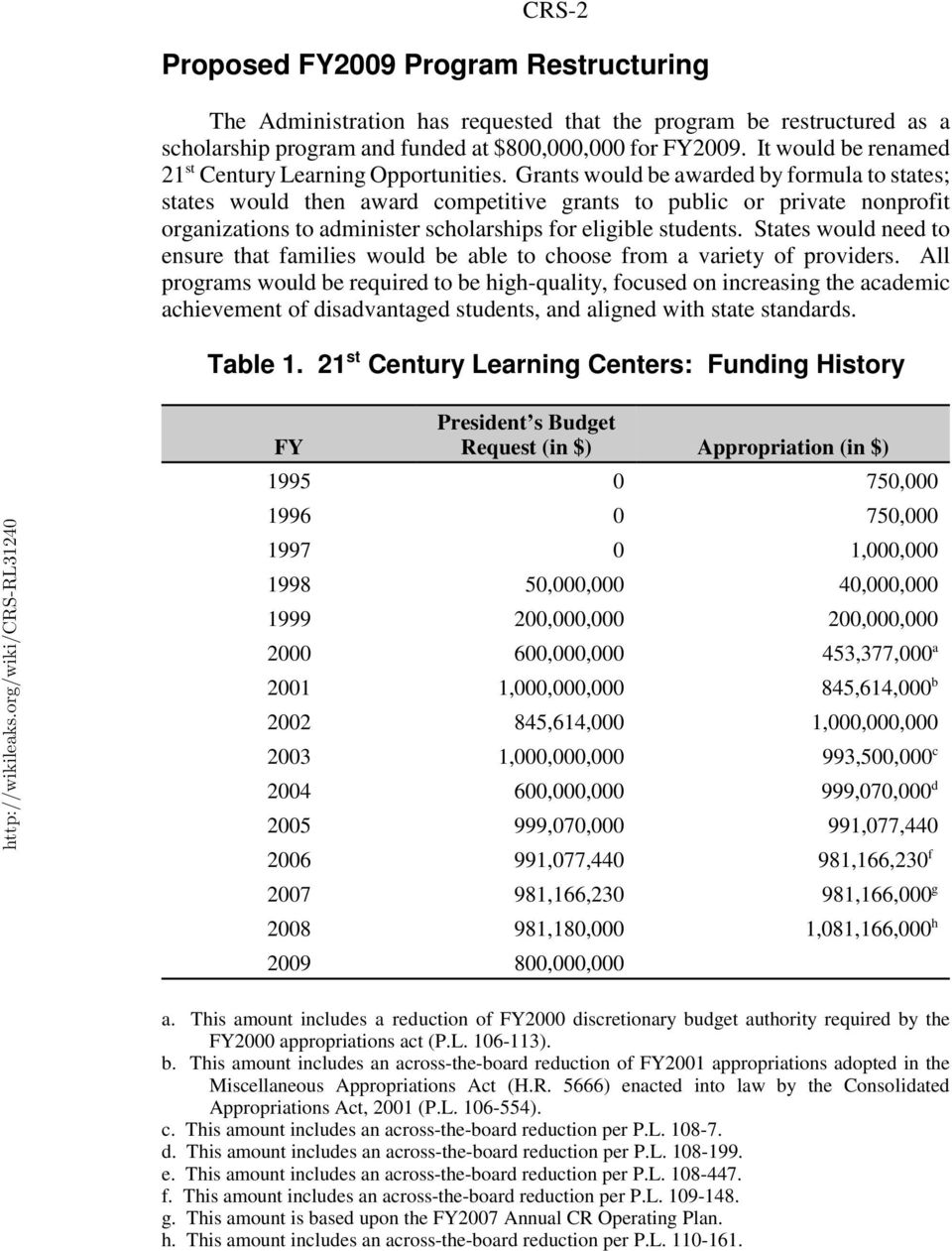
5 21 st Century Community Learning Centers: Background and Funding Introduction The Elementary and Secondary Education Act (ESEA), including the 21 st Century Community Learning Centers program (21 st CCLC), ESEA Title IV-B, is being considered for reauthorization by the 110 th Congress. The CCLC program was last reauthorized in 2002 as part of the No Child Left Behind Act (P.L ) with a new location (Title IV, Part B, 21 st Century Schools), and several substantive changes. This report provides background on the 21 st CCLC program and summarizes the major provisions of the reauthorized program. The 21 st CCLC program, as reauthorized by P.L , is structured as a formula grant program to states, in response to concerns that a program as large as the 21 st CCLC could no longer be equitably administered as a competitive grant program. In addition, the reauthorized program formally endorses a focus for the 21 st CCLC on after-school hours activities for children and youth. The 21 st CCLC program emphasizes activities during non-school hours that offer learning opportunities for children and youth. The stated purposes of the program, as reauthorized, are threefold: 1. Provide opportunities for academic enrichment to help students (particularly those attending low-performing schools) to meet state and local student academic achievement standards; 2. Offer students a wide variety of additional services, programs, and activities intended to reinforce and complement their regular academic program; and 3. Offer families of students served an opportunity for literacy and related educational development. Funding P.L authorizes the 21 st CCLC program at $1.25 billion for FY2002, $1.5 billion for FY2003, $1.75 billion for FY2004, $2 billion for FY2005, $2.25 billion for FY2006, and $2.5 billion for FY2007. The 21 st CCLC program received funding of $1,081,166,000 (includes a across-the-board reduction) for FY2008. (See Table 1 for the program s entire funding history.)
6 CRS-2 Proposed FY2009 Program Restructuring The Administration has requested that the program be restructured as a scholarship program and funded at $800,000,000 for FY2009. It would be renamed 21 st Century Learning Opportunities. Grants would be awarded by formula to states; states would then award competitive grants to public or private nonprofit organizations to administer scholarships for eligible students. States would need to ensure that families would be able to choose from a variety of providers. All programs would be required to be high-quality, focused on increasing the academic achievement of disadvantaged students, and aligned with state standards. Table st Century Learning Centers: Funding History FY President s Budget Request (in $) Appropriation (in $) , , ,000, ,000,000 40,000, ,000, ,000, ,000, ,377,000 a ,000,000, ,614,000 b ,614,000 1,000,000, ,000,000, ,500,000 c ,000, ,070,000 d ,070, ,077, ,077, ,166,230 f ,166, ,166,000 g ,180,000 1,081,166,000 h ,000,000 a. This amount includes a reduction of FY2000 discretionary budget authority required by the FY2000 appropriations act (P.L ). b. This amount includes an across-the-board reduction of FY2001 appropriations adopted in the Miscellaneous Appropriations Act (H.R. 5666) enacted into law by the Consolidated Appropriations Act, 2001 (P.L ). c. This amount includes an across-the-board reduction per P.L d. This amount includes an across-the-board reduction per P.L e. This amount includes an across-the-board reduction per P.L f. This amount includes an across-the-board reduction per P.L g. This amount is based upon the FY2007 Annual CR Operating Plan. h. This amount includes an across-the-board reduction per P.L
7 CRS-3 National Reservations From amounts appropriated in any fiscal year, the Secretary of Education shall reserve not more than 1% for national activities and not more than 1% for the outlying areas (Guam, American Samoa, the Virgin Islands, and the Commonwealth of the Northern Mariana Islands) and the Bureau of Indian Affairs. 1 Formula Grants to States The current 21 st CCLC program, unlike its predecessor, is structured as a formula grant program to states. States are awarded grants in proportion to the awards they received under Subpart 2 of Title I-A for the preceding fiscal year. All states receiving awards receive at least one-half of 1% of the total allotted for state awards. The Secretary of Education must make a written determination that a state s application is not in compliance within 120 days of its receipt, or the state s application is deemed to be approved. State educational agencies (SEAs) may use up to 2% of their award for state administration (including administrative costs, establishing and implementing a peer review process for grant applications, and supervising the awarding of funds to eligible entities). In addition, SEAs may use up to 3% of their award for other state activities (including monitoring and evaluation, training and technical assistance, and comprehensive evaluation). Competitive Local Grants SEAs must award at least 95% of their state allotment to eligible local entities (defined as local educational agencies (LEAs), community-based organizations (CBOs), other public or private entities, or consortia of one or more of the above.) This is a change from the program as originally authorized, which only permitted schools or consortia of schools (or LEAs operating on their behalf), to be directly awarded 21 st CCLC grants. 2 P.L , Section 4204 (b) (2) (D) indicates that in order to receive a 21 st CCLC grant in the reauthorized program, recipients must provide an assurance that the proposed program was developed, and will be carried out, in active collaboration with the schools the students attend. In practical terms, this means that grant recipients other than schools must partner with a school or LEA. All recipients are strongly encouraged to form a partnership; however, P.L , Section 4202 (I) (2) states that if an eligible LEA: demonstrates that it is unable to partner with a community-based organization in reasonable geographic proximity and of sufficient quality to meet the requirements of this part, then this 1 National reservations included amounts for continuation grants under the antecedent program, through the final year of funding for such grants, FY Although they were encouraged to collaborate with other public and nonprofit agencies and organizations, local businesses, educational entities, recreational, cultural, and other community and human service entities.

8 CRS-4 LEA is to be given the same priority by the SEA awarding grants as given to eligible LEAs with a partner. Grants are awarded competitively by SEAs for a period of three to five years. To the extent possible, SEAs are to distribute funds equitably among geographic areas within the state, including urban and rural communities. SEAs are to make awards only to eligible entities who will be serving students who attend schools eligible for schoolwide programs under Section 1114 (i.e., are eligible for Title I-A grants on a schoolwide basis because 40% or more of their pupils are from lowincome families), or schools that serve a high percentage of students from lowincome families; and the families of these students. SEAs are to give priority to applications that propose to target services to students who attend schools that have been identified as in need of improvement under Section 1116 (schools that fail to make adequate yearly progress for two consecutive years by state measures); and are submitted jointly by an LEA and a CBO or other public or private entity. 3 Local Uses of 21 st CCLC Grants Eligible entities may use 21 st CCLC grants for a broad array of before- and afterschool activities that advance student academic achievement, including 1. Remedial education activities and academic enrichment learning programs; 2. Mathematics and science education activities; 3. Arts and music education activities; 4. Entrepreneurial education programs; 5. Tutoring services and mentoring programs; 6. Programs that emphasize language skills and academic achievement for limited-english-proficient students; 7. Recreational activities; 8. Telecommunications and technology education programs; 9. Expanded library service hours; 10. Programs that promote parental involvement and family literacy; 11. Programs that provide assistance to improve academic achievement for students who have been truant, suspended, or expelled; 12. Drug- and violence-prevention programs, counseling programs, and character education programs. 3 Unless, as discussed above, an LEA demonstrates that it is unable to partner with a CBO of sufficient quality and reasonable geographic proximity.

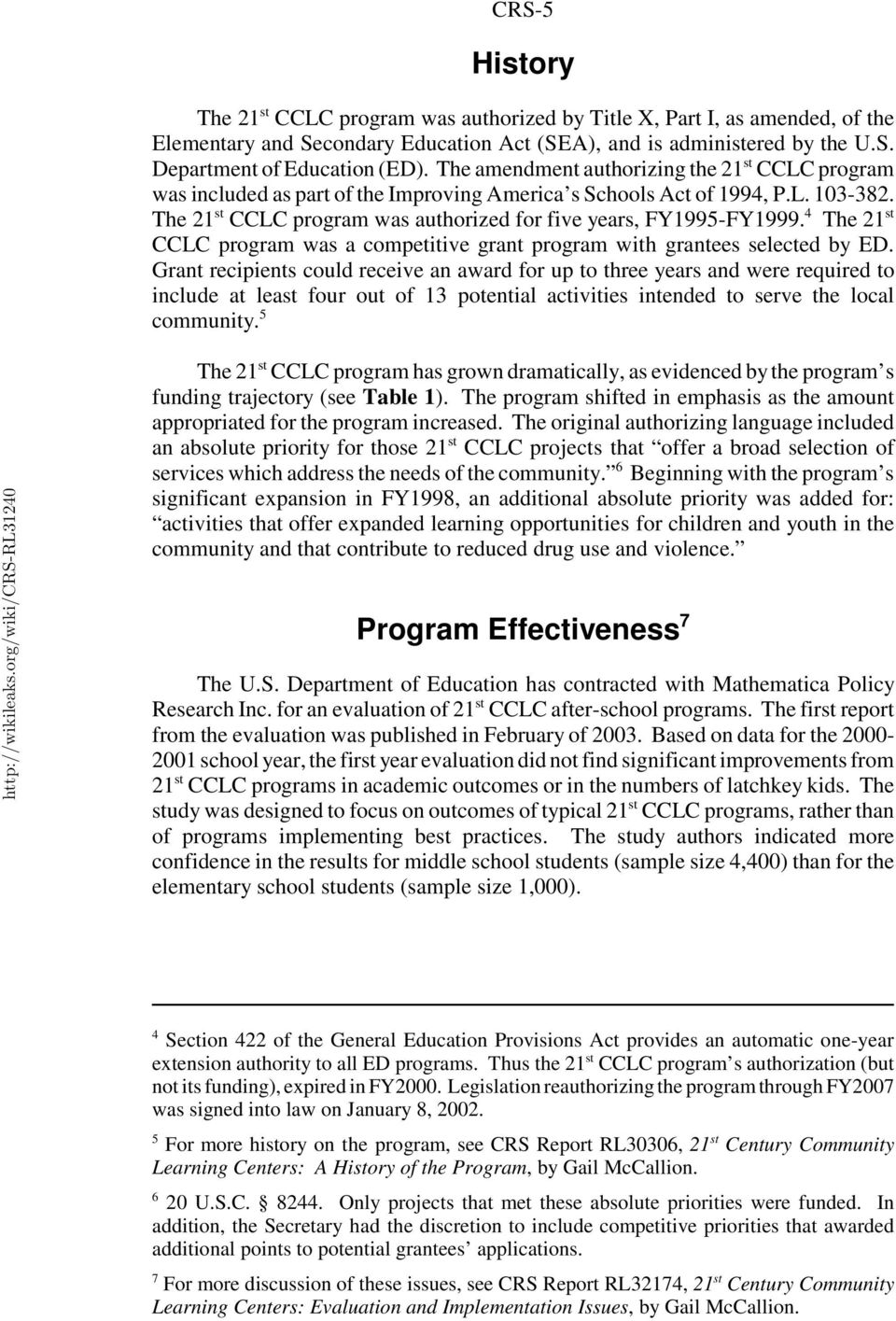
9 CRS-5 History The 21 st CCLC program was authorized by Title X, Part I, as amended, of the Elementary and Secondary Education Act (SEA), and is administered by the U.S. Department of Education (ED). The amendment authorizing the 21 st CCLC program was included as part of the Improving America s Schools Act of 1994, P.L The 21 st CCLC program was authorized for five years, FY1995-FY The 21 st CCLC program was a competitive grant program with grantees selected by ED. Grant recipients could receive an award for up to three years and were required to include at least four out of 13 potential activities intended to serve the local community. 5 The 21 st CCLC program has grown dramatically, as evidenced by the program s funding trajectory (see Table 1). The program shifted in emphasis as the amount appropriated for the program increased. The original authorizing language included an absolute priority for those 21 st CCLC projects that offer a broad selection of services which address the needs of the community. 6 Beginning with the program s significant expansion in FY1998, an additional absolute priority was added for: activities that offer expanded learning opportunities for children and youth in the community and that contribute to reduced drug use and violence. Program Effectiveness 7 The U.S. Department of Education has contracted with Mathematica Policy Research Inc. for an evaluation of 21 st CCLC after-school programs. The first report from the evaluation was published in February of Based on data for the school year, the first year evaluation did not find significant improvements from 21 st CCLC programs in academic outcomes or in the numbers of latchkey kids. The study was designed to focus on outcomes of typical 21 st CCLC programs, rather than of programs implementing best practices. The study authors indicated more confidence in the results for middle school students (sample size 4,400) than for the elementary school students (sample size 1,000). 4 Section 422 of the General Education Provisions Act provides an automatic one-year extension authority to all ED programs. Thus the 21 st CCLC program s authorization (but not its funding), expired in FY2000. Legislation reauthorizing the program through FY2007 was signed into law on January 8, For more history on the program, see CRS Report RL30306, 21 st Century Community Learning Centers: A History of the Program, by Gail McCallion U.S.C Only projects that met these absolute priorities were funded. In addition, the Secretary had the discretion to include competitive priorities that awarded additional points to potential grantees applications. 7 For more discussion of these issues, see CRS Report RL32174, 21 st Century Community Learning Centers: Evaluation and Implementation Issues, by Gail McCallion.
10 CRS-6 A second report, based on a larger sample of elementary school students and with an additional year of data on middle school students, was published in Like the first report, the second report did not find significant improvements in academic achievement or in the numbers of latchkey kids. However, it did find that elementary school students attending 21 st CCLC programs felt safer than comparison group children not attending these programs; and that the parents of elementary school children attending these programs were more likely to attend school events. 8 Mark Dynarski, Susanne James-Burdumy, Mary Moore, Linda Rosenberg, John Deke, and Wendy Mansfield, When Schools Stay Open Late: The National Evaluation of the 21 st Century Community Learning Centers Program: New Findings, U.S. Department of Education, National Center for Education Evaluation and Regional Assistance (Washington: GPO, 2004).

21 st Century Community Learning Centers
 21 st Century Community Learning Centers Non-Regulatory Guidance U.S. Department of Education Office of Elementary and Secondary Education Academic Improvement and Teacher Quality Programs February 2003
M D R w w w. s c h o o l d a t a. c o m 8 0 0-3 3 3-8 8 0 2
 MDR s Guide to Federally Funded Education Programs Major federal programs in the Education Budget for Fiscal Year 2011 are listed below. Twenty-three programs were eliminated from the FY2011 budget, including
ESEA Reauthorization Proposals in the 113 th Congress: Comparison of Major Features
 ESEA Reauthorization Proposals in the 113 th Congress: Comparison of Major Features Rebecca R. Skinner Specialist in Education Policy Jeffrey J. Kuenzi Specialist in Education Policy Cassandria Dortch
Instructions for 2015 Cohort 13 21 st Century Community Learning Centers Subgrant Application
 2015 21 st Century Community Learning Centers Subgrant Application Issued by: Education Supports and Innovative Practices Branch Supports and Improvement Resources Workgroup For more information contact:
2. What is expanded learning time (ELT) in the context of ESEA flexibility?
 1 21 st Century Community Learning Centers (21 st CCLC) Frequently Asked Questions (FAQs) Expanded Learning Time (ELT) under the ESEA Flexibility Optional Waiver I. 21 st CCLC Program Requirements 1. What
Summary of Significant Spending and Fiscal Rules in the Every Student Succeeds Act
 Summary of Significant Spending and Fiscal Rules in the Every Student Succeeds Act The Every Student Succeeds Act (ESSA), which was signed into law on December 10, 2015, makes important changes to the
DEPARTMENT OF EDUCATION
 DEPARTMENT OF EDUCATION OFFICE OF ELEMENTARY AND SECONDARY EDUCATION Federal Funds Total: Outlays. Budget Authority... Outlays.,,,, 0,, ACCELERATING ACHIEVEMENT AND ENSURING EQUITY Note. A full-year 0
School Social Work and Related Services as Delineated within Federal Law
 S C H O O L S O CI AL WO R K PR AC TI C E G UI D E School Social Work and Related Services as Delineated within Federal Law Portions of federal education law pertaining to school social work are excerpted
SUMMARY OF AND PROBLEMS WITH REPUBLICAN BILL
 SUMMARY OF AND PROBLEMS WITH REPUBLICAN BILL The Student Success Act (H.R. 5): H.R. 5 makes significant changes to Title I (Improving Academic Achievement of the Disadvantaged). It also moves current law
TITLE IX, PART E UNIFORM PROVISIONS SUBPART 1 PRIVATE SCHOOLS. Non-Regulatory Guidance
 TITLE IX, PART E UNIFORM PROVISIONS SUBPART 1 PRIVATE SCHOOLS Equitable Services to Eligible Private School Students, Teachers, and Other Educational Personnel Non-Regulatory Guidance Office of Non-Public
Adobe K 12 Education. Federal Funding for Adobe School Solutions. Carl D. Perkins Vocational and Technical Education Act of 2006
 Adobe K 12 Education Funding Overview Adobe K 12 Education Federal Funding for Adobe School Solutions Table of Contents 1: Perkins Title II, Section 207; 20 (Basic Entitlement) 2: Perkins Career Pathways
Florida s 21 st CCLC Gold Standard Practices:
 Florida s 21 st CCLC Gold Standard Practices: A Framework for Quality Afterschool Programs Florida Afterschool Network www.myfan.org INTRODUCTION Additional learning time for Florida s K-12 students is
WikiLeaks Document Release
 WikiLeaks Document Release February 2, 2009 Congressional Research Service Report RS22349 FY2006 Homeland Security Grant Guidance Distribution Formulas: Issues for the 109th Congress Shawn Reese, Government
Section 13. Title XX Social Services Block Grant Program THE EVOLUTION OF THE SOCIAL SERVICES BLOCK GRANT PROGRAM\1\
 Section 13. Title XX Social Services Block Grant Program THE EVOLUTION OF THE SOCIAL SERVICES BLOCK GRANT PROGRAM\1\ Social services for recipients of public aid were not funded under the original Social
The McKinney-Vento Homeless Assistance Act
 The McKinney-Vento Homeless Assistance Act Reauthorized January 2002 Subtitle B of title VII of the McKinney-Vento Homeless Assistance Act (42 U.S.C. 11431 et seq.) is amended to read as follows: Subtitle
Planning a NCLB Title VA Program ODE April 2007
 This document is a companion piece to the Planning a NCLB Title VA Program power point. The NCLB Title VA text and USDE Guidance referencing the items in the power point are listed by page number with
FY 2017 CONGRESSIONAL BUDGET JUSTIFICATION EMPLOYMENT AND TRAINING ADMINISTRATION. Community Service Employment for Older Americans
 FY 2017 CONGRESSIONAL BUDGET JUSTIFICATION EMPLOYMENT AND TRAINING ADMINISTRATION Community Service Employment for Older Americans This page is intentionally left blank. TABLE OF CONTENTS Appropriation
Charter Schools Program. Title V, Part B Non-Regulatory Guidance
 Charter Schools Program Title V, Part B Non-Regulatory Guidance July, 2004 Non-Regulatory Guidance Title V, Part B Charter Schools Program The Charter Schools Program CSP) was authorized in October 1994,
Robert C. Byrd Honors Scholarship Program
 Robert C. Byrd Honors Scholarship Program CHAPTER 2 Under this program, the Secretary of Education makes available, through grants to the states, scholarships to exceptionally able students for study at
1. Title IV, Part B: 21 st Century Community Learning Centers [Goals 1, 2 and 5]
![1. Title IV, Part B: 21 st Century Community Learning Centers [Goals 1, 2 and 5]](/thumbs/29/13867157.jpg "1. Title IV, Part B: 21 st Century Community Learning Centers [Goals 1, 2 and 5]") 1. Title IV, Part B: 21 st Century Community Learning Centers [Goals 1, 2 and 5] Identify the percentage of students participating in 21 st Century Community Learning Centers who meet or exceed the proficient
1. Title IV, Part B: 21 st Century Community Learning Centers [Goals 1, 2 and 5] Identify the percentage of students participating in 21 st Century Community Learning Centers who meet or exceed the proficient
reauthorization of the Elementary and Secondary Education Act (ESEA).
 Page 1 May 7, 2010 The Honorable Tom Harkin, Chairman The Honorable Mike Enzi, Ranking Member Health Education Labor Pensions Committee U.S Senate Washington, DC 20510 Dear Chairman Harkin and Ranking
Supplement, Not Supplant Handbook A Guide for Grants Administered by the Texas Education Agency
 Supplement, Not Supplant Handbook A Guide for Grants Administered by the Texas Education Agency 2013 THE TEXAS EDUCATION AGENCY Contents Supplement, Not Supplant Handbook Introduction... 2 Definition
PROGRAM AUTHORITY; AUTHORIZATION OF APPROPRIATIONS.
 Higher Education Act of 1965, 1998 Higher Education Act Amendments Subpart 2 Federal Early Outreach and Student Services Programs CHAPTER 1 FEDERAL TRIO PROGRAMS SEC. 402A. 20 U.S.C. 1070a 11 PROGRAM AUTHORITY;
United States Government Accountability Office GAO. Report to Congressional Requesters. February 2009
 GAO United States Government Accountability Office Report to Congressional Requesters February 2009 ACCESS TO ARTS EDUCATION Inclusion of Additional Questions in Education s Planned Research Would Help
WikiLeaks Document Release
 WikiLeaks Document Release February 2, 2009 Congressional Research Service Report RS22308 Student Loans and FY2006 Budget Reconciliation Adam Stoll, Domestic Social Policy Division February 14, 2006 Abstract.
Higher Education Opportunity Act Reauthorization
 Higher Education Opportunity Act Reauthorization Summary of Selected Provisions for Individuals with Exceptionalities and the Professionals who Work on their Behalf P.L. 110-315 August 2008 Table of Contents
New Markets Tax Credit: An Introduction
 Donald J. Marples Section Research Manager December 20, 2012 CRS Report for Congress Prepared for Members and Committees of Congress Congressional Research Service 7-5700 www.crs.gov RL34402 Summary The
21st Century Community Learning Center
 21st Century Community Learning Center Grant Overview The purpose of the program is to establish 21st CCLC programs that provide students with academic enrichment opportunities along with activities designed
NATIONAL PROFILE STATE AFTERSCHOOL PROFILES. Quick Facts. The Afterschool Landscape A View Across the States
 STATE AFTERSCHOOL PROFILES NATIONAL PROFILE This national profile provides a picture of afterschool programs across all 50 states and the District of Columbia. It includes information about promising state
Youth Employment Transportation Briefs
 Youth Employment Transportation Briefs Brief #3: Federal Funding for Youth Employment-Related Transportation December 2006 Compiled by April Kaplan on behalf of the Community Transportation Association
Frequently Asked Questions on the No Child Left Behind Consolidated Application FAQ NCLB. Illinois State Board of Education
 Frequently Asked Questions on the No Child Left Behind Consolidated Application FAQ NCLB Illinois State Board of Education How do I add a new school onto targeting step 4? If information is incorrect in
School and Campus Safety Programs and Requirements in the Elementary and Secondary Education Act and Higher Education Act
 Order Code RL33980 School and Campus Safety Programs and Requirements in the Elementary and Secondary Education Act and Higher Education Act April 27, 2007 Rebecca R. Skinner and Gail McCallion Specialists
One Hundred Ninth Congress of the United States of America
 S. 250 One Hundred Ninth Congress of the United States of America AT THE SECOND SESSION Begun and held at the City of Washington on Tuesday, the third day of January, two thousand and six An Act To amend
Arizona Department of Education 21 st Century Community Learning Centers Grant Online Application Training Cycle 11
 Arizona Department of Education 21 st Century Community Learning Centers Grant Online Application Training Cycle 11 http://www.azed.gov/century-learning-centers/ 1 Arizona Department of Education 21 st
Subpart 1 Federal Pell Grants
 TITLE IV STUDENT ASSISTANCE PART A GRANTS TO STUDENTS IN ATTENDANCE AT INSTITUTIONS OF HIGHER EDUCATION SEC. 400. ø20 U.S.C. 1070 STATEMENT OF PURPOSE; PROGRAM AUTHORIZATION. (a) PURPOSE. It is the purpose
CLIP (COMPREHENSIVE LEA IMPROVEMENT PLAN)
 CLIP (COMPREHENSIVE LEA IMPROVEMENT PLAN) Consolidated Application Program Review Paulding County School District FY16 Focused on Learning 1 Table of Contents Title VI-B section 611 of the Individuals
In society today, technology, education, and economic growth go hand in hand.
 181 APPENDIX A Federal Programs to Increase Children s Access to Educational Technology Linda G. Roberts In society today, technology, education, and economic growth go hand in hand. Technological literacy
DEPARTMENT OF EDUCATION
 DEPARTMENT OF EDUCATION Funding Highlights: Provides $77.4 billion. The Budget includes a significant increase for K-12 education, while making tough choices to put the Pell Grant program on a sustainable
DEPARTMENT OF EDUCATION
 DEPARTMENT OF EDUCATION Funding Highlights: Provides $77.4 billion. The Budget includes a significant increase for K-12 education, while making tough choices to put the Pell Grant program on a sustainable
Workforce Innovation and Opportunity Act Frequently Asked Questions July 22, 2014
 Workforce Innovation and Opportunity Act Frequently Asked Questions July 22, 2014 The following Frequently Asked Questions are drafted in the context of the Workforce Innovation and Opportunity Act (WIOA)
CRS Report for Congress
 Order Code RL31575 CRS Report for Congress Received through the CRS Web Consolidation Loan Provisions in the Federal Family Education Loan and Direct Loan Programs Updated November 16, 2004 Adam Stoll
Serving Preschool Children Through Title I
 Serving Preschool Children Through Title I Part A of the Elementary and Secondary Education Act of 1965, as Amended NON-REGULATORY GUIDANCE U. S. Department of Education u l u l u l u l u l u l u l u l
SUMMARY OF THE EVERY STUDENT SUCCEEDS ACT, LEGISLATION REAUTHORIZING THE ELEMENTARY AND SECONDARY EDUCATION ACT
 SUMMARY OF THE EVERY STUDENT SUCCEEDS ACT, LEGISLATION REAUTHORIZING THE ELEMENTARY AND SECONDARY EDUCATION ACT Legislative History A conference committee met on November 18 and 19 to resolve the differences
IRA Legislative Update August 11, 2008. Overview
 IRA Legislative Update August 11, 2008 Overview The Congressional session only has a few short weeks left before it ends on 26 September. During that time it is anticipated that the funding process for
U.S. Department of Education. 36th Annual Report to Congress on the Implementation of the Individuals with Disabilities Education Act, 2014
 U.S. Department of Education 36th Annual Report to Congress on the Implementation of the Individuals with Disabilities Education Act, 2014 Discrimination Prohibited Sec. 504(a) of the Rehabilitation Act
Small Business Management and Technical Assistance Training Programs
 Small Business Management and Technical Assistance Training Programs Robert Jay Dilger Senior Specialist in American National Government January 24, 2014 Congressional Research Service 7-5700 www.crs.gov
Accountability and Virginia Public Schools
 Accountability and Virginia Public Schools 2008-2009 School Year irginia s accountability system supports teaching and learning by setting rigorous academic standards, known as the Standards of Learning
TITLE II New Grant Programs
 TITLE II New Grant Programs PART B--ENHANCING TEACHER EDUCATION SEC. 230. AUTHORIZATION OF APPROPRIATIONS. There are authorized to be appropriated to carry out this part such sums as may be necessary for
Cash Versus Accrual Accounting: Tax Policy Considerations
 Cash Versus Accrual Accounting: Tax Policy Considerations Raj Gnanarajah Analyst in Financial Economics Mark P. Keightley Specialist in Economics April 24, 2015 Congressional Research Service 7-5700 www.crs.gov
Older Americans Act of 1965: Programs and Funding
 T H E B A S I C S FEBRUARY 23, 2012 Older Americans Act of 1965: Programs and Funding In 1965, Congress enacted the Older Americans Act, which established the U.S. Administration on Aging (AoA) and state
UNITED STATES DEPARTMENT OF EDUCATION OFFICE OF INSPECTOR GENERAL. March 15, 2007
 UNITED STATES DEPARTMENT OF EDUCATION OFFICE OF INSPECTOR GENERAL March 15, 2007 Audit Services Chicago/Kansas City Audit Region Control Number ED-OIG/A05G0034 Dr. Suellen Reed State Superintendent of
State Plan for the State Vocational Rehabilitation Services Program and State Plan Supplement for the State Supported Employment Services Program
 Page 1 of 64 Screen 1 of 17 State Plan for the State Vocational Rehabilitation Services Program and State Plan Supplement for the State Supported Employment Services Program Indiana State Plan for Fiscal
Small Business Administration Microloan Program
 Small Business Administration Microloan Program Robert Jay Dilger Senior Specialist in American National Government August 4, 2015 Congressional Research Service 7-5700 www.crs.gov R41057 Summary The Small
Small Business Administration Microloan Program
 Small Business Administration Microloan Program Robert Jay Dilger Senior Specialist in American National Government November 30, 2015 Congressional Research Service 7-5700 www.crs.gov R41057 Summary The
Juvenile Justice: Legislative History and Current Legislative Issues
 Juvenile Justice: Legislative History and Current Legislative Issues Kristin M. Finklea Specialist in Domestic Security November 27, 2012 CRS Report for Congress Prepared for Members and Committees of
NYS Office of Children and Family Services
 ADOPTION ASSISTANCE Objective: Funds adoption subsidy costs for children with special needs. Administering Agency: ; US Department of Health and Human Services NYS Object Code: 62402, 62405 Year Established: