
Internal Responses to Informal Learning Data: Testing a Rapid Commissioning Approach
|
|
|
- Cathleen Daniels
- 10 years ago
- Views:
Transcription
1 Internal Responses to Informal Learning Data: Testing a Rapid Commissioning Approach Patrina Law, Leigh-Anne Perryman, The Open University, United Kingdom Introduction There are several unique aspects to researching the behaviour and motivations of informal learners. Examining informal learning data can allow researchers to respond more quickly, and at a greater scale, than to data gathered through formal institutional research processes. Studies undertaken in 2013 (Law, Perryman & Law, 2013; Perryman, Law & Law, 2013; Law, Perryman & Law, 2014), in collaboration with The Open University s OER Research Hub ( provided a set of recommendations for The Open University (OU) around informal learning. These primarily drove the OU s commissioning approach to scope new content for informal learning channels during 2014 and to improve the usability of OpenLearn the key platform on which free resources are delivered by the OU ( This paper reports on the impact of research undertaken in 2013 and 2014 into informal learning on the OpenLearn platform and shows how simple research models in the open can bring about change in a short period of time. Background OpenLearn and itunes U OpenLearn ( is the OU s web-based platform for free educational resources and was launched in It hosts hundreds of online courses and videos and is accessed by over 5 million users a year; most of the resources are available under a Creative Commons licence. It also serves as the medium through which the OU promotes its partnership with the BBC and the related broadcasting and free open access courses and content that are created as co-productions with them. Since its launch, OpenLearn has received 33.4 million unique visitors (internal OU data) and has developed from being a platform that hosts units from decommissioned undergraduate and postgraduate courses, to one which hosts commissioned interactive games, videos, podcasts and free online courses. Much of the course extract content is developed using structured authoring tools and then made available to users 76
2 in multiple formats such as Microsoft Word and epub (that can be opened by ebook readers). The development of OpenLearn was initially funded by the William and Flora Hewlett Foundation in 2006 along with its sister website OpenLearn Works, a platform where NGOs and philanthropically-funded projects can publish, remix and reuse courses targeted to specific populations. With the end of the Hewlett Foundation grant, OpenLearn and OpenLearn Works became mainstream activities for the OU and now form part of one of the University s strategic priorities the Journey from Informal to Formal learning as part of The OU s commitment to widening participation. The OU aims that 5% of each of its courses should be made available on OpenLearn in whole, meaningful units, some of which are embellished with interactive quizzes and additional audio visual content. For the period August 2013 to July 2014, The OU reports a 10.8% click-through rate from OpenLearn to the Study at the OU webpage to learn more about becoming an OU student. Since 2008, The OU has also made available hundreds of ebooks, courses, audio and video via its channel on itunes U. Many of the audio and video files are elements of larger projects and courses produced for its fee-paying students, or specifically commissioned to be Open Educational Resources (OER) and shared across several open platforms i.e. OpenLearn and YouTube as well as itunes U. As an institution specialising in producing higher education (HE) content for distance learners, the aim of this approach is a natural extension of the University s mission to further make available its OER, but also to reach a growing population of mobile device users. At time of writing, there have been 67.1 million downloads and 8.6 million visitors to The OU on itunes U. For the period August 2013 to July 2014, The OU reports a 0.8% click-through rate from itunes U to an OU web domain (OU internal statistics). 77

3 Studies and recommendations from 2013 In 2013 a study was undertaken to analyse and compare the demographics of The OU s informal learners, students and educators who are using OpenLearn and/or itunes U. In addition an analysis was made of what content these three categories of users were using, how they were using it and how using these OER motivated them or otherwise to progress to formal education. The objectives of the study were to: Understand as far as possible, how the content provided as OER through the OpenLearn and itunes U platforms serves the demographic using them, and Understand more about how the widespread offering of OER is impacting learners motivations to take up formal study. These objectives aligned with two of the OER Research Hub project hypotheses, and hence could form part of the data set collected by that project (see oerresearchhub.org): Open education models lead to more equitable access to education, serving a broader base of learners than traditional education, and Open education acts as a bridge to formal education, and is complementary, not competitive, with it. In addition to this research activity, pilot projects around digital badging at The OU were undertaken in 2013 on OpenLearn using the Mozilla Open Badge Infrastructure (OBI) (see openbadges.org). Digital badges were awarded via three entry-level Openings courses (access level): Learning to Learn and Succeed with Maths Parts 1 and 2 for the successful completion of the course and passing of quizzes. The evaluation of these pilots was in alignment with the study of the wider OpenLearn and itunes U platforms in that it gathered identical demographic data and asked questions about informal learner motivation. Findings from both studies were reported in (Law, Perryman & Law, 2013; Perryman, Law & Law, 2013; Law, Perryman & Law, 2014) and recommendations were delivered internally to inform the business of informal learning commissioning at The OU. The studies concluded that: The two different informal learning platforms were being used by very different demographic groups with different motivations, Using OER during formal paid-for study can improve learners performance and self-reliance, 78
4 Learners motivation is enhanced through the provision of digital badges, University-provided OER acts as a taster before embarking on formal learning, The same free content on different platforms can meet the needs of both professional and personal development but that work was needed to improve the learner experience, and The badged open courses attracted learners who were more inclined to become students and were key to meeting The OU s widening participation agenda (there were significant variations in relation to prior education, numbers of retired learners and numbers of learners reporting a disability compared to OpenLearn and itunes U users overall). Based on these conclusions, the recommendations that were made within The OU were as follows: 1. Create an entire Badged Open Course (BOC) curriculum targeting access students (work to be completed in October 2014, see Law, Perryman & Law, 2014), 2. Improve the usability of OpenLearn especially around the user experience of studying an online, unsupported course, and 3. Extend syndication to reach new audiences. Contextualising 2013 data and building on it Over the last year, a range of methods have been developed that allow organisations and individuals to create and issue digital open badges (Bull, 2014). The rise in such developments is largely in response to the demand to issue badges and the range of achievements that can be recognised digitally. Bixler and Layng (2013) note that digital badges in higher education hold great promise but that policies on badges for higher education institutions do not exist. This is still largely true although the Badge Alliance (a group of volunteers discussing the potential use of badging for different groups largely based in the US, see badgealliance.org), is, amongst other things, taking case studies and innovations from contributors to build a picture for badge use within HE. This growing interest in soft assessment and badging was also identified by Grant and Shawgo (2013) and highlights that learners want recognition for informal study. This challenges the notion of informal learning described by Cross (2007) as one where...no one assigns grades and...no one takes attendance. In this age of paid-for certification for MOOC participation this notion has changed, as whilst learning is still 79

5 taking place as a supplement to formal learning there is a growing demand and expectation that informal learners want recognition for their achievements and engagement. This is reflected in the data from the 2013 and 2014 studies on OpenLearn (see Results). The MOOC phenomenon has also impacted learners expectations of OpenLearn. Of the 5.3 million users visiting each year, the majority are searching for course-related content over short interactive learning pieces, joint OU/BBC programme information and blogs, which the site also hosts. Table 1 shows the search criteria for learners visiting the OpenLearn homepage for the period August 2013 July 2014 (data excluded where search term is not known) (internal data). Table 1: Known search terms for learners visiting the OpenLearn home page Known search terms Percentage open university / the open university / open university uk 47% free online courses / open university free courses / online courses / free courses / free 32% online courses uk / free open university courses openlearn / open learn / study skills 21% By repeating the study undertaken in 2013, we were able to compare data to: i) evaluate whether demographic data from the 2014 study concurred with 2013 data, and ii) if any notable changes had occurred in attitudes towards informal learning provision, learners expectations and goals. Results The following table shows a summary of the demographic data for studies undertaken in 2013 and 2014 on OpenLearn showing that 2014 data concurs with 2013 data. (There are some variations in age range following a revision for the 2014 surveys.) (Notable variations are shown in bold italics.) 80

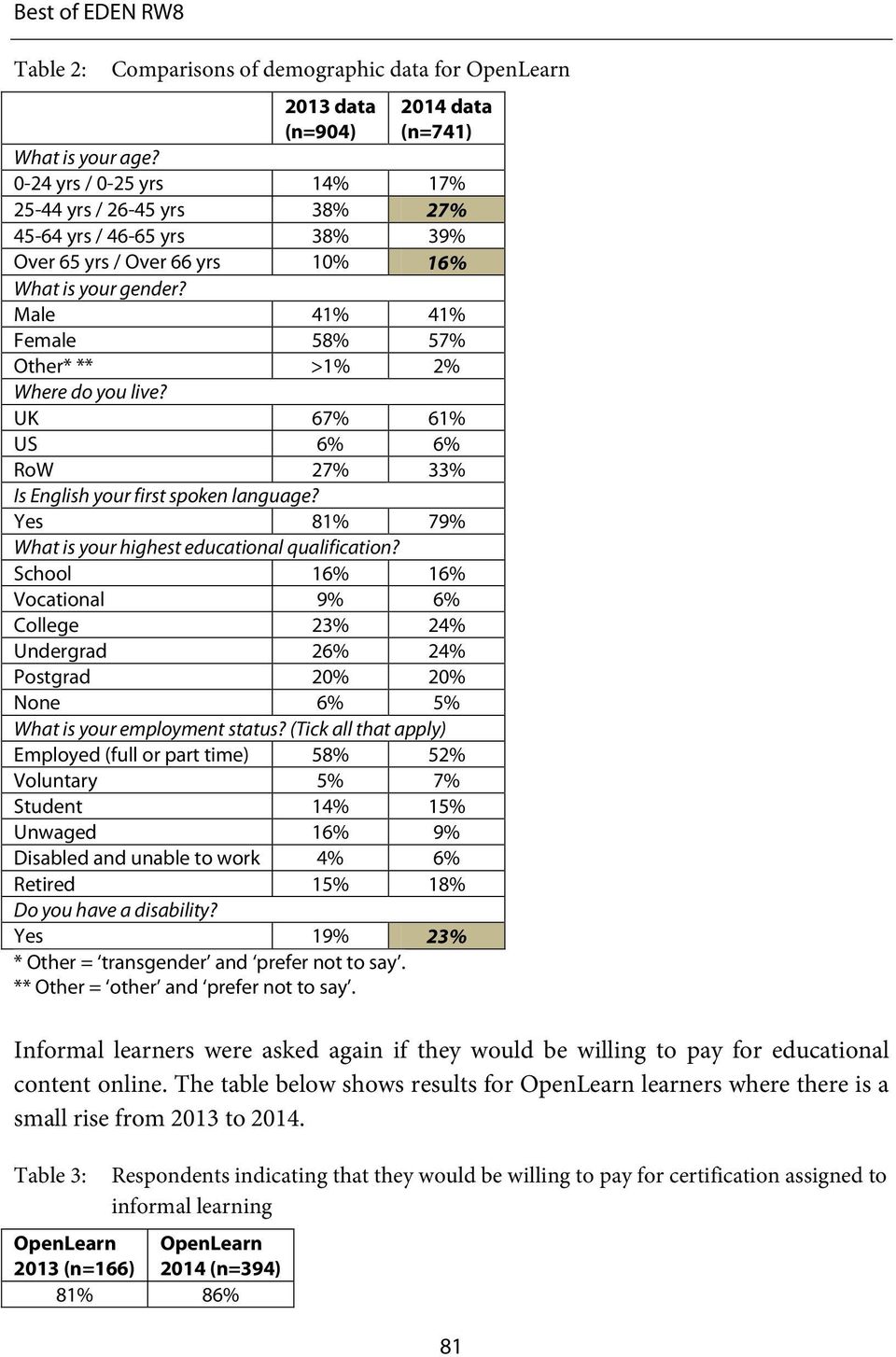
6 Table 2: Comparisons of demographic data for OpenLearn 2013 data (n=904) 2014 data (n=741) What is your age? 0-24 yrs / 0-25 yrs 14% 17% yrs / yrs 38% 27% yrs / yrs 38% 39% Over 65 yrs / Over 66 yrs 10% 16% What is your gender? Male 41% 41% Female 58% 57% Other* ** >1% 2% Where do you live? UK 67% 61% US 6% 6% RoW 27% 33% Is English your first spoken language? Yes 81% 79% What is your highest educational qualification? School 16% 16% Vocational 9% 6% College 23% 24% Undergrad 26% 24% Postgrad 20% 20% None 6% 5% What is your employment status? (Tick all that apply) Employed (full or part time) 58% 52% Voluntary 5% 7% Student 14% 15% Unwaged 16% 9% Disabled and unable to work 4% 6% Retired 15% 18% Do you have a disability? Yes 19% 23% * Other = transgender and prefer not to say. ** Other = other and prefer not to say. Informal learners were asked again if they would be willing to pay for educational content online. The table below shows results for OpenLearn learners where there is a small rise from 2013 to Table 3: Respondents indicating that they would be willing to pay for certification assigned to informal learning OpenLearn OpenLearn 2013 (n=166) 2014 (n=394) 81% 86% 81
7 Table 4: Responses to the question Which of the following free educational sites or resources do you use in addition to OpenLearn? (Learners could select more than one option.) Platform 2013 responses 2014 responses itunes U 22% 16% YouTube 25% 32% TED 23% 25% Khan 11% 15% MIT OpenCourseWare 12% 13% BBC Learning 45% 41% Coursera 15% 17% Open Yale 4% 5% None of these 25% 13% Internal response to research data Within a period of three months of analysing the data from the 2013 studies, the researchers recommendations were acted upon internally: the relevant governance approval to proceed was requested; the BOC project team was formed and the IT requirements were initiated. In this way, a close relationship and feedback between institutional research and the business of informal learning provision was developed. By repeating these studies in 2014, we were able to show concurrence between 2013 and 2014 data and be content that the recommendations following the 2013 were for the right reasons. New channels for syndication of content have been established to reach new learners: free ebooks are now distributed through Google Play (play.google.com) (and shortly through Kindle); audio files are now shared on AudioBoo ( and audio and video on Bibblio (bibblio.org) where thousands of new learners have found free educational content. Whilst we recognise that the majority of learners using educational content in English are educated and employed, we also recognise that a minority are not but that a small percentage of several million learners in this category is still a lot of learners. This response to data, afforded by informal learning structures and created through simple research methods provides The Open University with a rapid response to changes in the focus of the informal learning curriculum that would be difficult to replicate in the formal curriculum. Additionally, understanding the usability challenges of learners using OpenLearn as a course environment has required the OU to make modifications to the Moodle platform, based on our understanding of 82

8 learners interactions with it and with each other information which can be fed back to the formal student learning experience. Our research evaluating methods of assessment in the open through the badged open courses project and exploring how underserved and less educated groups can be motivated in an unsupported environment, will again provide an opportunity to impact on informal learners experience in addition to that of the OU s formal students. Recommendations from the 2014 studies will the subject of future papers. However, whilst the approach to issue a suite of access-level badged open courses on OpenLearn was largely based on data and a desire to meet the needs of a widening participation group, the discussion has extended to how we might serve other groups and to challenge how we recognise informal learning achievements beyond the issuing of certificates. Whilst FutureLearn, Coursera and other MOOC platforms charge for their certification, The OU will maintain the issuing of badges as recognition of informal learning for free. One of the questions for us researching informal learning in 2014/15 will be understanding whether learners perceptions of paid-for certification as a recognition of achievement in informal learning has a greater value than that which is provided for free. Conclusions and next steps We now have a good picture of our learners studying informally on OpenLearn and via third party platforms such as itunes U. We recognise from both 2013 and 2014 data that our learners on OpenLearn are somewhere between Secondary and Tertiary OER users according to Martin Weller s iceberg model of OER engagement i.e. that they do have an awareness of OERs in general (Secondary), but have little or no interest in licensing of content and are consuming rather than creating (Tertiary) (Weller, 2014). In fact, data from the 2014 study shows that awareness of free learning content is increasing (see Table 4). In the light of greater numbers of universities participation in MOOC provision, availability of free informal learning content is increasing as is the understanding of what it means to deliver to open platforms and to third party platforms. To research informal learning, assessment in the open (via badged open courses) and to gain a better understanding of who our learners are and what motivates them is ever more important. To exploit the rapid feedback from data to commissioning enables us to both positively influence the learning experience and to share findings openly. 83
9 References 1. Bixler, B. and Layng, K. (2013). Digital Badges in Higher Education: An Overview. [Google document] Available from [Accessed 25 August 2014] 2. Bull, B. (2014). Want to issue open badges? Here are some options. Online Blog: Etele Life & Learning in the Digital World, 27 July Available from [Accessed 25 August 2014] 3. Cross, J. (2007). Informal Learning. California, 2007: John Wiley and Sons, Inc. 4. Grant, S. and Shawgo, K.E. (2013). Digital Badges: An Annotated Research Bibliography v1. Available from [Accessed 27 August 2014] 5. Law, P.; Perryman, L-A. and Law, A. (2013). Open educational resources for all? Comparing user motivations and characteristics across The Open University s itunes U channel and OpenLearn platform. In proceedings of Open and Flexible Higher Education Conference, (pp ). 2013, October 2013, Paris, European Association of Distance Teaching Universities (EADTU). 6. Law, P.; Perryman, L-A. and Law, A. (2014). Badging and employability at The Open University. In proceedings of European Distance and E-Learning Network (EDEN) 2014 Annual Conference, June 2014, Zagreb. 7. Perryman, L-A.; Law, P. and Law, A. (2013). Developing sustainable business models for institutions provision of open educational resources: Learning from OpenLearn users motivations and experiences. In proceedings of Open and Flexible Higher Education Conference, (pp ). 2013, October 2013, Paris, European Association of Distance Teaching Universities (EADTU) Weller, M. (2014). The Iceberg Model of OER Engagement. Online blog: The Ed Techie, 7 July Available from [Accessed 27 August 2014] 84
![org/main/2014/07/27/want-to-issue-open-badges-here-are-someoptions/. [Accessed 25 August 2014] 3. Cross, J. (2007). Informal Learning. California, 2007: John Wiley and Sons, Inc. 4. Grant, S.](/docs-images/51/13742265/images/page_9.jpg "and Shawgo, K.E. (2013). Digital Badges: An Annotated Research Bibliography v1. Available from http://www.hastac.org/digital-badgesbibliography. [Accessed 27 August 2014] 5. Law, P.; Perryman, L-A.")
The Open University s repository of research publications and other research outputs
 Open Research Online The Open University s repository of research publications and other research outputs E-Learning and support tools for Information and Computer Sciences Conference Item How to cite:
ACCREDITATION. APM Corporate CASE STUDY
 Introduction Established in 1969, The Open University (OU) was the world s first successful distance teaching university, founded on the belief that communications technology could bring high quality,
Creative media and digital activity
 Creative media and digital activity This information sheet is for prospective applicants to the Grants for the arts programme, who will be applying from 1 July 2013. Please also read our How to apply guidance
ABERDEEN COLLEGE ENTERPRISE IN EDUCATION STRATEGY
 ABERDEEN COLLEGE ENTERPRISE IN EDUCATION STRATEGY Revision Date: 20 January 2012 Aberdeen College. All rights reserved. ENTERPRISE IN EDUCATION STRATEGY 1.0 Background to Enterprise in Education Enterprise
QUEEN S UNIVERSITY BELFAST. e-learning and Distance Learning Policy 2009-2012
 QUEEN S UNIVERSITY BELFAST e-learning and Distance Learning Policy 2009-2012 1 Introduction The University defines e-learning as learning facilitated and supported through the use of information and communication
The online, open and flexible higher education conference 2015
 The online, open and flexible higher education conference 2015 Transforming higher education in the 21st century; innovating pathways to learning and continuous professional education Hagen Message, 1
Marketing, Recruitment and Admissions. Marketing Strategy 2013-2015
 Marketing, Recruitment and Admissions Marketing Strategy 2013-2015 November 2013 The Marketing Strategy is created cooperatively by the Department s marketing managers and exists to advance the University
D5.5 Initial EDSA Data Management Plan
 Project acronym: Project full : EDSA European Data Science Academy Grant agreement no: 643937 D5.5 Initial EDSA Data Management Plan Deliverable Editor: Other contributors: Mandy Costello (Open Data Institute)
Marketing Guide for Authors
 Marketing Guide for Authors About Marketing at Wolters Kluwer Wolters Kluwer has a reputation for delivering authoritative content that delivers vital insights and guidance from subject matter experts.
Event Safety Diploma. Work Based Learning Framework
 Event Safety Diploma Work Based Learning Framework Table of Contents 1.0 SECTION ONE: GENERAL INFORMATION... 1 1.1 PROGRAMME TITLE... 1 1.2 MINOR AWARDS... 1 1.3 MODE OF STUDY... 1 1.4 PROGRAMME START
Knowsley Community College
 Knowsley Community College Inspection report Provider reference 130486 Published date April 2008 Audience Post-sixteen Published date April 2008 Provider reference 130486 Inspection report: Knowsley Community
IN PARTNERSHIP WITH PLYMOUTH UNIVERSITY. Highlands. Opportunities Achievement Success. Information Technology for Business Degrees
 Highlands Opportunities Achievement Success IN Information Technology for Business Degrees Introduction Plymouth University in partnership with Highlands College offers unrivalled expertise and experience
The move to Moodle: Perspective of academics in a College of Business
 The move to Moodle: Perspective of academics in a College of Business Dr Robyn Walker College of Business, Massey University Associate Professor Mark Brown Office of the Assistant Vice Chancellor (Academic
Masifunde. Developing an online study skills course as a free resource for first generation university entrants in southern Africa
 Masifunde. Developing an online study skills course as a free resource for first generation university entrants in southern Africa T.D. Wyatt, Oxford University, Oxford, UK [email protected]
Programme Specification for MSc Applied Sports Performance Analysis
 PROGRAMME SPECIFICATION Postgraduate Courses Programme Specification for MSc Applied 1. Awarding institution/body University of Worcester 2. Teaching institution University of Worcester 3. Programme accredited
Entrepreneurship: The First MOOC in Malaysia. Muhstak Al Atabi
 Entrepreneurship:TheFirstMOOCinMalaysia MuhstakAl Atabi Abstract Massive Open Online Courses (MOOCs) appear to be a very hot topic in the education circles with the promise to change the world educational
Honours Degree (top-up) Business Abbreviated Programme Specification Containing Both Core + Supplementary Information
 Honours Degree (top-up) Business Abbreviated Programme Specification Containing Both Core + Supplementary Information 1 Awarding Institution / body: Lancaster University 2a Teaching institution: University
Preprint of: Nicholson, S. (2010). Inviting the world into the online classroom: Teaching a gaming in
 Preprint of: Nicholson, S. (2010). Inviting the world into the online classroom: Teaching a gaming in libraries course via YouTube. Journal of Education for Library and Information Science, 51(4). Inviting
Level 4 Diploma in Advanced Hospitality and Tourism Management (VRQ) Qualification Syllabus
 Level 4 Diploma in Advanced Hospitality and Tourism Management (VRQ) Qualification Syllabus Contents Page 1. The Level 4 Diploma in Advanced Hospitality and Tourism Management Syllabus 4 2. Structure of
* A Practical Response to. Massive Open Online Courses (MOOCs)
 A Practical Response to Massive Open Online Courses (MOOCs) MODERATOR Kenneth C. Green, founding director of The Campus Computing Project PANELISTS Pamela A. Havice, Ph.D., Associate Professor Clemson
Country Report on Adult Education in IRELAND
 Country Report on Adult Education in IRELAND Helsinki, 2011 Please check our website for the latest version of this country report via the following url or QR-code, or contact us directly at eaea-info[at]eaea.org.
CAM DIPLOMA IN DIGITAL MARKETING (MOBILE)
 ONLINE LONDON CAM DIPLOMA IN MARKETING (MOBILE) A practical introduction to good practice in mobile marketing The direct study centre of CAM DIPLOMA IN MARKETING (MOBILE) i OUR PROFESSIONAL QUALIFICATIONS:
Making a Difference: Choose OER to Lower Costs and Optimize Learning
 Making a Difference: Choose OER to Lower Costs and Optimize Learning Karen Vignare, Ph.D., Sharon Biederman Brosch Center for Innovation in Learning, Instructional Services & Support, University of Marland
SYLLABUS. Cambridge O Level. Second Language Urdu. For examination in June and November 2016. Cambridge Secondary 2. www.theallpapers.
 SYLLABUS Cambridge O Level Second Language Urdu 3248 For examination in June and November 2016 Cambridge Secondary 2 Changes to syllabus for 2016 This syllabus has been updated, but there are no significant
Comparative Analysis of Massive Open Online Course (MOOC) Platforms
 Comparative Analysis of Massive Open Online Course (MOOC) Platforms Malathi Sriram, SDM Institute for Management Development, Karnataka, India. Email: [email protected] Abstract The paper is exploratory
SEQUENT Supporting Quality in E-learning European Networks 14-11-2014 EQAF Barcelona. George Ubachs (EADTU)
 SEQUENT Supporting Quality in E-learning European Networks 14-11-2014 EQAF Barcelona George Ubachs (EADTU) Main challenges in Higher Education Challenges with regard to excellence in teaching Large student
Building an Effective Approach
 White paper Getting Started with Content Marketing Building an Effective Approach Executive Summary For the marketer who has long been responsible for the website, the shift to a content marketing mindset
PROGRAMME SPECIFICATION University Certificate Psychology. Valid from September 2012. Faculty of Education, Health and Sciences -1 -
 Faculty of Education, Health and Sciences PROGRAMME SPECIFICATION University Certificate Valid from September 2012-1 - www.derby.ac.uk/ehs CONTENTS SECTION ONE: GENERAL INFORMATION... 1 SECTION TWO: OVERVIEW
Enhancing teaching and learning at UCL: the Access to Core Course Materials Project and the Key Skills Web Development Project
 Enhancing teaching and learning at UCL: the Access to Core Course Materials Project and the Key Skills Web Development Project Abstract: Reports on two projects at University College London (UCL) involving
International Students' Attitudes to Postgraduate Study in Australia and New Zealand Survey 2013
 International Students' Attitudes to Postgraduate Study in Australia and New Zealand Survey 2013 Introduction Working with StudyOptions, our survey aimed to find out potential postgraduate students' attitudes
PROGRAMME SPECIFICATION
 PROGRAMME SPECIFICATION Course record information Name and level of final award: Name and level of intermediate awards: The BSc (Hons) Computer Science is a B.Sc. BSc (Hons) Computer Science with Industrial
Employability of Graduates in Sport
 Employability of Graduates in Sport Needs Analysis (Work Package 2) Executive Summary University of Gloucestershire June, 2014 Copyright, University of Gloucestershire (2014). Acknowledgements We are extremely
Honours Degree (top-up) Computing Abbreviated Programme Specification Containing Both Core + Supplementary Information
 Honours Degree (top-up) Computing Abbreviated Programme Specification Containing Both Core + Supplementary Information 1 Awarding Institution / body: Lancaster University 2a Teaching institution: University
Community Learning and Skills Service. Contract Management 2015/16. Guidance for providers. Slough and RBWM
 Community Learning and Skills Service Contract Management 2015/16 Guidance for providers Slough and RBWM CONTENTS 1. Purpose... 3 2. About East Berkshire Community Learning and Skills Service... 4 3.
CAM DIPLOMA IN DIGITAL MARKETING (METRICS AND ANALYTICS)
 CAM DIPLOMA IN MARKETING (METRICS AND ANALYTICS) Understand and exploit the opportunities available through analysis of your digital activities and the monitoring of your social media channels ONLINE LONDON
Report To: Education & Lifelong Learning Date: 13 March 2012. Contact Officer: Wilma Bain (Head of Education) Contact No: 01475 712891
 AGENDA ITEM NO. 5 Report To: Education & Lifelong Learning Date: 13 March 2012 Report By: Corporate Director Education and Communities Report No: EDUC/12/12/WB Contact Officer: Wilma Bain (Head of Education)
Marketing Officer - CRM (Maternity Cover)
 Marketing Officer - CRM (Maternity Cover) Corporate Services Division of External Relations Salary Grade 6-25,759 to 29,837 per annum, Fixed term contract from 1 st April 2014 to 31 st March 2015 (** see
Examining Students Performance and Attitudes Towards the Use of Information Technology in a Virtual and Conventional Setting
 The Journal of Interactive Online Learning Volume 2, Number 3, Winter 2004 www.ncolr.org ISSN: 1541-4914 Examining Students Performance and Attitudes Towards the Use of Information Technology in a Virtual
Programme Specification. BA (Hons) Religion and Theology. Valid from: September 2012 Faculty of Humanities and Social Sciences
 Programme Specification BA (Hons) Religion and Valid from: September 2012 Faculty of Humanities and Social Sciences SECTION 1: GENERAL INFORMATION Awarding body: Teaching institution and location: Final
New pedagogies and delivery models for developing open online courses for international students
 Authors Li Yuan [email protected] Stephen Powell [email protected] CETIS (Centre for Educational Technology & Interoperability Standards), University of Bolton UK Hongliang Ma [email protected]
REQUIREMENTS. for OMAN S SYSTEM OF QUALITY ASSURANCE IN HIGHER EDUCATION
 APPROVED VERSION Page 1 REQUIREMENTS for OMAN S SYSTEM OF QUALITY ASSURANCE IN HIGHER EDUCATION APPROVED VERSION Page 2 TABLE OF CONTENTS INTRODUCTION Part One: Standards I. Standards for Quality Assurance
ELLEN MACARTHUR FOUNDATION HIGHER EDUCATION PROGRAMMES
 ELLEN MACARTHUR FOUNDATION HIGHER EDUCATION PROGRAMMES This document outlines the programme strands the Foundation employs to support higher education institutions (including private research organisations)
EDN205 ICT in the Classroom
 EDN205 ICT in the Classroom Unit Information and Learning Guide Semester 2, 2014 This information should be read in conjunction with the online learning materials which can be found on your MyUnits page.
Programme Specification: MSc Audit Management and Consultancy
 Programme Specification: MSc Audit Management and Consultancy NOTE: This specification provides a concise summary of the main features of the course and the learning outcomes that a typical student might
9 th European Quality Assurance Forum
 9 th European Quality Assurance Forum 13 15 November 2014 University of Barcelona, Spain Changing education QA and the shift from teaching to learning Author(s) Name: Dr Tina Harrison Position: Assistant
UKCPA - A Review of the Current Pharmaceutical Facility
 Modernising Pharmacy Careers Review of Post-Registration Career Development Discussion Paper PRO FORMA FOR CAPTURING RESPONSES TO STAKEHOLDER QUESTIONS Please complete and return to: [email protected]
Brand Development and Management Enabling Strategy
 Brand Development and Management Enabling Strategy Table of Contents 1. Purpose... 2 Enabling Strategy... 2 2. Scope... 2 Overall aims... 2 Specific objectives... 2 3. Strategy... 2 Initiatives and actions...
How To Get A Masters Degree In Management At University Of Bromford
 Faculty of Management and Law Programme Specification Programme title: Master of Science in Finance, Accounting and Management Academic Year: 2015-2016 Degree Awarding Body: Final and interim award(s):
Employee Monitoring Report
 Annex A to Mainstreaming Report Scottish Natural Heritage Employee Monitoring Report Published: April 2013 Scottish Natural Heritage Great Glen House, Leachkin Road, Inverness IV3 8NW www.snh.gov.uk Table
ICT FOR HIGHER EDUCATION? - CASE OF TAJIKISTAN - Saori Imaizumi ICT Innovation and Education Consultant The World Bank Group June 18, 2015
 ICT FOR HIGHER EDUCATION? - CASE OF TAJIKISTAN - Saori Imaizumi ICT Innovation and Education Consultant The World Bank Group June 18, 2015 OBJECTIVE OF THE STUDY AND PILOT ACTIVITIES Assess the potential
2.) Where do you primarily work? o School Site o District
 1.) What is your current job responsibility? o Librarian o Librarian Media Specialist o Library Assistant o Media Specialist o Teacher Librarian o Instructional Technology Specialist o Other 2.) Where
PROGRAMME SPECIFICATION POSTGRADUATE PROGRAMME
 PROGRAMME SPECIFICATION POSTGRADUATE PROGRAMME KEY FACTS Programme name Advanced Computer Science Award MSc School Mathematics, Computer Science and Engineering Department or equivalent Department of Computing
Engineering Design and Mathematics
 Opportunities in Engineering Design and Mathematics Professional development and capability Welcome Employees whether you are looking for short courses or academic learning to support your role in your
Effective teaching and learning with technology in tertiary education. mixed mode (less face-toface. classroom. distance education.
 Symposium on e-learning in tertiary education University of Canterbury Christchurch 25 September 2008 Effective teaching and learning with technology in tertiary education Overview 1. Definition of e-learning
EUROPLAT European Network for Psychology Learning & Teaching
 EUROPLAT European Network for Psychology Learning & Teaching Progress Report Public Part 155981-LLP-1-2009-UK-ERASMUS-ENWA Project information Project acronym: Project title: Project number: Sub-programme
New Cavendish Street. Business Studies. n/a
 PROGRAMME SPECIFICATION Course Record Information Name and level of final & intermediate Awards MA Music Business Management Postgraduate Certificate in Music Business Management Postgraduate Diploma in
Nottingham Trent University Course Specification
 Nottingham Trent University Course Specification Basic Course Information 1. Awarding Institution: Nottingham Trent University 2. School/Campus: Law/City 3. Final Award, Course Title and LLM Legal Practice
HND Creative Media - Computer Game Design. Programme Specification
 HND Creative Media - Computer Game Design Programme Specification Programme Specification HND in Creative Media Production (Computer Game Design) Awarding Body: Teaching Institution: Final Award: Programme
BSc (Hons) Business Management with Finance
 Programme Handbook September 2015 1 CONTENTS PROGRAMME INTRODUCTION... 6 STAGE ONE - CERTIFICATE OF HIGHER EDUCATION (BUSINESS STUDIES)... 10 STAGE TWO - DIPLOMA OF HIGHER EDUCATION (BUSINESS STUDIES)...
www.webanywhere.co.uk education apps to benefit your school Webanywhere e-learning Solutions Explained
 12 education apps to benefit your school Webanywhere e-learning Solutions Explained In February 2014 Webanywhere unveiled a brand new launchpad for every new e-learning solution it develops. This suite
Rapid e-learning transforms leadership development
 Next Generation Learning @ Work in The BBC Rapid e-learning transforms leadership development The BBC has a well established track record in their innovative use of learning technologies within their programmes.
Adding the e to Learning
 Adding the e to Learning E-Learning Professional Development Program Expected Outcome This program is designed for people who wish to improve their competency to design and deliver courses via the Internet.
Blackburn College Teaching, Learning and Assessment Strategy. 25 August 2015
 Blackburn College Teaching, Learning and Assessment Strategy 25 August 2015 1 Introduction This document provides a Teaching, Learning and Assessment Strategy covering all of the College s Further Education
Postgraduate Diploma in Social Media Studies. Awarded by University of California Irvine Extension
 Postgraduate Diploma in Social Media Studies Awarded by University of California Irvine Extension 2 Accelerate your Career Improve Your Career Options with a Professional Postgraduate Diploma University
Project Planning With IT
 Unit 17: Project Planning With IT Unit code: QCF Level 3: Credit value: 10 Guided learning hours: 60 Aim and purpose Y/601/7321 BTEC National The aim of this unit is to ensure learners understand the processes
The Grant Writing Game
 101 Ways to Win The Grant Writing Game by Steve Price, Ed.D. and Stephen Price, M.A. Introduction In this brief ebook, Dr. Steve Price and Stephen Price share 101 strategies for successful grant writing
Building tomorrow s leaders today lessons from the National College for School Leadership
 Building tomorrow s leaders today lessons from the National College for School Leadership If you re looking for innovative ways to engage your would-be leaders through gaming and video role play, the National