
News Trading and Speed
|
|
|
- Caroline Pope
- 10 years ago
- Views:
Transcription
1 News Trading and Speed Thierry Foucault, Johan Hombert, Ioanid Roşu (HEC Paris) 6th Financial Risks International Forum March 25-26, 2013, Paris Johan Hombert (HEC Paris) News Trading and Speed 6th Financial Risks International Forum 1 / 23
2 Introduction - Research questions Plan 1. Introduction - Research questions 2. Model 3. Implications 4. Conclusions Johan Hombert (HEC Paris) News Trading and Speed 6th Financial Risks International Forum 2 / 23


3 Frequency NewsIntroduction Trading - Research questions (HFTNs) Marketable orders from high frequency traders contain High Frequency Trading on News (HFTN) information (e.g., Brogaard, Hendershott, and Riordan (2012)). Which types of information? Marketable orders from high frequency traders contain information 1. (e.g., Mainly Brogaard, publichendershott information: andnews, Riordan, scheduled 2012) macro-economic announcements, Mainly public info: market news, data macro (updates announcements, in limit order market books, data (updates in the trades, limit order market-wide books, trades, returns market-wide etc.), blog returns), posts. blog posts, etc. Source: NYTimes, December 2010 Johan Hombert (HEC Paris) News Trading and Speed 6th Financial Risks International Forum 3 / 23

4 Introduction - Research questions Example Johan Hombert (HEC Paris) News Trading and Speed 6th Financial Risks International Forum 4 / 23

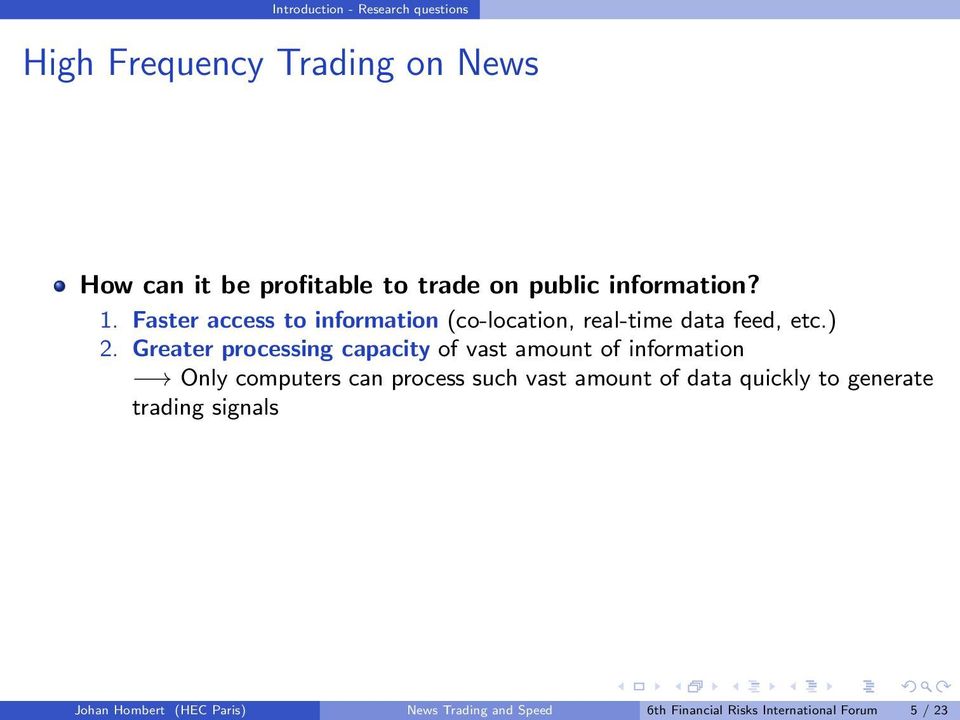
5 Introduction - Research questions High Frequency Trading on News How can it be profitable to trade on public information? 1. Faster access to information (co-location, real-time data feed, etc.) 2. Greater processing capacity of vast amount of information Only computers can process such vast amount of data quickly to generate trading signals Johan Hombert (HEC Paris) News Trading and Speed 6th Financial Risks International Forum 5 / 23
6 Introduction - Research questions Questions What is the optimal trading strategy for a high frequency trader on news (HFTN)? How does it differ from that of traders with only an information processing advantage? Johan Hombert (HEC Paris) News Trading and Speed 6th Financial Risks International Forum 6 / 23

7 Introduction - Research questions Why are these questions important? Many empirical papers relate returns to order flows from HFTs (e.g., Kirilenko et al., 2011; Brogaard, Hendershott and Riordan, 2012; Hirschey, 2011; Zhang, 2012; etc.) 1. How to interpret these findings? What should we expect regarding HFT flows? 2. Need of structural foundations Many debates about the effects of HFT on price discovery and volatility 1. HFT often accused of increasing volatility 2. Is this the case? Is speed associated with greater price volatility, or is it greater information processing? Should trading been slow down or should processing capacity be constrained? Johan Hombert (HEC Paris) News Trading and Speed 6th Financial Risks International Forum 7 / 23

8 Introduction - Research questions Our approach We build on the dynamic version of Kyle (1985) and consider an informed investor with two informational advantages: 1. Greater ability to process information: his forecast of the asset payoff is more precise than that of market-makers (standard) 2. Faster reaction than market-makers to public information (non standard) We compare the equilibrium with and without the speed advantage Main finding: even an infinitesimal speed advantage has large effects on equilibrium strategies and the relationship between trades and returns Johan Hombert (HEC Paris) News Trading and Speed 6th Financial Risks International Forum 8 / 23

9 Model Plan 1. Introduction - Research questions 2. Model 3. Implications 4. Conclusions Johan Hombert (HEC Paris) News Trading and Speed 6th Financial Risks International Forum 9 / 23
10 Model Model Kyle (1985) + public information (news) + speed advantage for the informed investor Continuous time t [0, 1] Fundamental value of the asset, v t = v 0 + t 0 dv t, follows a random walk News = dv t Johan Hombert (HEC Paris) News Trading and Speed 6th Financial Risks International Forum 10 / 23

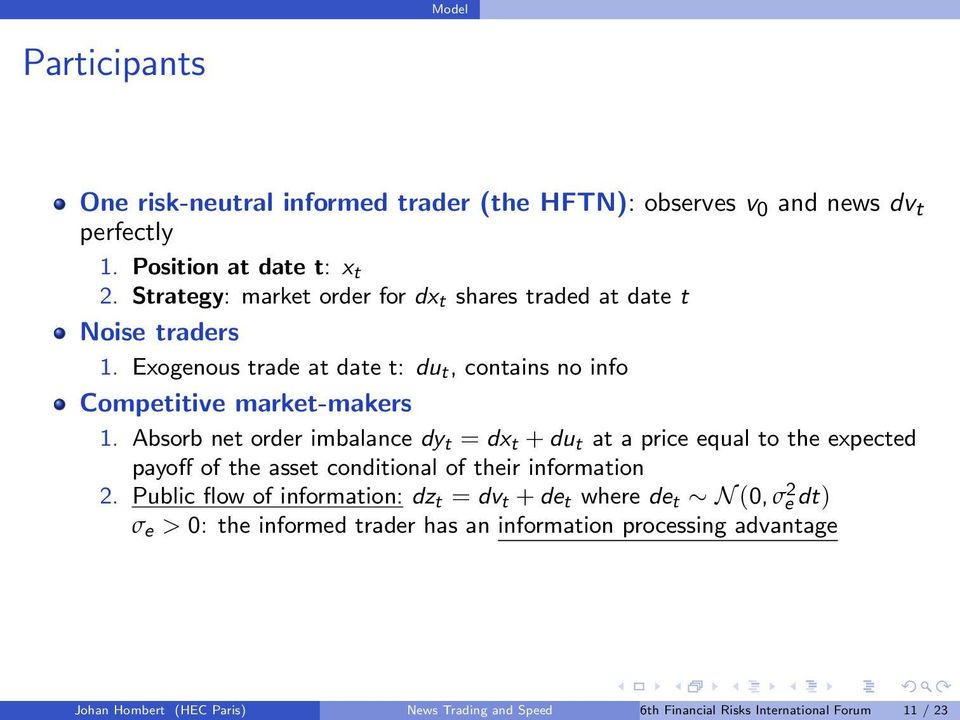
11 Model Participants One risk-neutral informed trader (the HFTN): observes v 0 and news dv t perfectly 1. Position at date t: x t 2. Strategy: market order for dx t shares traded at date t Noise traders 1. Exogenous trade at date t: du t, contains no info Competitive market-makers 1. Absorb net order imbalance dy t = dx t + du t at a price equal to the expected payoff of the asset conditional of their information 2. Public flow of information: dz t = dv t + de t where de t N (0, σ 2 e dt) σ e > 0: the informed trader has an information processing advantage Johan Hombert (HEC Paris) News Trading and Speed 6th Financial Risks International Forum 11 / 23
12 Model Timing Figure 2: Timing of events during (t, t + dt] in the benchmark and the fast model Informed trader receives signal dv t In benchmark: Market maker receives signal dz t Market maker s quote q t Order flow dx t + du t Execution price p t+dt In fast model: market maker receives signal dz t Benchmark: The market-makers observe news before the informed investor bid-ask canmidpoint trade onjust them: before the theinformed transaction investor at t + dt. only 14 has an information processing advantage As explained in the introduction, our goal is to analyze the effects of granting to the Fast model: The informed investor can trade on news before they are informed investor the possibility to react to news faster than market makers, holding the observed by the market-makers accuracy of his signals (that is, Σ 0 > 0 and σ e > 0) constant. To this end, we consider two different models: the benchmark model and the fast model. They differ in the timing with which the informed investor and the market maker receive news. The sequence of Johan Hombert (HEC Paris) News Trading and Speed 6th Financial Risks International Forum 12 / 23

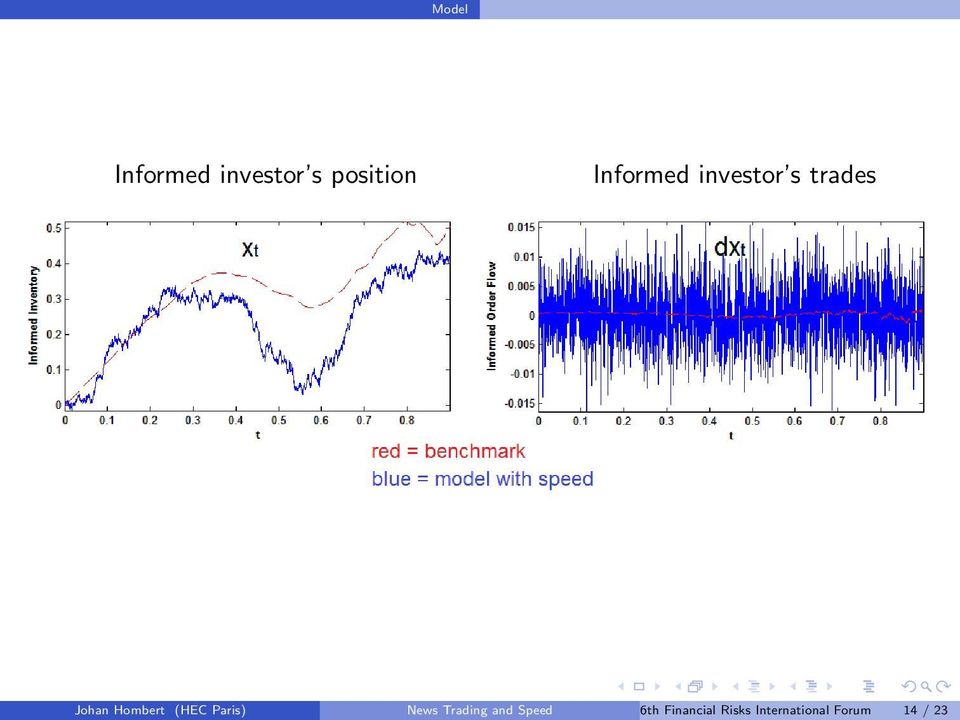
13 Model Equilibrium trading strategy for the informed investor Informed trader s optimal strategy has two components: dx t = β t (v t q t )dt + γdv t where q t is market-makers expectation of the asset payoff before observing the order flow 1. Pricing error component β t (v q q t )dt: buy (sell) when market-makers undervalue (overvalue) the asset. Standard in Kyle s type of model 2. News trading components γdv t : trade on news because they are correlated with short run returns Result: If the informed investor has no speed advantage (benchmark): γ = 0, even if he has an information processing advantage (σ e > 0) = No HFTN without a speed advantage Johan Hombert (HEC Paris) News Trading and Speed 6th Financial Risks International Forum 13 / 23

14 Model Informed investor s position Informed investor s trades Johan Hombert (HEC Paris) News Trading and Speed 6th Financial Risks International Forum 14 / 23
15 Implications Plan 1. Introduction - Research questions 2. Model 3. Implications 4. Conclusions Johan Hombert (HEC Paris) News Trading and Speed 6th Financial Risks International Forum 15 / 23
16 Implications Implications for the trades of HFTNs High participation rate: Fraction of volume due to informed trader is an order magnitude higher when he has a speed advantage Consistent with the large volume due to HFTs Anticipatory trading: Positive correlation between short run returns and the trade of the informed investor Possibly due to their speed advantage or superior ability to predict price changes, HFTs are able to buy right as the prices are about to increase. (Kirilenko et al., 2012) Zero autocorrelation in trades (dx t ) over short time intervals None of these properties obtain if the informed investor has no speed advantage Johan Hombert (HEC Paris) News Trading and Speed 6th Financial Risks International Forum 16 / 23

17 Implications The effect of HFTN on market performance There are many debates about the effect of HFT on liquidity, price discovery and volatility Causality is difficult to establish empirically Compare the model with and without a speed advantage Johan Hombert (HEC Paris) News Trading and Speed 6th Financial Risks International Forum 17 / 23

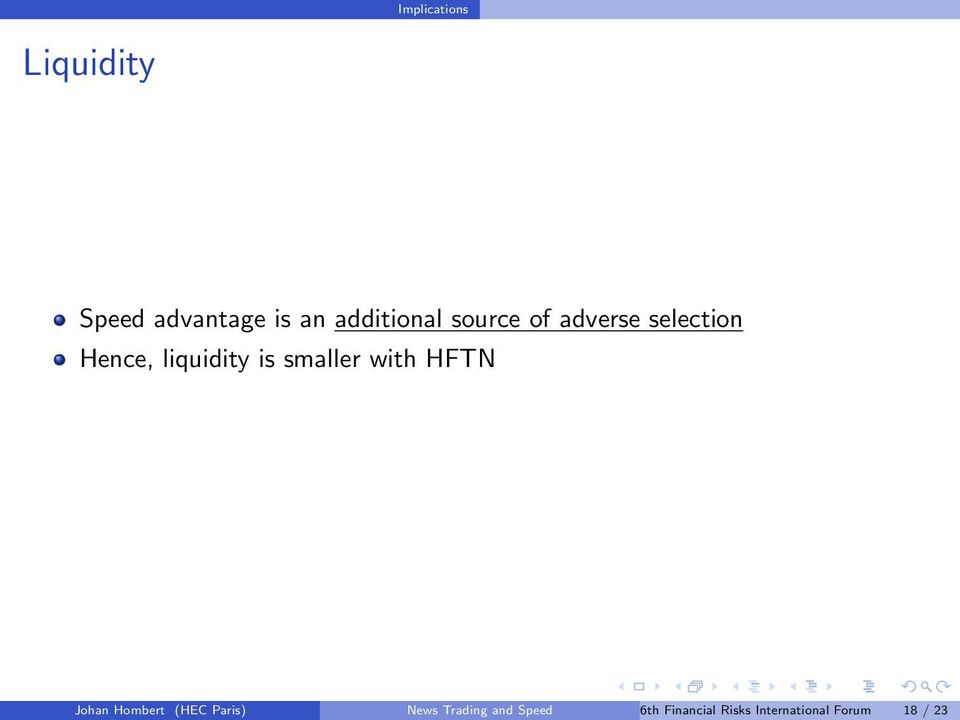
18 Implications Liquidity Speed advantage is an additional source of adverse selection Hence, liquidity is smaller with HFTN Johan Hombert (HEC Paris) News Trading and Speed 6th Financial Risks International Forum 18 / 23
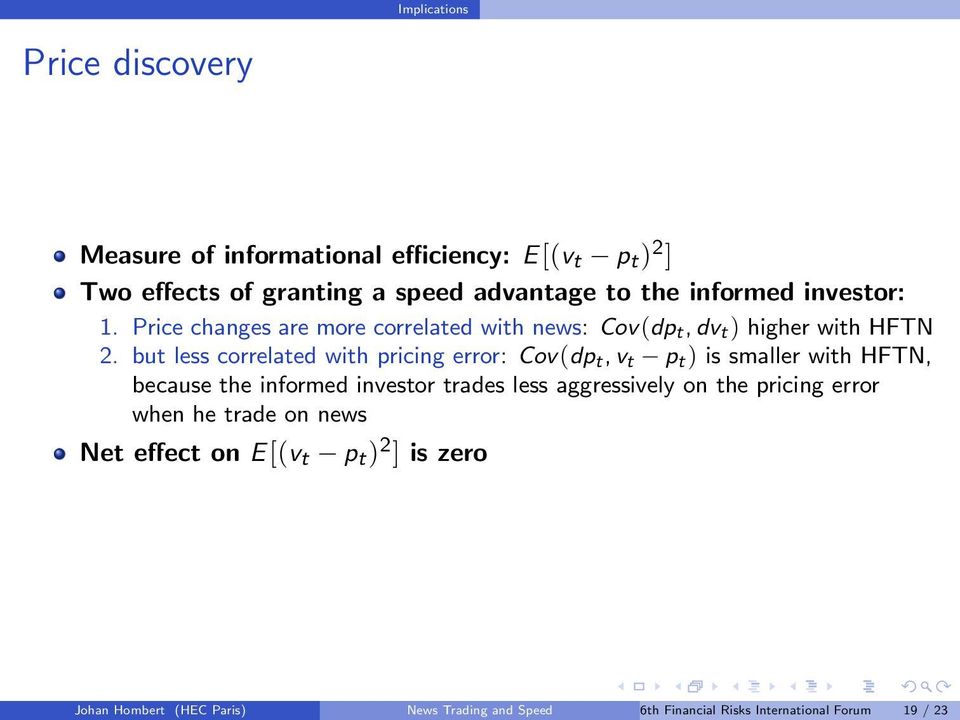
19 Implications Price discovery Measure of informational efficiency: E [(v t p t ) 2 ] Two effects of granting a speed advantage to the informed investor: 1. Price changes are more correlated with news: Cov(dp t, dv t ) higher with HFTN 2. but less correlated with pricing error: Cov(dp t, v t p t ) is smaller with HFTN, because the informed investor trades less aggressively on the pricing error when he trade on news Net effect on E [(v t p t ) 2 ] is zero Johan Hombert (HEC Paris) News Trading and Speed 6th Financial Risks International Forum 19 / 23
20 Implications Volatility Volatility of returns can be decomposed in two components (q t =market-makers quote after receiving public info): Var(dp t ) = Var(p t+dt q t ) + } {{ } Var(q t p t ) } {{ } Transactions (dy t ) Public signals (dz t ) The first component is higher in the fast model and the second is smaller. Net effect = zero = HFTN has no effect on volatility However, the contribution of news to volatility is smaller in the fast model Johan Hombert (HEC Paris) News Trading and Speed 6th Financial Risks International Forum 20 / 23

21 Implications Determinants of HFTN Results: When market-makers public information is more precise 1. The informed investor trades more aggressively on news 2. The market is more liquid Yet, liquidity is lower when the informed investor has a speed advantage = Risk of spurious positive correlation between measures of HFTN activity and liquidity Johan Hombert (HEC Paris) News Trading and Speed 6th Financial Risks International Forum 21 / 23
22 Implications Interpreting econometric models Our model can be used to offer structural foundations to econometric models of high frequency trading VAR models State-space models Johan Hombert (HEC Paris) News Trading and Speed 6th Financial Risks International Forum 22 / 23
23 Conclusion Conclusion Speed of access to information has effects distinct from greater processing capacity of information Slowing down HFTs may have no effect on volatility or price discovery (they will simply trade more aggressively on their long-lived information advantage) Dynamic models of HFT help to interpret relationships between HFTs flows and returns Caveat: HFTs strategies are heterogenous. Our results apply only to one specific strategy (High Frequency Trading on News) Johan Hombert (HEC Paris) News Trading and Speed 6th Financial Risks International Forum 23 / 23
News Trading and Speed
 News Trading and Speed Thierry Foucault, Johan Hombert, and Ioanid Rosu (HEC) High Frequency Trading Conference Plan Plan 1. Introduction - Research questions 2. Model 3. Is news trading different? 4.
News Trading and Speed
 News Trading and Speed Thierry Foucault Johan Hombert Ioanid Roşu September 5, 01 Abstract Informed trading can take two forms: (i) trading on more accurate information or (ii) trading on public information
News Trading and Speed
 News Trading and Speed THIERRY FOUCAULT, JOHAN HOMBERT, and IOANID ROŞU June 30, 2015 Abstract We compare the optimal trading strategy of an informed speculator when he can trade ahead of incoming news
Equilibrium High Frequency Trading
 Equilibrium High Frequency Trading B. Biais, T. Foucault, S. Moinas Fifth Annual Conference of the Paul Woolley Centre for the Study of Capital Market Dysfunctionality London, June 2012 What s High Frequency
HFT and Market Quality
 HFT and Market Quality BRUNO BIAIS Directeur de recherche Toulouse School of Economics (CRM/CNRS - Chaire FBF/ IDEI) THIERRY FOUCAULT* Professor of Finance HEC, Paris I. Introduction The rise of high-frequency
Algorithmic trading Equilibrium, efficiency & stability
 Algorithmic trading Equilibrium, efficiency & stability Presentation prepared for the conference Market Microstructure: Confronting many viewpoints Institut Louis Bachelier Décembre 2010 Bruno Biais Toulouse
Toxic Arbitrage. Abstract
 Toxic Arbitrage Thierry Foucault Roman Kozhan Wing Wah Tham Abstract Arbitrage opportunities arise when new information affects the price of one security because dealers in other related securities are
High frequency trading
 High frequency trading Bruno Biais (Toulouse School of Economics) Presentation prepared for the European Institute of Financial Regulation Paris, Sept 2011 Outline 1) Description 2) Motivation for HFT
Fast Trading and Prop Trading
 Fast Trading and Prop Trading B. Biais, F. Declerck, S. Moinas (Toulouse School of Economics) December 11, 2014 Market Microstructure Confronting many viewpoints #3 New market organization, new financial
Goal Market Maker Pricing and Information about Prospective Order Flow
 Goal Market Maker Pricing and Information about Prospective Order Flow EIEF October 9 202 Use a risk averse market making model to investigate. [Microstructural determinants of volatility, liquidity and
(Risk and Return in High Frequency Trading)
 The Trading Profits of High Frequency Traders (Risk and Return in High Frequency Trading) Matthew Baron Princeton University Jonathan Brogaard University of Washington Andrei Kirilenko CFTC 8th Annual
Financial Market Microstructure Theory
 The Microstructure of Financial Markets, de Jong and Rindi (2009) Financial Market Microstructure Theory Based on de Jong and Rindi, Chapters 2 5 Frank de Jong Tilburg University 1 Determinants of the
High-frequency trading and execution costs
 High-frequency trading and execution costs Amy Kwan Richard Philip* Current version: January 13 2015 Abstract We examine whether high-frequency traders (HFT) increase the transaction costs of slower institutional
Financial Markets. Itay Goldstein. Wharton School, University of Pennsylvania
 Financial Markets Itay Goldstein Wharton School, University of Pennsylvania 1 Trading and Price Formation This line of the literature analyzes the formation of prices in financial markets in a setting
A new model of a market maker
 A new model of a market maker M.C. Cheung 28786 Master s thesis Economics and Informatics Specialisation in Computational Economics and Finance Erasmus University Rotterdam, the Netherlands January 6,
Do retail traders suffer from high frequency traders?
 Do retail traders suffer from high frequency traders? Katya Malinova, Andreas Park, Ryan Riordan November 15, 2013 Millions in Milliseconds Monday, June 03, 2013: a minor clock synchronization issue causes
Do High-Frequency Traders Anticipate Buying and Selling Pressure?
 Do High-Frequency Traders Anticipate Buying and Selling Pressure? Nicholas H. Hirschey London Business School November 2013 Abstract High-frequency traders (HFTs) account for a substantial fraction of
How aggressive are high frequency traders?
 How aggressive are high frequency traders? Björn Hagströmer, Lars Nordén and Dong Zhang Stockholm University School of Business, S 106 91 Stockholm July 30, 2013 Abstract We study order aggressiveness
From Traditional Floor Trading to Electronic High Frequency Trading (HFT) Market Implications and Regulatory Aspects Prof. Dr. Hans Peter Burghof
 From Traditional Floor Trading to Electronic High Frequency Trading (HFT) Market Implications and Regulatory Aspects Prof. Dr. Hans Peter Burghof Universität Hohenheim Institut für Financial Management
Need For Speed? Low Latency Trading and Adverse Selection
 Need For Speed? Low Latency Trading and Adverse Selection Albert J. Menkveld and Marius A. Zoican April 22, 2013 - very preliminary and incomplete. comments and suggestions are welcome - First version:
Rise of the Machines: Algorithmic Trading in the Foreign Exchange Market. Alain Chaboud, Benjamin Chiquoine, Erik Hjalmarsson, and Clara Vega
 Rise of the Machines: Algorithmic Trading in the Foreign Exchange Market Alain Chaboud, Benjamin Chiquoine, Erik Hjalmarsson, and Clara Vega 1 Rise of the Machines Main Question! What role do algorithmic
Markus K. Brunnermeier
 Institutional tut Finance Financial Crises, Risk Management and Liquidity Markus K. Brunnermeier Preceptor: Dong BeomChoi Princeton University 1 Market Making Limit Orders Limit order price contingent
Fast Aggressive Trading
 Fast Aggressive Trading Richard Payne Professor of Finance Faculty of Finance, Cass Business School Global Association of Risk Professionals May 2015 The views expressed in the following material are the
Liquidity Cycles and Make/Take Fees in Electronic Markets
 Liquidity Cycles and Make/Take Fees in Electronic Markets Thierry Foucault (HEC, Paris) Ohad Kadan (Washington U) Eugene Kandel (Hebrew U) April 2011 Thierry, Ohad, and Eugene () Liquidity Cycles & Make/Take
Working Paper SerieS. High Frequency Trading and Price Discovery. NO 1602 / november 2013. Jonathan Brogaard, Terrence Hendershott and Ryan Riordan
 Working Paper SerieS NO 1602 / november 2013 High Frequency Trading and Price Discovery Jonathan Brogaard, Terrence Hendershott and Ryan Riordan ecb lamfalussy fellowship Programme In 2013 all ECB publications
Trading Fast and Slow: Colocation and Market Quality*
 Trading Fast and Slow: Colocation and Market Quality* Jonathan Brogaard Björn Hagströmer Lars Nordén Ryan Riordan First Draft: August 2013 Current Draft: December 2013 Abstract: Using user-level data from
Finance 400 A. Penati - G. Pennacchi Market Micro-Structure: Notes on the Kyle Model
 Finance 400 A. Penati - G. Pennacchi Market Micro-Structure: Notes on the Kyle Model These notes consider the single-period model in Kyle (1985) Continuous Auctions and Insider Trading, Econometrica 15,
Regulating Dark Trading: Order Flow Segmentation and Market Quality
 Regulating Dark Trading: Order Flow Segmentation and Market Quality Carole Comerton-Forde, Katya Malinova, Andreas Park IIROC and the Capital Markets Institute Forum on High Frequency Trading October 19,
Asymmetric Information (2)
 Asymmetric nformation (2) John Y. Campbell Ec2723 November 2013 John Y. Campbell (Ec2723) Asymmetric nformation (2) November 2013 1 / 24 Outline Market microstructure The study of trading costs Bid-ask
High-Frequency Trading and Price Discovery
 High-Frequency Trading and Price Discovery Jonathan Brogaard University of Washington Terrence Hendershott University of California at Berkeley Ryan Riordan University of Ontario Institute of Technology
How To Understand The Role Of High Frequency Trading
 High Frequency Trading and Price Discovery * by Terrence Hendershott (University of California at Berkeley) Ryan Riordan (Karlsruhe Institute of Technology) * We thank Frank Hatheway and Jeff Smith at
Need for Speed: An Empirical Analysis of Hard and Soft Information in a High Frequency World
 Need for Speed: An Empirical Analysis of Hard and Soft Information in a High Frequency World S. Sarah Zhang 1 School of Economics and Business Engineering, Karlsruhe Institute of Technology, Germany Abstract
Where is the Value in High Frequency Trading?
 Where is the Value in High Frequency Trading? Álvaro Cartea and José Penalva November 5, 00 Abstract We analyze the impact of high frequency trading in financial markets based on a model with three types
Low-Latency Trading and Price Discovery without Trading: Evidence from the Tokyo Stock Exchange Pre-Opening Period
 Low-Latency Trading and Price Discovery without Trading: Evidence from the Tokyo Stock Exchange Pre-Opening Period Preliminary and incomplete Mario Bellia, SAFE - Goethe University Loriana Pelizzon, Goethe
High Frequency Trading
 High Frequency Trading Jonathan Ahlstedt, Johan Villysson December 1, 2012 Contribution declaration This report has been written and edited jointly by both authors. 1 During the last two decades the financial
Rise of the Machines: Algorithmic Trading in the Foreign. Exchange Market
 Rise of the Machines: Algorithmic Trading in the Foreign Exchange Market Alain Chaboud Benjamin Chiquoine Erik Hjalmarsson Clara Vega February 20, 2013 Abstract We study the impact of algorithmic trading
HIGH FREQUENCY TRADING AND ITS IMPACT ON MARKET QUALITY
 HIGH FREQUENCY TRADING AND ITS IMPACT ON MARKET QUALITY Jonathan A. Brogaard Northwestern University Kellogg School of Management Northwestern University School of Law JD-PhD Candidate [email protected]
High-Frequency Trading Competition
 High-Frequency Trading Competition Jonathan Brogaard and Corey Garriott* May 2015 Abstract High-frequency trading (HFT) firms have been shown to influence market quality by exploiting a speed advantage.
Do High Frequency Traders Need to be Regulated? Evidence from Algorithmic Trading on Macro News
 Do High Frequency Traders Need to be Regulated? Evidence from Algorithmic Trading on Macro News Tarun Chordia, T. Clifton Green, and Badrinath Kottimukkalur * March 2015 Abstract Stock index ETF and futures
Trading Fast and Slow: Colocation and Market Quality*
 Trading Fast and Slow: Colocation and Market Quality* Jonathan Brogaard Björn Hagströmer Lars Nordén Ryan Riordan First Draft: August 2013 Current Draft: November 2013 Abstract: Using user-level data from
Optimal trading? In what sense?
 Optimal trading? In what sense? Market Microstructure in Practice 3/3 Charles-Albert Lehalle Senior Research Advisor, Capital Fund Management, Paris April 2015, Printed the April 13, 2015 CA Lehalle 1
This paper sets out the challenges faced to maintain efficient markets, and the actions that the WFE and its member exchanges support.
 Understanding High Frequency Trading (HFT) Executive Summary This paper is designed to cover the definitions of HFT set by regulators, the impact HFT has made on markets, the actions taken by exchange
Anticipatory Traders and Trading Speed
 Anticipatory Traders and Trading Speed Raymond P. H. Fishe Richard Haynes and Esen Onur* This version: March 26, 2015 ABSTRACT We investigate whether there is a class of market participants who follow
On the Efficiency of Competitive Stock Markets Where Traders Have Diverse Information
 Finance 400 A. Penati - G. Pennacchi Notes on On the Efficiency of Competitive Stock Markets Where Traders Have Diverse Information by Sanford Grossman This model shows how the heterogeneous information
AN ANALYSIS OF EXISTING ARTIFICIAL STOCK MARKET MODELS FOR REPRESENTING BOMBAY STOCK EXCHANGE (BSE)
 AN ANALYSIS OF EXISTING ARTIFICIAL STOCK MARKET MODELS FOR REPRESENTING BOMBAY STOCK EXCHANGE (BSE) PN Kumar Dept. of CSE Amrita Vishwa Vidyapeetham Ettimadai, Tamil Nadu, India [email protected]
High Frequency Trading and the 2008 Shorting Ban
 High Frequency Trading and the 2008 Shorting Ban Using the ban to estimate HFT s impact on markets challenge is it also impacted other short sellers Jonathan Brogaard Terrence Hendershott Ryan Riordan
Algorithmic Trading, High-Frequency Trading and Colocation: What does it mean to Emerging Market?
 Algorithmic Trading, High-Frequency Trading and Colocation: What does it mean to Emerging Market? Ashok Jhunjhunwala, IIT Madras [email protected] HFTs are being pushed out of the more established markets,
Are Algorithmic Trades Informed? An Empirical Analysis of Algorithmic Trading around Earnings Announcements
 Are Algorithmic Trades Informed? An Empirical Analysis of Algorithmic Trading around Earnings Announcements Alex Frino a, Tina Viljoen b, George H. K. Wang c, *, Joakim Westerholm d, Hui Zheng e a, b,
Need for Speed? Exchange Latency and Liquidity
 Duisenberg school of finance - Tinbergen Institute Discussion Paper TI 14-097/IV//DSF78 Need for Speed? Exchange Latency and Liquidity Albert J. Menkveld Marius A. Zoican Faculty of Economics and Business
What is High Frequency Trading?
 What is High Frequency Trading? Released December 29, 2014 The impact of high frequency trading or HFT on U.S. equity markets has generated significant attention in recent years and increasingly in the
Intraday Patterns in High Frequency Trading: Evidence from the UK Equity Markets
 Intraday Patterns in High Frequency Trading: Evidence from the UK Equity Markets Kiril Alampieski a and Andrew Lepone b 1 a Finance Discipline, Faculty of Economics and Business, University of Sydney,
Financial Econometrics and Volatility Models Introduction to High Frequency Data
 Financial Econometrics and Volatility Models Introduction to High Frequency Data Eric Zivot May 17, 2010 Lecture Outline Introduction and Motivation High Frequency Data Sources Challenges to Statistical
A Stock Trading Algorithm Model Proposal, based on Technical Indicators Signals
 Informatica Economică vol. 15, no. 1/2011 183 A Stock Trading Algorithm Model Proposal, based on Technical Indicators Signals Darie MOLDOVAN, Mircea MOCA, Ştefan NIŢCHI Business Information Systems Dept.
Towards an Automated Trading Ecosystem
 Towards an Automated Trading Ecosystem Charles-Albert LEHALLE May 16, 2014 Outline 1 The need for Automated Trading Suppliers Users More technically... 2 Implied Changes New practices New (infrastructure)
Exploratory Trading. Theory and Evidence. Adam Clark-Joseph. November 8, 2013. University of Illinois at Urbana-Champaign
 Theory Empirics Testing the Hypothesis Additional Materials Theory and Evidence University of Illinois at Urbana-Champaign November 8, 2013 Disclaimer Introduction Theory Empirics Testing the Hypothesis
Financial Market Efficiency and Its Implications
 Financial Market Efficiency: The Efficient Market Hypothesis (EMH) Financial Market Efficiency and Its Implications Financial markets are efficient if current asset prices fully reflect all currently available
Nine Questions Every ETF Investor Should Ask Before Investing
 Nine Questions Every ETF Investor Should Ask Before Investing UnderstandETFs.org Copyright 2012 by the Investment Company Institute. All rights reserved. ICI permits use of this publication in any way,
ELECTRONIC TRADING GLOSSARY
 ELECTRONIC TRADING GLOSSARY Algorithms: A series of specific steps used to complete a task. Many firms use them to execute trades with computers. Algorithmic Trading: The practice of using computer software
High Frequency Trading Volumes Continue to Increase Throughout the World
 High Frequency Trading Volumes Continue to Increase Throughout the World High Frequency Trading (HFT) can be defined as any automated trading strategy where investment decisions are driven by quantitative
Stock Market Liquidity and the Business Cycle
 Stock Market Liquidity and the Business Cycle Forthcoming, Journal of Finance Randi Næs a Johannes Skjeltorp b Bernt Arne Ødegaard b,c Jun 2010 a: Ministry of Trade and Industry b: Norges Bank c: University
Execution Costs. Post-trade reporting. December 17, 2008 Robert Almgren / Encyclopedia of Quantitative Finance Execution Costs 1
 December 17, 2008 Robert Almgren / Encyclopedia of Quantitative Finance Execution Costs 1 Execution Costs Execution costs are the difference in value between an ideal trade and what was actually done.
The Trading Profits of High Frequency Traders
 The Trading Profits of High Frequency Traders Matthew Baron Jonathan Brogaard Andrei Kirilenko First Draft: October 2011 Current Draft: August 2012 Abstract: We examine the profitability of a specific
Market Microstructure & Trading Universidade Federal de Santa Catarina Syllabus. Email: [email protected], Web: www.sfu.ca/ rgencay
 Market Microstructure & Trading Universidade Federal de Santa Catarina Syllabus Dr. Ramo Gençay, Objectives: Email: [email protected], Web: www.sfu.ca/ rgencay This is a course on financial instruments, financial
Market Making and Liquidity Provision in Modern Markets
 Canada STA 2015 Market Making and Liquidity Provision in Modern Markets Phil Mackintosh 2 What am I going to talk about? Why are Modern Markets Important? Trading is now physics at the speed of light Jan
Should Exchanges impose Market Maker obligations? Amber Anand. Kumar Venkataraman. Abstract
 Should Exchanges impose Market Maker obligations? Amber Anand Kumar Venkataraman Abstract We study the trades of two important classes of market makers, Designated Market Makers (DMMs) and Endogenous Liquidity
A Theory of Intraday Patterns: Volume and Price Variability
 A Theory of Intraday Patterns: Volume and Price Variability Anat R. Admati Paul Pfleiderer Stanford University This article develops a theory in which concentrated-trading patterns arise endogenously as
What do we know about high-frequency trading? Charles M. Jones* Columbia Business School Version 3.4: March 20, 2013 ABSTRACT
 What do we know about high-frequency trading? Charles M. Jones* Columbia Business School Version 3.4: March 20, 2013 ABSTRACT This paper reviews recent theoretical and empirical research on high-frequency
ECON4510 Finance Theory Lecture 7
 ECON4510 Finance Theory Lecture 7 Diderik Lund Department of Economics University of Oslo 11 March 2015 Diderik Lund, Dept. of Economics, UiO ECON4510 Lecture 7 11 March 2015 1 / 24 Market efficiency Market
High Frequency Quoting, Trading and the Efficiency of Prices. Jennifer Conrad, UNC Sunil Wahal, ASU Jin Xiang, Integrated Financial Engineering
 High Frequency Quoting, Trading and the Efficiency of Prices Jennifer Conrad, UNC Sunil Wahal, ASU Jin Xiang, Integrated Financial Engineering 1 What is High Frequency Quoting/Trading? How fast is fast?
FE570 Financial Markets and Trading. Stevens Institute of Technology
 FE570 Financial Markets and Trading Lecture 13. Execution Strategies (Ref. Anatoly Schmidt CHAPTER 13 Execution Strategies) Steve Yang Stevens Institute of Technology 11/27/2012 Outline 1 Execution Strategies
The Flash Crash: The Impact of High Frequency Trading on an Electronic Market
 The Flash Crash: The Impact of High Frequency Trading on an Electronic Market Andrei Kirilenko Mehrdad Samadi Albert S. Kyle Tugkan Tuzun January 12, 2011 ABSTRACT The Flash Crash, a brief period of extreme
- JPX Working Paper - Analysis of High-Frequency Trading at Tokyo Stock Exchange. March 2014, Go Hosaka, Tokyo Stock Exchange, Inc
 - JPX Working Paper - Analysis of High-Frequency Trading at Tokyo Stock Exchange March 2014, Go Hosaka, Tokyo Stock Exchange, Inc 1. Background 2. Earlier Studies 3. Data Sources and Estimates 4. Empirical
HFT and the Hidden Cost of Deep Liquidity
 HFT and the Hidden Cost of Deep Liquidity In this essay we present evidence that high-frequency traders ( HFTs ) profits come at the expense of investors. In competing to earn spreads and exchange rebates
Dynamic macro stress exercise including feedback effect
 Dynamic macro stress exercise including feedback effect by Tokiko Shimizu * Institute for Monetary and Economic Studies Bank of Japan Abstract The goal of this study is to illustrate a viable way to explore
Shifting Sands: High Frequency, Retail, and Institutional Trading Profits over Time
 Shifting Sands: High Frequency, Retail, and Institutional Trading Profits over Time Katya Malinova University of Toronto Andreas Park University of Toronto Ryan Riordan University of Ontario Institute