
COMSOL Server. Manual
|
|
|
- Helena Cole
- 10 years ago
- Views:
Transcription
1 COMSOL Server Manual

2 COMSOL Server Manual COMSOL Protected by U.S. Patents listed on and U.S. Patents 7,519,518; 7,596,474; 7,623,991; 8,457,932; and 8,954,302. Patents pending. This Documentation and the Programs described herein are furnished under the COMSOL Software License Agreement ( and may be used or copied only under the terms of the license agreement. COMSOL, COMSOL Multiphysics, Capture the Concept, COMSOL Desktop, LiveLink, and COMSOL Server are either registered trademarks or trademarks of COMSOL AB. All other trademarks are the property of their respective owners, and COMSOL AB and its subsidiaries and products are not affiliated with, endorsed by, sponsored by, or supported by those trademark owners. For a list of such trademark owners, see Version: COMSOL 5.1 Contact Information Visit the Contact COMSOL page at to submit general inquiries, contact Technical Support, or search for an address and phone number. You can also visit the Worldwide Sales Offices page at for address and contact information. If you need to contact Support, an online request form is located at the COMSOL Access page at Other useful links include: Support Center: Product Download: Product Updates: Discussion Forum: Events: COMSOL Video Gallery: Support Knowledge Base: Part number: CM010010

3 Contents Introduction Installing COMSOL Server Installing COMSOL Server in Windows Installing COMSOL Server in Linux and OS X Firewalls Starting COMSOL Server Starting and Running COMSOL Server Locally in Windows Starting COMSOL Server as a Windows Service Starting COMSOL Server Manually in Windows Starting COMSOL Server in Linux Starting COMSOL Server in OS X Logging in to COMSOL Server COMSOL Server Administration Overview Monitor User Database Preferences Running Applications Running Applications in a Web Browser Running Applications in the COMSOL Client Running Applications that use LiveLink Products
4 Running COMSOL Server on Multiple Computers Installing COMSOL Server on Multiple Computers Starting COMSOL Server on Multiple Computers Setting up a Shared Working Directory Sharing a COMSOL Server Installation Configuring COMSOL Server Configuring a Local User Database Configuring Windows Authentication Configuring Active Directory or LDAP Advanced Login Configuration Setting Up COMSOL Server for Secure Connections
5 Introduction With a COMSOL Server license, a COMSOL application can be run in major web browsers on platforms such as Windows, OS X, ios, Linux, and Android. In the Windows operating system, you can also run COMSOL applications by connecting to a COMSOL Server with an easy-to-install COMSOL Client, available for download from COMSOL Server does not include the Application Builder, Physics Builder, and Model Builder tools that come with the COMSOL Desktop environment. A COMSOL runnable application is a COMSOL Multiphysics MPH-file that in addition to the model part includes a custom user interface that you can run as a separate application or in a web client. To create such applications, use the Application Builder, which is included in the Windows version of COMSOL Multiphysics. For more information on how to build applications, refer to the book Introduction to Application Builder. COMSOL Multiphysics and its add-on products are used to create an application. A license for the same add-on products is required to run the application from COMSOL Server. Users can run up to four applications per session through a single COMSOL Server license. COMSOL Server is a multiuser service that can be run continuously on the host computer. It can be configured to start automatically upon booting. Optionally, COMSOL Server can be run on multiple computers to support more simultaneous users and concurrent applications than a single computer would support. COMSOL Server contains administrative tools that allow you to create user accounts and user groups. You can also create user accounts based on an existing database of users on your system. Additional resources, including video tutorials, are available online at 5
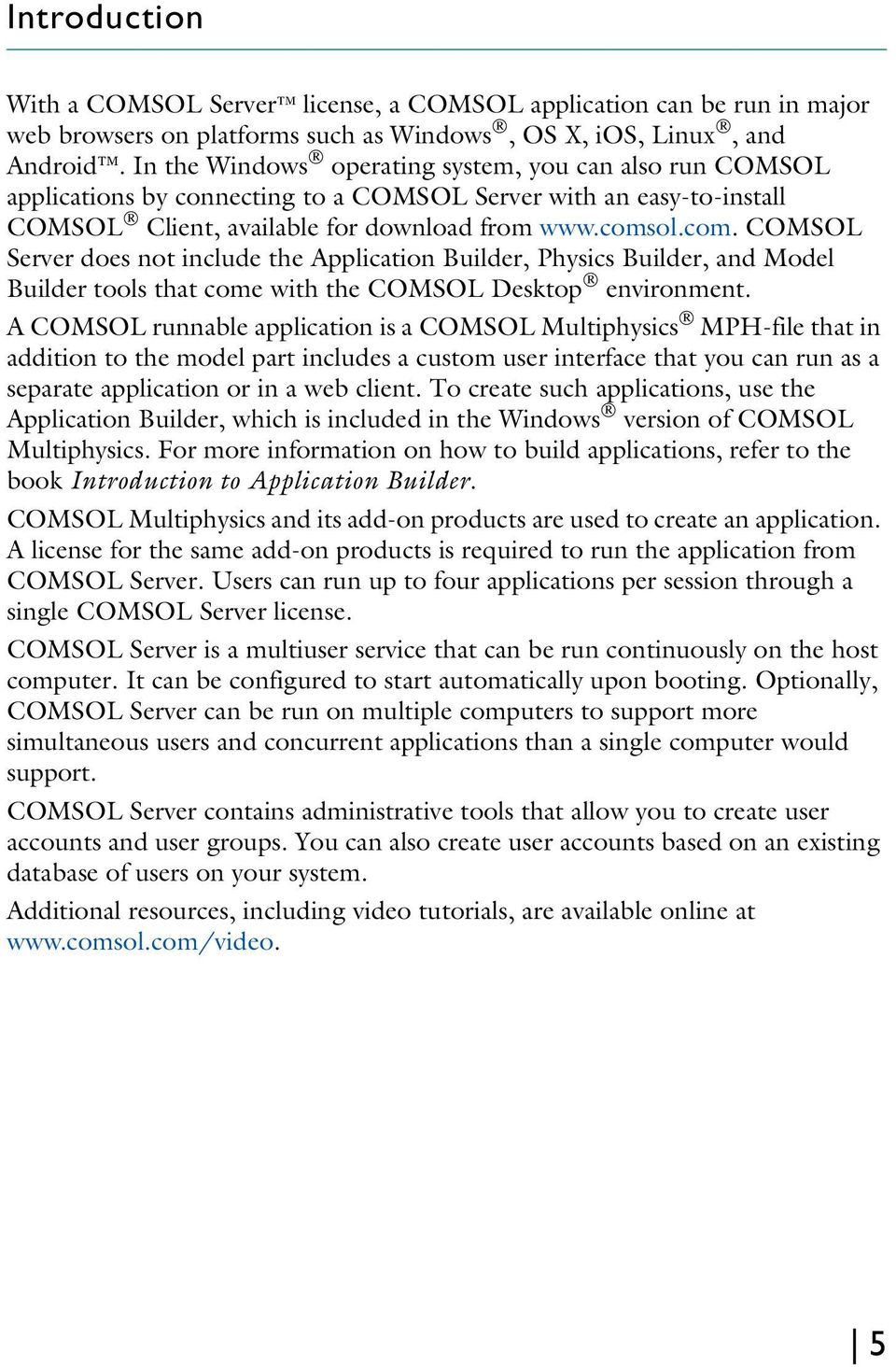
6 The figure below shows the COMSOL Server web interface and an application running in a web browser. USERS AND ROLES IN COMSOL SERVER Use the COMSOL Server web interface to assign usernames and passwords and to grant privileges. The administrator role can add and remove users as well as stop jobs. The user role is for running and uploading applications. The guest role is only for running applications. ROLE ADD/REMOVE USERS UPLOAD APPLICATIONS RUN APPLICATIONS Administrator Yes Yes Yes User No Yes Yes Guest No No Yes (Web client) / No (Native client) 6
7 There is also a group concept in COMSOL Server that you can use to manage groups of users. Use groups to grant access to different categories of applications that are relevant to that particular group. COMSOL Server can maintain its own database of users and groups. You can also configure COMSOL Server to use the login mechanism of your operating system, such as Windows Authentication or Lightweight Directory Access Protocol (LDAP). 7
8 Installing COMSOL Server A COMSOL Server installation is similar to a COMSOL Multiphysics installation, the only difference being an additional step called Server. For detailed information on installation, license files, and license management, see the COMSOL Multiphysics Installation Guide. Before starting COMSOL Server you need to start a license manager. For more information on the FlexNet license manager, see the COMSOL Multiphysics Installation Guide. You can download the document from The FlexNet license manager is installed together with COMSOL Server. A license server is not needed when running a trial license. The default COMSOL Server installation directory for each platform is as follows: Windows : C:\Program Files\COMSOL\COMSOL51\Server Linux : /usr/local/comsol51/server OS X: /Applications/COMSOL51/Server For information about installing COMSOL Server for multiple computers and sharing the installation, see Running COMSOL Server on Multiple Computers. Installing COMSOL Server in Windows Start the installation by using the media that you have received or by using an Internet download. In the COMSOL installer, after selecting your preferred language, choose New COMSOL 5.1 Installation: 8

9 LICENSE In the next step, License, you are prompted for a passcode or license file. COMSOL Server will only function with a license file (that you get from your COMSOL representative). At this point, the COMSOL installer detects the type of license file used. The following instructions assume that the license file used during installation corresponds to a COMSOL Server license. 9

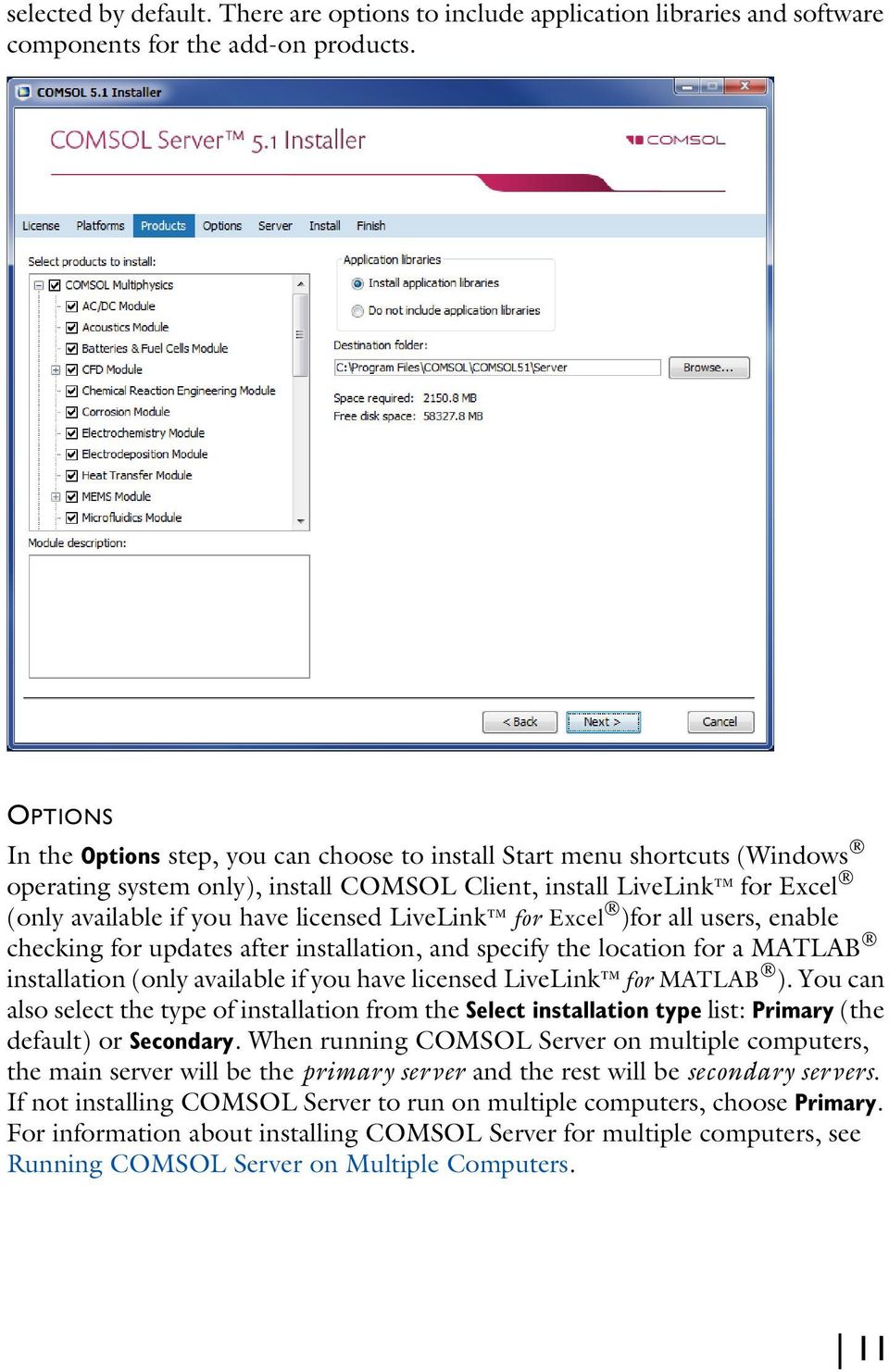
10 PLATFORMS On the next screen the Platforms step you select the type of platform. The example below shows the Platforms screen for a Windows installation with options for installing on a 32-bit or 64-bit operating system. PRODUCTS In the next step, Products, select the installation location and which software products and components you want to install. Licensed software components are 10

11 selected by default. There are options to include application libraries and software components for the add-on products. OPTIONS In the Options step, you can choose to install Start menu shortcuts (Windows operating system only), install COMSOL Client, install LiveLink for Excel (only available if you have licensed LiveLink for Excel )for all users, enable checking for updates after installation, and specify the location for a MATLAB installation (only available if you have licensed LiveLink for MATLAB ). You can also select the type of installation from the Select installation type list: Primary (the default) or Secondary. When running COMSOL Server on multiple computers, the main server will be the primary server and the rest will be secondary servers. If not installing COMSOL Server to run on multiple computers, choose Primary. For information about installing COMSOL Server for multiple computers, see Running COMSOL Server on Multiple Computers. 11
12 If you install over the Internet using a proxy server, you can specify the host name, port number, and, optionally, a username and password if required. If you do not enter a port number, COMSOL uses port 443, which is the default port setting for the HTTPS protocol. These settings do not appear if you do not perform an installation via the Internet. SERVER The next Server step does not have any corresponding step in the COMSOL Multiphysics installer but is unique to a COMSOL Server installation. This step makes it possible to set up COMSOL Server as a Windows service and enables 12

13 you to configure an initial user database. The Server page in the COMSOL Installer includes the following settings (see the following sections): Settings for Launching COMSOL Server The basic setting is the Default COMSOL Server port, which is set to By default, COMSOL Server uses a range of ports from 2036 and above. There are two different ways to install COMSOL Server in Windows. If you select the Install COMSOL Server as a Windows service check box (the default), then COMSOL Server is installed as a Windows service. Otherwise COMSOL Server is installed as a regular executable. Use the Startup list to configure how to start COMSOL Server when installed as a Windows service. Choose Disabled, Manual, Automatic (the default), or Automatic (Delayed Start). With the default choice of Automatic, the installed COMSOL Server service is configured to start automatically when the host computer boots or restarts. This setting provides the highest availability to users of the installed server. With Automatic (Delayed Start) the service also starts automatically but delayed until all automatic-start threads 13

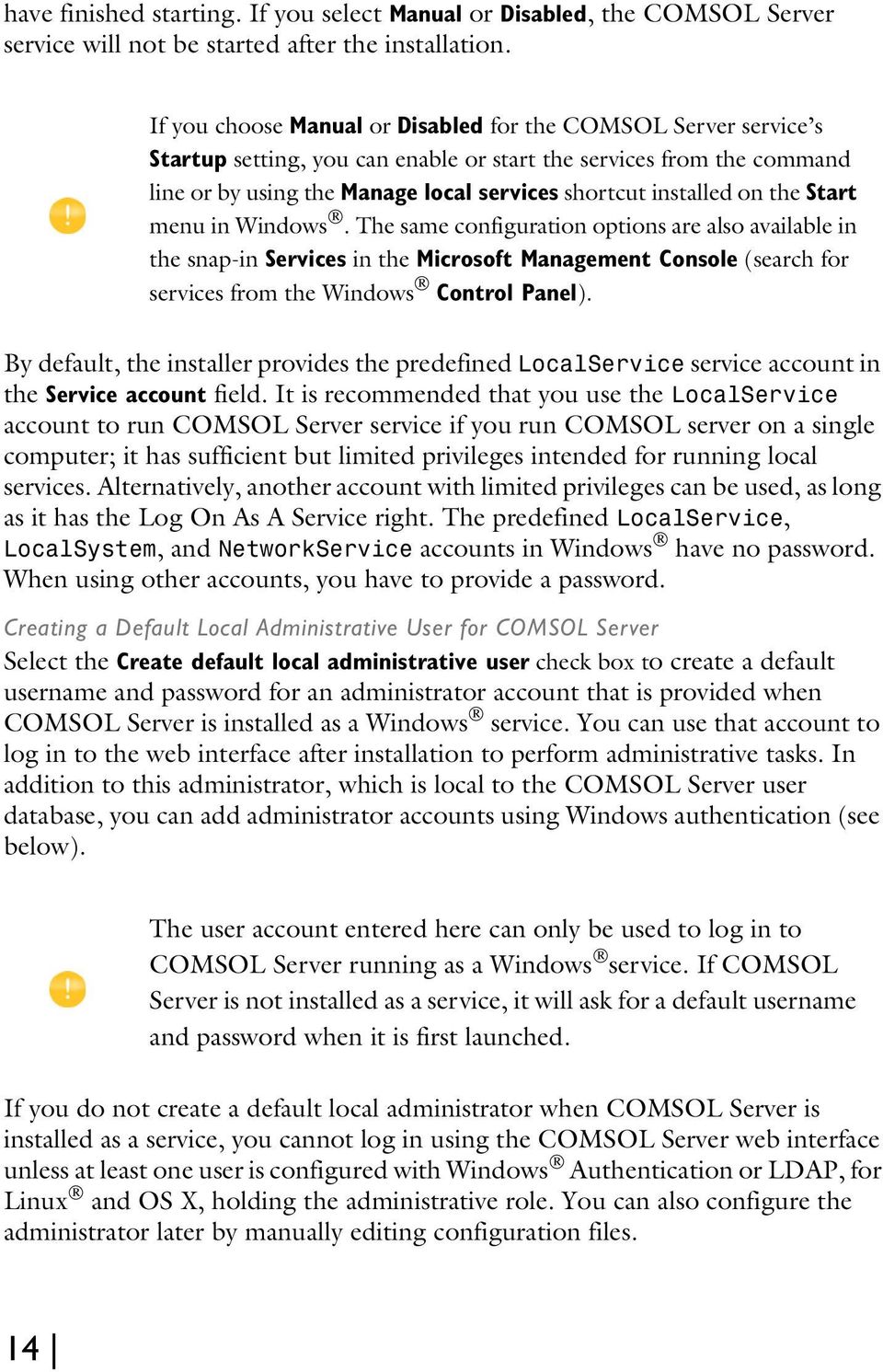
14 have finished starting. If you select Manual or Disabled, the COMSOL Server service will not be started after the installation. If you choose Manual or Disabled for the COMSOL Server service s Startup setting, you can enable or start the services from the command line or by using the Manage local services shortcut installed on the Start menu in Windows. The same configuration options are also available in the snap-in Services in the Microsoft Management Console (search for services from the Windows Control Panel). By default, the installer provides the predefined LocalService service account in the Service account field. It is recommended that you use the LocalService account to run COMSOL Server service if you run COMSOL server on a single computer; it has sufficient but limited privileges intended for running local services. Alternatively, another account with limited privileges can be used, as long as it has the Log On As A Service right. The predefined LocalService, LocalSystem, and NetworkService accounts in Windows have no password. When using other accounts, you have to provide a password. Creating a Default Local Administrative User for COMSOL Server Select the Create default local administrative user check box to create a default username and password for an administrator account that is provided when COMSOL Server is installed as a Windows service. You can use that account to log in to the web interface after installation to perform administrative tasks. In addition to this administrator, which is local to the COMSOL Server user database, you can add administrator accounts using Windows authentication (see below). The user account entered here can only be used to log in to COMSOL Server running as a Windows service. If COMSOL Server is not installed as a service, it will ask for a default username and password when it is first launched. If you do not create a default local administrator when COMSOL Server is installed as a service, you cannot log in using the COMSOL Server web interface unless at least one user is configured with Windows Authentication or LDAP, for Linux and OS X, holding the administrative role. You can also configure the administrator later by manually editing configuration files. 14
15 Support Running COMSOL Server on Multiple Computers For information about the settings for running COMSOL Server in multiple computers, see Running COMSOL Server on Multiple Computers. Using Windows Authentication Select Use Windows authentication to use Windows authentication in addition to the users from the local user database and the administrator you may have chosen to provide in the settings above. Windows authentication is only available when you install COMSOL Server on a computer using the Windows operating system. The text fields under Windows authentication mapping for Administrators, Users, and Guests associate Windows groups or built-in security principals, separated by semicolons, with COMSOL Server roles for administrators, users, and guests, respectively. The defaults are BUILTIN\Administrators, BUILTIN\Users, and BUILTIN\Guests, respectively, which refer to users in such Windows groups on the computer where you install COMSOL Server. Click the corresponding Check Names button to verify that the group names are valid. If you type only a name (Guests, for example), the installer finds its location and prepends it in the text field when you click Check Names. You can only map a specific Windows group to a single COMSOL Server role. You must make sure the Windows groups you associate with the roles exist in your Windows installation, otherwise the mapping for the missing groups will not be in effect until they are created. If you leave one of the roles text fields empty, no user will be given this role. See Configuring COMSOL Server for more information about Windows authentication. Using LDAP Authentication LDAP configuration is required after the installation. See Configuring COMSOL Server. 15

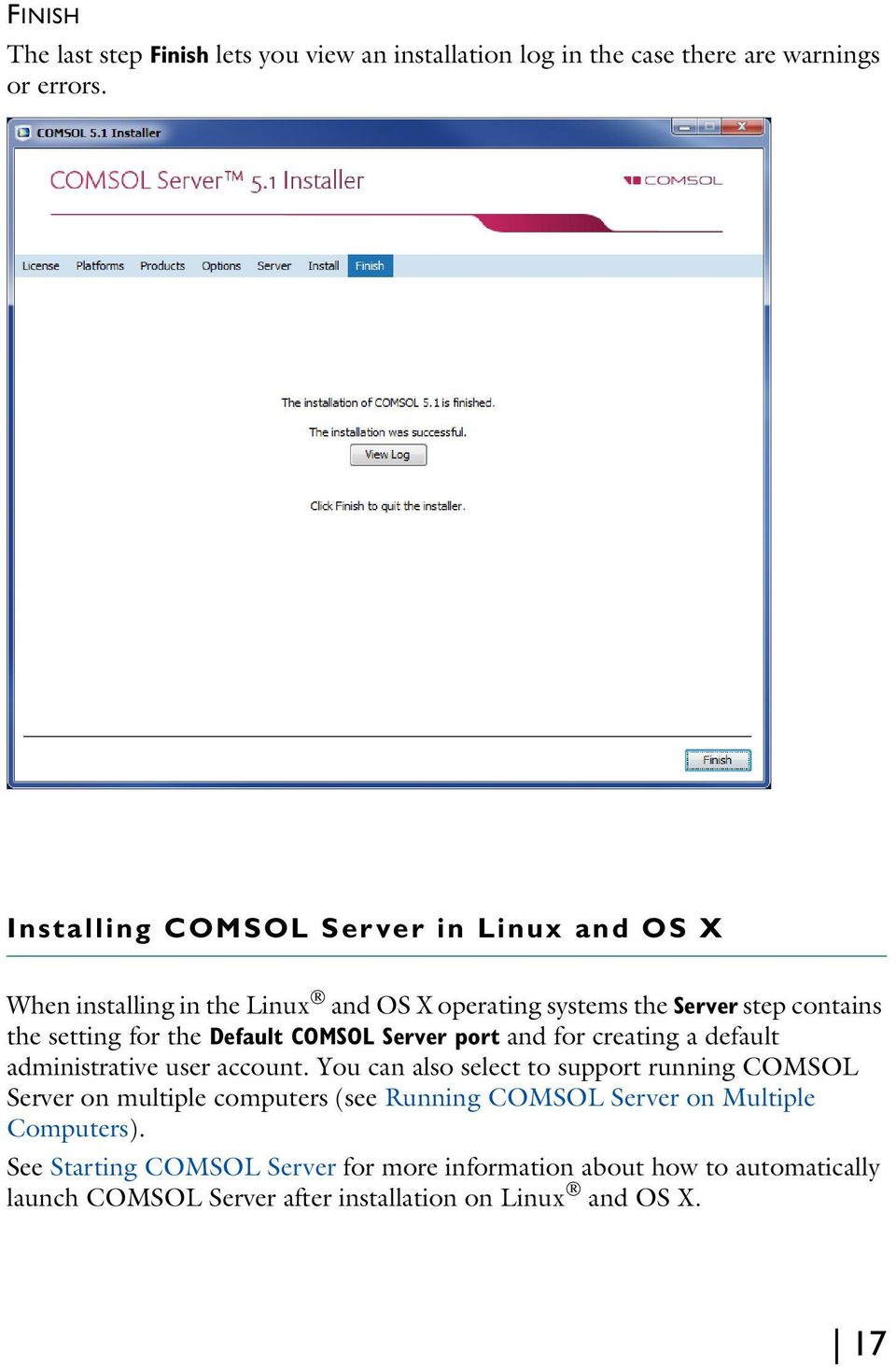
16 INSTALL The Install step lets you monitor the installation progress. 16

17 FINISH The last step Finish lets you view an installation log in the case there are warnings or errors. Installing COMSOL Server in Linux and OS X When installing in the Linux and OS X operating systems the Server step contains the setting for the Default COMSOL Server port and for creating a default administrative user account. You can also select to support running COMSOL Server on multiple computers (see Running COMSOL Server on Multiple Computers). See Starting COMSOL Server for more information about how to automatically launch COMSOL Server after installation on Linux and OS X. 17
18 CREATING A DEFAULT LOCAL ADMINISTRATIVE USER FOR COMSOL SERVER Select the Create default local administrative user check box and provide a username and password to create a default administrative account that is provided when COMSOL Server is started as a service. If you do not create an administrator, you can start COMSOL Server as the user you intend COMSOL Server with and manually enter an administrative username and password. For security reasons, it is not recommended to use an account with administrative privileges to run COMSOL Server. Firewalls By default, COMSOL Server uses a range of ports from 2036 and above. You must open up firewalls that exist between the server and your users. Open up for incoming TCP connections to those ports. To improve security, you may reduce the IP address range to known potential IP addresses for your users. 18
19 Starting COMSOL Server Starting and Running COMSOL Server Locally in Windows This section describes the steps that are necessary for starting and running COMSOL Server locally on a Windows computer. These instructions apply if COMSOL Server will be used locally by a single user or if COMSOL Server will run on a computer that is not connected to a network. For making COMSOL Server available to other users or for running in OS X or Linux, see the subsequent sections. When installing and running COMSOL Server locally according to the instructions below, you will be running as an administrative user. Before starting COMSOL Server you need to start a license manager. For more information on the FlexNet license manager and license files, see the COMSOL Multiphysics Installation Guide. You can download that document from The FlexNet license manager is installed together with COMSOL Server. A license server is not needed when running a trial license. From the Start Menu, select LMTOOLS. This starts the license manager utility program. 19

20 In the first Service/License File page, select Configuration using Services. This setting allows the license manager to start automatically when your computer is rebooted. Click the Config Services page. In this page you specify the path to: the license manager executable file lmgrd.exe the license file license.dat a debug log file (optional) The license manager executable file and the license file are located in the installation directory. By default the locations are: and C:\Program Files\COMSOL\COMSOL51\Server\license\win64\lmgrd.exe C:\Program Files\COMSOL\COMSOL51\Server\license\license.dat 20

21 respectively. Note that when browsing to the location of the license file you need to change the filter of the file browser from the default.lic to.dat, as shown in the figure below. The license file is automatically copied to the license directory by the COMSOL Server installer. In addition, if the original license file given to you by your COMSOL representative had a different name it will automatically be changed to license.dat. For the license manager to start automatically if your computer is rebooted, select the Use Services and Start Server at Power Up check boxes. To save your settings, click Save Service. The next step is to start the license manager. Go to the page Start/Stop/Reread. Click Start Server. (Server in this context refers to the license manager server software and not COMSOL Server.) If the license manager started successfully, a message Server Start Successful is displayed at the bottom of the window. If the server failed to start, refer to the COMSOL Multiphysics Installation Guide. If installed as a service, COMSOL Server will by default be started after installation; otherwise, see the following sections on starting COMSOL Server before continuing. 21
22 You can now log in to COMSOL Server from a web browser or COMSOL Client. Assuming you are logging in from a web browser, start your web browser and type in the address bar. You are now prompted for the username and password that you specified during the installation. You can now continue reading the section Running Applications. Starting COMSOL Server as a Windows Service By default, COMSOL Server is installed as a Windows service that is set to start automatically. In this case, a link to the COMSOL Server web interface is installed on the Start menu as COMSOL Server. See Logging in to COMSOL Server for more information about accessing the web interface. To manually start or stop the COMSOL Server service, or to configure if it is started automatically, use the Manage local services shortcut installed on the Start menu. The same configuration options are also available in the snap-in Services, in 22
23 the Microsoft Management Console (search for services from the Windows Control Panel). Before logging in to COMSOL Server you need to start a license manager. For more information on the FlexNet license manager, see the COMSOL Multiphysics Installation Guide. You can download the document from The FlexNet license manager is installed together with COMSOL Server. Starting COMSOL Server Manually in Windows You can start COMSOL Server by using the shortcut installed on the Start menu as COMSOL Server, by double-clicking the Windows executable in a file browser, or from the command window. When COMSOL Server has been installed as a Windows service, the shortcut for starting manually is not available on the Start menu. It is not recommended to start COMSOL Server manually when the service is running. Since the service runs under a special system user account, it does not share its application and user database with COMSOL Server started manually. The COMSOL Server executable is located at: <Installation directory>\bin\win64\comsolserver.exe where win64 corresponds to a 64-bit installation (win32 for a 32-bit installation). An example of a typical <Installation directory> is: C:\Program Files\COMSOL\COMSOL51\Server\bin\win64 To start COMSOL Server from a command window, type <Installation directory>\bin\win64\comsolserver.exe For both methods of starting COMSOL Server, the command window displays a short message that COMSOL Server has started and which port number is used. In case the default port number 2036 is busy, subsequent port numbers are searched until a free port number has been found. 23
24 If you are starting COMSOL Server for the first time from your current account, you are prompted for an initial administrator. You can use this administrator account to add users with the COMSOL Server web interface. See Logging in to COMSOL Server for how to access the COMSOL Server web interface. Starting COMSOL Server in Linux To start COMSOL Server manually, type <Server installation>/bin/comsol server If you are starting COMSOL Server for the first time from your current account, you are prompted for the initial administrator of COMSOL Server. You can use this administrator account to add users with the COMSOL Server web interface (see Logging in to COMSOL Server). For COMSOL Server to start automatically at boot up, you need to add Bourne shell commands to the appropriate boot script. You must be a superuser (root) to edit boot scripts. For security reasons, it is recommended that the daemons are not started as a user with administrative privileges. Instead, use a dedicated username to start the license manager. Add the following text to the end of the file rc.local in the /etc directory of your Linux system: FP=<Server installation> MYUSER=username if [ -x $FP/bin/comsol ]; then su $MYUSER -c "umask 022; $FP/bin/comsol service" fi The comsol service command is equivalent to comsol server -silent -login never & Replace the installation directory with your actual installation directory, and username with the username that you want to have to run the service. You should not use the root user or another user with system access. Create a special user for COMSOL Server with limited system access. 24
25 Starting COMSOL Server in OS X To start COMSOL Server manually, type <Installation directory>/bin/comsol server If you are starting COMSOL Server for the first time from your current account, you are prompted for an initial administrator of COMSOL Server. You can use this administrator account to add users with the COMSOL Server web interface. Logging in to COMSOL Server In a web browser, go to (if you are accessing it remotely, use the computer name computer name and domain, or the local IP address of your server instead of localhost). The default port number is 2036 or the number given during installation. If that port is not available, then COMSOL Server will use the next available port number: 2037, 2038, and so on. Log in to COMSOL Server with your username and password. Press return or click Log in to COMSOL Server. If you log in for the first time, you must also read the COMSOL Software License Agreement and click Accept to enter the COMSOL Server web interface. A user only needs to accept the license agreement once. After five failed consecutive attempts to log in to COMSOL Server using the web interface, you will be locked out for five minutes before you can log in again. You can log out from COMSOL Server by clicking Logout in the upper-right corner of the COMSOL Server web interface. As an alternative to logging in from a web browser, you can log in from the COMSOL Client for Windows. For more information see Running Applications in the COMSOL Client. 25
26 COMSOL Server Administration Overview COMSOL Server can be managed through its web interface. Log in using an administrator username and password. Once logged in you have access to an Administration section in the web interface with windows for Monitor, Sessions, User Database, and Preferences. The figure below shows the main page in the COMSOL Server web interface when logged in as an administrator. Users cannot access the Administration tools; guests cannot access the Administration tools and cannot upload applications. See also Setting Up COMSOL Server for Secure Connections. 26
27 Monitor On the Monitor page you find information including: the local IP address, OS and architecture, start time and uptime, CPU and memory use, and also an overview of the running application sessions with the session ID, application, user, start time and uptime, and memory and CPU usage. Click the column header for a session property to sort the application sessions alphabetically based on that property. The Monitor panel for a server can be collapsed and expanded by clicking on its name. Click Close to stop a session. When running COMSOL Server on multiple computers, there is one panel for the Primary server and one for each Secondary server. For more information, see Running COMSOL Server on Multiple Computers. Selecting the Show prelaunched application processes check box enables the display of prelaunched application processes in the list of Application Sessions. A prelaunched application process is used to speed up the launch of new applications and does not check out any COMSOL Server license. The Client type can be either Web or Native. Web means that the application is run in a web browser. Native means that the application is run as a native Windows application using the COMSOL Client for Windows. 27
28 User Database On the User Database page you can add users and groups to the server s user database. See Adding and Editing Users and Groups. Preferences On the Preferences page you access server administrative preferences and settings divided into the following sections. GENERAL Under General, you can control the following settings: Choose the language to use for COMSOL Server from the Language list. COMSOL Server supports the same languages as the COMSOL Desktop user interface. Choose a theme for the application s look and feel from the Application Theme list: Choose COMSOL for a look and feel that is similar to the COMSOL Desktop user interface, or choose COMSOL Website for a look and feel that is more adapted for display on the web. 28
29 VISUALIZATION The table below summarizes the settings in the Visualization section. SETTING DEFAULT DESCRIPTION Web rendering WebGL Rendering method when running in a web browser: WebGL or Images from server. Server image rendering Software Rendering method for images in COMSOL Server: Software or OpenGL. WebGL is an emerging standard for interactive 3D and 2D graphics in web browsers. The option Images from server is used for browsers that do not support WebGL. It renders by generating images instead of offering interactive graphics. The Software and OpenGL options are the same as in the COMSOL Desktop environment but are here used for image rendering for the purpose of image export in an application. The COMSOL Client for the Windows operating system provides the same interactive graphics rendering options as the COMSOL Desktop user interface: OpenGL, DirectX, and Software. These options are chosen from the COMSOL Desktop Startup menu icons. SESSIONS The table and associated figure below summarizes the settings in the Sessions section. SETTING DEFAULT DESCRIPTION Prelaunch application processes Max number of concurrent applications per user On Prelaunching allows fast launch of an application but requires more resources on the server computer. 4 The maximum number of concurrently running applications per user is four. You can use a lower number to restrict the number of concurrent applications per user. Idle timeout (s) 0 The maximum idle time in seconds before the user is thrown out and the applications started by that user are shut down. This option makes it possible to reduce resources and licenses required on the server. The default (0) is an infinite timeout time. Total timeout (s) 0 The maximum total elapsed time in seconds before the user is thrown out and the applications started by that user are shut down. This option makes it possible to reduce resources and licenses required on the server. The default (0) is an infinite timeout time. 29
30 MULTICORE The table below summarizes the settings in the Multicore section. SETTING DEFAULT DESCRIPTION Number of cores Off Determines if the number of cores assigned to each application is determined automatically or by manual input. Manual All cores Number of cores assigned to each application in the manual case. Each user may have up to four (4) applications running at the same time. Assuming that intense computations are performed only with one of these applications at a time, then the best performance is achieved with one core per user. Adjust the Number of cores setting accordingly with respect to expected number of concurrent users, concurrently running applications, and the number of cores on the computer hosting COMSOL Server. In this section you can define the settings for sending s from applications: SETTING DESCRIPTION Host The server s host name. Port The port number (default: 25) Connection security Use no connection security (None; the default), or use an encrypted connection for s sent from applications by selection STARTTLS or TLS/SSL. User The user account for logging in to the server, if required by the server. Password Password for the user account, if required by the server. From address The sender s address for s sent from applications. FILES The table below summarizes the settings in the Files section. SETTING Folder for uploaded applications Folder for user files (user:///) DESCRIPTION Folders for MPH-files. Folders for files referred to in MPH-files. 30
31 SETTING Folder for common files (common:///) Folder for temporary files (temp:///) Show demo applications DESCRIPTION Common storage area for files created by applications. Storage area for temporary files created by applications. Include the demo applications included in the shipped Application Libraries (On; the default) or no (Off). Do not modify these file paths when COMSOL Servers is running on multiple computers, as the secondary servers will not see the new path. SECURITY The following security settings are available in the Preferences page in the COMSOL Server web interface when you are logged in as an administrator. (The corresponding settings in COMSOL Multiphysics can be found on the Security page in the Preferences dialog box, which you open from the COMSOL Desktop.) Select the Allow batch jobs check box to allow applications to run detachable batch jobs (default: On). These are separate COMSOL Server processes where the simulation is stored on file when the computation is finished. This functionality is used in the Batch, Batch Sweep, Cluster Computing, and Cluster Sweep nodes in the COMSOL Desktop model tree. Select Allow external processes and libraries to allow applications to start external processes on the computer hosting COMSOL Server (default: Off). This includes using the built-in executeos() method. This setting also allows external C libraries to be called from methods in an application. The security settings do not extend to methods used to access the model object. Under Methods and Java libraries: The Enforce security restrictions check box is selected by default. If selected, this check box enforces the following restrictions on methods and Java libraries: - Select the Allow access to system properties check box to read and write values to system properties such as System.getProperty("cs.np") which can be used to determine the number of cores that COMSOL Server currently uses. - Select the Allow changes to the runtime system check box to allow methods and Java libraries to change the runtime system for instance, by modifying class loaders. - From the File system access list, select Temporary and application files (the default) to restrict methods and Java libraries to only have access to such files, 31
32 or select All files to allow methods and Java libraries to access all files that the account used to start the COMSOL Server service (default: LocalService) has permissions to access on the file system. - Select the Allow access to network sockets check box to allow methods and Java libraries to open sockets for network access. - Select the Allow control of the network authentication method check box to allow methods and Java libraries to control the network authentication method used. - Select the Allow access to classes through reflection check box to allow access to all members in a class through reflection. - Select the Allow access to runtime security settings check box to allow methods and Java libraries to access security settings. All settings above are Off by default, enforcing those security restrictions. RECOVERY FOR APPLICATION BUILDER The table below summarizes the settings in the Recovery section. SETTING DEFAULT DESCRIPTION Save recovery file Off Determines if launched applications should be configured to automatically use recovery files. This means that failed applications can be recovered by accessing these files. Folder for recovery files HOME\.comsol\ v51server\recoveries Click Save to store the updated preference settings. Common storage area for recovery files. 32
33 Running Applications COMSOL applications can be run by connecting to COMSOL Server from a web browser, or from a COMSOL Client for Windows. The COMSOL Client for Windows allows a user to run applications that require a LiveLink product for CAD, as described in Running Applications in the COMSOL Client. In addition, the COMSOL Client for Windows supports interactive graphics in 1D, 2D, and 3D. Running applications in a web browser does not require any installation and no web browser plug-ins are needed. Running an application in a web browser supports interactive graphics in 3D using WebGL technology. However, selecting objects in graphics using mouse clicks in not supported when running in a web browser. Running Applications in a Web Browser Using a web browser you can point directly to the computer name and port number of a COMSOL Server web interface for example, You need to provide a username and password to log in using the web interface. 33
34 When logged in, the Application Library page displays a list of applications to run. When logged in as user or guest, the Administration options, in the panel to the left, are not visible. 34
35 Click Launch to run an application. Applications are run in separate tabs in the browser. Users can upload applications and determine which groups have access. Guests can only run applications. Click the Properties and Descriptions button to show a description and some general information about that application. 35
36 In the information display, under Used Products, you find the COMSOL products used to create and run the application. Click the Add to Favorites button to add the application under Favorites. Click an application under Favorites to launch it. For an application already marked as a favorite, click the star or the Remove from Favorites button next to the application under Favorites to remove it from the Favorites section. 36
37 UPLOADING AND EDITING APPLICATIONS As a user or administrator, you can expand the Application Library by uploading applications (MPH-files). Click Upload, in the panel to the left, to open the Upload Application dialog box. Click Browse to browse and select the application to upload. Then select an option under Visibility: Public, Group, or Private (the default). A public application is available to all users. An application with a group visibility is available to members of the groups that you select under Groups. A private application is available only to the user who uploads it. When you have uploaded an application, a message Your application has been uploaded appears at the top of the COMSOL Server window. Click the x to the right of the message to remove the message. The uploaded application gets an orange border to identify that it has recently been uploaded. 37
38 For applications that have been uploaded, click the Edit button to open the Edit Application dialog box. This dialog box contains a Delete button to delete the application from the Application Library and a Save button to save any new visibility settings. CHANGING THE VIEW OF APPLICATIONS To the right of the top Library menu bar, you can choose three different views of the applications: The Grid View (left) is the default view, which shows an image and a title for each application in a grid. The Detailed View (middle) shows the applications in a list, including a full description and information about the author, owner, visibility, COMSOL products used, and date that the application was uploaded. Buttons are available to edit the application, show its properties, mark it as a favorite, and to launch it. The List View (right) shows the applications in a list with their names, and buttons are available to edit the application, show its properties, mark it as a favorite, and to launch it. 38
39 The following image shows the detailed view: SORTING AND SHOWING APPLICATIONS The menu at the top of the Application Library window contains options for sorting and filtering the applications: From the Sort By list, choose to sort the applications by Name (alphabetically), which is the default, Date uploaded (showing the latest uploaded application first), or Author. 39
40 From the Filter list, choose All (the default), Public, All Groups, Private, or any available group. CHANGING PASSWORD Under Your Settings in the menu to the left, click Change Password to open a Change Password dialog box where you can change the password used to log in to COMSOL Server. CHANGING DEFAULT Under Your Settings in the menu to the left, click Change Default to open a Change Default dialog box where you can change the default recipient s address for s sent from applications unless another address is specified 40
41 in the application. LIMITATIONS WHEN RUNNING APPLICATIONS IN WEB BROWSERS When you create applications for running in a web browser, it is recommended that you use the grid layout mode in the Application Builder. This will ensure that the user interface layout adapts to the size and aspect ratio of the browser window. For low-resolution displays, make sure to test the user interface layout in the target platform to check that all form objects are visible. Applications that contain resizable graphics forms may not fit in low-resolution displays. In such cases, use graphics with fixed width and height to make sure all form objects fit in the target browser window. When running in a web browser, the interactive selection of domains, boundaries, edges, and points is not supported. The LiveLink products for CAD software packages are not supported when running in a web browser. When running COMSOL applications in web browsers for smartphones and certain tablets, not all functionality is supported. Typical limitations include the ability to play sounds or open documents. In addition, file upload and download may not be supported. Running Applications in the COMSOL Client As an alternative to using a web browser for running applications, the COMSOL Client for Windows can be used to connect to COMSOL Server and run applications natively in the Windows operating system. This typically gives better graphics performance and supports interactive graphics in 1D, 2D, and 3D. In 41
42 addition, the COMSOL Client for Windows allows applications that require a LiveLink product for CAD, as listed below. To use COMSOL Client, you need to have at least Internet Explorer version 9 or later installed. You can install the COMSOL Client together with COMSOL Server. You can also download the COMSOL Client from In the download page, you can choose between a 32-bit and a 64-bit version and the corresponding installation files are: COMSOL51_client_win32.exe and COMSOL51_client_win64.exe, respectively. The size of an installation file is about 40 MB and expands to about 70 MB in the installation. Double-click the download file to start the COMSOL Client installer: In the next few steps of the installer, accept the license agreement and choose the installation folder. 42
43 In the step Select Installation Options you get the options shown in the figure below. The following LiveLink products are available in the COMSOL Client: LiveLink for AutoCAD LiveLink for Excel LiveLink for Inventor (One Window interface not available) LiveLink for PTC Creo Parametric LiveLink for PTC Pro/ENGINEER LiveLink for Revit LiveLink for Solid Edge LiveLink for SOLIDWORKS (One Window interface not available) Once installed, double-click the Desktop or Start menu icon to start. There are three Start menu options depending on the graphics renderer you want to use: DirectX, OpenGL, and Software. When clicking the Desktop icon, the default OpenGL renderer will be used. If the OpenGL renderer fails to function properly for example, due to limitations in the graphics card then the COMSOL Client 43
44 shuts down. The next time you start the COMSOL Client, Software rendering will be used as a fallback renderer. The OpenGL and DirectX options use hardware graphics acceleration and give higher performance on supported graphics cards. The installation options also let you associate the MPH-file type with the COMSOL Client installation. COMSOL Client can only be used to log in to COMSOL Server with local users (see Configuring a Local User Database). To use a non-local user account to log in to COMSOL Server, like Windows Authentication or LDAP, first log in to the web GUI and then use Set Password under Your Settings to set a local password that can be used with COMSOL Client using the username of the non-local account. If you select the Encryption check box, the client tries to log in with SSL/TLS to enable secure communication. The COMSOL Server that you connect to must be set up with a valid certificate to support this. See Setting Up COMSOL Server for Secure Connections. Logging in from the COMSOL Client displays a COMSOL Server web interface identical to that seen when logging in from a web browser. Using the COMSOL Client, applications run as native Windows applications in separate windows that have a Windows look-and-feel. For example, applications run in the COMSOL 44
45 Client may have a Windows specific ribbon with tabs. When run in a web browser, ribbons are represented by a toolbar. For more information on running applications, see Running Applications in a Web Browser. Running Applications that use LiveLink Products Most of the LiveLink products can be used in applications run with COMSOL Server. However, in some cases the functionality is limited compared to running 45
46 with a COMSOL Multiphysics license that includes the COMSOL Desktop. Depending on the LiveLink product, software components are installed with the COMSOL Client or COMSOL Server. The table below summarizes where the software components are installed and which functionality is available. LIVELINK PRODUCT LOCATION OF SOFTWARE COMPONENTS FUNCTIONALITY LiveLink for MATLAB Server Support is limited to function calls from the Global Definitions node in the model tree. Can be used only when accessing an application in a web browser. LiveLink for Excel Client.Loading and saving files is supported. LiveLink for SOLIDWORKS Client Same as COMSOL Desktop, with the exception that the One Window interface is not supported. Not supported when running applications in a web browser. LiveLink for Inventor Client Same as COMSOL Desktop, with the exception that the One Window interface is not supported. Not supported when running applications in a web browser. LiveLink for AutoCAD Client Same as COMSOL Desktop. Not supported when running applications in a web browser. LiveLink for Revit Client Same as COMSOL Desktop. Not supported when running applications in a web browser. LiveLink for PTC Creo Parametric Client Same as COMSOL Desktop. Not supported when running applications in a web browser. LiveLink for PTC Pro/ENGINEER Client Same as COMSOL Desktop. Not supported when running applications in a web browser. LiveLink for Solid Edge Client Same as COMSOL Desktop. Not supported when running applications in a web browser. 46
47 Running COMSOL Server on Multiple Computers Running COMSOL Server on multiple computers allows for supporting more simultaneous users and concurrent applications than a single computer would support. The main COMSOL Server instance is called Primary and the rest are called Secondary. The Primary server is used for all incoming connections for example, to show the web interface or to run applications in a web browser or with COMSOL Client. The actual work of running the applications is offloaded to the Secondary server computers. A prerequisite for running COMSOL Server on multiple computers is that there is a Shared working directory on the network that is accessible by all Primary and Secondary servers. The user account that is used to run the COMSOL Server instances should have read and write access to this directory. See Setting up a Shared Working Directory for information about how to do this using the Windows operating system, and refer to other documentation sources for sharing a directory on Linux or OS X. Installing COMSOL Server on Multiple Computers The installation of COMSOL Server on multiple computers is similar to a regular COMSOL Server installation. You first install the Primary COMSOL Server on one computer and then install Secondary COMSOL Servers on the other computers. During the installation you point out a Shared working directory on the network that must be accessible for COMSOL Server on all of the installed computers. Optionally it is possible to share a common installation folder on the network for all computers running COMSOL Server, both Primary and Secondary. See the Sharing a COMSOL Server Installation for more information. INSTALLING THE PRIMARY COMSOL SERVER On the Options page of the installer, choose Primary. On the Server page of the installer, select the Support running COMSOL Server on multiple computers check 47
48 box and browse to your Shared working directory. The subdirectory v51server will be appended to the working directory path to keep different versions of COMSOL Server apart. Under Primary server hostname, the installer fills in a guess for the hostname that the Secondary servers should use to contact the Primary server. This should be a valid hostname that resolves to the primary computer s IP address. When installing the primary COMSOL Server as a Windows service, the service account must be able to access the shared working directory on the network. For this reason, the default Service account changes from LocalService to NetworkService when you select the Support running COMSOL Server on multiple computers check box on the Server page. The NetworkService account presents itself as the computer s credential on the network, allowing it to access network shares without a regular user account. If installing COMSOL Server as a Windows service on a computer that is not joined to a domain, the NetworkService account cannot be used because computer credentials are not valid on work group networks. A local user account should be entered instead in the Service account field. INSTALLING THE SECONDARY COMSOL SERVER On the Options page of the installer, choose Secondary. On the Server page of the installer, browse to your Shared working directory under Secondary COMSOL Server settings to automatically load the settings used during the primary installation for the Primary server hostname, Primary server port, and Primary server username fields. If the loaded settings are not correct you can edit them before continuing, for example if the secondary server would have to use a different hostname to reach the primary server. The path to the Shared working directory does not necessarily have to be identical for the primary and secondary installation, as long as it points to the same directory on all installations. For example, the path could be written as \\ServerName\shared\v51server on Windows and /mnt/servername/shared/v51server on Linux. Starting COMSOL Server on Multiple Computers The primary COMSOL Server is started similarly to a regular COMSOL Server installation, either automatically or manually, which is described in Starting 48
49 COMSOL Server. Once the primary COMSOL Server has started, you can log in with an administrative user and check on the Monitor page that the secondary COMSOL Servers have connected. Secondary COMSOL Servers are also started similarly to a regular COMSOL Server installation. Once the secondary COMSOL Servers are started they periodically try to connect to the primary COMSOL Server. This means that the starting order of the primary and secondary COMSOL Servers is not important Setting up a Shared Working Directory SHARING A DIRECTORY IN WINDOWS The following steps provide a basic procedure for setting up a Shared working directory in Windows for installing COMSOL Server on multiple computers: 1 Create a new folder in a convenient location on the computer that should host the share. 2 Right-click the folder and choose Share with>specific people. 3 Type Everyone and click Add. 4 Change Read to Read/Write next to Everyone. 5 Click Share. 6 Note the network path to the shared folder (for example, \\ServerName\shared). This is what you will use during the installation. Note that this procedure will give anyone on the network access to the share. Once you know which user accounts and server computers that need to access the share it is recommended to limit the access to those. Exactly how the shares should be set up depends on for which user account COMSOL Server has been installed. The default on Windows is the NetworkService user in the multiple computer case. This is a special account with limited capabilities, which presents itself as the computer on the network, not any specific user. In this case, the shares can be secured as follows: 1 Right-click the shared folder and choose Properties, then switch to the Security tab. 2 Click Edit, make sure Everyone is selected and click the Remove button to remove access to everyone. 3 Click Add, then Object Types and make sure Computers is selected in the list. 49
50 4 Click OK and type a semicolon-separated list of all the computers where COMSOL Server runs under the NetworkService account. (Alternatively, if NetworkService has not been used, enter the accounts that COMSOL Server runs under.) 5 Click OK and verify that the entries are added to the list. 6 Select the new entries and select the Full control check box (under Allow) for each one. 7 Click OK and Close. Network administrators can also make use of groups to more easily manager access to the shared directory. SHARING A DIRECTORY IN LINUX OR MAC Consult the documentation that came with the operating system for information about sharing directories on the network. Sharing a COMSOL Server Installation As an alternative to installing the secondary COMSOL Servers separately on each computer, it is possible to launch the secondary COMSOL Server processes from the primary installation directory. To do this, first make sure that the computers that should run the secondary COMSOL Servers have read access to the primary installation directory over the network. Then use the procedure described in the following subsections to launch the secondary COMSOL Server. When secondary COMSOL Servers are launched from the primary installation directory, their settings are read from a separate set of secondary.ini files, which are created during the primary installation. This is similar to the automatic loading of settings from the Shared working directory during a separate secondary installation. LAUNCHING THROUGH A SHORTCUT IN WINDOWS On the computer that should run the secondary COMSOL Server, do the following: 1 Navigate to the primary installation directory (for example, \\ServerName\installation\COMSOL51\Server\bin\win64). 2 Right-click comsolserver.exe and choose Create Shortcut. Accept to have it on the desktop because you cannot write to the installation directory. 50
51 3 Locate the new shortcut, right-click, and open the Properties. Add -secondary to the end of the Target field. 4 Double-click the shortcut to launch the secondary COMSOL Server. INSTALLING AS A SERVICE IN WINDOWS On the computer that should run the secondary COMSOL Server, do the following: 1 Open an administrative console (Windows-key + type cmd + right-click it and choose Run as Administrator). 2 Enter the following command (notice that the spaces after, but not before, the equal signs are mandatory; adapt the network path to match your installation): sc create "COMSOLSecondaryService" binpath= \\ServerName\installation\COMSOL51\Server\bin\win64\ comsolservicesecondary.exe obj= "NT AUTHORITY\NetworkService" password= "" start= auto 3 The service is now installed. Enter this command to start it: sc start "COMSOLSecondaryService" LAUNCHING ON LINUX AND MAC Use the procedure described in Starting COMSOL Server but append the -secondary flag to the command. 51
52 Configuring COMSOL Server To operate COMSOL Server, you must set up user authentication (password validation) and authorization (groups and roles) for your users. One administrator account can be added during installation. You can also create an administrator after installation using comsolserver.exe in the Windows operating system or comsol server in the OS X and Linux operating systems. COMSOL Server can maintain its own local user database. This is the easiest way to set up the server. In addition, you can use your operating system s user authentication method. Using the authentication method of your operating system is only supported when accessing COMSOL Server from a web browser. To use this method to log in to COMSOL Server with COMSOL Client, first log in using a web browser and then use Set Password under Your Settings to set a local password that can be used with COMSOL Client using the username of the account. Configuring a Local User Database Using the COMSOL Server installer, you can set up an initial administrator account that is available when COMSOL Server is started as a service. When COMSOL Server is not started as a service, the initial administrator account is created the first time it is started. You can add more users to the local user database as soon as COMSOL Server is started. These users are automatically added to the local user database of your COMSOL Server installation. 52
53 ADDING AND EDITING USERS AND GROUPS When you run COMSOL Server as administrator, you have access to a User Database page under Administration in the menu on the left side of the COMSOL Server web interface. From this page you can manage users and groups for running and accessing applications. Under Users, you see all users with their username, role, groups they belong to, and status (if the user is logged in or not). Click a column header for a user property to sort the users in alphabetical order based on that property. Click the Edit User button to open an Edit User dialog box for a user, where you can change the username, set a default address, and change the password, role, and which groups the user belongs to. 53
54 Click Save to store the new user properties. You can also click Log Out User to log out a user that is currently logged in, or click Delete to remove a user from the list. Adding a New User To add a new user, click the Add New User button. In the New User dialog box, specify the Username and Password (you need to confirm the password in the Repeat password field). Also enter a default address in the Default field. Under Role, click Administrator, User (the default), or Guest, depending on the role that you want the user to have (see Users and Roles in COMSOL Server). Under Groups, select the check boxes for the available groups that you want the new user to belong to. Finally, click Save to store the new user and its properties. The new user then appears in the list under Users. 54
55 Adding Groups You can use groups to ensure that users assigned to the same group can view and run the same applications. Available groups appear on the User Database page under Groups. To add a new group, click the Add New Group button. In the New Group dialog box, enter a Group name and then click Save. The added group then appears in the list under Groups. You can control the visibility of the applications so that they are available only for users within a certain group (or groups). Click the Delete Group button next to a group to remove that group. Configuring Windows Authentication In addition to the local user database, the COMSOL Server installer for the Windows operating system makes it possible to use Windows authentication. To determine which Windows users are allowed to log in, and which COMSOL Server roles they should have, you set up a mapping between Windows groups and COMSOL Server roles. You will find the login configuration file created by the installer in <Installation>\bin\tomcat\conf\login.config. In addition, there is a sample file for Windows authentication available in the file <Installation>\bin\tomcat\conf\login.win.config: ComsolServerLogin { waffle.jaas.windowsloginmodule optional principalformat=both roleformat=fqn; com.comsol.jaas.comsolserviceloginmodule optional authenticate=true "BUILTIN\\Administrators"=ComsolServerAdministrator "BUILTIN\\Users"=ComsolServerUser "Everyone"=ComsolServerGuest; 55
56 }; ComsolWebsocketLogin { com.comsol.jaas.comsolserviceloginmodule required; }; By modifying this login.win.config file and copying it to the file login.config you can change the actual configuration used by the server and thus override any settings made by the installer. The lines "BUILTIN\\Administrators"=ComsolServerAdministrator "BUILTIN\\Users"=ComsolServerUser "Everyone"=ComsolServerGuest; map the Windows groups Administrators, Users, and Everyone to the roles identifiers ComsolServerAdministrator, ComsolServerUser, and ComsolServerGuest, corresponding to the COMSOL Server roles administrator, user, and guest, respectively. For the details about settings in the configuration file, see the section Advanced Login Configuration in this chapter. Finally, use administration tools in Windows to set up users and groups. For example, use the Control Panel and the User Accounts settings in the control panel. Using the authentication method of your Windows operating system is only supported when accessing COMSOL Server from a web browser. To use a Windows user account to log in to COMSOL Server with COMSOL Client, first log in using a web browser and then use Set Password under Your Settings to set a local password that can be used with COMSOL Client using the username of the Windows account. Configuring Active Directory or LDAP In addition to the local user database and to the Windows Authentication available on the Windows operating system, it is possible to use a Windows Active Directory or LDAP server to authenticate users. This means that you can use your Active Directory or LDAP usernames and passwords to log in to COMSOL Server. 56
57 Configuring COMSOL Server to use an Active Directory or LDAP server for authentication requires editing the configuration file at: <Installation>\bin\tomcat\conf\login.config. There is a sample file for Active Directory authentication available in the file <Installation>\bin\tomcat\conf\login.ad.config: ComsolServerLogin { com.sun.security.auth.module.ldaploginmodule OPTIONAL userprovider="ldap://ldap.example.com:3268/dc=example,dc=com" authidentity="{username}@example.com" userfilter="(&(samaccountname={username})(objectclass=user))" authzidentity="{memberof}" usessl=false; com.comsol.jaas.comsolserviceloginmodule OPTIONAL authenticate=true; }; ComsolWebsocketLogin { com.comsol.jaas.comsolserviceloginmodule required; }; In addition, a sample file for OpenLDAP is available in the file <Installation>\bin\tomcat\conf\login.openldap.config: ComsolServerLogin { } com.sun.security.auth.module.ldaploginmodule REQUIRED userprovider="ldap://ldap.example.com/ou=people,dc=example" userfilter="(&(uid={username})(objectclass=inetorgperson))" authzidentity="{mail}" usessl=false; com.comsol.jaas.comsolserviceloginmodule required authenticate=false; }; ComsolWebsocketLogin { com.comsol.jaas.comsolserviceloginmodule required; ; Modify the sample files and overwrite login.config with the changes to configure Active Directory or LDAP authentication. You need to replace ldap.example.com, example, and com with the name of your Active Directory or LDAP server and DC=example, DC=com with the settings of your Active Directory or LDAP server, respectively. You need to add each user and the user s associated role to the roles.properties file in <Installation>\bin\tomcat\conf\. COMSOL Server will user the username and password to authenticate. Use the syntax alice=comsolserveradministrator; dave=comsolserveruser; carol=comsolserverguest; 57
58 to add roles to the users alice, dave, and carol. ComsolServerAdministrator, ComsolServerUser, and ComsolServerGuest are valid as the right-hand side, representing the administrator, user, and guest roles in COMSOL Server, respectively. Alternatively, if a user has attempted to log in using an Active Directory or LDAP username, you can assign a role for that user from the COMSOL Server web interface by editing the automatically created user account under Administration>User Database. The LDAP login module that COMSOL Server uses does not easily allow direct mappings from Active Directory groups to COMSOL Server roles. For the details about settings in the configuration file, see the section Advanced Login Configuration in this chapter. Active Directory and LDAP authentication is only supported when accessing COMSOL Server from a web browser. To use Active Directory and LDAP authentication to log in to COMSOL Server with COMSOL Client, first log in using a web browser and then use Set Password under Your Settings to set a local password that can be used with COMSOL Client using the username of the account. Advanced Login Configuration COMSOL Server uses the pluggable authentication mechanisms of JAAS (Java Authentication and Authorization Services). Using JAAS configuration files you can configure to use Windows authentication and LDAP authentication. You can also combine local database users and operating system users by merging configurations. LOGIN MODULE CONFIGURATION FILES The COMSOL Server installation includes prepared login configuration files. Use a suitable file, modify it, and replace the login.config file with an edited file to configure the required login module. 58
59 Configuration Files in <Installation>\bin\tomcat\conf FILE NAME FILE DESCRIPTION ACTION login.config Login configuration file Contains the login configuration that the running server uses. login.openldap.config login.ad.config login.win.config login.local.config login.properties LDAP configuration sample file Active Directory sample file Windows authentication sample file Local configuration sample file Initial user and password file The local user database is represented by two files: Modify and copy to login.config to use a OpenLDAP configuration. Modify and copy to login.config to use a Active Directory configuration. Modify and copy to login.config to use a Windows authentication configuration. Modify and copy to login.config to use a local user database configuration. Created by installer. Automatically copied to the <user home>\.comsol\v51server\ login.properties of the user account that started COMSOL Server the first time the service is started. roles.properties Initial policy group file Created by installer. Automatically copied to the <user home>\.comsol\v51server\ service\roles.properties of the user account that started COMSOL Server the first time the service is started. The login.properties file, which contains the local user database. Each row in this file represents a user. The username is followed by an equal sign and a hashed password. The file should only be readable to the account running COMSOL Server. The roles.properties file, which contains the roles of the users. Each row in this file contains a user. The username is followed by an equal sign and a semicolon-separated list of roles and groups that the user is associated with. 59
60 DEFAULT LOCAL ADMINISTRATIVE USER When you have selected the Create default local administrative user check box in the installer, it creates: A local user in the file <COMSOL Server installation directory>\ bin\tomcat\conf\login.properties. A roles file <COMSOL Server installation directory>\ bin\tomcat\conf\roles.properties. The roles file assigns administrative rights to the user you specify. When COMSOL Server is started for the first time as a service, the command <COMSOL Server Installation Directory>\bin\win64\comsolservice copies the password and roles files from the installation directory to the service user s home directory in: <User s home directory>\.comsol\v51server\login.properties, and <User s home directory>\.comsol\v51server\server\roles.properties For the LocalService account, the home directory typically is C:\Windows\ServiceProfiles\LocalService COMSOL LOGIN MODULE Configurable login modules are used to achieve the desired mechanism, and you can combine multiple modules in an authentication and authorization chain. A local user database is used by the default JAAS configuration for both authentication (password validation) and authorization (groups and roles). A local user account with administrative privileges can be created during the installation process to allow subsequent login. It is also possible to configure COMSOL Server to allow logins using nonlocal accounts optionally with a mapping from nonlocal to local groups and roles as a part of the installation process. The COMSOLServiceLoginModule can be used to perform authentication and authorization of users based on the local user database or to perform mapping of nonlocal to local roles and groups. This login module always gives administrative privileges to the user owning the COMSOL Server process and all authenticated users belong to the group Authenticated, which gives access to the COMSOL Server web interface. 60
61 COMSOLServiceLoginModule Configuration Options OPTION VALUES DESCRIPTION debug true/false Debug information will be printed to the console. authenticate true/false Determines if the module is used for authentication or only for mapping of roles and groups. non-local-principal <local-principal> Any number of mappings from nonlocal role and group names to local; note that multiple nonlocal roles and groups can map to the same local roles or groups but there can be only one mapping per nonlocal role or group. Other login modules: Any JAAS-compliant login modules can be used as a part of the authentication sequence, but configuration sometimes requires detailed knowledge about the authentication server setup and IT system administrator skills. JAAS CONFIGURATION FILE SYNTAX The configuration file is a text file with an arbitrary name and extension containing any number of entries of the form RealmName{ LoginModuleClassName <behavior> <option> = <value>; } RealmName is the name of the login realm this configuration represents, and for COMSOL Server the two required realms are as follows: The ComsolServiceLogin realm is used for authentication of users through the web interface. The ComsolWebsocketLogin realm is used for authentication of clients connecting via websockets. LoginModuleClassName is the full name of a class implementing the LoginModule interface, and in addition to those provided in the Java distribution (like com.sun.security.auth.module.ldaploginmodule), COMSOL Server provides com.comsol.jaas.comsolserviceloginmodule. For integrated Windows authentication the waffle.jaas.windowsloginmodule is also included in the installation. The <behavior> can be one of the following keywords: required must authenticate the user 61
62 requisite no subsequent login modules will run if this fails sufficient continues to run the other login modules in the list on failure optional at least one optional module must succeed if all are optional The <option> is one of the valid options for the login module, and <value> is a valid selection for this option. The configuration entry for one login module is terminated by a semicolon, after which any number of additional login module configuration entries can appear. However, there can be only one configuration entry per login module. The COMSOL Server login configuration file installation-path/bin/tomcat/conf/login.config is created during installation according to the selected options. A configuration example for integrated Windows authentication: ComsolServerLogin { waffle.jaas.windowsloginmodule required principalformat=both roleformat=fqn; com.comsol.jaas.comsolserviceloginmodule required authenticate=false "BUILTIN\\Administrators"=ComsolServerAdministrator "BUILTIN\\Users"=ComsolServerUser "Everyone"=ComsolServerGuest; }; In this case the user must be authenticated by the waffle.jaas.windowsloginmodule, and the com.comsol.jaas.comsolserviceloginmodule performs a mapping of groups from the Windows account to COMSOL Server roles without authenticating the user. The following is a configuration example using either the LDAP interface of an Active Directory server for authentication or the COMSOL Server local user database: ComsolServerLogin { com.sun.security.auth.module.ldaploginmodule optional userprovider="ldap://ldap.example.com:3268/dc=example,dc=com" authidentity="{username}@example.com" userfilter="(&(samaccountname={username})(objectclass=user))" authzidentity="{memberof}" usessl=false; com.comsol.jaas.comsolserviceloginmodule optional authenticate=true examplegroup=comsolserveradministrator ; 62
63 }; If login is successful with the LdapLoginModule, the users belonging to the group examplegroup get the ComsolServerAdministrator role. If login is successful with the ComsolServiceLoginModule only the local user database is used to assign roles to the user. Setting Up COMSOL Server for Secure Connections COMSOL Server can be configured to use a server certificate from a keystore file with a password through the -keystorefile and -keystorepass command line switches. The default keystore file location is {COMSOL51}/bin/tomcat/conf/keystore.jks and the default password is changeit. If the certificate is signed with a trusted root certificate by a Certificate Authority (CA), web clients will automatically be redirected to use the secure connection. In case the certificate is not trusted by default, the public part of it will have to be added to the trust store used by the client. On Windows this can be done using the Certificate snapin module for the Microsoft Management Console (run certmgr.msc) by importing the server certificate to the trusted root certificate issuers category, or via other centralized computer management tools. The certificate can also be downloaded using a standard web browser by inspecting the details of a web site or exported from the trust store on the server computer. COMSOL Server uses the central trust store by default on Windows, but on Mac and Linux the trust store of the Java Virtual Machine (JVM), found in the file {COMSOL51}/java/[glnxa64 or maci64]/jre/lib/security/cacerts is used unless the system property javax.net.ssl.truststore has been set. The keytool command found in {COMSOL51}/java/[glnxa64 or maci64]/jre/bin can be used to import the server certificate into the trust store used by the client. Start a command window and run keytool -import -alias COMSOLServer -file <file.crt> -keystore <cacerts> -trustcacerts with the <*> entries replaced by the paths to the actual files. When prompted, enter the keystore password (which is changeit by default for the JVM). Note that COMSOL Server interprocess communication via websockets will also require the certificate to be present in the trust store used by a secondary COMSOL Server. 63
64 To create a self-signed certificate on your computer, start a command window and run keytool -genkey -alias COMSOLServer -keypass <password> -storepass <password> -dname "cn=<serverhostname>, ou=<org>, o=<unit>, c=<countrycode>" -keyalg RSA after having replaced the <*> entries with the information and the passwords that you want to use. Note that the password used for the keystore by COMSOL Server must be specified with the -keystorepass switch. 64
65 Index A adding groups 55 adding users 54 add-on products 5 administration in COMSOL Server 26 administrator role 6 Application Library 34 applications adding as favorites 36 deleting 38 editing 37 filter 40 launching 35 properties and descriptions 35 sort by 39 sorting 39 upload 35 uploading 37 authentication 52 in Windows 15 B batch jobs 31 boot scripts 24 Bourne shell commands 24 C changing password 40 classes through reflection 32 COMSOL Client 5, 25, 41 installation 11, 42 running applications in 41 COMSOL Multiphysics 5 COMSOL Server 5 administration 26 installing 8 logging in to 25 starting 19 COMSOL Software License Agreement 25 configuring user database 52 D default , changing 40 deleting applications 38 Desktop shortcut 43 DirectX rendering 43 E editing applications 37 external processes and libraries 31 F favorite applications 36 file download 41 file system access 31 file upload 41 finishing installation 17 firewalls 18 G graphics, interactive 33 grid layout mode 41 group 37 groups, adding 55 groups, of users 7 guest role 6, 26, 34, 35 I install step, installation 16 installation finish 17 install step 16 license 9 options 11 platforms 10 server 12 installing COMSOL Server 8 in Linux 17 in OS X 17 in Windows 8 interactive graphics 33 J JAAS 58 65
66 L language, to use 28 launching applications 35 LDAP 7, 14, 15, 56 license, installation 9 Lightweight Directory Access Protocol 7 LiveLink products 42, 43, 45 local administrative user 14 local user database 52 logging in to COMSOL Server 25 login configuration files 58 login realm 61 low-resolution displays 41 M Monitor page 27 MPH-files 44 multicore settings 30 N network authentication method 32 network sockets 32 O open documents 41 OpenGL rendering 43 options, installation 11 P password, changing 40 platforms, installation 10 play sounds 41 port number 23 preferences 28 files 30 multicore 30 recovery 32 security 31 sessions 29 visualization 29 Preferences page 28 primary servers 11 private 37 products, used in application 36 proxy server Windows installations 12 public 37 R removing users 54 resizable graphics 41 roles, in COMSOL Server 6 running applications in a web browser 33 in the COMSOL Client 41 runtime security settings 32 S secondary servers 11 security restrictions 31 settings 31 server, installation 12 smartphones 41 sockets 32 software license agreement 25 Software rendering 43 sorting applications 39 Start menu shortcut 43 starting COMSOL Server 19 in Linux 24 in OS X 25 in Windows 23 system properties 31 T tablets 41 TCP connections 18 theme, for applications 28 U uploading applications 35, 37 used products, in application 36 user authentication 52 user database 52 User Database page 28 user role 6, 26, 34, 35 users adding 54 COMSOL Server 6 removing 54 66
67 V visibility 37 W web browser 5 running applications in 33 web implementation of an application 5 WebGL 33 Windows Active Directory 56 Windows Authentication 7, 14, 15 67
68 68
COMSOL Server. Manual
 COMSOL Server Manual COMSOL Server Manual 1998 2014 COMSOL Protected by U.S. Patents listed on www.comsol.com/patents, and U.S. Patents 7,519,518; 7,596,474; 7,623,991; and 8,457,932. Patents pending.
COMSOL Server. Manual
 COMSOL Server Manual COMSOL Server Manual 1998 2015 COMSOL Protected by U.S. Patents listed on www.comsol.com/patents, and U.S. Patents 7,519,518; 7,596,474; 7,623,991; 8,457,932; 8,954,302; 9,098,106;
COMSOL Multiphysics. Installation Guide
 COMSOL Multiphysics Installation Guide COMSOL Multiphysics Installation Guide 1998 2015 COMSOL Protected by U.S. Patents listed on www.comsol.com/patents, and U.S. Patents 7,519,518; 7,596,474; 7,623,991;
COMSOL Multiphysics. Installation Guide
 COMSOL Multiphysics Installation Guide COMSOL Multiphysics Installation Guide 1998 2015 COMSOL Protected by U.S. Patents listed on www.comsol.com/patents, and U.S. Patents 7,519,518; 7,596,474; 7,623,991;
Comsol Multiphysics. Installation Guide VERSION 4.4
 Comsol Multiphysics Installation Guide VERSION 4.4 COMSOL Installation Guide 1998 2013 COMSOL Protected by U.S. Patents 7,519,518; 7,596,474; 7,623,991; and 8,457,932. Patents pending. This Documentation
Network Administrator s Guide and Getting Started with Autodesk Ecotect Analysis
 Autodesk Ecotect Analysis 2011 Network Administrator s Guide and Getting Started with Autodesk Ecotect Analysis This document describes how to install and activate Autodesk Ecotect Analysis 2011 software
QUANTIFY INSTALLATION GUIDE
 QUANTIFY INSTALLATION GUIDE Thank you for putting your trust in Avontus! This guide reviews the process of installing Quantify software. For Quantify system requirement information, please refer to the
2. Installation Instructions - Windows (Download)
 Planning Your Installation Gridgen Zip File Extraction 2. Installation Instructions - Windows (Download) First time installation of Gridgen is fairly simple. It mainly involves downloading a complete version
DiskPulse DISK CHANGE MONITOR
 DiskPulse DISK CHANGE MONITOR User Manual Version 7.9 Oct 2015 www.diskpulse.com [email protected] 1 1 DiskPulse Overview...3 2 DiskPulse Product Versions...5 3 Using Desktop Product Version...6 3.1 Product
Aspera Connect User Guide
 Aspera Connect User Guide Windows XP/2003/Vista/2008/7 Browser: Firefox 2+, IE 6+ Version 2.3.1 Chapter 1 Chapter 2 Introduction Setting Up 2.1 Installation 2.2 Configure the Network Environment 2.3 Connect
WhatsUp Gold v16.3 Installation and Configuration Guide
 WhatsUp Gold v16.3 Installation and Configuration Guide Contents Installing and Configuring WhatsUp Gold using WhatsUp Setup Installation Overview... 1 Overview... 1 Security considerations... 2 Standard
Comsol Multiphysics. Running COMSOL on the Amazon Cloud. VERSION 4.3a
 Comsol Multiphysics Running COMSOL on the Amazon Cloud VERSION 4.3a Running COMSOL on the Amazon Cloud 1998 2012 COMSOL Protected by U.S. Patents 7,519,518; 7,596,474; and 7,623,991. Patents pending. This
Quadro Configuration Console User's Guide. Table of Contents. Table of Contents
 Epygi Technologies Table of Contents Table of Contents About This User s Guide... 3 Introducing the Quadro Configuration Console... 4 Technical Specification... 6 Requirements... 6 System Requirements...
NSi Mobile Installation Guide. Version 6.2
 NSi Mobile Installation Guide Version 6.2 Revision History Version Date 1.0 October 2, 2012 2.0 September 18, 2013 2 CONTENTS TABLE OF CONTENTS PREFACE... 5 Purpose of this Document... 5 Version Compatibility...
User Manual. Onsight Management Suite Version 5.1. Another Innovation by Librestream
 User Manual Onsight Management Suite Version 5.1 Another Innovation by Librestream Doc #: 400075-06 May 2012 Information in this document is subject to change without notice. Reproduction in any manner
Online Backup Client User Manual Mac OS
 Online Backup Client User Manual Mac OS 1. Product Information Product: Online Backup Client for Mac OS X Version: 4.1.7 1.1 System Requirements Operating System Mac OS X Leopard (10.5.0 and higher) (PPC
Online Backup Client User Manual Mac OS
 Online Backup Client User Manual Mac OS 1. Product Information Product: Online Backup Client for Mac OS X Version: 4.1.7 1.1 System Requirements Operating System Mac OS X Leopard (10.5.0 and higher) (PPC
ThinPoint Quick Start Guide
 ThinPoint Quick Start Guide 2 ThinPoint Quick Start Guide Table of Contents Part 1 Introduction 3 Part 2 ThinPoint Windows Host Installation 3 1 Compatibility... list 3 2 Pre-requisites... 3 3 Installation...
IIS, FTP Server and Windows
 IIS, FTP Server and Windows The Objective: To setup, configure and test FTP server. Requirement: Any version of the Windows 2000 Server. FTP Windows s component. Internet Information Services, IIS. Steps:
Remote Control 5.1.2. Tivoli Endpoint Manager - TRC User's Guide
 Tivoli Remote Control 5.1.2 Tivoli Endpoint Manager - TRC User's Guide Tivoli Remote Control 5.1.2 Tivoli Endpoint Manager - TRC User's Guide Note Before using this information and the product it supports,
Virtual CD v10. Network Management Server Manual. H+H Software GmbH
 Virtual CD v10 Network Management Server Manual H+H Software GmbH Table of Contents Table of Contents Introduction 1 Legal Notices... 2 What Virtual CD NMS can do for you... 3 New Features in Virtual
Direct Storage Access Using NetApp SnapDrive. Installation & Administration Guide
 Direct Storage Access Using NetApp SnapDrive Installation & Administration Guide SnapDrive overview... 3 What SnapDrive does... 3 What SnapDrive does not do... 3 Recommendations for using SnapDrive...
FlexSim LAN License Server
 FlexSim LAN License Server Installation Instructions Rev. 20150318 Table of Contents Introduction... 2 Using lmtools... 2 1. Download the installation files... 3 2. Install the license server... 4 3. Connecting
Gigabyte Management Console User s Guide (For ASPEED AST 2400 Chipset)
 Gigabyte Management Console User s Guide (For ASPEED AST 2400 Chipset) Version: 1.4 Table of Contents Using Your Gigabyte Management Console... 3 Gigabyte Management Console Key Features and Functions...
NetWrix USB Blocker. Version 3.6 Administrator Guide
 NetWrix USB Blocker Version 3.6 Administrator Guide Table of Contents 1. Introduction...3 1.1. What is NetWrix USB Blocker?...3 1.2. Product Architecture...3 2. Licensing...4 3. Operation Guide...5 3.1.
Dell SupportAssist Version 2.0 for Dell OpenManage Essentials Quick Start Guide
 Dell SupportAssist Version 2.0 for Dell OpenManage Essentials Quick Start Guide Notes, Cautions, and Warnings NOTE: A NOTE indicates important information that helps you make better use of your computer.
Sharp Remote Device Manager (SRDM) Server Software Setup Guide
 Sharp Remote Device Manager (SRDM) Server Software Setup Guide This Guide explains how to install the software which is required in order to use Sharp Remote Device Manager (SRDM). SRDM is a web-based
Online Backup Client User Manual Linux
 Online Backup Client User Manual Linux 1. Product Information Product: Online Backup Client for Linux Version: 4.1.7 1.1 System Requirements Operating System Linux (RedHat, SuSE, Debian and Debian based
2X ApplicationServer & LoadBalancer Manual
 2X ApplicationServer & LoadBalancer Manual 2X ApplicationServer & LoadBalancer Contents 1 URL: www.2x.com E-mail: [email protected] Information in this document is subject to change without notice. Companies,
SC-T35/SC-T45/SC-T46/SC-T47 ViewSonic Device Manager User Guide
 SC-T35/SC-T45/SC-T46/SC-T47 ViewSonic Device Manager User Guide Copyright and Trademark Statements 2014 ViewSonic Computer Corp. All rights reserved. This document contains proprietary information that
WhatsUp Gold v16.1 Installation and Configuration Guide
 WhatsUp Gold v16.1 Installation and Configuration Guide Contents Installing and Configuring Ipswitch WhatsUp Gold v16.1 using WhatsUp Setup Installing WhatsUp Gold using WhatsUp Setup... 1 Security guidelines
Managing Multi-Hypervisor Environments with vcenter Server
 Managing Multi-Hypervisor Environments with vcenter Server vcenter Server 5.1 vcenter Multi-Hypervisor Manager 1.0 This document supports the version of each product listed and supports all subsequent
1. Product Information
 ORIXCLOUD BACKUP CLIENT USER MANUAL LINUX 1. Product Information Product: Orixcloud Backup Client for Linux Version: 4.1.7 1.1 System Requirements Linux (RedHat, SuSE, Debian and Debian based systems such
Intelligent Power Protector User manual extension for Microsoft Virtual architectures: Hyper-V 6.0 Manager Hyper-V Server (R1&R2)
 Intelligent Power Protector User manual extension for Microsoft Virtual architectures: Hyper-V 6.0 Manager Hyper-V Server (R1&R2) Hyper-V Manager Hyper-V Server R1, R2 Intelligent Power Protector Main
Moxa Device Manager 2.3 User s Manual
 User s Manual Third Edition, March 2011 www.moxa.com/product 2011 Moxa Inc. All rights reserved. User s Manual The software described in this manual is furnished under a license agreement and may be used
Online Backup Client User Manual
 For Mac OS X Software version 4.1.7 Version 2.2 Disclaimer This document is compiled with the greatest possible care. However, errors might have been introduced caused by human mistakes or by other means.
StrikeRisk v6.0 IEC/EN 62305-2 Risk Management Software Getting Started
 StrikeRisk v6.0 IEC/EN 62305-2 Risk Management Software Getting Started Contents StrikeRisk v6.0 Introduction 1/1 1 Installing StrikeRisk System requirements Installing StrikeRisk Installation troubleshooting
TIBCO Spotfire Automation Services 6.5. User s Manual
 TIBCO Spotfire Automation Services 6.5 User s Manual Revision date: 17 April 2014 Important Information SOME TIBCO SOFTWARE EMBEDS OR BUNDLES OTHER TIBCO SOFTWARE. USE OF SUCH EMBEDDED OR BUNDLED TIBCO
WhatsUp Gold v16.2 Installation and Configuration Guide
 WhatsUp Gold v16.2 Installation and Configuration Guide Contents Installing and Configuring Ipswitch WhatsUp Gold v16.2 using WhatsUp Setup Installing WhatsUp Gold using WhatsUp Setup... 1 Security guidelines
Insight Video Net. LLC. CMS 2.0. Quick Installation Guide
 Insight Video Net. LLC. CMS 2.0 Quick Installation Guide Table of Contents 1. CMS 2.0 Installation 1.1. Software Required 1.2. Create Default Directories 1.3. Create Upload User Account 1.4. Installing
VMware/Hyper-V Backup Plug-in User Guide
 VMware/Hyper-V Backup Plug-in User Guide COPYRIGHT No part of this publication may be reproduced, stored in a retrieval system, or transmitted in any form or by any means, electronic, mechanical, photocopying,
FileMaker Server 7. Administrator s Guide. For Windows and Mac OS
 FileMaker Server 7 Administrator s Guide For Windows and Mac OS 1994-2004, FileMaker, Inc. All Rights Reserved. FileMaker, Inc. 5201 Patrick Henry Drive Santa Clara, California 95054 FileMaker is a trademark
Enterprise Manager. Version 6.2. Installation Guide
 Enterprise Manager Version 6.2 Installation Guide Enterprise Manager 6.2 Installation Guide Document Number 680-028-014 Revision Date Description A August 2012 Initial release to support version 6.2.1
VMware Horizon FLEX User Guide
 Horizon FLEX 1.5 This document supports the version of each product listed and supports all subsequent versions until the document is replaced by a new edition. To check for more recent editions of this
RecoveryVault Express Client User Manual
 For Linux distributions Software version 4.1.7 Version 2.0 Disclaimer This document is compiled with the greatest possible care. However, errors might have been introduced caused by human mistakes or by
Sophos for Microsoft SharePoint startup guide
 Sophos for Microsoft SharePoint startup guide Product version: 2.0 Document date: March 2011 Contents 1 About this guide...3 2 About Sophos for Microsoft SharePoint...3 3 System requirements...3 4 Planning
Setting Up a Unisphere Management Station for the VNX Series P/N 300-011-796 Revision A01 January 5, 2010
 Setting Up a Unisphere Management Station for the VNX Series P/N 300-011-796 Revision A01 January 5, 2010 This document describes the different types of Unisphere management stations and tells how to install
Copyright 2012 Trend Micro Incorporated. All rights reserved.
 Trend Micro Incorporated reserves the right to make changes to this document and to the products described herein without notice. Before installing and using the software, please review the readme files,
SonicWALL SSL VPN 3.5: Virtual Assist
 SonicWALL SSL VPN 3.5: Virtual Assist Document Scope This document describes how to use the SonicWALL Virtual Assist add-on for SonicWALL SSL VPN security appliances. This document contains the following
User Guide. Version 3.2. Copyright 2002-2009 Snow Software AB. All rights reserved.
 Version 3.2 User Guide Copyright 2002-2009 Snow Software AB. All rights reserved. This manual and computer program is protected by copyright law and international treaties. Unauthorized reproduction or
026-1010 Rev 7 06-OCT-2011. Site Manager Installation Guide
 026-1010 Rev 7 06-OCT-2011 Site Manager Installation Guide Retail Solutions 3240 Town Point Drive NW, Suite 100 Kennesaw, GA 30144, USA Phone: 770-425-2724 Fax: 770-425-9319 Table of Contents 1 SERVER
Installation Instruction STATISTICA Enterprise Server
 Installation Instruction STATISTICA Enterprise Server Notes: ❶ The installation of STATISTICA Enterprise Server entails two parts: a) a server installation, and b) workstation installations on each of
Dell UPS Local Node Manager USER'S GUIDE EXTENSION FOR MICROSOFT VIRTUAL ARCHITECTURES Dellups.com
 CHAPTER: Introduction Microsoft virtual architecture: Hyper-V 6.0 Manager Hyper-V Server (R1 & R2) Hyper-V Manager Hyper-V Server R1, Dell UPS Local Node Manager R2 Main Operating System: 2008Enterprise
2X ApplicationServer & LoadBalancer Manual
 2X ApplicationServer & LoadBalancer Manual 2X ApplicationServer & LoadBalancer Contents 1 URL: www.2x.com E-mail: [email protected] Information in this document is subject to change without notice. Companies,
Installation & Configuration Guide
 Installation & Configuration Guide Bluebeam Studio Enterprise ( Software ) 2014 Bluebeam Software, Inc. All Rights Reserved. Patents Pending in the U.S. and/or other countries. Bluebeam and Revu are trademarks
Online Backup Linux Client User Manual
 Online Backup Linux Client User Manual Software version 4.0.x For Linux distributions August 2011 Version 1.0 Disclaimer This document is compiled with the greatest possible care. However, errors might
Metalogix SharePoint Backup. Advanced Installation Guide. Publication Date: August 24, 2015
 Metalogix SharePoint Backup Publication Date: August 24, 2015 All Rights Reserved. This software is protected by copyright law and international treaties. Unauthorized reproduction or distribution of this
Online Backup Client User Manual
 For Linux distributions Software version 4.1.7 Version 2.0 Disclaimer This document is compiled with the greatest possible care. However, errors might have been introduced caused by human mistakes or by
TSM for Windows Installation Instructions: Download the latest TSM Client Using the following link:
 TSM for Windows Installation Instructions: Download the latest TSM Client Using the following link: ftp://ftp.software.ibm.com/storage/tivoli-storagemanagement/maintenance/client/v6r2/windows/x32/v623/
Getting Started with Vision 6
 Getting Started with Vision 6 Version 6.9 Notice Copyright 1981-2009 Netop Business Solutions A/S. All Rights Reserved. Portions used under license from third parties. Please send any comments to: Netop
CRM Migration Manager 3.1.1 for Microsoft Dynamics CRM. User Guide
 CRM Migration Manager 3.1.1 for Microsoft Dynamics CRM User Guide Revision D Issued July 2014 Table of Contents About CRM Migration Manager... 4 System Requirements... 5 Operating Systems... 5 Dynamics
HP A-IMC Firewall Manager
 HP A-IMC Firewall Manager Configuration Guide Part number: 5998-2267 Document version: 6PW101-20110805 Legal and notice information Copyright 2011 Hewlett-Packard Development Company, L.P. No part of this
WatchDox Administrator's Guide. Application Version 3.7.5
 Application Version 3.7.5 Confidentiality This document contains confidential material that is proprietary WatchDox. The information and ideas herein may not be disclosed to any unauthorized individuals
Remote Application Server Version 14. Last updated: 25-02-15
 Remote Application Server Version 14 Last updated: 25-02-15 Information in this document is subject to change without notice. Companies, names, and data used in examples herein are fictitious unless otherwise
Media Server Installation & Administration Guide
 Media Server Installation & Administration Guide Smarter Surveillance for a Safer World On-Net Surveillance Systems, Inc. One Blue Hill Plaza, 7 th Floor, PO Box 1555 Pearl River, NY 10965 Phone: (845)
Gigabyte Content Management System Console User s Guide. Version: 0.1
 Gigabyte Content Management System Console User s Guide Version: 0.1 Table of Contents Using Your Gigabyte Content Management System Console... 2 Gigabyte Content Management System Key Features and Functions...
Using Logon Agent for Transparent User Identification
 Using Logon Agent for Transparent User Identification Websense Logon Agent (also called Authentication Server) identifies users in real time, as they log on to domains. Logon Agent works with the Websense
How to Configure Terminal Services for Pro-Watch in Remote Administration Mode (Windows 2000)
 How to Configure Terminal Services for Pro-Watch in Remote Administration Mode (Windows 2000) This instruction guide describes how to configure Terminal Services in Windows 2000 Server for Remote Administration
Citrix EdgeSight for Load Testing User s Guide. Citrx EdgeSight for Load Testing 2.7
 Citrix EdgeSight for Load Testing User s Guide Citrx EdgeSight for Load Testing 2.7 Copyright Use of the product documented in this guide is subject to your prior acceptance of the End User License Agreement.
Veeam Backup Enterprise Manager. Version 7.0
 Veeam Backup Enterprise Manager Version 7.0 User Guide August, 2013 2013 Veeam Software. All rights reserved. All trademarks are the property of their respective owners. No part of this publication may
Migrating MSDE to Microsoft SQL 2008 R2 Express
 How To Updated: 11/11/2011 2011 Shelby Systems, Inc. All Rights Reserved Other brand and product names are trademarks or registered trademarks of the respective holders. If you are still on MSDE 2000,
Quick Start Guide for VMware and Windows 7
 PROPALMS VDI Version 2.1 Quick Start Guide for VMware and Windows 7 Rev. 1.1 Published: JULY-2011 1999-2011 Propalms Ltd. All rights reserved. The information contained in this document represents the
Remote Application Server Version 14. Last updated: 06-02-15
 Remote Application Server Version 14 Last updated: 06-02-15 Information in this document is subject to change without notice. Companies, names, and data used in examples herein are fictitious unless otherwise
XStream Remote Control: Configuring DCOM Connectivity
 XStream Remote Control: Configuring DCOM Connectivity APPLICATION BRIEF March 2009 Summary The application running the graphical user interface of LeCroy Windows-based oscilloscopes is a COM Automation
Installing Management Applications on VNX for File
 EMC VNX Series Release 8.1 Installing Management Applications on VNX for File P/N 300-015-111 Rev 01 EMC Corporation Corporate Headquarters: Hopkinton, MA 01748-9103 1-508-435-1000 www.emc.com Copyright
Installation Guide for Pulse on Windows Server 2008R2
 MadCap Software Installation Guide for Pulse on Windows Server 2008R2 Pulse Copyright 2014 MadCap Software. All rights reserved. Information in this document is subject to change without notice. The software
13.1 Backup virtual machines running on VMware ESXi / ESX Server
 13 Backup / Restore VMware Virtual Machines Tomahawk Pro This chapter describes how to backup and restore virtual machines running on VMware ESX, ESXi Server or VMware Server 2.0. 13.1 Backup virtual machines
IBM WebSphere Application Server Version 7.0
 IBM WebSphere Application Server Version 7.0 Centralized Installation Manager for IBM WebSphere Application Server Network Deployment Version 7.0 Note: Before using this information, be sure to read the
Deploying System Center 2012 R2 Configuration Manager
 Deploying System Center 2012 R2 Configuration Manager This document is for informational purposes only. MICROSOFT MAKES NO WARRANTIES, EXPRESS, IMPLIED, OR STATUTORY, AS TO THE INFORMATION IN THIS DOCUMENT.
VMware Horizon FLEX User Guide
 Horizon FLEX 1.1 This document supports the version of each product listed and supports all subsequent versions until the document is replaced by a new edition. To check for more recent editions of this
Online Backup Client User Manual
 Online Backup Client User Manual Software version 3.21 For Linux distributions January 2011 Version 2.0 Disclaimer This document is compiled with the greatest possible care. However, errors might have
LANDESK Service Desk. Desktop Manager
 LANDESK Service Desk Desktop Manager LANDESK SERVICE DESK DESKTOP MANAGER GUIDE This document contains information, which is the confidential information and/or proprietary property of LANDESK Software,
Citrix EdgeSight for Load Testing User s Guide. Citrix EdgeSight for Load Testing 3.8
 Citrix EdgeSight for Load Testing User s Guide Citrix EdgeSight for Load Testing 3.8 Copyright Use of the product documented in this guide is subject to your prior acceptance of the End User License Agreement.
Citrix Access Gateway Plug-in for Windows User Guide
 Citrix Access Gateway Plug-in for Windows User Guide Access Gateway 9.2, Enterprise Edition Copyright and Trademark Notice Use of the product documented in this guide is subject to your prior acceptance
TANDBERG MANAGEMENT SUITE 10.0
 TANDBERG MANAGEMENT SUITE 10.0 Installation Manual Getting Started D12786 Rev.16 This document is not to be reproduced in whole or in part without permission in writing from: Contents INTRODUCTION 3 REQUIREMENTS
Acronis Backup & Recovery 11.5 Quick Start Guide
 Acronis Backup & Recovery 11.5 Quick Start Guide Applies to the following editions: Advanced Server for Windows Virtual Edition Advanced Server SBS Edition Advanced Workstation Server for Linux Server
4cast Client Specification and Installation
 4cast Client Specification and Installation Version 2015.00 10 November 2014 Innovative Solutions for Education Management www.drakelane.co.uk System requirements The client requires Administrative rights
Lenovo Online Data Backup User Guide Version 1.8.14
 Lenovo Online Data Backup User Guide Version 1.8.14 Contents Chapter 1: Installing Lenovo Online Data Backup...5 Downloading the Lenovo Online Data Backup Client...5 Installing the Lenovo Online Data
Networking Best Practices Guide. Version 6.5
 Networking Best Practices Guide Version 6.5 Summer 2010 Copyright: 2010, CCH, a Wolters Kluwer business. All rights reserved. Material in this publication may not be reproduced or transmitted in any form
HYPERION SYSTEM 9 N-TIER INSTALLATION GUIDE MASTER DATA MANAGEMENT RELEASE 9.2
 HYPERION SYSTEM 9 MASTER DATA MANAGEMENT RELEASE 9.2 N-TIER INSTALLATION GUIDE P/N: DM90192000 Copyright 2005-2006 Hyperion Solutions Corporation. All rights reserved. Hyperion, the Hyperion logo, and
FileMaker Server 11. FileMaker Server Help
 FileMaker Server 11 FileMaker Server Help 2010 FileMaker, Inc. All Rights Reserved. FileMaker, Inc. 5201 Patrick Henry Drive Santa Clara, California 95054 FileMaker is a trademark of FileMaker, Inc. registered
vtcommander Installing and Starting vtcommander
 vtcommander vtcommander provides a local graphical user interface (GUI) to manage Hyper-V R2 server. It supports Hyper-V technology on full and core installations of Windows Server 2008 R2 as well as on
VPN Web Portal Usage Guide
 VPN Web Portal Usage Guide Table of Contents WHAT IS VPN WEB CLIENT 4 SUPPORTED WEB BROWSERS 4 LOGGING INTO VPN WEB CLIENT 5 ESTABLISHING A VPN CONNECTION 6 KNOWN ISSUES WITH MAC COMPUTERS 6 ACCESS INTRANET
Integrated Virtual Debugger for Visual Studio Developer s Guide VMware Workstation 8.0
 Integrated Virtual Debugger for Visual Studio Developer s Guide VMware Workstation 8.0 This document supports the version of each product listed and supports all subsequent versions until the document
Moxa Device Manager 2.0 User s Guide
 First Edition, March 2009 www.moxa.com/product 2009 Moxa Inc. All rights reserved. Reproduction without permission is prohibited. Moxa Device Manager 2.0 User Guide The software described in this manual
Creating client-server setup with multiple clients
 Creating client-server setup with multiple clients Coffalyser.Net uses a SQL client server database model to store all project/experiment- related data. The client-server model has one main application
LifeCyclePlus Version 1
 LifeCyclePlus Version 1 Last updated: 2014-04-25 Information in this document is subject to change without notice. Companies, names and data used in examples herein are fictitious unless otherwise noted.
Table of Contents. Welcome... 2. Login... 3. Password Assistance... 4. Self Registration... 5. Secure Mail... 7. Compose... 8. Drafts...
 Table of Contents Welcome... 2 Login... 3 Password Assistance... 4 Self Registration... 5 Secure Mail... 7 Compose... 8 Drafts... 10 Outbox... 11 Sent Items... 12 View Package Details... 12 File Manager...
NETWORK PRINT MONITOR User Guide
 NETWORK PRINT MONITOR User Guide Legal Notes Unauthorized reproduction of all or part of this guide is prohibited. The information in this guide is subject to change without notice. We cannot be held liable
Installation Guide for Pulse on Windows Server 2012
 MadCap Software Installation Guide for Pulse on Windows Server 2012 Pulse Copyright 2014 MadCap Software. All rights reserved. Information in this document is subject to change without notice. The software