
107D ADOPTED RESOLUTION
|
|
|
- Claud McDaniel
- 10 years ago
- Views:
Transcription
1 ADOPTED RESOLUTION RESOLVED, That the American Bar Association adopts the black letter of the ABA Standards for Criminal Justice: Prosecution Function and Defense Function, chapters three and four of the ABA Standards for Criminal Justice, dated February 2015, to supplant the Third Edition (1993) of the ABA Standards for Criminal Justice: Prosecution Function and Defense Function.

2

3 D AMERICAN BAR ASSOCIATION Fourth Edition of the CRIMINAL JUSTICE STANDARDS for the PROSECUTION and DEFENSE FUNCTIONS (encompassing proposed revisions to the Third Edition approved in 1993) Presented by the CRIMINAL JUSTICE SECTION for Adoption by the House of Delegates Midyear Meeting, Houston, TX February 2015 CRIMINAL JUSTICE STANDARDS for the PROSECUTION FUNCTION Co-Chairs, Criminal Justice Section Council: Cynthia Orr and Jim Felman, Chairs. Standards Committee Chair: John Cline. Task Force Chair: The Hon. John R. Tunheim, U.S. District Judge (D. Minn.). Reporter: Professor Rory K. Little, U.C. Hastings College of the Law, San Francisco [email protected] Reporter s Notes 1. Each Standard begins on a separate page. There are 57 proposed Prosecution Function Standards here, up from 42 Standards in the 1993 Edition. Where there is no 1993 equivalent Standard (or a subsection of a 1993 Standards is now made into a separate Standard), the proposed revision is designated a New Standard. 2. This draft reflects final revisions approved by the Council of the Criminal Justice Section at its April 2014 meeting.

4 Proposed Revisions to the Criminal Justice Standards for the Prosecution Function TABLE of CONTENTS PART I. GENERAL STANDARDS Standard The Scope and Function of these Standards...1 Standard Functions and Duties of the Prosecutor...2 Standard The Client of the Prosecutor [New]...3 Standard The Prosecutor s Heightened Duty of Candor [New]...4 Standard Preserving the Record...5 Standard Improper Bias Prohibited [New]...6 Standard Conflicts of Interest...7 Standard Appropriate Workload [from old 3-.9(d)]...9 Standard Diligence, Promptness and Punctuality...10 Standard Relationship with the Media...11 Standard Literary or Media Rights Agreements Prohibited [from old ]...13 Standard Duty to Report and Respond to Prosecutorial Misconduct...14 Standard Training Programs...15 PART II. ORGANIZATION OF THE PROSECUTION FUNCTION Standard Prosecution Authority to be Vested in Full-time, Public-Official Attorneys...16 Standard Assuring Excellence and Diversity in the Hiring, Retention, and Compensation of Prosecutors...17 Standard Investigative Resources and Experts...18 Standard Office Policies and Procedures...19 Standard Removal or Suspension and Substitution of Chief Prosecutor...20 PART III. PROSECUTORIAL RELATIONSHIPS [New PART] Standard Structure of, and Relationships Among, Prosecution Offices [from old 3-2.2]...21 Standard Relationships with Law Enforcement [from old 3-2.7]...22 Standard Relationship with Courts, Defense Counsel, and Others [from old 3-.8]...25 Standard Relationship with Victims and Witnesses...24 Standard Relationship with Expert Witnesses...26 Standard When Physical Evidence With Incriminating Implications is Disclosed by the Defense [New]...27
![3 The Client of the Prosecutor [New]...3 Standard 3-1.4 The Prosecutor s Heightened Duty of Candor [New]...4 Standard 3-1.5 Preserving the Record...5 Standard 3-1.6 Improper Bias Prohibited [New].](/docs-images/43/13675291/images/page_4.jpg "..6 Standard 3-1.7 Conflicts of Interest...7 Standard 3-1.8 Appropriate Workload [from old 3-.9(d)]...9 Standard 3-1.9 Diligence, Promptness and Punctuality...10 Standard 3-1.")
5 PART IV. INVESTIGATION; DECISIONS TO CHARGE, NOT CHARGE, OR DISMISS; and GRAND JURY Standard Investigative Function of the Prosecutor...28 Standard Decisions to Charge Are the Prosecutor s...29 Standard Minimum Requirements for Filing and Maintaining Criminal Charges...30 Standard Discretion in Filing, Declining, Maintaining and Dismissing Criminal Charges [New]...31 Standard Relationship with a Grand Jury...33 Standard Quality and Scope of Evidence Before a Grand Jury...34 PART V. PRETRIAL ACTIVITIES AND NEGOTIATED DISPOSITIONS Standard Role in First Appearance and Preliminary Hearing...36 Standard The Decision to Recommend Release or Seek Detention [New].37 Standard Preparation for Court Proceedings, and Recording and Transmitting Information [New]...38 Standard Identification and Disclosure of Information and Evidence...39 Standard Preservation of Information and Evidence [New]...40 Standard Conduct of Negotiated Disposition Discussions...41 Standard Establishing and Fulfilling Conditions of Negotiated Dispositions...42 Standard Waiver of Rights as Condition of Disposition Agreements [New]...43 Standard Record of Reasons for Dismissal of Charges...44 PART VI. COURT HEARINGS AND TRIAL Standard Scheduling Court Hearings...45 Standard Civility With Courts, Opposing Counsel, and Others...46 Standard Selection of Jurors...47 Standard Relationship With Jurors...48 Standard Opening Statement at Trial...49 Standard Presentation of Evidence...50 Standard Examination of Witnesses in Court...51 Standard Closing Argument to the Trier of Fact...52 Standard Facts Outside the Record...53 Standard Comments by Prosecutor After Verdict or Ruling...54 PART VII. POST-TRIAL MOTIONS AND SENTENCING Standard Post-trial Motions [New]...55 Standard Sentencing...56 Standard Information Relevant to Sentencing...57
![..29 Standard 3-4.3 Minimum Requirements for Filing and Maintaining Criminal Charges...30 Standard 3-4.4 Discretion in Filing, Declining, Maintaining and Dismissing Criminal Charges [New].](/docs-images/43/13675291/images/page_5.jpg "..31 Standard 3-4.5 Relationship with a Grand Jury...33 Standard 3-4.6 Quality and Scope of Evidence Before a Grand Jury...34 PART V. PRETRIAL ACTIVITIES AND NEGOTIATED DISPOSITIONS Standard 3-5.")
6 136 PART VIII APPEALS AND OTHER CONVICTION CHALLENGES [New] Standard Standard Standard Standard Standard Duty To Defend Conviction Not Absolute [New].58 Appeals General Principles [New]...59 Response to New or Newly-Discovered Evidence or Law [New]..60 Challenges to the Effectiveness of Counsel [New].61 Collateral Attacks on Conviction [New].62
![5 Duty To Defend Conviction Not Absolute [New].58 Appeals General Principles [New].](/docs-images/43/13675291/images/page_6.jpg "..59 Response to New or Newly-Discovered Evidence or Law [New].")
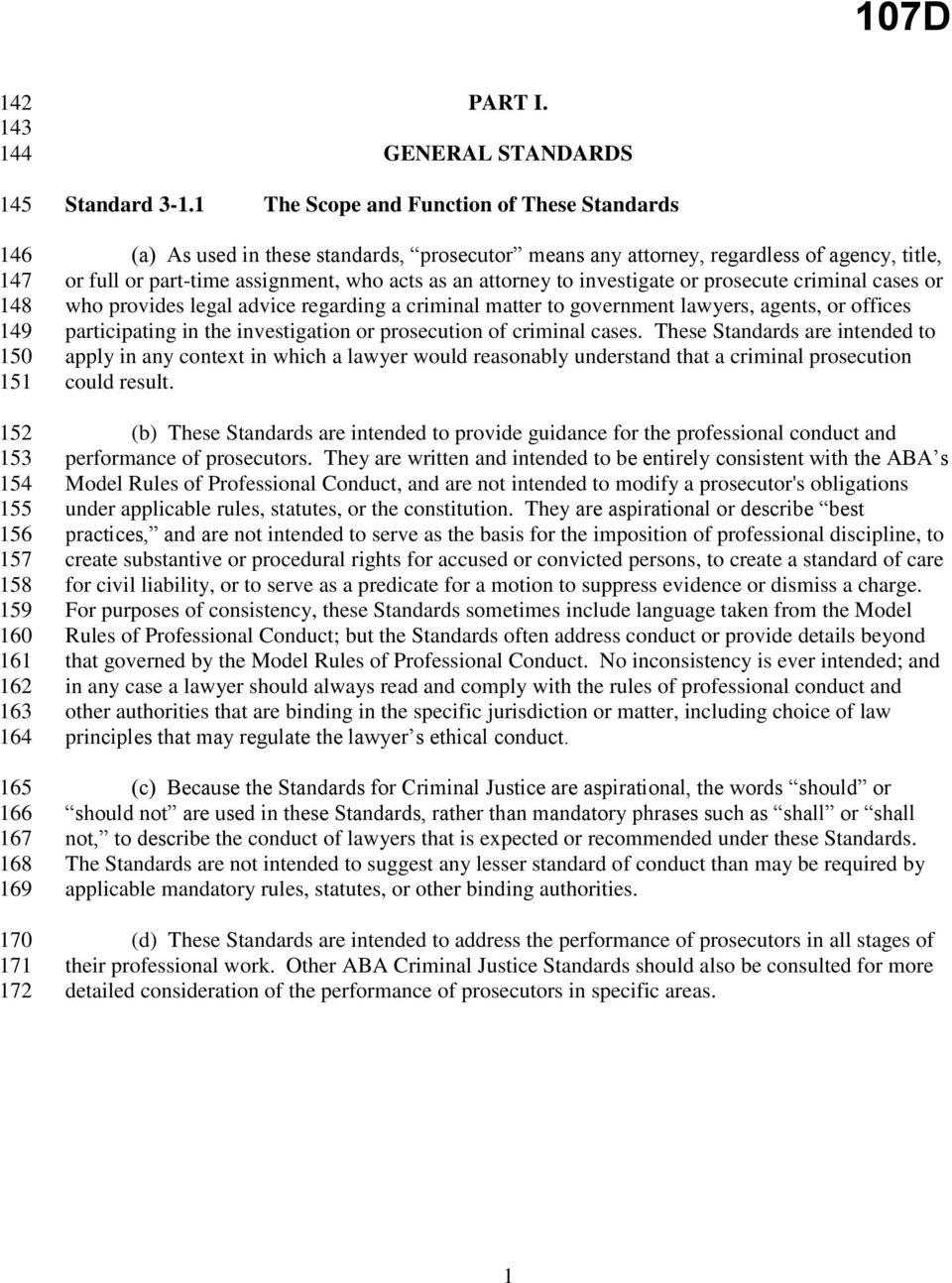
7 Standard PART I. GENERAL STANDARDS The Scope and Function of These Standards (a) As used in these standards, prosecutor means any attorney, regardless of agency, title, or full or part-time assignment, who acts as an attorney to investigate or prosecute criminal cases or who provides legal advice regarding a criminal matter to government lawyers, agents, or offices participating in the investigation or prosecution of criminal cases. These Standards are intended to apply in any context in which a lawyer would reasonably understand that a criminal prosecution could result. (b) These Standards are intended to provide guidance for the professional conduct and performance of prosecutors. They are written and intended to be entirely consistent with the ABA s Model Rules of Professional Conduct, and are not intended to modify a prosecutor's obligations under applicable rules, statutes, or the constitution. They are aspirational or describe best practices, and are not intended to serve as the basis for the imposition of professional discipline, to create substantive or procedural rights for accused or convicted persons, to create a standard of care for civil liability, or to serve as a predicate for a motion to suppress evidence or dismiss a charge. For purposes of consistency, these Standards sometimes include language taken from the Model Rules of Professional Conduct; but the Standards often address conduct or provide details beyond that governed by the Model Rules of Professional Conduct. No inconsistency is ever intended; and in any case a lawyer should always read and comply with the rules of professional conduct and other authorities that are binding in the specific jurisdiction or matter, including choice of law principles that may regulate the lawyer s ethical conduct. (c) Because the Standards for Criminal Justice are aspirational, the words should or should not are used in these Standards, rather than mandatory phrases such as shall or shall not, to describe the conduct of lawyers that is expected or recommended under these Standards. The Standards are not intended to suggest any lesser standard of conduct than may be required by applicable mandatory rules, statutes, or other binding authorities. (d) These Standards are intended to address the performance of prosecutors in all stages of their professional work. Other ABA Criminal Justice Standards should also be consulted for more detailed consideration of the performance of prosecutors in specific areas. 1
8 D Standard Functions and Duties of the Prosecutor (a) The prosecutor is an administrator of justice, a zealous advocate, and an officer of the court. The prosecutor s office should exercise sound discretion and independent judgment in the performance of the prosecution function. (b) The primary duty of the prosecutor is to seek justice within the bounds of the law, not merely to convict. The prosecutor serves the public interest and should act with integrity and balanced judgment to increase public safety both by pursuing appropriate criminal charges of appropriate severity, and by exercising discretion to not pursue criminal charges in appropriate circumstances. The prosecutor should seek to protect the innocent and convict the guilty, consider the interests of victims and witnesses, and respect the constitutional and legal rights of all persons, including suspects and defendants. (c) The prosecutor should know and abide by the standards of professional conduct as expressed in applicable law and ethical codes and opinions in the applicable jurisdiction. The prosecutor should avoid an appearance of impropriety in performing the prosecution function. A prosecutor should seek out, and the prosecutor s office should provide, supervisory advice and ethical guidance when the proper course of prosecutorial conduct seems unclear. A prosecutor who disagrees with a governing ethical rule should seek its change if appropriate, and directly challenge it if necessary, but should comply with it unless relieved by court order. (d) The prosecutor should make use of ethical guidance offered by existing organizations, and should seek to establish and make use of an ethics advisory group akin to that described in Defense Function Standard (e) The prosecutor should be knowledgeable about, consider, and where appropriate develop or assist in developing alternatives to prosecution or conviction that may be applicable in individual cases or classes of cases. The prosecutor s office should be available to assist community efforts addressing problems that lead to, or result from, criminal activity or perceived flaws in the criminal justice system. (f) The prosecutor is not merely a case-processor but also a problem-solver responsible for considering broad goals of the criminal justice system. The prosecutor should seek to reform and improve the administration of criminal justice, and when inadequacies or injustices in the substantive or procedural law come to the prosecutor's attention, the prosecutor should stimulate and support efforts for remedial action. The prosecutor should provide service to the community, including involvement in public service and Bar activities, public education, community service activities, and Bar leadership positions. A prosecutorial office should support such activities, and the office s budget should include funding and paid release time for such activities

9 208 [New] Standard The Client of the Prosecutor [New] The prosecutor generally serves the public and not any particular government agency, law enforcement officer or unit, witness or victim. When investigating or prosecuting a criminal matter, the prosecutor does not represent law enforcement personnel who have worked on the matter and such law enforcement personnel are not the prosecutor s clients. The public s interests and views are should be determined by the chief prosecutor and designated assistants in the jurisdiction. 3

10 D [New] Standard The Prosecutor s Heightened Duty of Candor [New] (a) In light of the prosecutor s public responsibilities, broad authority and discretion, the prosecutor has a heightened duty of candor to the courts and in fulfilling other professional obligations. However, the prosecutor should be circumspect in publicly commenting on specific cases or aspects of the business of the office. (b) The prosecutor should not make a statement of fact or law, or offer evidence, that the prosecutor does not reasonably believe to be true, to a court, lawyer, witness, or third party, except for lawfully authorized investigative purposes. In addition, while seeking to accommodate legitimate confidentiality, safety or security concerns, a prosecutor should correct a prosecutor s representation of material fact or law that the prosecutor reasonably believes is, or later learns was, false, and should disclose a material fact or facts when necessary to avoid assisting a fraudulent or criminal act or to avoid misleading a judge or factfinder. (c) The prosecutor should disclose to a court legal authority in the controlling jurisdiction known to the prosecutor to be directly adverse to the prosecution s position and not disclosed by others. 4

11 229 [New] Standard Preserving the Record [New] At every stage of representation, the prosecutor should take steps necessary to make a clear and complete record for potential review. Such steps may include: filing motions including motions for reconsideration, and exhibits; making objections and placing explanations on the record; requesting evidentiary hearings; requesting or objecting to jury instructions; and making offers of proof and proffers of excluded evidence. 5

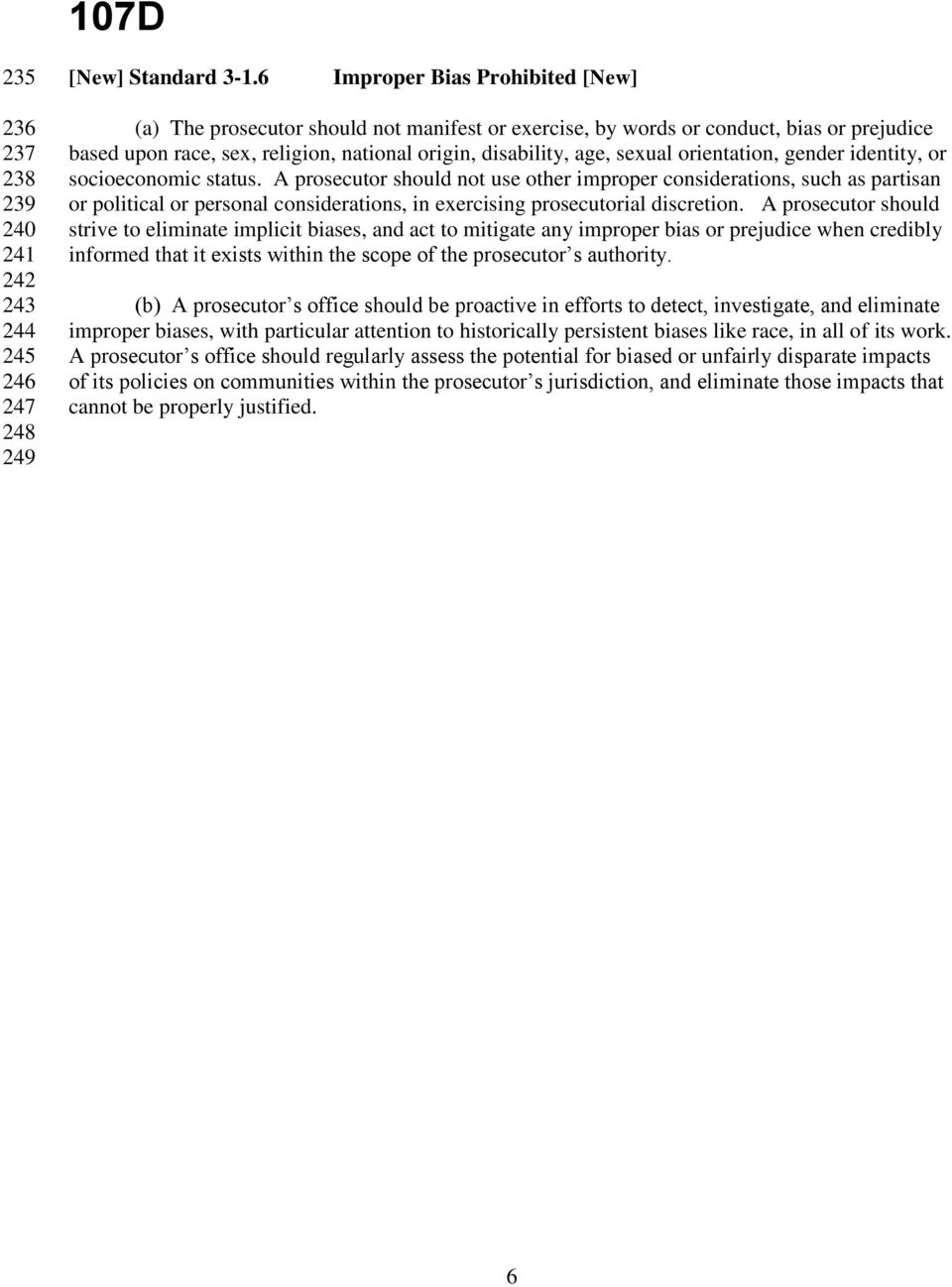
12 D [New] Standard Improper Bias Prohibited [New] (a) The prosecutor should not manifest or exercise, by words or conduct, bias or prejudice based upon race, sex, religion, national origin, disability, age, sexual orientation, gender identity, or socioeconomic status. A prosecutor should not use other improper considerations, such as partisan or political or personal considerations, in exercising prosecutorial discretion. A prosecutor should strive to eliminate implicit biases, and act to mitigate any improper bias or prejudice when credibly informed that it exists within the scope of the prosecutor s authority. (b) A prosecutor s office should be proactive in efforts to detect, investigate, and eliminate improper biases, with particular attention to historically persistent biases like race, in all of its work. A prosecutor s office should regularly assess the potential for biased or unfairly disparate impacts of its policies on communities within the prosecutor s jurisdiction, and eliminate those impacts that cannot be properly justified. 6
13 250 Standard Conflicts of Interest (a) The prosecutor should know and abide by the ethical rules regarding conflicts of interest that apply in the jurisdiction, and be sensitive to facts that may raise conflict issues. When a conflict requiring recusal exists and is non-waivable, or informed consent has not been obtained, the prosecutor should recuse from further participation in the matter. The office should not go forward until a non-conflicted prosecutor, or an adequate waiver, is in place. (b) The prosecutor should not represent a defendant in criminal proceedings in the prosecutor s jurisdiction. (c) The prosecutor should not participate in a matter in which the prosecutor previously participated, personally and substantially, as a non-prosecutor, unless the appropriate government office, and when necessary a former client, gives informed consent confirmed in writing. (d) The prosecutor should not be involved in the prosecution of a former client. A prosecutor who has formerly represented a client should not use information obtained from that representation to the disadvantage of the former client. (e) The prosecutor should not negotiate for private employment with an accused or the target of an investigation, in a matter in which the prosecutor is participating personally and substantially, or with an attorney or agent for such accused or target (f) The prosecutor should not permit the prosecutor s professional judgment or obligations to be affected by the prosecutor s personal, political, financial, professional, business, property, or other interests or relationships. A prosecutor should not allow interests in personal advancement or aggrandizement to affect judgments regarding what is in the best interests of justice in any case. (g) The prosecutor should disclose to appropriate supervisory personnel any facts or interests that could reasonably be viewed as raising a potential conflict of interest. If it is determined that the prosecutor should nevertheless continue to act in the matter, the prosecutor and supervisors should consider whether any disclosure to a court or defense counsel should be made, and make such disclosure if appropriate. Close cases should be resolved in favor of disclosure to the court and the defense. (h) The prosecutor whose current relationship to another lawyer is parent, child, sibling, spouse or sexual partner should not participate in the prosecution of a person who the prosecutor knows is represented by the other lawyer. A prosecutor who has a significant personal, political, financial, professional, business, property, or other relationship with another lawyer should not participate in the prosecution of a person who is represented by the other lawyer, unless the relationship is disclosed to the prosecutor s supervisor and supervisory approval is given, or unless there is no other prosecutor who can be authorized to act in the prosecutor's stead. In the latter rare case, full disclosure should be made to the defense and to the court. (i) The prosecutor should not recommend the services of particular defense counsel to accused persons or witnesses in cases being handled by the prosecutor s office. If requested to make such a recommendation, the prosecutor should consider instead referring the person to the 7

14 public defender, or to a panel of available criminal defense attorneys such as a bar association lawyer-referral service, or to the court. In the rare case where a specific recommendation is made by the prosecutor, the recommendation should be to an independent and competent attorney, and the prosecutor should not make a referral that embodies, creates or is likely to create a conflict of interest. A prosecutor should not comment negatively upon the reputation or abilities of a defense counsel to an accused person or witness who is seeking counsel in a case being handled by the prosecutor s office. (j) The prosecutor should promptly report to a supervisor all but the most obviously frivolous misconduct allegations made, publicly or privately, against the prosecutor. If a supervisor or judge initially determines that an allegation is serious enough to warrant official investigation, reasonable measures, including possible recusal, should be instituted to ensure that the prosecution function is fairly and effectively carried out. A mere allegation of misconduct is not a sufficient basis for prosecutorial recusal, and should not deter a prosecutor from attending to the prosecutor s duties

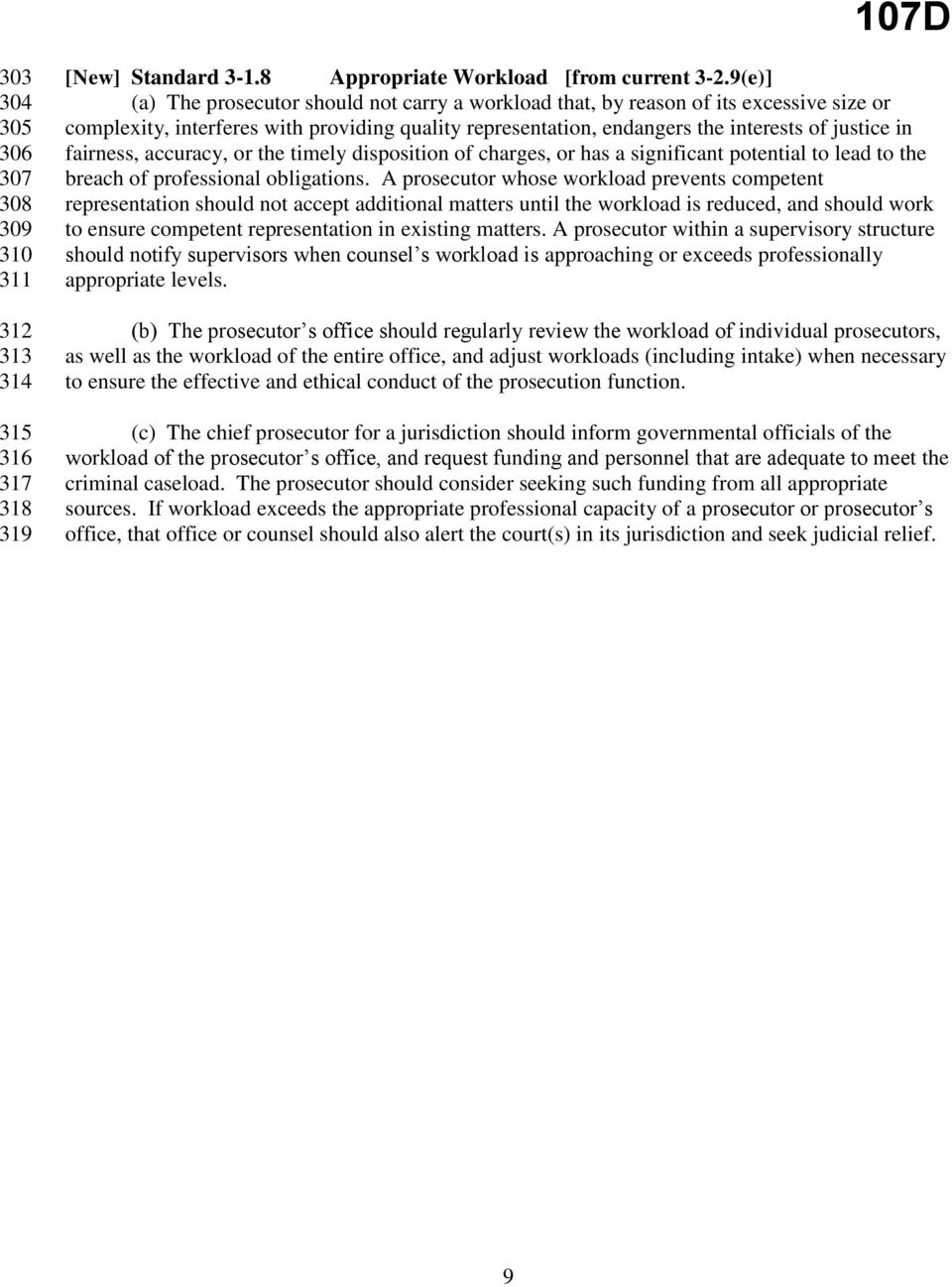
15 [New] Standard Appropriate Workload [from current 3-2.9(e)] (a) The prosecutor should not carry a workload that, by reason of its excessive size or complexity, interferes with providing quality representation, endangers the interests of justice in fairness, accuracy, or the timely disposition of charges, or has a significant potential to lead to the breach of professional obligations. A prosecutor whose workload prevents competent representation should not accept additional matters until the workload is reduced, and should work to ensure competent representation in existing matters. A prosecutor within a supervisory structure should notify supervisors when counsel s workload is approaching or exceeds professionally appropriate levels. (b) The prosecutor s office should regularly review the workload of individual prosecutors, as well as the workload of the entire office, and adjust workloads (including intake) when necessary to ensure the effective and ethical conduct of the prosecution function. (c) The chief prosecutor for a jurisdiction should inform governmental officials of the workload of the prosecutor s office, and request funding and personnel that are adequate to meet the criminal caseload. The prosecutor should consider seeking such funding from all appropriate sources. If workload exceeds the appropriate professional capacity of a prosecutor or prosecutor s office, that office or counsel should also alert the court(s) in its jurisdiction and seek judicial relief. 9
16 Standard Diligence, Promptness and Punctuality (a) The prosecutor should act with diligence and promptness to investigate, litigate, and dispose of criminal charges, consistent with the interests of justice and with due regard for fairness, accuracy, and rights of the defendant, victims, and witnesses. The prosecutor s office should be organized and supported with adequate staff and facilities to enable it to process and resolve criminal charges with fairness and efficiency. (b) When providing reasons for seeking delay, the prosecutor should not knowingly misrepresent facts or otherwise mislead. The prosecutor should use procedures that will cause delay only when there is a legitimate basis for such use, and not to secure an unfair tactical advantage. (c) The prosecutor should not unreasonably oppose requests for continuances from defense counsel. (d) The prosecutor should know and comply with timing requirements applicable to a criminal investigation and prosecution, so as to not prejudice a criminal matter. (e) The prosecutor should be punctual in attendance in court, in the submission of motions, briefs, and other papers, and in dealings with opposing counsel, witnesses and others. The prosecutor should emphasize to assistants and prosecution witnesses the importance of punctuality in court attendance. 10

17 343 Standard Relationship with the Media (a) For purposes of this Standard, a public statement is any extrajudicial statement that a reasonable person would expect to be disseminated by means of public communication or media, including social media. An extrajudicial statement is any oral, written, or visual presentation not made either in a courtroom during criminal proceedings or in court filings or correspondence with the court or counsel regarding criminal proceedings. (b) The prosecutor s public statements about the judiciary, jurors, other lawyers, or the criminal justice system should be respectful even if expressing disagreement. (c) The prosecutor should not make, cause to be made, or authorize or condone the making of, a public statement that the prosecutor knows or reasonably should know will have a substantial likelihood of materially prejudicing a criminal proceeding or heightening public condemnation of the accused, but the prosecutor may make statements that inform the public of the nature and extent of the prosecutor s or law enforcement actions and serve a legitimate law enforcement purpose. The prosecutor may make a public statement explaining why criminal charges have been declined or dismissed, but must take care not to imply guilt or otherwise prejudice the interests of victims, witnesses or subjects of an investigation. A prosecutor s public statements should otherwise be consistent with the ABA Standards on Fair Trial and Public Discourse. (d) A prosecutor should not place statements or evidence into the court record to circumvent this Standard. (e) The prosecutor should exercise reasonable care to prevent investigators, law enforcement personnel, employees, or other persons assisting or associated with the prosecutor from making an extrajudicial statement or providing non-public information that the prosecutor would be prohibited from making or providing under this Standard or other applicable rules or law. (f) The prosecutor may respond to public statements from any source in order to protect the prosecution s legitimate official interests, unless there is a substantial likelihood of materially prejudicing a criminal proceeding, in which case the prosecutor should approach defense counsel or a court for relief. A statement made pursuant to this paragraph shall be limited to such information as is necessary to mitigate the recent adverse publicity. (g) The prosecutor has duties of confidentiality and loyalty, and should not secretly or anonymously provide non-public information to the media, on or off the record, without appropriate authorization. (h) The prosecutor should not allow prosecutorial judgment to be influenced by a personal interest in potential media contacts or attention. (i) A prosecutor uninvolved in a matter who is commenting as a media source may offer generalized commentary concerning a specific criminal matter that serves to educate the public about the criminal justice system and does not risk prejudicing a specific criminal proceeding. A prosecutor acting as such a media commentator should make reasonable efforts to be well-informed about the facts of the matter and the governing law. The prosecutor should not offer commentary 11

18 regarding the specific merits of an ongoing criminal prosecution or investigation, except in a rare case to address a manifest injustice and the prosecutor is reasonably well-informed about the relevant facts and law. (j) During the pendency of a criminal matter, the prosecutor should not re-enact, or assist law enforcement in re-enacting, law enforcement events for the media. Absent a legitimate law enforcement purpose, the prosecutor should not display the accused for the media, nor should the prosecutor invite media presence during investigative actions without careful consideration of the interests of all involved, including suspects, defendants, and the public. However, a prosecutor may reasonably accommodate media requests for access to public information and events. 12

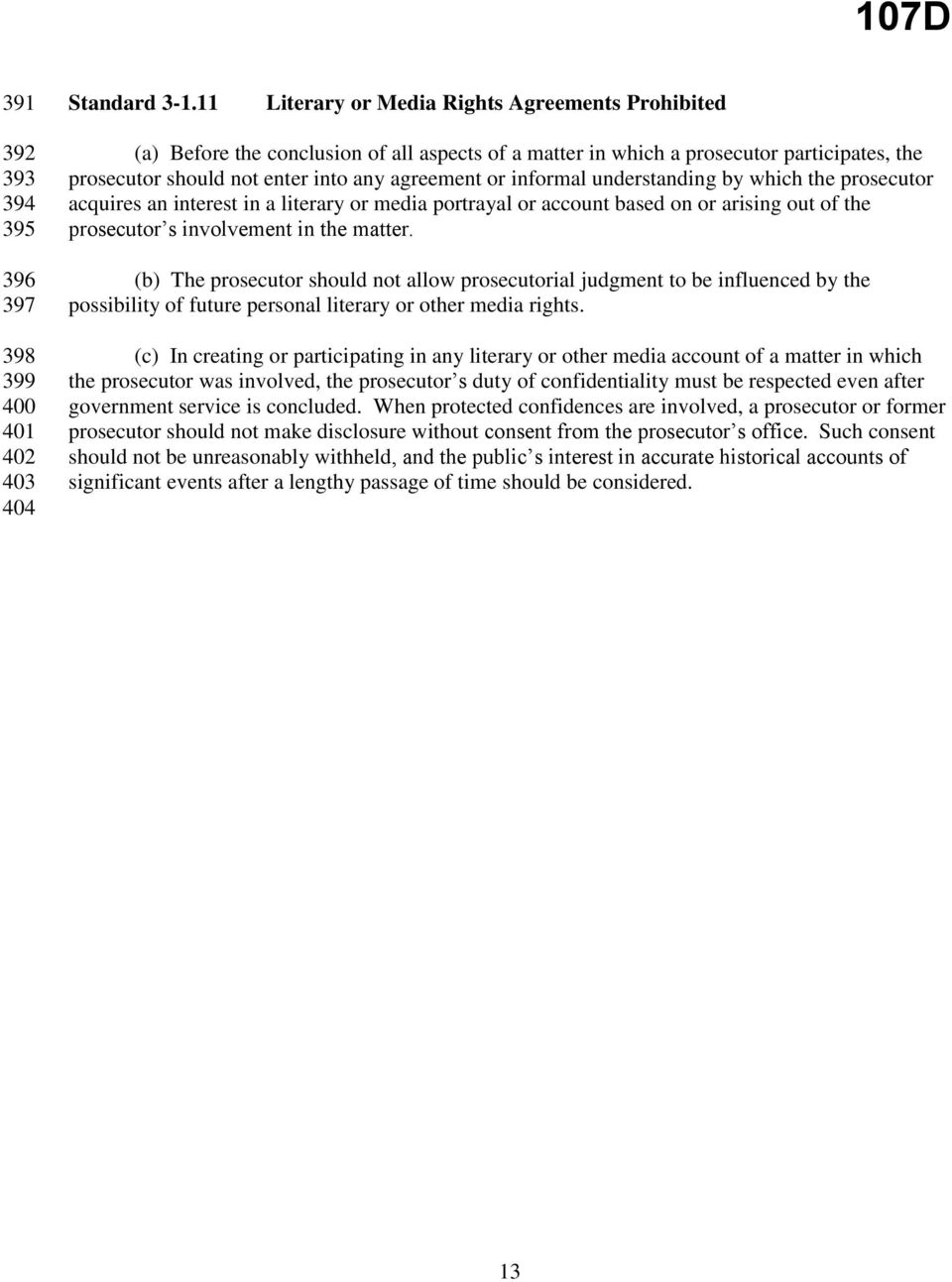
19 391 Standard Literary or Media Rights Agreements Prohibited (a) Before the conclusion of all aspects of a matter in which a prosecutor participates, the prosecutor should not enter into any agreement or informal understanding by which the prosecutor acquires an interest in a literary or media portrayal or account based on or arising out of the prosecutor s involvement in the matter. (b) The prosecutor should not allow prosecutorial judgment to be influenced by the possibility of future personal literary or other media rights. (c) In creating or participating in any literary or other media account of a matter in which the prosecutor was involved, the prosecutor s duty of confidentiality must be respected even after government service is concluded. When protected confidences are involved, a prosecutor or former prosecutor should not make disclosure without consent from the prosecutor s office. Such consent should not be unreasonably withheld, and the public s interest in accurate historical accounts of significant events after a lengthy passage of time should be considered. 13
20 405 Standard Duty to Report and Respond to Prosecutorial Misconduct (a) The prosecutor s office should adopt policies to address allegations of professional misconduct, including violations of law, by prosecutors. At a minimum such policies should require internal reporting of reasonably suspected misconduct to supervisory staff within the office, and authorize supervisory staff to quickly address the allegations. Investigations of allegations of professional misconduct within the prosecutor s office should be handled in an independent and conflict-free manner. (b) When a prosecutor reasonably believes that another person associated with the prosecutor's office intends or is about to engage in misconduct, the prosecutor should attempt to dissuade the person. If such attempt fails or is not possible, and the prosecutor reasonably believes that misconduct is ongoing, will occur, or has occurred, the prosecutor should promptly refer the matter to higher authority in the prosecutor's office including, if warranted by the seriousness of the matter, to the chief prosecutor. (c) If, despite the prosecutor's efforts in accordance with sections (a) and (b) above, the chief prosecutor permits, fails to address, or insists upon an action or omission that is clearly a violation of law, the prosecutor should take further remedial action, including revealing information necessary to address, remedy, or prevent the violation to appropriate judicial, regulatory, or other government officials not in the prosecutor's office

21 424 Standard Training Programs (a) The prosecutor s office should develop and maintain programs of training and continuing education for both new and experienced prosecutors and staff. The prosecutor s office, as well as the organized Bar or courts, should require that current and aspiring prosecutors attend a reasonable number of hours of such training and education. (b) In addition to knowledge of substantive legal doctrine and courtroom procedures, a prosecutor s core training curriculum should address the overall mission of the criminal justice system. A core training curriculum should also seek to address: investigation, negotiation, and litigation skills; compliance with applicable discovery procedures; knowledge of the development, use, and testing of forensic evidence; available conviction and sentencing alternatives, reentry, effective conditions of probation, and collateral consequences; civility, and a commitment to professionalism; relevant office, court, and defense policies and procedures and their proper application; exercises in the use of prosecutorial discretion; civility and professionalism; appreciation of diversity and elimination of improper bias; and available technology and the ability to use it. Some training programs might usefully be open to, and taught by, persons outside the prosecutor s office such as defense counsel, court staff, and members of the judiciary. (c) A prosecution office s training program should include periodic review of the office s policies and procedures, which should be amended when necessary. Specialized prosecutors should receive training in their specialized areas. Individuals who will supervise attorneys or staff should receive training in how effectively to supervise. (d) The prosecutor s office should also make available opportunities for training and continuing education programs outside the office, including training for non-attorney staff. (e) Adequate funding for continuing training and education, within and outside the office, should be requested and provided by funding sources
22 PART II. ORGANIZATION OF THE PROSECUTION FUNCTION Standard Prosecution Authority to be Vested in Full-time, Public-Official Attorneys (a) The prosecution function should be performed by a lawyer who is (i) a public official, (ii) authorized to practice law in the jurisdiction, and (iii) subject to rules of attorney professional conduct and discipline. Prosecutors whose professional obligations are devoted full-time and exclusively to the prosecution function are preferable to part-time prosecutors who have other potentially conflicting professional responsibilities. (b) A prosecutor s office should have open, effective, and well-publicized methods for communicating with, and receiving communications from, the pubic in the jurisdiction that it serves. (c) If a particular matter requires the appointment of a special prosecutor from outside the office, adequate funding for this purpose should be made available. Such special prosecutors should know and are governed by applicable conflict of interest standards for prosecutors. A private attorney who is paid by, or who has an attorney-client relationship with, an individual or entity that is a victim of the charged crime, or who has a personal or financial interest in the prosecution of particular charges, or who has demonstrated any impermissible bias relevant to the particular matter, should not be permitted to serve as prosecutor in that matter. (d) Unless impractical or unlawful, the prosecutor s office should implement a system for allowing qualified law students, cross-designated prosecutors from other offices, and private attorneys temporarily assigned to the prosecutor s office, to learn about and assist with the prosecution function. 16
23 Standard Assuring Excellence and Diversity in the Hiring, Retention, and Compensation of Prosecutors (a) Strong professional qualifications and performance should be the basis for selection and retention for prosecutor positions. Effective measures to retain excellent prosecutors should be encouraged, while recognizing the benefits of some turnover. Supervisory prosecutors should select and promote personnel based on merit and expertise, without regard to partisan, personal or political factors or influence. (b) In selecting personnel, the prosecutor s office should also consider the diverse interests and makeup of the community it serves, and seek to recruit, hire, promote and retain a diverse group of prosecutors and staff that reflect that community. (c) The function of public prosecution requires highly developed professional skills and a variety of backgrounds, talents and experience. The prosecutor s office should promote continuing professional development and continuity of service, while providing prosecutors the opportunity to gain experience in all aspects of the prosecution function. (d) Compensation and benefits for prosecutors and their staffs should be commensurate with the high responsibilities of the office, sufficient to compete with the private sector, and regularly adjusted to attract and retain well-qualified personnel. Compensation for prosecutors should be adequate and also comparable to that of public defense counsel in the jurisdiction
24 Standard Investigative Resources and Experts The prosecutor should be provided with funds for qualified experts as needed for particular matters. When warranted by the responsibilities of the office, funds should be available to the prosecutor s office to employ professional investigators and other necessary support personnel, as well as to secure access to forensic and other experts. 18
25 504 Standard Office Policies and Procedures (a) Each prosecutor's office should seek to develop general policies to guide the exercise of prosecutorial discretion, and standard operating procedures for the office. The objectives of such policies and procedures should be to achieve fair, efficient, and effective enforcement of the criminal law within the prosecutor s jurisdiction. (b) In the interest of continuity and clarity, the prosecution office s policies and procedures should be memorialized and accessible to relevant staff. The office policies and procedures should be regularly reviewed and revised. The office policies and procedures should be augmented by instruction and training, and are not a substitute for regular training programs. (c) Prosecution office policies and procedures whose disclosure would not adversely affect the prosecution function should be made available to the public. (d) The prosecutor s office should have a system in place to regularly review compliance with office policies. 19
26 Standard Removal or Suspension and Substitution of Chief Prosecutor (a) Fair and objective procedures should be established by appropriate legislation that empowers the governor or other public official or body to suspend or remove, and supersede, a chief prosecutor for a jurisdiction and designate a replacement, upon making a public finding after reasonable notice and hearing that the prosecutor is incapable of fulfilling the duties of office due to physical or mental incapacity or for gross deviation from professional norms. (b) The governor or other public official or body should be similarly empowered by law to substitute, in a particular matter or category of cases, special counsel in the place of the chief prosecutor, by consent or upon making a finding after fair process that substitution is required due to a serious conflict of interest or a gross deviation from professional norms. (c) Removal, suspension or substitution of a prosecutor should not be permitted for improper or irrelevant partisan or personal reasons
27 Standard PART III PROSECUTORIAL RELATIONSHIPS Structure of, and Relationships Among, Prosecution Offices (a) When possible, the geographic jurisdiction of a prosecution office should be determined on the basis of population, caseload, and other relevant factors sufficient to warrant at least one fulltime prosecutor and necessary support staff. (b) In all States, there should be coordination of the prosecution policies of local prosecution offices to improve the administration and consistency of justice throughout the State. To the extent needed, a central pool of supporting resources, forensic laboratories, and personnel such as investigators, additional prosecutors, accountants and other experts, should be maintained by the state government and should be available to assist local prosecutors. A coordinated forum for prosecutors to discuss issues of professional responsibility should also be available. In some jurisdictions, it may be appropriate to create a unified statewide system of prosecution, in which the state attorney general is the chief prosecutor and district or county or other local prosecutors are the attorney general s deputies. (c) Regardless of the statewide structure of prosecution offices, a state-wide association of prosecutors should be established. When questions or issues arise that could create important statewide precedents, local prosecutors should advise and consult with the attorney general, the statewide association, and the prosecutors in other local prosecution offices. (d) Federal, state, and local prosecution offices should develop practices and procedures that encourage useful coordination with prosecutors within the jurisdiction and in other jurisdictions. Prosecutors should work to identify potential issues of conflict, coordinate with other prosecution offices in advance, and resolve inter-office disputes amicably and in the public interest
28 D Standard Relationships With Law Enforcement (a) The prosecutor should maintain respectful yet independent judgment when interacting with law enforcement personnel. (b) The prosecutor may provide independent legal advice to law enforcement about actions in specific criminal matters and about law enforcement practices in general. (c) The prosecutor should become familiar with and respect the experience and specialized expertise of law enforcement personnel. The prosecutor should promote compliance by law enforcement personnel with applicable legal rules, including rules against improper bias. The prosecutor s office should keep law enforcement personnel informed of relevant legal and legal ethics issues and developments as they relate to prosecution matters, and advise law enforcement personnel of relevant prosecution policies and procedures. Prosecutors may exercise supervision over law enforcement personnel involved in particular prosecutions when in the best interests of justice and the public. (d) Representatives of the prosecutor s office should meet and confer regularly with law enforcement agencies regarding prosecution as well as law enforcement policies. The prosecutor s office should assist in developing and administering training programs for law enforcement personnel regarding matters and cases being investigated, matters submitted for charging, and the law related to law enforcement activities
29 575 Standard Relationship With Courts, Defense Counsel and Others (a) In all contacts with judges, the prosecutor should maintain a professional and independent relationship. A prosecutor should not engage in unauthorized ex parte discussions with, or submission of material to, a judge relating to a particular matter which is, or is likely to be, before the judge. With regard to generalized matters requiring judicial discussion (for example, casemanagement or administrative matters), the prosecutor should invite a representative defense counsel to join in the discussion to the extent practicable. (b) When ex parte communications or submissions are authorized, the prosecutor should inform the court of material facts known to the prosecutor, including facts that are adverse, sufficient to enable the court to make a fair and informed decision. Except when non-disclosure is authorized, counsel should notify opposing counsel that an ex parte contact has occurred, without disclosing its content unless permitted. (c) In written filings, the prosecutor should respectfully evaluate and respond as appropriate to opposing counsel s arguments and representations, and avoid unnecessary personalized disparagement. (d) The prosecutor should develop and maintain courteous and civil working relationships with judges and defense counsel, and should cooperate with them in developing solutions to address ethical, scheduling, or other issues that may arise in particular cases or generally in the criminal justice system. Prosecutors should cooperate with courts and organized bar associations in developing codes of professionalism and civility, and should abide by such codes that apply in their jurisdiction
30 Standard Relationship With Victims and Witnesses (a) Witness in this Standard means any person who has or might have information about a matter, including victims. (b) The prosecutor should know and follow the law and rules of the jurisdiction regarding victims and witnesses. In communicating with witnesses, the prosecutor should know and abide by law and ethics rules regarding the use of deceit and engaging in communications with represented, unrepresented, and organizational persons. (c) The prosecutor or the prosecutor s agents should seek to interview all witnesses, and should not act to intimidate or unduly influence any witness. (d) The prosecutor should not use means that have no substantial purpose other than to embarrass, delay, or burden, and not use methods of obtaining evidence that violate legal rights. The prosecutor and prosecution agents should not misrepresent their status, identity or interests when communicating with a witness. (e) The prosecutor should be permitted to compensate a witness for reasonable expenses such as costs of attending court, depositions pursuant to statute or court rule, and pretrial interviews, including transportation and loss of income. No other benefits should be provided to witnesses unless authorized by law, regulation, or well-accepted practice. All benefits provided to witnesses should be documented and disclosed to the defense. A prosecutor should not pay or provide a benefit to a witness in order to, or in an amount that is likely to, affect the substance or truthfulness of the witness s testimony. (f) A prosecutor should avoid the prospect of having to testify personally about the content of a witness interview. The prosecutor s interview of most routine or government witnesses (for example, custodians of records or law enforcement agents) should not require a third-party observer. But when the need for corroboration of an interview is reasonably anticipated, the prosecutor should be accompanied by another trusted and credible person during the interview. The prosecutor should avoid being alone with any witness who the prosecutor reasonably believes has potential or actual criminal liability, or foreseeably hostile witnesses. (g) The prosecutor should advise a witness who is to be interviewed of his or her rights against self-incrimination and the right to independent counsel when the law so requires. Even if the law does not require it, a prosecutor should consider so advising a witness if the prosecutor reasonably believes the witness may provide self-incriminating information and the witness appears not to know his or her rights. However, a prosecutor should not so advise, or discuss or exaggerate the potential criminal liability of, a witness with a purpose, or in a manner likely, to intimidate the witness, to influence the truthfulness or completeness of the witness s testimony, or to change the witness s decision about whether to provide information. (h) The prosecutor should not discourage or obstruct communication between witnesses and the defense counsel, other than the government s employees or agents if consistent with applicable ethical rules. The prosecutor should not advise any person, or cause any person to be advised, to decline to provide defense counsel with information which such person has a right to give. The 24
31 prosecutor may, however, fairly and accurately advise witnesses as to the likely consequences of their providing information, but only if done in a manner that does not discourage communication. (i) Consistent with any specific laws or rules governing victims, the prosecutor should provide victims of serious crimes, or their representatives, an opportunity to consult with and to provide information to the prosecutor, prior to making significant decisions such as whether or not to prosecute, to pursue a disposition by plea, or to dismiss charges. The prosecutor should seek to ensure that victims of serious crimes, or their representatives, are given timely notice of: (i) judicial proceedings relating to the victims case; (ii) proposed dispositions of the case; (iii) sentencing proceedings; and (iv) any decision or action in the case that could result in the defendant s provisional or final release from custody, or change of sentence. (j) The prosecutor should ensure that victims and witnesses who may need protections against intimidation or retaliation are advised of and afforded protections where feasible. (k) Subject to ethical rules and the confidentiality that criminal matters sometimes require, and unless prohibited by law or court order, the prosecutor should information about the status of matters in which they are involved to victims and witnesses who request it. (l) The prosecutor should give witnesses reasonable notice of when their testimony at a proceeding is expected, and should not require witnesses to attend judicial proceedings unless their testimony is reasonably expected at that time, or their presence is required by law. When witnesses attendance is required, the prosecutor should seek to reduce to a minimum the time witnesses must spend waiting at the proceedings. The prosecutor should ensure that witnesses are given notice as soon as practicable of scheduling changes which will affect their required attendance at judicial proceedings. (m) The prosecutor should not engage in any inappropriate personal relationship with any victim or other witness. 25
32 Standard Relationship with Expert Witnesses (a) An expert may be engaged for consultation only, or to prepare an evidentiary report or testimony. The prosecutor should know relevant rules governing expert witnesses, including possibly different disclosure rules governing experts who are engaged for consultation only. (b) A prosecutor should evaluate all expert advice, opinions, or testimony independently, and not simply accept the opinion of a government or other expert based on employer, affiliation or prominence alone. (c) Before engaging an expert, the prosecutor should investigate the expert s credentials, relevant professional experience, and reputation in the field. The prosecutor should also examine a testifying expert s background and credentials for potential impeachment issues. Before offering an expert as a witness, the prosecutor should investigate the scientific acceptance of the particular theory, method, or conclusions about which the expert would testify. (d) A prosecutor who engages an expert to provide a testimonial opinion should respect the independence of the expert and should not seek to dictate the substance of the expert s opinion on the relevant subject. (e) Before offering an expert as a witness, the prosecutor should seek to learn enough about the substantive area of the expert s expertise, including ethical rules that may be applicable in the expert s field, to enable effective preparation of the expert, as well as effective cross-examination of any defense expert on the same topic. The prosecutor should explain to the expert that the expert s role in the proceeding will be as an impartial witness called to aid the fact-finders, explain the manner in which the examination of the expert is likely to be conducted, and suggest likely impeachment questions the expert may be asked. (f) The prosecutor should not pay or withhold any fee or provide or withhold a benefit for the purpose of influencing the substance of an expert s testimony. The prosecutor should not fix the amount of the fee contingent upon the expert s testimony or the result in the case. Nor should the prosecutor promise or imply the prospect of future work for the expert based on the expert s testimony. (g) The prosecutor should provide the expert with all information reasonably necessary to support a full and fair opinion. The prosecutor should be aware, and explain to the expert, that all communications with, and documents shared with, a testifying expert may be subject to disclosure to opposing counsel. The prosecutor should be aware of expert discovery rules and act to protect confidentiality and the public interest, for example by not sharing with the expert confidences and work product that the prosecutor does not want disclosed. (h) The prosecutor should timely disclose to the defense all evidence or information learned from an expert that tends to negate the guilt of the accused or mitigate the offense, even if the prosecutor does not intend to call the expert as a witness. 26
33 [New] Standard When Physical Evidence With Incriminating Implications is Disclosed by the Defense [New] When physical evidence is delivered to the prosecutor consistent with Defense Function Standard 4-4.7, the prosecutor should not offer the fact of delivery as evidence before a fact-finder for purposes of establishing the culpability of defense counsel s client. The prosecutor may, however, offer evidence of the fact of such delivery in response to a foundational objection to the evidence based on chain-of-custody concerns, or in a subsequent proceeding for the purpose of proving a crime or fraud regarding the evidence
34 PART IV INVESTIGATION; DECISIONS TO CHARGE, NOT CHARGE, OR DISMISS; AND GRAND JURY Standard Investigative Function of the Prosecutor (a) When performing an investigative function, prosecutors should be familiar with and follow the ABA Standards on Prosecutorial Investigations. (b) A prosecutor should not use illegal or unethical means to obtain evidence or information, or employ, instruct, or encourage others to do so. Prosecutors should research and know the law in this regard before acting, understanding that in some circumstances a prosecutor s ethical obligations may be different from those of other lawyers. 28
35 Standard Decisions to Charge Are the Prosecutor s (a) While the decision to arrest is often the responsibility of law enforcement personnel, the decision to institute formal criminal proceedings is the responsibility of the prosecutor. Where the law permits a law enforcement officer or other person to initiate proceedings by complaining directly to a judicial officer or the grand jury, the complainant should be required to present the complaint for prior review by the prosecutor, and the prosecutor s recommendation regarding the complaint should be communicated to the judicial officer or grand jury. (b) The prosecutor s office should establish standards and procedures for evaluating complaints to determine whether formal criminal proceedings should be instituted. (c) In determining whether formal criminal charges should be filed, prosecutors should consider whether further investigation should be undertaken. After charges are filed the prosecutor should oversee law enforcement investigative activity related to the case. (d) If the defendant is not in custody when charged, the prosecutor should consider whether a voluntary appearance rather than a custodial arrest would suffice to protect the public and ensure the defendant s presence at court proceedings. 29
36 [New] Standard Minimum Requirements for Filing and Maintaining Criminal Charges [New] (a) A prosecutor should seek or file criminal charges only if the prosecutor reasonably believes that the charges are supported by probable cause, that admissible evidence will be sufficient to support conviction beyond a reasonable doubt, and that the decision to charge is in the interests of justice. (b) After criminal charges are filed, a prosecutor should maintain them only if the prosecutor continues to reasonably believe that probable cause exists and that admissible evidence will be sufficient to support conviction beyond a reasonable doubt. (c) If a prosecutor has significant doubt about the guilt of the accused or the quality, truthfulness, or sufficiency of the evidence in any criminal case assigned to the prosecutor, the prosecutor should disclose those doubts to supervisory staff. The prosecutor s office should then determine whether it is appropriate to proceed with the case. (d) A prosecutor s office should not file or maintain charges if it believes the defendant is innocent, no matter what the state of the evidence. 30
37 [New] Standard Discretion in Filing, Declining, Maintaining, and Dismissing Criminal Charges [New] (a) In order to fully implement the prosecutor s functions and duties, including the obligation to enforce the law while exercising sound discretion, the prosecutor is not obliged to file or maintain all criminal charges which the evidence might support. Among the factors which the prosecutor may properly consider in exercising discretion to initiate, decline, or dismiss a criminal charge, even though it meets the requirements of Standard 3-4.3, are: (i) the strength of the case; (ii) the prosecutor s doubt that the accused is in fact guilty; (iii) the extent or absence of harm caused by the offense; (iv) the impact of prosecution or non-prosecution on the public welfare; (v) the background and characteristics of the offender, including any voluntary restitution or efforts at rehabilitation; (vi) whether the authorized or likely punishment or collateral consequences are disproportionate in relation to the particular offense or the offender; (vii) the views and motives of the victim or complainant; (viii) any improper conduct by law enforcement; (ix) unwarranted disparate treatment of similarly situated persons; (x) potential collateral impact on third parties, including witnesses or victims; (xi) cooperation of the offender in the apprehension or conviction of others; (xii) the possible influence of any cultural, ethnic, socioeconomic or other improper biases; (xiii) changes in law or policy; (xiv) the fair and efficient distribution of limited prosecutorial resources; (xv) the likelihood of prosecution by another jurisdiction; and (xvi) whether the public s interests in the matter might be appropriately vindicated by available civil, regulatory, administrative, or private remedies. (b) In exercising discretion to file and maintain charges, the prosecutor should not consider: (i) partisan or other improper political or personal considerations; (ii) hostility or personal animus towards a potential subject, or any other improper motive of the prosecutor; or (iii) the impermissible criteria described in Standard 1.6 above. (c) A prosecutor may file and maintain charges even if juries in the jurisdiction have tended to acquit persons accused of the particular kind of criminal act in question. (d) The prosecutor should not file or maintain charges greater in number or degree than can reasonably be supported with evidence at trial and are necessary to fairly reflect the gravity of the offense or deter similar conduct. (e) A prosecutor may condition a dismissal of charges, nolle prosequi, or similar action on the accused's relinquishment of a right to seek civil redress only if the accused has given informed consent, and such consent is disclosed to the court. A prosecutor should not use a civil waiver to 31
38 avoid a bona fide claim of improper law enforcement actions, and a decision not to file criminal charges should be made on its merits and not for the purpose of obtaining a civil waiver. (f) The prosecutor should consider the possibility of a noncriminal disposition, formal or informal, or a deferred prosecution or other diversionary disposition, when deciding whether to initiate or prosecute criminal charges. The prosecutor should be familiar with the services and resources of other agencies, public or private, that might assist in the evaluation of cases for diversion or deferral from the criminal process. 32
39 Standard Relationship with a Grand Jury (a) In presenting a matter to a criminal grand jury, and in light of its ex parte character, the prosecutor should respect the independence of the grand jury and should not preempt a function of the grand jury, mislead the grand jury, or abuse the processes of the grand jury. (b) Where the prosecutor is authorized to act as a legal advisor to the grand jury, the prosecutor should appropriately explain the law and may, if permitted by law, express an opinion on the legal significance of the evidence, but should give due deference to the grand jury as an independent legal body. (c) The prosecutor should not make statements or arguments to a grand jury in an effort to influence grand jury action in a manner that would be impermissible in a trial. (d) The entirety of the proceedings occurring before a grand jury, including the prosecutor s communications with and presentations and instructions to the grand jury, should be recorded in some manner, and that record should be preserved. The prosecutor should avoid off-the-record communications with the grand jury and with individual grand jurors. 33
40 Standard Quality and Scope of Evidence Before a Grand Jury (a) A prosecutor should not seek an indictment unless the prosecutor reasonably believes the charges are supported by probable cause and that there will be admissible evidence sufficient to support the charges beyond reasonable doubt at trial. A prosecutor should advise a grand jury of the prosecutor s opinion that it should not indict if the prosecutor believes the evidence presented does not warrant an indictment. (b) In addition to determining what criminal charges to file, a grand jury may properly be used to investigate potential criminal conduct, and also to determine the sense of the community regarding potential charges. (c) A prosecutor should present to a grand jury only evidence which the prosecutor believes is appropriate and authorized by law for presentation to a grand jury. The prosecutor should be familiar with the law of the jurisdiction regarding grand juries, and may present witnesses to summarize relevant evidence to the extent the law permits. (d) When a new grand jury is empanelled, a prosecutor should ensure that the grand jurors are appropriately instructed, consistent with the law of the jurisdiction, on the grand jury s right and ability to seek evidence, ask questions, and hear directly from any available witnesses, including eyewitnesses. (e) A prosecutor with personal knowledge of evidence that directly negates the guilt of a subject of the investigation should present or otherwise disclose that evidence to the grand jury. The prosecutor should relay to the grand jury any request by the subject or target of an investigation to testify before the grand jury, or present other non-frivolous evidence claimed to be exculpatory. (f) If the prosecutor concludes that a witness is a target of a criminal investigation, the prosecutor should not seek to compel the witness s testimony before the grand jury absent immunity. The prosecutor should honor, however, a reasonable request from a target or subject who wishes to testify before the grand jury. (g) Unless there is a reasonable possibility that it will facilitate flight of the target, endanger other persons, interfere with an ongoing investigation, or obstruct justice, the prosecutor should give notice to a target of a grand jury investigation, and offer the target an opportunity to testify before the grand jury. Prior to taking a target s testimony, the prosecutor should advise the target of the privilege against self-incrimination and obtain a voluntary waiver of that right. (h) The prosecutor should not seek to compel the appearance of a witness whose activities are the subject of the grand jury s inquiry, if the witness states in advance that if called the witness will claim the constitutional privilege not to testify, and provides a reasonable basis for such claim. If warranted, the prosecutor may judicially challenge such a claim of privilege or seek a grant of immunity according to the law. (i) The prosecutor should not issue a grand jury subpoena to a criminal defense attorney or defense team member, or other witness whose testimony reasonably might be protected by a 34
41 recognized privilege, without considering the applicable law and rules of professional responsibility in the jurisdiction. (j) Except where permitted by law, a prosecutor should not use the grand jury in order to obtain evidence to assist the prosecution s preparation for trial of a defendant who has already been charged. A prosecutor may, however, use the grand jury to investigate additional or new charges against a defendant who has already been charged. (k) Except where permitted by law, a prosecutor should not use a criminal grand jury solely or primarily for the purpose of aiding or assisting in an administrative or civil inquiry. 35
42 PART V PRETRIAL ACTIVITIES and NEGOTIATED DISPOSITIONS Standard Role in First Appearance and Preliminary Hearing (a) A prosecutor should be present at any first appearance of the accused before a judicial officer, and at any preliminary hearing. (b) At or before the first appearance, the prosecutor should consider: (i) whether the accused has counsel, and if not, whether and when counsel will be made available or waived; (ii) whether the accused appears to be mentally competent, and if not, whether to seek an evaluation; (iii) whether the accused should be released or detained pending further proceedings And, if released, whether supervisory conditions should be imposed; and (iv) what further proceedings should be scheduled to move the matter toward timely resolution. (c) The prosecutor handling the first appearance should ensure that the charges are consistent with the conduct described in the available law enforcement reports and any other information the prosecutor possesses. (d) If the accused does not yet have counsel and has not waived counsel, the prosecutor should ask the court not to engage in substantive proceedings, other than a decision to release the accused. The prosecutor should not obtain a waiver of other important pretrial rights, such as the right to a preliminary hearing, from an unrepresented accused unless that person has been judicially authorized to proceed pro se. (e) The prosecutor should not approach or communicate with an accused unless a voluntary waiver of counsel has been entered or the accused s counsel consents. If the accused does not have counsel, the prosecutor should make reasonable efforts to assure that the accused has been advised of the right to, and the procedure for obtaining, counsel, and is given reasonable opportunity to obtain counsel. (f) If the prosecutor believes pretrial release is appropriate, or it is ordered, the prosecutor should cooperate in arrangements for release under the prevailing pretrial release system. (g) If the prosecutor has reasonable concerns about the accused s mental competence, the prosecutor should bring those concerns to the attention of defense counsel and, if necessary, the judicial officer. (h) The prosecutor should not seek to delay a prompt judicial determination of probable cause for criminal charges without good cause, particularly if the accused is in custody. 36
43 [New] Standard The Decision to Recommend Release or Seek Detention [New] (a) The prosecutor should favor pretrial release of a criminally accused, unless detention is necessary to protect individuals or the community or to ensure the return of the defendant for future proceedings. (b) The prosecutor s decision to recommend pretrial release or seek detention should be based on the facts and circumstances of the defendant and the offense, rather than made categorically. The prosecutor should consider information relevant to these decisions from all sources, including the defendant. (c) The prosecutor should cooperate with pretrial services or other personnel who review or assemble information to be provided to the court regarding pretrial release determinations. (d) The prosecutor should be open to reconsideration of pretrial detention or release decisions based on changed circumstances, including an unexpectedly lengthy period of detention
44 [New] Standard Preparation for Court Proceedings, and Recording and Transmitting Information [New] (a) The prosecutor should prepare in advance for court proceedings unless that is impossible. Adequate preparation depends on the nature of the proceeding and the time available, and will often include: reviewing available documents; considering what issues are likely to arise and the prosecution s position regarding those issues; how best to present the issues and what solutions might be offered; relevant legal research and factual investigation; and contacting other persons who might be of assistance in addressing the anticipated issues. If the prosecutor has not had adequate time to prepare and is unsure of the relevant facts or law, the prosecutor should communicate to the court the limits of the prosecutor s knowledge or preparation. (b) The prosecutor should make effort to appear at all hearings in cases assigned to the prosecutor. A prosecutor who substitutes at a court proceeding for another prosecutor assigned to the case should make reasonable efforts to be adequately informed about the case and issues likely to come up at the proceeding, and to adequately prepare. (c) The prosecutor handling any court appearance should document what happens at the proceeding, to aid the prosecutor s later memory and so that necessary information will be available to other prosecutors who may handle the case in the future. (d) The prosecutor should take steps to ensure that any court order issued to the prosecution is transmitted to the appropriate persons necessary to effectuate the order. (e) The prosecutor s office should be provided sufficient resources and be organized to permit adequate preparation for court proceedings. 38
45 Standard Identification and Disclosure of Information and Evidence (a) After charges are filed if not before, the prosecutor should diligently seek to identify all information in the possession of the prosecution or its agents that tends to negate the guilt of the accused, mitigate the offense charged, impeach the government s witnesses or evidence, or reduce the likely punishment of the accused if convicted. (b) The prosecutor should diligently advise other governmental agencies involved in the case of their continuing duty to identify, preserve, and disclose to the prosecutor information described in (a) above. (c) Before trial of a criminal case, a prosecutor should make timely disclosure to the defense of information described in (a) above that is known to the prosecutor, regardless of whether the prosecutor believes it is likely to change the result of the proceeding, unless relieved of this responsibility by a court s protective order. (Regarding discovery prior to a guilty plea, see Standard 3-5.6(f) below.) A prosecutor should not intentionally attempt to obscure information disclosed pursuant to this standard by including it without identification within a larger volume of materials. (d) The obligations to identify and disclose such information continue throughout the prosecution of a criminal case. (e) A prosecutor should timely respond to legally proper discovery requests, and make a diligent effort to comply with legally proper disclosure obligations, unless otherwise authorized by a court. When the defense makes requests for specific information, the prosecutor should provide specific responses rather than merely a general acknowledgement of discovery obligations. Requests and responses should be tailored to the case and boilerplate requests and responses should be disfavored. (f) The prosecutor should make prompt efforts to identify and disclose to the defense any physical evidence that has been gathered in the investigation, and provide the defense a reasonable opportunity to examine it. (g) A prosecutor should not avoid pursuit of information or evidence because the prosecutor believes it will damage the prosecution's case or aid the accused. (h) A prosecutor should determine whether additional statutes, rules or caselaw may govern or restrict the disclosure of information, and comply with these authorities absent court order. 39
46 [New] Standard Preservation of Information and Evidence [New] (a) The prosecutor should make reasonable efforts to preserve, and direct the prosecutor s agents to preserve, relevant materials during and after a criminal case, including (i) evidence relevant to investigations as well as prosecutions, whether or not admitted at trial; (ii) information identified pursuant to Standard 3-5.4(a); and (iii) other materials necessary to support significant decisions made and conclusions reached by the prosecution in the course of an investigation and prosecution. (b) The prosecutor s office should develop policies regarding the method and duration of preservation of such materials. Such policies should be consistent with applicable rules and laws (such as public records laws) in the jurisdiction. These policies, and individual preservation decisions, should consider the character and seriousness of each case, the character of the particular evidence or information, the likelihood of further challenges to judgments following conviction, and the resources available for preservation. Physical evidence should be preserved so as to reasonably preserve its forensic characteristics and utility. (c) Materials should be preserved at least until a criminal case is finally resolved or is final on appeal and the time for further appeal has expired. In felony cases, materials should be preserved until post-conviction litigation is concluded or time-limits have expired. In death penalty cases, information should be preserved until the penalty is carried out or is precluded. (d) The prosecutor should comply with additional statutes, rules or caselaw that may govern the preservation of evidence. 40
47 1056 Standard Conduct of Negotiated Disposition Discussions (a) The prosecutor should be open, at every stage of a criminal matter, to discussions with defense counsel concerning disposition of charges by guilty plea or other negotiated disposition. (b) A prosecutor should not engage in disposition discussions directly with a represented defendant, except with defense counsel's approval. Where a defendant has properly waived counsel, the prosecutor may engage in disposition discussions with the defendant, and should make and preserve a record of such discussions. (c) The prosecutor should not enter into a disposition agreement before having information sufficient to assess the defendant s actual culpability. The prosecutor should consider collateral consequences of a conviction before entering into a disposition agreement. The prosecutor should consider factors listed in Standard 3-4.4(a), and not be influenced in disposition discussions by inappropriate factors such as those listed in Standards and 3-4.4(b). (d) The prosecutor should not set unreasonably short deadlines, or demand conditions for a disposition, that are so coercive that the voluntariness of a plea or the effectiveness of defense counsel is put into question. A prosecutor may, however, set a reasonable deadline before trial or hearing for acceptance of a disposition offer. (e) A prosecutor should not knowingly make false statements of fact or law in the course of disposition discussions. (f) Before entering into a disposition agreement, the prosecutor should disclose to the defense a factual basis sufficient to support the charges in the proposed agreement, and information currently known to the prosecutor that tends to negate guilt, mitigates the offense or is likely to reduce punishment. (g) A prosecutor should not agree to a guilty plea if the prosecutor reasonably believes that sufficient admissible evidence to support conviction beyond reasonable doubt would be lacking if the matter went to trial. 41
48 D Standard Establishing and Fulfilling Conditions of Negotiated Dispositions (a) A prosecutor should not demand terms in a negotiated disposition agreement that are unlawful or in violation of public policy. (b) The prosecutor may properly promise the defense that the prosecutor will or will not take a particular position concerning sentence and conditions. The prosecutor should not, however, imply a greater power to influence the disposition of a case than is actually possessed. (c) The prosecutor should memorialize all promises and conditions that are part of the agreement, and ensure that any written disposition agreement accurately and completely reflects the precise terms of the agreement including the prosecutor s promises and the defendant s obligations. At any court hearing to finalize a negotiated disposition, the prosecutor should ensure that all relevant details of the agreement have been placed on the record. The presumption is that the hearing and record will be public, but in some cases the hearing or record (or a portion) may be sealed for good cause. (d) Once a disposition agreement is final and accepted by the court, the prosecutor should comply with, and make good faith efforts to have carried out, the government s obligations. The prosecutor should construe agreement conditions, and evaluate the defendant s performance including any cooperation, in a good-faith and reasonable manner. (e) If the prosecutor believes that a defendant has breached an agreement that has been accepted by the court, the prosecutor should notify the defense regarding the prosecutor s belief and any intended adverse action. If the defense presents a good-faith disagreement and the parties cannot quickly resolve it, the prosecutor should not act before judicial resolution. (f) If the prosecutor reasonably believes that a court is acting inconsistently with any term of a negotiated disposition, the prosecutor should raise the matter with the court
49 1105 [New] Standard D Waiver of Rights as Condition of Disposition Agreements [New] (a) A prosecutor should not condition a disposition agreement on a waiver of the right to appeal the terms of a sentence which exceeds an agreed-upon or reasonably anticipated sentence. Any waiver of appeal of sentence should be comparably binding on the defendant and the prosecution. (b) A prosecutor should not suggest or require, as a condition of a disposition agreement, any waiver of post-conviction claims addressing ineffective assistance of counsel, prosecutorial misconduct, or destruction of evidence, unless such claims are based on past instances of such conduct that are specifically identified in the agreement or in the transcript of proceedings that address the agreement. If a proposed disposition agreement contains such a waiver regarding ineffective assistance of counsel, the prosecutor should ensure that the defendant has been provided the opportunity to consult with independent counsel regarding the waiver before agreeing to the disposition. (c) A prosecutor may propose or require other sorts of waivers on an individualized basis if the defendant s agreement is knowing and voluntary. No waivers of any kind should be accepted without an exception for manifest injustice based on newly-discovered evidence, or actual innocence. (d) Although certain claims may have been waived, a prosecutor should not condition a disposition agreement on a complete waiver of the right to file a habeas corpus or other comparable post-conviction petition. (e) A prosecutor should not request or rely on waivers to hide an injustice or material flaw in the case which is undisclosed to the defense. 43
50 1132 Standard Record of Reasons for Dismissal of Charges When criminal charges are dismissed on the prosecution s motion, including by plea of nolle prosequi or its equivalent, the prosecutor should make and retain an appropriate record of the reasons for the dismissal, and indicate on the record whether the dismissal was with or without prejudice. 44
51 Standard PART VI COURT HEARINGS AND TRIAL Scheduling Court Hearings Final control over the scheduling of court appearances, hearings and trials in criminal matters should rest with the court rather than the parties. When the prosecutor is aware of facts that would affect scheduling, the prosecutor should advise the court and, if the facts are case-specific, defense counsel
52 D Standard Civility With Courts, Opposing Counsel, and Others (a) As an officer of the court, the prosecutor should support the authority of the court and the dignity of the courtroom by adherence to codes of professionalism and civility, and by manifesting a professional and courteous attitude toward the judge, opposing counsel, witnesses, defendants, jurors, court staff and others. In court as elsewhere, the prosecutor should not display or act out of any improper or unlawful bias. (b) When court is in session, unless otherwise permitted by the court, the prosecutor should address the court and not address other counsel or the defendant directly on any matter related to the case. (c) The prosecutor should comply promptly and civilly with a court s orders or seek appropriate relief from such order. If the prosecutor considers an order to be significantly erroneous or prejudicial, the prosecutor should ensure that the record adequately reflects the events. The prosecutor has a right to make respectful objections and reasonable requests for reconsideration, and to seek other relief as the law permits. If a judge prohibits making an adequate objection, proffer, or record, the prosecutor may take other lawful steps to protect the public interest. 46
53 1164 Standard Selection of Jurors (a) The prosecutor s office should be aware of legal standards that govern the selection of jurors, and train prosecutors to comply. The prosecutor should prepare to effectively discharge the prosecution function in the selection of the jury, including exercising challenges for cause and peremptory challenges. The prosecutor s office should also be aware of the process used to select and summon the jury pool and bring legal deficiencies to the attention of the court. (b) The prosecutor should not strike jurors based on any criteria rendered impermissible by the constitution, statutes, applicable rules of the jurisdiction, or these standards, including race, sex, religion, national origin, disability, sexual orientation or gender identity. The prosecutor should consider contesting a defense counsel s peremptory challenges that appear to be based upon such criteria. (c) In cases in which the prosecutor conducts a pretrial investigation of the background of potential jurors, the investigative methods used should not harass, intimidate, or unduly embarrass or invade the privacy of potential jurors. Absent special circumstances, such investigation should be restricted to review of records and sources of information already in existence and to which access is lawfully allowed. If the prosecutor uses record searches that are unavailable to the defense, such as criminal record databases, the prosecutor should share the results with defense counsel or seek a judicial protective order. (d) The opportunity to question jurors personally should be used solely to obtain information relevant to the well-informed exercise of challenges. The prosecutor should not seek to commit jurors on factual issues likely to arise in the case, and should not intentionally present arguments, facts or evidence which the prosecutor reasonably should know will not be admissible at trial. Voir dire should not be used to argue the prosecutor s case to the jury, or to unduly ingratiate counsel with the jurors. (e) During voir dire, the prosecutor should seek to minimize any undue embarrassment or invasion of privacy of potential jurors, for example by seeking to inquire into sensitive matters outside the presence of other potential jurors, while still enabling fair and efficient juror selection. (f) If the court does not permit voir dire by counsel, the prosecutor should provide the court with suggested questions in advance, and request specific follow-up questions during the selection process when necessary to ensure fair juror selection. (g) If the prosecutor has reliable information that conflicts with a potential juror s responses, or that reasonably would support a for cause challenge by any party, the prosecutor should inform the court and, unless the court orders otherwise, defense counsel. 47
54 Standard Relationship With Jurors (a) The prosecutor should not communicate with persons the prosecutor knows to be summoned for jury duty or impaneled as jurors, before or during trial, other than in the lawful conduct of courtroom proceedings. The prosecutor should avoid even the appearance of improper communications with jurors, and minimize any out-of-court proximity to or contact with jurors. Where out-of-court contact cannot be avoided, the prosecutor should not communicate about or refer to the specific case. (b) The prosecutor should treat jurors with courtesy and respect, while avoiding a show of undue solicitude for their comfort or convenience. (c) After discharge of a juror, a prosecutor should avoid contacts that may harass or embarrass the juror, that criticize the jury s actions or verdict, or that express views that could otherwise adversely influence the juror s future jury service. The prosecutor should know and comply with applicable rules and law governing the subject. (d) After a jury is discharged, the prosecutor may, if no statute, rule, or order prohibits such action, communicate with jurors to investigate whether a verdict may be subject to legal challenge, or to evaluate the prosecution s performance for improvement in the future. The prosecutor should consider requesting the court to instruct the jury that, if it is not prohibited by law, it is not improper for jurors to discuss the case with the lawyers, although they are not required to do so. Any postdischarge communication with a juror should not disparage the criminal justice system and the jury trial process, and should not express criticism of the jury s actions or verdict. (e) A prosecutor who learns reasonably reliable information that there was a problem with jury deliberations or conduct that could support an attack on a judgment of conviction and that is recognized as potentially valid in the jurisdiction, should promptly report that information to the appropriate judicial officer and, unless the court orders otherwise, defense counsel. 48
55 Standard Opening Statement at Trial (a) The prosecutor should give an opening statement before the presentation of evidence begins. (b) The prosecutor s opening statement at trial should be confined to a fair statement of the case from the prosecutor s perspective, and discussion of evidence that the prosecutor reasonably believes will be available, offered and admitted to support the prosecution case. The prosecutor s opening should avoid speculating about what defenses might be raised by the defense unless the prosecutor knows they will be raised. (c) The prosecutor s opening statement should be made without expressions of personal opinion, vouching for witnesses, inappropriate appeals to emotion or personal attacks on opposing counsel. The prosecutor should scrupulously avoid any comment on a defendant s right to remain silent. (d) When the prosecutor has reason to believe that a portion of the opening statement may be objectionable, the prosecutor should raise that point with defense counsel and, if necessary, the court, in advance. Similarly, visual aids or exhibits that the prosecutor intends to use during opening statement should be shown to defense counsel in advance. 49
56 D Standard Presentation of Evidence (a) The prosecutor should not offer evidence that the prosecutor does not reasonably believe to be true, whether by documents, tangible evidence, or the testimony of witnesses. When a prosecutor has reason to doubt the truth or accuracy of particular evidence, the prosecutor should take reasonable steps to determine that the evidence is reliable, or not present it. (b) If the prosecutor reasonably believes there has been misconduct by opposing counsel, a witness, the court or other persons that affects the fair presentation of the evidence, the prosecutor should challenge the perceived misconduct by appealing or objecting to the court or through other appropriate avenues, and not by engaging in retaliatory conduct that the prosecutor knows to be improper. (c) During the trial, if the prosecutor discovers that false evidence or testimony has been introduced by the prosecution, the prosecutor should take reasonable remedial steps. If the witness is still on the stand, the prosecutor should attempt to correct the error through further examination. If the falsity remains uncorrected or is not discovered until the witness is off the stand, the prosecutor should notify the court and opposing counsel for determination of an appropriate remedy. (d) The prosecutor should not bring to the attention of the trier of fact matters that the prosecutor knows to be inadmissible, whether by offering or displaying inadmissible evidence, asking legally objectionable questions, or making impermissible comments or arguments. If the prosecutor is uncertain about the admissibility of evidence, the prosecutor should seek and obtain resolution from the court before the hearing or trial if possible, and reasonably in advance of the time for proffering the evidence before a jury. (e) The prosecutor should exercise strategic judgment regarding whether to object or take exception to evidentiary rulings that are materially adverse to the prosecution, and not make every possible objection. The prosecutor should not make objections without a reasonable basis, or for improper reasons such as to harass or to break the flow of opposing counsel s presentation. The prosecutor should make an adequate record for appeal, and consider the possibility of an interlocutory appeal regarding significant adverse rulings if available. (f) The prosecutor should not display tangible evidence (and should object to such display by the defense) until it is admitted into evidence, except insofar as its display is necessarily incidental to its tender, although the prosecutor may seek permission to display admissible evidence during opening statement. The prosecutor should avoid displaying even admitted evidence in a manner that is unduly prejudicial. 50
57 Standard Examination of Witnesses in Court (a) The prosecutor should conduct the examination of witnesses fairly and with due regard for dignity and legitimate privacy concerns, and without seeking to intimidate or humiliate a witness unnecessarily. (b) The prosecutor should not use cross-examination to discredit or undermine a witness s testimony, if the prosecutor knows the testimony to be truthful and accurate. (c) The prosecutor should not call a witness to testify in the presence of the jury, or require the defense to do so, when the prosecutor knows the witness will claim a valid privilege not to testify. If the prosecutor is unsure whether a particular witness will claim a privilege to not testify, the prosecutor should alert the court and defense counsel in advance and outside the presence of the jury. (d) The prosecutor should not ask a question that implies the existence of a factual predicate for which a good faith belief is lacking. 51
58 Standard Closing Arguments to the Trier of Fact (a) In closing argument to a jury (or to a judge sitting as trier of fact), the prosecutor should present arguments and a fair summary of the evidence that proves the defendant guilty beyond reasonable doubt. The prosecutor may argue all reasonable inferences from the evidence in the record, unless the prosecutor knows an inference to be false. The prosecutor should, to the extent time permits, review the evidence in the record before presenting closing argument. The prosecutor should not knowingly misstate the evidence in the record, or argue inferences that the prosecutor knows have no good-faith support in the record. The prosecutor should scrupulously avoid any reference to a defendant s decision not to testify. (b) The prosecutor should not argue in terms of counsel s personal opinion, and should not imply special or secret knowledge of the truth or of witness credibility. (c) The prosecutor should not make arguments calculated to appeal to improper prejudices of the trier of fact. The prosecutor should make only those arguments that are consistent with the trier s duty to decide the case on the evidence, and should not seek to divert the trier from that duty. (d) If the prosecutor presents rebuttal argument, the prosecutor may respond fairly to arguments made in the defense closing argument, but should not present or raise new issues. If the prosecutor believes the defense closing argument is or was improper, the prosecutor should timely object and request relief from the court, rather than respond with arguments that the prosecutor knows are improper. 52
59 Standard Facts Outside the Record When before a jury, the prosecutor should not knowingly refer to, or argue on the basis of, facts outside the record, unless such facts are matters of common public knowledge based on ordinary human experience, or are matters of which a court clearly may take judicial notice, or are facts the prosecutor reasonably believes will be entered into the record at that proceeding. In a nonjury context the prosecutor may refer to extra-record facts relevant to issues about which the court specifically inquires, but should note that they are outside the record. 53
60 1343 Standard Comments by Prosecutor After Verdict or Ruling (a) The prosecutor should respectfully accept acquittals. Regarding other adverse rulings (including the rare acquittal by a judge that is appealable), while the prosecutor may publicly express respectful disagreement and an intention to pursue lawful options for review, the prosecutor should refrain from public criticism of any participant. Public comments after a verdict or ruling should be respectful of the legal system and process. (b) The prosecutor may publicly praise a jury verdict or court ruling, compliment government agents or others who aided in the matter, and note the social value of the ruling or event. The prosecutor should not publicly gloat or seek personal aggrandizement regarding a verdict or ruling. 54
61 PART VII POST-TRIAL MOTIONS AND SENTENCING [New] Standard Post-trial Motions [New] The prosecutor should conduct a fair evaluation of post-trial motions, determine their merit, and respond accordingly and respectfully. The prosecutor should not oppose motions at any stage without a reasonable basis for doing so. 55
62 Standard Sentencing (a) The severity of sentences imposed should not be used as a measure of a prosecutor s effectiveness. (b) The prosecutor should be familiar with relevant sentencing laws, rules, consequences and options, including alternative non-imprisonment sentences. Before or soon after charges are filed, and throughout the pendency of the case, the prosecutor should evaluate potential consequences of the prosecution and available sentencing options, such as forfeiture, restitution, and immigration effects, and be prepared to actively advise the court in sentencing. (c) The prosecutor should seek to assure that a fair and informed sentencing judgment is made, and to avoid unfair sentences and disparities. (d) In the interests of uniformity, the prosecutor s office should develop consistent policies for evaluating and making sentencing recommendations, and not leave complete discretion for sentencing policy to individual prosecutors. (e) The prosecutor should know the relevant laws and rules regarding victims rights, and facilitate victim participation in the sentencing process as the law requires or permits. 56
63 Standard Information Relevant to Sentencing (a) The prosecutor should assist the court in obtaining complete and accurate information for use in sentencing, and should cooperate fully with the court s and staff s presentence investigations. The prosecutor should provide any information that the prosecution believes is relevant to the sentencing to the court and to defense counsel. A record of such information provided to the court and counsel should be made, so that it may be reviewed later if necessary. If material incompleteness or inaccuracy in a presentence report comes to the prosecutor's attention, the prosecutor should take steps to present the complete and correct information to the court and defense counsel. (b) The prosecutor should disclose to the defense and to the court, at or before the sentencing proceeding, all information that tends to mitigate the sentence and is known to the prosecutor, unless the prosecutor is relieved of this responsibility by a court order. (c) Prior to sentencing, the prosecutor should disclose to the defense any evidence or information it provides, whether by document or orally, to the court or presentence investigator in aid of sentencing, unless contrary to law or rule in the jurisdiction or a protective order has been sought. 57
64 PART VIII APPEALS AND OTHER CONVICTION CHALLENGES [NEW] 1403 [New] Standard Duty To Defend Conviction Not Absolute [New] The prosecutor has a duty to defend convictions obtained after fair process. This duty is not absolute, however, and the prosecutor should temper the duty to defend with independent professional judgment and discretion. The prosecutor should not defend a conviction if the prosecutor believes the defendant is innocent or was wrongfully convicted, or that a miscarriage of justice associated with the conviction has occurred. 58
65 1409 [New] Standard Appeals -- General Principles [New] (a) All prosecutors should be sufficiently knowledgeable about appellate practice to be able to make a record sufficient to preserve issues and arguments for appeal, and should make such a record at the trial court level. (b) When the prosecutor receives an adverse ruling, the prosecutor should consider whether it may be appealed. If the ruling may be appealed, the prosecutor should consider whether an appeal should be filed, and refer it to an appellate prosecutor if appropriate for decision. (c) When considering whether an adverse ruling should be appealed, the prosecutor should evaluate not only the legal merits, but also whether it is in the interests of justice to pursue such an appeal, taking into account the benefits to the prosecution, the judicial system, and the public, as well as the costs of the appellate process and of delay to the prosecution, defendant, victims and witnesses. (d) A prosecutor handling a criminal appeal should know the specific rules, practices and procedures that govern appeals in the jurisdiction. (e) The prosecutor s office should designate one or more prosecutors in the office to develop expertise regarding appellate law and procedure, and should develop contacts with other offices prosecutors who have such expertise. The prosecutor s office should develop consistent policies and positions regarding issues that are common or recurring in the appellate process or court. The prosecutor s office should regularly notify its prosecutors and law enforcement agents about new developments in the law or judicial decisions, and should provide regular training to such personnel on such topics. (f) A prosecutor handling a criminal appeal who was not counsel in the trial court should consult with the trial prosecutor, but should exercise independent judgment in reviewing the record and the defense arguments. The appellate prosecutor should not make or oppose arguments in an appeal without a reasonable legal basis. 59
66 [New] Standard Responses to New or Newly-Discovered Evidence or Law [New] If a prosecutor learns of credible and material information creating a reasonable likelihood that a defendant was wrongfully convicted or sentenced or is actually innocent, the prosecutor should comply with ABA Model Rules of Professional Conduct 3.8(g) and (h). The prosecutor s office should develop policies and procedures to address such information, and take actions that are consistent with applicable law, rules, and the duty to pursue justice. 60
67 [New] Standard Challenges to the Effectiveness of Defense Counsel [New] (a) In any post-conviction challenge to the effectiveness of defense counsel, the prosecutor should be cognizant of the defendant s potential attorney-client privilege with former defense counsel as well as former defense counsel s other ethical or legal obligations, and not seek to abrogate such privileges or obligations without an unambiguous legal basis, or court order. (b) If a prosecutor observes, at any stage of a criminal proceeding, defense counsel conduct or omission that might reasonably constitute ineffective assistance of counsel, the prosecutor should take reasonable steps to preserve the defendant s right to effective assistance as well as the public s interest in obtaining a valid conviction, while not intruding on a defendant s constitutional right to counsel. During an ongoing defense representation, the prosecutor should not express concerns regarding possible ineffective assistance on the public record without an unambiguous legal basis or court order, and should not communicate any such concerns directly to the defendant. 61
68 [New] Standard Collateral Attacks on Conviction [New] If required to respond to a collateral attack on a conviction, the prosecutor should consider all lawful responses, including applicable procedural or other defenses. The prosecutor need not, however, invoke every possible defense to a collateral attack, and should consider potential negotiated dispositions or other remedies, if the prosecutor and the prosecutor s office reasonably conclude that the interests of justice are thereby served. -- END of Proposed Revisions to the PROSECUTION FUNCTION Standards -- 62
69 AMERICAN BAR ASSOCIATION Proposed Fourth Edition of the CRIMINAL JUSTICE STANDARDS for the PROSECUTION and DEFENSE FUNCTIONS (encompassing proposed revisions to the Third Edition approved in 1993) Presented by the CRIMINAL JUSTICE SECTION for Adoption by the House of Delegates Midyear Meeting, Houston, TX February 2015 CRIMINAL JUSTICE STANDARDS for the DEFENSE FUNCTION Chair, Criminal Justice Section Council: Mathias H. Heck, Jr., Montgomery County Prosecuting Attorney, Dayton, Ohio.. Standards Committee Chair: The Hon. Mark R. Dwyer, New York Court of Claims. Task Force Chair: The Hon. John R. Tunheim, U.S. District Judge (D. Minn.). Reporter: Professor Rory K. Little, U.C. Hastings College of the Law, San Francisco Reporter s Notes 1. Each Standard begins on a separate page. There are 65 proposed Defense Function Standards here, up from 43 Standards in the 1993 Edition. Where there is no 1993 equivalent Standard (or a subsection of a 1993 Standards is now made into a separate Standard), the proposed revision is designated a New Standard. 2. This draft reflects final revisions approved by the Council of the Criminal Justice Section at its April 2014 meeting.
70 TABLE of CONTENTS PART I. GENERAL STANDARDS Standard The Scope and Function of these Standards...1 Standard Functions and Duties of Defense Counsel...2 Standard Continuing Duties of Defense Counsel [New]...4 Standard Defense Counsel s Tempered Duty of Candor...5 Standard Preserving the Record [New]...6 Standard Improper Bias Prohibited [New]...7 Standard Conflicts of Interest [from old 4-3.5]...8 Standard Appropriate Workload...11 Standard Diligence, Promptness and Punctuality...12 Standard Relationship with Media...13 Standard Advisory Groups and Communications for Guidance on Issues of Professional Conduct...15 Standard Training Programs [New]...16 Standard Assuring Excellence and Diversity in the Hiring, Retention and Compensation of Public Defense Counsel [New]...17 PART II. ACCESS TO DEFENSE COUNSEL Standard The Duty to Make Qualified Criminal Defense Representation Available...18 Standard Confidential Defense Communication with Detained Persons...19 Standard Right to Counsel at First and Subsequent Judicial Appearances [New]...20 Standard Referral Service for Criminal Cases...21 Standard Referrals for Representation...22 PART III. LAWYER-CLIENT RELATIONSHIP Standard Establishing and Maintaining an Effective Client Relationship...23 Standard Seeking a Detained Client s Release from Custody, or Reduction in Custodial Conditions [New]...24 Standard Interviewing the Client...25 Standard Fees...26 Standard Engagement Letter [New]...28 Standard Literary or Media Rights Agreements Prohibited...29 Standard Prompt and Thorough Actions to Protect the Client...30 Standard Anticipated Unlawful Conduct...31 Standard Duty to Keep Client Informed and Advised About the Representation...32 Standard Maintaining Continuity of Representation; Relationship with Successor Counsel [New]...33 Standard The Client s File [New]...34
71 PART IV. INVESTIGATION AND PREPARATION Standard Duty to Investigate and Engage Investigators...35 Standard Illegal and Unethical Investigations Prohibited...36 Standard Relationship with Witnesses...37 Standard Relationship With Expert Witnesses...39 Standard Compliance with Discovery Procedures...40 Standard Preparation for Court Proceedings, and Recording and Transmitting Information [New]..41 Standard Handling Physical Evidence With Incriminating Implications...42 PART V. CONTROL AND DIRECTION OF LITIGATION Standard Advising the Client...45 Standard Control and Direction of the Case...47 Standard Obligations of Stand-By Counsel...48 Standard Consideration of Collateral Consequences [New]...49 Standard Special Attention to Immigration Status and Consequences [New]...50 PART VI. DISPOSITION WITHOUT TRIAL Standard Duty to Explore Disposition Without Trial...51 Standard Negotiated Disposition Discussions...52 Standard Plea Agreements and Other Negotiated Dispositions [New]...53 Standard Opposing Waivers of Rights in Disposition Agreement [New]...54 PART VII. COURT HEARINGS AND TRIAL Standard Scheduling Court Hearings [New]...55 Standard Civility with Courts, Prosecutors, and Others...56 Standard Selection of Jurors...57 Standard Relationship With Jurors...58 Standard Opening Statement at Trial...59 Standard Presentation of Evidence...60 Standard Examination of Witnesses in Court...61 Standard Closing Argument to the Trier of Fact...62 Standard Facts Outside the Record...63 Standard Comments by Defense Counsel After Verdict or Ruling [New]...64 Standard Motions For Acquittal During Trial [New]...65 PART VIII. POST-TRIAL MOTIONS AND SENTENCING Standard Post-Trial Motions...66 Standard Reassessment of Options After Trial [New]...67 Standard Sentencing...68
72 PART IX. APPEALS AND POST-CONVICTION REMEDIES 1600 Standard Preparing to Appeal [New] Standard Counsel on Appeal Standard Conduct of Appeal Standard New or Newly-Discovered Innocence Evidence or Law [New] Standard Post-Appellate Remedies Standard Challenges to the Effectiveness of Counsel [New]...77 [E N D] 1609
73 PART I GENERAL STANDARDS Standard The Scope and Function of these Standards (a) As used in these Standards, defense counsel means any attorney including privately retained, assigned by the court, acting pro bono or serving indigent defendants in a legal aid or public defender s office who acts as an attorney on behalf of a client being investigated or prosecuted for alleged criminal conduct, or a client seeking legal advice regarding a potential, ongoing or past criminal matter or subpoena, including as a witness. These Standards are intended to apply in any context in which a lawyer would reasonably understand that a criminal prosecution could result. The Standards are intended to serve the best interests of clients, and should not be relied upon to justify any decision that is counter to the client s best interests. The burden to justify any exception should rest with the lawyer seeking it. (b) These Standards are intended to provide guidance for the professional conduct and performance of defense counsel. They are not intended to modify a defense attorney s obligations under applicable rules, statutes or the constitution. They are aspirational or describe best practices, and are not intended to serve as the basis for the imposition of professional discipline, to create substantive or procedural rights for clients, or to create a standard of care for civil liability. They may be relevant in judicial evaluation of constitutional claims regarding the right to counsel. For purposes of consistency, these Standards sometimes include language taken from the Model Rules of Professional Conduct; but the Standards often address conduct or provide details beyond that governed by the Model Rules of Professional Conduct. No inconsistency is ever intended; and in any case a lawyer should always read and comply with the rules of professional conduct and other authorities that are binding in the specific jurisdiction or matter, including choice of law principles that may regulate the lawyer s ethical conduct. (c) Because the Standards for Criminal Justice are aspirational, the words should or should not are used in these Standards, rather than mandatory phrases such as shall or shall not, to describe the conduct of lawyers that is expected or recommended under these Standards. The Standards are not intended to suggest any lesser standard of conduct than may be required by applicable mandatory rules, statutes, or other binding authorities. (d) These Standards are intended to address the performance of criminal defense counsel in all stages of their professional work. Other ABA Criminal Justice Standards should also be consulted for more detailed consideration of the performance of criminal defense counsel in specific areas. 1
74 Standard Functions and Duties of Defense Counsel (a) Defense counsel is essential to the administration of criminal justice. A court properly constituted to hear a criminal case should be viewed as an entity consisting of the court (including judge, jury, and other court personnel), counsel for the prosecution, and counsel for the defense. (b) Defense counsel have the difficult task of serving both as officers of the court and as loyal and zealous advocates for their clients. The primary duties that defense counsel owe to their clients, to the administration of justice, and as officers of the court, are to serve as their clients counselor and advocate with courage and devotion; to ensure that constitutional and other legal rights of their clients are protected; and to render effective, high-quality legal representation with integrity. (c) Defense counsel should know and abide by the standards of professional conduct as expressed in applicable law and ethical codes and opinions in the applicable jurisdiction. Defense counsel should seek out supervisory advice when available, and defense counsel organizations as well as others should provide ethical guidance when the proper course of conduct seems unclear. Defense counsel who disagrees with a governing ethical rule should seek its change if appropriate, and directly challenge it if necessary, but should comply with it unless relieved by court order. (d) Defense counsel is the client s professional representative, not the client s alter-ego. Defense counsel should act zealously within the bounds of the law and standards on behalf of their clients, but have no duty to, and may not, execute any directive of the client which violates the law or such standards. In representing a client, defense counsel may engage in a good faith challenge to the validity of such laws or standards if done openly. (e) Defense counsel should seek to reform and improve the administration of criminal justice. When inadequacies or injustices in the substantive or procedural law come to defense counsel s attention, counsel should stimulate and support efforts for remedial action. Defense counsel should provide services to the community, including involvement in public service and Bar activities, public education, community service activities, and Bar leadership positions. A public defense organization should support such activities, and the office s budget should include funding and paid release time for such activities. (f) Defense counsel should be knowledgeable about, and consider, alternatives to prosecution or conviction that may be applicable in individual cases, and communicate them to the client. Defense counsel should be available to assist other groups in the community in addressing problems that lead to, or result from, criminal activity or perceived flaws in the criminal justice system. (g) Because the death penalty differs from other criminal penalties, defense counsel in a capital case should make extraordinary efforts on behalf of the accused and, 2
75 more specifically, review and comply with the ABA Guidelines for the Appointment and Performance of Defense Counsel in Death Penalty Cases. 3
76 [New] Standard Continuing Duties of Defense Counsel [New] Some duties of defense counsel run throughout the period of representation, and even beyond. Defense counsel should consider the impact of these duties at all stages of a criminal representation and on all decisions and actions that arise in the course of performing the defense function. These duties include: (a) a duty of confidentiality regarding information relevant to the client s representation which duty continues after the representation ends; (b) a duty of loyalty toward the client; (c) a duty of candor toward the court and others, tempered by the duties of confidentiality and loyalty; (d) a duty to communicate and keep the client informed and advised of significant developments and potential options and outcomes; (e) a duty to be well-informed regarding the legal options and developments that can affect a client s interests during a criminal representation; (f) a duty to continually evaluate the impact that each decision or action may have at later stages, including trial, sentencing, and post-conviction review; (g) a duty to be open to possible negotiated dispositions of the matter, including the possible benefits and disadvantages of cooperating with the prosecution; (h) a duty to consider the collateral consequences of decisions and actions, including but not limited to the collateral consequences of conviction. 4
77 [New] Standard Defense Counsel s Tempered Duty of Candor [New] (a) In light of criminal defense counsel s constitutionally recognized role in the criminal process, defense counsel s duty of candor may be tempered by competing ethical and constitutional obligations. Defense counsel must act zealously within the bounds of the law and applicable rules to protect the client s confidences and the unique liberty interests that are at stake in criminal prosecution. (b) Defense counsel should not knowingly make a false statement of fact or law or offer false evidence, to a court, lawyer, witnesses, or third party. It is not a false statement for defense counsel to suggest inferences that may reasonably be drawn from the evidence. In addition, while acting to accommodate legitimate confidentiality, privilege, or other defense concerns, defense counsel should correct a defense representation of material fact or law that defense counsel knows is, or later learns was, false. (c) Defense counsel should disclose to a court legal authority in the controlling jurisdiction known to defense counsel to be directly adverse to the position of the client and not disclosed by others. 5
78 [New] Standard Preserving the Record [New] At every stage of representation, defense counsel should take steps necessary to make a clear and complete record for potential review. Such steps may include: filing motions, including motions for reconsideration, and exhibits; making objections and placing explanations on the record; requesting evidentiary hearings; requesting or objecting to jury instructions; and making offers of proof and proffers of excluded evidence. 6
79 1754 [New] Standard Improper Bias Prohibited [New] (a) Defense counsel should not manifest or exercise, by words or conduct, bias or prejudice based upon race, sex, religion, national origin, disability, age, sexual orientation, gender identity, or socioeconomic status. Defense counsel should strive to eliminate implicit biases, and act to mitigate any improper bias or prejudice when credibly informed that it exists within the scope of defense counsel s authority. (b) Defense counsel should be proactive in efforts to detect, investigate, and eliminate improper biases, with particular attention to historically persistent biases like race, in all of counsel s work. A public defense office should regularly assess the potential for biased or unfairly disparate impacts of its policies on communities within the defense office s jurisdiction, and eliminate those impacts that cannot be properly justified. 7
80 Standard Conflicts of Interest (a) Defense counsel should know and abide by the ethical rules regarding conflicts of interest that apply in the jurisdiction, and be sensitive to facts that may raise conflict issues. When a conflict requiring withdrawal exists and is non-waivable, or informed consent has not been obtained, defense counsel should decline to proceed further, or take only minimal actions necessary to protect the client s interests, until an adequate waiver or new counsel is in place, or a court orders continued representation. (b) Defense counsel should not permit their professional judgment or obligations regarding the representation of a client to be adversely affected by loyalties or obligations to other, former, or potential clients; by client obligations of their law partners; or by their personal political, financial, business, property, or other interests or relationships. (c) Defense counsel should disclose to the client at the earliest feasible opportunity any information, including any interest in or connection to the matter or to other persons involved in the matter, that would reasonably be relevant to the client s selection of unconflicted counsel or decision to continue counsel s representation. The disclosure of conflicts of interest that would otherwise be prohibited by applicable rules or law should be in writing, and should be disclosed on the record to any court that the matter comes before. Disclosures to the client should include communication of information sufficient to permit the client to appreciate the material risks involved and available alternatives. Defense counsel should obtain informed consent from a client before proceeding with any representation where an actual or realistically potential conflict is present. (d) Except where necessary to secure counsel for preliminary matters such as initial hearings or applications for bail, a defense counsel (or multiple counsel associated in practice) should not undertake to represent more than one client in the same criminal case. When there is not yet a criminal case, such multiple representation should be engaged in only when, after careful investigation and consideration, it is clear either that no conflict is likely to develop at any stage of the matter, or that multiple representation will be advantageous to each of the clients represented and that foreseeable conflicts can be waived. (e) In instances of permissible multiple representation: (i) the clients should be fully advised that the lawyer may be unable to continue if a conflict develops, and that confidentiality may not exist between the clients; (ii) informed written consent should be obtained from each of the clients, and (iii) if the matter is before a tribunal, such consent should be made on the record with appropriate inquiries by counsel and the court. (f) Defense counsel who has formerly represented a client should not thereafter use information related to the former representation to the disadvantage of the former client, unless the information has become generally known or the ethical obligations of 8
81 confidentiality and loyalty otherwise do not apply, and should not take legal positions that are substantially adverse to a former client. (g) In accepting payment of fees by one person for the representation of another, defense counsel should explain to the payor that counsel s loyalty and confidentiality obligations are owed entirely to the person being represented and not to the payor, and that counsel may not release client information to the payor unless applicable ethics rules allow. Defense counsel should not permit a person who recommends, employs, or pays defense counsel to render legal services for another to direct or regulate counsel s professional judgment in rendering such legal services. In addition, defense counsel should not accept such third-party compensation unless: (i) the client gives informed consent after full disclosure and explanation; (ii) defense counsel is confident there will be no interference with defense counsel s independence or professional judgment or with the client-lawyer relationship; and (iii) defense counsel is reasonably confident that information relating to the representation of the client will be protected from disclosure as required by counsel s ethical duty of confidentiality. (h) Defense counsel should not represent a client in a criminal matter in which counsel, or counsel s partner or other lawyer in counsel s law office or firm, is the prosecutor in the same or a substantially related matter, or is a prosecutor in the same jurisdiction. (i) If defense counsel s partner or other lawyer in counsel s law office was formerly a prosecutor in the same or substantially related matter or was a prosecutor in the same jurisdiction, defense counsel should not take on representation in that matter unless appropriate screening and consent measures under applicable ethics rules are undertaken, and no confidential information of the client or of the government has actually been exchanged between defense counsel and the former prosecutor. (j) If defense counsel is a candidate for a position, or seeking employment, as a prosecutor or judge, this should be promptly disclosed to the client, and informed consent to continue be obtained. (k) Defense counsel who formerly participated personally and substantially in the prosecution or criminal investigation of a defendant should not thereafter represent any person in the same or a substantially related matter, unless waiver is obtained from both the client and the government. Defense counsel who acquired confidential information about a person when counsel was formerly a prosecutor should not use such information in the representation of a client whose interests are adverse to that other person, unless the information has become generally known or the ethical obligations of confidentiality and loyalty otherwise do not apply. (l) Defense counsel whose current relationship to a prosecutor is parent, child, sibling, spouse, or sexual partner should not represent a client in a criminal matter in 9
82 which defense counsel knows the government is represented by that prosecutor. Nor should defense counsel who has a significant personal or financial relationship with a prosecutor represent a client in a criminal matter in which defense counsel knows the government is represented in the matter by such prosecutor, except upon informed consent by the client regarding the relationship. (m) Defense counsel should not act as surety on a bond either for a client whom counsel represents or for any other client in the same or a related case, unless it is required by law or it is clear that there is no risk that counsel s judgment could be materially limited by counsel s interest in recovering the amount ensured. (n) Except as law may otherwise permit, defense counsel should not negotiate to employ any person who is significantly involved as an attorney, employee, or agent of the prosecution in a matter in which defense counsel is participating personally and substantially. 10
83 Standard Appropriate Workload (a) Defense counsel should not carry a workload that, by reason of its excessive size or complexity, interferes with providing quality representation, endangers a client s interest in independent, thorough, or speedy representation, or has a significant potential to lead to the breach of professional obligations. A defense counsel whose workload prevents competent representation should not accept additional matters until the workload is reduced, and should work to ensure competent representation in counsel s existing matters. Defense counsel within a supervisory structure should notify supervisors when counsel s workload is approaching or exceeds professionally appropriate levels. (b) Defense organizations and offices should regularly review the workload of individual attorneys, as well as the workload of the entire office, and adjust workloads (including intake) when necessary and as permitted by law to ensure the effective and ethical conduct of the defense function. (c) Publicly-funded defense entities should inform governmental officials of the workload of their offices, and request funding and personnel that are adequate to meet the defense caseload. Defense counsel should consider seeking such funding from all appropriate sources. If workload exceeds the appropriate professional capacity of a publicly-funded defense office or other defense counsel, that office or counsel should also alert the court(s) in its jurisdiction and seek judicial relief. 11
84 Standard Diligence, Promptness and Punctuality (a) Defense counsel should act with diligence and promptness in representing a client, and should avoid unnecessary delay in the disposition of cases. But defense counsel should not act with such haste that quality representation is compromised. Defense counsel and publically-funded defense entities should be organized and supported with adequate staff and facilities to enable them to represent clients effectively and efficiently. (b) When providing reasons for seeking delay, defense counsel should not knowingly misrepresent facts or otherwise mislead. Defense counsel should use procedural devices that will cause delay only when there is a legitimate basis for their use. Defense counsel should not accept a representation for the purpose of delaying a trial or hearing. (c) Defense counsel should not unreasonably oppose requests for continuances from the prosecutor. (d) Defense counsel should know and comply with timing requirements applicable to a criminal representation so as to not prejudice the client s rights. (e) Defense counsel should be punctual in attendance at court, in the submission of motions, briefs, and other papers, and in dealings with opposing counsel, witnesses and others. Defense counsel should emphasize to the client, assistants, and defense witnesses the importance of punctuality in court attendance. 12
85 Standard Relationship With Media (a) For purposes of this Standard, a public statement is any extrajudicial statement that a reasonable person would expect to be disseminated by means of public communication or media, including social media. An extrajudicial statement is any oral, written, or visual presentation not made either in a courtroom during the criminal proceedings or in court filings or correspondence with the court or counsel regarding the criminal proceedings. (b) Defense counsel s public statements about the judiciary, jurors, other lawyers, or the criminal justice system should be respectful even if expressing disagreement. (c) Defense counsel should not make, cause to be made, or authorize or condone the making of, a public statement that counsel knows or reasonably should know will have a substantial likelihood of materially prejudicing a criminal proceeding. Defense counsel s public statements should otherwise be consistent with the ABA Standards on Fair Trial and Public Discourse. (d) Defense counsel should not place statements or evidence into the court record to circumvent this Standard. (e) Defense counsel should exercise reasonable care to prevent investigators, employees, or other persons assisting or associated with the defense from making an extrajudicial statement or providing non-public information that defense counsel would be prohibited from making or providing under this Standard or other applicable rules or law. (f) Defense counsel may respond to public statements from any source in order to protect a client s legitimate interests, unless there is a substantial likelihood of materially prejudicing a criminal proceeding, in which case defense counsel should approach the prosecutor or the Court for relief. A statement made pursuant to this paragraph shall be limited to such information as is necessary to mitigate the recent adverse publicity. (g) In making any public statement regarding a representation, defense counsel should comply with ethical rules governing client confidentiality and loyalty, and should not provide confidential information to the media, on or off the record, without authorization from the client. (h) Defense counsel should not allow the client s representation to be adversely affected by counsel s personal interest in potential media contacts or attention. (i) A defense attorney uninvolved in a matter who is commenting as a media source may offer generalized media commentary concerning a specific criminal matter that serves to educate the public about the criminal justice system and does not risk prejudicing a specific criminal proceeding. Counsel acting as such a media commentator should make reasonable efforts to be well-informed about the facts of the matter and the 13
86 governing law. Counsel should not offer commentary regarding the specific merits of an ongoing prosecution or investigation, except in a rare case to address a manifest injustice and counsel is reasonably well-informed about the relevant facts and law. 14
87 Standard Advisory Groups and Communications for Guidance on Issues of Professional Conduct (a) In every jurisdiction, a group of lawyers with recognized experience, integrity, and standing in the criminal defense bar should be established to consider issues of professional conduct for defense attorneys in criminal matters. Members of this group should provide prompt and confidential guidance and advice to defense counsel seeking assistance in the application of standards of professional conduct in criminal representations. (b) Defense counsel should initially take steps to ensure that the member from whom advice is sought does not have any conflicting interests, and the advisory group should establish procedures to avoid such conflicts. (c) Communications between a defense lawyer and an advisory group member, and the seeking of advice itself, should be treated as confidential, and such communications should be afforded the same attorney-client privilege and other protections of the client s confidences as exists between any other lawyer and client. A group member should be bound by statute or rule of court in the same manner as a lawyer is otherwise bound in that jurisdiction not to reveal confidences of the client of the consulting lawyer. (d) In seeking advice from a group member, defense counsel should take steps to protect the client s confidences (for example, by the use of anonymous hypotheticals), and reveal only such confidential information as may be necessary. (e) Defense counsel should employ the foregoing confidentiality measures even when informally seeking advice from any other lawyer, and such informal consultations should be afforded confidentiality to the extent the law permits. Defense counsel should be cautious and protect confidences when seeking advice outside the advisory group context. (f) Confidences regarding a consultation may later be revealed to the extent necessary if: (i) defense counsel s client challenges the effectiveness of counsel s conduct of the matter and counsel has relied on the guidance received from an advisory group member, and the information is subpoenaed or otherwise judicially supervised; or (ii) the defense counsel s conduct is called into question in a disciplinary inquiry or other proceeding against which counsel must defend. 15
88 D [New] Standard Training Programs [New] (a) The community of criminal defense attorneys, including public defense offices and State and local Bar Associations, should develop and maintain programs of training and continuing education for both new and experienced defense counsel. Defense offices, as well as the organized Bar or courts, should require that current and aspiring criminal defense counsel attend a reasonable number of hours of such training and education. (b) In addition to knowledge of substantive legal doctrine and courtroom procedures, a core training curriculum for criminal defense counsel should seek to address: investigation, negotiation and litigation skills; knowledge of the development, use, and testing of forensic evidence; available sentencing structures including nonconviction and non-imprisonment alternatives and collateral consequences; professional responsibility, civility, and a commitment to professionalism; relevant office, court, and prosecution policies and procedures and their proper application; appreciation of diversity and elimination of improper bias; and available technology and the ability to use it. Some training programs might usefully be open to, and taught by, persons outside the criminal defense community, such as prosecutors, law enforcement agencies, court staff, and members of the judiciary. (c) A public defense office s training program should include periodic review of the office s policies and procedures, which should be amended when necessary. Counsel defending in specialized subject areas should receive training in those specialized areas. Individuals who will supervise attorneys or staff should receive training in how effectively to supervise. (d) A public criminal defense organization should also make available opportunities for training and continuing education programs outside the office, including training for non-attorney staff. (e) Adequate funding for continuing training and education programs, within and outside of public defense offices, should be requested and provided by funding sources. 16
89 [New] Standard Counsel [New] Assuring Excellence and Diversity in the Hiring, Retention, and Compensation of Public Defense 107D (a) Strong professional qualifications and performance should be the basis for selection and retention for public defense positions. Effective measures to retain excellent defenders should be encouraged, while recognizing the benefits of some turnover. Supervisory defenders should select and promote personnel based on merit and expertise, without regard to partisan, personal or political factors or influence. (b) In selecting personnel, a public defense office should also consider the diverse interests and makeup of the community it serves, and seek to recruit, hire, promote and retain a diverse group of defenders and staff that reflect that community. (c) The function of public criminal defense requires highly developed professional skills and a variety of backgrounds, talents and experience. A defender s office should promote continuing professional development and continuity of service, while providing defenders the opportunity to gain experience in all aspects of the defense function. (d) Compensation and benefits for public defense counsel and their staffs should be commensurate with the high responsibilities of the office, sufficient to compete with the private sector, and regularly adjusted to attract and retain well-qualified personnel. Compensation for public defense counsel should be adequate and also comparable to that of prosecutors in the same jurisdiction
90 PART II ACCESS TO DEFENSE COUNSEL Standard Duty to Make Qualified Criminal Defense Representation Available (a) The government has an obligation to provide, and fully fund, services of qualified defense counsel for indigent criminal defendants. In addition, the organized Bar of all lawyers in a jurisdiction has a duty to make qualified criminal defense counsel available, including for the indigent, and to make lawyers expertise available in support of a fair and effective criminal justice system. (b) The Bar should encourage the widest possible participation in the defense of criminal cases by qualified lawyers. Unqualified lawyers should not be assigned the primary role in criminal representation, but interested lawyers should be encouraged to qualify themselves for participation in criminal cases by formal training and by experience as associate counsel. Law firms should encourage and support efforts by their interested attorneys to become qualified and then take on criminal representations. (c) Qualified defense counsel should be willing and ready to undertake the defense of a suspect or an accused regardless of public hostility or personal distaste for the offense or the client. (d) Qualified defense counsel should not seek to avoid appointment by a tribunal to represent an accused except for good cause, such as: representing the accused is likely to result in violation of applicable ethical codes or other law; representing the accused is likely to result in an unreasonable financial burden on the lawyer; or the client or crime is so repugnant to the lawyer that it will likely prejudicially impair the lawyer s ability to provide quality representation. (e) Lawyers who are not qualified to serve as criminal defense counsel should (i) be encouraged to seek qualification; (ii) make their legal skills and expertise available to assist qualified counsel in providing indigent criminal defense; and (iii) provide or assist in obtaining financial assistance and political support for indigent criminal defense budgets and resources. 18
91 Standard Confidential Defense Communication with Detained Persons [(c) and (d) are New] (a) Every jurisdiction should guarantee by statute or rule the right of a criminallydetained or confined person to prompt, confidential, affordable and effective communication with a defense lawyer throughout a criminal investigation, prosecution, appeal, or other quasi-criminal proceedings such as habeas corpus. (b) All detention or imprisonment institutions should provide reasonable, affordable access to confidential and unmonitored telephonic and other communication facilities to allow effective confidential communication between defense counsel and their detained clients. This should include providing or allowing access to language translation or other communication services when necessary. (c) All detention or imprisonment institutions should provide adequate facilities for private, unmonitored meetings between defense counsel and an accused. Private facilities should also be provided for the review of evidence and discovery materials by counsel together with their detained clients. (d) Absent a credible threat of immediate danger or violence, or advance judicial authorization, persons working in detention or imprisonment institutions should be prohibited from examining, monitoring, recording, or interfering with confidential communications between defense counsel and their detained clients. 19
92 Standard Right to Counsel at First and Subsequent Judicial Appearances [New] A defense counsel should be made available in person to a criminally-accused person for consultation at or before any appearance before a judicial officer, including the first appearance. 20
93 Standard Referral Service for Criminal Cases (a) To assist persons who wish to retain defense counsel, every jurisdiction should have a referral service for qualified criminal defense counsel. The referral service should maintain a list of qualified counsel willing to undertake the defense of a criminal case, for a fee as well as pro bono, and should be organized so that it can provide prompt service at all times. (b) A defense referral service should employ an objective set of standards for defense attorneys to qualify for placement on the referral list, and should employ fair and neutral criteria for admitting qualified attorneys to the list, making referrals, and striking counsel from the list. Such standards, criteria, and procedures concerning referral lists should be published and readily available. (c) The availability of the referral service should be publicized, and information regarding fees should be included. Notices containing the essential information about the referral service and how to contact it should be posted in police stations, jails, and wherever else it is likely to give effective notice to criminally-accused persons, including the internet. 21
94 Standard Referrals for Representation (a) Defense counsel should not give anything of more than nominal value to a person for recommending the lawyer s services, except that (i) counsel may pay reasonable costs of advertisements, or the usual charges for a legal services plan or qualified lawyer referral service, as described in ABA Model Rule 7.2; and (ii) counsel may maintain nonexclusive reciprocal referral arrangements with other lawyers, if the client is fully informed of the arrangement and the arrangement does not constrain defense counsel s independent professional judgment regarding the client s best interests. (b) Defense counsel should not have an ongoing or regular referral relationship with any source (such as prosecutors, public defender programs, law enforcement personnel, bondsmen, or court personnel) when such an ongoing relationship is likely to create conflicting loyalties for the lawyers involved or an appearance of impropriety. Defense counsel s relationship with a referral source should be disclosed to the client. (c) Referrals by one defense counsel to another should be based on merit, experience, competence for the particular matter, and other appropriate considerations. 22
95 PART III LAWYER-CLIENT RELATIONSHIP Standard Establishing and Maintaining An Effective Client Relationship (a) Immediately upon appointment or retention, defense counsel should work to establish a relationship of trust and confidence with each client. Defense counsel should explain, at an appropriate time, the necessity for frank and honest discussion of all facts known to the client in order to provide an effective defense. Defense counsel should explain that the attorney-client privilege protects the confidentiality of communications with counsel except in exceptional and well-defined circumstances, and explain what the client can do to help preserve confidentiality. (b) At an early stage, counsel should discuss with the client the objectives of the representation and through what stages of a criminal matter the defense counsel will continue to represent the accused. An engagement letter as described in Standard should also be provided. (c) Counsel should consider whether the client appears to have a mental impairment or other disability that could adversely affect the representation. Even if a client appears to have such a condition, this does not diminish defense counsel s obligations to the client, including maintaining a normal attorney-client relationship in so far as possible. In such an instance, defense counsel should also consider whether a mental examination or other protective measures are in the client s best interest. (d) In communicating with a client, defense counsel should use language and means that the client is able to understand, which may require special attention when the client is a minor, elderly, or suffering from a mental impairment or other disability. (e) Defense counsel should ensure that space is available and adequate for confidential client consultations. (f) Defense counsel should actively work to maintain an effective and regular relationship with all clients. The obligation to maintain an effective client relationship is not diminished by the fact that the client is in custody. 23
96 Standard Seeking a Detained Client s Release from Custody, or Reduction in Custodial Conditions [New] (a) In every case where the client is detained, defense counsel should discuss with the client, as promptly as possible, the client s custodial or release status and determine whether release, a change in release conditions, or less restrictive custodial conditions, should be sought. Counsel should be aware of applicable statutes and rules, and all alternatives less restrictive than full institutional detention. Counsel should investigate community and family resources that might be available to assist in implementing such alternatives. (b) Counsel should investigate the factual predicate that has been advanced to support detention and custodial conditions, and not assume its accuracy. (c) Once counsel has sufficient command of the facts, counsel should approach the prosecutor to see if agreement to release or a change in release or custodial conditions can be negotiated and submitted for approval by the court. (d) If the prosecutor does not agree, counsel should submit to the court a statement of facts, legal argument, and proposed conditions if necessary, to support the client s release or a reduction in release or custodial conditions. (e) If a court orders release, counsel should fully explain all conditions of release to the client, as well as the consequences of their violation. Counsel should assist the client and others acting for the client in properly implementing the release conditions. (f) If counsel is unable to secure the client s release, counsel should, after discussion with the client and with due regard to any relevant confidentiality concerns, alert the court and institutional personnel to any special medical, psychiatric, religious, dietary, or security needs of the client while in government custody, and request that the court order the appropriate officials to take steps to meet such special needs. (g) Counsel should reevaluate the client s eligibility for release, or for reduced release or custodial conditions, at all significant stages of a criminal matter and when there is any relevant change in facts or circumstances. Counsel should request reconsideration of detention or modification of conditions whenever it is in the client s best interests. 24
97 Standard Interviewing the Client (a) In the initial meeting with a client, defense counsel should begin the process of establishing an effective attorney-client relationship. This includes assuring the client of confidentiality, establishing trust, explaining the posture of the matter, discussing fees if applicable, and inquiring about the client s objectives for the representation. Counsel may also discuss available evidentiary materials with the client, seek information from the client as to the facts and other potential sources of information, and ask what the client s immediate objectives and needs are and how to fulfill them. (b) Counsel should interview the client as many times as necessary for effective representation, which in all but the most simple and routine cases will mean more than once. Defense counsel should make every reasonable effort to meet in person with the client. Consultation with the client regarding available options, immediately necessary decisions, and next steps, should be a part of every meeting. (c) As early as practicable in the representation, defense counsel should also discuss: (i) and share with the client evidentiary materials relevant to the matter (consistent with the terms of any applicable protective order), and determine in depth the client s view of the facts and other relevant facts known to the client; (ii) the likely length and course of the pending proceedings; (iii) potential sources of helpful information, evidence, and investigation; (iv) the client s wishes regarding, and the likelihood of and steps necessary to gain, release or reduction of supervisory conditions; (v) likely legal options such as motions, trial, and potential negotiated dispositions; (vi) the range of potential outcomes and alternatives, and if convicted, possible punishments; (vii) if appropriate, the possibility and potential costs and benefits of a negotiated disposition, including one that might include cooperation with the government; and (viii) relevant collateral consequences resulting from the current situation as well as from possible resolutions of the matter. (d) When asking the client for information and discussing possible options and strategies with the client, defense counsel should not seek to induce the client to make factual responses that are not true. Defense counsel should encourage candid disclosure by the client to counsel and not seek to maintain a calculated ignorance. 25
98 Standard Fees (a) Counsel should be familiar with statutes and rules regarding fees and costs that govern in the jurisdiction(s) in which counsel practices. Before or within a reasonably short time after commencing a representation, defense counsel should discuss with the client: (i) the likely cost of the representation including the attorney s fees, billing structure, and likely expenses; (ii) how fees and costs will be paid, and any available options regarding the fee structure; (iii) what services and expenses the fees will cover; (iv) what stages of the matter the fee covers, such as pre-charge investigation, preliminary hearing, negotiated disposition or trial, sentencing or appeal; and (v) whether the fee extends to addressing any related matters. (b) In determining the amount of the fee in a criminal case, it is proper to consider the time and effort required, the responsibility assumed by counsel, the novelty and difficulty of the issues involved, the skill requisite to proper representation, the need for any special technology, experts, investigators, or other unusual expenses, the likelihood that other employment will be precluded, the fee customarily charged in the locality for similar services, the gravity of the charge, the experience, reputation, and expertise of defense counsel, and the ability of the client to pay the fee. (c) Once agreed upon, the amount, rate, and terms of the fee should be promptly communicated to the client, in clear terms and in writing, as part of the Engagement Letter. (d) Defense counsel should not enter into an agreement for, charge, or collect an illegal or unreasonable fee. Defense counsel should be aware that accepting a fee comprised of assets that are contraband or proceeds of crime may be a crime and may also subject those fee assets to seizure and forfeiture. (e) Defense counsel should not permit a dispute or unhappiness regarding compensation to interfere with providing competent and zealous representation. A competent defense does not require all possible expenditures, and counsel is not required to spend out of counsel s own pocket. If funding becomes an issue, counsel should discuss other possible sources of funds with the client and pursue those that are appropriate. If funding is inadequate, counsel may seek withdrawal in accordance with applicable laws, including court and ethics rules. (f) A publically-paid defense counsel should not request or accept additional money or other compensation from non-public sources to represent a client in an appointed criminal case, unless permitted by rules of the jurisdiction. 26
99 (g) Retained defense counsel may accept compensation from third parties for the representation of a client, subject to counsel s duties of loyalty and confidentiality to the client and the criteria in Standard 4-1.5(f) above. (h) Defense counsel should not state or imply that their compensation is for any unethical or secret influence. (i) Defense counsel should not divide a fee with a nonlawyer, except as permitted by applicable ethics rules. (j) Defense counsel not in the same firm should not divide fees in a criminal matter among lawyers unless consistent with the rules of the jurisdiction and the division is in reasonable proportion to the experience, ability, and services performed by each counsel and is disclosed to the client; or by written agreement with the client each counsel assumes joint responsibility for the representation, the client is advised of and does not object to the participation of all counsel involved, and the total fee is reasonable. (k) Defense counsel should not enter into an arrangement for, charge, or collect a contingent fee for representing a defendant in a criminal case or in a criminal forfeiture action. (l) Defense counsel may charge a non-refundable flat rate fee if such is permitted by the law of the jurisdiction and the arrangement is fully explained in advance, but defense counsel should refund any part of such a fee that constitutes an undeserved windfall if exceptional and unanticipated developments arise such that a significant amount of anticipated work is not done by counsel. (m) When a representation ends, counsel should offer to return any unearned fee. 27
100 [New] Standard Engagement Letter [New] (a) Upon agreeing or being appointed to take on a criminal representation, defense counsel should promptly provide a new client with an engagement letter, , or other written communication, as described below, written in plain language that the particular client can understand. If material conditions of the representation change during the representation, counsel should, after consultation with the client, promptly and specifically communicate the changes in writing to the client. Counsel should also provide an engagement letter to clients who have been previously-represented by the same counsel but have now engaged counsel on a new matter, explaining the scope of and any material changes in the terms of the new representation. (b) While the content and level of detail may vary depending on the context, an engagement letter should include a description of: (i) the identity of the client and the scope of, and limitations on, the representation; (ii) the fee arrangement (including costs and expenses); (iii) the fact that counsel s duties of confidentiality and loyalty are owed to the client; (iv) materials that counsel may retain although related to the representation (e.g., legal research for use in future cases); (v) any other information that is particularly relevant to the specific representation. 28
101 Standard Literary or Media Rights Agreements Prohibited (a) Before the conclusion of all aspects of a criminal representation in which defense counsel participates, defense counsel should not enter into any agreement or informal understanding by which the defense counsel acquires an interest in a literary or media portrayal or account based on or arising out of defense counsel s involvement in the matter. (b) Defense counsel should not allow the client s representation to be adversely affected by the possibility of future personal literary or other media rights. (c) In creating or participating in any literary or other media account of a matter in which defense counsel was involved, counsel s duty of confidentiality must be respected even after a matter is concluded or the client is deceased. When protected confidences are involved, defense counsel should not make disclosure without consent from the client or the client s authorized representative. 29
102 Standard Prompt and Thorough Actions to Protect the Client (a) Many important rights of a criminal client can be protected and preserved only by prompt legal action. Defense counsel should inform the client of his or her rights in the criminal process at the earliest opportunity, and timely plan and take necessary actions to vindicate such rights within the scope of the representation. (b) Defense counsel should promptly seek to obtain and review all information relevant to the criminal matter, including but not limited to requesting materials from the prosecution. Defense counsel should, when relevant, take prompt steps to ensure that the government s physical evidence is preserved at least until the defense can examine or evaluate it. (c) Defense counsel should work diligently to develop, in consultation with the client, an investigative and legal defense strategy, including a theory of the case. As the matter progresses, counsel should refine or alter the theory of the case as necessary, and similarly adjust the investigative or defense strategy. (d) Not all defense actions need to be taken immediately. If counsel has evidence of innocence, mitigation, or other favorable information, defense counsel should discuss with the client and decide whether, going to the prosecution with such evidence is in the client s best interest, and if so, when and how.. (e) Defense counsel should consider whether an opportunity to benefit from cooperation with the prosecution will be lost if not pursued quickly, and if so, promptly discuss with the client and decide whether such cooperation is in the client s interest. Counsel should timely act in accordance with such decisions. (f) For each matter, defense counsel should consider what procedural and investigative steps to take and motions to file, and not simply follow rote procedures learned from prior matters. Defense counsel should not be deterred from sensible action merely because counsel has not previously seen a tactic used, or because such action might incur criticism or disfavor. Before acting, defense counsel should discuss novel or unfamiliar matters or issues with colleagues or other experienced counsel, employing safeguards to protect confidentiality and avoid conflicts of interest. (g) Whenever defense counsel is confronted with specialized factual or legal issues with which counsel is unfamiliar, counsel should, in addition to researching and learning about the issue personally, consider engaging or consulting with an expert in the specialized area. (h) Defense counsel should always consider interlocutory appeals or other collateral proceedings as one option in response to any materially adverse ruling. 30
103 Standard Anticipated Unlawful Conduct (a) If defense counsel anticipates that a client may engage in unlawful conduct, defense counsel should advise the client concerning the meaning, scope and validity of the law and the possible consequences of violating the law, and should advise the client to comply with the law. (b) Defense counsel should not knowingly propose, advise, or assist in a course of conduct which defense counsel knows to be criminal or fraudulent, but defense counsel may discuss the legal consequences of a proposed course of conduct with a client, and may counsel or assist a client in a good faith effort to determine the validity, scope, meaning, or application of the law. (c) Defense counsel should not enter into an arrangement with persons or organizations counsel knows to be engaged in ongoing criminal conduct, to provide representation on a regular basis to the participants, if the legal services will knowingly assist the ongoing criminal conduct. Counsel may agree in advance to represent clients as part of a good faith effort to determine the validity, scope, meaning, or application of the law, or incident to a general retainer for providing legal services to a person or enterprise engaged in primarily legitimate activities, or if counsel s services are intended to bring conduct into conformance with the law. (d) When unlawful conduct by a client is anticipated or has taken place, defense counsel should be aware of and follow applicable ethical rules, including provisions that require confidentiality and provisions that mandate or permit disclosures. 31
104 Standard Duty to Keep Client Informed and Advised About the Representation (a) Defense counsel should keep the client reasonably and currently informed about developments in and the progress of the lawyer s services, including developments in pretrial investigation, discovery, disposition negotiations, and preparing a defense. Information should be sufficiently detailed so that the client can meaningfully participate in the representation. (b) Defense counsel should promptly comply with the client s reasonable requests for information about the matter and for copies of or access to relevant documents, unless the client s access to such information is restricted by law or court order. Counsel should challenge such restrictions on the client s access to information unless, after consultation with the client, there is good reason not to do so. 32
105 [New] Standard Maintaining Continuity of Representation; Relationship with Successor Counsel [New] (a) Defense counsel who withdraws from a representation at any stage of a criminal matter before its resolution should make reasonable efforts to assist the client in securing competent defense counsel as successor counsel, and to not leave the client unrepresented, unless the client otherwise directs. (b) Defense counsel should make reasonable efforts to establish and maintain a cooperative relationship with any prior, or successor, defense counsel in the representation. (c) When successor counsel enters a representation, prior counsel should still act to protect the client s privileges, confidences and secrets, and obtain consent (express or implied) from the client before providing such information to the new counsel. 33
106 [New] Standard The Client s File [New] (a) When a representation ends, if the client requests the client s file, defense counsel should provide it to the client or, with the client s consent, to successor counsel or other authorized representative. Defense counsel should provide the client with notice of the file s disposition. Unless rules or statutes in the jurisdiction require otherwise, defense offices may retain clients files unless a client requests the file. If the client s file remains with defense counsel, counsel should retain copies of essential portions until the client provides further instructions or for at least the length of time consistent with statutes and rules of the jurisdiction. (b) During a representation, defense counsel should provide the client with the client s file upon request, even if fees or costs are disputed or unpaid in whole or in part. (c) Not everything in defense counsel s files on a matter is the client s, and the definition of the contents of the client s file may vary among jurisdictions. Original documents and property delivered to the attorney by the client are part of the client s file, as are correspondence and court filings in the client s matter. (d) When a representation ends, defense counsel may seek a release from the client regarding the representation, but may not unreasonably withhold the client s file pending such release. 34
107 PART IV Standard Duty to Investigate and Engage Investigators (a) Defense counsel has a duty to investigate in all cases, and to determine whether there is a sufficient factual basis for criminal charges. (b) The duty to investigate is not terminated by factors such as the apparent force of the prosecution s evidence, a client s alleged admissions to others of facts suggesting guilt, a client s expressed desire to plead guilty or that there should be no investigation, or statements to defense counsel supporting guilt. (c) Defense counsel s investigative efforts should commence promptly and should explore appropriate avenues that reasonably might lead to information relevant to the merits of the matter, consequences of the criminal proceedings, and potential dispositions and penalties. Although investigation will vary depending on the circumstances, it should always be shaped by what is in the client s best interests, after consultation with the client. Defense counsel s investigation of the merits of the criminal charges should include efforts to secure relevant information in the possession of the prosecution, law enforcement authorities, and others, as well as independent investigation. Counsel s investigation should also include evaluation of the prosecution s evidence (including possible re-testing or re-evaluation of physical, forensic, and expert evidence) and consideration of inconsistencies, potential avenues of impeachment of prosecution witnesses, and other possible suspects and alternative theories that the evidence may raise. (d) Defense counsel should determine whether the client s interests would be served by engaging fact investigators, forensic, accounting or other experts, or other professional witnesses such as sentencing specialists or social workers, and if so, consider, in consultation with the client, whether to engage them. Counsel should regularly reevaluate the need for such services throughout the representation. (e) If the client lacks sufficient resources to pay for necessary investigation, counsel should seek resources from the court, the government, or donors. Application to the court should be made ex parte if appropriate to protect the client s confidentiality. Publicly funded defense offices should advocate for resources sufficient to fund such investigative expert services on a regular basis. If adequate investigative funding is not provided, counsel may advise the court that the lack of resources for investigation may render legal representation ineffective. 35
108 Standard Illegal and Unethical Investigation Prohibited Defense counsel should not use illegal or unethical means to obtain evidence or information, or employ, instruct, or encourage others to do so. 36
109 Standard Relationship With Witnesses (a) Witness in this Standard means any person who has or might have information about a matter, including victims and the client. (b) Defense counsel should know and follow the law and rules of the jurisdiction regarding victims and witnesses. In communicating with witnesses, counsel should know and abide by law and ethics rules regarding the use of deceit and engaging in communications with represented, unrepresented, and organizational persons. (c) Defense counsel or counsel s agents should seek to interview all witnesses, including seeking to interview the victim or victims, and should not act to intimidate or unduly influence any witness. (d) Defense counsel should not use means that have no substantial purpose other than to embarrass, delay, or burden, and not use methods of obtaining evidence that violate legal rights. Defense counsel and their agents should not misrepresent their status, identity or interests when communicating with a witness. (e) Defense counsel should be permitted to compensate a witness for reasonable expenses such as costs of attending court, depositions pursuant to statute or court rule, and pretrial interviews, including transportation and loss of income. No other benefits should be provided to witnesses, other than expert witnesses, unless authorized by law, regulation, or well-accepted practice. All benefits provided to witnesses should be documented so that they may be disclosed if required by law or court order. Defense counsel should not pay or provide a benefit to a witness in order to, or in an amount that is likely to, affect the substance or truthfulness of the witness s testimony. (f) Defense counsel should avoid the prospect of having to testify personally about the content of a witness interview. An interview of routine witnesses (for example, custodians of records) should not require a third-party observer. But when the need for corroboration of an interview is reasonably anticipated, counsel should be accompanied by another trusted and credible person during the interview. Defense counsel should avoid being alone with foreseeably hostile witnesses. (g) It is not necessary for defense counsel or defense counsel s agents, when interviewing a witness, to caution the witness concerning possible self-incrimination or a right to independent counsel. Defense counsel should, however, follow applicable ethical rules that address dealing with unrepresented persons. Defense counsel should not discuss or exaggerate the potential criminal liability of a witness with a purpose, or in a manner likely, to intimidate the witness, to intimidate the witness, or to influence the truthfulness or completeness of the witness s testimony, or to change the witness s decision about whether to provide information. (h) Defense counsel should not discourage or obstruct communication between witnesses and the prosecution, other than a client s employees, agents or relatives if 37
110 consistent with app0licable ethical rules. Defense counsel should not advise any person, or cause any person to be advised, to decline to provide the prosecution with information which such person has a right to give. Defense counsel may, however, fairly and accurately advise witnesses as to the likely consequences of their providing information, but only if done in a manner that does not discourage communication. (i) Defense counsel should give their witnesses reasonable notice of when their testimony at a proceeding is expected, and should not require witnesses to attend judicial proceedings unless their testimony is reasonably expected at that time, or their presence is required by law. When witnesses attendance is required, defense counsel should seek to reduce to a minimum the time witnesses must spend waiting at the proceedings. Defense counsel should ensure that defense witnesses are given notice as soon as practicable of scheduling changes which will affect their required attendance at judicial proceedings. (j) Defense counsel should not engage in any inappropriate personal relationship with any victim or other witness. 38
111 Standard Relationship With Expert Witnesses (a) An expert may be engaged to prepare an evidentiary report or testimony, or for consultation only. Defense counsel should know relevant rules governing expert witnesses, including possibly different disclosure rules governing experts who are engaged for consultation only. (b) Defense counsel should evaluate all expert advice, opinions, or testimony independently, and not simply accept the opinion of an expert based on employer, affiliation or prominence alone. (c) Before engaging an expert, defense counsel should investigate the expert s credentials, relevant professional experience, and reputation in the field. Defense counsel should also examine a testifying expert s background and credentials for potential impeachment issues. Before offering an expert as a witness, defense counsel should investigate the scientific acceptance of the particular theory, method, or conclusions about which the expert would testify. (d) Defense counsel who engages an expert to provide a testimonial opinion should respect the independence of the expert and should not seek to dictate the substance of the expert s opinion on the relevant subject. (e) Before offering an expert as a witness, defense counsel should seek to learn enough about the substantive area of the expert s expertise, including ethical rules that may be applicable in the expert s field, to enable effective preparation of the expert, as well as to cross-examine any prosecution expert on the same topic. Defense counsel should explain to the expert that the expert s role in the proceeding will be as an impartial witness called to aid the fact-finders, explain the manner in which the examination of the expert is likely to be conducted, and suggest likely impeachment questions the expert may be asked. (f) Defense counsel should not pay or withhold a fee, or provide or withhold a benefit, for the purpose of influencing an expert s testimony. Defense counsel should not fix the amount of the fee contingent upon the substance of an expert s testimony or the result in the case. Nor should defense counsel promise or imply the prospect of future work for the expert based on the expert s testimony. (g) Subject to client confidentiality interests, defense counsel should provide the expert with all information reasonably necessary to support a full and fair opinion. Defense counsel should be aware, and explain to the expert, that all communications with, and documents shared with, a testifying expert may be subject to disclosure to opposing counsel. Defense counsel should be aware of expert discovery rules and act to protect confidentiality, for example by not sharing with the expert client confidences and work product that counsel does not want disclosed. 39
112 Standard Compliance With Discovery Procedures Defense counsel should timely respond to legally proper discovery requests, and make a diligent effort to comply with legally proper disclosure obligations, unless otherwise authorized by a court. When the prosecution makes requests for specific information, defense counsel should provide specific responses rather than merely a general acknowledgement of discovery obligations. Requests and responses should be tailored to the case, and boilerplate requests and responses should be disfavored. 40
113 [New] Standard Preparation for Court Proceedings, and Recording and Transmitting Information [New] (a) Defense counsel should prepare in advance for court proceedings. Adequate preparation depends on the nature of the proceeding and the time available, and will often include: reviewing available documents; considering what issues are likely to arise and the client s position regarding those issues; how best to present the issues and what solutions might be offered; relevant legal research and factual investigation; and contacting other persons who might be of assistance in addressing the anticipated issues. If defense counsel has not had adequate time to prepare and is unsure of the relevant facts or law, counsel should communicate to the court the limits of the defense counsel s knowledge or preparation. (b) Defense counsel should appear at all hearings in cases assigned to them, unless with good cause a substitute counsel is arranged. A defense attorney who substitutes at a court proceeding for another attorney should be adequately informed about the case and issues likely to come up at the proceeding and should adequately prepare. (c) Defense counsel handling any court appearance should document what happens at the proceeding, to aid counsel s own memory and the client s future reference, and so that necessary information will be available to counsel who may handle the case in the future. (d) Defense counsel should take steps to ensure that any court order issued to the defense is transmitted to the appropriate persons necessary to effectuate the order. (e) A public criminal defense office should be provided sufficient resources and be organized to permit adequate preparation for court proceedings. 41
114 Standard Handling Physical Evidence With Incriminating Implications (a) Counseling the client: If defense counsel knows that the client possesses physical evidence that the client may not legally possess (such as contraband or stolen property) or evidence that might be used to incriminate the client, counsel should examine and comply with the law and rules of the jurisdiction on topics such as obstruction of justice, tampering with evidence, and protection for the client s confidentiality and against self-incrimination. Counsel should then competently advise the client about lawful options and obligations. (b) Permissible actions of the client: If requested or legally required, defense counsel may assist the client in lawfully disclosing such physical evidence to law enforcement authorities. Counsel may advise destruction of a physical item if its destruction would not obstruct justice or otherwise violate the law or ethical obligations. Counsel may not assist the client in conduct that counsel knows is unlawful, and should not knowingly and unlawfully impede efforts of law enforcement authorities to obtain evidence. (c) Confidentiality: Defense counsel should act in accordance with applicable confidentiality laws and rules. In some circumstances, applicable law or rules may permit or require defense counsel to disclose the existence of, or the client s possession or disposition of, such physical evidence. (d) Receipt of physical evidence: Defense counsel should not take possession of such physical evidence, personally or through third parties, and should advise the client not to give such evidence to defense counsel, except in circumstances in which defense counsel may lawfully take possession of the evidence. Such circumstances may include: (i) when counsel reasonably believes the client intends to unlawfully destroy or conceal such evidence; (ii) when counsel reasonably believes that taking possession is necessary to prevent physical harm to someone; (iii) when counsel takes possession in order to produce such evidence, with the client s informed consent, to its lawful owner or to law enforcement authorities; (iv) when such evidence is contraband and counsel may lawfully take possession of it in order to destroy it; and (v) when defense counsel reasonably believes that examining or testing such evidence is necessary for effective representation of the client. (e) Compliance with legal obligations to produce physical evidence: If defense counsel receives physical evidence that might implicate a client in criminal conduct, counsel should determine whether there is a legal obligation to return the evidence to its source or owner, or to deliver it to law enforcement or a court, and comply with any such legal obligations. A lawyer who is legally obligated to turn over such physical evidence should do so in a lawful manner that will minimize prejudice to the client. 42
115 (f) Retention of producible item for examination. Unless defense counsel has a legal obligation to disclose, produce, or dispose of such physical evidence, defense counsel may retain such physical evidence for a reasonable time for a legitimate purpose. Legitimate purposes for temporarily obtaining or retaining physical evidence may include: preventing its destruction; arranging for its production to relevant authorities; arranging for its return to the source or owner; preventing its use to harm others; and examining or testing the evidence in order to effectively represent the client. (g) Testing physical evidence. If defense counsel determines that effective representation of the client requires that such physical evidence be submitted for forensic examination and testing, counsel should observe the following practices: (i) The item should be properly handled, packaged, labeled and stored, in a manner designed to document its identity and ensure its integrity. (ii) Any testing or examination should avoid, when possible, consumption of the item, and a portion of the item should be preserved and retained to permit further testing or examination. (iii) Any person conducting such testing or examination should not, without prior approval of defense counsel, conduct testing or examination in any manner that will consume the item or otherwise destroy the ability for independent re-testing or examination by the prosecution. (iv) Before approving a test or examination that will entirely consume the item or destroy the prosecution s opportunity and ability to re-test the item, defense counsel should provide the prosecution with notice and an opportunity to object and seek an appropriate court order. (v) If a motion objecting to consumptive testing or examination is filed, the court should consider ordering procedures that will permit independent evaluation of the defense s analysis, including but not limited to: (A) permitting a prosecution expert to be present during preparation and testing of the evidence; (B) video recording the preparation and testing of the evidence; (C) still photography of the preparation and testing of evidence; and (D) access to all raw data, notes and other documentation relating to the defense preparation and testing of the evidence. (h) Client consent to accept a physical item. Before voluntarily taking possession from the client of physical evidence that defense counsel may have a legal obligation to disclose, defense counsel should advise the client of potential legal implications of the proposed conduct and possible lawful alternatives, and obtain the client s informed consent. 43
116 (i) Retention or return of item when law permits. If defense counsel reasonably determines that there is no legal obligation to disclose physical evidence in counsel s possession to law enforcement authorities or others, the lawyer should deal with the physical evidence consistently with ethical and other rules and law. If defense counsel retains the evidence for use in the client s representation, the lawyer should comply with applicable law and rules, including rules on safekeeping property, which may require notification to third parties with an interest in the property. Counsel should maintain the evidence separately from privileged materials of other clients, and preserve it in a manner that will not impair its evidentiary value. Alternatively, counsel may deliver the evidence to a third-party lawyer who is also representing the client and will be obligated to maintain the confidences of the client as well as defense counsel. (j) Adoption of judicial and legislated procedures for handling physical evidence. Courts and legislatures, as appropriate, should adopt procedures regarding defense handling of such physical evidence, as follows: (i) When defense counsel notifies the prosecution of the possession of such evidence or produces such evidence to the prosecution, the prosecution should be prohibited from presenting testimony or argument identifying or implying the defense as the source of the evidence, except as provided in Standard 3-3.6; (ii) When defense counsel reasonably believes that contraband does not relate to a pending criminal investigation or prosecution, counsel may take possession of the contraband and destroy it. 44
117 PART V. CONTROL AND DIRECTION OF LITIGATION Standard Advising the Client (a) Defense counsel should exercise independent professional judgment when advising a client. (b) Defense counsel should keep the client reasonably and regularly informed about the status of the case. Before significant decision-points, and at other times if requested, defense counsel should advise the client with candor concerning all aspects of the case, including an assessment of possible strategies and likely as well as possible outcomes. Such advisement should take place after counsel is as fully informed as is reasonably possible in the time available about the relevant facts and law. Counsel should act diligently and, unless time does not permit, advise the client of what more needs to be done or considered before final decisions are made. (c) Defense counsel should promptly communicate to the client every plea offer and all significant developments, motions, and court actions or rulings, and provide advice as outlined in this Standard. (d) In rendering advice to the client, counsel should consider the client s desires and views, and may refer not only to law but also to other considerations such as moral, economic, social or political factors that may be relevant to the client s situation. Counsel should attempt to distinguish for the client between legal advice and advice based on such other considerations. (e) Defense counsel should provide the client with advice sufficiently in advance of decisions to allow the client to consider available options, and avoid unnecessarily rushing the accused into decisions. (f) Defense counsel should not intentionally understate or overstate the risks, hazards, or prospects of the case or exert undue influence on the client s decisions regarding a plea. (g) Defense counsel should advise the client to avoid communication about the case with anyone, including victims or other possible witnesses, persons in custody, family, friends, and any government personnel, except with defense counsel s approval, although where the client is a minor consultation with parents or guardians may be useful. Counsel should advise the client to avoid any contact with jurors or persons called for jury duty; and to avoid either the reality or the appearance of any other improper activity. (h) Defense counsel should consider and advise the client of potential benefits as well as negative aspects of cooperating with law enforcement or the prosecution. 45
118 (i) After advising the client, defense counsel should aid the client in deciding on the best course of action and how best to pursue and implement that course of action. 46
119 Standard Control and Direction of the Case (a) Certain decisions relating to the conduct of the case are for the accused; others are for defense counsel. Determining whether a decision is ultimately to be made by the client or by counsel is highly contextual, and counsel should give great weight to strongly held views of a competent client regarding decisions of all kinds. (b) The decisions ultimately to be made by a competent client, after full consultation with defense counsel, include: (i) whether to proceed without counsel; (ii) what pleas to enter; (iii) whether to accept a plea offer; (iv) whether to cooperate with or provide substantial assistance to the government; (v) whether to waive jury trial; (vi) whether to testify in his or her own behalf; (vii) whether to speak at sentencing; (viii) whether to appeal; and (ix) any other decision that has been determined in the jurisdiction to belong to the client. (c) If defense counsel has a good faith doubt regarding the client s competence to make important decisions, counsel should consider seeking an expert evaluation from a mental health professional, within the protection of confidentiality and privilege rules if applicable. (d) Strategic and tactical decisions should be made by defense counsel, after consultation with the client where feasible and appropriate. Such decisions include how to pursue plea negotiations, how to craft and respond to motions and, at hearing or trial, what witnesses to call, whether and how to conduct cross-examination, what jurors to accept or strike, what motions and objections should be made, what stipulations if any to agree to, and what and how evidence should be introduced. (e) If a disagreement on a significant matter arises between defense counsel and the client, and counsel resolves it differently than the client prefers, defense counsel should consider memorializing the disagreement and its resolution, showing that record to the client, and preserving it in the file. 47
120 Standard Obligations of Stand-By Counsel (a) An attorney whose assigned duty is to actively assist a pro se criminally accused person should permit the accused to make the final decisions on all matters, including strategic and tactical matters relating to the conduct of the case, while still providing the attorney s best advice. (b) An attorney whose assigned duty is to assist a pro se criminally accused person only when the accused requests assistance may bring to the attention of the accused steps that could be potentially beneficial or dangerous to the accused, but should not actively participate in the conduct of the defense unless requested by the accused or as directed by the court. (c) In either case, the assigned attorney should respect the accused s right to develop and present the accused s own case, while still advising the accused of potential benefits and dangers the attorney perceives in the course of the litigation. Such an attorney should be fully prepared about the matter, in order to offer such advice and in case the court and the accused determine that the full representation role should be transferred to defense counsel at some point during the criminal proceedings. 48
121 [New] Standard Consideration of Collateral Consequences [New] (a) Defense counsel should identify, and advise the client of, collateral consequences that may arise from charge, plea or conviction. Counsel should investigate consequences under applicable federal, state, and local laws, and seek assistance from others with greater knowledge in specialized areas in order to be adequately informed as to the existence and details of relevant collateral consequences. Such advice should be provided sufficiently in advance that it may be fairly considered in a decision to pursue trial, plea, or other dispositions. (b) When defense counsel knows that a consequence is particularly important to the client, counsel should advise the client as to whether there are procedures for avoiding, mitigating or later removing the consequence, and if so, how to best pursue or prepare for them. (c) Defense counsel should include consideration of potential collateral consequences in negotiations with the prosecutor regarding possible dispositions, and in communications with the judge or court personnel regarding the appropriate sentence or conditions, if any, to be imposed. 49
122 [New] Standard Special Attention to Immigration Status and Consequences [New] (a) Defense counsel should determine a client s citizenship and immigration status, assuring the client that such information is important for effective legal representation and that it should be protected by the attorney-client privilege. Counsel should avoid any actions that might alert the government to information that could adversely affect the client. (b) If defense counsel determines that a client may not be a United States citizen, counsel should investigate and identify particular immigration consequences that might follow possible criminal dispositions. Consultation or association with an immigration law expert or knowledgeable advocate is advisable in these circumstances. Public and appointed defenders should develop, or seek funding for, such immigration expertise within their offices. (c) After determining the client s immigration status and potential adverse consequences from the criminal proceedings, including removal, exclusion, bars to relief from removal, immigration detention, denial of citizenship, and adverse consequences to the client s immediate family, counsel should advise the client of all such potential consequences and determine with the client the best course of action for the client s interests and how to pursue it. (d) If a client is convicted of a removable offense, defense counsel should advise the client of the serious consequences if the client illegally returns to the United States. 50
123 PART VI DISPOSITION WITHOUT TRIAL Standard Duty to Explore Disposition Without Trial (a) Defense counsel should be open, at every stage of a criminal matter and after consultation with the client, to discussions with the prosecutor concerning disposition of charges by guilty plea or other negotiated disposition. Counsel should be knowledgeable about possible dispositions that are alternatives to trial or imprisonment, including diversion from the criminal process. (b) In every criminal matter, defense counsel should consider the individual circumstances of the case and of the client, and should not recommend to a client acceptance of a disposition offer unless and until appropriate investigation and study of the matter has been completed. Such study should include discussion with the client and an analysis of relevant law, the prosecution s evidence, and potential dispositions and relevant collateral consequences. Defense counsel should advise against a guilty plea at the first appearance, unless, after discussion with the client, a speedy disposition is clearly in the client s best interest. 51
124 Standard Negotiated Disposition Discussions (a) As early as practicable, and preferably before engaging in disposition discussions with the prosecutor, defense counsel should discuss with and advise the client about possible disposition options. (b) Once discussions with the prosecutor begin, defense counsel should keep the accused advised of relevant developments. Defense counsel should promptly communicate and explain to the client any disposition proposals made by the prosecutor, while explaining that presenting the prosecution s offer does not indicate counsel s unwillingness to go to trial. (c) Defense counsel should ensure that the client understands any proposed disposition agreement, including its direct and possible collateral consequences. (d) Defense counsel should not recommend to a defendant acceptance of a disposition without appropriate investigation. Before accepting or advising a disposition, defense counsel should request that the prosecution disclose any information that tends to negate guilt, mitigates the offense or is likely to reduce punishment. (e) Defense counsel may make a recommendation to the client regarding disposition proposals, but should not unduly pressure the client to make any particular decision. (f) Defense counsel should not knowingly make false statements of fact or law in the course of disposition discussions. (g) Defense counsel should be aware of possible benefits from early cooperation with the government, but should also consider possible disadvantages. Counsel should fully advise the client about the client s overall interests before recommending any cooperation-dependent disposition. (h) Defense counsel should not negotiate an aggregate disposition for multiple clients, even if joint representation was initially appropriate under applicable conflict provisions. (i) Defense counsel should not recommend concessions favorable to one client by any agreement which is detrimental to the legitimate interests of a client in another case, unless both clients give their fully-informed consent. 52
125 [New] Standard Plea Agreements and Other Negotiated Dispositions [New] (a) Defense counsel should ensure that any written disposition agreement accurately and completely reflects the precise terms of the agreement, including the prosecution s promises and the client s obligations and whether any dismissal of charges will be with or without prejudice to later reinstatement. (b) During any court hearing regarding a negotiated disposition, defense counsel should ensure that all relevant details of the negotiated agreement are placed on the record, and that the record fully reflects any factors necessary to protect the client s best interests. Although the presumption is that the record will be public, in some cases the record (or a portion) may be sealed for good cause or as required by applicable rule or statute. (c) Defense counsel should fully prepare the client for any hearing before a court related to entering or accepting a negotiated disposition, and for any pre-disposition or post-disposition interview conducted by the prosecution or by court agents such as presentence investigators or probation officers. Counsel should ordinarily be present at any such interview to protect the client s interests there. (d) In appropriate cases counsel should consider, and with the consent of the client seek, entry of a disposition and immediate sentencing without a presentence investigation. (e) Defense counsel should investigate and be knowledgeable about sentencing procedures, law, and alternatives, collateral consequences and likely outcomes, and the practices of the sentencing judge, and advise the client on these topics before permitting the client to enter a negotiated disposition. Counsel should also consider and explain to the client how specific terms of an agreement are likely to be implemented. (f) If defense counsel believes that prosecutorial conduct or conditions (such as unreasonably speedy deadlines or refusal to provide discovery) have unfairly influenced the client s disposition decision, defense counsel should bring the circumstances to the attention of the court on the record, unless after consultation with the client, it is agreed that the risk of losing the negotiated disposition outweighs other considerations. 53
126 [New] Standard Opposing Waivers of Rights in Disposition Agreements [New] (a) Defense counsel should not accept disposition agreement waivers of postconviction claims addressing ineffective assistance of counsel, prosecutorial misconduct, or destruction of evidence, unless such claims are based on past instances of such conduct that are specifically identified in the agreement or in the transcript of proceedings that address the agreement. If a proposed disposition agreement contains such a waiver regarding ineffective assistance of counsel, defense counsel should ensure that the defendant has consulted with independent counsel regarding the waiver before agreeing to the disposition. (b) In addition to claims addressed in (a), defense counsel should not agree to waivers of any other important defense rights such as the right to appeal (including sentencing appeals), to receive Brady discovery, or to contest the conviction or sentence in collateral proceedings, unless after consultation with the client it is agreed that the risk of losing the negotiated disposition outweighs other considerations. In negotiations, counsel should request the prosecution to provide specific, individualized reasons for the inclusion of such waivers. Counsel should also consult with the client about whether to object to such waivers in court. (c) Counsel should not recommend acceptance of any disposition agreement waivers without fully assessing and discussing with the client the impact of any waiver on the defendant s individualized circumstances. Defense counsel should demand that any such waiver include at the very least an exception for a subsequent showing of manifest injustice based on newly discovered evidence, or actual innocence. (d) Even if the client wishes to agree to such waivers after fully informed consultation, defense counsel should consider challenging the legitimacy of any such waiver if the challenge can be made without harming the client s interests. 54
127 [New] Standard PART VII COURT HEARINGS AND TRIAL Scheduling Court Hearings [New] Final control over the scheduling of court appearances, hearings and trials in criminal matters should rest with the court rather than the parties. When defense counsel is aware of facts that would affect scheduling, defense counsel should advise the court and, if the facts are case-specific, the prosecutor. 55
128 Standard Civility with Courts, Prosecutors, and Others (a) As an officer of the court, defense counsel should support the authority and dignity of the court by adherence to codes of professionalism and by manifesting a courteous and professional attitude toward the judge, opposing counsel, witnesses, jurors, courtroom staff and others. In court as elsewhere, the defense counsel should not display or act out of any improper or unlawful bias. (b) In all contacts with judges, defense counsel should maintain a professional and independent relationship. Defense counsel should not engage in unauthorized ex parte discussions with, or submission of material to, a judge relating to a particular matter which is, or is likely to be, before the judge. With regard to generalized matters requiring judicial discussion (for example, case-management or administrative matters), defense counsel should invite a representative prosecutor to join in the discussion to the extent practicable. (c) When ex parte communications or submissions are authorized, defense counsel should inform the court of material facts known to counsel (other than those protected by a valid privilege), including facts that are adverse, sufficient to enable the court to make an informed decision. Except when non-disclosure is authorized, counsel should notify opposing counsel that an ex parte contact has occurred, without disclosing its content unless permitted. (d) When court is in session, unless otherwise permitted by the court, defense counsel should address the court and should not address other counsel directly on any matter relating to the case. (e) In written filings, defense counsel should respectfully evaluate and respond as appropriate to opposing counsel s arguments and representations, and avoid unnecessary personalized disparagement. (f) Defense counsel should comply promptly and civilly with a court s orders or seek appropriate relief from such order. If defense counsel considers an order to be significantly erroneous or prejudicial, counsel should ensure that the record adequately reflects the events. Defense counsel has a right to make respectful objections and reasonable requests for reconsideration, and to seek other relief as the law permits. If a judge prohibits making an adequate objection, proffer, or record, counsel may take other lawful steps to protect the client s rights. (g) Defense counsel should develop and maintain courteous and civil working relationships with judges and prosecutors, and should cooperate with them in developing solutions to address ethical, scheduling, or other issues that may arise in particular cases or generally in the criminal justice system. Defense counsel should cooperate with courts and organized bar associations in developing codes of professionalism and civility, and should abide by such codes that apply in their jurisdiction. 56
129 Standard Selection of Jurors (a) Defense counsel should be aware of legal standards that govern the selection of jurors, and be prepared to discharge effectively the defense function in the selection of the jury, including raising appropriate issues concerning the method by which the jury panel was selected and exercising challenges for cause and peremptory challenges. (b) Defense counsel should not strike jurors based on any criteria rendered impermissible by the constitution, statutes, or applicable rules of the jurisdiction or these standards, including race, sex, religion, national origin, disability, sexual orientation or gender identity. Defense counsel should consider challenging a prosecutor s peremptory challenges that appear to be based on such criteria. (c) In cases in which defense counsel conducts a pretrial investigation of the background of potential jurors, the investigative methods used should not harass, intimidate, unduly embarrass, or invade the privacy of potential jurors. Absent special circumstances, such investigation should be restricted to review of records and sources of information already in existence and to which access is lawfully allowed. (d) The opportunity to question jurors personally should be used solely to obtain information relevant to the well-informed exercise of challenges. Defense counsel should not seek to commit jurors on factual issues likely to arise in the case, or to suggest facts or arguments that the defense counsel reasonably should know are likely to be barred at trial. Voir dire should not be used to argue counsel s case to the jury, or to unduly ingratiate counsel with the jurors. (e) During voir dire, defense counsel should seek to minimize any undue embarrassment or invasion of privacy of potential jurors, for example by seeking to inquire into sensitive matters outside the presence of other potential jurors, while still enabling fair and efficient juror selection. (f) If the court does not permit voir dire by counsel, defense counsel should provide the court with suggested questions in advance if possible, and request specific follow-up questions during the selection process when necessary to ensure fair juror selection. (g) If defense counsel has reliable information that conflicts with a potential juror s responses, or that reasonably would support a for cause challenge by any party, defense counsel should inform the court and, unless the court orders otherwise, the prosecutor. 57
130 Standard Relationship With Jurors (a) Defense counsel should not communicate with persons counsel knows to be summoned for jury duty or impaneled as jurors, prior to or during trial, other than in the lawful conduct of courtroom proceedings. Defense counsel should avoid even the appearance of improper communications with jurors, and minimize any out-of-court proximity to or contact with jurors. Where out-of-court contact cannot be avoided, counsel should not communicate about or refer to the specific case. (b) Defense counsel should treat jurors with courtesy and respect, while avoiding a show of undue solicitude for their comfort or convenience. (c) After discharge of a juror, defense counsel should avoid contacts that may harass or embarrass the juror, that criticize the jury s actions or verdict, or that express views that could otherwise adversely influence a juror s future jury service. Defense counsel should know and comply with applicable rules and law governing the subject. (d) After a jury is discharged, defense counsel may, if no statute, rule or order prohibits such action, communicate with jurors to investigate whether a verdict may be subject to legal challenge, or to evaluate counsel s performance for improvements in the future. Counsel should consider requesting the court to instruct the jury that, if it is not prohibited by law, it is not improper for jurors to discuss the case with the lawyers, although they are not required to do so. Any post-discharge communication with a juror should not disparage the criminal justice system and the jury trial process, and should not express criticism of the jury s actions or verdict. (e) Defense counsel who learns reasonably reliable information that there was a problem with jury deliberations or conduct that could support an attack on the client s judgment of conviction and that is recognized as potentially valid in the jurisdiction, should promptly report that information to the appropriate judicial officer and, unless the court orders otherwise, to the prosecution. 58
131 Standard Opening Statement at Trial (a) Defense counsel should be aware of the importance of an opening statement and, except in unusual cases, give an opening statement immediately after the prosecution s, before the presentation of evidence begins. Any decision to defer the opening statement should be fully discussed with the client, and a record of the reasons for such decision should be made for the file. (b) Defense counsel s opening statement at trial should be confined to a fair statement of the case from defense counsel s perspective, and discussion of evidence that defense counsel reasonably believes in good faith will be available, offered, and admitted. A deferred opening should focus on the defense evidence and theory of the case and not be a closing argument. (c) Defense counsel s opening statement should be made without expressions of personal opinion, vouching for witnesses, inappropriate appeals to emotion, or personal attacks on opposing counsel. (d) When defense counsel has reason to believe that a portion of the opening statement may be objectionable, counsel should raise that point with opposing counsel and, if necessary, the court, in advance. Similarly, visual aids or exhibits that defense counsel intends to use during opening statement should be shown to the prosecutor in advance. 59
132 Standard Presentation of Evidence (a) Defense counsel has no obligation to present evidence, and should always consider, in consultation with the client, whether a decision not to present evidence may be in the client s best interest. In making this decision, defense counsel should consider the impact of any evidence the defense would present and the potential damage that prosecution cross-examination or a rebuttal case could do, as well as the quality of the prosecution s evidence. (b) Defense counsel should not knowingly offer false evidence for its truth, whether by documents, tangible evidence, or the testimony of witnesses, or fail to take reasonable remedial measures upon discovery of material falsity in evidence offered by the defense, unless the court or specific authority in the jurisdiction otherwise permits. (c) If defense counsel reasonably believes that there has been misconduct by opposing counsel, a witness, the court or other persons that affects the fair presentation of the evidence, defense counsel should challenge the perceived misconduct by appealing or objecting to the court or through other appropriate avenues, and not by engaging in retaliatory conduct that defense counsel knows is improper. (d) Defense counsel should not bring to the attention of the trier of fact matters that defense counsel knows to be inadmissible, whether by offering or displaying inadmissible evidence, asking legally objectionable questions, or making impermissible comments or arguments. If defense counsel is uncertain about the admissibility of evidence, counsel should seek and obtain resolution from the court before the hearing or trial if possible, and reasonably in advance of the time for proffering the evidence before a jury. (e) Defense counsel should exercise strategic judgment regarding whether to object or take exception to evidentiary rulings that are materially adverse to the client, and not make every possible objection. Defense counsel should not make objections without a reasonable basis, or for improper reasons such as to harass or to break the flow of opposing counsel s presentation. Defense counsel should make an adequate record for appeal, and consider the possibility of an interlocutory appeal regarding significant adverse rulings if available. (f) Defense counsel should not display tangible evidence (and should object to such display by the prosecutor), until it is admitted into evidence, except insofar as its display is necessarily incidental to its tender, although counsel may seek permission to display admissible evidence during opening statement. Defense counsel should avoid displaying even admitted evidence in a manner that is unduly prejudicial. 60
133 Standard Examination of Witnesses in Court (a) Defense counsel should conduct the examination of witnesses fairly and with due regard for dignity and legitimate privacy concerns, and without seeking to intimidate or humiliate a witness unnecessarily. (b) Defense counsel s belief or knowledge that a witness is telling the truth does not preclude vigorous cross-examination, even though defense counsel s cross-examination may cast doubt on the testimony. (c) Defense counsel should not call a witness in the presence of the jury when counsel knows the witness will claim a valid privilege not to testify. If defense counsel is unsure whether a particular witness will claim a privilege to not testify, counsel should alert the court and the prosecutor in advance and outside the presence of the jury. (d) Defense counsel should not ask a question which implies the existence of a factual predicate for which a good faith belief is lacking. 61
134 Standard Closing Argument to the Trier of Fact (a) In closing argument to a jury (or to a judge sitting as trier of fact), defense counsel may argue all reasonable inferences from the evidence in the record. Defense counsel should, to the extent time permits, review the evidence in the record before presenting closing argument. Defense counsel should not knowingly misstate the evidence in the record, or argue inferences that counsel knows have no good-faith support in the record. (b) Defense counsel should not argue in terms of counsel s personal opinion, and should not imply special or secret knowledge of the truth or of witness credibility. (c) Defense counsel should not make arguments calculated to appeal to improper prejudices of the jury. (d) Defense counsel should not argue to the jury that the jury should not follow its oath to consider the evidence and follow the law. (e) Defense counsel may respond fairly to arguments made in the prosecution s initial closing argument. Defense counsel should object and request relief from the court regarding prosecution arguments it believes are improper, rather than responding with arguments that counsel knows are improper. (f) If the prosecution is permitted a rebuttal argument, defense counsel should craft the defense closing argument to anticipate the government s rebuttal. If defense counsel believes the prosecution s rebuttal closing argument is or was improper, defense counsel should timely object and consider requesting relief from the court, including an instruction that the jury disregard the improper portion of the argument or an opportunity to reopen argument and respond before the factfinder. 62
135 Standard Facts Outside the Record When before a jury, defense counsel should not knowingly refer to, or argue on the basis of, facts outside the record, unless such facts are matters of common public knowledge based on ordinary human experience or are matters of which a court clearly may take judicial notice, or are facts that counsel reasonably believes will be entered into the record at that proceeding. In a nonjury context counsel may refer to extra-record facts relevant to issues about which the court specifically inquires, but should note that they are outside the record. 63
136 [New] Standard Comments by Defense Counsel After Verdict or Ruling [New] (a) Defense counsel may publicly express respectful disagreement with an adverse court ruling or jury verdict, and may indicate that the defendant maintains innocence and intends to pursue lawful options for review. Defense counsel should refrain from public criticism of any participant. Public comments after a verdict or ruling should be respectful of the legal system and process. (b) Defense counsel may publicly praise a favorable court verdict or ruling, compliment participants, supporters, and others who aided in the matter, and note the social value of the ruling or event. Defense counsel should not publicly gloat or seek personal aggrandizement regarding a verdict or ruling
137 [New] Standard Motions For Acquittal During Trial [New] Defense counsel should move, outside the presence of the jury, for acquittal after the close of the prosecution s evidence and at the close of all evidence, and be aware of applicable rules regarding waiver and preservation of issues when no or an inadequate motion is made. 65
138 PART VIII POST-TRIAL MOTIONS AND SENTENCING Standard Post-Trial Motions (a) Defense counsel should know the relevant rules governing post-trial motions and, if the trier of fact renders a judgment of guilty, timely present all motions necessary to protect the client s rights, including the defendant s right to appeal all aspects of the case. A motion for acquittal notwithstanding a verdict should be filed absent rare and unusual circumstances, and counsel should consider the strategic value of a motion for a new trial. Defense counsel should file only those motions that have a non-frivolous legal basis. (b) Unless contrary to the client s best interests or otherwise agreed or provided by law, defense counsel should ordinarily to represent the client in post-trial proceedings in the trial court. Defense counsel should consider, however, whether the client s best interests would be served by substitution of new counsel for post-trial motions. (c) If a post-trial motion is based on ineffective assistance of counsel, defense counsel should seek to withdraw in accordance with the law regarding withdrawal and aid the client in obtaining substitute counsel. 66
139 [New] Standard Reassessment of Options After Trial [New] After a guilty verdict and before sentencing, defense counsel should, in consultation with the client, reassess prior decisions made in the case, whether by counsel or others, in light of all changed circumstances, and pursue options that now seem appropriate, including possible motions to set or reduce bail or conditions, and possible cooperation with the prosecution if in the client s best interests. 67
140 Standard Sentencing (a) Early in the representation, and throughout the pendency of the case, defense counsel should consider potential issues that might affect sentencing. Defense counsel should become familiar with the client s background, applicable sentencing laws and rules, and what options might be available as well as what consequences might arise if the client is convicted. Defense counsel should be fully informed regarding available sentencing alternatives and with community and other resources which may be of assistance in formulating a plan for meeting the client s needs. Defense counsel should also consider whether consultation with an expert specializing in sentencing options or other sentencing issues is appropriate. (b) Defense counsel s preparation before sentencing should include learning the court s practices in exercising sentencing discretion; the collateral consequences of different sentences; and the normal pattern of sentences for the offense involved, including any guidelines applicable for either sentencing and, where applicable, parole. The consequences (including reasonably foreseeable collateral consequences) of potential dispositions should be explained fully by defense counsel to the client. (c) Defense counsel should present all arguments or evidence which will assist the court or its agents in reaching a sentencing disposition favorable to the accused. Defense counsel should ensure that the accused understands the nature of the presentence investigation process, and in particular the significance of statements made by the accused to probation officers and related personnel. Defense counsel should cooperate with court presentence officers unless, after consideration and consultation, it appears not to be in the best interests of the client. Unless prohibited, defense counsel should attend the probation officer s presentence interview with the accused and meet in person with the probation officer to discuss the case. (d) Defense counsel should gather and submit to the presentence officers, prosecution, and court as much mitigating information relevant to sentencing as reasonably possible; and in an appropriate case, with the consent of the accused, counsel should suggest alternative programs of service or rehabilitation or other nonimprisonment options, based on defense counsel s exploration of employment, educational, and other opportunities made available by community services. (e) If a presentence report is made available to defense counsel, counsel should seek to verify the information contained in it, and should supplement or challenge it if necessary. Defense counsel should either provide the client with a copy or (if copying is not allowed) discuss counsel s knowledge of its contents with the client. In many cases, defense counsel should independently investigate the facts relevant to sentencing, rather than relying on the court s presentence report, and should seek discovery or relevant information from governmental agencies or other third-parties if necessary. (f) Defense counsel should alert the accused to the right of allocution. Counsel should consider with the client the potential benefits of the judge hearing a personal 68
141 statement from the defendants as contrasted with the possible dangers of making a statement that could adversely impact the sentencing judge s decision or the merits of an appeal. (g) If a sentence of imprisonment is imposed, defense counsel should seek the court s assistance, including an on-the-record statement by the court if possible, recommending the appropriate place of confinement and types of treatment, programming and counseling that should be provided for the defendant in confinement. (h) Once the sentence has been announced, defense counsel should make any objections necessary for the record, seek clarification of any unclear terms, and advise the client of the meaning and effects of the judgment, including any known collateral consequences. Counsel should also note on the record the intention to appeal, if that decision has already been made with the client. (i) If the client has received an imprisonment sentence and an appeal will be taken, defense counsel should determine whether bail pending appeal is appropriate and, if so, request it. 69
142 PART IX APPEALS AND POST-CONVICTION REMEDIES Standard Preparing to Appeal (a) If a client is convicted, defense counsel should explain to the client the meaning and consequences of the court s judgment and the client s rights regarding appeal. Defense counsel should provide the client with counsel s professional judgment as to whether there are meritorious grounds for appeal and the possible, and likely, results of an appeal. Defense counsel should also explain to the client the advantages and disadvantages of an appeal including the possibility that the government might crossappeal, and the possibility that if the client prevails on appeal, a remand could result in a less favorable disposition. Counsel should also be familiar with, and discuss with the client, possible interactions with other post-conviction procedures such as habeas corpus rules and actions. (b) The ultimate decision whether to appeal should be the client s. Defense counsel should consider engaging or consulting with an expert in criminal appeals in order to determine issues related to making a decision to appeal. (c) Defense counsel should take whatever steps are necessary to protect the client s rights of appeal, including filing a timely notice of appeal in the trial court, even if counsel does not expect to continue as counsel on appeal. (d) Defense counsel should explain to the client that the client has a right to counsel on appeal (appointed, if the client is indigent), and that there are lawyers who specialize in criminal appeals. Defense counsel should candidly explore with the client whether trial counsel is the appropriate lawyer to represent the client on appeal, or whether a lawyer specializing in appellate work should be consulted, added or substituted. 70
143 Standard Counsel on Appeal (a) Appellate defense counsel should seek the cooperation of the client s trial counsel in the evaluation of potential appellate issues. A client s trial counsel should provide such assistance as is possible, including promptly providing the file of the case to appellate counsel. (b) When evaluating the case for appeal, appellate defense counsel should consider all issues that might affect the validity of the judgment of conviction and sentence, including any that might require initial presentation in a trial court. Counsel should consider raising on appeal even issues not objected to below or waived or forfeited, if in the best interests of the client. (c) After examining the record and the relevant law, counsel should provide counsel s best professional evaluation of the issues that might be presented on appeal. Counsel should advise the client about the probable and possible outcomes and consequences of a challenge to the conviction or sentence. (d) Even if a client has agreed to a waiver of appeal, counsel should follow a client s direction to file an appeal if there are non-frivolous grounds to argue that the waiver is not binding or that the appeal should otherwise be heard. (e) Appellate defense counsel should not file a brief that counsel reasonably believes is devoid of merit. However, counsel should not conclude that a defense appeal lacks merit until counsel has fully examined the trial court record and the relevant legal authorities. If appellate counsel does so conclude, counsel should fully discuss that conclusion with the client, and explain the no merit briefing process applicable in the jurisdiction if available. Counsel should endeavor to persuade the client to abandon a frivolous appeal, and to eliminate appellate contentions lacking in substance. If the client ultimately demands that a no-merit brief not be filed, defense counsel should seek to withdraw. (f) If the client chooses to proceed with a non-frivolous appeal against the advice of counsel, counsel should present the appeal. When counsel cannot continue without misleading the court, counsel may request permission to withdraw. (g) Appellate counsel should discuss with the client the arguments to present in appellate briefing and at argument, and should diligently attempt to accommodate the client s wishes. If the client desires to raise an argument that is colorable, counsel should work with the client to an acceptable resolution regarding the argument. If appellate counsel decides not to brief all of the issues that the client wishes to include, appellate counsel should inform the client of pro se briefing rights and consider providing the appellate court with a list of additional issues the client would like to present. (h) In a jurisdiction that has an intermediate appellate court, appellate defense counsel should ordinarily continue to represent the client after the intermediate court 71
144 renders a decision if further appeals are likely, unless a retainer agreement provides otherwise, new counsel is substituted, or a court permits counsel to withdraw. Similarly, unless a retainer agreement provides otherwise, new counsel is substituted, or a court permits counsel to withdraw, appellate counsel should ordinarily continue to represent the client through all stages of a direct appeal, including review in the United States Supreme Court. (i) If trial defense counsel will not remain as appellate counsel, trial counsel should notify the client of any applicable time limits, act to preserve the client s appellate rights if possible, and cooperate and assist in securing qualified appellate counsel. If appellate counsel s representation ends but further appellate review is possible, appellate counsel should advise the client of further options and deadlines, such as for a petition for certiorari. (j) When the prosecution appeals a ruling that was favorable to the client, defense counsel should analyze the issues and possible implications for the client and act to zealously protect the client s interests. If the prosecution is appealing, defense counsel should consider adding or consulting with an appellate expert about the matter. (k) When the law permits the filing of interlocutory appeals or writs to challenge adverse trial court rulings, defense counsel should consider whether to file an interlocutory appeal and, after consultation with the client, vigorously pursue such an appeal if in the client s interest. If the prosecution files an interlocutory appeal, defense counsel should act in accordance with the foregoing paragraphs. 72
145 Standard Conduct of Appeal (a) Before filing an appellate brief, appellate defense counsel should consult with the client about the appeal, and seek to meet with the client unless impractical. (b) Appellate counsel should be aware of opportunities to favorably affect or resolve a defendant s appeal by motions filed in the appellate court, before filing a merits brief. (c) Counsel should understand the complex rules that govern whether arguments listed or omitted on direct appeal can limit issues available in later collateral proceedings, and not unnecessarily or unknowingly abandon arguments that should be preserved. Counsel should explicitly label federal constitutional arguments as such, in order to preserve later federal litigation options. (d) Appellate counsel should be aware of applicable rules relating to securing all necessary record documents, transcripts, and exhibits, and ensure that all such items necessary to effectively prosecute the appeal are properly and timely ordered. Before filing the brief, appellate counsel should ordinarily examine the docket sheet, all transcripts, trial exhibits and record documents, not just those designated by another lawyer or the client. Counsel should consider whether, and how appropriately, to augment the record with any other matters, documents or evidence relevant to effective prosecution of the client s appeal. Appellate counsel should seek by appropriate motion, filed in either the trial or the appellate court, to make available for the appeal any necessary, relevant extra-record matters. (e) Appellate counsel should be diligent in perfecting appeals and expediting their prompt submission to appellate courts, and be familiar with and follow all applicable appellate rules, while also protecting the client s best interests on appeal. (f) Appellate counsel should be accurate in referring to the record and the authorities upon which counsel relies in the presentation to the court of briefs and oral argument. Appellate counsel should present directly adverse authority in the controlling jurisdiction of which counsel is aware and that has not been presented by other counsel in the appeal. (g) Appellate counsel should not intentionally refer to or argue on the basis of facts outside the record on appeal, unless such facts are matters of common public knowledge based on ordinary human experience or are other matters of which the court properly may take judicial notice. (h) If the appeal is set for oral argument, appellate counsel should explain to an out-of-custody client that the client is permitted to attend, and that attending the argument may have certain strategic advantages and disadvantages. If after consultation the client desires to attend the argument, counsel should help the client to be present. If the client 73
146 is in custody, counsel should request a tape or transcript of the oral argument, and consider filing a motion for the government to transport client to the argument. (i) Appellate counsel should be aware of local rules and practices that may apply to oral arguments, including, for example, rules that apply to the submission of subsequent authorities or the use of demonstrative aids or exhibits during argument. (j) If appellate counsel s study of the record reveals that an ineffective assistance of trial counsel claim should be made, appellate counsel should weigh the advantages and disadvantages of raising an ineffective assistance claim on the existing record versus pursuing such a claim in the trial court either before, or after, the appeal is heard. Counsel should also learn the rules, if any, of the particular jurisdiction regarding this issue. (k) Appellate counsel should consider, in preparing the appellate briefing, whether there might be any potential grounds for relief using other post-conviction remedies (such as habeas corpus), and consult with the client regarding timing and who might represent the client in such actions. 74
147 [New] Standard New or Newly-Discovered Law or Evidence of Innocence or Wrongful Conviction or Sentence [New] (a) When defense counsel becomes aware of credible and material evidence or law creating a reasonable likelihood that a client or former client was wrongfully convicted or sentenced or was actually innocent, counsel has some duty to act. This duty applies even after counsel s representation is ended. Counsel must consider, and act in accordance with, duties of confidentiality. If such a former client currently has counsel, former counsel may discharge the duty by alerting the client s current counsel. (b) If such newly discovered evidence or law (whether due to a change in the law or not) relevant to the validity of the client s conviction or sentence, or evidence or law tending to show actual innocence of the client, comes to the attention of the client s current defense counsel at any time after conviction, counsel should promptly: (i) evaluate the information, investigate if necessary, and determine what potential remedies are available; (ii) advise and consult with the client; and (iii) determine what action if any to take. (c) Counsel should determine applicable deadlines for the effective use of such evidence or law, including federal habeas corpus deadlines, and timely act to preserve the client s rights. Counsel should determine whether -- and if so, how best -- to notify the prosecution and court of such evidence. 75
148 Standard Post-Appellate Remedies (a) Once a defendant s direct appellate avenues have been exhausted, appellate counsel is not obligated to represent the defendant in a post-appellate collateral proceeding unless counsel has agreed, or has been appointed, to do so. But counsel should still reasonably advise and act to protect the client s possible collateral options. (b) If appellate counsel believes there is a reasonable prospect of a favorable result if collateral proceedings are pursued, counsel should explain to the client the advantages and disadvantages of pursuing collateral proceedings, and any timing deadlines that apply. Appellate defense counsel should assist the client to the extent practicable in locating competent counsel for any post-appellate collateral proceedings. (c) Post-appellate counsel should seek the cooperation of the client s prior counsel in the evaluation and briefing of potential post-conviction issues. Prior counsel should provide such assistance as is possible, including providing the file or copies of the file to post-appellate counsel. 76
149 Standard Challenges to the Effectiveness of Counsel (a) If appellate or post-appellate counsel is satisfied after appropriate investigation and legal research that another defense counsel who served in an earlier phase of the case did not provide effective assistance, new counsel should not hesitate to seek relief for the client. (b) If defense counsel concludes that he or she did not provide effective assistance in an earlier phase of the case, counsel should explain this conclusion to the client. Unless the client clearly wants counsel to continue, counsel in this situation should seek to withdraw from further representation of the client with an explanation to the court of the reason, consistent with the duty of confidentiality to the client. Counsel should recommend that the client consult with independent counsel if the client desires counsel to continue with the representation. Counsel should continue with the representation only if the client so desires after informed consent and such further representation is consistent with applicable conflict of interest rules. (c) Defense counsel whose conduct in a criminal case is drawn into question is permitted to testify concerning the matters at issue, and is not precluded from disclosing the truth concerning the matters raised by his former client, even though this involves revealing matters which were given in confidence. Former counsel must act consistently with applicable confidentiality rules, and ordinarily may not reveal confidences unless necessary for the purposes of the proceeding and under judicial supervision. (d) In a proceeding challenging counsel s performance, counsel should not rely on the prosecutor to act as counsel s lawyer in the proceeding, and should continue to consider the former client s best interests. -- END of Proposed Revisions to the DEFENSE FUNCTION Standards -- 77
150 78
INTRODUCTION TO LEGAL AID AND RELATED ETHICAL ISSUES I N N S O F C O U R T P U P I L A G E G R O U P 3 P R E S E N T A T I O N
 INTRODUCTION TO LEGAL AID AND RELATED ETHICAL ISSUES I N N S O F C O U R T P U P I L A G E G R O U P 3 P R E S E N T A T I O N OATH OF ATTORNEY I do solemnly swear: I will support the Constitution of the
Legal and Judicial Ethics for Criminal Practice in US Afghan Defense Lawyers Program Public Private Partnership for Justice Reform in Afghanistan
 for Criminal Practice in US Afghan Defense Lawyers Program Public Private Partnership for Justice Reform in Afghanistan February 25, 2010 David M. Siegel New England Law Boston [email protected]; 1 (617)
*Rule 1.4(a) *Rule 1.16(a) *Rule 1.16(a)(2) *Rule 1.16(b) *Rule 3.3 *DR7-102(A)(4) *DR7-102(A)(6)
 NEW HAMPSHIRE BAR ASSOCIATION Ethics Committee Formal Opinion 1993-94/7 Candor to Tribunal: Use of Questionable Evidence In Criminal Defense January 27, 1994 RULE REFERENCES: *Rule 1.2 *Rule 1.2(a) *Rule
Conviction Integrity Unit Best Practices October 15, 2015
 Conviction Integrity Unit Best Practices October 15, 2015 District Attorney s offices are increasingly creating Conviction Integrity Units (CIUs) to re examine questionable convictions and guard against
Guidelines for Guardians ad Litem for Children in Family Court
 Guidelines for Guardians ad Litem for Children in Family Court Preamble The following are guidelines for attorneys and non-lawyer volunteers appointed as guardians ad litem for children in most family
Prosecuting Attorneys Council of Georgia Transition Into Prosecution Program
 Prosecuting Attorneys Council of Georgia Transition Into Prosecution Program Office: Name of Beginning Lawyer: Bar No. Name of Mentor: Bar No. MODEL MENTORING PLAN OF ACTIVITIES AND EXPERIENCES FOR STATE
The Role of Defense Counsel in Ineffective Assistance of Counsel Claims
 The Role of Defense Counsel in Ineffective Assistance of Counsel Claims I. Every criminal defense lawyer will, at sometime or another, be challenged as ineffective it comes with the territory. It is natural
MODEL CRIMINAL DEFENSE MENTORING PROGRAM Utah State Bar New Lawyer Training Program
 MODEL CRIMINAL DEFENSE MENTORING PROGRAM Utah State Bar New Lawyer Training Program The following is submitted as a Model Mentoring Plan for the criminal defense practice field. It was prepared by an experienced
FLORIDA STATE UNIVERSITY POLICE DEPARTMENT Chief David L. Perry
 FLORIDA STATE UNIVERSITY POLICE DEPARTMENT Chief David L. Perry 830 West Jefferson Street 850-644-1234 VICTIMS' RIGHTS BROCHURE YOUR RIGHTS AS A VICTIM OR WITNESS: ------- We realize that for many persons,
NC General Statutes - Chapter 15A Article 48 1
 SUBCHAPTER IX. PRETRIAL PROCEDURE. Article 48. Discovery in the Superior Court. 15A-901. Application of Article. This Article applies to cases within the original jurisdiction of the superior court. (1973,
CODE OF PRACTICE FOR THE CONDUCT OF CRIMINAL PROCEEDINGS BY THE PROSECUTION AND THE DEFENCE
 CODE OF PRACTICE FOR THE CONDUCT OF CRIMINAL PROCEEDINGS BY THE PROSECUTION AND THE DEFENCE A. INTRODUCTION 1. This document lays down the Code of Practice ( Code ) for the conduct of criminal proceedings
Campaign for Justice 403 Seymour, Suite 201 Lansing, MI 48933 [email protected] www.mijustice.org
 ELEVEN PRINCIPLES of a Public Defense Delivery System Adopted by the State Bar of Michigan Representative Assembly, April 2002 State Bar of Michigan www.michbar.org Michigan Public Defense Taskforce www.mipublicdefense.org
CHAPTER 6: CRIMINAL PROCEDURE MICHIGAN COURT RULES OF 1985
 CHAPTER 6: CRIMINAL PROCEDURE MICHIGAN COURT RULES OF 1985 Subchapter 6.000 General Provisions Rule 6.001 Scope; Applicability of Civil Rules; Superseded Rules and Statutes (A) Felony Cases. The rules
HP0868, LD 1187, item 1, 123rd Maine State Legislature An Act To Recoup Health Care Funds through the Maine False Claims Act
 PLEASE NOTE: Legislative Information cannot perform research, provide legal advice, or interpret Maine law. For legal assistance, please contact a qualified attorney. Be it enacted by the People of the
MARYLAND STANDARDS OF PRACTICE FOR COURT-APPOINTED LAWYERS REPRESENTING CHILDREN IN CUSTODY CASES
 MARYAND JUDICIAL CONFERENCE COMMITTEE ON FAMILY LAW CUSTODY SUBCOMMITTEE HON. MARCELLA HOLLAND, CHAIR MARYLAND STANDARDS OF PRACTICE FOR COURT-APPOINTED LAWYERS REPRESENTING CHILDREN IN CUSTODY CASES TEXT
REPORT BY THE CRIMINAL COURTS COMMITTEE AND CRIMINAL JUSTICE OPERATIONS COMMITTEE RECOMMENDING THE ADOPTION OF A BRADY CHECKLIST
 REPORT BY THE CRIMINAL COURTS COMMITTEE AND CRIMINAL JUSTICE OPERATIONS COMMITTEE RECOMMENDING THE ADOPTION OF A BRADY CHECKLIST The Committees on Criminal Courts and Criminal Justice Operations of the
Maricopa County Attorney s Office Adult Criminal Case Process
 The following is a brief description of the process to prosecute an adult accused of committing a felony offense. Most misdemeanor offenses are handled by municipal prosecutors; cases involving minors
RESPONSIBILITIES OF COUNTY ATTORNEYS AND ASSISTANT COUNTY ATTORNEYS
 IOWA COUNTY ATTORNEYS ASSOCIATION PROSECUTORIAL STANDARDS RESPONSIBILITIES OF COUNTY ATTORNEYS AND ASSISTANT COUNTY ATTORNEYS (As amended through November 2008) Standard 1.1 A. The County Attorney and
Title 15 CRIMINAL PROCEDURE -Chapter 23 ALABAMA CRIME VICTIMS Article 3 Crime Victims' Rights
 Section 15-23-60 Definitions. As used in this article, the following words shall have the following meanings: (1) ACCUSED. A person who has been arrested for committing a criminal offense and who is held
CODE OF CONDUCT FOR PROBATION OFFICERS
 CODE OF CONDUCT FOR PROBATION OFFICERS Probation officers are an extension of the Indiana Judiciary and as such, shall be held to the highest standards of conduct that promote an independent, fair, and
Standards and Requirements for Specialist Certification and Recertification
 Standards and Requirements for Specialist Certification and Recertification The following are Standards and Requirements for Certification and Recertification of lawyers as Criminal Law Specialists. The
GLOSSARY OF SELECTED LEGAL TERMS
 GLOSSARY OF SELECTED LEGAL TERMS Sources: US Courts : http://www.uscourts.gov/library/glossary.html New York State Unified Court System: http://www.nycourts.gov/lawlibraries/glossary.shtml Acquittal A
California Judges Association OPINION NO. 56. (Issued: August 29, 2006)
 California Judges Association OPINION NO. 56 (Issued: August 29, 2006) ETHICAL CONSIDERATIONS WHEN A JUDGE OR A MEMBER OF A JUDGE S FAMILY HAS BEEN ARRESTED OR IS BEING PROSECUTED FOR CRIMINAL ACTIVITY
Sharing Information and Due Process Arizona Problem Solving Courts Conference May 14, 2013
 Sharing Information and Due Process Arizona Problem Solving Courts Conference May 14, 2013 Introductions Barbara Marshall, Division Chief, Juvenile Crimes Division, Maricopa County Attorney s Office Michelle
SANTA CRUZ COUNTY CRIMINAL DEFENSE CONFLICTS PROGRAM POLICIES AND PROCEDURES
 SANTA CRUZ COUNTY CRIMINAL DEFENSE CONFLICTS PROGRAM POLICIES AND PROCEDURES OVERVIEW The Office of County Counsel administers the County s Criminal Defense Conflicts Program. The Program Administrator
GUIDELINES FOR ATTORNEYS FOR CHILDREN IN THE FOURTH DEPARTMENT
 NEW YORK STATE SUPREME COURT APPELLATE DIVISION, FOURTH DEPARTMENT HONORABLE HENRY J. SCUDDER PRESIDING JUSTICE GUIDELINES FOR ATTORNEYS FOR CHILDREN IN THE FOURTH DEPARTMENT PREFACE The Departmental Advisory
Subchapter 6.600 Criminal Procedure in District Court
 Subchapter 6.600 Criminal Procedure in District Court Rule 6.610 Criminal Procedure Generally (A) Precedence. Criminal cases have precedence over civil actions. (B) Pretrial. The court, on its own initiative
GUILTY PLEA and PLEA AGREEMENT United States Attorney Northern District of Georgia
 Case 1:11-cr-00326-SCJ-JFK Document 119-1 Filed 01/20/12 Page 1 of 16 GUILTY PLEA and PLEA AGREEMENT United States Attorney Northern District of Georgia UNITED STATES DISTRICT COURT NORTHERN DISTRICT OF
AMERICAN BAR ASSOCIATION STANDARDS FOR IMPOSING LAWYER SANCTIONS
 AMERICAN BAR ASSOCIATION STANDARDS FOR IMPOSING LAWYER SANCTIONS Definitions Adopted by the Michigan Supreme Court in Grievance Administrator v Lopatin, 462 Mich 235, 238 n 1 (2000) AInjury@ is harm to
Decades of Successful Sex Crimes Defense Contact the Innocence Legal Team Now
 Criminal Court Felonies The U.S. has the highest rate of felony conviction and imprisonment of any industrialized nation. A felony crime is more serious than a misdemeanor, but the same offense can be
National District Attorneys Association National Prosecution Standards Third Edition with Revised Commentary. Table of Contents
 National District Attorneys Association National Prosecution Standards Third Edition with Revised Commentary Table of Contents Introduction Definitions Part I. General Standards 1. The Prosecutor s Responsibilities
CODE OF CONDUCT FOR WORKERS' COMPENSATION BOARD MEMBERS. Maintaining the Integrity of the Workers' Compensation Board
 Page 1 CODE OF CONDUCT FOR WORKERS' COMPENSATION BOARD MEMBERS Maintaining the Integrity of the Workers' Compensation Board 1-101 (A) A Board member shall observe high standards of conduct so that the
Supreme Court, Appellate Division First Judicial Department 61 Broadway New York, New York 10006 (212) 401-0800 (212) 287-1045 FAX
 Departmental Disciplinary Committee Supreme Court, Appellate Division First Judicial Department 61 Broadway (212) 401-0800 (212) 287-1045 FAX HOW TO FILE A COMPLAINT INTRODUCTION When you hire a lawyer
Inquiry Concerning A Florida Lawyer
 Inquiry Concerning A Florida Lawyer This pamphlet provides general information relating to the purpose and procedures of the Florida lawyer discipline system. It should be read carefully and completely
An Introduction to the Federal Public Defender=s Office and the Federal Court System
 Some Things You Should Know An Introduction to the Federal Public Defender=s Office and the Federal Court System Office of the Federal Public Defender Southern District of West Virginia 300 Virginia Street
UPDATES TO ETHICAL ISSUES FOR TRUST AND ESTATE LAWYERS New and Revised Rules of Professional Conduct on the Way (We think!)
 34th Annual Trust and Estate Conference - USC Gould School of Law UPDATES TO ETHICAL ISSUES FOR TRUST AND ESTATE LAWYERS New and Revised Rules of Professional Conduct on the Way (We think!) INTRODUCTION
COMMONWEALTH OF MASSACHUSETTS THE TRIAL COURT STANDING ORDER NO. 2-86 (AMENDED)
 COMMONWEALTH OF MASSACHUSETTS THE TRIAL COURT SUFFOLK, ss. SUPERIOR COURT DEPARTMENT STANDING ORDER NO. 2-86 (AMENDED) Applicable to All Counties to cases initiated by indictment on or after September
FALSE CLAIMS ACT STATUTORY LANGUAGE
 33 U.S.C. 3729-33 FALSE CLAIMS ACT STATUTORY LANGUAGE 31 U.S.C. 3729. False claims (a) LIABILITY FOR CERTAIN ACTS. (1) IN GENERAL. Subject to paragraph (2), any person who (A) knowingly presents, or causes
court. However, without your testimony the defendant might go unpunished.
 Office of State Attorney Michael J. Satz VICTIM RIGHTS BROCHURE YOUR RIGHTS AS A VICTIM OR WITNESS: CRIMINAL JUSTICE PROCESS The stages of the criminal justice system are as follows: We realize that for
SUPERIOR COURT KENT COUNTY CRIMINAL CASE MANAGEMENT PLAN
 SUPERIOR COURT KENT COUNTY CRIMINAL CASE MANAGEMENT PLAN The following Plan is adopted by the Superior Court of the State of Delaware in order to ensure the orderly and prompt disposition of criminal cases
Minimum Standards for Indigent Criminal Appellate Defense Services Including MAACS Comments
 Standard 1 Minimum Standards for Indigent Criminal Appellate Defense Services Including MAACS Comments Approved by the Michigan Supreme Court Effective January 1, 2005 Counsel shall promptly examine the
Ethical Issues Facing Today s Transportation Lawyers
 Ethical Issues Facing Today s Transportation Lawyers R I C K K I S S I N G E R K I S S I N G E R & F E L L M A N, P C D E N V E R, C O M o d e r a t o r L E E P I O V A R C Y M A R T I N, T A T E, M O
Ethical Considerations for Tribal Lawyers and Judges
 Ethical Considerations for Tribal Lawyers and Judges The 19th Annual Tribal Law and Government Conference The Future of Indian Education University of Kansas March 13, 2015 Elizabeth Ann Kronk Warner Associate
A Bill Regular Session, 2015 SENATE BILL 830
 Stricken language would be deleted from and underlined language would be added to present law. State of Arkansas 90th General Assembly A Bill Regular Session, 2015 SENATE BILL 830 By: Senator D. Sanders
KANE COUNTY DRUG REHABILITATION COURT COURT RULES AND PROCEDURES
 KANE COUNTY DRUG REHABILITATION COURT COURT RULES AND PROCEDURES I. MISSION The Illinois General Assembly has recognized that there is a critical need for a criminal justice program that will reduce the
As used in this chapter, the following words shall, unless the context clearly requires otherwise, have the following
 Page 1 Massachusetts General Laws Annotated Currentness Part IV. Crimes, Punishments and Proceedings in Criminal Cases (Ch. 263-280) Title II. Proceedings in Criminal Cases (Ch. 275-280) Chapter 278A.
CODE OF ETHICS AND PROFESSIONAL RESPONSIBILITY FOR DELAWARE PARALEGALS PREAMBLE
 CODE OF ETHICS AND PROFESSIONAL RESPONSIBILITY FOR DELAWARE PARALEGALS PREAMBLE The Delaware Paralegal Association advocates that paralegals have an ethical and professional responsibility in the delivery
Criminal Justice System Commonly Used Terms & Definitions
 Criminal Justice System Commonly Used Terms & Definitions A B C D E F G H I J K L M N O P Q R S T U V W X Y Z Accused: Acquittal: Adjudication: Admissible Evidence: Affidavit: Alford Doctrine: Appeal:
DESCRIPTION OF THE FEDERAL CRIMINAL JUSTICE SYSTEM FOR DEFENDANTS
 DESCRIPTION OF THE FEDERAL CRIMINAL JUSTICE SYSTEM FOR DEFENDANTS DESCRIPTION OF THE FEDERAL CRIMINAL JUSTICE SYSTEM FOR DEFENDANTS This pamphlet has been provided to help you better understand the federal
Glossary of Terms Acquittal Affidavit Allegation Appeal Arraignment Arrest Warrant Assistant District Attorney General Attachment Bail Bailiff Bench
 Glossary of Terms The Glossary of Terms defines some of the most common legal terms in easy-tounderstand language. Terms are listed in alphabetical order. A B C D E F G H I J K L M N O P Q R S T U V W
Minnesota False Claims Act
 Minnesota False Claims Act (Minn. Stat. 15C.01 to.16) i 15C.01 DEFINITIONS Subdivision 1. Scope. --For purposes of this chapter, the terms in this section have the meanings given them. Subd. 2. Claim.
CITY OF EDMONDS REQUEST FOR QUALIFICATIONS FOR PUBLIC DEFENSE ATTORNEYS. The City of Edmonds ( City ), Washington, is requesting proposals from well
 CITY OF EDMONDS REQUEST FOR QUALIFICATIONS FOR PUBLIC DEFENSE ATTORNEYS The City of Edmonds ( City ), Washington, is requesting proposals from well qualified attorneys interested in providing legal representation
What to Do When Your Witness Testimony Doesn t Match His or Her Declaration
 What to Do When Your Witness Testimony Doesn t Match His or Her Declaration Russell R. Yurk Jennings, Haug & Cunningham, L.L.P. 2800 N. Central Avenue, Suite 1800 Phoenix, AZ 85004-1049 (602) 234-7819
ARTICLE 36: KANE COUNTY DRUG REHABILITATION COURT RULES AND PROCEDURES
 ARTICLE 36: KANE COUNTY DRUG REHABILITATION COURT RULES AND PROCEDURES (a) Mission: The Illinois General Assembly has recognized that there is a critical need for a criminal justice program that will reduce
A Citizen s Guide to the Criminal Justice System: From Arraignment to Appeal
 A Citizen s Guide to the Criminal Justice System: From Arraignment to Appeal Presented by the Office of the Richmond County District Attorney Acting District Attorney Daniel L. Master, Jr. 130 Stuyvesant
UNITED STATES COMMODITY FUNDS LLC CODE OF BUSINESS CONDUCT AND ETHICS
 UNITED STATES COMMODITY FUNDS LLC CODE OF BUSINESS CONDUCT AND ETHICS TABLE OF CONTENTS Page Introduction... 1 Purpose of the Code... 1 Conflicts of Interest... 1 Corporate Opportunities... 2 Public Disclosure...
SUMMARY OF RECENT AMENDMENTS TO THE ARIZONA RULES OF PROFESSIONAL CONDUCT 1
 Speaker 11: Daniel McAuliffe of Snell & Wilmer Page 1 SUMMARY OF RECENT AMENDMENTS TO THE ARIZONA RULES OF PROFESSIONAL CONDUCT 1 Rule 1.1 Competence The 2003 amendments to the Arizona Rules of Professional
Central LHIN Governance Manual. Title: Whistleblower Policy Policy Number: GP-003
 Central LHIN Governance Manual Title: Whistleblower Policy Policy Number: GP-003 Purpose: Originated: September 25, 2012 Board Approved: September 25, 2012 To set out the LHIN s obligations under the Public
[New] Standard 1. Compensation. Standard 2. Duties and Responsibilities of Counsel. Standard 3. Caseload Limits and Types of Cases
![[New] Standard 1. Compensation. Standard 2. Duties and Responsibilities of Counsel. Standard 3. Caseload Limits and Types of Cases](/thumbs/39/20483642.jpg "[New] Standard 1. Compensation. Standard 2. Duties and Responsibilities of Counsel. Standard 3. Caseload Limits and Types of Cases") STANDARDS FOR INDIGENT DEFENSE [New] Preamble The Washington Supreme Court adopts the following Standards to address certain basic elements of public defense practice related to the effective assistance
STANDARDS FOR INDIGENT DEFENSE [New] Preamble The Washington Supreme Court adopts the following Standards to address certain basic elements of public defense practice related to the effective assistance
AN ACT IN THE COUNCIL OF THE DISTRICT OF COLUMBIA
 AN ACT IN THE COUNCIL OF THE DISTRICT OF COLUMBIA To amend the District of Columbia Procurement Practices Act of 1985 to make the District s false claims act consistent with federal law and thereby qualify
NEW YORK CITY FALSE CLAIMS ACT Administrative Code 7-801 through 7-810 *
 NEW YORK CITY FALSE CLAIMS ACT Administrative Code 7-801 through 7-810 * 7-801. Short title. This chapter shall be known as the "New York city false claims act." 7-802. Definitions. For purposes of this
Comparison of Newly Adopted Arizona Rules of Professional Conduct with ABA Model Rules
 Comparison of Newly Adopted Arizona Rules of Professional Conduct with ABA Model Rules ARIZONA New rules as adopted by Arizona Supreme Court to be effective 12/1/03. Rules 1.13, 5.5 and 8.5 as amended
LR2-400. Case management pilot program for criminal cases. A. Scope; application. This is a special pilot rule governing time limits for criminal
 LR2-400. Case management pilot program for criminal cases. A. Scope; application. This is a special pilot rule governing time limits for criminal proceedings in the Second Judicial District Court. This
Office of Assigned Counsel County of San Diego Application for Indigent Defense Attorney Panel
 . Background Name: SS#: Bar No.: Office Address: Phone: Fax: E-mail: Are you a SDCBA Member? Yes No. Education and Admissions Law School: Graduated: Years Practiced Law: Date Admitted in California: Admitted
California Attorney Guidelines of Civility and Professionalism
 California Attorney Guidelines of Civility and Professionalism The State Bar of California 180 Howard Street San Francisco, CA 94105-1639 Adopted by the Board of Governors on July 20, 2007 1 TABLE OF CONTENTS
INTEGRATED BAR OF THE PHILIPPINES COMMISSION ON BAR DISCIPLINE GUIDELINES FOR IMPOSING LAWYER SANCTIONS A. PURPOSE AND NATURE OF SANCTIONS
 INTEGRATED BAR OF THE PHILIPPINES COMMISSION ON BAR DISCIPLINE GUIDELINES FOR IMPOSING LAWYER SANCTIONS A. PURPOSE AND NATURE OF SANCTIONS 1.1 Purpose of Lawyer Discipline Proceedings The purpose of lawyer
CHAPTER 20. FLORIDA REGISTERED PARALEGAL PROGRAM 20-1. PREAMBLE. The purpose of this chapter is to set forth a definition that must be met in order to
 1103 1104 1105 1106 1107 1108 1109 1110 1111 1112 1113 1114 1115 1116 1117 1118 1119 1120 1121 1122 1123 1124 1125 1126 1127 CHAPTER 20. FLORIDA REGISTERED PARALEGAL PROGRAM 20-1. PREAMBLE Rule 20-1.1.
CHAPTER 20. FLORIDA REGISTERED PARALEGAL PROGRAM 20-1. PREAMBLE RULE 20-1.1 PURPOSE
 CHAPTER 20. FLORIDA REGISTERED PARALEGAL PROGRAM 20-1. PREAMBLE RULE 20-1.1 PURPOSE The purpose of this chapter is to set forth a definition that must be met in order to use the title paralegal, to establish
SENATE BILL 1486 AN ACT
 Senate Engrossed State of Arizona Senate Forty-fifth Legislature First Regular Session 0 SENATE BILL AN ACT AMENDING SECTION -, ARIZONA REVISED STATUTES, AS AMENDED BY LAWS 00, CHAPTER, SECTION ; AMENDING
SIXTH JUDICIAL DISTRICT ATTORNEY-CLIENT FEE DISPUTE RESOLUTION PROGRAM LOCAL PROGRAM RULES AND PROCEDURES
 SIXTH JUDICIAL DISTRICT ATTORNEY-CLIENT FEE DISPUTE RESOLUTION PROGRAM LOCAL PROGRAM RULES AND PROCEDURES SECTION 1 - POLICY It is the policy of the Sixth Judicial District ( district ) to encourage out-of-court
Complying with the FCPA- An Exploration of Ethical Issues Raised by Recent Cases Are the Professional Conduct Rules Any Different?
 Complying with the FCPA- An Exploration of Ethical Issues Raised by Recent Cases Are the Professional Conduct Rules Any Different? By Roseann B. Termini, Esq. [email protected] www.fortipublications.com
C RIMINAL LAW O V E RVIEW OF T H E T E XAS C RIMINAL J USTICE P ROCESS
 T E X A S Y O U N G L A W Y E R S A S S O C I A T I O N A N D S T A T E B A R O F T E X A S C RIMINAL LAW 1 0 1 : O V E RVIEW OF T H E T E XAS C RIMINAL J USTICE P ROCESS A C RIMINAL LAW 1 0 1 Prepared
LAWYER TO LAWYER MENTORING PROGRAM WORKSHEET Q INTRODUCTION TO REPORTING LAWYER MISCONDUCT OR UNFITNESS
 LAWYER TO LAWYER MENTORING PROGRAM WORKSHEET Q INTRODUCTION TO REPORTING LAWYER MISCONDUCT OR UNFITNESS Worksheet Q is intended to facilitate a discussion about a lawyer s obligation to report lawyer misconduct
A BRIEF DESCRIPTION OF MICHIGAN S ATTORNEY DISCIPLINE SYSTEM
 A BRIEF DESCRIPTION OF MICHIGAN S ATTORNEY DISCIPLINE SYSTEM HISTORY Michigan s system for attorney discipline has existed in its current form since 1978. With the creation of the State Bar of Michigan
INDIANA PARALEGAL ASSOCIATION CODE OF ETHICS AND PROFESSIONAL RESPONSIBILITY AND RULES FOR ENFORCEMENT
 INDIANA PARALEGAL ASSOCIATION CODE OF ETHICS AND PROFESSIONAL RESPONSIBILITY AND RULES FOR ENFORCEMENT PREAMBLE The Indiana Paralegal Association ("IPA") is a professional organization comprised of individual
Milwaukee Bar Association Fee Arbitration
 Milwaukee Bar Association Fee Arbitration Attached are the Rules for the arbitration of fee disputes on behalf of the Milwaukee Bar Association. In consideration of the arbitration services to be rendered,
BRYCE A. FETTER ORLANDO JUVENILE CHARGES ATTORNEY
 BRYCE A. FETTER ORLANDO JUVENILE CHARGES ATTORNEY People make mistakes, especially young people. Juvenile lawyer Bryce Fetter believes children should get a second chance through rehabilitation rather
United States Attorney s Office for the District of Oregon. Criminal Discovery Policy
 United States Attorney s Office for the District of Oregon Criminal Discovery Policy The discovery obligations of federal prosecutors are generally established by Federal Rules of Criminal Procedure 16
Information for Crime Victims and Witnesses
 Office of the Attorney General Information for Crime Victims and Witnesses MARCH 2009 LAWRENCE WASDEN Attorney General Criminal Law Division Special Prosecutions Unit Telephone: (208) 332-3096 Fax: (208)
STANDARDS OF PRACTICE (2013)
 STANDARDS OF PRACTICE (2013) COLLEGE OF ALBERTA PSYCHOLOGISTS STANDARDS OF PRACTICE (2013) 1. INTRODUCTION The Health Professions Act (HPA) authorizes and requires the College of Alberta Psychologists
BEXAR COUNTY CRIMINAL DISTRICT COURTS PLAN STANDARDS AND PROCEDURES RELATED TO APPOINTMENT OF COUNSEL FOR INDIGENT DEFENDANTS
 BEXAR COUNTY CRIMINAL DISTRICT COURTS PLAN STANDARDS AND PROCEDURES RELATED TO APPOINTMENT OF COUNSEL FOR INDIGENT DEFENDANTS The following Local Rules replace the current local rules, Part 5, Section
SUMMARY OF CHANGES COMMERCIAL ARBITRATION RULES
 SUMMARY OF CHANGES COMMERCIAL ARBITRATION RULES Amended and Effective October 1, 2013 SIGNIFICANT CHANGES: 1. Mediation R-9. Mediation: Mediation is increasingly relied upon and is an accepted part of
Any civil action exempt from arbitration by action of a presiding judge under ORS 36.405.
 CHAPTER 13 Arbitration 13.010 APPLICATION OF CHAPTER (1) This UTCR chapter applies to arbitration under ORS 36.400 to 36.425 and Acts amendatory thereof but, except as therein provided, does not apply
ATTORNEY SPECIALIST MICHIGAN CIVIL SERVICE COMMISSION JOB SPECIFICATION
 MICHIGAN CIVIL SERVICE COMMISSION JOB SPECIFICATION ATTORNEY SPECIALIST JOB DESCRIPTION Employees in this job function as attorneys in a specialized area of legal practice. The attorneys routinely and
STANDARDS FOR ATTORNEY CERTIFICATION OF THE TEXAS BOARD OF LEGAL SPECIALIZATION. The Standards for Attorney Certification are divided into two parts.
 STANDARDS FOR ATTORNEY CERTIFICATION OF THE TEXAS BOARD OF LEGAL SPECIALIZATION These Attorney Standards for Certification are established by Texas Board of Legal Specialization after approval of the Supreme
INDIANA FALSE CLAIMS AND WHISTLEBLOWER PROTECTION ACT. IC 5-11-5.5 Chapter 5.5. False Claims and Whistleblower Protection
 As amended by P.L.79-2007. INDIANA FALSE CLAIMS AND WHISTLEBLOWER PROTECTION ACT IC 5-11-5.5 Chapter 5.5. False Claims and Whistleblower Protection IC 5-11-5.5-1 Definitions Sec. 1. The following definitions
Representing Whistleblowers Nationwide
 Minnesota False Claims Act Minnesota Stat. 15C.01 to 15C.16) 15C.01 DEFINITIONS Subdivision 1. Scope. --For purposes of this chapter, the terms in this section have the meanings given them. Subd. 2. Claim.
ATTORNEY GENERAL S GUIDELINES ON PLEA DISCUSSIONS IN CASES OF SERIOUS OR COMPLEX FRAUD
 ATTORNEY GENERAL S GUIDELINES ON PLEA DISCUSSIONS IN CASES OF SERIOUS OR COMPLEX FRAUD A FOREWORD A1. These Guidelines set out a process by which a prosecutor may discuss an allegation of serious or complex
MINNESOTA FALSE CLAIMS ACT. Subdivision 1. Scope. --For purposes of this chapter, the terms in this section have the meanings given them.
 As amended by Chapter 16 of the 2013 Minnesota Session Laws. 15C.01 DEFINITIONS MINNESOTA FALSE CLAIMS ACT Subdivision 1. Scope. --For purposes of this chapter, the terms in this section have the meanings
The Circuit Court. Judges and Clerks. Jurisdiction
 The Circuit Court The circuit court is the trial court of general jurisdiction in Virginia, and the court has authority to try a full range of both civil and criminal cases. Civil cases involve disputes
UNITED STATES DISTRICT COURT DISTRICT OF MINNESOTA CRIMINAL JUSTICE ACT PLAN
 UNITED STATES DISTRICT COURT DISTRICT OF MINNESOTA CRIMINAL JUSTICE ACT PLAN I. AUTHORITY Under the Criminal Justice Act of 1964, as amended, (CJA), 18 U.S.C. 3006A and the Guidelines for Administering
JUVENILE JUSTICE SYSTEM
 JUVENILE JUSTICE SYSTEM A delinquency petition is a court document alleging that a juvenile, between ages 10-16, has violated a law which would be a criminal offense if committed by an adult. Disposition
A petty offense is either a violation or a traffic infraction. Such offenses are not crimes.
 F REQUENTLY A SKED Q UESTIONS A BOUT T HE C RIMINAL J USTICE S YSTEM WHO IS THE DISTRICT ATTORNEY? The New York State Constitution provides that the District Attorney is a public official elected by the
The Legal System in the United States
 The Legal System in the United States At the conclusion of this chapter, students will be able to: 1. Understand how the legal system works; 2. Explain why laws are necessary; 3. Discuss how cases proceed
General District Courts
 General District Courts To Understand Your Visit to Court You Should Know: It is the courts wish that you know your rights and duties. We want every person who comes here to receive fair treatment in accordance
ORI Gu idel in es f o r Inst it u t ion s an d Wh ist l eblow e rs: (November 20, 1995)
 ORI Gu idel in es f o r Inst it u t ion s an d Wh ist l eblow e rs: Responding to Possible Retaliation Against Whistleblowers in Extramural Research (November 20, 1995) I. INTRODUCTION The Office of Research