
Business Plan
|
|
|
- Erik Norris
- 10 years ago
- Views:
Transcription
1 Business Plan April 2015
2

3 Table of contents Executive summary... i Mandate... 1 Governance... 2 Overview of programs... 4 Environmental scan... 5 Strategic direction... 9 Implementation plan...12 Performance measures...13 Resources required...16 Risk assessment and management plan...24 Appendix A Communication of the business plan...25 Appendix B Programs and services...26 Appendix C Risk assessment results strategic risks...32

4

5 Executive summary As an agency of the Ontario government, Agricorp s mandate is to deliver programs and services that help Ontario s producers manage their agricultural risk. Agricorp s vision is To be a versatile, customer-focused organization that works with partners to innovatively deliver programs and services that enhance the vitality of Ontario agriculture. This three-year business plan outlines the agency s focus on its commitments under federal and provincial agreements and on delivering programs efficiently, with attention to quality and customer service. Agency highlights Agricorp s core business is delivering business risk management programs to Ontario s agri food industry, on behalf of the federal and provincial governments. The agency also delivers services to support the industry, on behalf of producer organizations. In doing so, Agricorp s ongoing challenge is to carefully balance the need to deliver programs in a manner that meets and also manages producer expectations, while maintaining effective and efficient operations aligned with government expectations and priorities. To deliver on its mandate, Agricorp has: A comprehensive suite of business risk management programs designed for the needs of Ontario producers A culture of continuous improvement and collaboration with governments and stakeholders A governance model that enables effective stewardship of government resources with processes and structures in place, such as a risk assessment that informs strategy, robust audit plans, and rigorous controls and compliance with legislation and directives The expertise, capabilities and in-depth knowledge to deliver program and services effectively and responsibly The flexibility and confidence to efficiently respond to industry and program change Transparent reporting practices that ensure performance is monitored and measured, targeted results are achieved, and risks are identified and managed. Where we have been Agricorp has been implementing a strategy focused on incremental improvements to customer service and delivery efficiency. Operating in an environment of fiscal constraint, the organization has been transforming its delivery through measured steps over time. The agency has realized efficiencies through the creation of more streamlined processes, lower administrative costs, better use of technology and ongoing cost reduction strategies, without compromising gains in customer service or quality. This work was validated by benchmarking completed by KPMG in 2013, which concluded Agricorp is performing similar to or better than its comparators for all indicators measured. Overall, Agricorp is balancing efficiency with effectiveness well to provide value for money relative to other agriculture business risk management organizations. The focus on making improvements to customer service is evident in the results of the annual customer satisfaction survey. From 2008 to 2011, the agency s customer satisfaction ratings steadily increased and for the last four years, 2012 to 2015, Agricorp has maintained high customer satisfaction scores. i
6 By standardizing processes and aligning our organizational structure to support these processes, the agency has strengthened the foundation from which to improve its information technology systems. Federal and provincial funding from 2012 to 2014 allowed Agricorp to implement phase one of a multi-phased system replacement strategy, the agency s IT Renewal Plan. This enabled Agricorp to fully support government priorities such as implementing new debt recovery practices, delivering the Risk Management Program (RMP) and improving online services for Ontario producers. During this timeframe, discretionary program changes were cut back and communications with industry reflected these expectations. Although the number of program enhancement requests by industry continues to exceed Agricorp s capacity, a small number have been implemented. Agricorp has also improved how it works together with OMAFRA through our coordinated response to mandated program changes and the introduction of new programs. Agricorp will continue to focus on high priority program enhancements and mandated program changes over the next three years. Our environment The Growing Forward 2 (GF2) policy framework, in place through to March 2018, is the foundation for government agricultural programs and services. It commits governments to a suite of stable programs that help producers manage risk. GF2 introduced program design changes including a reduced coverage level for AgriStability. At the same time, the Ontario government announced the continuation of RMP with $100 million in funding each year. While these changes reduce costs to government, savings to administrative costs will be determined over time as Agricorp adjusts delivery processes to align with program design changes. Governments face challenges to improve public services while containing or reducing expenditures. The Ontario government is committed to a balanced budget by while implementing initiatives to transform public service delivery by providing better, smarter and faster public services. These initiatives and variables, such as rapid changes in technology and increased accountability and transparency for agencies, have significant operational impacts on Agricorp. Recognizing the fiscal climate and current and future business needs and priorities, Agricorp reduced the size of its workforce in 2014, while simultaneously taking steps to redesign processes to reduce work and improve efficiency without affecting a minimum acceptable level of quality. This approach was part of a multi-year plan to enable Agricorp to operate efficiently and maintain service levels with reduced administrative funding. To date, the agency has been successful in maintaining current quality and customer service levels, but there has been some loss of capacity and flexibility to respond quickly to new government and industry needs and initiatives. For , the provincial portion of Agricorp s budget will be 97 per cent of the provincial portion of its budget. This reduction will trigger a parallel decrease in federal government funding. The agency forecasts a similar budget for the following two years. Through careful management of priorities over the last three years, Agricorp successfully designed and implemented new business processes and foundational IT systems, phase one of its IT Renewal Plan, on time and on budget. The agency has improved customer service levels while operating with flat-funding and also off-setting inflationary cost pressures. With a reduced administrative budget and continued inflationary cost pressures, the ability to find additional savings is limited. Any expectation for the agency to find additional material savings could result in significant operational impacts and affect front-line services to customers. ii
7 Plan highlights the next three years Agricorp is implementing a strategy that maintains current levels of service and leverages the agency s expertise and infrastructure to support government priorities and further achieve economies of scale. The three directional themes are: Efficient and effective operations that continue to demonstrate value-for-money Making it easier to do business with Agricorp by improving processes, structures and systems Being open for business with relevant programs and services that reduce the burden on producers when doing business with government. The business plan outlines operational initiatives, expected outcomes, and performance indicators and targets to track progress on implementing this strategy. With the current fiscal climate and recent changes to programs, Agricorp has found efficiencies through the creation of more streamlined processes, lower administrative costs and better use of technology. The adjustments range from the delivery of services through new or alternate platforms, to right-sizing processes to reflect changing programs, and seeking a flexible program administrative funding model within an overall funding envelope that enables greater responsiveness to government and industry need. This approach recognizes that accountability and a focus on the customer must not be compromised. To maintain effective and efficient operations, Agricorp will complete the implementation of improved AgriStability delivery processes and review Production Insurance delivery processes to sustain efficient delivery while examining delivery costs for continued cost containment and savings. The agency will expand the online services it offers to customers and refine customer service strategies to ensure all service channels are integrated, making it easier for producers to business with Agricorp. With change and innovation a constant in the agricultural industry, Agricorp will introduce enhancements to forage, fruit and vegetable Production Insurance plans to ensure this program remains relevant for Ontario producers. With the completion of phase one of the IT Renewal Plan in 2014, this three-year business plan outlines capital investment for the next phase of the IT Renewal Plan. Further investment in technology supports continued improvements to customer service, provision of web-based self service capabilities and access to better information for policy development. In 2015, we will continue to work with governments to secure funding on the next phase, the replacement of Production Insurance administrative systems. An assumption used in developing this business plan is that funding will be secured for fiscal to enable continued renewal of Agricorp s customer service and delivery capabilities. In closing Agricorp continues to transform its delivery of programs and services to Ontario producers through measured steps over time. In an environment of fiscal constraint and with recent program design and public accountability and transparency changes Agricorp has maintained its reputation as the delivery agency of choice. The business plan builds on this solid foundation. iii

8

9 Mandate Ontario agencies are diverse, operate in a complex environment with many stakeholders, and are established for a variety of reasons. They are created and continue to exist when there is substantial public interest or need for the provincial government to have a role in the delivery of a service or function, and when the provincial government is accountable for the subject area. With significant public interest in a viable and sustainable agriculture industry and shared federalprovincial responsibility for agriculture, Agricorp was created to deliver programs and services to the agricultural industry. As an agency, Agricorp has organizational and resource flexibility to adapt to the changing needs of industry and government. With the governance of an experienced and knowledgeable board of directors, agency staff are able to focus on efficient and effective program delivery while being accountable to government. Agricorp supports government by providing advice on agricultural policy and programs, and ensures public confidence through impartial and autonomous decisions within the programs it delivers. Agricorp was established in 1997 by the provincial government under the authority of the AgriCorp Act, The agency s legislative mandate, as outlined in the AgriCorp Act, 1996 is two fold, and in summary is: To administer crop insurance under the Crop Insurance Act (Ontario), 1996 and perform duties conferred on Agricorp under that act; and To perform other duties conferred by any other Ontario statute, order of the lieutenant governor in Council or agreement. As an agency of the Ontario government, Agricorp delivers government and non-government business risk management programs to Ontario s agricultural industry on behalf of the Ontario Ministry of Agriculture, Food and Rural Affairs (OMAFRA). Agricorp is responsible to the Ontario government to deliver these programs while maintaining the highest standards for fiscal responsibility, transparency, accountability, risk management and customer service. Vision Agricorp s vision is to be a versatile, customer-focused organization that works with partners to innovatively deliver programs and services that enhance the vitality of Ontario agriculture. Agricorp s customer-focused vision supports the Ontario government s agenda of a strong and growing economy and achieving a balanced budget by , and aligns with OMAFRA s vision of achieving a thriving Ontario agriculture, agri-food and agri-based products industry. Agricorp s two largest programs, AgriStability and Production Insurance, are cost shared by the federal and provincial governments, and protect against loss of farming income and crop losses caused by adverse weather and other natural perils. Agricorp also delivers the Risk Management Program on behalf of the province, which helps Ontario producers manage risks beyond their control, such as fluctuating costs and market prices. Mission We connect producers with programs. We partner to deliver risk management programs that are responsive to the changing needs of agriculture. Delivery is our strength. We focus on efficient and effective delivery of programs with quality, integrity and transparency. Customers are our priority. We want to deliver consistently professional services and programs that provide security today while helping our customers manage their risks in the future. 1
10 Our people are the foundation of our success. Collaboration and continuous improvement harness our many strengths for a common focus. We are publicly accountable. Through the prudent expenditure of public funds, we deliver programs on behalf of our agricultural and government partners with consistency, openness and dependability. Core qualities Agricorp promotes five core qualities to guide employees daily activities and help them achieve the organization s vision and mission. Agricorp s employee recognition program, High Five, formally and informally recognizes staff members who demonstrate one or more of the five core qualities in the workplace. It promotes a recognition culture at Agricorp by emphasizing the importance of acknowledging the efforts and accomplishments of all employees. Agricorp wants its employees to be: Proactive We are always looking for opportunities to improve. We act in advance to deal with expected difficulties. Collaborative We work together to foster a shared vision. We support and encourage each other. Quality-focused We take pride in our work. We do the right things the right way, to the highest possible standard. Efficient We work effectively with a minimum of waste, expense or unnecessary effort. We look for ways to do our jobs as easily and as quickly as possible, without compromising quality. Professional We meet our commitments and do our jobs with integrity. We strive to earn the trust of others through our actions, the quality of our work and our attitude. Governance Agricorp rigorously adheres to regulatory requirements and best management practices to ensure sound and consistent governance throughout the organization. Agricorp is governed through legislation, through a board of directors that reports to the minister of agriculture, food and rural affairs, through a collaborative relationship with OMAFRA and through day to day management. Legislation and directives Agricorp is a provincial Crown corporation created in 1997 under the authority of the AgriCorp Act, 1996 and is classified as an operational enterprise. The act outlines Agricorp s purpose, powers, mandate, and structure and authorizes Agricorp s board of directors to create bylaws detailing the board s operating policies. As an operational enterprise, Agricorp has the authority to sell goods or services to the public in a commercial manner. The agency follows leading governance practices and is guided by the highest standards of conduct. The agency is also responsible for the judicious use of public resources and for carrying out established mandates. Agricorp must comply with provincial government directives that guide agencies in the delivery of services to the public. The Agency and Appointments Directive (AAD) provides the accountability framework within which Agricorp operates. 2
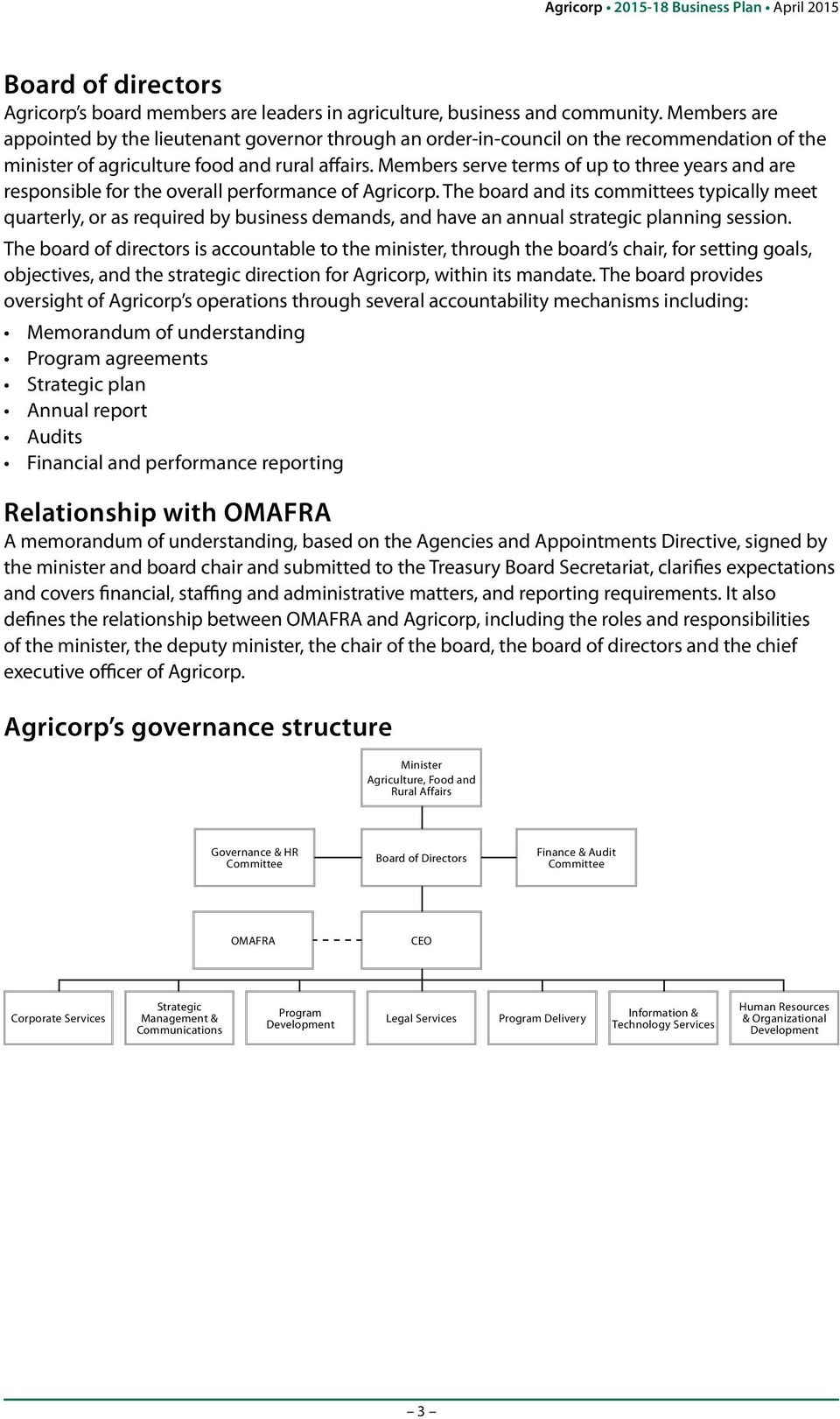
11 Board of directors Agricorp s board members are leaders in agriculture, business and community. Members are appointed by the lieutenant governor through an order-in-council on the recommendation of the minister of agriculture food and rural affairs. Members serve terms of up to three years and are responsible for the overall performance of Agricorp. The board and its committees typically meet quarterly, or as required by business demands, and have an annual strategic planning session. The board of directors is accountable to the minister, through the board s chair, for setting goals, objectives, and the strategic direction for Agricorp, within its mandate. The board provides oversight of Agricorp s operations through several accountability mechanisms including: Memorandum of understanding Program agreements Strategic plan Annual report Audits Financial and performance reporting Relationship with OMAFRA A memorandum of understanding, based on the Agencies and Appointments Directive, signed by the minister and board chair and submitted to the Treasury Board Secretariat, clarifies expectations and covers financial, staffing and administrative matters, and reporting requirements. It also defines the relationship between OMAFRA and Agricorp, including the roles and responsibilities of the minister, the deputy minister, the chair of the board, the board of directors and the chief executive officer of Agricorp. Agricorp s governance structure Minister Agriculture, Food and Rural Affairs Governance & HR Committee Board of Directors Finance & Audit Committee OMAFRA CEO Corporate Services Strategic Management & Communications Program Development Legal Services Program Delivery Information & Technology Services Human Resources & Organizational Development 3
12 Overview of programs Overview Agricorp s primary focus is to deliver programs and services that help Ontario producers manage many of the business and agricultural risks they face every day. Agricorp delivers a suite of risk management programs and provides a number of services for government and industry groups. The three main programs Agricorp delivers are: AgriStability, Production Insurance and the Risk Management Program (RMP). AgriStability and Production Insurance are part of the suite of programs established under the federal-provincial-territorial Growing Forward 2 agricultural policy framework. The costs are funded by the federal and provincial government on a 60:40 basis. RMP is funded by the Ontario government. Agricorp is responsible to the provincial government to administer these programs while maintaining the highest standards for fiscal responsibility, transparency, accountability, risk management and customer service. In , Agricorp delivered business risk management programs to more than 44,000 Ontario producers. Agricorp s goal is to continue to provide predictable, consistent, and excellent customer service while continuing to earn the confidence and trust of Ontario s agricultural producers. Major programs AgriStability AgriStability is a business risk management program that targets producers with severe farming income loses due to adverse market conditions, production loss or increased costs of production. If a producer s program year margin falls below 70 per cent of their average historical reference margin (introduced for the 2013 program year), AgriStability helps to offset the difference. The program is available to producers of all agricultural commodities. In , Agricorp underwrote more than 14,600 producers for the 2013 AgriStability program and to date has processed $47.3 million in claim payments for more than 1,900 customers who incurred losses. Agricorp also delivered $4.3 million in 2014 interim payments. Production Insurance Production Insurance is a business risk management program that compensates Ontario producers for yield reductions and crop losses caused by adverse weather and other insured perils such as drought, flood and frost. Production Insurance provides effective coverage for 100 commercially grown crops in Ontario. Producers may choose from a variety of plans and coverage is available on a total-yield, dollar-value, or acreage-loss basis. Payments are triggered when an insured peril causes the harvested yield to fall below guaranteed production levels or predetermined thresholds. For the 2014 crop year, Agricorp underwrote 14,500 producers in Production Insurance, representing five million acres and $2.7 billion in liability. Claim verification resulted in more than $85.7 million in payments to more than 7,700 producers with yield reductions and crop losses. Risk Management Program The Risk Management Program (RMP) is designed to help Ontario producers offset financial losses caused by low commodity prices and rising production costs. The program offers six plans for producers of grains and oilseeds, livestock (cattle, hog, sheep and veal) and edible horticulture. For most plans, RMP works like insurance and producer premiums are based on a choice of coverage levels and options. Payments are triggered if the commodity s average market price falls below the average cost to produce the commodity and the chosen coverage level. For the edible horticulture 4

13 plan, the producer deposits funds in a self-directed account to receive a matching government contribution. The producer may withdraw funds to offset financial losses. In 2013, the provincial government introduced annual funding of $100 million for producer payments and administrative costs. To ensure the equitable distribution of funding across all plans throughout the year, interim payment rates were introduced and remain in effect. For the 2014 program year, Agricorp underwrote nearly 10,000 producers who were enrolled in one or more of the six plans and fully utilized the $100 million in available funding. Other government programs and services Agricorp delivers other government programs and services that benefit producers by ensuring the overall financial health and security of specific agricultural sectors. For a detailed description of all programs and services delivered by Agricorp, such as Farm Business Registration and Beekeepers Financial Assistance Program, refer to Appendix B. Other agricultural programs and services Agricorp provides services to industry to support and enable a competitive, productive and sustainable agri-food sector. These services include: data management for the Ontario Apple Growers, Grape Growers of Ontario and the Ontario Tender Fruit Producers Marketing Board; financial analysis for the Dairy Farmers of Ontario, secretariat services for the Grain Financial Protection Board and payment management for the Farmer s Risk Management Premium Fund. Refer to Appendix B for a detailed description of the services Agricorp provides to industry and government. Environmental scan The environmental scan describes the business environment in which Agricorp operates. It identifies key trends, events and issues that present risks and opportunities to the agency. By identifying these risks and opportunities, Agricorp can be proactive in assessing and responding to changes in its internal and external environment. External environment Ontario s political landscape Ontario s provincial election in June 2014 resulted in the re-election of the Liberal leadership and a shift from a minority to majority government. The re-elected premier appointed a new minister to the consolidated Ontario Ministry of Agriculture, Food and Rural Affairs (OMAFRA), a post she held in her last term in conjunction with her premier duties. Ontario s economic plan The premier provided cabinet ministers with ministry mandate letters in September These letters outlined the provincial government s key priorities in building up Ontario and specific expectations for each ministry. The priorities of economic growth, job creation and achieving a balanced budget remain fundamental to building for the future, supported by strategic investments in people, modern infrastructure and transportation networks; creating a supportive and dynamic business climate; and ensuring retirement security for Ontarians while being fiscally responsible. The letters also outlined the ministry mandates to review and prioritize the programs and services each ministry provides to Ontarians and to adhere to program spending objectives outlined in the budget. For OMAFRA, specific priorities include supporting the growth of the agri food sector, 5

14 ensuring sustainability of agriculture, providing business support to farmers, expanding agriculture in the north and fostering vibrant rural economies. A balanced budget The 2014 budget reinforced the commitment to eliminating the deficit by while transforming and modernizing public services. This path identifies strategies and initiatives to review and transform programs, manage compensation costs, ensure fair taxation and realize the value of provincial assets. Transforming public services Ontario s Transforming Public Services strategy, which began in 2012, continues to advance a number of initiatives focused on reducing the rate of spending, reducing program spending and consolidating many business support programs. As part of this strategy, Ontario ministries undertook a number of agency reviews in 2013 to identify savings and increase efficiency. The Agricorp Review, a joint ministry-agency initiative that reviewed policies and processes was completed in early The work continued in 2014 in the form of program reviews as the province remains focused on delivering better, smarter, and faster public services. Currently, OMAFRA and Agricorp are actively reviewing programs to consider best and/or alternate delivery options. The Treasury Board will also lead the government s efforts on accountability, openness and modernization as it implements new accountability measures across government. Open for Business Delivering better products and services, while reducing red tape, continues to be a part of the provincial government s plan to create a more competitive environment for businesses. Ontario s Open for Business initiative, launched in 2008, remains a priority and is focused on creating faster, smarter and more streamlined government-to-business services and is a key part of the government s commitment to make the province more attractive to business while continuing to protect the public interest. For the agri-food industry, Open for Business focuses on creating a regulatory, client-centered environment that supports economic success and makes it easier for producers and industry to do business. The Premier s Agri-Food Challenge The province is blessed with thousands of hectares of farmland, a rich diversity in foods produced, and an agri-food sector that is a major player in Ontario s economy. It currently generates $34 billion a year in gross domestic product and sustains 740,000 jobs about one in every nine jobs across the province. In 2013, the premier announced her commitment to Ontario s agri-food industry and spoke to its importance to the province s economy and economic recovery. As other parts of Ontario s economy experienced a downturn, Ontario s agri-food sector registered growth. Building on this success, she challenged the industry to double its annual growth rate and create 120,000 jobs by To meet this challenge, the sector will have to identify growth opportunities, leverage its strengths to develop domestic and foreign markets and collaborate with government. Ontario s dynamic agricultural sector Most sectors of agriculture are very dependent on the weather and climate, and are experiencing more variability and extremities in daily and seasonal weather patterns, making agricultural production more challenging and thereby affecting demand and commodity prices. Agriculture demographics continue to change with a declining number of farms and increases in the average farm size, combined with an aging farmer population. 6

15 The current agricultural policy framework, Growing Forward 2: reinforces federal, provincial and territorial governments commitment to innovation, competitiveness, marketing and the continuation of business risk management programs, providing some stability to the sector. The policy introduced some program design changes to AgriStability and a national review of Production Insurance. While it is still early, the effects of the policy changes to AgriStability are being tracked and reported to Agriculture and Agri-Food Canada. The Production Insurance review was completed and no program changes were recommended. Provincial programs also support the agricultural industry. The Ontario government has an ongoing commitment to provide programs and services to Ontario producers such as Risk Management Program, Grain Financial Protection Program, Farm Business Registration, Ontario Vineyard Improvement Program, Beekeepers Financial Assistance Program and Farm Property Class Tax Rate Program. In November 2014, OMAFRA s minister officially proposed the Crop Insurance Act (Ontario), 1996 be changed to the Agricultural Products Insurance Act, If approved, the change will enable the province to expand insurance coverage to a range of products beyond crops, such as livestock and pollinators, and will better align Ontario with other jurisdictions under the Growing Forward 2 agreement. Technology and innovation Today s economy relies on technological advancement to support both improved efficiency and greater accessibility. The role of data in agriculture has been gradually changing. Increasingly there is more use by producers of real time data collection in agriculture, in particular with large grain farms. While some producers rely on data collection such as weather, rainfall, equipment usage and effectiveness, seed production and harvest yield, there is more work needed to unlock the value of collecting this data to help the farmer make better management decisions. Internal environment Managing change As a government funded agency, there is always potential for change based on government policy and industry needs. The challenge becomes managing the uncertainty of the degree of change. Agricorp has been able to manage change over the years, as priorities, policy and industry needs evolved and beyond will be no different. Administrative funding In alignment with the government of Ontario s fiscal restraint, Agricorp remains committed to prudent fiscal management while providing trusted and transparent delivery of programs and services. With no growth in government program funding, Agricorp remains committed to finding cost savings and identifying further efficiencies for program and service delivery. For several years, Agricorp has found cost savings to offset inflationary cost increases and will continue to look for efficiencies and cost savings in and future years. The agency anticipates a reduced budget for and subsequent years with no budget increases for inflation. Agricorp continues to work with the federal and provincial governments to further advance its information technology investment plan. A business case to replace the Production Insurance administration system and to further enable accuracy, efficiency and integrity in program delivery is complete. The agency continues to work with OMAFRA to secure funding. 7

16 Program changes Agricorp continues to deliver the Risk Management Program (RMP) and finalize program changes for The minister of agriculture, food and rural affairs announced support for removing AgriStability participation as a requirement for the RMP, starting with the 2015 program year. Commodity groups requested the requirement be removed so farmers have more flexibility in choosing programs that best meet their needs. With the removal of the cross-program enrolment requirement between RMP and AgriStability, Agricorp is making the necessary adjustments to the administration, program systems and program communication strategies for both programs. In collaboration with OMAFRA and industry, Agricorp updated FBR delivery processes for the 2015 program year to improve delivery efficiency and to align with the 2014 regulatory changes to the Farm Registration and Farm Organizations Funding Act, Agricorp, OMAFRA and industry collaborate to prioritize and balance program enhancements within today s operating environment. Agricorp will continue to deliver the Beekeepers Financial Assistance Program through 2015 and is working with OMAFRA and industry to design a bee mortality Production Insurance plan. Changing the Crop Insurance Act (Ontario),1996 to the Agricultural Products Insurance Act, 1996, will allow Agricorp and OMAFRA to expand insurance coverage to more agricultural products. Workforce environment Agricorp s skilled and knowledgeable workforce has enabled the agency to respond quickly and effectively to the changing needs of the agricultural industry and governments while maintaining superior customer service. At the same time, program changes and a need to find better, smarter and faster ways to manage the day-to-day work continue to challenge Agricorp s workforce in what they do and how they perform their work. Based on the most recent employee engagement survey, Agricorp continues to maintain a high level of overall engagement and commitment to the organization. Significant improvement was noted in areas of company effectiveness, senior leadership and communications. The Enterprise Change Improvement initiative, started in , is improving the way the agency manages and implements change across the organization. It is enabling the agency to be more effective and streamlined in its approach to decision making, and in turn, enabling employees to have an enterprise wide view of our programs when servicing customers. Agricorp continues to align its total rewards and compensation policy with the provincial government s public sector compensation framework which in turn aligns to the agency s goal of managing compensation costs. Technology and innovation Advancing technology and finding innovative solutions has been a strategic initiative of Agricorp for several years and the agency now has the foundation in place for the future. While existing systems are stabilized and maintained, the agency has built IT systems and processes to centralize customer data collection, data storage and financial transactions across all programs. Plans to replace the Production Insurance administration system are in place and Agricorp is working collaboratively with government to obtain the necessary funding. As today s agriculture industry continues to embrace the convenience of technology, Agricorp is advancing key strategic initiatives and developing the tools to provide customers with efficient and convenient online services for 2015 and beyond. 8

17 Strategic direction The Growing Forward 2 (GF2) policy framework supports innovation, competitiveness and market development for agriculture and includes a suite of business risk management programs. Ontario s agreement to GF2 means Ontario farmers have access to federal-provincial programs including Production Insurance and AgriStability through to March GF2 introduced program design changes to AgriStability which Agricorp implemented for the 2013 program year. The impacts of the program change will be assessed over the next program years. Provincially, the premier had challenged the agri-food industry to double its annual growth rate and create 120,000 jobs by the year The minister of agriculture, food and rural affairs has committed to supporting growth and sustainability in the sector by reducing regulatory burden, strengthening pollinator health and amending the Crop Insurance Act (Ontario) Following recent amendments to regulations and program guidelines, Agricorp is implementing changes to Ontario funded programs; Farm Business Registration and the Risk Management Program (RMP). These changes support industry growth and sustainability. Governments everywhere face challenges to improve public services while containing expenditure growth. Fiscal constraint and program design changes are two key drivers for Agricorp, as we improve program effectiveness and delivery efficiency by offering faster, smarter and more streamlined services to Ontario farmers. In recent years, following program delivery reviews of RMP and AgriStability, Agricorp has reduced program administrative costs and improved online services offered to customers without reducing customer service levels. To identify further efficiencies Agricorp is examining infrastructure costs and reviewing its delivery of Production Insurance. Several years ago, Agricorp recognized the need to document and standardize business processes that are supported by robust information technology systems. With foundational accounting and customer data systems and processes in place, we are now able to provide a holistic customer experience and improved online services to Ontario farmers. We are adding additional online services and looking to replace program specific information technology systems to gain further efficiencies. To date, Agricorp has found efficiencies without materially compromising recent gains in customer service and quality. This was validated by benchmarking completed by KPMG, which concluded, Agricorp is performing similar to or better than its comparators for all indicators measured. Overall, Agricorp is balancing efficiency with effectiveness well to provide value for money relative to other agriculture business risk management organizations. Agricorp s strategic direction is similar to that of previous years but has been adjusted to reflect changes in the environment it operates in. The agency will continue to focus on operational efficiency and effectiveness, strive to make it easier for customers and staff to complete their program responsibilities and keep programs relevant for a dynamic agricultural industry. The strategy is described below. Efficient and effective operations Agricorp is responsible for the development and implementation of all processes, systems and tools for effective and responsible delivery of programs and services. The majority of the agency s resources are engaged in day-to-day program delivery. The remainder are focused on implementing industry requested or government mandated program change and continuing to improve Agricorp s efficient and effective operations. The agency regularly reviews its program delivery model to remain aligned to the size, scope and complexity of the programs it delivers. Agricorp is a low cost provider of programs and services compared to similar service providers and has achieved consistently high ratings for customer service over the last five years. 9

18 Recent design changes to AgriStability have reduced the number and size of payments, and program participation is expected to decrease incrementally over the next five years. A review of customer-facing and internal business processes is complete. The delivery model for AgriStability is being adjusted to more proportionally correspond to the redesigned program and to fit within fiscal limitations. A Production Insurance review will be completed to inform IT system replacement and to identify further opportunities to improve service and lower administrative costs. Technology plays a critical role in enabling and driving service delivery productivity. Our IT renewal strategy, developed in response to the 2008 value-for-money audit requested by the minister, takes a fiscally responsible approach by dividing the strategy into phases. While Agricorp has made significant progress by stabilizing program delivery systems, implementing a customer relationship management tool, developing a common system to manage accounting functions, and creating a secure web portal for customers, continued investment is required. Funding for phase one ended in Agricorp is working with governments to secure funding for the replacement of program administrative systems in phase two. This investment will enable the agency to remain efficient and effective, to implement current and future program design changes providing long-term benefits in program delivery for government and industry. Expected outcomes: Efficient and appropriately scaled processes delivering changing programs Implementation of a new program delivery system for Production Insurance integrated with existing foundational systems Access to more holistic program information to support government and industry needs Making it easier to do business with Agricorp Making it easier to do business with Agricorp is important for both its customers and its staff. Customers rely on technology to remain productive and competitive. They want and expect Agricorp to provide them with convenient, easy to use online services. To accomplish this, Agricorp staff need the capabilities, business processes and structure to enable a straightforward, efficient customer experience. Easier for customers Agricorp has laid the foundation for online services. Customers now have access to their program information and can conduct business with Agricorp through a secure web portal. The agency will look to streamline processes across programs, encourage customers to use less expensive channels and expand online services so customers will select digital transactions by default. Accelerating the development of and moving transactional services online aligns with the provincial government s e-services strategy, and will result in a more efficient self-serve experience for producers as well as achieve some administrative cost savings. Fiscal constraint and the need to assign resources to implement program changes will challenge the agency s ability to maintain day-to-day service metrics while improving the overall customer experience. Agricorp will look to adjust its service metrics to align with the move to more e-services. Easier for staff Since its inception in 1997, Agricorp has experienced significant program and organizational growth. In recent years the agency has made changes to its business practices and improved management of the business. While Agricorp has had a good track record of managing change, there is room to be more effective in how we coordinate our efforts and expertise across the organization. The goal is to ensure the appropriate structure, processes and capabilities are 10
19 developed to further enable the agency to efficiently deliver changing programs while being responsive to emerging government and industry needs. Expected outcomes: User-friendly online services for customers to do business with Agricorp A customer experience aligned with Agricorp s program delivery model, customer and government expectations and the fiscal environment Streamlined and clarified change processes including decision-making and priority setting Improved ability to respond to changing and new program requirements Open for business Delivering better products and services while reducing red tape for producers and industry is part of the provincial government s Open for Business strategy to create a more competitive business environment. Agricorp s open for business strategic theme aligns with this. Our goal is to ensure the programs and services delivered today, and in the future, are relevant to the changing needs of the agricultural industry and reduce the administrative burden. Keep programs and services relevant Relevant risk management programs provide producers with tools they need to manage risks and the confidence to make investments and be innovative. Producers who participate in risk management programs have a level of financial security that gives confidence to other businesses they deal with, such as financial institutions and input suppliers. Relevant risk management programs also reduce the need for governments to fund ad hoc programs. To enable effective risk management decision making, producers must understand business risk management programs and the outcomes they can expect from participating in the programs. Agricorp will continue to work with governments and industry to educate and inform producers. Agricorp has effectively implemented recent design changes for RMP, FBR and AgriStability, meeting government expectations. The agriculture industry has high expectations for Production Insurance enhancements. However, Agricorp has limited capacity to develop and implement enhancements. Recently, a small number of critical enhancements have been implemented for forage, fruit, vegetable and grain and oilseed plans. Over the next three years, Agricorp will continue to focus on high priority enhancements. For example, it will meet the commitments made by the provincial government for forage and fruit plans and investigate options for expanding Production Insurance to cover livestock. This will require the agency, in partnership with OMAFRA, to continue to manage expectations with the industry. It is important that the ministry and agency continue to work together to ensure appropriate investment in program changes in an environment of fiscal constraint. Agricorp and OMAFRA are also committed to enhance the governance model and joint operational processes to better leverage the collective expertise towards optimal business risk management policy analysis, product development and advice to the minister. Reduce the burden on producers The agency will contribute to the provincial government s Open for Business initiative to create faster, more streamlined government-to-business services. Agricorp will work with OMAFRA in a few focused program areas to reduce the burden on producers for multiple, duplicative reporting contacts across programs when doing business with the Ontario government. Consolidating the delivery of similar programs will help producers better connect with a range of programs and services, reduce duplication, reduce annual program delivery costs, and ultimately support OMAFRA in fostering a competitive, productive and sustainable agri-food industry. 11
20 Expected outcomes: Enhanced programs and services that remain relevant to the changing needs of a competitive agricultural industry Consolidated delivery of like or related programs to offer producers easier access to programs and services Knowledgeable producers who make informed business risk management decisions Implementation plan Recognizing the current fiscal limitations, Agricorp s actions are focused on continuous improvement of programs and services while supporting the broader government initiative of improving efficiencies in public service delivery to achieve better value-for-money. Implementation is focused on improvements to core businesses that will support the agency in maintaining a high level of service to customers and government while maintaining programs that are relevant for producers today and in the future. Efficient and effective operations Agricorp has and will continue to advance efficient and effective delivery of programs and services. It will balance the needs of customers and government through the prudent use of public funds to improve both internal and customer-facing processes and the IT systems that support them. In the current environment of fiscal constraint Agricorp will strive to maintain its current service levels while making incremental improvements. Initiatives Complete the integration of Zephyr (AgriStability program administration system) with the common accounting system. Timeline: in Implement program delivery efficiencies to align program delivery processes with program design changes. Timeline: incrementally through 2016 In collaboration with OMAFRA, secure funding for phase two of the IT Renewal Plan and implement the business case to replace Production Insurance administrative systems. Timeline: incrementally through 2018 Making it easier to do business with Agricorp Making it easier to do business with Agricorp means enhancements and change for both Agricorp customers and staff. Internally the agency will ensure it has suitable structures, processes and capabilities in place to enable staff to meet customer needs. Leveraging these capabilities and implementing additional online service capabilities will make it easier for customers to do business with Agricorp. Initiatives Improve existing internal structures, processes and capabilities to enhance Agricorp s ability to respond to changing and new program requirements. Timeline: in Demonstrate how programs work to enable informed and holistic decision-making by producers. Timeline: incrementally through 2017 Enhance existing and add new online functionality for customers. Timeline: incrementally through
21 Open for Business Open for Business means offering Ontario farmers relevant programs that help them manage risk while reducing red tape and delivering faster, smarter and more streamlined services. Agricorp will leverage its core capabilities to enable more efficient and streamlined delivery of programs and services to meet the evolving needs of government and industry. The agency will continue to provide advice and expertise to support government objectives and seek to consolidate program and service delivery for the benefit of government and producers. Initiatives Implement enhancements to the fruit, vegetable and forage Production Insurance plans. Timeline: in Work collaboratively with OMAFRA to design and implement a Production Insurance plan for bees. Timeline: in In collaboration with OMAFRA assess the consolidation of programs and services. Timeline: incrementally through 2016 Performance measures A core set of balanced performance measures have been identified for the purposes of demonstrating Agricorp s operational effectiveness and accountability to government. These measures demonstrate the agency s effectiveness, efficiency, innovation and levels of customer satisfaction. The agency uses a more comprehensive set of measures internally and has the capability to drill down to describe results. These detailed measures are embedded in a balanced scorecard and are reported quarterly to Agricorp s board of directors. Performance measures table Key Performance Indicator Targets Past Performance Customer satisfaction with quality of service as measured annually by a customer satisfaction survey. Program processing timeline targets are met. Achieve consistently high overall customer service rating equal to the previous 3-year average. (on a scale out of 5) 95% of AgriStability files processed by November 30. Production Insurance claims paid within 20 business days of receipt of all information survey survey survey % by November % by December % by December days days days 13
22 Key Performance Indicator Targets Past Performance Program processing quality targets are met. 95% of RMP payments made within 60 days of receipt of all required information. 2% reduction in the number of amendment requests for AgriStability claims. An error rate of less than 2% for Production Insurance claims. An error rate of less than 2% for RMP claims RMP: G&O 99% 2014 RMP for livestock 99% 2014 SDRM 98% 2013 RMP: G&O 97.8% 2013 RMP for livestock 99.5% 2013 SDRM 95.4% 2012 RMP: G&O 93% 2012 RMP for livestock 90% 2012 SDRM: not measured in to % reduction 2010 to % reduction 2009 to % reduction % less than 1.0% % < 1% for RMP for livestock % for RMP: G&O % for RMP: G&O 14
23 Key Performance Indicator Targets Past Performance Public accountability and good governance as demonstrated through regular reporting and effective financial stewardship and control. Effectiveness of current products as measured annually by a customer satisfaction survey.* (on a scale out of 5) Annual chair and CEO attestation, as required, for compliance with applicable legislation, directives and policies. 3-year business plan, including budget and risk management plan is submitted to the minister. Sound and balanced operational performance and financial reports provided to ministry quarterly. Annual report submitted for the minister within 120 days of year-end. Comprehensive audit control framework in place and monitored by the Agricorp board. Production Insurance - achieve a mean rating of 3.50 or higher. AgriStability - achieve a mean rating of 3.50 or higher. Risk Management Program - achieve a mean rating of 3.50 or higher. An attestation request has not been received by Agricorp March 11, June 3, April 27, Financial reports submitted April 15, July 15, October 15 and January Operational monthly and interim performance reports provided regularly report 119 days report 120 days report 116 days completed completed completed * The effectiveness of current programs is a function of program policy and design and of program delivery. Agricorp is responsible for program delivery. The ministry is accountable for program policy and design. 15
24 Resources required This section identifies the financial, infrastructure and human resources which will be used by Agricorp to meet its strategic goals and objectives over the three-year planning horizon. In addition, this section identifies key resource risks and describes how the risks will be managed or mitigated. Planning assumptions Plans are established based on a set of assumptions. If the planning assumptions change during the implementation of Agricorp s strategic plan, the agency will adjust the plan accordingly. This business plan is developed based on known and projected administrative funding amounts from the provincial and federal governments and producer organizations. Financial The Ontario government remains committed and focused on its plan to eliminate the provincial deficit by For and the two following fiscal years, the provincial portion of Agricorp s budget will be 97 per cent of the provincial portion of its budget. For federal provincial programs such as Production Insurance, the provincial allocation in the budget will be used to determine the federal allocation. If new programs are added to Agricorp s delivery suite, additional administrative funding will be provided. If programs are discontinued; the corresponding amount of administrative funding would be removed from the budget, subject to any adjustments for program wind-down costs. There will be no additional administrative funding for the inflationary cost increases of delivering program and services. Agricorp will continue to cover inflationary cost increases through efficiency improvements and cost saving measures. Funding for phase two of Agricorp s IT Renewal Plan, the replacement of the Production Insurance administrative system, will be a funding allocation that is separate from the program administrative budget for programs. Multi-year funding from the provincial and federal governments for this work will be available starting in Customer Service Agricorp has received solid customer service ratings from its customers since The agency will strive to maintain the current level of customer service over the next three fiscal years. This plan allows for very limited changes such as administrative process and customer service improvements. Priority will be given to efforts which enable further cost savings and delivery efficiencies (e.g., more online, electronic, digital). Programs The Growing Forward 2 (GF2) agreement is in place until March 2018 and the next program review for the Risk Management Program (RMP) will likely occur in Agricorp assumes it will continue to deliver the three main programs, Production Insurance, AgriStability and RMP for the next three fiscal years. Over the last two years, Agricorp has implemented changes to AgriStability based on the GF2 agreement. Changes to RMP have also been implemented. More changes to RMP are being implemented for 2015 that may also impact AgriStability delivery. The recent and the current changes are being monitored and assessed to determine their impact, if any, to the long-term delivery of the programs. Agricorp s response to any impacts to program delivery will be built into future business plans. Over the next three fiscal years, Agricorp assumes there will be no material or fundamental changes to core programs. 16
25 Agricorp has the ability to scale up when asked to deliver new programs or services. As noted above, when new programs or services are added, it is assumed there will be new administrative funding. In the short term, the initial design, development and delivery of a new program would require the agency to draw on existing staff. The use of existing resources will have an impact on the delivery of other programs and services. Agricorp will review these impacts with OMAFRA. Financial resources Prudent fiscal management is one of Agricorp s key operating principles. The agency continues to implement efficiency improvements and cost savings whenever and wherever possible. Recognizing the current economic climate, the increased scrutiny of the media and the public on governments and agencies, and the increased financial accountability and reporting requirements, Agricorp will continue to focus on achieving and demonstrating results. The following financial table is based on the known and expected programs and services Agricorp will deliver over the next three years. Funding levels are based on information available as of February 3, They were developed based on discussions with OMAFRA, information provided to OMAFRA during OMAFRA s Program Review, Renewal and Transformation process, and information OMAFRA has provided to Agricorp. Administrative costs 08/07/ : Funding by Source ($,000) Notes Actual Funding Forecast Variance Funding Funding Funding Federal 23,102 20,804 20, ,272 21,436 21,451 Provincial 22,463 21,741 19,915 1,826 21,909 21,854 21,863 Non-government (62) Total Funding 46,301 43,296 40,800 2,496 43,964 44,104 44,104 Allocation by Program ($,000) 60:40 - Federal:Provincial AgriStability 1 17,229 16,999 15,125 1,874 15,500 15,500 15,500 Production Insurance 1 17,636 17,049 17,709 (660) 17,384 17,517 17, % Provincial RMP 2 7,877 7,000 5,082 1,918 7,000 7,000 7,000 Other programs ,122 1,699 (577) Other Agricultural Programs and services (62) Allocation sub-total 44,118 42,921 40,428 2,493 41,394 41,394 41,394 IT Renewal Plan Federal 5 2, ,542 1,626 1,626 Provincial ,028 1,084 1,084 Allocation Total 46,301 43,296 40,800 2,496 43,964 44,104 44,104 17
26 Notes for administrative costs 1. Funding for federal-provincial programs is cost-shared 60:40 by Canada and Ontario and consists of the following for : Provincial base (remaining portion of funds) 13,154,000 Federal base 150% of provincial funding 19,730,000 Total base allocation 32,884, The Risk Management Program (RMP) is a provincially funded program that helps producers in the grain, oilseed, livestock and edible horticulture sectors manage risks beyond their control, like fluctuating costs and market prices. $100 million is available for program payments and administrative costs. For the administrative allocation is $7.0 million. 3. Other programs represents smaller programs Agricorp provides on behalf of the provincial government. It includes programs such as Farm Business Registration, Grain Financial Protection Program and Beekeepers Financial Assistance Program. 4. Programs and services represents programs and services Agricorp provides on behalf of organizations such as Dairy Farmers of Ontario (financial analysis), Delta Waterfowl Foundation (verification services), Ontario Apple Growers / Grape Growers of Ontario (data management services) and Grain Financial Protection Board (secretariat and financial services). 5. In , Agricorp completed phase one of the IT Renewal Plan Common Foundations. Agricorp is seeking funding from the provincial and federal governments for phase two of the IT Renewal Plan, the replacement of the Production Insurance administrative system. Capital plan Costs for general capital expenditures are incorporated into the overall financial table and are not represented by a specific line item. Other than ongoing computer updates and improvements, there are minimal capital costs incurred by Agricorp. Computer replacement The annual cost of regular updating and replacement of computers is approximately $200,000. Leased vehicle fleet On an annual basis, Agricorp replaces five to seven vehicles in its leased vehicle fleet. Leasehold improvements Agricorp has no major leasehold improvements planned. IT Renewal Plan Agricorp is seeking funding from the provincial and federal governments for phase two of its IT Renewal Plan, the replacement of the Production Insurance administrative system. Costs for this work, as identified in the business case, are estimated at $2.7 million each year for three years. A portion of this will be capital costs. Approval of the business case is pending OMAFRA and Agriculture and Agri Food Canada review. 18
27 08/07/ :5 Production Insurance Fund Production Insurance fund Revenue ($,000) Projection Forecast Variance Projection Projection Projection Producer premiums 53,500 57,708 4,208 51,118 57,907 57,907 Federal premium subsidy 48,317 52,076 3,759 46,130 52,257 52,257 Ontario premium subsidy 32,183 34,716 2,533 30,752 34,836 34,836 Investment income 19,363 19, ,497 16,638 15,672 Total Revenue 153, ,219-10, , , ,672 Expenses ($,000) Production loss claims 134,000 89,000 45, , , ,000 Re-insurance premiums 9,800 9, ,500 10,000 10,000 Total Expense 143,800 98,400 45, , , ,000 Net Surplus for the year 9,563 65,819 56,256 14,997 6,638 5,672 Opening Insurance Fund Balance 731, , , , ,199 Ending Insurance Fund Balance 741, ,564 56, , , ,871 Notes for Production Insurance fund Agricorp is the insurer for the Production Insurance program in Ontario. Production Insurance is provided on a not for profit basis, meaning that over the long term, premium revenue is expected to equal claim costs. In general, premium costs are split between producers and the federal and provincial governments on a 40:36:24 basis. Administration costs are paid for by the federal and provincial governments on a 60:40 basis. Agricorp manages an insurance fund, forecast to be $793 million at March 31, 2015, as a reserve in case the claims for a particular year exceed the premiums received. The funds are held in high quality marketable investments as stipulated by legislative requirements. In recent years, liability for the Production Insurance program has increased based on the value of the insured commodities and expected yields. With an insured value forecast to be $2.8 billion for Ontario crops in 2015 and the unpredictability of weather-related insured perils, Agricorp purchases reinsurance to further mitigate the financial risk, targeting a risk of ruin of approximately one per cent or less. Reinsurance costs are paid out of the insurance fund. Reinsurance is purchased from private reinsurers to mitigate risks to the province. Reinsurance limits the risk of the province having to fund excessive claims in any one year, provides premium stability for producers and the provincial and federal governments and ensures the Production Insurance program remains actuarially sound. Financial resources risks Compared to , Agricorp provincial base funding allocation is decreasing by three per cent. This decrease will impact provincially funded programs (GFPP and FBR) and federalprovincial programs (Production Insurance and AgriStability). A three per cent cut in provincial funding for Production Insurance and AgriStability creates an additional 4.5 percent cut in federal funding. With careful and planned expense management, Agricorp reduced expenditures in both and Agricorp has implemented efficiencies that have enabled the agency to stay within its funding allocation while continuing to deliver programs and services that meet the needs of government and industry. 19
28 Agricorp will continue to look for cost savings in and future fiscal years to offset increases in costs due to inflation. The agency is adjusting its delivery model and resource allocation to ensure that program delivery remains aligned to recent program design changes in programs such as AgriStability. Agricorp will continue with cautious vacancy management and its continuous improvement approach for all the programs and services it delivers. Consolidating the provincial funding allocation Agricorp is structured functionally, meaning the same group of staff carry out similar processes for all programs. For example, the underwriting department does the underwriting for all programs as opposed to having separate underwriting staff and processes for each program. This enables Agricorp to be more efficient and effective, allowing the agency to quickly allocate resources to areas of greatest need. Agricorp s functional structure was validated by benchmarking work completed by KPMG, as part of the Agricorp Review. KPMG concluded that Agricorp is performing similar to or better than its comparators for all indicators measured. Overall, Agricorp is balancing efficiency with effectiveness well to provide value for money relative to other agriculture business risk management organizations. Prior to , OMAFRA provided Agricorp with one provincial funding allocation. This provided Agricorp with the flexibility to shift resources to meet the dynamic needs of government and industry, effectively and quickly address emerging issues, and address the needs of individual programs in specific years. Since , provincial funding has been divided into two envelopes, one for RMP and one for the other programs. This model limits the agency s ability to reallocate resources to emerging priorities between RMP and its other programs. For example, if the delivery requirements of RMP are down in one year and the administrative requirements of Production Insurance increase, Agricorp cannot use the unspent RMP funding to meet the delivery requirements of Production Insurance, thus making resource planning and managing in-year events much more challenging. While it is understood that the agency needs to continue to meet program accountability and transparency requirements with governments and industry, pooling provincial administrative funding would help the agency be more efficient and responsive. Agricorp, in consultation with the ministry, would determine how to divide the funds across programs to efficiently meet program delivery requirements and the needs of government and stakeholders. This approach would not increase costs for government and would help increase administrative efficiency. Physical resource costs Although the majority of Agricorp s expenses are salary and benefit costs for employees, physical resources are also a substantial expense. Lease costs for office space are a significant portion of physical resource costs. In , Agricorp reduced its leased office space at 1 Stone Rd. W. to align with decreased staff numbers and better enable it to remain within its reduced funding envelope for and Although there was an initial cost in to exit the lease early, there will be considerable savings for and Agricorp s lease agreements at 1 Stone Rd. W. and 65 Massey Rd. expire in With lease costs at 1 Stone Rd. W. considerably higher than office space at other locations and with Agricorp having to pay a higher lease rate than the provincial government at 1 Stone Rd. W. there could be cost savings by moving to less expensive office space. Agricorp is examining its office space requirements and lease costs prior to finalizing any new lease agreements for If Agricorp does lease different office space there could be leasehold and moving costs which are not included in the current budget projections. 20
29 Information technology resources To successfully deliver programs and services, Agricorp needs to collect, store, process, and provide secure access to large volumes of customer, financial, and program information. Therefore, Agricorp s information technology resources and infrastructure must effectively enable business processes that support the delivery of programs. Agricorp s IT infrastructure is managed in-house and encompasses a range of hardware and software components, including eight program delivery systems ranging from mainframe to clientserver to web-based applications. There are also several financial and human resource systems. The agency manages informational and transactional websites for both staff and customers and communication infrastructure ( , telephony) for a call centre and regular business use. A network of core hardware and software infrastructure connects staff at three office locations and home offices across the province. With several IT systems on outdated platforms, some key business requirements were not being met, such as the ability to link information between programs and to provide customers with integrated web services. With the support of OMAFRA and Agriculture and Agri-Food Canada, Agricorp developed a five phased IT Renewal Plan. Recognizing the constrained fiscal environment, Agricorp requested and received funding for phase one, Common Foundations. From 2012 to 2014, Agricorp developed common customer, farm and accounting data components for use by all program systems and a web portal for customers. The benefits of this work are being realized. The common customer database is instrumental for implementing cross-program participation requirements. Common accounting was used to implement new debt recovery practices. The agency is leveraging these common IT components to implement additional delivery efficiencies. Agricorp still uses multiple program specific IT systems to deliver business risk management programs. With a comprehensive system maintenance plan, the systems are stable but lack the required functionality for further cost effective improvements to program delivery and customer service. With hardware support for the mainframe computer system due to expire in 2017, maintenance costs and risks will increase. In collaboration with OMAFRA, Agricorp has developed a business case for the replacement of its mainframe aplication, the core IT system used for administration of the Production Insurance program. An investment from the provincial and federal governments of $8.0 million over three years is needed to proceed with this next phase of the IT Renewal Plan. Replacing the mainframe application is a priority as Production Insurance is cornerstone, longterm business risk management program. The current IT application does not meet the Ontario governments IT architecture standards and with vendor support ending in two years, maintenance costs will increase. Replacing the mainframe application with a more cost-effective, web-based application will enable the agency to implement more efficient business processes, incrementally reduce delivery costs and more effectively respond to government and industry needs. 21
30 Human resources Having committed and high-performing staff is essential to the agency s success. Agricorp is continuing to create and sustain an environment that attracts, retains, motivates, and deploys talent who can respond quickly to evolving business needs. These efforts will provide Agricorp with: A professional, knowledgeable and customer-focused workforce that allows Agricorp to respond to changing needs and business opportunities Staff who are accountable for their work and who make timely and prudent decisions to improve operational effectiveness A workforce that executes day-to-day and business objectives effectively, efficiently and with high quality. Staff numbers Agricorp is a performance driven organization with an annual strategic plan, performance measures and individual performance plans, which are reviewed annually with all staff. At January 31, 2015 Agricorp employed 371 full time equivalents (FTE s). These are made up of 346 permanent FTEs and 25 contract FTE s, to support the cyclical trends of delivering programs. The agency tracks current and approved positions, contracts and seasonal FTEs against current business needs, funding amounts and prior years FTEs to ensure the appropriate balance is achieved. In , the agency reduced its number of FTEs from approximately 449 to 400 to align staffing levels with program and service delivery needs, business priorities, and the fiscal constraints of its funding allocation. The reduced number of FTEs in enabled savings that were leveraged to improve business processes. More efficient business processes will better enable Agricorp to sustain program delivery with a reduced number of FTEs. To manage with the reduced number of people, some work has been eliminated through changes in work processes and in how programs are administrated (e.g. AgriStability), as well as the reorganization and streamlining of some functions. This reduced staffing level is limiting Agricorp s ability to respond to emerging government and industry needs without negatively impacting the delivery of existing programs and services. However, Agricorp is working to maintain existing customer service levels and processing targets. Human resource risks Approximately 80 per cent of Agricorp s operating expenses can be attributed to staffing requirements needed to effectively operate the agency. Agricorp s compensation strategy is conservative, but must stay competitive with public and private organizations to attract, develop and retain talented people while reflecting the financial prudence appropriate for a public entity. Agricorp s total rewards structure is intended to be fiscally prudent, fair and competitive, being anchored to the 50th percentile of the market and compliant with the provincial government s public sector compensation framework. 22
31 Compensation and skill sets With compensation structures unchanged since 2007, the agency s compensation, which was benchmarked in 2012, is in the lower quadrant of the 50th percentile. This presents additional risk to attract and retain talented people. Although the degree of risk varies throughout the organization, it is most prevalent in technical roles that require specific skill sets. Results from Agricorp s 2014 employee engagement survey shows a drop in the number of employees who feel they are paid fairly compared to similar jobs in other companies. Agricorp is working to reduce this risk by various means including, ongoing employee training and development to provide opportunities for existing staff, and job tiering to enable career path development and the matching of skill level to task requirements. There is also ongoing work to keep staff informed of all the benefits of employment at Agricorp through a Know the Value communication effort as well as informing staff of the expectations and legislative requirements the provincial government has of Agricorp. Agricorp s organizational structure Board of Directors CEO Corporate Services Strategic Management & Communications Program Development Legal Services Program Delivery Information & Technology Services Human Resources & Organizational Development Risk Management Corporate Project Mgmt Office Development & Readiness Compliance Customer Experience Systems Development & Computing Network Services Consulting & Recruitment Services Finance Business Planning Program Analysis Legal Quality Assurance & Performance Standards Architecture Services Total Compensation & HR Management Services Corporate Services Corporate & Customer Communications Product Management & Industry Relations FOI/Privacy Customer Commitment Corporate Project Mgmt Office Learning Services Executive Coordination Program Design & Policy Business Process Improvements IT Client Services Government Relations Government Relations Regional Services 23
32 Risk assessment and management plan Agricorp has a comprehensive approach to identifying risks, assessing exposures and opportunities, and developing appropriate action plans so that risks are managed in a way that enables the agency to meet its objectives. The agency has processes and structures in place to implement its Risk Management Framework. Implementation requires engagement from its board of director s, Agricorp management and staff, and OMAFRA. The Finance and Audit Committee (FAC) of the board of directors provides oversight and monitoring of the Risk Management Framework. The committee is responsible for assessing whether risk acceptance and control decisions made throughout the organization are appropriate, reviewing and approving the agency s risk management plan and audit plans, receiving and reviewing audit reports, and reviewing how management responds to and acts on audit recommendations. Agricorp s Enterprise Risk Assessment Committee (ERAC), a sub-committee of the senior management team, coordinates audit activities with the federal and provincial governments, and through Agricorp s own internal audit program. It is responsible to review and approve an annual program audit plan and to develop and recommend an annual audit plan and risk management plan to FAC. ERAC s mandate is to foster a risk-based approach to the delivery of programs and services and the management of risk reviews, audit plans and audit activity. The agency has a well-established risk assessment program that includes a suite of scheduled internal and external audits to ensure compliance with legislative and program agreements. The risk assessment program is reviewed and monitored regularly to ensure all levels of organizational risk are identified and have proper controls in place to mitigate them. Agricorp has also developed, and continues to monitor and enhance risk management plans, policies and practices. Its board of directors and management have prepared and implemented a series of robust risk management strategies that monitor ongoing program delivery, workforce, communication, financial, and reputational risks as well as the organization s business objectives. In collaboration with OMAFRA, Agricorp annually develops a Risk Assessment and Management Plan. The table in Appendix C: Risk assessment results strategic risks, includes the strategic risks that were identified through a consultative process and the actions Agricorp would undertake to reduce, mitigate and fully understand these risks. The Risk Assessment and Management Plan is an integral part of the accountability mechanisms in place between Agricorp and OMAFRA. The plan is developed early in Agricorp s planning cycle as it is used to inform the development of the agency s business plan and OMAFRA s results-based planning process. Throughout the year Agricorp monitors and reports on these risks to its board of directors and to OMAFRA. 24
33 Appendix A Communication of the business plan Background By identifying critical issues and priorities and establishing short and long-term goals, the business plan sets the overall direction for the agency and maps out its future. Based on the plan, Agricorp develops annual operational plans, which segment the strategy into achievable activities and projects for the year. All of the agency s work must tie into the operational plan and, by association, the business plan. Agricorp s business plan continues the course set for the agency more than a year ago. The state of the industry, the government priorities, relevant policy, the social and environmental context as well as Agricorp s own measurements such as the annual customer satisfaction survey and employee engagement survey, all help inform the business plan. Objectives To ensure Agricorp staff understand the business plan and how their work contributes to it. To ensure government and industry understand the business plan and how it aligns with and supports government and industry priorities. To demonstrate transparency and public accountability with government and industry in setting and following through with Agricorp s strategic direction. To support the successful delivery of key initiatives contained in the business plan Key messages Agricorp s business plan sets the overall direction for the organization and maps out its future. It directs the priorities in Agricorp s one-year operational plans, which segment the overarching strategy into achievable activities and projects for the next year. Agricorp s business plan aligns with and supports industry and government priorities for a competitive, productive and sustainable agri-business sector. The business plan sets the performance measures and targets against which the board of directors evaluates Agricorp s work at the end of every year. Tactics Agricorp will inform government and industry the business plan and progress made towards realizing its strategic direction through regular and ongoing discussions. Agricorp will leverage existing internal communication strategies and channels to inform and educate Agricorp staff about the business plan. 25
34 Agricorp Business Plan April 2015 Appendix B Programs and services Programs Current business risk management programs delivered on behalf of the Ontario government. Program name Program Description Length of service Funding source for claims Funding source for admin. costs Program information Production Insurance Production Insurance is a business risk management program that compensates Ontario producers for yield reductions and crop losses caused by adverse weather and other insured perils such as drought, floods and frost. Payments are triggered when the total harvested yield is less than the guaranteed production to present Insurance fund is funded by premiums: - producers 40% - provincial 24% - federal 36% Government: - provincial 40% - federal 60% 2014 crop year 1 75 plans for 100 commodities 14,484 enrolled for 5 million acres & $2.7 billion liability $85.7 million with 7,700 claim payments AgriStability AgriStability is a business risk management program that compensates producers when they have large declines in their net farming income due to market conditions, production loss or increased costs of production. The program is available to producers of all agricultural commodities. Payments are triggered if a producer s program year margin falls below 70 per cent of their average historical reference margin to present Producer fees with the balance from government: - provincial 40% - federal 60% Producer fees with the balance from government: - provincial 40% - federal 60% 2013 program 1 14,610 enrolled 1,916 received more than $47.2 million in benefits 1 As of March 31,
35 Agricorp Business Plan April 2015 Program name Program Description Length of service Funding source for claims Funding source for admin. costs Program information Risk Management Program RMP: Grains and Oilseeds Producers pay an annual premium and twice during a program year payments are triggered if the average market price falls below the average cost of production to present Provincial government and producer premiums Provincial government 2013 program 5,733 enrolled $32.6 million in pre harvest and post-harvest payments RMP for livestock Helps producers of cattle, hogs, sheep and veal offset losses caused by low commodity prices and fluctuating production costs. Producers pay premiums based on their insured production and chosen coverage level. Payments are made if the market prices for enrolled livestock fall below the support level to present Provincial government and producer premiums Provincial government 2013 program 2,243 enrolled $37.4 million in payments SDRM: Edible Horticulture Producers of an edible horticulture crop can help mitigate farm business risk by establishing a self directed risk management account with Agricorp. Producers deposit a percentage of their allowable net sales and request a government contribution. Funds may be withdrawn to cover a reduction in income, or other farm-related expenses or losses to 2008 and 2011 to present Producer deposits and provincial government matching funds Provincial government 2013 program 1,879 enrolled $20.7 million in matching government funds 27
36 Agricorp Business Plan April 2015 Program name Program Description Length of service Funding source for claims Funding source for admin. costs Program information Farm Business Registration Farm businesses that gross $7,000 or more in farm income are required to register their business with Agricorp, pay a registration fee and choose a farm organization they wish to join. In addition to managing the collection and disbursement of registration fees, Agricorp collects farm product data which OMAFRA uses for the Farm Property Class Tax Rate Program and for policy analysis and program development purposes to present n/a Producer fees and provincial government 2014 program 44,212 farm businesses registered Grain Financial Protection Program The program protects the financial interests of Ontario producers of grain corn, soybeans, canola, and wheat who sell their grain to licensed dealers or who store their grain at licensed elevators. Agricorp performs annual financial analysis of dealers and inspects dealer premises and elevators to ensure compliance with the Grains Act to present Four trust funds are funded by producer check-off fees Elevator and dealer fees, provincial government, and Grain Financial Protection Board dealers and 300 elevator operators $2.9 billion in grain sales covered by the program 28
37 Agricorp Business Plan April 2015 Ad hoc programs Current initiatives delivered by Agricorp on behalf of the Ontario government that are designed to address a specific, often one-time event or circumstance affecting Ontario producers. Program name Program Description Length of service Funding source for claims and/or administrator costs Orchards and Vineyards Transition Program Compensated grape, apple and tender fruit producers for the removal of orchards and vineyards from 2008 to This was required in order to adapt to industry pressures and market changes. Agricorp verified vine/tree removal, issued payments and continues audit work until to present Federal and provincial governments Beekeepers Financial Assistance Program Provides one-time financial assistance to compensate eligible Ontario beekeepers that experience unusually high bee deaths (more than 40 per cent of hives) in The program is being delivered by Agricorp similar to a traditional Production Insurance plan, including deductible, named perils and claims based on covered losses. The program is being extended into to 2015 Provincial government 29
38 Agricorp Business Plan April 2015 Services Unique or specialized third-party services provided to government or industry. Service Agricorp s role Length of service Administrative funding source Data management services Manage a web-based agricultural data system that supports the information needs of industry and the delivery of business risk management programs. The system captures detailed land and cropping information such as location, variety, yield and quality from fruit and vegetable producers. Data is collected once and used by Agricorp, producers and commodity groups who represent the producers to present Grape Growers of Ontario Ontario Apple Growers Ontario Tender Fruit Producers Marketing Board Farmer s Risk Management Premium Fund Provide payment management, customer service, communications and reporting services to the Farmer s Risk Management Premium Fund (FRMPF). Producers who participate in RMP plans for grains and oilseeds and livestock pay premiums held in the FRMPF. The industry-managed fund holds the premiums and can supplement program payments in years when producers need it most to present Farmer s Risk Management Premium Fund Financial analysis Analyze the quarterly and annual financial statements of Ontario s 51 dairy processing plants and collect data and risk scoring for the Dairy Farmers of Ontario to present Dairy Farmers of Ontario Secretariat services Provide governance, secretariat and financial support services for the Grain Financial Protection Board to present Grain Financial Protection Board Provide secretariat support for the Business Risk Management Review Committee including scheduling panel meetings and hearings, managing freedom of information requests and French language and communication services. Prior to 2013, service was provided to the Ontario AgriStability Review Committee and the National CAIS Committee Ontario sub-committee to present Federal and provincial governments 30
39 Agricorp Business Plan April 2015 Service Agricorp s role Length of service Administrative funding source Verification and mapping services Collect agronomic information, acreage verification, mapping services and compliance for the Alternative Land Use Services program which compensates producers for removing environmentally sensitive land from production 2009 to present Delta Waterfowl Foundation Provide acreage verification, mapping services and access to a web-based data management system to support the delivery of the Ontario Vineyard Improvement Program to present Provincial government Mapping and acreage measurement services Measure and map ginseng and asparagus acres on behalf of industry groups to present Ontario Ginseng Growers Association Asparagus Farmers of Ontario 31
40 Appendix C Risk assessment results strategic risks Strategic/Policy Producer expectations Agricorp is at risk if producer expectations of business risk management programs exceed stated program policy objectives. Risk rating Likelihood: Impact: Financial impact: Medium Medium Medium Rationale: Although Agricorp is primarily a delivery agency, gaps between producer expectations of programs and policy objectives could result in producer dissatisfaction directed at Agricorp. Governments expect Agricorp to play a significant role in the management of producer expectations. Agricorp participates in program policy and design discussions with both the federal and provincial governments by providing advice from a program delivery perspective to inform policy development. Recent efforts to inform commodity groups and producers of Agricorp s role in delivering programs have helped to separate policy issues from delivery issues. With program design changes in AgriStability and RMP there is risk of programs not meeting producer expectations. Corrective action: Reduce Agricorp will continue to collaborate with OMAFRA in federal provincial discussions and in the development of new programs and program policies. Agricorp continues to provide advice and expertise to OMAFRA on options for the design and delivery of new and existing programs and will work to maintain transparency on achievable timelines and deliverables. Direct communication with customers is maintained through events, conferences, commodity group meetings, mailings and one-on-one customer interactions. Agricorp identifies stakeholder issues and develops and coordinates strategies and activities to proactively manage stakeholder relations. Agricorp continues to work with formal industry committees to gain feedback on program performance and design and to develop and deliver feasible and relevant products and product enhancements that meet the needs of Ontario producers. Agricorp has enhanced business risk management educational materials to explain how programs work together. Agricorp has implemented a plan to address AgriStability design changes, including communication materials for customers and training for staff. 32
41 Funding for replacement of Production Insurance administrative systems Agricorp is at risk if funding approval is not secured to replace its legacy Production Insurance administrative system. Risk rating Likelihood: Impact: Financial impact: Medium High High Rationale: A new system is needed as the existing mainframe computer system is dated, maintenance is costly and vendor support will not be available after Lack of funding for this initiative would result in: Having to continue to use an aging infrastructure that will compromise further progress on delivery efficiencies. Longer lead and development time to introduce changes that align with customer and government needs. Having to maintain mainframe computer hardware at considerable cost and effort with the current hardware lease expiring in 2017 and vendor support not available after Increased risk of availability of resources with the knowledge and skills to maintain obsolete technology. Corrective action: Reduce / Accept Working with OMAFRA to secure funding for system replacement. Existing IT systems are maintained as per Agricorp s comprehensive IT system maintenance plan. In the event funding is not secured, plans would be put into place to maintain the current system while reducing risks related to hardware and software failure. Additional costs would be needed to maintain older hardware. Agricorp would face lengthened timelines and increased costs of adapting new Production Insurance plans/programs as they are implemented. 33
42 Accountability/Compliance Adequate administrative funding allocated by program Agricorp is at risk if funding for program administration: Is not enough to sustain the delivery of programs at current service levels, while also meeting the expectations of producers, industry and government Continues to be program specific in some instances and therefore limits Agricorp s ability to shift resources to meet the needs of government and industry and address the needs of individual programs in specific years. Risk rating Likelihood: Impact: Financial impact: Medium High High Rationale: Governments are operating in an environment of fiscal constraint. In recent years, Agricorp s funding allocation has been flat or slightly decreased with no increases for inflation. With continued fiscal constraint there will be continued pressure on administrative funding for program delivery. As a result of program specific funding agreements (i.e., RMP), there is no longer the ability to move funding between RMP and other programs, thereby reducing flexibility and making it more difficult to deliver programs effectively. The additional costs of implementing program design changes and adjusting program delivery processes will put additional pressure on administrative funding allocations. Flat or reduced administrative budgets can also hinder investment to find further efficiencies. Corrective action: Reduce Agricorp continues to work collaboratively with government partners to determine the balance between available funding, delivery costs and appropriate customer service levels. Operational planning is conducted to provide clear direction and performance measures based on available funding. Agricorp has standardized business processes in place and is continually working to enhance them to ensure efficient, streamlined and reliable program delivery. A review of Production Insurance delivery is underway to ensure continued efficient delivery through modernize workflows and processes and to improve customer service. Agricorp will follow proven project management methodology and procedures to enable accurate forecasting and implementation of program delivery adjustments. 34
43 Compliance Agricorp is at risk due to breaches of statutes, codes of conduct, government directives, contracts or agreements, conflicts of interest or other inappropriate activity. Risk of reputational damage (Agricorp, government), financial loss, legal sanctions or other impacts caused by a breach. Risk rating Likelihood: Impact: Financial impact: Low High Medium Rationale: There is considerable scrutiny by the public on governments and their agencies to be in compliance with and to be seen to be in compliance with applicable statues and directives, and to operate in a fiscally prudent manner. Agricorp has engaged significant resources to ensure adherence to code of ethics, conflict of interest and code of conduct policies and procurement, travel and expense directives. A tighter fiscal climate and increased media and public visibility and ad hoc programs increase the potential impact of this risk if realized. Corrective action: Reduce Agricorp has a dedicated Compliance Specialist on staff. Agricorp has procurement policy and practices in place that fulfill the requirement of applicable government directives. Delegation of authority for corporate expenditures is in place and is reviewed at least annually. Agricorp has a conflict of interest policy in place that aligns with legislative requirements. All employees are required, on an annual basis, to review, sign and formally declare any conflict of interest as outlined in the policy and to indicate their understanding and agreement to comply with the policy. Agricorp continues to develop and implement additional compliance reporting and oversight mechanisms. 35
44 Operational Security of customer information Agricorp is at risk of inadvertently releasing confidential customer data or having its systems compromised by unauthorized access. Risk rating Likelihood: Impact: Financial impact: Medium High Low Rationale: Confidential customer information is shared through day-to-day operations (e.g. mail, , phone conversations and printed material). Implementation of a web portal for customers may increase the risk of releasing confidential information. In addition, increased frequency of cyber-attacks increases this risk. Corrective action: Reduce Agricorp has mandatory online security awareness training for all employees. Agricorp has security standards for internal and external documentation. Procedures are in place for sending data outside of Agricorp: -- Data sent to AAFC or OMAFRA is sent through secured file transfer -- Data files are sent to approved partners with encryption and secure passwords. Web portal testing includes a threat risk assessment to ensure appropriate access. Office doors are secured so only authorized individuals have access. Computers automatically lock when not in use. Online services have been fully tested (including a penetration test conducted by an external service provider) with no significant risks identified that would compromise customer sensitive data. Agricorp has adopted an industry recognized security framework - ISO with wide ranging security controls and guidelines. Agricorp has completed a security review of systems and is implementing security policies. Agricorp has an annual external security scan by an independent third party. Agricorp identifies and implements process changes and technology that improves both quality and efficiency of program delivery. Existing IT systems are maintained to address potential and existing issues. 36
45 Organizational capacity Agricorp is at risk of not having the capacity or flexibility to respond to new initiatives without negatively impacting the delivery of existing programs and services. Risk rating Likelihood: Impact: Financial impact: High Medium Medium Rationale: To deliver new and/or ad hoc programs in a timely fashion and/or respond to emerging issues, Agricorp must first draw on existing resources. To respond to these requests, Agricorp requires capacity in addition to resources dedicated to delivering existing programs and services. In recent years, Agricorp has managed with flat funding (no budget increases for the cost of inflation). To offset inflationary cost increases, Agricorp has reduced costs, improved efficiency and reduced organizational capacity. Further, Agricorp reduced its number of staff in To respond to new priorities in a timely fashion, Agricorp will need to draw resources away from the delivery of existing programs. This could have a direct and negative impact on customers, stakeholder relations and the reputation of Agricorp and government. Corrective action: Reduce Continue to work with OMAFRA to balance the right funding model to enable program and service delivery and timely response to government and stakeholder needs at a time of fiscal constraint. Where possible Agricorp will leverage existing infrastructure and processes to implement program change and new programs. Agricorp is engaged with OMAFRA early in the design and development stage for program change and new programs. Agricorp has processes in place to proactively identify emerging issues to facilitate a timely response. Agricorp will continue to build strong working relationships and have open communications with government and industry groups. 37
46 Workforce/skill shortage and compensation Agricorp is at risk of being unable to attract and retain employees with the skills and experience needed to achieve business plan objectives. Risk rating Likelihood: Impact: Financial impact: Medium Medium Medium Rationale: Agricorp has a highly skilled workforce and relatively low turnover of staff. Workload is significant based on recent downsizing and priorities based on government and industry needs. Risk that aspects of the total rewards program do not align with the market and industry for comparable positions. This could limit Agricorp s ability to attract capable and motivated employees at medium and high skill levels. This skill shortage could impact succession management and the ability of the organization to meet its objectives. Agricorp has established processes to identify and monitor our compensation position in the marketplace. Although the degree of risk varies throughout the organization, it is most prevalent in technical areas such as IT and finance. Compensation job bands have been fixed and unchanged since This is consistent with the provincial government public sector compensation framework. Corrective action: Reduce Agricorp contracts with an external compensation consultant to analyze information and determine competitiveness. The market survey includes information from organizations (public and private) across multiple sectors, geographic locations, size and scope. The data reflects a total rewards approach. Agricorp administers an annual employee engagement survey to determine areas of improvement. Agricorp develops current employees to prepare for internal career advancement by incorporating: -- Individual development plans that are continuously improved and identifying learning needs and interests of staff -- Ongoing employee training and development with a learning strategy to ensure staff have the necessary knowledge and skills -- Competency based talent management to enable career path development and targeted learning. Job tiers have been implemented to enable knowledge transfer and appropriate skill level matched to complexity of tasks. Continued development of succession plans for key positions. 38
47
Ministry of Finance. Plan for 2015-16. saskatchewan.ca
 Ministry of Finance Plan for 2015-16 saskatchewan.ca Statement from the Minister I am pleased to present the Ministry of Finance Plan for 2015-16. Government s Direction and Budget for 2015-16 is focused
THIS REPORT CONTAINS ASSESSMENTS OF COMMODITY AND TRADE ISSUES MADE BY USDA STAFF AND NOT NECESSARILY STATEMENTS OF OFFICIAL U.S.
 THIS REPORT CONTAINS ASSESSMENTS OF COMMODITY AND TRADE ISSUES MADE BY USDA STAFF AND NOT NECESSARILY STATEMENTS OF OFFICIAL U.S. GOVERNMENT POLICY Voluntary - Public Date: 5/6/2015 GAIN Report Number:
Business Plan 2014-2015
 Business Plan 2014-2015 Table of Contents RHRA Corporate Overview Profile 1 Vision, Mission, Mandate and Values 1 Strategic Priorities and Business Planning Overview 2 Fiscal Year 2014-15 Activities and
Status Report of the Auditor General of Canada to the House of Commons
 2011 Status Report of the Auditor General of Canada to the House of Commons Chapter 1 Financial Management and Control and Risk Management Office of the Auditor General of Canada The 2011 Status Report
Government Services ACCOUNTABILITY STATEMENT
 BUSINESS PLAN 2000-03 Government Services ACCOUNTABILITY STATEMENT This Business Plan for the three years commencing April 1, 2000 was prepared under my direction in accordance with the Government Accountability
Financial Services FINANCIAL SERVICES UTILITIES 57 FINANCIAL SERVICES AND UTILITIES 2016-2018 BUSINESS PLAN. CR_2215 Attachment 1
 CR_2215 Attachment 1 Financial Services FINANCIAL SERVICES & UTILITIES 57 FINANCIAL SERVICES AND UTILITIES 2016-2018 BUSINESS PLAN Acting Branch Manager: Stacey Padbury Table of Contents INTRODUCTION Our
Department of Finance. Strategic Plan 2015-2019. California s Fiscal Policy Experts
 Department of Finance Strategic Plan 2015-2019 California s Fiscal Policy Experts California s Fiscal Policy Experts MESSAGE FROM THE DIRECTOR Since fiscal year 2011-12, the state has recovered from budget
NEWFOUNDLAND AND LABRADOR CROP INSURANCE AGENCY
 NEWFOUNDLAND AND LABRADOR CROP INSURANCE AGENCY Annual Performance Report April 01, 2013 - March 31, 2014 Table of Contents Chairperson s Message...1 Overview...2 Lines of Business...6 Outcome of Activities...7
Agriculture and Forestry
 Agriculture and Forestry BUSINESS PLAN 2015 18 ACCOUNTABILITY STATEMENT This business plan was prepared under my direction, taking into consideration the government s policy decisions as of October 15,
NEWFOUNDLAND AND LABRADOR CROP INSURANCE AGENCY
 NEWFOUNDLAND AND LABRADOR CROP INSURANCE AGENCY Annual Performance Report April 01, 2011 March 31, 2012 Table of Contents Chairperson s Message... 1 Overview... 2 Lines of Business... 6 Outcomes of Activities...
Statement. of Mandate 2015 2016. Internal Services
 Statement of Mandate 2015 2016 Internal Services Department of Internal Services Statement of Mandate 2015 2016 CONTENTS 1. MESSAGE FROM THE MINISTER AND DEPUTY MINISTER... 2 2. MANDATE/VISION/MISSION...
Office of the Executive Council. activity plan 2014-17
 Office of the Executive Council activity plan 2014-17 Message from the Premier In accordance with my responsibilities under the Transparency and Accountability Act, I am pleased to present the 2014-17
The Saskatchewan Crop Insurance Corporation Act
 SASKATCHEWAN CROP 1 The Saskatchewan Crop Insurance Corporation Act being Chapter S-12.1* of The Statutes of Saskatchewan, 2012 (effective July 10, 2012), as amended by the Statutes of Saskatchewan, 2014,
Agriculture and rural development BUSINESS PLAN 2014-17
 Agriculture and Rural Development BUSINESS PLAN 2014-17 Accountability Statement This business plan was prepared under my direction, taking into consideration the government s policy decisions as of February
Human Resource Secretariat Business Plan 2011-12 to 2013-14
 Human Resource Secretariat Business Plan 2011-12 to 2013-14 September 2012 I II Message from the Minister As the Minister of Finance, President of Treasury Board and Minister responsible for the newly
GOVERNMENT RESPONSE TO THE CHILD INTERVENTION SYSTEM REVIEW
 GOVERNMENT RESPONSE TO THE CHILD INTERVENTION SYSTEM REVIEW October 2010 Closing the Gap Between Vision and Reality: Strengthening Accountability, Adaptability and Continuous Improvement in Alberta s Child
Canadian Intergovernmental Conference Secretariat
 Canadian Intergovernmental Conference Secretariat 2011 12 Departmental Performance Report The Honourable Peter Penashue Minister of Intergovernmental Affairs President of the Queen s Privy Council for
Overview of Canada s Business Risk Management Programs
 Overview of Canada s Business Risk Management Programs 1 Producer Savings Accounts (NISA: 1990 2002) Established in 1990, the Net Income Stabilization Account (NISA) program was Canada s first national
STRATEGIC AND OPERATIONAL PLAN
 STRATEGIC AND OPERATIONAL PLAN 2013-2015 2 3 Table of Contents Introduction Corporate Balanced Scorecard Revitalized... 5 Reorganizing Corporate Structure... 8 The Planning Process The Planning Process...
BRM Programs What to Expect for the 2013 Program Year
 Growing Forward 2 is a five-year policy framework for Canada s agriculture and agri-food sector and the basis for the delivery of federal-provincial-territorial programs. Growing Forward 2 includes ongoing
BUSINESS SECTOR STRATEGY:
 BUSINESS SECTOR STRATEGY: MEDICAL TECHNOLOGY Created with: MEDEC - CANADA S MEDICAL TECHNOLOGY COMPANIES February 2011 Open for Business is Ontario s initiative to create faster, smarter and streamlined
Service Alberta BUSINESS PLAN 2010 13
 Service Alberta BUSINESS PLAN 2010 13 Service Alberta BUSINESS PLAN 2010-13 ACCOUNTABILITY STATEMENT The business plan for the three years commencing April 1, 2010 was prepared under my direction in accordance
Crown Corporation. for the fiscal year 2015 2016. Nova Scotia Farm Loan Board
 Crown Corporation B u s i n e s s P l a n s for the fiscal year 2015 2016 Nova Scotia Farm Loan Board Business Plan 2015 2016 Contents Message from the Minister and the Board Chair.... 79 Mission.... 81
AgriInsurance in Canada
 AgriInsurance in Canada Brad Klak, President and Managing Director Merle Jacobson, COO, Operations Division Agriculture Financial Services Corporation Alberta, Canada Agriculture in Canada Total Cash Receipts
COMPREHENSIVE ASSET MANAGEMENT STRATEGY
 COMPREHENSIVE ASSET MANAGEMENT STRATEGY APPROVED BY SENIOR MANAGEMENT COMMITTEE ON AUGUST 23, 2012 (TO BE FINALIZED AFTER APPROVAL OF CAM POLICY BY COUNCIL) August 2012 Contents CONTENTS EXECUTIVE SUMMARY
BUSINESS PLAN 2012 2015
 BUSINESS PLAN 2012 2015 Electrical Safety Authority BUSINESS PLAN 2012 2015 1 ABOUT ESA Vision: An Ontario free of electrical fatalities and serious damage, injury, or loss. Mission: To improve electrical
Ontario Energy Board. 2014-2017 Business Plan
 Ontario Energy Board 2014-2017 Business Plan Ontario Energy Board P.O. Box 2319 2300 Yonge Street 27th Floor Toronto ON M4P 1E4 Telephone: (416) 481-1967 Facsimile: (416) 440-7656 Toll-free: 1 888 632-6273
Auditor General of Canada to the House of Commons
 2010 Report of the Auditor General of Canada to the House of Commons FALL Chapter 1 Canada s Economic Action Plan Office of the Auditor General of Canada The Fall 2010 Report of the Auditor General of
Building a Strong Organization CORPORATE GOVERNANCE AND ORGANIZATIONAL STRUCTURE
 chapter III Building a Strong Organization To remain a strong organization that is able to fulfil its mandate, CMHC draws on sound corporate governance, financial and risk management practices, progressive
Tapping the benefits of business analytics and optimization
 IBM Sales and Distribution Chemicals and Petroleum White Paper Tapping the benefits of business analytics and optimization A rich source of intelligence for the chemicals and petroleum industries 2 Tapping
Saskatchewan Crop Insurance Corporation. Annual Report for 2014-15. saskatchewan.ca
 Saskatchewan Crop Insurance Corporation Annual Report for 2014-15 saskatchewan.ca Table of Contents Letters of Transmittal...2 Introduction...4 Alignment with Government s Direction...4 Saskatchewan Crop
Canada School of Public Service 2012-13. Departmental Performance Report
 Canada School of Public Service Departmental Performance Report Original version signed by: The Honourable Tony Clement President of the Treasury Board and Minister for the Federal Economic Development
Performance Management. Date: November 2012
 Performance Management Date: November 2012 SSBA Background Document Background 3 4 Governance in Saskatchewan Education System 5 Role of School Boards 6 Performance Management Performance Management Overview
BUSINESS PLAN. 2012/13 to 2014/15 LAND TITLE AND SURVEY AUTHORITY OF BC
 BUSINESS PLAN 2012/13 to 2014/15 LAND TITLE AND SURVEY AUTHORITY OF BC TABLE OF CONTENTS Message from the Chair of the Board of Directors and the President and Chief Executive Officer 01 Business Priorities
Audit of the Policy on Internal Control Implementation
 Audit of the Policy on Internal Control Implementation Natural Sciences and Engineering Research Council of Canada Social Sciences and Humanities Research Council of Canada February 18, 2013 1 TABLE OF
Scorecard - Oakville Hydro Electricity Distribution Inc.
 Scorecard - Oakville Hydro Electricity Distribution Inc. 9/24/215 Performance Outcomes Performance Categories Measures 21 211 212 213 214 Trend Industry Distributor Target Customer Focus Services are provided
EXECUTIVE SUMMARY...5
 Table of Contents EXECUTIVE SUMMARY...5 CONTEXT...5 AUDIT OBJECTIVE...5 AUDIT SCOPE...5 AUDIT CONCLUSION...6 KEY OBSERVATIONS AND RECOMMENDATIONS...6 1. INTRODUCTION...9 1.1 BACKGROUND...9 1.2 OBJECTIVES...9
The Integration of Strategic Planning and Portfolio Management
 The Integration of Strategic Planning and Portfolio Management Bank of Canada Management Offices (PMO s) International Summit Brasilia, Brazil, April 9-10, 2014 Presented by: Sheila Vokey, Chief Financial
State of Minnesota IT Governance Framework
 State of Minnesota IT Governance Framework June 2012 Table of Contents Table of Contents... 2 Introduction... 4 IT Governance Overview... 4 Process for Developing the New Framework... 4 Management of the
City of Toronto STRATEGIC ACTIONS 2013-2018
 City of Toronto STRATEGIC ACTIONS 2013-2018 Contents Message from the City Manager 2 Council s Strategic Plan 3 Developing Strategic Actions 6 Strategic Actions 2013-2018 7 City Building 8 Economic Vitality
Aboriginal Affairs and Northern Development Canada. Internal Audit Report. Audit of Management of Negotiation Loans. Prepared by:
 Aboriginal Affairs and Northern Development Canada Internal Audit Report Audit of Management of Negotiation Loans Prepared by: Audit and Assurance Services Branch Project No. 12-11 February 2013 TABLE
ESM Management Comments on Board of Auditors Annual Report to the Board of Governors for the period ended 31 December 2014
 ESM Management Comments on Board of Auditors Annual Report to the Board of Governors for the period ended 31 December 2014 Dear Chairperson, I would like to thank you for the opportunity to provide management
Payroll Operations and Information Management and Payroll Services Alliance Management Office Annual Report. November 2007
 Payroll Operations and Information Management and Payroll Services Alliance Management Office Annual Report November 2007 1. Initiative Overview 2. Status Update 3. Appendix A: Contract Objectives 4. Appendix
4.11. Ontario Works Program. Chapter 4 Section. Background. Follow-up on VFM Section 3.11, 2009 Annual Report
 Chapter 4 Section 4.11 Ministry of Community and Social Services Ontario Works Program Follow-up on VFM Section 3.11, 2009 Annual Report Chapter 4 Follow-up Section 4.11 Background Under the Ontario Works
Corporate Strategic Plan (2010-2014) Manitoba Public Insurance
 1 Corporate Strategic Plan (2010-2014) Manitoba Public Insurance Table of Contents A. Corporate Background... 1 B. Corporate Values... 8 C. Corporate Mission... 9 D. Corporate Vision... 9 E. Corporate
Sustainable Development Strategy 2011-2014 Responsibility. Innovation. Commitment.
 Canada Revenue Agency Sustainable Development Strategy 2011-2014 Responsibility. Innovation. Commitment. RC4087(E) Rev. 11 xxxx Message from the Commissioner The Government of Canada tabled its first Federal
32 ENVIRONMENTAL SERVICES 2013 INTEGRATED MANAGEMENT SYSTEM UPDATE FOR WATER, WASTEWATER AND WASTE MANAGEMENT
 Clause No. 32 in Report No. 12 of Committee of the Whole was adopted, without amendment, by the Council of The Regional Municipality of York at its meeting held on June 26, 2014. 32 ENVIRONMENTAL SERVICES
Creating Tomorrow s Public Service. May, 2009. A Corporate Human Resource Management Strategy For the Newfoundland and Labrador Core Public Service
 Creating Tomorrow s Public Service May, 2009 A Corporate Human Resource Management Strategy For the Newfoundland and Labrador Core Public Service 1 The Role of Public Service Employees As professionals,
VQA WINE SUPPORT PROGRAM PROGRAM GUIDELINES 2015 16
 VQA WINE SUPPORT PROGRAM PROGRAM GUIDELINES 2015 16 What s New? Beginning in 2015/16, the renewed VQA Wine Support Program is being delivered by Agricorp on behalf of the Ministry of Agriculture, Food
Guidance Note: Corporate Governance - Board of Directors. March 2015. Ce document est aussi disponible en français.
 Guidance Note: Corporate Governance - Board of Directors March 2015 Ce document est aussi disponible en français. Applicability The Guidance Note: Corporate Governance - Board of Directors (the Guidance
Business Plan 2015-2017
 Business Plan 2015-2017 safetycodes.ab.ca Table of Contents Introduction 4 Strategic Priorities 5 Organizational Structure 7 Business Plan Goals 8 2015 Financials 13 2015-2017 Business Plan Page 3 Introduction
Strategic Plan. Valid as of January 1, 2015
 Strategic Plan Valid as of January 1, 2015 SBP 00001(01/2015) 2015 City of Colorado Springs on behalf of Colorado Springs Page 1 of 14 INTRODUCTION Integrated and long-term strategic, operational and financial
Real Property Portfolio Optimization
 Real Property Portfolio Optimization Improving and Modernizing Management of the Federal Real Property Portfolio to Optimize Space, Financial Resources and Energy Impact www.pwc.com/publicsector Contents
The Town of Fort Frances
 The Town of Fort Frances Long-Term Capital Financial Plan POLICY Resolution Number: 391 (Consent) 12/09 SECTION ADMINISTRATION AND FINANCE NEW: December 2009 REVISED: Supercedes Resolution No. Policy Number:
Management Initiatives in Ontario School Boards: Supporting Student Achievement by Minimizing Distractors
 Management Initiatives in Ontario School Boards: Supporting Student Achievement by Minimizing Distractors Nancy Naylor Assistant Deputy Minister Business and Finance Division Ontario Ministry of Education
Guidelines for Minimum Standards Property Management Planning. Financial Management Module
 Guidelines for Minimum Standards Property Management Planning Financial Management Module June 2011 June 2011 Acknowledgements All stakeholders who contributed to the development of the Financial Management
Human Resources Department 203.6 FTE s
 27 Human Resources Human Resources Department 203.6 FTE s General Manager Human Resources 4 FTE's Director Labour Relations 2 FTE's Director Organizational Effectiveness 2 FTE's Director Compensation,
How To Complete An Assessment Questionnaire In Alberta
 Alberta Municipal Sustainability Strategy Self-Assessment Questionnaire Promoting Municipal Sustainability This page intentionally left blank INTRODUCTION Sustainable, responsive, and accountable municipal
Department of Human Resources
 Workforce Services Workforce Policy and Planning Department Management/ Human Resource Information Systems Employee Relations Employment Compensation and Workforce Analysis Employee Benefits Organizational
Speaking Notes for. Liseanne Forand. President, Shared Services Canada. At GTEC
 Speaking Notes for Liseanne Forand President, Shared Services Canada At GTEC October 20, 2011 1 I d like to start by thanking the GTEC board for giving me the opportunity to talk to you today about the
Office of Climate Change, Energy Efficiency and Emissions Trading. Business Plan
 Office of Climate Change, Energy Efficiency and Emissions Trading Business Plan April 1, 2011 - March 31, 2014 Table of Contents Message from the Premier...3 1.0 OVERVIEW...4 2.0 MANDATE...5 3.0 LINES
BOARD AND CEO ROLES DIFFERENT JOBS DIFFERENT TASKS
 BOARD AND CEO ROLES DIFFERENT JOBS DIFFERENT TASKS Introduction Local boards of trustees and chief executive officers play different roles and have different responsibilities in leading their districts.
York Catholic District School Board
 Ministry of Education York Catholic District School Board Follow-up Report to the Operational Review August 2012 TABLE OF CONTENTS 1. INTRODUCTION... 1 2. STATUS AND IMPLEMENTATION UPDATE... 3 3. GOVERNANCE
3.06. Infrastructure Asset Management at Colleges. Chapter 3 Section. Background. Ministry of Training, Colleges and Universities
 Chapter 3 Section 3.06 Ministry of Training, Colleges and Universities Infrastructure Asset Management at Colleges Chapter 3 VFM Section 3.06 Background The Ministry of Training, Colleges and Universities
Role Profile. Ministry of Technology, Innovation and Citizens Services. Assistant Deputy Minister Integrated Workplace Solutions.
 Ministry of Technology, Innovation and Citizens Services Assistant Deputy Minister Integrated Workplace Solutions Victoria Ministry Overview The Ministry of Technology, Innovation and Citizens Services
Performance Appraisal: Director of Education. Date of Next Review: September 2015 (every 2 years)
 POLICY SECTION: SUB-SECTION: POLICY NAME: POLICY NO: Board of Trustees Director Performance Appraisal: Director of Education H.C.06 Date Approved: September 26, 2013 Date of Next Review: September 2015
Division of Human Resources. Strategic Plan For a Culture of Excellence
 Division of Human Resources Strategic Plan For a Culture of Excellence TABLE OF CONTENTS INTRODUCTION... 2 DEPARTMENTAL MISSION STATEMENT ALIGNMENT... 4 HUMAN RESOURCES STRATEGIC DIRECTIONS... 5 HR STRATEGIC
Office of the Chief Actuary
 Office of the Superintendent of Financial Institutions Canada Office of the Chief Actuary Bureau du surintendant des institutions financières Canada Bureau de l actuaire en chef Office of the Chief Actuary
Corporate Procurement and Supply Services
 Corporate Procurement and Supply Services CORPORATE SERVICES Branch Manager: Dan Lajeunesse 16 CORPORATE PROCUREMENT AND SUPPLY SERVICES 2016 2018 BUSINESS PLAN Table of Contents INTRODUCTION Our Branch
Casino Gaming Regulation
 Chapter 4 Section 4.01 Alcohol and Gaming Commission of Ontario Casino Gaming Regulation Follow-up to VFM Section 3.01, 2010 Annual Report Background Casino gaming in Ontario is primarily overseen by two
PROJECT PROCUREMENT PROCEDURES AND GUIDELINES
 CAPITAL ASSET MANAGEMENT PROJECT PROCUREMENT PROCEDURES AND GUIDELINES June 2003 Updated June 20, 2003 Ministry of Education Province of British Columbia TABLE OF CONTENTS EXECUTIVE SUMMARY... iii 1.0