
The KELAG Group. Annual report 2011
|
|
|
- Percival Barton
- 10 years ago
- Views:
Transcription
1 The KELAG Group Annual report 2011

2 Annual report 2011 Table of contents Table of contents I. Consolidated financial statements... 3 Notes to the consolidated financial statements... 8 Exhibits II. Group management report III. Auditor s report

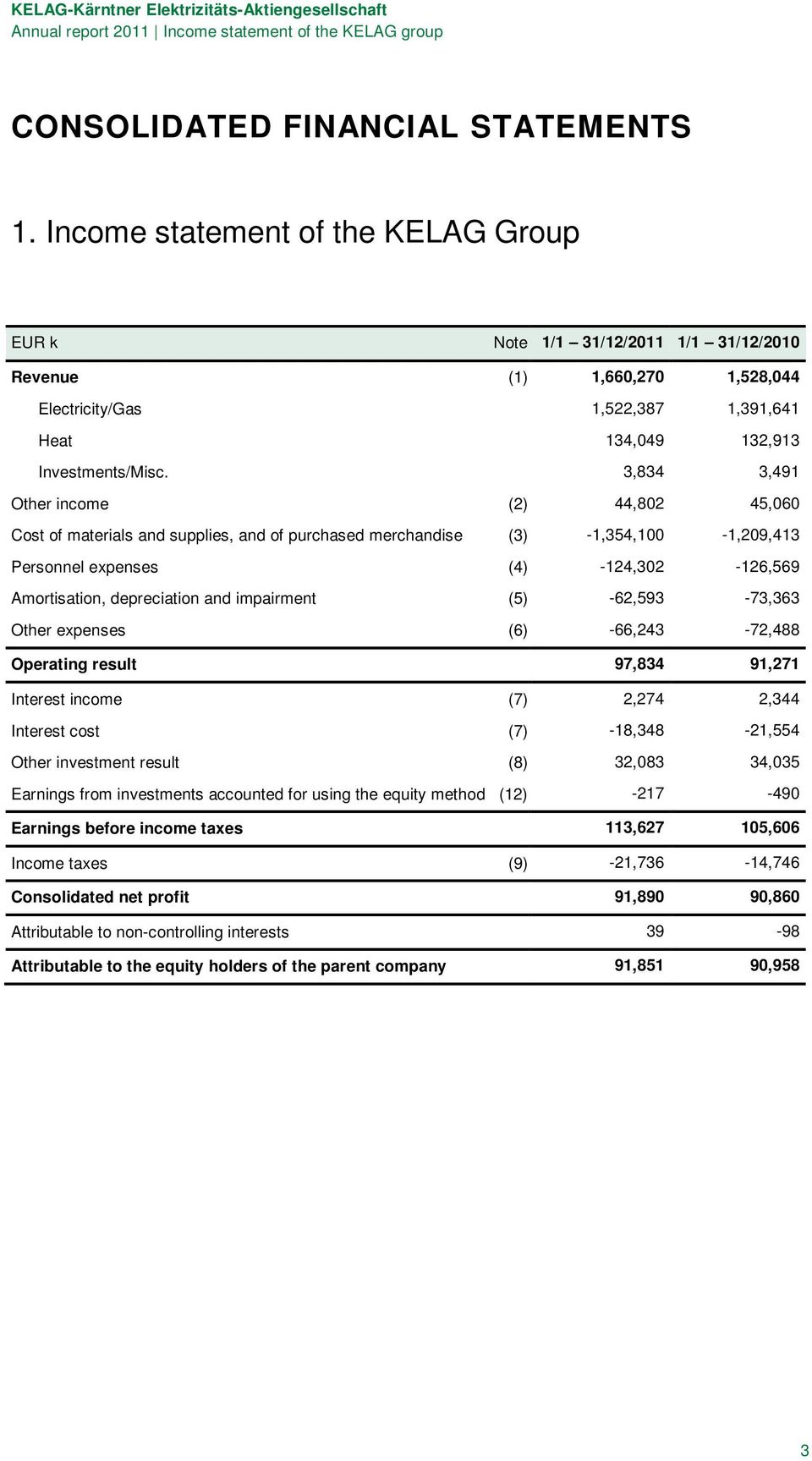
3 Annual report 2011 Income statement of the KELAG group CONSOLIDATED FINANCIAL STATEMENTS 1. Income statement of the KELAG Group EUR k Note 1/1 31/12/2011 1/1 31/12/2010 Revenue (1) 1,660,270 1,528,044 Electricity/Gas 1,522,387 1,391,641 Heat 134, ,913 Investments/Misc. 3,834 3,491 Other income (2) 44,802 45,060 Cost of materials and supplies, and of purchased merchandise (3) -1,354,100-1,209,413 Personnel expenses (4) -124, ,569 Amortisation, depreciation and impairment (5) -62,593-73,363 Other expenses (6) -66,243-72,488 Operating result 97,834 91,271 Interest income (7) 2,274 2,344 Interest cost (7) -18,348-21,554 Other investment result (8) 32,083 34,035 Earnings from investments accounted for using the equity method (12) Earnings before income taxes 113, ,606 Income taxes (9) -21,736-14,746 Consolidated net profit 91,890 90,860 Attributable to non-controlling interests Attributable to the equity holders of the parent company 91,851 90,958 3
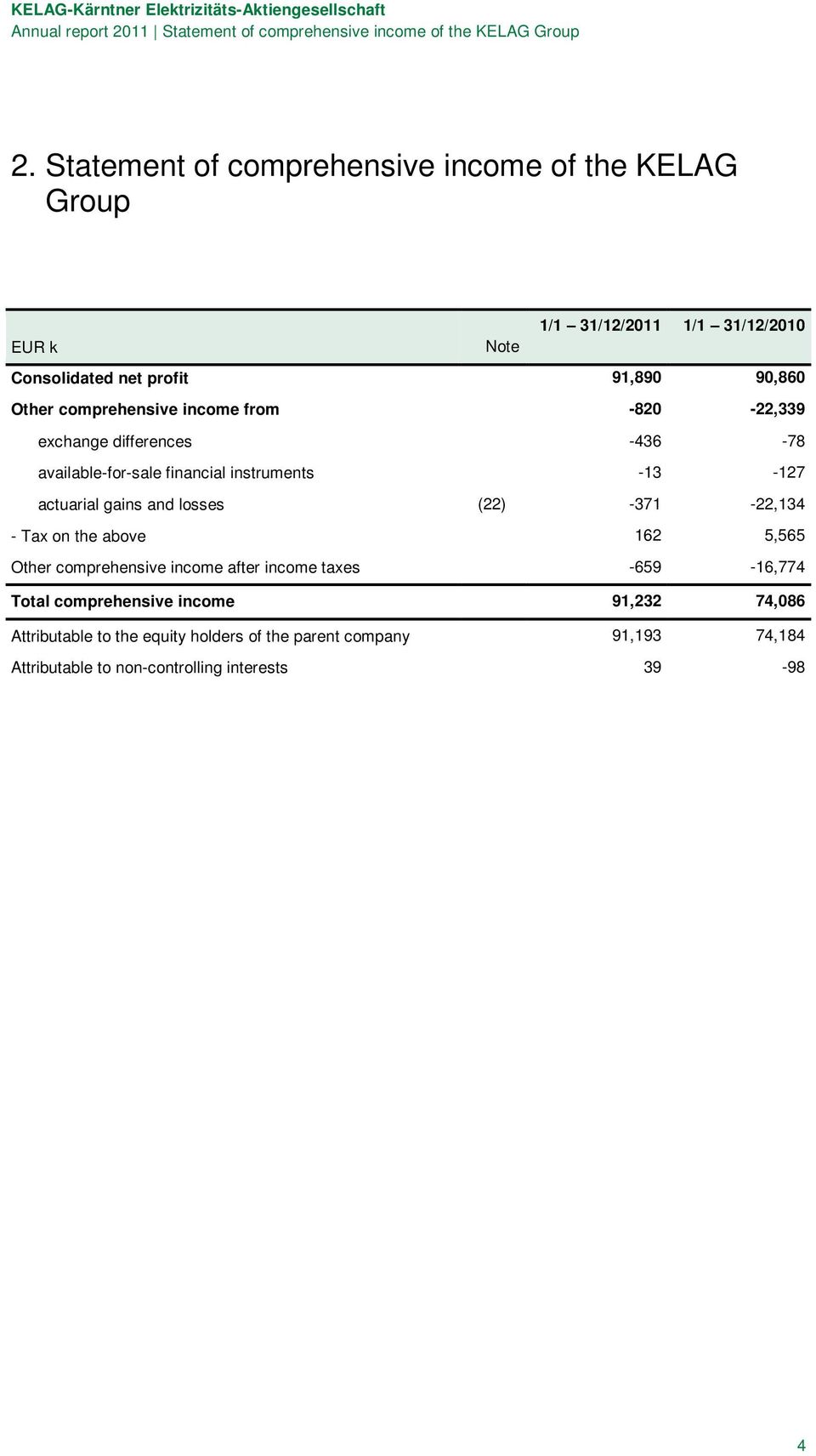
4 Annual report 2011 Statement of comprehensive income of the KELAG Group 2. Statement of comprehensive income of the KELAG Group 1/1 31/12/2011 1/1 31/12/2010 EUR k Note Consolidated net profit 91,890 90,860 Other comprehensive income from ,339 exchange differences available-for-sale financial instruments actuarial gains and losses (22) ,134 - Tax on the above 162 5,565 Other comprehensive income after income taxes ,774 Total comprehensive income 91,232 74,086 Attributable to the equity holders of the parent company 91,193 74,184 Attributable to non-controlling interests
5 Annual report 2011 Statement of financial position of the KELAG Group 3. Statement of financial position of the KELAG Group EUR k Note 31/12/ /12/2010 Non-current assets 1,322,807 1,200,306 Intangible assets (10) 292, ,003 Property, plant and equipment (11) 856, ,174 Investments accounted for using the equity method (12) 12,130 12,347 Other interests in other entities (13) 125, ,555 Other securities and book-entry securities (14) 28,071 28,312 Other non-current receivables and assets (15) 6,804 7,349 Deferred tax assets (16) Current assets 184, ,131 Inventories (17) 18,158 17,111 Trade receivables and other receivables and assets (18) 79,078 88,955 Cash and cash equivalents (19) 87, ,065 Assets 1,507,657 1,422,437 Equity 587, ,758 Equity attributable to the equity holders of the parent company (20) 584, ,835 Equity attributable to non-controlling interests (21) 2,958 2,923 Non-current liabilities 699, ,659 Financial liabilities (22) 264, ,294 Provisions (23) 273, ,059 Deferred tax liabilities (16) 5, Construction cost subsidies (24) 95,365 95,479 Other liabilities (25) 61,442 65,058 Current liabilities 220, ,020 Financial liabilities (26) 13,403 18,901 Current tax provisions Other provisions (27) 47,422 64,866 Trade payables and other liabilities (28) 159, ,032 Equity and liabilities 1,507,657 1,422,437 5

6 Annual report 2011 Statement of changes in equity of the KELAG Group 4. Statement of changes in equity of the KELAG Group EUR k Capital stock Capital reserves Accumulated profits/losses Exchange differences Actuarial gains and losses Available-for-sale financial instruments Total Equity attributable to noncontrolling interests Total equity As of 1 January , , , ,035 6, ,421 Other comprehensive income , , ,339 Tax on the above , , ,565 Other comprehensive income after income taxes , , ,774 Consolidated net profit , , ,860 Total comprehensive income , , , ,086 Dividends , , ,025 Other income and expenses recognised without effect on profit or loss ,342-2,725 As of 31 December , , , ,836 2, ,758 As of 1 January , , , ,836 2, ,758 Other comprehensive income Tax on the above Other comprehensive income after income taxes Consolidated net profit , , ,890 Total comprehensive income , , ,232 Dividends , , ,004 Other income and expenses recognised without effect on profit or loss As of 31 December , , , ,998 2, ,954 6

7 Annual report 2011 Statement of cash flows of the KELAG Group 5. Statement of cash flows of the KELAG Group EUR k Earnings before income taxes 113, ,606 Non-cash adjustment to reconcile earnings before income taxes to net cash flow Write-ups and write-downs of intangible assets and property, plant and equipment Write-ups and write-downs of financial assets including share of profit/loss from investments accounted for using the equity method Gain/loss on the disposal of property, plant and equipment, and securities 62,593 73,363 1,317 7,828 3,035 1,744 Interest cost 18,348 21,554 Interest income -2,274-2,344 Sundry 82-1,270 Deconsolidation effect 0-2,349 Taxes paid -12,439-3,345 Interest received 2,274 2,806 Changes in non-current provisions 4,779-5,285 Changes in construction cost subsidies -2,241-1,318 Cash flow from operating activities before working capital adjustments 189, ,990 Changes in inventories Changes in trade receivables and other receivables and assets 10,765-7,087 Changes in trade payables and other liabilities 8,874 17,973 Changes in current provisions -13,871 10,985 Cash flow from operating activities* 194, ,663 Investments in intangible assets and property, plant and equipment -168, ,570 Proceeds from the disposal of intangible assets and property, plant and equipment 2, Acquisition of subsidiaries, net of cash acquired -14,015-4,815 Investments in other securities and book-entry securities ,860 Disposals of financial assets 2,500 1,319 Cash flow from investing activities -178, ,223 Repayment and proceeds from financial liabilities ,730 Interest paid -14,098-14,776 Cash received and paid for non-current loans and financial receivables Profit distribution -30,004-25,025 Cash flows from financing activities -43,805-51,160 Changes in cash and cash equivalents -28,450 8,279 Cash and cash equivalents at the beginning of the financial year 116, ,785 Cash and cash equivalents at the end of the financial year 87, ,065 Changes in cash and cash equivalents according to the statement of financial position -28,450 8,279 * Please refer to 6.8 in Section Notes to the consolidated financial statements 7

8 NOTES TO THE CONSOLIDATED FINANCIAL STATEMENTS 1. The Company The KELAG Group is one of the leading energy service providers in Austria. The Company operates throughout Austria in the fields of electricity and natural gas, focusing on Carinthia. The subsidiary KELAG Wärme GmbH operates successfully in the heat business throughout Austria. The grids in Carinthia (electricity and natural gas) are operated by the subsidiary KELAG Netz GmbH. The hydroelectric and wind power activities and energy trading outside Austria are bundled at KI-KELAG International GmbH. The KELAG Group has decades of experience in the production and distribution of energy. 2. Accounting principles KELAG-Kärntner Elektrizitäts-Aktiengesellschaft (KELAG), with registered office at Arnulfplatz 2, A-9020 Klagenfurt am Wörthersee, commercial register court: regional and commercial court Klagenfurt i, and its subsidiaries form the KELAG Group for which the following IFRS financial statements for 2011 were prepared. These have an exempting effect pursuant to Sec. 245a UGB (Austrian Commercial Code). Information on its ultimate parent is presented in Section General information The consolidated financial statements of KELAG were prepared in accordance with International Financial Reporting Standards (IFRSs) as adopted by the European Union. The consolidated financial statements are generally prepared in accordance with the historical cost convention. This does not apply to derivative financial instruments and available-for-sale financial assets which are measured at fair value. The annual financial statements of entities included in the consolidated financial statements (whether fully consolidated or accounted for using the equity method) have been prepared on the basis of uniform accounting policies. The end of the reporting period for all fully consolidated entities is 31 December

9 The consolidated financial statements are prepared in thousands of euro (EUR k) (income statement, statement of comprehensive income, statement of financial position, statement of cash flows and statement of changes in equity) and millions of euro (EUR m) (notes). Rounding differences may arise from totalling rounded amounts and percentages using automatic calculation tools. Classification as current/non-current in the balance sheet has been performed pursuant to IAS 1.60 et seq. 9

10 2.2. Scope of consolidation and consolidation methods Financial assets KELAG s shareholding % Capital stock/ share capital EUR k Consolidation method* 1. KELAG Netz GmbH, Klagenfurt, Austria FC 2. KELAG Wärme GmbH, Villach, Austria ,820 FC 2.1. EKO-TOPLOTA Energetika d.o.o., Ljubljana, Slovenia** FC 2.2. SWH Strom und Wärme aus Holz, Heizwerk Errichtungs-Betriebs GmbH, Purkersdorf, Austria** EQ Biowärme Imst GmbH, Imst, Austria** EQ SBH Biomasseheizkraftwerk GmbH, Enns, Austria** EQ 2.3. Alternative Energie Salzburg GmbH, Salzburg, Austria** FC 2.4. Biowärme Friesach GmbH, Friesach, Austria** FC 2.5. Biofernwärme Fürstenfeld GmbH, Fürstenfeld, Austria** EQ 2.6. KWH Kraft & Wärme aus Holz GmbH, St. Gertraud, Austria** EQ 2.7. Bio-Teplo Czechia s.r.o., Znaim, Czech Republic** FC 3. KELAG Finanzierungsvermittlungs GmbH, Klagenfurt, Austria** FC 4. KI-KELAG International GmbH, Klagenfurt, Austria ,000 FC 4.1. Interenergo d.o.o., Ljubljana, Slovenia** ,200 FC Interenergo d.o.o. Zagreb, Zagreb, Croatia** FC EHE d.o.o. Banja Luka, Banja Luka, Bosnia and Herzegovina** ,001 FC Interenergo d.o.o. Sarajevo, Sarajevo, Bosnia and Herzegovina** FC PLC Interenergo d.o.o. Beograd, Belgrade, Serbia** FC Hidrowatt d.o.o. Beograd, Belgrade, Serbia** FC Interenergo Makedonija d.o.o.e.l., Skopje, Macedonia** FC IEP energija d.o.o. Gornji Vakuf-Uskoplje, Gornji Vakuf Uskoplje, Bosnia and Herzegovina** FC 4.2. Windfarm MV I s.r.l., Bucharest, Romania** ,010 FC 4.3. Lumbardhi Beteiligungs GmbH, Klagenfurt, Austria** FC KelKos d.o.o., Pristina, Kosovo** FC 4.4. Windfarm Balchik 1 OOD, Sofia, Bulgaria** FC 4.5. Windfarm Balchik 2 OOD, Sofia, Bulgaria** FC 4.6. Windfarm Balchik 4 OOD, Sofia, Bulgaria** FC 4.7. KelaVENT Charly srl, Bucharest, Romania** FC 10

11 Financial assets % Capital stock/ share capital EUR k KELAG s shareholding Consolidation method* 5. Wärmeversorgung Arnoldstein Errichtungs- und Betriebsgesellschaft mbh, Arnoldstein, Austria FC 6. KRV Kärntner Restmüllverwertungs GmbH, Arnoldstein, Austria EQ 7. Waldensteiner Kraftwerke GmbH, Waldenstein, Austria EQ 8. Waldensteiner Kraftwerke GmbH & Co KG, Waldenstein (limited partner s interest) EQ 9. Stadtwerke Kapfenberg GmbH, Kapfenberg, Austria ,000 EQ * FC = full consolidation EQ = equity method ** Indirect interest The parent company is KELAG-Kärntner Elektrizitäts-Aktiengesellschaft. The consolidated financial statements include all entities ( subsidiaries ) that are controlled (controlling influence) by the parent company by means of full consolidation. Controlling influence is where the parent company is able, whether directly or indirectly, to determine the entity s financial and operating policy. The inclusion of a subsidiary begins when controlling influence is acquired and ends when controlling influence is lost. The financial statements of the subsidiaries are prepared for the same reporting period as the parent company, using consistent accounting policies. Losses within a subsidiary are attributed to the non-controlling interest even if that results in a deficit balance. A change in the ownership interest of a subsidiary without involving the loss of control is accounted for as an equity transaction. If the Group loses control over a subsidiary, it: Derecognises the assets (including goodwill) and liabilities of the subsidiary Derecognises the carrying amount of any non-controlling interest Derecognises the cumulative translation differences recorded in equity Recognises the fair value of the consideration received Recognises the fair value of any investment retained Recognises any surplus or deficit in profit or loss Reclassifies the parent s share of components previously recognised in other comprehensive income to profit or loss or retained earnings, as appropriate. 11
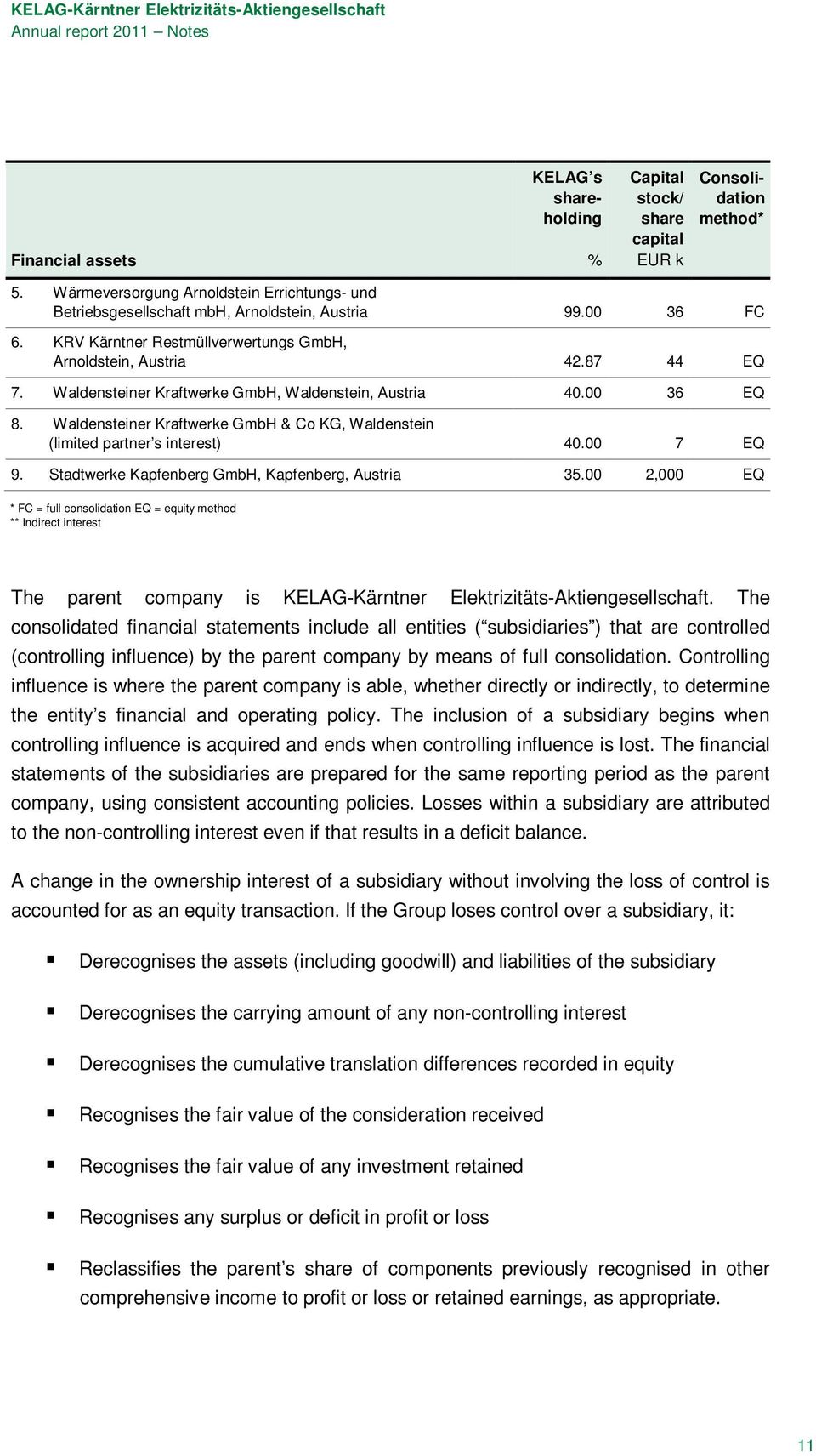
12 In addition to KELAG as parent company, the consolidated financial statements include 24 subsidiaries (prior year: 19) and 9 associates (prior year: 11). 31/12/ /12/2010 Scope of consolidation Full consolidation Equity method Full consolidation Equity method As of the beginning of the reporting period Included in the financial statements for the first time in the reporting period Merged in the reporting period Deconsolidated in the reporting period As of the end of the reporting period of which Austrian entities of which non-austrian entities For more details of business combinations, reference is made to Section 5. Notes to the statement of financial position. Entities on which the parent company can exercise significant influence, whether directly or indirectly, ( associates ) and shares in joint ventures are accounted for using the equity method. The same consolidation principles are applied. The financial statements of all material entities accounted for using the equity method are prepared using uniform accounting policies. Investments in associates and in joint ventures Under the equity method, the investment in the associate is carried on the statement of financial position at cost plus post acquisition changes in the Group s share of net assets of the associate. Goodwill relating to the associate is included in the carrying amount of the investment and is neither amortised nor individually tested for impairment. The income statement reflects the Group s share of the results of operations of the associate. When there has been a change recognised directly in the equity of the associate, the Group recognises its share of any changes and discloses this, when applicable, in the statement of changes in equity. Unrealised gains and losses resulting from transactions between the Group and the associate are eliminated to the extent of the interest in the associate. Losses by an associate exceeding the Group s share in this associate are only recognised to the extent that the Group has entered into legal or constructive obligations or makes payments on behalf of the associate. The share of profit of an associate is shown on the face of the income statement. This is the profit attributable to equity holders of the associate and therefore is profit after tax and non-controlling interests in the subsidiaries of the associate. 12

13 After application of the equity method, the Group determines whether it is necessary to recognise an additional impairment loss on the Group s investment in its associate. The Group determines at each reporting date whether there is any objective evidence that the investment in the associate is impaired. If this is the case, the Group calculates the amount of impairment as the difference between the recoverable amount of the associate and its carrying value and recognises the amount in the share of profit of an associate in the income statement. Upon loss of significant influence over the associate, the Group measures and recognises any retaining investment at its fair value. Any difference between the carrying amount of the associate upon loss of significant influence and the fair value of the retained investment and proceeds from disposal is recognised in profit or loss. Intercompany transactions, receivables, liabilities and intercompany profits are eliminated. The reversal of impairment and impairment on shares performed in separate financial statements are reversed. The acquisition of subsidiaries and businesses is accounted for using the acquisition method. The acquisition costs of a business combination are determined using the total of the fair values, as of the date of exchange, of the assets given as consideration and the liabilities entered into or assumed in exchange for control of the acquired entity. The identifiable assets, liabilities and contingent liabilities of the acquired entity that satisfy the recognition criteria of IFRS 3 Business combinations are recognised at their fair values as of the acquisition date. Any goodwill arising from a business acquisition is recorded as an asset and recognised at its cost at the time of initial recognition, its cost being the excess of the cost of the business combination over the net fair value of the identifiable assets, liabilities and contingent liabilities recognised by the Group. If, upon reassessment, the Group s share in the fair value of the identifiable assets, liabilities and contingent liabilities of the acquired entity exceed the acquisition cost of the business combination, the excess is recognised immediately through profit or loss. The share of non-controlling interests in the acquired entity is measured as of acquisition date at its shares in the net fair value of the assets, liabilities and contingent liabilities. The cost of a business combination is expensed as incurred. Business combinations and incorporations When the Group acquires a business, it assesses the financial assets and liabilities assumed for appropriate classification and designation in accordance with the contractual terms, economic circumstances and pertinent conditions as of the acquisition date. If the business combination is achieved in stages, the acquisition date fair value of the acquirer s previously held equity interest in the acquiree is remeasured to fair value at the acquisition date through profit or loss. 13

14 Any contingent consideration to be transferred by the acquirer is recognised at fair value at the acquisition date. Subsequent changes to the fair value of the contingent consideration which is deemed to be an asset or liability is recognised in accordance with IAS 39 either in profit or loss or as a change to other comprehensive income. If the contingent consideration is classified as equity, it is not remeasured and its subsequent settlement is accounted for within equity. Effective as of 27 October 2011, all of the shares in IEP energija d.o.o. were acquired for acquisition costs of EUR 4.0m. The entity s hydroelectric power stations at Duboki potok and Sastavci in the Bosnian Federation have 1.9 MW of installed capacity. For details of purchase price allocation, reference is made to Section 5. The purchase agreement for % of the shares in KelaVENT Charlie SRL was signed on 22 December The basic purchase price was EUR 1.1m. Upon completion, the wind farm will have an installed capacity of 8 MW. An extension of the wind farm (KelaVENT Golf with a further 8 MW, KelaVENT Bravo with 26 MW) is planned. For details of the purchase price allocation, reference is made to Section 5. Strom und Wärme aus Holz, Heizwerke Errichtungs-Betriebs GmbH (SWH), a 50% subsidiary of KELAG Wärme GmbH and ÖBf Beteiligungs GmbH that generates heat and electricity from biomass, suffered difficulties in 2009 on account of the significant price rises on the biomass market. In 2010, the two shareholders of SWH agreed on a joint consolidation process that ended in an out-of-court settlement between SWH, its owners and the financing banks. This safeguarded supplies of heat to all of SWH s customers. Furthermore, as part of the settlement agreement, the decision was made to completely transfer four heating plants and two entities, Biowärme Friesach GmbH and Alternative Energie Salzburg GmbH, to KELAG Wärme GmbH (KWG). The entities and plants acquired were optimised and now make a positive contribution to KWG s results. The full organisational and technical integration of the former SWH plants and entities into KWG will be completed by the end of In addition, KWG has a 25% shareholding in a former equity interest of the SWH Group, Bioenergie Pongau GmbH. For details of purchase price allocation, reference is made to Section 5. 14

15 2.3. Accounting policies For the preparation of these consolidated financial statements all mandatory amendments to existing and new IAS and IFRSs as of 31 December 2011 as well as to IFRIC and SIC interpretations as adopted by the European Union were applied. New accounting policies Those IAS and IFRSs as well as those IFRIC and SIC interpretations already adopted by the European Union but not yet mandatory for the financial year 2011 are not early adopted. One exception to this is the early adoption of IAS 1. The following standards and interpretations were applied for the first time for the financial year 2011: Newly applied IFRSs/IFRICs Effective as of IAS 24 Related Party Disclosures 1/1/2011 IAS 32 Amendments: Classification of Rights Issues 1/1/2011 IFRS 1 IFRIC 14 First-time Adoption of IFRSs Limited Exemption from Comparative IFRS 7 Disclosures for First-time Adopters IAS 19 The Limit on a Defined Benefit Asset, Minimum Funding Requirements and their Interaction 1/7/2010 1/1/2011 IFRIC 19 Extinguishing Financial Liabilities with Equity Instruments 1/7/2010 Miscellaneous Improvements to IFRSs as of 1/1/2011 The IASB amended IAS 24 Related Party Disclosures, which includes a partial exemption from the disclosure requirements for government-related entities and provides guidance on the definitions of related parties. As these amendments affect the KELAG Group, where the government controls the majority shareholding, the new IAS 24 does not constitute a simplification where no details have to be disclosed of individual transactions with government-related entities unless they are significant. The amendments to IAS 32 clarify that rights issues in a foreign currency are reported as equity in the accounts of the issuer if the number and foreign currency amount of the equity instruments to be acquired are fixed and the rights are granted proportionately to all holders of equity instruments (of the same class). This standard amendment has not been adopted by the KELAG Group and thus does not have any effect on KELAG s consolidated financial statements. 15

16 IFRS 1 was amended to make it possible for first-time adopters to make use of the transitional requirements of IFRS 7 Financial Instruments: Disclosures. It exempts firsttime adopters from the duty to include the required comparative disclosures in the notes in the first year of adoption of IFRSs. As the KELAG Group is not a first-time adopter of IFRSs, these amendments did not have any effects. IFRIC 14 The Limit on a Defined Benefit Asset, Minimum Funding Requirements and their Interaction provides general guidelines for determining the upper limit of a defined benefit asset recognised pursuant to IAS 19. Under IFRIC 14, employers do not have to report any further liability unless the amounts to be paid according to the minimum funding requirements cannot be repaid to the company. Where an entity subject to minimum funding requirements makes a prepayment of contributions, the amendment allows in future an entity to recognise the economic benefit from such prepayment as an asset. This amendment does not have any effect on the KELAG Group. The publication of IFRIC 19 Extinguishing Financial Liabilities with Equity Instruments provides guidance on the requirements when an entity renegotiates the conditions of a financial liability with the creditor and the creditor accepts the shares or other equity instruments issued by the entity to extinguish all or part of the financial liability. The KELAG Group does not apply this interpretation. The Improvements to IFRSs include amendments to IFRS 3 Business Combinations, IFRS 7 Financial Instruments Disclosures, IAS 1 Presentation of Financial Statements, IAS 27 Consolidated and Separate Financial Statements and IAS 34 Interim Financial Reporting (retrospective), which do not have any impact on KELAG s consolidated financial statements. 16

17 Not yet applicable IFRSs/IFRICs Prospective effective date IAS 1 Amendments: Presentation of Items of Other Comprehensive Income 1/7/2012 IAS 12 Amendments: Deferred Tax Recovery of Underlying Assets 1/1/2012 IAS 19 Amendment: Employee Benefits 1/1/2013 IAS 27 Amendments: Separate Financial Statements 1/1/2013 IAS 28 Amendments: Investments in Associates 1/1/2013 IFRS 1 Amendments: Severe Hyperinflation and Removal of Fixed Dates 1/7/2011 IFRS 7 Amendments: Financial Instruments Disclosures 1/7/2011 IFRS 9 Financial Instruments 1/1/2015 IFRS 10 Consolidated Financial Statements 1/1/2013 IFRS 11 Joint Arrangements 1/1/2013 IFRS 12 Disclosures of Interests in Other Entities 1/1/2013 IFRS 13 Fair Value Measurement 1/1/2013 IFRIC 20 Stripping Costs in the Production Phase of a Surface Mine 1/1/2013 Pursuant to the amendment in IAS 1 Presentation of Financial Statements entities must classify the items presented in other comprehensive income into two categories items that are subsequently posted through profit and loss (recycling) and those that are not. The amendment also affects the KELAG Group s statement of comprehensive income and was already implemented in the 2011 financial statements. The amendments to IAS 12 provide an exception to the existing regulation on the measurement of deferred tax assets and liabilities for certain non-financial assets measured at fair value. This essentially affects entities that measure investment properties, property, plant and equipment and intangible assets at fair value in their statement of financial position and originate from countries that stipulate different tax rates for investment income and gains on disposal. It can be assumed that the KELAG Group will not be affected. 17

18 There have been material amendments to IAS 19 Employee Benefits that relate to the recording and valuation of the expenses for defined benefit plans and post-employment benefits. Subsequently, the mandatory disclosures on employee benefits also change. Actuarial gains and losses must be recognised immediately in other comprehensive income. Recognition using the corridor approach and immediate recognition in profit and loss, which were permissible in the past, are no longer allowed. This does not affect the KELAG Group as it converted to the method allowed under the amended version of IAS 19 already in IAS 27 Consolidated and Separate Financial Statements has been renamed and in future only contains provision on separate financial statements. The existing guidelines for separate financial statements remain unchanged, however. IAS 28 Investments in Associates has been amended such that the disclosure requirements it contained have been transferred to IFRS 12 and are no longer part of IAS 28. The amendment to IFRS 1 relates to entities whose functional currency is subject to severe hyperinflation. As KELAG is not a first-time adopter of IFRSs, this amendment did not have any effect. The amendments to IFRS 7 Financial Instruments Disclosures relate to additional mandatory disclosures when derecognising financial assets. In contrast to the previous provisions, where financial assets are not fully derecognised despite the rights being transferred or there being an obligation to transfer cash inflows there is a requirement to make additional disclosures on the newly created liabilities. This includes in particular disclosure as to whether the financial assets that continue to be carried can be used without restriction or the acquiring party has an entitlement to the financial asset. The amendments affect entities that transfer financial assets to another party through sale, securitisation transaction, factoring or another form of transaction. As none of these kinds of transaction have been performed within the KELAG Group to date, no new disclosure requirements are expected to arise. IFRS 9 Financial Instruments provides new provisions on the classification and measurement of financial instruments and is intended to replace IAS 39. The new standard separates all financial assets into two categories for classification those that are measured at amortised cost and those that are measured at fair value. In addition, new provisions for accounting for financial liabilities were included and the provisions for the derecognition of financial assets and liabilities were adopted from IAS 39. There are plans to extend IFRS 9 by including new requirement for the impairment of financial assets that are measured at amortised cost and hedge accounting. The future impact of 18

19 IFRS 9 on the KELAG Group has yet to be reviewed; endorsement by the EU is still pending. IFRS 10 Consolidated Financial Statements will replace IAS 27 Consolidated and Separate Financial Statements and SIC 12 Consolidation Special Purpose Entities ; it contains guidelines on control and consolidation. The definition of control is amended such that the criterion of control is met where the controlling entity is able to exercise control over the relevant activities, leading to variable returns from the entity. Returns can be positive, negative or both. The provisions for consolidation are not affected. Within the KELAG it will be necessary to review each individual equity interest with a view to the new definition of control, but it may be assumed that there will be no material changes. Endorsement by the EU is still pending. According to IFRS 11 Joint Arrangements there will be two types of joint arrangement in future: joint operations and joint ventures. A joint operation is a joint arrangement where direct rights to the assets and liabilities are transferred to the partner entities in this joint arrangement. A partner entity in a joint operation records its share on the basis of its share in the joint operation instead of on the basis of the interest in the joint arrangement. A partner entity in a joint venture on the other hand does not have any rights to individual assets or liabilities. Partner entities of joint venture have a share in the net assets and thus in the results of the activities performed by the joint venture. Joint ventures are accounted for using the equity method; proportionate consolidation is now prohibited by IFRS 11. KELAG must review its existing or new agreements in order to decide whether it invested in a joint arrangement or a joint venture, pursuant to the new standard. Endorsement by the EU is still pending. IFRS 12 Disclosure of Interests in Other Entities stipulates the disclosures that have to be made by an entity on its interests in other entities. According to the new standard, entities must make disclosures that enable the users of the financial statements to assess the nature of the entity s interest in subsidiaries, associates, joint arrangements and unconsolidated structured entities (special purpose vehicles) and the associated risks and financial impact. Endorsement by the EU is still pending. IFRS 13 Fair Value Measurement specifies how the fair value is measures and expands the disclosures on fair value. The fair value is uniformly defined as the price that would be received to sell an asset or paid to transfer a liability in an orderly transaction between market participants at the measurement date. The standard, however, does not contain any details when fair value is to be applied. As almost all entities and thus also the KELAG Group perform measurements at fair value, the new requirements have to be 19
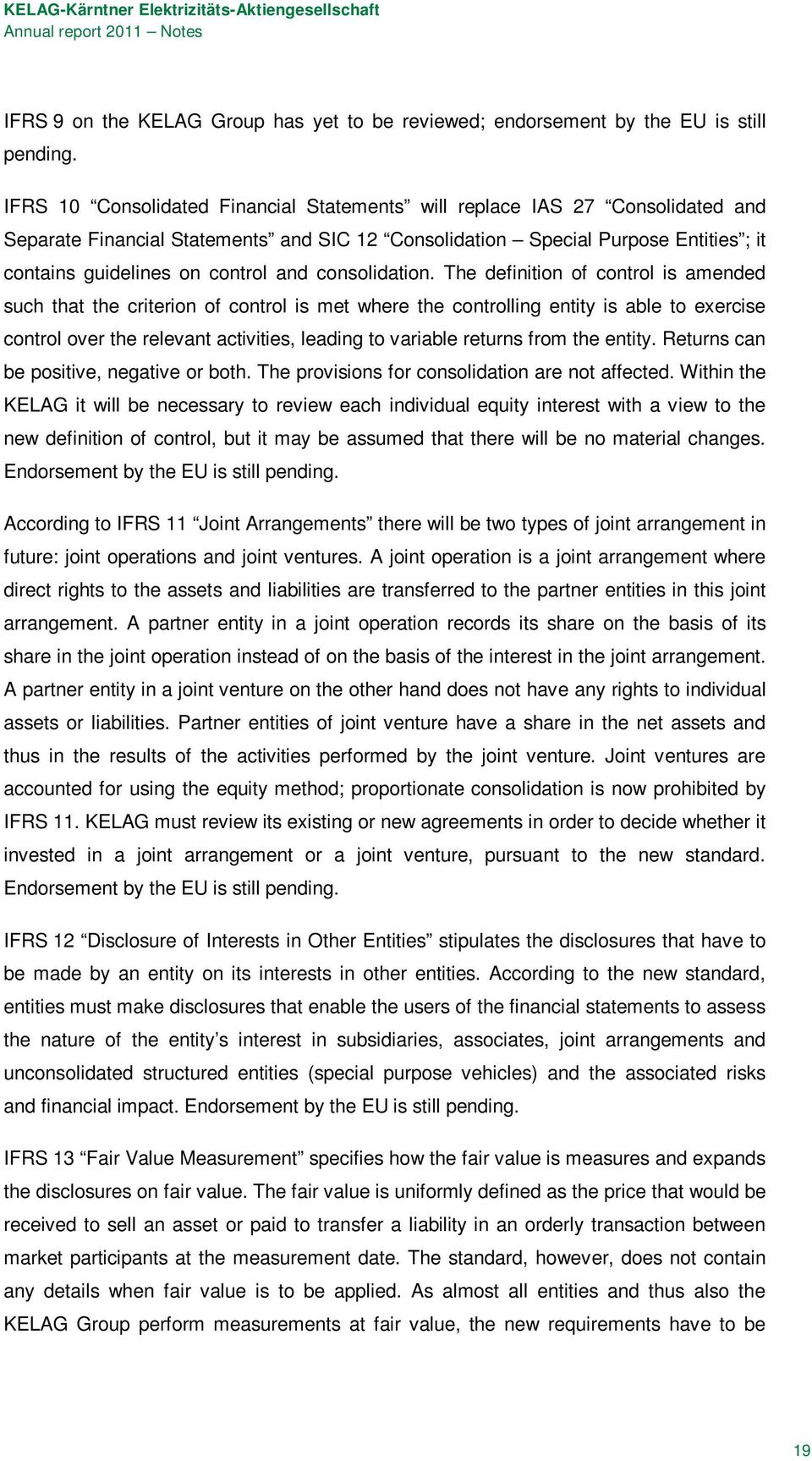
20 met. However, it is mainly the extended disclosure requirements that will affect the KELAG Group. Endorsement by the EU is still pending. The new IFRIC 20 Stripping Costs in the Production Phase of a Surface Mine is not relevant for KELAG. Endorsement by the EU is still pending for the IFRSs/IFRICs that are not yet subject to adoption. Summary of significant accounting policies Those items in assets and equity and liabilities that are expected to be fulfilled or realised within a period of twelve months after the reporting date are reported as current items. Current versus non-current classification Those items in assets and equity and liabilities that are expected to be fulfilled or realised more than twelve months after the reporting date are reported as non-current items. In these financial statements, around EUR 3.5m of the Investments accounted for using the equity method were reclassified to the item Other interests in other entities in the statement of financial position in the comparative period These relate to investments in associates recognised pursuant to IAS 39 due to immateriality. In addition, trade receivables amounting to roughly EUR 3.8m were reclassified from the item Other non-current receivables and assets to current trade receivables. Reclassification of financial statements items When accounting for business combinations, differences can emerge between the cost and the (pro rata) remeasured net assets. If the difference is negative, the calculation of cost and the purchase price allocation must be rechecked. Any remaining negative difference is to be recorded directly in profit or loss. Goodwill Under IFRSs, any positive difference is recognised as goodwill. Pursuant to IFRS 3, the goodwill recognised in the statement of financial position is not amortised but must be tested for impairment at least once a year. For this purpose, the goodwill must be allocated to those cash-generating units that are expected to benefit from the synergies resulting from a business combination. These cash-generating units correspond to the lowest organisational level at which management monitors the goodwill for internal management purposes. The recoverability of goodwill is tested by comparing the recoverable amount of a cash-generating unit with its carrying amount including goodwill. If the recoverable amount falls below the carrying amount of the cash-generating unit, 20
21 goodwill must be written down in a first step. If there is any further need for an impairment charge, the carrying amounts of the other assets must be reduced pro rata temporis. Impairment losses charged on goodwill cannot be reversed in subsequent periods. In the KELAG Group, the annual impairment test of goodwill at the level of the cashgenerating units takes place in the fourth quarter of the reporting period based on the mid-range planning. Where goodwill forms part of a cash-generating unit and part of the operation within that unit is disposed of, the goodwill associated with the operation disposed of is included in the carrying amount of the operation when determining the gain or loss on disposal of the operation. Goodwill disposed of in this circumstance is measured based on the relative values of the operation disposed of and the portion of the cash-generating unit retained. Acquired intangible assets are recorded at amortised cost. Intangible assets acquired as part of a business combination are recognised separately from goodwill if they meet the definition as an intangible asset and their fair value can be reliably determined. The cost of such intangible assets corresponds to their fair value as of the acquisition date. All of these assets have finite useful lives, and are thus amortised using the straight-line method. Following initial recognition, intangible assets are carried at cost less any accumulated amortisation and accumulated impairment losses. Property, plant and equipment and intangible assets Gains or losses arising from derecognition of an intangible asset are measured as the difference between the net disposal proceeds and the carrying amount of the asset and are recognised in the statement of income when the asset is derecognised. As long as intangible assets are not yet available for use, they must be tested for impairment annually. Property, plant and equipment is stated at cost, net of accumulated depreciation and/or accumulated impairment losses, if any. Such cost includes the cost of replacing part of the property, plant and equipment and borrowing costs for long-term construction projects if the recognition criteria are met. When significant parts of property, plant and equipment are required to be replaced at intervals, the Group recognises such parts as individual assets with specific useful lives and depreciation, respectively. Likewise, when a major inspection is performed, its cost is recognised in the carrying amount of the plant and equipment as a replacement if the recognition criteria are satisfied. All other repair and maintenance costs are recognised in the income statement as incurred. An item of property, plant and equipment and any significant part initially recognised is derecognised upon disposal or when no future economic benefits are expected from its use or disposal. Any gain or loss arising on derecognition of the asset (calculated as the difference between the net disposal proceeds and the carrying amount of the asset) is included in the income statement when the asset is derecognised. 21
22 The cost of self-constructed assets includes direct production and materials costs and an appropriate portion of materials and production overheads less any idle capacity costs. The amortisation of intangible assets and depreciation of property, plant and equipment subject to depletion are based on the expected useful lives in the Group and begin when the asset is ready for use. The expected useful lives, residual values and amortisation and depreciation methods are assessed annually and all necessary changes in estimates are taken into account prospectively. Amortisation and depreciation is calculated according to the following uniform group useful lives: Useful lives Years Intangible assets Water usage rights 0-90 Other rights of use 0-50 Software 4-10 Property, plant and equipment Office and factory buildings Plant and machinery Other property, plant and equipment 1-10 Wind turbines 12 The gain or loss on disposal or closure of an item of property, plant and equipment is determined as the difference between the net disposal proceeds and the carrying amount of the asset, and is included in profit or loss. Borrowing costs directly attributable to the acquisition, construction or production of an asset that necessarily takes a substantial period of time to get ready for its intended use or sale are capitalised as part of the cost of the respective asset. This is done in line with the Group s accounting guidelines. All other borrowing costs are expensed in the period they occur. Borrowing costs consist of interest and other costs that an entity incurs in connection with the borrowing of funds. The Group capitalises borrowing costs for all eligible assets where construction was commenced on or after 1 January The capitalisation rate is 4.5% (prior year 4.5%). Borrowing costs The determination of whether an arrangement is, or contains, a lease is based on the substance of the arrangement at inception date, whether fulfilment of the arrangement is Leases 22
23 dependent on the use of a specific asset or assets or the arrangement conveys a right to use the asset, even if that right is not explicitly specified in an arrangement. Assets held under finance leases are written down over their expected useful lives in the same way as assets owned by the Group or, if shorter, over the term of the underlying lease. Initial recognition of the assets is at the present values of the minimum lease payments (or their fair values, if lower) in non-current assets in the statement of financial position of the KELAG Group. On the liabilities side, the lease liability is recognised and rolled forward in subsequent periods using the effective interest method. All other leases where the KELAG Group is the lessee are accounted for as operating leases. The lease payments are expensed on a straight-line basis over the term of the lease. If there is an indication of impairment of non-financial assets that fall within the scope of IAS 36, the recoverability of the carrying amounts is tested (impairment test). Regardless of whether or not there is an indication of impairment, an annual impairment test must be carried out for goodwill, intangible assets with indefinite useful lives and assets that are not yet ready for use. An impairment charge has to be recognised if the carrying amount exceeds the recoverable amount of the asset. The recoverable amount is the higher of an asset s value in use or fair value less costs to sell. The value in use is calculated based on an income-based approach using the discounted cash flow method (DCF method). The relevant cash flows are derived based on management s financial plans. The capitalisation rate is the input tax rate which reflects the current market estimates of the fair value of money and the specific risks, taking into account the capital structure of the asset. An impairment loss must be recognised at the amount by which the carrying amount exceeds the recoverable amount. If the reasons for impairment no longer apply in subsequent periods, impairment losses are reversed (except in the case of goodwill). Recoverability of nonfinancial assets Other interests in other entities are recognised at cost less impairment losses if it is not possible to derive the fair value using comparable transactions for the corresponding period and measurement was not performed by discounting the expected cash flows because cash flows could not be reliably determined. Other interests in other entities In accordance with IAS 28, the investments accounted for using the equity method are initially recognised at cost and subsequently recognised according to the amortised interest in net assets. The carrying amounts of the investment are increased or decreased by the share of the KELAG Group in the earnings for the period and in other comprehensive income as well as by distributions, material elimination of intercompany profits and rolled forward fair value adjustments from share acquisitions recognised in accordance with IFRS 3. Goodwill included therein in accordance with IFRS 3 is not subject to amortisation and, in accordance with IAS 28, is not reported separately. 23
24 As of the respective reporting date, other interests in other entities are checked for signs of impairment as defined by IAS 39, and if necessary an impairment test is carried out in accordance with IAS 36. Recoverability of other interests in other entities Recoverability is assessed by calculating the recoverable amount, which is the higher of the value in use and fair value less costs to sell. The recoverable amount of the equity investments is calculated primarily based on concept of the fair value less costs to sell. To determine the fair value less costs to sell, market-based approaches are favoured over income-based approaches. The best information available must be used for the measurement, which is the information that a company would use as of the reporting date in connection with the sale of the asset at market conditions between willing, competent and independent business partners. To determine value in use, the present value of the estimated cash flows allocated to the KELAG Group and to be recorded by the associate or joint venture as whole in future is generally used. Alternatively, in accordance with IAS 28, the pro rata present value of estimated future dividends and liquidation proceeds can be used. The securities and book-entry securities reported in the statement of financial position mainly comprise bonds and government securities. Other securities and book-entry securities The securities (mainly government securities) are classified as available for sale. This category essentially comprises financial instruments that are not loans or receivables, not held to maturity and not measured at fair value through profit or loss. They are measured at fair value, which is calculated based on market prices. Initial measurement is performed on the settlement date. Market-induced changes in value are added to other comprehensive income (in equity) up until sale or any impairment losses in accordance with IAS 39. By contrast, changes in value that are not market induced are posted to profit or loss (see recoverability of financial assets). The gain or loss on sale is posted to profit or loss. If an asset is impaired, the accumulated loss is reclassified to finance cost in profit or loss and derecognised from the reserve for available-for-sale financial assets. If the fair value falls significantly or for a longer period, impairment losses are recognised in profit or loss. Acquisitions and sales are recognised on their settlement date. Interest income calculated using the effective interest rate method is recognised in the financial result with an effect on income. 24
25 Interest-bearing non-current receivables are allocated to the loans and receivables (LAR) category. These are recognised at amortised cost less any impairment losses using the effective interest rate method. In the case of impairment losses, measurement is at the present value of the repayments expected. Other non-current receivables and assets All trade receivables, receivables from affiliated non-consolidated entities and receivables from other investees and investors are allocated to the loans and receivables (LAR) category and measured at amortised cost in accordance with IAS 39. If impairment losses are expected, the items are recognised in the statement of financial position less impairment losses for parts that are expected to be uncollectible. Trade receivables and other receivables and assets Impairment losses adjusted on an item by item basis via allowance costs make sufficient provisions for the expected default risks. Actual default leads to derecognition of the receivables in question. Other assets are recognised at cost loss impairment losses. Current other receivables contain derivatives relating to energy. The derivative financial instruments are recognised at fair value. The values of derivatives with a netting agreement are netted and thus shown as net figures in the statement of financial position. Other non-current and current receivables are carried at amortised cost. Any impairment losses must also be recognised. The carrying amounts of financial assets not carried at fair value through profit or loss are tested on each reporting date as defined by IAS 39 for objective evidence of impairment (such as significant financial difficulties of the debtor, a high probability of insolvency proceedings against the debtor). If such evidence exists, the impairment losses to be recognised are recorded in the income statement. Recoverability of financial assets Natural gas inventories are measured using the FIFO method. Materials and supplies are measured at the lower of cost or net realisable value on the reporting date. For marketable inventories, this stems from the current market price. For all other inventories, the net realisable value can be derived from the planned income less cost yet to be incurred. Measurement is based on the moving average price method. Inventories Services not yet invoiced and work in process are measured at cost, which comprises direct production and materials costs as well as an appropriate portion of materials and production overheads, taking any idle capacity costs into account. 25
26 The Cash and cash equivalents item in the statement of financial position comprises cash in hand, bank balances and short-term highly liquid deposits that can be converted into a fixed amount of cash at any time and are subject only to immaterial risks of changes in value, which is generally the case with a remaining term of less than three months. Cash and cash equivalents Cash and cash equivalents as reported in the statement of cash flows comprise the items defined above. Liabilities are recognised at fair value less transaction costs. A premium, debt discount or other difference between the amount received and the repayment amount is spread over the term of the financing using the effective interest method and recognised in the financing result. Financial liabilities The provisions for current pensions, claims to future pensions and similar obligations are calculated using the projected unit credit method in accordance with IAS 19. The Group recognises actuarial gains and losses in full in the period in which they occur in other comprehensive income. Such actuarial gains and losses are also immediately recognised in other comprehensive income and are not reclassified to profit or loss in subsequent periods. Pension obligations and statutory severance payments Based on company agreements and individual contracts, there is an obligation to pay pensions to certain employees under certain circumstances after they have retired. Earmarked pension trust funds exist for these defined benefit obligations. To the extent that these obligations have to be met by the pension trust fund, there is an obligation on the part of the employer to make additional capital contributions. The plan assets are not available to the creditors of the Group, nor can they be paid directly to the Group. Fair value is based on market price information and, in the case of quoted securities, is the published bid price. Pension obligations are determined on the basis of actuarial reports. The biometrical assumptions used were the AVÖ 2008-P Rechnungsgrundlagen für die Pensionsversicherung Pagler & Pagler for employees. Apart from death and invalidity or retirement upon reaching the imputed pension age, the actuarial experts did not take any other reasons for leaving the Company into account, such as employee turnover or similar reasons. The amount of the pension depends on the period of service at KELAG before payment of a pension commences. The pension age taken as a basis for the calculations is the earliest possible age at which (early) retirement is possible in accordance with the relevant statutory regulations, taking transitional regulations into account. For female employees with vested pension rights, the pension age taken as a basis for the 26
27 calculations was gradually increased in accordance with the Bundesverfassungsgesetz über unterschiedliche Altersgrenzen von männlichen und weiblichen Sozialversicherten (Austrian Federal Constitutional Law on Different Retirement Ages of Men and Women under Social Security). The pension trust invests the pension trust funds mainly in different investment funds, observing the regulations of the PKG (Austrian Pension Fund Act). Based on labour-law obligations, employees who commenced service on or before 31 December 2002 receive a one-off severance payment if the employment relationship is terminated by the employer or upon retirement. The amount of the entitlement depends on the number of years served at the Company and the remuneration authoritative at the time the payment falls due. This obligation is calculated in accordance with the projected unit credit method with a savings period of 25 years pursuant to IAS 19. Resulting actuarial gains and losses are also taken into account in other comprehensive income. For all employment relationships commencing after 31 December 2002, employees no longer have any direct entitlement to statutory severance. For the employees affected by this regulation, the employer pays a monthly amount of 1.53% of the remuneration into a staff provision fund where the contributions are deposited on an account of the employee. This severance model means that the employer is obliged only to pay the regular contributions, and it is recognised as a defined contribution plan pursuant to IAS 19. The calculations of the above provisions as of 31 December 2011 and 31 December 2010 are based on the following assumptions: Actuarial assumptions Pensions Discount rate 4.30% 4.30% Pension increases % % Salary increases % % Employee turnover None None Pension age for women Pension age for men Expected long-term return on plan assets 4.10% 4.10% Statutory severance payments Discount rate 4.30% 4.30% Salary increases 3.00% 3.00% Employee turnover (depending on period of service at the Company) None None 27
28 The provision for long-service awards is recognised in accordance with the same actuarial assumptions as the provision for severance payments. Other provisions are recognised in accordance with the regulations in IAS 37 if the Company has a legal or constructive obligation to a third party based on a past event and it is probable that this obligation will lead to an outflow of resources. It must be possible to make a reliable estimate of the amount of the obligation. If a reliable estimate cannot be made, no provision is recognised. Provisions are stated at the amount needed to settle the obligation and are not netted against any rights to reimbursement. The settlement amount is calculated based on the best estimate with which a present obligation could be settled or transferred to a third party on the reporting date. Future cost increases that are foreseeable and probable as of the reporting date are taken into account. Provisions Provisions for potential losses from onerous agreements are also included in KELAG s consolidated financial statements in accordance with the regulations in IAS 37. The amount recognised in the statement of financial position reflects the amount of the outflow of resources that cannot be avoided. If there is a material difference between the present value of the provision calculated on the basis of a customary market discount rate and its nominal value, the present value of the obligation is recognised in the statement of financial position and any expense incurred on unwinding the discount on the provision is recorded in the financing result. KELAG has Altersteilzeit (special phased retirement scheme) models that give employees the option to avail of a subsidised model before reaching the age for a pension entitlement under the ASVG (Austrian General Social Security Act) with continued payment of their remuneration until they reach the statutory retirement age. The projected unit credit method is used to measure the provision reported in the statement of financial position, and actuarial gains or losses are recognised immediately in profit or loss (i.e., without using the corridor method). The measurement parameters correspond more or less to those used for pension-related obligations. The expenses to be recorded as a result are reported in the income statement under salaries. Trade payables and other liabilities are measured at amortised cost. Current other liabilities contain derivatives relating to energy. The derivative financial instruments are recognised at fair value. The values of derivatives with a netting agreement are offset and thus shown as net figures in the statement of financial position. Trade payables and other liabilities Contingent liabilities are possible obligations to third parties or existing obligations that will probably not lead to an outflow of resources or whose amount cannot be reliably Contingent liabilities 28
29 measured. Contingent liabilities are recognised in the statement of financial position only if they were assumed as part of a business combination. They are recognised at fair value. Subsequently, they are measured at the higher of: the amount that would be recognised in accordance with the guidance for provisions above (IAS 37) or the amount initially recognised less, when appropriate, cumulative amortisation recognised in accordance with the guidance for revenue recognition (IAS 18) The volumes of contingent liabilities reported in the notes correspond to the potential liability as of the end of the reporting period. Government grants are recognised where there is reasonable assurance that the grant will be received and all attached conditions will be complied with. When the grant relates to an expense item, it is recognised as income over the period necessary to match the grant on a systematic basis to the costs that it is intended to compensate. Since 2004, investment subsidies are offset against the corresponding cost. Investment subsidies and construction cost subsidies Construction cost subsidies received are reported as a liability on the equity and liability side of the statement of financial position and reversed over the useful lives of the items of property, plant and equipment concerned. IFRIC 12 Service Concession Arrangements does not apply to the KELAG Group because this interpretation gives guidance on the accounting by operators for public-toprivate service concession arrangements, and the hydroelectric power station in Kosovo, to which the interpretation could possibly be applied, is a public-sector company in the broader sense. Service concession arrangements The income tax expense reported in the income statement for the past financial year comprises the income tax calculated from the income liable to tax and the applicable tax rate for the individual entities as well as the change in deferred tax liabilities and assets. Income taxes Current income tax assets and liabilities for the current period are measured at the amount expected to be recovered from or paid to the taxation authorities. The tax rates and tax laws used to compute the amount are those that are enacted or substantively enacted by the reporting date in the countries where the Group operates and generates taxable income. With a group and tax equalisation agreement dated 7 December 2004, KELAG formed a tax group pursuant to 9 KStG (Austrian Corporate Income Tax Act) as a member with 29
30 KÄRNTNER ERNERGIEHOLDING BETEILIGUNGS GMBH as the group parent. Since 2005 and 2009 respectively, several new members from the Group were added to this tax group. The group parent allocates the corporate income tax amounts caused by the group members (calculated using the standalone method) to those group members using tax allocations. The tax expense in the income statement of the group parent is adjusted by means of the tax allocations. Deferred taxes (future taxes) are calculated using the balance sheet liability method prescribed in IAS 12 for all temporary differences between the carrying amounts of the items in the IFRS consolidated financial statements and the tax amounts for the individual entities. The probable realisable tax benefit from existing unused tax losses is also included in the calculation if this can be balanced out by tax profits in future. Deferred tax assets and tax liabilities are netted if there is a legally enforceable right to offset current tax assets with current tax liabilities and if they relate to income taxes levied by the same taxation authority. Goodwill resulting from first-time consolidation of subsidiaries does not lead to deferred taxes. By contrast, temporary differences that result or change in subsequent periods as a result of the ability to amortise goodwill for tax purposes are taken into account accordingly when calculating the deferred taxes. The income tax rates to be used to calculate deferred taxes are the rates expected to apply at the time when the temporary differences are likely to be reversed. Deferred tax assets and liabilities are measured at the tax rates that are expected to apply in the period in which the asset is realised or the liability is settled, based on tax rates (and tax laws) that have been enacted. Deferred taxes relating to items recognised outside profit or loss are recognised outside profit or loss. Deferred taxes are recognised in correlation to the underlying transaction either in other comprehensive income or directly in equity. The corporate income tax rate applicable to the parent company KELAG-Kärntner Elektrizitäts-Aktiengesellschaft amounts to 25%. The following income tax rates were used for the fully consolidated entities: 30
31 Income tax rates in % Bosnia Bulgaria Italy 27.5/ / Kosovo Croatia Macedonia Montenegro 9 9 Austria Romania Serbia Slovenia Czech Republic The financial instruments in the KELAG Group can be broken down into primary and derivative financial instruments. In the case of KELAG, derivative financial instruments constitute commodity forwards relating to energy (electricity and gas) as defined in accordance with IAS 39. The derivative financial instruments are recognised at fair value. The measurement basis in the field of electricity is provided by the market prices on the EEX in the last active trading day for annual products in 2012 to For gas products, fair value is measured in line with the procedure for electricity products, using the listings of the corresponding virtual trading hubs. The following overview shows the derivative financial instruments measured at fair value broken down according to their main measurement parameters. The resulting measurement levels are defined as follows in accordance with IFRS 7: Derivative financial instruments Level 1: Quoted prices for similar instruments. This means that the measurement is based on unadjusted prices of products traded on active markets. Level 2: Inputs other than those included within level 1 that are directly observable. This means that the measurement is based on models which in turn have observable parameters (quotations) as inputs. Level 3: Inputs that are not based on observable market data. Derivative financial instruments resulting from the trade and sale of energy are measured at fair value. Unrealised measurement gains and losses are generally recognised in the income statement unless the prerequisites for hedge accounting pursuant to IAS 39 are met. The KELAG Group currently does not use hedge accounting. The income and 31
32 expenses from the measurement at fair values are netted for each trading partner and reported in revenue and in the cost of materials in the income statement. Contracts entered into and for the purpose of the receipt or delivery of non-financial items in accordance with the expected purchase, sale or usage requirements of the KELAG Group are recognised not as derivative financial instruments but as pending transactions (own use exemption). If such an agreement for own use is onerous as defined by IAS 37, a provision for losses from pending transactions must be created. If the agreements contain embedded derivatives, these and the host contracts are recognised separately unless the economic characteristics and risks are closely linked to those of the host contract. Reassessment only occurs if there is a change in the terms of the contract that significantly modifies the cash flows that would otherwise be required. All commercial transactions that optimise energy production constitute derivative financial instruments as defined by IAS 39. They are reported in other assets if they have a positive fair value and in other liabilities if they have a negative fair value. The fair values of the derivatives used in the KELAG Group (forwards) can be measured reliably as of each reporting date. The measurement of derivative financial instruments relating to energy is based on market prices and a price forward curve derived from market prices. As already mentioned, in the field of gas, listings for the corresponding virtual trading hubs are used directly for measurement. The results of fair value measurement are recorded in the corresponding income and expense items concerning the energy industry. The resulting comprehensive income is part of the operating result. The trading activities of the KELAG Group result primarily from the separate management and optimisation of the generation and sales items and thus constitute a major business activity. For this reason, the revenue resulting from the trading activities and the procurement costs are shown at gross figures in the income statement. Disclosure of energy trading transactions Revenue is recognised when the goods are delivered to the customer or the service is performed. The corresponding revenue is recognised when the significant risks and rewards of ownership of the goods have passed to the buyer in accordance with the contractual agreements, payment has been fixed contractually and it is probable that the trade receivable will be fulfilled. Revenue recognition Most of the revenue is generated from the sale of electricity, gas and heat to industry customers and consumers, energy supply companies and electricity exchanges as well as network services. 32
33 For all financial instruments measured at amortised cost and interest bearing financial assets classified as available for sale, interest income or cost is recorded using the effective interest rate (EIR), which is the rate that exactly discounts the estimated future cash payments or receipts through the expected life of the financial instrument or a shorter period, where appropriate, to the net carrying amount of the financial asset or liability. Interest income is included under finance income in profit or loss. Dividends are recognised when the Group s right to receive the payment is established. Preparation of the consolidated financial statements in accordance with IFRS requires judgements in the application of accounting policies. In addition, assumptions must be made by management about future developments that can materially affect the recognition and value of assets and liabilities, the disclosure of other obligations as of the reporting date and the presentation of income and expenses during the financial year. Judgements and forwardlooking statements All assumptions and estimates are based on circumstances and judgements prevailing on the reporting date. Qualifying assets are projects with a construction period of at least six months. The recoverability of the carrying amounts of associates included at equity is assessed on the basis of forecasts for future cash flows as well as using a discount rate adjusted to the industry and the company risk. The assessment of the existing social capital obligations are based on assumptions concerning the discount rate, pensionable age, life expectancy and future salary and wage increases. In the case of the business combinations carried out in the financial year 2011, it has not yet been possible to finalise the corresponding purchase price allocations as of the date of first-time consolidation due to the size and complexity of the acquisitions, their proximity in time to the reporting date and the large number of individual matters to be assessed. They are preliminary as defined by IFRS 3 and comprise the process of identifying and measurement assets acquired, liabilities and contingent liabilities assumed in the course of the business combinations. In order to calculate any goodwill impairment, it is necessary to determine the value in use of the cash-generating unit allocated to the goodwill. Calculation of the value is use is based on estimates of future cash flows of the cash-generating unit as well as on determining an appropriate discount rate. For the purpose of the impairment test, the goodwill resulting in the KELAG Group was allocated to cash-generating units (CGUs) as follows: 33
34 Goodwill in EUR m Total goodwill in the KELAG Group International wind projects Bulgaria International wind projects Romania International hydroelectric power projects - Bosnia International hydroelectric power projects - Kosovo National heat projects The goodwill of the international wind projects in Romania and of the national heat projects is solely preliminary goodwill due to purchase price allocations for the business combinations carried out in the financial year 2011 that have not yet been completed. From a current perspective it can be assumed that when the assets and liabilities assumed have been finally determined and remeasured, goodwill will no longer have an affect due to the adjusted first-time consolidation in the financial year Goodwill of around EUR 0.2m resulted as part of the asset deal of the power plant in Kosovo in the financial year The computational basis for impairment testing is the 2012 budget and the medium-term planning. A terminal value based on a normalised financial year without growth reduction was applied at the end of plan periods. The impairment test did not result in any need for impairment losses. Uncertainties also exist with respect to the interpretation of complex tax regulations, changes in tax laws, and the amount and timing of future taxable income. Given the wide range of international business relationships and the long-term nature and complexity of existing contractual agreements, differences arising between the actual results and the assumptions made, or future changes to such assumptions, could necessitate future adjustments to tax income and expense already recorded. Deferred tax assets are recognised for all unused tax losses to the extent that it is probable that taxable profit will be available against which the losses can be utilised. Significant management judgment is required to determine the amount of deferred tax assets that can be recognised, based upon the likely timing and the level of future taxable profits together with future tax planning strategies. The measurement of provisions for potential losses was based on assumptions and estimates as of the reporting date. The cost of defined benefit plans and the present value of the pension obligation are determined using actuarial valuations. An actuarial valuation involves making various 34
35 assumptions that can differ from actual developments in the future. These include the determination of the discount rate, future salary increases, mortality rates and future pension increases. Due to the complexity of the valuation, the underlying assumptions and its long-term nature, a defined benefit obligation is highly sensitive to changes in these assumptions. All assumptions are reviewed at each reporting date. The mortality rate is based on publicly available mortality tables for the specific country. Contingent liabilities amounting to EUR 22.0m not recorded in the consolidated statement of financial position are regularly assessed in relation to their probability of occurrence. If the probability of an outflow of resources embodying economic benefits is not high enough to require the recognition of provisions and is not remote either, the relevant obligations are to be disclosed as contingent liabilities. The estimates are made by the experts responsible, taking market-related inputs into account (where possible). In their separate financial statements, the entities measure non-monetary items denominated in foreign currency on the reporting date at the rate prevailing when they were first recorded. Monetary items are translated at the exchange rate as of the reporting date. Any exchange rate gains generated and losses incurred as of the reporting date from the measurement of monetary items in the statement of financial position that are denominated in foreign currency are recognised through profit or loss in other income and expenses respectively. Currency translation The Group s consolidated financial statements are presented in euros, which is also the parent company s functional currency. Each entity in the Group determines its own functional currency. Because the main foreign entities included in the consolidated financial statements conduct their business independently in their local currency, the items in the statement of financial position of all foreign entities are translated to the euro at closing rates in the consolidated financial statements as of the reporting date. Goodwill is translated at the closing rate as an asset of the economically independent foreign entities. The exchange differences arising on the translation are recognised in other comprehensive income. On disposal of a foreign operation, the component of other comprehensive income relating to that particular foreign operation is recognised in the income statement. The translation of the equity roll-forward of foreign companies accounted for at equity is performed by analogy. Currency translation was based on the following exchange rates: 35
36 Exchange rates per EUR Average 2011 Reporting date 31/12/2011 Bulgarian leva (BGN) Czech koruny (CZK) Romanian lei (RON) Croatian kuna (HRK) Macedonian denari (MKD) Serbian dinara (RSD) Bosnian marks (BAM) Exchange rates per EUR Average 2010 Reporting date 31/12/2010 Bulgarian leva (BGN) Czech koruny (CZK) Hungarian forints (HUF) Romanian lei (RON) Croatian kuna (HRK) Macedonian denari (MKD) Serbian dinara (RSD) Bosnian marks (BAM)
37 3. Notes on segment reporting The segments and the information to be reported are based on the internal control and reporting (management approach). The segments in the KELAG Group of Electricity/Gas, Heat and Investments/Misc. correspond to the internal reporting structure to the Board of Directors as the chief operating decision maker. The internal performance of business segments is assessed primarily on the basis of operating income; for the Investments/Misc. segment, the investment result is also relevant. In segment reporting, the business activities of the KELAG Group are allocated to the following segments: Electricity/Gas Heat Investments/Misc. The segments in these consolidated financial statements follow the management approach concept set out in IFRS 8.5 and reflect the basis on which the management and control of the Company s economic situation is carried out by the Group s chief operating decision makers. It is based on the internal reporting. The Electricity/Gas segment contains the following (where applicable) for each product: Production Trading Distribution Network Pursuant to Sec. 8 (3) ElWOG (Austrian Electricity Industry and Organisation Act), electricity companies that provide at least two of the three functions of production, transfer and distribution are required to provide separate statements of financial position and income statements for production, transfer and distribution and to publish them in the notes. This obligation to present the segments is already fulfilled in the separate financial statements of KELAG and KELAG Netz GmbH. All activities in the field of utilising waste heat and bio-energy to supply heat on domestic and foreign markets are allocated to the Heat segment. 37
38 The Investments/Misc. segment consists of Management and control functions as well as activities in the field of domestic investments Financing function of KELAG Finanzierungsvermittlungs GmbH and Activities in the telecommunications sector The accounting policies applied to the segments subject to mandatory reporting are the same as those described in the group accounting guidelines. The chief decision maker monitors the investments in intangible assets and property, plant and equipment and investments in equity investments for the purpose of monitoring performance and allocating resources between the segments. This information is disclosed to the users of financial statements in the segment reporting. The internal performance of the business segments is assessed primarily on the basis of operating income. This corresponds to the total operating income achieved by the entities incorporated in the respective business segment under consideration of inter-segment revenue and expenses. Additions to intangible assets and property, plant and equipment and equity investments (investments accounted for using the equity method and other investments) include investments and increases through business combinations. These values also correspond to the asset volume reported internally. Geographical information on the revenue generated with external customers and on noncurrent assets was not provided, as the information required is not available and the costs for gathering such information would be disproportionate. 38
39 Segment reporting 2011** EUR m Electricity/ Gas* Heat* Investments/ Misc. Eliminations Total Group External revenue 1, ,660.3 Intercompany revenue Total revenue 1, ,660.3 Operating result Amortisation, depreciation and impairment thereof impairments Investment result thereof from investments accounted for using the equity method Carrying amount of investments accounted for using the equity method Investments in intangible assets and property, plant and equipment Investments in other interests in other entities Segment reporting 2010** EUR m Electricity/ Gas* Heat* Investments/ Misc.* Eliminations Total Group External revenue 1, ,528.0 Intercompany revenue Total revenue 1, ,528.0 Operating result * Amortisation, depreciation and impairment thereof impairments Investment result thereof from investments accounted for using the equity method Carrying amount of investments accounted for using the equity method Investments in intangible assets and property, plant and equipment Investments in other interests in other entities * Earnings are calculated from the proceeds from secondary business (LWL mediation) after deduction of overheads for the central division ** The revenue reported in the income statement from Electricity/Gas, Heat and Investments/Misc. are not comparable with the segment reporting, as the segments record revenue in all of the aforementioned areas 39
40 4. Notes to the income statement The breakdown of revenue proceeds by area of activity presents the following picture for the year 2011: (1) Revenue Revenue EUR m Electricity/Gas 1, ,391.6 Heat Investments/Misc Total revenue 1, ,528.0 Of the electricity revenues, electricity trading accounted for EUR 897.0m (prior year: EUR 840.5m). The total increase of EUR 56.5m is due to the economic growth and to making use of the market volatility in electricity trading. The revenue also includes EUR 90.9m (prior year: EUR 37.1m) of income from natural gas trading. Other income EUR m (2) Other income Changes in inventories of finished goods and work in process Own work capitalised Income from the reversal of provisions Sundry Total other income Other income was virtually at the same level as last year. The largest items included in sundry other income are income from rentals and leases of EUR 2.4m (prior year: EUR 2.2m) and various offsetting transactions of EUR 11.5m (prior year: EUR 12.4m). 40
41 Cost of materials and supplies, and of purchased merchandise EUR m Cost of materials (3) Cost of materials and supplies, and of purchased merchandise Cost of purchased services Electricity -1, ,020.6 Natural gas Third-party services Total cost of purchased services -1, ,127.9 Total cost of materials and supplies, and of purchased merchandise -1, ,209.4 The rise in purchases of electricity and natural gas in the financial year 2011 corresponds more or less with the rise in revenue from the higher trading volume. Personnel expenses EUR m (4) Personnel expenses Wages and salaries Expenses for statutory social insurance contributions, payrollrelated taxes and mandatory contributions Expenses for trainees wages Other expenses relating to social security Subtotal Expenses for severance payments Expenses for old-age pensions Total personnel expenses The number of employees, measured as an annual average of full-time equivalents (parttime jobs taken into account pro rata, including dormant employment contracts), was as follows in the KELAG Group Headcount Change Salaried employees 1,357 1,354 3 Trainees Total employees 1,471 1,467 4 About EUR 0.3m was paid in the form of contributions to employee pension funds during the 2011 financial year (prior year: EUR 0.2m). 41
42 Depreciation of property, plant and equipment amounted to EUR 49.0m (prior year: EUR 45.9m, while amortisation of intangible assets amounted to EUR 13.6m (prior year: EUR 19.8m). This includes an impairment loss of EUR 1.5m for the technical equipment of a foreign energy supplier which is allocated to the Heat segment. A check carried out on the reporting date showed that an impairment loss from prior periods no longer applied. As a result, a write-up of EUR 0.5m was recognised for plant and machinery and payments on account, assets under construction and projects. This is recorded in the Electricity/Gas segment. An impairment loss of EUR 7.7m charged on goodwill was also included in this item in the prior year. (5) Amortisation, depreciation and impairment Other expenses EUR m (6) Other expenses Taxes (excluding taxes on income) Office and factory buildings Motor vehicle costs Travel expenses Communication expenses Rental and lease expenses Personnel leasing Operating costs Advertising and promotion expenses Insurance Sundry expenses Total other expenses The decrease of EUR 6.3m in other expenses is attributable to the fact that major precautionary accounting measures were taken in the 2010 financial year. With regard to other expenses, reference is made to Note 23 Non-current provisions and Note 27 Current provisions. Interest result EUR m (7) Interest result Interest income Interest cost Total interest result
43 Interest income mainly includes interest income from bank balances. Interest expenses are mainly composed of interest payments and deferred interest for the bonds and interest components of additions to provisions, which contain the annual accrued interest amounts in connection with rolling forward the present value of the noncurrent provisions. Of the borrowing costs, EUR 4.2m (previous year: EUR 1.8m) had to be capitalised in the reporting year in accordance with IAS 23. The investment result included all income and expenses recorded in connection with the operating investments. Income from investments amounting to EUR 31.8m (prior year: EUR 37.8m) were recognised as a major item in the other investment result. (8) Other investment result The drop in income from equity investments is due first and foremost to the fact that VERBUND-Austrian Hydro Power AG distributed EUR 5.0m less in the financial year 2011 than in the comparative year Income taxes EUR m (9) Income taxes Current income taxes / tax allocation Deferred income taxes Total income taxes The tax expense in the 2011 reporting period of EUR 21.7m is EUR 6.7m lower than the imputed tax expense of EUR 28.4m, which would result from applying a tax rate from 25% to earnings before income taxes (about EUR 113.6m). The reasons for the difference between the imputed and reported tax expense in the Group are as follows: Tax reconciliation EUR m Earnings before income taxes Imputed income tax expense Differences due to different tax rates Tax-free income Non-deductible expenses Income tax expense for the period Income tax income/expense relating to other periods Reported income tax expense
44 5. Notes to the statement of financial position Cost of IEP energija d.o.o. EUR k 31/12/2011 Purchase price allocation for business acquisitions and business start-ups Purchase price in cash (including cash equivalents acquired) 3,989 Contingent purchase price adjustments 0 Cost of acquisition 3,989 The purchase price allocation was determined provisionally with regard to this business combination. The final accounting for the business combination takes place within the twelve-month period defined in IFRS 3.45, since the fair values of identifiable assets, liabilities and contingent liabilities could not be reliably determined at the time of preparing the financial statements. The overall assets and liabilities of the hydroelectric power project are follows as of the acquisition date: EUR k IEP energija d.o.o. Acquisition date 27/10/2011 Acquired share (direct) 100% Non-current assets 3,979 Current assets 1 Remeasured assets 3,980 Equity 3,980 Non-current liabilities 0 Current liabilities 0 Remeasured liabilities 0 Net assets 3,980 Acquisition costs 3,989 Residual goodwill as of the acquisition date 10 Revenue Net profit Net outflow of cash from the acquisition Total purchase price paid in cash 3,989 less the cash assumed in the acquisition 0 Net outflow from the acquisition 3,989 44
45 At the time of preparing the financial statements, the company was in the construction phase and has no revenues to report in There were no adjustments due to the final purchase price allocation of the company acquisitions in Windfarm MV I s.r.l. in the 2010 financial year. The following business combinations were also recognised in The fair values of the identifiable assets and liabilities as of the acquisition date are presented below: EUR k KelaVENT Charlie SRL Acquisition date 22/12/2011 Acquired share (direct) 99.99% Non-current assets 2,580 Current assets 420 Remeasured assets 3,000 Equity 343 Non-current liabilities 2,456 Current liabilities 201 Remeasured liabilities 3,000 Net assets 343 Acquisition costs 1,434 Residual goodwill as of the acquisition date 1,091 Revenue Net profit Net outflow of cash from the acquisition Total purchase price paid in cash 920 less the cash assumed in the acquisition -387 Net outflow from the acquisition
46 EUR k Alternative Energie Salzburg GmbH Acquisition date 1/1/2011 Acquired share (direct) 100% Non-current assets 5,382 Current assets 855 Remeasured assets 6,237 Equity 3,435 Non-current liabilities 1,909 Current liabilities 893 Remeasured liabilities 6,237 Net assets 3,435 Acquisition costs 7,500 Residual goodwill as of the acquisition date 4,065 Revenue ,646 Net profit Net outflow of cash from the acquisition Total purchase price paid in cash 7,500 less the cash assumed in the acquisition -393 Net outflow from the acquisition 7,107 46
47 EUR k Biowärme Friesach GmbH Acquisition date 1/5/2011 Acquired share (direct) 100% Non-current assets 845 Current assets 402 Remeasured assets 1,247 Equity 843 Non-current liabilities 0 Current liabilities 404 Remeasured liabilities 1,247 Net assets 843 Acquisition costs 2,300 Residual goodwill as of the acquisition date 1,457 Revenue Net profit Net outflow of cash from the acquisition Total purchase price paid in cash 2,300 less the cash assumed in the acquisition -214 Net outflow from the acquisition 2,086 The net assets reported in the consolidated financial statements as of 31 December 2011 from all business combinations in the financial year 2011 are based solely on a preliminary assessment of fair value. The final accounting for the business combinations takes place within the twelve-month period defined in IFRS 3.45, since the fair values of identifiable assets, liabilities and contingent liabilities could not be reliably determined at the time of preparing the financial statements. 47
48 5.1. Non-current assets Electricity purchase rights, natural gas purchase rights and other rights including software and memo items for concessions and goodwill were reported as intangible assets. (10) Intangible assets Goodwill development of carrying amounts* EUR k Goodwill Geschäfts- oder Firmenwerte Opening balance 0 3,115 Additional amounts recognised from business combinations in the financial year 6,653 5,949 Disposal from subsequent adjustments due to the purchase price 0-1,377 Impairment losses 0-7,687 Total carrying amount of goodwill 6,653 0 * From consolidation procedures The development of the other intangible assets and of property, plant and equipment is shown in the statement of changes in non-current assets at the end of the notes. (11) Property, plant and equipment Investments accounted for using the equity method EUR m Share in assets and liabilities of the investments accounted for using the equity method Current assets (12) Investments accounted for using the equity method Non-current assets Liabilities Equity Share in revenue and earnings of the investments accounted for using the equity method Revenue Earnings Carrying amount of the investment In addition to affiliates that are not fully consolidated on grounds of immateriality, available-for-sale investments also include immaterial investments in associates that are (13) Interests in other entities 48
49 not accounted for using the equity method. Other interests in other entities with a shareholding of less than 20% are also reported in this item. As these equity instruments are not listed and their fair values cannot be reliably determined, they are recognised at cost less any impairment. The main investment is the 10% investment in VERBUND Hydro Power AG of EUR 123.3m. Long-term securities (mainly government bonds) serve to cover the pension and severance provisions. (14) Other securities and bookentry securities Other securities and book-entry securities EUR m Securities Book-entry securities Total other securities and book-entry securities Other non-current receivables and assets EUR m (15) Other non-current receivables and assets Loans Receivables from offsetting of loans Payments on account Sundry Total other receivables and assets
50 The differences between the tax bases and the IFRS carrying amounts as well as the existing unused tax losses as of the reporting date result in the following deferred taxes: (16) Deferred tax assets and liabilities Deferred tax assets and liabilities 31/12/ /12/2010 Deferred tax Deferred tax Deferred tax Deferred tax EUR m assets liabilities assets liabilities Non-current assets Current assets Special tax-allowed items Pension provisions Other non-current provisions Other non-current liabilities Current liabilities Subtotal Unused tax losses Total before netting* Netting Recognised in the statement of financial position * The adjustment item for netting relates to the netting of deferred taxes at group entity level. In the 2011 reporting period, the net item for deferred tax assets and liabilities changed as follows: Deferred tax assets and liabilities EUR m Opening balance as of 1 January Change not recognised in profit or loss Change recognised in profit or loss Closing balance as of 31 December The change not recognised in profit or loss essentially refers to profits and losses recognised directly in other comprehensive income from available-for-sale financial instruments and the initial recognition as a result of changes in the scope of consolidation. 50
51 5.2. Current assets The current assets item includes all assets that are expected to be realised or recorded within a period of twelve months. Inventories EUR m (17) Inventories Materials and supplies Work in process Finished goods and merchandise Services not yet invoiced Total inventories The value of the natural gas inventory on the reporting date amounted to EUR 5.8m (prior year: EUR 3.1m). Impairment losses of EUR 1.2m were recognised in inventories in the financial year Trade receivables and other receivables and assets EUR m Trade receivables from third parties (18) Trade receivables and other receivables and assets Receivables from associates Other receivables and assets Total trade receivables and other receivables and assets Trade receivables from third parties related chiefly to electricity, heat and natural gas receivables already billed. Receivables from associates all involved trade receivables. 51
52 Impairment losses EUR m Carrying amount Impairment loss Gross 2010 Trade receivables from third parties Receivables from associates Other receivables and assets Total trade receivables other receivables and assets Trade receivables from third parties Receivables from associates Other receivables and assets Total trade receivables other receivables and assets Other receivables and assets EUR m Receivables from offsetting of taxes Payments on account Other receivables from payroll accounting Market value of derivatives Sundry Total other receivables and assets Other receivables and assets on the reporting date included receivables from claims, accrued interest, receivables from the tax office, market value of derivatives, etc. With the exception of the derivatives, other receivables and assets have been accounted for at amortised cost, which essentially corresponded to their fair values. The derivatives were recognised at fair value. Age structure of the trade receivables EUR m Total Neither past due nor impaired < 30 days days days > 360 days
53 As of the reporting date on 31 December 2011, bank balances and cash in hand amounting to EUR 87.6m (prior year: EUR 116.1m) were recognised. (19) Cash and cash equivalents Cash and cash equivalents EUR m Cash in hand Bank balances Total cash and cash equivalents The maturity of all current financial investments was less than three months as of the reporting date. For an explanation of the decrease, reference is made to the statement of cash flows (see chapter I/5. Statement of cash flows of the KELAG Group) Equity Issued capital was unchanged at EUR 58.2m and is divided into 7,920,000 registered nopar value shares and 80,000 bearer shares. Options to issue new shares did not exist The capital reserves amounting to EUR 263k reported in the statement of changes in equity are appropriated capital reserves. The accumulated profit or loss reported in the statement of changes in equity included the statutory reserve, which was unchanged on the prior year at EUR 5.8m and, with 10% of the issued capital, was fully endowed in accordance with stock corporation law. The item also comprises untaxed reserves of EUR 56.4m (prior year: EUR 57.9m). (20) Equity attributable to the equity holders of the parent company Capital reserves Accumulated profit or loss and dividend The accumulated profit or loss included the Group s retained earnings. The dividend is determined on the basis of the net profit for the year shown in the separate financial statements of KELAG-Kärntner Elektrizitäts-Aktiengesellschaft as parent company, which are prepared in accordance with company law. Accordingly, it will be proposed to the Annual General Meeting to distribute EUR 30.0m to the shareholders. 53
54 Equity attributable to non-controlling interests shows the shareholdings of third parties in group entities. These stemmed from the consolidation of Lumbardhi/Kosovo Beteiligungsgesellschaft mbh, KelKos Energy Sh.p.k, Windfarm Balchik 1 OOD, Windfarm Balchik 2 OOD and Windfarm Balchik 4 OOD. Third-party ownerships interests from the consolidation of Interenergo-subsidiary Hidrowatt d.o.o. Beograd and of Wärmeversorgung Arnoldstein GmbH are also reported in this item. (21) Equity attributable to noncontrolling interests 5.4. Non-current liabilities Non-current financial liabilities rose on the prior-year level from EUR 257.3m to EUR 264.1m. The EUR 250m bond issued in 2009 is also included in this item. The interest rate for the term of 5 years is 4.5%. The issue price was at %. (22) Non-current financial liabilities In addition to provisions for severance payments and pensions, other non-current provisions were recognised in the item for non-current provisions. (23) Non-current provisions List of non-current provisions EUR m Pension provision Provisions for severance payments Early retirement provisions Provision for long-service awards Other Total non-current provisions
55 Development of pension provisions Pension provisions EUR m Reconciliation of the provision reported in the statement of financial position Present value (DBO) of the obligations covered by the plan assets Fair value of plan assets Provision recognised as of 31 December The expense for pension provisions breaks down as follows: Service cost Interest cost Expected return on investment Pension cost recognised in the income statement Development of the pension provision Provision recognised as of 1 January Net expense recognised in profit or loss Change in the fully recognised actuarial gains / losses in the period Pension / bonus payments Plan payments Contributions to plan assets Net transfer contributions Provision recognised as of 31 December Development of actuarial gains / losses (accumulated) Accumulated actuarial gain (+) / loss (-) as of 1 January Actuarial gain (+)/loss (-) Investment gains (+) / losses (-) for the year Net loss / (gain) from transfers Accumulated actuarial gain (+) / loss (-) * * Reported in other comprehensive income 55
56 Development of pension provisions EUR m Development of the present value of the obligation (DBO) Present value (DBO) as of 1 January Service cost (entitlements acquired) Interest cost Pension payments Transfer amount due to additions Actuarial gains / losses Actual DBO as of 31 December Development of the plan assets Plan assets at fair value as of 1 January Contributions to plan assets Plan payments Expected return on plan assets Actuarial gains (+) / losses ( ) Plan assets at fair value as of 31 December Historical information on the pension obligation EUR m Benefit obligation (DBO) as of 31 December Plan assets at fair value Shortfall (+) / surplus (-) Plan assets % Annuities euros Annuities Euro Emerging Markets Corporate bonds euros Shares euros Shares non-euros Shares Emerging Markets Real estates Alternative investment instruments Cash Total
57 Experience adjustments on actuarial gains and losses EUR m Expected present value (DBO) at the end of the period Present value (DBO) at the end of the period according to the measurement parameters of the beginning of the period /- Transfer amount due to additions / exits Expected pension payments Current pension payments = Experience adjustments of actuarial gains / losses Development of the provision for severance payments EUR m Provisions for severance payments Provision recognised in the statement of financial position Present value (DBO) of the obligation Provision recognised as of 31 December The expense for pensions for severance payments can be broken down as follows: Service cost Interest cost Severance expenses recognised in the income statement Development of the provision Provision recognised as of 1 January Net expense recognised in profit or loss Change in the fully recognised actuarial gains / losses in the period Severance payments Provision recognised as of 31 December Development of actuarial gains / losses (accumulated) Accumulated actuarial gain (+) / loss (-) as of 1 January Actuarial gain (+) / loss (-) Net loss / (gain) from transfers Accumulated actuarial gain (+) / loss (-)
58 Experience adjustments on actuarial gains and losses EUR m Expected present value (DBO) at the end of the period Present value (DBO) at the end of the period according to the measurement parameters of the beginning of the period Expected total payments Actual total payments = Experience adjustments of actuarial gains / losses Other non-current provisions contain provisions for potential losses from onerous agreements. Other material items relate to measures necessary due to official regulations for existing power plants as well as provisions in connection with pending and anticipated litigation. Non-current provisions are discounted at 3.5% (prior year: 3.5%). Other non-current provisions The development of other non-current provisions for the 2011 financial year is as follows: Provisions for EUR m Early retirement Long-service awards Other Carrying amount as of 1 January Additions Unwinding of the discount Utilisation Reversal Other income and expenses recognised in equity Reclassification Carrying amount as of 31 December 2010 / 1 January Additions Unwinding of the discount Utilisation Reversal Other income and expenses recognised in equity Reclassification Carrying amount as of 31 December
59 In the electricity sector, EUR 37.2m (prior year: EUR 37.0m) related to construction cost subsidies for power supply provision and EUR 49.5m (prior year: EUR 51.2m) for connection costs. From 2007, the construction cost subsidies are amortised at a rate of 5% and offset against revenue in accordance with Sec. 3 (6) of the SNE-VO (System User Charges Ordinance) (24) Construction cost subsidies Non-current other liabilities of EUR 3.8m (prior year: EUR 7.6m) related to liabilities to affiliates, while EUR 57.5m (prior year: EUR 57.4m) concerned sundry other liabilities. (25) Non-current other liabilities 5.5. Current liabilities Current financial liabilities accounted for EUR 13.4m in the reporting period (prior year: EUR 18.9m). The reduction can mainly be explained by the repayment of current liabilities to banks and other loan providers. (26) Current financial liabilities The development of current provisions in the KELAG Group is as follows: (27) Current provisions EUR m Current taxes Other Total Carrying amount as of 1 January Additions Utilisation Reversal Reclassification Other income and expenses recognised in equity and changes in the scope of consolidation Carrying amount as of 31 December 2010 / 1 January Additions Utilisation Reversal Reclassification Other income and expenses recognised in equity and changes in the scope of consolidation Carrying amount as of 31 December
60 Trade payables and other liabilities totalled EUR 159.2m (prior year: EUR 137.0m), which constitutes a rise of EUR 22.2m on the prior-year level. (28) Trade payables and other liabilities Trade payables and other liabilities EUR m Trade payables to third parties Liabilities to affiliates Liabilities to associates Other liabilities Total trade payables and other liabilities Other liabilities EUR m Tax liabilities Social security liabilities Liabilities from advance payments received Market value of derivatives Sundry Total other liabilities For the measurement of derivatives, please refer to accounting policies in Section
61 6. Other notes 6.1. Financial instruments and risk management With the exception of derivative financial instruments related to trading activities, the KELAG Group holds only original financial instruments, which on the assets side include mainly cash, securities, trade receivables, bank balances and other receivables, and on the liabilities side bank loans, bonds, trade payables and other liabilities. The fair values result from market prices or are determined using generally accepted measurement methods. Reporting on financial instruments The fair value of the bond issued in 2009 amounted to EUR 259.9m as of the reporting date and was determined based on observable market prices (level 1). For the other financial instruments under IFRS 7, we refer to Note 18 Trade receivables and other receivables and assets", Note 19 Cash and cash equivalents, and Note 28 Trade payables and other liabilities. The carrying amount recognised in the statement of financial position for the items mentioned corresponds to the market value as of the reporting date. Non-current and current financial liabilities 2010 Principal repayments Interest payments Carrying from from amounts Bonds Liabilities to banks Liabilities to others Total financial liabilities
62 Non-current and current financial liabilities 2011 Principal repayments Interest payments Carrying from from amounts Bonds Liabilities to banks Liabilities to others Total financial liabilities There were no delayed payments or payment defaults and contract breaches relating to loan liabilities during the financial year. Fair value hierarchy in the measurement of the derivative financial instruments 2010 EUR m Level 1 Level 2 Level 3 Total Market value of derivatives (assets) Market value of derivatives (liabilities) Fair value hierarchy in the measurement of the derivative financial instruments 2011 EUR m Level 1 Level 2 Level 3 Total Market value of derivatives (assets) Market value of derivatives (liabilities) The net earnings from the measurement of the derivatives used are EUR 3.7m (prior year: EUR 1.3m). Because earnings are recognised in the corresponding income and expense accounts for energy, these earnings are part of the operating result. Net earnings pursuant to IFRS 7 from derivative financial instruments 2010 EUR m Financial assets and liabilities at fair value through profit and loss of which held for trading The risks from the area of derivative financial instruments are essentially market and credit risks that arise from the Company s trading activities and the sale of energy. In 62
63 terms of market risks, adverse price developments represent the main risk for KELAG. This risk is counteracted by a commodity risk management system with limit systems derived from the central risk management system. The same applies to the area of credit risk, where bad debts and the replacement and re-use risks are limited and controlled by strict selection and intense monitoring of the trading and distribution partners. The carrying amount of the loans and receivables corresponds more or less to fair value. Carrying amounts and fair values by measurement category 2011 Assets items in the statement of financial position EUR m Measurement category pursuant to IAS 39 Level Carrying amount as of 31/12/2011 Fair value as of 31/12/2011 Other interests in other entities FAAC Securities FAAFS Loans to associates LAR Other loans LAR Other Other financial assets and other non-current receivables Trade receivables LAR Receivables from associates LAR Derivative financial instruments relating to energy FAHFT Other Trade receivables and other current receivables Cash and cash equivalents LAR Aggregated by measurement category Financial assets at cost FAAC Loans and receivables LAR Available-for-sale financial assets FAAFS Financial assets related to trading FAHFT FAAC financial assets at cost LAR loans and receivables FAAFS financial assets available for sale FAHFT financial assets held for trading 63
64 Carrying amounts and fair values by measurement category 2011 Liabilities items in the statement of financial position EUR m Measurement category pursuant to IAS 39 Level Carrying amount as of 31/12/2011 Fair value as of 31/12/2011 Bonds FLAAC Financial liabilities to banks and others FLAAC Non-current and current financial liabilities Trade payables FLAAC Liabilities to associates FLAAC Other Other non-current liabilities Trade payables FLAAC Liabilities to associates FLAAC Liabilities to non-consolidated subsidiaries FLAAC Derivative financial instruments relating to energy FLHFT Other Trade payables and other current liabilities Aggregated by measurement category Financial liabilities at amortised cost FLAAC Financial liabilities held for trading FLHFT FLAAC FLHFT financial liabilities at amortised cost financial liabilities held for trading 64
65 Carrying amounts and fair values by measurement category 2010 Assets items in the statement of financial position EUR m Measurement category pursuant to IAS 39 Level Carrying amount as of 31/12/2010 Fair value as of 31/12/2010 Other interests in other entities FAAC Securities FAAFS Loans to associates LAR Other loans LAR Other Other financial assets and other non-current receivables Trade receivables LAR Receivables from associates LAR Receivables from non-consolidated subsidiaries LAR Derivative financial instruments relating to energy FAHFT Other Trade receivables and other current receivables Cash and cash equivalents LAR Aggregated by measurement category Financial assets at cost FAAC Loans and receivables LAR Available-for-sale financial assets FAAFS Financial assets related to trading FAHFT FAAC financial assets at cost LAR loans and receivables FAAFS financial assets available for sale FAHFT financial assets held for trading 65
66 Carrying amounts and fair values by measurement category 2010 Liabilities items in the statement of financial position EUR m Measurement category pursuant to IAS 39 Level Carrying amount as of 31/12/2010 Fair value as of 31/12/2010 Bonds FLAAC Financial liabilities to banks and others FLAAC Non-current and current financial liabilities Trade payables FLAAC Liabilities to associates FLAAC Other Other non-current liabilities Trade payables FLAAC Liabilities to associates FLAAC Liabilities to non-consolidated subsidiaries FLAAC Derivative financial instruments relating to energy FLHFT Other Trade payables and other current liabilities Aggregated by measurement category Financial liabilities at amortised cost FLAAC Financial liabilities held for trading FLHFT FLAAC FLHFT financial liabilities at amortised cost financial liabilities held for trading In the income statement, a total interest expense of EUR 1.2m (prior year: EUR 0.9m) calculated using the effective interest method was recognised for financial assets and liabilities not measured at fair value through profit or loss Liquidity risk The KELAG Group is well positioned in terms of liquidity and met all its payment obligations on time and properly in the 2011 financial year. A possible liquidity risk is countered by proactive planning of liquidity and cash flows, medium and long-term capital requirement planning, a conscious move to maintain sufficient liquidity reserves as well as open credit lines from banks. Maintaining liquidity at all times and increasing financial flexibility are on the one hand guaranteed by large cash reserves (EUR 87.6m as of 66
67 31 December 2011; EUR 116.1m as of 31 December 2010) and on the other by a contracted cash advance credit line amounting to EUR 150m (prior year: EUR 150m) until April 2013 with a renewal option. Reflecting the overarching corporate strategy, ensuring adequate liquidity reserves and maintaining an excellent credit rating remain the primary objectives of the KELAG Group. The liquidity risk can therefore be classified as very moderate, as has also been confirmed by the rating agency Credit risk Credit risks arise from non-fulfilment of contractually agreed services. In terms of assets (mainly receivables and other assets), the reported amounts also represent the maximum default or credit risk. The risk of default is monitored using regular credit rating analyses and market observations. Transactions are only concluded with counterparties with an excellent credit rating based on the external rating of an internationally recognised rating agency or according to an internal credit rating review. To the extent that default risks can be identified in financial assets, they are immediately recognised by value adjustments. Collateral may be required in individual cases, depending on the type and amount of the respective service. KELAG s investment strategy allows for conservative investments in a diversified portfolio with banks of good to prime credit ratings. In addition, risk is mitigated for money market investments by means of limit systems and monitoring Counterparty risk is limited, evaluated and monitored based on a uniform approach throughout the Group Market risk Interest rate risk The interest rate risk currently remains manageable given the structure of financial liabilities, as the KELAG Group pursues a conservative investment and financing policy. The share of variable-rate debt amounts to 9.80% of total borrowed capital (prior year: 7.51%). Most of the financing portfolio therefore has a fixed interest rate and as a result is not subject to any fluctuations affecting cash. The variable interest rate share is continuously monitored and risks limited to 40% at group level. An interest rate increase of 1% for variable-rate financial liabilities as of the reporting date would reduce financial income by EUR 0.27m (prior year: EUR 0.21m) per year. An interest rate decrease of 1% for variable-rate financial liabilities as of the reporting date would increase financial income by EUR 0.27m (prior year: EUR 0.21m) per year. No interest rate hedging 67
68 instruments are used. The KELAG Group is financed with an average effective interest rate of 4.60% (prior year: 4.57%). The equivalent nominal interest rate is 4.34% (prior year: 4.36%). Currency risk The Group Finance Framework Directive stipulates that only transactions in euros are approved for the fully consolidated group entities with their registered offices in Austria. KELAG scope of consolidation at year end has no financial liabilities in foreign currency and for this reason the foreign currency risk is negligible. Because of the limited assets in foreign currencies (4.34% of total assets in 2011 and 2.7% of total assets in 2010), the currency translation risk for goodwill and assets is also negligible Financial risk The KELAG Group operates as an international energy supplier in an increasingly complex environment. On the financial markets, energy suppliers are not as heavily affected by the negative effects of the difficult economic situation because of the noncyclical development of their business and the stability of their cash flows. Nevertheless the KELAG Group is confronted with liquidity, market and credit risks in the course of its ordinary business activities. The conservative financial strategy of the KELAG Group that is geared toward continuity and yet adjusted to the varied challenges of day-to-day business has shown its worth in the current unstable environment. In the area of financial management, a Group Framework Directive as well as implementation guidelines for operations serve as a basis for carrying out business and set out binding and stringent risk measures, responsibilities and controls. In 2011, Standard & Poor s confirmed the KELAG Group s A rating, giving the Group a leading position in both a national and international comparison. The basic prerequisite for maintaining this position include commitment to a capital structure that is stable and robust in the long term, compliance with the main KPIs relevant for the rating and regular and intensive communication and discussion of the Group s strategic objectives with the rating agency. The fully consolidated group entities in the KELAG Group do not have any financial instruments except for those stemming from trading transactions. Interest rate and currency risks are minimised by an adequate internal control system for all financial products used. It is not permissible to use derivatives for speculative purposes. The risk of counterparty default is reduced by written regulations for Treasury. 68
69 Transactions with counterparties (banks) are carried out only if they have at least the same credit rating as KELAG. As of 31 December 2011, there are no indications of any further financial risks for the financial year 2011 that could impact negatively on the business development of the KELAG Group Capital management The objective of capital management is to maintain a strong capital base, to successfully continue the path of the value-based growth and innovation strategy based on renewable energies and thus to promote the Group s future development. For management, the Group s capital is its equity reported pursuant to IFRSs. Equity came to EUR 588.0m as of the reporting date (prior year: EUR 526.8m). Financial liabilities (current and non-current) amounted to EUR 277.5m (prior year: EUR 276.2m), while cash and cash equivalents totalled EUR 87.6m (prior year: EUR 116.1m). The Group monitors its capital using net gearing, which is the ratio of net financial liabilities to total equity. With net gearing of 32.3% as of the reporting date (prior year: 30.4%), the KELAG Group has a stable capital structure. Net gearing EUR m Non-current financial liabilities Current financial liabilities Total financial liabilities less cash and cash equivalents Net financial liabilities / net debt Equity Net gearing 32.3% 30.4% Further objectives of capital management include retaining a high credit rating (A rating), which is also firmly entrenched as a component of the Group s strategy, ensuring and adequate return on equity and a consistent dividend policy. 69
70 No changes were made to the capital management objectives, policies or processes as of 31 December Risk policy Entrepreneurial activity means that opportunity is not without risk. Consequently, the willingness to take risk and, in turn, risk limits have to be defined. To this end, KELAG operates a risk management system that addresses risks from its own activities as well risks from its market environment. The group-wide rules and minimum standards ensure a systematic and uniform risk management system. It is the KELAG Group s strategic goal to raise risk awareness at all levels, to systematically consider risk aspects in all business decisions, to improve performance of internal control systems and reporting and to establish a value-oriented risk culture at all levels of the Group, beyond the scope of the requirements set by the legal minimum standards. The main focus of group-wide risk management relates to the five risk categories identified for the KELAG Group market risks, operational risks, financial risks, systemic risks and other risks. Risks are identified and managed for each business division and for material equity investments. Risks can arise during the execution of operational processes, in any business division or investment. These are mitigated using for example an extensive internal control system and with the support of corresponding hardware and software. The default of trading partners or customers encompasses the risk that energy already supplied may not be paid or that replacement energy may have to be sourced (replacement and settlement risk). Risks also arise due to changes in the value of commodity positions as well as regulatory changes to transfer prices. Risks are mitigated by executing an initial credit worthiness screening and ongoing credit worthiness monitoring in line with the value of contracts with each trading partner or customer; in addition the commodity positions concerned are closed and offset against each other. Process risks Market and credit risks in energy trading and distribution 6.8. Additional notes Dividends and interest received are allocated to the cash flow from operating activities. Dividend and interest paid are recognised in the cash flow from financing activities. Because of the share acquisition of KelaVENT s.r.o., there is a payment obligation of EUR 1.0m as of the reporting date of 31 December 2011 which is due in the next few years. Notes to the consolidated statement of cash flows Outstanding payment obligations 70
71 KELAG has taken over a guarantee for all liabilities resulting from the service agreement dated 27 October 1998 between KÄRNTNER Entsorgungsvermittlungs GmbH and Kärntner Restmüllverwertungs GmbH. As the value of this guarantee is secured with the 1996 Consumer Price Index, a contingent liability of EUR 3.9m (prior year: EUR 3.8m) exists as of 31 December This guarantee is valid until the end of the service agreement, in which the two parties waive their termination rights until 31 December Contingent liabilities Bank guarantees recognised as contingent liabilities of EUR 4.1m have been assumed for the Slovenian subsidiary Interenergo and its subsidiaries as well as for KelKos Energy Sh.p.k. These chiefly relate to liability declarations for electricity trading. Furthermore, there is a contingent liability from the obligation of KI-KELAG International GmbH to pay KelaVENT EUR 0.8m as a shareholder contribution if it needs financing, provided that KelaVENT cannot raise the amount itself. As of 31 December 2011, however, this does not appear likely. In the course of the restructuring of SWH, KELAG Wärme GmbH signed a 50% liability waiver for the general managers of the SWH Group. In the event that the general managers are made liable and up to a maximum amount of EUR 2.8m, KELAG Wärme GmbH will assume 50% of the liability, i.e., a maximum of EUR 1.4m. In addition, four letters of comfort were issued for the entities Interenergo (for EUR 11.5m) and Windfarm MV I (for EUR 1.7m). The Transfer Price Ordinance 2012 came into effect at the beginning of 2012, setting Subsequent events transfer prices for green electricity between for Abwicklungsstelle für Ökostrom AG (the clearing and settlement company for green electricity) and the electricity traders. The transfer price for electricity from small-scale hydroelectric plants fell by 49%, while the price for electricity from other green electricity plans was down by 25% on As part of the multiple-year incentives regulation system, the new SNE-VO for electricity came into effect on 1 January 2011 based on the second regulatory period for electricity (2010 to 2013). The regulatory authorities raised the system user charges for customers of KELAG Netz GmbH by an average of 2.8%. Also on 1 January 2012, the new SNE-VO for natural gas came into effect based on the multiple-year incentives regulation system for natural gas (2008 to 2012), which means that grid level 3 customers with an annual consumption of 15,000 kwh will see their user changes decrease by about 6.8%. The increase mainly results from the higher upstream grid costs at level 1, the change in grid levies and adjustments to take inflation into account. 71
72 In connection with the purchase of the shares for the wind farm projects KelaVENT Echo and Golf (8 MW each), the purchase agreements were signed at the beginning of February and closing is expected in the first half of At the beginning of 2012, KELAG Wärme GmbH will conclude the agreed settlement of Strom und Wärme aus Holz, Heizwerke Errichtungs-Betriebs GmbH, together with the partner ÖBf Beteiligungs GmbH. The integration of the plants and entities purchased by KWG from SWH into KWG s standardised operations will also be successfully completed in the first quarter of Related party disclosures Related parties of KELAG Group include all non-consolidated affiliates or associates and the controlling companies and their affiliates. Due to its position as majority shareholder, KEH (Kärntner Energieholding Beteiligungs GmbH) is a related party, and thus also its owners the state of Carinthia and RWE Energy Beteiligungsgesellschaft. Companies that are controlled by the state of Carinthia are also related parties. Because of its direct participation in KELAG, VERBUND and its subsidiaries are also related parties, as is the Austrian state as the majority shareholder of VERBUND together with its majority interests. The parent company that prepares the consolidated financial statements for the largest group of companies is KÄRNTNER ENERGIEHOLDING BETEILIGUNGS GMBH with its registered offices in Klagenfurt. The consolidated financial statements are disclosed in the commercial register of Klagenfurt regional court. The parent company that prepares the consolidated financial statements for the smallest group of companies is KELAG-Kärntner Elektrizitäts-Aktiengesellschaft with its registered offices in Klagenfurt. The consolidated financial statements are disclosed in the commercial register of Klagenfurt regional court. The members of the Board of Directors and Supervisory Board of KELAG are related parties, as are their immediate family members. 72
73 The following transactions took place with investments accounted for using the equity method: Business relationships with associates Related party transactions EUR m Income statement Revenue Other income Other expenses Statement of financial position Receivables Liabilities Revenues from electricity trading activities with shareholders and their affiliates amounted to EUR 41.2m (prior year: EUR 66.8m). Services from electricity trading activities, subscription rights and network costs of EUR 91.1m (prior year: EUR 101.9m) were purchased from the shareholders and their affiliates. Business relationships with shareholder and their affiliates Furthermore, KEH-Kaerntner Energieholding Beteiligungs GmbH was charged EUR 17.2m in the 2011 financial year (prior year: EUR 12.2m) in expenses from the tax allocation. All transactions were entered into at arm s length conditions. The business relationships are no different from the trade relationships with entities that are not related to the KELAG Group. A total of less than 10% of total revenue is recorded with all related parties in the state of Carinthia. Information relating to internal group matters must be eliminated and are not subject to mandatory disclosure in the consolidated financial statements. Transactions by KELAG with subsidiaries that are fully consolidated therefore do not have to be reported. 73
74 Dividends paid Total EUR m Number of shares Per share EUR Dividends paid Dividends paid in 2011 for the financial year ,000, Dividends paid in 2010 for the financial year ,000, In the 2011 financial year, the fixed remuneration of KELAG s Board of Directors amounted to EUR 696k (prior year: EUR 683k), while variable remuneration totalled EUR 294k (prior year: EUR 293k) and non-cash benefits came to EUR 34k (prior year: EUR 34k). All of these relate to short-term payments from the remuneration of persons in key positions in the KELAG Group. Notes on corporate boards Members of KELAG s Supervisory Board received no compensation. KELAG does not have any additional material related party transactions. The KELAG Group is jointly audited by the companies Ernst & Young Wirtschaftsprüfungsgesellschaft m.b.h. and MOORE STEPHENS ALPEN ADRIA Wirtschaftsprüfungs GmbH. Expenses of EUR 115k were incurred for each of the group auditors in relation to the audit of the annual financial statements. Ernst & Young also charged expenses for advisory services amounting to EUR 36k. Audit fees The Board of Directors consisted of the following members during the reporting year: Members of the Board of Directors Univ.-Prof. Dipl.-Ing. Dr. Hermann Egger Dipl.-Ing. Harald Kogler Dipl.-Kfm. Armin Wiersma The Supervisory Board consisted of the following members during the reporting year: Members of the Supervisory Board Mag. Dr. Günther Pöschl Chairman Dr. Rolf Martin Schmitz First deputy chairman 74
75 Dr. Ulrike Baumgartner-Gabitzer (until 20 May 2011) Ing. Willibald Dörflinger Dr. Thomas Glimpel Mag. Leopold Rohrer (since 20 May 2011) Dr. Joachim Schneider (since 20 May 2011) Dr. Johann Sereinig Dkfm. Dr. Heinz Taferner Prof. Dr. Fritz Vahrenholt (until 20 May 2011) Dr. Bernd Widera (since 20 May 2011) Dipl.-Ing. Jochen Ziegenfuß Dr. Knut Zschiedrich (until 20 May 2011) The following persons were delegated by the works council in accordance with Sec. 110 Arb VG (Austrian Labour Constitution Act): Gerald Loidl Second deputy chairman Gerd Altersberger Herwig Kircher Ing. Helmut Polsinger Johann Prentner These consolidated financial statements were prepared by the Board of Directors on the date indicated. The consolidated financial statements of KELAG-Kärntner Elektrizitäts- Aktiengesellschaft will be submitted to the Supervisory Board for review and approval on Approval of the 2011 consolidated financial statements for publication 75
76 16 March The Board of Directors assures that to the best of its knowledge the annual financial statements prepared in accordance with the relevant financial reporting standards present a fair view of the KELAG Group s financial position and performance. Klagenfurt am Wörthersee, 10 February 2012 The Board of Directors: Univ.-Prof. Dipl.-Ing. Dr. Hermann Egger e. h. Spokesperson of the Board Dipl.-Ing. Harald Kogler e. h. Member of the Board Dipl.-Kfm. Armin Wiersma e. h. Member of the Board 76
77 Annual report 2011 Exhibits EXHIBITS Statement of changes in non-current assets Intangible assets Developed land and buildings Undevel oped land Plant and machinery Other property, plant and equipment Payments on account, assets under construction and projects Total property, plant and equipment EUR k Cost As of 1 January , ,076 4,260 1,575, ,190 71,516 1,907,017 Additions 37,704 4, ,580 7,321 62, ,148 Changes in the scope of consolidation ,529-1,063 2,572-6,332 Disposals -2, ,407-4, ,118 Reclassifications 12,468 2, ,493 3,902-47,361-12,468 Exchange differences (net) As of 31 December , ,306 4,779 1,634, ,491 88,559 1,994,245 Accumulated amortisation, depreciation and impairment As of 1 January ,137 81, ,017,143 74,373 4,450 1,177,354 Addition in ,783 4, ,496 6, ,901 Changes in the scope of consolidation , ,593 Disposals in , ,781-4, ,592 Reclassifications As of 31 December ,213 85, ,044,769 76,271 4,757 1,211,070 Net carrying amount as of 31 December ,830 59,032 4, ,340 46,221 83, ,174 Cost As of 1 January , ,306 4,779 1,634, ,491 88,559 1,994,245 Additions 60,706 10, ,562 8,968 29, ,436 Changes in the scope of consolidation 78 2, ,746 4,238 2,580 20,997 Disposals ,789-2,084-2,031-17,115 Reclassifications 2 22, , ,665-2 Exchange differences (net) As of 31 December , ,286 4,779 1,740, ,913 52,147 2,110,420 Accumulated amortisation, depreciation and impairment As of 1 January ,213 85, ,044,769 76,271 4,757 1,211,070 Addition in 2011 *) 14,100 4, ,159 7, ,283 Write-ups in Changes in the scope of consolidation , ,699 Disposals in ,745-1, ,897 Reclassifications 1 9, , As of 31 December ,106 99, ,067,498 81,826 4,450 1,253,662 Net carrying amount as of 31 December ,430 79,397 4, ,796 52,086 47, ,756 *) In the income statement of the KELAG Group, the impairments were reduced by EUR 0.3m due to the utilisation of a provision. 77
78 Annual report 2011 Exhibits Intangible assets in the statement of financial position also comprise goodwill of EUR 6.8m (prior year: EUR 0.2m). Reference is made to Note 10 Goodwill for further details. In accordance with IAS 23, borrowing costs of EUR 4.2m (prior year: EUR 1.8m) were capitalised in intangible assets and property, plant and equipment in these consolidated financial statements for the 2011 financial year; this equates to a capitalisation rate of 4.5% (prior year: 4.5%). In the financial year 2011, carrying amounts of EUR 15.4m were included in intangible assets and property, plant and equipment from business combinations and represent a preliminary value. 78
79 Annual report 2011 Group management report GROUP MANAGEMENT REPORT 1. Company and environment Economic environment Following the stark recovery of the global economy in 2010, economic growth slowed again in Economic stimulus programmes coming to an end in the United States and China, the temporary recession in Japan that followed the earthquake and the sovereign debt crisis in the eurozone and the United States constitute significant underlying factors. Global trade, which had been stagnating for the most part since the beginning of 2011, reflected in particular emerging Asian countries, whose economies served as the driver of economic recovery from the financial and economic crises. Massive political change in the Middle East and North Africa impacted international financial markets indirectly through the fluctuations in oil prices. The weakening of global economic growth is evident in the fall from 5.1% in 2010 to 3.8% in Global economy losing momentum Though still strong at the beginning of 2011, economic growth in the European Union increasingly lost momentum and stagnated to a large extent in the second half of the year. Apart from the negative effects of the global economic environment, the sovereign debt crisis in the eurozone was a marked burdening factor. The most recent stark increase in yields on sovereign bonds is a testament to the increased uncertainty prevailing on financial markets. Two contrasting developments were evident in the economy in 2011: Alongside the highgrowth, export-oriented economies first and foremost Germany the peripheral countries of the eurozone sank further into stagnation or recession in some cases. At 1.6%, the growth of the European economy estimated for 2011 fell short of the prior-year rate of 1.9%. The dynamic growth of the Austrian economy also continued in the first half of Driven by a healthy export sector, economic output rose up to the middle of the year, rallying to the pre-recession levels of 2008/2009. Growing evidence of a slowing economy began to emerge in the second half of the year. This weakening of international conditions is mainly impacting the export-oriented manufacturing industry. With projected economic growth of 3.2% for 2011, Austria is expected to significantly exceed the prior-year value of 2.3% as well as the eurozone average. 79
80 Annual report 2011 Group management report Labour markets also reflect economic conditions. While Austria saw a favourable trend in jobless figures as defined by the EU, down from 4.4% in 2010 to a projected 4.2%, tension is increasing in the eurozone labour market. Particularly the countries that are severely affected by the crisis, such as Greece, Spain or Ireland, face high double-digit rates of unemployment. By comparison to the other EU member states, Austria has the lowest unemployment rate. The ECB raised its key interest rates twice in the first half of the year by 25 base points, but backtracked in two steps in the last quarter. Austria s inflation rate has risen substantially since the beginning of The main price drivers were international commodity and energy markets as well as the buoyant economy in general. An average inflation rate of 3.1% is anticipated for 2011, following a rate of 1.7% in the prior year. Early-cycle indicators suggest that the global economy will continue to weaken in the near future. As regards the development of the eurozone, the speed with which policymakers present a credible concept to resolve the sovereign debt issues will be a decisive factor. Conditions in the energy sector Following a considerable rise of 4.5% in Austrian energy consumption in 2010 driven by the economic recovery, consumption rose again by 0.1% in the past financial year. Austria s natural gas consumption contracted by 4.6% in the past financial year, following the stark growth of 11.4% registered in Prices on fuel markets have increased substantially year on year in some cases. In 2011, Brent oil traded at an average of USD per barrel in 2011, up USD 30.5m per barrel or 38.0% on the annual average for 2010, although the appreciation of the euro against the US dollar eased conditions in Europe. This was due to strong demand in fast-growing Asian economies on the one hand and falls in oil production as a result of the political unrest in the Middle East and North Africa on the other. Lower consumption forecasts for the United States and China eased tensions somewhat at the end of the first six months of the year. Since a large volume of gas imports into continental Europe are still governed by oil-indexed contracts, gas prices tend to track oil prices with a time lag. Since 2010, a small portion of the supply volumes governed by these contracts are sourced based on the forward prices quoted on the central European gas market. Over the past several years, trade in freely available gas volumes has become more prominent. These gas volumes, which are not indexed to the price of oil, trade at lower prices, as a result of which gas markets are drifting apart. Annual average prices for the constant supply of natural gas on the German spot market rose from EUR 17.6 per MWh in 2010 to EUR 22.8 per MWh in The average forward price for the respective following year rose less by comparison, up from EUR 19.7 per MWh in 2010 to EUR 26.3 per MWh in
81 Annual report 2011 Group management report The price of hard coal also increased, again owing to strong demand from Asia. The forward rates quoted on the European Energy Exchange (EEX) averaged USD per metric ton in the past calendar year. This is an increase of 25.0% over The announcement of the moratorium on nuclear power by the German government and the resulting increase in the use of conventional power plants led to a sharp increase in prices for CO 2 emission allowances in the spring, up past the EUR 17 per metric ton mark. Prices began to decrease again at the end of May, followed by an abrupt fall at the end of June. The decrease was due to the spiralling of the sovereign debt crisis coupled with fears of lower economic growth as well as the published EU directive proposal, which together led to a cut in CO 2 emissions and, in turn, lower demand for CO 2 emission allowances. As of mid- November, prices permanently fell short of the EUR 10 per metric ton mark. An annual low of Falling prices for CO 2 emission allowances EUR 6.9 per metric ton was reached in December. In 2011, the average price of CO 2 emission allowances came to EUR 13.8 per metric ton, which compares to EUR 15.0 per metric ton in European electricity markets reflected increasing prices for primary energy sources with a time lag on the one hand, but likewise evidenced the consequences to the energy sector of the German federal government s moratorium on atomic energy. Base-load electricity on the EEX averaged EUR 51.1 per MWh in spot trading over the reporting period, compared to EUR 61.1 per MWh for peak electricity. Compared to the financial year 2010, this corresponds to an increase of EUR 6.6 MWh for base-load and EUR 6.1 per MWh for peak load. Electricity prices up on prior-year level Prices have also risen on forward markets. In the reporting period, forward contracts for the following year (2012 forwards) averaged EUR 56.1 per MWh for base-load and EUR 69.0 per MWh for peak-load electricity. In 2010, 2011 forwards were traded at EUR 49.9 per MWh on average for base-load and EUR 64.5 per MWh for peak-load electricity. Between the beginning of 2012 and the date on which the financial statements were prepared, forward contracts were trading at a lower level. 81
82 Annual report 2011 Group management report Relative price developments KELAG pursues a long-term sourcing and marketing strategy. This means that a large portion of the energy production volume is marketed for subsequent years. At the same time, energy requirements are likewise sourced in advance. KELAG s marketing and sourcing policy levels out short-term price fluctuations and thus helps improve planning certainty and in turn the stability of earnings. In the past financial year, the Heating division was burdened by weather conditions that were warmer than the long-term average. Balanced energy sourcing and marketing Warmer than average weather conditions Consequences of the legal framework for energy As part of the UN Climate Change Conference in Durban in December 2011, fundamental decisions were made for the future of international climate change policy. Apart from prolonging the Kyoto protocol, the participating countries agreed to establish a legally binding global climate agreement by 2015 aimed at limiting the global temperature rise to no more than two degrees Celsius. The new climate protection pact is to enter into force by 2020 and to be ratified by the two largest greenhouse gas producers, the United States and China. In addition, it was decided to create the Green Climate Fund, designed to help developing countries adapt to the climate change already evident. UN Climate Change Conference in Durban For years, KELAG has set great store by climate protection and energy efficiency. The Company s entrepreneurial alignment is anchored in the energy and climate policy Committed to sustainability targets of the European Union. Under these targets, the EU s energy consumption and CO 2 82
83 Annual report 2011 Group management report emissions have to be reduced by 20% by The aim is to raise the share of renewables in the EU s energy mix to 20% by These European targets were broken down into national targets for each individual member state. As a result, Austria has to cut its energy consumption by 20% by 2020 and build up the share of renewables in its total consumption from 23.3% in 2005 to 34%. In 2010, Austria had already reached a share of 30.8%. The EU plans to cut greenhouse emissions by between 80% and 95% by 2050 compared to 1990 levels. To this end, the European Commission unveiled in March its Roadmap for moving to a competitive low-carbon economy in 2050 as well as the energy efficiency plan. In order to move toward the decarbonisation of the energy system while ensuring security of energy supply and competitiveness, the EU Commission presented its Energy Roadmap 2050 in December. Austria is pursuing the European targets with its national energy strategy which is set on three pillars: increase energy efficiency, build up renewables and secure energy supply. EU s Energy Roadmap 2050 Austria s national energy strategy Based on the European and national energy policy targets, KELAG has adopted a valuedriven growth and innovation strategy focused on expanding energy production capacity based on renewables in Austria and abroad while raising energy efficiency. Preconditions for this are a stable regulatory framework that eases investment in renewables as well as the expansion and renewal of grids. Other changes to the law that will affect our business operations also entered into force in The enactment of ElWOG 2010 (Austrian Electricity Industry and Organisation Act 2010) at the beginning of March 2011 and the amendment of the GWG (Austrian Gas Industry Act) at the end of November 2011 constituted additional steps in the implementation of the third EU energy liberalisation package in national law. Key elements of ElWOG 2010 include the unbundling of the transmission grid operators, the introduction of smart electricity meters and the improvement of consumer protection. To allow for a balanced reconciliation of interests in the approval process, security of supply was anchored in ElWOG as a public interest. This addresses the growing importance of reliable electricity supply, climate-compatible production and effective grids. Key amendments of the new GWG of relevance to transmission grid operators concern the rates setting procedure, the introduction of a regulatory account and the introduction of an additional alternative for clearing grid user charges. The subsidy programme for the production of green electricity in Austria provides for an annual adjustment of the transfer prices between electricity traders and Abwicklungsstelle für Ökostrom AG (the clearing and settlement company for green electricity). The Transfer Price Ordinance 2011 raised this clearing price as of 1 January 2011, especially for electricity from small hydroelectric power plants. At the beginning of July, the Austrian National Council agreed to amend the ÖSG (Austrian Green Electricity Act). The main amendments concern the reduction of the waiting lists that built up in the past for applications especially for wind power, photovoltaic power and small ElWOG 2010 enters into force and GWG is amended Green electricity transfer prices 2011 Amendment of green electricity act 83
84 Annual report 2011 Group management report hydroelectric power plants, a substantial step-up of the annual subsidy increase and the changed mechanism for the collection of subsidies. In future, the cost of green electricity will be billed to end customers via network operators rather than through energy traders as was the case to date. The new Austrian Green Electricity Act is expected to enter into force in mid In mid-september 2011, E-Control s new electricity labelling ordinance was issued. This governs the labelling of electricity and the disclosure of the origin of primary energy sources. By contrast to the previous ordinance, the consumer information and the transparency of the origin of electricity were changed again. The new electricity labelling ordinance entered into force on 1 January New electricity labelling ordinance In October, the National Council passed the EZG (Emission Certificate Act 2011) and the KSG (Austrian Climate Protection Act). The former regulates the system for trading greenhouse gas emission certificates and thus implements the requirements of the EU Climate and Energy Package into Austrian law. The KSG coordinates the implementation of climate protection measures and clarifies the delimitation of competencies. On 11 November, the IMA-VO 2011 (Austrian Smart Metering Devices Specifications Ordinance 2011) of E-Control came into force. This ordinance defines the specifications of metering devices for consumers whose electricity consumption is measured without a load profile meter. In addition, in December the Austrian Federal Ministry of Economy, Family and Youth issued a draft version of the IME-VO (Austrian Smart Metering Devices Introduction Ordinance) for review. Both ordinances implement requirements of the EU Directive 2009/72/EC in national law. Smart metering In accordance with the second incentives regulation period for the electricity sector, which came into force on 1 January 2010, energy needed to cover grid losses in each balancing zone is collectively put out to tender by VERBUND Austria Power Grid GmbH. In 2011, the energy needed to cover grid losses was purchased collectively for the first time. The regulation of network charges places constant pressure on Austrian grid operators to improve efficiency and cut costs. Initial talks have already been held between Österreichs Energie and E-Control as regards the design of the third regulatory period, which will begin on 1 January The objective is to align positions on the key points and prepare the wording of a letter of intent in Preliminary talks on third regulation period 84
85 Annual report 2011 Group management report 2. Strategic alignment The KELAG Group pursues a strategy of value-driven growth and an innovation strategy based on renewables. This strategic alignment is based on the strategy analysis and development project undertaken in Review of group strategy As in prior years, the strategic alignment was thoroughly reviewed again in The key finding of the strategy review was that, backed by KELAG s solid financial and earnings power, it is possible to hold on to the existing growth and innovation strategy. Corporate strategy Growth Domestic Focus: expansion of hydroelectric activities in Carinthia Wind energy in Austria Biomass in Austria Acquiring new customers International Selective growth in South-East Europe for smaller hydroelectric and wind power projects Innovation Positioning as a full-service provider for renewables, - energy efficiency and new technologies Energy consulting Photovoltaic pilot projects E-mobility Smart grids / smart meters / smart city E-business Improved positioning as a green company Value management Value-oriented corporate management as an overarching objective Securing solid equity and an A rating appropriate returns and cost efficiency value added for Carinthia as a centre for business and energy Domestic and international growth KELAG is focusing its domestic growth efforts on building up hydroelectric power generation capacity in Carinthia and the nationwide heating and bioenergy business. Financial year 2011 was again shaped in particular by investment in power stations in Carinthia. With the completion of the second machine unit at the Feldsee pump/storage power station of the Fragant power station group, the full 140 MW of bottleneck capacity is now available. The extension work to add a storage pump at the Koralpe power station was also completed in Together, these two projects have increased KELAG s power production capacity by about 40%. The Reißeck II joint project in cooperation with Hydro Power AG will add Expanding hydroelectric power and bioenergy in Austria 85
86 Annual report 2011 Group management report 430 MW of power production and pumping capacity at the existing power station groups Reißeck/Kreuzeck and Malta. At an international level, KELAG is studying the development and acquisition of hydroelectric and wind power projects. A key company in this regard is the wholly owned subsidiary Interenergo d.o.o., which is active in electricity trading and the development of hydroelectric power station projects in the former Yugoslavian states. With KELAG Trading s support, it was already possible to grow the electricity trading volume to just under 4 billion kwh in The power station projects in Serbia, Bosnia and Kosovo are currently operational, and a further project is under construction. KELAG s first wind power project went into operation on the Bulgarian Black Sea coast with 10 MW. In addition, a 14 MW wind farm on the Romanian Black Sea coast is about to go into operation. Two additional wind power projects in Romania with a total output of 24 MW are about to enter the implementation phase. In the Heating division, growth was generated from the grid expansion, increased grid density and the completion of the new biomass heating plant with 16 MW th in Villach in particular. The operations of the biomass heating plant of Eko-Toplota Energetika d.o.o., a subsidiary of KELAG Wärme GmbH in the Slovenian municipality of Lenart obtained final approval in August. The heating plant supplies the city of Lenart with heat from renewable resources using the city s heating network. Innovation Energy consulting The KELAG Group is driving forward its positioning as a full-service provider of renewables and energy efficiency. Owing to the rising interest of customers in energy-saving measures, KELAG offers attractive industry-specific energy services such as energy monitoring for industry and municipalities as well as professional energy consulting services for private and business customers. As an innovative energy service provider, KELAG develops forwardlooking products. For instance, service packages were designed specifically for industry and commercial customers aimed at affording customers long-term energy efficiency and cost savings; these were sold through market partners throughout Austria. Private and business customers can determine their energy-saving potential themselves using the interactive energy consultant ( All advice provided by KELAG s energy consulting team centres on customer benefits and responsibility for climate protection and energy efficiency. Full-service provider for renewables 86
87 Annual report 2011 Group management report Smart metering KELAG Netz GmbH continued the smart metering pilot project it had already started in the financial year 2009 in Ferlach. In the course of the pilot project, a further 102 systems were equipped with what are referred to as smart meters. KELAG is currently giving 361 systems or 270 pilot customers the opportunity to optimise their consumption pattern and thereby increased their electricity consumption awareness. The KELAG Group expects to gain key insights from this pilot project on customer acceptance and the technical requirements needed for a broader implementation of smart metering. Smart metering E-mobility KELAG is also demonstrating its innovative power in its activities in the field of e-mobility. Electric cars are seen as an energy-efficient alternative to combustion engine vehicles in the medium to long term. To this extent, KELAG views e-mobility as a very important topic for the future. Under the cooperation agreement between KELAG and RWE, charging stations are being installed in the central region of Carinthia. In addition, KELAG participates in a Carinthia-wide e-mobility platform whose objective is to create public awareness. Installation of e-charging stations Photovoltaic power KELAG is engaged in future-oriented technologies for the production of electricity. As part of a pilot project, it is setting up four peripheral photovoltaic facilities with a total output of 450 kwp and a module surface of about 3,500 m 2. The facilities are being installed in the suburban area of St. Veit an der Glan for R&D and demonstration purposes. The varying topographies and orientations of the selected areas present KELAG with surfaces that are ideal for research purposes. Different technologies are being used to obtain important information on the performance of the systems and their long-term operation. In March 2011, the first section of a facility at the Jacques Lemans Arena went into operation. At the end of 2012, KELAG will complete the installation of the four photovoltaic facilities. Photovoltaic power E-business E-business solutions mean that KELAG customers can benefit from modern services based on the latest technology. The user friendliness and value added of the online applications available on KELAG s website are continually checked and improved. The high service quality on the internet was again confirmed when it was ranked first among all Austrian energy supply companies in a well-known benchmarking study in E-business 87
88 Annual report 2011 Group management report IT projects In the financial year 2011, a series of IT projects was implemented to ensure the costefficient use of resources and to shore up business processes. As part of the Green IT initiative, emissions and electricity consumption are being reduced, as are resources used by data centres and company-wide network printers. Apart from taking into account environmental aspects, these efforts also lead to a reduction in IT operating costs. Value management The overarching objective of the KELAG Group s approved strategy focuses on value-based corporate governance. Creating value for investors, customers and employees is the benchmark for all activities at KELAG. Value-based corporate governance Our corporate activities are planned, managed and controlled based on a value-driven management system. Taking the strategic objectives as a starting point, value-based operational measures are derived and implemented. Value added constitutes the central target and indicator in this context. It indicates the growth in the value of the Company and is determined by comparing the return on capital employed (ROCE) and the cost of capital. Value added is generated when ROCE exceeds the cost weighted average cost of capital. As an operating yield indicator, ROCE reflects the ratio of operating result to capital employed. The cost of capital reflects the minimum interest required for value-based corporate governance. Investment in growth is measured based on clear return requirements. Additional valuedriven criteria such as a solid equity ratio and a suitable rating have to be observed. In the financial year 2011, Standard & Poor s again confirmed KELAG s rating of A/stable. With this excellent rating, KELAG takes a leading position compared to other European players in the energy supply sector. This favourable rating is necessary to obtain the best possible terms on the capital market, with which the objective of an optimal financing structure can be reached. 88
89 Annual report 2011 Group management report 3. Net assets and results of operations KELAG was able to defend its good competitive position in the energy market. The Company s financing and earning power was strengthened further. In the financial year 2011, the Group generated consolidated net profit of EUR 91.9m. Improved financial and earning power Consolidated income statement Condensed version in EUR m 1/1 31/ /1 31/ Revenue 1,660 1,528 Operating result Financial and investment result Consolidated net profit Earnings per share in EUR Revenue increased as a result of general economic conditions as well as new investments and the expansion of the trading volume to EUR 1,660m. Revenue 1/1 31/12/2011 EUR m % 1/1 31/12/2010 EUR m % Electricity 1, , Heat Natural gas Telecommunications Installations/other , , Total personnel expenses for the financial year 2011 decreased 1.8% to EUR 124.3m. The effects expected up to 2018 from the new group-wide phased retirement model ( Altersteilzeit ) were measured using actuarial methods and recorded in personnel expenses. The increase in the cost of materials to EUR 1,354.1m, which also contains the cost of energy procurement, mainly corresponds to the development of revenue. Amortisation, depreciation and impairment came to EUR 62.6m and reflect the intensive investment activities of the last few years. Relative to the comparable figure for 2010, a significant decrease was registered owing to impairment losses recorded in the prior year. 89
90 Annual report 2011 Group management report Other operating expenses of EUR 66.2m are below the prior-year level, primarily due to the lower additions to provisions. The financial and investment result of EUR 15.8m improved, mainly due to the higher construction interest capitalised compared to the prior year. No financial transactions exposed to risks, such as cross-border leasing or financial derivatives, were entered into by the KELAG Group. Consequently, it was not necessary to recognise any valuation allowances on such transactions. 90
91 Annual report 2011 Group management report 4. Business divisions 4.1. Electricity/Gas Electricity Production KELAG is one of the largest Austrian producers of electricity from hydroelectric power. In addition, KELAG has activities in the wind power segment. A larger-scale project is currently being executed in the field of photovoltaic power. With a total of 64 of its own power stations and drawing on supply rights from third-party power stations, KELAG has a total power station capacity of 1,047 MW and a total production volume of about 2,842 million kwh in an average year. KELAG s largest production plants are located in the Fragant power station group. The financial year 2011 was marked in particular by the final implementation of the ongoing new construction projects. The construction of a pump/storage power station in Feldsee was concluded as the second machine unit was commissioned. Full operation of both machine units began in July With a generation and pumping output of about 140 MW, the power station produces about 300 million kwh of electricity per year. Work at the Koralpe storage power station was also concluded. At the end of September 2011, the 35 MW storage pump was cleared for standard full-scale operation. With this measure, annual production at the Koralpe power station was doubled to about 160 million kwh. As part of the pilot project Photovoltaik St. Veit, the first power station was put into operation in March. A total of four photovoltaic facilities are under construction in the St. Veit an der Glan region with a total output of 450 kwp. At present, KELAG s largest single investment is the Reißeck II joint project in collaboration with VERBUND Hydro Power AG. Construction work began in The existing Reißeck/Kreuzeck and Malta power station groups are being upgraded by an additional 430 MW of generation and pumping output. Start of operation is scheduled for Until then, KELAG will invest about EUR 191m for its share of 181 MW generation output and 137 MW pumping output. The investment in this power station will raise KELAG s annual production by 415m kwh. Pump/storage power station Reißeck II Additionally to the new construction activities, further replacement investments and maintenance measures were undertaken in 2011 to ensure a high degree of capacity availability and supply security of the existing production plants. Overhaul work on the 91
92 Annual report 2011 Group management report Oschenik 2 storage pump and the extensive renewal measures at the Außerfragant 2 power station generator were concluded in spring and autumn 2011 respectively. KELAG continued to pursue its activities abroad with success. Apart from the small hydroelectric power plants in operation in Serbia, Bosnia and Kosovo, the small hydroelectric power plant in Novakovici in Bosnia-Herzegovina is currently under construction. A hydroelectric power plant with an annual production capacity of 24 GWh is also to be built directly below the existing Lumbardhi power station. In the Dobrogea region on the Romanian Black Sea coast, a wind farm with 14 MW output is currently under construction. It was possible to complete the assembly work in Together with the Bulgarian wind farm Balchik, which is in operation, KELAG will have a wind power production capacity of 24 MW and an annual energy yield of 62 GWh. Two additional wind power projects in Romania with a total output of 24 MW and an annual yield of about 64 GWh are about to enter the implementation phase. Additional hydroelectric and wind power projects are in the development phase. Successful acquisitions of hydroelectric plants abroad Growth in wind turbines Energy Trading and Distribution Electricity production The KELAG Group s electricity production increased slightly in the financial year 2011 by 55 million kwh or 0.3% to 21,519 million kwh compared to the prior year. Owing to the significantly lower water availability coupled with a water flow quota of 88.5% (2010: 97.9%), the Company s production decreased by 340 million kwh or 6.8% to 2,312 million kwh. The electricity sourced from third parties increased slightly by 396 million kwh or 2.1% to 19,208 million kwh. Electricity sales At 20,922 million kwh, the KELAG Group s electricity sales remained practically constant, up 70 million kwh or 0.3% on the 2010 figure. Increase in electricity unit sales Final customer unit sales increased by 92 million kwh or 2.3% from 4,040 million kwh in the prior year to 4,132 million kwh. In the reporting year, final customer sales were thus again significantly above the level recorded directly before the beginning of the 2008/2009 economic crisis. Rigorous business development activities enabled a further absolute increase in the number of customers in Carinthia and other regions. About half of private customer unit sales in 2011 were allocable to industry customers outside Carinthia. KELAG s trading activities enabled optimal use of the volatility of wholesale prices. At 16,651 million kwh, the trading volume matched the high level seen in
93 Annual report 2011 Group management report KELAG holds a very solid competitive positioning in all customer segments. Analyses again confirmed the high level of customer satisfaction in KELAG customers value in particular the responsible use of natural resources, employees high competence and the reliability of supply. Defended strong competitive position KELAG continually uses targeted customer retention measures to safeguard the high degree of customer loyalty and increase it further. The successful lecture series for industry customers, KELAG Business Circle, was continued in the financial year 2011 with events in Graz, Linz, Carinthia and Vienna. The customer event SME Forum was introduced in 2010 for the small to medium-sized businesses sector. Held at a different leading company in Carinthia each time, participants can attend KELAG s talks on topics of practical relevance, take plant tours, exchange experiences with other companies and use the opportunity to test innovations such as e-mobility developments. Customers likewise value KELAG s commitment to the topics of climate protection and energy efficiency. Apart from supplying electricity from renewable resources, KELAG has a core competence in the field of energy consulting. A manifestation of the keen customer interest in this area was the fact that about 7,100 energy consulting services were rendered in 2011, resulting in an annual savings potential of about 25 million kwh or 5,300 metric tons of CO 2. This is equivalent to the heating requirements of more than 1,400 detached houses. These savings will have a sustained impact and ease the long-term burden on the environment. Moreover, additional savings will be made each year. Commitment to climate protection and energy efficiency The number of customers in the heat pumps segment also increased in 2011 by about 600 new installations to about 7,700. In partnership with selected technicians, electricians and manufacturers, KELAG offers the Power Partners programme, an interest-free financing offer for energy systems. As a special service, KELAG organised energy days for municipalities at which residents received competent advice on a range of topics from planning of heating systems through to the financial assistance programmes available. In addition, 103 municipalities in Carinthia have partnered with KELAG s energy consulting group and offer KELAG s municipal energy consulting package to all residents. With EnergieMonitoring, a special offer for industry customers and municipalities, potential for cutting operating and maintenance costs can be analysed. The customer survey conducted in 2011 in the energy consulting segment confirms the high quality of the consulting services. Practically 96% of customers advised in 2011 award a KELAG energy consulting top marks and would recommend KELAG energy consulting. In addition, KELAG energy consulting offered premium service quality on the internet. The online energy advisor includes a calculator that allows a comparison of costs and emissions of heating systems. This service of KELAG energy consulting is accessed more than 1,500 times per month on average. 93
94 Annual report 2011 Group management report KELAG offers customers attractive leisure, cultural and sport offers with its PlusClub programme. In 2011, the number of users increased by about 5% to about 34,000 households. KELAG's range of products and services is subject to ongoing expansion and innovative and service-driven realignment to make sure that it always meets customers needs. Gas sourced The volume of gas sourced increased substantially in 2011, up 1,979 million kwh or 42.5% to 6,638 million kwh compared to the prior year. The increase in the amount sourced is primarily attributable to the increase in the volume of gas trading transactions. For the most part, the gas was sourced under long-term supply agreements. Seasonal consumption fluctuations were levelled out using gas storage facilities. Gas sales Unit sales of gas of the Group as a whole increased in 2011, up 1,746 million kwh or 39.1% to a total of 6,207 million kwh. This significant increase in unit sales is chiefly a consequence of the increased gas trading activities of 3,804 million kwh. The number of gas customers increased substantially in the financial year Backed by intensive business development activities, the private and business customers segments saw an influx of new customers of more than 30% in 2011, particularly outside Carinthia. As a result, KELAG s unit sales of gas to final customers outside Carinthia were already significantly above 50%. Increased gas trading activities 4.2. Electricity and Natural Gas Grid As an operator of distribution grids for electricity and natural gas in Carinthia, KELAG Netz GmbH is tasked with providing non-discriminatory access to the grid infrastructure to all customers and energy suppliers. The high-performance grid infrastructure has to be functional around the clock, 365 days a year. KELAG Netz GmbH main tasks include managing operations, expanding the distribution grids for electricity and gas in line with requirements, ensuring necessary maintenance and providing efficient repair management. KELAG Netz GmbH made extensive investments in the medium- and low-voltage grids over the 2011 financial year aimed at continuing to guarantee customers in Carinthia the premium quality of electricity supply to which they are accustomed. To secure future electricity supply in the Villach region, plans were drafted for the Villach South 220/110 kv transformer substation and the approval process started. The planning to renew the Auen 110/20 kv Investment in quality of supply 94
95 Annual report 2011 Group management report transformer substation was prepared to ensure the future electricity supply for Infineon. The authorities have already granted all permits in this case as well. Other major projects included the renewal of the 110/20 kv switchgear at the Völkermarkt transformer substation, renewal of the 20 kv switchgears at the Zirknitz and Hermagor transformer substations, new construction of the 20 kv switchgears at Friesach, renewal of the 20 kv switchgear at Moosburg and the completion of the 20 kv Spitzer switchgear at Gurktal. In addition, the 20 kv cable connection between Töplitsch and Kellerberg was installed. In total, KELAG Netz GmbH invested EUR 51.1m in supply quality in the financial year ElWOG 2010, which came into effect on 3 March 2011, introduced numerous changes for grid operators. Apart from changes to the procedure for setting charges and the introduction of quality standards, the new legal basis for the future introduction of smart metering is of particular relevance as far as grid operators are concerned. ElWOG 2010 As part of the multiple-year incentives regulation system, the new SNE-VO (Austrian System User Charges Ordinance) for electricity came into effect on 1 January 2011 based on the second regulatory period for electricity (2010 to 2013). The regulatory authorities cut the system user charges for customers of KELAG Netz GmbH by an average of 0.7%. Also on 1 January 2011, the new SNE-VO for natural gas came into effect based on the multiple-year incentives regulation system for natural gas (2008 to 2012). For grid level 3 customers with an annual consumption of 15,000 kwh this translates into an increase in user changes of about 3.4%. The increase mainly results from the higher upstream grid costs at level 1 and prescribed changes to the billing of grid user charges. Electricity and natural gas grid sales Electricity grid sales of KELAG Netz GmbH were down 1.0% on the prior year to 3,996 million kwh, chiefly due to the temperatures. Grid sales of natural gas rose on the financial year 2010 by 6.7% to million kwh Heat KELAG Wärme GmbH is one of the leading heating service providers in Austria. KELAG Wärme GmbH s objective is to continue to expand heating supply based on renewables. At present, KELAG Wärme GmbH operates 80 district heating plants throughout Austria and more than 900 central heating stations. Despite the strong competition in the field of heating supply, KELAG Wärme GmbH was able to further secure its market positioning based on a focus on biomass and the healthy sales performance. Biomass and waste heat 95
96 Annual report 2011 Group management report KELAG Wärme GmbH is redoubling its commitment to renewable energy sources such as biomass or waste heat from industrial processes. The company has taken a leading position in Austria in the field of heat production from biomass. Apart from heating, electricity is also produced from combined heat and power cogeneration. KELAG Wärme GmbH s core business activities continue to focus on the expansion of heat generation from renewable energy sources, the optimisation of in-house production capacity in the supply territories and the accelerated expansion of district heating systems. Insulation measures and efficiency improvements of existing district heating stations and distribution grids will continue to be pursued in the future. The realignment of KELAG Wärme GmbH decided in the financial year 2009 was completed in Consequently, the focus is now wholly on the Austrian core market and on selected projects in Slovenia. SWH Strom und Wärme aus Holz GmbH, a joint venture of KELAG Wärme GmbH and Österreichische Bundesforste Beteiligungs GmbH felt the effects of the economic and financial crisis. Following intensive negotiations, it was possible to conclude the restructuring of SWH Strom und Wärme aus Holz GmbH in July. Heat production Owing to the lower demand, KELAG Wärme GmbH s energy production was down on the 2010 figure by 256 million kwh or 12.4% to 1,811 GWh. About half of the heat produced stemmed from renewable energy sources such as biomass and waste heat. Heat sales Unit sales of heat at KELAG Wärme GmbH decreased year on year by 134 million KWh or 7.6% to 1,638 million kwh. The lower quantity is attributable to the decrease in heating degree days owing to the warmer than average weather conditions based on a long-term comparison. Weather-related decrease in unit sales 96
97 Annual report 2011 Group management report 5. Investment In the financial year 2011, KELAG implemented an extensive investment programme. The Group invested EUR 173.1m in property, plant and equipment and electricity purchase rights. Investment in property, plant and equipment focused on the construction of a second machine unit at the Feldsee pump/storage power station, the instalment of a pump at the Koralpe storage power station and the expansion of systems for the distribution of electricity, natural gas and heat in line with requirements. In addition, the investments in the 45% interest in the Reißeck II pump/storage power station should also be mentioned. Abroad, KELAG chiefly invested in the construction of wind power projects in Bulgaria and Romania. Investment EUR m Intangible assets Property, plant and equipment Total
98 Annual report 2011 Group management report 6. Financing and financial strategy The KELAG Group s financial strategy, which is conservative and geared toward continuity yet also designed to tackle the wide range of challenges posed by day-to-day business operations, proved successful even in an environment that was marked by the debt crisis. The financial strategy is a system of rules that is embraced by employees and this embedded in the overarching corporate strategy of the KELAG Group. In this context, safeguarding a suitable liquidity reserve and maintaining the A rating are still the primary objectives. In addition, one of the Group s key tasks is to centrally manage financing of group companies such that it is line with requirements while ensuring that it is balanced and that maturity terms match. In 2011, financial liabilities were kept stable at EUR 278m compared to the prior year (EUR 276m). The KELAG Group s financing strategy is anchored in guidelines to this effect that have remained unchanged strategically for years now. It is essentially based on the following pillars. Secure a suitable liquidity reserve KELAG still has high and very stable cash inflows from operating activities. The financing strategy for 2011 centred on ensuring that the Group had stable internal financing as well as fast and secure access to cash based on contractually fixed facilities. Provide central group financing for KELAG and its subsidiaries in line with requirements to ensure financial flexibility KELAG Finanzierungsvermittlungs GmbH (KFG) was established for the purpose of optimum bundling of all medium to long-term financing measures of the KELAG Group. KFG is also responsible for short-term liquidity clearance between group companies. Optimise the risk structure based on predefined limits Without exception, all financing activities of the KELAG Group are handled in accordance with the respective rules of the group finance guidelines, which are continually adjusted to the ever more stringent requirements. None of the fully consolidated companies of the KELAG Group hold derivative financial instruments. 98
99 Annual report 2011 Group management report Secure solid creditworthiness by maintaining the A rating The cost of borrowing and the unrestricted access to financial instruments hinge on the Company s credit rating. Because risk premiums are determined based on rating categories, maintaining KELAG s high credit rating in the long term is taken into consideration appropriately in all decision-making processes. Statement of cash flows Cash flow from operating activities of EUR 194m decreased on the prior year by 11.8%. It was possible to cover all investments and dividend distributions from the Company s internal financing power. Statement of cash flows EUR m Cash flow from operating activities Cash flow from investing activities Cash flow from financing activities Change in cash and cash equivalents Cash and cash equivalents as of 31 December Cash and cash equivalents as of 1 January Key financial indicators Key financial indicators EUR m Cash flow from operating activities Interest cost Interest income 2 2 Net gearing as of 31 December 32.3% 30.4% Net financial liabilities as of 31 December A key financial indicator, the net gearing ratio indicates the degree of indebtedness expressed as net financial liabilities (interest-bearing financial liabilities less cash and cash equivalents) as a percentage of equity. This indicator improved compared to 2010 from 30.4% to 32.3%. 99
100 Annual report 2011 Group management report Net liabilities to banks of EUR 190m are calculated as the sum of non-current and current financial liabilities of EUR 278m less cash and cash equivalents of EUR 88m. The value added constitutes the central target and indicator of KELAG s value management. It indicates the growth in the value of the Company and is determined by comparing the return on capital employed (ROCE) and the cost of capital. Value added is generated when ROCE exceeds the cost weighted average cost of capital. Relative value added ROCE (Return on capital employed) Cost of capital Operating result Average capital employed 100
101 Annual report 2011 Group management report 7. Composition of assets, equity and liabilities In the financial year 2011, KELAG was able to keep its financial and earnings power stable. The ratio of equity to debt capital remained at a very good level. Consolidated statement of financial position Condensed version 31/12/2011 EUR m % 31/12/2010 EUR m % Assets 1, , Non-current assets 1, , Current assets Equity and liabilities 1, , Equity Non-current liabilities Current liabilities
102 Annual report 2011 Group management report 8. Value added Value added % EUR m Inputs , Cost of materials , Amortisation, depreciation and impairment Other expenses Value added Employees Public sector Lenders Shareholders Company (retained profits) Company output ,739.2 Overall, about 76% of the value added remains in the Carinthia region. This corresponds to about EUR 195m. 102
103 Annual report 2011 Group management report 9. Subsequent events At the beginning of 2012, the Transfer Price Ordinance 2012 for determining the green electricity transfer prices between Abwicklungsstelle für Ökostrom AG and the electricity traders. The transfer price of electricity from small hydroelectric power plants decreased by 49%, while the transfer price for electricity from other green electricity plants decreased by 25% compared to As part of the multiple-year incentives regulation system, the new SNE-VO for electricity came into effect on 1 January 2011 based on the second regulatory period for electricity (2010 to 2013). The regulatory authorities raised the system user charges for customers of KELAG Netz GmbH by an average of 2.8%. Green electricity transfer prices 2012 Regulator s ordinances Also on 1 January 2012, the new SNE-VO for natural gas came into effect based on the multiple-year incentives regulation system for natural gas (2008 to 2012), which means that grid level 3 customers with an annual consumption of 15,000 kwh will see their user changes decrease by about 6.8%. 103
104 Annual report 2011 Group management report 10. Development of risks and opportunities Adequate risk policy Entrepreneurial activity means that opportunity is not without risk. Consequently, the willingness to take risk and, in turn, risk limits have to be defined. To this end, KELAG operates a risk management system that addresses risks from its own activities as well risks from its market environment. The group-wide rules and minimum standards ensure a systematic and uniform risk management system. It is the KELAG Group s strategic goal to raise risk awareness at all levels, to systematically consider risk aspects in all business decisions, to improve performance of internal control systems and reporting and to establish a value-oriented risk culture at all levels of the Group, beyond the scope of the requirements set by the legal minimum standards. High risk awareness Risk organisation The organisation of the risk management system that has been implemented is designed to ensure that business decisions and business activities are only executed within defined risk limits. Risk management is an integral element of the structural and workflow organisation. The risks are regularly reported by the Company s divisions to the Board of Directors. Risk management process Key objectives of the risk management system are to create transparency in order to avoid risks and to efficiently manage risk exposures. Timely notification of all current risks is essential in order to achieve these objectives. In accordance with a risk management guideline, risks are treated in a uniform manner and presented in a risk inventory broken down by probability of occurrence and potential loss. Risk categories Identified risks are classified into five categories (markets risks, operating risks, financial risks, systemic risks and other risks). Risks are identified and managed for each business division and for material equity investments. 104
105 Annual report 2011 Group management report Process risks Risks can arise during the execution of operational processes, in any business division or investment. These are mitigated using for example an extensive internal control system and with the support of corresponding hardware and software. Market and credit risks in energy trading and distribution The default of trading partners or customers encompasses the risk that energy already supplied may not be paid or that replacement energy may have to be sourced (replacement and settlement risk). Risks also arise due to changes in the value of commodity positions as well as regulatory changes to transfer prices. Risks are mitigated by executing an initial credit worthiness screening and ongoing credit worthiness monitoring in line with the value of contracts with each trading partner or customer; in addition the commodity positions concerned are closed and offset against each other. Specific guidelines on commodity risks have been developed in this regard. Quantity and market price risks in production In the case of hydroelectric power, whether a planned production quantity is reached or not largely hinges on the water levels and, in turn, on the weather. Apart from quantity, the market price level is another factor influencing revenue. Risks are mitigated based on a longterm sales strategy and by updating forecasts of water levels on a rolling basis. Operating risks from grid and production activities The risk of defects in technical plant and equipment due to major weather events (wind storms, sleet) is mitigated using an appropriate maintenance strategy and minimised by taking out suitable insurance policies. Regulatory risks in grid activities The risk that the regulator might fail to factor in existing cost positions when setting charges is mitigated by means of active regulatory and cost management. Investment risks Investment decisions are based on investment and M&A guidelines that define clear profitability and risk criteria. Observance of high technical standards serves to keep technical risks to a minimum. Equity investment risks Equity investment risks result from potential fluctuations in dividends from subsidiaries and other investees. Targeted equity investment management in accordance with a guideline (early warning indicators and ongoing monitoring and reporting) is used to mitigate the risk. 105
106 Annual report 2011 Group management report Financial risk Interest and currency risks are mitigated using an adequate internal control system for all financial products used. Counterparty risks are mitigated based on written requirements of the treasury department. Transactions are only entered into with counterparties (banks) that have at least the same credit rating as the KELAG Group. Legal risks compliance Part of risk management activities are also dedicated to the identification and handling of legal risks. To this end, a group-wide compliance system was implemented in cooperation with an international law firm. This system ensures that the probability of legal infringements by employees of the KELAG Group is kept as low as possible. The compliance system thus serves to protect both the KELAG Group as well as every individual KELAG employee, while making a contribution to safeguarding the business value in the long term. 106
107 Annual report 2011 Group management report 11. Employees High-performing and dedicated employees constitute prerequisites for the Company s ability to compete and continue as a going concern. KELAG tackles the demands of modern personnel management. Development of personnel figures In 2011, the KELAG Group employed an average of 1,357 employees (measured as fulltime-equivalents, including inactive employees, excluding trainees). Group company Full-time equivalents 1 KELAG KELAG Netz GmbH KELAG Wärme GmbH Foreign investments 26 Total 1,357 Despite the continued implementation of the Company s growth strategy, the headcount remains at the prior-year level. Strategic personnel work Against the backdrop of the Company s strategic alignment and the growing complexity this entails, transformation efforts toward a modern human resources function continued. Underlying factors such as demographic change and labour market shortages necessitate long-term personnel planning and activities to secure human resources together with the systematic, requirements-based development of employees. The methods and tools of personnel management in particular are continually enhanced to support the implementation of the corporate strategy. Long-term personnel planning and retainment Targeted focal points of 2011 Based on the insights from the HR strategy project 2010, a company-wide functional structure was developed in the follow-up project Job Families. Job families are career Job Families project 107
108 Annual report 2011 Group management report profiles derived from the existing functions in the Company. These career profiles serve as the basis for future HR measures such as models for career development as well as personnel marketing or recruiting activities. In a next step, the results obtained will also form the basis for the development of a new business model. KELAG has traditionally had a large emphasis on training to secure the next generation of skilled employees. Group-wide, 114 trainees were trained up as electrical engineers, metal workers, technical drawing designers, warehouse logistics staff, cooks and office clerks. This corresponds to a ratio of trainees to total workforce of roughly 10%. A total of 35 trainees were taken on in KELAG thus makes an important contribution to the training of qualified professionals and the employment of young people in the region of Carinthia. Diverse basic and advanced training opportunities In addition, KELAG supports the individual development of employees using targeted measures. In total, 934 employees of the KELAG Group participated in 4,085 training days. A particular emphasis is placed on requirements-based training. A works agreement was concluded in 2011 governing the performance of structured personnel talks. These talks form one of managements central tasks and foster improved information sharing and communication, greater identification with the Company s objectives as well as a successful and satisfying working relationship. The main focus is on the targeted support of the existing and latent performance potential of employees. The phased retirement model was continued in order to address at any early stage the statistical aging of the labour market. This model allows a smooth transition into retirement. Participating employees remain employed by the Company for 15 months on average. In this context, KELAG s key interest is on securing the transfer of knowledge to young employees. A trainee programme was implemented to cover future demand for highly qualified employees. Under this programme, KELAG offers young university graduates a career start that is supported by personnel development measures. An annual communication platform for current HR topics was established with KELAG HR Night as part of the Connect job fair of the University of Klagenfurt. The event s objective is to afford companies and personnel managers the possibility to discuss current personnel management topics while identifying future prospects and trends. 108
109 Annual report 2011 Group management report 12. Sustainability At KELAG, sustainability means making long-term entrepreneurial mindsets and actions a reality using an integrated approach. The objective is to strike an optimal balance between business success and environmental and social responsibility. This attitude is underscored by the Company s sustained solid financial and earnings power, the contribution to climate protection and KELAG s commitment to a wide range of social projects. Electricity and heating from renewable energy sources KELAG generates electricity from domestic hydroelectric power. These clean energy sources open up a solid foundation for electricity supply while proactively protecting the climate. With the electricity production from hydroelectric power, KELAG avoids about one million metric tons of CO 2 emissions each year compared to the European energy mix (ENTSO e-mix). The use of wind power also emphasises KELAG s commitment to sustainable electricity generation. Using clean energy sources KELAG also offers heating from biomass and waste heat. Environmentally compatible heat generation translates to a reduction of a further 300,000 metric tons of CO 2 each year compared to individual heating systems based on fossil fuels. Further expansion of renewables in Austria and abroad is one of the central objectives of the KELAG Group while ensuring high environmental standards both in the construction and in the operation of power stations. Reliability of supply One of the most important commitments that KELAG makes to customers is to ensure the reliability of supply. A focal point of investment activities in 2011 was on the expansion and the maintenance of the grid infrastructure. Customers greatly value the flexibility and speed with which problems are resolved as a special competence of KELAG s employees. Climate Protection Generation Since 2008, KELAG has bundled its climate protection and energy efficiency activities under the slogan Climate Protection Generation. Over the years KELAG has accumulated a wealth of experience in the areas of energy production from renewables and efficient use of energy. The Company is in a position to share its expertise with customers, showing them the contribution to climate protection that they could make with KELAG at their side. This includes a number of activities ranging from simple, everyday tasks through to energy consulting services. KELAG is dedicated to raising public awareness of the responsibility of Raising public awareness for climate protection 109
110 Annual report 2011 Group management report each individual. In 2011, KELAG stepped up its campaign with the slogan Climate Protection Generation Changing the Future. Now. KELAG s has strengthened its alignment toward the Climate Protection Generation with its initiatives to find innovative solutions for more energy efficiency, such as e-mobility or smart metering solutions. Sustainability project KELAG sees sustainability as an integrated approach to economic, environmental and social matters. Established in 2010, the sustainability team deals on an ongoing basis with the programme development and implementation of various measures in these fields which are managed using a KPI cockpit. The aim is to identify existing activities, shape new challenges in a sustainable way and to take additional, targeted steps toward an even greener company. Diverse sustainablity activitis Research and development In the area of research and development, KELAG focuses on application-driven activities. Collaboration with the institutes of Graz University of Technology, the University of Klagenfurt, RWTH Aachen University and the Milan Vidmar Electric Power Research Institute in Ljubljana continued in The focus was on issues concerning the assessment of the condition of and risks from the technical plant and equipment as well as studies on the technical assessment of the high-voltage grid of KELAG Netz GmbH. Additionally, application-oriented primary research was conducted on the topic of smart grids. KELAG also conducted analyses on risk management in electricity and natural gas trading. E- business activities were the focus of the efficient use of electric power again this year. Supplementary to its in-house activities, KELAG co-finances R&D projects under the Research and Innovation programme of the Austrian energy advocacy group, Österreichs Energie. Österreichs Energie initiates and coordinates joint research activities of its member companies, supplementing the in-house activities of the electricity sector. Research areas are shaped to a large extent by the topics driving energy and climate policy and relate to the rigorous improvement of energy efficiency, the expansion of renewables in energy production and securing energy supply in the long term by expanding the grid infrastructure. Regional value added KELAG as an engine of job creation The KELAG Group makes a large contribution to regional value added. Jobs are being secured and created based on the growth strategy. Moreover, additional trainees were taken on in 2011 to counter youth unemployment. The practice of awarding contracts locally secures jobs and generates positive effects on purchasing power outside the Company. In addition, KELAG s energy consulting services indirectly trigger investment. 110
111 Annual report 2011 Group management report Social responsibility KELAG sponsors initiatives in the areas of art, culture, sport and other social activities. Apart from responsibility for climate protection and energy efficiency, KELAG supports numerous sustainable SCR projects. KELAG engages in cooperation projects to foster the integration of people with disabilities and the integration of the long-term unemployed in the workplace. In 2011, for instance, KELAG again supported the organisation INCLUSIA, which organises workshops at which school children from Carinthia can engage with disabled people from across Europe. In the area of sport, young talent in sport is supported through the association Kärnten Sport for instance. On the culture stage, KELAG has two focal points, namely music and literature. Apart from the Carinthia music association, with its rich tradition, and the Carinthian Summer, KELAG sponsored the events Trigonale and Guitarra Esencial. Tage der deutschsprachigen Literatur (German-language literature days) was one of the Group s main involvements in the world of literature. KELAG also promotes reading as a cultural instrument in schools. In the area of education, activities focused on initiatives like Nawimix, which promotes efforts to provide children early access to the natural sciences and technology. Again in 2011, the long-term nature of the sponsoring activities was reflected in the prizes won, such as the Maecenas Awards. In addition, KELAG is committed to the Lebensraum Wasser (Habitat Waterways) project run by the state of Carinthia. This project supports and promotes water leisure areas on Carinthia s rivers and streams. Over the past several years, this partnership has created more than 120 water leisure locations that open the waterways to the public. Award-wining art and culture sponsoring activities Habitat Waterways project 13. Other disclosures All financial instruments of relevance for the assessment of the net assets, financial position and results of operation are presented in the consolidated financial statements. KELAG does not have any branches in Austria or abroad. 111
112 Annual report 2011 Group management report 14. Outlook Early-cycle economic growth indicators suggest that the development of the global economy will weaken considerably in The austerity measures in response to the sovereign debt crisis and the increased interest burden of many eurozone countries will weigh further on economic growth in Europe. Economic output in the eurozone is currently expected to stagnate. Apart from the adverse economic environment, Austria s economy will be encumbered by the crises in two of its neighbouring countries, Italy and Hungary. At present, economic research institutes forecast growth of 0.4% for Austria in In light of the economic slowdown, we anticipate falling commodity prices in We expect a sideways movement in wholesale trading prices in the European electricity market. Given the development of the economy, we do not expect any increase in energy demand. Economic slowdown In light of the long-term orientation of the energy industry, we will continue to pursue our strategic alignment based on value-driven growth and investment despite the temporary weakening of the economy. Our stable financial and earnings power anchored in our broad portfolio of business segments means that we are able to continue our long-term investment programme. We have budgeted about EUR 246m for new construction and maintenance in The focus will remain on hydroelectric and wind power projects, biomass projects in the heating sector and the expansion of the grid infrastructure. Continuation of growth and innovation strategy We will rigorously grow our portfolio of products and services in line with changing customer requirements as well as the competitive and market environment. The focus in this context will be on expanding the offering of energy-related services in the context of climate protection and energy efficiency. Further development of products and services Our corporate philosophy is founded on the principle of sustainability. To this end, we endeavour to strike an optimal balance between business stability, reliability of supply, climate protection and social responsibility. Again in 2012, we will expand and drive forward the implementation of the sustainability programme launched in With the Climate Protection Generation campaign we will again communicate our commitment to climate protection in the coming year. Our aim is to further underscore the sustainable gearing of our entrepreneurial activities and to clearly confirm KELAG s green image. In addition, we will show our customers how they can make a joint contribution to climate protection together with KELAG. In the financial year 2012, we will rigorously pursue the continuous improvement process. Apart from optimising business processes to capture additional cost improvement potential, we will proactively use our block phased retirement model and monitor and consciously structure the optimal capital allocation of our finances in a targeted manner. Pursue continuous improvement process 112
113 Annual report 2011 Group management report Changes in energy regulations will again have a major impact on our entrepreneurial activities in Of central importance in this context are the ambitious European and national energy policy objectives, which are also largely dominated by climate protection policy decisions. With regard to Austria, we are awaiting in particular the effects of the new Austrian Green Electricity Act, which is expected to come into effect in 2012, and the new requirements regulating smart metering from the Austrian Smart Metering Devices Introduction Ordinance, which is still in the draft phase. Despite the economic slowdown and the uncertainties regarding the market development, we anticipate earnings stability in Earnings stability anticipated Klagenfurt am Wörthersee, 10 February 2012 The Board of Directors: Univ.-Prof. Dipl.-Ing. Dr. Hermann Egger e. h. Chairman of the Board of Directors Dipl.-Ing. Harald Kogler e. h. Member of the Board of Directors Dipl.-Kfm. Armin Wiersma e. h. Member of the Board of Directors 113
114 Annual report 2011 Auditor s report AUDITOR S REPORT Report on the consolidated financial statements We have audited the accompanying consolidated financial statements of KELAG- Kärntner Elektrizitäts-Aktiengesellschaft, Klagenfurt, for the financial year from 1 January 2011 to 31 December These consolidated financial statements comprise the consolidated statement of financial position as of 31 December 2011, the consolidated income statement, the consolidated statement of comprehensive income, the consolidated statement of cash flows and the consolidated statement of changes in equity for the year ended 31 December 2011, and a summary of significant accounting policies and the notes. Management s responsibility for the consolidated financial statements and for the Group s accounting system The Company s management is responsible for the Group s accounting system and for the preparation and fair presentation of the consolidated financial statements in accordance with International Financial Reporting Standards (IFRSs) as adopted by the EU. This responsibility includes: designing, implementing and maintaining internal control relevant to the preparation and fair presentation of consolidated financial statements that are free from material misstatement, whether due to fraud or error; selecting and applying appropriate accounting policies; making accounting estimates that are reasonable in the circumstances. Auditor s responsibility and description of the type and scope of the statutory audit Our responsibility is to express an opinion on these consolidated financial statements based on our audit. We conducted our audit in accordance with laws and regulations applicable in Austria and the International Standards on Auditing (ISAs) promulgated by the International Auditing and Assurance Standards Board (IAASB) of the International Federation of Accountants (IFAC). Those standards require that we comply with professional guidelines and that we plan and perform the audit to obtain reasonable assurance whether the consolidated financial statements are free from material misstatement. An audit involves performing procedures to obtain audit evidence about the amounts and disclosures in the consolidated financial statements. The procedures selected depend on the auditor s judgment, including the assessment of the risks of material misstatement of the consolidated financial statements, whether due to fraud or error. In making those risk assessments, the auditor considers internal control relevant to the Company s preparation and fair presentation of the consolidated financial statements in order to design audit procedures that are appropriate in the circumstances, but not for the purpose of expressing an opinion on the effectiveness of the Company s internal control. 114
115 Annual report 2011 Auditor s report An audit also includes evaluating the appropriateness of accounting policies used and the reasonableness of accounting estimates made by management, as well as evaluating the overall presentation of the consolidated financial statements. We believe that the audit evidence we have obtained is sufficient and appropriate to provide a reasonable basis for our audit opinion. Opinion Our audit did not give rise to any objections. In our opinion, which is based on the results of our audit, the consolidated financial statements comply with legal requirements and give a true and fair view of the financial position of the Group as of 31 December 2011 and of its financial performance and cash flows for the financial year from 1 January 2011 to 31 December 2011 in accordance with International Financial Reporting Standards (IFRSs) as adopted by the EU. Comments on the group management report Pursuant to statutory provisions, the group management report is to be audited as to whether it is consistent with the consolidated financial statements and as to whether the other disclosures are not misleading with respect to the Group s position. The auditor s report also has to contain a statement as to whether the group management report is consistent with the consolidated financial statements. In our opinion, the group management report is consistent with the consolidated financial statements. Klagenfurt am Wörthersee/Vienna, 10 February 2012 MOORE STEPHENS ALPEN-ADRIA Wirtschaftsprüfungs GmbH Ernst & Young Wirtschaftsprüfungsgesellschaft m.b.h. Dr. Leopold Kraßnig Mag. Erich Lehner Mag. Elfriede Baumann [Public Auditor] [Public Auditor] [Public Auditor] 115
The KELAG Group Annual report 2013
 The KELAG Group Annual report 2013 Annual report 2013 Table of contents TABLE OF CONTENTS I. Consolidated financial statements... 3 I.A Notes to the consolidated finanical statements... 8 I.B Exhibits...
Note 2 SIGNIFICANT ACCOUNTING
 Note 2 SIGNIFICANT ACCOUNTING POLICIES BASIS FOR THE PREPARATION OF THE FINANCIAL STATEMENTS The consolidated financial statements have been prepared in accordance with International Financial Reporting
CEZ GROUP CONSOLIDATED FINANCIAL STATEMENTS PREPARED IN ACCORDANCE WITH INTERNATIONAL FINANCIAL REPORTING STANDARDS AS OF DECEMBER 31, 2010
 CEZ GROUP CONSOLIDATED FINANCIAL STATEMENTS PREPARED IN ACCORDANCE WITH INTERNATIONAL FINANCIAL REPORTING STANDARDS AS OF DECEMBER 31, 2010 TOGETHER WITH INDEPENDENT AUDITOR S REPORT INDEPENDENT AUDITOR'S
Acerinox, S.A. and Subsidiaries. Consolidated Annual Accounts 31 December 2014. Consolidated Directors' Report 2014. (With Auditors Report Thereon)
 Acerinox, S.A. and Subsidiaries Consolidated Annual Accounts 31 December 2014 Consolidated Directors' Report 2014 (With Auditors Report Thereon) (Free translation from the original in Spanish. In the event
Financial statements of the EnBW Group 2015»
 Financial statements of the EnBW Group 201» Version without management report EnBW-Konzernabschluss 2014 1 Financial statements of the EnBW Group Income statement 2 (12) Investment properties 36 Statement
SIGNIFICANT GROUP ACCOUNTING POLICIES
 SIGNIFICANT GROUP ACCOUNTING POLICIES Basis of consolidation Subsidiaries Subsidiaries are all entities over which the Group has the sole right to exercise control over the operations and govern the financial
Financial statements of the EnBW Group 2014
 Financial statements of the EnBW Group 204 Version without management report 204 financial statements of the EnBW Group Financial statements of the EnBW Group Income statement 2 (6) Income tax refund
Residual carrying amounts and expected useful lives are reviewed at each reporting date and adjusted if necessary.
 87 Accounting Policies Intangible assets a) Goodwill Goodwill represents the excess of the cost of an acquisition over the fair value of identifiable net assets and liabilities of the acquired company
Summary of Significant Accounting Policies FOR THE FINANCIAL YEAR ENDED 31 MARCH 2014
 46 Unless otherwise stated, the following accounting policies have been applied consistently in dealing with items which are considered material in relation to the financial statements. The Company and
G8 Education Limited ABN: 95 123 828 553. Accounting Policies
 G8 Education Limited ABN: 95 123 828 553 Accounting Policies Table of Contents Note 1: Summary of significant accounting policies... 3 (a) Basis of preparation... 3 (b) Principles of consolidation... 3
Principal Accounting Policies
 1. Basis of Preparation The accounts have been prepared in accordance with Hong Kong Financial Reporting Standards ( HKFRS ). The accounts have been prepared under the historical cost convention as modified
CEZ GROUP CONSOLIDATED FINANCIAL STATEMENTS PREPARED IN ACCORDANCE WITH INTERNATIONAL FINANCIAL REPORTING STANDARDS AS OF DECEMBER 31, 2011
 CEZ GROUP CONSOLIDATED FINANCIAL STATEMENTS PREPARED IN ACCORDANCE WITH INTERNATIONAL FINANCIAL REPORTING STANDARDS AS OF DECEMBER 31, 2011 TOGETHER WITH INDEPENDENT AUDITOR S REPORT INDEPENDENT AUDITOR'S
In addition, Outokumpu has adopted the following amended standards as of January 1, 2009:
 1. Corporate information Outokumpu Oyj is a Finnish public limited liability company organised under the laws of Finland and domiciled in Espoo. The parent company, Outokumpu Oyj, has been listed on the
Significant Accounting Policies
 Apart from the accounting policies presented within the corresponding notes to the financial statements, other significant accounting policies are set out below. These policies have been consistently applied
MATRIX IT LTD. AND ITS SUBSIDIARIES CONSOLIDATED FINANCIAL STATEMENTS
 CONSOLIDATED FINANCIAL STATEMENTS AS OF DECEMBER 31, 2013 CONSOLIDATED FINANCIAL STATEMENTS AS OF DECEMBER 31, 2013 NIS IN THOUSANDS INDEX Page Auditors' Reports 2-4 Consolidated Statements of Financial
OMAN INSURANCE COMPANY P.S.C. AND SUBSIDIARIES. Consolidated financial statements and independent auditor s report for the year ended 31 December 2013
 OMAN INSURANCE COMPANY P.S.C. AND SUBSIDIARIES Consolidated financial statements and independent auditor s report for the year ended 31 December 2013 OMAN INSURANCE COMPANY P.S.C. AND SUBSIDIARIES Contents
CEZ GROUP CONSOLIDATED FINANCIAL STATEMENTS PREPARED IN ACCORDANCE WITH INTERNATIONAL FINANCIAL REPORTING STANDARDS AS OF DECEMBER 31, 2015
 CEZ GROUP CONSOLIDATED FINANCIAL STATEMENTS PREPARED IN ACCORDANCE WITH INTERNATIONAL FINANCIAL REPORTING STANDARDS AS OF DECEMBER 31, 2015 PRELIMINARY UNAUDITED ACCOUNTS Prepared as of March 14, 2016
An Overview. September 2011
 An Overview September 2011 September 2011 Insights into IFRS: An overview 1 INSIGHTS INTO IFRS: AN OVERVIEW Insights into IFRS: An overview brings together all of the individual overview sections from
Acerinox, S.A. and Subsidiaries. Consolidated Annual Accounts 31 December 2013. Consolidated Directors' Report 2013. (With Auditors Report Thereon)
 Acerinox, S.A. and Subsidiaries Consolidated Annual Accounts 31 December 2013 Consolidated Directors' Report 2013 (With Auditors Report Thereon) (Free translation from the original in Spanish. In the event
Philippine Financial Reporting Standards (Adopted by SEC as of December 31, 2011)
 Standards (Adopted by SEC as of December 31, 2011) Philippine Financial Reporting Framework for the Preparation and Presentation of Financial Statements Conceptual Framework Phase A: Objectives and qualitative
ARABIAN SCANDINAVIAN INSURANCE COMPANY P.L.C.
 ARABIAN SCANDINAVIAN INSURANCE COMPANY P.L.C. Financial statements and independent auditor s report for the year ended 31 December 2012 ARABIAN SCANDINAVIAN INSURANCE COMPANY P.L.C. Contents Pages Independent
OJSC PhosAgro. Consolidated Financial Statements for the year ended 31 December 2012
 Consolidated Financial Statements for the year ended 31 December 2012 Contents Auditors Report Consolidated Statement of Comprehensive Income 5 Consolidated Statement of Financial Position 6 Consolidated
ILLUSTRATIVE FINANCIAL STATEMENTS YEAR ENDED 31 DECEMBER 2013 International Financial Reporting Standards
 ILLUSTRATIVE FINANCIAL STATEMENTS YEAR ENDED 31 DECEMBER 2013 International Financial Reporting Standards 2 A Layout (International) Group Ltd Annual report and financial statements For the year ended
Acal plc. Accounting policies March 2006
 Acal plc Accounting policies March 2006 Basis of preparation The consolidated financial statements of Acal plc and all its subsidiaries have been prepared in accordance with International Financial Reporting
IFrS. Disclosure checklist. July 2011. kpmg.com/ifrs
 IFrS Disclosure checklist July 2011 kpmg.com/ifrs Contents What s new? 1 1. General presentation 2 1.1 Presentation of financial statements 2 1.2 Changes in equity 12 1.3 Statement of cash flows 13 1.4
ANNUAL FINANCIAL RESULTS
 ANNUAL FINANCIAL RESULTS For the year ended 31 July 2013 ANNUAL FINANCIAL RESULTS 2013 FONTERRA CO-OPERATIVE GROUP LIMITED Contents: DIRECTORS STATEMENT... 1 INCOME STATEMENT... 2 STATEMENT OF COMPREHENSIVE
Volex Group plc. Transition to International Financial Reporting Standards Supporting document for 2 October 2005 Interim Statement. 1.
 Volex Group plc Transition to International Financial Reporting Standards Supporting document for 2 October 2005 Interim Statement 1. Introduction The consolidated financial statements of Volex Group plc
Losses within a subsidiary are attributed to the non-controlling interest even if that results in a deficit balance.
 IFRS ACCOUNTING POLICIES 2012 CORPORTATE INFORMATION The consolidated financial statements of Visma AS, for the year ended 31 December 2012 were authorised for issue in accordance with a resolution of
Consolidated financial statements
 Summary of significant accounting policies Basis of preparation DSM s consolidated financial statements have been prepared in accordance with International Financial Reporting Standards (IFRS) as adopted
Summary of significant accounting policies
 1 (14) Summary of significant accounting policies The principal accounting policies applied in the preparation of Neste's consolidated financial statements are set out below. These policies have been consistently
The consolidated financial statements of
 Our 2014 financial statements The consolidated financial statements of plc and its subsidiaries (the Group) for the year ended 31 December 2014 have been prepared in accordance with International Financial
Shin Kong Investment Trust Co., Ltd. Financial Statements for the Years Ended December 31, 2014 and 2013 and Independent Auditors Report
 Shin Kong Investment Trust Co., Ltd. Financial Statements for the Years Ended, 2014 and 2013 and Independent Auditors Report INDEPENDENT AUDITORS REPORT The Board of Directors and stockholder Shin Kong
Consolidated Financial Statements Notes to the Consolidated Financial Statements for Fiscal Year 2014
 171 The most important exchange rates applied in the consolidated financial statements developed as follows in relation to the euro: Currency Average rate Closing rate Country 1 EUR = 2014 2013 2014 2013
SAMPLE MANUFACTURING COMPANY LIMITED CONSOLIDATED FINANCIAL STATEMENTS. Year ended December 31, 2011
 SAMPLE MANUFACTURING COMPANY LIMITED CONSOLIDATED FINANCIAL STATEMENTS Year ended SAMPLE MANUFACTURING COMPANY LIMITED CONSOLIDATED FINANCIAL STATEMENTS For the year ended The information contained in
JGAAP-IFRS comparison. English version 3.0 [equivalent of Japanese version 4.0]
![JGAAP-IFRS comparison. English version 3.0 [equivalent of Japanese version 4.0]](/thumbs/24/3831703.jpg "JGAAP-IFRS comparison. English version 3.0 [equivalent of Japanese version 4.0]") - comparison English version 3.0 [equivalent of Japanese version 4.0] Contents Contents... 2 Introduction... 3 Presentation of Financial Statements, Accounting Policies, Changes in Accounting Estimates
- comparison English version 3.0 [equivalent of Japanese version 4.0] Contents Contents... 2 Introduction... 3 Presentation of Financial Statements, Accounting Policies, Changes in Accounting Estimates
IFRS Illustrative Consolidated Financial Statements 2014
 IFRS Illustrative Consolidated Financial Statements 2014 1 PKF International Limited administers a network of legally independent member firms which carry on separate businesses under the PKF Name. PKF
Annual Report 2009 Financial Information
 Annual Report 2009 Financial Information Financial Information 2009 Contents 01 Chief Executive Officer and Chief Financial Officer s Responsibility Statement 02 2009 Consolidated Financial Statements
Brussels, March 2014 Summary of significant accounting policies
 Brussels, March 2014 Summary of significant accounting policies Tessenderlo Chemie NV (hereafter referred to as the "company"), the parent company, is domiciled in Belgium. The consolidated financial statements
Statutory Financial Statements
 Statutory Financial Statements for the year ended December 31, 2007 by Kardan NV, Amsterdam, the Netherlands Consolidated IFRS Financial Statements Consolidated IFRS Balance Sheet 54 Consolidated IFRS
2 This Standard shall be applied by all entities that are investors with joint control of, or significant influence over, an investee.
 International Accounting Standard 28 Investments in Associates and Joint Ventures Objective 1 The objective of this Standard is to prescribe the accounting for investments in associates and to set out
International Accounting Standard 28 Investments in Associates
 International Accounting Standard 28 Investments in Associates Scope 1 This Standard shall be applied in accounting for investments in associates. However, it does not apply to investments in associates
ANNUAL FINANCIAL RESULTS FOR THE YEAR ENDED 31 JULY 2014 FONTERRA ANNUAL FINANCIAL RESULTS 2014 A
 ANNUAL FINANCIAL RESULTS FOR THE YEAR ENDED 31 JULY 2014 FONTERRA ANNUAL FINANCIAL RESULTS 2014 A CONTENTS DIRECTORS STATEMENT 1 INCOME STATEMENT 2 STATEMENT OF COMPREHENSIVE INCOME 3 STATEMENT OF FINANCIAL
Investments in Associates and Joint Ventures
 International Accounting Standard 28 Investments in Associates and Joint Ventures In April 2001 the International Accounting Standards Board (IASB) adopted IAS 28 Accounting for Investments in Associates,
Notes to the Financial Statements
 178 Sime Darby Berhad l Annual Report 2012 Notes to the For the financial year ended 30 June 2012 Amounts in RM million unless otherwise stated 1. Basis of Preparation a. General The Company is principally
The statements are presented in pounds sterling and have been prepared under IFRS using the historical cost convention.
 Note 1 to the financial information Basis of accounting ITE Group Plc is a UK listed company and together with its subsidiary operations is hereafter referred to as the Company. The Company is required
accounting policies for the year ended 31 march 2009
 The annual financial statements are prepared on the historical cost basis, unless otherwise indicated, in accordance with International Financial Reporting Standards (IFRS), the requirements of the Companies
1. Accounting policies for consolidated financial statements
 1 1. Accounting policies for consolidated financial statements Corporate information The Sanoma Group comprises three reporting segments: Media, News and Learning. The Media segment consists of four strategic
Notes to the Consolidated Financial Statements
 1. General The Company is a public limited company incorporated in Hong Kong and its shares are listed on The Stock Exchange of Hong Kong Limited (the Stock Exchange ). The address of the registered office
CONSOLIDATED FINANCIAL STATEMENTS
 CONSOLIDATED FINANCIAL STATEMENTS Consolidated Statement of Financial Position Consolidated Statement of Income Consolidated Statement of Comprehensive Income Consolidated Statement of Cash Flows Consolidated
NOTES TO THE ANNUAL FINANCIAL STATEMENTSNOTE
 NOTES TO THE ANNUAL FINANCIAL STATEMENTSNOTE Notes to the ANNUAL FINANCIAL STATEMENTS 19 1. SUMMARY OF SIGNIFICANT ACCOUNTING POLICIES The principal accounting policies adopted in the preparation of these
Financial statements: contents
 Section 5 Financial statements 115 Financial statements: contents Consolidated financial statements Independent auditors report to the members of Pearson plc 116 Consolidated income statement 123 Consolidated
Accounting policy. for the year ended 30 September 2013
 114 for the year ended 30 September 2013 1. Basis of preparation The principle accounting policies applied in the preparation of these consolidated annual financial statements are set out below. These
Model financial statements for the year ended 30 June 2011
 Model financial statements for the year ended Illustrative example of general purpose financial statements prepared in accordance with the Financial Reporting Act 1993, the Companies Act 1993, applying
ACCOUNTING POLICIES. for the year ended 30 June 2014
 ACCOUNTING POLICIES REPORTING ENTITIES City Lodge Hotels Limited (the company) is a company domiciled in South Africa. The group financial statements of the company as at and comprise the company and its
WAM ACQUISITION, S.A.
 CONSOLIDATED STATEMENT OF FINANCIAL POSITION FOR THE YEARS ENDED ASSETS 31/12/2009 31/12/2008 31/12/2007 Tangible assets (note 7) Land and buildings 87,200 87,870 90,327 Data processing hardware and software
FLUIDRA, S.A. AND SUBSIDIARIES. Consolidated Annual Accounts and Consolidated Directors Report
 FLUIDRA, S.A. AND SUBSIDIARIES Consolidated Annual Accounts and Consolidated Directors Report (Prepared in accordance with International Financial Reporting Standards as adopted by the European Union)
MOL Hungarian Oil and Gas Public Limited Company and Subsidiaries
 MOL Hungarian Oil and Gas Public Limited Company and Subsidiaries Consolidated financial statements prepared in accordance with International Financial Reporting Standards together with the independent
Fiat Group Consolidated Financial Statements
 Fiat Group 120 Income Statement 121 Statement of Comprehensive Income 122 Statement of Position 124 Statement of Cash Flows 125 Statement of Changes in Equity 126 Income Statement pursuant to Consob Resolution
Rabobank Group. Consolidated Financial Statements 2005. prepared in accordance with International Financial Reporting Standards
 Rabobank Group Consolidated Financial Statements 2005 prepared in accordance with International Financial Reporting Standards Rabobank Group Consolidated Financial Statements 2005 This publication, the
Preliminary Final report
 Appendix 4E Rule 4.3A Preliminary Final report AMCOR LIMITED ABN 62 000 017 372 1. Details of the reporting period and the previous corresponding period Reporting Period: Year Ended Previous Corresponding
EXPLANATORY NOTES. 1. Summary of accounting policies
 1. Summary of accounting policies Reporting Entity Taranaki Regional Council is a regional local authority governed by the Local Government Act 2002. The Taranaki Regional Council group (TRC) consists
POLICY MANUAL. Financial Management Significant Accounting Policies (July 2015)
 POLICY 1. Objective To adopt Full Accrual Accounting and all other applicable Accounting Standards. 2. Local Government Reference Local Government Act 1995 Local Government (Financial Management) Regulations
Bone Therapeutics. Consolidated Financial Statements For the years ended 31 December 2012 and 2013
 Bone Therapeutics Consolidated Financial Statements For the years ended 31 December 2012 and 2013 1 TABLE OF CONTENTS Consolidated statement of financial position... 3 Consolidated statement of comprehensive
ANNUAL FINANCIAL RESULTS
 ANNUAL FINANCIAL RESULTS Directors Statement The directors of Air New Zealand Limited are pleased to present to shareholders the Annual Report* and financial statements for Air New Zealand and its controlled
NOTES TO THE FINANCIAL STATEMENTS
 1. Principal activities The Company is an investment holding company and its subsidiaries are principally engaged in the provision of banking and related financial services in Hong Kong. The Company is
IFRS IN PRACTICE. IAS 7 Statement of Cash Flows
 IFRS IN PRACTICE IAS 7 Statement of Cash Flows 2 IFRS IN PRACTICE - IAS 7 STATEMENT OF CASH FLOWS TABLE OF CONTENTS 1. Introduction 3 2. Definition of cash and cash equivalents 4 2.1. Demand deposits 4
Financial Statements 2014
 Financial Statements 2014 This financial statement is part of Heijmans annual report 2014. The complete English version of the annual report will be published a number of weeks after the publication of
NOTES TO THE COMPANY FINANCIAL STATEMENTS
 FINANCIAL S 78 79 80 81 82 CONSOLIDATED INCOME CONSOLIDATED OF COMPREHENSIVE INCOME CONSOLIDATED OF FINANCIAL POSITION CONSOLIDATED OF CONSOLIDATED OF CHANGES IN EQUITY 83 NOTES TO THE CONSOLIDATED FINANCIAL
AL FUJAIRAH NATIONAL INSURANCE COMPANY P.S.C. Independent auditor s report and financial statements for the year ended 31 December 2013
 AL FUJAIRAH NATIONAL INSURANCE COMPANY P.S.C. Independent auditor s report and financial statements for the year ended 31 December 2013 Al Fujairah National Insurance Company P.S.C. Independent auditor
Transition to International Financial Reporting Standards
 Transition to International Financial Reporting Standards Topps Tiles Plc In accordance with IFRS 1, First-time adoption of International Financial Reporting Standards ( IFRS ), Topps Tiles Plc, ( Topps
IFRS Hot Topics. Full Text Edition February 2013. ottopics...
 IFRS Hot Topics Full Text Edition February 2013 ottopics... Grant Thornton International Ltd (Grant Thornton International) and the member firms are not a worldwide partnership. Services are delivered
STATEMENT OF COMPLIANCE AND BASIS OF MEASUREMENT
 Accounting policies REPORTING ENTITY The Waikato Regional Council is a territorial local authority governed by the Local Government Act 2002, and is domiciled in New Zealand. The main purpose of prospective
Address: 296, Jen Ai Road, Sec. 4, Taipei, Taiwan, R.O.C. Telephone: 886-2-2755-1399
 Consolidated Statements For The Years Ended 2013 and With Independent Auditors Report The reader is advised that these financial statements have been prepared originally in Chinese. These financial statements
Accounting policies for the year ended 31 March 2009
 Accounting policies for the year ended 31 March 2009 A. Basis of preparation of consolidated financial statements under IFRS National Grid s principal activities involve the transmission and distribution
Investments in Associates and Joint Ventures
 STATUTORY BOARD FINANCIAL REPORTING STANDARD SB-FRS 28 Investments in Associates and Joint Ventures This standard applies for annual periods beginning on or after 1 January 2013. Earlier application is
136 ST ENGINEERING / ABOVE & BEYOND
 136 ST ENGINEERING / ABOVE & BEYOND Independent auditors report Members of the Company Singapore Technologies Engineering Ltd Report on the financial STATEMENTS We have audited the accompanying financial
FINANCE POLICY POLICY NO F.6 SIGNIFICANT ACCOUNTING POLICIES. FILE NUMBER FIN 2 ADOPTION DATE 13 June 2002
 POLICY NO F.6 POLICY SUBJECT FILE NUMBER FIN 2 ADOPTION DATE 13 June 2002 Shire of Toodyay Policy Manual FINANCE POLICY SIGNIFICANT ACCOUNTING POLICIES LAST REVIEW 22 July 2014 (Council Resolution No 201/07/14)
[7] Accounting policies
![[7] Accounting policies](/thumbs/39/20265557.jpg "[7] Accounting policies") 121 [7] Accounting policies The Group financial statements have been prepared under the historical cost convention, with the exception of derivative financial instruments, available-for-sale financial
121 [7] Accounting policies The Group financial statements have been prepared under the historical cost convention, with the exception of derivative financial instruments, available-for-sale financial
Jollibee Foods Corporation and Subsidiaries
 Jollibee Foods Corporation and Subsidiaries Consolidated Financial Statements December 31, 2013 and 2012 and Years Ended December 31, 2013, 2012 and 2011 and Independent Auditors Report SyCip Gorres Velayo
IFRS for SMEs IFRS Swiss GAAP FER
 IFRS for SMEs IFRS Swiss GAAP FER Similarities and differences 2009 Edition IFRS for SMEs IFRS Swiss GAAP FER Similarities and differences 2009 Edition This PricewaterhouseCoopers publication is for those
Financial Statements 2013. Rabobank Nederland
 Financial Statements 2013 Rabobank Nederland Contents Annual figures 2 Notes to the financial statements of Rabobank Nederland 5 1 General information 5 2 Accounting policies 5 3 Solvency and capital management
Pro-forma Consolidated Financial Statements 31 December 2006
 Pro-forma Consolidated Financial Statements 31 December 2006 These pro-forma consolidated financial statements contain 45 pages Contents Pro-forma Consolidated Balance Sheet 2 Pro-forma Consolidated Income
Notes to the consolidated financial statements For the year ended 31 December 2014
 124 Annual report and accounts Notes to the consolidated financial statements For the year ended 31 December 1 Corporate information The consolidated financial statements of Limited (the Company ) for
AUDIT COMMITTEE INSTITUTE. Insights into IFRS. An overview. September 2014. kpmg.com/ifrs
 AUDIT COMMITTEE INSTITUTE Insights into IFRS An overview September 2014 kpmg.com/ifrs 2 Section or Brochure name About the Audit Committee Institute The KPMG-sponsored Audit Committee Institute is a growing
IFRS. Disclosure checklist. August 2012. kpmg.com/ifrs
 IFRS Disclosure checklist August 2012 kpmg.com/ifrs Contents About this publication 1 What s new? 2 The Checklist 3 1. General presentation 3 1.1 Presentation of financial statements 3 1.2 Changes in equity
The acquisition method of accounting is used to account for business combinations by the group.
 ABN 79 114 456 781 Summary of Significant Accounting Policies Basis of Preparation Huon produce general purpose financial statements which are been prepared in accordance with the Corporations Act 2001,
International Financial Reporting Standard 3 Business Combinations
 International Financial Reporting Standard 3 Business Combinations Objective 1 The objective of this IFRS is to improve the relevance, reliability and comparability of the information that a reporting
ASPE at a Glance. Standards Included in Topic
 ASPE AT A GLANCE ASPE AT A GLANCE This publication has been compiled to assist users in gaining a high level overview of Accounting Standards for Private Enterprises (ASPE) included in Part II of the CPA
Example Consolidated Financial Statements. International Financial Reporting Standards (IFRS) Illustrative Corporation Group 31 December 2010
 Example Consolidated Financial Statements International Financial Reporting Standards (IFRS) Illustrative Corporation Group 1 Introduction 2010 The preparation of financial statements in accordance with
KOREAN AIR LINES CO., LTD. AND SUBSIDIARIES. Consolidated Financial Statements
 Consolidated Financial Statements December 31, 2015 (With Independent Auditors Report Thereon) Contents Page Independent Auditors Report 1 Consolidated Statements of Financial Position 3 Consolidated Statements
Accounting policies. General information. Comparatives for 2011. Summary of significant accounting policies. Changes in accounting policies
 Accounting policies General information This document constitutes the Annual Report and Financial Statements in accordance with UK Listing Rules requirements and the Annual Report on Form 20-F in accordance
18 BUSINESS ACCOUNTING STANDARD FINANCIAL ASSETS AND FINANCIAL LIABILITIES I. GENERAL PROVISIONS
 APPROVED by Resolution No. 11 of 27 October 2004 of the Standards Board of the Public Establishment the Institute of Accounting of the Republic of Lithuania 18 BUSINESS ACCOUNTING STANDARD FINANCIAL ASSETS
FUBON LIFE INSURANCE CO., LTD. AND SUBSIDIARIES. CONSOLIDATED INTERIM FINANCIAL STATEMENTS June 30, 2014 and 2013
 CONSOLIDATED INTERIM FINANCIAL STATEMENTS 2014 and (with Independent Accountants Report Thereon) Address: 14F, No. 108, Sec. 1, Tun Hua S. Road, Taipei, Taiwan Telephone: 886-2-8771-6699 - 1 - 2014 and
Notes to the financial statements Year ended 31 December 2011
 These notes form an integral part of the financial statements. The financial statements were authorised for issue by the Board of Directors on 12 March 2012. 1 Domicile and activities City Developments
Similarities and differences
 www.pwc.ch Similarities and differences IFRS for SMEs IFRS SWISS GAAP FER 2010/11 Edition Some practical examples IFRS for SMEs IFRS SWISS GAAP FER Similarities and differences 2010/11 Edition This PwC
International Accounting Standard 7 Statement of cash flows *
 International Accounting Standard 7 Statement of cash flows * Objective Information about the cash flows of an entity is useful in providing users of financial statements with a basis to assess the ability
FUBON LIFE INSURANCE CO., LTD. AND SUBSIDIARIES. CONDENSED CONSOLIDATED INTERIM FINANCIAL STATEMENTS JUNE 30, 2013 and 2012
 FUBON LIFE INSURANCE CO., LTD. AND SUBSIDIARIES CONDENSED CONSOLIDATED INTERIM FINANCIAL STATEMENTS JUNE 30, 2013 and 2012 (with Independent Auditors Report Thereon) Address: 14F, No. 108, Sec. 1, Tun