
Evacuation and Population Protection Annex (E)
|
|
|
- Reginald Peters
- 10 years ago
- Views:
Transcription
1 Evacuation and Population Protection Annex (E) State of Texas Emergency Management Plan May 2014

2 This document is intended to provide guidance and is not prescriptive or comprehensive. Use judgment and discretion to determine the most appropriate actions at the time of an incident. These guidelines do not override local or regional plans, but are designed to complement those planning activities. This document does not prohibit any jurisdiction from implementing additional requirements or operating procedures within that jurisdiction. 2 Evacuation and Population Protection Annex April 24, 2015

3 Table of Contents Preface... 5 Using This Document... 6 Overview and Purpose... 7 Concept of Operations... 9 Strategies... 9 Decision-Making Strategy 1: Coordinate Evacuation and Population Protection Operations Strategy 2: Gather and Distribute Public Information Public Information Strategy 3: Provide Critical Transportation Support Critical Transportation Resources Survivor Collection Points Embarkation Hubs Refuge of Last Resort Evacuee Tracking Shelter Hub Reception Centers Evacuee Locating People with Disabilities and Other with Access and Functional Needs Residential Child Care Licensed Facilities Unaccompanied Minors Correctional Facilities Parolees Animal Evacuation Strategy 4: Support Medical Evacuation State Institutions and Facilities Drug Addiction Treatment Strategy 5: Assist with Traffic Management Evacuation Comfort Stations Strategy 6: Maximize Fuel Availability Commercial Refueling Temporary Fuel Locations Emergency Fuel on Evacuation Routes Strategy 7: Support Evacuee Repopulation April 24, 2015 Evacuation and Population Protection Annex 3

4 Medical Repopulation Strategy 8: Provide Response Resources Summary of Responsibilities Common Stakeholder Responsibilities Stakeholder Specific Responsibilities Authority Maintenance and Change Record of Changes Contributors References Evacuation and Population Protection Annex April 24, 2015

5 Preface During many disasters elected officials issue population protection orders to shelter in place or evacuate from hazardous conditions. Evacuations range from short-distance, temporary relocations of a few individuals to widespread displacement of multiple communities following a catastrophe. Most people self-evacuate, often creating traffic management and fuel availability issues. Some individuals need critical transportation assistance to evacuate to an area of safety, often bringing pets and personal effects. Evacuees may include medical patients or people with disabilities or other access and functional needs. When hazardous conditions subside, local elected officials determine when to allow residents of evacuated jurisdictions to repopulate their homes and businesses, which require coordination with sheltering jurisdictions and the state. This annex outlines the state s planned response to and support capabilities for population protection, which include coordination, public notification, resource management and the implementation of protective actions such as evacuation, shelter-in-place and refuge of last resort. This document also identifies measures used by the state to mitigate safety issues during evacuations and assist with the repopulation of areas affected by disaster. This document complies with Homeland Security Presidential Directive 5 (HSPD-5) Management of Domestic Incidents and Presidential Policy Directive 8 (PPD-8) National Preparedness and takes into account the needs of the whole of community. The state and organizations involved operate within the principles of the National Incident Management System (NIMS) in support of the National Response Framework (NRF). Section V.B and VI of the State of Texas Emergency Management Plan, in accordance with NIMS and relevant NRF guidelines, are the foundation for emergency response and recovery operations in Texas. April 24, 2015 Evacuation and Population Protection Annex 5

6 Using This Document This document is part of the State of Texas Emergency Management Plan. This section explains how this annex integrates with the plan and how and where to find additional supporting information. This document is not designed to be read from cover to cover. Use this page to quickly find the information you need. Find general background information, goals and assumptions here. 7 Find population protection decision making information here. 10 Find critical transportation support capabilities here. 18 Find an overview of medical evacuation support here. 23 Read about Texas traffic management capabilities here. 25 Find repopulation information here. 29 Review state population protection resources here. 31 Find a checklist of each agency s responsibilities here. 34 When you see a reference arrow ( ), look at the bottom of the page for a hyperlink to additional information from the State of Texas. For an explanation of the acronyms and terms in this document please refer to the State of Texas Acronyms and Terms (STAT) Book. 1 This document is an annex to the State of Texas Emergency Management Plan, which is composed of a basic plan, functional annexes, hazard annexes and support annexes and is designed to integrate vertically with local, regional, tribal and federal plans. This annex outlines evacuation and population protection, which falls under the support function for population protection and the core capabilities. Hazard-specific evacuation information may be found in each Hazard Annex to the State Emergency Management Plan. Shelter and feeding of evacuees is outlined comprehensively in the Mass Care Annex. 2 All sections of the plan contain links to related information. Each section should be considered as part of one comprehensive document available online at 1 State of Texas Acronyms and Terms (STAT) Book 2 For more information on evacuee sheltering and feeding, refer to the Mass Care Annex. 6 Evacuation and Population Protection Annex April 24, 2015

7 Overview and Purpose Successful response operations assist with the rapid restoration of essential functions while protecting residents from disaster hazards. This planning document defines a standardized statewide approach to evacuation and population protection operations for disasters. Goal Define operational concepts, responsibilities and procedures to accomplish evacuation, population protection and repopulation actions that mitigate life safety concerns and assist with the return of survivors to areas affected by disaster. Objectives Promote coordination among local, state, tribal and federal government entities and the private sector in support of safe public evacuation and shelter from identified hazards. Outline state responsibilities for the managed movement of people, service and assistive animals, household pets and resources from an area of danger to a safe location. Provide information on the state s ability to provide resources to support evacuation and population protection operations. Address applicable laws, policies and guidance relating to evacuation, refuge of last resort, shelter in place and repopulation initiatives. Audience Texas Emergency Management Council representatives State Operations Center personnel Disaster District Committee (DDC) Chairs State Medical Operations Center (SMOC) personnel Emergency management field personnel. Emergency Operations Center (EOC) staff. Officials responsible for evacuation and population protection decision making. Planning Assumptions Local jurisdictions exhaust all resources before requesting additional assistance from disaster district committees. When state resources are depleted, assistance may be sought from other states and the federal government. Primary responsibility for evacuation and population protection activities rests with local governments. Evacuation embarkation hubs are established and managed by local jurisdictions. Critical transportation resources for evacuation are supplied primarily by local jurisdictions. County and municipal jurisdictions may or may not coordinate evacuation orders with surrounding jurisdictions. Licensed care facilities are mandated to maintain emergency evacuation and transportation plans. April 24, 2015 Evacuation and Population Protection Annex 7

8 Evacuated jurisdictions are primarily responsible for evaluating the availability of utility services, food and water, medical care, transportation, and safe, habitable housing in affected areas; and jurisdictions use this information to determine appropriate times to allow the return of evacuees, and ensure that those returning are informed about available services in their home communities. During the repopulation process sheltering jurisdictions are responsible for coordinating with voluntary organizations, social workers, or medical discharge teams to verify that all members of family units are accounted for. Sheltering jurisdictions may require assistance to ensure all evacuees and patients are medically stable for transport to their home jurisdictions prior to their return. Sheltering jurisdictions may coordinate the return of service and assistive animals and household pets. Sheltering jurisdictions may coordinate transportation arrangements for general population evacuees, service and assistive animals, and household pets accompanying medical evacuees. Evacuating jurisdictions may coordinate with sheltering jurisdictions and their own DDC to request the return of evacuated residents, service and assistive animals, and household pets. Evacuated jurisdictions are primarily responsible for designating reception sites and receiving evacuees, service and assistive animals, and household pets returning home on state-provided transportation resources. Evacuated jurisdictions may or may not have the capability to transport returning evacuees, service and assistive animals, and household pets to care facilities, shelters or residences. Evacuated jurisdictions are responsible for coordinating departure and arrival times and reception sites for returning state-transported evacuees, service and assistive animals, and household pets with sheltering jurisdictions and their DDC. Evacuated jurisdictions may coordinate with the Department of State Health Services (DSHS) to determine if evacuated medical patient residences are safe for habitation prior to their return, and assist DSHS to verify habitability and availability of necessary medical services and support before a patient is transported to a residence. Evacuated jurisdictions may coordinate with local Fire Marshals or Inspectors, code enforcement agencies, Emergency Service Districts (ESDs), and/or veterinary practitioners to determine if evacuated animal shelters are safe for animal habitation prior to resuming operations, and determine the availability of necessary veterinary medical services and support before animals are transported to any evacuated shelter. 8 Evacuation and Population Protection Annex April 24, 2015

9 Concept of Operations Evacuation and population protection activities in the state of Texas vary widely in type, size and complexity. This section outlines the general concept of operations for the state's planned response in support of evacuation and population protection operations. Population protection measures maximize life safety during disasters by providing guidance to the public and government support for sheltering in place or evacuation operations. The state must be prepared to support population protection operations because disasters, evacuation routes, and shelter destinations do not generally respect jurisdictional boundaries, and therefore involve many jurisdictions and supporting partners. The lead entity for state evacuation and population protection is the Texas Department of Public Safety (DPS) Highway Patrol Division (THP). Depending upon the scope and type of disaster, population protection may include hazard identification, decision-making, coordination across multiple levels of government, effective public notification and coordinated resource management. This annex describes the lead, support and coordinating entities and methods used to provide robust evacuation and population protection measures. Strategies This section presents the state's strategies used to provide robust evacuation and population protection measures, which include: Strategy 1: Coordinate Population Protection Operations Strategy 2: Gather and Distribute Public Information Strategy 3: Provide Critical Transportation Support Strategy 4: Support Medical Evacuation Strategy 5: Assist with Traffic Management Strategy 6: Maximize Fuel Availability Strategy 7: Support Evacuee Repopulation Strategy 8: Provide Response Resources Each strategy describes an important piece of the state-level evacuation and population protection response in Texas. The chart on the following page provides an overview of decisions made at the local level and at the state level by the Chief of the Texas Division of Emergency Management (TDEM) in coordination with DPS THP during State Operations Center (SOC) activations. April 24, 2015 Evacuation and Population Protection Annex 9

10 Decision-Making The chart below provides an overview of the decisions made at the local level and at the state level by the Chief of TDEM in coordination with DPS Texas Highway Patrol (THP) during SOC activations. Evacuation and Population Protection Decision-Making Chart Evacuating Disaster District Committee (DDC) Regional Health Medical Operations Center (RHMOC) State Operations Center (SOC) State Medical Operations Center (SMOC) Sheltering Disaster District Committee (DDC) Public safety threat imminent or occurring Local jurisdiction requests evacuation support. Provide notification to partners Place state resources on alert. Response Is medical evacuation support required? YES Identify requirements for medical resource augmentation. NO Additional critical transportation resources required? Provide medical evacuation support resources. YES Activate critical transportation vehicles, personnel and Temporary Fuel Locations. Coordinate shelter resources for evacuees. NO Do medical evacuation needs exceed regional capabilities? Commercial fuel coordination required. Is traffic management required for evacuating vehicles? YES Activate Fuel Coordination Team. YES Activate Traffic Management Plans. Request assistance from the SMOC. Consider activating Evacuation Comfort Stations. Provide medical support resources. Support local jurisdictions with security for evacuated areas.. Resource needs exceed state capabilities. YES Do medical evacuation needs exceed state capabilities? Evacuated jurisdiction requests return of residents. Assist local jurisdictions with repopulation of medical evacuees. Request state mutual aid and/ or Federal resources. Activate repopulation transportation resources. NO Provide state support as needed, coordinate with SOC. Activate repopulation resources. Coordinate with Evacuating DDC to return critical transportation evacuees. 10 Evacuation and Population Protection Annex April 24, 2015

11 Strategy 1: Coordinate Evacuation and Population Protection Operations The evacuation and population protection response organization originates at the local level and can expand all the way to the federal government. This section outlines coordination mechanisms used to support emergency evacuation and population protection operations. County judges and municipal mayors are the Emergency Management Directors (EMD) of their jurisdictions. An EMD holds the authority to order mandatory evacuations and compel individuals in their jurisdictions to evacuate. While the state governor may recommend evacuations in Texas, EMDs are the only individuals in the state authorized to issue mandatory evacuation orders. When hazardous conditions subside, EMDs of evacuated communities decide when to allow residents to repopulate. When a jurisdiction has exhausted local resources and mutual aid capabilities to evacuate residents, service and assistive animals, and household pets, EMDs may request state assistance through their Disaster District Committee (DDC). DDCs consist of state agencies and volunteer groups that are able to provide resources within each disaster district. Disaster districts are aligned with Department of Public Safety (DPS) regional boundaries, and the local DPS Texas Highway Patrol (THP) captain or command lieutenant serves as the DDC Chair. Texas Division of Emergency Management (TDEM) District Coordinators (DCs) work closely with DDC Chairs in each disaster district, and assist in coordination between local jurisdictions, DDCs and the State Operations Center (SOC). Population Protection Coordination* TDEM, a division of DPS, operates the SOC year-round, 24 hours a day, communicating critical information via multiple systems to partner organizations at all levels of government. If a DDC needs additional resources, such as evacuation vehicles or personnel to support embarkation hubs, the DDC Chair requests assistance from the SOC using a State of Texas Assistance Request (STAR) form. Local Regional State Federal Other States Private sector partners MACC optional process (where MACCs exist) FEMA State Operations Center Disaster District Committee Local jurisdiction Federal agency partners State VOAD Emergency Management Council Other local jurisdictions in the region Private sector partners *This graphic represents coordination, not logistical processes for resource support.. April 24, 2015 Evacuation and Population Protection Annex 11
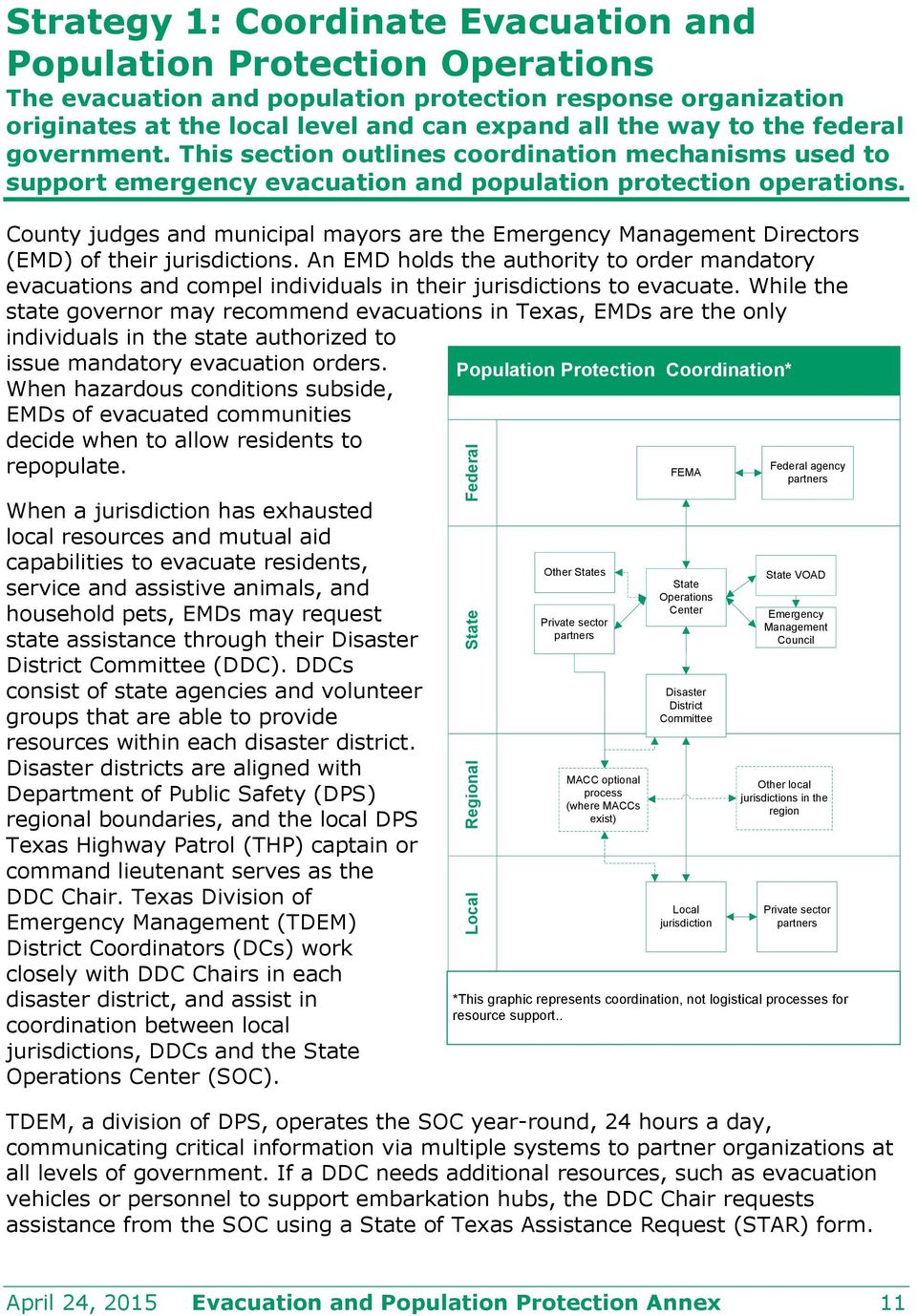
12 The SOC processes DDC requests and provides resources to fill unmet needs using state agency capabilities, voluntary organizations and contract services. The SOC also coordinates with partners from private sector businesses to carry out certain population protection requirements, such as increasing fuel availability. If the SOC is not able to provide resources to fill unmet needs, TDEM may submit mutual aid requests to other states or request federal assistance from the Federal Emergency Management Agency (FEMA), which coordinates federal resources during disasters. When evacuated jurisdictions are ready for evacuees, service and assistive animals, and household pets to return, DDCs and the SOC may assist with repopulation efforts by providing resource support and coordination. The Department of State Health Services (DSHS) takes the lead role for medical evacuee repopulation, to ensure the safe return of evacuated medical patients and their service and assistive animals. 12 Evacuation and Population Protection Annex April 24, 2015

13 Strategy 2: Gather and Distribute Public Information Timely, consistent public information helps the public react appropriately, maximizing public safety when jurisdictions issue population protection orders. This section describes state public information activities and messages used for population protection measures. Ensuring the public receives critical information during a disaster is vital to effective population protection operations. Primary responsibility for public notification belongs to affected local jurisdictions; however DDCs and the SOC are able to assist with the communication and dissemination of critical information. Public Information Emergency management council agencies and organizations with community relations, government relations and public affairs duties share responsibility for disseminating information to the public and the media during a disaster. A variety of public messages may be disseminated by the state, with the governor s press office serving as a unified point for public information. Press releases keep the public informed about hazardous conditions and provide information on health and safety considerations. Emergency Assistance Registration The State of Texas Emergency Assistance Registry (STEAR) is provided by the state as a tool for local emergency management personnel to gather information on the evacuation needs of their community. STEAR is a voluntary confidential registry, offered free of charge for individuals and care facilities that may need special notification or evacuation assistance. Registration in STEAR does not guarantee that individuals receive special notifications during an emergency, but provides participating local jurisdictions information on the special notification needs of their community. Individuals needing assistance can register for STEAR by calling 2-1-1, or submit an electronic STEAR Registration Form. 1 Assisted living facilities and nursing homes may register in STEAR using a STEAR Facility Registration Form. 2 Effective Communication Because many traditional emergency notification methods are not accessible by people with disabilities and others with access and functional needs, the state takes measures to effectively communicate public information to the whole community, using a combination of methods. Effective communication ensures the whole community receives the information necessary to make sound decisions and take 1 For more information, refer to the STEAR individual registration forms. 2 For more information, refer to the STEAR facility registration forms. April 24, 2015 Evacuation and Population Protection Annex 13

14 appropriate action. Interpreters for spoken languages other than English and for American Sign Language (ASL) are used whenever available. 3 The table below shows possible evacuation and population protection public messages, along with the applicable state emergency management council entities. Agency Texas Department of Public Safety (DPS) - Public Information Office (PIO) Message Press releases and social media messages providing guidance and information for a law enforcement or terrorism incident evacuation Texas Department of Public Safety (DPS) - Texas Division of Emergency Management (TDEM) Texas Health and Human Services Commission (HHSC) Press releases and social media messages regarding public resources and to promote State of Texas Emergency Registration (STEAR) Texas Department of Public Safety (DPS) - Public Information Office (PIO) Texas Department of Public Safety (DPS) - Texas Division of Emergency Management (TDEM) Texas Animal Health Commission (TAHC) Texas A&M AgriLife Extension Service (AgriLife) Texas Department of Family and Protective Services (DFPS) Texas Department of State Health Services (DSHS) Texas Department of Public Safety (DPS) - Texas Division of Emergency Animal evacuation, care, and shelteringspecific press releases and social media messaging Radio, television and online messages to educate county EMDs, local VOADs, rural and urban communities and businesses about animal evacuation and sheltering Client contact through the DFPS Mass Communication System to activate their emergency plan, to ensure the safety of children and adults in State conservatorship Messages to support injury prevention during evacuations and remind the public to take medications if evacuating Radiological hazard press releases and social 3 For more information on the warning capabilities and resources, refer to the State Public Information Annex. 14 Evacuation and Population Protection Annex April 24, 2015
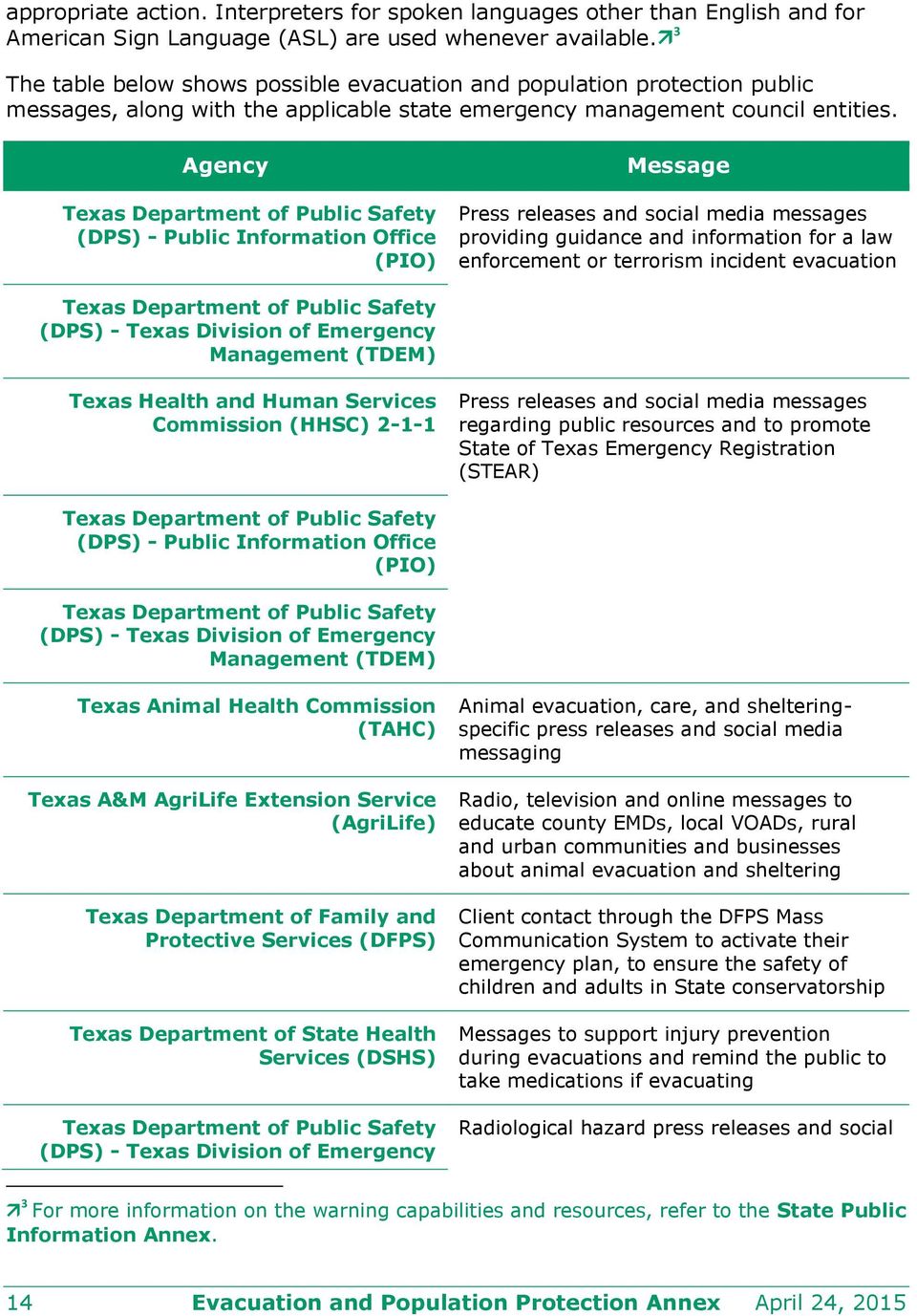
15 Agency Management (TDEM) Message media messages for affected areas Texas Department of State Health Services (DSHS) Texas Department of Public Safety (DPS) - Texas Division of Emergency Management (TDEM) Bioterrorism-related evacuation, quarantine, or shelter in place press release or social media messages Department of State Health Services (DSHS) Public Utility Commission (PUC) Press releases and social media messages concerning clear and safe roadways during debris removal operations Texas A&M Engineering Extension Service (TEEX) Texas Department of Public Safety (DPS) - Texas Division of Emergency Management (TDEM) Texas Department of Transportation (TxDOT) Texas Commission on Environmental Quality (TCEQ) Emergency protective measures specifying the steps needed to protect public health and safety during a hazardous materials incident Texas Department of Public Safety (DPS) - Texas Division of Emergency Management (TDEM) Texas Department of State Health Services (DSHS) Emergency Management Council Evacuation information and evacuation order notification press releases, social media, and dynamic message sign postings for the general public Texas Department of Public Safety (DPS) - Public Information Office (PIO) Texas Department of Public Safety (DPS) - Texas Division of Emergency Management (TDEM) April 24, 2015 Evacuation and Population Protection Annex 15

16 Agency Message Texas Department of Transportation (TxDOT) Texas A&M Forest Service (TFS) Wildfire evacuation status press releases and social media messages Texas Department of Public Safety (DPS) - Public Information Office (PIO) Texas Department of Public Safety (DPS) - Texas Division of Emergency Management (TDEM) Non-Governmental Organizations (NGO) Press releases and social media messages regarding available shelter locations, status of current open shelters, and pet and livestock friendly shelters Texas Department of Public Safety (DPS) - Texas Division of Emergency Management (TDEM) Texas Commission on Environmental Quality (TCEQ) Evacuation press releases and social media messages based on plume mapping and modeling Texas Department of Public Safety (DPS) - Texas Division of Emergency Management (TDEM) Texas Department of State Health Services (DSHS) Non-Governmental Organizations (NGO) Shelter-hub area information Texas Department of Public Safety (DPS) - Texas Division of Emergency Management (TDEM) Texas A&M Engineering Extension Service (TEEX) Press release or social media message with evacuation information reflecting specific hazard conditions, such as anticipated hurricane impacts or plume mapping and modeling Texas Department of Public Safety 16 Evacuation and Population Protection Annex April 24, 2015
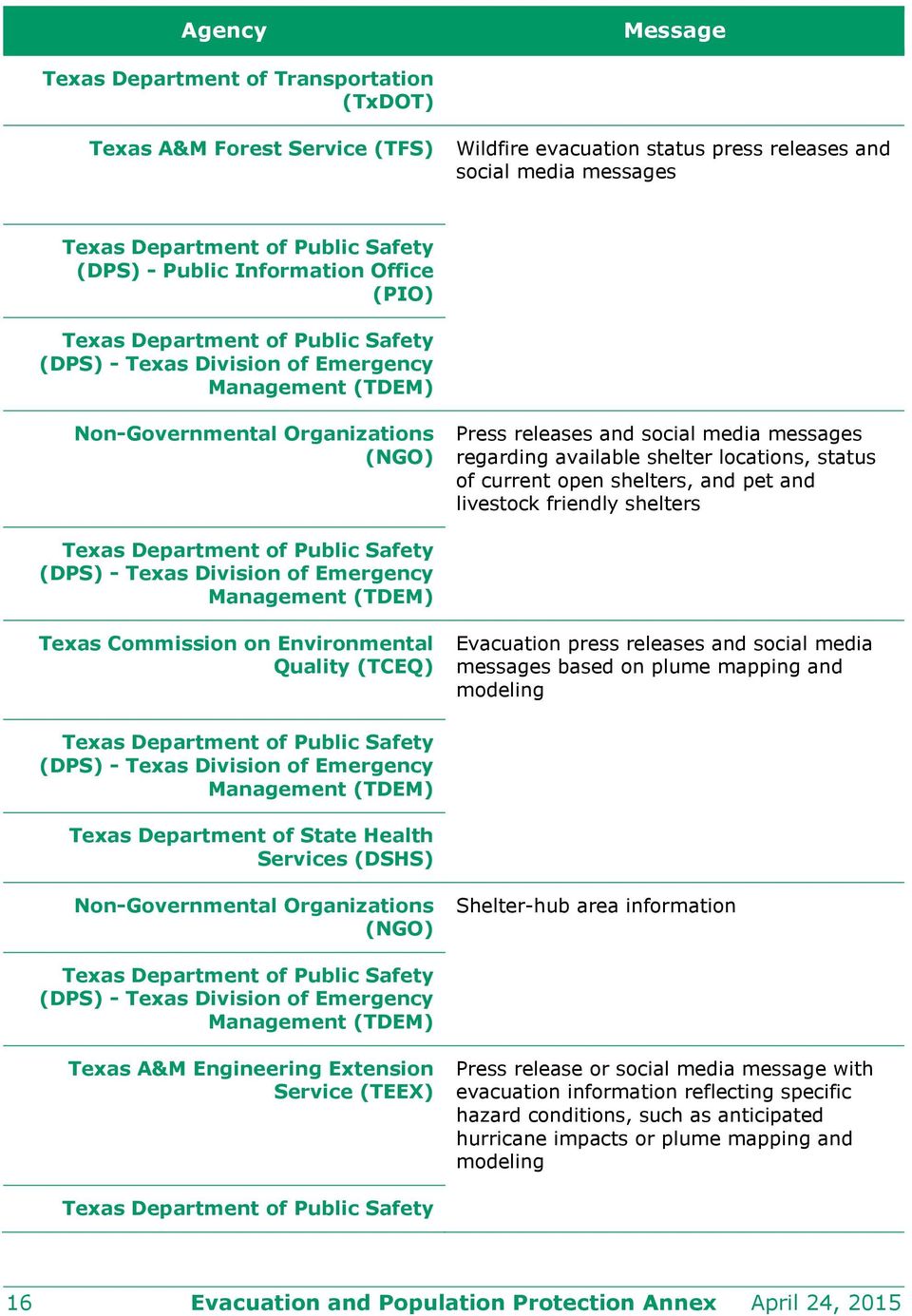
17 Agency Message (DPS) - Texas Division of Emergency Management (TDEM) Texas Department of Public Safety (DPS) - Public Information Office (PIO) Specific hazard warning press releases Texas Department of Public Safety (DPS) - Texas Division of Emergency Management (TDEM) Texas Department of Transportation (TxDOT) Texas Department of Transportation (TxDOT) Texas Department of Public Safety (DPS) - Public Information Office (PIO) Dynamic message sign refueling messages for prior notice incidents, intended to stimulate demand for fuel while there is time to replenish the fuel system and avoid sudden depletion of fuel during evacuations. Dynamic message sign evacuation comfortstation information for the evacuating public Transportation route safety press releases and dynamic message sign notifications Texas Department of Transportation (TxDOT) Texas Department of Public Safety (DPS) - Public Information Office (PIO) Press releases, dynamic message sign and social media messages providing updated information on highway conditions and safe routes Texas Department of Public Safety (DPS) - Texas Division of Emergency Management (TDEM) Texas Department of Transportation (TxDOT) April 24, 2015 Evacuation and Population Protection Annex 17

18 Strategy 3: Provide Critical Transportation Support This section describes critical transportation support that the state may provide to assist local jurisdictions with the safe evacuation of affected communities. Some evacuees require transportation assistance to evacuate, including medical patients and people with disabilities and others with access and functional needs. Critical Transportation Resources Some evacuees require government-provided transportation to evacuate from an area threatened or affected by a disaster. Responsibility for evacuee, service and assistive animal, and household pet transportation rests with local jurisdictions; however, the state deliberately plans to support transportation assistance requests during evacuations. TDEM may request the use of school district buses for evacuation through DDCs, and school districts may provide these resources as statewide mutual aid. The state also has contingency contracts for commercial coach buses to assist local jurisdictions requesting state critical transportation support. State-provided transportation resources are allocated as needed to support movement of critical transportation evacuees, including people with disabilities and others with access and functional needs and individuals evacuating with service and assistive animals and household pets. The state can also provide a limited number of aircraft for evacuations. Aircraft are deployed for specific missions, based on priority of need, and capacity is limited. Texas is a party to the multi-state Emergency Management Assistance Compact (EMAC). The compact includes provisions for requesting transportation assistance from other states during disasters. TDEM coordinates with the Federal Emergency Management Agency (FEMA) to request additional resources to meet unmet needs if state and mutual aid capabilities are exhausted. Survivor Collection Points State Search and Rescue (SAR) resources assist in locating and rescuing disaster survivors. 4 When SAR operations are underway, SAR teams may transport rescued survivors to temporary safe areas, known as Survivor Collection Points. At these locations survivors may be accounted for and possibly be provided initial care. Other response resources can be used to evacuate survivors from Survivor Collection Points to appropriate medical care and shelters. 4 For more information on search and rescue, refer to the State Search and Rescue Annex (R). 18 Evacuation and Population Protection Annex April 24, 2015

19 Embarkation Hubs Local governments are responsible for identifying evacuation hub locations, direct operations and provide transportation for critical transportation evacuees, service and assistive animals, and household pets from their homes to embarkation hubs. The Texas Military Forces (TXMF) may be tasked to provide uniformed personnel to support local jurisdictions at locally managed evacuation embarkation hubs. Refuge of Last Resort For certain types of disasters, hazards may affect evacuation areas prior to the completion of the evacuation. In such cases, unless alternative plans are in place, embarkation hubs may become refuges of last resort for response personnel, evacuees, service and assistive animals, and household pets. If requested, onsite TXMF personnel can be tasked to support local operations at those locations. Evacuee Tracking Evacuees who travel on state transportation resources are registered in the Texas Emergency Tracking Network (ETN). 5 ETN assists in locating and reuniting evacuees with their families and ensures accountability of pets, service animals, and medical equipment. Tracking is initiated at evacuation embarkation hubs, reception centers and state-supported shelters. Evacuees are provided with wristbands and tags with tracking numbers linked to their pets and medical equipment. Evacuation transportation assets may also be tracked by GPS through ETN. The evacuation tracking component of the network is composed of the evacuation tracking systems used by jurisdictions in Texas. These include EMTrack, the Sabine-Neches Chiefs Association (SNCA) System, All Hazards Response Network (AHRN) and WebEOC. Evacuating jurisdictions determine which system(s) to use; and ETN s interface allows the collection of all identifying data into a single repository. The information obtained by ETN is provided to evacuating and sheltering jurisdictions. Shelter Hub Reception Centers Reception centers are used by some sheltering jurisdictions to receive evacuees with shelter and mass care needs 6 from evacuating jurisdictions. Reception center locations are provided to evacuating jurisdictions prior to embarkation. Upon arrival, evacuees may be triaged and assigned to a shelter. Reception centers work with local Emergency Operations Centers (EOCs) to track shelter status. Occupancy for each shelter and the number of evacuees processed by the reception center is forwarded to the DDC, and is compiled into shelter reports that are forwarded to the SOC. Sheltering DDCs may coordinate information with jurisdictions to facilitate reception center operations. In some areas of the state, such as Dallas-Fort Worth, DDCs have procedures in place to coordinate shelter hub operations for large-scale evacuations. 5 For more information on evacuees traveling by state resources, refer to the State Emergency Tracking Network Document. 6 For more information on mass care, refer to the State Mass Care Annex (C). April 24, 2015 Evacuation and Population Protection Annex 19

20 Evacuee Locating The American Red Cross (ARC) Safe and Well Website is a service that allows individuals affected by a disaster to register, so that family members may know they have evacuated to safe locations. 3 No specific location or contact information is displayed unless an individual chooses to provide the information in a custom message. People searching for individuals must know the person s name and address or phone number in order to see a post. During large-scale disasters, when internet and phone lines may be compromised, trained ARC volunteers can help individuals register using a paper form. People with Disabilities and Other with Access and Functional Needs The majority of individuals with disabilities live independently in the community. People with disabilities, access and functional needs can face a variety of challenges during evacuations and other population protection measures. The state plans for people with disabilities and others with access and functional needs to have access to emergency services, just as any other people do. State agencies work to integrate the resources necessary to ensure that all individuals are provided equal physical and programmatic support before, during and after emergency incidents. The whole of community approach enables accessible and integrated functional needs support services (FNSS) to meet the diverse needs of the public during evacuations and other population protection measures. The state can provide personnel to assist local jurisdictions in pairing people in need of critical transportation with appropriate evacuation vehicles. This service allows people to evacuate with the resources they need to support their safety and maintain independence, such as durable medical equipment and service animals. These measures assist children and adults with disabilities and others with access and functional needs to maintain their health, safety, independence and dignity. The State of Texas FNSS Integration Committee has created a FNSS Toolkit that provides guidance for local jurisdictions to incorporate into existing plans to meet access and functional needs requirements. 4 Residential Child Care Licensed Facilities Residential child care licensed facilities are mandated to inform the Department of Family Protective Services (DFPS) if the facility must close as a result of a disaster. Facilities must contact the DFPS Licensing Division and Child Protective Services (CPS) when children reach their evacuation destination. During times when mass evacuation is anticipated, DFPS enables an online reporting feature on the DFPS Website. 5 When the online reporting feature is not enabled or if the facility contractor does not have access to the internet, notification can be made by calling the DFPS abuse and neglect hotline. 3 For more information, refer to ARC Safe and Well website. 4 For more information, refer to the State FNSS tool kit. 5 For more information, refer to the DFPS website. 20 Evacuation and Population Protection Annex April 24, 2015

21 Unaccompanied Minors If unaccompanied children are found during the evacuation process, the manager in charge of the embarkation hub, reception center or shelter should call the state Child Abuse Hotline and ask the intake specialist for a Priority One Response for an unaccompanied minor. A callback number must be provided. When this occurs, DFPS contacts a contracted Child Placing Agency (CPA), which normally responds on-site to act on the child's behalf until a care situation is arranged. In the event of an imminent threat, the child should be placed in the care of law enforcement personnel until the danger has passed. Correctional Facilities The Texas Department of Criminal Justice (TDCJ) and Texas Juvenile Justice Department (TJJD) maintain evacuation and shelter in place procedures for incidents in which state correctional facilities are threatened by hazardous conditions. Both TDCJ and TJJD maintain resources and plans to transport detainees and youth to alternate facilities. TJJD may coordinate with TDCJ for assistance, if required. Correctional facilities should inform their DDC Chair and post status updates on WebEOC if the decision is made to evacuate. If necessary, the state can provide additional law enforcement resources to provide security. The state may also assist in the evacuation of private facilities housing state detainees. Federal correctional facilities in Texas may also request law enforcement support to evacuate or shelter detainees. Parolees Parolees released to the jurisdiction of the Parole Division who live within 50 miles of the Gulf coast are provided an Emergency Contact Card with instructions about the requirements to contact a toll-free Parole Division phone number in the event they are required to evacuate. All high risk parolees, including parolees on the Super Intensive Supervision Program (SISP), Electronic Monitoring (EM) program, and all Sex Offenders are required to provide a pre-approved evacuation address. All parolees residing in a Community Residential Facility (CRF) and those high risk parolees unable to provide a pre-approved evacuation address are transported to an alternate location and monitored by Parole Division staff in the event of an evacuation. Animal Evacuation Service, assistive animals, and household pets are accommodated on stateprovided transportation with evacuees whenever possible. Service animals accompanying evacuees must remain with the evacuee at all times during evacuation. State personnel may also assist in pairing evacuees and their service, assistive animals, and/or household pets with suitable transportation resources. Following evacuations, individuals may wish to quickly repopulate affected areas to access livestock that could not be evacuated. Catastrophic disasters can cause large scale livestock displacement and deaths, which can be a hazard to public safety. April 24, 2015 Evacuation and Population Protection Annex 21
22 The Texas Animal Health Commission (TAHC) assists local jurisdictions with animal planning efforts and issues Animal Issues Committee Plan Guidance Documents on developing animal evacuation capabilities using a Community Animal Response Plan (CARP). 6 The TAHC coordinates emergency response operations and activities related to animals and agriculture, and helps local jurisdictions find resources to fill unmet needs. TAHC also develops agreements with local volunteer organizations to assist with animal sheltering. 7 6 For more information, refer to TAHC CARP. 7 For more information on mass care for service, assistive animals and household pets, refer to the State Mass Care Annex (C). 22 Evacuation and Population Protection Annex April 24, 2015
23 Strategy 4: Support Medical Evacuation This section describes state capabilities to assist in the evacuation of hospital patients and persons needing care for acute medical conditions. Individuals in hospitals, nursing homes or home environments requiring sustained medical care are the focus of medical evacuations. During large-scale evacuations, the number of individuals requiring medical evacuation may overwhelm local jurisdiction capabilities. The State Medical Operation Center (SMOC), run by the Department of State Health Services (DSHS), supports the State Operations Center (SOC) by coordinating state-wide public health and medical resources. Regional Health Medical Operations Centers (RHMOC) support the DDC by coordinating state and regional public health and medical resources. Local jurisdiction medical evacuation coordination and resources may be requested through the DDC. 7 The SMOC may activate Medical Incident Support Teams (MIST) to support RHMOCs in the management of state and federal medical transportation assets, to assist in patient tracking, to support evacuations of medical facilities and nursing homes, and perform other medical evacuation activities, as determined by the DDC. The SMOC can provide medical transportation assets and medical staffing for medical coach buses and evacuation triage teams (ETT) to assist local jurisdictions with medical evacuation triage. RHMOCs can assist local jurisdictions with locating destinations for medical evacuees in hospitals, nursing homes and medical shelters. The SMOC also works with the SOC to initiate EMAC agreements with neighboring states to fill gaps in ambulances and medical teams and to request FEMA support for additional ground ambulances, if required. If needed, SMOC works with the SOC to request medical air evacuation support. The state may augment medical evacuation capabilities using small fixed wing and rotary wing aircraft. In extreme situations, large military aeromedical transportation assets may be provided by Texas Military Forces (TXMF) and the Federal National Disaster Medical System (NDMS). The SMOC can deploy Emergency Medical Task Force (EMTF) resources to support air hubs, embarkation points, reception centers, and other locations as necessary. During medical evacuations the SMOC monitors and tracks patient movement in WebEOC and the Emergency Tracking Network (ETN) throughout the incident, including medical evacuee repopulation. Public health and medical considerations are outlined comprehensively in the Public Health and Medical Support Annex. 8 7 For more information, refer to DSHS Response Operating Guidelines for Medical Evacuation and Ambulance Utilization. 8 For more information on medical support, refer to the State Public Health and Medical Support Annex (H). April 24, 2015 Evacuation and Population Protection Annex 23
24 State Institutions and Facilities State hospitals, state-supported living centers, and the University of Texas Medical Branch (UTMB) maintain emergency plans to evacuate or shelter in place hospital patients, staff, and service and assistive animals during emergencies and disasters. If a state facility evacuation is required, the facility may request critical transportation support and additional resources from the state. Specific requirements may exist for vehicles capable of transporting certain types of hospital patients or residents of state supported living centers. Drug Addiction Treatment Drug addiction treatment medication providers have protocols to provide emergency care for clients during a disaster. Clients are given a sufficient amount of medication that allows for evacuation and subsequent connection with a designated local medication dispensing location. Access to the local dispensing site should be made as quickly as possible. If evacuees arrive without a supply of medication, they are referred to local drug clinics or hospital emergency rooms. 8 8 For more information, refer to the Division of Pharmacologic Therapies directory of drug addiction treatment clinics website. 24 Evacuation and Population Protection Annex April 24, 2015
25 Strategy 5: Assist with Traffic Management Traffic management expedites the flow of vehicles on evacuation routes. This section explains traffic management coordination and procedures. DPS is the lead state agency for evacuation. During large-scale evacuations the Texas Highway Patrol (THP) coordinates traffic management, expediting the flow of evacuating vehicles to a safe area. The Disaster District Committee (DDC) Chair coordinates law enforcement assignments on evacuation routes, and determines requirements for additional law enforcement personnel to perform traffic management. When requested by the DDC, THP supports any requests to supplement personnel and assets in affected areas. THP provides operational status reports to the State Operations Center (SOC), which notifies responsible agencies that traffic management plans have been implemented. THP personnel can also perform security in areas being evacuated, providing travel assistance to stranded evacuees, and escort emergency vehicles transiting evacuation routes. The transportation infrastructure is a critical resource for evacuation. Route closures can slow traffic, endangering the safety of evacuees and animals. The Texas Department of Transportation (TxDOT) builds and maintains the highway system in Texas and establishes highway development plans for the state. TxDOT collects and analyzes traffic data, maps state highways, and determines routes and traffic capacities for future needs. During evacuations TxDOT can deploy barriers, signals and signage to maximize effective use of available routes by the public. In identified hazard areas, such as hurricane evacuation zones, local THP personnel work with TxDOT and local law enforcement agencies at the DDC level to develop comprehensive traffic management plans. The plans establish specific evacuation routes, identify areas for additional lane usage and designate routes for contra-flow lane reversal to increase traffic capacity. Local governments execute planned responsibilities to expedite the movement of traffic evacuating through their jurisdictions. THP, TxDOT and local law enforcement agencies manage traffic and monitor evacuation routes to identify areas affecting the flow of traffic. TxDOT deploys traffic signal controls to ensure the most efficient movement of traffic and conducts emergency highway repairs and debris clearance to allow evacuation and repopulation routes to remain open. Evacuation Comfort Stations TxDOT establishes and manages comfort stations along evacuation routes. During evacuations TxDOT can provide drinking water and packaged ice at these locations, and the SOC may coordinate with voluntary organizations to provide food for evacuees, service and assistive animals, and household pets. April 24, 2015 Evacuation and Population Protection Annex 25
26 TxDOT can also provide portable restrooms and portable hand washing stations to supplement existing restroom facilities. Oxygen bottle exchange for evacuees on oxygen therapy is coordinated by the SMOC, and local medical assistance may be available on site. Shelter information may also be made available to evacuees at comfort stations. 26 Evacuation and Population Protection Annex April 24, 2015
27 Strategy 6: Maximize Fuel Availability This section describes how the state coordinates with the commercial fuel industry to increase fuel availability for evacuating vehicles. Large-scale evacuations require the availability of fuel for evacuating vehicles and responders. The state coordinates with the private sector to maximize fuel for both. Commercial Refueling The state works with a group of private sector partners from the fuel industry to maximize commercial fuel availability during disasters. The commercial fuel coordination team includes representatives from the Texas Oil and Gas Association (TXOGA), Texas Food & Fuel Association (Tx Food & Fuel), refineries, supply terminals, distributors, retailers, pipelines, and third party common carriers. The team works to ensure that commercial filling stations in evacuating and sheltering communities and on evacuation routes are resupplied to meet potential increases in fuel demand for evacuating traffic and to assist the state in recovering the fuel network as quickly as possible following a disaster. The commercial fuel coordination team can facilitate non-traditional supply arrangements among carriers and retailers in order to meet fuel demand. The team also assesses the need for extra equipment to meet shortfalls, and may request waivers as needed. After an evacuation, the team continues operations to expedite fuel resupply. This includes activities to assist with restarting the commercial fueling network where needed, and may involve fuel production activities, transportation, and post-incident recovery of refineries. Temporary Fuel Locations The state fuel team performs a separate function from the commercial fuel coordination team, and can be activated to support the state with incremental fuel storage at identified Temporary Fuel Locations (TFL). TFLs may be established as needed at large forward staging areas and at designated locations along evacuation routes. TFLs provide refueling to government evacuation vehicles and responders through the deployment of fuel bladders or other temporary tankage. The Texas Division of Emergency Management (TDEM) works with Texas Military Forces (TXMF) to identify locations for TFLs. The Health and Human Services Commission (HHSC) can support TFLs with potable water, and the Department of State Health Services (DSHS) can support evacuees on oxygen therapy at TFLs with oxygen cylinder exchange. Portable restroom facilities for state-transported evacuees may also be provided. If needed, the state can provide law enforcement officers to provide escort and expedite the delivery of fuel. Fuel security issues can be conveyed to DPS by providers via the state fuel team. Emergency Fuel on Evacuation Routes Public messaging encourages evacuating motorists to fill their vehicles prior to evacuations whenever possible, as the majority of available fuel during an April 24, 2015 Evacuation and Population Protection Annex 27
28 evacuation is contained in personal vehicles. Even so, roadway congestion can cause some motorists to run out of fuel, further complicating traffic management issues. TxDOT has plans in place to provide emergency evacuation roadside assistance to provide fuel to stranded motorists on evacuation routes during largescale evacuations. 28 Evacuation and Population Protection Annex April 24, 2015
29 Strategy 7: Support Evacuee Repopulation This section outlines state coordination and support capabilities to facilitate the repopulation of evacuated communities. Elected officials serving as Emergency Management Directors (EMD) of evacuated jurisdictions decide when to request the return of critical transportation evacuees. For pre-identified point to point evacuation and shelter locations, evacuated and sheltering jurisdictions coordinate together to ensure the safe return of evacuees. Once the decision is made to repopulate, state-provided transportation support for evacuee repopulation may be requested through the sheltering jurisdiction s Disaster District Committee (DDC). Evacuated residents may arrive at shelters using several transportation modes, including personal vehicles and local, state and federally provided evacuation transportation resources. The state works to ensure that evacuees transported on state vehicles to shelters outside of their home communities are returned to their communities as soon as shelter or appropriate accommodations are available there. Returning to an evacuated area may be hazardous for an evacuee prior to the reestablishment of normal care and support services that existed prior to the evacuation. Evacuees returning home cannot be refused access to state transportation resources based upon any disability or access and functional needs. The decision to return always belongs to the individual evacuee. Evacuees may check out of shelters at any time, but shelter clients are asked to follow normal check out procedures. Regional Medical Operations Centers (RHMOCs) can work to assist local governments to complete infrastructure and social service assessments of affected areas to help determine when repopulation is safe. The Health and Human Services Commission (HHSC) can provide trained staff to act as state representatives for Damage Assessment Teams. Damage assessments should be made available to sheltering and evacuating jurisdictions and DDCs to facilitate repopulation of areas that can support returning evacuees. Transportation contract vendors obtain pertinent passenger transit information from shelters and use the information to determine the proper sizes and quantities of transport vehicles to use, based upon number of passengers and companion animals. Medical Repopulation Essential care services, such as home health care, outpatient medical facilities, meal delivery services, and pharmacy services should be reestablished in evacuated communities prior to the return of medical evacuees who normally require such services. The Department of State Health Services (DSHS) can help coordinate appropriate transportation for medically fragile evacuees. DSHS can coordinate assistance to provide assessors in state medical shelters to assess the needs of individuals prior to returning to their home communities. The assessors contact local emergency April 24, 2015 Evacuation and Population Protection Annex 29
30 management in the impacted communities to verify the availability of required services. Once assessors clear a medical evacuee to return, transportation is coordinated through the sheltering DDC. Return transportation for caregivers or evacuees accompanying medical evacuees is coordinated at that time. Following large-scale disasters ambulances may be unavailable for medical evacuee repopulation immediately following an incident because they may be engaged in search and rescue (SAR) support operations. Prior to transporting medical evacuees to their home location or local shelter, each evacuee must be medically stable for transport. Late night arrivals following medical transport are discouraged, as the trip may cause undue stress on medical patients. 30 Evacuation and Population Protection Annex April 24, 2015
31 Strategy 8: Provide Response Resources This section lists state resources that may be used to support population protection measures and repopulation of evacuated communities. Based on needs and operational capabilities, state assistance may consist of technical guidance, on-scene needs assessment, administrative support, and deployment of personnel and equipment engaged in Evacuation and Population Protection operations. The following table shows some of the resources the state may use. Entity Resource Use Texas Department of Aging and Disability Services (DADS) Texas Department of Family and Protective Services (DFPS) Texas Department of State and Health Services (DSHS) Texas Department of Health and Human Services Commission (HHSC) Texas Department of Health and Human Services Commission (HHSC) Texas Information and Referral Network (TIRN) Personnel Personnel Medical Evacuation Transportation Resources* Evacuation Assistance Teams* Oxygen* Medical Evacuee Assessors Damage Assessment Teams Call Center Personnel and Resources Assist in reviewing licensed care facility emergency plans Support sheltering operations with specific expertise regarding children, childcare, older adults and families Transport medical evacuation patients to appropriate care facilities Assess evacuees to match them with appropriate vehicles, based upon medical, functional or access needs Provide oxygen resupply to medical transportation assets at designated fueling sites along evacuation routes Assist in determining if conditions are met for medical evacuee repopulation Provide damage assessments to state and local government to facilitate effective repopulation Accepts requests for special notification, resources or evacuation assistance for the general public April 24, 2015 Evacuation and Population Protection Annex 31
32 Entity Resource Use Texas Animal Health Commission (TAHC) Texas Department of Criminal Justice (TDCJ) Texas Juvenile Justice Department (TJJD) Animal Branch Incident Management Teams (AIMT) Animal Needs Assessment Teams (ANAT) Basic Response Teams (BRT) Horseback Emergency Response Teams (HERT) Livestock Handling Teams (LSHT) Mobile corrals and livestock handling equipment SME assistance for animal shelteringrelated issues SME assistance for animal carcassrelated issues Personnel and Transportation Resources Personnel and Transportation Resources Provide trained incident management professionals with a specialization in animal issues and health Assist with animal-related assessments within disaster areas Integrate into incident management structure, respond to all animal-response needs requests, provide guidance, as necessary, and assist in all response requests for rescue, secure/capture, triage, and/or transport Assist with animal assessment in remote or difficult to access areas of a disaster Assist with the capture, evaluation, sorting/segregation, and movement of livestock Provide for livestock services and containment Provide technical expertise for shelter facilities and operations, animal health and safety, animal identification, handling, and reunification Provide technical expertise for animal carcass identification, removal, and or disposal techniques Ensure the safety of detainees in state facilities during disasters Ensure the safety of youth in state facilities during disasters 32 Evacuation and Population Protection Annex April 24, 2015
33 Entity Resource Use Texas Department of Public Safety (DPS) Aircraft Texas Department of Public Safety (DPS) Texas Division of Emergency Management (TDEM) Texas Department of Public Safety (DPS) Texas Highway Patrol (THP) Texas Department of Transportation (TxDOT) Texas Military Forces (TXMF) Personnel and Aircraft Coach Buses* SOC Support Field Response Personnel Uniformed Law Enforcement Personnel and Vehicles Personnel and Vehicles Dynamic Message Signs Personnel and Aircraft Embarkation Hub and Refuge Support Personnel Provide situational awareness and damage assessment information Assist in the evacuation of individuals with critical transportation needs Assist in coordination of resources for population protection operations Assist in coordinating emergency management activities to assist DDCs with evacuation operations Provide security and facilitate traffic management Facilitate traffic management requirements, according to DDC traffic management plans Emergency fueling messages, evacuation and repopulation messages for public notification Provide situation assessment and transport capabilities Provide assistance to local jurisdictions for evacuation operations and refuge of last resort *Resources available by contract April 24, 2015 Evacuation and Population Protection Annex 33
34 Summary of Responsibilities This section specifies the responsibilities of stakeholders with capabilities during evacuation and population protection preparedness, response and recovery. All state Emergency Management Council (EMC) agencies and organizations that support evacuation and population protection response are responsible for the tasks listed below. Common Stakeholder Responsibilities Use the following checklist to ensure all EMC responsibilities are addressed. Phase Task Preparedness Determine staff requirements. Identify specific personnel who can fill extended emergency duty positions in the state operations center (SOC), agency emergency operation centers (EOCs), state medical operations center (SMOC), Disaster District emergency operations center, multiagency coordination centers (MACCs), the Joint Field Office (JFO), field command posts, traffic control and/or reentry points. Ensure that the number of personnel identified is adequate. Train representatives in accordance with National Incident Management System (NIMS) requirements and ensure that these representatives are made aware of the capabilities of their parent organization to provide assistance and support and be prepared to provide recommendations. Ensure appropriate action guides and standard operating guides are developed and maintained. Develop and maintain contact lists and notification procedures. Develop lists of agency resources and update these lists at least quarterly; when these resources are paid for with federal funds, enter them into the Texas Regional Response Network (TRRN). Develop and maintain procedures for identifying, locating, committing, deploying and accounting for agency emergency support resources. Response Assist with fulfilling intrastate and interstate mutual aid when possible. Provide situational and operational status reports in accordance with existing procedures and/or as requested by the primary agency. Support and coordinate accessibility and functional needs support services. Capture costs associated with response. 34 Evacuation and Population Protection Annex April 24, 2015
35 Stakeholder Specific Responsibilities Some agencies provide personnel and/or equipment, while other agencies offer knowledge and expertise in working with response agencies, the vendor community, commercial organizations or associations that supply or restore services. The following tables show stakeholder responsibilities organized by function. Stakeholders are listed in alphabetical order. Lead Entity: Texas Department of Public Safety (TxDPS) - Texas Highway Patrol (THP) Phase TxDPS - THP Responsibilities Preparedness Develop and maintain traffic management plans at the THP District level to support large-scale interjurisdictional evacuations. DDC Chairs maintain awareness about the availability of resources and capabilities within the THP District that could be used to support evacuation and population protection. Coordinate with the Department of Homeland Security and the United States Border Patrol to plan for expedited traffic flow through federal border checkpoints on evacuation routes. Response Assume responsibility for command, control, communications and operational tasks, as directed by the Governor. Assume traffic management authority over evacuation routes during multi-jurisdictional evacuations. Take immediate actions as needed to ensure continued, safe, expeditious traffic flow out of areas of risk, to include emergency rerouting of evacuating vehicles. Monitor the status of evacuations and report the status of movements and problems affecting expedited traffic flow. Collect information from support agencies and provide situation reports to the State Operations Center (SOC). Coordinate with affected jurisdictions regarding evacuation operations. Identify and coordinate evacuation staffing requirements appropriate to the emergency situation. Process requests for state evacuation assistance, coordinating the development of recommendations by appropriate DDC support agencies. DDCs submit unmet needs requests to the SOC. Provide uniformed law enforcement personnel and equipment to meet operational requirements. Provide communications resources and support. Coordinate with the Department of Homeland Security and the United State Border Patrol as needed to expedite the flow of traffic through federal border checkpoints on evacuation routes. Within capabilities, provide personnel and equipment to assist local governments in conducting evacuation operations. DDC Chairs work with jurisdictions in the disaster district to April 24, 2015 Evacuation and Population Protection Annex 35
36 ensure evacuation, transport and sheltering operations are being carried out efficiently and effectively. Provide representative to local MACCs or multi-jurisdictional EOCs. Evacuating and sheltering DDCs coordinate together to facilitate requests for the return of evacuated residents. DDCs assist to coordinate requests from evacuating jurisdictions for the return of evacuated care facility patients, and other evacuees in medical shelters. Sheltering DDCs coordinate evacuee return transportation, arrival times, and logistical considerations when state evacuation and repopulation support is requested. American Red Cross (ARC) Phase Preparedness Response Recovery ARC Responsibilities Provide Preparedness education and training for communities and individuals. Communicate shelter locations and populations to local and state emergency management Family reunification through Safe and Well Website In collaboration with local and state jurisdictions, assist in the communication of evacuation information with media outlets. Support individual and community recovery Texas Animal Health Commission (TAHC) Phase TAHC Responsibilities Preparedness Provide animal-specific training and technical advice to local jurisdictions, first responder, public safety agencies, and animal industry partners. Provide carcass removal awareness and training to local jurisdictions. Provide animal disease surveillance and identification operations, as appropriate. Response Coordinate, as requested, pet and livestock sheltering operations. Coordinate operations of Veterinary Response Teams. Coordinate operations of TAHC emergency response teams and Mission Ready Packages Within capabilities, coordinate and facilitate animal rescue operations. Provide animal disease surveillance and identification operation, as appropriate. Coordinate carcass removal operations with local jurisdictions. 36 Evacuation and Population Protection Annex April 24, 2015
37 Phase TAHC Responsibilities Coordinate wildland fire response activities with the USDA and animal industry entities. Coordinate the Unified Command Landowner Liaison Program. Recovery Coordinate reunification of pets and livestock with their owners, to the extent possible. Coordinate carcass removal operations with local jurisdictions. Provide animal disease surveillance and identification operations, as appropriate. Coordinate the Unified Command Landowner Liaison Program. Texas Department of Aging and Disability Services (DADS) Phase DADS Responsibilities Preparedness Assist in ensuring licensed care facility emergency plans include evacuation procedures. Support DSHS with information on potential medical and functional needs evacuee requirements. Assist in developing, maintaining, and implementing plans to address the evacuation and sheltering needs of individuals with medical, access and functional needs. Response Support providers work in relocating residents/patients by furnishing information on provider contact names and numbers. Provide data regarding provider location and capacity to ensure that services can continue to be delivered. Facilitate communications between DADS, the SMOC, and the SOC. Provide regional staff to assist local providers with evacuation efforts, and call providers in disaster zones to check status of evacuation and related needs and concerns. Provide regional staff to assist local DDCs with processing transportation requests and the identification of evacuation destinations. Assist in the identification of nursing home facilities. Recovery Provide staff to ensure that facilities damaged by the disaster meet Life Safety Code (LSC) requirements prior to reoccupancy. Relay information to providers regarding status of reentry. Texas Department of Assistive and Rehabilitative Services (DARS) Phase DARS Responsibilities Preparedness Share information about emergency preparedness education and training opportunities with staff and stakeholders. Encourage consumers who may need assistance during a April 24, 2015 Evacuation and Population Protection Annex 37
38 Phase DARS Responsibilities disaster to register in TDEM s State of Texas Emergency Assistance Registry. They may dial for assistance. Assist in developing, maintaining, and implementing comprehensive emergency management programs and planning materials to address Functional Needs Support Service (FNSS). Provide subject matter expertise and coordination with stakeholder groups to support integration of disability issues and access or functional needs into the emergency management cycle. Maintain business continuity plans supporting agency essential functions Response In accordance with the existing HHSC MOA, HHS agencies will work cooperatively to provide staff, facilities, and other resources to fulfill public health, medical and human services Emergency Support Function responsibilities during disaster response and recovery as appropriate. Coordinate, as requested, contract services for sign language interpreters. Assist eligible consumers with repair/replacement of lost or damaged assistive technology and Durable Medical Equipment (DME), as needed. Respond, as appropriate, to the information needs of the SOC and SMOC so that constant and consistent communication is maintained. Work with regional and local staff to ensure continuity of agency essential functions. Recovery Facilitate response and recovery-related information flows between DARS internal and external partners to ensure timely and accurate information is shared. Continue community outreach, and education to consumers. Restore agency essential functions to pre-disaster levels and support community recovery efforts. Texas Department of Family and Protective Services (DFPS) Phase Preparedness DFPS Responsibilities Monitor licensed Residential Child Care facilities and foster families for emergency/evacuation plan maintenance and compliance. Response Respond to shelters as requested to investigate allegations of abuse and neglect for children, older adults and persons with access and functional needs. Respond with law enforcement to support efforts and provide resources for family reunification for unaccompanied minors. Track the safe relocation of clients of older adults with open MHMR investigations. 38 Evacuation and Population Protection Annex April 24, 2015
39 Phase DFPS Responsibilities Monitor evacuation compliance and assist as needed for residential child care facilities and families caring for children in State conservatorship. Protect the interests of, and arrange for temporary lodging and care for children of parents killed or incapacitated by a disaster. Provide subject matter expertise to sheltering operations in the area of child care/day care safety. Recovery Assist clients with repopulation issues as requested. Track safe return of DFPS clients in compliance with individual family and facility emergency plans. Texas Department of State and Health Services (DSHS) Phase Preparedness DSHS Responsibilities Assist in developing and maintaining criteria for licensed care facility evacuation plans, to include both licensed and unlicensed facilities. Response Coordinate Public Health services. Coordinate public health issues relating to safety of drinking water and food, and the disposal of contaminated or unsafe products. Activate the SMOC upon notification of a disaster or pending disaster. Establish communication links with impacted Health Service Regions and Regional Health Medical Operations Centers (RHMOC). Monitor status of hospitals and End Stage Renal Disease (ESRD) network facilities through WebEOC and EMSystems. Receive and respond to STAR requests for medical evacuation and medical facility support. Activate and deploy medical incident support teams (MIST) to support RHMOC and local MOCs in the management of state and federal medical transportation assets and assist in patient tracking. Deploys MIST personnel to assist in evacuations of medical facilities and nursing homes. Activates and deploy ambulance strike teams and supporting ambulance staging managers. Assists with transportation of medical evacuees. Provides medical coach buses and ambulance buses as appropriate. Deploys evacuation triage teams (ETT) to assist local jurisdictions with evacuation as appropriate. Assists local jurisdictions with locating destinations for medical evacuees in hospitals, nursing homes, medical shelter. Activates established contracts for oxygen support. April 24, 2015 Evacuation and Population Protection Annex 39
40 Phase DSHS Responsibilities Deploys EMTF mobile medical units to support air hubs, embarkation points, reception centers, and other locations as necessary. Works with TDEM to Initiate EMAC agreements with neighboring states to fill gaps in ambulances and medical teams. Works with TDEM to request FEMA support for additional ground ambulances. Works with TDEM to request support from Texas Military Forces and NDMS for large military air medical transportation assets in extreme situations. Monitors and tracks patient movement in WebEOC Texas TxETN throughout the incident, including the return of medical evacuees. Activate Medical Operations Centers (MOCs) to coordinate and prioritize all medical repopulation efforts. Deploy Medical Incident Support Teams (M-IST) through the MOC or SMOC to assist with transportation asset readiness, staging oversight, planning and prioritizing large-scale repopulation missions, demobilization, or other missions as assigned. Provide assistance with continuing sheltering or long-term care arrangements for medical evacuees who are unable to return to their residence. Coordinate with the DDC to provide State shelter or transportation assistance after transportation assets are demobilized, or if resources are unavailable locally. Work with the local EOCs to determine if patient residences are safe for habitation. Verify habitability and availability of necessary medical services and support, prior to transporting patients to a residence. Conduct medical evacuee Patient Discharge Assessments. Texas Department of Health and Human Services Commission (HHSC) Phase HHSC Responsibilities Preparedness Assist in developing and maintaining state emergency plans. Participate in disaster response exercises and post-incident AARs. Collaborate with other Health and Human Services Agencies and Voluntary Agencies to ensure communications and plans stay current, accurate and responsive to the State Operation Center needs. Response Provide water and ice for mass-care operations in impacted communities as described in Annex V (Food and Water) of the State of Texas Emergency Management Plan. 40 Evacuation and Population Protection Annex April 24, 2015
41 Phase HHSC Responsibilities Provide SOC emergency management council members with information and reports as requested. Work with regional staff to ensure continuity of agency essential functions. Recovery Identify personnel to staff the Joint Field Office (JFO) and Disaster Recovery Centers (DRC), if applicable. Administer the Other Needs Assistance (ONA) Program, following a major disaster declaration. Administer the Disaster Case Management (DCM) Program, following a major disaster declaration. Help disaster victims understand the ONA and DCM programs and assist in the application process. Provide trained staff to act as state representatives for Damage Assessment Teams. Restore agency essential functions to pre-disaster levels. Provide recovery-related information and referral including, but not limited to disaster Resource Center ( DRC) information, Blue Roof information, re-entry orders, Federal Emergency Management Agency ( FEMA) individual assistance information, Texas supplemental Assistance Needs Program (SNAP) information (both regular SNAP and disaster-related SNAP), points of distribution for food, water and ice, and debris removal information. Texas Department of Health and Human Services Commission (HHSC) Texas Information and Referral Network (TIRN) Phase HHSC-TIRN Responsibilities Preparedness Staff the seat at the SOC/JIC as requested in response to SOC activation. Ensure that all call specialists providing disaster call center assistance have full access to all appropriate resources (previously vetted by SOC agencies and/or Leadership) and situation awareness. Provide information and referrals to all health and human services-related resources, and all disaster-related resources. Referrals include but are not limited to: evacuation information, shelter reception centers, transportation assistance, local jurisdiction bus embarkation points, school closures, and road conditions. Provide caller reassurance. Track caller needs and report escalations such as shelter needs, medical concerns, lack of fuel, lack of essential items such as food, water and ice and other pertinent concerns to SOC. Share information about emergency preparedness education and training opportunities with staff and stakeholders. Assist in developing and maintaining state emergency plans. April 24, 2015 Evacuation and Population Protection Annex 41
42 Phase HHSC-TIRN Responsibilities Participate in disaster response exercises and post-event AARs. Provide information and referrals to all health and human services-related resources including disaster preparedness, statewide, 24/7. Ensure that the database used by call specialist contains all resources related to all hazards preparedness. Collaborate with other Health and Human Services Agencies and Voluntary Agencies to ensure communications and plans stay current, accurate and responsive to the State Operation Center needs. Assist Texas Division of Emergency Management by receiving and entering caller registration into the State of Texas Emergency Assistance Registry (STEAR). Ensure Area Information Center s designated as Warm Centers have necessary equipment, trained staff and reviewed protocol for activation. Response Provide SOC emergency management council members with information and reports as requested. Work with regional staff to ensure continuity of agency essential functions. Continue to provide information to SOC and also to Department of State Health Services regarding availability of resources and presenting caller needs. Receive escalations from call centers regarding medical welfare checks and utilize Red Cross Safe and Well resource. Texas Department of Public Safety (DPS) - Texas Division of Emergency Management (TDEM) Phase DPS - TDEM Responsibilities Preparedness Coordinate the collection and analysis of data concerning frequency and consequences of hazards, characteristics of the population at risk, facilities and infrastructure at risk, and possible hazard mitigation opportunities designed to reduce the adverse impacts of hazards. A number of data sources for this effort are used to include academia and a wide-range of state and federal government agencies. Maintains an ongoing dialog and cooperative effort the Department of Homeland Security (DHS), Federal Emergency Management Agency (FEMA), the National Weather Service (NWS), the U.S. Census Bureau, the Tropical Prediction Center, the U.S. Geological Survey (USGS), the Nuclear Regulatory Commission (NRC), and the U.S. Army Corps of Engineers (USACE). TDEM also administers and provides project oversight for interagency contracts with Texas A&M University and the University of Texas at Austin for projects focusing respectively on the hazards of hurricanes and earthquakes. 42 Evacuation and Population Protection Annex April 24, 2015
43 Phase DPS - TDEM Responsibilities Collect, maintain, and distribute information necessary for the development of comprehensive evacuation plans to include areas at risk, population affected, key facilities affected, and related consequences of hazards. Develop plans and agreements with independent school districts and public colleges, universities, and university systems to provide transportation assets and facilities to enable the execution of state and local evacuation and mass care operations. Provide planning assistance, sample planning documents, staff visits, and State standards for evacuation planning. Oversee the implementation of regional response and evacuation plans throughout the state. Coordinate and maintain plans to address evacuation and sheltering needs of individuals with companion animals. Conduct and/or facilitate emergency management training and exercises to enhance evacuation operations. Response Within capabilities, coordinate resource needs to assist local governments in conducting evacuation and mass care operations. Review and implement prioritized fuel distribution procedures during an emergency. Maintain procedures to reimburse local governments and other support entities for evacuation-related fuel costs in the event the Texas Legislature or United States Congress designates funding for this purpose. Maintain contingency contracts and MOUs with private sector partners to assist with evacuation and mass care operations. Texas Department of Transportation (TxDOT) Phase TxDOT Responsibilities Mitigation Conduct traffic analysis to identify most appropriate highways to meet evacuation requirements. Implement short and long-term solutions to reduce congestion on evacuation highway routes. Prioritize for implementation infrastructure projects which address obstructions on evacuation routes during mass evacuations. Install signage along highway routes in accordance with the Manual for Uniform Traffic Control Devices to identify evacuation routes. Preparedness Coordinate with DPS to develop and maintain contra-flow plans for major hurricane evacuation routes as identified by the Task Force on Evacuation, Transportation, and Logistics. Assist TDEM in establishing emergency fuel distribution priorities. Partner with the Texas Oil and Gas Association and other industry to develop a plan to address fuel availability along April 24, 2015 Evacuation and Population Protection Annex 43
44 Phase TxDOT Responsibilities major evacuation routes. Establish a fuel operations function in the SOC to coordinate the distribution of fuel prior to and during evacuations. Response Provide information on the availability of highways for evacuation operations. Perform traffic flow analysis, as appropriate, during evacuation to keep traffic moving. Install temporary barricades, traffic cones, and other traffic control devices to assist law enforcement in effective traffic flow management on state highway routes. Perform emergency highway repairs, as appropriate and conditions permit, to allow evacuation routes to remain open as long as reasonably feasibly. Respond, as capable, to resolve immediate traffic road hazard problems along evacuation routes. Attempt to keep priority and disaster highways open for as long as prudent to ensure evacuees can exit the risk area(s) safely. Assign locations for and assist in the set up and operation of comfort stations along major evacuation routes. Texas Education Agency (TEA) Phase TEA Responsibilities Response Provide support for lost school days and school closures due to evacuations. Provide support for the care of children in disasters, and for other critical educational missions. Texas Military Forces (TXMF) Phase TXMF Responsibilities Response Provide personnel to State supported evacuation hubs. Conduct Aero medical evacuation. Conduct Aerial evacuation for the general population. Provide trained Texas Emergency Tracking Network (TxETN) teams. Support State managed Temporary Fuel Locations with personnel. When co-located at refuges of last resort, provide personnel to assist local jurisdiction refuge of last resort operations. 44 Evacuation and Population Protection Annex April 24, 2015
45 Transportation Contract Vendors Phase Vendors Responsibilities Response Fill transportation requests upon receiving orders from the SOC or DDC. Obtain pertinent passenger transit information from shelters. Determine the proper sizes and quantities of transport vehicles to use, based upon number of passengers, companion animal, Safely deliver all passengers to a central delivery location, designated by the DDC. April 24, 2015 Evacuation and Population Protection Annex 45
46 Authority Strategic planning guidance and authorities governing the enactment and implementation of this annex are summarized below. The following table presents specific sources, their relevance to this document, and hyperlinks to their online location. Source Relevance Link Texas Government Code Chapter 418 Texas Government Code Section Texas Government Code Section Texas Government Code Section Executive Order RP 57 Texas Health and Safety Code Section Provides authority and mechanisms to clarify and strengthen key roles, as well as authorize and provide for cooperation and coordination of an emergency management system embodying all aspects of pre-disaster preparedness and post-disaster response. Provides authority to the governor to recommend evacuation from a stricken or threatened area, prescribe evacuation routes, modes of transportation and destinations, control ingress and egress to and from a disaster area, and control the movement of persons and occupancy of premised in the area. Provides authority for a county judge or city mayor to order the evacuation of the population from a stricken or threatened area under their jurisdiction and authority, as well as control ingress to and egress from a disaster area under the jurisdiction and authority of the county judge or mayor and control the movement of persons and the occupancy of premises in that area. Provides authority for county judges and mayors who order the evacuation of an area stricken or threatened by a disaster to compel persons who remain in the evacuated area to leave and authorize the use of reasonable force to remove persons from the area. Created the system now known as the State of Texas Emergency Assistance Registry (STEAR). The TIRN is assigned the role of data entry. Requires home and community support services agencies to assist clients as necessary with registering for disaster evacuation assistance through services provided by the Texas Information and Referral Network and counsel es.legis.state.tx.us /Docs/GV/htm/GV. 418.htm es.legis.state.tx.us /Docs/GV/htm/GV. 418.htm# es.legis.state.tx.us /Docs/GV/htm/GV. 418.htm# es.legis.state.tx.us /Docs/GV/htm/GV. 418.htm# ate.tx.us/news/ex ecutiveorder/3631/ es.legis.state.tx.us /Docs/HS/htm/HS. 142.htm 46 Evacuation and Population Protection Annex April 24, 2015
47 Source Relevance Link clients as necessary regarding disaster preparedness. Texas Health and Safety Code Section Texas Health and Safety Code Section Texas Agriculture Code, Section Texas Government Code, Section Requires licensed institutions to register with the Texas Information and Referral Network to assist the state in identifying persons needing assistance if an area is evacuated because of a disaster or other emergency and to notify each resident and the resident's next of kin or guardian regarding how to register for evacuation assistance with the Texas Information and Referral Network. Requires assisted living facilities to register with the Texas Information and Referral Network to assist the state in identifying persons needing assistance if an area is evacuated because of a disaster or other emergency and to notify each resident and the resident's next of kin or guardian regarding how to register for evacuation assistance with the Texas Information and Referral Network. Mandates the TAHC to protect all livestock, exotic livestock, domestic fowl, and exotic fowl from specific diseases. Authorizes the TAHC to make and enforce regulations to prevent, control, and eradicate specific infectious animal diseases which endanger livestock. Mandates the TAHC to provide information on recovery, relief, and assistance requirements following all types of disasters and to prepare information relevant to an all-hazards approach to agricultural disaster management. es.legis.state.tx.us /Docs/HS/htm/HS. 242.htm es.legis.state.tx.us /Docs/HS/htm/HS. 247.htm es.legis.state.tx.us /Docs/AG/htm/AG. 161.htm# es.legis.state.tx.us /Docs/GV/htm/GV. 418.htm April 24, 2015 Evacuation and Population Protection Annex 47
48 Maintenance and Change This section describes the process by which this document is maintained and updated. Development Section 418 of the Texas Government Code defines TDEM as the responsible agent for emergency planning and coordination in the state of Texas. As such TDEM is responsible for ensuring the appropriate development and distribution of this document and any changes thereto. In addition each Emergency Management Council agency is responsible for the development and maintenance of appropriate planning documents to address responsibilities assigned in this plan including standard operating guidelines. Maintenance TDEM authorizes and issues changes to this document until such time as it is superseded. This document and all attachments are living documents. Council member representatives are responsible for participating in plan reviews and are required to provide information concerning capability changes that impact their emergency management responsibilities. TDEM coordinates the plan updating process and maintains the plan after receiving feedback and updates from partner agencies. According to Texas Government Code section Post Disaster Evaluation state agencies, political subdivisions and interjurisdictional agencies are required to conduct an evaluation of their response to a disaster, identify areas of improvement, and issue a report of the evaluation to TDEM no later than 90 days after TDEM makes the request. That report may be translated into plan updates. Training, Exercise and After Action Reports The State of Texas Emergency Management Plan is exercised annually to provide practical, controlled and operational experience to those who have responsibilities. This requirement is applicable to the State Operations Center and each disaster district emergency operations center. Following the conclusion of any significant emergency, incident or exercise, lead agency representatives will conduct an after action report (AAR) of the group s activities during that emergency, incident or exercise. Support agencies will provide written or oral input and the lead agency representative will consolidate all inputs into a final written AAR. Record Keeping Lead and support agencies must ensure all records necessary for emergency management operations are obtainable, and that duplicate records are held at alternate locations. 48 Evacuation and Population Protection Annex April 24, 2015
49 Record of Changes This section describes changes made to this document: when they were made, what they were, and who authorized them. The table below shows changes made to the document following initial publishing. Number Date Description Initials 1 6/13/14 Removed reference to Appendix 1. CRM 2 9/26/14 Minor formatting and appearance changes CRM 3 4/24/15 Corrected typographical errors, removed repeated text. CRM April 24, 2015 Evacuation and Population Protection Annex 49
50 Contributors This section provides a list of organizations and individuals who contributed to the development of this document. This annex could not have been developed without the participation and collaboration of representatives from multiple organizations. Agency Name American Red Cross Julia Dailey Neil McGurk Federal Emergency Management Agency - Region 6 State Administrative Agency Texas Animal Health Commission Wes Ireland Mike George Amanda Bernhard Susan Culp, DVM Dee Harrison Jeff Turner Texas Department of Aging and Disability Services Texas Department of Assistive and Rehabilitative Services Texas Department of Criminal Justice Texas Department of Family and Protective Services Texas Department of Public Safety - Texas Division of Emergency Management Russell Cook David Featherston Kirk Moss Randy Templeton Carman Apple Brad Britten Alex Camacho Mario Chapa Sherri Copeland Kiran Dhanji 50 Evacuation and Population Protection Annex April 24, 2015
51 Jack Doebbler Brandi Ashby Fisher Steve Gladstone Jay Hall Michelle Huckabee Mike Jones Rhonda Lawson Dave Marquez Mike Miller Joseph Minshew Phillip Mongeau Chris Moore Patrick Mulligan Rex Ogle Wade Parks Tony Pena Marty Penney Chuck Phinney Tom Polonis Dede Powell Becky Pursur Josh Roberts Gisela Ryan-Bunger Larry Shine Lynn Shipp Eric Shuey April 24, 2015 Evacuation and Population Protection Annex 51
52 Gabriela Stermolle Miles Tollison Daniel Walker Randy Whittington Texas Department of Public Safety - Texas Highway Patrol Robert Bailey William Diggs Texas Department of State Health Services Rick Bays Keri Cain Liza Chigos Susan Culp Jeff Hoogheem Katie Sanches Michelle Simanek Texas Department of Transportation Texas Education Agency Texas Health and Human Services Gilbert Jordan Mike Peebles Ryan Healy Patrick Funari John Jackson Gina Marie Muniz Texas Health and Human Services Texas Information and Referral Network Beth Wick Ryan Ward Texas Juvenile Justice Department Russell Biehle Joe Deering Mike Hamer Texas Military Forces Ruben Alonzo 52 Evacuation and Population Protection Annex April 24, 2015
53 Robert Duley Tim Hanrahan Tory House Texas Oil and Gas Association Deb Hastings Corey Pomeroy Texas School Safety Center William O'Neil April 24, 2015 Evacuation and Population Protection Annex 53
54 References This section provides a full list of the sources referenced in the development of this document. Ballard, Andrew J., and Darrell W. Borchardt. Recommended Practices for Hurricane Evacuation Traffic Operations. Product, College Station, Texas: Texas Transportation Institute, 2006, 66. Federal Emergency Management Agency (FEMA). Comprehensive Preparedness Guide (CPG) 101. FEMA, Evacuee Support Planning Guide. FEMA, Governor's Task Force on Evacuation, Transportation, and Logistics. Final Report to the Governor. Strategic, Austin, TX: Texas Department of Public Safety, National Emergency Response and Rescue Training Center. After Action Report: 2008 Texas Hurricane Season. Information, College Station, TX: Texas Engineering Extension Service, National Security Staff Interagency Policy Coordination Subcommittee. "Planning Guidance for Response to a Nuclear Detonation." Federal Emergency Management Agency. June data/ /planning_guidance_for_response_to_a_nuclear_detonation 2nd_edit ion_final.pdf. State of Texas. "Functional Needs Support Services Tool Kit." Texas Emergency Management Preparedness Website. March 1, %20Kit%20v4.pdf. Texas Animal Health Commission. "Guide to the Developing the Evacuation Function of a Community Animal Response Plan (CARP)." TAHC. August 10, CARP.pdf. United States Department of Homeland Security. "National Preparedness Goal." October 27, Evacuation and Population Protection Annex April 24, 2015
55 April 24, 2015 Evacuation and Population Protection Annex 55 Produced by the Texas Division of Emergency Management Preparedness Section, Plans Team
Mississippi Emergency Support Function #1 Transportation Response Annex
 Mississippi Emergency Support Function #1 Transportation Response Annex ESF #1 Coordinator of Transportation Primary Agencies of Transportation Support Agencies Federal ESF Coordinator Department of Transportation
Table of Contents ESF-3-1 034-00-13
 Table of Contents Primary Coordinating Agency... 2 Local Supporting Agencies... 2 State, Regional, and Federal Agencies and Organizations... 3 Purpose... 3 Situations and Assumptions... 4 Direction and
ANNEX 1 (ESF-1) TRANSPORTATION SERVICES. Department of Transportation
 ANNEX 1 (ESF-1) TRANSPORTATION SERVICES PRIMARY: SUPPORT: Department of Transportation Department of Commerce, Division of Public Railways; Department of Corrections; Department of Education, Office of
Emergency Support Function #6 MASS CARE, EMERGENCY ASSISTANCE, HOUSING, & HUMAN SERVICES
 Emergency Support Function #6 MASS CARE, EMERGENCY ASSISTANCE, HOUSING, & HUMAN SERVICES Lead Agency Virginia Department of Social Services (VDSS) Support Agencies and Organizations Virginia Department
Alabama Radiological Emergency Preparedness Plan
 Alabama Radiological Emergency Preparedness Plan Emergency Support Function (ESF) #1 - Transportation Primary Support Agency: Support Agencies: Secondary Agencies: Transportation Public Safety Military
Emergency Operations Plan ANNEX K - UTILITIES RESTORATION ESF #3, #12 I. MNWALK REQUIREMENTS. Item #: 1, 4, 46, 53, 54
 ANNEX K - UTILITIES RESTORATION ESF #3, #12 I. MNWALK REQUIREMENTS Item #: 1, 4, 46, 53, 54 II. PURPOSE The purpose of this annex is to describe the organization, operational concepts and responsibilities
Table of Contents ESF-12-1 034-00-13
 Table of Contents Primary Coordinating Agency... 2 Local Supporting Agencies... 2 State, Regional, and Federal Agencies and Organizations... 2 Purpose... 3 Situations and Assumptions... 4 Direction and
Maryland Emergency Operations Plan
 Maryland Emergency Operations Plan Purpose The purpose of the Maryland Emergency Operations Plan (EOP) is to outline an approach and designate responsibilities intended to minimize the consequences of
B E F O R E T H E E M E R G E N C Y
 B E F O R E T H E E M E R G E N C Y RESPONSIBILITY / LIABILITY for Homeland Security / Emergency Management Duty of Care - Counties and Cities ARE responsible for the safety of their citizens. Following
MONTGOMERY COUNTY, KANSAS EMERGENCY OPERATIONS PLAN. ESF14-Long Term Community Recovery
 MONTGOMERY COUNTY, KANSAS EMERGENCY OPERATIONS PLAN ESF14-Long Term Community Recovery Planning Team Support Agency Coffeyville Public Works Independence Public Works Montgomery County Public Works 1/15/2009
ANNEX 3 ESF-3 - PUBLIC WORKS AND ENGINEERING. SC Budget and Control Board, Division of Procurement Services, Materials Management Office
 ANNEX 3 ESF-3 - PUBLIC WORKS AND ENGINEERING PRIMARY: SUPPORT: SC Budget and Control Board, Division of Procurement Services, Materials Management Office Clemson University Regulatory and Public Service
LAWRENCE COUNTY, KENTUCKY EMERGENCY OPERATIONS PLAN ESF-13
 LAWRENCE COUNTY, KENTUCKY EMERGENCY OPERATIONS PLAN LAW ENFORCEMENT AND SECURITY ESF-13 Coordinates and organizes law enforcement and security resources in preparing for, responding to and recovering from
ESF 14. Long-Term Community Recovery
 1. Purpose This annex provides an overview of the general process to be followed in recovering from the economic results of a natural disaster or other major emergency that may impact Coos County. It outlines
LAW ENFORCEMENT ESF 16
 ESF 16 ESF 16: Law Enforcement Page 1 of 13 ESF 16 Primary Agency: Baca County Sheriffs Office Support Agencies: Springfield Police Department Walsh Police Department Campo Police Department Colorado State
ON-SITE INCIDENT MANAGEMENT
 ON-SITE INCIDENT MANAGEMENT Capability Definition Onsite Incident is the capability to effectively direct and control incident activities by using the Incident Command System (ICS) consistent with the
Emergency Management of Long-term Care Facilities
 Emergency Management of Long-term Care Facilities What is the Ombudsman Role? Patty Ducayet, Texas State Long-term Care Ombudsman Emergency Preparedness in Long-term Care Facilities Facility planning involves
ESF 12: Energy & Utilities
 Table of Contents 1.0 Introduction... 1 1.1 Purpose... 1 1.2 Scope... 1 1.3 ESF Activation & Plan Maintenance... 2 1.4 Policies... 2 2.0 Situation & Assumptions... 2 2.1 Situation... 2 2.2 Assumptions...
The Role of Elected Officials During Disasters. The Florida Division of Emergency Management
 The Role of Elected Officials During Disasters The Florida Division of Emergency Management Bryan W. Koon Director Florida Division of Emergency Management Introduction Florida s elected officials play
Georgia Emergency Operations Plan. Emergency Support Function # 12 Annex Energy
 Emergency Support Function # 12 Annex Energy 2015 E S F C o o r d i nator and Support Ag e n c i e s ESF C oordi na t or Georgia Environmental Finance Authority P rima ry Agenc y Georgia Department of
CURRENT ISSUES IN LOCAL EMERGENCY MANAGEMENT. Alan S. Harris, Emergency Manager Seminole County Office of Emergency Management
 CURRENT ISSUES IN LOCAL EMERGENCY MANAGEMENT Alan S. Harris, Emergency Manager Seminole County Office of Emergency Management 1 The Basics All-Hazards Approach to Planning State of Florida is vulnerable
ANNEXS TRANSPORTATION
 ANNEXS TRANSPORTATION Brazos County Interjurisdictional Emergency Management January 2013 Ver 2.0 APPROVAL & IMPLEMENTATION Annex S Transportation This annex is hereby approved for implementation and supersedes
Assisted Living Facilities & Adult Care Comprehensive Emergency Management Plans
 Assisted Living Facilities & Adult Care Comprehensive Emergency Management Plans STATUTORY REFERENCE GUIDANCE CRITERIA The Henrico County Division of Fire s Office of Emergency Management provides this
ESF-9 LAW ENFORCEMENT
 ESF-9 LAW ENFORCEMENT CONTENTS PAGE I. PURPOSE ESF 9.1 II. SITUATIONS AND ASSUMPTIONS ESF 9.1 A. Situations ESF 9.1 B. Assumptions ESF 9.1 III. CONCEPT OF OPERATIONS ESF 9.2 A. General ESF 9.2 B. Operational
Emergency Support Function #13 PUBLIC SAFETY & SECURITY. Policies
 Emergency Support Function #13 PUBLIC SAFETY & SECURITY Lead Agency Virginia State Police (VSP) Support Agencies and Organizations Department of Alcoholic Beverage Control (ABC) Department of Conservation
Emergency Quick Reference Guide
 Township of Rideau Lakes - Emergency Response Plan 1 Emergency Quick Reference Guide Upon the arrival of three or more members, the Community Control Group (CCG) may initiate its function. Ensure that
PUBLIC SAFETY FIRE. Functional Coordinator: Fire Chiefs
 Option for Public Safety or Tasks can be combined with Law Enforcement depending on jurisdiction PUBLIC SAFETY FIRE Functional Coordinator: Fire Chiefs Purpose This function provides procedures for preparedness,
Georgia Emergency Operations Plan. Emergency Support Function # 5 Annex Emergency Management
 Emergency Support Function # 5 Annex Emergency Management 2015 Emergency Support Function #5 E S F C o o r d i nator and Support Ag e n c i e s ESF C oordi na t or Georgia Emergency Management Agency/Homeland
EMERGENCY MANAGEMENT ORGANIZATION
 VI. EMERGENCY MANAGEMENT ORGANIZATION General 1. The overall responsibility for emergency preparedness rests with government on all levels, including all agencies of state, county and city in coordination
Introduction. Catastrophic Incident Annex. Cooperating Agencies: Coordinating Agency: Department of Homeland Security
 Catastrophic Incident Annex Coordinating Agency: Department of Homeland Security Cooperating Agencies: All Federal departments and agencies (and other organizations) with assigned primary or supporting
Responder Reentry. State of Texas Emergency Management Plan. September 2013
 Responder Reentry State of Texas Emergency Management Plan September 2013 This document is intended to provide guidance and is not prescriptive or comprehensive. Use judgment and discretion to determine
Commonwealth of Virginia EMERGENCY OPERATIONS PLAN
 EMERGENCY OPERATIONS PLAN 2012 Updated: 2015 March Terence McAuliffe Governor Jeffrey D. Stern, PH.D. State Coordinator of Emergency Management Emergency Operations Plan FOREWORD The Virginia Department
ANNEX 9. PUBLIC INFORMATION AND WARNING
 ANNEX 9. PUBLIC INFORMATION AND WARNING Rapid dissemination of warning and emergency information about an imminent or occurring emergency is critical to protecting life, safety, and health during an emergency.
Emergency Support Function (ESF) #14 Long-Term Community Recovery
 Emergency Support Function (ESF) #14 Long-Term Community Recovery Primary Department(s): St. Louis County Police Department, Office of Emergency Management Support Department(s): St. Louis County Housing
Florida Division of Emergency Management. Recovery. Operations Guidance For Essential Service Centers
 Recovery Operations Guidance For Essential Service Centers - 1 - TABLE OF CONTENTS I. Introduction. 3 II. Mission/Scope 3 III. Assumptions.. 3 IV. Roles and Responsibilities.. 4 V. Concept of Operations
ANNEX C - EMERGENCY PUBLIC INFORMATION ESF #15
 I. MNWALK REQUIREMENTS Item #: 1, 3, 16, 17, 18, 19, 20 ANNEX C - EMERGENCY PUBLIC INFORMATION ESF #15 II. PURPOSE Provide for the development, coordination and dissemination of emergency public information.
Emergency Operations Plan ANNEX R - DONATIONS MANAGEMENT ESF #14 I. MNWALK REQUIREMENTS. Item #: 1, 4, 83, 93, 94, 95, 97
 ANNEX R - DONATIONS MANAGEMENT ESF #14 I. MNWALK REQUIREMENTS Item #: 1, 4, 83, 93, 94, 95, 97 II. PURPOSE The purpose of this annex is to explain the responsibilities for coordinating volunteers, donated
Larimer County Comprehensive Emergency Management Plan 2015
 Larimer County Comprehensive Emergency Management Plan 2015 EMERGENCY SUPPORT FUNCTIONS Emergency Support Functions (ESFs) provide the structure for coordinating county activities in support of incident
OREGON STATE UNIVERSITY MASTER EMERGENCY MANAGEMENT PLAN
 OREGON STATE UNIVERSITY MASTER EMERGENCY MANAGEMENT PLAN Last Edit 2/8/2011 OVERVIEW This document provides a management framework for responding to incidents that may threaten the health and safety of
University of California Santa Cruz EMERGENCY RESPONSE PLAN
 University of California Santa Cruz EMERGENCY RESPONSE PLAN September 2007 University of California, Santa Cruz Page 2 of 11 I. INTRODUCTION... 3 A. Purpose... 3 B. Scope... 3 C. Authority... 3 D. Mission...
Long-Term Community Recovery & Mitigation
 Emergency Support Function 14 Long-Term Community Recovery & Mitigation ESF Coordinator Grays Harbor County Division of Emergency Management Primary Agencies Grays Harbor County Division of Emergency Management
South Puget Sound Community College Emergency Operations Plan Annex H RECOVERY
 I. PURPOSE South Puget Sound Community College Emergency Operations Plan Annex H RECOVERY The purpose of this annex is to provide a process to facilitate the College s transition from a disaster situation
Texas Department of Public Safety Texas Division of Emergency Management. Preparedness Standards for Emergency Management in Texas TDEM-100
 Texas Department of Public Safety Texas Division of Emergency Management Preparedness Standards for Emergency Management in Texas June 2000 FOR ADDITIONAL INFORMATION Requests for additional copies of
Template Policy on Healthcare Facility Patient Evacuation and Shelter-in Place
 Template Policy on Healthcare Facility Patient Evacuation and Shelter-in Place Policy: It is the policy of the healthcare facility to have defined procedures to protect the life and safety of both patients1
Hospital Emergency Operations Plan
 Hospital Emergency Operations Plan I-1 Emergency Management Plan I PURPOSE The mission of University Hospital of Brooklyn (UHB) is to improve the health of the people of Kings County by providing cost-effective,
Disaster Behavioral Health Capacity Assessment Tool
 What is Disaster Behavioral Health? Disaster behavioral health is the provision of mental health, substance abuse, and stress management services to disaster survivors and responders. Following an emergency
Nueces Co. Hurricane Reentry Plan
 Nueces Co. Hurricane Reentry Plan Background Hurricane Katrina/Rita- 2005 Coastal Bend Emergency Management Association/Industry Partnership Coastal Bend Phased Evacuation Guidance (2006) Hurricane Ike-
Emergency Management Planning Criteria for Assisted Living Facilities (State Criteria Form)
 Emergency Management Planning Criteria for Assisted Living Facilities (State Criteria Form) FACILITY INFORMATION: FACILITY NAME: FIELD (ALF Company) ST. LIC. NO.: FIELD (Lic. #) FAC. TYPE: ALF STATE RULE:
Franklin County Emergency Management Department (FCEMD) All County Emergency Response Team (CERT) Agencies. Table of Contents
 Concept of Operations Lead Agency Support Agency Standard Operating Procedures Emergency Operations Center (EOC) Franklin County Emergency Management Department (FCEMD) All County Emergency Response Team
BRYN MAWR COLLEGE EMERGENCY RESPONSE PLAN Revised 3/17/08 (abridged)
 BRYN MAWR COLLEGE EMERGENCY RESPONSE PLAN Revised 3/17/08 (abridged) This document is a synopsis of the planning and preparation the College has undertaken to handle emergencies in a professional, efficient,
ALBUQUERQUE EMERGENCY OPERATIONS PLAN ANNEX 8 DAMAGE ASSESSMENT AND REPORTING
 ALBUQUERQUE EMERGENCY OPERATIONS PLAN ANNEX 8 DAMAGE ASSESSMENT AND REPORTING PRIMARY RESPONSIBILITY Albuquerque City and Bernalillo County Government SECONDARY RESPONSIBILITY Department of Public Safety,
EMERGENCY MANAGEMENT PLANNING & COMPLIANCE REVIEW CRITERIA FOR NURSING HOMES [FL RULE CHAPTER 59A-4.126 F.A.C]
![EMERGENCY MANAGEMENT PLANNING & COMPLIANCE REVIEW CRITERIA FOR NURSING HOMES [FL RULE CHAPTER 59A-4.126 F.A.C]](/thumbs/33/16547086.jpg "EMERGENCY MANAGEMENT PLANNING & COMPLIANCE REVIEW CRITERIA FOR NURSING HOMES [FL RULE CHAPTER 59A-4.126 F.A.C]") EMERGENCY MANAGEMENT PLANNING & COMPLIANCE REVIEW CRITERIA FOR NURSING HOMES [FL RULE CHAPTER 59A-4.126 F.A.C] Notice: Facilities must submit their plans with the appropriate page numbers shown in the
EMERGENCY MANAGEMENT PLANNING & COMPLIANCE REVIEW CRITERIA FOR NURSING HOMES [FL RULE CHAPTER 59A-4.126 F.A.C] Notice: Facilities must submit their plans with the appropriate page numbers shown in the
EMERGENCY MANAGEMENT PLANNING CRITERIA FOR HOSPITALS
 EMERGENCY MANAGEMENT PLANNING CRITERIA FOR HOSPITALS The following minimum criteria are to be used when developing Comprehensive Emergency Management Plans (CEMP) for all hospitals. These criteria will
Emergency Management Planning Criteria for Ambulatory Surgical Centers (State Criteria Form)
 Emergency Management Planning Criteria for Ambulatory Surgical Centers (State Criteria Form) FACILITY INFORMATION: FACILITY NAME: FIELD (Company) FAC. TYPE: ASC STATE RULE: 59A-5, F.A.C CONTACT PERSON:
SYRACUSE CITY SCHOOL DISTRICT
 SYRACUSE CITY SCHOOL DISTRICT EMERGENCY OPERATIONS PLAN Sharon L. Contreras, Superintendent of Schools Effective Date: September 2014 1 Table of Contents Contents Section I. Introduction:... 4 1.1 Purpose...
CITY OF KENT, WASHINGTON COMPREHENSIVE EMERGENCY MANAGEMENT PLAN APPENDIX 3 REFERENCES
 CITY OF KENT, WASHINGTON COMPREHENSIVE EMERGENCY MANAGEMENT PLAN APPENDIX 3 REFERENCES The City of Kent Comprehensive Emergency Management Plan was developed and is maintained pursuant to, but not limited
MASSACHUSETTS EMERGENCY MANAGEMENT AGENCY
 MASSACHUSETTS EMERGENCY MANAGEMENT AGENCY COMPREHENSIVE EMERGENCY MANAGEMENT PLAN REVISION #6 SEPTEMBER 2007 Commonwealth of Massachusetts Comprehensive Emergency Management Plan Reviewed by: Approved
NEBRASKA STATE HOMELAND SECURITY STRATEGY
 NEBRASKA STATE HOMELAND SECURITY STRATEGY 2014-2016 Nebraska Homeland Security Policy Group/Senior Advisory Council This document provides an overall framework for what the State of Nebraska hopes to achieve
TEXAS HOMELAND SECURITY STRATEGIC PLAN 2015-2020: PRIORITY ACTIONS
 TEXAS HOMELAND SECURITY STRATEGIC PLAN 2015-2020: PRIORITY ACTIONS INTRODUCTION The purpose of this document is to list the aligned with each in the Texas Homeland Security Strategic Plan 2015-2020 (THSSP).
LAW ENFORCEMENT. B. In the event of major disaster, outside resources may not be available to provide support.
 I PURPOSE This annex assigns responsibilities and provides coordination between the law enforcement agencies operating during emergencies to ensure the safety of all citizens, maintain law and order, protect
STATE OF TEXAS EMERGENCY MANAGEMENT PLAN
 STATE OF TEXAS EMERGENCY MANAGEMENT PLAN RECORD OF CHANGES CHANGE NUMBER DATE OF CHANGE INITIALS AND DATE ENTERED 1 2/17/2015 Removed draft watermark per Chief Kidd's request. - E. Austin 2 2/17/2015 Corrected
Texas Department of Public Safety Texas Division of Emergency Management
 Texas Department of Public Safety Texas Division of Emergency Management Event Name August 2015 Wild Fire Event SITREP Date 08/12/2015 Time 1400 Operational Period 0800 081115 thru 1500 081215 Report Number
Unit 5: NIMS Resource Management
 Unit 5: NIMS Resource Management This page intentionally left blank. Objectives At the end of this unit, the participants should be able to: Describe the importance of resource management. Define the concepts
BASIC EMERGENCY MANAGEMENT FOR ELECTED OFFICIALS. M a r y l a n d M a y o r s A s s o c i a t i o n. W i n t e r C o n f e r e n c e A n n a p o l i s
 BASIC EMERGENCY MANAGEMENT FOR ELECTED OFFICIALS M a r y l a n d M a y o r s A s s o c i a t i o n W i n t e r C o n f e r e n c e A n n a p o l i s SPEAKERS Mayor Michael E. Bennett City of Aberdeen Mayor
Texas Department of Public Safety Texas Division of Emergency Management. Local Emergency Management Planning Guide. TDEM-10 Revision 4
 Texas Department of Public Safety Texas Division of Emergency Management Local Emergency Management Planning Guide TDEM-10 Revision 4 January 2008 FOR ADDITIONAL INFORMATION Requests for additional copies
Animals in Disasters
 MODULE B UNIT 6 Animals in Disasters Recovering from a Disaster Overview Federal, State, and local governments work together in any major emergency. Emergency assistance funding is based on the concept
Georgia Emergency Operations Plan. Emergency Support Function # 14 Annex Long Term Recovery & Mitigation
 Emergency Support Function # 14 Annex Long Term Recovery & Mitigation 2015 E S F C o o r d i nator and Support Ag e n c i e s ESF C oordi na t or Georgia Emergency Management Agency P rima ry Agenc y Georgia
Emergency Support Function 14 Long-Term Community Recovery and Mitigation
 ESF Coordinator: Grant County Emergency Management Primary Agencies: Grant County Emergency Management Grant County Assessor s Office Grant County Public Works Grant County Building Department Support
Houston County Emergency Management Agency Emergency Operations Plan
 County Emergency Management Agency Emergency Operations Plan Plan Approved: 30-OCT-09 Revised: 06-NOV-09 Please insert your local resolution here. RECORD OF REVISIONS Date Author Section Detail 10-30-2009
Walla Walla County CEMP BASIC PLAN
 BASIC PLAN I. INTRODUCTION A. Mission Coordinate and facilitate resources to minimize the impacts of disasters and emergencies on people, property, the environment and the economy of Walla Walla County.
Emergency Management Certification and Training (EMC & T) Refresher Terry Hastings, DHSES Senior Policy Advisor
 Emergency Management Certification and Training (EMC & T) Refresher Terry Hastings, DHSES Senior Policy Advisor 2015 NYSEMA Conference 2 Please sign in to ensure that you receive credit for the refresher
National Response Framework
 National Response Framework Second Edition May 2013 Executive Summary The National Response Framework is a guide to how the Nation responds to all types of disasters and emergencies. It is built on scalable,
NAIT Guidelines. Implementation Date: February 15, 2011 Replaces: July 1, 2008. Table of Contents. Section Description Page
 Recommended by Emergency Preparedness Committee: January 26, 2011 Recommended by President s Council: February 11, 2011 Approved by Executive Committee: February 14, 2011 NAIT Guidelines CS1.1 Emergency
EMERGENCY MANAGEMENT PLANNING CRITERIA FOR AMBULATORY SURGICAL CENTERS
 EMERGENCY MANAGEMENT PLANNING CRITERIA FOR AMBULATORY SURGICAL CENTERS The following criteria are to be used when developing Comprehensive Emergency Management Plans (CEMP) for all ambulatory surgical
Emergency Management Planning Criteria for Nursing Home Facilities (Criteria)
 Emergency Management Planning Criteria for Nursing Home Facilities (Criteria) The following minimum criteria are to be used when developing Comprehensive Emergency Management Plans (CEMP) for all Nursing
DAMAGE ASSESSMENT ANNEX E
 DAMAGE ASSESSMENT ANNEX E E1. Purpose, Situation, and Assumptions E1.1 Purpose The purpose of this Damage Assessment Functional Annex is to guide and coordinate agencies and organizations in conducting
Emergency Management Planning Criteria for Hospital Facilities (State Criteria Form)
 Emergency Management Planning Criteria for Hospital Facilities (State Criteria Form) FACILITY INFORMATION: FACILITY NAME: FIELD (Company) ST. LIC. NO.: FIELD (Lic. #) FAC. TYPE: Hospital STATE RULE: 59A-3.078
State of Utah Emergency Operations Plan. APPENDIX #1 TO ESF #11 Cultural Property
 State of Utah Emergency Operations Plan APPENDIX #1 TO ESF #11 Cultural Property Lead Agencies: Department of Agriculture and Food/ESF #11 Support Agencies: Lead Support Agency The Cultural Property Team
Local Emergency Operations Plan
 Local Emergency Operations Plan April 2014 1 City of Shawnee LOCAL EMERGENCY MANAGEMENT PLAN RECORD OF CHANGES Change # Date Page # Paragraph # Change Summary 2 3 City of Shawnee COMPREHENSIVE EMERGENCY
Emergency Management Planning Criteria For Residential Treatment Facilities
 Emergency Management Planning Criteria For Residential Treatment Facilities The following minimum criteria are to be used for Comprehensive Emergency Management Plans (CEMP) for Therapeutic Group Homes
CAPABILITY 7: Mass Care
 Mass care is the ability to coordinate with partner agencies to address the public health, medical, and mental/behavioral health needs of those impacted by an incident at a congregate location. 98 This
Montana Department of Public Health & Human Services
 Montana Department of Public Health & Human Services March 2014 MT DPHHS Emergency Operations Plan March 2014 v.7 Page 1 Record of Change Date Description of Change Initials November ALB Total rewrite
AMBULATORY SURGICAL CENTERS (Based upon AHCA Form # 3130-2003 JUL 94)
 (Based upon AHCA Form # 3130-2003 JUL 94) The document below is the cross-reference used by Palm Beach County Division of Emergency Management for the annual review and re-certification of your CEMP. Review
Western Washington University Basic Plan 2013. A part of Western s Comprehensive Emergency Management Plan
 2013 A part of Western s Record of Changes Change # Date Entered Description and Location of Change(s) Person making changes 2 1. PURPOSE, SCOPE, SITUATION OVERVIEW, ASSUMPTIONS AND LIMITATIONS A. PURPOSE
This Page Intentionally Left Blank
 This Page Intentionally Left Blank CONTENTS Chapter 1: Introduction and the Incident Command System (ICS)... 1 The Incident Command System (ICS)... 1 Chapter 2: Preparedness... 4 Public Education Campaigns...
AMBULATORY SURGICAL CENTERS
 AMBULATORY SURGICAL CENTERS STATUTE RULE CRITERIA Current until changed by State Legislature or AHCA Hospitals and Ambulatory Surgical Centers Statutory Reference 3 395.1055 (1)(c), Florida Statutes Rules
Maricopa County Emergency Management
 Maricopa County Emergency Management Mission Provide community-wide education, planning, coordination, and continuity of government for the people of Maricopa County in order to protect lives, property
HOSPITALS STATUTE RULE CRITERIA. Current until changed by State Legislature or AHCA
 HOSPITALS STATUTE RULE CRITERIA Current until changed by State Legislature or AHCA Hospitals and Ambulatory Surgical Centers Statutory Reference' 395.1055 (1)(c), Florida Statutes Rules and Enforcement.
CROSS-REFERENCE FOR COMPREHENSIVE EMERGENCY MANAGEMENT PLAN RESIDENTIAL TREATMENT CENTERS FOR CHILDREN AND ADOLESCENTS
 CROSS-REFERENCE FOR COMPREHENSIVE EMERGENCY MANAGEMENT PLAN RESIDENTIAL TREATMENT CENTERS FOR CHILDREN AND ADOLESCENTS (Based upon AHCA Criteria dated July 2006) The document below is the cross-reference
APPENDIX XII: EMERGENCY SUPPORT FUNCTION 12 - ENERGY
 APPENDIX XII: EMERGENCY SUPPORT FUNCTION 12 - ENERGY PRIMARY AGENCIES: Public Service Commission and the Florida Energy and Climate Commission SUPPORT AGENCIES: Nuclear Regulatory Commission, Florida Rural
The following NIMS FAQ was prepared by NIMS on-line, which has additional information at www.nimsonline.com.
 The National Incident Management System is a structure for management large-scale or multi-jurisdictional incidents. It is being phased in at the federal, state and local levels. Eventually, any jurisdiction
NURSING HOME STATUE RULE CRITERIA
 NURSING HOME STATUE RULE CRITERIA Page 1 of 11 Nursing Homes Statutory Reference 8 400.23 (2)(g), Florida Statutes Rules; criteria; Nursing Home Advisory Committee; evaluation and rating system; fee for
University of California San Francisco Emergency Response Management Plan PART 1 PART 1 OVERVIEW OF EMERGENCY MANAGEMENT.
 PART 1 OVERVIEW OF EMERGENCY MANAGEMENT Table of Contents Introduction... 1-1 UCSF Description... 1-1 Relationship to local, state & federal emergency Mgt Agencies... 1-2 Emergency Management Model...
E Functional Annex Damage Assessment
 E Functional Annex Damage Assessment Approved (September 14, 2004) This page left blank intentionally Table of Contents 1 Purpose... 3 2 Situation and Assumptions... 3 2.1 Situation... 3 2.2 Assumptions...