
SECONDARY SCHOOL IMPROVEMENT PROGRAMME (SSIP) 2015
|
|
|
- Samantha Potter
- 10 years ago
- Views:
Transcription
1 SECONDARY SCHOOL IMPROVEMENT PROGRAMME (SSIP) 2015 GRADE 12 SUBJECT: ACCOUNTING LEARNER NOTES (Page 1 of 73) 1

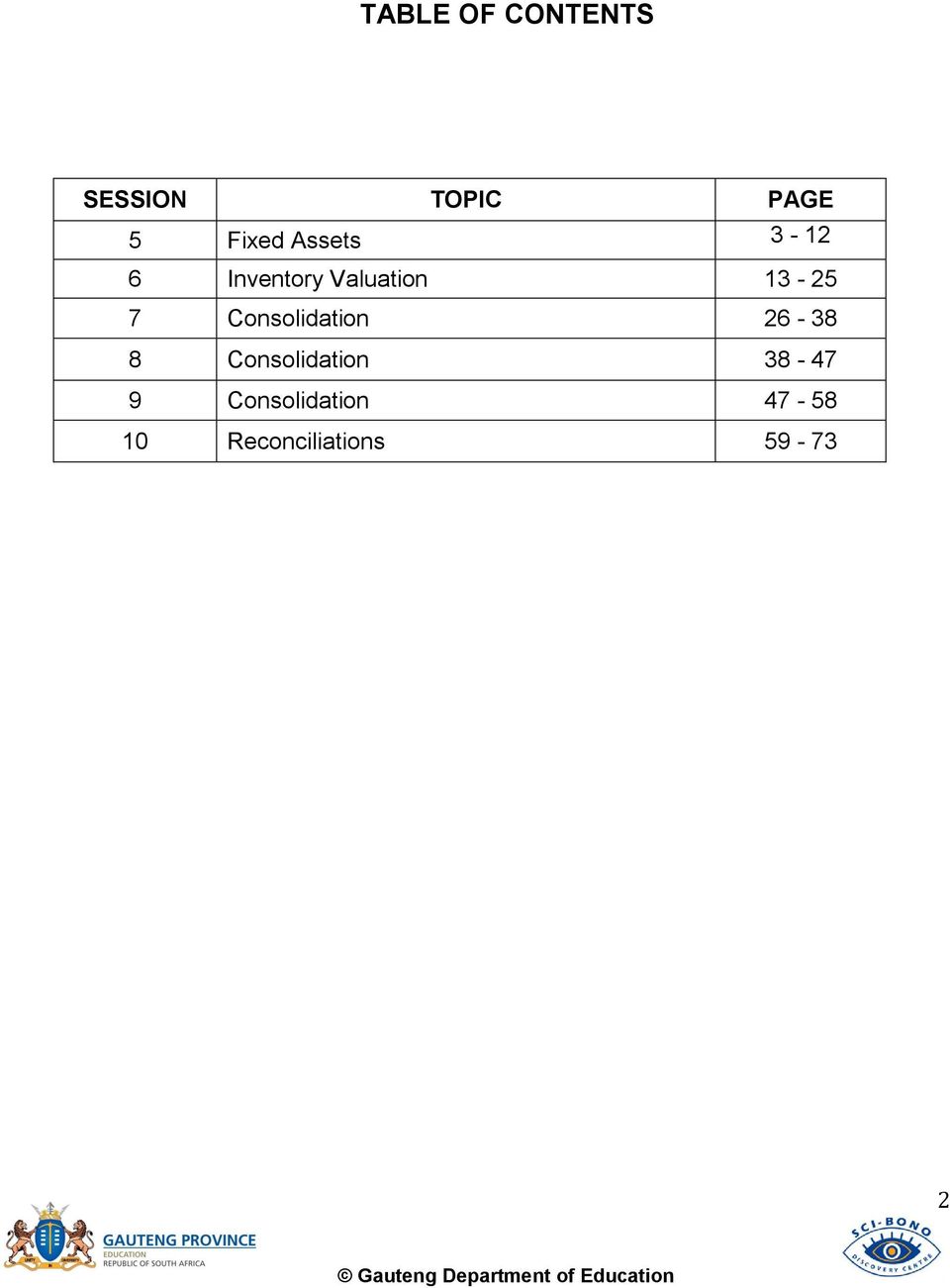
2 TABLE OF CONTENTS SESSION TOPIC PAGE 5 Fixed Assets Inventory Valuation Consolidation Consolidation Consolidation Reconciliations
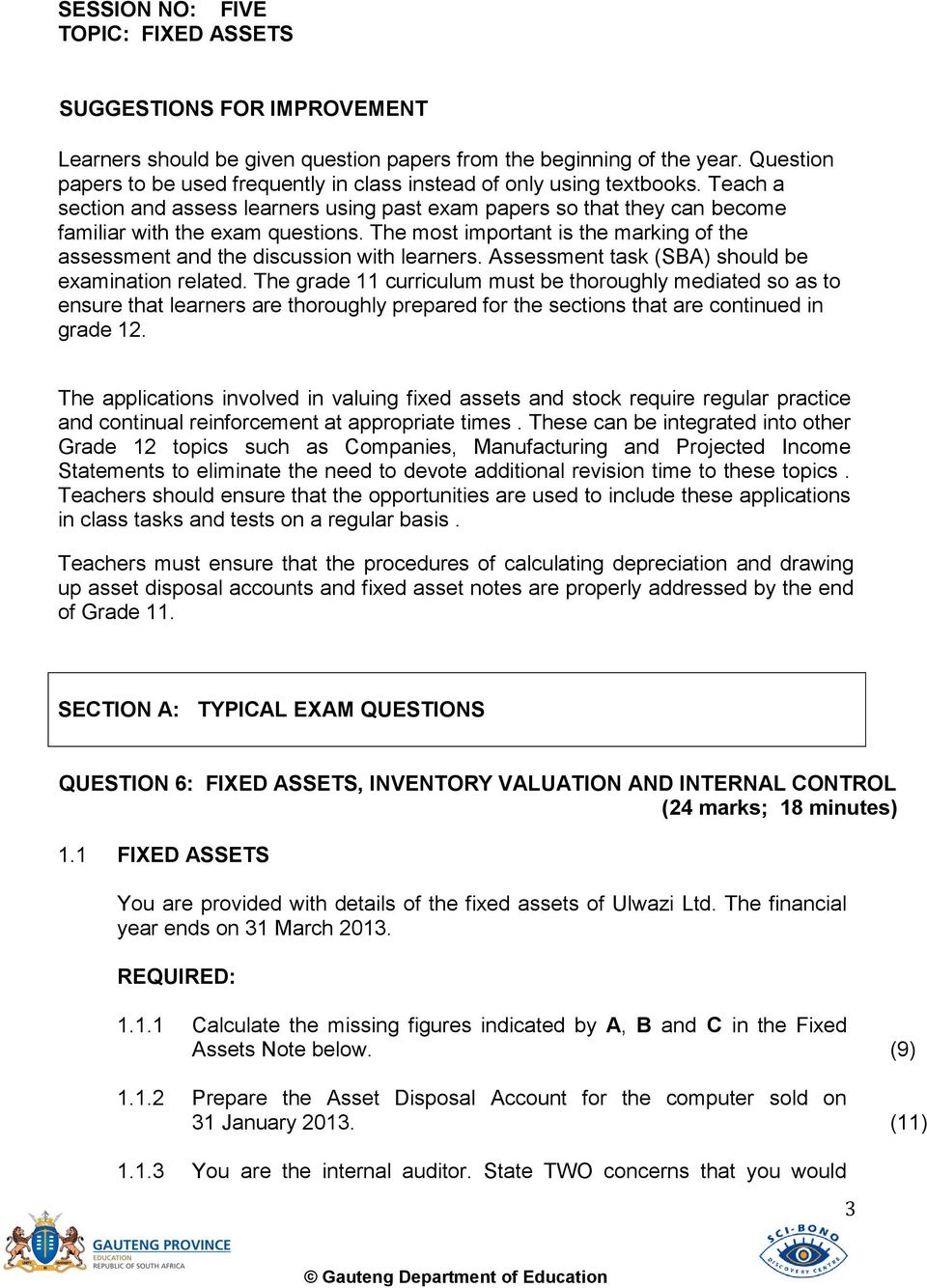
3 SESSION NO: FIVE TOPIC: FIXED ASSETS SUGGESTIONS FOR IMPROVEMENT Learners should be given question papers from the beginning of the year. Question papers to be used frequently in class instead of only using textbooks. Teach a section and assess learners using past exam papers so that they can become familiar with the exam questions. The most important is the marking of the assessment and the discussion with learners. Assessment task (SBA) should be examination related. The grade 11 curriculum must be thoroughly mediated so as to ensure that learners are thoroughly prepared for the sections that are continued in grade 12. The applications involved in valuing fixed assets and stock require regular practice and continual reinforcement at appropriate times. These can be integrated into other Grade 12 topics such as Companies, Manufacturing and Projected Income Statements to eliminate the need to devote additional revision time to these topics. Teachers should ensure that the opportunities are used to include these applications in class tasks and tests on a regular basis. Teachers must ensure that the procedures of calculating depreciation and drawing up asset disposal accounts and fixed asset notes are properly addressed by the end of Grade 11. SECTION A: TYPICAL EXAM QUESTIONS QUESTION 6: FIXED ASSETS, INVENTORY VALUATION AND INTERNAL CONTROL (24 marks; 18 minutes) 1.1 FIXED ASSETS You are provided with details of the fixed assets of Ulwazi Ltd. The financial year ends on 31 March REQUIRED: Calculate the missing figures indicated by A, B and C in the Fixed Assets Note below. (9) Prepare the Asset Disposal Account for the computer sold on 31 January (11) You are the internal auditor. State TWO concerns that you would 3
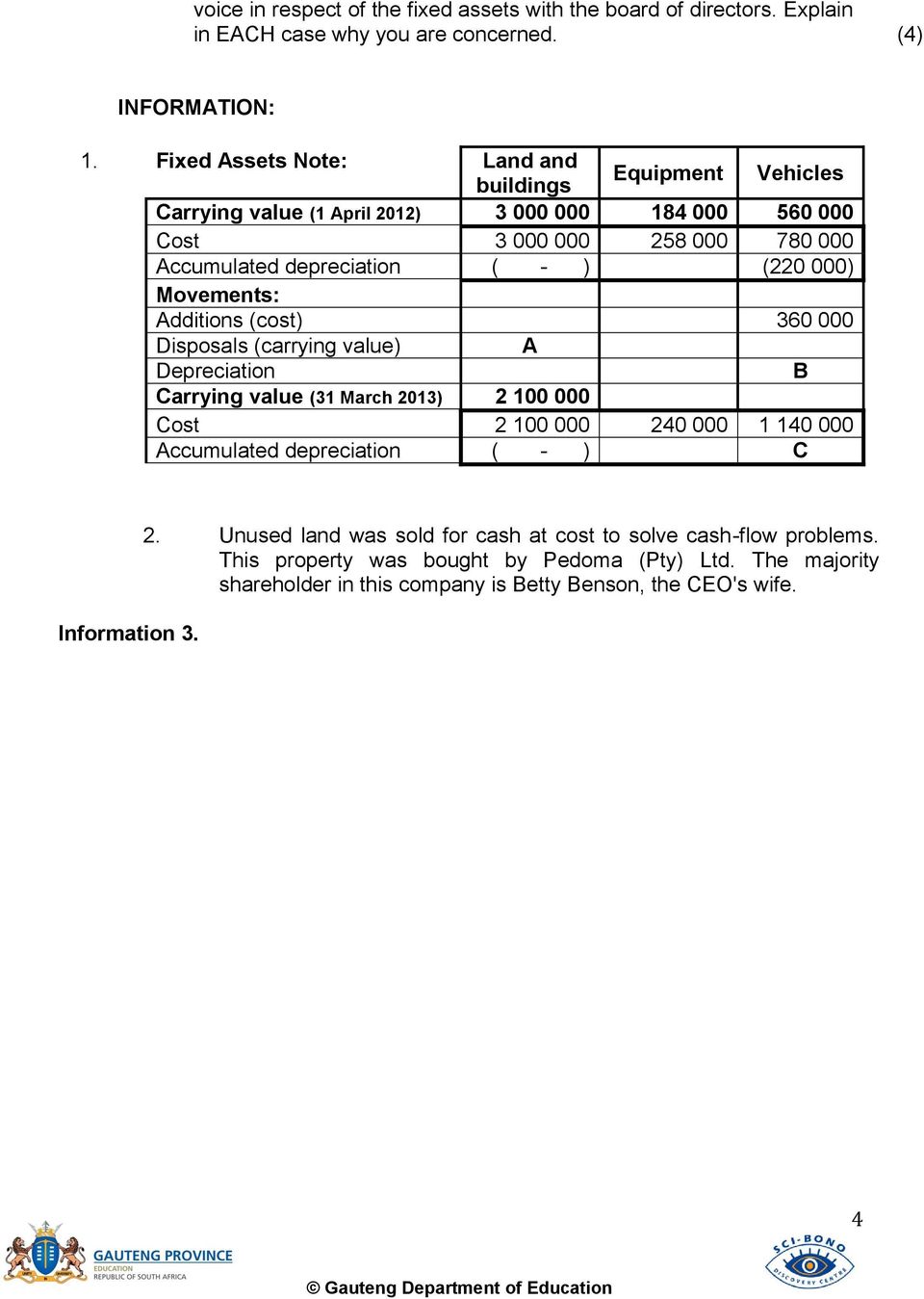
4 voice in respect of the fixed assets with the board of directors. Explain in EACH case why you are concerned. (4) INFORMATION: 1. Fixed Assets Note: Land and buildings Equipment Vehicles Carrying value (1 April 2012) Cost Accumulated depreciation ( - ) ( ) Movements: Additions (cost) Disposals (carrying value) A Depreciation B Carrying value (31 March 2013) Cost Accumulated depreciation ( - ) C Information Unused land was sold for cash at cost to solve cash-flow problems. This property was bought by Pedoma (Pty) Ltd. The majority shareholder in this company is Betty Benson, the CEO's wife. 4
5 3. A computer (equipment) was sold for R800 cash to the CEO, Ben Benson, on 31 January FIXED ASSET REGISTER Item: IT3 Laptop Cost: R Date purchased: 1 October 2010 Rate of depreciation: 25% p.a. on cost E22189 DEPRECIATION ACCUMULATED CARRYING DEPRECIATION VALUE 31 March 2011 R2 250 R2 250 R March 2012 R4 500 R6 750 R January 2013??? 4. A new vehicle costing R was purchased on 30 June Depreciation is written off on Vehicles at 20% p.a. on the diminishing-balance method. 1.2 MASTER LIMITED You are provided with information relating to Master Ltd for the financial year ended 30 June REQUIRED: Use Information 2 to complete the Note for Fixed/Tangible Assets by filling in the missing figures indicated by an * (17) INFORMATION: 1. Note to the Balance Sheet on 30 June 2012 FIXED/TANGIBLE ASSETS LAND AND EQUIPMENT VEHICLES BUILDINGS Carrying value 1 July 2011 R R R Cost Accumulated depreciation 0 ( ) ( ) Movements Additions at cost * * 0 Disposal at carrying value 0 0 * Depreciation 0 * (98 890) Carrying value 30 June * * Cost * 5

6 Accumulated depreciation 0 * * 2. Details of fixed assets Land and buildings were bought during the year and are not depreciated. New equipment was bought for R halfway through the financial year. This transaction has been correctly recorded. Provide for depreciation on equipment at 10% p.a. on cost price. A vehicle was sold for cash at carrying value on 31 March This has been properly recorded. The details of the asset sold from the Fixed Asset Register were as follows: - Cost price, R Accumulated depreciation at beginning of financial year, R Depreciation rate of 20% p.a. on the diminishing-balance method Depreciation on all the vehicles is R for the year. SECTION B: NOTES ON CONTENT 5.1 FIXED ASSETS/TANGIBLE ASSETS TANGIBLE ASSETS Tangible/Fixed assets such as land and buildings, vehicles and equipment are those assets of material value which: are used in the business to generate income are of long life are not purchased for the purpose of resale, in the normal course of business activities. have actual physical existence DEPRECIATION These tangible assets lose their value as a result of wear and tear. The loss of the value of the asset must be brought into account at the end of the financial year as an expense. This loss of value is known as depreciation. This is done in accordance with the matching concept, i.e. all expenses relating to the accounting period must be matched with the accounting period under review. Depreciation is an imputed expense. The cost of a tangible asset (e.g. motor vehicle) must be distributed fairly over the whole life of the asset. The methods of accounting for depreciation are: Fixed installment method (percentage on cost) Diminishing balance method (percentage on carrying value/ book value) 6

7 The above methods were dealt with in detail in grade 10 and 11. Wear and tear can be calculated on a straight-line basis provided the taxpayer complies with certain requirements: adequate records must be maintained the method must be applied to all assets in the same class the taxpayer must be able to provide a detailed schedule of assets disposed of, including date of acquisition, tax value in the previous tax year, the price on disposal or scrapping, the final written down value of the asset to be reflected at R1, the records must be maintained so that each asset s value can be established at any point in time The asset must be used in the taxpayer s trade. The following, amongst others, rates for wear and tear allowances are allowed by SARS: WEAR AND TEAR ALLOWANCES Wear and tear can be calculated on a straight-line basis provided the taxpayer complies with certain requirements: adequate records must be maintained the method must be applied to all assets in the same class the taxpayer must be able to provide a detailed schedule of assets disposed of, including date of acquisition, tax value in the previous tax year, the price on disposal or scrapping, the final written down value of the asset to be reflected at R1, the records must be maintained so that each asset s value can be established at any point in time The asset must be used in the taxpayer s trade. The most common of which are: Item Number of years Asset Years Cellular telephones 2 Computers (mainframe or servers) 5 Computers (personal computers) 3 Delivery vehicles 4 Fax machines 3 Furniture & fittings 6 Office equipment mechanical 5 Office equipment electronic 3 Passenger cars 5 7

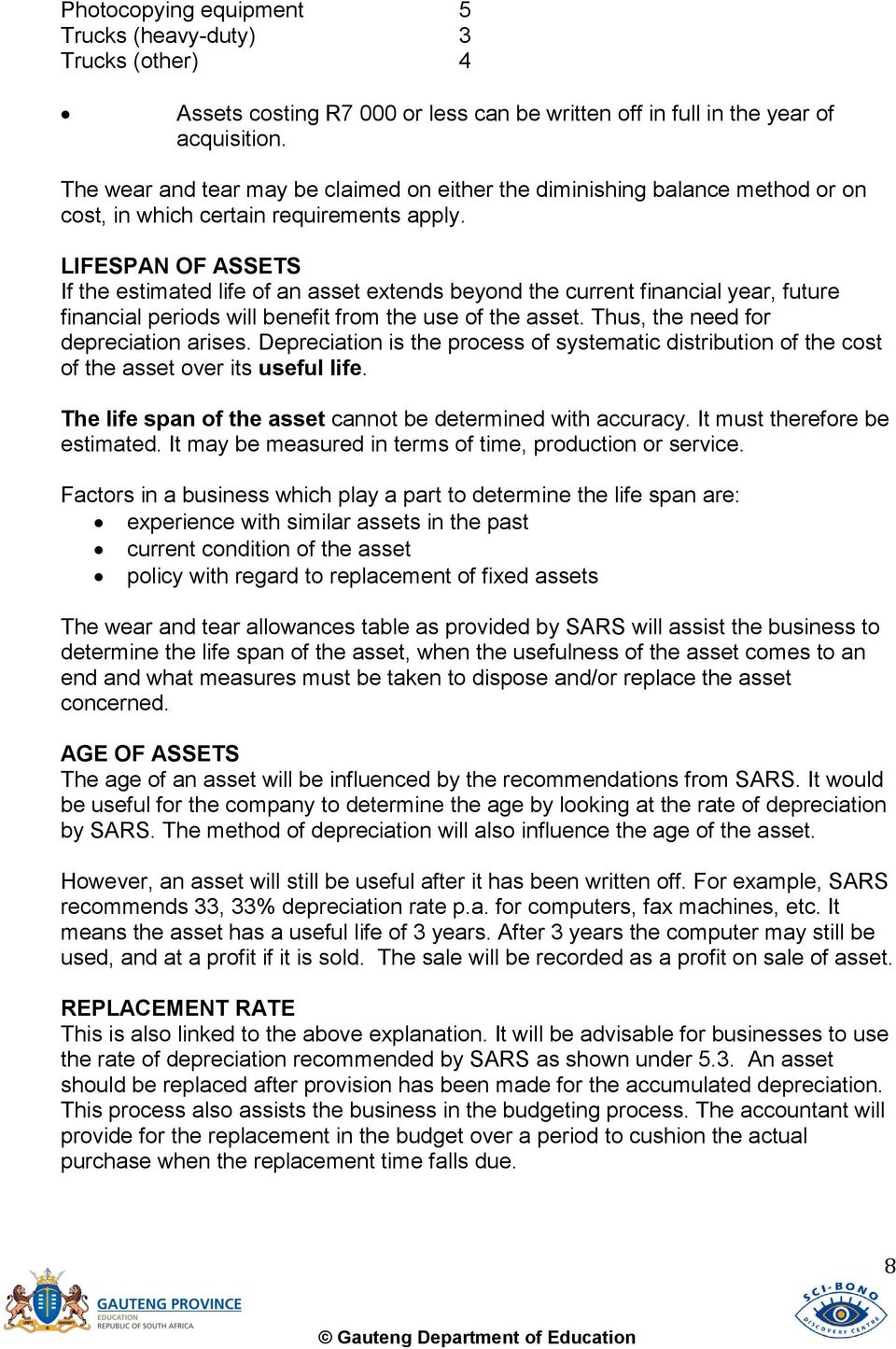
8 Photocopying equipment 5 Trucks (heavy-duty) 3 Trucks (other) 4 Assets costing R7 000 or less can be written off in full in the year of acquisition. The wear and tear may be claimed on either the diminishing balance method or on cost, in which certain requirements apply. LIFESPAN OF ASSETS If the estimated life of an asset extends beyond the current financial year, future financial periods will benefit from the use of the asset. Thus, the need for depreciation arises. Depreciation is the process of systematic distribution of the cost of the asset over its useful life. The life span of the asset cannot be determined with accuracy. It must therefore be estimated. It may be measured in terms of time, production or service. Factors in a business which play a part to determine the life span are: experience with similar assets in the past current condition of the asset policy with regard to replacement of fixed assets The wear and tear allowances table as provided by SARS will assist the business to determine the life span of the asset, when the usefulness of the asset comes to an end and what measures must be taken to dispose and/or replace the asset concerned. AGE OF ASSETS The age of an asset will be influenced by the recommendations from SARS. It would be useful for the company to determine the age by looking at the rate of depreciation by SARS. The method of depreciation will also influence the age of the asset. However, an asset will still be useful after it has been written off. For example, SARS recommends 33, 33% depreciation rate p.a. for computers, fax machines, etc. It means the asset has a useful life of 3 years. After 3 years the computer may still be used, and at a profit if it is sold. The sale will be recorded as a profit on sale of asset. REPLACEMENT RATE This is also linked to the above explanation. It will be advisable for businesses to use the rate of depreciation recommended by SARS as shown under 5.3. An asset should be replaced after provision has been made for the accumulated depreciation. This process also assists the business in the budgeting process. The accountant will provide for the replacement in the budget over a period to cushion the actual purchase when the replacement time falls due. 8
9 CARRYING VALUE OF ONE RAND When Accumulated Depreciation exceeds the cost of the asset than the carrying value must equal R1, 00 (One rand) e.g. Cost = R Accumulated depreciation at beginning = R Depreciation = current year = R Accumulated depreciation = R Carrying value = R (Cannot be negative) Annual depreciation must be reduced to R1 999 so that the carrying value will be R1,00 The accumulated depreciation must be shown as R Cost R Accumulated depreciation R Carrying value (closing date) R 1 DISPOSAL OF TANGIBLE ASSETS Tangible assets are possessions with a relatively long lifespan which are not purchased for the purpose of resale, in the normal course of business activities. Tangible assets, such as vehicles, equipment and buildings are purchased for use by the business. However, the business may find that they no longer require a particular asset, e.g. an old vehicle and may thus decide to sell the asset. These disposals can take place at any time during the accounting period. (The financial year). Before disposal, proper authorisation is required for the sale of the asset. In the case of a sole trader, the owner himself would conclude the transaction and he has the required authority to enter into the transaction. The asset can be disposed in one of the following ways: On credit General Journal For cash Cash Receipts Journal Trade-in (for new asset) General Journal For personal use General Journal Given away as donation General Journal This disposal can take place at The beginning of the accounting period The end of the accounting period During the accounting period THE ABOVE HAS BEEN DEALT WITH IN GRADE 11 9

10 SECTION C: HOMEWORK QUESTIONS QUESTION ONE You are provided with information relating to PK Limited, a public company. The financial year end is on 30 June REQUIRED: Study the information provided and answer the questions that follow Prepare the Asset Disposal Account on 31 December 2009 in the General Ledger. Complete the Note for Fixed (Tangible) Assets on 30 June (9) (15) INFORMATION: Equipment bought on 30 June 2007 for R was sold for cash on 31 December 2009 at carrying value. New equipment was purchased on 1 February 2010 for R Depreciation on equipment is written off at 15% p.a. on cost price. The following totals were extracted from the financial statements on 30 June 2010: Balance Sheet Land and buildings Equipment at cost Accumulated depreciation on? equipment QUESTION TWO 2 You are provided with the Pre-adjustment Trial Balance of Khachwee Limited for the year ended 30 June REQUIRED: 2.1 Prepare the Asset Disposal Account to record the sale of vehicles. See information G and H under Adjustments below. (9) 10

11 INFORMATION: 1. KACHWEE LTD EXTRACT FROM THE PRE-ADJUSTMENT TRIAL BALANCE AS AT 30 JUNE 2011 DEBIT CREDIT Balance Sheet Accounts Section R R Land and buildings Vehicles Equipment Accumulated depreciation on vehicles Accumulated depreciation on equipment ADJUSTMENTS: A. A vehicle was sold on credit for R on 31 December The fixed-asset register revealed the following regarding this vehicle: R Cost price Accumulated depreciation on 1 July This transaction has not yet been recorded by the bookkeeper. B. Make provision for depreciation as follows: Vehicles at 15% p.a. on cost price Equipment at 10% p.a. on the diminishing balance method. NOTE: New equipment to the value of R was purchased on 1 September This has been correctly recorded. SECTION D: SOLUTIONS FOR SECTION A QUESTION 1.1 FIXED ASSETS Calculate the missing figures indicated by A, B and C in the Fixed Asset Note: CALCULATION ANSWER 9 11

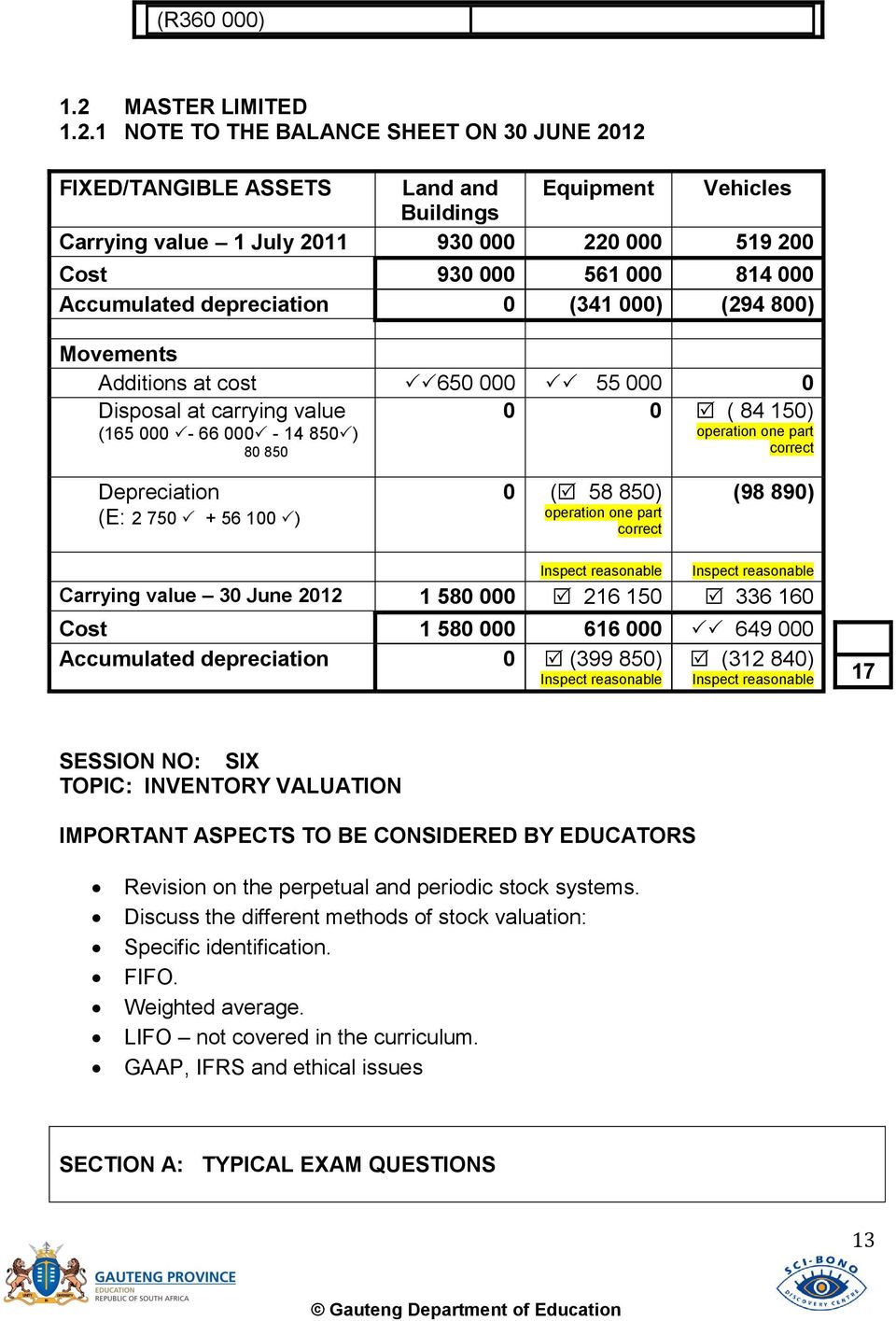
12 A R R B R R % x ( ) x 20% x 9/12 C If B All or nothing R Any one part correct R Operation R LEDGER OF ULWAZI LTD ASSET DISPOSAL ACCOUNT 2013 Jan 31 Equipment Jan 31 Accu depr on equipment One part of workings correct Bank Loss on disposal Operation May be a profit, depending on figures You are the internal auditor. State TWO concerns that you would voice in respect of the fixed assets with the board of directors. Explain in EACH case why you are concerned. Reason must correspond to the concern CONCERN Any TWO REASON Any TWO Land and buildings were sold at cost price Unreasonable purchase price for a computer (R800) taken by CEO Should have been sold at its current market value A loss of R6 700 has been incurred / he should be charged the fair market value / unethical Nepotism shown by the CEO Land and buildings being used to solve a cash flow problem Land and buildings were not sold at its current market value / was not advertised to public / Deal has been finalised with his wife / Corruption Land and building normally appreciate in value (loss of possible profits) Vehicles were bought These might not be necessary 4 12

13 (R ) 1.2 MASTER LIMITED NOTE TO THE BALANCE SHEET ON 30 JUNE 2012 FIXED/TANGIBLE ASSETS Land and Equipment Vehicles Buildings Carrying value 1 July Cost Accumulated depreciation 0 ( ) ( ) Movements Additions at cost Disposal at carrying value 0 0 ( ) ( ) operation one part correct Depreciation (E: ) 0 ( ) operation one part correct (98 890) Inspect reasonable Inspect reasonable Carrying value 30 June Cost Accumulated depreciation 0 ( ) Inspect reasonable ( ) Inspect reasonable 17 SESSION NO: SIX TOPIC: INVENTORY VALUATION IMPORTANT ASPECTS TO BE CONSIDERED BY EDUCATORS Revision on the perpetual and periodic stock systems. Discuss the different methods of stock valuation: Specific identification. FIFO. Weighted average. LIFO not covered in the curriculum. GAAP, IFRS and ethical issues SECTION A: TYPICAL EXAM QUESTIONS 13
14 QUESTION 1: CONCEPTS, INVENTORY (45 marks;30 minutes) 1.1 CONCEPTS REQUIRED: Indicate whether the following statements are TRUE or FALSE: The FIFO method of stock valuation is based on the assumption that stock acquired last is the first merchandise to be sold. Under the perpetual stock system carriage on goods bought is debited to the Trading Stock Account. Under the periodic stock system, when goods are sold, the cost of sales is recorded at the same time. All businesses in South Africa must charge value-added tax on all goods that they sell and all services that they provide. When the owner of a clothing business takes clothing for personal use at cost price, VAT is levied on these goods. (10) 1.2 INVENTORY VALUATION You are provided with information relating to Quality Building Suppliers for April They buy boxes of floor tiles and sell them to retailers around Hazyview. They use the weighted-average method for stock valuation and the periodic inventory system. Refer to the table below Calculate the total value of the opening stock (A). (3) Calculate the value of the tiles received on 25 April 2012 (B). (4) Calculate the value of the closing stock using the weightedaverage method. (6) INFORMATION BOXES OF TILES ON HAND VALUE PER UNIT CARRIAGE ON PURCHASES TOTAL VALUE Opening stock (1 April 2012) 600 R85,00 (A) Boxes of tiles purchased during the month 3 160? 10 April R90,00 R4 500 R April R95,00 R5 700 R April R120,00 R5 760 (B) Boxes of damaged tiles returned to supplier (these tiles were originally delivered on 25 April) 100?? 14
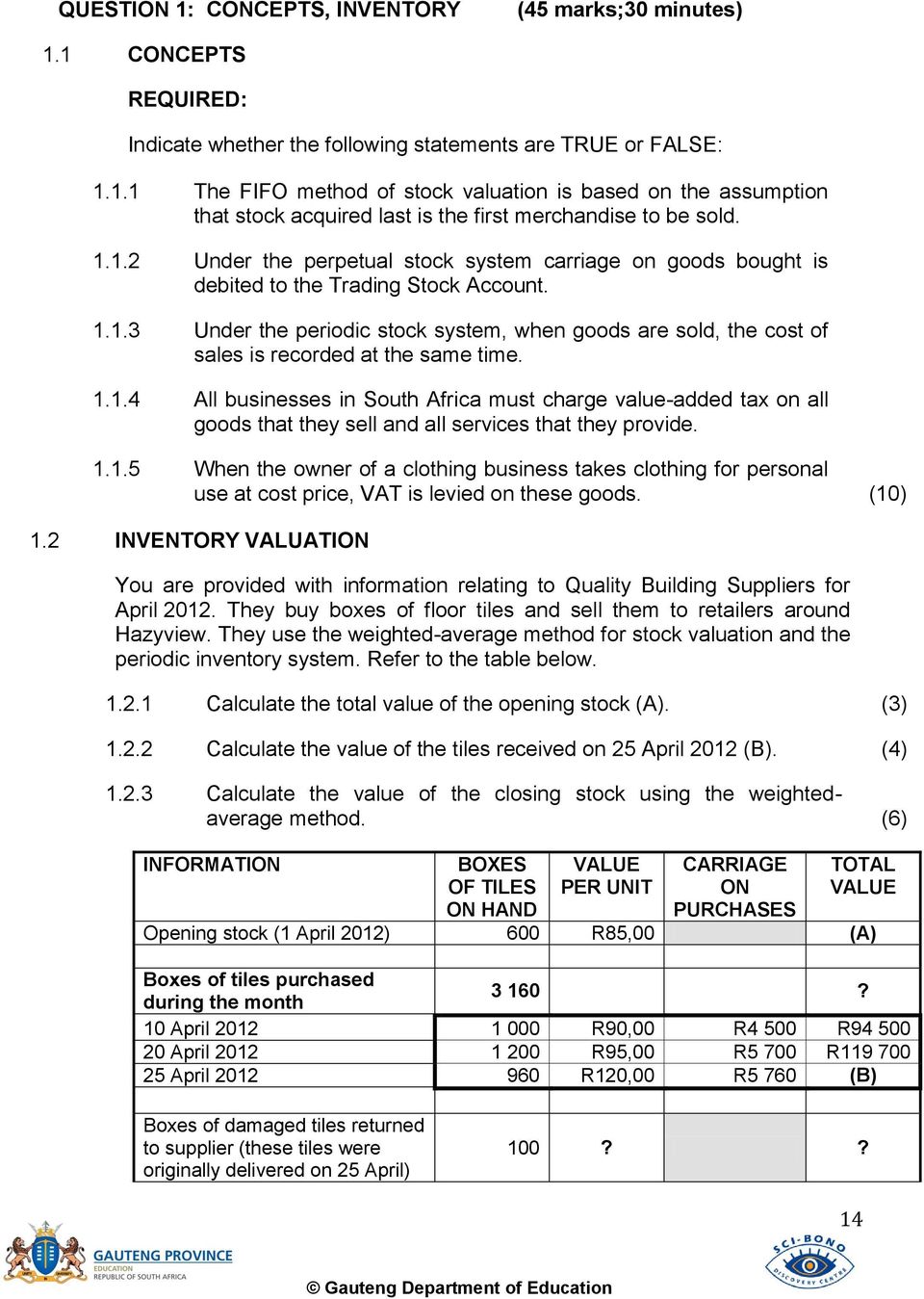
15 Sales for the month R160,00 R Closing stock (30 April 2012) 1 150?? 1.3 INVENTORY VALUATION AND INTERNAL CONTROL You are provided with information relating to Fast Save Traders owned by Mohammed Khan. The business sells school shirts. Their financial year ends on 31 July The business uses the FIFO (first in first out) method to value stock. The periodic inventory system is used Calculate the value of closing stock according to the FIFO method on 31 July (7) Calculate: Mark-up percentage (%) achieved on cost Stock holding period (use average stock in your calculation) (4) (4) The business aims at a mark-up of 30% on cost. As the internal auditor, what would you investigate? Explain. State TWO points. (4) The stock holding period for 2012 was 30 days. Should Mohammed be satisfied with the stock holding period for 2013? Explain. (3) INFORMATION: 1. Sales and cost of sales for the year: TOTAL Sales (3 600 shirts at R140 each) R Cost of sales R Inventories of shirts: NUMBER OF UNITS PRICE PER UNIT TOTAL 1 August R80 R July ?? 15

16 3. Purchases and returns: NUMBER OF UNITS PRICE PER UNIT TOTAL Purchases: 12 October R110 R December R130 R March R100 R June R120 R R Returns: 7 March 2013 (60) R100 (R6 000) 24 June 2013 (150) R120 (R18 000) NET TOTAL R SECTION B: NOTES ON CONTENT INTRODUCTION The proper valuation of stock is very important as it influences the financial statements, and also because the investment in stock normally constitutes a large percentage of total assets. Millions of rand are invested in raw materials, work-inprocess and finished goods. It is therefore important for a company to decide which method of stock valuation to use. STOCK VALUATION METHODS There are generally 3 methods used to valuate stock. The 3 methods are: FIFO - First in first out Weighted average method Specific identification method FIRST IN, FIRST OUT METHOD (FIFO) Sale of goods is based on First in, first out basis, i.e. goods bought first are the first to be issued for sale. The following transactions were concluded in respect of boots bought and sold by Jonnie Boots Traders for the year ended 31 December 20.9 EXAMPLE INSTRUCTION Use the FIFO method to determine the following: The number of boots on hand at the end of the year. Value of stock on hand at the end of the period 16

17 The closing stock Gross profit Cost of sales INFORMATION: Extracted from invoices, delivery notes and stock control records for 20.9 Details Month Quantity Price Bought January 120 boots at R120 each June 80 boots at R140 each November 40 boots at R160 each Sold for the year 168 boots at R100 each Stock on hand at year end? STOCK REGISTER Date 20.9 Jan 20.9 June 20.9 Nov Quantit y Unit price 120 R R140 Amoun t R R Quantit y sold Stoc k on hand Value of unsold stock 120 NIL R4 480 Cumulati ve value of unsold stock 40 R160 R R6 400 R Profit Total 240 R R R Total sold Cost of sales 168 R200 R R10 880= R R R Stoc k on hand *72 R * = = 72 17

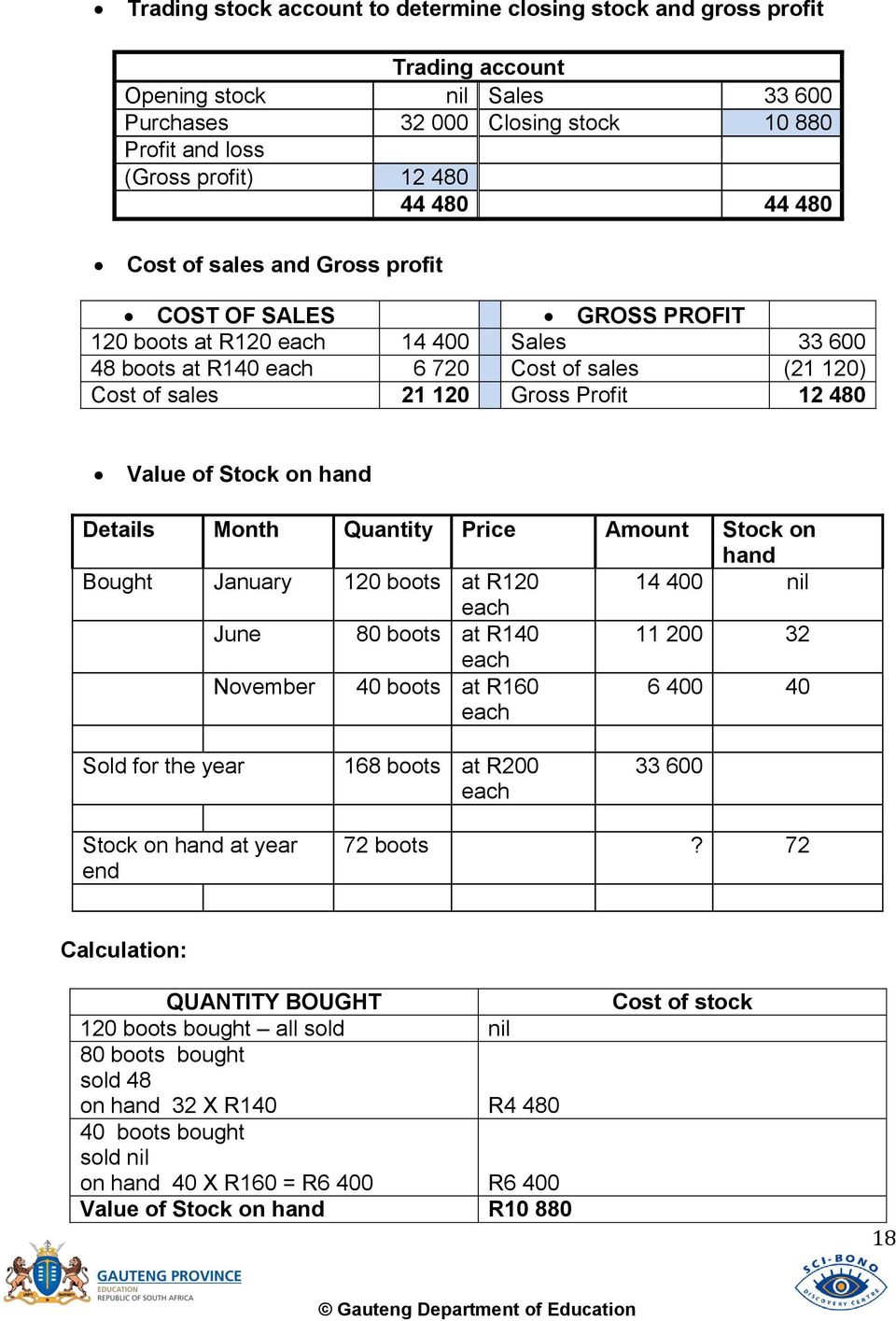
18 Trading stock account to determine closing stock and gross profit Trading account Opening stock nil Sales Purchases Closing stock Profit and loss (Gross profit) Cost of sales and Gross profit COST OF SALES GROSS PROFIT 120 boots at R120 each Sales boots at R140 each Cost of sales (21 120) Cost of sales Gross Profit Value of Stock on hand Details Month Quantity Price Amount Stock on hand Bought January 120 boots at R nil each June 80 boots at R each November 40 boots at R160 each Sold for the year 168 boots at R200 each Stock on hand at year end 72 boots? 72 Calculation: QUANTITY BOUGHT 120 boots bought all sold nil 80 boots bought sold 48 on hand 32 X R140 R boots bought sold nil on hand 40 X R160 = R6 400 R6 400 Value of Stock on hand R Cost of stock 18
19 WEIGHTED AVERAGE METHOD The weighted average method does not take quantities into account but average price into account. With the receipt of goods the average cost of each item is recalculated or calculated at the end of the financial year. The following transactions were concluded in respect of boots bought and sold by Jonnie Boots Traders for INSTRUCTION: Use the Weighted Average method to determine the following: The no. of boots on hand at the end of the period Value of stock on hand at the end of the period The closing stock Gross profit Cost of sales INFORMATION: Details Month Quantity Price Bought January 120 boots at R120 each June 80 boots at R140 each November 40 boots at R160 each Sold for the year 168 boots at R100 each Stock on hand at year end 72 boots Date 20.9 Jan 20.9 June 20.9 Nov Quan tity Unit price Amount Quantit y sold Stoc k on hand Value of unsol d stock 120 R120 R NIL 0 80 R140 R R4 480 Cumulativ e value of unsold stock 40 R160 R R6 400 R Profit Total 240 R R R Average R divide by
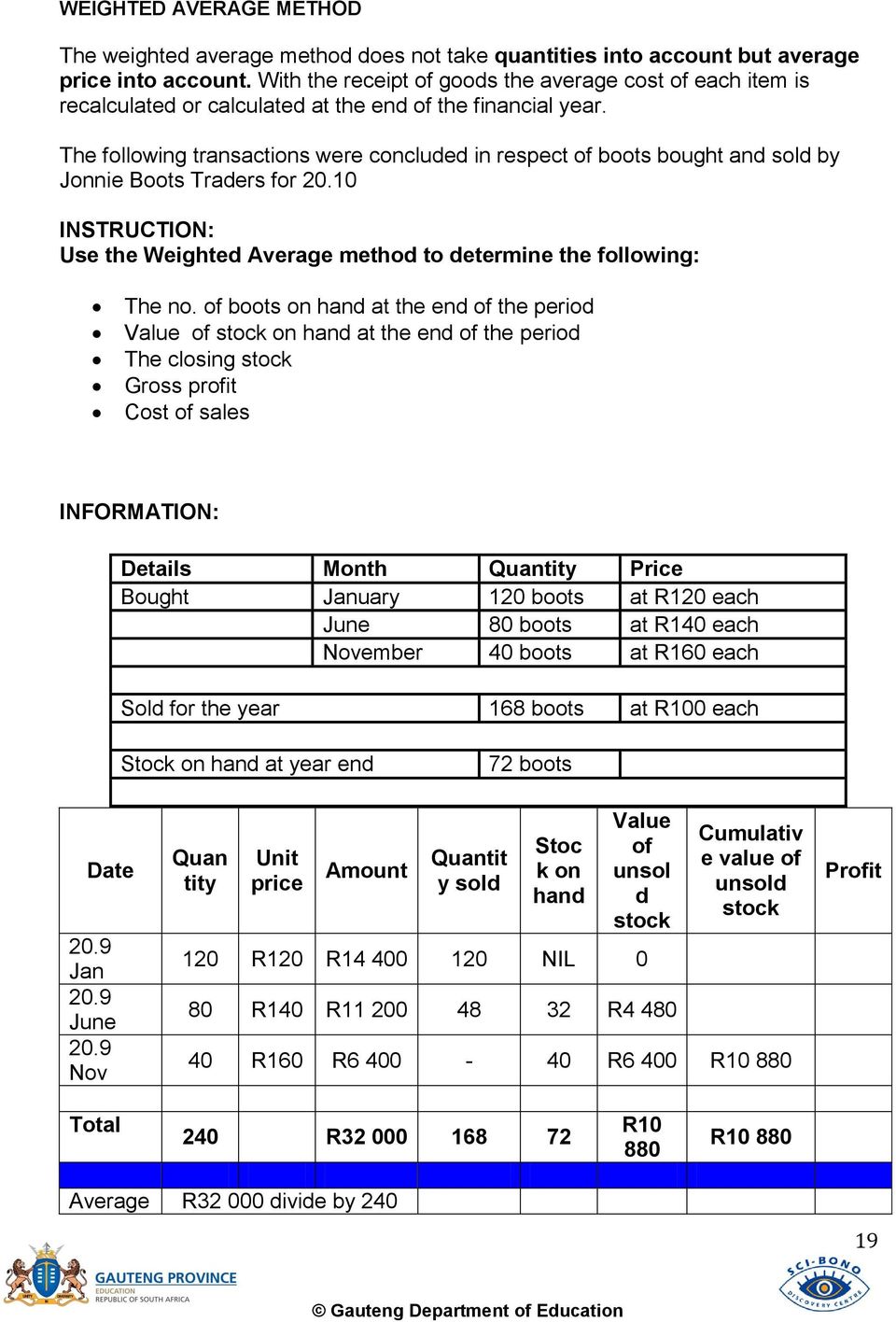
20 Cost price Total sold = R133, R200 R Stock on hand *72 72XR133,33 =R9 599,76 Cost of sales R R9 599,76= R22 400,24 R * = = 72 Trading account to determine closing stock and gross profit Trading account Opening stock nil Sales Purchases Closing stock Profit and loss (Gross profit) COST OF SALES GROSS PROFIT 120 boots at R133,33 each ,60 Sales boots at R133,33 each Cost of sales (22 400) Cost of sales ,44 Gross Profit Cost of sales and gross profit (rounded off) COMPARISON FIFO WEIGHTED Closing Stock value Gross Profit Cost of sales Specific identification method of inventory valuation You are provided with information relating to AA Car Dealers. The business uses the specific identification method of valuing stock. The following items are in stock at the beginning of May 2013: 20

21 Description Cost price Published selling price Item 1 Audi A1 (1.2 litre R R engine) Item 2 Audi A3 (2.0 litre R R engine) Item 3 Audi A6 (1.8 litre R R engine) Item 4 Audi A8 (3.0 litre R R engine) Items 1 and 3 are sold for cash during May 2013 at their published selling prices.. Required: (a) (b) (c) (d) Calculate the following: Value of trading stock on 31 May 2013 Gross profit earned during May 2013 Explain why it would be unreasonable for this business to value its stock items on the basis of FIFO or Weighted Average. Explain why it would be unreasonable for certain other businesses to use the specific identification method e.g. a fruit shop which sells apples. AA Car Dealers do not want the cost prices of stock items to be public knowledge. What strategies could they use to keep the cost prices confidential? Solution: (a) Value of trading stock on 31 May 2013 = R R = R Gross profit earned during May 2013 = Sales Cost of sales = ( ) ( ) = R (b) Explain why it would be unreasonable for this business to value its stock items on the basis of FIFO or Weighted Average. They sell discrete (separate) items (i.e. cars) that are very different from each other in terms of price and character. It would be inappropriate to value the cars based on the last two items bought or the weighted average because the cost prices vary considerably. Also they sell low volumes of these large articles. This makes it easier to identify the specific cost on each car. 21
22 (c) Explain why it would be unreasonable for certain other businesses to use the specific identification method e.g. a fruit shop which sells apples. Apples comprise numerous similar articles sold at similar prices. Cost prices might change from day to day, or from supplier to supplier, the articles would all be placed in containers for customers to select. Difficult to apply a specific price to any one apple. (d) AA Car Dealers do not want the cost prices of stock items to be public knowledge. What strategies could they use to keep the cost prices confidential? Keep the cost prices in a catalogue which can be secured in the manager s office. Secret cost code e.g. a 10-letter word such as BLACKHORSE where B=1, L=2 etc. Allocate separate product numbers to each item and record them on the computer system together with the specific cost prices. SECTION C: HOMEWORK QUESTIONS QUESTION 1: INVENTORY VALUATION (30 marks; 20 minutes) 1.1 INVENTORY VALUATION Speedy Traders sells one type of bicycle to major retail stores around South Africa. They make use of the FIFO method for stock valuation and use the periodic inventory system. The business is owned by Steve Martin. REQUIRED: What do the letters FIFO stand for? Calculate the value per bicycle on hand on 1 July Calculate the value of the closing stock on 30 June 2011 according to the FIFO method. Calculate the gross profit on 30 June (2) (2) (4) (6) The owner and the accountant disagree on the method of stock valuation. Steve, the owner, wants to continue using the FIFO method, because he says it is easier to calculate. Bongi, the 22
23 accountant, wants to use the weighted-average method, because she says the profit will be lower, and therefore the income tax will be lower. As internal auditor, what would you say to Steve and Bongi? State TWO points. (4) INFORMATION: The information below appeared in the records of Speedy Traders for the year ended 30 June The business used a fixed selling price of R6 750 per bicycle. INFORMATION ON STOCK NUMBER OF BICYCLES VALUE PER BICYCLE TOTAL VALUE Bicycles on hand on 1 July ? R Bicycles bought during the year 630 R September R3 800 R January R4 500 R May R4 200 R Bicycles returned from January 5 R4 500 R purchases Bicycles sold during the year 450 R6 750 R Bicycles on hand on 30 June ?? 1.2 PROBLEM-SOLVING Quick Bikes sells one brand of scooters. The owner, Doctor Zulu, has three branches operating in Riverside, Valley View and Mountain Rise. The three branches are managed by Robby, Vusi and Melanie, respectively. Doctor Zulu has obtained the annual figures from the three branches for the financial period ending 28 February REQUIRED: Identify ONE problem in relation to each branch, quoting figures to support the problem. In each case, offer Doctor Zulu advice on how to solve the problem. (12) INFORMATION: 23
24 RIVERSIDE (ROBBY) VALLEY VIEW (VUSI) MOUNTAIN RISE (MELANIE) Number of scooters available for sale Number of scooters sold during the year Physical count on 28 February Nil Cost price per scooter R7 500 R7 500 R7 500 Selling price per scooter R R R Advertising per year R R R Salary of manager R per month R per month R per month 30 SECTION D: SOLUTIONS FOR SECTION A QUESTION Indicate whether the statements are TRUE or FALSE False Accept T or F instead of True or False True False False True Calculate the total value of the opening stock (A). 600 x R85 = R operation one part correct; accept without R sign 3 24
25 1.2.2 Calculate the value of the tiles received on 25 April 2012 (B). 960 x R120 + R5 760 = R operation one part correct R (2 marks) accept without R sign Calculate the value of closing stock using the weighted average method. see if Inspect reasonable (or ) x = (or ) x = R ,93 operation one part correct or R ,92 or R OR R102,23 x = R ,50 or R R102,07 x = R ,50 or R or R (4 marks) (1 mark) (1 method mark) Value of closing stock according to the FIFO method # R x R120 If 970 # 240 x R100 One part correct OR Operation R Operation R mark 1 mark 1 mark 1 mark 2 marks Calculation of mark-up percentage (%) achieved on cost (2 or nothing) Any one part correct x 100 = 21,3% or 21,29% R Calculation of stock holding period (use average stock in your calculation) See must be added to to get the method mark Award 2 marks for average stock if correct (see 6.2.1) ½ (R R ) x 365 R = 69,35 days or 70 days or 2,3 months Operation, one part correct, shown in days or months 8 25
26 1.3.3 The business aims at a mark-up of 30% on cost. As the internal auditor, what would you investigate? Explain. State TWO points. See above. Points below will depend on MU% calculated. Any TWO Good answer = 2 marks; part answer = 1 mark Excessive trade discounts offered to customers Incorrect mark-up calculations Too many items sold at seasonal sales (discounts) Excessive stock on hand leading to clearance sales Theft of cash / stock Counter competitors prices OR: Will have to increase selling (marked) prices in future Buy in bulk Cheaper supplier The stock holding period for 2012 was 30 days. Should Mohammed be satisfied with the stock holding period for 2013? Explain. See above. Points below will depend on stock period calculated. Yes/No: Explanation: Good answer = 2 marks; part answer = 1 mark Explanation for NO: The stock holding period has increased (from 30 days to 70 days). This is not good as money is tied up in stock Stock might not be sold if it deteriorates More chance of stock theft Explanation for YES: Stock levels too low in 2012 and now less likely to run out of stock Better prices through bulk purchases. 3 SESSION NO: SEVEN TOPIC: CONSOLIDATION SECTION A: TYPICAL EXAM QUESTIONS QUESTION 1 Companies: Financial Statements and Interpretation (85 marks ; 51 minutes) A Financial Statements and Interpretation You are provided with information from the accounting records of Meera Traders LTD. The financial year-end is 28 February The company is registered with an authorised share capital of R
27 REQUIRED: Briefly explain the GAAP principle that relates to doing adjustments at the end of the financial year. (2) Taking into account the additional information (adjustments), complete the Income Statement for the year ended 28 February (23) 1.2 Prepare the Note for Trade and Other Receivables. (7) Complete the partially completed Balance Sheet. (18) 1.3 Refer to the table of indicators provided (a) Calculate the CURRENT RATIO and the ACID TEST RATIO for (7) (b) Comment on the liquidity position of this business. Quote TWO financial indicators/figures to support your argument. (6) Shareholders were not happy with the dividends they received. Calculate the dividend per share (DPS) and the earnings per share (EPS) for the current year. (7) Use your findings above (as well as other financial indicators provided) to explain why the shareholders are unhappy. (4) 1.4 The company intends issuing all unissued shares in the next financial year. One of the shareholders approached a director and requested that he be allowed to purchase the shares before they are offered to the public. Should the director be allowed to do this? Explain. (3) INFORMATION: 1. Balances and Totals from the Pre-adjustment Trial Balance on 28 February Ordinary Share Capital ( shares) Retained income (1 March 2012) Loan: Sandy Bank (12,5%) Fixed Deposit: BB Bank Tangible Assets (carrying value on 28 February 2013) Trading stock Debtors control Provision for bad debts (1 March 2012) Creditors Control Bank (overdraft)
28 Cash float Petty cash SARS: Income Tax (Dr) Gross Profit on 28 February Salaries Discount allowed Audit fees Directors fees Consumable stores Interest on investment Rent Income Profit on sale of asset 470 Insurance Stationery Sundry expenses Ordinary share dividends Additional Information: (a) Stock count at the end of the financial year revealed the following stock on hand: Trading stock: R Consumable stores: R1 130 (b) The account of X. Payi (a debtor), must be written off as a bad debt, R830. (c) (d) (e) (f) (g) (h) (i) R400 received from Y. Bother (a debtor whose account was previously written off) was posted to the Debtors Control Account. This must still be corrected. After taking into account the adjustments involving debtors, the provision for bad debts must be adjusted to 5% of debtors. Rent income for February 2013 was not yet received. Take into account that the rent increased by R360 per month from 1 September Half the insurance paid relates to the next financial year. Interest on fixed deposit for the last quarter of the financial year was not received. Note that the R was invested on 1 March Interest on loan is capitalised on 28 February The current year s interest is included in the loan balance above. Note that R of the loan is repayable on 1 March each year. No other payments were made. Depreciation of R must be taken into account. 28
29 (j) Income tax for the year amounts to R (k) A final dividend of R8 800 was declared. There were no additional shares issued in this financial year neither were any shares bought back. 3 Financial Indicators: 28 FEB FEB 2012 Current ratio? 1,5 : 1 Acid test ratio? 0,9 : 1 Debtors average collection period 38 days 41 days Creditors average payment period 42 days 40 days EPS (Earnings per share)? 26 cents DPS (Dividends per share)? 23 cents % return on shareholders equity 30% 37% Current interest rate on investments 10% B Auditing and Professional Bodies The audit report received from the independent auditors highlighted the following: 1. The financial statements are the responsibility of the company s directors. Their responsibility is to express an opinion on the financial statements based on the audit performed. 2. The audit includes, on a test basis, evidence supporting the amounts in the financial statements and assessing the accounting principles used. 3. It stated that the financial statements fairly present, in all material respects, the financial position of the company, and that it is in accordance with IFRS as well as the Companies Act of South Africa. QUESTIONS: 1.5 Explain why it is important for the independent auditor to be a member of a professional body such as SAICA. (2) 1.6 Give an example of the evidence that auditors would use in compiling an audit report. (2) 1.7 What does on a test basis imply? Explain. (2) 29
30 1.8 Explain why the company should be satisfied with the audit report. (2) 8 SECTION B: HOMEWORK QUESTIONS QUESTION 1 COMPANY REPORTING (65 marks; 30 minutes) 1.1 INCOME STATEMENT You are provided with information relating to Samora Sports Limited. The company sells sports equipment and repairs equipment for their customers. REQUIRED: Prepare the Income Statement for the year ended 30 June 2008 after taking all the adjustments and additional information into account. (50) INFORMATION: 1. Figures extracted from the Pre-Adjustment Trial Balance on 30 June 2008: Ordinary share capital (R5 Issue price) R Fixed deposit Trading stock Debtors control Equipment (for office and shop) Accumulated depreciation on office and shop equipment Mortgage loan from Credbank Sales Debtors allowances Cost of sales? Service fee income (in respect of repair services) Rent income Interest income Salaries and wages Employers' contributions to Pension Fund and UIF Audit fees Directors fees Consumable stores Bank charges Sundry expenses? 30
31 2. Adjustments and additional information: The auditors have identified the following errors or omissions: 2.1 The auditors are owed a further R after completing the audit. 2.2 Bank charges of R310 reflected on the June 2008 bank statement have not yet been entered in the books. 2.3 A credit note issued to a debtor, A Mona, dated 28 June 2008 was not recorded in the books. The credit note was for: Goods returned by A Mona, R (the cost was R4 800) Price reduction on unsatisfactory repair of a tennis racket, R The stock count on 30 June 2008 revealed the following on hand: Trading stock, R Consumable stores, R An employee was left out of the Salaries Journal for June The details from his pay-slip were: Gross salary R6 000 PAYE deduction (18%) (1 080) Pension deduction (7,5%) (450) UIF (60) Net salary R4 410 The business contributions were: Pension Fund: 10,5% of gross salary UIF: Rand-for-rand basis 2.6 The tenant paid the July and August rent in June The rent was increased by R700 per month on 1 January Provide for depreciation on office and shop equipment at 10% p.a. on the diminishing-balance method. Note that new shop equipment costing R was purchased half-way through the financial year (this was properly recorded). 2.8 Interest on the loan was capitalised. The loan statement from Credbank on 30 June 2008 reflects the following: CREDBANK Loan statement on 30 June 2008 Balance on 1 July 2007 R Interest charged? Monthly payments to Credbank in terms of the loan agreement (12 months x R4 300) R Balance on 30 June 2008 R The interest expense for the year has not yet been entered in the books. 31
32 2.9 Use the following percentages to calculate the missing figures: Mark-up % achieved: 60% on cost Operating profit on sales: 20% Income tax rate: 30% of net profit 1.2 CORPORATE GOVERNANCE AND AUDITING The following audit report was issued by the auditors of Samora Sports Ltd: Audit opinion To the shareholders: In our opinion, the financial statements fairly present, in all material respects, the financial position of the company and the group at 30 June 2008 and the results of their operations and cash flows for the year ended, in accordance with International Financial Reporting Standards, and in the manner required by the Companies Act in South Africa. I.M. Wright & Associates Chartered Accountants (SA) Registered Accountants and Auditors Pretoria 10 August Why does the Companies Act make it a requirement for public companies to be audited? (2) Although this audit opinion is addressed to the shareholders, other interested persons will also want to read it. Name ONE other person who would be interested in this audit opinion, and give a reason for his/her interest in the opinion. (3) At the AGM, one of the shareholders says that he is not happy with the words 'fairly present' in the audit report. He wants the auditors to say that the financial statements are 'correct in all respects'. What explanation should be given to this shareholder? State ONE point. (3) The directors are not happy with the high audit fees reflected in the Income Statement. Explain why improvement in internal control will have a positive effect on the external auditors' fees. State ONE point. (3) SAICA is one of the main professional bodies governing accountants in this country. Explain TWO of the main roles performed by SAICA. (4) 32
33 SECTION C: SOLUTIONS FOR SECTION A QUESTION 1 Companies: Financial Statements and Interpretation (85 marks ; 51 minutes) A Financial Statements and Interpretation Briefly explain the GAAP principle that relates to doing adjustments at the end of the financial year. Matching concept Any valid response. Income and expenses are recognised and recorded in the period in which they apply. Expenses must be matched against the income earned in a specific financial year 33
34 1.1.1 INCOME STATEMENT FOR THE YEAR ENDED 28 FEBRUARY 2013 GROSS PROFIT Other Income Rent Income ( ) Profit on sale of asset 470 Bad Debts Recovered 400 Provision for Bad Debt Adjustment ( ) 220 GROSS INCOME Operating Expenses ( ) Salaries Discount Allowed Audit fees Directors fees Stationery Sundry Expenses Consumable Stores ( ) Insurance ( ) or 6 400/ Bad Debts 830 Depreciation ( ) given Trading Stock deficit ( ) OPERATING PROFIT Interest Income ( ) or x 4 / NET PROFIT BEFORE INTEREST EXPENSE Interest Expense ( x 12,5 / 112,5) (15 000) NET PROFIT BEFORE INCOME TAX Income Tax (22 475) NET PROFIT FOR THE YEAR each for foreign entries (balance sheet accounts) max -2 Misplaced items must be marked wrong
35 1.2: MEERA TRADERS LTD BALANCE SHEET AS AT 28 FEBRUARY 2013 ASSETS NOTES NON-CURRENT ASSETS Tangible Assets Financial Assets: Fixed Deposit CURRENT ASSETS Inventories Trade and other receivables Cash and cash equivalents ( ) Check transfer ( ) TOTAL ASSETS (5) EQUITY AND LIABILITIES SHAREHOLDERS EQUITY Ordinary share capital Share premium Retained income ( ) NON-CURRENT LIABILITIES Loan: Sandy Bank ( ) CURRENT LIABILITIES inspect Trade and other payables (Creditors) Accept various combinations for Trade and other payables SARS: (Income Tax) ( ) Shareholders for dividends Short term portion of loan Bank overdraft TOTAL EQUITIES AND LIABILITIES (13) Note the general rules when awarding method marks. -1 for foreign items (max -3) Balance Sheet accounts misplaced are not foreign. Award the marks (-1 for each misplaced item) 8 35
36 TRADE AND OTHER RECEIVABLES Trade Debtors ( ) Provision for Bad Debts (855) Accrued Income ( ) Prepaid expenses (a) Calculate the CURRENT RATIO and the ACID TEST RATIO for CURRENT RATIO Check amounts transferred from QUESTION : ,97 : 1 ACID TEST RATIO ( ) : Check QUESTION Or ( ) 0,47 : 1 7 (b) Comment on the liquidity position of this business. Quote TWO financial indicators/figures to support your argument. Must mention two of Current Ratio, Acid Test Ratio, Debtors Collection period and/or Creditors Payment period. -1 for any other ratios mentioned (if more than three ratios listed) for quoting figures for an explanation each Current ratio and the Acid Test ratio have decreased and are well below efficient levels. Debtors take too long to settle their accounts (30 days) Creditors are paid well within the normal 60 days allowed 6 36
37 1.3.2 Shareholders were not happy with the dividends they received. Calculate the dividend per share (DPS) and the earnings per share (EPS) for the current year. DPS EPS x x = 20 cents = 30 cents (30,3) Use your findings above (as well as other financial indicators provided) to explain why the shareholders are unhappy. Two valid explanation The shareholders received a lower DPS than last year, although the EPS increased. The business chose to retain income rather than distribute dividends. Further, the ROSHE is much higher than interest on alternative investments (meaning that they should be pleased) yet the DPS is reduced The company intends issuing all unissued shares in the next financial year. One of the shareholders approached a director and requested that he be allowed to purchase the shares before they are offered to the public. Should he be allowed to do this? Explain. Any valid explanation No. It is unethical and against the Company s Act. All shares must be advertised and the general public must have access to them. (Transparency). The Shareholders become members of the public and must compete for the new shares in the market. (award part marks for incomplete/partial answers) 3 B Auditing and Professional Bodies 1.5 Explain why it is important for the independent auditor to be a member of a professional body such as SAICA. Any valid response Assurance of knowledge of accounting and auditing principles/ensures uniformity or standardisation of treatment of financial information Continuous professional training/bound by a professional code of conduct/cannot be negligent in his duties 2 37
38 1.6 Give an example of the evidence that auditors would use in compiling an audit report. Any valid response Any one of: asset register; stock register; record of debtors and creditors; journals and documents, etc What does on a test basis imply? Explain. Any valid response Auditors do random sampling (they do not check every document or procedure) they give an opinion based on the sample they tested Explain why the company should be satisfied with this audit report. Any valid response The report is unqualified. No material errors/problems detected/auditors are satisfied that fair presentation is noted/the statements are reliable. 2 QUESTION 1 TOTAL: 85 SESSION NO: EIGHT TOPIC: CONSOLIDATION SECTION A: TYPICAL EXAM QUESTIONS COMPANY QUESTION 1 Marvin Traders Limited has a registered authorised share capital of ordinary shares. Their financial year ends on the last day of February each year. New shares were issued on 1 April REQUIRED: (for the 2012 financial year ended 29 February 2012) 1.1 Prepare the following notes to the Cash Flow Statement on 29 February 2012: Reconciliation between net profit before taxation and cash 38
39 generated by operations Dividends paid Income tax paid (14) (7) (7) 1.2 Calculate the average price of the shares on 29 February (4) 1.3 Study the following ratios and explain what this means for the business: Current ratio Acid-test ratio ,18 : 1 0,85 : 1 0,57 : 1 0,31 : 1 (6) Calculate the debt equity ratio (shareholders' equity) ratio for the 2012 financial year. Calculate the creditor's payment period (in months) for the 2012 financial year. Calculate the number of days the company had to wait in the 2012 financial year before debtors settled their debts. Outline TWO ways in which management could encourage debtors to pay their debts earlier. Calculate the net asset value per share on 29 February Calculate the return on average shareholders' equity (after tax) for Do you think that the return average shareholders' equity calculated in QUESTION 1.9 is acceptable? Give a brief explanation for your answer. (5) (5) (5) (4) (5) (4) (4) INFORMATION: 1. EXTRACTS FROM THE INCOME STATEMENT: Sales (this includes credit sales of R for 2012) Cost of sales Interest on loan Depreciation: Equipment Vehicles Income tax Net profit after tax EXTRACT FROM THE BALANCE SHEET: Interim dividends declared and paid
40 2. EXTRACTS FROM THE POST-CLOSING TRIAL BALANCE ON 29 FEBRUARY: Ordinary shareholders' equity Ordinary share capital Retained income/accumulated profit Long-term liabilities (15% p.a.) Fixed assets at carrying value Current assets Trading inventory Debtors' control Cash and cash equivalents Current liabilities Bank overdraft Creditors' control Accrued expenses South African Revenue Service (Income tax) Shareholders for dividends ORDINARY SHARE CAPITAL The ordinary share capital on 1 March 2011 consisted of: ordinary shares issued in the 2009 financial year at R4,00 per share ordinary shares issued in the 2010 financial year at R7, 00 per share. The new shares were sold at R10 per share 70 SECTION B: HOMEWORK QUESTIONS QUESTION 1 CASH FLOW AND INTERPRETATION OF A COMPANY You are provided with information relating to Glebo Limited for the year ended 30 June Glebo Limited is a public company listed on the JSE Securities Exchange. They are based in Pretoria and they sell office stationery. The directors of Glebo Limited decided to open new branches in Bloemfontein and Witbank halfway through the year. Note: Answer the questions below. Where you are asked to comment on financial indicators you must quote the name of the relevant indicator as well as the figure, which is provided or calculated in the question for that indicator. 40
41 REQUIRED: 1.1 Calculate the following financial indicators for 2008: Debt/Equity ratio (3) Acid-test ratio (4) Stock turnover rate (4) % return on average shareholders' equity (after tax) (4) Net asset value per share (4) 1.2 Solvency and liquidity: Briefly explain the difference between solvency and liquidity. (2) Comment on the solvency of this business. Quote a financial indicator from the question to support your opinion. (3) Comment on the liquidity of this business. Quote the financial indicators and the changes (trends) from the previous year to support your opinion. (10) 1.3 Returns and share price: Comment on the earnings, dividends and % return. Quote financial indicators and the changes (trends) from the previous year to support your opinion. (6) You have been a shareholder since the company started many years ago. The price of the share on the JSE is now 350 cents which is a 6% increase over the past year. Would you be satisfied with the performance of the share price? Comment and compare this to a financial indicator from the question to support your opinion. (4) 1.4 Calculate the missing figures in the Cash Flow Statement. The missing figures are indicated (a) to (e). (12) 1.5 The Cash Flow Statement highlights some significant (important) decisions taken by the directors over the past year. Explain TWO of these significant decisions. Quote figures to support your answer. Also explain how these decisions would benefit the company and the shareholders. (8) 1.6 At the AGM, the directors announce that the company will: - Conduct training of all employees in terms of morals and ethics - Donate funds towards cleaning up the environment Explain why this is necessary although this will cost the company a lot of money each year. State THREE points. (6) 41
42 GLEBO LIMITED BALANCE SHEET AS AT 30 JUNE ASSETS Non-current assets Fixed assets Financial assets Current assets Inventories (all trading stock) Trade and other receivables (all trade debtors) SARS (Income tax) Cash and cash equivalents TOTAL ASSETS EQUITY AND LIABILITIES Ordinary shareholders' equity Ordinary share capital R2 each) Retained income Non-current liabilities Mortgage loan: Jozi Bank (13% p.a.) Current liabilities Trade and other payables (all trade creditors) SARS (Income tax) Shareholders for dividends Bank overdraft Current portion of loan TOTAL EQUITY AND LIABILITIES
43 GLEBO LIMITED EXTRACT FROM INCOME STATEMENT FOR THE YEAR ENDED 30 JUNE Sales (70% of sales were on credit) Cost of sales Operating profit Income tax Net profit after tax FINANCIAL INDICATORS: The following financial indicators were calculated for the past two years: Debt/Equity ratio? 0,27:1 Total assets to total liabilities 2,2:1 2,3:1 Current ratio 2,4:1 1,8:1 Acid-test ratio? 0,7:1 Stock-turnover rate? 2,4 times Debtors collection period 51 days 72 days Creditors payment period 49 days 67 days % return on average shareholders' equity (after tax)? 23,9 % % return on total capital employed (before tax) 43,3 % 39,7 % Net asset value per share? 330 cents Dividends per share 57 cents 65 cents Earnings per share 95,2 cents 78,8 cents GLEBO LIMITED CASH-FLOW STATEMENT FOR THE YEAR ENDED 30 JUNE 2008 Cash effects of operating activities Cash generated from operations? Interest paid ( ) Dividends paid ( ) Income tax paid (a)? Cash effects of investing activities ( ) Purchase of fixed assets for new branches ( ) Proceeds of sale of fixed assets Cash effects of financing activities Proceeds of issue of shares (b)? Proceeds of increase in mortgage loan (c)? Proceeds of financial assets matured Net change in cash equivalents (d)? Cash equivalents beginning of year ( ) Cash equivalents end of year (e)? 43
44 70 SECTION C: SOLUTIONS FOR SECTION A QUESTION RECONCILIATION BETWEEN PROFIT BEFORE TAXATION AND CASH GENERATED BY OPERATIONS Profit before taxation ( ) Depreciation ( ) Interest paid Changes in working capital (39 460) Increase in stock (20 100) Increase in debtors (20 640) Increase in creditors Cash generated DIVIDENDS PAID Amount as per retained income note (98 000) * Amount at the beginning (28 000) Amount at the end (76 800) OR ( = * Accept T - accounts /linear calculations
45 1.1.3 INCOME TAX PAID Amount as per income statement (73 500) Amount at the beginning (6 140) Amount at the end (72 230) * Accept T - accounts /linear calculations Calculate the average price of the shares on 29 February / = R6 1.3 COMMENT ON THE FOLLOWING RATIOS: 4 4 Current ratio Improve from 0,85:1 to 1,18:1 Could struggle to settle the short-term liabilities Any acceptable answer Acid test ratio Improve from 0,31:1 to 0,57:1 Could struggle to settle the short-term liabilities because the inventory figure is too high Any acceptable answer Improve and mention ratio/figures and comment on effect to business
46 1.4 CALCULATE THE DEBT EQUITY RATIO FOR : ,1 : CALCULATE THE CREDITORS' PAYMENT PERIOD IN MONTHS FOR = x = 1, 87 / 1, 88 months If final answer rand or % no final mark allocated. 1.6 CALCULATE THE NUMBER OF DAYS THE COMPANY HAD TO WAIT IN 2012 BEFORE DEBTORS SETTLED THEIR DEBTS. = x = 30,29/30,3 days If final answer rand or % no final mark allocated. 1.7 TWO WAYS IN WHICH MANAGEMENT COULD ENCOURAGE DEBTORS TO PAY THEIR DEBTS EARLIER. Allow discount Charge interest on overdue accounts Promotions Any acceptable answer
47 1.8 CALCULATE THE NET ASSET VALUE FOR _ x cent / R CALCULATE THE RETURN ON AVERAGE SHAREHOLDERS' EQUITY FOR x 100 ½ ( ) x ,3 % 1.10 DO YOU THINK THAT THE AVERAGE RETURN ON SHAREHOLDERS EQUITY CALCULATE IN (1.9) IS ACCEPTABLE? GIVE A BRIEF EXPLANATION FOR YOUR ANSWER. Yes / No A safe investment such as an fixed deposit raises between 5% - 10% which is less than the 27,3% /Interest on loan is 15%. Can borrow more money to expand the business which is realising 27,3% Any acceptable answer TOTAL MARKS
48 SESSION NO: NINE TOPIC: CONSOLIDATION SECTION A: TYPICAL EXAM QUESTIONS QUESTION 1 The following information relates to the trading activities of Micro Traders for the financial year ended 29 February The business is owned by BA Crooke. The business sells only one type of microwave oven and has decided to keep the selling price constant throughout the year. Mr Crooke is keen to secure a loan from the bank. He wants to ensure that the profit in the financial statements creates a very favourable impression with the bank. The business uses the periodic inventory system and the FIFO method of valuing stock. INFORMATION: Number of units Unit price R Total R Sales? Stock on hand on 1 March units Purchases during the year 210 units June units October units January units
49 REQUIRED: 1.1 Explain the difference between the periodic and perpetual inventory systems. Also explain the advantage of each system. (4) 1.2 Calculate the total number of microwave ovens sold during the year. (3) 1.3 Calculate the total number of microwave ovens on hand at 29 February (3) 1.4 The business uses the FIFO valuation method Calculate the closing stock using the FIFO method. (3) Calculate the gross profit for the year ended 29 February 2008 using the FIFO stock valuation method. You may draft the Trading Account to calculate this figure. (5) 1.5 In order to secure the loan the owner, BA Crooke, wants to change the stock valuation method to the weighted average method Calculate the value of the closing stock by using the weighted average stock valuation method on 29 February (5) Calculate the gross profit for the year ended 29 February 2008 using the weighted average stock valuation method. You may draft the Trading Account to calculate this figure. (3) 1.6 In your opinion, will it be ethical for Mr Crooke to change the method of stock valuation? Give ONE reason for your answer. (4) QUESTION 2 30 INVENTORY VALUATION Laser Stores sell television sets to the public. The financial year ends on 28 February They are unsure which method to use in valuing their stock. The cost price of the product has changed significantly during the current year. The owner Larry Laser has decided to keep selling the same model of TV set (Mabona TV sets, Model XC456), despite the fact that other shops are selling newer models. REQUIRED: Calculate the value of closing stock using the FIFO (first-in-first-out) method. (6) 49
50 2.1.2 Calculate the value of closing stock using the weighted average method. (7) Which method of stock valuation would you advise the owner to use? Explain a reason for your answer. (3) Calculate the gross profit on TV sets for the year based on the stock valuation method you advised in QUESTION (4) INFORMATION: The following information appeared in the records of Laser Stores for the year ended 28 February The business used a fixed selling price of R per TV set. Information on stock of Mabona TV sets Model XC456 Number of TV sets Value per unit Total value TV sets on hand on 1 March R R TV sets bought during the year 750 R May R R September R R February R8 000 R Subtotal 800 R TV sets sold during the year 440 R R TV sets on hand on 28 February ?? 2.2 CONTROL OF INVENTORY Apart from TV sets, Laser Stores also sell other products. You are provided with information taken from their stock records on 28 February The owner Larry Laser is uncertain if he should be satisfied with control of all of these items. REQUIRED: Comment on the stock control of each item, quoting figures to support your comment. In each case, offer Larry practical advice for the future. (9) 50
51 INFORMATION: Item Mabona TV sets Khuluma Cellphones Lalela Radios Number of units sold during the year Number of units on hand per stock records at year-end Number of units per physical count at year-end Selling price per unit Period of stock on hand R16 000? R days R days SECTION B: HOMEWORK QUESTIONS QUESTION 1 RECONCILIATIONS AND INTERNAL CONTROL You are provided with three examples of reconciliations done by employees in the accounting department of Soweto Stationers. REQUIRED: Study the information provided and then answer the questions that follow. INFORMATION: EXAMPLE A BANK RECONCILIATION STATEMENT ON 29 FEB Balance per Bank Statement Credit Outstanding deposit Outstanding cheques: No dated 13 Feb No dated 18 Aug No dated 28 Feb Balance per Ledger Account? R 51
52 EXAMPLE B CREDITORS' RECONCILIATION STATEMENT ON 29 FEB ACE WHOLESALERS Balance per Creditors' Statement on 25 Feb Debit Invoice not reflected on statement: Invoice No Invoice on statement but not in Creditors Ledger: Invoice No Payment not reflected on statement: Dated 23 Feb Returns not reflected on statement: Debit note No Balance per Creditors Ledger Account on 29 Feb.? 2008 R QUESTIONS: 1.1 Briefly explain: What you understand by the term internal control Why it important to apply internal control in a business Why preparing reconciliations is important for internal control. (2) (3) (2) 1.2 According to the Bank Statement, does this business have a favourable bank balance or a bank overdraft? Give a reason for your choice. (2) 1.3 Calculate the bank balance in the Ledger of Soweto Stationers on 29 February State whether this is a favourable or unfavourable balance. (3) 1.4 List FOUR steps you would follow when preparing a Bank Reconciliation Statement. (4) 1.5 When preparing the financial statements of Soweto Stationers at the end of February 2008, what amount would you reflect under Cash and Cash Equivalents on the Balance Sheet? (2) 1.6 Calculate the correct amount owed to Ace Wholesalers by Soweto Stationers. (4) 1.7 Briefly explain what action should be taken over the difference of R1 900 reflected in Example C. (3) 25 52
53 QUESTION 2 BANK RECONCILIATION AND INTERPRETATION You are provided with information relating to Rover Jewellers. REQUIRED: 2.1 Explain why it is important for a business to prepare a Bank Reconciliation Statement each month. (2) 2.2 Calculate the correct totals for the Cash Receipts Journal and the Cash Payments Journal for May (12) 2.3 Calculate the Bank Balance on 31 May (You may prepare a ledger account in order to do so). State whether this is a favourable or unfavourable balance. (6) 2.4 Prepare the Bank Reconciliation Statement on 31 May (10) 2.5 Refer to Information 3 below. The fixed deposit of R matures next month. What advice would you offer the owner in this regard? Explain TWO points quoting appropriate figures to support your answer. (4) 2.6 Refer to Information 4 below. Explain why the internal auditor should be concerned about the outstanding deposit of R Explain how cheque No. 674 should be dealt with when the financial statements are prepared on 31 May Give a reason for your answer. (3) (3) INFORMATION: 1. At the end of the previous month, 30 April 2009, the following items were reflected in the Bank Reconciliation Statement: Favourable balance in the ledger of Rover Jewellers, R6 325 Favourable balance on the Bank Statement, R Outstanding deposit (dated 30 April 2009), R Outstanding cheques: No. 261 (dated 3 November 2008), R5 000 No. 519 (dated 14 April 2009), R8 920 No. 543 (dated 12 May 2009), R4 300 NOTE: Cheque No. 261 and 519 did not appear on the May Bank Statement either. 2. On 31 May 2009, the provisional totals in the journals were: 53
54 CRJ R CPJ R The following items were reflected on the Bank Statement but not in the journals for May 2009: Direct deposit by a debtor, K Kwela, R2 400 Bank charges, R520 Interest on fixed deposit for May, R700 Interest on overdraft for May, R810 Stop-order in favour of Rama Insurance Co., R660 Dishonoured cheque on 30 May 2009, originally presented by a debtor, M Maduna, R The following differences were noticed: Cheque No. 565 for repairs was shown in the CPJ as R1 570, but on the May Bank Statement as R The Bank Statement is correct. A deposit of R appeared on the Bank Statement on 1 May 2009, but did not appear in the May CRJ. A deposit of R20 295, dated 20 May 2009, appeared in the May CRJ, but not on the May Bank Statement. The following cheques appeared in the May CPJ, but not on the Bank Statement: No. 654 (dated 23 May 2009), R2 800 No. 674 (dated 29 August 2009), R
55 SECTION C: SOLUTIONS FOR SECTION A QUESTION Explain the difference between the periodic and perpetual inventory systems. Also explain the advantage of each system. Difference For periodic inventory system the value of the stock is determined periodically by a physical stock taking. Perpetual inventory system the records of trading stock is continually updated. Advantage Periodic this is a simpler and cheaper method to use since the cost of sale is not continually calculated. Perpetual It is easier to detect and correct losses since the balance of the trading stock account should always be equal to the value of the physical stock taking records. 1.2 Calculate the total number of microwave ovens sold during the year. Microwave ovens sold = /1 400 = Calculate the total number of microwave ovens on hand at 29 February Microwave ovens available on 28 February = 70 55
56 1.4 The business uses the FIFO valuation method Calculate the closing stock using the FIFO method. 70 units at R750 = R Calculate the Gross profit for the year ended 29 February 2008 using the FIFO stock valuation method. You may draft the Trading account to calculate this figure. Trading Acc (FIFO Opening stock Purchases Gross Profit Sales Closing stock In order to secure the loan, the owner, B A Crooke, wants to change the stock valuation method to the weighted average method Calculate the value of the closing stock by using the weighted average stock valuation method on 29 February 2008 Total value of stock available x 70 Total items available x or 832 x 70 =R Calculate the gross profit for the year ended 29 February 2008 using the weighted average stock valuation method. Opening stock Purchases Gross Profit Trading Acc (WA) Sales Closing stock OR: ( ) = = R
57 1.6 In your opinion will it be ethical for Mr. Crooke to change the method of stock valuation? Give one reason for your answer. Yes or No Any one valid reason mentioned Cannot change the stock system to increase the gross profit in order to secure a loan from the bank. Must be properly disclosed in the notes of the financial statements so that the readers can make their own decision. QUESTION Calculate the value of closing stock using the FIFO method. 200 x R8 000 = R x R = R R * Calculate the value of closing stock using the weighted average method. WA value per unit = R / 800 = R Value of closing stock = 360 x R see above = R * Which method of stock valuation would you advise the owner to use? Explain a reason for your answer. Decision Reason FIFO because TV sets are discrete units and it is easy to identify the cost price of each TV set. Or: Weighted average method because the gross profit will be higher or there is no need to track the cost price on each TV set. 57
58 2.1.4 Calculate the gross profit on TV sets for the year based on the stock valuation method you advised in QUESTION FIFO: R (R R ) = R Weighted Average: R (R R ) = R Comment on the stock control of each item, quoting figures to support your comment. In each case, offer Larry advice for the future. One mark; quoting figures: one mark; advice: one mark. Stock item Mabona TV sets Khuluma Cellphones Lalela Radios Comment and advice The stock is not selling well because new models are on the market. Too much stock on hand (360 units) compared to stock sales for the year (440 units). Advice: Reduce the price to clear the stock (cost is now R8 000) and stock new models. The cellphones are selling well (2 250 sold) and the stock is relatively low (15 days). The control of stock is a problem (50 cellphones missing). Advice: Institute procedures to safeguard the stock e.g. special cabinets with one person controlling the keys. The radios are not selling well (only 10 per month) and they are low-profit items (R100 selling price). Advice: Discontinue selling the radios. It is not worth it. 58
59 SESSION NO: TEN TOPIC: RECONCILIATIONS IMPORTANT CONCEPTS TO CONCENTRATE ON: Bank statement Bank reconciliation statement Cash journals Debtors control account Debtors list Creditors control account Creditors list Creditors reconciliation statement Analysis and interpretation of accounts Analysis and interpretation of statements Creditors statements Bank charges Electronic banking Internet and telephone banking Grade 11 content under CAPS includes the reconciliation of a Creditors Ledger account (in the Creditors Subsidiary Ledger) to the statement of account received from a creditor. Grade 12 content stipulates analysis and interpretation of Creditors Reconciliations. As 20% of any examination paper may include relevant content from a previous grade, preparation applications in respect of Creditors Reconciliations are examinable in Grade 12. Similar reasoning applies to Bank and Debtors Reconciliations. SECTION A: TYPICAL EXAM QUESTIONS 1.1 DEBTORS' RECONCILIATION You are the internal auditor of Rose's Boutique. The Debtors' Control account and the Debtors' List for September 2013 were prepared by the bookkeeper, but there are some errors and omissions. REQUIRED: Indicate the corrections that must be made to the Debtors' Control account in the General Ledger by showing the amounts with: + for increase; for decrease OR write 'no change'. (7) Prepare the correct Debtors' List on 30 September
60 Show workings with the relevant amounts in brackets to earn part-marks. (10) INFORMATION: 1. Pre-adjustment figures on 30 September 2013 R Debtors' Control account balance Debtors' List total from Debtors' Ledger Debtors' List on 30 September 2013 Debit Credit T Stoffels E Khune S Mashele M Devnarain Errors and omissions: A The total of the Debtors' Journal was overcast by R B C D E Interest of R200 must be charged on the overdue account of E Khune. An amount of R3 200 received from T Stoffels was incorrectly recorded as R2 300 in the Cash Receipts Journal and posted accordingly to the Debtors' Ledger and the General Ledger. Merchandise returned by M Devnarain, R800, was posted to the wrong side of his account in the Debtors' Ledger. No entry was made for an invoice issued to S Mashele, R QUESTION 2: BANK RECONCILIATION AND DEBTORS' AGE ANALYSIS (30 marks; 20 minutes) 2.1 REQUIRED: Complete the following sentences in your own words: It is important to prepare a Bank Reconciliation Statement each month because It is important to prepare a Debtors' Age Analysis each month because (2) (2) 2.2 You are provided with information relating to Cravenby Traders. REQUIRED: 60
61 2.2.1 Refer to Information B. The bookkeeper has decided to write off the amount of R Which GAAP principle will the bookkeeper apply in this case? Briefly explain this principle. The bookkeeper wants to prevent a problem such as this in future. Give TWO solutions to improve internal control in this regard. (3) (4) Prepare the Bank Reconciliation Statement on 31 May (13) INFORMATION: A The following balances were identified in the books of the business and the Bank Statements: 30 APRIL MAY 2012 Bank account in Ledger R12 720? Bank Statement R R (overdraft) B Items appearing in the Bank Reconciliation Statement on 30 April 2012: A deposit of R40 000, dated 2 April 2012, does not appear on any Bank Statement. This money cannot be traced and the cashier has disappeared. Cheque No. 962, for R2 340, dated 10 April 2012, appeared on the Bank Statement on 2 May Cheque No. 967, for R4 790, dated 20 April 2012, has still not been presented at the bank by the payee, S Smit. C D E The Bank Statement for May reflected bank charges, R1 850 and interest on an overdraft, R920. Items appearing in the Cash Journals but not in the Bank Statement: Cheque No for R4 650, dated 18 May 2012 Cheque No for R8 540, dated 25 August 2012 A deposit of R11 550, dated 31 May 2012 The bank overcharged on the bank charges for May by R960. The bank has agreed to correct the error during June You are provided with the Debtors' Age Analysis of Cravenby Traders on 31 May REQUIRED: Identify TWO different problems shown by the Age Analysis and quote evidence from the question to support your answer. In each case suggest an internal control measure to correct the problem. (6) 61
62 INFORMATION: DEBTORS' AGE ANALYSIS ON 31 MAY 2012 Credit Policy: Debtors will be given 30 days in which to settle their debts. NAME CREDIT LIMIT TOTAL CURRENT MONTH 30 DAYS 60 DAYS 60 DAYS+ J Arrakal R5 000 R2 100 R1 000 R500 R600 P Fakude R3 500 R4 200 R1 200 R1 800 R1 200 J Martin R1 500 R2 004 R704 R1 300 H Howard R1 500 R1 500 R1 000 R500 P Pomani R2 000 R700 R700 R R1 700 R2 404 R4 700 R % 16% 23% 45% 16% 30 SECTION B: NOTES ON CONTENT BANK RECONCILIATION In the business world, control of cash is facilitated by depositing cash sales and other receipts intact into the current bank account and ensuring that all payments are made by cheque. This makes it easy to verify the balance on the bank statement (an external document) with the bank account, (internal record) Regular checking of accounting entries is essential to ensure that records are accurate. The reconciliation procedure can be summarized as follows: All deposits and cheque payments are checked manually against the bank statement. The bank columns of the CRJ and CPJ (our records) should therefore correspond with the columns in the bank statement (bank s records) Note the following two viewpoints. The business regards each transaction from its own point of view, while the bank regards it from an opposite point of view: these two viewpoints represent a debtor-creditor relationship. This can be illustrated by studying the following examples: OUR RECORDS We have money with the bank. BANK RECORDS The bank owes us the money credit (favourable) debit balance balance. Asset in our records Liability in the banks records 62
63 We owe the bank money (overdraft) liability Deposits (into the bank account) are debits they increase assets Cheque payments decrease our assets- (credit entry) We are debtors to the bank asset Deposits are credited because they increase the banks liability Cheque payments decrease the banks liability (debit entry) From the above we can see clearly that the business s entries and the bank s entries are mirror images of each other. It is necessary for us to compare these separate records to ensure that errors or omissions (either by the business or the bank may be corrected). DIFFERENCES IN BALANCE BETWEEN THE BANK ACCOUNT AND BANK STATEMENT The difference between the balance of the bank account and the bank statement is caused by the following items: 1. Bank charges: Service fees. Cash deposit fee: Deposit books. Duty Commission (levy) on credit card sales. These five items constitute bank charges. They appear separately on the bank statement. The business can identify these charges only upon receipt of the bank statement. As soon as the business receives its bank statement, the different bank charges are added together and entered as one amount in the Bank column of the CPJ as Bank Charges. A Bank Charges account is also opened in the General Ledger and this account is debited with the total of the bank charges. The source document for this transaction is the bank statement. 2. Interest on an overdraft 3. Deposits outstanding 4. Cheques not presented for payment 5. Dishonoured cheques 6. Stop orders and debit orders 7. Direct bank deposits made by debtors/tenants 8. Interest on a current account 9. Errors 10. Internet/telephone and cellphone banking 63
64 PROCEDURE IN RECONCILING THE BANK STATEMENT AND THE CASH JOURNALS (CRJ AND CPJ) Before the CRJ and CPJ are closed off, entries in these journals must be compared with entries on the bank statement for that month. The following procedure should be adopted for the process of reconciliation. 1. Credit entries (credit column) in the bank statement must be compared with the entries in the bank column of the CRJ. Tick off or mark the entries that appear in both. 2. Debit entries (debit column) in the bank statement must be compared with the entries in the bank column of the CPJ. Tick off or mark entries that appear in both. 3. The unmarked entries in the bank statement reflect transactions that have not yet been recorded in the Cash Journals. These must now be recorded in the CRJ and CPJ. All unmarked items in the debit column of the bank statement must be recorded in the CPJ. Examples of such transactions are bank charges, dishonoured cheques and stop orders. All unmarked items in the credit column of the bank statement must be recorded in the CRJ. An example of such a transaction is a direct deposit by a debtor. 4. Now cast and cross-cast the Cash Journals and post the totals to the Bank account in the Ledger. Balance this account. 5. The unmarked entries in the Cash Journals are used to draw up a Reconciliation Statement. A Reconciliation Statement is a calculation that proves that although the balances of the bank statement and the bank account differ, they are nevertheless in agreement. They must reconcile. SUMMARY No Bank Document Transaction Entry in cash journals 1 Bank statement Bank charges: Service fees Cash deposit fee Deposit book Cheque book Government levy (duty) Levy on credit card Transactions CPJ: Bank charges 64
65 2 Stop order/ Debit order/ Bank statement Direct payments by bank to third parties, e.g. insurance premium, rates, etc. CPJ: Insurance, Rates, etc. 3 Bank statement Interest on overdraft CPJ: Interest on overdraft 4 Bank debit note/ Bank statement Debtor's cheque dishonoured CPJ: Name of debtor/debtors control 5 Bank statement Interest earned on current account credit balances CRJ: Interest on current account 6 Bank statement/ duplicate deposit slip Direct deposit by debtor 7 Bank statement/ Direct deposit by tenant duplicate deposit slip 8 Bank statement Cancellation (reversal) Stop Payment Stale Cheque 9 Bank statement and cheque counterfoil number (verification) 10 Duplicate Deposit Slip ERROR in CPJ - amount undercast - amount overcast Deposit not yet credited by Bank. (CRJ) CRJ: Name of debtor CRJ: Rent income CRJ: The contra account e.g. Trading Stock CPJ: The contra account e.g. Trading stock, Stationery, etc. CRJ: The contra account e.g. Creditors control ENTRY IN THE BRS Cr. Outstanding Deposit No Bank Document Transaction Entry in cash journals 11 Cheque Counterfoil Outstanding cheques not yet presented for payment (CPJ) including * Post-dated cheques issued to creditors * Un-cashed Salary cheque ENTRY IN THE BRS Dr. Outstanding Cheques 65
66 12 Verification/Auditing Error on the bank statement * wrongly debited * wrongly credited 13 Bank Statement and cheque counterfoil Cancel in the CRJ and reissue a new cheque and record in the CPJ. ENTRY IN THE BRS Cr. Error made by bank Dr. Error made by bank CREDITORS RECONCILIATION RECONCILIATION OF CREDITORS ACCOUNT WITH STATEMENT OF ACCOUNT At the end of each month a statement is received from creditors. The statement shows the transactions that have taken place during the month. This statement must be compared to the creditors ledger account to ensure that the details of all invoices and other transactions reflected on it are correct before payment can be made. Procedure to follow: Compare the monthly statement against the creditors ledger account in the Creditors Ledger. The debit column of the statement is compared to the credit side of the ledger account and the credit column on the statement is compared with the debit side of the ledger account. If there are any errors or omissions in the books of the business receiving the statement, they must be corrected. (It is important to verify the entry before recording) If the creditor made any errors (arithmetical, omissions), the business receiving the statement must notify the creditor so that the necessary corrections can be made by the creditor. The can arrive at the correct balance by preparing a Creditors Reconciliation Statement. Differences that can arise: The creditor may have prepared the statement on a different date from the date on which the business receiving the statement. Invoices omitted/entered incorrectly Credit/Debit notes omitted/ entered incorrectly RECONCILIATION OF DEBTORS Debtors represent amounts owing to the business. The collection of amounts due must be evaluated. The recoverability weakens as debtor s age. 66
67 The credit policy must be strictly adhered to and the management must keep an eye on aging debtors accounts and thus avoid possible losses (bad debts). Analysis of every debtor must be done by way of ageing debtors must be done regularly. AGE ANALYSIS OF DEBTORS Customers are not allowed to remain in the business books as debtors indefinitely. It cost the business more money to carry the customer as a debtor for periods in excess of one year without taking action, legally or otherwise with the customer. The aging of debtors is controlled by company policy. The credit control department implements the policy and takes action against defaulting debtors, by writing letters of demand before taking legal action. Prepare an ageing-schedule in the following format for the accounts given below. The terms offered to customers are 30 days. UZI TRADERS DEBTORS AGE ANALYSIS AT 31 DECEMBER 2014 DEBTORS Period in arrear Amount Curren Due t month month month days A.Ash R2 000 R1 000 R500 R500 P.Pine R3 600 R1 800 R500 R500 R800 C.Crabtree R3 000 R1 500 R500 R500 R500 D.Daniel R2 500 R1 250 R500 R500 R250 E.Edgar R1 000 R1 000 R R5 550 R2 000 R2 000 R1 550 R1 000 % Total 100% 46% 17% 17% 13% 7% The credit control department can make use of the above information to: Sent out statements Determine bad debts Determine provision for bad debts Charge interest on outstanding accounts Encourage debtors to pay accounts promptly and offer discounts SECTION C: HOMEWORK QUESTIONS QUESTION 1: RECONCILIATIONS 1.1 BANK RECONCILIATION (35 marks; 20 minutes) 67
68 You are provided with information relating to Ace Traders for September REQUIRED: Indicate whether the following statements are TRUE or FALSE: (a) (b) (c) (d) An internal auditor will want to inspect the Bank Reconciliation Statement at the end of each month. A debit balance on the Bank Statement reflects an unfavourable balance. Service fees and interest on an overdraft will be recorded as Bank Charges in the Cash Payments Journal. A post-dated cheque issued by Ace Traders in September 2011, but dated February 2012, will only be entered in the Cash Payments Journal of Ace Traders in February Calculate the correct bank balance of Ace Traders on 30 September 2011, using figures that should be entered in the Cash Journals. Show ALL workings. (5) Use the information below to prepare the Bank Reconciliation Statement of Ace Traders on 30 September (7) Refer to the outstanding deposit of R43 000, dated 11 September Why should the internal auditor be concerned? State TWO points. (4) INFORMATION ON 30 SEPTEMBER 2011: Balances prior to doing the bank reconciliation: Balance of the Bank Account in the Ledger on 30 September 2011 R Favourable Balance per Bank Statement on 30 September 2011 R Favourable Difference R Individual differences noticed between the books of Ace Traders and the Bank Statement for September 2011: DETAILS AMOUNT 1. Cheque No. 657, dated 2 March 2011, still not reflected in Bank Statement R Deposit, dated 11 September 2011, not reflected in Bank Statement R Dishonoured cheque, originally received from a debtor on 15 September 2011, reflected in Bank Statement but not in Journals R Cheque No. 931, dated 18 September 2011, not reflected in Bank Statement R Cheque No. 936, dated 30 October 2011, not reflected in Bank Statement R Deposit, dated 28 September 2011, not reflected in Bank Statement R (2) (2) (2) (2)
69 7. Bank charges in Bank Statement, but not in Journals R CREDITORS' RECONCILIATION A statement received from a creditor, Kairo Suppliers, on 28 February 2011, reflects that Ace Traders owes them R According to Ace Traders, the amount outstanding is only R REQUIRED: Use the table in the ANSWER BOOK to indicate the differences that were discovered when comparing the account in the Creditors' Ledger with the statement received from Kairo Suppliers. Write only the amounts in the appropriate column and a plus (+) or minus (-) sign to indicate an increase or decrease in the balance. Calculate the correct balance/total at the end. (11) INFORMATION: On investigation, it was found that: A cheque for R3 000 issued by Ace Traders has not yet been recorded in the statement received from Kairo Suppliers. The cheque in settlement of the January account was not received by Kairo Suppliers within 7 days; therefore the discount of R500 recorded by Ace Traders in the Creditors' Ledger must be cancelled. Returns recorded as R810 in the Creditors' Ledger of Ace Traders were recorded as R900 in the statement received from Kairo Suppliers. Ace Traders had miscalculated the cost of goods returned. An invoice received from Kairo Suppliers was correctly recorded as R7 700 by Ace Traders. However, in the statement received from Kairo Suppliers it was incorrectly recorded as R770. An invoice for R3 500 received from Kairo Suppliers was incorrectly recorded as a credit note by Ace Traders
70 SECTION D: SOLUTIONS FOR SECTION A 1.1 DEBTORS' RECONCILIATION Accept ledger account format; If both formats are done mark the given format only CORRECTIONS TO THE DEBTORS' CONTROL ACCOUNT Current Debtors' Control Account balance A. Accept brackets or Decrease or Credit B Accept Increase or Debit C. Accept brackets or Decrease or Credit D. Do not accept a blank; Accept 0 or with no figure No change E. Accept Increase or Debit Correct Debtors' Control Account balance Must include R20 100, Inspection, reasonable or see DEBTORS' LIST ON 30 SEPTEMBER (1 mark) T Stoffels ( ) E Khune ( ) S Mashele ( ) (500) (2 marks) M Devnarain ( ) One part correct Correct total of Debtors' List Inspection, reasonable or see TOTAL MARKS 17 70
71 QUESTION Complete the following sentences in your own words: Any valid explanation in each case One mark for mentioning internal control without any further explanation. Two marks for explaining internal control measures (need not mention the words internal control ). It is important to prepare a Bank Reconciliation Statement each month because it is an important part of internal control which enables a business to check its bank balance to a document (the bank statement) received from the bank / to correct errors & omissions / identify outstanding cheques & deposits / detect fraud. It is important to prepare a Debtors' Age Analysis each month because it is an important part of internal control which enables a business to identify debtors who are not complying with the credit terms / to ensure credit policies are followed / decide on action to be taken against certain debtors Which GAAP principle will the bookkeeper apply when writing off the amount of R40 000? Briefly explain this principle. Principle of prudence part-marks for partial answer Explanation (must show understanding of prudence): Possible responses for 2 marks: To treat transactions conservatively There is no guarantee that the money will be recovered and therefore it is treated as if it will not be recovered To make provision for possible losses in future. The bookkeeper wants to prevent a problem such as this in future? Give TWO solutions to improve internal control in this regard. 3 Two separate points part-marks for partial answers Possible responses for 2 marks: Division of duties Rotation of duties / employees to take leave Divide duties amongst employees so that the one can act as a check on the other Responsible staff members to check / make the deposits The person issuing receipts should not be the same person doing the deposits 4 71
72 Regular and timely checks / monitor all large transactions Outstanding deposits must be investigated promptly Encourage EFT payments by customers / debtors Ask bank to send confirmation of deposits (e.g. sms) All cash received must be deposited daily (deposit slip must agree to receipts) Take strong disciplinary action over culprits (e.g. dismissal). Do not accept preparation of bank reconciliation as a solution in this case. Do not accept security cameras BANK RECONCILIATION STATEMENT ON 31 MAY 2012 If 2-column method is used, assign appropriate headings to assist marking Debit Credit Balance as per bank statement Outstanding cheques: Outstanding deposit Correction of error / wrongly entered 960 Balance as per bank account operation balancing figure; debit or credit for foreign items (max -2) e.g. R40 000, R2 340, R1 850, R920. Inspect operation to award marks Balance as per Bank Statement (19 310) Outstanding cheques: (4 790) (4 650) (8 540) Outstanding deposit Correction of error 960 Balance as per bank account (24 780) 13 72
73 2.3 Identification of TWO different problems, with evidence from the question Problem 1 Identify problem (credit limits) Mention evidence Figures not necessary Problem: Certain debtors are exceeding their credit limits Evidence: Fakude (exceeds by R700) or Martin (exceeds by R504). Internal control measure to correct each problem Any valid advice Do not sell on credit to debtors who are likely to exceed their limits / ensure that they settle previous month s debt before buying on credit Problem 2 Identify problem (credit periods) Mention evidence Figures not necessary Problem: Most of the debtors are paying over periods longer than 30 days Evidence: 61% or R6 400 are taking longer / 39% within 30 days / Fakude & Howard exceed 60 days Any valid advice Charge interest on overdue accounts/offer discounts for early payment/consider legal action against problem debtors 6 TOTAL MARKS 30 73
GRAAD 12 NATIONAL SENIOR CERTIFICATE GRADE 12
 GRAAD 12 NATIONAL SENIOR CERTIFICATE GRADE 12 ACCOUNTING NOVEMBER 2013 MARKS: 300 TIME: 3 hours This question paper consists of 24 pages and an 18-page answer book. Accounting 2 DBE/November 2013 INSTRUCTIONS
NATIONAL SENIOR CERTIFICATE GRADE 12
 NATIONAL SENIOR CERTIFICATE GRADE 12 ACCOUNTING NOVEMBER 2008 MARKS: 300 TIME: 3 hours This question paper consists of 21 pages and an answer book of 20 pages. Accounting 2 DoE/November 2008 INSTRUCTIONS
Accounting 7 DoE/Feb. March 2009 NSC QUESTION 2
 Accounting 7 DoE/Feb. March 2009 INVENTORY VALUATION QUESTION 2 (35 marks; 20 minutes) You are provided with information in respect of Magic Soccer Balls Shop for the year ended 28 February 2009. The business
NATIONAL SENIOR CERTIFICATE GRADE 12
 NATIONAL SENIOR CERTIFICATE GRADE 12 ACCOUNTING FEBRUARY/MARCH 2013 MEMORANDUM MARKS: 300 MARKING PRINCIPLES: 1. Penalties for foreign items are applied only if the candidate is not losing marks elsewhere
NATIONAL SENIOR CERTIFICATE GRADE 12
 NATIONAL SENIOR CERTIFICATE GRADE 12 ACCOUNTING FEBRUARY/MARCH 2015 MEMORANDUM MARKS: 300 MARKING PRINCIPLES: 1. Penalties for foreign items are applied only if the candidate is not losing marks elsewhere
EXAMINATION GUIDELINES
 DESIGN ACCOUNTING EXAMINATION GUIDELINES SENIOR CERTIFICATE (SC) GRADE 12 2015 These guidelines consist of 18 pages. Accounting 2 DBE/2015 TABLE OF CONTENTS Page 1. INTRODUCTION 3 2. FORMAT OF AN ACCOUNTING
ACCOUNTING SCHOOL-BASED ASSESSMENT EXEMPLARS CAPS GRADE 12 LEARNER GUIDE
 ACCOUNTING SCHOOL-BASED ASSESSMENT EXEMPLARS CAPS GRADE 12 LEARNER GUIDE ACCOUNTING SCHOOL-BASED ASSESSMENT EXEMPLARS CAPS GRADE 12 LEARNER GUIDE CONTENTS Introduction... 1 Task A First Term Report:
GRAAD 12 NATIONAL SENIOR CERTIFICATE GRADE 12
 GRAAD 12 NATIONAL SENIOR CERTIFICATE GRADE 12 ACCOUNTING NOVEMBER 2010 MARKS: 300 TIME: 3 hours This question paper consists of 21 pages and an answer book of 19 pages. Accounting 2 DBE/November 2010 INSTRUCTIONS
RATIO ANALYSIS & CASH FLOW 23 APRIL 2015 Section A: Summary Content Notes
 RATIO ANALYSIS & CASH FLOW 23 APRIL 2015 Section A: Summary Content Notes 1. Introduction The cash flow statement reflects the movement of cash within an enterprise during a specific period. The Companies
Easter School Accounting Grade 12. Interpretation of Financial Statements 27 March 2013
 KEY CONCEPTS: In this session we will focus on: - Ratios X-PLANATION INTRODUCTION: Ratios For our curriculum in Grade 12 we are going to use ratios to analyse the information available in the Income Statement
SESSION 3: COMPANIES FINANCIAL STATEMENTS (THE BALANCE SHEET)
 SESSION 3: COMPANIES FINANCIAL STATEMENTS (THE BALANCE SHEET) KEY CONCEPTS: In this session we will look at: - The Balance Sheet - Notes to the Financial Statements Trading Business X-PLANATION THE BALANCE
NATIONAL SENIOR CERTIFICATE GRADE 12
 NATIONAL SENIOR CERTIFICATE GRADE 12 ACCOUNTING EXEMPLAR 201 MEMORANDUM MARKS: 300 MARKING PRINCIPLES: 1. Penalties for foreign items are applied only if the candidate is not losing marks elsewhere in
Learner Note: Ensure that you know and understand all the adjustments completed in Grade 10.
 SOLE TRADER ACCOUNTS Learner Note: Ensure that you know and understand all the adjustments completed in Grade 10. SECTION A: TYPICAL EXAM QUESTIONS HINTS Always identify the two accounts involved Classify
GRADE 11 NOVEMBER 2012 ACCOUNTING
 Province of the EASTERN CAPE EDUCATION NATIONAL SENIOR CERTIFICATE GRADE 11 NOVEMBER 2012 ACCOUNTING MARKS: 300 TIME: 3 hours This question paper consists of 16 pages. 2 ACCOUNTING (NOVEMBER 2012) INSTRUCTIONS
INTERNATIONAL ACCOUNTING STANDARDS. CIE Guidance for teachers of. 7110 Principles of Accounts and. 0452 Accounting
 www.xtremepapers.com INTERNATIONAL ACCOUNTING STANDARDS CIE Guidance for teachers of 7110 Principles of Accounts and 0452 Accounting 1 CONTENTS Introduction...3 Use of this document... 3 Users of financial
Grade 10 Accounting Notes SET 2: Basics Cash Retail Business Cash Transactions. Name: JCansfield Page 1 of 27
 Grade 10 Accounting Notes SET 2: Basics Cash Retail Business Cash Transactions Name: JCansfield Page 1 of 27 Accounting Cycle The Accounting cycle takes place over 12 months. We refer to this as the Financial
(a) (i) Marking Scheme: 1 mark for definition and 1 mark for example.
 T A S M A N I A N Accounting C E R T I F I C A T E Subject Code ACC5C O F E D U C A T I O N Question 1 T A S M A N I A N Q U A L I F I C A T I O N S A U T H O R I T Y (a) (i) Marking Scheme: 1 mark for
GRADE 12 ACCOUNTING LEARNER HOMEWORK SOLUTIONS
 2013 GRADE 12 ACCOUNTING LEARNER HOMEWORK SOLUTIONS The SSIP is supported by 1 ACCOUNTING GRADE 12 (HOMEWORK SOLUTIONS) TABLE OF CONTENTS LEARNER HOMEWORK SOLUTIONS SESSION TOPIC PAGE 12 Company Reporting
For our curriculum in Grade 12 we are going to use ratios to analyse the information available in the Income statement and the Balance sheet.
 SUBJECT: ACCOUNTING GRADE 12 CHAPTER: COMPANIES LESSON: ANALYSIS AND INTERPRETATION-RATIOS LESSON OVERVIEW (KNOWLEDGE AREAS) LESSON 1. Introduction 2. Analysing of financial statements and its purpose
ACCOUNTING SCHOOL-BASED ASSESSMENT EXEMPLARS CAPS GRADE 12 TEACHER GUIDE
 ACCOUNTING SCHOOL-BASED ASSESSMENT EXEMPLARS CAPS GRADE 12 TEACHER GUIDE ii ACCOUNTING SCHOOL-BASED ASSESSMENT EXEMPLARS CAPS GRADE 12 TEACHER GUIDE iii CONTENTS 1. Introduction... 3 2. Objectives/Aims
IGCSE Business Studies revision notes Finance [email protected]
 IGCSE FINANCE REVISION NOTES Table of contents Table of contents... 2 SOURCES OF FINANCE... 3 CASH FLOW... 5 HOW TO CALCULATE THE CASH BALANCE... 5 HOW TO WORK OUT THE CASH AVAILABLE TO THE BUSINESS...
Coimisiún na Scrúduithe Stáit State Examinations Commission. Leaving Certificate 2014. Marking Scheme. Accounting. Higher Level
 Coimisiún na Scrúduithe Stáit State Examinations Commission Leaving Certificate 2014 Marking Scheme Accounting Higher Level Note to teachers and students on the use of published marking schemes Marking
6. Show all your workings. icpar
 CERTIFIED PUBLIC ACCOUNTANT FOUNDATION LEVEL 1 EXAMINATION F1.3: FINANCIAL ACCOUNTING MONDAY: 10 JUNE 2013 INSTRUCTIONS: 1. Time Allowed: 3 hours 15 minutes (15 minutes reading and 3 hours writing). 2.
Large Company Limited. Report and Accounts. 31 December 2009
 Registered number 123456 Large Company Limited Report and Accounts 31 December 2009 Report and accounts Contents Page Company information 1 Directors' report 2 Statement of directors' responsibilities
Accounting. Financial Accounting: Published Final Accounts and Issues of Shares Pack [ADVANCED HIGHER] Anne Duff. abc
![Accounting. Financial Accounting: Published Final Accounts and Issues of Shares Pack [ADVANCED HIGHER] Anne Duff. abc](/thumbs/27/10928067.jpg "Accounting. Financial Accounting: Published Final Accounts and Issues of Shares Pack [ADVANCED HIGHER] Anne Duff. abc") Accounting Financial Accounting: Published Final Accounts and Issues of Shares Pack [ADVANCED HIGHER] Anne Duff abc The Scottish Qualifications Authority regularly reviews the arrangements for National
Accounting Financial Accounting: Published Final Accounts and Issues of Shares Pack [ADVANCED HIGHER] Anne Duff abc The Scottish Qualifications Authority regularly reviews the arrangements for National
ACCOUNTING 1 (ACN101- M)
 1 ACCOUNTING 1 (ACN101- M) STUDY UNIT 1: THE NATURE AND FUNCTION OF ACCOUNTING DEFINITION: Accounting can be defined as the orderly & systematic recording of the monetary values of financial transactions
PREPARING FINAL ACCOUNTS. part
 15_1312MH_CH09 27/1/05 8:38 am Page 87 PREPARING part 3 FINAL ACCOUNTS 9 The final accounts of sole traders 10 Accounting principles, concepts and policies 11 Depreciation and fixed assets 12 Bad debts
Paper F3. Financial Accounting. Specimen Exam applicable from June 2014. Fundamentals Level Knowledge Module
 Fundamentals Level Knowledge Module Financial Accounting Specimen Exam applicable from June 2014 Time allowed: 2 hours This paper is divided into two sections: Section A ALL 35 questions are compulsory
Glossary of Accounting Terms Peter Baskerville
 Glossary of Accounting Terms Peter Baskerville Account for or 'bring to account': An accounting phrase used to describe the recording of a financial transaction that is required under the generally accepted
C02-Fundamentals of financial accounting
 Sample Exam Paper Question 1 The difference between an income statement and an income and expenditure account is that: A. An income and expenditure account is an international term for an Income statement.
Accruals and prepayments
 5 Accruals and prepayments this chapter covers... In the last chapter we have looked at the preparation of financial statements or final accounts using the extended trial balance, or spreadsheet, approach.
Mustafa Khuwaja - CAT Finalist
 1 Run through the Flashcards as often as you can during your final revision period. The day before the exam, try to go through the Flashcards again. You will be well on your way to passing your exams.
COMPANIES INTERPRETATION OF FINANCIAL STATEMENTS 13 MARCH 2014
 COMPANIES INTERPRETATION OF FINANCIAL STATEMENTS 13 MARCH 2014 In this lesson we: Introduction Lesson Description Look at analysing financial statements and its purpose Consider users of financial statements
Ratios and interpretation
 Unit Ratios and interpretation As we learnt in our earlier studies, accounting information is used to answer two key questions about a business: Is it making a profit? Are its assets sufficient to meet
SOLE TRADER FINAL ACCOUNTS
 6 SOLE TRADER FINAL ACCOUNTS CASE STUDY Starting out in business Olivia Boulton used to work as a buyer of kitchen and cookware goods for a large department store in central London. She was good at her
CURRICULUM AND ASSESSMENT POLICY STATEMENT (CAPS)
 CURRICULUM AND ASSESSMENT POLICY STATEMENT (CAPS) ACCOUNTING CONTENTS SECTION 1 1.1 Background 1.2 Overview 1.3 General aims of the South African Curriculum 1.4 Time allocation 1.4.1 Foundation Phase 1.4.2
2013 Accounting. Higher - Solutions. Finalised Marking Instructions
 2013 Accounting Higher - Solutions Finalised Marking Instructions Scottish Qualifications Authority 2013 The information in this publication may be reproduced to support SQA qualifications only on a non-commercial
SECONDARY SCHOOL IMPROVEMENT PROGRAMME (SSIP) 2015
 1 SECONDARY SCHOOL IMPROVEMENT PROGRAMME (SSIP) 2015 GRADE 12 SUBJECT: ACCOUNTING LEARNER NOTES (Page 1 of 97) 2 TABLE OF CONTENTS SESSION TOPIC PAGE NO 11 Manufacturing 3-25 12 Cash Budgets 26-39 13 Projected
Process Accounts Payable and Receivable
 Process Accounts Payable and Receivable UNIT PURPOSE On successful completion of this unit the learner will be able to maintain financial records of a business using both manual accounting processes and
B. Division of Costs The purpose of a Manufacturing Account is to ascertain Cost of Production ( ).
 Manufacturing Accounts ( ) S5 Manufacturing Account/LWL A. Function of a Manufacturing Acccount For those businesses which deal with manufacturing products. It is common in today s business to act both
EXPLANATORY NOTES. 1. Summary of accounting policies
 1. Summary of accounting policies Reporting Entity Taranaki Regional Council is a regional local authority governed by the Local Government Act 2002. The Taranaki Regional Council group (TRC) consists
JOINT INSOLVENCY EXAMINATION BOARD
 JOINT INSOLVENCY EXAMINATION BOARD Joint Insolvency Examination Monday 3 November 2008 LIQUIDATIONS (3.5 hours) ANSWER ALL FOUR QUESTIONS QUESTIONS 1 AND 2 CARRY TWENTY MARKS EACH QUESTIONS 3 AND 4 CARRY
Financial Accounting Fundamentals (FAFN)
 POST EXM GUIE May 2001 Exam Financial ccounting Fundamentals (FFN) IM publishes a Question and nswer booklet for each paper of the May 2001 exam which is essential reading for students and tutors. The
PART 5. External Reporting and Performance Evaluation. Statements of financial performance and position. Statement of cash flows 19
 PART 5 External Reporting and Performance Evaluation Statements of financial performance and position 18 Statement of cash flows 19 Analysis and interpretation of financial statements 20 CHAPTER 18 Statements
BUSINESS ACCOUNTS. sample documents. sourced from www.osbornebooks.co.uk
 BUSINESS ACCOUNTS sample documents sourced from www.osbornebooks.co.uk Sample documents document page invoice 3 statement 4 double-entry accounts 5 cash book 6 petty cash book 7 extended trial balance
Transition to International Financial Reporting Standards
 Transition to International Financial Reporting Standards Topps Tiles Plc In accordance with IFRS 1, First-time adoption of International Financial Reporting Standards ( IFRS ), Topps Tiles Plc, ( Topps
CONTENTS. Kevin O Riordan 2000 ISBN 1841 31 3750. Folens Publishers, Hibernian Industrial Estate, Greenhills Road. Tallaght, Dublin 24.
 CONTENTS Chapter 2: Double-Entry Book-keeping and the Trial Balance... 1 Chapter 3: Profit Measurement and Balance Sheet Preparation... 5 Chapter 4: Value Added Tax and Statutory Deductions... 8 Chapter
Jones Sample Accounts Limited. Company Registration Number: 04544332 (England and Wales) Report of the Directors and Unaudited Financial Statements
 Company Registration Number: 04544332 (England and Wales) Report of the Directors and Unaudited Financial Statements Period of accounts Start date: 1st June 2008 End date: 31st May 2009 Contents of the
Teacher Resource Bank
 Teacher Resource Bank GCE Accounting Other Guidance: ACCN2 Update on IAS ACCN3 Updates on IAS (July 2012). The Assessment and Qualifications Alliance (AQA) is a company limited by guarantee registered
Understanding Basic Financial Statements
 Understanding Basic Financial Statements During the accounting cycle, the accounting system is used to track, organize and record the financial transactions of an organization. At the close of each period,
CHAPTER 4. Final Accounts
 CHAPTER 4 Final Accounts Meaning Preparation of final account is the last stage of the accounting cycle. The basic objective of every concern maintaining the book of accounts is to find out the profit
GRADE 11 ACCOUNTING EXEMPLAR 2007 ANSWER BOOK
 GRADE 11 ACCOUNTING EXEMPLAR 2007 NAME OF LEARNER: ANSWER BOOK QUESTION MAX FINAL MARKS 1 40 2 45 3 40 4 40 5 50 6 50 7 35 300 This answer book consists of 24 pages. Accounting 2 QUESTION 1 1.1 JAYCEE
110 Questions(with Answers) On Accounting Basics FREE E-book from http://basiccollegeaccounting.com
 (http://basiccollegeaccounting.com) Dedicated to helping Students & Teachers NOTE: 110 Questions & Answers on True Or False on Accounting Basics ACCOUNTING CONCEPTS & DOUBLE ENTRY SYSTEM True False 1.
(AA11) FINANCIAL ACCOUNTING BASICS
 All Rights Reserved ASSOCIATION OF ACCOUNTING TECHNICIANS OF SRI LANKA AA1 EXAMINATION - JANUARY 2016 (AA11) FINANCIAL ACCOUNTING BASICS Instructions to candidates (Please Read Carefully): (1) Time allowed:
TRADING TRUST BUSINESS INFORMATION
 TRADING TRUST BUSINESS INFORMATION PLEASE NOTE: The Penalties Regime came into effect on 1 April 1997. It is the taxpayer s responsibility to ensure that all information is true and correct! Has the Trust
Cash budget Predict the movements of cash received and paid for over a period of time. Financial statements
 Achievement Standard 90976 Demonstrate understanding of accounting concepts for small entities ACCOUNTING. Externally assessed 3 credits Accounting 90976 (Accounting.) involves the recognition, definition
2015 Individual Tax Return Checklist
 2015 Individual Tax Return Checklist Name of taxpayer: Address: Preferred contact no.: Income PAYG payment summaries (eg from employers) Lump sum payments (eg employment termination payment) Partnership
REPORT ON CANDIDATES WORK IN THE CARIBBEAN SECONDARY EDUCATION CERTIFICATE EXAMINATION JANUARY 2013
 CARIBBEAN EXAMINATIONS COUNCIL REPORT ON CANDIDATES WORK IN THE CARIBBEAN SECONDARY EDUCATION CERTIFICATE EXAMINATION JANUARY 2013 PRINCIPLES OF ACCOUNTS GENERAL PROFICIENCY EXAMINATION Copyright 2013
FINANCIAL ACCOUNTING
 FINANCIAL ACCOUNTING FORMATION 2 EXAMINATION - AUGUST 2012 NOTES: You are required to answer Question 1. You are also required to answer any three out of Questions 2 to 5. (If you provide answers to all
MIDTERM EXAMINATION. [email protected]. Fall 2009
 MIDTERM EXAMINATION [email protected] Fall 2009 FIN621- Financial Statement Analysis Asslam O Alikum FIN621- Financial Statement Analysis (Session 3) solved by Afaaq n Shani Bhai with reference n numerical
CENTRE FOR CONTINUING EDUCATION BBA (AVIATION OPERATION)
 CENTRE FOR CONTINUING EDUCATION BBA (AVIATION OPERATION) BATCH: SEMESTER: NAME: ROLL NO: ASSIGNMENT 1 & 2 FOR BUSINESS ACCOUNTING BBCF 131 UNIVERSITY OF PETROLEUM & ENERGY STUDIES Assignment-1 Note: All
UNIVERSITY OF WATERLOO School of Accounting and Finance
 UNIVERSITY OF WATERLOO School of Accounting and Finance AFM 101 Professor Duane Kennedy Mid-Term Examination Fall 2008 Date and Time: October 16, 2008, 7:15 8:45pm Pages: 16, including cover Name: Student
ANSWERS TO QUESTIONS FOR GROUP LEARNING
 Accounting for a 5 Merchandising Business ANSWERS TO QUESTIONS FOR GROUP LEARNING Q5-1 A merchandising business has a major revenue reduction called cost of goods sold. The computation of cost of goods
Assessment Schedule 2013 Accounting: Prepare financial information for an entity that operates accounting subsystems (91176)
 NCEA Level 2 Accounting (91176) 2013 Page 1 of 7 Assessment Schedule 2013 Accounting: Prepare financial information for an entity that operates accounting subsystems (91176) Evidence Part A Question One
Accounts Payable are the total amounts your business owes its suppliers for goods and services purchased.
 Accounts Payable are the total amounts your business owes its suppliers for goods and services purchased. Accounts Receivable are the total amounts customers owe your business for goods or services sold
Accounting Skills Assessment Practice Exam Page 1 of 10
 NAU ACCOUNTING SKILLS ASSESSMENT PRACTICE EXAM & KEY 1. A company received cash and issued common stock. What was the effect on the accounting equation? Assets Liabilities Stockholders Equity A. + NE +
FINANCIAL STATEMENTS-II
 MODULE - 3 15 FINANCIAL STATEMENTS-II You have learnt that Income Statement i.e. Trading & Profit and Loss Account and Position Statement i.e., Balance Sheet are two financial statements, which are prepared
National Quali cations EXEMPLAR PAPER ONLY
 H National Qualications EXEMPLAR PAPER ONLY EP01/H/01 Accounting Date Not applicable Duration 2 hours Total s 100 SECTION 1 40 s Attempt this question SECTION 2 60 s Attempt ALL questions You may use a
CASH FLOW STATEMENT. MODULE - 6A Analysis of Financial Statements. Cash Flow Statement. Notes
 MODULE - 6A Cash Flow Statement 30 CASH FLOW STATEMENT In the previous lesson, you have learnt various types of analysis of financial statements and its tools such as comparative statements, common size
ACCOUNTING AND BOOKKEEPING PRINCIPLES AND PRACTICE
 ACCOUNTING AND BOOKKEEPING PRINCIPLES AND PRACTICE Association of Accounting Technicians & David Willis www.mhhe.com/au/bookkeeping CHAPTER 1 INTRODUCTION LEARNING OUTCOME To gain background to accounting
National Curriculum Statement (NCS) Curriculum and Assessment Policy Statement ACCOUNTING. Further Education and Training Phase Grades 10-12
 National Curriculum Statement (NCS) Curriculum and Assessment Policy Statement ACCOUNTING Further Education and Training Phase Grades 10-12 Curriculum and Assessment Policy Statement Grades 10-12 Accounting
UNIVERSITY OF WATERLOO School of Accounting and Finance
 UNIVERSITY OF WATERLOO School of Accounting and Finance AFM 101 Professor Shari Mann Professor Donna Psutka Professor Mindy Wolfe Mid-Term Examination Fall 2010 Date and Time: October 21, 2010, 6:30 8:00pm
MARK SCHEME for the October/November 2011 question paper for the guidance of teachers 0452 ACCOUNTING. 0452/23 Paper 2, maximum raw mark 120
 www.xtremepapers.com UNIVERSITY OF CAMBRIDGE INTERNATIONAL EXAMINATIONS International General Certificate of Secondary Education MARK SCHEME for the October/November question paper for the guidance of
Accounts of the sole trader
 Unit 1 Accounts of the sole trader This unit consists of one section only: Section 1: Final accounts Section 1 Final accounts By the end of this section you should be able to: explain the position of a
INCOME TAX : THE TREATMENT OF GAINS AND LOSSES ON FOREIGN EXCHANGE TRANSACTIONS IN TERMS OF SECTION 24I OF THE INCOME TAX ACT, 1962 (the Act)
 REPUBLIC OF SOUTH AFRICA SOUTH AFRICAN REVENUE SERVICE PRACTICE NOTE : NO. 4 DATE : 8 MARCH 1999 INCOME TAX : THE TREATMENT OF GAINS AND LOSSES ON FOREIGN EXCHANGE TRANSACTIONS IN TERMS OF SECTION 24I
Century 21 Accounting, 8e General Journal Chapter Outlines
 Century 21 Accounting, 8e General Journal Chapter Outlines PART 1 Chapter 1 ACCOUNTING FOR A SERVICE BUSINESS ORGANIZED AS A PROPRIETORSHIP Starting A Proprietorship: Changes that Affect the Accounting
Gold Run Snowmobile. Adjusting Entries and Closing Entries For The Quarter Ended December 31. Final Project Evaluation. 5 th Edition.
 Gold Run Snowmobile 5 th Edition Adjusting Entries and Closing Entries For The Quarter Ended December 31 and the Final Project Evaluation Page 1 ADJUSTING ENTRIES FOR THE QUARTER Using a copy of the December
6.3 PROFIT AND LOSS AND BALANCE SHEETS. Simple Financial Calculations. Analysing Performance - The Balance Sheet. Analysing Performance
 63 COSTS AND COSTING 6 PROFIT AND LOSS AND BALANCE SHEETS Simple Financial Calculations Analysing Performance - The Balance Sheet Analysing Performance Analysing Financial Performance Profit And Loss Forecast
RAPID REVIEW Chapter Content
 RAPID REVIEW BASIC ACCOUNTING EQUATION (Chapter 2) INVENTORY (Chapters 5 and 6) Basic Equation Assets Owner s Equity Expanded Owner s Owner s Assets Equation = Liabilities Capital Drawing Revenues Debit
UNIVERSITY OF CAMBRIDGE INTERNATIONAL EXAMINATIONS International General Certificate of Secondary Education
 *0018636067* UNIVERSITY OF CAMBRIDGE INTERNATIONAL EXAMINATIONS International General Certificate of Secondary Education ACCOUNTING 0452/13 Paper 1 October/November 2013 Candidates answer on the Question
Financial Statement Analysis: An Introduction
 Financial Statement Analysis: An Introduction 2014 Level I Financial Reporting and Analysis IFT Notes for the CFA exam Contents 1. Introduction... 3 2. Scope of Financial Statement Analysis... 3 3. Major
What is a Balance Sheet?
 What is a Balance Sheet? A Balance Sheet is a financial statement which shows the ASSETS, LIABILITIES and CAPITAL of a business on a particular date. Assets Are Are items owned by by the the business or
UNIVERSITY EXAMINATIONS COURSE TITLE: FINANCIAL ACCOUNTING DATE: 19/08/2010
 KABARAK UNIVERSITY UNIVERSITY EXAMINATIONS /2010 ACADEMIC YEAR FOR THE DEGREE OF MASTER OF BUSINESS ADMINISTRATION COURSE CODE: ACCT 510 COURSE TITLE: FINANCIAL ACCOUNTING STREAM: DAY: TIME: MBA THURSDAY
ACCOUNTING COMPETENCY EXAM SAMPLE EXAM. 2. The financial statement or statements that pertain to a stated period of time is (are) the:
 ACCOUNTING COMPETENCY EXAM SAMPLE EXAM 1. The accounting process does not include: a. interpreting d. observing b. reporting e. classifying c. purchasing 2. The financial statement or statements that pertain
2012 Accounting and Finance. Standard Grade Credit - Solutions. Finalised Marking Instructions
 2012 Accounting and Finance Standard Grade Credit - Solutions Finalised Marking Instructions Scottish Qualifications Authority 2012 The information in this publication may be reproduced to support SQA
Registered No. xxxx. * Electrical Contracting Limited is a small company as defined by Section 350 of the Companies Act 2014.
 (SMALL COMPANY*) DIRECTORS REPORT & FINANCIAL STATEMENTS YEAR ENDED 31 DECEMBER 2014 Registered No. xxxx * Electrical Contracting Limited is a small company as defined by Section 350 of the Companies Act
Ford Computer Systems Ltd ACCOUNTS FOR THE YEAR ENDED 30/06/2005
 Registered number: 1111111 ACCOUNTS FOR THE YEAR ENDED 30/06/2005 Prepared By: Bloggs & Co ACCOUNTS FOR THE YEAR ENDED 30/06/2005 DIRECTORS D G Ford SECRETARY S J Ford REGISTERED OFFICE 65 High Street
Small Company Limited. Report and Accounts. 31 December 2007
 Registered number 123456 Small Company Limited Report and Accounts 31 December 2007 Report and accounts Contents Page Company information 1 Directors' report 2 Accountants' report 3 Profit and loss account
In the event of a tie, the score on the last ten questions will be used as a tie-breaker.
 NEW YORK STATE ASSOCIATION FUTURE BUSINESS LEADERS OF AMERICA SPRING DISTRICT MEETING ACCOUNTING II 2010 TEST DIRECTIONS 1. Complete the information requested on the answer sheet. PRINT your name on the
Chart of Accounts AA Corp Tax 0000-1020 / page 1. Sales. Income from participating interests. Income from other fixed asset investments
 0000-1020 / page 1 0000 Sales 0001 Sales type A 0002 Sales type B 0003 Sales type C 0004 Sales type D 0005 Sales type E 0006 Sales type F 0007 Sales type G 0008 Sales type H 0009 Sales type I 0100 UK sales
Financial Statements for Manufacturing Businesses
 Management Accounting 31 Financial Statements for Manufacturing Businesses Importance of Financial Statements Accounting plays a critical role in decision-making. Accounting provides the financial framework
Learning Channel (Pty) Ltd 2nd Floor 37 Bath Ave Rosebank. 011 280-5451 www.learn.co.za. Grade 10 Accounting
 Learning Channel (Pty) Ltd 2nd Floor 37 Bath Ave Rosebank 011 280-5451 www.learn.co.za Grade 10 Accounting Grade 10 Accounting products available from Learning Channel: Discipline Transparency Independence
Paper 2 Accounting (Syllabus 2008)
 Section A- FINANCIAL ACCOUNTING 1. Which of the following is not a Fixed Asset? (a) Building (b) Bank balance (c) Plant (d) Goodwill [Hints: (b) Fixed asset is an asset held with the intention of being
Midterm Fall 2012 Solution
 Midterm Fall 2012 Solution Instructions: 1) Answers for the multiple-choice questions must be recorded on the UW answer card. All other questions must be answered in the space provided on the examination
CURRICULUM AND ASSESSMENT POLICY STATEMENT (CAPS) ACCOUNTING FINAL DRAFT
 CURRICULUM AND ASSESSMENT POLICY STATEMENT (CAPS) ACCOUNTING FINAL DRAFT 1 SECTION 1 NATIONAL CURRICULUM AND ASSESSMENT POLICY STATEMENT FOR ACCOUNTING 1.1 Background The National Curriculum Statement
Jones Sample Accounts Limited. Company Registration Number: 04544332 (England and Wales) Report of the Directors and Unaudited Financial Statements
 Company Registration Number: 04544332 (England and Wales) Report of the Directors and Unaudited Financial Statements Period of accounts Start date: 1st June 2009 End date: 31st May 2010 Contents of the
Assessment Schedule 2010 Accounting: Prepare financial statements and related accounting entries for sole proprietors (90224)
 NCEA Level 2 Accounting (90224) 2010 page 1 of 7 Assessment Schedule 2010 Accounting: Prepare financial statements and related accounting entries for sole proprietors (90224) Evidence Statement ONE Part
FINANCIAL STATEMENTS-I
 14 FINANCIAL STATEMENTS-I You have learnt the meaning of the financial statements and the need to prepare these for the business organisations. You have also learnt the format of these statements and the
MARK SCHEME for the October/November 2010 question paper for the guidance of teachers 0452 ACCOUNTING. 0452/22 Paper 2, maximum raw mark 120
 www.xtremepapers.com UNIVERSITY OF CAMBRIDGE INTERNATIONAL EXAMINATIONS International General Certificate of Secondary Education MARK SCHEME for the October/November 2010 question paper for the guidance
Perriam & Partners Ltd Chartered Accountants & Business Advisors
 Perriam & Partners Ltd Chartered Accountants & Business Advisors 2014 BUSINESS QUESTIONNAIRE BUSINESS NAME: E-MAIL ADDRESS: CONTACT PERSON: HOME PHONE NUMBER: CELLPHONE NUMBER: ADDRESS: AUTHORITY AND TERMS