
Financing Options for National Health
|
|
|
- Gerald Hodge
- 10 years ago
- Views:
Transcription

1 Financing Options for National Health Insurance (NHI) in South Africa Presentation to Wits School of Public Health Presenter: Mark Blecher CD: Health & Social Development January 2013

2 Introduction Inspired by vision of universal coverage, NHI aims to improveaccess to quality services and provide financial risk protection Proposes phased transition, three phases over a 14 year period National Treasury is considering key financing issues and choices in line with the vision laid out by the Green Paper on NHI Given the substantial call the NHI will make on the government budget, NT analysis focuses on resource requirements and revenue raising options Treasury has also begun to look at other dimensions: risk and revenue pooling purchasingof health services including the proposed benefits package provision of health care services 2
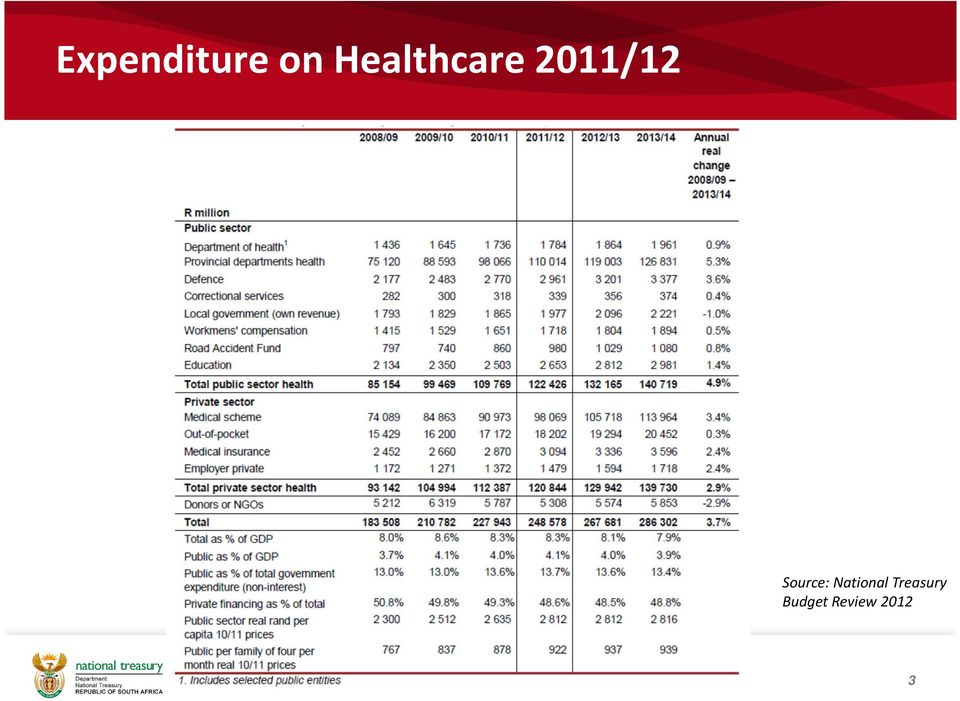
3 Expenditure on Healthcare 2011/12 Source: National Treasury Budget Review
4 NHI where are we? NHI Green Paper approved by Cabinet NDoHconference Lessons for South Africa Launch of 10 NHI district pilots NDoH release of NHI White Paper Aug 2011 Dec 2011 April Conditional grant for NHI : R 150m in 12/13, R300m in 13/14, R 450m in 14/15 NT release of NHI Financing Paper

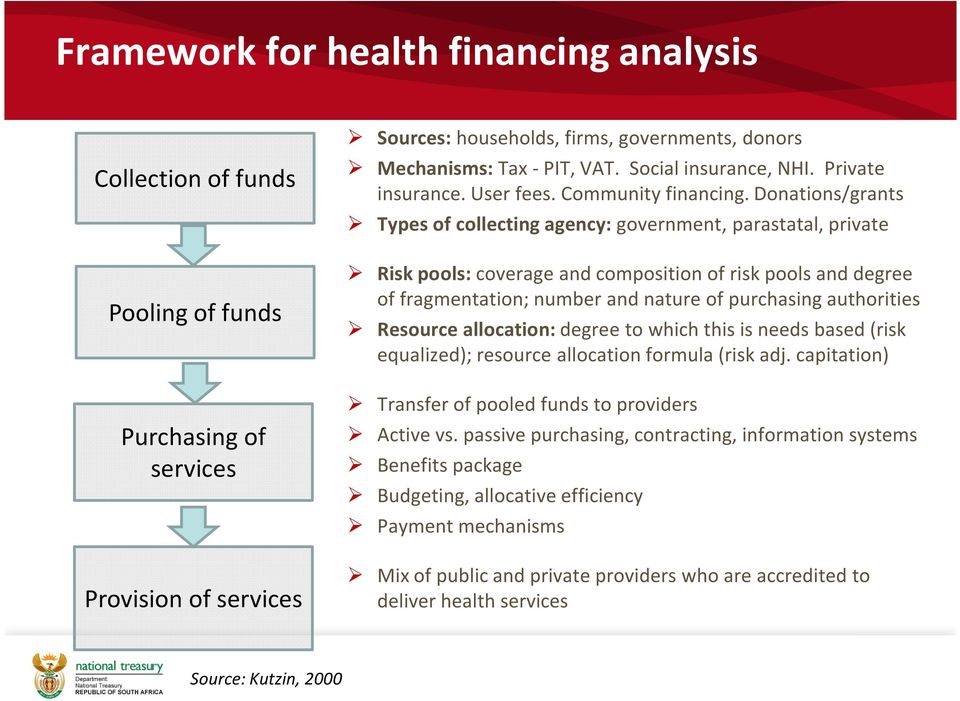
5 Framework for health financing analysis Collection of funds Pooling of funds Purchasing of services Provision of services Sources: households, firms, governments, donors Mechanisms: Tax -PIT, VAT. Social insurance, NHI. Private insurance. User fees. Community financing. Donations/grants Types of collecting agency: government, parastatal, private Risk pools: coverage and composition of risk pools and degree of fragmentation; number and nature of purchasing authorities Resource allocation: degree to which this is needs based (risk equalized); resource allocation formula (risk adj. capitation) Transfer of pooled funds to providers Active vs. passive purchasing, contracting, information systems Benefits package Budgeting, allocative efficiency Payment mechanisms Mix of public and private providers who are accredited to deliver health services Source: Kutzin, 2000
6 Health financing issues & questions While the Green Paper has many positive features Vision of broad, deep, equitable coverage Public single payer Purchaser-provider split Mixed public-private provision Primary care as foundation stone New regulatory bodies Phased transition many health financing questions remain Financing Mechanisms: How much public funding is needed? What mix of sources will be most equitable and sustainable? Governance of the fund:what type of NHI fund will be most efficient? How will the fund work with provinces and district pools? How might medical schemes evolve? Scope of Benefits: What level of services is affordable? How to set priorities? Contracts and Payment: Which forms of contracting and provider payment will control costs and drive quality?

7 REVENUE GENERATION & COLLECTION 7
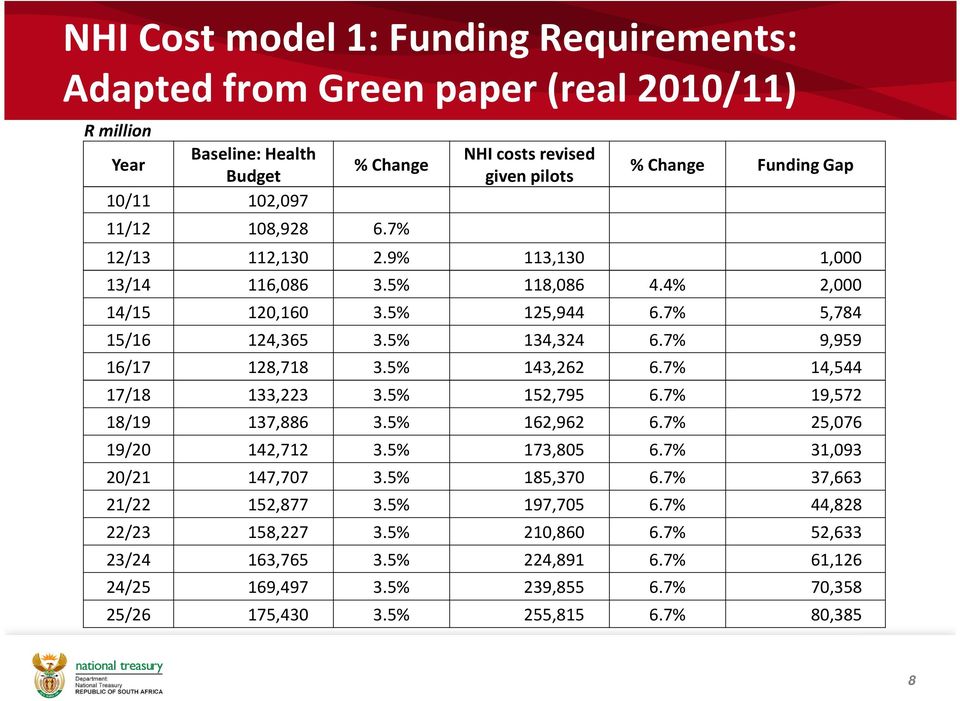
8 NHI Cost model 1: Funding Requirements: Adapted from Green paper (real 2010/11) R million Year Baseline: Health Budget 10/11 102,097 % Change 11/12 108, % NHI costs revised given pilots % Change Funding Gap 12/13 112, % 113,130 1,000 13/14 116, % 118, % 2,000 14/15 120, % 125, % 5,784 15/16 124, % 134, % 9,959 16/17 128, % 143, % 14,544 17/18 133, % 152, % 19,572 18/19 137, % 162, % 25,076 19/20 142, % 173, % 31,093 20/21 147, % 185, % 37,663 21/22 152, % 197, % 44,828 22/23 158, % 210, % 52,633 23/24 163, % 224, % 61,126 24/25 169, % 239, % 70,358 25/26 175, % 255, % 80,385 8
9 NHI Cost model 2 (McLeod) Table 5: Early cost model for NHI built up from medical scheme data* Cost in Rbn (2009 terms) of Benefit Package Offered by NHI Efficiency assumption Medical Scheme Prescribed Minimum Benefits (PMBs) Basic Benefits: PMBs+ Primary Care High Cost Benefits: PMBs+ all In-Hospital Core Benefits: PMBs+ Primary Care+ In- Hospital Fully Comprehensive: all healthcare benefits Medical schemes efficiency: 100% of cost Moderate improvement: 80% of cost Presumed public sector cost: 70% of cost Staff model efficiency: 50% of cost *Developed by McLeod based on analysis by McLeod, Grobler and Van der Berg 9

10 NHI Cost model (3) ASSA Table 7: Actuarial Society (ASSA) NHI cost model at full implementation (2025/26) Benefit Package Cost Less 30 per cent: efficiency savings and price reduction Comprehensive Total cost: R336bn Total cost: R235bn (Addition to baseline (Balance of funding: Prescribed minimum benefits (PMBs mainly hospital) Primary Health Care funding: R248bn) R148bn) R55bn) Total cost: R119bn Total cost: R86bn Balance of funding: Balance of funding: R59bn R26bn Total cost: R45bn Balance of funding: R23bn Total cost: R34bn Balance of funding: R12bn Further 30 per cent price reduction and supply side constraints Total cost: R143bn (Balance of funding: Same as 30 per cent price reduction scenario (Total cost: R86bn) Same as 30 per cent price reduction scenario (Total cost: R34bn) 10

11 Costing models Green Paper numbers Derived from utilisation trends by 5-yr age-group and unit costs. Piloting means costs will be lower in earlier years than presented in Green Paper. A revised scenario shows total costs in 2025 remain R255 billion (2010 rands) ier80b additional, but figures in early years rise more moderately The two other costing models show broadly similar results, but variation can be obtained by adopting different assumptions. What drives health care costs? Demographic changes over decades Medical inflation over long time periods Utilisationassumptions to what extent can these be influenced Unit costs: extent to which private sector is used Provider Payment methods Benefit package Supply side constraints 11

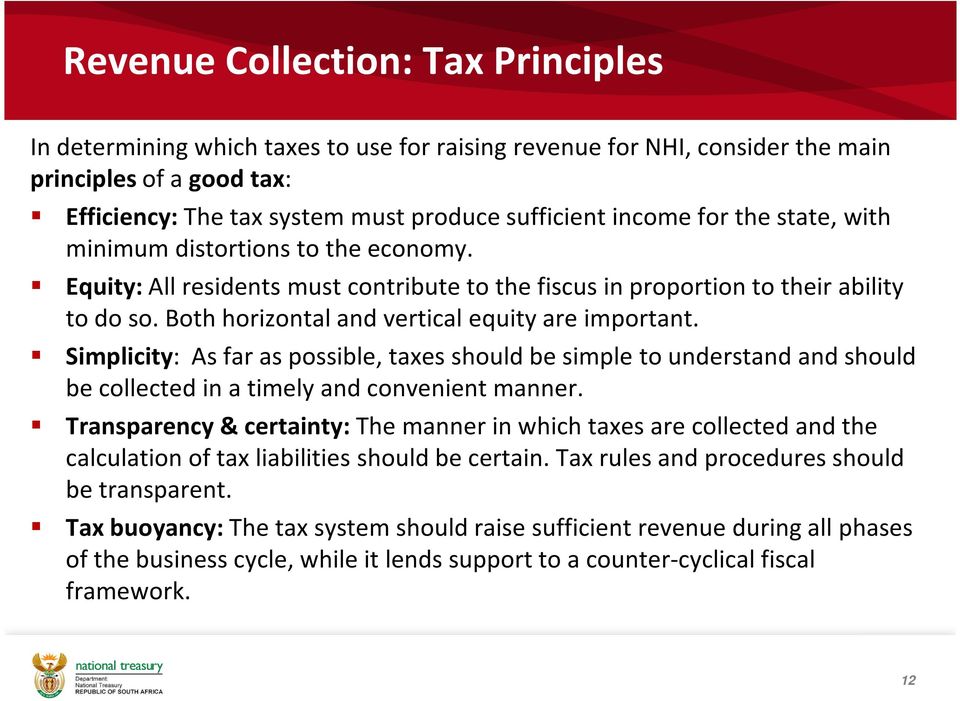
12 Revenue Collection: Tax Principles In determining which taxes to use for raising revenue for NHI, consider the main principles of a good tax: Efficiency: The tax system must produce sufficient income for the state, with minimum distortions to the economy. Equity: All residents must contribute to the fiscusin proportion to their ability to do so. Both horizontal and vertical equity are important. Simplicity: As far as possible, taxes should be simple to understand and should be collected in a timely and convenient manner. Transparency & certainty: The manner in which taxes are collected and the calculation of tax liabilities should be certain. Tax rules and procedures should be transparent. Tax buoyancy: The tax system should raise sufficient revenue during all phases of the business cycle, while it lends support to a counter-cyclical fiscal framework. 12
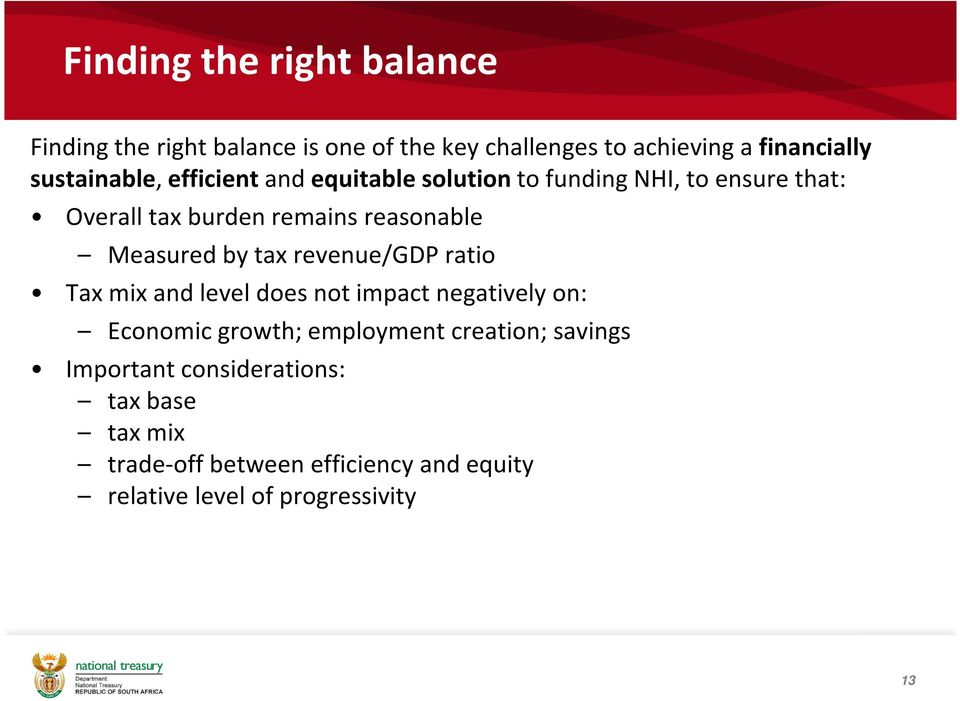
13 Finding the right balance Finding the right balance is one of the key challenges to achieving a financially sustainable, efficient and equitable solution to funding NHI, to ensure that: Overall tax burden remains reasonable Measured by tax revenue/gdp ratio Tax mix and level does not impact negatively on: Economic growth; employment creation; savings Important considerations: tax base tax mix trade-off between efficiency and equity relative level of progressivity 13
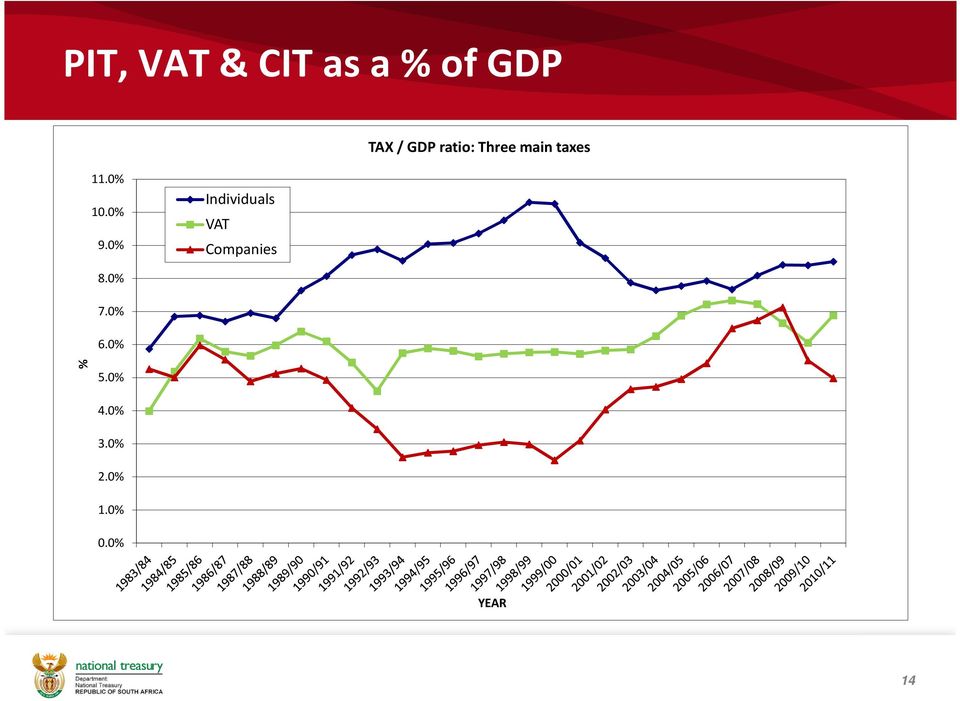
14 PIT, VAT & CIT as a % of GDP TAX / GDP ratio: Three main taxes 11.0% 10.0% 9.0% Individuals VAT Companies 8.0% 7.0% 6.0% % 5.0% 4.0% 3.0% 2.0% 1.0% 0.0% YEAR 14
15 Tax options under consideration Tax Surcharge on taxableincome: Personal IncomeTax (PIT) system is progressive, marginal tax rates increase -18% to 40%. Allows for relatively high tax threshold Payroll Taxes: Imposed on employer and/or employee Current payroll taxes:uif, Skills development levy (1%) Social security reforms in the pipeline Value added tax: Indirect tax Levied on transactions Pros & cons A flat surcharge on taxable income in addition to the PIT liability (similar to the Medicare levy in Australia) could be considered Administratively feasible Possible concern is the potential negative impact on savings Increases cost of employment and incentivizes movement to the informal economy Consider high unemployment rate in South Africa Recent global trends show a movement away from this Less distortionary, has a relatively broad base Does not impact on savings or employment negatively Impact on the poor how regressive and how to compensate forthis? SA s VAT rate 14%-compared to global average of 16.4% Used to fund NHIS in Ghana 15

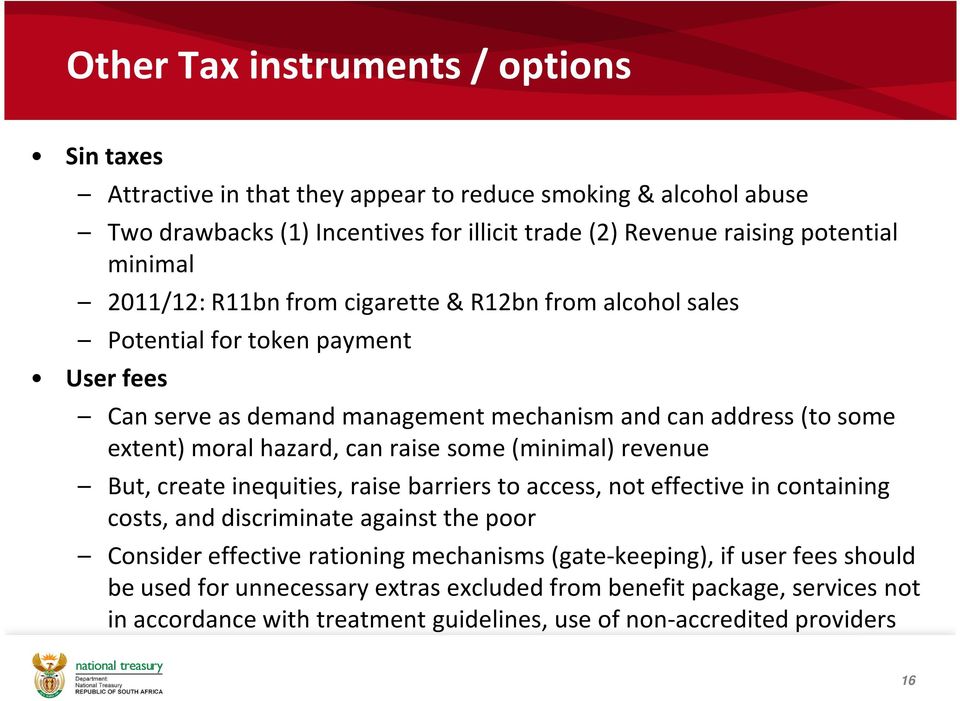
16 Other Tax instruments / options Sin taxes Attractive in that they appear to reduce smoking & alcohol abuse Two drawbacks (1) Incentives for illicit trade (2) Revenue raising potential minimal 2011/12: R11bn from cigarette & R12bn from alcohol sales Potential for token payment User fees Can serve as demand management mechanism and can address (to some extent) moral hazard, can raise some (minimal) revenue But, create inequities, raise barriers to access, not effective in containing costs, and discriminate against the poor Consider effective rationing mechanisms (gate-keeping), if user fees should be used for unnecessary extras excluded from benefit package, services not in accordance with treatment guidelines, use of non-accredited providers 16
17 POOLING RISK AND REVENUE 17

18 Pooling Green Paper proposes A single National Health Insurance Fund est. byend of first phase (yr5) with: - Provincial offices est. at end of 2nd phase (year 10) who will contract with: 47 integrated District Health Authorities, who will purchase PHC services Issues to address Role of public sector risk pools at subnational level - risk adjustment formula Legacy of existing pools challenges in transitioning to a comprehensive NHI Structure, staffing and governance New legislation (+ constitutional change?)required to establish the NHIF, and define the responsibilities of national and provincial spheres of government Degree of autonomywith rest of government (NHIF and NDOH), alignment of NHIF and existing provincial funding streams 18

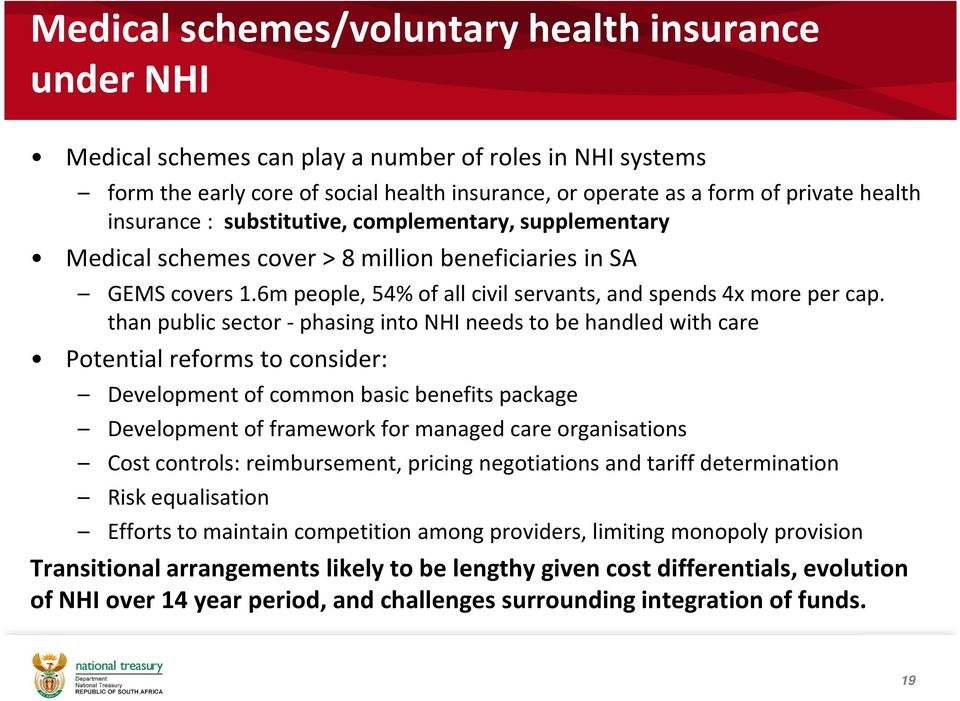
19 Medical schemes/voluntary health insurance under NHI Medical schemes can play a number of roles in NHI systems form the early core of social health insurance, or operate as a form of private health insurance : substitutive, complementary, supplementary Medical schemes cover > 8 million beneficiaries in SA GEMS covers 1.6m people, 54% of all civil servants, and spends 4x more per cap. than public sector -phasing into NHI needs to be handled with care Potential reforms to consider: Development of common basic benefits package Development of framework for managed care organisations Cost controls: reimbursement, pricing negotiations and tariff determination Risk equalisation Efforts to maintain competition among providers, limiting monopoly provision Transitional arrangements likely to be lengthy given cost differentials, evolution of NHI over 14 year period, and challenges surrounding integration of funds. 19
20 PURCHASING 20

21 Purchasing as outlined in Green Paper Coverage scope, breadth and depth Who? All South Africans and legal permanent residents. What? Uncertainty on benefits package, pricing, utilisationrates, etc Likely to be based on current services, progressively extended over time How much? Co-payments discouraged, but may exist for services not in accordance with treatment guidelines, not covered by benefit package, non-adherence to referral system, use of non-accredited providers Reimbursement mechanisms Hospitals:global budgets initially, then applying a case-mix and ultimately Diagnostic Related Groups (already used in the private sector) PHC providers: risk adjusted capitation, and possibly following improvements in information systems, linked to performance mechanism 21
22 Purchasing key issues to consider Active purchasing? Going beyond passive reimbursement of inputs Contracting/purchasing complex, skills need to be built up at district, provincial & national level Cost containment: Many countries that moved to NHI have seen rapid price and cost escalation, need to put into place controls: Modify demand: health promotion & prevention, incentiviseentry at lowest or most appropriate level Control the supply: gatekeeping, electronic patient records;modify provider behaviour through prospective payment mechanisms; price controls Methods for paying providers can have powerful effects on volume of health services, their price and cost to the NHIF Hospitals: currently no standard way to determine how a public hospital is funded and large differentials in funding hospitals of similar type and workload. PHC providers: need to develop and pilot new contracting and reimbursement options e.g. District contract with private GP. 22
23 Areas of purchasing to be piloted Need to build capacity in active purchasing what to buyin light of health needs and evidence on what works how to buy contractual mechanisms and payment systems from whom to buy in light of levels of quality & efficiency Strategies that could be examined in pilots Costing of package of services starting with PHC? Mechanisms for billing the NHIF (and medical schemes) for care rendered in public facilities Contracting mechanisms with private GPs, pharmacies and eventually hospitals Reimbursement mechanisms such as DRGs Different ways of delegating responsibility Results based financing? 23
24 PROVISION 24
25 Green paper on Provision Re-engineering of primary health care(phc): District-based clinical specialist support teams School-based primary health services Municipal ward-based primary health care agents Strengthening of public health services Infrastructure improvements for public sector hospitals Human resources: doctors and other scarce professionals Hospital management, financial management in provinces, supply chain systems Doubling numbers on ART from 1.7 m to 3.4 m, better detection of TB Mix of public and private provision Introduction of some private provision to widen scope and nature of services. Phased approach: starting with GP contracting, and pharmacies, over time hospitals Quality: Accreditation of facilities and establish Office of Health Standards & Compliance (OSC) 25
26 Provision key issues to consider Consider new models of public provision: e.g. Hospital Trusts in UK Mix of public and private provision to widen scope and nature of services, phased approach: starting with GP contracting, and pharmacies, over time hospitals. build on SA s strengths, harnessing quality care from all segments of the provider network challenge is that private services have typically been more expensive than public ones Quality: Accreditation of health facilities and establish of Office of Health Standards Compliance as an independent entity 26
27 Conclusion NHI will necessitate public funding in addition to the national health budget could reach R 80.4 billion (real 2010/11 rand) by 2025/26 The right balance between efficiency and equity needs to be found in deciding which tax instrument or combination of tax instruments is most appropriate A combination of VAT, payroll taxes, or a surcharge on taxable income is being considered Additional funds for NHI must be accompanied by measurable and sustained improvements in health services, including quality of care Pilots underway in 10 districts - Further analysis must be carried out on contracting and payment tools, and the mixed delivery platform including contracting with private GPs, pharmacies and eventually hospitals NT to release its financing discussion paper alongside White Paper. 27
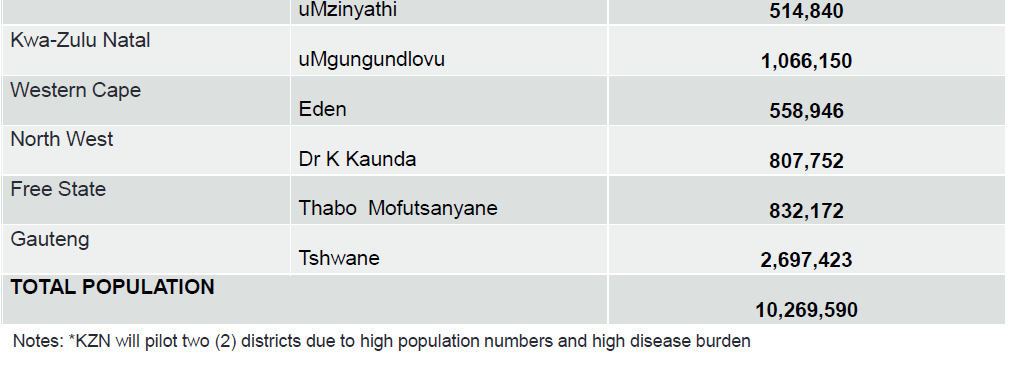

28 Annex (1): Pilot districts 28
South Africa s health system What are the gaps? Ronelle Burger
 South Africa s health system What are the gaps? Ronelle Burger Features of SA health system Quadruple burden of disease (Mayosi et al, 2009) communicable diseases e.g. tuberculosis and HIV/AIDS growing
COUNTRY CASE STUDY HEALTH INSURANCE IN SOUTH AFRICA. Prepared by: Vimbayi Mutyambizi Health Economics Unit, University of Cape Town
 COUNTRY CASE STUDY HEALTH INSURANCE IN SOUTH AFRICA Prepared by: Vimbayi Mutyambizi Health Economics Unit, University of Cape Town Preparation of this material was funded through a grant from the Rockefeller
SPEECH BY MINISTER OF FINANCE MR NHLANHLA NENE. South Africa s tax system and the tax reform agenda for 2015 and beyond BER Conference
 SPEECH BY MINISTER OF FINANCE MR NHLANHLA NENE South Africa s tax system and the tax reform agenda for 2015 and beyond BER Conference VENUE: Balalaika Hotel, Sandton DATE: 12 June 2015 Good morning and
Introduction of a national health insurance scheme
 International Social Security Association Meeting of Directors of Social Security Organizations in the English-speaking Caribbean Tortola, British Virgin Islands, 4-6 July 2005 Introduction of a national
2019 Healthcare That Works for All
 2019 Healthcare That Works for All This paper is one of a series describing what a decade of successful change in healthcare could look like in 2019. Each paper focuses on one aspect of healthcare. To
Private health care cost containment and supply-side regulation. CMS presentation to the Health Portfolio Committee 2014
 1 Private health care cost containment and supply-side regulation CMS presentation to the Health Portfolio Committee 2014 2 Contents Introduction Private hospital context Economic considerations Concentration
The National Development Plan 2030: Implications for Project Managers. 16 September 2013 Dr. Bridgette Gasa
 The National Development Plan 2030: Implications for Project Managers 16 September 2013 Dr. Bridgette Gasa NATIONAL DEVELOPMENT PLAN 2030 Our future - make it work Implications of the NDP for Project Managers
NATIONAL TREASURY STRATEGIC PLAN 2011/14
 NATIONAL TREASURY STRATEGIC PLAN 2011/14 PRESENTATION TO PARLIAMENTARY FINANCE COMMITTEES Presenter: Lungisa Fuzile Director General, National Treasury 31 May 2011 TREASURY AIMS AND OBJECTIVES Chapter
National Health Insurance Policy 2013
 National Health Insurance Policy 2013 1. Background The Interim Constitution of Nepal 2007 provides for free basic health care as a fundamental right of citizens. Accordingly, the Government of Nepal has
Building up Health Insurance: the Experience of Ghana
 Building up Health Insurance: the Experience of Ghana Dr. Caroline Jehu-Appiah Ghana Health Service 5 th April 2011, Basel Presentation outline Background Achievements Challenges Success factors Way forward
NATIONAL BUDGET 2012/13
 NATIONAL BUDGET 2012/13 On 22 February 2012 the Finance Minister, Pravin Gordhan delivered his National Budget Speech and announced the tax proposals for the forthcoming year as well as proposals which
Public and private health insurance: where to mark to boundaries? June 16, 2009 Kranjska Gora, Slovenia Valérie Paris - OECD
 Public and private health insurance: where to mark to boundaries? June 16, 2009 Kranjska Gora, Slovenia Valérie Paris - OECD 1 Outline of the presentation Respective roles of public and private funding
Private Health Insurance Options in Egypt Discussion with EISA Chairman and senior staff
 Private Health Insurance Options in Egypt Discussion with EISA Chairman and senior staff Ibrahim Shehata April 27, 2006 Background Health expenditure is dominated by household direct out-ofpocket payments
11 August 2014. Review of Australia s Welfare System CANBERRA ACT 2600. Dear Sir/Madam. Welfare Review Submission
 11 August 2014 Review of Australia s Welfare System CANBERRA ACT 2600 Dear Sir/Madam Welfare Review Submission The Financial Services Council (FSC) represents Australia's retail and wholesale funds management
Chapter 11 SUPPLEMENTARY FINANCING OPTION (4) VOLUNTARY PRIVATE HEALTH INSURANCE. Voluntary Private Health Insurance as Supplementary Financing
 Chapter 11 SUPPLEMENTARY FINANCING OPTION (4) VOLUNTARY PRIVATE HEALTH INSURANCE Voluntary Private Health Insurance as Supplementary Financing 11.1 Voluntary private health insurance includes both employer
PROPOSED MECHANISMS FOR FINANCING HEALTHCARE FOR THE POOR.
 PROPOSED MECHANISMS FOR FINANCING HEALTHCARE FOR THE POOR. Concept Summary Aug 2014 Insight Health Advisors Dr. Gitonga N.R, Prof. G. Mwabu, C. Otieno. PURPOSE OF CONCEPT Propose a mechanism for mobilizing
Actuaries Institute submission to the Private Health Insurance Review
 7 December 2015 The Hon Sussan Ley MP Minister for Health Parliament House CANBERRA ACT 2600 Email: [email protected] Dear Minister Actuaries Institute submission to the Private Health
Public / private mix in health care financing
 Public / private mix in health care financing Dominique Polton Director of strategy, research and statistics National Health Insurance, France Couverture Public / private mix in health care financing 1.
Harmonization of Health Insurance Schemes in China
 Harmonization of Health Insurance Schemes in China Hai Fang Professor of Health Economics China Center for Health Development Studies Peking University China Presentation at the First National Conference
1. The Council for Medical Schemes
 MediKredit Integrated Healthcare Solutions (Pty) Ltd Reg No : 1995/001794/07 132 Jan Smuts Ave, Parkwood, Johannesburg, 2193 P O Box 692, Parklands, 2121 Head Office : Johannesburg Switchboard: Telkom:
COUNTRY CASE STUDIES TAX AND INSURANCE FUNDING FOR HEALTH SYSTEMS FACILITATOR S NOTES. Prepared by: Health Economics Unit, University of Cape Town
 COUNTRY CASE STUDIES TAX AND INSURANCE FUNDING FOR HEALTH SYSTEMS FACILITATOR S NOTES Prepared by: Health Economics Unit, University of Cape Town Preparation of this material was funded through a grant
How To Understand The Growth In Private Health Insurance
 COMPETITION IN THE AUSTRALIAN PRIVATE HEALTH INSURANCE MARKET Page 1 of 11 1. To what extent has the development of different markets in the various states had an impact on competition? The development
CONVERSION OF MEDICAL DEDUCTIONS TO MEDICAL TAX CREDITS TAX POLICY DISCUSSION DOCUMENT FOR PUBLIC COMMENT NATIONAL TREASURY
 CONVERSION OF MEDICAL DEDUCTIONS TO MEDICAL TAX CREDITS TAX POLICY DISCUSSION DOCUMENT FOR PUBLIC COMMENT NATIONAL TREASURY 17 June 2011 EXECUTIVE SUMMARY This discussion document is published for public
Briefing on the Road Accident Benefit Scheme [RABS] Select Committee on Public Services, National Council of Provinces
![Briefing on the Road Accident Benefit Scheme [RABS] Select Committee on Public Services, National Council of Provinces](/thumbs/25/6485135.jpg "Briefing on the Road Accident Benefit Scheme [RABS] Select Committee on Public Services, National Council of Provinces") Briefing on the Road Accident Benefit Scheme [RABS] Select Committee on Public Services, National Council of Provinces 28 February 2012 1 Introduction To brief the Select Committee on Public Services on
Briefing on the Road Accident Benefit Scheme [RABS] Select Committee on Public Services, National Council of Provinces 28 February 2012 1 Introduction To brief the Select Committee on Public Services on
LONG-TERM FINANCIAL PLAN POLICY. Budgets FINANCE DEPARTMENT. City of Cape Town
 ANNEXURE 14 LONG-TERM FINANCIAL PLAN POLICY Budgets FINANCE DEPARTMENT City of Cape Town 1 TABLE OF CONTENTS 1. DEFINITIONS AND ABBREVIATIONS... 3 2. INTRODUCTION... 4 3. PROBLEM STATEMENT... 4 4. PURPOSE...
Private Health Insurance in OECD Countries
 1 Private Health Insurance in OECD Countries Francesca Colombo & Nicole Tapay http://www.oecd.org/health click on OECD Health Project, then on Private Health Insurance Purpose of the Study Assess the role
Background Briefing. Hungary s Healthcare System
 Background Briefing Hungary s Healthcare System By Shannon C. Ferguson and Ben Irvine (2003) In the aftermath of communist rule, Hungary transformed its healthcare system from centralised Semashko state
Legislative Council Panel on Health Services Subcommittee on Health Protection Scheme
 LC Paper No. CB(2)1360/11-12(01) For discussion on 19 March 2012 Legislative Council Panel on Health Services Subcommittee on Health Protection Scheme Roles of Public Funding and Health Insurance in Financing
Social or National Health Insurance
 Authors: Di McIntyre i Alex van den Heever ii 5 Social or National Health Insurance Abstract There has been an ongoing debate for almost two decades about the possibility of introducing some form of social
Chapter 13: Finance CHAPTER 13. General Financial Matters
 CHAPTER 13 FINANCE General Financial Matters National Revenue Fund 213. (1) There is a National Revenue Fund into which all money received by the national government must be paid, except money reasonably
Comparative Health Care Systems. Folland et al Chapters 22
 Comparative Health Care Systems. Folland et al Chapters 22 Chris Auld Economics 317 March 23, 2012 Health Care Systems. There are many different forms of health care delivery in place in different countries.
More changes to private health insurance Australia
 More changes to private health insurance Australia Country: Australia Partner Institute: Centre for Health, Economics Research and Evaluation (CHERE), University of Technology, Sydney Survey no: (12) 2008
THE MARKET INQUIRY INTO THE PRIVATE HEALTH CARE SECTOR
 THE MARKET INQUIRY INTO THE PRIVATE HEALTH CARE SECTOR Stakeholders Submissions to the Competition Commission on the: 1. Draft Statement of Issues. 2. Draft Guidelines for Participation. SECTION27 welcomes
EXECUTIVE SUMMARY THE SOUTH AFRICAN MEDICAL ASSOCIATION S. Submission to the. Competition Commission Market Inquiry into Private Healthcare
 EXECUTIVE SUMMARY of THE SOUTH AFRICAN MEDICAL ASSOCIATION S Submission to the Competition Commission Market Inquiry into Private Healthcare The Functions and Role of The South African Medical Association
member of from diagnosis to cure Eucomed Six Key Principles for the Efficient and Sustainable Funding & Reimbursement of Medical Devices
 Eucomed Six Key Principles for the Efficient and Sustainable Funding & Reimbursement of Medical Devices Contents Executive Summary 2 Introduction 3 1. Transparency 4 2. Predictability & Consistency 5 3.
Use of the Coat of Arms The terms under which the Coat of Arms can be used are set out on the It s an Honour website (see www.itsanhonour.gov.
 Health 13 May 2014 Commonwealth of Australia 2014 ISBN 978-0-642-74982-6 This publication is available for your use under a Creative Commons Attribution 3.0 Australia licence, with the exception of the
Introduction to Business Planning for Microinsurance
 Introduction to Business Planning for Microinsurance Objectives Introduce the MI Business Planning Module Create awareness of the value of preparing and having a business plan Outline the key components
National Health. vocabulary for public
 National Health Insurance: providing a vocabulary for public engagement 15 Author: Di McIntyrei A key area of contention has been whether a universal system is affordable or not. It is not the universality
Assessing and Determining Capacity challenges in Health. Dr Lilian Dudley Health Systems Trust 13 October 2005
 Assessing and Determining Capacity challenges in Health Dr Lilian Dudley Health Systems Trust 13 October 2005 Definitions Human resources for health (HRH) persons engaged in any capacity in the production
Regulation impact statement Unincorporated small business tax discount
 Regulation impact statement Unincorporated small business tax discount Contents Background... 1 1. The problem... 1 2. Case for government action/objective of reform... 2 3. Policy options... 3 Option
National Disability Insurance Scheme
 A Framework for Information, Linkages and Capacity Building Overview This paper sets out policy parameters for Information, Linkages and Capacity Building (ILC), formerly known as Tier 2, in the National
Re: Inquiry into the Private Health Insurance Legislation Amendment (Base Premium) Bill 2013
 Committee Secretary Senate Standing Committees on Community Affairs PO Box 6100 Parliament House Canberra ACT 2600 Email: [email protected] Dear Dr Holland Re: Inquiry into the Private Health
Health Economics. University of Linz & Information, health insurance and compulsory coverage. Gerald J. Pruckner. Lecture Notes, Summer Term 2010
 Health Economics Information, health insurance and compulsory coverage University of Linz & Gerald J. Pruckner Lecture Notes, Summer Term 2010 Gerald J. Pruckner Information 1 / 19 Asymmetric information
CAPITAL CHARGE RATE AND CHANGES TO THE INCENTIVE REGIME
 DH 6-2-1 21 December 2000 Treasury Circular 2000/16 Unrestricted Distribution Chief Executives Directors of Finance/Chief Accountants Contact for Enquiries: Treasury Vote Teams CAPITAL CHARGE RATE AND
Assessing equity in the distribution of community pharmacies in South Africa in preparation for the National Health Insurance scheme
 Assessing equity in the distribution of community pharmacies in South Africa in preparation for the National Health Insurance scheme Ward KL, Sanders D, Leng HMJ and Pollock, A OUTLINE Introduction Methods
Premium Reform in NSW: Past, Present & Future. Rob Thomson A/CEO, WorkCover NSW
 Premium Reform in NSW: Past, Present & Future Rob Thomson A/CEO, WorkCover NSW 1 Overview Premium models: purpose and key principles Challenges in premium design The NSW experience 2005 reform initiative
Social security and national health insurance
 6 Social security and national health insurance Overview T he global economic crisis has affected living standards and employment levels in many countries, but in different ways. Where social security
SOL PLAATJE LOCAL MUNICIPALITY
 SOL PLAATJE LOCAL MUNICIPALITY LONG TERM FINANCIAL PLANNING POLICY 1 P a g e TABLE OF CONTENTS TABLE OF CONTENTS... A 1. INTRODUCTION...1 2. PURPOSE OF THIS DOCUMENT...1 3. DEFINITIONS... 2 4. OBJECTIVES...
GAO PATIENT PROTECTION AND AFFORDABLE CARE ACT. Effect on Long-Term Federal Budget Outlook Largely Depends on Whether Cost Containment Sustained
 GAO United States Government Accountability Office Report to the Ranking Member, Committee on the Budget, U.S. Senate January 2013 PATIENT PROTECTION AND AFFORDABLE CARE ACT Effect on Long-Term Federal
SUBMISSION TO THE SOUTH AUSTRALIAN STATE TAX REVIEW
 SUBMISSION TO THE SOUTH AUSTRALIAN STATE TAX REVIEW 1 April 2015 INTRODUCTION The Insurance Council of Australia (ICA) welcomes the opportunity of providing a submission to the Inquiry into the South Australian
COMMENTS ON THE NATIONAL HEALTH INSURANCE POLICY PAPER OF 12 AUGUST 2011 COUNCIL FOR MEDICAL SCHEMES 19 JANUARY 2012
 COMMENTS ON THE NATIONAL HEALTH INSURANCE POLICY PAPER OF 12 AUGUST 2011 COUNCIL FOR MEDICAL SCHEMES 19 JANUARY 2012 P a g e ii Foreword It is with pleasure, excitement, and anticipation that the Council
The National Health Insurance Scheme in Ghana: Best Practices. Regional Conference on Social Health Protection in East African Community
 The National Health Insurance Scheme in Ghana: Best Practices Regional Conference on Social Health Protection in East African Community Dr. Lydia Dsane-Selby Director, Clinical Audit National Health Insurance
Private Health Insurance in OECD Countries
 Private Health Insurance in OECD Countries Health Insurance for an Expanded Europe: New Public-Private Options The Prague Symposium 2004 Nicole Tapay(Novartis)* *Based on work performed under OECD private
Table Of Contents. iii
 GASB Statement 45 Table Of Contents Overview...1 Compliance with GASB 45...2 GASB 45 Compared to Pension Requirements...2 Retiree Health Benefits: Potential Ramifications of GASB 45...3 Addressing Retiree
[email protected] 25/02/2010 11:49 Subject: Ghana: where 'successful health insurance' is neither successful nor in fact health insurance
 [email protected] 25/02/2010 11:49 Subject: Ghana: where 'successful health insurance' is neither successful nor in fact health insurance Dear all In Oxfam s continuing efforts to promote discussion
Healthcare Reform: Opportunity for Public-Private-Partnership
 Healthcare Reform: Opportunity for Public-Private-Partnership Sam Yeung Munich Re Session Number: MBR7 Joint IACA, IAAHS and PBSS Colloquium in Hong Kong www.actuaries.org/hongkong2012/ HEALTHCARE REFORM:
PENSIONS POLICY INSTITUTE. Tax relief for pension saving in the UK
 Tax relief for pension saving in the UK This report is sponsored by Age UK, the Institute and Faculty of Actuaries, Partnership and the TUC. The PPI is grateful for the support of the following sponsors
Econ 101: Principles of Microeconomics
 Econ 101: Principles of Microeconomics Chapter 7: Taxes Fall 2010 Herriges (ISU) Ch. 7: Taxes Fall 2010 1 / 25 Outline 1 The Excise Tax 2 The Benefits and Costs of Taxation 3 Tax Fairness versus Tax Efficiency
Long Term Financial Planning
 Long Term Financial Planning Framework and Guidelines Long Term Financial Planning Framework and Guidelines for Western Australian Local Governments p1. Contents Foreword 4 1. Introduction 7 2. Purpose
KEY PERFORMANCE INFORMATION CONCEPTS
 Chapter 3 KEY PERFORMANCE INFORMATION CONCEPTS Performance information needs to be structured to demonstrate clearly how government uses available resources to deliver on its mandate. 3.1 Inputs, activities,
TOWARDS UNIVERSAL HEALTHCARE COVERAGE LESSONS FROM THE HEALTH EQUITY & FINANCIAL PROTECTION IN ASIA PROJECT
 TOWARDS UNIVERSAL HEALTHCARE COVERAGE LESSONS FROM THE HEALTH EQUITY & FINANCIAL PROTECTION IN ASIA PROJECT Eddy van Doorslaer Institute for Health Policy & Management & School of Economics Erasmus University
Framework for Managing Programme Performance Information
 Framework for Managing Programme Performance Information Published by the National Treasury Private Bag X115 Pretoria 0001 South Africa Tel: +27 12 315 5948 Fax: +27 12 315 5126 The Framework for Managing
The Healthcare market in Brazil
 www.pwc.com.br The Healthcare market in Brazil Brazilian Healthcare market: one of the most promising and attractive in the world Context Fifth largest country in area and population, with 8.51 million
Chapter 7 Acute Care Inpatient/Outpatient Hospital Services
 Chapter 7: Acute Care Inpatient/ Outpatient Hospital Services Executive Summary Description Acute care hospitals are the largest group of enrolled hospital providers. Kansas Medicaid has 144 acute care
Demand for Health Insurance
 Demand for Health Insurance Demand for Health Insurance is principally derived from the uncertainty or randomness with which illnesses befall individuals. Consequently, the derived demand for health insurance
SUPPLEMENTARY GREEN BOOK GUIDANCE
 SUPPLEMENTARY GREEN BOOK GUIDANCE ADJUSTING FOR TAXATION IN PFI vs PSC COMPARISONS 1 INTRODUCTION 1.1 This guidance looks at the differential tax receipts that arise from the use of the Private Finance
PRESENTATION TO THE HEALTH MARKET INQUIRY
 PRESENTATION TO THE HEALTH MARKET INQUIRY 19 May 2016 1 Agenda Presenters Dr A Ramasia (Principal Officer) Mr R Cowlin (Trustee) Mr G van Emmenis ( Chief Operations Officer) Historical Overview and Scheme
Current challenges in delivering social security health insurance
 International Social Security Association Afric ISSA Meeting of Directors of Social Security Organizations in Asia and the Pacific Seoul, Republic of Korea, 9-11 November 2005 Current challenges in delivering
PPIAF Assistance in Afghanistan
 August 2012 PPIAF Assistance in Afghanistan Emerging from a decade of war, massive support from various development partners has been pouring in over the last few years to help rebuild Afghanistan. PPIAF
Comparison of Healthcare Systems in Selected Economies Part I
 APPENDIX D COMPARISON WITH OVERSEAS ECONOMIES HEALTHCARE FINANCING ARRANGEMENTS Table D.1 Comparison of Healthcare Systems in Selected Economies Part I Predominant funding source Hong Kong Australia Canada
Costs of Maternal Health Care Serv ices in Masaka District, Uganda. Executive Summary. Special Initiatives Report 16
 Costs of Maternal Health Care Serv ices in Masaka District, Uganda Special Initiatives Report 16 Cambridge, MA Lexington, MA Hadley, MA Bethesda, MD Washington, DC Chicago, IL Cairo, Egypt Johannesburg,
SUBMISSION TO THE SENATE INQUIRY INTO OUT-OF- POCKET COSTS IN AUSTRALIAN HEALTHCARE. Prepared by National Policy Office
 SUBMISSION TO THE SENATE INQUIRY INTO OUT-OF- POCKET COSTS IN AUSTRALIAN HEALTHCARE Prepared by National Policy Office May 2014 COTA Australia Authorised by: Ian Yates AM Chief Executive [email protected]
Adapting Pharmaceutical Reimbursement Policies to Manage Spending on High-Cost Drugs
 Adapting Pharmaceutical Reimbursement Policies to Manage Spending on High-Cost Drugs Elizabeth Docteur, Principal, Elizabeth Docteur Consulting Ruth Lopert, Deputy Director, Pharmaceutical Policy & Strategy
Accountable Care Organization Refinement Brief
 Accountable Care Organization Refinement Brief The participants in the Medicare Shared Savings Program (MSSP), the Physician Group Practice Transition Demonstration (PGP-TD), and the Pioneer Accountable
25*$1,6$7,21)25(&2120,&&223(5$7,21$1''(9(/230(17
 25*$1,6$7,21)25(&2120,&&223(5$7,21$1''(9(/230(17 7D[3ROLF\5HIRUPVLQ,WDO\ &(175()257$;32/,&
UNECE PPP Healthcare Standard
 INTERNATIONAL SPECIALIST CENTRE OF EXCELLENCE ON PPPs IN HEALTH MANILA, PHILIPPINES UNECE PPP Healthcare Standard Questions on lessons learned in the development of Public-Private Partnership ( PPP ) programmes
Executive Summary. Model Structure. General Economic Environment and Assumptions
 Executive Summary The (LTFP) report is an update from the preliminary report presented in January 2009 and reflects the Mayor s Proposed Budget for Fiscal Year 2010 and Fiscal Year 2011. Details of the
Consensus Principles for Health Care Delivery
 Consensus Principles for Health Care Delivery TABLE OF CONTENTS Consensus Principle for Healthcare Delivery... 3 Responsibilities of Various Parties to the Health Care System... 4 Individuals and Families...
STATE CONSIDERATIONS ON ADOPTING HEALTH REFORM S BASIC HEALTH OPTION Federal Guidance Needed for States to Fully Assess Option by January Angeles
 820 First Street NE, Suite 510 Washington, DC 20002 Tel: 202-408-1080 Fax: 202-408-1056 [email protected] www.cbpp.org March 13, 2012 STATE CONSIDERATIONS ON ADOPTING HEALTH REFORM S BASIC HEALTH OPTION
Swe den Structure, delive ry, administration He althcare Financing Me chanisms and Health Expenditures Quality of Bene fits, C hoice, Access
 Sweden Single payer, universal healthcare system, with 21 county councils as the primary payer (reimburser) Administration of healthcare plan is decentralized in the hands of the county councils Central
HOSPITAL SUBSECTOR ANALYSIS
 HOSPITAL SUBSECTOR ANALYSIS Fourth Health Sector Development Project (RRP MON 41243) A. Introduction 1. The health status of the people of Mongolia has generally improved over the years, and significant
CGT main residence exemption Why removing the tax concession for homes over $2 million is good for the budget, the economy and fairness
 CGT main residence exemption Why removing the tax concession for homes over $2 million is good for the budget, the economy and fairness Policy Brief Matt Grudnoff January 2016 i ABOUT THE AUSTRALIA INSTITUTE