
Child Care Human Resources Sector Council
|
|
|
- Delilah Hall
- 10 years ago
- Views:
Transcription
1 The future child care workforce: perspectives of Early Childhood Education students Child Care Human Resources Sector Council Prepared for the Child Care Human Resources Sector Council Authors: Jane Beach & Bozica Costigliola
2 2 The future child care workforce: perspectives of Early Childhood Education students What views do early childhood education (ECE) students have about child care, their training programs, and their work prospects after graduation? To find out, the labour market update (LMU) research team conducted: a survey in May and June 2003 of 527 students close to graduation in 10 post-secondary ECE programs; 1 focus groups in spring to late fall 2003 with students from five colleges; and key informant interviews in summer and fall 2003 with several ECE college faculty. The ECE programs and focus groups were chosen to reflect geographic diversity and different delivery (see table below). Length of program varied from a one-year certificate program at Red Deer College to a three-year program at the two Colleges d enseignement general et professionnel (CEGEPs). Colleges Participating in the LMU Student Survey Number Number of Students College of Students by Type of Program in Survey Regular Daytime Continuing Distance Program Education Education College of the North Atlantic, NL (CNA) CEGEP Sainte-Foy, QC (CSF) CEGEP Jonquière,QC (CJ) Université du Québec à Montréal, QC (UQM) George Brown, ON (GBC) Red River College, MB (RRC) Grant MacEwan College, AB (GMc) Red Deer College, AB (RDC) University College of the Fraser Valley, BC (UCFV) Vancouver Community College, BC (VCC) Who are the students? ECE students have a wide variety of backgrounds. For example, 9% of students at CEGEP Sainte-Foy had a prior post-secondary certificate, diploma, or degree, compared to 74% at Université du Québec à Montréal. Almost 70% of students in the continuing education program at Vancouver Community College were born outside of Canada, compared to 9% at the University College of the Fraser Valley, just 75 kilometres away. 1 Approximately 135 post-secondary education institutions deliver ECE certificate, diploma, degree and related programs through publicly funded community colleges, CEGEPs, universities, and private institutions.

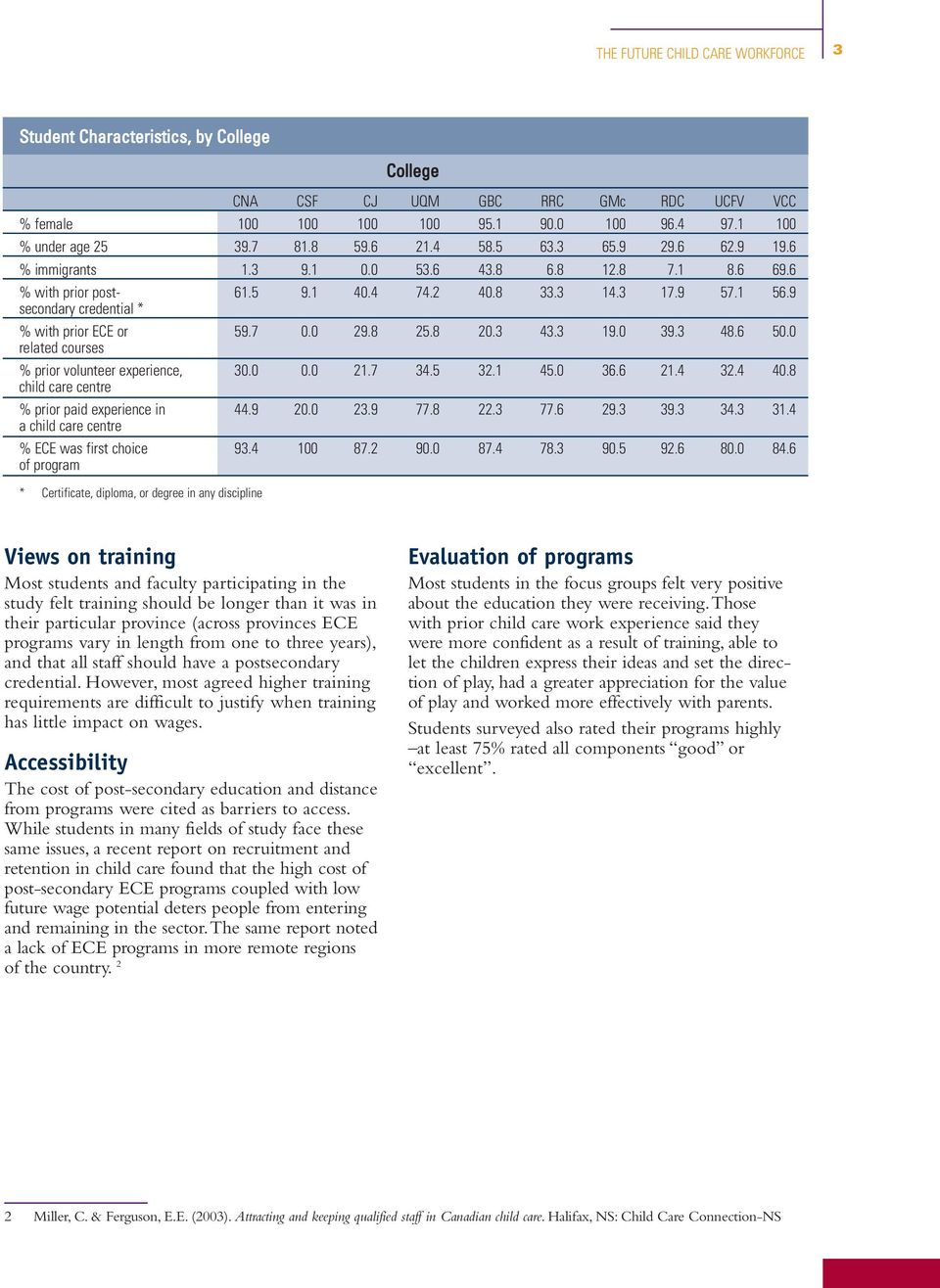
3 THE FUTURE CHILD CARE WORKFORCE 3 Student Characteristics, by College College CNA CSF CJ UQM GBC RRC GMc RDC UCFV VCC % female % under age % immigrants % with prior post secondary credential * % with prior ECE or related courses % prior volunteer experience, child care centre % prior paid experience in a child care centre % ECE was first choice of program * Certificate, diploma, or degree in any discipline Views on training Most students and faculty participating in the study felt training should be longer than it was in their particular province (across provinces ECE programs vary in length from one to three years), and that all staff should have a postsecondary credential. However, most agreed higher training requirements are difficult to justify when training has little impact on wages. Accessibility The cost of post-secondary education and distance from programs were cited as barriers to access. While students in many fields of study face these same issues, a recent report on recruitment and retention in child care found that the high cost of post-secondary ECE programs coupled with low future wage potential deters people from entering and remaining in the sector.the same report noted a lack of ECE programs in more remote regions of the country. 2 Evaluation of programs Most students in the focus groups felt very positive about the education they were receiving.those with prior child care work experience said they were more confident as a result of training, able to let the children express their ideas and set the direction of play, had a greater appreciation for the value of play and worked more effectively with parents. Students surveyed also rated their programs highly at least 75% rated all components good or excellent. 2 Miller, C. & Ferguson, E.E. (2003). Attracting and keeping qualified staff in Canadian child care. Halifax, NS: Child Care Connection-NS
4 4 Student Ratings of Program Elements Overall worth of the program Practicum placements Fairness of the evaluations Opportunities to get help between classes Opportunities to work on new skills Amount of work required Relevance of the course content 0% 10% 20% 30% 40% 50% 60% 70% 80% 90% 100% PERCENTAGE Poor Fair Good Excellent Most likely to rate the overall worth of their program as excellent 3 were students who: Had enrolled in an ECE program as preparation for being a parent. Planned on enrolling in another ECE program after graduation. Had prior ECE credit courses. Immigrated to Canada before Had enrolled in an ECE program as a first step to an education degree. Least likely to rate the overall worth of their program as excellent were students who were: Not accepted at their first choice of program. Studying through continuing education. Enrolled in an ECE program mainly to improve their employment choices. 3 All trends reported in this document are shown as individual characteristics. It is beyond the scope of the background document to show the relationship between and among characteristics in any comprehensive way.

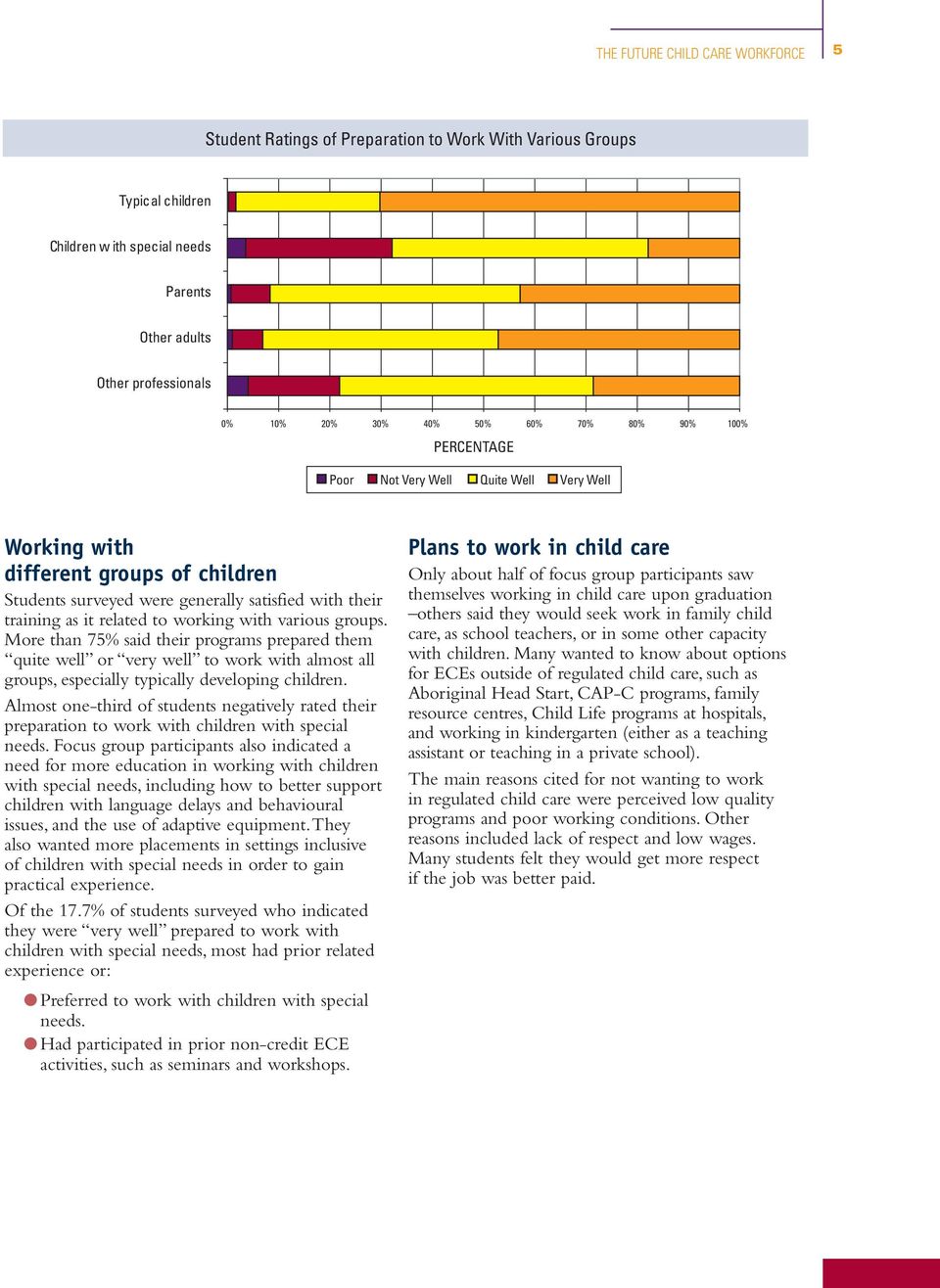
5 THE FUTURE CHILD CARE WORKFORCE 5 Student Ratings of Preparation to Work With Various Groups Typical children Children w ith special needs Parents Other adults Other professionals 0% 10% 20% 30% 40% 50% 60% 70% 80% 90% 100% PERCENTAGE Poor Not Very Well Quite Well Very Well Working with different groups of children Students surveyed were generally satisfied with their training as it related to working with various groups. More than 75% said their programs prepared them quite well or very well to work with almost all groups, especially typically developing children. Almost one-third of students negatively rated their preparation to work with children with special needs. Focus group participants also indicated a need for more education in working with children with special needs, including how to better support children with language delays and behavioural issues, and the use of adaptive equipment.they also wanted more placements in settings inclusive of children with special needs in order to gain practical experience. Of the 17.7% of students surveyed who indicated they were very well prepared to work with children with special needs, most had prior related experience or: Preferred to work with children with special needs. Had participated in prior non-credit ECE activities, such as seminars and workshops. Plans to work in child care Only about half of focus group participants saw themselves working in child care upon graduation others said they would seek work in family child care, as school teachers, or in some other capacity with children. Many wanted to know about options for ECEs outside of regulated child care, such as Aboriginal Head Start, CAP-C programs, family resource centres, Child Life programs at hospitals, and working in kindergarten (either as a teaching assistant or teaching in a private school). The main reasons cited for not wanting to work in regulated child care were perceived low quality programs and poor working conditions. Other reasons included lack of respect and low wages. Many students felt they would get more respect if the job was better paid.
6 6 Field (practicum) placements had a major impact on whether younger students and others with no previous child care work experience would consider a future in the sector. Some students had very positive placement experiences.they felt supported by the centre staff and believed they were contributing to the development of the children. However, most expressed concerns about their experiences, including: Poor physical and unclean spaces, especially in infant programs. Operators cutting corners on staffing, supplies and food due to lack of adequate resources. Staff burn out and fatigue from long hours and the demands of the job. Inconsistent approaches and expectations between college faculty and supervising staff at the centre. For example, students were often concerned about the emphasis on school readiness in their field placements as opposed to the whole development of child and a playbased approach. Not being included in staff meetings, thereby gaining little practical experience in addressing issues effectively. Not having the respect of school personnel or being allowed to use common staff areas in child care centres located in schools. The ability to speak a second language not being valued. Perceived availability of jobs Many focus group students said most child care jobs available to new graduates were part-time or short-term contracts without benefits such as paid vacation or any job security. Others said jobs were only available in poorer quality centres where turnover was high. In the survey, 31% expected it would be somewhat difficult or very difficult to find an ECE-related job after graduating. ECE and Teaching A significant number of students surveyed planned to use their ECE program as a steppingstone to becoming teachers: 22% decided to enrol in ECE at least in part because it is a good first step to an education degree ; 8% said this was the main reason for enrolling in ECE. 17% planned to be teaching in the education system in the next five years. Most likely to say they hoped to teach in the education system were students who: Preferred to work with school-age children. Had volunteer experience in an after-school care program. Plans to stay in child care According to the National Graduate Survey, only 55% of ECE students graduating in 1995 were working as child care educators and assistants just two years later; by 2000, this had dropped to 43%. The LMU survey echoes this disturbing trend overall only 55% of the ECE students planned to work in regulated child care in five years.

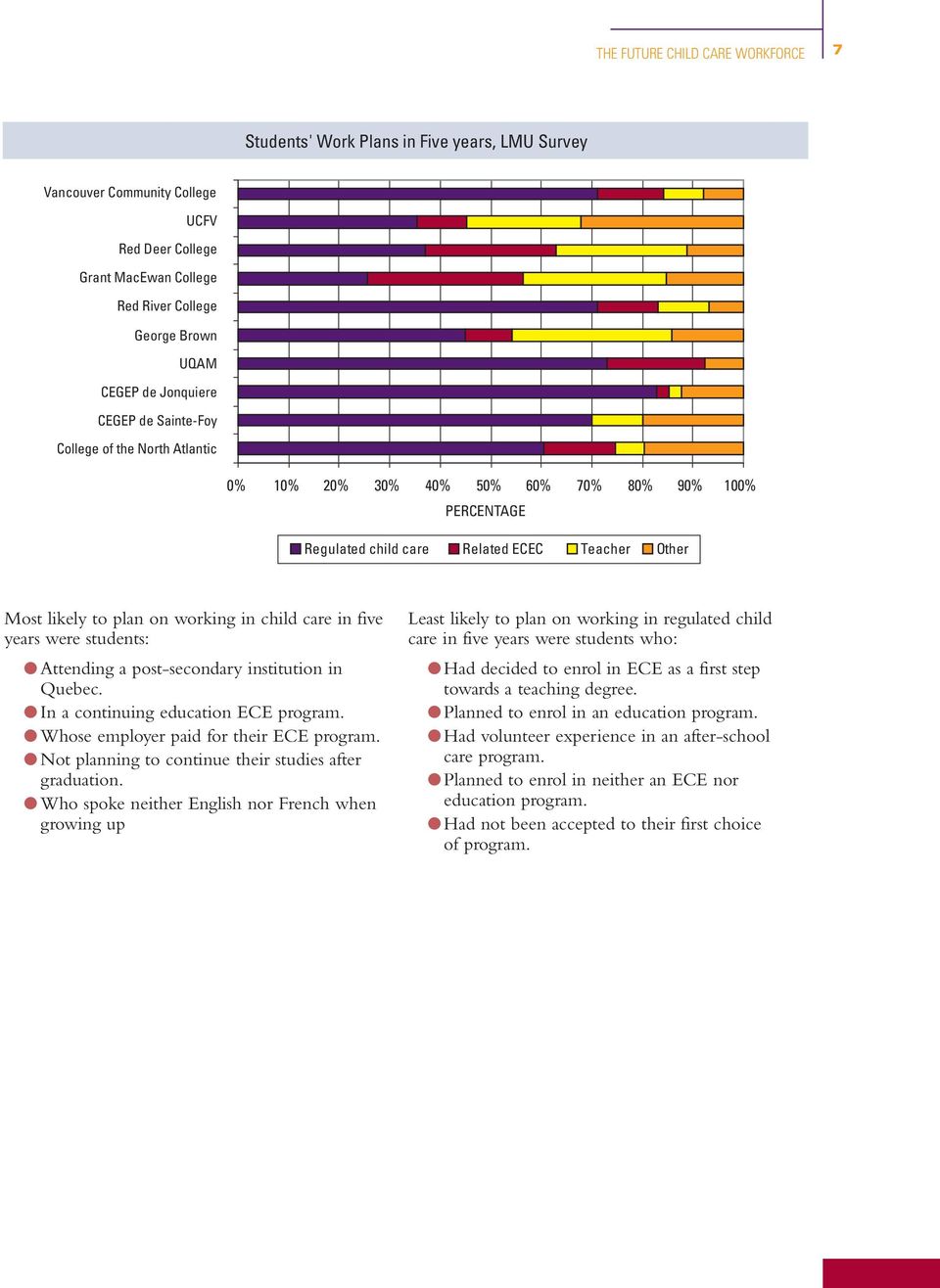
7 THE FUTURE CHILD CARE WORKFORCE 7 Students' Work Plans in Five years, LMU Survey Vancouver Community College UCFV Red Deer College Grant MacEwan College Red River College George Brown UQAM CEGEP de Jonquiere CEGEP de Sainte-Foy College of the North Atlantic 0% 10% 20% 30% 40% 50% 60% 70% 80% 90% 100% PERCENTAGE Regulated child care Related ECEC Teacher Other Most likely to plan on working in child care in five years were students: Attending a post-secondary institution in Quebec. In a continuing education ECE program. Whose employer paid for their ECE program. Not planning to continue their studies after graduation. Who spoke neither English nor French when growing up Least likely to plan on working in regulated child care in five years were students who: Had decided to enrol in ECE as a first step towards a teaching degree. Planned to enrol in an education program. Had volunteer experience in an after-school care program. Planned to enrol in neither an ECE nor education program. Had not been accepted to their first choice of program.
8 8 Immigrants in ECE programs Immigrants students were distinct from other ECE students in a number of ways: they were older, had more education, and were more likely to plan on working in a child care centre, both after graduation and five years hence despite being less optimistic about the ease of finding child care-related work. Given the recruitment and retention problems in child care, it might be fruitful to focus specific recruitment efforts on this population. Immigrant vs. Non-immigrant Differences, LMU Student Survey Immigrant (%) Born in Canada (%) Age 35 or older Attained prior university degree Expect finding an ECE-related job after graduating will be very easy Expect to earn $16/hr or more just after graduation Plan to work in a child care centre just after graduation Hope to be working with children in a child care centre five years from now Moving forward Increasing the number of new graduates who choose to work and remain in child care is critical for the future of the workforce.the sector needs to make efforts to enhance the skills and leadership qualities of supervisors and directors to recruit new graduates and work collectively on quality improvements. Plans to follow the students surveyed as they move into the workforce and surveying additional students will provide key information on their employment choices, job satisfaction and job stability as part of the Sector Council s long-term labour market strategy. Working for Change The information in this backgrounder comes from the November 2004 labour market update study, Working for Change: Canada s Child Care Workforce. The study profiles those who work in regulated child care and points to solutions for addressing the critical labour shortage in this sector. The study was sponsored by the Child Care Human Resources Sector Council (CCHRSC). For more information visit or contact us at: Tel: /Toll-free: [email protected]

A Survey of Centre-Based Early Childhood Education and Care in Canada. Highlights Report. Child Care Human Resources Sector Council
 A Survey of Centre-Based Early Childhood Education and Care in Canada Highlights Report Child Care Human Resources Sector Council A Survey of Centre-Based Early Childhood Education and Care in Canada Highlights
Statistical Profile of New Brunswick s Publicly Funded Universities
 Statistical Profile of New Brunswick s Publicly Funded Universities Academic Year 2010 2011 Statistical Profile of New Brunswick s Publicly Funded Universities Academic Year 2010 2011 Province of New Brunswick
Facilitated Expert Focus Group Summary Report: Prepared for the Training Strategy Project. Child Care Human Resources Sector Council
 Facilitated Expert Focus Group Summary Report: Prepared for the Training Strategy Project Child Care Human Resources Sector Council Prepared by: Jane Beach and Kathleen Flanagan Prepared for the: Child
www.ccsc-cssge.ca Funded by the Government of Canada s Sector Council Program
 People, Programs and Practices: A Training Strategy for the Early Childhood Education and Care Sector in Canada Child Care Human Resources Sector Council Prepared by: Jane Beach & Kathleen Flanagan Prepared
Child Care Human Resources Sector Council (CCHRSC) INCLUSION, TRAINING AND THE ECEC WORKFORCE August 2008
 Child Care Human Resources Sector Council (CCHRSC) INCLUSION, TRAINING AND THE ECEC WORKFORCE August 2008 THE CCHRSC Sector councils are permanent organizations that bring together key stakeholders in
MCCA Minimum Salary Guideline Scale Five For
 Manitoba Child Care Association MCCA Minimum Salary Guideline Scale Five For Group Child Care Centres Phase In 2005-2007 2nd Flr. 2350 McPhillips Street Winnipeg, Manitoba R2V 4J6 PH: 1-204-586-8587 Toll
MANITOBA EARLY CHILDHOOD EDUCATION PROFILE NOVEMBER 2011
 MANITOBA EARLY CHILDHOOD EDUCATION PROFILE NOVEMBER 2011 GOVERNANCE Manitoba: Governance structure early childhood education Lead ministry/ Department of Family Services and Consumer Affairs department
Pathways to Early Childhood Education Credentialing in Canada
 Pathways to Early Childhood Education Credentialing in Canada Child Care Human Resources Sector Council Prepared for the Child Care Human Resources Sector Council 151 Slater St, Suite 505 Ottawa, ON K1P
To what extent did this program s graduates leave the Province?
 Master of Applied Social Psychology, Memorial University What were the labour market experiences of graduates? Table 1 shows the employment status of this program s graduates during the reference week
Where to Study Criminology/Criminal Justice and related fields of study/work in Canada
 Appendix 1 Where to Study Criminology/Criminal Justice and related fields of study/work in Canada A 1995 Statistics Canada Report revealed that not only are employment prospects bleak and getting bleaker
High Achievers: number and percentage of grade 12 graduates who achieve high Academic GPA's (of 75% or higher).
 STP FAST FACTS 1 2 3 4 5 6 7 8 9 10 11 B.C. Secondary School Graduation Rate: Percentage of all B.C. grade 12 students who graduated from high school within six years of the time they enrolled in grade
BACHELOR OF EARLY CHILDHOOD LEADERSHIP PROGRAM (C300)
 BACHELOR OF EARLY CHILDHOOD LEADERSHIP PROGRAM (C300) PROGRAM NAME COURSE CODE SCHOOL CENTRE LOCATION DURATION Bachelor of Early Childhood Leadership C300 Community Services and Early Childhood George
A Portrait of First Nations and Education
 A Portrait of First Nations and Education Population In Canada, 1,172,785 persons identify as Aboriginal, and 698,025 identify as First Nations. Aboriginal youth are the fastest growing demographic. The
UNIVERSITY WORKS 2015 EMPLOYMENT REPORT
 UNIVERSITY WORKS 2015 EMPLOYMENT REPORT University Works uses empirical data to report on the outcomes of university graduates in terms of employment levels and earnings, as well as average debt upon graduation.
Human Resource Development for The Canadian Aviation and Aerospace Industry
 Human Resource Development for The Canadian Aviation and Aerospace Industry ICAO Symposium Montreal, Quebec March 2010 Robert Donald Executive Director 1 What is a Sector Council? Canadian Aviation & Aerospace
Child Care Staff Classification Services: A Guide to Classification and School Age Approval
 Child Care Staff Classification Services: A Guide to Classification and School Age Approval Revised December 2012 CONTENTS Contents.2 Introduction 3 Applying for a Classification or School Age Approval.3
COLLEGE TEACHERS TRAINING FOR INTERNATIONALLY EDUCATED PROFESSIONALS (ONLINE) - POSTGRADUATE PROGRAM (R413)
 COLLEGE TEACHERS TRAINING FOR INTERNATIONALLY EDUCATED PROFESSIONALS (ONLINE) - POSTGRADUATE PROGRAM (R413) PROGRAM NAME COURSE CODE SCHOOL CENTRE LOCATION DURATION College Teachers Training for Internationally
Science of Early Child Development
 Science of Early Child Development What is the Science of Early Child Development (SECD)? SECD is an online teaching and learning tool that presents groundbreaking research related to ECD in an accessible,
CERTIFICATION GUIDE FOR CHILD CARE STAFF
 CERTIFICATION GUIDE FOR CHILD CARE STAFF Revised January 2009 CONTENTS DEFINITION OF TERMS... 2 WHAT IS CERTIFICATION?... 3 CERTIFICATION REQUIREMENTS... 4 TRAINING STANDARDS FOR CERTIFICATION... 5 EDUCATIONAL
STP FAST FACTS. Regional Transition Rates from grade 12 graduation to B.C. public post secondary education.
 STP FAST FACTS 1 2 3 4 5 6 B.C. Secondary School Six Year Completion Rate: Percentage of all B.C. grade 12 students who graduated from high school within six years of the time they enrolled in grade 8.
HUMAN RESOURCES MANAGEMENT
 HUMAN RESOURCES MANAGEMENT Program Outline Major: HRMN Length: 1 Year Delivery: 2 Semesters, plus 1 industry placement Credential: Ontario College Graduate Certificate Effective: 2012-2013 Location: Barrie
Nova Scotia Child Care Association
 Nova Scotia Child Care Association Worthy Wage Day Initiative May 1, 2014 Worthy Wage and Recommended Salary Guidelines for Nova Scotia s Early Childhood Educators Nova Scotia Child Care Association 102
COLLEGE TEACHERS TRAINING FOR INTERNATIONALLY EDUCATED PROFESSIONALS (ONLINE) - POSTGRADUATE PROGRAM (R413)
 COLLEGE TEACHERS TRAINING FOR INTERNATIONALLY EDUCATED PROFESSIONALS (ONLINE) - POSTGRADUATE PROGRAM (R413) PROGRAM NAME COURSE CODE SCHOOL CENTRE LOCATION DURATION College Teachers Training for Internationally
Early Childhood Educator: Internationally Educated Qualifications Program (ECE: IEQ)
 Manitoba Family Services and Housing Manitoba Child Care Program Early Childhood Educator: Internationally Educated Qualifications Program (ECE: IEQ) Program & Policies Brochure Spring 2009 Mission Statement
Submission to. House of Commons Standing Committee on Finance. Pre-Budget Consultations for the 2015 Federal Budget
 Submission to House of Commons Standing Committee on Finance Pre-Budget Consultations for the 2015 Federal Budget August 2014 The Skills Summit recently hosted by The Hon. Jason Kenney in Toronto Ontario,
Phase I of Alberta Nursing Education Strategy Report and Working Document
 Phase I of Alberta Nursing Education Strategy Report and Working Document Results of a Key Stakeholder Forum November 9, 2005 Funding provided by Alberta Health and Wellness Alberta Nursing Education Administrators
CHILD DEVELOPMENT/ EARLY CHILDHOOD
 CHILD DEVELOPMENT/ Programs of Study This program welcomes students from diverse cultural and ethnic backgrounds. Male students are encouraged to investigate career opportunities in Child Development.
Canadian Association of Speech-Language Pathologists and Audiologists: University Programs in Audiology 2010
 Canadian Association of Speech-Language Pathologists and Audiologists: Programs in Audiology 2010 Final Report December 2010 Canadian Association of Speech-Language Pathologists and Audiologists: Overview
NBCDI is nurturing the natural curiosity, excitement and genius in children. NBCDI presents: T.E.A.C.H. Early Childhood D.C.
 NBCDI presents: T.E.A.C.H. Early Childhood D.C. T.E.A.C.H. (Teaching Education and Compensation Helps) Early Childhood T.E.A.C.H. improves education, compensation and retention of the early childhood workforce.
The Training Gaps Analysis for Librarians and Library Technicians: Survey Instruments
 The Training Gaps Analysis for Librarians and Library Technicians: Survey Instruments 8Rs Research Team Table of Contents The Training Gaps Analysis for Librarians and Library Technicians: Survey Instruments...1
SUPPORTING. Immigrants and Immigration to Alberta AN OVERVIEW
 SUPPORTING Immigrants and Immigration to Alberta AN OVERVIEW Table of Contents Introduction...1 Alberta s Vision of Immigration...3 Attracting and Retaining Immigrants to Alberta...3 The Need for Immigration...4
Profile of Canadian Environmental Employment
 Profile of Canadian Environmental Employment LABOUR MARKET RESEARCH STUDY 2010 ECO CANADA ECO Canada develops programs that help individuals build meaningful environmental careers, provides employers with
PRINCE EDWARD ISLAND EARLY CHILDHOOD EDUCATION PROFILE NOVEMBER 2011
 PRINCE EDWARD ISLAND EARLY CHILDHOOD EDUCATION PROFILE NOVEMBER 2011 GOVERNANCE Prince Edward Island: Governance structure early childhood education Lead ministry/ Department of Education and Early Childhood
Repayment Resource Guide. Planning for Student Success
 Repayment Resource Guide Planning for Student Success 2013 Table of Contents Table of Contents... 1 Introduction... 3 Purpose of Document... 3 Role of Post Secondary Institutions... 3 Consequences of Student
Accredited Degree Assessment
 Accredited Degree Assessment 1 - Applicant Information Salutation: q Mr. q Ms. q Dr. Business Address: Organization Name: Street Address: City: Province: Postal Code: Bus. Phone: Bus. Email: Fax: Home
Looking to Ontario: Reena Fills HR Gap with Specialized Curriculum. Overview and context
 Looking to Ontario: Reena Fills HR Gap with Specialized Curriculum Reena will enable people with developmental disabilities to realize their full potential by forming lifelong partnerships with individuals
Canada Population: Fertility rate: GDP per capita: Children under 6 years: Female labour force participation:
 Canada Population: 32.2 m. Fertility rate: 1.53. GDP per capita: USD 30 700. Children under 6years: 2 074 860 (2005). Female labour force participation: 73.5% of women (15-64) participate in the formal
Critical Care Human Resources and Delivery Models
 Critical Care Human Resources and Delivery Models Kim Macfarlane - Fraser Health, Clinical Nurse Specialist Tertiary Critical Care Contributors: Karen Watson Fraser Health, Program Director Critical Care
Individual Professional Development Plan for Early Education and Care and Out of School Time Educators and Providers. Guidance and Forms
 2010 Individual Professional Development Plan for Early Education and Care and Out of School Time Educators and Providers Guidance and Forms EEC s Mission The Massachusetts Department of Early Education
A DAY IN AN INTEGRATED EARLY CHILDHOOD PROGRAM
 Bruce/WoodGreen Early Learning Centre A DAY IN AN INTEGRATED EARLY CHILDHOOD PROGRAM 2007 2007 Early learning and care for every child Page 2 An Integrated Day How it works: the elements of integration
The automotive manufacturing sector is
 BUILDING A SUSTAINABLE WORKFORCE: APPRENTICESHIP IN THE CANADIAN AUTOMOTIVE INDUSTRY The Canadian Automotive Manufacturing Industry at a Glance The automotive manufacturing sector is struggling in the
Early Childhood Educator Certification and Exemption Information
 Early Childhood Educator Certification and Exemption Information Introduction: The Importance of Early Childhood Education Early Childhood Education ensures that individuals who work with young children
McGill University School of Dietetics and Human Nutrition Graduate Diploma in R.D. Credentialing
 McGill University School of Dietetics and Human Nutrition Graduate Diploma in R.D. Credentialing In the School of Dietetics and Human Nutrition at McGill, students with a B.Sc. from outside of Quebec may
Individual Donors to Arts and Culture Organizations in Canada in 2007
 Individual Donors to Arts and Culture Organizations in Canada in 2007 www.hillstrategies.com [email protected] Statistical insights on the arts, Vol. 8 No. 3 Hill Strategies Research Inc., February
Manitoba Family Services Early Learning and Child Care. Information on the Classification of Early Childhood Educators and Child Care Assistants
 Manitoba Family Services Early Learning and Child Care Information on the Classification of Early Childhood Educators and Child Care Assistants Spring 2014 Introduction The Community Child Care Standards
THE STATE OF EARLY CHILDHOOD HIGHER EDUCATION IN CALIFORNIA TECHNICAL REPORT OCTOBER 2015
 THE STATE OF EARLY CHILDHOOD HIGHER EDUCATION IN CALIFORNIA TECHNICAL REPORT OCTOBER 2015 By Lea J.E. Austin, Fran Kipnis, Marcy Whitebook, and Laura Sakai CENTER FOR THE STUDY OF CHILD CARE EMPLOYMENT
The Ontario Health Care Labour Market. 1.0 Ontario Public and Community Health Care Labour market
 The Ontario Health Care Labour Market 1.0 Ontario Public and Community Health Care Labour market 1.1 Profile of Health Care Workers in Ontario Agencies and hospitals responding to the surveys reported
Discouraged workers - where have they gone?
 Autumn 1992 (Vol. 4, No. 3) Article No. 5 Discouraged workers - where have they gone? Ernest B. Akyeampong One of the interesting but less publicized labour market developments over the past five years
Child Care Services (CCS) Certification Information Booklet. Table of Contests
 1 Table of Contests Introduction 02 Child Care Services Certification NL 02 The Levels of Certification 03 The Classifications of Certification 03 The Child Care Services Certification Advisory Committee
How To Get A Job In Canada
 APPLICATION FOR EVALUATION OF FOREIGN SOCIAL WORK CREDENTIALS For persons located in, or immigrating to, the province of Alberta, Saskatchewan, Manitoba, Ontario, New Brunswick, Newfoundland, Nova Scotia,
NOVA SCOTIA S. Nursing Strategy 2015
 NOVA SCOTIA S Nursing Strategy 2015 NOVA SCOTIA S Nursing Strategy 2015 Contents Background...1 Support at Every Stage...2 Evidence & Experience...3 A Multi-Faceted Approach...4 Nursing Education...5 Maintain
Production of this report has been made possible through a financial contribution from Health Canada.
 Production of this report has been made possible through a financial contribution from Health Canada. The views expressed herein do not necessarily represent the views of Health Canada. Project team: Sandra
Aboriginal Post-Secondary Education Strategy and Action Plan
 Aboriginal Post-Secondary Education Strategy and Action Plan Strategic Context The Government of British Columbia is forging a new government-to-government relationship with Aboriginal people based on
2015 Annual Alberta Labour Market Review. Employment. Unemployment. Economic Regions. Migration. Indigenous People. Industries
 2015 Annual Alberta Labour Market Review Employment. Unemployment. Economic Regions Migration. Indigenous People. Industries Occupations. Education. Demographics Employment Despite the economic downturn,
Education Administrator, Director and Principal Careers, Jobs, and Employment Information
 Education Administrator, Director and Principal Careers, Jobs, and Employment Information Career and Job Highlights for Education Administrators Qualifications such a master s or doctoral degree and experience
Ontario Association of Certified Engineering Technicians & Technologists (OACETT) Suite 404, 10 Four Seasons Place Toronto ON M9B 6H7
 To assist our internationally educated members, OACETT has compiled the following list that highlights some of the many resources available to help with employment and skills development. OACETT Resources
Higher Education - Online Survey Final Report
 January 26, 2015 Higher Education - Online Survey Final Report Methodology This research is based on 600 online interviews conducted throughout the province with Nova Scotian adults aged 18 or older. Data
Opportunities Ontario: Provincial Nominee Program Overview
 Opportunities Ontario: Provincial Nominee Program Overview Temporary Foreign Worker Seminar Windsor, ON March 26, 2013 2 What is Opportunities Ontario? Opportunities Ontario: Provincial Nominee Program:
Physician: Alternative Careers
 Physician: Alternative Careers A guide for newcomers to British Columbia Contents 1. Physician: Alternative Careers... 2 2. Employment Outlook... 7 3. Retraining... 9 4. Searching for Jobs... 10 5. Volunteering
Addressing Education Deficits: LaGuardia Community College s Bridge to College and Careers Program
 Addressing Education Deficits: LaGuardia Community College s Bridge to College and Careers Program Vanessa Martin, MDRC Amy Dalsimer, LaGuardia Community College Overview Background and context The reform
STUDENT HANDBOOK. Information Package. Pacific Rim Early Childhood Institute Inc. (250) 652-6011 Saanichton BC V8M 1X7
 STUDENT HANDBOOK Information Package Pacific Rim Early Childhood Institute Inc. www.earlychildhoodeducator.com 2120 Bear Hill Road (250) 652-6011 Saanichton BC V8M 1X7 Introduction Pacific Rim Early Childhood
COLLEGE INFORMATION GUIDE
 COLLEGE INFORMATION GUIDE 2013-2014 Table of Contents Title Page Introduction and Information on Applying to College Page 3 Ontario Colleges.ca Page 4 How to Apply To College: Step By Step Page 5 Introduction
PAPER 1 THE SCHOOL COUNSELLING WORKFORCE IN NSW GOVERNMENT SCHOOLS
 PAPER 1 THE SCHOOL COUNSELLING WORKFORCE IN NSW GOVERNMENT SCHOOLS Introduction This paper describes the current school counselling service within the Department of Education and Communities (the Department)
human resources management
 human resources management MHRM, PhD Faculty of Graduate Studies 2009 2010 chart your own academic path. do things differently at york. York allows you to do things differently. Our award-winning teachers,
Early Childhood Education Douglas College
 Early Childhood Education Douglas College Why choose Douglas? Douglas College is an internationally recognized public post secondary institution There are many personal, financial and learning supports
Welcome to the Book of Answers, your personal. introduction to the Athabasca University experience.
 Contents Welcome to AU... 2 What is Athabasca University?... 4 Where is Athabasca University located?... 4 What courses does AU offer?... 6 Who are the instructors?... 6 How are courses taken at Athabasca
Management Initiatives in Ontario School Boards: Supporting Student Achievement by Minimizing Distractors
 Management Initiatives in Ontario School Boards: Supporting Student Achievement by Minimizing Distractors Nancy Naylor Assistant Deputy Minister Business and Finance Division Ontario Ministry of Education
ANNEX E. Czech Republic
 Czech Republic Population: 10.24 m. Fertility rate: 1.18. GDP per capita: USD 15 100. Children under 6years: 540 000. Female labour force participation: Female labour force participation rate for women
FACT SHEET First Nations Post-Secondary Education
 FACT SHEET First Nations Post-Secondary Education This fact sheet is intended to provide a snapshot of participation in and completion of postsecondary education for First Nations people in Canada. Educational
Registration Guide. Ontario College of Teachers Ordre des enseignantes et des enseignants de l Ontario
 Registration Guide Requirements for Becoming a Teacher of Students Who Are Deaf or Hard of Hearing in Ontario Ontario College of Teachers Ordre des enseignantes et des enseignants de l Ontario REQUIREMENTS
Application Guide Use this guide to assist you in completing Application Form #1, #2 or #3 for the College of Early Childhood Educators.
 438 University Avenue, Suite 1900 Toronto ON M5G 2K8 Tel: 416 961-8558 Toll-free: 1 888 961-8558 [email protected] college-ece.ca Application Guide Use this guide to assist you in completing
Interview Guide. Assistant Director. Do not pursue Pursue to reference checks Place on hold See comments on final page.
 1 Interview Guide (Assistant Director) Candidate Name Position Title Assistant Director Interview Panel Name (s) Interview Date Step Overview of the Interview 1 Open the interview Welcome the candidate,