
IP Office 5410 User s Guide
|
|
|
- Diana Barnett
- 10 years ago
- Views:
Transcription
1 IP Office 5410 User s Guide

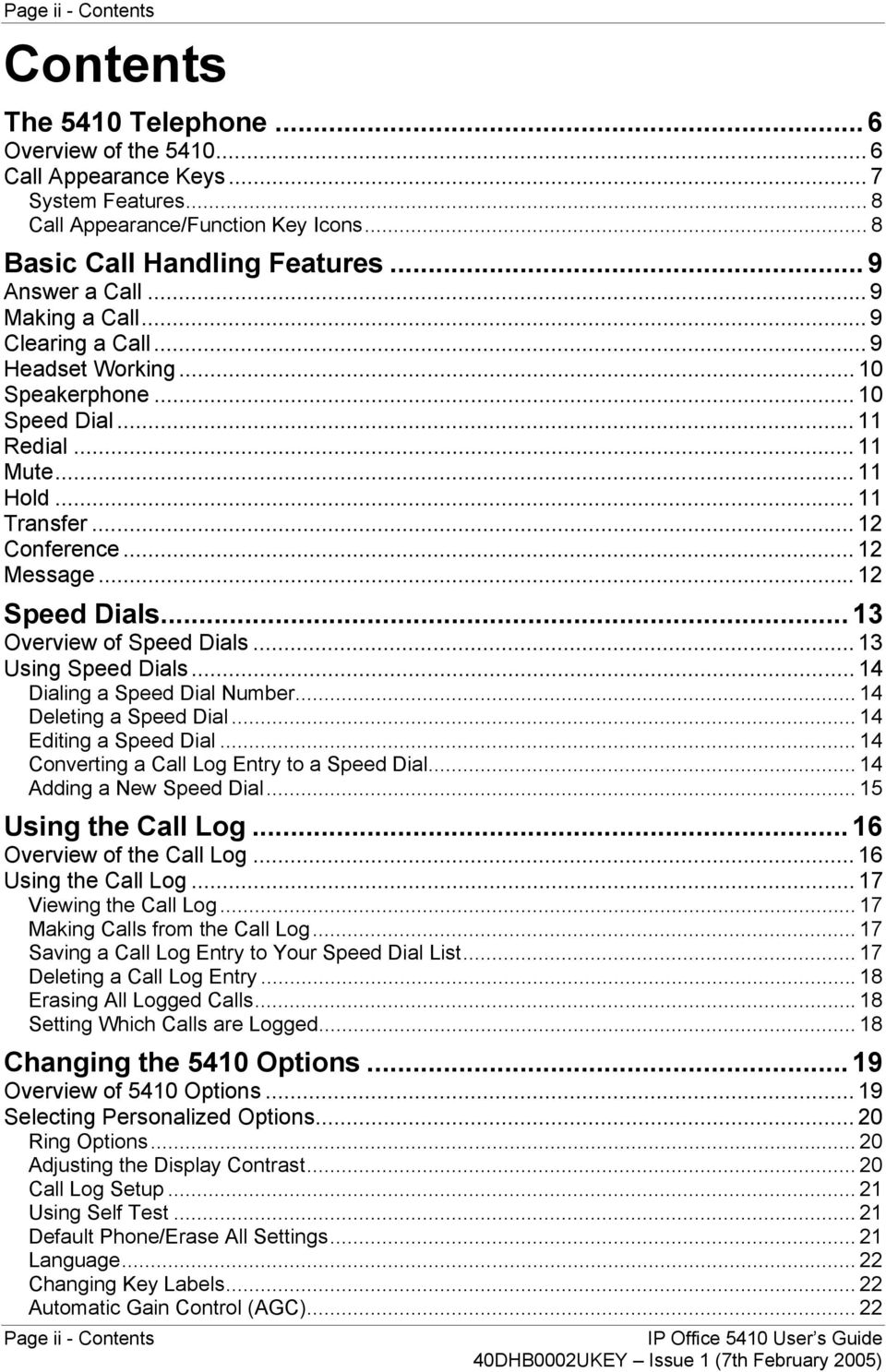
2 Page ii - Contents Contents The 5410 Telephone... 6 Overview of the Call Appearance Keys... 7 System Features... 8 Call Appearance/Function Key Icons... 8 Basic Call Handling Features... 9 Answer a Call... 9 Making a Call... 9 Clearing a Call... 9 Headset Working Speakerphone Speed Dial Redial Mute Hold Transfer Conference...12 Message Speed Dials Overview of Speed Dials Using Speed Dials Dialing a Speed Dial Number Deleting a Speed Dial Editing a Speed Dial Converting a Call Log Entry to a Speed Dial Adding a New Speed Dial Using the Call Log Overview of the Call Log Using the Call Log Viewing the Call Log Making Calls from the Call Log Saving a Call Log Entry to Your Speed Dial List Deleting a Call Log Entry...18 Erasing All Logged Calls...18 Setting Which Calls are Logged Changing the 5410 Options Overview of 5410 Options Selecting Personalized Options Ring Options Adjusting the Display Contrast Call Log Setup Using Self Test Default Phone/Erase All Settings Language Changing Key Labels...22 Automatic Gain Control (AGC) Page ii - Contents
3 Contents - Page iii Function Keys Overview of the Function Keys Function Key Programming Shorthand Programming Mode Longhand Programming Display Key Features Dial (#) Group (#) User (#) Absnt - Set Absent Text Acct - Account Code Entry (!) AD - Abbreviated Dial (!) Admin - Self-Administer (!) Apear - Appearance AutCB - Automatic Callback (!) Busy - Busy BusyH - Busy On Held CFrwd - Call Forwarding All (!) ClrCW - Clear CW CnfRV - Conference Meet Me Conf+ - Conference Add CPark - Call Park (!) CPkUp - Call Pickup (!) CWOff - Call Waiting Off CWOn - Call Waiting On CWSus - Call Waiting Suspend...34 DCW - Dial CW Dir - Directory (!) Dirct - Dial Direct DNDOn - Do Not Disturb On DNDOf - Do Not Disturb Off DNDX+ - Do Not Disturb Exception Add DNDX- - Do Not Disturb Exception Delete DPkUp - Directed Call Pickup (!) Drop - Drop (!) DTone - Secondary Dial Tone Emrgy - Dial Emergency Flash - Flash Hook (#) FolTo - Follow Me To FwBNo - Forward On Busy Number FwBOn - Forward On Busy On FwBOf - Forward On Busy Off FwdH+ - Forward Hunt Group Calls On FwdH- - Forward Hunt Group Calls Off FwdNo - Forward Number FwdOf - Cancel All Forwarding FwNOn - Forward On No Answer On FwNOf - Forward On No Answer Off FwUOn - Forward Unconditional On FwUOf - Forward Unconditional Off GrpPg - Group Paging (!) HdSet - Headset Toggle (!) Here- - Follow Me Here Cancel Here+ - Follow Me Here HfAns - Internal Auto-Answer (!) HGEna - Hunt Group Enable HGDis - Hunt Group Disable HGNS+ - Set Hunt Group Night Service (!) Contents - Page iii

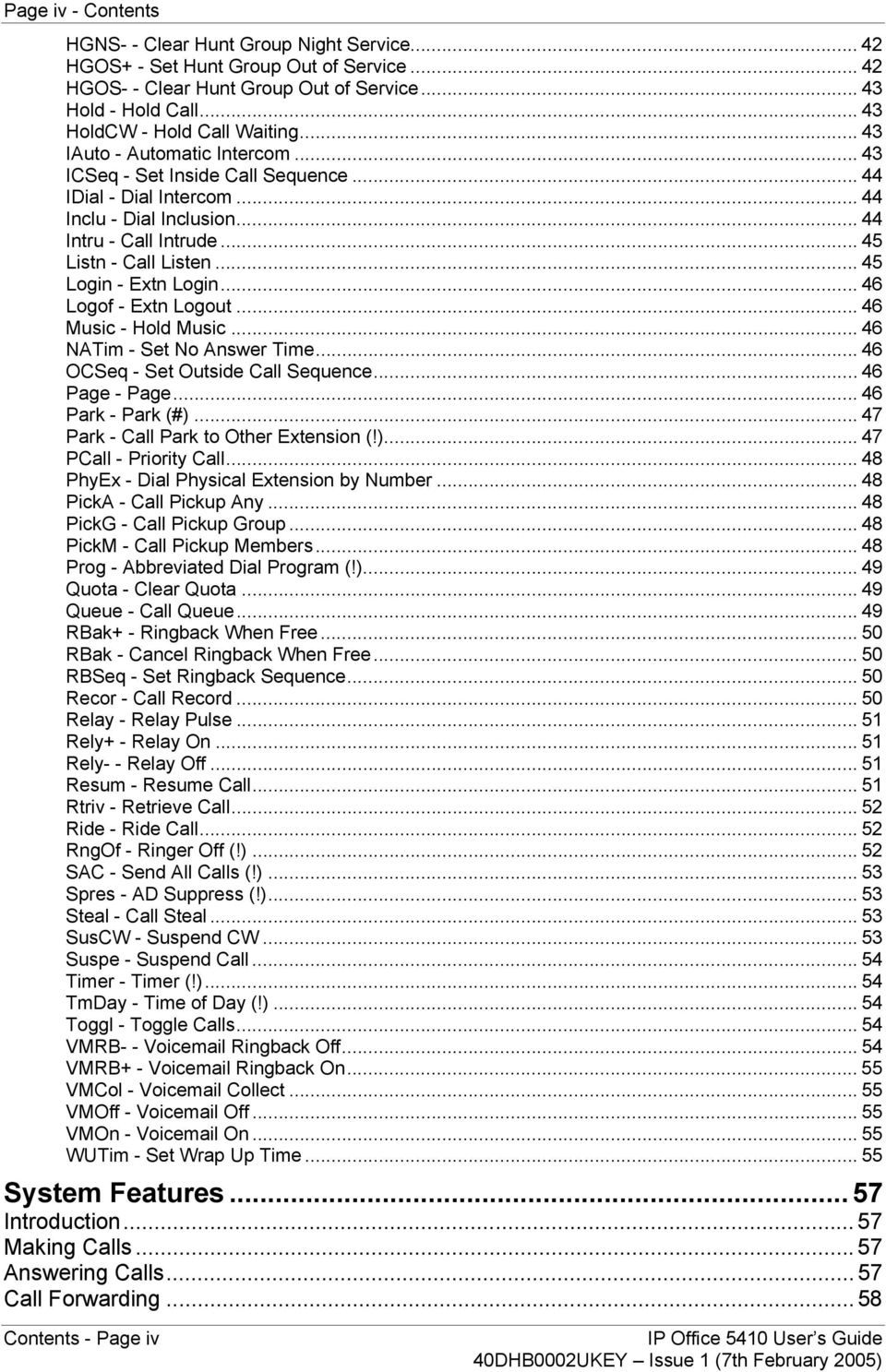
4 Page iv - Contents HGNS- - Clear Hunt Group Night Service HGOS+ - Set Hunt Group Out of Service HGOS- - Clear Hunt Group Out of Service Hold - Hold Call HoldCW - Hold Call Waiting IAuto - Automatic Intercom ICSeq - Set Inside Call Sequence...44 IDial - Dial Intercom Inclu - Dial Inclusion Intru - Call Intrude Listn - Call Listen Login - Extn Login Logof - Extn Logout Music - Hold Music NATim - Set No Answer Time OCSeq - Set Outside Call Sequence Page - Page Park - Park (#) Park - Call Park to Other Extension (!) PCall - Priority Call PhyEx - Dial Physical Extension by Number PickA - Call Pickup Any PickG - Call Pickup Group PickM - Call Pickup Members Prog - Abbreviated Dial Program (!) Quota - Clear Quota Queue - Call Queue RBak+ - Ringback When Free...50 RBak - Cancel Ringback When Free RBSeq - Set Ringback Sequence Recor - Call Record Relay - Relay Pulse Rely+ - Relay On Rely- - Relay Off Resum - Resume Call Rtriv - Retrieve Call Ride - Ride Call RngOf - Ringer Off (!) SAC - Send All Calls (!) Spres - AD Suppress (!) Steal - Call Steal SusCW - Suspend CW Suspe - Suspend Call Timer - Timer (!) TmDay - Time of Day (!) Toggl - Toggle Calls VMRB- - Voic Ringback Off...54 VMRB+ - Voic Ringback On VMCol - Voic Collect VMOff - Voic Off VMOn - Voic On WUTim - Set Wrap Up Time System Features Introduction Making Calls...57 Answering Calls Call Forwarding Contents - Page iv
5 Contents - Page v Diverting Calls...58 Do Not Disturb...58 Voic Default Feature Codes Index Contents - Page v

6 Page 6 - Overview of the 5410 The 5410 Telephone The 5410 Telephone Overview of the 5410 This guide covers the use of the Avaya 5410 telephone, running in Key and Lamp mode, on Avaya IP Office telephone systems operating with Level 3.0 software and the 5410 telephone s software running at REL:2.00 or higher (see Using Self Test on page 21) The diagram below shows the main 5410 telephone features. 1. Display, Call Appearance and Function keys: Call Appearance Keys allow the user to handle multiple calls and the display shows call information. System functions (allocated by your System Administrator) can also be displayed. See Call Appearance Keys on page 7 and Function Keys on page Message lamp - Lit when the user has voic messages. Can also be set to flash when the phone is ringing. 3. Previous/Next Page - Move through the different pages of the call handling, speed dials and call log screens. Also used to move the cursor during data entry. 4. Messages: Access the user's mailbox. 5. Call Handling Buttons: See Basic Call Handling Features on page 9. Hold: Place call on hold. Transfer: Transfer call. Conference: Conference held calls. Drop: Drop call. Redial: Redial last number dialed. 6. Dial pad: Standard 12-button pad for dialing telephone numbers. 7. Volume Controls: Adjust the speaker, handset, headset, or ringer volume depending on which is currently in use. 8. Handset and Headset Sockets: The sockets for both the headset and handset cables can be found on the side of the telephone. 9. Mute: Turns the microphone on/off. When in use, the associated light is on and the caller cannot hear you. Page 6 - The 5410 Telephone Overview of the 5410

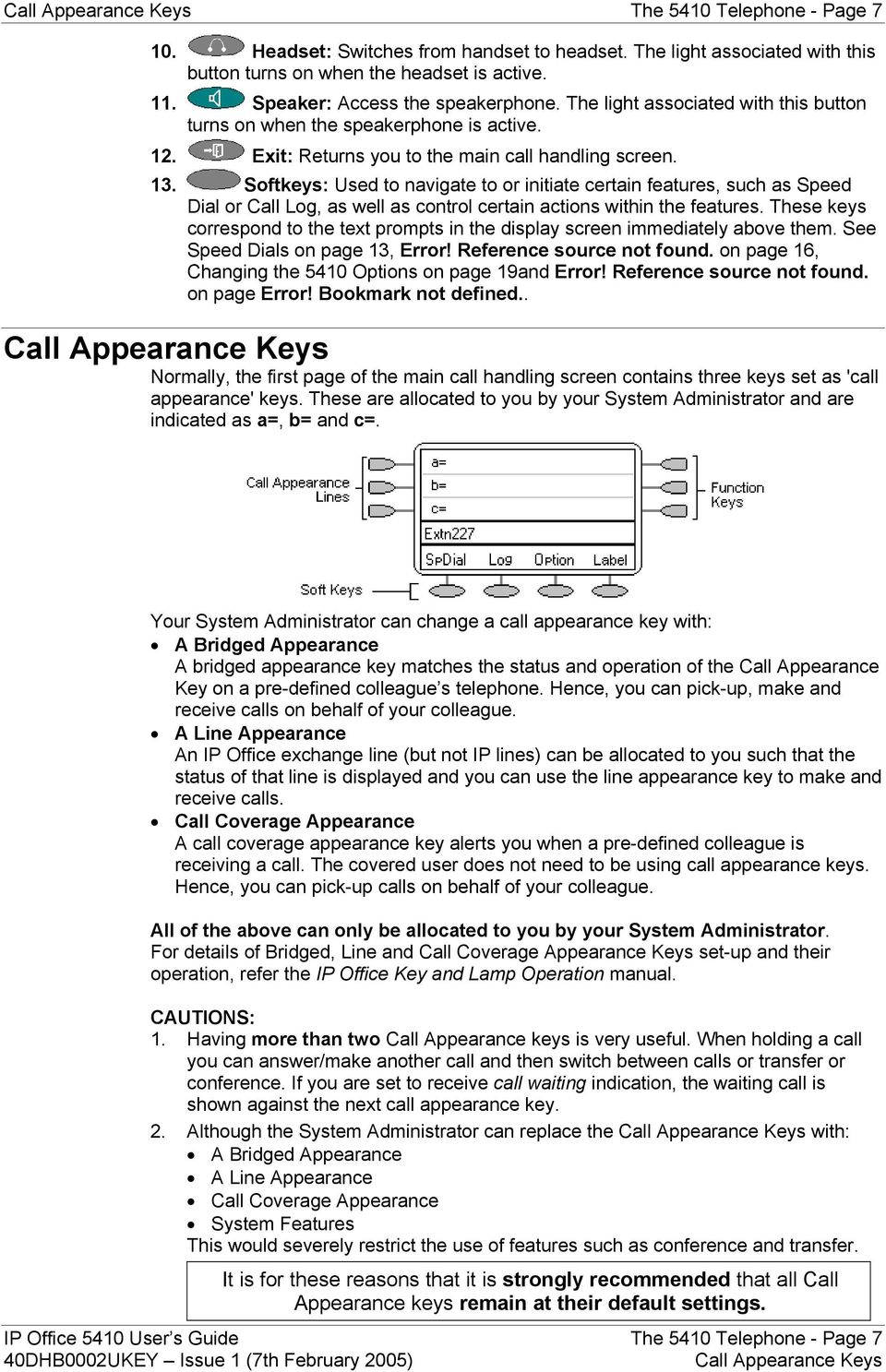
7 Call Appearance Keys The 5410 Telephone - Page Headset: Switches from handset to headset. The light associated with this button turns on when the headset is active. 11. Speaker: Access the speakerphone. The light associated with this button turns on when the speakerphone is active. 12. Exit: Returns you to the main call handling screen. 13. Softkeys: Used to navigate to or initiate certain features, such as Speed Dial or Call Log, as well as control certain actions within the features. These keys correspond to the text prompts in the display screen immediately above them. See Speed Dials on page 13, Error! Reference source not found. on page 16, Changing the 5410 Options on page 19and Error! Reference source not found. on page Error! Bookmark not defined.. Call Appearance Keys Normally, the first page of the main call handling screen contains three keys set as 'call appearance' keys. These are allocated to you by your System Administrator and are indicated as a=, b= and c=. Your System Administrator can change a call appearance key with: A Bridged Appearance A bridged appearance key matches the status and operation of the Call Appearance Key on a pre-defined colleague s telephone. Hence, you can pick-up, make and receive calls on behalf of your colleague. A Line Appearance An IP Office exchange line (but not IP lines) can be allocated to you such that the status of that line is displayed and you can use the line appearance key to make and receive calls. Call Coverage Appearance A call coverage appearance key alerts you when a pre-defined colleague is receiving a call. The covered user does not need to be using call appearance keys. Hence, you can pick-up calls on behalf of your colleague. All of the above can only be allocated to you by your System Administrator. For details of Bridged, Line and Call Coverage Appearance Keys set-up and their operation, refer the IP Office Key and Lamp Operation manual. CAUTIONS: 1. Having more than two Call Appearance keys is very useful. When holding a call you can answer/make another call and then switch between calls or transfer or conference. If you are set to receive call waiting indication, the waiting call is shown against the next call appearance key. 2. Although the System Administrator can replace the Call Appearance Keys with: A Bridged Appearance A Line Appearance Call Coverage Appearance System Features This would severely restrict the use of features such as conference and transfer. It is for these reasons that it is strongly recommended that all Call Appearance keys remain at their default settings. The 5410 Telephone - Page 7 Call Appearance Keys
8 Page 8 - Call Appearance Keys The 5410 Telephone System Features System Features can only be set against soft Function Keys by your System Administrator. However, your System Administrator may allocate you two self administrator features that will enable you to add System Features to your soft Function Keys. Refer to Function Keys on page 23 for details of the System Feature that can only be allocated to you by your System Administrator. In addition, there are a number of System Features that you can always access yourself by the use of short codes. Refer to System Features on page 57 for details of System Features that you can always access yourself by dialing short codes, e.g. *17 to listen to your Voic messages. Call Appearance/Function Key Icons The icons displayed against the Call Appearance/Feature Keys allow you to determine the status (for example, on Hold) of each call. Icons also indicate whether a feature has been activated for a particular button. Incoming Call: A symbol next to a call appearance key indicates an incoming call. Pressing the adjacent key answers the call and puts any other current call on hold. Connected: A symbol next to a call appearance key indicates that it is the currently connected call. The caller's telephone number (if available) is also shown. Pressing the adjacent key puts the call on hold. An H is also shown on the display. On Hold: A symbol next to a call appearance key indicate a call on hold. Pressing the adjacent key takes the call off hold and puts any other current call on hold. Function Active: or The button to the left or right of the function key is active. key takes the call off hold and puts any other current call on hold. Page 8 - The 5410 Telephone Call Appearance Keys

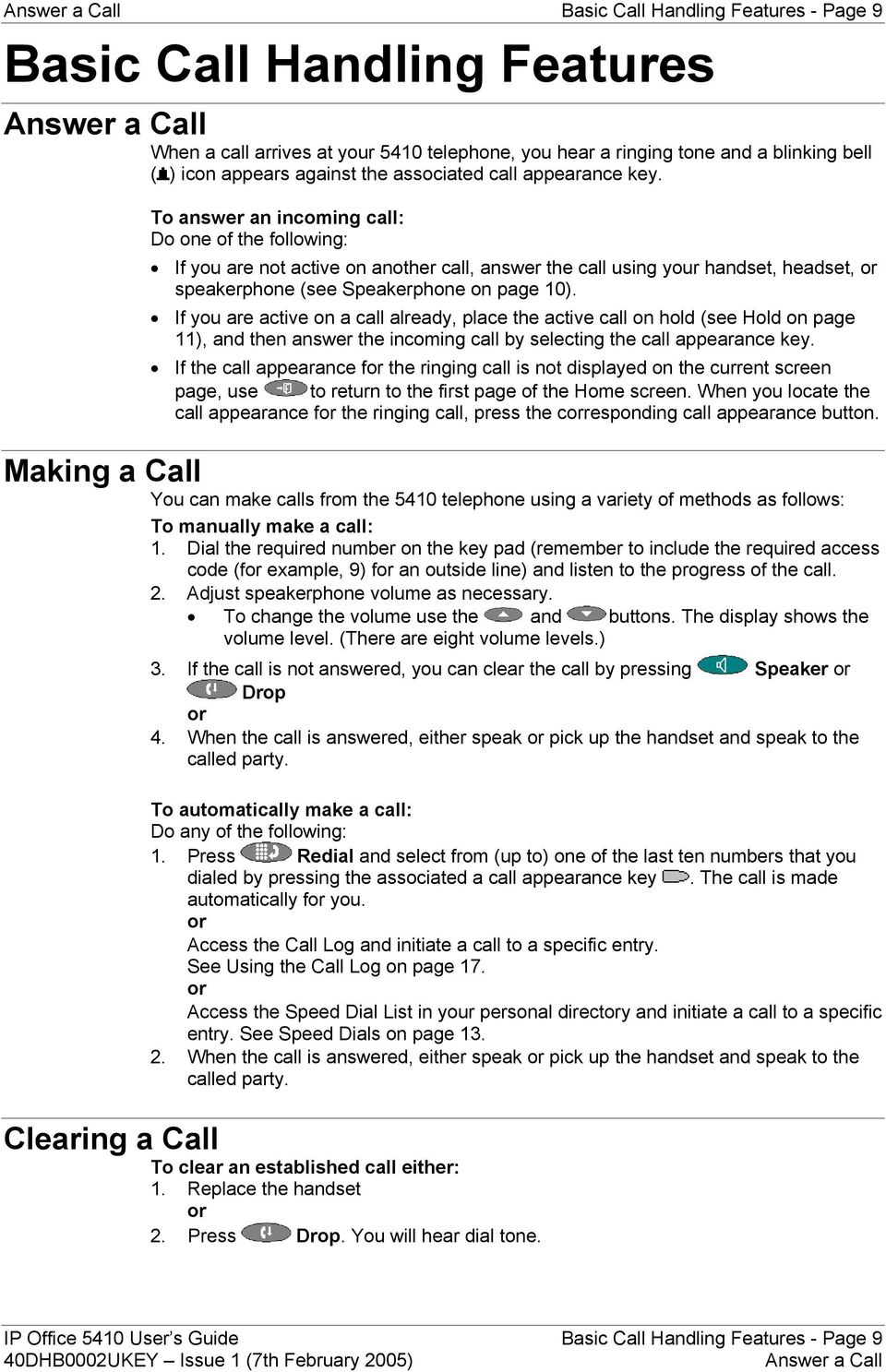
9 Answer a Call Basic Call Handling Features - Page 9 Basic Call Handling Features Answer a Call When a call arrives at your 5410 telephone, you hear a ringing tone and a blinking bell ( ) icon appears against the associated call appearance key. To answer an incoming call: Do one of the following: If you are not active on another call, answer the call using your handset, headset, or speakerphone (see Speakerphone on page 10). If you are active on a call already, place the active call on hold (see Hold on page 11), and then answer the incoming call by selecting the call appearance key. If the call appearance for the ringing call is not displayed on the current screen page, use to return to the first page of the Home screen. When you locate the call appearance for the ringing call, press the corresponding call appearance button. Making a Call You can make calls from the 5410 telephone using a variety of methods as follows: To manually make a call: 1. Dial the required number on the key pad (remember to include the required access code (for example, 9) for an outside line) and listen to the progress of the call. 2. Adjust speakerphone volume as necessary. To change the volume use the and buttons. The display shows the volume level. (There are eight volume levels.) 3. If the call is not answered, you can clear the call by pressing Speaker or Drop or 4. When the call is answered, either speak or pick up the handset and speak to the called party. To automatically make a call: Do any of the following: 1. Press Redial and select from (up to) one of the last ten numbers that you dialed by pressing the associated a call appearance key. The call is made automatically for you. or Access the Call Log and initiate a call to a specific entry. See Using the Call Log on page 17. or Access the Speed Dial List in your personal directory and initiate a call to a specific entry. See Speed Dials on page When the call is answered, either speak or pick up the handset and speak to the called party. Clearing a Call To clear an established call either: 1. Replace the handset or 2. Press Drop. You will hear dial tone. Basic Call Handling Features - Page 9 Answer a Call
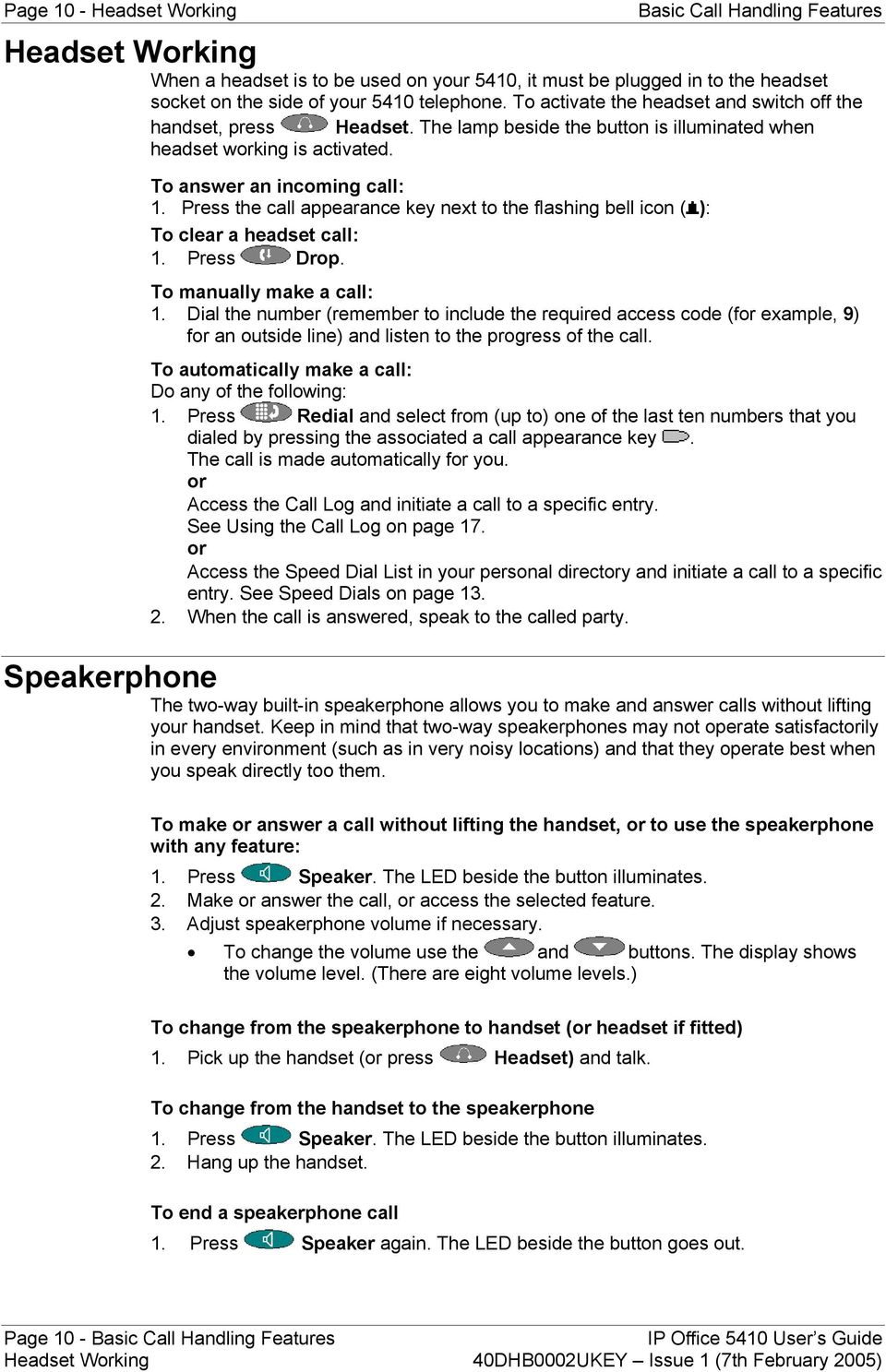
10 Page 10 - Headset Working Basic Call Handling Features Headset Working When a headset is to be used on your 5410, it must be plugged in to the headset socket on the side of your 5410 telephone. To activate the headset and switch off the handset, press Headset. The lamp beside the button is illuminated when headset working is activated. To answer an incoming call: 1. Press the call appearance key next to the flashing bell icon ( ): To clear a headset call: 1. Press Drop. To manually make a call: 1. Dial the number (remember to include the required access code (for example, 9) for an outside line) and listen to the progress of the call. To automatically make a call: Do any of the following: 1. Press Redial and select from (up to) one of the last ten numbers that you dialed by pressing the associated a call appearance key. The call is made automatically for you. or Access the Call Log and initiate a call to a specific entry. See Using the Call Log on page 17. or Access the Speed Dial List in your personal directory and initiate a call to a specific entry. See Speed Dials on page When the call is answered, speak to the called party. Speakerphone The two-way built-in speakerphone allows you to make and answer calls without lifting your handset. Keep in mind that two-way speakerphones may not operate satisfactorily in every environment (such as in very noisy locations) and that they operate best when you speak directly too them. To make or answer a call without lifting the handset, or to use the speakerphone with any feature: 1. Press Speaker. The LED beside the button illuminates. 2. Make or answer the call, or access the selected feature. 3. Adjust speakerphone volume if necessary. To change the volume use the and buttons. The display shows the volume level. (There are eight volume levels.) To change from the speakerphone to handset (or headset if fitted) 1. Pick up the handset (or press Headset) and talk. To change from the handset to the speakerphone 1. Press Speaker. The LED beside the button illuminates. 2. Hang up the handset. To end a speakerphone call 1. Press Speaker again. The LED beside the button goes out. Page 10 - Basic Call Handling Features Headset Working
11 Speed Dial Basic Call Handling Features - Page 11 Speed Dial The Speed Dial feature allows you to have the 5410 telephone automatically dial calls to telephone numbers stored in your personal directory (maximum of 48). See Speed Dials on page 13. To make a call to a personal directory entry using the Speed Dial feature: 1. Press the SpDial softkey. The Speed Dial screen is displayed. 2. Press the button next to the entry you want to call. 3. If the entry you want is not displayed, use and to cycle through the entries or key the first letter of the required name to jump to the page with a matching entry. 4. The 5410 telephone dials the number for you. Redial Mute Hold The Redial (or Last Number Dialed) feature automatically redials a previously dialed extension or outside number (up to 24 digits). Your 5410 will store the up to ten of the last numbers dialed. Note: If you have dialed the same number twice in succession, it will only have one appearance in the redial list. To redial previously dialed number: 1. Press Redial. Use and to step through the entries. When you have located the required number, press the associated key. During an active call, the Mute feature prevents the party with whom you are speaking from hearing you. This feature is most commonly used in conjunction with the Speakerphone, but can be used to hold an off-line conversation at any time during a call. Preventing the other person on the line from hearing you: 1. Press Mute. The other party cannot hear you. The indicator next to the Mute button lights when Mute is active. 2. To reinstate two-way conversation, press Mute again. If, with a call in progress, a second call arrives and is shown against a Call Appearance key, you can then Hold the first call and answer the second call. To put an existing call on hold: 1. Press Hold or the Call Appearance button with the symbol against it. The symbol changes to ; showing that the line is on hold. 2. Answer the second call by pressing the Call Appearance button with the symbol against it. The symbol changes to ; showing that the line is connected. To return to the held call: 1. If you have a call in progress, then first put that call on hold as above. 2. To retrieve a held call, simply press the Call Appearance button with the against it. Notes: 1. After a pre-set time (defined by your System Administrator), you are reminded that you have a call on hold by the hold icon changing for a few moments to and the phone ringing. 2. If the system feature AutoHold is on (consult your System Administrator) then you can hold an active call ( ) by pressing the second call s Call Appearance button ( ). If AutoHold is off, then pressing the second call s Call Appearance button ( ) will drop the first call. 3. To transfer a held call see Transfer on page 12. Basic Call Handling Features - Page 11 Speed Dial

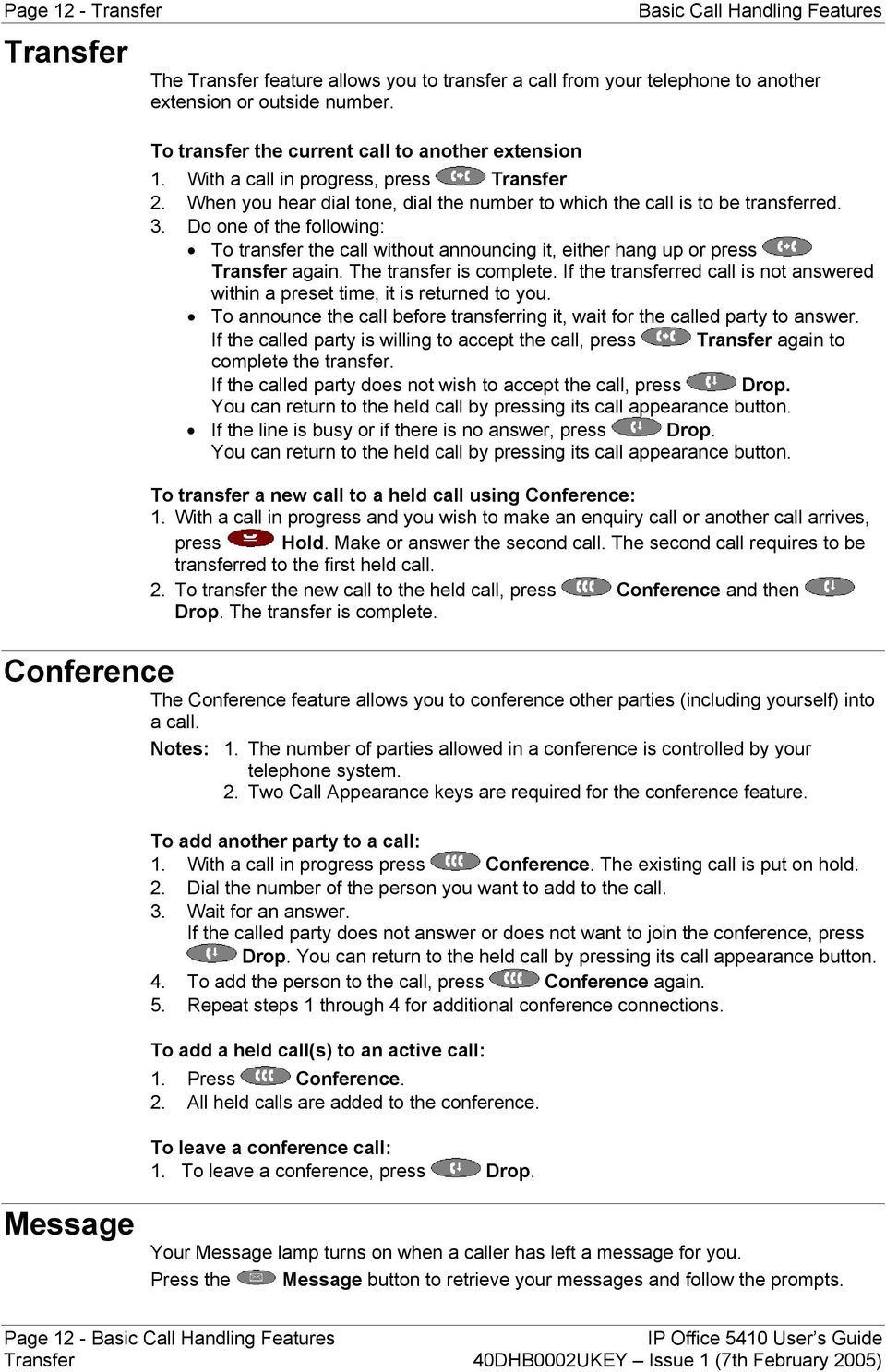
12 Page 12 - Transfer Transfer Basic Call Handling Features The Transfer feature allows you to transfer a call from your telephone to another extension or outside number. To transfer the current call to another extension 1. With a call in progress, press Transfer 2. When you hear dial tone, dial the number to which the call is to be transferred. 3. Do one of the following: To transfer the call without announcing it, either hang up or press Transfer again. The transfer is complete. If the transferred call is not answered within a preset time, it is returned to you. To announce the call before transferring it, wait for the called party to answer. If the called party is willing to accept the call, press Transfer again to complete the transfer. If the called party does not wish to accept the call, press Drop. You can return to the held call by pressing its call appearance button. If the line is busy or if there is no answer, press Drop. You can return to the held call by pressing its call appearance button. To transfer a new call to a held call using Conference: 1. With a call in progress and you wish to make an enquiry call or another call arrives, press Hold. Make or answer the second call. The second call requires to be transferred to the first held call. 2. To transfer the new call to the held call, press Conference and then Drop. The transfer is complete. Conference The Conference feature allows you to conference other parties (including yourself) into a call. Notes: 1. The number of parties allowed in a conference is controlled by your telephone system. 2. Two Call Appearance keys are required for the conference feature. To add another party to a call: 1. With a call in progress press Conference. The existing call is put on hold. 2. Dial the number of the person you want to add to the call. 3. Wait for an answer. If the called party does not answer or does not want to join the conference, press Drop. You can return to the held call by pressing its call appearance button. 4. To add the person to the call, press Conference again. 5. Repeat steps 1 through 4 for additional conference connections. To add a held call(s) to an active call: 1. Press Conference. 2. All held calls are added to the conference. To leave a conference call: 1. To leave a conference, press Drop. Message Your Message lamp turns on when a caller has left a message for you. Press the Message button to retrieve your messages and follow the prompts. Page 12 - Basic Call Handling Features Transfer
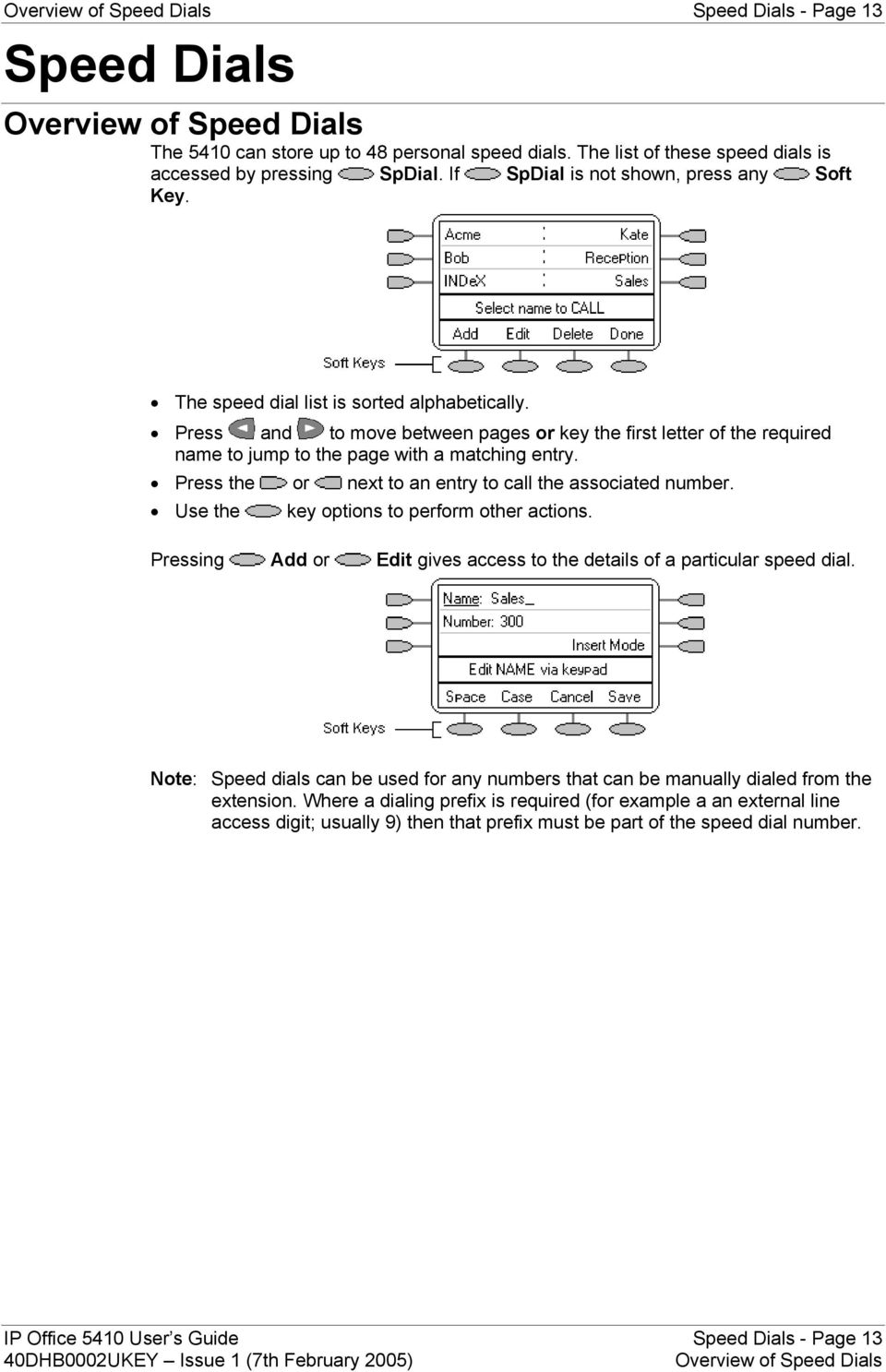
13 Overview of Speed Dials Speed Dials - Page 13 Speed Dials Overview of Speed Dials The 5410 can store up to 48 personal speed dials. The list of these speed dials is accessed by pressing SpDial. If SpDial is not shown, press any Soft Key. The speed dial list is sorted alphabetically. Press and to move between pages or key the first letter of the required name to jump to the page with a matching entry. Press the or next to an entry to call the associated number. Use the key options to perform other actions. Pressing Add or Edit gives access to the details of a particular speed dial. Note: Speed dials can be used for any numbers that can be manually dialed from the extension. Where a dialing prefix is required (for example a an external line access digit; usually 9) then that prefix must be part of the speed dial number. Speed Dials - Page 13 Overview of Speed Dials
14 Page 14 - Using Speed Dials Speed Dials Using Speed Dials Dialing a Speed Dial Number You can use the speed dial directory to make a call with the handset on hook or off hook. 1. Press SpDial. If SpDial is not shown, press any Soft Key. 2. Press and to display different pages of speed dials or key the first letter of the required name to jump to the page with a matching entry. 3. When the required entry is displayed, press the adjacent or key. The number is automatically dialed for you. Deleting a Speed Dial 1. Press SpDial. If SpDial is not shown, press any Soft Key. 2. Press Delete. 3. Select the speed dial entry you want to delete. Press and to display different pages of speed dials or key the first letter of the required name to jump to the page with a matching entry. 4. When the required entry is displayed, press the adjacent or key. A request for confirmation will appear. 5. Press Yes to delete the entry or Cancel to exit without deleting. 6. Select another entry to delete or press Done to return to the speed dial list. Editing a Speed Dial 1. Press SpDial. If SpDial is not shown, press any Soft Key. 2. Press Edit. 3. Select the speed dial entry you want to edit. Press and to display different pages of speed dials or key the first letter of the required name to jump to the page with a matching entry. 4. When the required entry is displayed, press the adjacent or key. 5. Edit the speed dial using the same methods as for adding a new speed dial. See Adding a New Speed Dial on page After saving or canceling any changes you will be returned to the speed dial selection list. Select another speed dial to edit or press Done to return to the speed dial list. Converting a Call Log Entry to a Speed Dial You can create a new speed dial from a call log entry. See Saving a Call Log Entry to Your Speed Dial List on page 17. This process will start the normal speed entry screen but pre-filled with the name and number from the call log entry. Page 14 - Speed Dials Using Speed Dials
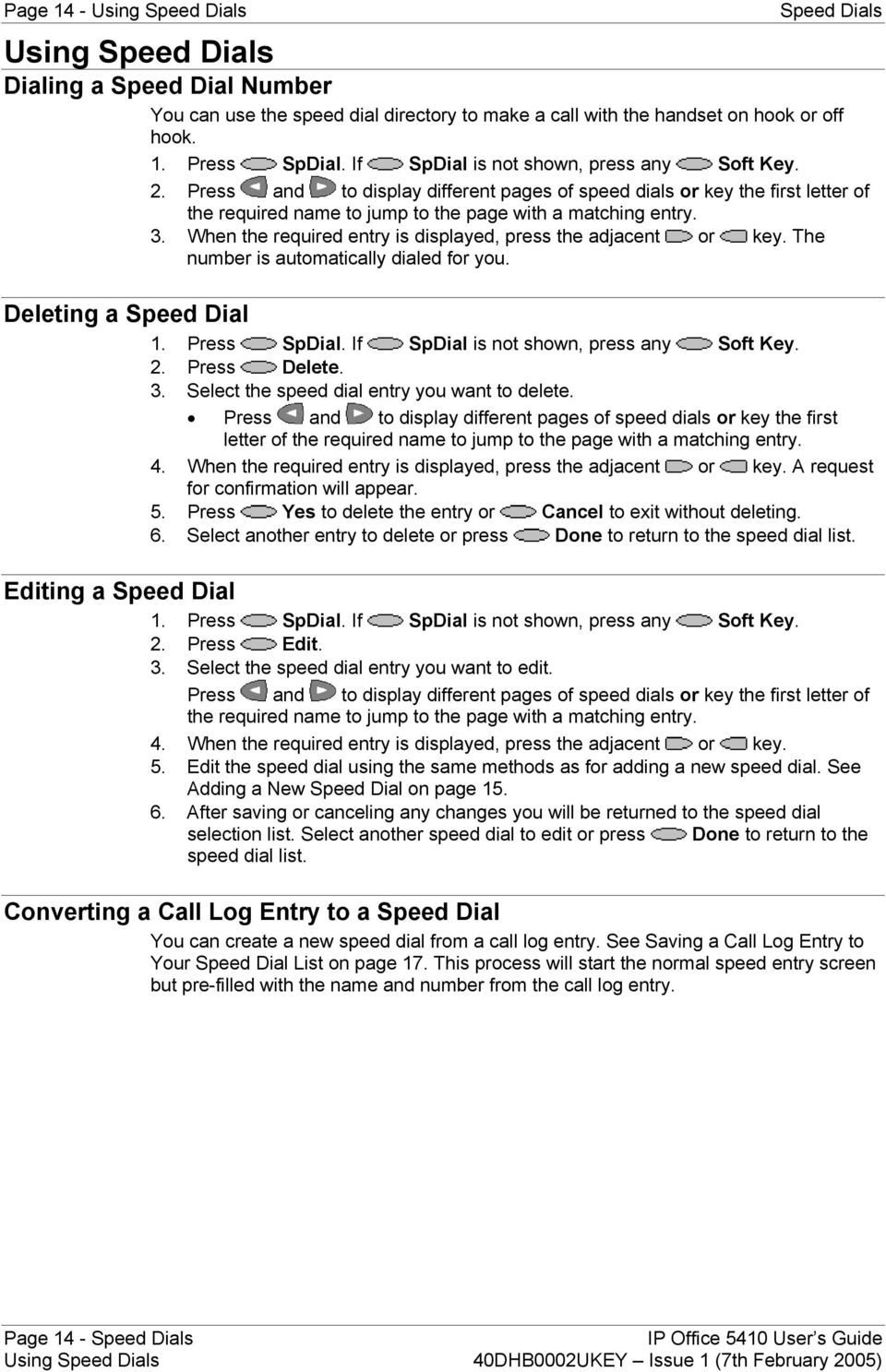
15 Using Speed Dials Speed Dials - Page 15 Adding a New Speed Dial 1. Press SpDial. If SpDial is not shown press any Soft Key. Press Add. If a message stating that the speed dial list is full appears, you must first delete an existing entry before adding any new entry. See Deleting a Speed Dial on page 14. You can switch between Name and Number entry by pressing the key next to the item you want to edit. The soft keys options also change accordingly. 2. With Name selected, begin entering text using the telephone keypad. Each key is marked with the letters and number it provides. You may have to press the key more than once depending on the character you require. For example, the key 2 is also marked as A, B and C. To enter a C, press 2 until a C is displayed. If the next character you want to enter is on the same key, press to move the cursor right and then enter the character. By default the first letter is entered in upper-case and the phone then switches to lower-case entry mode. To change the case of the current character press Case. To enter a space press Space. Use the key to move the cursor one space right. If you make a mistake, use Backspace to delete the character to the left of the cursor. If you have made a mistake in the middle of a character string and do not wish to backspace and re-enter all the characters, use the key to step back to one character before the point where you wish to edit. Either insert the new character or press Backspace to delete the character to the left of the cursor. Pressing the * key once enters a. (period) or twice a *. To enter more than one * or period, press to move the cursor right and then enter the character. Pressing the # key once enters a - (dash) or twice a #. To enter more than one # or dash, press to move the cursor right and then enter the character. 3. When the name is set as required, select Number. 4. Enter the number required using the dialing keypad. For external numbers remember to enter any external dialing prefix required (9 say). To enter a hyphen, press Hyphen. This does not affect the number dialed but may help make numbers more readable. To enter a 1.5 second pause, press Pause. This will appear as a, (comma) character in the telephone number. Use the and keys to move the cursor left or right. If you make a mistake, use Backspace to delete the number to the left of the cursor. 5. Do one of the following: To save the speed dial and return to the speed dial list, press Save. To return to the speed dial list without saving the changes press Cancel. To return to the call handling screen without saving the changes press Exit. Speed Dials - Page 15 Using Speed Dials

16 Page 16 - Overview of the Call Log Using the Call Log Overview of the Call Log The 5410 holds and maintains a call log, accessed by pressing Using the Call Log Log. This log can store up to 48 entries. These can be a mixture of incoming answered calls, incoming unanswered calls and outgoing calls. You can select which types of calls are included in the log. You can also use call log entries to make return calls or convert the entry into a speed dial for future use. WARNING: Calls that are made using pin codes and other information will appear in the call log. Either Logging of outgoing calls should be switched off or those call logs removed manually. See Setting Which Calls are Logged on page 18. Note: When Only outgoing calls made using the dial pad or a SpDial entry are logged. Log is pressed a screen similar to the following is displayed: Missed calls are displayed first. You can select from InAns or Outgo. Alternatively, press More and select All to display all three options. Logged calls are shown with the most recent first. The name of the called or calling party is shown if available. The number of the called or calling party is shown. Press either the or key to display further pages of entries. Pressing the or key next to a log entry display further details of that particular call. The number of the log entry. The type of log entry, i.e. Answered, Un-answered or Outgoing. The name of the called or calling party is shown (if available). The number of the called or calling party is shown. The date and time of the call. (And for InAns/Outgo, the duration of the call.) Press either the or key to display the previous or next logged call. The keys provide a number of actions. Also see Making Calls from the Call Log on page 17, Saving a Call Log Entry to Your Speed Dial List on page 17, Viewing the Call Log on page 17 and Deleting a Call Log Entry on page 18. Page 16 - Using the Call Log Overview of the Call Log

17 Using the Call Log Using the Call Log - Page 17 Using the Call Log You can make calls directly from the call log. Whilst in the call log you can still make a call by going off-hook, pressing Speaker and dialing a new call. Similarly, you can still receive calls and handle them using the dial pad key functions. Viewing the Call Log 1. Press Log. If Log is not shown, press any Soft Key. 2. At default, Missed calls are displayed first. You can select from InAns or Outgo. Alternatively, press More and select All to display all three options. To return to Missed or InAns or Outg, press Back and make your selection. 3. Press and to display different pages of log entries. To exit the call log and return to the previous screen press Done. To exit the call log and return to the call handling screen press Exit. To view the details of a particular log entry, press the or key next to the entry. 3. Press Done to return to the previous screen. Making Calls from the Call Log 1. Press Log. If Log is not shown, press any Soft Key. 2. At default, Missed calls are displayed first. You can select from InAns or Outgo. Alternatively, press More and select All to display all three options. To return to Missed or InAns or Outg, press Back and make your selection. 3. Press and to display different pages of log entries. 4. When you locate the entry you want to call, press the or key next to the entry. 5. Press Call make the call. If the number shown is external but doesn't include the external dialing prefix used by your telephone system, go off-hook, dial the prefix and then press Call. Saving a Call Log Entry to Your Speed Dial List 1. Press Log. If Log is not shown, press any Soft Key. 2. At default, Missed calls are displayed first. You can select from InAns or Outgo. Alternatively, press More and select All to display all three options. To return to Missed or InAns or Outg, press Back and make your selection. 3. Press and to display different pages of log entries. 4. When you locate the entry you want to call, press the or key next to the entry. 5. Press Save. The speed dial editing screen appears, pre-filled with the details from the call log entry. See Adding a New Speed Dial on page 15. Using the Call Log - Page 17 Using the Call Log

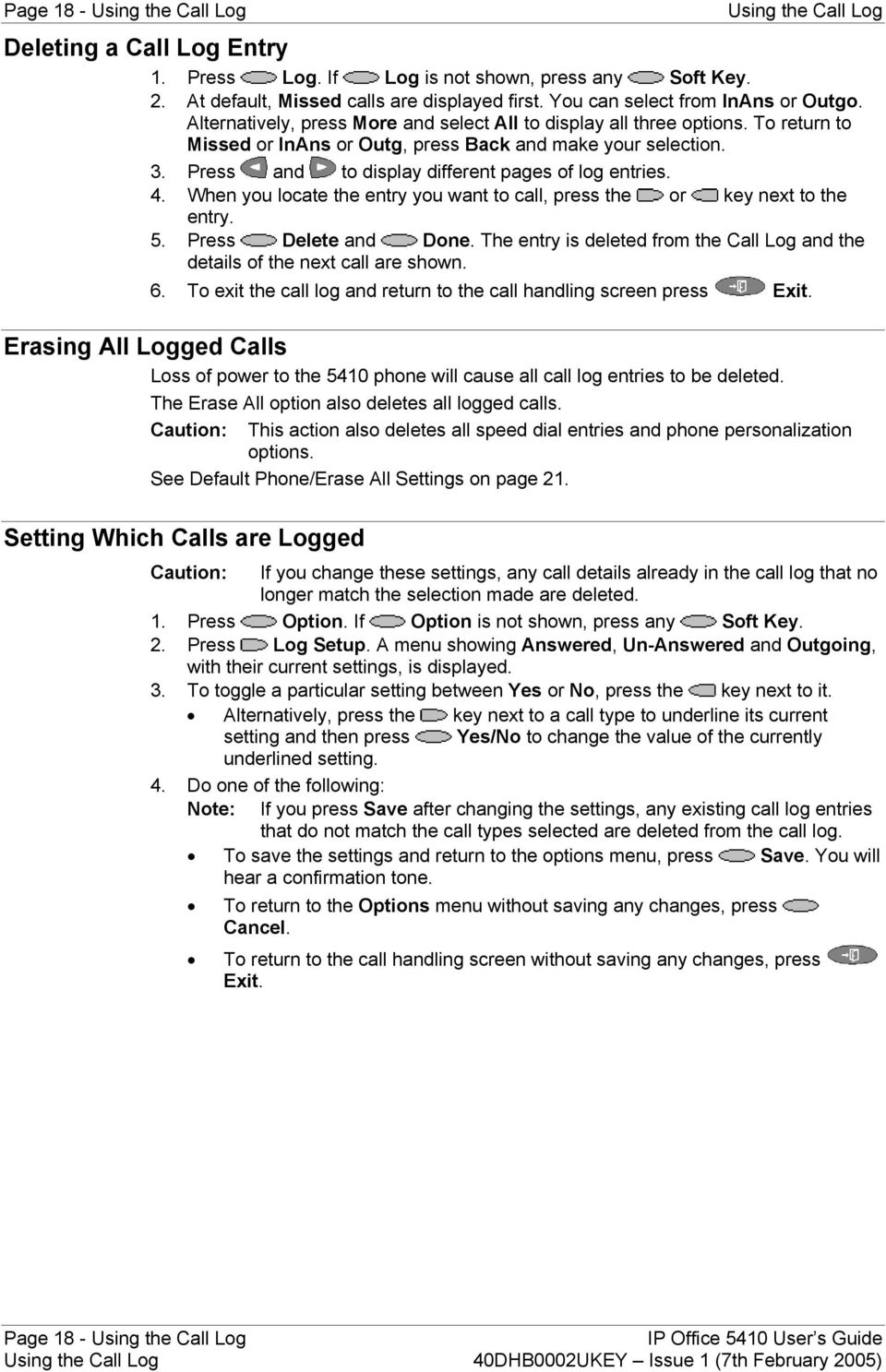
18 Page 18 - Using the Call Log Using the Call Log Deleting a Call Log Entry 1. Press Log. If Log is not shown, press any Soft Key. 2. At default, Missed calls are displayed first. You can select from InAns or Outgo. Alternatively, press More and select All to display all three options. To return to Missed or InAns or Outg, press Back and make your selection. 3. Press and to display different pages of log entries. 4. When you locate the entry you want to call, press the or key next to the entry. 5. Press Delete and Done. The entry is deleted from the Call Log and the details of the next call are shown. 6. To exit the call log and return to the call handling screen press Exit. Erasing All Logged Calls Loss of power to the 5410 phone will cause all call log entries to be deleted. The Erase All option also deletes all logged calls. Caution: This action also deletes all speed dial entries and phone personalization options. See Default Phone/Erase All Settings on page 21. Setting Which Calls are Logged Caution: If you change these settings, any call details already in the call log that no longer match the selection made are deleted. 1. Press Option. If Option is not shown, press any Soft Key. 2. Press Log Setup. A menu showing Answered, Un-Answered and Outgoing, with their current settings, is displayed. 3. To toggle a particular setting between Yes or No, press the key next to it. Alternatively, press the key next to a call type to underline its current setting and then press Yes/No to change the value of the currently underlined setting. 4. Do one of the following: Note: If you press Save after changing the settings, any existing call log entries that do not match the call types selected are deleted from the call log. To save the settings and return to the options menu, press Save. You will hear a confirmation tone. To return to the Options menu without saving any changes, press Cancel. To return to the call handling screen without saving any changes, press Exit. Page 18 - Using the Call Log Using the Call Log
19 Overview of 5410 Options Changing the 5410 Options - Page 19 Changing the 5410 Options Overview of 5410 Options The options menus are accessed by pressing adjust a number of 5410 features. Option. These menus allow you to To select an option: 1. Press the or next to it 2. The key actions change according to the current available actions. 3. To exit and return to the normal call handling screen press Exit. 4. Whilst in the options menus, you can still make and receive calls using the telephone keypad controls. The options are: Ring Options: Sets the: The ringing used by your Toggles the message lamp on/off to show when you have an incoming call. Toggles the Show Phone Screen option on or off. See Ring Options on page 20. Contrast: Adjust the display contrast. See Adjusting the Display Contrast on page 20. Log Setup: Configure which calls appear in the call log. See Setting Which Calls are Logged on page 18. Miscellaneous: Enables you to select to remain in your Speed Dial Menu during call handling. Self Test: Test the phone. See Using Self Test on page 21. Language: Select the phone's display language. See Language on page 22. Press to display: Handset AGC/Headset AGC: Switch handset/headset automatic gain control on/off. See Automatic Gain Control (AGC) on page 22. Press again to display: Erase: Reset the telephone to its default settings. See Default Phone/Erase All Settings on page 21. Changing the 5410 Options - Page 19 Overview of 5410 Options

20 Page 20 - Selecting Personalized Options Selecting Personalized Options Ring Options The Ring Options menus allows you to: Changing the 5410 Options Choose a personalized ringing pattern for your telephone. Note: If you receive a call while selecting a ring pattern, you are automatically returned to the call handling screen. Set the message lamp to flash when you receive a call. Set the telephone to revert to the call handling screen when you are setting up/using Speed Dial, Call Log, etc. To change the ring pattern: You can choose from among eight different ring patterns. This alters the tone and style of ringing used by the 5420, e.g. the number of rings will still vary according to the type of call. 1. Press Option. 2. Press Ring Options followed by Ring Pattern. A menu with the current ring pattern appears. 3. To select a ringing pattern use either the or keys or press a dial pad key between 1 and 8. You will hear the selected ringing pattern. 4. To hear the ringing pattern again press Play or repress the dial pad key. When you have selected a ringing pattern, press Save. You will hear a confirmation tone and be returned to the options menu. If you want to return to the options menu without changing the ring pattern, press Cancel. To set the Flash Message Lamp: 1. Press Option. 2. Press Ring Options and set Flash Message Lamp to Yes or No. When set to Yes the Message lamp will flash when you receive a call. Changing this option does not affect the voic visual indicator feature. To set the Show Phone Screen: 1. Press Option. 2. Press Ring Options and set Show Phone Screen to Yes or No. If set to Yes then, when you are setting up/using Speed Dial, Call Log, etc, you are automatically returned to the call handling screen when you receive a call. Adjusting the Display Contrast You can adjust the contrast level on the telephone display. You can choose from among fifteen levels of contrast. 1. Press Option 2. Press Contrast. A menu with the current contrast setting appears. 3. Use either the or key to adjust the level of contrast. 4. When the contrast is set as required, either: Return to the options menu by pressing Done. Return to the call handling screen by pressing Exit. Page 20 - Changing the 5410 Options Selecting Personalized Options

21 Selecting Personalized Options Changing the 5410 Options - Page 21 Call Log Setup Through the Option menu you can specify which types of calls should be included in the 5410's call log. See Setting Which Calls are Logged on page 18. Using Self Test Self test can be used to display information about the phone and to check operation of the lamps and display. The information may be required by a telephone system maintainer. 1. Press Option. If Option is not shown, press any Soft Key. 2. Press Self Test. A screen of information appears. Caution: In the top row, the centre of the display should show REL:2.00 or higher. If not the telephone s software needs to be upgraded. Consult your system Administrator. 3. Press and hold the Test key. The screen lines should all go black and all the phone lamps should come on. If they do not consult your system Administrator. 4. Release the Test key and do one of the following: To return to the options menu, press Done. To return to the call handling screen, press Exit. Default Phone/Erase All Settings The Erase option allows you to reset all personalized settings entered through the 5410's Option menus (except contrast level). It also deletes all entries in the phones Call Log and Speed Dial lists. 1. Press Option. If Option is not shown, press any Soft Key. 2. Press the until the display shows: Speed Dial List, Call Log, User Labels, Options, Language and All. 3. If you do not want to erase, do one of the following: To return to the options menu without erasing, press Cancel. To return to the call handling screen without erasing, press Exit. 4. To continue with erasing, select from Speed Dial List, Call Log, User Labels, Options, Language and All and press Erase. You will be asked to confirm the action. If you want to erase all settings, press Erase again. To return to the options menu without erasing, press Cancel. To return to the call handling screen without erasing, press Exit. Changing the 5410 Options - Page 21 Selecting Personalized Options
22 Page 22 - Selecting Personalized Options Language Changing the 5410 Options When the 5410 telephone is first installed, it is set to display screen text in English. You can select the language that you would prefer from the following: English, German (Deutsch), French (Français), Spanish (Español), Italian (Italiano), Dutch (Nederlands), Portuguese (Português) or Japanes (Katakana characters). Note: This does not alter your user language setting on the telephone system. 1. Press Option. If Option is not shown, press any Soft Key. 2. Press Language. A the first page of the available languages appears, with the current language underlined. Press More to display the second page. 3. Press the or key next to the language required. The screen text changes to the language selected. 4. Do one of the following: To save the settings and return to the options menu, press Save. You will hear a confirmation tone. To return to the options menu without saving any changes, press Cancel. To return to the call handling screen without saving any changes, press Exit. Changing Key Labels This function is currently not supported on IP Office. Automatic Gain Control (AGC) Automatic Gain Control (AGC) raises the volume when a caller is speaking quietly and lowers the volume when the caller is loud. The 5410 supports AGC for both the handset and the headset if connected. Note: If the ambient background noise in the office is too high, this can affect the AGC settings. Hence it is advisable in this type of environment to switch AGC off. 1. Press Option. If Option is not shown, press any Soft Key. 2. Press a or key. A menu listing the current AGC settings for the handset, headset or speaker appears. 3. To toggle a particular setting between Yes or No, press the key next to it. Alternatively, press the key next to Handset, Headset or Speaker to underline its current setting and then press Yes/No to change the value of the currently underlined setting. 4. Do one of the following: To save the settings and return to the options menu, press Save. You will hear a confirmation tone. To return to the options menu without saving any changes, press To return to the call handling screen without saving any changes, press Exit. Cancel. Page 22 - Changing the 5410 Options Selecting Personalized Options
23 Overview of the Function Keys Function Keys - Page 23 Function Keys Overview of the Function Keys Both the, Function Keys and Soft Keys can be used to access a range of system features. The display adjacent to the key shows the feature name. Some of these features are default features supported by all 5410 telephones (e.g. SpDial, Log, Option and Label on the Soft Keys) and are always available. Others are system features that can only be programmed by the System Administrator for Function Keys. See Function Key Programming on page 25. In addition, there are a number of System Features that you can always access yourself by the use of short codes. Refer to System Features on page 57 for details of System Features that you can always access yourself by dialing short codes, e.g. *17 to listen to your Voic messages. The main screen has three pages. This means that the six and Function Keys on each page could be used for up to 18 features. However, it is strongly recommended that all three Call Appearance keys remain at their default settings. Hence, there are 15 soft Function Keys that can be allocated to system features. To move between pages use the and keys. In the following example: The first three keys have been set (default setting) as call appearance lines. See Call Appearance Keys on page 7. Key 4 has been set to access the Admin programmable functions. See Function Key Programming on page 25. Key 5 has been set to monitor system park slot 1. The indicates a call is currently parked in slot 1 by the user and when parked in a slot by other users, the label is underlined. See Park - Park (#) on page 47. Key 6 has been set to the SAC (Send All Calls) function. See Function Keys - Page 23 Overview of the Function Keys
24 Page 24 - Overview of the Function Keys Function Keys SAC - Send All Calls (!) on page 53. Pressing either or will display the other page of programmed functions set for this phone. Programming Your Own Functions: If the phone has been setup with either or both the Admin and Admin1 features assigned to display keys, you can select and program your own feature choices against other keys. See Function Key Programming on page 25. Changing the labels of the Function Keys: You can personalize the Function Key labels. E.g. you can change SAC to Send All for instance. See Error! Reference source not found. on page Error! Bookmark not defined.. Page 24 - Function Keys Overview of the Function Keys
25 Function Key Programming Function Keys - Page 25 Function Key Programming If any one of the keys on the telephone is programmed with an Admin or Admin 1 feature, it allows you to program further features against other function keys. Both Admin and Admin1 are allocated to your function keys by your System Administrator and would appear on a menu screen that is similar to the following: The two tables below list the user programmable features available for Admin and Admin1 respectively. For full details of how each feature works see Display Key Features on page 28. Admin: The programmable functions available via an Admin key. Name Description Toggles Data Acct Account Code Entry No Optional AD Abbreviated Dial No Yes Admin Self-Administer No No AutCB Automatic Callback Yes No CFrwd Call Forwarding All Yes Optional CPark Call Park Yes Optional CPkUp Call Pickup No No Dir Directory No No DPkUp Directed Call Pickup No Yes Drop Drop No No GrpPg Group Paging No Yes HdSet Headset Toggle Yes No HfAns Internal Auto-Answer Yes No HGNS+ Set Hunt Group Night Service No Yes Park Call Park to Other Extension No Yes Prog Abbreviate Dial Program No Yes RngOf Ringer Off Yes No SAC Send All Calls Yes No Spres AD Suppress Yes No Timer Timer Yes No TmDay Time of Day Yes No In addition to the above, there is a key labeled Exlp? This key enables you to change the display from the shorthand version displayed at default to a longhand version of your own. See Shorthand Programming Mode on page 26 and Longhand Programming on page 27 respectively. Admin1: The programmable functions available via an Admin 1 key. Name Description Toggles Data Park Park No Yes Use User No Yes Group Group No Yes Number Dial No Yes Flash Hook Flash No No Function Keys - Page 25 Function Key Programming
26 Page 26 - Function Key Programming Shorthand Programming Mode 1. Press Admin or Admin 1. See Function Key Programming on page The Admin or Admin1 menu appears as follows: Admin Pages Function Keys With the exception of Expl?, the names shown are the features that you can assign to soft keys. When Admin has been selected you can display the full name of the feature by pressing Expl?. (see Longhand Programming on page 27). Admin1 Page Similarly, when Admin1 is pressed, you can assign any one of the functions shown to a soft key. 3. On the Admin pages, use the and keys to move through the list of features. 4. When the function required is shown, press the key adjacent to its name. 5. If the function requires some data to be entered, [ is shown at the bottom of the display. Enter the data using the normal telephone keypad. 6. The upper part of the display reverts to showing the functions currently assigned to each and key. 7. Select the display key against which to program the new function by pressing that or key. CAUTION: Do not select the slot used for the Admin function. Replacing this function will lock the phone for further programming until reset through the telephone system by your System Administrator. 8. If the display slot is not already used, the display shows BUTTON PROGRAMMED!. Press EXIT to end programming or Press Cont to continue programming other functions. 9. If the display slot already has a programmed function, the display shows FEATURE ON BUTTON. Press Repla to replace that existing function with the one just programmed. The display then shows BUTTON PROGRAMMED! As in step 8 above. Press Keep to keep the existing function and forget the function just programmed. Press Delete to delete the existing function and forget the function just programmed. Page 26 - Function Keys Function Key Programming
27 Function Key Programming Function Keys - Page 27 Longhand Programming 1. Press Admin. See Function Key Programming on page Pressing Expl? to switch to longhand programming mode. 3. Press Next until the required feature required is shown, then press Selct. 4. If the feature requires some data to be entered, [ is shown at the bottom of the display. Enter the data using the normal telephone keypad. 5. The upper part of the display reverts to showing the features currently assigned to each and key. 6. Use the and keys to move between the pages of display keys. 7. Select the display key against which to program the new feature by pressing that or key CAUTION: Do not select the slot used for the Admin function. Replacing this function will lock the phone for further programming until reset through the telephone system by your System Administrator. 8. If the display slot is not already used, the display shows BUTTON PROGRAMMED!. Press the or keys until EXIT is shown. Press EXIT to end programming or Press Cont to continue programming other functions. 9. If the display slot already has a programmed function, the display shows FEATURE ON BUTTON. Press Repla to replace that existing function with the one just programmed. The display then shows BUTTON PROGRAMMED! as above. Press Keep to keep the existing function and forget the function just programmed. Press Delete to delete the existing function and forget the function just programmed. Function Keys - Page 27 Function Key Programming
28 Page 28 - Function Key Programming Function Keys Display Key Features This section lists the features that can be programmed against and Function Keys. Both the shorthand and longhand names are shown. The shorthand name is the name that is displayed next to the programmed key, along with any data programmed for the feature. Those functions marked with a (!) or an (#) can be programmed by the 5420 user. This programming requires the phone to already have a soft key assigned to the Admin (for! functions) and/or to Admin1 (for # functions). See Function Key Programming on page 25 for lists of Admin and Admin1 functions. All of the following functions can be programmed onto your 5420 by your System Administrator. The command path is shown, for example: [User Digital Telephony Emulation Directory]. Dial (#) Automatically dials the displayed number. This function requires entry of the number to dial when programmed. The number is then displayed next to the key. This function can be programmed through the phone by the user using an Admin 1 key. Pressing the Dial key dials the associated number. [User Digital Telephony Dial] AD - Abbreviated Dial (!) on page 30. Prog - Abbreviated Dial Program (!) on page 49. Group (#) Answer or clear calls ringing a specific group. This function requires entry of the group number (allocated by your System Administrator). When programmed, the group name is then displayed next to the key. This function can be programmed through the phone by the user using an Admin 1 key and the group number. A appears against the group when calls to that group are ringing. Pressing displays details of one of those calls and options to drop (Drop ) the call, answer the call (Answn ) or exit the group monitor ( EXIT). [User Digital Telephony Group] User (#) See the status of a specific user, call that user and pick-up calls to that user. When programmed by your System Administrator (on the IP Office), the user name is entered. That name is then displayed next to the key. This function can also be programmed through the phone by the user using an Admin 1 key and then the user number. Pressing the key calls the user. The when the user is called the user name is underlined with a symbol beside it. Press the key next to the name. DkPickup appears against a call appearance key. To pick up the call press this key. If the System Administrator has setup group monitoring of the same user, pressing the user key when the user is busy on a call displays several options. These are Drop (end the user's call), Listn (listen to the call), and Aquir (takeover the call). If the System Administrator has not setup group monitoring, then the options shown are Call, Message, Vmail and CallB. [User Digital Telephony User] Page 28 - Function Keys Function Key Programming
29 Function Key Programming Function Keys - Page 29 Absnt - Set Absent Text Set the users current absence message setting. This function is currently not supported on the 5420 telephone. Acct - Account Code Entry (!) Make a call using an account code or enter an account code during a call. This function can be programmed with or without data. This function can be programmed through the phone by the user using an Admin key. If programmed with data, the account code entered when programmed must match a valid account code set on the telephone system. The Acct key displays that number. If programmed without data, ENTER ACCOUNT is displayed after Acct is pressed. Enter an account code and press Set. If the account code entered does not match a valid account code set on the telephone system, RENTER ACCOUNT is displayed. An Acct key can be pressed before or during a call. [User Digital Telephony Emulation Account Code Entry] AD - Abbreviated Dial (!) Dial the displayed number. This function requires entry of a number to dial when programmed. The AD key displays that number. This function can be programmed through the phone by the user. The number does not have to be a complete number, the user can dial additional digits AD. * and # can be entered in the number to match IP Office after pressing shortcodes. [User Digital Telephony Emulation Abbreviated Dial] Dial (#) on page 28. Prog - Abbreviated Dial Program (!) on page 49. Admin - Self-Administer (!) Access menus for programming functions against display keys. This function can be programmed with or without data. If programmed with a setting of 1, the key accesses a different set of functions. See Function Key Programming on page 25. This function can be programmed through the phone by the user using an existing Admin key. The Admin key gives access to the menus for programming functions against and keys. [User Digital Telephony Emulation Self-Administer] Function Keys - Page 29 Function Key Programming
30 Page 30 - Function Key Programming Function Keys Apear - Appearance Add a display line for call appearances with symbols being displayed for Incoming Calls, Connected and On Hold. See Call Appearance Keys on page 7. This function does not require any data entered when programmed. However it is normal to enter some text such as a=, b= and so on for each call appearance key. This function cannot be programmed through the phone by the user. [User Digital Telephony Emulation Appearance] AutCB - Automatic Callback (!) Sets a callback when free on busy extensions and callback when next used on unanswered extensions. This function does not require any data entered when programmed. This function can be programmed through the phone by the user using an Admin key. When the called target extension does not answer or is busy, pressing AutCB sets a callback on that extension. Whilst the callback is set, AutCB is shown with a symbol. Pressing AutCB again cancels the callback. Hence, when the callback target extension becomes free or is next used, pressing starts a call to that extension. [User Digital Telephony Emulation Automatic Callback] RBak - Cancel Ringback When Free on page 50. RBak+ - Ringback When Free on page 50. Busy - Busy Sets the extension as being busy. This feature is not applicable when working with multiple Call Appearance lines as all the call appearance lines must be in use before this function becomes active. This function does not require any data entered when programmed. This function cannot be programmed through the phone by the user. The Busy key sets the extension as busy to callers. If a forward on busy number is set, it is followed (see FwBNo - Forward On Busy Number on page 38). Otherwise calls go to voic if on or receive busy tone if internal and ringing if external. To return the extension from busy, press Busy and then Speaker. [User Digital Telephony Advanced Busy Busy] BusyH - Busy On Held Switch the users busy on held status on/off. This function requires data entered when programmed. Enter 0 for off or 1 for on. This function cannot be programmed through the phone by the user. Pressing BusyH switches the user's 'busy on held' state to either on or off as indicated by the data value. When on, if the user has a call on hold, new callers receive busy tone (ringing if analogue) or are diverted to voic (if enabled), rather than ringing the user. This function also overrides call waiting indication when the user has a call on hold. [User Digital Telephony Advanced Busy Busy On Held]. Page 30 - Function Keys Function Key Programming
31 Function Key Programming Function Keys - Page 31 CFrwd - Call Forwarding All (!) Switch call forwarding on/off and set the forwarding number. This function can be programmed with or without a target forwarding number. This function can be programmed through the phone by the user using an Admin key. If programmed with a forwarding number, that number is shown next to CFrwd. Pressing CFrwd switches on forwarding to that number. If programmed without a forwarding number, when CFrwd is pressed, the user's current forwarding number setting is shown. Change the number using the telephone keypad and <<< to backspace. When the number set as required press Done. When call forwarding is on, CFrwd is shown with a symbol and D (Diverted) is shown at the top of the display. To switch call forwarding off, press CFrwd again. [User Digital Telephony Emulation Call Forwarding All] FwNOn - Forward On No Answer On on page 39 FwUOn - Forward Unconditional On on page 40. FwdNo - Forward Number on page 39. FwdH+ - Forward Hunt Group Calls On on page 39 ClrCW - Clear CW Clears the current connected call and connects any waiting call. This feature is not applicable when working with multiple Call Appearance lines. This function does not require any data entered when programmed. This function cannot be programmed through the phone by the user. Pressing ClrCW disconnects the extension's current call and connects any waiting call. [User Digital Telephony Advanced Call Clear CW] CnfRV - Conference Meet Me Allows the extension to join a specified conference. This function requires the conference number to be entered when programmed. That number is then shown next to CnfRV. This function cannot be programmed through the phone by the user. Pressing CnfRV places the extension into the specified conference. Note that the number of conference parties allowed at any time is determined by the telephone system. [User Digital Telephony Advanced Call Conference Meet Me] Conf+ - Conference Add Places all calls held by the extension into a conference. This function does not require any data entered when programmed. This function cannot be programmed through the phone by the user. Pressing Conf+ places the extension and any calls it has put on hold into a conference. This function will not work if the extension has a current call. [User Digital Telephony Advanced Call Conference Add] Function Keys - Page 31 Function Key Programming
32 Page 32 - Function Key Programming Function Keys CPark - Call Park (!) Park the current call. This function can be programmed with or without data. This function can be programmed through the phone by the user using an Admin key. If programmed with data, the number entered is shown next to the CPark key and is the number assigned to the parked call. If programmed without data, the key displays just CPark. Calls parked using this key are is assigned a number based on the parking extensions number. For example, extension 290's first parked call is numbered 2900, its next 2901 if 2900 is still parked and so on. If calls are parked using this key, CPark is shown with a symbol. Pressing the key again displays the user's parked calls and allow them to be retrieved. Parked calls are retrieved with the Ride function (see page 52). If not retrieved elsewhere, a parked call will recall to the parking extension after a set time. [User Digital Telephony Emulation Call Park] Park - Park (#) on page 47. Park - Call Park to Other Extension (!) on page 47. Ride - Ride Call on page 52. CPkUp - Call Pickup (!) Answer a call ringing elsewhere on the telephone system. This function does not require any data entered when programmed. This function can be programmed through the phone by the user using an Admin key. The CPkUp call answers (pickup) any call currently ringing on the telephone system. Note: We recommend that this function is only used on systems with a small number of users all in one area. Use of this function on larger system may lead to confusion. [User Digital Telephony Emulation Call Pickup] PickA - Call Pickup Any on page 48. PickG - Call Pickup Group on page 48. PickM - Call Pickup Members on page 48. CWOff - Call Waiting Off Switches call waiting for the extension off. This function does not require any data entered when programmed. This function cannot be programmed through the phone by the user. The CWOff key switches call waiting for the extension off. [User Digital Telephony Advanced Call Call Waiting Off] Page 32 - Function Keys Function Key Programming
33 Function Key Programming Function Keys - Page 33 CWOn - Call Waiting On Switches call waiting for the extension on/off. This function does not require any data entered when programmed. This function cannot be programmed through the phone by the user. The CWOn key toggles call waiting on/off. When call waiting is on, CWOn is shown with a symbol. When call waiting is on and the extension is on a call, any additional call receives ringing rather than busy tone. [User Digital Telephony Advanced Call Call Waiting On] CWSus - Call Waiting Suspend Suspend the current call at the exchange and answer the waiting call. This function is not supported in the USA. If no slot number is specified when the function is programmed, exchange slot 0 is used. This function cannot be programmed through the phone by the user. Pressing CWSus is only supported if the exchange provides a Q.931 suspend call facility. [User Digital Telephony Advanced Call Call Waiting Suspend] Resum - Resume Call on page 51. DCW - Dial CW Allows the user to force another extension to have call waiting mode on for the duration of a call attempt. This function is not supported in the USA. This function requires the target extension number to be entered when programmed. That number is then shown next to DCW. This function cannot be programmed through the phone by the user. Normally, if the target extension is on a call and doesn't have call waiting on, any new call will receive busy tone or be diverted to voic . Pressing DCW will cause the target extension to receive call waiting indication and allow the caller to hear ringing until answered. [User Digital Telephony Advanced Dial Dial CW] Queue - Call Queue on page 49. Dir - Directory (!) Accesses the telephone system directory. This function does not require any data entered when programmed. This function can be programmed through the phone by the user using an Admin key. Pressing Dir displays a number of options. INDeX - Search for a matching extension user name on the telephone system. Group - Search for a matching group name on the telephone system. Extrn - Search for a name match in the telephone systems directory of external numbers. [User Digital Telephony Emulation Directory] Function Keys - Page 33 Function Key Programming
34 Page 34 - Function Key Programming Function Keys Dirct - Dial Direct Connects a call to the target extension without any ringing. This function requires the target extension number to be entered when programmed. That number is then shown next to Dirct. The target extension must be capable of auto-answering. This function cannot be programmed through the phone by the user. [User Digital Telephony Advanced Dial Dial Direct] DNDOn - Do Not Disturb On Puts the extension into 'do not disturb' (no calls) mode. This function does not required any data to be entered when programmed. This function cannot be programmed through the phone by the user. Pressing DNDOn toggles the extension's do not disturb state. When on, DNDOn is shown with a symbol and the display includes an N (No calls). [User Digital Telephony Advanced Do Not Disturb Do Not Disturb On] Page 34 - Function Keys Function Key Programming
35 Function Key Programming Function Keys - Page 35 SAC - Send All Calls (!)on page 53. DNDOf - Do Not Disturb Off Takes the extension out of 'do not disturb' (no calls) mode. This function does not required any data to be entered when programmed. This function cannot be programmed through the phone by the user. Pressing DNDOf switches the extension's do not disturb state off. [User Digital Telephony Advanced Do Not Disturb Do Not Disturb Off] DNDX+ - Do Not Disturb Exception Add Adds the specified number to the extension's do not disturb exception list. This function requires entry of the calling number when programmed. That number is then shown next to DNDX+. This function cannot be programmed through the phone by the user. Pressing DNDX+ adds the set number to the extension's do not disturb exception list. That number can then call the extension and transfer calls to the extension even when the extension is in do not disturb mode. [User Digital Telephony Advanced Do Not Disturb Do Not Disturb Exception Add] DNDX- - Do Not Disturb Exception Delete Removes the specified number from the extension's do not disturb exception list. This function requires entry of the calling number when programmed. That number is then shown next to DNDX-. This function cannot be programmed through the phone by the user. Pressing DNDX- removes the set number from the extension's do not disturb exception list. That number can then call the extension and transfer calls to the extension even when the extension is in do not disturb mode. [User Digital Telephony Advanced Do Not Disturb Do Not Disturb Exception Del] DPkUp - Directed Call Pickup (!) Answer a call currently ringing at a specified user or group. This function can be programmed with or without a a the target extension or group number. This function can be programmed through the phone by the user using an Admin key. If programmed with a target number, the DPkUp key displays that number. When a call is ringing at that extension or group, press DPkUp to answer (pick up) that call. If programmed without a target number, pressing DPkUp allows the user to enter the target number for that pickup attempt. [User Digital Telephony Emulation Directed Call Pickup] Drop - Drop (!) Clears a current calls. This function does not require any data entered when programmed. This function can be programmed through the phone by the user using an Admin key. For a call in progress, pressing Drop disconnects the caller. Function Keys - Page 35 Function Key Programming
36 Page 36 - Function Key Programming Function Keys When drop is used, silence is returned to the user rather than dial tone. This is intended operation, reflecting that Drop is mainly used by call center headset users. [User Digital Telephony Emulation Drop] DTone - Secondary Dial Tone Return secondary dial tone to the user. This function is currently not supported on the 5410 telephone. Emrgy - Dial Emergency Dials a specified number regardless of any call barring applied to the user. This function requires entry of a number to dial when programmed. That number is then shown next to Emrgy. This function cannot be programmed through the phone by the user. [User Digital Telephony Advanced Dial Dial Emergency] Flash - Flash Hook (#) Send a hook flash signal to the currently connected line. This function does not require any data entered when programmed. This function cannot be programmed through the phone by the user. This function can be programmed through the phone by the user using an Admin 1 key. [User Digital Telephony Advanced Miscellaneous Flash Hook] FolTo - Follow Me To Forwards calls from this extension to the specified target. This function requires the target extension to be entered when programmed. The extension number is then shown next to FolTo. This function cannot be programmed through the phone by the user. Pressing FolTo sets the extension's Follow Me To number to the specified extension and switches follow me use on. Whilst on, FolTo is shown with a symbol. Press FolTo again to switch off. [User Digital Telephony Advanced Follow Me Follow Me To] FwBNo - Forward On Busy Number Sets the extensions forwarding number for use with forward on busy and forward on no answer. This feature requires the target number to be entered when programmed. The number set is shown next to FwBNo. This function cannot be programmed through the phone by the user. Page 36 - Function Keys Function Key Programming
37 Function Key Programming Function Keys - Page 37 Pressing pressed. FwBNo set the extension's forwarding number to that specified by the key [User Digital Telephony Advanced Forward Forward On Busy Number] FwBOn - Forward On Busy On on page 38 FwNOn - Forward On No Answer On on page 39. FwBOn - Forward On Busy On Switches the extension to forward on busy on. Note: When Call Appearance keys have been allocated, all the call appearance lines must be in use before this function becomes active. This function does not required any data to be entered when programmed. This function cannot be programmed through the phone by the user. Pressing FwBOn toggles the extension's forward on busy state and can also be used in conjunction with FwBOf - Forward On Busy Off on page 38. When on, FwBOn is shown with a symbol. When on, calls are forwarded to the extension's forward on busy number. [User Digital Telephony Advanced Forward Forward On Busy On] FwBNo - Forward On Busy Number on page 38. FwBOf - Forward On Busy Off Switches the extension to forward on busy off. Used in conjunction with FwBOn - Forward On Busy On on page 38 This function does not required any data to be entered when programmed. This function cannot be programmed through the phone by the user. Pressing FwBOf switches the extension's use of forward on busy off. [User Digital Telephony Advanced Forward Forward On Busy Off] Function Keys - Page 37 Function Key Programming
38 Page 38 - Function Key Programming Function Keys FwdH+ - Forward Hunt Group Calls On Switches the extension to forward hunt group calls it receives. Note: Calls are only forwarded when forward unconditional (see CFrwd - Call Forwarding All (!) on page 32) or FwUOn - Forward Unconditional On on page 40 is also on. This function does not required any data to be entered when programmed. This function cannot be programmed through the phone by the user. Pressing FwdH+ toggles the feature on/off. When on, FwdH+ is shown with a symbol. Can also be used in conjunction with FwdH- - Forward Hunt Group Calls Off on page 39. [User Digital Telephony Advanced Forward Forward Hunt Group Calls On] FwdH- - Forward Hunt Group Calls Off Switches the extension to forward unconditional off. This function does not required any data to be entered when programmed. This function cannot be programmed through the phone by the user. Pressing FwdH- switches the extension's use of forward hunt group calls off. Can also be used in conjunction with FwdH+ - Forward Hunt Group Calls On on page 39 [User Digital Telephony Advanced Forward Forward Hunt Group Calls Off] FwdNo - Forward Number Sets the extension's forwarding number for use when forwarding all calls. This feature requires the target number to be entered when programmed. The number set is shown next to FwdNo. This function cannot be programmed through the phone by the user. Pressing FwdNo set the extension's forwarding number to that specified by the key pressed. Also See: FwBOn - Forward On Busy On on page 38 FwUOn - Forward Unconditional On on page 40 [User Digital Telephony Advanced Forward Forward Number] FwdOf - Cancel All Forwarding Switch off all call forwarding. This function does not require any data entered when programmed. This function cannot be programmed through the phone by the user. Pressing FwdOf switches off all the extensions call forwarding options. It does not delete the forwarding number settings. [User Digital Telephony Advanced Call Cancel All Forwarding] FwNOn - Forward On No Answer On Switches the extension to forward on no answer on. This function does not required any data to be entered when programmed and cannot be programmed through the phone by the user. Pressing FwNOn toggles the extension's forward on no answer state. When on, FwNOn is shown with a symbol. When on, calls are forwarded to the extension's forward on busy number (see FwBNo - Forward On Busy Number on page 38). [User Digital Telephony Advanced Forward Forward On No Answer On] Page 38 - Function Keys Function Key Programming
39 Function Key Programming Function Keys - Page 39 FwNOf - Forward On No Answer Off Switches the extension to forward on no answer off. This function does not required any data to be entered when programmed. This function cannot be programmed through the phone by the user. Pressing FwNOf switches the extension's use of forward on no answer off. Can also be used in conjunction with FwNOn - Forward On No Answer On on page 39. [User Digital Telephony Advanced Forward Forward On No Answer Off] FwUOn - Forward Unconditional On Switches the extension to forward all its calls except hunt group calls. Note: When Call Appearance keys have been allocated, all the call appearance lines must be in use before this function becomes active. This function does not required any data to be entered when programmed. This function cannot be programmed through the phone by the user. Pressing FwUOn toggles the extension's forward on busy state. When on, FwUOn is shown with a symbol and the display includes a D. When on, calls are forwarded to the extension's forward number (see FwBNo - Forward On Busy Number on page 38). [User Digital Telephony Advanced Forward Forward Unconditional On] FwUOf - Forward Unconditional Off Switches the extension s forward unconditional off. This function does not required any data to be entered when programmed. This function cannot be programmed through the phone by the user. Pressing FwUOf switches the extension's use of forward unconditional off. Can also be used in conjunction with FwUOn - Forward Unconditional On on page 40. [User Digital Telephony Advanced Forward Forward Unconditional Off] GrpPg - Group Paging (!) This function can be programmed with or without a target extension or group number. This function can be programmed through the phone by the user using an Admin key. If programmed with a target number, the GrpPg key displays that number. When GrpPg is pressed, it will make a paging call to that number. If programmed without a target number, the number must be dialed after the user presses GrpPg. [User Digital Telephony Emulation Group Paging] HdSet - Headset Toggle (!) This function does not require any data entered when programmed. This function can be programmed through the phone by the user using an Admin key. The programmed key will then switch the phone between handset and headset operation. When on, HdSet is shown on a dark background. There is no linkage between a programmed HdSet key and the phone's HEADSET key. [User Digital Telephony Advanced Miscellaneous Headset Toggle] Function Keys - Page 39 Function Key Programming
40 Page 40 - Function Key Programming Function Keys Here- - Follow Me Here Cancel If another extension has follow me set to this extension, switches off the follow me action. This function requires the original target extension to be entered when programmed. The extension number is then shown next to Here-. This function cannot be programmed through the phone by the user. Pressing Here- cancels the use of follow me at the target extension. [User Digital Telephony Advanced Follow Me Follow Me Here Cancel] Here+ - Follow Me Here Forwards calls to the target extension to this extension. This function requires the original target extension to be entered when programmed. The extension number is then shown next to Here+. This function cannot be programmed through the phone by the user. Pressing Here+ sets the target extension's Follow Me To number to that this extension. Calls to the target extension are then forwarded to this extension. [User Digital Telephony Advanced Follow Me Follow Me Here] HfAns - Internal Auto-Answer (!) Answers internal calls after a single ring. This function does not require any data entered when programmed. This function can be programmed through the phone by the user using an Admin key. The HfAns key toggles internal auto-answer on/off. When on, HfAns is shown with a symbol. [User Digital Telephony Emulation Internal Auto Answer] RngOf - Ringer Off (!) on page 52. CWOn - Call Waiting On on page 34. HGEna - Hunt Group Enable Sets the extension's membership of a group or groups as enabled. This function does not take the Hunt Group In/Out of Service. This function can be programmed with or without a target group number. This function cannot be programmed through the phone by the user. If programmed without a group number, pressing HGEna toggles all the extension's group memberships to either enabled or disabled. A is shown next to HGEna when the group memberships are enabled. If programmed with a group number, that number is shown next to HGEna. Pressing HGEna will enable the extension's membership of that group. In this mode the key does not toggle. When enabled, G is shown on the display and the extension will receive group calls. [User Digital Telephony Advanced Hunt Group Hunt Group Enable] HGNS+ - Set Hunt Group Night Service (!) on page 42. HGOS+ - Set Hunt Group Out of Service42 on page. HGDis - Hunt Group Disable on page 42. Page 40 - Function Keys Function Key Programming
41 Function Key Programming Function Keys - Page 41 HGDis - Hunt Group Disable Sets the extension's group membership as disabled. This function does not take the Hunt Group Out of Service. This function can be programmed with or without a target group number. This function cannot be programmed through the phone by the user. If programmed without a group number, pressing HGDis disables all the extension's group memberships. If programmed with a group number, pressing HGDis disables just the extension's membership of that group. [User Digital Telephony Advanced Hunt Group Hunt Group Disable] HGNS+ - Set Hunt Group Night Service (!) Put a specific hunt group into night service mode. This function requires the hunt group number to be entered when programmed. The hunt group number is then shown next to HGNS+. This function can be programmed through the phone by the user using an Admin key. Pressing HGNS+ puts the hunt group into night service. Group calls then go to its night service fallback group if set or, if not answered, to voic . [User Digital Telephony Advanced Set Set Hunt Group In Service] HGNS- - Clear Hunt Group Night Service Returns a hunt group that has been manually put into night service back to normal service. Used with HGNS+ - Set Hunt Group Night Service (!) on page 42. This function requires that the hunt group number is entered when programmed. This function cannot be programmed through the phone by the user. The hunt group number is shown next HGNS-. Pressing HGNS- puts the group back into normal service if in night service. [User Digital Telephony Advanced Call Clear Hunt Group Night Service] HGOS+ - Set Hunt Group Out of Service Put a specific hunt group out of service mode. This function requires the hunt group number to be entered when programmed. The hunt group number is then shown next to HGOS+. This function cannot be programmed through the phone by the user. Pressing HGOS+ puts the hunt group out of service. Group calls then go to its out of service fallback group if set or, if not answered, to voic . [User Digital Telephony Advanced Set Set Hunt Group Out Service] HGOS- - Clear Hunt Group Out of Service Returns a hunt group that has been manually put into out of service back to normal service. Used with HGNS+ - Set Hunt Group Night Service (!) on page 42. This function requires that the hunt group number is entered when programmed. This function cannot be programmed through the phone by the user. The hunt group number is shown next HGOS-. Pressing HGOS- puts the group back into normal service if in night service. [User Digital Telephony Advanced Call Clear Hunt Group Out Of Service] Function Keys - Page 41 Function Key Programming
42 Page 42 - Function Key Programming Function Keys Hold - Hold Call Place the current call on hold at the central office. This function is not supported in the USA. If no exchange slot number is specified when the function is programmed, central office slot 0 is used. Pressing Hold is only supported if the central office provides a Q.931 hold facility. It is not the same as local hold provided by the IP Office. [User Digital Telephony Advanced Hold Hold Call] Rtriv - Retrieve Call on page 52. HoldCW - Hold Call Waiting Place the current call on hold and connects any call waiting. This function is not supported in the USA. This function does not required any data to be entered when programmed. This function cannot be programmed through the phone by the user. Pressing HoldCW places the current call on hold and connects any call waiting without any ringing. [User Digital Telephony Advanced Hold Hold CW] IAuto - Automatic Intercom Connects call to the extension without ringing. This function requires entry of an extension number when programmed. The target extension must be support handsfree operation. This function cannot be programmed through the phone by the user. Press IAuto connects the call without any ringing at the remote extension. If the target extension is busy or not available, the call will follow any forwarding or diversion to voic set. [User Digital Telephony Emulation Automatic Intercom] ICSeq - Set Inside Call Sequence Sets the ringing pattern (sequence) used for internal calls. This function is currently not supported on the 5410 telephone. IDial - Dial Intercom The same as IAuto - Automatic Intercom on page 43. This function cannot be programmed through the phone by the user. [User Digital Telephony Emulation Dial Intercom] Inclu - Dial Inclusion Intrudes on a call in progress at the target extension. This function is currently not supported on the 5410 telephone. Page 42 - Function Keys Function Key Programming
43 Function Key Programming Function Keys - Page 43 Intru - Call Intrude Intrudes on a call in progress at the target extension, creating a conference between the callers and the intruding extension. This function requires entry of the target extension number when programmed. The Intru key shows the target extension number. This function cannot be programmed through the phone by the user. Pressing Intru intrudes on the call in progress. Note: That the System Administrator must configure the intruding extension as being able to intrude. Additionally none of the other extensions involved in the call can have "Cannot be intruded on" status. [User Digital Telephony Advanced Call Call Intrude] Listn - Call Listen Allow the extension to listen to groups calls to the target extension. The call parties cannot hear the listening extension. This function requires entry of the target extension number when programmed. This function cannot be programmed through the phone by the user. The Listn key shows the target extension number. Use of this function requires setup of the extension's monitor group by the System Administrator. This function requires the telephone system to have some free conference capacity when invoked. [User Digital Telephony Advanced Call Call Listen] Function Keys - Page 43 Function Key Programming
44 Page 44 - Function Key Programming Intru - Call Intrude on page 46. Recor - Call Record on page 53. Steal - Call Steal on page 53. Function Keys Login - Extn Login Logs the current user onto the extension. This function does not require any data to be entered when programmed. The user cannot program this function through the phone. Pressing the soft key login prompts the user Enter Extn:. The user enters the desired extension and presses the soft function key Next. The user is prompted for the password. The user enters the password and presses the soft function key Done. [User Digital Telephony Advanced Extn Extn Login] Logof - Extn Logout Logs the current user off the extension. This function does not required any data to be entered when programmed. This function cannot be programmed through the phone by the user. Pressing Logof logs the current user off the extension. A new user must then log on to use the extension or dial *36 to re-associate the extension with its default user. [User Digital Telephony Advanced Extn Extn Logout] Music - Hold Music Plays the telephone system's music on hold. This function does not required any data to be entered when programmed. This function cannot be programmed through the phone by the user. Pressing Music plays the telephone system's music on hold through the extension. [User Digital Telephony Advanced Hold Hold Music] NATim - Set No Answer Time Sets the extension's no answer time after which ringing calls are forwarded or go to voic . This function requires the time in seconds to be entered when programmed. The value is shown next to NATim. This function cannot be programmed through the phone by the user. Pressing NATim sets the extension's no answer time to the indicated number of seconds. This time is used to set a delay between ending one call and the next call ringing the extension (the waiting call may be indicated on the display however). [User Digital Telephony Advanced Set Set No Answer Time] VMOff - Voic Offon page 55. OCSeq - Set Outside Call Sequence Sets the ringing pattern (sequence) used for internal calls. This function is currently not supported on the 5420 telephone. Page - Page Page the specified target extension or group. The target must be capable of hands-free speech. This function requires the target extension or group number to be specified when programmed. The target is then shown next to Page. This function cannot be programmed through the phone by the user. Page 44 - Function Keys Function Key Programming
45 Function Key Programming Function Keys - Page 45 [User Digital Telephony Advanced Dial Dial Paging] GrpPg - Group Paging (!)on page 40. Park - Park (#) Park calls to and retrieve calls from a specific park slot. This function requires entry of a park slot number when programmed. That number and Park then appears next to the key. This function can be programmed through the phone by the user using an Admin 1 key. The user can use the key to park calls into that park slot and unpark calls from that slot. Parked calls can also be retrieved with the Ride function (see page 52). When a call is parked in that park slot by the user, a symbol appears next to the key and parked by another user, then Park is underlined. [User Digital Telephony Park] CPark - Call Park (!) on page 33. Park - Call Park to Other Extension (!) on page 47. Ride - Ride Call on page 52. Park - Call Park to Other Extension (!) Allows a call to be parked against another extension. Depending on the other extension's type, its parked call indication is triggered. Parked calls are retrieved with the Ride function (see page 52). This function can be programmed with or without a target extension number. This function can be programmed through the phone by the user using an Admin key. If programmed with a number, the Park key displays that number. After answering a call, pressing Park parks the call against that extension. If programmed without a number, after pressing Park the target for the parked call must be entered. The parked call is assigned a number based on the parking extensions number. For example, extension 290's first parked call is numbered 2900, it s next 2901 if 2900 is still parked and so on. If not retrieved elsewhere, a parked call will recall to the parking extension after a set time. [User Digital Telephony Emulation Call Park to Other Extension] CPark - Call Park (!) on page 33. Park - Call Park to Other Extension (!) on page 47. Ride - Ride Call on page 52. PCall - Priority Call Call a specified target extension even if that extension is set to 'Do not Disturb'. This function can be programmed with or without an extension number being specified. If programmed with an extension number then the target extension is shown next to PCall. If programmed without an extension number then the user has to enter the extension number when PCall is pressed Function Keys - Page 45 Function Key Programming
46 Page 46 - Function Key Programming This function cannot be programmed through the phone by the user. Function Keys [User Digital Telephony Advanced Call Priority Call] PhyEx - Dial Physical Extension by Number Dial a specified extension regardless of the current logged on user at that extension and any forwarding, follow me and do not disturb settings applied by the extension user. This function requires the target extension number to be specified when programmed. The target extension is then shown next to PhyEx. This function cannot be programmed through the phone by the user. This function is currently only available on US based systems. [User Digital Telephony Dial Dial Physical Extension by Number] PickA - Call Pickup Any Pickup any ringing call. This function does not require any data entered when programmed. This function cannot be programmed through the phone by the user. Pressing PickA answers any call currently ringing on the telephone system. Note: We recommend that this function is only used on systems with a small number of users all in one area. Use of this function on larger system may lead to confusion. [User Digital Telephony Advanced Call Call Pick Up Any] CPkUp - Call Pickup (!) on page 33. DPkUp - Directed Call Pickup (!) on page 36. PickG - Call Pickup Group Pickup any ringing call to a group of which the extension is a member. This function does not require any data entered when programmed. This function cannot be programmed through the phone by the user. Pressing PickG answers any call currently ringing a group of which the extension is a member. [User Digital Telephony Advanced Call Call Pick Up Group] CPkUp - Call Pickup (!) on page 33. DPkUp - Directed Call Pickup (!) on page 36. PickM - Call Pickup Members Pickup any call ringing an extension that is a member of the specified group. This function requires entry of the target group number when programmed or the group name in quotation marks. This function cannot be programmed through the phone by the user. Pressing PickM answers any call currently ringing a member of the specified group. The call does not have to be a call to the group number. [User Digital Telephony Advanced Call Call Pickup Members] CPkUp - Call Pickup (!) on page 33. Page 46 - Function Keys Function Key Programming
47 Function Key Programming Function Keys - Page 47 DPkUp - Directed Call Pickup (!) on page 36. Prog - Abbreviated Dial Program (!) Select and program numbers against display keys. This function can be programmed through the phone by the user using an key. Admin [User Digital Telephony Emulation Abbreviated Dial Program] Dial (#)on page 28. AD - Abbreviated Dial (!) on page 30. Quota - Clear Quota Clears (resets) the time quota for connections to a specified external data service (eg. the internet). This function requires entry of the service name when programmed. If left blank then the quotas for all services are cleared (reset). This function cannot be programmed through the phone by the user. [User Digital Telephony Advanced Call Clear Quota] Queue - Call Queue Places a current call into the call queue of a specified extension. Allows calls to be transferred to extensions that return busy tone. This feature is not applicable when working with multiple Call Appearance lines. This function requires entry of a target extension number when programmed. This function cannot be programmed through the phone by the user. During a call, pressing Queue places that call in the target extensions call queue. If the target extension is free, it rings immediately. If the target extension is busy, it rings when it becomes free again. [User Digital Telephony Advanced Call Call Queue] DCW - Dial CW on page 34. RBak+ - Ringback When Free Sets a callback when free on busy extensions and callback when next used on unanswered extensions. This function does not require any data entered when programmed. This function cannot be programmed through the phone by the user. When an extension called does not answer or is busy, pressing AutCB sets a callback on that extension. Whilst the callback is set, AutCB is shown with a symbol. Pressing AutCB again cancels the callback. When the extension becomes free or is next used, Ring Back to and the number appears on the phone that set the callback. Pressing answers the ringback and starts a call to the callback target. [User Digital Telephony Advanced Miscellaneous Ringback When Free] Function Keys - Page 47 Function Key Programming
48 Page 48 - Function Key Programming AutCB - Automatic Callback (!) on page 31. Function Keys RBak - Cancel Ringback When Free Cancels any set ringback when free function. This function does not require any data entered when programmed. This function cannot be programmed through the phone by the user. Pressing RBak- switches off any set ring back when free. If the ringback was set using a AutCB key, that key will still appear with a symbol that can be cancelled by pressing the AutCB key again. [User Digital Telephony Advanced Miscellaneous Cancel Ringback When Free] RBSeq - Set Ringback Sequence Sets the ringing pattern (sequence) used for voic and ringback calls. This function is currently not supported on the 5410 telephone. Recor - Call Record Records the current call at the specified target extension. This function requires entry of a target extension number when programmed. This function cannot be programmed through the phone by the user. When Recor is pressed, the target extensions current call is recorded into their voic mailbox. Note: This function requires Voic Pro to be installed. If advice of call recording is enabled, the call parties will hear a warning before the recording takes place. In some locations it may be a legal requirement to advise callers that a call is being recorded. [User Digital Telephony Advanced Call Call Record] Listn - Call Listen on page 46. Steal - Call Steal on page 53. Relay - Relay Pulse Pulse the specified external output relay (1 or 2) on for 5 seconds. This function requires the relay switch (1 or 2) on the telephone system to be entered when programmed. This function cannot be programmed through the phone by the user. Pressing Relay switches the specified relay on for 5 seconds and then off. [User Digital Telephony Advanced Relay Relay Pulse] Rely+ - Relay On Switch the specified external output relay (1 or 2) on. Page 48 - Function Keys Function Key Programming
49 Function Key Programming Function Keys - Page 49 This function requires the relay switch (1 or 2) on the telephone system to be entered when programmed. This function cannot be programmed through the phone by the user. Pressing Relay switches the specified relay on. [User Digital Telephony Advanced Relay Relay On] Rely- - Relay Off Switch the specified external output relay (1 or 2) off. This function requires the relay switch (1 or 2) on the telephone system to be entered when programmed. This function cannot be programmed through the phone by the user. Pressing Relay switches the specified relay off. [User Digital Telephony Advanced Relay Relay Off] Resum - Resume Call Resume a call previously suspended into a specified ISDN exchange slot. This function is not supported in the USA. This function requires the exchange slot number to be specified when programmed. The slot number is then shown next to Resum. This function cannot be programmed through the phone by the user. Pressing Resum resumes any call previous suspended into the specified exchange slot. Suspended calls can be resumed by any extension. [User Digital Telephony Advanced Call Resume Call] SusCW - Suspend CW on page 53. Suspe - Suspend Call on page 54. Rtriv - Retrieve Call Retrieve a call previously held into a specified ISDN central office slot and is only supported if the central office provides a Q.931 hold facility. This function is not supported in the USA. This function requires the central office slot number to be specified when programmed. The slot number is then shown next to Rtriv. This function cannot be programmed through the phone by the user. Pressing Rtriv retrieves any call previous held into the specified central office slot. Held calls can only be retrieved by the extension that put the call on central office hold. [User Digital Telephony Advanced Call Retrieve Call] Hold - Hold Call on page 43. Ride - Ride Call Unpark a parked call from a specified system park slot. Function Keys - Page 49 Function Key Programming
50 Page 50 - Function Key Programming Function Keys This function requires the park slot number to be specified when programmed. The slot number is then shown next to Ride. This function cannot be programmed through the phone by the user. Pressing Ride unparks any call previously parked into the specified system park slot by the same or another extension. [User Digital Telephony Advanced Call Ride Call] CPark - Call Park (!) on page 33 Park - Park (#) on page 47. Park - Call Park to Other Extension (!) on page 47. RngOf - Ringer Off (!) Switches the phones audible ringer on/off. This function does not require any data entered when programmed. This function can be programmed through the phone by the user using an Admin key. The programmed RngOf key toggles the phones call ringer on/off. When off, RngOf is shown with a symbol. [User Digital Telephony Emulation Ringer Off] CWOn - Call Waiting On on page 34 HfAns - Internal Auto-Answer (!) on page 41. Page 50 - Function Keys Function Key Programming
51 Function Key Programming Function Keys - Page 51 SAC - Send All Calls (!) Switch do not disturb on/off. This function does not require any data entered when programmed. This function can be programmed through the phone by the user using an Admin key. The SAC key switches "do not disturb" on/off. When on, SAC is shown with a symbol and the display includes an N (No calls). When SAC is on, callers receive busy tone or are diverted to voic . For each user the System Administrator can set which numbers can still call when SAC is on. If the extension user has Phone Manager, they can set those numbers themselves. With a call already connected and another call already alerting, activating SAC will not affect the already alerting call. [User Digital Telephony Emulation Send All Calls] DNDOn - Do Not Disturb On on page 36. Spres - AD Suppress (!) Replace the display of dialed digits with s characters. This function does not require any data entered when programmed. This function can be programmed through the phone by the user using an Admin key. The programmed Spres key toggles the display of dialed digits on/off. When on, Spres is shown with a symbol and each dialed digit is replaced by s on the display. [User Digital Telephony Emulation AD Suppress] Steal - Call Steal Take over a call from a specified extension or retrieve a call just transferred or forwarded. This function cannot be programmed through the phone by the user. If a target extension number is entered when this function is programmed, Steal displays that number. Pressing Steal when the target extension has a call will take over the call. If no target extension number is entered when the function is programmed, Steal retrieves the last calls transferred from the extension. This includes calls diverted to voic . Notes: 1. Target extension must not have Cannot Intrude set. 2. Extension with Steal allocated must also have Can Intrude set. [User Digital Telephony Advanced Call Call Steal] SusCW - Suspend CW Suspend the current call at the exchange and answer the waiting call. If no exchange slot number is specified when the function is programmed, exchange slot 0 is used. This function cannot be programmed through the phone by the user. Pressing SusCW is only supported if the exchange provides a Q.931 suspend call facility. [User Digital Telephony Advanced Suspend Suspend CW] Resum - Resume Call on page 51. Function Keys - Page 51 Function Key Programming
52 Page 52 - Function Key Programming Function Keys Suspe - Suspend Call Suspend the current call at the exchange. If no exchange slot number is specified when the function is programmed, exchange slot 0 is used. This function cannot be programmed through the phone by the user. Pressing Suspe is only supported if the exchange provides a Q.931 suspend call facility. [User Digital Telephony Advanced Suspend Suspend Call] Resum - Resume Call on page 51. Timer - Timer (!) Starts a timer on the phone's display. This function does not require any data entered when programmed. This function can be programmed through the phone by the user using an Admin key. The timer is reset for each new call made or answered. When timer mode is selected, a is shown next to Timer. [User Digital Telephony Emulation Timer] TmDay - Time of Day (!) Replaces the user name and number details on the phone display with the date and time. This function does not require any data entered when programmed. This function can be programmed through the phone by the user using an Admin key. When time and date mode is selected, a is shown next to TMDay. [User Digital Telephony Emulation Time of Day] Toggl - Toggle Calls Cycle through each of the extension user's current held calls. This function does not require any data entered when programmed. This function cannot be programmed through the phone by the user. Pressing Toggl puts the user's current call on hold and connects a previously held call. [User Digital Telephony Advanced Call Toggle Calls] VMRB- - Voic Ringback Off Switches voic ringback for the extension off. This function does not require any data entered when programmed. This function cannot be programmed through the phone by the user. The VMRB- key switches voic ringback for the extension off. [User Digital Telephony Advanced Voic Voic Ringback Off] Page 52 - Function Keys Function Key Programming
53 Function Key Programming Function Keys - Page 53 VMRB+ - Voic Ringback On Switches voic ringback for the extension on/off. This function does not require any data entered when programmed. This function cannot be programmed through the phone by the user. The VMRB+ key toggles voic ringback for the extension on/off. When on, VMRB+ is shown with a symbol and the extension is called when new messages are left in its mailbox. [User Digital Telephony Advanced Voic Voic Ringback On] VMCol - Voic Collect Accesses a specified voic mailbox to collect or leave messages. This function requires entry of the target mailbox name prefixed by either? to collect messages or # to leave a message. If just? or # is entered then the calling extension's mailbox is assumed. This function cannot be programmed through the phone by the user. The VMCol key appears followed by the mailbox name. [User Digital Telephony Advanced Voic Voic Collect] VMOff - Voic Off Disables access to the user s voic box. This function does not require any data entered when programmed. This function cannot be programmed through the phone by the user. The VMOff key switches voic operation for the extension off. [User Digital Telephony Advanced Voic Voic Off] VMOn - Voic On Enables/disables access to the user s voic box. This function does not require any data entered when programmed. This function cannot be programmed through the phone by the user. The VMOn key toggles voic operation for the extension on/off. When voic is on, VMOn is shown with a symbol. [User Digital Telephony Advanced Voic Voic On] WUTim - Set Wrap Up Time Sets the extension's busy wrap up time to be inserted between calls. This function requires the time in seconds to be entered when programmed. The value is shown next to WUTim. This function cannot be programmed through the phone by the user. Pressing WUTim sets the extension's busy wrap up time to the indicated number of seconds. This time is used to set a delay between ending one call and the next call ringing the extension (the waiting call may be indicated on the display however). [User Digital Telephony Advanced Set Set Wrap Up Time] NATim - Set No Answer Time on page 46. Function Keys - Page 53 Function Key Programming
54 Page 54 - Introduction System Features System Features Introduction As well as your phones specific features, you can access a number of system features by dialing short codes. These instructions are for the system's default configuration. They assume that you are using the default feature codes. It also assumes that you have full access to all features and the public telephone network Making Calls Internal Calls: If your System Administrator has allocated you the Ring Back When Free feature (see page 50) under a dial pad digit, you can: 1. When you call an extension that does not answer or is busy, press the RBak feature key to set a callback on that extension. 2. When the extension you called becomes free, your phone will ring (a burst of three rings). 3. Lift the handset and the extension is called automatically. External calls: To make an external call, either dial the number (prefixed by the access code if required) or use a speed dial code (contact your system manager for a list of your speed codes). If you hear busy tone while dialing, then the call may be barred. Your system manager can bar certain calls, such as those to premium rate numbers and international calls Answering Calls Ringing at your own extension: Simply pick up the handset. When in headset mode, press the button associated with the alerting call. The default ringing cadences are: Internal calls have a single ring cadence External calls have a double ring cadence. These can be changed by your System Administrator. Ringing at another extension: You can answer from your own phone by using Call Pick-Up; lift your handset and dial: - *30 to answer a call ringing anywhere. - *31 to answer a call within your group. - *32*201# to answer the call for a particular extension, in this example 201. Note: If your phone rings for any longer than a specified period (15 seconds in default), any re-direction feature that you have activated, such as voic or call forwarding, will come into effect. Page 54 - System Features Introduction
55 Call Forwarding System Features - Page 55 Call Forwarding Your calls can be forwarded to another extension or an external number either when you are away from your desk (on no answer), when your extension is busy, and all calls (for example when you go on holiday). To switch forward direct station (i.e. not Hunt Group*) calls on dial *01, to switch it off dial *02. To switch forward on busy on dial *03, to switch it off dial *04. To switch forward on no answer on dial *05, to switch it off dial *06. To set the number to which your calls are forwarded dial *07*201#, forwarding to 201 in this example. * To forward Hunt Group Calls On/Off, use *50 and *51 respectively. Diverting Calls You can divert your calls to another extension. Note: If you do not answer calls at the temporary extension, they are forwarded to your own voic or call forwarding number. At another extension: *12*N# from the extension you are temporarily using (where N is your extension number). Hence, calls to your extension will be diverted to the extension you are temporarily using. *13*N# to re-direct the calls back to your own extension, before you return to it. At your own extension: *14*N# from your own extension (where N is the extension to which you want your calls diverted.. *14*# to cancel either feature from your own extension. Do Not Disturb You may choose to receive no calls at all or only those from particular callers on your exceptions list: To switch Do Not Disturb on (with or without exceptions) dial *08, to switch it off dial *09. *10*N# to add a number to the exception list. *11*N# to delete a number from the exception list. Note: Your callers, other than your exceptions, either hear busy tone or are redirected to your voic . System Features - Page 55 Call Forwarding
56 Page 56 - Voic Voic Where your system has voic support and has been installed: To switch voic on dial *18, to switch it off dial *19. To retrieve your voic , use the code *17. System Features Your voic may be set up to deliver your messages by calling you whenever you hang up: this feature is known as Voic Ringback. To turn Voic Ringback on dial *48; to turn it off dial *49. Dialing a number while listening to your messages invokes further facilities: Once messages have been delivered, they are held on the system for 54 hours (this is fixed for Voic Lite, but can be varied by your System Administrator if your IP Office is equipped with Voic Pro). You can collect your voic from another extension by using the PIN your System Administrator has set up for you. You can collect your messages if you are out of the office, by either dialing from a number that has been registered for the purpose or by dialing your extension number and PIN when prompted. If validation is successful, then dial 1 to retrieve your mail. The System Administrator also specifies the reception number, to which the call is diverted if the caller dials 0, and your address if your voic and are integrated. Default Feature Codes The following are the normal default feature codes available to all users. Your System Administrator may add additional codes for other features and for speed dials. The N where shown, should be replaced by the appropriate number. For example, with *07*N#, replace N with the extension to which you want your calls forwarded when you have forwarding switched on. *00 Cancel All Forwarding *32*N# Call Pick Up Extension *01 Forward Unconditionally On *33*N# Call Queue *02 Forward Unconditionally Off *34 Hold Music *03 Forward on Busy On *35*N# Extn Login *04 Forward on Busy Off *36*N# Extn Logout *05 Forward on No Answer On *37*N# Park Call *06 Forward on No Answer Off *38*N# Ride Call *07*N# Forward to number *39 Relay On *08 Do Not Disturb On *40 Relay Off *09 Do Not Disturb Off *41 Relay Pulse *10*N# Do Not Disturb Exception Add *42 Relay On *11*N# Do Not Disturb Exception Delete *43 Relay Off *12*N# Follow Me Here *44 Relay Pulse *13*N# Follow Me Here Cancel *45*N# Call Steel *14*N# Follow Me To *46 Call Steel *15 Call Waiting On *47 Conference Add *16 Call Waiting Off *48 Voic Ringback On *17 Voic Collect *49 Voic Ringback Off *18 Voic On *50 Forward Hunt Group Calls On *19 Voic Off *51` Forward Hunt Group Calls Off *20*N# Set Hunt Group Night Service *52 Clear Call *21*N# Clear Hunt Group Night Service *53*N# Call Pickup Members *29 Toggle Calls *57*N# Forward on busy number *30 Call Pick Up Any *70*N# Dial Physical Extn by Number *31 Call Pick Up Group *71*N# Dial Physical Extn by ID Page 56 - System Features Voic
57 Page 57 - Index Index Abbreviated Dial Program Absent Text Absnt Account Code Entry Acct AD AD Suppress Admin Apear Appearance Aquir AutCB Auto-Answer Automatic Callback Intercom Busy Forward Calls On Held BusyH Call Appearance Forwarding All Hold Intrude Listen Park... 32, 45 Park to Other Extension Pickup Priority Queue Record Resume Retrieve Ride Steal Suspend Timer Toggle Call Pickup Any Directed Group Members Call Waiting Clear Dial Hold Off On Suspend... 33, 51 Callback Cancel All Forwarding Ringback When Free Cfrwd Clear CW Hunt Group Night Service Hunt Group Out of Service Clear Quota ClrCW CnfRV Conf Conference Add Rendezvous CPark CPkUp CWOff CWOn CWSus DCW Dial CW Direct Emergency Inclusion Intercom Physical Extension Dial Tone Dir Dirct Directed Call Pickup Directory Display Key Dial Group User DNDOf DNDOn DNDX DNDX Do Not Disturb Exception Add Exception Delete Off On DpkUp Drop DTone Emergency Dial Emrgy Extn Login... 44, 48 Logout Flash Follow Me Here Here Cancel To To Number FolTo Forward All Cancel All Forward Number Hunt Group Calls Off Hunt Group Calls On On Busy Number On Busy Off On Busy On On No Answer Off On No Answer On Unconditional Off Unconditional On FwBNo FwBOf FwbOn FwdH FwdH FwdOf FwNOf FwNOn FwUOf FwUOn Group Disable Enable Forward Calls Night Service Out of Service Paging Pickup GrpPg HdSet Headset Toggle Here Here HfAns HGDis HGEna HGNS HGNS HGOS HGOS Hold Call Waiting Hold Music HoldCW Hook Flash Hunt Group Disable Enable Forward Calls Night Service Out of Service Paging Pickup IAuto ICSeq IDial Inclu Inclusion Inside Call Sequence Intercom Internal Auto-Answer Intru... 28, 43 Intrude Listen Listn... 28, 43 Login... 44, 48 Page 57 - Index
58 Page 58 - Index Logof Music NATime Night Service No Answer Forward Calls Time Number Follow Me To Forward Number Forward On Busy OCSeq On Busy Forward Calls On No Answer Forward Calls Out of Service Outside Call Sequence Paging Park... 32, 45 Park to Other Extension PCall PhyEx PickA PickG PickM Pickup Any Call Directed Group Members Priority Call Prog Queue Quota RBak RBak RBSeq Recor Record Call Relay Off On Pulse Rely Rely Resum Resume Call Retrieve Call Ride Ringback Cancel Sequence When Free Ringback Off Ringback On Ringer Off RngOf Rtriv SAC Secondary Dial Tone Self-Administer Send All Calls Sequence Page 58 - Index Outside Call Ringback Set Absent Text Hunt Group Night Service Hunt Group Out of Service Inside Call Sequence No Answer Time Outside Call Sequence Ringback Sequence Wrap Up Time Spres Steal Suppress SusCW Suspe Suspend Call Call Waiting Suspend CW Time No Answer Wrap Up Time of Day Timer TmDay Toggl Toggle Calls Toggle Headset User VMCol VMOff VMOn VMRB VMRB Voic Collect Off On Ringback Off Ringback On Wrap Up Time WUTim... 53
59 Performance figures and data quoted in this document are typical, and must be specifically confirmed in writing by Avaya before they become applicable to any particular order or contract. The company reserves the right to make alterations or amendments to the detailed specifications at its discretion. The publication of information in this document does not imply freedom from patent or other protective rights of Avaya or others. Intellectual property related to this product (including trademarks) and registered to Lucent Technologies have been transferred or licensed to Avaya. All trademarks identified by the or are registered trademarks or trademarks, respectively, of Avaya Inc. All other trademarks are the property of their respective owners. This document contains proprietary information of Avaya and is not to be disclosed or used except in accordance with applicable agreements. Any comments or suggestions regarding this document should be sent to 2005 Avaya Inc. All rights reserved. Avaya Sterling Court Mundells Welwyn Garden City Hertfordshire AL7 1LZ England Tel: +44 (0) Fax: +44 (0) Web:
IP Office 2410 User s Guide
 IP Office 2410 User s Guide Page ii - Contents Contents The 2410 Telephone... 6 Overview of the 2410... 6 Call Appearance Keys... 7 System Features... 8 Call Appearance/Function Key Icons... 8 Basic Call
IP Office 5410/2410 Phone User Guide
 IP Office 5410/2410 Phone User Guide Issue 3f (7 th October 2005) Table of Contents The 2410 Telephone... 4 Overview... 4 Call Appearance Keys... 6 System Features... 7 Call Appearance/Function Key Icons...
IP Office (R3.0) 5402 User s Guide
 IP Office (R3.0) 5402 User s Guide 40DHB0002UKFC Issue 1 (5th February 2005) Page ii - Contents Contents The 5402 Telephone... 5 Overview of the 5402... 5 Call Appearance Keys... 6 Call Appearance Key
IP Office 5420/2420 Phone User Guide
 IP Office 5420/2420 Phone User Guide Issue 6d (15 th September 2005) Table of Contents The Telephone... 4 Overview... 4 Call Appearance Keys... 6 Call Appearance Keys Icons... 7 System Features... 7 Basic
How to Use Your IP Office 5410/5420 Telephone
 Performance figures and data quoted in this document are typical, and must be specifically confirmed in writing by Avaya before they become applicable to any particular order or contract. The company reserves
IP Office 2420/5420 Phone User Guide
 2420/5420 Phone User Guide 15-601127 Issue 09a - (16 July 2009) 2009 AVAYA All Rights Reserved. Notice While reasonable efforts were made to ensure that the information in this document was complete and
IP Office 5610/4610 Phone User Guide
 IP Office 5610/4610 Phone User Guide Issue 2d (15 th September 2005) Table of Contents The Phone... 4 Overview... 4 Call Appearance Keys... 6 Call Appearance Keys Icon Icons... 7 System Features... 7 Basic
IP Office 2410/5410 Phone User Guide
 2410/5410 Phone User Guide 15-601076 Issue 06a - (16 July 2009) 2009 AVAYA All Rights Reserved. Notice While reasonable efforts were made to ensure that the information in this document was complete and
IP Office 4610/5610 Phone User Guide
 4610/5610 Phone User Guide 15-601124 Issue 05a - (16 July 2009) 2009 AVAYA All Rights Reserved. Notice While reasonable efforts were made to ensure that the information in this document was complete and
TABLE: The 2420 Telephone Components
 2420 Telephone TABLE: The 2420 Telephone Components 1. Display, Call Appearance and Feature buttons: Call Appearance Keys allow the user to handle multiple calls and the display shows call information.
How To Use An Avaya Phone With A Sim Sim Sims On A Sims 2.5 (Phone) Or Sims 1.5.1 (Phone Phone) On A Cell Phone On A Computer Or Phone On An Iphone
 4620, 4621, 4625, 5620 and 5621 Phone User Guide 15-601123 Issue 05a - (16 July 2009) 2009 AVAYA All Rights Reserved. Notice While reasonable efforts were made to ensure that the information in this document
IP Office. 4400/6400 Series User Guide. 15-601074 Issue 12b - (07 February 2010)
 4400/6400 Series User Guide 15-601074 Issue 12b - (07 February 2010) 2010 AVAYA All Rights Reserved. Notice While reasonable efforts were made to ensure that the information in this document was complete
Avaya 2410 Digital Telephone End User Guide
 Avaya 2410 Digital Telephone End User Guide 2410 Digital Telephone End User Guide 1 P age Table of Contents About Your Telephone... 3 The Home Screen... 5 Navigating in the Home Screen Pages... 6 Call
2420 Digital Telephone Instruction Booklet
 2420 Digital Telephone Instruction Booklet * 7 line x 29 character display * 24 system call appearance/feature button * Provides automated call tracking with 100-entry call log * Provides access to 104
IP Office 3.2 2402 and 5402 User Guide
 IP Office 3.2 2402 and 5402 User Guide [15-601075] Issue [11] (5 June 2006) 2006 Avaya Inc. All Rights Reserved. Notice While reasonable efforts were made to ensure that the information in this document
Avaya 9608 IP Phone Quick Reference User Guide
 Avaya 9608 IP Phone Quick Reference User Guide The phone supports 24 programmable call appearance/feature buttons. The labels for these are displayed in the main display and can be controlled by the adjacent
Avaya 2420 Digital Telephone End User Guide
 Avaya 2420 Digital Telephone End User Guide 2420 Digital Telephone End User Guide 1 P age Table of Contents About Your Telephone... 3 Overview... 3 Support for Call Center Users... 3 Support for Optional
2420 Digital Telephone Quick Reference
 2420 Digital Telephone Quick Reference 555-250-201 Issue 2 November 2002 NOTICE While reasonable efforts were made to ensure that the information in this document was complete and accurate at the time
6408-6416 - 6424 Voice Terminal User s manual. DEFINITY G3 - Release 6.3 or later
 6408-6416 - 6424 Voice Terminal User s manual DEFINITY G3 - Release 6.3 or later 555-230-758 Issue 1, July 2000 Disclaimer Intellectual property related to this product (including trademarks) and registered
How To Use A 9608 Phone On A Cell Phone On Sim Sims 2 (Satellite) On A Sims 3 (Cell Phone) On An Iphone Or Ipad Or Ipa 2 (Cellphone) On Sims 4
 AVAYA 9608 SIP DESKPHONE INSTRUCTIONS MESSAGE WAITING INDICATOR YOUR PHONE 9608 PHONE INSTRUCTIONS If there are messages in your Avaya Voice Mailbox, the light on the top right corner of your telephone
Avaya Campus PBX MICHIGAN STATE UNIVERSITY. Telecommunication Systems. Avaya 2410 User Guide
 Avaya Campus PBX MICHIGAN STATE UNIVERSITY Telecommunication Systems Avaya 2410 User Guide MICHIGAN STATE UNIVERSITY Avaya 2410 Telephone User Guide Michigan State University Telecommunication Systems
IP Office 4602/5602 Phone User Guide
 4602/5602 Phone User Guide 15-601076 Issue 04d - (12 December 2008) 2008 AVAYA All Rights Reserved. Notice While reasonable efforts were made to ensure that the information in this document was complete
9608/9611 IP Phone User Guide
 CTI INSIGHT www.cons ol tech.com 9608/9611 IP Phone User Guide Answering and Making Calls Placing a call Lift the handset and dial the number. Answering a call Lift the handset If you are using a headset,
IP Office 2402/5402 Phone User Guide
 2402/5402 Phone User Guide 15-601075 Issue 05a - (16 July 2009) 2009 AVAYA All Rights Reserved. Notice While reasonable efforts were made to ensure that the information in this document was complete and
AVAYA 9608/9611G SIP DESKPHONE INSTRUCTIONS
 AVAYA 9608/9611G SIP DESKPHONE INSTRUCTIONS MESSAGE WAITING INDICATOR PHONE DISPLAY NAVIGATION ARROWS and the OK BUTTON PHONE BUTTON MESSAGE BUTTON CONTACTS HISTORY HOME HEADSET SPEAKER VOLUME BUTTON MUTE
Setting up & using your IP Telephone
 Setting up & using your IP Telephone Version: 1.8 Last Edited: 09/02/15 Welcome to your new IP Telephone! In order to help you get acquainted with your new phone this helpsheet provides a basic description
Avaya 9650 IP Telephone End User Guide
 Avaya 9650 IP Telephone End User Guide 9650 IP Telephone End User Guide 1 P age Table of Contents About Your Telephone... 3 9650 IP Telephone Button/Feature Descriptions... 3 About Application Buttons,
AVAYA 9608 & 9611G IP DESKPHONE INSTRUCTIONS
 AVAYA 9608 & 9611G IP DESKPHONE INSTRUCTIONS 1 MESSAGE WAITING INDICATOR PHONE DISPLAY NAVIGATION ARROWS and the OK BUTTON PHONE BUTTON MESSAGE BUTTON CONTACTS HISTORY HOME HEADSET SPEAKER VOLUME BUTTON
Guide to using your CISCO IP 6941 phone at Imperial College
 Cisco IP Phone 6941 Cisco IP 6941 Phone Screen 1. Header Displays date, time and extension number 2. Programmable feature button - Shows feature button programming depending on your confi guration 3. Primary
OfficeSuite Mitel IP Phone User Reference Guide Release 4.1
 OfficeSuite Mitel IP Phone User Reference Guide Release 4.1 2004-2009 Broadview Networks & Natural Convergence Inc. All rights reserved. Table of Contents TABLE OF CONTENTS...I INTRODUCTION...4 WHAT'S
Avaya 4610 Quick Reference Guide
 Avaya 4610 Quick Reference Guide USING THE SOFT KEYS Used to navigate to or initiate application-specific actions, such as Speed Dial, Call Log, or Web applications as well as control certain actions within
2 Session buttons. 1 Phone Screen
 1 Phone Screen 2 Session buttons Shows information about your phone, including directory number (extension), call information (for example caller ID, icons for an active call or call on hold) and available
Cisco IP Phone 7960G and Cisco IP Phone 7940G for Cisco IOS Telephony Services
 CHAPTER 1 Cisco IP Phone 7960G and Cisco IP Phone 7940G for Cisco IOS Telephony Services Button Legend The Cisco IP Phone 7960G and the Cisco IP Phone 7940G differ only in the number of available line
Avaya one-x Deskphone Edition for 9630/9630G IP Telephone User Guide
 Avaya one-x Deskphone Edition for 9630/9630G IP Telephone User Guide 16-300700 Issue 3 May 2007 Contents Contents Notices... 5 Introduction to the 9630/9630G IP Telephone... 7 Overview... 7 Scrolling and
Avaya one-x Deskphone Edition for 9620 IP Telephone User Guide
 Avaya one-x Deskphone Edition for 9620 IP Telephone User Guide 16-300699 Issue 3 January 2007 Contents Contents Notices... 5 Introduction to the 9620 IP Telephone... 7 Overview... 7 About Scrolling and
IP Office 9508 Telephone Quick Guide
 9508 Telephone Quick Guide Your 9508 Telephone The supports the 9408 and 9508 telephones. The phone supports 24 programmable call appearance/feature buttons. The labels for these are displayed in the main
Avaya one-x Deskphone Edition for 9640 IP Telephone User Guide
 Avaya one-x Deskphone Edition for 9640 IP Telephone User Guide 16-600910 Issue 1 January 2007 Contents Contents Notices... 5 Introduction to the 9640 IP Telephone... 7 Overview... 7 About Scrolling and
Avaya one-x Deskphone Edition 9620 IP Telephone User Guide for University of North Dakota users
 Avaya one-x Deskphone Edition 9620 IP Telephone User Guide for University of North Dakota users 16-300699 Issue 5 February 2009 1 9620 User Guide 2 9620 User Guide Blank Page Contents Chapter 1: Introduction
IP Office 9608 Telephone Quick Reference Guide
 9608 Telephone Quick Reference Guide Your 9608 Telephone The supports the 9608 telephone. The phone supports 24 programmable call appearance/feature buttons. The labels for these are displayed in the main
OfficeSuite Cloud-Based Phone System Mitel IP Phone User Reference Guide Release 5.0 Final
 OfficeSuite Cloud-Based Phone System Mitel IP Phone User Reference Guide Release 5.0 Final Note: The information contained in this document is the property of Broadview Networks Inc. and is disclosed to
eircom advantage IP Professional phone user guide
 eircom advantage IP Professional phone user guide DM Specifications subject to change without notice. Facilities described may or may not be supported by your network. eircom advantage is the registered
silhouette Cloud-Based Phone System Mitel IP Phone User Reference Guide Release 5.0 Final
 silhouette Cloud-Based Phone System Mitel IP Phone User Reference Guide Release 5.0 Final Contents Introduction...1 Setting your language...1 Setting your language for the web interface...1 Setting your
Avaya 4610SW IP Telephone End User Guide
 Avaya 4610SW IP Telephone End User Guide 4610SW IP Telephone End User Guide 1 P age Table of Contents About Your Telephone... 3 Telephone Diagram... 4 Navigating Application Screens... 5 IP Telephony Applications...
Mitel IP Phone User Reference Guide Release 5.0
 830 Parkview Drive North, El Segundo, CA 90245 Tel: 310 747 3232 Fax: 310 747 3233 WWW.UNIVOIP.COM OfficeConnect Mitel IP Phone User Reference Guide Release 5.0 Note: The information contained in this
Telephone Features User Guide. BCM50 2.0 Business Communications Manager
 Telephone Features User Guide BCM50 2.0 Business Communications Manager Document Status: Standard Document Version: 01.01 Part Code: NN40020-100 Date: September 2006 Telephone button icons Use this guide
Cisco Unified IP Phone 6945 User Guide for Cisco Unified Communications Manager Express Version 8.8 (SCCP)
 Cisco Unified IP Phone 6945 User Guide for Cisco Unified Communications Manager Express Version 8.8 (SCCP) First Published: July 22, 2011 Last Modified: July 22, 2011 Americas Headquarters Cisco Systems,
About Your Telephone. Call appearances/feature buttons
 About Your Telephone Your 8410D is a multi-appearance digital telephone. The display, along with the softkeys and display control buttons, offers valuable added functionality. To familiarize yourself with
2 line (1 symbol, 1 display) / 16 character display
 Aastra Office 60 & 60IP Overview of the phone 2 line (1 symbol, 1 display) / 16 character display Message and Phone Status LEDs Absence Redial Phone Book Loudspeaker Microphone key Volume (+ / -) Call
How To Use A Mitel 5340 Ip Phone
 silhouette Mitel IP Phone User Reference Guide Release 4.0 Final Contents Introduction...1 Setting your language...1 Setting your language for the web interface...1 Setting your language for the phone
ABBREVIATED DIALING (AD)
 8403 Voice Terminal Quick Reference Refer to the procedures on this card to use the voice features on your 8403 voice terminal. The features are listed in alphabetical order. In the spaces provided, write
Avaya one-x Deskphone Edition for 9630/9630G IP Telephone User Guide
 Avaya one-x Deskphone Edition for 9630/9630G IP Telephone User Guide 16-300700 Issue 4 May 2008 Contents Contents Notices...5 Introduction to the 9630/9630G IP Telephone...7 Overview...7 Scrolling and
T7316E Telephone User Guide
 T7316E Telephone User Guide - Issue 02a - (03 October 2011) 2011 AVAYA All Rights Reserved. Notices While reasonable efforts have been made to ensure that the information in this document is complete and
MITEL IP PHONE USER REFERENCE GUIDE Release 4.0
 MITEL IP PHONE USER REFERENCE GUIDE Release 4.0 Simple as your phone. Smart as the internet. NOTICE The information contained in this document is believed to be accurate in all respects but is not warranted
DP 5000 Series Telephone Button Overview.
 DP 5000 Series Telephone Button Overview. A. Status LED (message and ringing) B. LCD Display C. Softkeys D. Programmable Feature Buttons E. Message Waiting LED F. Microphone Mute Button G. Speaker Phone
User Guide. Nortel Networks. i2004 Internet Telephone
 User Guide Nortel Networks i2004 Internet Telephone Table of Contents Description of the i2004 Internet Telephone 1 Control keys... 1 Display screen... 1 Description of keys...2 Notification of message
Dialog 4220 Lite/Dialog 4222 Office
 Dialog 4220 Lite/Dialog 4222 Office System telephones for MD110 Communication System User Guide Flinders University Table of Contents Description 2 Incoming Calls... 10 Outgoing Calls... 12 During Calls
Polycom 2-Line Desk Phone Quick Reference Guide
 Polycom 2-Line Desk Phone Quick Reference Guide ACC-1142 PUG Table of Contents INTRODUCTION TO YOUR POLYCOM 2-LINE DESK PHONE... 2 WELCOME... 2 DESK PHONE... 2 HOW TO USE YOUR POLYCOM 2-LINE DESK PHONE...
Cisco IP Phone 7941 and 7961 User Guide
 Cisco IP Phone 7941 and 7961 User Guide Depending on configuration, programmable buttons provide access to: Phone lines (line buttons) Speed-dial numbers (speed-dial buttons) 1 The buttons illuminate to
M7324 Telephone User Guide
 M7324 Telephone User Guide - Issue 02a - (03 October 2011) 2011 AVAYA All Rights Reserved. Notices While reasonable efforts have been made to ensure that the information in this document is complete and
USER GUIDE. Cisco Small Business Pro. SPA 500 Series IP Phones Models 504G, 508G, and 509G. Provided by
 USER GUIDE Cisco Small Business Pro SPA 500 Series IP Phones Models 504G, 508G, and 509G Provided by Understanding Your Phoneʼs Lines and Buttons Use the following graphic and table to identify the parts
Cloud Voice Service Cisco Unified IP Phone 6921 User Guide. (Version 1.0)
 Cisco Unified IP Phone 6921 User Guide (Version 1.0) Table of Content 1 Phone Set Features and Functions... 3 1.1 Operation for IP Phone 6921... 3 2 Location of Control... 4 3 Preference Setup... 6 3.1
For customers in AL, FL, GA, KS, SC, TN. wowforbusiness.com MATRIX USER GUIDE. For Cisco SPA504 & SPA509 IP Phones MGCP.U.1304.O
 wowforbusiness.com MATRIX USER GUIDE For Cisco SPA504 & SPA509 IP Phones MGCP.U.1304.O Matrix User Guide Table of Contents Getting Started...3 CommPortal...3 Support...3 Understanding Your Phone s Lines
NEC SV8100 Telephone System User Guide (for SV8100 12-button and 24-button phones with CAP/PARK keys)
 NEC SV8100 Telephone System User Guide (for SV8100 12-button and 24-button phones with CAP/PARK keys) KEYS AND BUTTONS ON YOUR PHONE Incoming Call/Message Waiting indicator light Flashes red quickly when
Cisco IP Phone Models 7941 and 7945 Quick Reference Guide December 23, 2011
 Emergency Calls Dial 911 or 3 911 Cisco IP Phone Models 7941 and 7945 Quick Reference Guide December 23, 2011 Place a Call Lift handset (or press the Speaker button, the line button, or New Call soft key)
Avaya 1616/1616-I IP Deskphone User Guide
 Avaya 1616/1616-I IP Deskphone User Guide 16-601448 Issue 2 February 2010 2009 Avaya Inc. All Rights Reserved. Notice While reasonable efforts were made to ensure that the information in this document
Toshiba Business Phones Quick Reference Guide
 Toshiba Business Phones Quick Reference Guide Training Videos and User Guides are available online at www.cdcomm.net 1 Index. Phone Button Overview... 3 Making A Call... 4 Answering A Call... 4 Placing
Avaya 1608/1608-I IP Deskphone User Guide
 Avaya 1608/1608-I IP Deskphone User Guide 16-601446 Issue 2 February 2010 2009 Avaya Inc. All Rights Reserved. Notice While reasonable efforts were made to ensure that the information in this document
Telephone Training Guide
 [TELEPHONE TRAINING GUIDE] Fall 2010 Telephone Training Guide Ericsson Multi- Button and Single Line Telephones Office of Information Technology, UC Irvine 1 P a g e Table of Contents Multi- Button Telephone
ISDN 970 Telephone USER MANUAL. Copyright 1999 Lucent Technologies Inc. All rights reserved. Printed in Mexico. Issue L3 847937794
 ISDN 970 Telephone USER MANUAL Copyright 1999 Lucent Technologies Inc. All rights reserved. Printed in Mexico. Issue L3 847937794 Table of Contents ABOUT ISDN... 3 ISDN TERMS... 3 A GUIDE TO THIS MANUAL...
Avaya 9630 IP Telephone End User Guide
 Avaya 9630 IP Telephone End User Guide 9630 IP Telephone End User Guide 1 P age Table of Contents About Your Telephone... 3 9630 IP Telephone Button/Feature Descriptions... 3 Scrolling and Navigation...
AVAYA VOICE OVER INTERNET PROTOCOL (VOIP) TELEPHONE USER MANUAL. Revised by Leeward CC IT October 2012. University of Hawaiʻi Community Colleges
 AVAYA VOICE OVER INTERNET PROTOCOL (VOIP) TELEPHONE USER MANUAL Revised by Leeward CC IT October 2012 University of Hawaiʻi Community Colleges Hawaiian Telecom Copyright 2012 Table of Contents PLACING
M7208 Telephone User Guide
 M7208 Telephone User Guide - Issue 02a - (03 October 2011) 2011 AVAYA All Rights Reserved. Notices While reasonable efforts have been made to ensure that the information in this document is complete and
Training Guide for Cisco IP Phones 7940/7960
 Training Guide for Cisco IP Phones 7940/7960 LCD Display Indicator Light Foot Stand Adjustment Line Keys Soft Keys Navigation button 1 2 3 4 5 6 7 8 9 * 0 # i Menu buttons Volume Control Sound Control
TABLE OF CONTENTS TABLE OF CONTENTS. 1. Introduction:
 TABLE OF CONTENTS TABLE OF CONTENTS 1. Introduction: General... 4 Telephone Layout... 4 Key Definitions... 5 IP Telephone Log In/Out Hot Desking... 16 Speed Dial Programming Personal or Station... 17 Speed
Shaw Business Hosted PBX user guide
 Shaw Business Hosted PBX user guide Contents 4 Welcome 5 AASTRA Hosted IP Phone 7 Handling Calls 9 Voicemail / Greetings 11 Voicemail / Playback Features 12 Additional Voicemail Features 13 Call Forward
Title page. IP Phone 2002. User Guide. Nortel Networks Communication Server 1000
 Title page Nortel Networks Communication Server 1000 IP Phone 2002 User Guide Revision history Revision history September 2004 Standard 3.00. This document is up-issued to support Nortel Networks Communication
VoIP Handset User Manual. Digital Voice Quality Business Grade Handset Easy Plug & Play
 Digital Voice Quality Business Grade Handset Easy Plug & Play Table of Contents 1.0 Getting Started... 1 1.1 Unpacking the box... 1 1.2 Assembling the Phone... 2 2.0 Phone Button Features... 3 3.0 Phone
Napa Valley College Cisco Telephone User Guide
 Napa Valley College Cisco Telephone User Guide Button Legend 1 Programmable buttons Depending on configuration, programmable buttons provide access to: Phone lines (line buttons) Speed-dial numbers (speed-dial
Ipiphony Phone System. User Manual. 1 P a g e
 Ipiphony Phone System User Manual 1 P a g e About this Guide This guide explains how to use the basic features of your new Aastra phones. Not all features listed are available by default. Contact your
Information Systems Cisco 7945 IP Phone Quick Reference Guide
 Information Systems Cisco 7945 IP Phone Quick Reference Guide Contents Cisco 7945 IP Phone Quick Reference Guide Contents Page 2 Introduction 3 Overview of Phone 3 How Do I: 4 Place a Call? 4 Put a Call
End User Phone Training 7945/7965 Reference Guide
 End User Phone Training 7945/7965 Reference Guide Page 1 Navigation (Scroll) The user may display his/her last calls out using the blue navigation button. Please note that the phone handset will display
IP Office 2030 & 2050 Telephone User Guide
 IP Office 2030 & 2050 Telephone User Guide 40DHB0002UKAG Issue 3 (04/03/2002) Page 2 Contents Contents The 2030 & 2050 Phone... 3 Making Calls... 5 Speed Dials... 7 Account Codes... 8 Busy or Unanswered...
Information Systems Cisco 7940/7942 IP Phone Quick Reference Guide
 Information Systems Cisco 7940/7942 IP Phone Quick Reference Guide Contents Page: Cisco 7940/7942 IP Phone Quick Reference Guide Contents 2 Introduction 3 Phone Overview 3 How Do I: 4 Place a Call? 4 Put
Vertical 4-Line Desk Phone Quick Reference Guide ACC-1145 PUG
 ACC-1145 PUG Vertical 4-Line Desk Phone Quick Reference Guide Table of Contents INTRODUCTION TO YOUR XCELERATOR DESK PHONE... 2 WELCOME... 2 DESK PHONE... 2 HOW TO USE YOUR XCELERATOR DESK PHONE... 3 Answering
4610SW IP Telephone User Guide
 4610SW IP Telephone User Guide 555-233-784 Issue 3 April 2006 2006 Avaya Inc. All Rights Reserved. Notice While reasonable efforts were made to ensure that the information in this document was complete
Information Systems Cisco 7965 IP Phone Quick Reference Guide
 Information Systems Cisco 7965 IP Phone Quick Reference Guide Contents Cisco 7965 IP Phone Quick Reference Guide Contents Page 2 Introduction 3 Overview of Phone 3 How Do I: 4 Place a Call? 4 Put a Call
How To Use A 4620Sw Ip Phone On A Cell Phone On An Ipo (Ipo) Or Ipo Phone On Your Ipo Or Ipot (Phone) On A Ipo 2 Or Ipod (Phone Phone) On An
 Avaya 4620SW IP Telephone End User Guide 4620SW IP Telephone End User Guide 1 P age Table of Contents About Your Telephone... 3 Telephone Diagram... 4 About the Feature Key Expansion Unit (EU24)... 6 Navigating
IP Phone System: Cisco 7960G and 7940G
 IP Phone System: Cisco 7960G and 7940G Table of Contents: IP Phone System 7940G and 7960G CISCO IP PHONE ROAD MAP...1 NAVIGATE THE PHONE SYSTEM AND USE THE LCD SCREEN...2 SOFT KEYS... 2 USE THE NAVIGATION
Telephone User Instructions
 Telephone User Instructions Telephone User Guide Snom 300 1 Contents Contents 1. Key Panel... 3 2. Making and Receiving calls... 4 2.1 Incoming calls... 4 2.2 Outgoing calls... 4 2.3 Re-dial... 4 2.4 Missed/Received
Polycom Conference Phone Quick Reference Guide ACC-1144 PUG
 ACC-1144 PUG Polycom Conference Phone Quick Reference Guide Table of Contents INTRODUCTION TO YOUR POLYCOM CONFERENCE PHONE... 2 WELCOME... 2 CONFERENCE PHONE... 2 HOW TO USE YOUR POLYCOM CONFERENCE PHONE...
NEC SV8100 Telephone System User Guide (for SV8100 12-button and 24-button phones)
 NEC SV8100 Telephone System User Guide (for SV8100 12-button and 24-button phones) KEYS AND BUTTONS ON YOUR PHONE Incoming Call/Message Waiting indicator light Flashes red quickly when a call is ringing
CISCO IP 7962 Series QUICK REFRENCE
 CISCO IP 7962 Series QUICK REFRENCE 1. Programmable Buttons 2. Phone Screen 3. Foot stand Button 4. Messages Button 5. Directies Button 6. Help Button 7. Settings Button 8. Services Button 9. Volume Button
TruConnect. Hosted PBX User Guide. Quick Start Guide - Page 2. Table of Contents - Page 5. 1-800-768-1212 www.truvista.net
 TruConnect Hosted PBX User Guide R R Quick Start Guide - Page 2. Table of Contents - Page 5. 1-800-768-1212 www.truvista.net TruConnect User Guide Page 1. Hosted TruConnect IP PBX Quick Reference Guide
User Guide. Aastra 6753i
 User Guide Aastra 6753i Content Phone overview Basic telephony features How to place a call How to answer a call How to terminate a call How to redial a number How to mute a call How to set a call on hold
7971 Basic Phone Overview
 7971 Basic Phone Overview 1 Programmable buttons Configurable buttons that provide access to various phone features 2 Footstand button Allows you to adjust the angle of the phone base. Awakens the touchscreen
Hosted PBX End User Training Guide For the Polycom Soundpoint IP 321, 331 and 335 Phone
 Hosted PBX End User Training Guide For the Polycom Soundpoint IP 321, 331 and 335 Phone HOSTED PBX END USER TRAINING GUIDE ACCESSING VOICEMAIL To retrieve your voicemail, press the Menu button, button
Faculty & Staff Quick Reference Guide to Smith College Telephone & Voicemail Systems
 Faculty & Staff Quick Reference Guide to Smith College Telephone & Voicemail Systems Table of Contents New Employees...2 Setting up Voicemail...3 - Accessing the Voicemail System - Changing your Password