
COMMUNICATIONS PLAN FOR ELECTRONIC LABORATORY REPORTING COMMUNICATIONS MANAGEMENT PLAN
|
|
|
- Donald Murphy
- 10 years ago
- Views:
Transcription
1 COMMUNICATIONS PLAN FOR ELECTRONIC LABORATORY REPORTING COMMUNICATIONS MANAGEMENT PLAN Version /18/2011
2 TABLE OF CONTENTS 1 INTRODUCTION Background Purpose STAKEHOLDER IDENTIFICATION AND ANALYSIS COMMUNICATIONS FLOW DIAGRAM COMMUNICATIONS VEHICLES Meetings Resources APPENDIX A: GLOSSARY /14/2012 Page 2

3 1 INTRODUCTION 1.1 BACKGROUND One of the main sources of information for public health surveillance is reporting of clinical information by clinicians and laboratories. Every state and many large urban areas in the United States have laws and regulations that require clinicians and laboratories to report evidence of reportable conditions. Historically, such reporting was performed by telephone and paper reports sent through the mail. With computerized medical files and electronic reporting capabilities increasingly available, public health has moved towards widespread implementation of electronic reporting. Electronic laboratory reporting (ELR) in particular holds the promise of faster reporting with less burden on laboratories that do not need to generate paper reports. Although much progress has been made in ELR, it has proved technically challenging to bring all laboratories and health departments up to this capability. This Communications Management Plan (CMP) has been developed to help foster better communications among the many ELR stakeholders so that broader implementation of ELR can be achieved. For the purposes of this CMP, the scope of electronic laboratory reporting includes the electronic reporting of all laboratory test results to public health officials as required by state or local law and regulations, by commercial, public health, and hospital laboratories. It does not include electronic test requisitions, reporting of test results to ordering clinicians, nor electronic queries from public health officials to laboratories. Some of these excluded capabilities may be considered for addition to the scope of this communications plan in the future. Stage 1 of the Meaningful Use (MU) incentive program is catalyzing ELR throughout the country. ELR is expected to result in more complete, consistent, timely, and standardized laboratory results reporting and will help ensure better situational awareness and prevention strategies. While ELR is an option in Stage 1, ELR could become a core public health objective for hospitals for stages 2 and 3. Successful ELR requires timely communications and coordination among involved stakeholders. Stakeholders range from those who generate and send data to those who receive and consume data. Stakeholders also include those who define regulations, establish incentives and set standards. Others who also play a role are software and tool vendors, health information exchanges (HIEs) and public health affiliates and organizations. Communications among these groups cover a diverse range of topics including: funding opportunities; policy and legal considerations; frequently asked questions (FAQs); lessons learned and best practices; available tools and recommendations on which ones to use; updated information on standards, implementation guides and specifications; and opportunities to guide future policy direction by keeping everyone informed of comment periods and due dates for policy and standards.. 2/14/2012 Page 3

4 1.2 PURPOSE The overall objective of this CMP is to promote success by meeting the information needs of stakeholders. At a high level, the CMP defines the stakeholders involved in ELR, outlines methods of information exchange among stakeholders and defines frequency of established exchanges. The CMP describes the actions and processes necessary to facilitate the critical links among people, ideas, and information that are necessary for project success. The intended audience of the CMP includes all stakeholders involved in sending, receiving or processing ELR reports, as well as those who are defining regulations, setting policy, establishing incentives and developing standards. 2 STAKEHOLDER IDENTIFICATION AND ANALYSIS ELR stakeholders include groups at federal, state and local levels of public health, the Office of the National Coordinator for Health Information Technology (ONC), the Centers for Medicaid and Medicare Services (CMS), healthcare providers, laboratories (clinical, public health and private), laboratory information system (LIS) vendors, electronic health record (EHR) vendors, HIE organizations, vendors of tools and services that support ELR, and organizations that assist with implementation of ELR. Figure 1. Stakeholders The following table shows a list of stakeholders and their roles in ELR. ONC CMS Title Centers for Disease Control and Prevention (CDC) State/Local Public Health Departments Healthcare Providers Private Laboratories Communication Define and communicate standards for ELR Meaningful Use Define and communicate objectives for ELR Meaningful Use Receive and incorporate input on future Stages of MU Manage MU incentives for providers Develop tools, services, national constrained profiles Evaluate and assess options for tool use Provide guidance on implementation Convene experts and report on findings Manage funding provided through CDC Implement receipt and consumption of ELR messages On-board providers Coordinate with CMS on incentives and requirements to receive incentives Report laboratory results Coordinate with ONC to certify their EHR systems Coordinate with CMS on requirements to receive incentives Coordinate with HIEs on implementation strategy Coordinate with jurisdictional public health agency to implement ELR Report laboratory results Coordinate with area HIEs, as appropriate, on implementation strategy Coordinate with jurisdictional public health agency to implement 2/14/2012 Page 4

5 Laboratories EHR or Tools Services Vendors LIS Vendors HIEs Regional Extension Centers (RECs) Laboratory Interoperability Cooperative (LIC) The Council of State and Territorial Epidemiologists (CSTE) The Association of Laboratories (APHL) The Association of State and Territorial Health Officials (ASTHO) The National Association of City and County Health Officials (NACCHO) The Joint Public Health Informatics Taskforce (JPHIT) ELR Report laboratory results Coordinate with area HIEs, as appropriate, on implementation strategy Provide technology for electronic health records, medical records or associated tools or services (e.g., to map vocabulary, construct compliant message, send message to public health) Provide technology to manage laboratory information. This may include order management, sample/specimen management, results reporting, and inventory control. Provide technology to route messages to public health, among others. May also map vocabulary, or do message format translation [e.g., Health Level 7 (HL7) to 2.5.1] Support smaller health care providers for certification for MU by providing EHRs for their use and explaining requirements for ELR. The LIC is a 2-year cooperative agreement funded by the Centers for Disease Control and Prevention to recruit, educate, and electronically connect 500 hospital laboratories (including 100 Critical Access Hospitals) with public health agencies to implement MU ELR (submission of electronic data on reportable laboratory results to public health agencies). Cooperative is between Surescipts, College of American Pathologists (CAP), and American Hospital Association (AHA). Sets surveillance reporting recommendations. Coordinates communications among state and local health departments and provides comments from state epidemiologists concerning national surveillance policy. Represents state and local public health laboratories. These laboratories are both generators of reportable lab results and in some cases receivers of reportable laboratory results for the state public health agencies. As confirmatory labs they have bidirectional communication with hospital laboratories. Represents the chief executives of 59 states, territories and the District of Columbia. Policy focused organization that includes an informatics program. Represents over 3000 city and county public health agencies. Many of these receive laboratory results directly from laboratories or indirectly through their state public health agency. NACCHO has a large member forum to help represent issues of large local public health agencies. Many of these large agencies have their own ELR reporting systems. Serves as a convener of seven public health associations to help coordinate advocacy and policy for public health informatics. JPHIT is co-chaired by ASTHO and NACCHO 2/14/2012 Page 5

6 3 COMMUNICATIONS FLOW DIAGRAM Stakeholders are able to contact CDC, CMS or ONC with questions about meaningful use. CDC focuses on public health-related information on meaningful use. CDC and CSTE are also resources for information on ELR. 2/14/2012 Page 6

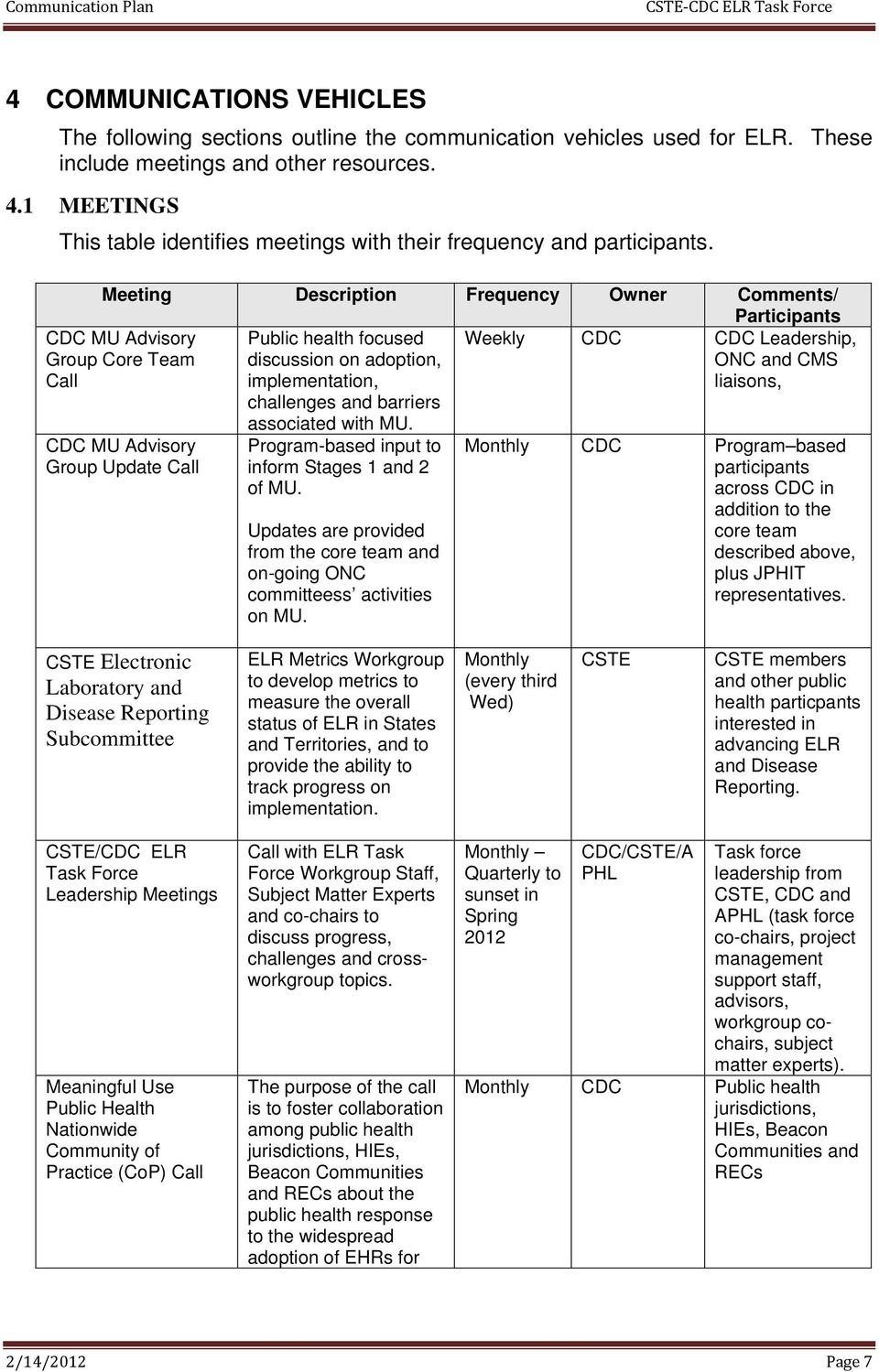
7 4 COMMUNICATIONS VEHICLES The following sections outline the communication vehicles used for ELR. These include meetings and other resources. 4.1 MEETINGS This table identifies meetings with their frequency and participants. Meeting Description Frequency Owner Comments/ Participants Public health focused Weekly CDC CDC Leadership, discussion on adoption, ONC and CMS implementation, liaisons, challenges and barriers associated with MU. CDC MU Advisory Group Core Team Call CDC MU Advisory Group Update Call Program-based input to inform Stages 1 and 2 of MU. Updates are provided from the core team and on-going ONC committeess activities on MU. Monthly CDC Program based participants across CDC in addition to the core team described above, plus JPHIT representatives. CSTE Electronic Laboratory and Disease Reporting Subcommittee ELR Metrics Workgroup to develop metrics to measure the overall status of ELR in States and Territories, and to provide the ability to track progress on implementation. Monthly (every third Wed) CSTE CSTE members and other public health particpants interested in advancing ELR and Disease Reporting. CSTE/CDC ELR Task Force Leadership Meetings Meaningful Use Nationwide Community of Practice (CoP) Call Call with ELR Task Force Workgroup Staff, Subject Matter Experts and co-chairs to discuss progress, challenges and crossworkgroup topics. The purpose of the call is to foster collaboration among public health jurisdictions, HIEs, Beacon Communities and RECs about the public health response to the widespread adoption of EHRs for Monthly Quarterly to sunset in Spring 2012 CDC/CSTE/A PHL Task force leadership from CSTE, CDC and APHL (task force co-chairs, project management support staff, advisors, workgroup cochairs, subject matter experts). Monthly CDC Public health jurisdictions, HIEs, Beacon Communities and RECs 2/14/2012 Page 7
8 National ELR Workgroup Call Information Network (PHIN) Partner Calls MU Call with State and Local health departments on topics related to ELR. Calls focus on CDC initiatives, states successes, or other federal partner HIE initiatives. Monthly CSTE JA Magnuson State and local public health officials. Monthly CDC State PHIN representatives, PHIN coordinators, CDC PHIN team and subject matter experts. ONC/CDC monthly Communications and progress meetings ONC Standards & Interoperability (S&I) Initiative ONC Standards &Interoperability (S&I) Laboratory Results Interface (LRI) Framework Meetings Strategic planning and issues related to MU. The Initiative is a Community Led Initiative under the S&I Framework. The purpose of this initiative is to gather Public Health experts to determine the scope for a potential Public Health Initiative, based on the needs of the Community. Once the scope and charter have been determined, it will be presented to ONC to potentially become an initiative within the Standards and Interoperability Framework. Create Lab Reporting deployment models to evaluate how the Lab Reporting Interface specification would work when implemented. Identify the policies, services, regulatory requirements, and other dependencies that are needed to ensure that a Lab Monthly CDC/ONC CDC and ONC leadership Bi-Monthly PHDSC, CDC, ONC Data Standards Consortium (PHDSC), CDC, PH Partners & Practitioners Weekly ONC S&I community participants 2/14/2012 Page 8

9 Reporting Interface specification is implementable. ONC Standards &Interoperability (S&I) Reporting Framework Meetings Laboratory Interoperability Project (PHLIP) Executive Committee The S&I Reporting Initiative wil develop and implement a standardized approach to electronic public health reporting from EHR systems to local, state and federal public health programs that addresses the needs of several different reporting use cases, with the longterm goal of reducing the difficulty (to both providers and public health agencies) of implementing electronic versions of the broad spectrum of public health reporting. This group provides high-level direction and strategic direction to the various initiatives that fall under the PHLIP Program Weekly Once per quarter Communityled with a proposal for support by ONC APHL S&I community participants The PHLIP EC is comprised of leadership from State Labs, CDC PHITPO, CDC OID and APHL. Laboratory Interoperability Project (PHLIP) Meetings Laboratory Interoperability Project (PHLIP) Steering Committee PHLIPse meetings aim to promote reliable laboratory data exchange between state public health laboratories and CDC by fostering collaboration in information technology and laboratory science. There are several workgroups that meet on a varying basis. This group provides overall leadership to the various initiatives that fall under the PHLIP Program. Weekly to monthly based on specific workgroup Every two weeks APHL APHL Lab subject matter experts and IT technical experts from State Public Health Labs, CDC PHITPO, CDC OID and APHL. The PHLIP SC is comprised of representatives from State Public Health Labs, CDC PHITPO, CDC OID and APHL. Vocabulary and Messaging CoP This CoP brings together PHIN Quarterly or more CDC Members of the ELR Workgroup, 2/14/2012 Page 9

10 stakeholders nationwide involved in defining, implementing, maintaining, evaluating, and evolving lab messaging. frequently as needed the Laboratory Interoperability Project (PHLIP) and Laboratory Information Management System [LIMSi ]projects, andstate laboratory staff. 4.2 RESOURCES The Resources Table summarizes the websites where public health-related meaningful use and ELR information is posted. Resource Meaningful Use Cross Program Collaboration for CDC Meaningful Use Internet gov Meaningful Use listserv CDC Meaningful Use ELR Webpage CSTE/CDC ELR Task Force Webpage CSTE Webpage for the CSTE/CDC ELR Task Force phconnects for Vocabulary and Messaging Community of Practice Reportable Condition Mapping Table Workgroup URL istserv.html uluse/elr.html uluse/elrtf.html sandactivities/surveillanceinfor matics/tabid/346/default.aspx vocabularyandmessagingcommu nityofpractice rcmt Description The CoP will review current burning issues affecting members and barriers that providers encounter in adopting EHRs and achieving Meaningful Use. -related Meaningful Use information Mailbox for public health-related meaningful use questions Site to join the Listserv for meaningful use communications from the CDC Summarizes ELR doe Meaningful Use. Summarizes activities and products of the CSTE/CDC ELR Task Force. This site links to available products and navigates the user to CSTE s webpage for the CSTE/CDC ELR Task Force Summarizes activities and products of the CSTE/CDC ELR Task Force. This site includes links to available products. The Vocabulary and Messaging Community of Practice works together to share knowledge, expand their professional skills, and develop solutions to solving common public health vocabulary and messaging challenges. RCMT provides mapping between a reportable condition and its associated LOINC lab tests and SNOMED lab results. The RCMT workgroup has been formed by CDC CSTE ELR Task Force to facilitate the development and 2/14/2012 Page 10
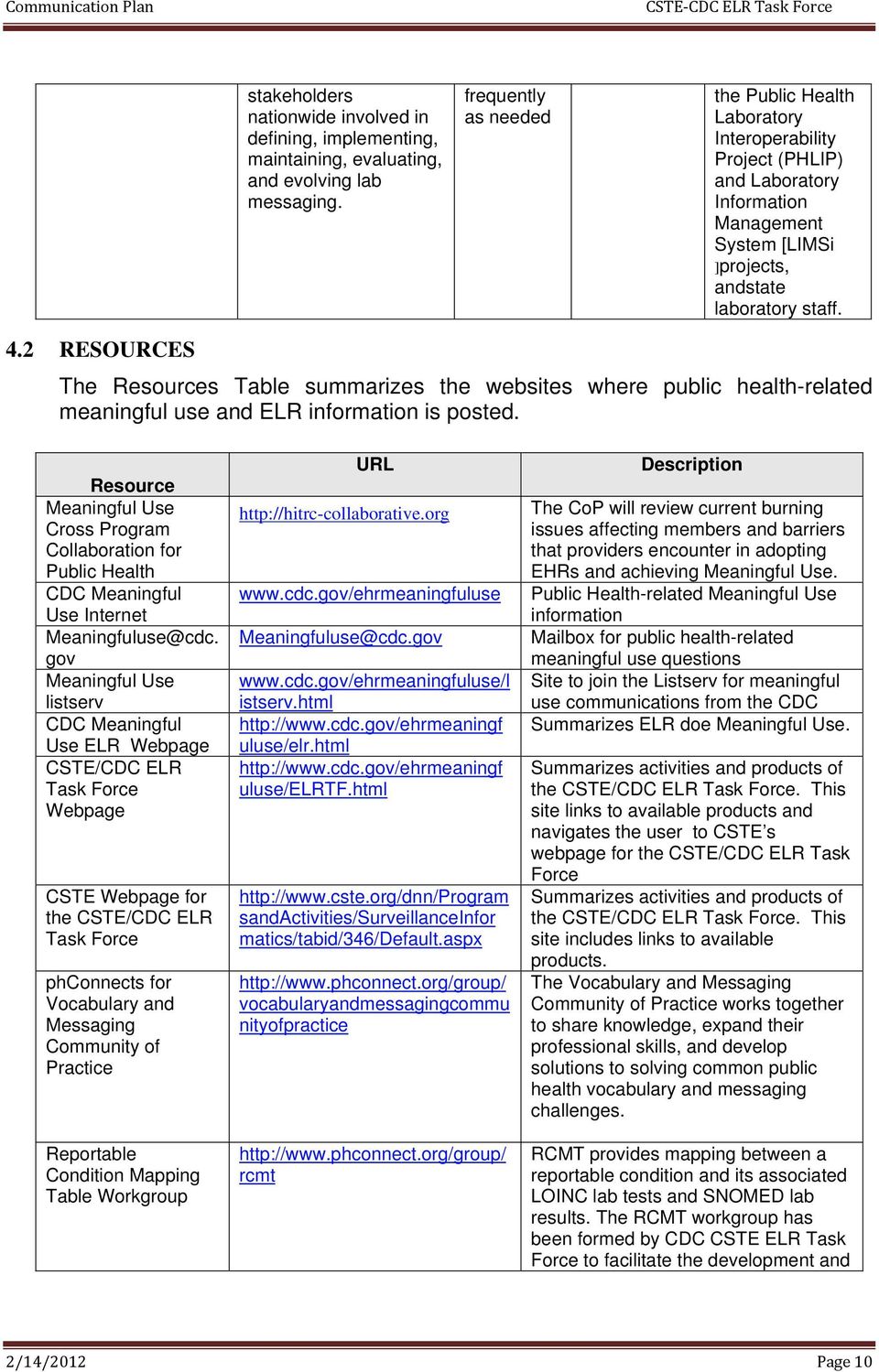
11 phconnects for EHR Meaningful Use phconnects for Laboratory Messaging Community of Practice PHLIP Webpage public-health-ehr-meaningful-use aboratorymessagingcommunityo fpractice s/informatics/collaborations/phlip /pages/default.aspx implementation of RCMT. This community will provide distilled information and foster discussion related to public health issues within the constantly evolving Electronic Health Records [EHR] 'Meaningful Use' domain. The Laboratory Messaging Community of Practice (LM CoP) brings together PHIN stakeholders nationwide involved in defining, implementing, maintaining, evaluating, and evolving lab messaging. Webpage for the Laboratory Interoperability Project 2/14/2012 Page 11
![This community will provide distilled information and foster discussion related to public health issues within the constantly evolving Electronic Health Records [EHR] 'Meaningful Use' domain.](/docs-images/52/12914640/images/page_11.jpg "The Laboratory Messaging Community of Practice (LM CoP) brings together PHIN stakeholders nationwide involved in defining, implementing, maintaining, evaluating, and evolving lab messaging.")
12 APPENDIX A: GLOSSARY The following table provides definitions for acronyms relevant to this document. Term AHA APHL ASTHO CAP CDC COP CSTE EHR ELR FAQs FTE HIE HL7 JPHIT LIMS LIS MU NACCHO ONC PHIN REC SME Definition American Hospital Association Association of Labs Association of State & Territorial Health Officials College of American Pathologist Centers for Disease Control and Prevention Communities of Practice Council of State & Territorial Epidemiologists Electronic Health Records Electronic Labortaory Reporting Frequently Asked Questions Full Time Employee (to CDC) Health Information Exchange Health Level Seven Joint Public Heallth Informatics Task Force Laboratory Information Management System Laboratory Information System Meaningful Use National Association of County & City Health Officials Office of National Coordinator for Health IT Information Network Regional Extension Centers Subject Matter Expert 2/14/2012 Page 12

LIS Vendor Landscape and Options for Meeting ELR Meaningful Use
 White Paper LIS Vendor Landscape and Options for Meeting ELR Meaningful Use January, 2012 Developed by the Council of State and Territorial Epidemiologists (CSTE) and the Centers for Disease Control and
Consensus Framework for Advancing Public Health Informatics
 Consensus Framework for Advancing Public Health Informatics Approved by the JPHIT Board on April 20, 2011 How will public health choose to transform and galvanize itself in light of the historic national
ARRA HITECH Meaningful Use Objectives & Implications to Public Health Lab
 ARRA HITECH Meaningful Use Objectives & Implications to Public Health Lab For APHL Annual Meeting June 2011 By Wes Kennemore, APHL and Jennifer McGehee, CDC DISCLAIMER This presentation was supported by
Meaningful Use Stage 1 and Public Health: Lesson Learned
 Meaningful Use Stage 1 and Public Health: Lesson Learned NAACR Presentation August 16, 2012 James Daniel, MPH Public Health Coordinator Office of the National Coordinator for Health IT Agenda Overview
MEANINGFUL USE and POPULATION HEALTH
 MEANINGFUL USE and POPULATION HEALTH Seth Foldy, MD MPH FAAFP Director, Public Health Informatics and Technology Program Office NCVHS November 15, 2011 Office of Surveillance, Epidemiology, and Laboratory
Electronic Public Health Case Reporting: Current & Future Possibilities. Joint Public Health Forum & CDC Nationwide Call October 16, 2014
 Electronic Public Health Case Reporting: Current & Future Possibilities Joint Public Health Forum & CDC Nationwide Call October 16, 2014 1 Joint Public Health Forum & CDC Nationwide Call Agenda Introduction
Advancing Laboratory Interoperability in Health IT
 Advancing Laboratory Interoperability in Health IT Introduction & CDC LabHIT Update Megan E. Sawchuk, MT(ASCP) Health Scientist Clinical Laboratory Improvement Advisory Committee (CLIAC) 8-22-2013 Center
Public Health Reporting Initiative Functional Requirements Description
 Public Health Reporting Initiative Functional Requirements Description 9/25/2012 1 Table of Contents 1.0 Preface and Introduction... 2 2.0 Initiative Overview... 3 2.1 Initiative Challenge Statement...
Meaningful Use Stage 2 as it Relates to the Lab Implementing the Public Health Agency Interface. Interface
 Meaningful Use Stage 2 as it Relates to the Lab Implementing the Public Health Agency Interface Interface Topics Covered Meaningful Use Stage 2 (MU2) Electronic Lab Results (ELR) interface Lab Results
The HITECH Act and Meaningful Use Implications for Population and Public Health
 The HITECH Act and Meaningful Use Implications for Population and Public Health Bill Brand, MPH Public Health Informatics Institute Meaningful Use for Public Health Professionals: Basic Training May 16,
New Jersey Department of Health. Electronic Laboratory Reporting On-Boarding Manual. Version 1.4
 New Jersey Department of Health On-Boarding Manual Version 1.4 Table of Contents 1. Introduction 3 1.1 Purpose 3 1.2 Scope 3 1.3 Definitions, Acronyms and Abbreviations 4 1.4 References 5 1.5 Overview
Meaningful Use - HL7 Version 2
 Meaningful Use - HL7 Version 2 HL7 Version 2 and Surveillance Reporting HIMSS, 2011 Orlando John Quinn, HL7 CTO February 2011 Contributors to Today s Presentation Anna Orlova, PhD, Executive Director,
White Paper. Assure Health IT Standards for Public Health. Part I: Health IT Standards in Public Health Laboratory Domain
 1 White Paper Assure Health IT Standards for Public Health Part I: Health IT Standards in Public Health Laboratory Domain 2012 Baltimore, Maryland 2 The Public Health Data Standards Consortium (PHDSC,
Understanding Meaningful Use with a Focus on Testing the HL7 V2 Messaging Standards
 Understanding Meaningful Use with a Focus on Testing the HL7 V2 Messaging Standards Robert Snelick, National Institute of Standards and Technology (NIST) Sheryl Taylor, Booz-Allen Hamilton (BAH) Use of
Director, Office of Health IT and e Health; State Government HIT Coordinator. Deputy Director, Office of Health IT and e Health
 Assignment Location: Minnesota Department of Health St. Paul, Minnesota Primary Mentor: Secondary Mentor: Martin LaVenture, PhD, MPH, FACMI Director, Office of Health IT and e Health; State Government
HL7 & Meaningful Use. Charles Jaffe, MD, PhD CEO Health Level Seven International. HIMSS 11 Orlando February 23, 2011
 HL7 & Meaningful Use Charles Jaffe, MD, PhD CEO Health Level Seven International HIMSS 11 Orlando February 23, 2011 Overview Overview of Meaningful Use HIT Standards and Meaningful Use Overview HL7 Standards
Meaningful Use - HL7 Version 2
 Meaningful Use - HL7 Version 2 HL7 Version 2 and Surveillance Your Ambassadors Today Anna Orlova, PhD, Executive Director, Public Health Data Standards Consortium and Johns Hopkins University Lori Reed-Fourquet,
HL7 and Meaningful Use
 HL7 and Meaningful Use HIMSS Las Vegas February 23, 2012 Grant M. Wood Intermountain Healthcare Clinical Genetics Institute Meaningful Use What Does It Mean? HITECH rewards the Meaningful Use of health
CoP for Leveraging Federal Financial Participation (FFP) for Medicaid HIT Activities. September 26, 2014
 CoP for Leveraging Federal Financial Participation (FFP) for Medicaid HIT Activities September 26, 2014 1 CoP for Leveraging FFP for Medicaid HIT Activities Agenda Background & Steering Committee ASTHO
https://app.azdhs.gov/meaningfuluse
 Eligible Hospitals and Critical Access Hospitals EHs and CAHs Profile 1 Profile Please provide the Public Health Meaningful Use Registration of Intent information below. All fields are required. Type of
NSSP Onboarding Workgroup Meeting
 NSSP Onboarding Workgroup Meeting Date: Wednesday, June 3, 2015, 3:00 PM 4:30 PM EDT Attendees: Laurel Boyd, Karen Felicetta, Farah Naz, Sheryl Taylor, Laura McCrary, Brooke Evans, Laura Streichert, Anne
ConnectVirginia EXCHANGE Onboarding and Certification Guide. Version 1.4
 ConnectVirginia EXCHANGE Onboarding and Certification Guide Version 1.4 July 18, 2012 CONTENTS 1 Overview... 5 2 Intended Audience... 5 3 ConnectVirginia Background... 5 3.1 Federated... 5 3.2 Secure...
Meaningful Use Stage 2 Certification: A Guide for EHR Product Managers
 Meaningful Use Stage 2 Certification: A Guide for EHR Product Managers Terminology Management is a foundational element to satisfying the Meaningful Use Stage 2 criteria and due to its complexity, and
Toward Meaningful Use of HIT
 Toward Meaningful Use of HIT Fred D Rachman, MD Health and Medicine Policy Research Group HIE Forum March 24, 2010 Why are we talking about technology? To improve the quality of the care we provide and
Electronic Health Records: The Intersection of Public Health Surveillance and Clinical Medicine
 Electronic Health Records: The Intersection of Public Health Surveillance and Clinical Medicine Lisa C Richardson, MD, MPH NAACCR 2015 Annual Conference Director, Division of Cancer Prevention and Control,
Expanded Support for Medicaid Health Information Exchanges
 Expanded Support for Medicaid Health Information Exchanges Joint Public Health Forum & CDC Nationwide Webinar April 21, 2016 CDC EHR Meaningful Use Webpage-Joint Public Health Forum & CDC Nationwide Webinars
How To Improve Health Information Exchange
 Health Information Exchange Strategic and Operational Plan Profile Overview Hawai i is comprised of eight main islands, seven of which are inhabited. With a population of approximately 1.3 million, Hawai
ONC s Laboratory Results Interface (LRI) and Laboratory Orders Interface (LOI) Implementation Guides and LIS-EHR Data Exchange
 ONC s Laboratory Results Interface (LRI) and Laboratory Orders Interface (LOI) Implementation Guides and LIS-EHR Data Exchange Pathology Informatics 2015 May 6, 2015 Pittsburgh, PA Walter H. Henricks,
Best Practices in Implementation of Public Health Information Systems Initiatives to Improve Public Health Performance: The New York City Experience
 Case Study Report May 2012 Best Practices in Implementation of Public Health Information Systems Initiatives to Improve Public Health Performance: The New York City Experience In collaboration with the
HIMSS Public Policy Initiatives in 2015: Using Health IT to Enable Healthcare Transformation Jeff Coughlin Senior Director Federal & State Affairs
 HIMSS Public Policy Initiatives in 2015: Using Health IT to Enable Healthcare Transformation Jeff Coughlin Senior Director Federal & State Affairs March 26, 2015 Agenda Meaningful Use Stage 3 NPRM 2015
Medical Informatic Basics for the Cancer Registry
 Medical Informatic Basics for the Cancer Registry DEVELOPED BY: THE NCRA EDUCATION FOUNDATION AND THE NCRA CANCER INFORMATICS COMMITTEE Medical Informatics is the intersection of science, computer science
State HAI Template Utah. 1. Develop or Enhance HAI program infrastructure
 State HAI Template Utah 1. Develop or Enhance HAI program infrastructure Successful HAI prevention requires close integration and collaboration with state and local infection prevention activities and
CDC: Moving Public Health IT Interoperability Towards Meaningful Implementation
 CDC: Moving Public Health IT Interoperability Towards Meaningful Implementation February 2011 Table of Contents Overview of CDC Informatics Efforts... Error! Bookmark not defined. National Center for Health
Damon A. Ferlazzo, MPA Clinical Use and Benefits of State Immunization Information Systems August 21, 2014
 Damon A. Ferlazzo, MPA Clinical Use and Benefits of State Immunization Information Systems August 21, 2014 What are Immunization Information Systems (IIS)? [ ]confidential, population-based, computerized
Prepared by Noam H. Arzt, PhD HLN Consulting, LLC
 Architectures and Transport Mechanisms for Health Information Interchange of Clinical EHR Data for Syndromic Surveillance A Report from the International Society for Disease Surveillance Prepared by Noam
Meaningful Use Stage 2
 Meaningful Use Stage 2 Presented by: Sarah Leake, HTS Consultant HTS, a division of Mountain Pacific Quality Health Foundation 1 HTS Who We Are Stage 2 MU Overview Learning Objectives 2014 CEHRT Certification
Rob Edwards, MBA Executive Director, Kentucky Regional Extension Center Director of Strategic Initiatives and Regulatory Affairs UK HealthCare
 Rob Edwards, MBA Executive Director, Kentucky Regional Extension Center Director of Strategic Initiatives and Regulatory Affairs UK HealthCare [email protected] Assist primary care providers, critical
T he Health Information Technology for Economic
 A BNA, INC. HEALTH IT! LAW & INDUSTRY REPORT Reproduced with permission from Health IT Law & Industry Report, 2 HITR 23, 01/18/2010. Copyright 2010 by The Bureau of National Affairs, Inc. (800-372- 1033)
Eligible Professionals please see the document: MEDITECH Prepares You for Stage 2 of Meaningful Use: Eligible Professionals.
 s Preparing for Meaningful Use in 2014 MEDITECH (Updated December 2013) Professionals please see the document: MEDITECH Prepares You for Stage 2 of Meaningful Use: Professionals. Congratulations to our
The Direct Project Overview
 The Direct Project Overview October 11, 2010 Abstract: The Direct Project specifies a simple, secure, scalable, standards-based way for participants to send authenticated, encrypted health information
Program Year 2015: Public Health Reporting Objective & Supporting Documentation
 Program Year 2015: Public Health Reporting Objective & Supporting Documentation Valorie A. Vigil, Staff Manager Benjamin Rogers, Program Manager December 2015 New Mexico Human Services Department Medical
Meaningful Use and Lab Related Requirements
 Meaningful Use and Lab Related Requirements ONC State HIE / NILA Workgroup August 20, 2013 What is an EHR? Electronic Health Record Information system used by healthcare providers to store and manage patient
HCCN Meaningful Use Review. October 7 th, 2015 Louisiana Public Health Institute Kelly Maggiore Jack Millaway
 HCCN Meaningful Use Review October 7 th, 2015 Louisiana Public Health Institute Kelly Maggiore Jack Millaway What is Meaningful Use? Federal and State incentive payment program for Eligible Professionals
How Health Departments Achieve Informatics-Savvy Surveillance
 How Health Departments Achieve Informatics-Savvy Surveillance Findings of a CSTE workshop April 2014 Seth Foldy, MD MPH S&I Framework Public Health Webcast May 6, 2015 Participants Council of State and
West Virginia Meaningful Use Registration System Instructions
 West Virginia Meaningful Use Registration System Instructions To register, go to: http://www.wvdhhr.org/bph/oeps/murs/login.cfm Click on Need to register an account? Enter e-mail and your choice of password.
Arizona Department of Health Services Healthcare-Associated Infection Plan Progress Report June 2010
 On December 31 st, 2010, the Arizona Department of Health Services (ADHS) submitted the state healthcare-associated infection (HAI) plan to the United States Department of Health and Human Services. The
BUSINESS CASE: The Role of Public Health in National Health Information Technology Standardization
 DATA STANDARDS COMMITTEE BUSINESS CASE: The Role of Public Health in National Health Information Technology Standardization 2009 BALTIMORE, MARYLAND 2 The Public Health Data Standards Consortium (PHDSC,
Health Information Exchange in NYS
 Health Information Exchange in NYS Roy Gomes, RHIT, CHPS Implementation Project Manager 1 Who is NYeC? 2 Agenda NYeC Background Overview and programs Assist providers transitioning from paper to electronic
Overview of MU Stage 2 Joel White, Health IT Now
 Overview of MU Stage 2 Joel White, Health IT Now 1 Agenda 1. Introduction 2. Context 3. Adoption Rates of HIT 4. Overview of Stage 2 Rules 5. Overview of Issues 6. Trend in Standards: Recommendations v.
HIMSS and AHIMA: Trends in HIE Organizational Staffing. CMS ehealth Forum December 6, 2013
 HIMSS and AHIMA: Trends in HIE Organizational Staffing CMS ehealth Forum December 6, 2013 Scott MacLean Introductions Chair, HIMSS Board of Directors Deputy CIO, Director of IS Operations, Partners HealthCare
Minnesota e-health Initiative
 This document is made available electronically by the Minnesota Legislative Reference Library as part of an ongoing digital archiving project. http://www.leg.state.mn.us/lrl/lrl.asp Division of Health
Vendor Management for Critical Access Hospitals
 Vendor Management for Critical Access Hospitals Provided By: The National Learning Consortium (NLC) Developed By: Health Information Technology Research Center (HITRC) Carolyn P. Hartley, MLA, CHP National
Summary of the Proposed Rule for the Medicare and Medicaid Electronic Health Records (EHR) Incentive Program (Eligible Professionals only)
 Summary of the Proposed Rule for the Medicare and Medicaid Electronic Health Records (EHR) Incentive Program (Eligible Professionals only) Background Enacted on February 17, 2009, the American Recovery
Agenda. What is Meaningful Use? Stage 2 - Meaningful Use Core Set. Stage 2 - Menu Set. Clinical Quality Measures (CQM) Clinical Considerations
 AQAF Health Information Technology Forum Meaningful Use Stage 2 Clinical Considerations Marla Clinkscales & Mike Bice Alabama Regional Extension Center (ALREC) August 13, 2013 0 Agenda What is Meaningful
Southern Nevada Health District Division of Community Health
 Southern Nevada Health District Division of Community Health Office of Public Health Informatics Cassius Lockett PhD, Director of Community Health What is Health Informatics? Let us start by defining
The Big Picture: IDNT in Electronic Records Glossary
 TERM DEFINITION CCI Canada Health Infoway Canadian Institute for Health Information EHR EMR EPR H L 7 (HL7) Canadian Classification of Interventions is the Canadian standard for classifying health care
Best Practices and Lessons Learned about EHR Adoption. Anthony Rodgers Deputy Administrator, Center for Strategic Planning
 Best Practices and Lessons Learned about EHR Adoption Anthony Rodgers Deputy Administrator, Center for Strategic Planning Presentation Topics Value proposition for EHR adoption Medicaid Strategic Health
Conformance Testing of Healthcare Data Exchange Standards for EHR Certification
 Int'l Conf. Health Informatics and Medical Systems HIMS'15 105 Conformance Testing of Healthcare Data Exchange Standards for EHR Certification R. Snelick 1 1 National Institute of Standards and Technology
EHR Incentive Program Updates. Jason Felts, MS HIT Practice Advisor
 EHR Incentive Program Updates Jason Felts, MS HIT Practice Advisor An Important Reminder For audio, you must use your phone: Step 1: Call (866) 906-0123. Step 2: Enter code 2071585#. Step 3: Mute your