
SPH CATALOG ADDENDUM
|
|
|
- Beatrix Day
- 10 years ago
- Views:
Transcription

1 SPH CATALOG ADDENDUM

2 ADDENDUM TABLE OF CONTENTS ADMINISTRATIVE OFFICERS... 3 MASTER OF PUBLIC HEALTH... 3 DOCTOR OF PUBLIC HEALTH... 3 DOCTOR OF PHILOSOPHY... 4 SPECIAL PROGRAMS... 5 JUST IN TIME COURSES... 6 APPLICATION, PROCEDURES AND DEADLINE DATES... 7 BIOSTATISTICS... 7 EPIDEMIOLOGY AND DISEASE CONTROL ENVIRONMENTAL AND OCCUPATIONAL HEALTH SCIENCES HEALTH PROMOTION AND BEHAVIORAL SCIENCES MANAGEMENT, POLICY AND COMMUNITY HEALTH INTERDIVISIONAL CONCENTRATIONS AND OTHER INTERDIVISIONAL COURSES FACULTY AT THE UT SCHOOL OF PUBLIC HEALTH EMERITUS FACULTY AT THE UT SCHOOL OF PUBLIC HEALTH TECHNOLOGY.43 RESEARCH CENTERS 43 GRADING, CONDUCT AND SATISFACTORY PROGRESS POLICIE.43 TEST SECURITY.44 Addendum to The University of Texas School of Public Health Catalog Page 2

3 SECTION Administrative Officers CURRENT (page 6): Change in leadership Raul Caetano, MD, MPH, PhD Regional Dean, Dallas Regional Campus CHANGE TO: Margaret Caughy, ScD Interim Regional Dean, Dallas Regional Campus ADD (page 6): Brian Miller, JD Director, Research Services SECTION Master of Public Health CURRENT (page 20): Adding other course options Occupational and Environmental Health: Non-majors: PHM 2110 Overview of Environmental Health (Available Online), or PHWM 2120 Man s Impact on the Environment (Available Online Only) Majors in EOHS (all are required): PHWM 2100 Foundations of Environmental and Occupational Health Sciences (Available Online) PHM 2101 Contemporary Issues in Environmental and Occupational Health PHM 2130 Recognition of Environmental and Occupational Hazards PH 2175 Toxicology I: Principles of Toxicology PH 2205 Health and Safety Program Management and Leadership CHANGE TO: Occupational and Environmental Health: Non-majors: PHM 2110 Overview of Environmental Health (Available Online), or PHWM 2120 Man s Impact on the Environment (Available Online Only) Majors in EOHS (all are required): PHWM 2100 Foundations of Environmental and Occupational Health Sciences (Available Online) PHM 2101 Contemporary Issues in Environmental and Occupational Health PHM 2130 Recognition of Environmental and Occupational Hazards, OR PHM 2110 Overview of Environmental Health, OR PHWM 2120 Man's Impact on the Environment, OR PH 2245 Fundamentals of Industrial Hygiene PH 2175 Toxicology I PH 2175 Toxicology I: Principles of Toxicology PH 2205 Health and Safety Program Management and Leadership SECTION Doctor of Public Health CURRENT (page 23): Clarifying doctoral candidacy requirement Addendum to The University of Texas School of Public Health Catalog Page 3

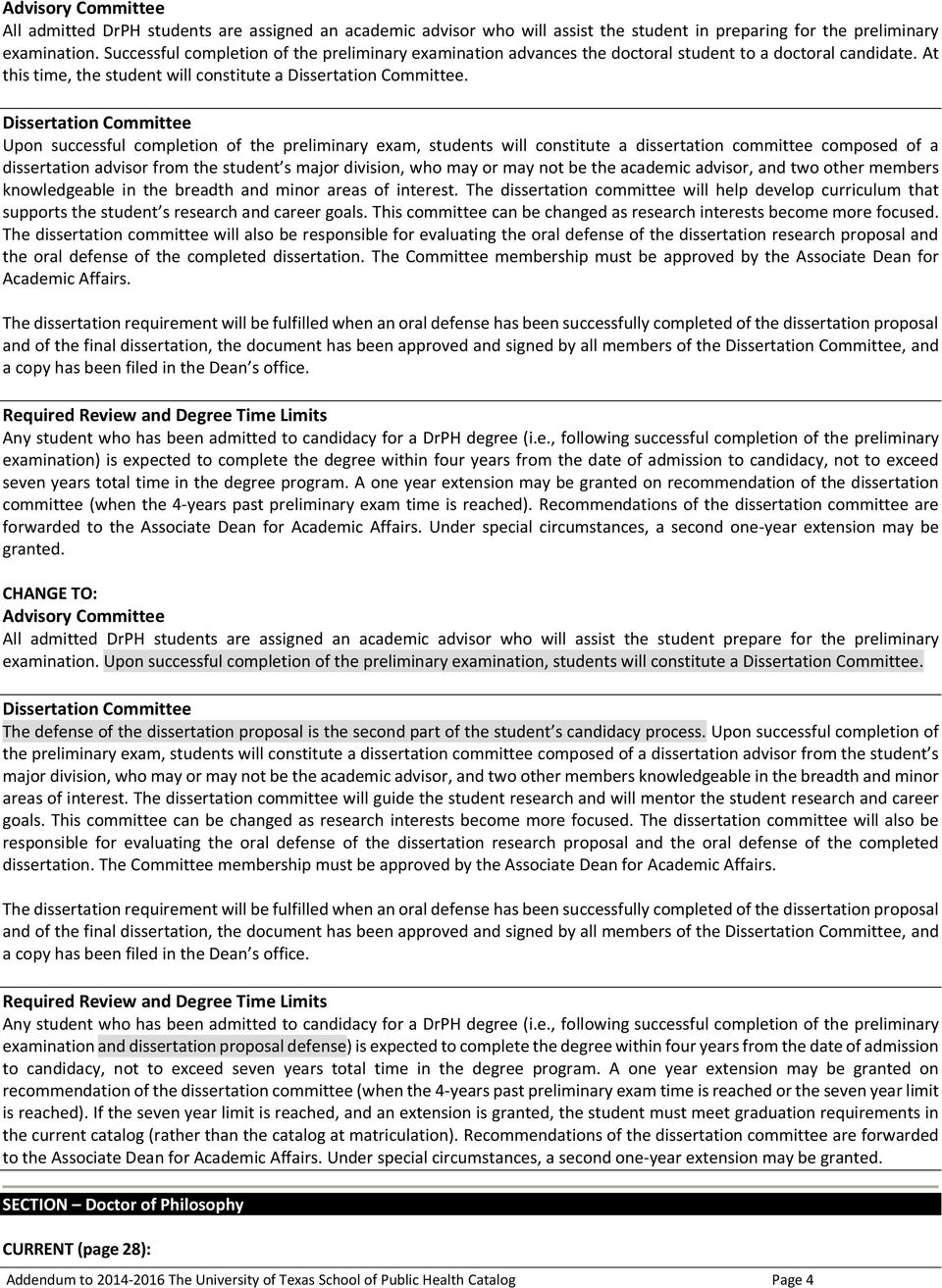
4 Advisory Committee All admitted DrPH students are assigned an academic advisor who will assist the student in preparing for the preliminary examination. Successful completion of the preliminary examination advances the doctoral student to a doctoral candidate. At this time, the student will constitute a Dissertation Committee. Dissertation Committee Upon successful completion of the preliminary exam, students will constitute a dissertation committee composed of a dissertation advisor from the student s major division, who may or may not be the academic advisor, and two other members knowledgeable in the breadth and minor areas of interest. The dissertation committee will help develop curriculum that supports the student s research and career goals. This committee can be changed as research interests become more focused. The dissertation committee will also be responsible for evaluating the oral defense of the dissertation research proposal and the oral defense of the completed dissertation. The Committee membership must be approved by the Associate Dean for Academic Affairs. The dissertation requirement will be fulfilled when an oral defense has been successfully completed of the dissertation proposal and of the final dissertation, the document has been approved and signed by all members of the Dissertation Committee, and a copy has been filed in the Dean s office. Required Review and Degree Time Limits Any student who has been admitted to candidacy for a DrPH degree (i.e., following successful completion of the preliminary examination) is expected to complete the degree within four years from the date of admission to candidacy, not to exceed seven years total time in the degree program. A one year extension may be granted on recommendation of the dissertation committee (when the 4-years past preliminary exam time is reached). Recommendations of the dissertation committee are forwarded to the Associate Dean for Academic Affairs. Under special circumstances, a second one-year extension may be granted. CHANGE TO: Advisory Committee All admitted DrPH students are assigned an academic advisor who will assist the student prepare for the preliminary examination. Upon successful completion of the preliminary examination, students will constitute a Dissertation Committee. Dissertation Committee The defense of the dissertation proposal is the second part of the student s candidacy process. Upon successful completion of the preliminary exam, students will constitute a dissertation committee composed of a dissertation advisor from the student s major division, who may or may not be the academic advisor, and two other members knowledgeable in the breadth and minor areas of interest. The dissertation committee will guide the student research and will mentor the student research and career goals. This committee can be changed as research interests become more focused. The dissertation committee will also be responsible for evaluating the oral defense of the dissertation research proposal and the oral defense of the completed dissertation. The Committee membership must be approved by the Associate Dean for Academic Affairs. The dissertation requirement will be fulfilled when an oral defense has been successfully completed of the dissertation proposal and of the final dissertation, the document has been approved and signed by all members of the Dissertation Committee, and a copy has been filed in the Dean s office. Required Review and Degree Time Limits Any student who has been admitted to candidacy for a DrPH degree (i.e., following successful completion of the preliminary examination and dissertation proposal defense) is expected to complete the degree within four years from the date of admission to candidacy, not to exceed seven years total time in the degree program. A one year extension may be granted on recommendation of the dissertation committee (when the 4-years past preliminary exam time is reached or the seven year limit is reached). If the seven year limit is reached, and an extension is granted, the student must meet graduation requirements in the current catalog (rather than the catalog at matriculation). Recommendations of the dissertation committee are forwarded to the Associate Dean for Academic Affairs. Under special circumstances, a second one-year extension may be granted. SECTION Doctor of Philosophy CURRENT (page 28): Addendum to The University of Texas School of Public Health Catalog Page 4
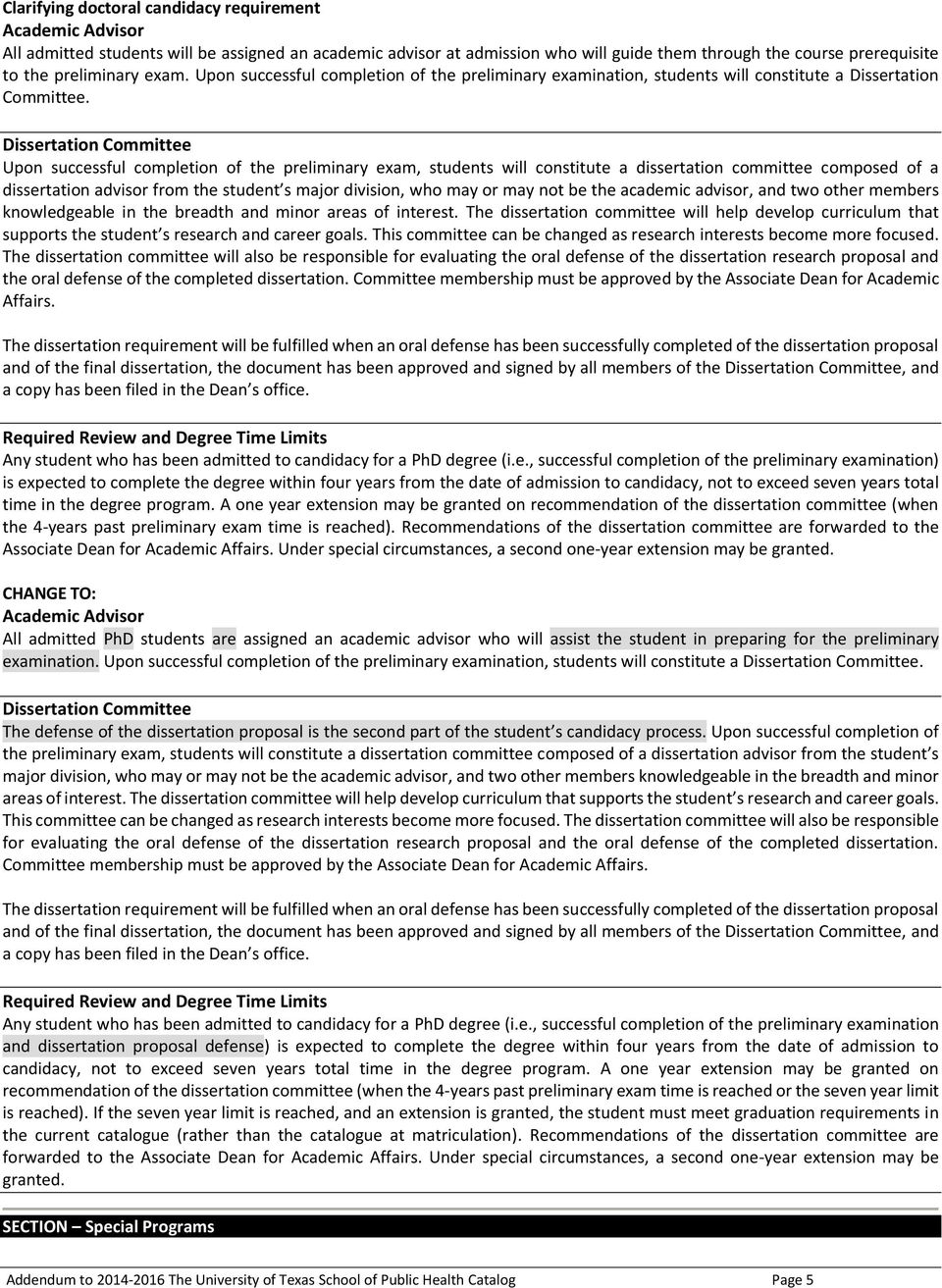
5 Clarifying doctoral candidacy requirement Academic Advisor All admitted students will be assigned an academic advisor at admission who will guide them through the course prerequisite to the preliminary exam. Upon successful completion of the preliminary examination, students will constitute a Dissertation Committee. Dissertation Committee Upon successful completion of the preliminary exam, students will constitute a dissertation committee composed of a dissertation advisor from the student s major division, who may or may not be the academic advisor, and two other members knowledgeable in the breadth and minor areas of interest. The dissertation committee will help develop curriculum that supports the student s research and career goals. This committee can be changed as research interests become more focused. The dissertation committee will also be responsible for evaluating the oral defense of the dissertation research proposal and the oral defense of the completed dissertation. Committee membership must be approved by the Associate Dean for Academic Affairs. The dissertation requirement will be fulfilled when an oral defense has been successfully completed of the dissertation proposal and of the final dissertation, the document has been approved and signed by all members of the Dissertation Committee, and a copy has been filed in the Dean s office. Required Review and Degree Time Limits Any student who has been admitted to candidacy for a PhD degree (i.e., successful completion of the preliminary examination) is expected to complete the degree within four years from the date of admission to candidacy, not to exceed seven years total time in the degree program. A one year extension may be granted on recommendation of the dissertation committee (when the 4-years past preliminary exam time is reached). Recommendations of the dissertation committee are forwarded to the Associate Dean for Academic Affairs. Under special circumstances, a second one-year extension may be granted. CHANGE TO: Academic Advisor All admitted PhD students are assigned an academic advisor who will assist the student in preparing for the preliminary examination. Upon successful completion of the preliminary examination, students will constitute a Dissertation Committee. Dissertation Committee The defense of the dissertation proposal is the second part of the student s candidacy process. Upon successful completion of the preliminary exam, students will constitute a dissertation committee composed of a dissertation advisor from the student s major division, who may or may not be the academic advisor, and two other members knowledgeable in the breadth and minor areas of interest. The dissertation committee will help develop curriculum that supports the student s research and career goals. This committee can be changed as research interests become more focused. The dissertation committee will also be responsible for evaluating the oral defense of the dissertation research proposal and the oral defense of the completed dissertation. Committee membership must be approved by the Associate Dean for Academic Affairs. The dissertation requirement will be fulfilled when an oral defense has been successfully completed of the dissertation proposal and of the final dissertation, the document has been approved and signed by all members of the Dissertation Committee, and a copy has been filed in the Dean s office. Required Review and Degree Time Limits Any student who has been admitted to candidacy for a PhD degree (i.e., successful completion of the preliminary examination and dissertation proposal defense) is expected to complete the degree within four years from the date of admission to candidacy, not to exceed seven years total time in the degree program. A one year extension may be granted on recommendation of the dissertation committee (when the 4-years past preliminary exam time is reached or the seven year limit is reached). If the seven year limit is reached, and an extension is granted, the student must meet graduation requirements in the current catalogue (rather than the catalogue at matriculation). Recommendations of the dissertation committee are forwarded to the Associate Dean for Academic Affairs. Under special circumstances, a second one-year extension may be granted. SECTION Special Programs Addendum to The University of Texas School of Public Health Catalog Page 5
6 CURRENT (page 41): Updating current language Residency Program in Occupational and Environmental Medicine This Program has been approved since 1977 by the Accreditation Council for Graduate Medical Education (ACGME) and offers occupational and environmental medicine residency training to qualified physicians in preparation for certification by the American Board of Preventive Medicine. The residency consists of a two-year plan of study (academic and practicum years). Applicants must possess the MD or DO degree and must have completed a minimum of one year (PGY-1) of clinical training in an ACGME-accredited program. Candidates not already holding the MPH degree or its equivalent must apply for and achieve admission to the School of Public Health MPH degree program. CHANGE TO: This Program has been continuously accredited since 1977 by the Accreditation Council for Graduate Medical Education (ACGME) and offers occupational and environmental medicine residency training to qualified physicians in preparation for certification by the American Board of Preventive Medicine. The residency consists of a two-year plan of study (including a specialized MPH curriculum and progressive clinical training). Applicants must possess the MD or DO degree and must have completed a minimum of one year of clinical training in an ACGME-accredited program. Residency application is via the Electronic Residency Application Service (ERAS) of the American Association of Medical Colleges. Candidates not already holding the MPH degree or its equivalent must apply for and achieve admission to the School of Public Health MPH degree program prior to joining the Residency. SECTION Just in Time Courses CURRENT (page 42): Addition of faculty teaching course PHM 1116 Advanced Methods for Planning and Implementing Health Promotion Programs (Intervention Mapping) Bartholomew, Fernandez, Markham, Springer, 2 credits, b, c Intensive one-week format course CHANGE TO: PHM 1116 Advanced Methods for Planning and Implementing Health Promotion Programs (Intervention Mapping) Bartholomew, Fernandez, Markham, Springer, Valerio, 2 credits, b, c Intensive one-week format course CURRENT (page 42): Addition of faculty teaching course PHD 1116 Advanced Methods for Planning and Implementing Health Programs (Intervention Mapping) Bartholomew, Fernandez, Markham, Springer, 2 credits, b, c Intensive one-week format course CHANGE TO: PHD 1116 Advanced Methods for Planning and Implementing Health Programs (Intervention Mapping) Bartholomew, Fernandez, Markham, Springer, Valerio, 2 credits, b, c Intensive one-week format course CURRENT (page 43): Addition of faculty teaching course and change of course description PHD 1431 Tools & Methods for Systematic Reviews and Meta-Analyses Mullen, Vonville, 2 credits, b, c (summer even-numbered years only) Intensive six-week format course (hybrid) This course is designed to introduce students to best practices, resources, and methods for systematic reviews and metaanalyses, and guide students through the steps of a systematic review. The course will use examples from a wide variety of completed reviews as well as exercises and readings. Both face-to-face (in-person/itv) and online exercises, readings, and recorded lectures will be used; students will be expected to participate in discussions in class and online. Activities are aimed at building awareness of resources and skills for each step. Course resources and materials are available throughout the semester to assist with students own reviews. The skills and knowledge gained in this course can be applied to a culminating experience or dissertation. CHANGE TO: PHD 1431 Tools & Methods for Systematic Reviews and Meta-Analyses Mullen, VonVille, Cornell, 2 credits, b, c (summer even-numbered years only) Intensive six-week format course (hybrid) Addendum to The University of Texas School of Public Health Catalog Page 6

7 This course is designed to introduce students to best practices, resources, and methods for systematic reviews and metaanalyses, and to guide students through the steps of a systematic review. The course uses examples from a wide variety of completed reviews as well as exercises and readings. The format includes face-to-face (in-person/itv) and online exercises, readings, and recorded lectures. (A STATA-based lab experience in meta-analysis has been added to the course.) Course resources and materials are available throughout the semester to assist students in applying them to a culminating experience or dissertation. Prerequisites: PH 1700 or consent of the instructor and PHM 2610 or equivalent SECTION Application Procedures and Deadline Dates CURRENT (page 45): Updating new system information All students are provided with a user account which offers access to a feature rich web-based electronic mail application, an online instruction based system in Blackboard, the ability to connect personal wireless computers within the UTSPH campus, a file repository and sharing system known as Secure Share.. Most UTSPH faculty utilize Blackboard for course management and content delivery. CHANGE TO: All students are provided with a user account which offers access to a feature rich web-based electronic mail application, an online instruction based system in Canvas, the ability to connect personal wireless computers within the UTSPH campus, and a file repository and sharing system known as Secure Share. Most UTSPH faculty use Canvas for course management and content delivery. SECTION Biostatistics CURRENT (page 57): Updating breadth requirement information and course title change for PH 1820 The Division also offers a minor course of study for MS, DrPH and PhD students majoring in other public health disciplines. Courses required for the minor include PH 1690 Foundations of Biostatistics, PH 1700 Intermediate Biostatistics and at least two (for MS) and three (for doctoral) Biostatistics electives above PH PH 1820 Applied Statistical Analysis I is strongly recommended for the minor for all degree programs. CHANGE TO: The Department also offers a minor course of study for MS, DrPH and PhD students majoring in other public health disciplines. Courses required for the minor include PH 1690 Foundations of Biostatistics, PH 1700 Intermediate Biostatistics and at least two (for MS) and three (for doctoral) Biostatistics electives above PH PH 1820 Regression Techniques is strongly recommended for the minor for all degree programs. The Department also offers a breadth in bioinformatics. Courses required for the breadth includes two courses selected from PH 1980 Introduction to Genomics and Bioinformatics; PH 1982 Evolution of DNA and Protein Sequences; PH 1984 Population Genetics; PH 1985 Data Mining and Statistical Learning; PH 1986 Introduction to Statistical Genetics; or PH 1998 Advanced Multivariate Analysis with Applications to Genomic Science, and one course within the School and outside the biostatistics and epidemiology departments. CURRENT (page 57): Updating course title change for PH 1820/1821 in course study section PH 1690 Foundations of Biostatistics, PH 1700 Intermediate Biostatistics and PH 1820 Applied Statistical Analysis I At least two courses from: PH 1821 Applied Statistical Analysis II, PH 1830 Categorical Data Analysis or PH 1831 Survival Analysis Addendum to The University of Texas School of Public Health Catalog Page 7

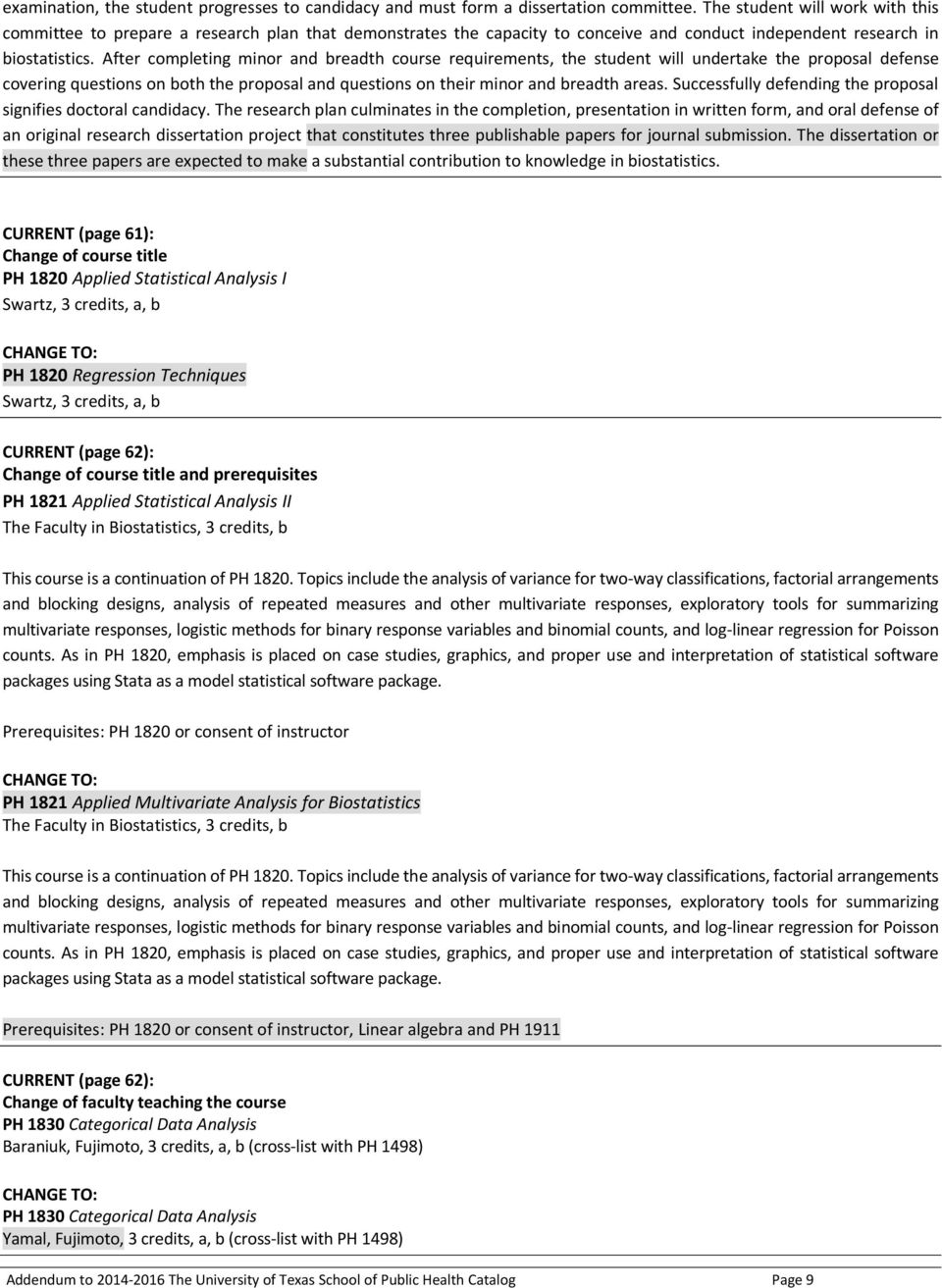
8 CHANGE TO: PH 1690 Foundations of Biostatistics, PH 1700 Intermediate Biostatistics and PH 1820 Regression Techniques At least two courses from: PH 1821 Applied Multivariate Analysis for Biostatistics, PH 1830 Categorical Data Analysis or PH 1831 Survival Analysis CURRENT (page 58): Updating course title change for PH 1820/1821 in course study section PH 1820 and PH 1821 Applied Statistical Analysis I and II PH 1830 Categorical Data Analysis PH 1831 Survival Analysis PH 1910 and PH 1911 Theory of Biostatistics I and II CHANGE TO: PH 1820 Regression Techniques and PH 1821 Applied Multivariate Analysis for Biostatistics PH 1830 Categorical Data Analysis PH 1831 Survival Analysis PH 1910 and PH 1911 Theory of Biostatistics I and II CURRENT (page 59): Updating course title change for PH 1820/1821 in course study section PH 1820 and PH 1821 Applied Statistical Analysis I and II PH 1830 Categorical Data Analysis PH 1831 Survival Analysis PH 1910 and PH 1911 Theory of Biostatistics I and II PH 1915 Linear Models I PH 1950 Stochastic Processes for Biostatisticians I PH 1988 Biostatistics Seminar PH 1997 A Teaching and Learning Experience for Doctoral Students in Biostatistics CHANGE TO: PH 1820 Regression Techniques and PH 1821 Applied Multivariate Analysis for Biostatistics PH 1830 Categorical Data Analysis PH 1831 Survival Analysis PH 1910 and PH 1911 Theory of Biostatistics I and II PH 1915 Linear Models I PH 1950 Stochastic Processes for Biostatisticians I PH 1988 Biostatistics Seminar PH 1997 A Teaching and Learning Experience for Doctoral Students in Biostatistics CURRENT (page 60): Updating dissertation project information At the end of the second year of doctoral study, students must satisfactorily complete a written preliminary examination in biostatistics. The preliminary examination is given once a year in August. Upon successful completion of the preliminary examination, the student progresses to candidacy and must form a dissertation committee. The doctoral candidate will work with this committee to prepare a research plan that demonstrates the capacity to conceive and conduct independent research in biostatistics. After completing minor and breadth course requirements, the student will undertake an oral proposal defense covering both their proposal and questions on their minor and breadth areas. The research plan culminates in the completion, presentation in written form, and oral defense of an original research dissertation project that makes a substantial contribution to knowledge in biostatistics. CHANGE TO: Between semester credit hours of doctoral study, students must satisfactorily complete a written preliminary examination in biostatistics. The preliminary examination is given once a year in August. Upon successful completion of the preliminary Addendum to The University of Texas School of Public Health Catalog Page 8

9 examination, the student progresses to candidacy and must form a dissertation committee. The student will work with this committee to prepare a research plan that demonstrates the capacity to conceive and conduct independent research in biostatistics. After completing minor and breadth course requirements, the student will undertake the proposal defense covering questions on both the proposal and questions on their minor and breadth areas. Successfully defending the proposal signifies doctoral candidacy. The research plan culminates in the completion, presentation in written form, and oral defense of an original research dissertation project that constitutes three publishable papers for journal submission. The dissertation or these three papers are expected to make a substantial contribution to knowledge in biostatistics. CURRENT (page 61): Change of course title PH 1820 Applied Statistical Analysis I Swartz, 3 credits, a, b CHANGE TO: PH 1820 Regression Techniques Swartz, 3 credits, a, b CURRENT (page 62): Change of course title and prerequisites PH 1821 Applied Statistical Analysis II The Faculty in Biostatistics, 3 credits, b This course is a continuation of PH Topics include the analysis of variance for two-way classifications, factorial arrangements and blocking designs, analysis of repeated measures and other multivariate responses, exploratory tools for summarizing multivariate responses, logistic methods for binary response variables and binomial counts, and log-linear regression for Poisson counts. As in PH 1820, emphasis is placed on case studies, graphics, and proper use and interpretation of statistical software packages using Stata as a model statistical software package. Prerequisites: PH 1820 or consent of instructor CHANGE TO: PH 1821 Applied Multivariate Analysis for Biostatistics The Faculty in Biostatistics, 3 credits, b This course is a continuation of PH Topics include the analysis of variance for two-way classifications, factorial arrangements and blocking designs, analysis of repeated measures and other multivariate responses, exploratory tools for summarizing multivariate responses, logistic methods for binary response variables and binomial counts, and log-linear regression for Poisson counts. As in PH 1820, emphasis is placed on case studies, graphics, and proper use and interpretation of statistical software packages using Stata as a model statistical software package. Prerequisites: PH 1820 or consent of instructor, Linear algebra and PH 1911 CURRENT (page 62): Change of faculty teaching the course PH 1830 Categorical Data Analysis Baraniuk, Fujimoto, 3 credits, a, b (cross-list with PH 1498) CHANGE TO: PH 1830 Categorical Data Analysis Yamal, Fujimoto, 3 credits, a, b (cross-list with PH 1498) Addendum to The University of Texas School of Public Health Catalog Page 9
10 CURRENT (page 62): Adding faculty that teach the course, course offering update and changing pre-requisite PH 1831 Survival Analysis Davis, 3 credits, b (Biostatistics majors: enroll in Professor Davis s course section) This course presents the theory and applications of survival analysis. Topics include censoring, parametric and nonparametric models, hypothesis testing, proportional hazards model with fixed and time-varying covariates, model building strategies, and assessing model fit. Prerequisites: PH 1830 or consent of instructor CHANGE TO: PH 1831 Survival Analysis Davis, Li, 3 credits, a, b (Biostatistics majors: enroll in Professor Davis s course section) This course presents the theory and applications of survival analysis. Topics include censoring, parametric and nonparametric models, hypothesis testing, proportional hazards model with fixed and time-varying covariates, model building strategies, and assessing model fit. Prerequisites: Calculus and one of PH 1830 (preferred) or PH 1820, or consent of instructor CURRENT (page 64): Changing faculty that teach the course PH 1915 Linear Models I The Faculty in Biostatistics, 3 credits, a CHANGE TO: PH 1915 Linear Models I DeSantis, 3 credits, a CURRENT (page 66): Changing faculty that teach the course PH 1965 Bayesian Data Analysis Luo, 3 credits, b (odd-numbered years) CHANGE TO: PH 1965 Bayesian Data Analysis Novelo, 3 credits, b (odd-numbered years) CURRENT (page 67) Changing semester offered to fall PH 1985 Data Mining and Statistical Learning Yamal, 3 credits, a CHANGE TO: PH 1985 Data Mining and Statistical Learning Yamal, 3 credits, b Addendum to The University of Texas School of Public Health Catalog Page 10

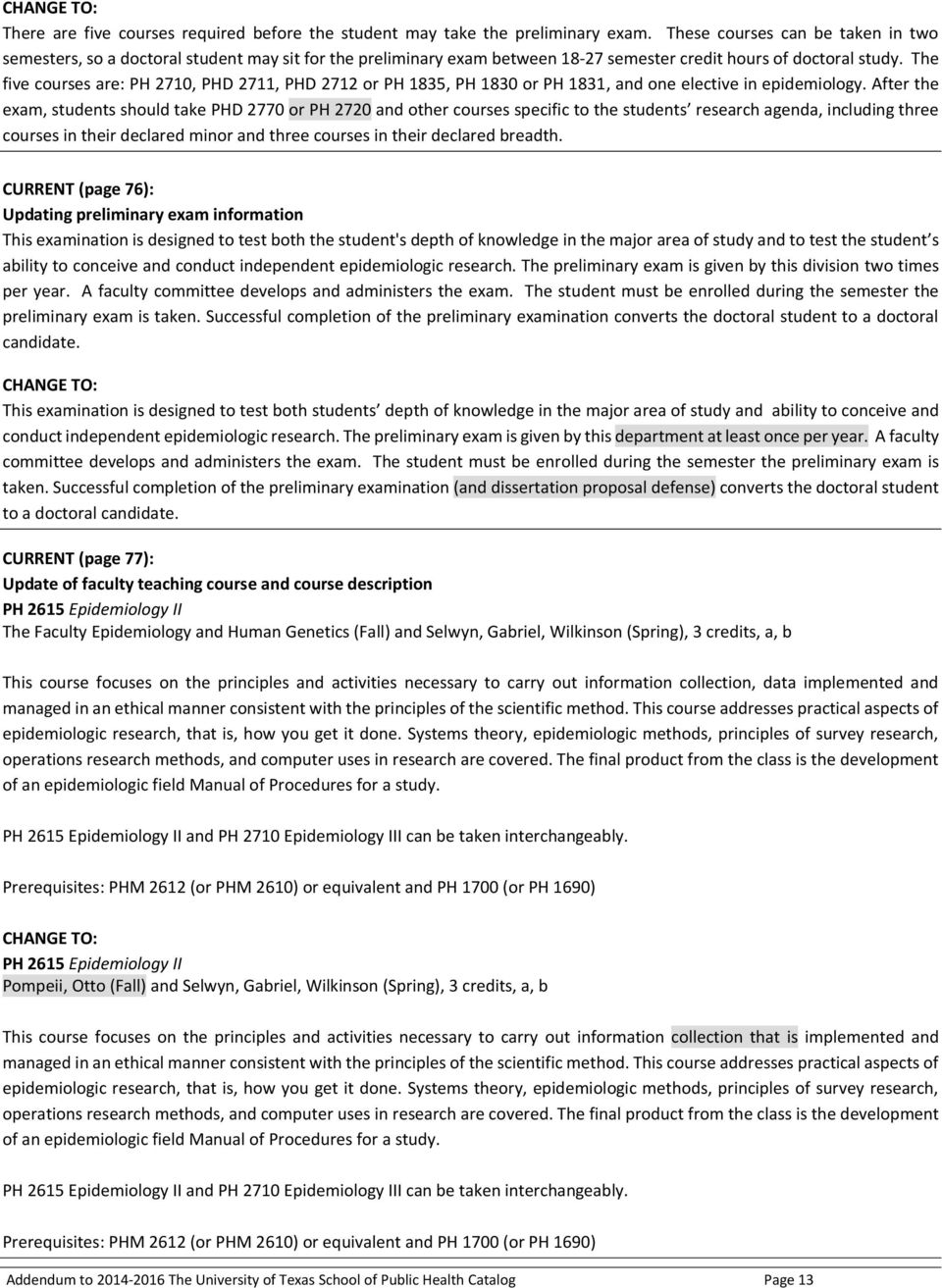
11 SECTION Epidemiology and Disease Control CURRENT (page 73): Adding another course option There are five courses required before the student may take the preliminary exam. These courses can be taken in two semesters, so a doctoral student may sit for the preliminary exam at the end of two semesters of study. The five courses are: PH 2710, PHD 2711, PHD 2712 or PH 1835, PH 1830 or PH 1831, and one elective in epidemiology. After the exam, students should take PHD 2770 and other courses specific to the students research agenda, including three courses in their declared major and three courses in their declared breadth. CHANGE TO: There are five courses required before the student may take the preliminary exam. These courses can be taken between semester credit hours of doctoral study, so a doctoral student may sit for the preliminary exam after 18 credits and before 27 credit hours. The five courses are: PH 2710, PHD 2711, PHD 2712 or PH 1835, PH 1830 or PH 1831, and one elective in epidemiology. After the exam, students should take PHD 2770 or PH 2720 and other courses specific to the students research agenda, including three courses in their declared major and three courses in their declared breadth. CURRENT (page 73): Updating preliminary exam information This examination is designed to test both the student's depth of knowledge in the major area of study and to test the student s ability to conceive and conduct independent epidemiologic research. The preliminary exam is given by this division two times per year. A faculty committee develops and administers the exam. The student must be enrolled during the semester the preliminary exam is taken. Successful completion of the preliminary examination converts the doctoral student to a doctoral candidate. CHANGE TO: This examination tests students depth of knowledge in the major area of study and ability to conceive and conduct independent epidemiologic research. The preliminary exam is given by this department at least once per year. A faculty committee develops and administers the exam. The student must be enrolled during the semester the preliminary exam is taken. Successful completion of the preliminary examination (and dissertation proposal defense) converts the doctoral student to a doctoral candidate. CURRENT (page 74): Changing course from PHM to PH The following courses are required for an MS student majoring in Epidemiology: PH 1690 Foundations of Biostatistics PH 1700 Intermediate Biostatistics PHM 2612 Epidemiology I PH 2615 Epidemiology II PH 2710 Epidemiology III PHM 2720 Epidemiologic Proposal Development PHM 5010 Ethics in Public Health Two elective courses in Epidemiology PH 9995 Capstone Course for MS Students CHANGE TO: The following courses are required for an MS student majoring in Epidemiology: PH 1690 Foundations of Biostatistics Addendum to The University of Texas School of Public Health Catalog Page 11

12 PH 1700 Intermediate Biostatistics PHM 2612 Epidemiology I PH 2615 Epidemiology II PH 2710 Epidemiology III PH 2720 Epidemiologic Proposal Development PHM 5010 Ethics in Public Health Two elective courses in Epidemiology PH 9995 Capstone Course for MS Students CURRENT (page 75): Adding another course option The following courses are required for a PhD student majoring in Epidemiology: PH 1690 Foundations of Biostatistics PH 1700 Intermediate Biostatistics PH 1830 Categorical Data Analysis and/or PH 1831 Survival Analysis PHM 2612 Epidemiology I PH 2615 Epidemiology II PH 2710 Epidemiology III PHD 2711 Epidemiology IV PHD 2712 Experimental Methods in Epidemiology or PH 1835 Statistical Methodology in Clinical Trials PHD 2770 NIH Proposal Development PHD 2990 Epidemiology Seminar At least one elective course in Epidemiology CHANGE TO: The following courses are required for a PhD student majoring in Epidemiology: PH 1690 Foundations of Biostatistics PH 1700 Intermediate Biostatistics PH 1830 Categorical Data Analysis and/or PH 1831 Survival Analysis PHM 2612 Epidemiology I PH 2615 Epidemiology II PH 2710 Epidemiology III PHD 2711 Epidemiology IV PHD 2712 Experimental Methods in Epidemiology or PH 1835 Statistical Methodology in Clinical Trials PHD 2770 NIH Proposal Development or PH 2720 Epidemiology Proposal Development PHD 2990 Epidemiology Seminar At least one elective course in Epidemiology CURRENT (page 76): Addition of another course option There are five courses required before the student may take the preliminary exam. These courses can be taken in two semesters, so a doctoral student may sit for the preliminary exam at the end of two semesters of study. The five courses are: PH 2710, PHD 2711, PHD 2712 or PH 1835, PH 1830 or PH 1831, and one elective in epidemiology. After the exam, students should take PHD 2770 and other courses specific to the students research agenda, including three courses in their declared minor and three courses in their declared breadth. Addendum to The University of Texas School of Public Health Catalog Page 12

13 CHANGE TO: There are five courses required before the student may take the preliminary exam. These courses can be taken in two semesters, so a doctoral student may sit for the preliminary exam between semester credit hours of doctoral study. The five courses are: PH 2710, PHD 2711, PHD 2712 or PH 1835, PH 1830 or PH 1831, and one elective in epidemiology. After the exam, students should take PHD 2770 or PH 2720 and other courses specific to the students research agenda, including three courses in their declared minor and three courses in their declared breadth. CURRENT (page 76): Updating preliminary exam information This examination is designed to test both the student's depth of knowledge in the major area of study and to test the student s ability to conceive and conduct independent epidemiologic research. The preliminary exam is given by this division two times per year. A faculty committee develops and administers the exam. The student must be enrolled during the semester the preliminary exam is taken. Successful completion of the preliminary examination converts the doctoral student to a doctoral candidate. CHANGE TO: This examination is designed to test both students depth of knowledge in the major area of study and ability to conceive and conduct independent epidemiologic research. The preliminary exam is given by this department at least once per year. A faculty committee develops and administers the exam. The student must be enrolled during the semester the preliminary exam is taken. Successful completion of the preliminary examination (and dissertation proposal defense) converts the doctoral student to a doctoral candidate. CURRENT (page 77): Update of faculty teaching course and course description PH 2615 Epidemiology II The Faculty Epidemiology and Human Genetics (Fall) and Selwyn, Gabriel, Wilkinson (Spring), 3 credits, a, b This course focuses on the principles and activities necessary to carry out information collection, data implemented and managed in an ethical manner consistent with the principles of the scientific method. This course addresses practical aspects of epidemiologic research, that is, how you get it done. Systems theory, epidemiologic methods, principles of survey research, operations research methods, and computer uses in research are covered. The final product from the class is the development of an epidemiologic field Manual of Procedures for a study. PH 2615 Epidemiology II and PH 2710 Epidemiology III can be taken interchangeably. Prerequisites: PHM 2612 (or PHM 2610) or equivalent and PH 1700 (or PH 1690) CHANGE TO: PH 2615 Epidemiology II Pompeii, Otto (Fall) and Selwyn, Gabriel, Wilkinson (Spring), 3 credits, a, b This course focuses on the principles and activities necessary to carry out information collection that is implemented and managed in an ethical manner consistent with the principles of the scientific method. This course addresses practical aspects of epidemiologic research, that is, how you get it done. Systems theory, epidemiologic methods, principles of survey research, operations research methods, and computer uses in research are covered. The final product from the class is the development of an epidemiologic field Manual of Procedures for a study. PH 2615 Epidemiology II and PH 2710 Epidemiology III can be taken interchangeably. Prerequisites: PHM 2612 (or PHM 2610) or equivalent and PH 1700 (or PH 1690) Addendum to The University of Texas School of Public Health Catalog Page 13
14 CURRENT (page 77): Change of summer session offering and update faculty teaching course PH 2710 Epidemiology III Symanski (Fall), Hallman, Kelder, Kohl, Caetano (Spring), and Waller (Summer) 3 credits, a, b, cd CHANGE TO: PH 2710 Epidemiology III Symanski (Fall), Hallman, Kelder, and Caetano (Spring), and Waller (Summer) 3 credits, a, b, cd (alternating Summer semesters) CURRENT (page 77): Updating course description (deleting last line in paragraph) PHD 2711 Epidemiology IV Waller (Fall) and Day (Spring), 3 credits, a, b This course prepares students to use and make reasonable inferences regarding causality from epidemiologic data analyses. Students address research questions using data from a variety of study designs. Students acquire hands on experience with stratified analysis, logistic regression, and survival analysis. Other learning activities cover meta-analysis, advanced issues in assessment of confounding and effect measure modification, strategies for building multivariable models, and sensitivity analysis. This course is a pre-requisite for higher level doctoral courses. Prerequisites: PH 2615, PH 2710, and PH 1700 or consent of Instructor. CHANGE TO: PHD 2711 Epidemiology IV Waller (Fall) and Day (Spring), 3 credits, a, b This course prepares students to use and make reasonable inferences regarding causality from epidemiologic data analyses. Students address research questions using data from a variety of study designs. Students acquire hands on experience with stratified analysis, logistic regression, and survival analysis. Other learning activities cover meta-analysis, advanced issues in assessment of confounding and effect measure modification, strategies for building multivariable models, and sensitivity analysis. Prerequisites: PH 2615, PH 2710, and PH 1700 or consent of Instructor. CURRENT (page 78): Change from PHM to PH and update of course mode and course description PHM 2720 Epidemiologic Proposal Development Mitchell, 3 credits, b, (Available Online) The course defines the components of a scientific proposal, utilizing the National Institutes of Health s (NIH) guidelines for the development of research grant applications. Proposals must be for an epidemiologic study. Students have the opportunity to learn how to develop each section of a proposal through lecture materials, reviewing and discussing examples of successful and unsuccessful proposals and finally the preparation of their own research proposal. The course concludes with a mock NIH study section, in which students serve as reviewers for their colleague s proposals. This course is intended for MPH and MS students. Prerequisites: PH 2710 or consent of instructor CHANGE TO: Addendum to The University of Texas School of Public Health Catalog Page 14

15 PH 2720 Epidemiologic Proposal Development Mitchell, 3 credits, b The course defines the components of a scientific proposal, utilizing the National Institutes of Health s (NIH) guidelines for the development of research grant applications. Proposals must be for an epidemiologic study. Students have the opportunity to learn how to develop each section of a proposal through lecture materials, reviewing and discussing examples of successful and unsuccessful proposals and finally the preparation of their own research proposal. The course concludes with a mock NIH study section, in which students serve as reviewers for their colleague s proposals. This course is required for MS students. Doctoral students may take this course as an alternative to PHD Prerequisites: PH 2710 or consent of instructor CURRENT (page 79): Change from PHWM to PHW, update of faculty, course mode, description, and deletion of prerequisites PHWM 2740 Cardiovascular Disease Epidemiology and Prevention Morrison and the Faculty in Epidemiology and Human Genetics, 3 credits, a The purpose of this course is to provide an introductory overview to the field of cardiovascular disease (CVD) epidemiology. Topics for this course include the pathophysiology of CVD, CVD survey methods, trends in CVD mortality and morbidity, CVD risk factors, major strategies for CVD prevention and a summary of major CVD clinical trials. Students will gain an understanding of the impact of CVD on public health. Prerequisites: PHM 2612 (or PHM 2610) or consent of instructor CHANGE TO: PHW 2740 Cardiovascular Disease Epidemiology and Prevention Morrison, 3 credits, a (Online only) The purpose of this course is to provide an overview of the field of cardiovascular disease (CVD) epidemiology. Topics for this course include the pathophysiology of CVD, CVD survey methods, trends in CVD mortality and morbidity, CVD risk factors, major strategies for CVD prevention and a summary of major CVD clinical trials. Students will gain an understanding of the impact of CVD on public health. DELETE COURSE FROM CATALOG (page 80) PHD 2740 Cardiovascular Disease Epidemiology and Prevention Morrison and the Faculty in Epidemiology and Human Genetics, 3 credits, a CURRENT (page 80): Change of faculty teaching course and when course is offered PHM 2745 Cancer Epidemiology Etzel, Pande, Lopez, 3 credits, (periodically offered) CHANGE TO: PHM 2745 Cancer Epidemiology Lopez, 3 credits, cd CURRENT (page 80): Update course prefix Addendum to The University of Texas School of Public Health Catalog Page 15

16 PH 2750 Disease: Natural History, Prevention, Control Jiang, Qu, 3 credits, a (Online only) Change to: PHW 2750 Disease: Natural History, Prevention, Control Jiang, Qu, 3 credits, a (Online only) CURRENT (page 80): Change from PHM to PH PHM 2755 Nutrition Research Methods Day, 2 credits, a CHANGE TO: PH 2755 Nutrition Research Methods Day, 2 credits, a CURRENT (page 80): Change faculty teaching course PHWM 2760 Occupational Epidemiology Cooper and the Faculty in Epidemiology and Human Genetics, 3 credits, cd (Online only) CHANGE TO: PHWM 2760 Occupational Epidemiology Cooper, 3 credits, cd (Online only) CURRENT (page 81) Change from PHM to PH and when course is offered PHM 2765 Pediatric Epidemiology Mitchell, 3 credits, b CHANGE TO: PH 2765 Pediatric Epidemiology Mitchell, 3 credits, (periodically offered) CURRENT (page 82) Adding description of course mode PH 2785 Laboratory Methods: Applications and Implications to Public Health Darkoh, 3 credits, b, cd CHANGE TO: PHW 2785 Laboratory Methods: Applications and Implications to Public Health Darkoh, 3 credits, b, cd (Online only) CURRENT (page 83): Change from PH to PHM PH 2800 Tropical Infectious Diseases Brown and the Faculty in Epidemiology and Human Genetics, 3 credits, a CHANGE TO: Addendum to The University of Texas School of Public Health Catalog Page 16

17 PHM 2800 Tropical Infectious Diseases Brown and the Faculty in Epidemiology and Human Genetics, 3 credits, a CURRENT (page 83): Change from PHD to PH PHD 2815 Genetics and Human Disease Hanis, Boerwinkle, and the Faculty in Epidemiology and Human Genetics, 3 credits, a CHANGE TO: PH 2815 Genetics and Human Disease Hanis, Boerwinkle, and the Faculty in Epidemiology and Human Genetics, 3 credits, a CURRENT (page 84): Change from PHD to PH, title change and faculty teaching course PHD 2820 Molecular and Cellular Approaches to Human Genetics Hixson, Bressler, Sen, and the Faculty in Epidemiology and Human Genetics, 3 credits, b CHANGE TO: PH 2820 Introduction to Human Molecular Genetics Hixson, Bressler, Fornage, 3 credits, b CURRENT (page 84): Update in title PH 2830 Genetics in Epidemiology Daiger and The Faculty in Epidemiology and Human Genetics, 3 credits, b CHANGE TO: PH 2830 Clinical Genetics in Epidemiology Daiger and The Faculty in Epidemiology and Human Genetics, 3 credits, b CURRENT (page 84): Change mode of courses PHM 2835 Injury Epidemiology Pompeii, 3 credits, b Change to: PHWM 2835 Injury Epidemiology Pompeii, 3 credits, b (online only) Change from: PHD 2835 Injury Epidemiology Pompeii, 3 credits, b Change to: PHWD 2835 Injury Epidemiology Pompeii, 3 credits, b (online only) CURRENT (page 85): Change when course is offered and prerequisites PHM 2845 Nutritional Epidemiology Addendum to The University of Texas School of Public Health Catalog Page 17

18 Day, 3 credits, a or b Students learn to describe the methods and evaluate the issues associated with nutritional assessment of populations using dietary, biochemical and anthropometric data. A combination of lecture, seminar and hands-on activities are incorporated to examine the strengths and weaknesses of nutritional assessment methodologies used with epidemiologic study designs. Students are provided data and guided to explore methodologies of statistical analysis and interpretation of nutritional data. Prerequisites: PHM 2610 Fundamentals of Epidemiology or PHM 2612 Epidemiology I and PH 1690 Foundations of Biostatistics or PH 1700 Intermediate Biostatistics or equivalent, consent of instructor CHANGE TO: PHM 2845 Nutritional Epidemiology Day, 3 credits, a Students learn to describe the methods and evaluate the issues associated with nutritional assessment of populations using dietary, biochemical and anthropometric data. A combination of lecture, seminar and hands-on activities are incorporated to examine the strengths and weaknesses of nutritional assessment methodologies used with epidemiologic study designs. Students are provided data and guided to explore methodologies of statistical analysis and interpretation of nutritional data. Prerequisites: PHM 2612 (or PHM 2610), PH 1690 (or PH 1700 or equivalent), consent of instructor CURRENT (page 85): Change when course is offered and prerequisites PHD 2845 Nutritional Epidemiology Day, 3 credits, a or b Students learn to describe the methods and evaluate the issues associated with nutritional assessment of populations using dietary, biochemical and anthropometric data. A combination of lecture, seminar and hands-on activities are incorporated to examine the strengths and weaknesses of nutritional assessment methodologies used with epidemiologic study designs. Students are provided data and guided to explore methodologies of statistical analysis and interpretation of nutritional data. Prerequisites: PHM 2610 Fundamentals of Epidemiology or PHM 2612 Epidemiology I and PH 1690 Foundations of Biostatistics or PH 1700 Intermediate Biostatistics or equivalent, consent of instructor CHANGE TO: PHD 2845 Nutritional Epidemiology Day, 3 credits, a Students learn to describe the methods and evaluate the issues associated with nutritional assessment of populations using dietary, biochemical and anthropometric data. A combination of lecture, seminar and hands-on activities are incorporated to examine the strengths and weaknesses of nutritional assessment methodologies used with epidemiologic study designs. Students are provided data and guided to explore methodologies of statistical analysis and interpretation of nutritional data. Prerequisites: PHM 2612 (or PHM 2610), PH 1690 (or PH 1700 or equivalent), consent of instructor CURRENT (page 86): Change from PHD to PH and update prerequisites PHD 2860 Advanced Design Analysis Methods in Epidemiology Rahbar, The Faculty in Epidemiology and Human Genetics, 3 credits, b Addendum to The University of Texas School of Public Health Catalog Page 18

19 This course primarily covers topics related to study design and appropriate data analysis using advanced techniques. At the core, the faculty will discuss basic and generalized regression models for binary (logistic) continuous (linear) and count (Poisson) outcomes; multivariate data reduction techniques such as factors analysis and Principal Component Analysis; longitudinal models; analysis of clustered data; and select data mining methods. Whenever possible, the faculty will illustrate how to carry out data analyses in SAS or STATA or other suitable statistical packages. Prerequisites: PHD 2711 and PHD 1830 (or PHM 1615 and PHM 1616) CHANGE TO: PH 2860 Advanced Design Analysis Methods in Epidemiology Rahbar and The Faculty in Epidemiology and Human Genetics, 3 credits, b This course primarily covers topics related to study design and appropriate data analysis using advanced techniques. At the core, the faculty will discuss basic and generalized regression models for binary (logistic), continuous (linear), and count (Poisson) outcomes; multivariate data reduction techniques, such as factors analysis and Principal Component Analysis; longitudinal models; analysis of clustered data; and select data mining methods. Whenever possible, the faculty will illustrate how to carry out data analyses in SAS or STATA or other suitable statistical packages. Prerequisites: PH 2710 and PH 1830 DELETE COURSE FROM CATALOG (page 86): PHM 2940 CITAR Seminar Hwang, Markham, 2 credits, a, b CURRENT (page 87): Change from PHM to PH PHM 2950 Genetic Epidemiology of Chronic Disease Hanis and the Faculty in Epidemiology and Human Genetics, 2 credits, b CHANGE TO: PH 2950 Genetic Epidemiology of Chronic Disease Hanis and The Faculty in Epidemiology and Human Genetics, 2 credits, b SECTION Environmental and Occupational Health Sciences CURRENT (page 96): Adding faculty teaching course and updating course description PHM 2110 Overview of Environmental Health Sexton, Mena, Carson, Chappell, Di Giovanni, Rodriguez, 3 credits, a, b, cd (Available Online) This course is a survey of the major areas of environmental health, and provides students with an understanding of hazards in the environment, the effects of environmental contaminants on health, and various approaches to address major environmental health problems. Areas of emphasis are population dynamics, global environmental health problems, toxicology, food, air and water quality, occupational health, radiation, noise, and solid and hazardous waste. This is a designated core course for MPH students not majoring in Environmental and Occupational Health Sciences. CHANGE TO: PHM 2110 Overview of Environmental Health Sexton, Mena, Carson, Han, Chappell, Di Giovanni, Rodriguez, 3 credits, a, b, cd (Available Online) This course is a survey of the major areas of environmental health, and provides students with an understanding of hazards in the environment, the effects of environmental agents on health, and various approaches to address major environmental health Addendum to The University of Texas School of Public Health Catalog Page 19
20 problems. Areas of emphasis are population dynamics, global environmental health problems, environmentally acquired infectious disease, toxicology, food, air and water quality, occupational health, radiation, noise, and solid and hazardous waste. This is a designated core course for MPH students not majoring in Environmental and Occupational Health Sciences. CURRENT (page 101): Change in faculty teaching course PH 2255 Clinical Occupational Medicine Schecter, Delclos, 4 credits, b CHANGE TO: PH 2255 Clinical Occupational Medicine Delclos, 4 credits, b CURRENT (page 102): Change of faculty teaching course PH 2285 Topics in Infectious Diseases Schecter, 3 credits, a CHANGE TO: PH 2285 Topics in Infectious Diseases Rodriguez, 3 credits, a SECTION Health Promotion and Behavioral Sciences CURRENT (page 105): Change in DrPH description Doctor of Public Health Degree Program The DrPH degree in health promotion/health education is designed to train students for leadership roles as public health professionals in governmental and non-governmental agencies, health departments, or for work in the research or academic setting. Students receiving a DrPH are expected to contribute to and apply scientific discoveries in public health settings. CHANGE TO: Doctor of Public Health Degree Program The DrPH degree in Health Promotion & Behavioral Sciences is designed to develop leaders in health promotion practice. Students are trained to conduct applied research in public health settings. It is primarily designed for those who plan to apply scientific discoveries and use strong analytical skills to assess public health problems. They are also trained to develop, implement, and evaluate theory-based public health interventions in practice settings. An important component of this degree program is the ability to communicate findings to the public and policymakers. DrPH students are required to complete a minimum of 48 semester credit hours of coursework (a maximum of nine combined credit hours of practicum, and dissertation count toward the minimum of 48 credit hours), a recommended breadth in leadership and one minor area of study in Epidemiology, Biostatistics, Environmental and Occupational Health, or Management, Policy, and Community Health. CURRENT (page 106): Change in course recommendations Course of Study The student will complete a course of study focused on the social and behavioral aspects of public health and the development and evaluation of health promotion interventions. The following Divisional courses are required, except in the case of a waiver (waiver process varies by program), for a DrPH student majoring in Health Promotion/Health Education: PHD 1113 Advanced Methods for Planning and Implementing Health Promotion Programs (Intervention Mapping) PHD 1122 Health Promotion Theory and Methods: A Teaching and Learning Experience for Doctoral Students Addendum to The University of Texas School of Public Health Catalog Page 20

21 PHD 1123 Health Promotion Theory and Methods II Doctoral level PHD 1420 and PHD 1421 Research Design and Analysis in Behavioral Sciences I and II PHD 1434 Research Seminar in Health Promotion and Behavioral Sciences One or more of the following courses: o PH 1118 Introduction to Qualitative Research Methods o PHD 1121 Advanced Methods in Program Evaluation o PHD 1130 Applied Measurement Theory o PHD 1132 Latent Variable Models and Factor Analysis o PHD 1227 Advanced and Emerging Theories for Health Promotion o PHD 1330 Scientific Writing in Public Health o PHD 1425 Applied Multivariate Methods for the Behavioral Sciences o PHD 1430 Systematic Review, Meta- Analysis, and Evidence-Based Public Health o PHD 1435 Health Promotion/Behavioral Sciences Doctoral/Post-Doctoral Research Seminar o PH 1440 Research Proposal Development o PH 1498 Categorical Data Analysis CHANGE TO: Course of Study The student will complete a course of study focused on the social and behavioral aspects of public health and the development and evaluation of health promotion interventions. The following Divisional courses are required, except in the case of a waiver (waiver process varies by program), for a DrPH student majoring in Health Promotion/Health Education: PHD 1113 Advanced Methods for Planning and Implementing Health Promotion Programs (Intervention Mapping) PHD 1122 Health Promotion Theory and Methods: A Teaching and Learning Experience for Doctoral Students PHD 1123 Health Promotion Theory and Methods II Doctoral level PHD 1420 and PHD 1421 Research Design and Analysis in Behavioral Sciences I and II PHD 1434 Research Seminar in Health Promotion and Behavioral Sciences The following courses are strongly recommended: o PHD 1118 Introduction to Qualitative Research Methods o PHD 1227 Advanced and Emerging Theories for Health Promotion o PHD 1435 Health Promotion/Behavioral Sciences Doctoral/Post-Doctoral Research Seminar CURRENT (page 107): Clarification of requirement DrPH students in Health Promotion/Behavioral Sciences must successfully pass the preliminary exam as part of the process of becoming a doctoral candidate. Prior to taking the exam, the DrPH student must take: PHD 1113, PHD 1122, PHD 1123, PHD 1420, PHD 1421, PHD 1434, and PHM 2610 or PHM CHANGE TO: DrPH students in Health Promotion/Behavioral Sciences must successfully pass the preliminary exam after approximately hours of courses (one year of full time study). Prior to taking the exam, the DrPH student must take: PHD 1113, PHD 1122, PHD 1123, PHD 1420, PHD 1421, PHD 1434, and PHM 2610 or PHM CURRENT (page 107): Change in PhD description Doctor of Philosophy Degree Program The PhD in Behavioral Sciences focuses on the aspects of public health and the development and evaluation of health promotion interventions. The PhD program provides training in social and behavioral science theory and methods as applied to public health and is designed to provide students with the skills necessary to succeed in academic and research positions. The emphasis in this degree program is preparation for independent research and teaching. CHANGE TO: Doctor of Philosophy Degree Program Addendum to The University of Texas School of Public Health Catalog Page 21
22 The PhD in Health Promotion & Behavioral Sciences is designed to provide students with the skills necessary to succeed in academic and research positions. The PhD program primarily prepares scholars to integrate and develop state-of-the-art social and behavioral science theory, design, and analytic approaches to examine current problems in public health. The emphasis in this degree program is preparation for independent research and teaching. An important component of this degree pro-gram is the ability to contribute to the scientific literature. PhD students are required to complete a minimum of 48 semester credit hours of course-work (a maximum of nine combined credit hours of practicum, thesis or dissertation count toward the minimum of 48 credit hours), a recommended breadth in research methods and one minor area of study in Epidemiology, Biostatistics, Environmental and Occupational Health, or Management and Policy. CURRENT (page 107): Change in special entrance requirements for PhD students Special Entrance Requirements Candidates for the PhD should hold an earned Master s degree or equivalent in a social or behavioral science, such as psychology, sociology, anthropology, or communications or its equivalent and should have completed introductory coursework in health promotion or behavioral sciences theory. In some exceptional cases, applicants without a Master s level social or behavioral science academic background may be accepted upon the condition of completing additional graduate work in the behavioral or social sciences. Applicants are asked to submit a writing sample that demonstrates competence in written communication for academic work. Theses, publications or other academic work are preferred. The applicant should be the sole or first author on submitted work. CHANGE TO: Special Entrance Requirements Candidates for the PhD should hold an earned Master s degree in a social or behavioral sciences OR an earned master s degree in another field and at least 12 hours of upper division undergraduate or graduate coursework in social or behavioral sciences. In some exceptional cases, applicants without this experience may be accepted on the condition of completing additional graduate work in the behavioral or social sciences. Applicants are asked to submit a writing sample that demonstrates competence in written communication for academic work. Theses, publications or other academic work are preferred. The applicant should be the sole or first author on submitted work. CURRENT (page 108): Change in course of study for PhD Course of Study The following Divisional courses are required, except in the case of a waiver (waiver process varies by program), for a PhD student majoring in Behavioral Sciences: PHD 1113 Advanced Methods for Planning and Implementing Health Promotion Programs (Intervention Mapping) PHD 1122 Health Promotion Theory and Methods: A Teaching and Learning Experience for Doctoral Students PHD 1227 Advanced and Emerging Theories for Health Promotion PHD 1420 and PHD 1421 Research Design and Analysis in Behavioral Sciences I and II PHD 1434 Research Seminar in Health Promotion and Behavioral Sciences One or more of the following courses: o PH 1118 Introduction to Qualitative Research Methods o PHD 1121 Advanced Methods in Program Evaluation o PHD 1130 Applied Measurement Theory o PHD 1132 Latent Variable Models and Factor Analysis o PHD 1330 Scientific Writing in Public Health o PHD 1425 Applied Multivariate Methods for the Behavioral Sciences o PHD 1430 Systematic Review, Meta-Analysis, and Evidence-Based Public Health o PHD 1435 Health Promotion/Behavioral Sciences Doctoral/Post-Doctoral Research Seminar o PH 1440 Research Proposal Development o PH 1498 Categorical Data Analysis Additional coursework is expected in research methods, ethics in research and public health, and social and behavioral science content courses. The course of study must be approved by the academic advisor. Addendum to The University of Texas School of Public Health Catalog Page 22
23 All PhD students in Health Promotion and Behavioral Sciences are also required to take one epidemiology course (e.g., PHM 2610 or 2612 and if one is not already covered in the minor or breadth areas). PhD students in Health Promotion/Behavioral Sciences must successfully pass the preliminary exam as part of the process of becoming a doctoral candidate. Prior to taking the exam, the PhD student must take: PHD 1113, PHD 1122, PHD 1227, PHD 1420, PHD 1421, PHD 1434, and PHM 2610 or PH CHANGE TO: Course of Study The following Divisional courses are required, except in the case of a waiver (waiver process varies by program), for a PhD student majoring in Behavioral Sciences: PHD 1113 Advanced Methods for Planning and Implementing Health Promotion Programs (Intervention Mapping) PHD 1118 Introduction to Qualitative Research Methods PHD 1122 Health Promotion Theory and Methods: A Teaching and Learning Experience for Doctoral Students PHD 1227 Advanced and Emerging Theories for Health Promotion PHD 1420 and PHD 1421 Research Design and Analysis in Behavioral Sciences I and II PHD 1434 Research Seminar in Health Promotion and Behavioral Sciences The following courses are strongly recommended: o PHD 1130 Applied Measurement Theory o PHD 1435 Health Promotion/Behavioral Sciences Doctoral/Post-Doctoral Research Seminar All PhD students are strongly recommended to select a breadth in Research Methods. All PhD students in Health Promotion and Behavioral Sciences are also required to take one epidemiology course (e.g., PHM 2610 or 2612 and if one is not already covered in the minor or breadth areas). Additional coursework is expected in research methods, ethics in research and public health, and social and behavioral science content courses. The course of study must be approved by the academic advisor. PhD students in Health Promotion/Behavioral Sciences must successfully pass the preliminary exam after approximately hours of courses (one year of full time study). Prior to taking the exam, the PhD student must take: PHD 1113, PHD 1122, PHD 1227, PHD 1420, PHD 1421, PHD 1434, and PHM 2610 or PH CURRENT (page 108): Change of faculty teaching course PHM 1110 Social and Behavioral Aspects of Community Health Taylor, Fernandez-Esquer, Ross, Perry, McAlister, Shegog, Kendzor, Brown, Froehlich-Grobe, Wilkerson, 3 credits, a, b, c (always offered face to face and online) CHANGE TO: PHM 1110 Social and Behavioral Aspects of Community Health Taylor, Fernandez-Esquer, McAlister, Shegog, Kendzor, Brown, Froehlich-Grobe, Durand, Roncancio, Allicock, 3 credits, a, b, c (always offered face to face and online) CURRENT (page 109): Addition of faculty teaching course PHM 1111 Health Promotion Theory and Methods I Hoelscher, Reininger, Shegog, Businelle, 3 credits, a, b CHANGE TO: PHM 1111 Health Promotion Theory and Methods I Hoelscher, Reininger, Shegog, Businelle, Allicock, 3 credits, a, b CURRENT (page 109): Addendum to The University of Texas School of Public Health Catalog Page 23
24 Change of when course is offered PHM 1112 Health Promotion Theory and Methods II Reininger, Evans, Brown, 3 credits, a, b, cd CHANGE TO: PHM 1112 Health Promotion Theory and Methods II Reininger, Evans, Brown, 3 credits, b, cd CURRENT (page 110): Addition of faculty teaching course PHD 1113 Advanced Methods for Planning and Implementing Health Programs (Intervention Mapping) Bartholomew, Fernandez, Markham, Springer, 4 credits, a, b CHANGE TO: PHD 1113 Advanced Methods for Planning and Implementing Health Programs (Intervention Mapping) Bartholomew, Fernandez, Markham, Springer, Valerio, 4 credits, a, b CURRENT (page 110): Addition of faculty teaching course PHM 1116 Advanced Methods for Planning and Implementing Health Promotion Programs (Intervention Mapping) Bartholomew, Fernandez, Markham, Springer, 2 credits, b, c Intensive one-week format course CHANGE TO: PHM 1116 Advanced Methods for Planning and Implementing Health Promotion Programs (Intervention Mapping) Bartholomew, Fernandez, Markham, Springer, Valerio, 2 credits, b, c Intensive one-week format course CURRENT (page 110): Addition of faculty teaching course PHD 1116 Advanced Methods for Planning and Implementing Health Programs (Intervention Mapping) Bartholomew, Fernandez, Markham, Springer, 2 credits, b, c Intensive one-week format course CHANGE TO: PHD 1116 Advanced Methods for Planning and Implementing Health Programs (Intervention Mapping) Bartholomew, Fernandez, Markham, Springer, Valerio, 2 credits, b, c Intensive one-week format course CURRENT (page 111): Change of course description PHD 1118 Introduction to Qualitative Research Methods McCurdy, 4 credits, a This course is designed to familiarize students who have little or no experience in conducting qualitative research with the perspectives, methods, and techniques of its practitioners. The course covers the underpinnings of qualitative research, some of the major qualitative research traditions, methods of data collection used in the conduct of qualitative inquiries, and preliminary analysis of narrative or text data. Part I provides the students with a broad overview of qualitative research traditions and techniques as they begin to conceptualize and design their own research project. Part II covers the conduct of fieldwork. Students work in small groups or independently to carry out a field-based research project. Part III covers qualitative analysis and presents the students with the opportunity to learn preliminary coding and axial coding techniques. Project and methodological practice reports, based on the fieldwork experience, are required in this course. Taught simultaneously with PHM 1118 CHANGE TO: PHD 1118 Introduction to Qualitative Research Methods McCurdy, 4 credits, a Addendum to The University of Texas School of Public Health Catalog Page 24
25 This course is designed to familiarize students who have little or no experience in conducting qualitative research with the perspectives, methods, and techniques of its practitioners. The course covers the underpinnings of qualitative research, some of the major qualitative research traditions, methods of data collection used in the conduct of qualitative inquiries, and preliminary analysis of text data. Part I provides the students with a broad overview of qualitative research traditions and techniques as they begin to conceptualize and design their own research project. Part II covers the design and practice of fieldwork. Students gain experience with some research methods and develop preliminary qualitative research proposals for a field-based research project. Part III covers qualitative analysis and presents the students with the opportunity to learn preliminary coding techniques for thematic content analysis. Methodological practice reports, an annotated bibliography, and a preliminary grant proposal are required in this course. Taught simultaneously with PHM 1118 CURRENT (page 112): Addition of faculty teaching course, update of course format and prerequisites PHM 1120 Introduction to Program Evaluation Peskin, Savas, Hernandez, 3 credits, a, b (Available online) This course introduces students to the theory and application of program evaluation, emphasizing a range of evaluation goals and designs. Exercises, discussions, and lectures focus on practical tools for conducting field evaluations that are focused on three levels: 1) critique of the program concept and design; 2) program implementation and process; and 3) program impact and outcomes. Stakeholders are identified, and methods for involvement of stakeholders are emphasized to promote use of study findings. Students prepare a proposal for the evaluation of an existing program or policy. Sections of the proposal are written and revised during the semester based on further learning and feedback from the instructor and other students. The course also includes an exam. Prerequisites: PH 1690 or PH 1700, PHM 2610 or PHM 1111 CHANGE TO: PHM 1120 Introduction to Program Evaluation Peskin, Savas, Hernandez, Addy, 3 credits, a (taught online), b (taught as hybrid) This course introduces students to the theory and application of program evaluation, emphasizing a range of evaluation goals and designs. Exercises, discussions, and lectures focus on practical tools for conducting field evaluations that are focused on three levels: 1) critique of the program concept and design; 2) program implementation and process; and 3) program impact and outcomes. Stakeholders are identified, and methods for involvement of stakeholders are emphasized to promote use of study findings. Students prepare a proposal for the evaluation of an existing program or policy. Sections of the proposal are written and revised during the semester based on further learning and feedback from the instructor and other students. The course also includes an exam. This course is offered online in the fall and as a hybrid in the spring. Prerequisites: PH 1690 or PH 1700, PHM 2610, PHM 1110 or 1111 CURRENT (page 113): Addition of faculty teaching course PHD 1122 Health Promotion Theory and Methods: A Teaching and Learning Experience for Doctoral Students Businelle, Wilkerson, 3 credits, a, b CHANGE TO: PHD 1122 Health Promotion Theory and Methods: A Teaching and Learning Experience for Doctoral Students Businelle, Wilkerson, Allicock, 3 credits, a, b CURRENT (page 113): Addition of a prerequisite to the course PHD 1123 Health Promotion Theory and Methods II Reininger, McAlister, 3 credits, b Addendum to The University of Texas School of Public Health Catalog Page 25
26 This doctoral level course will involve the student in the development of an NIH style proposal using Community Based Participatory Research methods. The course will cover community assessment coalition building, choosing community partners, ethical issues of community work and important methodological issues of CBPR. See PHD CHANGE TO: PHD 1123 Health Promotion Theory and Methods II Reininger, McAlister, 3 credits, b This doctoral level course will involve the student in the development of an NIH style proposal using Community Based Participatory Research (CBPR) methods. The course will cover community assessment coalition building, choosing community partners, ethical issues of community work and important methodological issues of CBPR. See PHD Prerequisite: PHD 1122 CURRENT (page 115): Addition of faculty teaching course PHM 1231 Advances in Medical Nutrition Therapy Moore, 4 credits, a CHANGE TO: PHM 1231 Advances in Medical Nutrition Therapy Moore, Piga-Plunkett, 4 credits, a CURRENT (page 115): Addition of faculty teaching course PHM 1234 Advances in Specialty Nutrition Practice Moore, 2 credits, b CHANGE TO: PHM 1234 Advances in Specialty Nutrition Practice Moore, Piga-Plunkett, 2 credits, b CURRENT (page 115): Faculty teaching course PH 1236 Issues in Aging The Faculty of Health Promotion and Behavioral Sciences, 3 credits, cd (periodically offered) CHANGE TO: PH 1236 Issues in Aging Burnett, 3 credits, cd (periodically offered) CURRENT (page 116): Addition of faculty teaching course PH 1238 Adolescent Sexual Health Tortolero, Markham, Peskin, 3 credits, a CHANGE TO: PH 1238 Adolescent Sexual Health Tortolero, Markham, Peskin, Cuccaro, 3 credits, a CURRENT (page 116): Change from PH to PHD, addition of faculty teaching course and prerequisite PH 1239 Theories of Child and Adolescent Development Caughy, 3 credits, b (odd numbered years) Addendum to The University of Texas School of Public Health Catalog Page 26
27 This course is limited to doctoral students. The purpose of the course is to provide students with a foundation in historical and contemporary theories of developmental science and explores how these theories facilitate our understanding of normative development from infancy through adolescence. In addition, the course will utilize developmental theories to examine the factors contributing to public health problems affecting children and youth as well as the development and implementation of public health interventions serving these populations. CHANGE TO: PHD 1239 Theories of Child and Adolescent Development Caughy, Cuccaro, 3 credits, b (odd numbered years) This course is limited to doctoral students. The purpose of the course is to provide students with a foundation in historical and contemporary theories of developmental science and explores how these theories facilitate our understanding of normative development from infancy through adolescence. In addition, the course will utilize developmental theories to examine the factors contributing to public health problems affecting children and youth as well as the development and implementation of public health interventions serving these populations. Prerequisite: For doctoral students CURRENT (page 118): Change of faculty teaching course and when course is offered PH 1250 Genital, Sexual, and Reproductive Public Health Ross, 3 credits, b CHANGE TO: PH 1250 Genital, Sexual, and Reproductive Public Health Wilkerson, 3 credits, a CURRENT (page 120): Addition in faculty teaching course and change in course description PHD 1430 Systematic Review, Meta-Analysis, and Evidence-Based Public Health Mullen, Vonville, 3 credits, a This course introduces the methods of systematic review and meta-analysis, including formulating questions, criteria for relevance and rigor in selecting primary studies, search strategies, coding protocols, tables and other formats for presenting data, qualitative and quantitative representations of effect sizes from individual primary studies, and analyses of groups of studies to estimate an average effect size and to explain variation. The course also introduces students to the methods and products of the U.S. (Clinical) Preventive Services Task Force and Evidence-based Practice Centers and to the newer U.S. Community Preventive Services Task Force. Prerequisites: PH 1700 or consent of the instructor and PHM 2610 or equivalent CHANGE TO: PHD 1430 Systematic Review, Meta-Analysis, and Evidence-Based Public Health Mullen, VonVille, Cornell, 3 credits, a This course introduces the methods of systematic review and meta-analysis, including formulating questions, criteria for relevance and rigor in selecting primary studies, search strategies, coding protocols, tables and other formats for presenting data, qualitative and quantitative representations of effect sizes from individual primary studies, and analyses of groups of studies to estimate an average effect size and to explain variation. (A STATA-based lab experience in meta-analysis has been added to the course.) Clinical and community practice guidelines and their relation to evidence from systematic reviews are examined and critiqued. Each student works on his/her own project with the goal of producing a complete proposal and rehearsing all steps in the systematic review process. Prerequisites: PH 1700 or consent of the instructor and PHM 2610 or equivalent Addendum to The University of Texas School of Public Health Catalog Page 27
28 CURRENT (page 121): Addition of faculty teaching course and change of course description PHD 1431 Tools & Methods for Systematic Reviews and Meta-Analyses Mullen, Vonville, 2 credits, b, c (summer even-numbered years only) Intensive six-week format course (hybrid) This course is designed to introduce students to best practices, resources, and methods for systematic reviews and metaanalyses, and guide students through the steps of a systematic review. The course will use examples from a wide variety of completed reviews as well as exercises and readings. Both face-to-face (in-person/itv) and online exercises, readings, and recorded lectures will be used; students will be expected to participate in discussions in class and online. Activities are aimed at building awareness of resources and skills for each step. Course resources and materials are available throughout the semester to assist with students own reviews. The skills and knowledge gained in this course can be applied to a culminating experience or dissertation. CHANGE TO: PHD 1431 Tools & Methods for Systematic Reviews and Meta-Analyses Mullen, VonVille, Cornell, 2 credits, b, c (summer even-numbered years only) Intensive six-week format course (hybrid) This course is designed to introduce students to best practices, resources, and methods for systematic reviews and metaanalyses, and to guide students through the steps of a systematic review. The course uses examples from a wide variety of completed reviews as well as exercises and readings. The format includes face-to-face (in-person/itv) and online exercises, readings, and recorded lectures. (A STATA-based lab experience in meta-analysis has been added to the course.) Course resources and materials are available throughout the semester to assist students in applying them to a culminating experience or dissertation. Prerequisites: PH 1700 or consent of the instructor and PHM 2610 or equivalent PHD 1431 is an intensive six-week format course. See Just in Time Courses section for more information on these types of courses. CURRENT (page 121) Addition of faculty teaching course PHM 1433 Research Seminar in Health Promotion and Behavioral Sciences Vernon, Springer, 1 credit, a, b CHANGE TO: PHM 1433 Research Seminar in Health Promotion and Behavioral Sciences Vernon, Springer, Taber, 1 credit, a, b CURRENT (page 121): Addition of faculty teaching course PHD 1434 Research Seminar in Health Promotion and Behavioral Sciences for Doctoral Students Vernon, Springer, 2 credits, a, b CHANGE TO: PHD 1434 Research Seminar in Health Promotion and Behavioral Sciences for Doctoral Students Vernon, Springer, Taber, 2 credits, a, b CURRENT (page 122): Addition of faculty teaching course PHD 1435 Health Promotion/Behavioral Sciences Doctoral/Post-Doctoral Research Seminar Mullen, Vernon, Swank, 2 credits a, b, cd CHANGE TO: PHD 1435 Health Promotion/Behavioral Sciences Doctoral/Post-Doctoral Research Seminar Mullen, Vernon, Peskin, Tiro, Swank, 2 credits a, b, cd Addendum to The University of Texas School of Public Health Catalog Page 28
29 SECTION Management, Policy and Community Health CURRENT (page 125): Change in center information The Division of Management, Policy and Community Health is home to five centers organized by two themes: the Texas Public Health Training Centers include the Public Health Training Center and the Emergency Preparedness Research Center. The Centers for Management and Policy in Population Health include the Institute for Health Policy, the Center for Health Services Research (CHSR), and the George McMillan Fleming Center for Healthcare Management. Further information about these Centers can be found in the Centers section below and on the UTSPH website. CHANGE TO: The Division of Management, Policy and Community Health is home to five centers organized by two themes: The Texas Public Health Training Center, which is approved by the Texas Department of State Health Services as a Certified Training Center for Community Health Workers and the National Center for Healthy Homes. The Centers for Management and Policy in Population Health include the Institute for Health Policy, the Center for Health Services Research (CHSR), and the George McMillan Fleming Center for Healthcare Management. Further information about these Centers can be found in the Centers section below and on the UTSPH website. CURRENT (page 126): Clarifying requirements Course of Study All MPH students are required to complete the MPH core public health discipline requirement (see MPH requirements, above). In addition, all MPH students in Management, Policy and Community Health are required to take PHM 5010 Ethics in Public Health. The specific Divisional requirements for each MPH major within Management, Policy, and Community Health are as follows. CHANGE TO: Course of Study All MPH students are required to complete the MPH core public health discipline requirements, practicum and culminating experience (see MPH requirements, above). In addition, all MPH students in Management, Policy and Community Health are required to take PHM 5010 Ethics in Public Health. The specific Divisional requirements for each MPH major within Management, Policy, and Community Health are as follows. CURRENT (page 129): Change of title for PH 1820 The breadth in Methods should include 9 credits from the following courses (or others as defined by your committee): PH 2710 Epidemiology III PHD 2711 Epidemiology IV PH 3998 Demography for Public Health PH 2998 Applied Epidemiology PH 1820 Applied Statistical Analysis I PH 1119 Qualitative Analysis PH 3998 Geographic Information Systems Science CHANGE TO: The breadth in Methods should include 9 credits from the following courses (or others as defined by your committee): PH 2710 Epidemiology III PHD 2711 Epidemiology IV PH 3998 Demography for Public Health PH 2998 Applied Epidemiology PH 1820 Regression Techniques PH 1119 Qualitative Analysis PH 3998 Geographic Information Systems Science Addendum to The University of Texas School of Public Health Catalog Page 29
30 CURRENT (page 131): Course (PHD 3970) is now optional, but recommended Health Policy track: Select 6 hours (2 courses) from the following: PHD 3812 Comparative Healthcare Systems: Policy Challenges and Economic Perspectives PHD 3830 Ethics and Policy PH 3825 Public Health Law PH 3915 Methods for Economic Evaluation of Health Programs PH 3818 Texas Health Policy: Emerging Issues of Health Program PHD 3998 STAR: Current Topics in Health Policy PH 3736 Healthcare Payment Systems and Policy PH 3920 Health Services Delivery and Performance Dissertation research in the chosen area of study (i.e., major) should culminate in the completion and presentation, in written form, of an original research project. For all majors, this includes the completion of: PHD 3970 Doctoral Dissertation proposal development in Management, Policy, and Community Health, PHD 3980 Doctoral Seminar, PH 9999 Dissertation Hours CHANGE TO: Health Policy track: Select 6 hours (2 courses) from the following: PHD 3812 Comparative Healthcare Systems: Policy Challenges and Economic Perspectives PHD 3830 Ethics and Policy PH 3825 Public Health Law PH 3915 Methods for Economic Evaluation of Health Programs PH 3818 Texas Health Policy: Emerging Issues of Health Program PHD 3998 STAR: Current Topics in Health Policy PH 3736 Healthcare Payment Systems and Policy PH 3920 Health Services Delivery and Performance Dissertation research in the chosen area of study (i.e., major) should culminate in the completion and presentation, in written form, of an original research project. For all majors, this includes the completion of: PHD 3970 Doctoral Dissertation proposal development in Management, Policy, and Community Health (this course is recommended, but optional), PHD 3980 Doctoral Seminar, PH 9999 Dissertation Hours CURRENT (page 135): Change in course description PH 3735 Healthcare Strategic Management Gemeinhardt, 3 credits, b The purpose of the course is to provide students with an overview of the basic concepts and principles of strategic planning. These concepts and principles are presented in the context of healthcare organizations and the overall strategic management of such organizations. In addition, basic principles of community-based health planning are examined and the potential linkages between organizational strategic planning and community health planning are explored. CHANGE TO: Addendum to The University of Texas School of Public Health Catalog Page 30
31 PH 3735 Healthcare Strategic Management Gemeinhardt, 3 credits, b The purpose of this course is to provide students with an overview of the basic concepts and principles of strategic planning. These concepts and principles are presented in the context of healthcare organizations and the overall strategic management of such organizations. In addition, basic principles of community-based health planning are examined and the potential linkages between organizational strategic planning and population health are explored. This is a required course for the healthcare management MPH program. CURRENT (page 135): Change in course description PH 3736 Healthcare Payment Systems and Policy Krause, Morgan, 3 credits, b This course provides a review of current U.S. healthcare payments systems in the form of insurance plans or other forms of group coverage offered to eligible populations. Each healthcare payment system will be examined in depth to reveal the policies that serve as the foundation of the program -- the authority, the economics, the targeted population, and the current challenges. As our nation discusses healthcare reform, it is critical to understand existing policies that establish the operations of public, private, and commercial health coverage. This course provides the framework for a comprehensive understanding of current approaches, significant limitations, and potential impact of proposed reform initiatives. CHANGE TO: PH 3736 Healthcare Payment Systems and Policy Krause, Morgan, 3 credits, b The course provides a review of current US healthcare policy in terms of the national healthcare system and the various payments systems. This course builds on system theory and examines the unique approach in the US and how it is changing. In the US, payment systems are provided in the form of private or public insurance plans, or other forms of group coverage that are offered to eligible populations. Each healthcare payment system will be examined in depth to reveal the policies that serve as the foundation of the program; the authority, the economics, the targeted population, and the current challenges. It is critical to understand the policies that have formed and drive the operations of public, private, and commercial health services. This course provides the framework for a comprehensive understanding of current approaches, significant limitations, and potential impact of policy initiatives. Students will apply systems theory and policy concepts to theoretically redesign the US healthcare system. CURRENT (page 135): Change in course description PH 3738 Legal Issues in Healthcare The Faculty in Management, Policy and Community Health, 3 credits, b An understanding of select areas of law is necessary to work effectively in the administration of health care. Students will consider during this semester a matrix of the several kinds of transactions in health care with the legal considerations affecting these transactions. After completing this course, students should be able to explain the role of law in the American health care system, including explaining how the federal government oversees the reimbursement of costs incurred by health care providers, describing the Texas regulatory and payment system, describing licensure, accreditation, and hospital/physician issues affect administration of health care, and explaining how environmental laws and antitrust laws affect the administration of health care. CHANGE TO: PH 3738 Legal Issues in Healthcare The Faculty in Management, Policy and Community Health, 3 credits, b Addendum to The University of Texas School of Public Health Catalog Page 31
32 This course provides an overview of legal and ethical issues facing the health care industry and examines legal and ethical issues in the administration of health care programs. Students will gain a working knowledge of how to apply Federal and Texas health laws and regulations to real-world problems. After completing this course, students should be able to explain the role of law in the U.S. health care system, including explaining the civil liability legal principles concerning the provision of medical treatment by individual healthcare providers and institutional providers; state licensure of individual providers and healthcare facilities; and hospital/physician issues affecting administration of health care. Components studied include: key legal process and resources, ethical issues of concern to health providers, medical staff issues and peer review, quality and malpractice concerns, legal and ethical issues related to access to healthcare, end of life issues, reproductive health, role and structure of hospital ethics committees, tort law and professional liability, fraud and abuse, governmental regulation, informed consent, confidentiality and medical records, and ethical decision-making. CURRENT (page 136): Change in course description PHM 3720 Healthcare Finance Delgado, 3 credits, a This course offers students the opportunity to improve their understanding and use of financial concepts and principles in the health care industry. Managerial and financial accounting, as well as financial analysis and strategic planning, are covered. Financial management under prospective payment and capitation systems, as well as product costing and pricing, will be emphasized. CHANGE TO: PHM 3720 Healthcare Finance Delgado, 3 credits, a This course offers students the opportunity to improve their understanding and use of financial concepts and principles in the health care industry. Managerial and financial accounting, as well as financial analysis, are covered. Financial management under prospective payment and capitation systems, as well as product costing and pricing, are included. The lecture format will be augmented by student readings, homework assignments, and class discussion. Students are expected to attend class, participate in discussions and complete homework assignments. CURRENT (page 136): Change in course description PH 3735 Healthcare Strategic Management Gemeinhardt, 3 credits, b The purpose of the course is to provide students with an overview of the basic concepts and principles of strategic planning. These concepts and principles are presented in the context of healthcare organizations and the overall strategic management of such organizations. In addition, basic principles of community-based health planning are examined and the potential linkages between organizational strategic planning and community health planning are explored. CHANGE TO: PH 3735 Healthcare Strategic Management Gemeinhardt, 3 credits, b This course focuses on the development and implementation of strategy by health care organizations in the changing health care marketplace. The course stresses practical approaches to articulate an organization's mission and vision and formulate strategies that fit the external and internal situation. In addition, basic principles of community-based health planning are examined and the potential linkages between organizational strategic planning and population health are explored. Addendum to The University of Texas School of Public Health Catalog Page 32
33 CURRENT (page 136): Change in faculty teaching course PHD 3743 Advanced Organization and Management Theory The Faculty in Management, Policy and Community Health, 3 Credits, (periodically offered) CHANGE TO: PHD 3743 Advanced Organization and Management Theory Wells, 3 Credits, (periodically offered) CURRENT (PAGE 136): Change in course description PH 3744 Understanding Organizational Behavior in Health Services Organizations Gemeinhardt, 3 credits, a This course will assist students in developing a framework for thinking about health care organizations and their complexity. The specific emphasis will be health services organizations. The primary goals of this course are to apply relevant theories to a range of organizational problems and attain competencies (knowledge, skills, attitudes, and behaviors) needed to be an effective leader and manager in health services organizations. Topics covered include management skills such as leadership, teamwork, organizational change, and performance improvement. CHANGE TO: PH 3744 Understanding Organizational Behavior in Health Services Organizations Gemeinhardt, 3 credits, a The purpose of this course is to provide the student with an application of organizational behavior theory, models to analyze, and evaluation factors that affect behavior, performance and job satisfaction of people working in organizations. The course exposes the student to a body of knowledge and skills needed to successfully manage and lead health services organizations. It focuses on applying different approaches for managing individuals, teams and organizations in order to achieve organizational excellence. CURRENT (PAGE 136): Change in course title and description PHM 3746 Quality Management and Improvement in Healthcare Revere, 3 credits, a The goal of this course is to provide students with requisite knowledge and skills for managing quality improvement and patient safety efforts in health care organizations. The various perspectives on the challenges of providing safe and reliable health services are covered. Operational approaches to quality improvement adapted from industry are examined and practiced in cases and exercises. Students learn to identify key aspects of systems and work flows. They employ currently used analytic tools to analyze quality-related systems problems and identify potential solutions. Finally, the course will assist students in improving management skills in the affective realm. CHANGE TO: PHM 3746 Evaluation and Improvement of Healthcare Quality Revere, 3 credits, a The goal of this course is to provide students with requisite knowledge and skills for understanding, evaluating and improving clinical and operational processes, and healthcare outcomes. Qualitative and quantitative approaches to quality management and improvement are examined through historical perspectives, real-world cases and didactic exercises. CURRENT (PAGE 137): Change in course description PH 3747 Healthcare Operations Management Faculty in Management, Policy and Community Health, 3 credits, a Addendum to The University of Texas School of Public Health Catalog Page 33
34 Management is fundamentally about two things: developing a strategy and executing daily. This course will review these topics, and how agencies and organizations can use more advanced methods to improve healthcare processes. Specific focus will be on reducing cycle times (e.g., patient wait times), measuring productivity, streamlining process flows, tracking outcomes and performance metrics, and generally improving health management processes. CHANGE TO: PH 3747 Healthcare Operations Management Faculty in Management, Policy and Community Health, 3 credits, a Management is fundamentally about two things: developing a strategy and executing daily. This course will introduce students to key management functions, processes, issues and challenges currently faced by health care agencies and organizations. The purpose is to use more advanced methods to improve healthcare processes and outcomes. Specific focus will vary but may include: understanding how organizational context influences processes and patient care, problem-solving and using key tools such as SWOT or gap analyses, understanding how policies and regulations affect operations, making process improvements (e.g. patient wait times), understanding performance measures and how these are used for mandatory reporting and tracking program or patient outcomes, and an introduction to tools, concepts or techniques used to improve management performance. CURRENT (page 138): Change in faculty teaching course and course description PHD 3812 Comparative Healthcare Systems: Policy Challenges and Economic Perspectives Homedes, 3 credits, b This course is in a doctoral seminar format, and examines economic, political, and other pertinent aspects of eight to ten national health care systems in an effort to better understand the range of options available for health care reform efforts. In the past the course has covered Australia, Canada, Chile, China, Costa Rica, France, Germany, Japan, Mexico, the Netherlands, New Zealand, Sweden, Russia, South Korea, Taiwan, the U.K., the U.S. and Vietnam. CHANGE TO: PHD 3812 Comparative Healthcare Systems: Policy Challenges and Economic Perspectives Morgan, Krause, 3 credits, b This doctoral seminar examines economic, political, and other pertinent aspects of various national health care systems across the globe. Systems theory and performance evaluation theory are used as bases for comparison of the national systems and the sectors within the systems. In the past, the course has covered most European nations, as well as nations from Asia, Africa, South America, and the US. Students are encouraged to explore more developed as well as less developed countries for comparison of critical factors that influence system construct. CURRENT (page 140): Change of faculty teaching course PHM 3922 Economic and Social Determinants of Health Franzini, Swint, 3 credits, a or b (offered in either fall or spring) CHANGE TO: PHM 3922 Economic and Social Determinants of Health Swint, Selwyn, 3 credits, a or b (offered in either fall or spring) CURRENT (page 141): Change of faculty teaching course PHD 3922 Economic and Social Determinants of Health Franzini, Swint, 3 credits, a or b (periodically offered in either fall or spring) CHANGE TO: PHD 3922 Economic and Social Determinants of Health Addendum to The University of Texas School of Public Health Catalog Page 34
35 Swint, Selwyn, 3 credits, a or b (periodically offered in either fall or spring) CURRENT (PAGE 141): Change of faculty teaching course PHD 3930 Econometrics in Public Health Franzini, 3 credits, a CHANGE TO: PHD 3930 Econometrics in Public Health Weber, 3 credits, a CURRENT (page 141): Change from PH to PHD and add a prerequisite PH 3931 Advanced Econometrics Rajan, 3 credits, b CHANGE TO: PHD 3931 Advanced Econometrics Rajan, 3 credits, b This course is designed to introduce advanced techniques in statistics and econometrics for conducting successful health outcomes and policy research. Students are expected to have an understanding of basic statistical concepts like discrete and continuous random variables, probability distributions, joint distributions, conditional distributions, independence, statistical inferences and estimations, properties of estimators, hypothesis testing, ordinary least square regression, logistic regression, one-way ANOVA, contingency tables and X2 (chi-square) analyses. The course will emphasize practical applications of statistical methods to real world problems of public health and health outcomes research. Prerequisite: PHD 3930 or equivalent CURRENT (page 144): Change of when course is offered PHD 3980 Management Policy and Community Health Doctoral Seminar Faculty in Management, Policy and Community Health, 1 credit, a, b CHANGE TO: PHD 3980 Management Policy and Community Health Doctoral Seminar Faculty in Management, Policy and Community Health, 1 credit, periodically offered SECTION Interdivisional Concentrations and Other Interdivisional Courses CURRENT (page 146): Updating interdivisional concentrations description Concentrations consist of a curriculum designed to address a problem or area of public health concern. Concentrations may be added or discontinued to meet the needs of the public health community. In some cases electing a concentration may lead to earning more credit hours than the degree program minimum requirement. CHANGE TO: In addition to majors and minors, any University of Texas School of Public Health student in a degree program can add an interdisciplinary concentration. A concentration is a problem-based area that spans disciplinary fields and therefore draws upon faculty expertise from two or more departments. Concentrations are supported by a specific curriculum that consists of 9-14 credit hours of coursework (at least one or two required core interdisciplinary courses plus electives). The concentration is noted on the official transcript. In most cases, with careful selection of courses, opting for a concentration will not increase the number of credit hours required for a degree. CURRENT (page 148): Addendum to The University of Texas School of Public Health Catalog Page 35
36 Updating elective courses options The following elective courses offer opportunities to focus on a variety of Global Health issues. The courses offered may vary from year to year. Courses must be approved by the student s global health advisor. Here are some examples of acceptable courses: PH 1242 AIDS in Africa: Global Socioeconomic and Political Contexts PH 1250 Genital, Sexual and Reproductive Public Health PH 1350 Ethnicity, Race, Class & Gender: A Multicultural Public Health Perspective PH 2280 Environmental Microbiology PHM 2290 Immunology PH 2730 Epidemiology and Control of Infectious Diseases PHD 3812 Comparative Healthcare Systems: Policy Challenges and Economic Perspectives PHM 3922 Economic and Social Determinants of Health PH 5613 Critical Cinema for Public Health PH 3998 Public Health and Human Rights CHANGE TO: The following elective courses offer opportunities to focus on a variety of Global Health issues. The courses offered may vary from year to year. Courses must be approved by the student s global health advisor. Here are some examples of acceptable courses: PH 1242 AIDS in Africa: Global Socioeconomic and Political Contexts PH 1424 Social Epidemiology/Social Justice PH 1250 Genital, Sexual and Reproductive Public Health PH 1350 Ethnicity, Race, Class & Gender: A Multicultural Public Health Perspective PH 2280 Environmental Microbiology PHM 2290 Immunology PH 2615 Epidemiology II PH 2730 Epidemiology and Control of Infectious Diseases PHD 3812 Comparative Healthcare Systems: Policy Challenges and Economic Perspectives PHM 3922 Economic and Social Determinants of Health PHD 3926 Health Survey Research Design PH 5613 Critical Cinema for Public Health PH 3998 Public Health and Human Rights CURRENT (page 149): Deleting last sentence/requirement in Health Disparities Course of Study Section The Health Disparities Concentration will comprise of 13 hours or four courses plus one semester of the Health Disparities Core Seminar. A student who has not had a previous course in epidemiology will take the PHM 2610 course in epidemiology prior to beginning the disparities courses. CHANGE TO: The Health Disparities Concentration will comprise of 13 hours or four courses plus one semester of the Health Disparities Core Seminar. CURRENT (page 149): Updating concentration information Courses, Health Disparities Concentration Core Courses in Health Disparities Students in the Health Disparities Concentration must complete the two core courses (6 credits) and the core seminar (1 credit) listed below. Addendum to The University of Texas School of Public Health Catalog Page 36
37 PH 3922 Economic and Social Determinants of Health Franzini, Swint, 3 credits, a or b (periodically offered in either fall or spring) This course illustrates the concept of population health and analyzes the reason for health disparities within and between countries, focusing on socioeconomic and racial/ethnic disparities. The course takes an approach to public health that identifies the social factors, such as inequalities in income and opportunities, and racial/ethnic disparities that influence the health of populations. The course examines population health by exploring economic, social and cultural factors, identifying systematic variation in these factors leading to health disparities, exploring how economic, social and cultural conditions affect individual risk factors and human behavior and biology. The course also relates the methods used in health disparities research and assesses relevant economic and social policies. This course will be taught every year, in either the fall or spring semester. PH 5101 Disparities in America: Working Toward Social Change Fernandez, 3 credits, a, c (Intensive one-week format course for summer only) More than 25 years of research demonstrate that there are wide disparities in health throughout America. Health disparities include differences in the incidence, prevalence, mortality, and burden of diseases and other adverse health conditions that exist when specific population subgroups are compared. It is now known that the distribution of health is not random, but that health is systematically distributed and according to different levels of social advantage. This course will examine the social and societal factors that are fundamental in formulation of public policy objectives to reduce and ultimately eliminate health disparities. This course is offered in the Fall semester at either the UT School of Public Health, MD Anderson Cancer Center, Rice University, University of Houston, or Texas Southern University. It is sometimes offered as a week-long summer course in June. Students who register for the summer course will be required to pay an additional fee of $150, which is collected by the offering institution (e.g., MDACC, Rice, UH, or TSU), other than UTSPH, to cover course materials given to students. PH 5102 Health Disparities Core Seminar Franzini, Fernandez, 1 credit, a, b Faculty in the Health Disparities Concentration will hold a Core Seminar for one hour credit in both Fall and Spring Semesters. This seminar will be open to all UTSPH students. However, students who are enrolled in the Concentration will be required to enroll in the course one semester. Elective Courses, Health Disparities At least 6 credit hours of electives must be chosen from the list of primary elective courses for the Health Disparities Concentration. Courses must be approved by the student s health disparities advisor. Here are some examples of acceptable courses: and an updated list of courses is on the Health Disparities concentration website PH 1350 Ethnicity, Race, Class & Gender: A Multicultural Public Health Perspective PHD 1423 Society and Health PH 1424 Social Epidemiology/Social Justice PHM 2745 Cancer Epidemiology PH 3660 Demographic Data Methods for Public Health Practitioners PH 1260 Chicano/Mexican American Health: Exploring Its Social Dimensions PH 3998 Federal Healthcare Programs PH 1237 Obesity, Nutrition, and Physical Activity Practice PH 2740 Cardiovascular Disease Epidemiology and Prevention PH 3810 Health Policy in the United States PH 3998 Healthcare Payment Systems and Policy PH 3818 Texas Health Policy: Emerging Issues and New Approaches PH 2835 Injury Epidemiology PH 3920 Health Services Delivery and Performance PH 2101 Contemporary Issues in Environmental and Occupational Health PH 2190 Environmental and Occupational Health Policy PH 3998 US-Mexico Border Health Issues PH 3998 Demographic Data for Public Health Professionals PH 1113 Advanced Methods for Planning and Implementing Health Promotion Programs PHW 2998 Epidemiology of Race and Health Disparities Addendum to The University of Texas School of Public Health Catalog Page 37
38 CHANGE TO: Courses, Health Disparities Concentration Students in the Health Disparities Concentration must complete two of the 3-credit core courses (6 credits) and the core seminar (1 credit) listed below. Complete the following 1-hour seminar: PH 5102 Health Disparities Core Seminar Wilkerson (Fall) and Andrulis (Spring), 1 credit, a, b Faculty in the Health Disparities Concentration will hold a Core Seminar for one hour credit in both Fall and Spring Semesters. This seminar will be open to all UTSPH students. However, students who are enrolled in the Concentration will be required to enroll in the course one semester. Complete two of the following 3-hour courses: PH 2775 Epidemiologic Methods in Racial and Ethnic Disparities Salinas, Reingle, 3 credits, a This course provides an overview of health issues related to race and health in modern U.S. society. Special emphasis is given to epidemiologic methods and perspectives in research studies using race/ethnicity, demographic trends, mortality and life expectancy, social, etiology, biological and genetic factors associated with health disparities by racial and ethnic group in the United States. This course builds on the previous knowledge on the methodology of analytical and descriptive study designs to understand the advantages and shortcomings of race and ethnicity in epidemiological studies. Pre-requisites: PHM 2612 (or PHM 2610) PHM 3922/PHD 3922 Economic and Social Determinants of Health Swint, Selwyn, 3 credits, a or b (periodically offered in either fall or spring) This course introduces the concept of population health and studies the reason for health disparities between countries as well as socioeconomic and racial/ethnic groups within countries. It takes an approach to health that identifies the social factors, such as inequalities in income and opportunities, and racial/ethnic disparities that influence the health of populations. The course presents an overview of these concepts and is intended as the introductory course for students interested in the topic. The course examines population health by exploring economic, social and cultural factors, identifying systematic variation in these factors leading to health disparities, exploring how economic, social and cultural conditions affect individual risk factors, human behavior and biology and assessing economic social and policies. This course will be taught every year, in either the fall or spring semester. PH 5101 Disparities in America: Working toward Social Change Bandiera, Fernandez, 3 credits, a, c (Intensive one-week format course for summer only) More than 25 years of research demonstrates that there are wide disparities in health throughout America. Health disparities include differences in the incidence, prevalence, mortality, and burden of diseases and other adverse health conditions that exist when specific population subgroups are compared. It is now known that the distribution of health is not random, but that health is systematically distributed and according to different levels of social advantage. This course will examine the social and societal factors that are fundamental in formulation of public policy objectives to reduce and ultimately eliminate health disparities. This course is offered in the Fall semester at a member HDEART institutions in Houston and videoconference to other member institutions outside of Houston. It is sometimes offered as a week-long summer course in June. Students who register for the summer course will be required to pay an additional registration fee, which is collected by the offering institution (e.g., MDACC, Rice, UH, or TSU), other than UTSPH, to cover course materials given to students. Elective Courses, Health Disparities Addendum to The University of Texas School of Public Health Catalog Page 38
39 At least 6 credit hours of electives must be chosen from the list of primary elective courses for the Health Disparities Concentration. Courses must be approved by the student s health disparities advisor. Here are some examples of acceptable courses. An updated list of courses is on the Health Disparities concentration website. Epidemiology, Human Genetics, and Environmental Sciences: PHM 2101 Contemporary Issues in Environmental and Occupational Health PHD 2101 Contemporary Issues in Environmental and Occupational Health PHM 2190/PHD 2190 Environmental and Occupational Health Policy PHW 2740 PHM 2745 Cancer Epidemiology PHWM 2835/PHWD 2835 Injury Epidemiology Health Promotion and Behavioral Sciences: PHM 1113/PHD 1113 Advanced Methods for Planning and Implementing Health Promotion Programs (Intervention Mapping)* PHM 1116/PHD 1116 Advanced Methods for Planning and Implementing Health Promotion Programs (Intervention Mapping)* PH 1237 Obesity, Nutrition, & Physical Activity PH 1238 Adolescent Sexual Health PH 1260 Chicano/Mexican American Health: Exploring its Social Dimensions PH 1350 Ethnicity, Race, Class & Gender: A Multicultural Public Health Perspective PHD 1423 Society and Health PH 1424 Social Epidemiology/Social Justice *Note: For PH 1113 and 1116, the student project must focus on a health disparity to count towards the concentration. Management, Policy, and Community Health: PHW 3660 Demographic Data Methods for Public Health Practitioners PHD 3810 Health Policy in the United States PH 3818 Texas Health Policy: Emerging Issues and New Approaches PH 3920 Health Services Delivery and Performance PHD 3957 Topics in Health Economics PHD 3998 Working with Diverse Communities Interdivisional: PH 5613 Critical Cinema for Public Health CURRENT (page 152): Changing when courses are offered and title change for PH 5220 PHM 5210 Selected Readings in Leadership Studies Troisi, 1 credit, b PHD 5210 Selected Readings in Leadership Studies Troisi, 2 credits, b PH 5220 Women and Leadership Troisi, 2 credits, a CHANGE TO: PHM 5210 Selected Readings in Leadership Studies Troisi, 1 credit, a PHD 5210 Selected Readings in Leadership Studies Troisi, 2 credits, a PH 5220 Gender and Leadership Troisi, 2 credits, b CURRENT (page 156): Addendum to The University of Texas School of Public Health Catalog Page 39
40 Updating course description PH 5200 Foundations of Leadership in Public Health Tortolero, Cuccaro and Faculty in Leadership Studies Concentration, 3 credits, a This is an introductory course in public health leadership for students in all academic programs. The purpose of the course is to expose students to the theories and principles of effective leadership, present leadership challenges and discover personal attributes of leadership in public health practice and research. Students will begin to develop life-long learning skills through self-development, experiential learning and discussion of leadership approaches. Content areas will include complexity theory, change management, vision and mission development, ethics, collaborative leadership, effective communication, team-building and dialogue, decision-making, conflict and negotiation, leadership evaluation, advocacy and strategic planning. Students are expected to participate in class discussion, complete assigned readings and exercises and give a presentation at the end of the semester. As an on-going leadership project, students will initiate the development of a professional portfolio highlighting their work in public health leadership. CHANGE TO: This is an introductory course in public health leadership for students in all academic programs. The purpose of the course is to introduce students to the theories and principles of effective leadership, present leadership challenges and discover personal attributes of leadership in public health practice and research. Students will begin to develop life-long learning skills through self-development, experiential learning and discussion of leadership approaches. Content areas will include complexity theory, change management, ethics, collaboration, effective communication, team-building, dialogue, decision-making, conflict management, leadership evaluation, advocacy and strategic planning. CURRENT (page 157): Updating language for Physical Activity and Health Concentration course of study section The concentration will require a minimum of 12 credit hours of core courses and a practicum that has a Physical Activity and Health focus. The core courses must be selected from the approved list of courses below or approved by the program coordinator and the student s advisory committee. Both the practicum and the thesis or dissertation topic must be relevant to Physical Activity and Health. The faculty member representing the Physical Activity and Health concentration will determine if the student has met the requirements. Course of Study Students in the Physical Activity and Health Concentration must complete PH 5400, and either PH 5401 or PH 5402, and at least two courses (6 credit hours) selected from the list below, and a physical activity oriented practicum, and thesis and/or dissertation. Please note the capstone course is not an option for those electing the Physical Activity and Health Concentration. CHANGE TO: Course of Study The concentration will require a minimum of 12 credit hours of courses. Students in the Physical Activity and Health Concentration must complete PH 5400, either PH 5401 or PH 5402, and at least two courses (6 credit hours) selected from the list below or approved by the concentration advisor. If the student s degree program requires a practicum, the experience must be related to physical activity and health. If the student s degree program requires a thesis or dissertation, the topic must be relevant to physical activity and health. The Capstone course is also an option to fulfill the culminating experiences required of master s level students. The faculty member representing the Physical Activity and Health Concentration determines if the student has met the requirements of the concentration. Completion of the concentration is noted on the student transcript. CURRENT (page 157): Change in when course is offered PH 5400 Physical Activity Assessment and Surveillance Gabriel, 3 credits, cd CHANGE TO: PH 5400 Physical Activity Assessment and Surveillance Gabriel, 3 credits, cd (every other year) CURRENT (page 157): Change in when course is offered Addendum to The University of Texas School of Public Health Catalog Page 40
41 PH 5401 Physical Activity and Public Health Practice Kohl, 3 credits, a (every other year) PH 5401 Physical Activity and Public Health Practice Kohl, 3 credits, a (even-numbered years) CURRENT (page 158): Adding another course option Elective Courses in Physical Activity and Health Concentration (at least two courses, 6 credit hours): PH 2735 Physical Activity and Health: Epidemiology and Mechanisms (may be substituted for PH 5401) PH 1498 Disability and Public Health PH 1237 Obesity, Nutrition & Physical Activity Seminar (1 semester) PH 2998 Physical Activity and Public Health Seminar (1 semester) PHD 2770 NIH Proposal Development PH 2615 Epidemiology II PHM 1113 Advanced Methods for Planning and Implementing Health Promotion Programs (Intervention Mapping) PH 5099 Individual Study PH 5301 and PH 5311 Maternal and Child Health Core Training Seminar I and II CHANGE TO: Elective Courses in Physical Activity and Health Concentration (at least two courses, 6 credit hours): PH 2735 Physical Activity and Health: Epidemiology and Mechanisms (may be substituted for PH 5401) PH 1498 Disability and Public Health PH 1237 Obesity, Nutrition & Physical Activity Seminar (1 semester) PH 2998 Physical Activity and Public Health Seminar (1 semester) PHD 2770 NIH Proposal Development or PH 2720 Epidemiologic Proposal Development PH 2615 Epidemiology II PHM 1113 Advanced Methods for Planning and Implementing Health Promotion Programs (Intervention Mapping) PH 5099 Individual Study PH 5301 and PH 5311 Maternal and Child Health Core Training Seminar I and II Add New Concentration (page 158): Nutrition & Public Health Concentration The Nutrition & Public Health Concentration provides opportunities and training for students to focus practice and/or research activities on dietary assessment methodology, nutritional epidemiology, food policy and systems, behavioral nutrition interventions, and medical nutrition therapy. The goal of the Nutrition & Public Health Concentration is to prepare students and those in the public health and healthcare workforce to understand the role of nutrition in disease prevention and health promotion, dietary assessment, nutritional epidemiologic methods, nutritional physiology, and food and nutrition policy. The emergence of a robust literature on behavioral, environmental, and policy approaches to nutrition promotion supports the multidisciplinary aspect of the nutrition field. The market demand for professionals trained in nutrition and public health is increasing with the rising prevalence of diet-related chronic diseases such as obesity, diabetes and cardiovascular disease. The Nutrition & Public Health Concentration is closely aligned with research and community events coordinated through the Michael & Susan Dell Center for Healthy Living. After enrollment in a degree program, students in any degree program and at any campus may elect to add this concentration to their course of study. The concentration is also open to students in the Dietetic Internship Program (see Students elect the Nutrition & Public Health Concentration by completing the required request form that must be signed by the student s academic advisor and a member of the Nutrition & Public Health Concentration faculty who agrees to serve on the student s advisory committee. Course of Study The concentration will require the completion of 12 credit hours nine credits of courses and three credits of practicum, thesis or dissertation with a nutrition and public health focus. Some of the required courses may also count as degree program major, minor or breadth requirements. Nutrition & Public Health Concentration students in degree programs requiring a practicum Addendum to The University of Texas School of Public Health Catalog Page 41
42 must have an experience that is relevant to nutrition and public health. Students in the Nutrition & Public Health Concentration completing a thesis or dissertation must select a topic relevant to nutrition and public health. The faculty member representing the Nutrition Concentration will determine if the student has met the requirements of the concentration. Completion of the concentration is noted on the student s transcript. Courses, Nutrition & Public Health Concentration Students in the Nutrition & Public Health Concentration must complete at least three courses (9 credit hours) selected from the list below or approved by the student s Concentration Faculty Advisor. The descriptions for the nutrition courses below can be seen in the Health Promotion and Behavioral Sciences and Epidemiology sections of the catalog. Health Promotion and Behavioral Sciences Courses PHM 1231 Advances in Medical Nutrition Therapy, Moore, Piga-Plunkett, 4 credits, a PHM 1232 Public Health Nutrition Practice, Hoelscher, Evans, 3 credits, b PH 1237 Obesity, Nutrition, & Physical Activity, Ranjit, Hoelscher, Evans, 1 credit, a PH 1498 Special Topics in Behavioral Sciences (Food Policy), Evans, 3 credits, a PH 9997 Practicum (Diabetes Seminar), Moore, 1 credit, cd Epidemiology Courses PH 2755 Nutrition Research Methods, Day, 2 credits, a PHM 2845 Nutritional Epidemiology, Day, 3 credits, a PHD 2845 Nutritional Epidemiology, Day, 3 credits, a Nutrition & Public Health Concentration Program Director: Shreela V. Sharma, PhD, RD, LD [email protected] Add course (page 159): PH 5098 Foundations of Scientific Writing Bartholomew, Risser, 3 credits, a, b, cd The goal of the course is to provide students with the basic writing skills critical for scientific writing. Writing is a learned skill that develops with practice coupled with feedback and more practice. Good writing takes more than simply translating ideas onto the page. Good writing includes knowledge of grammar, crafting arguments, and careful revision and editing. This course provides a platform for students to revisit the rules of grammar, practice crafting and structuring arguments, translate ideas onto paper, and write a scientific proposal or manuscript. Students will have the opportunity to read good writing as well as enhance their writing skill through weekly writing assignments and receiving regular feedback. SECTION Faculty at The UT School of Public Health ADD new faculty members (page ): A.J. Agopian, Assistant Professor, Ph.D. University of Texas School of Public Health, Research Interests: Birth defects risk factors and secondary outcomes; maternal characteristics, behaviors, and exposures; genetic epidemiology. Folefac D. Atem, Assistant Professor (Dallas Regional Campus). PhD, University of Pittsburgh, 2010; PostDoc, Harvard University, Research Interests: Longitudinal model; censored covariates; regression diagnostics and diagnostic testing. Justin Bahl, Associate Professor. BSc, The University of Toronto, 2001; PhD, The University of Hong Kong, 2007; Research Interests: Ecology, Evolution and Epidemiology of Emerging Infectious Diseases; Transmission dynamics of RNA viruses; Global patterns of distribution and patterns of annual epidemics; Inter-species transmission of potentially pandemic pathogens; Avian influenza as a virus ecology; respiratory infectious disease. Addendum to The University of Texas School of Public Health Catalog Page 42
43 Frank C. Bandiera, Assistant Professor (Dallas Regional Campus). Postdoc, University of California, San Francisco; PhD, University of Miami, 2012; MPH, University of Florida, Research Interests: Tobacco control; substance use; mental health; health disparities. Jennifer Piper E. Below, Assistant Professor. Ph.D., University of Chicago, 2011; B.A., Carleton College, Research Interests: pedigree-based strategies for understanding genetic basis of Mendelian and complex human disease, population-specific genetic risk factors in admixed datasets, genetics of diabetes and related traits. Tajudaullah (Taj) Bhaloo, Assistant Professor. BA, Oberlin College, Oberlin, Ohio, 1995; MHA, The University of British Columbia, Vancouver, British Columbia, 1999; PhD, The University of Texas at Houston, Research Interests: older adult health, care transitions, chronic disease management, medical homes, quality of care in nursing homes, primary care. Casey P. Durand, Assistant Professor. MPH, The University of Texas School of Public Health at Houston, 2008; PhD, University of Southern California, Research Interests: Effects of the built environment and public policy on physical activity, diet and obesity; health disparities; statistical methods and programming. Paula E. Stigler Granados, Assistant Professor (San Antonio Regional Campus). MSPH, San Diego State University, 2009; PhD, University of California-San Diego and San Diego State University, Research Interests: Global environmental health; water and sanitation in rural communities; indigenous community health. Eric C. Jones, Assistant Professor (El Paso Regional Campus). BA, Hamline University, 1992; PhD, University of Georgia, Research Interests: Disasters, trauma-related wellbeing, health in extreme events, inequality, collective action, social networks. Goo Jun, Assistant Professor. PhD, The University of Texas at Austin, 2010; MS, University of Michigan at Ann Arbor, Research Interests: Statistical genetics; Analysis of large-scale genomic data; Computational biology and bioinformatics; Genetics of common and complex traits. Ruosha Li, Assistant Professor. PhD, Emory University, 2011; BS, Peking University, Research Interests: survival analysis; quantile regression; association; prediction; multivariate data. Luis G. Leon Novelo, Assistant Professor. BS, National Autonomous University of Mexico, 2002; MS, National Autonomous University of Mexico, 2005; PhD, Rice University, Research Interests: Applications of statistical methods in biomedical problems, clinical trials and genomics; Bayesian Statistics: Model Selection, Nonparametric and MCMC; Big data. Marcia C de Oliveira Otto, Assistant Professor. MS University of Sao Paulo, Brazil 2005; PhD, The University of Texas School of Public Health at Houston, Research Interests: Effects of different aspects of diet and diet quality on cardiovascular, metabolic and mental health, especially in understudied populations. Rebecca Wells, Professor. BA, Princeton University 1988; MHSA, University of Michigan 1998; PhD, University of Michigan Research interests: How people work together within and across human service organizations. Paige Padgett Wermuth, Assistant Professor. MA, University of Houston, 1996; MPH, The University of Texas School of Public Health at Houston, 1999; PhD, The University of Texas School of Public Health at Houston, Research Interests: HIV/AIDS and sexually transmitted infections; online research and social media; sexual behavior; anthropology; transgender issues. DELETE faculty members (page ): Heidi Venegas-Rios, Assistant Professor. BS, University of Puerto Rico, 1996; MS, University of Puerto Rico School of Public Health, 2001; DrPH, University of North Texas School of Public Health at Fort Worth, Addendum to The University of Texas School of Public Health Catalog Page 43
44 Research Interests: Statistical methods for epidemiological research, statistical computing, development of complex relational databases, childhood obesity, maternal and child health. SECTION Emeritus Faculty at the UT School of Public Health ADD new Emeritus faculty to page 179: Biostatistics Robert J. Hardy, PhD (2014) Ralph F. Frankowski, PhD (2014) Management, Policy and Community Health Luisa Franzini, PhD (2014) EHGES: William J. Schull, PhD (1998) Remove: George Kerr SECTION Technology CURRENT (page 180): Updating new system information Most ITV courses utilize Blackboard, a web-based content management system accessible by all students, to provide content, group discussion boards, and chat rooms to supplement classroom activities. CHANGE TO: Most ITV courses utilize Canvas, a web-based content management system accessible by all students, to provide content, group discussion boards, and chat rooms to supplement classroom activities. SECTION Research Centers DELETE (page 181): Center for Emergency Preparedness CEP provides research and training focused on managing a wide variety of emergency situations, including emergency and trauma medical response, disaster management and emergency preparedness. The Center develops decision models, quantitative analyses, as well as quality and process planning techniques to measure and improve the delivery of emergency care. Director: Linda Lloyd, PhD ADD (page 182): Texas Public Health Training Center TPHTC is a research and education resource for public health workers and students which collaborates with other academic institutions, public health agencies and community partners to provide competency based curriculum and training. TPHTC is a state certified Community Health Worker Training Program and houses the Texas Healthy Homes Training Center. Director: Linda Lloyd, PhD, MBA, MSW SECTION Grading, Conduct, and Satisfactory Progress Policies CURRENT (page 193): Updating new system information Addendum to The University of Texas School of Public Health Catalog Page 44
45 The School of Public Health provides a program called SafeAssign in BlackBoard that students should utilize to ensure that their written documents do not contain text that may have been inadvertently copied from a published author s work. For more information and instructions see SafeAssign. CHANGE TO: The School of Public Health provides a program called Turnitin via Canvas that students are required to utilize to ensure that their written documents do not contain text that may have been inadvertently copied from a published author s work. SECTION Test Security CURRENT (page 194): Updating new system information 4. Faculty will require that students run all papers and narrative graded assignments by the student through Safe Assign (or other reliable plagiarism check) on Blackboard and that the student submit the Safe Assign report along with the written assignment. For assignments requiring calculations, analysis, and interpretation, graders will check for unexpected patterns of right and wrong answers. CHANGE TO: 4. Faculty will require that students run all papers and narrative graded assignments by the student through Turnitin (or other reliable plagiarism check) via Canvas and that the student submit the Turnitin report along with the written assignment. For assignments requiring calculations, analysis, and interpretation, graders will check for unexpected patterns of right and wrong answers. CURRENT: Updating new system information a. Teaching Assistants are not allowed to view or upload into the learning management system (Blackboard/Canvas) exams prior to exam administration. TAs may grade exams. CHANGE TO: a. Teaching Assistants are not allowed to view or upload into the learning management system (Canvas) exams prior to exam administration. TAs may grade exams. Addendum to The University of Texas School of Public Health Catalog Page 45
46 The University of Texas Health Science Center at Houston Catalog General Information Section The University of Texas Health Science Center at Houston (UTHealth) is accredited by the Southern Association of Colleges and Schools Commission on Colleges to award certificate, baccalaureate, masters, doctoral, and professional degrees. Contact the Commission on Colleges at 1866 Southern Lane, Decatur, Georgia or call for questions about the accreditation of The University of Texas Health Science Center at Houston. This catalog is a general information publication only. It is not intended to nor does it contain all regulations that relate to students. Applicants, students, and faculty are referred to the respective UTHealth School catalogs. The provisions of the General Information section or the Schoolspecific information in each School catalog, student handbooks, or School policy or regulations do not constitute a contract, expressed or implied, between any applicant, student or faculty member and UTHealth or The University of Texas System. UTHealth reserves the right to withdraw courses at any time, to change fees or tuition, calendar, curriculum, degree requirements, graduation procedures, and any other requirement affecting students. Changes will become effective whenever the proper authorities so determine and will apply to both prospective students and those already enrolled.
47
48 The University of Texas Health Science Center at Houston General Information Section Table of Contents 4 Message from the President 5 Welcome from the Executive Vice Presiden for Academic & Research Affairs! 6 Board of Regents 8 Mission and Vision Statements GENERAL INFORMATION 9 History of The University of Texas System 9 The University of Texas Health Science Center at Houston 10 UTHealth Addresses 11 Institutional Governance 11 Standing Committees 12 Development Board 12 Centers, Programs and Institutes 12 The Brown Foundation Institute of Molecular Medicine for the Prevention of Human Diseases 12 Center for Laboratory Animal Medicine & Care (CLAMC) 13 John P. McGovern, M.D., Center for Humanities and Ethics 13 Center for Clinical and Translational Sciences Clinical Research Units 14 Consortium on Aging 14 The University of Texas Harris County Psychiatric Center 16 Texas Medical Center 17 University Campus Map In The Texas Medical Center 18 Memorial Hermann Hospital-Texas Medical Center 18 Children s Memorial Hermann Hospital 19 TIRR Memorial Hermann 19 The University of Texas MD Anderson Cancer Center 20 Houston Academy of Medicine-Texas Medical Center Library ACADEMIC GENERAL INFORMATION 21 Degrees offered at The University of Texas Health Science Center at Houston 23 Accreditation 24 Academic Qualifications 25 Academic Fresh Start 25 Tuition and Fees 25 Tuition and Fees Payment Policy 26 Adding, Dropping and Withdrawing Courses 27 Refund Policy 28 Teaching Affiliations 29 Concurrent/Inter-Institutional Enrollment STUDENT GENERAL INFORMATION 30 Student Government 30 Student Organizations 30 Student Fee Advisory Committee 31 Student Guide 31 Student Services 31 Registrar 31 Student Financial Services 32 Office of the Bursar 32 Office of International Affairs 33 Office of Equal Opportunity 34 Student Health and Counseling Services 35 Student Health Insurance 36 Child Development Center 36 University Housing 37 Transportation 37 General Parking Information for UTHealth Students 38 Alternative Transportation Options 39 Bookstores 40 University Dining and Catering Services 40 Recreation Center Facilities and Programs STUDENT POLICIES 41 UTHealth Policy Information for Students 42 Educational Records and Family Educational Rights and Privacy Act (FERPA) 42 AIDS, HIV, HBV, and HCV Infection 42 Campus Security 43 Making a False Alarm or Report 43 Conduct and Discipline 43 Copyrighted Material and Software 44 Criminal Background Checks - Students 44 Disability Accommodation 44 Equal Educational Opportunity 45 Hazing 45 Student Immunizations and Health Records 46 Determination of Resident Status 47 Absences 48 Sexual Misconduct 48 Equal Opportunity, Discrimination and Harassment 48 Substance Abuse - Students 48 Student Travel 49 Solicitation on Campus 3 General Information
49 The University of Texas Health Science Center at Houston Message from the President Welcome to The University of Texas Health Science Center at Houston (UTHealth) and to an exciting new chapter in your academic career. Your UTHealth education will be both challenging and enriching, and will prepare you to make a significant contribution in your chosen professional field. Giuseppe N. Colasurdo, M.D. President UTHealth is the most comprehensive academic health center in The University of Texas System and educates more than 4,600 health professionals every year. Our School of Dentistry is more than 100 years old and rich in tradition; our Graduate School of Biomedical Sciences offers an innovative curriculum of postgraduate training in partnership with The University of Texas MD Anderson Cancer Center; our Medical School is the sixth largest in the nation and is home to the country s fastest growing academic clinical practice; our School of Biomedical Informatics offers a first-of-its-kind curriculum critical to improving health delivery, quality and safety; our School of Public Health has a statewide presence with five regional campuses; and our School of Nursing is ranked among the top five percent in the nation. Completing your training at UTHealth will also provide you access to a broad patient population as well as opportunities to collaborate with students and faculty from all six of our schools, our affiliated partners and our neighboring institutions. As you join the UTHealth family, know that you have tremendous resources at your service. The faculty and staff are here to provide you with more than education we are also here to support and guide you on your professional journey. In return, I ask that you give us your very best for your benefit and for the benefit of your classmates. We need bright minds like yours to provide innovative solutions to the most pressing health problems of our time. I know that you will make us proud. Thanks to each of you for trusting us with your education and, again, welcome to UTHealth. Sincerely, Giuseppe N. Colasurdo, M.D. President The University of Texas Health Science Center at Houston 4 General Information Return to Table of Contents
50 General Information Welcome! George M. Stancel, Ph.D. Executive Vice President Academic & Research Affairs On behalf of our entire university community I welcome you to UTHealth. As a current or potential student or faculty member, interested parent, or member of the public it is important to know that our university provides a rich and stimulating environment that promotes learning, nurtures creativity, and fosters discovery. The combination of our six schools, multiple research institutes and centers, and hospital partners and clinics provides a wealth of opportunities for personal and professional growth, an outstanding education in a number of biomedical areas, obtaining professional competencies, and/or participating in research that leads eventually to improved health. As with any university, teaching, learning, and the generation of new knowledge underlie everything we do. We demand true excellence of ourselves in all aspects of these missions and this self-imposed standard is the basis for important beliefs and actions that permeate our university community. We are rigorous in our recruitment of faculty and students who share our goals and commitment to excellence. We invest in leadership, both current and future, and provide an environment that helps our students, faculty and alumni to become leaders at all levels. We highly value diversity and the contributions of every individual in our university community, including students, faculty and staff. We respect the individuals in each of these groups as well as our patients. We believe that scholarship is the foundation of all our activities, - in learning, in discovering new knowledge, and in teaching, integrating and applying that knowledge. We believe that service is an obligatory extension of our scholarship, and consequently, members of our university community translate and apply their knowledge and skills to care for patients, to treat and prevent disease, promote health, and to improve public policies related to education, research, and health care. These services are provided at the local, state, national and international levels. Our location and research activities benefit all of our educational programs. Our presence in the Texas Medical Center, in five regional campuses across Texas, in community hospitals, in clinics, and in local schools supports scholarly activity and helps apply new knowledge for the public good. Our physical plant includes more than 4 million gross square feet of space for education, basic science, translational, and clinical research, inpatient and ambulatory health care, and student housing, services, and recreation. The quality of our faculty and the number and breadth of our educational, research and patient care programs provide opportunities second to none for students to achieve their full potential. Our 19 academic degree and certificate programs employ cutting-edge technology and innovative educational approaches to student learning. We value both the individual and teamwork. Students learn to work with one another as well as faculty - learning from the knowledge, skills and experiences of both. We value one another, recognizing and celebrating the talents, creativity, potential, and character of each member of the team. As a proud, longtime UTHealth employee I have seen first-hand that our university provides an outstanding environment for all individuals to grow through learning, discovery, and service. I am confident that those who join us will have positive experiences that will enrich their lives, contribute to the mission and reputation of our university, and benefit our community and the broader society. Welcome to UTHealth! George M. Stancel, Ph.D. Executive Vice President for Academic and Research Affairs 5 General Information Return to Table of Contents
51 The University of Texas Health Science Center at Houston BOARD OF REGENTS Officers Paul L. Foster Chairman Wm. Eugene Powell Vice Chairman R. Steven Steve Hicks Vice Chairman Francie A. Frederick General Counsel to the Board of Regents Members Terms expire February 1, 2015 Wm. Eugene Powell San Antonio R. Steven Steve Hicks Austin Robert L. Stillwell Houston Term expires May 31, 2015 David Maximilian Richards (Student Regent) Austin Student Regent serves a one-year term. Terms expire February 1, 2017 Alex M. Cranberg Austin Wallace L. Hall, Jr. Dallas Brenda Pejovich Dallas Terms expire February 1, 2019 Paul L. Foster Austin Ernest Aliseda McAllen Jeffery D. Hildebrand Houston 6 General Information Return to Table of Contents
52 General Information The University of Texas System ADMINISTRATIVE OFFICERS Francisco G. Cigarroa, M.D. Chancellor Scott C. Kelley, Ed.D. Executive Vice Chancellor for Business Affairs Raymond S. Greenberg, M.D., Ph.D. Executive Vice Chancellor for Health Affairs Pedro Reyes, Ph.D. Executive Vice Chancellor for Academic Affairs The University of Texas Health Science Center at Houston Giuseppe N. Colasurdo, M.D. President George M. Stancel, Ph.D. Executive Vice President for Academic and Research Affairs Kevin Dillon, M.B.A., C.P.A. Senior Executive Vice President Chief Operating and Financial Officer John A. Valenza, D.D.S. Dean School of Dentistry Osama I. Mikhail, Ph.D. Interim Dean School of Public Health Giuseppe N. Colasurdo, M.D. Dean Medical School Jiajie Zhang, Ph.D. Dean School of Biomedical Informatics Michelle C. Barton, Ph.D. and Michael R. Blackburn, Ph.D. Deans Graduate School of Biomedical Sciences Patricia L. Starck, D.S.N., R.N. Dean School of Nursing 7 General Information Return to Table of Contents
53 The University of Texas Health Science Center at Houston Teaching, Searching, Serving MISSION AND VISION STATEMENTS Mission Statement As a comprehensive health science university, the mission of The University of Texas Health Science Center at Houston is to educate health science professionals, discover and translate advances in the biomedical and social sciences, and model the best practices in clinical care and public health. We pursue this mission in order to advance the quality of human life by enhancing the diagnosis, treatment, and prevention of disease and injury, as well as promoting individual health and community well-being. To fulfill our mission, UTHealth: 1. Educates health professionals and scientists in a diverse interdisciplinary academic community. 2. Creates and evaluates new knowledge through basic science and applied research as it relates to disease prevention, treatment and cure. 3. Provides leadership and advances scholarship in biomedical sciences, health professions, health promotion, public health policy and health care delivery. 4. Models appropriate and compassionate clinical care. 5. Addresses the health needs of the community at large through public health expertise, information, outreach and service. 6. Develops the expanding field of health information science. Vision Statement Excellence above all in the quest to be an acknowledged leader in the collaboration to treat, cure, and prevent the most common diseases of our time through education, research, and clinical practice. The University of Texas Health Science Center at Houston aspires to be a leader in the collaboration to treat, prevent, and cure the most common diseases of our time by: 1. Utilizing the distinctive capabilities of its schools, clinics, institutes and centers; 2. Collaborating with colleagues in The University of Texas System, the Texas Medical Center and throughout the world; 3. Being an academic health science center that is nationally and internationally recognized in teaching, research and service; 4. Serving as a home for the visionaries and scholars who will lead the way in defining and creating the future of the health sciences; and 5. Providing a diverse work environment that is ethically-based, service-oriented and community-sensitive. 8 General Information Return to Table of Contents
54 General Information History of The University of Texas System GENERAL INFORMATION The idea of a University of Texas is as old as the State. The Texas Declaration of Independence lists as one of its main indictments against the government of Mexico the fact that it has failed to establish any public system of education... Several early attempts were made to establish a state university, but they were not successful because of the Civil War and subsequent Era of Reconstruction. Establishment of a state university for Texas was provided first by act of the State Legislature in It provided for the location of the institution by popular vote and for appointment of a Board of Regents to be entrusted with its organization and governance. By results of an election in September 1881, the site of the main university was designated as Austin and Galveston was chosen as the location for the Medical Branch. An undergraduate college and law school was established and The University of Texas formally opened on September 15, Since then numerous campuses, schools, colleges, divisions and branches have been added to The University of Texas System at several locations throughout the state. The System now includes academic campuses in Arlington, Austin, Brownsville, Dallas, El Paso, Midland/Odessa (UT Permian Basin), San Antonio, Tyler and Edinburg. The health science centers are located at Dallas, Galveston, Houston, and San Antonio. A health center (hospital) is located in Tyler. The University of Texas MD Anderson Cancer Center is located in Houston. Other components of the System include the Institute of Texas Cultures (at San Antonio), the Institute of Humanities in Medicine (UT Medical Branch, Galveston), the Environmental Science Park near Smithville (UT MD Anderson Cancer Center), the Marine Science Institute in Port Aransas (UT Austin), the McDonald Observatory at Fort Davis (UT Austin), and the Shriners Burn Institute (in conjunction with UT Medical Branch, Galveston). The University of Texas Health Science Center at Houston The University of Texas Health Science Center at Houston (UTHealth) was established in late 1972 to administer and provide for the operation of the several biomedical and health-related units located in the city through the integration and coordination of functions and activities. The Health Science Center presently includes, in order of establishment: 1905 School of Dentistry (originally as the Texas Dental College) 1963 Graduate School of Biomedical Sciences 1967 School of Public Health 1970 Medical School 1972 School of Nursing 1973 School of Biomedical Informatics (originally as the School of Allied Health Sciences) 1990 Harris County Psychiatric Center 1995 Brown Foundation Institute of Molecular Medicine for the Prevention of Human Diseases As a component of The University of Texas System, UTHealth is subject to The University of Texas System Board of Regents Rules and Regulations for the governance of The University of Texas System. The official name of the institution is The University of Texas Health Science Center at Houston. It is informally termed UTHealth or the Health Science Center. Today, UTHealth employs more than 1,538 faculty, 3,926 staff and has 4,600 students enrolled in various health and biomedical disciplines at its component schools and regional campuses. 9 General Information Return to Table of Contents
55 The University of Texas Health Science Center at Houston UTHealth Addresses* School of Dentistry 7500 Cambridge St. Houston, TX Medical School Medical School Building 6431 Fannin Houston, TX Graduate School of Biomedical Sciences 6767 Bertner Ave., Rm Houston, TX School of Biomedical Informatics (University Center Tower) 7000 Fannin, Suite 600 Houston, TX School of Nursing 6901 Bertner Houston, TX School of Public Health (Reuel A. Stallones Building) 1200 Herman Pressler Houston, TX Jesse Jones HAM-TMC Library 1133 John Freeman Blvd. Houston, TX Harris County Psychiatric Center 2800 S. MacGregor Way Houston, TX Brown Foundation Institute of Molecular Medicine for the Prevention of Human Diseases 1825 Hermann Pressler St. Houston, TX Recreation Center 7779 Knight Road Houston, TX Registrar Office (University Center Tower) 7000 Fannin, Suite 2250 Houston, TX Student Financial Services (University Center Tower) 7000 Fannin, Suite 2220 Houston, TX Child Development Center 7900 Cambridge Houston, TX General Information Return to Table of Contents
56 General Information Student Health & Counseling Services 6410 Fannin, Suite 130 Houston, TX UTHealth Administrative Offices (University Center Tower) 7000 Fannin Houston, TX UT Police Department 7777 Knight Road Houston, TX UTHealth Professional Building 6410 Fannin Houston, TX *Unless otherwise clearly posted or expressed by an authorized official of The University of Texas Health Science Center at Houston ( UTHealth), the various UTHealth facilities and locations are open only to persons with legitimate business purposes requiring presence at such facilities and locations UTHealth allows only agents of UTHealth, employees acting within the scope of their employment with UTHealth, the Student InterCouncil, and other registered student, faculty, and staff organizations to solicit on the grounds, sidewalks, or streets of the UTHealth campus or in any building, structure, or facility owned, controlled, or operated by UTHealth, and only with prior written approval. Institutional Governance Institutional governance at The University of Texas Health Science Center at Houston is supported by a system of councils and standing committees. As a whole, these councils enhance communication both vertically and horizontally within the university; enable leaders and constituent representatives from each of the major mission areas to participate in exchange of information and decision making; and incorporate ideas and points of view from a variety of students, faculty and staff in the decision-making process. Deliberations and recommendations from councils provide assistance to executive leadership of the university as they make decisions about the university s future and well-being. The University Executive Council is responsible for advising the President on key issues related to institutional governance and operations. Standing Committees Animal Welfare Committee Audit Committee Biological Safety Committee Chemical Safety Committee Committee for the Protection of Human Subjects Committee on the Status of Women Faculty Development Leave Committee Institutional Biosafety Committee Intellectual Property Committee Interfaculty Council Radiation Safety Committee Research Conflicts of Interest Committee Safety Council Student InterCouncil Student Services Council University Appointment, Promotion and Tenure Committee University Classified Staff Council University Leadership Council Work/Life Council 11 General Information Return to Table of Contents
57 The University of Texas Health Science Center at Houston Development Board The University of Texas Health Science Center at Houston Development Board consists of approximately 180 community leaders who have committed to advance the mission and vision of the health science center by increasing public awareness and philanthropic support through advocacy, service and investment. CENTERS, PROGRAMS AND INSTITUTES A variety of interdisciplinary centers, institutes and programs have been created to enrich the primary programs of the schools of UTHealth. In general, the centers focus on specific service and research efforts while the institutes provide opportunities for special multidisciplinary educational projects. These efforts reinforce UTHealth s commitment to providing a means through which the health professions may join with each other and with society to consider healthrelated issues. Listed below are a few of UTHealth s centers. A more comprehensive listing can be found at Inquiries for more detailed information should be directed to the appropriate school. The Brown Foundation Institute of Molecular Medicine for the Prevention of Human Diseases Advances in molecular and cell biology have enormous potential for innovative medical research and the future practice of medicine with more novel therapies. These approaches have been most successfully used to determine the causes of infectious disorders and genetic diseases. However, it is clear that molecular and cell biology will play a major role in clarifying the causes of many unsolved problems of modern medicine: heart disease, hypertension, vascular disorders, major mental illnesses, and inflammatory and immunologic diseases. The Brown Foundation Institute of Molecular Medicine for the Prevention of Human Diseases (IMM) houses nine research centers and several support laboratories, each exploring the genetic and molecular aspects of biological processes significant to explain the basis of human diseases. The long-term goals of the IMM are to set the example for research excellence and collaborations locally, nationally, and internationally. Scientifically, the IMM is on the verge of a new frontier of expansion and collaborations. The IMM has two major objectives: discovery through medical advancements driven by breakthrough discoveries which give new insight into disease that lead to new solutions; and patient benefit from such solutions. New diagnostics and therapies are a derivative of discovery. The IMM focuses on these medical solutions. The IMM has organized Texas talent in the Texas Therapeutics Institute to achieve this goal of patient benefit from discovery. Website Center for Laboratory Animal Medicine & Care (CLAMC) The Center for Laboratory Animal Medicine and Care (CLAMC) is a program accredited by the Association for Assessment and Accreditation of Laboratory Animal Care International (AAALAC-International) and meets all standards mandated by the Animal Welfare Act, Center for Disease Control, National Research Council Guide for the Care and Use of Laboratory Animals and the Public Health Service Policy on Humane Care and Use of Laboratory Animals. CLAMC is responsible for the management and operations of all animal care and use pro- 12 General Information Return to Table of Contents
58 General Information grams for UTHealth. CLAMC includes six physically separate animal facilities and numerous satellites on the Texas Medical Center campus. The program provides professional veterinary, surgical, and animal care services in support of principal investigators animal use studies. The CLAMC is an integral part of UTHealth s research and teaching mission and provides the highest standards possible for ensuring the health and well-being of laboratory animals used in biomedical research. CLAMC staff includes five veterinarians, one veterinary resident, seven veterinary technicians, and approximately 30 animal care and support personnel. Website: John P. McGovern, M.D., Center for Humanities and Ethics Established in 2004, The John P. McGovern, M.D. Center for Humanities and Ethics promotes excellence in scholarship and teaching in the medical humanities and ethics. It provides an interdisciplinary forum where scholars, students, physicians, and other health care professionals examine questions of value and meaning in search of ethically sound and spiritually informed patient care. Appropriately, the Center bears the name of John P. McGovern, M.D. ( ), who founded the American Osler Society and throughout his lifetime championed the importance of the compassionate art of medicine. The McGovern Center is housed in the Medical School but serves all six UTHealth schools. Drawing from bioethics, medical history, health law, spirituality, literature and the arts, the Center offers courses, lectures, research seminars, faculty workshops and consultation. It provides opportunities for collaborative research and professional development for students, residents and faculty. The Center collaborates closely with other academic institutions in Houston, including Rice University, UT MD Anderson Cancer Center and the University of Houston, as well as the Museum of Fine Arts and the Jung Center. The Center established a Medical Humanities Certificate Program in This four-year program enriches medical students education through additional study and involvement in the humanities, including participation in elective courses, seminars and ethics grand rounds, community outreach opportunities, writing workshops and directed research, leading to a Certificate in the Medical Humanities. In 2009, the Center launched a Campus-Wide Ethics Program to enhance the ethics and professionalism curricula at each of the six UTHealth schools. Beginning in 2011, all UTHealth students are required to take an introductory ethics and professionalism curriculum called, The Brewsters. The Brewsters is a choose your own adventure, on-line, three-part module where students immerse themselves as characters caught up in ethical dilemmas. Website: Center for Clinical and Translational Sciences Clinical Research Units The goal of the Center for Clinical and Translational Sciences (CCTS) is to facilitate clinical and translational research at The University of Texas Health Science Center at Houston, The University of Texas MD Anderson Cancer Center, and the Memorial Hermann Hospital System. The CCTS is one of the original 12 such centers funded by the National Institutes of Health Clinical and Translational Science Awards (CTSAs) and is also a member of the Texas CTSA Consortium. 13 General Information Return to Table of Contents
59 The University of Texas Health Science Center at Houston According to the NIH, (t)ranslational research includes two areas of translation. One is the process of applying discoveries generated during research in the laboratory, and in preclinical studies, to the development of trials and studies in humans (T1 translation). The second area of translation (T2 translation) concerns research aimed at enhancing the adoption of best practices in the community. The CCTS is comprised of a series of component programs and services designed to assist investigators and their teams in the development and performance of translational research projects. These components include: Biobank, Bioinformatics, Biostatistics and Design, Clinical Research Units, Community Engagement, Core Labs, Ethics and Advocacy, and Regulatory. In addition, the CCTS T32 program provides stipends for PhD students whose dissertation research is clearly translational or addresses a problem that has direct clinical implications and provides didactic courses, seminars, and other training activities. The program also supports the training and career development of postdoctoral fellows within UTHealth and MD Anderson Cancer Center. The goal of the program is to train truly interdisciplinary researchers by a meaningful blending of programs and disciplines that have been traditionally operated as stand-alone entities within schools of the UTHealth or units within M. D. Anderson. Website: The Center for Translational Injury Research (CeTIR) The Center was established by funds from the Texas Emerging Technology Fund, UTHealth, and the Memorial Hermann Hospital Fund. The principle mission of the center is to lead in the research and development of next-generation medical technologies related to hemostatsis, resuscitation, and computerized decision support of trauma patients. The need for translating trauma research from the bench to the bedside is as great a priority and CeTIR is in a unique position to link basic science research and clinical practice. Website: Consortium on Aging The Consortium on Aging is a university-wide collaborative that allows UTHealth to leverage the existing strengths of its many schools and centers and focus on addressing the health care needs of older adults. The Consortium s mission includes comprehensive care for older adults and their caregivers; education of future health care providers, the current workforce and the community at large; and, research to expand our understanding of aging. Website: The University of Texas Harris County Psychiatric Center The University of Texas Harris County Psychiatric Center (UTHCPC) opened in 1986 and is the only acute care, public psychiatric facility in Harris County serving persons with debilitating chronic mental illness. UTHCPC is dedicated to excellence and leadership in the treatment of persons with mental illness. It shares the additional unique missions of UTHealth of conducting research into the causes and cures of mental illness, providing education of professionals in the care of mental illness and acting as a community resource providing outreach to the community. 14 General Information Return to Table of Contents
60 General Information UTHCPC and The University of Texas Medical School Department of Psychiatry offers a comprehensive program of in-patient (UTHCPC) and outpatient (Department of Psychiatry) diagnostic and treatment services for: Children and adolescents, ages 3 through 17 with depression, bipolar disease, schizophrenia, personality disorders, attention deficit disorders and hyperactivity disorder; and Adults ages 18 and up with bipolar disorders, depression, schizophrenia, dementia, psychosocial or personality disorders. UTHCPC s treatment programs offer individualized treatment plans; individual and group counseling and therapy; family participation; discharge planning and community follow-up referrals. UTHCPC utilizes a multidisciplinary team approach, including, as needed, psychiatrists, nurses, residents, psychologists, social workers, clinical programming therapists, dietitians and clergy. UTHCPC serves more than 7,000 in-patients annually. Additionally, more than 700 students receive practical experience in the fields of medicine, psychiatry, psychology, nursing, social work, pharmacy, and activity therapy. UTHCPC, in cooperation with the Harris County Mental Health and Mental Retardation Authority, also operates an active forensic competency restoration unit, providing care for those incarcerated by the Harris County Sheriff s Office in the Harris County Jail as well as other jail facilities throughout the area. Website: 15 General Information Return to Table of Contents
61 The University of Texas Health Science Center at Houston TEXAS MEDICAL CENTER Texas Medical Center Texas Medical Center (TMC) is a comprehensive medical complex that was organized in the mid-1940s as a means for coordinating medical and health education, patient care, and related research in a not-for-profit setting. Today it stands as the leading health care destination for people all over the world. More than 160 permanent buildings, not including Rice University, occupy nearly 1,000 acres that include 15 patient care facilities and 21 academic and research institutions, housing 20,000 advanced-degreed professionals in the life sciences. There are approximately 12,000 volunteers who assist with a wide variety of tasks benefiting the TMC. More than 106,000 full and part-time employees work in the Texas Medical Center in member institutions with a combined annual operating budget in excess of $6 billion. TMC hospitals contain more than 7,000 licensed beds. With more than 7.2 million visits recorded per year. With nearly 72,000 students, the Texas Medical Center includes three medical schools, six nursing schools, a dental school, two colleges of pharmacy, a school of public health, a high school for the health professions (with an annual rate of greater than 95 percent of its graduates going on to college), a community college specializing in health careers training, plus other graduate and post-graduate schools and programs to provide training in the allied health professions. The Houston Academy of Medicine-Texas Medical Center (HAM-TMC) Library, which serves as the accredited library for most of the TMC institutions, is recognized as one of the largest academic health sciences libraries in the United States. In addition, research expenditures of the Texas Medical Center member institutions total about $1.8 billion annually. One of the most distinctive and visited locations in the Texas Medical Center is The John P. McGovern Texas Medical Center Commons amenities building, which is the central meeting and gathering place for thousands of staff, patients and visitors who frequent the campus daily. It features an exterior 64-foot waterwall; Waterside Court, which provides eight diverse food concepts; Trevisio Restaurant for fine dining, meetings and special events; and a 500-space parking garage. A major part of this biomedical city called the Texas Medical Center is UTHealth, the most diverse of the academic health institutions in the Texas Medical Center. 16 General Information Return to Table of Contents
62 General Information UNIVERSITY CAMPUS MAP IN THE TEXAS MEDICAL CENTER 17 General Information Return to Table of Contents
63 The University of Texas Health Science Center at Houston MEMORIAL HERMANN HOSPITAL-TEXAS MEDICAL CENTER, CHILDREN S MEMORIAL HERMANN HOSPITAL AND TIRR MH The Memorial Hermann-Texas Medical Center Campus is home to three hospitals: Memorial Hermann Texas Medical Center, Children s Memorial Hermann Hospital and TIRR Memorial Hermann. Part of the 12-hospital Memorial Hermann System, these hospitals serve as primary teaching hospitals for The University of Texas Medical School at Houston, ensuring that patient care is based on new knowledge at the frontiers of medicine. Memorial Hermann-Texas Medical Center For generations, Houston and its surrounding communities have trusted Memorial Hermann- TMC for outstanding care. Memorial Hermann-TMC built a reputation for excellence in heart and vascular, cancer, neuroscience, sports medicine and orthopedics, specialty surgery and organ transplantation. As the first hospital to open its doors in the renowned Texas Medical Center, Memorial Hermann-TMC has a long history of innovation. These are just a few of the firsts: In 1946, Memorial Hermann-TMC was the first in Texas to perform a cardiac catheterization. In 1976, the hospital was the first in Texas and the second in the nation to launch an air ambulance program, Memorial Hermann Life Flight, which remains Houston s only hospital-based air ambulance service. In 1985, Memorial Hermann-TMC broke new ground in the treatment of end-stage liver disease as the site of Houston s first liver transplant. In 1988, the hospital opened the first stroke center in Houston and one of the first dedicated stroke programs in the world. In 2005, Memorial Hermann-TMC was the first in the world to perform robotic reconstructive aortic surgery. In 2006, Memorial Hermann-TMC performed the first four-organ transplant in Houston and only the fourth in the nation. In 2011, Memorial Hermann-TMC gained world wide recognition for the treatment of Congresswoman Gabrielle Giffords where UTHealth faculty led the treatment team. Through revolutionary advances in medicine and surgery, Memorial Hermann-TMC set new standards of care for the nation and has been recognized as an industry leader by prestigious national organizations, including Thomson Healthcare, VHA, U.S. News & World Report, University Health System Consortium and the American Heart Association. Children s Memorial Hermann Hospital When families come to Children s Memorial Hermann Hospital, they expect to find the technological advances and healing expertise of a university-affiliated academic hospital. What continues to surprise them is the special compassion and focus on families that distinguishes Children s Memorial Hermann Hospital as one of the finest in the nation. Founded in 1986, Children s Memorial Hermann Hospital is the primary teaching institution for the pediatrics and obstetrics/gynecology programs at The University of Texas Medical School at Houston. Our healthcare professionals are focused on the specialized needs of women and children, with an emphasis on quality, customer service and leading-edge research. The hospital offers the latest advances in maternal-fetal medicine and neonatal critical care services, as well as renowned programs in pediatric trauma, neuroscience, pulmonology and 18 General Information Return to Table of Contents
64 General Information cardiac services. Interdisciplinary teams include experienced nurses, child life specialists, pediatric respiratory therapists, pediatric clinical pharmacists, social workers and more. In 2012, Children s Memorial Hermann Hospital became the first in Texas to perform in utero surgery in the treatment of Spina Bifida. As part of Memorial Hermann s network of hospitals, patients can now access children s healthcare or high-risk pregnancy services at our affiliated hospitals in the community or, for more acute healthcare needs, at Children s Memorial Hermann s main facility in the Texas Medical Center. TIRR Memorial Hermann TIRR Memorial Hermann changes lives by improving outcomes, offering hope and maximizing independence for people affected by disabling injury or illness. Recognized among the leading rehabilitation hospitals in the country, TIRR serves as a model for interdisciplinary rehabilitation services, patient care, education and research. TIRR is one of only six rehabilitation hospitals in the nation designated as model systems by the National Institute on Disability and Rehabilitation Research (NIDRR) for both our spinal cord injury and traumatic brain injury programs. For 21 consecutive years, U.S.News & World Report has named TIRR to the list of America s Best Hospitals. TIRR s reputation is based on more than 50 years of experience in rehabilitation and research, the high caliber of physician partners and clinical staff and comprehensive programs and services. TIRR is also recognized for its long-standing commitment to educating patients, families, healthcare professionals, caregivers and the general public about rehabilitation. Extending TIRR knowledge and resources into the community remains a top priority and part of its pledge to make a difference in the lives of those recovering from disabling injury and illness. Website of Memorial Hermann locations: THE UNIVERSITY OF TEXAS MD ANDERSON CANCER CENTER Celebrating seven decades of Making Cancer History, The University of Texas MD Anderson Cancer Center ranks as one of the world s most respected and productive centers devoted exclusively to cancer patient care, research, education and prevention. It is one of the nation s original three comprehensive cancer centers designated by the National Cancer Act of Since 1944, patients have turned to MD Anderson for cancer care in the form of surgery, chemotherapy, radiation therapy, immunotherapy, or combinations of these and other treatments. This multidisciplinary approach to treating cancer was pioneered at MD Anderson. Because they focus only on cancer, the center s experts are renowned for their ability to treat all types of cancer, including rare or uncommon diseases. In 2011, more than 108,000 patients, about one-third of them new patients, sought care at MD Anderson. About one-third of these patients come to Houston from outside Texas seeking the research-based care that has made MD Anderson so widely respected. MD Anderson s clinical trials exploring novel therapies and diagnostic tests continues to be one of the largest such programs in the nation. At MD Anderson, important scientific knowledge gained in the laboratory is rapidly translated 19 General Information Return to Table of Contents
65 The University of Texas Health Science Center at Houston into clinical care. In FY11, the institution spent more than $623 million in research. MD Anderson ranks first in the number of research grants awarded and total amount of grants given by the National Cancer Institute. The institution holds 11 NCI Specialized Programs of Research Excellence grants. In FY11, almost 7,000 students, including physicians, scientists, nurses and allied health professionals, took part in MD Anderson educational programs. The School of Health Professions offers bachelor s degrees in eight allied health disciplines. More than 1,000 clinical residents and fellows come to MD Anderson each year to receive specialized training in the investigation and treatment of cancer. More than 500 graduate students are working on advanced degrees at the Graduate School of Biomedical Sciences in which MD Anderson cooperates with UTHealth, and more than 1,500 research fellows are being trained in MD Anderson laboratories. MD Anderson employs more than 18,000 people, including more than 1,500 faculty members. A volunteer corps of about 1,100 people supplements its workforce; these volunteers provide more than 200,000 hours of service each year, the equivalent of 96 full-time employees. Faculty, staff and volunteers are dedicated to MD Anderson s mission of eliminating cancer as a major health threat. Website: Houston Academy of Medicine-Texas Medical Center Library The Houston Academy of Medicine-Texas Medical Center (HAM-TMC) Library serves as the accredited library for most Texas Medical Center institutions and is the primary library for The University of Texas Medical School at Houston. The Library is also home to the John P. McGovern Historical Research Collection, as well as the Menninger Collection on Psychiatry and Psychoanalysis, one of the world s most comprehensive collections of books, journals and archival materials in psychiatry, psychoanalysis and psychology. Currently, the HAM-TMC Library contains 76,500 square feet of space and holds over 357,023 volumes, including books and journal volumes. Additionally, the Library has subscriptions to over 200 electronic databases and over 8,000 electronic journals. Over 50 public access computers are available to library users for Internet access and research, as well as word processing, database development and preparation of spreadsheets and public presentations through Microsoft software applications. WiFi is available throughout the Library. The Library also offers such classes as Navigating, in addition to instruction in RefWorks, Tracking Your Publications and Creating Your Own ebooks. Since 1991, the Library has served as the Regional Medical Library for the National Network of Libraries of Medicine, South Central Region, with responsibility for the library needs of health professionals in the five-state region of Arkansas, Louisiana, New Mexico, Oklahoma and Texas. Chosen by the National Library of Medicine, there are only eight Regional Medical Libraries in the nation. Website: 20 General Information Return to Table of Contents
66 General Information ACADEMIC GENERAL INFORMATION Degrees offered at The University of Texas Health Science Center at Houston School/Program Degree Cert. Bach. Mast. Doc. School of D.D.S. X Dentistry Oral and Maxillofacial Surgery Certificate (4 years post-dds) X Oral and Maxillofacial Surgery Certificate/MD* (6 years post-d.d.s.) *MD degree conveyed by UT Medical X X School Advanced Education Programs X General Practice Residency (GPR) Advanced Education in General Dentistry (AEGD) (certificate only): M.S.D*. Endodontics, Periodontics, Prosthodontics (*M.S.D. is required in these programs in addition to the certificate); Orthodontics, Pediatric X X Dentistry (certificate program, M.S.D. is optional) B.S. in Dental Hygiene X Dental Hygiene Certificate Program X Graduate School of Biomedical Sciences M.S. in Biomedical Sciences (with concentrations in Biochemistry and Molecular Biology; Biostatistics, Bioinformatics and Systems Biology; Biomedical Sciences; Cancer Biology; Cell and Regulatory Biology; Clinical and Translational Sciences; Experimental Therapeutics; Genes and Development; Genetic Counseling; Human and Molecular Genetics; Immunology; Medical Physics; Microbiology and Molecular Genetics; Molecular Carcinogenesis;, Neuroscience; Virology and Gene Therapy). X 21 General Information Return to Table of Contents
67 The University of Texas Health Science Center at Houston School/Program Degree Cert. Bach. Mast. Doc. Graduate School of Biomedical Sciences School of Biomedical Informatics Ph.D. in Biomedical Sciences (with concentrations in Biochemistry and Molecular Biology; Biostatistics, Bioinformatics and Systems Biology; Cancer Biology; Cell and Regulatory Biology; Clinical and Translational Sciences; Experimental Therapeutics; Genes and Development; Human and Molecular Genetics; Immunology; Medical Physics; Microbiology and Molecular Genetics; Molecular Carcinogenesis; Neuroscience; Virology and Gene Therapy). Certificate (in Health Informatics) M.S. (in Health Informatics ) (Focus areas in Biomedical Engineering, Clinical Informatics, Computational Biomedicine, Learning and Technology and Public Health Informatics) Ph.D. (in Health Informatics) (Focus areas in Biomedical Engineering, Clinical Informatics, Computational Biomedicine, Learning and Technology and Public Health Informatics) Medical School M.D. X M.S. in Clinical Research X School of Nursing B.S.N. X M.S.N. X Ph.D. (in Nursing) X D.N.P. X School of Public M.P.H. (in Public Health) X Health M.S. (in Public Health) X Dr.P.H. (in Public Health) X Ph.D. (in Public Health) X Certificate in Public Health X Certificate in Public Health Informatics X X X X X 22 General Information Return to Table of Contents
68 General Information Accreditation The University of Texas Health Science Center at Houston is accredited by the Southern Association of Colleges and Schools Commission on Colleges to award certificate, baccalaureate, masters, doctoral, and professional degrees. Contact the Commission on Colleges at 1866 Southern Lane, Decatur, Georgia or call for questions about the accreditation of The University of Texas Health Science Center at Houston. While SACS accredits the total institution, many of the academic degree programs offered at UTHealth also undergo accreditation by specialized accrediting bodies*. They are as follows: School Degree or Certificate Accrediting agency School of Dentistry D.D.S. American Dental Association Commission on Dental Accreditation M.S. American Dental Association Commission on Dental Accreditation Graduate School of Biomedical Sciences Medical School Advanced Education Certificate Program B.S. (Dental Hygiene) Dental Hygiene Certificate Program Oral and Maxillofacial Surgery Certificate Program M.S. with specialization in Genetic Counseling M.S. with specialization in Medical Physics M.S. Ph.D. American Dental Association Commission on Dental Accreditation American Dental Association Commission on Dental Accreditation American Dental Association Commission on Dental Accreditation American Dental Association Commission on Dental Accreditation American Board of Genetic Counseling Commission on Accreditation of Medical Physics Education Programs American Medical Association/ Association of American Medical Colleges Liaison Committee on Medical Education (LCME) M.D. Accreditation Council for Graduate Medical Education (ACGME) Accreditation Council for Continuing Medical Education (ACCME) M.S. in Clinical Research 23 General Information Return to Table of Contents
69 The University of Texas Health Science Center at Houston School Degree or Certificate Accrediting agency School of Biomedical Informatics M.S. Ph.D. School of Nursing B.S.N. Commission on Collegiate Nursing Education M.S.N. Commission on Collegiate Nursing Education Nurse Anesthesia Council on Accreditation of Nurse Anesthesia Educational Programs D.N.P. Commission on Collegiate Nursing Education Ph.D. (Nursing) School of Public M.P.H. Council on Education for Public Health Health M.S. Council on Education for Public Health Dr.P.H. Council on Education for Public Health Ph.D. Council on Education for Public Health M.P.H. (Industrial Hygiene) The Applied Science Accreditation Commission of the Accreditation Board for Engineering and Technology *The University of Texas Health Science Center at Houston is also accredited by the Accreditation Council for Continuing Medical Education (ACCME) to sponsor continuing medical education for physicians. The Industrial Hygiene curriculum in the MPH and MS degree programs is accredited by the Applied Science Accreditation Commission of the Accreditation Board for Engineering and Technology (ABET), 111 Market Place, Suite 1050, Baltimore, MD , telephone: (410) Academic Qualifications In accordance with Department of Education guidelines, in order to receive Title IV financial aid funds, a student must be qualified to study at the postsecondary level. A student qualifies if he/she: Has a high school diploma; Has the recognized equivalent of a high school diploma, typically a general education development or GED certificate; Has completed home schooling at the secondary level; or Has an academic transcript of a student who has successfully completed at least a two-year program that is acceptable for full credit toward a bachelor s degree. In addition to these qualifications, please refer to the school catalog section for specific admissions criteria for academic degree program in each of the UTHealth schools. 24 General Information Return to Table of Contents
70 General Information Academic Fresh Start If a student who enrolls under the Texas Fresh Start program, completes a prescribed course of study, earns a baccalaureate degree, and applies for admission to a postgraduate or professional program, the institution, in considering the applicant for admission into the postgraduate or professional program, shall consider only the grade point average of the applicant established by the course work completed after enrollment under the Texas Fresh Start program, along with any other criteria the institution uses in evaluation applications for admission. Academic Common Market The Academic Common Market (ACM) is an interstate agreement among southern states for sharing academic uncommon programs. Participating states arrange for their residents who qualify for admission to enroll in specific programs in other states on the in-state tuition basis. The ACM is available only to states that are members of the Southern Regional Educational Boards. Tuition and Fees Tuition and fees are subject to change by legislative or Regental action and become effective on the date enacted. The Texas Legislature does not set the specific amount for any particular student fee. The student fees assessed are authorized by state statute: however, the specific fee amounts and the determination to increase fees are made by the university administration and The University of Texas System Board of Regents. Please refer to the Office of Registrar website at registration/tuition--fee-schedule.htm for the current Tuition and Fee Schedules. For additional tuition and fee information go to the Office of the Registrar s website under Current Students/Student Information for a list of general information helpful to all students. This website discloses current information regarding tuition and fee exceptions and/or waivers, Veterans education benefits, and the Policy for Texas Resident Tuition. Please refer to the Office of Registrar website at to view this information. Tuition and Fees Payment Policy Payment of tuition and fees are due no later than the last day of regular registration for the term. Students whose registration is cancelled because of non-payment or issuing an insufficient funds check will not be reinstated for the term. An insufficient check fee of $25 will be assessed for each returned check. Students who have fees billed to a sponsor are financially responsible for any charges determined to be uncollectible by the Accounting Office. Furthermore, extended delays in collection of receivables from sponsors will require the student to make the uncollected payment. Student payments will be refunded upon receipt of payment from the sponsor. Payment of tuition and fees may be paid in full or in installments for the fall, spring and summer 12 week semester. An Installment Use Fee of $20 will be assessed for the use of the installment plan. A $25 Late Payment Fee will be assessed if the initial payment is late; a $25 charge will 25 General Information Return to Table of Contents
71 The University of Texas Health Science Center at Houston be assessed for each subsequent delinquent installment payment. Certain fees, such as health insurance, liability insurance and the installment use fee must be paid in full at the initial payment and may not be paid in installments. Check with the Bursar s Office for a complete list of fees. A student who fails to provide full payment of tuition and fees, including late fees assessed by the university, when such payments are due, is subject to one or more of the following actions: Prohibited from registration in future terms until full payment is made, Withholding of degree and/or official transcript, Denial of credit for the work done during the academic year, and Subject to all penalties and action authorized by law. For more information regarding tuition and fee payment, installment plans and payment methods please contact: Bursar s Office The University of Texas Health Science Center at Houston University Center Tower 7000 Fannin, Suite Bursar Website: Adding, Dropping and Withdrawing Courses For all programs other than Medical School (MD) and Dentistry (DDS) programs, students may add and drop classes after the initial enrollment period during the first 12 days of the fall and spring semesters and during the first four days of the summer term. Students withdrawing from classes after the initial drop/add period must submit a drop form that may be obtained from the Student Affairs Office in each school or from the Office of the Registrar. Classes dropped on or before the 12th class day of a semester or 4th class day of a summer term will not appear on a student s transcript. Classes dropped after the 12th class day of a semester or the 4th class day of a summer term will appear on the student s permanent record with a W, WP or WF grade, depending upon the school s grading policy. Students should check with their school advisor or instructor to make sure the appropriate specific program approvals, guidelines and deadlines for add, drop or withdrawals from courses are followed. Refunds for classes dropped will be credited in strict accordance to the schedule specified by state law and will depend on the number of days that have elapsed since the beginning of the semester or term. Please see Refund Policy section for additional information. Class Schedule Contents with add/drop and information can be found on MyUTH class search. 26 General Information Return to Table of Contents
72 General Information Refund Policy All programs at UTHealth follow a standard Refund Policy based on the first day of the semester term and not on the first day class convenes. Refunds shall be made of applicable tuition and fees collected for courses from which a student drops within the first 12 days of the fall and spring semesters, provided the student remains enrolled at the institution. Refunds of applicable tuition and fees collected for courses which a student drops, shall be made as soon as practicable during the two summer semesters, provided the student remains enrolled at the institution, 1) within the first four days of the six week summer session; and 2) within the first 12 days of the 12 week summer session. All refunds will be based on the day the student drops the course(s) electronically through MyUTH ( or the date the official withdrawal form is received in the Registrar s Office. Refunds of tuition and mandatory fees shall be made to the students withdrawing completely from UTHealth during a semester according to the following schedules. The percent refunded is based upon the full payment of all tuition and fees. If full payment has not been made, it is possible that a balance may be due. Not all fees are refundable beyond the first day of the term. Tuition reassessment refunds will be made after the 20th class day. (fall, spring, 12 week summer semesters) Prior to the first day of the session (a $15 matriculation fee shall be assessed) 100% During the first five class days of the term 80% During the second five class days of the term 70% During the third five class days of the term 50% During the fourth five class days of the term 25% After the fourth five class days of the term None 27 General Information Return to Table of Contents
73 The University of Texas Health Science Center at Houston (6 week summer semester) Prior to the first day of the session (a $15 matriculation fee shall be assessed) 100% During the first, second, or third class days of the session 80% During the fourth, fifth, or sixth class days of the session 50% After the seventh day of class and thereafter None All policies regarding the payment or refund of tuition, fees and charges are approved by The University of Texas System Board of Regents and comply with all applicable state statutes. Students should contact the Bursar s Office on any clarification of matters relating to payment or refunds of all tuition, fees and other charges associated with their enrollment at UTHealth. Bursar Office The University of Texas Health Science Center at Houston University Center Tower 7000 Fannin, Suite 2240 Houston, Texas Teaching Affiliations UTHealth continually strives to increase the number of formal educational affiliation agreements with other institutions and agencies in the greater Houston area and the state, including a dozen major hospitals, city and neighborhood clinics, public schools, and other sites that provide settings for clinical services. These agreements allow students a multiple array of opportunities for educational growth in health-related fields. Memorial Hermann Hospital is the primary teaching affiliate of the Medical School and School of Dentistry. Memorial Hermann Hospital and UTHealth work toward the goals of exemplary patient care, innovative teaching, community service, and productive research. The School of Dentistry operates general practice, pediatric dentistry, and oral and maxillofacial surgery clinics in conjunction with Memorial Hermann Hospital as part of the advanced dental education programs. Lyndon B. Johnson General Hospital is a 332-bed full service general hospital staffed by faculty and residents of the Medical School and School of Dentistry (oral surgery only). The hospital, owned and operated by the Harris County Hospital District, is medically staffed by Affiliated Medical Services, an organization formed through an agreement between the Medical School and Baylor College of Medicine. The University of Texas MD Anderson Cancer Center and UTHealth, together with the Texas A&M Institute of Biosciences and Technology, collaborate extensively in research and education. Many of MD Anderson Cancer Center faculty have joint appointments in most UTHealth units, and UTHealth students and residents gain clinical experience at MD Anderson Cancer Center in a variety of medical, dental and nursing specialties. The UT Medical School has affiliations with institutions where residents are assigned, including St. Joseph Medical Center for orthopedic surgery, psychiatry, radiology, and urology; Harris County Psychiatric Center; St. Luke s Episcopal Hospital for anesthesiology, internal medicine, pathology, renal transplant and surgery; The Methodist Hospital for anesthesiology, colon and rectal surgery; Shriners Hospitals for Children Houston or orthopedics; Texas Children s Hos- 28 General Information Return to Table of Contents
74 General Information pital for radiology, anesthesiology, physical medicine and rehabilitation; and, Woman s Hospital of Texas for obstetrics. The UT School of Dentistry has affiliations with institutions for dental student, dental hygiene student, and resident rotations and training. Hospital affiliations include: Ben Taub General, LBJ General, Memorial Hermann, The Methodist Hospital, Shriners Hospital, St. Luke s Hospital, Texas Children s Hospital, The Institute for Rehabilitation and Research, U.T. MD Anderson Cancer Center, and the Veterans Affairs Medical Center. Community clinics and organizations include:, Bering-Omega Clinic,, City of Houston, Communities in Schools Houston, Denver Harbor Dental Clinic, East Texas Health Area Network (ETHAN), Fort Bend Family Health Center,, Harris County, Harris County Hospital District, Houston ISD, San Jose Clinic, and St. Luke s Episcopal Health Charities. The University of Texas Harris County Psychiatric Center has affiliations or program agreements with the UT School of Nursing; College of the Mainland (nursing); DeBakey High School for Health Professions (preceptorship program); Houston Baptist University (psychology and nursing); Houston Community College (Emergency Medical Technician (EMT) and nursing); Lee College (EMT and nursing); Prairie View A&M (nursing); San Jacinto College South (nursing); Stephen F. Austin State University (nursing and psychology); Texas Southern University (psychology, social work, and health information management); Texas Woman s University (nursing); Galveston College (nursing); Alvin Community College (nursing); San Jacinto College Central (nursing); University of Houston (nursing, psychology, and social work); University of Houston-Clear Lake (psychology and counseling/educational psychology); University of Houston Sugar Land (nursing); UT Austin (social work); UT-El Paso (occupational therapy); and UT Medical Branch (nursing). Psychology residents from a variety of institutions are also trained. UTHealth has academic affiliations with numerous universities in Latin America, Europe, and Asia that permit interested students to arrange, on an individual basis, periods of study or research abroad. We recognize that health and biomedical sciences are global in scope and encourage academic exchange with other countries and cultures. Concurrent/Inter-Institutional Enrollment The University of Houston, Texas Woman s University, UT Brownsville, UT El Paso, UTMB Galveston, UTHSC at San Antonio, UT Austin, and UTHealth have concurrent enrollment agreements that allow students enrolled in one institution to enroll for support courses in another institution. Additionally, UTHealth has inter-institutional agreements with Rice University, Baylor College of Medicine, Texas A&M HSC-IBT, and the Gulf Coast Consortia. The mechanism for payment of tuition and fees vary according to the individual institution. Consult with the Registrar s Office for specific details at the following website: registrar/current-students/student-information/concurrentinter-institutional-enrollment.htm or call General Information Return to Table of Contents
75 The University of Texas Health Science Center at Houston STUDENT GENERAL INFORMATION Student Government UTHealth authorizes the existence of a student government body that has the jurisdictions and powers delegated to it by The University of Texas System Board of Regents o. The UTHealth student governance body is the Student InterCouncil (SIC), which is recognized as a forum of student opinion and is comprised of representatives from each of the six schools and includes representatives from the traditionally underrepresented minority and international student constituencies. The SIC contributes to the quality of student life at the university by participating in the development and implementation of policies and procedures affecting students, providing funds to support special projects of other student groups, representing student interests on external and internal committees, providing feedback to university administration on tuition and fee proposals, improving communication among the schools through the publication of an online student newsletter, Student Pulse, and planning and implementing activities that address the special needs of students. Learn more about the Student InterCouncil at their website. Website: Student Organizations UTHealth encourages its students, faculty, and staff to develop collegial relationships, and has established specific policies, based on UT System Board of Regents Rules and Regulations that govern any organizations formed by those affiliated with the university. A student organization that is registered with UTHealth may have a membership composed only of students, faculty, and staff of all or particular UTHealth schools or operating units. The organization may not suggest or imply that it is acting with the authority or as an agency of UTHealth or UT System Accordingly, a registered organization may not use the name of the university or the name of The University of Texas System as part of the name of the organization. An organization cannot display the UTHealth logo or the seal of either UTHealth or The University of Texas System in connection with any activity of the organization or use such marks as part of any letterhead, sign, banner, pamphlet, or other printed material bearing the name of the organization. A registered organization may not have any person as a member who is not either a registered student or a member of the faculty or staff of UTHealth. The full UTHealth employee or student organizations policy can be found online in the Handbook of Operating Procedures (HOOP) Policy 110, Employee or Student Organizations ( Students should contact their respective school s Office of Student Affairs for application instructions for annual renewal or new student organizations. Student Fee Advisory Committee The Student Fee Advisory Committee established pursuant to state law is charged with the responsibility of reviewing proposed tuition, student services, incidental, laboratory and other fee changes, and making recommendations to the university President before submission of new fee proposals to UT System for approval by the Board of Regents. 30 General Information Return to Table of Contents
76 General Information Student Guide The Office of Academic and Research Affairs provides an informational resource website for students and prospective students that describes UTHealth and community services, and provides an overview of student policies and accompanying procedures, and information about the Texas Medical Center area. The Student Educational and Program Services website is at For more information, contact the Office of the Executive Vice President for Academic and Research Affairs at (713) STUDENT SERVICES Registrar The UTHealth Registrar s Office provides a central computer-based student record system and web registration activities and other services for schools on this campus. The goals of the office are to provide an effective and efficient application process; to direct an accurate, facile registration process; and to maintain a computerized applicant, student and alumni record system. Additional services provided by the Registrar s Office include the issuance of transcripts, certification of student status, degree verification, Veteran s Administration counseling and verification, residence determination and enrollment verification. The office, in conjunction with the Office of International Affairs, assists foreign students in maintaining their student status. For further information, contact: Office of the Registrar The University of Texas Health Science Center at Houston P.O. Box Fannin, Suite 2250 Houston, Texas (713) [email protected] Website: Student Financial Services UTHealth has available grants, scholarships, and loans based on the most current regulations or guidelines in effect at the time of award. Financial aid counselors are available Monday- Friday from 8:00 a.m. to 5:00 p.m. to provide counseling on the financial assistance programs available to students. The Office of Student Financial Services is located on the 22nd floor of the University Center Tower, 7000 Fannin, Houston, Texas A student subject to selective service registration will be required to file a statement that the student has registered or is exempt from selective service registration to be eligible to receive financial assistance funded by state revenue. Students can visit the Student Financial Services website at financial-aid/attendance.htm to find the latest information regarding Costs of Attendance and an example of Student Living Expense Budgets for current aid years. 31 General Information Return to Table of Contents
77 The University of Texas Health Science Center at Houston The Texas Education Coordinating Board administers various tuition assistance programs including programs for teachers and vocational nursing students. Further information about these programs may be obtained by contacting the Office of Student Financial Services. Please visit the Office of Student Financial Services website for instructions on how to apply for financial aid or contact: Office of Student Financial Services The University of Texas Health Science Center at Houston P.O. Box Fannin, Suite 2220 Houston, Texas (713) Website Office of the Bursar The Bursar s Office (also known as the Cashier s Office) has the responsibility for the assessment and collection of tuition and fees, processing institutional deposits, remission of tuition, fees and sales tax to the State, financial reporting, reconciliation of various revenue accounts and providing quality customer service to students, faculty and staff. The primary purpose of this office is to assess and collect tuition and fees from students and third party sponsors, including providing and maintaining multiple installment payment plans, issuing student identification badges, distributing financial aid, emergency loans and refunds. This office works closely with the Registrar and Student Financial Service offices to support the needs of the students. The Bursar Office is also responsible for distributing special compliance notifications to students, such as set aside funds from designated tuition to be used for local institutional aid assistance programs and how the student can apply for those funds. The office is located in the UTHealth University Center Tower (UCT) room 2240 at 7000 Fannin, Houston, Texas Office hours are Monday-Friday, 8:00am-5:00pm. For questions regarding student accounts, tuition and fee payments, refunds, or installment plans students may call Bursar Website: Office of International Affairs The Office of International Affairs (OIA) serves as the internal institutional resource to facilitate and oversee institutional compliance with state, local, and federal laws and regulations regarding the immigration status of all non- U.S. citizens who participate in the academic, research, and clinical endeavors of The University of Texas Health Science Center at Houston. Services and programs offered include: Advice on immigration issues to university units wishing to host or employ international visitors; Institutional compliance with immigration regulations; Processing of non-immigrant and immigrant visa applications sponsored by the institution; 32 General Information Return to Table of Contents
78 General Information Acting as a liaison among institutional departments, government agencies, and private organizations; and Coordinating educational and cultural programs and activities that promote the well-being of international visitors, students, trainees, faculty, and staff. To ensure compliance with federal, state, and local regulations as well as institutional policies, all non-u.s. citizens must check-in with the Office of International Affairs prior to registering for classes in order to obtain the appropriate clearance to begin studies. The Office of International Affairs is located in the University Center Tower, Suite 130. Office hours are Monday through Friday from, 8:00 a.m. to 5:00 p.m. Appointments are required. For further information, contact: Office of International Affairs The University of Texas Health Science Center at Houston P.O. Box Houston, Texas Fannin St., Suite 130 Houston, Texas (713) FAX (713) [email protected] Website: Office of Equal Opportunity The Equal Opportunity Office within Human Resources (HR-EO) provides resources, and advice to the university community. Key functions include: Investigating complaints of discrimination and harassment based on race, color, religion, national origin, sex, age, sexual orientation, mental or physical disability, genetic information, veteran s status, or any other basis protected by applicable university policy and/or law. Working with supervisors and 504 Coordinators to evaluate requests for reasonable work and/or academic accommodation under university policy and/or applicable law; Educating hiring officials on best practices for attracting, hiring, and retaining a diverse workforce; Preparing the university s affirmative action plans and reporting other demographic data as required by state and federal law; Promoting an inclusive environment by delivering training on equal opportunity, discrimination & harassment, affirmative action, diversity and other topics as appropriate for and the university community. For additional information, contact: The University of Texas Health Science Center at Houston Human Resources 7000 Fannin, Suite 150 Houston, Texas (713) Website 33 General Information Return to Table of Contents
79 The University of Texas Health Science Center at Houston Student Health and Counseling Services UT Student Health and Counseling Services serves as the medical home for all UTHealth students and provides both medical and mental health services. A portion of the student services fee funds the programs. Medical Services: The Medical health services are available for all UTHealth students and their dependents. Dependents services are billed directly to their health insurance. Services available include immunizations required for matriculation into and through UTHealth, tuberculosis screening, physical examinations, well woman examinations, flu shots, travel medicine, treatment of acute and chronic medical problems, and referrals to specialists as necessary. The clinic manages a 24-hour a day hotline for needlesticks and other exposures to hazardous body fluids. An on-site Class D pharmacy offers many prescription medications for common illnesses and oral contraceptives. The clinic is staffed by physicians who are board certified both in Internal Medicine and Pediatrics. Low complexity office visits are covered by the student fees. Higher complexity visits can be charged to the student s insurance carrier. Immunizations may be covered by the student s insurance and are otherwise offered at near cost. Testing following blood or body fluid exposure while performing educational assignments is covered by the Needlestick Program as long as student reports incident to our Occupational Exposure Hotline at OUCH. Any charges not covered by the student s insurance carrier are the responsibility of the student. These may include laboratory tests, radiological services, hospitalization and referred consultation, and pharmaceuticals. Psychiatric and Counseling Services: Balancing personal life with the demands of academia can be challenging. Psychiatric and counseling services are available for all UTHealth students at not additional cost. Available services include therapy sessions for a wide variety of concerns such as depression, anxiety, academic problems, alcohol/substance abuse, eating disorders, insomnia, relationship concerns, smoking cessation, suicidal thoughts, etc. Referrals are not required and students are strongly encouraged to call and make an appointment if they are in need of these services. Records are kept strictly confidential, subject to federal and state law. Staff is available for outreach and prevention programs for all UTHealth Schools. Student Health Services is located in the UT Professional Building, Suite 130 Office hours are 8:30 a.m. to 5:00 p.m. Appointments are preferred but not required for acute illness and emergencies. 34 General Information Return to Table of Contents
80 General Information For more information, contact: UT Student Health Services The University of Texas Professional Building 6410 Fannin, Suite 130 Houston, Texas (713) FAX (713) Website: Student Health Insurance The University of Texas System Board of Regents approved mandating health insurance for students enrolled in the UT System health components, including students previously enrolled. The Board of Regents has authorized the assessment of a health insurance fee for each semester to each student who cannot provide evidence of continuing coverage under another approved plan. In addition, the Board of Regents requires all international students holding non-immigrant visas and living in the United States to have coverage for repatriation and medical evacuation while enrolled at University of Texas System component institutions. The required health insurance fee assessed by the university includes coverage for repatriation and medical evacuation. International students with coverage outside of the plan can contact UTHealth Auxiliary Enterprises at (713) , or [email protected] to provide the information needed to waive the insurance fee and, if needed, purchase coverage for repatriation and medical evacuation. A student health insurance program is offered to registered students through a private company selected by The University of Texas System. This plan is designed to supplement student health services. In addition, it also assists with expenses not covered by the student services fee such as prescriptions, hospitalization, etc. Students have the option of enrolling their families in this plan at an additional cost. For further information, contact: Auxiliary Enterprises The University of Texas Health Science Center at Houston 7779 Knight Road Houston, Texas (713) FAX (713) [email protected] Website: 35 General Information Return to Table of Contents
81 The University of Texas Health Science Center at Houston Child Development Center UTHealth operates a Child Development Center (-CDC) for children ages six weeks through kindergarten, located within the University Housing complex at 7900 Cambridge. The Center offers a safe, wholesome environment where children enjoy living and learning. The educational environment for infants is designed to provide visual and auditory stimulation in an atmosphere of warmth and nurturance. The program for toddlers and older children features open learning centers that provide for individual instructional activities with large and small group interaction. All children are encouraged to develop according to their own unique abilities, interests and growth rates. In addition to being licensed by the State of Texas, the CDC is nationally accredited by the Southern Association of Colleges and Schools (SACS). The CDC program was the first nationally accredited center in the Texas Medical Center. Each classroom has a lead teacher with an Associate s or Bachelor s degree in Child Development or related field, and our Kindergarten teacher has a Master s degree. The CDC is open from 6:00 a.m. to 6:00 p.m. Monday through Friday and is closed on all holidays observed by UTHealth. Parents are encouraged to participate in various projects involving their children and in the activities of the Building Blocks Committee, which acts as a support group for the CDC. Regularly scheduled parent/teacher conferences apprise parents of their child s growth and development. Tours are available Tuesday, Wednesday and Thursday from 9:00 a.m. until 4:00 p.m. Child Development Center The University of Texas Health Science Center at Houston 7900 Cambridge Houston, Texas (713) Website: University Housing University Housing consists of three unique apartment communities. Each apartment is carpeted and equipped with an all-electric kitchen. The Phase I complex was built in 1982 and features first and second floor units in one, two, and three bedroom floor plans. Phase I offers coin-operated washers and dryers housed in three laundry rooms. The Phase II property, built in 2005, is a contemporary style living environment with four floors of one and two bedroom apartments and a four-story parking garage located in the middle of the complex. Each unit in Phase II has its own washer and dryer. Phase III, to be finished in May of 2014, was built in the same style and offers the same amenities of the Phase II property. The entrance to all three properties is monitored by a 24-hour guard. Residents enjoy the amenities of a commons room, swimming pool and close proximity to the Child Development Center, the Recreation Center and the UTHealth shuttle. Leasing office hours are from 8:30 a.m. to 5:30 p.m. Monday through Friday. 36 General Information Return to Table of Contents
82 General Information Affiliated students, faculty, and staff are encouraged to apply for a place on the waiting list for available vacancies. For further information contact: University Housing The Leasing Office 1885 El Paseo Houston, Texas (713) FAX Website: Transportation UTHealth provides a circulator shuttle for all UTHealth students, faculty and staff. UTHealth identification badges are required for access onto the shuttle. The shuttle service is contracted through Groome Transportation and operates from 6:00 a.m. to 8:30 p.m. Monday through Friday excluding official university holidays. During peak operating hours (6:00 a.m. to 9:00 a.m. and 3:00 p.m. to 6:00 p.m.) the shuttle runs every minutes. Shuttle stops located at: University Housing, Recreation Center, University Center Tower, School of Nursing, Graduate School of Biomedical Sciences, Medical School Building, School of Public Health and the Research Park Complex. The real-time location of each shuttle can be tracked online at or (for mobile devices). For information regarding shuttle services or routes, please contact Auxiliary Enterprises at [email protected] or visit the website at In addition to the UTHealth Shuttle, the Texas Medical Center (TMC) operates a free shuttle from its various locations. For information about TMC shuttle service, see or call the TMC Parking Office at (713) Vehicles parking or driving on property controlled by UTHealth are subject to enforcement of state vehicle inspection laws. General Parking Information for UTHealth Students Student may obtain contract parking from UTHealth or the Texas Medical Center (TMC). For UTHealth student parking information, call 713/ or visit (under the Parking tab, click on Student Parking Policy). For TMC information, call 713/ or visit (under the Parking & Transportation tab select Contract Parking). Reduced rate parking is available at these remote lots: UT South Campus Lot, TMC South Extension Lot, TMC Smith Lands and TMC South Main Lot. Some remote parking lots offer free shuttle service to the main campus and after hours privileges to park in the main campus garages. UTHealth On-Campus Parking: University Center Tower (UCT) Garage (7000 Fannin at Pressler): Full-access contract parking at the UCT garage is available only to employees and students in the UCT and Institute of Molecular Medicine (IMM) buildings. However, after-hours parking contracts are available to all students (see below). In addition, all currently enrolled students who visit UCT for studentrelated business (i.e. Registrar, financial aid, and Bursar s office) are granted complimentary parking for one and a half hours, Before leaving the building, the student must present a valid student ID badge and parking ticket to the Parking Office on the first floor of UCT to obtain a 37 General Information Return to Table of Contents
83 The University of Texas Health Science Center at Houston validation to exit the garage. Parking in excess of the 1-1/2 hour complimentary parking is at the student s expense. University Professional Building (UPB) Garage (6414 Fannin): Full-access contracts are not available to students at the UPB Garage. However, after-hours contracts are available (see below). The Prairie View A&M University (PVAMU) Garage at 6436 Fannin (next to UPB Garage) offers 24/7 month-to-month parking contracts to UTHealth students on a first-come, first-served basis. Students may purchase a parking contract for PVAMU by presenting a valid student ID at the UPB Parking Office. UT South Campus Lot: The South Campus Lot, located across from the University Recreation Center, is available to all students 24/7 at a rate of $40 per month. The UTHealth Shuttle picks up directly in front of the South Campus Lot and stops at key points around campus. The South Campus Lot is also in walking distance to the UTHealth School of Dentistry (SOD). South Campus contracts include after-hour access to the Research Park Complex (RPC) Lot located directly in front of SOD. Research Park Complex (RPC) Lot: The RPC Lot, located across from the UTHealth School of Dentistry, is not available for full access student contract parking. However, after-hours and weekend access to the RPC Lot is included with the purchase of contract parking at the UT South Campus Lot. SON/SPH Lots: The SON/SPH lots adjacent to the UTHealth School of Nursing and the UTHealth School of Public Health are not available for full access student contract parking. However, after-hours contracts are available (see below). After-Hours Parking Contracts are available for UCT Garage, UPB Garage and SON/SPH lots. These contracts allow parking at the designated facility Monday through Friday from 5:00 pm to 8:00 am, or any time on weekends. The cost for an after-hours parking contract is $30 per sixmonth period (January-June and July-December) plus a one-time non-refundable parking card activation fee of $10. (Please note, after-hours parking at RPC Lot is included with the purchase of a full-access contract at UT South Campus.) For further information contact: UTHealth Parking Services UCT UTHealth Parking Services UPB 7000 Fannin (UCT) 6414 Fannin (UPB) Houston, Texas Houston, TX (713) (832) [email protected] Website: Alternative Transportation Options Van Pool Info: METRO Star offers a monthly subsidy per van pool riders who ride at least twelve times per month round trip. The subsidy is provided direct to the vanpool driver s account and the savings passed on to the rider. To form or join a vanpool, please register on METRO s online website at or call METRO at (713) 224-RIDE (7433). METRO: METRO officers a 50% discount off the full fare for all local Park and Ride or METRORail rides. Student must obtain a letter showing you are a registered student of the university. The letter can be obtained by presenting a current UTHealth ID Badge at one of the UTHealth Park- 38 General Information Return to Table of Contents
84 General Information ing Offices: UCT-7000 Fannin or UPB-6414 Fannin. The letter and student ID must then be taken to the METRO Ridestore, 1900 Main Street, 1st floor, to obtain a pictured METRO QCard. METRO is open Monday through Friday, 8:00 am to 5:00 pm, and can be reached by riding the METRO Rail Line to Downtown Transit Center stop. Contract METRO at (713) for more information. For additional information please contact UTHealth Parking at [email protected] Website: Bookstores Matthews Medical Book Company operates three locations at UTHealth Medical School, School of Dentistry and School of Nursing. A student of this institution is not under any obligation to purchase a text-book from a universityaffiliated bookstore. The same textbook may also be available from an independent retailer, including an online retailer. Each bookstore location carries required and recommended textbooks for affiliated school, relevant reference and review materials, equipment and supply kits, and computer software. UTHealth gift and clothing items, graduation invitations, academic regalia and diploma frames are also available. Books that are not in stock may be special ordered at the service desk or online. For further information, contact: Matthews UTHealth Medical School Bookstore The University of Texas Health Science Center at Houston 6431 Fannin, Suite B600 Houston, TX (713) FAX (713) Website: Hours of operation: 8:30 am to 5:00 pm Monday to Friday Matthews UTHealth School of Dentistry Bookstore The University of Texas Health Science Center at Houston 7500 Cambridge Houston. Texas (713) Website: Hours of operation: 8:00 am to 4:30 pm Monday to Friday Matthews UTHealth School of Nursing Bookstore The University of Texas Health Science Center at Houston 6901 Bertner, Room 280 Houston Texas (713) FAX (713) Website: Hours of operation: 8:30 am to 5:00 pm Monday to Thursday, 8:30 am to 4:30 pm Friday 39 General Information Return to Table of Contents
85 The University of Texas Health Science Center at Houston University Dining and Catering Services Food Service locations are provided at the School of Nursing, School of Dentistry and Medical School buildings through a contracted provider. Catering is available through the School of Nursing location. Vending is also contracted with machines located throughout the UTHealth campus. Phone: Catering: Website: School of Nursing The cafeteria is located on the first floor of the School of Nursing Building at 6901 Bertner Avenue. A variety of dining choices are available for your convenience. Call for catering needs throughout the university. Phone: School of Dentistry The grab-n-go is located on the ground floor of the School of Dentistry at 7500 Cambridge. A limited variety of dining choices are available along with a selection of specialty coffee drinks. Medical School The grab-n-go is located on the ground floor of the Medical School Building at 6431 Fannin. A limited variety of dining choices are available along with a selection of specialty coffee drinks. Hours of Operation (excluding university holidays): Monday - Friday 7:00 a.m. 3:00 p.m. Recreation Center Facilities and Programs The UT Recreation Center, adjacent to the University Housing Complex, and offers quality recreational and athletic facilities featuring a variety of programs and equipment designed for health and fitness as well as fun and relaxation. Programs consist of personal training, motivational and incentive programs, group fitness classes, American Heart Association CPR/AED and First Aid Certifications, team and individual recreational sports and seasonal swim lessons all centered upon the facilities: Heated outdoor Olympic size pool Strength training equipment Cardiovascular equipment w/individual TVs, personalized tracking programs and Wi-Fi Leisure games Tennis and Billiards Racquetball Court Outdoor basketball courts Tennis courts Volleyball courts Athletic fields softball, football, soccer and recreational activities (seasonal) Trail and fitness stations Membership is open to all UTHealth students, faculty, staff, and affiliates, including institutions of the Texas Medical Center, and UT System Alumni and associated families. For current UTHealth students, the membership is already included in the student service fees. A valid TMC institutional ID or proof of alumni status is required at time of purchase and renewal of any services offered. Memberships are offered on a monthly, quarterly or yearly basis for individuals or 40 General Information Return to Table of Contents
86 General Information families. Family memberships extend to the main member s spouse and all dependents up to the age of 20 (children under 16 must be accompanied and supervised by a parent or guardian at all times while using the facilities). Summer Family Packages are available for pool use. The facility is open seven days a week, closing only for major university holidays. For minor holidays, hours may be reduced, but will be announced in advance. Hours are Monday through Friday, 5:30 a.m. to 10:00 p.m., Saturday 8:00 a.m. to 8:00 p.m., and Sunday 10:00 a.m. to 8:00 p.m. Please note the pool always closes 30 minutes prior to the facility. For further information, please contact: UTHealth Recreation Center The University of Texas Health Science Center at Houston 7779 Knight Road Houston, Texas (713) Website: STUDENT POLICIES UTHealth Policy Information for Students The following excerpts and policy descriptions from The University of Texas Health Science Center at Houston Handbook of Operating Procedures (HOOP) are from selected policies that relate to student life at UTHealth. Additional student policies can be found in the HOOP located at In an educational community as large as The University of Texas System, formal policies and procedures must exist to facilitate the orderly conduct of affairs. The University of Texas System Board of Regents Rules and Regulations ( reflect the general policies and rules set forth by The University of Texas System Board of Regents and apply to all institutions within the UT System. The HOOP implements the rules of governance and administrative procedures for UTHealth within the guidelines of the policies set forth by the Board of Regents. STUDENTS (INCLUDING RESIDENTS AND FELLOWS) ARE CHARGED WITH THE RESPONSIBIL- ITY FOR KNOWLEDGE OF AND COMPLIANCE WITH ALL UTHEALTH POLICIES, REGULATIONS, AND PROCEDURES, INCLUDING, AS APPROPRIATE, POLICIES, REGULATIONS, AND PROCE- DURES UNIQUE TO THE INDIVIDUAL SCHOOL 0R PROGRAM IN WHICH THE STUDENT IS EN- ROLLED OR PARTICIPATES. For additional information on policies specific to individual schools, contact the Student Affairs Office in your school or access the individual school website from the links provided on the UTHealth homepage at 41 General Information Return to Table of Contents
87 The University of Texas Health Science Center at Houston Educational Records and Family Educational Rights and Privacy Act (FERPA) The University of Texas Health Science Center at Houston complies with the Family Educational Rights and Privacy Act of 1974 (FERPA), which protects the privacy of educational records and establishes the rights of students to access their educational records. The Registrar will annually notify students of their rights and the procedures for exercising these rights. The full policy can be found in HOOP Policy Number 129, Educational Records. ( uth.edu/hoop/policy.htm?id= ) The link to the full text of FERPA can be found on the Registrar s website at registrar/current-students/student-information/ferpa.htm All research papers, thesis, and dissertations authored by degree candidates are available to interested members of the general public upon request. AIDS, HIV, HBV, and HCV Infection UTHealth works to help safeguard the health and safety of students, employees, patients, and the general public against the contact and spread of infectious diseases. UTHealth is also sensitive to the needs and rights of any of its employees or students who have contracted diseases that might be infectious. In recognition of Human Immunodeficiency Virus (HIV), Hepatitis B Virus (HBV), and Hepatitis C Virus (HCV) as serious public health threats, UTHealth has adopted policy and procedural steps to both prevent the spread of HIV, HBV, and HCV infections and to protect the rights and well-being of those employees or students who may be infected with communicable diseases. The full HOOP policy, which defines terms and addresses general principles, voluntary counseling and testing, work-related exposure, and educational efforts, can be found in HOOP Policy Number 158, Bloodborne Pathogen Infection Control. ( Campus Security UTHealth is committed to a safe and secure learning and working environment. To that end, the university strives to assure that its buildings and contents are secure and that members of the university community are properly identified and are given appropriate access to university facilities and amenities. Campus security policies can be found online in HOOP Policy Number 2, Campus Security ( In compliance with the Student Right-to-Know and Crime Awareness and Campus Security Act, UTHealth collects specified information on campus crime statistics and makes timely reports to the campus community on crimes considered to be a threat to students and employees. The University of Texas at Houston Police Department provides a link to crime statistics on its website at Guidance on reporting criminal activity on campus can be found online in HOOP Policy Number 87, Reporting Criminal Activity on Campus ( 42 General Information Return to Table of Contents
88 General Information Making a False Alarm or Report A person commits an offense under Section 42.06, Texas Penal Code, if he or she knowingly initiates, communicates or circulates a report of a present, past, or future bombing, fire, offense, or other emergency that he or she knows is false or baseless and that would ordinarily: (1) cause action by an official or volunteer agency organized to deal with emergencies; (2) place a person in fear of imminent serious bodily injury; or (3) prevent or interrupt the occupation of a building, room, place of assembly, place to which the public has access, or aircraft, automobile, or other mode of conveyance. The offense under Section 42.06, Texas Penal Code, of making such a false alarm or report involving a public or private institution of higher education is a state jail felony. An individual adjudged guilty of a state jail felony shall be punished by confinement in a state jail for any term of not more than two years or less than 180 days and, in addition to confinement, an individual adjudged guilty of a state jail felony may be punished by a fine not to exceed $10,000. Conduct and Discipline All UTHealth students are expected and required to obey federal, state, and local laws. to comply with the Regents Rules and Regulations, the rules and regulations of UTHealth, and directives issued by administrative officials of the university or UT System in the course of their authorized duties, and to obey standards of conduct appropriate for an academic institution. Any student who engages in conduct that violates UTHealth or UT System policies or rules, or federal, state, or local laws is subject to discipline whether the conduct takes place on or off campus and whether or not civil or criminal penalties are imposed for such conduct. The full student conduct and discipline policy, can be found online in HOOP Policy Number 186, Student Conduct and Discipline ( Copyrighted Material and Software All employees and students of The University of Texas Health Science Center at Houston must comply with United States Copyright Law of 1976, as amended, (Title 17, United States Code) ( Copyright Act ) including UTHealth policies and guidelines governing the use of copyrighted materials. All students are responsible for knowing the laws that govern copyrighted materials which are outlined in HOOP Policy Number 47, Classroom and Research Use of Copyrighted Material at ( Both uploading and downloading files can potentially violate copyright laws. Students should be cautious and research whether the source provides material licensed by the copyright owner. Links regarding Peer-to-Peer file sharing and potential copyright infringement can be found on the UTHealth Information Technology website at under the heading of Cyber-Security Tips (US-CERT). UTHealth must also comply with current copyright laws pertaining to computer software provided in federal law and with software license agreements. Any use of university computers and/or computer peripherals by students or employees for unauthorized duplication of copyrighted or licensed works is subject to appropriate disciplinary action as well as those civil remedies and criminal penalties provided by federal and state laws. Detailed information on Software Copyright Compliance can be found in HOOP Policy 198 at ( policy.htm?id= ) 43 General Information Return to Table of Contents
89 The University of Texas Health Science Center at Houston In addition to potential civil and criminal penalties established by federal law, each UTHealth school may impose student disciplinary actions where appropriate in accordance with university policies governing student conduct and discipline. Criminal Background Checks - Students UTHealth is committed to providing a safe environment for its students and employees. The university obtains criminal background information regarding applicants for security sensitive positions. The university has determined all positions (whether employee or student) within the university are security sensitive. Increasingly, a criminal background check is being required by clinical facilities in which students enrolled in clinical programs receive education and training. Furthermore, some licensing boards in Texas require criminal background checks before issuing a license to practice. Individuals who are unable to meet the university s criminal history standards may be denied admission or continued enrollment in the program. Enrolled students may be required to consent to additional criminal background checks for clinical placement or other purposes at the discretion of the Dean of each school. The full policy can be found online in HOOP Policy Number 160, Criminal Background Checks ( Disability Accommodation UTHealth is committed to providing equal opportunities for qualified employees, job applicants, and students with disabilities in accordance with state and federal law. Student applicants and enrolled students can obtain information concerning program-related accommodations in each school from the school s Section 504 Coordinator (usually found in the Student Affairs office of each school). The Disability Coordinator (in Human Resources) and the Section 504 Coordinators can provide information and referrals regarding campus accessibility, disabled parking permits, transportation services, and other resources. The full policy can be found online in HOOP Policy Number 101, Disability Accommodation ( Equal Educational Opportunity UTHealth endeavors to foster an educational environment and working environment that provides equal opportunity to all members of the university community. To the extent provided by applicable law, no person shall be excluded from participation in, denied the benefits of, or be subject to discrimination under, any program, or activity sponsored or conducted by The University of Texas System or any of its institutions on the basis of race, color, national origin, religion, sex, age, veteran status, or disability. Any student or potential student who has a complaint under this policy should contact the associate dean for student affairs in his or her school, the executive vice president for academic and research affairs, or the Office of Human Resources. The full policy can be found online in HOOP Policy Number 183, Equal Opportunity, Discrimination and Harassment ( 44 General Information Return to Table of Contents
90 General Information Hazing Hazing is prohibited by both state law and by the Regents Rules and Regulations (Rule 50101). Individuals or organizations engaging in hazing could be subject to fines and charged with criminal offenses. Additionally, the law does not affect or in any way restrict the right of the University to enforce its own rules against hazing. The term hazing is broadly defined by statute to mean any intentional, knowing, or reckless act, occurring on or off the UTHealth property, by one person alone or acting with others, which endangers the mental or physical health or safety of a student for the purpose of pledging, being initiated into, affiliating with, holding office in, or maintaining membership in any organization whose members are or include students at the university. Hazing with or without the consent of the student is prohibited and violations may render both the person inflicting the hazing and the person submitting to the hazing subject to criminal prosecution and student disciplinary action by UTHealth Student Immunizations and Health Records All students registering at The University of Texas Health Science Center at Houston (UTHealth) are required to furnish an immunization record signed by a health care provider. An immunization hold is automatically placed on an applicant s record at the time of an applicant s acceptance to UTHealth. The UT Student Health Clinic will release all immunization holds after proof of immunizations is satisfied. The UT Student Health Clinic may place a hold on a student s record at any time if a student fails to comply with the requirements of this policy. The following immunizations and screening tests are required for all students at The University of Texas Health Science Center at Houston: Tuberculin Skin Test must be done within the past 12 months, even for those who have received BCG vaccine as a child. If current or former PPD skin test is positive a chest x-ray, taken within the past 12 months, documenting no active tuberculosis must be submitted with immunization form; Measles proof of two doses of measles vaccine administered on or after the first birthday and at least 30 days apart or proof of immunity; Mumps proof of one does of mumps vaccine administered on or after the first birthday or proof of immunity; Rubella proof of one does administered on or after the first birthday or proof of immunity; Tetanus/Diptheria and Pertussis proof of one booster dose within the past 10 years; Hepatitis B virus (HBV) proof of serologic immunity to HBV or certification of immunization with a complete series of hepatitis B vaccine. Student must be vaccinated to most current status possible prior to registering for classes; Varicella (chickenpox) Physician validated history of the disease or proof of two dose vaccine series or lab report of positive varicella titer. If varicella titer is negative, varicella vaccine series is required; and, Meningococcal (Meningitis) Required of all incoming and transfer students 21 years old 45 General Information Return to Table of Contents
91 The University of Texas Health Science Center at Houston and younger. Students must have been immunized within the past five years and submit proof of immunization at least ten days prior to the first day of class. **Important information regarding the Meningococcal Vaccine** Texas law mandates that Texas universities and health science centers require all new and transfer students show proof of vaccination against bacterial meningitis. The law does not apply to new and transfer students who are over the age of 21 at the time of enrollment or who are enrolled only in distance learning classes. The only exceptions permitted by law are for: 1. Students who can provide proof that a health care provider has determined that it would be a health risk for the student to have the vaccine; or, 2. Students who use the Exemption Form issued by the Texas Department of State Health. Obtaining the required form from the Texas Department of Health Services to establish an exemption for reasons of conscience is a time-intensive process that takes approximately a month. A student anticipating using this exemption should start this process early. An online exemption request form can be found on the Texas Department of State Health Services website at A student who previously attended a UTHealth school or another institution of higher education before January 1, 2012 and are re-enrolling following a break in enrollment of at least one fall or spring semester must fulfill the meningitis vaccine requirement. For more information on immunizations or how to obtain certain required immunization exemptions students are requested to contact the UT Student Health Clinic at (713) or visit their website at The full policy, which lists required immunizations and procedures for requesting exemptions from required immunizations, can be found in HOOP Policy Number 55, Student Immunizations and Health Records ( Determination of Resident Status Before an individual may register at UTHealth and pay tuition at the rate approved for residents of the State of Texas, the individual must provide required information regarding residency status. The Registrar is the Residency Determination Official for the university. The full policy can be found online in HOOP Policy Number 58, Determination of Resident and Non-Resident Tuition Status ( Information about the Petition for Resident Tuition and a link to the Core Residency Questionnaire can be found on the Registrar s Website at: student-information/policy-for-texas-resident-tuition.htm 46 General Information Return to Table of Contents
92 General Information Absences Observance of a Religious Holy Day: Students who wish to observe a religious holy day that interferes with classes, examinations or completion of assignments, must inform the instructor of each class to be missed and/or of the planned absences(s) not later than the fifteenth day of the semester. The notification must be in writing and may either be delivered by the student personally to each instructor, with receipt of the notification acknowledged and dated by each instructor, or mailed by certified mail, return receipt requested, to each instructor. Pursuant to Texas law, a request to observe a religious holy day may be denied if the student s absence will interfere with clinical care. As noted, a student who follows these procedures and is excused from class for a religious holy day may not be penalized, but the instructor may respond appropriately if the student fails to satisfactorily complete a missed assignment or examination within a reasonable time after the absence. The full policy can be found in HOOP Policy Number 112, Observing Religious Holy Days ( Military Obligations: For any academic term that begins after the date a student is released from active military service but not later than the first anniversary of that date, a school shall readmit the student, without requiring reapplication or charging a fee for readmission, if the student is otherwise eligible to register for classes. On readmission of the student under these circumstances, the School shall provide to the student any financial assistance previously provided by the institution to the student before the student s withdrawal if the student meets current eligibility requirements for the assistance, other than any requirement directly affected by the student s service, such as continuous enrollment or another similar timing requirement; and allow the student the same academic status that the student had before the student s withdrawal, including any course credit awarded to the student by the institution. The university may require reasonable proof from a student of the fact and duration of the student s active military service. Similarly, if a student enrolled in a school fails to attend classes or engage in other required activities because the student is called to active military service that is of a reasonably brief duration and the student chooses not to withdraw from school, the school shall excuse a student from attending classes or engaging in other required activities, including examinations, in order for the student to participate in active military service to which the student is called, including travel associated with the service. A student whose absence is excused under this provision may not be penalized for that absence and shall be allowed to complete an assignment or take an examination from which the student is excused within a reasonable time after the absence. An instructor may appropriately respond if the student fails to satisfactorily complete the assignment or examination with a reasonable time after the absence. Military Service Withdrawal: A student who withdraws as a result of being called to active military service may choose: (1) to receive a refund of tuition and fees for the semester; (2) if eligible, to be assigned an incomplete I in each course; or (3) at the instructor s discretion, to receive a final grade in courses where the student has completed a substantial amount of course work and has demonstrated sufficient mastery of the course material. 47 General Information Return to Table of Contents
93 The University of Texas Health Science Center at Houston Sexual Misconduct Title IX of the Education Amendments of 1972 prohibits discrimination based on sex in educational programs or activities. UTHealth is committed to providing an environment free from discrimination and inappropriate conduct, which includes all forms of sexual misconduct, including sexual harassment and sexual assault. Sexual misconduct will not be tolerated, and individuals who engage in such conduct will be subject to disciplinary action. In accordance with this commitment, UTHealth developed a policy specifically to address this important issue, as well as training programs as part of UTHealth s Title IX compliance program to ensure that all members of the university community receive education and understands UTHealth s policies and procedures. The full policy on sexual misconduct,contact information for UTHealth s Title IX Coordinator, and how to proceed if you are a victim of sexual misconduct, including sexual harassment and sexual assault, can be found online in HOOP Policy Number 59, Sexual Misconduct-Students ( Equal Opportunity, Discrimination and Harassment UTHealth has established procedures for dealing with allegations of discrimination and/or harassment on the basis of race, color, religion, sex, sexual orientation, national origin, age, disability or veteran status. Any student who believes that he or she has been discriminated against on the basis of his or her sex should use the appropriate process outlined in HOOP Policy Number 183. This policy applies to the conduct of all members of the UTHealth community, including, but not limited to administrators, faculty, staff, students, residents, fellows and other trainees, volunteers, vendors, consultants, observers, and visitors. The full policy can be found online in HOOP Policy Number 183, Equal Opportunity, Discrimination and Harassment ( Substance Abuse - Students UTHealth is committed to maintaining an environment that is free from substance abuse. The university expects impaired students to seek help voluntarily and to assume responsibility for their professional and personal conduct. UTHealth recognizes that substance abuse is a treatable condition and, as an institution dedicated to health, facilitates the treatment and rehabilitation of this condition. Such assistance may be provided through UT Counseling and Worklife Services, the Medical School Department of Psychiatry and Behavioral Sciences, private physicians or community agencies with expertise in treating chemical dependence. The full policy on Substance Abuse can be found online in HOOP Policy 173 at edu/hoop/policy.htm?id= Student Travel UTHealth supports the educational, research and service activities of its students by sponsoring and reimbursing certain approved travel activities and expenditures. The university, however, has special concerns as to how students are asked or permitted to travel on official university business. The Student Travel policy ensures that students who are asked or authorized to travel are aware of university rules on travel, how to seek and obtain approval for travel, how to be reimbursed for travel expenditures, and safety rules that apply to student travel. The full policy on Student Travel can be found online in HOOP Policy 61 at hoop/policy.htm?id= General Information Return to Table of Contents
94 General Information Solicitation on Campus No solicitation shall be conducted on the campus of UTHealth unless permitted under HOOP Policy 165. Auxiliary Enterprises is the responsible office at UTHealth for coordinating the review and approval for solicitation on campus. All other inquiries or questions regarding the definitions outlined in the university policy should be directed to the Office of Legal Affairs. The full policy on Solicitation on Campus can be found online at policy.htm?id= Other Important Policies Affecting Students The Handbook of Operating Procedures (HOOP) lists other important policies affecting students and is divided into a Table of Contents found in the HOOP Disposition Table. Students are charged with knowledge of and compliance with all applicable UTHealth policies. Some additional HOOP Policies not outlined in detail above that students should familiarize themselves with are: Policy Number: 109 General Standards of Conduct, Chapter 2 University Citizenship 9 Alcoholic Beverages, Chapter 2 University Citizenship 8 Use of University Name or Logo On Merchandise, Chapter 1 University Administration 11 Use of University Facilities, Chapter 2 University Citizenship Speech and Assembly, Chapter 2 University Citizenship Student Employment Appointments, Chapter 6 Students 56 Student Financial Aid, Chapter 6 Students Student Loan Collections, Chapter 6 Students 57 Tuition, and Fees Payment, Refunds and Student Debt, Chapter 6 Students 58 Determination of Resident and Non-Resident Tuition Status, Chapter 6 Students 60 Student Services, Chapter 6 Students 49 General Information Return to Table of Contents
95 The University of Texas Health Science Center at Houston 85 University Closure for Emergency, Disaster or Severe Weather, Chapter 18 Safety & Health 86 Medical Emergencies, Minor Injuries/Illnesses, Chapter 18 Safety & Health 87 Reporting Criminal Activity on Campus, Chapter 18 Safety & Health Conduct of Research, Chapter 23 Research Honesty in Research, Chapter 23 Research 59 Sexual Misconduct, Chapter 6 Students 50 General Information Return to Table of Contents
96 The University of Texas School of Public Health at Houston Catalog The University of Texas Health Science Center at Houston is accredited by the Southern Association of Colleges and Schools Commission on Colleges to award certificate, baccalaureate, masters, doctorate and special professional degrees. Contact the Commission on Colleges at 1866 Southern Lane, Decatur, Georgia or for questions about the accreditation of The University of Texas Health Science Center at Houston. This catalog is a general information publication only. It is not intended to nor does it contain all regulations that relate to students. Applicants, students, and faculty are referred to The University of Texas Health Science Center at Houston (UTHealth) General Catalog. The provisions of this catalog and/or the General Catalog do not constitute a contract, express or implied, between any applicant, student or faculty member and The University of Texas School of Public Health at Houston or The University of Texas System. The University of Texas School of Public Health at Houston reserves the right to withdraw courses at any time, to change fees or tuition, calendar, curriculum, degree requirements, graduation procedures, and any other requirements affecting students. Changes will become effective whenever the proper authorities so determine and will apply to both prospective students and those already enrolled.
97 TABLE OF CONTENTS School of Public Health 2 Dean s Welcome 4 Academic Year Academic Year Administrative Officers 7 General Information 7 History 8 Mission and Goals 8 Accreditation 8 Non-discrimination Policy 9 Regional Campuses 9 Austin Regional Campus 10 Brownsville Regional Campus 10 Dallas Regional Campus 11 El Paso Regional Campus 11 San Antonio Regional Campus 13 Writing Assessment 14 Degree Programs 16 Time Limits on Degree Programs 17 Master of Public Health 19 Core Requirements for MPH 21 Doctor of Public Health 24 Master of Science 26 Doctor of Philosophy 30 Dual Degree Programs 36 Non-Degree Programs 39 Advanced MPH Program for Undergraduates (4+1 Program) 41 Special Programs 42 Just in Time Courses 45 Application Procedures and Deadline Dates 49 Admissions Process 53 Tuition and Fees 54 Academic Term Structure 56 Academic Divisions 57 Biostatistics 57 Master of Public Health 58 Master of Science 59 Doctor of Philosophy 60 Courses of Instruction 70 Epidemiology, Human Genetics and Environmental Sciences 70 Epidemiology 71 Master of Public Health 72 Doctor of Public Health 73 Master of Science 74 Doctor of Philosophy 76 Courses of Instruction 90 Environmental and Occupational Health Sciences 91 Master of Public Health 92 Doctor of Public Health 93 Doctor of Philosophy 95 Courses of Instruction 104 Health Promotion and Behavioral Sciences 105 Master of Public Health 105 Doctor of Public Health 107 Doctor of Philosophy 108 Courses of Instruction 125 Management, Policy and Community Health 125 Master of Public Health 127 Doctor of Public Health 130 Doctor of Philosophy 134 Courses of Instruction 146 Interdivisional Concentrations and Other Interdivisional Courses 160 UTSPH Faculty 178 UTSPH Emeritus Faculty 179 Technology 180 Research Centers 183 Student Services 183 Financial Assistance 183 Traineeships 184 Scholarships 187 Fellowships 188 Career Services 188 School Organizations 189 Grading, Conduct and Satisfactory Progress Policies 189 Grades 189 Academic Conflict Resolution 189 Satisfactory Progress 191 Absences, Long Term Absences and Readmission 192 Required Review 192 Student Conduct and Discipline 192 Plagiarism 193 Test Security 194 Facilities and Resources 194 Library Facilities and Services 195 Computer Services and Facilities


98 DEAN S WELCOME Welcome to The University of Texas School of Public Health. We look forward to your participation in our stimulating teaching, research and public health service programs. This school has established a broad reputation as a leader in education and research in public health. Each one of you will be part of our dynamic and diverse scholarly community a public health community that represents experiences and perspectives from the state, the nation and the world. Health is among the most valuable conditions of life and is needed to achieve well-being and happiness. Public health touches our lives every day and simply encompasses anything and everything that affects the health of the public from vaccinations to prevent diseases that devastated past generations, health departments curtailing disease outbreaks, restaurant inspections that ensure food safety, seat belt and drunk driving laws, water systems to fluoridate drinking water, regulations to control pollution in our environment, safer workplaces, family planning programs, school programs to prevent heart disease by teaching children about healthy diets and promoting physical activity, adolescents learning in school about safer sex practices to minimize exposure to and prevent sexually transmitted diseases and avoid unwanted pregnancies, the use of sunscreen to protect our skin, smoke-free public places, to smoking prevention and smoking cessation programs. In all of these and other areas, our interests range from understanding and analysis, to design of programs and interventions as well as the formulation of policy to influence payment, relevant legislation and behavior. Public health as a profession has made great achievements and major advances are imminent, especially from the development and application of population-based health promotion and disease prevention programs, improving health service delivery systems in both quality and efficiency, and more effectively addressing environmental and occupational health. In addition to many of the traditional areas of public health, we are also developing expertise in healthcare management and payment systems design, and are seeking closer collaborations with medical schools. As a student here, you will experience the interdisciplinary nature of public health a profession that combines and applies knowledge and skills from the core areas of biostatistics, environmental and occupational health sciences, epidemiology and genetics, health promotion and behavioral science, and management and policy sciences. In addition to understanding and appreciating the breadth of public health, each student will acquire skills in at least one major or area of emphasis and will learn to work collaboratively with a wide range of healthcare providers, legislators, government agencies and educational institutions to improve the health of communities. As a UTSPH student, you will become a part of the comprehensive University of Texas Health Science Center at Houston (UTHealth), the Texas Medical Center and a network of regional campuses that span the State Austin, Brownsville, Dallas, El Paso and San Antonio. Our student body reflects the diversity of our state and the diversity of the world. Our mission is to improve and sustain the health of people by providing the highest quality graduate education, research and community service. Our students have many opportunities for employment, research and practicum experiences to enrich their education in public health. No matter where you plan to pursue your public health career, the UTHealth School of Public Health faculty and staff will support you and work with you in a variety of ways that will 2
99 enhance your competence and confidence as you pursue your studies, research and community service in the field of public health. I am confident that you will find the School a friendly, supportive and intellectually stimulating environment for your studies. I hope to meet with you individually and collectively in the coming year to hear from you about your experiences at the School and how we might continue to enhance those experiences. Osama I. Mikhail, PhD Interim Dean 3
100 THE UNIVERSITY OF TEXAS SCHOOL OF PUBLIC HEALTH AT HOUSTON ACADEMIC CALENDAR YEAR Fall Semester 2014 Semester Begins August 25, 2014 Classes End December 12, 2014 Exams December 15-19, 2014 Spring Semester 2015 Semester Begins January 12, 2015 Classes End May 8, 2015 Exams May 11-15, 2015 Spring Break March 9-13, 2015 Summer Sessions Weeks Session Begins May 26, 2015 Classes End August 17, 2015 Exams August 18-19, st 6 Weeks, 2015 Session Begins May 26, 2015 Classes End July 6, 2015 Exams July 7, nd 6 weeks, 2015 Session Begins July 8, 2015 Classes End August 18, 2015 Exams August 19, 2015 Holidays will be announced in the schedule of classes. For the complete calendar please go to the Office of Registrar s website at 4
101 THE UNIVERSITY OF TEXAS SCHOOL OF PUBLIC HEALTH AT HOUSTON ACADEMIC CALENDAR YEAR Fall Semester 2015 Semester Begins August 24, 2015 Classes End December 11, 2015 Exams December 14-18, 2015 Spring Semester 2016 Semester Begins January 11, 2016 Classes End April 29, 2016 Exams May 2-6, 2016 Spring Break March 7-11, 2016 Summer Sessions Weeks Session Begins May 23, 2016 Classes End August 12, 2016 Exams August 15-16, st 6 Weeks, 2016 Session Begins May 23, 2016 Classes End July 1, 2016 Exams July 5, nd 6 weeks, 2016 Session Begins July 6, 2016 Classes End August 12, 2016 Exams August 15-16, 2016 Holidays will be announced in the schedule of classes. For the complete calendar please go to the Office of Registrar s website at 5
102 ADMINISTRATIVE OFFICERS Osama I. Mikhail, PhD Interim Dean L. Kay Bartholomew, EdD, MPH Associate Dean for Academic Affairs Linda E. Lloyd, PhD, MBA, MSW Associate Dean for Public Health Practice Laura E. Mitchell, PhD Associate Dean for Research Mary Ann Smith, PhD Associate Dean for Student Affairs Hector G. Balcazar, PhD Regional Dean, El Paso Regional Campus Raul Caetano, MD, MPH, PhD Regional Dean, Dallas Regional Campus Melissa Valerio, PhD Interim Regional Dean, San Antonio Regional Campus Joseph B. McCormick, MD Regional Dean, Brownsville Regional Campus Cheryl L. Perry, PhD Regional Dean, Austin Regional Campus Eric Boerwinkle, PhD Director, Division of Epidemiology, Human Genetics and Environmental Sciences Robert Morgan, PhD Director, Division of Management, Policy and Community Health Barbara C. Tilley, PhD Director, Division of Biostatistics Sally W. Vernon, PhD Director, Division of Health Promotion and Behavioral Sciences Maria E. Fernandez, PhD Director of Diversity Programs John Rayburn Director of Administrative Services Mary Pastore, BS Director of Accounting Services Debra Ryan, MEd Associate Dean for Management Sylvia A. Salas, MPH Director of Academic Affairs Anne I. Baronitis, MEd Director of Student and Alumni Affairs Helena M. VonVille, MLS, MPH Director of Library Services 6
103 GENERAL INFORMATION History The origins of public health can be traced to two roots, the requirement that a community protect itself from the ravages of mass disease, and an altruistic desire to ensure at least a minimal opportunity for a healthy life for underprivileged children. Early practical applications of these roots were the adoption of formal quarantine regulations in the 1300s by the cities of Ragusa and Venice and the child health movements of the late 1800s. Epidemics were an inevitable result of the growth of cities, and urban populations were forced to submit helplessly to the catastrophic epidemics of smallpox, cholera, plague, diphtheria, and other diseases until an explosion of knowledge during the last half of the nineteenth century promised relief. The microbiological era in biomedical research was responsible for the identification of specific microbiological agents of disease and the development of the science of immunology. Precisely designed preventive procedures became available, and simultaneously, advances in engineering made possible the provision of potable water, the removal of noxious wastes, and the construction of more hygienic dwellings and safer working places. Community problems and community solutions cannot be managed by individual initiatives, so boards of health and health departments were created to protect the health of their constituents. By around 1910, the number of health departments in the United States, and the increasing complexity of their responsibilities, generated a need for specially trained physicians, nurses, and engineers. Educational programs were developed at Massachusetts Institute of Technology, Harvard University, and Johns Hopkins University, and from these programs evolved the concept of a specialized school providing both professional and academic curricula in community health and related fields. After World War II, the emphasis in community health changed greatly. Chronic diseases began to displace infections as primary causes of death in developed nations, and public concern was directed toward personal medical care services and health hazards of the environment. As the need for a skilled work force continued to grow, new schools of public health were established; enrollments were expanded, and curricula were altered to address the changing circumstances. In 1947, the Texas State Legislature authorized a School of Public Health within The University of Texas System, but the authorization was not implemented until In that year, The University of Texas System, supported by many public-spirited citizens in Houston and elsewhere in the State, requested and received an appropriation for the School. The first class, admitted in the fall of 1969, occupied rented and borrowed space. Enrollment doubled in the second year and again in the third year. In response to this testimony to the previously unfilled need for graduate public health education in other geographic areas of the state, the School of Public Health at Houston initiated Regional MPH Programs in San Antonio in 1979, in El Paso in 1992, in Dallas in 1998, Brownsville in 2001, and in Austin in Strong research programs exist at each campus, addressing especially the health problems of Texas. By August 2011, graduates of the School of Public Health numbered more than 6,000. More than half of the School's graduates work in Texas, with the remainder addressing public health issues in the United States and internationally. 7
104 The School of Public Health at Houston is housed in the Reuel A. Stallones Building and the University Center Tower Building. Dr. Stallones was the founding Dean of the School and served from 1967 until His educational philosophy and his eminence in both epidemiology and graduate public health education were recognized by The University of Texas Board of Regents when they named the main School of Public Health building in his honor. Mission and Goals Education The first responsibility of UTSPH is to provide present and future practitioners, teachers, and scientists the highest quality graduate education in the theory and practice of public health. The School s educational philosophy is based on the premise that education is a lifelong process, and that, while the School and its faculty offers resources, support and guidance, the fundamental responsibility for each person's education resides with the individual. UTSPH offers programs, advisement and mentoring to help students acquire the knowledge and skills needed for career plans and goals. UTSPH teaches public health values and a diverse set of skills in the physical, biological, behavioral and analytic sciences needed by public health practitioners today. The School is committed to maintaining a broad perspective on health, disease and the health care system. Research The School is committed to the pursuit of knowledge, which enhances both the theory and practice of public health. Faculty engage in research directed toward such activities as health promotion, environmental and occupational health, disease control, and health care delivery. Service, Practice and Workforce Development Community The School seeks to provide services to local, state, national and international organizations that are consistent with the School's instructional and research commitments. The School seeks to develop programs for workforce development both through degree programs and through continuing education opportunities for public health practitioners. Accreditation The University of Texas Health Science Center at Houston is accredited by the Southern Association of Colleges and Schools (SACS) Commission on Colleges to award certificate, baccalaureate, masters, doctorate and special professional degrees. The University of Texas School of Public Health at Houston is accredited by the Council on Education for Public Health (CEPH). The MPH degree program satisfies the academic requirement for certification by the American Board of Preventive Medicine in the areas of public health, occupational medicine, aerospace medicine, and preventive medicine (See Programs, Centers, and Institutes ), and by the National Board of Public Health Examiners, and by the National Commission for Health Education Credentialing. Non-discrimination Policy To the extent provided by applicable law, no person shall be excluded from participation in, denied the benefits of, or be subject to discrimination under, any program or activity sponsored or conducted by The University of Texas School of Public Health at Houston on the basis of race, color, national origin, religion, sex, sexual orientation, age, veteran status, or disability. 8
105 REGIONAL CAMPUSES The School has a system of five regional campuses that serve the major population centers and border areas of the state. These campuses in Austin, Brownsville, Dallas, El Paso and San Antonio are integral parts of the UT School of Public Health at Houston and provide onsite public health education to local populations. Degree and non-degree programs are designed to enhance the ability of the public health workforce to respond widely to the needs of the Texas population. Each campus has onsite faculty led by a regional dean. Educational programs and administration of the School, headquartered in Houston, are integrated across all campuses. Thus, regional campus faculty and students regularly interact with the Houston main campus and other regional campuses. Each regional campus is equipped with state-of-the-art communication systems so that students and faculty are full participants in the same class with those at other sites. The School provides courses and learning experiences at each campus and across campuses through a variety of distance education modalities, including interactive TV, webcam, and online offerings. Students are admitted to a specific campus and complete all or a majority of their educational program at that site. Students are encouraged to engage in research with faculty at any site and may relocate, if warranted. Austin Regional Campus Regional Dean: Cheryl L. Perry, PhD The Austin Regional Campus was established in March 2007 to offer graduate level courses leading to the Master of Public Health degree. Since that time, other degree programs have been approved. The University of Texas at Austin serves as the host institution for the campus. The campus is currently housed at 1616 Guadalupe Street, in the Administration building near campus. Degree and Non-Degree Programs The Austin Regional Campus offers public health education, including all of the nondegree certificate programs the School offers, as well as the Customized MPH, MPH in Epidemiology, MPH in Health Promotion/Health Education, DrPH in Health Promotion/Health Education, MS in Epidemiology, PhD in Epidemiology, and PhD in Behavioral Sciences programs. These doctoral degree programs are described under the Division listings. There are three dual degree programs with UT Austin s School of Social Work (MSSW/MPH) and the LBJ School (MGPS/MPH, MPA/MPH). Special areas of research interest at the Austin Regional Campus include child and adolescent health promotion, obesity prevention with children, tobacco and alcohol use prevention, and community-based policy and programs to support children s health. Centers The Austin Regional Campus also houses the Michael & Susan Dell Center for Healthy Living, an international leader in research and programs that promote healthy living for children, their families and communities. The Center s work fosters improved health behaviors among youth and influences policy and environ- 9
106 mental change to advance healthy living, professional education and community services. Brownsville Regional Campus Regional Dean: Joseph B. McCormick, MD The Brownsville Regional Campus was established in 2001 on The University of Texas at Brownsville and Texas Southmost College Campus (UTB/TSC) in the Lower Rio Grande Valley. The campus is less than a mile from the Mexico border and is part of the Regional Academic Health Center (RAHC). The Brownsville Regional Campus is housed in a 26,000 square foot building with classrooms, computer research laboratories, offices, and a commons. Degree and Non-Degree Programs The Brownsville Regional Campus offers public health education, including all of the non-degree certificate programs the School offers, as well as the Customized MPH, MPH in Epidemiology, MPH in Health Promotion/Health Education, DrPH in Health Promotion/Health Education, MS in Epidemiology, and PhD in Epidemiology programs. These doctoral degree programs are described under the Division listings. There is a dual degree program with The University of Texas at Brownsville (MBA/MPH). The campus research and community outreach programs focus on the health problems and their solutions in the border area. Special areas of interest include obesity and diabetes and their interaction with infectious diseases such as tuberculosis, and with cancer. Students in Brownsville also have an opportunity to gain invaluable experience in International Health with numerous bi-national programs with Mexican organizations. Centers The Hispanic Health Research Center is housed on the Brownsville Regional Campus. The purpose of the Center is to conduct research into diseases prevalent in Hispanic populations. Dallas Regional Campus Regional Dean: Raul Caetano, MD, MPH, PhD The Dallas Regional Campus was established in 1998 to offer graduate level courses leading to the Master of Public Health degree. Since that time two doctoral degree programs have been approved. The academic program is carried out in partnership with The University of Texas Southwestern Medical Center at Dallas, and the campus is housed at The University of Texas Southwestern School of Health Professions. Degree and Non-Degree Programs The Dallas Regional Campus offers public health education, including all of the nondegree certificate programs the School offers, as well as the Customized MPH, MPH in Epidemiology, MPH in Health Promotion/Health Education, DrPH in Health Promotion/Health Education, MS in Epidemiology, PhD in Epidemiology, and PhD in Behavioral Sciences programs. These degree programs are described under the Division listings. There are dual degree programs with The University of Texas at 10
107 Arlington (MSSW/MPH) and with The University of Texas Southwestern Medical Center (MD/MPH). The programs offered by the Dallas Regional Campus emphasize the particular health problems of the large metropolitan area of the Dallas/Fort Worth metroplex, as well as issues relating to populations and communities in the north Texas and east Texas regions. El Paso Regional Campus Regional Dean: Hector G. Balcazar, PhD The El Paso Regional Campus was established in The Regional Campus was created as a collaboration between The University of Texas School of Public Health at Houston and The University of Texas at El Paso (UTEP) and is located on the UTEP campus in the Stanton Professional Building. Degree and Non-Degree Programs The El Paso Regional Campus offers public health education, including all of the nondegree certificate programs the School offers, as well as the Customized MPH, MPH in Health Promotion/Health Education, and DrPH in Health Promotion/Health Education programs. The DrPH degree program is described under the Division listings. In addition to the MPH curriculum, opportunities for depth of study in Behavioral Sciences and Environmental Sciences are provided via educational collaborations between UTSPH and UTEP. In depth MPH coursework is also available in epidemiology and biostatistics via distance education courses from the Houston campus. There is a dual degree program (MD/MPH) with Texas Tech University Paul L. Foster School of Medicine. The special interests of the faculty at the El Paso Regional Campus include public health issues that are important to the U.S. but are directed primarily to border health studies. These studies reflect the campus physical location on the U.S.- Mexico border and its characteristic and unique bicultural milieu. Centers The Hispanic Health Disparities Research Center is a collaborative program with UTEP and is housed, in part, at the El Paso Regional Campus. The purpose of the Center is to enhance the understanding of health disparities in the border region; identify new community-based intervention strategies; and to disseminate research findings to Hispanic populations, other researchers, practitioners and policy makers. San Antonio Regional Campus Regional Dean: Sharon P. Cooper, PhD The San Antonio Regional Campus was established in The San Antonio Regional Campus is located near its host institution, The University of Texas Health Science Center at San Antonio (UTHSCSA). Degree and Non-Degree Programs The San Antonio Regional Campus offers public health education, including all of the non-degree certificate programs the School offers, as well as the Customized MPH, MPH in Epidemiology, MPH in Health Promotion/Health Education, DrPH in Com- 11
108 munity Health Practice, DrPH in Occupational and Environmental Health, MS in Epidemiology, and PhD in Epidemiology programs. These doctoral degree programs are described under the Division listings. There are dual degree programs with The University of Texas Health Science Center at San Antonio (MD/MPH) and The University of Texas at San Antonio College of Business (MBA/MPH). The programs offered by the San Antonio Regional Campus emphasize communityfocused and population-based health research centering on the many public health problems of the San Antonio and South Texas region. These include community health assessment; diabetes; cancer control; health services research; bioterrorism and domestic preparedness; exposure to toxic materials; occupational health; and community information systems. 12
109 WRITING ASSESSMENT All incoming degree seeking and certificate students at first matriculation to UTSPH are required to take a writing assessment test during or immediately following orientation and prior to course registration. The result of the writing assessment will determine the level of guidance to be provided to students regarding improvement in their writing skills. This guidance may include the following: a notice that no writing remediation will be recommended, a recommendation to take specific writing courses offered by the UTSPH, a recommendation to take more basic writing course(s) at a local university/community college, or a recommendation to take a course outside of the UTSPH designed for non-native English speaking students. Students will be responsible for any costs incurred by having to take additional writing courses. All recommended remediation(s) must be completed within the specified time frame provided at the time of the assessment. Satisfactory completion of the requirements made for improving writing skills must be met in order to successfully proceed through respective degree plans. Failure to complete the required writing recommendations can result in the student being denied registration for UTSPH courses in subsequent terms. Depending on the assessment scores, some students will be required to retake the writing assessment one year post matriculation. 13
110 DEGREE PROGRAMS The School of Public Health has a variety of degree and non-degree programs. Degree programs include professional (Master of Public Health and Doctor of Public Health) and academic degrees (Master of Science and Doctor of Philosophy). Nondegree programs include the Certificate in Public Health, Certificate in Maternal and Child Health, Certificate in Health Disparities and Joint Certificate in Public Health Informatics with the School of Biomedical Informatics. In addition, admitted nondegree students who wish to gain knowledge in particular topics may take individual courses. A course generally consists of a combination of lectures, discussions, directed reading, and individual study and inquiry. All courses satisfying the MPH core requirements are letter-graded. Elective courses are letter-graded or pass/fail at the discretion of the instructor. Letter grades in pass/fail courses (i.e. an F ) will not be included in the GPA calculated for SPH letter graded courses. Up to nine graduate semester credit hours earned at other institutions may be transferred and applied to UTSPH transcripts or counted toward graduation requirements if approved by the Office of Academic Affairs and the student s advisor. These hours must not have been applied toward another awarded degree. For dual degree programs with reciprocal agreements, students enrolled at the School of Public Health may take courses for credit at affiliated institutions, provided the courses are prospectively recommended and approved by the student s advisory committee. The sum total combined number of transfer credit that students can apply to any UTSPH dual degree program from an external U.S. accredited institution is 12 semester credit hours. This applies to all concurrent/dual degree programs and external transfer credits. Students should contact the program coordinator for the dual degree program for further information. General non-degree and certificate students can transfer up to 16 semester credit hours of UTSPH coursework if accepted into a degree program, provided a passing grade is earned in the course, and the course is completed within five years prior to matriculation into the degree program. Credit hours toward a degree program s graduation requirements begin to accrue at the time of admission to and enrollment into the degree program and courses. Credit hours earned as part of a Master s degree program do not count toward a doctoral degree program. The Division of Biostatistics and the Division of Epidemiology may admit students holding a Bachelor s degree directly to the PhD programs (see the Admission Process section for details). Applicants to Doctoral programs are expected to hold a Master s degree in the relevant discipline (this will not apply to direct admits). Applicants with a prior Master s but with deficits, (i.e., no MPH or lack of Master s level discipline courses for a PhD) may be admitted with the conditions of completing required leveling courses. Once a student has completed the required leveling courses listed in the admissions letter, with a grade of at least a B, the conditions will be removed from the student s record. Conditions must be met prior to the Preliminary Examination. Students who fail to complete the conditions will be discontinued from the program. Courses will appear on the transcript, but not applied toward the doctoral degree plan. Leveling 14
111 courses do not count towards a degree program. Credit hours toward a degree program s graduation requirements begin to accrue at the time of admission to and enrollment into the degree program and courses as follows: No credit hours for the leveling courses will be applied toward a doctoral degree. DrPH students must have previous evidence of, or UTSPH course credit hours must include, all five core MPH courses. A student is classified full-time if enrolled in at least nine semester credit hours during the Fall or Spring semesters, at least six semester credit hours during a 12- week Summer session, or at least three semester credit hours during each six-week Summer session. Full-time students generally enroll in credit hours per semester. A minimum of three credit hours must be taken in each semester a student is enrolled. Students are expected to enroll in culminating experience, thesis, or dissertation hours during the entire time that resources are being used in this endeavor. All courses taken by students accumulate semester credit hours, but no more than three credit hours earned for the culminating experience and three credit hours earned for the practicum may be counted toward the total credit hour minimum of the Master s degree. Six credit hours earned for the dissertation and three credit hours earned for the practicum may be counted for the doctoral degree. All students must receive their Collaborative Institutional Training Initiative research ethics certification (CITI) before they begin their culminating experience. Enrollment is required in the semester in which the research proposal is submitted and continuously through the semester in which all requirements for graduation are completed. Enrollment is also required in the semester in which the preliminary examination (doctoral programs) is taken and in the semester in which the student is involved in a practicum/internship (MPH and DrPH programs). Enrollment is required in the semester in which students graduate. Students must maintain enrollment in the School so that any absence from the program does not exceed one calendar year (three consecutive semesters) unless a formal leave of absence is granted. Policies and procedures regarding re-admission to a degree program are addressed in the Grading, Conduct, and Satisfactory Progress Policies section. All research papers, theses, and dissertations authored by degree candidates are available to interested members of the general public upon request. Culminating experience documents, theses and dissertations are published electronically and are widely available. General and specific requirements for degrees may be altered in successive catalogs. A student is bound by the requirements of the catalog in force at the time of his/her admission or readmission; however, a student must complete all degree requirements within seven years or be subject to the degree requirements of the catalog in effect at the time of graduation. Please note that it is not possible to earn a degree by taking courses only at night or online. Students may take no more than 50 percent of their degree program in online courses. 15
112 Time Limits on Degree Programs Students are expected to complete Master s degree programs (MPH and MS) within five years and doctoral degree programs (DrPH and PhD) within seven years. In case of extenuating circumstances, a student may request a one-year extension. The possibility of a second year of extension exists under extraordinary circumstances. Students who do not graduate within the approved time limit will be dismissed from the program and must be readmitted to the School in order to complete the degree program in effect at the time of readmission. Optional Interdivisional Concentrations In addition to the degree programs described below, any student may add an interdivisional concentration in one (or more) of the following: Global Health Health Disparities Leadership Maternal and Child Health Physical Activity and Health Concentrations consist of a curriculum designed to address a problem or area of public health concern. 16
113 MASTER OF PUBLIC HEALTH The Master of Public Health (MPH) degree is the basic professional degree in the field of public health. It is required for many supervisory and managerial positions in public health and is recommended for many others. Students are admitted to one of the Divisions or Regional Campuses listed below through which they complete a series of courses covering the breadth of public health and develop competencies appropriate for their elected discipline. Many courses and educational activities are available to qualified students across all disciplines. Students are encouraged to diversify their curricula by selecting among these opportunities. The majority of students take approximately 24 months to complete the degree. With careful planning some students may be able to complete the degree program in a shorter time. Part-time students should plan accordingly. Major Areas of Study: Biostatistics Community Health Practice Epidemiology Healthcare Management Health Promotion/Health Education Health Services Organization Environmental and Occupational Health Sciences Customized MPH (Available at Regional Campuses and to Dual Degree students in Houston) Optional Interdivisional Concentrations: Global Health Health Disparities Leadership Maternal and Child Health Physical Activity and Health Concentrations consist of a curriculum designed to address a problem or area of public health concern. Regional Campus MPH Programs: Austin Regional Campus (Customized, Epidemiology, Health Promotion/Health Education) Brownsville Regional Campus (Customized, Epidemiology, Health Promotion/Health Education) Dallas Regional Campus (Customized, Epidemiology, Health Promotion/Health Education) El Paso Regional Campus (Customized, Health Promotion/Health Education) San Antonio Regional Campus (Customized, Epidemiology Health Promotion/Health Education) 17
114 Customized MPH Program Regional Campus students and students admitted to any dual degree program have the option of electing an MPH major from those listed above or electing a customized MPH Degree Plan. Students who are eligible for the option to elect the customized program will be required to complete a career goal analysis process, which includes identification of career and educational goals, and subsequent curriculum planning with their UTSPH advisor. Students will work with their advisor to choose from a menu of competencies to be met in a public health focus area. These competencies are in addition to the MPH core and cross-cutting competencies. Dual degree students who are eligible and wish to transfer from a degree major to a customized MPH program must complete the required forms posted to the Student Affairs website ( Admission Requirements: The degree of MD, DDS, DO, PharmD or DVM from a regionally accredited school, or A baccalaureate or more advanced degree, in an appropriate field, from a regionally accredited university or school, and Submission of application and supporting documents by the application deadline, and Previous public health experience or evidence of the potential to contribute significantly to public health programs and services, particularly to underserved and vulnerable populations. The applicant must submit an original career goal statement and may include a curriculum vita, copies of reports, articles, recommendations, or other written material believed to reflect such potential. Graduate Record Exam (GRE) scores are required for all MPH degree applicants. GRE scores are reviewed by the Admissions Committee as one factor among others. An exemption from the GRE requirement may be requested for applicants holding previous doctoral level degrees from accredited U.S. or Canadian universities or for international medical graduates who hold ECFMG certification. Applicants who are nationals of countries where English is not the parent language are required to submit satisfactory scores from the Test of English as a Foreign Language (TOEFL). International graduates may request waiver of the TOEFL requirement if their post-secondary schooling was conducted with English as the primary language of instruction. See Application Procedures and Deadline Dates for a list of required application materials. See Admissions Process for factors considered in the admission decision. Degree Requirements Satisfactory completion of a prescribed course of study of at least one academic year, a minimum of 45 semester credit hours (only three credit hours of practicum and three credit hours of thesis or culminating experience count toward the minimum of 45 credit hours; therefore at least 39 credit hours of courses other than practicum, thesis or culminating experience must be successfully completed), and demonstration of a breadth of knowledge in the disciplines basic to public health; Satisfactory completion of PHM 5010 Ethics in Public Health; 18
115 Satisfactory completion of a planned, supervised, and evaluated practice experience (practicum) that includes the application of public health science and theory; Satisfactory completion of the Capstone Course or culminating experience paper, written in English, demonstrating a substantial knowledge of public health; and All MPH students must give an oral presentation of their culminating experience projects at the School prior to graduation. All completed written culminating experience documents will be made available to the public. Practicum The practicum experience is an essential part of the curriculum and is a requirement of the Council on Education for Public Health (CEPH, the accrediting body of all U.S. schools of public health) for completion of a Master of Public Health degree. The practicum is designed specifically for MPH students. It consists of an organized internship at an agency or organization located outside the School engaged in work related to public health. Alternatively, the practicum may be done in the School if the project interacts with practice agencies. The student is expected to spend a minimum of 12 hours per week (approximately hours total) at the practicum site. Registration for the practicum seminar is required during the semester of the practicum. Culminating Experience (CE) The culminating experience (CE) is a CEPH requirement for completion of a Master of Public Health degree. The CE requires a student to synthesize and integrate knowledge and skills acquired in the degree program and apply those to some aspect of professional practice. The culminating experience may be the Capstone Course (PH 9996) or can take the form of a thesis or report that meets criteria set forth by the School. With the approval of the Advisory Committee, a student may elect to include an article of publishable quality consistent with the standards of a peer-reviewed journal. The article is a part of the final submission to the Office of Research and contains all supporting elements of an acceptable culminating experience; The CE may be the Capstone Course or a written paper. In both options, students will analyze public Health issues, perform written work and give an oral presentation of his or her findings. Advisory Committee An academic advisor (either the Divisional or Regional Campus centralized advisor or a Divisional or Regional Campus faculty member) is assigned to students at the time of admission. MPH students who elect a concentration will be required to add one additional member to their committee to represent the concentration (unless the advisor also represents the concentration). If a student chooses to complete a written culminating experience (e.g., thesis), a second member may be added from within or outside the School. Committee membership is approved by the Associate Dean for Student Affairs. During evaluation week at the end of each Fall and Spring semester, each MPH student meets with his or her advisory committee to review the academic plan and the student s progress toward completion of the degree program. Core Requirements for MPH Students The following courses satisfy the MPH core public health discipline requirement. 19
116 Biostatistics: PH 1690 Foundations of Biostatistics (Available Online) PH 1700 Intermediate Biostatistics permission required (Available Online) PH 1690 is required for all majors. PH 1700 is required for majors in Biostatistics and Epidemiology and is highly recommended for majors in Environmental and Occupational Health Sciences. Students majoring in Health Promotion and Behavioral Sciences or Management, Policy and Community Health may take only PH Epidemiology: PHM 2610 Fundamentals of Epidemiology (Available Online) PHM 2612 Epidemiology I PHM 2612 is required for majors in Epidemiology; non-majors meet the requirement by taking PHM Environmental and Occupational Health Sciences: Non-majors: PHM 2110 Overview of Environmental Health (Available Online), or PHWM 2120 Man s Impact on the Environment (Available Online Only) Majors in EOHS (all are required): PHWM 2100 Foundations of Environmental and Occupational Health Sciences (Available Online) PHM 2101 Contemporary Issues in Environmental and Occupational Health PHM 2130 Recognition of Environmental and Occupational Hazards PH 2175 Toxicology I: Principles of Toxicology PH 2205 Health and Safety Program Management and Leadership Health Promotion and Behavioral Sciences: Non-majors: PHM 1110 Social and Behavioral Aspects of Community Health (Available Online) Majors in HP/BS (both are required): PHM 1111 Health Promotion Theory and Methods I PHM 1112 Health Promotion Theory and Methods II PHM 1111 and PHM 1112 Health Promotion Theory and Methods I and II is a two course sequence required for majors in the Health Promotion and Behavioral Sciences Division. PHM 1111 May be taken in place of PHM 1110 at the Regional Campuses. Management, Policy and Community Health: PHM 3715 Introduction to Management and Policy Sciences (Available Online) PHM 3715 is required for both majors and non-majors in Management, Policy and Community Health. 20
117 DOCTOR OF PUBLIC HEALTH The Doctor of Public Health (DrPH) degree signifies distinguished scholarly accomplishment. It is primarily offered for those who plan careers involving professional practice, teaching, or community-based research. Students will be affiliated with one of the Divisions listed below. In addition, students may elect an interdivisional concentration, such as Global Health. Major Areas of Study: Community Health Practice Epidemiology Health Promotion/Health Education Health Services Organization Program not accepting students effective 4/3/13 - present. Occupational and Environmental Health In order to complete a degree with appropriate public health breadth, DrPH students are required to complete either two minors or one minor area of study (9 credit hours) in one of the five public health disciplines (separate from the major area) and one public health breadth (a 9 credit hour course of study around a topical or methodological theme). It is strongly recommended that either the minor or breadth area be focused on leadership. The disciplinary minor is based on the student s degree plan and the required minor courses from the Division. The full range of courses to support a minor or breadth area may not be available at all regional campuses. Regional Campus DrPH Programs Community Health Practice (San Antonio) Health Promotion/Health Education (Austin, Brownsville, Dallas, El Paso) Occupational and Environmental Health (San Antonio) Optional Interdivisional Concentrations: Global Health Health Disparities Leadership Maternal and Child Health Physical Activity and Health Concentrations consist of a curriculum designed to address a problem or area of public health concern. Admission Requirements Prior MPH degree or equivalent preparation from a regionally accredited university or college; An original goal statement; Outstanding promise for scholarly accomplishment and professional leadership for extending public health practice, particularly to underserved and vulnerable populations. In addition to the MPH, evidence of promise could include previous or current employment in a public health or health-related agency or service to such agencies, curriculum vita, copies of reports, articles, recommendations, or other written material believed to reflect such potential; 21
118 Supporting letters of recommendation documenting and evaluating the applicant s achievements; The Graduate Record Examination (GRE) is a requirement of all doctoral programs; and Applicants who are nationals of countries where English is not the parent language are required to submit scores from the Test of English as a Foreign Language (TOEFL). International graduates may request waiver of the TOEFL requirement if their post-secondary schooling was conducted with English as the primary language of instruction. See Application Procedures and Deadline Dates for a list of required application materials and factors considered in the admission decision. Degree Requirements Satisfactory completion of a prescribed course of study of at least one academic year, comprising a minimum of at least 48 semester credit hours (only three credit hours of practicum and six credit hours of dissertation count toward the minimum of 48 credit hours, therefore at least 39 credit hours of courses other than practicum, thesis or dissertation must be successfully completed). Two minors or a minor and a breadth area are required; Satisfactory completion of one Epidemiology course, if one is not already covered in the major, minor or breadth areas; Satisfactory completion of a planned, supervised, and evaluated practice experience that includes the application of public health science and theory; Satisfactory performance on a preliminary examination as described by the degree program (the preliminary examination will be taken after the courses prescribed by the degree program have been successfully completed); Satisfactory defense of the dissertation proposal; and Satisfactory completion of an original research dissertation, written in English, that makes a substantial contribution to knowledge in the public health sciences. The dissertation requirement will be fulfilled when an oral defense has been successfully completed of the dissertation proposal and of the final dissertation, the document has been approved and signed by all members of the Dissertation Committee, and a copy has been filed in the Dean s office. All completed dissertations will be made available to the public. If a student is unable to successfully complete (i.e., demonstrate competence in) the preliminary examination after two attempts, the student will be dismissed from the DrPH program. That student may be provided an opportunity to complete the MPH degree program (if the student does not already possess a MPH degree), but the opportunity is not automatic, and acceptance into the MPH program is decided collectively by Divisional faculty. Practicum The DrPH practicum is designed to: Relate to the student s academic goals and professional interests, and specific learning objectives 22
119 Provide opportunities for professional advancement of specific competencies that the student has not yet mastered in their coursework or prior professional experience Facilitate the application of public health leadership principles to address a need identified by the host organization through service learning Demonstrate the student s application of public health concepts through observational and performance-based evaluation by the preceptor, faculty, and student Provide experiences in developing advocacy and/or leadership skills through collaboration with senior public health practitioners The student is expected to spend a minimum of hours total at the practicum site. Community preceptors, selected based on evidence of specific skills, provide extensive mentoring to students. Advisory Committee All admitted DrPH students are assigned an academic advisor who will assist the student in preparing for the preliminary examination. Successful completion of the preliminary examination advances the doctoral student to a doctoral candidate. At this time, the student will constitute a Dissertation Committee. Dissertation Committee Upon successful completion of the preliminary exam, students will constitute a dissertation committee composed of a dissertation advisor from the student s major division, who may or may not be the academic advisor, and two other members knowledgeable in the breadth and minor areas of interest. The dissertation committee will help develop curriculum that supports the student s research and career goals. This committee can be changed as research interests become more focused. The dissertation committee will also be responsible for evaluating the oral defense of the dissertation research proposal and the oral defense of the completed dissertation. The Committee membership must be approved by the Associate Dean for Academic Affairs. The dissertation requirement will be fulfilled when an oral defense has been successfully completed of the dissertation proposal and of the final dissertation, the document has been approved and signed by all members of the Dissertation Committee, and a copy has been filed in the Dean s office. Required Review and Degree Time Limits Any student who has been admitted to candidacy for a DrPH degree (i.e., following successful completion of the preliminary examination) is expected to complete the degree within four years from the date of admission to candidacy, not to exceed seven years total time in the degree program. A one year extension may be granted on recommendation of the dissertation committee (when the 4-years past preliminary exam time is reached). Recommendations of the dissertation committee are forwarded to the Associate Dean for Academic Affairs. Under special circumstances, a second one-year extension may be granted. 23
120 MASTER OF SCIENCE The Master of Science (MS) degree signifies scholarly accomplishment in a public health discipline and is offered to those who plan careers in teaching and research. The MS student is expected to focus in one area while gaining an understanding of the interrelations within the public health disciplines. Students are encouraged to draw upon the resources of the School but may also work with faculty at other institutions of higher learning in Houston. The academic plan will be guided by the faculty advisor, the student, and the Advisory Committee to advance the student s specific educational goals. A student elects one field as a major and selects another public health discipline as a minor area of study. The majority of full-time MS students take at least two years to complete all degree requirements. The full range of courses to support a minor or breadth area may not be available at all regional campuses. Major Areas of Study Biostatistics Environmental Sciences (currently inactive) Epidemiology Regional Campus MS Programs Epidemiology (Austin, Brownsville, Dallas, San Antonio) Optional Interdivisional Concentrations: Global Health Health Disparities Leadership Maternal and Child Health Physical Activity and Health Concentrations consist of a curriculum designed to address a problem or area of public health concern. Admission Requirements Prior baccalaureate or a more advanced degree, in an appropriate field of study, from a regionally accredited university or college; Submission of application and supporting documents by the application deadline; The Graduate Record Examination (GRE) is a requirement of all degreeseeking students; and Applicants who are nationals of countries where English is not the parent language are required to submit scores from the Test of English as a Foreign Language (TOEFL). International graduates may request waiver of the TOEFL requirement if their post-secondary schooling was conducted with English as the primary language of instruction. See Application Procedures and Deadline Dates for a list of required application materials and factors considered in the admission decision. 24
121 Degree Requirements Satisfactory completion of a prescribed course of study, including one major and one minor, of at least one academic year and at least 36 semester credit hours (only three credit hours of practicum (if taken) and three credit hours of thesis count toward the minimum of 36 credit hours, therefore at least 30 credit hours of courses other than practicum or thesis must be successfully completed); Satisfactory completion of one Epidemiology course, if one is not already covered in the major, minor or breadth areas; Satisfactory completion of PHM 5010 Ethics in Public Health; Satisfactory completion of PH 9995 Capstone Course for MS Students; Satisfactory completion of a research thesis, written in English, deemed by the faculty to be of excellent quality and to demonstrate an appropriate depth of knowledge in the field of study. If approved by the student s Advisory Committee, a student may elect to include an article of publishable quality consistent with the standards of a peer-reviewed journal. The article is a part of the final submission to the Office of Research and contains all supporting elements of an acceptable research thesis; and All MS students must give an oral presentation of their thesis defense. All completed theses will be made available to the public. All courses taken by students count toward their degree, but no more than six (6) semester credit hours of the 36 credit hour minimum may be earned for thesis research. MS Capstone Course Requirement (PH 9995, 2 credits) To assure that MS students cover the public health core, MS students will take two modules of the MPH Capstone Course. Module 1 covers cross-cutting competencies in public health including communication, professionalism and leadership. Module 2 requires students to synthesize and apply material from all five public health disciplines to a health problem of their choice (from a menu).the course will provide MS students with the opportunity to apply their major and minor skills to public health problems and to gain exposure to the other public health disciplines through course activities and interdisciplinary group work with students and faculty. MS students need to have completed 20 hours of coursework, their minor course of study, and core biostatistics courses and then register for PH 9995 Capstone Course for MS Students. Practicum A practicum consists of an organized internship at an agency or organization located outside the UTSPH engaged in work related to public health, or located in a UTSPH Center or project that interacts with practice agencies. MS students are encouraged to include a practice experience in their education plan as well, but it is not required. Advisory Committee An academic advisor is assigned to each student at the time of admission. One additional member to represent the minor discipline from the UTSPH is required for MS students. The member representing the minor discipline will be chosen by the student. Committee membership is approved by the Associate Dean for Academic Affairs. 25
122 DOCTOR OF PHILOSOPHY The Doctor of Philosophy (PhD) degree in Public Health represents outstanding scholarly attainment and signifies a capacity for independent study. It is primarily a research and teaching degree. Curricula leading to this degree are offered in the following fields of study: Biostatistics Behavioral Sciences Environmental Sciences Epidemiology Management and Policy Sciences In order to complete a degree with appropriate public health breadth, PhD students are required to complete two disciplinary minor areas of study (each in one of the five public health disciplines separate from their major area) or a disciplinary minor and a breadth area (a nine credit hour course of study around a topical or methodological theme). A disciplinary minor requires the successful completion of at least nine semester credit hours that address competencies as specified by the student s advisory committee (it is strongly recommended that either the breadth or minor be focused on leadership). The disciplinary minor is based on the student s degree plan and the recommended minor courses from the Division. The full range of courses to support a minor or breadth area may not be available at all regional campuses. Regional Campus PhD Programs Behavioral Sciences (Austin, Dallas) Epidemiology (Austin, Brownsville, Dallas, San Antonio) Doctoral candidates may complete their course of study by engaging in research in residency in Houston or at a Regional Campus in Austin, Brownsville, Dallas, or San Antonio. Research activities of the faculty at the Houston and Regional Campuses are indicated in the Division s list of faculty. Optional Interdivisional Concentrations: Global Health Health Disparities Leadership Maternal and Child Health Physical Activity and Health Concentrations consist of a curriculum designed to address a problem or area of public health concern. Admission Requirements for Bachelor s Prepared Applicants Direct admission to the PhD degree program for those holding a Bachelor s degree is offered in Biostatistics or Epidemiology. Biostatistics: Prior Bachelor s degree (BA or BS) in a mathematical, biomedical, or physical science from a regionally accredited university or college; 26
123 An original goal statement; Outstanding promise of scholarly accomplishment and research capability; Submission of application and supporting documents by the application deadline; Graduate Record Exam (GRE); and Applicants who are nationals of countries where English is not the parent language are required to submit scores from the Test of English as a Foreign Language (TOEFL). International graduates may request waiver of the TOEFL requirement if their post-secondary schooling was conducted with English as the primary language of instruction. See Special Entrance Requirements listed in the Division of Biostatistics for further information. Epidemiology: Prior Bachelor s degree that indicates the development of strong scientific and analytical skills, such as a degree in biology, biochemistry, mathematics, or statistics; An original goal statement; Outstanding promise of scholarly accomplishment and research capability; Submission of application and supporting documents by the application deadline; Graduate Record Exam (GRE); and Applicants who are nationals of countries where English is not the parent language are required to submit scores from the Test of English as a Foreign Language (TOEFL). International graduates may request waiver of the TOEFL requirement if their post-secondary schooling was conducted with English as the primary language of instruction. See Special Entrance Requirements listed in the Division of Epidemiology for further information. Admission Requirements for Master s or Doctoral Prepared Applicants Prior Master s or a more advanced degree, in an appropriate field of study, from a regionally accredited university or college; An original goal statement; Outstanding promise of scholarly accomplishment and research capability; Submission of application and supporting documents by the application deadline; The Graduate Record Examination (GRE) is a requirement of all doctoral programs; and Applicants who are nationals of countries where English is not the parent language are required to submit scores from the Test of English as a Foreign Language (TOEFL). International graduates may request waiver of the TOEFL requirement if their post-secondary schooling was conducted with English as the primary language of instruction. See Application Procedures and Deadline Dates for a list of required application materials and factors considered in the admission decision. 27
124 Degree Requirements For the student with a Master s degree, satisfactory completion of a prescribed course of study of at least one academic year and a minimum of at least 48 semester credit hours (only three credit hours of practicum (if taken) and six credit hours of dissertation count toward the minimum of 48 credit hours, therefore at least 39 credit hours of courses other than practicum, thesis or dissertation); for the student with a Bachelor s degree, satisfactory completion of a prescribed course of study of at least one academic year and a minimum of at least 72 semester credit hours. Two minors or a minor and a breadth area are required; Satisfactory completion of one Epidemiology course, if one is not already covered in the major, minor or breadth areas; Satisfactory performance (i.e., demonstrated competency) on a preliminary examination as described by the degree program. The preliminary examination may be taken after the courses prescribed by the degree program have been successfully completed; Satisfactory defense of the dissertation proposal; and Satisfactory completion of an original research dissertation, written in English, that makes a substantial contribution to knowledge in the public health sciences. The dissertation requirement will be fulfilled when an oral defense has been successfully completed of the dissertation proposal and of the final dissertation, the document has been approved and signed by all members of the Dissertation Committee, and a copy has been filed in the Dean s office. All completed dissertations will be made available to the public. If the student is unable to successfully complete (demonstrate competence in) the preliminary examination after two attempts, the student will be dismissed from the PhD program. For students with a Bachelor s degree, the opportunity to complete an MS degree program is not automatic, and acceptance into the MS program is decided by Divisional faculty. No more than a total of nine semester credit hours of the 48 semester credit hour minimum may be earned for dissertation research. Enrollment is required prior to, during or just after the semester in which the preliminary examination is taken. Candidates for a degree must also be enrolled during the semester in which the research proposal is submitted and continuously after the proposal is approved and the dissertation research completed. Practicum A practicum consists of an organized internship at an agency or organization located outside the UTSPH engaged in work related to public health, or located in a UTSPH Center or project that interacts with practice agencies. PhD students are encouraged to include a practice experience in their education plan as well, but it is not required. Academic Advisor All admitted students will be assigned an academic advisor at admission who will guide them through the course prerequisite to the preliminary exam. Upon success- 28
125 ful completion of the preliminary examination, students will constitute a Dissertation Committee. Dissertation Committee Upon successful completion of the preliminary exam, students will constitute a dissertation committee composed of a dissertation advisor from the student s major division, who may or may not be the academic advisor, and two other members knowledgeable in the breadth and minor areas of interest. The dissertation committee will help develop curriculum that supports the student s research and career goals. This committee can be changed as research interests become more focused. The dissertation committee will also be responsible for evaluating the oral defense of the dissertation research proposal and the oral defense of the completed dissertation. Committee membership must be approved by the Associate Dean for Academic Affairs. The dissertation requirement will be fulfilled when an oral defense has been successfully completed of the dissertation proposal and of the final dissertation, the document has been approved and signed by all members of the Dissertation Committee, and a copy has been filed in the Dean s office. Required Review and Degree Time Limits Any student who has been admitted to candidacy for a PhD degree (i.e., successful completion of the preliminary examination) is expected to complete the degree within four years from the date of admission to candidacy, not to exceed seven years total time in the degree program. A one year extension may be granted on recommendation of the dissertation committee (when the 4-years past preliminary exam time is reached). Recommendations of the dissertation committee are forwarded to the Associate Dean for Academic Affairs. Under special circumstances, a second one-year extension may be granted. 29
126 DUAL DEGREE PROGRAMS Dual degree programs in The University of Texas School of Public Health are designed so that the curricula of both degrees are integrated to the extent possible. Through these programs, students are able to complete both degrees in a shorter time period than completing each separately because some specified courses count for both degrees. Students interested in a dual degree program must apply and be admitted separately to each institution according to the usual application procedures of each school and meet the requirements of each institution for its respective degree. Admission to one program does not ensure admission to the other program. Students in the dual degree program will receive a diploma from each degree program after meeting the individual requirements of each program. JD/MPH Program Students interested in health law and policy may study concurrently for a Master of Public Health degree from the School and a Juris Doctorate from the University of Houston Law Center. When possible and appropriate, the student s coursework at the two institutions is coordinated to provide a curriculum that integrates law with public health sciences. Students admitted to both institutions may transfer credits between institutions for appropriate coursework. However, prior approval is required, and the procedures of the institution receiving the academic credits must be followed. Typically, a student in the dual degree program develops a culminating experience (CE) dealing with a legal issue affecting the public s health. The CE should demonstrate the student s mastery of the analytical methods used in public health and how these methods assist with the development of public health policy. Contact Stephen H. Linder, PhD [email protected] MD/MPH Program (Houston) Medical students at The University of Texas Medical School at Houston may apply for the five-year integrated MD/MPH Program. The Program prepares the student of medicine for a career in academia or in specialized areas of medicine that are not taught as part of the traditional medical school curriculum. Students spend the fall and spring semesters at the School of Public Health after the first, second, or third medical school year. Interested students may apply early (as soon as possible after medical school acceptance) so that they can enroll in online classes during the summer before they begin medical school. This facilitates completion of the requisite hours needed for graduation. Students may also apply to the dual degree program after they have begun medical school, but this may lengthen the MPH program beyond five years. Students can also apply for the Certificate Program; enrolling in this latter program allows them to take courses online for which they can receive credit once they are admitted to the School of Public Health. Students may start the certificate program during the summer before they enter medical school. Otherwise, students should apply during the winter of their first 30
127 year of medical school). Dual degree students cannot begin their year of full-time study at the School of Public Health after graduating from Medical School. The usual application procedures and deadlines should be followed at the School of Public Health, in consultation with the Medical School s Associate Dean for Educational Programs. Applicants to the Program are exempt from the GRE examination requirement. Contact Linda Piller, MD, MPH or Sam Neher, MS [email protected] [email protected] MD/MPH Program (Dallas Regional Campus) This four-year dual degree program is designed for students attending medical school at The University of Texas Southwestern Medical Center In Dallas. The MD/MPH Program provides an accelerated, 4-year course load option to efficiently prepare young professionals for the breadth of their future professions. A dual degree provides the medical student with expanded career options and opens doors for substantial opportunities in research, administration, and teaching. Once admitted, students are enrolled in pre-defined core courses for four years: the first year is comprised of basic science courses, the second year is structured around organ systems and clinical medicine, the third year involves students in rotations related to direct patient care, and the fourth year allows students opportunities in acute care/ambulatory rotations, internships, and electives. The dual degree student s UTSPH curriculum will be structured to allow MPH credit from MS courses and electives taken during years 1 and 2, an optional community health fellowship, and select clinical rotations. Multiple courses have been approved for dual credit through UTSW-MC, students may only count twelve hours towards completion of their MPH degree. The usual application procedures should be followed at the School of Public Health. However, early applications will be accepted so that an admissions decision may be made prior to the applicant s selection of one of The University of Texas medical schools. Contact Raul Caetano, MD, MPH, PhD or Bijal Balasubramanian, MBBS, PhD [email protected] [email protected] MD/MPH Program (San Antonio Regional Campus) This four-year dual degree program is designed for students attending medical school at The University of Texas Health Science Center at San Antonio. Students are advised to complete two public health core courses in the summer prior to medical school. The remaining public health courses are completed during the four-year medical school curriculum with the option of a fifth year. The dual degree program is integrated so that a number of courses and learning experiences in the medical school are counted toward the MPH degree program. The usual application procedures should be followed at the School of Public Health. However, early applications will be accepted so that an admissions decision may be made prior to the applicant s selection of one of The University of Texas medical schools. 31
128 Contact Melissa Valerio, PhD or Joseph B. McCormick, MD MD/MPH Program (El Paso Regional Campus) This four-year dual degree program is designed for students attending medical school at Texas Tech University Paul L. Foster School of Medicine. Students are advised to complete public health core courses in the summer prior to medical school. The remaining public health courses are completed during the four-year medical school curriculum. The dual degree program is integrated so that a number of courses and learning experiences in the medical school are counted toward the MPH degree program. The usual School of Public Health application procedures should be followed. However, early applications will be accepted so that an admissions decision may be made prior to the applicant s notification of admission to medical school. Contact Kristina D. Mena, PhD [email protected] MD/MPH Program (Baylor College of Medicine) This five-year dual degree program is designed for students attending medical school at Baylor College of Medicine. Usually, a student earns both degrees in five years of full time study. Students should apply to the UTSPH at the same time as the medical school, although application decisions will be considered separately. During the first three years of medical school, the MPH curriculum is integrated with the standard medical school curriculum. The fourth year is spent primarily at the School of Public Health with students returning to the medical school for the fifth and final year. Students may also apply to the dual degree program after they have begun medical school, but this may lengthen the MPH program beyond five years. Contact Linda Piller, MD, MPH [email protected] Sam Neher, MS [email protected] MSN/MPH Program Students wishing to pursue concurrent MSN and MPH degrees may apply to the integrated program available through the School of Public Health (UTSPH) and The University of Texas School of Nursing at Houston (SON). Those interested in the program must be admitted separately to each School and must meet the admission and degree requirements of each School. Students admitted to the integrated program, however, can meet the requirements of both degree programs with fewer credit hours than if the degrees were earned separately and may submit a single thesis. Students enrolled in this program will emphasize public health skills at UTSPH, clinical skills at the SON, and the combining of these skills through courses that are taught by faculty from both schools. Students who are contemplating entering the dual degree program are strongly encouraged to seek further information before applying. 32
129 Contact Sylvia A. Salas, MPH MSW/MPH Program Public health and social work professionals deal with complex and mutually reinforcing health and social problems, and with their assessment, prevention, and reduction in individuals and populations. UTSPH and the University of Houston Graduate School of Social Work have developed a MSW/MPH degree program to address these concerns. Both degree programs require completion of specific courses and acquisition of specific competencies, but each will give academic credit for a limited number of courses completed at the other institution. The development of specific academic programs, and scheduling of courses, field work, and practica for individual students are guided by advisory committees which include faculty from both institutions. Contact Linda Lloyd, PhD [email protected] Sam Neher, MS [email protected] MSSW/MPH Program (Austin Regional Campus) Public health and social work professionals have complementary interests in understanding and improving the health and well-being of individuals and populations. Interested students may study for a Master of Public Health from the UTSPH Austin Regional Campus and a Master of Science in Social Work at The University of Texas at Austin School of Social Work. Students are expected to integrate the knowledge and learning experiences through shared credit courses as well as practicum and culminating (thesis) experiences. Students will work with an advisory committee that includes faculty from both institutions. This program offers students an opportunity to integrate their studies in social work and public health, while minimizing duplication in course content and reducing the time and costs that are associated with pursuing each degree independently. The integrated program is designed as a three-year course of study. Contact Cheryl Perry, PhD [email protected] Kelley P. Gabriel, PhD [email protected] Courtney Greenberg, MEd [email protected] MS or PhD Biomedical Informatics/MPH Program The MS/MPH and the PhD/MPH dual degree programs combine the MPH from the School of Public Health with the MS or PhD degree from The University of Texas School of Biomedical Informatics at Houston. The training and curriculum in the dual degree program is designed to provide students and future leaders in public health with the necessary skills to be leaders in the field of Public Health Informat- 33
130 ics. The dual degree program provides an integrated curriculum that includes a number of shared courses as well as a practicum experience and/or the thesis topic in the area of public health informatics. The selection of specific academic programs and scheduling of specific courses, field work, and practica for individual students is guided by an advisory committee, which includes faculty from both institutions. Contact Ross Shegog, PhD [email protected] MBA/MPH Program (Brownsville Regional Campus) The Master of Public Health (MPH) and Master of Business Administration (MBA) dual degree program is a collaborative effort between the UTSPH Brownsville Regional Campus and The University of Texas at Brownsville Texas Southmost College. The MBA/MPH graduate degree program is designed to prepare students from many different academic backgrounds, experiences, and interests for careers in the fields of public health, health services, research, policy development, economics, business, management, and operations. This program provides opportunities to gain advanced knowledge and skills needed to assume upper level management and leadership positions in a broad range of health and business related industries and career tracks. The curriculum is specifically designed to provide students a breadth and depth of academic knowledge and perspective, supported through classroom and practice-based experiences. Contact Joseph McCormick, MD [email protected] MBA/MPH Program (San Antonio Regional Campus) Students interested in combining business administration and public health skills may pursue both degrees through application to the integrated three year MBA/MPH dual degree program. The MBA degree is offered by The University of Texas at San Antonio College of Business and may be earned concurrently with an MPH degree from the UTSPH at the San Antonio Regional Campus. This dual degree program allows students to complete both degrees more efficiently and with fewer total credit hours than if each degree were done separately. Contact Melissa Valerio, PhD [email protected] MGPS/MPH Dual Degree Program (Austin Regional Campus) UTSPH and The Lyndon B. Johnson (LBJ) School of Public Affairs at The University of Texas at Austin offer a dual degree program leading to two graduate degrees, the Master of Global Policy Studies (MGPS) degree and the Master of Public Health (MPH). The MGPS/MPH dual degree program combines advanced studies of globalization with a focus on the issues, organizations and skills needed to make meaningful contributions in the emerging field of international health. The program is structured so that students can earn both degrees simultaneously in approximately three academic years. As opportunities increase for graduates with skills appropriate to 34
131 the evolving global environment, this dual degree program is important addition to the graduate offerings at both universities. MPAff/MPH Dual Degree Program (Austin Regional Campus) UTSPH and The Lyndon B. Johnson (LBJ) School of Public Affairs at The University of Texas at Austin offer a dual degree program leading to two graduate degrees, the Master of Public Affairs (MPAff) degree and the Master of Public Health (MPH) degree. The dual degree program combines advanced studies of government, nonprofit agencies and policy with a focus on the issues, organizations and skills needed to make meaningful contributions in the growing field of public health. The program is structured so that students can earn both degrees simultaneously in approximately three academic years. The demand for graduates of such a dual degree program is likely to expand rapidly in the future. This program will provide students with a deeper understanding of government and non-profit institutions and their financing and management along with more detailed training in public health. Contacts for both MGPS/MPH and MPAff/MPH: Cheryl L. Perry, PhD [email protected] Kelley P. Gabriel, PhD [email protected] Courtney Greenberg, MEd [email protected] MSSW/MPH Dual Degree Program (Dallas Regional Campus) The MSSW/MPH dual degree program was developed to respond to the need for a greater integration of the knowledge and skills shared by social work and public health professionals. Applications to each school are independent. UTSPH will recognize 12 credit hours taken in the UT Arlington MSSW program towards the MPH. Depending on in which UTA MSSW program the student is enrolled (61 or 38 credit-program), the UTA MSSW will recognize 9 or 12 credit hours taken in UTSPH. The MSSW/MPH program is generally designed to be completed in three years. Contact: Raul Caetano, MD, MPH, PhD [email protected] Bijal Balasubramanian, MBBS, PhD [email protected] 35
132 NON-DEGREE PROGRAMS Non-degree programs provide students who do not wish to seek a formal degree an opportunity to take UTSPH courses for credit. A special application procedure is required for admission as a non-degree student. The application and a description of the process may be found on the UTHealth Office of the Registrar website at Admission to a non-degree program does not ensure subsequent admission to a degree program. Persons interested in applying to a degree program must follow the usual application procedure. The non-degree student who is not affiliated with a recognized educational collaboration or Certificate program is allowed to take up to 16 semester credit hours of UTSPH courses. These courses (i.e., up to 16 semester credit hours) may be applied to the required credit hours of a UTSPH degree program provided that a passing grade in each course is earned; the course is completed within five years of matriculation into the degree program; and the applicant meets all the requirements for admission to the graduate degree program. Students may take additional hours if affiliated with formal non-degree certificate programs. However, because more than 16 credit hours cannot be applied to a degree program, students wishing to take more than 16 hours are strongly advised to apply for admission to a degree program. Baylor College of Medicine Educational Collaboration Students enrolled in the Baylor College of Medicine s (BCM) Clinical Scientist Training program, including students in both the BCM Master of Science and Certificate Programs, may apply to the School of Public Health as non-degree students. Typically, the non-degree student under this program agreement will be eligible to enroll in four to six courses, depending on the need of the student. Contact Mary Ann Smith, PhD [email protected] The University of Texas at San Antonio Educational Collaboration This non-degree program in the School of Public Health is specifically designed for students enrolled in the Applied Statistics and Demography PhD program at The University of Texas at San Antonio. Applicants will be reviewed for admission to UTSPH as non-degree students consistent with current policies and, if admitted may attend classes at the San Antonio Regional Campus. Students may take up to eight UTSPH courses; all successfully completed courses will be credited toward the UTSA Applied Statistics and Demography PhD program. Contact Melissa Valerio, PhD [email protected] Certificate in Public Health The Certificate in Public Health program is intended for public health practitioners and individuals wishing to increase their basic public health knowledge or considering a graduate degree in the field. The five courses in this non-degree program cover the core content of the disciplines that are basic to public health and are availa- 36
133 ble at all campuses and online. A certificate is awarded to students who pass all five courses. The Certificate is designed to be completed in one year. Contact Mary Ann Smith, PhD [email protected] Certificate in Public Health Informatics The Certificate in Public Health Informatics is a joint program between two University of Texas Health Science Center at Houston schools: the School of Biomedical Informatics and the School of Public Health. The Certificate was created to address the growing emphasis of public health informatics at the national level and the increased market demand. The Certificate consists of five courses that provide the basic knowledge and skills in epidemiology, biostatistics, informatics, public health informatics, and one elective, and are available at all campuses and online. A certificate is awarded to students who pass all five courses. The Certificate is designed to be completed in one year. Contact Ross Shegog, PhD [email protected] Certificate in Maternal and Child Health The Certificate in Maternal and Child Health (MCH) was created to provide public health professionals working in maternal and child health agencies and programs with a flexible and accessible curriculum intended to enhance skills in designing and implementing effective community-based MCH programs. The MCH Certificate consists of four courses providing basic instruction and skills development in reproductive, perinatal, child, and adolescent health. Classes are available at each campus and online. A background in epidemiology or biostatistics is required either before admission to the MCH certificate program. Under certain circumstances, this requirement may be completed before initiating MCH Certificate coursework. A certificate is awarded to students who pass all required courses. The MCH Certificate is designed to be completed in one year. Contact Margaret O Brien Caughy, ScD [email protected] Certificate in Health Disparities A certificate program in Health Disparities provides an orientation to health disparities for individuals who are not seeking a degree in public health but who are working in public health or health care and seek to focus their work on the recognition, description and elimination of health disparities. Health disparities have been defined as differences in the overall rate of disease incidence, prevalence, morbidity, mortality or survival rates. Health disparities exist across race/ethnic groups, geographic residence, gender, age, and disability status. Determinants of health disparities are multi-factorial and include cultural factors, socioeconomic factors, racism/discrimination, and political factors. Public health, health care practitioners and researchers play a critical role in the identification and amelioration of health disparities. UTSPH builds upon extensive faculty expertise and existing courses to pro- 37
134 vide focused training in health disparities for UTSPH students and other professionals. Classes are available at each campus and online. Contact Maria E. Fernandez, PhD 38
135 ADVANCED MPH PROGRAM FOR UNDERGRADUATES (BS/MPH PROGRAM) Austin Regional Campus School of Biological Sciences in the College of Natural Sciences at The University of Texas at Austin and The University of Texas School of Public Health Bachelor of Science in Public Health and Master of Public Health The growing field of public health will require an expanded and better prepared workforce to address complex and emerging public health problems. There is an increased need in both the public and private sectors for specialists in public health to develop, implement, and evaluate programs and policies for improved health care and disease prevention. This program will provide students with a foundation in the natural sciences applied to public health and advanced specialist training in preparation for a leadership position in public health practice. Academically strong undergraduate students at the University of Texas at Austin who are pursuing a BS in Public Health degree through the College of Natural Sciences, School of Biological Sciences will have the option to earn a Master of Public Health (MPH) degree from the School of Public Health at the University of Texas Health Sciences Center at Houston. This "Option III: Advanced Program" will allow students to earn both degrees in approximately five years. Students complete a two part process of being accepted into the undergraduate program and then the MPH program at the UTSPH. During the senior year, students complete the first year of the MPH degree at the Austin Regional Campus. They have the choice to complete the second year of the degree in Austin or at one of the other campuses of the UT School of Public Health. Students who complete their MPH at the Austin Regional Campus will be able to earn a Customized MPH or specialize in Health Promotion and Health Education or Epidemiology. Students interested in other public health specializations such as Biostatistics, Environmental and Occupational Health, Community Health Practice, Health Care Management, or Health Services Organization may request approval to complete the second year of their MPH at one of the other UT School of Public Health campuses offering the appropriate degree program. Students may apply to graduate from the University of Texas at Austin with their BS in Public Health degree upon completion of the undergraduate degree requirements and prior to the completion of the MPH degree, or apply to graduate to receive both the BS in Public Health and the MPH degrees in the same semester. Contact Cheryl Perry, PhD [email protected] Courtney Greenberg, MEd [email protected] Brownsville Regional Campus The University of Texas at Brownsville and The University of Texas School of Public Health Bachelor of Art/Sciences and Master of Public Health 39
136 The University of Texas at Brownsville and The University of Texas School of Public Health have collaborated to offer students the opportunity to earn both a Bachelor s of arts/science and a Master of Public Health (through The University of Texas School of Public Health) over the course of five years through an integrated program that overlaps graduate curriculum into the student s undergraduate work. Students in selected undergraduate degree programs may apply to the BS/MPH program during their third full year of coursework. The application process requires two steps: one to UTB for the undergraduate portion and one to UTSPH for the MPH degree. Students begin taking selected graduate courses throughout their fourth and final year of undergraduate studies. The student can graduate with an undergraduate degree in their selected major course of study and will also have the opportunity to complete a Master s degree in public health in one additional year instead of the customary two years (depending on student progress). The curriculum for this joint program will include the following taken prior to graduation from UTB: required courses from the student s undergraduate major, a series of courses described as guided pre-public health track electives and the completion of the public health core content areas (16 credits/5 courses) for the Master of Public Health degree. Upon graduation from UTB and successful completion of the Public Health core certificate courses, students may apply to UTSPH to continue on to complete the remaining degree requirements. Students who do not wish to continue with the Master s degree will simply graduate from their program with a Bachelor s degree and a graduate certificate in public health. Contact Joseph B. McCormick, MD [email protected] 40
137 SPECIAL PROGRAMS Residency Program in Occupational and Environmental Medicine This Program has been approved since 1977 by the Accreditation Council for Graduate Medical Education (ACGME) and offers occupational and environmental medicine residency training to qualified physicians in preparation for certification by the American Board of Preventive Medicine. The residency consists of a two-year plan of study (academic and practicum years). Applicants must possess the MD or DO degree and must have completed a minimum of one year (PGY-1) of clinical training in an ACGME-accredited program. Candidates not already holding the MPH degree or its equivalent must apply for and achieve admission to the School of Public Health MPH degree program. Program Director Arch Chip Carson, MD, PhD [email protected] Residency Coordinator Joy De Los Reyes [email protected] Dietetic Internship RD/MPH, RD/MS, RD/DrPH, RD/PhD This combined program offers the opportunity to pursue a dietetic internship in conjunction with a graduate degree in public health. Individuals with a background in nutrition and dietetics and a verification statement from a didactic program in dietetics are eligible to apply. Separate applications are required for each program, and admission to one program does not guarantee admission to the other. Applications for fall admission to the School of Public Health must be received by December 14th of the year prior to anticipated admission; applications for the Dietetic Internship must be received by February 14th. The Dietetic Internship Program is fully accredited by the American Dietetic Association and participates in their national matching program. The program is also approved by The Commission on Accreditation for Dietetic Education. The Dietetic Internship Program provides more than 1200 supervised practice hours in four major areas of dietetics: Public Health Nutrition, Food Service Systems Management, Medical Nutrition Therapy, and Specialty Practice. Students accepted into the program are placed in affiliated entities and institutions within the Texas Medical Center and throughout the city of Houston and Harris County. The UTSPH Dietetic Internship program is administered through the Michael & Susan Dell Center for Health Living. Program Director Laura Moore, MEd, RD, LD [email protected] 41
138 JUST IN TIME COURSES Intensive one-week or six-week courses are offered to provide graduate students with the skills needed for the semesters ahead. 'Just in time' courses are skill-based courses that will help students prepare for the written culminating experience option or dissertation. Check the course schedule for start and end dates when registering. PHM 1116 Advanced Methods for Planning and Implementing Health Promotion Programs (Intervention Mapping) Bartholomew, Fernandez, Markham, Springer, 2 credits, b, c Intensive one-week format course The purpose of this course is to integrate and extend knowledge of behavioral science theory into planning models for health promotion programs that include conducting a needs assessment, determination of priorities, setting goals, stating objectives, designing interventions and developing an implementation plan. The teaching methods used in the course emphasize group process skills through modeling and guided practice applied to the planning process. Students work on health problems of their choice. Student evaluations include a guided written health promotion project plan and participation in class and group assignments. Prerequisites: PH 1690, PHM 2610, and PHM 1111 PHD 1116 Advanced Methods for Planning and Implementing Health Programs (Intervention Mapping) Bartholomew, Fernandez, Markham, Springer, 2 credits, b, c Intensive one-week format course The purpose of this course is to integrate and extend knowledge of behavioral science theory into planning models for health promotion programs that include conducting a needs assessment, determination of priorities, setting goals, stating objectives, designing interventions and developing an implementation plan. In addition to the class project of choosing a health problem and developing an intervention plan, doctoral students will function in group leadership roles, and prepare a concept outline and abstract as part of preparation of class papers for publication. Further, doctoral students will present their projects to the class. The teaching methods used in the course emphasize group process skills through modeling and guided practice applied to the planning process. Students work on health problems of their choice. Student evaluations include a guided written health promotion project plan and participation in class and group assignments. Prerequisites: PH1700, PHM 2610, and PHM 1111 PH 1119 Qualitative Analysis McCurdy, 3 credits, b - Intensive one-week format course The purpose of this course is to provide the basic tools for analyzing ethnographic and other forms of qualitative data. Different analytical approaches are explored and examined. Students will explore the use of different types of analysis that are appropriate to the data project s overarching theoretical approach and the topical 42
139 focus of the study from which it was produced. Students will learn the basics of ATLAS.ti, a software program for coding textual and visual data. Preferably, students will analyze data collected in PH1118 or in another project conducted after that course is taken. The final paper will be the write up of their results. Other coursework includes lectures, instruction and work with ATLAS.ti, discussions, and intensive group work on other data students will analyze as part of a team. Prerequisites: PH 1118 or consent of the instructors PHD 1431 Tools & Methods for Systematic Reviews and Meta-Analyses Mullen, Vonville, 2 credits, b, c (summer even-numbered years only) Intensive sixweek format course (hybrid) This course is designed to introduce students to best practices, resources, and methods for systematic reviews and meta-analyses, and guide students through the steps of a systematic review. The course will use examples from a wide variety of completed reviews as well as exercises and readings. Both face-to-face (inperson/itv) and online exercises, readings, and recorded lectures will be used; students will be expected to participate in discussions in class and online. Activities are aimed at building awareness of resources and skills for each step. Course resources and materials are available throughout the semester to assist with students own reviews. The skills and knowledge gained in this course can be applied to a culminating experience or dissertation. PH 1440 Research Proposal Development Roberts, 2 credits, b, c Intensive one-week format course The purpose of the course is to provide students an overview of the process of writing thesis or dissertation proposals and grant applications, particularly to the National Institutes of Health. Upon completion of the course, students should better understand how to craft a proposal, including, identifying a significant public health problem, developing research questions or hypotheses, selecting of and justifying of the type of research design to be used, identifying best available measures to include, identifying appropriate strategies for collecting reliable and valid data, gaining a basic understanding of the role of sampling and different sampling strategies, and describing a general strategy for analyzing the data and its appropriateness, given other elements of the research design. PH 5101 Disparities in America: Working Toward Social Change Fernandez, 3 credits, a, c (Intensive one-week format course for summer only) More than 25 years of research demonstrate that there are wide disparities in health throughout America. Health disparities include differences in the incidence, prevalence, mortality, and burden of diseases and other adverse health conditions that exist when specific population subgroups are compared. It is now known that the distribution of health is not random, but that health is systematically distributed and according to different levels of social advantage. This course will examine the social and societal factors that are fundamental in formulation of public policy objectives to reduce and ultimately eliminate health disparities. This course is offered in the Fall semester at either the UT School of Public Health, MD Anderson Cancer Center, Rice University, University of Houston, or Texas Southern University. It is sometimes offered as a week-long summer course in June. Students who register 43
140 for the summer course will be required to pay an additional fee of $150, which is collected by the offering institution (e.g., MDACC, Rice, UH, or TSU), other than UTSPH, to cover course materials given to students. 44
141 APPLICATION PROCEDURES AND DEADLINE DATES Students enrolling in the School of Public Health must have a personal computer available to them as a graduate student. UTSPH provides reduced software prices through the UT Bookstore for certain required software titles. This would include the Windows Operating System, Microsoft Office, and certain statistical software products required to use during study. For compatibility purposes, students should consider first a computer running the latest version of the Windows Operating System. Over the past couple of years, University support for Macintosh computers has become more reliable, but the most supported platform is the Windows Operating System. All students are provided with a user account which offers access to a feature rich web-based electronic mail application, an online instruction based system in Blackboard, the ability to connect personal wireless computers within the UTSPH campus, a file repository and sharing system known as XFiles. Most UTSPH faculty utilize Blackboard for course management and content delivery. Reliable and consistent access to the internet is required in order to successfully access online course content. Software needs are dependent on academic fields and career goals. Hardware specifications depend on a variety of factors, including software, speed, and capacity. In general, students will need software for word processing, spreadsheets, data base management, statistics, and access to the Internet. Students with questions may contact UTHealth Information Technology Services. Completed applications for degree programs, with all supporting documents, must be received by: December 1 for Fall Semester priority deadline for scholarship consideration March 1 for Fall Semester, all other applicants** August 1 for Spring Semester **NOTE: International applicants will only be considered for Fall Semester admission, unless they are currently enrolled in a U.S. university or are currently working in the U.S. International applicants who are currently enrolled in a U.S. university or are working in the U.S. may apply for either Fall or Spring admission. Doctoral applicants will only be considered for Fall Semester unless they are continuing student from a UTSPH Master s program. Completed applications for certificate, non-degree programs and conditional admission, with all supporting documents, must be received by: October 1 - Spring Semester March 1 - Summer Session July 1 - Fall Semester Applicants will be notified by mail of the Admission Committee s decision within approximately 90 days of the application deadline, provided that all supporting materials are received by the application deadline. 45
142 Degree Program Application Procedures Applications to all UTSPH degree programs are received and processed by the centralized School of Public Health Application Service (SOPHAS). Applicants to dual degree programs apply to UTSPH independently of the respective complementary dual degree. The following contains the elements of the application materials required when submitting materials and the process for using the centralized application service, SOPHAS ( The centralized application service is intended to streamline the application process for applicants who intend to apply to multiple institutions as only one set of transcripts, reference letters and standardized test scores need to be submitted in support of the application. The application fee through SOPHAS is based upon a sliding scale determined by the number of schools to which the applicant is intending to apply. All of the supporting documentation detailed below is required of those applicants submitting their applications through SOPHAS. Detailed instructions for submission of applications using SOPHAS are described in the SOPHAS link provided above. Official transcripts must be submitted directly to SOPHAS at the following addresses: For regular mail, please send your transcript to: SOPHAS P.O. Box 9111 Watertown, MA For Overnight Delivery ONLY: SOPHAS/o Liaison International 311 Arsenal Street Watertown, MA Phone: Application to degree programs must include: A completed application form. Applicants should describe their interests in public health in the essay/goal statement section of the application form. The essay should address educational goals specific to the chosen program of study. Applicants should also describe career goals as well as any experience relating to the health field, research, community service, and leadership positions. Experience in these areas may include work, internship, or volunteer settings. Applicants are encouraged to describe how significant life experiences have influenced their motivation, qualifications, or academic record. This essay/goal statement is central to the admission decision and is read by the faculty. (Each applicant will be reviewed by only one program.) **Note: Goal statements are screened for plagiarism. Evidence that the applicant has copied or used the words or ideas from others will result in an automatic denial of admission. Evidence of proficiency in basic mathematical or other quantitative skills, documented through transcripts, publications, or a statement describing how this proficiency was achieved, or will be achieved, prior to enrollment. Payment of the SOPHAS application fee, according to the number of designations (schools) chosen. Official transcripts covering all periods of post-secondary enrollment in all accredited institutions of higher education attended. Applicants should request that all institutions attended send official (original) transcripts directly to SOPHAS at the addresses listed above. Copies of transcripts sent by the applicant are not considered. Transcripts must include both grades and 46
143 credit hours. Foreign graduates are required to submit WES evaluations of their transcripts to SOPHAS. Instructions can be found on the SOPHAS link provided under application procedures. The School prefers a grade point average of at least 3.0 or higher on a 4.0 scale. Letters of recommendation from at least two persons qualified to evaluate the applicant s academic or professional performance, ability, motivation, and character. Academic letters of reference are preferred. Letters should be on official letterhead. Scores from the Test of English as Foreign Language (TOEFL) from applicants who are nationals of countries where English is not the primary language are required to be submitted. A minimum score of 565 on the paperbased test, 225 on the computer-based test (CBT) or 86 on the internetbased test (IBT) is required for admission to the School. The Admissions Committee will not review applicants whose TOEFL scores do not meet the minimum TOEFL standard noted above. Information and application booklets may be obtained by contacting the Educational Testing Service directly at U.S. citizens and Permanent Residents are exempt from the TOEFL requirement. Receipt of a degree from a U.S. institution qualifies an applicant for an exemption from the TOEFL requirement. Additionally, applicants whose prior post-secondary training was conducted with English as the primary language of instruction may request a waiver of the TOEFL requirement. It is incumbent upon the applicant to provide evidence that prior instruction was conducted in English. Applicants who hold degrees from institutions outside of the U.S. must submit their transcripts for an educational credential evaluation and determination of U.S. equivalency. The minimum requirement is to submit a credential evaluation that demonstrates the applicant holds at a minimum, the equivalent of a baccalaureate degree. Course-by-course translation is preferred, but not required. This can be accomplished by submitting transcripts to: World Education Services (WES) Bowling Green Station P.O. Box 5087 New York, NY USA (212) [email protected] Website: The results of the evaluation must be submitted directly to SOPHAS by the evaluation agency. Graduate Record Exam (GRE) scores are required for all degree-seeking applicants. GRE scores will be reviewed by the Admissions Committee as one factor among others. Applicants holding previous doctoral level degrees from accredited U.S. or Canadian universities may request an exemption from the GRE requirement. Applicants to dual degree programs that have a doctoral component (e.g., MD or JD) are exempted from the GRE requirement, provided they hold an offer of admission to the participating medical or law school. Applicants who hold an international medical degree and hold ECFMG certification may request a waiver of the GRE requirement 47
144 provided they are currently practicing medicine in the U.S. at the time of application. A combined GRE score (quantitative and verbal sections) below 1000 at the Master s level or below 1200 at the doctoral level (on the old GRE) and below 297 at the Master s level or below 310 at the doctoral level (on the new GRE) are generally not competitive. This test is given at many universities across the United States and in many foreign cities. Information and application booklets may be obtained from any University admissions office or by writing to the Office of the Registrar at the address given below. Only scores received directly from Educational Testing Service (ETS) will be considered. The GRE is but one of several factors considered in the aggregate during the admission process. Any published papers, reports, or other materials believed to provide information on an applicant s capability and performance should be included in the application. Instructions on how to append these materials to the SOPHAS application are included in the SOPHAS application instructions. Several programs require a writing sample (see application form; send copies only - the School will not be responsible for returning this material). Alternatively, copies may be appended to the SOPHAS application. 48
145 ADMISSIONS PROCESS Applicants are required to elect a single degree program located at either the Houston Campus or one of the Regional Campuses. The faculty or faculty subcommittee of the appropriate program of study at either the Houston Campus, a Regional Campus, or both, reviews each application and all supporting documentation. Their recommendations are presented to the Admissions Committee of the School, which is composed of one faculty representative from each Division and Regional Campus. After reviewing the recommendations, the Committee may concur with the program recommendation or override it. The recommendations from the Admissions Committee of the School are forwarded to the Associate Dean for Student Affairs for administrative review and notification of applicants. Factors believed to contribute to the academic success of students and their subsequent contributions to the knowledge base and practice of public health are considered in each admission action. Applicants are considered under the following criteria, including for their potential for success in the program to which they are applying. These criteria, and the material reviewed in evaluating each, include: Prior academic preparation (depth, breadth, and performance): application, college transcripts, letters of recommendation; Relevant work experience (particularly public health practice in or research related to underserved and vulnerable communities): application, essay/goal statement, letters of recommendation; Educational Goals (should be consistent with the chosen area of study): application, essay/goal statement, letter of recommendation; Career Goals (especially the intent to practice public health in underserved and vulnerable communities): application, essay/goal statement, letters of recommendation; Motivation (describe any special obstacles or challenges that have been overcome to achieve goals thus far): essay/goal statement, letters of recommendation, college transcripts; Integrity: essay/goal statement, letters of recommendation; Community Service (particularly service to diverse communities in need): application, essay/goal statement, letters of recommendation; Scores on Graduate Record Examination and TOEFL (if required); standardized tests; Theses, publications, and other scholarly works: supplemental documents provided by applicant. While personal interviews are not routinely required, prospective students are encouraged to visit the School and discuss their proposed program with faculty and staff. Address application inquiries to: The University of Texas School of Public Health Office of Student Affairs Attention: Admissions 1200 Herman Pressler, E-201 Houston, TX
146 Direct telephone inquiries to the School of Public Health at (713) (8:00 a.m. to 5:00 p.m., Central Standard Time) inquiries to the School of Public Health may be directed to myuth is available for applicants to check on the status of the application and supporting documents. Enrolled students may also use this service to access their official grades, register for classes, view bills and pay fees, check on the status of financial aid applications, submit address changes, and request official UTHealth transcripts. myuth can be accessed at Conditional Admission to Doctoral Programs Applicants to the Doctoral program are expected to hold a Master s degree in the relevant discipline (this will not apply to direct admits). Applicants with a prior Master s but with deficits, (i.e., no MPH or lack of Master s level discipline courses for a PhD) may be admitted with the conditions of completing required leveling courses. Once a student has completed the required leveling courses listed in the admissions letter, with a grade of at least a B, the conditions will be removed from the student s record. Conditions must be met prior to the Preliminary Examination. Students who fail to complete the conditions will be discontinued from the program. Courses will appear on the transcript, but not applied toward the doctoral degree plan. Leveling courses do not count towards your degree program. Credit hours toward a degree program s graduation requirements begin to accrue at the time of admission to and enrollment into the degree program and courses as follows: No credit hours for the leveling courses will be applied toward a doctoral degree. DrPH students must have previous evidence of, or UTSPH course credit hours must include, all five core MPH courses. Students should complete the petition for lifting conditional admission form and submit it to the Admissions Committee. Direct Admission to a PhD Program The Division of Biostatistics may admit students holding a BA or BS degree directly into the PhD program. A student requesting direct admission to the PhD program is expected to have a Bachelor s degree that emphasizes the development of strong quantitative skills, such as degrees in mathematical, biomedical or physical sciences. The successful applicant will have mastered multivariable calculus and linear algebra. The Division of Epidemiology may admit students holding a BA or BS degree directly into the PhD program. A student requesting direct admission to the PhD program is expected to have a Bachelor s degree that demonstrates the development of strong scientific and analytical skills or a professional doctoral degree in a medical field, or a doctoral degree in a field not directly related to medicine or public health that is coupled with evidence of adequate preparation in biological sciences and mathematics. In addition, evidence of academic achievement that includes completion of advanced courses in biological sciences, at least two semesters of college-level cal- 50
147 culus (or the equivalent) and at least one course in statistics. All other requirements for admission to the PhD program as described above should be met as well. Transfer of External Credit Hours UTSPH will accept transfer of credit hours for up to 9 semester graduate credit hours completed at another accredited U.S. Institution* with a minimum grade of B and apply it towards the student s degree plan as follows: If the credit hours replace an MPH core course or requirement for a major, the student will submit a syllabus and list the degree competencies that the course meets. If the credit hours replace electives, the student must submit a syllabus and describe how the course meets the degree plan competencies. The transfer credit hours for the course(s) must be approved by the student s advisor and the division director or curriculum coordinator from the division offering the course to be replaced (if core course) and the Office of Academic Affairs (Director or Associate Dean). Course credit that is transferred must not have been counted toward another granted degree. This policy applies to all UTSPH students entering fall 2011 and thereafter. The transfer policy is not retroactive. Students will need to submit the Transfer of External Credit Form, which can be found on the Student Affairs website. *Credits from foreign institutions would be subject to appropriate credential review to satisfy a U.S. accredited course. NOTE- A total sum of 12 semester credit hours can be transferred from an external accredited U.S., educational institution and applied to a UTSPH degree program if not counted toward another granted degree for students pursuing a dual degree program. Credits from foreign institutions would be subject to appropriate credential review to satisfy a U.S. accredited course. All transfer credit policies can be found on the Academic Affairs webpage under the Policies tab at Registration for Maximum Credit Hours in One Term In order to promote successful progress and completion of all required courses in a degree program within the approved time limits, the Associate Dean of Student Affairs will review all requests to register for more than 16 credits in one term. Unique student circumstances may require students to enroll in numerous courses per term (dual degrees, occupational medicine, military status, etc.). Full time graduate student status is considered to be 9 credit hours / Fall or Spring term and 6 credit hours in the Summer term. The 16 credit hours limit will be placed on all registering students via myuth/campus Solutions. Students who require more than 16 credits in any given term will be required to provide documentation from their Academic Advisor that supports and justifies the need to take more than 16 credits. This can be accomplished by requesting the Academic Advisor to send an to the Associate Dean or Director of Student Affairs. 51
148 Criminal Background Check Entering students will be expected to consent to and pay for a criminal background check by an entity designated by the School. Failure to consent or pay for the check, and/or unsatisfactory results in the background check, shall be cause for withdrawal of acceptance. 52
149 TUITION AND FEES Tuition and Fees are determined by The Texas Higher Education Coordinating Board and the UTHealth Administration. Tuition and fees are subject to change by The Texas Legislature and by The University of Texas System Board of Regents. See Tuition and Fees and Tuition and Fees Payment Policy sections in the General Information section of the catalog and/or the UTHealth, Office of the Registrar Tuition and Fee Schedule and the General Student Information web pages at (click Current Students ) Student Communication accounts constitute the official mode of communication linking students, faculty, and/or administration. Consequently, students are responsible for maintaining the UTHealth account assigned to them and activated upon payment of tuition and fees, and are responsible for regularly checking messages. 53
150 ACADEMIC TERM STRUCTURE Fall Semester a 15 weeks Spring Semester b 15 weeks Summer Session c d cd 2nd 6 weeks 1st 6 weeks 12 weeks Letter codes a, b, c, d indicate the Semester/Session in which courses are offered. For example: a b c d cd Course offered in the Fall semester. Course offered in the Spring semester. Course offered in the first half of the Summer session. Course offered in the second half of the Summer session. Course offered for the full Summer session Course credits generally equate with class hours per week per semester. Courses carrying four credits meet four hours per week for a full semester. Availability of courses is contingent upon sufficient registration. The courses described in the following section are organized by Divisions and are offered on a regular basis. The School also offers individual study courses and a wide variety of Special Topics courses which vary by semester and are designed to respond to current public health issues as well as to specific areas of faculty and student interest. The entire list of course offerings is included in the registration materials distributed each semester. Deadline for Dropping Courses In order to process final semester grades, degree audits and complete graduation requirements and procedures, the drop date for courses will need to be requested 54
151 before the end of the term. The deadlines for dropping courses per term are as follow: Fall/Spring Term: 3 weeks prior to the last class day Summer Terms: 2 weeks prior to the last class day for the 12-week session and the 6-week session. To drop a course, a student must request to drop a course via the Office of the Registrar at myuth. The student is required to get signatures from the instructor(s) and their Advisor before submitting the request (form) to the Office of Student Affairs, RAS E
152 ACADEMIC DIVISIONS Public health is an interdisciplinary field that focuses on a number of important issues, such as changing patterns of health associated with population and sociodemographic trends; influencing changes in behavior to reduce the risk of disease and to promote health; preserving an environment consistent with human health; and improving the organization and availability of health services for all segments of society. An interdisciplinary, problem-centered field requires an academic structure serving that fundamental idea. The School of Public Health has four academic divisions and five academic program areas that correspond to the five core disciplines of public health. Each division serves to bring teaching, research, and practice activities together conceptually, organizationally, and physically under the common umbrella of life-long learning. The Divisions are Biostatistics; Epidemiology, Human Genetics and Environmental Sciences; Health Promotion and Behavioral Sciences; and Management, Policy and Community Health. Each Division has research centers that focus and enhance areas of common, yet interdisciplinary research. The centers provide a forum for exchange of ideas and development of collaborative research. The research activities within the centers provide excellent opportunities for student involvement for meeting academic research requirements as well as for employment opportunities. Each faculty member has a primary appointment in one of the four Divisions. Faculty members are able to affiliate with research centers and have secondary appointments in other Divisions. This encourages development of student and faculty capabilities and initiatives, promotes studies that are comprehensive, and encourages close, cooperative relations between persons with different disciplinary backgrounds. All students earn a degree in Public Health. Divisions include major and minor areas of study and provide breadth of knowledge and skills for all students. Students are expected to work with their advisors to develop a course of study and academic plan geared to their individual professional goals. 56
153 BIOSTATISTICS Biostatistics is a discipline encompassing the study and development of statistical, mathematical, and computer methods applied to the biological and health sciences. Biostatisticians play a key role in the design, conduct, and analysis of research studies of health and disease. There is ample opportunity for experience in consulting and collaborative research. Alumni of the Biostatistics program are prominent in academia, industry, and government. The Biostatistics Division offers the MPH, MS, and PhD degrees in Public Health with an emphasis in Biostatistics. The curriculum includes courses in applied and theoretical statistics, statistical computing, clinical trials and statistical genetics. The Division also offers a minor course of study for MS, DrPH and PhD students majoring in other public health disciplines. Courses required for the minor include PH 1690 Foundations of Biostatistics, PH 1700 Intermediate Biostatistics and at least two (for MS) and three (for doctoral) Biostatistics electives above PH PH 1820 Applied Statistical Analysis I is strongly recommended for the minor for all degree programs. Centers The Coordinating Center for Clinical Trials (CCCT), located within the Division of Biostatistics, has a mission to improve public health by providing leadership in designing, conducting, coordinating and reporting large multicenter clinical trials for the prevention and treatment of disease and other medical conditions. Using a collaborative approach involving clinical trials, biostatistics, epidemiology, medicine, health services, and health promotion, the CCCT makes important contributions to medical, statistical, and clinical trials knowledge. The Center has played a leading role in cardiovascular disease and vision research by serving as a coordinating center for 16 nationwide multi-center clinical trials. Master of Public Health Degree Program The Master of Public Health (MPH) program in Biostatistics is designed to prepare individuals for positions that require a broad knowledge of public health as well as specialized knowledge of biostatistics. In particular, the student will have the opportunity to learn applied biostatistical analysis, statistical theory, study design, data management, and ethics of research. Special Entrance Requirements Students entering the MPH program should have strong quantitative skills and at least one year of calculus. The GRE is required of all applicants and TOEFL scores are required for all international applicants. Course of Study The following two Divisional course sequences are required, except in the case of a waiver (waiver process varies by program), for an MPH student majoring in Biostatistics: PH 1690 Foundations of Biostatistics, PH 1700 Intermediate Biostatistics and PH 1820 Applied Statistical Analysis I 57
154 At least two courses from: PH 1821 Applied Statistical Analysis II, PH 1830 Categorical Data Analysis or PH 1831 Survival Analysis In addition to biostatistics courses, MPH students are required to take courses that satisfy the core MPH curriculum requirements of the other four Public Health disciplines (the courses are described elsewhere in this Catalog). Students will also select biostatistics electives from among the following courses: theory of biostatistics, linear models, generalized linear models, applied multivariate analysis, survival analysis, categorical data analysis, methodology of clinical trials, distribution free methods, time series analysis, stochastic processes, experimental design, statistical programming, or Special Topics courses. All MPH students in Biostatistics are also required to take PHM 5010 Ethics in Public Health. Additionally, the MPH degree requires the completion of a formal practicum and a culminating experience. For a sample of the course of study for an MPH in Biostatistics, please see the degree planner at Master of Science Degree Program The MS degree program is ordinarily a two-year program for full-time students. Training is offered in research design, basic statistical theory, data analysis, computer applications, and statistical consultation. Graduates of the program are expected to have prepared themselves to assume intermediate statistical posts in government, private health agencies, or in health research programs. The program emphasizes fundamental statistical theory and methods and computational skills, and provides the basis for doctoral level biostatistical studies. Special Entrance Requirements Students entering the MS program in Biostatistics should hold an undergraduate degree that emphasizes the development of strong quantitative skills through multivariate calculus and at least one semester of linear algebra. Examples are degree programs in mathematical, physical, biological, or social sciences. Advanced mathematical training and knowledge of computer programming are highly desirable. Course of Study The following two course sequences are required, except in the case of a waiver (waiver process varies by program), for an MS student majoring in biostatistics: PH 1820 and PH 1821 Applied Statistical Analysis I and II PH 1830 Categorical Data Analysis PH 1831 Survival Analysis PH 1910 and PH 1911 Theory of Biostatistics I and II Students will also select biostatistics electives from among the following courses: linear models, generalized linear models, methodology of clinical trials, distribution free methods, time series analysis, stochastic processes, experimental design, statistical computing, Bayesian Statistics, or Special Topics courses. Graduates are expected to have acquired knowledge in at least one minor area selected from one of 58
155 the other Public Health disciplines (the courses are described elsewhere in this catalog). All MS Biostatistics students must give an oral presentation of their thesis defense. All MS students in Biostatistics are also required to take one Epidemiology course (if one is not already covered in the major or minor), PHM 5010 Ethics in Public Health, and PH 9995 Capstone Course for MS Students. For a sample of the course of study for an MS in Biostatistics, please see the degree planner at Doctor of Philosophy Degree Program The PhD program is ordinarily a four-year, full-time program beyond the MS degree or a five-year, full-time program beyond the BA or BS degree. Graduates of the program are expected to prepare themselves to be independent investigators in the development of and application of biostatistical analyses to problems of human health and disease. The curriculum is designed to provide opportunities for students to prepare themselves to assume senior statistical posts in governmental or private health research agencies, or to follow careers in teaching and research. Special Entrance Requirements Students entering the PhD program are required to have mathematical training beyond the introductory calculus level, including advanced calculus and linear algebra. Preference will be given to students with course work in more advanced mathematics as well as statistics. They should hold degrees in areas that emphasize the development of strong quantitative skills. Examples are degrees in mathematical, biomedical, physical, or social sciences. Students with BS or BA degrees in one of these areas with appropriate grounding in mathematics and statistics and who show promise for advanced studies may be admitted directly into the PhD program. Students with graduate degrees that are not in one of these areas who have the requisite statistical training may be admitted to the PhD program. All admissions require approval of faculty. Course of Study The following Divisional courses are required, except in the case of a waiver (waiver process varies by program), for a PhD student in Biostatistics: PH 1820 and PH 1821 Applied Statistical Analysis I and II PH 1830 Categorical Data Analysis PH1831 Survival Analysis PH 1910 and PH 1911 Theory of Biostatistics I and II PH 1915 Linear Models I PH 1950 Stochastic Processes for Biostatisticians I PH 1988 Biostatistics Seminar PH 1997 A Teaching and Learning Experience for Doctoral Students in Biostatistics Students are also expected to select additional courses including but not limited to, generalized linear models, statistical methods in correlated outcome data, survey sampling, methodology of clinical trials, distribution free methods, time series anal- 59
156 ysis, operations research, experimental design, statistical computing, Bayesian Statistics, advanced survival analysis or Special Topics courses. Students are encouraged to enroll in the weekly biostatistics seminar series (at least one semester is required). For Bachelor s prepared students entering the PhD program, the required courses include all of the required courses for the MS program as preparation for the required courses for the PhD program. The eight credit hours for the Intermediate Biostatistics Course series PH 1690 and PH 1700 do not count toward the minimum credit hours for the PhD program or the direct admission PhD program. It is expected that most applicants will be sufficiently prepared for advanced courses beyond Intermediate Biostatistics. The PhD program requires course work in two minor disciplines or one minor discipline and one breadth area. At the end of the second year of doctoral study, students must satisfactorily complete a written preliminary examination in biostatistics. The preliminary examination is given once a year in August. Upon successful completion of the preliminary examination, the student progresses to candidacy and must form a dissertation committee. The doctoral candidate will work with this committee to prepare a research plan that demonstrates the capacity to conceive and conduct independent research in biostatistics. After completing minor and breadth course requirements, the student will undertake an oral proposal defense covering both their proposal and questions on their minor and breadth areas. The research plan culminates in the completion, presentation in written form, and oral defense of an original research dissertation project that makes a substantial contribution to knowledge in biostatistics. All PhD students in Biostatistics are also required to take one Epidemiology course (if one is not already covered in the major, minor or breadth areas). For a sample of the course of study for a PhD in Biostatistics, please see the degree planner at Courses, Biostatistics PH 1624 Introduction to SAS Data Management The Faculty in Biostatistics, 3 credits, cd Topics covered include reading ASCII files using various formats qualifiers, using DROP and KEEP statements, merging files, writing subsets of files, sorting, labeling variables, calculating date intervals and using the LAG function. Minimal statistical processing such as t tests and chi-squares will also be introduced. Students are given several small, coding assignments that are due approximately one week later. The student must have access to a computer on which SAS is installed in order to complete the assignments. PH 1625 Intermediate SAS Data Management The Faculty in Biostatistics, 2 credits, cd 60
157 Students will be presented with a review of intermediate SAS programming techniques. They will be presented with simulated programming tasks in lecture/question/answer sessions. Then they will be given one week to complete programming assignments demonstrating the new techniques. Group collaboration will be encouraged for problem solving, however every student must hand in an individual completed assignment. Every few weeks there will be an in-class programming assignment that must be completed individually. Occasional quizzes will be used to evaluate skill acquisition. Prerequisites: PH 1624 or consent of instructor PH 1690 Foundations of Biostatistics The Faculty in Biostatistics, 4 credits, a, b, cd (always offered face to face and online) This course is designed as the first biostatistics course for students who have not previously taken a course in Biostatistics; this course is a designated core course for MPH students. This course introduces the development and application of statistical reasoning and methods in addressing, analyzing and solving problems in public health. Computer applications are included. PH 1700 Intermediate Biostatistics The Faculty in Biostatistics, 4 credits, a, b, cd This course is required for a Biostatistics minor and for students in Biostatistics who have not previously taken courses in Biostatistics. This course extends the topics covered in Foundations of Biostatistics to provide a deeper foundation for data analysis, particularly focusing on its application on research problems of public health and the biological sciences. Computer applications are included. Prerequisites: PH 1690 or equivalent knowledge/training. PH 1610 is not sufficient. PH 1745 Sampling Techniques Perez, 3 credits, (periodically offered upon request) This course introduces the principles and current practices of survey sampling with health-related applications. Topics include basic concepts and practical issues in statistical sampling, design and analysis for common sample designs, including simple random sampling, stratified random sampling, systematic sampling, cluster sampling, and multistage sampling, and analytic issues concerning the use of complex survey data, such as the National Health and Nutrition Examination Survey. Prerequisites: PH 1700 or consent of instructor PH 1820 Applied Statistical Analysis I Swartz, 3 credits, a, b This course in methods of data analysis is intended for graduate students in biostatistics, and MS or PhD students in other disciplines. The course emphasizes the design, implementation, analysis, and reporting of research investigations. Topics include two-sample inference using t-distributions, robustness and resistance, alternatives to the t-test based analyses, comparisons among several samples, linear 61
158 combinations and multiple comparisons, simple and multiple linear regression methods, regression diagnostics, variable selection, and related methods. The course requires intensive computer analyses of case studies, emphasizing graphics and the proper use and interpretation of statistical software packages using Stata as a model statistical software package. Prerequisites: PH 1700 or consent of instructor PH 1821 Applied Statistical Analysis II The Faculty in Biostatistics, 3 credits, b This course is a continuation of PH Topics include the analysis of variance for two-way classifications, factorial arrangements and blocking designs, analysis of repeated measures and other multivariate responses, exploratory tools for summarizing multivariate responses, logistic methods for binary response variables and binomial counts, and log-linear regression for Poisson counts. As in PH 1820, emphasis is placed on case studies, graphics, and proper use and interpretation of statistical software packages using Stata as a model statistical software package. Prerequisites: PH 1820 or consent of instructor PH 1830 Categorical Data Analysis Baraniuk, Fujimoto, 3 credits, a, b (cross-list with PH 1498) This course presents the theory and applications of categorical data analysis. Topics include contingency tables, applied generalized linear models, logistic regression model, sampling methods, model building strategies, assessing model fit, conditional logistic regression for matched analyses, polychotomous logistic regression, and Poisson regression. Prerequisites: PH 1700 and calculus or consent of instructor PH 1831 Survival Analysis Davis, 3 credits, b (Biostatistics majors: enroll in Professor Davis s course section) This course presents the theory and applications of survival analysis. Topics include censoring, parametric and nonparametric models, hypothesis testing, proportional hazards model with fixed and time-varying covariates, model building strategies, and assessing model fit. Prerequisites: PH 1830 or consent of instructor PH 1835 Statistical Methodology in Clinical Trials Moye, 3 credits, a This course covers the use of current statistical methodology in the design, execution, and analysis of clinical trials. Some of the topics include basic study design, randomization, sample size issues, data analysis issues, and interim monitoring. The course is intended primarily for MS and PhD biostatistics students and doctoral students minoring in biostatistics. 62
159 Prerequisites: PH 1700 and calculus, or the consent of instructor PH 1840 Statistical Methods for Handling Missing Data Perez, 3 credits, b (even-numbered years) This course covers the use of current statistical methodology for handling missing data in health research studies. Primary emphasis will be given population-based studies using surveys and the second emphasis will be given to clinical-based studies, e.g. clinical trials, where dropout is commonly present. Some of the topics include: missing data patterns, single imputation methods, estimation of imputation uncertainty, likelihood-based methods, multiple imputation, selection models, pattern-mixture models, shared-parameter models and sensitivity analysis. The course is intended primarily for MS and PhD biostatistics students and doctoral students minoring in biostatistics. Prerequisites: PH 1700 or the consent of instructor PH 1855 Distribution-Free Methods Lai, 3 credits, b (odd-numbered years) This course introduces the theory and applications of distribution-free (nonparametric) statistical methods. Topics include properties of distribution functions, K-S tests, runs tests, rank sum tests, non-parametric analysis of variance, rank correlation, contingency table analysis, and distribution-free confidence intervals. Prerequisites: PH 1700 PH 1910 Theory of Biostatistics I Chan, 3 credits, a Topics include probability theory, distributions of discrete and continuous random variables, mathematical expectation, moments and moment generating functions, distribution of transformed variables, limiting distributions, and estimation. Theoretical results are applied to selected research problems in public health and the biomedical sciences. This course is designed primarily for students specializing in biostatistics. Prerequisites: Working knowledge of differential and integral calculus PH 1911 Theory of Biostatistics II Wei, 3 credits, b This course is a continuation of PH Topics include statistical hypothesis tests, LR tests, Bayes tests, noncentral distribution and power, selected non-parametric tests, sufficiency, completeness, exponential family, and the multivariate normal distribution. Theoretical results are applied to research problems in public health and biomedical sciences. This course is designed primarily for students specializing in biostatistics. Prerequisites: PH 1910 or consent of instructor 63
160 PH 1915 Linear Models I The Faculty in Biostatistics, 3 credits, a This course is an introduction to the fundamentals of linear statistical models for students with preparation in statistical theory and methods. Using matrix algebra, distributions of quadratic forms are presented and used to develop the general linear model for multi-factor data. Topics include estimation and hypothesis testing in the full rank model, estimability and statistical inference in the less than full rank model. Theory and computation are emphasized. This course is intended primarily for students specializing in biostatistics. Prerequisites: PH 1911 or consent of instructor PH 1916 Generalized Linear Models The Faculty in Biostatistics, 3 credits, a This is a course on methods for GLMs, rather than a course on using software for data analysis with GLMs. Emphasis will be placed on statistical modeling, building from standard normal linear models, extending to and going beyond GLMs, and going beyond GLMs. The main subject areas are logit models for nominal and ordinal data, log-linear models, models for repeated categorical data, generalized linear mixed models and other mixture models for categorical data. Methods of maximum likelihood, weighted least squares, and generalized estimating equations will be used for estimation and inference. The course focus will be on the theory, but applied examples will also be presented. Prerequisites: PH 1910 and PH 1911 PH 1918 Statistical Methods in Correlated Outcome Data Faculty in Biostatistics, 3 credits, b (even-numbered years) This course presents extensions of general and generalized linear models to correlated outcome data. Such models arise from hierarchical designs such as longitudinal studies or sample surveys. Major topics include mixed linear models for continuous, binomial, and count data; maximum likelihood estimation; generalized estimating equations; REML, EM algorithm; current general and specialized software applicable to these methods; and readings from current statistical literature. This course is intended for students with a background in linear models. Prerequisites: PH 1916 or consent of instructor PH 1920 Advanced Categorical Data Analysis Lai, 3 credits, (periodically offered upon request) This course covers approaches of maximum likelihood, weighted least squares, and generalized estimating equations applied to the analysis of contingency tables and other categorical outcomes. It emphasizes the formulation of hypotheses and hypothesis testing through generalized linear models. Special Topics include the analysis of matched case-control studies, repeated measurements, and clustered categorical data. Computer programs from SAS are used in the analysis of the data. Prerequisites: PH 1911 or consent of instructor. 64
161 PH 1930 Statistical Computing Luo, 3 credits, a This course consists of two parts. The first part covers programming and other computer skills required for the research and application of statistical methods. The focus will be on programming in the R language. The course will cover the basic language elements and methods for software development in R. Other computing topics covered are Unix/Linux, Emacs, LaTeX, R graphics, culling C code from R, writing R package, running simulation in statistical research, using high-performance computing cluster, and best coding practices. The second part of the course covers the theory and application of common algorithms used in statistical computing. Topics include root finding algorithms, optimization algorithms, numerical integration methods, EM algorithm, importance sampling, rejection sampling, Gibbs sampling, Markov chain Monte Carlo (MCMC), bootstrapping, jackknife, and permutation test. Students will utilize the techniques and software covered in the first part to implement the algorithms. PH 1950 Stochastic Processes in Biostatistics I Chan, 3 credits, b This course covers the application of stochastic processes to problems in the biological and health sciences. Topics include discrete-time Markov chains; discrete-time branching processes; random walks; estimation of parameters in discrete-time Markov chains with complete or partially observed data; test of the Markov property and test of stationarity; time-reversible Markov chains; basic theory of Markov chains; Monte Carlo methods and its applications; and Poisson processes. Recent developments in related areas and their applications will be explored. Basic statistical theory, especially the estimation methods and EM algorithm, will be reviewed. Prerequisites: PH 1911 and a thorough knowledge of calculus. PH 1951 Stochastic Processes in Biostatistics II The Faculty in Biostatistics, 3 credits, (periodically offered upon request) This course is a continuation of PH Differential equations and partial differential equations will be briefly reviewed. The main course contents cover several models of continuous-time Markov processes that include the Poisson process, the Yule process, the birth-and-death process, the epidemic process, the queuing process, the illness-death process, and other stochastic models in public health. Statistical inference for some of these models will also be explored. The appropriate data using these models will be analyzed. Applications of counting processes and the concept of Martingale theory to other statistical methods including survival analysis will be introduced. Brownian motion will be briefly discussed. Prerequisites: PH 1950 or consent of instructor PH 1960 Time Series Analysis Lai, 3 credits, (periodically offered upon request) The uses, descriptions, and analyses of time series models are covered. Methods are developed for fitting models to time series data, and using the fitted models for 65
162 forecasting future values of the series, as well as for adjusting concomitant variables to control future values of the series. The course also covers spectral and cross spectral methods for analyzing time series data, and sampling distributions of model parameters and of future forecasts. Univariate models are generalized to the case where more than one observation is taken at each time period. Prerequisites: A course in theoretical statistics or consent of instructor PH 1965 Bayesian Data Analysis Luo, 3 credits, b (odd-numbered years) This course examines basic aspects of the Bayesian paradigm including Bayes theorem, decision theory, general principles (likelihood, exchangeability, de Finetti s theorem), prior distributions (conjugate, non-conjugate, reference), singleparameter models (binomial, Poisson, normal), multi-parameter models (normal, multinomial, linear regression, general linear model, hierarchical regression), inference (exact, normal approximations, non-normal iterative approximations), computation (Monte Carlo, convergence diagnostics), and model diagnostics (Bayes factors, posterior predictive checks). PH 1980 Introduction to Genomics and Bioinformatics Xiong, Fu, Liu, 3 credits, a This course introduces basic concepts, statistical methods and computational algorithms and tools for the creation and maintenance of databases of biological information, DNA sequence analysis, modeling of evolution, genetic studies of complex diseases including linkage analysis, linkage disequilibrium and association studies, gene expression data analysis, and identification of biological networks. Students will be introduced to the basic concepts behind Bioinformatics and Computational Biology tools. Hands-on sessions will familiarize students with the details and use of the most commonly used online tools and resources. Prerequisites: Calculus, statistics, and consent of instructor Cross-listed with UTHealth GSBS GS PH 1982 Evolution of DNA and Protein Sequences Fu, Liu, Bahl, 3 credits, a (odd-numbered years) This course will provide basic principles for understanding factors that govern the evolution of DNA and protein sequences. Students will be provided with the opportunity to learn about the formation and evolution of multigene families and other evolutionary phenomena. They will also be introduced to statistical methods and computer programs for analyzing DNA and protein sequence data. There will be computer demonstrations of some topics. The application of these principles and methods to genome-wide epidemiology will be discussed. Prerequisites: Calculus, statistics, and consent of instructor Cross-listed with UTHealth GSBS GS PH 1984 Population Genetics 66
163 Fu, Xiong, Liu, 3 credits, b This course is designed to help the student to understand the fundamentals of theoretical population genetics and to be able to apply such knowledge in analyzing DNA samples from a population. Specifically, at the end of the course students should be able to (1) to understand allele frequency and how it is affected by various evolutionary forces, such as mutation, population division, random genetic drift, inbreeding and natural selection; (2) to understand linkage disequilibrium and dynamics, and be able to apply theory for analyzing linkage disequilibrium pattern in natural populations, such as humans; (3) to understand the fundamentals of quantitative genetics and be able to apply to the study of important traits in humans; and (4) to understand the fundamentals of coalescent theory and statistical properties of some fundamental summary statistics, and be able to apply statistical methods based on coalescent for analyzing DNA samples from natural populations. Prerequisites: Genetics, statistics, and consent of instructor Cross-listed with UTHealth GSBS GS PH 1985 Data Mining and Statistical Learning Yamal, 3 credits, a This course will cover applications of various novel data mining, machine learning and artificial intelligence methods to the data analysis of large and complex datasets. Among other methods, feature construction and feature set reduction, classification, clustering and ROC analysis will be detailed. PH 1986 Introduction to Statistical Genetics Fu, Xiong, Liu, 3 credits, a This course is designed to help the student understand various situations in which significant interplay between statistics and genetics is fundamental. Specifically at the end of the course the student should be able to: (1) describe the fundamental principles and theory in some areas of genetics/biomedical science in which statistics plays important roles, (2) apply some widely used statistical methods and approaches for answering specific genetic questions and (3) be ready for more advanced courses in the area of statistical genetics. Prerequisites: Consent of instructor Cross-listed with UTHealth GSBS GS PH 1988 Biostatistics Seminar Tilley, 1 credit, a, b The seminar in biostatistics will consist of presentations from guest speakers as well as some students that are working on doctoral dissertation research. It will provide an overview of various topics of current importance in the field of biostatistics and public health with emphasis on the mathematical and statistical tools needed to address these issues. 67
164 PH 1997 A Teaching and Learning Experience for Doctoral Students in Biostatistics The Faculty in Biostatistics, 1 credit, a This course provides doctoral students in Biostatistics with an overview of the application of teaching methods in Biostatistics. The objectives for this class are to (1) Apply teaching methods to their role as teaching assistants in Biostatistics courses for students choosing Biostatistics as a major or minor; (2) Develop group leadership and teaching skills; (3) Monitor and improve presentation skills. For this class, doctoral students will serve as a teaching assistant in a PhD level Biostatistics course, and will receive instruction and feedback on their group leadership and teaching skills from faculty. Students meet one hour per week outside the class where they are serving as a teaching assistant to discuss the problem-based learning case studies based on examples provided and on their own teaching experiences. The remainder of class time will be spent in the course where the student is serving as teaching assistant. This is a required course for all PhD students in Biostatistics. Prerequisites: Enrollment in a Doctoral Program in Division of Biostatistics and concurrent enrollment in TA boot camp or before signing up for this course. PH 1998 Special Topics in Biostatistics The Faculty in Biostatistics, 1-4 credits, a, b, cd Selected topics provide intensive coverage of biostatistical theory and applications. Topics vary from semester to semester. Previous topics have included: Advanced Survival Analysis Applications of Advanced Multivariate Techniques to Genomics Analysis Data Mining and Methodology Experimental Design (odd) Large Sample Theory in Biostatistical Inferences Resampling and non-parametric regression (odd) Spatial Statistics (even) PH 1999 Individual Study in Biostatistics The Faculty in Biostatistics, 1-9 credits, a, b, cd A plan of study is determined for each participating student and supervised by a member of the Biostatistics faculty. In general, courses of individual study are not recommended unless a student has completed the appropriate introductory courses in biostatistics or presents evidence of experience in the field of biostatistics. This course may be repeated for credit. All individual study courses are required to have learning objectives and an outline of learning activities. PH 9995 Capstone Course for MS Students The Faculty in UTSPH, 2 credits, a, b, cd 68
165 To ensure that MS students cover the public health core, MS students will take two modules of the MPH Capstone Course. Module 1 covers cross-cutting competencies in public health including communication, professionalism and leadership. Module 2 requires students to synthesize and apply material from all five public health disciplines to a health problem of their choice (from a menu). The course will provide MS students with the opportunity to apply their major and minor skills to public health problems and to gain exposure to the other public health disciplines through course activities and interdisciplinary group work with students and faculty. Prerequisite: Completed 20 hours of coursework, minor course of study, and core biostatistics courses PH 9996 Capstone Course for MPH Students The Faculty in UTSPH, 3 credits, a, b, cd The culminating experience capstone course for MPH students is a class that requires of synthesis, integration, and problem-solving. These activities require that the student be able to build on comprehension, application, and synthesis of principles and theory from the five public health disciplines and from the cross-cutting competencies. Prerequisite: All core courses and a minimum of 30 completed credit hours. Collaborative Institutional Training Initiative research ethics certification (CITI) needs to be completed before registering for the Capstone Course. It is preferable that the Practicum be completed prior to the Capstone Course, but it may be completed concurrently. PH 9997 Practicum The Faculty in Biostatistics, 1-9 credits, a, b, cd A practicum is determined by the student and advisor, and supervised by a member of the Biostatistics faculty. Only three semester credit hours of practicum will count towards a student s degree program. PH 9998 Culminating Experience/Thesis Research The Faculty in Biostatistics, 1-9 credits, a, b, cd Thesis research is determined by the student with approval of the student s advisory committee. Only three semester credit hours of culminating experience/thesis will count towards a student s degree program. PH 9999 Dissertation Research The Faculty in Biostatistics, 1-9 credits, a, b, cd Dissertation research is determined by the student with approval of the student s advisory committee. Only six semester credit hours of dissertation research will count towards a student s degree program. 69
166 EPIDEMIOLOGY, HUMAN GENETICS AND ENVIRONMENTAL SCIENCES Epidemiology, Human Genetics and Environmental Sciences (EHGES) includes a broad group of sciences, Epidemiology is one of the basic sciences of public health. Epidemiologists play a vital role in disease prevention through their study of determinants and patterns of disease in vulnerable populations. Human genetics research involves locating and characterizing genes underlying chronic diseases such as coronary heart disease and diabetes. Geneticists are responsible for characterizing the extent and utility of DNA variation within and among populations, and how this variation has an impact on the health of individuals, families and populations. Environmental science research involves studying the air people breathe, the water people drink, and the environment where people live and work. Environmental and occupational health scientists study physical, biological, and chemical exposures encountered by the public to provide solutions to natural and man-made problems in the environment. The academic programs for EHGES are divided into two areas Epidemiology and Environmental and Occupational Health Sciences (EOHS). Epidemiology offers MPH, MS, DrPH and PhD degree programs. The EOHS program offers MPH, DrPH and PhD degrees. EPIDEMIOLOGY Epidemiology is the study of patterns of disease and injury in human populations and the application of this study to the control of health problems. With its focus on disease causation and prevention, this field is a fundamental science of both preventive medicine and public health. In addition to having specific research activities, the epidemiology faculty interacts closely with colleagues in government and industry, in clinical institutions in the Texas Medical Center, in community agencies, and with international organizations to provide a broadly based research and learning environment for students. Epidemiology offers the MPH, MS, DrPH, and PhD in Epidemiology. The curricula of these degree programs are based on instruction in epidemiological principles, concepts and methods, with an emphasis on the application of this knowledge. Students are encouraged to include interdisciplinary coursework, independent research, and practical public health experiences within their academic plan. The division also offers a minor course of study (nine semester credit hours) for MS, DrPH, and PhD students majoring in other public health disciplines. For MS students, minor requirements are: PHM 2612 Epidemiology I (3 credits) Two electives in Epidemiology (6 credits) PH 2615 and 2710 are recommended. For doctoral students, minor requirements are: PH 2615 Epidemiology II (3 credits) PH 2710 Epidemiology III (3 credits) 70
167 At least one additional course in Epidemiology (PHD 2711 Epidemiology IV, 3 credits, is recommended) Epidemiology offers strong training in the fundamental research methods and practice of epidemiology. Centers The Division of Epidemiology is home to three centers. The mission of the Center for Infectious Diseases (CID) is to address public health concerns of the citizens of the state of Texas by providing infrastructure and administrative support for multidisciplinary and coordinated research, teaching, and community service programs; to foster epidemiological and biomedical research and training in infectious diseases; and to encourage international collaborative research efforts addressing infectious disease problems of mutual concern. The mission of the Human Genetics Center is to understand the genetic etiology of the common chronic diseases, including cardiovascular disease, diabetes, and various vision disorders. This objective is pursued and accomplished in multiple human populations. The mission of the Southwest Center for Occupational and Environmental Health is to conduct research in occupational and environmental health (OEH), provide continuing education and outreach to the community, OEH professionals and other stakeholders, and offer graduate-level training opportunities in relevant OEH disciplines. The Hispanic Health Research Center, based at the Brownsville regional campus, is also affiliated with this Division. The program focuses on obesity and diabetes research and prevention, particularly the impact on mental health and infectious diseases. Master of Public Health The Master of Public Health (MPH) in Epidemiology is designed to provide a breadth of achievement in the five core disciplines of public health, as well as additional knowledge and skills in epidemiology. The goal of this program is to prepare students to put epidemiologic concepts and methods into public health practice, conduct research studies in public health, and interpret scientific evidence relevant to public health. Special Entrance Requirements A candidate for this degree should hold a baccalaureate in the biomedical or social sciences from a regionally accredited university or school. Experience in public health practice is also considered favorably. See Application Procedures and Deadline Dates for a list of required application materials and factors considered in the admission decision. Course of Study To obtain a basic understanding of epidemiologic principles and practice in the broader context of public health, full time students will ordinarily complete the course sequence of four semesters. In addition to the MPH core courses in Biostatistics, Environmental and Occupational Health Sciences, Health Promotion and Behavioral Sciences, and Management, Policy and Community Health, the following divisional courses are required for an MPH student majoring in Epidemiology: PHM 2612 Epidemiology I PH 2615 Epidemiology II 71
168 PH 2710 Epidemiology III PHM 5010 Ethics in Public Health Two elective courses in Epidemiology PH 9997 Practicum Note that PH 1690 Foundations of Biostatistics and PH 1700 Intermediate Biostatistics are prerequisites for PH 2710 Epidemiology III. Additionally, the MPH degree requires the completion of a formal practicum and a culminating experience. Both involve the application of epidemiological science and theory. The culminating experience focuses on an epidemiological problem and requires the student to synthesize the knowledge gained during course work, research, and practice, and includes both a written and oral presentation. For a sample of the course of study for an MPH in Epidemiology, please see the degree planner at Doctor of Public Health The Doctor of Public Health (DrPH) degree in Epidemiology signifies distinguished scholarly and practical accomplishments in the field of Epidemiology. It is primarily designed for those who plan careers involving professional practice, teaching or research. All students must complete DrPH program requirements within seven years. Special Entrance Requirements A candidate for this degree should have a prior MPH degree or equivalent preparation from a regionally accredited institution of higher education. A candidate should also demonstrate outstanding promise for scholarly accomplishment, and professional leadership for extending public health practice. In addition to the MPH, evidence of promise might include previous or current employment in a public health or health-related agency or service to such agencies, with supporting letters of recommendation documenting and evaluating the applicant s achievements. The applicant may also submit copies of reports, articles, a career goal statement, or other written material believed to reflect such promise by the application deadline. In exceptional situations applicants without the required academic background in public health may be accepted on the condition of additional coursework in public health. See Application Procedures and Deadline Dates for a list of required application materials and factors considered in the admission decision. Course of Study Those seeking a DrPH degree should anticipate a minimum three year program of full-time study. All DrPH students are strongly recommended to complete a breadth in Leadership in addition to a public health minor area. The following courses are required for DrPH students majoring in Epidemiology: PH 1690 Foundations of Biostatistics PH 1700 Intermediate Biostatistics 72
169 PH 1830 Categorical Data Analysis and/or PH 1831 Survival Analysis PHM 2612 Epidemiology I PH 2615 Epidemiology II PH 2710 Epidemiology III PHD 2711 Epidemiology IV PHD 2712 Experimental Methods in Epidemiology or o PH 1835 Statistical Methodology in Clinical Trials PHD 2770 NIH Proposal Development PHD 2990 Epidemiology Seminar All students who pursue a DrPH in Epidemiology must pass a preliminary exam for admission to doctoral candidacy. After successful completion of the preliminary exam, students continue to take courses directed at their research interest. They must complete an original research dissertation in an area of Epidemiology, which the doctoral candidate will present and defend in a public forum at the School. Students in the doctoral program may assist with the Epidemiology teaching program under the guidance of the faculty. For a sample of the course of study for a DrPH in Epidemiology, please see the degree planner at Preliminary Exam This examination is designed to test both the student's depth of knowledge in the major area of study and to test the student s ability to conceive and conduct independent epidemiologic research. The preliminary exam is given by this division two times per year. A faculty committee develops and administers the exam. The student must be enrolled during the semester the preliminary exam is taken. Successful completion of the preliminary examination converts the doctoral student to a doctoral candidate. There are five courses required before the student may take the preliminary exam. These courses can be taken in two semesters, so a doctoral student may sit for the preliminary exam at the end of two semesters of study. The five courses are: PH 2710, PHD 2711, PHD 2712 or PH 1835, PH 1830 or PH 1831, and one elective in epidemiology. After the exam, students should take PHD 2770 and other courses specific to the students research agenda, including three courses in their declared major and three courses in their declared breadth. Master of Science Degree Program The Master of Science (MS) in Epidemiology is a research degree designed to provide an understanding of epidemiologic concepts, theories and methodology. To a large extent, this degree program will be arranged by each student, in consultation with the advisory committee, in order to meet the student s specific educational goals. Adequate understanding of human diseases, including their natural history, etiology, pathogenesis, and prevention or control, may require moderate or advanced preparation in related laboratory or environmental sciences. Students are encouraged to draw upon outside resources (academic, governmental, clinical, etc.) in order to acquire knowledge and skills requisite to their specific educational goals. 73
170 Special Entrance Requirements A candidate for this degree should hold a baccalaureate in the biomedical, physical, or social sciences from a regionally accredited university or school or have several years of practical experience in epidemiologic or related work. GRE scores are required. See Application Procedures and Deadline Dates for a list of required application materials and factors considered in the admission decision. Course of Study To obtain a basic understanding of epidemiologic principles, concepts, methods, and their applications, full-time students will ordinarily complete the epidemiology course sequence in two years. Students will select one minor area of study in a public health discipline. The following courses are required for an MS student majoring in Epidemiology: PH 1690 Foundations of Biostatistics PH 1700 Intermediate Biostatistics PHM 2612 Epidemiology I PH 2615 Epidemiology II PH 2710 Epidemiology III PHM 2720 Epidemiologic Proposal Development PHM 5010 Ethics in Public Health Two elective courses in Epidemiology PH 9995 Capstone Course for MS Students Note that PH 1690 and PH 1700, Foundations of Biostatistics and Intermediate Biostatistics, are prerequisites for PH 2710 Epidemiology III. In addition to coursework, the MS in Epidemiology degree program requires the successful completion of a research thesis that demonstrates an appropriate depth of knowledge in the field. All MS Epidemiology students must give an oral presentation of their thesis defense. Students are required to complete the MS program requirements within five years. For a sample of the course of study for an MS in Epidemiology, please see the degree planner at Doctor of Philosophy Degree Program The Doctor of Philosophy (PhD) in Epidemiology represents outstanding scholarly achievement, i.e., a mastery of epidemiologic concepts, theories and methodology; and a significant capacity for independent research. Students in the program prepare themselves to become independent epidemiologic investigators and also will acquire some teaching experience. All students must complete the PhD program requirements within seven years. 74
171 Special Entrance Requirements Candidates for this degree should hold an MS or MPH in Epidemiology from a regionally accredited university or college or have other accomplishments, which indicate readiness for doctoral study in epidemiology. GRE scores are required. See Application Procedures and Deadline Dates for a list of required application materials and factors considered in the admission decision. Direct Admission to the PhD Program Students with a BA or BS degree (or foreign equivalent) may be directly admitted into the PhD program. An applicant requesting direct admission into the PhD program is expected to have a Bachelor s degree that emphasizes the development of strong scientific and analytical skills. Applicants should provide evidence of solid academic achievement, including successful completion of advanced courses in a biological science and two semesters of college-level calculus courses, as well as demonstrated oral and written communication skills. The course of study for direct admission to the PHD requires completion of 72 credit hours. See Application Procedures and Deadline Dates for a list of required application materials and factors considered in the admission decision. Course of Study For students with a prior Master s degree, at least three years of full-time study are generally needed to complete the degree program. Bachelor s prepared students will typically require four years of full-time study. Students pursuing a PhD in Epidemiology are required to select one disciplinary minor area of study and one defined breadth area of study. While the breadth may be selected from among the areas of study offered by the Division of Epidemiology, Human Genetics, and Environmental Sciences, the other must be chosen from a different division. For example, a student might minor in biostatistics and develop a breadth area of study in genetics. The following courses are required for a PhD student majoring in Epidemiology: PH 1690 Foundations of Biostatistics PH 1700 Intermediate Biostatistics PH 1830 Categorical Data Analysis and/or PH 1831 Survival Analysis PHM 2612 Epidemiology I PH 2615 Epidemiology II PH 2710 Epidemiology III PHD 2711 Epidemiology IV PHD 2712 Experimental Methods in Epidemiology or PH 1835 Statistical Methodology in Clinical Trials PHD 2770 NIH Proposal Development PHD 2990 Epidemiology Seminar At least one elective course in Epidemiology 75
172 All students who pursue a PhD in Epidemiology must pass a preliminary exam for admission to doctoral candidacy. After successful completion of the preliminary exam, students continue to take courses directed at their research interest. They must complete an original research dissertation in an area of Epidemiology, which the doctoral candidate will present and defend in a public forum at the School. Students in the doctoral program may assist with the Epidemiology teaching program under the guidance of the faculty. For a sample of the course of study for a PhD in Epidemiology, please see the degree planner at Preliminary Exam This examination is designed to test both the student's depth of knowledge in the major area of study and to test the student s ability to conceive and conduct independent epidemiologic research. The preliminary exam is given by this division two times per year. A faculty committee develops and administers the exam. The student must be enrolled during the semester the preliminary exam is taken. Successful completion of the preliminary examination converts the doctoral student to a doctoral candidate. There are five courses required before the student may take the preliminary exam. These courses can be taken in two semesters, so a doctoral student may sit for the preliminary exam at the end of two semesters of study. The five courses are: PH 2710, PHD 2711, PHD 2712 or PH 1835, PH 1830 or PH 1831, and one elective in epidemiology. After the exam, students should take PHD 2770 and other courses specific to the students research agenda, including three courses in their declared minor and three courses in their declared breadth. Courses, Epidemiology PHM 2610 Fundamentals of Epidemiology The Faculty in Epidemiology and Human Genetics, 3 credits, a, b, cd (always offered face to face and online) This course introduces students to principles and concepts in epidemiology through lectures, discussions, assigned readings, and exercises. Students are given the opportunity to acquire an understanding of epidemiologic principles and concepts, the vocabulary of epidemiology, methods of epidemiologic investigation, and the design, interpretation, and evaluation of epidemiologic research. The emphasis is on public health practice of epidemiology, and this course serves as the core epidemiology course for most MPH students. This is a designated core course. PHM 2612 Epidemiology I Du, Lopez (Fall) and Nyitray (Spring), 3 credits, a, b This is a core course for students enrolled in the MPH or MS in Epidemiology degree programs. It introduces students to principles and concepts in epidemiology through lectures, discussions, assigned readings, and exercises. Students are given the opportunity to acquire an understanding of epidemiologic principles and con- 76
173 cepts, the vocabulary of epidemiology, methods of epidemiologic investigation, and the design, interpretation, and evaluation of epidemiologic research. The key concept of this course is to help students to learn how to think epidemiologically and to apply these epidemiologic concepts and methods to solve public health problems through research. This is a designated core course. Prerequisites: Consent of instructor PH 2615 Epidemiology II The Faculty Epidemiology and Human Genetics (Fall) and Selwyn, Gabriel, Wilkinson (Spring), 3 credits, a, b This course focuses on the principles and activities necessary to carry out information collection, data implemented and managed in an ethical manner consistent with the principles of the scientific method. This course addresses practical aspects of epidemiologic research, that is, how you get it done. Systems theory, epidemiologic methods, principles of survey research, operations research methods, and computer uses in research are covered. The final product from the class is the development of an epidemiologic field Manual of Procedures for a study. PH 2615 Epidemiology II and PH 2710 Epidemiology III can be taken interchangeably. Prerequisites: PHM 2612 (or PHM 2610) or equivalent and PH 1700 (or PH 1690) PH 2710 Epidemiology III Symanski (Fall), Hallman, Kelder, Kohl, Caetano (Spring), and Waller (Summer) 3 credits, a, b, cd This course covers advanced concepts in epidemiologic methods with an emphasis on observational studies. Topics include causal inference, measures of disease frequency, measures of association, study design, precision and validity in epidemiologic studies, introduction to stratified and logistic regression analysis, concepts assessing effect modification and confounding, interpretation of epidemiologic study results and manuscript development. PH 2615 Epidemiology II and PH 2710 Epidemiology III can be taken interchangeably. Prerequisites: PHM 2612 (or PHM 2610), PH 1690 and PH 1700 or equivalent PHD 2711 Epidemiology IV Waller (Fall) and Day (Spring), 3 credits, a, b This course prepares students to use and make reasonable inferences regarding causality from epidemiologic data analyses. Students address research questions using data from a variety of study designs. Students acquire hands on experience with stratified analysis, logistic regression, and survival analysis. Other learning activities cover meta-analysis, advanced issues in assessment of confounding and 77
174 effect measure modification, strategies for building multivariable models, and sensitivity analysis. This course is a pre-requisite for higher level doctoral courses. Prerequisites: PH 2615, PH 2710, and PH 1700 or consent of Instructor. PHD 2712 Experimental Methods in Epidemiology Hwang (Fall), Sharma and Piller (Spring), 3 credits, a, b The central objective of this course is to enable students to evaluate and interpret evidence concerning preventive or therapeutic measures, especially those recommended for public health application. It concerns principles and methods of experimental studies in epidemiology and public health, from simple clinical trials to prevention trials in multiple communities. Applications span diverse areas, including cardiovascular diseases, cancer, and infectious diseases. A standard text and selected readings concerning specific experimental studies and related topics are used. Students participate actively in a seminar format, critique published reports, and undertake a collaborative project to develop a research protocol for an experimental study. Prerequisites: PH 2710 or consent of instructor PHM 2720 Epidemiologic Proposal Development Mitchell, 3 credits, b, (Available Online) The course defines the components of a scientific proposal, utilizing the National Institutes of Health s (NIH) guidelines for the development of research grant applications. Proposals must be for an epidemiologic study. Students have the opportunity to learn how to develop each section of a proposal through lecture materials, reviewing and discussing examples of successful and unsuccessful proposals and finally the preparation of their own research proposal. The course concludes with a mock NIH study section, in which students serve as reviewers for their colleague s proposals. This course is intended for MPH and MS students. Prerequisites: PH 2710 or consent of instructor PH 2725 Neuroepidemiology Fornage, Bressler, 2 credits, a The purpose of this course is to provide an overview of the risk factors for a variety of neurologic and neuropsychiatric diseases, including stroke, Alzheimer s disease and other dementias, Parkinson s Disease, mental retardation, autism, and affective disorders. Areas covered in this course include a description of the prevalence, incidence, mortality, risk factors, and etiologic mechanisms of these diseases and conditions. Students will gain an understanding of the impact of these diseases on public health; of the unique methodological issues associated with epidemiologic and genetic studies of these diseases; and of the basic pathobiology and clinical aspects of these disorders. The course aims to aid students comprehension of published literature in neuroepidemiology and neurogenetics. PH 2730 Epidemiology and Control of Infectious Diseases Hwang and the Faculty in Epidemiology and Human Genetics, 3 credits, b 78
175 This course is designed as an introduction to the epidemiologic aspects of infectious diseases and provides information regarding prevention and control of these diseases. At the end of the course, students have an understanding of the epidemiologic aspects of infectious diseases including incidence, distribution, and pattern of disease occurrence as well as different modes of transmission and associated risk factors. They should understand the importance of surveillance systems in detecting epidemics, the application of epidemiological methods to determine the risk and associated factors, and the significance of prevention and control programs for infectious diseases. Students gain knowledge and skills in carrying out epidemic investigations through a series of case study assignments. Prerequisites: PHM 2612 (or PHM 2610) or consent of instructor PH 2731 Genetics and Infectious Diseases Qu, Jiang, 3 credits, a This course is intended for students who have not had significant training in genetics. It will cover basic genetics, medical genetic terminology, and the associated scientific and medical literature. At the end of the course, students will have an understanding of the genetic aspects of infectious diseases, including the contribution of host genetics and genes influencing susceptibility to infectious diseases. They will understand the importance of environment, host and pathogens genetic factors and their mutual interactions influence the ratio between clinical and subclinical disease. Evaluations will be based on examination given in the class and attendance. PH 2735 Physical Activity and Health: Epidemiology and Mechanisms Kohl, 3 credits, a (odd-numbered years) This course is designed to present evidence that exercise training and physical activity can prevent disease and increase the quality of life. The course covers heart disease, hypertension, diabetes, obesity, osteoporosis, eating disorders, cancers, immune system and aging and inter-relationships among and between these conditions. Each section starts with the physiology basis for the disease, and the epidemiologic evidence that exercise training and physical activity will reduce the risk of developing the disease. Next, cross-sectional and longitudinal studies are presented supporting the epidemiological data. Finally, studies are presented that focus on the mechanisms by which exercise and physical activity prevents the development of the disease, and in some case how it can improve the disease state. PHM 2740 Cardiovascular Disease Epidemiology and Prevention Morrison and the Faculty in Epidemiology and Human Genetics, 3 credits, a The purpose of this course is to provide an introductory overview to the field of cardiovascular disease (CVD) epidemiology. Topics for this course include the pathophysiology of CVD, CVD survey methods, trends in CVD mortality and morbidity, CVD risk factors, major strategies for CVD prevention and a summary of major CVD clinical trials. Students will gain an understanding of the impact of CVD on public health. Prerequisites: PHM 2612 (or PHM 2610) or consent of instructor PHD 2740 Cardiovascular Disease Epidemiology and Prevention 79
176 Morrison and the Faculty in Epidemiology and Human Genetics, 3 credits, a The purpose of this course is to provide an overview to the field of cardiovascular disease (CVD) epidemiology. Topics for this course include the pathophysiology of CVD, CVD survey methods, trends in CVD mortality and morbidity, CVD risk factors, major strategies for CVD prevention and a summary of major CVD clinical trials. In addition to understanding the impact of CVD on public health, PhD level students will comprehensively evaluate a novel aspect of CVD epidemiology. Prerequisites: PHM 2612 (or PHM 2610) or consent of instructor PHM 2745 Cancer Epidemiology Etzel, Pande, Lopez, 3 credits, (periodically offered) The overall goal of this primarily introductory level course is to review cancer causation and the epidemiology of cancer by anatomical site. The course will introduce seminal studies and current issues in cancer epidemiology and will cover basic concepts pertinent to cancer epidemiology research including biology, pathology, statistics, classic and novel risk factors, prevention, and genetics. Selected publications from epidemiologic literature provide opportunity for student-faculty discussion. PH 2750 Disease: Natural History, Prevention, Control Jiang, Qu, 3 credits, a (Online only) This course is intended for students who have not had significant training in biology. It will cover common diseases, medical terminology, and the associated scientific and medical literature. The course will consist predominantly of online lectures, readings and Discussion Board participation. Objectives include attaining a basic understanding of the biological basis of health and of disease processes; developing a vocabulary of medical terminology that will enhance the student s ability to read and comprehend public health literature; and developing an understanding of common human diseases and their importance in a public health context. The grade is based upon participation, assignments, a mid-term examination, and research project. PHM 2755 Nutrition Research Methods Day, 2 credits, a Students learn basic epidemiologic research skills applied to nutrition. Students complete training for SPH on-line library databases and the Academy of Nutrition and Dietetics (AND) Evidence Analyses Process (EAP). Students learn to create and score evidence tables using the EAP. Students develop a brief nutrition research proposal with an objective, literature review, methods section, and dummy tables and graphs. Students learn techniques for effective PowerPoint presentations and deliver an oral presentation of their individual project. Prerequisites: Enrollment in Dietetics Internship, consent of instructor PHWM 2760 Occupational Epidemiology Cooper and the Faculty in Epidemiology and Human Genetics, 3 credits, cd (Online only) 80
177 There are approximately 150 million people in the U.S. workforce who are exposed to a wide range of health and safety hazards. Workplace injuries and illnesses exact a large human and economic toll on adult and child workers in the U.S. and worldwide. Many, if not most, of these adverse health outcomes are preventable. This course will describe the types and magnitude of workplace injuries and illnesses, examine the epidemiologic methods used to identify risk factors for these events and examine the role of academia, industry and public health practice in understanding and controlling these conditions from an epidemiologic perspective. The course is especially targeted as a Special Topics course for epidemiology majors and to provide an epidemiologic and public health perspective to occupational health for occupational health, environmental science and other interested students. Prerequisites: PH 1700 (or PH 1690) and PHM 2612 (or PHM 2610) PHWD 2760 Occupational Epidemiology Cooper and the Faculty in Epidemiology and Human Genetics, 3 credits, cd (Online only) There are approximately 150 million people in the U.S. workforce who are exposed to a wide range of health and safety hazards. Workplace injuries and illnesses exact a large human and economic toll to adult and child workers in the U.S. and worldwide. Many, if not most, of these adverse health outcomes are preventable. This course will describe the types and magnitude of workplace injuries and illnesses, examine the epidemiologic methods used to identify risk factors for these events, and examine the role of academia, industry, and public health practice in understanding and controlling these conditions from an epidemiologic perspective. The course is especially targeted as a Special Topics course for epidemiology majors and to provide an epidemiologic and public health perspective to occupational health for occupational health, environmental science, and other interested students. PhD students will have additional projects. Prerequisites: PH 1700 (or PH 1690) and PHM 2612 (or PHM 2610) PHM 2765 Pediatric Epidemiology Mitchell, 3 credits, b This course describes the public health impact of pediatric conditions and introduces special considerations in the design and conduct of epidemiological studies of pediatric conditions. Resources for pediatric epidemiology and the epidemiology of common chronic pediatric conditions are also covered. Prerequisites: PHM 2612 Epidemiology I PHD 2770 NIH Proposal Development Kelder, Caetano and Daiger, 3 credits, a The goals of this course are to introduce students to the process of submission, review and funding at the NIH, and to guide students in developing grant writing skills through preparing an NIH-style application. Knowledge of how the NIH works is an important part of academic life in the U.S. While there are many other funding sources for public health and medical research, the NIH is the largest, most competitive and the most prestigious. Developing grant writing skills is essential for academic 81
178 success in today s competitive environment and shifting federal priorities. In academic life, without grant preparation skills your chances for promotion and tenure are reduced. After completing this course, students should be able to understand the NIH grant review process at its various levels. Students should also be able to develop an idea into a research project, and draft the various sections of a grant application with appropriate format and content. If a research topic of interest has not been identified, students are encouraged to think about one as soon as possible. Course assignments will assist in making this selection. This course is intended for PhD and DrPH students. Prerequisites: PH 2710 PH 2775 Epidemiologic Methods in Racial and Ethnic Disparities Salinas, Reingle, a, 3 credits This course provides an overview of health issues related to race and health in modern U.S. society. Special emphasis is given to epidemiologic methods and perspectives in research studies using race/ethnicity, demographic trends, mortality and life expectancy, social, etiology, biological and genetic factors associated with health disparities by racial and ethnic group in the United States. This course builds on the previous knowledge on the methodology of analytical and descriptive study designs to understand the advantages and shortcomings of race and ethnicity in epidemiological studies. Pre-requisites: PHM 2612 Epidemiology I or Fundamentals of Epidemiology. PH 2780 Applied Genetic Methods in Public Health Morrison, 3 credits, c This course is an introduction to statistical methods and software for analyzing measured genetic variation in human studies. The primary focus will be on analytic methods with hands on use of sample datasets and available software. Students will be refreshed on the genetic and statistical theory underlying current methodologies. We recommend that students have previous exposure to the principles of genetics and biostatistics. PH 2785 Laboratory Methods: Applications and Implications to Public Health Darkoh, 3 credits, b, cd Public health studies depend greatly on databases developed based on laboratorybased experiments. This introductory online course provides an overview of various methods and techniques utilized in laboratory settings and epidemiologic investigations. Emphasis is placed on laboratory methods that are relevant to the study of public health such as the techniques utilized in investigating disease outbreaks. This course addresses a unique need and the necessity for public health students to know the basic laboratory methods used in epidemiologic studies. An understanding of the basic concepts of immunology, molecular biology and/or genetics would be helpful, but is not a prerequisite. 82
179 PH 2800 Tropical Infectious Diseases Brown and the Faculty in Epidemiology and Human Genetics, 3 credits, a The course is designed as an introductory course in parasitology; a basic background in biology should be sufficient preparation. An understanding of the basic concepts of immunology would be helpful, but is not a prerequisite. The course will consist of a combination of lectures, group discussion, and homework assignments. For a number of topics, guest lecturers who have a unique perspective on the subject will be enlisted. Particular viral and parasitic pathogens of humans have been selected for study based on their public health importance. Pathogens that are especially problematic in international settings and/or emerging or re-emerging diseases are given special attention. Key factors in the selection of topics include prevalence, morbidity and mortality, and societal impact of the microbe. PH 2805 Medical Microbiology Brown and the Faculty in Epidemiology and Human Genetics, 3 credits, b (oddnumbered years) The course is designed as an introductory course in medical microbiology; a basic background in biology should be sufficient preparation. An understanding of the basic concepts of immunology would be helpful, but is not a prerequisite. The course will consist of a combination of lectures on selected topics. For a number of topics, guest lecturers who have a unique perspective of the subject will be enlisted. Particular bacterial pathogens of humans have been selected for study based on their public health importance. Key factors in the selection of topics include prevalence, morbidity and mortality, and societal impact of the microbe. PH 2810 Pathology and Public Health Piller and the Faculty in Epidemiology and Human Genetics, 3 credits, b (Hybrid Course) This course is an overview of the pathophysiology of disease. The first third of the semester is devoted to studying pathophysiologic processes. Thereafter, for each body system, two to three diseases are examined and studied in detail, including clinical, histologic and anatomic changes that occur, as well as public health implications of each. Each student presents a final research project on a disease process or type, including the pathology and public health aspects. The final grade is based on attendance, participation, exams, and class projects. Prerequisites: PH 2750 (or 1 semester of college biology or zoology) PHD 2815 Genetics and Human Disease Hanis, Boerwinkle, and the Faculty in Epidemiology and Human Genetics, 3 credits, a This course introduces principles and methods of human genetic analysis with special reference to the contribution of genes to the burden of disease. Although mo- 83
180 lecular, biochemical and morphogenic processes controlled by genes will be briefly surveyed, the aim of the course is to describe the analytical processes whereby genetic mechanisms are inferred and genes on chromosomes are located. Prerequisites: Consent of instructor; general genetics and statistics Cross-listed with UTHealth GSBS GS PHD 2820 Molecular and Cellular Approaches to Human Genetics Hixson, Bressler, Sen, and the Faculty in Epidemiology and Human Genetics, 3 credits, b This course provides a comprehensive overview of human genetics and the role of genes in human disease. The course is taught by instructors from UTSPH and MD Anderson Cancer Center and consists of a series of lectures from instructors and guest lecturers. While a wide range of topics are covered, many lectures focus on cancer biology and genetics. Prerequisites: Consent of instructor. Undergraduate level biochemistry, cell biology, and genetics Cross-listed with UTHealth GSBS GS PH 2830 Genetics in Epidemiology Daiger and The Faculty in Epidemiology and Human Genetics, 3 credits, b The intent of this course is for students to understand the role clinical genetics plays in the practice of epidemiology, and the relationship between epidemiology and medical genetics. ( Clinical genetics and medical genetics are used interchangeably in this context.) Emphasis will be on the practice of medical genetics as it may be encountered by professionals in public health. The subject material covers basic biology of clinical genetics, genetic diseases and birth defects as seen in a medical genetics clinic, the provision of genetic services in Texas, and public policy issues relating to the practice of medical genetics. Prerequisites: Recent course in college biology or equivalent. PHM 2835 Injury Epidemiology Pompeii, 3 credits, b The purpose of this course is to provide students with an overview of the leading types of injury in the U.S., as well as the epidemiologic methods employed in conducting injury research. Students will learn about injury surveillance methodology employed to foster the reporting and capturing injury events. Students will learn to systematically critique the injury literature by applying epidemiologic methodology. Students will have the opportunity to engage in online discussion about motor vehicle accidents, violence, drowning, nail gun injury, needle stick injury, musculoskeletal, and farm-related injuries, to name a few. PHD 2835 Injury Epidemiology Pompeii, 3 credits, b 84
181 The purpose of this course is to provide students with an overview of the leading types of injury in the US, as well as the epidemiologic methods employed in conducting injury research. Students will learn about injury surveillance methodology employed to foster the reporting and capturing injury events. Students will learn to systematically critique the injury literature by applying epidemiologic methodology. Students will have the opportunity to engage in online discussion about motor vehicle accidents, violence, drowning, nail gun injury, needle stick injury, musculoskeletal, and farm-related injuries, to name a few. PHM 2845 Nutritional Epidemiology Day, 3 credits, a or b Students learn to describe the methods and evaluate the issues associated with nutritional assessment of populations using dietary, biochemical and anthropometric data. A combination of lecture, seminar and hands-on activities are incorporated to examine the strengths and weaknesses of nutritional assessment methodologies used with epidemiologic study designs. Students are provided data and guided to explore methodologies of statistical analysis and interpretation of nutritional data. Prerequisites: PHM 2610 Fundamentals of Epidemiology or PHM 2612 Epidemiology I and PH 1690 Foundations of Biostatistics or PH 1700 Intermediate Biostatistics or equivalent, consent of instructor PHD 2845 Nutritional Epidemiology Day, 3 credits, a or b Students learn to describe the methods and evaluate the issues associated with nutritional assessment of populations using dietary, biochemical and anthropometric data. A combination of lecture, seminar and hands-on activities are incorporated to examine the strengths and weaknesses of nutritional assessment methodologies used with epidemiologic study designs. Students are provided data and guided to explore methodologies of statistical analysis and interpretation of nutritional data. Prerequisites: PHM 2610 Fundamentals of Epidemiology or PHM 2612 Epidemiology I and PH 1690 Foundations of Biostatistics or PH 1700 Intermediate Biostatistics or equivalent, consent of instructor PHM 2846 Rapid Assessment Methods in Public Health Selwyn, 3 credits, a Public health professionals, and epidemiologists in particular, are called upon to accurately assess community health needs and assets both during regular times and after disasters, to do surveillance of health events and monitor them, and to evaluate whether and how needs are being met. This course will present several rapid assessment methods, both qualitative and quantitative, developed for gathering public health data in national and international arenas. Action calls for timely research that provides input into the public health core functions of assessment, policy development, and assurance. Students will practice several rapid assessment methods for providing valid and accurate information in the face of impending or occurring need or disaster, and for evaluating the effect of prevention activities and interventions on health outcomes. This course will assist students to gain compe- 85
182 tence with both quantitative sampling methods and with qualitative data gathering methods. PHD 2846 Rapid Assessment Methods in Public Health Selwyn, 3 credits, a Public health professionals, and epidemiologists in particular, are called upon to accurately assess community health needs and assets both during regular times and after disasters, to do surveillance of health events and monitor them, and to evaluate whether and how needs are being met. This course will present several rapid assessment methods, both qualitative and quantitative, developed for gathering public health data in national and international arenas. Action calls for timely research that provides input into the public health core functions of assessment, policy development, and assurance. Students will practice several rapid assessment methods for providing valid and accurate information in the face of impending or occurring need or disaster, and for evaluating the effect of prevention activities and interventions on health outcomes. This course will assist students to gain competence with both quantitative sampling methods and with qualitative data gathering methods. PHD 2860 Advanced Design Analysis Methods in Epidemiology Rahbar, The Faculty in Epidemiology and Human Genetics, 3 credits, b This course primarily covers topics related to study design and appropriate data analysis using advanced techniques. At the core, the faculty will discuss basic and generalized regression models for binary (logistic) continuous (linear) and count (Poisson) outcomes; multivariate data reduction techniques such as factors analysis and Principal Component Analysis; longitudinal models; analysis of clustered data; and select data mining methods. Whenever possible, the faculty will illustrate how to carry out data analyses in SAS or STATA or other suitable statistical packages. Prerequisites: PHD 2711 and PHD 1830 (or PHM 1615 and PHM 1616) PHM 2940 CITAR Seminar Hwang, Markham, 2 credits, a, b The Center for International Training and Research (CITAR) seminar is open to doctoral and MS students with an interest in international public health research, especially focused on HIV-related prevention and care research. The seminar is intended to hone research and presentation skills and to provide students an opportunity to present journal critiques on an public health related topic and a research proposal to an audience of their peers and mentors. The seminar will provide students an opportunity to receive critical feedback on their research and develop professional interactions between faculty and other students. PHD 2940 CITAR Seminar Hwang, Markham, 2 credits, a, b The Center for International Training and Research (CITAR) seminar is open to doctoral and MS students with an interest in international public health research, especially focused on HIV-related prevention and care research. The seminar is intended to hone research and presentation skills and to provide students an opportunity to 86
183 present journal critiques on a public health related topic and a research proposal to an audience of their peers and mentors. The seminar will provide students an opportunity to receive critical feedback on their research and develop professional interactions between faculty and other students. PHM 2950 Genetic Epidemiology of Chronic Disease Hanis and the Faculty in Epidemiology and Human Genetics, 2 credits, b This course will serve to expose students to the evidence and logic involved in inferring the contribution of genetic mechanisms to those diseases of public health importance. Emphasis will be on developing a framework for assessing the impact of genes on common disease, but will not include detailed methodological developments or statistical techniques. The format will be a weekly two-hour session during which a single disease will be examined. In this way, students will be introduced to a broad spectrum of diseases and learn to recognize the similarities and the uniqueness inherent to each. Sessions will be comprised of lectures and discussions. Cross-listed with UTHealth GSBS GS PH 2960 Seminar in Genetics and Population Biology Bressler, 1 credit, a, b Students analyze and present individual topics or research. Prerequisites: Consent of instructor. Cross-listed with UTHealth GSBS GS PHM 2970 Foundations of Public Health Genetics Hallman and the Faculty in Epidemiology and Human Genetics, 3 credits, a This course is designed mainly (but not exclusively) for students with a limited background in genetics who wish to gain an appreciation of the importance and current limitations of the application of human genetics to public health approaches to identifying and ameliorating disease. The course aims to provide enough background in genetics, human biology, and genomics to allow students to understand and appreciate the role of human genetics in public health. PHD 2970 Foundations of Public Health Genetics Hallman and the Faculty in Epidemiology and Human Genetics, 3 credits, a This course is designed mainly (but not exclusively) for students with a limited background in genetics who wish to gain an appreciation of the importance and current limitations of the application of human genetics to public health approaches to identifying and ameliorating disease. The course aims to provide enough background in genetics, human biology, and genomics to allow students to understand and appreciate the role of human genetics in public health. Doctoral students will complete additional work to demonstrate the ability to synthesize information from published papers and online resources and use it to analyze features of genetic diseases that are unique, unusual, or not yet well understood. 87
184 PHD 2990 Epidemiology Seminar Waller and Qu (Fall), Wilkinson and Pompeii (Spring), and The Faculty in Epidemiology and Human Genetics, 1 credit, a, b The Epidemiology Seminar is open to all students but is mandatory for epidemiology doctoral students who have not yet taken their preliminary exam. The seminar is intended to hone research and presentation skills and to provide students an opportunity to present data, a research proposal, or an epidemiology-related topic to an audience of their peers and mentors. The seminar will provide students an opportunity to receive critical feedback on their research and develop professional interactions between faculty and other students. Each semester, an invited outside guest, selected by the students, will give a presentation. PH 2998 Special Topics in Epidemiology The Faculty in Epidemiology and Human Genetics, 1-3 credits, a, b, cd Special Topics in Epidemiology vary each semester. Previous topics offered: Case Studies in in Gene-Environment Interaction Disease Detectives Epidemiology and Interventions for Child and Adolescent Health Epidemiology of Race/Ethnicity and Health Disparities Measurement and Assessment of Physical Activity in Individual and Populations Practical Bioinformatics Seminar in Integrated Public Health Nutrition PH 2999 Individual Study in Epidemiology The Faculty in Epidemiology and Human Genetics, 1-9 credits, a, b, cd A plan of study is determined for each participating student and supervised by a member of the epidemiology faculty. In general, courses of individual study are not recommended unless a student has completed the introductory course or presents evidence of experience in the field of epidemiology. All individual study courses are required to have learning objectives and an outline of learning activities. PH 9995 Capstone Course for MS Students The Faculty in UTSPH, 2 credits, a, b, cd To ensure that MS students cover the public health core, MS students will take two modules of the MPH Capstone Course. Module 1 covers cross-cutting competencies in public health including communication, professionalism and leadership. Module 2 requires students to synthesize and apply material from all five public health disciplines to a health problem of their choice (from a menu). The course will provide MS students with the opportunity to apply their major and minor skills to public health problems and to gain exposure to the other public health disciplines through course activities and interdisciplinary group work with students and faculty. Prerequisite: Completed 20 hours of coursework, minor course of study, and core biostatistics courses 88
185 PH 9996 Capstone Course for MPH Students The Faculty in UTSPH, 3 credits, a, b, cd The culminating experience capstone course for MPH students is a class that offers evaluation of synthesis, integration, and problem-solving. These activities require that the student be able to build on comprehension, application, and synthesis of principles and theory from the five public health disciplines and from the crosscutting competencies. Prerequisite: All core courses and a minimum of 30 completed credit hours. Collaborative Institutional Training Initiative research ethics certification (CITI) needs to be completed before registering for the Capstone Course. It is preferable that the Practicum be completed prior to the Capstone Course, but it may be completed concurrently. PH 9997 Practicum The Faculty in Epidemiology and Human Genetics, 1-9 credits, a, b, cd A practicum is determined by the student and advisor and supervised by a member of the Epidemiology and Human Genetics faculty. Only three semester credit hours of practicum will count towards a student s degree program. PH 9998 Culminating Experience/Thesis Research The Faculty in Epidemiology and Human Genetics, 1-9 credits, a, b, cd Thesis research is determined by the student with approval of the student s Advisory Committee. Only three semester credit hours of culminating experience/thesis will count towards a student s degree program. PH 9999 Dissertation Research The Faculty in Epidemiology and Human Genetics, 1-9 credits, a, b, cd Dissertation research is determined by the student with approval of the student s Advisory Committee. Only six semester credit hours of dissertation research will count towards a student s degree program. 89
186 ENVIRONMENTAL AND OCCUPATIONAL HEALTH SCIENCES Environmental and Occupational Health Sciences (EOHS), located in the Division of EHGES, is the field of study that deals with the (1) anticipation, identification and characterization of potentially harmful physical, chemical, and biological agents in community and workplace environments; (2) identification and study of the relevant pathways of exposure; (3) assessment of the effects of such agents on the environment and human health; and (4) development of interventions to prevent or ameliorate problems associated with environmental or occupational contaminants. Biological, genetic, psychological, and social factors are also important determinants of environmental and occupational health. Within the program, the industrial hygiene Master s curriculum is accredited by the Applied Science Accreditation Commission of ABET ( The occupational and environmental medicine residency program is accredited by the Accreditation Council for Graduate Medical Education (ACGME). For more information, refer to the website for the Southwest Center for Occupational and Environmental Health (under Academic Programs tab). The program in Environmental and Occupational Health Sciences offers the MPH and DrPH in Occupational and Environmental Health, and the PhD degree in Environmental Science. The MPH and DrPH degrees focus upon public health practice related to prevention, assessment, and control of occupational and environmental exposures, and injuries and illnesses, which constitute major problems not only nationally but worldwide. The PhD degree is designed to train professionals to develop both in-depth knowledge in a particular specialty area, and a broad understanding of the complexities inherent in environmental problems with a focus on research. The EOHS program also offers a minor course of study (minimum nine semester credit hours) for MS, DrPH and PhD students majoring in other public health disciplines. Courses for the MS minor include: o PHWM 2100 Foundations of Environmental and Occupational Health Sciences (required) o PHM 2130 Recognition of Environmental and Occupational Hazards (recommended) o PH 2175 Toxicology I (recommended) Courses for the DrPH and PhD minor include: o One of the following courses: PHD 2135 Risk Analysis Principles and Practice, OR PHD 2190 Environmental and Occupational Health Policy o One of the following courses: PHWD 2106 Introduction to Doctoral Research Methods in Environmental and Occupational Health Sciences, OR PHWD 2108 Applied Epidemiological Analyses in Environmental and Occupational Health Sciences, OR PHWD 2760 Occupational Epidemiology o Any other EOHS course, at Master s or doctoral level, may be used to fulfill the remaining credit hour obligations 90
187 The prerequisite science background for these courses is required to take the minor in EOHS. Master of Public Health Degree Program The Master of Public Health (MPH) degree program in Occupational and Environmental Health prepares students to assume positions in public health practice in the government or the private sector. The program provides a foundation in environmental and occupational health sciences in addition to the skills needed to function as a practitioner in a variety of public health settings. Special Entrance Requirements Applicants for this degree are expected to have successfully completed coursework in mathematics, chemistry, and biological sciences and typically hold a baccalaureate or higher degree in the physical, chemical, or biological sciences, engineering, nursing, or medicine from a regionally accredited institution of higher education. Applicants with majors from other disciplines who satisfy the undergraduate course work requirements will be considered. Additional requirements apply for certain areas of study, including industrial hygiene and occupational and environmental medicine. Course of Study The following program courses are required, except in the case of a waiver (waiver process varies by program), for an MPH student majoring in Occupational and Environmental Health: PHWM 2100 Foundations of Environmental and Occupational Health Sciences (Available Online Only) PHM 2101 Contemporary Issues in Environmental and Occupational Health PHM 2130 Recognition of Environmental and Occupational Hazards, OR PHM 2110 Overview of Environmental Health, OR PHWM 2120 Man's Impact on the Environment, OR PH 2245 Fundamentals of Industrial Hygiene PH 2175 Toxicology I PH 2205 Health and Safety Program Management and Leadership At least three additional courses are required from the EOHS program offerings (or, by permission and with strong justification, relevant courses from other UTSPH programs). The practicum and culminating experience are also requirements and should have an environmental or occupational health focus. Students usually require a minimum of two years of full-time study to complete the degree requirements. The actual scope and length of the program will be determined by the student s advisory committee based on the student s academic objectives and prior experience. Certain curricula require more than 45 credit hours to complete all requirements, e.g. the industrial hygiene curriculum. All MPH students in EOHS are also required to take PHM 5010 Ethics in Public Health. For a sample of the course of study for an MPH in Environmental and Occupational Health Sciences, please see the degree planner at 91
188 Doctor of Public Health Degree Program The Doctor of Public Health (DrPH) program in Occupational and Environmental Health offers interdisciplinary training for students who wish to practice at an advanced level or pursue academic careers in public health practice. Special Entrance Requirements Applicants for this degree should have a prior MPH degree or equivalent preparation from an accredited institution of higher education. In addition, applicants are expected to have successfully completed coursework in mathematics, chemistry, and biological sciences, and environmental health. In exceptional situations applicants without the required academic background in public health may be accepted on the condition of additional coursework in public health. Specific prerequisites for admission or makeup requirements (all strongly preferred prior to admission) are courses essentially equivalent in scope and coverage to the following (credits for M courses do not apply to the minimum of 48 credits required for the doctorate): PHM 2100 Foundations of EOHS PHM 2130 Recognition of EOHS Hazards PH 2175 Principles of Toxicology PH 1700 Intermediate Biostatistics PHM 2610 Fundamentals of Epidemiology Course of Study To be eligible to take the Preliminary Examination in EOHS, students must meet the following requirements, except in the case of a waiver (waiver process varies by program): PHWD 2106 Intro to Doctoral Research Methods in Environmental and Occupational Health Sciences, 2 credits PHD 2105 Environmental and Occupational Health Sciences Doctoral Seminar, 1 credit, take twice (2 credits total) PHD 2135 Risk Analysis Principles and Practice, 3 credits OR PHD 2190 EOHS Policy, 3 credits PHWD 2108 Applied Epidemiological Analyses in Environmental and Occupational Health Sciences, 3 credits PHD 2835 Injury Epidemiology OR PHWD 2760 Occupational Epidemiology, 3 credits Elective courses: at least six more credit hours of other EOHS doctoral level courses are required prior to the Preliminary Examination. The list of all EOHS D courses in the current catalog shows those eligible for election. Any other EOHS D level courses that may be modified or created in the future are available in the elective category. The faculty may approve other 'D' courses. Two EOHS courses which are neither designated M nor D may be substi- 92
189 tuted for D courses in the above elective requirement. The list of such courses in the current catalog shows those available for election. Any other such EOHS courses that may be modified or created in the future are eligible in the elective category. The faculty may approve other non-'m', non-'d' courses. Two disciplinary minors or a minor and a breadth area must be completed, following School of Public Health requirements. All DrPH students are strongly recommended to select a breadth in Leadership. Courses for these may be completed after the Preliminary Examination, as may further elective courses in EOHS. Students are expected to carry out original research that constitutes a substantial contribution to public health practice with an emphasis in Environmental and Occupational Health Sciences. The DrPH practicum is required and should have an environmental or occupational health focus. All students who pursue a DrPH must pass the preliminary examination and dissertation proposal defense. The final degree requirement is the completion of an original research dissertation, agreed upon with the dissertation committee. This dissertation must be presented and defended in a public forum at the School. All DrPH students in EOHS are also required to take one Epidemiology course (if one is not already covered in the major, minor or breadth areas). For a sample of the course of study for a DrPH in Environmental and Occupational Health Sciences, please see the degree planner at Doctor of Philosophy Degree Program The Doctor of Philosophy (PhD) program offers in-depth didactic and research training for students who wish to focus their careers in academic, governmental or other research institutions, and/or in high-level policy/regulatory positions. Special Entrance Requirements Applicants for this degree should have a prior MS or equivalent degree in Environmental Health Sciences or a related field from an accredited institution of higher education. In addition, it is expected that applicants have successfully completed coursework in calculus, organic chemistry, physics, and biological sciences. Specific prerequisites for admission or makeup requirements (all strongly preferred prior to admission) are courses essentially equivalent in scope and coverage to the following (credits for M courses do not apply to the minimum of 48 credits required for the doctorate): PHM 2100 Foundations of EOHS PHM 2130 Recognition of EOHS Hazards PH 2175 Principles of Toxicology PH 1700 Intermediate Biostatistics PHM 2610 Fundamentals of Epidemiology 93
190 Course of Study To be eligible to take the Preliminary Examination in EOHS, students must meet the following requirements, except in the case of a waiver (waiver process varies by program): PHWD 2106 Intro to Doctoral Research Methods in Environmental and Occupational Health Sciences, 2 credits PHD 2105 Environmental and Occupational Health Sciences Doctoral Seminar, 1 credit, take twice (2 credits total) PHD 2135 Risk Analysis Principles and Practice, 3 credits OR PHD 2190 EOHS Policy, 3 credits PHWD 2108 Applied Epidemiological Analyses in Environmental and Occupational Health Sciences, 3 credits PHD 2835 Injury Epidemiology OR PHWD 2760 Occupational Epidemiology, 3 credits Elective courses: at least six more credit hours of other EOHS doctoral level courses are required prior to the Preliminary Examination. The list of all EOHS D courses in the current catalog shows those eligible for election. Any other EOHS D level courses that may be modified or created in the future are available in the elective category. The faculty may approve other 'D' courses. Two EOHS courses which are neither designated M nor D may be substituted for D courses in the above elective requirement. The list of such courses in the current catalog shows those available for election. Any other such EOHS courses that may be modified or created in the future are eligible in the elective category. The faculty may approve other non-'m', non-'d' courses. Either two disciplinary minors or one disciplinary minor and a breadth area must be completed, following School of Public Health requirements. Courses for these may be completed after the Preliminary Examination, as further elective courses in EOHS. Students will carry out original research leading to a dissertation with a special emphasis in Environmental and Occupational Health Sciences. Graduates of the program are prepared to carry out research activities in governmental or private organizations or to pursue academic careers. All students who pursue a PhD must pass the preliminary examination and dissertation proposal defense. The final degree requirement is the completion of an original research dissertation, agreed upon with the dissertation committee. This dissertation must be presented and defended in a public forum at the School. All PhD students in EOHS are also required to take one Epidemiology course (if one is not already covered in the major, minor or breadth areas). For a sample of the course of study for a PhD in Environmental and Occupational Health Sciences, please see the degree planner at 94
191 Courses, Environmental and Occupational Health Sciences PHWM 2100 Foundations of Environmental and Occupational Health Sciences Delclos, 4 credits, a (Available Online) This one-semester course offering covers basic concepts in the field as groundwork upon which the remainder of the Environmental and Occupational Health Sciences (EOHS) curriculum is built. Together with PHM 2130 Recognition of EOHS Hazards (or 2110 or 2120), PH 2175 Principles of Toxicology, PHM 2101 Contemporary Issues in EOHS, PH 2205 Health and Safety Program Management and Leadership, and PHM 2100 Foundations of EOHS comprises the common core courses required of all MPH majors in the EOHS program. Completion of PHM 2100 alone does not meet the non-major MPH core course requirement in environmental health. In addition, doctoral students selecting a minor in EOHS will typically complete this course, together with PHM 2130 Recognition of EOHS Hazards, in partial fulfillment of their coursework requirements. Prerequisites: Must be a Master s student majoring in the EOHS program, or a doctoral student from other divisions or programs with a minor in EOHS; or equivalent undergraduate preparation as that of an EOHS major. Exceptions with approval from instructor. This is a designated core course for MPH students majoring in Environmental and Occupational Health Sciences. PHM 2101 Contemporary Issues in Environmental and Occupational Health Han, Henderson, Faculty in EOHS, 2 credits, b This course surveys significant current issues in the field of environmental and occupational health sciences and policy with the goal of preparing students to critically assess peer-reviewed literature, and apply the literature to future professional work in the private sector, the public sector, or academia. Students will learn how to analyze, interpret, and critique articles published in the peer-reviewed literature through lecture, class group discussion, and presentations. This course provides an overview of many of the most important topics at the forefront of the field, including gene-environment interactions, environmental health disparities, sustainability, exposure assessment, translational research, innovative technology and science, occupational health and clinical medicine. PHD 2101 Contemporary Issues in Environmental and Occupational Health Han, Henderson, Faculty in EOHS, 3 credits, b This course surveys important current issues in the field of environmental and occupational health sciences and policy with the goal of preparing students to critically assess the study methods and results in peer-reviewed literature, and apply the literature to future professional work in the private sector, the public sector, or academia. Students will learn how to analyze, interpret, and critique articles published in the peer-reviewed literature through lecture, class group discussion, and presentations. Doctoral students will engage in additional evaluation of their and their peers research sources and methods. This course provides an overview of many of the most important topics at the forefront of the field, including gene- 95
192 environment interactions, environmental health disparities, sustainability, exposure assessment, translational research, innovative technology and science, occupational health and clinical medicine. PHD 2105 Environmental and Occupational Health Sciences Doctoral Seminar Gimeno, Delclos, 1 credit, a, b This is a seminar course for doctoral students and post-doctoral fellows in EOHS. Doctoral students in other divisions and programs may enroll with the consent of the instructor. The course combines research seminar presentations with specific assignments to provide students an opportunity to improve their knowledge of the latest EOHS topics, their presentation skills and their scientific productivity in the formulation of research proposals and journal publications and presentations at scientific meetings. The seminar provides opportunities to involve mentors (advisors, dissertation supervisors, committee members) and to practice mentoring and teaching with other class members. PHWD 2106 Introduction to Doctoral Research Methods in Environmental and Occupational Health Sciences Gimeno, Delclos, 2 credits, a (Available Online) This course provides doctoral students with a background in the perspectives, the key concepts as well as the methods involved in conducting research and evaluating scientific claims in the EOHS context, part of the necessary training to undertake a future research project. The course considers basic aspects and challenges of the philosophy of science and the inference of causality, ethical issues on conducting research, study design and sampling methods, the role of statistics and the appropriateness of the measures of association, including hypothesis formulation and testing, and presentation of findings. Students will also be introduced to the scientific production process. PHWD 2108 Applied Epidemiological Analyses in Environmental and Occupational Health Sciences Gimeno, 3 credits, b The purpose of the course is for doctoral level students to gain experience on developing skills and designing strategies to plan the analysis of and critically evaluate epidemiological data from occupational and environmental settings. The goal of the course is to prepare students to integrate their knowledge of epidemiology and biostatistics through applied data analysis in the context of occupational and environmental problems. PHM 2110 Overview of Environmental Health Sexton, Mena, Carson, Chappell, Di Giovanni, Rodriguez, 3 credits, a, b, cd (Available Online) This course is a survey of the major areas of environmental health, and provides students with an understanding of hazards in the environment, the effects of environmental contaminants on health, and various approaches to address major environmental health problems. Areas of emphasis are population dynamics, global environmental health problems, toxicology, food, air and water quality, occupational health, radiation, noise, and solid and hazardous waste. 96
193 This is a designated core course for MPH students not majoring in Environmental and Occupational Health Sciences. PHWM 2120 Man s Impact on the Environment Smith, Henderson, 3 credits, a, cd (Available Online) The major goals of this course are to develop a general awareness of how the manmade and natural ecosystem interact to affect health and the quality of life, review relevant principles from the natural sciences, and discuss issues influencing the solutions to environmental health problems. This will be accomplished through lectures, videos, class discussions, group activities, written assignments, and examinations. This is a designated core course for MPH students not majoring in Environmental and Occupational Health Sciences. PH 2126 Fundamentals and Applications of GIS Henderson, Zhang, 3 credits, a As exemplified by Snow s cholera map, understanding where health events happen is critical. This course teaches basic concepts of GIS and common methods of spatial analysis that are important across all components of public health: environmental sciences, epidemiology, health planning and policy, health promotion, international health, etc. Through a combination of lectures, hands-on labs, and student projects, this course gives an overview of computer-based mapping and introduces basic techniques for spatial analysis. PHM 2130 Recognition of Environmental and Occupational Hazards Whitehead, Zhang, Mena, 2 credits, a This course provides an overview of industrial and community sources of major chemical hazards. Principal toxicological effects of and diseases affected by these chemicals are presented. The occurrence as ambient air, water, soil, and indoor and workplace pollutants is described. Transport to other environmental media, and environmental and biological fate are discussed for some key pollutants. Prerequisites (or, concurrently): PHM 2100 PHM 2135 Risk Analysis - Principles and Practice Sexton, 3 credits, b (odd-numbered years) This course provides an introduction to risk assessment for environmental and occupational health hazards as currently practiced in the United States. The course will examine the strengths and weakness of existing procedures for integrating and interpreting scientific data for the purpose of making risk management decisions. Assumptions underlying both cancer and non-cancer risk assessment are examined. Compromises that must be made to span the gap between available scientific evidence and decisions about acceptable risk are elucidated. Case studies are used to demonstrate important principles and practices. 97
194 PHD 2135 Risk Analysis - Principles and Practice Sexton, 3 credits, b (odd-numbered years) The purpose of this course is to acquaint doctoral students with the principles underlying risk assessment and to provide them with a working knowledge of the practices by which these principles are implemented, particularly in the United States. Through a combination of lectures, class discussions and team projects, students will become proficient at evaluating the strengths and weaknesses of contemporary health risk assessments, will be able to compare and contrast traditional risk assessment approaches with application of the precautionary principle and will know and be able to explain the role of science in risk assessment and risk management decisions. PH 2150 Air Environment Zhang, 3 credits, a This course provides a comprehensive introduction of air pollution with a focus on its effects on human health. It covers a variety of topics related to air quality, including fundamental principles, measurements and control, exposure and risk assessment, epidemiology, energy and air quality, environmental justice, regulations, among others. Both outdoor ambient air and (non-occupational) indoor air quality are considered. Special emphasis is placed on human health effects and the determinants of human exposure. PH 2155 Environmental Sampling and Analysis Han, 4 credits, b This course covers the theoretical bases and practical applications of sampling techniques and analytical methods used in the quantitative determination of chemical air contaminants, ionizing radiation, and noise in the workplace and community environments. Emphasis will be on spectroscopic, chromatographic, and other modern instrumental methods. Laboratory exercises will be included. Prerequisites: Undergraduate chemistry and mathematics, consent of instructor PH 2175 Toxicology I: Principles of Toxicology Smith, 3 credits, a This course presents basic principles of toxicology and their applications to the understanding of xenobiotic-induced target organ toxicity. Topics covered include toxicant disposition, mechanisms of toxicity, and target organ responses to toxic agents. A broad overview of various classes of toxic agents will be presented in the context of their exposure routes, disposition, toxicologic sequelae, and mechanisms of toxicity. This course is designed to provide a foundation for understanding the complex interactions between toxicants and biologic systems. Prerequisites: Prior biological science coursework required (i.e., biology, chemistry, or physiology) and consent of instructor PH 2177 Toxicology II: Toxic Agents and the Environment Smith, 3 credits, b 98
195 Guided readings will provide the basis for in-class discussions on current topics in toxicology. The discussions include the historical context for our understanding of toxicant-induced adverse health effects. Class activities will be based on discussions of books designed for the lay public and the scientific literature on which the books are based. Principle mechanisms of toxicity as they relate to the understanding of environmentally-induced disease form the framework for the course. In-depth reviews of various classes of environmental contaminants and their adverse health effects will be presented. Prerequisites: PH 2175 preferred; consent of instructor PHM 2190 Environmental and Occupational Health Policy Sexton, 3 credits, b (even-numbered years) This course provides graduate students with a general survey of environmental and occupational health policy, acquaints them with the public policy process in the United States, introduces conceptual frameworks for analyzing public policy alternatives and instills an appreciation of the challenges inherent in making policy decisions. Because public policies aimed at protecting worker and community health form the structure and context for most of the professional activities in the field of environmental health sciences, it is imperative that students gain an appreciation of the complexities involved in formulating, implementing and evaluating regulatory and non-regulatory policies. PHD 2190 Environmental and Occupational Health Policy Sexton, 3 credits, b (even-numbered years) The purpose of this course is to provide doctoral students with a firm grounding in the basics of policy formulation, implementation and evaluation within the context of protecting public health from the adverse effects of environmental and occupational hazards. Students learn essential frameworks for analyzing and evaluating policy decisions, use these tools to examine and assess contemporary environmental health policies, and evaluate relative roles played by science, economics, politics, social factors and legal issues in various policy decisions. PH 2205 Health and Safety Program Management and Leadership Douphrate, 3 credits, b This course is designed to introduce students to real world challenges related to the management of occupational health and safety programs. Students will be equipped with the knowledge and skills needed to effectively manage a successful health and safety program. The course is a practical introduction to occupational health and safety program management for field practitioners with interest in related disciplines (e.g. industrial hygiene, ergonomics, occupational epidemiology, safety engineering). It draws on concepts from strategic, quality, and accounting management, sociology, political science, and behavioral sciences. Using real world health-and safety-based examples, students will be challenged to apply the concepts presented in class to real world scenarios. 99
196 PHM 2230 Water Environment Di Giovanni, 3 credits, b This course provides students with an overview of the ecological, cultural and human health significance of water. Students will learn through a combination of lectures, class discussions, and case studies. Topics will be presented from a historical perspective, beginning with the origins of water on earth, followed by early civilizations, the industrial revolution, and finally the modern era. Issues of water quantity and quality, sustainability, chemical and biological contaminants, water treatment and conservation practices will be covered. Current water regulations, underlying risk assessments, and related health issues for selected contaminants will be presented. Taught simultaneously with PHD PHD 2230 Water Environment Di Giovanni, 4 credits, b This course provides students with an overview of the ecological, cultural and human health significance of water. Students will learn through a combination of lectures, class discussions, and case studies. Topics will be presented from a historical perspective, beginning with the origins of water on earth, followed by early civilizations, the industrial revolution, and finally the modern era. Issues of water quantity and quality, sustainability, chemical and biological contaminants, water treatment and conservation practices will be covered. Current water regulations, underlying risk assessments, and related health issues for selected contaminants will be presented. Doctoral students will select a water-related health issue and prepare a paper describing its importance to public health, identify any gaps in current knowledge and policy, and finally predict future impacts on environmental and/or public health. Doctoral students will also serve as group discussion leaders for PHM Taught simultaneously with PHM PH 2245 Fundamentals of Industrial Hygiene Whitehead, 4 credits, a This course introduces students to concepts of industrial hygiene and occupational health hazards. Typical industrial conditions which may produce work-related disorders and diseases are studied. Major chemical, physical, and biological stresses in the industrial environment are presented, and important sources, effects, and evaluation and control measures are discussed. Where appropriate, typical calculation methods are included. Prerequisites: Undergraduate biology, chemistry (through organic), and mathematics 100
197 PH 2250 Occupational Health Controls Whitehead, 4 credits, b This course presents the principles and practice of controlling workplace and associated hazards, and details CPC, respiratory protection, dilution and local exhaust ventilation engineering controls: basic design and evaluation of industrial ventilation systems, and noise control. Prerequisites: PH 2245; or by permission of instructor: PHM 2100 or 2110 or 2120, and PHM 2130 PH 2255 Clinical Occupational Medicine Schecter, Delclos, 4 credits, b This course offers students the opportunity to familiarize themselves with the clinical practice of and current issues in occupational medicine, supplement their basic knowledge in the clinical presentations of occupational illness and injury by organ systems, and are introduced to systematic approaches to the evaluation and management of work-related injury and illness. The course is designed for students interested in occupational medicine practice and who have taken at least a college level biology course. PH 2260 Occupational Health Field Trips Carson, Whitehead, 3 credits, b The course takes students into approximately one-half dozen industrial and occupational settings, with analysis of processes and potential worker health hazards involved. Course goals are to introduce students to basic industrial processes and delivery of occupational health services through plant visits, enable students to perform simple walk-through evaluations of plant facilities and to provide written reports on these evaluations in order to identify potential workplace hazards and evaluate their level of control, and have students appreciate the importance of using an integrated interdisciplinary approach in the anticipation, evaluation, and control of workplace hazards. Prerequisites: PH 2245 or permission of instructor PH 2265 Occupational Medicine Practice Carson, Delclos, 2 credits, a, b, cd This is a seminar style course, where both faculty and students prepare and discuss topics of current interest in the practice of occupational medicine. Topics vary from year-to-year and semester-to-semester, and include didactic presentations by students, faculty or invited speakers; field visits to selected worksites; board certification review sessions; and an annual in-service practice examination to assist in preparation for the American Board of Preventive Medicine certification examination. The course is offered every Friday from 9:30 am to 11:30 am (These times may be expanded to accommodate special sessions or laboratory activities). 101
198 PH 2280 Environmental Microbiology Chappell, 3 credits, a This course is an introduction to environmental microbiology, with particular emphases on how microorganisms are transmitted to humans as well as ways to identify and prevent this transmission. Topics include microbial sources of contamination, environmental sampling and laboratory techniques, preventive strategies for air-, water- and food-borne disease, global issues impacting microbial disease and the roles of epidemiology and risk assessment in addressing human exposure to environmental microbes. PH 2285 Topics in Infectious Diseases Schecter, 3 credits, a This course introduces students to current perspectives of selected classical and emerging infectious diseases. Guest lecturers are from academia, including Southwestern Medical Center, Infectious Diseases Division, and also the Dallas County Health and Human Services Department. Temporal and geographical aspects of the diseases are presented from a public health perspective. Students are expected to write a short summary or analysis of each lecture prior to the following lecture. Grades in this Pass-Fail course are determined by attendance and participation (with the short summary as well as class discussion constituting participation). The course assumes a minimum of college biology training but is aimed also at health care providers including physicians, nurses, physician assistants and others. PHM 2290 Immunology Chappell, Brown, 3 credits, b (even-numbered years) This course covers the essential concepts of the human immune response and their relevance to disease control and prevention. In the first part of the course, the foundations of the subject of immunology will be outlined. In the second part of the course, there will be presentations from guest lecturers who have expertise in specific areas where the principles of immunology find their application to human health. Throughout, extra emphasis is given to aspects of immunology with particular relevance to public health, such as immunodeficiency, blood transfusion, nutrition and immunology, tumor immunology, and vaccines. Each student will prepare a report on an area of immunology that is of particular interest to them. Grades are based on two written examinations and a report on the current state of knowledge in an area of basic or applied immunology selected by the student. Prerequisites: Basic background in biology PH 2498 Special Topics in Environmental and Occupational Health Sciences The Faculty in Environmental and Occupational Health Sciences, 1-4 credits, a, b, cd Topics will vary from semester to semester to provide intensive study of selected environmental factors, or specific methods of analysis, evaluation, or control. Recent topics have included: Occupational Medicine Practice Occupational Safety Occupational Ergonomics 102
199 PH 2499 Individual Study in Environmental and Occupational Health Sciences The Faculty in Environmental and Occupational Health Sciences, 1-9 credits, a, b, cd A plan of study is determined for each participating student and supervised by a member of the Environmental and Occupational Health Sciences faculty. All individual study courses are required to have learning objectives and an outline of learning activities. This course may be repeated for credit. PH 9996 Capstone Course for MPH Students The Faculty in UTSPH, 3 credits, a, b, cd The culminating experience capstone course for MPH students is a class that offers evaluation of synthesis, integration, and problem-solving. These activities require that the student be able to build on comprehension, application, and synthesis of principles and theory from the five public health disciplines and from the crosscutting competencies. Prerequisite: All core courses and a minimum of 30 completed credit hours. Collaborative Institutional Training Initiative research ethics certification (CITI) needs to be completed before registering for the Capstone Course. It is preferable that the Practicum be completed prior to the Capstone Course, but it may be completed concurrently. PH 9997 Practicum The faculty in Environmental and Occupational Health Sciences, 1 9 credits, a, b, cd A practicum is determined by the student and advisor and supervised by a member of the Environmental and Occupational Health Sciences faculty. Only three semester credit hours of practicum will count towards a student s degree program. PH 9998 Culminating Experience/Thesis Research The Faculty in Environmental and Occupational Health Sciences, 1-9 credits, a, b, cd Thesis research is determined by the student with approval of the student s advisory committee. Only three semester credit hours of culminating experience/thesis will count towards a student s degree program. PH 9999 Dissertation Research The Faculty in Environmental and Occupational Health Sciences, 1-9 credits, a, b, cd Dissertation research is determined by the student with approval of the student s advisory committee. Only six semester credit hours of dissertation research will count towards a student s degree program. 103
200 HEALTH PROMOTION AND BEHAVIORAL SCIENCES The Division of Health Promotion and Behavioral Sciences (HP/BS) seeks to improve the public s health through the application of social and behavioral sciences to solving the problems of human disease and disability. Lifestyle behaviors and aspects of the social environment offer important opportunities to modify the incidence, prevalence, and mortality from many diseases. The Division s academic and research programs focus on identifying the modifiable determinants of health and disease, and developing and testing interventions to change or eliminate those determinants. Students may work with an academic advisor from among faculty members who have a primary or a secondary appointment in the Division. The Division offers the MPH and DrPH degrees in Health Promotion/Health Education and a PhD degree in Behavioral Sciences. The Division also offers a minor course of study (nine semester credit hours) for MS, DrPH and PhD students majoring in other public health disciplines. The requirements for a minor in behavioral sciences include three courses from the division of HP/BS. Courses should cover primary theory and methods in HP/BS and/or program evaluation and intervention development (especially for the DrPH student). The following courses, though not required, are offered as suggestions for the minor: Theory Courses PHD 1113 Advanced Methods for Planning and Implementing Health Promotion Programs PHD 1122 Health Promotion Theory and Methods: A Teaching and Learning Experience for Doctoral Students PHD 1123 Health Promotion Theory and Methods II PHD 1227 Advanced and Emerging Theories in Health Promotion Methods Courses PHM 1118 Introduction to Qualitative Research Methods PHD 1121 Advanced Methods in Program Evaluation PHD 1130 Applied Measurement Theory PHD 1132 Latent Variable Models and Factor Analysis PHD 1420 and PHD 1421 Research Design and Analysis in Behavioral Sciences I and II PHD 1425 Applied Multivariate Statistics for the Behavioral Sciences PHD 1430 Systematic Review, Meta-Analysis, and Evidence-Based Public Health PH 1498 Categorical Data Analysis Centers Research centers affiliated with the division provide opportunities for students in all degree programs to work intensively with faculty. The mission of the Center for Health Promotion and Prevention Research (CHPPR) is to conduct research to develop, evaluate, and disseminate health promotion and disease prevention programs in diverse settings and populations. The mission of The University of Texas Prevention Research Center is to unite accomplished researchers and community 104
201 leaders in a common goal of improving the health of children and adolescents in Texas. The Michael & Susan Dell Center for Healthy Living is an international leader in conducting research and providing programs that promote healthy living for children, their families and communities. The Michael & Susan Dell Center for Healthy Living fosters improved health behaviors among youth, influences policy and environmental change to support healthy living, and advances professional education and community service. Master of Public Health Degree Program The program of study for the MPH in Health Promotion/Health Education integrates the broad field of public health with the behavioral and social sciences. The curriculum includes intervention methods for health promotion development and evaluation in a variety of settings. Special Entrance Requirements An earned Bachelor s degree is required. Some coursework in the social or behavioral sciences and/or health promotion is preferred. Work or volunteer experience related to public health or behavioral sciences in the community or other settings is preferred. See Application Procedures and Deadline Dates for a list of required application materials and factors considered in the admission decision. Course of Study The following Divisional courses are required, except in the case of a waiver (waiver process varies by program), for an MPH student majoring in Health Promotion/Health Education: PHM 1111 Health Promotion Theory and Methods I PHM 1112 Health Promotion Theory and Methods II PHM 1113 Advanced Methods for Planning and Implementing Health Promotion Programs (Intervention Mapping) PHM 1120 Introduction to Program Evaluation PHM 1433 Research Seminar in Health Promotion and Behavioral Sciences (at least one semester) Additional coursework is expected in research methods, ethics in research and public health, and social and behavioral science content courses. A practicum and culminating experience are also a degree requirement. All MPH students in Health Promotion and Behavioral Sciences are also required to take PHM 5010 Ethics in Public Health. For a sample of the course of study for an MPH in Health Promotion and Behavioral Sciences, please see the degree planner at Doctor of Public Health Degree Program The DrPH degree in health promotion/health education is designed to train students for leadership roles as public health professionals in governmental and nongovernmental agencies, health departments, or for work in the research or academic 105
202 setting. Students receiving a DrPH are expected to contribute to and apply scientific discoveries in public health settings. Special Entrance Requirements Candidates for a DrPH degree should hold an earned Master s degree or equivalent in public health with a substantial behavioral sciences component. Leadership experience through paid employment or volunteer work is preferred. In exceptional situations applicants without the required academic background in public health may be accepted on the condition of additional coursework in public health. Applicants are asked to submit a writing sample that demonstrates competence in written communication for academic work. Theses, publications or other academic work are preferred. The applicant should be the sole or first author on the submitted work. Course of Study The student will complete a course of study focused on the social and behavioral aspects of public health and the development and evaluation of health promotion interventions. The following Divisional courses are required, except in the case of a waiver (waiver process varies by program), for a DrPH student majoring in Health Promotion/Health Education: PHD 1113 Advanced Methods for Planning and Implementing Health Promotion Programs (Intervention Mapping) PHD 1122 Health Promotion Theory and Methods: A Teaching and Learning Experience for Doctoral Students PHD 1123 Health Promotion Theory and Methods II Doctoral level PHD 1420 and PHD 1421 Research Design and Analysis in Behavioral Sciences I and II PHD 1434 Research Seminar in Health Promotion and Behavioral Sciences One or more of the following courses: o PH 1118 Introduction to Qualitative Research Methods o PHD 1121 Advanced Methods in Program Evaluation o PHD 1130 Applied Measurement Theory o PHD 1132 Latent Variable Models and Factor Analysis o PHD 1227 Advanced and Emerging Theories for Health Promotion o PHD 1330 Scientific Writing in Public Health o PHD 1425 Applied Multivariate Methods for the Behavioral Sciences o PHD 1430 Systematic Review, Meta- Analysis, and Evidence-Based Public Health o PHD 1435 Health Promotion/Behavioral Sciences Doctoral/Post- Doctoral Research Seminar o PH 1440 Research Proposal Development o PH 1498 Categorical Data Analysis All DrPH students are strongly recommended to select a breadth in Leadership. All DrPH students are also required to take at least one epidemiology course (e.g., PHM 2610 or 2612, if one is not already covered in the minor or breadth areas). 106
203 Additional coursework is expected in research methods, ethics in research and public health, and social and behavioral science content courses. The course of study must be approved by the academic advisor. DrPH students in Health Promotion/Behavioral Sciences must successfully pass the preliminary exam as part of the process of becoming a doctoral candidate. Prior to taking the exam, the DrPH student must take: PHD 1113, PHD 1122, PHD 1123, PHD 1420, PHD 1421, PHD 1434, and PHM 2610 or PHM All students who pursue a DrPH in Health Promotion/Behavioral Sciences must pass the preliminary examination and dissertation proposal defense. The final degree requirement is the completion of an original research dissertation, agreed upon with the dissertation committee, which will focus on social and behavioral aspects of public health or the development and evaluation of health promotion interventions. This dissertation must be presented and defended in a public forum at the School. For a sample of the course of study for a DrPH in Health Promotion and Behavioral Sciences, please see the degree planner at Doctor of Philosophy Degree Program The PhD in Behavioral Sciences focuses on the aspects of public health and the development and evaluation of health promotion interventions. The PhD program provides training in social and behavioral science theory and methods as applied to public health and is designed to provide students with the skills necessary to succeed in academic and research positions. The emphasis in this degree program is preparation for independent research and teaching. Special Entrance Requirements Candidates for the PhD should hold an earned Master s degree or equivalent in a social or behavioral science, such as psychology, sociology, anthropology, or communications or its equivalent and should have completed introductory coursework in health promotion or behavioral sciences theory. In some exceptional cases, applicants without a Master s level social or behavioral science academic background may be accepted upon the condition of completing additional graduate work in the behavioral or social sciences. Applicants are asked to submit a writing sample that demonstrates competence in written communication for academic work. Theses, publications or other academic work are preferred. The applicant should be the sole or first author on submitted work. Course of Study The following Divisional courses are required, except in the case of a waiver (waiver process varies by program), for a PhD student majoring in Behavioral Sciences: PHD 1113 Advanced Methods for Planning and Implementing Health Promotion Programs (Intervention Mapping) PHD 1122 Health Promotion Theory and Methods: A Teaching and Learning Experience for Doctoral Students PHD 1227 Advanced and Emerging Theories for Health Promotion 107
204 PHD 1420 and PHD 1421 Research Design and Analysis in Behavioral Sciences I and II PHD 1434 Research Seminar in Health Promotion and Behavioral Sciences One or more of the following courses: o PH 1118 Introduction to Qualitative Research Methods o PHD 1121 Advanced Methods in Program Evaluation o PHD 1130 Applied Measurement Theory o PHD 1132 Latent Variable Models and Factor Analysis o PHD 1330 Scientific Writing in Public Health o PHD 1425 Applied Multivariate Methods for the Behavioral Sciences o PHD 1430 Systematic Review, Meta-Analysis, and Evidence-Based Public Health o PHD 1435 Health Promotion/Behavioral Sciences Doctoral/Post- Doctoral Research Seminar o PH 1440 Research Proposal Development o PH 1498 Categorical Data Analysis Additional coursework is expected in research methods, ethics in research and public health, and social and behavioral science content courses. The course of study must be approved by the academic advisor. All PhD students in Health Promotion and Behavioral Sciences are also required to take one epidemiology course (e.g., PHM 2610 or 2612 and if one is not already covered in the minor or breadth areas). PhD students in Health Promotion/Behavioral Sciences must successfully pass the preliminary exam as part of the process of becoming a doctoral candidate. Prior to taking the exam, the PhD student must take: PHD 1113, PHD 1122, PHD 1227, PHD 1420, PHD 1421, PHD 1434, and PHM 2610 or PH All students who pursue a PhD in Health Promotion/Behavioral Sciences must pass the preliminary examination and dissertation proposal defense. The final degree requirement is the completion of an original research dissertation, agreed upon with the dissertation committee, which will focus on social and behavioral aspects of public health or the development and evaluation of health promotion interventions. This dissertation must be presented and defended in a public forum at the School. For a sample of the course of study for a PhD in Health Promotion and Behavioral Sciences, please see the degree planner at Courses, Health Promotion and Behavioral Sciences PHM 1110 Social and Behavioral Aspects of Community Health Taylor, Fernandez-Esquer, Ross, Perry, McAlister, Shegog, Kendzor, Brown, Froehlich- Grobe, Wilkerson, 3 credits, a, b, c (always offered face to face and online) 108
205 This course focuses on health problems and issues and public health methods that have a major social or behavioral component. It is intended for the student with little background in the behavioral sciences. The course will enable students to describe one or two core theoretical perspectives from each of the social science disciplines of psychology, sociology, and anthropology, and their application to public health. The course will cover the major social and behavioral science models used in health promotion and disease prevention. The course will also cover existing social inequalities in health status related to race, social class, and gender, and the critical intersection between social risk factors, behavioral risk factors, and the development and implementation of public health interventions. The problems considered in this course will vary from year to year, but include topics with social and behavioral risks. PHM 1110 is the core course for non-health promotion majors (Regional Campus nonmajors may use PHM 1111 if desired.) PHM 1111 Health Promotion Theory and Methods I Hoelscher, Reininger, Shegog, Businelle, 3 credits, a, b This course introduces students to the application of selected behavioral science theories and concepts in health education and health promotion programs directed toward individuals and groups. Concepts emphasized are drawn from the Health Belief Model, the Theory of Reasoned Action, Trans-Theoretical Model, and Social Cognitive Theory with some attention to numerous additional theories and perspectives. Teaching-learning techniques include lecture, demonstration, and problem-based learning case studies. At a regional campus, PHM 1111 can take the place of PHM 1110 as the core course for non-health promotion majors. PHM 1111 and PHM 1112 are the required core courses for all HPBS majors. These courses must both be taken, but can be taken in any order. PHM 1112 Health Promotion Theory and Methods II Reininger, Evans, Brown, 3 credits, a, b, cd In this course students are introduced to the application of health education and health promotion intervention theory and methods directed toward change in organizations, communities, and governments. Topics include organizational change, mass media, community organizations, diffusion of innovations, community development, social action, and political action. Students are provided opportunities to demonstrate knowledge and gain experience in applying theory, in designing interventions, and in developing programs of intervention to affect programs, policies, and environmental conditions. PHM 1111 and PHM 1112 are the required core courses for all HPBS majors. These courses must both be taken, but can be taken in any order. PHM 1113 Advanced Methods for Planning and Implementing Health Promotion Programs (Intervention Mapping) Bartholomew, Fernandez, Markham, Springer, Valerio, 4 credits, a, b The purpose of this course is to integrate and extend knowledge of behavioral science theory into planning models for health promotion programs that include conducting a 109
206 needs assessment, determination of priorities, setting goals, stating objectives, designing interventions and developing an implementation plan. The teaching methods used in the course emphasize group process skills through modeling and guided practice applied to the planning process. Students work on health problems of their choice. Student evaluations include a guided written health promotion project plan and participation in class and group assignments. Prerequisites: PH 1690 or PH 1700, PHM 2610 and PHM 1111 PHD 1113 Advanced Methods for Planning and Implementing Health Programs (Intervention Mapping) Bartholomew, Fernandez, Markham, Springer, 4 credits, a, b The purpose of this course is to integrate and extend knowledge of behavioral science theory into planning models for health promotion programs that include conducting a needs assessment, determination of priorities, setting goals, stating objectives, designing interventions and developing an implementation plan. In addition to the class project of choosing a health problem and developing an intervention plan, doctoral students will function in group leadership roles, and prepare a concept outline and abstract as part of preparation of class papers for publication. Further, doctoral students will present their projects to the class. The teaching methods used in the course emphasize group process skills through modeling and guided practice applied to the planning process. Students work on health problems of their choice. Student evaluations include a guided written health promotion project plan and participation in class and group assignments. Prerequisites: PH 1700, PHM 2610 and PHM 1111 or PHD 1122 PHM 1116 Advanced Methods for Planning and Implementing Health Promotion Programs (Intervention Mapping) Bartholomew, Fernandez, Markham, Springer, 2 credits, b, c Intensive one-week format course The purpose of this course is to integrate and extend knowledge of behavioral science theory into planning models for health promotion programs that include conducting a needs assessment, determination of priorities, setting goals, stating objectives, designing interventions and developing an implementation plan. The teaching methods used in the course emphasize group process skills through modeling and guided practice applied to the planning process. Students work on health problems of their choice. Student evaluations include a guided written health promotion project plan and participation in class and group assignments. Prerequisites: PH1690, PHM 2610, and PHM PHM 1116 is an intensive oneweek format course. See Just in Time Courses section for more information on these types of courses. PHD 1116 Advanced Methods for Planning and Implementing Health Programs (Intervention Mapping) Bartholomew, Fernandez, Markham, Springer, 2 credits, b, c Intensive one-week format course 110
207 The purpose of this course is to integrate and extend knowledge of behavioral science theory into planning models for health promotion programs that include conducting a needs assessment, determination of priorities, setting goals, stating objectives, designing interventions and developing an implementation plan. In addition to the class project of choosing a health problem and developing an intervention plan, doctoral students will function in group leadership roles, and prepare a concept outline and abstract as part of preparation of class papers for publication. Further, doctoral students will present their projects to the class. The teaching methods used in the course emphasize group process skills through modeling and guided practice applied to the planning process. Students work on health problems of their choice. Student evaluations include a guided written health promotion project plan and participation in class and group assignments. Prerequisites: PH 1700, PHM 2610, and PHM 1111 or PHD PHD 1116 is an intensive one-week format course. See Just in Time Courses section for more information on these types of courses. PHM 1118 Introduction to Qualitative Research Methods McCurdy, 4 credits, a This course is designed to familiarize students who have little or no experience in conducting qualitative research with the perspectives, methods, and techniques of its practitioners. The course covers the underpinnings of qualitative research, some of the major qualitative research traditions, methods of data collection used in the conduct of qualitative inquiries, and preliminary analysis of narrative or text data. Part I provides the students with a broad overview of qualitative research traditions and techniques as they begin to conceptualize and design their own research project. Part II covers the conduct of fieldwork. Students work in small groups or independently to carry out a field-based research project. Part III covers qualitative analysis and presents the students with the opportunity to learn preliminary coding and axial coding techniques. Project and methodological practice reports, based on the fieldwork experience, are required in this course. Taught simultaneously with PHD 1118 PHD 1118 Introduction to Qualitative Research Methods McCurdy, 4 credits, a This course is designed to familiarize students who have little or no experience in conducting qualitative research with the perspectives, methods, and techniques of its practitioners. The course covers the underpinnings of qualitative research, some of the major qualitative research traditions, methods of data collection used in the conduct of qualitative inquiries, and preliminary analysis of narrative or text data. Part I provides the students with a broad overview of qualitative research traditions and techniques as they begin to conceptualize and design their own research project. Part II covers the conduct of fieldwork. Students work in small groups or independently to carry out a field-based research project. Part III covers qualitative analysis and presents the students with the opportunity to learn preliminary coding and axial coding techniques. Project and methodological practice reports, based on the fieldwork experience, are required in this course. Taught simultaneously with PHM
208 PH 1119 Qualitative Analysis McCurdy, 3 credits, b (Intensive one-week format course) The purpose of this course is to provide the basic tools for analyzing ethnographic and other forms of qualitative data. Different analytical approaches are explored and examined. Students will explore the use of different types of analysis that are appropriate to the data project s overarching theoretical approach and the topical focus of the study from which it was produced. Students will learn the basics of ATLAS.ti, a software program for coding textual and visual data. Preferably, students will analyze data collected in PH 1118 or in another project conducted after that course is taken. The final paper will be the write up of their results. Other coursework includes lectures, instruction and work with ATLAS.ti, discussions, and intensive group work on other data students will analyze as part of a team. Prerequisites: PH 1118 or consent of the instructors PHM 1120 Introduction to Program Evaluation Peskin, Savas, Hernandez, 3 credits, a, b (Available online) This course introduces students to the theory and application of program evaluation, emphasizing a range of evaluation goals and designs. Exercises, discussions, and lectures focus on practical tools for conducting field evaluations that are focused on three levels: 1) critique of the program concept and design; 2) program implementation and process; and 3) program impact and outcomes. Stakeholders are identified, and methods for involvement of stakeholders are emphasized to promote use of study findings. Students prepare a proposal for the evaluation of an existing program or policy. Sections of the proposal are written and revised during the semester based on further learning and feedback from the instructor and other students. The course also includes an exam. Prerequisites: PH 1690 or PH 1700, PHM 2610 or PHM 1111 PHD 1121 Advanced Methods in Program Evaluation Diamond, 4 credits, a (Hybrid ITV-online) (odd-numbered years only) This course is designed for students who have completed a basic program evaluation course and have statistical training through multiple regression and beyond. The course will combine in-class lecture, hands on practice, internet resources, and text materials to expose students to a wide range of methods that have been shown to be useful in outcome and impact evaluations. The emphasis will be on understanding and application. The course will first focus attention on some of the Structural Aspects of conducting a Program Evaluation, such as dealing with multiple program sites, working with external evaluators, developing efficient and accurate data structure and coding schemes, and strategies for handling missing data including missing by design methods. The course will concentrate on Measurement in the evaluation context, covering methods for developing measures for fidelity and dose, how to assess reliability and validity of program measures, the integration of administrative data into analyses, and choosing appropriate outcome measures. Finally, the course will focus on Statistical Methods for Outcome Analysis that can enhance the internal validity of an evaluation and often compensate for a lack of randomization. In this section, students will cover several regression-based methods, such as 112
209 propensity score matching, regression discontinuity, the assessment of mediation and moderation, time series analysis, the use of instrumental variables, and double differencing. Students will be expected to make good use of the wide array of resources that are available online; class time will be used primarily for the discussion of case examples and spending time with hands on exercises that will provide an opportunity to actually conduct specific analyses and present findings. Prerequisites: PHM 1120, PHD 1420, PHD 1421 or equivalent, Statistics through Multiple regression; Recommended: PHD If required courses were taken elsewhere or in divisions other than HPBS, provide syllabi to instructor for approval. PHD 1122 Health Promotion Theory and Methods: A Teaching and Learning Experience for Doctoral Students Businelle, Wilkerson, 3 credits, a, b This course provides doctoral students in Health Promotion and Behavioral Sciences with an in-depth overview of the application of selected behavioral science theories and concepts used in health education and health promotion programs directed toward individuals and groups. The objectives for this class are to: 1) apply the theories covered in class to development of interventions for health problems; 2) develop group leadership and teaching skills; 3) monitor and improve scientific writing skills. For this class, doctoral students participate in PHM 1111, Health Promotion Theory and Methods as problem-based learning group leaders. In this role, they receive instruction and feedback on their group leadership and teaching skills. They meet one hour per week outside the PHM 1111 class to discuss the problem-based learning case studies and their group experiences. They cover each theory in class with the same readings as the Master s students. They then build on this work by reading the 8-10 papers on each theory chosen by their group members, and they grade the group member critiques. Concepts emphasized are drawn from the Health Belief Model, the Theory of Reasoned Action, the Theory of Planned Behavior, The Trans- Theoretical Model, and Social Cognitive Theory, with some attention to additional theories and perspectives. Prerequisites: Enrollment in a Doctoral Program in Health Promotion and Behavioral Sciences PHD 1123 Health Promotion Theory and Methods II Reininger, McAlister, 3 credits, b This doctoral level course will involve the student in the development of an NIH style proposal using Community Based Participatory Research methods. The course will cover community assessment coalition building, choosing community partners, ethical issues of community work and important methodological issues of CBPR. See PHD PHD 1128 Advanced Qualitative Methods McCurdy, 3 credits, b (periodically offered) The course provides students with the opportunity to acquaint themselves with the participatory action research (PAR) approach to establishing research partnerships. Students will learn about the skills and knowledge set required for developing col- 113
210 laborative projects. Students will develop an understanding of the theories, criteria, and strategies attributed to PAR and learn about the strengths and weaknesses of using this approach given a particular set of circumstances. Case studies will be critically discussed in weekly seminars and students will be expected to engage in the systematic process of developing their own action-oriented research project with a community organization. A final presentation will examine the intersection between academic and community concerns and approaches as well as the compromises that evolved during this interactive process. Prerequisites: PH 1118 or consent of the instructor PHD 1130 Applied Measurement Theory Vandewater, Swank, 3 credits, b This course introduces students to basic aspects of psychometric theory with an emphasis on the development of valid and reliable measurement scales. The course covers classical test theory, generalizability theory, common scaling methods, Item Response Theory (IRT), analytic methods relevant to scale construction (including principle components analysis, exploratory factor analysis and confirmatory factor analysis), and survey construction, design and administration. Students have an opportunity to become familiar with various statistical approaches and software to assessing psychometric properties of scales as well as strategies for survey construction and administration. The course format is a combination of lectures, class discussions, computer labs, and assignments. Prerequisites: PH 1700 or equivalent PHD 1132 Latent Variable Models and Factor Analysis Diamond, 3 credits, a This course helps students develop the skills and understanding necessary to use and apply several statistical techniques included under the umbrella of Latent Variable Analysis. The course covers Exploratory and Confirmatory Factor Analysis, Path Analysis, Structural Equation Modeling, Assessment of Measurement Invariance, and Latent Growth Curve Modeling. Students will gain experience testing both measurement and structural models using manifest and latent variables with single and multiple group samples. The course focuses on the application of these methods in public health, reading and understanding research studies that use these methods, and developing research reports and presentations from analyses they have conducted. Students will gain experience using specialized software program(s) developed to assess these models through structured exercises as well as by conducting a small replication project of their choice. The course format is a combination of lectures, class discussions, computer labs, and assignments. Prerequisites: PH 1700, PHD 1421 or permission of the instructor. The completion of an applied multivariate statistics course is strongly encouraged. PHD 1227 Advanced and Emerging Theories for Health Promotion Fernandez-Esquer, 3 credits, b This doctoral level course focuses on theories that advance the understanding of health behavior and are the basis for health behavior interventions. It provides an 114
211 overview of the philosophy of science, an in depth exploration of theory and public health and introduces theory and theory testing. It also presents emerging social science theories of strategic importance to health behavior research. This course complements Research Design I and II. The course elaborates and expands on critical issues presented in PHM 1110 and PHM 1111 and emphasizes understanding the role of theory in the behavioral sciences and behavioral science research. Prerequisites: PHM 1110 or PHM 1111 and PHM 1112 (or equivalent), PH This course is for advanced Master s or doctoral students with a background in the behavioral sciences. PHM 1231 Advances in Medical Nutrition Therapy Moore, 4 credits, a This is an advanced course focusing on the assessment and nutritional management of persons with conditions requiring medical nutrition therapy in general medicine (diabetes, cardiovascular, gastrointestinal) and critical care (surgery, renal, oncology, enteral, and parenteral nutrition). Specialized nutritional needs and principles of clinical management are covered. Grades are based on competency examinations, case studies, and presentations. Prerequisite: Approval of instructor PHM 1232 Public Health Nutrition Practice Hoelscher, Evans, 3 credits, b This course presents an overview of the roles, responsibilities, skills and career opportunities of the public health nutritionist. Topics include: review of nutrition education literature; development of behaviorally-based nutrition education materials; identification of community problems, needs, and resources; evaluation of program effects; nutrition policy; and the effects of culture on food consumption. Applications of national dietary goals to various population groups are presented. PHM 1234 Advances in Specialty Nutrition Practice Moore, 2 credits, b This is an advanced course required for Dietetic Internship students that provides the student exposure to selected areas of specialty dietetics practice, including lectures from practicing dietetic specialists. Information for professional dietetic practice will also be covered, including Review for the Registration Examination for Dietitians, Licensure Acts, and preparation of a Professional Development Portfolio. Open only to dietetic interns concurrently enrolled in Public Health Practicum: Dietetic Internship Supervised Practice Rotation. PH 1236 Issues in Aging The Faculty of Health Promotion and Behavioral Sciences, 3 credits, cd (periodically offered) This survey course focuses on biological, psychological, and social theories of aging and contextual issues that surround the provision of health and social services to the elderly. Students will participate in an interdisciplinary group project and a vari- 115
212 ety of field experiences designed to acquaint them with the broad spectrum of issues in aging. PH 1237 Obesity, Nutrition, & Physical Activity Ranjit, Hoelscher, Evans, 1 credit, a The goal of this seminar course is to provide a forum for students to learn to critically review the research literature in the areas of obesity, nutrition and physical activity. Topics will vary and will be driven by the current published literature and emerging areas of research. Seminars will be set up in an informal manner, with faculty leading the first session and students assuming the lead later in the semester. Review of papers will be accompanied by in-depth discussions focusing on study design and analysis and interpretation of results, as well as on the relationship of the paper to the existing body of knowledge. PH 1238 Adolescent Sexual Health Tortolero, Markham, Peskin, 3 credits, a This course explores issues and controversies related to adolescent sexual health in the United States. This course will provide a broad perspective on adolescent sexual health, sexuality education, what the research indicates is effective and how young people are affected by its implementation, and advocacy for adolescent sexual health. Topics covered include prevalence of adolescent pregnancy, STIs, HIV; sex in the media; sexuality through the life span; sexual response cycle; sexual diversity; effective programs; answering hard questions; adolescent cognitive development; Texas and U.S. laws; contraceptives; and healthy relationships. PH 1239 Theories of Child and Adolescent Development Caughy, 3 credits, b (odd numbered years) This course is limited to doctoral students. The purpose of the course is to provide students with a foundation in historical and contemporary theories of developmental science and explores how these theories facilitate our understanding of normative development from infancy through adolescence. In addition, the course will utilize developmental theories to examine the factors contributing to public health problems affecting children and youth as well as the development and implementation of public health interventions serving these populations. PH 1240 Mental Health of Children and Adolescents The Faculty of Health Promotion and Behavioral Sciences, 3 credits (periodically offered) The purpose of this course is to provide students an overview of the mental health of children and adolescents in the United States. The focus is on assessing the current state of knowledge and reviewing the central research questions and strategies regarding the epidemiology of child and adolescent psychiatric disorders. The requirements include reading materials assigned for class, participating in class discussions, making a class presentation, and writing a term paper. Each student selects major epidemiologic studies of mental disorders among children and/or adolescents, or prevention of mental health problems among children and/or adolescents. Students report on the design and results of the research. The presentations are descriptive 116
213 and evaluative. The presentation is written as a formal scientific report for course credit. PH 1241 Disability and Public Health Froehlich-Grobe, 3 credits, b (odd-numbered years) Today about 58 million Americans live with disabilities, and this number is expected to increase. Unlike previous generations, the life expectancy of those living with a disability now approximates that of the general population; people with disabilities are living 30, 40, 50, 60 or more years with their disability, and passage of the Americans with Disabilities Act of 1990 has increased employment opportunities and participation in community life. In order to fully take advantage of these opportunities, people with disabilities need to remain healthy. Evidence, however, demonstrates that people with disabilities experience substantial health disparities, and public health has mostly overlooked this underserved group. This course explores a variety of issues the affect the ability of individuals with disabilities to be healthy in the context of living with their disability. Topics to be covered include existing federal legislation protecting the rights of individuals with disabilities, surveillance, issues related to access and health care services, evidence regarding lifestyle behaviors and preventive health practices, and approaches for promoting health and reducing disease. PH 1242 AIDS in Africa: Global Socioeconomic and Political Contexts McCurdy, Ross, 3 credits, a (periodically offered) In this seminar students examine the social, cultural, political, and economic contexts in which ideas, practices beliefs, and actions that surround individuals, families, and communities experiences of HIV/AIDS emerge. Drawing from reports, articles, ethnographies, the internet, and videos, the different ways that people respond to the global threat of HIV/AIDS are considered. This is an intensive reading and writing seminar designed to expand students understanding of the myriad factors that work to produce specific and general responses to HIV/AIDS policies and programs at the local, state, and translocal levels. Students learn about the range of dynamic cultural and social practices, local economic and political situations, and beliefs and concerns that men and women are producing throughout the world today as they negotiate and transform gendered and generational roles and obligations within their communities. Students learn about the different ways that members of specific international communities respond to the global threat and reality of HIV/AIDS in their lives and about HIV/AIDS interventions. PH 1247 History of Public Health McCurdy, 3 credits, a (periodically offered) Using an historical perspective, this course examines the development of organized public responsibility for the creation and maintenance of a healthy population. Public health emerged in response to and is closely related to the changing status and development of nation states. We will examine how power, agency, class, race and gender infuse public health concerns and intertwine with social, political and economic factors. Case studies will examine: 1) the environmental conditions that set the stage for nineteenth century epidemics of cholera, typhoid, yellow fever and other epidemic diseases; 2) the Bacteriological Revolution and the impact of shifts 117
214 in scientific knowledge and practice upon the development of public health; 3) the urban industrial environment and tuberculosis; 4) the creation of international and development organizations (e.g., Rockefeller, UNICEF, WHO, and the World Bank) and public health programs and policies; 5) the global eradication campaign against malaria; 6) the more recent grassroots and state responses to HIV/AIDS; and 7) innovations in technology and medicine. PH 1250 Genital, Sexual, and Reproductive Public Health Ross, 3 credits, b This course integrates the basic biology, epidemiology, behavioral science, and health promotion interventions of genital and reproductive aspects of public health. The course covers bacterial and viral sexually transmissible diseases (including HIV); cancers of the genital and reproductive system in men and women; contraception and abortion; sexual dysfunction; sexual violence; and the sexual behaviors associated with public health problems (with emphasis on cultural and social variation). The emphasis of this course is on the design and analysis of health promotion approaches to sexual, genital and reproductive public health problems given their biological, epidemiological, and policy implications. Each student prepares and presents a proposal for an intervention study based on biological and epidemiological analysis of the issue. It would be helpful but not essential if students have taken, or are taking, a basic Health Promotion class or equivalent. PH 1260 Chicano/Mexican American Health: Exploring its Social Dimensions Balcazar, 3 credits, a The purpose of the course is to describe, discuss, analyze and interpret research literature on Chicano/Mexican American health. The course will focus on topics about the social relationships, cultural and economic conditions, and other social determinants of health (including system factors) that relate to the distribution of disease/health among Mexican origin populations and that concern public health practice. Research will be examined within disciplines of epidemiology health promotion and behavioral sciences, environmental health and public policy. Research will also be examined within historical and contemporary contexts. PHD 1320 Ethics in Public Health Spike, 2 credits, a, b This course provides a systematic overview of major ethical issues pertaining to health care, delivery, health promotion, disease prevention and health policy from a public health perspective. The course will include a survey of ethical issues in public health as well as important ethical issues in health care to which public health can contribute. Readings will include the APHA Ethics and Public Health: A Model Curriculum, case studies, and some other brief but seminal works. Students will participate in teaching responsibilities for small groups with the MPH students. Prior approval of instructor is required, and evidence of teaching skills will be a factor considered. Mentors/facilitators will help Master s students recognize the primary features of an ethical problem in public health; become familiar with the language and discourse of public health ethics; recognize and analyze the social and cultural dimensions of ethical dilemmas in public health; and formulate a process for preventing and/or resolving ethical conflicts. 118
215 PHD 1330 Scientific Writing in Public Health Froehlich-Grobe, 3 credits, c (even-numbered years) The goal of the course is to provide students with the basic writing skills critical for scientific writing. Writing is a learned skill that develops with practice coupled with feedback and more practice. Good writing takes more than simply translating ideas onto the page. Good writing includes knowledge of grammar, crafting arguments, and careful revision and editing. This course provides a platform for students to revisit the rules of grammar, practice crafting and structuring arguments, translate ideas onto paper, and write a scientific proposal or manuscript. Students will have the opportunity to read good writing as well as enhance their writing skill through weekly writing assignments and receiving regular feedback. Doctoral students will select and work on a degree program writing requirements (e.g., dissertation proposal, manuscript, grant proposal). PH 1350 Ethnicity, Race, Class & Gender: A Multicultural Public Health Perspective Fernandez-Esquer, 3 credits, c (even-numbered years) This seminar-style course will explore contemporary perspectives on ethnicity, race, social class and gender, and the way these social identities are portrayed in the public health literature, particularly in health disparities. The course will also review basic social science definitions of culture, multiculturalism, and social identity. Students are expected to demonstrate in an oral presentation and in two take-home examinations how concepts learned in class may be used to understand, review, and critique public health research conducted in the U.S. and around the world. PHD 1420 Research Design and Analysis in Behavioral Sciences I Burnett, Ranjit, 4 credits, a This course aims to equip students with the skills to develop research questions appropriate to the behavioral sciences that can be translated into testable hypotheses and feasible, effective research designs. Students are exposed to a variety of research design elements through published journal articles, and are expected to learn to evaluate and compare the suitability of different study designs to test specific hypotheses. A key aspect of evaluating research design is identifying potential threats to internal and external validity, as well as examining statistically conclusion validity and construct/measurement validity that are present in greater or lesser degree in all research designs, including observational, experimental and quasiexperimental designs. Assignments and exams will focus on developing the skills to construct valid research designs appropriate to the proposed research question. Prerequisites: Instructor approval required PHD 1421 Research Design and Analysis in Behavioral Sciences II Diamond, 4 credits, b This course expands on the material covered in PHD 1420 and focuses on the choice and implementation of statistical analyses that assess differences between groups, relationships among variables, prediction of outcomes, and measurement reliability and validity. The course primarily covers the application of statistical methods that 119
216 are designed to be used with quantitative dependent variables. There is an emphasis on reading and understanding scientific journal articles that make use of these methods, appropriate use of statistical software for conducting analyses, interpreting the output from these analyses, and presenting the results of analyses in both oral and written form. Prerequisites: PH 1700 (or equivalent) and PHD 1420 or permission from the instructor PHD 1423 Society and Health The Faculty of Health Promotion and Behavioral Sciences, 3 credits (periodically offered) This course provides an overview of the society and health field. It explores how broad social, cultural, and economic inequalities in society affect health. This course is designed to provide students with a way of thinking about public health from the population health perspective. Despite spending more money on health care than any other country in the world, the United States has some of the poorest health indicators of any developed country. Why is this? Some would argue it is the wide and widening social and economic inequalities in American society. The course explores some of the major explanations for this observation. Why is it that countries like Costa Rica with few economic resources can have an average life expectancy greater than the United States? This is explored in the context of how societies function. How does society get under the skin to affect health, illness and disease? The society and health course considers these and other questions and addresses the policies that can be considered to mend these inequalities. PH 1424 Social Epidemiology/Social Justice The Faculty of Health Promotion and Behavioral Sciences, 2 credits (periodically offered) This course considers the current knowledge in the areas of social epidemiology and social justice. It is a reading seminar covering topics ranging from social capital, globalization, and the political economy to topics of cultural context, multi-level analysis, and emerging issues in the social spread of infectious diseases. The course also considers principles of social justice and their relevance to addressing inequalities and health disparities. A goal of the course is to develop an understanding of the connections between social epidemiology and social justice in the context of current research in both areas. PHD 1425 Applied Multivariate Methods for the Behavioral Sciences Vandewater, 3 credits, a This is an applied course in multivariate methods designed for research in the social and behavioral sciences. Topics will include multiple regression, multivariate analysis of variance and covariance, discriminate function analysis, cluster analysis, factor analysis, and other relevant multivariate methods. The emphasis will be on a conceptual understanding of these methodologies and their assumptions, implementation using standard statistical packages, and interpretation of output. Students should be familiar with elements of research design and have completed a basic statistical sequence covering univariate methods and hypothesis testing. 120
217 PHD 1430 Systematic Review, Meta-Analysis, and Evidence-Based Public Health Mullen, Vonville, 3 credits, a This course introduces the methods of systematic review and meta-analysis, including formulating questions, criteria for relevance and rigor in selecting primary studies, search strategies, coding protocols, tables and other formats for presenting data, qualitative and quantitative representations of effect sizes from individual primary studies, and analyses of groups of studies to estimate an average effect size and to explain variation. The course also introduces students to the methods and products of the U.S. (Clinical) Preventive Services Task Force and Evidence-based Practice Centers and to the newer U.S. Community Preventive Services Task Force. Prerequisites: PH 1700 or consent of the instructor and PHM 2610 or equivalent PHD 1431 Tools & Methods for Systematic Reviews and Meta-Analyses Mullen, Vonville, 2 credits, b, c (summer even-numbered years) - Intensive six-week format course (hybrid) This course is designed to introduce students to best practices, resources, and methods for systematic reviews and meta-analyses, and to guide students through the steps of a systematic review. The course will use examples from a wide variety of completed reviews as well as exercises and readings. Both face-to-face (inperson/itv) and online exercises, readings, and recorded lectures will be used; students will be expected to participate in discussions in class and online. Activities are aimed at building awareness of resources and skills for each step. Course resources and materials are available throughout the semester to assist with student reviews. The skills and knowledge gained in this course can be applied to a culminating experience or dissertation. Prerequisites: PH 1700 or consent of the instructor and PHM 2610 or equivalent PHD 1431 is an intensive six-week format course. See Just in Time Courses section for more information on these types of courses. PHM 1433 Research Seminar in Health Promotion and Behavioral Sciences Vernon, Springer, 1 credit, a, b This seminar will provide opportunities to learn about faculty and student research in health promotion and behavioral sciences. Faculty and students will present aspects of planned, ongoing, and completed research. There will be opportunity for discussion and feedback. The seminar encourages presentation of projects in process for which investigators are seeking constructive criticism. All students in the Health Promotion and Behavioral Sciences Division must enroll for the Division Seminar at least one semester during their degree program. It is strongly recommended that students enroll early in their coursework in order to learn more about the kinds of health promotion research engaged in by the faculty at the School and neighboring institutions. PHD 1434 Research Seminar in Health Promotion and Behavioral Sciences for Doctoral Students Vernon, Springer, 2 credits, a, b 121
218 The course builds on the first hour of the research seminar (PHM 1433) in health promotion and behavioral sciences. Students will discuss and critique readings related to the seminar topic. Through this experience students are expected to develop skills in critical thinking and an ability to critique the literature in health promotion and behavioral sciences. Prerequisite: PHM 1433 simultaneously PHD 1435 Health Promotion/Behavioral Sciences Doctoral/Post-Doctoral Research Seminar Mullen, Vernon, Swank, 2 credits a, b, cd This seminar course affords the opportunity for doctoral students and post-doctoral fellows to improve their skills and increase scientific productivity in the formulation of research proposals and journal publications and presentations at scientific meetings. Participants present their work-in-progress. The seminar provides opportunities to involve mentors (advisers, dissertation supervisors, committee members) and to practice mentoring and teaching with other class members. This course may be repeated for credit. Prerequisites: Doctoral student or post-doctoral fellow in Health Promotion and Behavioral Sciences or consent of the instructor Faculty from The University of Texas Medical School at Houston participate in this course. PH 1440 Research Proposal Development Roberts, 2 credits, b, c Intensive one-week format course The purpose of the course is to provide students an overview of the process of writing thesis or dissertation proposals and grant applications, particularly to the National Institutes of Health. Upon completion of the course, students should better understand how to craft a proposal, including identifying a significant public health problem; developing research questions or hypotheses; selecting of and justifying of the type of research design to be used; identifying of best available measures to include; identifying of appropriate strategies for collecting reliable and valid data; basic understanding of the role of sampling and different sampling strategies; and describing of a general strategy for analyzing the data and its appropriateness, given other elements of the research design. PH 1440 is an intensive one-week format course. See Just in Time Courses section for more information on these types of courses. PH 1498 Special Topics in Health Promotion and Behavioral Sciences The Faculty in Health Promotion and Behavioral Sciences, 1-4 credits, a, b, cd A range of Special Topics courses in areas of faculty research are periodically offered. 122
219 PH 1498 Categorical Data Analysis Fujimoto, 3 credits, b (cross-list with PH 1830) This special topics course presents the theory and applications of logistic regression. Topics include the logistic regression model, sampling methods, model building strategies, assessing model fit, conditional logistic regression for matched analyzes, polychotomous logistic regression, and Poisson regression. It will provide students with practical applications of these statistical methods using Stata commands. Some statistical theory will be covered as needed. This course is cross-listed with a course in Biostatistics (PH 1830). Faculty in Behavioral Sciences and Biostatistics alternate the semester in which they teach the course. Prerequisites: PHD 1421 or consent of instructor PH 1499 Individual Study in Health Promotion and Behavioral Sciences The Faculty in Health Promotion and Behavioral Sciences, 1-9 credits, a, b, cd A plan of study is determined for each participating student and supervised by a member of the Health Promotion and Behavioral Sciences faculty. This course may be repeated for credit. All individual study courses are required to have learning objectives and an outline of learning activities. PH 9996 Capstone Course for MPH Students The Faculty in UTSPH, 3 credits, a, b, cd The culminating experience capstone course for MPH students is a class that offers evaluation of synthesis, integration, and problem-solving. These activities require that the student be able to build on comprehension, application, and synthesis of principles and theory from the five public health disciplines and from the crosscutting competencies. Prerequisite: All core courses and a minimum of 30 completed credit hours. Collaborative Institutional Training Initiative research ethics certification (CITI) needs to be completed before registering for the Capstone Course. It is preferable that the Practicum be completed prior to the Capstone Course, but it may be completed concurrently. PH 9997 Practicum The Faculty in Health Promotion and Behavioral Sciences, 1-9 credits, a, b, cd A practicum is determined by the student and advisor, and supervised by a member of the Health Promotion and Behavioral Sciences faculty. Only three semester credit hours of practicum will count towards a student s degree program. PH 9998 Culminating Experience/Thesis Research The Faculty in Health Promotion and Behavioral Sciences, 1-9 credits, a, b, cd Thesis research is determined by the student with approval of the student s advisory committee. Only three semester credit hours of culminating experience/thesis will count towards a student s degree program. 123
220 PH 9999 Dissertation Research The Faculty in Health Promotion and Behavioral Sciences, 1-9 credits, a, b, cd Dissertation research is determined by the student with approval of the student s advisory committee. Only six semester credit hours of dissertation research will count towards a student s degree program. 124
221 MANAGEMENT, POLICY AND COMMUNITY HEALTH The Division of Management, Policy and Community Health (MPACH) provides instruction in the fields of health economics, health services research, health policy, health law, health management and administration, health planning, community health practice, public health leadership, population health, organization management, health disparities, economic and social determinants of health, and health and economic development. The Division offers the MPH and DrPH programs in three areas: Community Health Practice (MPH and DrPH), Healthcare Management (MPH only), and Health Services Organization (MPH only). A PhD program is offered in Management and Policy Sciences with majors in two areas: Health Economics/Health Services Research and Healthcare Management/Health Policy. The Division also offers a minor course of study (nine semester credit hours) for MS, DrPH and PhD students majoring in other public health disciplines. Students may choose one of the following areas: Health Economics/Health Services Research, Health Policy, Healthcare Management, and Community Health Practice Centers The Division of Management, Policy and Community Health is home to five centers organized by two themes: the Texas Public Health Training Centers include the Public Health Training Center and the Emergency Preparedness Research Center. The Centers for Management and Policy in Population Health include the Institute for Health Policy, the Center for Health Services Research (CHSR), and the George McMillan Fleming Center for Healthcare Management. Further information about these Centers can be found in the Centers section below and on the UTSPH website. Master of Public Health Degree Programs The MPH in Community Health Practice focuses on the application of public health sciences at the community level. Faculty and students are concerned with the assessment of population health, the planning, implementation and evaluation of health programs in community settings, and appraisal of community-level effects of health policies and programs. The teaching program emphasizes systematic analysis and appropriate use of quantitative and qualitative health data. Students develop and enhance their skills by examining community health issues in the classroom and the community. The MPH in Health Services Organization emphasizes the planning, management, and evaluation of health service systems, services, technologies, and policy. The curriculum includes health economics, decision analysis, health services research, public health and legislative processes, survey research, outcomes research, quantitative methods, evaluation research, health disparities and vulnerable populations, health administration, economic and social determinants of health, utilization of health services, and ethical and legal aspects of public health. The MPH in Healthcare Management is designed to provide students with a solid foundation in management in an interdisciplinary public health environment and a 125
222 basis for understanding key managerial functions within the broad spectrum of public health systems. A distinctive characteristic of this healthcare management degree program is recognition of the importance of linking private-sector healthcare institutional management with public-sector healthcare management and related community initiatives. Special Entrance Requirements A student entering the MPH program should hold an undergraduate and/or graduate degrees in one of a variety of areas, including the social and behavioral sciences, business, the biological and medical sciences, law, and/or quantitative methods. Course of Study All MPH students are required to complete the MPH core public health discipline requirement (see MPH requirements, above). In addition, all MPH students in Management, Policy and Community Health are required to take PHM 5010 Ethics in Public Health. The specific Divisional requirements for each MPH major within Management, Policy, and Community Health are as follows: MPH, Community Health Practice. The following courses are required, except in the case of a waiver (the waiver process varies by program), for an MPH student majoring in Community Health Practice: Major Courses (12 credit hours): PHM 3630 Health Program Planning, Implementation, and Evaluation PH 3998 Community Assessment Concepts, Methods, and Technologies PHM 3620 Principles and Practices of Public Health PHM 3922 Economic and Social Determinants of Health Ten elective credit hours in Community Health Practice (at least 3 courses) from the following: PHM 1232 Public Health Nutrition Practice PH 1240 Mental Health of Children and Adolescents PH 1250 Genital, Sexual and Reproductive Public Health PH 1260 Chicano/Mexican American Health: Exploring its Social Dimensions PH 1498 Adolescents Sexual Health PHM 2835 Injury Epidemiology PH 1350 Ethnicity, Race, Class & Gender: A Multicultural Public Health Perspective PH 1118 Introduction to Qualitative Research Methods PH 1119 Qualitative Analysis PHD 1421 Research Design and Analysis in Behavioral Sciences II PHD 1430 Systematic Review Meta-Analysis, and Evidence-based Public Health PH 3998 Geographic Information Systems Science PH2998 Rapid Assessment Methods PH 3998 Demography and Public Health PH 3998 Thinking for Public Health PH 2498 Science and Law PH 3818 Texas Health Policy: Emerging Issues and New Approaches PH 3825 Public Health Law Other courses may be approved on an individual basis by the CHP curriculum coordinator. 126
223 MPH, Health Services Organization. The following Divisional courses are required, except in the case of a waiver (the waiver process varies by program), for an MPH student majoring in Health Services Organization: PH 3920 Health Services Delivery and Performance PHM 3910 Health Economics PH 3915 Methods for Economic Evaluation of Health Programs PH 3940 Healthcare Outcomes and Quality Research or PHM 3746 Quality Management and Improvement in Healthcare PH 3815 Health Policy Analysis or PH 3738 Legal Issues in Healthcare PHM 3810 Health Policy in the United States or PH 3818 Texas Health Policy PH 3998 Federal Healthcare Programs or PH 3736 Healthcare Payment Systems and Policy or PHM 3720 Healthcare Finance One MPACH elective (at least 1 credit hour) MPH, Healthcare Management. The following Divisional courses are required, except in the case of a waiver (the waiver process varies by program), for an MPH student majoring in Healthcare Management: PH 3744 Understanding Organizational Behavior in Health Services Organizations or PH 5200 Foundations in Leadership in Public Health PHM 3720 Healthcare Finance PH 3736 Healthcare Payment Systems and Policy PH 3738 Legal Issues in Healthcare PHM 3746 Quality Management and Improvement in Healthcare PH 3735 Healthcare Strategic Management PH 3747 Healthcare Operations Management One MPACH elective (at least 1 credit hour) The practicum and culminating experience should have a healthcare management or population health management focus. For a sample of the course of study for an MPH in Management, Policy and Community Health in any one of these tracks, please see the degree planner at Doctor of Public Health Degree Program The Doctor of Public Health (DrPH) program in the Division of Management, Policy and Community Health offers interdisciplinary training for students who wish to practice at an advanced level or pursue academic careers in community health practice. Special Entrance Requirements Admission to the DrPH program requires a prior MPH degree or its equivalent. Applicants with public health work experience and applicants who have completed coursework in quantitative methods or who can provide evidence of quantitative abilities are preferred. All DrPH students are expected to have completed PH 1700 Intermediate Biostatistics or its equivalent. In exceptional situations applicants without the required academic background in public health may be accepted on the condition of additional coursework in public health. 127
224 Course of Study Those seeking a DrPH degree should anticipate a minimum three-year program of study. Prior to advancing to candidacy, all DrPH students are required to successfully complete a Preliminary Exam covering material contained in at least six designated courses (at least 18 credit hours) in their major. All DrPH students in Management, Policy and Community Health are also required to take one Epidemiology course (if one is not already covered in the major, minor or breadth areas). DrPH, Community Health Practice The following courses are required, except in the case of a waiver (the waiver process varies by program), for a DrPH student majoring in Community Health Practice: Prior to the Preliminary Exam: PH 2615 Epidemiology II PH 1700 Intermediate Biostatistics PH 1118 Introduction to Qualitative Research Methods PHD 3998 Working with Diverse Communities PHD 3998 CHP Core I PHD 3998 CHP Core II: Proposal Development After the Preliminary Exam: PHD 3830 Ethics and Policy or PHD 1320 Ethics in Public Health PHD 3998 CHP Core III: Implementation and Analysis (Completion of CORE III can serve as practicum) PH 9997 Practicum (or Elective if CHP Core III served as Practicum) PHD 3980 Doctoral Seminar PH 9999 Dissertation Hours (at least 1 credit hour) In addition to these major courses, DrPH candidates are required to complete two minors or a minor and a breadth area of study. We recommended that DrPH students in Community Health Practice select a breadth area in Leadership or Methods. The breadth in Leadership should include 9 credits from the following courses: PH 5200 Foundations of Leadership in Public Health PH 3815 Health Policy Analysis PH 3825 Public Health Law PHD 3830 Ethics and Policy 128
225 PHD 3946 Doctoral Seminar in Governance, Management & Leadership PHD 3950 Advanced Leadership Studies in Public Health PH 5210 Selected Readings in Leadership Studies PH 5220 Women and Leadership The breadth in Methods should include 9 credits from the following courses: PH 2710 Epidemiology III PHD 2711 Epidemiology IV PH 3998 Demography for Public Health PH 2998 Applied Epidemiology PH 1820 Applied Statistical Analysis I PH 1119 Qualitative Analysis PH 3998 Geographic Information Systems Science Substitutions in either recommended minor may be made with approval of the student s committee. All students who pursue a DrPH must pass the preliminary examination and dissertation proposal defense. The final degree requirement is the completion of an original research dissertation, agreed upon with the dissertation committee. This dissertation must be presented and defended in a public forum at the School. The practicum and dissertation research should have a Community Health Practice focus. DrPH, Health Services Organization. Program not accepting students effective 4/3/13 - present. The following courses are required, except in the case of a waiver (waiver process varies by program), for a DrPH student majoring in Health Services Organization: Prior to the Preliminary Exam: PH 3815 Health Policy Analysis PHD 3910 Health Economics PHD 3922 Economic and Social Determinants of Health PHD 3926 Health Survey Research Design PHD 3930 Econometrics in Public Health PHD 3945 Advanced Health Services Research Methods After the Preliminary Exam: PHD 3743 Advanced Organization and Management Theory PHD 3970 Doctoral Dissertation proposal development in Management, Policy, and Community Health PHD 3980 Doctoral Seminar PH 9999 Dissertation Hours (at least 1 credit hour) All students who pursue a PhD or DrPH must pass the preliminary examination and dissertation proposal defense. The final degree requirement is the completion of an 129
226 original research dissertation, agreed upon with the dissertation committee. This dissertation must be presented and defended in a public forum at the School. The practicum and dissertation research should have a health services organization focus. For a sample of the course of study for a DrPH in Management, Policy and Community Health in any one of these tracks, please see the degree planner at The Doctor of Philosophy Degree Program The Doctor of Philosophy (PhD) program in the Division of Management, Policy and Community Health provides majors in two tracks: Health Economics/Health Services Research and Healthcare Management/Health policy. Students interested in careers in these areas may pursue advanced study that leads to original research and culminates in the award of the PhD degree. Special Entrance Requirements Admission to the PhD program requires an appropriate post-baccalaureate degree in the social sciences, policy, law, management or public health. Applicants with backgrounds in more than one relevant subject are preferred. The program also requires advanced knowledge of quantitative methods; applicants with strong math and/or statistics backgrounds are preferred. Course of Study Students choose a major area of study, one minor area of study and a second minor area or a public health breadth area. One minor area of study may come from one of the two designated tracks or from another public health discipline, while the second minor area or public health breadth area must come from a public health discipline outside the MPACH division. Prior to advancing to candidacy, all PhD students are required to successfully complete a Preliminary Exam covering material contained in at least six designated courses (at least 18 credit hours) in their major. All PhD students majoring in Management, Policy and Community Health are required to take at least one Epidemiology course (if one is not already covered in the major, minor or breadth areas). PhD, Health Economics/Health Services Research. The following Divisional courses are required, except in the case of a waiver (the waiver process varies by program), for PhD students specializing in Health Economics/Health Services Research: Prior to the Preliminary Exam: PH 3915 Methods for Economic Evaluation of Health Programs PHD 3930 Econometrics in Public Health PH 3931 Advanced Econometrics PHD 3910 Health Economics PH 3940 Healthcare Outcomes and Quality Research PH 3920 Health Services Delivery and Performance 130
227 After the Preliminary Exam: Health Economics Emphasis: PHD 3935 Advanced Health Economics One of the following: PH 3945 Advanced Health Services Research Methods PHD 3926 Health Survey Research Design PHD 3957 Topics in Health Economics PHD 3812 Comparative Healthcare Systems: Policy Challenges and Economic Perspectives PH 3998 Decision Analysis Health Services Research Emphasis: PH 3945 Advanced Health Services Research Methods One of the following: PHD 3935 Advanced Health Economics PHD 3926 Health Survey Research Design PHD 3957 Topics in Health Economics PHD 3812 Comparative Healthcare Systems: Policy Challenges and Economic Perspectives PH 3998 Decision Analysis PhD, Healthcare Management/Health Policy. The following Divisional courses are required, except in the case of a waiver (waiver process varies by program), for PhD students specializing in Healthcare Management/Health Policy: Prior to the Preliminary Exam: PHD 3846 Quality Management and Improvement in Healthcare PHD 3721 Healthcare Finance PHD 3930 Econometrics in Public Health PHD 3810 Health Policy in the United States PH 3815 Health Policy Analysis PHD 3998 Healthcare Management and Policy Research After the Preliminary Exam students will select the Healthcare Management or Health Policy track: Healthcare Management track: Select 6 hours (2 courses) from the following: PH 3738 Legal Issues in Healthcare PHD 3998 Operations, Technology & Decision Management in Health or PH 3747 Healthcare Operations Management PH 3736 Healthcare Payment Systems and Policy PHD 3946 Doctoral Seminar in Governance, Management & Leadership Health Policy track: Select 6 hours (2 courses) from the following: PHD 3812 Comparative Healthcare Systems: Policy Challenges and Economic Perspectives PHD 3830 Ethics and Policy 131
228 PH 3825 Public Health Law PH 3915 Methods for Economic Evaluation of Health Programs PH 3818 Texas Health Policy: Emerging Issues of Health Program PHD 3998 STAR: Current Topics in Health Policy PH 3736 Healthcare Payment Systems and Policy PH 3920 Health Services Delivery and Performance Dissertation research in the chosen area of study (i.e., major) should culminate in the completion and presentation, in written form, of an original research project. For all majors, this includes the completion of: PHD 3970 Doctoral Dissertation proposal development in Management, Policy, and Community Health, PHD 3980 Doctoral Seminar, PH 9999 Dissertation Hours All students who pursue a PhD must pass the preliminary examination and dissertation proposal defense. The final degree requirement is the completion of an original research dissertation, agreed upon with the dissertation committee. This dissertation must be presented and defended in a public forum at the School. For a sample of the course of study for a PhD in Management, Policy and Community Health in any one of these tracks, please see the sample degree planner at Minor in Management, Policy and Community Health Course of study - required: Nine semester credit hours (9) for MS, DrPH, and PhD students majoring in other public health disciplines. Students are expected to take courses focusing in one of the following areas: o Health Economics/Health Services Research, Health Policy, Healthcare Management, or Community Health Practice. In general, the courses in each topic area should be chosen from the following sets of courses: HE/HSR: o PHD 3910 Health Economics o PH 3915 Methods for Economic Evaluation of Health Programs o PHD 3930 Econometrics in Public Health o PH 3931 Advanced Econometrics o PH 3940 Healthcare Outcomes and Quality Research o PH 3920 Health Services Delivery and Performance o PHD 3935 Advanced Health Economics o PHD 3926 Health Survey Research Design o PH 3998 Decision Analysis Health Policy o PHD 3810 Health Policy in the United States o PHD 3812 Comparative Healthcare Systems: Policy Challenges and Economic Perspectives 132
229 o PH 3815 Health Policy Analysis o PH 3738 Legal Issues in Healthcare o PHD 3830 Ethics and Policy o PHD 3850 Translating Research into Policy o PH 3736 Healthcare Payment Systems and Policy Healthcare Management o PH 3744 Understanding Organizational Behavior in Health Services Organizations o PHD 3846 Quality Management and Improvement in Healthcare o PHM 3746 Quality Management and Improvement in Healthcare o PHD 3721 Healthcare Finance o PHM 3720 Healthcare Finance o PH 3738 Legal Issues in Healthcare o PHD 3998 Healthcare Management and Policy Research o PHD 3998 Ops/Tech/Decision Management o PH 3747 Healthcare Operations Management o PH 3749 Information Technology in Healthcare Management o PH 3736 Healthcare Payment Systems and Policy o PHD 3946 Doctoral Seminar in Governance, Management & Leadership o PH 3735 Healthcare Strategic Management Community Health Practice o MS Minor requirements (select 3) PHM 3630 Health Program Planning, Implementation, and Evaluation PH 3998 Community Assessment Concepts, Methods, and Technologies PHM 3922 Economic and Social Determinants of Health PHM 3620 Principles and Practice of Public Health o DrPH Minor requirements PHD 1118 Introduction to Qualitative Research Methods PHD 3998 Diversity PHD 3998 CHP Core I: Principles and Methods Specific courses can be changed to meet the individual needs of the student with the approval of the MPACH member of the student committee. If the committee does not have a MPACH member, the student is expected to seek guidance from a MPACH faculty member in their desired Minor area in choosing Minor courses as described above. Leadership Breadth All breadth courses for students are determined individually by the student s committee. Recommended courses for the leadership breadth are the following. Course selections for a Leadership breadth for DrPH students (9 credits required) Courses (Choose any of the courses listed for a total of 9 credits) PH 5200 Foundations of Leadership (3 credits) PH 3815 Health Policy Analysis (3 credits) PH 3825 Public Health Law (3 credits) PHD 3830 Ethics and Policy (3 credits) PHD 3946 Doctoral Seminar in Governance, Management & Leadership (3 credits) 133
230 PHD 3950 Advanced Leadership Studies in Public Health (3 credits) PH 5210 Selected Readings in Leadership Studies (1-2 credits) PH 5220 Women and Leadership (2 credits) Specific courses can be changed to meet the individual needs of the student with the approval of the Leadership member of the student committee. If the committee does not have a Leadership member, the student is expected to seek guidance from the Leadership Concentration coordinators. Courses, Management, Policy and Community Health PHM 3620 Principles and Practice of Public Health Troisi, 3 credits, a This course illustrates how the health of populations is promoted and protected by organized public health practice. Students are acquainted with current evolving concepts and performance of public health practice and are introduced to essential public health services performed by public health agencies. Students will learn expectations of the effective and efficient performance of agencies and the competencies required of individual public/community health workers. Representatives from community/public health programs will participate in class presentations along with faculty. PHM 3630 Health Program Planning, Implementation and Evaluation Lloyd, 3 credits, b This three-credit pass/fail course will introduce Master of Public Health students to the fundamental concepts and techniques of planning, implementing, and evaluating public health programs. The course will cover concepts that are relevant to evaluation of health, and social and behavioral interventions in the community settings. These will include program/intervention, implementation and impact evaluation concepts, models/designs, methods, indicators, and data collection, analysis and interpretation strategies. Design and application of evaluations will include both quantitative and qualitative research methods. PHW 3660 Demographic Data Methods for Public Health Practitioners Bradshaw, 4 credits, a This course will comprise an overview of demographic methods commonly used by professionals in public health practice and research. The course is an interactive graduate level electronic seminar. Participants will be introduced to age, sex, ethnicity, and cause specific death rates; period rates and cohort rates; methods of standardization of rates and proportions and selection of standards; the life table and some of its uses; common fertility and reproductivity rates; uses of data from the birth certificate; mobility data and measures; and population estimates and projections. PHM 3715 Introduction to Management and Policy Sciences The Faculty in Management, Policy and Community Health, 3 credits, a, b, cd (always offered face to face and online) 134
231 This is the designated MPH core course for MPACH. This course surveys theory and practice in the management and policy sciences applied to the field of public health. Topics include: public health in the U.S. health system/ legal bases of public health; public policy institutions and decision-making processes; methods of policy analysis, public sector institutions, management and decision-making; and private sector health care institutions, management and decision making. PHM 3720 Healthcare Finance Delgado, 3 credits, a This course offers students the opportunity to improve their understanding and use of financial concepts and principles in the health care industry. Managerial and financial accounting, as well as financial analysis and strategic planning, are covered. Financial management under prospective payment and capitation systems, as well as product costing and pricing, will be emphasized. PHD 3721 Healthcare Finance Mikhail, 3 credits, b This course offers doctoral students the opportunity to improve their understanding and use of financial concepts and principles in the health care industry as well consideration of anticipated changes due to health care reform. Managerial and financial accounting, as well as financial analysis and strategic planning, are covered. Financial management under prospective payment and capitation systems, as well as product costing and pricing, will be emphasized. PH 3735 Healthcare Strategic Management Gemeinhardt, 3 credits, b The purpose of the course is to provide students with an overview of the basic concepts and principles of strategic planning. These concepts and principles are presented in the context of healthcare organizations and the overall strategic management of such organizations. In addition, basic principles of community-based health planning are examined and the potential linkages between organizational strategic planning and community health planning are explored. PH 3736 Healthcare Payment Systems and Policy Krause, Morgan, 3 credits, b This course provides a review of current U.S. healthcare payments systems in the form of insurance plans or other forms of group coverage offered to eligible populations. Each healthcare payment system will be examined in depth to reveal the policies that serve as the foundation of the program -- the authority, the economics, the targeted population, and the current challenges. As our nation discusses healthcare reform, it is critical to understand existing policies that establish the operations of public, private, and commercial health coverage. This course provides the framework for a comprehensive understanding of current approaches, significant limitations, and potential impact of proposed reform initiatives. 135
232 PH 3738 Legal Issues in Healthcare The Faculty in Management, Policy and Community Health, 3 credits, b An understanding of select areas of law is necessary to work effectively in the administration of health care. Students will consider during this semester a matrix of the several kinds of transactions in health care with the legal considerations affecting these transactions. After completing this course, students should be able to explain the role of law in the American health care system, including explaining how the federal government oversees the reimbursement of costs incurred by health care providers, describing the Texas regulatory and payment system, describing licensure, accreditation, and hospital/physician issues affect administration of health care, and explaining how environmental laws and antitrust laws affect the administration of health care. PHD 3743 Advanced Organization and Management Theory The Faculty in Management, Policy and Community Health, 3 Credits, (periodically offered) This course will assist doctoral students in developing frameworks for thinking about the world of health care organizations and its complexity. The specific emphasis will be health services organizations and management research, with an emphasis on organizational theory. Organization theory is a set of approaches to the understanding of how organizations form, survive and grow, interact with each other, recruit and process members, gain and manage resources, and deal with internal and external problems. The primary goals of this course are to apply relevant theories to a range of organizational problems and attain skills needed to be an effective researcher in health services organization and management research. PH 3744 Understanding Organizational Behavior in Health Services Organizations Gemeinhardt, 3 credits, a This course will assist students in developing a framework for thinking about health care organizations and their complexity. The specific emphasis will be health services organizations. The primary goals of this course are to apply relevant theories to a range of organizational problems and attain competencies (knowledge, skills, attitudes, and behaviors) needed to be an effective leader and manager in health services organizations. Topics covered include management skills such as leadership, teamwork, organizational change, and performance improvement. PHM 3746 Quality Management and Improvement in Healthcare Revere, 3 credits, a The goal of this course is to provide students with requisite knowledge and skills for managing quality improvement and patient safety efforts in health care organizations. The various perspectives on the challenges of providing safe and reliable health services are covered. Operational approaches to quality improvement adapted from industry are examined and practiced in cases and exercises. Students learn to identify key aspects of systems and work flows. They employ currently used analytic tools to analyze quality-related systems problems and identify potential 136
233 solutions. Finally, the course will assist students in improving management skills in the affective realm. PH 3747 Healthcare Operations Management Faculty in Management, Policy and Community Health, 3 credits, a Management is fundamentally about two things: developing a strategy and executing daily. This course will review these topics, and how agencies and organizations can use more advanced methods to improve healthcare processes. Specific focus will be on reducing cycle times (e.g., patient wait times), measuring productivity, streamlining process flows, tracking outcomes and performance metrics, and generally improving health management processes. PHD 3748 Advanced Case Applications in Health Care Finance The Faculty in Management, Policy and Community Health, 3 Credits, (periodically offered) This is an advanced doctoral level course. Using a case study approach, students will evaluate and select appropriate financial management and accounting tools for application in solving typical health care organizational financial challenges. Students will be required to synthesize financial concepts and consider organization behavior ramifications in recommending workable solutions to each case. The goal of the course is to offer students a variety of health care business problems encapsulated in cases solved using skills drawn from financial theories and models. Cases reflect common decisions faced by both financial and non-financial health care administrators. PH 3749 Information Technology in Healthcare Management Appari, 3 credits, (periodically offered) This course is intended to provide an overview of essential operational processes in a health care organization and the application of information technology ( IT ) resources to those processes. Students will be introduced to current administrative and clinical technologies as well as emerging technologies including e-health, health information exchanges, and web applications. A review of IT governance and the role of the Chief Information Officer will also be presented. PHM 3810 Health Policy in the United States The Faculty in Management, Policy and Community Health, 3 credits, a, c The purpose of this course is to provide an overview of health policy in the U.S. The principal institutions, processes, and ideas shaping health policy at the federal level will be described and explained. Health policy questions will be illustrated using substantive topics of importance to public health. PHD 3810 Health Policy in the United States The Faculty in Management, Policy and Community Health, 3 credits, a, c The purpose of this course is to teach students to appraise health policy in the U.S. and evaluate its strengths and weaknesses. Principal policy making institutions, processes, and ideas that shape health policy at the federal level will be assessed and criticized. 137
234 PHD 3812 Comparative Healthcare Systems: Policy Challenges and Economic Perspectives Homedes, 3 credits, b This course is in a doctoral seminar format, and examines economic, political, and other pertinent aspects of eight to ten national health care systems in an effort to better understand the range of options available for health care reform efforts. In the past the course has covered Australia, Canada, Chile, China, Costa Rica, France, Germany, Japan, Mexico, the Netherlands, New Zealand, Sweden, Russia, South Korea, Taiwan, the U.K., the U.S. and Vietnam. PH 3815 Health Policy Analysis Begley, 3 credits, a This course examines the process of policy development and the role of research and analysis in the process. A framework is introduced for selecting the type of research and analysis needed to address different policy questions. Key concepts and methods of policy research and analysis are introduced and applied to real-world policy problems in public health. Upon completion of the course the student should have an understanding of the role of policy analysis in the policy development process, be able to frame policy issues for research and analysis, and be able to identify and appropriately apply research methods and analysis to policy questions. PH 3818 Texas Health Policy: Emerging Issues and New Approaches Begley, Rowan, Brown, 3 credits, b Major issues, new programs, and legislative initiatives in Texas health policy are discussed and analyzed. Background information on the state legislative process, budget, and historical role of in health policy is presented. Policy analysis concepts and methods are introduced as a guide for class discussion and student assignments. When the legislature is in session, topics are selected that reflect proposed legislation. In semesters between legislative sessions, topics are selected based on interim study assignments and other sources. Topics typically addressed include: Medicaid/CHIP changes/reform, healthcare regulation, behavioral health, long-term care, medical education, rural and border health, disease prevention and control, and health promotion. Students are introduced to the latest policy debates on each topic through selected readings and informed speakers. PH 3825 Public Health Law The Faculty in Management, Policy and Community Health, 3 credits, b Public health law defines the extent to which the state can interfere with private interests when protecting the health of the population. In this course students will study, through constitutional and statutory analysis, how the balance between these interests is determined. Because administrative agencies are used extensively to regulate matters that affect the public health, students will examine the legal characteristics of these governmental entities. The use of the common law to establish public health policy and remedies for public health problems will be considered. PHD 3830 Ethics and Policy 138
235 Linder, 3 credits, a This course focuses on the application of ethics, values, and moral reasoning to problems and issues in public health. It offers a careful overview of approaches to moral theory and modes of assessment to develop students skills in reasoning and evaluation. Special attention will be given to justice and equity as key moral claims in public health. Practical examples will be used to illustrate moral arguments, criteria, and modes of reasoning connected with health promotion, disease prevention, and health care delivery. PHD 3846 Quality Management and Improvement in Healthcare Revere, 3 credits, a The goal of this course is to provide students with requisite knowledge and skills for understanding, managing and evaluating quality, performance improvement, and patient safety within a healthcare organization. The various perspectives on the challenges of providing safe and reliable health services are covered. Operational approaches to quality improvement adapted from industry are examined and practices in cases and exercises. Students learn to identify key aspects of systems and work flows. They employ currently used analytical tools to analyze quality-related systems problems and identify potential solutions. Finally, the course will assist students in improving management skills in the affective realm. PHD 3850 Translating Research into Policy Linder, 3 credits, b The purpose of this course is to examine the challenges and strategies for bridging the gap between research and practice. Students will understand the role of translating research into a form that meets users needs and the challenges of disseminating translated information to the appropriate audience. In prevention and population health research, users include the community of practitioners and health policy makers as well as the public. PH 3855 Climate Change Policy The Faculty in Management, Policy and Community Health, 3 credits, (periodically offered) The purpose of this course is to introduce students to the issues and controversies surrounding public policy to mitigate global climate change. The course will follow the progress of bills in the U.S. Congress intended to reduce greenhouse gas emissions, and will consider EPA s regulatory initiatives and policies adopted in the states. The course will assess the full range of political positions, the role of science, and the impact of propaganda and advocacy on the climate change debate. The format will include lectures, film, group discussion, and written assignments. PHM 3910 Health Economics Lairson, Swint, Brown, 3 credits, a, b This course covers the theory of microeconomic analysis and its application to health and health services. It emphasizes the use of theory to understand problems of organization, delivery, and financing of health services; discrepancies in health 139
236 levels among members of society; and the choices available to society regarding these issues. PHD 3910 Health Economics Lairson, Swint, Brown, 3 credits, a, b This course covers the theory of microeconomic analysis and its application to health and health services. It emphasizes the use of theory to understand problems of organization, delivery, and financing of health services; discrepancies in health levels among members of society; and the choices available to society regarding these issues. In addition to the course requirements for MPH students, each doctoral student will be required to prepare a paper that identifies and discusses the major policy and research issues in one of the areas of health economics that is introduced in the course, critically reviews the relevant published research in this area, and synthesizes their view of the state of this research and suggests what types of research might not be most fruitful; e.g. as one might wish to pursue in a dissertation. PH 3915 Methods for the Economic Evaluation of Health Programs Lairson, Swint, Brown, 3 credits, a, c This course covers the concepts and methods for the economic analysis of health care decision alternatives. Topics will include cost-benefit, cost-effectiveness and cost-utility analysis, and other methods of decision analysis. It emphasizes the application of these methods to the evaluation of alternative health programs. PH 3920 Health Services Delivery and Performance Rowan, Morgan, Begley, Lairson, 3 credits, b This course explores the effectiveness, efficiency, and equity of the U.S. health care system. Students are introduced to definitions, concepts, and methods used in health services research and policy analysis and given an opportunity to use them to evaluate important problems and efforts to reform the system. Each section of the course is taught by a different faculty member with expertise related to one area of health services research and/or policy analysis. Each year there is a thematic focus for the course that is addressed from the various perspectives and is the subject of a policy analysis exercise at the end of the semester. PHM 3922 Economic and Social Determinants of Health Franzini, Swint, 3 credits, a or b (offered in either fall or spring) This course introduces the concept of population health and studies the reason for health disparities between countries as well as socioeconomic and racial/ethnic groups within countries. It takes an approach to health that identifies the social factors, such as inequalities in income and opportunities, and racial/ethnic disparities that influence the health of populations. The course presents an overview of these concepts and is intended as the introductory course for students interested in the topic. The course examines population health by exploring economic, social and cultural factors, identifying systematic variation in these factors leading to health disparities, exploring how economic, social and cultural conditions affect individual 140
237 risk factors, human behavior and biology and assessing economic social and policies. This course will be taught every year, in either the fall or spring semester. PHD 3922 Economic and Social Determinants of Health Franzini, Swint, 3 credits, a or b (periodically offered in either fall or spring) This doctoral level course illustrates the concept of population health and analyzes the reason for health disparities within and between countries, focusing on socioeconomic and racial/ethnic disparities. The course takes an approach to public health that identifies the social factors, such as inequalities in income and opportunities, and racial/ethnic disparities that influence the health of populations. The course examines population health by exploring economic, social and cultural factors, identifying systematic variation in these factors leading to health disparities, exploring how economic, social and cultural conditions affect individual risk factors and human behavior and biology. The course also relates the methods used in health disparities research and assesses relevant economic and social policies. This course will be taught every year, in either the fall or spring semester. PHD 3926 Health Survey Research Design Morgan, 3 credits, a This course presents the methods for designing and conducting health surveys. Emphasis will be placed on problem conceptualization, measurements, and questionnaire design in the context of a total survey design framework. Examples of face-to-face, telephone, mail, and internet surveys will be presented. Prerequisites: PH 1690 and PHM 2610 or equivalents PHD 3930 Econometrics in Public Health Franzini, 3 credits, a This course has two learning objectives: developing skills in quantitative methods for the analysis of complex models and understanding and critically evaluating public health research using econometric methods. This course consists of 11 units, including: multicollinearity; autocorrelation and heteroscedasticity; specification tests; random and fixed effect models; endogeneity and instrumental variables; simultaneous equation models; and selection models. Prerequisites: PH 1700 or equivalent (some knowledge of regression) PH 3931 Advanced Econometrics Rajan, 3 credits, b This course is designed to introduce advanced techniques in statistics and econometrics for conducting successful health outcomes and policy research. Students are expected to have an understanding of basic statistical concepts like discrete and continuous random variables, probability distributions, joint distributions, conditional distributions, independence, statistical inferences and estimations, properties of estimators, hypothesis testing, ordinary least square regression, logistic regression, one-way ANOVA, contingency tables and X2 (chi-square) analyses. The course will emphasize practical applications of statistical methods to real world problems of public health and health outcomes research. 141
238 PHD 3935 Advanced Health Economics Lairson, Rajan, Swint, 3 credits, a (odd-numbered years) This course is in a doctoral seminar format and focuses on the applications of microeconomic analysis to questions dealing with the production of health, the demand for health services, the production and supply of health services, market equilibrium, social health insurance, and government regulation of health sector activities. Prerequisites: PH 3910 (or its equivalent) and consent of instructor PH 3940 HealthCare Outcomes and Quality Research Rowan, 3 credits, a This course introduces students to measurement and evaluation issues associated with patient-centered outcomes and quality of care studies, an increasingly important component of present-day health services research. The focus will be application of measurements, rather than development. Topics that will be covered in this class include development of the outcomes framework, outcomes measures, risk adjustment of health outcomes, technical and practical issues with measurement and estimation, and empirical examples of health care outcomes research. Outcome and quality measures that will be covered include generic and conditionspecific health status measures, satisfaction, patient trust, and patient adherence. PHD 3945 Advanced Health Services Research Methods Begley, Rowan, Morgan, Rajan, Kim, 3 credits, a This course is designed to introduce students to the application of quantitative methods in health services research. The major elements of designing and conducting an empirical study will be covered with emphasis on specification of research questions and design, measures, use of primary and secondary data sources, and issues in bivariate and multivariate analysis. Examples of the use of different methods in the literature will be reviewed. PHD 3946 Doctoral Seminar in Governance, Management & Leadership Mikhail, 3 credits, a The purpose of this course is to provide students with an overview of the basic concepts and principles of strategic planning within the broader context of governance, management and leadership. The emphasis on this broader context is important in that it is in the arena of strategy development that governance and management overlap and the need for clear leadership arises. While the institutional focus is primarily on healthcare organizations, the organizational dynamics and strategic management principles apply across industries. PHM 3949 Strategic Leadership in Public Health Betancourt, 3 credits, cd (hybrid course) This course is designed for masters-level students in all public health disciplines. The purpose of this course is to apply and evaluate leadership theories, concepts and emerging perspectives; to analyze personal, professional, and organizational and 142
239 system leadership dynamics in a rapidly changing and complex world and to discern the implication of leadership research on the practice of leadership in public health research and practice settings. The course content will examine the depth and nature of leadership as it is observed, experienced, practiced and developed. The course is designed to create a learning community among the students and faculty. In addition to the above-stated classroom meeting time, there will be a weekly online discussion via the BlackBoard discussion board medium which will address specific case studies on the topics discussed in the classroom session. Students participation will be assessed in both classroom and virtual classroom environments. PHD 3950 Advanced Leadership Studies in Public Health Troisi and Faculty in Leadership Studies Concentration, 3 credits, b This doctoral level course is available to students in all disciplines who have had previous leadership courses or leadership training. The purpose of the course is to synthesize, apply and evaluate leadership theories, concepts and emerging perspectives; to analyze personal, professional, organizational and system leadership dynamics in a rapidly changing and complex world; and to discern the implications of leadership research on the practice of leadership in public health research and practice settings. The course content will examine in depth the nature of leadership as it is observed, experienced, practiced and developed. The course is designed to create a learning community among the students and faculty, which uses an experiential teaching method called Case-in-Point that emphasizes student and faculty interaction with the class as the unit of leadership analysis. Three themes of reflection, critical thinking and communication support the examination of leadership dilemmas, patterns, behaviors and outcomes. Discussions of leadership cases through peer consultation, practice in leading, and dialogue with leaders strengthen the students capabilities to apply leadership theories, concepts and perspectives to careers in research and practice. Other topics to be addressed include leadership studies research; complex adaptive systems and sustainability; culture and change; ethics; power influence and politics; creating and sharing a vision; and futures studies. PHD 3957 Topics in Health Economics Brown, 3 credits, (periodically offered) This course explores topics in health economics. The course will focus on economic determinants of health, such as health insurance status, education, and income. However, it will also focus on policies which might affect health and health behaviors such as taxes. It will also focus on classic and emerging issues in the field like social networks and health. PHD 3970 Doctoral Dissertation Proposal Development in Management, Policy and Community Health Morgan, Revere, 3 credits, a, b The focus of the course is the development and critique of a dissertation research proposal for Division PhD students. Prerequisite: Management, Policy and Community Health doctoral students (DrPH or PhD) post-preliminary exams. Students must be working with their Dissertation 143
240 Advisor, and have identified a specific dissertation topic, draft objectives, and an initial methodological approach. PHD 3980 Management Policy and Community Health Doctoral Seminar Faculty in Management, Policy and Community Health, 1 credit, a, b This is a seminar course for doctoral students in Management Policy and Community Health who are currently working on their dissertation. The seminar is a venue for students to present and discuss their work in a supportive environment of peers and faculty. Faculty may also present ongoing research. Prerequisite: Management, Policy and Community Health doctoral students (DrPH or PhD) post-preliminary exams PH 3998 Special Topics in Management, Policy and Community Health The Faculty in Management, Policy and Community Health, 1-4 credits, a, b, cd Topics vary from semester to semester and provide in-depth study of various public health issues. Previous topics have included: Advanced Topics in Health Services Research CHP Core I CHP Core II: Proposal Development CHP Core III: Implementation and Analysis Community Assessment Concepts, Methods, and Technologies Current Issues in the Health Care Delivery System Federal Healthcare Programs Working with Diverse Communities Geographic Information Systems Sciences Operations, Technology, Decision Management Health Demography of Mexico and Texas Healthcare Management and Policy Research Law and Science Mixed Methods Public Health in Medicine Thinking for Public Health STAR: Health Policy The Study of Policy Decision Analysis Advanced Topics in Health Services Research (Fall semester, even numbered years) Federal Policymaking: A View from Inside the Federal Government Course (3 hours)/the Archer Center Washington Internship (6 hours) - Students must register for both the course and internship, which totals 9 credit hours with prior approval. PH 3999 Individual Study in Management, Policy and Community Health The Faculty in Management, Policy and Community Health, 1-9 credits, a, b, cd A plan of study is determined for each participating student and supervised by a member of the Management, Policy and Community Health faculty. This course may be repeated for credit. All individual study courses are required to have learning objectives and an outline of learning activities. 144
241 PH 9996 Capstone Course for MPH Students The Faculty in UTSPH, 3 credits, a, b, cd The culminating experience capstone course for MPH students is a class that offers evaluation of synthesis, integration, and problem-solving. These activities require that the student be able to build on comprehension, application, and synthesis of principles and theory from the five public health disciplines and from the crosscutting competencies. Prerequisite: All core courses and a minimum of 30 completed credit hours. Collaborative Institutional Training Initiative research ethics certification (CITI) needs to be completed before registering for the Capstone Course. It is preferable that the Practicum be completed prior to the Capstone Course, but it may be completed concurrently. PH 9997 Practicum The Faculty in Management, Policy and Community Health, 1-9 credits, a, b, cd A practicum is determined by the student and advisor, and supervised by a member of the Management, Policy and Community Health faculty. Only three semester credit hours of practicum will count towards a student s degree program. PH 9998 Culminating Experience/Thesis Research The Faculty in Management, Policy and Community Health, 1-9 credits, a, b, cd Thesis research is determined by the student with approval of the student s advisory committee. Only three semester credit hours of culminating experience/thesis will count towards a student s degree program. PH 9999 Dissertation Research The Faculty in Management, Policy and Community Health, 1-9 credits, a, b, cd Dissertation research is determined by the student with approval of the student s advisory committee. Only six semester credit hours of dissertation research will count towards a student s degree program. 145
242 INTERDIVISIONAL CONCENTRATIONS AND OTHER INTERDIVISIONAL COURSES Interdivisional Concentrations Concentrations consist of a curriculum designed to address a problem or area of public health concern. Concentrations may be added or discontinued to meet the needs of the public health community. In some cases electing a concentration may lead to earning more credit hours than the degree program minimum requirement. Global Health Concentration The concentration in Global Health is intended for students interested in exploring how globalization is affecting the determinants of health, the health status of the population, and the capacity of nation states to deal with the determinants of health and disease. Global Health recognizes that many of the solutions to today s public health challenges are beyond the capacity of national institutions. The challenges have to be addressed through international collaboration and negotiation as well as through grassroots action. The goal of the Global Health concentration is to prepare students for positions that involve public health decision-making and research in a changing world. It encourages those in the Global Health Concentration to become global system thinkers. In this concentration, students are provided the opportunity to relate their knowledge of public health to the larger trends and issues that affect all societies. This concentration explores the transnational interactions of peoples, cultures, economies and policies; the globalizing influences of communication media, multinational corporations, the United Nations and other multilateral institutions, local governments and private philanthropy; the technological and environmental changes and their effect on disease epidemiology and the susceptibility of populations, the growing impact of nongovernmental organizations and local grassroots movements, and the search for world order, law, and human rights. Students in any Division, in any degree program, and at any campus may elect to add this concentration to their course of study. First, students apply to and are admitted into one of the School s four Divisions and one of four degree programs. The concentration expands on the customary degree program, providing an integrated multidisciplinary approach. Students elect the Global Health Concentration (GHC) by completing the required request form that must be signed by the student s academic advisor, the GHC program director, and a member of the GHC faculty who agrees to serve on the student s Advisory Committee. Course of Study The concentration involves the completion of a minimum of 12 credit hours in qualified courses, which include, but are not limited to the courses listed in the global health concentration program below. The practicum must be relevant to global health, and the thesis or dissertation topic must be relevant to global health. Master students in the Global Health Concentration who choose not to write a thesis need to complete an extended practicum in a global health setting. The student s global health advisor determines if the student has met the requirements of the concentration. Students in this concentration are required to complete PH 5610 and participate in the Global Health Seminar (PH 5612). 146
243 Global Health Concentration MPH Culminating Experience two options: 1. Write an MPH thesis in an accepted form as outlined in the catalog on a topic relevant to global health. Global Health faculty advisor helps make the decision about what is relevant to global health. 2. Take the Capstone Course plus complete an enhanced practicum that includes a cross-cultural field experience. The Capstone Course is not specific to the GHC, so GHC students will tailor their MPH practicum to be a cross-cultural field experience. Global Health faculty advisor helps make the decision about what is a cross-cultural field experience. An acceptable written report and a public report will be presented to the Global Health Concentration faculty advisor. The public presentation will be made in a GH meeting (including the GH Seminar, other UTSPH forums, or at a national meeting). The Global Health Concentration Instruction Sheet for Students Electing the MPH Capstone Course as a Culminating Experience page is posted on the GHC website or is available in the Concentration administrative offices in UTSPH room W230. Courses, Global Health Concentration Courses recognized as addressing Global Health issues are listed below. Detailed descriptions of the courses can be found below or in the Division where the instructor holds a primary appointment. PH 5610 Global Health Overview Homedes, and the Faculty in Global Health, 3 credits, a This course will present an overview of the issues that are affecting the living conditions and the health status of low income country residents, and the local and global responses to these problems. Throughout the semester students will develop an understanding of global and international health through the discussion of subthemes, including the different meanings of globalization; population and demographics; assessment, health indicators, and epidemiology; immunizations, communicable and emerging diseases; war, conflict, refugees, migration and displacement; health systems; cultural differentiation; maternal and child health; food security and nutrition; trade agreements, agriculture and pharmaceuticals; environmental health and pollution; urban health and the development of mega-cities; and economic development. This course is required for students enrolled in the Global Health concentration. PH 5612 Global Health Seminar Faculty in Global Health Concentration, 1 credit, a b This weekly seminar is presented by faculty, students, and Visiting Professors, and varies in subject matter, depending on current events as well as the special expertise and experience of presenters. This course is required for students enrolled in the Global Health concentration. PH 5613 Critical Cinema for Public Health The Faculty in Global Health Concentration, 2 credits, a 147
244 A series of documentaries and Big Screen movies revolving around public health topics will be shown and discussed. The range of topics presented will include health disparities, health systems, culture behavior and health, environmental health themes, globalization, addictions, mental health, food production, research ethics and methods, violence, surveillance and control of epidemics. All movie presentations will be followed by a class discussion. PH 5698 Special Topics in Global Health The Faculty in Global Health Concentration, 1-3 credits, a, b, cd The following elective courses offer opportunities to focus on a variety of Global Health issues. The courses offered may vary from year to year. Courses must be approved by the student s global health advisor. Here are some examples of acceptable courses: PH 1242 AIDS in Africa: Global Socioeconomic and Political Contexts PH 1250 Genital, Sexual and Reproductive Public Health PH 1350 Ethnicity, Race, Class & Gender: A Multicultural Public Health Perspective PH 2280 Environmental Microbiology PHM 2290 Immunology PH 2730 Epidemiology and Control of Infectious Diseases PHD 3812 Comparative Healthcare Systems: Policy Challenges and Economic Perspectives PHM 3922 Economic and Social Determinants of Health PH 5613 Critical Cinema for Public Health PH 3998 Public Health and Human Rights Divisional Special Topics Courses Demography and Public Health Rapid Assessment Methods in Public Health Emerging Infectious Diseases Vaccinology Design, Health and Environment Program Evaluation Sampling Global Health Concentration Program Directors: Nuria Homedes, MD, DrPH [email protected] Beatrice J. Selwyn, ScD, MScHyg [email protected] Health Disparities Concentration A concentration in Health Disparities is a program of study added by degree-seeking students (MPH, MS, DrPH, PhD) to their degree plans in addition to requirements for public health breadth, majors and minors. The Concentration can be taken in addition to any major field of study at The University of Texas School of Public Health. The Concentration will enable public health trained individuals to focus practice and/or research activities on the recognition, description and elimination of disparities. 148
245 Health disparities have been defined as differences in the overall rate of disease incidence, prevalence, morbidity, mortality or survival rates. (Minority Health and Health Disparities Research and Education Act, United States Public Law (2000), p. 2498). Health disparities exist across race/ethnic groups, geographic residence, gender, age, and disability status. Determinants of health disparities are multifactorial and include cultural factors, socioeconomic factors, racism/discrimination, and political factors. Public health and health care practitioners and researchers play a critical role in the identification and amelioration of health disparities. The School builds upon extensive faculty expertise and existing courses to provide focused training in health disparities for students and other professionals. Students in any Division, in any degree program, and at any UTSPH campus may elect to add this concentration to their course of study. First, students apply to and are admitted into one of the five Divisions and one of the four degree programs. The concentration expands on the customary degree program, providing an integrated, multidisciplinary approach. Students elect the Health Disparities Concentration by completing the required request form that must be signed by the student s academic advisor, the Health Disparities Concentration program director and a faculty member of the Health Disparities Concentration who agrees to serve on the student s Advisory Committee. Course of Study The concentration involves the completion of a minimum of 13 credits in qualified courses listed in the Health Disparities Concentration program below. Students in degree programs requiring participating in a practicum should have an experience that is relevant to health disparities, and the thesis or doctoral dissertation topic must be relevant to health disparities. The student s health disparities advisor determines if the student has met the requirements of the concentration. A list of suggested courses recognized as addressing Health Disparities Concentration are listed below. Detailed descriptions of the courses can be found in the Division where the course is offered. Health Disparities program directors will periodically review eligible courses and will make the list available online. The Health Disparities Concentration will comprise of 13 hours or four courses plus one semester of the Health Disparities Core Seminar. A student who has not had a previous course in epidemiology will take the PHM 2610 course in epidemiology prior to beginning the disparities courses. Courses, Health Disparities Concentration Core Courses in Health Disparities Students in the Health Disparities Concentration must complete the two core courses (6 credits) and the core seminar (1 credit) listed below. PH 3922 Economic and Social Determinants of Health Franzini, Swint, 3 credits, a or b (periodically offered in either fall or spring) This course illustrates the concept of population health and analyzes the reason for health disparities within and between countries, focusing on socioeconomic and racial/ethnic disparities. The course takes an approach to public health that identifies the social factors, such as inequalities in income and opportunities, and racial/ethnic disparities that influence the health of populations. The course examines 149
246 population health by exploring economic, social and cultural factors, identifying systematic variation in these factors leading to health disparities, exploring how economic, social and cultural conditions affect individual risk factors and human behavior and biology. The course also relates the methods used in health disparities research and assesses relevant economic and social policies. This course will be taught every year, in either the fall or spring semester. PH 5101 Disparities in America: Working Toward Social Change Fernandez, 3 credits, a, c (Intensive one-week format course for summer only) More than 25 years of research demonstrate that there are wide disparities in health throughout America. Health disparities include differences in the incidence, prevalence, mortality, and burden of diseases and other adverse health conditions that exist when specific population subgroups are compared. It is now known that the distribution of health is not random, but that health is systematically distributed and according to different levels of social advantage. This course will examine the social and societal factors that are fundamental in formulation of public policy objectives to reduce and ultimately eliminate health disparities. This course is offered in the Fall semester at either the UT School of Public Health, MD Anderson Cancer Center, Rice University, University of Houston, or Texas Southern University. It is sometimes offered as a week-long summer course in June. Students who register for the summer course will be required to pay an additional fee of $150, which is collected by the offering institution (e.g., MDACC, Rice, UH, or TSU), other than UTSPH, to cover course materials given to students. PH 5102 Health Disparities Core Seminar Franzini, Fernandez, 1 credit, a, b Faculty in the Health Disparities Concentration will hold a Core Seminar for one hour credit in both Fall and Spring Semesters. This seminar will be open to all UTSPH students. However, students who are enrolled in the Concentration will be required to enroll in the course one semester. Elective Courses, Health Disparities A least 6 credit hours of electives must be chosen from the list of primary elective courses for the Health Disparities Concentration. Courses must be approved by the student s health disparities advisor. Here are some examples of acceptable courses: and an updated list of courses is on the Health Disparities concentration website PH 1350 Ethnicity, Race, Class & Gender: A Multicultural Public Health Perspective PHD 1423 Society and Health PH 1424 Social Epidemiology/Social Justice PHM 2745 Cancer Epidemiology PH 3660 Demographic Data Methods for Public Health Practitioners PH 1260 Chicano/Mexican American Health: Exploring Its Social Dimensions PH 3998 Federal Healthcare Programs PH 1237 Obesity, Nutrition, and Physical Activity Practice PH 2740 Cardiovascular Disease Epidemiology and Prevention PH 3810 Health Policy in the United States PH 3998 Healthcare Payment Systems and Policy PH 3818 Texas Health Policy: Emerging Issues and New Approaches PH 2835 Injury Epidemiology 150
247 PH 3920 Health Services Delivery and Performance PH 2101 Contemporary Issues in Environmental and Occupational Health PH 2190 Environmental and Occupational Health Policy PH 3998 US-Mexico Border Health Issues PH 3998 Demographic Data for Public Health Professionals PH 1113 Advanced Methods for Planning and Implementing Health Promotion Programs PHW 2998 Epidemiology of Race and Health Disparities Health Disparities Concentration Program Directors Maria Fernandez, PhD J. Michael Wilkerson, PhD Leadership Studies Concentration The Concentration in Leadership Studies (LSC) is intended for students interested in exploring how leadership theories and concepts apply to public health challenges. Specifically, the concentration will explore how the development of leadership capabilities at the individual, institution and system level can create changes that improve population health and well-being. Leadership studies recognize that many of the solutions to today s public health problems are beyond the capacity of traditional institutions and conventional strategies. Modern public health challenges need innovative approaches and the collaboration of institutions, professionals and communities. Organizational, professional and individual change requires an understanding of change dynamics and the ability to lead others toward a common purpose. The goal of the Leadership Studies Concentration is to educate students in leadership principles so they can face public health challenges as knowledgeable professionals ready to engage in change for improved health outcomes through research and practice. The Leadership Studies Concentration encourages students to think in terms of the future of public health. In this concentration, students are provided the opportunity to develop their personal and professional leadership attributes and to apply these to current public health issues in research and practice. Further, students explore the literature on leadership studies to gain an understanding of its theories, principles and research. Students will also relate their knowledge of public health to leadership approaches that generate change and health improvement in communities, organizations and society. Students in any Division, in any degree program, and at any UTSPH campus may elect to add this concentration to their course of study. First, students apply to and are admitted into one of the four Divisions and one of the four degree programs. The concentration expands on the customary degree program, providing an integrated, multidisciplinary approach. Students elect the Leadership Studies Concentration by completing the required request form that must be signed by student s academic advisor, the LSC Coordinator, and a faculty member of the Leadership Studies Concentration who agrees to serve on the student s advisory committee. 151
248 Course of Study The concentration involves the completion of a minimum of 12 credits in qualified courses, which include, but are not limited to the courses listed in the Leadership Studies Concentration below. Students in degree programs requiring participating in a practicum should have an experience that is relevant to leadership studies, and the thesis or doctoral dissertation topic must be relevant to leadership studies. Should an MPH student choose the Capstone course in lieu of a thesis as the culminating experience, they will be required to undertake a leadership project during the Leadership Seminar course. The student s LSC faculty advisor determines if the student has met the requirements of the concentration. Students in this concentration are required to complete PH 5200 and PH A list of suggested courses recognized as addressing Leadership Studies are listed below. Detailed descriptions of the other courses can be found in the Division where the course is offered. Courses, Leadership Studies Concentration PH 5200 Foundations of Leadership in Public Health Tortolero, Cuccaro and Faculty in Leadership Studies Concentration, 3 credits, a This is an introductory course in public health leadership for students in all academic programs. The purpose of the course is to expose students to the theories and principles of effective leadership, present leadership challenges and discover personal attributes of leadership in public health practice and research. Students will begin to develop life-long learning skills through self-development, experiential learning and discussion of leadership approaches. Content areas will include complexity theory, change management, vision and mission development, ethics, collaborative leadership, effective communication, team-building and dialogue, decision-making, conflict and negotiation, leadership evaluation, advocacy and strategic planning. Students are expected to participate in class discussion, complete assigned readings and exercises and give a presentation at the end of the semester. As an on-going leadership project, students will initiate the development of a professional portfolio highlighting their work in public health leadership. This course is required for students enrolled in the Leadership Studies Concentration but is open to all students. PHM 5210 Selected Readings in Leadership Studies Troisi, 1 credit, b PHD 5210 Selected Readings in Leadership Studies Troisi, 2 credits, b This seminar is designed to assess how public health professionals become leaders. Students are introduced to the concepts of leadership in public health, evaluation and analysis of leadership readings, and discussion and examination of leadership issues, using experience and examples from the field. This is a required seminar for the Leadership Studies Concentration but is open to all students. 152
249 PH 5220 Women and Leadership Troisi, 2 credits, a This course focuses on the topic of women and leadership. Using a seminar approach anchored in selected readings, the student will consider prevailing theories of leadership and discuss the variable of gender. Readings will focus on a variety of specific issues such as the glass ceiling, derailing behaviors, conflict style differences in females and males. PH 5298 Special Topics in Leadership Studies The Faculty in Leadership Studies, 1-4 credits, a, b, c, d The following suggested elective courses are some of the courses that offer opportunities to focus on a variety of issues in leadership. The courses offered may vary from year to year. Courses must be approved by the student s leadership studies advisor. Here are some examples of acceptable courses: PHD 1320 Ethics and Health Care PH 1325 Research Ethics for Public Health PH 1424 Social Epidemiology and Social Justice PHD 1423 Society and Health PH 1350 Ethnicity, Race, Class & Gender: A Multicultural Public Health Perspective PHD 3830 Ethics and Policy PHD 3850 Translating Research into Policy PH 3922 Economic and Social Determinants of Health PHD 3950 Advanced Leadership Studies in Public Health PHM 3949 Strategic Leadership in Public Health PH 3998 Women and Leadership PH 3744 Understanding Organizational Behavior in Health Services Organizations PHD 3946 Doctoral Seminar in Governance, Management & Leadership Special Topics Public Health Risk Communication Ethnicity and Health Health and Human Rights Management and Behavior of Environmentally Sustainable Organizations Women and Leadership Leadership Studies Concentration Program Directors Catherine Troisi, PhD [email protected] Beatrice J. Selwyn, ScD, MScHyg [email protected] Maternal and Child Health Concentration The Concentration in Maternal and Child Health (MCH) is intended for graduatelevel students interested in furthering their skills in the development and delivery of programs and services for women, infants, children and adolescents. The training program is designed to equip students with skills to professionally promote and enhance the health of women, children and their communities on a local, state, 153
250 federal and international level, while working as advocates in health care organizations, academic institutions and other public and private organizations. The MCH concentration is available to strengthen the capacity of the public health work force to meet the diverse needs of MCH populations via accessible and customized public health education and training. An in-depth diverse curriculum in maternal and child health fills a critical deficit in public health education and prepares graduates to work in areas of public health practice related to women and children and to interface more effectively with community and governmental programs. Students in any Division, in any degree program, and at any UTSPH campus may elect to add this concentration to their course of study. First, students apply to and are admitted into one of the five Divisions and one of the four degree programs. The concentration expands on the customary degree program, providing an integrated, multidisciplinary approach. Students elect the MCH Concentration by completing the required request form that is signed by the student s academic advisor and a MCH Concentration faculty member who agrees to serve on the student s Advisory Committee. Course of Study The concentration involves the completion of a minimum of 12 credits in qualified courses, which include, but are not limited to the courses listed in the Maternal and Child Health Concentration. Students in degree programs requiring a practicum should have an experience that is MCH-related. In addition, Capstone, thesis or doctoral dissertation topic must be relevant to maternal and child health. The student s advisory committee determines if the student has met the requirements of the concentration. Students in this concentration are required to complete PH 5301 and PH 5311, the two-semester MCH Core Training Seminar. The Core Training Seminar is taken in a fall-spring sequence during a single academic year, with the fall semester completed first. A list of suggested courses recognized as MCH electives are listed below. Detailed descriptions of the courses can be found in the Division where the course is offered. Courses, Maternal and Child Health Concentration PH 5301 Maternal and Child Health Core Training Seminar I Caughy, Waller, 3 credits, a PH 5311 Maternal and Child Health Core Training Seminar II Caughy, 3 credits, b The MCH Core Training Seminar sessions will provide an opportunity for intensive instruction and discussion of topics specific to Maternal and Child Health as well as hands-on experiences in community-related projects. The scope of the MCH Core Training Seminar curriculum is centered on life span development, from perinatal/infant health to child/adolescent and women s health. MCH students will receive instruction on utilizing data sources specific to MCH such as vital records and other routine data sources as well as hands-on experience in extracting data, analyzing data, and interpreting results. Prerequisites: These courses are required for students enrolled in the MCH Concentration. They must be taken in sequence, fall course, PH 5301, taken first, followed by the spring course PH
251 The following suggested MCH Electives are some of the courses that offer opportunities to focus on a variety of issues in leadership.* The courses offered may vary from year to year.** Students must complete any combination of courses to obtain the total number of required credit hours to complete the concentration. The specific courses chosen should be based on a discussion and mutual decision between the MCH students, his/her MCH advisor. PH 1113 Advanced Methods for Planning and Implementing Health Promotion Programs PHM 1120 Introduction to Program Evaluation PH 1237 Obesity, Nutrition & Physical Activity PH 1238 Adolescent Sexual Health PH 1239 Theories of Child and Adolescent Development PH 1240 Mental Health of Children and Adolescents PH 1250 Genital, Sexual, and Reproductive Public Health PH 1260 Chicano/Mexican American Health: Exploring its Social Dimension PH 1350 Ethnicity, Race, Class & Gender: A Multicultural Public Health Perspective PH 1498 Seminar in Child and Adolescent Health PHM 2765 Pediatric Epidemiology PH 2830 Genetics in Epidemiology PH 2845 Nutritional Epidemiology PH 2998 Vaccines & Immunization Programs PH 2998 Current Child Health Issues PH 2998 Ethnicity & Health Care PH 2998 Child & Adolescent Health Care PH 2998 Physical Activity and Health Practice PH 3640 Community-Based Health Assessment PH 3730 Health Program Planning, Implementation & Evaluation PH 3922 Economic & Social Determinants of Health PH 3998 Obesity & Public Health PH 5101 Disparities in America: Working Toward Social Change PH 5102 Health Disparities Core Seminar PH 5610 Global Health Overview * Availability of electives will vary from semester to semester; students should consult the UTSPH Semester Course Schedule. ** Alternative electives can be selected with written approval from the MCH Director. Maternal and Child Health Trainee Fellowship Program The MCH Trainee Fellowship Program is open to students enrolled in the MCH Concentration or in the MCH Certificate Program (see Non-Degree Programs) who are interested in a year-long intensive training experience in maternal and child health. The MCH Trainee Fellowship Program will identify a cohort of professionals from Medicine, Nursing, Nutrition, Public Health and Social Work, and develop them as a team of interdisciplinary professionals committed to MCH. The fellowship program is currently open to students located in Dallas or Houston or at Grand Valley State University in Michigan. Trainee Fellows are required to take an additional four credit hours of Fellowship Training Seminar in addition to the MCH Core Training Seminar. The MCH Trainee Fellowship program will include a Conductive Leadership Curricu- 155
252 lum as well as experiential placements working on MCH-related projects and programs with local and state agencies. PH 5302 Maternal and Child Health Fellowship Training Seminar I Caughy, 2 credits, a PH 5312 Maternal and Child Health Fellowship Training Seminar II Caughy, 2 credits, b The purpose of these afternoon sessions is for MCH Fellows to develop mastery of content covered in the MCH Core Training Seminar morning session by exploring MCH practice from a team perspective. In addition to leadership training, which explores each of the MCH leadership competencies experientially, the afternoon sessions of the MCH Core Training Seminar will allow the trainee cohorts to experience a shift from a big group process in the morning to a team process in the afternoon. Prerequisites: These courses are required for students selected for MCH Trainee Fellows. They must be taken in sequence, fall course, PH 5302, taken first, followed by the spring course PH Approximately 4-8 Fellowships are available to students at any UTSPH campus. Participants in the MCH Training Fellowship program will be selected through a competitive application process. Partial tuition support is available for those students selected to participate. Maternal and Child Health Concentration Program Director Margaret Caughy, ScD [email protected] Program Coordinator Latawnya Peachy [email protected] Physical Activity and Health Concentration The Physical Activity and Health Concentration provides opportunities and training for students to focus practice and/or research activities on physical activity assessment, epidemiologic methods, intervention planning, physiologic mechanisms and health outcomes, and policy development. The emergence of the field of physical activity and public health is a result of the alignment of public health science and exercise science. Early etiologic studies into the mechanisms and related benefits of physical activity on health and disease have expanded to include improvements in assessment and surveillance. The emergence of a robust literature on behavioral, environmental and policy approaches to physical activity promotion has allowed this field to expand into a multi-disciplinary one. The goal of the concentration is to prepare students to enter the public health and health care workforce with an understanding of the role of physical activity in disease prevention, including related biological and physiological mechanisms, physical activity assessment, health behavior change, public health practice, programming, and policy. This concentration also focuses on the possible causes and consequenc- 156
253 es of physical inactivity on health in individuals and populations and provides handson opportunities for skills development in the areas of measurement, intervention, and environmental and policy change. In this concentration, students will be provide the opportunity to apply core public health concepts to physical activity-related issues through practicum experiences and thesis (MS, MPH Students) or dissertation (PhD, DrPH) topics. The concentration will require a minimum of 12 credit hours of core courses and a practicum that has a Physical Activity and Health focus. The core courses must be selected from the approved list of courses below or approved by the program coordinator and the student s advisory committee. Both the practicum and the thesis or dissertation topic must be relevant to Physical Activity and Health. The faculty member representing the Physical Activity and Health concentration will determine if the student has met the requirements. Course of Study Students in the Physical Activity and Health Concentration must complete PH 5400, and either PH 5401 or PH 5402, and at least two courses (6 credit hours) selected from the list below, and a physical activity oriented practicum, and thesis and/or dissertation. Please note the capstone course is not an option for those electing the Physical Activity and Health Concentration. Courses, Physical Activity and Health Concentration PH 5400 Physical Activity Assessment and Surveillance Gabriel, 3 credits, cd The goal of this course is to provide students with an in-depth understanding of the various methods used to measure physical activity and related constructs (e.g., energy expenditure and physical fitness) in individuals and populations. This understanding will be achieved through a review of the current research literature related to measurement methods and hands-on practice experiences with various physical activity measurement methods (i.e., data collection to interpretation). Behavioral, environmental, and policy related correlates and determinants of physical activity will also be discussed. PH 5401 Physical Activity and Public Health Practice Kohl, 3 credits, a (every other year) The goal of this course is to provide a forum that promotes an understanding of effective practice strategies for implementation of public health programming related to physical activity. This understanding will be approached through review of the current research literature with a focus on the Guide to Community Preventive Services recommendations for physical activity. Topics in the course will focus on evidence-based strategies, and effective approaches to program development, implementation and evaluation. PH 5402 Social and Behavioral Aspects of Physical Activity Taylor, Froehlich-Grobe, 3 credits, b This course focuses on theory-based approaches for promoting physical activity from a behavioral sciences perspective. In addition, topics include evidence and 157
254 approaches to increase physical activity among racially/ethnically diverse groups and underserved populations (e.g., youth, older adults, adults with chronic conditions, and disabilities). Elective Courses in Physical Activity and Health Concentration (at least two courses, 6 credit hours): PH 2735 Physical Activity and Health: Epidemiology and Mechanisms (may be substituted for PH 5401) PH 1498 Disability and Public Health PH 1237 Obesity, Nutrition & Physical Activity Seminar (1 semester) PH 2998 Physical Activity and Public Health Seminar (1 semester) PHD 2770 NIH Proposal Development PH 2615 Epidemiology II PHM 1113 Advanced Methods for Planning and Implementing Health Promotion Programs (Intervention Mapping) PH 5099 Individual Study PH 5301 and PH 5311 Maternal and Child Health Core Training Seminar I and II Physical Activity and Health Concentration Program Directors: Harold W. (Bill) Kohl, III, PhD, MSPH [email protected] Kelley Pettee-Gabriel, PhD [email protected] Other Interdivisional Courses PHM 5010 Ethics in Public Health Spike, 1 credit a, b This course provides a systematic overview of major ethical issues pertaining to health care, delivery, health promotion, disease prevention and health policy from a public health perspective. The course will include a survey of ethical issues in public health as well as important ethical issues in health care to which public health can contribute. Readings will include the APHA Ethics and Public Health: A Model Curriculum, including case studies to be discussed in small groups. Students learn to recognize the primary features of an ethical problem in public health; become familiar with the language and discourse of public health ethics; recognize and analyze the social and cultural dimensions of ethical dilemmas in public health; and formulate a process for preventing and/or resolving ethical conflicts. All Master s students must successfully complete PHM PH 5020 Innovative Thinking Ness, 2 credits, b This is a course focused toward both Master s and doctoral students who need to expand their thinking ability in terms of research questions and research solutions. The theory behind this class is that creativity and innovation can be taught. Topics 158
255 include: cognitive biases and normal frames of reasoning; observation to inform thinking; thinking backwards; brainstorming; imagining the impossible as possible, and many other tools to your out-of-the box thinking tool kit. Senior scientists recognized for the creativity will share their wisdom. PH 5098 Special Topics in Interdivisional Courses UTSPH Faculty, 1-4 credits, a, b, cd Selected topics provide intensive coverage of interdivisional theory and applications. Topics vary from semester to semester. Topics include: Scientific Writing in Public Health Foundations of Academic Scientific Writing for Public Health Written Communication in Public Health Practice PH 5099 Individual Study in Interdivisional Concentrations The Faculty in Concentrations, 1-9 credits, a, b, cd A plan of study is determined for each participating student and supervised by a member of the Concentrations faculty. In general, courses of individual study are not recommended unless a student has completed the appropriate introductory courses in the concentration or presents evidence of experience in the field. This course may be repeated for credit. All individual study courses are required to have learning objectives and an outline of learning activities. PH 9995 Capstone Course for MS Students The Faculty in UTSPH, 2 credits, a, b, cd To ensure that MS students cover the public health core, MS students will take two modules of the MPH Capstone Course. Module 1 covers cross-cutting competencies in public health including communication, professionalism and leadership. Module 2 requires students to synthesize and apply material from all five public health disciplines to a health problem of their choice (from a menu). The course will provide MS students with the opportunity to apply their major and minor skills to public health problems and to gain exposure to the other public health disciplines through course activities and interdisciplinary group work with students and faculty. Prerequisite: Completed 20 hours of coursework, minor course of study, and core biostatistics courses PH 9996 Capstone Course for MPH Students The Faculty in UTSPH, 3 credits, a, b, cd The culminating experience capstone course for MPH students is a class that requires of synthesis, integration, and problem-solving. These activities require that the student be able to build on comprehension, application, and synthesis of principles and theory from the five public health disciplines and from the cross-cutting competencies. Prerequisite: All core courses and a minimum of 30 completed credit hours. Collab- 159
256 orative Institutional Training Initiative research ethics certification (CITI) needs to be completed before registering for the Capstone Course. It is preferable that the Practicum be completed prior to the Capstone Course, but it may be completed concurrently. 160
257 FACULTY AT THE UT SCHOOL OF PUBLIC HEALTH Faculty in Biostatistics Sarah Baraniuk, Assistant Professor. BSc, Mount Saint Vincent University, 1995; MS, Texas Tech University, 1997; PhD, The University of Texas School of Public Health at Houston, Research Interests: Survival analysis; missing data; clinical trial methodology. Wenyaw Chan, Professor. BS, National Central University, Taiwan, 1974; MS, Ohio State University, 1978; MS, Purdue University, 1982; PhD, Ohio State University, Research Interests: Stochastic modeling; longitudinal studies. Yong Chen, Assistant Professor. BSc, University of Science and Technology of China, 2003; MA, The Johns Hopkins University School of Arts and Sciences, 2005; PhD, The Johns Hopkins University School of Public Health, Research Interests: Estimating equations and likelihood methods; Asymptotic theory; Multivariate survival analysis; Diagnostic test; Meta-analysis; Statistical genetics and genomics. Dunlei Cheng, Assistant Professor. BA, Shanghai International Studies University, 1996; MA, Southern Illinois University-Carbondale, 2002; MA, Baylor University, 2004; PhD, Baylor University, Research Interests: Bayesian inference; sample size calculation; diagnostic test. Lung-Chang Chien, Assistant Professor. BS, National Taipei University, 1998; MS, National Tsing Hua University, 2000; DrPH, University of North Carolina Chapel Hill, Research interests: Spatiotemporal analysis; environmental epidemiology. Barry R. Davis, Professor, Director, Coordinating Center for Clinical Trials. BS, Massachusetts Institute of Technology, 1973; MD, University of California, 1977; ScM, Brown University, 1981; PhD, Brown University, Research Interests: Development and applications of statistical methods to clinical trials and epidemiology. Stacia M DeSantis, Associate Professor. BA, Dartmouth College, 1999; MS, Columbia University, 2002; PhD, Harvard University, Research Interests: Latent variable and mixture models, Markov models, Bayesian methods, meta-analysis. Yun Xin Fu, Professor. BS, Zhongshan University, China, 1982; PhD, Reading University, England, Research Interests: Biostatistics; bioinformatics; molecular evolution; population genetics and computational biology. Soeun Kim, Assistant Professor. BA, Cambridge University, 2003; MS, Seoul National University, 2007; PhD, University of California Los Angeles, Research Interests: Missing data; clinical trials. 161
258 Dejian Lai, Professor. BS, Jiangxi University, China, 1982; MS, The University of Texas at El Paso, 1989; PhD, The University of Texas at Dallas, Research Interests: Biostatistics; chaos; demography; global health; life table; time series analysis; nonparametric methods; spatial statistics; statistical methods. Sheng Luo, Assistant Professor. BE Huangzhong University of Sci. & Tech., China, 1996; ME, Huangzhong University of Sci. & Tech., China, 2000; MS, University of Texas at Arlington, 2003; PhD, Johns Hopkins University, Research Interests: longitudinal and survival data analysis; genetic epidemiology; nonparametric statistics. Lemuel A. Moyé, Professor. BA, The John Hopkins University, 1974; MD, Indiana University School of Medicine, 1978; MS, Purdue University, 1980; PhD, The University of Texas School of Public Health at Houston, Research Interests: Bayes methods; continuous time stochastic processes. Adriana Perez, Associate Professor. BSc, National University of Colombia, 1991; MSc, Tulane University, 1994; PhD Tulane University, Research Interests: Statistical methods for handling missing data, statistical methods for epidemiological research (including modeling), design conduct and analysis of multicenter clinical trials, sampling and sample size issues in health studies, and statistical methods to account for the uncertainty due to measurement error. Michael Swartz, Assistant Professor. BA, Trinity University, 1997; BS, Trinity University, 1997; MA, Rice University, 2002; PhD, Rice University, Research Interests: Bayesian methods with applications in Genetics, Epidemiology, and Behavioral Science; Model Averaging and Variable selection Methods; Disease Risk Modeling; Simulation Studies to evaluate Epidemiologic Methods. Barbara C. Tilley, Professor and Division Director. BA, California State University, 1972; MS, University of Washington, 1975; PhD University of Texas School of Public Health, Research Interests: Clinical trials design, clinical trials applications in trauma, neurological, aging, and health disparities research. Heidi Venegas-Rios, Assistant Professor. BS, University of Puerto Rico, 1996; MS, University of Puerto Rico School of Public Health, 2001; DrPH, University of North Texas School of Public Health at Fort Worth, Research Interests: Statistical methods for epidemiological research, statistical computing, development of complex relational databases, childhood obesity, maternal and child health. Peng Wei, Assistant Professor. BS, Peking University, 2004; MS, University of Minnesota, 2006; PhD, University of Minnesota, Research Interests: Statistical Genomics and Genetics; Bayesian Methods; Mixture Models; Causal Inference and Bayesian Networks. Momiao Xiong, Associate Professor. BS, Fudan University, Shanghai, 1968; MS, University of Georgia, 1990; PhD, University of Georgia, Research Interests: Computational systems biology; functional genomics; bioinformatics; genetic epidemiology; statistical genetics; pharmacogenetics; population genetics. 162
259 Jose-Miguel Yamal, Assistant Professor. BA, Rice University, 1999; MA, Rice University, 2005; PhD., Rice University, Research Interests: Statistical learning methodology and applications; Statistical evaluation of diagnostic tests for classification; High-dimensional data mining; Early detection of disease, Optical technologies. Hongjian Zhu, Assistant Professor. BS, Zhejiang University, China, 2005; MS, University of Virginia, 2008; PhD, University of Virginia, Research Interests: Clinical trials, adaptive designs, sequential monitoring. Faculty in Epidemiology Bijal A. Balasubramanian, Assistant Professor (Dallas Regional Campus). MBBS, University of Pune, 1996; PhD, Rutgers-School of Public Health, Research Interests: Primary Care Health Services & Outcomes Research, specifically, integration of primary care and specialty care (cancer and behavioral/mental health care); multi-level influences on primary health care quality and patient outcomes. Eric Boerwinkle, Professor and Division Director. Kozmetsky Family Chair in Human Genetics. BS, University of Cincinnati, 1980; MA, University of Michigan, 1984; MS, University of Michigan, 1985; PhD, University of Michigan, Research Interests: Human genetics; bioinformatics; DNA variation; coronary heart disease; hypertension. Jan Bressler, Assistant Professor. BS, Columbia University, 1991; PhD, Baylor College of Medicine, 2000; MPH, The University of Texas School of Public Health at Houston, Research interests: Disease Control, Epidemiology, Molecular Genetics, Genetic Epidemiology, Molecular Genetics. Eric L. Brown, Associate Professor. BS, Texas A&M University, 1989; PhD, University of Texas Graduate School of Biomedical Science, Research Interests: Immunology; infectious disease; mechanisms of immune evasion; vaccine development. Raul Caetano, Professor (Dallas Regional Campus). MD, School of Medical Sciences, Rio de Janeiro State University, 1969; MPH, University of California, Berkeley, 1979; PhD University of California, Berkeley, Research Interests: Epidemiology of substance abuse; violence; drinking and alcohol-related problems among U.S. ethnic minority groups; diagnostic procedures in alcohol abuse and dependence. Stephen P. Daiger, Professor. BS, Johns Hopkins, 1965; PhD, Stanford University, Research Interests: Human molecular genetics; human population genetics; medical genetics; human gene cloning; linkage mapping; retinitis pigmentosa; macular degeneration; inherited retinal diseases in humans; mutation detection; retinal disease genes RP1 and IMPDH1. Charles Darkoh, Assistant Professor, PhD, University of Texas Health Science Center, 2012; MS, Stephen F. Austin State University, 2008; MSc, University of Bremen, Germany, 2001; BSc, University of Ghana, Legon,
260 Research Interests: Molecular epidemiology of infectious diseases, bacterial pathogenesis, molecular basis of enteric infectious diseases, drug discovery, vaccine development, diagnostics, host-pathogen interactions, and metabolomics. Rena Sue Day, Associate Professor. BS, Texas Tech University, 1977; MS, The University of Texas School of Public Health at Houston, 1982; PhD, The University of Texas School of Public Health at Houston, Research Interests: Epidemiology; nutrition; dietary assessment methodology; obesity, cardiovascular disease; cancer; chronic disease; dietary interventions and health promotion; physical activity; Hispanic populations; children. Xianglin L. Du, Associate Professor. MB, Anhui Medical University, 1984; MS, Anhui Medical University, 1987; PhD, University of Manchester, Research Interests: Clinical Epidemiology of cardiovascular disease and cancer; health services and outcomes research; claims-based health care studies. Herbert L. DuPont, Professor, Mary W. Kelsey Chair, and Director of the Center for Infectious Disease (CID). AB, Ohio Wesleyan University, 1961; MD, Emory University, School of Medicine, Research Interests: Worldwide study of the epidemiology; microbiology; genetic susceptibility, treatment and prevention of acute diarrhea. Susan P. Fisher-Hoch, Professor (Brownsville Regional Campus). MBBS, University of London, 1975; MS, University of London, 1978; MD, University of London, Research Interests: Virology; Lassa and Ebola hemorrhagic fevers; tuberculosis; human Papilloma virus; biocontainment; microbiology; molecular epidemiology; public health. Myriam Fornage, Professor, Molecular Medicine and Human Genetics; Laurence and Johanna Favrot Distinguished Professor in Cardiology. MS, University Henri Poincaré, 1990; PhD, University of Texas Houston, Research interests: Genetics and genomics of brain vascular disease and brain aging; epigenetic biomarkers of brain vascular disease; genetic epidemiology of stroke. Kelley P. Gabriel, Assistant Professor (Austin Regional Campus). BS, Ithaca College, 1996; MS, Northeastern University, 1999, PhD, University of Pittsburgh. Research Interests: Measurement of physical activity and sedentary behavior; epidemiology of physical activity and health outcomes in women across the lifespan; physical activity and non-pharmacological lifestyle interventions for prevention or management of chronic disease. Jennifer M. Reingle Gonzalez, Assistant Professor (Dallas Regional Campus). BS, University of North Carolina Wilmington, 2005; MS, University of Cincinnati, 2007; PhD, University of Florida, Research Interests: vulnerable populations, crime, health disparities, violence and aggression, violence prevention, intimate partner violence, domestic violence, innovative analytical methods, and health-related outcomes of violent and criminal behavior. D. Michael Hallman, Assistant Professor. BA, College of Charleston, 1977; MSPH, University of South Carolina, 1988; PhD, The University of Texas Graduate School of Biomedical Sciences at Houston,
261 Research Interests: Genetic epidemiology of chronic disease, especially atherosclerotic disease and diabetes; genetic analysis of longitudinal data. Craig L. Hanis, Professor. BS, Brigham Young University, 1974; MS, Brigham Young University, 1977; MA, University of Michigan, 1981; PhD, University of Michigan, Research Interests: Genetic epidemiology; genetics of type 2 diabetes and its complications; genomic approaches to identifying genes for common diseases. James Hixson, Professor. BA, The University of Texas at Austin, 1978; MS, University of Michigan, 1980; PhD, University of Michigan, Research Interests: Molecular genetics of common diseases including cardiovascular disease, obesity, and diabetes; SNP discovery and analysis in population-based studies of common diseases; allelic effects on gene expression and protein function related to common diseases and measured risk factors. Lu-Yu Hwang, Professor. M.B.BS, National Taiwan University, Research Interests: Pediatrics; infectious disease; perinatal transmission; viral epidemiology; cancer epidemiology; hepatitis virus/liver cancer; HIV/AIDS, HTLV/leukemia; EBV/nasophar-yngeal cancer; viral oncology. Zhi-Dong Jiang, Associate Professor. MD, Beijing Medical University, 1983; MPH, University of Texas School of Public Health-Houston, 1994; DrPH, University of Texas School of Public Health-Houston, Research interests: Epidemiology of travelers diarrhea; genetic factors for acute diarrhea; enteric pathogens. Steven H. Kelder, Professor of Epidemiology, Human Genetics and Environmental Sciences and the Beth Toby Grossman Distinguished Professor of Spirituality and Healing (Austin Regional Campus). BS, Northern Illinois University, 1981; MPH, University of Minnesota, 1988; PhD, University of Minnesota, Research Interests: Epidemiology of child and adolescent health; design and evaluation of school health promotion programs, particular emphasis on obesity, diet, physical activity, and substance use. Harold W. (Bill) Kohl, III, Professor (Austin Regional Campus). BA, University of San Diego 1982; MSPH, University of South Carolina 1984; PhD, The University of Texas School of Public Health at Houston, Research interests: Epidemiology, physical activity and public health, development of physical activity national guidelines; physical activity for chronic disease prevention. Xiaoming Liu, Assistant Professor. BS, Fudan University, Shanghai, China, 1997; MS, Fudan University, Shanghai, China, 2000; PhD, Graduate School of Biomedical Sciences, University of Texas, Research Interests: theoretical population genetics; sequence-based gene mapping of complex human diseases; molecular evolution of pathogens. David S. Lopez, Assistant Professor of Epidemiology. MS, University of Texas at El Paso, 2000; MPH, University of Texas School of Public Health, 2004; DrPH, University of Texas School of Public Health, 2007; R25 Pre-doctoral Cancer Epidemiology 165
262 Fellowship, MD Anderson Cancer Center, 2007; T32 Post-doctoral Cancer Epidemiology Fellowship, Johns Hopkins School of Public Health, Research Interests: Cancer health disparities; hormone-related cancers; sex steroid hormones; genitourinary system; cancer survivorship research. Joseph B. McCormick, Regional Dean and James H. Steele Professor (Brownsville Regional Campus). BS, Florida Southern College, 1964; MS, Harvard, 1970; MD, Duke University Medical School, Research Interests: Infectious Diseases (particularly viral such as Ebola; Lassa fever: HIV/AIDS), Health issues in international settings; vaccines; epidemiology and bioterrorism. Shaper Mirza, Assistant Professor. BS, University of Karachi, 1989; MS, University of Karachi, 1990, PhD, University of Alabama at Birmingham, Laura E. Mitchell, Professor and Associate Dean for Research. BS State University of New York at Stony Brook, 1983; MS, The University of Pittsburgh, 1985; PhD, Yale University, Research Interests: Epidemiology and genetic epidemiology of structural birth defects; role of the maternal genotype in determining offspring phenotype. Alanna C. Morrison, Professor. BS, University of Michigan, 1996; PhD, The University of Texas School of Public Health at Houston, Research Interests: Elucidation of genes involved in complex diseases such as cardiovascular disease, hypertension and stroke. Identifying single nucleotide polymorphisms influencing inter-individual disease risk, linkage analyses and association studies, and development and application of novel statistical methods to evaluate genetic data. Roberta B. Ness, Professor, James W. Rockwell Professorship in Public Health. BSc, University of Maryland, Honors College, 1980; MD, Cornell University, 1984; MPH, Columbia University School of Public Health, Research interests: Epidemiology of women s health, specifically, etiology and treatment of ovarian cancer, preeclampsia, and pelvic inflammatory disease; adverse pregnancy and perinatal outcomes; links between reproductive history and cardiovascular disease; bacterial sexually transmitted infections. Alan G. Nyitray, Assistant Professor. BS, Oklahoma State University, 1984; MS, Oklahoma State University, 1988; PhD, The University of Arizona, Research Interests: The natural history of anal human papillomavirus (HPV), screening for HPV-associated cancers including anal cancer, and delivery of HPV vaccination to populations at increased risk for HPV and Human immunodeficiency virus disease. Theresa J. Ochoa, Assistant Professor. MD, Universidad Peruana Cayetano Heredia, Lima, Peru, 1997; Pediatrics, Universidad Peruana Cayetano Heredia, Lima, Peru, 2001; Pediatric Infectious Diseases, University of Texas School of Medicine, Houston, TX, Research Interests: Pediatric diarrhea; pathophysiology of enteric pathogens; diarrheagenic E. coli; respiratory infections. 166
263 Linda Piller, Associate Professor. BS, University of Houston, 1975; MPH, The University of Texas School of Public Health at Houston, 1979; MD, The University of Texas Medical School at Houston, Research Interests: Hypertension; ischemic heart disease; coronary heart disease; clinical trials; cardiovascular clinical trials; endpoint reporting in clinical trials; safety in clinical trials; congestive heart failure; cardiovascular pathology; cervical pathology; breast pathology. Lisa A. Pompeii, Associate Professor, BSN, The University of Cincinnati, 1989; MS, The University of North Carolina at Chapel Hill, 1995; PhD, The University of North Carolina at Chapel Hill, Research Interests: Occupational epidemiology, workplace violence, occupational and non-occupational injury. Hui-Qi Qu, Assistant Professor. MB, Tianjin Medical University, 1994; MSc, Tianjin Medical University, 1999; PhD, Tianjin Medical University, Research interests: Human genetics; diabetes; tuberculosis; translational research. M. Hossein Rahbar, Professor. BS, Shiraz University, 1978; MS, Shiraz University, 1980; PhD, Michigan State University, Research Interests: Clinical Trials; Survival Analysis; Statistical and Study Design Issues in Epidemiology; Autism Spectrum Disorders; Developmental Disabilities; Global Health; Environmental Health with a focus on Toxic and Heavy Metals; Gene- Environment Interactions in relation to Autism; Data Mining; Sequential Procedures; Cost-Effectiveness Analysis; Stroke; Massive Transfusion. Blanca I. Restrepo, Associate Professor (Brownsville Regional Campus). BS, Colegio Mayor de Antioquia, 1986; PhD, The University of Texas Health Science Center at San Antonio, Research Interests: Tuberculosis; pathogenesis, early disease detection, host immune response, dynamics of transmission in the Texas-Mexico border. Neurocysticercosis: host-parasite interactions, immune response, granuloma formation. Jennifer J. Salinas, Assistant Professor (Brownsville Regional Campus). BA, University of Massachusetts at Amherst, 1993; MSW, University of Pennsylvania, 1995; PhD, University of Texas at Austin, Research Interests: Social epidemiology and health disparities; Mexican American health; demography and aging. Beatrice J. Selwyn, Associate Professor. BS, Vanderbilt University, 1964; MS, Tulane University, 1970; ScD, Tulane University, Research Interests: Perinatal and pediatric epidemiology; international health; health survey methodology; rapid epidemiologic assessment methods; studies of the future of public health. Shreela V. Sharma, Associate Professor. BS, University of Bombay, 1996; MA, University of Iowa, 1999; PhD, The University of Texas School of Public Health at Houston, Research Interests: Health promotion and health education of obesity, type 2 diabetes, and cardiovascular disease in children and adolescents; nutritional and physical activity epidemiology to prevent and treat obesity and cardiovascular diseases; design and evaluation of dietary intake and physical activity behaviors. 167
264 Melissa H. Stigler, Associate Professor (Austin Regional Campus). BS, College of William and Mary, 1991; MPH, University of Minnesota School of Public Health, 1999; PhD, University of Minnesota School of Public Health, Research Interests: Child and adolescent health; global/international health, with special emphasis on India; tobacco prevention and cessation; obesity prevention; behavioral epidemiology. Elaine Symanski, Associate Professor. BS, Western Washington University, 1981; MSPH, University of North Carolina at Chapel Hill, 1992; PhD, University of North Carolina at Chapel Hill, Research Interests: Development of quantitative methods for modeling occupational and environmental exposures; retrospective exposure assessment for workplace contaminants; investigation of health effects related to occupational and environmental exposures. Kim Waller, Associate Professor. BA, University of California at Santa Cruz, 1975; BS, University of California at San Francisco, 1979; MPH, University of California at Berkeley, 1986; PhD, University of California at Berkeley, Research Interests: Preventable risk factors for birth defects; low birth weight; fetal death; birth defects; screening programs; association of serum biomarkers (measured early in pregnancy) and pregnancy outcome. Anna V. Wilkinson, Associate Professor. BSc, London School of Economics and Political Science, 1988; PhD, The University of Texas at Austin, Research Interests: Health disparities and immigrant health; tobacco prevention and cessation; promotion of physical activity and obesity prevention; bio-behavioral epidemiology. Faculty in Environmental and Occupational Health Sciences Abul Hasanat Alamgir, Associate Professor (San Antonio Regional Campus). MPharm, Dhaka University-Bangladesh, 1995; MBA, West Texas A & M University, 1999; PhD, University of British Columbia, Research Interests: occupational Injury epidemiology; economic consequences of injury; evaluation of interventions; workers' compensation; global occupational health. Arch I. Carson, Associate Professor. MD, Ohio State University College of Medicine, Columbus OH, 1990; PhD, Kettering Laboratory, University of Cincinnati College of Medicine, Cincinnati, OH, OH. Awarded in the field of "Environmental Health Toxicology. Research Interest: Occupational lung disease; industrial toxicology; international occupational health; occupational health surveillance systems. Cynthia L. Chappell, Professor. BS, Middle Tennessee State University, 1971; MS, Middle Tennessee State University, 1976; PhD, Baylor College of Medicine, Research Interests: Parasitology; gastrointestinal parasites; immune response to parasites. 168
265 George L. Delclos, Professor. MD, University of Barcelona, 1981; MPH, The University of Texas School of Public Health at Houston, 1988; PhD, Pompeu Fabra University Research Interests: Occupational hazards of health care workers; occupational and environmental respiratory disease; international aspects of occupational health. George D. Di Giovanni, Professor (El Paso Regional Campus). BS cum laude, The University of Arizona, 1990; PhD, The University of Arizona, Research Interests: Waterborne pathogens, bacterial source tracking, and environmental microbiology. David I. Douphrate, Assistant Professor (San Antonio Regional Campus). BS Texas A&M University, 1992; BS, The University of Texas Medical Branch at Galveston, 1993; MPT, The University of Texas Medical Branch at Galveston, 1995; MBA, University of Mary Hardin-Baylor, 2003; PhD, Colorado State University, Research Interests: Occupational ergonomics and safety; cause and prevention of work-related musculoskeletal disorders; occupational health management; incorporation of occupational health and safety into business practice. Robert J. Emery, Professor. BA, University of North Carolina, Wilmington, 1979; MS, University of North Carolina, Chapel Hill, 1989; MS, East Carolina University, 1991; DrPH, The University of Texas School of Public Health at Houston, Research Interests: Comprehensive approaches to health and safety; health and safety program outcome measures; health and safety for special populations; occupational radiation protection; hazardous waste management; emergency preparedness and response, training. David Gimeno Ruiz de Porras, Associate Professor (San Antonio Regional Campus). BA and MA, Universitat de Barcelona, Barcelona, Catalonia (Spain), 1997; PhD, Universitat Pompeu Fabra, Barcelona, Catalonia (Spain), Research Interests: Occupational and social epidemiology; employment status, work organization and health; work stress; health-related productivity; social inequalities in health and aging; applied multilevel statistical models; cross-national epidemiological studies. Inkyu Han, Assistant Professor. BS, Hankuk University of Foreign Studies, Korea, 1997; MPH, Seoul National University School of Public Health, Korea, 1999; PhD, University of Medicine and Dentistry of New Jersey, Research Interests: Exposure measurement and assessment, characterization of outdoor and indoor air quality, environmental chemistry, biomarkers of exposure, biosensors. Andrew Henderson, Assistant Professor. BA, Williams College, 1999; MEng, University of Texas at Austin, 2003; PhD, University of Michigan, Research Interests: Sustainability; life cycle impact assessment; environmental impacts of agriculture; contaminated site remediation; water quality; eutrophication; linking ecosystem changes to human health. Kristina D. Mena, Associate Professor (El Paso Regional Campus). BA, Franklin College, 1991; MSPH, University of South Florida, 1993; PhD, The University of Arizona, Research Interests: Water quality, food safety, microbial risk assessment. 169
266 Roberto Rodriguez, Assistant Professor (El Paso Regional Campus). BS, University of Puerto Rico, Humacao, 1997; MS, University of Puerto Rico, Rio Piedras, 2003; PhD, The University of Arizona, Research Interests: biology of microorganisms in the environment, and interaction of water quality with human activities. Ken Sexton, Professor (Brownsville Regional Campus). BS, U.S. Air Force Academy,1972; MS, Washington State University, 1977; MA, Texas Tech University,1979; ScD, Harvard University, 1983; MBA, Wharton School, University of Pennsylvania, Research Interests: Human exposure analysis; health risk assessment; environmental risk management; environmental health policy; business environment interactions. Mary Ann Smith, Assistant Professor and Associate Dean of Student Affairs. BS, The University of Texas at Austin, 1979; PhD, The University of Texas at Austin, Research Interests: Cellular and molecular mechanisms of nephrotoxicity; in-vitro toxicology; environmental justice. Thomas H. Stock, Associate Professor. BS, Villanova University, 1968; MS, Cornell University, 1972; PhD, Cornell University, 1977; MPH, The University of Texas School of Public Health at Houston, Research Interests: Assessment of community and occupational pollutant exposures; characterization of major determinants of indoor and outdoor air quality; evaluation of air monitoring and industrial hygiene methods. Lawrence W. Whitehead, Associate Professor. BA, B. Arch., Rice University, 1971; MPH, The University of Texas School of Public Health at Houston, 1972; M. Arch., Rice University, 1973; PhD, The University of Texas School of Public Health at Houston, Research Interests: Exposure assessment; occupational epidemiology; environmental health; industrial noise; demography of occupational health professions; bilingual resources for occupational health education and practice. Kai Zhang, Assistant Professor. BS, Southeast University, 1998; MS, Tsinghua University, 2002; MA, University of Michigan, Ann Arbor, 2009; PhD, University of Michigan, Ann Arbor, Research Interests: Climate change, extreme weather events and health; air quality, transportation and health; exposure science; environmental epidemiology; risk assessment; environmental statistics and modeling; environmental health in China. Faculty in Health Promotion and Behavioral Sciences Marlyn Allicock, Assistant Professor (Dallas Regional Campus). BA, Trinity University, 1996; MPH, The University of North Carolina at Chapel Hill, 2000; PhD, The University of North Carolina at Chapel Hill, Research Interests: Cancer prevention and control, health disparities, health communication, peer support, dissemination research, intervention development and program evaluation. 170
267 Hector G. Balcazar, Regional Dean and Professor (El Paso Regional Campus). BS, Universidad Iberoamericana, Mexico, City, 1979; MS, PhD, Cornell University, Ithaca New York, 1982, Research Interests: Latino health, Hispanic paradox, acculturation, family variables and health outcomes, development of culturally-competent Latino community outreach programs, use of lay health workers, health disparities and border health. L. Kay Bartholomew, Professor and Associate Dean of Academic Affairs. BA, Austin College, 1974; MPH, The University of Texas School of Public Health at Houston, 1978; EdD, University of Houston, Research Interests: Self-management of pediatric chronic disease; health education/promotion intervention. Louis Brown, Assistant Professor, (El Paso Regional Campus). BA, University of Michigan, 2001; MA, Wichita State University, 2004; PhD, Wichita State University, 2005; Research Interests: Community coalitions, self-help and mutual support, substance abuse prevention, delinquency prevention, parenting, mental illness, implementation science, program engagement. Michael S. Businelle, Assistant Professor (Dallas Regional Campus). BS, University of Southwestern Louisiana, 1996; MA, Louisiana State University, 2003; PhD, Louisiana State University, Research Interests: Identification of predictors of smoking cessation in socioeconomically disadvantaged smokers (e.g., homeless, safety-net hospital patrons) using traditional and ecological momentary assessments; development and testing of novel smoking cessation interventions (e.g., cell phone based treatments, financial incentives for cessation); decision making and risk taking in substance users. Margaret O. Caughy, Professor (Dallas Regional Campus). BS, Texas A&M University, 1986; MEd, University of Maryland, 1989; ScD, Johns Hopkins University, Research Interests: Child development, parenting, poverty, maternal and child health, neighborhood research; social inequalities in health and development. Paula Cuccaro, Assistant Professor. BA, State University of New York at Buffalo, 1986; MA, University of Houston, 1990; PhD, University of Houston, Research Interests: Child and adolescent health, cognitive development, mental health, poverty, youth violence, parent and family factors. Pamela M. Diamond, Associate Professor. MA, BA, Carnegie Mellon University 1967; Texas Woman's University 1986; PhD, The University of Texas at Austin, Research Interests: Interface between criminal justice and mental health policy, psychiatric epidemiology, community reintegration for female offenders, and the use of latent variable models in public health research. Alexandra E. Evans, Associate Professor (Austin Regional Campus). BS, Texas A&M University, 1988; MPH, The University of Texas School of Public Health at Houston, 1990; PhD, The University of Texas at Austin, Research Interests: Development and evaluation of child obesity prevention interventions; sustainable food systems, health disparities, child obesity prevention through environmental and policy influences on dietary and physical activity behavior; interventions, program evaluation. 171
268 Maria E. Fernandez, Associate Professor. Associate Director, Center for Health Promotion and Prevention Research. BA, University of Maryland, 1989; BS, University of Maryland,1989; MA, University of Maryland, 1992; PhD, University of Maryland, Research Interests: Cancer control, Hispanic populations, informed decision-making health promotion planning and evaluation, health informatics, health communications, breast, colorectal, and cervical Cancer screening, HPV vaccination, dissemination and implementation research. Maria E. Fernandez-Esquer, Associate Professor. A.A., Marymount College of Virginia, 1977; BA, Loyola University-New Orleans, 1979; MA, University of Arizona, 1986; PhD, University of Arizona, Research Interests: AIDS and cancer prevention; perception of risk; ethnic differences in health beliefs and behaviors. Katherine Froehlich-Grobe, Associate Professor (Dallas Regional Campus). BA, George Washington University, 1992, MA, The University of Kansas, 1996, PhD, The University of Kansas, Research Interest: Promoting exercise among those with physical disabilities, Obesity prevalence and weight control among those with disabilities, Measuring and reducing stress among those with physical disabilities, Increasing function and quality of life among those with disabilities, improving access to health care for individuals with disabilities Kayo Fujimoto, Assistant Professor. BA, Kyoritsu Women s University, Japan, 1993; MA, University of Chicago, 1998; MS University of Pittsburgh, 2003; PhD, University of Pittsburgh, Research Interests: social network analysis, affiliation network analysis, adolescent health behavior, categorical data analysis, network intervention, MSM networks, actor-oriented simulation methodology. Belinda F. Hernandez, Assistant Professor (San Antonio Regional Campus). BS, St. Mary s University, 2003; MPH, The University of Texas School of Public Health, 2006; PhD, The University of Texas School of Public Health, Research interests: Adolescent health; STD, HIV, and unintended pregnancy prevention; the influence of parental factors on adolescent risk behaviors; sexual violence prevention; intervention development, evaluation, and dissemination; Hispanic populations; and military families. Deanna M. Hoelscher, Professor (Austin Regional Campus). BS, Texas A&M University, 1983; MA, The University of Texas at Austin, 1985; PhD, The University of Texas at Austin, Research Interests: Design, implementation and evaluation of nutrition and physical activity programs for children and adolescents; evaluation of child obesity legislative policies; development and evaluation of dietary and physical activity; child and adolescent obesity; prevention of chronic disease (cardiovascular disease, type 2 diabetes, obesity, osteoporosis); dissemination of school-based health promotion programs; gene-diet interactions; ; epidemiologic studies of child obesity, diet, physical activity, and behavioral risk factors. 172
269 Darla E. Kendzor, Assistant Professor (Dallas Regional Campus). BA, University of Illinois, 2000; MA, Louisiana State University, 2005; PhD, Louisiana State University, Research Interests: Tobacco use and cessation in socioeconomically disadvantaged populations; health behavior change; health disparities; cancer prevention. Christine M. Markham, Associate Professor. BA, Temple University, 1985; MA, University of Pennsylvania, 1990; PhD, The University of Texas School of Public Health at Houston, Research Interests: Adolescent and child health, including HIV, STD and pregnancy prevention, substance use prevention, chronic disease management, influence of parental factors, qualitative research, outcome, and process evaluation. Alfred L. McAlister, PhD, Professor (Austin Regional Campus). BS, University of Texas at Austin, 1972; PhD, Stanford University Research Interests: Cross-cultural & international health, media communication, community organization & advocacy, Texas state health policy, tobacco, obesity, violence, moral judgment. Sheryl A. McCurdy, Associate Professor. BA, University of Minnesota-Twin Cities, 1985; MA, University of Dar es Salaam, 1987; MPhil, Columbia University, 1992; PhD, Columbia University, Research Interests: substance abuse; STDs; HIV/AIDS; women s health; underserved and vulnerable populations; violence; ethnography; history of health and medicine, East Africa; global health. Patricia Dolan Mullen, Professor. A.B., University of California at Berkeley, 1966; MLS, University of California at Berkeley, 1970; MPH, University of California at Berkeley, 1971; DrPH, University of California at Berkeley, Research Interests: Health promotion for disadvantaged women, including incarcerated women; transtheoretical model of behavior change and motivational interviewing; preventing alcohol, tobacco and other drug-exposed pregnancies; contraception and STD/HIV risk reduction; informed decision making for cancer and other screening tests; training and career development programs; evaluation methods; systematic review and meta-analysis. Cheryl L. Perry, Regional Dean and Professor (Austin Regional Campus). BA, University of California at Los Angeles, 1971; MA, University of California at Davis, 1973; PhD, Stanford University, Research Interests: Child and adolescent health behavior change through school, family, and community interventions, with a focus on promoting healthy eating and physical activity, and preventing tobacco, alcohol, and other drug use and violence among young people; school-based peer, family, and community programs. Melissa F. Peskin, Assistant Professor. BA, The University of Texas at Austin, 1997; MS, The University of Texas School of Public Health at Houston, 2000; PhD, The University of Texas School of Public Health at Houston, Research Interests: Child and adolescent health, specifically in HIV, STD, and pregnancy prevention, dating violence, bullying, cyberbullying; intervention development and program evaluation. 173
270 Ronald J. Peters, Jr., Associate Professor. BS, Virginia Commonwealth University, 1991; MS, Medical College of Virginia, 1993; DrPH, The University of Texas School of Public Health at Houston, Research interests: Sexual risk-taking behavior; design and analysis of drug use studies among youth and incarcerated populations; and cultural and economic aspects of health behaviors in underserved communities. Nalini Ranjit, Assistant Professor (Austin Regional Campus). PhD, Cornell University, Research interests: Social disparities in obesity and cardiovascular risk factors; social epidemiology; nutritional risk factors for obesity; evaluation methodologies; behavioral epidemiology; consumption of sugar sweetened beverages. Belinda Reininger, Associate Professor (Brownsville Regional Campus). BS, The University of Texas at Austin, 1988; MPH, The University of Texas School of Public Health at Houston, 1991; DrPH, The University of Texas School of Public Health at Houston, Research Interests: community based participatory research, health disparities, intervention and evaluation research based on ecological models, chronic disease prevention and management; use of technology to support health promotion. Robert E. Roberts, Professor. BA, Texas A&M University, 1962; BS, Texas A&M University, 1962; MA, University of Kentucky, 1963; PhD, University of Kentucky, Research Interests: Cross-cultural research; psychiatric epidemiology; adolescent mental health; affective disorders; suicide, sleep disorders, obesity, and mental health. Angelica M. Roncancio, Assistant Professor. BS, University of Houston, 2001; MA, University of Houston, 2005; PhD, University of Houston, Research Interests: Health disparities; women s health; cancer prevention; role of culture in health behavior; use of technology in intervention delivery; development of theory-based interventions. Michael W. Ross, Professor. BA, (Honors), Massey University, 1975; MA, Victoria University of Wellington, 1976; PhD, University of Melbourne, 1980; Dip, Tertiary Ed., University of New England, 1984; BS, New York State University, 1986; MPH, University of Adelaide, 1989; MHPEd, University of New South Wales, 1991; Dip. STD, Prince of Songkla University, 1992, Dip.App.Crim., MS Cambridge University, Research Interests: STDs; HIV/AIDS; drug abuse; community level and correctional STD/HIV prevention cross-cultural aspects of public health; Internet sexuality. Lara Savas, Assistant Professor. BA, Tufts University, 1994; MS, University of Texas School of Public Health, 2000; PhD, University of Texas School of Public Health, Research Interests: reducing health disparities, cancer epidemiology, cancer prevention and control (breast/cervical/colorectal), interventions to increase cancer screening in vulnerable populations, lay health worker (promotora) model. Ross Shegog, Associate Professor. BS, University of Sydney, 1983; Diploma in Nutrition and Dietetics, University of Sydney, 1985; Diploma in Biomedical Communications, University of Texas, 1990; MPH, The University of Texas School of Public Health at Houston, 1992; PhD, The University of Texas School of Public Health at Houston,
271 Research Interests: Application of instructional and/or decision-support technology in health promotion and disease prevention including pediatric asthma management; prevention and cessation of adolescent and young adult tobacco use; prevention of HIV, STD, and pregnancy in middle school children. Andrew E. Springer, Assistant Professor (Austin Regional Campus). BA, Wittenberg University, 1985; MPH, The University of Texas School of Public Health at Houston, 1995; DrPH, The University of Texas School of Public Health at Houston, Research Interests: Child and adolescent health promotion; childhood obesity prevention and physical activity; socio-ecological influences of adolescent health behavior; epidemiology and health promotion of child and adolescent health behaviors in Latino populations. Wendell C. Taylor, Associate Professor. AB, Grinnell College, 1972; MS, Eastern Washington University, 1974; PhD, Arizona State University, 1984; MPH, The University of Texas School of Public Health at Houston, Research Interests: Worksite health promotion; Physical activity; Environmental Justice; Health promotion and disease prevention in underserved populations. Susan R. Tortolero Emery, Professor. BS, University of Houston, 1985; MS, The University of Texas School of Public Health at Houston, 1989; PhD, The University of Texas School of Public Health at Houston, Research Interests: Adolescence; children; sexual risk taking, STDs, pregnancy, substance use, violence mental health; depression; Hispanics; prevention research. Melissa A. Valerio, Interim Regional Dean and Associate Professor (San Antonio Regional Campus). BA, University of Texas at Austin, 1997; MPH University of Michigan School of Public Health, 2001; PhD, The University of Michigan, Research Interests: Chronic disease prevention and management, asthma, type 2 diabetes, and cardiovascular disease; functional health literacy; patient provider communication, community based participatory research approaches; survey methods. Elizabeth Vandewater, Associate Professor (Austin Regional Campus). BA, Boston University, 1986; MA, University of Michigan, 1990; PhD, University of Michigan, Research Interest: Developmental epidemiology of obesity and chronic disease among children and adolescents; Uses of technology and bioinformatics for health behavior change; Statistical and methodological approaches for addressing multilevel change overtime and high resolution data. J. Michael Wilkerson, Jr., Assistant Professor. BBA, Baylor University, 1993; MSEd, Baylor University, 1995; PhD, Texas State University-San Marcos, 2007; MPH, University of Minnesota, Research Interests: HIV/STI prevention, substance use, LGBT health disparities, mobile health (mhealth), Internet-based methods research. Sally W. Vernon, Professor and Division Director. BA, University of Oklahoma, 1968; MA, New York University, 1971; PhD, The University of Texas School of Public Health at Houston,
272 Research Interests: Cancer prevention and control for breast, cervical and colorectal cancers; informed decision making for prostate cancer testing; psychosocial issues in cancer genetic testing; measurement of psychosocial constructs; reliability and validity of self-report cancer screening behaviors. Faculty in Management, Policy and Community Health Ajit Appari, Assistant Professor. BTech, National Institute of Technology Calicut (India), 1993; MTech, Indian Statistical Institute (India), 1996; PhD, Syracuse University, Research Interests: Economics of Health Information Technology; Economics of Health Care Delivery; Organizational Behavior; Health Information Privacy and Security; Healthcare Market Structure. Dennis Andrulis, Associate Professor (Austin Regional Campus). PhD Educational Psychology, University of Texas at Austin, Masters of Public Health, University of North Carolina at Chapel Hill, BS, Psychology Fordham University New York, New York, June Research Interests: Racial/ethnic disparities in health and health care; health care policy, health care reform and addressing the needs of culturally diverse and vulnerable populations; integrating racially and ethnically diverse communities into public health emergency preparedness. Charles E. Begley, Professor. BS, Northern Arizona University, 1969; MA, The University of Texas at Austin, 1972; PhD, The University of Texas at Austin, Research Interests: Economic evaluation of health policy and programs particularly regarding Medicaid, Medicare, state and local safety net, neurological diseases, and breast cancer. Jose Betancourt, Associate Professor (San Antonio Regional Campus). BS, University Of Florida, School Of Liberal Arts And Sciences Gainesville, Florida 1985; MS, Troy State University, School Of Business, Fort Benning, Georgia 1990; MS, Defense Intelligence College -- Bolling Air Force Base, Washington, DC, 1993; DrPH, George Washington University, School Of Public Health And Health Services -- Washington, DC 2003; MS, United States Army War College, School Of Strategic Studies Carlisle, Pennsylvania Research Interests: Infectious disease surveillance; Tele-Behavioral Health; Surveillance of Behavioral Health Indicators; Military Medicine; Global Health; Health of Displaced Populations. Benjamin S. Bradshaw, Professor (San Antonio Regional Campus). BA, The University of Texas at Austin, 1956; MA, The University of Texas at Austin, 1960; PhD, Brown University, Research Interests: Demography; minority populations; U.S.-Mexico border health issues. H. Shelton Brown, III, Associate Professor (Austin Regional Campus). BA, University of North Carolina at Chapel Hill, 1988; MA, Johns Hopkins University, 1992; PhD, Vanderbilt University, Research Interests: Effects of and demand for health insurance; immigrants and minority groups; health economics; economic evaluation of public health interven- 176
273 tions; productivity costs of chronic illness; urban economics; managed care; insurance demand. Cecilia M. Ganduglia Cazaban, Assistant Professor. MD, Universidad del Salvador, Argentina, 2003; MPH, Harvard School of Public Health, 2009; DrPH, The University of Texas School of Public Health at Houston, Research Interests: Healthcare delivery, healthcare quality, claims data in healthcare research and health disparities. Rigoberto Delgado, Assistant Professor. BSc, University of Chihuahua, 1983; MBA, University of California Berkeley, 1993; PhD, The University of Texas School of Public Health at Houston, Research Interests: Health Services Research, Management and Performance Improvement in Healthcare, Cost-effectiveness Methods, Management Economics. Carol A. Galeener, Assistant Professor. BA, Caldwell College, 1965; MS, Institute of Technology, 1976; MPH, The University of Texas Health Science Center, School of Public Health, 1996; PhD, The University of Texas Health Science Center, School of Public Health, Research Interests: Unintended consequences of policy, Decision making in the public health context. Gretchen Gemeinhardt, Associate Professor. BA, Hamilton College, 1985; MBA, University of Houston, 1996; PhD, University of Houston, Fellow in American College of Healthcare Executives. Research Interests: Strategic planning, impact of policies on access, cost and quality of care, women in management, developing healthcare leaders, physician-nurse communications, power and influence. Linda Highfield, Assistant Professor. BS in Environmental Resources, Arizona State University, 2001; PhD, Biomedical Sciences (Epidemiology), Texas A&M University, 2008; Master of Science, Epidemiology, Texas A&M University, Research Interests: Spatial analysis, translational sciences, breast cancer disparities, community practice. Nuria Homedes, Associate Professor (El Paso Regional Campus). MD, Autonomous University of Barcelona, 1979; DrPH, The University of Texas School of Public Health at Houston, Research Interests: Latin American Health Systems, Health Reform, Pharmaceutical Policies, Clinical Trials and Ethics, Global Health, Human Rights, US-Mexico Border Health. Trudy Krause, Assistant Professor. Special Education, Art Therapy; Management Bachelors of Science, University of Minnesota, 1976; Occupational Health and Aerospace Medicine, and Behavioral Health Masters of Business Administration, Louisiana State University, 1986; DrPH, The University of Texas School of Public Health, Research Interests: Health Outcomes, Quality Outcomes, Standards of Care, Health Status and Presenteeism, Occupational Health, Behavioral Health. David R. Lairson, Professor. BBA, University of Kentucky, 1970; MA, University of Kentucky, 1971; PhD, University of Kentucky,
274 Research Interests: Health care economics; economics of health promotion/disease prevention with special interest in cancer; economic evaluation of health care technology. Stephen H. Linder, Professor. BA, University of Massachusetts, 1972; MA, University of Iowa, 1973; PhD, University of Iowa, Research Interests: Policy studies; social theory; media studies; climate change and health. Linda E. Lloyd, Associate Professor and Associate Dean for Public Health Practice. MSW, Wilfrid Laurier University, 1976; MBA, Radford University, 1981; PhD, University of Texas at Austin, Research Interests: Public health practice, health disparities, injury prevention, cancer control, women s health. Osama I. Mikhail, Interim Dean and Professor. BSc, American University of Beirut, 1968; MBA, Wharton School, University of Pennsylvania, 1970; MS, Carnegie-Mellon University, 1972; PhD, Carnegie-Mellon University, Research Interests: Hospital industry structure; strategic planning; healthcare finance; governance; technology assessment. Robert O. Morgan, Professor and Division Director. BA, University of Texas at Austin, 1975, PhD, University of Texas at Austin, Research Interests: Access to care, patient knowledge, Health System Design and Policy and Measurement Issues in Health Services Research. Lee Revere, Associate Professor. BIE, Georgia Institute of Technology 1992; MHA, Trinity University, 1997; PhD, University of South Florida, Research Interests: Management of healthcare delivery systems, managed care/ insurance benefit design, process improvement, operational quality, price transparency and consumer behavior. Paul Rowan, Assistant Professor. BA, University of Texas, Austin, Texas, 1987; MEd, University of Houston, Houston, Texas, 1993; MA, University of Alabama, 1998; MPH, University of Alabama at Birmingham, Birmingham, Alabama, 2002; PhD, Clinical Psychology, University of Alabama. Research Interests: The influence of psychological factors upon health care outcomes; organization of health care systems for detecting and treating psychological difficulties. Vanessa Schick, Assistant Professor. PhD, The George Washington University, 2010; BA, University of Massachusetts, Research Interests: Research primarily focuses on women s sexual health with a specific focus on sexual behavior between women. Health and wellness of behaviorally bisexual women and the overall health of the lesbian, gay, bisexual and transgender (LGBT) community. Lynn Schroth, Professor. Texas Northwest Texas Hospital School of Nursing, Nursing Diploma, 1971; BS, Nursing, 1980 University of Texas Medical Branch, Galveston; MS, Nursing Administration, 1981 University of Texas, Houston, Texas; DrPH, 1992; PhD, University of Texas School of Public Health, Houston, Texas Research Interests: Hospital Operations and Academic Leadership. 178
275 J. Michael Swint, George McMillan Fleming Professor. BA, California State University, 1968; MA, Rice University, 1970; PhD, Rice University, Research Interests: Economic evaluation of public health and health care interventions and health care policy alternatives; comparative health care systems; health care system reform; health and economic development. Catherine L. Troisi, Associate Professor. BA, University of Rochester; MS, Michigan State University; PhD, University of Michigan. Research Interests: Epidemiology of infectious diseases, particularly viral hepatitis and HIV, infectious causes of cancer, leadership studies, homelessness, public health practice, workforce development. Ellerie Weber, Assistant Professor. BSc, London School of Economics, 1999; MBA, Booth School of Business, University of Chicago, 2008; PhD, Booth School of Business, University of Chicago, Research Interests: Health economics; industrial organization of healthcare markets; healthcare finance; medical-decision making; consumer choice and welfare analysis. The University of Texas School of Public Health Faculty Emeritus Dean Emeritus Guy S. Parcel, PhD (2013) Biostatistics C. Morton Hawkins, MPH, ScD (2000) Asha S. Kapadia, PhD (2010) George R. Kerr, MD (2004) William J. Schull, PhD (1998) Epidemiology, Human Genetics and Environmental Sciences Alfonso H. Holguin, MD, MPH (2004) Marcus M. Key, MD (1996) Management, Policy and Community Health Lu Ann Aday, PhD (2007) M. David Low, MD, PhD (2005) Pauline Vaillancourt Rosenau, PhD (2013) 179
276 TECHNOLOGY The School has a strong commitment to the use of distance education technologies increase course availability and provide robust educational experiences for all students. A variety of communication technologies link students and faculty with one another at the five UTSPH regional campuses (Austin, Brownsville, Dallas, El Paso, and San Antonio) and with the main campus in Houston. Since 1993, courses have been made available at all UTSPH campus via the interactive video conference network (ITV). Interactive video conferencing allows faculty and students to see and hear each other in real time in a traditional classroom experience. In 2006, state-of-the-art ITV classrooms were completed that enhance audio and video interactions and allow faculty with specific specialties to share their knowledge across UTSPH campuses as guest presenters. In this manner, faculty and students from all sites can participate in courses not originating at their location, and can share in additional learning experiences through seminars, brown bags, and conferences that are an important part of graduate education. Most ITV courses utilize Blackboard, a web-based content management system accessible by all students, to provide content, group discussion boards, and chat rooms to supplement classroom activities. Students can access a large selection of online periodicals and other professional publications through their Web-based link to the UTSPH Library. Increasingly, courses are available online including the core courses covering the basic disciplines of public health. However, no degree program at the UTSPH can be completed entirely online. 180
277 RESEARCH CENTERS The University of Texas School of Public Health provides a direct service to communities through the research efforts of its campuses, divisions and research centers. It is the School s objective to translate its discoveries into policies and programs that have a beneficial impact on the health of the public across Texas and globally. The School s research centers have been developed by faculty to enhance areas of interdisciplinary research. The centers play an important role in supporting the diverse areas of public health and give students excellent opportunities to interact in real world work environments. Center for Emergency Preparedness CEP provides research and training focused on managing a wide variety of emergency situations, including emergency and trauma medical response, disaster management and emergency preparedness. The Center develops decision models, quantitative analyses, as well as quality and process planning techniques to measure and improve the delivery of emergency care. Director: Linda Lloyd, PhD Center for Health Promotion and Prevention Research CHPPR conducts research to develop, evaluate, and disseminate health promotion and disease prevention programs in diverse settings and populations. Research areas include: cancer prevention and control, cardiovascular health, tobacco prevention, adolescent health, school health programs, women s health, violence prevention, HIV prevention and alcohol abuse programs. Director: Susan Tortolero, PhD Center for Health Services Research CHSR conducts research and provides technical assistance and training in the organization, financing, and outcomes of health services, systems, and policies. The center focuses on the development and application of health services research methods in the design and evaluation of individually targeted healthcare and community-based public health. Co-Directors: Charles Begley, PhD and David Lairson, PhD Center for Infectious Diseases The CID addresses the public health concerns of Texans by providing infrastructure and administrative support for multidisciplinary and coordinated research, teaching, and community service programs; fostering epidemiological and biomedical research and training in infectious diseases; and encouraging international collaborative research efforts addressing infectious disease problems. The CID has an international orientation because of the global reservoir of pathogens and because of the potential for importation in the U.S. and Texas; the expertise in the area of international health; and the direct application of the clinical and research information learned in foreign settings to our dealing with the epidemic at home. Director: Herbert DuPont, MD, PhD 181
278 Center for Innovation Generation InGen examines questions surrounding innovative thinking in science and develops educational programs to teach scientists new methods in creative thinking and problem solving to move science forward Director: Roberta B. Ness, MD, MPH Coordinating Center for Clinical Trials The CCCT is involved in the coordination of large multi-center controlled clinical trials. The goal of the Center is to identify important public health problems and design large clinical trials to study the efficacy of appropriate interventions, including the collection, management, reporting, and interpretation of study findings. Director: Barry Davis, MD, PhD George McMillan Fleming Center for Healthcare Management The mission of the George McMillan Fleming Center for Healthcare Management is to provide innovative healthcare research and education in a broad spectrum of healthcare systems, and to bring together leading healthcare executives, researchers, and students to enable change in health delivery and organizational effectiveness. Director: Osama I. Mikhail, PhD Hispanic Health Disparities Research Center The complexities of the US/Mexico border near El Paso, the HHDRC monitors the capabilities of the border community to provide information to assist in the interpretation of findings and applicability to other locations and identifies new pilot intervention projects to be developed. Director: Hector Balcazar, PhD Hispanic Health Research Center in the Lower Rio Grande Valley The HHRC is a research center at the Brownsville Regional Campus that conducts research into diseases prevalent in Hispanic populations. The program has three research cores focusing on obesity and diabetes research and prevention, particularly the impact on mental health and infectious diseases. Training, outreach and administration are essential parts of the program. Director: Joseph McCormick, MD Human Genetics Center The focus of the HGC is to understand the genetic etiology of the common chronic diseases including: cardiovascular disease, diabetes, and various vision disorders. Understanding the genetics of these diseases involves: locating and characterizing genes underlying the common chronic diseases, characterizing the extent and utility of DNA variation within and among populations and determining how these patterns of variation evolved, and establishing the impact of gene variation on the health of individuals, families and populations. Director: Eric Boerwinkle, PhD 182
279 Institute for Health Policy The IHP is an institutional research center housed at UTSPH. It was established to assist researchers throughout the UT Health Science Center in translating their technical findings into usable advice for program administrators and practical recommendations for health policymakers. The institute will also serve as a catalyst for policy relevant research and will broker opportunities for faculty to apply their expertise to inform current policy debates. Interim Director: Stephen Linder, PhD Michael & Susan Dell Center for Healthy Living The Michael & Susan Dell Center for Healthy Living is an international leader in conducting research and providing programs that promote healthy living for children, their families, and communities. The Center s work fosters improved health behaviors among youth, influences policy and environmental change to support healthy living, and advances professional education and community services. Director: Deanna M. Hoelscher, PhD Southwest Center for Occupational and Environmental Health The focus of the Southwest Center for Occupational and Environmental Health (SWCOEH) is on research in occupational and environmental health (OEH). The SWCOEH also provides continuing education and outreach to the community, OEH professionals and other stakeholders and offers graduate-level training opportunities in relevant OEH disciplines. Director: Elaine Symanski, PhD The University of Texas Prevention Research Center UTPRC unites accomplished researchers and dedicated community leaders in a common goal: improving the health of children and adolescents in Texas. The mission of the UTPRC is to impact child and adolescent health through a collaboration of academic, public health, and community partnerships engaged in scholarly, communitybased prevention research, research translation, and education. Director: Susan Tortolero, PhD 183
280 STUDENT SERVICES The mission of the Office of Student Affairs is to assist students by providing timely and accurate information with a high quality of service in an atmosphere that is both welcoming and professional. The Office of Student Affairs serves as the central "hub" for the services that will assist students from the time they apply through graduation and beyond. The services and support systems offered through the office include: communicating with prospective students; processing of applicant documents; conducting orientation; providing financial assistance information; providing academic advising and related services; providing administrative support for UTSPH courses, programs and registration; assisting with career information and counseling; planning commencement activities; and facilitating activities with alumni and in conjunction with the Alumni Association. In addition, the Office, in conjunction with the UTSPH Student Association, promotes student life activities and acts as a liaison between students and faculty, advocating for student needs and concerns. The office, located on the second floor, east wing, is open Monday to Friday from 8:00 a.m. to 5:00 p.m. Financial Assistance The School administers funds to support traineeships and scholarships. Information about a variety of scholarships awarded on the basis of academic merit and achievement is available from the UTHealth Office of Student Financial Services. Traineeships and scholarships are awarded according to merit, need, and field of specialization. Students can find information about these and other funds that become available by going to the Office of Student Affairs Financial Assistance website. Students subject to selective service registration will be required to file a statement that the student has registered or is exempt from selective service registration in order to be eligible to apply for federal financial aid. In addition, effective January 1, 1998, the selective service requirement is also applicable to students applying for financial assistance funded by State revenue. Traineeships Traineeships are available for the term of the award and vary among types of training grants. The training grants listed below are those that are currently in effect. National Institute for Occupational Safety and Health (NIOSH) Training Programs The Southwest Center for Environmental and Occupational Health (SWCOEH) has been awarded funds by NIOSH as an Education and Research Center (ERC) to train graduate students in three areas: Occupational Epidemiology Doctoral Training Program; Occupational and Environmental Medicine Residency Program; and Industrial Hygiene Master s and Doctoral Training Programs. Tuition and/or stipends are available on a competitive basis to qualified individuals. Director: Elaine Symanski, PhD 184
281 Interdisciplinary Pre- and Post-doctoral Fellowships in Cancer Prevention and Control This training fellowship is designed to prepare individuals for a successful career in cancer prevention and control research. The pre-doctoral program provides four fellowships per year for doctoral students at the UTSPH who have been admitted to doctoral programs in health promotion, behavioral sciences, epidemiology, biometry, policy sciences, or management and community health. Selected individuals receive payment of tuition and a stipend. Director: Patricia Dolan-Mullen, MPH, DrPH Scholarships The School offers a number of endowed scholarships. Graduate scholarships are awarded on the basis of scholastic excellence and adequate preparation for graduate study in the student s chosen field, as shown by the student s academic record. Scholarship eligibility criteria include admission into a degree program, enrollment in course work leading to the degree, reasonable progress in the degree program, good academic standing, Grade Point Average (GPA) and in some cases test scores, references and personal statements. There are additional specific qualifications for scholarships in various areas of study. Students are encouraged to contact the Office of Student Affairs to obtain information about eligibility criteria and scholarships awarded in the student s area of study. Scholarships that may be available based on funding are listed below; availability may change, amount may change, and only scholarships of $1000 or more will be eligible for resident tuition: Outstanding New Student Scholarship The School has a limited number of scholarships available for award to outstanding incoming students. This scholarship is awarded on the basis of academic merit and potential for success in public health. Applicants with Grade Point Averages of 3.5 or greater on a 4.0 scale, and Graduate Record Examination combined verbal and quantitative scores of 1200 or better on the old GRE or 310 or better on the revised GRE are eligible to be recommended for the scholarship by their respective Divisions to the Admissions Committee for consideration. Students cannot apply for this scholarship; instead, the Admissions Committee awards scholarships following recommendations made at the time of admission. Lu Ann Aday Scholarship Eligibility: Returning MPH, PhD, or DrPH student whose research focus is on improving quality of care and or community health. Award is based on merit and financial need. J. Fred Annegers Memorial Scholarship Eligibility: Continuing student or new student to the MS or PhD Epidemiology program. Admissions recommendations will suffice for new students. Award is based solely on academic merit. Baptist Health Foundation San Antonio Scholarship Robert H. Bigelow Endowed Scholarship Catherine Tyrell Campbell Scholarship in Public Health Award is based on academic merit. 185
282 Leslie A. Chambers Memorial Scholarship Fund Eligibility: Continuing Environmental Sciences student, based solely on academic merit. The Dolan-Mullen Family Scholarship Eligibility: UTSPH student pursuing a degree in Health Promotion/Health Education. Award is based on academic merit and need. Two letters of recommendation are required. G. Florky Memorial Scholarship Fund Eligibility: Occupational Health or Industrial Hygiene student. Based on academic merit and need, and student should partially support his or her education through employment. Richard M. Grimes Scholarship in Public Health Award is based on academic merit and financial need. Rufust K. Guthrie Scholarship in Environmental Sciences Hervey Foundation Scholarship Recipient Eligibility: This scholarship is for either a new student or returning full time student. Award is based on academic merit and financial need. The student must be registered during the term of the scholarship. Grades are reported to the foundation. Mr. and Mrs. Ralph T. Hull Scholarship in Public Health Award is based on academic merit. Marcus M. Key Scholarship Eligibility: Continuing student who has completed a minimum of one semester, or a new student with exceptional background, training, and potential for excellence in the field of Occupational Health. Award is based solely on merit. Application must be accompanied by two letters of recommendation. Carolyn and Matt Khouri Endowed Scholarship in Nutrition Eligibility: New or returning UTSPH students whose academic and career plans include a focus on healthy nutrition as a critical component of public health. Awards will be based on academic merit and financial need. D. Jack Kilian Memorial Endowed Scholarship Eligibility: UTSPH student pursuing a degree in Cytogenetics, Genetics, Toxicology, or Occupational Medicine. Award based on merit and need. Lawrence E. Lamb Endowed Scholarship Fund Eligibility: Students pursuing DrPH degrees in Health Promotion/Health Education or Health Services Organization, based on academic merit and need. Ronald J. Lorimor Memorial Scholarship Eligibility: Student pursuing a PhD in Behavioral Sciences, based on academic merit and need. Application must be accompanied by two letters of recommendation. 186
283 Dr. David W. Martin Memorial Scholarship Award is based on academic merit and financial need. Guy and Alissa McDaniels Memorial Scholarship in Oncology and Infectious Disease Eligibility: Continuing student or new student to the MS or PhD program in Epidemiology. Admissions recommendations will suffice for new students. Award is based solely on academic merit. People with AIDS International Public Health Scholarship Eligibility: Returning Master s or doctoral student conducting qualitative research on Human Immunodeficiency Virus, Acquired Immune Deficiency Syndrome or sexually-transmitted diseases with a focus on women, gender issues, or underserved communities. Student s research will be conducted in a country outside the United States with a preference given to Africa or Asia. The scholarship will be acknowledged in the student s thesis or dissertation. Award is based on academic merit. People with AIDS Public Health in the Americas Scholarship Eligibility: Returning Master s or doctoral student conducting qualitative research on Human Immunodeficiency Virus, Acquired Immune Deficiency Syndrome or sexually-transmitted diseases, with a focus on women, gender issues, or underserved communities. Student research will be conducted in North, Central, or South America or the Caribbean. The scholarship will be acknowledged in the student s thesis or dissertation. Award is based on academic merit. Richard D. Remington Scholarship Eligibility: Continuing Biometry student who has completed a minimum of one semester. Award is based solely on academic merit. Application must be accompanied by two letters of recommendation. Susan Sampson Memorial Endowed Fund Eligibility: MPH student who has completed at least two semesters and who demonstrates an interest in community health assessment and applications, reflected by a written statement of goals and/or an appropriate thesis topic. Award is based on merit and need. Susanne M. Savely Scholarship Eligibility: UTSPH student. Award based on academic merit. The John E. Scanlon Memorial Scholarship Eligibility: Qualified candidates who have a focus in Tropical Diseases. If an appropriate candidate is not found, the scholarship will be used to support a student who has a focus in Global Health. Award is based on academic merit. Serafy Scholarship Richard K. Severs Memorial Scholarship Fund Eligibility: Continuing Environmental Sciences student, based solely on academic merit. Reuel A. Stallones Endowed Scholarship Fund Eligibility: Continuing UTSPH student. Award based solely on academic merit. 187
284 Lauren and Adam Strauss Endowed Scholarship Texas Water Pollution Control Endowed Scholarship Eligibility: Continuing Environmental Science student who has successfully completed a minimum of one semester with background, training, and potential for excellence in the field of Environmental Sciences. Award is based on academic merit and need. Dr. Oddis Calvin Turner Endowed Scholarship in Health Promotion and Behavioral Sciences Scholarship support to graduate students pursuing a degree with a focus on Health Promotion and Behavioral Sciences. The award will be based on academic merit and financial need. The student must be actively involved in community service, demonstrate leadership qualities, and be committed to working in an African- American community after obtaining a degree. Polly Sparks Turner, MPH, DrPH Endowed Scholarship in Public Health Award is based on academic merit and financial need. M. Stewart West Memorial Scholarship Eligibility: Continuing Biostatistics student who has completed a minimum of one semester, has background, training, and potential for excellence in the field of Biostatistics. Award based on academic merit and need. President James T. and Nancy Beamer Willerson Endowed Scholarship in the School of Public Health Award is based on academic merit. Marion Zetzman Memorial Scholarship Fund Award based on academic merit and financial need. UTSPH Dean s Excellent Scholarship Selection Process Awards of traineeships and scholarships are made by the UTSPH Financial Aid Committee, which is composed of faculty members and administrative staff. In awarding scholarships, the Financial Aid Committee considers the following as appropriate to achieve the donor s scholarship intent: Faculty recommendations Academic performance Financial need Research interests Other professional and personal achievements Fellowships A limited number of fellowships are available through the research centers of the School. Application for these fellowships is made directly to the Centers. Selection criteria include those listed above, and the recipients are chosen by the faculty in the Centers. Other fellowships received through the Office of Student Affairs. 188
285 Career Services UTSPH Career Services assists students and alumni in identifying employment positions, and also offers advice and assistance with resume preparation and the development of related skills necessary for attaining satisfactory careers in public health. The Career Services website lists useful career and professional development information, including direct links to public health agencies, employment resources, Texas Medical Center employment opportunities, a list of UTSPH graduate assistant positions available to enrolled students, and a list of local and national position vacancy descriptions. Career Services also utilizes Job Ops, a web-based system that allows students to register online, upload and manage their resumes, research and apply for jobs, signup for interviews, RSVP to attend career events and job fairs, and seek and contact available alumni mentors. A summary of the UTSPH Career Services office responsibilities is presented during orientation and, or the first week of classes. The office is located on the second floor, east wing, in the Office of Student Affairs. There is no charge for this service. School Organizations The UTSPH Student Association has several purposes: to promote the mutually supportive two-way communication within and between the student body, faculty, staff, and administration at the school and institution; to improve the quality of student life through a variety of social activities; to foster opportunity for student involvement in special events; and to promote service to the community at large. All registered students in good standing at the School are members of the UTSPH Student Association. All student members are eligible to vote in general and committee elections and to hold office. The Student Association Executive Board directs the general policy of the Student Association and is the governing body of the Student Association with the power to act on all matters in the best interests of the student body. The Executive Board is composed of 19 members: the elected officers, council representatives, and a representative from each of the Regional Campuses. The Student Association also appoints students to various school committees, such as the Academic Council. For more information on Student Groups, please see the following webpage 189
286 GRADING, CONDUCT, AND SATISFACTORY PROGRESS POLICIES Grades Letter grades (A, B, C, or F) are given for all MPH core courses. Elective courses may be letter-graded or pass/fail (P or F) at the discretion of the instructor. Letter grades in pass/fail courses (i.e., an F ) will not be included in the GPA calculated for SPH letter graded courses. A grade point average (GPA) will be calculated from all lettergraded courses. In computing grade point average per hour, the following scores are used: A = 4 points; B = 3 points; C = 2 points; F = 0 points. The grade point average is calculated by multiplying the grade points by the number of credit hours for each course. Repeated courses will be listed on the transcript along with the original course. However, the GPA will be calculated on letter-graded courses using only the grade from the repeated course. An INCOMPLETE will revert to an F if the coursework is not successfully completed after one semester. However, at the course instructor s discretion a grade may be entered to replace the F when the work from the incomplete is completed. A W grade is assigned when a student withdraws from a course. In order to process final semester grades, degree audits and complete graduation requirements and procedures, the drop date for courses will need to be requested before the end of the term. The deadlines for dropping courses per term are as follow: Fall/Spring Term: 3 weeks prior to the last class day Summer Terms: 2 weeks prior to the last class day for the 12-week session and the 6-week session. To drop a course, a student must request to drop a course via the Office of the Registrar at myuth. The student is required to get signatures from the instructor(s) and their Advisor before submitting the request (form) to the Office of Student Affairs, E-201. Academic Conflict Resolution Individual faculty members have primary responsibility for grading and evaluations. The faculty member s judgment is final unless compelling evidence suggests differential treatment or mistake. In attempting to resolve any issue regarding academic matters, it is the obligation of the student first to make a serious effort to resolve the matter with the faculty member with whom the issue originated. If the student and faculty member cannot resolve the matter, the student may elect to file a complaint through the Associate Dean for Academic Affairs. The Associate Dean forwards an unresolved complaint to the Academic Council for facilitation of the academic conflict resolution process. The academic conflict resolution procedure is available on the Academic Affairs website under the Policies tab. Satisfactory Progress Satisfactory progress is evaluated on an individual basis by a student s advisor and for Advisory Committee members. Evaluation week for all students is scheduled at the end of the fall and spring semesters. Advisory committees review student coursework and progress toward academic goals. This overall evaluation of knowledge and performance allows the Committee to determine which students have progressed satisfactorily and which should be placed on academic probation. 190
287 Failure to attend the evaluation meeting may result in a hold placed on the student s registration for a subsequent term. Academic probation provides a structure within which the faculty of the student s Advisory Committee can address issues and problems related to the student s academic performance. In order to identify and help those students who are having academic difficulty, defined by receiving a failing grade documented in the student record, or the student receiving a grade of C in two or more classes, or has had any combination of four or more classes with a Withdrawal (W), or Incomplete (I), the Academic Remediation and Probation Steps Policy is established to address the issues early in a student s program before a status of probation becomes necessary. Step 1 Academic Remediation Academic remediation status will be put into effect by the Office of Student Affairs when a failing grade has been documented, or the student has had two or more classes with a C grade, or has had any combination of four or more classes with a Withdrawal (W), or Incomplete (I). Remediation Plan The associate dean for academic affairs will send a letter to the student and their advisor that requires the student to submit a plan for remediation. A hold will be placed on the student s record until a remediation plan is submitted to the associate dean. The plan should be developed by the advisor and the student and sent to the associate dean for academic affairs for approval. The plan should indicate what remediation needs to be completed in order for the student to be taken off remediation, the timetable for completion, and the consequences if the student does not meet the requirements and deadlines in the plan. The faculty advisor and the student should sign a written description of the plan and timetable thereby agreeing to the terms recommended therein. A copy will be provided to the student and the Office of Student Affairs. When the advisor agrees that the student has met the requirements of the remediation plan, the associate dean for academic affairs should be notified. Step 2 Probation Failure to Make Academic Progress The second time the student meets the criteria for academic remediation, they will be placed on academic probation and a probation remediation plan will be created. If the student fails to meet the probation remediation plan or they meet the criteria for a second probation, the School will recommend dismissal. Appeals of dismissal can be submitted to the Academic Council Probation Sub-committee, which consists of the Associate Dean for Student Affairs, Director of Student Affairs and one faculty member. The Dean is the final arbitrator of dismissal. Students who are veterans receiving assistance from the VA (e.g., the GI Bill) and who fail to achieve satisfactory progress at the end of a probationary semester will 191
288 be reported to the Department of Veterans Affairs as making unsatisfactory progress. Students who have been dismissed from the School for unsatisfactory progress may be evaluated for readmission. Readmission to the degree program must follow general admission policies. Students seeking readmission should contact the Associate Dean for Student Affairs for details regarding necessary application documents and procedures. Absences, Long Term Absences and Readmission Students who anticipate interrupting their program for two or more semesters should consider requesting a leave of absence (LOA). Students who have an approved leave of absence maintain their student status within the School. The LOA stops the clock on the student s degree program and does not add to the timeline for completing the degree. The LOA is requested by submitting a memorandum to the Associate Dean for Student Affairs explaining the reason(s) for the request, estimating the time away from the program, and containing both the student and advisor signatures. If the leave request is submitted by , the advisor can send an in place of a signature. The LOA may be granted for up to one calendar year. In extraordinary circumstances, a second year may be granted. LOAs do not extend beyond two years. After non-loa absences for a duration of one or more calendar years (three or more consecutive semesters), the student is automatically dismissed from the School. To complete a degree, the student must be readmitted to the degree program. All applicants for readmission must meet the admission standards described in the UTSPH catalog at the time of readmission. Readmission requires a review of the applicant s record while previously enrolled at the UTSPH. Following the review and decision by the Division or Regional Campus to which the student wishes to be admitted, the Divisional/Regional Campus recommendation will be forwarded for subsequent evaluation and approval of the application by the School s Admissions Committee. Credit hours previously accumulated toward the degree program may be counted after readmission to the same degree program. However, the student s advisory committee may require that the student repeat one or more courses if the student has not been enrolled in the school for more than five years. New course requirements adopted by the School during the student s absence may be required of the student if the Student Advisory Committee faculty members so advise, even if this requirement results in greater than minimum required credit hours of course work toward the degree. Prior thesis research must be reviewed and approved by the newly-formed Student Advisory Committee and the UTSPH Research Office. The topic and content are expected to be up to date and relevant. All research compliance policies in effect at the time of readmission apply to the readmitted student and his or her research project. 192
289 Students seeking readmission to the school should contact the Associate Dean for Student Affairs for details regarding necessary application documents and procedures. Required Review Any student in a doctoral degree program who has successfully completed the preliminary examination is expected to complete the degree within four years from the date of admission to candidacy (three years from the previous preliminary examination for students matriculating prior to Fall 2011) Otherwise, the dissertation committee will review the progress at the end of the three-year period and will consider such recommendations as (1) the meeting of any new requirements which may have been adopted in the interim; (2) additional coursework; or (3) discontinuation of the candidacy. If the degree program is continued, the academic progress of the student will be reviewed by the dissertation committee on a regular basis. Recommendations of the dissertation committee are forwarded to the Associate Dean for Academic Affairs for a formal one-year extension of the doctoral program. Student Conduct and Discipline Students are charged with knowledge of and compliance with all University regulations concerning student conduct and discipline as set forth in the UTHealth Handbook of Operating Procedures. The University has adopted policies regarding misconduct in school-related scholastic and/or research activities, whether on- or off- campus. Responsibility and authority for investigating allegations of misconduct and enacting disciplinary measures lies with the Associate Dean for Academic Affairs, subject to appropriate review by the Dean, whose decision is final. Students are expected to sign a pledge adhering to the School s honor code during New Student Orientation. Plagiarism Dishonesty in any scholastic activity is a serious breach of ethical standards and is grounds for disciplinary action, up to and including dismissal from the School. Plagiarism is the use of ideas or words of another person without giving appropriate credit. The appropriation of another author s text and the presentation of it as one s own constitutes plagiarism. Plagiarism, in turn, constitutes academic misconduct under University policy. Written materials regarding plagiarism are provided to all students during orientation. These materials explain what plagiarism is and give helpful examples so that students know how to properly cite sources. These materials are available in the Office of Student Affairs for all students and faculty. International students should pay particular attention to this material since laws, regulations, and practices may differ in various cultures. The School of Public Health provides a program called SafeAssign in BlackBoard that students should utilize to ensure that their written documents do not contain text that may have been inadvertently copied from a published author s work. For more information and instructions see SafeAssign. 193
290 TEST SECURITY Protecting Your Degree The U.S. Department of Education and Southern Association of Colleges and Schools require that an institution that offers distance or correspondence education documents each of the following: (Distance and correspondence education) demonstrates that the student who registers in a distance or correspondence education course or program is the same student who participates in and completes the course or program and receives the credit by verifying the identity of a student who participates in class or coursework by using, at the option of the institution, methods such as: (a) a secure login and passcode, (b) proctored examinations, or (c) new or other technologies and practices that are effective in verifying student identification. The UTSPH Procedures for implementation of the Test Security Plan are as follows: 1. Faculty must assure that all assignments that accrue to a student s grade meet the guidelines set forth in the course syllabus for independence of work. 2. New syllabus templates will require detailed guidance for what is meant by independent work (i.e., when students may collaborate on graded assignments and what materials can be used). 3. Traditional (non-online) courses, qualifying exams and preliminary exams (multiple choice, calculations, short answer or short essay) will be offered as in-class, proctored exams. As an alternative, faculty are encouraged to develop and carefully grade papers and other assignments that are developed at the analysis, synthesis and application levels of pedagogy so that cheating becomes impossible and/or easily identifiable. 4. Faculty will require that students run all papers and narrative graded assignments by the student through Safe Assign (or other reliable plagiarism check) on Blackboard and that the student submit the Safe Assign report along with the written assignment. For assignments requiring calculations, analysis, and interpretation, graders will check for unexpected patterns of right and wrong answers. 5. Online courses with exams will offer only proctored exams (multiple choice, short answer and short essay) by requiring that students take exams via ProctorU, a live online proctoring service for students that take courses with exams that are online. The only exception to this policy is the case of a student who has an ADA accommodation plan on file with the university that requires face-to-face exam administration. The proctoring service uses a three-step process to replicate the face-to-face proctoring experience over the internet. a. Teaching Assistants are not allowed to view or upload into the learning management system (Blackboard/Canvas) exams prior to exam administration. TAs may grade exams. ( 194
291 FACILITIES AND RESOURCES Buildings The ten-story Reuel A. Stallones School of Public Health Building is the primary site of the school s teaching, research, and community service activities. Four of the School s five academic disciplines are located in the building, and the fifth is based in the nearby University Center Tower. The five Regional Campuses are connected through interactive television and other means of communication. Teaching facilities, including auditorium, classroom, and seminar spaces equipped for distance learning, are distributed throughout the building, as are faculty offices and research project spaces. Teaching and research laboratories occupy five levels in the west wing of the building. A comprehensive library, computer study spaces, student services, and administrative offices are also included. All institutional facilities and locations are intended for the exclusive use of active students, faculty, staff and registered alumni for purposes consistent with educational programs and recognized activities. Solicitation in University facilities or on University property is not permitted except as provided by the UTHealth Handbook of Operating Procedures. Library Facilities and Services The mission of The University of Texas School of Public Health at Houston Library is to provide primary information support services for the education, research, and community health services programs of the School of Public Health faculty, students, and staff. The focused support of the Library for the specialized academic and research programs of the School is evidenced in the selection of key public health information books, journals, and online databases. Remote access that utilizes a proxy server and the UTHealth Virtual Private Network (VPN) makes available to UTSPH students, staff, and faculty over 31,000 electronic periodicals, over 50,000 electronic books, and more than 150 subscribed online databases. UTSPH The UTSPH Library is a member of the Texas Health Science Libraries Consortium (THSLC), which was formed to develop cooperative programs to improve access to biomedical information at participating institutions. The five library members of THSLC are: UT School of Public Health Library at Houston (UTSPH) Houston Academy of Medicine-Texas Medical Center Library (TMC) MD Anderson Cancer Center Research Medical Library (MDA) UT Dental Branch at Houston Library (TDB) UTMB Moody Medical Library (TMB) The holdings of the five Consortium libraries have been combined into a single online catalog that contains more than 400,000 book and journal titles. Borrowing privileges to any of the libraries above are extended to all members of the Consortium. Consortial purchases of online databases and journals have greatly increased access to specialized resources for the UTSPH community. In addition to the wealth of resources provided by the Consortium, the UTSPH Library is able to take advantage of group purchases made by both the TexShare consortium and The University of Texas System to expand the collection of both electronic journals and online databases. In particular, UT System agreements with ma- 195
292 jor publishers have resulted in access to a far richer more academically diverse collection of electronic journals and databases than was previously possible through individual library agreements. To ensure that students are knowledgeable about the specialized resources available in their subject areas, multiple workshops are offered each semester covering primary research databases for each of the five Divisions. Individual instruction is provided on a walk-in basis, by appointment, or by clicking on the Ask a Librarian link which can be found on any UTSPH Library Web page, students and faculty may also take advantage of extended literature search assistance for grant applications, research papers, class projects, and theses and dissertations. The UTSPH Library is privileged to have experienced and knowledgeable staff that enthusiastically assist faculty, students, and staff in determining which services will best meet their information needs, then working to meet those needs in the most efficient and effective manner possible. Computer Services and Facilities UTSPH Information Technology (IT) provides the school with a team of computer professionals that supports the education, research, and administrative functions of a graduate school. This includes automated universal account activation and maintenance, computer support, disk storage services, electronic groupware including mail and calendaring software, website creation and maintenance, Access and SQL database creation and maintenance, and consulting services on just about anything else technology related. The School maintains a high speed Local Area Network based on gigabit technology with 100 megabit per second access to each workstation within the building. Advanced network monitoring technologies from Cisco Systems help supply the school with diagnostic and corrective tools to maintain the ever expanding network. The School is connected to The University of Texas Health Science Center at Houston through fiber optic cabling providing the highest available bandwidth possible for additional University resources and access to the Internet. This network currently provides access to more than 800 computers in Houston and provides additional computing resources to more than 200 computers located remotely at the School s remote campuses in Dallas, San Antonio, El Paso, Brownsville, and Austin. Between the multiple sites, IT Services provides access to more than 1,600 student, staff, and faculty. Besides dual high speed connections to the internet, UTSPH maintains high speed connections to collaborative teaching and research networks Internet-2 and the Texas LEARN network. Access to the School s wireless network is available throughout the entire UTSPH building. General wireless internet access is available without authentication. The wireless network does provide for additional capabilities with user authentication. IT Services maintains a state-of-the-art computer-based instruction classroom for students, faculty, and staff. The computer-based instruction classroom has workstations equipped with software that is available to all students. A ceiling mounted projection system is available for demonstrations and instruction. The classroom may be reserved for classes and meetings by both students and faculty. Students enrolling in the School of Public Health must have a personal computer available to them as a graduate student. For software not provided through the virtual computer lab, UTSPH provides reduced software prices through the UT 196
293 Bookstore for certain required software titles, including Windows Operating System, Microsoft Office, and certain statistical software products required to use during study. For compatibility purposes, students should consider first a computer running the latest version of the Windows Operating System. University support for Macintosh computers has recently become more available, but the most supported platform is the Windows Operating System. All students enrolled in an online course at any time must have access to a web camera (with preferred resolution of at least 640x480, 1280x720) and the computer must also include a microphone. See chart below for other computer requirements listed. All students are provided with a user account, which offers access to a web-based electronic mail application, an online learning management system, the ability to connect personal wireless computers within the UTSPH campus, and a file repository and sharing system. For compatibility purposes, all students should have a computer with the following minimum requirements: Operating System Windows 7+ (preferred), Mac OS X 10.7 (Lion) Web Camera Resolution at least 640x480, 1280x720 preferred, should also include a microphone Memory (RAM) 1GB minimum, 2GB+ preferred Browser Internet Explorer 9+, Chrome, Firefox, Safari (Mac users) Internet Speeds Preferred: DSL and Cable. Dialup and ISDN services will not provide enough bandwidth for most applications to function properly. Antivirus Software Proctor Software Other Software Microsoft Security Essentials is recommended for Windows computers if no other software is deployed and Sophos Antivirus for Mac users. Both products are free to students through the vendor websites. The latest versions of Adobe Flash Player and Shockwave Player are required for our web-based proctoring solution. You can test your system s compatibility with our proctor solution at, UTSPH provides access to most course software through a virtual computer lab environment. This system is called 2X. You can gain access to the software and instructions for configuring the software on the Students section of the SPH IT Services website, 2X software clients are available for both Windows and Mac operating systems. Additionally, Microsoft Office is the primary application tool used by all faculty at UTSPH. No matter your operating system, you will be most compatible with your faculty if you have Microsoft Office installed. 197
Ph.D. Biostatistics 2014-2015 Note: All curriculum revisions will be updated immediately on the website http://www.publichealth.gwu.
 Columbian College of Arts and Sciences and Milken Institute School of Public Health Ph.D. Biostatistics 2014-2015 Note: All curriculum revisions will be updated immediately on the website http://www.publichealth.gwu.edu
Minors and Breadths by Department (2014 2016)
 Minors and Breadths by Department (2014 2016) MINOR AREAS OF STUDY MS, DrPH and PhD students must choose a minor in a public health discipline outside of their major. The following minor requirements are
Epidemiology. Admission Guidelines for MPH DEGREES OFFERED: MPH IN EPIDEMIOLOGY PH.D. IN EPIDEMIOLOGY FACULTY INTERIM CHAIR PROFESSORS
 West Virginia University 1 Epidemiology DEGREES OFFERED: Master of Public Health Doctor of Philosophy MPH IN EPIDEMIOLOGY The Master of Public Health (MPH) degree is designed for those who wish to acquire
Service courses for graduate students in degree programs other than the MS or PhD programs in Biostatistics.
 Course Catalog In order to be assured that all prerequisites are met, students must acquire a permission number from the education coordinator prior to enrolling in any Biostatistics course. Courses are
Master of Science (MS) in Biostatistics 2014-2015. Program Director and Academic Advisor:
 Master of Science (MS) in Biostatistics 014-015 Note: All curriculum revisions will be updated immediately on the website http://publichealh.gwu.edu Program Director and Academic Advisor: Dante A. Verme,
Ph.D. Degree in Public Health Sciences Concentration in Environmental Health
 Ph.D. Degree in Public Health Sciences Concentration in Environmental Health Introduction The concentration in Environmental Health for the PhD in Public Health Sciences is designed to provide scholars
School of Public Health at Houston
 The University of Texas School of Public Health at Houston 2009-2011 Catalog For Fall 2011 Summer 2012 Entering Students The University of Texas Health Science Center at Houston is accredited by the Commission
Handbook for Graduate Programs in Environmental Health Science
 University of Georgia Handbook for Graduate Programs in Environmental Health Science A guide for the MS and PhD degrees in Environmental Health Science for the Academic Year 2015 / 2016 1 The information
Health Informatics Student Handbook
 Health Informatics Student Handbook Interdisciplinary Graduate Program in Informatics (IGPI) Please see the Interdisciplinary Graduate Program in Informatics Handbook for more information regarding our
Course Requirements for the Ph.D., M.S. and Certificate Programs
 Health Informatics Course Requirements for the Ph.D., M.S. and Certificate Programs Health Informatics Core (6 s.h.) All students must take the following two courses. 173:120 Principles of Public Health
ONE-YEAR MASTER OF PUBLIC HEALTH DEGREE PROGRAM IN EPIDEMIOLOGY
 ONE-YEAR MASTER OF PUBLIC HEALTH DEGREE PROGRAM IN EPIDEMIOLOGY The one-year MPH program in Epidemiology requires at least 42 units of course work, including selected required courses and seminars in epidemiology
Epidemiology Program. MPH & PhD Student Handbook 2015-2016
 Epidemiology Program MPH & PhD Student Handbook 2015-2016 Louisiana State University Health Sciences Center New Orleans School of Public Health Note: The Louisiana State University Health Sciences Center
Health Policy and Administration PhD Track in Health Services and Policy Research
 Health Policy and Administration PhD Track in Health Services and Policy INTRODUCTION The Health Policy and Administration (HPA) Division of the UIC School of Public Health offers a PhD track in Health
Department/Academic Unit: Public Health Sciences Degree Program: Biostatistics Collaborative Program
 Department/Academic Unit: Public Health Sciences Degree Program: Biostatistics Collaborative Program Department of Mathematics and Statistics Degree Level Expectations, Learning Outcomes, Indicators of
The Florida State University Department of Statistics Graduate Handbook
 The Florida State University Department of Statistics Graduate Handbook 2014 1 Contents 1 Introduction... 2 2 Graduate Degrees... 3 2.1 Combined BS/MS Degree... 3 2.2 Master of Science Degrees... 5 2.2.1
Updated March 10, 2015 1
 PhD in Toxicology and Environmental Health Student Handbook and Advising Packet The Doctorate of Toxicology (PhD) degree with a concentration in Environmental Health Sciences is a discipline that investigates
Basic Admission Requirements and Application Process
 Basic Admission Requirements and Application Process MPH in Public Health Practice MPH in Biostatistics MD/MPH Graduate Certificate in Public Health Practice ABOUT OUR PROGRAMS The Master of Public Health
School of Public Health and Health Services Department of Epidemiology and Biostatistics
 School of Public Health and Health Services Department of Epidemiology and Biostatistics Master of Public Health and Graduate Certificate Biostatistics 0-04 Note: All curriculum revisions will be updated
College of Public Health Course Bulletin. Credit Hours
 Course abbreviation and number ex. PUBHLTH 3550) Course description Credit Hours Prerequisites or Exclusions Public Health (PUBHLTH) PUBHLTH 1100 Survey of Public Health 1 none PUBHLTH 2010 Introduction
College of Pharmacy & Pharmaceutical Sciences Graduate Catalog 2015-2016
 College of Pharmacy & Pharmaceutical Sciences Graduate Catalog 2015-2016 Degrees Offered Doctor of Philosophy in Experimental Therapeutics Doctor of Philosophy in Medicinal Chemistry Master of Science
octor of Philosophy Degree in Statistics
 D octor of Philosophy Degree in Statistics The Doctor of Philosophy (PhD) program in Statistics is designed to prepare you to work on the frontiers of the discipline of Statistics, whether your career
Department of Psychology
 The University of Texas at San Antonio 1 Department of Psychology The Department of Psychology offers the Master of Science Degree in Psychology and the Doctor of Philosophy Degree in Psychology. Master
School of Public Health at Houston
 The University of Texas School of Public Health at Houston 2012-2014 Catalog The University of Texas Health Science Center at Houston is accredited by the Southern Association of Colleges and Schools Commission
Ph.D. in Bioinformatics and Computational Biology Degree Requirements
 Ph.D. in Bioinformatics and Computational Biology Degree Requirements Credits Students pursuing the doctoral degree in BCB must complete a minimum of 90 credits of relevant work beyond the bachelor s degree;
DEPARTMENT OF MATHEMATICS AND STATISTICS GRADUATE STUDENT HANDBOOK. April 2015
 DEPARTMENT OF MATHEMATICS AND STATISTICS GRADUATE STUDENT HANDBOOK April 2015 Postal address: Department of Mathematics and Statistics, Washington State University, Pullman, WA 99164-3113 Voice: 509-335-8645
School of Public Health. MS and MS CTS Degrees Student Handbook 2014-2015
 School of Public Health MS and MS CTS Degrees Student Handbook 2014-2015 Revised August 2014 TABLE OF CONTENTS P a g e 2 MS DEGREE PROGRAM INFORMATION... 4 ACADEMIC CALENDAR... 4 CURRICULUM OVERVIEW...
University of Illinois at Chicago School of Public Health. PhD Degree Curriculum Handbook 2011-2012
 University of Illinois at Chicago School of Public Health PhD Degree Curriculum Handbook 2011-2012 Revised August 2011 Page 2 TABLE OF CONTENTS PHD DEGREE PROGRAM INFORMATION... 4 ACADEMIC CALENDAR...
Curriculum for to the PhD Program in Pharmacy Administration
 Curriculum for to the PhD Program in Pharmacy Administration Course Hours Course Title BSE 5113 3 Principles of Epidemiology BSE 5163 3 Biostatistics Methods I* BSE 5173 3 Biostatistics Methods II* BSE
Community Health. Graduate Degree Programs. Admission. University of Illinois at Urbana-Champaign 1
 University of Illinois at Urbana-Champaign 1 Community Health Department of Kinesiology & Community Health Head of the Department: Wojtek Chodzko-Zajko Director of Graduate Studies: Steven Petruzzello
School of Public Health at Houston
 The University of Texas School of Public Health at Houston 2014-2016 Catalog The University of Texas Health Science Center at Houston is accredited by the Southern Association of Colleges and Schools Commission
Master s of Science in Biostatistics
 Master s of Science in Biostatistics Program Director: Administrative Assistant: Department: Website: K.B. Kulasekera, Ph.D. Lynne C. Dosker Bioinformatics and Biostatistics MS in Biostatistics Introduction
School of Public Health and Health Services. Doctor of Public Health Health Behavior Department of Prevention and Community Health.
 School of Public Health and Health Services Doctor of Public Health Health Behavior Department of Prevention and Community Health 2014 Note: All curriculum revisions will be updated immediately on the
The Harvard MPH in Epidemiology Online/On-Campus/In the Field. Two-Year, Part-Time Program. Sample Curriculum Guide 2016-2018
 The Harvard MPH in Epidemiology Online/On-Campus/In the Field Two-Year, Part-Time Program Sample Curriculum Guide 2016-2018 For more information about the program, please visit: http://www.hsph.harvard.edu/admissions/degree-programs/online-mph-inepidemiology.
MD/Ph.D. Degree Requirements
 COMBINED MD/Ph.D. DEGREE REQUIREMENTS MD/Ph.D. Program Eligibility Application to the Program General Requirements of the Program T he combined MD/Ph.D. degree program at the University of Toledo offers
The Harvard MPH in Epidemiology Online/On-Campus/In the Field. Two-Year, Part-Time Program. Sample Curriculum Guide 2016-2018
 The Harvard MPH in Epidemiology Online/On-Campus/In the Field Two-Year, Part-Time Program Sample Curriculum Guide 2016-2018 For more information about the program, please visit: http://www.hsph.harvard.edu/admissions/degree-programs/online-mph-inepidemiology.
Biostatistics. Biostatistics DEGREES OFFERED: CERTIFICATE MS IN BIOSTATISTICS BIOSTATISTICS CERTIFICATE. West Virginia University 1
 West Virginia University 1 Biostatistics Biostatistics Biostatistics is the science of applying statistical theory and principles to research in public health, medicine, biology, pharmaceuticals, environmental
Master of Public Health
 The University of Kansas 1 Master of Public Health The University of Kansas Master of Public Health program (KU-MPH) is a fully accredited, 42 credit hour graduate program with concentrations in Epidemiology,
Master of Science in Public Health
 MS and PhD Guidelines for Graduate Students in Public Health 2015-2016 Master of Science in Public Health The Master of Science (M.S.) degree program in Public Health (PH) is designed with an emphasis
Statistics in Applications III. Distribution Theory and Inference
 2.2 Master of Science Degrees The Department of Statistics at FSU offers three different options for an MS degree. 1. The applied statistics degree is for a student preparing for a career as an applied
Biomedical Sciences Graduate Program Guidelines
 Biomedical Sciences Graduate Program Guidelines 1111 West 17 th Street Tulsa, OK 74107-1898 Table of Contents Section Page Number Program Description 3 1. Master of Science (M.S.) in Biomedical Sciences
2.12 DOCTORAL DEGREES.
 2.12 DOCTORAL DEGREES. THE SCHOOL SHALL OFFER AT LEAST THREE DOCTORAL DEGREE PROGRAMS THAT ARE RELEVANT TO THREE OF THE FIVE AREAS OF BASIC PUBLIC HEALTH KNOWLEDGE. 2.12.a. Identification of all doctoral
Texas Higher Education Coordinating Board Characteristics of Texas Doctoral Programs 2015
 Texas Higher Education Coordinating Board Characteristics of Texas Doctoral Programs 2015 The 18 Characteristics of Texas Public Doctoral Programs were developed by the Graduate Education Advisory Committee
MD/MPH. dual degree program. UMDNJ-Robert Wood Johnson Medical School and UMDNJ-School of Public Health
 MD/MPH dual degree program UMDNJ-Robert Wood Johnson Medical School and UMDNJ-School of Public Health M.D./M.P.H. DUAL DEGREE PROGRAM UMDNJ-Robert Wood Johnson Medical School and UMDNJ-School of Public
GRADUATE GROUP IN EPIDEMIOLOGY M.S. PLANS I AND II AND Ph.D. PLAN B DEGREE REQUIREMENTS Graduate Council Approval: June 28, 2013
 GRADUATE GROUP IN EPIDEMIOLOGY M.S. PLANS I AND II AND Ph.D. PLAN B DEGREE REQUIREMENTS Graduate Council Approval: June 28, 2013 The Graduate Group in Epidemiology has both M.S. and Ph.D. tracks. Students
Robert Stempel College of Public Health and Social Work Picture Page
 Graduate Catalog 2010-2011 Robert Stempel College of Public Health and Social Work 545 Robert Stempel College of Public Health and Social Work Picture Page 546 Robert Stempel College of Public Health and
PH.D. PROGRAM IN COMPUTATIONAL SCIENCE CONCENTRATION IN COMPUTATIONAL BIOLOGY & BIOINFORMATICS (Quantitative Biology)
 PH.D. PROGRAM IN COMPUTATIONAL SCIENCE CONCENTRATION IN COMPUTATIONAL BIOLOGY & BIOINFORMATICS (Quantitative Biology) Conducted Jointly by San Diego State University Claremont Graduate University Degree
Doctor of Philosophy in Public Health Sciences Specialization in Health Management
 Doctor of Philosophy in Public Health Sciences Specialization in Health Management Program Director: Christopher Johnson, Ph.D. Administrative Assistant: Darla Samuelsen Website: http://louisville.edu/sphis/hmss/academics.html
University of Medicine and Dentistry of New Jersey (UMDNJ)
 University of Medicine and Dentistry of New Jersey (UMDNJ) Dual-Degree Program between the UMDNJ Graduate School of Biomedical Sciences (GSBS) And the UMDNJ School of Public Health (SPH) Leading to the:
MEDICINE, DOCTOR OF (M.D.)/ PUBLIC HEALTH, MASTER OF (M.P.H.) [COMBINED]
![MEDICINE, DOCTOR OF (M.D.)/ PUBLIC HEALTH, MASTER OF (M.P.H.) [COMBINED]](/thumbs/24/3931939.jpg "MEDICINE, DOCTOR OF (M.D.)/ PUBLIC HEALTH, MASTER OF (M.P.H.) [COMBINED]") VCU 1 MEDICINE, DOCTOR OF (M.D.)/ PUBLIC HEALTH, MASTER OF (M.P.H.) [COMBINED] Program accreditation Liaison Committee on Medical Education (M.D.) Council on Education for Public Health (M.P.H.) Program
VCU 1 MEDICINE, DOCTOR OF (M.D.)/ PUBLIC HEALTH, MASTER OF (M.P.H.) [COMBINED] Program accreditation Liaison Committee on Medical Education (M.D.) Council on Education for Public Health (M.P.H.) Program
The Florida State University Department of Statistics Graduate Handbook. November 12, 2013
 The Florida State University Department of Statistics Graduate Handbook November 12, 2013 1 Contents 1 Introduction... 3 2 Graduate Degrees... 3 2.1 Combined BS/MS Degree... 3 2.2 Master of Science Degrees...
Doctor of Philosophy (PhD) in Exercise Science specializing in Rehabilitation Sciences
 Doctor of Philosophy (PhD) in Exercise Science specializing in Rehabilitation Sciences Overview PhD in Division of Rehabilitation Sciences The Ph.D. program is designed to prepare students for research
2.10 Doctoral Degrees. The program may offer doctoral degree programs, if consistent with its mission and resources.
 2.10 Doctoral Degrees. The program may offer doctoral degree programs, if consistent with its mission and resources. a. Identification of all doctoral programs offered by the program, by degree and area
Clinical and Translational Science
 University of Illinois at Chicago 1 Clinical and Translational Science Mailing Address: School of Public Health (MC 923) 1603 West Taylor Street Chicago, IL 60612-4394 Contact Information: Campus Location:
Dr. Lloyd Webb, Professor and Director (GPHP) webbl@mytu,tuskegee.edu; Tel: 334-727-8476
 TUSKEGEE UNIVERSITY COLLEGE OF VETERINARY MEDICINE, NURSING AND ALLIED HEALTH GRADUATE PUBLIC HEALTH PROGRAM (GPHP) Contact Information: Dr. Lloyd Webb, Professor and Director (GPHP) webbl@mytu,tuskegee.edu;
CLINICAL AND TRANSLATIONAL SCIENCES, DOCTOR OF PHILOSOPHY (PH.D.) WITH A CONCENTRATION IN PSYCHIATRIC, BEHAVIORAL AND STATISTICAL GENETICS
 VCU 1 CLINICAL AND TRANSLATIONAL SCIENCES, DOCTOR OF PHILOSOPHY (PH.D.) WITH A CONCENTRATION IN PSYCHIATRIC, BEHAVIORAL AND STATISTICAL GENETICS Program goal The doctoral program in clinical and translational
GRADUATE EDUCATION DEPARTMENT OF INTEGRATIVE PHYSIOLOGY UNIVERSITY OF NORTH TEXAS HEALTH SCIENCE CENTER AT FORT WORTH POLICIES AND GUIDELINES
 1 GRADUATE EDUCATION DEPARTMENT OF INTEGRATIVE PHYSIOLOGY UNIVERSITY OF NORTH TEXAS HEALTH SCIENCE CENTER AT FORT WORTH POLICIES AND GUIDELINES Revised August, 2005 Course Numbers Edited August, 2009 2
AND MS DEGREE REQUIREMENTS
 Master s Degree Requirements 1) Admissions requirements Comparative Pathology Graduate Group Integrative Pathobiology (Pending Name Change) Ph.D. AND MS DEGREE REQUIREMENTS Revised: 2005, 2008, 2013 Graduate
GRADUATE PROGRAMS AGRICULTURAL AND APPLIED ECONOMICS TEXAS TECH UNIVERSITY. September 2013
 GRADUATE PROGRAMS IN AGRICULTURAL AND APPLIED ECONOMICS AT TEXAS TECH UNIVERSITY September 2013 This handbook contains information about graduate programs in Agricultural and Applied Economics. It supplements
Master of Science Degree Area: Nutrition, Dietetics and Food Science
 The People Profession California State University, Northridge What is FCS? Family & Consumer Sciences is the study of the relationships among people and their personal environments. Students who major
College of Public Health Department of Epidemiology and Biostatistics. Biostatistics Student Handbook 2014-2015. www.publichealth.uga.
 College of Public Health Department of Epidemiology and Biostatistics Biostatistics Student Handbook 2014-2015 www.publichealth.uga.edu/epibio Department Head Welcome We are pleased to have this opportunity
University of Illinois at Chicago School of Public Health. MPH Degree Curriculum Handbook 2011-2012
 University of Illinois at Chicago School of Public Health MPH Degree Curriculum Handbook 2011-2012 Revised August 2011 Page 2 TABLE OF CONTENTS MPH DEGREE PROGRAM INFORMATION... 4 ACADEMIC CALENDAR...
CLINICAL AND TRANSLATIONAL SCIENCES, DOCTOR OF PHILOSOPHY (PH.D.) WITH A CONCENTRATION IN CANCER AND MOLECULAR MEDICINE
 VCU 1 CLINICAL AND TRANSLATIONAL SCIENCES, DOCTOR OF PHILOSOPHY (PH.D.) WITH A CONCENTRATION IN CANCER AND MOLECULAR MEDICINE Program goal The doctoral program in clinical and translational sciences offers
Department of Kinesiology Master of Public Health (MPH) Program Student Handbook
 Department of Kinesiology Master of Public Health (MPH) Program Student Handbook Updated July 2015 Department of Kinesiology 251 School of Public Health College Park, MD 20742 KNES Graduate Student Handbook
PH.D. PROGRAM. 1) Admissions Requirements
 PH.D. PROGRAM 1) Admissions Requirements Admission to graduate standing in the Biomedical Engineering Graduate Group (BMEGG) requires a Bachelor s degree in a discipline relevant to biomedical engineering
SACKLER SCHOOL OF GRADUATE BIOMEDICAL SCIENCES CATALOG 2015-2016 PROGRAMS OF STUDY, COURSES AND REQUIREMENTS FOR ALL GRADUATE PROGRAMS
 SACKLER SCHOOL OF GRADUATE BIOMEDICAL SCIENCES CATALOG 2015-2016 PROGRAMS OF STUDY, COURSES AND REQUIREMENTS FOR ALL GRADUATE PROGRAMS Graduate Programs CELL, MOLECULAR, AND DEVELOPMENTAL BIOLOGY CLINICAL
M.S. DEGREE REQUIREMENTS
 Graduate Group in Biochemistry, Molecular, Cellular & Developmental Biology Ph.D. and M.S. DEGREE REQUIREMENTS Graduate Council Approval: April 15, 2009 MASTER'S PROGRAM 1) Admissions Requirements Applicants
Guidelines and Requirements for Graduate Students Master in Public Health Program
 TEXAS TECH UNIVERISTY HEALTH SCIENCES CENTER Graduate School of Biomedical Sciences MPH Program Guidelines and Requirements for Graduate Students Master in Public Health Program I. Program of Study The
Office of Programs and Academic Assessment (MC 103) 2630 University Hall 601 South Morgan Street Chicago, Illinois 60607-7128. September 26, 2012
 Office of Programs and Academic Assessment (MC 103) 2630 University Hall 601 South Morgan Street Chicago, Illinois 60607-7128 September 26, 2012 TO: FROM: Ilene Harris, Chair Senate Committee on Educational
Page Overview... 2 Admission Requirements... 2 Additional Requirements... 3 Sample Timeline... 4 Sample Research Proposal... 5
 Contents Page Overview............................. 2 Admission Requirements................. 2 Additional Requirements................. 3 Sample Timeline....................... 4 Sample Research Proposal................
California State University, Northridge
 California State University, Northridge The People Profession What is FCS? Family & Consumer Sciences is the study of the relationships among people and their personal environments. Students who major
Apply an ecological framework to assess and promote population health.
 School of Public and Services Department of Prevention and Community Master of Public and Graduate Certificate Public Communication and Marketing 2013-2014 Note: All curriculum revisions will be updated
Masters of Science in Clinical Research (MSCR) Curriculum. Goal/Objective of the MSCR
 Masters of Science in Clinical (MSCR) Curriculum Goal/Objective of the MSCR The MSCR program is an interdisciplinary research degree program housed within the Department of Epidemiology in the School of
How To Get A Phd In Engineering
 Department of Electrical and Computer Engineering Boise State University DOCTORAL PROGRAM ACADEMIC POLICIES AND PROCEDURES 1 I. Ph.D. Program Areas of Study The Department of Electrical and Computer Engineering
Harvard School of Public Health Department of Environmental Health Exposure, Epidemiology & Risk Program
 Harvard School of Public Health Department of Environmental Health Exposure, Epidemiology & Risk Program Master s Student Handbook: 2013-2014 Introduction: Master of Science The mission of the EER program
GRADUATE PROGRAM IN BIOTECHNOLOGY
 GRADUATE PROGRAM IN BIOTECHNOLOGY I. Governance 2 II. Admission....... 3 III. Counseling...... 3 IV. Course of Study...... 3 V. Student Seminars... 4 VI. Teaching... 4 VII. Research...... 4 VIII. Qualifying
MASTER OF SCIENCE PUBLIC HEALTH SCIENCES HANDBOOK FOR FACULTY AND STUDENTS PENNSYLVANIA STATE UNIVERSITY COLLEGE OF MEDICINE HERSHEY, PENNSYLVANIA
 MASTER OF SCIENCE in PUBLIC HEALTH SCIENCES HANDBOOK FOR FACULTY AND STUDENTS PENNSYLVANIA STATE UNIVERSITY COLLEGE OF MEDICINE HERSHEY, PENNSYLVANIA I. INTRODUCTION HANDBOOK FOR FACULTY AND STUDENTS PENN
Family and Consumer Sciences Education (FCSE) Doctor of Philosophy
 Family and Consumer Sciences Education (FCSE) Doctor of Philosophy The Ph.D. degree program is designed to prepare individuals for faculty positions in higher education and other professional leadership
UNIVERSITY OF KENTUCKY COLLEGE OF PUBLIC HEALTH. Proposal for a Graduate Certificate in Biostatistics. Purpose and Background
 UNIVERSITY OF KENTUCKY COLLEGE OF PUBLIC HEALTH Proposal for a Graduate Certificate in Biostatistics Purpose and Background There is an increasing need for research-oriented health professionals who will
How To Become A Doctorate In Epidemiology
 Epidemiology Department Graduate Program Handbook Academic Year 2014-2015 BROWN UNIVERSITY School of Public Health Updated August 2014 Table of Contents 1. Mission Statement.... 1 2. ScM Program Guide....
Department of Behavioral Sciences and Health Education
 ROLLINS SCHOOL OF PUBLIC HEALTH OF EMORY UNIVERSITY Core Competencies Upon graduation, a student with an MPH/MSPH should be able to: Use analytic reasoning and quantitative methods to address questions
DEPARTMENT OF CHEMISTRY AND BIOCHEMISTRY UNIVERSITY OF COLORADO, BOULDER, COLORADO Departmental Rules for Advanced Degrees 1 Revised : March, 2009
 DEPARTMENT OF CHEMISTRY AND BIOCHEMISTRY UNIVERSITY OF COLORADO, BOULDER, COLORADO Departmental Rules for Advanced Degrees 1 Revised : March, 2009 ===========================================================
LLED Doctoral Program Requirements
 LLED Doctoral Program Requirements Students are responsible for information on the Graduate School website. See, especially the Graduate Bulletin and the Graduate School s Academic Regulations & Procedures
MASTER OF PUBLIC HEALTH AT THE UNIVERSITY OF GEORGIA
 MASTER OF PUBLIC HEALTH AT THE UNIVERSITY OF GEORGIA THE COLLEGE OF PUBLIC HEALTH (CPH) is home to four academic departments, two institutes, and one center: the Department of Environmental Health Science,
The goals of this program in the Department of Exercise Science are to:
 School of Public Health and Health Services Department of Exercise Science Master of Science in Exercise Science Strength and Conditioning 2012-2013 Program Director Todd A. Miller, PhD Department of Exercise
Graduate Program Handbook M.S. and Ph.D. Degrees
 Graduate Program Handbook M.S. and Ph.D. Degrees Department of Computer Science University of New Hampshire updated: Summer 2012 1 Overview The department offers both an M.S. in Computer Science and a
Goals The goals of this MPH program in the Department of Exercise Science are to ensure graduates:
 Department of Exercise Science Master of Public Health and Graduate Certificate Physical Activity in Public Health Academic Year 2014-2015 All curriculum revisions will be updated immediately on the website
How To Get A Ph.D. In Sport Management At Trotson University
 Addendum 2014-2015 Graduate Catalog DOCTOR OF PHILOSOPHY (PH.D.) IN SPORT MANAGEMENT NOTE: All applicants to the inaugural class of August 2015 must meet the program requirements listed in the Addendum
Graduate Studies in Biomedical Sciences
 Graduate Studies in Biomedical Sciences The graduate program in Biomedical Sciences is designed to provide a multidisciplinary educational and training environment that will prepare them for independent