
ProSafe VPN Firewall FVS318v3 Reference Manual
|
|
|
- Berniece Harper
- 10 years ago
- Views:
Transcription
1 ProSafe VPN Firewall FVS318v3 Reference Manual NETGEAR, Inc. 350 East Plumeria Drive San Jose, CA USA January 2012 v5.0

2 2012 by NETGEAR, Inc. All rights reserved. Trademarks NETGEAR and the NETGEAR logo are trademarks of NETGEAR, Inc. Microsoft, Windows, and Windows NT are registered trademarks of Microsoft Corporation. Other brand and product names are registered trademarks or trademarks of their respective holders. Statement of Conditions In the interest of improving internal design, operational function, and/or reliability, NETGEAR reserves the right to make changes to the products described in this document without notice. NETGEAR does not assume any liability that may occur due to the use or application of the product(s) or circuit layout(s) described herein. Federal Communications Commission (FCC) Compliance Notice: Radio Frequency Notice This equipment has been tested and found to comply with the limits for a Class B digital device, pursuant to part 15 of the FCC Rules. These limits are designed to provide reasonable protection against harmful interference in a residential installation. This equipment generates, uses, and can radiate radio frequency energy and, if not installed and used in accordance with the instructions, may cause harmful interference to radio communications. However, there is no guarantee that interference will not occur in a particular installation. If this equipment does cause harmful interference to radio or television reception, which can be determined by turning the equipment off and on, the user is encouraged to try to correct the interference by one or more of the following measures: Reorient or relocate the receiving antenna. Increase the separation between the equipment and receiver. Connect the equipment into an outlet on a circuit different from that to which the receiver is connected. Consult the dealer or an experienced radio/tv technician for help. EN Declaration of Conformance This is to certify that the ProSafe VPN Firewall is shielded against the generation of radio interference in accordance with the application of Council Directive 89/336/EEC, Article 4a. Conformity is declared by the application of EN Class B (CISPR 22). Bestätigung des Herstellers/Importeurs Es wird hiermit bestätigt, daß das ProSafe VPN Firewall gemäß der im BMPT-AmtsblVfg 243/1991 und Vfg 46/1992 aufgeführten Bestimmungen entstört ist. Das vorschriftsmäßige Betreiben einiger Geräte (z.b. Testsender) kann jedoch gewissen Beschränkungen unterliegen. Lesen Sie dazu bitte die Anmerkungen in der Betriebsanleitung. Das Bundesamt für Zulassungen in der Telekommunikation wurde davon unterrichtet, daß dieses Gerät auf den Markt gebracht wurde und es ist berechtigt, die Serie auf die Erfüllung der Vorschriften hin zu überprüfen. Certificate of the Manufacturer/Importer It is hereby certified that the ProSafe VPN Firewall has been suppressed in accordance with the conditions set out in the BMPT-AmtsblVfg 243/1991 and Vfg 46/1992. The operation of some equipment (for example, test transmitters) in accordance with the regulations may, however, be subject to certain restrictions. Please refer to the notes in the operating instructions. ii

3 Federal Office for Telecommunications Approvals has been notified of the placing of this equipment on the market and has been granted the right to test the series for compliance with the regulations. Voluntary Control Council for Interference (VCCI) Statement This equipment is in the second category (information equipment to be used in a residential area or an adjacent area thereto) and conforms to the standards set by the Voluntary Control Council for Interference by Data Processing Equipment and Electronic Office Machines aimed at preventing radio interference in such residential areas. When used near a radio or TV receiver, it may become the cause of radio interference. Read instructions for correct handling. Product and Publication Details Model Number: FVS318v3 Publication Date: January 2012 Product Family: VPN Firewall Product Name: ProSafe VPN Firewall Home or Business Product: Business Language: English Publication Part Number: Publication Version Number 5.0 iii

4 iv

5 Contents About This Manual Conventions, Formats and Scope... xi How to Print this Manual... xii Revision History...xiii Chapter 1 Introduction Key Features of the VPN Firewall A Powerful, True Firewall with Content Filtering Security Autosensing Ethernet Connections with Auto Uplink Extensive Protocol Support Easy Installation and Management Maintenance and Support Package Contents The FVS318v3 Front Panel The FVS318v3 Rear Panel NETGEAR-Related Products NETGEAR Product Registration, Support, and Documentation Chapter 2 Connecting the Firewall to the Internet Prepare to Install Your ProSafe VPN Firewall First, Connect the FVS318v Now, Configure the FVS318v3 for Internet Access Troubleshooting Tips Accessing the VPN Firewall Overview Logging On to the FVS318v3 After Configuration Settings Have Been Applied Bypassing the Configuration Assistant v

6 Using the Smart Setup Wizard Manually Configuring Your Internet Connection Chapter 3 Firewall Protection and Content Filtering Firewall Protection and Content Filtering Overview Block Sites Using Rules to Block or Allow Specific Kinds of Traffic Inbound Rules (Port Forwarding) Inbound Rule Example: A Local Public Web Server Inbound Rule Example: Allowing a Videoconference from Restricted Addresses Considerations for Inbound Rules Outbound Rules (Service Blocking) Order of Precedence for Rules Default DMZ Server Respond to Ping on Internet WAN Port Services Using a Schedule to Block or Allow Specific Traffic Getting Notifications of Event Logs and Alerts Viewing Logs of Web Access or Attempted Web Access Chapter 4 Basic Virtual Private Networking Overview of VPN Configuration Client-to-Gateway VPN Tunnels Gateway-to-Gateway VPN Tunnels Planning a VPN VPN Tunnel Configuration Setting Up a Client-to-Gateway VPN Configuration Step 1: Configuring the Client-to-Gateway VPN Tunnel on the FVS318v Step 2: Configuring the NETGEAR ProSafe VPN Client on the Remote PC Monitoring the Progress and Status of the VPN Client Connection Transferring a Security Policy to Another Client Exporting a Security Policy Importing a Security Policy Setting Up a Gateway-to-Gateway VPN Configuration vi

7 Activating the VPN Tunnel Using a Web browser to Activate the VPN Tunnel Using the VPN Status Page to Activate a VPN Tunnel Pinging the Remote Endpoint Verifying the Status of a VPN Tunnel Deactivating a VPN Tunnel Deleting a VPN Tunnel Chapter 5 Advanced Virtual Private Networking Overview of FVS318v3 Policy-Based VPN Configuration Using Policies to Manage VPN Tunnel Traffic IKE Policy Automatic Key and Authentication Management VPN Policy Configuration for Auto Key Negotiation VPN Policy Configuration for Manual Key Exchange Using Digital Certificates for IKE Auto-Policy Authentication Trusted Certificates Certificate Revocation List (CRL) VPN Configuration Scenarios for the FVS318v FVS318v3 Scenario 1: Gateway-to-Gateway with Preshared Secrets FVS318v3 Scenario 2: FVS318v3 to FVS318v3 with RSA Certificates Checking VPN Connections Chapter 6 Maintenance Viewing VPN Firewall Status Information Viewing a List of Attached Devices Upgrading the Firewall Software Configuration File Management Backing Up the Configuration Restoring the Configuration Erasing the Configuration Changing the Administrator Password Chapter 7 Advanced Configuration How to Configure Dynamic DNS Using the LAN IP Setup Options vii

8 Configuring LAN TCP/IP Setup Parameters Using the Firewall as a DHCP server Using Address Reservation Configuring Static Routes Enabling Remote Management Access Chapter 8 Troubleshooting Basic Functioning Power LED Not On LEDs Never Turn Off LAN or Internet Port LEDs Not On Troubleshooting the Web Configuration Interface Troubleshooting the ISP Connection Troubleshooting a TCP/IP Network Using a Ping Utility Testing the LAN Path to Your Firewall Testing the Path from Your PC to a Remote Device Restoring the Default Configuration and Password Problems with Date and Time Appendix A Technical Specifications and Factory Default Settings Appendix B Related Documents Appendix C Sample VPN Configurations with FVS318v3 Case Study Overview... C-1 Gathering the Network Information... C-1 Configuring the Gateways... C-2 Activating the VPN Tunnel... C-5 The FVS318v3-to-FVS318v3 Case... C-5 Configuring the VPN Tunnel... C-6 Viewing and Editing the VPN Parameters... C-8 Initiating and Checking the VPN Connections... C-11 The FVS318v3-to-FVS318v2 Case... C-12 Configuring the VPN Tunnel... C-13 Viewing and Editing the VPN Parameters... C-15 viii

9 Initiating and Checking the VPN Connections... C-17 The FVS318v3-to-FVL328 Case... C-18 Configuring the VPN Tunnel... C-19 Viewing and Editing the VPN Parameters... C-21 Initiating and Checking the VPN Connections... C-24 The FVS318v3-to-VPN Client Case... C-25 Client-to-Gateway VPN Tunnel Overview... C-26 Configuring the VPN Tunnel... C-26 Initiating and Checking the VPN Connections... C-33 Index ix
10 x

11 About This Manual The NETGEAR ProSafe VPN Firewall FVS318v3 Reference Manual describes how to install, configure and troubleshoot the ProSafe VPN Firewall. The information in this manual is intended for readers with intermediate computer and Internet skills. Conventions, Formats and Scope The conventions, formats, and scope of this manual are described in the following paragraphs: Typographical Conventions. This manual uses the following typographical conventions: Italics Bold Fixed Emphasis, books, CDs, URL names User input Screen text, file and server names, extensions, commands, IP addresses Formats. This manual uses the following formats to highlight special messages: Note: This format is used to highlight information of importance or special interest. Tip: This format is used to highlight a procedure that will save time or resources. Warning: Ignoring this type of note may result in a malfunction or damage to the equipment. Danger: This is a safety warning. Failure to take heed of this notice may result in personal injury or death. -xi

12 Scope. This manual is written for the VPN firewall according to these specifications: Product Version ProSafe VPN Firewall Manual Publication Date January 2012 For more information about network, Internet, firewall, and VPN technologies, see the links to the NETGEAR website in.appendix B, Related Documents Note: Product updates are available on the NETGEAR, Inc. website at How to Print this Manual To print this manual you can choose one of the following several options, according to your needs. Printing from PDF. Your computer must have the free Adobe Acrobat reader installed in order to view and print PDF files. The Acrobat reader is available on the Adobe Web site at Printing a PDF Chapter. Use the PDF of This Chapter link at the top left of any page. Click the PDF of This Chapter link at the top left of any page in the chapter you want to print. The PDF version of the chapter you were viewing opens in a browser window. Click the print icon in the upper left of your browser window. Printing a PDF version of the Complete Manual. Use the Complete PDF Manual link at the top left of any page. Click the print icon in the upper left of your browser window. Tip: If your printer supports printing two pages on a single sheet of paper, you can save paper and printer ink by selecting this feature. -xii
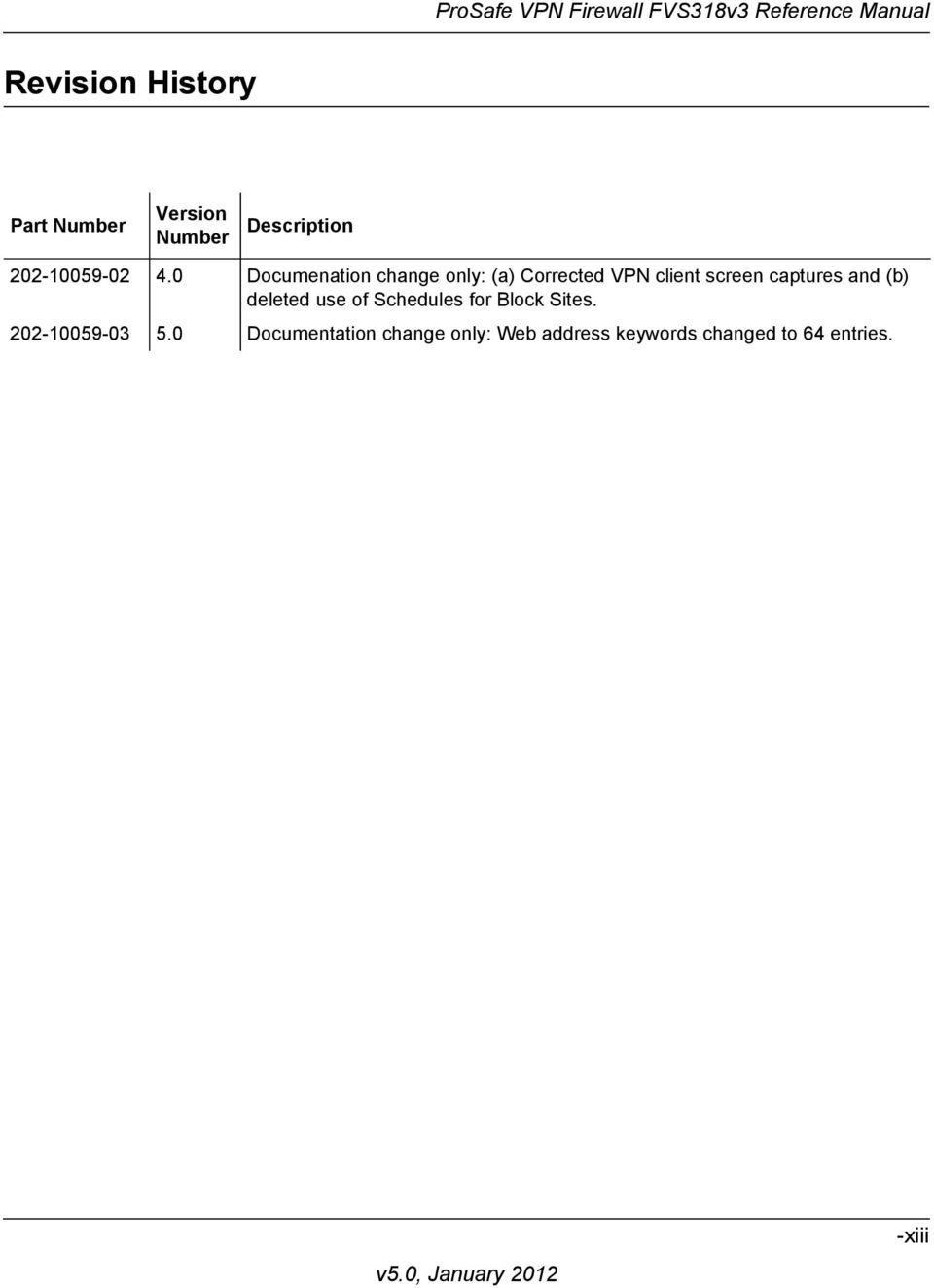
13 Revision History Part Number Version Number Description Documenation change only: (a) Corrected VPN client screen captures and (b) deleted use of Schedules for Block Sites Documentation change only: Web address keywords changed to 64 entries. -xiii
14 -xiv

15 Chapter 1 Introduction This chapter describes the features of the NETGEAR ProSafe VPN Firewall. Key Features of the VPN Firewall The ProSafe VPN Firewall with eight-port switch connects your local area network (LAN) to the Internet through an external access device such as a cable modem or DSL modem. The FVS318v3 is a complete security solution that protects your network from attacks and intrusions. Unlike simple Internet sharing firewalls that rely on Network Address Translation (NAT) for security, the FVS318v3 uses stateful packet inspection for Denial of Service attack (DoS) protection and intrusion detection. The FVS318v3 allows Internet access for up to 253 users. The VPN firewall provides you with multiple Web content filtering options, plus browsing activity reporting and instant alerts both via . Parents and network administrators can establish restricted access policies based on time-of-day, Web site addresses and address keywords, and share high-speed cable/dsl Internet access for up to 253 personal computers. In addition to NAT, the built-in firewall protects you from hackers. With minimum setup, you can install and use the firewall within minutes. The VPN firewall provides the following features: Easy, Web-based setup for installation and management. Content filtering and site blocking security. Built-in eight-port 10/100 Mbps switch. Ethernet connection to a WAN device, such as a cable modem or DSL modem. Extensive protocol support. Login capability. Front panel LEDs for easy monitoring of status and activity. Flash memory for firmware upgrade. 1-1
16 A Powerful, True Firewall with Content Filtering Unlike simple Internet sharing NAT firewalls, the FVS318v3 is a true firewall, using stateful packet inspection to defend against hacker attacks. Its firewall features include: DoS protection. Automatically detects and thwarts DoS attacks such as Ping of Death, SYN Flood, LAND Attack, and IP Spoofing. Blocks unwanted traffic from the Internet to your LAN. Blocks access from your LAN to Internet locations or services that you specify as off-limits. Logs security incidents. The FVS318v3 logs security events such as blocked incoming traffic, port scans, attacks, and administrator logins. You can configure the firewall to the log to you at specified intervals. You can also configure the firewall to send immediate alert messages to your address or pager whenever a significant event occurs. With its content filtering feature, the FVS318v3 prevents objectionable content from reaching your PCs. The firewall allows you to control access to Internet content by screening for keywords within Web addresses. You can configure the firewall to log and report attempts to access objectionable Internet sites. Security The VPN firewall is equipped with several features designed to maintain security, as described in this section. PCs Hidden by NAT. NAT opens a temporary path to the Internet for requests originating from the local network. Requests originating from outside the LAN are discarded, preventing users outside the LAN from finding and directly accessing the PCs on the LAN. Port Forwarding with NAT. Although NAT prevents Internet locations from directly accessing the PCs on the LAN, the firewall allows you to direct incoming traffic to specific PCs based on the service port number of the incoming request, or to one designated DNS host computer. You can specify forwarding of single ports or ranges of ports. Autosensing Ethernet Connections with Auto Uplink With its internal eight-port 10/100 switch, the FVS318v3 can connect to either a 10 Mbps standard Ethernet network or a 100 Mbps Fast Ethernet network. Both the LAN and WAN interfaces are autosensing and capable of full-duplex or half-duplex operation. 1-2 Introduction

17 The firewall incorporates Auto Uplink TM technology. Each Ethernet port automatically senses whether the Ethernet cable plugged into the port should have a normal connection such as to a PC or an uplink connection such as to a switch or hub. That port then configures itself to the correct configuration. This feature also eliminates the need to worry about crossover cables, as Auto Uplink will accommodate either type of cable to make the right connection. Extensive Protocol Support The VPN firewall supports the Transmission Control Protocol/Internet Protocol (TCP/IP) and Routing Information Protocol (RIP). For further information about TCP/IP, refer to Internet Networking and TCP/IP Addressing in Appendix B, Related Documents. IP Address Sharing by NAT. The VPN firewall allows several networked PCs to share an Internet account using only a single IP address, which may be statically or dynamically assigned by your Internet service provider (ISP). This technique, known as NAT, allows the use of an inexpensive single-user ISP account. Automatic Configuration of Attached PCs by DHCP. The VPN firewall dynamically assigns network configuration information, including IP, gateway, and Domain Name Server (DNS) addresses, to attached PCs on the LAN using the Dynamic Host Configuration Protocol (DHCP). This feature greatly simplifies configuration of PCs on your local network. DNS Proxy. When DHCP is enabled and no DNS addresses are specified, the firewall provides its own address as a DNS server to the attached PCs. The firewall obtains actual DNS addresses from the ISP during connection setup and forwards DNS requests from the LAN. Point-to-Point Protocol over Ethernet (PPPoE). PPPoE is a protocol for connecting remote hosts to the Internet over a DSL connection by simulating a dial-up connection. This feature eliminates the need to run a login program such as Entersys or WinPOET on your PC. Easy Installation and Management You can install, configure, and operate the ProSafe VPN Firewall within minutes after connecting it to the network. The following features simplify installation and management tasks: Browser-based management. Browser-based configuration allows you to easily configure your firewall from almost any type of personal computer, such as Windows, Macintosh, or Linux. A user-friendly Setup Wizard is provided and online help documentation is built into the browser-based Web Management Interface. Smart Wizard. The VPN firewall automatically senses the type of Internet connection, asking you only for the information required for your type of ISP account. Introduction 1-3

18 Diagnostic functions. The firewall incorporates built-in diagnostic functions such as Ping, DNS lookup, and remote reboot. Remote management. The firewall allows you to login to the Web Management Interface from a remote location on the Internet. For security, you can limit remote management access to a specified remote IP address or range of addresses, and you can choose a nonstandard port number. Visual monitoring. The VPN firewall s front panel LEDs provide an easy way to monitor its status and activity. Maintenance and Support NETGEAR offers the following features to help you maximize your use of the VPN firewall: Flash memory for firmware upgrade. Free technical support seven days a week, 24 hours a day. Note: The FVS318v3 firmware is not backward compatible with earlier versions of the FVS318 firewall. Package Contents The product package should contain the following items: ProSafe VPN Firewall. AC power adapter. Category 5 (Cat 5) Ethernet cable. Installation Guide. Resource CD, including: This guide. Application Notes and other helpful information. Registration and Warranty Card. If any of the parts are incorrect, missing, or damaged, contact your NETGEAR dealer. Keep the carton, including the original packing materials, in case you need to return the firewall for repair. 1-4 Introduction

19 The FVS318v3 Front Panel The front panel of the VPN firewall contains the status LEDs described below. Figure 1-1 You can use some of the LEDs to verify connections. Viewed from left to right, Table 1-1 describes the LEDs on the front panel of the firewall. These LEDs are green when lit. Table 1-1. LED Descriptions LED Label Activity Description PWR On Power is supplied to the firewall. TEST On Off The system is initializing. The system is ready and running. INTERNET 100 (100 Mbps) On Off LINK/ACT (Link/Activity) LOCAL 100 (100 Mbps) On Off LINK/ACT (Link/Activity) PWR Test Internet LOCAL Ports On Blinking On Blinking The Internet (WAN) port is operating at 100 Mbps. The Internet (WAN) port is operating at 10 Mbps. The Internet port has detected a link with an attached device. Data is being transmitted or received by the Internet port. The Local port is operating at 100 Mbps. The Local port is operating at 10 Mbps. The Local port has detected a link with an attached device. Data is being transmitted or received by the Local port. Introduction 1-5

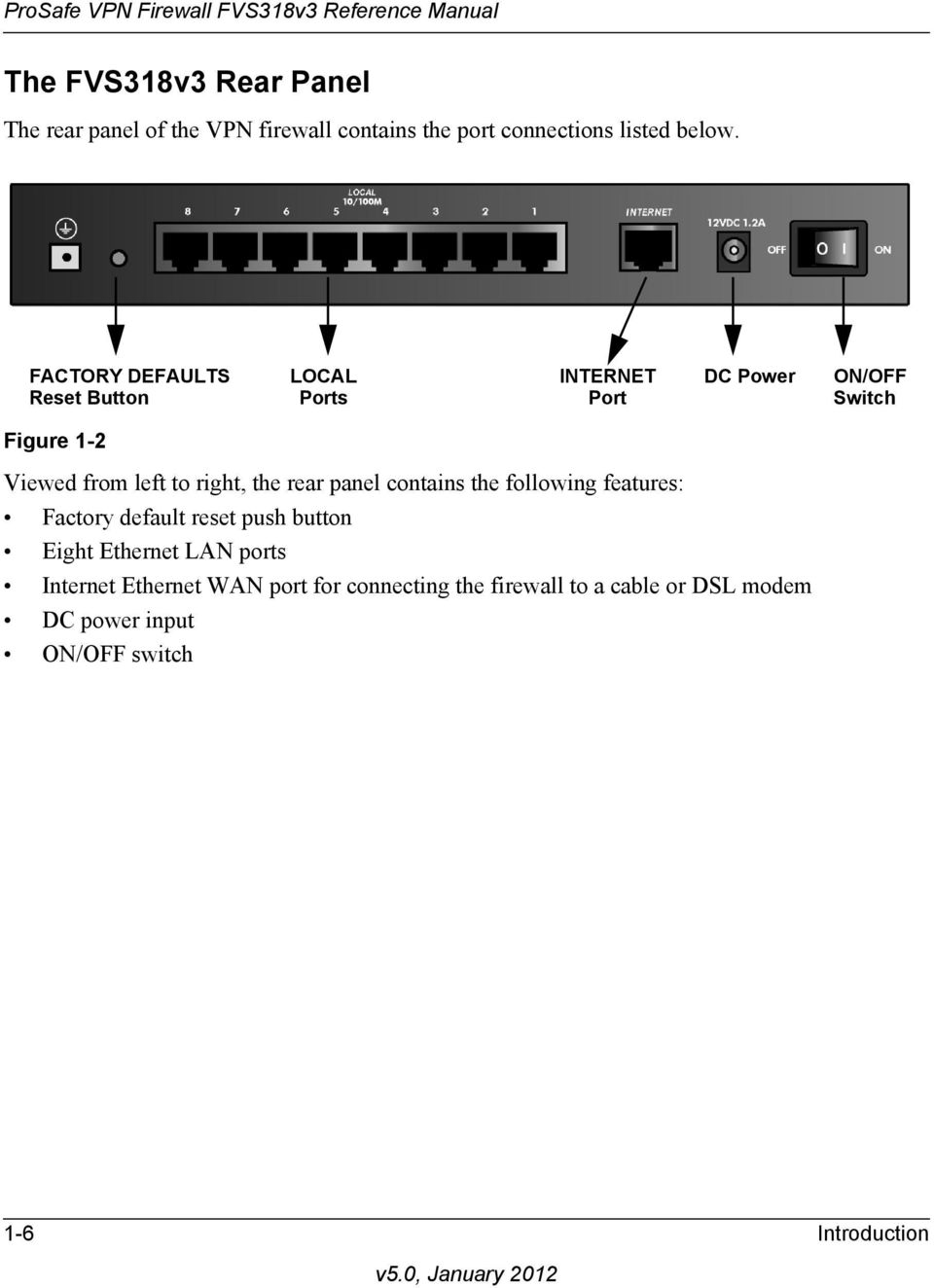
20 The FVS318v3 Rear Panel The rear panel of the VPN firewall contains the port connections listed below. FACTORY DEFAULTS Reset Button LOCAL Ports INTERNET Port DC Power ON/OFF Switch Figure 1-2 Viewed from left to right, the rear panel contains the following features: Factory default reset push button Eight Ethernet LAN ports Internet Ethernet WAN port for connecting the firewall to a cable or DSL modem DC power input ON/OFF switch 1-6 Introduction
21 NETGEAR-Related Products NETGEAR products related to the FVS318v3 are listed in the following table: Table 1-2. NETGEAR-Related Products Category Wireless Wired Notebooks Desktops PDAs Antennas and Accessories WAG Mbps Dual Band PC Card WG511T 108 Mbps PC Card WG Mbps PC Card WG Mbps USB 2.0 Adapter MA b PC Card MA b USB Adapter WAG Mbps Dual Band PCI Adapter WG311T 108 Mbps PCI Adapter WG Mbps PCI Adapter WG Mbps USB 2.0 Adapter MA b USB Adapter MA b Compact Flash Card ANT24O5 5 dbi Antenna ANT2409 Indoor/Outdoor 9 dbi Antenna ANT24D18 Indoor/Outdoor 18 dbi Antenna Antenna Cables 1.5, 3, 5, 10, and 30 m lengths VPN01L and VPN05L ProSafe VPN Client Software FA511 CardBus Adapter FA120 USB 2.0 Adapter FA311 PCI Adapter FA120 USB 2.0 Adapter NETGEAR Product Registration, Support, and Documentation Register your product at Registration is required before you can use our telephone support service. Product updates and Web support are always available by going to: Documentation is available on the Resource CD and at When the VPN firewall is connected to the Internet, click the KnowledgeBase or the Documentation link under the Web Support menu to view support information or the online Reference Manual for the VPN firewall. Introduction 1-7
22 1-8 Introduction
23 Chapter 2 Connecting the Firewall to the Internet This chapter describes how to set up the firewall on your LAN, connect to the Internet, perform basic configuration of your ProSafe VPN Firewall using the Setup Wizard, or how to manually configure your Internet connection. Follow these instructions to set up your firewall. Prepare to Install Your ProSafe VPN Firewall For Cable Modem Service. When you perform the VPN firewall setup steps be sure to use the computer you first registered with your cable ISP. For DSL Service. You may need information such as the DSL login name/ address and password in order to complete the VPN firewall setup. Before proceeding with the VPN firewall installation, familiarize yourself with the contents of the Resource CD, especially this manual and the animated tutorials for configuring networking on PCs. First, Connect the FVS318v3 1. Connect the cables between the FVS318v3, computer, and modem a. Turn off your computer. b. Turn off the cable or DSL broadband modem. c. Locate the Ethernet cable (Cable 1 in the diagram) that connects your PC to the modem. 2-1
24 A Cable 1 Internet Computer Modem Figure 2-1 d. Disconnect the cable at the computer end only, point A in the diagram. e. Look at the label on the bottom of the VPN firewall. Locate the Internet port. Securely insert the Ethernet cable from your modem (Cable 1 in the diagram below) into the Internet port of the VPN firewall as shown in point B of the diagram. Internet port B Internet Firewall Cable 1 Modem Figure 2-2 f. Securely insert the blue cable that came with your VPN firewall (the blue NETGEAR cable in the diagram below) into a LOCAL port on the firewall such as LOCAL port 8 (point C in the diagram), and the other end into the Ethernet port of your computer (point D in the diagram). 2-2 Connecting the Firewall to the Internet
25 D Blue NETGEAR Cable Computer C Firewall Internet Local Ports Modem Figure 2-3 Your network cables are connected and you are ready to restart your network. 2. Restart your network in the correct sequence. Warning: First, turn on the broadband modem and wait 2 minutes. g. Now, plug in the power cord to your VPN firewall and wait one minute. h. Last, turn on your computer. Note: For DSL customers, if software logs you in to the Internet, do not run that software. You may need to go to the Internet Explorer Tools menu, Internet Options, Connections tab page where you can select Never dial a connection. Connecting the Firewall to the Internet 2-3
26 Power Test Internet Local Port 8 Figure 2-4 i. Check the VPN firewall status lights to verify the following: PWR: The power light should turn solid green. If it does not, see Troubleshooting Tips on page 2-6. TEST: The test light blinks when the firewall is first turned on then goes off. If after two minutes it is still on, see Troubleshooting Tips on page 2-6. INTERNET: The Internet LINK light should be lit. If not, make sure the Ethernet cable is securely attached to the VPN firewall Internet port and the modem, and the modem is powered on. LOCAL: A LOCAL light should be lit. Green on the 100 line indicates your computer is communicating at 100 Mbps; off on the 100 line indicates 10 Mbps. If a LOCAL light is not lit, check that the Ethernet cable from the computer to the firewall is securely attached at both ends, and that the computer is turned on. Now, Configure the FVS318v3 for Internet Access 1. From the Ethernet connected PC you just set up, open a browser such as Internet Explorer or Netscape Navigator. With the VPN firewall in its factory default state, your browser will automatically display the NETGEAR Smart Wizard Configuration Assistant welcome page. 2-4 Connecting the Firewall to the Internet
27 Figure 2-5. Note: If you do not see this page, type in the browser address bar and press Enter. If you still cannot see this screen, see Bypassing the Configuration Assistant on page 2-10 If you cannot connect to the VPN firewall, verify your computer networking setup. It should be set to obtain both IP and DNS server addresses automatically, which is usually so. For help with this, see Appendix B, Related Documents and click on the link to Preparing a Computer for Network Access or the animated tutorials on the Resource CD. 2. Click OK. Follow the prompts to proceed with the Smart Wizard Configuration Assistant to connect to the Internet. 3. Click Done to finish. If you have trouble connecting to the Internet, see Troubleshooting Tips on page 2-6 to correct basic problems. Connecting the Firewall to the Internet 2-5
28 Figure 2-6 Note: The Smart Wizard Configuration Assistant only appears when the firewall is in its factory default state. After you configure the VPN firewall, it will not appear again. You can always connect to the firewall to change its settings. To do so, open a browser such as Internet Explorer and go to Then, when prompted, enter admin as the user name and password for the password both in lower case letters. You are now connected to the Internet! Troubleshooting Tips Here are some tips for correcting simple problems you may have. Be sure to restart your network in this sequence: 1. Turn off the VPN firewall, shut down the computer, and unplug and turn off the modem. 2. Turn on the modem and wait two minutes 3. Turn on the VPN firewall and wait one minute 4. Turn on the computer. Make sure the Ethernet cables are securely plugged in. 2-6 Connecting the Firewall to the Internet
29 The Internet link light on the VPN firewall will be lit if the Ethernet cable to the VPN firewall from the modem is plugged in securely and the modem and VPN firewall are turned on. For each powered on computer connected to the VPN firewall with a securely plugged in Ethernet cable, the corresponding VPN firewall LOCAL port link light will be lit. The labels on the front and back of the VPN firewall identify the number of each LOCAL port. Make sure the network settings of the computer are correct. LAN connected computers must be configured to obtain an IP address automatically via DHCP. Please see Preparing Your Network for Network Access in Appendix B, Related Documents or the animated tutorials on the Resource CD for help with this. Some cable modem ISPs require you to use the MAC address of the computer registered on the account. If so, in the Router MAC Address section of the Basic Settings menu, select Use this Computer s MAC Address. The firewall will then capture and use the MAC address of the computer that you are now using. You must be using the computer that is registered with the ISP. Click Apply to save your settings. Restart the network in the correct sequence. Use the status lights on the front of the FVS318v3 to verify correct firewall operation. If the FVS318v3 power light does not turn solid green or if the test light does not go off within two minutes after turning the firewall on, reset the firewall according to the instructions in Backing Up the Configuration on page 6-7. Accessing the VPN Firewall Overview The table below describes how you access the VPN firewall, depending on the state of the VPN firewall. Connecting the Firewall to the Internet 2-7
30 Table 2-1. Ways to access the firewall Firewall State Access Options Description Factory Default Note: The VPN firewall is supplied in the factory default state. Also, the factory default state is restored when you use the factory reset button. See Backing Up the Configuration on page 6-7 for more information on this feature. Configuration Settings Have Been Applied Automatic Access via the Smart Wizard Configuration Assistant Manually enter a URL to bypass the Smart Wizard Configuration Assistant Enter the standard URL to access the VPN firewall Enter the IP address of the VPN firewall Any time a browser is opened on any computer connected to the VPN firewall, the VPN firewall will automatically connect to that browser and display the Configuration Assistant welcome page. There is no need to enter the VPN firewall URL in the browser, or provide the login user name and password. You can bypass the Smart Wizard Configuration Assistant feature by typing in the browser address bar and pressing Enter. You will not be prompted for a user name or password. This will enable you to manually configure the VPN firewall even when it is in the factory default state. When manually configuring the firewall, you must complete the configuration by clicking Apply when you finish entering your settings. If you do not do so, a browser on any PC connected to the firewall will automatically display the firewall's Configuration Assistant welcome page rather than the browser s home page. Connect to the VPN firewall by typing either of these URLs in the address field of your browser, then press Enter: The VPN firewall will prompt you to enter the user name of admin and the password. The default password is password. Connect to the VPN firewall by typing the IP address of the VPN firewall in the address field of your browser, then press Enter is the default IP address of the VPN firewall. The VPN firewall will prompt you to enter the user name of admin and the password. The default password is password. 2-8 Connecting the Firewall to the Internet
31 Logging On to the FVS318v3 After Configuration Settings Have Been Applied 1. Connect to the VPN firewall by typing in the address field of your browser, then press Enter. Figure For security reasons, the firewall has its own user name and password. When prompted, enter admin for the firewall user name and password for the firewall password, both in lower case letters. To change the password, see Changing the Administrator Password on page 6-8. Note: The firewall user name and password are not the same as any user name or password you may use to log in to your Internet connection. A login window like the one shown below opens. Figure 2-8 Once you have entered your user name and password, your Web browser should find the VPN firewall and display the home page as shown below. Connecting the Firewall to the Internet 2-9
32 Figure 2-9 When the VPN firewall is connected to the Internet, click the KnowledgeBase or the Documentation link under the Web Support menu to view support information or the documentation for the VPN firewall. If you do not click Logout, the VPN firewall will wait five minutes after there is no activity before it automatically logs you out. Bypassing the Configuration Assistant 1. When the VPN firewall is in the factory default state, type in your browser, then press Enter. When the VPN firewall is in the factory default state, a user name and password are not required. 2. The browser then displays the FVS318v3 settings home page shown in When the VPN firewall is connected to the Internet, click the KnowledgeBase or the Documentation link under the Web Support menu to view support information or the documentation for the VPN firewall. on page Connecting the Firewall to the Internet
33 If you do not click Logout, the VPN firewall waits five minutes after there is no activity before it automatically logs you out. Using the Smart Setup Wizard You can use the Smart Setup Wizard to assist with manual configuration or to verify the Internet connection. The Smart Setup Wizard is not the same as the Smart Wizard Configuration Assistant (as illustrated in Figure 2-5) that only appears when the firewall is in its factory default state. After you configure the VPN firewall, the Smart Wizard Configuration Assistant will not appear again. To use the Smart Setup Wizard to assist with manual configuration or to verify the Internet connection settings, follow this procedure. 1. Connect to the VPN firewall by typing in the address field of your browser, then press Enter. 2. For security reasons, the firewall has its own user name and password. When prompted, enter admin for the firewall user name and password for the firewall password, both in lower case letters. To change the password, see Changing the Administrator Password on page 6-8. Note: The firewall user name and password are not the same as any user name or password you may use to log in to your Internet connection. Once you have entered your user name and password, your Web browser should find the VPN firewall and display the home page as shown in Figure. 3. Click Setup Wizard on the upper left of the main menu. 4. Click Next to proceed. Input your ISP settings, as needed. 5. At the end of the Setup Wizard, click the Test button to verify your Internet connection. If you have trouble connecting to the Internet, use the Troubleshooting Tips Troubleshooting Tips on page 2-6 to correct basic problems, or refer to Chapter 8, Troubleshooting. Manually Configuring Your Internet Connection You can manually configure your Product Family using the menu below, or you can allow the Setup Wizard to determine your configuration as described in the previous section. Connecting the Firewall to the Internet 2-11
34 ISP Does Not Require Login ISP Does Require Login Figure 2-10 To manually configure the Product Family using the Basic Settings menu shown in Figure 2-10: 1. Log in to the Product Family at its default address of using a browser like Internet Explorer or Netscape Navigator. 2. Click the Basic Settings link under the Setup section of the main menu Connecting the Firewall to the Internet
35 3. If your Internet connection does not require a login, click No at the top of the Basic Settings menu and fill in the settings according to the instructions below. If your Internet connection does require a login, click Yes, and skip to the procedure requiring a login. a. Enter your Account Name (may also be called Host Name) and Domain Name. These parameters may be necessary to access your ISP s services such as mail or news servers. b. In the Internet IP Address section, if your ISP has assigned your PC a permanent, fixed (static) IP address, select Use static IP address. Enter the IP address that your ISP assigned. Also enter the netmask and the Gateway IP address. The Gateway is the ISP s firewall to which your Product Family will connect. c. In the Domain Name Server (DNS) Address section, if you know that your ISP does not automatically transmit DNS addresses to the Product Family during login, select Use these DNS servers and enter the IP address of your ISP s Primary DNS Server. If a Secondary DNS Server address is available, enter it also. Note: After completing the DNS configuration, restart the computers on your network so that these settings take effect. 4. Change the MAC address of your PC to your firewall s MAC address by selecting Use this Computer s MAC address. The Product Family will then capture and use the MAC address of the PC that you are now using. You must be using the PC that is allowed by your ISP. If you are not using this PC, select Use this MAC address and enter the MAC address of the PC that your ISP will recognize. This section determines the Ethernet MAC address that will be used by the Product Family on the Internet port. Some ISPs will register the Ethernet MAC address of the network interface card in your PC when your account is first opened. Your IP will then only accept traffic from the MAC address of that PC. This feature allows your Product Family to masquerade as that PC by cloning its MAC address. 5. Click Apply to save your settings. If your Internet connection does require a login, fill in the following settings: 1. Select Yes if you normally must launch a login program such as Enternet or WinPOET in order to access the Internet. Note: After you finish setting up your Product Family, you will no longer need to launch the ISP s login program on your PC in order to access the Internet. When you start an Internet application, your Product Family will automatically log you in. Connecting the Firewall to the Internet 2-13
36 2. For connections that require a login using protocols such as PPPoE, PPTP, Telstra Bigpond Cable broadband connections, select your Internet service provider from the drop-down menu Figure The screen will change according to the ISP settings requirements of the ISP you select. Fill in the parameters for your ISP according to the Wizard-detected procedures starting on page Click Apply to save your settings Connecting the Firewall to the Internet
37 Chapter 3 Firewall Protection and Content Filtering This chapter describes how to use the content filtering features of the ProSafe VPN Firewall to protect your network. These features can be found by clicking on the Security heading in the main menu of the browser interface. Firewall Protection and Content Filtering Overview The ProSafe VPN Firewall provides you with Web content filtering options, plus browsing activity reporting and instant alerts via . Parents and network administrators can establish restricted access policies based on time-of-day, Web addresses and Web address keywords. You can also block Internet access by applications and services, such as chat or games. A firewall is a special category of router that protects one network (the trusted network, such as your LAN) from another (the untrusted network, such as the Internet), while allowing communication between the two. A firewall incorporates the functions of a NAT (Network Address Translation) router, while adding features for dealing with a hacker intrusion or attack, and for controlling the types of traffic that can flow between the two networks. Unlike simple Internet sharing NAT routers, a firewall uses a process called stateful packet inspection to protect your network from attacks and intrusions. NAT performs a very limited stateful inspection in that it considers whether the incoming packet is in response to an outgoing request, but true stateful packet inspection goes far beyond NAT. To configure these features of your firewall, click on the subheadings under the Security heading in the main menu of the browser interface. The subheadings are described below: 3-1
38 Block Sites The FVS318v3 allows you to restrict access based on Web addresses and Web address keywords. Up to 64 entries are supported in the Keyword list. The Block Sites menu is shown in below. Figure 3-1 To enable Block Sites features: 1. Enable keyword blocking by checking the Turn keyword blocking on radio box. 2. Add a keyword or domain name by typing it in the Add Keyword field and clicking Add Keyword. Each keyword or domain name added will appear in the Block sites containing these keywords or domain names field 3. Add a trusted IP by checking the Turn trusted ip on radio box and enterting its address in the Trusted IP Address field. 4. Click Apply to save your changes and additions. To delete a keyword or domain: 1. Select the keyword or domain name from the keywords and domain names list and click Delete Keyword. 3-2 Firewall Protection and Content Filtering
39 2. Click Apply to save your changes. Keyword application examples: If the keyword XXX is specified, the URL is blocked, as is the newsgroup alt.pictures.xxx. If the keyword.com is specified, only Web sites with other domain suffixes (such as.edu or.gov) can be viewed. If you wish to block all Internet browsing access, enter the keyword.. To specify a Trusted User, enter that PC s IP address in the Trusted User box and click Apply. You may specify one Trusted User, which is a PC that will be exempt from blocking and logging. Since the Trusted User will be identified by an IP address, you should configure that PC with a fixed or reserved IP address. Using Rules to Block or Allow Specific Kinds of Traffic Firewall rules are used to block or allow specific traffic passing through from one side to the other. Inbound rules (WAN to LAN) restrict access by outsiders to private resources, selectively allowing only specific outside users to access specific resources. Outbound rules (LAN to WAN) determine what outside resources local users can have access to. A firewall has two default rules, one for inbound traffic and one for outbound. The default rules of the FVS318v3 are: Inbound: Block all access from outside except responses to requests from the LAN side. Outbound: Allow all access from the LAN side to the outside. Firewall Protection and Content Filtering 3-3
40 These default rules are shown in the Rules table of the Rules menu shown below. Figure 3-2 You may define additional rules that specify exceptions to the default rules. By adding custom rules, you can block or allow access based on the service or application, source or destination IP addresses, and time of day. You can also choose to log traffic that matches or does not match the rule you have defined. To create a new rule, click the Add button. To edit an existing rule, select its button on the left side of the table and click Edit. To delete an existing rule, select its button on the left side of the table and click Delete. To move an existing rule to a different position in the table, select its button on the left side of the table and click Move. At the script prompt, enter the number of the desired new position and click OK. An example of the menu for defining or editing a rule is shown in Figure 3-3. The parameters are: Service. From this list, select the application or service to be allowed or blocked. The list already displays many common services, but you are not limited to these choices. Use the Services menu to add any additional services or applications that do not already appear. 3-4 Firewall Protection and Content Filtering
41 Action. Choose how you would like this type of traffic to be handled. You can block or allow always, or you can choose to block or allow according to the schedule you have defined in the Schedule menu. Source Address. Specify traffic originating on the LAN (outbound) or the WAN (inbound), and choose whether you would like the traffic to be restricted by source IP address. You can select Any, a Single address, or a Range. If you select a range of addresses, enter the range in the start and finish boxes. If you select a single address, enter it in the start box. Destination Address.The Destination Address will be assumed to be from the opposite (LAN or WAN) of the Source Address. As with the Source Address, you can select Any, a Single address, or a Range unless NAT is enabled and the destination is the LAN. In that case, you must enter a Single LAN address in the start box. Log. You can select whether the traffic will be logged. The choices are: Never no log entries will be made for this service. Match traffic of this type that matches the parameters and action will be logged. Inbound Rules (Port Forwarding) Because the FVS318v3 uses Network Address Translation (NAT), your network presents only one IP address to the Internet, and outside users cannot directly address any of your local computers. However, by defining an inbound rule you can make a local server (for example, a Web server or game server) visible and available to the Internet. The rule tells the firewall to direct inbound traffic for a particular service to one local server based on the destination port number. This is also known as port forwarding. Note: Some residential broadband ISP accounts do not allow you to run any server processes (such as a Web or FTP server) from your location. Your ISP may periodically check for servers and may suspend your account if it discovers any active services at your location. If you are unsure, refer to the Acceptable Use Policy of your ISP. Remember that allowing inbound services opens holes in your VPN firewall. Only enable those ports that are necessary for your network. Following are two application examples of inbound rules: Firewall Protection and Content Filtering 3-5
42 Inbound Rule Example: A Local Public Web Server If you host a public Web server on your local network, you can define a rule to allow inbound Web (HTTP) requests from any outside IP address to the IP address of your Web server at any time of day. This rule is illustrated below. Figure 3-3 Inbound Rule Example: Allowing a Videoconference from Restricted Addresses If you want to allow incoming videoconferencing to be initiated from a restricted range of outside IP addresses, such as from a branch office, you can create an inbound rule. In the example shown in Figure 3-4, CU-SEEME connections are allowed only from a specified range of external IP addresses. In this case, we have also specified logging of any incoming CU-SeeMe requests that do not match the allowed parameters. 3-6 Firewall Protection and Content Filtering
43 Figure 3-4 Considerations for Inbound Rules If your external IP address is assigned dynamically by your ISP, the IP address may change periodically as the DHCP lease expires. Consider using the Dynamic DNS feature in the Advanced menus so that external users can always find your network. If the IP address of the local server PC is assigned by DHCP, it may change when the PC is rebooted. To avoid this, use the Reserved IP address feature in the LAN IP menu to keep the PC s IP address constant. Each local PC must access the local server using the PC s local LAN address ( in the example in Figure 3-4). Attempts by local PCs to access the server using the external WAN IP address will fail. Outbound Rules (Service Blocking) The FVS318v3 allows you to block the use of certain Internet services by PCs on your network. This is called service blocking or port filtering. You can define an outbound rule to block Internet access from a local PC based on: IP address of the local PC (source address) IP address of the Internet site being contacted (destination address) Time of day Type of service being requested (service port number) Firewall Protection and Content Filtering 3-7
44 If you want to block Instant Messenger usage by employees during working hours, you can create an outbound rule to block that application from any internal IP address to any external address according to the schedule that you have created in the Schedule menu. You can also have the firewall log any attempt to use Instant Messenger during that blocked period. Figure Firewall Protection and Content Filtering
45 Order of Precedence for Rules As you define new rules, they are added to the tables in the Rules table, as shown below. Figure 3-6 For any traffic attempting to pass through the firewall, the packet information is subjected to the rules in the order shown in the Rules table, beginning at the top and proceeding to the default rules at the bottom. In some cases, the order of precedence of two or more rules may be important in determining the disposition of a packet. The Move button allows you to relocate a defined rule to a new position in the table. Default DMZ Server Incoming traffic from the Internet is normally discarded by the firewall unless the traffic is a response to one of your local computers or a service for which you have configured an inbound rule. Instead of discarding this traffic, you can have it forwarded to one computer on your network. This computer is called the Default DMZ Server. Firewall Protection and Content Filtering 3-9
46 The Default DMZ Server feature is helpful when using some online games and videoconferencing applications that are incompatible with NAT. The firewall is programmed to recognize some of these applications and to work properly with them, but there are other applications that may not function well. In some cases, one local PC can run the application properly if that PC s IP address is entered as the Default DMZ Server. To assign a computer or server to be a Default DMZ server: 1. Click Default DMZ Server. 2. Type the IP address for that server. 3. Click Apply. Respond to Ping on Internet WAN Port If you want the firewall to respond to a ping from the Internet, click the Respond to Ping on Internet WAN Port check box. This should only be used as a diagnostic tool, since it allows your firewall to be discovered. Don't check this box unless you have a specific reason to do so. Services Note: For security, NETGEAR strongly recommends that you avoid using the Default DMZ Server feature. When a computer is designated as the Default DMZ Server, it loses much of the protection of the firewall, and is exposed to many exploits from the Internet. If compromised, the computer can be used to attack your network. Note: In this application, the use of the term DMZ has become common, although it is a misnomer. In traditional firewalls, a DMZ is actually a separate physical network port. A true DMZ port is for connecting servers that require greater access from the outside, and will therefore be provided with a different level of security by the firewall. A better term for our application is Exposed Host. Services are functions performed by server computers at the request of client computers. For example, Web servers serve Web pages, time servers serve time and date information, and game hosts serve data about other players moves. When a computer on the Internet sends a request for 3-10 Firewall Protection and Content Filtering
47 service to a server computer, the requested service is identified by a service or port number. This number appears as the destination port number in the transmitted IP packets. For example, a packet that is sent with destination port number 80 is an HTTP (Web server) request. The service numbers for many common protocols are defined by the Internet Engineering Task Force (IETF) and published in RFC1700, Assigned Numbers. Service numbers for other applications are typically chosen from the range 1024 to by the authors of the application. Although the FVS318v3 already holds a list of many service port numbers, you are not limited to these choices. Use the Services menu to add additional services and applications to the list for use in defining firewall rules. The Services menu shows a list of services that you have defined, as shown below: Figure 3-7 To define a new service, first you must determine which port number or range of numbers is used by the application. This information can usually be determined by contacting the publisher of the application or from user groups of newsgroups. To add a service: 1. When you have the port number information, go the Services menu and click on the Add Custom Service button. The Add Services menu appears as shown in Figure 3-8: Firewall Protection and Content Filtering 3-11
48 Figure Enter a descriptive name for the service so that you will remember what it is. 3. Select whether the service uses TCP or UDP as its transport protocol. If you can t determine which is used, select both. 4. Enter the lowest port number used by the service. 5. Enter the highest port number used by the service. If the service only uses a single port number, enter the same number in both fields. 6. Click Apply. The new service now appears in the Services menu, and in the Service name selection box in the Rules menu Firewall Protection and Content Filtering
49 Using a Schedule to Block or Allow Specific Traffic If you defined an inbound rule or an outbound rule to use a schedule, you can set up a schedule for when access is restricted or allowed. The firewall allows you to specify access by configuring the Schedule page shown below: Figure 3-9 To implement a firewall rule based on a schedule, select Every Day or select one or more days. If you want the firewall rule to limit access or allow access completely for the selected days, select All Day. Otherwise, you can allow access or restrict access during certain times for the selected days by typing a Start Blocking time and an End Blocking time. Firewall Protection and Content Filtering 3-13
50 Note: Enter the values as 24-hour time. For example, to specify 10:30 am, enter 10 hours and 30 minutes; for 10:30 pm, enter 22 hours and 30 minutes. Be sure to click Apply when you have finished configuring this page. The VPN firewall uses the Network Time Protocol (NTP) to obtain the current time and date from one of several Network Time Servers on the Internet. In order to localize the time for your log entries, you must specify your Time Zone: Time Zone. Select your local time zone. This setting will be used for the blocking schedule and for time-stamping log entries. Daylight Savings Time. Check this box for daylight savings time. Note: If your region uses Daylight Savings Time, you must manually select Adjust for Daylight Savings Time on the first day of Daylight Savings Time, and unselect it at the end. Enabling Daylight Savings Time will add one hour to the standard time. Be sure to click Apply when you have finished configuring this menu Firewall Protection and Content Filtering
51 Getting Notifications of Event Logs and Alerts In order to receive logs and alerts by , you must provide your information in the Send alerts and logs by area: Figure 3-10 Turn notification on. Check this box if you wish to receive logs and alerts from the firewall. Send alerts and logs by . If your enable notification, these boxes cannot be blank. Enter the name or IP address of your ISP s outgoing (SMTP) mail server (such as mail.myisp.com). You may be able to find this information in the configuration menu of your program. Enter the address to which logs and alerts are sent. This address will also be used as the From address. If you leave this box blank, log and alert messages will not be sent via . Send alerts immediately. You can specify that logs are immediately sent to the specified address when any of the following events occur: If a Denial of Service attack is detected. If a Port Scan is detected. Firewall Protection and Content Filtering 3-15
52 If a user on your LAN attempts to access a Web site that you blocked using the Block Sites menu. Send logs according to this schedule. You can specify that logs are sent to you according to a schedule. Select whether you would like to receive the logs None, Hourly, Daily, Weekly, or When Full. Depending on your selection, you may also need to specify: Day for sending log Relevant when the log is sent weekly or daily. Time for sending log Relevant when the log is sent daily or weekly. If the Weekly, Daily or Hourly option is selected and the log fills up before the specified period, the log is automatically ed to the specified address. After the log is sent, the log is cleared from the firewall s memory. If the firewall cannot the log file, the log buffer may fill up. In this case, the firewall overwrites the log and discards its contents. Be sure to click Apply when you have finished configuring this menu Firewall Protection and Content Filtering
53 Viewing Logs of Web Access or Attempted Web Access The firewall logs security-related events such as denied incoming and outgoing service requests, hacker probes, and administrator logins. If you enable content filtering in the Block Sites menu, the Log page will also show you when someone on your network tried to access a blocked site. If you enabled notification, you'll receive these logs in an message. If you don't have e- mail notification enabled, you can view the logs here. An example is shown in Figure 3-11: Figure 3-11 Firewall Protection and Content Filtering 3-17
54 Log entries are described in Table 3-1 Table 3-1. Log entry descriptions Field Date and Time Description or Action Source IP Source port and interface Destination Destination port and interface Description The date and time the log entry was recorded. The type of event and what action was taken if any. The IP address of the initiating device for this log entry. The service port number of the initiating device, and whether it originated from the LAN or WAN. The name or IP address of the destination device or Web site. The service port number of the destination device, and whether it s on the LAN or WAN. Log action buttons are described in Table 3-2 Table 3-2. Log action buttons Button Refresh Clear Log Send Log Description Refresh the log screen. Clear the log entries. the log immediately. You can configure the firewall to send system logs to an external PC that is running a syslog logging program. Enter the IP address of the logging PC and click the Enable Syslog check box. Logging programs are available for Windows, Macintosh, and Linux computers Firewall Protection and Content Filtering
55 Chapter 4 Basic Virtual Private Networking This chapter describes how to use the virtual private networking (VPN) features of the VPN firewall. VPN communications paths are called tunnels. VPN tunnels provide secure, encrypted communications between your local network and a remote network or computer. The VPN information is organized as follows: Overview of VPN Configuration on page 4-2 provides an overview of the two most common VPN configurations: client-to-gateway and gateway-to-gateway. Planning a VPN on page 4-3 provides the VPN Committee (VPNC) recommended default parameters set by the VPN Wizard. VPN Tunnel Configuration on page 4-5 summarizes the two ways to configure a VPN tunnel: VPN Wizard (recommended for most situations) and Advanced (see Chapter 5, Advanced Virtual Private Networking). Setting Up a Client-to-Gateway VPN Configuration on page 4-5 provides the steps needed to configure a VPN tunnel between a remote PC and a network gateway using the VPN Wizard and the NETGEAR ProSafe VPN Client. Setting Up a Gateway-to-Gateway VPN Configuration on page 4-21 provides the steps needed to configure a VPN tunnel between two network gateways using the VPN Wizard. Activating the VPN Tunnel on page 4-27 provides the step-by-step procedures for activating, verifying, deactivating, and deleting a VPN tunnel once the VPN tunnel has been configured. Chapter 5, Advanced Virtual Private Networking provides the steps needed to configure VPN tunnels when there are special circumstances and the VPNC recommended defaults of the VPN Wizard are inappropriate. Virtual Private Networking (VPN) in Appendix B, Related Documents discusses Virtual Private Networking (VPN) Internet Protocol security (IPSec). IPSec is one of the most complete, secure, and commercially available, standards-based protocols developed for transporting data. 4-1
56 Appendix C, Sample VPN Configurations with FVS318v3 presents a case study on how to configure a secure IPSec VPN tunnel from a NETGEAR FVS318v3 to a FVL328. This case study follows the VPN Consortium interoperability profile guidelines (found at Overview of VPN Configuration Two common scenarios for configuring VPN tunnels are between a remote personal computer and a network gateway and between two or more network gateways. The FVS318v3 supports both of these types of VPN configurations. The VPN firewall supports up to eight concurrent tunnels. Client-to-Gateway VPN Tunnels Client-to-gateway VPN tunnels provide secure access from a remote PC, such as a telecommuter connecting to an office network (see Figure 4-1). FVS VPN Tunnel PCs Figure 4-1 A VPN client access allows a remote PC to connect to your network from any location on the Internet. In this case, the remote PC is one tunnel endpoint, running the VPN client software. The VPN firewall on your network is the other tunnel endpoint. See Setting Up a Client-to-Gateway VPN Configuration on page 4-5 to set up this configuration. Gateway-to-Gateway VPN Tunnels Gateway-to-gateway VPN tunnels provide secure access between networks, such as a branch or home office and a main office (see Figure 4-2). 4-2 Basic Virtual Private Networking
57 VPN Tunnel VPN Gateway A VPN Gateway B PCs PCs Figure 4-2 A VPN between two or more NETGEAR VPN-enabled firewalls is a good way to connect branch or home offices and business partners over the Internet. VPN tunnels also enable access to network resources across the Internet. In this case, use FVS318v3s on each end of the tunnel to form the VPN tunnel end points. See Setting Up a Gateway-to-Gateway VPN Configuration on page 4-21 to set up this configuration. Planning a VPN To set up a VPN connection, you must configure each endpoint with specific identification and connection information describing the other endpoint. You must configure the outbound VPN settings on one end to match the inbound VPN settings on other end, and vice versa. This set of configuration information defines a security association (SA) between the two VPN endpoints. When planning your VPN, you must make a few choices first: Will the local end be any device on the LAN, a portion of the local network (as defined by a subnet or by a range of IP addresses), or a single PC? Will the remote end be any device on the remote LAN, a portion of the remote network (as defined by a subnet or by a range of IP addresses), or a single PC? Will either endpoint use Fully Qualified Domain Names (FQDNs)? Many DSL accounts are provisioned with DHCP addressing, where the IP address of the WAN port can change from time to time. Under these circumstances, configuring the WAN port with a dynamic DNS (DynDNS) service provider simplifies the configuration task. When DynDNS is configured on the WAN port, configure the VPN using FDQN. Basic Virtual Private Networking 4-3
58 FQDNs supplied by Dynamic DNS providers can allow a VPN endpoint with a dynamic IP address to initiate or respond to a tunnel request. Otherwise, the side using a dynamic IP address must always be the initiator. What method will you use to configure your VPN tunnels? The VPN Wizard using VPNC defaults (see Table 4-1) Advanced methods (see Chapter 5, Advanced Virtual Private Networking ) Table 4-1. Parameters recommended by the VPNC and used in the VPN Wizard Parameter Secure Association Authentication Method Encryption Method Authentication Protocol Diffie-Hellman (DH) Group Key Life IKE Life Time NETBIOS Factory Default Main Mode Pre-shared Key 3DES SHA-1 Group 2 (1024 bit) 8 hours 24 hours Enabled What level of IPSec VPN encryption will you use? DE The Data Encryption Standard (DES) processes input data that is 64 bits wide, encrypting these values using a 56 bit key. Faster but less secure than 3DES. 3DES (Triple DES) achieves a higher level of security by encrypting the data three times using DES with three different, unrelated keys. AES What level of authentication will you use? MDS 128 bits, faster but less secure. SHA bits, slower but more secure. Note: NETGEAR publishes additional interoperability scenarios with various gateway and client software products. 4-4 Basic Virtual Private Networking
59 VPN Tunnel Configuration There are two tunnel configurations and three ways to configure them: Use the VPN Wizard to configure a VPN tunnel (recommended for most situations): See Setting Up a Client-to-Gateway VPN Configuration on page 4-5. See Setting Up a Gateway-to-Gateway VPN Configuration on page See Chapter 5, Advanced Virtual Private Networking when the VPN Wizard and its VPNC defaults (see Table 4-1 on page 4-4) are not appropriate for your special circumstances. Setting Up a Client-to-Gateway VPN Configuration Setting up a VPN between a remote PC running the NETGEAR ProSafe VPN Client and a network gateway (see Figure 4-3) involves the following two steps: Step 1: Configuring the Client-to-Gateway VPN Tunnel on the FVS318v3 on page 4-6 uses the VPN Wizard to configure the VPN tunnel between the remote PC and network gateway. Step 2: Configuring the NETGEAR ProSafe VPN Client on the Remote PC on page 4-9 configures the NETGEAR ProSafe VPN Client endpoint. FVS318v VPN Tunnel PCs PC (Running NETGEAR ProSafe VPN Client) Figure 4-3 Basic Virtual Private Networking 4-5
60 Step 1: Configuring the Client-to-Gateway VPN Tunnel on the FVS318v3 This section uses the VPN Wizard to set up the VPN tunnel using the VPNC default parameters listed in Table 4-1 on page -4. If you have special requirements not covered by these VPNCrecommended parameters, refer to Chapter 5, Advanced Virtual Private Networking to set up the VPN tunnel. Follow this procedure to configure a client-to-gateway VPN tunnel using the VPN Wizard. 1. Log in to the FVS318v3 at its LAN address of with its default user name of admin and password of password. Click the VPN Wizard link in the main menu to display this screen. Click Next to proceed. Figure Fill in the Connection Name and the pre-shared key, select the type of target end point, and click Next to proceed. Note: The Connection Name is arbitrary and not relevant to how the configuration functions. 4-6 Basic Virtual Private Networking
61 Enter the new Connection Name: (RoadWarrior in this example) Enter the pre-shared key: ( in this example) Select the radio button: A remote VPN client (single PC) Figure 4-5 The Summary screen below displays. Figure 4-6 To view the VPNC recommended authentication and encryption settings used by the VPN Wizard, click the here link (see Figure 4-6). Click Back to return to the Summary screen. Basic Virtual Private Networking 4-7
62 Figure Click Done on the Summary screen (see Figure 4-6) to complete the configuration procedure. The VPN Policies menu below displays showing that the new tunnel is enabled. Figure 4-8 To view or modify the tunnel settings, select the radio button next to the tunnel entry and click Edit. 4-8 Basic Virtual Private Networking
63 Step 2: Configuring the NETGEAR ProSafe VPN Client on the Remote PC This procedure describes how to configure the NETGEAR ProSafe VPN Client. This example assumes the PC running the client has a dynamically assigned IP address. The PC must have the NETGEAR ProSafe VPN Client program installed that supports IPSec. Go to the NETGEAR Web site ( and select VPN01L_VPN05L in the Product Quick Find drop-down menu for information on how to purchase the NETGEAR ProSafe VPN Client. Note: Before installing the NETGEAR ProSafe VPN Client software, be sure to turn off any virus protection or firewall software you may be running on your PC. 1. Install the NETGEAR ProSafe VPN Client on the remote PC and reboot. a. You may need to insert your Windows CD to complete the installation. b. If you do not have a modem or dial-up adapter installed in your PC, you may see the warning message stating The NETGEAR ProSafe VPN Component requires at least one dial-up adapter be installed. You can disregard this message. c. Install the IPSec Component. You may have the option to install either the VPN Adapter or the IPSec Component or both. The VPN Adapter is not necessary. d. The system should show the ProSafe icon ( ) in the system tray after rebooting. e. Double-click the system tray icon to open the Security Policy Editor. 2. Add a new connection. Note: The procedure in this section explains how to create a new security policy from scratch. For the procedure on how to import an existing security policy that has already been created on another client running the NETGEAR ProSafe VPN Client, see Transferring a Security Policy to Another Client on page a. Run the NETGEAR ProSafe Security Policy Editor program and create a VPN Connection. b. From the Edit menu of the Security Policy Editor, click Add, then Connection. A New Connection listing appears in the list of policies. Rename the New Connection so that it matches the Connection Name you entered in the VPN Settings of the FVS318v3 on LAN A. Basic Virtual Private Networking 4-9
64 Note: In this example, the Connection Name used on the client side of the VPN tunnel is NETGEAR_VPN_router and it does not have to match the RoadWarrior Connection Name used on the gateway side of the VPN tunnel (see Figure 4-5) because Connection Names are unrelated to how the VPN tunnel functions. Note: Tip: Choose Connection Names that make sense to the people using and administrating the VPN. Tip: Figure Basic Virtual Private Networking
65 Figure 4-10 c. Select Secure in the Connection Security check box. d. Select IP Subnet in the ID Type menu. In this example, type in the Subnet field as the network address of the FVS318v3. e. Enter in the Mask field as the LAN Subnet Mask of the FVS318v3. f. Select All in the Protocol menu to allow all traffic through the VPN tunnel. g. Select the Connect using Secure Gateway Tunnel check box. h. Select IP Address in the ID Type menu below the check box. i. Enter the public WAN IP Address of the FVS318v3 in the field directly below the ID Type menu. In this example, would be used. The resulting Connection Settings are shown in Figure Configure the Security Policy in the NETGEAR ProSafe VPN Client software. a. In the Network Security Policy list, expand the new connection by double clicking its name or clicking on the + symbol. My Identity and Security Policy subheadings appear below the connection name. b. Click on the Security Policy subheading to show the Security Policy menu. Basic Virtual Private Networking 4-11
66 Figure 4-11 c. Select the Main Mode in the Select Phase 1 Negotiation Mode check box. 4. Configure the VPN Client Identity. In this step, you will provide information about the remote VPN client PC. You will need to provide: The Pre-Shared Key that you configured in the FVS318v3. Either a fixed IP address or a fixed virtual IP address of the VPN client PC. a. In the Network Security Policy list on the left side of the Security Policy Editor window, click on My Identity Basic Virtual Private Networking
67 Figure 4-12 b. Choose None from the Select Certificate pull-down menu. c. Select IP Address from the ID Type pull-down menu. The default IP Address will display as Any. d. Leave the Virtual Adapter pull-down menu set to Disabled. e. From the Internet Interface section, select the adapter you will use to access the Internet from the Name pull-down menu. Select PPP Adapter from the Name pull-down menu if you have a dial-up Internet account. Select your Ethernet adapter if you have a dedicated Cable or DSL line. You may also choose Any if you will be switching between adapters or if you have only one adapter. f. Click the Pre-Shared Key button. In the Pre-Shared Key dialog box, click the Enter Key button. Enter the FVS318v3's Pre-Shared Key and click OK. In this example, is entered. This field is case sensitive. Basic Virtual Private Networking 4-13
68 Figure Configure the VPN Client Authentication Proposal. In this step, you will provide the type of encryption (DES or 3DES) to be used for this connection. This selection must match your selection in the FVS318v3 configuration. a. From the Security Policy list on the left side of the Security Policy Editor window, expand the Security Policy heading. b. Expand the Authentication subheading and select Proposal 1. Figure 4-14 c. From the Authentication Method pull-down menu, select Pre-Shared key. d. From the Encrypt Alg pull-down menu, select the type of encryption. In this example, select Triple DES Basic Virtual Private Networking
69 e. From the Hash Alg pull-down menu, select SHA-1. f. From the SA Life pull-down menu, select Unspecified. g. From the Key Group pull-down menu, select Diffie-Hellman Group Configure the VPN Client Key Exchange Proposal. In this step, you will provide the type of encryption (DES or 3DES) to be used for this connection. This selection must match your selection in the FVS318v3 configuration. a. Expand the Key Exchange subheading by double clicking its name and selecting Proposal 1. Figure 4-15 b. From the SA Life pull-down menu, select Unspecified. c. From the Compression pull-down menu, select None. d. Check the Encapsulation Protocol (ESP) radio box. e. From the Encrypt Alg pull-down menu, select the type of encryption. In this example, select Triple DES. f. From the Hash Alg pull-down menu, select SHA-1. g. From the Encapsulation pull-down menu, select Tunnel. h. Leave the Authentication Protocol (AH) rado box unchecked. 7. From the File menu at the top of the Security Policy Editor window, click the Save icon to save your the VPN Client Settings. Basic Virtual Private Networking 4-15
70 After you have configured and saved the VPN client information, your PC will automatically open the VPN connection when you attempt to access any IP addresses in the range of the remote VPN firewall s LAN. 8. Check the VPN Connection. To check the VPN Connection, you can initiate a request from the remote PC to the FVS318v3 s network by using the Connect option in the NETGEAR ProSafe menu bar. The NETGEAR ProSafe client will report the results of the attempt to connect. Since the remote PC has a dynamically assigned WAN IP address, it must initiate the request. To perform a ping test using our example, start from the remote PC: a. Establish an Internet connection from the PC. b. On the Windows taskbar, click the Start button, and then click Run. c. Type ping -t , and then click OK. Figure 4-16 This will cause a continuous ping to be sent to the first FVS318v3. It will take between several seconds and two minutes for the ping response to change from timed out to reply. Figure Basic Virtual Private Networking
71 Once the connection is established, you can open the browser of the PC and enter the LAN IP address of the remote FVS318v3. After a short wait, you should see the login screen of the VPN Firewall (unless another PC already has the FVS318v3 management interface open). Monitoring the Progress and Status of the VPN Client Connection Information on the progress and status of the VPN client connection can be viewed by opening the NETGEAR ProSafe Log Viewer. 1. To launch this function, click on the Windows Start button, then select Programs, then NETGEAR ProSafe VPN Client, then Log Viewer. The Log Viewer screen for a similar successful connection is shown below: Figure 4-18 Note: Use the active VPN tunnel information and pings to determine whether a failed connection is due to the VPN tunnel or some reason outside the VPN tunnel. 2. The Connection Monitor screen for a similar connection is shown below: Basic Virtual Private Networking 4-17
72 Figure 4-19 In this example you can see the following: The FVS318v3 has a public IP WAN address of The FVS318v3 has a LAN IP address of The VPN client PC has a dynamically assigned address of While the connection is being established, the Connection Name field in this menu will say SA before the name of the connection. When the connection is successful, the SA will change to the yellow key symbol shown in the illustration above. Note: While your PC is connected to a remote LAN through a VPN, you might not have normal Internet access. If this is the case, you will need to close the VPN connection in order to have normal Internet access. Transferring a Security Policy to Another Client This section explains how to export and import a security policy as an.spd file so that an existing NETGEAR ProSafe VPN Client configuration can be copied to other PCs running the NETGEAR ProSafe VPN Client. Exporting a Security Policy The following procedure (Figure 4-20) enables you to export a security policy as an.spd file Basic Virtual Private Networking
73 Step 1: Select Export Security Policy from the File pulldown. Step 2: Click Export once you decide the name of the file and directory where you want to store the client policy. In this example, the exported policy is named policy.spd and is being stored on the C drive. Figure 4-20 Importing a Security Policy The following procedure (Figure 4-21) enables you to import an existing security policy. Basic Virtual Private Networking 4-19
74 Step 1: Invoke the NETGEAR ProSafe VPN Client and select Import Security Policy from the File pulldown. Step 2: Select the security policy to import. In this example, the security policy file is named FVS318v3_clientpolicy_direct.spd and located on the Desktop. The security policy is now imported. In this example, the connection name is Scenario_1. Figure Basic Virtual Private Networking
75 Setting Up a Gateway-to-Gateway VPN Configuration Note: This section uses the VPN Wizard to set up the VPN tunnel using the VPNC default parameters listed in Table 4-1 on page -4. If you have special requirements not covered by these VPNC-recommended parameters, refer to Chapter 5, Advanced Virtual Private Networking to set up the VPN tunnel. A FVS318v3 VPN Firewall VPN Tunnel B FVS318v3 VPN Firewall PCs PCs Figure 4-22 Follow the procedure below to set the LAN IPs on each FVS318v3 to different subnets and configure each properly for the Internet. The LAN IP address ranges of each VPN endpoint must be different. The connection will fail if both are using the NETGEAR default address range of x. In this example, LAN A uses and LAN B uses To configure a gateway-to-gateway VPN tunnel using the VPN Wizard: 1. Log in to the FVS318v3 on LAN A at its default LAN address of with its default user name of admin and password of password. Click the VPN Wizard link in the main menu to display this screen. Click Next to proceed. Basic Virtual Private Networking 4-21
76 Figure Fill in the Connection Name and the pre-shared key, select the type of target end point, and click Next to proceed. Enter the new Connection Name: (GtoG in this example) Enter the pre-shared key: ( in this example) Select the radio button: A remote VPN Gateway Figure Fill in the IP Address or FQDN for the target VPN endpoint WAN connection and click Next Basic Virtual Private Networking
77 Enter the WAN IP address of the remote VPN gateway: ( in this example) Figure Identify the IP addresses at the target endpoint that can use this tunnel, and click Next. Enter the LAN IP settings of the remote VPN gateway: IP Address ( in this example) Subnet Mask ( in this example) Figure 4-26 The Summary screen below displays. Basic Virtual Private Networking 4-23
78 Figure 4-27 To view the VPNC recommended authentication and encryption settings used by the VPN Wizard, click the here link (see Figure 4-27). Click Back to return to the Summary screen Basic Virtual Private Networking
79 Figure Click Done on the Summary screen (see Figure 4-27) to complete the configuration procedure. The VPN Policies menu below displays showing that the new tunnel is enabled. Figure Repeat for the FVS318v3 on LAN B. Pay special attention and use the following network settings as appropriate. Basic Virtual Private Networking 4-25
80 WAN IP of the remote VPN gateway (e.g., ) LAN IP settings of the remote VPN gateway: IP Address (e.g, ) Subnet Mask (e.g., ) Preshared Key (e.g., ) 7. Use the VPN Status screen to activate the VPN tunnel by performing the following steps: Note: The VPN Status screen is only one of three ways to active a VPN tunnel. See Activating the VPN Tunnel on page 4-27 for information on the other ways. a. Open the FVS318v3 management interface and click on VPN Status under VPN to get the VPN Status/Log screen (Figure 4-30). Figure 4-30 b. Click on VPN Status (Figure 4-30) to get the Current VPN Tunnels (SAs) screen (Figure 4-31). Click on Connect for the VPN tunnel you want to activate Basic Virtual Private Networking
81 Figure 4-31 c. Look at the VPN Status/Log screen (Figure 4-30) to verify that the tunnel is connected. Activating the VPN Tunnel There are three ways to activate a VPN tunnel: Using a Web browser to activate the VPN Tunnel. Use the VPN Status page to Activate a VPN Tunnel. Activate a VPN Tunnel by Pinging the Remote Endpoint. Using a Web browser to Activate the VPN Tunnel To use a VPN tunnel, use a Web browser to go to a URL whose IP address or range is covered by the policy for that VPN tunnel. Using the VPN Status Page to Activate a VPN Tunnel To use the VPN Status screen to activate a VPN tunnel: 1. Log in to the VPN Firewall. 2. Open the FVS318v3 management interface and click on VPN Status under VPN to get the VPN Status/Log screen (Figure 4-32). Basic Virtual Private Networking 4-27
82 Figure Click VPN Status (Figure 4-32) to get the Current VPN Tunnels (SAs) screen (Figure 4-33). Click Connect for the VPN tunnel you want to activate. Figure 4-33 Pinging the Remote Endpoint To activate the VPN tunnel by pinging the remote endpoint ( ), do the following steps depending on whether your configuration is client-to-gateway or gateway-to-gateway: Client-to-Gateway Configuration. To check the VPN Connection, you can initiate a request from the remote PC to the FVS318v3 s network by using the Connect option in the NETGEAR ProSafe menu bar. The NETGEAR ProSafe client will report the results of the attempt to connect. Since the remote PC has a dynamically assigned WAN IP address, it must initiate the request. To perform a ping test using our example, start from the remote PC: a. Establish an Internet connection from the PC Basic Virtual Private Networking
83 b. On the Windows taskbar, click the Start button, and then click Run. c. Type ping -t and then click OK. Figure 4-34 This will cause a continuous ping to be sent to the first FVS318v3. Within two minutes, the ping response should change from timed out to reply. Note: Use Ctrl-C to stop the pinging. Figure 4-35 Once the connection is established, you can open the browser of the PC and enter the LAN IP address of the remote FVS318v3. After a short wait, you should see the login screen of the VPN Firewall (unless another PC already has the FVS318v3 management interface open). Gateway-to-Gateway Configuration. Test the VPN tunnel by pinging the remote network from a PC attached to the FVS318v3. a. Open a command prompt (Start -> Run -> cmd). b. Type ping Basic Virtual Private Networking 4-29
84 Figure 4-36 Note: The pings may fail the first time. If so, then try the pings a second time. Verifying the Status of a VPN Tunnel To use the VPN Status page to determine the status of a VPN tunnel, perform the following steps: 1. Log in to the VPN Firewall. 2. Open the FVS318v3 management interface and click VPN Status under VPN to get the VPN Status/Log screen (Figure 4-37). Figure Basic Virtual Private Networking
85 The Log shows the details of recent VPN activity, including the building of the VPN tunnel. If there is a problem with the VPN tunnel, refer to the log for information about what might be the cause of the problem. Click Refresh to see the most recent entries. Click Clear Log to delete all log entries. 3. Click VPN Status (Figure 4-37) to get the Current VPN Tunnels (SAs) screen (Figure 4-38). Figure 4-38 This page lists the following data for each active VPN Tunnel. SPI. Each SA has a unique SPI (Security Parameter Index) for traffic in each direction. For Manual key exchange, the SPI is specified in the Policy definition. For Automatic key exchange, the SPI is generated by the IKE protocol. Policy Name. The name of the VPN policy associated with this SA. Remote Endpoint. The IP address on the remote VPN Endpoint. Action. The action will be either a Drop or a Connect button. SLifeTime (Secs). The remaining Soft Lifetime for this SA in seconds. When the Soft Lifetime becomes zero, the SA (Security Association) will re-negotiated. HLifeTime (Secs). The remaining Hard Lifetime for this SA in seconds. When the Hard Lifetime becomes zero, the SA (Security Association) will be terminated. (It will be reestablished if required.) Deactivating a VPN Tunnel Sometimes a VPN tunnel must be deactivated for testing purposes. There are two ways to deactivate a VPN tunnel: Policy table on VPN Policies page VPN Status page To use the VPN Policies page to deactivate a VPN tunnel, perform the following steps: 1. Log in to the VPN Firewall. Basic Virtual Private Networking 4-31
86 2. Click on VPN Policies under VPN to get the VPN Policies screen below. Figure Clear the Enable check box for the VPN tunnel you want to deactivate and click Apply. (To reactivate the tunnel, check the Enable box and click Apply.) To use the VPN Status page to deactivate a VPN tunnel, perform the following steps: 1. Log in to the VPN Firewall. 2. Click VPN Status under VPN to get the VPN Status/Log screen (Figure 4-40). Figure Basic Virtual Private Networking
87 3. Click VPN Status (Figure 4-40) to get the Current VPN Tunnels (SAs) screen (Figure 4-41). Click Drop for the VPN tunnel you want to deactivate. Figure 4-41 Note: When NETBIOS is enabled (which it is in the VPNC defaults implemented by the VPN Wizard), automatic traffic will reactivate the tunnel. To prevent reactivation from happening, either disable NETBIOS or disable the policy for the tunnel (see Deactivating a VPN Tunnel on page 4-31). Deleting a VPN Tunnel To delete a VPN tunnel: 1. Log in to the VPN Firewall. 2. Click VPN Policies under VPN to display the VPN Policies screen (Figure 4-42). Select the radio button for the VPN tunnel to be deleted and click the Delete button. Figure 4-42 Basic Virtual Private Networking 4-33
88 4-34 Basic Virtual Private Networking
89 Chapter 5 Advanced Virtual Private Networking This chapter describes how to use the advanced virtual private networking (VPN) features of the VPN firewall. See Chapter 4, Basic Virtual Private Networking for a description on how to use the basic VPN features. Overview of FVS318v3 Policy-Based VPN Configuration The FVS318v3 uses state-of-the-art firewall and security technology to facilitate controlled and actively monitored VPN connectivity. Since the FVS318v3 strictly conforms to IETF standards, it is interoperable with devices from major network equipment vendors. FVS318v3 VPN Firewall FVS318v3 VPN Firewall PCs PCs Figure 5-1 Using Policies to Manage VPN Tunnel Traffic You create policy definitions to manage VPN traffic on the FVS318v3. There are two kinds of policies: 5-1
90 IKE Policies: Define the authentication scheme and automatically generate the encryption keys. As an alternative option, to further automate the process, you can create an IKE policy that uses a trusted certificate authority to provide the authentication while the IKE policy still handles the encryption. VPN Policies: Apply the IKE policy to specific traffic that requires a VPN tunnel. Or, you can create a VPN policy that does not use an IKE policy but in which you manually enter all the authentication and key parameters. Since VPN policies use IKE policies, you define the IKE policy first. The FVS318v3 also allows you to manually input the authentication scheme and encryption key values. In the case of manual key management there will not be any IKE policies. In order to establish secure communication over the Internet with the remote site you need to configure matching VPN policies on both the local and remote VPN firewalls. The outbound VPN policy on one end must match to the inbound VPN policy on other end, and vice versa. When the network traffic enters into the FVS318v3 from the LAN network interface, if there is no VPN policy found for a type of network traffic, then that traffic passes through without any change. However, if the traffic is selected by a VPN policy, then the IPSec authentication and encryption rules are applied to it as defined in the VPN policy. By default, a new VPN policy is added with the least priority, that is, at the end of the VPN policy table. IKE Policy Automatic Key and Authentication Management The most common configuration scenarios will use IKE policies to automatically manage the authentication and encryption keys. Based on the IKE policy, some parameters for the VPN tunnel are generated automatically. The IKE protocols perform negotiations between the two VPN endpoints to automatically generate required parameters. Some organizations will use an IKE policy with a Certificate Authority (CA) to perform authentication. Typically, CA authentication is used in large organizations that maintain their own internal CA server. This requires that each VPN gateway have a certificate from the CA. Using CAs reduces the amount of data entry required on each VPN endpoint. Click the IKE Policies link from the VPN section of the main menu, and then click the Add button of the IKE Policies screen to display the IKE Policy Configuration menu shown in Figure Advanced Virtual Private Networking
91 Figure 5-2 The IKE Policy Configuration fields are defined in the following table. Table 5-1. IKE Policy Configuration fields Field General Policy Name Description These settings identify this policy and determine its major characteristics. The descriptive name of the IKE policy. Each policy should have a unique policy name. This name is not supplied to the remote VPN endpoint. It is only used to help you identify IKE policies. Advanced Virtual Private Networking 5-3
92 Table 5-1. IKE Policy Configuration fields Field Direction/Type Exchange Mode Local Local Identity Type Local Identity Data Remote Remote Identity Type Description This setting is used when determining if the IKE policy matches the current traffic. The drop-down menu includes the following: Initiator Outgoing connections are allowed, but incoming are blocked. Responder Incoming connections are allowed, but outgoing are blocked. Both Directions Both outgoing and incoming connections are allowed. Remote Access This is to allow only incoming client connections, where the IP address of the remote client is unknown. If Remote Access is selected, the Exchange Mode must be Aggressive, and the Identities below (both Local and Remote) must be Name. On the matching VPN Policy, the IP address of the remote VPN endpoint should be set to Main Mode or Aggressive Mode. This setting must match the setting used on the remote VPN endpoint. Main Mode is slower but more secure. Also, the Identity below must be established by IP address. Aggressive Mode is faster but less secure. The Identity below can be by name (host name, domain name, and address) instead of by IP address. These parameters apply to the Local VPN firewall. Use this field to identify the local FVS318v3. You can choose one of the following four options from the drop-down list: By its Internet (WAN) port IP address. By its Fully Qualified Domain Name (FQDN) your domain name. By a Fully Qualified User Name your name, address, or other ID. By DER ASN.1 DN the binary DER encoding of your ASN.1 X.500 Distinguished Name. This field lets you identify the local FVS318v3 by name. These parameters apply to the target remote FVS318v3, VPN gateway, or VPN client. Use this field to identify the remote FVS318v3. You can choose one of the following four options from the drop-down list: By its Internet (WAN) port IP address. By its Fully Qualified Domain Name (FQDN) your domain name. By a Fully Qualified User Name your name, address, or other ID. By DER ASN.1 DN the binary DER encoding of your ASN.1 X.500 Distinguished Name. 5-4 Advanced Virtual Private Networking
93 Table 5-1. IKE Policy Configuration fields Field Remote Identity Data IKE SA Parameters Encryption Algorithm Authentication Algorithm Authentication Method Pre-Shared Key RSA Signature Diffie-Hellman (D-H) Group SA Life Time Description This field lets you identify the target remote FVS318v3 by name. These parameters determine the properties of the IKE Security Association. Choose the encryption algorithm for this IKE policy: DES is the default 3DES is more secure If you enable Authentication Header (AH), this menu lets you to select from these authentication algorithms: MD5 the default SHA-1 more secure You may select Pre-Shared Key or RSA Signature. Specify the key according to the requirements of the Authentication Algorithm you selected. For MD5, the key length should be 16 bytes. For SHA-1, the key length should be 20 bytes. RSA Signature requires a certificate. The DH Group setting determines the bit size used in the key exchange. This must match the value used on the remote VPN gateway or client. The amount of time in seconds before the Security Association expires; over an hour (3600) is common. VPN Policy Configuration for Auto Key Negotiation An already defined IKE policy is required for VPN - Auto Policy configuration. From the VPN Policies section of the main menu, you can navigate to the VPN - Auto Policy configuration menu. Advanced Virtual Private Networking 5-5
94 Figure Advanced Virtual Private Networking
95 The VPN Auto Policy fields are defined in the following table. Table 5-2. VPN Auto Policy Configuration Fields Field General Policy Name IKE Policy Remote VPN Endpoint Address Type Address Data SA Life Time IPSec PFS PFS Key Group Description These settings identify this policy and determine its major characteristics. The descriptive name of the VPN policy. Each policy should have a unique policy name. This name is not supplied to the remote VPN endpoint. It is only used to help you identify VPN policies. The existing IKE policies are presented in a drop-down list. Note: Create the IKE policy BEFORE creating a VPN - Auto policy. The address used to locate the remote VPN firewall or client to which you wish to connect. The remote VPN endpoint must have this FVS318v3 s Local IP values entered as its Remote VPN Endpoint. By its Fully Qualified Domain Name (FQDN) your domain name. By its IP Address. The address type used to locate the remote VPN firewall or client to which you wish to connect. By its Fully Qualified Domain Name (FQDN) your domain name. By its IP Address. The address used to locate the remote VPN firewall or client to which you wish to connect. The remote VPN endpoint must have this FVS318v3 s Local Identity Data entered as its Remote VPN Endpoint. By its Fully Qualified Domain Name (FQDN) your domain name. By its IP Address. The duration of the Security Association before it expires. Seconds the amount of time before the SA expires. Over an hour is common (3600). Kbytes the amount of traffic before the SA expires. One of these can be set without setting the other. If enabled, security is enhanced by ensuring that the key is changed at regular intervals. Also, even if one key is broken, subsequent keys are no easier to break. Each key has no relationship to the previous key. If PFS is enabled, this setting determines the DH group bit size used in the key exchange. This must match the value used on the remote gateway. Advanced Virtual Private Networking 5-7
96 Table 5-2. VPN Auto Policy Configuration Fields Field Description Traffic Selector Local IP Remote IP Authenticating Header (AH) Configuration Enable Authentication Authentication Algorithm Encapsulated Security Payload (ESP) Configuration Enable Encryption Encryption Algorithm These settings determine if and when a VPN tunnel will be established. If network traffic meets all criteria, then a VPN tunnel will be created. The drop-down menu allows you to configure the source IP address of the outbound network traffic for which this VPN policy will provide security. Usually, this address is from your network address space. The choices are: ANY for all valid IP addresses in the Internet address space Single IP Address Range of IP Addresses Subnet Address The drop-down menu allows you to configure the destination IP address of the outbound network traffic for which this VPN policy will provide security. Usually, this address is from the remote site's corporate network address space. The choices are: ANY for all valid IP addresses in the Internet address space Single IP Address Range of IP Addresses Subnet Address AH specifies the authentication protocol for the VPN header. These settings must match the remote VPN endpoint. Use this check box to enable or disable AH for this VPN policy. If you enable AH, then select the authentication algorithm: MD5 the default SHA1 more secure ESP provides security for the payload (data) sent through the VPN tunnel. Generally, you will want to enable both Encryption and Authentication. Two ESP modes are available: Plain ESP encryption ESP encryption with authentication These settings must match the remote VPN endpoint. Use this check box to enable or disable ESP Encryption. If you enable ESP encryption, then select the encryption algorithm: DES the default 3DES more secure Enable Authentication Use this check box to enable or disable ESP transform for this VPN policy. You can select the ESP mode also with this menu. Two ESP modes are available: Plain ESP ESP with authentication 5-8 Advanced Virtual Private Networking
97 Table 5-2. VPN Auto Policy Configuration Fields Field Authentication Algorithm NETBIOS Enable Description If you enable AH, then use this menu to select which authentication algorithm will be employed. The choices are: MD5 the default SHA1 more secure Check this if you wish NETBIOS traffic to be forwarded over the VPN tunnel. The NETBIOS protocol is used by Microsoft Networking for such features as Network Neighborhood. VPN Policy Configuration for Manual Key Exchange With Manual Key Management, you will not use an IKE policy. You must manually type in all the required key information. Click the VPN Policies link from the VPN section of the main menu to display the menu shown below. Advanced Virtual Private Networking 5-9
98 Figure Advanced Virtual Private Networking
99 The VPN Manual Policy fields are defined in the following table. Table 5-3. VPN Manual Policy Configuration Fields Field General Policy Name Remote VPN Endpoint Traffic Selector Local IP Remote IP Authenticating Header (AH) Configuration SPI - Incoming SPI - Outgoing Enable Authentication Description These settings identify this policy and determine its major characteristics. The name of the VPN policy. Each policy should have a unique policy name. This name is not supplied to the remote VPN Endpoint. It is used to help you identify VPN policies. The WAN Internet IP address of the remote VPN firewall or client to which you wish to connect. The remote VPN endpoint must have this FVS318v3 s WAN Internet IP address entered as its Remote VPN Endpoint. These settings determine if and when a VPN tunnel will be established. If network traffic meets all criteria, then a VPN tunnel will be created. The drop down menu allows you to configure the source IP address of the outbound network traffic for which this VPN policy will provide security. Usually, this address is from your network address space. The choices are: ANY for all valid IP addresses in the Internet address space Single IP Address Range of IP Addresses Subnet Address The drop down menu allows you to configure the destination IP address of the outbound network traffic for which this VPN policy will provide security. Usually, this address is from the remote site's corporate network address space. The choices are: ANY for all valid IP addresses in the Internet address space Single IP Address Range of IP Addresses Subnet Address AH specifies the authentication protocol for the VPN header. These settings must match the remote VPN endpoint. Note: The Incoming settings here must match the Outgoing settings on the remote VPN endpoint, and the Outgoing settings here must match the Incoming settings on the remote VPN endpoint. Enter a hexadecimal value (3-8 chars). Any value is acceptable, provided the remote VPN endpoint has the same value in its Outgoing SPI field. Enter a hexadecimal value (3-8 chars). Any value is acceptable, provided the remote VPN endpoint has the same value in its Incoming SPI field. Use this check box to enable or disable AH. Authentication is often not used. In this case, leave the check box unchecked. Advanced Virtual Private Networking 5-11
100 Table 5-3. VPN Manual Policy Configuration Fields Field Description Authentication Algorithm Key - In Key - Out Encapsulated Security Payload (ESP) Configuration SPI - Incoming SPI - Outgoing Enable Encryption Encryption Algorithm If you enable AH, then select the authentication algorithm: MD5 the default SHA1 more secure Enter the keys in the fields provided. For MD5, the keys should be 16 characters. For SHA-1, the keys should be 20 characters. Enter the keys. For MD5, the keys should be 16 characters. For SHA-1, the keys should be 20 characters. Any value is acceptable, provided the remote VPN endpoint has the same value in its Authentication Algorithm Key - Out field. Enter the keys in the fields provided. For MD5, the keys should be 16 characters. For SHA-1, the keys should be 20 characters. Any value is acceptable, provided the remote VPN endpoint has the same value in its Authentication Algorithm Key - In field. ESP provides security for the payload (data) sent through the VPN tunnel. Generally, you will want to enable both encryption and authentication. when you use ESP. Two ESP modes are available: Plain ESP encryption ESP encryption with authentication These settings must match the remote VPN endpoint. Enter a hexadecimal value (3-8 chars). Any value is acceptable, provided the remote VPN endpoint has the same value in its Outgoing SPI field. Enter a hexadecimal value (3-8 chars). Any value is acceptable, provided the remote VPN endpoint has the same value in its Incoming SPI field. Use this check box to enable or disable ESP Encryption. If you enable ESP Encryption, then select the Encryption Algorithm: DES the default 3DES more secure Key - In Key - Out Enter the key in the fields provided. For DES, the key should be eight characters. For 3DES, the key should be 24 characters. Any value is acceptable, provided the remote VPN endpoint has the same value in its Encryption Algorithm Key - Out field. Enter the key in the fields provided. For DES, the key should be eight characters. For 3DES, the key should be 24 characters. Any value is acceptable, provided the remote VPN endpoint has the same value in its Encryption Algorithm Key - In field Advanced Virtual Private Networking
101 Table 5-3. VPN Manual Policy Configuration Fields Field Enable Authentication Authentication Algorithm Key - In Key - Out NETBIOS Enable Description Use this check box to enable or disable ESP authentication for this VPN policy. If you enable authentication, then use this menu to select the algorithm: MD5 the default SHA1 more secure Enter the key. For MD5, the key should be 16 characters. For SHA-1, the key should be 20 characters. Any value is acceptable, provided the remote VPN endpoint has the same value in its Authentication Algorithm Key - Out field. Enter the key in the fields provided. For MD5, the key should be 16 characters. For SHA-1, the key should be 20 characters. Any value is acceptable, provided the remote VPN endpoint has the same value in its Authentication Algorithm Key - In field. Check this if you wish NETBIOS traffic to be forwarded over the VPN tunnel. The NETBIOS protocol is used by Microsoft Networking for such features as Network Neighborhood. Using Digital Certificates for IKE Auto-Policy Authentication Digital certificates are strings generated using encryption and authentication schemes that cannot be duplicated by anyone without access to the different values used in the production of the string. They are issued by Certification Authorities (CAs) to authenticate a person or a workstation uniquely. The CAs are authorized to issue these certificates by Policy Certification Authorities (PCAs), who are in turn certified by the Internet Policy Registration Authority (IPRA). The FVS318v3 is able to use certificates to authenticate users at the end points during the IKE key exchange process. Trusted Certificates The certificates can be obtained from a certificate server that an organization might maintain internally or from the established public CAs. The certificates are produced by providing the particulars of the user being identified to the CA. The information provided may include the user's name, ID, and domain name. Advanced Virtual Private Networking 5-13
102 Each CA has its own certificate. The certificates of a CA are added to the FVS318v3 and then can be used to form IKE policies for the user. Once a CA certificate is added to the FVS318v3 and a certificate is created for a user, the corresponding IKE policy is added to the FVS318v3. Whenever the user tries to send traffic through the FVS318v3, the certificates are used in place of pre-shared keys during initial key exchange as the authentication and key generation mechanism. Once the keys are established and the tunnel is set up the connection proceeds according to the VPN policy. Certificate Revocation List (CRL) Each Certification Authority (CA) maintains a list of the revoked certificates. The list of these revoked certificates is known as the Certificate Revocation List (CRL). Whenever an IKE policy receives the certificate from a peer, it checks for this certificate in the CRL on the FVS318v3 obtained from the corresponding CA. If the certificate is not present in the CRL it means that the certificate is not revoked. IKE can then use this certificate for authentication. If the certificate is present in the CRL it means that the certificate is revoked, and the IKE will not authenticate the client. You must manually update the FVS318v3 CRL regularly in order for the CA-based authentication process to remain valid. VPN Configuration Scenarios for the FVS318v3 There are a variety of configurations you might implement with the FVS318v3. The scenarios listed below illustrate typical configurations you might use in your organization. In order to help make it easier to set up an IPsec system, the following two scenarios are provided. These scenarios were developed by the VPN Consortium ( The goal is to make it easier to get the systems from different vendors to interoperate. NETGEAR is providing you with both of these scenarios in the following two formats: VPN Consortium Scenarios using a pre-shared key VPN Consortium Scenarios using an RSA interface The purpose of providing these two versions of the same scenarios is to help you determine where the two vendors use different vocabulary. Seeing the examples presented in these different ways will reveal how systems from different vendors do the same thing. The PC must have the NETGEAR ProSafe VPN Client program installed that supports IPSec. Go to the NETGEAR Web site ( and select VPN01L_VPN05L in the Product Quick Find drop down menu for information on how to purchase the NETGEAR ProSafe VPN Client Advanced Virtual Private Networking
103 Note: Before installing the NETGEAR ProSafe VPN Client software, be sure to turn off any virus protection or firewall software you may be running on your PC. FVS318v3 Scenario 1: Gateway-to-Gateway with Preshared Secrets The following is a typical gateway-to-gateway VPN that uses a preshared secret for authentication / /24 Gateway A Internet Gateway B Figure 5-5 Gateway A connects the internal LAN /24 to the Internet. Gateway A's LAN interface has the address , and its WAN (Internet) interface has the address Gateway B connects the internal LAN /24 to the Internet. Gateway B's WAN (Internet) interface has the address Gateway B's LAN interface address, , can be used for testing IPsec but is not needed for configuring Gateway A. The IKE Phase 1 parameters used in Scenario 1 are: Main mode TripleDES SHA-1 MODP group 2 (1024 bits) pre-shared secret of hr5xb84l6aa9r6 SA lifetime of seconds (eight hours) with no kilobytes rekeying The IKE Phase 2 parameters used in Scenario 1 are: TripleDES SHA-1 ESP tunnel mode Advanced Virtual Private Networking 5-15
104 MODP group 2 (1024 bits) Perfect forward secrecy for rekeying SA lifetime of 3600 seconds (one hour) with no kilobytes rekeying Selectors for all IP protocols, all ports, between /24 and /24, using IPv4 subnets This scenario assumes all ports are open on the FVS318v3. You can verify this by reviewing the security settings as seen in the Figure 3-2 on page /24 LAN IP Gateway A FVS318 Scenario 1 Gateway B FVS WAN IP WAN IP /24 LAN IP Figure 5-6 Use this scenario illustration and configuration screens as a model to build your configuration. 1. Log in to the FVS318v3 labeled Gateway A as in the illustration. Log in at the default address of with the default user name of admin and default password of password, or using whatever password and LAN address you have chosen. 2. Configure the WAN (Internet) and LAN IP addresses of the FVS318v3. a. From the main menu Setup section, click the Basic Setup link to go back to the Basic Settings menu Advanced Virtual Private Networking
105 WAN IP addresses ISP provides these addresses Figure 5-7 b. Configure the WAN Internet Address according to the settings above and click Apply to save your settings. For more information on configuring the WAN IP settings in the Basic Settings topics, please see Manually Configuring Your Internet Connection on page c. From the main menu Advanced section, click the LAN IP Setup link. The following menu appears Advanced Virtual Private Networking 5-17
106 Figure 5-8 d. Configure the LAN IP address according to the settings above and click Apply to save your settings. For more information on LAN TCP/IP setup topics, please see Configuring LAN TCP/IP Setup Parameters on page 7-2. Note: After you click Apply to change the LAN IP address settings, your workstation will be disconnected from the FVS318v3. You will have to log on with which is now the address you use to connect to the built-in Web-based configuration manager of the FVS318v3. 3. Set up the IKE Policy illustrated below on the FVS318v Advanced Virtual Private Networking
107 a. From the main menu VPN section, click on the IKE Policies link, and then click the Add button to display the screen below. Figure 5-9 b. Configure the IKE Policy according to the settings in the illustration above and click Apply to save your settings. For more information on IKE Policy topics, please see IKE Policy Automatic Key and Authentication Management on page Set up the FVS318v3 VPN -Auto Policy illustrated below. Advanced Virtual Private Networking 5-19
108 a. From the main menu VPN section, click on the VPN Policies link, and then click on the Add Auto Policy button. WAN IP address LAN IP addresses Figure 5-10 b. Configure the IKE Policy according to the settings in the illustration above and click Apply to save your settings. For more information on IKE Policy topics, please see IKE Policy Automatic Key and Authentication Management on page After applying these changes, all traffic from the range of LAN IP addresses specified on FVS318v3 A and FVS318v3 B will flow over a secure VPN tunnel Advanced Virtual Private Networking
109 FVS318v3 Scenario 2: FVS318v3 to FVS318v3 with RSA Certificates The following is a typical gateway-to-gateway VPN that uses Public Key Infrastructure x.509 (PKIX) certificates for authentication. The network setup is identical to the one given in Scenario 1. The IKE Phase 1 and Phase 2 parameters are identical to the ones given in Scenario 1, with the exception that the identification is done with signatures authenticated by PKIX certificates. Note: Before completing this configuration scenario, make sure the correct Time Zone is set on the FVS318v3. For instructions on this topic, see Using a Schedule to Block or Allow Specific Traffic on page Obtain a root certificate (see. a. Obtain the root certificate (that includes the public key) from a Certificate Authority (CA). Note: The procedure for obtaining certificates differs from a CA like Verisign and a CA such as a Windows 2000 certificate server, which an organization operates for providing certificates for its members. For example, an administrator of a Windows 2000 certificate server might provide it to you via . b. Save the certificate as a text file called trust.txt. 2. Install the trusted CA certificate for the Trusted Root CA. a. Log in to the FVS318v3. b. From the main menu VPN section, click the CAs link. c. Click Add to add a CA. d. Click Browse to locate the trust.txt file. e. Click Upload. 3. Create a certificate request for the FVS318v3. a. From the main menu VPN section, click the Certificates link. b. Click the Generate Request button to display the screen illustrated in Figure 5-11 below. Advanced Virtual Private Networking 5-21
110 . FVS318v3 Figure 5-11 c. Fill in the fields on the Add Self Certificate screen. Name. Enter a name to identify this certificate. Subject. This is the name that other organizations will see as the holder (owner) of this certificate. This should be your registered business name or official company name. Generally, all certificates should have the same value in the Subject field. Hash Algorithm. Select the desired option: MD5 or SHA1. Signature Algorithm. Select the desired option: DSS or RSA. Signature Key Length. Select the desired option: 512, 1024, or IP Address (optional). If you use IP type in the IKE policy, you should input the IP Address here. Otherwise, you should leave this blank. Domain Name (optional). If you have a domain name, you can enter it here. Otherwise, you should leave this blank. Address (optional). You can enter your address here Advanced Virtual Private Networking
111 d. Click the Next button to continue. The FVS318v3 generates a Self Certificate Request as shown below. Highlight, copy and paste this data into a text file. Figure Transmit the Self Certificate Request data to the Trusted Root CA. a. Highlight the text in the Data to supply to CA area, copy it, and paste it into a text file. b. Give the certificate request data to the CA. In the case of a Windows 2000 internal CA, you might simply it to the CA administrator. The procedures of a CA like Verisign and a CA such as a Windows 2000 certificate server administrator will differ. Follow the procedures of your CA. c. When you have finished gathering the Self Certificate Request data, click the Done button. You will return to the Certificates screen where your pending FVS318v3 Self Certificate Request will be listed, as illustrated in Figure 5-13 below. Advanced Virtual Private Networking 5-23
112 FVS318v3 Figure 5-13e 5. Receive the certificate back from the Trusted Root CA and save it as a text file. Note: In the case of a Windows 2000 internal CA, the CA administrator might simply it to back to you. Follow the procedures of your CA. Save the certificate you get back from the CA as a text file called final.txt. 6. Upload the new certificate. a. From the main menu VPN section, click the Certificates link. b. Click the radio button of the Self Certificate Request you want to upload. c. Click the Upload Certificate button. d. Browse to the location of the file you saved in Step 5 above that contains the certificate from the CA. e. Click the Upload button. f. You will now see the FVS318v3 entry in the Active Self Certificates table and the pending FVS318v3 Self Certificate Request is gone, as illustrated below Advanced Virtual Private Networking
113 FVS318v Figure Associate the new certificate and the Trusted Root CA certificate on the FVS318v3. a. Create a new IKE policy called Scenario_2 with all the same properties of Scenario_1 (see FVS318v3 Scenario 1: Gateway-to-Gateway with Preshared Secrets on page 5-15) except now use the RSA Signature instead of the shared key. Figure 5-15 b. Create a new VPN Auto Policy called scenario2a with all the same properties as scenario1a except that it uses the IKE policy called Scenario_2. Advanced Virtual Private Networking 5-25
114 Now, the traffic from devices within the range of the LAN subnet addresses on FVS318v3 A and Gateway B will be authenticated using the certificates rather than via a shared key. 8. Set up Certificate Revocation List (CRL) checking. a. Get a copy of the CRL from the CA and save it as a text file. Note: The procedure for obtaining a CRL differs from a CA like Verisign and a CA such as a Windows 2000 certificate server, which an organization operates for providing certificates for its members. Follow the procedures of your CA. b. From the main menu VPN section, click the CRL link. c. Click Add to add a CRL. d. Click Browse to locate the CRL file. e. Click Upload. Now, expired or revoked certificates will not be allowed to use the VPN tunnels managed by IKE policies which use this CA. Note: You must update the CRLs regularly in order to maintain the validity of the certificate-based VPN policies. Checking VPN Connections You can test connectivity and view VPN status information on the FVS318v3 (see also Activating the VPN Tunnel on page 4-27). To test the Gateway A FVS318v3 LAN and the Gateway B LAN connection: 1. Using our example, from a PC attached to the FVS318v3 on LAN A, on a Windows PC click the Start button on the taskbar and then click Run. 2. Type ping -t , and then click OK. 3. This will cause a continuous ping to be sent to the LAN interface of Gateway B. Within two minutes, the ping response should change from timed out to reply. 4. At this point the connection is established. 5. To test connectivity between the FVS318v3 Gateway A and Gateway B WAN ports, follow these steps: 5-26 Advanced Virtual Private Networking
115 a. Using our example, log in to the FVS318v3 on LAN A, go to the main menu Maintenance section and click the Diagnostics link. b. To test connectivity to the WAN port of Gateway B, enter , and then click Ping. c. This causes a ping to be sent to the WAN interface of Gateway B. Within two minutes, the ping response should change from timed out to reply. You may have to run this test several times before you get the reply message back from the target FVS318v3. d. At this point the connection is established. Note: If you want to ping the FVS318v3 as a test of network connectivity, be sure the FVS318v3 is configured to respond to a ping on the Internet WAN port by checking the check box seen in Figure 3-2 on page 3-4. However, to preserve a high degree of security, you should turn off this feature when you are finished with testing. 6. To view the FVS318v3 event log and status of Security Associations, follow these steps: a. Go to the FVS318v3 main menu VPN section and click the VPN Status link. b. The log screen displays a history of the VPN connections, and the IPSec SA and IKE SA tables will report the status and data transmission statistics of the VPN tunnels for each policy. Advanced Virtual Private Networking 5-27
116 5-28 Advanced Virtual Private Networking
117 Chapter 6 Maintenance This chapter describes how to use the maintenance features of your ProSafe VPN Firewall. These features can be found by clicking on the Maintenance heading in the main menu of the browser interface. Viewing VPN Firewall Status Information The Router Status menu provides status and usage information. From the main menu of the browser interface, click Maintenance, then select Router Status to view this screen. Figure 6-1Router Status screen 6-1
118 This screen shows the following parameters: Table 6-1. FVS318v3 Status fields Field System Name Firmware Version WAN Port MAC Address IP Address IP Subnet Mask DHCP LAN Port MAC Address IP Address IP Subnet Mask DHCP Description The System Name assigned to the firewall. The firewall firmware version. These parameters apply to the Internet (WAN) port of the firewall. The MAC address used by the Internet (WAN) port of the firewall. The IP address used by the Internet (WAN) port of the firewall. If no address is shown, the firewall cannot connect to the Internet. The IP Subnet Mask being used by the Internet (WAN) port of the firewall. The protocol on the WAN port used to obtain the WAN IP address. This field can show DHCP Client, Fixed IP, PPPoE, BPA or PPTP. For example, if set to Client, the firewall is configured to obtain an IP address dynamically from the ISP. These parameters apply to the Local (WAN) port of the firewall. The MAC address used by the LAN port of the firewall. The IP address used by the Local (LAN) port of the firewall. The default is The IP Subnet Mask used by the Local (LAN) port of the firewall. The default is Identifies if the firewall s built-in DHCP server is active for the LAN attached devices. Click Show WAN Status to display the WAN connection status. Figure 6-2WAN Connection Status screen 6-2 Maintenance
119 This screen shows the following statistics:. Table 6-2. Connection Status fields Field Description Connection Time The length of time the firewall has been connected to your Internet service provider s network. Connection Method The method used to obtain an IP address from your Internet service provider. IP Address The WAN (Internet) IP address assigned to the firewall. Network Mask The WAN (Internet) subnet mask assigned to the firewall. Default Gateway The WAN (Internet) default gateway the firewall communicates with. Log action buttons are described in Table 6-3 Table 6-3. Connection Status action buttons Button Renew Description Click the Renew button to renew the DHCP lease. Click Show Statistics to display firewall usage statistics. Figure 6-3Router Statistics screen Maintenance 6-3
120 This screen shows the following statistics: Table 6-4. Router Statistics fields Field Interface Status TxPkts RxPkts Collisions Tx B/s Rx B/s Up Time Up Time Poll Interval Description The statistics for the WAN (Internet), LAN (local), a, and b/g interfaces. For each interface, the screen displays: The link status of the interface. The number of packets transmitted on this interface since reset or manual clear. The number of packets received on this interface since reset or manual clear. The number of collisions on this interface since reset or manual clear. The current transmission (outbound) bandwidth used on the interfaces. The current reception (inbound) bandwidth used on the interfaces. The amount of time since the firewall was last restarted. The time elapsed since this port acquired the link. Specifies the intervals at which the statistics are updated in this window. Click on Stop to freeze the display. WAN Status action buttons are described in the table below: Table 6-5. Connection Status action buttons Field Set Interval Stop Description Enter a time and click the button to set the polling frequency. Click the Stop button to freeze the polling information. 6-4 Maintenance
121 Viewing a List of Attached Devices The Attached Devices menu contains a table of all IP devices that the firewall has discovered on the local network. From the main menu of the browser interface, under the Maintenance heading, select Attached Devices to view the table, shown below. Figure 6-4Attached Devices menu For each device, the table shows the IP address, NetBIOS Host Name (if available), and Ethernet MAC address. Note that if the firewall is rebooted, the table data is lost until the firewall rediscovers the devices. To force the firewall to look for attached devices, click the Refresh button. Upgrading the Firewall Software Note: The FVS318v3 firmware is not backward compatible with earlier versions of the FVS318 firewall. The routing software of the VPN firewall is stored in FLASH memory, and can be upgraded as new software is released by NETGEAR. Upgrade files can be downloaded from NETGEAR's Web site. If the upgrade file is compressed (.ZIP file), you must first extract the binary (.BIN) file before sending it to the firewall. The upgrade file can be sent to the firewall using your browser. Note: The Web browser used to upload new firmware into the VPN firewall must support HTTP uploads. NETGEAR recommends using Microsoft Internet Explorer or Netscape Navigator 5.0 or above. Maintenance 6-5
122 From the main menu of the browser interface, under the Maintenance heading, select the Router Upgrade heading to display the menu shown below. Figure 6-5Router Upgrade menu To upload new firmware: 1. Download and unzip the new software file from NETGEAR. 2. In the Router Upgrade menu, click the Browse button and browse to the location of the binary (.BIN) upgrade file 3. Click Upload. Note: When uploading software to the VPN firewall, it is important not to interrupt the Web browser by closing the window, clicking a link, or loading a new page. If the browser is interrupted, it may corrupt the software. When the upload is complete, your firewall will automatically restart. The upgrade process will typically take about one minute. In some cases, you may need to reconfigure the firewall after upgrading. Configuration File Management The configuration settings of the VPN firewall are stored within the firewall in a configuration file. This file can be saved (backed up) to a user s PC, retrieved (restored) from the user s PC, or cleared to factory default settings. 6-6 Maintenance
123 From the main menu of the browser interface, under the Maintenance heading, select the Settings Backup heading to bring up the menu shown below. Figure 6-6Settings Backup menu You can use the Settings Backup menu to back up your configuration in a file, restore from that file, or erase the configuration settings. Backing Up the Configuration To save your settings, select the Backup tab. Click the Backup button. Your browser will extract the configuration file from the firewall and prompts you for a location on your PC to store the file. You can give the file a meaningful name at this time, such as sanjose.cfg. Restoring the Configuration To restore your settings from a saved configuration file, enter the full path to the file on your PC or click the Browse button to browse to the file. When you have located it, click the Restore button to send the file to the firewall. The firewall will then reboot automatically. Erasing the Configuration It is sometimes desirable to restore the firewall to a known blank condition. To do this, see the Erase function, which will restore all factory settings. After an erase, the firewall's password will be password, the LAN IP address will be , and the firewall's DHCP client will be enabled. To erase the configuration, click the Erase button. Maintenance 6-7
124 To restore the factory default configuration settings without knowing the login password or IP address, you must use the reset button on the rear panel of the firewall. See Restoring the Default Configuration and Password on page 8-6. Changing the Administrator Password The default password for the firewall s Web Configuration Manager is password. NETGEAR recommends that you change this password to a more secure password. From the main menu of the browser interface, under the Maintenance heading, select Set Password to bring up this menu. Figure 6-7Set Password menu To change the password, first enter the old password, and then enter the new password twice. Click Apply. To change the login idle timeout, change the number of minutes and click Apply. 6-8 Maintenance
125 Chapter 7 Advanced Configuration This chapter describes how to configure the advanced features of your ProSafe VPN Firewall. These features can be found under the Advanced heading in the main menu of the browser interface. How to Configure Dynamic DNS If your network has a permanently assigned IP address, you can register a domain name and have that name linked with your IP address by public Domain Name Servers (DNS). However, if your Internet account uses a dynamically assigned IP address, you will not know in advance what your IP address will be, and the address can change frequently. In this case, you can use a commercial dynamic DNS service, which will allow you to register your domain to their IP address, and will forward traffic directed to your domain to your frequently-changing IP address. The firewall contains a client that can connect to a dynamic DNS service provider. To use this feature, you must select a service provider and obtain an account with them. After you have configured your account information in the firewall, whenever your ISP-assigned IP address changes, your firewall will automatically contact your dynamic DNS service provider, log in to your account, and register your new IP address. 1. Log in to the firewall at its default LAN address of with its default user name of admin, default password of password, or using whatever password and LAN address you have chosen for the firewall. 2. From the main menu of the browser interface, under Advanced, click on Dynamic DNS. 3. Access the Web site of one of the dynamic DNS service providers whose names appear in the menu, and register for an account. For example, for dyndns.org, go to 4. Select the name of your dynamic DNS Service Provider. 5. Type the host and domain name that your dynamic DNS provider gave you. This will look like a URL, such as myname.dyndns.org. 6. Type the user name for your dynamic DNS account. 7. Type the password (or key) for your dynamic DNS account. 7-1
126 8. If your dynamic DNS provider allows the use of wildcards in resolving your URL, you may select the Use wildcards check box to activate this feature. For example, the wildcard feature will cause *.yourhost.dyndns.org to be aliased to the same IP address as yourhost.dyndns.org 9. Click Apply to save your configuration. Note: If your ISP assigns a private WAN IP address such as x.x or 10.x.x.x, the dynamic DNS service will not work because private addresses will not be routed on the Internet. Using the LAN IP Setup Options The LAN IP Setup menu allows configuration of LAN IP services such as DHCP and RIP. From the main menu of the browser interface, under Advanced, click on LAN IP Setup to view the menu shown below. Figure 7-1LAN IP Setup Menu Configuring LAN TCP/IP Setup Parameters The firewall is shipped preconfigured to use private IP addresses on the LAN side, and to act as a DHCP server. The firewall s default LAN IP configuration is: 7-2 Advanced Configuration
127 LAN IP addresses: Subnet mask: These addresses are part of the IETF-designated private address range for use in private networks, and should be suitable in most applications. If your network has a requirement to use a different IP addressing scheme, you can make those changes in this menu. The LAN IP parameters are: IP Address This is the LAN IP address of the firewall. IP Subnet Mask This is the LAN Subnet Mask of the firewall. Combined with the IP address, the IP Subnet Mask allows a device to know which other addresses are local to it, and which must be reached through a gateway or firewall. RIP Direction RIP (Router Information Protocol) allows a firewall to exchange routing information with other firewalls. The RIP Direction selection controls how the firewall sends and receives RIP packets. Both is the default. When set to Both or Out Only, the firewall broadcasts its routing table periodically. When set to Both or In Only, it incorporates the RIP information that it receives. When set to None, it will not send any RIP packets and ignores any RIP packets received. RIP Version This controls the format and the broadcasting method of the RIP packets that the firewall sends. (It recognizes both formats when receiving.) By default, this is set for RIP-1. RIP-1 is universally supported. RIP-1 is probably adequate for most networks, unless you have an unusual network setup. RIP-2 carries more information. RIP-2B uses subnet broadcasting. Note: If you change the LAN IP address of the firewall while connected through the browser, you will be disconnected. You must then open a new connection to the new IP address and log in again. Advanced Configuration 7-3
128 Using the Firewall as a DHCP server By default, the firewall functions as a DHCP (Dynamic Host Configuration Protocol) server, allowing it to assign IP, DNS server, and default gateway addresses to all computers connected to the firewall's LAN. The assigned default gateway address is the LAN address of the firewall. IP addresses will be assigned to the attached PCs from a pool of addresses specified in this menu. Each pool address is tested before it is assigned to avoid duplicate addresses on the LAN. For most applications, the default DHCP and TCP/IP settings of the firewall are satisfactory. See Internet Networking and TCP/IP Addressing in Appendix B, Related Documents for an explanation of DHCP and information about how to assign IP addresses for your network. If another device on your network will be the DHCP server, or if you will manually configure the network settings of all of your computers, clear the Use router as DHCP server check box. Otherwise, leave it checked. To specify the pool of IP addresses to be assigned, set the Starting IP Address and Ending IP Address. These addresses should be part of the same IP address subnet as the firewall s LAN IP address. Using the default addressing scheme, you should define a range between and , although you may wish to save part of the range for devices with fixed addresses. The firewall will deliver the following parameters to any LAN device that requests DHCP: An IP address from the range you have defined Subnet mask Gateway IP address (the firewall s LAN IP address) Primary DNS server (if you entered a primary DNS address in the Basic Settings menu; otherwise, the firewall s LAN IP address) Secondary DNS server (if you entered a secondary DNS address in the Basic Settings menu Using Address Reservation When you specify a reserved IP address for a PC on the LAN, that PC will always receive the same IP address each time it accesses the firewall s DHCP server. Reserved IP addresses should be assigned to servers that require permanent IP settings. To reserve an IP address: 1. Click the Add button. 2. In the IP Address box, type the IP address to assign to the PC or server. (Choose an IP address from the firewall s LAN subnet, such as X.) 7-4 Advanced Configuration
129 3. Type the MAC Address of the PC or server. (Tip: If the PC is already present on your network, you can copy its MAC address from the Attached Devices menu and paste it here.) 4. Click Apply to enter the reserved address into the table. Note: The reserved address will not be assigned until the next time the PC contacts the firewall s DHCP server. Reboot the PC or access its IP configuration and force a DHCP release and renew. To edit or delete a reserved address entry: 1. Click the button next to the reserved address you want to edit or delete. 2. Click Edit or Delete. Configuring Static Routes Static Routes provide additional routing information to your firewall. Under normal circumstances, the firewall has adequate routing information after it has been configured for Internet access, and you do not need to configure additional static routes. You must configure static routes only for unusual cases such as multiple firewalls or multiple IP subnets located on your network. From the Main Menu of the browser interface, under Advanced, click on Static Routes to view the Static Route table shown below. Figure 7-2Static Routes table To add or edit a Static Route: 1. Click the Add button to open the Add/Edit menu, shown below. Advanced Configuration 7-5
130 Figure 7-3Static Route Entry and Edit menu 2. Type a route name for this static route in the Route Name box. (This is for identification purpose only.) 3. Select Private if you want to limit access to the LAN only. The static route will not be reported in RIP. 4. Select Active to make this route effective. 5. Type the Destination IP Address of the final destination. 6. Type the IP Subnet Mask for this destination. If the destination is a single host, type Type the Gateway IP Address, which must be a firewall on the same LAN segment as the firewall. 8. Type a number between 1 and 15 as the Metric value. This represents the number of firewalls between your network and the destination. Usually, a setting of 2 or 3 works, but if this is a direct connection, set it to Click Apply to have the static route entered into the table. As an example of when a static route is needed, consider the following case: Your primary Internet access is through a cable modem to an ISP. You have an ISDN firewall on your home network for connecting to the company where you are employed. This firewall s address on your LAN is Advanced Configuration
131 Your company s network is When you first configured your firewall, two implicit static routes were created. A default route was created with your ISP as the gateway, and a second static route was created to your local network for all x addresses. With this configuration, if you attempt to access a device on the network, your firewall will forward your request to the ISP. The ISP forwards your request to the company where you are employed, and the request will likely be denied by the company s firewall. In this case you must define a static route, telling your firewall that should be accessed through the ISDN firewall at The static route would look like Figure 7-3. In this example: The Destination IP Address and IP Subnet Mask fields specify that this static route applies to all x.x addresses. The Gateway IP Address fields specifies that all traffic for these addresses should be forwarded to the ISDN firewall at A Metric value of 1 will work since the ISDN firewall is on the LAN. Private is selected only as a precautionary security measure in case RIP is activated. Enabling Remote Management Access Using the Remote Management page, you can allow a user or users on the Internet to configure, upgrade and check the status of your VPN firewall. Note: Be sure to change the firewall s default configuration password to a very secure password. The ideal password should contain no dictionary words from any language, and should be a mixture of letters (both upper and lower case), numbers, and symbols. Your password can be up to 30 characters. To configure your firewall for Remote Management: 1. Select the Turn Remote Management On check box. 2. Specify what external addresses will be allowed to access the firewall s remote management. Note: For enhanced security, restrict access to as few external IP addresses as practical. a. To allow access from any IP address on the Internet, select Everyone. Advanced Configuration 7-7
132 b. To allow access from a range of IP addresses on the Internet, select IP address range. Enter a beginning and ending IP address to define the allowed range. c. To allow access from a single IP address on the Internet, select Only this PC. Enter the IP address that will be allowed access. 3. Specify the Port Number that will be used for accessing the management interface. Web browser access normally uses the standard HTTP service port 80. For greater security, you can change the remote management web interface to a custom port by entering that number in the box provided. Choose a number between 1024 and 65535, but do not use the number of any common service port. The default is 8080, which is a common alternate for HTTP. 4. Click Apply to have your changes take effect. 5. When accessing your firewall from the Internet, the Secure Sockets Layer (SSL) will be enabled. You will enter and type your firewall's WAN IP address into your browser, followed by a colon (:) and the custom port number. For example, if your WAN IP address is and you use port number 8080, type the following in your browser: If you do not use the SSL but rather use the FVS318v3 will automatically attempt to redirect to Note: The first time you remotely connect the FVS318v3 with a browser via SSL, you may get a message regarding the SSL certificate. If you are using a Windows computer with Internet Explorer 5.5 or higher, simply click Yes to accept the certificate. Tip: If you are using a dynamic DNS service such as TZO, you can always identify the IP address of your FVS318v3 by running TRACERT from the Windows Start menu Run option. For example, type tracert yourfvs318v3.mynetgear.net and you will see the IP address your ISP assigned to the FVS318v Advanced Configuration
133 Chapter 8 Troubleshooting This chapter gives information about troubleshooting your ProSafe VPN Firewall. After each problem description, instructions are provided to help you diagnose and solve the problem. Basic Functioning After you turn on power to the firewall, the following sequence of events should occur: 1. When power is first applied, verify that the PWR LED is on. 2. After approximately 30 seconds, verify that: a. The TEST LED is not lit. b. The LAN port LEDs are lit for any local ports that are connected. c. The Internet port LED is lit. If a port s LED is lit, a link has been established to the connected device. If a LAN port is connected to a 100 Mbps device, verify that the port s LED is green. If the port is 10 Mbps, the LED will be green. If any of these conditions does not occur, refer to the appropriate following section. Power LED Not On If the Power and other LEDs are off when your firewall is turned on: Make sure that the power cord is properly connected to your firewall and that the power supply adapter is properly connected to a functioning power outlet. Check that you are using the 12 V DC power adapter supplied by NETGEAR for this product. If the error persists, you have a hardware problem and should contact technical support. LEDs Never Turn Off When the firewall is turned on, the LEDs turn on briefly and then turn off. If all the LEDs stay on, there is a fault within the firewall. 8-1
134 If all LEDs are still on one minute after power up: Cycle the power to see if the firewall recovers. Clear the firewall s configuration to factory defaults. This will set the firewall s IP address to This procedure is explained in Restoring the Default Configuration and Password on page 8-6. If the error persists, you might have a hardware problem and should contact technical support. LAN or Internet Port LEDs Not On If either the LAN LEDs or Internet LED do not light when the Ethernet connection is made, check the following: Make sure that the Ethernet cable connections are secure at the firewall and at the hub or workstation. Make sure that power is turned on to the connected hub or workstation. Be sure you are using the correct cable: When connecting the firewall s Internet port to a cable or DSL modem, use the cable that was supplied with the cable or DSL modem. This cable could be a standard straight-through Ethernet cable or an Ethernet crossover cable. Troubleshooting the Web Configuration Interface If you are unable to access the firewall s Web Configuration interface from a PC on your local network, check the following: Check the Ethernet connection between the PC and the firewall as described in the previous section. Make sure your PC s IP address is on the same subnet as the firewall. If you are using the recommended addressing scheme, your PC s address should be in the range of to Note: If your PC s IP address is shown as x.x: Recent versions of Windows and MacOS will generate and assign an IP address if the computer cannot reach a DHCP server. These auto-generated addresses are in the range of x.x. If your IP address is in this range, check the connection from the PC to the firewall and reboot your PC. 8-2 Troubleshooting
135 If your firewall s IP address has been changed and you don t know the current IP address, clear the firewall s configuration to factory defaults. This will set the firewall s IP address to This procedure is explained in Restoring the Default Configuration and Password on page 8-6. Make sure your browser has Java, JavaScript, or ActiveX enabled. If you are using Internet Explorer, click Refresh to be sure the Java applet is loaded. Try quitting the browser and launching it again. Make sure you are using the correct login information. The factory default login name is admin and the password is password. Make sure that CAPS LOCK is off when entering this information. If the firewall does not save changes you have made in the Web Configuration Interface, check the following: When entering configuration settings, be sure to click the Apply button before moving to another menu or tab, or your changes are lost. Click the Refresh or Reload button in the Web browser. The changes may have occurred, but the Web browser may be caching the old configuration. Troubleshooting the ISP Connection If your firewall is unable to access the Internet, you should first determine whether the firewall is able to obtain a WAN IP address from the ISP. Unless you have been assigned a static IP address, your firewall must request an IP address from the ISP. You can determine whether the request was successful using the Web Configuration Manager. To check the WAN IP address: 1. Launch your browser and select an external site such as 2. Access the main menu of the firewall s configuration at 3. Under the Maintenance heading, select Router Status 4. Check that an IP address is shown for the WAN Port If is shown, your firewall has not obtained an IP address from your ISP. If your firewall is unable to obtain an IP address from the ISP, you may need to force your cable or DSL modem to recognize your new firewall by performing the following procedure: 1. Turn off power to the cable or DSL modem. Troubleshooting 8-3
136 2. Turn off power to your firewall. 3. Wait five minutes and reapply power to the cable or DSL modem. 4. When the modem s LEDs indicate that it has reacquired sync with the ISP, reapply power to your firewall. If your firewall is still unable to obtain an IP address from the ISP, the problem may be one of the following: Your ISP may require a login program. Ask your ISP whether they require PPP over Ethernet (PPPoE) or some other type of login. If your ISP requires a login, you may have incorrectly set the login name and password. Your ISP may check for your PC's host name. Assign the PC Host Name of your ISP account as the Account Name in the Basic Settings menu. Your ISP only allows one Ethernet MAC address to connect to Internet, and may check for your PC s MAC address. In this case: Inform your ISP that you have bought a new network device, and ask them to use the firewall s MAC address. OR Configure your firewall to spoof your PC s MAC address. This can be done in the Basic Settings menu. Refer to Manually Configuring Your Internet Connection on page If your firewall can obtain an IP address, but your PC is unable to load any Web pages from the Internet: Your PC may not recognize any DNS server addresses. A DNS server is a host on the Internet that translates Internet names (such as www addresses) to numeric IP addresses. Typically your ISP will provide the addresses of one or two DNS servers for your use. Alternatively, you may configure your PC manually with DNS addresses, as explained in your operating system documentation. Your PC may not have the firewall configured as its TCP/IP gateway. If your PC obtains its information from the firewall by DHCP, reboot the PC and verify the gateway address. 8-4 Troubleshooting
137 Troubleshooting a TCP/IP Network Using a Ping Utility Most TCP/IP terminal devices and firewalls contain a ping utility that sends an echo request packet to the designated device. The device then responds with an echo reply. Troubleshooting a TCP/IP network is made very easy by using the ping utility in your PC or workstation. Testing the LAN Path to Your Firewall You can ping the firewall from your PC to verify that the LAN path to your firewall is set up correctly. To ping the firewall from a PC running Windows 95 or later: 1. From the Windows toolbar, click the Start button and select Run. 2. In the field provided, type ping followed by the IP address of the firewall, as in this example: ping Click on OK. You should see a message like this one: Pinging <IP address> with 32 bytes of data If the path is working, you see this message: Reply from < IP address >: bytes=32 time=nn ms TTL=xxx If the path is not working, you see this message: Request timed out If the path is not functioning correctly, you could have one of the following problems: Wrong physical connections Make sure the LAN port LED is on. If the LED is off, follow the instructions in LAN or Internet Port LEDs Not On on page 8-2. Check that the corresponding Link LEDs are on for your network interface card and for the hub ports (if any) that are connected to your workstation and firewall. Wrong network configuration Verify that the Ethernet card driver software and TCP/IP software are both installed and configured on your PC or workstation. Troubleshooting 8-5
138 Verify that the IP address for your firewall and your workstation are correct and that the addresses are on the same subnet. Testing the Path from Your PC to a Remote Device After verifying that the LAN path works correctly, test the path from your PC to a remote device. From the Windows run menu, type: PING -n 10 <IP address> where <IP address> is the IP address of a remote device such as your ISP s DNS server. If the path is functioning correctly, replies as in the previous section are displayed. If you do not receive replies: Check that your PC has the IP address of your firewall listed as the default gateway. If the IP configuration of your PC is assigned by DHCP, this information will not be visible in your PC s Network Control Panel. Verify that the IP address of the firewall is listed as the default gateway. Check to see that the network address of your PC (the portion of the IP address specified by the netmask) is different from the network address of the remote device. Check that your cable or DSL modem is connected and functioning. If your ISP assigned a host name to your PC, enter that host name as the Account Name in the Basic Settings menu. Your ISP could be rejecting the Ethernet MAC addresses of all but one of your PCs. Many broadband ISPs restrict access by only allowing traffic from the MAC address of your broadband modem, but some ISPs additionally restrict access to the MAC address of a single PC connected to that modem. If this is the case, you must configure your firewall to clone or spoof the MAC address from the authorized PC. Refer to Manually Configuring Your Internet Connection on page Restoring the Default Configuration and Password This section explains how to restore the factory default configuration settings, changing the firewall s administration password to password and the IP address to You can erase the current configuration and restore factory defaults in two ways: Use the Erase function of the firewall (see Erasing the Configuration on page 6-7). 8-6 Troubleshooting
139 Use the Reset button on the rear panel of the firewall. Use this method for cases when the administration password or IP address are not known. 1. Press and hold the Reset button until the Test LED turns on and begins blinking (about 10 seconds). 2. Release the Reset button and wait for the firewall to reboot. Problems with Date and Time The menu in the Content Filtering section displays the current date and time of day. The VPN firewall uses the Network Time Protocol (NTP) to obtain the current time from one of several Network Time Servers on the Internet. Each entry in the log is stamped with the date and time of day. Problems with the date and time function can include: Date shown is January 1, Cause: The firewall has not yet successfully reached a Network Time Server. Check that your Internet access settings are configured correctly. If you have just completed configuring the firewall, wait at least five minutes and check the date and time again. Time is off by one hour. Cause: The firewall does not automatically sense Daylight Savings Time. In the menu, check or uncheck the box marked Adjust for Daylight Savings Time. Troubleshooting 8-7
140 8-8 Troubleshooting
141 Appendix A Technical Specifications and Factory Default Settings You can use the reset button located on the front of your device to reset all settings to their factory defaults. This is called a hard reset. To perform a hard reset, push and hold the reset button for approximately 5 seconds (until the TEST LED blinks rapidly). Your device will return to the factory configuration settings shown in Table A-1 below. Pressing the reset button for a shorter period of time will simply cause your device to reboot. Table A-1. Business Router Default Configuration Settings Feature Default Behavior Router Login User Login URL or User Name (case sensitive) admin Login Password (case sensitive) password Internet Connection WAN MAC Address Use Default address WAN MTU Size 1500 Port Speed AutoSense Local Network (LAN) Lan IP Subnet Mask RIP Direction None RIP Version Disabled RIP Authentication None DHCP Server Enabled Technical Specifications and Factory Default Settings A-1
142 Table A-1. Business Router Default Configuration Settings Feature Default Behavior DHCP Starting IP Address DHCP Ending IP Address DMZ Enabled or disabled Time Zone GMT Time Zone Adjusted for Daylight Saving Disabled Time SNMP Disabled Firewall Inbound (communications coming in from Disabled (except traffic on port 80, the http port) the Internet) Outbound (communications going out to Enabled (all) the Internet) Source MAC filtering Disabled Wireless Wireless Communication Enabled SSID Name NETGEAR Security Disabled Broadcast SSID Enabled Transmission Speed Auto a Country/Region United States (in North America; otherwise, varies by region) RF Channel 11 until the region is selected Operating Mode g and b until the region is selected Data Rate Best Output Power Full Access Point Authentication Type Enabled Open System Wireless Card Access List All wireless stations allowed a. Maximum Wireless signal rate derived from IEEE Standard specifications. Actual throughput will vary. Network conditions and environmental factors, including volume of network traffic, building materials and construction, and network overhead, lower actual data throughput rate. A-2 Technical Specifications and Factory Default Settings
143 This appendix provides technical specifications for the ProSafe VPN Firewall. Table A-2. Technical Specificaions Specification Description Network Protocol and Standards Compatibility Data and Routing Protocols: TCP/IP, RIP-1, RIP-2, DHCP PPP over Ethernet (PPPoE) Power Adapter North America: United Kingdom, Australia: Europe: Japan: All regions (output): 120V, 60 Hz, input 240V, 50 Hz, input 230V, 50 Hz, input 100V, 50/60 Hz, input 12 V 1.2 A output, 18W maximum Physical Specifications Dimensions: Weight: 39.6 x 254 x 178 mm (1.6 x 10 x 7 in) 1.23 kg (2.72 lb) Environmental Specifications Operating temperature: 0 to 40 C (32º to 104º F) Operating humidity: 90% maximum relative humidity, noncondensing Electromagnetic Emissions Meets requirements of: FCC Part 15 Class B VCCI Class B EN (CISPR 22), Class B Interface Specifications LAN: WAN: 10BASE-T or 100BASE-Tx, RJ-45 10BASE-T or 100BASE-Tx, RJ-45 Technical Specifications and Factory Default Settings A-3
144 A-4 Technical Specifications and Factory Default Settings
145 Appendix B Related Documents This appendix provides links to reference documents you can use to gain a more complete understanding of the technologies used in your NETGEAR product. Document Internet Networking and TCP/IP Addressing Wireless Communications Preparing a Computer for Network Access Virtual Private Networking (VPN) Glossary Link id/1198/kw/tcpip addressing Related Documents B-1
146 B-2 Related Documents
147 Appendix C Sample VPN Configurations with FVS318v3 This is a case study on how to configure a secure IPSec VPN tunnel on a NETGEAR FVS318v3. This case study follows the VPN Consortium interoperability profile guidelines (found at This study covers the following situations: FVS318v3 to FVS318v3 (see The FVS318v3-to-FVS318v3 Case on page 5). FVS318v3 to FVS318v2 (see The FVS318v3-to-FVS318v2 Case on page 12). FVS318v3 to FVL328 (see The FVS318v3-to-FVL328 Case on page 18). FVS318v3 to VPN Client (see The FVS318v3-to-VPN Client Case on page 25).. Note: Product updates are available on the NETGEAR, Inc. Web site at Case Study Overview The procedure for configuring a VPN tunnel between two gateway endpoints is as follows: 1. Gather the network information 2. Configure gateway A 3. Configure gateway B 4. Activate the VPN tunnel Gathering the Network Information The configuration in this document follows the addressing and configuration mechanics defined by the VPN Consortium. Gather all the necessary information before you begin the configuration process. Verify whether the firmware is up to date, all of the addresses that will be necessary, and all of the parameters that need to be set on both sides. Check that there are no firewall restrictions. Sample VPN Configurations with FVS318v3 C-1
148 / /24 VPN Consortium Example Network Interface Addressing LAN IP Gateway A WAN IP WAN IP Gateway B LAN IP Figure C-1 Configuring the Gateways Configure each gateway as summarized in Figure C-2 and Figure C Configure Gate A. a. Log in to the router at Gateway A. b. Use the VPN Wizard to configure this router. Enter the requested information as prompted by the VPN Wizard: Connection Name and Pre-Shared Key Remote WAN IP address Remote LAN IP Subnet: IP Address and Subnet Mask: 2. Repeat the above steps for Gateway B. a. Log in to the router at Gateway B. b. Use the VPN Wizard to configure this router. Enter the requested information as prompted by the VPN Wizard. Note: The WAN and LAN IP addresses must be unique at each end of the VPN tunnel. C-2 Sample VPN Configurations with FVS318v3
149 Step 1: Click VPN Wizard on the Side Menu Bar Step 2: Enter the following: o Connection name o Pre-Shared Key (must be the same for each end) o Select A remote VPN Gateway Step 3: Enter the remote WAN s IP address Step 4: Enter the following: o Remote LAN IP Address o Remote LAN Subnet Mask Figure C-2) to Figure C-3 Sample VPN Configurations with FVS318v3 C-3
150 Step 5: Verify the information (example screen) Example screen Figure C-3 Note: The default log in address for the FVS318v3 router is with the default user name of admin and default password of password. The login address will change to the local LAN IP subnet address after you configure the router. The user name and password will also change to the ones you have chosen to use in your installation. C-4 Sample VPN Configurations with FVS318v3
151 Activating the VPN Tunnel You can activate the VPN tunnel by testing connectivity and viewing the VPN tunnel status information as described in the following flowchart: Start Fail Test Step 1 Ping Remote LAN IP Address Pass Fail Test Step 2 Ping Remote WAN IP Address Pass Test Step 3 View VPN Tunnel Status Fix the Router Network and then Retest Fix the VPN Tunnel and then Retest End Figure C-4 All traffic from the range of LAN IP addresses specified on the router at Gateway A and the router at Gateway B will now flow over a secure VPN tunnel. The FVS318v3-to-FVS318v3 Case Table C-1. Policy Summary VPN Consortium Scenario: Scenario 1 Type of VPN LAN-to-LAN or Gateway-to-Gateway Security Scheme: IKE with Preshared Secret/Key Date Tested: November 2004 Model/Firmware Tested: NETGEAR-Gateway A FVS318v3 with firmware version v3.0_14 NETGEAR-Gateway B FVS318v3 with firmware version v3.0_14 IP Addressing: Sample VPN Configurations with FVS318v3 C-5
152 Table C-1. Policy Summary NETGEAR-Gateway A NETGEAR-Gateway B Static IP address Static IP address Configuring the VPN Tunnel Note: This scenario assumes all ports are open on the FVS318v /24 LAN IP Gateway A FVS318v3 Scenario 1 Gateway B FVS318v WAN IP WAN IP /24 LAN IP Figure C-5 Use this scenario illustration and configuration screens as a model to build your configuration. 1. Log in to the FVS318v3 labeled Gateway A as in the illustration (Figure C-5). Log in at the default address of with the default user name of admin and default password of password (or using whatever password and LAN address you have chosen). Note: Based on the network addresses used in this example, you would log in to the LAN IP address of at Gateway A. 2. Use the VPN Wizard to configure the FVS318v3 at Gateway A. Follow the steps listed in Figure C-2 and Figure C-3 using the following parameters as illustrated in Figure C-6: Connection Name: Scenario_1 (in this example) Pre-Shared Key: (in this example), must be the same at both VPN tunnel endpoints Remote WAN IP address: (in this example), must be unique at each VPN tunnel endpoint Remote LAN IP Subnet IP Address: (in this example), must be unique at each VPN tunnel endpoint C-6 Sample VPN Configurations with FVS318v3
153 Subnet Mask: (in this example) 3. Log in to the FVS318v3 labeled Gateway B as in the illustration (Figure C-5). Log in at the default address of with the default user name of admin and default password of password (or using whatever password and LAN address you have chosen). Note: Based on the network addresses used in this example, you would log in to the LAN IP address of at Gateway B. 4. Repeat the process using the VPN Wizard to configure the FVS318v3 at Gateway B. Follow the steps listed in Figure C-2 and Figure C-3, but use the following parameters instead as illustrated in Figure C-6: Connection Name: Scenario_1 (in this example) Pre-Shared Key: (in this example), must be the same at both VPN tunnel endpoints Remote WAN IP address: (in this example), must be unique at each VPN tunnel endpoint Remote LAN IP Subnet IP Address: (in this example), must be unique at each VPN tunnel endpoint Subnet Mask: (in this example) All traffic from the range of LAN IP addresses specified on FVS318v3 A and FVS318v3 B will now flow over a secure VPN tunnel once the VPN tunnel is initiated (see Initiating and Checking the VPN Connections on page 11). Sample VPN Configurations with FVS318v3 C-7
154 Gateway A VPN Parameter Entry Gateway B VPN Parameter Entry Figure C-6 Continue as shown in Figure C-3 Continue as shown in Figure C-3 Viewing and Editing the VPN Parameters The VPN Wizard sets up a VPN tunnel using the default parameters from the VPN Consortium (VPNC). The policy definitions to manage VPN traffic on the FVS318v3 are presented in Figure C-7 and Figure C-8. C-8 Sample VPN Configurations with FVS318v3
155 Gateway A VPN Policy Parameters Gateway B VPN Policy Parameters Figure C-7 Sample VPN Configurations with FVS318v3 C-9
156 Gateway A IKE Parameters Gateway B IKE Parameters Figure C-8 Note: The Pre-Shared Key must be the same at both VPN tunnel endpoints. The remote WAN and LAN IP addresses for one VPN tunnel endpoint will be the local WAN and LAN IP addresses for the other VPN tunnel endpoint. The VPN Wizard ensures the other VPN parameters are the same at both VPN tunnel endpoints. C-10 Sample VPN Configurations with FVS318v3
157 Initiating and Checking the VPN Connections You can test connectivity and view VPN status information on the FVS318v3 according to the testing flowchart shown in Figure C-4. To test the VPN tunnel from the Gateway A LAN, do the following: 1. Test 1: Ping Remote LAN IP Address: To establish the connection between the FVS318v3 Gateway A and Gateway B tunnel endpoints, perform these steps at Gateway A: a. From a Windows PC attached to the FVS318v3 on LAN A, click the Start button on the taskbar and then click Run. b. Type ping -t , and then click OK (you would type ping -t if testing from Gateway B). c. This will cause a continuous ping to be sent to the LAN interface of Gateway B. Within two minutes, the ping response should change from timed out to reply. At this point the VPN-tunnel-endpoint-to-VPN-tunnel-endpoint connection is established. 4. Test 2: Ping Remote WAN IP Address (if Test 1 fails): To test connectivity between the Gateway A and Gateway B WAN ports, follow these steps: a. Log in to the router on LAN A, go to the main menu Maintenance section, and click the Diagnostics link. b. To test connectivity to the WAN port of Gateway B, enter , and then click Ping (you would enter if testing from Gateway B). c. This causes a ping to be sent to the WAN interface of Gateway B. Within two minutes, the ping response should change from timed out to reply. You may have to run this test several times before you get the reply message back from the target FVS318v3. d. At this point the gateway-to-gateway connection is verified. 5. Test 3: View VPN Tunnel Status: To view the FVS318v3 event log and status of Security Associations, follow these steps: a. Go to the FVS318v3 main menu VPN section and click the VPN Status link. b. The log screen displays a history of the VPN connections, and the IPSec SA and IKE SA tables report the status and data transmission statistics of the VPN tunnels for each policy. Sample VPN Configurations with FVS318v3 C-11
158 VPN Status at Gateway A (FVS318v3) Status of VPN tunnel from Gateway B Status of VPN tunnel to Gateway B VPN Status at Gateway B (FVS318v3) Status of VPN tunnel from Gateway A Status of VPN tunnel to Gateway A Figure C-9 The FVS318v3-to-FVS318v2 Case Table C-2. Policy Summary VPN Consortium Scenario: Scenario 1 Type of VPN LAN-to-LAN or Gateway-to-Gateway Security Scheme: IKE with Preshared Secret/Key Date Tested: November 2004 Model/Firmware Tested: NETGEAR-Gateway A FVS318v3 with firmware version v3.0_14 NETGEAR-Gateway B FVS318v2 with firmware version V2.4 IP Addressing: C-12 Sample VPN Configurations with FVS318v3
159 Table C-2. Policy Summary NETGEAR-Gateway A NETGEAR-Gateway B Static IP address Static IP address Configuring the VPN Tunnel This scenario assumes all ports are open on the FVS318v3 and FVS318v /24 LAN IP Gateway A FVS318v3 Scenario 1 Gateway B FVS318v WAN IP WAN IP /24 LAN IP Figure C-10 Use this scenario illustration and configuration screens as a model to build your configuration. 1. Log in to the FVS318v3 labeled Gateway A as in the illustration (Figure C-10). Log in at the default address of with the default user name of admin and default password of password (or using whatever password and LAN address you have chosen). Note: Based on the network addresses used in this example, you would log in to the LAN IP address of at Gateway A. 2. Use the VPN Wizard to configure the FVS318v3 at Gateway A. Follow the steps listed in Figure C-2 and Figure C-3 using the following parameters as illustrated in Figure C-11: Connection Name: Scenario_1 (in this example) Pre-Shared Key: (in this example), must be the same at both VPN tunnel endpoints Remote WAN IP address: (in this example), must be unique at each VPN tunnel endpoint Remote LAN IP Subnet IP Address: (in this example), must be unique at each VPN tunnel endpoint Sample VPN Configurations with FVS318v3 C-13
160 Subnet Mask: (in this example) 3. Log in to the FVS318v2 labeled Gateway B as in the illustration (Figure C-10). Log in at the default address of with the default user name of admin and default password of password (or using whatever password and LAN address you have chosen). Note: Based on the network addresses used in this example, you would log in to the LAN IP address of at Gateway B. 4. Repeat the process using the VPN Wizard to configure the FVS318v2 at Gateway B. Follow the steps listed in Figure C-2 and Figure C-3, but use the following parameters instead as illustrated in Figure C-11: Connection Name: Scenario_1 (in this example) Pre-Shared Key: (in this example), must be the same at both VPN tunnel endpoints Remote WAN IP address: (in this example), must be unique at each VPN tunnel endpoint Remote LAN IP Subnet IP Address: (in this example), must be unique at each VPN tunnel endpoint Subnet Mask: (in this example) All traffic from the range of LAN IP addresses specified on FVS318v3 A and FVS318v3 B will now flow over a secure VPN tunnel once the VPN tunnel is initiated (see Initiating and Checking the VPN Connections on page 17). C-14 Sample VPN Configurations with FVS318v3
161 Gateway A VPN Parameter Entry Gateway B VPN Parameter Entry Figure C-11 Continue as shown in Figure C-3 Continue as shown in Figure C-3 Viewing and Editing the VPN Parameters The VPN Wizard sets up a VPN tunnel using the default parameters from the VPN Consortium (VPNC). The policy definitions to manage VPN traffic are presented in Figure C-12. Sample VPN Configurations with FVS318v3 C-15
162 Gateway A VPN Parameters (FVS318v3) Gateway B VPN Parameters (FVS318v2) Figure C-12 C-16 Sample VPN Configurations with FVS318v3
163 Note: The Pre-Shared Key must be the same at both VPN tunnel endpoints. The remote WAN and LAN IP addresses for one VPN tunnel endpoint will be the local WAN and LAN IP addresses for the other VPN tunnel endpoint. The VPN Wizard ensures the other VPN parameters are the same at both VPN tunnel endpoints. Initiating and Checking the VPN Connections You can test connectivity and view VPN status information on the FVS318v3 according to the testing flowchart shown in Figure C-4. To test the VPN tunnel from the Gateway A LAN, do the following: 1. Test 1: Ping Remote LAN IP Address: To establish the connection between the FVS318v3 Gateway A and FVS318v2 Gateway B tunnel endpoints, perform these steps at Gateway A: a. From a Windows PC attached to the FVS318v3 on LAN A, click the Start button on the taskbar and then click Run. b. Type ping -t , and then click OK (you would type ping -t if testing from Gateway B). c. This will cause a continuous ping to be sent to the LAN interface of Gateway B. Within two minutes, the ping response should change from timed out to reply. At this point the VPN-tunnel-endpoint-to-VPN-tunnel-endpoint connection is established. 4. Test 2: Ping Remote WAN IP Address (if Test 1 fails): To test connectivity between the Gateway A and Gateway B WAN ports, follow these steps: a. Log in to the router on LAN A, go to the main menu Maintenance section, and click the Diagnostics link. b. To test connectivity to the WAN port of Gateway B, enter , and then click Ping (you would enter if testing from Gateway B). c. This causes a ping to be sent to the WAN interface of Gateway B. Within two minutes, the ping response should change from timed out to reply. You may have to run this test several times before you get the reply message back from the target FVS318v2. d. At this point the gateway-to-gateway connection is verified. Sample VPN Configurations with FVS318v3 C-17
164 5. Test 3: View VPN Tunnel Status: To view the FVS318v3 and FVS318v2 event log and status of Security Associations, go to the FVS318v3 main menu VPN section and click the VPN Status link. For the FVS318v2, click Show VPN Status from the Router Status screen. VPN Status at Gateway A (FVS318v3) Status of VPN tunnel from Gateway B Status of VPN tunnel to Gateway B IPSec Connection Status at Gateway B (FVS318v2) Status of VPN tunnel to and from Gateway A Figure C-13 The FVS318v3-to-FVL328 Case Table C-3. Policy Summary VPN Consortium Scenario: Scenario 1 Type of VPN LAN-to-LAN or Gateway-to-Gateway Security Scheme: IKE with Preshared Secret/Key Date Tested: November 2004 Model/Firmware Tested: NETGEAR-Gateway A FVS318v3 with firmware version v3.0_14 NETGEAR-Gateway B FVL328 with firmware version V2.0_01 IP Addressing: C-18 Sample VPN Configurations with FVS318v3
165 Table C-3. Policy Summary NETGEAR-Gateway A NETGEAR-Gateway B Static IP address Static IP address Configuring the VPN Tunnel This scenario assumes all ports are open on the FVS318v3 and FVL /24 LAN IP Gateway A FVS318v3 Scenario 1 Gateway B FVL WAN IP WAN IP /24 LAN IP Figure C-14 Use this scenario illustration and configuration screens as a model to build your configuration. 1. Log in to the FVS318v3 labeled Gateway A as in the illustration (Figure C-14). Log in at the default address of with the default user name of admin and default password of password (or using whatever password and LAN address you have chosen). Note: Based on the network addresses used in this example, you would log in to the LAN IP address of at Gateway A. 2. Use the VPN Wizard to configure the FVS318v3 at Gateway A. Follow the steps listed in Figure C-2 and Figure C-3 using the following parameters as illustrated in Figure C-15: Connection Name: Scenario_1 (in this example) Pre-Shared Key: (in this example), must be the same at both VPN tunnel endpoints Remote WAN IP address: (in this example), must be unique at each VPN tunnel endpoint Remote LAN IP Subnet IP Address: (in this example), must be unique at each VPN tunnel endpoint Sample VPN Configurations with FVS318v3 C-19
166 Subnet Mask: (in this example) 3. Log in to the FVL328 labeled Gateway B as in the illustration (Figure C-14). Log in at the default address of with the default user name of admin and default password of password (or using whatever password and LAN address you have chosen). Note: Based on the network addresses used in this example, you would log in to the LAN IP address of at Gateway B. 4. Repeat the process using the VPN Wizard to configure the FVL328 at Gateway B. Follow the steps listed in Figure C-2 and Figure C-3, but use the following parameters instead as illustrated in Figure C-15: Connection Name: Scenario_1 (in this example) Pre-Shared Key: (in this example), must be the same at both VPN tunnel endpoints Remote WAN IP address: (in this example), must be unique at each VPN tunnel endpoint Remote LAN IP Subnet IP Address: (in this example), must be unique at each VPN tunnel endpoint Subnet Mask: (in this example) All traffic from the range of LAN IP addresses specified on FVS318v3 A and FVL328 B will now flow over a secure VPN tunnel once the VPN tunnel is initiated (see Initiating and Checking the VPN Connections on page 24). C-20 Sample VPN Configurations with FVS318v3
167 Gateway A VPN Parameter Entry Gateway B VPN Parameter Entry Figure C-15 Continue as shown in Figure C-3 Continue as shown in Figure C-3 Viewing and Editing the VPN Parameters The VPN Wizard sets up a VPN tunnel using the default parameters from the VPN Consortium (VPNC). The policy definitions to manage VPN traffic on the FVS318v3 and FVL328 are presented in Figure C-16 and Figure C-17. Sample VPN Configurations with FVS318v3 C-21
168 Gateway A VPN Policy Parameters Gateway B VPN Policy Parameters Figure C-16 C-22 Sample VPN Configurations with FVS318v3
169 Gateway A IKE Parameters Gateway B IKE Parameters Figure C-17 Note: The Pre-Shared Key must be the same at both VPN tunnel endpoints. The remote WAN and LAN IP addresses for one VPN tunnel endpoint will be the local WAN and LAN IP addresses for the other VPN tunnel endpoint. The VPN Wizard ensures the other VPN parameters are the same at both VPN tunnel endpoints. Sample VPN Configurations with FVS318v3 C-23
170 Initiating and Checking the VPN Connections You can test connectivity and view VPN status information on the FVS318v3 and FVL328 according to the testing flowchart shown in Figure C-4. To test the VPN tunnel from the Gateway A LAN, do the following: 1. Test 1: Ping Remote LAN IP Address: To establish the connection between the FVS318v3 Gateway A and FVL328 Gateway B tunnel endpoints, perform these steps at Gateway A: a. From a Windows PC attached to the FVS318v3 on LAN A, click the Start button on the taskbar and then click Run. b. Type ping -t , and then click OK (you would type ping -t if testing from Gateway B). c. This will cause a continuous ping to be sent to the LAN interface of Gateway B. Within two minutes, the ping response should change from timed out to reply. At this point the VPN-tunnel-endpoint-to-VPN-tunnel-endpoint connection is established. 4. Test 2: Ping Remote WAN IP Address (if Test 1 fails): To test connectivity between the Gateway A and Gateway B WAN ports, follow these steps: a. Log in to the router on LAN A, go to the main menu Maintenance section, and click the Diagnostics link. b. To test connectivity to the WAN port of Gateway B, enter , and then click Ping (you would enter if testing from Gateway B). c. This causes a ping to be sent to the WAN interface of Gateway B. Within two minutes, the ping response should change from timed out to reply. You may have to run this test several times before you get the reply message back from the target FVL328. d. At this point the gateway-to-gateway connection is verified. 5. Test 3: View VPN Tunnel Status: To view the FVS318v3 and FVL328 event log and status of Security Associations, go to the FVS318v3 main menu VPN section and click the VPN Status link. For the FVL328, click VPN Status on the VPN Status/Log screen. C-24 Sample VPN Configurations with FVS318v3
171 VPN Status at Gateway A (FVS318v3) Status of VPN tunnel from Gateway B Status of VPN tunnel to Gateway B IPSec Connection Status at Gateway B (FVL328) Status of VPN tunnel to and from Gateway A Figure C-18 The FVS318v3-to-VPN Client Case Table C-4. Policy Summary VPN Consortium Scenario: Scenario 1 Type of VPN PC/Client-to-Gateway Security Scheme: IKE with Preshared Secret/Key Date Tested: November 2004 Model/Firmware Tested: NETGEAR-Gateway A FVS318v3 with firmware version v3.0_14 NETGEAR-Client B NETGEAR ProSafe VPN Client v IP Addressing: NETGEAR-Gateway A Static IP address NETGEAR-Client B Dynamic IP address Sample VPN Configurations with FVS318v3 C-25
172 Client-to-Gateway VPN Tunnel Overview The operational differences between gateway-to-gateway and client-to-gateway VPN tunnels are summarized as follows: Table C-5. Differences between VPN tunnel types Operation Gateway-to-Gateway VPN Tunnels Client-to-Gateway VPN Tunnels Exchange Mode Direction/Type Main Mode The IP addresses of both gateways are known (especially when FQDN is used), so each gateway can use the Internet source of the traffic for validation purposes. Both Directions Either end of the VPN tunnel may initiate traffic (usually). Aggressive Mode The IP address of the client is not known in advance, so the gateway is programmed to accept valid traffic sourced from any Internet location (i.e., less secure). Remote Access The client end of the VPN tunnel must initiate traffic because its IP address is not know in advance, which prevents the gateway end of the VPN tunnel from initiating traffic. Configuring the VPN Tunnel This scenario assumes all ports are open on the FVS318v /24 Scenario 1 Client B LAN IP Gateway A WAN IP WAN IP Router PC (running NETGEAR ProSafe VPN Client) Figure C-19 Use this scenario illustration and configuration screens as a model to build your configuration. 1. Log in to the FVS318v3 labeled Gateway A as in the illustration (Figure C-19). C-26 Sample VPN Configurations with FVS318v3
173 Log in at the default address of with the default user name of admin and default password of password (or using whatever password and LAN address you have chosen). Note: Based on the network addresses used in this example, you would log in to the LAN IP address of at Gateway A. 2. Use the VPN Wizard to configure the FVS318v3 at Gateway A. Follow the steps illustrated in Figure C-19 (the resulting parameter screens are shown in Figure C-20): Connection Name: Scenario_1 (in this example) Pre-Shared Key: (in this example), must be the same at both VPN tunnel endpoints Connection Type: A Remote VPN Client Pre-Shared Key must be the same at both ends of the VPN tunnel Select A Remote VPN Client Figure C-20 Sample VPN Configurations with FVS318v3 C-27
174 Figure C Set up the VPN Client at Gateway B as in the illustration (Figure C-19). a. Right-mouse-click the ProSafe icon ( ) in the system tray and select the Security Policy Editor. If you need to install the NETGEAR ProSafe VPN Client on your PC, consult the documentation that came with your software. C-28 Sample VPN Configurations with FVS318v3
175 b. Add a new connection using the Edit/Add/Connection menu and rename it Scenario_1. (Scenario_1 is used in this example to reflect the fact that the connection uses the Pre- Shared Key security scheme and encryption parameters proposed by the VPN Consortium, but you may want to choose a name for your connection that is meaningful to your specific installation. The name you choose does not have to match the name used at the gateway end of the VPN tunnel.) Figure C-22 c. Program the Scenario_1 connection screen as follows (see Figure C-23): Connection Security: Secure Remote Party Identity and Addressing: Select IP Subnet from the ID Type menu and then enter for Subnet, for Mask, and leave All for Protocol. (The Subnet and Mask parameters entered here must match the Start IP address and Subnet Mask parameters of the Local IP Traffic Selector on the VPN Autopolicy screen shown in Figure C-21 for the gateway router.) Enable Connect Using Secure Gateway Tunnel; select Domain Name for ID_Type; enter fvs_local for Domain Name; and enter for Gateway IP Address. (Domain Name must match the Local Identity Data parameter of the IKE Policy Configuration screen shown in Figure C-21 for the gateway router. Also, Gateway IP Address must match the WAN IP address of the gateway router shown in Figure C-19.) Expand the Scenario_1 screen hierarchy by clicking the + sign in front of Scenario_1. Then expand the rest of the screen hierarchies by clicking the rest of the + signs. Sample VPN Configurations with FVS318v3 C-29
176 Figure C-23 d. Select Security Policy on the left hierarchy menu and then select Aggressive Mode under Select Phase 1 Negotiation Mode (see Figure C-24). (The Select Phase 1 Negotiation Mode choice must match the Exchange Mode setting for the General IKE Policy Configuration parameters shown in Figure C-21 for the gateway router.) C-30 Sample VPN Configurations with FVS318v3
177 Figure C-24 e. Select My Identity on the left hierarchy menu and program the screen as follows (see Figure C-25): Under My Identity, select None for Select Certificate (since we are using a Pre- Shared Key in this scenario). Then enter for the Pre-Shared Key value. (The Preshared-Key value must match the value you entered in the VPN Wizard for the gateway Pre-Shared Key value shown in Figure C-20.) Under My Identity, select Domain Name for the ID Type and then enter fvs_remote. (Domain Name must match the Remote Identity Data parameter of the IKE Policy Configuration screen shown in Figure C-21 for the gateway router.) Sample VPN Configurations with FVS318v3 C-31
178 Pre-Shared Key must be the same at both ends of the VPN tunnel Figure C-25 f. Verify the Authentication (Phase 1) and Key Exchange (Phase 1) Proposal 1 screen parameters (see Figure C-26) match the IKE SA Parameters of the IKE Policy Configuration screen shown in Figure C-21 for the gateway router. Figure C-26 g. Save the Scenario_1 connection using Save under the File menu. You can also export the connection parameters using Export Security Policy under the File menu. C-32 Sample VPN Configurations with FVS318v3
179 You are new ready to activate the tunnel, but you must do it from the client endpoint (see Initiating and Checking the VPN Connections on page 33). In the client-to-gateway scenario, the gateway router will not know the client s IP address until the client initiates the traffic. Initiating and Checking the VPN Connections You can test connectivity and view VPN status information on the FVS318v3 and VPN Client according to the testing flowchart shown in Figure C-4. To test the VPN tunnel from the Gateway A LAN, do the following: 1. Test 1: Launch Scenario_1 Connection from Client PC: To check the VPN Connection, you can initiate a request from the remote PC to the VPN router s network by using the Connect option in the VPN Client s menu bar (see Figure C-27). Since the remote PC has a dynamically assigned WAN IP address, it must initiate the request. a. Open the popup menu by right-clicking on the system tray icon. b. Select Connect to open the My Connections list. c. Choose Scenario_1. The VPN Client reports the results of the attempt to connect. Once the connection is established, you can access resources of the network connected to the VPN router. Alternative Ping Test: To perform a ping test as an alternative, start from the remote PC: a. From a Windows Client PC, click the Start button on the taskbar and then click Run. b. Type ping -t , and then click OK. c. This will cause a continuous ping to be sent to the LAN interface of Gateway A. Within two minutes, the ping response should change from timed out to reply. At this point the VPN-tunnel-endpoint-to-VPN-tunnel-endpoint connection is established. Sample VPN Configurations with FVS318v3 C-33
180 Figure C Test 2: Ping Remote WAN IP Address (if Test 1 fails): To test connectivity between the Gateway A and Gateway B WAN ports, follow these steps: a. From a Windows Client PC, click the Start button on the taskbar and then click Run. b. Type ping -t , and then click OK. c. This causes a ping to be sent to the WAN interface of Gateway A. Within two minutes, the ping response should change from timed out to reply. You may have to run this test several times before you get the reply message back from the target FVS318v3. d. At this point the gateway-to-gateway connection is verified. 5. Test 3: View VPN Tunnel Status: To view the FVS318v3 event log and status of Security Associations, go to the FVS318v3 main menu VPN section and click the VPN Status link. For the For the VPN Client, click VPN Status on the VPN Status/Log screen. a. Open the popup menu by right-clicking on the system tray icon. b. Select Connection Monitor. See Figure C-28 for the resulting status screens. C-34 Sample VPN Configurations with FVS318v3
181 VPN Status at Gateway A (FVS318v3) Status of VPN tunnel from Gateway B Status of VPN tunnel to Gateway B Connection Monitor at Gateway B (remote VPN Client) Status of VPN tunnel to and from Gateway A Figure C-28 Sample VPN Configurations with FVS318v3 C-35
182 C-36 Sample VPN Configurations with FVS318v3
183 Index A Account Name 2-13 Auto Uplink 1-3 B backup configuration 6-7 Bigpond 2-14 C CA 5-21 Certificate Authority 5-21 configuration automatic by DHCP 1-3 backup 6-7 erasing 6-7 restore 6-6 router, initial 2-1 content filtering 1-2, 3-1 crossover cable 1-3, 8-2 D date and time 8-7 Daylight Savings Time 8-7 daylight savings time 3-14 Denial of Service (DoS) protection 1-2 DMZ 1-2 DMZ Server 3-9 DNS Proxy 1-3 DNS server 2-13 Domain Name 2-13 E erase configuration 6-7 Ethernet 1-2 exposed host 3-10 F factory settings, restoring 6-7 firewall features 1-2 Flash memory, for firmware upgrade 1-1 front panel 1-5, 1-6 G General 5-3, 5-7, 5-11 H host name 2-13 I inbound rules 3-5 installation 1-3 Internet Protocol security 4-1 IP addresses auto-generated 8-2 IPSec 4-1 L LAN IP Setup Menu 7-2 LEDs description 1-5 troubleshooting 8-2 log Index-1
184 sending 3-15 Log Viewer 4-17 Logout 2-10, 2-11 M MAC address 8-6 spoofing 2-13, 8-4 metric 7-6 N NAT. See Network Address Translation Network Address Translation 1-3 Network Time Protocol 3-14, 8-7 newsgroup 3-3 NTP 3-14, 8-7 O order of precedence 3-9 outbound rules 3-7 P package contents 1-4 password restoring 8-6 ping 3-10 PKIX 5-21 port filtering 3-7 port forwarding 3-5 port numbers 3-11 PPP over Ethernet 1-3 PPPoE 1-3 PPTP 2-14 Primary DNS Server 2-13 protocols Routing Information 1-3 support 1-1 R remote management 7-7 reserved IP adresses 7-4 restore configuration 6-6 restore factory settings 6-7 RIP (Router Information Protocol) 7-3 Router Status 6-1 Routing Information Protocol 1-3 rules inbound 3-5 order of precedence 3-9 outbound 3-7 S SA 4-3 Secondary DNS Server 2-13 security 1-1, 1-2 security association 4-3 service blocking 3-7 service numbers 3-11 Setup Wizard 2-1 SMTP 3-15 spoof MAC address 8-4 stateful packet inspection 1-2, 3-1 T TCP/IP network, troubleshooting 8-5 Telstra 2-14 time of day 8-7 time zone 3-14 time-stamping 3-14 troubleshooting 8-1 Trusted Host 3-3 Index-2
Reference Manual for the ProSafe VPN Firewall FVS114
 Reference Manual for the ProSafe VPN Firewall FVS114 NETGEAR, Inc. 4500 Great America Parkway Santa Clara, CA 95054 USA 202-10098-01 April 2005 2005 by NETGEAR, Inc. All rights reserved. Trademarks NETGEAR
Chapter 2 Introduction
 Chapter 2 Introduction This chapter describes the features of the NETGEAR 54 Mbps Wireless ADSL Modem Router Model DG834G. The Wireless ADSL Modem Router is a combination of a built-in ADSL modem, ADSL
Wireless Router Setup Manual
 Wireless Router Setup Manual NETGEAR, Inc. 4500 Great America Parkway Santa Clara, CA 95054 USA 208-10082-02 2006-04 2006 by NETGEAR, Inc. All rights reserved. Trademarks NETGEAR is a trademark of Netgear,
Chapter 1 Introduction
 Chapter 1 Introduction The ProSafe Dual WAN Gigabit Firewall with SSL & IPsec VPN connects your local area network (LAN) to the Internet through one or two external broadband access devices such as cable
Broadband ADSL2+ Modem DM111PSPv2
 Broadband ADSL2+ Modem DM111PSPv2 User Manual 350 East Plumeria Drive San Jose, CA 95134 USA August 2011 202-10913-01 v1.0 2011 NETGEAR, Inc. All rights reserved No part of this publication may be reproduced,
Chapter 1 Configuring Basic Connectivity
 Chapter 1 Configuring Basic Connectivity This chapter describes the settings for your Internet connection and your wireless local area network (LAN) connection. When you perform the initial configuration
Chapter 2 Connecting the FVX538 to the Internet
 Chapter 2 Connecting the FVX538 to the Internet Typically, six steps are required to complete the basic connection of your firewall. Setting up VPN tunnels are covered in Chapter 5, Virtual Private Networking.
Router Setup Manual. NETGEAR, Inc. 4500 Great America Parkway Santa Clara, CA 95054 USA 208-10060-01 2006-03-17
 NETGEAR, Inc. 4500 Great America Parkway Santa Clara, CA 95054 USA 208-10060-01 2006-03-17 2006 by NETGEAR, Inc. All rights reserved. Trademarks NETGEAR is a trademark of Netgear, Inc. Microsoft, Windows,
Chapter 4 Firewall Protection and Content Filtering
 Chapter 4 Firewall Protection and Content Filtering This chapter describes how to use the content filtering features of the ProSafe Dual WAN Gigabit Firewall with SSL & IPsec VPN to protect your network.
Chapter 1 Configuring Internet Connectivity
 Chapter 1 Configuring Internet Connectivity This chapter describes the settings for your Internet connection and your wireless local area network (LAN) connection. When you perform the initial configuration
Chapter 3 Connecting the Router to the Internet
 Chapter 3 Connecting the Router to the Internet This chapter describes how to set up the router on your Local Area Network (LAN) and connect to the Internet. It describes how to configure your DG834GT
Reference Guide for the Model MR314 Cable/DSL Wireless Router. NETGEAR, Inc. 4500 Great America Parkway Santa Clara, CA 95054 USA Phone 1-888-NETGEAR
 Reference Guide for the Model MR314 Cable/DSL Wireless Router NETGEAR, Inc. 4500 Great America Parkway Santa Clara, CA 95054 USA Phone 1-888-NETGEAR SM-MR314NA-1 July 2001 2001 by NETGEAR, Inc. All rights
Chapter 4 Firewall Protection and Content Filtering
 Chapter 4 Firewall Protection and Content Filtering The ProSafe VPN Firewall 50 provides you with Web content filtering options such as Block Sites and Keyword Blocking. Parents and network administrators
c. Securely insert the Ethernet cable from your cable or DSL modem into the Internet port (B) on the WGT634U. Broadband modem
 Start Here Follow these instructions to set up your router. Verify That Basic Requirements Are Met Assure that the following requirements are met: You have your broadband Internet service settings handy.
FVS124G ProSafe VPN Firewall 25 Reference Manual
 FVS124G ProSafe VPN Firewall 25 Reference Manual NETGEAR, Inc. 4500 Great America Parkway Santa Clara, CA 95054 USA January 2007 202-10085-02 v.1.0 2007 by NETGEAR, Inc. All rights reserved. Trademarks
Broadband Router ALL1294B
 Broadband Router ALL1294B Broadband Internet Access 4-Port Switching Hub User's Guide Table of Contents CHAPTER 1 INTRODUCTION... 1 Broadband Router Features... 1 Package Contents... 3 Physical Details...
Connecting to the Internet. LAN Hardware Requirements. Computer Requirements. LAN Configuration Requirements
 Connecting to the Internet LAN Hardware Requirements Computer Requirements LAN Configuration Requirements Installation Performed by Time Warner Cable Technician Connecting via Ethernet Connecting via USB
TW100-BRV204 VPN Firewall Router
 TW100-BRV204 VPN Firewall Router Cable/DSL Internet Access 4-Port Switching Hub User's Guide Table of Contents CHAPTER 1 INTRODUCTION... 1 TW100-BRV204 Features... 1 Package Contents... 3 Physical Details...
How To Set Up An Andsl Modem Router For Internet Access
 ADSL Modem Router Setup Manual NETGEAR, Inc. 4500 Great America Parkway Santa Clara, CA 95054 USA 208-10026-01 2006-2 2006 by NETGEAR, Inc. All rights reserved. Trademarks NETGEAR is a trademark of Netgear,
Chapter 4 Security and Firewall Protection
 Chapter 4 Security and Firewall Protection This chapter describes how to use the Security features of the ProSafe Wireless ADSL Modem VPN Firewall Router to protect your network. These features can be
LevelOne. User Manual. FBR-1430 VPN Broadband Router, 1W 4L V1.0
 LevelOne FBR-1430 VPN Broadband Router, 1W 4L User Manual V1.0 Table of Contents CHAPTER 1 INTRODUCTION... 1 VPN BROADBAND ROUTER FEATURES... 1 Internet Access Features... 1 Advanced Internet Functions...
Broadband Router ESG-103. User s Guide
 Broadband Router ESG-103 User s Guide FCC Warning This equipment has been tested and found to comply with the limits for Class A & Class B digital device, pursuant to Part 15 of the FCC rules. These limits
TW100-BRF114 Firewall Router. User's Guide. Cable/DSL Internet Access. 4-Port Switching Hub
 TW100-BRF114 Firewall Router Cable/DSL Internet Access 4-Port Switching Hub User's Guide Table of Contents CHAPTER 1 INTRODUCTION...1 TW100-BRF114 Features...1 Package Contents...3 Physical Details...
Chapter 1 Installing the Gateway
 Chapter 1 Installing the Gateway This chapter describes how to set up the wireless voice gateway on your Local Area Network (LAN), connect to the Internet, and perform basic configuration. For information
Broadband Phone Gateway BPG510 Technical Users Guide
 Broadband Phone Gateway BPG510 Technical Users Guide (Firmware version 0.14.1 and later) Revision 1.0 2006, 8x8 Inc. Table of Contents About your Broadband Phone Gateway (BPG510)... 4 Opening the BPG510's
N150 Wireless Router Setup Manual
 N150 Wireless Router Setup Manual NETGEAR, Inc. 350 E. Plumeria Drive San Jose, CA 95134 USA July 2010 208-10679-01 v1.0 2010 by NETGEAR, Inc. All rights reserved. Trademarks NETGEAR and the NETGEAR logo
Chapter 7 Troubleshooting
 Chapter 7 Troubleshooting This chapter provides troubleshooting tips and information for your ProSafe VPN Firewall 200. After each problem description, instructions are provided to help you diagnose and
Chapter 2 Preparing Your Network
 Chapter 2 Preparing Your Network This document describes how to prepare your network to connect to the Internet through a router and how to verify the readiness of your broadband Internet service from
N600 Wireless Dual Band Gigabit Router WNDR3700v3 Setup Manual
 N600 Wireless Dual Band Gigabit Router WNDR3700v3 Setup Manual NETGEAR, Inc. 350 E. Plumeria Drive San Jose, CA 95134 USA May 2011 208-10774-02 v1.0 2011 by NETGEAR, Inc. All rights reserved. Trademarks
your Gateway Windows network installationguide 802.11b wireless series Router model WBR-100 Configuring Installing
 your Gateway Windows network installationguide 802.11b wireless series Router model WBR-100 Installing Configuring Contents 1 Introduction...................................................... 1 Features...........................................................
Chapter 10 Troubleshooting
 Chapter 10 Troubleshooting This chapter provides troubleshooting tips and information for your ProSafe Dual WAN Gigabit Firewall with SSL & IPsec VPN. After each problem description, instructions are provided
ProSafe VPN Firewall 50 FVS338 Reference Manual. NETGEAR, Inc. 350 East Plumeria Drive San Jose, CA 95134
 ProSafe VPN Firewall 50 FVS338 Reference Manual NETGEAR, Inc. 350 East Plumeria Drive San Jose, CA 95134 202-10046-09 v1.0 January 2010 2006 2010 by NETGEAR, Inc.. All rights reserved. Technical Support
GWA501 package contains: 1 Wireless-G Broadband Gateway 1 Power Adapter 1 Ethernet Cable 1 Manual CD 1 Quick Start Guide 1 Warranty/Registration Card
 Wireless-G Broadband Gateway GWA501 Quick Start Guide Read this guide thoroughly and follow the installation and operation procedures carefully to prevent any damage to the unit and/or any of the devices
MN-700 Base Station Configuration Guide
 MN-700 Base Station Configuration Guide Contents pen the Base Station Management Tool...3 Log ff the Base Station Management Tool...3 Navigate the Base Station Management Tool...4 Current Base Station
CPEi 800/825 Series. User Manual. * Please see the Introduction Section
 CPEi 800/825 Series User Manual * Please see the Introduction Section Contents Introduction...iii Chapter 1: CPEi 800/825 User Guide Overview... 1-1 Powerful Features in a Single Unit... 1-2 Front of the
Broadband Router User s Manual
 Broadband Router User s Manual Table of Contents Chapter 1 Introduction...4 1.1 The Broadband Router......4 1.2 Physical Features of Broadband Router...4 1.3 Non-Physical Features of Broadband Router..
GWA502 package contains: 1 Wireless-G Broadband Router 1 Power Adapter 1 Ethernet Cable 1 Manual CD 1 Quick Start Guide 1 Warranty/Registration Card
 Wireless-G Broadband Router GWA502 Quick Start Guide Read this guide thoroughly and follow the installation and operation procedures carefully to prevent any damage to the unit and/or any of the devices
How To Check If Your Router Is Working Properly
 Chapter 6 Using Network Monitoring Tools This chapter describes how to use the maintenance features of your RangeMax Dual Band Wireless-N Router WNDR3300. You can access these features by selecting the
USB Mini Print Server PS121. Installation Guide
 USB Mini Print Server PS121 Installation Guide Introduction Thank you for purchasing a NETGEAR PS121 USB Mini Print Server. With this print server you can share your printer with all the computers in your
ProSafe Gigabit 8 Port VPN Firewall FVS318G Reference Manual. NETGEAR, Inc. 350 East Plumeria Drive San Jose, CA 95134
 ProSafe Gigabit 8 Port VPN Firewall FVS318G Reference Manual NETGEAR, Inc. 350 East Plumeria Drive San Jose, CA 95134 202-10521-02 v1.1 August 2010 2009 2010 by NETGEAR, Inc. All rights reserved. Technical
Prestige 324. Prestige 324. Intelligent Broadband Sharing Gateway. Version 3.60 January 2003 Quick Start Guide
 Prestige 324 Intelligent Broadband Sharing Gateway Version 3.60 January 2003 Quick Start Guide 1 Introducing the Prestige The Prestige is a broadband sharing gateway with a built-in four-port 10/100 Mbps
47611 GT4. Internet Gateway. Broadband Internet Access. 4-Port Switch. User's Manual
 47611 GT4 Internet Gateway Broadband Internet Access 4-Port Switch User's Manual Table of Contents CHAPTER 1 INTRODUCTION... 1 Internet GatewayFeatures... 1 Package Contents... 3 Physical Details... 4
N300 Wireless Router WNR2000v3 Setup Manual
 N300 Wireless Router WNR2000v3 Setup Manual NETGEAR, Inc. 350 E. Plumeria Drive San Jose, CA 95134 USA August 2010 208-10658-01 v1.0 2010 by NETGEAR, Inc. All rights reserved. Trademarks NETGEAR, NETGEAR
Chapter 1 Connecting the Router to the Internet
 Chapter 1 Connecting the Router to the Internet This chapter describes how to set up the router on your Local Area Network (LAN) and connect to the Internet. It describes how to set up your wireless ADSL
A Division of Cisco Systems, Inc. 10/100 4-Port. VPN Router. User Guide WIRED RV042. Model No.
 A Division of Cisco Systems, Inc. WIRED 10/100 4-Port VPN Router User Guide Model No. RV042 Copyright and Trademarks Linksys is a registered trademark or trademark of Cisco Systems, Inc. and/or its affiliates
NETGEAR genie Apps. User Manual. 350 East Plumeria Drive San Jose, CA 95134 USA. August 2012 202-10933-04 v1.0
 User Manual 350 East Plumeria Drive San Jose, CA 95134 USA August 2012 202-10933-04 v1.0 Support Thank you for choosing NETGEAR. To register your product, get the latest product updates, get support online,
Prestige 324 Quick Start Guide. Prestige 324. Intelligent Broadband Sharing Gateway. Version V3.61(JF.0) May 2004 Quick Start Guide
 Prestige 324 Intelligent Broadband Sharing Gateway Version V3.61(JF.0) May 2004 Quick Start Guide 1 1 Introducing the Prestige The Prestige is a broadband sharing gateway with a built-in four-port 10/100
Belkin Wireless Cable/DSL Gateway Router
 Belkin Wireless Cable/DSL Gateway Router User Manual F5D6230-3 Table of Contents Introduction................................................ 1-3 Knowing your Belkin Router....................................
Chapter 6 Using Network Monitoring Tools
 Chapter 6 Using Network Monitoring Tools This chapter describes how to use the maintenance features of your RangeMax Wireless-N Gigabit Router WNR3500. You can access these features by selecting the items
1. Hardware Installation
 4 Port 10/100M Internet Broadband Router with USB Printer server Quick Installation Guide #4824904AXZZ0 1. Hardware Installation A. System Requirement Before you getting started, make sure that you meet
A Division of Cisco Systems, Inc. Broadband Router. with 2 Phone Ports. Voice Installation and Troubleshooting Guide RTP300. Model No.
 A Division of Cisco Systems, Inc. Broadband Router with 2 Phone Ports Voice Installation and Troubleshooting Guide Model No. RTP300 Copyright and Trademarks Specifications are subject to change without
WiFi Cable Modem Router C3700
 User Manual Note: This document is for certification purposes only. Images are for position only and might differ from the actual product. October 2013 350 East Plumeria Drive San Jose, CA 95134 USA Support
Multifunctional Broadband Router User Guide. Copyright Statement
 Copyright Statement is the registered trademark of Shenzhen Tenda Technology Co., Ltd. Other trademark or trade name mentioned herein are the trademark or registered trademark of above company. Copyright
Chapter 4 Customizing Your Network Settings
 Chapter 4 Customizing Your Network Settings This chapter describes how to configure advanced networking features of the RangeMax Dual Band Wireless-N Router WNDR3300, including LAN, WAN, and routing settings.
TL-PS310U Single USB 2.0 Port MFP and Storage Server
 TL-PS310U Single USB 2.0 Port MFP and Storage Server Rev: 2.0.0 1910010313 Contents Chapter 1 Introduction... 1 1.1 Product Overview...1 1.2 Network Management...1 1.3 Components and Features...1 1.4 Hardware
TL-R460 Cable/DSL Router
 Cable/DSL Router Rev: 2.0.0 1910010471 COPYRIGHT & TRADEMARKS Specifications are subject to change without notice. is a registered trademark of TP-LINK TECHNOLOGIES CO., LTD. Other brands and product names
Chapter 6 Basic Virtual Private Networking
 Chapter 6 Basic Virtual Private Networking This chapter describes how to use the virtual private networking (VPN) features of the FVG318 wireless VPN firewall. VPN communications paths are called tunnels.
Barracuda Link Balancer Administrator s Guide
 Barracuda Link Balancer Administrator s Guide Version 1.0 Barracuda Networks Inc. 3175 S. Winchester Blvd. Campbell, CA 95008 http://www.barracuda.com Copyright Notice Copyright 2008, Barracuda Networks
Chapter 8 Router and Network Management
 Chapter 8 Router and Network Management This chapter describes how to use the network management features of your ProSafe Dual WAN Gigabit Firewall with SSL & IPsec VPN. These features can be found by
UIP1868P User Interface Guide
 UIP1868P User Interface Guide (Firmware version 0.13.4 and later) V1.1 Monday, July 8, 2005 Table of Contents Opening the UIP1868P's Configuration Utility... 3 Connecting to Your Broadband Modem... 4 Setting
Prestige 202H Plus. Quick Start Guide. ISDN Internet Access Router. Version 3.40 12/2004
 Prestige 202H Plus ISDN Internet Access Router Quick Start Guide Version 3.40 12/2004 Table of Contents 1 Introducing the Prestige...3 2 Hardware Installation...4 2.1 Rear Panel...4 2.2 The Front Panel
Barracuda Link Balancer
 Barracuda Networks Technical Documentation Barracuda Link Balancer Administrator s Guide Version 2.2 RECLAIM YOUR NETWORK Copyright Notice Copyright 2004-2011, Barracuda Networks www.barracuda.com v2.2-110503-01-0503
TL-R402M Cable/DSL Router
 Cable/DSL Router Rev: 3.0.2 1910010053 COPYRIGHT & TRADEMARKS Specifications are subject to change without notice. is a registered trademark of TP-LINK TECHNOLOGIES CO., LTD. Other brands and product names
A Division of Cisco Systems, Inc. 10/100 16-Port VPN Router. User Guide WIRED RV016. Model No.
 A Division of Cisco Systems, Inc. 10/100 16-Port VPN Router WIRED User Guide Model No. RV016 Copyright and Trademarks Linksys is a registered trademark or trademark of Cisco Systems, Inc. and/or its affiliates
ProSafe Dual WAN Gigabit Firewall with SSL & IPsec VPN FVS336G Reference Manual
 ProSafe Dual WAN Gigabit Firewall with SSL & IPsec VPN FVS336G Reference Manual NETGEAR, Inc. 4500 Great America Parkway Santa Clara, CA 95054 USA October 2007 202-10257-01 v1.0 2007 by NETGEAR, Inc. All
Gigabit Ethernet Switch 10/100/1000 Mbps GS605 / GS608. Installation Guide
 Gigabit Ethernet Switch 10/100/1000 Mbps GS605 / GS608 Installation Guide Introduction The NETGEAR 5/8-Port Gigabit Ethernet Switch Model GS605 / GS608 provides you with a high-speed, reliable, easy-to-use
Chapter 6 Using Network Monitoring Tools
 Chapter 6 Using Network Monitoring Tools This chapter describes how to use the maintenance features of your Wireless-G Router Model WGR614v9. You can access these features by selecting the items under
ZyWALL 5. Internet Security Appliance. Quick Start Guide Version 3.62 (XD.0) May 2004
 ZyWALL 5 Internet Security Appliance Quick Start Guide Version 3.62 (XD.0) May 2004 Introducing the ZyWALL The ZyWALL 5 is the ideal secure gateway for all data passing between the Internet and the LAN.
Wireless Cable Gateway CG3100Dv3
 Wireless Cable Gateway CG3100Dv3 User Manual 350 East Plumeria Drive San Jose, CA 95134 USA October 2011 202-10942-01 v1.0 2011 NETGEAR, Inc. All rights reserved No part of this publication may be reproduced,
Reference Manual for the Model DG834 ADSL Firewall Router. NETGEAR, Inc. 4500 Great America Parkway Santa Clara, CA 95054 USA Phone 1-888-NETGEAR
 Reference Manual for the Model DG834 ADSL Firewall Router NETGEAR, Inc. 4500 Great America Parkway Santa Clara, CA 95054 USA Phone 1-888-NETGEAR SM-DG834V2NA-1 May 2004 2004 by NETGEAR, Inc. All rights
BR-6104K / BR-6104KP Fast Ethernet Broadband Router User s Manual
 BR-6104K / BR-6104KP Fast Ethernet Broadband Router User s Manual 1 Introduction... 4 Features... 4 Minimum Requirements... 4 Package Content... 4 Note... 4 Get to know the Broadband Router... 4 Back Panel...
Chapter 4 Customizing Your Network Settings
 . Chapter 4 Customizing Your Network Settings This chapter describes how to configure advanced networking features of the Wireless-G Router Model WGR614v9, including LAN, WAN, and routing settings. It
N300 WiFi ADSL2+ Modem Router (N300RM)
 Easy, Reliable & Secure N300 WiFi ADSL2+ Modem Router (N300RM) User Manual 350 East Plumeria Drive San Jose, CA 95134 USA December 2012 202-11208-01 v1.0 Trademarks Brand and product names are trademarks
2 Setting Up the Hardware for a Wired Ethernet Network... 13. 3 Setting Up the Software for an Ethernet Network... 21
 Contents 1 Networking Basics............................................... 1 Selecting a network connection........................................ 2 Wired Ethernet network...........................................
Building Networks For People. DIR-100 Ethernet Broadband Router User Manual
 Building Networks For People DIR-100 Ethernet Broadband Router User Manual CONTENTS About This User s Guide... iii Before You Start... iii Installation Notes... iv Installation Information... v INTRODUCTION...1
TL-R860 Cable/DSL Router
 TL-R860 Cable/DSL Router Rev: 1.0.2 1910010010 COPYRIGHT & TRADEMARKS Specifications are subject to change without notice. is a registered trademark of TP-LINK TECHNOLOGIES CO., LTD. Other brands and product
LabelWriter. Print Server. User Guide
 LabelWriter Print Server User Guide Copyright 2010 Sanford, L.P. All rights reserved. 08/10 No part of this document or the software may be reproduced or transmitted in any form or by any means or translated
BROADBAND FIREWALL ROUTER WITH 1-USB + 1-PARALLEL PRINT SERVER PORT
 BROADBAND FIREWALL ROUTER WITH 1-USB + 1-PARALLEL PRINT SERVER PORT USER S MANUAL V1.0 Trademarks Windows 95/98/Me and Windows NT/2000/XP are registered trademarks of Microsoft Corporation. All other brands
BiPAC 7404V series. VoIP/(802.11g) ADSL2+ (VPN) Firewall Router. Quick Start Guide
 BiPAC 7404V series VoIP/(802.11g) ADSL2+ (VPN) Firewall Router Quick Start Guide VoIP/(802.11g) ADSL2+ (VPN) Firewall Router For more detailed instructions on configuring and using the Billion VoIP/(802.11g)
Ethernet Radio Configuration Guide
 Ethernet Radio Configuration Guide for Gateway, Endpoint, and Repeater Radio Units April 20, 2015 Customer Service 1-866-294-5847 Baseline Inc. www.baselinesystems.com Phone 208-323-1634 FAX 208-323-1834
Quick Start Guide. RV 120W Wireless-N VPN Firewall. Cisco Small Business
 Quick Start Guide Cisco Small Business RV 120W Wireless-N VPN Firewall Package Contents Wireless-N VPN Firewall Ethernet Cable Power Adapter Quick Start Guide Documentation and Software on CD-ROM Welcome
How to Configure a DIR-120 Broadband Router
 CONTENTS About This User s Guide...iv Before You Start...iv Installation Notes...v Installation Information...vi INTRODUCTION... 1 Router Description and Operation...1 Front Panel...3 Rear Panel...4 CONNECTING
Wireless Router Setup Manual
 Wireless Router Setup Manual NETGEAR, Inc. 4500 Great America Parkway August 2007 208-10147-01 v1.0 Trademarks NETGEAR and the NETGEAR logo are registered trademarks, and RangeMax and Smart Wizard are
TL-R860 Cable/DSL Router
 TL-R860 Cable/DSL Router Rev: 1.0.2 1910010010 COPYRIGHT & TRADEMARKS Specifications are subject to change without notice. is a registered trademark of TP-LINK TECHNOLOGIES CO., LTD. Other brands and product
N150 WiFi Router (N150R)
 Easy, Reliable & Secure N150 WiFi Router (N150R) User Manual 350 East Plumeria Drive San Jose, CA 95134 USA August 2012 202-11000-01 v1.0 Trademarks Brand and product names are trademarks or registered