
A Reference Curriculum for a Graduate Program in Systems Engineering
|
|
|
- Gladys Blankenship
- 10 years ago
- Views:
Transcription
1 A Reference Curriculum for a Graduate Program in Systems Engineering Rashmi Jain, [email protected]; Alice Squires, [email protected]; Dinesh Verma, [email protected]; and Anithashree Chandrasekaran, [email protected] n increasing number of universities are offering graduate programs in systems engineering, while simultaneously a number of corporations in the commercial and defense sectors have articulated needs for systems engineering skills and competencies. These programs often are structured by their academic legacy and strengths and their perception of the educational needs of their primary audience students and sponsors, both within industry and government. This perception of audience needs is often based on interviews, exchange forums, surveys, and informal assessments. Industry and academia often differ in the definition of the scope of a systems engineering curriculum. Consequently, the need for a reference curriculum has often been articulated in a variety of meetings within the systems engineering community. The INCOSE Academic Council requested that a reference curriculum be developed by INCOSE, and an INCOSE Systems Engineering Curriculum Working Group was formed to develop the reference curriculum. This paper proposes a reference systems engineering curriculum at the graduate level based on a study of systems engineering programs at 36 universities in the United States and Europe by the Systems Engineering Curriculum Working Group. The working group met through teleconferences during from April to July Members of the Systems Engineering University Leadership Roundtable of INCOSE also reviewed the curriculum. Industry and government requirements for systems engineering competencies represent the demand side of the systems engineering education and competency development enterprise. One aspect of the supply side is represented by academia. The study correlated published demand-side reports from industry and government on systems engineering competency requirements with supply-side systems engineering program content. Figure 1 shows the methodology for undertaking this research on systems engineering curriculum. Using Fabrycky s distinction between two types of academic systems engineering programs (Fabrycky 2005), we focused our research on systems-engineering-centric programs. Jain and Verma list the graduate systems engineering programs that were surveyed in their 2007 INCOSE report. Thirty-two out of the total thirty-five universities offer graduate master s degrees, a fourth of them have undergraduate degrees, and a third of them have doctoral programs. Figure 1. The research methodology followed to develop this reference curriculum A number of industry and government surveys and studies (Kasser 2004; Kasser et al. 2006; MIT 2003; Lockheed Martin 2006; INCOSE UK 2005; Stevens Institute of Technology 2003) formed the basis for understanding the required systems engineering competencies and skills. Detailed references to a selection of these studies are provided in the report. Jain and Verma also give a list of systems engineering competencies from these sources. 1

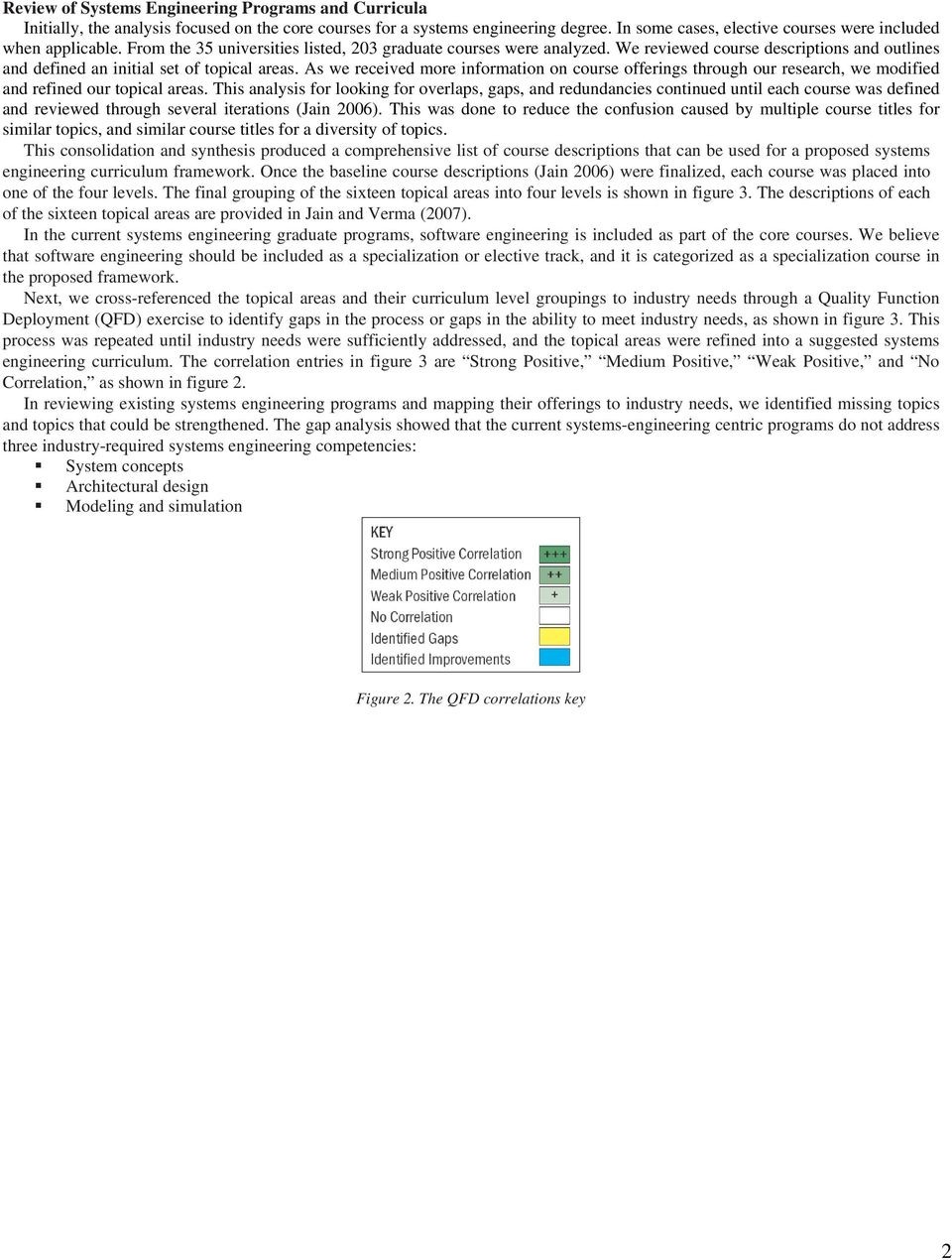
2 Review of Systems Engineering Programs and Curricula Initially, the analysis focused on the core courses for a systems engineering degree. In some cases, elective courses were included when applicable. From the 35 universities listed, 203 graduate courses were analyzed. We reviewed course descriptions and outlines and defined an initial set of topical areas. As we received more information on course offerings through our research, we modified and refined our topical areas. This analysis for looking for overlaps, gaps, and redundancies continued until each course was defined and reviewed through several iterations (Jain 2006). This was done to reduce the confusion caused by multiple course titles for similar topics, and similar course titles for a diversity of topics. This consolidation and synthesis produced a comprehensive list of course descriptions that can be used for a proposed systems engineering curriculum framework. Once the baseline course descriptions (Jain 2006) were finalized, each course was placed into one of the four levels. The final grouping of the sixteen topical areas into four levels is shown in figure 3. The descriptions of each of the sixteen topical areas are provided in Jain and Verma (2007). In the current systems engineering graduate programs, software engineering is included as part of the core courses. We believe that software engineering should be included as a specialization or elective track, and it is categorized as a specialization course in the proposed framework. Next, we cross-referenced the topical areas and their curriculum level groupings to industry needs through a Quality Function Deployment (QFD) exercise to identify gaps in the process or gaps in the ability to meet industry needs, as shown in figure 3. This process was repeated until industry needs were sufficiently addressed, and the topical areas were refined into a suggested systems engineering curriculum. The correlation entries in figure 3 are Strong Positive, Medium Positive, Weak Positive, and No Correlation, as shown in figure 2. In reviewing existing systems engineering programs and mapping their offerings to industry needs, we identified missing topics and topics that could be strengthened. The gap analysis showed that the current systems-engineering centric programs do not address three industry-required systems engineering competencies: System concepts Architectural design Modeling and simulation Figure 2. The QFD correlations key 2
3 In the current SE graduate programs Software Engineering is included as part of the core courses. The authors believe that Software Engineering should be included as a specialization or Elective track and hence it has been moved from core courses to specialization courses in the proposed framework. Figure 3. Gap analysis represented in a QFD matrix 3
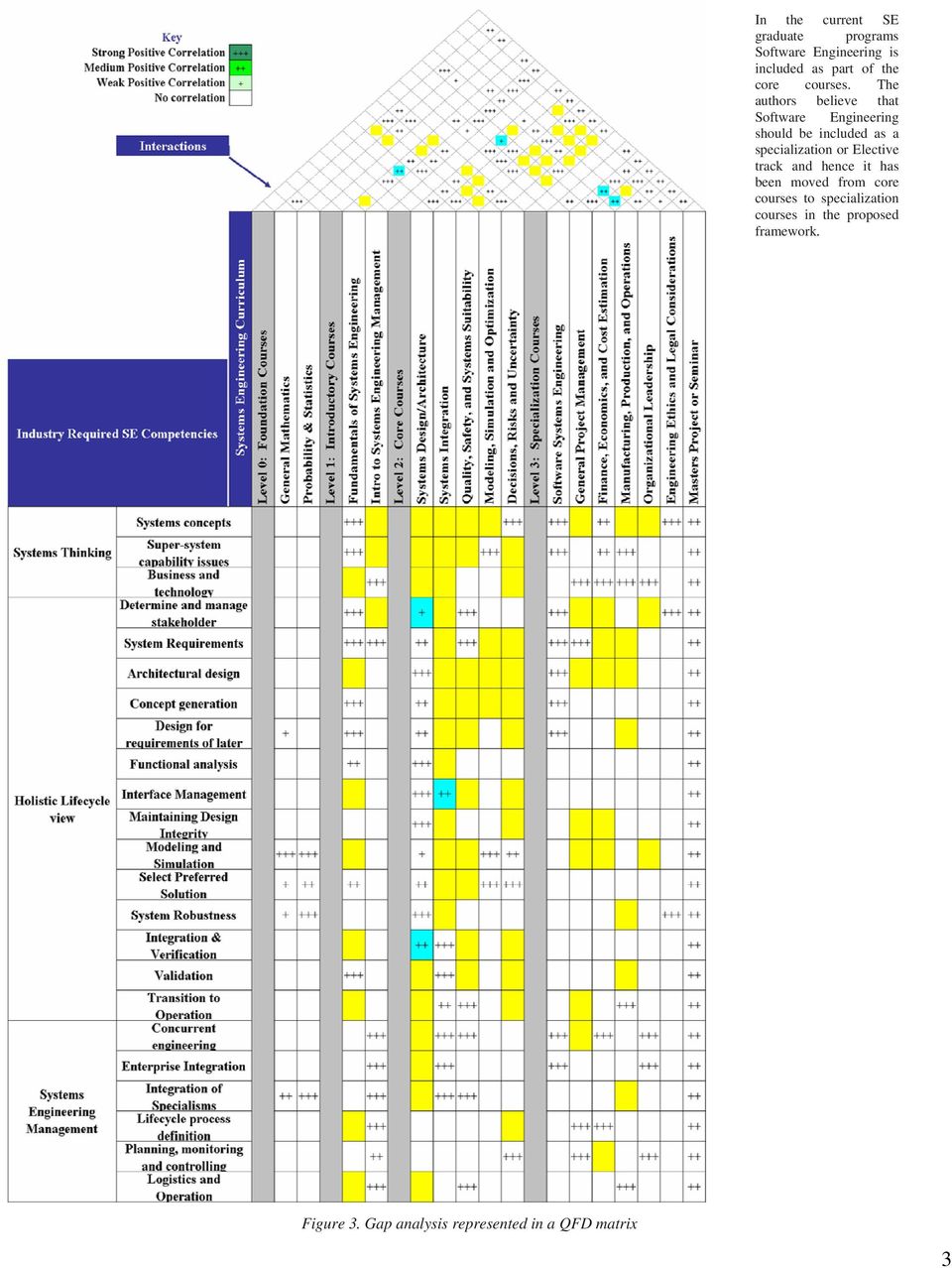
4 To fill these gaps, we recommend the following course offerings be revised and modified: Level 1: Introductory courses Fundamentals of systems Engineering Level 2: Core course System design/architecture Systems integration Quality, safety, and systems suitability Decisions, risks, and uncertainty The research revealed that the following three core courses had a weak relationship or absence of any relationship with the other topical areas: Quality, safety, and systems suitability Modeling, simulation, and optimization Decisions, risks and uncertainty The most serious gaps were between these three core courses and three specialized, elective courses: General project management Finance, economics, and cost estimation Organizational leadership The intent of this correlation is not to suggest a tight coupling between all topical areas and resulting courses, but rather the desire is to embed enough correlating themes in these courses to allow the emergence of an appreciation for the crosscutting implications of the topics when applying a systems approach. We believe that a mature and evolving curriculum will allow sufficient links across courses to exemplify this systems perspective. Another approach to teach cross-cutting implications is through capstone projects and group work. Andy Sage (2000) discusses this approach and the major ingredients associated with reshaping the curriculum based on his 1994 study for the American Society of Engineering Education. Proposed framework A framework for a reference curriculum in systems engineering at the graduate level was proposed to the INCOSE Academic Council in Jain and Verma (2007). The proposed framework takes into consideration the commonalities and patterns in systems engineering education content as it is taught today. One of the main objectives of proposing a reference curriculum of systems engineering is to try to bridge the gap between the expected systems engineering competencies by the potential employers and the graduate systems engineering program curricula. The framework should support the development of new graduate programs in systems engineering, and the enhancements to the existing systems engineering graduate programs. The proposed framework has the following three dimensions: 1. Topical area 2. Level 3. Systems engineering competencies Figure 4 shows the proposed framework in two dimensions. The proposed framework does not provide guidance on the number and titles of courses that a graduate program should have under each topical area. It assumes that the pedagogy of the courses is specific to each graduate program. Therefore, the pedagogy and graduate-level courses will evolve as the field of systems engineering grows and matures. 4
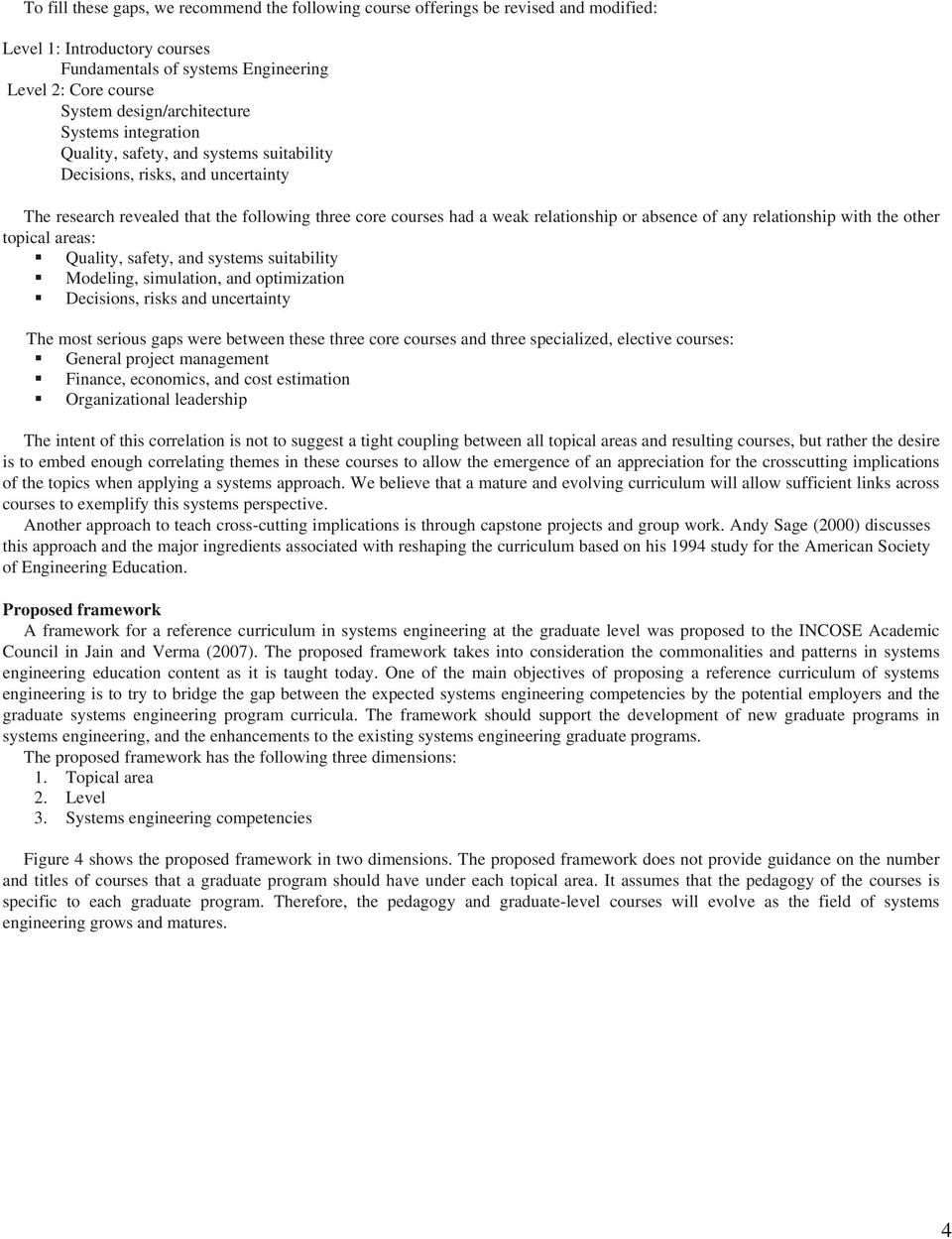
5 Figure 4. A proposed reference framework for a systems engineering curriculum Conclusions The systems engineering community realizes that there are many perspectives on the scope and content of a systems engineering curriculum, and there is a need for relative convergence in this regard. The proposed curriculum uses a four-level approach, beginning with a foundation in mathematics and introductory systems engineering courses, and transitioning to core systems engineering courses supplemented with advanced and special courses related to systems engineering. The recommended framework consists of a baseline of sixteen topical areas in systems engineering and related subjects for universities to consider when developing a graduate-level curriculum in systems engineering. References Brown, D. and W. Scherer A comparison of systems engineering programs in the United States. IEEE Transactions on System, Man, and Cybernetics 30(2). Fabrycky, W. and E. McCrae Systems engineering degree programs in the United States. Proceedings of the INCOSE International Symposium. INCOSE UK Advisory Board Systems engineering core competencies framework. INCOSE U.K. Jain, R A reference framework for systems engineering curriculum. Presentation to the INCOSE Academic Council, 11 July. Jain, R. and D. Verma Proposed framework for a reference curriculum for a graduate program in systems engineering. INCOSE Academic Council report. Kasser, J Reorganizing SE. Presentation to SEEC RG, INCOSE-Australia and SESA-SA chapter meeting. Kasser, J., S. Cook, D. Larden, M. Daley, and P. Sullivan Crafting a postgraduate degree for industry and government. Presentation to the International Engineering Management Conference. MIT Curriculum Design Committee on curriculum approved CDIO design, Aero/Astro MIT, Fall 05 Spring 06. Cambridge: Massachusetts Institute of Technology. Sage, A Systems engineering education. IEEE Transactions on System, Man, and Cybernetics 30(2). Stevens Institute of Technology Internal survey, February. Sage, A Engineering education for a changing world. Presentation to the American Society for Engineering Education. 5

The Systems Engineering Body of Knowledge and Graduate Reference Curriculum
 The Systems Engineering Body of Knowledge and Graduate Reference Curriculum David Olwell Naval Postgraduate School 777 Dyer Road (SE/OL BU220K) Monterey, CA 93943 [email protected] Alice Squires Stevens
Business Process Reengineering (BPR) for Engineering Management (EM) Majors: Industry Perspective and Students Feedback
 Business Process Reengineering (BPR) for Engineering Management (EM) Majors: Industry Perspective and Students Feedback Rashmi Jain, PhD Associate Professor Stevens Institute of Technology [email protected]
Research Issues Raised by the Guide to the Systems Engineering Body of Knowledge
 Research Issues Raised by the Guide to the Systems Engineering Body of Knowledge Rick Adcock Cranfield Defence and Security, Cranfield University, Bedford, UK [email protected] David Olwell Department
An overview of GRCSE: Graduate Reference Curriculum for Systems Engineering
 OPEN ACCESS World Congress on Engineering Education 2013 An overview of GRCSE: Graduate Reference Curriculum for Systems Engineering Massood Towhidnejad, Thomas B. Hilburn Department of Electrical, Computer,
Developing the Requirements for Introductory Courseware for Systems Engineering
 Developing the Requirements for Introductory Courseware for Systems Engineering Abstract. This paper sets out to determine the scope for the requirements for the content of introductory courseware in systems
Building a Competency Taxonomy to Guide Experience Acceleration of Lead Program Systems Engineers
 Building a Competency Taxonomy to Guide Experience Acceleration of Lead Program Systems Engineers Alice Squires Stevens Institute of Technology, School of Systems and Enterprises, Babbio Center, 5 th Floor,
ENGINEERING MANAGEMENT EDUCATION - TECHNOLOGY INTEGRATION, MANUFACTURING, OR THE MANAGEMENT OF ENGINEERS AND SCIENTISTS?
 ENGINEERING MANAGEMENT EDUCATION - TECHNOLOGY INTEGRATION, MANUFACTURING, OR THE MANAGEMENT OF ENGINEERS AND SCIENTISTS? John V. Farr, Ph.D., Stevens Institute of Technology Brian J. Sauser, Ph.D., Stevens
1 Past AOL reports and reviews are available at http://www.kennesaw.edu/cetl/aol/reports.html
 1 ASSURANCE OF LEARNING REPORT DEGREE PROGRAM: Master of Science in Information Systems (MSIS) REPORT AUTHOR(S): Amy B. Woszczynski, PhD SUBMISSION DATE: January 29, 2010 1. Following up on the previously
Master of Fine Arts (MFA) in Communications Design
 Program Summary Design plays a central and formative role in shaping communities, technology and business. Never have designers been expected to cultivate such a diverse set of skills and knowledge. MFA
Master of Science in Sport Management
 College of Education Department of Kinesiology and Physical Education Sport Management Master of Science November 2014 Steven M. Howell, Assistant Professor of Sport Management Assessment Plan 1 1. Student
Purpose. Admission Requirements. Vision. Mission. Provisional acceptance. Conditional acceptance
 BUSINESS ADMINISTRATION (MBA) The Master of Business Administration program is part of the Jay S. Sidhu School of Business and Leadership, which combines a strong core business education with the development
ABET Systems Engineering Accreditation
 ABET Systems Engineering Accreditation By: Armand Ash, Ph.D. [email protected] 1 ABET Systems engineering programs at universities in the United States are currently being evaluated using ABET s general
Academic Program Review SUMMARY* Department under review: Computer Science. Date self-study received in Dean s office: November 21, 2013
 Academic Program Review SUMMARY* Department under review: Computer Science Date self-study received in Dean s office: November 21, 2013 Date of external consultant s review: November 2013 Date APR received
MSc BLC concentration Diversity and Change Management
 MSc BLC concentration Diversity and Change Management The BLC Masters concentration in Diversity and Change Management prepares students to contribute to the leadership of dynamic organizations in a global
A New MSc Curriculum in Computer Science and Mathematics at the University of Zagreb
 A New MSc Curriculum in Computer Science and Mathematics at the University of Zagreb Robert Manger, Goranka Nogo, Mladen Vuković Department of Mathematics, University of Zagreb Bijenička cesta 30, 10000
PsyD Psychology (2014 2015)
 PsyD Psychology (2014 2015) Program Information Point of Contact Marianna Linz ([email protected]) Support for University and College Missions Marshall University is a multi campus public university providing
Systems Engineering Complexity & Project Management
 Systems Engineering Complexity & Project Management Bob Ferguson, PMP NDIA: CMMI Technology Conference November 2007 Outline A conversation Defining complexity and its effects on projects Research into
Associate Dean: Justin Matus, Ph.D. Academic Advisor: Karen Alessi Coordinator ABE: Allison Pinckley
 BUSINESS ADMINISTRATION Associate Dean: Justin Matus, Ph.D. Academic Advisor: Karen Alessi Coordinator ABE: Allison Pinckley 1 Wilkes University Graduate Bulletin 2015-2016 BUSINESS ADMINISTRATION (MBA)
Computing & Communications Services
 2010 Computing & Communications Services 2010 / 10 / 04 Final Kent Percival, M.Sc., P.Eng. Defining the Value of the Business Analyst In achieving its vision, key CCS partnerships involve working directly
The Changing Nature of Graduate Education: Inputs and Outcomes
 The Changing Nature of Graduate Education: Inputs and Outcomes Keynote address by Suzanne Ortega & Carol Lynch I. Introduction A. Our starting premise is that the defining characteristic of the great research
Draft Resolution on Science, technology and innovation for development
 1 Draft Resolution on Science, technology and innovation for development The Economic and Social Council, Recognizing the role of the Commission on Science and Technology for Development as the United
California Enterprise Architecture Framework
 Version 2.0 August 01, 2013 This Page is Intentionally Left Blank Version 2.0 ii August 01, 2013 TABLE OF CONTENTS 1 Executive Summary... 1 1.1 What is Enterprise Architecture?... 1 1.2 Why do we need
Developing Greater Professionalism in GIS Project Management
 Bill Haaker Senior Project Manager ASI Technologies 1935 Jamboree Drive Colorado Springs, CO 80920 Developing Greater Professionalism in GIS Project Management Introduction Project management is widely
Reasons for need for Computer Engineering program From Computer Engineering Program proposal
 Reasons for need for Computer Engineering program From Computer Engineering Program proposal Department of Computer Science School of Electrical Engineering & Computer Science circa 1988 Dedicated to David
Unified Communications Overview
 A CBTS White Paper Unified Communications Overview Craig Chavis Solution Architect, CBTS 10/5/2012 www.cbts.cinbell.com Table of Contents Unified Communications Overview...3 Unified Communications as a
Assessment of Online Learning Environments: Using the OCLES(20) with Graduate Level Online Classes
 www.ncolr.org/jiol Volume 7, Number 3, Winter 2008 ISSN: 15414914 Assessment of Online Learning Environments: Using the OCLES(20) with Graduate Level Online Classes Thomas A. DeVaney Nan B. Adams Cynthia
Fortune 500 Medical Devices Company Addresses Unique Device Identification
 Fortune 500 Medical Devices Company Addresses Unique Device Identification New FDA regulation was driver for new data governance and technology strategies that could be leveraged for enterprise-wide benefit
Department of Engineering Management and Systems Engineering
 Department of Management and Systems 2101 Systems Building Norfolk, VA 23529 (757) 683-4558 Adrian Gheorghe, Chair M. Pilar Pazos, Graduate Program Director, Master's Programs Andres Sousa-Poza, Graduate
Work with your prospective supervisors to complete your application.
 Guidance notes for ESRC applicants October 2016 Entry The deadline for applications is noon (GMT) on Friday 19 th February 2016. It is important that you allow yourself sufficient time to read these Guidance
Incorporating Lean Six Sigma into an Aviation Technology Program
 Incorporating Lean Six Sigma into an Aviation Technology Program M. E. Johnson 1, S. I. Dubikovsky 2 1,2 Purdue University, Department of Aviation Technology, West Lafayette, Indiana, USA ([email protected])
ULM Common Core Curriculum: Final Draft (Revised 21 July 2004)
 ULM Common Core Curriculum: Final Draft (Revised 21 July 2004) FOUNDATION COURSES (Supervised by the University Core Curriculum Committee) As many of the undergraduates entering ULM are uninitiated to
TBR. IBM Cloud Services Balancing compute options: How IBM Smart Business Cloud can be a catalyst for IT transformation
 T EC H N O LO G Y B U S I N ES S R ES EAR C H, I N C. IBM Cloud Services Balancing compute options: How IBM Smart Business Cloud can be a catalyst for IT transformation Author: Stuart Williams Director,
NORTHERN ILLINOIS UNIVERSITY. College: College of Business. Department: Inter-Departmental. Program: Master of Business Administration
 NORTHERN ILLINOIS UNIVERSITY College: College of Business Department: Inter-Departmental Program: Master of Business Administration CIP Code: 52.0201 Northern Illinois University s M.B.A. program follows
New Program Proposal Master in Engineering Systems Engineering Clemson University
 New Program Proposal Master in Engineering Systems Engineering Clemson University Summary Clemson University requests approval to offer a program leading to the Master in Engineering degree with a major
Office of the Auditor General AUDIT OF IT GOVERNANCE. Tabled at Audit Committee March 12, 2015
 Office of the Auditor General AUDIT OF IT GOVERNANCE Tabled at Audit Committee March 12, 2015 This page has intentionally been left blank Table of Contents Executive Summary... 1 Introduction... 1 Background...
IT Governance and Managed Services Creating a win-win relationship
 WHITE PAPER IT Governance and Managed Services Creating a win-win relationship 1 cgi.com 2015 CGI GROUP INC. IT Governance and Managed Services The question of whether to outsource IT has become part of
Organisational Change Management
 Organisational Change Management The only thing that is constant is change in your business, your market, your competitors, and your technology. Remaining competitive and responsive to your customers and
Entrepreneurship Education at European Universities and Business Schools
 Entrepreneurship Education at European Universities and Business Schools - Results of a Joint Pilot Survey - September 2004 by Karen Wilson 1 Contents Survey background and methodology Findings Conclusions
Systems Engineering Master Project
 System 1 System n by Gerrit Muller HBV-NISE e-mail: [email protected] www.gaudisite.nl Abstract The master study Systems Engineering is completed by performing a thesis project. This document describes
GLOBAL HEALTH IN THE UNDERGRADUATE MEDICAL CURRICULUM
 GLOBAL HEALTH IN THE UNDERGRADUATE MEDICAL CURRICULUM How Might Manchester Medical School Proceed? Babatunde Oremule WHY? Personal interest Tutor s expertise Opportune timing Contribute to a burgeoning
The Future of Census Bureau Operations
 The Future of Census Bureau Operations Version 1.0 April 25, 2013 The Future of Census Bureau Operations Page ii [This page intentionally left blank] The Future of Census Bureau Operations Page iii Document
Full-time MSc in Logistics and Supply Chain Management
 Full-time MSc in Logistics and Supply Chain Management Course structure and content 2015-2016 The course has been developed to produce expert logistics and supply chain professionals who can take the skills
Background: Current paper discusses the process and the characteristics of the Bologna Process (BP) in the Department of Public
 Consequences of the Bologna process on Romanian Public Administration Schools case study in the Department of Public Administration in Babeş-Bolyai University, Cluj Napoca, Romania Veronica Junjan 1, Sorin
Curricular Vision. I. Introduction:
 Curricular Vision The Olin College Curricular Vision, which served as a guide for curricular development at Olin College, was written in the fall of 2001by David V. Kerns, who was provost of the college
Programme Specification
 Programme Specification Title: Accounting Final Award: Master of Science (MSc) With Exit Awards at: Postgraduate Certificate (PG Cert) Postgraduate Diploma (PG Dip) Master of Science (MSc) To be delivered
Assessment Plan for the Undergraduate Criminal Justice Program GOAL A
 Assessment Plan for the Undergraduate Criminal Justice Program Mission Statement: The Saint Peter s College (SPC) Criminal Justice degree program mission is to develop professionals with specialty knowledge
The Software Engineering Competency Model (SWECOM)
 The Software Engineering Competency Model (SWECOM) presented by Dick Fairley Software and Systems Engineering Associates (S2EA) [email protected] Copyright Dick Fairley 2014 slide 1 Presentation Agenda
Programme Specification Date amended: April 8, 2008
 Programme Specification Date amended: April 8, 2008 1. Programme Title(s) and UCAS code(s): Computing with Management (G4N1); Computing with Management with a year in Europe (G4NF); Computing with Management
STUDENT OUTCOMES ASSESSMENT PLAN (SOAP)
 MS PROGRAM IN C OMPUTER SCIENCE DEPARTMENT OF C OMPUTER SCIENCE College of Science and Mathematics STUDENT OUTCOMES ASSESSMENT PLAN (SOAP) I. Mission Statement The mission of the Department of Computer
IEMC 2005 St John s Newfoundland Page 1
 IEMC 2005 St John s Newfoundland Page 1 Optimising the Content and Delivery of Postgraduate Education in Engineering Management for Government and Industry Joseph E. Kasser, Elena Sitnikova, Xuan-Linh
Georgia State University
 Georgia State University Assessment Data by Section 2012-2013 Finance MS As of: 2/24/2014 01:01 PM EST (Includes those Action Plans with Budget Amounts marked One-Time, Recurring, No Request.) Mission
Operationalizing Data Governance through Data Policy Management
 Operationalizing Data Governance through Data Policy Management Prepared for alido by: David Loshin nowledge Integrity, Inc. June, 2010 2010 nowledge Integrity, Inc. Page 1 Introduction The increasing
AC 2010-1485: DEVELOPMENT AND IMPLEMENTATION OF A MASTERS PROGRAM IN COMPUTER INFORMATION TECHNOLOGY
 AC 2010-1485: DEVELOPMENT AND IMPLEMENTATION OF A MASTERS PROGRAM IN COMPUTER INFORMATION TECHNOLOGY Hetal Jasani, Northern Kentucky University Hetal Jasani is an assistant professor in the Department
Technical Writing - A Review of Agile Software Development Services
 Enchantment Chapter Monthly Meeting 10 June, 2015 4:45-6:00 pm: Systems Engineering for Software Intensive Projects using Agile Methods Larri Rosser, Raytheon Intelligence, Information & Services, Sr.
BIG DATA WITHIN THE LARGE ENTERPRISE 9/19/2013. Navigating Implementation and Governance
 BIG DATA WITHIN THE LARGE ENTERPRISE 9/19/2013 Navigating Implementation and Governance Purpose of Today s Talk John Adler - Data Management Group Madina Kassengaliyeva - Think Big Analytics Growing data
Assessing the Impact of a Tablet-PC-based Classroom Interaction System
 STo appear in Proceedings of Workshop on the Impact of Pen-Based Technology on Education (WIPTE) 2008. Assessing the Impact of a Tablet-PC-based Classroom Interaction System Kimberle Koile David Singer
Harvard University Graduate School of Design Department of Landscape Architecture LANDSCAPE ARCHITECTURE THESIS HANDBOOK 2014 2015
 Harvard University Graduate School of Design Department of Landscape Architecture LANDSCAPE ARCHITECTURE THESIS HANDBOOK 2014 2015 INDEX 1. INTRODUCTION TO LANDSCAPE ARCHITECTURE THESIS a. Overview 2.
Importance of Collaboration between Market Research Industry and Business Schools
 Importance of Collaboration between Market Research Industry and Business Schools Dr. Syed Ferhat Anwar Professor, Institute of Business Administration, University of Dhaka & Member BMSRS The topic is
Realizing the Full Potential of Blended Learning
 A STRATEGY PAPER FROM Realizing the Full Potential of Blended Learning FLICKR/CONCORDIA What higher education institutions say about effective instructional strategies, practices and technologies for student
An Overview of the Systems Engineering Knowledge Domain
 An Overview of the Assignment for ESD.83: Research Seminar in Engineering Systems Prepared by Annalisa L. Weigel 24 October 2000 Society is always taken by surprise at any new example of common sense.
PASTA Abstract. Process for Attack S imulation & Threat Assessment Abstract. VerSprite, LLC Copyright 2013
 2013 PASTA Abstract Process for Attack S imulation & Threat Assessment Abstract VerSprite, LLC Copyright 2013 - - - - - - - - - - - - - - - - - - - - - - - - - - - - - - - - - - - - - - - - - - - - - -
Programme Specification
 Programme Specification Title: Sustainable Architectural Design Final Award: Master of Science (MSc) With Exit Awards at: Postgraduate Certificate (PG Cert) Postgraduate Diploma (PG Dip) Master of Science
Teaching and Learning Strategy for UCL Computer Science. Stage 1: the narrative or vision
 LONDON S GLOBAL UNIVERSITY Teaching and Learning Strategy for UCL Computer Science Stage 1: the narrative or vision What does the department stand for? What does it want to achieve? What is it going to
Game Design as a Writing Course in the Liberal Arts
 Game Design as a Writing Course in the Liberal Arts Amber Settle School of Robin Burke School of Lucia Dettori School of Abstract - School of Computer Science, Telecommunications, and Information Systems
Incorporating Systems Engineering and Project Management Concepts in First Year Engineering Curriculum
 Incorporating Systems Engineering and Project Management Concepts in First Year Engineering Curriculum Muhammad Faysal Islam 1 and Mohammed Nazrul Islam 2 1 Department of Engineering Management and Systems
Programme Specification Date amended: April 8, 2008
 Programme Specification Template Programme Specification Date amended: April 8, 2008 1. Programme Title(s) and UCAS code(s): Computing (G405); Computing with a year in Europe (G406); Computing with a year
GRADUATE PROGRAM REVIEW POLICY. Texas Southern University
 GRADUATE PROGRAM REVIEW POLICY Texas Southern University The Purposes of Graduate Program Review Graduate program review at Texas Southern University exists to ensure that programs are functioning at the
Software Security Engineering: A Key Discipline for Project Managers
 Software Security Engineering: A Key Discipline for Project Managers Julia H. Allen Software Engineering Institute (SEI) Email: [email protected] Sean Barnum Cigital Robert J. Ellison SEI Gary McGraw Cigital
APQC s Levels of Knowledge Management Maturity
 APQC s Levels of Knowledge Management Maturity By Cindy Hubert and Darcy Lemons This article provides an overview of APQC s Levels of Knowledge Management Maturity, which are designed to be used in conjunction
Value to the Mission. FEA Practice Guidance. Federal Enterprise Architecture Program Management Office, OMB
 Value to the Mission FEA Practice Guidance Federal Enterprise Program Management Office, OMB November 2007 FEA Practice Guidance Table of Contents Section 1: Overview...1-1 About the FEA Practice Guidance...