
Pandemic Influenza Emergency Management Plan
|
|
|
- Jodie Sherman
- 10 years ago
- Views:
Transcription
1 Pandemic Influenza Emergency Management Plan December 8, 2008 State of Oregon Annex F, Public Health and Medical Services Hazard Appendix 2, Acute and Communicable Disease
2 This attachment is part of Annex F of the State of Oregon Emergency Management Plan and should be used in conjunction with the rest of Annex F base plan and hazard specific appendices. It is not a standalone plan.

3 Annex F: Public Health and Medical Services December 8, 2008 HAZARD APPENDIX 2 ACUTE AND COMMUNICABLE DISEASE ATTACHMENT 2-B: PANDEMIC INFLUENZA 1 Introduction Purpose and Authorities Purpose Authorities Situation, Assumptions, and Definitions Situation Assumptions Defining an Influenza Pandemic Concept of Operations OPHD Staff Protection Strategy Roles and Responsibilities Federal State Local Health Departments Hospitals and Health Care Systems Vulnerable Populations Plan Maintenance Training and Exercises Web Sites References Acronyms and Glossary List of Acronyms Glossary Record of Changes Tabs...18 Tabs Tab 2-B-1 Tab 2-B-2 Tab 2-B-3 Tab 2-B-4 Tab 2-B-5 Public Health Communications Surveillance Laboratory Diagnostics Health Care Planning Vaccine Distribution and Use Attachment 2-B: Pandemic Influenza 2-B-1

4 December 8, 2008 Hazard Appendix 2: Acute and Communicable Disease Tab 2-B-6 Tab 2-B-7 Tab 2-B-8 Tab 2-B-9 Antiviral Drug Distribution and Use Community Disease Control and Prevention Infection Control Clinical Guidelines This attachment is part of Annex F of the State of Oregon Emergency Management Plan and should be used in conjunction with the rest of Annex F base plan and hazard specific appendices. It is not a standalone plan. 2-B-2 Attachment 2-B: Pandemic Influenza
5 Annex F: Public Health and Medical Services December 8, INTRODUCTION The Pandemic Influenza Emergency Response Plan is Attachment B to Hazard Appendix 2 - Acute and Communicable Disease (ACD) Emergency Response Plan to the Oregon Public Health Division (OPHD) Annex F Public Health and Medical Service (Emergency Support Function (ESF) 8). Influenza A, a contagious viral respiratory disease, causes widespread infection in all age groups every year. Global epidemics of a novel influenza strain, known as pandemics, occur intermittently when Influenza A evolves into a significantly different subtype of the virus to which humans have no immunity. Influenza pandemics occurred three times in the 20 th century (1918, 1957, and 1968). Over 500,000 deaths occurred in the United States in the 1918 pandemic; in 1957 and 1968 mortality was much less, with US deaths of 90,000 and 30,000, respectively. When the next pandemic occurs, people across the globe will be affected within a few months, which will severely limit options to provide mutual aid across jurisdictions and for which a new vaccine will not be available for months to years. For more detailed information about past pandemics, visit the U.S. Department of Health and Human Services (DHHS) pandemic flu website ( 2 PURPOSE AND AUTHORITIES 2.1 Purpose The purpose of the Oregon Pandemic Influenza Emergency Response Plan is to lessen the impact of an influenza pandemic on the residents of Oregon. This plan focuses on elements unique to an influenza pandemic. Wherever response is typical of response to any communicable disease or other public health emergency, this plan refers to the appropriate section of Annex F: Health and Medical Services. Annex F can be found on the Health Alert Network (HAN) Web site ( or can be requested by contacting the Public Health Emergency Preparedness Program (PHEP), Authorities See Annex F, Public Health and Medical Services - Attachment A: Authorities. 3 SITUATION, ASSUMPTIONS, AND DEFINITIONS 3.1 Situation The estimated health impact of the next influenza pandemic on Oregon s 3.7 million people (based on 2006 census data) depends on the assumptions used. The DHHS Attachment 2-B: Pandemic Influenza 2-B-3

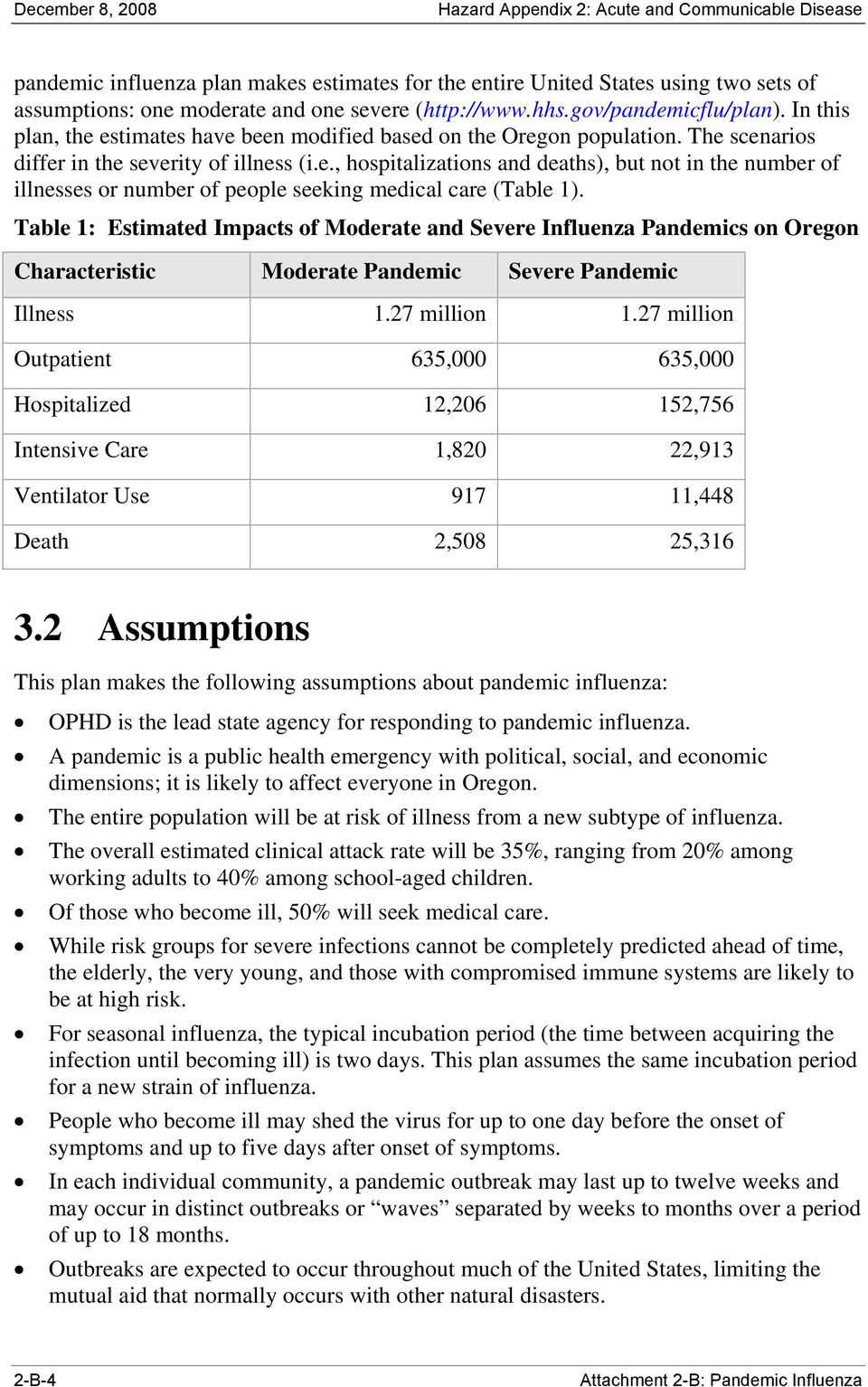
6 December 8, 2008 Hazard Appendix 2: Acute and Communicable Disease pandemic influenza plan makes estimates for the entire United States using two sets of assumptions: one moderate and one severe ( In this plan, the estimates have been modified based on the Oregon population. The scenarios differ in the severity of illness (i.e., hospitalizations and deaths), but not in the number of illnesses or number of people seeking medical care (Table 1). Table 1: Estimated Impacts of Moderate and Severe Influenza Pandemics on Oregon Characteristic Moderate Pandemic Severe Pandemic Illness 1.27 million 1.27 million Outpatient 635, ,000 Hospitalized 12, ,756 Intensive Care 1,820 22,913 Ventilator Use ,448 Death 2,508 25, Assumptions This plan makes the following assumptions about pandemic influenza: OPHD is the lead state agency for responding to pandemic influenza. A pandemic is a public health emergency with political, social, and economic dimensions; it is likely to affect everyone in Oregon. The entire population will be at risk of illness from a new subtype of influenza. The overall estimated clinical attack rate will be 35%, ranging from 20% among working adults to 40% among school-aged children. Of those who become ill, 50% will seek medical care. While risk groups for severe infections cannot be completely predicted ahead of time, the elderly, the very young, and those with compromised immune systems are likely to be at high risk. For seasonal influenza, the typical incubation period (the time between acquiring the infection until becoming ill) is two days. This plan assumes the same incubation period for a new strain of influenza. People who become ill may shed the virus for up to one day before the onset of symptoms and up to five days after onset of symptoms. In each individual community, a pandemic outbreak may last up to twelve weeks and may occur in distinct outbreaks or waves separated by weeks to months over a period of up to 18 months. Outbreaks are expected to occur throughout much of the United States, limiting the mutual aid that normally occurs with other natural disasters. 2-B-4 Attachment 2-B: Pandemic Influenza
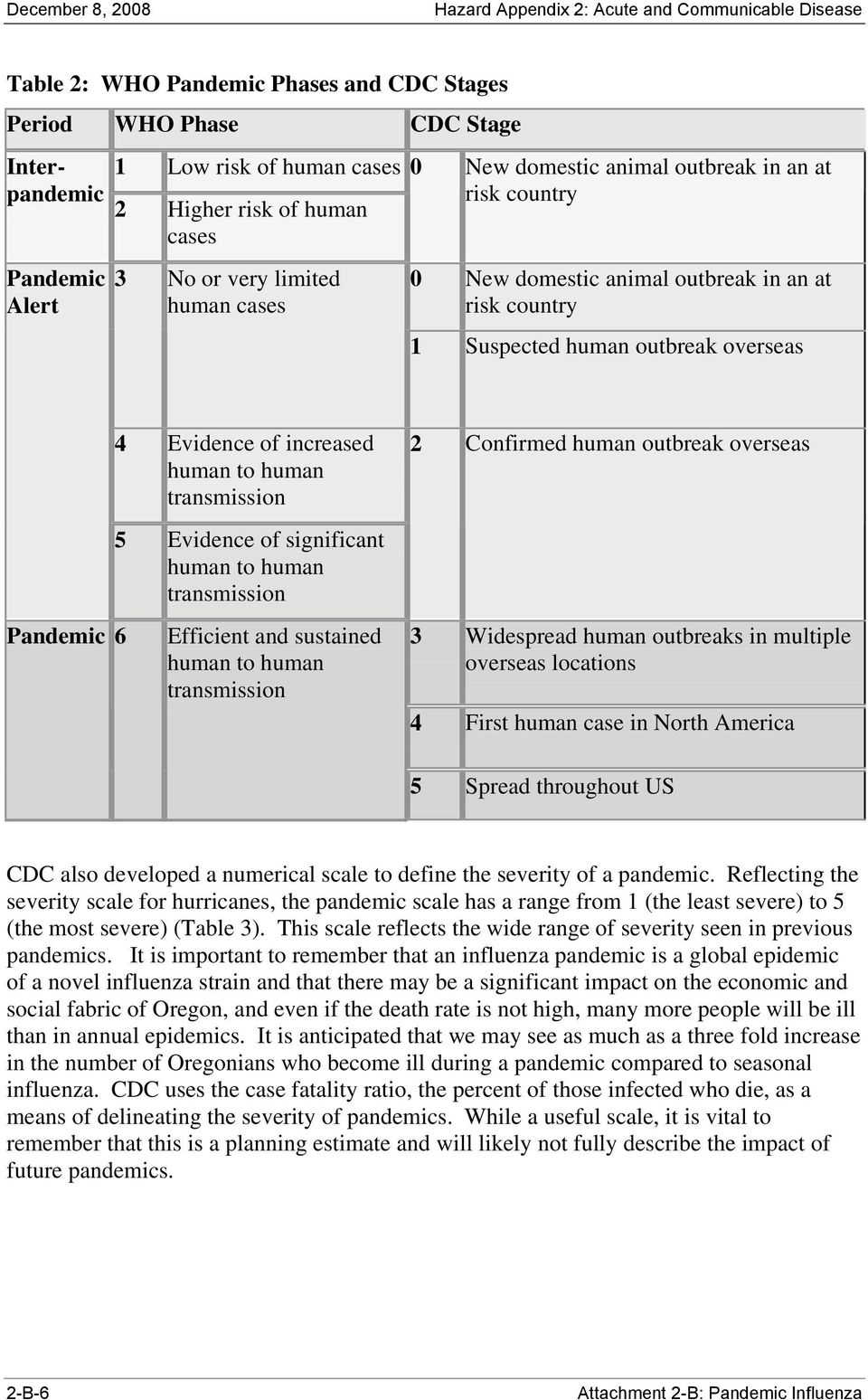
7 Annex F: Public Health and Medical Services December 8, 2008 The number of hospitalizations and deaths will depend on the virulence of the pandemic virus. Estimates differ about 10-fold between the moderate and severe scenarios. Vaccine is not expected to be available at the onset of a pandemic. There may not be enough of certain pharmaceuticals, especially influenza antiviral drugs, as well as antibiotics to treat secondary infections, and to treat everyone with probable pandemic influenza. The early targeted use of non-pharmaceutical measures (e.g., social distancing) to control disease spread represents an important mitigation strategy, which may reduce incidence of the disease by up to 50% based on the Centers for Disease Control and Prevention (CDC) predictions. Planning for the continuity of state and local government and private business operations is an essential component of pandemic influenza preparedness, especially if significant numbers of people are not in the workplace. This plan assumes that continuity planning will occur in both the public and private sectors. State of Oregon is developing business continuity plans that will assure that the most critical business functions of the State continue with up to a 40% absentee rate over several weeks. There is no guarantee that available antiviral drugs will be effective against a pandemic influenza strain. 3.3 Defining an Influenza Pandemic International and National Terminology The World Health Organization (WHO) developed a numbered system of progressive phases for influenza as a means to describe the progression of a pandemic. The CDC also have a numbered system of stages of pandemic progression. The WHO phases and the CDC stages are compared in Table 2. Each phase or stage is defined by the efficiency with which a new influenza virus can be transmitted from an animal host to humans and human-to-human transfer. Since early in 2004, the global status has been Phase 3, Stage 0. Attachment 2-B: Pandemic Influenza 2-B-5
8 December 8, 2008 Hazard Appendix 2: Acute and Communicable Disease Table 2: WHO Pandemic Phases and CDC Stages Period WHO Phase CDC Stage Interpandemic 2 Higher risk of human 1 Low risk of human cases cases Pandemic Alert 3 No or very limited human cases 0 New domestic animal outbreak in an at risk country 0 New domestic animal outbreak in an at risk country 1 Suspected human outbreak overseas Pandemic 6 4 Evidence of increased human to human transmission 5 Evidence of significant human to human transmission Efficient and sustained human to human transmission 2 Confirmed human outbreak overseas 3 Widespread human outbreaks in multiple overseas locations 4 First human case in North America 5 Spread throughout US CDC also developed a numerical scale to define the severity of a pandemic. Reflecting the severity scale for hurricanes, the pandemic scale has a range from 1 (the least severe) to 5 (the most severe) (Table 3). This scale reflects the wide range of severity seen in previous pandemics. It is important to remember that an influenza pandemic is a global epidemic of a novel influenza strain and that there may be a significant impact on the economic and social fabric of Oregon, and even if the death rate is not high, many more people will be ill than in annual epidemics. It is anticipated that we may see as much as a three fold increase in the number of Oregonians who become ill during a pandemic compared to seasonal influenza. CDC uses the case fatality ratio, the percent of those infected who die, as a means of delineating the severity of pandemics. While a useful scale, it is vital to remember that this is a planning estimate and will likely not fully describe the impact of future pandemics. 2-B-6 Attachment 2-B: Pandemic Influenza
9 Annex F: Public Health and Medical Services December 8, 2008 Table 3: Centers for Disease Control Severity Scale for Pandemic Influenza Severity Level Consequences Case Fatality Ratio Deaths in United States (2006 population)* 1 <0.1% <90, % -0.5% 90,000-<450, %-<1.0% 450,000-<900, %-<2.0% 900,000-<1,800,000 5 >2.0% >1,800,000 *Assumes 30% of population will become ill and there are no pandemic interventions. On this scale, the 1918 pandemic would be classified as a 5 or severe pandemic as it had an average case fatality index of >2.0%. The 1957 and 1968 pandemics would fall out in the 1-2 range as there were many fewer deaths. Those pandemics still had a much higher death rate than seasonal influenza, and the number of people who became ill was higher than with seasonal influenza. When assessing past pandemics on this scale, one must look at the case fatality index and not the total numbers of deaths due to increases in population Oregon Public Health Division Terminology In an attempt to simplify terminology and be compliant with the National Incident Management System (NIMS), this plan avoids the use of the pandemic influenza scales described above when clear, descriptive language is more effective. Thus, this plan uses descriptions based on the actions Oregon will take during the influenza pandemic: Prepare: The time between influenza pandemics. Respond: Because of the time between the discovery of a novel human influenza strain and the actual risk of disease spread in Oregon, the traditional response element of emergency management is divided into three periods: o Alert: When a novel strain of influenza begins to spread, presumably outside North America. o Standby: When cases appear in the United States, outside of the Pacific Northwest. o Activate: When a case or cases present a plausible or imminent risk of spread in the Pacific Northwest. Recover: Implemented once the influenza pandemic passes. Likewise, Oregon influenza pandemic planning is based on two levels of severity (moderate and severe), instead of the CDC s five levels. This allows the plan to be less cumbersome. The two levels of severity discussed in this plan are: Moderate: An influenza pandemic is deemed moderate if the case fatality ratio is less than one percent. This corresponds to levels 1-3on the CDC scale. At this level of severity, it is not anticipated that there would be a statewide implementation of highly Attachment 2-B: Pandemic Influenza 2-B-7

10 December 8, 2008 Hazard Appendix 2: Acute and Communicable Disease disruptive mitigation measures, such as school class cancellation, and the overall response would be less dramatic than in a severe influenza pandemic. Severe: An influenza pandemic is deemed severe when the case fatality ratio is greater than one percent. This corresponds to levels 4-5 on the CDC scale. At this level of severity, it is anticipated that the risk to the communities across the state is serious enough to warrant a response that will be highly disruptive to society. 4 CONCEPT OF OPERATIONS OPHD has the primary responsibility in Oregon for activating the pandemic influenza response at the level appropriate to the specific phase of an influenza pandemic. This section describes the emergency management structure that OPHD will use during an influenza pandemic to manage resources under state control. As the state agency primarily responsible for public health and medical services, OPHD will lead the preparedness, response, and recovery activities for pandemic influenza. The OPHD response to an influenza pandemic will comply with NIMS provisions, including the use of an Incident Command System (ICS). Even though Local Health Departments (LHDs) respond routinely to infectious diseases without using ICS, the emergency management community and public health in Oregon agree to use ICS during a widespread influenza pandemic. All LHDs and their respective county Emergency Operation Centers (EOCs) will adopt an incident management structure as described in the Concept of Operations section of the Annex F Base Plan, Public Health and Medical Services. 4.1 OPHD Staff Protection Strategy The OPHD s Agency Operations Center (AOC) will follow the community mitigation guidelines described in Tab 2-B-7.3 and those recommended to other Critical Infrastructure/Key Resources (CI/KR) assets. Recognizing that staff are the only irreplaceable assets at OPHD, actions taken to ensure their health and availability include: Exclusion and recommended home isolation of ill staff. o During the Alert period, the Operations Branch will determine exclusion guidelines. o During their convalescence, staff may, if able, work via telecommuting. o OPHD will follow Department of Human Services (DHS) guidelines regarding sick leave and other human resource issues during an influenza pandemic. Exclusion and recommended home quarantine of staff with close contact to cases, as described above. To the maximum extent possible, staff will avoid close contact with one another by use of techniques such as: o Telecommuting o Conference calls 2-B-8 Attachment 2-B: Pandemic Influenza

11 Annex F: Public Health and Medical Services December 8, 2008 o Diffuse worksites throughout building and workspaces Antiviral prophylaxis is not anticipated for public health staff. Use of personal protective equipment (PPE) by staff will be based upon supplies available and the latest federal guidelines. The Incident Manager will be responsible for setting PPE guidelines for staff. As appropriate based on their skill sets, staff who have been infected, have subsequently recovered, and have been determined to be non-infectious, may be assigned to roles in settings deemed to involve higher risk of exposure to pandemic influenza (e.g., direct contact with the public). 5 ROLES AND RESPONSIBILITIES 5.1 Federal DHHS has primary responsibility for a number of key elements of the national pandemic influenza plan. Prepare Coordinate national and international virus surveillance, monitor health impacts, and provide laboratory support. Direct and fund research on influenza virus, vaccine, and antiviral drugs. Respond Evaluate, license, and provide liability programs for a pandemic influenza vaccine. Provide a national clearinghouse for vaccine availability, distribution, and redistribution. Communicate with states and other public health agencies. Provide policy guidance on pandemic response activities. Manage the Strategic National Stockpile (SNS), which caches influenza antiviral drugs. Other federal agencies roles in pandemic influenza response are outlined in the DHHS Pandemic Influenza Plan ( page 26). 5.2 State Pandemic Influenza Coordinating Committee (PICC) The Oregon PICC will be made up of two standing committees, the ESF-8 Advisory Committee and the Medical Advisory Group (MAG), as well as other experts as needed from Oregon Emergency Management, Oregon Department of Education, Oregon Military Attachment 2-B: Pandemic Influenza 2-B-9
12 December 8, 2008 Hazard Appendix 2: Acute and Communicable Disease Department, health care industry and other agencies. The mission of the PICC will be to ensure continuous and close coordination between public and private partners across Oregon. During an influenza pandemic, a spectrum of prompt, well-coordinated health decisions are needed. At one extreme, minor decisions, such as individual patient isolation, are made by LHDs or health care facilities; at the other extreme, major decisions or recommendations affecting large segments of the population or the economy are made and enforced by state or federal elected officials. Recommendations to elected officials for such major public health decisions or recommendations come from the OPHD Director in conjunction with the PICC Oregon State Public Health Division Prepare Moderate and Severe Scenarios Establish partnerships with stakeholders. Develop written plans. Conduct drills and exercises. Monitor global situation, alert for appearance of novel disease strains. Respond Alert - Moderate and Severe Scenarios (WHO Phase 4-6; CDC Stage 3; no cases in US) Activate ICS Review agreed upon roles and responsibilities with stakeholders. Revise plans and communications templates to fit the specific events. Begin a public information campaign. Coordinate state-wide surveillance efforts utilizing existing seasonal influenza monitoring systems and other ad-hoc systems. Receive antiviral medications from SNS and distribute to counties. Develop and disseminate case definitions, clinical guidelines, and specific laboratory procedures based upon the information available. Expand sentinel provider network as feasible. Respond Standby - Moderate and Severe Scenarios (US Stage 4; 1st case in US) 1 Increase public information messaging. Increase surveillance efforts. Prepare for social distancing measures. Integrate stakeholders into ICS with the ESF-8 AOC. Identify the arrival in Oregon of a novel influenza virus by laboratory testing. Assist CI/KR to maintain situational awareness. 1 These actions are not an exhaustive list; further activities for Standby and Activate are described in the Tabs of this plan. 2-B-10 Attachment 2-B: Pandemic Influenza

13 Annex F: Public Health and Medical Services December 8, 2008 Receive antiviral medication. Respond Activate (US Stage 5-1st confirmed cluster in state or region) Moderate Scenario If disease is limited, identify the exposure source, protect the population at risk, and control further spread. Issue statements regarding appropriate levels of social distancing. Facilitate utilization of scarce medical resources. Track influenza deaths and hospitalizations to identify high-risk groups. Disseminate accurate information for resource and policy decisions in public health and healthcare delivery settings. Publicize up-to-date information to encourage community support of public health policies and recommendations. Ensure equitable and scientifically-based distribution of scarce health care resources (such as vaccine and antiviral drugs) under state control to prevent severe illness or death and to limit further spread of the disease. Report epidemiological data and make recommendations on disease control methods, including community mitigation measures and pharmaceutical usage. See Tab 2-B-2: Surveillance for details. Coordinate mitigation measures for CI/KR protection. Implement directions from the OPHD Director and Incident Manager, distributing community mitigation orders to partner agencies and, via the Public Information Officer (PIO), to the general public. See Tab 2-B-7 Community Mitigation details. Oregon State Public Health Laboratory (OSPHL) provides laboratory testing during an influenza pandemic and also: o Provides printed and Web-based instructions on specimen collection for health care providers. o Provides specimen collection material on request. o Communicates test results to clinicians and to local, state, and federal health officials. o Collaborates with the WHO and CDC laboratory network. o Develops and distributes novel influenza testing criteria and communication plans in collaboration with the Epidemiological Branch. Emergency Medical Services: o Coordinates ESF-8 support to private and public medical systems. o Ensures close coordination and communication for allocation and prioritization of resources. o Ensures that medical providers have received case definitions and clinical guidelines and are complying with them accordingly. The SNS/Immunization Unit: Attachment 2-B: Pandemic Influenza 2-B-11
14 December 8, 2008 Hazard Appendix 2: Acute and Communicable Disease o Supports management and distribution of vaccines, if available, to LHDs as described in the SNS Plan (Annex F, Attachment E, Tab E-3). o Prepares to receive and distribute assets from the SNS, vendor-managed inventory, or normal channels. o Prepares and delivers educational materials for vaccination providers. o Tracks the delivery of vaccine. o Monitors vaccine adverse events. o Develops and distributes vaccination guidelines. The SNS/Antiviral Distribution Unit: o Supports management and distribution of antiviralc medications. o Tracks the delivery of medications from receipt, stage, and storage (RSS) to county dispensing sites. o Collects data, monitors use, and tracks adverse events. o Develops and distributes treatment and prophylaxis guidelines. o Helps broker re-distribution of antivirals among dispensing sites, if needed. Severe Scenario In addition to the responsibilities in a Moderate Scenario, OPHD will also provide recommendations for: Slowing the spread of influenza through broad medical and community containment strategies. Canceling classes for pre-kindergarten to university. Dispensing antiviral medications to ill. Facilitating establishment of altered standards of care. Facilitating arrangement of security for medical facilities. Prioritizing support for CI/KR assets. Recovery Restock emergency supplies and equipment. Continue surveillance efforts. Rescind social distancing orders as needed. Review events and update/modify plans as needed. Assess impact on CI/KR assets and their possible resiliency to additional outbreaks. 5.3 Local Health Departments Oregon s public health system relies on the authority and responsibility of LHDs for public health preparedness and response. OPHD will lead and coordinate the influenza pandemic response in collaboration with LHDs. The LHDs are responsible for the following tasks: 2-B-12 Attachment 2-B: Pandemic Influenza
15 Annex F: Public Health and Medical Services December 8, 2008 Prepare Assess preparedness status and identify actions needed to fill gaps. Collaborate with state, regional, tribal, and local partners to respond to influenza pandemic alert. Assess capacity of medical and emergency response systems to meet expected needs during a influenza pandemic. Implement strategies and disseminate materials to support an influenza pandemic response and to promote public trust and decrease fear and anxiety. Respond Provide disease surveillance and community education in collaboration with OPHD. Coordinate the dispensing of antivirals and vaccines to the public. Facilitate response among all local involved parties (e.g., government officials, emergency responders, health experts, businesses, and the public). Work with other governmental agencies to implement community control measures. Coordinate medical volunteers. Collaborate with healthcare providers to provide information about access to healthcare. When LHDs need additional resources, they will contact the state Emergency Coordination Center (ECC) through their county EOC. Recover Assess resources and authorities that may be needed for subsequent influenza pandemic waves. Work with the State to estimate overall influenza pandemic health impacts including mortality and severe morbidity. Assess effectiveness of response efforts during prior influenza pandemic phases and revise plans, as needed. Communicate with healthcare providers, the media, and the public about the likelihood of subsequent waves of pandemic influenza. 5.4 Hospitals and Health Care Systems Hospitals and healthcare systems are expected to develop plans for pandemic influenza that describe how the organization will perform the following tasks: Handle surge capacity and business continuity. Fulfill proposed disease reporting requirements, using automated methods whenever possible. Request assistance from government agencies when needed. Deliver state-controlled antiviral drugs to hospitalized influenza patients, ill employees, and certain outpatients who seek care at the hospital. Ensure that employees in high priority groups receive vaccine, as available. Attachment 2-B: Pandemic Influenza 2-B-13
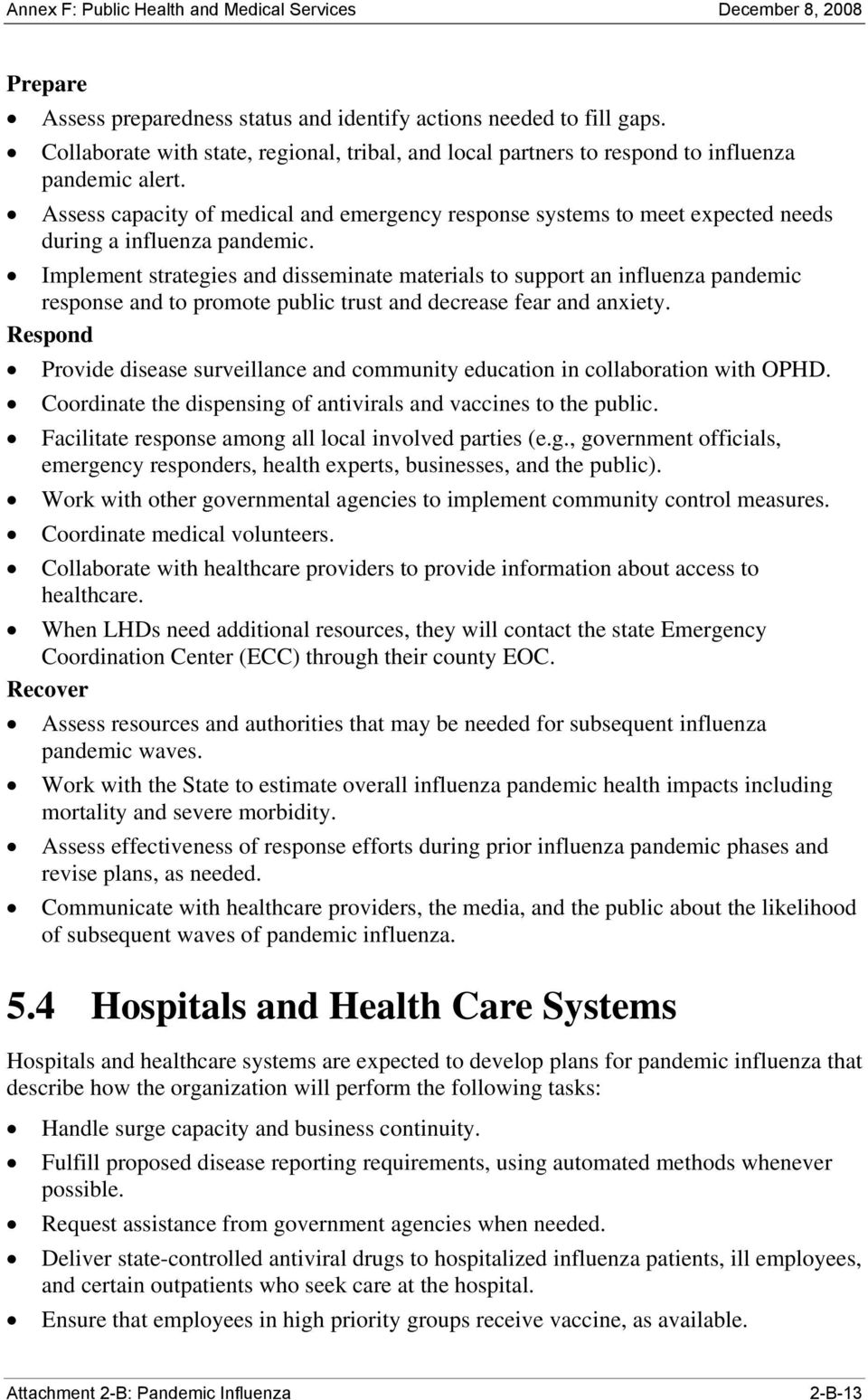
16 December 8, 2008 Hazard Appendix 2: Acute and Communicable Disease 6 VULNERABLE POPULATIONS Pandemic influenza may adversely impact persons who have special needs or live in institutions such as, assisted-living facilities, group homes, and jails. Additional planning efforts by these institutions will be necessary. The characteristics of the influenza outbreak may also require additional preparedness and response actions for certain segments of the population. These issues will be considered as the epidemiology of the influenza pandemic is clarified. For more details, see ASTHO (2008) and FEMA (2008). 7 PLAN MAINTENANCE This plan will be reviewed annually in October, prior to the start of the influenza season. It will also be reviewed and revised, as needed after emergency exercises, organizational change, or revisions in the federal guidance, or every two years at a minimum. 8 TRAINING AND EXERCISES The state strategic training plan identifies topics that are important to pandemic influenza response including epidemiology surge capacity, crisis and emergency risk communications, Laboratory Response Network, public health law, etc. The complex nature of pandemic influenza planning requires a series of on-going exercises to maintain proper readiness. Pandemic influenza response exercises have been incorporated into the public health emergency exercise program. The training schedule and materials are located on the Oregon HAN website ( Training materials can also be requested by contacting PHEP. 9 WEB SITES The links in this section were correct as of October World Health Organization (WHO) Pandemic alert and response Web site: Centers for Disease Control and Prevention (CDC) Influenza Web site: Strategic National Stockpile: U.S. Department of Health and Human Services (HHS) Pandemic and avian flu Web site: Pandemic Influenza Plan (2005): State of Oregon 2-B-14 Attachment 2-B: Pandemic Influenza
17 Annex F: Public Health and Medical Services December 8, 2008 Oregon Emergency Management Plan: CD Summary: Oregon Revised Statutes: Oregon Administrative Rules: arcweb.sos.state.or.us/banners/rules.htm Oregon Department of Human Services (DHS) Oregon Pandemic Influenza Plan: Oregon Health Alert Network: (Note that the HAN Web site requires a user account and password.) 10 REFERENCES 1. ASTHO, At-Risk Populations and Pandemic Influenza: Planning Guidance for State, Territorial, Tribal, and Local Health Departments DRAFT, October Centers for Disease Control and Prevention, Interim Pre-pandemic Guidance: Community Strategy for Pandemic Influenza, February, FEMA, Interim Emergency Management Planning Guide for Special Needs Populations, Version 1.0, August 15, Germann, T.C., et al., Mitigation Strategies for Pandemic Influenza in the United States, PNAS 130(15), 5935, Haber, M.J., et al., Effectiveness of Interventions to Reduce Contact Rates during a Simulated Influenza Pandemic, Journal of Emerging Infectious Diseases 13(4), 581, Available from 6. Harper, S.A., Fukuda, K., Uyeki, T.M., et al Prevention and Control of Influenza, Recommendations of the Advisory Committee on Immunization Practices (ACIP). MMWR, 54 (early release), Accessed on 4/24/08 at 7. Hodgkinson, D. Air Transport and Pandemic Influenza, Research Note. Downloaded from pdf. 8. Jefferson, T., Demicheli, V., Rivetti, D., Jones, M., DiPietrantonji, C., and Rivett, A., Antivirals for influenza in healthy adults: systematic review. Lancet, 367, Kaiser, L., Wat, C., Mills, T., Mahoney, P., Ward, P., and Hayden, F., Impact of oseltamivir treatment on influenza-related lower respiratory tract complications and hospitalizations. Arch Intern Med, 163, Attachment 2-B: Pandemic Influenza 2-B-15
18 December 8, 2008 Hazard Appendix 2: Acute and Communicable Disease 10. Markel, H., et al., Nonpharmaceutical Interventions Implemented by US Cities during the Influenza Pandemic, JAMA 298(6), 644, McGeer, A., Green K.A., Plevneshi, A. et al Antiviral therapy outcomes of influenza requiring hospitalization in Ontario, Canada. Clinical Infectious Diseases, 45 (15 December), Olson, D.R. & Heffernan, R.T., Surveillance Triggers for Community-Based Mitigation of Pandemic Influenza, Advances in Disease Surveillance 4, 182, Stiver, G The treatment of influenza with antiviral drugs. CMAJ, 168 (1), World Health Organization, Nonpharmaceutical Interventions for Pandemic Influenza, National and Community Measures, Emerging Infectious Diseases 12(1), 88, ACRONYMS AND GLOSSARY 11.1 List of Acronyms ACD ACDP AOC CDC CI/KR DHHS DHS ECC EOC ESF HAN ICS ILI LHD MAG NIMS OPHD Acute and Communicable Disease Acute and Communicable Disease Program Agency Operations Center Centers for Disease Control and Prevention Critical Infrastructure/Key Resources U.S. Department of Health and Human Services Department of Human Services Emergency Communications Center Emergency Operations Center Emergency Support Function Health Alert Network Incident Command System Influenza-like illness Local Health Department Medical Advisory Group National Incident Management System Oregon Public Health Division 2-B-16 Attachment 2-B: Pandemic Influenza

19 Annex F: Public Health and Medical Services December 8, 2008 OSPHL PHEP PICC PIO PPE SNS WHO Oregon State Public Health Laboratory Public Health Emergency Preparedness Program Pandemic Influenza Coordinating Committee Public Information Officer Personal protective equipment Strategic National Stockpile World Health Organization 11.2 Glossary Antiviral drug. A medication that destroys or inhibits the growth and reproduction of viruses. Case fatality ratio. The percent of those infected who die. CDC Stages. A series of numbers, 0-5, which describe the spread of an influenza pandemic within the United States. Community containment. The use of measures to limit the spread of contagious diseases by limiting contact between people who could be contagious to others. Canceling K-12 classes is one example. Epidemiology. The study of the distribution and determinants of disease in populations and the application of this to the control of health problems. Influenza A. A virus causing annual outbreaks of respiratory illness. Human influenza is classified as type A or type B. Type A is also found in other animals. Influenza-like illness (ILI). The presence of fever equal to or greater than F with a cough or sore throat. Isolation. The restriction of movement of people having or suspected of having a communicable disease. Laboratory Response Network. An integrated network of local, state, federal, military and international laboratories organized by the CDC. Novel influenza virus. An influenza virus subtype not previously or typically found in humans. Pandemic. A global outbreak of a disease. In this document, pandemic refers specifically to an outbreak of influenza. Quarantine. The restriction of movement of people who are believed to have been in contact with someone contagious. SNS. A federal cache of medical supplies and equipment used during emergencies and disasters. Attachment 2-B: Pandemic Influenza 2-B-17
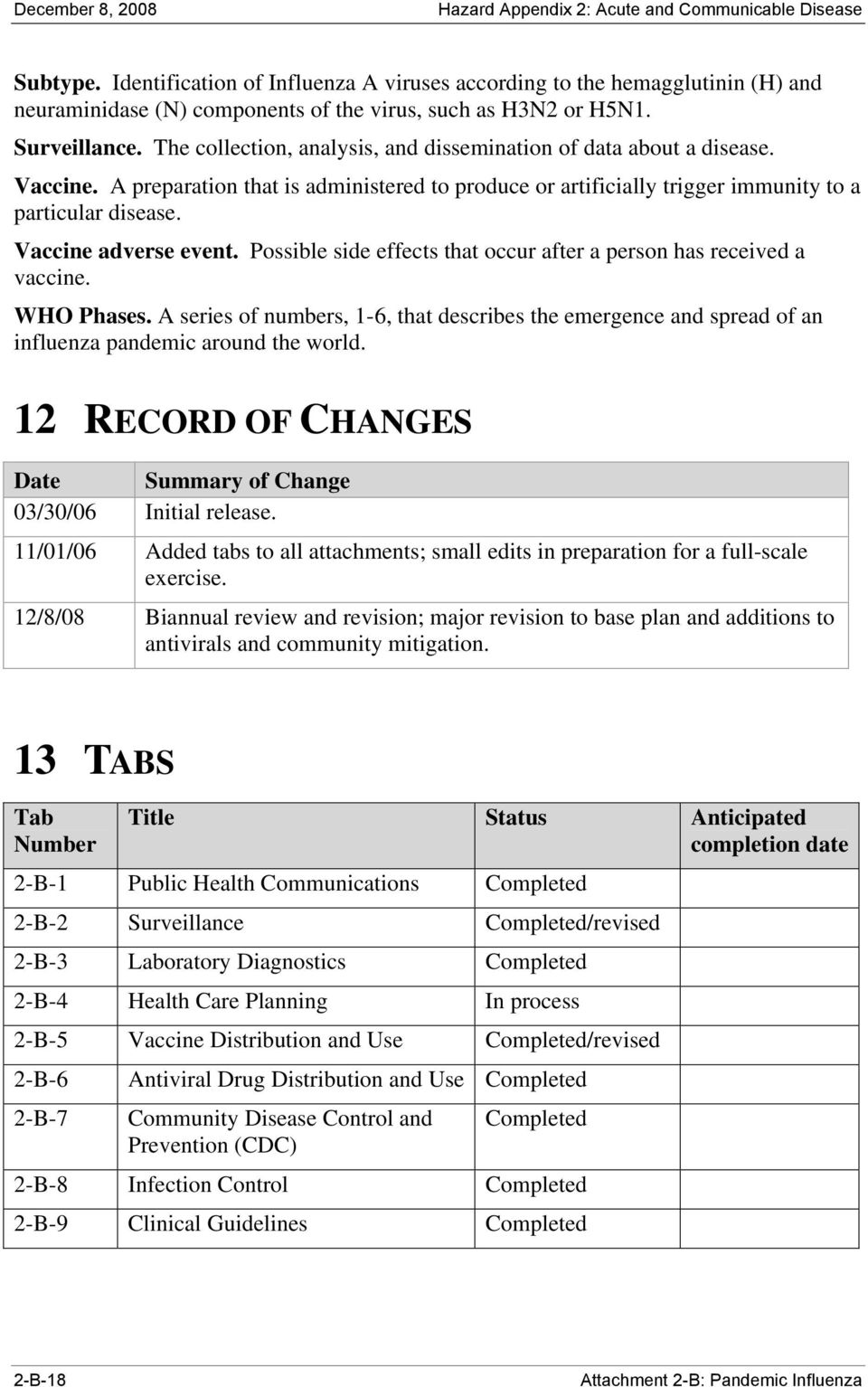
20 December 8, 2008 Hazard Appendix 2: Acute and Communicable Disease Subtype. Identification of Influenza A viruses according to the hemagglutinin (H) and neuraminidase (N) components of the virus, such as H3N2 or H5N1. Surveillance. The collection, analysis, and dissemination of data about a disease. Vaccine. A preparation that is administered to produce or artificially trigger immunity to a particular disease. Vaccine adverse event. Possible side effects that occur after a person has received a vaccine. WHO Phases. A series of numbers, 1-6, that describes the emergence and spread of an influenza pandemic around the world. 12 RECORD OF CHANGES Date Summary of Change 03/30/06 Initial release. 11/01/06 Added tabs to all attachments; small edits in preparation for a full-scale exercise. 12/8/08 Biannual review and revision; major revision to base plan and additions to antivirals and community mitigation. 13 TABS Tab Number Title Status Anticipated completion date 2-B-1 Public Health Communications Completed 2-B-2 Surveillance Completed/revised 2-B-3 Laboratory Diagnostics Completed 2-B-4 Health Care Planning In process 2-B-5 Vaccine Distribution and Use Completed/revised 2-B-6 Antiviral Drug Distribution and Use Completed 2-B-7 Community Disease Control and Prevention (CDC) Completed 2-B-8 Infection Control Completed 2-B-9 Clinical Guidelines Completed 2-B-18 Attachment 2-B: Pandemic Influenza
21 December 8, 2008 Hazard Appendix 2: Acute and Communicable Disease TAB 2-B-1 PUBLIC HEALTH COMMUNICATIONS TTab 2-B-1T Attachment 2-B: Pandemic Influenza
22 Annex F: Public Health and Medical Services November 13, 2008 TAB 2-B-1 PUBLIC HEALTH COMMUNICATIONS Timely, accurate, consistent and seamless communication with the public and among the various partners who will play a role in responding to a pandemic influenza outbreak is essential to protecting the lives of Oregon s citizens by ensuring that they have the information they need to protect themselves and their families. The public information response to a health emergency or disease outbreak is described in more detail in the Health and Medical annex of the Oregon Emergency Management Plan (See Annex F, Attachment C, Public Information and Risk Communications and Hazard Appendix 2, Acute and Communicable Disease Emergency Response Plan, SOP on Communication About Outbreaks or Individual Cases of Public Health Importance). Activities may be accelerated depending on the features of the outbreak and the level of public anxiety. An evolving communicable disease outbreak, such as pandemic influenza, may require a variety of measures in an attempt to contain the spread of the disease. Public trust is essential to containing the spread of disease and requires clear communication that addresses people s fears and concerns, answers their questions, and provides guidance on protective actions they can take. Understanding public perception and providing the right information at the right time can have a significant impact on maximizing public cooperation with response and recovery activities, avoiding misallocation or wasting of limited resources, and restoring normalcy. Assumptions The Centers for Disease Prevention and Control (CDC) will maintain a national central information clearinghouse accessible on the Internet and will develop generic guidelines and information templates that can be modified and adapted as needed at the state and local levels, including fact sheets and questions and answers on influenza, influenza vaccine and antiviral agents. The CDC and the Oregon Public Health Division (OPHD) will assist in providing strategies and guidelines for interacting with the media and communicating effectively with the public health and medical communities and the general public. OPHD will maintain a central information clearinghouse accessible on the Health Alert Network Web site and will develop Oregon-specific informational materials that can be modified and adapted as needed at the local level. Local health departments (LHDs) will provide localized communications resources during all phases of a pandemic disease outbreak. These resources are outlined in the all-hazards standard operating procedures for public health emergency preparedness, response and recovery (SOPs C.1, C.2 and C.3). The Oregon DHS offices that will be responsible for public health communications include the Public Information Coordination section of the DHS Public Health Tab 2-B-1: Public Health Communications 2-B-1-1
23 November 13, 2008 Hazard Appendix 2, Attachment 2-B: Pandemic Influenza Emergency Preparedness program, DHS Office of Public Affairs, and the Office of Disease Prevention and Epidemiology. Primary spokespeople during all phases of a pandemic will include the State Public Health Director, State Public Health Officer, State Epidemiologist and Manager of the Acute and Communicable Disease Program. Secondary spokespersons will include the directors of the Immunization and Public Health Emergency Preparedness programs and the State Pandemic Influenza planning manager. While much of the response to pandemic flu would be similar to other communicable respiratory diseases, some characteristics will create unique challenges for providing public information, including: Because the public health response to influenza will be prolonged, it will be necessary to explore creative solutions for keeping people informed and engaged throughout the pandemic. Because vaccine is unlikely to be available early in the pandemic, public health messages will need to focus on more traditional disease prevention strategies and community mitigation measures. Objectives Encourage and maintain coordination of information and consistent public messaging with key partners and stakeholders. Provide public health and health care partners with information they can share with their clients and patients. Keep key decision makers and partners informed regarding the status and progression of the disease, public health response activities, and any changes in issues. Target specific internal and external audiences, including those with special information needs. Advise the public and news media on the imposition of public health measures to control the spread of disease. Provide information to lessen the unnecessary health and economic impacts of disease on the state Assist in the public information aspects of behavioral health support activities Summary of Activities by Pandemic Period This section summarizes communication activities during each phase of preparedness, response and recovery, referenced by pandemic phase. For a complete list of activities, see Tab 2-B-1.1, Communications Checklist by Pandemic Phase. For a definition of the pandemic phases, see Table 2 in section 3.3.1, International and National Terminology. Many of the activities described in Annex F, Attachment F, Behavioral Health overlap with other communication activities and are not repeated here. 2-B-1-2 Tab 2-B-1: Public Health Communications
24 Annex F: Public Health and Medical Services November 13, 2008 Prepare (Interpandemic/Early Pandemic Alert, Phases 1-3) Ensure that appropriate policies, procedures and mechanisms are in place for a coordinated public information response at the federal, state, tribal, and local levels. Messages at this phase will focus on preparedness activities for state and local public health, tribal health staff, hospitals, businesses, individuals and families, community organizations and schools and other governmental and critical infrastructure partners. Prepare communication and educational materials about pandemic flu for distribution to health care providers, other emergency responders, the media, and the public (see Tab 2-B-1.6 for public fact sheets). Participate in communication planning and exercises. Respond (Pandemic Alert and Standby, Phases 4-5) Notify tribal and local health departments and hospitals of the pandemic alert phase. Activate the Joint Information System. Prepare fact sheets on the emergent novel influenza virus and methods of diagnosis. (Pandemic, Phase 6) Activate the Public Health Joint Information Center at a level consistent with the proximity of outbreaks to Oregon communities. Increase information flow to tribal and local health departments, medical providers and other partners and stakeholders. Focus messages on infection control measures, the numbers of new cases or deaths, and the availability and prioritization of treatment. Recover (Post-pandemic) Collaborate with education partners to develop and disseminate messages, and provide State Public Health spokespeople for the reopening of schools/reconvening of students, including media releases and briefings, letters to local education agencies, etc. Collaborate with transportation partners to develop and disseminate messages and provide State Public Health spokespeople to advise the public regarding the safety of public transportation. Tab 2-B-1: Public Health Communications 2-B-1-3
25 November 13, 2008 Hazard Appendix 2, Attachment 2-B: Pandemic Influenza Deactivate the Joint Information System when the Agency Operations Center has suspended operations and ended the Incident Command System. Evaluate the public information response and incorporate needed changes into plans. Active Issues Issue Public Information Hotline and Communications Surge Capacity Telephone surge capacity in the Portland State Office Building Efficient Web-posting of rapidly changing health information Recommendation Evaluate communication surge capacity within state and local government; identify and train additional staff to serve in a public health Joint Information Center (JIC) Redraft standard operating procedures, train call takers (included in public information surge capacity, above) and conduct drills for a hotline of 12 incoming lines No viable solution for this issue has been identified. Anticipated Completion On-going?? Subtabs Tab Number Tab Title 2-B-1.1 Communications Checklist by Pandemic Phase Status Completed 2-B-1.2 Communication Planning Tools Completed 2-B-1.3 Influenza Talking Points Completed 2-B-1.4 Normal Influenza Season Messages Completed 2-B-1.5 Avian and Pandemic Influenza FAQs Completed 2-B-1.6 Fact Sheets Completed 2-B-1.7 Influenza Vaccination Adverse Event Communication Plan Completed Anticipated Completion Date 2-B-1-4 Tab 2-B-1: Public Health Communications
26 Annex F: Public Health and Medical Services November 13, 2008 SUBTAB 2-B-1.1 COMMUNICATIONS CHECKLIST BY PANDEMIC PHASE Tab 2-B-1: Public Health Communications Subtab 2-B-1.1
27 Pandemic Influenza Public Health Communications Activities Checklist by Pandemic Phase Prepare Interpandemic Period Phases 1 & 2 During the Interpandemic phase, state and local public health s responsibility is to: Assess and monitor readiness to meet communications needs in preparation for an influenza pandemic, including regular review and update of communications plans. Evaluate and address gaps in relationships with key government/jurisdictional and private partners. Identify key internal and external partners and stakeholders, establish effective relationships and channels of communication, and conduct collaborative planning to help ensure a coordinated response. Establish appropriate policies, procedures and mechanisms for joint public information planning. Develop agreements and establish the protocols for communicating official information. Create and maintain current and consistent messages and information for the news media, the public, health care workers and other emergency response partners. Establish expedited procedures for reviewing and approving pandemic influenzarelated messages and materials. Review, establish procedures and test technology for disseminating information through a broad array of channels, including the use of networks, Web sites, broadcast fax, list servers, mass mailings, etc. Plan and coordinate emergency communication activities with private industry, education, and nonprofit partners (e.g., local American Red Cross chapters). Develop materials and channels for disseminating information to schools, major employers, day care centers, senior care facilities and populations for whom English is not their primary language. Identify and train lead subject-specific spokespersons. Provide public health communications staff with training on risk communications for use during an influenza pandemic. Develop and maintain up-to-date communications contacts. Participate in exercises and other collaborative preparations to assess readiness. Develop a plan for addressing rumors and false reports regarding pandemic influenza threats. Confirm any contingency contracts or memoranda of understanding needed for communications resources during a pandemic, such as translation and interpretation services, radio advertising, emergency printing, public opinion research, public awareness/prevention campaigns, etc. Assess preparedness, address gaps and provide necessary training and other resources. Continue routine dissemination of influenza information through the following channels: Public Health Communications Checklist 1
28 5/1/08 News Media CD Summary Monthly CD disease surveillance report. DHS ACDP web site Develop communication materials for health care workers and other emergency response partners, the media, and the public about: Basic medical treatment Access to care Prevention strategies and infection control practices Isolation and quarantine Vaccine availability and prioritization in settings of no, moderate, and severe shortages Appropriate use of antiviral medications Develop educational materials for health professionals for reporting adverse events for influenza antiviral medications and vaccine using: MedWatch for antiviral meds VAERS for vaccines Continue to develop policies, procedures and mechanisms for providing public information before, during and after a pandemic influenza outbreak, as described in detail in Annex F, Attachment C, Public Information and Risk Communications SOP C.1 Preparedness (Pre-Emergency) Communications, and Appendix 2, Acute and Communicable Disease Emergency Response Plan, SOP on Communication About Outbreaks or Individual Cases of Public Health Importance. Enhance existing partnerships to identify at-risk, hard-to-reach individuals and define the communication infrastructure needed to ensure vaccination of these populations (homebound, homeless, poor, uninsured, immigrants or isolated groups). Develop a plan to ensure communication around access to vaccination/ treatment for high-risk/low-access populations (homeless, homebound, undocumented aliens, etc.). Establish and maintain a Web site with current information. Prepare contingency plans to manage increased media demands. Identify and provide information on ways for people to access help, such as hotlines, psychological resources, etc. Develop plans for dealing with the psychosocial aspects of a pandemic influenza outbreak (see Annex F, Attachment F, Behavioral Health). Pandemic Alert Period Phase 3 Continue preparatory activities as described in detail in Annex F, Attachment C, Public Information and Risk Communications SOP C.1 Preparedness (Pre- Emergency) Communications, and Appendix 2, Acute and Communicable Disease Emergency Response Plan, SOP on Communication About Outbreaks or Individual Cases of Public Health Importance. Public Health Communications Checklist 2
29 5/1/08 Public Health Preparedness and Acute and Communicable Disease will assemble fact sheets for health care professionals about an emergent novel virus and methods for diagnosis, including viral isolation. Notify local health departments, infection control professionals, Senior & Disabled Services Division, Indian Health Service, and other relevant health care professionals and associations of the Novel Virus Alert status through the Health Alert Network, and DHS Web site postings. Ensure local health departments have plans and mechanisms in place to conduct outreach to community partners to promote social distancing, including public transportation, operators of large venues for sporting events and other activities, businesses, education, faith-based communities, those who provide services to vulnerable populations, critical infrastructure partners and others who have been identified as playing a role in a pandemic. The Public Health Preparedness program will notify the Oregon Office of Emergency Management, other pertinent government officials and state legislators of the Novel Virus Alert Phase and potential need for additional resources. Conduct tests of the health care provider broadcast fax emergency notification system no less than twice a year. Exercise Joint Information System and Joint Information Center protocols at least twice each year. Notify Oregon Association of Hospitals and Healthcare Systems of the Novel Virus Alert. Update partners and stakeholders as additional information is obtained on vaccine/antiviral availability. Notify Oregon Nurses Association and Oregon Medical Association to identify health care workers willing to provide care and administer vaccine in a pandemic influenza setting (see Annex F, Attachment D, Internal and Partner Communications, SOP D.10, Using the Oregon Health Care Volunteer System). Notify local health departments to activate their behavioral health plans and mental health and social work support networks for influenza patients, their families, and those psychologically affected by the pandemic. Ensure state employees, local health departments and media are updated. Conduct community education and preparedness campaigns and disseminate preparedness messages to the public, including populations with special information needs, those who are vulnerable and those for whom English is a second language (see Annex F, Attachment C, SOP C.12, Communicating with People with Limited English Proficiency, and SOP C.13, Translating Critical News Releases). Local health departments will notify clinicians, media, and other key stakeholders in their jurisdictions of the Novel Virus Alert Status. Cooperate in strategies to inform travelers regarding pandemic influenza. Activate plans for disseminating information to schools, major employers, day care centers, senior care facilities and populations for whom English is not their primary language. Activate plans for dealing with the psychosocial aspects of a pandemic influenza outbreak (see Annex F, Attachment F, Behavioral Health). Public Health Communications Checklist 3
30 5/1/08 Provide educational information for the business community and engage them in pandemic influenza continuity planning. Respond Pandemic Alert and Standby Period, Phases 4 & 5 Ensure local health department and hospital public information officers are notified regarding the Pandemic Alert phase. Provide reliable influenza information and convey the state s pandemic plan to all state employees. Activate the Joint Information System (see Annex F, Attachment C, Public Information and Risk Communications SOP C.4, Joint Information System/Center Operations), including use of the Virtual Joint Information Center on the Health Alert Network Web site (see SOP C.14, Using the Virtual JIC on the Health Alert Network), and use of the broadcast fax notification system for health care providers (see Annex F, Attachment D, Internal and Partner Communications, SOP D.9, Using the Broadcast Fax System). Public information will include travel alerts, guidelines on limiting the spread of the disease, and information about when and where to obtain medical care. Distribute informational materials to workplaces and the community at large explaining recommended personal protective actions and the rationale and steps to take regarding social distancing. Disseminate guidance to local health departments to share with community businesses and organizations for canceling large public gatherings. Distribute informational materials to businesses to encourage ill employees to stay home and identify ill individuals in the workplace (including guidance regarding who needs to be sent home or for treatment and where they should go). Advise travelers and airlines operating between Oregon and endemic areas about heightened disease surveillance and disease containment measures. Advise public safety answering points (911 centers) regarding public messaging and sources of credible information. Notify local health departments, infection control professionals, Senior & Disabled Services Division, Indian Health Service, and other relevant health care professionals of the Pandemic Alert status through the Health Alert Network and Web postings. (refer to Attachment C, Public Information and Risk Communications SOP C.2, Response (Emergency) Communications, and Attachment D, Internal and Partner Communications, SOP D.4, Using the HAN Alerting System; SOP D.5, Sending HAN ORCD Alerts; and SOP D.9, Using the Broadcast Fax System). Include information on: Geographic area of origin of potential cases Clinical symptoms Diagnosis, treatment, and prophylaxis Use HAN alerts to advise hospitals and other treatment facilities to recommend patients with influenza-like illness remain at home. Conduct research to determine public perceptions regarding the novel strain of influenza, and use the information gathered to develop key messages. Public Health Communications Checklist 4
31 5/1/08 Research and replicate best communications practices in areas where the new influenza strain has emerged. Activate and publicize the disease information hotline and Web site, including prerecorded messages in multiple languages (see Attachment C, Public Information and Risk Communications SOP C.6, Telephone Surge Capacities). Ensure local health departments have plans in place for rapid remote identification of possible cases through hotline intake forms. Continue preparatory activities as described in detail in Attachment C, Public Information and Risk Communications SOPs C.1 Prepare (Pre-Emergency) Communications and C.2 Response (Emergency) Communications. Pandemic Period, Phase 6 Maintain operation of the Joint Information System and prepare to activate the Joint Information Center if needed (see Attachment C, Public Information and Risk Communications, SOP C.4, Joint Information System/Center Operations Plan, and SOP C.14, Using the Virtual JIC on the Health Alert Network). If cases have been confirmed in Oregon or neighboring states and public anxiety warrants, or if the State Emergency Coordination Center or Agency Operations Center has been activated, consider activation of the Joint Information Center (see Attachment C, Public Information and Risk Communications, SOP C.4, Joint Information System/Center Operations Plan). Notify local health departments, infection control professionals, Senior & Disabled Services Division, Indian Health Service, and other relevant health care professionals of the Pandemic Imminent status through the Health Alert Network, broadcast fax system, and Web postings (see Attachment C, Public Information and Risk Communications SOP C.2, Response (Emergency) Communications, and Attachment D, Internal and Partner Communications, SOP D.4, Using the HAN Alerting System; SOP D.5, Sending HAN ORCD Alerts; and SOP D.9, Using the Broadcast Fax System). Include information on: Geographic area of origin of potential cases Clinical symptoms Criteria for diagnosis, treatment, and prophylaxis Triage protocols to identify critically ill patients Epidemiological characteristics Infection control measures recommended by CDC Protective actions and personal protective equipment for responding staff. Use HAN alerts to advise hospitals and other treatment facilities to recommend patients with influenza-like illness remain at home. Notify news media of Pandemic Imminent status through a media briefing or advisory. Distribute informational materials to workplaces and the community at large explaining recommended personal protective actions and the rationale and steps to take regarding social distancing. Disseminate guidance to local health departments to share with community businesses and organizations for canceling large public gatherings. Public Health Communications Checklist 5
32 5/1/08 Distribute informational materials to businesses to encourage ill employees to stay home and identify ill individuals in the workplace (including guidance regarding who needs to be sent home or for treatment and where they should go). Use the news media and other dissemination channels to recommend that people with influenza-like illness remain at home, and to request voluntary household quarantine of family members if there is a sick person at home, including how long to stay home and how to protect other people if someone must venture out. Use the news media and other dissemination channels to publicize self-registration of people with influenza-like illness on the Web-based surveillance system or recorded phone line. Use the news media, alerts to travel agencies and any existing channels at Oregon airports to advise travelers and airlines operating between Oregon and endemic areas about heightened disease surveillance and disease containment measures. Activate telephone surge plan, including the use of live call takers and scale as needed (see Attachment C, Public Information and Risk Communications SOP C.6, Telephone Surge Capacities). Log all calls and news media coverage and analyze for trends in concerns and questions and use this information to update frequently asked questions and talking points. Ensure public safety answering points (911 and 211 operators) have the information they need to screen and refer callers to appropriate sources of credible information or triage and treatment centers, and to collect surveillance data, as appropriate. Notify business, government, transportation and other critical infrastructure partners and advise regarding worker safety, employee health monitoring, use of personal protective equipment, and protective action training. See Attachment C, Public Information and Risk Communications SOP C.5 SmartBook, including contact databases for Community Transit Options, Transportation Partners and Major Businesses. Issue transportation travel advisories, including discouraging non-essential travel to affected regions and how to safely ride public transportation during an outbreak. This could include bus placards or other means to display or disseminate alert levels and situational reports to the public when using transportation systems. Issue public service announcements and initiate public safety campaigns regarding how to limit the spread of the virus by frequently washing hands, using hand sanitizers and face masks, and avoiding close contact with other people. Obtain and track information daily on the numbers and location of newly hospitalized cases, newly quarantined persons, and hospitals with pandemic influenza cases. Use daily statistical information (cited in previous bullet) to determine priorities among community outreach and education efforts and to prepare updates for the news media, partners, stakeholders and the general public. Update partners and stakeholders as additional information is obtained on: New cases Quarantine orders Vaccine/antiviral availability Prioritized distribution plan Disease prevention and community mitigation measures. Public Health Communications Checklist 6
33 5/1/08 Frequently update the news media and the public on infection control and transmission measures. Collaborate with education partners to disseminate information regarding cancellation of classes and other mitigation measures in schools and day care centers. Advise the public and news media on the imposition of community control measures (such as school and day care closures, transportation and travel advisories, cancellation of community events, voluntary or mandatory quarantine or isolation) following federal recommendations. Continue to publicize the disease information hotline and Web site (see Attachment C, Public Information and Risk Communications SOP C.6, Telephone Surge Capacities). Continually monitor news media coverage and initiate media call outs or other strategies to quickly address harmful rumors, misinformation, stigmatization issues, or unrealistic expectations of public health or health care response activities. Maintain scheduled access for news media to pandemic subject matter experts and spokespeople. Continue activities as described in detail in Attachment C, Public Information and Risk Communications SOPs C.1 Prepare (Pre-Emergency) Communications and C.2 Response (Emergency) Communications. Recovery Post-pandemic Period Follow-up with the news media and use other communication channels to make sure people are aware that the pandemic has ended. Provide information and guidance to businesses, workplaces and large venues regarding recovery/reopening of activities that were curtailed or closed during the pandemic. Follow-up with public messages regarding reconvening students, letting people know it s safe to ride mass transit, attend large social gatherings, etc. Deactivate Joint Information System and Center and participate in After-Action Report. Conduct research to formally evaluate the public information program, based on the stated objectives. Convene a team to analyze the research and make recommendations for future communicable disease outbreaks or other public health emergencies. Incorporate recommendations into relevant planning documents. Public Health Communications Checklist 7
34 Annex F: Public Health and Medical Services November 13, 2008 SUBTAB 2-B-1.2 COMMUNICATION PLANNING TOOLS Tab 2-B-1: Public Health Communications Subtab 2-B-1.2
35 Influenza Communication Planning Audiences and Tools A B C D E F G H I J K L M N O P Q Fact Key Talking Media HAN ORCD HAN DHS Conference CD Periodic Sheets Messages Points Releases Updates FAQs Posters Flyers Meetings Messages Alerts Website Website Calls Summary Briefings DHS Executive Staff X X X X X X X Governor's Office X X X X X X Legislators X X X X X Congressional Leaders X X X X X ESF-8 Advisory Group X X X X X X X X X CLHO PHEP Leadership Group X X X X X X X X X Local Health Departments X X X X X X X X X X Hospitals X X X X X X X X Clinicians X X X X Health Care Professional Associations and Licensing Boards X X X X Oregon Medical Association X X X X Oregon Nurses Association X X X X Oregon Pharmacy Association X X X X Oregon Association of Hospitals X X X X Association of Professionals in Infection Control X X X X Populations with Special Information Needs X X X X X Non-English Speaking X X X X X Senior Citizens X X X X X Native Americans X X X X X First Responders X X X X X X X Children X X X X X X X Major Employers X X X X X X Neighboring States X X X X X X X Partner State Agencies X X X X X X X X X
36 Influenza Communication Planning Grid Goal: To ensure timely and consistent communications regarding current and emerging influenza issues among partners, and with key stakeholders and the general public. Key Stakeholders Objective(s) Strategies Tactics/Tools Timeline Who's Responsible? Governor/Governor's Advisors Periodic briefings As needed Mike Skeels and Ann and Communication Staff Snyder Keep the Governor informed regarding the current influenza season, vaccine supplies, the international progression of Avian influenza, and pandemic planning, preparedness and response activities Use a combination of communication tools to maintain on-going communication and coordination Share media releases Share key messages/talking points and FAQs As needed As needed Ann Snyder Ann Snyder Phone calls and messages As needed Mike Skeels and Ann Snyder State Legislators Keep the Legislature informed regarding the current influenza season, vaccine supplies, the international progression of Avian influenza, and pandemic planning, preparedness and response activities Use a combination of tools to maintain on-going communication and coordination Share key messages/talking points and FAQs As needed Katy King Forward related media releases As appropriate Katy King
37 Influenza Communication Planning Grid Congressional Representatives Keep Oregon's congressional delegation informed regarding the current influenza season, vaccine supplies, the international progression of Avian influenza, and pandemic planning, preparedness and response activities Use a combination of tools to maintain on-going communication and coordination Share key messages/talking points and FAQs As needed Katy King Department of Human Services Executive Staff Keep DHS Management informed regarding the current influenza season, vaccine supplies, the international progression of Avian influenza, and pandemic planning, preparedness and response activities Use a combination of tools to maintain on-going communication and coordination Forward related media releases Regular updates As appropriate Katy King As needed Mike Skeels and Ann Snyder Share key messages/talking points and FAQs As needed Ann Snyder ESF 8 Advisory Committee Keep ESF 8 Advisory Group members informed regarding the current influenza season, vaccine supplies, the international progression of Avian influenza, and pandemic planning, preparedness and response activities Use a combination of tools to maintain on-going communication and coordination Forward related media releases Regular updates and meetings As appropriate Ann Snyder As appropriate Paul Lewis and Mike Harryman
38 Influenza Communication Planning Grid Share key messages/talking points and FAQs Weekly or as updated Paul Lewis and Mike Harryman Public Health Emergency Keep PHEPLT members Preparedness Leadership Team (Including representatives of Conference of Local Health Officials) informed regarding the current influenza season, vaccine supplies, the international progression of Avian influenza, and pandemic planning, preparedness and response activities Provide regular updates on the progression of the disease around the state and vaccine supplies Forward related media releases Use monthly meetings, and conference calls As appropriate Paul Lewis and Mike Harryman As needed Jessica Guernsey and Mike Harryman Local Health Departments Keep LHDs informed Provide regular updates regarding the current influenza on the progression of the season, vaccine supplies, the disease and vaccine international progression of availability around the Avian influenza, and pandemic state planning, preparedness and response activities Monthly conference calls 1st Tuesday of each month Randy Shaw and Beth Crane Local meetings and consultation Use Health Alert Network messages to provide information to key LHD staff Share key messages/talking points and FAQs As scheduled On-going PHEP Liaisons Kevin Cradock, Nick May, Paul Cieslak and Christie Holmgren As appropriate Christie Holmgren Forward related media releases As appropriate Christie Holmgren
39 Influenza Communication Planning Grid Hospitals Full participation by all LHDs in Communication Program Keep hospitals informed regarding the current influenza season, vaccine supplies, the international progression of Avian influenza, and pandemic planning, preparedness and response activities Engage LHD PIOs in dissemination of public information by providing them with a variety of communication tools and sharing prepared educational and prevention materials and messages. Use a combination of tools to maintain on-going communication and coordination Distribute basic fact sheets, key messages, talking points, FAQs, etc. and post on HAN document library As updated Christie Holmgren and by subscription to public information folders on HAN LHD PIO As needed Christie Holmgren Conference Calls Use PIO listserv to As appropriate Christie Holmgren send and share information Forward related As appropriate Christie Holmgren media releases Post information On-going Jere High and Mike on HAN Web site Swinhoe and distribute messages through HRSA Regions updates to Regional Coordinators Use hospital PIO listserv to share media releases, fact sheets and other information On-going Jere High and Mike Swinhoe As appropriate Christie Holmgren
40 Influenza Communication Planning Grid Clinics/Primary Care Keep these groups informed Providers/Healthcare Workers regarding the current influenza season, vaccine supplies, the international progression of Avian influenza, and pandemic planning, preparedness and response activities Use a combination of tools to maintain on-going communication and coordination ORCD-Alert and CD Summary On-going ACDP Partner State and Federal Agencies, including Departments of Agriculture, Departments of Fish and Wildlife, U.S. Food and Drug Administration, State Forestry, OSU Animal Health, OSU Extension and Commodities Commissions Keep partner state and federal agencies informed regarding the current influenza season, vaccine supplies, the international progression of Avian influenza, and pandemic planning, preparedness and response activities Use a combination of tools to maintain on-going communication and coordination Maintain collaborative Use a combination of tools communication to support dual-tpurpose messaging that raises communication and maintain on-going awareness of the veterinary coordination issues associated with Avian Influenza Fact sheets and FAQs Sharing of information with healthcare professional associations and licensing boards Periodic briefings, updates, media releases, etc. Periodic briefings, updates, sharing of media releases, key messages, etc. As appropriate Christie Holmgren As appropriate ACDP and Christie Holmgren On-going On-going Barb Progulske, Paul Lewis, Christie Holmgren and Bonnie Widerburg Barb Progulske, Christie Holmgren, Bonnie Widerburg and Patrick O'neill
41 Influenza Communication Planning Grid Office of Economic Development Keep Office of Economic Development informed regarding the international progression of Avian influenza, potential economic impacts and pandemic planning, preparedness and response activities Periodic briefings and forwarding of media releases On-going Ann Snyder to Governor's office and Governor's office to OED News Media Keep news media informed regarding the current influenza season, vaccine supplies, the international progression of Avian influenza, and pandemic planning, preparedness and response activities Use a combination of tools to maintain on-going communication Media releases, media briefings, Web site On-going Bonnie Widerburg, Patrick O'neill, Barb Progulske and Lorraine Duncan General Public Keep the public informed regarding the current influenza season, vaccine supplies, the international progression of Avian influenza, and pandemic planning, preparedness and response activities Use a combination of tools to maintain on-going communication News media and DHS Web site On-going Christie Holmgren, Bonnie Widerburg, Patrick O'neill, ACDP, Immunization Program, Hanna Swenson, Rocke Klockner and Leslie Byster Special Populations Keep populations that may have special information needs informed regarding the current influenza season, vaccine recommendations and availability and personal protective actions. Use a combination of tools to maintain on-going communication Develop special informational materials, as needed, for each audience On-going Christie Holmgren, Bonnie Widerburg, Patrick O'neill, Barb Progulske and Paul Lewis
42 Influenza Communication Planning Grid Poultry Workers Develop informational materials on disease prevention and safe handling procedures in conjunction with Oregon Department of Agriculture Distribute informational materials through employers On-going Oregon Department of Agriculture and Barb Progulske Non-English Speaking Translate informational materials into the most common languages Distribute through As materials foreign language are developed media, local health and translated departments, DHS Field Offices and Web sites Christie Holmgren, DHS Offices of Communications and Multicultural Affairs and DHS Field Offices Distribute through As materials organizations and are developed agencies that and translated provide services to non-english speaking populations Christie Holmgren, DHS Offices of Communications and Multicultural Affairs, DHS Field Offices and local health departments Senior Citizens Prepare appropriate materials for those in assisted living environments Distribute through Area Agencies on Aging, senior citizen centers, retirement homes, long-term care, acute-care and skilled nursing facilities On-going Seniors and People with Disabilities Program, Lorraine Duncan, Mimi Luther, Martha Skiles, Christie Holmgren and Cary Greenwood Native Americans Use a combination of tools to maintain on-going communication and coordination Periodic briefings, updates, media releases, etc. On-going DHS Indian Health Services and Carey Palm
43 Influenza Communication Planning Grid First Responders Keep first responders informed Prepare appropriate regarding the current influenza materials for preventing season, vaccine supplies, the the spread of disease international progression of among first responders Avian influenza, and pandemic planning, preparedness and response activities Distribute through state and local EMS, police and fire As materials are developed DHS EMS, Christie Holmgren, Bonnie Widerburg, Patrick O'neill and Trish Neiworth Children Keep schools, childcare Prepare appropriate centers and parents informed materials for preventing regarding the current influenza the spread of disease season, vaccine supplies, the among small children international progression of Avian influenza, and pandemic planning, preparedness and response activities Distribute through childcare centers, schools and offices of pediatricians As materials are developed DHS Office of Schoolbased Health Centers, Oregon Department of Education, Oregon Employment Department Childcare Division, Christie Holmgren, Bonnie Widerburg and Patrick O'neill Major Employers Keep major employers Prepare appropriate informed regarding the current materials for preventing influenza season, vaccine the spread of disease in supplies, the international the workplace. progression of Avian influenza, and pandemic planning, preparedness and response activities Distribute through the DEQ's database of major Oregon employers, and business associations As materials are developed Christie Holmgren and Michael Kubler Neighboring States Keep neighboring states informed regarding Oregon's current influenza season, vaccine supplies, and pandemic planning, preparedness and response activities Use a combination of tools to maintain on-going communication and coordination Periodic briefings, updates, media releases, etc. On-going Christie Holmgren, Bonnie Widerburg and Patrick O'neill
44 Influenza Communication Planning Grid Other Stakeholders and Partners, including FDA, Metro Parks and Greenspaces, Audubon Society, US Fish & Wildlife Service, US Army Corps of Engineers, US Geological Survey, Oregon Veterinary Medicine Association, Oregon Zoo Keep other stakeholders and partners informed regarding the international progression of Avian influenza, and pandemic planning, preparedness and response activities In conjunction with other state agencies who have a role in responding to avian influnza, use a combination of tools to maintain on-going communication and coordination Periodic briefings, updates, media releases, etc. On-going Oregon Department of Agriculture, Barb Progulske, Emilio DeBess, Christie Holmgren and Bonnie Widerburg
45 Annex F: Public Health and Medical Services November 13, 2008 SUBTAB 2-B-1.3 INFLUENZA TALKING POINTS Tab 2-B-1: Public Health Communications Subtab 2-B-1.3
46 Pandemic/Avian Flu Speaking Points Continued reports of avian flu and the President's announcement of a plan for confronting pandemic flu have put these topics squarely in the spotlight. The terms pandemic flu and avian flu are being used interchangeably in much of the media coverage and it is important to make distinctions between the two. Key Messages: We believe that people who are well informed can make better decisions, and we are committed to providing information that addresses people s needs and concerns. At this point, we do not expect avian flu to appear any time soon, either in bird populations or in people. State and local public health professionals are experienced at detecting and controlling disease outbreaks. We have sound pandemic plans in place, but need to do more training and practicing for those who would be expected to respond. It is important that we prepare for a pandemic of any disease and not focus on only avian flu or any other single disease. Basic disease detection and control is the most useful preparation. Vaccines and medications may be of value in some, but not most cases. The Oregon Department of Agriculture, state and federal wildlife agencies, and state and local public health programs are coordinating avian flu surveillance efforts. Avian Flu Avian flu is a type of influenza that occurs naturally among birds. One strain of this virus, H5N1, was found in Asia in 1997 and recently spread to Europe. Some humans have contracted the illness, mostly through close contact with infected domesticated birds, such as poultry. This is a concern, because although only about 120 cases have been identified in humans, half of these have died. Avian flu is not currently transmissible from person-to-person but if the virus mutates to make this possible a pandemic could occur, because humans have little or no immunity to H5N1. There is currently no approved human vaccine against avian flu, although an experimental one is being tested.
47 We don't recommend stockpiling Tamiflu or Relenza. Supplies need to be reserved for people at risk of complications from annual influenza. Nor is it clear it will work for new strains of influenza, and correct dosage is not known. State and federal agricultural agencies are conducting ongoing poultry surveillance for any sign of avian flu. Surveillance of migratory birds for avian flu is being conducted through state and federal wild-life agencies. There is no evidence that H5N1 influenza has spread to wild or domestic birds in North America. Pandemic flu A pandemic is the global occurrence of epidemic disease that occurs when a newer virulent influenza strain begins to spread in the human population. Flu pandemics are known to have occurred periodically in the past several hundred years. The 1918 Spanish flu was the 20 th century s largest pandemic and killed at least 500,000 people in the United States and up to 40 million worldwide. There were also smaller pandemics in 1957 and The Asian flu in 1957 caused 70,000 deaths, and the Hong Kong flu in 1968 caused 34,000 deaths in the US. A major pandemic would overwhelm public health and health care systems and create widespread social disruption. Detecting a pandemic relies on disease prevention, a core public health function that informs us when cases of a new disease arrive, how many people are sick or at risk of infection and where the disease is spreading. Lab testing is critical for identifying specific details of the pandemic disease. The Oregon State Public Health Laboratory is a key player with respect to testing specimens and forwarding them to the federal Centers for Disease Control and Prevention when necessary. At any time during a pandemic, the need for vaccine will likely exceed the supply. Because it takes 6 to 12 months to produce new vaccine, there would be little available at the start of the first pandemic wave. Antiviral drug supplies will be inadequate in the early stages of a pandemic. In a pandemic, the community systems we rely on--health care, schools, work, travel, church and social events--will be severely disrupted. Disease control will require individual and community action:
48 o Personal hygiene measures--washing hands frequently, covering coughs, staying home when ill, staying informed of the situation. o Community measures--voluntary isolation of ill people, limiting illness to specific wards or hospitals, curtailing travel, canceling large events (basketball games, concerts, etc). Pandemic planning Our goal is to minimize illness and death in what would clearly be a crisis. Public health officials in the United States and around the globe are planning for pandemic flu. Oregon has a written plan but we still have work to do. For example: o Every county must have a plan that coordinates with the state plan, which must fit with the federal plan. o Because a major pandemic would quickly overwhelm public and private healthcare providers and hospitals, it is critical that we work together as we prepare. o We need to practice our plans so that all organizations that play a role are trained and ready. (A recent example is the statewide exercise to test how public health and private healthcare systems would work together to deliver federal medical supplies throughout Oregon in a major disease outbreak.) o A major component of our plan is effective communication among state and local public health, with health care providers and the public. (An example is our new "blast-fax" system that will allow us to get information to every health care provider in Oregon within two hours of a crisis.) Drug distribution will likely be a public health responsibility. Federal authorities are developing guidelines for how best to use drugs if they are in scarce supply (for example, should they be reserved for emergency responders, health care workers, public safety, etc.). The President's plan calls for spending billions on stockpiling vaccine, medications, developing new vaccine and the purchase of 20 million doses of a new avian vaccine that is in clinical trial. Also included is building up national reserves of antiviral medicines. We are very concerned that the President's plan sets aside only $100 million total for state and local government across the country. A strong public health infrastructure is critical for detecting and controlling a pandemic.
49 !DRAFT! Pandemic Flu Preparedness Talking Points Situation: The outbreak of highly pathogenic H5N1 avian influenza has prompted some people to think about the pandemic influenza outbreak of 1918 and to wonder whether Oregon is ready to deal with a similar outbreak today. Key Messages: To be prepared for the flu and all other public health threats, Oregon must have a strong public health system. Thanks, in part, to recent federal funding for public health preparedness planning, Oregon is in better shape than ever to deal with all sorts of public health emergencies. This funding has provided the resources to vastly improve state and local ability to identify, investigate and control outbreaks of infectious disease. State public health is working closely with local health departments, hospitals and healthcare facilities in every community in Oregon to assess our current ability to respond, identify gaps in preparedness, and ultimately ensure we have the capacity for a swift and coordinated response at all levels. Supporting Information: The Public Health section of the State of Oregon Emergency Plan contains a number of hazard- and disease-specific response plans, including pandemic influenza. State and local public health deal routinely with highly infectious disease outbreaks and have tools in place to investigate outbreaks and control the spread of disease. The Department of Human Services Health Services Acute and Communicable Disease Prevention (ACDP) has formed an Urgent Epidemiologic Response Team (UERT) to assist with outbreaks statewide. Just this year, UERT epidemiologists have assisted with 155 local infectious disease outbreaks in Oregon. By law, Oregon s approximately 2,000 certified laboratories routinely report test results for nearly 50 bacterial, parasitic and viral communicable diseases to local public health authorities. In addition, there are more than 60 laboratories in Oregon acting as disease sentinels. These labs look for bacteria that may be used as agents of bioterrorism and quickly refer specimens to the Oregon State Public Health Laboratory for additional testing and confirmation. Crises like pandemic flu will require some citizens to make sacrifices for the common good. For example, public events might have to be canceled;
50 or ill persons might be asked to stay home so as to lessen the chances of exposing others. Recent legislation expanded the power of the State Public Health Officer to take necessary measures to protect public health in an emergency or impending public health crisis by implementing special reporting procedures, isolation of those who are ill and quarantine of those who have been exposed. DHS Health Services continuously receives the latest information on public health threats from within our state, our nation and around the world and has mechanisms in place to quickly distribute the information to health departments and hospitals throughout the state. Public health at the state and local levels is integrating preparedness planning with state and local public safety and emergency response organizations, such as Oregon Emergency Management, 911 call centers, the American Red Cross, police, fire, schools, counties and municipalities. The result is a unified approach that will ultimately save lives. Local health departments, hospitals and clinics are responsible for planning in advance for the natural surge of patients needing care in the event of a large-scale public health emergency. Sophisticated electronic tracking software is already in use in the Portland-metropolitan area and will soon be in use statewide to quickly identify available hospital beds during an emergency. An extensive survey of 64 Oregon hospitals recently revealed that there are nearly 2,000 additional beds potentially available statewide for this socalled surge capacity. In the event of a large-scale emergency, it s possible that activities such as evaluation and triage of patients could take place in non-traditional settings. However, every effort would be made to treat patients in medical settings appropriate to their needs. Public health is setting up a registry of credentialed health care professionals available to assist during an emergency. State and local health departments are developing mutual aid agreements for sharing resources in emergency situations. If local resources are exhausted, county health departments can request assistance from the region or state. If state resources are exhausted, the state can request assistance from adjoining states and through the federal government, which can provide medicines and other essential items that might be needed in a public health emergency. Annual flu shots are still the best prevention for influenza. It's important to remember that for healthy people influenza is an annoying illness, but it's usually something that we will recover from with commonsense self-care. If you get the flu, the treatment is good old-fashioned rest, fluids and the over-the-counter medications typically used to treat symptoms. If your child has the flu, do not give aspirin or other medications containing aspirin. Be sure to check labels carefully since even some common
51 medicines for upset stomach, such as PeptoBismal and Kaopectate, contain aspirin. However, if you have concerns or questions about yourself or an ill family member, you should consult your health-care provider. If you are at special risk from complications of flu, you should consult your health-care provider when your flu symptoms begin. This includes people 65 years or older, people with chronic medical conditions, pregnant women, or children ages six months to 23 months. Your doctor may choose to use certain antiviral drugs to treat the flu. In the meantime, to prevent the spread of this disease, it s important to remember to: o Avoid close contact with people who are sick. When you are sick, keep your distance from others to protect them from getting sick too. o If possible, stay home from work, school, and errands when you are sick. You will help prevent others from catching your illness. o Cover your mouth and nose with a tissue when coughing or sneezing. It may prevent those around you from getting sick. o Wash your hands often. It will help protect you from germs. o Avoid touching your eyes, nose or mouth. Germs are often spread when a person touches something that is contaminated with germs and then touches his or her eyes, nose, or mouth.
52 !DRAFT! Flu Vaccine Severe Shortage Talking Points Situation: A manufacturing problem has severely limited the availability of flu vaccine this year. Key Messages: Flu shots are no longer available to people who are not considered to be at high risk from complications, and may not be available to those who are at risk of complications. This includes: o Children ages 6 months to 23 months. o People who are 65 years of age and older. o People 2 years old or older who have an underlying, long-term illness, such as heart or lung disease, metabolic disease (like diabetes), kidney disease, a blood disorder, or a weakened immune system (including people with HIV/AIDS). o Women who will be pregnant this flu season. o People who live in nursing homes or other chronic-care places. o People who are 6 months to 18 years of age, and take aspirin daily. o Health-care workers who take care of patients. o People who have or take care of a baby under 6 months old. Flu shots should not be given to babies under 6 months old. If you are at special risk from complications of flu, you should consult your health-care provider when your flu symptoms begin. Your doctor may choose to use certain antiviral drugs to treat the flu. People 65 years of age and older should talk to their healthcare provider about getting a pneumonia vaccination, since pneumonia is the most serious complication of the flu. Keep in mind that for healthy people influenza is an annoying illness, but it's usually something from which you will recover with normal self-care. The best defense against influenza is prevention, and the best prevention is common-sense personal hygiene precautions. To prevent the spread of this disease, it s important to remember to: o Avoid close contact with people who are sick. When you are sick, keep your distance from others to protect them from getting sick too. o If possible, stay home from work, school, and errands when you are sick. You will help prevent others from catching your illness. o Cover your mouth and nose with a tissue when coughing or sneezing. If you don t have a tissue, cough or sneeze into your sleeve. It may prevent those around you from getting sick. o Wash your hands often. It will help protect you from germs.
53 o Avoid touching your eyes, nose or mouth. Germs are often spread when a person touches something that is contaminated with germs and then touches his or her eyes, nose, or mouth. If you get the flu, the treatment is good old-fashioned rest, fluids and the over-the-counter medications typically used to treat symptoms. If your child has the flu, do not give aspirin or other medications containing aspirin. Be sure to check labels carefully since even some common medicines for upset stomach, such as PeptoBismal and Kaopectate, contain aspirin. If you have concerns or questions about yourself or an ill family member, you should consult your health-care provider.
54 !DRAFT! Flu Vaccine No Shortage Talking Points Situation: Flu season will soon be upon us. Everyone who has concerns about influenza should consider vaccination. Key Messages: People considered to be at high risk from complications of the flu should get a vaccination as soon as possible. This includes people 65 years or older, people with chronic medical conditions, pregnant women, or children ages six months to 23 months. All people who live, work or provide care to high-risk persons listed above should also be vaccinated. This includes household members, health care providers, employees of nursing homes and care facilities, and providers of home care and day care for high-risk persons and young children. Parents and caregivers of infants up to six months are especially encouraged to get a flu shot. There should be plenty of vaccine available this winter for everyone who wants a flu shot. However, it's important to remember that the best prevention for the flu is common-sense personal hygiene precautions. To prevent the spread of this disease: o Avoid close contact with people who are sick. o When you are sick, keep your distance from others to protect them from getting sick too. o If possible, stay home from work, school, and errands when you are sick. You will help prevent others from catching your illness. o Cover your mouth and nose with a tissue when coughing or sneezing. If you don t have a tissue, cough or sneeze into your sleeve. It may prevent those around you from getting sick. o Wash your hands often. It will help protect you from germs. o Avoid touching your eyes, nose or mouth. Germs are often spread when a person touches something that is contaminated with germs and then touches his or her eyes, nose, or mouth. Keep in mind that for healthy people influenza is an annoying illness, but it's usually something you will recover from with normal self-care. Influenza is characterized by abrupt onset of high fever, headache, sore throat, cough and muscle aches. Other respiratory infections that can be confused with influenza are usually milder and are more likely to start with sore throat, sneezing, runny nose and slight fever. If you get the flu, the treatment is good old-fashioned rest, fluids and the over-the-counter medications typically used to treat symptoms.
55 If your child has the flu, do not give aspirin or other medications containing aspirin. Be sure to check labels carefully since even some common medicines for upset stomach, such as PeptoBismal and Kaopectate, contain aspirin. If you have concerns or questions about yourself or an ill family member, you should consult your health-care provider. If you are at special risk from complications of flu, you should consult your health-care provider when your flu symptoms begin. Your doctor may choose to use certain antiviral drugs to treat the flu.
56 !DRAFT! Flu Vaccine Moderate Shortage Talking Points Situation: An increase in influenza cases, child deaths from influenza and media coverage has increased demand for flu vaccine among the general population resulting in a moderate shortage of flu vaccine. Key Messages: Because of the current moderate shortage of flu vaccine, only the following groups should receive flu shots this year: o Children ages 6 months to 23 months. o People who are 65 years of age and older. o People 2 years old or older who have an underlying, long-term illness, such as heart or lung disease, metabolic disease (like diabetes), kidney disease, a blood disorder, or a weakened immune system (including people with HIV/AIDS). o Women who will be pregnant this flu season. o People who live in nursing homes or other chronic-care places. o People who are 6 months to 18 years of age, and take aspirin daily. o Health-care workers who take care of patients. o People who have or take care of a baby under 6 months old. Flu shots should not be given to babies under 6 months old. Although flu shots are generally no longer available to people who are not considered to be at high risk from complications, it's important to remember that the best prevention is common-sense personal hygiene precautions. To prevent the spread of this disease, it s important to remember to: o Avoid close contact with people who are sick. When you are sick, keep your distance from others to protect them from getting sick too. o If possible, stay home from work, school, and errands when you are sick. You will help prevent others from catching your illness. o Cover your mouth and nose with a tissue when coughing or sneezing. If you don t have a tissue, cough or sneeze into your sleeve. It may prevent those around you from getting sick. o Wash your hands often. It will help protect you from germs. o Avoid touching your eyes, nose or mouth. Germs are often spread when a person touches something that is contaminated with germs and then touches his or her eyes, nose, or mouth. Keep in mind that for healthy people influenza is an annoying illness, but it's usually something you will recover from with normal self-care. If you get the flu, the treatment is good old-fashioned rest, fluids and the over-the-counter medications typically used to treat symptoms.
57 If your child has the flu, do not give aspirin or other medications containing aspirin. Be sure to check labels carefully since even some common medicines for upset stomach, such as PeptoBismal and Kaopectate, contain aspirin. However, if you have concerns or questions about yourself or an ill family member, you should consult your health-care provider. If you are at special risk from complications of flu, you should consult your health-care provider when your flu symptoms begin. This includes people 65 years or older, people with chronic medical conditions, pregnant women, or children ages six months to 23 months. Your doctor may choose to use certain antiviral drugs to treat the flu. People 65 years of age and older should talk to their healthcare provider about getting a pneumonia vaccination, since pneumonia is the most serious complication of the flu.
58 Annex F: Public Health and Medical Services November 13, 2008 SUBTAB 2-B INFLUENZA SEASON MESSAGES Tab 2-B-1: Public Health Communications Subtab 2-B-1.4
59 Public Proposed Messages for the Influenza Campaign Brainstorming Meeting of Communication Work Group Revised 8/28/06 Overarching Messages for All Groups 1. Main message Influenza is a serious disease that can lead to hospitalization and even death. The single best way to protect yourself and your loved ones is to get vaccinated either by the flu nasal spray or injection. Flu vaccines are safe, effective and cannot cause the flu. 2. Avian and pandemic influenza are not immediate threats to human health. However, annual flu is a serious disease that can lead to hospitalization and even death. 3. Seek flu vaccination as soon as it becomes available in your community. The nasal spray vaccine is available now and injectable vaccine is available beginning in October or November. 4. The flu is contagious and can be incapacitating. 5. The flu is not just a bad cold. It can make you so sick that you may not be able to work, attend school, or care for your loved ones. It can put you in the hospital and even lead to death. 6. Each year, 25 to 50 million people in the U.S. are infected with annual flu. 7. Each year, on average, 36,000 people die and more than 200,000 people are hospitalized due to the flu in the United States. 8. The earlier you get the flu vaccine, the sooner you re protected. 9. The best time to get the flu vaccine is NOW! 10. There is ample flu vaccine. Make an appointment today to get vaccinated. 11. The Advisory Committee for Immunization Practices recommends vaccinating as long as vaccine is available and influenza is in the community. Annual Influenza Messages rev 8/28/2006 1
60 Parents 1. The flu is a serious disease that can put your child in the hospital. Protect your child and yourself with a flu vaccine. Get one today. 2. Children from 6 months to their 5th birthday are at risk for complications from the flu and should be vaccinated. 3. Each year, about 20,000 children younger than age 5 are hospitalized because of flu complications, and some die. 4. Children with the flu often transmit it to others in their household. Those at greatest risk for complications from the flu are children and adults with chronic health conditions, people 65 or older, and pregnant women. Make sure everyone in your household gets a flu vaccine. Do it today. 5. Your child counts on you for the best possible care. Make sure you and your child get a flu vaccine this week. Schedule an appointment today. 6. If you are caring for a child and a parent, make sure you and they get protection against the flu with a flu vaccine. Call your doctor for an appointment today. 7. Parents and family members can protect infants under six months from getting the flu by getting vaccinated themselves. 8. Your child needs a flu vaccine every year to protect his or her health. 9. If your child has never received a flu vaccine, he or she may need two vaccines to be fully protected. Ask your doctor what s best for your child. Annual Influenza Messages rev 8/28/2006 2
61 Employers 1. The flu is serious business translating into employee absences, lost productivity, and bottomline losses. 2. Healthy workers who have been vaccinated have 43% fewer sick days than unvaccinated workers. With a vaccinated health team, there is less chance for an influenza outbreak which could cripple your practice and your ability to care for patients all of which affect profitability. 3. Influenza kills. Protect your employees, protect your business. Offer your employees free flu vaccines this fall. 4. Caring for your employees health is smart business. Host a free flu vaccine clinic at your workplace between October and February Pandemic flu preparedness begins with a solid plan of protection for you, your business, and your employees and free annual flu vaccines onsite for all workers Employees 1. The flu is not a holiday from work. It can be incapacitating and lead to hospitalization and death. 2. Working sick is foolish. You can get sicker, spread the flu to others, and cause coworkers to miss work and lose much-needed income. 3. The flu can last up to two weeks. Is that how you want to spend vacation days? 4. Influenza kills. Don t gamble with it. Get you flu vaccine today. 5. Even if you re healthy, you need protection from this year s flu because the virus changes each year. Make an appointment to get your flu vaccine today. 6. Take time to get a flu vaccine so you don t take time away from work. 7. You re too busy for the flu. Get a flu vaccine today. 8. You don t have time for the flu. Get flu protection. Schedule a flu vaccine today. Annual Influenza Messages rev 8/28/2006 3
62 Providers (Regarding Practice, Colleagues, Selves) Provider (Regarding Their Patients) 1. Bottomline, you can t afford the flu. It can severely affect your colleagues, your practice, and your ability to care for patients. Get your flu vaccine today. 2. Unvaccinated health workers can trigger a flu outbreak at work. Make sure you and your team get vaccinated today. 3. Some health professionals think they are immune to the flu. Don t gamble with a killer. Get your vaccine today! 4. Be a model for workplace etiquette don t work sick! 5. Flu vaccines are safe, effective and cannot give you the flu. Providers (Regarding Patients) 1. Influenza kills. Encourage your patients, especially those at risk, to get a flu vaccine either the nasal spray or injectable--anytime through February There are many things your patients want from you and your staff, but not the flu. Make sure you and your health team get a flu vaccine today! 3. Your patients count on you and your health team for care and advice. Encourage them to get a flu vaccine and make sure you and your staff get one, too. Do it today! 4. Supplies are ample. Encourage all patients to get the flu vaccine. Seniors 1. You lead a vital and active life. You don t have time for the flu. Get your flu shot today! 2. Medicare covers the flu shot. So don t gamble on a killer. Get your flu shot today. Your loved ones will be glad you did. 3. You don t have time for the flu. Get your flu shot today! And tell your loved ones to get theirs, too! Annual Influenza Messages rev 8/28/2006 4
63 Extending Season 1. There s still time to get a flu vaccine. Supplies are available through February Start the New Year healthy. Get a flu vaccine this week. Supplies are available through February Getting the flu vaccine anytime between now and February 1 can offer protection as the flu can last until May. 4. The holidays are over, but the flu is around the corner. Don t gamble on a killer. Get your flu vaccine before February New school semester. New commitments. New projects. No time for the flu. Protect your child and yourself. Get the flu vaccine by February The holidays are over. And it s back to work. Protect yourself against the flu. Get your flu vaccine today. 7. Your holiday resolution is for a healthy year. Start it off right with a flu vaccine. Abundance of vaccine 1. We have more flu vaccine this year than ever before. Take advantage of this ample supply, and protect yourself against this serious disease. Get your vaccine today. 2. We have ample supplies of vaccine. So there is no excuse to not get vaccinated this year. It s safe, effective, and available through February No one is immune to the flu. It s a killer. Get a flu vaccine today! We have ample supplies. 4. Influenza vaccine manufacturers report they expect to produce more than 100 million doses of influenza vaccine this year. This amount is at least 17 million more doses of influenza vaccine than were distributed in 2003 and 19 million more than distributed in If vaccine produced in Canada is licensed for distribution in the U.S., there may be more than 110 million doses of influenza vaccine produced and distributed this season. 5. According to vaccine manufacturers, about 75 million doses will be distributed by the end of October. This amount is about 15 million more doses than were distributed by the end of October Annual Influenza Messages rev 8/28/2006 5
64 6. It is expected that a significant amount of influenza vaccine should be available in physician s offices and communities during October to allow providers to begin vaccinating people against influenza. Vaccine delayed 1. The nasal vaccine is safe and effective and available NOW for non-pregnant, healthy individuals between 5 and 49. Make an appointment today to get this flu vaccine. 2. You have until February 1 to get the vaccine, so please be patient. 3. More vaccine is on the way. Call your doctor to learn when it will arrive or visit 4. You can get protection against the flu through February Stay in touch with your doctor or for more information, call CDC-INFO. 6. Patience is key during this flu season. Getting vaccinated in December, January, or even later can still be beneficial as flu season can last as late as May. Website Visit for more information. Annual Influenza Messages rev 8/28/2006 6
65 Annex F: Public Health and Medical Services November 13, 2008 SUBTAB 2-B-1.5 AVIAN AND PANDEMIC INFLUENZA FAQS Tab 2-B-1: Public Health Communications Subtab 2-B-1.5
66 Pandemic influenza (flu) FAQ's What is influenza? Influenza is a respiratory illness that causes fever, body ache, cough and extreme fatigue. During a normal influenza season, which happens every year, 10-20% of the US population becomes ill and about 36,000 people nationwide die from influenza or its complications. What is pandemic influenza? An influenza pandemic is a global outbreak caused by a new influenza virus to which humans have no immunity. This means the virus can spread rapidly and that it is more likely to cause serious illness and death than annual influenza. In the last century, there were 3 pandemics: 1918 "Spanish flu" caused 500,000 death in the United States and killed up to 40 million people worldwide; the 1957 "Asian flu" and the 1968 "Hong Kong flu" were much milder but still caused 70,000 and 34,000 United States death, respectively. How likely is it that we will see a pandemic in our lifetime? We can't predict when a pandemic will occur or how severe it will be, but one is likely because influenza viruses are always changing. In a future pandemic, how many people will be affected? The severity will depend on the virus that causes it, but it a particularly severe pandemic could overwhelm public health and health care systems and create social disruption. The most severe pandemic in recent history was that of 1918, when about 25% of the population got sick, and many were young adults. In the more typical pandemics, such as those of 1957 and 1968, about three times as many people get sick or die as in a usual flu season." How will we know when a new influenza virus is identified? Public health authorities in countries around the world are working together to improve disease detection and tracking. A worldwide network of laboratories is actively testing and sharing information about influenza viruses. Will vaccines be available? Vaccines will likely be in short supply at the start of a pandemic. Additionally, it takes six to 12 months to produce a vaccine that is effective against a new influenza strain.
67 How will authorities limit the spread of illness? Not all illness can be prevented, but we can minimize illness and death through public health measures, including education for the public and health care providers, prioritization of available vaccines and antiviral medications, surveillance for rates of illness, monitoring of risk factors for severe disease, and coordination of health care resources. Is quarantine an option? Public health would first call upon voluntary measures, such as advising people with respiratory symptoms to stay home from work or school and avoid public places. Quarantine is the separation of people who have been exposed to an illness--but who are not yet ill--from other people. Quarantine would only be used if it could control the disease in question. For influenza, quarantine would only be used, if at all, during the earliest stages of the outbreak. Isolation is the separation of people who are already ill from others in in the community. Isolation, probably on a voluntary basis, would likely be recommended at all stages of a pandemic in an attempt to limit person to person spread. What can I do to protect myself during a pandemic? Stay informed. Practice good health habits--eat a balanced diet and get sufficient rest. Don't spread germs cover your coughs and sneezes and wash your hands often. Stay away from sick people. If you are ill, stay away from others. As with any emergency, be prepared with a supply of essential supplies, such as food, water and prescription medicines. What is the government doing to prepare for a pandemic? The World Health Organization and countries throughout the world have developed emergency plans, as have the US Department of Health and Human Services and state governments, including Oregon, throughout the country. Oregon has a plan, and we will continue testing it so everyone that has a role is prepared to respond. What does the President's plan provide? The President's plan spends billions on stockpiling vaccine, medications and developing new vaccine. It calls for building up national reserves of antiviral medicines. But it allocates only $100 million for state and local government an
68 insufficient amount for bolstering the public health systems that would be charged with delivering mass medications. How can I prepare? Stay informed. As with any emergency, you should be prepared with essential supplies, such as food, water and medicine. Should I be stockpiling antivirals, such as Tamiflu and Relenza? No. Supplies need to be reserved for people at risk of complications from annual influenza. It is not clear that these medications will work for new strains of influenza. What about businesses, schools, and other community organizations? A severe pandemic could have a significant impact on our economy and daily life. Businesses and communities should prepare as they would for other emergencies by identifying essential functions and planning for how they would provide a continuity of services. Important clarification regarding pandemic influenza and avian influenza: Currently, pandemic influenza is getting much attention because of a heightened concern that the H5N1 avian influenza could mutate and become transmissible among humans--and potentially lead to a pandemic. It is important to note that if a pandemic occurs, it might or might not be due to avian influenza. Information on avian influenza is available at (cross reference).
69 H5N1 avian influenza (bird flu) FAQ's What is avian flu? Avian flu is a type of influenza that occurs naturally among wild birds. A few of these strains have caused severe disease in poultry. One such strain, an H5N1 virus, has caused outbreaks in poultry throughout SE Asia since Is avian flu a threat to humans? There have been reports of about 120 instances where humans contracted avian flu from direct contact with infected domesticated birds. Of those, about half have died. Currently, avian flu is rarely--if ever--transmitted from person-to-person but if the virus changes to allow that to happen, a pandemic could occur because humans lack immunity to H5N1 influenza. Is it safe to eat poultry? H5N1 has not been detected in the United States and our country bans imports of poultry from areas that have been affected with H5N1. Influenza virus is destroyed by heat, so normal cooking (so food tempature reaches 160º F in all parts) will kill the virus. What are the symptoms of human avian flu? They are similar for other influenza viruses--fever, body ache, cough and extreme fatigue, but can be more severe some child victims have had diarrhea and coma. What is government doing to prepare for avian flu? Federal and state agricultural agencies are conducting ongoing poultry surveillance and plans are in place for how to contain the disease if it were detected. Those plans include disposal of dead birds and protecting workers. Federal and state wildlife agencies have begun surveillance for H5N1 in migratory birds in some areas of the US and are in the process of expanding this to more areas. Is the medical care community educated and prepared for human avian flu? The infectious disease and infection control communities at Oregon hospitals are informed, and educational efforts for other clinicians are on-going. Is there a vaccine against avian flu? Vaccine for H5N1 in poultry is not used in the United States. The best way to control the spread of disease in poultry is to euthanize and properly dispose of affected flocks. State and federal agriculture agencies have plans in place to address this, if necessary.
70 In the case of human H5N1 avian influenza, clinical trials are underway, but vaccine is not yet available. What are the treatment protocols for people who have avian flu? There is no specific cure for H5NI avian influenza in people and the mortality rate is high. Patients with suspected or proven H5N1 receive supportive care in the hospital in a manner that protects other patients, visitors and hospital staff from becoming infected. If there were human cases in the US, in addition to receiving comprehensive medical care, patients with H5N1 would likely receive influenza antiviral medications to lessen the severity of the disease. If there's no vaccine, what can I do to protect myself? Currently, there is no H5N1 influenza in North America. People should take standard precautions to protect themselves from illness by practicing good personal hygiene and health habits. The federal Centers for Diseae Control and Prevention does not currently recommend that the public avoid travel to countries affected by H5N1. However, during travel to an affected area, you should avoid contact with poultry and any place where live poultry are raised or kept, such as poultry farms and live bird markets. Important clarification regarding pandemic influenza and avian influenza: Current concerns about avian influenza are frequently linked with pandemic influenza because of the potential for it to become transmissible in the human population. We do not know if that will happen or if it will evolve into a pandemic. Information on avian influenza is available at (cross reference).
71 Annex F: Public Health and Medical Services November 13, 2008 SUBTAB 2-B-1.6 FACT SHEETS Fact Sheet Title Status Completion Date Quarantine Message Map Completed Public Health Law Facts Completed Pandemic Influenza FAQs Completed Pandemic Influenza Facts-Spanish Completed Rev Pandemic Influenza Facts Completed Rev Isolation Message Map Completed Isolation & Quarantine Facts Completed Rev Handwashing Facts for the Public Completed Rev Coping with a Disease Outbreak Completed Rev Home Care in a Pandemic Completed Rev Bird Flu Facts-Spanish Completed Rev Bird Flu Facts Completed Rev H5N1 Avian Influenza Facts Completed Rev H5N1 FAQs Completed Rev Use of Antiviral Drugs Completed Rev Tab 2-B-1: Public Health Communications Subtab 2-B-1.6
72 Message Map Stakeholder/Target Audience: Category: Subject: Date updated: General Public Containment Quarantine August 29, 2005 Question or Concern: What is quarantine? Key Message/Fact 1: Key Message/Fact 2: Key Message/Fact 3: Quarantine is a separation of people who have been exposed to a disease but are not sick. Supporting Fact 1-1: The goal of quarantine is to protect healthy people from getting sick. Quarantine is used to slow the spread of the disease. Supporting Fact 1-2: The goal of quarantine is to protect healthy people from getting sick. Supporting Fact 1-3: Quarantine is only used as a last resort. Oregon health officials will decide whether quarantine is necessary. Supporting Fact 2-1: Local officials will work with the state to assure that all steps are taken to protect the public. Supporting Fact 2-2: CDC will provide experts to assist with the quarantine. Supporting Fact 2-3: The public has a duty to help prevent the spread of disease by following directions provided by state and local health officials through TV, radio and the Internet. Authorities may use a variety of methods to limit the spread of disease. Supporting Fact 3-1: One method is a short-term home curfew (it may also be called shelter-in-place ). Supporting Fact 3-2: Another possibility is to cancel public gatherings and events (schools, churches, sporting events, malls, etc.). Supporting Fact 3-3: Finally, travel in, around, and out of the affected area may be restricted (air, rail, car, bus, boat, etc.).
73 Public Health Division Public Health Law Facts Introduction For More Information: In the event of an influenza pandemic or other serious communicable disease outbreak, public health will depend largely on voluntary efforts to prevent the spread of disease. These include such actions as staying home when you are sick, frequently washing your hands and covering your cough to prevent sharing germs with others. Centers for Disease Control & Prevention, Toll-Free: CDC-INFO ( ) TTY Unfortunately, since we can t depend on everyone to do the right thing all [email protected] You can also visit the following Web sites for the latest information on public health law: Oregon Revised Statutes: Oregon Legislature HB 2185: measpdf/hb2100.dir/hb2185.en.p df CDC Public Health Law: or call your local public health department at one of the numbers listed on the back side of this fact sheet: the time, certain laws have been enacted to assist health officials in protecting the public against highly infectious diseases and other serious health threats. In Oregon, House Bill (HB) 2185, enacted by the 2007 Legislature, went into effect on Jan. 1, It clarifies and expands public health enforcement authority in the areas of public health emergencies, isolation and quarantine, and medical testing, examination and treatment. Provisions of the law cover both declared and non-declared states of emergency. In addition, HB 2185 requires the appointment of a State Public Health Director to assist in enforcing laws that protect public health (ORS ). Public health enforcement powers HB 2185 provides specific enforcement powers to the State Public Health Director and Local Public Health Authority. These include investigative and subpoena powers, and authority to enter public or private property, obtain a warrant, restrict access to contaminated property and require removal of or abatement of a toxic substance. In addition, HB 2185 allows state and local health authorities to enforce compliance with public health law in court, issue administrative orders, impose civil penalties, refer criminal violations to the district attorney or law enforcement, or request assistance from the district attorney or law enforcement (ORS ). Mid-level (non-declared) public health emergencies When a serious communicable disease outbreak or other condition of public health importance has affected more than one county, there is a significant risk to public health, and the local public health authority is likely to be quickly overwhelmed or unable to manage the required response, with approval from the Governor, the State Public Health Director can exercise extraordinary powers to coordinate the public health response. These extraordinary powers include issuing and requiring diagnostic and treatment guidelines, directing school closures, and taking control of medications, vaccines, medical supplies and equipment. These powers also may come into effect when a communicable or reportable disease or outbreak, epidemic or other condition of public health importance is an issue of significant regional or national concern, or requires significant involvement from the federal government (ORS ).
74 Local Health Departments Baker Benton Clackamas Clatsop Columbia Coos ext. 510 Crook Curry Deschutes Douglas Gilliam Grant Harney Hood River Jackson Jefferson Josephine Klamath Lake Lane Lincoln Linn Malheur Marion Morrow Multnomah Polk Sherman Tillamook Umatilla Union Wallowa Wasco Washington Wheeler Yamhill If you have a disability and need this document in an alternate format, call (971) (971) TTY 6/9/08 Testing, medical examination and treatment HB 2185 clarifies the authority of the State Public Health Director and Local Public Health Authority to issue administrative orders requiring testing, medical examination or treatment of a person they reasonably believe has been exposed to or has a communicable disease and may pose a serious risk to the health of others. Administrative orders must include a statement that the person may refuse testing, examination or treatment, but refusal may result in mandatory quarantine or isolation (ORS ). Mandatory quarantine and isolation To contain the spread of a contagious illness, public health authorities may need to enforce quarantine and isolation. Both are common public health practices, and both aim to lessen the likelihood that persons with an infection will spread it to others. Quarantine refers to the separation and restriction of movement of persons who, while not yet ill, have been exposed to an infectious agent and therefore may become infectious. Isolation is the separation of persons who have a specific infectious illness from those who are healthy. Isolation allows for the treatment of ill persons and protects healthy people from getting sick. In order to enforce mandatory quarantine and isolation, the State Public Health Director or Local Public Health Authority must issue an Emergency Administrative Order or seek a court order that includes: o A description of reasonable efforts to obtain compliance o Facts supporting the reasonable belief that quarantine or isolation is necessary in order to avoid serious risk to the health of others o An explanation of why quarantine or isolation is the least restrictive alternative available to prevent a risk to the health and safety of others o A statement of how long the quarantine or isolation will be necessary. A person under an emergency order can be held for 72 hours, only, unless a non-emergency petition is filed and then the time is extended until the court holds a hearing. Under a non-emergency order, a person can be held from 60 to 180 days. Declared public health emergencies HB 2185 gives both the Governor and the State Public Health Director additional authority upon a declaration of a public health emergency. A public health emergency is an occurrence or imminent threat of an illness or health condition that poses a high probability of a large number of deaths, long-term disabilities or widespread exposure to an infectious or toxic agent that poses a significant risk to a large number of persons. Under a declared emergency, the Governor can order evacuation or decontamination of a facility, regulate or restrict the use, sale or distribution of food, fuel, medical supplies, medicines or other goods or services; control movement to, from and within any public area; or take any other action that may be necessary to protect public health. The State Public Health Director can create and require the use of diagnostic and treatment protocols, issue civil penalties for failing to comply with directives, access individually identifiable health information, prescribe measures to provide for the safe disposal of human remains, and any other action authorized by the Governor or under current law (ORS to ).
75 Pandemic Influenza Frequently Asked Questions What is influenza? Influenza is a respiratory illness that causes fever, body ache, cough and extreme fatigue. During a normal influenza season, which happens every year, 10-20% of the US population becomes ill and about 36,000 people nationwide die from influenza or its complications. What is pandemic influenza? An influenza pandemic is a global outbreak caused by a new influenza virus to which humans have no immunity. This means the virus can spread rapidly and that it is more likely to cause serious illness and death than annual influenza. In the last century, there were three pandemics: 1918 "Spanish flu" caused 500,000 deaths in the United States and killed up to 40 million people worldwide; the 1957 "Asian flu" and the 1968 "Hong Kong flu" were much milder but still caused 70,000 and 34,000 United States death, respectively. How likely is it that we will see a pandemic in our lifetime? We can't predict when a pandemic will occur or how severe it will be, but one is likely because influenza viruses are always changing. In a future pandemic, how many people will be affected? The severity will depend on the virus that causes it, but it a particularly severe pandemic could overwhelm public health and health care systems and create social disruption. The most severe pandemic in recent history was that of 1918, when about 25% of the population got sick, and many were young adults. In the more typical pandemics, such as those of 1957 and 1968, about three times as many people get sick or die as in a usual flu season. How will we know when a new influenza virus is identified? Public health authorities in countries around the world are working together to improve disease detection and tracking. A worldwide network of laboratories is actively testing and sharing information about influenza viruses. Will vaccines be available? Vaccines will likely be in short supply at the start of a pandemic. Additionally, it takes six to 12 months to produce a vaccine that is effective against a new influenza strain. How will authorities monitor and limit the spread of illness? Not all illness can be prevented, but we can minimize illness and death through public health measures, including education for the public and health care providers, prioritization of available vaccines and antiviral medications, surveillance for rates of illness, monitoring of risk factors for severe disease, and coordination of health care resources. Is quarantine an option? Public health would first call upon voluntary measures, such as advising people with respiratory symptoms to stay home from work or school and avoid public places.
76 Quarantine is the separation of people who have been exposed to an illness but who are not yet ill from other people. Quarantine would only be used if it could control the disease in question. For influenza, quarantine would only be used, if at all, during the earliest stages of the outbreak. Isolation is the separation of people who are already ill from others in the community. Isolation, probably on a voluntary basis, would likely be recommended at all stages of a pandemic in an attempt to limit person to person spread. What can I do to protect myself during a pandemic? Stay informed. Practice good health habits eat a balanced diet and get sufficient rest. Don't spread germs cover your coughs and sneezes and wash your hands often. Stay away from sick people. If you are ill, stay away from others. As with any emergency, be prepared with a supply of essential supplies, such as food, water and prescription medicines. What is the government doing to prepare for a pandemic? The World Health Organization and countries throughout the world have developed emergency plans, as have the US Department of Health and Human Services and state governments, including Oregon, throughout the country. Oregon has a plan, and we will continue testing it so everyone that has a role is prepared to respond. What does the President's plan provide? The President's plan spends billions on stockpiling vaccine, medications and developing new vaccine. It calls for building up national reserves of antiviral medicines. But it allocates only $100 million for state and local government an insufficient amount for bolstering the public health systems that would be charged with delivering mass medications. How can I prepare? Stay informed. As with any emergency, you should be prepared with essential supplies, such as food, water and medicine. Should I be stockpiling antivirals, such as Tamiflu and Relenza? No. Supplies need to be reserved for people at risk of complications from annual influenza. It is not clear that these medications will work for new strains of influenza. What about businesses, schools, and other community organizations? A severe pandemic could have a significant impact on our economy and daily life. Businesses and communities should prepare as they would for other emergencies by identifying essential functions and planning for how they would provide a continuity of services. Important clarification regarding pandemic influenza and avian influenza: Currently, pandemic influenza is getting much attention because of a heightened concern that the H5N1 avian influenza could mutate and become transmissible among humans and potentially lead to a pandemic. It is important to note that if a pandemic occurs, it might or might not be due to H5N1 avian influenza.
77 Public Health Division Para más información: Llame gratis a los Centros para el Control y la Prevención de Enfermedades: CDC-INFO ( ) TTY Correo electrónico:[email protected] Información médica: También puede visitar las siguientes páginas en Internet para conocer la información más reciente sobre la gripe: Departamento de Servicios Humanos de Oregón: potlight/panflu/index.shtml Centros para el Control y la Prevención de Enfermedades: Organización Mundial de la Salud: a/pandemic10things/en/index.ht ml Información sobre la gripe pandémica Introducción Existen muchos tipos o cepas de gripe. La gripe pandémica es un brote mundial de gripe que ocurre cuando un nuevo virus de gripe aparece y comienza a propagarse fácilmente de una persona a otra a través de la tos o el estornudo. Como el virus es nuevo, las personas no tienen inmunidad (protección) natural, y los que se enferman pueden experimentar una enfermedad más grave que la causada por los virus de gripe normales. Una vez que se desarrolla, el virus pandémico puede propagarse rápidamente, causando brotes en todo el mundo. Una gran pandemia puede sobrepasar los sistemas de salud pública y atención médica y causar graves problemas sociales. Se sabe que hace cientos de años las pandemias de gripe ocurrían periódicamente. La pandemia de gripe española de 1918 fue la mayor del siglo XX, y le costó la vida al menos a 500 mil personas en los Estados Unidos y a 40 millones de personas en el mundo. En los años 1957 y 1968 hubo también pandemias menores, con tasas de mortalidad que llegaron al doble o triple de lo que ocurriría en un año normal. (La gripe normal es, en realidad, una enfermedad mortal que debe tomarse en serio, ya que causa la muerte de aproximadamente 36 mil personas por año en los Estados Unidos). Vigilancia y detección La detección de una pandemia depende de la vigilancia, función primordial de la salud pública que nos informa cuando aparecen casos de una nueva enfermedad indicando cuántas personas están enfermas o a riesgo de infectarse y dónde se está propagando la enfermedad. Los Centros para el Control y la Prevención de Enfermedades (Centers for Disease Control and Prevention o CDC) de Estados Unidos y la Organización Mundial de la Salud (OMS) tienen amplios programas de vigilancia para monitorear y detectar la actividad de la gripe en todo el mundo, incluyendo la aparición de posibles cepas de virus de gripe pandémica. Los análisis de laboratorio son muy importantes para identificar detalles específicos de la enfermedad pandémica. El Laboratorio de Salud Pública del Estado de Oregón cumple una función importante, ya que analiza especímenes y los envía al CDC cuando es necesario. Prevención En una pandemia, los sistemas de la comunidad en que normalmente confiamos, como la atención médica, escuelas, empleo, transporte, religión y eventos sociales pueden verse gravemente afectados. El control de la enfermedad requerirá acción individual y comunitaria: o Medidas de higiene personal: lavarse las manos seguido, cubrirse al toser, quedarse en casa al estar enfermo y mantenerse informado. o Medidas comunitarias: aislamiento voluntario de los enfermos para limitar la enfermedad a hospitales o salas específicas, restricción de viajes y cancelación de eventos multitudinarios (partidos de básquet, conciertos, etc.).
78 Departamentos de Salud locales: Local Health Departments Baker Benton Clackamas Clatsop Columbia Coos ext. 510 Crook Curry Deschutes Douglas Gilliam Grant Harney Hood River Jackson Jefferson Josephine Klamath Lake Lane Lincoln Linn Malheur Marion Morrow Multnomah Polk Sherman Tillamook Umatilla Union Wallowa Wasco Washington Wheeler Yamhill Si tiene alguna discapacidad y necesita este documento en diferente formato, llame al: (971) (971) TTY Riesgos Muchos científicos creen que sólo es cuestión de tiempo hasta que aparezca la próxima gripe pandémica. No se puede predecir la gravedad de la próxima pandemia, pero los estudios realizados con modelos sugieren que el impacto de una pandemia en los Estados Unidos podría ser de grandes dimensiones. Según las proyecciones del CDC, entre el 25% y el 35% de la población de los Estados Unidos podría verse afectada. Sin embargo, el riesgo actual de que los estadounidenses se contagien del actual brote de gripe aviar H5N1 que afecta a otras partes del mundo es muy bajo. En los Estados Unidos no hay casos de gripe aviar H5N1 en humanos, pero las personas que viajan a países afectados por esta gripe podrían contagiarse. Las personas que contrajeron la gripe aviar habían tenido contacto directo con aves de corral infectadas El contagio del virus de persona a persona es muy raro. Cómo controlar la propagación de la enfermedad Aunque no es probable que haya una vacuna que proteja a la gente contra una nueva cepa de gripe pandémica, la mejor manera de prevenir la gripe común (que mata a miles de personas por año en los Estados Unidos) es la vacuna antigripal. Lávese las manos seguido. Cuando no tenga agua y jabón y sus manos no parezcan sucias, use el gel con alcohol para lavarse las manos sin agua. Si no se siente bien, lávese las manos seguido y cúbrase la boca con un pañuelo al toser o estornudar. Para no contagiar a otros, evite tocar o besar a sus amigos o familia, evite reuniones públicas y manténganse a una distancia prudencial (más de 3 pies) de las demás personas. Cuando esté planificando un viaje al exterior, visite la página de Internet o llame a la línea de información al público de CDC al para ver los últimos anuncios de precaución para viajeros. El CDC recomienda a las personas que viajan a países donde hay una epidemia de gripe aviar evitar acercarse a granjas de cría de aves de corral y mercados donde haya aves de corral vivas. Evite tocar cualquier superficie que parezca estar contaminada con excrementos o secreciones de aves. El virus de la gripe muere con el calor. Cocine bien todos los alimentos, incluyendo aves de corral, huevos y sangre de aves. Cuando vuelva de un viaje, observe su propia salud por 10 días. Si le da fiebre y tiene tos o dificultad para respirar durante este período de 10 días, consulte a su médico y avísele sobre su viaje. Tratamiento El tratamiento contra una nueva cepa de gripe en humanos son las drogas antigripales y el cuidado de apoyo. Sin embargo, es muy probable que la provisión de drogas antivirales sea insuficiente en las primeras etapas de una pandemia. Desgraciadamente, una vez identificada una cepa potencialmente pandémica de virus de gripe, llevará unos 6 a 12 meses obtener la nueva vacuna, por lo que habrá muy poca cantidad de vacunas al comienzo y, en cualquier momento de la pandemia, la demanda de vacunas seguramente será mayor que la provisión. 12/11/07
79 Public Health Division For More Information: Centers for Disease Control & Prevention, Toll-Free: CDC-INFO ( ) TTY Clinician Info: You can also visit the following Web sites for the latest information on influenza: Oregon Department of Human Services: acd/flu/panflu.shtml U.S. Health and Human Services Pandemic Flu Site: World Health Organization: influenza/pandemic10things/ en/index.html or call your local public health department at one of the numbers listed on the back side of this fact sheet: Pandemic Influenza Facts Introduction There are many different types or strains of influenza. Pandemic influenza is a global outbreak of disease that occurs when a new influenza virus emerges and starts spreading easily from person to person through coughing and sneezing. Because the virus is new, people will have no natural immunity (protection) and those who become ill may experience more serious disease than that caused by normal seasonal influenza viruses. Once a pandemic virus develops, it can spread rapidly, causing outbreaks around the world. A major pandemic could overwhelm public health and health care systems and create widespread social disruption. Flu pandemics are known to have occurred periodically in the past several hundred years. The 1918 Spanish flu was the 20 th century s largest pandemic and killed at least 500,000 people in the United States and up to 40 million worldwide. There were also much smaller pandemics in 1957 and 1968, in which the death rates were double or triple the number that occur in a usual year. (The usual influenza is, in fact, a deadly disease that should be taken seriously, causing an estimated 36,000 deaths in the U.S. each year.) Surveillance and Detection Detecting a pandemic relies on surveillance, a core public health function that informs us when cases of a new disease arrive, how many people are sick or at risk of infection, and where the disease is spreading. The U.S. Centers for Disease Control and Prevention (CDC) and the World Health Organization (WHO) have large surveillance programs to monitor and detect influenza activity around the world, including the emergence of possible pandemic strains of influenza virus. Lab testing is critical for identifying specific details of the pandemic disease. The Oregon State Public Health Laboratory is a key player in testing specimens and forwarding them to the CDC when necessary. Prevention In a pandemic, the community systems we rely on health care, schools, work, travel, church and social events may be severely disrupted. Disease control will require individual and community action: o Personal hygiene measures washing hands frequently, covering coughs, staying home when ill, and staying informed of the situation. o Community measures voluntary isolation of ill people, limiting illness to specific wards or hospitals, curtailing travel, and canceling large events (basketball games, concerts, etc.) may be used.
80 Local Health Departments Baker Benton Clackamas Clatsop Columbia Coos ext. 510 Crook Curry Deschutes Douglas Gilliam Grant Harney Hood River Jackson Jefferson Josephine Klamath Lake Lane Lincoln Linn Malheur Marion Morrow Multnomah Polk Sherman Tillamook Umatilla Union Wallowa Wasco Washington Wheeler Yamhill If you have a disability and need this document in an alternate format, call (971) (971) TTY 2/29/08 Risks Many scientists believe it is only a matter of time until the next influenza pandemic occurs. The severity of the next pandemic cannot be predicted, but modeling studies suggest that the impact of a pandemic on the United States could be substantial. The CDC projects that as much as 25% to 35% of the US population could be affected. However, the risk to Americans from the current H5N1 avian influenza outbreak in other parts of the world is considered low. There have been no human cases of H5N1 avian influenza in the United States. However, it is possible that travelers to affected countries could become infected. The people in who have become sick with avian influenza have been those with close contact with infected poultry. Spread of the virus from person to person has been rare. Controlling the Spread of Disease Although a vaccine is not likely to be available to protect against a new pandemic strain of influenza, getting a flu shot is still the best way to prevent normal seasonal influenza that kills thousands of people in the U.S. each year. Wash your hands frequently. Use waterless alcohol-based hand gels when soap and water are not available and when hands are not visibly soiled. If you are not feeling well, wash your hands frequently and cover your mouth with a tissue when you cough or sneeze. Avoid touching or kissing friends and family members, avoid public gatherings, and stay a safe distance (more than three feet) away from other people to avoid spreading your illness. When planning an international trip, check the CDC Web site or call their public information hotline at for the latest travel advice. The CDC currently advises travelers to countries with known outbreaks of avian influenza to avoid poultry farms and bird markets where live poultry are raised or kept. Avoid any surfaces that appear to be contaminated with poultry feces or secretions. Influenza virus is destroyed by heat. Thoroughly cook all foods, including poultry, eggs and poultry blood. After return from travel, monitor your health for 10 days. If you become ill with fever and develop a cough or difficulty breathing during this 10-day period, be sure to tell your healthcare provider about your travel. Treatment Antiviral drugs and supportive care would likely be the treatment for a new strain of influenza in humans. However, antiviral drug supplies will likely be inadequate in the early stages of a pandemic. Unfortunately, once a potential pandemic strain of influenza virus is identified, it will take 6 to 12 months produce new vaccine, so there will be little available at the start of a pandemic, and at any time during a pandemic the need for vaccine will likely exceed the supply.
81 Message Map Stakeholder/Target Audience: Category: Subject: Date updated: General Public Containment Isolation August 31, 2005 Question or Concern: What is isolation? Key Message/Fact 1: Key Message/Fact 2: Key Message/Fact 3: Isolation is the separation of sick people from the healthy people. Supporting Fact 1-1: Isolation is used to slow the spread of a disease. Supporting Fact 1-2: Sick people are cared for in homes, hospitals, or designated health care facilities. Supporting Fact 1-3: The goal is to protect healthy people from getting sick. State and local officials will decide whether isolation is necessary. Supporting Fact 2-1: Local officials will work with the state to assure that all measures are taken to protect the public. Supporting Fact 2-2: CDC will provide experts to assist with isolation efforts. Supporting Fact 2-3: The public has a duty to help prevent the spread of disease by following directions provided by state and local health officials. If you are sick, then seek medical advice. Supporting Fact 3-1: Stay at home until told to do otherwise. Supporting Fact 3-2: Limit contact with others. Supporting Fact 3-3: Pay close attention to the news (TV, radio, Internet)
82 Public Health Division For More Information: Centers for Disease Control & Prevention, Toll-Free: CDC-INFO ( ) TTY Clinician Info: You can also visit the CDC Web site for the latest information about Isolation & Quarantine Centers for Disease Control & Prevention: isolationquarantine.htm If you have a disability and need this document in an alternate format, call (971) (971) TTY 2/29/08 Isolation & Quarantine Facts Introduction To contain the spread of a contagious illness, public health authorities rely on many strategies. Two of these strategies are isolation and quarantine. Both are common public health practices, and both aim to lessen the likelihood that persons with an infection will spread it to others. Both may be undertaken voluntarily or compelled by public health authorities. The two strategies differ in that isolation applies to persons who are known to have an illness, and quarantine applies to those who have been exposed to an illness but who may or may not become ill. Isolation: for people who are ill Isolation refers to the separation of persons who have a specific infectious illness from those who are healthy. Isolation allows for the treatment of ill persons, and it protects healthy people from getting sick. People in isolation may be cared for in their homes, in hospitals, or in designated healthcare facilities. In most cases, isolation is voluntary; however, federal, state and local health officials have authority to compel isolation of sick people to protect the public. Quarantine: for people who have been exposed but are not ill Quarantine refers to the separation and restriction of movement of persons who, while not yet ill, have been exposed to an infectious agent and therefore may become infectious. Oregon has the authority to declare and enforce quarantine within its borders. The Centers for Disease Control and Prevention (CDC), through its Division of Global Migration and Quarantine, also is empowered to detain, medically examine, or conditionally release persons suspected of carrying certain communicable diseases. Implementing isolation and quarantine measures requires the trust and participation of the public, who must be informed about the dangers of contagious diseases subject to quarantine before an outbreak, as well as during an actual event. Examples of the Use of Isolation & Quarantine Isolation is a standard procedure used in hospitals today for patients with tuberculosis (TB) and certain other infectious diseases. During the 2003 global SARS outbreak, patients in the United States were isolated until they were no longer infectious. This practice allowed patients to receive appropriate care, and it helped contain the spread of the illness. Seriously ill patients were cared for in hospitals. Persons with mild illness were cared for at home. Persons being cared for at home were asked to avoid contact with other people and to remain at home until 10 days after the resolution of fever, provided respiratory symptoms were absent or improving. The CDC advised persons who were exposed but not symptomatic to quarantine themselves (i.e. stay at home), monitor themselves for symptoms and seek medical evaluation if symptoms appeared. This was effective in controlling the spread of disease.
83 For More Information: Oregon Public Health Hotline: , Toll-Free , Portland-metro Oregon Poison Center: , Toll-Free Centers for Disease Control & Prevention, Toll-Free: CDC-INFO ( ) TTY If you have a disability and need this document in an alternate format, call (971) (971) TTY 2/26/08 Public Health Division Handwashing Facts for the Public Introduction Keeping your hands clean is one of the best ways to keep from getting sick and spreading illnesses. Cleaning your hands gets rid of germs you pick up from other people, from the surfaces you touch, and from the animals you come in contact with. Washing your hands with soap and water is the best way to clean your hands. If soap and water are not available, you can use an alcohol-based product, such as a gel or liquid sanitizer. When to wash your hands Before eating. Before preparing food. After you use the bathroom. After changing a diaper or cleaning up a child who has gone to the bathroom. Before and after caring for someone who is sick. After handling uncooked foods, especially raw meat, poultry or fish. After blowing your nose, coughing or sneezing. After handling an animal, their toys, leashes, or waste. After handling garbage. Before and after treating a cut or wound. Whenever your hands look dirty. Washing with soap and water Wet your hands and apply liquid, bar, or powder soap. Use warm water if possible. Rub your hands together vigorously to make a lather. Wash your wrists, palm, backs of hands, fingers, and under the fingernails. Continue rubbing your hands for 20 seconds. It takes that long to remove stubborn germs. To time yourself, imagine singing Happy Birthday all the way through twice. Rinse your hands under running water. Dry your hands well using a clean towel or air dryer. Using a towel helps remove germs. If possible, use a paper towel to turn off the faucet and open the door. Then throw it in the trash. Using alcohol-based products Using soap and water is the best way to wash your hands. If soap and water are not available, you can use alcohol-based products that are made for cleaning hands. o Pour the product into the palm of one hand and rub hands together. o Make sure all parts of your hands and fingers are covered with a generous amount of product. o Continue rubbing until your hands are dry.
84 Public Health Division Coping with a Disease Outbreak For More Information: Oregon Public Health Emergency Statewide Toll-Free Hotline: Portland-metro Area: Centers for Disease Control & Prevention, Toll-Free: CDC-INFO ( ) TTY [email protected] You can also visit the following Web sites for the latest information: Oregon Department of Human Services: www. OregonHealthEmergency.org Centers for Disease Control & Prevention: If you have a disability and need this document in an alternate format, call (971) (971) TTY The threat of a serious disease outbreak understandably leads to fears and anxiety. People react in their own ways to crisis in their lives and have their own style of coping. Most likely you will successfully cope emotionally by applying your own natural resiliency. Knowing what to expect, how to prepare yourself and where to find needed information can help strengthen resilience. What to expect: Learn more about the outbreak and preparedness by seeking information from reputable sources, such as state and local public health or the Centers for Disease Control and Prevention. Stay informed about the local status of the event by listening to, reading, or watching news reports. Follow news broadcasts regarding public services that may close and will require you to plan ahead. Prepare yourself by strengthening your own natural resilience: Stay in touch with your support network friends and family. In a serious disease outbreak or other disaster you can let others know of your well-being by registering on the American Red Cross Safe and Well website at Identify and take action on your goals be decisive in protecting and preparing yourself and your loved ones. Taking control when appropriate has a positive effect on emotional well-being. Nurture a positive self-view; it will help you feel empowered to follow through on your decisions. Think back on past difficult situations and how you coped. What worked well? What did not? Are there other ways you might successfully cope when feeling overstressed? If you or your loved ones have difficulty with coping, referrals for professional help can be found anywhere in the country by contacting the U. S. National Mental Health Information Center at: 3/31/08
85 Public Health Division For More Information: Centers for Disease Control & Prevention, Toll-Free: CDC-INFO ( ) TTY Clinician Info: You can also visit the following Web sites for the latest information on influenza: Oregon Department of Human Services: spotlight/panflu/index.shtml US Department of Health and Human Services: World Health Organization: influenza/pandemic10things/ en/index.html Home Care in a Pandemic Introduction As with normal seasonal influenza, most patients who become ill in a pandemic can be cared for at home by a family member and will not need direct care from a healthcare provider or need to be hospitalized. Successfully caring for those who are ill will require some common-sense measures to prevent the spread of illness. Controlling the Spread of Disease People who are sick should: o Stay at home o Cover their mouth and nose when coughing and sneezing to prevent the illness from spreading o If possible, stay away from others in the household. One person in the house should take care of those who are ill by providing for their basic needs and making sure they get enough to drink. If possible this should be someone who does not have an underlying condition that places them at increased risk of severe influenza disease. If possible, have the patient or caregiver wear a surgical mask may help protect the caregiver from becoming ill. Everyone in the house needs to help keep illness from spreading by washing their hands frequently with soap and water or using an alcohol-based hand cleaner. Persons who have not been exposed to pandemic influenza and who are not essential for patient care or support should not enter the home while persons are actively ill with pandemic influenza.
86 Local Health Departments Baker Benton Clackamas Clatsop Columbia Coos ext. 510 Crook Curry Deschutes Douglas Gilliam Grant Harney Hood River Jackson Jefferson Josephine Klamath Lake Lane Lincoln Linn Malheur Marion Morrow Multnomah Polk Sherman Tillamook Umatilla Union Wallowa Wasco Washington Wheeler Yamhill If you have a disability and need this document in an alternate format, call (971) (971) TTY 3/31/08 Keeping Things Clean Although it s not necessary to separate dishes and eating utensils used by the patient, these should not be shared until they have been washed either in a dishwasher or by hand with warm water and soap. Care should be used when handling soiled laundry used by the patient (i.e., avoid hugging the laundry and wash your hands after handling). It is not necessary to separate soiled linen and laundry used by a patient with influenza from other household laundry. Laundry can be washed in a standard washing machine with warm or cold water and detergent. Tissues used by the ill patient should be placed in a bag and disposed with other household waste. Consider placing a bag for this purpose at the bedside. Wash hands after disposing of trash or handling items used by the patient. Use normal cleaning procedures for surfaces in the home. Treatment Call the public health hotline or your healthcare provider if the patient has difficulty breathing or bluish discoloration around the mouth, feels pain or pressure around the chest, has convulsions, does not respond, shows signs of dehydration, or does not improve. For fever, sore throat and general discomfort, adults may use ibuprofen or acetaminophen. Children and teenagers with influenza should not take aspirin or products that contain aspirin. This can cause a life-threatening illness called Reye s syndrome. Household members should watch closely for the development of influenza symptoms and contact a telephone hotline or medical care provider if symptoms occur. The patient should avoid drinking alcohol and use of tobacco. Smoking should not be allowed in the home.
87 Public Health Division Para más información: Llame gratis a los Centros para el Control y la Prevención de Enfermedades: CDC-INFO ( ) TTY Correo electrónico: [email protected] También puede visitar las siguientes páginas en Internet para ver los últimos anuncios de precaución para viajeros y la información actualizada sobre la gripe aviar. Departamento de Servicios Humanos de Oregon: acd/flu/zooflu.shtml Centros para el Control y la Prevención de Enfermedades: index.htm Organización Mundial de la Salud: avian_influenza/en/ Departamento de Agricultura de los EE.UU.: vs/birdbiosecurity/ Información sobre la gripe aviar Introducción Existen muchos tipos de gripe aviar. Algunos tipos de gripe aviar son leves, pero otros pueden enfermar gravemente tanto a las aves silvestres como domésticas. Cuando las aves de corral que las personas crian contraen la gripe aviar, tales como pollos, pavos o patos, éstas se enferman gravemente y muchas mueren. Actualmente existe un tipo de gripe aviar mortal que está atacando a las aves en muchos lugares del mundo, incluyendo Asia, África y Europa. Desde 1997, millones de aves murieron o fueron matadas para prevenir que esta enfermedad se propague a otras aves en el resto del mundo. Algunos tipos de gripe aviar pueden atacar a las personas. Hasta el momento no son muchas las personas que han contraído este tipo de gripe aviar mortal. Según el tipo de gripe aviar, las personas pueden sufrir una enfermedad leve o enfermarse de gravedad y morir. Desde diciembre de 2003 más de 300 personas contrajeron la enfermedad y más de 200 murieron. Todas las personas que se enfermaron habían tenido contacto directo con aves enfermas. Este tipo de gripe aviar todavía no llegó a Norteamérica. Riesgos para las personas Las personas que se enfermaron con la gripe aviar mortal han estado en contacto directo con aves enfermas. No se cree que la gripe aviar sea contagiosa de persona a persona, pero algunos científicos temen que esto podría convertirse en un nuevo tipo que se contagie fácilmente de una persona a otra. Esto podría ocasionar un brote mundial de gripe en las personas, el cual le llaman "pandemia." El riesgo actual de que los Norteamericanos se contagien de este brote de gripe aviar mortal que ocurrió en otras partes del mundo es bajo. Este tipo de gripe aviar todavía no se ha detectado en los Estados Unidos, y tampoco se han encontrado casos de personas con este tipo de gripe aviar en este país. Sin embargo, es posible que las personas que viajan a países donde hay gripe aviar podrían enfermarse si entran en contacto directo con aves enfermas.
88 Departamentos de Salud locales: Baker Benton Clackamas Clatsop Columbia Coos ext. 510 Crook Curry Deschutes Douglas Gilliam Grant Harney Hood River Jackson Jefferson Josephine Klamath Lake Lane Lincoln Linn Malheur Marion Morrow Multnomah Polk Sherman Tillamook Umatilla Union Wallowa Wasco Washington Wheeler Yamhill Si tiene alguna discapacidad y necesita este documento en diferente formato, llame al: (971) (971) TTY (Bird Flu Fact Sheet Spanish ) Si usted cría aves, tenga cuidado de observar cualquier señal de enfermedad en sus aves. Mantenga todo limpio y no permita que otras personas entren en contacto con sus aves. Si sus aves se enferman, llame gratis a los Servicios Veterinarios del USDA al para averiguar por qué están enfermas. Síntomas Los síntomas de la gripe aviar en las personas van desde los síntomas típicos de una gripe común (tales como fiebre, tos, dolor de garganta y muscular) hasta infecciones en los ojos, dificultad para respirar, diarrea, lesión cerebral y otros problemas graves que ponen la vida en peligro). Cómo controlar la propagación de la enfermedad Actualmente, los Centros para el Control y la Prevención de Enfermedades (Centers for Disease Control & Prevention o CDC) recomiendan a las personas que viajan a países donde hay una epidemia de gripe aviar evitar acercarse a granjas o a mercados donde crian o tienen aves. Evitar el contacto con excremento de aves y lavarse las manos con frecuencia. Use las jaleas con alcohol para lavarse las manos sin agua, cuando no haya agua y jabón y cuando las manos no parezcan sucias. Cuando esté planificando un viaje al exterior, visite la página de Internet o llame a la línea de información al público del CDC al para ver los últimos anuncios de precaución para viajeros. Los gérmenes de la gripe aviar mueren con el calor. Cocine bien todos los alimentos, incluyendo aves, huevos y sangre de aves. Cuando regrese del viaje, observe su propia salud durante 10 días. Si le da fiebre y tiene tos o dificultad para respirar durante este período de 10 días, consulte a su médico, avísele sobre su viaje y dígale si visitó granjas de aves o tuvo contacto directo con personas con gripe aviar, con animales en mercados de aves vivas o con excrementos de aves u otros animales. Si usted no se siente bien, lávese las manos con frecuencia y cúbrase la boca con un pañuelo al toser o estornudar. Evite tocar o besar a sus amigos o familiares, evite reuniones públicas y manténganse a una distancia prudente (más de 3 pies) de otras personas para evitar propagar su enfermedad. La propagación de la gripe aviar no está limitada a ninguna área del mundo o grupo de personas. Cualquiera puede contraer la gripe aviar. Tratamiento El tratamiento para las personas con gripe aviar es cuidado con apoyo. Las medicinas conocidas como antivirales pueden ayudar a las personas a no enfermarse más que con una gripe común, pero estas medicinas no siempre están disponibles. En la actualidad no hay una vacuna para proteger a las personas contra la gripe aviar. Sin embargo, las empresas farmacéuticas están trabajando para obtener este tipo de vacuna contra la gripe aviar en las personas.
89 Public Health Division Bird Flu Facts For More Information: Centers for Disease Control & Prevention, Toll-Free: CDC-INFO ( ) TTY You can also visit the following Web sites for the latest travel advisories and updated information on avian influenza: Oregon Department of Human Services: acd/flu/zooflu.shtml Centers for Disease Control & Prevention: index.htm World Health Organization: avian_influenza/en/ US Department of Agriculture: vs/birdbiosecurity/ or call your local public health department at one of the numbers listed on the back side of this fact sheet: Introduction There are many different kinds of bird flu. Some types of bird flu are mild, but others make both wild and tame birds very sick. When birds that people raise, such as chickens, turkeys or ducks, catch the bird flu they become very sick and many die. Right now there is a very deadly type of bird flu making birds sick in many parts of the world, including Asia, Africa and Europe. Since 1997 millions of birds have died or been killed to prevent the spread of this sickness to birds around the world. Some types of bird flu can make people sick. At this time, human sickness with this deadly type of bird flu has not been common. Depending upon the type of bird flu, people can get mildly sick or get very sick and die. Since December 2003 more than 300 people have become sick and more than 200 have died. All of the people who have gotten sick have had close contact with sick birds. This type of bird flu is not yet in North America. Risks to People The people who have become sick with the deadly bird flu have been in close contact with sick birds. The bird flu is not believed to spread from person to person, but some scientists fear it could change into a deadly new type that spreads easily from one person to another. This could cause a worldwide flu outbreak among people, which is called a pandemic. The current risk to Americans from the deadly bird flu outbreak in other parts of the world is low. This type of bird flu has not been found in the United States and there have been no human cases of this type of bird flu in the United States. However, it is possible that people who travel to countries where there is bird flu could get sick if they come into close contact with sick birds. If you raise birds, be careful to watch for signs of sickness in your birds. Keep things clean and don t allow people to come into contact with your birds. If your birds get sick, call USDA's Veterinary Services toll-free at to find out why.
90 Local Health Departments Baker Benton Clackamas Clatsop Columbia Coos ext. 510 Crook Curry Deschutes Douglas Gilliam Grant Harney Hood River Jackson Jefferson Josephine Klamath Lake Lane Lincoln Linn Malheur Marion Morrow Multnomah Polk Sherman Tillamook Umatilla Union Wallowa Wasco Washington Wheeler Yamhill If you have a disability and need this document in an alternate format, call (971) (971) TTY Symptoms The symptoms of bird flu in people range from typical flu-like symptoms (such as fever, cough, sore throat and muscles), to eye infections, difficulty breathing, diarrhea, brain disease and other serious and life-threatening problems. Controlling the Spread of Disease The Centers for Disease Control & Prevention (CDC) currently advises travelers to countries with known outbreaks of bird flu to avoid bird farms and markets where live birds are raised or kept. Avoid touching bird droppings and wash your hands often. Use waterless alcohol-based hand gels when soap and water are not available and when hands do not look dirty. When planning an overseas trip, check the CDC Web site or call their public information hotline at for the latest travel advice. Bird flu germs are destroyed by heat. Thoroughly cook all foods, including birds, eggs and bird blood. After you return from travel, watch your own health for 10 days. If you become sick with fever and develop a cough or difficulty breathing during this 10-day period, be sure to tell your healthcare provider about your travel and whether you visited bird farms or came into close contact with someone who had been diagnosed with bird flu, or with animals in live bird markets, or with any droppings from birds or other animals. If you are not feeling well, wash your hands frequently and cover your mouth with a tissue when you cough or sneeze. Avoid touching or kissing friends and family members, avoid public gatherings, and stay a safe distance (more than three feet) away from other people to avoid spreading your sickness. The spread of bird flu is not limited to any one area of the world, or group of people. Anyone can get the bird flu. Treatment Supportive care is the treatment for bird flu in people. Drugs called antivirals can help people keep from getting as sick for as long as they normally would with the flu, but these may not be available. There currently is no flu shot to protect people against the bird flu. However, drug companies are working to make a flu shot for bird flu in people. 2/29/08
91 Public Health Division For More Information: Centers for Disease Control & Prevention, Toll-Free: CDC-INFO ( ) TTY Clinician Info: You can also visit the following Web sites for the latest travel advisories and updated information on avian influenza: Oregon Department of Human Services: acd/flu/zooflu.shtml Centers for Disease Control & Prevention: index.htm World Health Organization: avian_influenza/en/ US Department of Agriculture: vs/birdbiosecurity/ or call your local public health department at one of the numbers listed on the back side of this fact sheet: H5N1 Avian Influenza Facts Introduction There are many different strains of avian influenza, or bird flu that occur naturally in wild birds. There are a few strains known to cause severe illness in birds. When domesticated poultry such as chickens and turkeys are infected with these strains they become very sick and many die. There is currently a strain of avian influenza called H5N1 that causes severe disease in domesticated poultry. Since 1997 the H5N1 virus has caused outbreaks of disease in poultry throughout SE Asia, Africa and Europe. Millions of birds have died or have been culled due to the disease. Some strains of avian influenza are known to cause illness in people. To date, human infection with avian influenza has not been common. Depending upon the strain of virus, human disease can range from very mild to severe respiratory disease and death. Since December 2003 there have been more than 300 reported human cases of H5N1 avian influenza and more than 200 deaths. All human cases have occurred in people who had close contact with infected poultry. To date, there have been no reports of this strain of H5N1 avian influenza in birds or humans in North America. Risks to Humans The people in who have become sick with H5N1 avian influenza have been those with close contact with infected poultry. Spread of the virus from person to person has been rare. Current concerns about avian influenza are frequently linked with pandemic influenza. Pandemic influenza is any form of influenza virus that causes a global outbreak of disease. If avian influenza were to develop the ability to spread easily from person to person, it would have the potential to cause a pandemic. It is not known whether this will happen. The current risk to Americans from the H5N1 avian influenza outbreak is low. This strain of the virus has not been found in the United States. There have been no human cases of H5N1 avian influenza in the United States. However, it is possible that travelers to affected countries could become infected.
92 Local Health Departments Baker Benton Clackamas Clatsop Columbia Coos ext. 510 Crook Curry Deschutes Douglas Gilliam Grant Harney Hood River Jackson Jefferson Josephine Klamath Lake Lane Lincoln Linn Malheur Marion Morrow Multnomah Polk Sherman Tillamook Umatilla Union Wallowa Wasco Washington Wheeler Yamhill If you have a disability and need this document in an alternate format, call (971) (971) TTY 2/29/08 Symptoms The symptoms of avian influenza in people range from typical flulike symptoms (such as fever, cough, sore throat and muscle aches), to eye infections, pneumonia, acute respiratory distress, diarrhea, brain disease and other severe and life-threatening complications. Protecting Yourself from Avian Influenza When planning an international trip, check the CDC Web site or call their public information hotline at for the latest travel advice. The Centers for Disease Control & Prevention (CDC) currently advises travelers to countries with known outbreaks of avian influenza to avoid poultry farms and bird markets where live poultry are raised or kept. Avoid any surfaces that appear to be contaminated with poultry feces or secretions. Wash your hands frequently. Use waterless alcohol-based hand gels when soap and water are not available and when hands are not visibly soiled. Influenza virus is destroyed by heat. Thoroughly cook all foods, including poultry, eggs and poultry blood. After return from travel, monitor your health for 10 days. If you become ill with fever and develop a cough or difficulty breathing during this 10-day period, be sure to tell your healthcare provider about your travel and whether you visited poultry farms or came into close contact with someone who had been diagnosed with avian influenza, or with animals in live bird markets, or any surfaces that appeared to be contaminated with droppings from poultry or other animals. If you are not feeling well, wash your hands frequently and cover your mouth with a tissue when you cough or sneeze. Avoid touching or kissing friends and family members, avoid public gatherings, and stay a safe distance (more than three feet) away from other people to avoid spreading your illness. The spread of avian influenza is not limited to any one geographic area, nor is it linked to a particular ethnic group. Any individual, regardless of their cultural identity or background can get the flu. Treatment Antiviral drugs and supportive care have been used to treat patients in developing countries where the rare human cases have occurred, but the death rate is still high. The quality of healthcare available in the US could potentially save more lives. There currently is no vaccine to protect humans against the H5N1 avian influenza virus that is being seen in other parts of the world. However, vaccine development efforts are underway.
93 Public Health Division H5N1 Avian Influenza (bird flu) FAQs What is avian flu? Avian flu is a type of influenza that occurs naturally among wild birds. A few of these strains have caused severe disease in poultry. One such strain, an H5N1 virus, has caused outbreaks in poultry throughout SE Asia, Africa and Europe since Is avian flu a threat to humans? There have been reports of about 200 instances where humans contracted avian flu from direct contact with infected domesticated birds. Of those, about half have died. Currently, avian flu is rarely if ever transmitted from person-toperson but if the virus changes to allow that to happen, a pandemic could occur because humans lack immunity to H5N1 influenza. Is it safe to eat poultry? H5N1 has not been detected in the United States and our country bans imports of poultry from areas that have been affected with H5N1. Influenza virus is destroyed by heat, so normal cooking (so food temperature reaches 160º F in all parts) will kill the virus. What are the symptoms of human avian flu? They are similar for other influenza viruses fever, body ache, cough and extreme fatigue, but can be more severe some child victims have had diarrhea and coma. What is government doing to prepare for avian flu? Federal and state agricultural agencies are conducting ongoing poultry surveillance and plans are in place for how to contain the disease if it were detected. Those plans include disposal of dead birds and protecting workers. Federal and state wildlife agencies have begun surveillance for H5N1 in migratory birds in some areas of the US and are in the process of expanding this to more areas. Is the medical care community educated and prepared for human avian flu? The infectious disease and infection control communities at Oregon hospitals are informed, and educational efforts for other clinicians are on-going.
94 Is there a vaccine against avian flu? Vaccine for H5N1 in poultry is not used in the United States. The best way to control the spread of disease in poultry is to euthanize and properly dispose of affected flocks. State and federal agriculture agencies have plans in place to address this, if necessary. In the case of human H5N1 avian influenza, clinical trials are underway, but vaccine is not yet available. What are the treatment protocols for people who have avian flu? There is no specific cure for H5NI avian influenza in people and the mortality rate is high. Patients with suspected or proven H5N1 receive supportive care in the hospital in a manner that protects other patients, visitors and hospital staff from becoming infected. If there were human cases in the US, in addition to receiving comprehensive medical care, patients with H5N1 would likely receive influenza antiviral medications to lessen the severity of the disease. If there's no vaccine, what can I do to protect myself? Currently, there is no H5N1 influenza in North America. People should take standard precautions to protect themselves from illness by practicing good personal hygiene and health habits. The federal Centers for Diseae Control and Prevention does not currently recommend that the public avoid travel to countries affected by H5N1. However, during travel to an affected area, you should avoid contact with poultry and any place where live poultry are raised or kept, such as poultry farms and live bird markets. Important clarification regarding pandemic influenza and avian influenza: Current concerns about avian influenza are frequently linked with pandemic influenza because of the potential for it to become transmissible in the human population. We do not know if that will happen or if it will evolve into a pandemic. 01/17/07
95 Public Health Division For More Information: Centers for Disease Control & Prevention, Toll-Free: CDC-INFO ( ) TTY Clinician Info: You can also visit the following Web sites for the latest information on antivirals: Centers for Disease Control & Prevention: qa/antiviral.htm World Health Organization: avian_influenza/antivirals 2005_11_3/en/ or call your local public health department at one of the numbers listed on the back side of this fact sheet: Use of Antivirals Facts Introduction Vaccination is the best way to prevent the influenza and its complications. Antiviral medications are no substitute for vaccination, but they may help prevent and treat influenza in some circumstances. Antivirals are most often used to control flu outbreaks in nursing homes, hospital wards, or other places where people at high risk for complications from flu are in close contact with each other. These drugs also have been used on cruise ships or similar settings to control outbreaks of the flu. Two antiviral drugs (zanamivir and oseltamivir) are recommended for preventing or treating the flu. When used for prevention, they are about 70% to 90% effective for preventing illness in healthy adults. If taken within two days of getting sick, antivirals can reduce the symptoms of the flu and shorten the time people are sick by one or two days. They also can make those who are ill less contagious to others. Use of Antivirals Both flu vaccine and antivirals may be used in the event of an outbreak. For example, during an outbreak in a nursing home, residents and staff are vaccinated and then given antivirals to prevent flu until the vaccine takes effect (about 2 weeks). When considering antivirals, it s important to remember that most healthy people recover from the flu without complications. Who Should Get Antiviral Drugs? For Treatment: If you get sick with flu-like symptoms this season, your doctor first may give you a test to find out whether you have influenza. Symptoms include fever (usually high), headache, tiredness, a sore throat and dry cough, nasal congestion and body aches. Your doctor also will consider a number of things before making a treatment decision, such as your risk of complications from flu. For Prevention: In the event of a flu outbreak in a home, institution, or community, your doctor may recommend antivirals as a preventive measure, especially if you are at high risk for complications from the flu. Also, if you are in close contact with someone who is considered at high risk for complications from flu, you may be given antiviral drugs to prevent passing flu to the highrisk person.
96 Local Health Departments Baker Benton Clackamas Clatsop Columbia Coos ext. 510 Crook Curry Deschutes Douglas Gilliam Grant Harney Hood River Jackson Jefferson Josephine Klamath Lake Lane Lincoln Linn Malheur Marion Morrow Multnomah Polk Sherman Tillamook Umatilla Union Wallowa Wasco Washington Wheeler Yamhill Misuse of Antivirals Recent outbreaks of bird flu in Asia, Africa and Europe, and predictions of a potential future pandemic have prompted some individuals to seek prescriptions of certain brands of antiviral drugs, such as Tamiflu (oseltamivir) and Relenza (zanamivir) "just in case," however, this is discouraged. Antivirals are prescription medications with potentially serious side effects and must be taken according to your doctor s instructions to be effective. Indiscriminate and inappropriate use of antivirals may promote the growth and spread of drug-resistant influenza viruses, rendering the currently available drugs ineffective. Antiviral drugs are effective only against influenza viruses. They will not help reduce symptoms associated with the common cold or many other flu-like illnesses caused by viruses that circulate in the winter. All of the available antiviral drugs differ regarding who can take them, how they are given, appropriate dose based on age or medical conditions, and side effects. Your doctor will help decide whether you should get antivirals and which one is right for you. Government Stockpiling of Antiviral Medications The United States has a limited supply of influenza antiviral medications in the Strategic National Stockpile (SNS) for emergency situations. The U.S. Department of Health and Human Services (HHS) will continue to procure additional supplies of antiviral medications. Some of this supply will be held in reserve in the event of an influenza pandemic. Some experts believe that, should a pandemic strain emerge, antivirals might help to slow its spread and buy time to produce vaccines against the new virus. If you have a disability and need this document in an alternate format, call (971) (971) TTY 3/31/08
97 Annex F: Public Health and Medical Services November 13, 2008 SUBTAB 2-B-1.7 INFLUENZA VACCINATION ADVERSE EVENT COMMUNICATION PLAN Tab 2-B-1: Public Health Communications Subtab 2-B-1.7
98 Influenza Vaccination Adverse Event Communication Plan (Life-threatening Reactions or Vaccine-Associated Death) Situation The state of Oregon receives an official report concerning any of the following adverse events related to antiviral or influenza vaccination: A member of the public is experiencing a serious to life-threatening health event that occurs after (and within a plausible window of) their flu vaccination or antiviral treatment. The person is dying or has died. Through investigation, the state learns that screening guidance was not followed adequately, and that the person should not have been vaccinated or treated with antivirals. Communication Assumptions 1. The state has worked out a policy with local county health officials and their staffs concerning communication about adverse reactions. The state will encourage the county to issue a joint news media release. 2. A life-threatening adverse event, and particularly a death associated with flu vaccination or antiviral treatment, will generate much media coverage, as well as attention, and even outrage, in the health and medical community, special interest groups, policy makers and the public at large. If the adverse event involves a child, the outrage factor is likely to be very large. 3. The state and its partners will need to prepare answers to the following questions, among others: a. Did the vaccination site or healthcare provider do anything wrong? b. Was the patient properly screened? c. What other safe-guards can be put in place? If there is a death: d. Will the vaccination program continue at this location? e. Will the vaccination program continue in this county? f. Will the vaccination program continue in the state? g. How many deaths are considered acceptable losses? Influenza Vaccination Adverse Event Communication Plan 1
99 4. Some people may never believe that proper screening or vaccine administration procedures were followed irrespective of the results of any investigation. Further, even if an investigation finds that proper screening or vaccine administration took place, a life-threatening adverse event or death associated with flu vaccine or use of antivirals will likely seriously undermine confidence in flu vaccination or use of antivirals. 5. Many/most of the people and agencies involved with the vaccination are likely to quickly look to deflect, place, or avoid blame or responsibility for the life threatening adverse reaction or death. 6. Risk communication principles should guide the state s messages (e.g. acknowledge uncertainty, express wishes and feelings, acknowledge the seriousness or dreadfulness of the situation). Phased Communication Response Initial Phase Applies to these situations: The state receives an official report concerning a patient who is experiencing a serious to life-threatening health event that occurs after (and within a plausible window of) their influenza vaccination or antiviral medication. Communication objectives during this phase include: Acknowledge event with empathy Explain and inform policy makers, the affected communities, and the public at large, in the simplest terms, about the situation Establish the credibility of the organization/spokesperson Provide courses of action, including how/where to get more information and appropriate policy options Commit to stakeholders and the public to continued communication. Communication Action Steps Based on the pre-determined policy established with local health officials, the following sequence of communication events should take place: For the Media: Influenza Vaccination Adverse Event Communication Plan 2
100 a. The State/Local Health Department will issue a joint press release with CDC announcing a serious adverse reaction has been reported. If the Local health department does not release the information, the state will do so without releasing the name of the county where vaccination occurred, if the county requests it. In order to protect the vaccinee s privacy, the state will release only the following information: vaccinee s age, gender, whether previously vaccinated, type of reaction and whether vaccinee had any contraindications. i. The trigger is the hospitalization of the patient. b. The briefing will include the information that the state is working with the local health department and the CDC to investigate the situation and determine that every safety guideline was followed. c. If asked to comment, the state will refer to our role in backing up the local health department in investigating the reaction and vaccination procedures, providing medical treatment, and documenting the occurrence. d. Any televised interviews will feature a scientist who can speak for the agency s role in managing adverse events associated with the vaccine/antiviral. Similarly, any press telephone briefings will feature the most appropriate scientists associated with the flu vaccine program. e. All parties will emphasize core messages, as follows: i. We are deeply concerned that someone is experiencing a serious health problem. ii. We will provide all medical treatment possible to restore the person to his/her pervious state of health iii. We will do everything possible to protect the privacy of the individual iv. We are working with the medical team caring for the patient to determine the cause of the health problem. We cannot be certain at this time that it has been caused by the vaccine/antiviral. v. We are working with the vaccine site to go over the quality assurance measures, vaccine screening procedures, (and so on). vi. We will keep the public, and our colleagues in health informed about the situation as soon as we learn more. Influenza Vaccination Adverse Event Communication Plan 3
101 Affected Community: 1. Establish relationships with communities affected by the specific emergency 2. Identify public education needs 3. Inventory county capability to carry out/support health education programs 4. Identify and assess pre-existing perceptions about flu vaccine or antivirals. 5. Develop and implement public education campaigns based on information gathered from affected communities 7. Evaluate educational materials/interventions 1. Phase II: Crisis deepens Applies to these situations: The state learns that the person is experiencing a life threatening adverse event and is dying/has died. The person who has died is a child. Through investigating the situation above, the state learns that screening guidance was not followed adequately, and that the person should not have been vaccinated/received antiviral treatment. Communication objectives during this phase include: Express empathy and sympathy for affected parties Acknowledge anger and fear felt by community Listen to stakeholder, community and public feedback Help stakeholders (including potential vaccines) and the public put risks into perspective Provide additional information to answer questions (e.g. How could this happen? Can we keep this from happening again? How?) and correct misinformation Explain new (ongoing) recommendations Communication Action Steps Based on the pre-determined policy established with local health officials, the following sequence of communication events should take place: For the Media: a. The State/Local Health Department and CDC will co-lead a press briefing concerning the confirmation of the life threatening adverse event/death. Influenza Vaccination Adverse Event Communication Plan 4
102 b. Any televised interviews with DHS will feature the State Public Health Officer or State Epidemiologist. Similarly, any press telephone briefings will feature the State Public Health Officer and most appropriate scientists associated with the vaccine program. c. All parties will emphasize core messages, as follows: While we have anticipated that someone could potentially die from this vaccine, this in no way reduces our sorrow that this has actually occurred. All medical treatment possible was provided but to no avail We will do everything possible to protect the privacy of the family We are working with the vaccine site to go over the quality assurance measures, vaccine screening procedures, (and so on). The vaccine program will/will not continue while we are completing this investigation. Influenza Vaccination Adverse Event Communication Plan 5
103 December 8, 2008 Hazard Appendix 2: Acute and Communicable Disease TAB 2-B-2 SURVEILLANCE TTab 2-B-2T Attachment 2-B: Pandemic Influenza
104 Annex F: Public Health and Medical Services November 13, 2008 Tab 2-B-2 SURVEILLANCE This Tab is part of the State of Oregon Emergency Management Plan, Annex F, Appendix 2, Attachment 2- B: Pandemic Influenza, and should be used in conjunction with the rest of Annex F base plan and hazard specific appendices. It is not a stand-alone plan. Surveillance for new subtypes of influenza will determine the start and end of an influenza pandemic in Oregon, and will help define groups at high risk for complications. Prompt detection of the first cases of a new influenza subtype may provide opportunities to slow spread even if the pandemic cannot be prevented. Surveillance data are vital to other state activities such as health care planning, vaccine and antiviral use, and recommendations about community control measures. During pandemic Phases 3-5, laboratory testing of ill citizens will detect the arrival of a pandemic influenza subtype in Oregon. During Phase 6, laboratory efforts will focus on confirming infection as a part of systematic surveillance and in identifying viral evolution and the frequency of drug resistance. New reporting requirements and systems will be needed to monitor hospitalizations related to the pandemic. The enumeration of deaths and hospitalizations will provide a measure of the magnitude and intensity of the outbreak. Existing systems for tracking annual influenza and influenza deaths will be enhanced to respond to the anticipated surge in reports and the need for timely data during a pandemic. Assumptions Continuity of vital records reporting will be a priority for Oregon and its counties. Hospital information systems (or designated individuals in small facilities) will be able to report daily a list of admissions, discharges, diagnoses and deaths. Alternative sites of care, if in use, will not be the main focus of disease surveillance. Objectives Detect the onset of a pandemic in Oregon. Measure the number of deaths from respiratory illness (all causes) during a pandemic. Measure the number of individuals requiring hospitalization during a pandemic. Define the groups at highest risk for infection, hospitalization and death during a pandemic. Tab 2-B-2: Surveillance 2-B-2-1
105 November 13, 2008 Hazard Appendix 2, Attachment 2-B: Pandemic Influenza Authorities Oregon Revised Statutes Title General powers of Department of Human Services Authority of Department of Human Services to collect information from local public health administrators to Vital statistics to Reportable diseases; duty to report; effect of failure to report; rules; investigation and control measures Oregon Administrative Rules Title DHS Public Health; notice of proposed rule Public Health Preparedness; impending health crisis; new reporting requirements Public Health Preparedness; impending health crisis; access to individually identifiable information Death Registration to 0020 Disease Reporting to 0015 Investigation and Control of Diseases Summary of Activities by Pandemic Phase This section describes OPHD surveillance activities during each pandemic phase (see Table 2 - WHO Pandemic Phases and CDC Stages, Attachment 2-B). Prepare Oregon conducts routine surveillance for influenza and influenza-like illness (ILI) by a variety of methods throughout the year. Annual Influenza Surveillance Outpatient Influenza-like Illness Surveillance Network (ILINet). This network, which is supported by the CDC and facilitated by the Oregon State Health Division (OPHD), 2-B-2-2 Tab 2-B-2: Surveillance
106 Annex F: Public Health and Medical Services November 13, 2008 consists of health care providers located throughout Oregon who voluntarily report on a weekly basis the total number of patients seen and the number of those patients with influenza-like illness (defined as fever F or 37.8 C plus cough or sore throat, in the absence of a known cause other than influenza). Results are tabulated and disseminated by and Web site posting weekly. Laboratory Surveillance. A network of contributing laboratories reports viral culture results year-round. During the October-to-May influenza season, this information is tabulated and distributed weekly. Kaiser Permanente Northwest Respiratory Illness. The Center for Health Research of Kaiser Permanente Northwest and the DHS Acute and Communicable Disease Prevention program (ACDP) collaborate to track hospital admissions and out-patient visits related to acute respiratory illness. Kaiser Permanente Northwest provides health care for 340,000 Oregonians and another 130,000 people living in southwest Washington. Because health plan members avoid outof-pocket expenses by seeking their health care at a Kaiser facility, rates of illness calculated from Kaiser records closely approximate population-based incidence. The Kaiser electronic medical record makes analysis of this data possible shortly after it is collected. Rates of illness are calculated using International Classification of Diseases, 9th Edition (ICD-9) codes (upper respiratory infection) and (pneumonia and influenza) for outpatient visits and codes for hospitalization. City of Portland Pneumonia and Influenza Mortality. The city of Portland, through the effort of Multnomah County vital records, reports deaths from pneumonia and influenza to the CDC weekly. In the current system there is a delay of at least 1 week in this reporting. ACDP monitors these reports via the CDC Web site. Pediatric (<18 years) Influenza Hospitalization (Portland Metro Area). Laboratoryconfirmed influenza hospitalization in those under 18 years old is reported to ACDP as a project of the CDC-funded Emerging Infections Program. Adult Influenza Hospitalization (Portland Metro Area). Laboratory-confirmed influenza hospitalization in those over 18 years old, in the Portland metropolitan area only (Clackamas, Multnomah and Washington counties) is reported to ACDP as a project of the CDC-funded Emerging Infections Program. Novel Influenza Surveillance ACDP tracks novel influenza as defined by current CDC case definitions (clinical and epidemiologic criteria) by providing laboratory testing for influenza H1, H3, H5, and H7 at the Oregon State Public Health Laboratory and by providing technical guidance on criteria for testing and infection control (see Subtabs 2-B-2.1 and 2-B-2.2). Avian Influenza Surveillance ACDP, the Oregon Department of Agriculture and the Oregon Department of Fish and Wildlife partner to develop and update plans and protocols to track influenza in domestic and wild birds. A worker-protection plan has also been developed to ensure the safety of Tab 2-B-2: Surveillance 2-B-2-3
107 November 13, 2008 Hazard Appendix 2, Attachment 2-B: Pandemic Influenza those involved in the surveillance or disposal of dead birds (see the guidelines for occupational exposure protection when working w/high Pathogenicity Avian Influenza (HPAI). Annex F, Hazard Appendix 2, Attachment F: Guidance for Protection of Individuals with Occupational Exposure to HPAI in Animals). Respond - Alert Once human-to-human spread of a new strain of influenza is confirmed elsewhere, surveillance for its appearance in Oregon will intensify, and monitoring systems for the expected pandemic will be activated and tested. During this period the Acute and Communicable Disease Prevention program will: Continue routine surveillance activities described for preparedness phase. Update case definitions for suspect novel influenza based on CDC guidance (see Subtabs 2-B-2.1, 2-B-2.2, and 2-B-2.3). Intensify novel influenza surveillance among returning travelers and health-care workers in collaboration with CDC Global Migration and Quarantine, ports of entry, local health departments, and clinicians. Finalize plans for changing influenza and respiratory illness reporting requirements.. Respond - Standby In anticipation of the activation phase, the existing death reporting system will be modified to enable provisional reporting of pneumonia and influenza deaths within 1 week of occurrence. In addition, new rules for reporting hospitalization for acute respiratory illness will be finalized and tested (see Subtab 2-B-2.5). During this period the Acute and Communicable Disease Prevention program will: Expand pneumonia and influenza death reporting statewide: o Evaluate timeliness and specificity of death certificate data. o Evaluate methods for shortening delays in reporting. o Test systems for analyzing cause of death from death certificate. o Begin production of weekly pneumonia and influenza death report. Test statewide respiratory hospitalization reporting system: o Distribute new reporting rules to hospitals. o Test reporting using existing hospital information systems. o Test hospital reporting using state or local public health staff placed in facilities to enter data directly into the esentinel Web-based reporting system or by fax (See Annex F, Atachment D, Tab D-3: SOP-Using esentinel). Test statewide hospital capacity monitoring system (HOSCAP) for monitoring staffed beds and critical supplies (See Annex F, Atachment D, Tab D-1: SOP-Hospital Capacity Website). 2-B-2-4 Tab 2-B-2: Surveillance
108 Annex F: Public Health and Medical Services November 13, 2008 Respond- Activate During this phase surveillance will be focused on timely and accurate enumeration of severe illness and death from influenza to provide data for mitigation decisions. Finalize requirements for laboratory, hospital, and vital records reporting: o Laboratories will report confirmed novel influenza cases. o Hospitals will report presumptive and confirmed novel influenza admissions. o Vital records will report all deaths (any cause) and deaths caused by pneumonia and influenza. Utilize surveillance data from Oregon and from other jurisdictions to monitor the effectiveness of community mitigation interventions Optimize sentinel clinician reporting to the CDC. Monitor and share hospital capacity data. Recover Surveillance activities during the recovery period will focus on monitoring the effects of the cessation of mitigation efforts, assessing the impact on the community, and monitoring for additional waves or resurgence of the pandemic strain. Specific activities may include: Maintaining enhanced hospital, provider and laboratory reporting guidelines. Implementing lessons learned from the response period. Evaluating demographics of the disease to inform vaccination efforts. Subtabs Subtab Number Subtab Title Status 2-B-2.1 Assessment of Suspect Novel Influenza Cases Completed 2-B-2.2 Investigative Guidelines for Novel Influenza Completed 2-B-2.3 Information on H5N1 Avian Influenza CD Summary, 12/27/05 Completed 2-B-2.4 Case Report Form for Novel Influenza Completed 2-B-2.5 Proposed Rule for Hospital Admission Reporting Completed 2-B-2.6 Death Surveillance Completed 2-B-2.7 Data Use Agreements for Hospitals Completed Tab 2-B-2: Surveillance 2-B-2-5
109 November 13, 2008 Hazard Appendix 2, Attachment 2-B: Pandemic Influenza SUBTAB 2-B-2.1 ASSESSMENT OF SUSPECT NOVEL INFLUENZA CASES Subtab 2-B-2.1 Tab 2-B-2: Surveillance
110 August 1, 2006 Suspicion of a case of novel influenza (such as H5N1 avian influenza) Consult your Local Health Department 24/7 OREGON LOCAL HEALTH DEPARTMENTS Baker 541/ Harney 541/ Morrow 541/ Benton 541/ Hood River 541/ Multnomah 503/ Clackamas 503/ Jackson 541/ Polk 503/ Clatsop 503/ Jefferson 541/ Sherman 541/ Columbia 503/ Josephine 541/ Tillamook 503/ Coos 541/ Klamath 541/ Umatilla 541/ Crook 541/ Lake 541/ Union 541/ Curry 541/ Lane 541/ Wallowa 541/ Deschutes 541/ Lincoln 541/ Wasco 541/ Douglas 541/ Linn 541/ Washington 503/ Gilliam 541/ Malheur 541/ Wheeler 541/ Grant 541/ Marion 503/ Yamhill 503/ Page 1
111 OREGON STATE PUBLIC HEALTH DIVISION ASSESSMENT OF SUSPECTED CASES OF NOVEL INFLUENZA Start Situation: WHO Pandemic Alert Phase 3 (a new influenza virus subtype (H5N1) is causing disease in humans, but is not yet spreading efficiently and sustainably among humans) AND the virus has not been identified in birds or humans in North America. Risk of human novel influenza virus infection is related to history of potential exposure (contact and travel history) and clinical presentation. Testing must be approved by the Acute and Communicable Disease Program. Testing protocols will be revised as WHO Alert Phases change. Does patient have history of travel to a country w/h5n1 in poultry, wild birds, or humans 1 and at least one of the following? At least one potential exposure 2 w/i 10 days of symptom onset? or Did patient have close contact (w/i 3 ft) w/ill patient w/confirmed or suspected H5N1? or Did patient work with live H5N1 virus in a laboratory? 3 yes Is patient hospitalized for their illness or dead? and Does or did the patient have a documented temp of >38 C (100.4 F)? and Does the patient have radiographically confirmed pneumonia, ARDS or other severe respiratory illness w/no alternative diagnosis? yes to all 3 Test 5 no no Does patient have mild or atypical illness (hospitalized or ambulatory)? 4 yes Consult Epi no Does patient have severe or fatal respiratory illness w/no alternative diagnosis? yes Is epidemiological information on the patient uncertain, unavailable or otherwise suspicious? yes Consult Epi no no No Test No Test 1 List of countries where poultry are currently affected with H5N1: Map of areas with both human and animal outbreaks of H5N1: 2 Examples of potential exposure would be: Direct contact sick/dead poultry; Direct contact w/surface contaminated w/poultry feces; Consumption of raw or undercooked poultry/product w/suspected or confirmed H5N1; Close contact (w/i 3 ft) of person hospitalized or died due to severe unexplained respiratory disease. 3 Other exposures that warrant testing include cases who are laboratory workers with potential exposure to influenza A (e.g., doing viral culture), cases with history of close contact with a proven or suspected case of H5N1. 4 For example, a patient with respiratory illness and fever who does not require hospitalization, or a patient with significant neurologic or gastrointestinal symptoms in the absence of respiratory disease. 5 Send specimens to Oregon State Public Health Laboratory (OSPHL) for RT-PCR testing. Contact OSPHL at for recommendations for sample collection and shipping. Page 2
112 November 13, 2008 Hazard Appendix 2, Attachment 2-B: Pandemic Influenza SUBTAB 2-B-2.2 INVESTIGATIVE GUIDELINES FOR NOVEL INFLUENZA Subtab 2-B-2.2 Tab 2-B-2: Surveillance
113 SUBTAB 2-B-2.2 INVESTIGATIVE GUIDELINES FOR NOVEL INFLUENZA A SUCH AS H5N1 (Current as of April be sure to check for updates prior to using) Novel Influenza A is defined as a subtype not circulating in humans as of 2007; this would include H2N2 which circulated from and other subtypes not known to have widely infected humans in the past. Currently H5N1 has been identified in poultry and wild birds in Asia, Europe, Africa and the Middle East and has been transmitted directly from birds to humans. If H5N1 continues to circulate widely in poultry, the potential for emergency of a pandemic strain remains high. This guideline is intended to be used for investigation of suspected or proven cases of Novel Influenza A that occur sporadically OR at the earliest stages of a human pandemic. Once a pandemic is widespread, individual case investigation will no longer be recommended. 1. DISEASE REPORTING A. Purpose of Reporting and Surveillance 1. To prevent the spread of Novel Influenza; 2. To identify other cases of Novel Influenza; 3. To identify contacts of suspected Novel Influenza cases; 4. To characterize the epidemiology of Novel Influenza; 5. To clarify the means of Novel Influenza transmission; B. Laboratory and Physician Reporting Requirements. All Oregon physicians, other healthcare providers, and laboratorians are required by law to report any Novel Influenza case immediately to their Local Health Department as an Uncommon Illness of Potential Public Health Significance. More specific rules may be enacted as the WHO phase and United States stage of a pandemic evolve. Infection Control Practitioners and others may make initial reports on-line through esentinel. C. Local Health Department Reporting and Follow-up Responsibilities 1. Begin follow-up investigation within 24 hours. Document investigation using the Novel Influenza A such as H5N1 Case Reporting Form, 2. Notify the Acute and Communicable Disease epidemiologist on-call immediately after basic information is obtained ( ). The case will be assigned a report number to be used for all subsequent communication and specimen handling. Send a copy of the Case Report Form to Oregon Public Health Division (OPHD) within 1 day of initial report. 3. Initiate special control procedures immediately (see Controlling further spread below). Ensure that possible cases are isolated whether at home or in health care settings. 4. Diagnostic Specimens: Ensure that appropriate acute specimens are obtained for Novel Influenza testing (see Case definitions, diagnosis, and laboratory services below) Specimens from multiple time points may be required to confirm the diagnosis of Novel Influenza because sensitivity of testing can not be known ahead of time. 5. Identify contacts of the case during the period of communicability. Tab 2-B-2: Surveillance 2-B-2.2
114 6. Alert infection control practitioners, clinicians, and emergency rooms visited by the patient plus pertinent transportation and other officials related to sites visited by the patient during the period of communicability. 7. Alert clinicians, hospital emergency rooms, student infirmaries, and local officials of the potential for additional cases; encourage them to consider Novel Influenza in persons with fever F (38 C), respiratory symptoms, and exposures similar to the patient under investigation. 8. If indicated, prepare and distribute a press release in conjunction with the Oregon State Public Health Division (OSPHD) and hospital. D. Oregon Public Health Division Responsibilities 1. Update Investigative Guidelines as any situation involving novel or pandemic influenza changes. 2. Notify clinicians of case definitions and reporting requirements through established channels including blast fax, Health Alert Network electronic communication, and bi-weekly CD Summary. 3. Provide virologic testing for influenza year-round and maintain proficiency in molecular diagnostic tests distributed by CDC for detecting and typing influenza 4. Report surveillance data to local health departments, hospitals, local and state vital records/registrars, state and local medical examiners and CDC on mutually agreeable schedule. If needed reporting can be on a daily basis through a variety of existing mechanisms in use on a daily basis including , fax, secure web-posting on Oregon s Health Alert Network (HAN), secure web-posting on the HOSPCAP website and to CDC via NETSS or Oregon s functional PHIN-MS system. 5. Provide information on case definitions, testing recommendations, treatment, isolation, quarantine, and personal protective equipment to clinicians, public health partners, and the public. 2. THE DISEASE AND ITS EPIDEMIOLOGY A. Etiologic agent Influenza A is a segmented single-stranded, enveloped, RNA virus. B. Description of illness Novel Influenza is expected to be an acute respiratory illness associated with fever. The initial presentation may be non-specific and some patients, such as children may have gastrointestinal or central nervous system illness. There are no laboratory or radiographic studies that clearly distinguish Novel Influenza from other respiratory tract pathogens. To date patients with H5N1 influenza have often had low absolute lymphocyte and platelet counts, but normal counts do not rule out the diagnosis. C. Mode of Transmission Novel Influenza is expected to be primarily spread through the droplet route but airborne and contact spread are possible, hence maximal barrier precautions are needed when caring for proven or suspect cases. D. Period of communicability. The details of Novel Influenza virus communicability can not be predicted ahead of time. In adults, annual influenza can be detected in respiratory tract specimens from day before onset to typically one week later; in children and the immunocompromised, the period of shedding can be much longer. Tab 2-B-2: Surveillance 2-B-2.2
115 E. Incubation period. Annual influenza has an incubation period of 1-3 days (usually 2 days). The incubation period for a new strain might be the same or slightly longer. F. Reservoir The reservoir for the new strains of influenza seen in humans in the 20 th century was birds either by direct or indirect introduction. G. Treatment Therapy for a novel strain of influenza would include supportive care, including mechanical ventilation as needed. Antiviral treatment with a neuraminidase inhibitor (oseltamivir or zanamivir), an adamantine (amantadine or rimantadine) or both should be considered although the efficacy is unknown. 3. CASE DEFINITIONS, DIAGNOSIS, AND LABORATORY SERVICES A. Provisional Case Classification Updated case definitions will be made available as the global, US, and regional situation requires. Testing criteria for novel influenza ( 3C below, will serve as a suspect case definition.) B. Current Suspect Case Definition and Laboratory Testing Criteria (updated June 6, 2006) Testing for avian influenza A (H5N1) virus infection is recommended for: A patient who has an illness that: Requires hospitalization or is fatal; AND Has or had a documented temperature of 38 C ( 100,4 ); AND Has radiographically confirmed pneumonia, acute respiratory distress syndrome (ARDS), or other serve respiratory illness for which an alternate diagnosis has not been established; AND Has at least one of the following potential exposures within 10 days of symptom onset: A. History of travel to a country with influenza H5N1 documented in poultry, wild birds and/or humans, AND has at least one of the following potential exposures during travel: Direct contact with (e.g. touching) sick or dead domestic poultry; Direct contact with surfaces contaminated with poultry feces; Consumption of raw or incompletely cooked poultry or poultry products; Direct contact with sick or dead wild birds suspected or confirmed to have influenza H5N1; Close contact (approach within 1 meter [approx. 3 feet]) of a person who was hospitalized or died due to a severe unexplained respiratory illness. B. Close contact (approach within 1 meter [approx. 3 feet]) of an ill patient who was confirmed or suspected to have H5N1; C. Worked with live influenza H5N1 virus in a laboratory. Testing for novel influenza A H5N1 virus infection can be considered on a case-by-case basis, in consultation with OSPHD, for: A patient with mild or atypical disease (hospitalized or ambulatory) who has one of the exposures listed above (criteria A, B or C); OR A patent with severe or fatal respiratory disease whose epidemiological information is uncertain, unavailable, or otherwise suspicious but does not meet the criteria above Tab 2-B-2: Surveillance 2-B-2.2
116 (examples include: a returning traveler from an influenza H5N1-affected country whose exposures are uncear or suspicious, a person who had contact with sick or wellappearing poultry, etc.) Complete text of this CDC recommendation is available at: Updated case definitions will be made available as the global, US, and regional situation requires. A list of countries where poultry are currently affected can be obtained at: C Pandemic Influenza Case definitions Pandemic influenza case definitions will be developed, distributed, and revised as an actual pandemic approaches. Since the clinical characteristics and diagnostic tests available can not be predicted ahead of time, this definition can not be prewritten. D. Services available at the Oregon State Public Health Laboratory (OSPHL) Reverse transcriptase polymerase chain reaction (RT-PCR) testing for Novel Influenza types H5 and H7 is available at the OSPHL and will be conducted if approved by ACDP epidemiologists. Preferred Samples Both upper and lower respiratory specimens should be collected to allow for detection of H5N1 and other influenza viruses. Upper respiratory tract Posterior-pharyngeal (throat) swabs currently the highest yield upper respiratory tract specimen for detection H5N1 (unlike human influenza) Nasal swabs with nasal secretions (from the anterior turbinate area) or nasopharyngeal aspirates or swabs are appropriate specimens for detecting human influenza A or B, and therefore useful if the influenza is not due to H5N1 Lower respiratory tract If the patient is intubated, take a tracheal aspirate or collect a sample during bronchoalveolar lavage. Blood Serum (acute and convalescent if possible) Swab specimens should be collected using swabs with a Dacron tip and an aluminum or plastic shaft (wooden shafts are not acceptable). Specimens should be refrigerated after collection NEVER FROZEN. Swabs should be submitted in viral transport media and shipped at 2-8 C. Virus isolation and PCR for influenza are both performed at OHPHL since a BSL 3+ facility is available. Use the attached Virology form #42 and clearly indicate that the testing requested is Novel Influenza by PCR and indicate whether culture is also requested. Tab 2-B-2: Surveillance 2-B-2.2
117 4. ROUTINE CASE INVESTIGATION A. Identify the source of infection Investigate potential exposures during the 10 days prior to onset and especially 4-7 days prior to onset of symptoms. Ask about: Travel to country with known novel influenza cases in poultry or humans; Contact with such a traveler; Contact with domestic poultry or wild birds; Names, addresses, phone numbers and e mail addresses of any household member, playmate, or other contact who is or was sick with similar symptoms; Any indoor group activities attended, including air travel, churches, theaters, parties, sport events, family gatherings, and the like; Any visit to a healthcare facility including doctor s office, clinic or hospital find out exact times and dates; Any employment in facility conducting laboratory research on novel influenza; Any health care employment. B. Identify Potentially Exposed Persons Contact tracing and monitoring will require substantial data-management resources. The information technology needs for timely surveillance and management of contacts of novel influenza cases are under discussion among CDC and partners in state and local health departments. OSPHD will coordinate database management needs among local health departments and CDC. Initiate identification of a patient s contacts as soon as possible after a diagnosis of novel influenza. Obtain information about the case and their contacts during the case s infectious period (1 day before onset until patient is placed in isolation) from the case, next of kin, workplace representative, or others with appropriate knowledge of the case-patient s recent whereabouts and activities. Use the contact tracing form in the Novel Influenza case report form and discuss with Acute and Communicable Disease epidemiologist the need for daily follow-up of contacts; this will be decided case by case based on the most up to date information about human to human transmission. C. Environmental Evaluation For those with wild or domestic poultry exposure; discuss with OSPHD epidemiology regarding environmental investigation. 5. CONTROLLING FURTHER SPREAD No vaccine or immune globulin is available but antiviral agents may be used for prophylaxis. Prevention efforts should focus on both isolation of suspected cases, and possibly quarantine and targeted antiviral prophylaxis of exposed individuals. Infection Control procedures currently recommended by CDC are available at and as part of the 2006 Oregon Pandemic Influenza Plan The primary methods of minimizing further spread regardless of setting include Isolation of patients during the contagious period; Tab 2-B-2: Surveillance 2-B-2.2
118 Use of personal protective equipment and hand hygiene by those caring for patient; For suspected novel influenza maximal precautions are recommended for hospitalized patients including gown, glove, N-95 or better mask, eye protection, and single, negative pressure room; Proper disposal of waste and soiled articles; Monitoring of exposed individuals for development of fever or respiratory symptoms and possible voluntary quarantine; Targeted antiviral prophylaxis of exposed individuals to be individualized on a case by case basis. 6. MANAGING SPECIAL SITUATIONS A. Isolation and Quarantine In April 2005, Novel Influenza patients joined those with cholera, plague, tuberculosis, diptheria, yellow fever, viral hemorrhagic fever, SARS and smallpox as Federally quarantinable communicable diseases ( The complicated topic of quarantine at the federal level is addressed at the following CDC website ( ). Federal authorities however generally delegate such powers to State and Local Health Officials. The applicable Oregon Revised Statute is in Chapter 433 ( and includes powers to quarantine individuals, detain conveyances, and designate quarantine hospitals. B. Hospital preparedness and surge capacity This topic is addressed in the document accessible at Influenza/guidance/C/index.htm. The key activities described include the following priority activities: Organize a planning committee to develop an institutional preparedness and response plan and a clear decision making structure. Develop surveillance, screening, and evaluation strategies for various levels of Novel Influenza transmission. Develop plans to rapidly implement effective infection control measures and contact tracing procedures. Determine the current availability of infrastructure and resources to care for Novel Influenza patients and strategies for meeting increasing demands. Develop strategies to meet staffing needs for Novel Influenza patient care and management. Develop strategies to communicate with staff, patients, the health department, and the public. Develop strategies to educate staff and patients about Novel Influenza and Novel Influenza control measures. 7. ENHANCED SURVEILLANCE FOR NOVEL INFLUENZA Enhanced surveillance to identify the onset of a possible pandemic will include targeted specific testing of individual patients as well as syndromic and population based surveillance for acute respiratory illness. Routine year-round surveillance (lab-testing for influenza including H1, H3, H5 H7, B, sentinel provider, Kaiser electronic respiratory illness surveillance, pediatric state-wide hospitalization, adult Portland metro area hospitalization, Multnomah County pneumonia and influenza deaths) will continue coordinated by the Tab 2-B-2: Surveillance 2-B-2.2
119 designated influenza surveillance coordinator. The Oregon Influenza Surveillance Coordinator is a permanent full-time position. The following activities will be started if the pandemic alert rises to WHO level 4: A. Targeted testing of individuals 1. Travelers Influenza will ultimately arrive in Oregon via an overtly ill individual, an ill person with minor symptoms or via an exposed person incubating illness. Since most people arrive in Oregon by interstate highway or air, there are relatively few points at which most vectors of a novel strain of influenza will first enter the state including, but not limited to: Interstate 5 (Washington border, California border) Interstate 84 (Idaho border) Interstate 82 (Washington border) Portland International Airport Eugene Airport At airports local health officials will coordinate distribution of informational flyers and posting of information to include Overview of the situation Request to seek care if fever or respiratory symptoms develop Instructions to bring information sheet to clinician Instructions for clinicians on up-to-date criteria and instructions for testing The informational flyers will be developed by the state office of Acute and Communicable Disease Prevention and distributed to local health authorities via the Health Alert Network plus other redundant channels including web-posting and Ill seeking Care from Clinicians Should novel influenza begin to spread among humans, the state Acute and Communicable Disease Prevention Program will distribute up-to-date case definitions, testing criteria, and reporting requirements/health department contact information to Oregon clinicians by blast fax, , webposting, and dissemination via professional organizations, hospitals, health systems, and large clinics. Specimens will be tested by the Oregon State Public Health Laboratory by PCR using the Laboratory Response Network recommendations. 3. Healthcare workers Health care workers may be exposed to individuals ill with a new strain of influenza and, during pandemic stages 2-5, acute respiratory illness among these workers should be evaluated and testing done as above if criteria are met. Clinicians will be informed via the mechanisms listed above to inquire about employment status when evaluating the acutely ill. 4. Contacts of suspected or proven cases Close contacts of those suspected or proven to be infected with the novel strain of influenza are at high risk of acquiring the same disease and should be tested during pandemic stages 2-5. These individuals may be identified through contact tracing of early cases or by interview by the treating clinician. B. Syndromic and Population based surveillance 1. Population-based surveillance Tab 2-B-2: Surveillance 2-B-2.2
120 Our existing population-based acute respiratory illness surveillance collaboration with Kaiser Permanente Northwest provides weekly reports on overall rates of illness and can also be stratified by age, gender, and underlying condition. This health plan provides health care to over 300,000 Oregonians, mostly in the Portland metropolitan area. During pandemic stages 2-5, the reporting frequency will be shortened to daily (Monday-Friday) and the preparedness epidemiology staff will perform daily analysis and provide daily updates to state and local health department staff. 2. Electronic medical record-based surveillance, i.e. OCHIN In March 2007 the constorium that provides access to an electronic medical record and data warehousing for federally qualified health centers in Oregon began providing weekly extracts of visits for acute respiratory illness. Once this system is operational and validated, it will provide a compliment to the Kaiser Northwest population-based syndromic surveillance system 3. Telephone survey We previously established seasonal baseline rates of acute, febrile respiratory illness using supplemental questions on the Behavior Risk Factor Surveillance System (BRFSS) for noninstitutionalized adults over age 18 years. At pandemic stages 2-6, we will use these questions to conduct systematic surveys in order to determine the frequency and age-stratified rates of febrile respiratory illness in the state. 4. Pneumonia and Influenza Death Surveillance See Death Surveillance sub-tab B 8. COMMUNICATION OF SURVEILLANCE DATA Partner communication of surveillance data will be through a variety of robust, routinely-used mechanisms; during a pandemic however, a larger than usual audience may access these information sources. The audience for novel influenza or pandemic surveillance data includes but is not limited to state and local health departments, hospitals and healthcare systems, state and local medical examiners, state and local vital statistics and registrar offices, other state, local, and federal agencies plus elected officials. A. Oregon Health Alert Network 1. Secure Web-posting Most critical public health partners in Oregon have been offered access to the Health Alert Network (HAN), a secure password protected web site with out-of-state backup and two-fold redundancy. Documents, alerts, and links to other data sources/websites can be posted on HAN in real-time without extensive technical expertise. 2. Health Alerts The Health Alert Network can send alerts via a variety of user-chosen mechanisms (phone, pager, text message, ) to inform partners of new information that may require their attention. A blast-fax function is also available and is known to be an successful way to contact most clinicians. B. Data Transmission to CDC Tab 2-B-2: Surveillance 2-B-2.2
121 Oregon Public Health Division routinely reports nationally notifiable disease data to CDC via NETSS, a system that could be used as requested during a novel influenza outbreak or during the early stages of a pandemic. In addition, Oregon has a functioning PHIN-MS that could be modified to send an influenza message when CDC develops standards and frequencies for reporting. The frequency of data transmission will be determined by CDC and could be as frequent as daily. Tab 2-B-2: Surveillance 2-B-2.2
122 November 13, 2008 Hazard Appendix 2, Attachment 2-B: Pandemic Influenza SUBTAB 2-B-2.3 INFORMATION ON H5N1 AVIAN INFLUENZA CD SUMMARY, 12/27/05 Subtab 2-B-2.3 Tab 2-B-2: Surveillance
123 December 27, 2005 Vol. 54, No. 26 Telephone 971/ Emergencies 503/ Fax 971/ AN EPIDEMIOLOGY PUBLICATION OF THE OREGON DEPARTMENT OF HUMAN SERVICES AVIAN INFLUENZA: KNOW WHEN THE SKY IS FALLING MEDIA AND scientific engrossment over flu in Phylum Chordata, Class Aves represents yet another diversion by this wily virus to distract the public from the havoc even now being wrought by more conventional strains. Each year in the U.S. alone, routine influenza kills an estimated 36,000 persons. Over the past two years, fewer than 200 humans worldwide are known to have become ill from a bird strain of influenza known as H5N1; how much should the other 6 billion of us on the planet worry about that strain? Will more cases occur? Will these human infections lead to the next pandemic? We won t tempt fate by guessing the answers; but we do know that Oregon clinicians have already encountered situations where they, or their patients, suspected illness from avian influenza (AI). Our recommendations for human H5 influenza testing follow a brief review and update. INFLUENZA VIRUS: THE AVIAN CONNECTION Inside its lipid membrane envelope, influenza A carries 8 separate RNA segments coding for at least 10 different proteins. Two immunogenic surface proteins, hemagglutinin (H) and neuraminidase (N), which function in viral attachment and release, respectively, are the basis of influenza A nomenclature (think H3N2, H1N1). Continuous mutation in both proteins prompts the yearly need and race to develop and distribute a new vaccine. We know of 16 major subtypes of the H protein and 9 of the N; all are found in wild waterfowl, the natural reservoir for the virus. Genetic archeology now supports an avian source for the rare introduction of new H and N proteins into human influenza (corresponding to the 3 pandemics of the 20 th century). 1 However, only 3 of the H types and 2 of the N types have been routinely found in viruses isolated from humans, suggesting that there is a species barrier, an hypothesis strongly supported by in-vitro data. AVIAN INFLUENZA (AI), A NEW PROBLEM? Strains of avian influenza (AI) can be classed as high-pathogenicity (HP) and low-pathogenicity. Domestic poultry producers recognize outbreaks of low-pathogenicity AI when hens lay fewer eggs and broilers fail to fatten. These relatively common epizootics are rarely publicized. On the other hand, highpathogenicity AI strains can kill entire flocks overnight: H5N1 briefly devastated poultry in Hong Kong in 1997 before the strain re-emerged in December 2003 in Asia. Poultry and wild birds in 19 countries have been afflicted in the current outbreak, 2 and over 100 million birds have died from disease or culling. 3 Less publicized are at least 3 other major HPAI outbreaks in Europe and North America since 2003, 3 which have not been associated with widespread serious human illness. HUMAN INFECTION WITH H5N1 INFLUENZA Documented human H5N1 infection first occurred in association with the 1997 Hong Kong outbreak (18 cases, 6 deaths). 4 Similarly, coincident with the new poultry outbreak, astute clinicians in Vietnam recognized human H5N1 infection in late 2003 and have diagnosed the majority of cases since (Table) 5 ; fewer cases have been recognized elsewhere, but under-diagnosis is suspected. Nearly all cases investigated had close contact with ill or dead poultry or poultry products; in a few instances human-to-human transmission may have occurred. 6 The median period from exposure to onset (when known) was 3 days. WHO reports a case fatality rate of over 50%, 5 mostly from complications of ARDS. 7-9 Confirmed Human H5N1, Country Cases Deaths Cambodia 4 4 China 5 2 Indonesia 13 8 Thailand Vietnam Total TESTING HUMANS FOR H5N1 INFLUENZA Although we think the chances of H5N1 influenza showing up in Oregon at this point are small, we do want to spot it if it comes. We ask that you test persons with acute respiratory illness (as defined in Box, verso) if within the 10 days before illness onset they had been in H5N1-affected areas. 2 If you suspect H5N1 infection, institute infection control measures, and then contact the patient s local health department to facilitate specimen handling. At a minimum, control measures should include 10 Mask for the patient if possible; Mask and eye protection for caregivers; Private room, negative pressure if available; Hand hygiene before and after patient contact; Gown and gloves if contact with secretions is likely. Should a patient call and volunteer concern about H5N1, attempt to interview by phone, assess the risk, and direct to the best facility for evaluation. WHO PERFORMS THE TEST? The Oregon State Public Health Lab performs a rapid, highly sensitive reverse transcriptase polymerase chain reaction (RT-PCR) test for H5 influenza. Local and state health officials are ready
124 The CD Summary (ISSN ) is published biweekly, free of charge, by the Oregon Dept. of Human Services, Office of Communicable Disease and Epidemiology, 800 NE Oregon St., Portland, OR Periodicals postage paid at Portland, Oregon. Postmaster send address changes to: CD Summary, 800 NE Oregon St., Suite 730, Portland, OR CD SUMMARY December 27, 2005 Vol. 54, No. 26 PERIODICALS POSTAGE PAID Portland, Oregon If you need this material in an alternate format, call us at 971/ IF YOU WOULD PREFER to have your CD Summary delivered by , zap your request to Please include your full name and mailing address (not just your address), so that we can effectively purge you from our print mailing list, thus saving trees, taxpayer dollars, postal worker injuries, etc. to discuss cases meeting our suspect definition (and any others that come close). Nasopharyngeal or throat specimens (swabs or aspirates) transported with cold packs are preferred. Since viral culture is slower, less sensitive, and potentially more dangerous for lab workers, we prefer the RT-PCR method; a positive test would prompt additional testing by CDC. RISK FOR TRAVELERS So far, H5N1 influenza appears to be transmitted inefficiently from bird to human and even less well from human to human. Of concern, however, are the small number of cases with no bird contact and family clusters in which human-to-human transmission may have occurred. Nonetheless, the risk for travelers seems very low. For up-to-date travel advice, check the CDC and WHO web sites. 11,12 Advise potential travelers to update the usual vaccinations including the annual flu shot; to avoid direct contact with any bird that isn t cooked (and cooked thoroughly); to practice careful handwashing; to eat poultry or poultry products (like eggs) only if they re you guessed it! thoroughly cooked; and to seek medical attention if respiratory illness develops overseas or within 10 days of returning home. Patients may request antiviral prophylaxis before departure, but it is expensive and its value for H5N1 prevention is unknown. THE MANIFEST THREAT IN OREGON As this issue goes to press, flu activity, nearly all type A, is climbing rapidly in Oregon. Nationally, the circulating strains appear well matched by this year s vaccine. The peak of this influenza season is likely to be several weeks away, so continue to vaccinate your patients as supply allows. See acd/flu/influenza.shtml for information and updates. REFERENCES 1. Belshe RB. The origins of pandemic influenza lessons from the 1918 virus. N Engl J Med 2005;353: World Organization of Animal Health. Update on avian influenza in animals (Type H5). At: Suspect H5N1 Influenza Case Definitions Asia.htm. Accessed December 17, Center of Infectious Disease Research and Practice. Avian Influenza (Bird Flu): Agricultural and Wildlife Considerations. At: umn. edu/cidrap/content/influenza/avianflu/biofacts/ avflu.html. Accessed December 17, From the Centers for Disease Control and Prevention. Update: isolation of avian influenza A(H5N1) viruses from humans Hong Kong, JAMA 1998;279: World Health Organization. Cummulative Number of Confirmed Human Cases of Avian Influenza A/(H5N1) Reported to WHO. At: cases_table_2005_12_14/en/index.html. Accessed December 17, Ungchusak K, Auewarakul P, Dowell SF, et al. Probable person-to-person transmission of avian influenza A (H5N1). N Engl J Med 2005;352: Tran TH, Nguyen TL, Nguyen TD, et al. Avian influenza A (H5N1) in 10 patients in Vietnam. N Engl J Med 2004;350: Chotpitayasunondh T, Ungchusak K, Hanshaoworakul W, et al. Human disease from influenza A (H5N1), Thailand, Emerg Infect Dis 2005;11: Beigel JH, Farrar J, Han AM, et al. Avian influenza A (H5N1) infection in humans. N Engl J Med 2005;353: US Department of Health and Human Services. HHS Pandemic Influenza Plan.S4-1 to S4-22. At: Accessed December 17, CDC. Update: Human Infection with Avian Influenza A (H5N1) Virus in Asia. At: asia_2005.htm. Accessed December 17, WHO. Recommendations relating to travellers coming from and going to countries experiencing outbreaks of highly pathogenic H5N1 avian influenza. At: avian_influenza/travel2005_11_3/en/index.html. Accessed December 17, Hospitalized patient with pneumonia, acute respiratory distress syndrome (ARDS), or other severe respiratory illness for whic h an alternative diagnosis has not been established; and History of travel within 10 days of symptom onset to a country with H5N1 infections in poultry or humans. 2. Patient with a milder respiratory illness with documented temperature of >100.4 F (>38 C) plus: cough, sore throat or shortness of breath; and History of close contact with poultry (e.g., visited a poultry farm, a household raising poultry, or live bird market) in an H5N1- affected country, or with a known or suspected human cases of H5N1 infection within 10 days before symptom onset. A list of countries where poultry are currently affected can be obtained from:
125 November 13, 2008 Hazard Appendix 2, Attachment 2-B: Pandemic Influenza SUBTAB 2-B-2.4 CASE REPORT FORM FOR NOVEL INFLUENZA Subtab 2-B-2.4 Tab 2-B-2: Surveillance
126 Novel Influenza A such as H5N1 CASE IDENTIFICATION Name Phone(s) LAST, first, initials (a.k.a.) indicate home (H); work (W); message (M) Address DEMOGRAPHICS SEX female male DATE OF BIRTH / / Street City Zip address ALTERNATIVE CONTACT: Parent Spouse Household Member Friend Name Phone(s) Street City Zip or, if unknown, AGE other EPIDEMIOLOGICAL RISK FACTORS FOR STATE USE ONLY # COUNTY confirmed / / case report presumptive / / interstate suspect SOURCES OF REPORT (check all that apply) indicate home (H); work (W); message (M) Address m d y HISPANIC yes no unknown RACE White American Indian Black Asian/Pacific Islander unknown refused to answer Lab Infection Control Practitioner Physician Name Phone Date / / (first report) Primary M.D. (if different) OK to talk to Phone patient? Worksites/school/day care center Occupations/grade Is the patient part of a health care worker cluster of severe unexplained respiratory illness? yes no unk Is the patient a laboratory or health care worker with potential exposure to avian influenza (H5N1)? yes no unk In the 10 days prior to symptom onset: Did the patient travel to an area with documented avian influenza (H5N1) in birds or humans? yes no unk (see: for outbreaks in poultry, and: for information on human cases) TRAVELERS NONTRAVELERS If yes, 1. Complete travel history on page 5 of this form. yes no unk 2. Did the patient have close contact (within 1 meter) with alive or dead domestic poultry (e.g., visited a poultry farm, a household raising poultry or a live bird market) or wild birds? yes no unk 3. Did the patient touch any raw, butchered poultry? yes no unk 4. Did the patient visit, travel with or stay in the same household with anyone with severe respiratory illness or severe flu-like illness? yes no unk For patients who did not travel outside the U.S.: 1. In the 10 days prior to illness onset, did the patient visit or stay in the same household with a traveler returning from a country with H5N1 in poultry or humans who developed severe respiratory illness or severe flu like illness? yes no unk If yes, CDC ID State ID 2. Did the patient have close contact (3 feet) with anyone with severe respiratory or flu-like illness? if yes, provide infromation on contact: Name Address Phone number CDC ID State ID NOVEL INFLUENZA A SUCH AS H5N1 PAGE 1
127 PATIENT S NAME CLINICAL DETAILS Date of symptom onset: / / m d y Did the person have a fever (subjective or objective)? yes no unk If yes, Date of fever onset: / / m d y Was temperature >38 C (100.4 F)? Yes No Unk Highest measured temperature Influenza associated symptoms: Chills Rigors Myalgias Sore throat Runny nose/congestion Conjunctivitis Wheezing Shortness of breath Cough productive of sputum Nausea/vomiting Diarrhea Abdominal pain Lethargy Altered mental status Other (specify): Headache Cough Ear pain/otitis Apnea Complications: Chest pain Diaphoresis Encephalitis Meningitis Myocarditis Seizures Sepsis Renal failure Reye Syndrome 2º bacterial pneumonia Other specify Have antiviral medicationbeen administered: Yes No Unk If yes, specify: Amantadine Rimantadine Oseltamivir Zanamavir Date : / / m d y Received flu vaccine for current season? Yes No Unk Date : / / m d y Was patient hospitalized during course? Yes No Unk If yes: Name of Hospital: City: State: Unit: Floor: Room: Medical Record #: Date of Hospitalization: / / m d y Was patient transferred to or from another facility? Yes No Unknown If yes, facility name: If yes, date of transfer: / / Date of Discharge: / / m d y m d y Was patient ever admitted to the intensive care unit (ICU)? Yes No Unk Did patient die as a result of this illness? Yes No Unk Date of death: / / m d y Was an autopsy performed? Yes No Unk Was pathology consistent with pneumonia or ARDS? Yes No Unk Date of first clinical evaluation for this illness: / / m d y If hospitalized, highest measures within 48 hours of hospitalization: Platelet count Liver function: AST ALT White blood cell count differential: %segs % lymphs % monos % baso % atyp lymph If hospitalized, lowest measures within 48 hours of hospitalization: Platelet count Liver function: AST ALT White blood cell count differential: %segs % lymphs % monos % baso % atyp lymph If not hospitalized, highest measures within 48 hours of hospitalization: Platelet count Liver function: AST ALT White blood cell count differential: %segs % lymphs % monos % baso % atyp lymph If not hospitalized, lowest measures within 48 hours of hospitalization: Platelet count Liver function: AST ALT White blood cell count differential: %segs % lymphs % monos % baso % atyp lymph Was a chest X-ray or CAT scan performed? Yes No Unknown If yes, date: / / m d y If yes, Did the patient have radiographic evidence of pneumonia or acute respiratory distress syndrome (ARDS)? Yes Comments & interpretation: No Unknown NOVEL INFLUENZA A SUCH AS H5N1 PAGE 2
128 Laboratory Evaluation List all clinical specimens submitted for laboratory evaluation PATIENT S NAME Specimen 1 Lab name Collection Date: / / m d y Specimen 2 Lab name Collection Date: / / m d y Specimen 3 Lab name Collection Date: / / m d y Specimen 4 Lab name Collection Date: / / m d y Clinical material Extracted RNA Virus isolate Source serum (acute) serum (convalescent) NP swab NP aspirate BAL OP swab tracheal aspirate tissue other Clinical material Extracted RNA Virus isolate Source serum (acute) serum (convalescent) NP swab NP aspirate BAL OP swab tracheal aspirate tissue other Clinical material Extracted RNA Virus isolate Source serum (acute) serum (convalescent) NP swab NP aspirate BAL OP swab tracheal aspirate tissue other Clinical material Extracted RNA Virus isolate Source serum (acute) serum (convalescent) NP swab NP aspirate BAL OP swab tracheal aspirate tissue other Test Type: Viral culture Direct fluorescent antibody (DFA) RT-PCR Rapid antigen test* *Name of rapid antigen test: Test Type: Viral culture Direct fluorescent antibody (DFA) RT-PCR Rapid antigen test* *Name of rapid antigen test: Test Type: Viral culture Direct fluorescent antibody (DFA) RT-PCR Rapid antigen test* *Name of rapid antigen test: Test Type: Viral culture Direct fluorescent antibody (DFA) RT-PCR Rapid antigen test* *Name of rapid antigen test: other other other other Sent to OSPHL? yes no Sent to OSPHL? yes no Sent to OSPHL? yes no Sent to OSPHL? yes no Sent to CDC? yes no Sent to CDC? yes no Sent to CDC? yes no Sent to CDC? yes no Carrier: Tracking #: Carrier: Tracking #: Carrier: Tracking #: Carrier: Tracking #: Alternate Diagnosis Was an alternative respiratory pathogen detected from this patient? Yes No Unknown If yes, indicate which pathogen(s): (e.g., influenza A/B, RSV, rhinovirus, adenovirus, human parainfluenza virus, human metapneumovirus, Streptococcus pneumoniae, Haemophilus influenzae, Mycoplasma pneumoniae, Chlamydia pneumoniae, Legionella sp.) Call for guidance on handling and submission of specimens to the Oregon State Public Health Laboratory NOVEL INFLUENZA A SUCH AS H5N1 PAGE 3 NOVEL INFLUENZA A SUCH AS H5N1 PAGE 3
129 PATIENT S NAME CASE NOTES ALTERNATE DIAGNOSIS Was an alternative respiratory pathogen detected from this patient? Yes No Unknown If yes, indicate which pathogen(s): (e.g., influenza A/B, RSV, rhinovirus, adenovirus, human parainfluenza virus, human metapneumovirus, Streptococcus pneumoniae, Haemophilus influenzae, Mycoplasma pneumoniae, Chlamydia pneumoniae, Legionella sp.) NOVEL INFLUENZA A SUCH AS H5N1 PAGE 4 NOVEL INFLUENZA A SUCH AS H5N1 PAGE 4
130 PATIENT S NAME Travel History and Details List all legs of recent foreign and domestic travel, including destination(s). List all travel by public conveyance (airplane, train, or others). Include all travel in 10 days prior to symptom onset, and until placed in isolation. Trip or portion (1) Transport type: Departure date: Departure city: Arrival date: Arrival city: Airline Train Bus Cruise / / / / Auto Tour Group Other m d y Transport company: m d y Comments: Trip or portion (2) Transport type: Departure date: Departure city: Arrival date: Arrival city: Airline Train Bus Cruise / / / / Auto Tour Group Other m d y m d y m d y m d y Transport no: Transport company: Transport no: Comments: Trip or portion (3) Transport type: Departure date: Departure city: Arrival date: Arrival city: Airline Train Bus Cruise / / / / Auto Tour Group Other Transport company: Transport no: Comments: Trip or portion (4) Transport type: Departure date: Departure city: Arrival date: Arrival city: Airline Train Bus Cruise / / / / Auto Tour Group Other m d y m d y Transport company: Transport no: Comments: Trip or portion (5) Transport type: Departure date: Departure city: Arrival date: Arrival city: Airline Train Bus Cruise / / / / Auto Tour Group Other m d y m d y Transport company: Transport no: Comments: Notes PLEASE FAX FORMS TO: OREGON STATE PUBLIC HEALTH ACUTE & COMMUNICABLE DISEASE NOVEL INFLUENZA A SUCH AS H5N1 PAGE 5 NOVEL INFLUENZA A SUCH AS H5N1 PAGE 5
131 CASE-CONTACT MANAGEMENT AND FOLLOW UP PATIENT S NAME Identify people who had close contact (within 3 feet) with the case for the 24-hour period prior to symptom onset, or until case was placed in isolation. name age relation to case address telephone number dates of contact with case / / to / / / / to / / / / to / / / / to / / / / to / / / / to / / / / to / / / / to / / / / to / / / / to / / / / to / / / / to / / / / to / / / / to / / / / to / / Comments NOVEL INFLUENZA A SUCH AS H5N1 PAGE 6 NOVEL INFLUENZA A SUCH AS H5N1 PAGE 6
132 November 13, 2008 Hazard Appendix 2, Attachment 2-B: Pandemic Influenza SUBTAB 2-B-2.5 PROPOSED RULE FOR HOSPITAL ADMISSION REPORTING Subtab 2-B-2.5 Tab 2-B-2: Surveillance
133 Proposed rule for hospital admission reporting (The following rule would be used during WHO Pandemic Phase 5 or Governor declared emergency for pandemic influenza in Oregon) Hospitals will report unscheduled admissions for pneumonia, influenza, and other unexplained acute respiratory illness to state and local health authorities daily. The following data will be required in a line-list format Date of Admission Date of Birth Gender Admission Diagnosis Residence Zipcode No personal identifiers will be requested and electronic submission of de-identified Admit-Discharge-Transfer (ADT) data is encouraged.
134 November 13, 2008 Hazard Appendix 2, Attachment 2-B: Pandemic Influenza SUBTAB 2-B-2.6 DEATH SURVEILLANCE Subtab 2-B-2.6 Tab 2-B-2: Surveillance
135 Annex F: Public Health and Medical Services October 23, 2008 SUBTAB 2-B-2.6 DEATH SURVEILLANCE The case fatality rate is the best measure of pandemic influenza severity. This is most accessible by monitoring reported pneumonia and influenza deaths combined with some measure of disease frequency. Fortunately, systems are in daily use to document causes of death through state and county vital records programs. Assumptions Continuity of vital records reporting is a priority for Oregon and its counties. Vital records information will continue to flow during a pandemic. The public will be cooperative in reporting out of hospital deaths during a pandemic. The statewide Electronic Death Registration System (EDRS) is operational and in widespread use. Objectives Measure the number of deaths from respiratory illness (all causes) during a pandemic. Define the groups at highest risk for death during a pandemic. Concept of Operations Oregon Vital Events Registration System (OVERS) is a Web-based, integrated system for all vital records and includes an electronic death registration system (EDRS) and will be used to monitor deaths during an influenza pandemic. The EDRS, available for use since Feburary 2006, uses VitalChek s DAVE (Database Application for Vital Events) commercial software with portions of the system customized to meet Oregon s specific needs. The system was developed using the Model Vital Event Registration Systems (MoVERS) national model for electronic death reporting systems developed by National Association for Public Health Statistics and Information Systems in collaboration with the National Center for Health Statistics (NCHS). The 2003 U.S. Standard Certificate of death along with the edit specifications required by NCHS are incorporated. The system can be modified to be PHIN compliant as standards are made available. PHIN standards had not been finalized when the system was purchased in However, many features of the system comply with current PHIN standards for security and redundancy. Tab 2-B-2: Surveillance TSubtab 2-B-2.6T
136 October 23, 2008 Hazard Appendix 2, Attachment 2-B: Pandemic Influenza EDRS is available for use throughout the state and is being used at state agencies, all county vital records offices, and external data providers (e.g., medical certifiers, medical examiners, and funeral homes). Implementation of EDRS has resulted in death certificates being registered and available to families on an average of 10 days after the date of a death compared to 17 days prior to EDRS. Multnomah County, Oregon s most populous, currently reports pneumonia and influenza mortality year round; weekly reports, sent to CDC s 122 cities surveillance program, are generated after death certificates are received from funeral directors. Influenza-related deaths among those under age 18 years and residing in Oregon are tracked, validated, and reported through the Acute and Communicable Disease Program as part of the CDC-funded Emerging Infections Program. Infection control practitioners at all Oregon hospitals used a secure web-based system, esentinel, to report cases; epidemiologists from the state perform lab and chart review to confirm the diagnosis and obtain additional information. Our reports, whether generated through the temporary fax-based system or through EDRS can be transmitted to CDC the same day data are generated, once transmission standards have been set by CDC. Roles and Responsibilities At the local level, county registrars are responsible for reporting deaths. During a pandemic, preliminary death reporting will be requested (See 2-B-2.6.1, SOP: Pandemic Influenza Death Surveillance Reporting). At the state level, emergency reporting is the shared responsibility of the Acute and Communicable Disease Program and the Center for Health Statistics, both in Disease Prevention and Epidemiology Program the OPHD. For specific roles and responsibilities, see Tab 2-B-2: Surveillance. TSubtab 2-B-2.6T Tab 2-B-2: Surveillance
137 Annex F: Public Health and Medical Services October 23, 2008 SUBTAB 2-B SOP: DATA COLLECTION AND REPORTING Section 2-B: Pandemic Influenza; Subtab 2-B-2.6: Death Surveillance Title SOP: Pandemic Influenza Mortality Surveillance Reporting Number Approved By Revision Date Subtab 2-B DRAFT 10/23/2008 Purpose Responsibility and Scope To outline procedures for the timely receipt, analysis, and reporting of local vital records death data during an influenza pandemic. Under routine circumstances, most death certificates are mailed from local Vital Records (VR) offices to the state VR office, a process that may require a few days. Timelier reporting and analysis of influenza deaths may be needed during a pandemic. To achieve this objective, local VR offices will submit death certificates, by fax, directly to the Acute and Communicable Disease Program (ACDP) for as long as the situation requires. Procedures Reporting Procedures for local Vital Records Offices Local VR offices are to fax all newly received death certificates to ACDP by 10:00am each working day. For example, death certificates received at the local office on Monday are to be faxed to ACDP by 10:00am Tuesday. ACDP support staff will contact local VR Office staff with the fax number to use for reporting, as outlined in Annex F, Tab D-6, SOP: Fax Machine Surge Capacity in ODPE. ACDP s Data Management and Analysis 1. ACDP support staff will: a) Time stamp each faxed death certificate; b) Gather all faxed death certificates and give these to the appropriate epidemiologist on the day the faxes are received. 2. The epidemiologist will sort the death certificates by the following causes of death: influenza (I), pneumonia (P) and other (see Table Tab 2-B-2: Surveillance TSubtab 2-B-2.6.1TT T
138 October 23, 2008 Hazard Appendix 2, Attachment 2-B: Pandemic Influenza Attached Documents 1 below for definitions and exclusions). 3. The epidemiologist will enter the following information from the death certificates into the Filemaker database: a) ID tag b) Date death certificate received by ACDP c) Name of deceased d) Date of Death e) Sex f) County of Death g) Date of Birth h) Hispanic i) Race j) Residence: Number and street k) City of Residence l) County of Residence m) Zip code n) Location of death o) Cause of death (50a-50d) p) Other significant condition (item 51) 4. The epidemiologist will compile a daily report with the following features: a) A line list for each day of the month including: i. Count of deaths where cause of death included influenza; ii. Count of deaths where cause of death included pneumonia; iii. Count of total P&I deaths; iv. Count of deaths due to all causes. b) Summary of the past month s pneumonia and influenza deaths (see Table 2 below). Stratify the following by 5-year age groups: i. Influenza ii. Pneumonia iii. Total P&I iv. Total Deaths (All causes) Table 1. Cause of Death, Definitions and Exclusions for ACDP Surveillance Table 2. Pan Flu Death Data Reporting Revision History First version 6/2006 TSubtab 2-B-2.6.1TT T Tab 2-B-2: S
139 Annex F: Public Health and Medical Services October 23, 2008 Table 1. Cause of Death, Definitions and Exclusions for ACDP Surveillance Death due to influenza Death due to Pneumonia Other Definitions Influenza listed anywhere in section 50 (cause of death) Pneumonia listed anywhere in section 50 (cause of death) Exclusions Haemophilus influenzae Parainfluenzae virus Aspiration pneumonia Pneumonitis Pneumococcal meningitis All deaths not meeting influenza or pneumonia definition If both pneumonia and influenza are listed, count as influenza Tab 2-B-2: Surveillance TSubtab 2-B-2.6.1TT T
140 October 23, 2008 Hazard Appendix 2, Attachment 2-B: Pandemic Influenza Table 2. Pan Flu Death Data Reporting (Reporting Period: ) Age Group Under age 1 year Age 1-4 years Male Sex Female Male Female 5-9 years Male Female years Male Female years Male Female years Male Female years Male Female years Male Female years Male Female years Male Female years Male Female Over 80 years All ages Grand Total Male Female Male Female Male and Female Influenza (I) Deaths Pneumonia (P) Deaths Total P & I Deaths Total Deaths (All Causes) TSubtab 2-B-2.6.1TT T Tab 2-B-2: S
141 November 13, 2008 Hazard Appendix 2, Attachment 2-B: Pandemic Influenza SUBTAB 2-B-2.7 DATA USE AGREEMENTS FOR HOSPITALS Subtab 2-B-2.7 Tab 2-B-2: Surveillance
142 Annex F: Public Health and Medical Services June 26, 2008 SUBTAB 2-B-2.7 DATA USE AGREEMENTS FOR HOSPITALS Emergency Department Public Health Reporting Project Request for Data (Requestor s Responses are shown in Italics.) I. Contact Information: Primary Contact Name: Date: Phone: Division: Center: EOE Program: Secondary contact Name: Phone: Division: Program: Center: EOE II. Information about the Project Purpose 1. Please state briefly the purpose for which data are being requested. 2. Please state briefly the public health importance of the proposed project. 3. Please state briefly the population under study, the outcome(s) of interest in this project, the objectives of the study, the hypotheses being tested, the time period(s) of interest, and the measures of the outcome to be used to test the hypotheses. Tab 2-B-2: Surveillance TSubtab 2-B-2.7T
143 June 26, 2008 Hazard Appendix 2, Attachment 2-B: Pandemic Influenza III. Confidentiality, Documentation, and Dissemination A. Confidentiality Please state the actions that will be taken by the Primary Contact and her/his associates to ensure the confidentiality of the data being requested. B. Documentation 1. Please describe the method by which the Primary Contact and his/her associates will document coding procedures, discrepancies or anomalies in the data, and the decisions regarding the process by which results were obtained. This step is meant to ensure that the necessary documentation will exist at the end of the project such that another analyst or researcher could replicate the analyses. 2. Please describe the method by which the Primary Contact and his/her associates will alert EDPHR staff to any discrepancies or anomalies identified in the data. C. Dissemination Plans 1. Please describe to whom it is anticipated that this information will be presented, the format for dissemination, and what consequences are desired or anticipated as a result of dissemination. 2. Please describe the method by which the accuracy of figures and data in the text will be verified. IV. Data specifications: 1. List the ICD-9 Codes or Procedure Codes that should be used to identify the outcome(s) from the claims data. Please list the information according to primary, secondary, tertiary, etc outcome(s). Attach a separate list if necessary. Note that some procedure codes are specific to Division of Medical Assistance Programs (DMAP). 2. From what time period should information about the outcome be drawn? Beginning Date: 01 January 2001 TSubtab 2-B-2.7T Tab 2-B-2: Surveillance
144 Annex F: Public Health and Medical Services June 26, 2008 VI. Variables Please list all the variables to be included in the dataset being requested. Include demographic data; sub classifications of the outcome (e.g. cancer stage, severity, etc); markers of relevant time period; etc. Please list the variables, the variable description, and the values each variable will take in a tabular format. Please specify DMAP variable names according to those listed in the DMAP Data Element Management System (DEMS). VII. Request Tracking Date 11/20/ Initial request: Submitted to EDPHR: Reviewed/modified by: Resubmitted by EPHT staff: Reviewed by: State Epidemiologist: 2. Initial Request Action 3. Timeline Tab 2-B-2: Surveillance TSubtab 2-B-2.7T
145 December 8, 2008 Hazard Appendix 2: Acute and Communicable Disease TAB 2-B-3 LABORATORY DIAGNOSTICS TTab 2-B-3T Attachment 2-B: Pandemic Influenza
146 Annex F: Public Health and Medical Services June 27, 2008 TAB 2-B-3 LABORATORY DIAGNOSTICS Laboratory testing will identify the arrival of a novel strain of influenza in Oregon. The Oregon State Public Heath Laboratory (OSPHL) will obtain test reagents from the Centers for Disease Control and Prevention (CDC) as available, to detect new strains of influenza. The largest volume of and greatest urgency for testing will likely occur just before and immediately after the arrival of a new strain. If a new influenza strain becomes widespread, OSPHL focus may shift to monitoring for antigenic drift and detection of antiviral resistance mutations. Assumptions RT-PCR (reverse transcriptase polymerase chain reaction) testing will be the primary method for detecting a new strain of influenza. Using real-time RT-PCR methods, a maximum of specimens per day, 5 days per week for 4 weeks, can be analyzed. Subsequent capacity will depend upon reagent availability. RT-PCR testing capacity can be maintained even if up to 50% of the trained staff is incapacitated. Objectives Detect new strains of influenza in Oregon patients. Rapidly communicate influenza testing results to requesting clinicians, especially during pandemic Phases 3-5. (During Phase 6 lab priorities will be reassessed.) Rapidly communicate results to local, state and federal health officials. Request and validate new assays as available from the CDC. Assure on-going participation in the WHO/CDC laboratory network Authorities Oregon Revised Statute Title Bacteriological and other examinations and newborn screening by state laboratory; rules; fees Department to provide laboratory examination Tab 2-B-3: Laboratory Diagnostics 2-B-3-1
147 June 27, 2008 Hazard Appendix 2, Attachment 2-B: Pandemic Influenza Summary of Activities by Pandemic Period This section describes laboratory activities during each pandemic phase (see Table 2 in section 3.3.1, International and National Terminology.). Interpandemic/Early Pandemic Alert (Phases 1-3) Perform seasonal influenza laboratory surveillance by viral culture; submit a subset of isolates for antigenic characterization to the CDC. Obtain reagents and validate influenza RT-PCR testing for novel strains. Develop plans for laboratory personnel, equipment and reagent surge capacity. Develop novel influenza testing criteria and communication plans in collaboration with the state Acute and Communicable Disease Prevention program (ACDP) including: o Case definition for patients needing testing (see Tab 2-B-2: Surveillance). o Standard operating procedures for on-call epidemiologists. o CD Summary newsletter to clinicians explaining testing availability. o Media plan for reporting positive results. Pandemic Alert (Phases 4-5) Implement plans to confirm positive tests for novel influenza from other labs. Finalize and test plans for personnel, equipment and reagent surge capacity. Educate staff on up-to-date safety, personal protective equipment, and vaccine recommendations. Develop respiratory illness surveillance plan for staff who handle specimens. Designate essential pandemic response laboratory workers for antiviral and vaccine priority groups. Revise novel influenza testing criteria and communication in collaboration with ACDP including: o Case definition for patients needing testing. o Standard operating procedures for on-call epidemiologists. o CD Summary to clinicians explaining testing availability. o Media plan for reporting positive results. Pandemic (Phase 6) Continue RT-PCR testing; anticipate maximum volume. Forward specimens to the CDC as requested. Collaborate with the ACDP and the CDC on changing lab focus from detection to other needs such as: 2-B-3-2 Tab 2-B-3: Laboratory Diagnostics
148 Annex F: Public Health and Medical Services June 27, 2008 o Detecting antigenic drift. o Detecting antiviral resistance mutations. o Monitoring vaccine effectiveness. o Validating testing done in other laboratories. Tab 2-B-3: Laboratory Diagnostics 2-B-3-3
149 December 8, 2008 Hazard Appendix 2: Acute and Communicable Disease TAB 2-B-4 HEALTH CARE PLANNING TTab 2-B-4T Attachment 2-B: Pandemic Influenza
150 Annex F: Public Health and Medical Services October 24, 2008 TAB 2-B-4 HOSPITAL HEALTH CARE PLANNING This tab is part of the State of Oregon Emergency Management Plan, Annex F, Appendix 2, Attachment 2- B: Pandemic Influenza, and should be used in conjunction with the rest of Annex F base plan and hazard specific appendices. It is not a stand-alone plan. Guidance on hospital planning is provided in the federal HHS Pandemic Influenza Plan, Supplement 3, Healthcare Planning ( This Tab is under development. It will focus on areas in which the Oregon Public Health Division (OPHD) directly interacts with and supports hospitals and health care systems. When completed, this Tab will include the seven regional coordinated response plans. Assumptions Hospitals, clinics, and other healthcare providers are the primary providers of care in a mass casualty situation such as a pandemic flu incident. Pandemic influenza would be beyond a local incident and would require state assistance. Each hospital will implement the Hospital Incident Command System (HICS) upon activation in an incident. Ongoing triage to transfer patients to pre-determined facilities such as alternative care sites (field hospitals), nursing homes, local community clinics, or assisted living facilities as available will occur through the Universal Region Triage Protocol (in development). Based on the number of patients involved, treatment in hospitals and other medical facilities may be delivered at an altered standard of care due to scarce healthcare resources. The Oregon Public Health Medical Advisory Group (MAG) will provide guidance. The Regional Hospital will coordinate activities with the local jurisdiction and other regional entities, provide interregional coordination, and coordinate with the state or federal government as warranted. OPHD is the state agency responsible for coordinating all public health and medical resource requests beyond the capability of the local and regional healthcare systems. TTab 2-B-4T: Health Care Planning 2-B-4-1
151 October 24, 2008 Hazard Appendix 2, Attachment 2-B: Pandemic Influenza Concept of Operations Designation of Regional (or Central Control) Hospital If the hospital closest to the incident is overwhelmed and additional hospital response is deemed necessary, the hospital closest to the incident will be designated as the Regional Hospital. This hospital may transfer this duty to a neighboring hospital with their permission. The Regional Hospital Command Center (RHCC) shall act as the traffic manager for all affected patients during the incident. If the incident warrants, the Regional Hospital will coordinate with the local jurisdiction Emergency Operations Center to access additional resources through emergency channels. Other Hospital Issues Many operational concepts for hospitals are described in other parts of this plan: Hospitals will provide surveillance for acute respiratory illness as described in Tab 2- B-2 Surveillance. Oregon State Public Health Laboratory will provide support for influenza testing as described in Tab 2-B-3 Laboratory Diagnostics. Vaccine and antiviral drugs will be distributed to hospitals as described in Tab 2-B-5 Vaccine Distribution and Use and Tab 2-B-6 Antiviral Drug Distribution and Use. Hospitals will make resource requests during an emergency as described in Annex F, Attachment E, Tab E-2 SOP: Requesting, Receiving, Processing, Deploying, Tracking, and Demobilizing ESF-8 Resources. Roles and Responsibilities of Regional Hospital This section under development. Communications Systems Primary Health Alert Network (HAN) ( Every hospital has permission and passwords for the alert function of HAN to notify public health, other hospitals and relevant partners in Oregon and Washington. As an incident unfolds, this system would be used to alert public health and medical partners of an incident. Hospital Capacity (HOSCAP): Every hospital has permission and passwords for the HOSCAP portion of HAN to post messages, bed status, and staff and supply inventory. This system will undergo a major overhaul during December 2008 for improved day-today use increasing availability and functionality for an incident. All hospitals involved in 2-B-4-2 TTab 2-B-4T: Health Care Planning
152 Annex F: Public Health and Medical Services October 24, 2008 the incident would be instructed to update status as required for an incident. If HOSCAP is not available, status updates will be made using the Secondary and Tertiary procedures below. Secondary Phone: Incidents are primarily reported to the state using OERS 24 Hour Emergency Hotline ( ). OERS can help with contacting other partners if necessary. If an incident is public health or medically related, OERS would contact the 24 Hour Public Health Duty Officer. If web-based sites are not available for communications, hospitals can use telephone landlines or cell phones to contact their partners across the region and state. Blast Fax: Blast faxing is a good alternative to phoning people to communicate information widely if web-based communication is not operational. Tertiary Radios: If both web-based and telephone communications are not operational, hospitals will use their radio systems for communications. Hospitals can communicate with radios on any of the following frequencies: 800 MHz, 150MHz (VHF) or 400 MHz (UHF). Satellite phones: As a last communications resort, satellite phones can be used. Oregon Health Care Volunteer Registry (OHCV) See Annex F, Attachment D, Tab D-10 for details on OHCV. Hospital/Healthcare Surge Capacity The drafts of regionally coordinated plans call for hospitals and healthcare systems to plan for a 15-20% increased capacity for a surge incident. As these draft plans become more mature, this section will summarize how surge capacity will be managed. Ethical Decision Making The notification and activation of the Medical Advisory Group (MAG) is in Annex F, Attachment E: Public Health and Medical Resources, Tab E-10 SOP: Activation of the Medical Advisory Group. The MAG was created in 2006 and completed work on a document that describes a matrix for ethical decision making in a pandemic 1. The MAG members are able to be contacted through the HAN and will assist the Director of Public 1 A Matrix for Ethical Decision Making in a Pandemic, Health Prog Nov-Dec;88(6):20-5 TTab 2-B-4T: Health Care Planning 2-B-4-3
153 October 24, 2008 Hazard Appendix 2, Attachment 2-B: Pandemic Influenza Health by reviewing proposed recommendations during a crisis. The published document describes the basis for ethical decision making under such circumstances. 2-B-4-4 TTab 2-B-4T: Health Care Planning
154 This page intentionally left blank.
155 December 8, 2008 Hazard Appendix 2: Acute and Communicable Disease TAB 2-B-5 VACCINE DISTRIBUTION AND USE TTab 2-B-5T Attachment 2-B: Pandemic Influenza
156 Annex F: Public Health and Medical Services December 8, 2008 TAB 2-B-6 VACCINE DISTRIBUTION AND USE This Tab is part of the State of Oregon Emergency Management Plan, Annex F, Appendix 2, Attachment 2- B: Pandemic Influenza, and should be used in conjunction with the rest of Annex F base plan and hazard specific appendices. It is not a stand-alone plan. Introduction Vaccination is a fundamental prevention strategy during seasonal and pandemic influenza. For seasonal vaccine, 90% of the vaccine market occurs within the private sector; that is, health care providers order directly from vaccine manufacturers and distributors. The CDC and State Immunization Programs control the remaining 10% of public-directed vaccine, that is, vaccine purchased with public dollars for federally funded programs such as Vaccine for Children (VFC). During an influenza pandemic, influenza vaccine supplies will likely fall under the control of federal and state governments until production levels reach capacity and routine distribution and administrative practices resume. In anticipation of a pandemic, the federal government is stockpiling pre-pandemic influenza (H5N1) vaccine, 1 and it is supporting the development of cell-based influenza vaccine manufacturing capabilities to replace current egg-based technology. Regardless of the technology used, it is anticipated that during a pandemic there will be a 4-5 month production lag from the time that the virus is identified to distribution of the vaccine. These limitations will create a vaccine shortage. Procedures for responding to any vaccine shortage can be found in Tab E-12 Vaccine Shortage Plan of Annex F: Health and Medical Services, Attachment E: Public Health and Medical Resources. Presented in this attachment is a summary of key objectives, assumptions, and procedures specific to pandemic influenza vaccine distribution and use given present knowledge. Objectives Ensure the proper receipt, management, and distribution of vaccine Ensure targeted, effective, and timely distribution of vaccine. Track and report vaccine administration Monitor vaccine adverse event reports. 1 H5N1 may not be the viral strain that causes the next influenza pandemic. Tab 2-B-5: Vaccine Distribution and Use Tab 2-B-5-1
157 December 8, 2008 Hazard Appendix 2, Attachment 2-B: Pandemic Influenza Assumptions Mass vaccination is the responsibility of local jurisdictions. The Oregon Public Health Division (OPHD) provides technical assistance and guidance to Local Health Departments (LHDs) on mass vaccination (see, for example, Oregon s Standardized POD Field Operations Guide). Pre-Pandemic Vaccine Sanofi-Pasteur, Glaxo-Smith Kline, and Novartis are the only suppliers of flu vaccine to the U.S.; Sanofi-Pasteur is the only supplier that produces vaccine domestically. These manufacturers are stockpiling pre-pandemic vaccine. The following federal planning scenario will be used for pre-pandemic vaccine. (Note: as of this publication, federal prioritization decisions are still under discussion.) o 20 million 2 dose courses for critical infrastructure personnel as defined by national guidelines o 120 million 2 dose courses for which the target population is yet to be defined o 280 million 2 dose courses for the entire U.S. population Manufacturers will ship pre-pandemic vaccine to state ship-to sites. Pre-pandemic vaccine will be shipped in 3-4 shipments. Vaccine will be shipped in increments of 100 vial master cartons. The U.S. has accumulated 14.8 million doses of pre-pandemic vaccine with a goal of having 20 million two-dose courses by A yet to be determined amount of pre-pandemic vaccine will be allocated at the national level for federal critical infrastructure and the remainder will be allocated to states for critical infrastructure on a pro rata basis. Needles and syringes within the Strategic National Stockpile (SNS) are only for the pre-pandemic vaccine. The Oregon Immunization Program (OIP) Vaccine Depot can store up to 100,000 doses of vaccine at a time. LHDs are responsible for administering pre-pandemic vaccine to the appropriate priority groups (See Reference 1 for additional details about pre-pandemic vaccine.) Pandemic Vaccine The pandemic strain has been isolated and a procedure developed for vaccine development. Egg-based technology will be the primary manufacturing process until At present, Sanofi-Pasteur is the only manufacturer of pandemic vaccine for the U.S. Tab 2-B-5-2 Tab 2-B-5: Vaccine Distribution and Use
158 Annex F: Public Health and Medical Services December 8, 2008 Additional manufacturers will produce vaccine for the U.S. in 2010 using cell-based production processes. Pandemic flu vaccine will not be available for 4-5 months after the identification of the pandemic influenza virus strain. Allocation of pandemic vaccine to state jurisdictions will be pro rata. Sanofi-Pasteur will distribute vaccine to state ship-to sites via commercial carrier. Sanofi-Pasteur can ship to approximately 3500 ship-to sites per week, which is approximately one per county in the U.S. The Biomedical Advanced Research and Development Authority (BARDA), in the U.S. Department of Health and Human Services (HHS), is procuring needles and syringes for the pandemic phase. OPHD maintains a Vaccine Depot that can be used to store and distribute vaccine during a public health emergency. LHDs are responsible for administering pandemic vaccine to appropriate priority or target groups. It is not yet known whether immunization against a pandemic influenza virus will require one or two doses of vaccine. (See Reference 1 for additional details about pandemic vaccine.) Concept of Operations Receipt and Storage of Vaccine The federal government will ship Oregon s allocation (~1.2% of the total supply) of prepandemic or pandemic vaccine to Oregon s one ship-to site, the OIP s Vaccine Depot. One hundred percent (100%) of Oregon s allocation will be received at the depot. Details about this ship-to site have been reported to the CDC s Immunization Services Division. The size of the initial shipment will may require OIP to temporarily store some of the vaccine with a private partner depending upon the quantity of routine vaccine being stored in the depot. OPHD Immunization Program has a letter of agreement with Kaiser Permanente for emergency storage of vaccine (see Tab E-12.9 SOP: Procedure for Handling Cooling Unit Failure in the Vaccine Shortage Plan). Allocation of Vaccine Allocation calculations for pre-pandemic vaccine are not possible at this time because the amount of pre-pandemic vaccine for state critical infrastructure personnel has yet to be determined. Generic vaccine allocation methods are discussed in Tab E-12.2 Allocation and Population Enumeration Methodology of the Vaccine Shortage Plan. Table 1 presents the number of pandemic influenza vaccine doses, vials, and 100 vial master packs that Oregon will receive under CDC s planning scenarios. Tab 2-B-5: Vaccine Distribution and Use Tab 2-B-5-3
159 December 8, 2008 Hazard Appendix 2, Attachment 2-B: Pandemic Influenza Table 1. CDC Pandemic Vaccine Planning Scenarios: Oregon Allocation CDC Scenario 90 μg/dose in a 5 dose vial 15 μg/dose in a 10 dose vial 7.5 μg/dose in a 20 dose vial Number of Doses Initial Shipment 1 (Weekly 2 ) 81,740 (8,174) 1,073,600 (107,360) 3,172,000 (317,200) Number of Vials Initial Shipment Subsequent (Weekly) 16,348 (1,635) 107,360 (10,736) 158,600 (15,860) Number of 100 Vial Master Packs Initial shipment (Weekly) 164 (17) 1.1 1,074 (108) 7.3 1,586 (159) 11 Number of required pallets Initial shipment 1) Reflects 10 weeks of vaccine production; 2) Weekly allocation after initial shipment Source: Reference 1 As shown in Table 2, vaccine coverage for the entire Oregon population will require weeks for one-dose course or weeks for a 2-dose course based on federal guidance for current estimated dosing formulations and the 2007 Oregon population estimate of 3,747,455 people (Source: It is not yet known whether pandemic vaccination will consist of a one- or two-dose course. Guidance on administration of a second dose will be developed once it is determined if immunization against a pandemic influenza virus requires two doses. Children and infants will likely require a lower dose vaccine for protection. Table 2. Weeks Required to Vaccinate Entire Oregon Population Given CDC Scenarios CDC Scenario 90 μg/dose in a 5 dose vial 15 μg/dose in a 10 dose vial 7.5 μg/dose in a 20 dose vial Number of Doses Initial Shipment 1 (Weekly 2 ) One Dose Course (Weeks) Two Dose Course (Weeks) 81,740 (8,174) ,073,600 (107,360) ,172,000 (317,200) ) Reflects 10 weeks of vaccine production; 2) Weekly allocation after initial shipment Source: Reference 1 Tab 2-B-5-4 Tab 2-B-5: Vaccine Distribution and Use
160 Annex F: Public Health and Medical Services December 8, 2008 Table 3 presents crude population estimates for vaccination categories and tier groups in Oregon by pandemic severity. Population estimates were based on national figures (see Reference 3) and require further refinement for Oregon. Pandemic vaccination target groups are clustered into four broad categories (homeland and national security, health care and community support services, critical infrastructures, and the general population). These four categories together cover the entire population and are not prioritized. Within each category, groups are clustered into levels that correspond to vaccination priorities within that specific category. People targeted for vaccination are defined by a common occupation, type of service, age group, or risk level. Vaccine will be allocated and administered according to tiers where all groups designated for vaccination within a tier have equal priority for vaccination. Groups within tiers vary depending on pandemic severity. The term not targeted means that people in these groups would be placed within the general population group for vaccination. Table 3. Vaccination Categories and Target Groups by Pandemic Severity, Oregon Category Target Group Crude Pop l Est. Severe Moderate Less Severe Homeland Deployed and mission critical personnel 0 Tier 1 Tier 1 Tier 1 and national security Essential support & sustainment personnel Intelligence services Border protection personnel National Guard personnel Other domestic nat l security personnel TBD TBD 0 TBD TBD Tier 2 Tier 2 Tier 2 Other active duty & essential support TBD Tier 3 Tier 3 Not Health care and community support services Critical infrastructure Public health personnel Inpatient health care providers Outpatient and home health providers Health care providers in LTCFs targeted Tier 1 Tier 1 Tier 1 Community support & Emergency mgt 7200 Tier 2 Tier 2 Not targeted Other important health care personnel 6000 Tier 3 Tier 3 Not targeted Emergency Medical Service personnel Tier 1 Tier 1 Tier 1 Law enforcement personnel Fire services personnel Mfgs of pandemic vaccine and antivirals 0 Key government leaders 250 Electric and natural gas personnel Communications personnel Water sector personnel Critical government personnel Transportation sector personnel Food and agriculture sector personnel Banking and finance personnel Pharmaceutical sector personnel Chemical sector personnel Oil sector personnel Postal and shipping personnel Other important government personnel Tier 2 Tier 2 Not targeted Tier 3 Not targeted Not targeted Tab 2-B-5: Vaccine Distribution and Use Tab 2-B-5-5
161 December 8, 2008 Hazard Appendix 2, Attachment 2-B: Pandemic Influenza General Population Pregnant women Tier 1 Tier 1 Tier 1 Infants & toddlers 6-35 mos of age Household contacts of infants < 6 mos Tier 2 Tier 2 Tier 2 Children 3-18 yrs w/ high risk conditions Children 3-18 yrs w/o high risk conditions Tier 3 Tier 2 Tier 3 Persons yrs with high risk conditions Tier 4 Tier 3 Tier 2 Persons >= 65 years of age Healthy adults years old Tier 5 Tier 4 Tier 4 Influenza pandemics historically come in waves with six months typically separating one wave from another. Given that four to five months will be required to produce and distribute a vaccine for a novel influenza virus, we can use the information in Tables 1 & 3 to determine how many people in these tiers will be vaccinated in a six-month period. This information is presented in Table 4. Table 4. Percent of Tier Groups that will Receive Vaccination, by Week, from Initial Delivery of Vaccine to Oregon through Six Months Tier 1 (159,600 people) Tier 2 (159,600 people) Tier 3 (718,800 people) Tier 4 (456,000 people) Tier 5 (1,461,600 people) CDC Scenarios 90 μg/5 dose vial (Week Vaccinated) 100% (Weeks 1-11) 69% (Weeks 12-24) No vaccination within 6 mos No vaccination within 6 mos No vaccination within 6 mos 15 μg/10 dose vial (Week Vaccinated) 100% (Week 1) 100% (Week 1) 100% (Week 1) 7% (Week 1) 93% (Weeks 2-5) 100% (Weeks 6-20) Note: Figures assume a one-dose course is required for protection 7.5 μg/20 dose vial (Week Vaccinated) 100% (Week 1) 100% (Week 1) 100% (Week 1) 100% (Week 1) 100% (Week 1) Distribution and Security for Vaccine OPHD staff will notify LHDs of the arrival of vaccine and request that they prepare to receive and administer vaccine at Points of Dispensing (POD) ship-to sites. OIP staff will prepare vaccine for shipment and, until vaccine production levels reach capacity, use its SNS partners to securely transport vaccine to the POD ship-to sites (see Tab E-3-9: Distribution Plan: Ship-to Site Locations, Loading, Tactical Communications, and Delivery Schedule/Frequency in the SNS Plan). Tab 2-B-5-6 Tab 2-B-5: Vaccine Distribution and Use
162 Annex F: Public Health and Medical Services December 8, 2008 When production levels reach capacity, vaccine will be shipped through routine distribution channels, and vaccine will be administered through public and private providers (see Tab E-12.6 VFC Public Provider Orders Shipped through OHD and Tab E VFC Private Provider Orders Shipped through GIV in the Vaccine Shortage Plan). Per CDC guidance (see Reference 1), nationwide centralized distribution will not be used until the Vaccine Management Business Improvement Plan (VMBIP) is fully functional in the U.S. Oregon has implemented VMBIP. Oregon State Police (OSP) is OPHD s security partner for public health and medical assets (see, for example, Tab E-3.13 OSP SNS Security Plan in the SNS Plan). Provider Agreements Regarding Vaccine Provider agreements for routine and emergency vaccination activities are discussed in Tab E Vaccine Provider Agreements of the Vaccine Shortage Plan. These agreements outline requirements for participating in Oregon s Vaccine Program including required documentation and reports, vaccine management and administration, tracking and adverse events follow-up. VACCINE ADMINISTRATION AND ADVERSE EVENTS LHDs will administer the vaccine and the public will self-identify as belonging to a target group on Vaccine Administration Records (VARs). OPHD will provide flu vaccination VARs to LHDs and providers. These VARs will likely need to be modified over time depending on which target groups are designated for receipt of the vaccine. The general public will not be required to provide proof of tier group membership other than through self-report on a VAR. Public information procedures will be used to inform the public where they are to receive their vaccinations (see SNS tab in Attachment C: Public Information and Risk Communication Plan of ESF8 Annex F). The public will receive pandemic influenza vaccinations from LHDs until vaccine production levels reach capacity. At that point, vaccine will likely be shipped to providers through routine distribution mechanisms for administration by providers. Cities Readiness Initiative (CRI) counties have, or are in the process of setting up, agreements with private industry to conduct PODs at businesses for employees and their families. OPHD has begun discussions with the Portland-area Federal Executive Board (FEB) and Veterans Administration on prophylaxing federal employees and their families at closed PODs. This effort will assist OPHD in identifying federal members of the various tier groups, in particular the category of Homeland and National Security (see Table 3). Public providers submit vaccine adverse events reports (VAERS) to DHS. Private providers do not currently submit VAERS reports to DHS, but they will be asked to do so in the event of an influenza pandemic. Procedures for monitoring and reporting pandemic influenza vaccine adverse events can be found in Tab E SOP: Monitoring Vaccine Tab 2-B-5: Vaccine Distribution and Use Tab 2-B-5-7
163 December 8, 2008 Hazard Appendix 2, Attachment 2-B: Pandemic Influenza Adverse Events of the Vaccine Shortage Plan. The Immunization Branch Surveillance Epidemiologist has been assigned the roles of Vaccine Safety and Tracking Coordinator. Tracking and Reporting Vaccine Supply LHDs will be asked to submit vaccine administration data to the state Immunization Program (See Tab E SOP: Tracking Vaccine Supply and Administration during an Emergency). In turn, OIP will report aggregated vaccine administration data to the CDC. OPHD can use either PHIN-MS (secure messaging) or CDC s Countermeasure and Response Administration (CRA) application to submit pre-pandemic and pandemic vaccine administration data to the CDC (See Tab E SOP: Tracking Vaccine Supply and Administration during an Emergency). References 1. National Center for Immunization and Respiratory Diseases. Update: Status of Pandemic Influenza Vaccine Manufacturing Capacity, Pre-pandemic Stockpile, and Planning for Vaccine Distribution. November 26, National Center for Immunization and Respiratory Diseases. CDC Vaccine Ship-to Site Questionnaire for Oregon, January CDC. Draft Guidance on Allocating and Targeting Pandemic Influenza Vaccine, October 17, Meeting Notes (K. Scott), Pandemic Influenza Vaccine: Doses Administered and Safety Training Conference, Atlanta, Georgia, August 21-22, Acronyms BARDA CDC CRA CRI HHS LHD OIP OPHD OSP POD SNS Biomedical Advanced Research and Development Authority Centers for Disease Control and Prevention Countermeasure and Response Administration Cities Readiness Initiative Department of Health and Human Services Local Health Department Oregon Immunization Program Oregon Public Health Division Oregon State Police Point of Dispensing Strategic National Stockpile Tab 2-B-5-8 Tab 2-B-5: Vaccine Distribution and Use
164 Annex F: Public Health and Medical Services December 8, 2008 TBD VAR VAERS VFC To be determined Vaccine Administration Record Vaccine Adverse Events Reports Vaccines for Children Tab 2-B-5: Vaccine Distribution and Use Tab 2-B-5-9
165 December 8, 2008 Hazard Appendix 2: Acute and Communicable Disease TAB 2-B-6 ANTIVIRAL DRUG DISTRIBUTION AND USE TTab 2-B-6T Attachment 2-B: Pandemic Influenza
166 Annex F: Public Health and Medical Services October 22, 2008 TAB 2-B-6 ANTIVIRAL DRUG DISTRIBUTION PLAN This tab is part of the State of Oregon Emergency Management Plan, Annex F, Appendix 2, Attachment 2- B: Pandemic Influenza, and should be used in conjunction with the rest of Annex F base plan and hazard specific appendices. It is not a stand-alone plan. Introduction Appropriate use of antivirals for treatment or prophylaxis of pandemic influenza may offer a potentially important strategy to decrease illness complications and reduce mortality, thereby minimizing the demands that will be placed on the healthcare system. The Oregon Antiviral Distribution Plan describes how the Oregon Public Health Division (OPHD) will prepare for and respond to an influenza pandemic using antiviral medication, including activities around allocation, distribution, storage, brokering and monitoring the administration of the drug. This plan is a Tab to Attachment B: Public Health Pandemic Influenza Plan, to Hazard Appendix 2 (Acute and Communicable Disease) to the OPHD Annex F Public Health and Medical Services Plan. It contains: Relevant legal authorities Key assumptions about the use of antivirals Concepts of operations for the response Roles and responsibilities of federal, state, and local agencies and partners Standard operating procedures and forms relevant to antiviral distribution Background There are four FDA-approved influenza antiviral agents: Oral oseltamivir (Tamiflu ) and inhaled zanimivir (Relenza ) are known as neuraminidase inhibitors. Amantadine and rimantadine are similar drugs in the class known as adamantanes. As of March 2006, these agents are not in use because of widespread drug resistance. Their value in a future pandemic is uncertain. The two antivirals currently being stockpiled by state and federal governments are oseltamivir (80% of stockpile) and zanamivir (20% of stockpile). Influenza antivirals can be used for prophylaxis or treatment. Prophylaxis means prevention of infection in a susceptible individual; the drug must be given for the entire duration of possible exposure. Treatment with influenza antiviral drugs is used to both Tab 2-B-6: Antiviral Distribution 2-B-6-1
167 October 22, 2008 Hazard Appendix 2, Attachment 2-B: Pandemic Influenza shorten the duration and limit complications of an established influenza infection. Oseltamivir is approved for treatment and prophylaxis in persons age one year and older, and zanamivir is approved for treatment of persons age 7 years and older and prophylaxis in those 5 years of age and older. Antiviral drugs are effective against seasonal influenza; they can reduce the duration of illness by about days, and in a recent study, hospitalized patients with confirmed influenza who were treated with antivirals were 79% less likely to die than those who did not receive treatment (McGeer, 2007; Stiver, 2003). Some studies show that oseltamivir can also decrease antibiotic use and hospitalization due to complications of influenza infection by between 26% and 59% (Kaiser, 2003; Treanor, 2000). Antivirals have the greatest impact if given within 1-2 days of illness onset, although they may be effective even after 48 hours, especially in older, immuno-compromised patients (McGeer, 2007). The average effectiveness of prophylactic oseltamivir and zanamivir at preventing seasonal influenza is 73% and 62%, respectively (Jefferson, 2006). Based on current estimates of the amount of antivirals available, these drugs will be primarily used for treatment during a pandemic. If available and approved, antivirals may be used for targeted prophylaxis. Unfortunately, it is not possible to predict the efficacy of antivirals for a pandemic strain of influenza ahead of time; therefore, the value of neuraminidase inhibitors in a pandemic with a new influenza strain is unknown. Purpose and Authorities The purpose of this plan is to ensure the effective and efficient distribution of antiviral resources during a pandemic influenza emergency in order to reduce mortality. Wherever response is typical of a response to any public health emergency (i.e., not specific to antiviral distribution), this plan refers to the appropriate section of Annex F, ESF-8 Health and Medical Services, Oregon Emergency Operations Plan. Annex F can be found on the Health Alert Network (HAN) website ( or it can be requested by contacting the OPHD Public Health Preparedness Program ( ). The Oregon Revised Statutes and Administrative Rules for planning and responding to pandemic influenza can be found in Annex F, Public Health and Medical Services, Attachment A: Authorities. Table 1 lists the authorities specific to antiviral distribution including those being developed by Oregon Board of Pharmacy. 2-B-6-2 Tab 2-B-6: Antiviral Distribution
168 Annex F: Public Health and Medical Services October 22, 2008 Table 1: Selected Legal Authorities Oregon Statues and Rules ORS TBD (rules) TBD Title Testing or examination of persons with certain diseases or conditions; order for medication or treatment. Emergency protocol to allow pharmacists to distribute without a prescription. IN PROCESS Emergency protocol to allow physicians to distribute. IN DISCUSSION Situation and Assumptions The United States government is stockpiling antiviral medication to be used in the event of a pandemic. Since it would take an inordinate amount of drugs to prevent disease in the general community (prophylaxis), the strategy for use will necessarily be treatment of the general community and limited, targeted prophylaxis of key critical infrastructure workers. However, it is important to note that the recommendations for antiviral use may change depending on the situation because the pandemic influenza strain may not be susceptible to any of the current antiviral drugs, or a double dose may be necessary to be effective. Use guidelines (e.g., updated treatment algorithms) and decisions about priority groups will be based on CDC recommendations and the Pandemic Influenza Coordinating Committee (PICC) made up of Oregon s Emergency Support Function 8 (ESF-8) and Medical Advisory Group (MAG) members at the time of the pandemic. The following assumptions apply to antivirals: Oregon antiviral distribution will usually be based on the recommendations of federal and state advisory groups (i.e., CDC, PICC). However, Oregon retains the right to set priorities to fit state and local needs. Hospital and retail pharmacy supplies of influenza antivirals for seasonal influenza are small (0-10 treatment courses per pharmacy). Oregon s share of the federal Strategic National Stockpile (SNS) is approximately 544,464 courses, including 13,300 courses purchased by the state. This is enough to provide treatment for 15% of the state s population. Influenza antivirals will be delivered to distribution sites (e.g., health systems, pharmacies, local health departments (LHDs), and/or clinician offices) following their delivery to the state from the SNS. Pandemic influenza vaccine may decrease the number of people who get sick and reduce the need for treatment, but vaccine will not be available for at least six months after the start of the pandemic. Depending on LHD agreements, antivirals will be transported from the state receipt, stage, and storage (RSS) site to one or more locations within a county. Tab 2-B-6: Antiviral Distribution 2-B-6-3
169 October 22, 2008 Hazard Appendix 2, Attachment 2-B: Pandemic Influenza LHDS are responsible for ensuring equitable distribution to outpatients, including vulnerable populations. (See Concept of Operations, Antiviral Redistribution) Concept of Operations CDC currently plans to begin distribution of pandemic influenza assets to Oregon when the World Health Organization (WHO) declares phase 4 (i.e., sustained rapid human-to-human transmission of a novel influenza virus is detected anywhere in the world), which coincides with Oregon s Alert stage. The assets include: antiviral medication, masks, gloves, and ventilators and are delivered in three waves one week apart, allowing states time to receive and process the assets. Although the SNS assets include non-pharmaceutical supplies, the rest of this Tab focuses on distribution of antiviral medication, rather than masks or respirators. One of the state s main operational goals is to distribute antiviral treatment equitably, regardless of social advantages or disadvantages (e.g., by virtue of being poor, female, and/or members of a disenfranchised racial, ethnic, or religious group). In this plan, equitable distribution means that all people determined to need antivirals should have the same opportunity to receive drugs for treatment. It is the responsibility of the state (ESF-8) to create equitable distribution formulas with the help of the PICC and local and hospital partners. When the antiviral drugs are distributed to the LHDs, the LHDs then have responsibility to ensure equitable distribution. In order to accomplish this, LHD may designate multiple treatment locations, which would decrease the stress on any one treatment location. Treatment locations could include: LHDs Clinicians (standing orders and protocols under development) Community health clinics and other outpatient facilities Independent and chain pharmacies (standing orders and protocols under development) 1 Hospitals/health systems 2 Other health agencies (e.g., urgent care, nursing homes, jails, prisons) Tribal clinics Assets are distributed to health systems and hospitals based on bed count and the target populations they treat during the pandemic (e.g., hospitalized patients, ill health care workers, and some outpatients). The balance of the antiviral drugs is distributed to outpatient facilities and pharmacies. If available, allocation formulas are used for these entities in order to ensure consistent distribution to populations throughout the state (See 2- B-6.2 Allocation for Health Systems, Hospitals, and Chain Pharmacies). 1 In agreement with their LHD, chain pharmacies may choose to have the drugs shipped to a central location within their county, and then redistribute to their individual stores. 2 In agreement with their LHD, hospitals and health systems may choose to have the drugs shipped to a central location within their county, and then redistribute to their individual sites. If a health system spans two or more counties, it must work with all the relevant LHDs to distribute across county lines to ensure equitable distribution. 2-B-6-4 Tab 2-B-6: Antiviral Distribution
170 Annex F: Public Health and Medical Services October 22, 2008 Assets are delivered to Oregon s RSS site in accordance with the CDC and Annex F, Attachment E-3: SNS Plan. Upon the assets arrival at the RSS, the following steps are taken: OPHD notifies LHDs and other distribution sites of the assets arrival in the state according to Annex F, Attachment E: SNS Plan, Tab E-3-3, SOP: SNS Notification of Local Health Departments, CRI, and Hospitals. LHDs verify their ship-to locations and submit their request for their portion of Oregon s assets according to Annex F; Attachment E: Public Health and Medical Resources; Tab E-2: SOP: Requesting, Receiving, Processing, Deploying, Tracking, and Demobilizing ESF-8 Resources; ESF-8 Form 102. OPHD notifies distribution sites of the estimated time for shipping to the predesignated sites, and the assets are shipped to the sites according to SNS procedures designated in the Annex F, Attachment E-3: SNS Plan, Tab E-3-9, SOP: Ship-to Sites: Locations and Points of Contact. The state receives the antiviral drugs when the alert level is Standby. When conditions are appropriate to begin treatment of ill patients with antivirals, an Activate message will be distributed by OPHD to LHDs and other partners. If the assets are not yet needed in the counties, the state RSS site is approved for storing antivirals. Distribution locations can either request the state store the assets until Activate, or they can request the assets during Standby and store the assets in an approved facility until needed. Points of Dispensing (PODs) will not be used primarily for dispensing antiviral medication because PODs are used for dispensing prophylaxis of well community members, whereas antivirals in a pandemic are used to treat ill patients who should not be congregating. Likewise, PODs are resource intensive, and it is not possible to run a POD for the entire duration of the pandemic (possibly 12 weeks). PODs potentially could be used for well family members to pick up medication for isolated family members. The assets are processed and packaged for counties based on one of the two distribution mechanisms chosen by the LHDs (Figure 1). See Subtab 2-B-6.1 and 6.2 for distribution amounts and formulas. The state acts as a transfer agent for the antivirals and provides storage and security for the assets until they are received by local entities. The state will also send antiviral assets to state-run organizations that have medical responsibility for patients (e.g., State Hospital, Oregon Youth Authority, and Department of Corrections). Since Oregon National Guard members and Department of Defense beneficiaries generally receive medical care from the community, they will not obtain antiviral treatment directly from the state, but rather from community treatment centers. The state RSS will hold 10% of antivirals for a second wave of the pandemic or other emergencies that arise. Tab 2-B-6: Antiviral Distribution 2-B-6-5
171 October 22, 2008 Hazard Appendix 2, Attachment 2-B: Pandemic Influenza Figure 1: Overview of the Antiviral Distribution Concept Distribution of antivirals from the state RSS to most local treatment centers occurs in one of two general ways: Mechanism I: State RSS sends antivirals to one location within a county (e.g., the LHD). The LHD redistributes antivirals to the treatment centers designated for the county (Figure 2). 2-B-6-6 Tab 2-B-6: Antiviral Distribution
172 Annex F: Public Health and Medical Services October 22, 2008 Figure 2. Distribution Mechanism I State RSS sends to LHD RSS LHD RSS distributes to: LHD Pharmacies Clinics Other (e.g., businesses, urgent care) Hospitals/ health systems Mechanism II: The LHD chooses two or more sites in their jurisdiction from which antivirals are dispensed. State RSS sends antivirals to these locations within a county. Requests for delivery to multiple locations will be discussed with and approved by the state to assure equitable distribution and a reasonable number of sites based on county population. (Figure 3) Figure 3. Distribution Mechanism II State RSS sends to sites designated by LHD LHD Pharmacies Clinics Other (e.g., businesses, urgent care) Hospitals/ health systems During the Prepare phase, the LHD determines which of the distribution mechanisms illustrated in Figures 2 and 3 best fits their county and notifies the state Public Health Emergency Preparedness (PHEP) program. LHD distribution mechanisms are listed in Table 2 of 2-B-6.4 SOP: County Distribution Mechanisms. Antiviral Re-Distribution There may come a time during the pandemic when treatment sites will have depleted their stockpiles and need more antivirals. Each treatment center will report their need for more antivirals to their county Emergency Operations Center (EOC). If the county EOC cannot fulfill the need by ordering more antivirals from other dispensing sites within the county, they will make a request to the state emergency coordination center (ECC). The state ECC will direct the request to the state ESF-8 AOC. OPHD will coordinate distribution from the RSS or counties with extra supplies of antivirals. Tab 2-B-6: Antiviral Distribution 2-B-6-7
173 October 22, 2008 Hazard Appendix 2, Attachment 2-B: Pandemic Influenza Security and Storage Security at the state RSS site is provided according to Annex F, Attachment E-3: SNS Plan, Tab E-3-13: SOP: Security for RSS and SNS Assets. The federal government has no specific guidance for security at local sites other than the guidance for state RSS sites. Thus, recommendations for storage at local sites and treatment centers follow the guidance for the state site and are described in 2-B-6.3: SOP: Security and Storage of Anitviral Medication. Operational Priorities The OPHD operational priorities for using antiviral drugs to minimize severe illness and death from pandemic influenza are: Ensure equitable allocation of antivirals across Oregon. Ensure effective and timely distribution of antivirals across Oregon. Provide security for antiviral distribution to treatment centers. Assist counties with the brokering of antivirals. Track antiviral supply and administration, as best as possible, given available resources and tools. Establish antiviral use guidance and assist counties and other partners with its interpretation. Provide information on procedures for adverse events tracking. Disseminate current and accurate information to local health departments, health care partners, and the public about antiviral drug use and effectiveness. Roles and Responsibilities This section outlines the roles and responsibilities of the federal, state, and local agencies and tribes involved in antiviral distribution during a pandemic. Federal Centers for Disease Control Prepare Collaborate with Congress and states to stockpile drugs Develop guidance on antiviral use (in development; for HHS plan, see Develop protocols for monitoring effectiveness, safety, and resistance during a pandemic Respond: Alert 2-B-6-8 Tab 2-B-6: Antiviral Distribution
174 Annex F: Public Health and Medical Services October 22, 2008 Revise recommendations for treatment and prophylaxis, guided by data from the emerging pandemic Distribute SNS assets to states, large city health departments, and federal agencies Provide states with specific procedures for monitoring effectiveness, safety, and resistance Provide information to the public on how antivirals will be used Respond: Standby Continue to revise antiviral use recommendations as new data become available Continue to provide information to healthcare and the public on drug availability and rationale for antiviral use Respond: Activate Work with state and local health departments to monitor antiviral effectiveness, adverse events, and emergence of resistance Continue to issue updated national guidelines and information to the public on antiviral use and distribution Recover Communicate to state government summarized data on use, drug effectiveness, and adverse events related to antivirals Tribes Tribes are an important state partner in pandemic influenza planning. Agreed upon roles and responsibilities of tribes during a pandemic include: Prepare Develop plans for antiviral distribution and use during a pandemic, which includes information on how tribal members will receive antiviral treatment courses If tribe chooses to receive antivirals for distribution, determine receipt and treatment location(s) and point of contact Treatment locations should follow state recommended minimum security guidelines Respond: Alert If applicable, coordinate with the state and/or LHD to receive and/or distribute antivirals to pre-designated treatment sites Communicate antiviral use strategies to health care professionals and tribal members Respond: Standby Continue to review recommendations for antiviral use and communicate any changes to health care professionals and tribal members Respond: Activate Begin using antivirals to treat ill patients, following treatment guidelines, when indicated by the state Communicate to tribal members where/how they may obtain antiviral treatment Tab 2-B-6: Antiviral Distribution 2-B-6-9
175 October 22, 2008 Hazard Appendix 2, Attachment 2-B: Pandemic Influenza If a prioritization scheme is in use, follow state guidance on the use of priority groups and screening criteria for determining who will get antivirals Monitor adverse events based on state guidance Keep track of antivirals dispensed to tribal members, report data, per state guidelines. Recover Communicate surveillance and adverse events data based on state guidance Follow state guidelines in the event there are unused drugs at the end of the pandemic State Oregon Public Health Division Prepare Review modifications, if any, to national antiviral use recommendations and make changes to the state plan where appropriate. Create equitable distribution formulas. Provide guidance on minimum security and storage requirements for treatment centers. Determine how adverse events, development of drug resistance, and antiviral effectiveness will be monitored. Maintain statewide database of ship-to sites. Review mechanism for prioritization of antivirals, if needed. Provide template communication messages to LHD, including: o Message to distribution/treatment centers that antivirals have arrived in Oregon o Message to distribution/treatment centers about when and how antivirals will arrive o Messages to general public about antiviral use, how they are different from vaccines, how the state is going to use them (e.g., treatment versus prophylaxis), and where people can go to get them o Messages about antiviral limitations/reactions, especially in children o Messages to public on how they can take care of themselves at home Test plans; refine and revise as necessary Respond: Alert Coordinate distribution of antivirals (ordering, transportation, and delivery) with LHD and others to designated treatment locations throughout the state Create a list of treatment centers (e.g., in HAN) for streamlined communication Track distribution from the RSS to the ship-to sites (see Annex F, Attachment E: SNS plan, Tab E-3-7, SOP: RSS Layout, Inventory Control, and Repackaging). Respond: Standby Continue to review modifications, if any, to national antiviral use recommendations and make changes to the state plan where appropriate 2-B-6-10 Tab 2-B-6: Antiviral Distribution
176 Annex F: Public Health and Medical Services October 22, 2008 Communicate any changes of the distribution and use guidance to partners, including LHDs, critical infrastructure organizations that have obtained antivirals, and treatment centers Provide guidance on the use of priority groups (if needed), screening criteria, clinical guidelines, and a case definition for determining who will get antivirals Distribute or store the antivirals, as requested by LHDs Respond: Activate Distribute antivirals as LHD orders arrive Communicate to treatment centers that health care providers may begin using antiviral caches to treat ill patients following treatment guidelines Communicate decision to begin prophylaxis, where appropriate and if necessary Work with federal government to monitor the emergence of antiviral resistance and evaluate drug effectiveness Work with federal and local partners to monitor adverse events and collect surveillance data Provide updated information to the public via the news media Recover Communicate summarized surveillance, effectiveness, and adverse events data with federal government and LHDs Communicate guidelines for antiviral handling procedures in the event there are unused drugs at the end of the pandemic Process any unused drugs at RSS Local and Regional Organizations Local Health Departments It is the responsibility of LHDs to develop antiviral distribution plans and procedures for their jurisdictions. During an influenza pandemic emergency, OPHD will lead the response but collaborate closely with LHDs. LHDs are responsible to: Prepare Determine distribution mechanism for antivirals in jurisdiction Determine receipt locations, points of contact, and storage plans Send information to state including: o location name, address, telephone number o points of contact and contact information o facility off-load location and capabilities If acting as a local RSS site, establish protocols for shipment of drugs to local treatment sites Determine treatment locations for equitable distribution of antivirals Tab 2-B-6: Antiviral Distribution 2-B-6-11
177 October 22, 2008 Hazard Appendix 2, Attachment 2-B: Pandemic Influenza Establish relationships with health care providers to determine the best treatment centers for equitable distribution, especially among outpatient facilities. Follow state guidance on treatment locations, target populations, and minimum security requirements for treatment sites Respond: Alert Finalize treatment sites and coordinate with the state to receive antivirals at sites Place order for antivirals according to Annex F; Attachment E: Public Health and Medical Resources; Tab E-2: SOP: Requesting, Receiving, Processing, Deploying, Tracking, and Demobilizing ESF-8 Resources; ESF-8 Form 102. Review any modifications of state guidance and update plans accordingly Based on state guidance, accelerate training for healthcare providers on appropriate use of antivirals Respond: Standby Continue to review any modifications of state guidance and update plans accordingly Prepare local RSS and/or treatment centers for arrival of drugs Communicate messages from OPHD to providers, treatment centers, and the public Respond: Activate Help the state communicate to treatment centers that health care providers may begin using antivirals to treat ill patients following treatment guidelines If a prioritization scheme is in use, follow state guidance on the use of priority groups and screening criteria for determining who will get antivirals Ensure that vulnerable populations receive antivirals Keep track of antivirals dispensed within jurisdiction as described in 2-B-6.8: Data Collection and Reporting Monitor adverse events as described in 2-B-6.11: Antiviral Effectiveness and Adverse Events Tracking If re-distributing jurisdiction s cache from an initial county ship-to staging site, track distribution to treatment centers Recover Communicate surveillance and adverse events data to the state Help communicate state guidelines for antiviral handling procedures in the event there are unused drugs at the end of the pandemic Health Care Providers at Treatment Centers Hospitals, health systems, pharmacies, urgent care centers, community clinics, and other health care providers are responsible for administering antivirals. In this capacity, they are responsible for complying with the OPHD guidelines on drug use algorithms (see attached SOPs) and the equitable distribution, administration, and tracking of antivirals. Responsibilities for these entities include: 2-B-6-12 Tab 2-B-6: Antiviral Distribution
178 Annex F: Public Health and Medical Services October 22, 2008 Prepare Develop plans for antiviral distribution and dispensing during a pandemic Follow state guidance on treatment guidelines (e.g., planning for a general treatment strategy and using clinical guidelines in 2-B , to be updated at time of pandemic) and minimum security requirements (SOP 2-B-6.3 Security and Storage of Antivirals) for treatment centers Collaborate with local public health authorities to develop operational plans for the receipt of antivirals Respond: Alert Coordinate with the county EOC to receive antivirals Review any modifications of state guidance and update plans accordingly Based on state guidance, accelerate training for healthcare providers on appropriate use of antivirals Respond: Standby Continue to review any modifications of state guidance and update plans accordingly Respond: Activate Begin using antivirals to treat ill patients using the following guidelines: o Current clinical dosage recommendations (2-B-6.5: Recommended Daily Dosage of Antivirals for Treatment and Prophylaxis) o Board of Pharmacy emergency use protocol and standing orders (see section Purpose and Authorities) o Algorithms to screen for cautions and contraindications and to select the appropriate antiviral dose (see 2-B-6.6 and 2-B-6.7). Institute social distancing measures in order to reduce disease spread when treating ill patients with suspected pandemic influenza. Suggested measures include, but are not limited to: o Have a separate area where ill patients with respiratory symptoms can go to be screened for pandemic influenza and receive antivirals. For instance, pharmacies may want to instruct ill patients to remain in their cars and use a drive-thru antiviral dispensing scenario. o Make sure dispensing occurs in a well-ventilated area. o Ensure dispensers have access to proper masks for personal protection. o Ensure dispensers practice good hand hygiene. o Provide ill patients with masks. If a prioritization scheme is in use, follow state guidance on the use of priority groups and screening criteria for determining who will get antivirals Monitor adverse events based on state guidance Keep track of antivirals dispensed, report data, per state guidelines Recover Communicate surveillance and adverse events data based on state guidance Tab 2-B-6: Antiviral Distribution 2-B-6-13
179 October 22, 2008 Hazard Appendix 2, Attachment 2-B: Pandemic Influenza Follow state guidelines for antiviral handling procedures in the event there are unused drugs at the end of the pandemic Training and Exercises Components of the Antiviral Distribution Tab overlap with other response plans on such topics as SNS and emergency communication. Therefore, components of this plan will be tested in exercises that are directly or indirectly related to antiviral management. Exercises for antiviral-specific distribution procedures will be performed, at both the state and local levels as part of the Training Program. Active Issues Issue Recommendations Anticipated Completion Emergency Rule protocols for dispensing antivirals Formula for distribution to hospitals/ health systems Distribution mechanism and local ship-to-locations identified Oregon Board of Pharmacy is revising rules Workgroup with the Oregon Association of Hospitals and Health Systems and others will determine protocol LHDs to determine treatment center locations and how they want to receive antivirals; send info to state 2009 No date Spring 2009 References 1. Harper, S.A., Fukuda, K., Uyeki, T.M., et al Prevention and Control of Influenza, Recommendations of the Advisory Committee on Immunization Practices (ACIP). MMWR, 54 (early release), Accessed on 4/24/08 at 2. Jefferson, T., Demicheli, V., Rivetti, D., Jones, M., DiPietrantonji, C., and Rivett, A., Antivirals for influenza in healthy adults: systematic review. Lancet, 367, Kaiser, L., Wat, C., Mills, T., Mahoney, P., Ward, P., and Hayden, F., Impact of oseltamivir treatment on influenza-related lower respiratory tract complications and hospitalizations. Arch Intern Med, 163, McGeer, A., Green K.A., Plevneshi, A. et al Antiviral therapy outcomes of influenza requiring hospitalization in Ontario, Canada. Clinical Infectious Diseases, 45 (15 December), B-6-14 Tab 2-B-6: Antiviral Distribution
180 Annex F: Public Health and Medical Services October 22, Stiver, G The treatment of influenza with antiviral drugs. CMAJ, 168 (1), Treanor, J.J., Hayden, F.G., Vrooman, P.S., et al Efficacy and safety of the oral neuraminidase inhibitor oseltamivir in treating acute influenza. JAMA, 283 (8), United States Department of Justice, DEA (1991). Controlled Substance Security Manual. Accessed on 01/23/08 at Acronyms CDC ECC EOC ESF HAN LHD MAG OPHD PHEP PICC POD RSS SNS SOP WHO Centers for Disease Control and Prevention Emergency Coordination Center Emergency Operations Center Emergency Support Function Health Alert Network Local Health Department Medical Advisory Group Oregon Public Health Division Public Health Emergency Preparedness Pandemic Influenza Coordinating Committtee Point of Dispensing Receipt, Stage, and Storage Strategic National Stockpile Standard Operating Procedure World Health Organization Subtabs: Allocation 2-B-6.1 Allocation of Pandemic Influenza Assets to Counties and State-run Facilities and Storage Space Needed 2-B-6.2 Allocation for Health Systems, Hospitals, and Chain Pharmacies Receipt, Storage, Staging, Distribution, and Brokering Tab 2-B-6: Antiviral Distribution 2-B-6-15
181 October 22, 2008 Hazard Appendix 2, Attachment 2-B: Pandemic Influenza 2-B-6.3 SOP: Security and Storage Recommendations for Antivirals 2-B-6.4 County Distribution Mechanisms Dispensing Medication at Treatment Centers 2-B-6.5 Recommended Daily Dosage of Antivirals for Treatment and Prophylaxis 2-B-6.6 Algorithm for Using Oseltamivir 2-B-6.7 Algorithm for Using Zanamivir Data Monitoring and Tracking of Antiviral Supply and Administration 2-B-6.8 SOP: Data Collection and Reporting 2-B-6.9 Antiviral Courses Tracking Form for Treatment Centers 2-B-6.10 Individual Data Collection Form Template 2-B-6.11 SOP: Antiviral Effectiveness and Adverse Events Tracking 2-B-6.12 SOP: Investigational New Drug and Emergency Use Authorization 2-B-6-16 Tab 2-B-6: Antiviral Distribution
182 Annex F: Public Health and Medical Services October 22, 2008 SUBTAB 2-B-6.1 ALLOCATION OF PANDEMIC INFLUENZA ASSETS TO COUNTIES AND STATE-RUN FACILITIES AND STORAGE SPACE NEEDED Note: Totals are for 90% of the total allocation. The state RSS will retain 10% of assets for a second wave or other emergency. Population (2007 estimate) % of Oregon population Number of Tamiflu Courses* Number of Relenza Courses * Total cubic ft Needed to Store Cases of Courses Number NIOSH and FDA respirators ** Number Surgical Masks** Total sqft needed for all assets and working space+ Oregon 3,747,455 Dept. of Corrections 13, ,687 2, Oregon Youth Authority 1, Oregon State Hospital Baker County 16, , ,868 2, Benton County 79, ,584 2, ,779 11, Clackamas County 374, ,666 9, ,392 53, Clatsop County 37, , ,076 5, Columbia County 49, ,165 1, ,901 7, Coos County 64, ,695 1, ,425 9, Tab 2-B-6: Antiviral Distribution TSubtab 2-B-6.1T
183 October 22, 2008 Hazard Appendix 2, Attachment 2-B: Pandemic Influenza Population (2007 estimate) Oregon 3,700,758 County s % of Oregon population Number of Tamiflu Courses* Number of Relenza Courses * Total cubic ft Needed to Store Cases of Courses Number NIOSH and FDA respirators ** Number Surgical Masks** Total sqft needed for all assets and working space+ Crook County 22, , ,564 3, Curry County 22, , ,287 3, Deschutes County 149, ,238 3, ,413 24, Douglas County 105, ,977 2, ,291 16, Gilliam County 1, Grant County 7, ,677 1, Harney County 6, ,644 1, Hood River County 21, , ,173 3, Jackson County 197, ,011 4, ,409 31, Jefferson County 20, , ,025 3, Josephine County 81, ,545 2, ,689 12, Klamath County 66, ,012 1, ,156 10, Lake County 7, ,768 1, Lane County 337, ,223 8, ,458 54, Lincoln County 46, ,835 1, ,141 7, Linn County 111, ,941 2, ,512 18, Malheur County 31, , ,563 4, Marion County 311, ,834 7, ,651 49, TSubtab 2-B-6.1T Tab 2-B-6: Antiviral Distribution
184 Annex F: Public Health and Medical Services October 22, 2008 Population (2007 estimate) County s % of total population Number of Tamiflu Courses* Number of Relenza Courses * Total cubic ft Needed to Store Cases of Courses Number NIOSH and FDA respirators ** Number Surgical Masks** Total sqft needed for all assets and working space+ Oregon 3,700,758 Morrow County 11, , ,720 1, Multnomah County 681, ,006 17,411 1, , ,166 1,825 Polk County 73, ,935 1, ,282 12, Sherman County 1, Tillamook County 25, , ,082 4, Umatilla County 72, ,748 1, ,851 11, Union County 24, , ,013 3, Wallowa County 6, ,642 1, Wasco County 23, , ,772 3, Washington County 514, ,086 12, ,919 83,489 1,357 Wheeler County 1, Yamhill County 94, ,181 2, ,458 15, Total 3,700, ,692 93,301 5, , ,807 10,630 *Total number of antivirals is based on 15% of county population; includes 90% from SNS and 90% from the state stockpile. ** Includes number from SNS + Includes additional space (e.g., aisle, loading, office, etc.). NIOSH/FDA respirators are also approved surgical mask. Tab 2-B-6: Antiviral Distribution TSubtab 2-B-6.1T
185 October 22, 2008 Hazard Appendix 2, Attachment 2-B: Pandemic Influenza SUBTAB 2-B-6.2 ALLOCATION FOR HEALTH SYSTEMS, HOSPITALS, AND CHAIN PHARMACIES In Development It is very unlikely that allocation formulas will be able to be determined in advance of knowledge of the pandemic influenza strain, its effects on particular populations (e.g., children, elderly), and the efficacy of antivirals at different stages of the illness. Thus, these formulas will likely be developed, in association with partners, after the pandemic strain has been identified but before it has reached Oregon. It is also likely that WHO and CDC will have antiviral guidelines for states to use for allocation purposes. OPHD, in collaboration with the Oregon Association of Hospitals and Health Systems, will create formulas to ensure equitable distribution to hospitals based on number of med/surgery and pediatric beds. Equitable distribution formulas for outpatient facilities within each county, including pharmacies, are also under development, but ultimately will be the responsibility of the LHDs. The state will collaborate with the Conference of Local Health Officials to promote and aid in equity across jurisdictions. TSubtab 2-B-6.2T Tab 2-B-6: Antiviral Distribution
186 Annex F: Public Health and Medical Services October 22, 2008 SUBTAB 2-B-6.3 SOP: SECURITY AND STORAGE RECOMMENDATIONS FOR ANTIVIRALS Section 2-B: Pandemic Influenza Response Plan; Tab 2-B-6: Antiviral Distribution Title Security and storage recommendations for treatment centers and transportation of antivirals. Number Approved By Revision Date Subtab 2-B-6.3 DRAFT 6/9/2008 Purpose Responsibility and Scope To ensure adequate security and storage of antivirals at the local level The state is responsible for storage at the RSS and security of antivirals during transport to county treatment centers. LHD is responsible for working with its county s treatment centers to ensure proper storage and the best security possible. Procedures Storage: Locally maintained antiviral drugs must be held in a temperaturecontrolled, secure location licensed by the Board of Pharmacy that meets FDA-established criteria: TAMIFLU capsules should be stored at 25º Celsius (77º Fahrenheit); excursions permitted to 59ºF to 86ºF (15ºC to 30ºC). RELENZA should be stored at a room temperature of 77 F (25 C); excursions permitted to 59 F to 86 F (15 C to 30 C). Since tribes do not fall under the jurisdictions of the Board of Pharmacy, antivirals located on tribal lands do not have to be stored at a licensed facility. Security at sites: Unless stored on tribal lands, antivirals shall be stored in a location licensed by the Board of Pharmacy. Likewise, because the medication Tab 2-B-6: Antiviral Distribution TSubtab 2-B-6.3T
187 October 22, 2008 Hazard Appendix 2, Attachment 2-B: Pandemic Influenza has the potential to be a high-value commodity during a pandemic, the storage and/or treatment sites (e.g., hospital, pharmacy, physician offices, or LHD) should make their antiviral caches as secure as possible. At a minimum, sites should have secure locking mechanisms on entry to storage facilities and limited access to drugs. The most secure measures would be those for controlled substance medication, which include: Small quantities: Store in an Underwriters Lab (UL) listed burglary-resistant safe with a Group 1-R lock, or a GSA Class V rated security container, or the equivalent, which is bolted, strapped, or otherwise securely fastened to the floor or wall in such a way that it cannot be readily removed if it weighs less than 750 pounds. Large quantities: Store in a vault where the walls, floor and ceiling are constructed of at least 8 inches of reinforced concrete or other substantial substance; the door and frame are UL listed burglaryresistant, GSA Class V rated or equivalent; if constantly left open, have a day gate that is self-closing and self-locking; door has a contact switch and some device to detect unauthorized entry into vault; and vault room has an alarm for unauthorized entry into the area. Other security measures may include: Installation of security cameras Posting of guards Dispensing sites should consult with local law enforcement officials to perform a needs assessment and make recommendations to ensure that, to the extent possible, the site takes adequate security precautions.security during transport: If one treatment center requests antivirals from another, the requesting site is responsible for making arrangements for transportation. LHD plans identify the method of transport. The appropriate minimum security requirements are based on the security environment at the time of transportation. If deemed necessary by local law enforcement, heightened security measures, such as an armed guard or police escort vehicle, are considered. If the transporting entity requires heightened security measures, but cannot provide such measures themselves, they contact the EOC for assistance. Revision History TSubtab 2-B-6.3T Tab 2-B-6: Antiviral Distribution
188 Annex F: Public Health and Medical Services October 22, 2008 SUBTAB 2-B-6.4 COUNTY DISTRIBUTION MECHANISMS Counties choose one of the following options: Mechanism I - The state sends antivirals from the state RSS site to the LHD RSS site. The LHD sends antivirals to the treatment sites. Mechanism II - The LHD chooses two or more sites in its county and the state RSS sends antiviral directly to these sites. The LHDs will determine their distribution mechanism in Spring County Baker County Benton County Clackamas County Clatsop County Columbia County Coos County Crook County Curry County Deschutes County Douglas County Gilliam County Grant County Harney County Hood River County Jackson County Jefferson County Josephine County Klamath County Distribution Mechanism County Lake County Lane County Lincoln County Linn County Malheur County Marion County Morrow County Multnomah County Polk County Sherman County Tillamook County Umatilla County Union County Wallowa County Wasco County Washington County Wheeler County Yamhill County Distribution Mechanism Tab 2-B-6: Antiviral Distribution TSubtab 2-B-6.4T
189 October 22, 2008 Hazard Appendix 2, Attachment 2-B: Pandemic Influenza SUBTAB 2-B-6.5 RECOMMENDED DAILY DOSAGE OF ANTIVIRALS FOR TREATMENT AND PROPHYLAXIS Antiviral Agent Amantadine a Treatment, influenza A Prophylaxis, influenza A Age Groups (years) >65 5mg/kg body weight/day up to 150 mg in two divided doses b 5mg/kg body weight /day up to 150 mg in two divided doses b 5mg/kg body weight /day up to 150 mg in two divided doses b 5mg/kg body weight /day up to 150 mg in two divided doses b 100 mg twice daily c 100 mg twice daily c 100 mg twice daily c 100 mg twice daily c <100 mg/day <100 mg/day Rimantadine d Treatment, e influenza A Prophylaxis, influenza A Zanamivir i,j Treatment, influenza A/B Oseltamivir Treatment, k influenza A/B NA f NA NA 5m/kg body weight /day up to 150 mg in two divided doses b NA dose varies by child s weight l 5mg/kg body weight /day up to 150 mg in two divided doses b 10 mg twice daily dose varies by child s weight l 100 mg twice daily c 10 mg twice daily dose varies by child s weight l 100 mg twice daily c,g 100 mg twice daily c 10 mg twice daily 75 mg twice daily 100 mg/day 100 mg/day h 10 mg twice daily 75 mg twice daily Prophylaxis, NA NA NA 75 mg/day 75 mg/day influenza A/B NOTE: ACIP based this information on data published by the U.S. Food and Drug Administration at accessed 3/30/2005. a The drug package insert should be consulted for dosage recommendations for administering amantadine to persons with creatinine clearance <50 ml/min/1.73m2. b 5 mg/kg body weight of amantadine or rimantadine syrup = 1 tsp/2.2 lbs. c Children aged >10 years who weigh <40 kg should be administered amantadine or rimantadine at a dosage of 5 mg/kg body weight /day. d A reduction in dosage to 100 mg/day of rimantadine is recommended for persons who have severe hepatic dysfunction or those with creatinine clearance <10 ml/min. Other TSubtab 2-B-6.5T Tab 2-B-6: Antiviral Distribution
190 Annex F: Public Health and Medical Services October 22, 2008 persons with less severe hepatic or renal dysfunction taking 100 mg/day of rimantadine should be observed closely, and the dosage should be reduced or the drug discontinued, if necessary. e Approved by FDA only for treatment among adults. f Not applicable. g Rimantadine is approved by FDA for treatment among adults. However, certain experts in the management of influenza consider it appropriate for treatment among children. (See American Academy of Pediatrics, 2003 Red Book.) h Older nursing-home residents should be administered only 100 mg/day of rimantadine. A reduction in dosage to 100 mg/day should be considered for all persons aged >65 years if they experience possible side effects when taking 200 mg/day. i Zanamivir administered via inhalation using a plastic device included in the medication package. Patients will benefit from instruction and demonstration of the correct use of the device. j Zanamivir is not approved for prophylaxis. k A reduction in the dose of oseltamivir is recommended for persons with creatinine clearance <30 ml/min. l The dose recommendation for children who weigh <15 kg is 30 mg twice a day. For children who weigh >15 to 23 kg, the dose is 45 mg twice a day. For children who weigh >23 to 40 kg, the dose is 60 mg twice a day. And for children who weigh >40 kg, the dose is 75 mg twice a day. Tab 2-B-6: Antiviral Distribution TSubtab 2-B-6.5T
191 October 22, 2008 Hazard Appendix 2, Attachment 2-B: Pandemic Influenza SUBTAB 2-B-6.6 ALGORITHM FOR USING OSELTAMIVIR TSubtab 2-B-6.6T Tab 2-B-6: Antiviral Distribution
192 Annex F: Public Health and Medical Services October 22, 2008 Oseltamivir (Tamiflu ) as preferred agent Start Here if Providing TREATMENT Have symptoms been present longer than 48 hours? Yes If over 48 hours then unlikely to be of benefit No Start Here if Providing PROPHYLAXIS Is there any known hypersensitivity to oseltamivir, or any other ingredients? Yes Use alternatives No Is there any known kidney disease? Yes Dose adjust or use alternatives No Is there any known liver disease? Yes Use with caution or use alternatives No Pregnant or nursing? Yes Consult with MD No Under 1 year of age? Yes Consult with MD If all NO to above questions, then: Dose for Treatment Creatinine Clearance ml/min 75 mg daily for 5 days Creatinine Clearance < 10 ml/min No dosing recommendation; Do Not Use > 13 years of age 75 mg twice per day for 5 days < 13 years ( > 1 Year) For 5 days (See "Children" table below) Dose for Prophylaxis Creatinine Clearance ml/min 75 mg every other day or 30 mg once daily Creatinine Clearance < 10 ml/min No dosing recommendation; Do Not Use > 13 years of age 75 mg once daily for at least 10 days* < 13 years ( > 1 Year) Side Effects: *Safety and efficacy have been demonstrated for up to 6 weeks. Children < 13 years of age and adults unable to swallow pills use the following: Recommended Recommended Body weight in kgs Most often reported were gastrointestinal. Nausea and vomiting may be less severe if oseltamivir is taken with food. **Prophylaxis in patients 1 to 12 years of age has not been evaluated for longer than 10-day durations. Body weight in lbs No For 10 days** (See "Children" table below) 5-day dose for Treatment 10-day dose for Prophylaxis No. bottles needed to obtain recommended dose < 15 kg < 33 lbs 30 mg twice daily 30 mg once daily 1 >15-23 kg lbs 45 mg twice daily 45 mg once daily 2 >23-40 kg lbs 60 mg twice daily 60 mg once daily 2 >40 kg >88 lbs 75 mg twice daily 75 mg once daily 3 Tab 2-B-6: Antiviral Distribution TSubtab 2-B-6.6T
193 October 22, 2008 Hazard Appendix 2, Attachment 2-B: Pandemic Influenza SUBTAB 2-B-6.7 ALGORITHM FOR USING ZANAMIVIR Zanamivir (Relenza ) as preferred agent Start Here if Providing TREATMENT Have symptoms been present longer than 48 hours? Yes If over 48 hours then unlikely to be of benefit No Start Here if Providing PROPHYLAXIS Is there any known hypersensitivity to zanamivir or any other ingredients? Yes Use alternatives No Is there any known asthma or chronic respiratory disease? Yes Do not use zanamivir for mass prophylaxis or treatment: can be used under the direction of personal physician No Pregnant or nursing? Yes Consult with MD No Under 7 years of age? Yes Use alternative young children neither studied nor reliably generate adequate peak inspiratory flow If all NO to above questions, then: Instructions No Dose for Treatment 2 inhalations twice daily x 5 days Prescribe according to manufacturer's instructions. Distribute Patient Instructions for Use to each patient (available with each treatment course). Dose for Prophylaxis 2 inhalations once daily Safety and effectiveness of prophylaxis with zanamivir have not been evaluated for longer than 28 days duration. Side Effect Summary: This drug is inhaled and can cause side effects, especially in those with asthma or other chronic lung disease. Decreased respiratory function and broncho spasm have been reported with use of zanamivir. Zanamivir is generally not recommended for use in persons with underlying lung disease such as asthma and chronic obstructive pulmonary disease. Other side effects reported by less than 5% of those who have used this drug are diarrhea, nausea, sinusitis, nasal infections, bronchitis, cough, headache and dizziness. TSubtab 2-B-6.7T Tab 2-B-6: Antiviral Distribution
194 Annex F: Public Health and Medical Services October 22, 2008 SUBTAB 2-B-6.8 SOP: DATA COLLECTION AND REPORTING Section 2-B: Pandemic Influenza Response Plan; Tab 2-B-6: Antiviral Distribution Title SOP: Data collection and reporting procedures for antivirals dispensed at treatment centers. Number Approved By Revision Date Subtab 2-B-6.8 DRAFT 6/9/2008 Purpose Responsibility and Scope To ensure proper tracking of antiviral medication throughout the state Treatment centers are responsible for keeping track of how many antivirals they receive and dispense and to whom. The state is responsible for receiving those data and reporting to the federal government. Procedures From treatment centers to individuals: All entities distributing antivirals record the total number of courses they receive and keep an inventory of the number of courses they have on hand. Aggregate counts of the number of courses given out and total left for each treatment center are sent to the state once a week, every Monday. Data are reported to the state via at [email protected] or by fax (fax number to be provided at time of pandemic). See 2-B-6.9: Antiviral Courses Tracking Form for Treatment Centers for example reporting form. Reports are sent each week, even if no antivirals have been dispensed during the previous week, to allow for the accurate and up-to-date tracking. Healthcare providers dispensing antivirals also keep individual patient records; all records should be kept for at least three years, per ORS , OAR The following information is recorded for each patient who receives a treatment course (or prophylaxis, if applicable) (See 2-B-6.10: Individual Data Collection Form Template). Tab 2-B-6: Antiviral Distribution TSubtab 2-B-6.8
195 October 22, 2008 Hazard Appendix 2, Attachment 2-B: Pandemic Influenza Required Data Name and address DOB and Age Contact number (e.g., office, home, or cell) Medication, dose and quantity given (there is a pre-recorded SIG printed on the bottles, fulfilling the Oregon Board of Pharmacy labeling requirements) Date dispensed Highly Encouraged Data Race Sex County of residence Date illness onset When needed (as determined by OPHD), health care providers will be asked to report the individual level data noted above. Counties should coordinate with treatment centers in their jurisdiction to determine whether they would like the center to report data directly to the state, or if the center should report directly to the county so the county can report to the state. For those entities that have their own record-keeping mechanisms (e.g., pharmacies), a printout of the above information may be generated in place of the report form. Individual-level data may be reported to the state in the following ways: Mail the 2-B-6.10 form (or equivalent printout) Electronically enter data on a password-protected website Mail a password-protected disk with the data in a dbf, excel, or comma separated file format. The Antiviral Distribution Branch (or similar) of the OPHD Agency Operations Center (AOC) will coordinate data collection and will specify the mailing address and electronic data entry site at the time of the pandemic. Copies of the individual and aggregate report forms are available for download from HAN and the OPHD website. Revision History TSubtab 2-B-6.8 T Tab 2-B
196 Annex F: Public Health and Medical Services October 22, 2008 SUBTAB 2-B-6.9 ANTIVIRAL COURSES TRACKING FORM FOR TREATMENT CENTERS Tab 2-B-6: Antiviral Distribution TSubtab 2-B-6.9T
197 October 22, 2008 Hazard Appendix 2, Attachment 2-B: Pandemic Influenza Tracking Form for Distribution Centers Name and Contact Information for Site: Week of Report Number of Antiviral courses given in past 7 days Total number antiviral courses remaining Form ESF8 107 TSubtab 2-B-6.9T Tab 2-B-6: Antiviral Distribution
198 Annex F: Public Health and Medical Services October 22, 2008 SUBTAB 2-B-6.10 INDIVIDUAL DATA COLLECTION FORM TEMPLATE Tab 2-B-6: Antiviral Distribution TSubtab 2-B-6.10T
199 Antiviral Individual Data Collection Form About The Patient: About the Patient Name Parent/Guardian Sex M F DOB / / (m/d/yy) or (if DOB unknown) Age Hispanic Yes No Unknown Race White Black American Indian Asian/Pacific Islander Unknown Refused Other Home Address City, State, Zip County About the Patient s Illness Current Date / / (m/d/yy) Date of Symptom Onset / / (m/d/yy) onset unknown Symptoms: Diagnosis of Pandemic Influenza (choose best one): Confirmed/Supported by lab results ( Rapid Test, DFA, Culture) Clinical or suspect only at this time (Based on Pandemic Influenza Case Definition) Medications Given (dispensed per protocol): Oseltamivir Dose: Treat Prophy Lot Number Zanamivir Dose: Treat Prophy Lot Number None Other About the Reporting Facility Name Address City, County, State, Zip Telephone number(s) Contact Form ESF8 108
200 Annex F: Public Health and Medical Services October 22, 2008 SUBTAB 2-B-6.11 SOP: ANTIVIRAL EFFECTIVENESS AND ADVERSE EVENTS TRACKING Section 2-B: Pandemic Influenza Response Plan; Tab 2-B-6: Antiviral Distribution Title SOP: Antiviral effectiveness and adverse events tracking Number Approved By Revision Date Subtab 2-B-6.11 DRAFT 6/9/08 Purpose Responsibility and Scope To ensure proper tracking of antiviral effectiveness and adverse events The state and local health authorities have the responsibility to work with the federal government to track the efficacy of antivirals and any adverse events from antiviral treatment. Procedures Effectiveness: CDC and federal DHHS will collaborate with OPHD on studies to evaluate the effectiveness of antiviral drug use during a pandemic. Antiviral therapy and prophylaxis effectiveness will be assessed by comparing rates of severe influenza-related illness and death among treated and untreated persons and among persons who did and did not receive prophylaxis. Analyses of effectiveness will take into account characteristics that vary among individuals and over time, such as diagnostic practices, length of time to initiate therapy, and changes in the pandemic virus. Adverse Events: The recommended method for tracking adverse events for antivirals is through MedWatch. MedWatch allows health care professionals and the public to report adverse events from drugs on a voluntary basis. Individuals may report via the web, by faxing or mailing a reporting Tab 2-B-6: Antiviral Distribution TSubtab 2-B-6.11T
201 October 22, 2008 Hazard Appendix 2, Attachment 2-B: Pandemic Influenza form (which can be downloaded from the MedWatch site), or over the telephone (see below). Adverse events reported to MedWatch are collated and analyzed by the FDA s Adverse Events Reporting System (AERS). To help improve the detection of serious adverse effects during an influenza pandemic, the following reporting procedures are recommended: Report via web at: (the MedWatch reporting form may also be downloaded from this site. Go to: Mailing in the MedWatch form (address on form) Faxing the form to: FDA-0178 Report by phone to: FDA-1088 Messages will be sent to healthcare workers and the public about the recognition and reporting of adverse events. Revision History TSubtab 2-B-6.11T Tab 2-B-6: Antiviral Distribution
202 Annex F: Public Health and Medical Services October 22, 2008 SUBTAB 2-B-6.12 SOP: INVESTIGATIONAL NEW DRUG AND EMERGENCY USE AUTHORIZATION Section 2-B: Pandemic Influenza Response Plan; Tab 2-B-6: Antiviral Distribution Title SOP: Investigational new drug (IND) and emergency use authorization (EUA) Number Approved By Revision Date Subtab 2-B-6.12 DRAFT 6/9/2008 Purpose Responsibility and Scope Procedures To ensure proper IND and EUA procedures if needed If an IND is required, or an EUA is granted, the state, LHD, and any treatment center have an obligation to follow federal procedures regarding special drug use, as outlined below. In the event that current antiviral drugs are not effective against a pandemic influenza strain, and an investigational new drug (IND) approved by the U.S. FDA becomes available for use in Oregon, OPHD will distribute the unlicensed antivirals under FDA IND provisions, if necessary. The general requirements for use of an IND drug can be found at cfdocs/cfcfr/cfrsearch.cfm?cfrpart=312. IND protocol consent forms will be sent to the State. The consent forms will be mailed, ed, or faxed to each distribution and/or dispensing site (see Annex F, Attachment E: SNS plan, Tab E-3-9, SOP: Ship-to Sites: Locations and Points of Contact). The site will be expected to make copies of the form, fill it out and give a copy to each patient who receives an IND, and keep a copy as part of the patient record. Emergency Use Authorization (EUA) procedures allow treatment with a non-fda approved drug during an emergency. If an EUA is used instead of an IND, all requirements for this use will be fulfilled as Tab 2-B-6: Antiviral Distribution TSubtab 2-B-6.12T
203 October 22, 2008 Hazard Appendix 2, Attachment 2-B: Pandemic Influenza described by the FDA. Reporting IND adverse events: Reports to MedWatch should be made when administration of IND drugs results in any of the following outcomes: Death Life-threatening adverse drug experience Inpatient hospitalization or prolongation of existing hospitalization (may report even if not sure hospitalization is related to the drug) Persistent or significant disability/incapacity Congenital anomaly/birth defect Any adverse drug experience, the specificity or severity of which is not consistent with the current investigator brochure Revision History TSubtab 2-B-6.12T Tab 2-B-6: Antiviral Distribution
204 This page intentionally left blank.
205 December 8, 2008 Hazard Appendix 2: Acute and Communicable Disease TAB 2-B-7 COMMUNITY DISEASE CONTROL AND PREVENTION TTab 2-B-7T Attachment 2-B: Pandemic Influenza
206 Annex F: Public Health and Medical Services November 13, 2008 TAB 2-B-7 COMMUNITY MITIGATION This Tab is part of the State of Oregon Emergency Management Plan, Annex F, Appendix 2, Attachment 2- B: Pandemic Influenza, and should be used in conjunction with the rest of Annex F base plan and hazard specific appendices. It is not a stand-alone plan. During the early days and weeks of an influenza pandemic, the sorts of medical interventions to which we have become accustomed, vaccines, pharmaceutical treatments, and even hospital support, will likely be limited or entirely unavailable. Specific antiviral therapy, while available for up to 15% of the population, may be of limited efficacy. In this situation, public health measures from an earlier era, such as isolation, quarantine, or closing of public places, may be the only means available to slow the spread of disease. These measures are known as community mitigation. Influenza is an infectious disease which is usually spread by contact with another person within a few feet, about arm s length. Influenza has a short incubation period (1 to 3 days) and is easily spread from person to person. Some people infected with influenza may shed virus up to one day prior to onset of symptoms. When the next influenza pandemic strikes Oregon, our communities will find that their health care, logistical, and community services are quickly overwhelmed unless community mitigation measures are implemented. Research has shown that mitigation strategies implemented early in a pandemic that reduce personal contact with others can slow the cycle of infection (References 1-4). Slowing the spread of the disease in the community means that fewer people are sick at any given time, and more resources are available for those that are. If people in the community can reduce the number of people with whom they come in close contact, then they can reduce their own risk level while simultaneously slowing community spread. This duality of personal and community benefit is a key message to emphasize in public information messages. Strategies for achieving this arm s length separation involve alterations to individual behavior for the common good. Some important means of achieving this are to ask people who are sick to isolate themselves and ask those who are exposed, and may thus become sick, to quarantine themselves, as well as just asking everyone to take a step back and minimize their close contacts as much as they possibly can. Some definitions to help clarify these concepts are: Isolation: Having a person known or believed to be ill remain separate from others to avoid spread of disease. Isolation has a specific legal definition as described in ORS Quarantine: Having people who are not ill, but are believed to have been exposed and may be in a symptom free incubation period, remain separate from others to avoid spread of disease. Quarantine has a specific legal definition as described in ORS , 123, 128, 131, 133, 136, 140. Tab 2-B-7: Community Mitigation 2-B-7-1
207 November 13, 2008 Hazard Appendix 2, Attachment 2-B: Pandemic Influenza Social Distancing: Efforts to limit contact between people, regardless of whether they are ill or have been exposed or not, to avoid spread of disease. Social distancing is frequently used as a generic term to include isolation, quarantine, and simply spreading people out to reduce disease transmission. Throughout this document, social distancing may include activities that could also be termed isolation or quarantine. When isolation and quarantine (I&Q) are used as specific terms, it reflects their legal status as defined in statute. All three of these mitigation measures may be used in different ways to protect individuals, and the entire community, during an influenza pandemic. Table 1: Distance-based Mitigation Methods: Mitigation method Isolation Quarantine Social Distancing When applied Duration Criteria for revoking Upon diagnosis, Until symptoms have either by laboratory resolved and viral shedding or clinical criteria. has stopped. When an individual or group is identified as having been exposed to an infected individual, i.e., close or household contact. Entire communities at risk for imminent impact from pandemic influenza. Note: This duration for annual influenza would normally be one week but this may vary with a novel pandemic strain. Note: When possible, isolation is done at home, but it may take place in a medical facility to facilitate the patients care as required and feasible. 3-7 days unless symptoms develop, in which case the individual would be placed in isolation. Note: Whenever possible quarantine would be done at home. Provision for alternative quarantine locations may be required. Until cases cease in the area up to 12 weeks or more. Recovery and presumed absence of communicability Either upon the end of the typical incubation period with no symptoms or see above. Cases in region decline to levels meeting rescission guidelines from federal resources. 2-B-7-2 Tab 2-B-7: Community Mitigation
208 Annex F: Public Health and Medical Services November 13, 2008 Assumptions Community mitigation measures are an effective means of slowing the spread of an infectious respiratory disease, but will not prevent the introduction of influenza into Oregon. Community mitigation measures are implemented during the early stages of a pandemic. The community will follow the recommendations for implementation of mitigation measures. Voluntary measures will be emphasized over mandatory measures. Existing Oregon laws are adequate for anticipated control measures. The Oregon Public Health Division (OPHD) Director with guidance from the Pandemic Influenza Coordinating Committee (PICC) will make recommendations to elected officials about implementing community control measures. Local authorities have the resources to publicize the measures. Key partners, such as the health care industry and the media, will follow recommendations for implementation of community disease control efforts for the benefit of the community as a whole. Objectives To minimize the impact of pandemic influenza on Oregon. To decrease contact between infected and non-infected individuals. To reduce the probability that exposure will cause infection when contact is unavoidable. To minimize social and economic consequences of the pandemic. To spread the incidence of disease out over time. Concept of Operations In the event of an influenza pandemic, OPHD will communicate with the local health departments (LHDs) via the Health Alert Network (HAN) to begin a statewide implementation of community mitigation measures once cases are identified in Oregon. Community containment measures will be increased or suspended as the situation develops. It is anticipated that implementation will occur simultaneously statewide, but the flexibility to react locally or regionally must be maintained. For any community mitigation measure, a balance must be struck between efficacy and impact on the individual and society. Driving factors used to make the decision to Tab 2-B-7: Community Mitigation 2-B-7-3
209 November 13, 2008 Hazard Appendix 2, Attachment 2-B: Pandemic Influenza implement a control measure will be based upon case fatality and attack rates, geographic distribution, and availability of pharmaceutical measures. Guidance on when, and to what degree, to implement community mitigation measures will be provided by the state to LHDs and other partners. It is anticipated that impacted agencies will voluntarily comply with OPHD s policies. However, the I&Q statutes allow OPHD to order and enforce a mandatory closure of facilities, both public and private, during a declared emergency to protect the health of the public. These state statutes and rules provide OPHD and LHDs with the authority to issue and enforce health orders for the duration of an emergency. In the event that any sort of enforcement activity is required, OPHD will support the relevant LHDs in their enforcement efforts. When needed, a Community Mitigation Branch will be established within the Operations Section of the Agency Operations Center. This branch will collaborate with PICC, the State Health Officer, and the Public Information Officer to provide messages to LHDs, Critical Infrastructure/Key Resource agencies, and other partners as appropriate on when, and to what extent, to initiate community mitigation interventions. For policy makers, it is important to keep in mind that measures can be lifted if, after their early implementation, it is discovered that they are not needed based upon surveillance data. However, it is not effective to wait and see, as once the disease is present in the community, mitigation measures may be less effective. Experience from previous pandemics shows that implementation of measures just a few days after the first cases in a community lead to markedly higher death rates than implementation at or just before the identification of the first local case (Reference 1-4). Table 2. Examples of Anticipated Community Mitigation Measures by Time and Severity Category Prepare Establish partnerships with stakeholders. Develop written plans. Conduct drills and exercises. Recommend hygienic practices (hand washing and cover your cough ). Recommend ill individuals stay at home to avoid exposure of others. Recommend standard emergency preparedness measures, such as keeping adequate food, water, and essential medicines in case of a need to avoid exposure. Respond: Alert Review agreed upon roles and responsibilities with stakeholders WHO Phase 4-6 US Revise plans and communications templates to fit the specific events. Stage 3; No Cases in US Begin public information campaign. 2-B-7-4 Tab 2-B-7: Community Mitigation
210 Annex F: Public Health and Medical Services November 13, 2008 Respond: Standby US Stage 4;1st case in US Respond: Activate US Stage 5;1st confirmed cluster in state or region Recover Rate of spread meets latest federal guidance for rescinding measures Increase public information messaging. Prepare for social distancing measures. o Prepare messages for the public regarding anticipated community mitigation measures. o Assign a dedicated Public Information Officer to work on community mitigation messages. o Integrate stakeholders incident command structures with the DHS Agency Operations Center. Issue statements regarding appropriate implementation of social distancing. Communicate, early and frequently, what community control measures are recommended, why, and what measures are not needed. Restock emergency supplies. Rescind mitigation orders as needed. Review events and update/modify plans as needed. Cancel classes for prekindergarten to university. Implement messages regarding recommendations for adult social distancing, I&Q. Communicate guidance on use of PPE in a community setting. Voluntary versus Mandatory Measures Given the anticipated number of ill people (up to 35% of the population over 12 weeks), the possibility of communicability preceding symptoms, the resultant complication of identifying candidates for isolation/quarantine, and the history of resistance to mandatory government measures, it is anticipated that voluntary social distancing, quarantine, and isolation will have both a higher degree of compliance and require fewer resources than attempting a mandatory enforcement paradigm. State and county law enforcement may identify individuals who are non-compliant with I&Q guidelines and whose actions present a direct risk to their community and can be isolated and quarantined according to existing statute. Voluntary social distancing measures by their very nature will depend on rapid communication with the public. As much as possible, information will be delivered prior to cases, and the accompanying panic, appear. Trigger Points Specific triggers for particular community mitigation strategies are discussed in detail in the Subtabs. In general, however, each mitigation measure implemented must be balanced Tab 2-B-7: Community Mitigation 2-B-7-5
211 November 13, 2008 Hazard Appendix 2, Attachment 2-B: Pandemic Influenza against its impact on the social and economic well being of the community. Identifying the trigger points will require a detailed assessment of the speed of spread and severity of the disease before it arrives in Oregon, the impact of measures implemented elsewhere, and the latest guidance from international and federal partners. When the proper course of timing or action is unclear, early action will be taken. Mitigation measures may then be relaxed or rescinded as the situation develops. Rescission of Community Mitigation Measures When the surveillance data indicate that the rate of disease in the region has decreased to a level consistent with the then current federal guidance and best practice from other regions responding to the pandemic, the process of gradually relaxing restrictions will begin. It is expected that cases will gradually reduce in number and that some measures may be relaxed ahead of others. Specific predictions are not possible given the current state of the science surrounding the impact of community mitigation measures and the unknown nature of any pandemic flu strain in advance. The Community Mitigation Branch will collaborate with the State Health Director and the Epidemiology Branch to determine the appropriate timeline to rescind community mitigation measures based upon the current federal guidance and apparent best practices from other areas responding to the pandemic. Communities will be informed of rescission of measures via the same methods as those used when the measures were enacted and in coordination with LHDs and other partners. This is a recovery process, and it is not anticipated that community functions will immediately return to normal. Specifically, it will take days to weeks for school districts to be able to regroup staff to the point of being able to resume classes. This gradual resumption of normal activities will allow time for surveillance efforts to detect a recurrence of disease that could require specific reissuing of some measures. Roles and Responsibilities Roles and responsibilities for the specific types of community mitigation measures are discussed in the Subtabs. Oregon Public Health Division OPHD will lead and coordinate the pandemic response in collaboration with LHDs. In general, determination of which measures should be used and for how long, will be recommended by OPHD and the LHDs. Additionally neighboring state governments, federal partners, and the private sector will be key partners for success. Prepare Cultivate relationships between state and local public health, law enforcement, and other agencies to clarify roles and responsibilities, communication methods, and 2-B-7-6 Tab 2-B-7: Community Mitigation
212 Annex F: Public Health and Medical Services November 13, 2008 logistical considerations of community wide implementation of mitigation measures during an influenza pandemic. Coordinate and conduct a robust statewide exercise and training program. Respond Alert: When a novel strain of influenza has been identified to be a significant pandemic risk: Begin a focused public information campaign to enhance community buy-in with the concept of voluntary implementation of I&Q utilizing Attachment C of Annex F and Tab 2-B-1 of the Pandemic Influenza Hazard Appendix. Coordinate with LHDs and health care agencies to plan for treatment and support of isolated patients. Begin to assess the possible severity of the novel strain with an eye towards the level of community mitigation measures that may be necessary. Standby: When the pandemic strain is beginning to spread in North America: Enhance and expand public information messaging (Attachment C of Annex F and Tab 2-B-1 of the Pandemic Influenza Hazard Appendix). Prepare to deploy a system to allow individuals to self register as cases in voluntary isolation or exposed in voluntary quarantine via a variety of means (e.g., web accessible database, telephone call center, etc.). Begin public information campaign on anticipated community mitigation measures, why and when they would be enacted, and what people can do to prepare. If the pandemic is severe: Prepare legal documents required for involuntary isolation or quarantine of individuals who refuse to comply with voluntary recommendations and subsequently present a significant risk to their community (See Annex F Attachment A: Authorities) Activate: Moderate: The decision to implement an Oregon-wide social distancing process in response to pandemic influenza is a state-level responsibility. As such, it will be a function of the OPHD and the State Public Health Officer to set I&Q guidelines based upon the severity category of the pandemic for implementation by LHDs. The guidelines will be discussed with and likely issued by the Governor. Generic social distancing guidelines will be implemented as the first cases in the area are being identified, and the strictness of the recommendations will be based upon disease severity. The range of restrictions is expected to extend from a robust standard flu season message of personal hygiene and remaining home while ill for a very moderate pandemic to a community-wide call to avoid as much Tab 2-B-7: Community Mitigation 2-B-7-7
213 November 13, 2008 Hazard Appendix 2, Attachment 2-B: Pandemic Influenza contact as at all possible in a severe pandemic. Direction to the public will be communicated via media outlets and LHDs informing them on the signs and symptoms of the disease and what measures they should take regarding home isolation/quarantine, self and home care, and where and how to access community services such as medical care, food and other supplies, and additional public health guidance. Severe: Additional measures such as recommendations for LHDs to close public gathering places, modify mass transit, and suspend public meetings/large gatherings are expected to be made. I&Q have specific legal processes to follow, and the guidelines are anticipated to be issued in two stages if the severity warrants the use of such restrictive measures: The early stage: It is anticipated that the initial cases of pandemic influenza in Oregon will arrive from international locations and may occur on a small enough scale that would lend itself to the application of conventional communicable disease measures (See Hazard Appendix 2: Acute and Communicable Disease). Patients diagnosed, either by laboratory confirmation or by clinical symptoms, will be subject to isolation either at home or in a medical facility as appropriate. Individuals identified as having been exposed to a known or suspected case will be quarantined, either voluntarily or, if necessary to protect the community, using existing laws, until they have either become ill and entered isolation or the incubation period has expired. This situation would be handled in accordance with standard regulations, rules and statutes for communicable disease control. This mode of treating the novel pandemic influenza strain as a normal quarantine-eligible disease will continue as long as cases are epidemiologically linked (linked to each other) and OPHD s Acute and Communicable Disease Program has evidence to support the idea that the disease can be managed using individual-based efforts. For as long as feasible, a database will be maintained to allow people with influenza and those who are exposed to self-register. Registration can be done on the web, by calling a toll free number, or at clinics and hospitals. It is anticipated that this system may not be sufficiently robust to function during the peak pandemic period. A description of protocols for diagnosis and tracking of novel influenza cases is in Subtab 2.2: Investigative Guideline: Novel Influenza A such as H5N1. The advanced stage: In the event that either early control measures are insufficient to prevent further spread or initial cases present themselves at a rate such that conventional communicable disease measures are not feasible, then the effort would move to a consequence management process. At this stage, compliance with I&Q procedures becomes highly dependent upon individual cooperation as the facilities do not exist to adequately screen, identify, isolate, and enforce the compliance of hundreds to thousands of impacted people. Also at this stage, it is not feasible to have epidemiological investigations of cases or database maintenance. 2-B-7-8 Tab 2-B-7: Community Mitigation
214 Annex F: Public Health and Medical Services November 13, 2008 Local Health Departments Prepare During an influenza pandemic, LHDs are responsible for community surveillance and assessment of control measures, as well as communicating federal and state guidance to other agencies and entities in their jurisdiction. Preparedness activities to ensure LHDs ability to carry out social distancing recommendations include: Outreach to community partners Coordination with owners/operators of large businesses, venues, and gathering places Coordination with faith-based communities, both to prepare them for social distancing recommendations and to assist them in being able to continue to provide community services during a pandemic Coordination with education sector Coordination with local media Respond Modify state and federal guidance to meet local conditions In coordination with OPHD, implement public information campaign to distribute information on the level of social distancing and home isolation/quarantine recommended. With law enforcement, enforce I&Q orders, as appropriate, especially during the early period of the pandemic. Private Citizens Prepare Develop a home response plan for emergencies, including the ability to self-support to the degree possible. Expect to experience a period of at-home isolation or quarantine during the pandemic period. Keep vital records, necessary medications/medical supplies, and food on hand in the event you are isolated, quarantined, or otherwise homebound. Recommendations for how long one should prepare for home isolation vary. Longer is better within the financial and general logistical limits of each household. Home isolation of a family with several overlapping instances of illness among members could last several weeks. Plan to modify work, school, and social activities to minimize contact with those outside the household during the time that influenza is spreading in the community. Stay home if you, anyone in the home, or anyone with whom you have had close contact is experiencing flu-like symptoms. Tab 2-B-7: Community Mitigation 2-B-7-9
215 November 13, 2008 Hazard Appendix 2, Attachment 2-B: Pandemic Influenza Respond Comply with public health recommendations and orders regarding personal behavior. Stay home if ill or exposed to people who are ill. To the extent feasible provide care for the ill at home (see Fact Sheet: Home Care in a Pandemic in Tab A-6, Attachment A, Hazard Appendix 2-B). Recover Restore home preparedness resources in case there are subsequent waves of the pandemic. Critical Infrastructure/Key Resource Agencies In order to insure their ability to continue to provide services, critical infrastructure/key resource (CI/KR) agencies, including government agencies, will: Support public health s public information messages about staying home when sick or exposed. Implement human resources rules and procedures to facilitate possible extended sick leave during a pandemic. Exclude sick employees from the workplace and actively discourage exposed employees as well. Encourage, when applicable, tele-working or other feasible social distancing measures. Spread employees out in worksites so that they are working at least 5 to 6 feet apart. Consider sequestration of unexposed critical employees in situations/worksites where this is reasonable. While particularly important for CI/KR agencies, these recommendations are applicable to all employers. References 1. Centers for Disease Control and Prevention, Interim Pre-pandemic Guidance: Community Strategy for Pandemic Influenza, February, Haber, M.J., et al., Effectiveness of Interventions to Reduce Contact Rates during a Simulated Influenza Pandemic, Journal of Emerging Infectious Diseases 13(4), 581, Markel, H., et al., Nonpharmaceutical Interventions Implemented by US Cities during the Influenza Pandemic, JAMA 298(6), 644, Olson, D.R. & Heffernan, R.T., Surveillance Triggers for Community-Based Mitigation of Pandemic Influenza, Advances in Disease Surveillance 4, 182, B-7-10 Tab 2-B-7: Community Mitigation
216 Annex F: Public Health and Medical Services November 13, 2008 Subtabs Tab Number Tab Title 2-B-7.1 Community Mitigation for Educational and Childcare Institutions Status Completed 2-B-7.2 Travel Restrictions for Pandemic Influenza Completed 2-B-7.3 Community Use Of Personal Protective Equipment (PPE) Completed Anticipated Completion Date Tab 2-B-7: Community Mitigation 2-B-7-11
217 November 13, 2008 Hazard Appendix 2, Attachment 2-B: Pandemic Influenza SUBTAB 2-B-7.1 COMMUNITY MITIGATION FOR EDUCATIONAL AND CHILDCARE INSTITUTIONS Subtab 2-B-7.1 Tab 2-B-7: Community Mitigation
218 Annex F: Public Health and Medical Resources November 13, 2008 SUBTAB 2-B-7.1 COMMUNITY MITIGATION FOR EDUCATIONAL AND CHILDCARE INSTITUTIONS Introduction Public health and educational and childcare institutions at the state and local level need to work together to respond effectively to an influenza pandemic, as children, adolescents, and young adults are traditionally a population especially vulnerable to the impact of influenza. In addition, evidence from earlier pandemics suggests that the social distancing of children and adolescents greatly reduces the spread of influenza in the community, even in the absence of other community containment measures, as described in the Centers for Disease Control s Interim Pre-pandemic Planning Guidance (Reference 1). This Subtab focuses on canceling classes for elementary and secondary schools, higher education, and childcare facilities. Situation and Assumptions Situation Cancellation of classes will be utilized in a severe (CDC category 4 or 5) pandemic situation and in other instances where statewide or local conditions warrant the disruption of normal school activities. In general, the decision to implement this measure will be driven by the case fatality rate, geographic distribution of cases, attack rate, and unavailability of an effective vaccine. Because of numerous complications and economic issues, the decision to close all educational facilities will not be taken lightly. However, evidence shows that school/daycare closure is very effective at slowing the spread of influenza, and thus this will likely be one of the first substantial community mitigation measures to be put in place. The proposed criteria for triggering a statewide school-based social distancing effort by canceling classes are: Identification of a confirmed case, or cases, of a novel influenza strain, which presents a plausible risk of spread in Oregon; AND, A case fatality ratio of >1.0% (Category 4 or 5). In the event of a moderate pandemic of categories 1-3, less disruptive methods of control may be used. Class cancellations or school closures are not expected to be the centerpiece response to a milder pandemic, though they may be used in isolated circumstances, typically in response to high absenteeism. In a moderate scenario, the primary measures taken will be: Self-imposed home isolation of students and staff with influenza-like symptoms Tab 2-B-7: Community Mitigation Subtab 2-B-7.1
219 November 13, 2008 Hazard Appendix 2, Attachment B: Pandemic Influenza Good infection control and personal hygiene practices Staff education on district and other rules for the exclusion of sick students. Assumptions Oregon Public Health Division (OPHD) is the lead state agency for responding to pandemic influenza. Oregon Department of Education (ODE) is the lead state agency for the administration of Oregon public school programs. Oregon Department of Labor is the lead state agency for the administration of some childcare facilities. Oregon State Board of Higher Education (OSBHE) is the lead state agency for Oregon public institutions of higher education. Private educational institutions and some childcare facilities are administered via a variety of means, but all are subject to public health authority. Community mitigation measures represent the best public health practice and offer the greatest possible benefit to community health and safety in the absence of pharmaceutical interventions. Existing Oregon laws are adequate to allow for the cancellation of classes in primary and secondary schools, higher education, and childcare. Public health, both at the state and local level, is granted by statute the authority to close schools/cancel classes in an emergency or to protect the public s health (ORS and ). Cancellation of classes for school/childcare populations will provide a critical social distancing measure, which will reduce, or at the minimum slow, the spread of pandemic influenza. Closure of childcare facilities presents a tremendous pressure on working parents, and thus the economy and response capacity for critical functions. The overall estimated clinical attack rate will be 35%, ranging from 20% among working adults to 40% among children in schools or childcare facilities. The State Health Officer, in consultation with the Pandemic Influenza Coordinating Committee, has the authority by statute and will make the decision to implement course cancellation and other community-based mitigation measures based upon the epidemiological data available. LHDs agree to support and implement the decisions of the State Health Officer. ODE will support the decision of the State Health Officer and will facilitate interactions between public health and local education organizations. Education Service Districts (ESDs) will be the local/regional points of contact for ODE. Concept of Operations In the event of a severe influenza pandemic, OPHD will direct statewide implementation of public health measures once cases are identified in Oregon. Community containment measures will be increased or suspended as the situation develops. In the case of schools Subtab 2-B-7.1 Tab 2-B-7: Community Mitigation
220 Annex F: Public Health and Medical Resources November 13, 2008 and childcare, cancellation of classes is anticipated to be a primary community containment measure and will be implemented early in the response process. It is anticipated that cancellation of classes will occur simultaneously statewide, but the flexibility to react locally or regionally must be maintained. It is also anticipated that ODE, school districts, as well as private schools, childcare, and other educational institutions, will voluntarily comply with OPHD s recommendations. However, statutes allow OPHD to order and enforce a mandatory closure of both public and private schools during a public health emergency. To minimize the health and societal effects of a pandemic, the operational priorities are to: Decrease contact among individuals, both in class settings and in the community, to reduce infection within the community at large. Communicate trigger points for the implementation of community control measures to educational facilities. Establish criteria for resuming normal operations. Guidance on when, and to what degree, to suspend classes and other operations will be provided by OPHD to LHDs, ODE, OSBHE, and other relevant state and local agencies. ODE recommends that regional coordination of education sector communications, logistics, and operations be centralized at ESDs. ODE and ESDs will facilitate communication and logistical support with local schools and boards to efficiently suspend normal operations of both classroom education and other activities sponsored by the school that involve gatherings of students. The coordination of any ongoing educational activities (e.g., web based learning) will be a responsibility of ODE in partnership with ESDs, local school districts,and federal agencies. Additionally, education partners will be responsible for assessing the pandemic s impacts on academic progress and the development of appropriate recovery plans. Specific education emergency response and business continuity information is discussed in ODE s plan, which is currently under development. The State Health Officer will determine when normal operations may resume. Guidance will be provided to LHDs, ESDs, and others as the situation develops. The recovery period will begin as early as federal guidance and the regional situation allows. State surveillance efforts will continue to monitor for additional pandemic waves, which may require additional class cancellations or other community containment measures, intermittently until the pandemic subsides. Whether an individual institution closes or cancels classes will depend on the specific functions of the facility. The intent of the order is that traditional classes be cancelled. This may not require closure if the school has the capability to do online or other alternative means of education that do not involve close contact. Tab 2-B-7: Community Mitigation Subtab 2-B-7.1
221 November 13, 2008 Hazard Appendix 2, Attachment B: Pandemic Influenza Table 1: Anticipated education-based responses Category <1% case fatality ratio 4 5 >1% case fatality ratio Prepare Respond: Alert Establish communication plans with partners Exercise plans Education of students on infection control and how to protect oneself during an influenza pandemic Send information to parents concerning facility s plan for responding to the pandemic. Respond: Standby Respond: Activate Stress home isolation of sick students/staff Screen students/staff and exclude those showing influenza like symptom Stress home isolation of sick students/staff Screen students/staff and exclude those showing influenza like symptoms Possible isolated school closure based upon absenteeism or localized severe outbreak Inform parents early of proposed class cancellation Cancel classes prior to cases in the community; disruption may last 12 weeks or more Possible additional periods of cancellation based upon disease recurrence in the region Recover Implement academic recovery plans as needed. Provide mental health services as needed. Compile lessons learned and refine plans. Once a decision to implement class cancellation/institutional closure has been made by the Public Health Officer, communication of that decision becomes the primary task. It is anticipated that ODE will have a representative present, in person or via phone, during the decision process on cancellation. Either this representative or the Public Health Officer will inform the State Superintendent of Schools of the decision and the timetable for implementation. Immediately thereafter OPHD and ODE will take the following steps: Subtab 2-B-7.1 Tab 2-B-7: Community Mitigation
222 Annex F: Public Health and Medical Resources November 13, 2008 Table 2 Communication Procedures OPHD 1. Inform LHDs via standard emergency communication methods (see Attachment D of Annex F). 2. LHDs communicate the message to their ESDs, their school districts, and local independent/private schools, depending on the county. ODE 1. Inform ESDs of the decision. 2. ESDs communicate with education partners in their region, depending on their plan. It is anticipated that local school districts will receive the notification from both their ESD and their LHD. This dual notification is considered beneficial as it acts as a redundant method of notification. Roles and Responsibilities State of Oregon Oregon Public Health Division Prepare Establish communication plans with partners Exercise plans Respond: Alert Prepare messages for partners describing the developing situation and the potential impact for Oregon. Begin to evaluate the apparent severity of the novel virus and attempt to predict the level of mitigation measures required. Release initial public information messages to LHDs, ODE, OSBHE, and other relevant state and local agencies to inform staff, students, and parents of potential school/daycare closures and/or class cancellations. Release public information messages to the press. Respond: Standby Moderate Distribute messages to LHDs, ODE, OSBHE, and other relevant state and local agencies on strict personal hygiene using template in SOP 2-B Update case definition for pandemic influenza and distribute to LHDs, ODE, OSBHE, and other relevant state and local agencies for use as an exclusion criteria for staff and students. Tab 2-B-7: Community Mitigation Subtab 2-B-7.1
223 November 13, 2008 Hazard Appendix 2, Attachment B: Pandemic Influenza Communicate recommendations to LHDs, ODE, OSBHE, and other relevant state and local agencies for the implementation of community control measures. Severe As for Moderate and: Distribute warning order to LHDs, ODE, OSBHE, and other relevant state and local agencies regarding the likelihood of prolonged cancellation of classes. (See communication diagram in SOP 2-B-7.1.1) Respond: Activate Moderate Inform LHDs via the Health Alert Network (HAN) of ordered or recommended community mitigation measures that will include, but not be limited to, the following: Implementation of exclusion plan for ill staff and students. Information messages to partner agencies stressing the importance of keeping ill students home, as well as siblings of sick children or those otherwise exposed. Increased emphasis on personal hygiene in school settings. Possible short-term cancellation of classes in response to high absenteeism or illness in the community. Coordinate with Federal agencies on timeline for resuming normal operations. Severe As appropriate from Moderate and: Communicate the Public Health Officer s decision to cancel classes and suspend normal activities. Staff may remain on site at the discretion of LHDs and education authorities. Public and private schools classes and daycare facilities will be cancelled/closed for up to 12 weeks. Additional cancellations may be needed. Issue press release regarding response plan and duration of mitigation measures. The Public Health Director, or designee, will inform LHDs, ODE, OSBHE, and other relevant state and local agencies of the cancellation/closure decision. OPHD will use HAN to communicate mitigation measures to health partners. Recover Communicate summarized surveillance data to LHDs Coordinate rescinding of class cancellation measures with LHDs, ODE, OSBHE, and other relevant state and local agencies as the situation necessitates. Coordinate public information messages with LHDs, ODE, OSBHE, and other relevant state and local agencies on the resumption of classes and normal education activities. Subtab 2-B-7.1 Tab 2-B-7: Community Mitigation
224 Annex F: Public Health and Medical Resources November 13, 2008 Oregon Department of Education Prepare Define policies for handling: 1 o Funding issues related to prolonged cancellation. o Staffing issues: identification of critical staff, furlough procedures, salary and benefit concerns, etc. o Alternative education plans. o Possible alternative tasking for staff and facilities. o Impacts on special populations. o Impacts on academic progress. Guidance on possible continuation of local free school lunch/breakfast programs. Establish process for coordinating response efforts. Respond: Alert Coordinate sending an alert notification to Education Service Districts (ESDs) describing continuity of education plans and summarizing possible actions. Begin process of getting temporary business continuity rules passed by the State Board of Education to be used in the event an extended cancellation of classes is needed. Respond: Standby Severe With the State Board of Education, implement rules for extended disruptions. Respond: Activate Moderate Use information from OPHD regarding exclusion of ill staff/students and other measures. Assist local districts that have school closures due to high absenteeism in resolving resultant funding or academic progress issues. Severe In cooperation with ESDs, coordinate cancellation of classes in local districts. Establish and distribute guidelines on resolving academic progress and funding issues. Recover Coordinate funding and academic recovery plans for impacted districts. Use information from OPHD regarding messages to ESDs, staff, parents, and students on the safety of returning to class/normal operations. 1 If schools cancel classes, most schools have a commitment to continue to pay staff and teachers their salaries. When classes resume, education days will need to be made up, and thus staff and teachers will be paid for a longer than usual school year. This situation could cause funding issues. Tab 2-B-7: Community Mitigation Subtab 2-B-7.1
225 November 13, 2008 Hazard Appendix 2, Attachment B: Pandemic Influenza Oregon State Board of Higher Education To be developed. Oregon Department of Labor (Childcare Facilities) To be developed. Local Organizations Local Health Departments Prepare Establish communication plans with partners Exercise plans Lead local preparedness activities Establish partnership with local educational institutions both public and private Customize school notification letters and other communication templates Respond: Alert Inform public of proposed community mitigation measures. Respond: Standby Moderate Provide information to OPHD on disease incidence in the local jurisdiction which may trigger a cancellation of classes Coordinate messages with education partners Severe As for Moderate and: Finalize preparations for a prolonged class cancellation: departmental staffing plan, coordination with local education officials, etc. Identify possible alternative uses for school facilities and resources. Respond: Activate Moderate Continued surveillance. Implement recommended/ordered community mitigation measures. Evaluate compliance with community mitigation measures. Communicate state orders to education partners via prepared letters. Subtab 2-B-7.1 Tab 2-B-7: Community Mitigation
226 Annex F: Public Health and Medical Resources November 13, 2008 Severe As appropriate from Moderate and: Implement cancellation of classes in partnership with local schools. Coordinate any emergency utilization of school resources or staff. Recover Communicate suspension of mitigation efforts to local population. Education Service Districts It is anticipated that regional ESDs will provide coordination among local school districts and their LHDs during a pandemic, although the participation of ESDs will likely vary greatly by community. ODE and OPHD decided that, in order to simplify the notification structure, communications to and from local school districts and individual schools should be routed through the ESD. ESDs are encouraged to become active in planning for an influenza pandemic. The following roles and responsibilities represent guidance developed between ODE and OPHD. Prepare Establish communication plans with partners. Exercise plans. Prepare plans for managing staff and student needs during a suspension of classes. Develop plans for school operations for all levels of pandemic severity. Explore alternative education methods, e.g., distance education, etc. Develop plans for providing free lunch/breakfast program during a pandemic, as feasible. Respond: Alert Coordinate messages with LHDs and local education partners. Respond: Standby Moderate Coordinate sending a standby notification to schools describing continuity of education plans and what actions are anticipated. Educate students on infection control and how to protect oneself during an influenza pandemic. Severe As for Moderate and: Communicate ODE guidance regarding cancellation of classes. Tab 2-B-7: Community Mitigation Subtab 2-B-7.1
227 November 13, 2008 Hazard Appendix 2, Attachment B: Pandemic Influenza Respond: Activate Moderate Cooperate with local health department and comply with community mitigation efforts. Collaborate with public health on developing informational messages concerning infection control and personal hygiene; communicate those messages to schools. Implement plan for excluding ill staff and students per provided case definition for pandemic influenza. Severe Cancel classes and other gatherings when requested to do so by OPHD and LHDs. If possible, provide distance education. Implement business continuity plan. Implement free lunch/breakfast continuity plan. Recover Provide for psychological support for students and staff. Establish an academic recovery plan to make up lost classroom time. Local School Districts To be developed. Private, Independent and Parochial Schools Notification of private schools will be coordinated with the LHD and ESD in whose jurisdictions they reside. OPHD will coordinate planning efforts with umbrella organizations that cross local jurisdictions such as the Department of Catholic Schools, Oregon Federation of Independent Schools, etc., to facilitate communications. Childcare Facility It is anticipated that childcare facilities will comply with state and local health guidelines voluntarily and that orders will not need enforcement. Individual childcare facilities will be responsible for directly informing staff, children, and parents of public health measures impacting their populations. Communication with licensed facilities will be through the Department of Labor, whereas unlicensed facilities (those with <6? children) will need to be proactive in receiving communications from the press, OPHD, their LHD, or the Department of Labor. Prepare Prepare plans for managing staff and child needs during a suspension of classes. Develop plans for operations for all levels of pandemic severity. Respond: Activate Subtab 2-B-7.1 Tab 2-B-7: Community Mitigation
228 Annex F: Public Health and Medical Resources November 13, 2008 Moderate Cooperate with LHDs by complying with community mitigation efforts Collaborate with public health on informational messages concerning infection control and personal hygiene Exclude ill staff and children per provided case definition for pandemic influenza Severe Cancel classes and other gatherings when requested to do so by OPHD and LHDs. Recover Provide for psychological first aid support for children and staff. Critical Infrastructure/Key Resource (CI/KR) Agencies Prepare/Alert/Standby Identify critical employees and estimate the number who may need help arranging childcare during a pandemic. Coordinate with childcare providers, employee parent groups and other partners on emergency childcare options. Activate Moderate Facilitate flexible work schedules and sick leave for employees as possible to keep sick children out of daycare and school facilities. Severe Implement workplace distancing, work from home, and furlough plans as applicable to critical functions. Assist critical employees in arranging safer childcare arrangements. Individual Higher Education Institutions To be developed. References 1. Centers for Disease Control and Prevention, Interim Pre-pandemic Guidance: Community Strategy for Pandemic Influenza, February, Haber, M.J., et al., Effectiveness of Interventions to Reduce Contact Rates during a Simulated Influenza Pandemic, Journal of Emerging Infectious Diseases 13(4), 581, Tab 2-B-7: Community Mitigation Subtab 2-B-7.1
229 November 13, 2008 Hazard Appendix 2, Attachment B: Pandemic Influenza Acronyms CDC CI/KR ESD ODE OPHD OSBHE PICC SOP Centers for Disease Control Critical Infrastructure/Key Resources Education Service District Oregon Department of Education Oregon Public Health Division Oregon State Board of Higher Education Pandemic Influenza Coordinating Committee standard operating procedure Active Issues Issue Recommendations Anticipated Completion Methods of contacting OSBHE, and private, independent, and parochial schools Add contacts to HAN Specific guidance on financial and academic policies for impacted districts is not completed OSBHE has not yet defined roles and responsibilities Department of Labor has not yet defined roles and responsibilities for cancellation of child care at licensed facilities Very few plans exist at any level of K-12 education, public and private, and ESDs ODE is actively working on these issues Subtab 2-B-7.1 Tab 2-B-7: Community Mitigation
230 Annex F: Public Health and Medical Resources November 13, 2008 SOP 2-B OPHD AND LHD COMMUNICATION PROCEDURES FOR SCHOOL-BASED MITIGATION IN A SEVERE PANDEMIC INFLUENZA To be developed. Tab 2-B-7: Community Mitigation Subtab 2-B-7.1
231 November 13, 2008 Hazard Appendix 2, Attachment 2-B: Pandemic Influenza SUBTAB 2-B-7.2 TRAVEL RESTRICTIONS FOR PANDEMIC INFLUENZA Subtab 2-B-7.2 Tab 2-B-7: Community Mitigation
232 Annex F: Public Health and Medical Resources October 31, 2008 SUBTAB 2-B-7.2 INTERNATIONAL TRAVEL RESTRICTIONS FOR PANDEMIC INFLUENZA International travel restrictions may help slow the spread of pandemic influenza. If an influenza pandemic begins outside of the United States, screening of inbound international travelers may slow importation of the virus into Oregon. If a pandemic begins or is occurring in the United States, screening of outbound international travelers may slow spread to other countries. Screening of travelers on domestic flights may slow, but will not stop, the spread of pandemic influenza within the United States if it is not yet widespread throughout the country. Restriction of international and interstate travel is a federal responsibility. Federal agencies likely to be involved include CDC, U.S. Customs Border Protection, U.S. Immigration and Naturalization Service, and the Federal Aviation Administration. The Oregon Public Health Division (OPHD) will coordinate with these agencies and local partners in developing and implementing strategies that may be used to limit importation of pandemic influenza. OPHD will coordinate with state and local partners in developing and implementing travel-related strategies that may limit spread within Oregon. While CDC rightfully is requiring international surveillance at the state level, the literature suggests that travel restrictions alone are impractical and of little use (References 1-3). For instance, one set of models suggests that air travel restrictions are unlikely to delay spread [of an influenza pandemic] by more than 2-3 weeks unless more than 99% effective" (Reference 2). Assumptions Oregon has four major ports of entry [Astoria (Clatsop County), Coos Bay (Coos County), Newport (Lincoln County), and Portland (Multnomah County)]. Port of Portland is the only Oregon airport with direct inbound and outbound international flights, and they are limited. Most Oregon-bound international passengers will clear U.S. customs at points of entry outside of Oregon. An influenza pandemic will most likely not begin in Oregon. Travel restrictions may slow, but not stop, the spread of an influenza pandemic. Objectives Slow the importation of pandemic influenza into Oregon via infected travelers. Slow the spread of pandemic influenza within the United States via infected travelers. Slow the spread of pandemic influenza within Oregon via infected travelers. Tab 2-B-7: Community Mitigation Subtab 2-B-7.2
233 October 31, 2008 Hazard Appendix 2, Attachment 2-B: Pandemic Influenza Roles and Responsibilities Oregon Public Health Division This section describes the roles and responsibilities of OPHD in managing travel activities during each pandemic phase. Oregon Department of Transportation is the lead agency in transportation issues (ESF-1). Prepare Assist LHDs with ports of entry in developing protocols for managing ill arriving passengers of airplanes or ships (see Checklist for County Emergency Management in this Subtab). Participate in exercises of these protocols and procedures with federal, state, and local partners. Assist LHDs in dissemination of CDC health information to travelers (e.g., In the News, Outbreak Notices, Travel Health Precautions, and Travel Health Warnings - Collaborate with CDC Quarantine Station and LHDs to develop protocols and procedures for the management of ill arriving passengers meeting the clinical and epidemiologic criteria for infection with a novel strain of influenza (see Subtab 2-B- 2.1). Consult with the CDC on the management of contacts of ill travelers. During Phase 3, this will be done on a case-by-case basis and will be based on the following factors: o The likelihood that the suspected case is novel influenza. o The likelihood of human-to-human transmission, based on the transmissibility of the virus during this phase. o The feasibility of tracing and monitoring contacts. Strategies might include: o Health monitoring of contacts without restriction of activities. o Quarantine at home or designated facility (if there is a probability that the ill passenger is infected with novel influenza and transmissibility between humans). o Antiviral prophylaxis or treatment. Respond Alert/Standby: Reevaluate clinical and epidemiological criteria for evaluation of suspected cases of novel influenza. Assist LHDs in dissemination of CDC health information to travelers. Collaborate with CDC Quarantine Station and LHDs to modify protocols and procedures for the management of ill arriving passengers as the pandemic alert phases change. Subtab 2-B-7.2 Tab 2-B-7: Community Mitigation
234 Annex F: Public Health and Medical Resources October 31, 2008 Consult with CDC on the management of contacts of ill travelers. During Alert/Standby, this will be done on a case-by-case basis as described in Prepare. Activate: Continue procedures in Alert/Standby Collaborate with CDC to reevaluate protocols and procedures for the management of ill arriving passengers. Strategies may include: o Provide guidance on infection control practices to airlines and ships. o Isolate ill passengers and quarantine contacts as necessary. o Collect information on all arriving passengers if notification is warranted. In the later stages of the pandemic, there will be extensive and sustained transmission. Travel-related control strategies will depend on how widely the virus has spread within Oregon and the U.S. OPHD will collaborate with the CDC and state and local partners to: Distribute travel health alert notices to passengers arriving from affected countries. Post travel alert notices in airports. Collect information on arriving passengers if notification is warranted. Evaluate other strategies that might include: o Cancellation of non-essential travel to/from affected countries. o Closure of mass transit systems. If the level of influenza transmission in the United States is high, but most regions of the country have not yet been affected, OPHD will work with federal, state, and local partners to develop strategies to slow introduction into Oregon. Strategies might include: Limiting or canceling nonessential travel to affected areas. Implementation of increased disease surveillance. Distribution of travel health alert notices on domestic flights. Isolation of arriving ill domestic flight passengers and quarantine of travel contacts using protocols for international travel. Closing mass transit systems. Closing interstate bus and train routes. If the level of influenza transmission in Oregon is high, but most parts of the state have yet to be affected, OPHD will work with state and local partners to develop strategies to slow spread across the state. Strategies might include: Travel advisories to limit travel in affected areas of the state. Recommendation to limit intrastate bus, train, and airline travel. If the level of influenza transmission in the United States represents a high risk of exportation of disease, OPHD will work with federal, state and local partners to develop strategies to decrease this risk. Strategies might include: Distribution of travel health warnings to outbound passengers. Recommend cancellation of non-essential travel to other countries. Tab 2-B-7: Community Mitigation Subtab 2-B-7.2
235 October 31, 2008 Hazard Appendix 2, Attachment 2-B: Pandemic Influenza Implementation of pre-departure screening of outbound travelers. References 1. Germann, T.C., et al., Mitigation Strategies for Pandemic Influenza in the United States, PNAS 130(15), 5935, Hodgkinson, D. Air Transport and Pandemic Influenza, Research Note. Downloaded from pdf. 3. World Health Organization, Nonpharmaceutical Interventions for Pandemic Influenza, National and Community Measures, Emerging Infectious Diseases 12(1), 88, Attached Documents Title 2-B SOP: Disseminating CDC Travel Notices 2-B Checklist for Counties with Ports of Entry Status In Process Completed Anticipated Completion Date Subtab 2-B-7.2 Tab 2-B-7: Community Mitigation
236 Annex F: Public Health and Medical Resources October 31, B SOP: DISSEMINATING CDC TRAVEL NOTICES To be developed. Tab 2-B-7: Community Mitigation Subtab 2-B-7.2
237 October 31, 2008 Hazard Appendix 2, Attachment 2-B: Pandemic Influenza 2-B CHECKLIST FOR COUNTY EMERGENCY MANAGERS WITH INTERNATIONAL PORTS OF ENTRY County Emergency Managers in the four counties that have international ports should use the following checklist to work with partners to develop plans, protocols, and Memoranda of Understanding (MOUs) that address the following: Managing Ill Travelers at Ports of Entry Meeting vessels with a reported ill person Notification procedures among involved organizations, including OPHD Separation of ill traveler from other passengers Medical assessment and referral of ill traveler for evaluation and care MOUs with emergency medical services in the jurisdiction for provision of assessment and transport of suspected cases MOUs with hospitals in the jurisdiction to facilitate isolation, evaluation, and management of suspected cases Quarantine procedures for exposed passengers, crew, and emergency workers Identification of quarantine facilities for short-term quarantine (a few days) Identification of quarantine facilities for longer-term quarantine (up to 10 days) if suspect case s diagnosis is confirmed Identification and transport of exposed contacts to a quarantine facility Enforcement of quarantine Provision of goods and services to people under quarantine Subtab 2-B-7.2 Tab 2-B-7: Community Mitigation
238 November 13, 2008 Hazard Appendix 2, Attachment 2-B: Pandemic Influenza SUBTAB 2-B-7.3 COMMUNITY USE OF PERSONAL PROTECTIVE EQUIPMENT (PPE) Subtab 2-B-7.3 Tab 2-B-7: Community Mitigation
239 Annex F: Public Health and Medical Resources October 18, 2008 SUBTAB 2-B-7.3 COMMUNITY USE OF PERSONAL PROTECTIVE EQUIPMENT (PPE) There is a lack of hard scientific data concerning the efficacy of masks or respirators in public settings for the control of influenza. Preliminary interim guidance from CDC is fragmented and tentative 1 and is attached. The general guidance is: Whenever possible, rather than relying on the use of facemasks or respirators, close contact (within 3 feet) and crowded conditions should be avoided during a pandemic. An option for individuals is to wear a mask or respirator when entering crowded settings, both to protect their nose and mouth from other people's coughs and to reduce the wearer s likelihood of coughing on others. The time spent in crowded settings should be as short as possible. Individuals for whom close contact with an infectious person is unavoidable should consider using a respirator, including those who must take care of a sick person (e.g., family member with a respiratory infection) at home. Facemasks and respirators should be used in combination with other preventive measures, such as hand hygiene and social distancing, to help reduce the risk for influenza infection during a pandemic. Definitions Mask (or facemask) refers to disposable masks cleared by the U.S. Food and Drug Administration (FDA) for use as medical devices. This includes facemasks labeled as surgical, dental, medical procedure, isolation, or laser masks. Such facemasks have several designs. Masks do not require individual fit testing prior to use. Respirator refers to an N95 or higher filtering face piece respirator certified by the U.S. National Institute for Occupational Safety and Health (NIOSH). Respirators must be fit tested for each individual prior to use. 1 Interim Public Health Guidance for the Use of Facemasks and Respirators in Non- Occupational Community Settings during and Influenza Pandemic, Centers for Disease Control, Tab 2-B-7: Community Mitigation TSubtab 2-B-7.3T
240 Interim Public Health Guidance for the Use of Facemasks and Respirators in Non-Occupational Community Settings during an Influenza Pandemic This document describes interim guidance for the use of facemasks 1 and respirators 2 in certain public settings during an influenza pandemic. Very little information is available about the effectiveness of facemasks and respirators in controlling the spread of pandemic influenza in community settings. In the absence of scientific data, this document offers interim recommendations that are based on public health judgment and on the historical use of facemasks and respirators in other settings. In brief, these interim recommendations advise the following: Whenever possible, rather than relying on the use of facemasks or respirators, close contact 3 and crowded conditions should be avoided during an influenza pandemic. Facemasks should be considered for use by individuals who enter crowded settings, both to protect their nose and mouth from other people's coughs and to reduce the wearers' likelihood of coughing on others. The time spent in crowded settings should be as short as possible. Respirators should be considered for use by individuals for whom close contact with an infectious person is unavoidable. This can include selected individuals who must take care of a sick person (e.g., family member with a respiratory infection) at home. Facemasks and respirators should be used in combination with other preventive measures, such as hand hygiene and social distancing, to help reduce the risk for influenza infection during a pandemic. This interim guidance will be updated as new information becomes available. Introduction In November 2005, the U.S. Department of Health and Human Services (HHS) published the HHS Pandemic Influenza Plan ( which provides public health guidance to national, state, and local policymakers and 1 Unless otherwise specified, the term facemasks in this document refers to disposable masks cleared by the U.S. Food and Drug Administration (FDA) for use as medical devices. This includes facemasks labeled as surgical, dental, medical procedure, isolation, or laser masks. Such facemasks have several designs. One type is affixed to the head with two ties, conforms to the face with the aid of a flexible adjustment for the nose bridge, and may be flat/pleated or duck-billed in shape. Another type of facemask is pre-molded, adheres to the head with a single elastic band, and has a flexible adjustment for the nose bridge. A third type is flat/pleated and affixes to the head with ear loops. Facemasks cleared by FDA for use as medical devices have been determined to have specific levels of protection from penetration of blood and body fluids. 2 Unless otherwise specified, respirator in this document refers to an N95 or higher filtering facepiece respirator certified by the U.S. National Institute for Occupational Safety and Health (NIOSH). 3 Three feet has often been used by infection control professionals to define close contact and is based on studies of respiratory infections; however, for practical purposes, this distance may range up to 6 feet. The World Health Organization defines close contact as approximately 1 meter ; the U.S. Occupational Safety and Health Administration uses within 6 feet. For consistency with these estimates, this document defines close contact as a distance of up to approximately 6 feet. 1
241 health departments for use during an influenza pandemic. Among the infection control measures described in the Plan is the use of facemasks and respirators in the healthcare and community settings (see Part 2, Infection Control [Supplement 4] and Community Disease Control and Prevention [Supplement 8]). Since publication of the Plan, HHS has received many comments and inquiries about the use of facemasks and respirators during a pandemic. The U.S. Centers for Disease Control and Prevention (CDC) is unaware of any major new scientific information related to either the transmission of influenza viruses or the effectiveness of facemask or respirator use in preventing the transmission of these viruses since the drafting of the Plan. However, given the requests for additional public health guidance, CDC has prepared this document to assist in planning for decisions regarding the use of facemasks and respirators during a pandemic. As used in this guidance, non-occupational community settings refer to places and locations other than workplace and healthcare settings (e.g., mass transit, public gatherings, households); interim guidance for workplace and healthcare settings is provided in other documents (see below). For advice on surgical mask and respirator use in healthcare settings, consult the document, Interim Guidance on Planning for the Use of Surgical Masks and Respirators in Healthcare Settings during an Influenza Pandemic ( which provides a framework to facilitate planning for those settings. Together, the interim guidance documents for the healthcare and community settings augment and supersede information contained in the HHS Pandemic Influenza Plan, and they will be updated and amended as new information becomes available. A separate document, Guidance on Preparing Workplaces for an Influenza Pandemic ( prepared by the U.S. Department of Labor, provides guidance for facemask and respirator use in occupational settings (healthcare and non-healthcare) during an influenza pandemic. For more information about pandemic influenza, visit Background An influenza pandemic will likely cause illness in large numbers of people in almost every community worldwide. Influenza is thought to be transmitted from person to person by close contact (within 6 feet) with individuals who are infected with influenza virus (e.g., via exposure to respiratory secretions). It is unclear to what extent inhalation of small particles or direct exposure to larger droplets contributes to this close-range transmission of influenza viruses. Experience with influenza viruses transmitted from person to person in institutional settings indicates that most transmission occurs over short distances; long-distance transmission through the air (e.g., via ventilation systems) has not been demonstrated. For a more detailed discussion of influenza virus transmission, see Appendix A of Interim Guidance on Planning for the Use of Surgical Masks and Respirators in Healthcare Settings 2
242 during an Influenza Pandemic ( For many respiratory infections other than influenza, transmission occurs primarily during the later stages of illness when infected persons are likely to stay home or seek medical care. In contrast, influenza tends to be most infectious during the early stages of illness, especially just after the onset of coughing and sneezing. Therefore, much influenza transmission during a pandemic is likely to occur in non-healthcare settings, such as schools, public gatherings, and households. Although it is not possible to completely avoid all risk of becoming infected while continuing to interact with others in the community, individuals and households can use various strategies, including those described in this document and elsewhere (see below), to help limit the risk of exposure to themselves and their families. Vaccination is generally considered the most effective way to prevent seasonal influenza. However, unlike the typical situation with seasonal influenza, an effective vaccine may not be available for all people early in a pandemic. Thus, current U.S. pandemic preparedness and planning efforts have included the coordinated use of nonpharmaceutical interventions to help reduce the spread of influenza. This approach is described in Interim Pre-Pandemic Planning Guidance: Community Strategy for Pandemic Influenza Mitigation in the United States Early, Targeted, Layered Use of Nonpharmaceutical Interventions ( which would be used in conjunction with this interim guidance for facemask and respirator use. Community-based interventions include the following: isolation and treatment with influenza antiviral medications of persons with confirmed or probable pandemic influenza; voluntary home quarantine of members of households with confirmed or probable influenza cases; dismissal of students from schools and school-based activities, and closure of childcare programs coupled with protecting children through social distancing in the community; and social distancing of adults in the community and in the workplace. One social distancing strategy is to avoid crowds, individuals with an influenza-like illness, and other situations that increase the risk of exposure to someone who may be infectious. If it is absolutely necessary to be in a crowded setting, the time spent in a crowd should be as short as possible. If used correctly (see below), facemasks and respirators may help to prevent some exposures while in a crowded setting; however, they should be used along with other prevention interventions, such as cough etiquette (see and hand hygiene (see There is very limited information on the use of facemasks or respirators for the control of pandemic influenza in community settings. Thus, it is difficult to assess 3
243 their potential effectiveness in controlling influenza in these settings. In the absence of definitive data, this interim guidance document draws from the principles of traditional infection control and industrial hygiene approaches used for enhancing protection of healthcare personnel in the healthcare setting during an influenza pandemic. (For background, see Interim Guidance on Planning for the Use of Surgical Masks and Respirators in Healthcare Settings during an Influenza Pandemic; However, there are fundamental differences between the healthcare and community settings, including the following: in the healthcare setting, exposure to an infectious source is frequently intense and prolonged, which would be less likely in the community; in the healthcare setting, the infectious source (e.g., an ill person or contaminated item) is more likely to be known to be infectious than it would be in community settings; and in the healthcare setting, the ability to provide direct training in the proper use of facemasks and respirators is much more readily available than it is in the community setting. Because of these and other differences, recommendations for the community setting differ from those for healthcare settings. This document emphasizes that the use of facemasks or respirators is only one part of a combination of approaches that can be used to help reduce the spread of virus from infectious to non-infected persons. Guidance on community preventive measures is provided in Interim Pre-Pandemic Planning Guidance: Community Strategy for Pandemic Influenza Mitigation in the United States Early, Targeted, Layered Use of Nonpharmaceutical Interventions ( Certain practices related to taking care of a person infected with influenza at home can create potentially infectious aerosols and require more stringent precautions (e.g., use of a respirator by a caregiver in the home). Examples include giving nebulizer treatments to children with asthma who have influenza and providing care (e.g., suctioning) for people with chronic respiratory conditions. Specific guidance for friends or family members who need to provide care for ill individuals at home is currently in preparation and will be available at If new information becomes available about the effectiveness of current or future facemasks or respirators in controlling influenza in community settings, this interim guidance document will be revised accordingly. Recommendations The timing and severity of the next influenza pandemic cannot be predicted. Information about the prevalence and severity of influenza in a pandemic may affect how these and other public health recommendations are applied. Once a pandemic is 4
244 under way and more is known about the characteristics (e.g., virulence, transmissibility, clinical manifestation, drug susceptibility, and risk to different age groups and subpopulations) of a given pandemic strain, these recommendations may be modified. (Appendix 1 summarizes the interim guidance for facemask and respirator use during a pandemic, and Appendix 2 provides a sample public fact sheet that describes these recommendations in lay language). 1. Avoid the Source During an influenza pandemic, people should avoid contact with ill individuals and with groups of people that might include infectious individuals. While close contact (within 6 feet) with an individual ill with influenza carries an increased risk of infection, more crowded conditions increase the probability of being exposed to infectious material (e.g., from coughs and sneezes). Crowded settings should be avoided to the greatest extent possible during a pandemic. Some individuals, such as pregnant women and persons with certain underlying medical conditions (e.g., cardiopulmonary disease or immunodeficiency), are at increased risk for severe illness or complications from seasonal influenza infection, and they may likewise be at high risk during a pandemic as well. In addition to the usual risk groups, others may be at high risk for severe illness and complications during a pandemic (e.g., normally healthy children or young adults). It is especially important that all persons who are at high risk avoid crowded settings and adhere to recommended infection prevention practices. 2. Contain the Source When individuals are ill with respiratory symptoms (e.g., coughing, sneezing) during an influenza pandemic, they should stay at home except when it is critically necessary to leave (e.g., to obtain medical care). Individuals with a respiratory illness should wear a facemask to contain respiratory secretions (e.g., to cover coughs and sneezes) if they are in the presence of others. For specific information about the use of facemasks by ill persons ( source control ), see Interim Guidance for the Use of Masks to Control Influenza Transmission ( For information about masks cleared by the FDA and legally marketed as medical devices in the United States, see Masks and N-95 Respirators ( For information on cough etiquette and hand hygiene, see Stopping the Spread of Germs at Home, Work & School ( Since a facemask worn by a coughing person may reduce the amount of potentially infectious material released into the surrounding area, one strategy for reducing the spread of influenza would be to encourage everyone to wear a facemask while they are together if a group gathering is unavoidable. This might reduce the overall risk to the group by increasing the likelihood that all unanticipated coughs and sneezes would be covered and that respiratory secretions would not be widely spread while people are speaking or breathing. 5
245 Another strategy that could reduce this risk would be to screen individuals as they enter a gathering and to exclude anyone with a cough or fever, or anyone who has been exposed to an ill household member. No approach is foolproof and instituting such measures may be problematic, but each strategy may have additive benefits when a gathering is unavoidable. 3. Prevent/Limit Exposures If a gathering is unavoidable, crowding should be minimized and every effort should be made to encourage cough etiquette (see and hand hygiene (e.g., tissues, waste baskets, handwashing facilities, and alcohol-based hand sanitizers as an alternative to handwashing should be readily available; see In addition, individuals may consider wearing a facemask or respirator to help prevent exposure to respiratory secretions from symptomatic individuals. Different types of currently available facemasks and respirators are described in Appendix B of Interim Guidance on Planning for the Use of Surgical Masks and Respirators in Healthcare Settings during an Influenza Pandemic ( Facemasks do not form a tight seal on the wearer s face and are not designed to filter out small particles that can be inhaled and that may have a role in influenza transmission. However, facemasks are useful in blocking large infectious droplets (created when a person coughs or sneezes nearby) from landing on the susceptible mucous membranes of the wearer s nose and mouth; this is thought to be an important mode of influenza transmission. Facemasks have the advantages of being relatively comfortable to wear and inexpensive to purchase. In addition, small facemasks are available that can be worn by children, but it may be problematic for children to wear them correctly and consistently. Moreover, no facemasks (or respirators) have been cleared by the FDA specifically for use by children. For these reasons, other prevention strategies (e.g., hand hygiene, social distancing) should be considered for this population (see Interim Pre-Pandemic Planning Guidance: Community Strategy for Pandemic Influenza Mitigation in the United States Early, Targeted, Layered Use of Nonpharmaceutical Interventions; Washable fabric masks are used in many parts of Asia and elsewhere in the world when disposable facemasks are unavailable. However, no reusable fabric masks have been evaluated by the FDA for use in preventing transmission of infectious agents, and none are legally marketed in the United States for use in infection control. NIOSH-certified N95 and higher filtering facepieces are made of dense material that is certified to filter out very small particles that can be inhaled. To be most effective, these types of respirators should form a tight seal against the wearer s face. They also will block both small splashes and large droplets. These respirators are most effective and safest when the wearer has been properly fitted 6
246 (i.e., fit-tested) and provided with a health assessment and training to use the device. In the non-work setting, this fit-testing, health assessment, and training may be difficult to obtain, since these activities are usually performed for workers as part of an occupational health program. Respirators are not designed to form a tight fit on people with very small faces (e.g., children) or who have facial hair. N95 and higher respirators are less comfortable to wear than facemasks because the density of the material makes it more difficult to breathe through. Reusable (e.g., elastomeric) respirators are also available. These respirators can be cleaned, repaired, and re-used, but special precautions should be followed when using them. For more information about respirators, see NIOSH Safety and Health Topic: Respirators ( Persons with pre-existing heart or lung disease or other health conditions may have difficulty breathing through some respirators and should consult with their personal physicians before using a respirator. For more information about respirators, refer to Appendix B of Interim Guidance on Planning for the Use of Surgical Masks and Respirators in Healthcare Settings during an Influenza Pandemic ( Both facemasks and respirators may be beneficial in discouraging wearers from inadvertently touching their nose or mouth with unwashed hands, which could help prevent virus transmission and infection. Length of time and risk of exposure Several activity-related and personal issues should be considered before deciding whether to wear a facemask or respirator for personal protection in nonoccupational settings during a pandemic. The primary consideration in selecting between a facemask and respirator is whether close contact is expected with someone who has symptomatic pandemic influenza. Other considerations may include the duration of the event and whether it will or will not be crowded. One should also consider personal issues, such as the ability to wear a respirator correctly for the period of time anticipated. As noted above, compared with a respirator, a facemask is more comfortable to wear and could likely be worn for longer periods, but is not intended to provide protection against smaller inhalable particles. In contrast, if used correctly, a respirator can provide protection against most smaller inhalable particles, but is less comfortable than a facemask and is more difficult to wear for longer periods of time. If the activity in which interaction with other members of the community is unavoidable, but is unlikely to involve close contact with an ill individual, a facemask could be comfortably worn during this interval to prevent unexpected splashes from a sneeze or cough reaching the wearer s nose or mouth. (Examples include a brief trip to a grocery store to purchase food and supplies or attending essential religious services.) 7
247 If there is the expectation of close contact with a symptomatic individual, every effort should be made to limit the duration of exposure to the ill individual(s) to as short a period as possible. In such situations, proper use of a well-fitted N95 or higher respirator may be a reasonable choice. (Examples include treating an ill family member in the home or visiting an ill neighbor to deliver food or medications.) Planning assumptions project that there will likely be shortages of respirators during a sustained pandemic. For example, quantities of N95 or higher respirators may have to be prioritized for use by certain healthcare workers whose occupational activities place them at increased risk for infection. If supplies of N95 or higher respirators are not available, facemasks can provide protection against large-droplet exposure and should be worn when close contact with ill persons is anticipated. If supplies of respirators and facemasks are unavailable, washable fabric masks might afford some protection against exposure to large droplets. However, no reusable fabric masks have been evaluated by the FDA for use in preventing transmission of infectious agents, and none are legally marketed in the United States for use in infection control. Considerations for using facemasks and respirators To offer optimal protection, both facemasks and respirators need to be worn correctly and consistently throughout the time they are used. Facemasks can be worn comfortably for longer periods, but they are not designed to prevent inhalation of small particles. Respirators, if worn and fitted correctly, will provide protection against most small particles, although they are not specifically designed to prevent transmission of infectious agents. There is limited evidence available to suggest that use of a respirator without fit-testing may still provide better protection than a facemask against inhalation of small particles. Respirators should be inspected for damage (e.g., cracks) and structural integrity. For example, if the filter material is physically damaged or soiled, the respirator should be discarded. Users should familiarize themselves with the different types and limitations of facemasks and respirators and with the proper method for wearing them (see Appendix B of Interim Guidance on Planning for the Use of Surgical Masks and Respirators in Healthcare Settings during an Influenza Pandemic; Wearing a facemask or respirator incorrectly or removing or disposing of it improperly can contaminate the wearer s hands or mucous membranes with virus, possibly resulting in exposure of the wearer or others to the virus. Proper facemask or respirator use and removal include the following: Prior to putting on a facemask or respirator, wash hands thoroughly with soap and water. Use an alcohol-based hand sanitizer if soap and water are not available. 8
248 Avoid touching the outside of the facepiece during and after use to help prevent contamination of hands with infectious material that may have collected there. Once worn, the disposable facemask or respirator should be removed carefully using the elastic bands or ties at the back of the head (avoid touching the facepiece) and appropriately discarded in the regular trash. If disposable facemasks and respirators are unavailable and a reusable fabric mask is used, it should be removed in the same way and laundered with normal laundry detergent and tumble-dried in a hot dryer. As noted previously, no reusable fabric masks have been evaluated by the FDA for use in preventing transmission of infectious agents, and none are legally marketed in the United States for use in infection control. After the facemask or respirator has been removed and discarded, wash hands thoroughly with soap and water. Use an alcohol-based hand sanitizer if soap and water are not available. Additional Considerations The lack of clear scientific evidence regarding the effectiveness of facemasks and respirators in protecting against influenza poses a challenge to proposing interim guidance on the use of these devices during a pandemic. Similarly, important operational and policy questions regarding the manufacturing, supply, and distribution of facemasks and respirators, and public education about their use, remain unresolved. Additional studies of influenza virus transmission coupled with research and development of improved facemask/respirator technologies may yield new practical and effective approaches for helping to prevent influenza during a pandemic. This interim guidance document will be revised as new information about the use of facemasks and respirators in the setting of pandemic influenza becomes available. For up-to-date information about pandemic influenza, visit 9
249 Appendix 1 Summary of Interim Recommendations for Facemask and Respirator Use in Certain Community Settings during an Influenza Pandemic Information on the use of facemasks 1 and respirators 2 for the control of pandemic influenza in community settings is extremely limited. Thus, it is difficult to assess their potential effectiveness in controlling influenza in these settings. In the absence of clear scientific data, the interim recommendations below have been developed on the basis of public health judgment and the historical use of facemasks and respirators in other settings. During an influenza pandemic, the risk for influenza can be reduced through a combination of simple actions. No single action will provide complete protection, but an approach combining the following steps may help decrease the likelihood of infection: handwashing, isolation and treatment with antiviral medications of persons with confirmed or probable influenza, voluntary home quarantine of members of households with confirmed or probable influenza cases, reduction of unnecessary social contacts, and avoidance whenever possible of crowded or congested social settings. When it is absolutely necessary to enter a crowded setting or to have close contact 3 with persons who might be infectious, the time spent in that setting should be as short as possible. If used correctly, facemasks and respirators may help prevent some exposures, but they should be used along with other preventive measures, such as social distancing and hand hygiene. When crowded settings or close contact with others cannot be avoided, the use of facemasks or respirators should be considered as follows: Whenever possible, rather than relying on the use of masks or respirators, close contact and crowded conditions should be avoided during an influenza pandemic. 1 Unless otherwise specified, the term facemasks refers to disposable masks cleared by the U.S. Food and Drug Administration (FDA) for use as medical devices. This includes facemasks labeled as surgical, dental, medical procedure, isolation, or laser masks. Such facemasks have several designs. One type is affixed to the head with two ties, conforms to the face with the aid of a flexible adjustment for the nose bridge, and may be flat/pleated or duck-billed in shape. Another type of facemask is pre-molded, adheres to the head with a single elastic band, and has a flexible adjustment for the nose bridge. A third type is flat/pleated and affixes to the head with ear loops. Facemasks cleared by the FDA for use as medical devices have been determined to have specific levels of protection from penetration of blood and body fluids. 2 Unless otherwise specified, respirator refers to an N95 or higher filtering facepiece respirator certified by the U.S. National Institute for Occupational Safety and Health (NIOSH). 3 Three feet has often been used by infection control professionals to define close contact and is based on studies of respiratory infections; however, for practical purposes, this distance may range up to 6 feet. The World Health Organization uses approximately 1 meter ; the U.S. Occupational Safety and Health Administration uses within 6 feet. For consistency with these estimates, this document defines close contact as a distance of up to 6 feet. 10
250 Facemasks should be considered for use by individuals who enter crowded settings, both to protect their nose and mouth from other people's coughs and to reduce the wearers' likelihood of coughing on others; the time spent in crowded settings should be as short as possible. Respirators should be considered for use by individuals for whom close contact with an infectious person is unavoidable. This can include selected individuals who must care for a sick person (e.g., family member with a respiratory infection) at home. These interim recommendations will be revised as new information about the use of facemasks and respirators in the setting of pandemic influenza becomes available. For up-to-date information about pandemic influenza, visit 11
251 Appendix 2 What You Should Know about Using Facemasks and Respirators during a Flu Pandemic This fact sheet provides information about the use of facemasks and respirators in public places during an influenza (flu) pandemic. It does not address the use of facemasks and respirators in the workplace or in healthcare settings. Taking Protective Actions during a Flu Pandemic A flu pandemic is an outbreak caused by a new flu virus that spreads around the world. The virus will spread easily from person to person, mostly through coughing and sneezing. Because the virus is new to people, everyone will be at risk of getting it. During a flu pandemic, you can use simple actions to help protect yourself and others from becoming sick with the flu. No single action protects completely. If used together, the steps below can help reduce the chances of becoming infected. Wash your hands often with soap and water. Use an alcohol-based hand cleaner if soap and water are not available. Cover your mouth and nose with a tissue or your arm when you cough and sneeze. Stay away from other people if you are ill. Avoid crowded places and large gatherings as much as possible. There may be times during a pandemic when you must be in a crowded setting or in close contact (within 6 feet) with people who might be ill. During such times, the use of a facemask or a respirator might help prevent the spread of pandemic flu. Wearing a Facemask or a Respirator Very little is known about the benefits of wearing facemasks and respirators to help control the spread of pandemic flu. In the absence of clear science, the steps below offer a best estimate to help guide decisions. They will be revised as new information becomes available. Consider wearing a facemask if You are sick with the flu and think you might have close contact with other people. You live with someone who has the flu (you therefore might be in the early stages of infection) and need to be in a crowded place. Limit the amount of time you spend in these crowded places and wear a facemask while you are there. You are well and do not expect to be in close contact with a sick person but need to be in a crowded place. Limit the amount of time you spend in these crowded places and wear a facemask while you are there. 12
252 Consider wearing a respirator if You are well and you expect to be in close contact with people who are known or thought to be sick with pandemic flu. Limit the amount of time you are in close contact with these people and wear a respirator during this time. These recommendations apply if you must take care of a sick person at home. What is a facemask? Facemasks are loose-fitting, disposable masks that cover the nose and mouth. These include products labeled as surgical, dental, medical procedure, isolation, and laser masks. Facemasks help stop droplets from being spread by the person wearing them. They also keep splashes or sprays from reaching the mouth and nose of the person wearing the facemask. They are not designed to protect you against breathing in very small particles. Facemasks should be used once and then thrown away in the trash. What is a respirator? A respirator (for example, an N95 or higher filtering facepiece respirator) is designed to protect you from breathing in very small particles, which might contain viruses. These types of respirators fit tightly to the face so that most air is inhaled through the filter material. To work the best way, N95 respirators must be specially fitted for each person who wears one (this is called fit-testing and is usually done in a workplace where respirators are used). Most of the time, N95 respirators are used in construction and other jobs that involve dust and small particles. Some healthcare workers, such as nurses and doctors, use these types of respirators when taking care of patients with diseases that can be spread through the air. If you have a heart or lung disease or other health condition, you may have trouble breathing through respirators and you should talk with your doctor before using a respirator. Like surgical masks, N95 respirators should be worn only once and then thrown away in the trash. Additional Information Neither a facemask nor a respirator will give complete protection from the flu. That is why it is important to wash your hands often, cover your coughs and sneezes with a handkerchief or your arm, and avoid crowds and gatherings during a pandemic. To learn more about these and other issues relating to pandemic influenza, visit 13
253 December 8, 2008 Hazard Appendix 2: Acute and Communicable Disease TAB 2-B-8 INFECTION CONTROL TTab 2-B-8T Attachment 2-B: Pandemic Influenza
254 Annex F: Public Health and Medical Services June 27, 2008 TAB 2-B-8 INFECTION CONTROL This attachment is the federal HSS Pandemic Influenza Plan, Supplement 4, Infection Control, which Oregon is adopting in full to promote national consistency on this topic. Supplement 4 can be found on the HHS Web site: It can also be found as a link on the Oregon DHS Web site: oregon.gov/dhs/ph/acd/flu/panflu.shtml. TTab 2-B-8T: Infection Control 2-B-8-1
255 December 8, 2008 Hazard Appendix 2: Acute and Communicable Disease TAB 2-B-9 CLINICAL GUIDELINES TTab 2-B-9T Attachment 2-B: Pandemic Influenza
256 Annex F: Public Health and Medical Services June 27, 2008 TAB 2-B-9 CLINICAL GUIDELINES This attachment is the federal HSS Pandemic Influenza Plan, Supplement 5, Clinical Guidelines, which Oregon is adopting in full to promote national consistency on this topic. Supplement 5 can be found on the HHS Web site: It can also be found as a link on the Oregon DHS Web site: oregon.gov/dhs/ph/acd/flu/panflu.shtml. TTab 2-B-9T: Clinical Guidelines 2-B-9-1
Interagency Statement on Pandemic Planning
 Interagency Statement on Pandemic Planning PURPOSE The FFIEC agencies 1 are jointly issuing guidance to remind financial institutions that business continuity plans should address the threat of a pandemic
Colleges and Universities Pandemic Influenza Planning Checklist
 Colleges and Universities Pandemic Influenza Planning Checklist In the event of an influenza pandemic, colleges and universities will play an integral role in protecting the health and safety of students,
Ontario Pandemic Influenza Plan for Continuity of Electricity Operations
 Planning Guideline GDE-162 Ontario Pandemic Influenza Plan for Continuity of Electricity Operations Planning Guideline Issue 4.0 October 13, 2015 Emergency Preparedness Task Force This planning guide provides
PREPARING FOR A PANDEMIC. Lessons from the Past Plans for the Present and Future
 PREPARING FOR A PANDEMIC Lessons from the Past Plans for the Present and Future Pandemics Are Inevitable TM And their impact can be devastating 1918 Spanish Flu 20-100 million deaths worldwide 600,000
Planning for an Influenza Pandemic
 Overview It is unlikely that a new pandemic influenza strain will first emerge within Elgin County. The World Health Organization (WHO) uses a series of six phases, as outlined below, of pandemic alert
Public Health Measures
 Annex M Public Health Measures Date of Latest Version: October 2006 Note: This is a new annex being released with the 2006 version of the Canadian Pandemic Influenza Plan. Table of Contents 1.0 Introduction.................................................................
PUBLIC HEALTH EMERGENCY RESPONSE PLAN
 Ohio University PUBLIC HEALTH EMERGENCY RESPONSE PLAN September 2014 Maintained by Emergency Programs in Risk Management and Safety Table of Contents I. Plan Authorization.... 3 II. Executive Summary....
PANDEMIC INFLUENZA RESPONSE PLAN OFFICE OF ENVIRONMENTAL HEALTH AND SAFETY
 PANDEMIC INFLUENZA RESPONSE PLAN OFFICE OF ENVIRONMENTAL HEALTH AND SAFETY REVISED JANUARY 2010 TABLE OF CONTENTS Background 3 Purpose.3 Local Public Health Leadership 3 World Health Organization (WHO)
Thanks to Jim Goble, National City Corporation, for providing the resource material contained in this guide.
 Pandemic Planning for Business Thanks to Jim Goble, National City Corporation, for providing the resource material contained in this guide. CHARACTERISTICS AND CHALLENGES OF A PANDEMIC Source: http://www.pandemicflu.gov/general/whatis.html
Pandemic Preparedness Plan
 Pandemic Preparedness Plan September 2007 Table of Contents Purpose 3 Relationship to Current Plans 4 Communication 4 Crisis Communication Plan 4 College Bridge Phone 5 Emergency Preparedness Website 5
AABB Interorganizational Task Force on Pandemic Influenza and the Blood Supply
 AABB terorganizational Task Force on Pandemic fluenza and the Blood Supply BLOOD COLLECTION FACILITY AND TRANSFUSION SERVICE PANDEMIC INFLUENZA PLANNING CHECKLIST the event of pandemic influenza, blood
University of Ottawa Pandemic Plan
 University of Ottawa Pandemic Plan August 2009 Introduction A disease epidemic occurs when there are more cases of a disease than normal. A pandemic is a worldwide disease epidemic. A pandemic may occur
Preparing for the consequences of a swine flu pandemic
 Preparing for the consequences of a swine flu pandemic What CIGNA is Doing To help ensure the health and well-being of the individuals we serve, CIGNA is implementing its action plan to prepare for the
ATTACHMENT A PANDEMIC INFLUENZA PREPAREDNESS AND RESPONSE PLAN
 APPENDIX 3 TO ANNEX H - EPIDEMIOLOGY AND SURVEILLANCE ATTACHMENT A PANDEMIC INFLUENZA PREPAREDNESS AND RESPONSE PLAN City of Houston Department of Health and Human Services February 17, 2006 RECORD OF
DRAFT. CUNY Pandemic Influenza Response Plan Incident Level Responsibilities
 CUNY Incident Criteria Situation Characteristics No current hazard to students, faculty and staff. Requires internal CUNY preparedness, but no outside agency assistance. Human infections with a new subtype,
Pandemic Influenza Preparedness Plan for Maryland Version 5
 Pandemic Influenza Preparedness Plan for Maryland Version 5 Epidemiology and Disease Control Program Community Health Administration Maryland Department of Health and Mental Hygiene Table of Contents Acknowledgments..............................................................
Arizona Crisis Standards of Care Tabletop Exercise
 Arizona Crisis Standards of Care Tabletop Exercise Situation Manual May 19, 2015 This Situation Manual was supported in part by the CDC Cooperative Agreement, Catalog of Federal Domestic Assistance (CFDA)
IOWA DEPARTMENT OF PUBLIC HEALTH
 Thomas J. Vilsack, Governor Sally J. Pederson, Lt. Governor IOWA DEPARTMENT OF PUBLIC HEALTH Mary Mincer Hansen, R.N., Ph.D., Director Patricia Quinlisk, M.D., State Medical Director Division of Acute
NON-PHARMACEUTICAL INTERVENTIONS (NPIs): ACTIONS TO LIMIT THE SPREAD OF THE PANDEMIC IN YOUR MUNICIPALITY
 TOOL 4 HEALTH NON-PHARMACEUTICAL INTERVENTIONS (NPIs): ACTIONS TO LIMIT THE SPREAD OF THE PANDEMIC IN YOUR MUNICIPALITY WHAT ARE NON-PHARMACEUTICAL INTERVENTIONS? PREPAREDNESS RESPONSE This tool will help
10-POINT FRAMEWORK. for Pandemic Influenza Business Preparedness
 10-POINT FRAMEWORK for Pandemic Influenza Business Preparedness In using this business framework, keep in mind the following principles: The framework is intended to serve as a guideline to trigger business
Major Public Health Threat
 GAO United States General Accounting Office Testimony Before the Committee on Government Reform, House of Representatives For Release on Delivery Expected at 10:00 a.m. EST Thursday, February 12, 2004
Pandemic Influenza Planning for Colleges and Universities
 Pandemic Influenza Planning for Colleges and Universities Richard Hernandez, Dr.P.H., RRT Dean, Allied Health Sciences Trident Technical College Charleston, SC Colleges and Universities Pandemic Influenza
Human Infl uenza Pandemic. What your organisation needs to do
 Human Infl uenza Pandemic What your organisation needs to do 21 Human Influenza Pandemic: What your organisation needs to do It s time to get ready In 2007 the Victorian Government released the Victorian
Interim Pre-pandemic Planning Guidance: Community Strategy for Pandemic Influenza Mitigation in the United States
 DEPARTMENT OF TRANSPORTATION Interim Pre-pandemic Planning Guidance: Community Strategy for Pandemic Influenza Mitigation in the United States Early, Targeted, Layered Use of Nonpharmaceutical Interventions
PREPARING YOUR ORGANIZATION FOR PANDEMIC FLU. Pandemic Influenza:
 PREPARING YOUR ORGANIZATION FOR PANDEMIC FLU Pandemic Influenza: What Business and Organization Leaders Need to Know About Pandemic Influenza Planning State of Alaska Frank H. Murkowski, Governor Department
Chapter 5. INFECTION CONTROL IN THE HEALTHCARE SETTING
 Chapter 5. INFECTION CONTROL IN THE HEALTHCARE SETTING INTRODUCTION This chapter addresses infection control measures and practices in the healthcare setting and provides guidance to healthcare facilities
Pandemic Influenza Emergency Preparedness Plan
 Draft Pandemic Influenza Emergency Preparedness Plan In an emergency, the goals of the colleges are to protect life and safety, secure critical infrastructure and facilities, and resume teaching and business
Montana Department of Public Health & Human Services
 Montana Department of Public Health & Human Services March 2014 MT DPHHS Emergency Operations Plan March 2014 v.7 Page 1 Record of Change Date Description of Change Initials November ALB Total rewrite
Healthcare Executives Role in Preparing for the Pandemic Influenza Gap : A New Paradigm for Disaster Planning?
 P E R S P E C T I V E Healthcare Executives Role in Preparing for the Pandemic Influenza Gap : A New Paradigm for Disaster Planning? Nancy A. Thompson, Ph.D., FACHE, president, HealthCare Insights, LLC,
Infectious Disease Emergency Response Plan
 San Francisco Department of Public Health Infectious Disease Emergency Response Plan DRAFT FEBRUARY 2011 TABLE OF CONTENTS i ii iii Introduction Organizational Chart Quick Guide to the IDER Structure IDER
Pandemic Risk Assessment
 Research Note Pandemic Risk Assessment By: Katherine Hagan Copyright 2013, ASA Institute for Risk & Innovation Keywords: pandemic, Influenza A, novel virus, emergency response, monitoring, risk mitigation
I. MISSION STATEMENT. Ensure a comprehensive public health and medical response following a disaster or emergency. SCOPE AND POLICIES
 ESF 8 Public Health and Medical Services Coordinating Agency: Health Department Coordinating Agency Cooperating Agencies Health Department Fire and Rescue Department Police Department Office of the County
HHS Pandemic Influenza Plan. U.S. Department of Health and Human Services
 HHS Pandemic Influenza Plan U.S. Department of Health and Human Services November 2005 HHS Pandemic Influenza Plan U.S. Department of Health and Human Services November 2005 HHS Pandemic Influenza Plan
Hospital Discussion Guide
 Hospital Discussion Guide For Pandemic Influenza Planning Prepared for Healthcare Preparedness Activity Centers for Disease Control and Prevention By Oak Ridge Institute for Science and Education January
Responsibilities of Public Health Departments to Control Tuberculosis
 Responsibilities of Public Health Departments to Control Tuberculosis Purpose: Tuberculosis (TB) is an airborne infectious disease that endangers communities. This document articulates the activities that
WHO checklist for influenza pandemic preparedness planning
 WHO/CDS/CSR/GIP/2005.4 EPIDEMIC ALERT & RESPONSE WHO checklist for influenza pandemic preparedness planning Department of Communicable Disease Surveillance and Response Global Influenza Programme World
Planning for 2009 H1N1 Influenza. A Preparedness Guide for Small Business
 09 Planning for 2009 H1N1 Influenza A Preparedness Guide for Small Business Table of Contents 02 Foreword 03 Introduction 04 How to Write Your Plan 05 Keeping Healthy: 10 Tips for Businesses 06 Keeping
CAPABILITY 2: Community Recovery
 Community recovery is the ability to collaborate with community partners, (e.g., healthcare organizations, business, education, and emergency management) to plan and advocate for the rebuilding of public
C H E C K L I S T F O R P a n d e m i c
 C H E C K L I S T F O R P a n d e m i c B u s i n e s s P l a n n i n g & C o m m u n i c a t i o n s A b o u t T h i s C H E C K L I S T This publication offers the latest research and comprehensive advice
New Brunswick Pandemic Influenza Plan
 New Brunswick Pandemic Influenza Plan NEW BRUNSWICK PANDEMIC INFLUENZA PLANNING GUIDE FOR MUNICIPALITIES This appendix has been designed to facilitate the coordination between municipal and district EMO
Rockhampton Regional Council Local Disaster Management Plan Annexure 4 Sub Plans. 22. Influenza Pandemic Sub Plan
 Rockhampton Regional Council Local Disaster Management Plan Annexure 4 Sub Plans 22. Influenza Pandemic Sub Plan Abbreviations and Glossary AHPC Australian Health Protection Committee CCN Crisis Communication
Preparing for. a Pandemic. Avian Flu:
 Avian Flu: Preparing for a Pandemic With increasing urgency over the past year, a variety of governments, nongovernmental organizations, industry groups, and media outlets have trumpeted the potential
CITY OF RICHMOND CONTINUITY OF OPERATIONS (COOP) DEPARTMENT PLAN TEMPLATE
 CITY OF RICHMOND CONTINUITY OF OPERATIONS (COOP) DEPARTMENT PLAN TEMPLATE Version 2 February 2010 This template is derived from the Virginia Department of Emergency Management (VDEM) Local Government COOP
Pandemic. PlanningandPreparednesPacket
 Pandemic PlanningandPreparednesPacket I m p o r t a n t I n f o r m a t i o n F r o m N e w Yo r k S t a t e s H e a l t h C o m m i s s i o n e r February 15, 2006 Dear New York State Employer: As you
State of Tennessee Department of Health Upper Cumberland Region Pandemic Influenza Response Plan
 State of Tennessee Department of Health Upper Cumberland Region Pandemic Influenza Response Plan March 2007 Table of Contents Upper Cumberland Region Pandemic Influenza Response Plan Tennessee Department
Bioterrorism & Emergency Readiness
 Bioterrorism & Emergency Readiness COMPETENCIES FOR ALL PUBLIC HEALTH WORKERS A Message from the Centers for Disease Control and Prevention Dear Public Health Colleague, A prepared workforce is an essential
ESF 8. Public Health and Medical Services
 ESF 8 Public Health and Medical Services This page left blank intentionally. 1 Introduction Emergency Support Function 8 ensures that the following services are provided to disaster victims and emergency
KANSAS PANDEMIC INFLUENZA PREPAREDNESS AND RESPONSE PLAN Version 2.2.4 January 2015
 KANSAS PANDEMIC INFLUENZA PREPAREDNESS AND RESPONSE PLAN Version 2.2.4 January 2015 Kansas Response Plan Biological Incident Annex Attachment 1 Table of Contents Introduction... 4 Situation... 4 Influenza
SAFETY BULLETIN 02/09
 SAFETY BULLETIN 02/09 INFLUENZA PANDEMIC ASIA INDUSTRIAL GASES ASSOCIATION 3 HarbourFront Place, #09-04 HarbourFront Tower 2, Singapore 099254 www.asiaiga.org Revision of SB 02/06 Avian Flu INFLUENZA PANDEMIC
The Minnesota Department of Health Pandemic Influenza Plan All-Hazards Response and Recovery Supplement
 The Minnesota Department of Health Pandemic Influenza Plan All-Hazards Response and Recovery Supplement DRAFT Coordinating Division: Infectious Disease, Epidemiology, Prevention and Control (IDEPC) Supporting
Pandemic Influenza. Preparedness, Response, and Recovery. Preparedness, Response, and Recovery Guide
 Pandemic Influenza Preparedness, Response, and Recovery Guide for critical infrastructure and key resources Preparedness, Response, and Recovery Guide U.S. Department of Homeland Security PANDEMIC INFLUENZA
Pike County General Health District. Emergency Response Plan
 Pike County General Health District Emergency Response Plan Updated October 2014 Basic Plan Primary Agency Support Agencies Introduction Purpose Scope Phases of Emergency Management Situations Assumptions
TEXAS HOMELAND SECURITY STRATEGIC PLAN 2015-2020: PRIORITY ACTIONS
 TEXAS HOMELAND SECURITY STRATEGIC PLAN 2015-2020: PRIORITY ACTIONS INTRODUCTION The purpose of this document is to list the aligned with each in the Texas Homeland Security Strategic Plan 2015-2020 (THSSP).
Preparing for and responding to influenza pandemics: Roles and responsibilities of Roche. Revised August 2014
 Preparing for and responding to influenza pandemics: Roles and responsibilities of Roche Revised August 2014 Table of Contents Introduction... 3 Executive summary... 4 Overview... 4 Roche's role... 4 Roche's
Essential Components of Emergency Management Plans at Community Health Centers Crosswalk of Plan Elements
 Plan Components Health centers will have an emergency management plan Plan and organization are NIMS compliant Bureau of Primary Health Care Policy Information Notice 2007-15 Plans and procedures for emergency
Pandemic Planning and Response Guide for Businesses. September 2009
 Pandemic Planning and Response Guide for Businesses September 2009 For More Information Contact: ORC Worldwide 1800 K St. NW Suite 810 Washington DC, 20006 202-293-2980 [email protected] Originally
PANDEMIC RESPONSE CHECKLIST
 PANDEMIC RESPONSE CHECKLIST 1.1 Plan for maintaining business continuity during and after a pandemic. Select a Company-wide Pandemic Coordinator and back-ups if the Coordinator becomes incapacitated. The
Template 7.1. Core Functions of Hospital Facilities and Providers in the Implementation of CSC Plans
 Template 7.1. Core Functions of Hospital Facilities and Providers in the Implementation of CSC Plans Hospital Facilities Function 1. Alerting Health care facility is able to receive and manage alerts from
PHARMACY S ROLE IN EMERGENCY PREPAREDNESS- HOW YOU CAN BECOME INVOLVED
 PHARMACY S ROLE IN EMERGENCY PREPAREDNESS- HOW YOU CAN BECOME INVOLVED Kentucky Pharmacists Association Leah Tolliver Pharm.D. Director of Pharmacy Emergency Preparedness Pharmacy s Role in Emergency Preparedness-How
Adapted from a presentation by Sharon Canclini, R.N., MS, FCN Harris College of Nursing and Health Sciences Texas Christian University
 Adapted from a presentation by Sharon Canclini, R.N., MS, FCN Harris College of Nursing and Health Sciences Texas Christian University What is a Pandemic? A pandemic is basically a global epidemic an epidemic
PANDEMIC INFLUENZA. National Pandemic Influenza Plan
 NATIONAL PANDEMIC INFLUENZA PLAN National Pandemic Influenza Plan Contents Executive Summary.................................................................. 2 Glossary of Terms..................................................................
Home Care and Hospice Emergency Preparedness
 Home Care and Hospice Emergency Preparedness Is your Agency Prepared for an Emergency? Colleen Bayard PT, MPA, COS-C Director of Regulatory and Clinical Affairs Home Care Alliance of Massachusetts Suzanne
OHS preparedness for an influenza pandemic: A guide for employers
 OHS preparedness for an influenza pandemic: A guide for employers MAY 2009 1 CONTENTS 1. Introduction...3 1.1 Purpose... 3 1.2 Other relevant material and guidance... 3 1.3 Updates to this guidance...
1. Plan for the impact of a pandemic on your business:
 Business Checklist In the event of a pandemic influenza, businesses will play an important role in maintaining basic services. Here is a checklist to help reduce the negative impact an influenza pandemic
Plan for Continuing Operations Homeless Facilities
 Plan for Continuing Operations Homeless Facilities 1 Overview In the wake of recent national events, preparing for emergencies has become an essential activity
Disaster Behavioral Health Capacity Assessment Tool
 What is Disaster Behavioral Health? Disaster behavioral health is the provision of mental health, substance abuse, and stress management services to disaster survivors and responders. Following an emergency
WHO global influenza preparedness plan
 WHO/CDS/CSR/GIP/2005.5 EPIDEMIC ALERT & RESPONSE WHO global influenza preparedness plan The role of WHO and recommendations for national measures before and during pandemics Department of Communicable
Pandemic Preparedness for Business A Guide to Preparing a Business Disaster Plan For Pandemic
 for Business A Guide to Preparing a Business Disaster Plan For Pandemic Produced by: In collaboration with: Summary: This is an instructor s guide for a 90 minute course in which participants will learn
LOCAL PANDEMIC INFLUENZA PREPAREDNESS: VACCINE AND ANTIVIRAL DRUG DISTRIBUTION AND DISPENSING
 Department of Health and Human Services OFFICE OF INSPECTOR GENERAL LOCAL PANDEMIC INFLUENZA PREPAREDNESS: VACCINE AND ANTIVIRAL DRUG DISTRIBUTION AND DISPENSING Daniel R. Levinson Inspector General September
Pandemic Planning Framework
 Pandemic Planning Framework ACT Government December 2007 Chief Minister's Department (CMD) Mail Address: Chief Minister's Department Policy Division GPO Box 158 Canberra ACT 2601 Telephone: 13 22 81 (AUS)
Preparedness Plan for The Middle East Respiratory Syndrome (MERS) The Government of the Hong Kong Special Administrative Region (2014)
 Preparedness Plan for The Middle East Respiratory Syndrome (MERS) The Government of the Hong Kong Special Administrative Region (2014) A. Introduction Human case of the Middle East Respiratory Syndrome
Frances B. Phillips, RN, MHA Health Officer Anne Arundel County Department of Health Annapolis, Maryland
 Statement of Frances B. Phillips, RN, MHA Health Officer Anne Arundel County Department of Health Annapolis, Maryland On behalf of the National Association of County and City Health Officials Before the
TORONTO PUBLIC HEALTH PLAN FOR AN INFLUENZA PANDEMIC. Toronto Public Health Plan for an Influenza Pandemic
 TORONTO PUBLIC HEALTH PLAN FOR AN INFLUENZA PANDEMIC Toronto Public Health Plan for an Influenza Pandemic June 2014 TABLE OF CONTENTS CHAPTER 1 INTRODUCTION/CONTEXT... 4 General Planning Assumptions...
Exelon Pandemic Planning. Utility Interface With the NRC. Ralph Bassett
 Exelon Pandemic Planning Utility Interface With the NRC Ralph Bassett Meeting Goals Provide the NRC with a high level overview of the Exelon Nuclear Pandemic Response Plan Review interface with the Regional
Planning for Pandemic Flu. pandemic flu table-top exercise
 Planning for Pandemic Flu Lawrence Dickson - University of Edinburgh Background Previous phase of health and safety management audit programme raised topic of Business Continuity Management Limited ability
Essential Functions of Public Health
 Essential Functions of Public Health Prepared by Conference of Local Health Officials Standards Committee as an orientation to the Minimum Standards for Local Health Departments in Oregon Functions or
Michigan Department of Community Health. Office of Public Health Preparedness. Amber Pitts ASPR Healthcare Preparedness Analyst
 Michigan Department of Community Health Office of Public Health Preparedness Amber Pitts ASPR Healthcare Preparedness Analyst Office of Public Health Preparedness Developed in 2002 to coordinate development
The Pandemic 101 Program
 A Program Overview The Pandemic 101 Program AMI business Resilience Inc. is the exclusive owner of the Pandemic 101 program and all its intellectual property including; the Pandemic 101 web site (), the
Illinois Long Term Care Facilities and Assisted Living Facilities
 TO: FROM: RE: Illinois Long Term Care Facilities and Assisted Living Facilities Richard Dees, Chief, Bureau of Long Term Care Karen McMahon, Immunization Section Chief Craig Conover, MD, Medical Director,