
Construction Industry Scheme
|
|
|
- Ira Hodge
- 10 years ago
- Views:
Transcription
1 Construction Industry Scheme CONSTRUCTION INDUSTRY SCHEME IR14/15(CIS)

2 Contents Chapter 1 1 What is the Construction Industry Scheme? Chapter 2 5 How does the Scheme work? Chapter 3 11 How are payments made to a subcontractor holding a Registration Card CIS4? Chapter 4 15 How are payments made to a subcontractor holding a Subcontractors Tax Certificate CIS6? Chapter 5 19 How are payments made to a subcontractor holding a Construction Tax Certificate CIS5 or CIS5(Partner) Chapter 6 25 What contact does a contractor have with HM Revenue & Customs? Chapter 7 30 The scope of construction operations Chapter 8 39 Miscellaneous Appendix A 46 Extract from Income and Corporation Taxes Act 1988 (which defines construction operations for the purposes of the Scheme) Appendix B 49 The scope of construction operations - list of included and excluded operations Appendix C 54 Examples of the deduction from Registration Card holders Appendix D 57 Documents used in the Scheme Customer Service inside back cover HM Revenue & Customs commitment Putting things right Customers particular needs This booklet deals with the duties of both contractors and subcontractors under the Construction Industry Scheme. The terms contractor and subcontractor have special meanings here that are wider than normal. These meanings are explained in paragraphs 2.3 to The statutory authorities for these arrangements are contained in Sections Income and Corporation Taxes Act (ICTA) 1988 The Income Tax (Sub-contractors in the Construction Industry) Regulations 1993 No. 743 Contractors and subcontractors should note that the does not apply to payments for work done outside the UK. HM Revenue & Customs was created in April 2005, integrating the former Inland Revenue and HM Customs & Excise.

3 This booklet explains the arrangements for the taxation of certain payments made by contractors to subcontractors in the construction industry. 1 What is the Construction Industry Scheme (CIS)? Briefly, how does the Scheme work? 1.1 Businesses in the construction industry are known as contractors and subcontractors. They may be companies, partnerships or self-employed individuals. Contractors pay subcontractors for construction operations. Subcontractors must hold either a Registration Card or Subcontractors Tax Certificate before they can get paid under the Scheme. To get a Registration Card or Subcontractors Tax Certificate you must first be registered with HM Revenue & Customs (HMRC). HMRC will issue Subcontractors Tax Certificates to subcontractors who meet certain qualifying conditions. Those who do not qualify will be issued with Registration Cards. Where a subcontractor holds a Registration Card, the contractor must make a deduction from all payments for labour of an amount on account of the subcontractor s tax and National Insurance contribution (NICs) liability. Where the subcontractor holds a Tax Certificate, the contractor will pay him or her gross, that is, with no amounts taken off. Who is covered by the Scheme? 1.2 The Scheme only affects contractors and subcontractors, but these terms go very much wider than the meanings they normally have. Contractors include not just construction companies and building firms, but also Government Departments and local authorities, and many businesses normally known in the industry as clients. Non-construction businesses that spend less than 1 million a year on construction work and private householders are NOT contractors and are not covered by the Scheme. Subcontractors are those businesses that carry out building work for contractors. For more detailed explanations of these terms see Chapter 2. 1

4 Can a contractor also be a subcontractor? 1.3 Yes. Some businesses may act solely as contractors or as subcontractors, but many act as both. This means that they both pay businesses below them and are paid by businesses above them in a chain. So for some of their transactions they will have to follow the rules for contractors and for others the rules for subcontractors. What types of work are covered by the Scheme? 1.4 The Scheme applies to construction work and also includes jobs such as alterations, repairs, decorating and demolition. For more information see paragraphs 2.17 to 2.20 and Chapter 7. The Scheme does not apply to construction work carried on outside the United Kingdom. What about employees? 1.5 The Scheme applies to workers who for particular contracts are self-employed and are not employees subject to Pay As You Earn (PAYE). For a contract to fall within the Scheme, it must be one that is not one of employment. Employment status depends on general law. It is for the contractor to decide this when engaging the subcontractor initially, although you may seek advice from HMRC or the Department for Work and Pensions (DWP). The fact that the subcontractor holds a card or certificate is irrelevant in deciding the issue - it is the terms of the particular engagement that matter. How does a subcontractor get a Registration Card? 1.6 To obtain a Registration Card a subcontractor needs only to complete a form, supply a photograph and satisfy an identity check. The majority of subcontractors will need a Registration Card to obtain payment after deduction. How does a subcontractor get a Subcontractors Tax Certificate? 1.7 To obtain a Subcontractor s Tax Certificate a subcontractor needs to apply to their own HMRC office and show that they meet certain qualifying conditions. These are explained in our leaflet IR40(CIS) Construction Industry. Conditions for getting a Subcontractors Tax Certificate. 2

5 What are the different types of card and certificate? 1.8 There are two types of Registration Card. The permanent Registration Card CIS4(P) bears a National Insurance number and does not have an expiry date. The temporary Registration Card CIS4(T) does not bear a National Insurance number and has an expiry date. There are three types of certificate. The Subcontractors Tax Certificate CIS6 is issued to a qualifying individual in business on his or her own, a qualifying partner in a firm and directors and company secretaries of companies entitled to gross payment. The Construction Tax Certificate CIS5 is issued only to companies that meet certain requirements (see leaflet IR40(CIS) for further details). The Construction Tax Certificate CIS5(Partner) is issued only to partnerships that meet certain requirements (see leaflet IR40(CIS) for further details). When are vouchers used? 1.9 There are three types of vouchers used in the Scheme as follows. Contractors are issued with the required number of - Tax Payment Vouchers CIS25 for recording payments to CIS4 Registration Card holders - Construction Gross Payment Vouchers CIS23 for recording payments to CIS5 and CIS5(Partner) Construction Tax Certificate holders. The contractor should prepare a voucher to cover payments to each subcontractor in that tax month. Completion of these vouchers by contractors is covered in Chapters 3 and 5. Subcontractors who hold CIS6 certificates are issued by HMRC with a supply of Subcontractor Gross Payment Vouchers CIS24. The subcontractor should complete one CIS24 voucher for each contractor that has paid them in that tax month, showing the total payments made by that contractor in that month. The subcontractor should give the top and third copies to the contractor as evidence of each month s payments. Alternatively, if the contractor so requests, a CIS24 voucher may be completed for each payment made. (See paragraphs 4.8 to 4.11.) 3

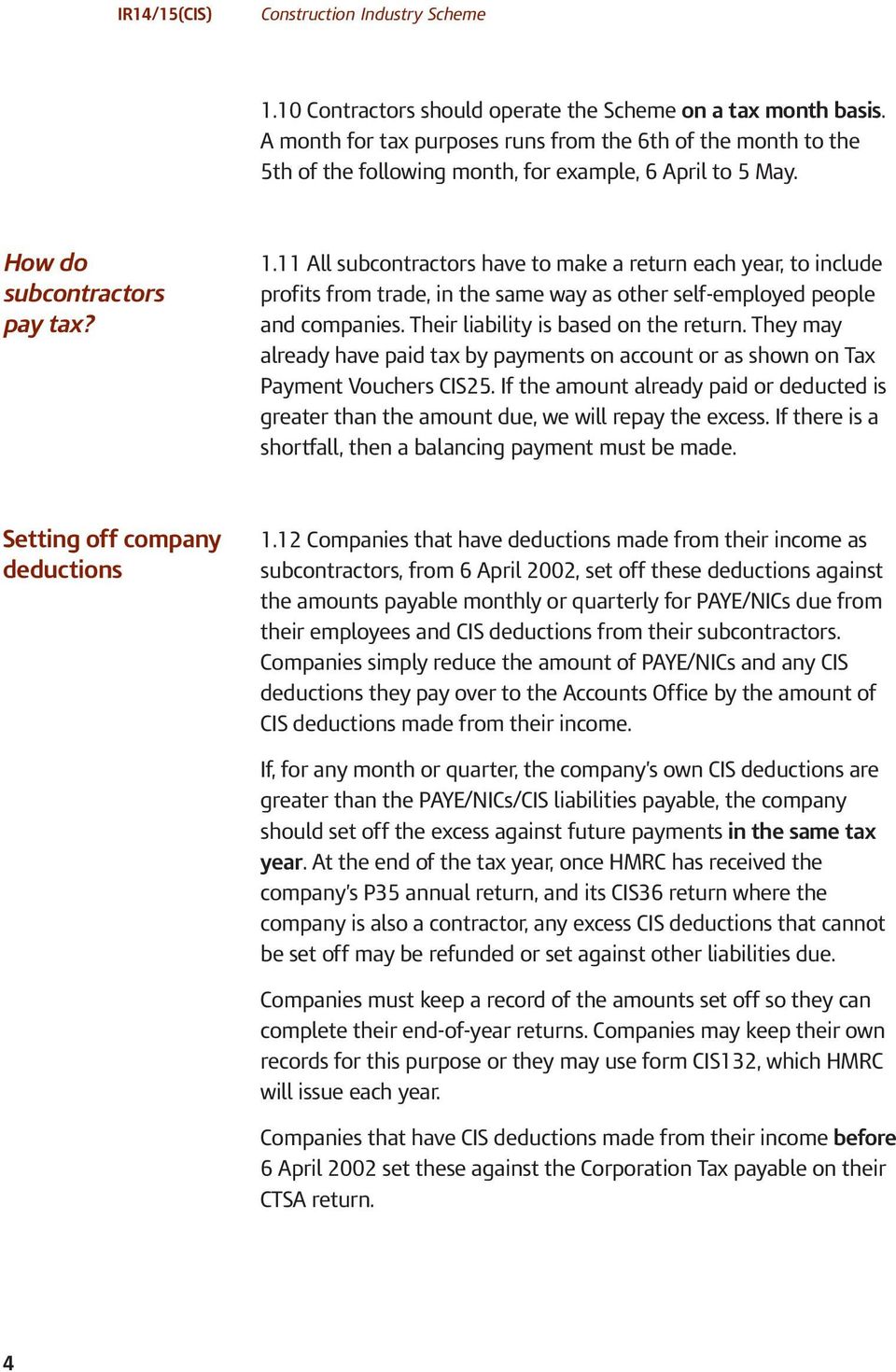
6 1.10 Contractors should operate the Scheme on a tax month basis. A month for tax purposes runs from the 6th of the month to the 5th of the following month, for example, 6 April to 5 May. How do subcontractors pay tax? 1.11 All subcontractors have to make a return each year, to include profits from trade, in the same way as other self-employed people and companies. Their liability is based on the return. They may already have paid tax by payments on account or as shown on Tax Payment Vouchers CIS25. If the amount already paid or deducted is greater than the amount due, we will repay the excess. If there is a shortfall, then a balancing payment must be made. Setting off company deductions 1.12 Companies that have deductions made from their income as subcontractors, from 6 April 2002, set off these deductions against the amounts payable monthly or quarterly for PAYE/NICs due from their employees and CIS deductions from their subcontractors. Companies simply reduce the amount of PAYE/NICs and any CIS deductions they pay over to the Accounts Office by the amount of CIS deductions made from their income. If, for any month or quarter, the company s own CIS deductions are greater than the PAYE/NICs/CIS liabilities payable, the company should set off the excess against future payments in the same tax year. At the end of the tax year, once HMRC has received the company s P35 annual return, and its CIS36 return where the company is also a contractor, any excess CIS deductions that cannot be set off may be refunded or set against other liabilities due. Companies must keep a record of the amounts set off so they can complete their end-of-year returns. Companies may keep their own records for this purpose or they may use form CIS132, which HMRC will issue each year. Companies that have CIS deductions made from their income before 6 April 2002 set these against the Corporation Tax payable on their CTSA return. 4
7 2 How does the Scheme work? General 2.1 Under the Scheme a contractor has to make a deduction in certain situations when making a payment to a subcontractor under a contract relating to construction operations. 2.2 The meanings of these terms are explained in the following paragraphs. Contractor 2.3 to 2.7, 2.10 to 2.11 Subcontractor 2.8 to 2.11 Deduction 2.12 to 2.13 Payment 2.14 to 2.15 Contract 2.16 Construction operations 2.17 to 2.20 and Chapter 7. What is a contractor? 2.3 The term contractor has a wide meaning. It includes the following. Any person carrying on a business that includes construction operations (see paragraphs 2.17 to 2.20 and Chapter 7) and who pays others for work carried out within the Scheme. A property developer or speculative builder, erecting and altering buildings in order to make a profit. A gang-leader. A gang-leader will also be a subcontractor (see paragraph 2.11). A foreign business if it carries out construction operations in the United Kingdom or within United Kingdom territorial waters (up to the 12-mile limit). Any of the following that spends on average more than 1 million a year on construction operations. - A public office or Department of the Crown. - A local authority. - A development corporation. - The Commission for the New Towns. - The Housing Corporation, Housing for Wales, a housing trust, a housing society, Scottish Homes and the Northern Ireland Housing Executive. - Any public bodies named in the regulations, such as National Health Trusts. - Non-construction businesses. 5

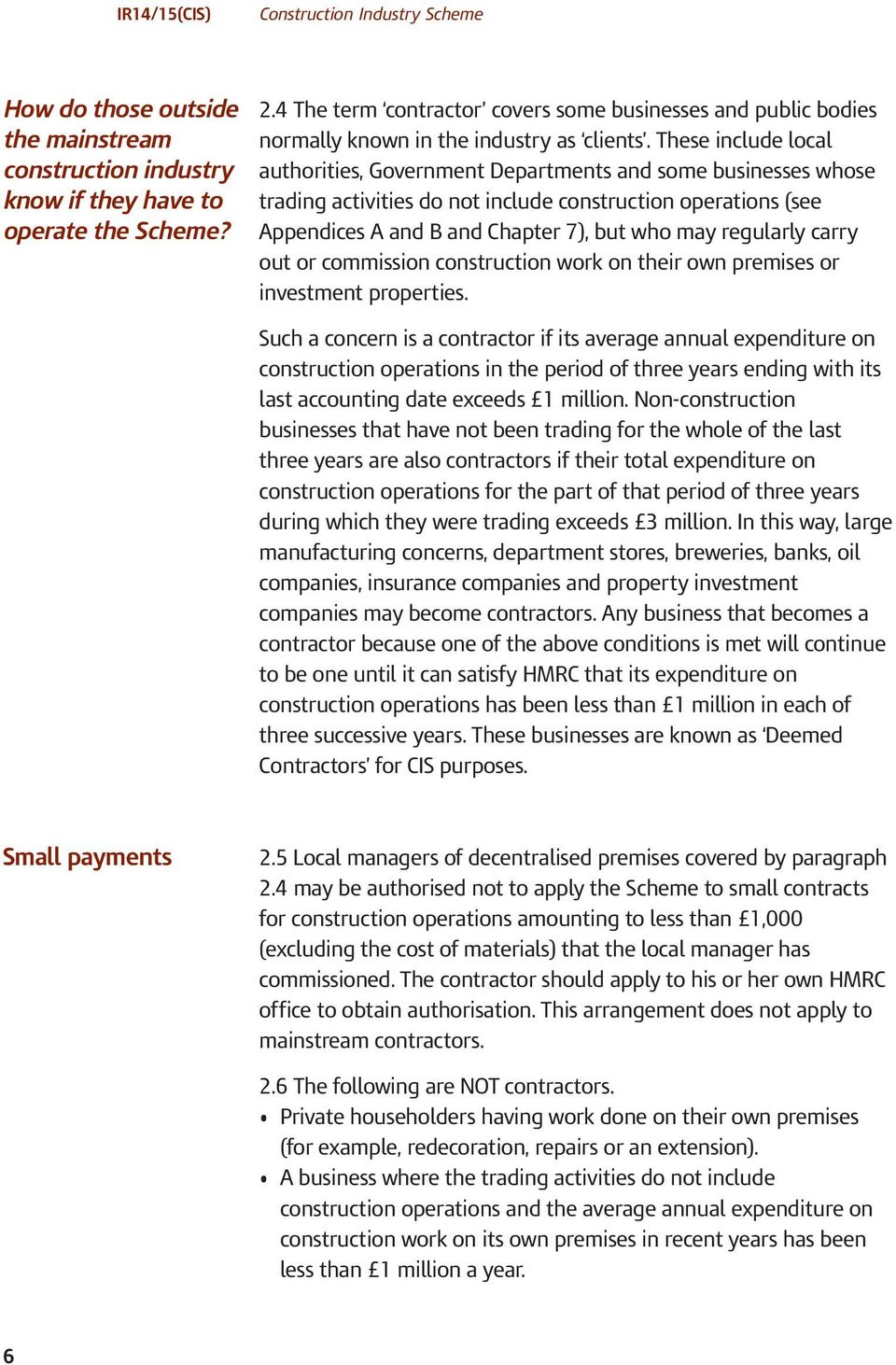
8 How do those outside the mainstream construction industry know if they have to operate the Scheme? 2.4 The term contractor covers some businesses and public bodies normally known in the industry as clients. These include local authorities, Government Departments and some businesses whose trading activities do not include construction operations (see Appendices A and B and Chapter 7), but who may regularly carry out or commission construction work on their own premises or investment properties. Such a concern is a contractor if its average annual expenditure on construction operations in the period of three years ending with its last accounting date exceeds 1 million. Non-construction businesses that have not been trading for the whole of the last three years are also contractors if their total expenditure on construction operations for the part of that period of three years during which they were trading exceeds 3 million. In this way, large manufacturing concerns, department stores, breweries, banks, oil companies, insurance companies and property investment companies may become contractors. Any business that becomes a contractor because one of the above conditions is met will continue to be one until it can satisfy HMRC that its expenditure on construction operations has been less than 1 million in each of three successive years. These businesses are known as Deemed Contractors for CIS purposes. Small payments 2.5 Local managers of decentralised premises covered by paragraph 2.4 may be authorised not to apply the Scheme to small contracts for construction operations amounting to less than 1,000 (excluding the cost of materials) that the local manager has commissioned. The contractor should apply to his or her own HMRC office to obtain authorisation. This arrangement does not apply to mainstream contractors. 2.6 The following are NOT contractors. Private householders having work done on their own premises (for example, redecoration, repairs or an extension). A business where the trading activities do not include construction operations and the average annual expenditure on construction work on its own premises in recent years has been less than 1 million a year. 6
9 2.7 Businesses that have any doubts as to whether they are contractors for the purpose of the Scheme should ask their HMRC office for guidance. What is a subcontractor? 2.8 A subcontractor is any business that has agreed to carry out construction operations for another business or public body that is a contractor - whether by doing the operations itself, or by having them done by its own employees, or in any other way. Subcontractors include concerns normally known as main contractors, where they are engaged by a client who is a contractor, for example, a local authority. 2.9 The term subcontractor includes a company, any corporate body or public body, as well as any individual self-employed person(s) running a business or partnership a labour agency or staff bureau that contracts either to get work done with its own workforce, or to supply workers to a contractor a foreign business if the construction operations for which it is being paid take place in the United Kingdom or its territorial waters (up to the 12-mile limit) a local authority (and its Direct Service or Labour Organisation) or public body (or its subsidiaries) if they are engaged on construction operations for someone else (see below) a gang-leader who agrees with a contractor on the work to be done and in turn receives payment for the work of the gang. Local authorities and public bodies are also subcontractors when carrying out construction operations. Although they will not be issued with certificates, they are to be regarded as certificated. The deduction scheme should not be applied and no deductions should be made from payments to them. Examples of local authorities and public bodies that fall into this category are The Port of London Authority and the British Broadcasting Corporation. For details of the full list, please refer to our internal CIS manual. This may be viewed on the internet at under CIS1211 or at any local HMRC office or Enquiry Centre. 7

10 Agencies Agency as subcontractor 2.10 Where a worker is supplied to a contractor by or through an agency and the worker carries out construction operations under the terms of a contract he or she has with the agency, the agency supplying the worker will be a subcontractor as far as the contractor is concerned. In all cases the contractor should apply the Scheme when making payment to the agency. If the agency does not hold a valid certificate, the contractor must ask to see the agency s Registration Card before making payment under deduction. Where a worker is merely introduced to the contractor by an agency and carries out construction operations under the terms of a contract he or she has with the contractor, the Scheme does not apply to the agency. Agency workers Special rules applying to agency workers normally treat the worker as an employee for tax and National Insurance contribution (NICs) purposes. The person paying the worker should therefore normally deduct tax under PAYE and account for Class 1 NICs. Very exceptionally, the special rules for agency workers do not apply and any payments for construction work will fall within the Scheme. The agency will then be a contractor and will need to fulfil its obligations in that role. Gangs 2.11 The contractor, having met the obligations under the Scheme for payment to the gang-leader (or gangmaster), need not be concerned with the transactions between the gang-leader and the other members of the gang. Any deductions from payments to the members of the gang become the responsibility of the gang-leader. If the contractor makes a separate agreement with any other member of the gang, then that member will be a subcontractor or employee of the contractor. A contractor who pays each member of the gang separately must treat each as a separate subcontractor or employee and apply the deduction scheme or PAYE as appropriate in each case. If in doubt, the contractor should consult the HMRC office. 8

11 What is the deduction? 2.12 The term deduction means the amount that a contractor has to withhold on account of tax and Class 4 NICs, where appropriate, from a payment made to a subcontractor The rate of the deduction may change from time to time, but we will publicise such a change when it occurs. You can obtain the current rate from any HMRC office or from our website at What is a payment? 2.14 A payment is anything paid out by the contractor, for example, cash, cheque or credit. An advance, a sub or a loan is a credit and therefore a payment. This applies whether or not the payment is made directly to the subcontractor. If the payment is made to someone other than the subcontractor, see paragraphs 8.6 and The deduction does not apply to the part of the payment that covers the cost of materials, Value Added Tax (VAT), or Construction Industry Training Board (CITB) levy, but it does apply to payments for subsistence or travelling expenses. What is a contract? 2.16 A contract means any legally binding agreement or arrangement under which one person does work or provides services for another person. A contract includes an agreement made by word of mouth as well as a written document. What are construction operations? 2.17 The term construction operations is defined in law in S567 ICTA 1988, which is shown at Appendix A As a general guide, the term construction operations covers almost anything that is done to a permanent or temporary building, structure, civil engineering work or installation including site preparation alteration dismantling construction repair demolition. 9

12 2.19 Anything done on a construction site in the United Kingdom or within its territorial waters (up to the 12-mile limit) in connection with construction work and under contract to the owner, client, main contractor or a subcontractor is likely to be a construction operation. The only exceptions are things that are clearly not construction work, such as the running of canteen, hostel, medical, safety, security or temporary office facilities Chapter 7 covers construction operations in detail and explains which types of construction work are within the Scheme and which are not. Where a single contract relates to a mixture of jobs, all payments due under the contract are within the Scheme, even if only one of the jobs is within the meaning of construction operations. If there is any doubt, the contractor or subcontractor concerned can get advice from the HMRC office. 10

13 3 How are payments made to a subcontractor holding a Registration Card CIS4? Registration Cards 3.1 Even if someone holds a Registration Card it is the contractor s responsibility to decide whether or not the person is employed or self-employed (see paragraph 1.5). If he or she is employed, the PAYE system must be operated. The contractor should consult the HMRC office if there is any doubt. Before making any payment under deduction, the contractor must see the subcontractor s Registration Card and ensure that it is genuine and the person producing it is the user of that card. The contractor should establish whether the card is a permanent or temporary one. A permanent Registration Card CIS4(P) will have a National Insurance number and will not show an expiry date. Where the contractor has previously seen the subcontractor s permanent Registration Card and has no reason to doubt that the person who produced it remains the user of that card, he or she need not ask to see it again. Where the card is a temporary Registration Card CIS4(T) it will have no National Insurance number and will show an expiry date. On first seeing the card the contractor must note the expiry date in his or her records and make no payment to the subcontractor after that date, unless the subcontractor has since obtained and can show another valid Registration Card or Subcontractors Tax Certificate. Payment under deduction 3.2 A contractor must see and examine a Registration Card before paying under deduction when it is a first payment to a subcontractor whom he or she knows does not hold a valid certificate, or the contractor is not satisfied that the subcontractor is the authorised holder of a certificate as claimed. A deduction under the Scheme should not be made where the person is an employee. Instead, PAYE must be applied in all circumstances to the payments (see paragraph 1.5). 11

14 Should the deduction be made from the whole payment? 3.3 Not necessarily. The following items should be excluded when entering the gross amount of payment on the voucher. Value Added Tax (VAT) charged by the subcontractor if the subcontractor is registered for VAT, see the examples at Appendix C. Any Construction Industry Training Board levy. The following items should be deducted from the gross amount of payment when working out the amount of payment from which the deduction should be made. What the subcontractor actually paid for materials including VAT paid if the subcontractor is not registered for VAT, consumable stores, fuel (except fuel for travelling) and plant hire used in the construction operations. The cost of manufacture or prefabrication of materials used in the construction operations. Any travelling expenses (including fuel costs) and subsistence paid to the subcontractor should be included in the gross amount of payment and the amount from which the deduction is made. A table to help calculate the deduction is incorporated in the form CIS28, available from any HMRC office, and there are examples of how to calculate the deduction in Appendix C. 3.4 The subcontractor should supply the contractor with evidence of the actual cost to him or her of materials. Where this is not done, the contractor should make a fair estimate of the actual cost of materials. A contractor must always check, as far as possible, that the part of the payment for materials supplied is not overstated. 12

15 What about Tax Payment Vouchers? 3.5 A contractor must provide the subcontractor with a CIS25 voucher to show the deduction made within 14 days of the end of the tax month in which any payment is made. New contractors are issued with an initial supply of CIS25 vouchers. When a contractor sends the top copies of used vouchers to HMRC (see paragraph 6.1) further vouchers will be sent to the contractor automatically. Contractors needing a special one-off issue (for example, because a lot of new subcontractors are engaged), should contact their HMRC office, who will also be able to ensure more vouchers are sent routinely, if this is necessary. To whom should the payment be made? 3.6 Normally to the subcontractor, but the subcontractor may authorise payment to be made to another person, such as a debt factor. However, the CIS25 must be made out in the name of the subcontractor and issued to him or her to receive credit for any deduction. What should the contractor keep a note of? 3.7 On or before making the first payment the contractor must make a note of the name of the Registration Card holder the number of the card the date the card expires if it is temporary (and bear this date in mind when making subsequent payments) the National Insurance number if the card is permanent. On making each payment the contractor must make a note of the gross amount of the payment excluding VAT the cost of any materials excluding VAT (if the subcontractor is registered for VAT), and the amount of the deduction. 13

16 Summary of procedures for making payment to a Registration Card holder 3.8 In all instances you should see the Registration Card and check its details refer to the CIS28 ( Instructions to contractors and tax deduction table ) calculate and make the deduction from the payment to the subcontractor record details of payment, materials and deduction complete one CIS25 Tax Payment Voucher from the Registration Card details for all payments made in that tax month (taking care to exclude any amounts shown on an earlier CIS25), to show date of tax month, gross payment, amount liable to deduction and amount deducted submit the top part of the CIS25 voucher to us give the second part of the CIS25 voucher to the subcontractor, and retain the third part of the CIS25 voucher as part of your accounting records. 14

17 4 How are payments made to a subcontractor holding a Subcontractors Tax Certificate CIS6? General 4.1 This chapter describes what should happen when payments are made to holders of CIS6 certificates. Payments to companies holding CIS5 certificates and partners holding CIS5(Partner) certificates are dealt with in Chapter 5. WARNING 4.2 In all circumstances it is important that the checks below are made. If the contractor is not satisfied that a certificate is valid, a deduction from the payment must be made - see Chapter 3. Failure to operate the rules correctly may cause a contractor to be liable for the deductions that should have been made and could result in the withdrawal of the contractor s own Tax Certificate (see paragraph 6.8). 4.3 Even if someone holds a Subcontractors Tax Certificate, it is the contractor s responsibility to decide whether or not the person is employed or self-employed (see paragraph 1.5). If he or she is employed, the PAYE system must be operated. The contractor should consult the HMRC office if there is any doubt. What checks must the contractor make? 4.4 Before the first payment is made the contractor must inspect the certificate and make the following checks. Is it genuine? Always see the original certificate - not a copy. Check that it looks genuine. For example, can you see the words Inland Revenue printed holographically beneath the surface of the certificate when it is tilted away from you? Always see the actual certificate - not a photocopy or a reproduction. Is it in date? Check that the Start date date has passed and that the Expires end date has not been reached. 15

18 Is this the certificate holder? Check that the photograph on the certificate is of the person presenting it. Ask for a specimen signature and check it matches the signature on the certificate. If there is still some doubt the contractor should ask for further proof of identity. Do the vouchers match? When you receive a voucher, check that the name and National Insurance number match the details shown on the certificate. Can the subcontractor be paid without deduction? 4.5 Only if the contractor is satisfied, as a result of these checks, can payment be made without deduction, however where it is requested that the payment is made to anyone other than the holder of a valid certificate, see paragraph 8.6 the holder of a CIS6 certificate must use it only for payments to the business named on the certificate. If the holder has another business, payments without deduction can only be obtained with a separate certificate relating to that business. The run-on rule 4.6 Subsequent payments may be made gross to the subcontractor without further inspection of the certificate provided that the certificate has not expired there is no reason to doubt that the certificate is still valid, and there is no reason to doubt that the payments are being made to the subcontractor. What should the contractor keep a note of? 4.7 Before making the first payment without deduction the contractor must make a note of the name and address of the subcontractor and, for a representative holder of a CIS6, the name of the partner or officer of the company presenting the certificate the number of the certificate the date the certificate expires (and bear this in mind when making subsequent payments). On making a payment the contractor must make a note of the amount of the payment (gross, to include the cost of materials, subsistence and travelling expenses, but to exclude VAT). 16

19 What about vouchers? 4.8 A contractor must make every reasonable effort to obtain a fully completed CIS24 voucher from the subcontractor, either for each payment made to him or her, or for all payments made on a monthly basis. Contractors should send the vouchers to us on a monthly basis (see Chapter 6). 4.9 A subcontractor holding a CIS6 certificate must send the contractor the top and third copies of a CIS24 voucher within 14 days of the end of the tax month. The subcontractor should provide either one voucher totalling all the payments made to the subcontractor in that month or, if the contractor prefers, one voucher for each payment. The tax month runs from the 6th day of one month to the 5th day of the following month. For instance, a payment made on 10 May falls in the tax month 6 May to 5 June. The voucher recording this payment should be sent to the contractor by 19 June Where a subcontractor claims to have posted a voucher, but it has not been received, the contractor should request a duplicate voucher. If the voucher is not provided, despite the contractor taking reasonable steps to obtain one, the contractor should report the matter to HMRC. Incorrect vouchers received from the subcontractor should be returned to him or her and fresh vouchers should be requested It is very important that contractors send the top copies of all CIS24 vouchers they receive in a tax month to HMRC in accordance with paragraph 6.1 otherwise replenishment vouchers will not be issued to the subcontractor at the right time. 17

20 Summary of procedure for contractors dealing with CIS6 holders 4.12 Check that the Subcontractor s Tax Certificate CIS6 is valid. Record details of the certificate. If satisfied, make payment without deduction. Record details of the payment. Obtain the top and third copies of a fully completed CIS24 Subcontractor s Gross Payment Voucher (the subcontractor will keep the second copy for his or her own records). Insert your contractor reference on the voucher. This is the 13- digit number pre-printed alongside the Contractor tax reference entry on any CIS25 or CIS23 vouchers sent to you. If you do not know your Contractor tax reference, contact the HMRC office dealing with your CIS affairs. Send the top copy of the voucher to us. Keep the other copy for your records. 18

21 5 How are payments made to a subcontractor holding a Construction Tax Certificate CIS5 or CIS5(Partner)? General 5.1 There are two methods by which a subcontractor business holding a CIS5/CIS5(Partner) certificate may satisfy a contractor that it has a valid certificate. 5.2 The two methods are the certificate method - the subcontractor produces the certificate for inspection by the contractor the certifying document method - the subcontractor gives the contractor a special certifying document certifying that they hold a CIS5/CIS5(Partner) certificate and giving details. The company secretary or a director should sign the certifying document where the subcontractor is a company and the partner to whom the certificate was issued should sign it where the subcontractor is a partnership. WARNING 5.3 Whichever method is used it is important that the checks described below are made. If the contractor is not satisfied that the subcontractor holds a valid certificate a deduction from the payment must be made - see Chapter 3. Failure to operate the rules correctly may cause a contractor to be liable for the deductions that should have been made and could result in the withdrawal of the contractor s own certificate (see paragraph 6.8). The certificate method : what checks must the contractor make on a CIS5/CIS5(Partner) certificate? 5.4 Before the first payment is made the contractor must inspect the actual CIS5/CIS5(Partner) certificate and make the following checks. Is it genuine? Check that the certificate looks genuine. For example, can you see the words Inland Revenue printed holographically beneath the surface of the certificate when it is tilted away from you? Always see the actual certificate - not a photocopy or a reproduction. 19
22 Is it in date? Check that the Start date date has passed and that the Expires end date has not been reached. Is this an authorised representative of the company or, for a CIS5(Partner) certificate, the partner to whom the certificate was issued? If there is any doubt, telephone the company or partnership to check that the person presenting the certificate is who they claim to be and that where the subcontractor is a company, the registered number shown on the certificate is the registered number of the company. The certifying document method : what checks must a contractor make on a certifying document? 5.5 Under the certifying document method, the contractor does not inspect the certificate itself, so extra care should be taken to check that the certifying document is genuine and that there is no reason to doubt its accuracy. In order to do this the following checks must be made by the contractor. Check that the information on the certifying document agrees with that already shown on the contract. In particular, check the details of the name and address of the subcontractor company or partnership. It may be possible to check the signature on the document from earlier correspondence and the company registration number where the subcontractor is a company. Be sure there is no reason to doubt that the subcontractor holds a valid CIS5/CIS5(Partner) certificate. 5.6 If the contractor has any doubts about the document or the statements contained in it, he or she should telephone his or her HMRC office, who will contact the subcontractor s HMRC office. They will telephone back and either confirm the details on the certifying document or state that they cannot be confirmed. Because of the rules of confidentiality covering a taxpayer s affairs, the HMRC office cannot give any further information. 5.7 Where the HMRC office cannot give confirmation, the contractor must act as though the subcontractor does not hold a valid certificate (see Chapter 3), unless the subcontractor can satisfy the contractor by, for example, presenting the certificate itself for inspection (the certificate method ). 20
23 5.8 The certifying document method can only be used if all the following conditions are met in full. The subcontractor holds a CIS5/CIS5(Partner) certificate. The contractor obtains from the subcontractor a certifying document on the subcontractor s own headed paper (a photocopy is not acceptable, as altered originals can be photocopied to produce a convincing fake). The document confirms that the subcontractor holds a valid CIS5/CIS5(Partner) certificate and shows - the full name of the subcontractor company or partnership - the name of the subcontractor company or partnership (and trading name if relevant) as abbreviated to fit onto the CIS5/CIS5(Partner), if different from the above - the subcontractor s business address and company registration number where the subcontractor is a company - in the case of a company, the signature of the company secretary or a director or, in the case of a partnership, the partner to whom the certificate was issued - the number of the CIS5/CIS5(Partner) certificate - the validity period of the certificate - the bank address and account number of the bank account into which the payment is to be made. The contract, under which the payment is due, is written or has been confirmed in writing. The subcontractor has notified the HMRC office of details of a nominated bank account or accounts, which, in the case of a company, must be held in the name that it has registered with the Registrar of Companies. Payment is made to the subcontractor for his or her own work (and not as a nominee for someone else). Payment is made in one of the ways described in paragraph 5.13 and not in cash. Payment is made into the subcontractor s bank account. 21
24 5.9 If all the conditions in 5.8 are met, and the bank account nominated is operated by a debt factor for the subcontractor s legally assigned debts, and the bank account is designated name of factor, account name of subcontractor payment may be made without deductions although the debt factor has no certificate. A CIS23 voucher should be completed showing the subcontractor s name and reference taken from the CIS5/CIS5(Partner) certificate or certifying document. Can the subcontractor be paid without deduction? 5.10 If the contractor is satisfied with the results of the checks carried out under either of these two methods, the subcontractor can be paid without deduction Contractors should be on their guard against abuse of CIS5/CIS5(Partner) certificates and certifying documents. When in doubt, the contractor should check that the person presenting the CIS5/CIS5(Partner) certificate or certifying document is an authorised representative of the business referred to, if necessary by phoning the subcontractor business concerned. How should the subcontractor be paid? 5.12 Payment to a subcontractor presenting a CIS5/CIS5(Partner) certificate will normally be made by cheque. Should payment in cash be requested, the contractor should telephone the subcontractor business concerned to ensure that the certificate is valid, and that the person presenting it is an authorised representative of the subcontractor business named on the certificate. 22
25 5.13 Under the certifying document method, the contractor must pay the subcontractor in one of the following ways. By cheque. The cheque must be made payable to the subcontractor business concerned and crossed Account Payee. Provided the cheque is crossed in this way, it is not necessary to enter the particulars of the subcontractor s nominated bank account on the cheque. Where a request is made for the cheque to be made payable to anyone else or for Account Payee to be omitted, the contractor must refuse. By credit transfer to a bank account that has been nominated by the subcontractor. A contractor should never make a payment in cash to a subcontractor using the certifying document method. The run-on rule 5.14 Subsequent payments may be made gross to the subcontractor without further inspection of the certificate provided that the certificate has not expired there is no reason to doubt that the certificate is still valid, and there is no reason to doubt that the payments are being made to the subcontractor. What should the contractor keep a note of? 5.15 Before making the first payment the contractor must make a note of the name and address of the subcontractor the number of the certificate (where a certifying document is presented, the document itself should be retained by the contractor) the date the certificate expires (and bear this in mind when making subsequent payments). On making a payment the contractor must make a note of the amount of the payment (to include cost of materials, subsistence and travelling expenses, but to exclude VAT). 23
26 What about vouchers? 5.16 The contractor must complete and sign a CIS23 voucher to show the subcontractor s name and number of the CIS5/CIS5(Partner) certificate the tax month and year in the format MM/YYYY (see definition of tax month in paragraph 4.9) in which the payments were made, and the total of all payments (excluding VAT) made to the subcontractor in that month. The contractor must submit the top copy of all such vouchers to HMRC within 14 days of the end of the tax month. The second copy must be retained for the contractor s accounting purposes. Contractors are issued with an initial supply of CIS23 vouchers on request. When a contractor sends the top copies of used vouchers to HMRC (see paragraph 6.1) further vouchers will be sent to the contractor automatically. Contractors needing more CIS23 vouchers, over and above the regular amount, should contact their HMRC office so that they can change their requirements if necessary for the next routine issue. Summary of procedures for contractors dealing with holders of CIS5 or CIS5(Partner) certificates 5.17 Check that the subcontractor s certificate is valid - or check the details on the certifying document. Check that the person asking for the payment is an authorised representative of the company or is the partner whose signature is shown on the CIS5(Partner) certificate. If satisfied, make the payment without deduction. Record details of the payment and certificate (if a certifying document has been seen, retain it). Complete a CIS23 voucher. Send the top copy to us and keep the second copy for your records. 24
27 6 What contact does a contractor have with HM Revenue & Customs? What must a contractor send to us each month? 6.1 You must send monthly the top copy (marked Inland Revenue copy) of all CIS23 and CIS25 vouchers issued by you and all CIS24 vouchers received by you in the tax month to Processing Centre Freepost LIVERPOOL L69 9HL. We will provide address labels with voucher stocks issued to contractors for this purpose. CIS24 vouchers received from subcontractors in each tax month must be sent within 14 days of the end of that month. For example, vouchers received from CIS6 holders between 6 May and 5 June must be sent by 19 June. Most vouchers for payments made in the month to 5 May will be received around 12 May, so contractors will usually have around five weeks to submit them. The vouchers can be returned in any suitable envelope by using the address labels provided or writing the Freepost address shown above. You do not need a stamp. Please do not fold the vouchers. 6.2 The amount deductible from payments to subcontractors must be paid to our Accounts Office monthly. Deductions due to be made in each tax month, whether or not these deductions have actually been made, must be paid over within 14 days of the end of that month (for example, deductions made between 6 May and 5 June must be paid by 19 June). If the contractor also has PAYE employees, a single payment that includes both the subcontractors deductions and the PAYE/NICs deducted may be made to our Accounts Office. 6.3 A contractor whose average monthly payments to the Accounts Office (including, where applicable, PAYE and NICs deductions from employees) total less than 1,500 may choose to forward the payments on a quarterly basis. The quarters end on 5 July, 5 October, 5 January and 5 April and payments are due within 14 days of the end of each quarter. 25
28 Even where payments are made on a quarterly basis, vouchers must be sent monthly to the Processing Centre (see paragraph 6.1 above). Companies that have deductions made from their income as subcontractors, from 6 April 2002, set off these deductions against the amounts payable monthly or quarterly for PAYE/NICs due from their employees and CIS deductions from their subcontractors. Companies simply reduce the amount of PAYE/NICs and any CIS deductions they pay over to the Accounts Office by the amount of CIS deductions made from their income. If, for any month or quarter, the company s own CIS deductions are greater than the PAYE/NICs/CIS liabilities payable, the company should set off the excess against future payments in the same tax year. At the end of the tax year, once HMRC has received the company s P35 annual return, and its CIS36 return where the company is also a contractor, any excess CIS deductions that cannot be set off may be refunded or set against other liabilities due. Companies must keep a record of the amounts set off so they can complete their end-of-year returns. Companies may keep their own records for this purpose or they may use form CIS132 that HMRC will issue each year. What must a contractor send to us each year? 6.4 By 19 May each year, a contractor must send to the HMRC office a return on form CIS36 of payments made to all subcontractors in the year to 5 April. The return should show for subcontractors holding CIS6 or CIS5/CIS5(Partner) certificates - the names of the subcontractors - their certificate numbers - the total payment to each (including any cost of materials, subsistence or travelling expenses) 26
29 for subcontractors holding CIS4(P) and CIS4(T) Registration Cards - the names of the subcontractors - their Registration Card numbers - the total amounts of payments made under deduction to each subcontractor - the total amount, if any, included in those payments that the contractor is satisfied represents the direct cost of materials - the total amount deducted from the payments total of gross payments to - CIS5/CIS5(Partner) holders - CIS6 holders - CIS4(P) and CIS4(T) holders other information - grand total of above three amounts - total of cost of materials - total of deductions that should have been made. Where a subcontractor has used both a Registration Card and a certificate to receive payments from you in one year, you should make two separate entries for that subcontractor in the CIS36. Are contractors able to send vouchers and returns electronically? 6.6 Yes. Contractors may submit some voucher information using Electronic Data Interchange (EDI). This covers information on two of the three types of vouchers used within the Scheme. Tax Payment Voucher (CIS25) EDI contractors using uncertificated subcontractors are issued with a one-part Tax Payment Voucher CIS25(E). The contractor completes this at the same time as generating the electronic message for us, and gives the voucher to the subcontractor as evidence of each month s payments and deductions. Construction Gross Payment Voucher (CIS23) Where EDI contractors use subcontractors who hold CIS5/CIS5(Partner) certificates, there is no need to complete a paper voucher for the subcontractor. The contractor will be required to provide only the electronic message to us detailing the total of payments made to the holder of the CIS5/CIS5(Partner) certificate each month. Contractors should still keep details of the payments made to subcontractors in a retrievable form. 27
30 In addition to the electronic submission of these vouchers to us on a monthly basis, the contractor will be able to send his or her end of year return (CIS36) summary information electronically. This should include the totals of payments made during the year to holders of CIS6 certificates, provided the contractor has submitted electronic CIS25 and/or CIS23 vouchers during the year. Question? Question? Contractors will first have to register their wish to submit their returns to us electronically. Once we are satisfied that the contractor will be able to provide details of payments made to subcontractors in an acceptable format, the necessary links will be put in place to enable the contractor to communicate through Electronic Data Interchange. Contractors wishing to file electronically should apply to HM Revenue & Customs Electronic Business Unit Crown House Victoria Street Shipley West Yorkshire BD17 7TW Tel: [email protected] Will HMRC inspect records? 6.7 Yes. From time to time, we will inspect the records of contractors in the same way as we inspect an employer s PAYE records. Where such records are created in paper form, we are content for them to be preserved by use of optical imaging systems, provided that what is retained is a complete and unaltered image of the underlying paper document. Records must be kept for at least three years after the end of the tax year to which they relate, and be made available on request. Contractors must provide viewing facilities provide full scale copies of the records if required. 28
31 What action will HMRC take if contractors do not operate the Scheme properly? 6.8 Serious irregularities in the operation of the Scheme can lead to the contractor s own certificate being cancelled and, in certain circumstances, prosecution. 6.9 Failure to inspect a Registration Card or Subcontractors Tax Certificate before making a payment or the failure to note correctly the details on to the relevant voucher may lead to penalty proceedings Delay or failure in submitting the return described in paragraph 6.4 may lead to penalty proceedings Continuing delays or failure in submitting the return described in paragraph 6.4, or any other breach of the regulations, may lead the HMRC office to refuse to renew a contractor s own certificate Deductions: Where things have gone wrong, a contractor may need to satisfy us that every reasonable care was taken to follow the rules of the Scheme and that either the failure to make all or some of the deduction was due to an innocent error, or in spite of reasonable care, the contractor did not believe that the payment came within the rules of the Scheme. Where we refuse to waive payment, the contractor has the right of appeal against that decision to the Appeal Commissioners who are independent of HM Revenue & Customs. The Department of Constitutional Affairs has produced a leaflet Tax appeals. A guide to appealing against decisions of the Inland Revenue on tax and other matters, which is available from any HMRC office Where we cannot agree about whether or not a deduction should have been made, we may make an assessment of the amount we believe should have been deducted. There is a right of appeal to the Commissioners against such an assessment We will waive the contractor s liability where we are satisfied that the person to whom the contractor made such payments either was not chargeable to income tax or corporation tax for these payments, or has made a return of income or profits that includes the payments and has paid the income tax and Class 4 NICs or corporation tax for that income or those profits. 29
32 7 The scope of construction operations 7.1 The legislation covering the scope of the Scheme is at Section 567 Income and Corporation Taxes Act 1988, which is reproduced at Appendix A. You should note that construction operations refers not only to particular works, but also to the work that people would need to do in order to carry out those operations. This means that a contract relating to construction operations could include a contract that did not specifically provide for operations, but provided, instead, for the provision of labour to carry out those operations. Contracts relating to construction operations 7.2 Many contracts in the construction industry are agreed by word of mouth, but this will not normally stop them from being legally binding on both parties and thus coming within the Scheme. Written contracts can vary in size and complexity. Regardless of the form of the contract, the common characteristic will be that there will be a payment by a contractor to a subcontractor and the contract will relate to construction operations. Once you have identified that a contractor and a subcontractor are parties to the contract and have properly decided that the contract is not one of employment, you need to decide whether it is a contract that relates to construction operations. Relates to is very broad in its meaning. Any contract that has construction operations included in it, however small a part that may be, will fall within the Scheme. If a contract includes some work that is inside the Scheme and some that is nothing to do with construction at all then all payments made under that contract will come within the Scheme. These are often referred to as mixed contracts. Some contracts will also relate to construction operations because of the context in which the work is done. Construction operations can include work that contributes to the overall delivery of a project. This means that contracts for some types of work will sometimes be covered by the Scheme and sometimes will not. It is not possible simply to look at the types of work carried out by a business to decide whether the business is a contractor or subcontractor. For example, tree surgeons may have many contracts in a year for cutting down trees. In isolation, cutting down 30
33 trees is not a construction operation. However, where the trees are cut down as part of work to clear a site on which a housing estate will be built, then payments for the work will be within the Scheme. Construction operations included within the Scheme 7.3 The rest of this Chapter gives guidance on the types of construction work that are within the Scheme (paragraphs 7.4 to 7.17) and those that are not (paragraphs 7.18 to 7.27) and should be read in conjunction with the table at Appendix B. The Chapter is not exhaustive - if you are unsure whether any work is within the scope of the legislation, you should contact your own HMRC office for advice. Description Legislation Paragraph (See Appendix A) Buildings & structures S567 (2)(a) Construction Alteration Repair Extension Demolition Dismantling 7.10 Works forming part of the land (2)(b) 7.11 Installation of systems (2)(c) 7.12 Internal cleaning (2)(d) 7.13 Integral works (2)(e) 7.14 Preparatory works 7.15 Finishing operations 7.16 Painting & decorating (2)(f)
34 Buildings & structures 7.4 Most construction operations are carried out as work on buildings and structures, either of which can be permanent or temporary, and offshore installations. The following are the six main areas of work. - Construction - Alteration - Repair - Extension - Demolition - Dismantling Each of these is explained below in more detail. Construction 7.5 Construction is a broad term usually understood as meaning to build, to make, to put together, or to assemble and, in the context of temporary buildings, will include the assembly of prefabricated units and site facilities. Structures, such as oil rigs and modular elements of oil rigs, that are constructed onshore, but later towed to their final location at sea, are an example of how broadly the word construction is interpreted by HMRC. Alteration 7.6 Alteration will apply if the building or structure has been made different in any way. This could be something major or it could be an adjustment or modification. It could be an alteration to the fabric of a building to accommodate equipment such as an item of plant or machinery, lifts, hoists or heavy-duty conveyors. It could also be an alteration to accommodate a building service system (see Installation of systems at paragraph 7.12). It could even be an internal alteration such as the removal of asbestos or the installation of partitioning or shop fittings that allow the building to be used in a different way. HM Revenue & Customs 708 gives an explanation of the meaning of alterations for VAT purposes. Repair 7.7 Repair in this context will include making good and replacement. This would also include any repair of a building that was necessary following a repair to any systems in the building (see Installation of systems at paragraph 7.12 below), even though a repair to the system itself is not a construction operation for the purposes of the Scheme. 32
35 Extension 7.8 Extension means adding to or enlarging an existing building or structure. Demolition 7.9 Demolition is the pulling down of a structure or building. Dismantling 7.10 Dismantling covers the taking to pieces of buildings or structures. Often buildings or structures will be dismantled (rather than demolished) where the materials are expected to be used again. Sometimes part of a building may be destroyed or dismantled prior to a refurbishment or to its use being changed. Often this type of work will be an alteration to the building or structure as well. The legislation is broad enough to include any work that involves the taking apart of a building or structure, its total destruction or its rebuilding or alteration into something different. The resulting building or structure may be permanent or temporary. Works forming part of the land 7.11 This section includes all other types of construction work that might not involve buildings or structures. These are called works forming, or to form, part of the land. Works forming part of the land may be minor works, such as a wooden fence with concrete posts, or major works such as work on an externally located plant like a gasometer. Industrial plant such as petrochemical plant, silos, tanks or water treatment plant will form part of the land. Plant located in a building will not form part of the land and so will not fall within the Scheme under this section. Remember, though, in some circumstances the installation of plant may require that the building be altered to accommodate it and so the operation will still be a construction operation. Alteration, repair, extension, and demolition of works forming part of the land are also construction operations. 33
36 Installation of systems 7.12 A system is something that is made up of connected parts so as to perform a particular function. This includes not only a whole system, but also any sub-systems that may perform a function in their own right. For example, if a water purifier is installed in an existing water supply system, that addition is viewed as installation of a system of water supply. This is because the water purifier is a system of some complexity in its own right and its purpose is to provide a purified water supply. The installation of a new boiler will always come within the Scheme, as it is the main part of the system of heating, as would the re-wiring of an electrical power supply. Internal cleaning 7.13 Internal cleaning is treated as a construction operation if it is undertaken whilst the construction contract is in progress. It does not include external cleaning or routine cleaning undertaken on existing commercial or industrial premises that are not undergoing any types of construction operations. Integral works 7.14 Work is an integral part of the construction operation if it could not be done without it. For example, the erection of scaffolding might not be considered to be the construction of a structure in its own right. However, it is nevertheless a construction operation because it would not be possible to carry out other works that are construction operations without it. Preparatory works 7.15 Similarly, work that is preparatory to construction operations, such as clearing a site or draining land in flood areas prior to building houses, would all be construction operations. 34 Finishing operations 7.16 Work that renders complete or finishes off any of the construction operations under the previous sections will be construction operations. For example, in most modern commercial buildings much of the internal fixtures and fittings will be included in the design specifications and a building will not be considered complete without them.
37 The important feature of this section is that the work done is not considered a construction operation in its own right. It must be considered as part of the overall work that is being carried out as well as part of the contract as a whole. Often, the same work will not be a construction operation if carried out in isolation. For example, tree planting and landscaping in the course of forestry or estate management are not construction operations. The only exception to this category is carpet fitting. An Inland Revenue Statement of Practice (SP12/81) provides that carpet fitting (but no other floor covering) is regarded as excluded from the Scheme even where it is included in the building specifications (see Painting & decorating 7.17 Painting and decorating is within the Scheme. Non-construction operations 7.18 Some operations are specifically excluded from the Scheme and these are explained in the paragraphs listed below. However, where the contract includes both operations that are construction operations and operations that are not construction operations, then all the payments, for both types of work, will fall within the Scheme. 35
38 Description Legislation Paragraph (See Appendix A Drilling S567 (3)(a) 7.19 Extraction (3)(b) 7.20 Manufacture of building or engineering components & delivery (3)(c) 7.21 Manufacture of components for systems (3)(d) 7.22 Professional work (3)(e) 7.23 Artistic works (3)(f) 7.24 Sign-writing & signboards (3)(g) 7.25 Seating, blinds & shutters (3)(h) 7.26 Security systems (3)( j) 7.27 Drilling 7.19 Any work connected with actual, physical extraction of minerals or natural resources will not be a construction operation. Extraction 7.20 Extraction includes drilling for, and pumping of, oil and gas digging for, and removal of, coal and other minerals from underground deposits, and associated surface workings, such as open cast mine quarrying. In addition, where work such as tunnelling, boring and shoring up of tunnels is done in mines, or the installation of rail systems, conveyor systems and other systems connected with mineral extraction is carried out, the work will be outside the scope of the Scheme. This is in contrast, for example, to tunnelling done in connection with the construction of a main-line railway. That would be a construction operation because it is an integral part of the construction of a work forming part of the land. 36
39 Manufacture of building or engineering components & delivery 7.21 The manufacture and/or delivery to site of building or engineering components and equipment, materials and plant or machinery are not construction operations. Manufacture of components for systems 7.22 The manufacture and/or delivery to site of components for systems are not construction operations. Examples of components for systems include components for systems of heating, lighting, airconditioning, ventilation and so on. Professional work 7.23 All work done by architects and surveyors as part of their normal professional discipline, whether on or off site, is excluded. The only exception is where a practitioner goes beyond his or her professional discipline to take on the role of developer or main contractor in addition to providing professional services. In this case, the exclusion no longer applies. The work of other professionals is excluded only if they are acting purely as consultants. Typically, work covered by that expression would include the production of designs, plans, technical assessments and reports relating to construction projects. However any work that goes beyond a consultative or advisory role and becomes the supervision of labour or the co-ordination of construction work using that labour is not excluded from the Scheme. Artistic works 7.24 All works that are wholly artistic are excluded from the Scheme. However, if works fulfil a normal functional purpose associated with a building, they are not excluded. For example, a stained glass window may have considerable artistic merit, but it is a window that lets in light and is a decorative version of a common feature of a building and would not be excluded. Sign-writing & signboards 7.25 Work relating to signboards and advertising boards is excluded from the Scheme. The exclusion is very specific and does not extend to traffic signs or street furniture. 37
40 Seating, blinds & shutters 7.26 Seating installed in theatres, sports stadiums and other locations and fixed seating is excluded from the Scheme. This exclusion also covers louvred shutters, venetian and other similar internal blinds and curtain fittings. It does not extend to awnings. Security systems 7.27 The installation of security systems that are dedicated to that purpose is excluded from the Scheme. Burglar alarms, closed circuit television and public address systems are specifically mentioned in the legislation. This exclusion would extend to, for example, a computer controlled centralised locking system such as used in hotels with programmable key cards. The installation must be a system and not simply a building feature that incidentally fulfils a security purpose. Doors equipped with locks provide a measure of security, but they do not represent a system. Similarly, fencing may deter intruders, but it is a traditional feature of buildings and their surrounds and not a security system even if it has security features. 38
41 8 Miscellaneous Security of documents 8.1 Certificates, vouchers and Registration Cards are important documents and should be kept safely. If documents are lost or stolen, report the facts to the police and HMRC immediately. Before any replacements can be authorised, HMRC will need to be satisfied that every effort was made to safeguard the originals and may ask for evidence that the loss was reported to the police. Misuse of documents 8.2 It is an offence for an unauthorised person to use a card, certificate or voucher to give away or sell any card, certificate or voucher, or to allow another person to use them to make a false declaration to obtain a Registration Card or a Subcontractors Tax Certificate. These offences may result in a penalty of up to 3,000. Any fraudulent misuse of Registration Cards, certificates or vouchers may result in criminal conviction and even imprisonment. Disputes about deductions 8.3 If a contractor and a subcontractor cannot agree about a deduction, either of them may ask HMRC for a ruling. If an agreement still cannot be reached, either the contractor or the subcontractor may ask HMRC to bring the matter before the independent Commissioners for a decision. Where there is such a dispute and agreement cannot be reached quickly, the contractor must make the full deduction and pay it over to the Accounts Office. If the outcome means that some or all of the deduction was not necessary, HMRC will repay the excess to the subcontractor. The same rules apply in a disagreement with HMRC. 39
42 Making corrections after a deduction from a certificate holder 8.4 A subcontractor may claim to have a valid certificate that will be presented at a later date. In this case, the contractor must say that he or she cannot pay without seeing a valid document and ask to see the subcontractor s Registration Card. He or she should make the deduction from any payments made until the certificate is produced. It may be that the subcontractor does produce a valid certificate (or, in the case of a subcontractor holding a CIS5/CIS5(Partner) certificate, a certifying document) and asks for the deduction to be corrected. In these circumstances a correction can be made and the contractor may pay over the deduction to the subcontractor if all of the following apply. The contractor has not already given the subcontractor a CIS25 voucher. The contractor is satisfied that the subcontractor is the authorised user of a CIS6 or CIS5/CIS5(Partner) certificate. The date of payment falls within the period of validity shown on the certificate or certifying document. The date of the correction and the date on which the deduction was made are within the same income tax month (the 6th of one month to the 5th of the next). Either - the subcontractor with a CIS6 certificate gives the contractor a CIS24 voucher certifying receipt of the gross payment, or the contractor completes a CIS23 voucher for the holder of a - - CIS5/CIS5(Partner) certificate. 8.5 Where reimbursement by the contractor is not possible, a certificated subcontractor can claim early repayment from us. The CIS25 vouchers should be sent to the HMRC office. We will make certain checks, but we will make the repayment as soon as possible. Payments to third parties Registration Card holders 8.6 Where payment is made to a nominee of the subcontractor, a Tax Payment Voucher CIS25 must be made out in the name of the subcontractor and given to the subcontractor, so that he or she can claim credit for the deduction. 40
43 Certificate holders CIS6 holders Where the contractor is asked to make gross payment to a nominee of the subcontractor (for example a gang member, workmate or relation) the request must be refused unless both the subcontractor and the nominee hold valid certificates. Any deduction should be recorded under the subcontractor reference on a CIS25 voucher that should be given to the subcontractor. Where a CIS6 holder uses a debt factor, the payment must be made under deduction because it is made to a nominee who does not hold a certificate. Factors cannot hold certificates, as they are not subcontractors in the construction industry. The contractor should make out a CIS25 voucher in the name of the subcontractor, who can claim early repayment. Where the payment is made to someone other than a nominee, for example, it is paid directly into the subcontractor s bank account, it must be dealt with as if the payment had been made to the subcontractor. The contractor should request a CIS24 voucher from the subcontractor. CIS5/CIS5(Partner) holders By concession, where a holder of a CIS5 or CIS5(Partner) certificate uses the certifying document method, payment may be made gross to a debt factor. The procedures for checking the certifying document and making payment gross should be followed as described in Chapter 5 (see particularly paragraphs 5.8 and 5.9). The contractor should make out a CIS23 voucher in the name of the subcontractor. Cheque made out to subcontractor, but sent to another address If the contractor has any doubts about sending payments to an address that is not the subcontractor s own address he or she should contact the local HMRC office for advice. 41
44 Personal representatives, liquidators and receivers 8.7 There are exceptions to the rules described in paragraph 8.6. Payments without deduction can be made to personal representatives of a subcontractor who has died a liquidator a receiver an administrator appointed under the 1986 Insolvency Act. These payments can be made whether or not the subcontractor held a certificate, so long as the contract of work was not made with the liquidator, receiver or administrator. The contractor is advised to obtain receipts for such payments. Death of a contractor 8.8 If a contractor dies, the responsibility for the running of the Scheme falls to the personal representative(s). This includes paying over deductions, sending in vouchers and making returns (see Chapter 6). Take-over of a business 8.9 If a business previously run by an individual is taken over by a partnership or company, the old CIS6 certificate cannot be used for the new business. The new business must hold a valid certificate before it can be paid without deductions being made. Similarly, if an individual takes over as sole proprietor of a business having previously been a partner or director, he or she must apply for a CIS6 certificate, as any other certificate held as a partner or director will no longer be valid. An application for a new certificate will be needed. See leaflet IR40(CIS). Conditions for getting a Subcontractors Tax Certificate for details of how a certificate may be given on a change of business. A contractor must not accept a CIS6 for the old business to cover payments to the new business. Change of control of a close company A close company is basically one under the control of five or fewer persons. Where a close company holds a certificate and there is a change of control - through a transfer or issue of shares in the company - the company must, within 30 days, notify the HMRC office of the name(s) and address(es) of the new shareholder(s). Companies that fail to make this notification may have their certificates withdrawn.
45 Change of address 8.11 A subcontractor should notify HMRC of any change to the business, registered office or private address. Contras and set-offs 8.12 There are some special terms in the construction industry. Two of these terms are contra - this is a charge for goods or services supplied by the contractor to the subcontractor (for example, on a contract worth 200, a contractor gives the subcontractor some surplus materials and restricts payment by 50), and set-off - this is money not paid to a subcontractor by a contractor who believes there has been a breach of contract (for example 400 of a 2,000 contract is withheld because the work is below standard). Under the Scheme rules a contra does not reduce the payment from which the deduction may have to be made and is a payment by the contractor to the subcontractor. In the example given, the deduction should be calculated on the full contract value of 200. Similarly the voucher for a gross payment to a certificate holder should reflect the full contract value of 200. However, the set-off reduces the payment from which the deduction may have to be made and so is not a payment by the contractor to the subcontractor. In the example shown the deduction should be made from 1,600. Similarly the voucher for a gross payment to a certificate holder should reflect the contract value of 1,600. Retention payments 8.13 Some contracts allow the contractor to retain a percentage of the contract price for a period after the construction work has been completed. This is done so that if deficiencies in the work become apparent during the retention period, the final payment can be withheld until the subcontractor has made good the faults. There are no special rules for retention payments and they are treated the same way as any other payments. Whether the retention payment is made gross or under deduction depends on the subcontractor s status at the date of payment and not when the work was actually done. 43
46 If the contractor has already seen the subcontractor s permanent Registration Card CIS4(P), then the retention payment may be made under deduction. Where the subcontractor previously held a certificate, or a temporary Registration Card CIS4(T), that has expired during the retention period, the contractor must request sight of a current certificate or Registration Card before making payment. Non-UK businesses 8.14 Deductions that have been made from payments to a subcontractor who claims to be not resident in the UK may be eligible for repayment. The subcontractor will have nominated which HMRC office should issue repayments when applying for his or her Registration Card. Company subcontractors who applied for their Registration Cards at the Centre for Non-residents should apply to that office instead. The application for repayment should be sent with the CIS25 vouchers, showing the deductions that were made and a statement that says why the subcontractor thinks that repayment is due. Our leaflet IR180(CIS) Construction Industry Scheme. A guide for non-residents gives more information on how the Scheme applies to non-resident subcontractors. Before making a repayment the HMRC office will need to be satisfied that no UK tax liability will arise on the profits made in the UK and that any PAYE/NICs and/or Section 559 deductions due from the subcontractor as an employer or contractor have been met. Spoilt vouchers 8.15 To help us issue contractors and subcontractors with more vouchers without you having to ask for them, we need to know how many vouchers have been used or spoilt. If you are a contractor, therefore, it is very important that you send the top copies of all completed vouchers to us as soon as possible, as described at paragraph
47 Likewise, if you spoil any of your vouchers, whether you are a subcontractor or a contractor, you must tell us on the form CIS52 that we include with each pack of vouchers that we send you. It does not matter whether you have completed them incorrectly or they have become damaged. We need to know about these so we can take them into account when working out how many vouchers you have used and how many you now need. The form CIS52 should be sent to the same address to which correctly completed vouchers are sent (as described at paragraph 6.1) and should include all voucher parts. Unofficial forms 8.16 No substitute forms may be used. There is a list of forms used in the Scheme at Appendix D. Further information 8.17 When our offices are closed, you can get general advice on the by calling our Contractors Helpline, on , open Monday to Friday 8.30am to 5pm, or Subcontractors Helpline, on , open 7 days a week 8.00am to 8.00pm. For advice on Self Assessment you can call our Self Assessment Helpline, on , open 8am to 8pm seven days a week. To register as a contractor and so that we may send you the necessary vouchers and Contractors Pack, please ring our New Employers Helpline on , open Monday to Friday 8.00am to 8.00pm and weekends 8.00am to 5.00pm. Our Helplines and Orderlines are unable to issue vouchers used in operating the. If you need more vouchers, please contact your own HMRC office. 45
48 Appendix A Extract from Income and Corporation Taxes Act 1988 Section In this Chapter construction operations means operations of any description specified in subsection (2) below, not being operations of any description specified in subsection (3) below; and references to construction operations shall be taken (a) except where the context otherwise requires, as including references to the work of individuals participating in the carrying out of such operations; and (b) except in the case of offshore installations, as not including references to operations carried out or to be carried out otherwise than in the United Kingdom. 2. The following operations are, subject to subsection (3) below, construction operations for the purposes of this Chapter - (a) construction, alteration, repair, extension, demolition or dismantling of buildings or structures (whether permanent or not), including offshore installations; (b) construction, alteration, repair, extension or demolition of any works forming, or to form, part of the land, including (without prejudice to the foregoing) walls, roadworks, power-lines, telecommunication apparatus, aircraft runways, docks and harbours, railways, inland waterways, pipe-lines, reservoirs, water mains, wells, sewers, industrial plant and installations for purposes of land drainage, coast protection or defence; (c) installation in any building or structure of systems of heating, lighting, air-conditioning, ventilation, power supply, drainage, sanitation, water supply or fire protection; (d) internal cleaning of buildings and structures, so far as carried out in the course of their construction, alteration, repair, extension or restoration; 46
49 (e) operations which form an integral part of, or are preparatory to, or are for rendering complete such operations as are previously described in this subsection, including site clearance, earthmoving, excavation, tunnelling and boring, laying of foundations, erection of scaffolding, site restoration, landscaping and the provision of roadways and other access work; (f) painting or decorating the internal or external surfaces of any building or structure. 3. The following operations are not construction operations for the purposes of this Chapter - (a) drilling for, or extraction of, oil or natural gas; (b) extraction (whether by underground or surface working) of minerals; tunnelling or boring, or construction of underground works, for this purpose; (c) manufacture of building or engineering components or equipment, materials, plant or machinery, or delivery of any of these things to site; (d) manufacture of components for systems of heating, lighting, air-conditioning, ventilation, power supply, drainage, sanitation, water supply or fire protection, or delivery of any of these things to site; (e) the professional work of architects or surveyors, or of consultants in building, engineering, interior or exterior decoration or the laying-out of landscape; (f) the making, installation and repair of artistic works, being sculptures, murals and other works which are wholly artistic in nature; (g) sign-writing and erecting, installing and repairing signboards and advertisements; (h) the installation of seating, blinds and shutters; ( j) the installation of security systems, including burglar alarms, closed circuit television and public address systems. 4. In this section offshore installations means installations which are maintained, or are intended to be established, for underwater exploitation or exploration to which the Mineral Workings (Offshore Installations) Act 1971 applies. 47
50 5. The Treasury may by order (a) include in subsection (2) above any description of operations as to which they are satisfied that it is a normal activity of the construction industry and that its inclusion in that subsection is necessary for achieving the object of Section 559; (b) include in subsection (3) above any description of operations as to which they are satisfied that it cannot properly be considered a normal activity of the construction industry and ought to be excluded from subsection (2) above. 6. An order under subsection (5) above shall not have effect unless a draft of the instrument containing it has been laid before and approved by a resolution of the House of Commons. 48
51 Appendix B The scope of construction operations list of included and excluded operations Remember that private householders are not contractors for the purposes of the Scheme, but if you do any of the work listed below for a contractor who is doing the work for a private householder he will have to operate the Scheme on payments made to you. The list gives some guidance on which types of construction work are within the Scheme and which are not. If a contract includes some work which is within and some outside the Scheme then all payments made under that contract will be caught by the Scheme. The list is not exhaustive if you are unsure whether work is within the scope of the legislation, contact your HMRC office. Operations Included Operations Excluded Planning None Professional work (including the ancillary work of engineers, draughtsmen, scientists and technicians) of architects surveyors or consultants in building, engineering, decoration (interior or exterior) or landscaping. Site Prepartion Demolition of, for example, buildings, structures, tree-felling. Preparation of site and site-clearance, earth-moving on site, excavation, tunnelling and boring. Delivery of materials. Transport of spoil from site. Construction Preparation and laying of foundations and piling. Manufacture or off-site fabrication of components or equipment, materials, plant or machinery and delivery of these to the site. For example - traditional building materials - prefabricated beams and panels - ready-mixed concrete. 49
52 Operations Included Operations Excluded Construction (continued) Actual construction, alteration or repair of a permanent or temporary building or civil, chemical or other industrial engineering work or industrial plant or structure. For example storage tanks silos pylons cranes or derricks pumps. Construction of site facilities. Manufacture and delivery of pre-fabricated site facilities. Running of site facilities such as canteens, hostels, offices, toilets and medical centres. Installation of power lines, pipelines, gas mains, sewers, drainage, cable television and telecommunications distribution systems. Installation or replacement of telecommunication or computer wiring through pre-existing ducting in buildings. Installation of closed circuit television for purposes other than security (such as traffic management). Installation of public services. Construction, repair and resurfacing of roads and bridges including white-lining. Delivery of road-making materials. Provision of temporary and permanent roadways and other access works such as drives. Erection or dismantling of scaffolding falsework and formwork. Plant hire with operator for use on site. Hire of scaffolding equipment (without labour). Delivery, repair or maintenance of construction plant or hire equipment without an operator. For example, concrete mixers, pumps and skips. 50
53 Operations Included Operations Excluded Construction (continued) Installation of systems of fire protection designed specifically to protect the fabric of the building (such as sprinkler systems, fireproof cladding) rather than a fire warning (alarm) system. Installation of fire alarms, security systems including burglar alarms, closed-circuit television as part of a security system and public address systems. Installation of pre-fabricated components or equipment under supply and fix arrangements. Transport of materials on site. Transport of materials from site to site on the public highway. Assembly of temporary stages and exhibition stands including lighting. Internal cleaning of buildings and structures carried out in the course of, or on completion of, their construction, alteration, extension, repair or restoration. Work done on installations (such as rigs, pipelines, construction platforms) maintained or intended to be established for under-water exploration for, or exploitation of, minerals where the work is on land or in the UK territorial waters (up to the 12 mile limit). Installation of systems of heating, lighting, air conditioning, ventilation, power supply and distribution, drainage, sanitation, water supply and distribution, and fire protection works. Installation of lifts, plant, or machinery needed by the specification of a building under construction or alteration. External cleaning (other than painting or decorating) of buildings and structures. Drilling for, or extraction of, oil or natural gas. Extraction of minerals, boring or construction of underground works for this purpose. Manufacture, delivery, repair or maintenance of these items. Servicing, repair or maintenance of these items. Installation and repair of industrial plant. 51
54 Operations Included Operations Excluded Construction (continued) Site restoration and landscaping. Installation, structural repair and painting of lamp standards, traffic lights, parking meters and street furniture. Construction of concrete and marble floors. Tree planting and felling in the ordinary course of forestry or estate management. Manufacture and delivery of lamp standards. Routine maintenance such as cleaning and general replacement. Manufacture off-site and delivery of flooring materials. Fitting of eye bolts whether internal or external. Installation of and repair to Manufacture and delivery of - glazing glazing materials - doors and rolling grills or security shutters computer and instrumentation systems - kitchens and bathrooms thermal insulation materials - shop-fittings including fixed furniture heating and ventilation systems (except seating) doors and rolling grills painting or decorating materials. Painting and decorating the internal or Manufacture, delivery and installation of external surfaces of any building or structure. seating, blinds and louvred shutters. Manufacture, installation and repair of artistic works (for example, sculptures and murals) which are wholly decorative in nature (not functional items caught by the Scheme which incidentally have artistic merit). Manufacture and installation of solar, blackout or anti-shatter film. Sign-writing and erecting, installation and repair of signboards and advertisements. 52
55 Operations Included Operations Excluded Finishing Operations Fitting of - floor coverings, such as vinyl, linoleum (but not carpet) and laminated wooden flooring - new locks - pigeon mesh - TV aerials and satellite receivers. Installation of refrigeration units but only where these operations render complete a building or structure that has been constructed or altered. 53
56 Appendix C Examples of the deduction from Registration Card holders The following are examples of how the deduction is calculated where the subcontractor has no certificate. The rate used in the examples that follow is 18%, which is the rate in operation at the time of publication of this booklet. Example 1 Where no materials are supplied ( labour-only ). An uncertificated labour-only subcontractor does work on site for 200. Gross payment % deduction -36 Net payment to subcontractor 164 The contractor calculates the deduction ( 36) that has to be paid to our Accounts Office. The labour-only subcontractor receives the balance of
57 Example 2 The following is an example of a calculation where materials as well as labour are supplied ( supply and fix ). Where the subcontractor is not registered for VAT, any VAT he or she had to pay on materials should be included in the cost of materials when calculating the CIS deduction. An uncertificated tiling subcontractor, who is not VAT-registered, agrees to tile a wall and to supply the necessary materials for 535. The materials cost the subcontractor a total of 235 ( for VAT). Gross payment 535 Less materials % deduction -54 Payment excluding materials and deduction 246 Add back cost of materials 235 Net payment to subcontractor 481 The contractor deducts the cost of materials from the price for the whole job and calculates the deduction on the difference of 300. The contractor has to pay 54 to our Accounts Office and pays 481 ( ) to the tiler. 55
58 Example 3 VAT should be excluded when calculating the amount to be deducted from payments where the subcontractor is registered for VAT. The following is an example of a calculation. For the total cost of 600 an uncertificated subcontractor, who is a taxable person for VAT purposes, agrees to paint the interior of a building and to supply the materials. The painter pays 235 for the materials, which includes VAT of 35. VAT at a rate of 17.5% is charged on the completion invoice, that shows Labour charge 400 Materials 200 Gross payment 600 Add VAT 105 Amount due 705 Calculation of deduction (to be shown on CIS25) Payment exclusive of VAT 600 Less cost of materials exclusive of VAT -200 Amount subject to deduction 400 Deduction at 18% 72 Net payment to subcontractor 633 The painter is paid 633 ( ). 56
59 Appendix D Documents used in the Scheme CIS1 CIS2(Individual) CIS3(Company) CIS3(Partner) CIS4(P) CIS4(T) CIS5 CIS5(Partner) CIS6 CIS8(Director CIS9(Partner) CIS13 CIS14 CIS15 CIS17 CIS19 CIS20 CIS23 CIS24 Initial voucher supply letter to contractor Application form for a Tax Certificate: sole trader Application form for a Registration Card or Tax Certificate: company Application form for a Registration Card or Tax Certificate: partnership Permanent Registration Card for individuals, partners and directors/company secretaries Temporary Registration Card for individuals, partners and directors/company secretaries Construction Tax Certificate: issued to certain qualifying companies Construction Tax Certificate: issued to certain qualifying partnerships Subcontractors Tax Certificate for individuals, partners and directors/company secretaries Application form for Registration Card or Tax Certificate: director or company secretary Application form for Registration Card or Tax Certificate: partners Notification to agent of certificate authorisation Invitation to supply details of nominated bank account for use of certifying documents (companies) CIS14(P) Invitation to supply details of nominated bank account for use of certifying documents (partnerships) Tax Office acknowledgement of nominated bank account details Request for director s details Notification to subcontractor of certificate authorisation Draft authority signed by director/shareholder Voucher supplied to contractors for use with subcontractors holding CIS5 and CIS5(Partner) certificates Subcontractor s voucher for holders of CIS6 certificates 57
60 58 CIS25 CIS27(a) CIS27(b) CIS28 CIS29 CIS36 CIS36(CS)(RC) CIS36(CS)(STC) CIS36(CS)(CTC) CIS40 CIS41 CIS42 CIS52 CIS54(Individual) CIS62(A) CIS62(B) CIS62(C) CIS81 CIS82(Individual) CIS83(New) CIS84(Partner) Tax Payment Voucher supplied to contractors for issue to holders of CIS4(P) and CIS4(T) Registration Cards Application form for amendment to details/photo on CIS4 Registration Card or CIS6 Tax Certificate Application form for amendment to details on CIS5 or CIS5(Partner) Certificate Instructions to contractors and tax deduction table Notes for contractors End of year return CIS36 Continuation Sheet for payments to CIS4 holders CIS36 Continuation Sheet for payments to CIS6 holders CIS36 Continuation Sheet for payments to CIS5 and CIS5(Partner)holders In year repayment request form (sole trader) In year repayment request form (partner) Notice for return of deductions from subcontractors Notification of spoilt or destroyed vouchers Application for a Registration Card: sole trader Information poster for new contractors charting completion of CIS25 voucher and CIS36(RC) return Information poster for new contractors charting completion of CIS24 voucher and CIS36(STC) return Information poster for new contractors charting completion of CIS23 voucher and CIS36(CTC) return Voucher guidance leaflet: issued with every voucher replenishment Application form to renew a Tax Certificate: sole trader Application form to renew a Tax Certificate: partners and directors Application form to renew a Tax Certificate: partnership
61 IR117(CIS) A guide for subcontractors with registration cards CIS85(Company) CIS86 CIS132 CIS134 CIS136 CIS151 CIS152 CIS153 Application form to renew a Tax Certificate: company Application form to renew a temporary Registration Card: individuals, partners and directors/company secretaries Working sheet for recording in year set-offs of CIS deductions against company PAYE/NICs/CIS liabilities Notification of set-off procedures to new companies (includes a copy of CIS132) Annual notification of CIS set-off procedures (includes a copy of CIS132) Notification of a contractor scheme identifier for new contractors, to be used on CIS24 vouchers Notification of a contractor scheme identifier for new contractors with a temporary CIS reference to be used on CIS24 vouchers Notification of contractor scheme identifier for contractors who have multiple schemes to be used on CIS24 vouchers Vouchers will be replenished automatically and supplies of some other forms can be obtained from the HMRC office. 59
62 60
63 Customer Service HM Revenue & Customs commitment We aim to provide a high quality service with guidance that is simple, clear and accurate. We will be professional and helpful act with integrity and fairness, and treat your affairs in strict confidence within the law. We aim to handle your affairs promptly and accurately so that you receive or pay only the right amount due. Putting things right If you are not satisfied with our service, please let the person dealing with your affairs know what is wrong. We will work as quickly as possible to put things right and settle your complaint. If you are still unhappy, ask for your complaint to be referred to the Complaints Manager. Customers with particular needs We offer a range of facilities for customers with particular needs, including wheelchair access to nearly all HMRC Enquiry Centres help with filling in forms for people with hearing difficulties: BT Typetalk Induction loops. We can also arrange additional support, such as home visits, if you have limited mobility or caring responsibilities and cannot get to one of our Enquiry Centres services of an interpreter sign language interpretation leaflets in large print, Braille and audio.
64 These notes are for guidance only and reflect the tax position at the time of writing. They do not affect any right of appeal about your own tax. Issued by HM Revenue & Customs Better Guidance Programme April 2006 Crown Copyright 2006 Printed by The Astron Group 04/06 NSV Code R2P 3351
Construction Industry Scheme. Guide for contractors and subcontractors
 Guide for contractors and subcontractors CIS340 Contents 1 Introduction to the Construction Industry Scheme (CIS) What is the? 5 What types of work are covered by the scheme? 5 What types of businesses
Revenue s Construction Industry Project. 1.0 Registration with Revenue as a principal contractor.
 Revenue s Construction Industry Project As part of the Construction Industry Project 2006, Revenue will be looking at the tax affairs of principals and subcontractors for all taxes. This article looks
Welcome to Exchequer Solutions Ltd
 solutions CIS (SELF-EMPLOYED) Welcome to Exchequer Solutions Ltd Established in 2003, Exchequer Solutions is a commercial contractor offering construction services. We are vastly experienced in working
CODE OF PRACTICE 9. HMRC investigations where we suspect tax fraud
 CODE OF PRACTICE 9 HMRC investigations where we suspect tax fraud The HMRC Investigation of Fraud Statement (i) The Commissioners of HMRC reserve complete discretion to pursue a Criminal investigation
APPLICATION FORM. / / / PENSION ANNUITY. Once you ve completed this form, please return it to: Legal & General Annuities PO Box 809 Cardiff CF24 0YL
 PENSION ANNUITY APPLICATION FORM. Once you ve completed this form, please return it to: Legal & General Annuities PO Box 809 Cardiff CF24 0YL We will already have sent you a quote(s), illustrating the
Code of Practice 9 (July 2011)
 Code of Practice 9 (July 2011) Introduction HM Revenue & Customs (HMRC) will investigate any situation where they suspect serious tax fraud. The investigation will be undertaken with or without your voluntary
Stocks & Shares ISA Transfer form Cazenove Investment Fund Company - B Class shares
 Stocks & Shares ISA Transfer form Cazenove Investment Fund Company - B Class shares For your own benefit and protection you should read carefully Cazenove Investment Fund Company s Key Investor Information
No Notice and Notice Deposit Accounts. Capital Millennium Bond. Short Term Fixed Rate Deposit Account. Cash ISA. Junior Cash ISA
 Terms and Conditions No Notice and Notice Deposit Accounts Capital Millennium Bond Short Term Fixed Rate Deposit Account Cash ISA Junior Cash ISA Contents General Terms & Conditions 3 Account Terms & Conditions
Step-by-Step Guide to Applying for a UK tax refund
 STEP-BY-STEP TAX REFUND GUIDE Step-by-Step Guide to Applying for a UK tax refund If you have left the UK to travel or emigrate for an extended period of time, it s likely you have overpaid tax. In many
Stock Transfer form. Please ensure all pages of this form have been completed in BLOCK CAPITALS see checklist on the last page. V22 10 Apr.
 V22 10 Apr. 14 Stock Transfer form Please ensure all pages of this form have been completed in BLOCK CAPITALS see checklist on the last page. If you make any mistakes whilst completing this form, please
Individual Savings Account Supplementary Terms
 Individual Savings Account Supplementary Terms Individual Savings Account Supplementary Terms and Conditions for Stocktrade Retail Clients forming part of the Agreement between Stocktrade (a division of
HALIFAX CASH ISA. Conditions and information
 HALIFAX CASH ISA. Conditions and information Welcome to Halifax 3 Section 1 How these conditions work 5 Section 2 Special Conditions 7 ISA Saver Variable 12 ISA Saver Online 13 ISA Saver Fixed 14 Junior
BUSINESS LEASE CAR POLICY
 BUSINESS LEASE CAR POLICY Version: 2 Ratified by Senior Managers Operational Group Date ratified August 2015 Title of originator/author: Title of responsible Committee/group Assistant Director of Finance
Code of Practice 9. HM Revenue & Customs investigations where we suspect tax fraud COP9 HMRC 06/14
 Code of Practice 9 HM Revenue & Customs investigations where we suspect tax fraud COP9 HMRC 06/14 HM Revenue & Customs (HMRC) investigation of fraud statement The Commissioners of HMRC reserve complete
The Comprehensive Service
 The Comprehensive Service At PML Accounting Ltd, we understand that business affairs need to be dealt with efficiently and effectively. Therefore, we have utilised and further developed a specialist accounting
Most of the hard work of setting up and running a Limited Company is at the beginning of the process which Exceed will be able to assist you with.
 Limited Companies Introduction Forming a Limited Company may appear to be very daunting to some people, and it is true that a lot of legislation is in place relating to company formation and operation.
Code of Practice. Civil Investigation of Fraud. Notice COP 9 MAN
 Code of Practice Civil Investigation of Fraud Notice COP 9 MAN July 2009 (updated to 18 July 2011) 1 Introduction Contents Civil Investigation of Fraud Civil investigation of fraud statement Outline Confidentiality
Housing Benefit and Council Tax Support Self-employed Income Form
 Housing Benefit and Council Tax Support Self-employed Income Form If you want to claim Housing Benefit or Council Tax Support, fill in and return this form to tell us about any self-employment. Please
Note 1. Name of company in which these shares/stock are held. Note 2
 V25 21 May 2012 Note 1 Equiniti Limited Aspect House Spencer Road Lancing West Sussex BN99 6DA Guidance Notes for the completion of a Stock Transfer form by shareholders. To be read in conjunction with
Savings Accounts. General Terms and Conditions
 Allenview House, Hanham Road, Wimborne, Dorset BH21 1AG Telephone: 0800 783 2367 Fax: 01202 841694 Email: [email protected] Web: teachersbs.co.uk Savings Accounts General Terms and Conditions 1.
Foreign currency account
 Foreign currency account Terms and conditions Terms and conditions of the foreign currency account, (incorporating foreign currency current account and foreign currency deposit account) Please read and
Bank of Scotland Private Banking Savings Accounts
 Bank of Scotland Private Banking Savings Accounts Terms and Conditions Applicable to: Premier Investment Account Premier Reserve Account (for Personal Customers) Premier Reserve Account (for Trusts) 3
Claim your Tax Refund Today
 Claim your Tax Refund Today Complete this Taxpack to claim your entitlement Average Refund 905 Visa Bureau Taxback, 167 Earls Court Road, London SW5 9RF PHONE 0800 862 0138 E-MAIL: [email protected]
Direct Earnings Attachment
 Direct Earnings Attachment A Guide for Employers 1 What this Guide is about This guide explains what you, as an employer, need to do if DWP Debt Management (part of the Department for Work and Pensions
This starter pack contains all the documents you will need to become one of our growing
 Welcome to Associated Sub-Contractors Starter Pack Follow these easy steps: Step 1 Complete the application form as far as you can. If you cannot answer a question, leave it blank. You must fill in your
Please ensure all pages of this form have been completed in BLOCK CAPITALS see checklist on the last page.
 V23 24 Nov. 14 Stock Transfer form Please ensure all pages of this form have been completed in BLOCK CAPITALS see checklist on the last page. If you make any mistakes whilst completing this form, please
Self-employment and Universal Credit
 Self-employment and Universal Credit A detailed guide for advisers December 2013 1 Self-employment and Universal Credit A guide for advisers Section 1 - What counts as self-employment for UC? Section 2
American Express. Business Credit Card Conditions
 American Express Business Credit Card Conditions Effective 1st June 2006 Postal Address American Express Australia Limited Cardmember Services GPO Box 1582 Sydney NSW 2001 Lost or Stolen Cards In Australia
Guide to Starting Self Employment or Business. Guide No.6 in the Tax Guide Series
 Guide to Starting Self Employment or Business Guide No.6 in the Tax Guide Series About This Guide This Guide has been prepared to help someone starting out in a new business or self employment venture
A general guide to keeping records for your tax return
 A general guide to keeping records for your tax return RK BK1 Contents Introduction 3 Why good record keeping helps you 3 Records you should keep 3 What happens if you don t keep adequate records 4 How
Consumer Code. for Home Builders. This document contains the Rules that govern the behaviour of Home Builders and Home Warranty Bodies
 Consumer Code for Home Builders This document contains the Rules that govern the behaviour of Home Builders and Home Warranty Bodies First Edition January 2010 Contents Meaning of words... 3 Introduction...
FINANCIAL PLANNING Nationwide customer agreement
 FINANCIAL PLANNING Nationwide customer agreement Customers receiving advice This important document describes in detail the terms and conditions that will apply to charging for advised services. It explains
8.7 Taxation - PAYE, NI and Pensions
 8.7 Taxation - PAYE, NI and Pensions Introduction Under current delegation and in accordance with Section 2 of the Scheme, schools are responsible for the payroll arrangements for their employees. There
Community Housing Providers (Adoption of National Law) Bill 2012
 Passed by both Houses [] New South Wales Community Housing Providers (Adoption of National Law) Bill 2012 Contents Part 1 Part 2 Preliminary Page 1 Name of Act 2 2 Commencement 2 3 Objects of Act 2 4 Definitions
A GUIDE TO THE OCCUPATIONAL RETIREMENT SCHEMES ORDINANCE
 A GUIDE TO THE OCCUPATIONAL RETIREMENT SCHEMES ORDINANCE Issued by THE REGISTRAR OF OCCUPATIONAL RETIREMENT SCHEMES Level 16, International Commerce Centre, 1 Austin Road West, Kowloon, Hong Kong. ORS/C/5
Remote gambling taxation reform
 Remote gambling taxation reform Who is likely to be affected? This measure will affect all gambling operators who supply remote gambling to UK customers. Some terrestrial gambling operators will also be
Taxwise Premier Protection Important: This is a claims made insurance, which means we must receive claims during the period of insurance.
 Premier Protection Taxwise Premier Protection Important: This is a claims made insurance, which means we must receive claims during the period of insurance. The Policy Schedule, Contract, Practice Profile
How To Get A Small Business License In Australia
 1 L.R.O. 2007 Small Business Development CAP. 318C CHAPTER 318C SMALL BUSINESS DEVELOPMENT ARRANGEMENT OF SECTIONS SECTION 1. Short title. 2. Interpretation. 3. Small business. 4. Approved small business
20th February 2015 ScottishPower Standard Domestic Tariff. Prices. Your domestic gas and electricity pricing information
 20th February 2015 ScottishPower Standard Domestic Tariff Prices Your domestic gas and electricity pricing information How to find your electricity supply area See what supply area you are in by using
HICL INFRASTRUCTURE COMPANY LIMITED
 THIS DOCUMENT IS IMPORTANT AND REQUIRES YOUR IMMEDIATE ATTENTION. If you are in any doubt as to the contents of this document or the action that you should take, you should seek your own personal financial
Starting in Business. Get your business up and running with RDP Newmans. clear thinking. positive solutions. www.rdpnewmans.com
 Starting in Business Get your business up and running with RDP Newmans clear thinking. positive solutions www.rdpnewmans.com Contents The First Steps 01 Welcome 01 Business Foundations 01 Finances 02 Overview
court fees do you have to pay them? Some people do not have to pay a court fee, by law
 court fees do you have to pay them? Some people do not have to pay a court fee, by law Other people may not have to pay a court fee, or they may pay a smaller fee EX160A Court Fees do you have to pay them?
Payroll Tax Act 2011. Republication No 6 Effective: 25 November 2015. Australian Capital Territory A2011-18. Republication date: 25 November 2015
 Australian Capital Territory A2011-18 Republication No 6 Effective: 25 November 2015 Republication date: 25 November 2015 Last amendment made by A2015-49 (republication for amendments by A2015-48 and A2015-49)
Form US-Individual 2002
 Form US-Individual 2002 United Kingdom/United States of America Double Taxation Convention (SI 2002 Number 2848) Application for relief at source from United Kingdom income tax Claim to repayment of United
QUICK GUIDE TO ISAs 2014/2015
 INDIVIDUAL SAVINGS ACCOUNTS 2014/2015 An Individual Savings Account (ISA) is not an investment in its own right rather it is a type of account that can be used to undertake tax-advantageous investment.
VOKERA (NEW) AFFINITY UK
 VOKERA (NEW) AFFINITY UK TERMS & CONDITIONS 2015 1. The Vokèra Affinity Reward Programme (The Scheme) is being operated by Vokèra Limited, Borderlake House, Unit 7, Riverside Industrial Estate, London
(Chapter No. not allocated yet) SOCIAL SECURITY ORDINANCE
 (Chapter No. not allocated yet) SOCIAL SECURITY ORDINANCE Non-authoritative Consolidated Text This is not an authoritative revised edition for the purposes of the Revised Edition of the Laws Ordinance;
United Kingdom/United States of America Double Taxation Convention (SI 2002 Number 2848) United Kingdom income tax relief at source and repayment
 Form US-Company United Kingdom/United States of America Double Taxation Convention (SI 2002 Number 2848) United Kingdom income tax relief at source and repayment This form is for use by a US Company, Mutual
Small Business Grants (Employment Incentive) Act 2015 No 14
 New South Wales Small Business Grants (Employment Incentive) Act 2015 No 14 Contents Page Part 1 Part 2 Preliminary 1 Name of Act 2 2 Commencement 2 3 Object of Act 2 4 Definitions 2 Grant scheme 5 Grant
Personal Service Companies. Guidance Note GN 50
 Personal Service Companies Guidance Note GN 50 Issued by the Income Tax Division 20 March 2014 PLEASE NOTE: This guidance has no binding force and does not affect your right of appeal on points concerning
Current Account Conditions and AccounT Information.
 Current Account Conditions and AccounT Information. If you open an account with us it will be with Yorkshire Building Society (trading as Norwich & Peterborough Building Society, Norwich & Peterborough
PAYE / PRSI for Small Employers
 PAYE / PRSI for Small Employers A Revenue Guide Contents Introduction 2 THE PAYE & PRSI System 3 Tax Credit System 4 Pay, Holiday Pay and Expenses 6 Treatment of Benefits 7 Taxation of Social Welfare Payments
Rothschild Visa Card Terms and Conditions
 Rothschild Visa Card Terms and Conditions These Rothschild Visa Card Terms and Conditions (June 2010 edition) are in addition to and supplemental to the Bank s standard Terms and Conditions (October 2007
Step 1: Visit www.gov.im/onlineservices and register for Isle of Man Government online services by selecting Income Tax service.
 GuiDance notes, Gn1S ReTuRn form GuiDe SimPlifieD 15-16 important information TO assist WiTh The completion Of YOuR ReTuRn form Why use Online Tax Services? Because you can: File your return efficiently
STANDARD CONDITIONS FOR INDIVIDUAL VOLUNTARY ARRANGEMENTS. Produced by the IVA FORUM
 Protocol Annex 4 STANDARD CONDITIONS FOR INDIVIDUAL VOLUNTARY ARRANGEMENTS Produced by the IVA FORUM Revised January 25 th 2008 TABLE OF CONTENTS FOR STANDARD CONDITIONS PART I: INTERPRETATION Page 1 Definitions
Advance Retirement Suite Super Early Release Financial Hardship Application
 Advance Retirement Suite Super Early Release Financial Hardship Application Trustee: BT Funds Management Ltd (BTFM) ABN 63 002 916 458 AFSL 233724 GUIDE TO COMPLETING THIS FORM > > Use this form if you
Platform Key Information Document
 SELF-DIRECTED Explicit Pricing Model Platform Key Information Document Including the ISA and Investment Funds Key Features documents The information that follows is accurate to the best of our knowledge
Premier Professional
 Premier Professional Taxwise Premier Professional Important: This is a claims made insurance, which means we must receive claims during the period of insurance. This Policy insures you. Your clients have
BP Individual Savings Accounts (ISA) 2014/15 Tax Year Application Form
 HGCRPG BP Individual Savings Accounts (ISA) 2014/15 Tax Year Application Form Notes on completing this form Please read the BP Corporate ISA Brochure and Corporate ISA Terms and Conditions before completing
Credit Card Contract
 Credit Card Contract Credit Card Booklet Cardholder enquiries & Lost and stolen cards Telephone : (679) 321 4300 Facsimile : (679) 330 3738 BSP/SecDocTemp006 Page 1 of 21 Template Issue No.3 reviewed 19032012
Group Flexible Retirement Plan Key features
 Group Flexible Retirement Plan Key features This is an important document. Please read it and keep it for future reference. Key features document: Pages 1 21 Terms and conditions for joining: Pages 22
Information from your accounts
 Helpsheet 229 Tax year 6 April 2013 to 5 April 2014 Information from your accounts A Contacts Please phone: the number printed on page TR 1 of your tax return the SA Helpline on 0300 200 3310 the SA Orderline
Self-Employment. Guidance Note GN4
 Self-Employment Guidance Note GN4 Issued by the Income Tax Division 23 April 2012 PLEASE NOTE: This guidance has no binding force and does not affect your right of appeal on points concerning your liability
HB11b - Housing Benefit and Council Tax Support Self Employed Earnings Information
 Benefit Service PO Box 2, Forde House Newton Abbot, TQ12 4YR Phone: 01626 215078 Fax: 01626 215538 Email: [email protected] HB11b - Housing Benefit and Council Tax Support Self Employed Earnings
Actorcard Prepaid Visa Card Terms & Conditions
 Actorcard Prepaid Visa Card Terms & Conditions These Terms & Conditions apply to your Actorcard prepaid Visa debit card. Please read them carefully. In these Terms & Conditions: "Account" means the prepaid
INFORMATION ABOUT YOUR MORTGAGE. Important information for you to keep and refer to
 INFORMATION ABOUT YOUR MORTGAGE Important information for you to keep and refer to 1 Information about your mortgage This booklet is sent to you with your mortgage offer so you can read it before you enter
International Payment Service Terms and conditions
 International Payment Service Terms and conditions Welcome to the International Payment Service (the Service) from Capita Registrars Limited (Capita). This document, together with your Application and
pension income plus pension income plus annuity Annuity
 No ID or age evidence required pension income plus pension income plus annuity Annuity Application Form For Financial Adviser completion only Adviser Financial Services Register number Adviser email address
Retirement Account. Application Form (Where no Flexible Account is required) No ID or age evidence required. For Financial Adviser completion only
 This form is only suitable when applying for two or more plans. If applying for one plan, please use the standalone form for that plan only. No ID or age evidence required Retirement Account Application
Enterprise Investment Scheme Compliance Statement
 Enterprise Investment Scheme Compliance Statement There is a time limit for sending this form (read note 2 on page 5 for details). Please read the notes before filling in this form. If there is not enough
STANDARD CONDITIONS FOR INDIVIDUAL VOLUNTARY ARRANGEMENTS. Produced by the IVA FORUM
 Protocol Annex 4 STANDARD CONDITIONS FOR INDIVIDUAL VOLUNTARY ARRANGEMENTS Produced by the IVA FORUM Revised November 2013 For use in proposals issued on or after 1 January 2014 TABLE OF CONTENTS FOR STANDARD
PROCEDURE Banking. Number: G 1904 Date Published: 8 May 2014
 1.0 Summary of Changes This is a new procedure which details the collection and handling of all income owed to Essex Police. This includes the handling of cash seized under the Proceeds of Crime Act (POCA).
Terms and Conditions Individual Savings Account and Investment Account. For accounts opened after 28 April 2011
 Terms and Conditions Individual Savings Account and Investment Account For accounts opened after 28 April 2011 These terms and conditions cover the Sterling Individual Savings Account and Sterling Investment
Current/Cheque/Savings Account and Fixed Deposit Terms www.sc.com/gh
 Current/Cheque/Savings Account and Fixed Deposit Terms www.sc.com/gh Copyright 2015 Standard Chartered Bank Version 01/2015 Contents 1 Choosing the account that is right for you 1 2 Savings accounts 1
Employment Manual RELOCATION EXPENSES AND DISTURBANCE ALLOWANCES
 Employment Manual RELOCATION EXPENSES AND DISTURBANCE ALLOWANCES This document applies to all employees with the exception of Teaching Staff RELOCATION AND DISTURBANCE ALLOWANCE CONTENTS TABLE RELOCATION
Initial Charge waived ISA. Class R GBP Application forms 2015/2016 Terms and conditions
 Initial Charge waived 0% ISA Class R GBP Application forms 2015/2016 Terms and conditions ISA terms and conditions Definitions Account Account holding your Investments in an ISA. Additional Permitted Subscription
STITT & C Ọ SOLICITORS 11 Gough Square, London EC4A 3DE Tel: 020 7832 0840 Fax: 020 7832 0865 email: [email protected]
 STITT & C Ọ SOLICITORS 11 Gough Square, London EC4A 3DE Tel: 020 7832 0840 Fax: 020 7832 0865 email: [email protected] TERMS OF ENGAGEMENT 1. Service Commitment We aim to offer our clients quality legal
STANDARD CONDITIONS FOR INDIVIDUAL VOLUNTARY ARRANGEMENTS. Produced by the IVA FORUM. Revised January 25'h 2008 - - - ~.,;..._.
 STANDARD CONDITIONS FOR INDIVIDUAL VOLUNTARY ARRANGEMENTS Produced by the IVA FORUM Revised January 25'h 2008 - - - ~.,;..._. TABLE OF CONTENTS FORST ANDARD CONDITIONS PART I: INTERPRETATION 1 Definitions
Form DT-Company. Part A Details of the company or concern and tax adviser (if any)
 Form DT-Company United Kingdom income tax relief at source and repayment For use by a COMPANY or OTHER CONCERN resident in a country with which the United Kingdom has a Double Taxation Convention that
ROYAL MAIL GROUP ADDRESS MANAGEMENT UNIT PAF DIRECT END USER LICENCE
 ROYAL MAIL GROUP ADDRESS MANAGEMENT UNIT PAF DIRECT END USER LICENCE Introduction This licence permits the use of PAF Data by an end user. Details of other licences available for the use of PAF Data can
Income Protection Cover. Guide to making a claim
 Income Protection Cover Guide to making a claim Guide to making a claim Income Protection Cover What you ll find in this guide Page Understanding your Income Protection Cover 3 What do I do if I need to
Mortgages. Guarantor Application Form
 Mortgages Guarantor Application Form This form is to be returned with the completed mortgage application form together with the following where available: salary slips for the last 3 months and your latest
J.P. Morgan ISA and J.P. Morgan Investment Account
 110487-GB H961 0615 Key Features (24pp A4).qxp:110487 10/6/15 14:35 Page 1 Key Features and Terms and Conditions Effective from 25 September 2015 J.P. Morgan ISA and J.P. Morgan Investment Account For
Basic cash account. This document can be made available in Braille, large print or audio upon request. Please ask any member of staff for details.
 Basic cash account www.bankofireland.co.uk This document can be made available in Braille, large print or audio upon request. Please ask any member of staff for details. Bank of Ireland UK is a trading
General Conditions for Bank of Cyprus UK CharityBonds (April 2013)
 General Conditions for Bank of Cyprus UK CharityBonds (April 2013) Bank of Cyprus UK Limited ( we/our/us ), trading as Bank of Cyprus UK, incorporated in England and Wales as company number 04728421, a
Lawyers and Conveyancers Act (Trust Account) Regulations 2008
 Lawyers and Conveyancers Act (Trust Account) Regulations 2008 Rt Hon Dame Sian Elias, Administrator of the Government Order in Council At Wellington this 30th day of June 2008 Present: Her Excellency the
TERMS AND CONDITIONS for the Select Retailer Group Prepaid Virtual Card and the Spend Anywhere Prepaid Virtual Card
 TERMS AND CONDITIONS for the Select Retailer Group Prepaid Virtual Card and the Spend Anywhere Prepaid Virtual Card This Agreement applies to Your Virtual card. You must read it carefully. By applying
Offshore Savings Account Key Features
 Offshore Savings Account Offshore Savings Account Key Features This document shows the main points about your Offshore Savings Account. Please read it with your personal illustration and keep it with the
Isle of Man Guide for on and off-course bookmakers, track operators etc. to comply with the law on general betting duty in the Isle of Man
 451 (MAN) Isle of Man Guide for on and off-course bookmakers, track operators etc. to comply with the law on general betting duty in the Isle of Man August 1999 NOTICE 451 (MAN) THE INFORMATION IN THIS
Small Charitable Donations Act 2012
 Small Charitable Donations Act 2012 CHAPTER 23 Explanatory Notes have been produced to assist in the understanding of this Act and are available separately 5.75 Small Charitable Donations Act 2012 CHAPTER
smile current account Terms and Conditions
 smile current account Terms and Conditions Terms and Conditions of the smile current account, overdraft and debit card (incorporating smilemore and smile student) With effect from 5 July 2015 Terms and
Land Agents Regulations 2010
 Version: 21.11.2015 South Australia Land Agents Regulations 2010 under the Land Agents Act 1994 Contents Part 1 Preliminary 1 Short title 3 Interpretation 4 Fees payment, waiver, reduction and refund Part
CITB. CITB TRAINING BOARD NI your Annual Return Form. Annual Levy Return Guidance Notes 2015 CONSTRUCTION INDUSTRY TRAINING BOARD NI
 nnual Levy Return Guidance Notes 2015 CONSTRUCTION step by INDUSTRY step guide to completing your nnual Return Form www.citbni.org.uk Important Notice to Levy Payers Levy NI is a statutory training board
Prepaid Card Terms and Conditions
 Prepaid Card Terms and Conditions These terms and conditions apply to your Prepaid Card. You must read them carefully. In these terms and conditions "you" means the named Prepaid Cardholder and the authorised
Starting a Business The basic requirements for Tax purposes
 Starting a Business The basic requirements for Tax purposes RPC004448_EN_WB_L_3 This Guide is intended to describe the subject in general terms. As such, it does not attempt to cover every issue which