
How the EBIS/RTI Process Works in Elementary Schools
|
|
|
- Augustine Dean
- 10 years ago
- Views:
Transcription
1 Fall 08 How the EBIS/RTI Process Works in Elementary Schools Tigard Tualatin School District, Tigard, Oregon w w w. t t s d. k 1 2. o r. u s

2 Tigard-Tualatin School District EBIS/RTI Project Table of Contents HOW THE EFFECTIVE BEHAVIOR AND INSTRUCTIONAL SUPPORT (EBIS) TEAM PROCESS WORKS...3 EBIS EARLY IDENTIFICATION PROCESS...5 EBIS GROUP INTERVENTIONS & PLANNING FORM...6 EBIS READING DECISION RULES KINDERGARTEN...7 EBIS READING DECISION RULES GRADES EBIS DECISION RULES: SPANISH LITERACY...9 TTSD STANDARD READING PROTOCOL...10 TTSD STANDARD SPANISH READING PROTOCOL...11 INTERVENTION CHANGES AND MODIFICATIONS FORM...12 STUDENT INTERVENTION PROFILE, READING...13 TTSD STANDARD BEHAVIOR PROTOCOL...14 STUDENT INTERVENTION PROFILE BEHAVIOR...16 TTSD STANDARD MATH PROTOCOL...17 STUDENT INTERVENTION PROFILE MATH...18 TTSD STANDARD WRITTEN EXPRESSION PROTOCOL...19 EBIS TEAM MEETING NOTICE ENGLISH...20 EBIS TEAM MEETING NOTICE SPANISH...21 RTI PROCESS BROCHURE IN ENGLISH...22 RTI PROCESS BRUCHURE IN SPANISH...24 DEVELOPMENTAL HISTORY IN ENGLISH...26 DEVELOPMENTAL HISTORY IN SPANISH (HISTORIA DEL DESARROLLO)...29 INDIVIDUAL PROBLEM SOLVING WORKSHEET...35 December 1, 2008, Page 2 of 38

3 Tigard Tualatin School District EBIS / RTI Project How the Effective Behavior and Instructional Support (EBIS) Team Process Works The EBIS team has three purposes: 1. To review school-wide behavior and academic data in order to evaluate the effectiveness of core programs. 2. To screen and identify students needing additional academic and/or behavior support. 3. To plan, implement and modify interventions for these students. Depending on each student s response to intervention, a formal referral for special education evaluation may result. EBIS is intended to be a structured, systematic process involving the following features and activities: team membership, school-wide planning, planning for the 20%, monthly meetings, and individualizing-intensifying interventions. Team membership: Leadership by the principal is essential. EBIS Team membership also must include classroom teachers representing grade levels, the Literacy/Title I Specialist, School Counselor, and specialists from Special Education and ELL programs. Teams often also benefit from including a member from the classified staff. Planning for the 80% (School-wide): Three times a year, fall, winter and spring, EBIS teams review data on student performance (e.g., DIBELS, behavior referrals, attendance) in order to evaluate the effectiveness of the core programs. The EBIS model is predicated on the notion that the core programs should meet the needs of at least 80% of the student population. If this is not the case, the team needs to plan and implement professional development to shore up the core program. Planning for the 20% (Targeted groups): Students falling below the 20 th percentile on DIBELS and/or who have other, significant academic, behavioral or attendance problems, are listed on the EBIS Group Intervention & Planning Form. This is usually best accomplished by grade level teacher teams with core members of the EBIS team assisting them. These EBIS teams choose interventions from the appropriate Standard Protocol (Reading, Math, Writing, or Behavior) for groups of students with similar needs. They also decide on what progress data to collect and the person responsible for collecting the data. Begin the EBIS Student Intervention Profile for all students in interventions. Monthly EBIS team meetings: EBIS teams convene monthly to evaluate the progress of the students involved in group interventions as well as those students below the 20 th percentile who receive services through Special Education. The team reviews weekly progress monitoring data for each student, analyzing aimlines and trendlines (see Decision Rules for Kindergarten and Grade 1-5). One of four different decisions may be made at this meeting for each student being reviewed: 1) the group intervention has been successful and the student no longer needs small group instruction, 2) the intervention appears to be working for the student and should be continued as is; 3) the group intervention is not working for the student and should be revised or refined; or, 4) the group intervention is highly unlikely to be successful for the student and therefore a more, individualized approach is needed. Individualizing, Intensifying Intervention: If the student has failed to make progress or has made minimal progress after two group interventions, additional information must be gathered in order to select an intervention that is specifically targeted to the student s needs. At this point, EBIS teams fill out and send the EBIS Team Meeting Notice to parents inviting them to attend a meeting to gather information and begin planning for a more individualized intervention. A Developmental History should be completed at this time and the parents should be given the RTI Parent Brochure describing how the Response To Intervention process works. If the student is an English Language Learner (ELL), the ELL teacher should also obtain information about the child s language development at this time. December 1, 2008, Page 3 of 38

4 Tigard-Tualatin School District EBIS/RTI Project Prior to the parent meeting, teams review each student s cumulative record using the Individual Problem Solving Worksheet. Although time consuming, this level of evaluation is typically necessary for only a small percentage of students. It provides detail on the student s history and needs and is important to designing an effective, individualized intervention. Another resource for students with behavioral issues is the brief Functional Behavior Assessment protocol, which can easily be completed by the team. At the individualized planning level, it is also necessary to assign a case manager for each student. The case manager s responsibility is to ensure that the intervention is implemented correctly and that progress is monitored according to the schedule agreed upon by the team. In addition, the case manager continues to track intervention details using the EBIS Student Intervention Profile. Case managers report back to the EBIS team on the progress of the students under their supervision on at least a monthly basis. Based on the developmental history, Individual Problem Solving Worksheet, and progress monitoring data, the EBIS team may determine that: a. The student has improved substantially and no longer needs to be included in an intervention group. b. The student continues to struggle, but his or her difficulties appear to be due to other factors such as behavior, attendance, or limited English Proficiency and interventions to help the students with these difficulties will be initiated. c. A referral for a formal special education evaluation is appropriate. The information from the intervention profile, progress-monitoring information, developmental history, and individual problem solving worksheet should be included with the referral as they provide evidence regarding the student s responses to various interventions. See the most current Special Education Procedures Manual for details on the special education process. December 1, 2008, Page 4 of 38
5 Tigard Tualatin School District EBIS / RTI Project EBIS EARLY IDENTIFICATION PROCESS Tigard-Tualatin School District, Tigard, Oregon TEAMWORK TIMELINES: EBIS teams meet fall, winter & spring to review data and make decisions about schoolwide progress. EBIS teams/grade level teacher teams meet monthly to review data, plan and adjust interventions. ALL STUDENTS RECEIVE QUALITY BEHAVIOR AND ACADEMIC INSTRUCTION AND SUPPORT All Students Are Screened for Additional Instructional Needs (Fall, Winter & Spring DIBELS, IDEL, OAKS, ODRs, etc.) Small Group Interventions are chosen from the standard protocols by EBIS Teams Interventions are further individualized DECISION RULES: 80% Decision Rule: If 80% of students are not meeting benchmarks, review core program (s). 20% Decision Rule: Students below the 20 th percentile in academic skills and/or with chronic behavior needs* are placed in small group interventions. Individualize Instruction Rule: When students fail to progress after two (2) consecutive small group interventions, move to the individual level. Change Small Group or Individual Interventions Rule: When progress data is below the aimline for 4 consecutive points or when the slope is flat or decreasing Refer for Special Education Evaluation Rule: When students fail to progress after one individually designed intervention. *More than 5 absences or 2 or more counseling or discipline referrals in a 30 day period December 1, 2008, Page 5 of 38

6 Tigard-Tualatin School District EBIS/RTI Project EBIS GROUP INTERVENTIONS & PLANNING FORM School: Date: Check if Concerns Issues Check if Appropriate Enter Scores Interventions Last Name First Name Grade Homeroom Teacher Behavior/Social/Emotional Attendance Tardies Reading Writing Math Health/Physical Special Education ELL Title DIBELS/IDEL PSF Raw Score DIBELS/IDEL NWF Raw Score DIBELS/IDEL ORF (Median Score) CBM-Other Score Reading RIT Score Math RIT Score Test Window: F(1), W(2), and/or S(3) December 1, 2008, Page 6 of 38
7 Tigard Tualatin School District EBIS / RTI Project EBIS READING DECISION RULES - Kindergarten BEGINNING OF THE YEAR: October Place students in Level 1 or Level 2 intervention groups by October 15 th based on fall DIBELS/IDEL data. Level 1 support (Strategic): Add 10 minutes of intervention instruction daily Level 2 support (Intensive): Add 30 minutes of intervention instruction daily Monitor and graph progress monthly (end of October, November and December) MIDDLE OF THE YEAR: January Regroup students after January DIBELS/IDEL has been completed. Place students according into the following groups: Strategic support: Add 10 minutes of intervention instruction daily Intensive support: Add 30 minutes of intervention instruction daily Monitor and graph progress 2 times per month for the students receiving strategic support and weekly for those receiving intensive support through mid April. END OF THE YEAR: April For those students still not making adequate progress, EBIS teams should complete the Individual Problem Solving Worksheet and do one of the following: Revise the intervention and continue with implementation and data collection Refer for Special Education evaluation December 1, 2008, Page 7 of 38
8 Tigard-Tualatin School District EBIS/RTI Project EBIS READING DECISION RULES - Grades 1-5 Place students in the 20% group when: Academic skills fall below benchmark and place them in the lowest 20% compared to their peers on one or more of the following measures: DIBELS, IDEL, Math & Writing curriculum based assessments, OAKS. Chronic problems with attendance and/or socio-emotional-behavioral skills occur, as defined by: More than 5 absences in a 30 day period 2 or more discipline or counseling referrals in a 30 day period Change interventions when: Progress monitoring indicates 4 consecutive data points below the aimline. If data is highly variable, maintain the current intervention until 7 data points have been collected, then analyze aimline and trendline. Change intervention if the slope is flat or decreasing. Progress is monitored once weekly Individualize interventions when: Progress trend under small group instruction is below the aimline for two consecutive intervention periods (at 8, 12, or 16 weeks, depending on the data). Prior to individualizing the intervention, the EBIS team should select a case manager, complete the Individual Problem Solving Worksheet, complete a developmental history, provide parents with the RTI Brochure, and if the student receives ELL services, do a language level assessment. Refer for Special Education evaluation when: After one highly structured, individually designed intervention, progress continues below aimline. Progress is monitored twice weekly or more frequently if needed December 1, 2008, Page 8 of 38

9 Tigard Tualatin School District EBIS / RTI Project EBIS DECISION RULES: SPANISH LITERACY Place students in the 20% group when IDEL scores are as follows: BEGINNING OF THE YEAR: October Kindergarten: Phoneme Segmentation Fluency (FSF) is below 5 First Grade: Nonsense Word Fluency (FPS) is below 25 Second Grade: Oral Reading Fluency (FLO) is below 25 Third Grade: Oral Reading Fluency (FLO) is below 50 MIDDLE OF THE YEAR: January Kindergarten: Nonsense Word Fluency (FPS) is below 10 First Grade: Nonsense Word Fluency (FPS) is below 40 Second Grade: Oral Reading Fluency (FLO) is below 40 Third Grade: Oral Reading Fluency (FLO) is below 60 END OF THE YEAR: May Kindergarten: Nonsense Word Fluency (FPS) is below 25 First Grade: Nonsense Word Fluency (FPS) is below 70 Second Grade: Oral Reading Fluency (FLO) is below 50 Third Grade: Oral Reading Fluency (FLO) is below 65 December 1, 2008, Page 9 of 38
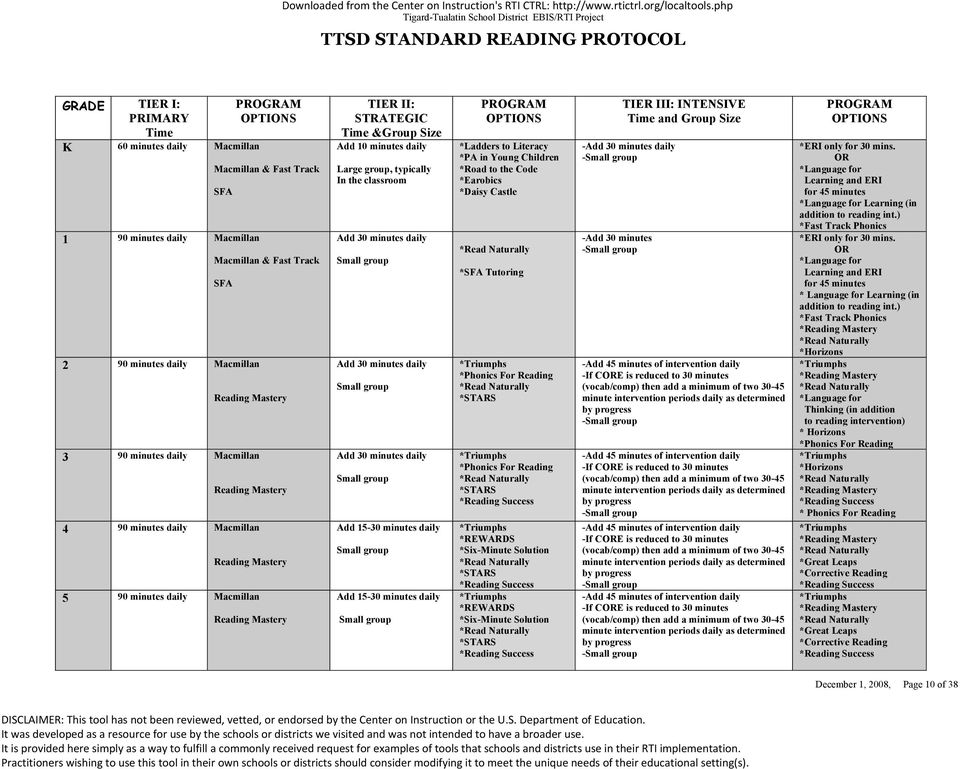
10 Tigard-Tualatin School District EBIS/RTI Project TTSD STANDARD READING PROTOCOL GRADE TIER I: PRIMARY Time K 60 minutes daily Macmillan PROGRAM OPTIONS Macmillan & Fast Track SFA 1 90 minutes daily Macmillan Macmillan & Fast Track SFA 2 90 minutes daily Macmillan Reading Mastery 3 90 minutes daily Macmillan Reading Mastery 4 90 minutes daily Macmillan Reading Mastery 5 90 minutes daily Macmillan Reading Mastery TIER II: STRATEGIC Time &Group Size Add 10 minutes daily Large group, typically In the classroom Add 30 minutes daily Small group Add 30 minutes daily Small group Add 30 minutes daily Small group Add minutes daily Small group Add minutes daily Small group PROGRAM OPTIONS *Ladders to Literacy *PA in Young Children *Road to the Code *Earobics *Daisy Castle *Read Naturally *SFA Tutoring *Triumphs *Phonics For Reading *Read Naturally *STARS *Triumphs *Phonics For Reading *Read Naturally *STARS *Reading Success *Triumphs *REWARDS *Six-Minute Solution *Read Naturally *STARS *Reading Success *Triumphs *REWARDS *Six-Minute Solution *Read Naturally *STARS *Reading Success TIER III: INTENSIVE Time and Group Size -Add 30 minutes daily -Small group -Add 30 minutes -Small group -Add 45 minutes of intervention daily -If CORE is reduced to 30 minutes (vocab/comp) then add a minimum of two minute intervention periods daily as determined by progress -Small group -Add 45 minutes of intervention daily -If CORE is reduced to 30 minutes (vocab/comp) then add a minimum of two minute intervention periods daily as determined by progress -Small group -Add 45 minutes of intervention daily -If CORE is reduced to 30 minutes (vocab/comp) then add a minimum of two minute intervention periods daily as determined by progress -Small group -Add 45 minutes of intervention daily -If CORE is reduced to 30 minutes (vocab/comp) then add a minimum of two minute intervention periods daily as determined by progress -Small group PROGRAM OPTIONS *ERI only for 30 mins. OR *Language for Learning and ERI for 45 minutes *Language for Learning (in addition to reading int.) *Fast Track Phonics *ERI only for 30 mins. OR *Language for Learning and ERI for 45 minutes * Language for Learning (in addition to reading int.) *Fast Track Phonics *Reading Mastery *Read Naturally *Horizons *Triumphs *Reading Mastery *Read Naturally *Language for Thinking (in addition to reading intervention) * Horizons *Phonics For Reading *Triumphs *Horizons *Read Naturally *Reading Mastery *Reading Success * Phonics For Reading *Triumphs *Reading Mastery *Read Naturally *Great Leaps *Corrective Reading *Reading Success *Triumphs *Reading Mastery *Read Naturally *Great Leaps *Corrective Reading *Reading Success December 1, 2008, Page 10 of 38
11 Tigard Tualatin School District EBIS / RTI Project TTSD STANDARD SPANISH READING PROTOCOL GRADE TIER I: PRIMARY Time K 60 minutes daily 1 90 minutes daily 2 90 minutes daily PROGRAM OPTIONS Tesoros SFA Tesoros SFA Tesoros TIER II: STRATEGIC Time &Group Size Add 10 minutes daily Large group Add 30 minutes daily Small group Add 30 minutes daily Small group PROGRAM OPTIONS *Estrellitas review * Tesoros Interventions *SFA Tutoring * El Camino *Read Naturally * Tesoros Interventions *SFA Tutoring * El Camino *Read Naturally * Tesoros Interventions TIER III: INTENSIVE Time and Group Size Add 30 minutes daily Small group Add 30 minutes Small group 45 minutes of instruction daily Small group PROGRAM OPTIONS *Canciones a cuentos *Elefonetica *Santillana-programs * El Camino *Elefonetica *Santillana programs *Reading A to Z in Spanish *Reading Rods * El Camino *Read Naturally *STARS for Spanish *Repeated reading text *Reading Rods *Elefonetica *Santillana programs *Reading A to Z in Spanish 3 90 minutes daily Tesoros Add 30 minutes daily Small group *Read Naturally *Phonics For Reading *STARS * Tesoros Interventions 45 minutes of instruction daily Small group *Read Naturally *STARS (Spanish) *Repeated reading text with targeted goals Transition 90 minutes daily * Macmillan * Add minutes daily Small group *REWARDS *Six-Minute Solution *Read Naturally *Collaborative Strategic Reading *STARS *Connections for Comp. *Reading Success *ADD 45 minutes of intervention daily Small group *Triumphs *Reading Mastery *Read Naturally *Great Leaps *Corrective Reading *Reading Success * During the transition period, ELL students may need greater emphasis on vocabulary development, comprehension and specific literacy transfer skills. Consult with ELL team. December 1, 2008, Page 11 of 38

12 Tigard-Tualatin School District EBIS/RTI Project Intervention Changes and Modifications Modification to Intervention (Applied to intervention as necessary, does not require documentation or EBIS team decision) Options for the Student o Motivation Add incentives Change incentives Increase success level Increase communication between interventionist, classroom teacher, and parent o Increase active engagement Number of responses per session o Increase types of cueing approaches Visual Auditory Tactile Options for Curriculum/Program o Check fidelity of implementation of program Provide additional training Add a coaching component Options for Instruction (Practices) o Increase pace of instruction o Increase opportunities to respond o Employ standard cueing correction procedures o Build/activate prior knowledge Options for Instruction (Logistics) o Change instructor o Change seating within group o Provide instruction in small units throughout the day o Change physical environment Change in Intervention (Constitutes a new intervention, decided upon by EBIS team) Add 15 minutes per intervention session (extra time could be used to pre-teach vocabulary or core content) Reduce group size by 2-3 students Change or add curriculum according to reading protocol Add a behavior plan December 1, 2008, Page 12 of 38

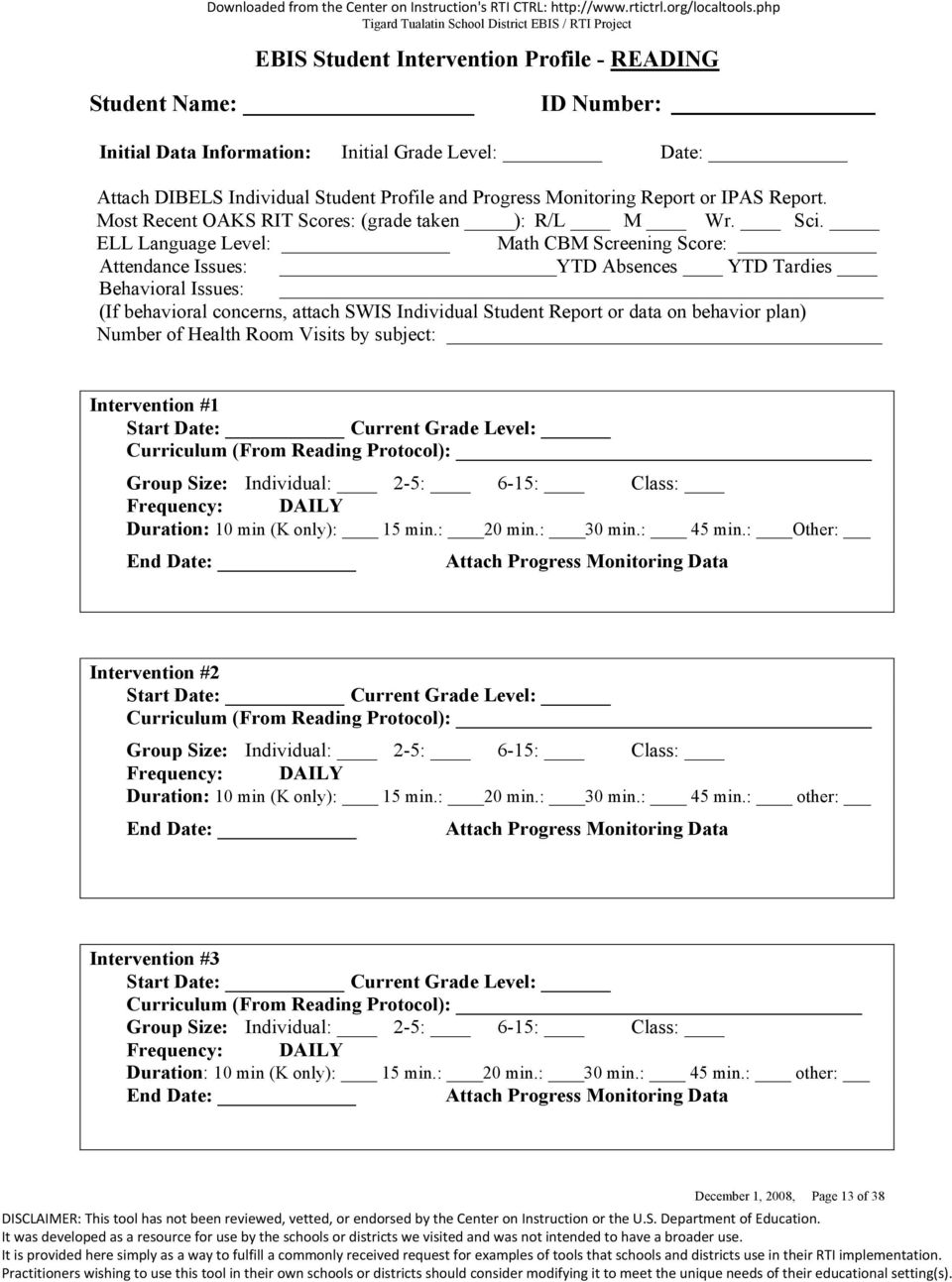
13 Tigard Tualatin School District EBIS / RTI Project EBIS Student Intervention Profile - READING Student Name: ID Number: Initial Data Information: Initial Grade Level: Date: Attach DIBELS Individual Student Profile and Progress Monitoring Report or IPAS Report. Most Recent OAKS RIT Scores: (grade taken ): R/L M Wr. Sci. ELL Language Level: Math CBM Screening Score: Attendance Issues: YTD Absences YTD Tardies Behavioral Issues: (If behavioral concerns, attach SWIS Individual Student Report or data on behavior plan) Number of Health Room Visits by subject: Intervention #1 Start Date: Current Grade Level: Curriculum (From Reading Protocol): Group Size: Individual: 2-5: 6-15: Class: Frequency: DAILY Duration: 10 min (K only): 15 min.: 20 min.: 30 min.: 45 min.: Other: End Date: Attach Progress Monitoring Data Intervention #2 Start Date: Current Grade Level: Curriculum (From Reading Protocol): Group Size: Individual: 2-5: 6-15: Class: Frequency: DAILY Duration: 10 min (K only): 15 min.: 20 min.: 30 min.: 45 min.: other: End Date: Attach Progress Monitoring Data Intervention #3 Start Date: Current Grade Level: Curriculum (From Reading Protocol): Group Size: Individual: 2-5: 6-15: Class: Frequency: DAILY Duration: 10 min (K only): 15 min.: 20 min.: 30 min.: 45 min.: other: End Date: Attach Progress Monitoring Data December 1, 2008, Page 13 of 38
14 Tigard-Tualatin School District EBIS/RTI Project TTSD Standard Behavior Protocol Grade Level(s) Universal Screening Tools Core Program Second Tier Interventions Third Tier Interventions K-1 First Step To Success Screener Phoneme Segmentation Fluency Office Discipline Referrals Attendance Reports Suspension/Expulsion Data 2-12 Office Discipline Referrals Attendance Reports Suspension/Expulsion Data Oregon Healthy Teens Survey Social Marketing Surveys School Rules & Behavior Expectations Are Explicitly Taught to ALL Students All Students Regularly & Consistently Acknowledged for Demonstrating Behavior Expectations All Students Immediately & Reliably Corrected When Behavior Expectations Are Not Demonstrated. Positive Behavior Expectation Retaught & Reinforced Immediately School-wide Social/Emotional Curriculum Delivery (e.g. Second Steps, Steps to Respect, etc.) Re-Teach Expectations Check & Connect Programs Hug Program Adult Mentoring Skills Groups Behavior Contracts Targeted Social/Emotional Curriculum Follow-up (e.g., Second Steps with Small Group of Struggling Students) Re-Teach Expectations Check & Connect Check-in/Check-out Program HUG Program Strategic Positive Referrals for Identified Students Working Towards Increased Positive Behavior Adult Mentoring Peer Mentoring Skills Groups Behavior Contracts Advisory Classes Targeted Social/Emotional Curriculum Follow-up (e.g., Second Steps with Small Group of Struggling Students) Strategic Tutors Core + Second Tier and First Step To Success Functional Behavior Assessment & Individual Behavior Support Plans Individualized Behavior Goals and Progress Monitoring (IEP & 504) Core + Second Tier and Functional Behavior Assessment & Individual Behavior Support Plans Individualized Behavior Goals and Progress Monitoring (IEP & 504) Who does this work? District FSTS Staff EBIS / EBS Teams ALL STAFF Appropriate Staff as Determined by EBS Team Appropriate Staff as Determined by EBS Team (See Page 2 for Decision Rules) December 1, 2008, Page 14 of 38

15 Decision Rules: Screening o K-1 o K-5 o 6-12 o K-12 Tigard Tualatin School District EBIS / RTI Project TTSD Standard Behavior Protocol (Page 2) Every student that a K-1 teacher or staff member believes will need behavior support is screened with the First Step to Success Screener. Students who score in the high risk or extreme risk range of the First Step to Success (FSTS) Screener are considered for participation in the FSTS program. Students identified as at risk or deficit on Phoneme Segmentation Fluency (PSF) on the DIBELS are considered for Second Tier Reading &/or Behavior Interventions. Students who are identified as at-risk or deficit on the PSF AND extreme risk on the FSTS screener MUST be discussed by the EBIS team for possible referral to the First Step to Success Program. Office Discipline Referral Data reviewed monthly. If more than 1 referral per day per month for every 250 students, revisit the CORE and look for patterns in location, time, grade, type, and frequency of incidents. Office Discipline Referral Data reviewed monthly. If more than 1 referral per day per month for every 200 students, revisit the CORE and look for patterns in location, time, grade, type, and frequency of incidents. If more than 20% of all students received 2 or more referrals: revisit the CORE. More than 30% of referrals occur in a specific area of the school: re-teach specific common area behavior expectations, acknowledge/reward positive behavior, & correct inappropriate behavior immediately. More than 40% of referrals occur in classrooms: re-teach classroom expectations, increase professional development in classroom management strategies, and/or revisit CORE instruction in specific classrooms. Strategic: o If more than 2 referrals in a 30-day period, meet with parents and develop a plan. o If more than 5 absences in a 30-day period: instigate communication strategies with families and EBIS team reviews other data to determine appropriate interventions. o If a student has 2 or more F s or a GPA of <1.4 during any quarter, provide intervention. o If more than 5 referrals, complete an FBA and individualize your interventions. Progress monitoring: o K/1: 1x/week PSF & Behavior Intervention Data. o K-12: Behavior data from Check-in/Check-out programs. o K-12: Progress on individual behavior goals or Behavior Support Plan. Intensifying intervention: o Students who receive 2-5 referrals should receive CORE + Second Tier Interventions. o If progress is below the expected rate after 6 to 8 weeks of Second Tier Intervention, students move to Third Tier Interventions (consider performing a Functional Behavior Assessment and developing a Behavior Support Plan). o Students receiving 6 or more behavior referrals: perform an appropriate Functional Behavior Assessment & develop a Behavior Support Plan. December 1, 2008, Page 15 of 38

16 Tigard-Tualatin School District EBIS/RTI Project Student Intervention Profile --BEHAVIOR Student Name: ID Number: Initial Data Information: Initial Grade Level: Date: Attach DIBELS Individual Student Profile and Progress Monitoring Report or IPAS Report. Most Recent OAKS RIT Scores: (grade taken ): R/L M Wr. Sci. ELL Language Level: Math CBM Screening Score: Attendance Issues: YTD Absences YTD Tardies Behavioral Issues: (Attach SWIS Individual Student Report and data on behavior plan) Number of Health Room Visits by subject: Intervention #1 Start Date: Current Grade Level: Program/Curriculum: Group Size: Individual: 2-5: 6-15: Class: Frequency: Once/Wk: Twice/Wk: Daily: Other: Duration: 10 min.: 15 min.: 20 min.: 30 min.: Other: End Date: Attach Progress Monitoring Data Intervention #2 Start Date: Current Grade Level: Program/Curriculum: Group Size: Individual: 2-5: 6-15: Class: Frequency: Once/Wk: Twice/Wk: Daily: Other: Duration: 10 min.: 15 min.: 20 min.: 30 min.: Other: End Date: Attach Progress Monitoring Data Intervention #3 Start Date: Current Grade Level: Program/Curriculum: Group Size: Individual: 2-5: 6-15: Class: Frequency: Once/Wk: Twice/Wk: Daily: Other: Duration: 10 min.: 15 min.: 20 min.: 30 min.: Other: End Date: Attach Progress Monitoring Data December 1, 2008, Page 16 of 38

17 Tigard Tualatin School District EBIS / RTI Project TTSD STANDARD MATH PROTOCOL Grade Level(s) Universal Screening Tool Core Program Second Tier Interventions Third Tier Interventions K 1-2 Progress Reports AND CBM: Missing Numbers Grade 1: Progress Reports AND CBM: Missing Numbers Grade 2: Progress Reports Adopted Curriculum: Agreed upon minutes of instruction per day. Increased teacher attention during math instruction 10 minutes of additional guided practice per day (can be embedded in the core) 5 minutes of additional guided practice per day Core plus: 15 minutes of additional guided practice per day OR OR 3-5 Progress Reports and Oregon State Assessment 10 minutes of Computer Assisted Instruction per day 15 minutes of Computer Assisted Instruction per day Who does this work? Grade Level/EBIS Teams Classroom Teachers Classroom Teachers EBIS Team Determines Decision Rules: Screening: o K: Students scoring in the lowest 20% on Missing Numbers CBM OR receiving only o and/or / in the Progression of Mathematics Stages on the Progress Report are considered for Tier 2 interventions. o 1: Students scoring in the lowest 20% on Missing Numbers CBM OR receiving only 1 and/or / in Math on the Progress Report are considered for Tier 2 interventions. o 2: Students receiving only 1 and/or / in Math on the Progress Report are screened using CBM, and considered for Tier 2 interventions. o 3-5: Students receiving only 1, 2, and/or / in Math on the Progress Report AND scoring below the 30 th percentile on the OAKS, are screened using CBM and considered for Tier 2 interventions. Progress monitoring: o CBMs are given every two weeks. Trend lines are reviewed every 12 weeks. Trained IAs complete progress monitoring and graph data. Intensifying intervention: o If progress is below the expected rate after 12 weeks of Second Tier Intervention, students move to Third Tier Intervention. o If progress is below the expected rate after 12 weeks of Third Tier Intervention, EBIS makes a referral to special education. December 1, 2008, Page 17 of 38

18 Tigard-Tualatin School District EBIS/RTI Project Student Intervention Profile --MATH Student Name: ID Number: Initial Data Information: Initial Grade Level: Date: Attach DIBELS Individual Student Profile and Progress Monitoring Report or IPAS Report. Most Recent OAKS RIT Scores: (grade taken ): R/L M Wr. Sci. ELL Language Level: Math CBM Screening Score: Attendance Issues: YTD Absences YTD Tardies Behavioral Issues: (If behavioral concerns, attach SWIS Individual Student Report and data on behavior plan) Number of Health Room Visits by subject: Intervention #1 Start Date: Current Grade Level: Program/Curriculum: Group Size: Individual: 2-5: 6-15: Class: Frequency: DAILY Duration: 10 min.: 15 min.: 20 min.: 30 min.: Other: End Date: Attach Progress Monitoring Data. Intervention #2 Start Date: Current Grade Level: Program/Curriculum: Group Size: Individual: 2-5: 6-15: Class: Frequency: DAILY Duration: 10 min.: 15 min.: 20 min.: 30 min.: Other: End Date: Attach Progress Monitoring Data. Intervention #3 Start Date: Current Grade Level: Program/Curriculum: Group Size: Individual: 2-5: 6-15: Class: Frequency: DAILY Duration: 10 min.: 15 min.: 20 min.: 30 min.: Other: End Date: Attach Progress Monitoring Data. December 1, 2008, Page 18 of 38

19 Tigard-Tualatin School District EBIS/RTI Project Student Intervention Profile --MATH Student Name: ID Number: Initial Data Information: Initial Grade Level: Date: Attach DIBELS Individual Student Profile and Progress Monitoring Report or IPAS Report. Most Recent OAKS RIT Scores: (grade taken ): R/L M Wr. Sci. ELL Language Level: Math CBM Screening Score: Attendance Issues: YTD Absences YTD Tardies Behavioral Issues: (If behavioral concerns, attach SWIS Individual Student Report and data on behavior plan) Number of Health Room Visits by subject: Intervention #1 Start Date: Current Grade Level: Program/Curriculum: Group Size: Individual: 2-5: 6-15: Class: Frequency: DAILY Duration: 10 min.: 15 min.: 20 min.: 30 min.: Other: End Date: Attach Progress Monitoring Data. Intervention #2 Start Date: Current Grade Level: Program/Curriculum: Group Size: Individual: 2-5: 6-15: Class: Frequency: DAILY Duration: 10 min.: 15 min.: 20 min.: 30 min.: Other: End Date: Attach Progress Monitoring Data. Intervention #3 Start Date: Current Grade Level: Program/Curriculum: Group Size: Individual: 2-5: 6-15: Class: Frequency: DAILY Duration: 10 min.: 15 min.: 20 min.: 30 min.: Other: End Date: Attach Progress Monitoring Data. December 1, 2008, Page 18 of 38

20 Tigard-Tualatin School District EBIS/RTI Project EFFECTIVE BEHAVIOR AND INSTRUCTION SUPPORT (EBIS) TEAM MEETING NOTICE Dear : (Parent / Guardian) The Effective Behavior and Instructional Support (EBIS) Team has been monitoring the progress of your child,. The EBIS program s purpose is prevention of academic and behavior problems, and supports group and individual programs for all students. called you regarding your child s progress on. Teacher s Name Date The team is planning on meeting at school to discuss your child s needs and plan an EBIS program on:. (Date) We invite you to attend this meeting and would welcome participation in this process. If you would like attend, please contact at for more specific information on the time and place. (Team Coordinator) (Phone Number) If you have questions regarding the EBIS program, please contact your school principal or Dan Goldman, the District EBIS Director at IMPORTANT NOTICE REGARDING SPECIAL EDUCATION: Sometimes students experience substantial on-going difficulties in school as the result of disabilities. If the school team or your child s teacher(s) have this concern, they will contact you to discuss it. If you are concerned that your child may have a disability and is in need of special education services, please contact the school principal. December 1, 2008, Page 20 of 38

21 Tigard Tualatin School District EBIS / RTI Project APOYO DE INSTRUCCIÓN Y COMPORTAMIENTO EFICAZ (EBIS) NOTICIA DE LA REUNION CON EL EQUIPO Estimado : (Padre/ Tutor) El Equipo de Apoyo de Instrucción y Comportamiento Eficaz (EBIS) ha estado evaluando el progreso de su hijo(a),. El propósito del programa de EBIS es la prevención de problemas académicos y de comportamiento, y para apoyar programas de grupos e individuales para todos los estudiantes. se comunico con usted acerca de el progreso de su Nombre de Maestro(a) hijo(a) el. Fecha El equipo se reunirá en la escuela para discutir las necesidades de su niño(a) y planear un programa de EBIS el:. Fecha Usted está invitado a asistir esta reunión y será bienvenido para participar en este proceso. Si le gustaría asistir, por favor hable con al para (Coordinador de Equipo) (Numero de Telefono) información más específica del tiempo y lugar. Si tiene preguntas con respecto al programa de EBIS, por favor de contactar al director de su escuela o Dan Goldman, el Director de EBIS del Distrito al NOTICIA IMPORTANTE CON RESPECTO A LA EDUCACION ESPECIAL: A veces los estudiantes pasan por dificultades sustanciales en la escuela que resultan en inhabilidades de aprender. Si el equipo de la escuela o los maestros de su niño(a) tienen esta preocupación, ellos hablaran con usted para discutir esto. Si usted esta preocupado que su niño(a) tenga una inhabilidad de aprender y esta en necesidad de servicios de educación especial, por favor hable con el director de su escuela. December 1, 2008, Page 21 of 38
22 How we determine who needs additional instruction: In Tigard-Tualatin School District, we review all elementary students progress three times a year. In middle and high school, we screen students when they enter school, and we review assessment, attendance, grade, and behavior data throughout the year. We track students achievement in reading especially carefully, and we also look at math and writing performance. In some cases, all students are given a short assessment. Other times, a team of professionals simply reviews existing academic, behavior, and attendance information. The teams use the data to decide which students are doing well in the standard classroom instruction, which students may need supplemental instruction, and which students may need individualized instruction. When students receive supplemental small group or individualized instruction, we check their progress frequently. We use decision rules to look at the students progress and decide if the child needs to have a different kind of supplemental instruction. The key idea is to make changes when instruction is not working for a child. Tigard-Tualatin School District EBIS/RTI Project The first step is to provide small group interventions for a student. If, after a period of instruction, there is still concern, we will plan an individualized intervention. You are invited to participate in this process. During individualized interventions, we monitor children s progress each week. If a student makes limited progress during an individualized intervention, we may ask for your permission to conduct an individual evaluation. This evaluation might result in the identification of a learning disability. No evaluation would be conducted without your written consent. Parent participation: Parents are essential to children s success in school. When a child needs supplemental instruction, we will describe that instruction to you. We will also ask you to tell us about anything you think might affect your child s learning. For example, it is important for us to know if a child has missed a lot of school, experienced a trauma, or is having problems with friends at school. These types of problems may affect a student s progress, and if we know about them, we can design an intervention more effectively. Parents frequently partner with the school to provide extra practice to develop skills. If you do want to provide extra support at home, you can work with the school to make yourself part of your child s program. When children continue to have difficulty: The school will tell you whether your child begins to make sufficient progress, or if your child has continued difficulty. If you and the school have tried several interventions, and progress is still limited, you may be asked to give your consent for an evaluation. The purpose of such an evaluation is to determine what your child s educational needs are, and to consider whether he or she might have a learning disability. December 1, 2008, Page 22 of 38
23 Tigard Tualatin School District EBIS / RTI Project Response to Intervention (RTI) The approach described in this brochure is called Response to Intervention (RTI). This is a way of organizing instruction that has two purposes: 1. To identify children needing help in reading, math, and writing, and prevent the development of serious learning problems; and 2. To identify children who, even when they get extra help, make very limited progress. Research has shown that these children sometimes have learning disabilities. You may also request an evaluation at any time if you think your child may have a disability. No evaluation would take place without a conference with you, and your written consent. If you have any questions about this information, please contact the school s Literacy Specialist or Principal. Your child s instructional program in the Tigard-Tualatin School District Tigard-Tualatin School District is committed to ensuring each child makes significant academic progress. To do this, we continuously review information that tells us how each child is progressing. Teacher teams in your school use this process, called Effective Behavior and Instructional Support. Look inside to see how this process can help your child. December 1, 2008, Page 23 of 38
24 Cómo determinamos quién necesita instrucción adicional: En el Distrito Escolar de Tigard-Tualatin, repasamos el progreso de todos los estudiantes en las escuelas primarias (K-5 ) tres veces al año. En las escuelas secundarias (6-8 ) y preparatorias (9-12 ), examinamos a estudiantes cuando entran a la escuela, y repasamos exámenes, asistencia, grado y datos de comportamiento a través del año. Seguimos el logro de los estudiantes en la lectura muy cuidadosamente y también miramos como están en las matemáticas y la escritura. En algunos casos, se les da a todos los estudiantes un examen corto. Otras veces, un equipo de profesionales simplemente repasa información existente académica, de comportamiento y de asistencia. Los equipos utilizan los datos para decidir cuales estudiantes están haciendo bien en las clases de instrucción estándares, cuales estudiantes pueden necesitar instrucción suplemental y cuales estudiantes pueden necesitar instrucción individualizada. Cuando estudiantes reciben instrucción suplemental en grupos pequeños o instrucción individualizada, nosotros revisamos su progreso con frecuencia. Utilizamos las leyes de decisión para mirar el progreso de los estudiantes y para decidir si el estudiante necesita tener una instrucción suplemental Tigard-Tualatin School District EBIS/RTI Project diferente. La idea dominante es de hacer cambios cuando la instrucción no está trabajando para un niño(a). El primer paso es de proporcionar intervenciones para el estudiante en grupos pequeños. Si, después de un periodo de instrucción, todavía hay preocupación, planearemos una intervención individualizada. Usted esta invitado a participar en este progreso. Durante intervenciones individualizadas, nosotros supervisamos el progreso de los niños cada semana. Si un estudiante hace un progreso limitado durante una intervención individualizada, podemos pedir su permiso de conducir una evaluación individual. Esta evaluación puede resultar en la identificación de una inhabilidad de aprender. No se conduciría ninguna evaluación sin su consentimiento escrito. Participación del padre: Los padres son esenciales para el éxito de los niños en la escuela. Cuando un niño necesita instrucción suplemental, le describiremos esa instrucción a usted. También le preguntaremos que nos diga sobre cualquier cosa que usted piense puede afectar la habilidad de aprender de su niño(a). Por ejemplo, es importante que nosotros sepamos si un niño(a) ha faltado mucho la escuela, ha pasado por una trauma o esta teniendo problemas con amigos en la escuela. Estos tipos de problemas pueden afectar el progreso de un estudiante y si sabemos sobre ellos, podemos diseñar una intervención con más eficacia. Los padres se unen frecuentemente con la escuela para proporcionar práctica adicional para desarrollar habilidades. Si usted desea proporcionar ayuda adicional en el hogar, puede trabajar con la escuela para hacerse parte del programa de su niño(a). Cuando los niños continúan teniendo dificultades: La escuela le dirá si su niño(a) esta empezando a hacer progreso suficiente, o si su niño(a) ha continuado con dificultad. Si usted y la escuela han tratado varias intervenciones, y el progreso todavía esta limitado, se le puede pedir por su consentimiento para una evaluación. El propósito de esa evaluación es para determinar cuales son las necesidades educativas de su niño y para considerar si el o ella pueda tener una inhabilidad de aprender. December 1, 2008, Page 24 of 38
25 Respuesta a la Intervención (RTI) Tigard Tualatin School District EBIS / RTI Project El enfoque escrito en este folleto se llama Respuesta a la Intervención (RTI). Esta es una manera de organizar instrucción que tiene dos propósitos: 1 Para identificar a niños que necesitan ayuda en la lectura, matemáticas y escritura y prevenir el desarrollo de serios problemas de aprender; y 2 Para identificar a los niños que, aun cuando se les da ayuda adicional, hacen un progreso muy limitado. Investigaciones han demostrado que estos niños tienen a veces inhabilidades de aprender. Usted también puede solicitar una evaluación en cualquier momento si usted piensa que su niño pueda tener una inhabilidad de aprender. Ninguna evaluación se tomara acabo sin una conferencia con usted y su consentimiento escrito. Si tiene cualquier pregunta sobre esta información, por favor hable con el Especialista de Alfabetizmo o con el Director de la escuela. El programa educacional de su niño(a) en el Distrito Escolar de Tigard-Tualatin El Distrito Escolar de Tigard- Tualatin esta comprometido a asegurar que cada niño(a) haga un progreso académico significativo. Para hacer esto, repasamos continuamente la información que nos dice como cada niño(a) esta progresando. Equipos de maestros en su escuela usan este proceso, llamado Comportamiento Eficaz y Apoyo Educacional. Mire adentro para ver como este proceso puede ayudarle a su niño. December 1, 2008, Page 25 of 38
26 Tigard-Tualatin School District EBIS/RTI Project Developmental History Page 1 of 3 (To be completed through an interview with the counselor or school psychologist) Student s Name: DOB Age Grade Person Interviewed: Relationship to Student: Interview Completed by: Date: Language Spoken in Home: Interpreter (If used): Birth History 1. How often did you see a doctor while you were pregnant? Regularly A few times Not at all 2. Were you sick or did you have any complications while you were pregnant? Yes No If yes, what did you have? 3. Did you have measles or any other childhood disease while you were pregnant? Yes No If yes, what did you have? 4. Did you have trouble giving birth? Yes No If yes, what was the trouble? 5. Was your child born earlier than you expected? Yes No If yes, how many weeks early? 6. Was there anything unusual or wrong with the birth? Yes No If yes, please explain. 7. Was your child born in a hospital? Yes No 8. In what country was your child born? 9. What age were the mother and father at the birth? Mother Father 10. Is there a family history of any genetic conditions? Yes No If yes, please explain Was genetic testing completed for your child? What were the results? Health History 11. Did your child have any illness or other concerns during the first year? Yes No If yes, what was the illness or concern? 12 Have any of the following happened to your child? a. had a temperature over 104 degrees for more than a few hours? Yes No b. had to go to the hospital because of a temperature? Yes No c. ever been knocked unconscious? Yes No d. ever had a concussion? Yes No e. ever been in a coma? Yes No f. ever had any kind of an operation? Yes No g. ever been to a hospital for any other sickness or trouble not mentioned above? Yes No h. ever had problems with hearing or vision Yes No i. had frequent earaches? Yes No if yes, were tubes installed? at what age? If you answered yes to any of these questions, please tell about it: December 1, 2008, Page 26 of 38
27 Tigard Tualatin School District EBIS / RTI Project Developmental History Page 2 of Does your child take any kind of medicine or pills regularly for some condition? Yes No If yes, please tell what the medicine is for and how long your child has been taking it. 14. Has the child been diagnosed with any health problems? If so please explain: Developmental Milestones 15. At what age did your child: a. sit alone b. walk c. speak single words d. speak 2-3 word sentences 16. When was your child completely toilet trained? 17. At the present time, does your child ever have toileting accidents? Yes No 18. Does the child have any brothers or sisters? If so, list ages, gender, and whether they live at home. 19. Has your child s speech and/or language development been significantly different than his or her siblings? (i.e. simpler vocabulary, later to begin speaking, difficulty following directions) Yes No If yes, please explain 20. Do people outside the family understand what your child says? Yes No If no, please tell about it. 21. What language(s) is (are) spoken in the home? What language does your child speak most often with friends? siblings? What language does your child hear most often at home? In which language does your child generally respond? 22. Do both parents live at home? Yes No 23. Is there any history of learning problems and/or speech/language difficulties in the family? Yes No Please explain 24. Is there any family history of physical or mental health problems? Yes No If so please describe: 25. How many different schools has your child attended? If your child s primary language is not English, has your child had any formal schooling in their native language? For how many years? 26. Would you describe the child s school attendance as poor, fair, or good? If there have been any interruptions in your child s school experience, please explain. 27. Has your family experienced homelessness? December 1, 2008, Page 27 of 38
28 Tigard-Tualatin School District EBIS/RTI Project Developmental History Page 3 of Did your child attend preschool? Yes No Please list frequency, duration, and types of activities. 29. Now or in the past has your child been involved in any activities outside of school such as sports, playgroups, library visits, or scouts? Please list: 30. What does your child like to do with just you? 31. What does the whole family like to do for fun together? 32. How much screen time or media does your child have access to daily? 33. When you want your child to do something, do you feel you have to repeat yourself more often than you would like to or feel that you should have to? Yes No 34. How does your child respond when you have to speak a second or third time, and what do you do? 35. What kinds of things do you expect or ask that your child do such as chores or responsibilities around the house (for example: cleaning his/her room, emptying the trash, answering the phone, etc.)? Is this routine or when he/she feels like it? 36. What does your child do which pleases you the most (those things that make you proud as a parent)? 37. Does your child experience difficulty doing or completing homework? Please explain: 38. Has there been anything unusual that occurred to you and your family within the last five years, such as a major illness, death in the family, change of residence, divorce, moving away from family, etc? If so, please explain and list when these things occurred. 39. At present time, do you have any concerns about your child? Yes No If so, please describe: December 1, 2008, Page 28 of 38
29 Tigard Tualatin School District EBIS / RTI Project Developmental History (Historia del Desarrollo) Page 1 of 4 (To be completed through an interview with the counselor or school psychologist) Name of Student (Nombre del Estudiante) DOB (Fecha de Nacimiento) Age (Edad) Grade (Grado) Person Interviewed (Persona Entrevistada): Relationship to Student (Relación con el Estudiante): Interview Completer by (Entrevista Completada por): Date (Fecha) Language Spoken in Home (Idioma Hablado en Casa) Birth History (Historial de Nacimiento) 1 How often did you see a doctor while you were pregnant? Qué tan frecuente visito un doctor mientras estaba embarazada? Regularly (Regularmente) A few times (Algunas veces) Not at all (Nunca) 2. Were you sick or did you have any complications while you were pregnant? Estuvo enferma o tuvo complicaciones durante su embarazo? Yes (Sí) No If yes, what did you have? Si sí, Qué tuvo o cuales fueron las complicaciones? 3. Did you have measles or any other childhood disease while you were pregnant? Tuvo sarampión u otra enfermedad de niñez mientras estaba embarazada? Yes (Sí) No If yes, what did you have? Si sí, qué es lo que tuvo? 4. Did you have trouble giving birth? Tuvo problemas al dar a luz? Yes (Sí) No If yes, what was the trouble? Si sí, cuál fue el problema? 5. Was your child born earlier than you expected? Nació su niño(a) antes de lo que esperaba? Yes (Sí) No If yes, how many weeks early? Si sí, cuántas semanas antes? 6. Was there anything unusual or wrong with the birth? Hubo algo inusual o mal con el parto? Yes (Sí) No If yes, what was wrong? Si sí, qué estuvo mal? 7. Was your child born in a hospital? Nació su hijo(a) en un hospital? Yes (Sí) No 8. In what country was your child born? En qué país nació su hijo(a)? December 1, 2008, Page 29 of 38
30 Tigard-Tualatin School District EBIS/RTI Project 9. What age were the mother and father at birth? Cuál era la edad de la madre y el padre cuando nació su hijo(a) Mother (Madre) Father (Padre) 10. Is there a family history of any genetic conditions? Hay algun historial de condiciones geneticas en la familia? Yes (Sí) No If yes, please explain. Si sí, por favor explique Was genetic testing completed for your child? What were the results? Se les hicieron pruebas genéticas a su hijo(a)? Cuáles fueron los resultados? 11. Did your child have any illness or any other concerns during the first year? Tuvo su hijo(a) enfermedades o algo malo durante el primer año? Yes (Sí) No If yes, what was the illness or concerns? Si sí, cuál fue la enfermedad o que tenía mal? Health History (Historia de la Salud) Page 2 of Have any of the following happened to your child? Algo de lo siguiente le ha sucedido a su hijo(a)alguna vez? a. had a temperature over 104 degrees for more than a few hours? ha tenido temperatura sobre 104 grados F (40 grados C ) por más de unas cuantas horas? Yes (Sí) No b. had to go to the hospital because of a temperature? ha tenido que ir al hospital por razón de una temperatura? Yes (Sí) No c. ever been knocked unconscious? ha perdido la consciencia? Yes (Sí) No d. ever had a concussion? ha tenido una concusión cerebral? Yes (Sí) No e. ever been in a coma? ha estado en un coma? Yes (Sí) No f. ever had any kind of an surgery? ha tenido algun tipo de cirugia? Yes (Sí) No g. ever been to a hospital for any other sickness or trouble not mentioned above? ha visitado un hospital por cualquier otra enfermedad que no ha sido mencionada arriba? Yes (Sí) No h. ever had problems with hearing or vision? ha tenido problemas de oido o la visión? Yes (Sí) No i. had frequent earaches? ha tenido dolor de oídos frecuentemente? Yes (Sí) No if yes, were tubes installed? Si sí, se instalaron tubos? Yes (Sí) No at what age? a qué edad? If you answered yes to any of these questions, please tell about it. Si contesto sí a una de estas preguntas, por favor escriba sobre ello: _ 13. Does your child take any kind of medicine or pills regularly for some condition? Toma su hijo(a) cualquier tipo de pastillas o medicina regularmente para alguna condición? Yes (Sí) No If yes, please tell what the medicine is for and how long your child has been taking it. Si sí, por favor diga para qué es la medicina y por cuánto tiempo lo ha estado tomando su hijo(a)? December 1, 2008, Page 30 of 38
31 Tigard Tualatin School District EBIS / RTI Project 14. Has the child been diagnosed with any health problems? If so tell about them: Ha sido diagnosticado su hijo(a) con cualquier problemas de salud? Si sí, escriba sobre ello: Developmental Milestones Etapas de Desarrollo 15. At what age did your child A qué edad su hijo(a)?: a. sit alone (se sento solo) b. walk (camino) c. speak single words (dijo sus primeras palabras) d. speak 2-3 word sentences (hablo oraciones de 2-3 palabras) 16. At what age was your child completely toilet trained? ( A que edad fue entrenado completamente su hijo(a) para usar el baño? 17. At the present time, does your child ever have toileting accidents? Actualmente, ha tenido su hijo(a) accidentes en usar el baño? Yes (Sí) No 18. Does the child have any brothers or sisters? If so, list ages, gender, and whether they live at home. Tiene su hijo(a) hermanos o hermanas? Si sí, haga lista de las edades, sexo, y si viven en casa o no. Developmental History (Historia del Desarrollo) Page 3 of Has your child s speech and/or language development been significantly different than his o r her siblings? (i.e. simpler vocabulary, later to begin speaking, difficulty following directions). Ha sido significantemente diferente el habla o el desarrollo del lenguaje de su hijo(a) al de sus hermanos? (Por ejemplo usa vocabulario más sencillo, demoro mas en hablar, o se le dificulta seguir instrucciones). Yes (Sí) No If yes, please explain. Si sí, por favor explique: 20. Do people outside the family understand what your child says? Entienden las personas fuera de su familia lo que dice el niño(a)? Yes (Sí) No If no, please tell about it. Si no, por favor escriba sobre ello. 21. What language(s) are spoken in the home? Que idioma(s) se hablan en casa? December 1, 2008, Page 31 of 38
32 Tigard-Tualatin School District EBIS/RTI Project What language does your child speak most often with friends? Qué idioma usa mas su hijo(a) con amigos/amigas? with siblings con sus hermanos/hermanas?. What language does your child hear most often at home? Qué idioma escucha mas su hijo(a) en casa?. In which language does your child generally respond? En qué idioma generalmente responde su hijo(a)?. 22. Do both parents live at home? Viven ambos padres en el hogar? Yes (Sí) No 23. Is there any history of learning problems and/or speech/language difficulties in the family? Hay problemas de familia en el aprendizaje y/o dificultades de idioma? Yes (Sí) No Please explain. Por favor explique 24. Is there any family history of physical or mental health problems? Hay historial de problemas mentales o físicos en la familia? Yes (Sí) No If so, please describe (Si sí, descríbalo): 25. How many different schools has the child attended? A cuántas escuelas ha asistido el niño(a)? If your child s primary language is not English, has your child had any formal schooling in their native language? Si el idioma principal de su hijo(a) no es el ingles, ha recibido instrucción formal en su idioma nativo? Yes (Sí) No For how many years? Por cuantos años? 26. Would you describe the child s school attendance as poor, fair, or good? Cómo describiría la asistencia escolar del estudiante: Bueno, Regular, Malo? If there have been any interruptions in your child s school experience, please explain. Si ha habido interrupciones durante la experiencia escolar de su hijo(a), por favor explique 27. Has your family experienced homelessness? Ha experimentado su familia el quedarse sin hogar? Yes (Sí) No 28. Did your child attend preschool? Su hijo(a) asistió a la pre-escuela? Yes (Sí) No Please list frequency, duration, and types of activities. Por favor haga lista de la frecuencia con que asistió, la duración y las diferentes actividades que hacían Developmental History (Historia del Desarrollo) Page 4 of 4 December 1, 2008, Page 32 of 38
33 Tigard Tualatin School District EBIS / RTI Project 29. Now or in the past has your child been involved in any activities outside of school such as sports, playgroups, library visits, or scouts? Está o ha estado su hijo(a) envuelto en alguna actividad fuera de la escuela tal como en deportes, grupos de juego, visitas a la biblioteca o ha sido excursionista/scout? Please list. Por favor haga mencionelos 30. What does your child like to do with just you? Qué le gusta hacer a su hijo(a) con usted solamente? 31. What does the whole family like to do for fun together? Qué le gusta hacer a la familia para divertirse juntos? 32. How much screen time or media does your child have access to daily? Qué tanto tiempo pasa en la pantalla o que tanto acceso diario tiene al medio de comunicación? 33. When you want your child to do something, do you feel you have to repeat yourself more often than you would like to or feel that you should have to? Cuando usted quiere que su hijo(a) haga algo siente que tiene que repetírselo más de lo que quisiera o que debería hacerlo? Yes (Sí) No 34. How does your child respond when you have to speak a second or third time, and what do you do? Cómo responde su hijo(a) cuando usted tiene que hablarle una segunda o tercera vez, y que hace usted? 35. What kinds of things do you expect or ask that your child do such as chores or reponsibilities around the house (for example: cleaning his/her room, emptying the trash, answering the phone, etc.)? Qué clase de cosas espera usted o le pide a su hijo(a) que hagan como quehaceres o responsabilidades alrededor de la casa (por ejemplo: limpiar su cuarto, tirar la basura, contestar el teléfono, etc.)? 36. What does your child do which pleases you the most (those things that make you proud as a parent)? Qué hace su hijo(a) que le agrada a usted (esas cosas que lo enorgullecen como padre/madre)? 37. Does your child experience difficulty doing or completing homework? Experimenta dificultad su hijo(a) para terminar la tarea? Yes (Sí) No Please explain. Por favor explique 38. Has there been anything unusual that ocurred to you and your family within the last five years, such as a major illness, death in the family, change of residence, divorce, moving away from family, etc.? Ha habido algo inusual que le haya ocurrido a usted y a su familia dentro de los últimos cinco años, tal como una enfermedad grave, una muerte December 1, 2008, Page 33 of 38
34 Tigard-Tualatin School District EBIS/RTI Project en la familia, cambio de residencia, divorcio, o que se hubieran mudado lejos de la familia, etc.? Yes (Sí) No (No) If so, please explain and list when these things ocurred. Si asi fue, por favor explique y haga lista de cuando ocurrieron estas cosas. 39. At present time, do you have any concerns about your child? Actualmente, tiene usted preocupaciones sobre su hijo(a)? Yes (Sí) No If so, please describe (Si sí, descríbalo): December 1, 2008, Page 34 of 38
35 Tigard Tualatin School District EBIS / RTI Project INDIVIDUAL PROBLEM SOLVING WORKSHEET File Review and Problem Identification Date: School: Grade: Teacher: Current Services: Student Name: Case Manager: Team Members: ATTENDANCE REVIEW (based on an average of 171 school days per year) Grade K School Year School Attended Days Total Student s Attendance per Year Student Total for all Years Grand Total of Days of School Attended: Divide by 171:. Years + Months of Actual Attendance: Review of report cards, progress reports, and teacher remarks by grade level significant for: Reading achievement: Math achievement: Behavior (including attending skills): Language skills: Significant difficulty (2 s or less on report card) in writing, speaking skills, organization, social skills, following directions, or difficulty across subject areas requiring comprehension that can not be explained by other factors. Hearing Screening Results: English Language Development: Other: December 1, 2008, Page 35 of 38
36 Tigard-Tualatin School District EBIS/RTI Project INDIVIDUAL PROBLEM SOLVING WORKSHEET CONTINUED STUDENT: DATE: ACHIEVEMENT REVIEW READING Grade K BENCHMARKS EXPECTED GAINS STUDENT SCORE PSF: 35 NWF: 25 N/A NWF: 50 (Winter) ORF: ORF: 90 ORF: 110 OAKS: 204 ORF: 1.9 Words per Week ORF: 1.2 Words per Week ORF: 1.1 Words per Week PSF: NWF: ORF: ORF: ORF: OAKS: ORF: 118 OAKS: 211 ORF:.9 Words per Week OAKS: 7 points Grade BENCHMARKS EXPECTED GAINS STUDENT SCORE ORF: 124 OAKS: 218 ORF:.9 Words per Week OAKS: 7 points ORF: OAKS: %ilea: ORF: 125 OAKS: 222 ORF: OAKS: OAKS: 227 OAKS: 231 OAKS: 236 ORF:.7 Words per Week OAKS: 5 points OAKS: 6 points OAKS: 5 points OAKS: 8 points ORF: OAKS: %ilea: Other information: Summary of teacher concerns, referral questions, etc. OAKS: %ilea: OAKS: %ilea: OAKS: %ilea: ACHIEVEMENT REVIEW ELL LANGUAGE Grade K ELPA benchmarks Early Intermediate level 2 Intermediate Level 3 Early Advanced Level 4 Advanced Level 5- EXIT TOTAL Student Score Reading Writing Listening Speaking Comprehension T R W L S C T R W L S C T R W L S C T R W L S C T R W L S C T R W L S C T R W L S C T R W L S C T R W L S C T R W L S C T R W L S C December 1, 2008, Page 36 of 38
37 Tigard Tualatin School District EBIS / RTI Project INDIVIDUAL PROBLEM SOLVING WORKSHEET - CONTINUED STUDENT: DATE: ACHIEVEMENT REVIEW - MATH MULTIPLE CHOICE Grade BENCHMARKS OAKS: 205 OAKS: 212 OAKS: 218 OAKS: 221 OAKS: 226 OAKS: 230 OAKS: 236 EXPECTED GAINS N/A OAKS: 6 points OAKS: 7 points OAKS: 5 points OAKS: 6 points OAKS: 5 points OAKS: 8 points STUDENT SCORE OAKS: %ilea OAKS: %ilea OAKS: %ilea OAKS: %ilea OAKS: %ilea OAKS: %ilea OAKS: %ilea Other information: Summary of teacher concerns, referral questions, etc. ACHIEVEMENT REVIEW - WRITING Grade 4 Grade 7 Grade 10 COMPOSITE BENCHMARK 32 to 39 (28 to 31 may conditionally meet. The district may declare the student met if all work sample requirements are met) 40 to 49 (35 to 39 may conditionally meet. The district may declare the student met if all work sample requirements are met) 40 to 49 (35 to 39 may conditionally meet. The district may declare the student met if all work sample requirements are met) Minimum of 3 in each trait. Minimum of 3 in each trait. Minimum of 3 in each trait. STUDENT SCORE (Note areas of concern by traits) December 1, 2008, Page 37 of 38
38 Tigard-Tualatin School District EBIS/RTI Project INDIVIDUAL PROBLEM SOLVING WORKSHEET CONTINUED STUDENT: DATE: HYPOTHESIS DEVELOPMENT Summarizing evidence above, address questions below: 1. Does evidence support that the student s problems may be primarily due to problems with attention, motivation, or other behavioral difficulty? Include data along with progress monitoring of behavioral supports. 2. Does evidence support that the student s problems may be primarily due to attendance problems, or frequent school interruptions? If so, indicate reasons for absences and interruptions. What interventions have been put in place to address this issue 3. Does evidence support that the student s problems may be primarily due to other concerns like trauma, economic or cultural disadvantage, or other disabilities? Describe. Be sure to note when these issues occurred and their correlations with any academic concerns. What will be done to help the student be more successful? 4. Does the evidence support that the child s difficulties may be the result of language difficulties in areas such as language processing, social language, or articulation? Indicate next steps. 5. Does the evidence support the hypothesis that the difficulty is due to limited English proficiency? Indicate next steps. 6. Does the evidence suggest that the student has low skills and slow progress despite intensive interventions? December 1, 2008, Page 38 of 38
October. How the EBIS/RTI Process Works in. Secondary Schools. Tigard Tualatin School District, Tigard, Oregon. www.ttsd.k12.or.us
 October 09 How the EBIS/RTI Process Works in Secondary Schools Tigard Tualatin School District, Tigard, Oregon www.ttsd.k12.or.us Table of Contents How the Effective Behavior and Instructional Support
2011-2012. Elementary. EBIS Handbook
 2011-2012 Elementary EBIS Handbook Tigard Tualatin School District www.ttsd.k12.or.us Table of Contents Overview... 3 How the Effective Behavior and Instructional Support (EBIS) Team Process Works... 4
LOS ANGELES UNIFIED SCHOOL DISTRICT REFERENCE GUIDE
 TITLE: NUMBER: ISSUER: Service Completion Criteria for Speech Language Impairment (SLI) Eligibility and Language and Speech (LAS) Services REF-4568.1 DATE: August 24, 2015 Sharyn Howell, Associate Superintendent
TIDEHAVEN INDEPENDENT SCHOOL DISTRICT ENGLISH AS A SECOND LANGUAGE PROGRAM. LARGO VIVE ESPAÑOL CONVERSACION mucho
 TIDEHAVEN INDEPENDENT SCHOOL DISTRICT ENGLISH AS A SECOND LANGUAGE PROGRAM LARGO VIVE ESPAÑOL CONVERSACION mucho Updated 11/99 TIDEHAVEN INDEPENDENT SCHOOL DISTRICT ENGLISH as a SECOND LANGUAGE CAMPUS
Enrollment Forms Packet (EFP)
 Enrollment Forms Packet (EFP) Please review the information below. Based on your student(s) grade and applicable circumstances, you are required to submit documentation in order to complete this step in
Special Programs. Extended Day/Week Tutorial Program Guidelines
 2013 2014 Special Programs Extended Day/Week Tutorial Program Guidelines In Brownsville ISD, every opportunity is extended to help our lowest achieving students become academically successful. In support
Portales Municipal School District. Bilingual Education Handbook
 Portales Municipal School District Bilingual Education Handbook Created October 2010 Revised July 2015 TABLE OF CONTENTS I. Introduction/ Vision/ Mission 3 II. Identification, Assessment and Placement
LOS ANGELES UNIFIED SCHOOL DISTRICT BULLETIN
 TITLE: NUMBER: ISSUER: Parental Exception Waivers: Procedures and Guidelines for Requesting Alternative Programs for English Learners, K-12 Dr. Judy Elliot, Chief Academic Officer Instructional Services
IDAHO STATE DEPARTMENT OF EDUCATION Title I-C: Migrant Family Liaison/Recruiter Interview Questions
 IDAHO STATE DEPARTMENT OF EDUCATION Title I-C: Migrant Family Liaison/Recruiter Interview Questions District Name: Date of Interview: Name: SDE Title IC Reviewer: IDENTIFICATION & RECRUITMENT OF MIGRANT
LOS ANGELES UNIFIED SCHOOL DISTRICT REFERENCE GUIDE
 REFERENCE GUIDE TITLE: No Child Left Behind (NCLB): Qualifications for Teachers; Parent Notification Requirements and Right to Know Procedures, Annual Principal Certification Form ROUTING All Schools and
James B. Rolle Elementary 21 st CCLC Before and After School Program
 James B. Rolle Elementary 21 st CCLC Before and After School Program August 26, 2014 Morning Session: 7:15 AM 8:15 AM Afternoon Session: 3:30 PM 4:45 PM James B. Rolle 21 ST CCLC Before and After School
LEARNING MASTERS. Explore the Northeast
 LEARNING MASTERS Explore the Northeast Explore the Northeast BUILD BACKGROUND Reading Expeditions: Language, Literacy & Vocabulary Five Regions Map Use the information on page 4 of Explore the Northeast
Monterey County Behavioral Health Policy and Procedure
 Monterey County Behavioral Health Policy and Procedure 1 2 3 4 5 6 7 8 9 10 11 12 13 14 15 16 17 18 19 20 21 22 23 24 25 26 27 28 29 Policy Number 144 Policy Title Disclosure of Unlicensed Status for License
APS ELEMENTARY SCHOOL PLANNING SURVEY
 ARLINGTON PUBLIC SCHOOLS PLANNING AND EVALUATION OFFICE APS ELEMENTARY SCHOOL PLANNING SURVEY SURVEY PROCESS & DATA SUMMARY PLANNING AND EV ALUATION O FFICE 1426 NORTH Q UINCY STREET A RLINGTON, VA 22207
R&P Cultural Orientation Model Assessment, Spanish
 R&P Cultural Orientation Model Assessment, Spanish Participant Name Case # Assessor Name Date CO Completed Date of Assessment Additional Notes Reminders for assessors: Locally- or culturally-relevant terms
FREE Tutoring for your child!
 Educational Services presents 2014-2015 FREE Tutoring for your child! If your child attends one of the following schools AND receives Free or Reduced priced meals they may be eligible for FREE Tutoring.
NEBO SCHOOL DISTRICT Programs and Information WINTER 2007
 The following communities offer Community School Classes through Nebo School District. You may obtain additional information regarding classes being offered in any of these communities by calling your
LOS ANGELES UNIFIED SCHOOL DISTRICT BULLETIN
 TITLE: NUMBER: ISSUER: Parental Exception Waivers: Procedures and Guidelines for Requesting Alternative Programs for English Learners, K-12 BUL-4153.1 Jaime R. Aquino, Ph.D. Deputy Superintendent of Instruction
Sixth & Eighth Grade Scholarship Letter Deadline April 15, 2013
 2012-2013 CABE South County Chapter Officers School Co- Alain E. Garnica- Mendoza School Trustee - Sweetwater Union School Liaison Transforming Education for English Learners San Ysidro School Sixth &
INFORMATIONAL NOTICE
 Rod R. Blagojevich, Governor Barry S. Maram, Director 201 South Grand Avenue East Telephone: (217) 782-3303 Springfield, Illinois 62763-0002 TTY: (800) 526-5812 DATE: March 4, 2008 INFORMATIONAL NOTICE
CHILD CARE 2016 SUMMER CREDENTIAL COURSES NEW YORK
 CHILD CARE 2016 SUMMER CREDENTIAL COURSES NEW YORK 100% online Convenient, evening classes Caring instructors with field experience Scholarships available We are proud to offer you the fully accredited
Application for Admission 2014-2015 School Year
 Application for Admission 2014-2015 School Year Mail or deliver applications to: Admissions Office Cristo Rey Columbus High School 840 West State Street Columbus, Ohio 43222 Phone: (614) 223-9261 x 227
Exemplar for Internal Achievement Standard. Spanish Level 1
 Exemplar for Internal Achievement Standard Spanish Level 1 This exemplar supports assessment against: Achievement Standard 90910 Interact using spoken Spanish to communicate personal information, ideas
SAMPLE EXAMEN DE LECTURA IPT READING. Grades K-1. Spanish PROFICIENCY TESTS IDEA
 IDEA PROFICIENCY TESTS EXAMEN DE LECTURA IPT READING Grades K-1 Spanish N o de identificación.......................................... Nombre / apellido.......................................... Maestra
DOCUMENT RESUME ED 318 301 FL 800 119 AUTHOR EDRS PRICE DESCRIPTORS
 DOCUMENT RESUME ED 318 301 FL 800 119 AUTHOR Spener, David TITLE Setting an Agenda for Study in Home-Based ESL r.lasses with Native Speakers of Spanish. PUB DATE 90 NOTE 7p. PUB TYPE Guides - Classroom
Prepárate. BT 030 - Computer ABCs for Women in Transition
 Prepárate Lane Community College offers classes for students to establish a foundation for a successful transition to college. The classes below are recommended for students as resources for a successful
New words to remember
 Finanza Toolbox Materials What is a Bank Loan? Borrowing money from the bank is called a bank loan. People borrow money from the bank for many reasons. One reason to get a bank loan might be to buy a car.
LOS ANGELES UNIFIED SCHOOL DISTRICT POLICY BULLETIN
 TITLE: NUMBER: ISSUER: Guidelines for the Use of Audiovisual Materials Not Owned, Broadcast, or Recommended by the District BUL-5210 Judy Elliott, Chief Academic Officer ROUTING Local District Superintendents
Sentence Match Quiz for Category: preterite_vs_imperfect_1 Mark the sentence that matches each item below.
 Sentence Match Quiz for Category: preterite_vs_imperfect_1 1) Llegó un poco tarde. - A: He arrived a little late. - B: Last week was wonderful. - D: There were at least 120 people in the street. 2) En
ACTIVITY # Dear Parent, Carta a los Padres. pbskids.org
 Dear Parent, Today was the 100th Day of School, and what better way to celebrate than with activities all about the number 100? With the help of Peg and Cat the problem-solving, math-loving duo from PBS
Application for Admission 2016-2017 School Year
 Application for Admission 2016-2017 School Year Mail or deliver applications to: Admissions Office Cristo Rey Columbus High School 400 East Town Street Columbus, Ohio 43215 Phone: (614) 223-9261 x 12008
Riverhead Central School District Riverhead, New York
 2014 Riverhead Central School District Riverhead, New York Response to Intervention Plan Table of Contents Acknowledgements...2 District Mission/Vision Statement-.....3 Introduction of Response to Intervention...4-6
Una vida asombrosa (An Amazing Life)
 Unit Guide for Una vida asombrosa (An Amazing Life) OVERVIEW Focus on: Instructional Terms: Genre Study Biography Instructional Terms: Academic Language línea de tiempo, secuencia Lesson with scripting
REMINDERS. Parent/Teacher Conferences-Thursday, February 12th Parent/Teacher Conferences-Monday, February 16th
 2015 REMINDERS No school-monday, February 16th No school-friday, February 27th Parent/Teacher Conferences-Thursday, February 12th Parent/Teacher Conferences-Monday, February 16th Book Fair-Thursday, February
PERSONAL INFORMATION / INFORMACIÓN GENERAL Last Name / Apellido Middle Name / Segundo Nombre Name / Nombre
 COMPUTER CLASS REGISTRATION FORM (Please Print Clearly Lea con cuidado) To register for the Computer Technology Program, please complete the following form. All fields in this form must be filled out in
The Tiger Chronicles Volume 1 Issue 9
 The Tiger Chronicles Volume 1 Issue 9 HARMONY SCIENCE ACADEMY JANUARY 28, 2014 Upcoming Events: Jan. 26 Jan. 30 National School Choice Week Feb. 7 STEM Festival Feb. 2 Feb. 6 STEM Week We are delighted
AP SPANISH LANGUAGE 2011 PRESENTATIONAL WRITING SCORING GUIDELINES
 AP SPANISH LANGUAGE 2011 PRESENTATIONAL WRITING SCORING GUIDELINES SCORE DESCRIPTION TASK COMPLETION TOPIC DEVELOPMENT LANGUAGE USE 5 Demonstrates excellence 4 Demonstrates command 3 Demonstrates competence
LOS ANGELES UNIFIED SCHOOL DISTRICT REFERENCE GUIDE
 TITLE: NUMBER: ISSUER: Spring Semester 2014 Alternate Emergency Exercise Earl R. Perkins, Assistant Superintendent School Operations Office of the Superintendent ROUTING Instructional Superintendents Administrators
LOS ANGELES UNIFIED SCHOOL DISTRICT Policy Bulletin
 Policy Bulletin TITLE: NUMBER: ISSUER: Procedures for Requests for Educationally Related Records of Students with or Suspected of Having Disabilities DATE: February 9, 2015 Sharyn Howell, Executive Director
Summer Reading and Class Assignments 2014-2015 Rising Seniors
 Student Name: Summer Reading and Class Assignments 2014-2015 Rising Seniors JIMMY CARTER EARLY COLLEGE HIGH SCHOOL LA JOYA INDEPENDENT SCHOOL DISTRICT To the Class of 2015: Jimmy Carter Early College High
Memorial Health Care System Catholic Health Initiatives Financial Assistance Application Form
 B Please note - Memorial Hospital may access external validation resources to assist in determining whether a full application for assistance is required. Financial Assistance Application 1) Patient Name
Resources to Help Assess & Plan for Language Access
 Resources to Help Assess & Plan for Language Access Language access webinar Sample language access self-assessments & plans for small & large family organizations Guidelines for working with interpreters
PATIENT HEALTH QUESTIONNAIRE PHQ-9 FOR DEPRESSION
 PATIENT HEALTH QUESTIONNAIRE PHQ- FOR DEPRESSION USING PHQ- DIAGNOSIS AND SCORE FOR INITIAL TREATMENT SELECTION A depression diagnosis that warrants treatment or treatment change, needs at least one of
LOS ANGELES UNIFIED SCHOOL DISTRICT REFERENCE GUIDE
 TITLE: Environmental Health Advisory Procedures ROUTING All Schools and Offices NUMBER: ISSUER: Robert Laughton, Director Office of Environmental Health and Safety DATE: March 30, 2015 Thelma Meléndez,
Tema 7 GOING TO. Subject+ to be + ( going to ) + (verb) + (object )+ ( place ) + ( time ) Pronoun
 Tema 7 GOING TO Going to se usa para expresar planes a futuro. La fórmula para construir oraciones afirmativas usando going to en forma afirmativa es como sigue: Subject+ to be + ( going to ) + (verb)
learning science through inquiry in primary classroom Overview of workshop
 Indicators of teaching and learning science through inquiry in primary classroom Wynne Harlen UK Overview of workshop Part 1: Why IBSE? What do we want to achieve through it? Part 2: Thinking about how
FOR TEACHERS ONLY The University of the State of New York
 FOR TEACHERS ONLY The University of the State of New York REGENTS HIGH SCHOOL EXAMINATION S COMPREHENSIVE EXAMINATION IN SPANISH Wednesday, January 24, 2007 9:15 a.m. to 12:15 p.m., only SCORING KEY Updated
Parents Lack of Understanding of Their Children s Bilingual Education Program
 Parents Lack of Understanding of Their Children s Bilingual Education Program Cherie Satterfield Sheffer Houston, Texas Abstract This study provides information about 19 families that have children enrolled
Questions or Feedbacl<? i Schoolwires Privacy Policy (Updated)! Tenns of Use
 7f23/2015 aspiraillinois.schoolwires.net/siteldefaullaspx?pagetype=3&domainld=8&modulelnstanceld=177&viewld=047e6be3-6d87-4130-8424-d8e4e9ed6c2a&renderloc=o&flexdatald=40&pageld=9 ~?RA... c. 7~1LLNOS L
Medicaid Prepaid Mental Health Plan
 Medicaid Prepaid Mental Health Plan Prepaid Mental Health Services provided by Wasatch Mental Health Prepaid Substance Abuse Services provided by Utah County Department of Drug and Alcohol Prevention and
TEACHER GUIDE STRATEGIES ACHIEVE READING SUCCESS. CURRICULUM ASSOCIATES, Inc. STARS SERIES E SPANISH EDITION
 TEACHER GUIDE STARS SERIES E SPANISH EDITION STRATEGIES TO ACHIEVE READING SUCCESS PROPORCIONA ACTIVIDADES DE ENSEÑANZA PARA 12 ESTRATEGIAS DE LECTURA USA UN SISTEMA DE VARIOS PASOS PARA LOGRAR ÉXITO EN
Verbos modales. In this class we look at modal verbs, which can be a tricky feature of English grammar.
 Verbos modales In this class we look at modal verbs, which can be a tricky feature of English grammar. We use Modal verbs in English to show: Probability,Possibility, Capability, Permission, ObligaCon,
District 2854 Ada-Borup Public Schools. Reading Well By Third Grade Plan. For. Ada-Borup Public Schools. Drafted April 2012
 District 2854 Ada-Borup Public Schools Reading Well By Third Grade Plan For Ada-Borup Public Schools Drafted April 2012 Literacy Team: Alayna Wagner- RTI Leader, Second Grade Teacher Jordan Johnson- RTI
Copyright 2016-123TeachMe.com 242ea 1
 Sentence Match Quiz for Category: por_vs_para_1 1) Son las habitaciones accesibles para discapacitados? - A: Are the rooms handicapped accessible? - B: You must fill out this form in order to get work
BALANCE DUE 10/25/2007 $500.00 STATEMENT DATE BALANCE DUE $500.00 PLEASE DETACH AND RETURN TOP PORTION WITH YOUR PAYMENT
 R E M I T T O : IF PAYING BY MASTERCARD, DISCOVER, VISA, OR AMERICAN EXPRESS, FILL OUT BELOW: XYZ Orthopaedics STATEMENT DATE BALANCE DUE 10/25/2007 $500.00 BALANCE DUE $500.00 ACCOUNT NUMBER 1111122222
Chapter 12 Intellectual Development from One One to Three to Three
 Chapter 12 Chapter 12 Intellectual Development from One One to Three to Three Contents Section 12.1 Brain Development from One to Three Section 12.2 Encouraging Learning from One to Three 1 Section 12.1
Dyslexia Procedures Manual Revised August 2008
 Dyslexia Procedures Manual Revised August 2008 A reference designed for use by professionals and parents when researching educational policy and procedures regarding dyslexia and children. 2 ASSURANCE
SECTION VI: CREATING NEWBORN HEARING SCREENING PROCEDURES FOR HOSPITALS
 SECTION VI: CREATING NEWBORN HEARING SCREENING PROCEDURES FOR HOSPITALS Health care providers should determine if a hospital or clinic has newborn hearing screening procedures in place. If not, then the
Great Schools Community Conversations Near Northeast. Welcome!
 Great Schools Community Conversations Near Northeast Welcome! Mike Johnson Board Member, DPS Board of Education Landri Taylor Board Member, DPS Board of Education Jennifer Holladay Director, School Development
Jill O'Neill, Principal phone 503-259-3800 fax 503-259-3803 attendance line 503-259-8275. Get to School Safely
 Issue 6 - November 17, 2014 DRAGON NEWS INTERNATIONAL SCHOOL OF BEAVERTON 17770 SW Blanton Street Beaverton, OR 97078 Jill O'Neill, Principal phone 503-259-3800 fax 503-259-3803 attendance line 503-259-8275
Welcome Back Parent Meeting
 Welcome Back Parent Meeting Fall of 2013 Introduction of Academies and Pathways College Majors Academic Academy College Majors STEM Academy College Majors Career Pathways Saddleback High School The College
A. Before you read the text, answer the following question: What should a family do before starting to look for a new home?
 UNIT 1: A PLAN FOR BUYING English for Real Estate Materials A. Before you read the text, answer the following question: What should a family do before starting to look for a new home? Read the following
ANTI-FRAUD Advocacy Toolkit for Naturalization Collaboratives
 A ANTI-FRAUD Advocacy Toolkit for Naturalization Collaboratives Contents Why should naturalization service providers be involved in educating clients about immigration fraud?... 1 List and description
Spring School Psychologist. RTI² Training Q &A
 Spring School Psychologist RTI² Training Q &A Clarification on the use of the Gap Analysis Worksheet: As part of the RTI² decision making process, teams meet to review a student s rate of improvement to
ATLANTA INTERNATIONAL PHYSICAL THERAPY, INC.
 .Specwtlfczlkuj Ut Pedlfltric. physical, occ.upflt«>ithl, Speech Therapy sen/tees PATIENT INFORMATION Patient Name (Nombre del paciente] Date of Birth (Fecha de nacimiento] Address (Direccion] City [Cuidad]
What is the Migrant Education Program?
 What is the Migrant Education Program? Title I, Part C Migrant Education Program (MEP) of the No Child Left Behind Act of 2001 supports high quality education programs for migratory children (ages 3-21)
Entrenamiento a Embajadores Ambassador training
 Entrenamiento a Embajadores Ambassador training Quiénes somos? Who we are? Levanta la mano si Please raise your hand if a. b. c. d. e. f. g. h. Hablas español You speak spanish Hablas Inglés You speak
Log Ins. Site Student Teacher Username Password Username Password N/A N/A nicem5432 user created
 Computer 1 Log Ins Sample Student! Ana Bryce! Student#: 123456! Password: Snake23! Sample School! Cost Center#: 0123! Sample Teacher! Mary Nicest! Munis ID#: 654321! Grouper Password: Ma12ni34! Munis/LEARN/Moodle
Wappingers Central School District
 Wappingers Central School District Response to Intervention Plan (RTI) February 2012 Tier III Tier II Tier I 1 Introduction to WCSD s 3 Tier RTI Model The 3 Tier Response to Intervention (RTI) Model provides
Spanish 1512.253 (TR 9:30 10:50) Course Calendar Spring 2015
 1 Spanish 1512.253 (TR 9:30 10:50) Course Calendar Spring 2015 U: Unidos etext: Electronic Textbook (See MySpanishLab at http://myspanishlab.com/) Audio for the activities in the hardcopy of the Classroom
Adelanto Elementary School District
 Adelanto Elementary School District Science and Engineering Fair Handbook Superintendent Dr. Edwin Gomez Board of Trustees Debra S. Jones, President Evelyn Glasper, Clerk Teresa Rogers, Member Jayson Hughes,
DESIGNING A DESCRIPTOR BASED SYLLABUS PROPOSAL
 DESIGNING A DESCRIPTOR BASED SYLLABUS PROPOSAL Universidad Michoacana de San Nicolás de Hidalgo ABSTRACT One of the concerns of the current Mexican educational policy is the syllabus design which is an
Ask your child what he or she is learning to say in Spanish at school. Encourage your child to act as if he or she is your teacher.
 Welcome to Descubre el español con Santillana! This year, your child will be learning Spanish by exploring the culture of eight Spanish-speaking countries. Please join us as we travel through each of the
Entry to Year 7 - Information for Parents
 Entry to Year 7 - Information for Parents Key Names: Mrs Elizabeth Batchelor - Head of the Secondary School Mr Darren Roth - Head of Key Stage Three Miss Karen Britcliffe - Head of Pastoral Care Groupings
Stages of Family Recovery
 Stages of Family Recovery FACILITATOR S GUIDE To the Facilitator Before showing either the DVD or the video, take time to review this guide, which provides background information on the topic of families
SPANISH 3HY. Course Description. Course Goals and Learning Outcomes. Required Materials
 SPANISH 3HY UCSB Accelerated Spanish II Spring Quarter 2015 Instructor s information will be available on the GauchoSpace site for the course Course Description Note: Please read this carefully. It is
Open-Ended Responses. Parent Survey for schools. Question 1. What do you like best about our school? Response. Survey Open-Ended Responses.
 Survey Open-Ended s Open-Ended s Parent Survey for schools Question 1. What do you like best about our school? s. The learning enviroment and the individual care for each child needs IB program the good
demonstrates competence in
 AP SPANISH LANGUAGE 2012 INTERPERSONAL WRITING SCORING GUIDELINES SCORE DESCRIPTION TASK COMPLETION/TOPIC DEVELOPMENT LANGUAGE USE 5 excellence 4 command 3 competence 2 Suggests lack of competence 1 lack
FAMILIES 2014 SOTX INFORMATION GUIDE
 FAMILIES Families with children who have intellectual disabilities are like other families; however, having a child with special needs often thrusts them into situations that may make their everyday lives
Berkeley Schools Excellence Program
 Berkeley Schools Excellence Program Annual Report FY 2013-14 and First Interim 2015-16 January 28, 2015 Natasha Beery, Director of BSEP and Community Rela;ons Because of BSEP, our students: Because of
Masconomet Regional High School Curriculum Guide
 Masconomet Regional High School Curriculum Guide Course Title: Spanish II CP Course Number: 4311 Department: Foreign Languages Grade Level and Phase: 9 College Prep Length of Course: Year Course Description:
Table of Contents. Teacher Created Materials #13108 (i4695) Families 3
 Table of Contents Introduction........................... 4 Introduction.......................... 4 Research and Rationale............... 6 Best Practices: Learning to Read....... 8 Best Practices: The
Teacher: Course Name: Spanish I Year. World Language Department Saugus High School Saugus Public Schools
 Week 1 Week 2 Capítulo Preliminar 1. Intro to Spanish speaking world/nombres en Espanol 2. Frases útiles/ los cognados 3. El Alfabeto 4. Los Colores 5. Los números (0-30) and 1.3 Students present information,
Control of a variety of structures and idioms; occasional errors may occur, but
 AP SPANISH LANGUAGE 2012 PRESENTATIONAL WRITING SCORING GUIDELINES SCORE DESCRIPTION TASK COMPLETION TOPIC DEVELOPMENT LANGUAGE USE 5 Demonstrates excellence 4 Demonstrates command 3 Demonstrates competence
Benedictine College Financial Aid
 2015 2016 Institutional Verification Document V4 Dependent Your 2015 2016 Free Application for Federal Student Aid (FAFSA) was selected for review in a process called verification. The law says that before
http://facebook.com/fl.gruaugusta Class meeting times: Tuesdays & Thursdays 1730-1845 (5:30-6:45 pm) Allgood Hall E365
 1 SPAN 3300 A: Spanish Grammar & Composition Spring 2015 Department of English & Foreign Languages http://www.gru.edu/colleges/pamplin/efl/ Georgia Regents University http://facebook.com/fl.gruaugusta
FAMILY INDEPENDENCE ADMINISTRATION Seth W. Diamond, Executive Deputy Commissioner
 FAMILY INDEPENDENCE ADMINISTRATION Seth W. Diamond, Executive Deputy Commissioner James K. Whelan, Deputy Commissioner Policy, Procedures and Training Lisa C. Fitzpatrick, Assistant Deputy Commissioner
Spanish for Professionals Law Enforcement
 Spanish for Professionals Law Enforcement SAMPLE EXERCISES Downloadable Programs and Lessons Now available on MP3 at www.marialanguages.com By MARIA LEONOR OLIVEIRA, M.A. All rights reserved 2 Note to