
Finding the Right Financing Mix: The Capital Structure Decision
|
|
|
- Merilyn Bennett
- 10 years ago
- Views:
Transcription
1 Finding the Right Financing Mix: The Capital Structure Decision Aswath Damodaran Stern School of Business Aswath Damodaran 1

2 First Principles Invest in projects that yield a return greater than the minimum acceptable hurdle rate. The hurdle rate should be higher for riskier projects and reflect the financing mix used - owners funds (equity) or borrowed money (debt) Returns on projects should be measured based on cash flows generated and the timing of these cash flows; they should also consider both positive and negative side effects of these projects. Choose a financing mix that minimizes the hurdle rate and matches the assets being financed. If there are not enough investments that earn the hurdle rate, return the cash to stockholders. The form of returns - dividends and stock buybacks - will depend upon the stockholders characteristics. Objective: Maximize the Value of the Firm Aswath Damodaran 2

3 The Choices in Financing There are only two ways in which a business can make money. The first is debt. The essence of debt is that you promise to make fixed payments in the future (interest payments and repaying principal). If you fail to make those payments, you lose control of your business. The other is equity. With equity, you do get whatever cash flows are left over after you have made debt payments. Aswath Damodaran 3

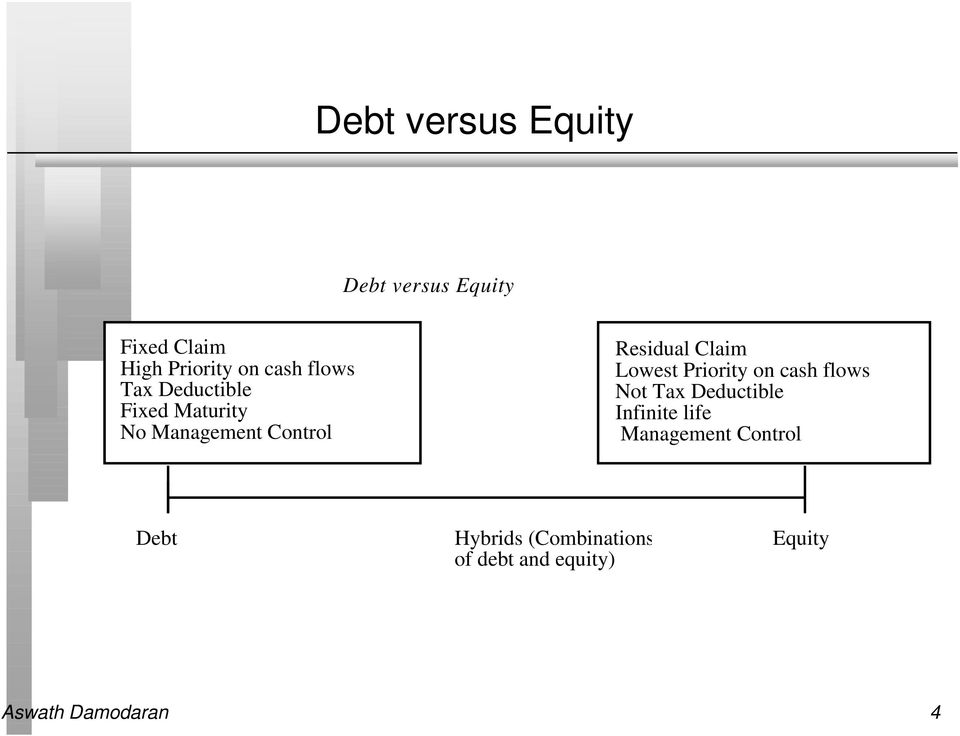
4 Debt versus Equity Debt versus Equity Fixed Claim High Priority on cash flows Tax Deductible Fixed Maturity No Management Control Residual Claim Lowest Priority on cash flows Not Tax Deductible Infinite life Management Control Debt Hybrids (Combinations of debt and equity) Equity Aswath Damodaran 4
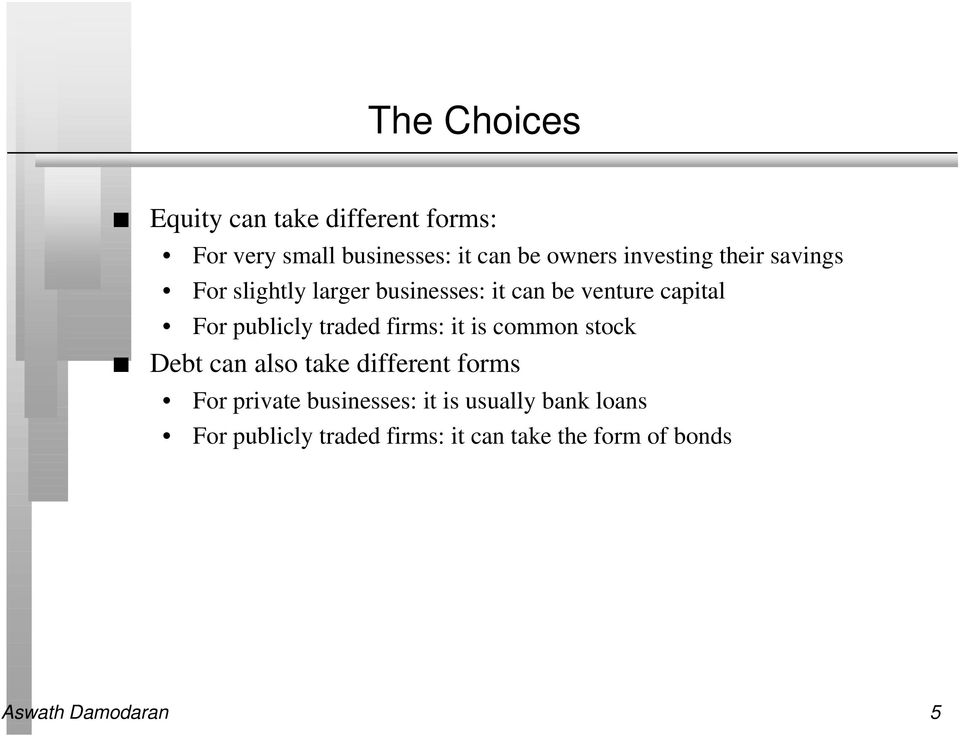
5 The Choices Equity can take different forms: For very small businesses: it can be owners investing their savings For slightly larger businesses: it can be venture capital For publicly traded firms: it is common stock Debt can also take different forms For private businesses: it is usually bank loans For publicly traded firms: it can take the form of bonds Aswath Damodaran 5
6 A Life Cycle View of Financing Choices $ Revenues/ Earnings Revenues Earnings Time External funding needs High, but constrained by infrastructure High, relative to firm value. Moderate, relative to firm value. Declining, as a percent of firm value Low, as projects dry up. Internal financing Negative or low Negative or low Low, relative to funding needs High, relative to funding needs More than funding needs External Financing Owner s Equity Bank Debt Venture Capital Common Stock Common stock Warrants Convertibles Debt Retire debt Repurchase stock Growth stage Stage 1 Start-up Stage 2 Rapid Expansion Stage 3 High Growth Stage 4 Mature Growth Stage 5 Decline Financing Transitions Accessing private equity Inital Public offering Seasoned equity issue Bond issues Aswath Damodaran 6

7 The Financing Mix Question In deciding to raise financing for a business, is there an optimal mix of debt and equity? If yes, what is the trade off that lets us determine this optimal mix? If not, why not? Aswath Damodaran 7

8 Measuring a firm s financing mix The simplest measure of how much debt and equity a firm is using currently is to look at the proportion of debt in the total financing. This ratio is called the debt to capital ratio: Debt to Capital Ratio = Debt / (Debt + Equity) Debt includes all interest bearing liabilities, short term as well as long term. Equity can be defined either in accounting terms (as book value of equity) or in market value terms (based upon the current price). The resulting debt ratios can be very different. Aswath Damodaran 8

9 Costs and Benefits of Debt Benefits of Debt Tax Benefits Adds discipline to management Costs of Debt Bankruptcy Costs Agency Costs Loss of Future Flexibility Aswath Damodaran 9

10 Tax Benefits of Debt When you borrow money, you are allowed to deduct interest expenses from your income to arrive at taxable income. This reduces your taxes. When you use equity, you are not allowed to deduct payments to equity (such as dividends) to arrive at taxable income. The dollar tax benefit from the interest payment in any year is a function of your tax rate and the interest payment: Tax benefit each year = Tax Rate * Interest Payment Proposition 1: Other things being equal, the higher the marginal tax rate of a business, the more debt it will have in its capital structure. Aswath Damodaran 10

11 The Effects of Taxes You are comparing the debt ratios of real estate corporations, which pay the corporate tax rate, and real estate investment trusts, which are not taxed, but are required to pay 95% of their earnings as dividends to their stockholders. Which of these two groups would you expect to have the higher debt ratios? r r r The real estate corporations The real estate investment trusts Cannot tell, without more information Aswath Damodaran 11

12 Implications of The Tax Benefit of Debt The debt ratios of firms with higher tax rates should be higher than the debt ratios of comparable firms with lower tax rates. In supporting evidence, Firms that have substantial non-debt tax shields, such as depreciation, should be less likely to use debt than firms that do not have these tax shields. If tax rates increase over time, we would expect debt ratios to go up over time as well, reflecting the higher tax benefits of debt. Although it is always difficult to compare debt ratios across countries, we would expect debt ratios in countries where debt has a much larger tax benefit to be higher than debt ratios in countries whose debt has a lower tax benefit. Aswath Damodaran 12

13 Debt adds discipline to management If you are managers of a firm with no debt, and you generate high income and cash flows each year, you tend to become complacent. The complacency can lead to inefficiency and investing in poor projects. There is little or no cost borne by the managers Forcing such a firm to borrow money can be an antidote to the complacency. The managers now have to ensure that the investments they make will earn at least enough return to cover the interest expenses. The cost of not doing so is bankruptcy and the loss of such a job. Aswath Damodaran 13

14 Debt and Discipline Assume that you buy into this argument that debt adds discipline to management. Which of the following types of companies will most benefit from debt adding this discipline? r r r Conservatively financed (very little debt), privately owned businesses Conservatively financed, publicly traded companies, with stocks held by millions of investors, none of whom hold a large percent of the stock. Conservatively financed, publicly traded companies, with an activist and primarily institutional holding. Aswath Damodaran 14

15 Empirical Evidence on the Discipline of Debt Firms that are acquired in hostile takeovers are generally characterized by poor performance in both accounting profitability and stock returns. There is evidence that increases in leverage are followed by improvements in operating efficiency, as measured by operating margins and returns on capital. Palepu (1990) presents evidence of modest improvements in operating efficiency at firms involved in leveraged buyouts. Kaplan(1989) and Smith (1990) also find that firms earn higher returns on capital following leveraged buyouts. Denis and Denis (1993) study leveraged recapitalizations and report a median increase in the return on assets of 21.5%. Aswath Damodaran 15

16 Bankruptcy Cost The expected bankruptcy cost is a function of two variables-- the cost of going bankrupt direct costs: Legal and other Deadweight Costs indirect costs: Costs arising because people perceive you to be in financial trouble the probability of bankruptcy, which will depend upon how uncertain you are about future cash flows As you borrow more, you increase the probability of bankruptcy and hence the expected bankruptcy cost. Aswath Damodaran 16

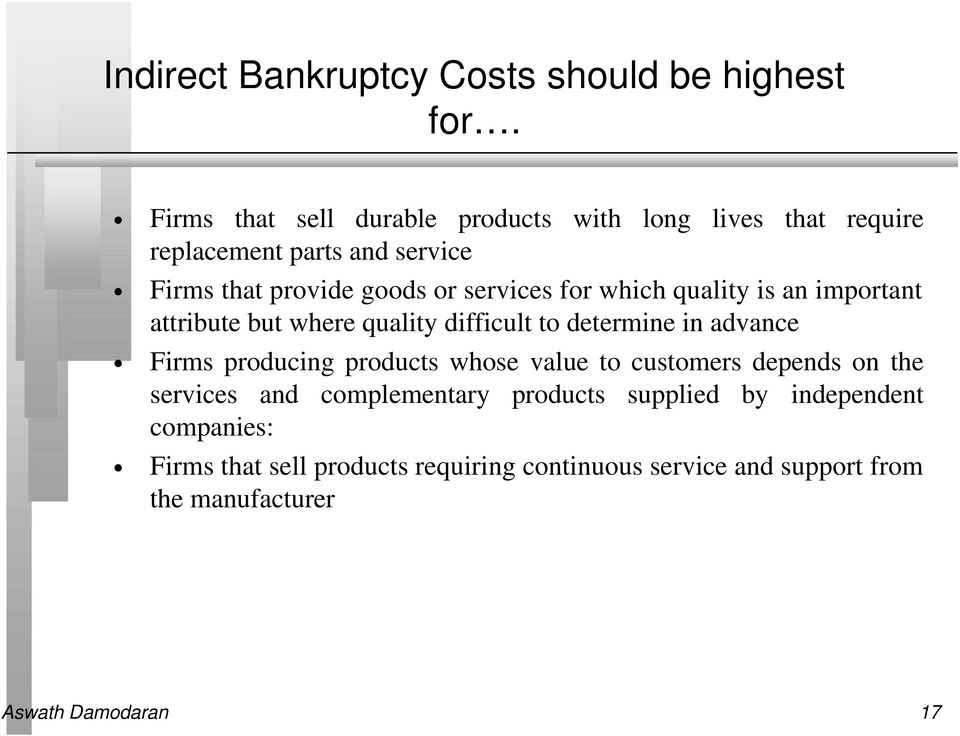
17 Indirect Bankruptcy Costs should be highest for. Firms that sell durable products with long lives that require replacement parts and service Firms that provide goods or services for which quality is an important attribute but where quality difficult to determine in advance Firms producing products whose value to customers depends on the services and complementary products supplied by independent companies: Firms that sell products requiring continuous service and support from the manufacturer Aswath Damodaran 17
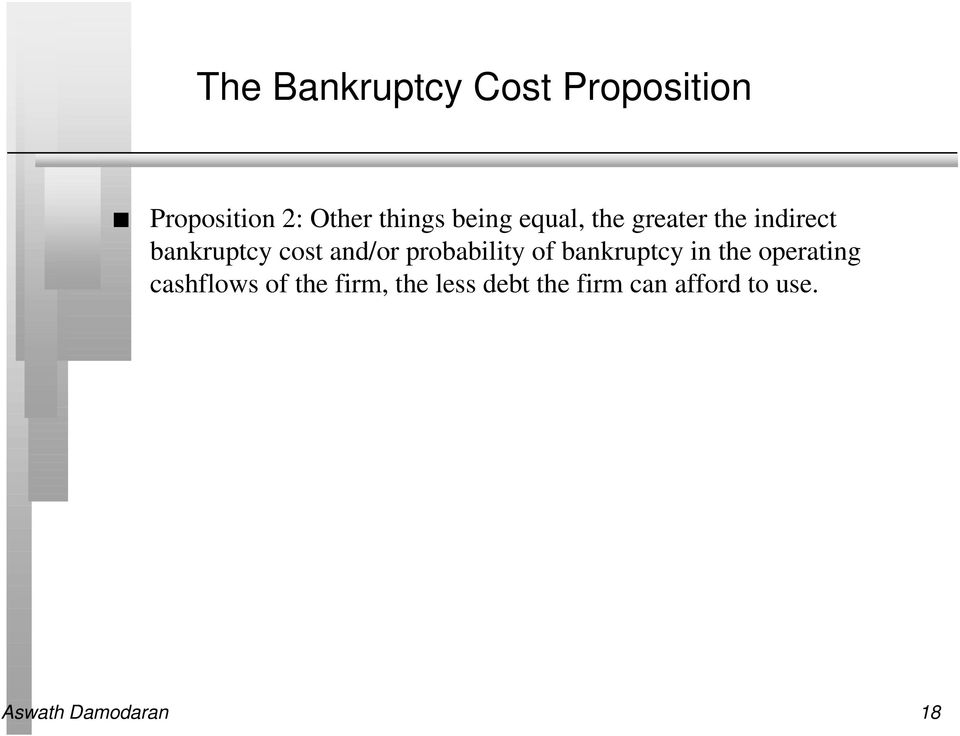
18 The Bankruptcy Cost Proposition Proposition 2: Other things being equal, the greater the indirect bankruptcy cost and/or probability of bankruptcy in the operating cashflows of the firm, the less debt the firm can afford to use. Aswath Damodaran 18
19 Debt & Bankruptcy Cost Rank the following companies on the magnitude of bankruptcy costs from most to least, taking into account both explicit and implicit costs: r r r A Grocery Store An Airplane Manufacturer High Technology company Aswath Damodaran 19

20 Implications of Bankruptcy Cost Proposition Firms operating in businesses with volatile earnings and cash flows should use debt less than otherwise similar firms with stable cash flows. If firms can structure their debt in such a way that the cash flows on the debt increase and decrease with their operating cash flows, they can afford to borrow more. If an external entity, such as the government or an agency of the government, provides protection against bankruptcy through either insurance or bailouts for troubled firms, firms will tend to borrow more. Firms with assets that can be easily divided and sold should borrow more than firms with assets that are less liquid. Aswath Damodaran 20
21 Agency Cost An agency cost arises whenever you hire someone else to do something for you. It arises because your interests(as the principal) may deviate from those of the person you hired (as the agent). When you lend money to a business, you are allowing the stockholders to use that money in the course of running that business. Stockholders interests are different from your interests, because You (as lender) are interested in getting your money back Stockholders are interested in maximizing your wealth In some cases, the clash of interests can lead to stockholders Investing in riskier projects than you would want them to Paying themselves large dividends when you would rather have them keep the cash in the business. Proposition 3: Other things being equal, the greater the agency problems associated with lending to a firm, the less debt the firm can afford to use. Aswath Damodaran 21
22 Debt and Agency Costs Assume that you are a bank. Which of the following businesses would you perceive the greatest agency costs? r r A Large Pharmaceutical company A Large Regulated Electric Utility Why? Aswath Damodaran 22
23 How agency costs show up... If bondholders believe there is a significant chance that stockholder actions might make them worse off, they can build this expectation into bond prices by demanding much higher rates on debt. If bondholders can protect themselves against such actions by writing in restrictive covenants, two costs follow the direct cost of monitoring the covenants, which increases as the covenants become more detailed and restrictive. the indirect cost of lost investments, since the firm is not able to take certain projects, use certain types of financing, or change its payout; this cost will also increase as the covenants becomes more restrictive. Aswath Damodaran 23
24 Implications of Agency Costs.. The agency cost arising from risk shifting is likely to be greatest in firms whose investments cannot be easily observed and monitored. These firms should borrow less than firms whose assets can be easily observed and monitored. The agency cost associated with monitoring actions and secondguessing investment decisions is likely to be largest for firms whose projects are long term, follow unpredictable paths, and may take years to come to fruition. These firms should also borrow less. Aswath Damodaran 24
25 Loss of future financing flexibility When a firm borrows up to its capacity, it loses the flexibility of financing future projects with debt. Proposition 4: Other things remaining equal, the more uncertain a firm is about its future financing requirements and projects, the less debt the firm will use for financing current projects. Aswath Damodaran 25
26 What managers consider important in deciding on how much debt to carry... A survey of Chief Financial Officers of large U.S. companies provided the following ranking (from most important to least important) for the factors that they considered important in the financing decisions Factor Ranking (0-5) 1. Maintain financial flexibility Ensure long-term survival Maintain Predictable Source of Funds Maximize Stock Price Maintain financial independence Maintain high debt rating Maintain comparability with peer group 2.47 Aswath Damodaran 26
27 Debt: Summarizing the Trade Off Advantages of Borrowing 1. Tax Benefit: Higher tax rates --> Higher tax benefit 2. Added Discipline: Greater the separation between managers and stockholders --> Greater the benefit Disadvantages of Borrowing 1. Bankruptcy Cost: Higher business risk --> Higher Cost 2. Agency Cost: Greater the separation between stockholders & lenders --> Higher Cost 3. Loss of Future Financing Flexibility: Greater the uncertainty about future financing needs --> Higher Cost Aswath Damodaran 27
28 A Qualitative Analysis Item Boeing The Home Depot InfoSoft Tax Benefits Significant. The firm has a marginal tax rate of 35%. It does have large depreciation tax shields. Significant. The firm has a marginal tax rate of 35%, as well. It does not have very much in non-interest tax shields. Significant. The owners of InfoSoft face a 42% tax rate. By borrowing money, the income that flows through to the investor can be reduced. Added Discipline Bankruptcy Cost Agency Costs Flexibility Needs Benefits will be high, since managers are not large stockholders. Direct costs are likely to be small, but indirect costs can be substantial.. Low. Assets are generally tangible and monitoring should be feasible. Low. Firm has a long gestation period for projects, and knows how much it needs to invest in advance. Benefits are smaller, since the CEO is a founder and large stockholder. Direct costs are likely to be small. Assets are mostly real estate. Indirect costs will also be small. Low. Assets are stores and real estate, tangible and marketable. Low in existing business, but high, given its plans to grow overseas and online. Expansion and acquisition needs create need. Benefits are non-existent. This is a private firm. Costs may be small but the owner has all of his wealth invested in the firm. High. Assets are intangible and difficult to both monitor and to liquidate. High. Firm might have to change its product and business mix, on short notice, as technology changes Aswath Damodaran 28
29 Application Test: Would you expect your firm to gain or lose from using a lot of debt? Considering, for your firm, The potential tax benefits of borrowing The benefits of using debt as a disciplinary mechanism The potential for expected bankruptcy costs The potential for agency costs The need for financial flexibility Would you expect your firm to have a high debt ratio or a low debt ratio? Does the firm s current debt ratio meet your expectations? Aswath Damodaran 29
30 A Hypothetical Scenario Assume you operate in an environment, where (a) there are no taxes (b) there is no separation between stockholders and managers. (c) there is no default risk (d) there is no separation between stockholders and bondholders (e) firms know their future financing needs Aswath Damodaran 30
31 The Miller-Modigliani Theorem In an environment, where there are no taxes, default risk or agency costs, capital structure is irrelevant. The value of a firm is independent of its debt ratio. Aswath Damodaran 31
32 Implications of MM Theorem (a) Leverage is irrelevant. A firm's value will be determined by its project cash flows. (b) The cost of capital of the firm will not change with leverage. As a firm increases its leverage, the cost of equity will increase just enough to offset any gains to the leverage. Aswath Damodaran 32
33 Can debt be irrelevant in a world with taxes? In the presence of personal taxes on both interest income and income from equity, it can be argued that debt could still be irrelevant if the cumulative taxes paid (by the firm and investors) on debt and equity are the same. Thus, if t d is the personal tax rate on interest income received by investors, t e is the personal tax rate on income on equity and t c is the corporate tax rate, debt will be irrelevant if: (1 - t d ) = (1-t c ) (1-t e ) Aswath Damodaran 33
34 Is there an optimal capital structure? The Empirical Evidence The empirical evidence on whether leverage affects value is mixed. Bradley, Jarrell, and Kim (1984) note that the debt ratio is lower for firms with more volatile operating income and for firms with substantial R&D and advertising expenses. Barclay, Smith and Watts (1995) looked at 6780 companies between 1963 and 1993 and conclude that the most important determinant of a firm's debt ratio is its' investment opportunities. Firms with better investment opportunities (as measured by a high price to book ratio) tend to have much lower debt ratios than firms with low price to book ratios. Smith(1986) notes that leverage-increasing actions seem to be accompanied by positive excess returns while leverage-reducing actions seem to be followed by negative returns. This is not consistent with the theory that there is an optimal capital structure, unless we assume that firms tend to be under levered. Aswath Damodaran 34
35 How do firms set their financing mixes? Life Cycle: Some firms choose a financing mix that reflects where they are in the life cycle; start- up firms use more equity, and mature firms use more debt. Comparable firms: Many firms seem to choose a debt ratio that is similar to that used by comparable firms in the same business. Financing Heirarchy: Firms also seem to have strong preferences on the type of financing used, with retained earnings being the most preferred choice. They seem to work down the preference list, rather than picking a financing mix directly. Aswath Damodaran 35
36 The Debt Equity Trade Off Across the Life Cycle Stage 1 Start-up Stage 2 Rapid Expansion Stage 3 High Growth Stage 4 Mature Growth Stage 5 Decline $ Revenues/ Earnings Revenues Earnings Time Tax Benefits Zero, if losing money Low, as earnings are limited Increase, with earnings High High, but declining Added Disceipline of Debt Low, as owners run the firm Low. Even if public, firm is closely held. Increasing, as managers own less of firm High. Managers are separated from owners Declining, as firm does not take many new investments Bamkruptcy Cost Very high. Firm has no or negative earnings. Very high. Earnings are low and volatile High. Earnings are increasing but still volatile Declining, as earnings from existing assets increase. Low, but increases as existing projects end. Agency Costs Very high, as firm has almost no assets High. New investments are difficult to monitor High. Lots of new investments and unstable risk. Declining, as assets in place become a larger portion of firm. Low. Firm takes few new investments Need for Flexibility Very high, as firm looks for ways to establish itself High. Expansion needs are large and unpredicatble High. Expansion needs remain unpredictable Low. Firm has low and more predictable investment needs. Non-existent. Firm has no new investment needs. Net Trade Off Costs exceed benefits Costs still likely Minimal debt to exceed benefits. Mostly equity Debt starts yielding net benefits to the firm Debt becomes a more attractive option. Debt will provide benefits. Aswath Damodaran 36
37 Comparable Firms When we look at the determinants of the debt ratios of individual firms, the strongest determinant is the average debt ratio of the industries to which these firms belong. This is not inconsistent with the existence of an optimal capital structure. If firms within a business share common characteristics (high tax rates, volatile earnings etc.), you would expect them to have similar financing mixes. This approach can lead to sub-optimal leverage, if firms within a business do not share common characteristics. Aswath Damodaran 37
38 Rationale for Financing Hierarchy Managers value flexibility. External financing reduces flexibility more than internal financing. Managers value control. Issuing new equity weakens control and new debt creates bond covenants. Aswath Damodaran 38
39 Preference rankings : Results of a survey Ranking Source Score 1 Retained Earnings Straight Debt Convertible Debt External Common Equity Straight Preferred Stock Convertible Preferred 1.72 Aswath Damodaran 39
40 Financing Choices You are reading the Wall Street Journal and notice a tombstone ad for a company, offering to sell convertible preferred stock. What would you hypothesize about the health of the company issuing these securities? r r r Nothing Healthier than the average firm In much more financial trouble than the average firm Aswath Damodaran 40
41 The Search for an Optimal Financing Mix: Approaches The Operating Income Approach: In this approach, the optimal debt for a firm is chosen to ensure that the probability that the firm will default does not exceed a management-specified limit. The Cost of Capital Approach: In this approach, the optimal debt ratio is chosen to minimize cost of capital, if operating cash flows are unaffected by financing mix, or to maximize firm value. The Adjusted Present Value Approach: In this approach, the effect of adding debt to firm value is evaluated by measuring both the tax benefits and the bankruptcy costs. The Return Differential Approach: In this approach, the debt ratio is chosen to maximize the difference between ROE and cost of equity. Comparables Approach: The debt ratio is chosen by looking at how comparable firms are funded. Aswath Damodaran 41
42 I. The Operating Income Approach Assess the firm s capacity to generate operating income based upon past history. The result is a distribution for expected operating income, with probabilities attached to different levels of income. For any given level of debt, we estimate the interest and principal payments that have to be made over time. Given the probability distribution of operating cash flows, we estimate the probability that the firm will be unable to make debt payments. We set a limit on the probability of its being unable to meet debt payments. Clearly, the more conservative the management of the firm, the lower this probability constraint will be. 5. We compare the estimated probability of default at a given level of debt to the probability constraint. If the probability of default is higher than the constraint, the firm chooses a lower level of debt; if it is lower than the constraint, the firm chooses a higher level of debt. Aswath Damodaran 42
43 Boeing: Assessing the Probability Distribution Figure 16.1: Boeing: Operating Income Changes <-30% -10% to -30% + 10% to - 10% 10 to 30% 30-50% >50% % Change in Year Aswath Damodaran 43
44 Estimating Debt Payments We estimate the interest and principal payments on a proposed bond issue of $ 5 billion by assuming that the debt will be rated A, lower than Boeing s current bond rating of AA. Based upon this rating, we estimated an interest rate of 6% on the debt. In addition, we assume that the sinking fund payment set aside to repay the bonds is 5% of the bond issue. This results in an annual debt payment of $ 550 million. Additional Debt Payment = Interest Expense + Sinking Fund Payment = 0.06 * 5, * 5,000 = $ 550 million The total debt payment then can be computed by adding the interest payment on existing debt in 1998 $ 453 million to the additional debt payment created by taking on $ 5 billion in additional debt. Total Debt Payment = Interest on Existing Debt + Additional Debt Payment = $ 453 million + $ 550 million = $ 1,003 million Aswath Damodaran 44
45 Estimating Probability of Default We can now estimate the probability of default from the distribution of operating income by assuming that the percentage changes in operating income are normally distributed and by considering the earnings before interest, taxes, depreciation and amortization (EBITDA) of $ 3,237 million that Boeing earned in 1998 as the base year income. T statistic = (Current EBITDA - Debt Payment) / σ OI (Current Operating Income) = ($ 3,237 - $ 1,003 million) / (.3583 * $3237) = 1.93 Based upon this t statistic, the probability of default < 3%. Aswath Damodaran 45
46 Management Constraints and Maximum Debt Capacity Assume that the management at Boeing set a constraint that the probability of default be no greater than 5%. If the distribution of operating income changes is normal, we can estimate the level of debt payments Boeing can afford to make for a probability of default of 5%. T statistic for 5% probability level = ($3,237 - X)/ (.3583 * $3,237) = Break Even Debt Payment = $ 1,329 million If we assume that the interest rate remains unchanged at 6% and the sinking fund will remain at 5% of the outstanding debt, this yields an optimal debt level of $ 12,082 million. Optimal Debt= Break Even Debt Payment / (Interest Rate + Sinking Fund Rate) = $ 1,329 / ( ) = $ 12,082 million Aswath Damodaran 46
47 II. The Cost of Capital Approach It will depend upon: (a) the components of financing: Debt, Equity or Preferred stock (b) the cost of each component In summary, the cost of capital is the cost of each component weighted by its relative market value. WACC = k e (E/(D+E)) + k d (D/(D+E)) Aswath Damodaran 47
48 Recapping the Measurement of cost of capital The cost of debt is the market interest rate that the firm has to pay on its borrowing. It will depend upon three components (a) The general level of interest rates (b) The default premium (c) The firm's tax rate The cost of equity is 1. the required rate of return given the risk 2. inclusive of both dividend yield and price appreciation The weights attached to debt and equity have to be market value weights, not book value weights. Aswath Damodaran 48
49 Costs of Debt & Equity A recent article in an Asian business magazine argued that equity was cheaper than debt, because dividend yields are much lower than interest rates on debt. Do you agree with this statement r Yes r No Can equity ever be cheaper than debt? r Yes r No Aswath Damodaran 49
50 Issue: Use of Book Value Many CFOs argue that using book value is more conservative than using market value, because the market value of equity is usually much higher than book value. Is this statement true, from a cost of capital perspective? (Will you get a more conservative estimate of cost of capital using book value rather than market value?) r Yes r No Aswath Damodaran 50
51 Why does the cost of capital matter? Value of a Firm = Present Value of Cash Flows to the Firm, discounted back at the cost of capital. If the cash flows to the firm are held constant, and the cost of capital is minimized, the value of the firm will be maximized. Aswath Damodaran 51
52 Firm Value, Cost of Capital and Debt Ratios: A Simple Example Strunks Inc., a leading manufacturer of chocolates and other candies, has cash flows to the firm of $200 million. Strunks is in a relatively stable market, and these cash flows are expected to grow at 6% forever, and to be unaffected by the debt ratio of the firm. The value of the firm at any cost of capital can be written as: Firm Value = Cash flow to the firm (1+g)/(Cost of capital - g) = 200 (1.06)/(Cost of capital -.06) Aswath Damodaran 52
53 Cost of Capital and Firm Value D/(D+E) Cost of Equity Cost of Debt WACC Firm Value % 4.80% 10.50% $4,711 10% 11.00% 5.10% 10.41% $4,807 20% 11.60% 5.40% 10.36% $4,862 30% 12.30% 5.52% 10.27% $4,970 40% 13.10% 5.70% 10.14% $5,121 50% 14.00% 6.30% 10.15% $5,108 60% 15.00% 7.20% 10.32% $4,907 70% 16.10% 8.10% 10.50% $4,711 80% 17.20% 9.00% 10.64% $4,569 90% 18.40% 10.20% 11.02% $4, % 19.70% 11.40% 11.40% $3,926 Aswath Damodaran 53
54 A Pictorial View Figure 19.2: Cost of Capital and Firm Value 11.60% $6, % 11.20% $5, % 10.80% $4, % 10.40% $3,000 WACC Firm Value 10.20% 10.00% $2, % 9.60% $1, % 0 10% 20% 30% 40% 50% 60% 70% 80% 90% 100% Debt Ratio $0 Aswath Damodaran 54
55 Current Cost of Capital: Boeing The beta for Boeing's stock in March 1999was The treasury bond rate at that time was 5%. Using an estimated market risk premium of 5.5%, we estimated the cost of equity for Boeing to be 10.58%: Cost of Equity = Riskfree rate + Beta * (Market Premium) =5.00% (5.5%) = 10.58% Boeing's senior debt was rated AA;, the estimated pre-tax cost of debt for Boeing is 5.50%. The tax rate used for the analysis is 35%. After-tax Cost of debt = Pre-tax interest rate (1- tax rate) = 5.50% (1-0.35) = 3.58% Cost of Capital = Cost of Equity (Equity/(Equity + Debt)) + After-tax Cost of Debt (Debt/(Debt +Equity)) = 10.58% [32,595/( )] % [8,194 /( )] = 9.17% Aswath Damodaran 55
56 Mechanics of Cost of Capital Estimation 1. Estimate the Cost of Equity at different levels of debt: Equity will become riskier -> Beta will increase -> Cost of Equity will increase. Estimation will use levered beta calculation 2. Estimate the Cost of Debt at different levels of debt: Default risk will go up and bond ratings will go down as debt goes up -> Cost of Debt will increase. To estimating bond ratings, we will use the interest coverage ratio (EBIT/Interest expense) 3. Estimate the Cost of Capital at different levels of debt 4. Calculate the effect on Firm Value and Stock Price. Aswath Damodaran 56
57 Ratings and Financial Ratios AAA AA A BBB BB B CCC EBIT interest cov. (x) (0.9) EBITDA interest cov Funds flow/total debt Free oper. cash (4.0) (25.4) flow/total debt (%) Return on capital (%) (8.8) Oper.income/sales (%) Long-term debt/capital (%) Aswath Damodaran 57
58 Synthetic Ratings The synthetic rating for a firm can be estimated by Using one of the financial ratios specified above Using a score based upon all of the financial ratios specified above If you use only one financial ratio, you want to pick the ratio that has the greatest power in explaining differences in ratings. For manufacturing firms, this is the interest coverage ratio. If you want to use multiple ratios, you have to determine how you will weight each ratio in coming up with a score. One approach used is a multiple discriminant analysis, where the weights are based upon how well the ratios predict ultimate default. (Altman Z score is one example). Aswath Damodaran 58
59 Process of Ratings and Rate Estimation We use the median interest coverage ratios for large manufacturing firms to develop interest coverage ratio ranges for each rating class. We then estimate a spread over the long term bond rate for each ratings class, based upon yields at which these bonds trade in the market place. (We used a sampling of 5 corporate bonds within each ratings class to make these estimates) Aswath Damodaran 59
60 Interest Coverage Ratios and Bond Ratings If Interest Coverage Ratio is Estimated Bond Rating > 8.50 AAA AA A A A BBB BB B B B CCC CC C < 0.20 D Aswath Damodaran 60
61 Spreads over long bond rate for ratings classes: February 1999 Rating Spread Interest Rate on Debt AAA 0.20% 5.20% AA 0.50% 5.50% A+ 0.80% 5.80% A 1.00% 6.00% A- 1.25% 6.25% BBB 1.50% 6.50% BB 2.00% 7.00% B+ 2.50% 7.50% B 3.25% 8.25% B- 4.25% 9.25% CCC 5.00% 10.00% CC 6.00% 11.00% C 7.50% 12.50% D 10.00% 15.00% Aswath Damodaran 61
62 Current Income Statement for Boeing: 1998 Sales & Other Operating Revenues $56, Operating Costs & Expenses $52, EBITDA $3, Depreciation $1, EBIT $1, Extraordinary Income $ EBIT with extraordinary income $1, Interest Expenses $ Earnings before Taxes $1, Income Taxes $ Net Earnings (Loss) $1, Aswath Damodaran 62
63 Estimating Cost of Equity To estimate the cost of equity at each debt ratio, we first estimate the levered beta at each debt ratio: β levered = β unlevered [1+(1-tax rate)(debt/equity)] The levered beta is used in conjunction with the riskfree rate and risk premium to estimate a cost of equity at each debt ratio: Cost of Equity = Riskfree rate + Beta * Risk Premium Aswath Damodaran 63
64 Estimating Cost of Equity: Boeing at Different Debt Ratios Unlevered Beta = 0.87 (Bottom-up Beta, based upon comparable firms) Market premium = 5.5% Treasury Bond rate = 7.00% t=35% Debt Ratio Beta Cost of Equity 0% % 10% % 20% % 30% % 40% % 50% % 60% % 70% % 80% % 90% % Aswath Damodaran 64
65 Estimating Cost of Debt Firm Value = Market value of debt + Market value of Equity = 32, ,194 D/(D+E) 0.00% 10.00% Second Iteration D/E 0.00% 11.11% $ Debt $0 $4,079 $4,079 EBITDA $3,268 $3,268 $3,268 Depreciation $1,517 $1,517 $1,517 EBIT $1,751 $1,751 $1,751 Interest Expense $0 $212 $224 Pre-tax Int. cov Likely Rating AAA AA AA Interest Rate 5.20% 5.50% 5.50% Eff. Tax Rate 35.00% 35.00% 35.00% Cost of Debt 3.38% 3.58% Aswath Damodaran 65
66 The Ratings Table If Interest Coverage Ratio is Estimated Bond Rating Default spread > 8.50 AAA 0.20% AA 0.50% A+ 0.80% A 1.00% A 1.25% BBB 1.50% BB 2.00% B+ 2.50% B 3.25% B 4.25% CCC 5.00% CC 6.00% C 7.50% < 0.20 D 10.00% Aswath Damodaran 66
67 A Test: Can you do the 20% level? D/(D+E) 0.00% 10.00% 20% Second Iteration D/E 0.00% 11.11% $ Debt $0 $4,079 EBITDA $3,268 $3,268 $3,268 Depreciation $1,517 $1,517 $1,517 EBIT $1,751 $1,751 $1,751 Interest Expense $0 $224 Pre-tax Int. cov 7.80 Likely Rating AAA AA Interest Rate 5.20% 5.50% Eff. Tax Rate 35.00% 35.00% Cost of Debt 3.38% 3.58% Aswath Damodaran 67
68 Bond Ratings, Cost of Debt and Debt Ratios 0% % 30% 40% 50% 60% 70% 80% 90% EBITDA $ 3,268 $ 3,268 $ 3,268 $ 3,268 $ 3,268 $ 3,268 $ 3,268 $ 3,268 $ 3,268 $ 3,268 Depreciation $ 1,517 $ 1,517 $ 1,517 $ 1,517 $ 1,517 $ 1,517 $ 1,517 $ 1,517 $ 1,517 $ 1,517 EBIT $ 1,751 $ 1,751 $ 1,751 $ 1,751 $ 1,751 $ 1,751 $ 1,751 $ 1,751 $ 1,751 $ 1,751 Interest $ - $ 224 $ 510 $ 857 $ 1,632 $ 2,039 $ 2,692 $ 3,569 $ 4,079 $ 4,589 Pre-tax Int. cov Likely Rating AAA AA A- BB CCC CCC CC C C C Interest Rate 5.20% 5.50% 6.25% 7.00% 10.00% 10.00% 11.00% 12.50% 12.50% 12.50% Eff. Tax Rate 35.00% 35.00% 35.00% 35.00% 35.00% 30.05% 22.76% 17.17% 15.02% 13.36% Cost of Debt 3.38% 3.58% 4.06% 4.55% 6.50% 7.00% 8.50% 10.35% 10.62% 10.83% Aswath Damodaran 68
69 Why does the tax rate change? You need taxable income for interest to provide a tax savings 40% 50% EBIT $ 1,751 $ 1,751 Interest Expense $ 1,632 $ 2,039 Coverage ratio Rating CCC CCC Interest rate 10.00% 10.00% Tax Rate 35.00% 30.05% Cost of Debt 6.50% 7.00% Maximum Tax Benefit = 35% of $1,751 = $613 million Tax Rate to use for cost of debt = 613/2039 = 30.05% Aswath Damodaran 69
70 Boeing s Cost of Capital Schedule Debt Ratio Beta Cost of Equity Cost of Debt Cost of Capital 0% % 3.38% 9.79% 10% % 3.58% 9.48% 20% % 4.06% 9.27% 30% % 4.55% 9.16% 40% % 6.50% 9.72% 50% % 7.00% 10.07% 60% % 8.50% 11.24% 70% % 10.35% 12.97% 80% % 10.62% 13.72% 90% % 10.83% 14.47% Aswath Damodaran 70
71 Boeing: Cost of Capital Chart Costs of Equity, Debt and Capital: Boeing 50.00% 15.00% 45.00% 14.00% 40.00% 35.00% 13.00% 30.00% 12.00% 25.00% 20.00% Optimal Debt Ratio 11.00% 15.00% 10.00% 10.00% 5.00% 9.00% 0.00% 0% 10% 20% 30% 40% 50% 60% 70% 80% 90% Debt Ratio 8.00% Cost of Equity Cost of Debt (After-tax) Cost of Capital Aswath Damodaran 71
72 The Home Depot: Cost of Capital Schedule Debt Ratio Beta Cost of Equity Rating Interest rate Tax Rate Cost of Debt (After-tax) Cost of Capital 0% % AAA 5.20% 35.00% 3.38% 9.64% 10% % A 6.00% 35.00% 3.90% 9.37% 20% % BB 7.00% 35.00% 4.55% 9.23% 30% % CCC 10.00% 35.00% 6.50% 9.60% 40% % CC 11.00% 24.95% 8.26% 10.48% 50% % C 12.50% 17.56% 10.30% 11.89% 60% % C 12.50% 14.63% 10.67% 12.64% 70% % C 12.50% 12.54% 10.93% 13.39% 80% % C 12.50% 10.98% 11.13% 14.14% 90% % C 12.50% 9.76% 11.28% 14.89% Aswath Damodaran 72
73 Effect of Moving to the Optimal on Firm Value Re-estimate firm value at each debt ratio, using the new cost of capital. For a stable growth firm, this would be Firm Value = CF to Firm (1 + g) / (WACC -g) For a high growth firm, this would require that the cash flows during the high growth phase be estimated and discounted back. Estimate the annual savings in financing costs from the change in cost of capital and compute the present value of these savings in perpetuity. Annual Savings = (Cost of capital before - Cost of capital after ) Firm Value If you assume no growth in firm value, this would yield Annual Saving / Cost of capital after If you assume perpetual growth in savings, this would yield Annual Saving / (Cost of capital after -g) Aswath Damodaran 73
74 But what growth rate do we use? One solution The estimate of growth used in valuing a firm can clearly have significant implications for the final number. One way to bypass this estimation is to estimate the growth rate implied in today s market value. For instance, Boeing s current market value = 32, ,194 = $ 40,789 million Boeing s free cash flow to the firm = $1,176 million Boeing s current cost of capital = 9.17% Assuming a perpetual growth model, Firm Value = Cash flow to firm (1+g) / (Cost of capital - g) 40,789 = 1,176 (1+g)/(.0917-g) Solving for g, Implied growth rate =.0611 or 6.11% Aswath Damodaran 74
75 Change in Firm Value for Boeing: Firm Valuation Approach Boeing s free cash flow to the firm = $1,176 million Boeing s implied growth rate = 6.11% New cost of capital = 9.16% Boeing s new firm value = 1,176 *1.0611/( ) = $ 40,990 million Boeing s current firm value = $ 40,789 million Change in firm value = $ 40,990 - $40,789 = $201 million Aswath Damodaran 75
76 Effect on Firm Value on Boeing: Annual Savings Approach Firm Value before the change = 32, ,194 = $ 40,789 million WACC b = 9.17% Annual Cost = $62,068 *12.22%= $7,583 million WACC a = 9.16% Annual Cost = $62,068 *11.64% = $7,226 million WACC = 0.01% Change in Annual Cost = $ 6.14 million If there is no growth in the firm value, (Conservative Estimate) Increase in firm value = $ 6.14 /.0916 = $ 67 million Change in Stock Price = $ 67 /1010.7= $ 0.07 per share If there is growth (of 6.11%) in firm value over time, Increase in firm value = $ 6.14 /( ) = $ 206 million Change in Stock Price = $206/ = $ 0.20 per share Aswath Damodaran 76
77 Effect on Firm Value of Moving to the Optimal: The Home Depot Firm Value before the change = 85, ,081 = $ 89,749 million WACC b = 9.51% Annual Cost = $89,749 *9.51%= $ 8,537 million WACC a = 9.23% Annual Cost = $89,749 *9.23% =$ 8,281 million WACC = 0.28% Change in Annual Cost = $ 256 million If there is growth (of 6%) in firm value over time, Increase in firm value = $ 256 (1.06) /( ) = $ 8,406 million Change in Stock Price = $ 8,406/ = $ 5.69 per share Aswath Damodaran 77
78 A Test: The Repurchase Price Let us suppose that the CFO of The Home Depot approached you about buying back stock. He wants to know the maximum price that he should be willing to pay on the stock buyback. (The current price is $ 57.94) Assuming that firm value will grow by 6% a year, estimate the maximum price. What would happen to the stock price after the buyback if you were able to buy stock back at $ 57.94? Aswath Damodaran 78
79 The Downside Risk Doing What-if analysis on Operating Income A. Standard Deviation Approach Standard Deviation In Past Operating Income Standard Deviation In Earnings (If Operating Income Is Unavailable) Reduce Base Case By One Standard Deviation (Or More) B. Past Recession Approach Look At What Happened To Operating Income During The Last Recession. (How Much Did It Drop In % Terms?) Reduce Current Operating Income By Same Magnitude Constraint on Bond Ratings Aswath Damodaran 79
80 Boeing s Operating Income History Year EBITDA % Change 1989 $ 1, % 1990 $ 2, % 1991 $ 2, % 1992 $ 2, % 1993 $ 2, % 1994 $ 2, % 1995 $ 1, % 1996 $ 3, % 1997 $ 2, % 1998 $ 3, % Aswath Damodaran 80
81 Boeing: Operating Income and Optimal Capital Structure % Drop in EBITDA EBITDA Optimal Debt Ratio 0% $ 3,268 30% 5% $ 3,105 20% 10% $ 2,941 20% 15% $ 2,778 10% 20% $ 2,614 0% Aswath Damodaran 81
82 Constraints on Ratings Management often specifies a 'desired Rating' below which they do not want to fall. The rating constraint is driven by three factors it is one way of protecting against downside risk in operating income (so do not do both) a drop in ratings might affect operating income there is an ego factor associated with high ratings Caveat: Every Rating Constraint Has A Cost. Provide Management With A Clear Estimate Of How Much The Rating Constraint Costs By Calculating The Value Of The Firm Without The Rating Constraint And Comparing To The Value Of The Firm With The Rating Constraint. Aswath Damodaran 82
83 Ratings Constraints for Boeing Assume that Boeing imposes a rating constraint of BBB or greater. The optimal debt ratio for Boeing is then 20% (see next page) The cost of imposing this rating constraint can then be calculated as follows: Value at 30% Debt = $ 41,003 million - Value at 20% Debt = $ 39,416 million Cost of Rating Constraint = $ 1,587 million Aswath Damodaran 83
84 What if you do not buy back stock.. The optimal debt ratio is ultimately a function of the underlying riskiness of the business in which you operate and your tax rate Will the optimal be different if you took projects instead of buying back stock? NO. As long as the projects financed are in the same business mix that the company has always been in and your tax rate does not change significantly. YES, if the projects are in entirely different types of businesses or if the tax rate is significantly different. Aswath Damodaran 84
85 Analyzing Financial Service Firms The interest coverage ratios/ratings relationship is likely to be different for financial service firms. The definition of debt is messy for financial service firms. In general, using all debt for a financial service firm will lead to high debt ratios. Use only interest-bearing long term debt in calculating debt ratios. The effect of ratings drops will be much more negative for financial service firms. There are likely to regulatory constraints on capital Aswath Damodaran 85
86 Long Term Interest Coverage Ratios for Financial Service Firms Long Term Interest Coverage Ratio Rating is Spread is Operating Income Decline < 0.25 D 12.00% -50% C 9.00% -40% CC 7.50% -40% CCC 6.00% -40% B- 5.00% -25% B 4.00% -20% B+ 3.00% -20% BB 2.50% -20% BBB 2.00% -10% A- 1.50% -5% A 1.25% -5% A+ 1.00% -5% AA 0.70% -5% > 6.65 AAA 0.30% 0% Aswath Damodaran 86
87 J.P. Morgan: Optimal Capital Structure Debt Ratio Cost of Capital Firm Value 0% 12.39% $19,333 10% 11.97% $20,315 20% 11.54% $20,332 30% 11.19% $21,265 40% 10.93% $20,858 50% 10.80% $18,863 60% 10.68% $19,198 70% 11.06% $13,658 80% 13.06% $10,790 90% 15.76% $7,001 Aswath Damodaran 87
88 Analyzing Companies after Abnormal Years The operating income that should be used to arrive at an optimal debt ratio is a normalized operating income A normalized operating income is the income that this firm would make in a normal year. For a cyclical firm, this may mean using the average operating income over an economic cycle rather than the latest year s income For a firm which has had an exceptionally bad or good year (due to some firm-specific event), this may mean using industry average returns on capital to arrive at an optimal or looking at past years For any firm, this will mean not counting one time charges or profits Aswath Damodaran 88
89 Analyzing a Private Firm The approach remains the same with important caveats It is far more difficult estimating firm value, since the equity and the debt of private firms do not trade Most private firms are not rated. If the cost of equity is based upon the market beta, it is possible that we might be overstating the optimal debt ratio, since private firm owners often consider all risk. Aswath Damodaran 89
90 Estimating the Optimal Debt Ratio for a Private Software Firm We first estimate the market value of the firm using the average Value/EBITDA multiple of 21.8 for the software industry and the EBITDA for InfoSoft of $ 3 million: Firm Value = $ 3 million * 21.8 = $ 65.4 million We then estimate a synthetic rating for the firm, using its current interest coverage ratio and the ratings table designed for smaller and riskier firms. The current interest coverage ratio for InfoSoft was: Interest Coverage Ratio = EBIT / Interest Expense = $ 2 million/$ 315,000 = 6.35 Aswath Damodaran 90
91 Interest Coverage Ratios, Spreads and Ratings: Small Firms Interest Coverage Ratio Rating Spread over T Bond Rate > 12.5 AAA 0.20% AA 0.50% A+ 0.80% A 1.00% A- 1.25% BBB 1.50% BB 2.00% B+ 2.50% B 3.25% B- 4.25% CCC 5.00% CC 6.00% C 7.50% < 0.5 D 10.00% Aswath Damodaran 91
92 Optimal Debt Ratio for InfoSoft Debt Ratio Beta Cost of Equity Rating Interest rate Cost of Debt (After-tax) Cost of Capital 0% % AAA 5.20% 3.02% 12.87% 10% % A- 6.25% 3.63% 12.40% 20% % B- 9.25% 5.37% 12.28% 30% % CC 11.00% 7.00% 12.61% 40% % C 12.50% 9.50% 13.91% 50% % D 15.00% 12.60% 16.04% 60% % D 15.00% 13.00% 17.04% 70% % D 15.00% 13.29% 18.04% 80% % D 15.00% 13.50% 19.04% 90% % D 15.00% 13.67% 20.04% Aswath Damodaran 92
93 Determinants of Optimal Debt Ratios Firm Specific Factors 1. Tax Rate Higher tax rates - - > Higher Optimal Debt Ratio Lower tax rates - - > Lower Optimal Debt Ratio 2. Cash flow generation = EBITDA / MV of Firm Higher Pre-tax Returns - - > Higher Optimal Debt Ratio Lower Pre-tax Returns - - > Lower Optimal Debt Ratio 3. Variance in Earnings [ Shows up when you do 'what if' analysis] Higher Variance - - > Lower Optimal Debt Ratio Lower Variance - - > Higher Optimal Debt Ratio Macro-Economic Factors 1. Default Spreads Higher - - > Lower Optimal Debt Ratio Lower - - > Higher Optimal Debt Ratio Aswath Damodaran 93
94 Application Test: Your firm s optimal financing mix Using the optimal capital structure spreadsheet provided: Estimate the optimal debt ratio for your firm Estimate the new cost of capital at the optimal Estimate the effect of the change in the cost of capital on firm value Estimate the effect on the stock price In terms of the mechanics, what would you need to do to get to the optimal immediately? Aswath Damodaran 94
95 III. The APV Approach to Optimal Capital Structure In the adjusted present value approach, the value of the firm is written as the sum of the value of the firm without debt (the unlevered firm) and the effect of debt on firm value Firm Value = Unlevered Firm Value + (Tax Benefits of Debt - Expected Bankruptcy Cost from the Debt) The optimal dollar debt level is the one that maximizes firm value Aswath Damodaran 95
96 Implementing the APV Approach Step 1: Estimate the unlevered firm value. This can be done in one of two ways: Estimating the unlevered beta, a cost of equity based upon the unlevered beta and valuing the firm using this cost of equity (which will also be the cost of capital, with an unlevered firm) Alternatively, Unlevered Firm Value = Current Market Value of Firm - Tax Benefits of Debt (Current) + Expected Bankruptcy cost from Debt Step 2: Estimate the tax benefits at different levels of debt. The simplest assumption to make is that the savings are perpetual, in which case Tax benefits = Dollar Debt * Tax Rate Step 3: Estimate a probability of bankruptcy at each debt level, and multiply by the cost of bankruptcy (including both direct and indirect costs) to estimate the expected bankruptcy cost. Aswath Damodaran 96
97 Estimating Expected Bankruptcy Cost Probability of Bankruptcy Estimate the synthetic rating that the firm will have at each level of debt Estimate the probability that the firm will go bankrupt over time, at that level of debt (Use studies that have estimated the empirical probabilities of this occurring over time - Altman does an update every year) Cost of Bankruptcy The direct bankruptcy cost is the easier component. It is generally between 5-10% of firm value, based upon empirical studies The indirect bankruptcy cost is much tougher. It should be higher for sectors where operating income is affected significantly by default risk (like airlines) and lower for sectors where it is not (like groceries) Aswath Damodaran 97
98 Ratings and Default Probabilities Rating Default Risk AAA 0.01% AA 0.28% A+ 0.40% A 0.53% A- 1.41% BBB 2.30% BB 12.20% B % B 26.36% B % CCC 46.61% CC 52.50% C 60% D 75% Aswath Damodaran 98
99 Boeing: Estimating Unlevered Firm Value Value of Boeing in 1999 = Value of Equity + Value of Debt = $32,595+$8,194 = $ 40,789 PV of Tax Savings from Existing Debt = Existing Debt * Tax Rate = $8,194 * 0.35 = $ 2,868 million Based upon Boeing s current rating of AA, we estimate a probability of bankruptcy of 0.28%. The bankruptcy cost is assumed to be 30% of the firm value, prior to the tax savings. PV of Expected Bankruptcy Cost = Probability of Default * Bankruptcy cost = 0.28% * (0.30 * (40,789-2,868)) = $ 32 Value of Boeing as an Unlevered Firm = Market Value PV of Tax Savings + Expected Bankruptcy Costs = $ 40,789 + $ 2,868 - $ 32 = $ 37,953 million Aswath Damodaran 99
100 Tax Benefits at Debt Ratios Debt Ratio $ Debt Tax Rate Tax Benefits 0% $ % $0 10% $4, % $1,428 20% $8, % $2,855 30% $12, % $4,283 40% $16, % $5,710 50% $20, % $6,128 60% $24, % $5,571 70% $28, % $4,903 80% $32, % $4,903 90% $36, % $4,903 Tax Benefits capped when interest expenses exceed EBIT Aswath Damodaran 100
101 Expected Bankruptcy Costs Debt Ratio Bond Rating Probability of Default Expected Bankruptcy Cost 0% AA 0.28% $32 10% AA 0.28% $32 20% A- 1.41% $161 30% BB 12.20% $1,389 40% CCC 50.00% $5,693 50% CCC 50.00% $5,693 60% CC 65.00% $7,401 70% C 80.00% $9,109 80% C 80.00% $9,109 90% C 80.00% $9,109 Aswath Damodaran 101
102 Boeing: APV at Debt Ratios Debt Ratio Unlevered Value Tax Benefits Bankruptcy Value of Costs Levered Firm 0% $37,953 $0 $32 $37,921 10% $37,953 $1,428 $32 $39,349 20% $37,953 $2,855 $161 $40,648 30% $37,953 $4,283 $1,389 $40,847 40% $37,953 $5,710 $5,693 $37,970 50% $37,953 $6,128 $5,693 $38,388 60% $37,953 $5,571 $7,401 $36,123 70% $37,953 $4,903 $9,109 $33,747 80% $37,953 $4,903 $9,109 $33,747 90% $37,953 $4,903 $9,109 $33,747 Exp. Bk. Cst: Expected Bankruptcy cost Aswath Damodaran 102
103 Relative Analysis The safest place for any firm to be is close to the industry average. Subjective adjustments can be made to these averages to arrive at the right debt ratio. Higher tax rates -> Higher debt ratios (Tax benefits) Lower insider ownership -> Higher debt ratios (Greater discipline) More stable income -> Higher debt ratios (Lower bankruptcy costs) More intangible assets -> Lower debt ratios (More agency problems) Aswath Damodaran 103
104 Examining Industry Averages Boeing Aerospace Home Depot Building Supplies Market Debt Ratio 18.97% 23.94% 1.65% 27.09% Book Debt Ratio 36.15% 38.94% 15.31% 29.95% Aswath Damodaran 104
105 The Home Depot s Comparables Company Name Market D/(D+E) Net Plant/Total Assets Cap Ex/Total Assets Building Materials 47.23% 34.74% 3.90% Catalina Lighting 51.17% 28.21% 1.95% Cont'l Materials Corp 19.74% 36.02% 0.22% Eagle Hardware 12.02% 52.54% 8.88% Emco Limited 39.04% 22.64% 4.23% Fastenal Co. 1.21% 27.82% 13.97% Home Depot 1.65% 57.97% 13.19% HomeBase Inc % 36.15% 3.07% Hughes Supply 37.97% 11.19% 2.94% Lowe's Cos. 5.14% 57.58% 14.81% National Home Centers 81.27% 47.40% 0.65% Westburne Inc. 5.87% 11.19% 2.09% White Cap Industries 13.04% 7.83% 3.08% Wolohan Lumber 23.40% 28.21% 3.42% Aswath Damodaran 105
106 Examining the Determinants of Capital Structure: Home Improvement Business Using a sample of home improvement firms, we arrived at the following regression: Debt = (Net Plant/Firm Value) 1.39 (Cap Exp/ Assets) (1.61) (2.86) (1.42) The R squared of the regression is 60%. This regression can be used to arrive at a predicted value for The Home Depot of: DFR Home Depot = (0.0699) 1.39 (0.1319)= or 2.56% Based upon the capital structure of other firms in the home improvement industry, Boeing should have a market value debt ratio of 2.56%. Aswath Damodaran 106
107 Cross Sectional Regression: 1998 Data Using 1998 data for 3000 firms listed on the NYSE, AMEX and NASDAQ data bases, we categorized firms by SIC code. The regression across these sectors provides the following results DFR = OISTD CLSH CPXFR E/V where, (26.41 a ) (3.15 a ) (1.95 b ) (1.68 b ) (8.21 a ) DFR = Debt / ( Debt + Market Value of Equity) OISTD = Standard Deviation in Operating Income (previous 5 years) CLSH = Closely held shares as a percent of outstanding shares CPXFR = Capital Expenditures / Total Assets E/V = EBITDA / Firm Value The R squared of the regression is 57%. Aswath Damodaran 107
108 Applying the Market Regression Boeing The Home Depot Standard Deviation in Operating Income 25.35% 24.06% Insider Holdings as percent of outstanding stock 1% 23% Capital Expenditures/Total Assets 4.32% 13.19% EBITDA/ Firm Value 7.94% 3.38% Predicted Debt Ratio 17.55% 13.45% Aswath Damodaran 108
109 Reconciling the Different Analysis Boeing The Home Depot Actual Debt Ratio -Without operating leases - With operating leases Optimal 18.97% 20.09% 1.65% 4.55% I. Operating Income 28.41% 17.56% II. Cost of Capital With no constraints 30.00% 20.00% With BBB constraint 20.00% 15.00% III. Return Differential 20.00% 30.00% IV. APV 30.00% 20.00% V. Comparable To Industry 22.56% 2.56% To Market 17.55% 13.45% Aswath Damodaran 109
110 Analytical Conclusions Boeing is close to its optimal debt ratio. The Home Depot is under levered. Even with a BBB rating constraint, the Home Depot can afford to borrow significantly more than it does now. Aswath Damodaran 110
111 A Framework for Getting to the Optimal Is the actual debt ratio greater than or lesser than the optimal debt ratio? Actual > Optimal Overlevered Actual < Optimal Underlevered Is the firm under bankruptcy threat? Is the firm a takeover target? Yes No Yes No Reduce Debt quickly 1. Equity for Debt swap 2. Sell Assets; use cash to pay off debt 3. Renegotiate with lenders Does the firm have good projects? ROE > Cost of Equity ROC > Cost of Capital Increase leverage quickly 1. Debt/Equity swaps 2. Borrow money& buy shares. Does the firm have good projects? ROE > Cost of Equity ROC > Cost of Capital Yes Take good projects with new equity or with retained earnings. No 1. Pay off debt with retained earnings. 2. Reduce or eliminate dividends. 3. Issue new equity and pay off debt. Yes Take good projects with debt. No Do your stockholders like dividends? Yes Pay Dividends No Buy back stock Aswath Damodaran 111
112 The Home Depot: Applying the Framework Is the actual debt ratio greater than or lesser than the optimal debt ratio? Actual > Optimal Overlevered Actual < Optimal Underlevered Is the firm under bankruptcy threat? Is the firm a takeover target? Yes No Yes No Reduce Debt quickly 1. Equity for Debt swap 2. Sell Assets; use cash to pay off debt 3. Renegotiate with lenders Does the firm have good projects? ROE > Cost of Equity ROC > Cost of Capital Increase leverage quickly 1. Debt/Equity swaps 2. Borrow money& buy shares. Does the firm have good projects? ROE > Cost of Equity ROC > Cost of Capital Yes Take good projects with new equity or with retained earnings. No 1. Pay off debt with retained earnings. 2. Reduce or eliminate dividends. 3. Issue new equity and pay off debt. Yes Take good projects with debt. No Do your stockholders like dividends? Yes Pay Dividends No Buy back stock Aswath Damodaran 112
113 Application Test: Getting to the Optimal Based upon your analysis of both the firm s capital structure and investment record, what path would you map out for the firm? Immediate change in leverage Gradual change in leverage No change in leverage Would you recommend that the firm change its financing mix by Paying off debt/buying back equity Take projects with equity/debt Aswath Damodaran 113
114 Designing Debt: The Fundamental Principle The objective in designing debt is to make the cash flows on debt match up as closely as possible with the cash flows that the firm makes on its assets. By doing so, we reduce our risk of default, increase debt capacity and increase firm value. Aswath Damodaran 114
115 Firm with mismatched debt Firm Value Value of Debt Aswath Damodaran 115
116 Firm with matched Debt Firm Value Value of Debt Aswath Damodaran 116
117 Design the perfect financing instrument The perfect financing instrument will Have all of the tax advantages of debt While preserving the flexibility offered by equity Start with the Cash Flows on Assets/ Projects Duration Currency Effect of Inflation Uncertainty about Future Growth Patterns Cyclicality & Other Effects Define Debt Characteristics Duration/ Maturity Currency Mix Fixed vs. Floating Rate * More floating rate - if CF move with inflation - with greater uncertainty on future Straight versus Convertible - Convertible if cash flows low now but high exp. growth Special Features on Debt - Options to make cash flows on debt match cash flows on assets Commodity Bonds Catastrophe Notes Design debt to have cash flows that match up to cash flows on the assets financed Aswath Damodaran 117
118 Ensuring that you have not crossed the line drawn by the tax code All of this design work is lost, however, if the security that you have designed does not deliver the tax benefits. In addition, there may be a trade off between mismatching debt and getting greater tax benefits. Overlay tax preferences Deductibility of cash flows for tax purposes Differences in tax rates across different locales If tax advantages are large enough, you might override results of previous step Zero Coupons Aswath Damodaran 118
119 While keeping equity research analysts, ratings agencies and regulators applauding Ratings agencies want companies to issue equity, since it makes them safer. Equity research analysts want them not to issue equity because it dilutes earnings per share. Regulatory authorities want to ensure that you meet their requirements in terms of capital ratios (usually book value). Financing that leaves all three groups happy is nirvana. Consider ratings agency & analyst concerns Analyst Concerns - Effect on EPS - Value relative to comparables Ratings Agency - Effect on Ratios - Ratios relative to comparables Regulatory Concerns - Measures used Operating Leases MIPs Surplus Notes Can securities be designed that can make these different entities happy? Aswath Damodaran 119
120 Debt or Equity: The Strange Case of Trust Preferred Trust preferred stock has A fixed dividend payment, specified at the time of the issue That is tax deductible And failing to make the payment can cause? (Can it cause default?) When trust preferred was first created, ratings agencies treated it as equity. As they have become more savvy, ratings agencies have started giving firms only partial equity credit for trust preferred. Aswath Damodaran 120
121 Debt, Equity and Quasi Equity Assuming that trust preferred stock gets treated as equity by ratings agencies, which of the following firms is the most appropriate firm to be issuing it? A firm that is under levered, but has a rating constraint that would be violated if it moved to its optimal A firm that is over levered that is unable to issue debt because of the rating agency concerns. Aswath Damodaran 121
122 Soothe bondholder fears There are some firms that face skepticism from bondholders when they go out to raise debt, because Of their past history of defaults or other actions They are small firms without any borrowing history Bondholders tend to demand much higher interest rates from these firms to reflect these concerns. Factor in agency conflicts between stock and bond holders Observability of Cash Flows by Lenders - Less observable cash flows lead to more conflicts Type of Assets financed - Tangible and liquid assets create less agency problems If agency problems are substantial, consider issuing convertible bonds Existing Debt covenants - Restrictions on Financing Convertibiles Puttable Bonds Rating Sensitive Notes LYONs Aswath Damodaran 122
123 And do not lock in market mistakes that work against you Ratings agencies can sometimes under rate a firm, and markets can under price a firm s stock or bonds. If this occurs, firms should not lock in these mistakes by issuing securities for the long term. In particular, Issuing equity or equity based products (including convertibles), when equity is under priced transfers wealth from existing stockholders to the new stockholders Issuing long term debt when a firm is under rated locks in rates at levels that are far too high, given the firm s default risk. What is the solution If you need to use equity? If you need to use debt? Aswath Damodaran 123
124 Designing Debt: Bringing it all together Start with the Cash Flows on Assets/ Projects Duration Currency Effect of Inflation Uncertainty about Future Growth Patterns Cyclicality & Other Effects Define Debt Characteristics Duration/ Maturity Currency Mix Fixed vs. Floating Rate * More floating rate - if CF move with inflation - with greater uncertainty on future Straight versus Convertible - Convertible if cash flows low now but high exp. growth Special Features on Debt - Options to make cash flows on debt match cash flows on assets Commodity Bonds Catastrophe Notes Design debt to have cash flows that match up to cash flows on the assets financed Overlay tax preferences Deductibility of cash flows for tax purposes Differences in tax rates across different locales If tax advantages are large enough, you might override results of previous step Zero Coupons Consider ratings agency & analyst concerns Analyst Concerns - Effect on EPS - Value relative to comparables Ratings Agency - Effect on Ratios - Ratios relative to comparables Regulatory Concerns - Measures used Operating Leases MIPs Surplus Notes Factor in agency conflicts between stock and bond holders Can securities be designed that can make these different entities happy? Observability of Cash Flows by Lenders - Less observable cash flows lead to more conflicts Type of Assets financed - Tangible and liquid assets create less agency problems Existing Debt covenants - Restrictions on Financing If agency problems are substantial, consider issuing convertible bonds Convertibiles Puttable Bonds Rating Sensitive Notes LYONs Consider Information Uncertainty about Future Cashflows Credibility & Quality of the Firm Asymmetries - When there is more uncertainty, it - Firms with credibility problems may be better to use short term debt will issue more short term debt Aswath Damodaran 124
125 Approaches for evaluating Asset Cash Flows I. Intuitive Approach Are the projects typically long term or short term? What is the cash flow pattern on projects? How much growth potential does the firm have relative to current projects? How cyclical are the cash flows? What specific factors determine the cash flows on projects? II. Project Cash Flow Approach Project cash flows on a typical project for the firm Do scenario analyses on these cash flows, based upon different macro economic scenarios III. Historical Data Operating Cash Flows Firm Value Aswath Damodaran 125
126 Coming up with the financing details: Intuitive Approach - The Home Depot Historically, the Home Depot s typical project has been a new homeimprovement products store of roughly 100,000 square feet, with a fairly long life and a substantial real estate investment. The construction of the store takes a relatively short time (1-2 years), and the stores start generating cash flows immediately. In addition, most of the growth for the firm since its inception has come from the United States. Aswath Damodaran 126
127 The Home Depot: The Right Debt It should be long term, with a life roughly matching the life of the store. The debt should have a fixed rate or fixed payments each year, because the stores start to generate cash flows immediately and there is an absence of pricing power in this business. If the Home Depot had more pricing power, it could consider using floating rate debt, since cash flows are more likely to move with inflation. The debt should be in U.S. dollars, at least for new stores in the United States. If possible, the value of the debt should be tied to the value of the real estate underlying the store Aswath Damodaran 127
128 Application Test: Choosing your Financing Type Based upon the business that your firm is in, and the typical investments that it makes, what kind of financing would you expect your firm to use in terms of Duration (long term or short term) Currency Fixed or Floating rate Straight or Convertible Aswath Damodaran 128
129 Quantitative Approach 1. Operating Cash Flows The question of how sensitive a firm s asset cash flows are to a variety of factors, such as interest rates, inflation, currency rates and the economy, can be directly tested by regressing changes in the operating income against changes in these variables. Change in Operating Income(t)= a + b Change in Macro Economic Variable(t) This analysis is useful in determining the coupon/interest payment structure of the debt. 2. Firm Value The firm value is clearly a function of the level of operating income, but it also incorporates other factors such as expected growth & cost of capital. The firm value analysis is useful in determining the overall structure of the debt, particularly maturity. Aswath Damodaran 129
130 Historical Data Period Operating Income Firm Value Change in LT Bond Rate Change in GDP Change in Inflation Change in Currency 1998 $2,661 $90, % 4.22% -0.10% -4.38% 1997 $2,016 $45, % 3.83% -1.55% 9.80% 1996 $1,534 $25, % 3.90% 0.78% 6.73% 1995 $1,232 $22, % 2.06% -0.19% -3.55% 1994 $1,039 $22, % 3.27% 0.00% -6.29% 1993 $744 $18, % 2.38% -0.19% 0.61% 1992 $549 $22, % 3.61% -0.19% 5.83% 1991 $382 $13, % 0.43% -2.83% 2.67% 1990 $266 $5, % -0.21% 1.15% -5.88% 1989 $185 $3,116 Aswath Damodaran 130
131 Sensitivity to Interest Rate Changes The answer to this question is important because it it provides a measure of the duration of the firm s projects it provides insight into whether the firm should be using fixed or floating rate debt. Aswath Damodaran 131
132 Firm Value versus Interest Rate Changes Regressing changes in firm value against changes in interest rates over this period yields the following regression Change in Firm Value = 0.51 (2.68) (0.46) T statistics are in brackets ( Change in Interest Rates) Conclusion: The duration (interest rate sensitivity) of The Home Depot s asset values is about 7.49 years. Consequently, its debt should have at least as long a duration. Aswath Damodaran 132
133 Why the coefficient on the regression is duration.. The duration of a straight bond or loan issued by a company can be written in terms of the coupons (interest payments) on the bond (loan) and the face value of the bond to be Duration of Bond = dp/p dr/r = t=n t=1 t=n t*coupon t (1+r) t t=1 Coupon t (1+r) t + + N*Face Value (1 + r) N Face Value (1+r) N Holding other factors constant, the duration of a bond will increase with the maturity of the bond, and decrease with the coupon rate on the bond. Aswath Damodaran 133
134 Duration of a Firm s Assets This measure of duration can be extended to any asset with expected cash flows on it. Thus, the duration of a project or asset can be estimated in terms of the pre-debt operating cash flows on that project. where, Duration of Project/Asset = dpv/pv dr = t=n t=1 t=n t*cf t + (1+r) t N*Terminal Value (1 + r) N CFt = After-tax operating cash flow on the project in year t t=1 CF t (1+r) t + Terminal Value (1 + r) N Terminal Value = Salvage Value at the end of the project lifetime N = Life of the project The duration of any asset provides a measure of the interest rate risk embedded in that asset. Aswath Damodaran 134
135 Duration: Comparing Approaches Traditional Duration Measures Uses: 1. Projected Cash Flows Assumes: 1. Cash Flows are unaffected by changes in interest rates 2. Changes in interest rates are small. δp/δr= Percentage Change in Value for a percentage change in Interest Rates Regression: δp = a + b (δr) Uses: 1. Historical data on changes in firm value (market) and interest rates Assumes: 1. Past project cash flows are similar to future project cash flows. 2. Relationship between cash flows and interest rates is stable. 3. Changes in market value reflect changes in the value of the firm. Aswath Damodaran 135
136 Operating Income versus Interest Rates Change in Operating Income = (Change in Interest Rates) (11.28) (0.95) Generally speaking, the operating cash flows are smoothed out more than the value and hence will exhibit lower duration that the firm value. Aswath Damodaran 136
137 Sensitivity to Changes in GNP The answer to this question is important because it provides insight into whether the firm s cash flows are cyclical and whether the cash flows on the firm s debt should be designed to protect against cyclical factors. If the cash flows and firm value are sensitive to movements in the economy, the firm will either have to issue less debt overall, or add special features to the debt to tie cash flows on the debt to the firm s cash flows. Aswath Damodaran 137
138 Regression Results Regressing changes in firm value against changes in the GNP over this period yields the following regression Change in Firm Value = 0.74 (2.05) (0.65) ( GDP Growth) Conclusion: The Home Depot is counter-cyclical (?) Regressing changes in operating cash flow against changes in GNP over this period yields the following regression Change in Operating Income = 0.41 (6.86) (1.14) 2.25 ( GNP Growth) Conclusion: Disney s operating income is slightly less sensitive to the economic cycle, but also counter-cyclical. Aswath Damodaran 138
139 Sensitivity to Currency Changes The answer to this question is important, because it provides a measure of how sensitive cash flows and firm value are to changes in the currency it provides guidance on whether the firm should issue debt in another currency that it may be exposed to. If cash flows and firm value are sensitive to changes in the dollar, the firm should figure out which currency its cash flows are in; and issued some debt in that currency Aswath Damodaran 139
140 Regression Results Regressing changes in firm value against changes in the dollar over this period yields the following regression Change in Firm Value = ( Change in Dollar) (2.86) (0.34) Conclusion: The Home Depot s value has not been very sensitive to changes in the dollar over the last 15 years. Regressing changes in operating cash flow against changes in the dollar over this period yields the following regression Change in Operating Income = 0.35 (10.83) (0.24) ( Change in Dollar) Conclusion: The Home Depot s operating income has also been unaffected by changes in exchange rates. Aswath Damodaran 140
141 Sensitivity to Inflation The answer to this question is important, because it provides a measure of whether cash flows are positively or negatively impacted by inflation. it then helps in the design of debt; whether the debt should be fixed or floating rate debt. If cash flows move with inflation, increasing (decreasing) as inflation increases (decreases), the debt should have a larger floating rate component. Aswath Damodaran 141
142 Regression Results Regressing changes in firm value against changes in inflation over this period yields the following regression Change in Firm Value = (Change in Inflation Rate) (2.78) (1.68) Conclusion: The Home Depot s firm value is negatively affected by increases in inflation. Regressing changes in operating cash flow against changes in inflation over this period yields the following regression Change in Operating Income = 1.40 (10.37) (0.50) 1.40 ( Change in Inflation Rate) Conclusion: The Home Depot s operating income is also negatively affected by increases in inflation, though the effect is smaller. Aswath Damodaran 142
143 Bottom-up Estimates Change in Firm Value versus Interest Rates GDP Growth Inflation Currency Building Supplies On a bottom-up basis, The Home Depot should have debt With a duration of 6.56 years That is unaffected by economic cycles Is is fixed rate (Value does not increase as inflation goes up) In dollars Aswath Damodaran 143
144 Analyzing The Home Depot s Current Debt The Home Depot s existing debt is almost entirely in the form of long term leases on U.S. stores. Consequently, its existing debt is in line with what you would expect the Home Depot to have. Aswath Damodaran 144
145 Analyzing Boeing s existing debt Existing Debt Optimal Duration Floating Rate Component 12% Low Foreign Currency Debt 8% 47.24% Convertible Debt 0% 0% Boeing should increase its proportion of foreign currency debt and increase the maturity of its debt shortly. The optimal debt ratios were estimated based upon bottom-up estimates for the aerospace and defense businesses. Aswath Damodaran 145
Finding the Right Financing Mix: The Capital Structure Decision. Aswath Damodaran 1
 Finding the Right Financing Mix: The Capital Structure Decision Aswath Damodaran 1 First Principles Invest in projects that yield a return greater than the minimum acceptable hurdle rate. The hurdle rate
The Debt-Equity Trade Off: The Capital Structure Decision
 The Debt-Equity Trade Off: The Capital Structure Decision Aswath Damodaran Stern School of Business Aswath Damodaran 1 First Principles Invest in projects that yield a return greater than the minimum acceptable
Finding the Right Financing Mix: The Capital Structure Decision
 Finding the Right Financing Mix: The Capital Structure Decision Aswath Damodaran Stern School of Business Aswath Damodaran 1 First Principles Invest in projects that yield a return greater than the minimum
Finding the Right Financing Mix: The Capital Structure Decision
 Finding the Right Financing Mix: The Capital Structure Decision Neither a borrower nor a lender be Someone who obviously hated this part of corporate finance Aswath Damodaran 2 First Principles Invest
Corporate Finance: Capital Structure and Financing Decisions
 Corporate Finance: Capital Structure and Financing Decisions Aswath Damodaran Stern School of Business Aswath Damodaran 1 First Principles Invest in projects that yield a return greater than the minimum
Anatomy of a Leveraged Buyout: Leverage + Control + Going Private
 Anatomy of a Leveraged Buyout: Leverage + Control + Going Private Aswath Damodaran Home Page: www.damodaran.com E-Mail: [email protected] Stern School of Business Aswath Damodaran 1 Leveraged Buyouts:
CHAPTER 8. Problems and Questions
 CHAPTER 8 Problems and Questions 1. Plastico, a manufacturer of consumer plastic products, is evaluating its capital structure. The balance sheet of the company is as follows (in millions): Assets Liabilities
Chapter 7. . 1. component of the convertible can be estimated as 1100-796.15 = 303.85.
 Chapter 7 7-1 Income bonds do share some characteristics with preferred stock. The primary difference is that interest paid on income bonds is tax deductible while preferred dividends are not. Income bondholders
Chapter 7: Capital Structure: An Overview of the Financing Decision
 Chapter 7: Capital Structure: An Overview of the Financing Decision 1. Income bonds are similar to preferred stock in several ways. Payment of interest on income bonds depends on the availability of sufficient
CHAPTER 15 FIRM VALUATION: COST OF CAPITAL AND APV APPROACHES
 0 CHAPTER 15 FIRM VALUATION: COST OF CAPITAL AND APV APPROACHES In the last two chapters, we examined two approaches to valuing the equity in the firm -- the dividend discount model and the FCFE valuation
Cost of Capital and Project Valuation
 Cost of Capital and Project Valuation 1 Background Firm organization There are four types: sole proprietorships partnerships limited liability companies corporations Each organizational form has different
Financial Statement Analysis!
 Financial Statement Analysis! The raw data for investing Aswath Damodaran! 1! Questions we would like answered! Assets Liabilities What are the assets in place? How valuable are these assets? How risky
t = 1 2 3 1. Calculate the implied interest rates and graph the term structure of interest rates. t = 1 2 3 X t = 100 100 100 t = 1 2 3
 MØA 155 PROBLEM SET: Summarizing Exercise 1. Present Value [3] You are given the following prices P t today for receiving risk free payments t periods from now. t = 1 2 3 P t = 0.95 0.9 0.85 1. Calculate
CHAPTER 9 CAPITAL STRUCTURE: THE FINANCING DETAILS. A Framework for Capital Structure Changes
 1 CHAPTER 9 CAPITAL STRUCTURE: THE FINANCING DETAILS In Chapter 7, we looked at the wide range of choices available to firms to raise capital. In Chapter 8, we developed the tools needed to estimate the
Problem 1 Problem 2 Problem 3
 Problem 1 (1) Book Value Debt/Equity Ratio = 2500/2500 = 100% Market Value of Equity = 50 million * $ 80 = $4,000 Market Value of Debt =.80 * 2500 = $2,000 Debt/Equity Ratio in market value terms = 2000/4000
E. V. Bulyatkin CAPITAL STRUCTURE
 E. V. Bulyatkin Graduate Student Edinburgh University Business School CAPITAL STRUCTURE Abstract. This paper aims to analyze the current capital structure of Lufthansa in order to increase market value
Part 9. The Basics of Corporate Finance
 Part 9. The Basics of Corporate Finance The essence of business is to raise money from investors to fund projects that will return more money to the investors. To do this, there are three financial questions
II. Estimating Cash Flows
 II. Estimating Cash Flows DCF Valuation Aswath Damodaran 61 Steps in Cash Flow Estimation Estimate the current earnings of the firm If looking at cash flows to equity, look at earnings after interest expenses
DUKE UNIVERSITY Fuqua School of Business. FINANCE 351 - CORPORATE FINANCE Problem Set #7 Prof. Simon Gervais Fall 2011 Term 2.
 DUKE UNIVERSITY Fuqua School of Business FINANCE 351 - CORPORATE FINANCE Problem Set #7 Prof. Simon Gervais Fall 2011 Term 2 Questions 1. Suppose the corporate tax rate is 40%, and investors pay a tax
If you ignore taxes in this problem and there is no debt outstanding: EPS = EBIT/shares outstanding = $14,000/2,500 = $5.60
 Problems Relating to Capital Structure and Leverage 1. EBIT and Leverage Money Inc., has no debt outstanding and a total market value of $150,000. Earnings before interest and taxes [EBIT] are projected
I. Estimating Discount Rates
 I. Estimating Discount Rates DCF Valuation Aswath Damodaran 1 Estimating Inputs: Discount Rates Critical ingredient in discounted cashflow valuation. Errors in estimating the discount rate or mismatching
Acquisition Valuation
 Acquisition Valuation Aswath Damodaran Aswath Damodaran 1 Issues in Acquisition Valuation Acquisition valuations are complex, because the valuation often involved issues like synergy and control, which
The Adjusted Present Value Approach to Valuing Leveraged Buyouts 1
 Chapter 17 Valuation and Capital Budgeting for the Levered Firm 17A-1 Appendix 17A The Adjusted Present Value Approach to Valuing Leveraged Buyouts 1 Introduction A leveraged buyout (LBO) is the acquisition
The Adjusted Present Value Approach to Valuing Leveraged Buyouts 1 Introduction
 Chapter 18 Valuation and Capital Budgeting for the Levered Firm 18A-1 Appendix 18A The Adjusted Present Value Approach to Valuing Leveraged Buyouts 1 Introduction A leveraged buyout (LBO) is the acquisition
Estimating Beta. Aswath Damodaran
 Estimating Beta The standard procedure for estimating betas is to regress stock returns (R j ) against market returns (R m ) - R j = a + b R m where a is the intercept and b is the slope of the regression.
Financial-Institutions Management
 Solutions 3 Chapter 11: Credit Risk Loan Pricing and Terms 9. County Bank offers one-year loans with a stated rate of 9 percent but requires a compensating balance of 10 percent. What is the true cost
TPPE17 Corporate Finance 1(5) SOLUTIONS RE-EXAMS 2014 II + III
 TPPE17 Corporate Finance 1(5) SOLUTIONS RE-EXAMS 2014 II III Instructions 1. Only one problem should be treated on each sheet of paper and only one side of the sheet should be used. 2. The solutions folder
CHAPTER 20. Hybrid Financing: Preferred Stock, Warrants, and Convertibles
 CHAPTER 20 Hybrid Financing: Preferred Stock, Warrants, and Convertibles 1 Topics in Chapter Types of hybrid securities Preferred stock Warrants Convertibles Features and risk Cost of capital to issuers
Research and Development Expenses: Implications for Profitability Measurement and Valuation. Aswath Damodaran. Stern School of Business
 Research and Development Expenses: Implications for Profitability Measurement and Valuation Aswath Damodaran Stern School of Business 44 West Fourth Street New York, NY 10012 [email protected] Abstract
Private Company Valuation. Aswath Damodaran
 Private Company Valuation 159 Process of Valuing Private Companies The process of valuing private companies is not different from the process of valuing public companies. You estimate cash flows, attach
Discounted Cash Flow Valuation: Basics
 Discounted Cash Flow Valuation: Basics Aswath Damodaran Aswath Damodaran 1 Discounted Cashflow Valuation: Basis for Approach Value = t=n CF t t =1(1+r) t where CF t is the cash flow in period t, r is the
Copyright 2009 Pearson Education Canada
 The consequence of failing to adjust the discount rate for the risk implicit in projects is that the firm will accept high-risk projects, which usually have higher IRR due to their high-risk nature, and
Option Pricing Theory and Applications. Aswath Damodaran
 Option Pricing Theory and Applications Aswath Damodaran What is an option? An option provides the holder with the right to buy or sell a specified quantity of an underlying asset at a fixed price (called
Equity Analysis and Capital Structure. A New Venture s Perspective
 Equity Analysis and Capital Structure A New Venture s Perspective 1 Venture s Capital Structure ASSETS Short- term Assets Cash A/R Inventories Long- term Assets Plant and Equipment Intellectual Property
Chapter 17 Corporate Capital Structure Foundations (Sections 17.1 and 17.2. Skim section 17.3.)
 Chapter 17 Corporate Capital Structure Foundations (Sections 17.1 and 17.2. Skim section 17.3.) The primary focus of the next two chapters will be to examine the debt/equity choice by firms. In particular,
CHAPTER 15 Capital Structure: Basic Concepts
 Multiple Choice Questions: CHAPTER 15 Capital Structure: Basic Concepts I. DEFINITIONS HOMEMADE LEVERAGE a 1. The use of personal borrowing to change the overall amount of financial leverage to which an
The cost of capital. A reading prepared by Pamela Peterson Drake. 1. Introduction
 The cost of capital A reading prepared by Pamela Peterson Drake O U T L I N E 1. Introduction... 1 2. Determining the proportions of each source of capital that will be raised... 3 3. Estimating the marginal
Topics in Chapter. Key features of bonds Bond valuation Measuring yield Assessing risk
 Bond Valuation 1 Topics in Chapter Key features of bonds Bond valuation Measuring yield Assessing risk 2 Determinants of Intrinsic Value: The Cost of Debt Net operating profit after taxes Free cash flow
Value of Equity and Per Share Value when there are options and warrants outstanding. Aswath Damodaran
 Value of Equity and Per Share Value when there are options and warrants outstanding Aswath Damodaran 1 Equity Value and Per Share Value: A Test Assume that you have done an equity valuation of Microsoft.
CHAPTER 13 Capital Structure and Leverage
 CHAPTER 13 Capital Structure and Leverage Business and financial risk Optimal capital structure Operating Leverage Capital structure theory 1 What s business risk? Uncertainty about future operating income
CHAPTER 14 COST OF CAPITAL
 CHAPTER 14 COST OF CAPITAL Answers to Concepts Review and Critical Thinking Questions 1. It is the minimum rate of return the firm must earn overall on its existing assets. If it earns more than this,
Dealing with Operating Leases in Valuation. Aswath Damodaran. Stern School of Business. 44 West Fourth Street. New York, NY 10012
 Dealing with Operating Leases in Valuation Aswath Damodaran Stern School of Business 44 West Fourth Street New York, NY 10012 [email protected] Abstract Most firm valuation models start with the after-tax
VALUING FINANCIAL SERVICE FIRMS
 1 VALUING FINANCIAL SERVICE FIRMS Banks, insurance companies and other financial service firms pose a particular challenge for an analyst attempting to value them for two reasons. The first is the nature
1 Pricing options using the Black Scholes formula
 Lecture 9 Pricing options using the Black Scholes formula Exercise. Consider month options with exercise prices of K = 45. The variance of the underlying security is σ 2 = 0.20. The risk free interest
Chapter 17 Does Debt Policy Matter?
 Chapter 17 Does Debt Policy Matter? Multiple Choice Questions 1. When a firm has no debt, then such a firm is known as: (I) an unlevered firm (II) a levered firm (III) an all-equity firm D) I and III only
Corporate Finance: Final Exam
 Corporate Finance: Final Exam Answer all questions and show necessary work. Please be brief. This is an open books, open notes exam. 1. DayTop Inns is a publicly traded company, with 10 million shares
Freeze Partnerships: Establishing the Preferred Rate
 Freeze Partnerships: Establishing the Preferred Rate Aaron M. Stumpf, CPA/ABV [email protected] Brian A. Hock [email protected] Overview n n n Partnership freezes involving related party transfers are generally
Click Here to Buy the Tutorial
 FIN 534 Week 4 Quiz 3 (Str) Click Here to Buy the Tutorial http://www.tutorialoutlet.com/fin-534/fin-534-week-4-quiz-3- str/ For more course tutorials visit www.tutorialoutlet.com Which of the following
How To Calculate Financial Leverage Ratio
 What Do Short-Term Liquidity Ratios Measure? What Is Working Capital? HOCK international - 2004 1 HOCK international - 2004 2 How Is the Current Ratio Calculated? How Is the Quick Ratio Calculated? HOCK
U + PV(Interest Tax Shield)
 CHAPTER 15 Debt and Taxes Chapter Synopsis 15.1 The Interest Tax Deduction A C-Corporation pays taxes on proits ater interest payments are deducted, but it pays dividends rom ater-tax net income. Thus,
Corporate Finance: Final Exam
 Corporate Finance: Final Exam Answer all questions and show necessary work. Please be brief. This is an open books, open notes exam. For partial credit, when discounting, please show the discount rate
Modified dividend payout ratio =
 15 Modifying the model to include stock buybacks In recent years, firms in the United States have increasingly turned to stock buybacks as a way of returning cash to stockholders. Figure 13.3 presents
Capital budgeting & risk
 Capital budgeting & risk A reading prepared by Pamela Peterson Drake O U T L I N E 1. Introduction 2. Measurement of project risk 3. Incorporating risk in the capital budgeting decision 4. Assessment of
Ch. 18: Taxes + Bankruptcy cost
 Ch. 18: Taxes + Bankruptcy cost If MM1 holds, then Financial Management has little (if any) impact on value of the firm: If markets are perfect, transaction cost (TAC) and bankruptcy cost are zero, no
Option Pricing Applications in Valuation!
 Option Pricing Applications in Valuation! Equity Value in Deeply Troubled Firms Value of Undeveloped Reserves for Natural Resource Firm Value of Patent/License 73 Option Pricing Applications in Equity
Leverage. FINANCE 350 Global Financial Management. Professor Alon Brav Fuqua School of Business Duke University. Overview
 Leverage FINANCE 35 Global Financial Management Professor Alon Brav Fuqua School of Business Duke University Overview Capital Structure does not matter! Modigliani & Miller propositions Implications for
Employee Options, Restricted Stock and Value. Aswath Damodaran 1
 Employee Options, Restricted Stock and Value 1 Basic Proposition on Options Any options issued by a firm, whether to management or employees or to investors (convertibles and warrants) create claims on
Bonds, in the most generic sense, are issued with three essential components.
 Page 1 of 5 Bond Basics Often considered to be one of the most conservative of all investments, bonds actually provide benefits to both conservative and more aggressive investors alike. The variety of
1. What is a recapitalization? Why is this considered a pure capital structure change?
 CHAPTER 12 CONCEPT REVIEW QUESTIONS 1. What is a recapitalization? Why is this considered a pure capital structure change? Recapitalization is an alteration of a company s capital structure to change the
A Primer on Valuing Common Stock per IRS 409A and the Impact of Topic 820 (Formerly FAS 157)
 A Primer on Valuing Common Stock per IRS 409A and the Impact of Topic 820 (Formerly FAS 157) By Stanley Jay Feldman, Ph.D. Chairman and Chief Valuation Officer Axiom Valuation Solutions May 2010 201 Edgewater
INTERVIEWS - FINANCIAL MODELING
 420 W. 118th Street, Room 420 New York, NY 10027 P: 212-854-4613 F: 212-854-6190 www.sipa.columbia.edu/ocs INTERVIEWS - FINANCIAL MODELING Basic valuation concepts are among the most popular technical
Finance 2 for IBA (30J201) F. Feriozzi Re-sit exam June 18 th, 2012. Part One: Multiple-Choice Questions (45 points)
 Finance 2 for IBA (30J201) F. Feriozzi Re-sit exam June 18 th, 2012 Part One: Multiple-Choice Questions (45 points) Question 1 Assume that capital markets are perfect. Which of the following statements
Private Company Valuation
 Private Company Valuation Aswath Damodaran Aswath Damodaran 179 Process of Valuing Private Companies Choosing the right model Valuing the Firm versus Valuing Equity Steady State, Two-Stage or Three-Stage
Basics of Discounted Cash Flow Valuation. Aswath Damodaran
 Basics of Discounted Cash Flow Valuation Aswath Damodaran 1 Discounted Cashflow Valuation: Basis for Approach t = n CF Value = t t =1(1+ r) t where, n = Life of the asset CF t = Cashflow in period t r
Corporate Finance, Fall 03 Exam #2 review questions (full solutions at end of document)
 Corporate Finance, Fall 03 Exam #2 review questions (full solutions at end of document) 1. Portfolio risk & return. Idaho Slopes (IS) and Dakota Steppes (DS) are both seasonal businesses. IS is a downhill
Answers to Review Questions
 Answers to Review Questions 1. The real rate of interest is the rate that creates an equilibrium between the supply of savings and demand for investment funds. The nominal rate of interest is the actual
Valuing Financial Service Firms
 1 Valuing Financial Service Firms Aswath Damodaran April 2009 Valuing banks, insurance companies and investment banks has always been difficult, but the market crisis of 2008 has elevated the concern to
The Adjusted-Present-Value Approach to Valuing Leveraged Buyouts 1)
 IE Aufgabe 4 The Adjusted-Present-Value Approach to Valuing Leveraged Buyouts 1) Introduction A leveraged buyout (LBO) is the acquisition by a small group of equity investors of a public or private company
Use the table for the questions 18 and 19 below.
 Use the table for the questions 18 and 19 below. The following table summarizes prices of various default-free zero-coupon bonds (expressed as a percentage of face value): Maturity (years) 1 3 4 5 Price
Homework Solutions - Lecture 2
 Homework Solutions - Lecture 2 1. The value of the S&P 500 index is 1286.12 and the treasury rate is 3.43%. In a typical year, stock repurchases increase the average payout ratio on S&P 500 stocks to over
CHAPTER 14 MARK TO MARKET: FINANCIAL SERVICE COMPANIES
 1 CHAPTER 14 MARK TO MARKET: FINANCIAL SERVICE COMPANIES Banks, insurance companies and other financial service firms pose special challenges for an analyst attempting to value them, for three reasons.
Often stock is split to lower the price per share so it is more accessible to investors. The stock split is not taxable.
 Reading: Chapter 8 Chapter 8. Stock: Introduction 1. Rights of stockholders 2. Cash dividends 3. Stock dividends 4. The stock split 5. Stock repurchases and liquidations 6. Preferred stock 7. Analysis
Chapter 11. Stocks and Bonds. How does this distribution work? An example. What form do the distributions to common shareholders take?
 Chapter 11. Stocks and Bonds Chapter Objectives To identify basic shareholder rights and the means by which corporations make distributions to shareholders To recognize the investment opportunities in
FNCE 301, Financial Management H Guy Williams, 2006
 REVIEW We ve used the DCF method to find present value. We also know shortcut methods to solve these problems such as perpetuity present value = C/r. These tools allow us to value any cash flow including
Investing on hope? Small Cap and Growth Investing!
 Investing on hope? Small Cap and Growth Investing! Aswath Damodaran Aswath Damodaran! 1! Who is a growth investor?! The Conventional definition: An investor who buys high price earnings ratio stocks or
Value Enhancement: EVA and CFROI. Aswath Damodaran 1
 Value Enhancement: EVA and CFROI Aswath Damodaran 1 Alternative Approaches to Value Enhancement Maximize a variable that is correlated with the value of the firm. There are several choices for such a variable.
Estimating Cash Flows
 Estimating Cash Flows DCF Valuation 1 Steps in Cash Flow Estimation Estimate the current earnings of the firm If looking at cash flows to equity, look at earnings after interest expenses - i.e. net income
Leveraged Buyout Model Quick Reference
 Leveraged Buyout (LBO) Model Overview A leveraged buyout model shows what happens when a private equity firm acquires a company using a combination of equity (cash) and debt, and then sells it in 3-5 years.
CAPITAL STRUCTURE [Chapter 15 and Chapter 16]
![CAPITAL STRUCTURE [Chapter 15 and Chapter 16]](/thumbs/34/17057255.jpg "CAPITAL STRUCTURE [Chapter 15 and Chapter 16]") Capital Structure [CHAP. 15 & 16] -1 CAPITAL STRUCTURE [Chapter 15 and Chapter 16] CONTENTS I. Introduction II. Capital Structure & Firm Value WITHOUT Taxes III. Capital Structure & Firm Value WITH Corporate
Capital Structure [CHAP. 15 & 16] -1 CAPITAL STRUCTURE [Chapter 15 and Chapter 16] CONTENTS I. Introduction II. Capital Structure & Firm Value WITHOUT Taxes III. Capital Structure & Firm Value WITH Corporate
ENTREPRENEURIAL FINANCE: Strategy Valuation and Deal Structure
 ENTREPRENEURIAL FINANCE: Strategy Valuation and Deal Structure Chapter 9 Valuation Questions and Problems 1. You are considering purchasing shares of DeltaCad Inc. for $40/share. Your analysis of the company
Models of Risk and Return
 Models of Risk and Return Aswath Damodaran Aswath Damodaran 1 First Principles Invest in projects that yield a return greater than the minimum acceptable hurdle rate. The hurdle rate should be higher for
Chapter 15: Debt Policy
 FIN 302 Class Notes Chapter 15: Debt Policy Two Cases: Case one: NO TAX All Equity Half Debt Number of shares 100,000 50,000 Price per share $10 $10 Equity Value $1,000,000 $500,000 Debt Value $0 $500,000
Equity Value and Per Share Value: A Test
 Equity Value and Per Share Value: A Test Assume that you have done an equity valuation of Microsoft. The total value for equity is estimated to be $ 400 billion and there are 5 billion shares outstanding.
Chapter 14 Capital Structure in a Perfect Market
 Chapter 14 Capital Structure in a Perfect Market 14-1. Consider a project with free cash flows in one year of $130,000 or $180,000, with each outcome being equally likely. The initial investment required
IESE UNIVERSITY OF NAVARRA OPTIMAL CAPITAL STRUCTURE: PROBLEMS WITH THE HARVARD AND DAMODARAN APPROACHES. Pablo Fernández*
 IESE UNIVERSITY OF NAVARRA OPTIMAL CAPITAL STRUCTURE: PROBLEMS WITH THE HARVARD AND DAMODARAN APPROACHES Pablo Fernández* RESEARCH PAPER No 454 January, 2002 * Professor of Financial Management, IESE Research
Interest Rates and Bond Valuation
 Interest Rates and Bond Valuation Chapter 6 Key Concepts and Skills Know the important bond features and bond types Understand bond values and why they fluctuate Understand bond ratings and what they mean
Cash Flow Analysis Venture Business Perspective
 Cash Flow Analysis Venture Business Perspective Cash Flow (CF) Analysis What is CF and how is determined? CF Free CF Managing CF Cash Conversion Cyclical CF Break-even Valuing venture businesses based
Chapter 1: The Modigliani-Miller Propositions, Taxes and Bankruptcy Costs
 Chapter 1: The Modigliani-Miller Propositions, Taxes and Bankruptcy Costs Corporate Finance - MSc in Finance (BGSE) Albert Banal-Estañol Universitat Pompeu Fabra and Barcelona GSE Albert Banal-Estañol
Fair Value: Fact or Opinion
 Fair Value: Fact or Opinion Aswath Damodaran Aswath Damodaran 1 Fair value is in the eyes of the beholder Don t measure fair value by precision: As uncertainty about an asset s cash flows increase, the
CHAPTER 20: OPTIONS MARKETS: INTRODUCTION
 CHAPTER 20: OPTIONS MARKETS: INTRODUCTION PROBLEM SETS 1. Options provide numerous opportunities to modify the risk profile of a portfolio. The simplest example of an option strategy that increases risk
Midland Energy/Sample 2. Midland Energy Resources, Inc.
 Midland Energy Resources, Inc. Midland Energy Resources, Inc. is a global energy company that operates in oil and gas exploration and production (E&P), refining and marketing (R&M), and petrochemicals.
CHAPTER 12 RISK, COST OF CAPITAL, AND CAPITAL BUDGETING
 CHAPTER 12 RISK, COST OF CAPITAL, AND CAPITAL BUDGETING Answers to Concepts Review and Critical Thinking Questions 1. No. The cost of capital depends on the risk of the project, not the source of the money.
Discounted Cash Flow. Alessandro Macrì. Legal Counsel, GMAC Financial Services
 Discounted Cash Flow Alessandro Macrì Legal Counsel, GMAC Financial Services History The idea that the value of an asset is the present value of the cash flows that you expect to generate by holding it
Fundamentals Level Skills Module, Paper F9
 Answers Fundamentals Level Skills Module, Paper F9 Financial Management June 2008 Answers 1 (a) Calculation of weighted average cost of capital (WACC) Cost of equity Cost of equity using capital asset
The Assumptions and Math Behind WACC and APV Calculations
 The Assumptions and Math Behind WACC and APV Calculations Richard Stanton U.C. Berkeley Mark S. Seasholes U.C. Berkeley This Version October 27, 2005 Abstract We outline the math and assumptions behind