
DEGREE REQUIREMENT GUIDE
|
|
|
- Alison Sharp
- 10 years ago
- Views:
Transcription
1 DEGREE REQUIREMENT GUIDE
2 TABLE OF CONTENTS page How to Use the Degree Requirement Guide... 1 Course Abbreviations... 2 Course Numbering... 2 College of Arts and Sciences List of Degrees and Majors... 3 Bachelor of Arts... 5 Bachelor of Science... 7 Interuniversity Programs offered on the BA and BS... 8 Bachelor of Fine Arts... 9 Bachelor of Science in Aviation Sciences...10 Bachelor of Science in Family and Consumer Sciences...11 Hankamer School of Business Bachelor of Business Administration...12 School of Education Bachelor of Science in Athletic Training...14 Bachelor of Science in Education...14 School of Engineering and Computer Science Bachelor of Science Programs in Engineering (three certified degrees available)...15 Bachelor of Science in Computer Science...17 Bachelor of Science in Informatics...18 School of Music Bachelor of Music...19 Bachelor of Music Education...19 Louise Herrington School of Nursing Bachelor of Science in Nursing...20 School of Social Work Bachelor of Social Work...21 List of Minors...22 BIC Program Information...23 Honors Program Information...24 Pre-professional Programs...25 Secondary Majors...26 NOTE: This brochure reflects the degree requirements based only on the Baylor University Undergraduate Catalog. DRG

3 HOW TO USE THE DEGREE REQUIREMENT GUIDE This advisement instrument has been developed primarily with the beginning student in mind and was designed to be used in conjunction with the Undergraduate Catalog. Advisors will find it a handy reference for helping students select courses appropriate to the degree(s) being considered. The student who has not decided on a major may use this booklet as a reference tool in choosing a major. Begin by eliminating degrees/ majors that are not of interest; then compare similarities, as well as differences, in the basic requirements for the remaining degree options. A student should study course descriptions in her or his areas of interest and become thoroughly acquainted with the Catalog requirements. DRG

4 COURSE ABBREVIATIONS Accounting (ACC) Aerospace Studies (AS) African Studies (AFS) American Studies (AMS) Anthropology (ANT) Arabic (ARB) Archaeology (ARC) Art (ART) Asian Studies (AST) Aviation Sciences (AVS) Baylor Interdisciplinary Core (BIC) Bioinformatics (BINF) Biology (BIO) Biomedical Engineering (BME) Business (BUS) Business Law (BL) Chapel (CHA) Chemistry (CHE) Chinese (CHI) Church-State Studies (CHS) Civic Education & Community Service (CCS) Classics (CLA) Communication Sciences & Disorders (CSD) Computer Science (CSI) Curriculum & Instruction (EDC) Economics (ECO) Education (EDU) Educational Psychology (EDP) Electrical & Computer Engineering (ELC) Engineering (EGR) English (ENG) Entrepreneurship (ENT) Environmental Studies (ENV) Family & Consumer Sciences (FCS) Film & Digital Media (FDM) Finance (FIN) Financial Services & Planning (FSP) First Year Seminars (FYS) Forensic Science (FORS) French (FRE) Freshman Academic Seminars (FAS) Geography (GEOG) Geology (GEO) German (GER) Gerontology (GRT) Great Texts (GTX) Greek (GKC) Health Education (HED) Hebrew (HEB) History (HIS) Honors (HON) International Business (INB) Italian (ITA) Japanese (JPN) Journalism (JOU) Korean (KOR) Language and Linguistics (LING) Latin (LAT) Latin American Studies (LAS) Leadership Development (LDS) Library Science (LS) Lifetime Fitness (LF) Management (MGT) Management Information Systems (MIS) Marketing (MKT) Mathematics (MTH) Mechanical Engineering (ME) Medical Humanities (MH) Middle East Studies (MES) Military Science (MILS) Modern Foreign Language (MFL) Museum Studies (MST) Music (MUS) Neuroscience (NSC) Nursing (NUR) Philosophy (PHI) Physics (PHY) Political Science (PSC) Portuguese (POR) Pre-Health Professional (PHP) Professional Development (PRD) Psychology (PSY) Quantitative Business Analysis (QBA) Recreation & Leisure Services (RLS) Religion (REL) Russian (RUS) Slavic & East European Studies (SEES) Social Work (SWO) Sociology (SOC) Spanish (SPA) Speech Communications (CSS) Statistical Sciences (STA) Swahili (SWA) Teacher Education (TED) Theatre Arts (THEA) University Scholars (UNSC) COURSE NUMBERING Baylor course numbers consist of an alpha prefix followed by a four-digit course number. The levels are specified by the first digit, as follows: 1) freshman; 2) sophomore; 3) junior; 4) senior; 5) graduate, master s and doctor s; 6) doctoral level only. The second digit specifies the number of semester hours of credit assigned to the course. The letter V is used as the second digit for courses which may be taken for a varying amount of credit; the varying amount of credit is indicated at the right of the course title preceding a course description in the Undergraduate Catalog. The last two digits are reserved for departmental use in indicating sequence of courses. The letter C is used as the third digit to designate capstone courses. 2 DRG

5 COLLEGE OF ARTS AND SCIENCES DEGREES AND MAJORS * Interuniversity Programs ** Intrauniversity Programs (combines coursework from two or more departments within the university) *** Honors College **** Interdisciplinary Institutes + Requires a second major Requires a minor Bachelor of Arts Degree American Studies Anthropology Apparel Design and Product Development Apparel Merchandising Arabic and Middle East Studies Art (two majors): Art History Studio Art Asian Studies (two concentrations): Asian Studies Intensive Asian Studies Astronomy Astrophysics Biblical and Related Languages + Biochemistry Biology (three concentrations): Biology Pre-Health Care Science Education** Chemistry Child and Family Studies Classics Communication (three majors): Communication Specialist Communication Studies (four concentrations): Generalist Corporate Communications Rhetoric and Public Discourse Honors Film and Digital Media Communication Sciences and Disorders (two concentrations): Deaf Education Speech Pathology Computer Science** Earth Science (two concentrations): Earth Science Environmental Studies + Economics** English (two majors): English Professional Writing Environmental Studies (three concentrations): Environmental Studies + Environment and Society Natural Resources Management Forestry* French General Family and Consumer Sciences Geography German Great Texts of the Western Tradition*** Greek History (two concentrations): History Secondary History Interior Design International Studies (two concentrations): International Studies Intensive International Studies DRG

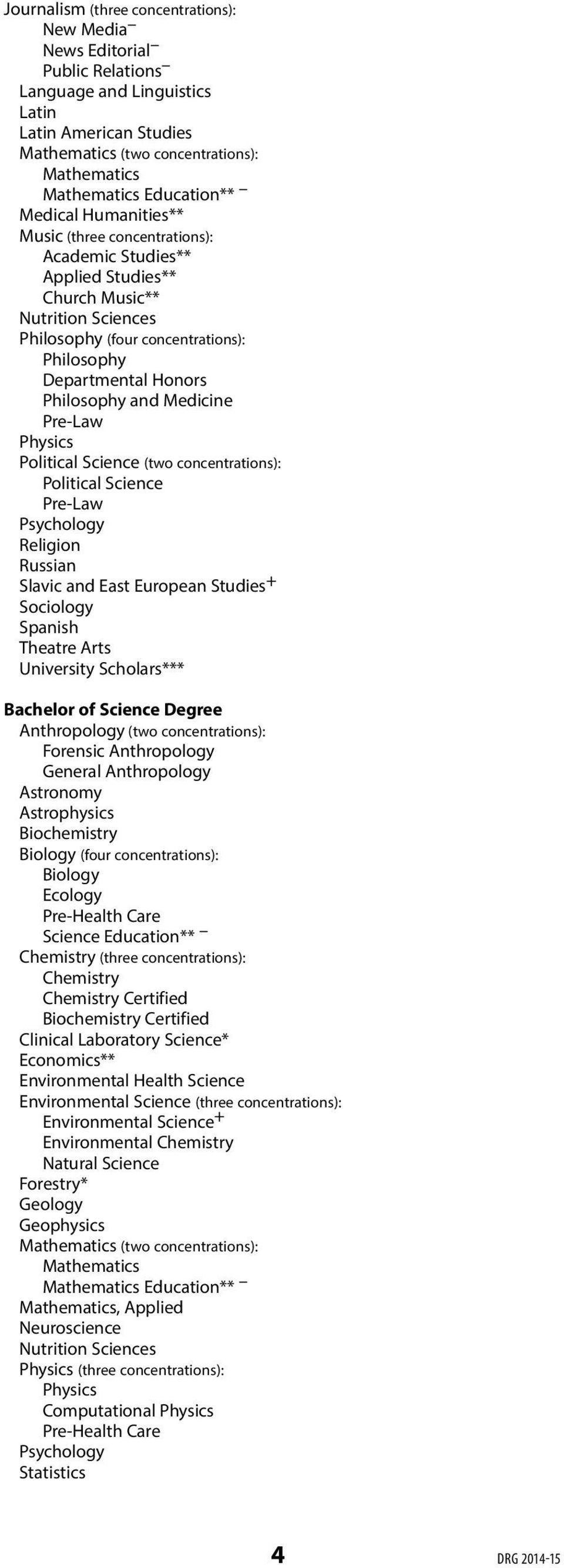
6 Journalism (three concentrations): New Media News Editorial Public Relations Language and Linguistics Latin Latin American Studies Mathematics (two concentrations): Mathematics Mathematics Education** Medical Humanities** Music (three concentrations): Academic Studies** Applied Studies** Church Music** Nutrition Sciences Philosophy (four concentrations): Philosophy Departmental Honors Philosophy and Medicine Pre-Law Physics Political Science (two concentrations): Political Science Pre-Law Psychology Religion Russian Slavic and East European Studies + Sociology Spanish Theatre Arts University Scholars*** Bachelor of Science Degree Anthropology (two concentrations): Forensic Anthropology General Anthropology Astronomy Astrophysics Biochemistry Biology (four concentrations): Biology Ecology Pre-Health Care Science Education** Chemistry (three concentrations): Chemistry Chemistry Certified Biochemistry Certified Clinical Laboratory Science* Economics** Environmental Health Science Environmental Science (three concentrations): Environmental Science + Environmental Chemistry Natural Science Forestry* Geology Geophysics Mathematics (two concentrations): Mathematics Mathematics Education** Mathematics, Applied Neuroscience Nutrition Sciences Physics (three concentrations): Physics Computational Physics Pre-Health Care Psychology Statistics 4 DRG
7 Bachelor of Fine Arts Degree Studio Art (seven concentrations): Ceramic Design Fabric Design Graphic Design Painting Photography Printmaking Sculpture Theatre Design and Technology Theatre Performance Theatre Studies Bachelor of Science in Aviation Sciences Degree Aviation Sciences (three concentrations): Air Traffic Control**** Aircraft Dispatch**** Professional Pilot**** Bachelor of Science in Family and Consumer Sciences Degree Apparel Design and Product Development Apparel Merchandising Child and Family Studies General Family and Consumer Sciences Interior Design Nutrition Sciences BACHELOR OF ARTS Minimum Requirement hrs. I. English/Literature...12 Select from each area: Area 1. ENG 1302 or FAS Area 2. ENG 1304 (or 3300 for science majors), or three courses from FAS 1118, 1128, and Area 3. ENG Area 4. One of the following: ENG 2304, 2306, or three hours of 2000-level or higher GTX. II. REL 1310 and [REL 1350 or FAS 1308]; or six hours from REL 1211, 1221, III. MTH 1301, 1320, 1321, or STA NOTE: MTH 1320 is intended only for students who plan to take MTH IV. Fine Arts Choose one course from three different areas: Area 1. ART 1300, 2302, or Area 2. CLA Area 3. FAS 1306, or three courses from FAS 1116, 1126, Area 4. FCS 3313 or Area 5. FDM 1303/JOU Area 6. MUS 1220, 3322, or Area 7. CSS 1301, 1302, or Area 8. THEA 1206 or Applied courses may not substitute. V. Foreign Language To be fulfilled with one of the following combinations: A. Complete one Modern or Classical language through the 2320 level. Arabic, Chinese, French, German, Greek, Hebrew, Italian, Japanese, Korean, Latin, Portuguese, Russian, Spanish, and Swahili may be used. Placement exam in Spanish, French, or German may be required. B. Complete two Classical languages through the 1302 or 1402 level. Two languages from Latin, Greek, and Hebrew may be used. (If available, the following Biblical and Related Languages may be used: Akkadian, Aramaic, Syriac, Ugaritic.) NOTE: It is strongly recommended that the language course work be started during the first year of residence. Students with significant proficiency in a language may be able to begin at a higher level course to reach the 2320 level and thus take fewer hours of foreign language. Students may be required to take a placement test to determine the appropriate starting course level. DRG

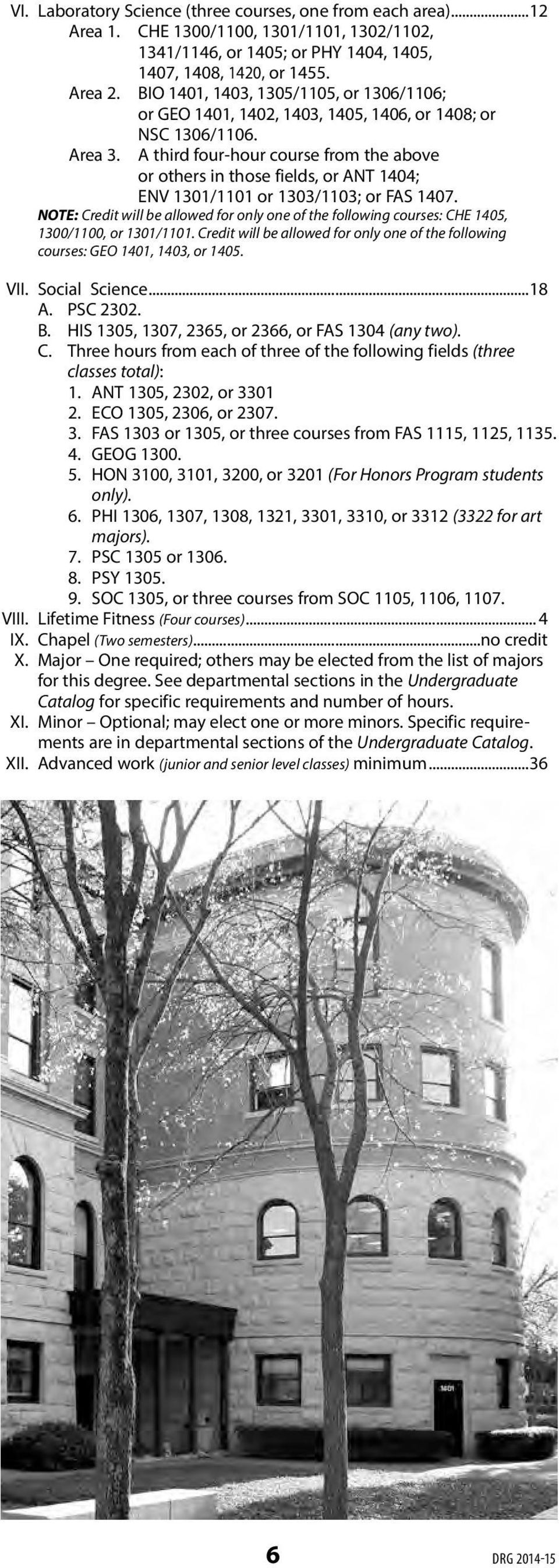
8 VI. Laboratory Science (three courses, one from each area)...12 Area 1. CHE 1300/1100, 1301/1101, 1302/1102, 1341/1146, or 1405; or PHY 1404, 1405, 1407, 1408, 1420, or Area 2. BIO 1401, 1403, 1305/1105, or 1306/1106; or GEO 1401, 1402, 1403, 1405, 1406, or 1408; or NSC 1306/1106. Area 3. A third four-hour course from the above or others in those fields, or ANT 1404; ENV 1301/1101 or 1303/1103; or FAS NOTE: Credit will be allowed for only one of the following courses: CHE 1405, 1300/1100, or 1301/1101. Credit will be allowed for only one of the following courses: GEO 1401, 1403, or VII. Social Science...18 A. PSC B. HIS 1305, 1307, 2365, or 2366, or FAS 1304 (any two). C. Three hours from each of three of the following fields (three classes total): 1. ANT 1305, 2302, or ECO 1305, 2306, or FAS 1303 or 1305, or three courses from FAS 1115, 1125, GEOG HON 3100, 3101, 3200, or 3201 (For Honors Program students only). 6. PHI 1306, 1307, 1308, 1321, 3301, 3310, or 3312 (3322 for art majors). 7. PSC 1305 or PSY SOC 1305, or three courses from SOC 1105, 1106, VIII. Lifetime Fitness (Four courses)... 4 IX. Chapel (Two semesters)...no credit X. Major One required; others may be elected from the list of majors for this degree. See departmental sections in the Undergraduate Catalog for specific requirements and number of hours. XI. Minor Optional; may elect one or more minors. Specific requirements are in departmental sections of the Undergraduate Catalog. XII. Advanced work (junior and senior level classes) minimum DRG
9 BACHELOR OF SCIENCE Minimum Requirements hrs. I. English/ Literature...12 Select from each area: Area 1: ENG 1302 or FAS Area 2: ENG 1304 (or 3300 for science majors), or three courses from FAS 1118, 1128, Area 3: ENG Area 4: One of the following: ENG 2304, 2306, or three hours of 2000-level or higher GTX. II. REL 1310 and [REL 1350 or FAS 1308]; or six hours from REL 1211, 1221, III. Mathematics and Science...34 A. Mathematics (two courses): MTH 1321 and three additional semester hours of Mathematics or Statistics for which calculus (MTH 1321) is a prerequisite. B. Laboratory Science (two courses): Eight semester hours of laboratory science courses with appropriate labs. C. Additional Mathematics and Science: Twenty semester hours of additional courses from BIO, CHE, ENV, GEO, MTH, NSC, PHY, PSY, and STA. IV. Foreign Language To be fulfilled with one of the combinations listed under the Bachelor of Arts. NOTE: It is strongly recommended that the language course work be started during the first year of residence. Students with significant proficiency in a language may be able to begin at a higher level course to reach the 2320 level and thus take fewer hours of foreign language. Students may be required to take a placement test to determine the appropriate starting course level. Also, some majors have specific language requirements; see department listings in the Undergraduate Catalog. V. History and/or Social Science... 9 A. PSC B. Six semester hours (two courses) of history and/or social science courses. (See Undergraduate Catalog for full details and restrictions.) VI. Lifetime Fitness (Four courses)... 4 VII. Chapel (Two semesters)...no credit VIII. Major One required; others may be elected from the list of majors for this degree. See departmental sections in the Undergraduate Catalog for specific requirements and number of hours. IX. Minor Optional; may elect one or more minors. Specific requirements are in the departmental sections of the Catalog. X. Advanced work (junior and senior level classes) minimum...36 NOTE: See departmental sections in the Undergraduate Catalog for other specific requirements and major requirements. The requirements for advanced credit, residence, language, a specified comprehensive examination, Chapel, minimum grade point average, maximum credit, and lifetime fitness are the same as for the Bachelor of Arts degree. DRG
![II. REL 1310 and [REL 1350 or FAS 1308]; or six hours from REL 1211, 1221, 1231... 6 III. Mathematics and Science...34 A.](/docs-images/41/1233404/images/page_9.jpg "Mathematics (two courses): MTH 1321 and three additional semester hours of Mathematics or Statistics for which calculus (MTH 1321) is a prerequisite. B.")
10 INTERUNIVERSITY PROGRAMS Baylor University offers two Interuniversity Programs, in which students choose a major and degree program (BA or BS) that is begun at Baylor and finished at a partner university or professional school. A short overview of the programs and majors available in this manner is provided below; see the Undergraduate Catalog for a full, detailed description of each program. CLINICAL LABORATORY SCIENCE BS degree, Major in Clinical Laboratory Science Partner Schools: Methodist Hospital, School of Clinical Labora - tory Science, Houston, Texas; Scott & White Memorial Hospital, School of Clinical Laboratory Science, Temple, Texas; and Tarleton State University, Department of Clinical Laboratory Science, Fort Worth, Texas. Program Requirements: A. The basic Bachelor of Science curriculum. B. The additional courses listed here: BIO 1305/1105, 1306/1106, (1402 or 4401), 2306/2106, 4301, 4306/4106, and 4001; CHE 1301/1101, 1302/1102, 3238, 3331, and 3332; MIS 1305; PHY 1405; MTH 1321; and MTH 1322 or STA C. Sufficient electives, if needed, to bring the total credit to a minimum of 94 semester hours, with at least a C average. D. The residence requirement of a minimum of 60 semester hours, including all of the last 30 hours of the pre-professional program requirements, must be completed in the College of Arts and Sciences at Baylor. FORESTRY BA or BS degree, Major in Forestry Partner University: Duke University Program Requirements: A. The respective basic requirements for the Bachelor of Arts or the Bachelor of Science degree. B. The specific courses listed below: 1. BA degree: MTH 1320, 1321, and 1322; BIO 4406 or 4416; CHE 1300, 1100, 1341, and 1146; PHY 1408 and 1409; ECO 2306 and 2307; HIS 1305 and 1307, or 2365 and BS degree: MTH 1320, 1321, 1322, 2321, and 3325; BIO 4406 or 4416; CHE 1301/1101, 1302/1102; PHY 1420 and 1430; ECO 2306 and 2307; an additional six to eight course hours in science and mathematics. C. Major in Forestry (30 hours at Duke). D. Major in Environmental Studies (28 30 hours at Baylor). E. A minimum requirement of 94 hours completed before transfer to Duke, with a minimum 60 hours in residence at Baylor (including all of the last 30 hours). 8 DRG

11 BACHELOR OF FINE ARTS Minimum requirements hrs. I. Basic requirements A. English ENG 1302 or FAS 1302; ENG 1304 or three courses from FAS 1118, 1128, 1138; plus one of the following: ENG 2301, 2304, or 2306, or three hours of 2000-level or higher GTX. B. Religion REL 1310 and [REL 1350 or FAS 1308]; or six hours from REL 1211, 1221, 1231 C. Fine Arts Theatre arts majors must take two courses from: ART 1300 or 1310 and MUS Art majors must take two courses from: MUS 1220, CSS 1301 or 1302, and THEA D. Foreign Language Theatre arts majors are required to take one language through the 2310 level. 2. Art majors are required to take one language through the 2310 level. E. Laboratory Science Theatre arts majors must complete two courses in any laboratory science. (FAS 1407 will apply.) 2. Art majors must complete two courses in laboratory science approved for the Bachelor of Arts degree. (FAS 1407 will apply.) F. Social Science Theatre arts majors must take six hours total from: ANT 1305 or 3301; ECO 1305 or 2306; PHI 1308, 1321, or 3322; PSC 1305 or 1306; PSY 1305; SOC 1305, or three courses from SOC 1105, 1106, 1107; HIS 1305, 1307, 2365, or 2366; FAS 1303, 1304, or 1305, or three courses from FAS 1115, 1125, Art majors must take six hours total. (FAS 1303, 1304, or 1305 or three courses from FAS 1115, 1125, 1135 will apply.) G. PSC H. Lifetime Fitness (Two to four courses) Theatre arts majors may substitute THEA 2298 and 2299 for the two required courses. 2. Art majors must take four courses. I. Chapel (Two semesters)... no credit J. Electives, depending on major II. A major in theatre arts (design and technology, perfomance, or studies) or art (studio art). See the appropriate departmental section of the Undergraduate Catalog for specific requirements. III. Advanced work (junior and senior level classes) minimum...36 IV. The requirements for advanced credit, residence, a specified comprehensive examination, Chapel, minimum grade point average, and maximum credit are the same as for the Bachelor of Arts degree. Additional information about these requirements is listed under the General Regulations for the College of Arts and Sciences and General University Regulations of the Undergraduate Catalog. DRG
![REL 1310 and [REL 1350 or FAS 1308]; or six hours from REL 1211, 1221, 1231 C. Fine Arts...4-5 1. Theatre arts majors must take two courses from: ART 1300 or 1310 and MUS 1220. 2.](/docs-images/41/1233404/images/page_11.jpg "Art majors must take two courses from: MUS 1220, CSS 1301 or 1302, and THEA 1206. D. Foreign Language... 3-11 1. Theatre arts majors are required to take one language through the 23")
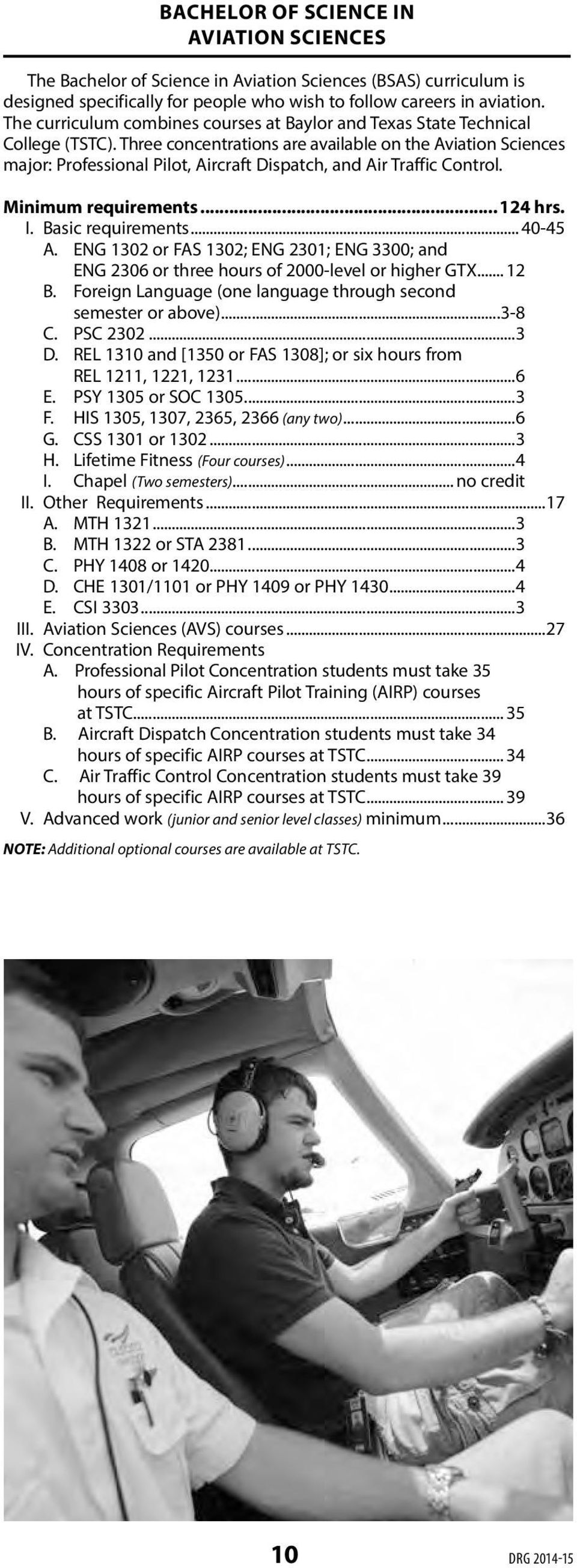
12 BACHELOR OF SCIENCE IN AVIATION SCIENCES The Bachelor of Science in Aviation Sciences (BSAS) curriculum is designed specifically for people who wish to follow careers in aviation. The curriculum combines courses at Baylor and Texas State Technical College (TSTC). Three concentrations are available on the Aviation Sciences major: Professional Pilot, Aircraft Dispatch, and Air Traffic Control. Minimum requirements hrs. I. Basic requirements A. ENG 1302 or FAS 1302; ENG 2301; ENG 3300; and ENG 2306 or three hours of 2000-level or higher GTX B. Foreign Language (one language through second semester or above) C. PSC D. REL 1310 and [1350 or FAS 1308]; or six hours from REL 1211, 1221, E. PSY 1305 or SOC F. HIS 1305, 1307, 2365, 2366 (any two)...6 G. CSS 1301 or H. Lifetime Fitness (Four courses)...4 I. Chapel (Two semesters)... no credit II. Other Requirements...17 A. MTH B. MTH 1322 or STA C. PHY 1408 or D. CHE 1301/1101 or PHY 1409 or PHY E. CSI III. Aviation Sciences (AVS) courses...27 IV. Concentration Requirements A. Professional Pilot Concentration students must take 35. hours of specific Aircraft Pilot Training (AIRP) courses at TSTC B. Aircraft Dispatch Concentration students must take 34 hours of specific AIRP courses at TSTC C. Air Traffic Control Concentration students must take 39 hours of specific AIRP courses at TSTC V. Advanced work (junior and senior level classes) minimum...36 NOTE: Additional optional courses are available at TSTC. 10 DRG
13 BACHELOR OF SCIENCE IN FAMILY AND CONSUMER SCIENCES Minimum requirements hrs. I. Basic requirements A. English/Literature Select from each area: Area 1. ENG 1302 or FAS Area 2. ENG 1304 or 3300, or three courses from FAS 1118, 1128, Area 3. ENG Area 4. One of the following: ENG 2304 or 2306, or three hours of 2000-level or higher GTX. B. REL 1310 and [1350 or FAS 1308]; or six hours from REL 1211, 1221, C. Mathematics 1301, 1320, 1321, or Statistics NOTE: MTH 1320 is intended only for students who plan to take MTH D. Foreign Language NOTE: The guidelines for foreign language on the BSFCS are the same as those on the BA. E. History and/or Social Science Apparel Merchandising and Apparel Design and Product Development majors must take ECO 1305, or (ECO 2306 and 2307). (FAS 1303, 1304, or 1305 or three courses from FAS 1115, 1125, 1135 will apply.) 2. Nutrition Sciences majors must take three hours from one of the following: ANT, PSY, or SOC. F. Political Science G. Laboratory Science Nutrition Sciences majors must take sciences as listed under the major in the Undergraduate Catalog. 2. All other Family and Consumer Sciences majors must take CHE 1405 or 1300/1100 plus eight additional hours of lab science. (FAS 1407 will apply.) H. Lifetime Fitness (Four courses)...4 I. Chapel (Two semesters)... no credit II. Majors A. Apparel Design and Product Development. B. Apparel Merchandising. C. Child and Family Studies. D. General Family and Consumer Sciences. E. Interior Design. F. Nutrition Science. III. Minors Minors are available in general family and consumer sciences, nutrition sciences, child and family studies, apparel merchandising, and family studies. NOTES: The Interior Design program at Baylor University is accredited by the Council for Interior Design Accreditation (CIDA). The curriculum in the Dietetics Nutrition Sciences program is currently accredited by the Accreditation Council for Education in Nutrition and Dietetics (ACEND) of the Academy of Nutrition and Dietetics. Successful completion of the Nutrition Sciences program, university graduation requirements, an accredited internship, and other Academy of Nutrition and Dietetics requirements qualifies the student to take the Academy of Nutrition and Dietetics examination to become a Registered Dietician and member of the Academy of Nutrition and Dietetics. Please see specific requirements for majors in the Undergraduate Catalog. DRG
![REL 1310 and [1350 or FAS 1308]; or six hours from REL 1211, 1221, 1231...6 C. Mathematics 1301, 1320, 1321, or Statistics 1380.](/docs-images/41/1233404/images/page_13.jpg "..3 NOTE: MTH 1320 is intended only for students who plan to take MTH 1321. D. Foreign Language... 3-14 NOTE: The guidelines for foreign language on the BSFCS are the same as those on the BA. E.")
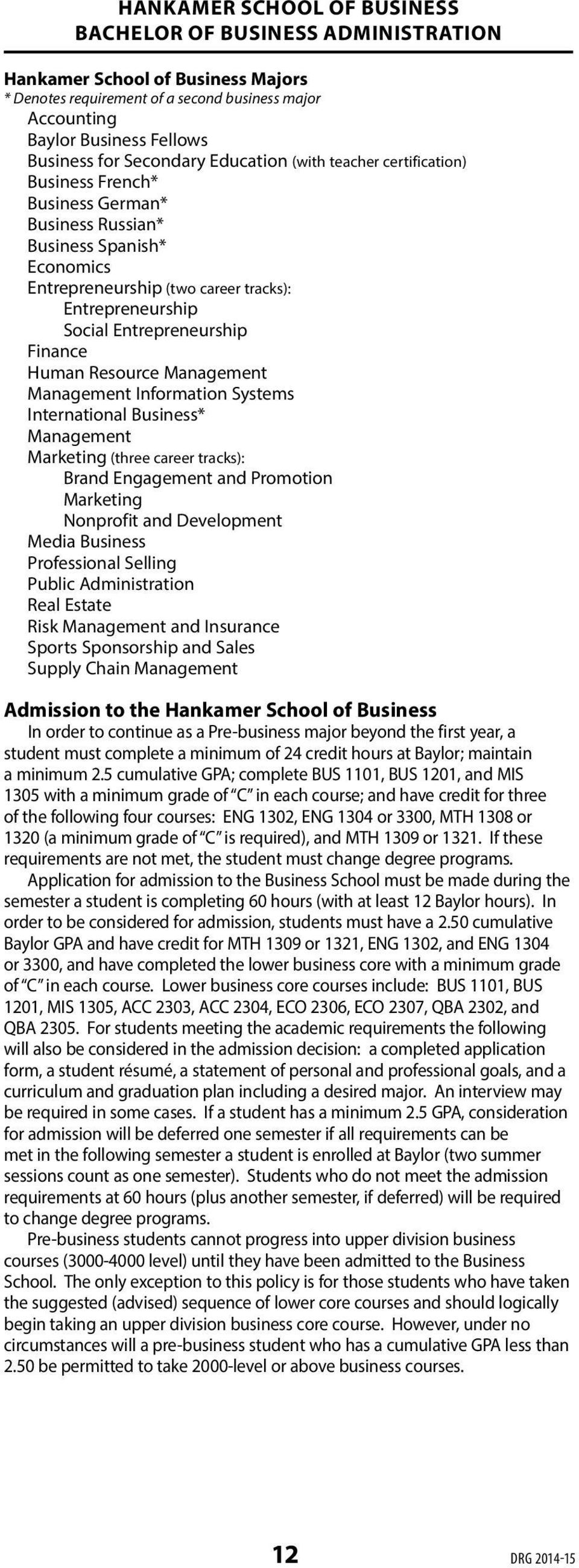
14 HANKAMER SCHOOL OF BUSINESS BACHELOR OF BUSINESS ADMINISTRATION Hankamer School of Business Majors * Denotes requirement of a second business major Accounting Baylor Business Fellows Business for Secondary Education (with teacher certification) Business French* Business German* Business Russian* Business Spanish* Economics Entrepreneurship (two career tracks): Entrepreneurship Social Entrepreneurship Finance Human Resource Management Management Information Systems International Business* Management Marketing (three career tracks): Brand Engagement and Promotion Marketing Nonprofit and Development Media Business Professional Selling Public Administration Real Estate Risk Management and Insurance Sports Sponsorship and Sales Supply Chain Management Admission to the Hankamer School of Business In order to continue as a Pre-business major beyond the first year, a student must complete a minimum of 24 credit hours at Baylor; maintain a minimum 2.5 cumulative GPA; complete BUS 1101, BUS 1201, and MIS 1305 with a minimum grade of C in each course; and have credit for three of the following four courses: ENG 1302, ENG 1304 or 3300, MTH 1308 or 1320 (a minimum grade of C is required), and MTH 1309 or If these requirements are not met, the student must change degree programs. Application for admission to the Business School must be made during the semester a student is completing 60 hours (with at least 12 Baylor hours). In order to be considered for admission, students must have a 2.50 cumulative Baylor GPA and have credit for MTH 1309 or 1321, ENG 1302, and ENG 1304 or 3300, and have completed the lower business core with a minimum grade of C in each course. Lower business core courses include: BUS 1101, BUS 1201, MIS 1305, ACC 2303, ACC 2304, ECO 2306, ECO 2307, QBA 2302, and QBA For students meeting the academic requirements the following will also be considered in the admission decision: a completed application form, a student résumé, a statement of personal and professional goals, and a curriculum and graduation plan including a desired major. An interview may be required in some cases. If a student has a minimum 2.5 GPA, consideration for admission will be deferred one semester if all requirements can be met in the following semester a student is enrolled at Baylor (two summer sessions count as one semester). Students who do not meet the admission requirements at 60 hours (plus another semester, if deferred) will be required to change degree programs. Pre-business students cannot progress into upper division business courses ( level) until they have been admitted to the Business School. The only exception to this policy is for those students who have taken the suggested (advised) sequence of lower core courses and should logically begin taking an upper division business core course. However, under no circumstances will a pre-business student who has a cumulative GPA less than 2.50 be permitted to take 2000-level or above business courses. 12 DRG
15 SUMMARY OF COURSES REQUIRED FOR THE BACHELOR OF BUSINESS ADMINISTRATION Minimum requirements hrs. I. Written and Oral Communication A. ENG 1302 and B. Choose one course from CSS 1301, 1302, or C. Complete one of the following options: Option I: One Foreign Language through the third level, either 2310 or 2312 (3-11 hrs.) 2. Option II: Complete three courses, one from each of three different groups a. BUS 3345 or MGT b. BUS 3303, MKT 3310, or any CSS , excluding CSS c. FDM/JOU 3372 or any ENG level course...3 d. Any Foreign Language. II. Social Sciences...15 A. Choose one course from ECO 1301; HIS 1305, 1307, 2365, or B. ECO 2306 and C. PSC D. Choose one course from ANT 1305; GEOG 1300; History; Honors; Philosophy; PSC 1305 or 1306; PSY 1305; or SOC III. Religion, Fine Arts, and Literature A. REL 1310 and [REL 1350 or FAS 1308]...6 B. Choose one course from ART 1300; JOU/FDM 1303; MUS 1220; or THEA C. Choose one course from ENG 2301, 2304, or 2306; any 2000-level or higher Great Texts course; or any Foreign Literature course...3 IV. Mathematics and Natural Sciences A. MTH 1308 and 1309; or MTH 1320 and 1321; or MTH 1320 and (three-six hours depending on SAT/ACT math score.) B. QBA 2302 or STA C. QBA D. One lab science...4 V. Personal Development... 2 A. HED B. Lifetime Fitness or Leadership Development...1 C. Chapel (Two semesters)... no credit VI. Professional Business Core...36 A. ACC 2303 and B. BL C. BUS 1101, 1201, 3315, and D. FIN E. MGT 3305 and F. MIS 1305 and G. MKT VII. Major (minimum of 12 hours) VIII. Elective hours will vary for each student, must be taken for a grade, and are only needed to reach the 124 hour minimum to graduate. Electives may be used toward a double major in the Business School, or a secondary major or a minor outside of the Business School. DRG

16 SCHOOL OF EDUCATION BACHELOR OF SCIENCE IN ATHLETIC TRAINING Minimum Requirements hrs. I. Basic Studies A. ENG 1302, 1304, B. REL 1310, C. STA D. Language E. Humanities (History, Art, Theatre, or Music) F. CHE 1300 or CHE G. PSC H. MIS I. CSS 1301 or J. Lifetime Fitness (3 activity courses)...3 K. Chapel (Two semesters)... no credit II. Athletic Training Major Core...80 A. Candidate Level B. Level I C. Level II D. Level III Admission to the Bachelor of Science in Athletic Training Students wishing to complete the Bachelor of Science in Athletic Training must meet rigorous standards and go through an application process to be able to remain in the program beyond the candidate level. Complete information about the application process may be found in the Undergraduate Catalog. Questions may be directed to program director Dr. Andrew Gallucci at [email protected]. SCHOOL OF EDUCATION BACHELOR OF SCIENCE IN EDUCATION The School of Education offers teacher certification programs in the following areas: Elementary Education Middle Grades with majors in English Language Arts and Reading, Mathematics, Science, and Social Studies Secondary with majors in English Language Arts and Reading, Life Science, Mathematics, Physical Science, and Social Studies All-Level Programs with majors in Spanish, Physical Education, and Special Education Supplemental Certificates in English as a Second Language and Gifted and Talented Health Science Studies: Science Education Option The Health, Human Performance, and Recreation Division offers the following non-certification majors through the School of Education: Community Health Exercise Physiology General Studies in HHPR Health Science Studies with three options: Health Professions Option Premedical/Predental Option Prephysical Therapy Option Recreation and Leisure Studies with two tracks: Church Recreation Track Outdoor Recreation Track Basic requirements for the certification and HHPR programs are varied according to the major chosen from above. However, the following courses are common to all BSED programs: CHA 1088, ENG 1302 and 1304, HED 1145, PSC 2302, REL 1310 and 1350 (or REL 1211, 1221, and 1231). Advising is required for all of these programs. At the time of advising, the student is given a four-year planner which outlines the entire program. Please contact the Office of Advisement and Certification for assistance with advising. The office is located in Marrs McLean Science Building, rooms , and the telephone number is (254) DRG

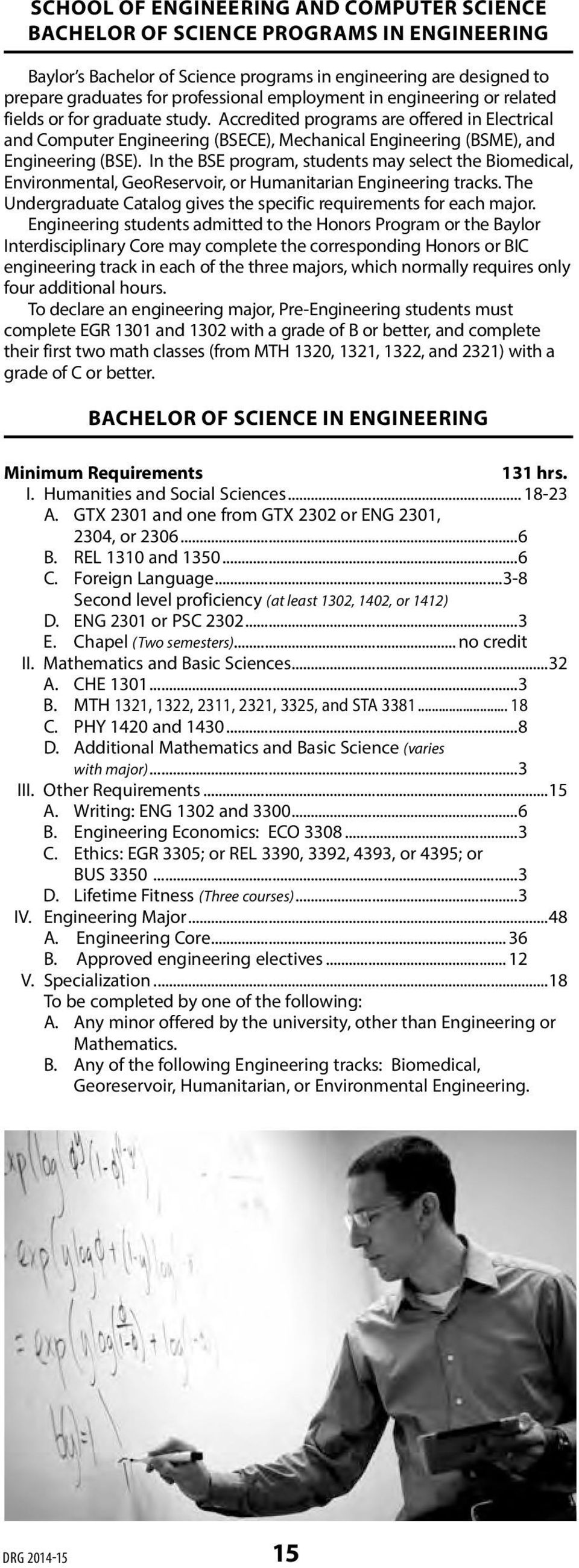
17 SCHOOL OF ENGINEERING AND COMPUTER SCIENCE BACHELOR OF SCIENCE PROGRAMS IN ENGINEERING Baylor s Bachelor of Science programs in engineering are designed to prepare graduates for professional employment in engineering or related fields or for graduate study. Accredited programs are offered in Electrical and Computer Engineering (BSECE), Mechanical Engineering (BSME), and Engineering (BSE). In the BSE program, students may select the Biomedical, Environmental, GeoReservoir, or Humanitarian Engineering tracks. The Undergraduate Catalog gives the specific requirements for each major. Engineering students admitted to the Honors Program or the Baylor Interdisciplinary Core may complete the corresponding Honors or BIC engineering track in each of the three majors, which normally requires only four additional hours. To declare an engineering major, Pre-Engineering students must complete EGR 1301 and 1302 with a grade of B or better, and complete their first two math classes (from MTH 1320, 1321, 1322, and 2321) with a grade of C or better. BACHELOR OF SCIENCE IN ENGINEERING Minimum Requirements 131 hrs. I. Humanities and Social Sciences A. GTX 2301 and one from GTX 2302 or ENG 2301, 2304, or B. REL 1310 and C. Foreign Language Second level proficiency (at least 1302, 1402, or 1412) D. ENG 2301 or PSC E. Chapel (Two semesters)... no credit II. Mathematics and Basic Sciences...32 A. CHE B. MTH 1321, 1322, 2311, 2321, 3325, and STA C. PHY 1420 and D. Additional Mathematics and Basic Science (varies with major)...3 III. Other Requirements...15 A. Writing: ENG 1302 and B. Engineering Economics: ECO C. Ethics: EGR 3305; or REL 3390, 3392, 4393, or 4395; or BUS D. Lifetime Fitness (Three courses)...3 IV. Engineering Major...48 A. Engineering Core B. Approved engineering electives V. Specialization...18 To be completed by one of the following: A. Any minor offered by the university, other than Engineering or Mathematics. B. Any of the following Engineering tracks: Biomedical, Georeservoir, Humanitarian, or Environmental Engineering. DRG
18 BACHELOR OF SCIENCE IN ELECTRICAL AND COMPUTER ENGINEERING Minimum Requirements 129 hrs. I. Humanities and Social Sciences A. GTX 2301 and one from GTX 2302 or ENG 2301, 2304, or B. REL 1310 and C. Foreign Language D. ENG 2301 or PSC E. Chapel (Two semesters)... no credit II. Mathematics and Basic Sciences...32 A. CHE B. MTH 1321, 1322, 2311, 2321, 3325, and STA C. PHY 1420 and D. Additional Mathematics and Basic Science (varies with major)...3 III. Other Requirements...15 A. Writing: ENG 1302 and B. Engineering Economics: ECO C. Ethics: EGR 3305; or REL 3390, 3392, 4393, or 4395; or BUS D. Lifetime Fitness (Three courses)...3 IV. Electrical and Computer Engineering Major...64 BACHELOR OF SCIENCE IN MECHANICAL ENGINEERING Minimum Requirements 129 hrs. I. Humanities and Social Sciences A. GTX 2301 and one from GTX 2302 or ENG 2301, 2304, or B. REL 1310 and C. Foreign Language D. ENG 2301 or PSC E. Chapel (Two semesters)... no credit II. Mathematics and Basic Sciences...32 A. CHE B. MTH 1321, 1322, 2311, 2321, 3325, and STA C. PHY 1420 and D. Additional Mathematics and Basic Science (varies with major)...3 III. Other Requirements...15 A. Writing: ENG 1302 and B. Engineering Economics: ECO C. Ethics: EGR 3305; or REL 3390, 3392, 4393, or 4395; or BUS D. Lifetime Fitness (Three courses)...3 IV. Mechanical Engineering Major DRG

19 DRG BACHELOR OF SCIENCE IN COMPUTER SCIENCE The Bachelor of Science in Computer Science (BSCS) degree program is accredited by the Computing Accreditation Commission of the Accreditation Board for Engineering and Technology. Minimum requirements hrs. I. Humanities and Social Science A. ENG 1302 and B. Literature...9 One from each group: 1. GTX 2301, 2302, 3343, ENG 2301, 2304, PSC 2302 or an additional GTX course C. REL 1310 and 1350; or REL 1211, 1221, and D. Foreign Language Second level proficiency (at least 1302, 1402, or 1412) must be achieved. 1. Complete one course to reach second level proficiency (1302, 1402, 1412, 2310, or 2320). 2. Complete two courses to reach second level proficiency (beginning with 1301 or 1401). E. History and/or social science...6 F. CSS II. Mathematics...12 A. MTH 1321 and B. STA C. One mathematics course from 2311 or III. Other Requirements... 2 A. Lifetime Fitness (Two courses)...2.(not required of students who have reached age 25 before matriculation) B. Chapel (Two semesters)... no credit IV. Select one of the following three options for the Computer Science Major: Option A Computer Science Concentration CSI 1430, 1440, 2334, 2350, 3130, 3334, 3335, 3336, 3344, 3371, 3372, 3439, 4321, 4330, 4337, 43C One of CSI 3101 or CSI 3000 or 4000 level electives (see NOTE) A grade of C or better in all but four hours of the computer science hours counted toward the major. 5. Sciences a. One group from the following natural or physical sciences: 1. BIO 1305/1105 and 1306/ CHE 1301/1101 and 1302/ GEO 1405 and PHY 1408 and 1409 or 1420 and b. Six to eight additional hours of science from the courses above or from courses which have one or more of the above courses as prerequisites. Option B Gaming Concentration CSI 1430, 1440, 2334, 2350, 3130, 3334, 3335, 3336, 3344, 3371, 3372, 3439, 4321, 4330, 4337, 4341, 4342, 43C CSI 3101 or FDM 1304, 3361, 4313, A grade of C or better in all but four hours of the computer science hours counted toward the major. 5. Sciences a. PHY 1420 and b. Six to eight additional hours of science from the courses below or from courses which have one or more of the above courses as prerequisites. 1. BIO 1305/1105 and 1306/ CHE 1301 and GEO 1405 and Option C Software Engineering Concentration CSI 1430, 1440, 2334, 2350, 3130, 3334, 3335, 3336, 3344, 3371, 3372, 3374, 3375, 3439, 4321, 4330, 4337, 43C CSI 3101 or
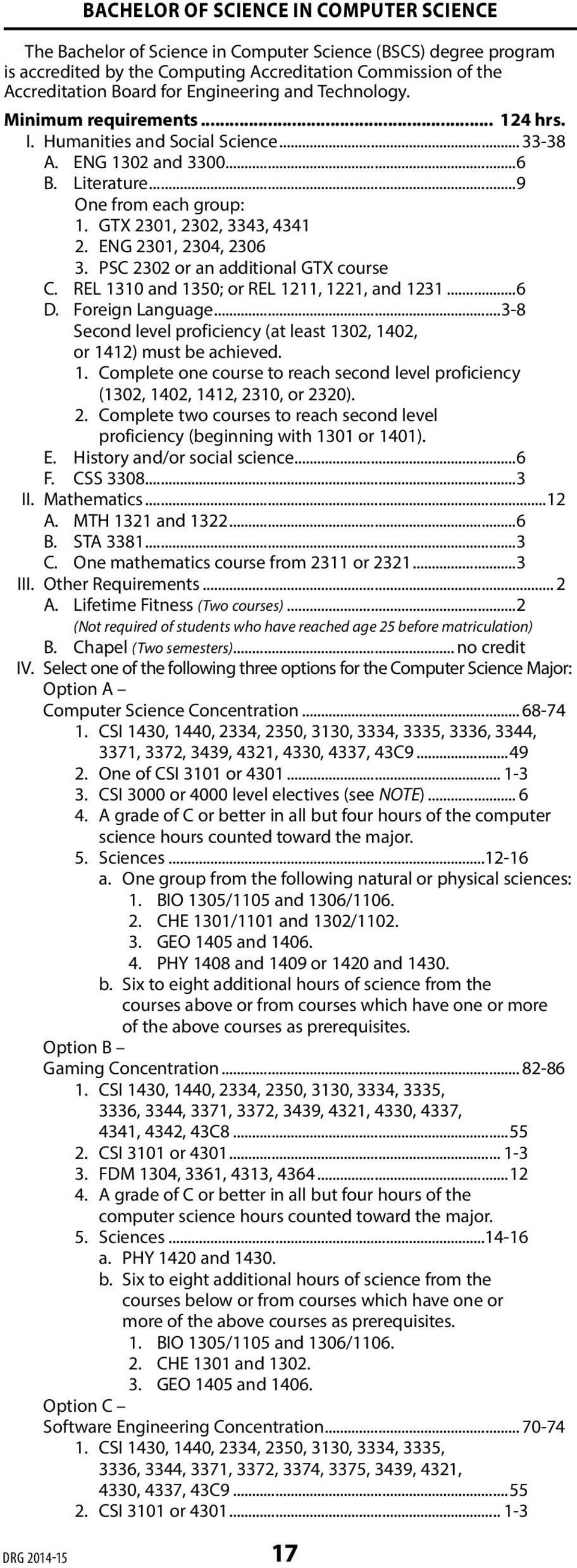
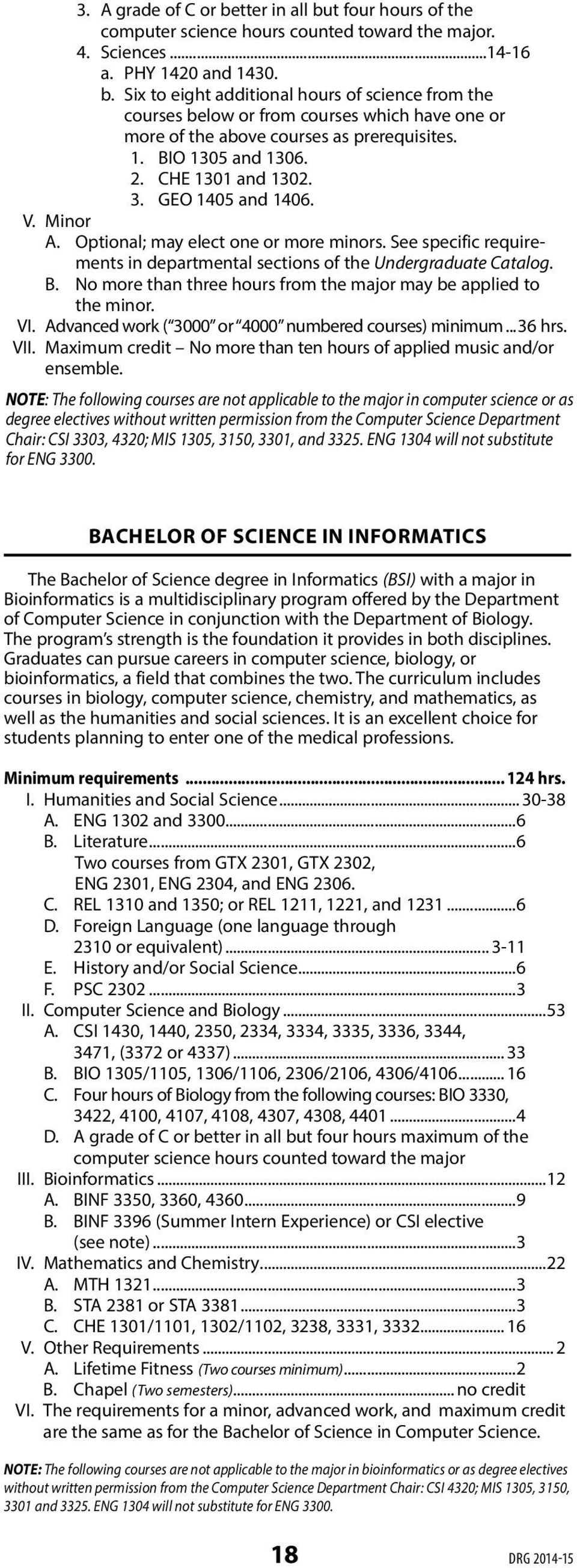
20 3. A grade of C or better in all but four hours of the computer science hours counted toward the major. 4. Sciences a. PHY 1420 and b. Six to eight additional hours of science from the courses below or from courses which have one or more of the above courses as prerequisites. 1. BIO 1305 and CHE 1301 and GEO 1405 and V. Minor A. Optional; may elect one or more minors. See specific requirements in departmental sections of the Undergraduate Catalog. B. No more than three hours from the major may be applied to the minor. VI. Advanced work ( 3000 or 4000 numbered courses) minimum...36 hrs. VII. Maximum credit No more than ten hours of applied music and/or ensemble. NOTE: The following courses are not applicable to the major in computer science or as degree electives without written permission from the Computer Science Department Chair: CSI 3303, 4320; MIS 1305, 3150, 3301, and ENG 1304 will not substitute for ENG BACHELOR OF SCIENCE IN INFORMATICS The Bachelor of Science degree in Informatics (BSI) with a major in Bioinformatics is a multidisciplinary program offered by the Department of Computer Science in conjunction with the Department of Biology. The program s strength is the foundation it provides in both disciplines. Graduates can pursue careers in computer science, biology, or bioinformatics, a field that combines the two. The curriculum includes courses in biology, computer science, chemistry, and mathematics, as well as the humanities and social sciences. It is an excellent choice for students planning to enter one of the medical professions. Minimum requirements hrs. I. Humanities and Social Science A. ENG 1302 and B. Literature...6 Two courses from GTX 2301, GTX 2302, ENG 2301, ENG 2304, and ENG C. REL 1310 and 1350; or REL 1211, 1221, and D. Foreign Language (one language through 2310 or equivalent) E. History and/or Social Science...6 F. PSC II. Computer Science and Biology...53 A. CSI 1430, 1440, 2350, 2334, 3334, 3335, 3336, 3344, 3471, (3372 or 4337) B. BIO 1305/1105, 1306/1106, 2306/2106, 4306/ C. Four hours of Biology from the following courses: BIO 3330, 3422, 4100, 4107, 4108, 4307, 4308, D. A grade of C or better in all but four hours maximum of the computer science hours counted toward the major III. Bioinformatics...12 A. BINF 3350, 3360, B. BINF 3396 (Summer Intern Experience) or CSI elective (see note)...3 IV. Mathematics and Chemistry...22 A. MTH B. STA 2381 or STA C. CHE 1301/1101, 1302/1102, 3238, 3331, V. Other Requirements... 2 A. Lifetime Fitness (Two courses minimum)...2 B. Chapel (Two semesters)... no credit VI. The requirements for a minor, advanced work, and.maximum credit are the same as for the Bachelor of Science in Computer Science. NOTE: The following courses are not applicable to the major in bioinformatics or as degree electives without written permission from the Computer Science Department Chair: CSI 4320; MIS 1305, 3150, 3301 and ENG 1304 will not substitute for ENG DRG
21 SCHOOL OF MUSIC BACHELOR OF MUSIC Minimum requirements hrs. I. Basic requirements A. ENG 1302, 1304, and B. HIS 1305 or C. REL 1310 and D. PSC E. Modern Foreign Language (Requirements vary with major) F. Mathematics or Natural Science G. Additional requirements (depend on major) H. Lifetime Fitness (Two courses)...2 I. Chapel (Two semesters)... no credit J. Electives (vary by major) II. Music Core...31 III. MUS 1001 Recital attendance...6 semesters IV. Major Majors offered on the Bachelor of Music: Applied Music (four emphasis areas): Organ Piano Voice Wind/String/Percussion Church Music (three emphasis areas): Instrumental Keyboard Voice Composition History and Literature Pedagogy Theory BACHELOR OF MUSIC EDUCATION Minimum requirements hrs. I. Basic requirements A. ENG 1302, 1304, and B. HIS 1307 and C. PSC D. Science with lab: biology, physics, or chemistry...4 E. MTH F. Foreign Language G. REL 1310 and H. Chapel (Two semesters)...no credit I. EDP J. EDC K. Lifetime Fitness (Two courses)...2 II. Professional Education...15 A. MUS B. MUS C. MUS 4F III. Music Core...31 IV. MUS 1001 Recital attendance...6 semesters V. Major Majors offered on the Bachelor of Music Education: Choral Music (two emphasis areas): Keyboard Voice Instrumental Music (two emphasis areas): String Wind/Percussion Also available: Bachelor of Arts in Music (three concentrations): Academic Studies Applied Studies Church Music DRG
22 LOUISE HERRINGTON SCHOOL OF NURSING BACHELOR OF SCIENCE IN NURSING Minimum requirements hrs. I. English... 9 A. ENG 1302 and 1304 (or 3300)...6 B. ENG 2301, 2304, 2306, or upper-level literature course in modern foreign languages or in classical languages...3 II. REL 1310 and 1350; or REL 1211, 1221, and III. Foreign Language IV. STA V. Science (Laboratory)...19 A. BIO 1402, 2401, and B. CHE 1300 and C. FCS VI. Social Science...15 A. PSC B. HIS 1305, 1307, 2365, 2366, or C. PSY 1305 and D. SOC VII. Chapel (Two semesters)...no credit VIII. Elective hours IX. Upper Division Nursing Courses DRG
23 SCHOOL OF SOCIAL WORK BACHELOR OF SOCIAL WORK Minimum requirements hrs. I. Basic requirements A. English/Literature ENG ENG ENG Any one from ENG 2304, 2306, 3300, or 3 hours of GTX at the 2000 level or above. B. Religion: REL 1310 and C. History: Any two courses from HIS 1305, 1307, 2365, and D. Social Science: ECO 3355, PSY 1305, and SOC E. Political Science: PSC F. Language To be fulfilled with one of the following combinations: 1. Complete one Modern or Classical language through 2320 level. Arabic, Chinese, French, German, Greek, Hebrew, Italian, Japanese, Korean, Latin, Portuguese, Russian, Spanish, and Swahili may be used. [1401 (1301) and 1402 (1302)] or 1412; 2310; and Complete two Classical languages through 1302 or 1402 level. Two languages from Latin, Greek, and Hebrew may be used. (If available, the following Biblical and Related Languages may be used: Akkadian, Aramaic, Syriac, Ugaritic.) G. Mathematics: One course from MTH 1301, 1320, 1321, or STA H. Laboratory Science: Three courses, one from each area To be fulfilled with one of the following combinations: 1. Biology: BIO 1401 or 1305/ Neuroscience: NSC 1306/ Chemistry, Environmental Science, or Physics: Any from CHE 1300/1100, 1301/1101, or 1405; ENV 1301/1101 or 1303/1103; or PHY 1405, 1408, 1420, or I. Fine Arts: Choose one course from two different departments ART 1300, 2302, or CLA FCS 3313 or FDM 1303/JOU MUS 1220, 3322, 3323, or CCS 1301, 1302, 1304, or THEA 1206 or J. CCS K. Lifetime Fitness (Three courses)...3 L. Chapel (Two semesters)... no credit II. Electives III. Major...41 DRG
24 MINORS OFFERED AT BAYLOR UNIVERSITY Minors consist of a minimum of 18 credit hours and may be added to complement a major but are usually not required. Minors are interdisciplinary; therefore, they may be taken under any degree plan. Most minors originate in the College of Arts and Sciences; in the list below, those originating in other academic bodies are followed by a number corresponding to the following key. 1 Honors College 4 School of Social Work 2 School of Business 5 School of Education 3 School of Engineering and 6 School of Music Computer Science American Studies Anthropology Apparel Merchandising Art Art History Studio Art Asian Studies Astronomy Astrophysics Aviation Science Biology Business Administration 2 Chemistry Biochemistry Chemistry Classics Classics Greek Latin Child & Family Studies Church Music 6 Communication Sciences & Disorders Sign Language Interpreting Communication Studies Corporate Communications Film & Digital Media Media Management Rhetoric & Argumentation Community Health 5 Computer Science 3 Criminal Justice Dance 5 Economics 2 Educational Psychology 5 Engineering 3 English Creative Writing English Entrepreneurship 2 Environmental Studies Family Studies Forensic Science (for students with science backgrounds) Geology Earth Science Geography Geology Gender Studies General Family & Consumer Sciences Gerontology 4 Great Texts of the Western Tradition 1 History International Studies Journalism News Editorial Photojournalism Public Relations Latin American Studies Leadership Studies 5 Linguistics Mathematics Medical Humanities Middle East Studies Modern Languages and Cultures Arabic Chinese French German Italian Japanese Russian Spanish Museum Studies Music 6 Nonprofit Studies 2 Nutrition Sciences Philosophy Physics Political Science Poverty Studies and Social Justice 4 Religion Recreation Ministry Religion Religion, Politics, and Society Sociology Statistics World Affairs 22 DRG
25 BAYLOR INTERDISCIPLINARY CORE (BIC) Since fall 1995, Baylor University has offered an option for the general education requirements of all undergraduate degree programs. The Baylor Interdisciplinary Core (BIC) seeks to integrate the various academic disciplines with a set of comprehensive interdisciplinary courses that provide a coherent approach to knowledge and learning. It is structured so that individuals see and appreciate relationships and connections among issues, disciplines, and thinkers, so that they are encouraged to synthesize material and to develop a comprehensive perspective. The curriculum emphasizes critical thinking, active learning, connected learning (among disciplines), the close reading of primary sources, writing and speaking skills, and the development of a global perspective. Central to the curriculum is a common core of 44 hours of coursework designed for every degree program in each of the University s undergraduate schools. The curriculum is organized around five sequences of courses designated as The Examined Life, World Cultures, The World of Rhetoric, The Natural World, and The Social World. These sequences of courses replace many of the general requirements on the degrees offered by the University. For more information on how BIC courses fit into each of the various degree plans, see the Undergraduate Catalog or the BIC website ( NOTE: Students who pursue a BM, BME, or BA (Music) degree (other than string majors) will encounter scheduling conflicts between required BIC classes and required music ensembles, making participation in the BIC impossible. Admission to the Program All regularly admitted students to Baylor University are eligible to apply for the Baylor Interdisciplinary Core program. Enrollment is limited to 200 incoming freshmen each academic year, and admission will be determined by the BIC Admissions Committee. DRG
26 HONORS PROGRAM Established in 1959, the Honors Program offers talented, highly motivated students at the university the opportunity to broaden their intellectual horizons in numerous ways. Through exploring their major fields of study intensely, through integrating many areas of knowledge, and through application of independent research techniques, Honors Program students form a community of shared learning with one another and with faculty members from all disciplines. University Scholars frequently join the Honors Program. The Honors Program is a four-year departmental and interdisciplinary program consisting of the features described below. Students admitted into the Honors Program become eligible to apply for residence in the Honors Residential College. (For a full description of Honors Program requirements, see the Honors Program website: Lower-Division Honors Participants are expected to complete at least 21 hours in Honors coursework (or the approved equivalent) no later than the completion of the second full year of academic study (60 hours) while maintaining an overall grade point average and an Honors grade point average of 3.2. Students are also recommended to take First-Year Seminars and required to take two Great Texts courses designed for the Honors Program. Upper-Division Honors Students completing the requirements of lower-division Honors with an overall grade point average of at least 3.2 may be invited to continue with their Honors Program track during their remaining semesters at Baylor. Students who have not participated in Honors during their first 60 hours at Baylor may apply for admission if they have a 3.5 overall grade point average and have the recommendation of the department in which they are majoring. These upper-division Honors students complete the following elements of advanced scholarship. Beginning the fall semester of the third year (or as early as spring of the second year with permission) participants enroll in a two-semester sequence (four academic hours total) where small, informal groups meet regularly during each semester to discuss significant books and issues in various academic disciplines. Furthermore, participants may select up to three junior- or senior-level courses in their field in which, by contract with the faculty of each course, they pursue advanced academic study beyond that required of non-honors students enrolled in the same course. During the junior year, Honors students undertake two sections of Independent Readings (one hour each), in order to explore specific topics with the guidance of a faculty mentor. Beginning with the Independent Readings courses and continuing into the four hours of senior-year Honors Thesis courses, upper-division Honors students apply the methods of their chosen discipline(s) to the investigation of a specific topic of interest. The result of this investigation is a thesis project directed by a Baylor faculty member, who is selected by the Honors student in consultation with program faculty/staff. To complete the requirements for graduation in Honors, participants must defend the Honors thesis in a one-hour oral examination before a committee consisting of the faculty director, at least one other departmental representative, and another Baylor faculty member or a member of the University s Honors faculty advisory committee. Admission to the Program Students interested in entering the program as freshmen should call (254) or visit the website. 24 DRG
27 PREHEALTH STUDIES The Prehealth Studies Office provides advisement, mentoring, and guidance for Baylor University students who are interested in any of the eight areas of healthcare for which we advise, including premedical, predental, prephysician assistant, preoptometry, preveterinary, prepharmacy, prephysical therapy, and preoccupational therapy. Admissions requirements, particularly in the areas of Allied Health, tend to vary from year to year. Prerequisite course lists and 4-Year Planners for all areas of prehealth are available in the Prehealth Studies Office. Applicants for Allied Health schools are held to current year requirements which must be complete or in progress at the time of application. Areas of Allied Health include prephysician assistant, prepharmacy, prephysical therapy, preoptometry, and preoccupational therapy. Advising workshops, as well as individual appointments, are offered each semester for students who intend to pursue careers in healthcare. It is essential that those students be designated as such in order for them to access the prehealth Blackboard resources. Contact Information Richard Sanker, PhD, Director Linda B. Haynes, Program Manager Jane Lin, Program Coordinator Erin Stamile, Program Coordinator Lauren Vorderkunz, Office Manager Mailing Address: One Bear Place #97341 Waco, TX Phone: (254) Web: Office: Baylor Sciences Building (BSB), B111 PRE-LAW Pre-Law at Baylor is not a major. Rather, it is a pre-professional track available to all undergraduate students. The American Bar Association (ABA) Preparing for Law School website ( prelaw/prep.html) does not recommend any particular group of majors for students interested in becoming lawyers. Rather, experts recommend maximizing one s education by taking the most rigorous and demanding classes possible. For more information, please read the Pre-Law Timeline (available at and the Baylor Pre-Law Guide (available at document.php/69917.pdf). These contain detailed recommendations on each stage of pre-law preparation. If one wishes to add or delete the pre-law designation on one s student record, please see an advisor in University Advisement (freshmen) or CASA (sophomores-seniors). Contact Information Elizabeth Cano, JD, Coordinator of Pre-Law [email protected] Mailing Address: One Bear Place #97021 Waco, TX Phone: (254) Web: Office: Sid Richardson Building, 101 DRG
28 SECONDARY MAJORS Launched in fall 2011, secondary majors offer students the opportunity to earn one baccalaureate degree in one program supplemented by a rich intellectual experience in a second field of specialization outside that primary program. The secondary major offers the option of studying two subjects from two different programs while earning a baccalaureate degree in the first major without the requirement of earning a second baccalaureate degree in the secondary major. Specifically, this option allows a student from one degree program to earn a secondary major from a participating department within a different program by fulfilling the requirements (normally semester hours) set forth by that participating department but without requiring students to enroll in the additional courses that comprise that other program s core curriculum. Through the secondary major option, upon graduation, a student earns one baccalaureate degree from Baylor (through the fulfillment of all requirements from the student s home college or school). Although that student will not be awarded a second degree, the student s transcript will reflect that he or she earned a secondary major in that second area of study. Individual departments that wish to participate should design their secondary major requirements in a manner that is comparable with those of their major program while compensating, as appropriate, for the fact that students working toward a secondary major might not have fulfilled all of the core requirements of the department s college or school. A department should consult with its school s or college s Curriculum Committee as it crafts the requirements for its secondary major keeping in mind the core requirements for the other baccalaureate programs. A department s secondary major proposal will be approved through the normal channels within each school or college. As an illustration, if an Accounting major from the Hankamer School of Business wishes to earn a secondary major in Mathematics, she will need to satisfy all of the requirements of both her Accounting major and the secondary major in Mathematics. She will then graduate with her class from the School of Business having earned a BBA in Accounting. Her transcript will note that she earned a BBA in Accounting with a Secondary Major in Mathematics. Students still have the option to double major within a single baccalaureate degree program or invest the additional time required to earn a second baccalaureate degree, as currently described in the Baylor Undergraduate Catalog. Interested students should consult with their secondary department as early in their undergraduate studies as possible to determine if a secondary major is available and to receive advising (if appropriate). For more information, please visit the secondary majors webpage: 26 DRG
29 UNIVERSITY ADVISEMENT Paul L. Foster Success Center SID RICHARDSON BUILDING One Bear Place #97062 Waco, TX (254) baylor.edu Degree Requirement Guide ADS 4.13
School of Architecture Architecture Bachelor of Architecture Interior Design (Program) Interior Design BS in Interior Design
 Undergraduate Majors, Minors, Concentrations, and Degrees The University of Tennessee, Knoxville 2006-2007 Academic Year/Listed by College and Department DEPARTMENT (UNIT) MAJOR MINOR MINOR ONLY DEGREE
College/University Transfer Programs
 Tidewater Community College 0-5 Catalog Transfer Education College/University Transfer Programs associate Degree Specialization Certificate Liberal Arts page Business Administration page Engineering* page
Heider College of Business
 2014-2015 Creighton University Catalog 1 Heider College of Business Accreditation The undergraduate program of the Heider College of Business is fully accredited by the Association to Advance Collegiate
Approved Electives. Approved Humanities Transfer Electives. Educational Information. Minimum Requirements for Associate Degrees in the VCCS
 Educational Information General Education Minimum Requirements for Associate Degrees in the VCCS AA AS AA&S AAA/AAS Communication (a) 6 6 6 3 Humanities / Fine Arts 6 6 6 3 Foreign Language 6 0 0 0 (Intermediate
College of Liberal Arts. Dr. Christina Murphy, Dean Dr. Samuel L. Dameron, Associate Dean www.marshall.edu/cola [email protected]
 College of Liberal Arts Dr. Christina Murphy, Dean Dr. Samuel L. Dameron, Associate Dean www.marshall.edu/cola [email protected] MISSION OF THE COLLEGE The College of Liberal Arts is committed to excellence
Professional Programs in the Arts Degree Requirements for Students Fulfilling the REVISED General Education Curriculum
 Your Responsibility as a Student Professional Programs in the Arts Degree Requirements for Students Fulfilling the REVISED General Education Curriculum The following lists semester courses. For quarter
UNIVERSITY OF MISSOURI ST. LOUIS & ST. LOUIS COMMUNITY COLLEGE TRANSFER GUIDE
 UNIVERSITY OF MISSOURI ST. LOUIS & ST. LOUIS COMMUNITY COLLEGE TRANSFER GUIDE This Guide is intended for the use of prospective transfer students to the University of Missouri St. Louis (UMSL) who plan
College Transfer Two-Year Degree Programs
 College Transfer Two-Year Degree Programs Fairfax Community College http://www.lfcc.edu 55 Associate of Arts and Sciences Degree in Business Administration AREA: Business Administration PURPOSE: There
College of Arts and Sciences General Education Requirements for the Professional Programs in the Arts Semester Curriculum
 Prerequisites You are responsible for fulfilling all prerequisites to courses in which you enroll. Failure to satisfactorily complete prerequisites may delay graduation. College of s and Sciences General
Programs of Study GENERAL FORESTRY
 Programs of Study 53 FOOD AND NUTRITION CHM 104 Introduction to Inorganic Chemistry...4 CHM 105 Introduction to Organic Chemistry...4 History, Social, and Behavioral Sciences... 3-6 take no more than six
Food and Agricultural Business General Option (no concentration) Agricultural Equipment Systems
 Undergraduate Majors, s, Concentrations and Degrees Department/Unit Major Concentration Degree Available COLLEGE OF AGRICULTURAL SCIENCES AND NATURAL RESOURCES Agriculture and Natural Resources (Interdepartmental)
Food and Agricultural Business General Option (no concentration) Agricultural Equipment Systems
 Undergraduate Majors, s, Concentrations and Degrees Department/Unit Major Concentration Degree Available COLLEGE OF AGRICULTURAL SCIENCES AND NATURAL RESOURCES Agriculture and Natural Resources (Interdepartmental)
Food and Agricultural Business General Option (no concentration) Agricultural Equipment Systems CONCENTRATION:
 Undergraduate Majors, s, Concentrations and Degrees Department/Unit Major Concentration Degree Available COLLEGE OF AGRICULTURAL SCIENCES AND NATURAL RESOURCES Agriculture and Natural Resources (Interdepartmental)
Food and Agricultural Business General Option (no concentration) Agricultural Equipment Systems CONCENTRATION:
 Undergraduate Majors, s, Concentrations, and Degrees Department/Unit Major Concentration Degree Available COLLEGE OF AGRICULTURAL SCIENCES AND NATURAL RESOURCES Agriculture and Natural Resources (Interdepartmental)
COLLEGE OF ARTS AND SCIENCES
 COLLEGE OF ARTS AND SCIENCES 77 COLLEGE OF ARTS AND SCIENCES 217 VARNER HALL (248) 370-2140 Fax: (248) 370-4280 Dean: David J. Downing Office of the Dean: William A. Macauley, associate dean; Mary A. Papazian,
Interdisciplinary majors appear twice: under the heading Interdisciplinary and also under the primary academic department responsible for advising.
 IV. LIST of MAJORS Messiah College offers 83 undergraduate majors, including teacher certification programs. In addition to the 83 majors, there are four accelerated Bachelor s/graduate degree collaborations,
Associate of Arts and Sciences Degree in Business Administration
 Associate of Arts and Sciences Degree in Business Administration AREA: Business Administration DEGREE: Associate of Arts and Sciences Degree LENGTH: Four semesters (two- year) program PURPOSE: There is
Food and Agricultural Business General Option (no concentration) Agricultural Equipment Systems CONCENTRATION:
 Undergraduate Majors, s, Concentrations, and Degrees Department/Unit Major Concentration Degree Available COLLEGE OF AGRICULTURAL SCIENCES AND NATURAL RESOURCES Agriculture and Natural Resources (Interdepartmental)
Degrees, Options, Minors, Certificates, and
 Degrees, Options, Minors, s, and Credentials Program Title Type of Program Catalog Reference 3-D Media Option, BFA in Art Art Accountancy Option, BS in Business Accountancy Acting Option, MFA in Theatre
Degree Name: Bachelor of Applied Science in Resources and Technology Management
 Navy College Program Distance Learning Partnership Degree Program Template Navy Rating: LS (Logistics Specialist) Troy University Degree Name: Bachelor of Applied Science in Resources and Technology Management
College of Arts and Sciences http://www.slu.edu/x12557.xml
 College of Arts and Sciences http://www.slu.edu/x12557.xml Michael D. Barber, S.J. Interim Dean Reinhard G. Andress, Ph.D. Associate Dean for Graduate Education Stephen J. Dina, Ph.D. Associate Dean for
Academic Advising Centers
 Academic Advising Centers The College of Community and Public Service Phone: 616-331-6890 Address: 401 West Fulton, Suite 202C Grand Rapids, MI 49504 Website: http://www.gvsu.edu/ccps/ Undergraduate and
VI - Academic Degree Programs of the University
 VI - Academic Degree Programs of the University The University s academic degree programs and student enrollment within these programs generates the primary demand for facilities. The Florida Board of
UNIVERSITY OF SOUTH ALABAMA DEGREES & PROGRAMS
 UNIVERSITY OF SOUTH ALABAMA DEGREES & PROGRAMS 1 Degrees & Programs Undergraduate Programs Double Major in Meteorology and Physics (BS) Accounting (BSBA) Adult Degree Program (BA or BS) Adult Degree Program
Baccalaureate Transfer Program
 Baccalaureate Transfer Program Credit Hour Requirements for Associate in Arts Degree AA Credit Group Hours Group I Communications 9 Group II Humanities and Fine Arts 9 Group III Mathematics 3-6 Group IV
Degrees, Options, Minors, Certificates, and
 Degrees, Options, Minors, Certificates, and s Program Title Type of Program Catalog Reference 3-D Media Option, BFA in Art Art Accountancy Option, BS in Business /MS Accountancy Acting Option, MFA in Theatre
Business Bachelor of Arts. Education. Earth Science Education Earth Science/ Teaching Master of Arts, Master of Science, Doctor of Philosophy
 Miami University 1 Undergraduate and Graduate Majors and Degrees The following charts list all majors and degrees, minors, and certificate programs offered by Miami University. Descriptions appear elsewhere
Apparel Design and Merchandising (bulletin.sfsu.edu/colleges/health-social-sciences/consumer-family-studies-dietetics): Bachelor s Degree
 1 Academic Programs A (p. 1) B (p. 1) C (p. 2) D (p. 3) E (p. 3) F (p. 4) G (p. 4) H (p. 5) I (p. 5) J (p. 5) K (p. 5) L (p. 5) M (p. 6) N (p. 6) O (p. 6) P (p. 6) R (p. 7) S (p. 7) T (p. 8) U (p. 8) V
Western Carolina University List of Undergraduate Degrees/Majors/Concentrations/Minors May 27, 2005 College Department Program Program Type Degree
 Western Carolina University List of Undergraduate Degrees/Majors/Concentrations/Minors May 27, 2005 College Department Program Program Type Degree Applied Sciences Applied Criminology Criminal Justice
2015-2016 Transfer Student Academic Advising Guide
 2015-2016 Transfer Student Academic Advising Guide 1 2015-2016 Transfer Student Academic Guide The Center for Academic Success and Advising (CASA) What to expect at orientation At orientation you will:
General Education Requirements for the Bachelor of Science Degree Semester Curriculum
 General College Requirements General Education Requirements for the Bachelor of Science Degree Semester Curriculum Summer Term 2012 The following degree requirements apply if you began your career as a
College Transfer Programs of Study
 College Transfer Programs of Study College Transfer (Associate in Arts, Associate in Science and Associate in Fine Arts) The Associate in Arts (AA), Associate in Science (AS), and Associate in Fine Arts
DEGREES AND PROGRAMS
 DEGREES AND PROGRAMS Texas State University-San Marcos offers a full range of specialized programs in business administration, education, the liberal arts, the fine arts, sciences, applied arts, and health
PRE-PROFESSIONAL PROGRAMS OF STUDY
 PRE-PROFESSIONAL PROGRAMS OF STUDY Pre-Athletic Training Pre-Chiropractic Pre- Communication Sciences & Disorders Pre-Dental Hygiene Pre-Dentistry Pre-Engineering Pre-Health Information Management Pre-Law
Southern Connecticut State University 501 Crescent Street New Haven CT 06515 Department of Nursing www.southernct.edu/nursing
 Southern Connecticut State University 501 Crescent Street New Haven CT 06515 Department of Nursing www.southernct.edu/nursing Pre- Nursing Information Packet SJW, AR 6/2014 1 Definition of SCSU Pre- Nursing
General Education Requirements for the Bachelor of Science Degree Semester Curriculum
 Goal General Education Requirements for the Bachelor of Science Degree Semester Curriculum Summer Term 2015 The following degree requirements apply if you began your career as a regularly enrolled college
Associate of Arts and Science Degree Worksheet 2011-2012 Academic Year
 Associate of Arts and Science Degree Worksheet 2011-2012 Academic Year Student Name: Placement Test Results (if applicable): MATH - ENGLISH - If you have any questions about degree requirements, please
Template for CAA students earning an AAS degree or no degree who are interested in Elementary Education at WINSTON-SALEM STATE UNIVERSITY
 Template for CAA students earning an AAS degree or no degree who are interested in Elementary Education at WINSTON-SALEM STATE UNIVERSITY Any course identified in the CAA agreement will generally count
Doctor of Architecture and Master of Architecture
 Michael Speaks, Ph.D., is Dean of the. David Biagi, M.Arch., is Director of the School of Architecture. Ann Whiteside-Dickson, M.S., is Director of the. The strives to be a leading force in the world of
AAS Indicates a course or requirement where the Associate of Arts and Science degree and the UWO Oshkosh requirements overlap.
 2013-15 UW Colleges Transfer Guide Athletic Training Bachelor of Science (BS) College of Letters & Science The following guide is intended to assist you in planning for your eventual transfer to and graduation
RIVERSIDE COMMUNITY COLLEGE DISTRICT Associate Degree Requirements 2012-2013
 RIVERSIDE COMMUNITY COLLEGE DISTRICT Associate Degree Requirements 2012-2013 The governing board of the Riverside Community College District shall confer the degree of associate in one of the eight areas
Bachelor of Science Degree Requirements for Students Fulfilling the REVISED General Education Curriculum
 Goal Bachelor of Science Degree Requirements for Students Fulfilling the REVISED General Education Curriculum The following lists semester courses. For quarter courses, use the approved quarter version;
2011 12 Academic Inventory. Middle Tennessee State University has been authorized to grant the following degrees:
 Academic Inventory Middle Tennessee State University has been authorized to grant the following degrees: Undergraduate Bachelor of Arts () Bachelor of Business Administration () Bachelor of Fine Arts (B.F.A.)
The Undergraduate Student Handbook
 The Undergraduate Student Handbook EECS Program in Computer and Information Science August 2013 This document describes the requirements for an undergraduate major in Computer Science. It applies to students
VII. BACHELOR'S DEGREE REGULATIONS
 VII. BACHELOR'S DEGREE REGULATIONS 68/ BACHELOR'S DEGREE REGULATIONS DEGREE REQUIREMENTS In order to receive a bachelor's degree from UT San Antonio, a student must comply with the following minimum requirements.
Degrees, Options, Minors, Certificates, and
 Degrees, Options, s, s, and s Program Title Type of Program Catalog Reference 3-D Media Option, BFA in Art Art Accountancy Option, BS in Business Accountancy Acting Option, MFA in Theatre Arts Theatre
PRE OCCUPATIONAL THERAPY CURRICULUM 7/2015
 COLLEGE OF SCIENCE AND TECHNOLOGY HEALTHCARE PREPROFESSIONAL OFFICE 118 College Drive #5165 Hattiesburg, MS 39406-0001 Phone: 601.266.4883 Fax: 601.266.5829 www.usm.edu/preprofessional PRE OCCUPATIONAL
Associate of Applied Science Degrees. Associate of Arts & Sciences Degrees. Administration of Justice. Business Administration
 Associate of Arts & Sciences Degrees Business Administration General Studies Specialization: African-American Studies Specialization: Appalachian Studies Specialization: Criminal Justice Specialization:
The University of Arizona Pima Community College Transfer Guide for 2013-2014
 The University of Arizona Pima Community College Transfer Guide for 2013-2014 Bachelor of Science with a Major in Microbiology or Veterinary Science College of Agriculture and Life Sciences This transfer
WINSTON-SALEM STATE UNIVERSITY
 Template for NC Community College CAA students earning an AAS degree who are intersted in a RN-BSN Degree at WINSTON-SALEM STATE UNIVERSITY The Associate Degree in Nursing (ADN) is an applied degree thus
RIVERSIDE COMMUNITY COLLEGE DISTRICT Associate Degree Requirements 2013-2014
 RIVERSIDE COMMUNITY COLLEGE DISTRICT Associate Degree Requirements 2013-2014 The governing board of the Riverside Community College District shall confer the degree of associate in one of the eight areas
School of Business Administration and Economics
 School of Business Administration and Economics Accreditation Business programs are accredited by The Association to Advance Collegiate Schools of Business (AACSB International). Vision The vision of the
PRE-MEDICAL CAREERS PREPARATION PROGRAM
 Freshman Seminar 0 English 05, 5 Mathematics 22, 222 Chemistry 2, 2L, 2, 2L Computer Science 5 Physics 20 JUNIOR YEAR History 05, 0, 5 or Communications 5 Social Sciences (200 level) Biology Physics 02,
Appendix A: Articulated Associate Degrees. Pikes Peak Community College Degree
 Appendix A: Articulated Associate Degrees The following table is the list of Articulated Associate Degrees between and Grand Canyon University (GCU). Students who complete a transfer-oriented associate
Associate of Applied Science Degrees
 Associate of Arts & Sciences Degrees Business Administration General Studies Specialization: Human Services Specialization: Recreation, Parks, & Leisure Studies Specialization: Visual Arts Specialization:
Engineering and Computer Science
 Engineering and Computer Science Associate in Engineering Science Plan 12AB Engineering, Math and Physical Sciences Division Room T302, (847) 543-2044 This program is recommended for students pursuing
College of Arts and Sciences. General Education Requirements for the Bachelor of Arts Degree Semester Curriculum
 Natural and Mathematical Sciences BA Majors 2 College of Arts and Sciences General Education Requirements for the Bachelor of Arts Degree Semester Curriculum (also applies to Bachelor of Arts in Journalism)
Career, Occupational, and Technical Programs and Degrees General Description
 Academic Degrees and Programs General Education Statement of Philosophy General education courses at East Arkansas Community College enhance academic skills, reasoning capabilities, and general knowledge
College of Arts and Sciences
 2014-2015 Creighton University Catalog 1 College of Arts and Sciences Goals of a Liberal Education Creighton University s College of Arts and Sciences offers a liberal education whose primary goal is encouraging
DEGREE REQUIREMENTS FOR SOCIOLOGY MAJORS COURSE TRACKING SHEET. (A summary of the degree requirements for Sociology majors is attached)
 DEGREE REQUIREMENTS FOR SOCIOLOGY MAJORS COURSE TRACKING SHEET (A summary of the degree requirements for Sociology majors is attached) I. Sociology (30 Hours) 1051 2707 2708 4086 Core Sociology Electives
Associate of Arts Degree to BFA in Art: Studio Art
 Associate of Arts Degree to BFA in Art: Studio Art St. Charles Community College students who plan to transfer to Truman State University with the Associate of Arts degree are strongly encouraged to prepare
Template for CAA students earning an AAS degree or no dgree who are interested in Psychology at WINSTON-SALEM STATE UNIVERSITY
 Template for CAA students earning an AAS degree or no dgree who are interested in Psychology at WINSTON-SALEM STATE UNIVERSITY Any course identified in the CAA agreement will generally count towards the
Template for CAA students earning an AA degree who are intersted in a Business Administration at WINSTON-SALEM STATE UNIVERSITY
 Template for CAA students earning an AA degree who are intersted in a Business Administration at WINSTON-SALEM STATE UNIVERSITY Any course identified in the CAA agreement will generally count towards the
COMPREHENSIVE ARTICULATION AGREEMENT
 COMPREHENSIVE ARTICULATION AGREEMENT Transfer Course Equivalency List North Carolina Community College System and Peace College All courses approved to satisfy the North Carolina Community College Comprehensive
Section 4 GRADUATION AND DEGREE REqUIREMENTS
 Section 4 GRADUATION and DEGREE Requirements 42 Catalog Rights marin.edu Catalog Rights The catalog sets forth graduation requirements for achieving an associate degree, and these requirements may change
TEXAS COMMON COURSE NUMBERING SYSTEM
 TEXAS COMMON COURSE NUMBERING SYSTEM The Texas Common Course Numbering System (TCCNS) is a voluntary, co-operative effort among Texas community colleges and universities to facilitate transfer of freshman-
Schools, Degrees, Majors, Minors, and Certificates
 Schools, Degrees, Majors, Minors, and Certificates KEY TO SCHOOL CODES BUS Kelley School of Business JOUR School of Journalism COLL College of Arts and Sciences MUS Jacobs School of Music SCS School of
University of Wisconsin La Crosse. Transfer Guide. For Students attending uw Colleges
 University of Wisconsin La Crosse Transfer Guide For Students attending uw Colleges July 2012 UW - LA CROSSE TRANSFER GUIDE This guide is designed to help prepare students from the UW Colleges transfer
Pratt Community College TRANSFER PROGRAM TO THE UNIVERSITY OF KANSAS. College of Liberal Arts & Sciences B.A. and B.G.S.
 Pratt Community College TRANSFER PROGRAM TO THE UNIVERSITY OF KANSAS College of Liberal Arts & Sciences B.A. and B.G.S. Majors included in the College of Liberal Arts & Sciences are listed below tables.
The Department of Psychology
 The Department of Psychology 313 Life Science Bldg. Box 19528 817-272-2281 www.uta.edu/psychology Academic Advising: 320 Life Science Bldg. 817-272-0858 Overview The Department of Psychology offers two
ARTICULATION AGREEMENT INTRODUCTION
 ARTICULATION AGREEMENT INTRODUCTION This Articulation Agreement has been developed by Mount Saint Mary s University and Los Angeles Trade-Technical College. Its purpose is to help the prospective Mount
Business Administration
 Business Administration Award: Associate of Arts & Sciences Length: 4 Semesters Purpose: The curriculum is designed for the student who plans to complete a baccalaureate degree program. The transfer institution
PROGRAM INDEX. Degree/Program Requirements 1 2015-2016 CATALOG. UndergraduateMajor
 Degree/ Requirements Name or Major, Distance Undergraduate Minor, or Accounting B.S. (http:// business-public-affairs/accounting/ accounting-bs) Accounting Minor (http:// business-public-affairs/accounting/
Baylor University. Louise Herrington School of Nursing. For a career in Nursing... choose Baylor
 Baylor University Louise Herrington School of Nursing For a career in Nursing... choose Baylor The demand for caring and qualified nurses has never been greater. Because of this worlwide need, nurses face
Engage in careful, logical thinking and critical analysis.
 A. Semester System The Ohio State University operates on the Semester System. The academic year is divided into semesters. Autumn and Spring semesters typically have 14 weeks of classes followed by a week
ACADEMIC TRANSFER 35
 35 ACADEMIC TRANSFER PROGRAMS OF STUDY Bevill State s Academic Transfer Division offers and degrees in university transfer programs of study. Applicants must possess certain abilities to meet the required
EARLY CHILDHOOD EDUCATION COURSEWORK
 EARLY CHILDHOOD EDUCATION COURSEWORK CORE EARLY CHILDHOOD EDUCATION COURSES Introduction to Teaching (EDU 101) 1 Health, Safety and P.E. (EDU 207) Literature for Children (EDU 210) Education Psychology
Northern Virginia Community College
 Northern Virginia Community College Credit Listing Credit Listing The Credit Listing is designed to be a resource to identify potential transfer credit and associated course equivalents from completed
Bachelor of Business Administration (BBA) Degree Completion Program
 Bachelor of Business Administration (BBA) Degree Completion Program Note that the intended audience for the BBA degree completion program is the graduate of an AA or AS with a liberal arts and/or science
Bachelor's Degree Minors Accounting School of Business Administration. College of Agriculture & Life Sciences. College of Arts & Sciences
 Bachelor's Degree Majors Animal Science BS Anthropology BA Art - Studio BA Art Education BSAE College of Education & Social Services Art History BA Athletic Training Education BS College of Nursing & Health
ARTICULATION AGREEMENT INTRODUCTION
 ARTICULATION AGREEMENT INTRODUCTION This Articulation Agreement has been developed by Mount Saint Mary s University and Cerritos College. Its purpose is to help the prospective Mount Saint Mary s University
University of Central Oklahoma Undergraduate Catalog 2015-2016. UCO Undergraduate Majors, Minors, Certificate and Non-Degree Programs
 92 UCO Undergraduate Majors, Minors, Certificate and Non-Degree Programs 93 Undergraduate Majors Codes A.A.S. = Associate in Applied Science B.A. = Bachelor of Arts B.A.Ed. = Bachelor of Arts in Education
CERTIFICATE PROGRAMS. University College
 CERTIFICATE PROGRAMS Persons who may not initially want to follow a bachelor s degree program may enroll in one of the 13 certificate programs offered by (http://adultdegrees.creighton.edu). Those without
chapter 7 General Education 57
 chapter 7 General Education 57 Chapter 7 General Education 58 2015 2016 Prince George s Community College Catalog All Prince George s Community College degree recipients have satisfied the requirements
Bachelor of Arts Degree Requirements for Students Fulfilling the REVISED General Education Curriculum
 Spanish Theatre Women s, Gender and Sexuality Studies World Literatures Bachelor of Arts Degree Requirements for Students Fulfilling the REVISED General Education Curriculum (also applies to Bachelor of
CURRICULUM FOR THE BACHELOR OF ARTS IN EDUCATION SECONDARY EDUCATION - SOCIAL STUDIES 2014-2015
 The University of Mississippi A Great American Public University Freshman/Sophomore courses available at Itawamba Community College Core Curriculum 46 hours CURRICULUM FOR THE BACHELOR OF ARTS IN EDUCATION
BACCALAUREATRE DEGREE REQUIREMENTS
 BACCALAUREATRE DEGREE REQUIREMENTS BACHELOR OF ARTS (BA) REQUIREMENTS The BA degree emphasizes written and oral communication skills, creative thinking, critical analyses of texts, understanding cultures,
COLLEGE OF EDUCATION
 COLLEGE OF EDUCATION 81 COLLEGE OF EDUCATION The mission of the College of Education is to prepare educators, counselors, ASL interpreters and other professionals to be informed, reflective, and innovative
College of Arts and Sciences
 Stetson University College of Arts and Sciences From its founding in 883, the College of Arts and Sciences has offered an energetic and imaginative approach to education in the liberal arts and sciences.
General Requirements for all Elliott School Bachelor of Arts Degrees. I. Introduction to the Major
 Elliott School bachelor's degrees engage students with global issues through multi- and interdisciplinary approaches. Students begin their studies in the first year with foundational courses in political
4. College of Business
 The University of Texas at San Antonio 1 4. College of Business Mission Statement The College of Business is dedicated to creating and sharing knowledge that enhances the translation of theory to practice.