
Flammable Storage in a Biotech Facility
|
|
|
- Georgia Price
- 5 years ago
- Views:
Transcription
1 Deputy Chief Gerard Mahoney; Chairman 100 Smith Place Cambridge, MA, (617) Fax: (617) Mailing Address: 491 Broadway Cambridge, MA Flammable Storage - Intro Date: 12/09/2009 The Cambridge LEPC Biotech Subcommittee publishes Bulletins as part of our agenda of providing Biotechs doing business in Cambridge and the Cambridge FD mutually helpful information. Background: Storage of combustible and flammable materials (flammables) is an important aspect of the Biotech business, as well as being an important safety concern for the company and the Cambridge Fire Department (CFD). Purpose: In addition to providing guidance regarding flammable storage, this bulletin provides updated information regarding the recent changes in flammable storage permitting and licensing requirements outlined in 527 CMR (Massachusetts Fire Prevention Regulations for the Storage of Flammable and Combustible Materials). There are a number of questions that you should ask yourself when either planning for the storage of or reviewing the current status of flammable storage at your facility: 1. How much combustible and flammable material can I store at my facility; and where can I store it in the facility? 2. How do I have to store it? (e.g., flammable storage cabinets, inside flammable storage rooms, etc.) 3. Am I prepared for an emergency involving flammables stored in the facility? Is there an emergency plan (emergency action plan, contingency plan, chemical hygiene plan) in place?

2 4. How do I obtain the proper permits and licenses for the storage of flammables? We will try to address these questions. Flammable and Combustible Materials: Flammable and combustible materials are defined in the table below (taken from 527 CMR Massachusetts Fire Prevention Regulations): Class IA Flammable Liquid Class IB Flammable Liquid Class IC Flammable Liquid Class II Combustible Liquid Class IIIA Combustible Liquid Class IIIB Combustible Liquid Liquid having a flash point below 73 o F and boiling point below 100 o F Liquid having a flash point below 73 o F and boiling point at or above 100 o F Liquid having a flash point at or above 73 o F and below 100 o F Liquid having flash point above 100 o F and below 140 o F (cont.) Liquid having flash point at or above 140 o F and below 200 o F Liquid having flash point above 200 o F Flammable Gas A mixture of 13% or less (by vol.) with air forms a flammable mixture or flammable range with air is wider than 12% Flammable Solid Solid, non-explosive, which is liable to cause fires through friction, absorption of moisture, spontaneous chemical change, or retained heat from processing Note: many typical flammables, such as methanol, acetone, ethanol, and hexane, are Class I Storing Flammables at Your Site: Generally speaking, the design, construction, fire prevention systems, and location of an area in which flammable and combustible materials are to be stored at the facility will determine how much of each type of flammable and combustible materials you can store in that area. These limits are spelled out in the Massachusetts Building Code (780 CMR). Check out the details, e.g. Class I liquids cannot be stored in a basement location and the amounts allowed on a given floor (elevation) varies. Once you have determined the amount and type of flammable and combustible materials you can store in the area, NFPA Codes (e.g., NFPA 30 Flammable and Combustible Liquids Code) will tell you how you will need to store the materials (e.g., flammable storage cabinets, specially designed inside storage rooms, etc.). See Table A below. Compliance with these codes will be reviewed before the CFD will issue flammable storage permits and sign-off on license applications.

3 Since these codes can be complex, it s a good idea to involve the CFD, the architect, and potentially a fire protection engineer upfront or during modifications in the design process for the space in question. It s difficult when construction is complete and you find you have to limit the material you can store due to code specifications or have to increase fire protection, etc. in order to store the amount of materials you wish. Planning for Emergencies: A large part of this process is your emergency preparedness. Your emergency plan(s) will be reviewed by the CFD before a permit will be issued or a sign-off on a flammable storage license application will be made. You will need to: 1. Create and/or revise facility maps indicating hazardous material storage areas, evacuation routes, and emergency equipment; 2. Create and/or revise a list of flammable materials at the site; 3. Create emergency procedures to notify personnel of an emergency and what they should do (e.g., evacuation plan); and 4. Draft procedures to handle certain types of emergencies (e.g., fires, chemical spills, etc.) At least annually, you need to review your emergency plans, maps and inventory. You need to inform the CFD of revisions and changes to your information, in order to ensure appropriate administrative follow up and emergency response. Permits are renewed annually via an on site inspection by the CFD, at which time you will be specifically asked about changes to your materials storage. Flammable Storage Permitting & Licensing: Storage/use of any quantity of flammable and combustible materials requires a permit from the CFD. The permit is issued for the entire facility or portion of the facility that the company occupies. If the quantities of materials to be stored exceed the limits in the table listed under Getting a License below (taken from 527CMR 14.03), the facility is required to obtain a flammable storage (garage & gasoline) license from the Cambridge License Commission in addition to the permit issued by the CFD. Lead-time is important as a permit or license can takes weeks or over a month to get so plan ahead! Getting a Permit: If your company will be storing and using flammable materials, you MUST apply for a flammable storage permit. For first time submissions, contact Deputy Chief Mahoney of the LEPC, 617/ For repeat submissions, contact: Fire Prevention Office, 617/ They will provide you with an application form to complete. Along with the first time application form you will need to provide: 1. A Chemical Hygiene Plan,

4 2. An Emergency Contingency Plan, 3. A Listing of the amounts of the various flammable and combustible liquids, (the list should be arranged by Classification and in gallons) flammable solids, and flammable gases showing their class and flash point, and 4. A site plan showing the storage locations for flammable and combustible materials. (There may be additional requirements for flammable gas storage) Once the application is in process the CFD will inspect the proposed storage area and either recommend changes or issue the permit. Permits are renewed annually via an annual site inspection by the CFD, at which time you will be specifically asked about changes to your materials storage. There is a fee for initial and annual permits. The annual permit fee is currently $ Getting a License: If your company will be storing and using flammable materials in quantities exceeding those in the table below, you MUST apply for a flammable storage License in addition to a flammable storage permit. If you do not trip the limits but are in a multi-tenant facility where the total amounts do, make sure your landlord is following this procedure. Only one License is issued for a building regardless of how many tenants are in the building. Maximum amounts without obtaining a license: Category Amount Class I liquids (Containers < 60 gal.) 793 gallons Class I liquids (Containers > 60 gallons, fixed installation, not intended for processing) Class II liquids Class IIIa liquids Class IIIb liquids Flammable gases (Within building) Flammable gases Flammable solids 3,000 cubic feet 10,000 cubic feet 100 pounds
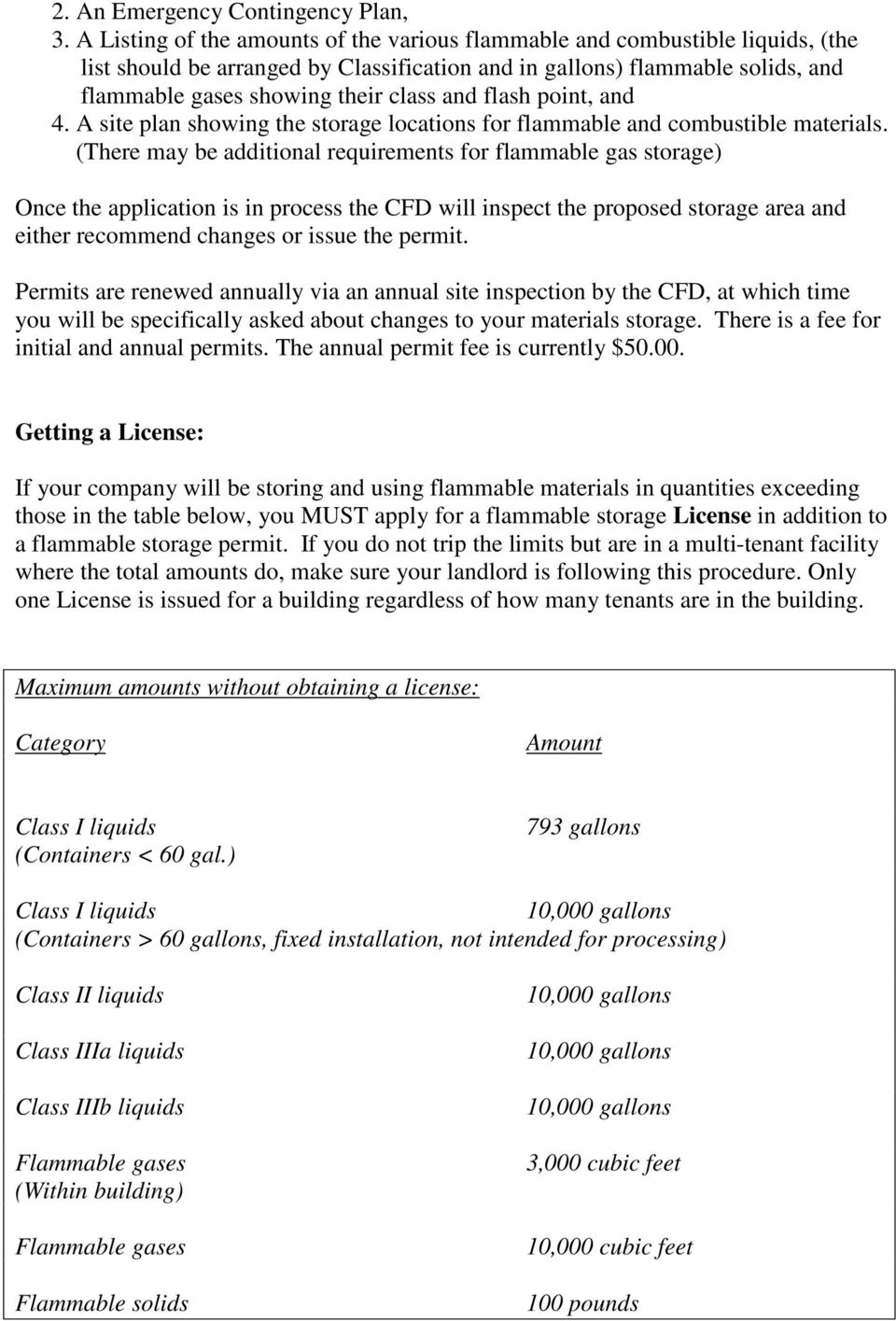
5 Contact the Cambridge License Commission (CLC) at (617) for a license application. The following approvals must be obtained before the application form is considered complete: 1. The CFD will need to sign-off on the license application and stamp the site plans indicating the location flammable storage; and 2. The Zoning Commission must sign-off on the application. In addition to completing the license application form, you will need to provide the CLC with: 1. An 8 ½ x 11 inch site plan indicating the location in which flammables are to be stored, the exact location of the facility (street address, nearest cross street, and abutting properties; and 2. A hearing and advertising fee of $175. Once you have all the information and approvals required for the license application, the CLC will schedule your appearance at a public hearing. The CLC will publish notification in the local newspaper of the date on which a public hearing will take place addressing your request for license. You must formally notify (via certified mail return receipt requested) the abutters and those on the opposite side of the street within seven days regarding the date and subject of the public hearing and submit copies of such notifications to the CLC. You will then be required to make an appearance at the public hearing to address any questions regarding your application. Once the CLC has approved your application a license will be issued. Licenses are renewed annually by returning a signed statement to the Cambridge License Commission and payment of the renewal fee.

6 Please contact Deputy Chief Mahoney, with questions on the information below. Table A NFPA 30 Flammable and Combustible Liquids Code Maximum Allowable Size of Containers and Metal Portable Containers (from NFPA 30, Table 4-2.3, NFPA 45, Table ) Container Type Class IA Class IB Class IC Class II Class III Glass 1 pt (500 ml) 1 qt (1L) 1.1 gal (4 L) 1.1 gal (4 L) 5 gal (20L) Metal (other than DOT drums) or approved plastic 1.1 gal (4L) 5 gal (20L) 5 gal (20L) 5 gal (20L) 5 gal (20L) Safety cans 2.6 gal (10L) 5 gal (20L) 5 gal (20L) 5 gal (20L) 5 gal (20L) Metal container (DOT spec.) Approved metal portable tanks Polyethylene (DOT spec.34) 60 gal (227L) 60 gal (227L) 60 gal (227L) 60 gal (227L) 60 gal (227L) 660 gal (2498L) 660 gal (2498L) 660 gal (2498L) 660 gal (2498L) 660 gal (2498L) 1.1 gal (4L) 5 gal (20L) 5 gal (20L) 60 gal (227L) 60 gal (227L) Capacity of Storage Cabinets (NFPA 30, section 4.3) Not more than 120 gal (454L) of Class I, Class II, and Class IIA liquids stored in a storage cabinet Not more than 3 (or 6 if sprinkler system per NFPA 13) storage cabinets located in any fire area. In an industrial occupancy, additional storage cabinets can be located in the same fire area if a minimum separation of 100 feet is maintained between each group of not more than 3 cabinets. Liquid Handling, Transfer, and Use (NFPA 30, Section 5.4) The maximum total quantity of flammable and combustible liquids permitted at any one work area, outside of an approved storage area must not exceed the greater of: 1. one day's supply; gallons (94.6L) of Class IA liquids; gallons (454.2 L) of Class IB, IC, II, or III liquids; 4. two portable tanks not exceeding 660 gallons ( L) of Class IB, IC, II, or IIIA liquid; or portable tanks each not exceeding 660 gal (2498L) of Class IIIB liquids.

Sample Written Program. For. Flammable Liquids
 Sample Written Program For Flammable Liquids 1 Flammable Liquids. (YOUR COMPANY NAME) Purpose Proper Storage and use of flammable liquids can significantly reduce the possibility of accidental fires and
Queen's University Environmental Health and Safety
 April, 2009 1 SOP-Chem-08 1.0 Introduction This document is intended as a guide to the Queen s University requirements for handling and storing flammable and combustible material in non-laboratories areas.
Notes. Material 1. Appropriate Flammable Liquids
 29 CFR 1910.106 Flammable Materials Flammable Liquids Preparation 1. Read Applicable Background information and related Company Policy Chapter. 2. Make Copies of this Lesson Plan for Personnel 3. Make
ADMINISTRATIVE SERVICES MANUAL
 Purpose Responsibilities Proper Storage and use of flammable liquids can significantly reduce the possibility of accidental fires and injuries. To minimize risk to life and properly, the requirements of
527 CMR: BOARD OF FIRE PREVENTION REGULATIONS 527 CMR 14.00: FLAMMABLE AND COMBUSTIBLE LIQUIDS, FLAMMABLE SOLIDS OR FLAMMABLE GASES
 527 CMR 14.00: FLAMMABLE AND COMBUSTIBLE LIQUIDS, FLAMMABLE SOLIDS OR FLAMMABLE GASES Section 14.01: Scope 14.02: Definitions 14.03: Storage 14.04: Handling of Flammable Fluids 14.05: Handling of Flammable
Flammable and Combustible Liquids. Slide 1 (of 23)
 Flammable and Combustible Liquids Slide 1 (of 23) Introduction The two primary hazards associated with flammable and combustible liquids are explosion and fire Safe handling and storage of flammable liquids
BP WIND ENERGY POLICIES AND PROCEDURES
 BP WIND ENERGY POLICIES AND PROCEDURES Document Control Details 1.0 Purpose/Scope 1.1 This procedure provides the minimum requirements to be followed for the storage of flammable or combustible materials
Flammable liquid classes: Combustible Liquid Classes. Class IC. Class II. Class IB F.P. below 22.8 C (73 F), boiling point at or above 37.
 BCFC Part 4 Flammable and Combustible Liquids Application: BCFC Part 4 Part 4 provides for the storage, handling, use and processing of flammable liquids and combustible liquids in buildings,, structures
General Fire Code Requirements Within Commercial Tenant Spaces
 FIRE DEPARTMENT in cooperation with Scope: General Fire Code Requirements Within Commercial Tenant Spaces This handout is designed to assist owners, architects, contractors and others in understanding
OSHA Office of Training and Education 1
 Flammable and Combustible Liquids OSHA Office of Training and Education 1 Introduction The two primary hazards associated with flammable and combustible liquids are explosion and fire Safe handling and
FLAMMABLE AND COMBUSTIBLE LIQUIDS. n OSHA Changes
 FLAMMABLE AND COMBUSTIBLE LIQUIDS OSHA Changes Introduction This module covers the two primary hazards associated with flammable and combustible liquids: explosion and fire. In order to prevent these hazards,
FDNY C14 Certificate of Fitness Quiz
 FDNY C14 Certificate of Fitness Quiz Name: Date: 1. Who issues a New York City laboratory permit? a) Department of Environmental Protection (DEP) b) Department of Environmental Conservation (DEC) c) Occupational
FLAMMABLE AND COMBUSTIBLE LIQUIDS
 FLAMMABLE AND COMBUSTIBLE LIQUIDS These guidelines provide requirements for all University faculty, staff, and students using, handling, or storing flammable and combustible liquids. These requirements
CHEMICAL INVENTORY WORKSHEET INSTRUCTIONS
 CHEMICAL INVENTORY WORKSHEET INSTRUCTIONS This form may be used as an aid to gather chemical inventory information for reporting in the online EHSA database. Completion of this form does NOT take the place
STORAGE AND HANDLING OF FLAMMABLE AND COMBUSTIBLE LIQUIDS
 Page 1 of 10 STORAGE AND HANDLING OF These guidelines provide requirements for all University faculty, staff, and students using, handling, or storing flammable and combustible liquids. These requirements
Cambridge Biosafety Committee POLICIES AND PROCEDURES
 Section 1.00 Introduction Pursuant to Cambridge Municipal Code Recombinant DNA Technology Chapter 8.20.040(A) (the rdna Technology Ordinance ) and the Cambridge Public Health Department s Biosafety Regulation
Section III Hazardous Materials Management
 Section III Hazardous Materials Management This section of the Everyday Hazmat User s Training Guide covers various types of hazardous materials commonly found in the USDA Forest Service. Federal regulations
SECTION FC 2706 NON-PRODUCTION CHEMICAL LABORATORIES
 New York City Administrative Code - Title 29 New York City Fire Code SECTION FC 2706 NON-PRODUCTION CHEMICAL LABORATORIES 2706.1 Scope. This section shall govern the storage, handling and use of laboratory
HATFIELD TOWNSHIP. FLAMMABLE and COMBUSTIBLE LIQUIDS PERMIT APPLICATION PROCEDURES
 HATFIELD TOWNSHIP FLAMMABLE and COMBUSTIBLE LIQUIDS PERMIT APPLICATION PROCEDURES A flammable and combustible liquids permit is required to store, transport on site, dispense, use or handle flammable and
HealthandSafetyOntario.ca. Introduction. Storage Containers. Storing Flammable Liquids
 Flammable Liquids Storage Introduction This guideline is designed to help you store flammable liquids safely. It is based on the requirements of the Ontario Fire Code, Part 4, and of the Regulations for
Model Safety Program
 Model Safety Program DATE: SUBJECT: Flammable and Combustible Liquids Safety Program REGULATORY STATUTE: OSHA 29 CFR 1910.106 OVERALL RESPONSIBILITY: The (YOUR COMPANY) Safety Officer is. He/she is solely
MOTOR FUEL DISPENSING SAFETY
 STRATEGIC OUTCOMES PRACTICE TECHNICAL ADVISORY BULLETIN January 2010 MOTOR FUEL DISPENSING SAFETY Fire! Not an alarm anyone wants to hear, especially not when the fire is burning at a major fuel source.
Hazardous Waste Determination and Management Plan
 Hazardous Waste Determination and Management Plan Prepared By: Triumvirate Environmental Developed: November 2014 Updated: Program Approval Associate Vice President of Public Safety & Administrative Services
Static Spark Ignites Flammable Liquid during Portable Tank Filling Operation
 Static Spark Ignites Flammable Liquid during Portable Tank Filling Operation No. 2008-02-I-IA (September 2008) Key Lessons for Safe Handling and Storage of Flammables Ensure that equipment, such as fill
BUSINESS LICENSE (2014) CHARTER TOWNSHIP OF FLINT 1490 S. DYE ROAD, FLINT Ml 48532 (810) 732-1350 OR FAX (810) 733-6919
 BUSINESS LICENSE (2014) CHARTER TOWNSHIP OF FLINT 1490 S. DYE ROAD, FLINT Ml 48532 (810) 732-1350 OR FAX (810) 733-6919 PLEASE CHECK: NEW BUSINESS FEE: $75.00 YEARLY LICENSE RENEWAL FEE: $45.00 NAME OF
In accordance with NFPA 30, these containers are not to store Class I flammable liquids.
 In accordance with NFPA 30, these containers are not to store Class I flammable liquids. Zurich recommends storing these containers in dedicated liquid storage rooms, detached buildings, or in listed dispensing
Code Compliance Guideline: Swimming Pool Chemicals
 A publication of Fairfax County, Virginia CODE COMPLIANCE GUIDELINE SWIMMING POOL CHEMICALS AND FIRE SAFETY REQUIREMENTS RELATED TO POOL OPERATIONS This publication outlines the Fire Prevention Code requirements
Flammable Liquids Storage
 A Health and Safety Guideline for Your Workplace Flammable Liquids Storage Introduction This guideline is designed to help you store flammable liquids safely. It is based on the requirements of the Ontario
Standard Operating Procedure
 Standard Operating Procedure FLAMMABLE LIQUIDS This standard operating procedure (SOP) is intended to provide general guidance on how to safely work with flammable liquids. This SOP is generic in nature
Laboratory Safety Manual
 Chapter 1 Introduction Laboratory Safety Manual Section 6 Fire Safety INTRODUCTION PURPOSE Both flammable and combustible materials are commonplace in most Duke Laboratories. For this reason, all laboratory
Flammable Liquids 29 CFR 1910.106
 Flammable Liquids 29 CFR 1910.106 OSHA s Directorate of Training and Education These materials were developed by OSHA s Directorate of Training and Education and are intended to assist employers, workers,
Standard Operating Procedure: Flammable Liquids
 Standard Operating Procedure: Flammable Liquids Standard operating procedures (SOP) are intended to provide you with general guidance on how to safely work with a specific class of chemical or hazard.
CITY OF TWO RIVERS Inspections Department
 CITY OF TWO RIVERS Inspections Department City of Two Rivers Inspections Dept 1717 E Park St PO Box 87 Two Rivers WI 54241-0087 Customers of the City of Two Rivers, Effective October 11, 2013 The Department
Flammable Liquids Storage
 A Health and Safety Guideline for Your Workplace Flammable Liquids Storage Introduction This guideline is designed to help you store flammable liquids safely. It is based on the requirements of the Ontario
Building Permit, Fire Inspection and Operating Permit Fee Schedule
 Chenango County Code Enforcement Building Permit, Fire Inspection and Operating Permit Fee Schedule Building Permit Exceptions: Buildings being used solely for the purpose of agriculture. As per Agricultural,
NMSU FIRE DEPARTMENT Commercial Kitchen Fire Suppression Worksheet
 This Commercial Kitchen Automatic Fire has been created to assure all documentation has been submitted to assist you in assuring proper plans and documentations has been submitted and reviewed by New Mexico
Waste Oil Collection / Storage
 ENVIRONMENTAL & REGULATORY SERVICES Storage Tank Regulation Section P. O. Box 7837 Madison, Wisconsin 53707-7837 TDD #: (608) 264-8777 http://www.commerce.state.wi.us http://www.wisconsin.gov Jim Doyle,
NEW YORK CITY FIRE DEPARTMENT. Notice of Public Hearing and Opportunity to Comment on Proposed Rules
 NEW YORK CITY FIRE DEPARTMENT Notice of Public Hearing and Opportunity to Comment on Proposed Rules What are we proposing? The Fire Department is proposing to amend two rules. One relates to Fire Department
Site and Storage Conditions for Class 3.1 Flammable Liquids
 Site and Storage Conditions for Class 3.1 Flammable Liquids Introduction Contents Introduction... 1 SITE AND STORAGE CONDITIONS...2 Part 1 General Flammability Conditions...2 Part 2 Conditions Relating
Mechanical Systems Competency 1.20
 Competency 1.20 Mechanical systems personnel shall demonstrate a working level knowledge of the safety and health fundamentals of mechanical systems and/or components. 1. Supporting Knowledge and Skills
Exit Routes, Emergency Action Plans, Fire Prevention Plans, and Fire Protection. OSHA Office of Training and Education 1
 Exit Routes, Emergency Action Plans, Fire Prevention Plans, and Fire Protection OSHA Office of Training and Education 1 Introduction Fires and explosions kill more than 200 and injure more than 5,000 workers
February 2014 Alberta Fire Code 4.2.6.3. Page 1 of 5. Fire Safety and Hand Hygiene in Healthcare Facilities
 FIRE CODE VARIANCE February 2014 Alberta Fire Code 4.2.6.3. Page 1 of 5 ISSUE: Fire Safety and Hand Hygiene in Healthcare Facilities This Variance covers alcohol based hand hygiene products used in healthcare
Ethanol Vehicle and Infrastructure Codes and Standards Citations
 Ethanol Vehicle and Infrastructure Codes and Standards Citations This document lists codes and standards typically used for U.S. ethanol vehicle and infrastructure projects. To determine which codes and
Compressed Gases The Dangers
 Compressed Gases COMPRESSED Compressed gases are any gases or mixture of gases exerting a gauge pressure of 6 pounds per square inch at 68 F. Federal regulations specify how these gases must be stored
527 CMR: BOARD OF FIRE PREVENTION REGULATIONS
 527 CMR 23.00: ISSUANCE OF CERTIFICATES FOR THE SERVICING OF PORTABLE FIRE EXTINGUISHERS AND THE INSTALLING AND SERVICING OF FIXED FIRE EXTINGUISHING SYSTEMS Section 23.01: Purpose 23.02: Applicability
Amendments to the 2012 INTERNATIONAL FIRE CODE
 Amendments to the 2012 INTERNATIONAL FIRE CODE 2012 Edition, International Fire Code. Section 101.1 Amend to read as follows. 101.1 Title. These regulations shall be known as the Fire Code of the City
Electrical Classification
 Electrical Classification Using NFPA 70 and NFPA 499 to Classify Hazardous Locations Electrical classifications are established in accordance with the National Electrical Code, NFPA 70, also referred to
Town of Bellingham Fire Department
 Town of Bellingham Fire Department OFFICE OF THE Fire Prevention Division Captain Robidoux- [email protected] Lieutenant Bangma- [email protected] Fire Safety Inspection Guidelines for
Dennis Fire Department Fire Prevention Mark Dellner Fire Chief
 Dennis Fire Department Fire Prevention Mark Dellner Fire Chief FIRE SAFETY INSPECTION GUIDELINES FOR COMMERCIAL PROPERTIES (MA Fire Prevention Regulations 527 CMR, MGL Chapter 148) FIRE PREVENTION CHECKLIST-
James Villanueva / Street Address: City/State/Zip: Street Address: City/State/Zip: Name: Email: Phone Number: Fax Number:
 / For Office Use Only Producer Email Telephone q James Villanueva [email protected] 404-838-8554 q Lamar Coates [email protected] 678-816-1170 Date Submitted Date Requested PIAG INSURANCE SERVICES James Villanueva
CONSTRUCTION FIRE SAFETY PLANNING GUIDELINES
 CONSTRUCTION FIRE SAFETY PLANNING GUIDELINES Review the following information pertaining to Construction Fire Safety Planning: B.C. Building Code Sections 8.1 up to and including Subsection 8.2.3 B.C.
Suffolk County Department of Health Services. Division of Environmental Quality
 Suffolk County Department of Health Services Division of Environmental Quality Guidelines For the Construction of Storage Areas for Portable Containers ~~~~ Clare B. Bradley, M.D., M.P.H. Suffolk County
HISTOLOGY LABORATORY EMERGENCY PROCEDURES
 HISTOLOGY LABORATORY EMERGENCY PROCEDURES CONTENTS 1 Chain of command...3 2 Disaster plan...3 2.1 Announcement 2.2 Pathology departmental duties 2.3 Reference 3 Evacuation...4 3.1 Meeting place 3.2 Evacuation
c. As mandated by law, facilities must obtain and maintain valid zoning permits as well as permits for intended use.
 Walmart Standards for Suppliers Section 7. Health and Safety 7. Health and Safety Suppliers must provide workers with a safe and healthy work environment. Suppliers must take proactive measures to prevent
Warehouse Checklist. Warehouse Construction
 PAGE 1 Warehouse Checklist Recent NFPA statistics estimate that in 1998 approximately 36,000 fires occurred in structures used for storage, accounting for $687mm of damage (over 10% of total fire damage
Containment Requirements
 Introduction: Building and fire codes are developed by associations for adoption by federal, state and local authorities having jurisdiction. The local municipalities often make amendments or changes to
Spill Clean-up. Flammable Liquids Liquids with flash points below 100 degrees Fahrenheit.
 SUNY Cortland-Environmental Health and Safety Office Spill Clean-up Inception Date : June 16, 2010 Latest Revision/Review Date: July 15, 2015 Last Review/Revision Date: April 30, 2014 Contents I. Introduction
Division of Public Health Administrative Manual
 PURPOSE To establish a protocol for the development of a written Division of Public Health Hazard Communications Program at each applicable office or laboratory workplace and to assure that employees are
527 CMR: BOARD OF FIRE PREVENTION REGULATIONS
 527 CMR 31.00: CARBON MONOXIDE ALARMS Section 31.01: Purpose and Scope 31.02: Definitions 31.03: General Installation Provisions 31.04: Specific Installation Provisions 31.05: Carbon Monoxide Protection:
A. Fire Protection Plan. B. Access and Parking
 Standards for Construction Site Fire Safety For Use by Unidocs Member Agencies or where approved by your Local Jurisdiction Authority Cited: California Fire Code (CFC) These standards are intended to prescribe
Presented by: Rich Perry Marsh Risk Consulting
 Flammable and Combustible Liquids Presented by: Rich Perry Marsh Risk Consulting What s the Big Deal? Flammable and combustible liquids are easily ignited Ignite with explosive force Burn readily and give
BELMONT FIRE DEPARTMENT FIRE ALARM SYSTEM REQUIREMENTS BFD-OFM-10-011
 Fire Alarm System plan(s) MUST be reviewed and approved by the Belmont Fire Department prior to the start of construction. The design and any changes must be fully compliant with NFPA 1, NFPA 101, NFPA
This plan, its contents, and emergency notification procedures shall be made available to all appropriate University employees.
 FACILITIES MANAGEMENT OFFICE OF ENVIRONMENTAL HEALTH AND SAFETY EMERGENCY RESPONSE PLAN FOR HAZARDOUS SUBSTANCE RELEASES ON UA s UPTOWN & DOWNTOWN CAMPUSES January 12, 2015 Last Revision This plan is designed
A. OCCUPANT FIRE PROCEDURES... 3 B. THE TENANT FIRE SAFETY TEAM... 6 C. SENIOR FIRE WARDEN... 7 D. DEPUTY FIRE WARDEN... 8
 Brookfield Place BROOKFIELD PLACE Page 2 of 12 OCTOBER 2006 TABLE OF CONTENTS A. OCCUPANT FIRE PROCEDURES... 3 B. THE TENANT FIRE SAFETY TEAM... 6 C. SENIOR FIRE WARDEN... 7 D. DEPUTY FIRE WARDEN... 8
All You Ever Wanted to Know About Fire Extinguishers...
 All You Ever Wanted to Know About Fire Extinguishers... There are basically four different types or classes of fire extinguishers, each of which extinguishes specific types of fire. Newer fire extinguishers
Hazardous Waste Compliance Awareness For Faculty and Staff
 Hazardous Waste Compliance Awareness For Faculty and Staff Important information for campus employees generating, handling or storing hazardous waste I. Hazardous Waste A. Materials being used for their
FIRE PREVENTION PLAN
 FIRE PREVENTION PLAN 1 FIRE PREVENTION PLAN OSHA s Fire Prevention Plan regulation, found at 29 CFR 1910.38(b) and 29 CFR 1926.24, requires Northern Clearing, Inc. to have a written fire prevention plan
University of Tennessee Safety Guidelines
 University of Tennessee Safety Guidelines Guideline Subject: Compressed Gases and Cryogenics Safety Guidelines Approval Date: 10/1/15 (Rev. 1) Next Scheduled Review: 10/1/19 Date Effective: 1/01/09 Contact
Hazardous Material Waller County ARES training material used with permission from Christine Smith, N5CAS.
 Hazardous Material Waller County ARES training material used with permission from Christine Smith, N5CAS. This discussion is really just meant to be an introduction to Hazardous Materials (HazMat). I would
TYPICAL FIRE SAFETY INSPECTION VIOLATIONS
 TYPICAL FIRE SAFETY INSPECTION VIOLATIONS The following is a list of typical violations often found by inspectors and a generic solution. You can use this list to improve the safety of your facility, to
PLAN APPLICATION HAZARDOUS MATERIALS USE AND SPILL PREVENTION CONTROL (HMPC) PLAN
 PLAN APPLICATION HAZARDOUS MATERIALS USE AND SPILL PREVENTION CONTROL (HMPC) PLAN A. GENERAL INFORMATION A1. Business Name: Acme Company Street Address: 1000 Stroll St. City: Louisville State: Kentucky
FIRE SPRINKLER SYSTEM DESIGN, ENGINEERING EXEMPTION POLICY FOR (Effective April 1, 2006)
 State of Tennessee Department of Commerce and Insurance Board of Architectural and Engineering Examiners 500 James Robertson Parkway Nashville, TN 37243 1142 800 256 5758 615 741 3221 (Nashville Area)
HOT WORK PERMIT PROGRAM TRAINING. John Braun
 HOT WORK PERMIT PROGRAM TRAINING John Braun 1.0 INTRODUCTION 1.2 Purpose The Hot Work Permit Program has been developed for University employees that work on or around hot work activities. This program
Concord Building Department Frequently Asked Questions
 Does Concord have its own Building codes? No, we utilize the 8th Edition of the Massachusetts State Building code for one and two family dwellings, multi-family dwellings, and Commercial Buildings. When
BUSINESS EMERGENCY/CONTINGENCY PLAN COVER SHEET
 BUSINESS EMERGENCY/CONTINGENCY PLAN COVER SHEET I. IDENTIFICATION For Dept Use Only Log In/Date Stamp FACILITY ID # F A 1 2 3 4 5 6 7 BUSINESS NAME (Same as FACILITY NAME or DBA) 3 CUPA Automotive Repair
METHANOL SMALL QUANTITIES BULLETIN
 METHANOL SMALL QUANTITIES BULLETIN This bulletin is about relatively small quantities of methanol or products containing methanol, such as maximum 60 gallon containers or smaller size containers (e.g.,
Hazardous materials can be silent killers. Almost every household and workplace has varying amounts of chemicals that, if spilled or combined, will
 HAZARDOUS MATERIALS Hazardous materials can be silent killers. Almost every household and workplace has varying amounts of chemicals that, if spilled or combined, will cause great harm and even death.
OREGON FIRE CODE Interpretations and Technical Advisories
 OREGON FIRE CODE Interpretations and Technical Advisories A collaborative service by local and state fire professionals, along with our stakeholders and customers, to provide consistent and concise application
ABC CIRCUITS 10 Circuit Drive Circuit Town, IN 12345 SLUG CONTROL PLAN
 ABC CIRCUITS 10 Circuit Drive Circuit Town, IN 12345 SLUG CONTROL PLAN The purpose of this plan is to provide detailed instructions for slug prevention and control. A complete copy of this plan is maintained
Section 6 4.3 Ambulance Service Charge. Effective July 1, 2014, the following bundled ambulance service charges shall apply:
 CITY OF ATTLEBORO, MASSACHUSETTS HEADQUARTERS OF THE FIRE DEPARTMENT 100 UNION STREET ATTLEBORO, MASSACHUSETTS 02703 PHONE 508-222-2324 FAX 508-223-2068 SCOTT T. LACHANCE FIRE CHIEF Section 6 4.3 Ambulance
Chapter 5: Spills Response
 Chapter 5: Spills Response When printing materials are spilled, the response required by the owner or operator depends on what is spilled and the quantity. The entities who must be informed of a spill
GENERAL AIR QUALITY OPERATING PERMIT FOR PERCHLOROETHYLENE DRY CLEANERS APPLICATION PACKAGE
 PIMA COUNTY DEPARTMENT OF ENVIRONMENTAL QUALITY Air Program 33 N. Stone Avenue, Suite 700, Tucson, Arizona 85701 Phone: (520) 243-7400 GENERAL AIR QUALITY OPERATING PERMIT FOR PERCHLOROETHYLENE DRY CLEANERS
Department of Transportation Hazardous Material Regulations General Awareness, Safety & Security Training. For: University of Dayton Hazmat Employees
 Department of Transportation Hazardous Material Regulations General Awareness, Safety & Security Training For: University of Dayton Hazmat Employees February, 2014 Overview Hazardous materials are substances
REQUIREMENTS FOR OBTAINING A THORNBURY TOWNSHIP, DELAWARE COUNTY PERMIT
 REQUIREMENTS FOR OBTAINING A THORNBURY TOWNSHIP, DELAWARE COUNTY PERMIT ATTACHED ARE THE REQUIREMENTS FOR OBTAINING A BUILDING PERMIT INCOMPLETE SUBMISSIONS WILL BE RETURNED IN THEIR ENTIRETY -- NO EXCEPTIONS!!
I.CHEM.E. SYMPOSIUM SERIES NO. 97
 FIRE HAZARDS OF FLAMMABLE LIQUIDS IN SMALL CONTAINERS J. F. Siddle* Standards of fire protection for metal drums and smaller metal containers of flammable liquids have been well defined and have proved
FIRE AND LIFE SAFETY REQUIREMENTS FOR CONVENTIONS, TRADE SHOWS AND EXHIBITS
 FIRE AND LIFE SAFETY REQUIREMENTS FOR CONVENTIONS, TRADE SHOWS AND EXHIBITS November 2011, Updated March 2012 COLORADO SPRINGS FIRE DEPARTMENT Division of the Fire Marshal If you have any questions or
Denver Fire Department Idle Pallet Storage Guidelines Per NFPA 13_Chpt 12
 Idle wood and plastic pallets introduce a severe fire condition. Stacking idle pallets in piles is the best arrangement of combustibles to promote rapid spread of fire, heat release, and complete combustion.
HAZARDOUS MATERIALS BUSINESS PLAN (HMBP)
 ALAMEDA COUNTY DEPARTMENT OF ENVIRONMENTAL HEALTH 1131 HARBOR BAY PARKWAY, ALAMEDA, CA 94502 PHONE (510) 567-6702 FAX (510) 337-9335 HAZARDOUS MATERIALS BUSINESS PLAN (HMBP) Joint Bioenergy Institute (JBEI).
LABORATORY SAFETY INSPECTION CHECKLIST
 LABORATORY SAFETY INSPECTION CHECKLIST As part of EH&S's laboratory safety survey program, we have compiled a list of the most common safety problems. This is not a list of every possible hazard, but can
York County Department of Emergency Services Communications Division
 York County Department of Emergency Services Communications Division Policy # 73.6E Subject: Hazardous Materials Dispatch Issued Date: 12/7/2010 Issued By: Michael Fetrow, Director OEM Approved By: York
INFORMATION BULLETIN Bulletin No. 2005-01 Bureau of Fire Prevention Date: June 10, 2005 Revised: March 8, 2007
 SAN FRANCISCO FIRE DEPARTMENT DIVISION OF FIRE PREVENTION & INVESTIGATION INFORMATION BULLETIN Bulletin No. 2005-01 Bureau of Fire Prevention Date: June 10, 2005 Revised: March 8, 2007 SUBJECT: Fire Department
Fire Alarm System Accessories
 Approved by APPROVED Fire Alarm System Accessories FM Approved* Intrinsically Safe Devices Single and Dual Channel Isolated Barrier Modules Features Single or dual channel intrinsically safe, transformer
SCHOOL FIRE AND LIFE SAFETY INSPECTION CHECKLIST
 SCHOOL FIRE AND LIFE SAFETY INSPECTION CHECKLIST School Name: School Address: Town: Phone: Inspected By (Please Print): Inspection Organization Name: Inspector Phone: Date of Inspection: Building Name:
Making sense of Intrinsic Safety and Intrinsically Safe Tools
 Making sense of Intrinsic Safety and Intrinsically Safe Tools What is Intrinsically Safe? Intrinsic safety is a protection standard employed in potentially explosive atmospheres. Devices that are certified
Overview of Hotel Fire Safety Requirements
 Overview of Hotel Fire Safety Requirements in the Fire Code Susan Clarke, P.Eng. Office of the Fire Marshal - January 10, 2012 1 Agenda Regulation History - Hotels Fire Code Overview (Parts 1 to 8) Defined