
Addressing the Innovation Challenge in Big Companies
|
|
|
- Godwin Ray
- 10 years ago
- Views:
Transcription
1 Lean Elephants Addressing the Innovation Challenge in Big Companies June 2014 Authors (in alphabetical order): Jurado Apruzzese, Susana Olano Mata, Maria Innovation and Research Telefónica I+D 2014 Telefónica Investigación y Desarrollo, S.A. Unipersonal, Distrito T, Ronda de la Comunicación, Oeste I, Madrid, Spain.
2 Lean Elephants 2 CONTENT 1 A TRANSFORMATIONAL ODYSSEY 3 2 LEAN STARTUP IN A BIG COMPANY Why Lean Startup? How we got Lean Startup going Highlights on what we did 6 3 THE EXPECTED: CHALLENGES IN A LARGE COMPANY Cultural change Finding intrapreneurs Bootstrapping possibilities Dealing with corporate politics and processes Branding Experimenting in B2B environments Measuring innovation success 13 4 THE UNEXPECTED: THE PROBLEM S PROBLEM 14 5 ACHIEVEMENTS AND LEARNINGS Achievements Learnings 21 6 CONCLUSIONS AND RECOMMENDATIONS 24 ACKNOWLEDGEMENTS 26

3 Lean Elephants 3 1 A TRANSFORMATIONAL ODYSSEY There is nothing more difficult to take in hand, more perilous to conduct, or more uncertain in its success, than to take the lead in the introduction of a new order of things 1 Traditional telco business served a well-defined need that consisted in person to person remote communications which later extended to machine communication. Today we are in a completely different universe. Digital ecosystems have radically shifted the well-established paradigms enabling endless possibilities, adding extra layers of richness and complexity and dramatically accelerating products timescale. Users and machines all over the world are hungry for new products and services at an increasingly high pace, to serve them effectively Telefonica has embraced the Digital Telco strategy. To create new digital telco businesses in a turbulent context we have to lead and build a sophisticated capacity for continuous learning. It is people who learn and lead no one else, so the only way is to unleash people s talent. The organization has to evolve from hierarchical, verticalised and processcentred to talent-driven, where people take the responsibility and are empowered to propose, defend and execute innovation projects with autonomy. Under those circumstances we have experienced a way to address the innovation challenge: start with small initiatives, be ready to make mistakes, learn along the way and constantly improve how things are done. All this requires a deep cultural transformation and a totally new environment to foster innovation; none of these happens magically overnight. Lean Startup entrepreneurs start small, aim high, fail cheap and fast and, most importantly, learn as much as possible and close the feedback loop thus accelerating the way to success for the whole organization. Most of the projects die spending just few resources but some will survive to disrupt the industry and create exponential growth. Therefore Lean Startup has offered us a good tool to apply these practices to innovation projects in a big corporation like Telefonica. This is exactly how we began to work two years ago; we came up with the seed of a model to set up a fresh and motivating environment where things would be done in a different way. As one of our innovation project leaders explains all this implies a big mind-set change when building a project. It is totally different and has impact in all the stakeholders, from internal customers to the team, the leaders It is a process that changes people. It optimises the quest effort to find new opportunities. It should always been applied. We have encountered plenty of friction, less than expected though, since we belong to a large organisation not designed for that way of work. 1 Machiavelli, Niccolò (1513), VI, The Prince.

4 Lean Elephants 4 We have written this document because we wish to share our ambition, learnings and experiences with anyone wishing to start or already in the middle of a transformational odyssey like ours. The contents of this document not only reflect our experience and learnings, but also those of some of the people that have led or worked in the teams in charge of the innovation projects developed using this new framework. We call them our pioneers!!!

5 Lean Elephants 5 2 LEAN STARTUP IN A BIG COMPANY despite the methodology s name, in the long term some of its biggest payoffs may be gained by the large companies that embrace it Why Lean Startup? Low-hanging business opportunities are not part of our landscape. Actually quite the opposite, opportunities need to be created, grown, evolved and matured through a discovery process designed to thrive under uncertainty. Lean Startup 3 clearly identifies the specific needs of highly uncertain environments and sets up a strategy to increase the success rate under those circumstances. This is why we thought Lean Startup was the way to go at the execution phase for early innovation at Digital Telco such as Telefonica, now we have learnt that it does work. Lean Startup practices encourage the teams to be their own critics because decisions are made by the team based not on arbitrary milestones but on market validation and ability to demonstrate the validity of key assumptions. This is a great tool to avoid the dangers of innovation by committee and helps identify opinions as such. 2.2 How we got Lean Startup going From the very beginning we truly believed that to get the best results the keys were iterative execution and team diversity. Most projects were encouraged to carry out Lean Startup execution in order to enable us to explore, spot, prototype, and develop efficiently in a wide range of technological areas. At the same time it is relevant to point out that in our perspective Lean Startup does not necessarily fit all projects. Even before initiating the execution we check the risks the projects are facing (whether customer risk or invention risk or both). Some projects (actually these are a small fraction) had to cope only with invention risk. In those cases we just let the great technological talent in house do the job; they know how to do best. Other possibility is that the project is in such an early or exploratory stage that rather than Customer Development and Lean Startup methodology they need to use approaches like Design Thinking and other ideation tools. 2 Blank, Steve, Why the lean startup changes everything, Harvard Business Review (May 2013), 3 The objective of this whitepaper is not to explain Lean Startup methodology itself, in fact there is already excellent literature on the subject, our recommendations would be: Blank, Steve and Dorf, Bob, The startup owner s manual Ries, Eric, The Lean Startup Maurya, Ash, Running lean Lopez de Ávila, Mario et all, El estado del arte del emprendimiento Lean en España 2013
6 Lean Elephants 6 Based on Lean Startup the three reference pillars of the framework we have applied to innovation are: I. Start small and aim high: the level of ambition in our innovation projects must be high. They need to bring the possibility of a global reach and the potential to make an impact in everyday life and business. This does not mean that they will burn lots of resources to start with or that they need to show full potential from day one, quite the contrary. Projects, specially at the beginning, work just with bare minimum resources, and then investment increases as the project progresses with validated learnings. The less uncertainty the more budget. II. III. Iterate fast to achieve efficiency in each of the maturation stages. This means scaling down the initiatives that are too early in time, inmature or unfocused while fueling up the ones that show traction. Therefore, product investment decisions conducted along the process rely not only on technological trends, but also on a profound understanding on which markets the digital customers will form in the upcoming years. Fail fast, fail cheap and make sure you learn along the way. Instead of devoting large quantities of energy and resources to increase the individual success chance of a few projects we ve thought it wiser to lower the overall risk by minimizing the failure cost for each project. 2.3 Highlights on what we did Based on the three pillars of the previous section we: Decreased upfront risk with finer project granularity. So we now we have smaller size projects focusing on business and technology feasibility. That is, focused on verifying assumptions and clearing out uncertainties. To achieve that, we have also stimulated an experimentation and prototyping culture, with early market testing and validation and with fast iterations, establishing periodic evaluations where teams make decisions according to the learnings. By default, minimal assignment of resources which make projects be lean. If a project requires to carry out more work beyond what was originally specified, additional budget may be requested and the budget extension decision is made in a VC way, incrementally according to project stage, results and next steps plan. Projects performance review based on the learnings and experimentation results rather than according to traditional milestones; this means the objective is not to complete the projects within a given period of time and budget but to learn and experiment as much as possible with minimal resources and time, while at the same time achieving market validation.

7 Lean Elephants 7 Debriefing and dissemination: Once innovation projects are completed special attention and focus is put to analyse and decide the best way forward. And whenever a project is proactively killed, it goes through a post mortem and debriefing session and key learnings and suggestions for improvements are clearly identified and stated. So there is always a reflection about the innovation projects results. Knowledge transfer (knowledge capture and dissemination) and, if applicable, IPR protection (mainly by patent filing) activities are carried out as well. Encouraged multidisciplinary teams, so that there is regularly a mix of profiles (technological, user experience, scientific research, business, etc.) Our first-hand experience is that these teams produce noticeably better projects. Purely technical people tend to lack customer and business perspective besides being biased towards a solution first approach, while proposals solely based on insights or business opportunities are harder to action and tend to be weaker at the non replicable differentiation aspect. In any configuration business experts also proved to have very positive impact on the outcome, for this reason we try to embed MBA students in the teams and encourage conversations with business experts as part of the process. Have a well balanced portfolio of core business-aligned and disruptive projects. And balance bottom up vs. top down innovation to strategically spot the most promising opportunities and still get the positive Black Swans 4. Bottom up is essential to foster intrapreneurship and to create a cultural change. Any employee can propose ideas, which, at the same time, translates into a continuous pipeline of fresh ideas. Specialized Lean Startup/Customer Development training for all people taking part in innovation projects, even if there is no customer risk in those projects. Hypothesis validation by means of experimentation and incremental building can be applied to all projects and has proved to be a good methodology. Create a small team of Innovation Managers to take care of the innovation cycle. This team is also devoted to encourage and stimulate innovation, to assess and support projects at any point, to apply the Customer Development methodology and take part in the periodic projects reviews, offering advice and ideas on how to go ahead or helping navigate the organization. This team takes the role of internal mentors. Leverage on customer insights and user trends knowledge since most powerful innovation projects are those that have a good combination of customer insights and technical solution. The art of killing when projects are not able to find the value proposition, customer s pain, or the right solution in the given amount of time. It is important that some project managers develop this ability as it makes the innovation department much more efficient. By being able to close down a project we are granting another team to be successful with another idea. But we should not kill a project without 4 Taleb, Nassim Nicholas, The Black Swan: The Impact of the Highly Improbable (2007)
8 Lean Elephants 8 having a debriefing session (or process) to make the most of the project learnings and ensure we are going to make use of those learnings. This way we will avoid the frustration that killing the project can produce in the team when their work and efforts go nowhere. Open Innovation has proven to be a very good tool to complement our skills with best-in-class companies and institutions and collaborate with startups to accelerate technology adoption. It is also a good way to involve customers as part of the project and iterate together to ensure the solution you are building tackles the customer real problems and make it differential. We open up strategically to the outside world not only to get ideas from external sources, but to develop Open Innovation partnerships and to foster cross-pollination between areas. Implement a Mentoring Program combining internal and external people to support projects with the new methodologies. External mentor s provide out-of-the-box perspective and challenge. We assign a mentor to support projects with a clear customer risk which need to embrace the Customer Development methodology. The external mentor is a professional with solid experience in startups mentoring and business, with an extensive contacts network (far beyond Telefonica), with deep understanding of the entrepreneurship ecosystems and good knowledge of Customer Development methodology. The internal mentor needs to be familiar with customer development/lean start-up approaches but also needs to be well connected within the organization and have a good knowledge of the different internal processes and policies beyond the innovation department. We have mentoring meetings with teams every two weeks. All meetings start with the questions What have you learnt in the last two weeks? and What has surprised you? And before the meeting ends, we ask the teams another pair of questions What are you going to focus on during the next two weeks? What are the biggest uncertainties you have to clear up and how are you going to do it? This will make it clear that every two weeks teams must have learned something and cannot come emptyhanded to the meeting. In those meetings we also keep asking Which is the problem you are solving? and when this questions is answered we ask Which is the value proposition? until we get a clear answer.
9 Lean Elephants 9 3 THE EXPECTED: CHALLENGES IN A LARGE COMPANY Being part of a company such as Telefonica has important upsides. In the first place it is possible to have access to high value non-replicable assets: platforms, infrastructures, global communication facilities, 300 million customers, sales channels and European and Latin-American footprint, PR resources... In the second place, getting to talk with relevant stakeholders is a lot easier; it is very unusual that anybody would not be willing to hold a conversation with Telefonica. But big companies also pose big challenges. 3.1 Cultural change In words of one of our pioneers It is important that Lean Startup is understood as a mindset and not a process. That is Lean Startup biggest challenge. It is also a challenge much more cultural. Applying Lean Startup practices implies also a significant cultural change and mindset shift from achievers and performers to pioneers and explorers. Our pioneers describe this shift as: It is a new approach that looks for quick advance by adding value instead of starting from something more chewed. What has been really new is the focus on going very soon to the market and begin very early to sell to achieve validation. This learning is really valuable. It has been really nice to be able to make our own decisions based on lean validations, instead of investing a lot of time and effort to execute some closed requirements that may not necessarily have been validated previously in the market. What is different is the way of defining the product/service. In the past you concluded an offer with the requirements that came from above and you had no visibility of the product. Now we define a solution that could lead to a real product. With agile methodologies we have learned to build things in a more iterative way and Lean Startup implementation has meant the climax; before starting to code we are already talking to the costumer and that allows us to be in touch with reality. It has been a very positive experience especially in the initial phase when you don't know if your idea is the answer to what the market is demanding. It allows you to be aware of what you have and what you lack as well as identify your target audience. Besides, it gets you out of the office and gives you the chance to get rid of preconceived ideas that you have without having validated them in the market.

10 Lean Elephants 10 Innovation and culture are tightly linked so building a stimulating environment around learning, experimentation and prototyping is essential. The only way to do this effectively is leading by example, actually letting teams work in this way and taking advantage of communication opportunities to further disseminate. Corporate organizations are very fast at spreading the word; we have learnt that just by walking the talk the key messages permeate the organization. 3.2 Finding intrapreneurs Finding intrapreneurs is not an easy task, it is also important to understand that entrepreneurs and intrapreneurs share many traits but still are not the same kind of people. 5 Good news is that after a few months people with the right talent start to emerge and become visible and then what we have done is reassign them into other innovation projects or refer other teams to them for advise, learnings and example. In this way little by little we are building a network of skilled people that can support innovation projects. 3.3 Bootstrapping possibilities The resources costs are not the same as in a startup, and bootstrapping possibilities are very limited. Innovation projects in an early stage normally have a ring-fenced budget and can progress without too much hassle. However when innovation projects become more mature and need acceleration, they start competing for resources and attention with incumbent projects. That situation is very difficult to manage properly and this is the point where many innovation programs fail. Finding a solution for this trap is our next objective. At this point what we have learnt is that decided sponsorship from high level executives is decisive. 3.4 Dealing with corporate politics and processes Get Upstairs in the Building: strong, sustained internal support for successful internal venturing is needed 6. Dealing with corporate politics and processes is unavoidable if you want innovation projects to move forward in a large company. Our pioneers dedicate a significant part of their time to deal with them (one of our pioneers estimated that 30% of his time was devoted to this task).processes in large 5 Myller, Larry, Intrapreneurs Are Just Like Entrepreneurs...NOT! (15 th January 2014), 6 Chesbrough, Henry, Why Internal Ventures Are Different from External Startups (26 th March 2014),

11 Lean Elephants 11 companies are designed to serve large-scale requirements, therefore these are usually ill suited for innovation projects, which are small, very agile and go through very quick changes. One of the biggest challenges has been the corporate politics. I wasn t taking it into account and it plays an essential role in the project. In a big corporation you have to keep informed the largest possible number of people, making lots of noise in the corridors, even to people who are not interested in your project or that could make some objections. You have to adapt lean startup to the context, you cannot apply it as it is, you may even have to add some personal learnings that are not in the books The biggest challenge is organisational. We had a lot of stakeholders: the product organization, the local companies, the innovation organisation each one with a different vision. Applying lean startup in a big company is difficult, there are many bureaucratic issues and a trend to cling to their own beliefs. Many people have a role in the decision-making process. You cannot apply lean startup in a pure way; you have to adapt the methodology to the company s philosophy. In some situations we have found in the organisation reluctance to admit and act upon lean evidences and validations coming from innovation projects; unfortunately those learnings cannot beat some executives beliefs. In many cases these learnings can be useful in other areas, for other company products or services, etc., and it can become frustrating not having a way to gather all this evidences and validations and a mechanism to share them with the rest of the organisation to take advantage of them. In words of one of our pioneers you gather evidences and they don t believe you until they beat their heads against the wall. We have dealt with this reality by engaging with people in charge of corporate processes, explaining them what we do and which are our needs and maintaining regular conversations on project status. Although not ideal this has proved very useful. Regarding politics there is just one golden rule: get decided commitment and support from top management. Additionally effective communication of activity, progress, contribution and results of innovation into the right forums and boards further consolidates innovation value and helps find champions for the projects. 3.5 Branding Being able to rely on Telefonica s brand is a great advantage. However, making use of the established brand when launching experiments and tests is not always the right approach. The expectations created when any service or product is launched under the main brand are very high and this is often incompatible with the objective of experiments which is to learn as much as possible as cheaply as possible. There are mainly two complementary solutions for this:
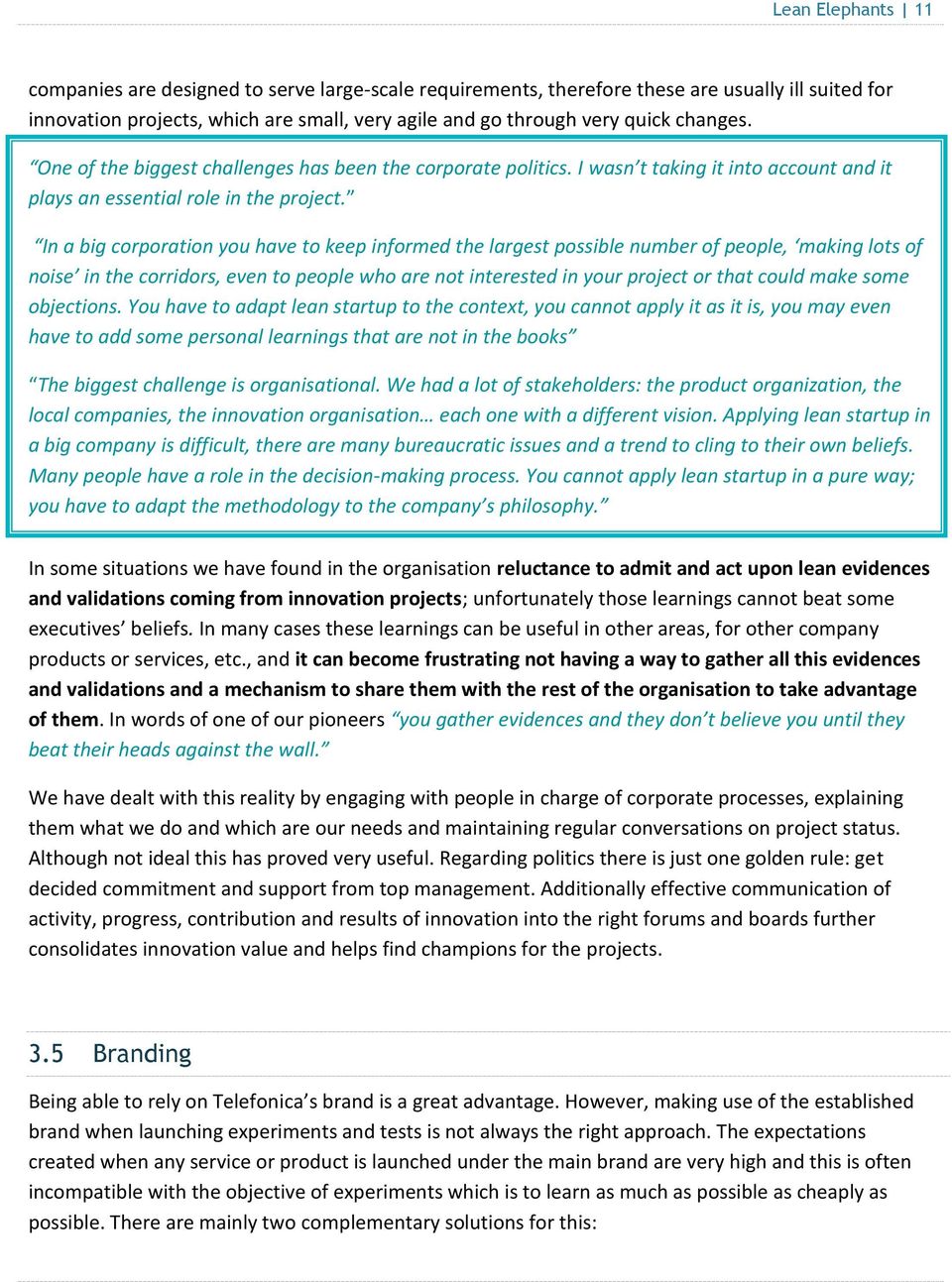
12 Lean Elephants 12 Use white brands for experiments in a very early stage. Develop an intermediate look n feel, Telefonica Lab in our case, so that customers are aware these are not regular Telefónica s products, but experimental and innovation initiatives with a different status, where alpha and beta versions are provided instead. Examples of two projects with Telefonica Lab look n feel In any case our strategy has been to establish a fluid relationship with the branding unit, explaining them how we work and agreeing the strategy with them beforehand. That makes the process a lot easier. 3.6 Experimenting in B2B environments Telefonica creates not only B2C products but also B2B products. Applying Customer Development to B2B environments in a big company is not easy either, especially when you need to talk to customers or test your solution with them. In most of the cases you need the sales force support to contact them. The sales force can be really helpful and provides the teams with an advantage startups usually don t have. They have already an established relationship with the customer and they can easily open doors for you. That sales force will also sell the product in the future, so it is good to involve them and have their opinions into account as soon as possible. But expectations need to be tackled as they have different expectations; sales people tend to quickly include the project in the portfolio while what the project team wants most is to learn about the problems of the industry. Another risk you have to manage is that when talking to a customer hand in hand with a sales person the customer could identify you as a sales person too and not as a person who works in an innovation project and wants to learn. It is also worth mentioning that, in some cases, contacts with other companies can be conditioned by the brand Telefonica, because in many cases the people or companies you contact are already Telefonica s customers, and in some cases this can prevent us from evaluating whether there are really early adopters willing to pay.

13 Lean Elephants 13 In the Thinking Things 7 project we have learnt that the best way to apply Lean Startup and experiment with a B2B customer is take about five medium-sized enterprises to begin testing instead of a large company, because, at least in the initial stages, the important thing is having the opportunity to learn rather than selling our solution to a major customer. In another project in the B2B arena, thanks to the robust and extended network of trust relationships of the founder, they were able to flip the situation completely by engaging the sales people in the project and in the process. The team spent time explaining sales team how customer development worked, they explained how at the beginning it is about learning not about selling and the sales people understood that in the long run they and their customers could reap the benefits. As a result they managed to engage the sales people in project providing support and relevant learnings for their customer development work. Furthermore because the project had uncovered a truly painful customer problem the sales team managed to have access to the customer s marketing department senior leaders, something which had been very hard previously. 3.7 Measuring innovation success Innovation exacts a new way of measuring success. Using common practice analytical methods and KPIs to manage innovation can destroy it. Therefore, non-traditional KPIs have to be defined in order to reinforce the autonomy and cultural values that innovation brings to foster technology differentiation and strategic value creation. So these new metrics will be in general more qualitative than quantitative and should take into account that we are looking for mid/long-term results. Thus metrics around validated learnings should be relevant KPIs to measure the success. Nonetheless, KPIs such as new products send to pipeline or numbers of killed products are among the ratios that we use. These ratios are significant because they give us a sense of how the innovation activity is flowing; we have to avoid traffic jams of existing initiatives that prevent us from running promising new ones. It also is necessary to make the business/product areas understand and be aware of these innovation success criteria, so that people working in the innovation teams should not be mistreated compared to those people who work in the core products of the company. 7 A project with the aim of transforming the Internet of Things market with a modular end-to-end solution for building intelligent, connected products.

14 Lean Elephants 14 4 THE UNEXPECTED: THE PROBLEM S PROBLEM As one of our pioneers explains it it s important to refocus on the problems in a deeper way and not just assuming things. One of the biggest challenges our teams have faced is to understand properly the problem statement, as well as defining appropriately the hypothesis and how to validate them. In some cases the teams had to take a step back, identify the problem and validate it. As a company with a high percentage of technical profiles we are biased towards putting the solution first, reverting this tendency is essential but challenging. When we started to put Lean startup into practice there were difficulties and concerts that we thought of beforehand but interestingly enough this wasn t one, we only became aware afterwards. Every innovation starts by solving an existing problem, meaning by that if we cannot find the problem there is little room for innovation success. Another way of state it is finding the pain. Finding the pain means finding real market answers from real customers to the following questions: What is the pain? Who has the pain? Where is this pain? When does this pain happen? Additionally, we should find market answers for: How is this pain being solved today? If the answer to this question is it is a problem that is not being solved then we might be suspicious of being wrong. Real problems have real solutions, we can innovate and bring efficiency to the problem or noticeably better solutions, but real big problems are being solved in one way or another. We can admit that sometimes is hard to find a problem and that sometimes customers can have difficulties in verbalising the problem, but we need to be sure that we can help them articulate the problem for us, never the other way around. Meaning we cannot expect a customer to repeat what we believe is his/her problem. For that reason it is not recommended at the problem understanding stage to disclose the suggested solution or even mention it. Remember, solutions will always come after the problem is stated.

15 Lean Elephants 15 5 ACHIEVEMENTS AND LEARNINGS Today s successful leaders will be those who are most flexible of mind. They will have the ability to embrace new ideas and routinely challenge old ones. They will be alert to learning from others and quickly adapt from the best Achievements Lean execution has changed the way we are building products in our innovation projects. In this section we describe some outstanding and disrupting activities that our teams have made and are still making to get aligned with the Lean Startup methodology. Teams getting out of building to have face-to-face conversations with customers You can t learn what customers want by sitting behind your desk and running some tests. You can t either wait for others doing it for you. In a more traditional environment each person in the team has a concrete role and the user/customer research experts are the ones speaking and interviewing users/customers directly. The usual way to recruit those users is to hire a specialized company that would recruit users and bring them to your premises to interview them. This has proven to a very effective approach for mature projects with fewer uncertainties. But when you are starting an innovation project, with scarce resources, in a Customer Discovery phase, where the big questions you have to answer are is the problem I m trying to solve really a painful problem?, who has that problem? and does my solution solve this problem in a better way than existing solutions? you have to find a different way of achieving your goal. And Lean Startup forced our innovation teams to get out of the building themselves to have face-to-face conversations. In one of the projects, the team went to the queue of an important museum in Madrid and to very busy streets in the city centre, and made 30 interviews in a day to validate the problem. 8 Peters, Tom, Attributes of Great Leaders,
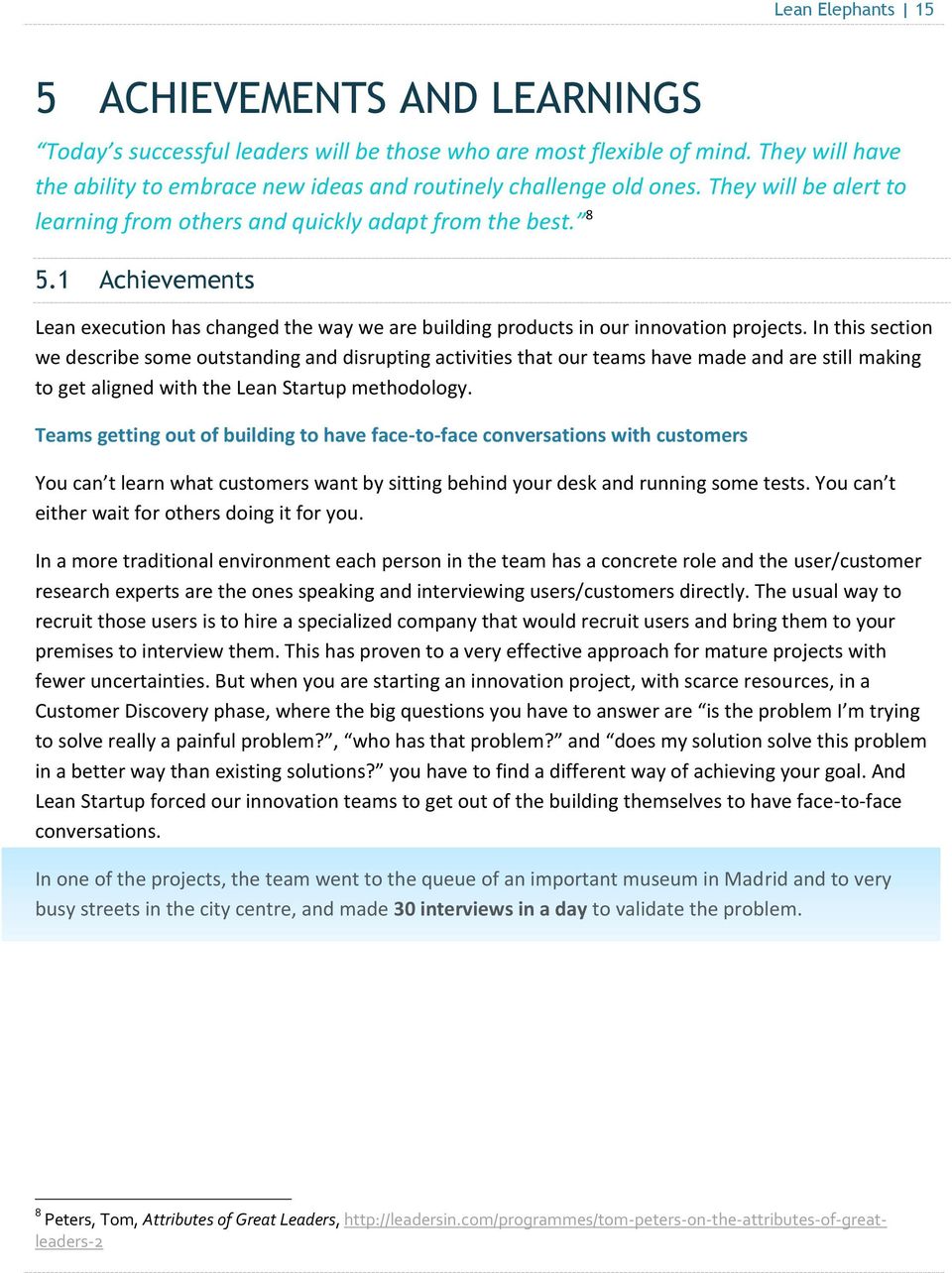
16 Lean Elephants 16 A project team interviewing people in Madrid Several examples on that direction have shown us that before writing a line of code we need to understand what problem we are trying to solve if there is any and how customers would like it to be solved. Interviews are a great qualitative tool to make progression. They should be counted in dozen units, and can only be conducted by the project team. Through experience we have realized that when a project is stuck and somewhat lost in most cases the best remedy is to go for more interviews or experiments. At its initial stage, the target markets of one of the projects were UK and Germany, since the problem they were trying to solve was supposed to be bigger there, but after getting out of the building and talking face to face with some users in Spain the team found out that people in Spain with a second home (Spain is the European country with more households, 36.2 %, with a second home in ownership for vacation) had that problem too and it was more painful than in Germany or UK.

17 Lean Elephants 17 Radio.me 9 project was initially a solution for communicating the elderly with their grandchildren. After 50 guerrilla interviews in the street and parks the team discovered that the real pain was around the communication with sons and daughters. Radio.me project work with real users Getting out of the building was one of the things that surprised most our pioneers (many of them engineers) but they also considered it the most enriching experience: For me, the most useful aspect of lean startup is having a first-hand talk with people. The most enlightening learning is how much you can save on speculation if you get out of the building from the day -1. What has surprised me most of lean startup are the user interviews. I have never had a direct and active participation in speaking with users. That has been the biggest personal change I have experienced. The most important experiments were the interactions with customers. It has been very enlightening to get out of the building and check that something very interesting for you might not interest a potential customer at all. 9 A project with the aim of providing a device designed to help people communicate with less technological family members. Radio.me concept has been patented by Telefonica.

18 Lean Elephants 18 Validating every step with customers Learning what the customer needs and what it is really valuable for them is the key of progress. A casual visit from a IT facilities European department of a well-known fashion retail company, resulted on a on the fly demo from one of our innovation teams which allowed them to learn that 95% of the employees of that company were women interested in fashion, so they realized that the look n feel of the product they were building in this project should be like a mirror. In another project, the solution for a certain problem had been discussed and agreed with a central department of a potential customer (a big retailer) that had been previously involved in the problem research. But when the solution was also shared with the department in charge of the shops of the same customer, the team found out that the solution was impossible to apply in the shops. Fortunately the prototype that had been used for the solution validation was a cheap one and had taken little time to develop. Pivoting when the main hypothesis are invalidated with early market tests When an important hypothesis is invalidated it is time to pivot the project; that means to make a correction to test some new hypothesis about the customer, the problem, the solution, and the like. One of our projects started with a big challenge that had come out from another innovation project (that project had done some previous work and even built a prototype). The team received a lot of pressure to give continuity to what had been done, but the interviews and all the feedback received pointed out that they had to change the approach and even to discard much of what was already done. They changed the focus, discarded much of the work already done and made a great number of guerrilla interviews to validate the new hypothesis. In another project, after getting out of the building and make 42 problem interviews, they found out that people had that problem but they already had a solution that worked perfectly for them. So they had to pivot from B2C to B2B customer segment, ecommerce and financial sector in this case, because they found out they had a painful problem that wasn t properly solved and the solution the team was proposing was noticeably better than the existing ones. Limited resources, bootstrapping and fast iterations to reduce risk Bootstrapping means eliminating waste through the maximization of existing resources before spending efforts on new or external resources. Our innovation projects have by default a minimal assignment of resources which makes the teams be lean. Besides, the agile method of working emphasizes empirical feedback, team self-management, and striving to build properly tested product increments within short iterations.

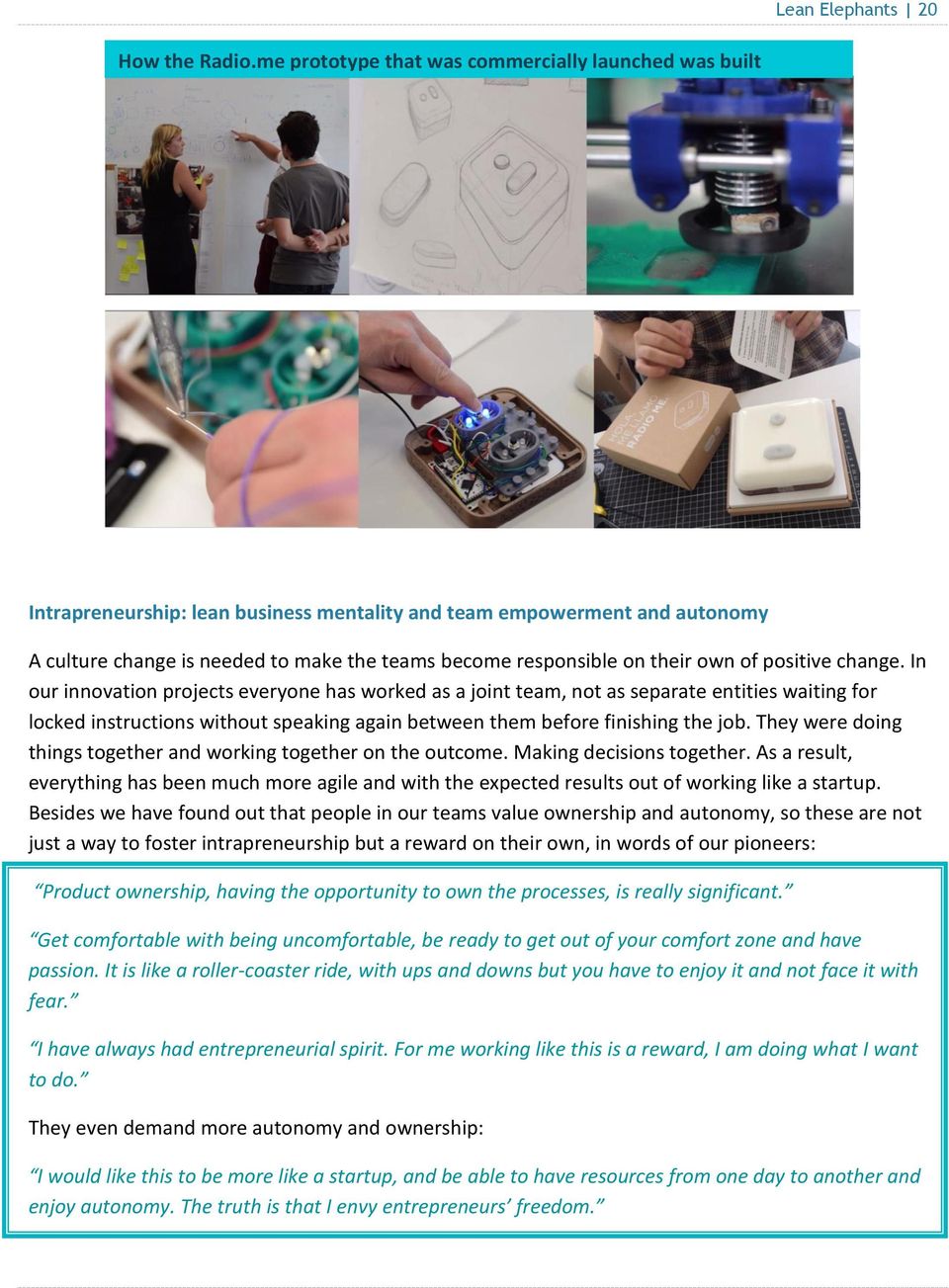
19 Lean Elephants 19 Having a very limited budget, most of our teams were working according to their workload. If a colleague of another team wasn t really busy and could contribute with some skills and/or time to the project, he/she was temporarily recruited. In one of our projects, the leader even used his own car to travel to another city to talk to a customer and decided to make himself the interviews without any help, although he hadn t done it before, in order to save money. Lean Startup also made a project team change their mind-set when they realized there was no need to do something perfect to launch a landing page; it was more important to get feedback as soon as possible, the agile way of working was most important and useful. Something similar happened to the Radio.me team that wanted to test willingness to pay and planned to launch a pre-commercial prototype to get inputs. They realised it was more important to launch, learn and iterate fast than having a fully-fledged prototype. It was an extremely healthy exercise to deselect features. This did not only save money and time but also forced the team to take a very structured approach. Radio.me prototypes

20 Lean Elephants 20 How the Radio.me prototype that was commercially launched was built Intrapreneurship: lean business mentality and team empowerment and autonomy A culture change is needed to make the teams become responsible on their own of positive change. In our innovation projects everyone has worked as a joint team, not as separate entities waiting for locked instructions without speaking again between them before finishing the job. They were doing things together and working together on the outcome. Making decisions together. As a result, everything has been much more agile and with the expected results out of working like a startup. Besides we have found out that people in our teams value ownership and autonomy, so these are not just a way to foster intrapreneurship but a reward on their own, in words of our pioneers: Product ownership, having the opportunity to own the processes, is really significant. Get comfortable with being uncomfortable, be ready to get out of your comfort zone and have passion. It is like a roller-coaster ride, with ups and downs but you have to enjoy it and not face it with fear. I have always had entrepreneurial spirit. For me working like this is a reward, I am doing what I want to do. They even demand more autonomy and ownership: I would like this to be more like a startup, and be able to have resources from one day to another and enjoy autonomy. The truth is that I envy entrepreneurs freedom.
21 Lean Elephants 21 Besides, Lean Startup promotes a culture of intellectual frankness that encourages teams to be their own critics. If the team feels that learning and experimentation are conclusive enough in the sense there is no way to continue, they may feel free to challenge their own activity and propose to pivot at any time or even kill the project. Actually, some of our innovation projects have been stopped by their own project leaders (founders in many cases). The leaders were the ones who suggested ending the project from the very first moment they realised something was not working and they were getting nowhere, despite all the personal motivation, efforts and time put on it. Accelerate the innovation We have realised that Lean Startup has allowed us to accelerate the innovation cycles, through many short iterations within the projects. With a more traditional methodology innovation projects would mainly focus on getting working prototypes which aligned just with the initial specifications in a timeframe of around 4 months. Only after the initial prototype was available the team would start thinking about how to include the development in the roadmap or how to add it to an existing product. Reality checks with the market in general were not part of the innovation process itself that would usually only happen at the end of the project. The innovation projects which apply Lean Startup start generating meaningful learnings in 1.5 months or less. We have estimated this means an acceleration factor of 2.6. This means we figure out if a project/products makes sense at least 2.6 times sooner than before. More with less With a lower budget than in previous years where more traditional approaches were applied, we have estimated that we have been able to increase in a 45% the number of innovation projects while reducing in average a 48% the medium budget invested for each of them. These numbers mean two essential things: 1. We have actually reduced the overall risk by augmenting the granularity of the bets and minimizing the cost of failure for each individual project. 2. We have significantly increased the chances of having relevant impact in business since within the same timeframe and budget there are many more opportunities to learn and figure out how, and how not to, to build a particular product or service which makes money. 5.2 Learnings Training people in Lean Startup/Customer Development methodology is very important to be able to change the way teams work, but it is not enough. In a company where most of the employees have a deep technical background and expertise they need guidance and advice on how to apply these new methodologies. Most of them have never interviewed an actual or potential customer; most of them
22 Lean Elephants 22 have never gone out of the building. With a combination of training and of support and assessment from Innovation Managers and especially from external mentors, teams have been able to overcome the main roadblocks we have found teams have. How to start? Which is the first step? Each project has a different situation that requires a different approach. In some cases we have technological solutions in search for a problem worth solving. In others, there are projects with several potential customer segments where the team doesn t know which one they should try first. Or projects with many stakeholders with unclear role yet: who is the customer, who makes the purchasing decision In all these cases the mentor s experience has proven to be very useful by offering criteria and tools to make decisions or ways to move forward. Most of the teams don t know which of the Business Model Canvas nine elements they should start with and when to move to the next ones At the beginning of a project we usually propose to start working with the Value Proposition Canvas 10, this way they focus on the customer segment and the value proposition elements, the ones they should start with. Then, in each phase, we tell them which elements they should focus on. Most of the teams think an MVP the Minimum Viable Product is a small functional version of their product or service We encourage small experiments as an alternative to what technical people are used to, that is start coding from the very beginning to make a prototype. This can be perceived as almost counterintuitive and for this reason t is important to explain them that an MVP is the faster and cheaper experiment you can possibly design to validate (or invalidate) a hypothesis. Depending on what you are trying to validate and the stage of the project, it can even be a mockup in a piece of paper. Teams also need help to understand how to measure the results of an experiment and to make decisions according to those measurements For example, most of the teams don t know how to design or make a problem interview, how to reach potential customers and interview them, the number of interviews they should make or how to evaluate results. It is also challenging for teams to design other types of experiments; for example in a project around a mobile app the team struggled to figure out how to define success criteria beforehand for the first launch in terms of downloads, conversions and usage, it is also true that the design of subsequent experiments after this first one was easier because the team had learnt. Teams tend to try to test everything at once, and therefore designing very complicated experiments You must teach them how to determine what they want to test and to test by stages, they cannot test all at once. So you have to sit down with them, help them to raise the hypothesis, and, as it is not possible to validate all at the same time, build a matrix of uncertainty vs. risk-perception for their business model. The ones with higher risk and higher uncertainty are the assumptions teams must begin validating. 10 Osterwalder, Alexander.
23 Lean Elephants 23 It is also important to avoid perfectionism You do not need a perfect experiment (landing page, prototype ) to test an hypothesis; the important thing is launching it as soon as possible and start iterating. So we help teams to apply the simplicity criterion, it is more important to launch something as soon as possible and test it than waiting to have a the best possible look n feel experiment or a prototype with more functionality. Teams have to understand that the sooner you validate the sooner you get rid of uncertainty, they have to learn it as soon as possible. In most of the projects, teams don t know what the expected outcome of each Customer Development phase is This must be clear from the very beginning and expressed in a language they can understand. So, for example, when the project starts, what we tell them first is that they have to focus on collecting evidence of a real and painful problem/need with a solution that is currently unpleasant and can be clearly improved. Of course the proposed solution has to be better that the existing ones and 1) It solves the problem; 2) It does not create more problems; and 3) There are no insuperable obstacles that prevents the solution from being adopted. The intrapreneur has to deal with the corporate politics and look for stakeholders, and that takes a lot of time So it is very important to make the project spread and be known. At the same time, we have to be careful since we run the risk of functionality hyperinflation when we are developing a prototype, because usually the project leader wants to be ambitious and include more functionality than needed (that is to make it so showy that internal stakeholders buy-in is ensured), but on the other hand, lean learning requires simple things that will allow a rapid learning. Balance is critical in these cases. Willingness to pay Teams must understand that the only realistic test to measure customers willingness to pay is sales, that is, when they actualy pay for the product or service or when there is an equivalent transaction. When people or companies just say that they would pay or that the service is nice the team needs to be very well aware that that cannot be accounted as willingness to pay. The power of validated learnings stories When projects need to show progress at senior executive forums or ask for further internal finance rounds we have realized that a well built speech based on customer/market validated learnings is powerful enough to get the buy-in from stakeholders. In such cases the audience doesn t need to be familiar with the methodology, avoiding jargon and clearly explaining the validated learning is enough.
24 Lean Elephants 24 6 CONCLUSIONS AND RECOMMENDATIONS We have learnt that lean innovation can help us to break the commercialisation glass ceiling that innovations usually face, thus reducing risk and minimizing resource consumption. In addition it has proven to be a good way to identify innovative and intrapreneurship talent within the company. But we have also validated that it is an extraordinary motivational tool because it gives employees more autonomy, mastery and, last but not least, a purpose 11. People value ownership (having the opportunity to own the process); they even consider it a reward. It profoundly changes people: when we asked our pioneers if they would take something of this way of working with them, the answer was always a resounding yes. Once people try this way of working and building things, they would find frustrating going back to traditional ways, because they realise the value they are creating. For these reasons, in spite of the difficulties, we strongly recommend applying Lean Startup in corporate environments taking into account the following: 1. Top executives of your company have to understand what customer development and market validation means, as well as how teams work in the Lean Startup way, the autonomy and speed they need, and the type of experiments that they can make. 2. Be ambitious and be global: projects need to scale quickly in global markets and global companies. You need to be ambitious and try to solve global problems, or at least significant issues within your company s footprint, as most of the problems can be found in that space, and later it will be easier to scale them up. 3. Stick to benchmarking, check what is out there as an already established solution and which companies are trying to solve the same problem. If someone is already testing or trying to solve the same thing as you it does not mean that there is no opportunity, quite the opposite. However you need to be very aware of what is going on in your area of opportunity,. By knowing your competitors you gain market acumen, can frame the problem better and even get new ideas and focus on your strengths better. Always benchmark as soon as you have a rough idea of what you want to do. 4. Do not be afraid of partnering with the best, in our case our competitive advantage will always be our huge base of customers that can leverage any solution and a big scale in no time. By partnering with technology developers or market leaders, you gain competitive advantage and market acumen. 5. Commit people from business and product organisations as soon as possible. In order to get market traction, market insights, access to customers (through shops, B2C ) you need to ensure the company involvement. Most of our innovations projects that have seen the market light used Telefonica s resources and market connections. 11 These are the three things that really motive us according to Dan Pink,
25 Lean Elephants Lean Startup implies a cultural change, a different way of doing things. People have to learn how to make things different, but in essence Lean Startup is common sense. Make sure you provide support and guidance for the teams. For example you could replicate our strategy of internal Innovation Mentors. Also train your people, when they start a project is when it is most needed and when it works best. Finally rely on external mentors with a critical and different point of view, who can always challenge projects and teams. 7. Bear in mind that the selection of trainers and mentors is key. The trainer has to be someone that can provide his/her personal experience as an example, someone that engages people, with a good combination of theory and practice. When the trainer is like this, our experience is that after the training phase people feel enthusiastic about Lean Startup and are anxious to start applying it, so you have the willingness to make an effort, change their mindset and give it a try. The external mentor must have a good network and solid experience as mentor in the startup world and in business. This person must be also able to adjust and apply his/her expertise to the context of your projects and your company. 8. Be ready to explain why what you do now can be better than what was done before, build your own internal metrics, maybe the Innovation Acceleration and Doing More with Less indicators can be of help. 9. Last but not least don t forget to learn and review your innovation framework and model periodically, to learn continuously and to rely on the lessons learned to change, evolve and improve how you do things. Basically eat your own food and be lean my friend!
26 Lean Elephants 26 ACKNOWLEDGEMENTS We would like to thank some people for their valuable contribution to this paper by naming them: Oriol Lloret, the father of our innovation journey, without his vision and without his daring to dare spirit none of this would have been possible. Mario López de Ávila (NODOS) and Ricard Huguet (Invenio) for their feedback and comments, for continuously performing reality checks on us and specially for sharing their knowledge and experience which has allowed us to learn and grow. Diego Díaz, for his feedback and support and for challenging us into actually writing this paper. Luis Ignacio Vicente, for the title of this paper as well as his valuable feedback. Pere Obrador, for his feedback and support and for his kind contribution to the Open Innovation section. Oriol Ribera, for kindly sharing his material for the introduction. Our pioners in general, but particularly the following ones that have contributed directly to this paper (in alphabetic order): Alberto de Vega Anna Karolina Hiltunen Bert Braeutigam Carlos Moliner David Muñoz Francisco Javier Zorzano Jaime González Rodríguez Javier López Benito Luis Eduardo Dejo María José Tomé Rafael de La Heras Elvira Clouet for her patience and support to format endless versions of this document.
DESCRIBING OUR COMPETENCIES. new thinking at work
 DESCRIBING OUR COMPETENCIES new thinking at work OUR COMPETENCIES - AT A GLANCE 2 PERSONAL EFFECTIVENESS Influencing Communicating Self-development Decision-making PROVIDING EXCELLENT CUSTOMER SERVICE
Key Steps Before Talking to Venture Capitalists
 Key Steps Before Talking to Venture Capitalists Some entrepreneurs may not be familiar with raising institutional capital to grow their businesses. Expansion plans beyond common organic growth are typically
5 Steps to Creating a Successful Optimization Strategy
 5 Steps to Creating a Successful Optimization Strategy Many companies are now recognizing that in a world of mobile devices and increasingly sophisticated online services, the creation of an excellent
DEFINE YOUR SALES PROCESS
 DEFINE YOUR SALES PROCESS TO GROW YOUR BUSINESS Internet Marketing 101: How Small Businesses Can Compete with the Big Guys DEFINE YOUR SALES PROCESS TO GROW YOUR BUSINESS A strong and effective sales team
To the point. a recipe for creating lean products. Paulo Caroli. This book is for sale at http://leanpub.com/tothepoint
 To the point a recipe for creating lean products Paulo Caroli This book is for sale at http://leanpub.com/tothepoint This version was published on 2015-10-21 This is a Leanpub book. Leanpub empowers authors
VI Simposio Internacional sobre Energía y Foro de Innovación y Emprendimiento. Por: Bartolomé Gamundi Cestero
 VI Simposio Internacional sobre Energía y Foro de Innovación y Emprendimiento Por: Bartolomé Gamundi Cestero El empresarismo es convertir ideas en oportunidades Bartolomé Gamundi Cestero EL PROCESO DEL
Developing Policies, Protocols and Procedures using Kotter s 8 step Change Management Model
 2013 Developing Policies, Protocols and Procedures using Kotter s 8 step Change Management Model Marion Foster Scottish Practice Management Development Network [Pick the date] IMPLEMENTING CHANGE POWERFULLY
Crucial development areas for organizations and how to succeed in them. Leadership Development & Coaching
 INNONews Crucial development areas for organizations and how to succeed in them Innotiimi newsletter 2010 Leadership Development & Coaching Change Team Innovation Meaningful Meetings Global Challenges
How To Manage An Itil Service Manager
 Newcastle University IT Service Sharon Mossman AXELOS.com Case Study February 2015 Contents Introduction 3 Adopting ITIL 4 ITIL s Continuing Use 7 What are your recommended Best Practices? 8 About AXELOS
5 Point Social Media Action Plan.
 5 Point Social Media Action Plan. Workshop delivered by Ian Gibbins, IG Media Marketing Ltd ([email protected], tel: 01733 241537) On behalf of the Chambers Communications Sector Introduction: There
Why Your Strategy Isn t Working
 Published in Business Strategy November 2011 Why Your Strategy Isn t Working By Gary Getz and Joe Lee Setting the company or business unit s strategy has always been one of the most important jobs for
How To Manage Social Media Risk
 www.pwc.co.uk/riskassurance Social media governance Harnessing your social media opportunity June 2014 Social media allows organisations to engage with people directly, express their corporate personality
AGILE BUSINESS MANAGEMENT
 TOP 10 POINTS OF AGILE BUSINESS MANAGEMENT Contents Top 10 Points of Agile Business Management Introduction to Agile business 1 1. Agile Business Management in a Nutshell 2 2. Strategy Work In Agile Business
Business Mastery: Smart Strategies Every Business Owner Needs to Promote, Protect and Prosper
 Business Mastery: Smart Strategies Every Business Owner Needs to Promote, Protect and Prosper Susan Wilson Solovic Sponsored by: AT&T 2012 Susan Wilson Solovic, all rights reserved Business Mastery: Smart
This handbook is meant to be a quick-starter guide to Agile Project Management. It is meant for the following people:
 AGILE HANDBOOK OVERVIEW WHAT IS THIS? This handbook is meant to be a quick-starter guide to Agile Project Management. It is meant for the following people: Someone who is looking for a quick overview on
CRUSH WHITE PAPER HOW TO BUILD A KILLER STRATEGIC ACCOUNT PLAN. The guide every salesperson needs to read before creating a strategic account plan.
 CRUSH WHITE PAPER HOW TO BUILD A KILLER STRATEGIC ACCOUNT PLAN The guide every salesperson needs to read before creating a strategic account plan. CRUSH PAPER: HOW TO BUILD A KILLER STRATEGIC ACCOUNT PLAN!!
ENVIRONICS COMMUNICATIONS WHITEPAPER
 ENVIRONICS COMMUNICATIONS WHITEPAPER Creating an Employee Centric Internal Communications Model April 2013 "The only irreplaceable capital an organization possesses is the knowledge and ability of its
Recruitment and Selection
 Recruitment and Selection The recruitment and selection belongs to value added HR Processes. The recruitment is about: the ability of the organization to source new employees, to keep the organization
Plus, although B2B marketing budgets have increased, the number of channels may far surpass what you can do with your budget.
 1 CNBC s list of the Top 10 Most Stressful Jobs of 2011 revealed that the sixth most stressful job was that of an advertising account executive. The reason today s account executives are so stressed is
CRM Know How In Practice. Transition and change management. Best Practice Guide 01
 CRM Know How In Practice Transition and change management Best Practice Guide 01 02 Best Practice Guide CRM Know How In Practice Transition and change management In This Guide 02 Introduction: Why CRM?
15 Principles of Project Management Success
 15 Principles of Project Management Success Project management knowledge, tools and processes are not enough to make your project succeed. You need to get away from your desk and get your hands dirty.
Career Management. Making It Work for Employees and Employers
 Career Management Making It Work for Employees and Employers Stuck in neutral. That s how many employees around the world would describe their career. In fact, according to the 2014 Global Workforce Study,
White Paper. Are SaaS and Cloud Computing Your Best Bets?
 White Paper Are SaaS and Cloud Computing Your Best Bets? Understanding SaaS and Cloud Computing and Service Delivery Options for Real Estate Technology Solutions Joseph Valeri, MBA, MS President, Lucernex
Global performance management: the Shell SSC story
 Global performance management: the Shell SSC story 25 Energy giant Shell has spent more than a decade overhauling its shared service offering. George Connell, Shell s vice president of strategy and Glasgow
Introduction to customer journey mapping
 Introduction to customer journey mapping Copyright PeopleMetrics Inc. an ebook by introduction Customer Journey Mapping is growing in popularity in the customer experience space, and it s no surprise.
Briefing Paper. How to Compete on Customer Experience: Six Strategic Steps. www.syn gro.c om SynGro SynGro 2013 2013 Tel: +44 (0 ) 15 06 5 92 2 24
 Briefing Paper How to Compete on Customer Experience: Six Strategic Steps How to Compete on Customer Experience: Six Strategic Steps Voice of the Customer as a term has come to reflect the growing understanding
The Basics of Scrum An introduction to the framework
 The Basics of Scrum An introduction to the framework Introduction Scrum, the most widely practiced Agile process, has been successfully used in software development for the last 20 years. While Scrum has
Business Agility SURVIVAL GUIDE
 Business Agility SURVIVAL GUIDE 1 Every industry is subject to disruption. Only a truly agile business is equipped to respond.* Agile firms grow revenue 37% faster. Agile firms generate 30% higher profits.**
FIELD GUIDE TO LEAN EXPERIMENTS
 FIELD GUIDE TO LEAN EXPERIMENTS LEAN ENTERPRISE ACCELERATOR PROGRAM HOW TO USE THIS GUIDE This guide is designed to be used in conjunction with the Experiment Map posters. If you have not done so already,
UNDERSTANDING EFFECTIVE LEAD GENERATION TICK #THINKGROWTH
 UNDERSTANDING EFFECTIVE LEAD GENERATION TICK #THINKGROWTH CONTENTS 1 INTRODUCTION Page 3 2 COMPETITIVE PROPOSITION Page 4 3 USER PROFILING/AUDIENCE DNA Page 9 ENSURE YOUR BRAND HAS A CLEAR, COMPELLING
Global Account Management for Sales Organization in Multinational Companies *
 Global Account Management for Sales Organization in Multinational Companies * Tino Canegrati ** Abstract A Global Company is not just a Multinational Company, but on top it has developed an organizational
Book 3 Cost Estimating in an Agile Development Environment. (early release)
 Book 3 Cost Estimating in an Agile Development Environment (early release) Book 3: Cost Estimating in an Agile Development Environment In this third book I ll use the slides I gave at a speech several
Top 5 best practices for creating effective dashboards. and the 7 mistakes you don t want to make
 Top 5 best practices for creating effective dashboards and the 7 mistakes you don t want to make p2 Financial services professionals are buried in data that measure and track: relationships and processes,
Social Media Strategy:
 Social Media Strategy: The Beginners Guide to Strategy Success in 7 Steps A Simple Guide In association with: Chapter Title Contents Page Page 2 What is Social Media...3 What is a Social Media Strategy
EXCLUSIVE INTERVIEW A BEHIND THE SCENES LOOK AT TELEFÓNICA S EVOLVING BIG DATA EXTERNAL MONETISATION MODEL
 We ve never told our in-depth story like this before: looking at the history, lessons learnt and the challenges faced on our Big Data journey. Lorraine Stone EXCLUSIVE INTERVIEW A BEHIND THE SCENES LOOK
Razorfish Customer Experience Innovation Series: Disrupt Yourself
 Razorfish Customer Experience Innovation Series: Disrupt Yourself 02 Disrupt Yourself The Trend Disrupt Yourself Customer experience is the next competitive battleground for differentiation. Need proof?
The following is intended to outline our general product direction. It is intended for information purposes only, and may not be incorporated into
 The following is intended to outline our general product direction. It is intended for information purposes only, and may not be incorporated into any contract. It is not a commitment to deliver any material,
Make the Leap from ecommerce to Omni- Channel
 Iaodesign/Shutterstock An ecommerce platform is the foundation for a successful Omni- Channel business model arvato Systems North America 6 East 32nd Street, New York, New York 10016 United States All
BOOK REPORT ARE YOU IN IT FOR THE LONG HAUL?
 BOOK REPORT Mirror, Mirror on the Wall, Am I the Most Valued of them All? The Ultimate Element of Differentiation is YOU By Leo J. Pusateri ISBN 0-9716056-0-2 ARE YOU IN IT FOR THE LONG HAUL? After years
THE 7 STEPS TO A SUCCESSFUL CRM IMPLEMENTATION DEPLOYING CRM IN THE NEW ERA OF CONNECTED CUSTOMERS
 THE NEW ERA OF ABOUT THE AUTHOR Paul Rogers is the Head of Customer Experience and CRM within HCL s Applications Division. Based in London, Paul is responsible for leading HCL s CRM consulting and technology
How To Manage A Focused Outreach Lead Generation Initiative
 Focused Outreach Lead Generation to Produce High Quality Leads and Raise Your ROI By Elisa Ciarametaro of Exceed Sales www.exceedsales.com Elisa Ciarametaro and Exceed Sales, Inc. Table of Contents What
Silver Sponsor of the study. Digital Testing in Europe: Strategies, Challenges & Measuring Success
 Silver Sponsor of the study Digital Testing in Europe: Strategies, Challenges & Measuring Success Key Findings Digital having a major impact on the testing/qa function. More than three quarters of European
AIA Michigan s Social Media Marketing Course
 AIA Michigan s Social Media Marketing Course Welcome to the AIA Michigan s Social Media Marketing Course You are now officially on your way to getting a strong foundation of how you can market your business
Chapter 3: Approaches to Creating Personas
 Chapter 3: Approaches to Creating Personas By Steve Mulder from The User Is Always Right: A Practical Guide to Creating and Using Personas for the Web First things first: There is no one right way to create
A Modern Sales Roadmap. 7 best practices to drive sales success. tellwise
 A Modern Sales Roadmap 7 best practices to drive sales success tellwise Introduction Whether you re an inside sales rep or the Chief Sales Officer (CSO), you know sales is a demanding field, with countless
Best Practices for Growing your Mobile App Business. Proven ways to increase your ROI and get your app in the hands of loyal users
 Best Practices for Growing your Mobile App Business Proven ways to increase your ROI and get your app in the hands of loyal users Competing For Users With more than a million mobile apps competing for
The Benefits of Deployment Automation
 WHITEPAPER Octopus Deploy The Benefits of Deployment Automation Reducing the risk of production deployments Contents Executive Summary... 2 Deployment and Agile software development... 3 Aim to deploy
Operations Excellence in Professional Services Firms
 Operations Excellence in Professional Services Firms Published by KENNEDY KENNEDY Consulting Research Consulting Research & Advisory & Advisory Sponsored by Table of Contents Introduction... 3 Market Challenges
Continuous delivery Release software on-demand, not on Red Alert
 Continuous delivery Release software on-demand, not on Red Alert Have it all. Ahead of the competition Value In a world where customers expect a mobile and connected 24x7 experience, businesses must adapt
Ten Steps to Success in New Business Ventures
 by Matthew Simmons part-time Marketing Director Introduction Let's set the scene - you are an entrepreneur who has invented a great idea, or perhaps you are a manager in a larger organisation who is about
Beginning would be a good start
 How should operators go digital? Expert's Forum Leveraging technology is fundamental to digital transformation but understanding customers and serving them exceptionally is at the heart of digital business.
THE ORGANIZER S ROLE IN DRIVING EXHIBITOR ROI A Consultative Approach
 7 Hendrickson Avenue, Red Bank, NJ 07701 800.224.3170 732.741.5704 Fax www.exhibitsurveys.com White Paper THE ORGANIZER S ROLE IN DRIVING EXHIBITOR ROI A Consultative Approach Prepared for the 2014 Exhibition
10 Steps to Turn Your Website Redesign into an Inbound Marketing Machine
 x _ 10 Steps to Turn Your Website Redesign into an Inbound Marketing Machine Introduction It happens to all organizations. One day you wake up and notice that your company s website needs a major refresh.
SharePoint as a Business Application, Not Just a Collaboration Tool
 SharePoint as a Business Application, Not Just a Collaboration Tool Products, Projects, Services and Work in One System Published March, 2013 http://epmlive.com Contents Introduction...2 Common Uses of
THE 20-MINUTE PPC WORK WEEK MAKING THE MOST OF YOUR PPC ACCOUNT IN MINIMAL TIME
 THE 20-MINUTE PPC WORK WEEK MAKING THE MOST OF YOUR PPC ACCOUNT IN MINIMAL TIME THE 20-MINUTE PPC WORK WEEK MAKING THE MOST OF YOUR PPC ACCOUNT IN MINIMAL TIME If you look at the pay-per-click (PPC) marketing
An Introduction to Design Thinking PROCESS GUIDE
 An Introduction to Design Thinking PROCESS GUIDE Empathize To create meaningful innovations, you need to know your users and care about their lives. WHAT is the Empathize mode Empathy is the centerpiece
Why Your CRM Process is Destroying Your Team s Prospecting and How to Fix It
 Proof of Prospecting Why Your CRM Process is Destroying Your Team s Prospecting and How to Fix It When implementing any kind of sales improvement program, most sales organizations understandably focus
/ WHITEPAPER / THE BIMODAL IT
 / WHITEPAPER / THE BIMODAL IT By Melbourne IT Enterprise Services IMPLEMENTING THE DYNAMIC COMPONENT FOR A DIGITAL WORLD Among the IT operational models developed over the years, the recent release of
Innovation in Business Models for Start-ups. Prof. Dr. Utz Dornberger in4in Workshop Rwanda, 2014
 Innovation in Business Models for Start-ups Prof. Dr. Utz Dornberger in4in Workshop Rwanda, 2014 Business idea Many existent enterprises have the goal to develop a new sui-generis product Almost every
to selection. If you have any questions about these results or In the second half of 2014 we carried out an international
 Candidate Experience Survey RESULTS INTRODUCTION As an HR consultancy, we spend a lot of time talking We ve set out this report to focus on the findings of to our clients about how they can make their
REVEALED: THE BLUEPRINT FOR BUSINESS SUCCESS Find out if you are achieving your full growth potential
 REVEALED: THE BLUEPRINT FOR BUSINESS SUCCESS Find out if you are achieving your full growth potential Overview Running your own business can be tough. There s a huge amount of advice out there but you
How to Write a Marketing Plan
 How to Write a Marketing Plan This article highlights what we believe to be many of the key points that we need to consider when developing a marketing plan. It combines marketing theory, practical tools
Blended Learning Current Use, Challenges and Best Practices
 Blended Learning Current Use, Challenges and Best Practices Report 2013 Contents Background and Methodology... 3 Executive Summary... 3 Survey Results in detail... 5 How is blended learning used?... 5
The Zen of Data Science. Eugene Dubossarsky Chief Data Scientist Principal Founder [email protected] a1@analystfirst.
 The Zen of Data Science Eugene Dubossarsky Chief Data Scientist Principal Founder [email protected] [email protected] @cargomoose Presentation Summary - Promised -Key concepts, dos and don'ts of Data
From business models to business plans
 From business models to business plans Barbara Diehl & Dr Maria Nikolou 11 November 2013 The odds... On day one, a start up is a faith- based initiative.(steve Blank) 2 The odds... How do you progress
Tech-Clarity Insight: Top 5 Misconceptions about Innovation Management Software
 Tech-Clarity Insight: Top 5 Misconceptions about Innovation Management Software Busting Myths to Improve Innovation, Time to Market, and Profitability Tech-Clarity, Inc. 2013. Table of Contents Executive
Digital Transformation In The Age Of The Customer: A Spotlight On B2C
 A Custom Thought Leadership Spotlight Commissioned By Accenture Interactive October 2015 Digital Transformation In The Age Of The Customer: A Spotlight On B2C RESULTS FOCUSING ON B2C FROM THE THOUGHT LEADERSHIP
The New Value of Change Management: Success at Microsoft
 The New Value of Change Management: Success at Microsoft by Molly Cooper, Microsoft IT Page 1 of 8 Summary Microsoft recently completed a significant IT transformation effort by replacing the existing
3 Keys to Preparing for CRM Success: Avoid the Pitfalls and Follow Best Practices
 CRM Expert Advisor White Paper 3 Keys to Preparing for CRM Success: Avoid the Pitfalls and Follow Best Practices Ten years ago, when CRM was nascent in the market, companies believed the technology alone
Market Maturity. Cloud Definitions
 HRG Assessment: Cloud Computing Provider Perspective In the fall of 2009 Harvard Research Group (HRG) interviewed selected Cloud Computing companies including SaaS (software as a service), PaaS (platform
The B2B customer community Part of Deloitte s Colingo proposition. Deloitte Digital Copyright 2014 Deloitte Digital LLC. All rights reserved.
 The B2B customer community Part of Deloitte s Colingo proposition Deloitte Digital Copyright 2014 Deloitte Digital LLC. All rights reserved. Contents 1. About Deloitte Digital 2. About Hub 3. Technical
Migrating from Managing to Coaching
 a ValueSelling Associates Migrating from Managing to Coaching How to bring out the best in sales teams and increase bottom lines The role that frontline sales managers play in coaching to the right skills,
Digital Customer Experience
 Digital Customer Experience Digital. Two steps ahead Digital. Two steps ahead Organizations are challenged to deliver a digital promise to their customers. The move to digital is led by customers who are
HOW TO MAKE YOUR EMPLOYEE ONBOARDING PROGRAM STRATEGIC AND EFFECTIVE FOR BETTER NEW HIRE ENGAGEMENT, PRODUCTIVITY, AND RETENTION
 HOW TO MAKE YOUR EMPLOYEE ONBOARDING PROGRAM STRATEGIC AND EFFECTIVE FOR BETTER NEW HIRE ENGAGEMENT, PRODUCTIVITY, AND RETENTION ACHIEVE BETTER NEW HIRE ENGAGEMENT, PRODUCTIVITY, AND RETENTION EXTEND LEARNING
Comprehensive Guide to Marketing Like Starbucks
 Comprehensive Guide to Marketing Like Starbucks 1 Introduction 6 reasons Starbucks Marketing Communications Strategy is so Effective is one of our most popular posts, continuing to be a top performer even
BI Dashboards the Agile Way
 BI Dashboards the Agile Way Paul DeSarra Paul DeSarra is Inergex practice director for business intelligence and data warehousing. He has 15 years of BI strategy, development, and management experience
56 Key Profit Building Lessons I Learned from Jay Abraham s MasterMind Marketing Training.
 56 Key Profit Building Lessons I Learned from Jay Abraham s MasterMind Marketing Training. Jay Abraham is a man you should all know. If you do not - go to the library and start learning - just do it! He
Marketing Automation 2.0 Closing the Marketing and Sales Gap with a Next-Generation Collaborative Platform
 Marketing Automation 2.0 Closing the Marketing and Sales Gap with a Next-Generation Collaborative Platform 4 Contents 1 Executive Summary 2 Defining Marketing Automation 2.0 3 Marketing Automation 1.0:
Relationship management is dead! Long live relationship management!
 XRM: From Fragmentation to Integration Executive Summary Relationship management is dead! Long live relationship management! But it s not just about customers anymore. The value chain has grown so long
Strategic Executive Coaching: An Integrated Approach to Executive Development
 Strategic Executive Coaching: An Integrated Approach to Executive Development A new concept in executive coaching is leading companies to fully utilize the talent they have to drive organizational strategy
IT TALENT MANAGEMENT FOR MID-MARKET COMPANIES
 IT TALENT MANAGEMENT FOR MID-MARKET COMPANIES FOR IT DEPARTMENTS, CONNECTING WITH TOP TALENT IS CRITICAL In the rapidly evolving world of business, hiring and maintaining a competent IT department is essential
How To Meet Customer Expectations On Mobile
 IBM Software Industry Solutions Meeting the expectations of the mobile customer Strategies for offering a consistent customer experience across channels Meeting the expectations of the mobile customer
A 7-Step Analytics Reporting Framework
 A 7-Step Analytics Reporting Framework By Feras Alhlou, Principal Marketing Consultant 2 Marketing Optimization Imagine that you just attended a conference on digital marketing and analytics. You re pumped
Global Leadership Conference 2014. Andrea Vogel EMEIA Market Leader, Strategic Growth Markets
 Global Leadership Conference 2014 Andrea Vogel EMEIA Market Leader, Strategic Growth Markets The EY G20 Entrepreneurship Barometer 2013 The power of three Together, governments, entrepreneurs and corporations
The 2014 Bottleneck Report on Enterprise Mobile
 The 2014 Bottleneck Report on Enterprise Mobile What s the big bottleneck for enterprise mobile app development this year, and how do you get past it? 1 / 32 The 2014 Bottleneck Report on Enterprise Mobile
Business Acumen for the 21st Century:
 Business Acumen for the 21st Century: Moving from Strategy to Action Written by Dan Parisi About the author- Dan Parisi is an Executive Vice President at BTS. Business Acumen for the 21st Century is a
Industry Insight: Performance Management
 Industry Insight: Performance Management Optimize Employee Performance to Maximize Business Performance You ve built an impressive talent hiring and screening approach, one that better predicts and ensures
Strategic Sourcing Outlook: Emerging Techniques and Media
 Strategic Sourcing Outlook: Emerging Techniques and Media www.chandlermacleod.com Social Media The Future of Strategic Sourcing? It s often tempting to stick with the tried and true and focus simply on