
Toxic and Hazardous Materials in Electronics
|
|
|
- Coral Marsh
- 10 years ago
- Views:
Transcription
1 Toxic and Hazardous Materials in Electronics An Environmental Scan of Toxic and Hazardous Materials in IT and Telecom Products and Waste Final Report For Environment Canada, National Office of Pollution Prevention and Industry Canada, Computers for Schools Program By Five Winds International, LP October 2001
2 Acknowledgments Five Winds International would like to thank the following people for assistance supplying information towards the preparation of this report: Thomas Bober, Kodak Ulrika Ekström, IVF, Sweden Holly Evans, Electronic Industries Alliance Wolfgang Hehn, Chemicals Unit, Directorate General Enterprise, European Union Ferdinand Hermann, Compaq, Germany Constantin Herrmann, Institute for Polymer Testing & Research, University of Stuttgart Arpad Horvath, University of California at Berkeley Gordon Hui, US EPA Tom Korpalski, Hewlett-Packard Cindy Thomas, Noranda Bob Tonetti, US EPA Naoko Tojo, Lund University, Sweden The contents of this report are the responsibility of Five Winds International and do not necessarily reflect the views of any of the individuals acknowledged above Wellington Street, #300 Ottawa, Ontario K1Y3B2 Canada tel fax Five Winds International 2 / 2

3 Contents 1. INTRODUCTION TOXIC AND HAZARDOUS MATERIALS IN IT AND TELECOM PRODUCTS... 7 MERCURY... 8 LEAD CADMIUM BERYLLIUM HEXAVALENT CHROMIUM (CR VI) ANTIMONY BROMINATED FLAME-RETARDANTS POLYVINYL CHLORIDE PVC POLYCHLORINATED BIPHENYLS PCBS RELEASES OF TOXIC AND HAZARDOUS MATERIALS MERCURY LEAD CADMIUM BERYLLIUM HEXAVALENT CHROMIUM (CR VI) ANTIMONY BROMINATED FLAME-RETARDANTS POLYVINYL CHLORIDE PVC POLYCHLORINATED BIPHENLYS PCBS OEM INITIATIVES TO REDUCE TOXIC OR HAZARDOUS MATERIALS APPLE COMPUTER COMPAQ ERICSSON FUJITSU HEWLETT-PACKARD (HP) IBM MATSUSHITA/PANASONIC MOTOROLA PHILIPS SONY CONCLUSIONS AND RECOMMENDATIONS GLOSSARY OF ELECTRONICS TERMS REFERENCES OEM WEB SITES Five Winds International 3 / 3

4 Appendices APPENDIX 1: ENVIRONMENTAL PROFILES OF SELECTED TOXIC OR HAZARDOUS MATERIALS APPENDIX 2: ERICSSON LISTS OF BANNED AND RESTRICTED SUBSTANCES APPENDIX 3: MOTOROLA ECO-DESIGN SUBSTANCES LIST Tables and Figures Table 1: Example OEM Initiatives to Manage or Eliminate Toxic or Hazardous Substances from Products Table 2: Status of Some Toxic or Hazardous Materials at Selected OEMs Table 3: Status of Lead-Free Solder at Selected Japanese OEMs Table 4: Summary of Data Quality and Availability Figure 1: Motorola Green Design Advisor Allows Comparison of Competing Designs Five Winds International 4 / 4

5 1. Introduction In October 2000 Environment Canada released a report called Information Technology (IT) and Telecommunications (Telecom) Waste in Canada. The report identified significant quantities of IT and Telecom waste going to disposal and projected that the amount of computers, monitors, laptops, cell phones and other related equipment disposed will double from 36,900 tonnes in 1999 to an estimated 71,650 tonnes in The IT and Telecom Waste in Canada report also described toxic or hazardous materials present in computer and telecom equipment and estimated the aggregate tonnage of such substances being disposed annually, primarily in landfills. Lead, mercury, cadmium, brominated flameretardants and other substances present in this equipment could pose hazards if they are released when the equipment is recycled, incinerated or disposed in landfills. Building upon the IT and Telecom Waste in Canada report, this study documents the literature about selected toxic or hazardous materials used in computer and telecom equipment. It focuses on toxic or hazardous materials contained in personal computers, monitors, laptop computers, peripherals (e.g. printers, scanners), telephones, mobile telephones and facsimile machines. It does not address toxic or hazardous materials used in the manufacturing processes. The scope of products addressed is the same as those covered by the IT and Telecom Waste in Canada report. Specifically, this study addresses three questions: 1. What toxic or hazardous materials are contained in these products? 2. What happens to these toxic or hazardous materials at the products end-of-life when they are recycled, landfilled or incinerated? 3. What are product manufacturers doing to reduce toxic or hazardous materials in products and/or their potential for release to the environment at the products end-of-life? This study examined nine toxic or hazardous materials that are, or were used in IT and telecom equipment: mercury (or it compounds), lead (or its compounds), cadmium (or its compounds), beryllium (or its compounds), hexavalent chromium, brominated flame-retardants, polyvinyl chlorides (PVC) and polychlorinated biphenyls (PCBs). The information gained through this study will contribute to building the knowledge and expertise of parties responsible for government policies, laws, regulations and other initiatives concerning toxic and hazardous materials in Canada. This study will also be useful to identify areas of potential concern for IT and telecom recycling and disposal activities carried out by the Government of Canada (e.g. Computers for Schools program). Finally, this study will help the Government of Canada determine the relative importance of the IT and telecom sectors compared to other sources of toxic and hazardous materials released to the environment in Canada. This study identifies and summarizes what is currently known in the areas of interest identified above. The information documented in this study is drawn from available literature including Five Winds International 5 / 5

6 published reports, proceedings of conferences and articles original, previously unpublished research is not included. The report is organized as follows: Chapter 2 documents the uses and quantities of mercury, lead, cadmium, beryllium, hexavalent chromium, antimony, brominated flame-retardants, polyvinyl chloride (PVC) and polychlorinated biphenyls (PCBs) in IT and telecom equipment. Chapter 3 documents releases to the workplace and to the environment of the above nine toxic or hazardous materials when the equipment is recycled (by hand or machine), disposed in landfills, or incinerated. Chapter 4 examines examples of polices, management systems, programs and tools to reduce or eliminate toxic or hazardous materials from products by ten IT and Telecom OEMs. Brief case study examples of several products demonstrating reduction or elimination of toxic or hazardous materials are also included. Chapter 5 presents some concluding remarks about this study and makes four recommendations to improve the quality and reach of this study and to further the goals of this study. A Glossary is included to help the reader become familiar with specialized electronics terminology used in this report. A complete list of sources consulted is included in References at the end of the report. Appendix 1 presents environmental profiles of the toxic or hazardous materials referred to in this study, summarizing their potential toxicity and environmental effects. Appendix 2 is a copy of Ericsson s Lists of Banned and Restricted Materials Appendix 3 is a copy of Motorola s Eco-Design Substances List Five Winds International 6 / 6

7 2. Toxic and Hazardous Materials in IT and Telecom Products Information on nine toxic or hazardous materials and substances is presented in the following tables. Highlights summarizing each table are also briefly discussed. The tables are organized into 5 columns of information. The "Where Found" column indicates where each potentially toxic or hazardous substance is located in the IT and telecom equipment. The second column, "Use", signifies the reason(s) that the substance is used in the product. Column three, "Quantity" shows how much of the substance is found in each component part. The "Status" column communicates general information regarding how a substance in a specific product is being managed, what the recent trends are (i.e. is use decreasing or increasing), relevant legislation, and other comments. Finally column five "For More Information" gives the source of the information and indicates where to go if more information is required. Toxic or hazardous substances found in similar components that were identified in different resources are grouped together in the tables for easy comparison of use and quantity. In cases where different references disagree on quantities it is important to note the vintage of the source. For example, in the case of mercury in fluorescent lamps used to back light LCD displays, lamp manufacturers have made significant progress in the past decade reducing the amount of mercury used. In some cases (e.g. for recyclers) it may be important to consult older references to determine the types and quantities of toxic or hazardous materials used in older IT and telecom equipment that is now being disposed. In other cases where references disagree, no simple explanation exists and the underlying assumptions and methodology must be consulted. It is important to note that most of the information found on potentially toxic or hazardous substances in electronic equipment was focused on personal computers, laptop computers and monitors. There is a distinct lack of information and studies on toxic or hazardous substances in other IT and telecom equipment such as peripherals (scanners and printers), fax machines, telephones and mobile phones. This is understandable given the recent developments and focus on end-of-life management programs for many consumer products. Five Winds International 7 / 7
8 Mercury The main concern for managing mercury at its end-of-life in IT and telecom equipment is backlight bulbs or lamps that illuminate laptop and other flat panel display screens. The amount of mercury per screen is relatively small, averaging 0.12mg-50mg per screen, but if everyone were to dispose of their old laptops at once the amount released to landfill or through incineration would be significant. Mercury-containing lamps and bulbs are quite energy-efficient and cost-effective and no practical substitute exists. Lamp manufacturers continue working to reduce the mercury content in each bulb or lamp, but it is expected that this use will increase because of the lack of alternatives. The EU s Waste Electrical and Electronic Equipment (WEEE) Directive 1 requires that substitutes for mercury be found for all uses in electronic equipment (for example, switches and lamps) with the exception of mercury lamps containing less than 5mg/lamp. Mercury in IT and Telecom Equipment Where Found Use Quantity Status For more info Fluorescent lamps - flat screen laptop displays Back light for LCD mg/laptop US EPA as cited in EIA, Fluorescent lamps - flat screen laptop displays Back light for LCD Manufacturers must report any intentionally added mercury Banned in all uses except lamps (EU). EIA, Fluorescent lamps - flat screen laptop displays Illumination light Tonetti (EPA), Fluorescent tubes - flat screen laptop displays Fluorescent lamps - flat laptop displays Fluorescent lamps - flat laptop displays Fluorescent lamps - flat laptop displays Transforms UV light in the gas discharge to visible light Transforms UV light in the gas discharge to visible light Avg mg/laptop mg/tube depending on size of tube No practical substitute for mercury in fluorescent tubes has been found. Nordic Council of Ministers [a], Increased use is expected because of energy efficiency. U.S. EPA, Transforms UV light in the gas discharge to visible light 4 g/100 fluorescent tubes Bender and Williams, Substitute for mercury required under WEEE by Exceptions: compact lamps < 5 Transforms UV light in the gas mg/lamp, straight lamps < 10 discharge to visible light mg/lamp. WEEE Directive, The original WEEE Directive has been divided into three separate Directives: WEEE, RoHS (Restrictions on Hazardous Substances) and EEE (Electrical and Electronic Equipment). For the purpose of simplicity, these will be referred to collectively as the WEEE Directive. Five Winds International 8 / 8

9 Mercury in IT and Telecom Equipment Where Found Use Quantity Status For more info Batteries % of total weight MCC, Batteries Batteries Minimal use of mercury recommended, substance under special attention, several current affairs. Nordic Council of Ministers [a], C4E Guidance Document, Monitor - CRTs Mobile phones Highly efficient at transforming UV-light to visible light Mercury use in this application has not been openly published. Nordic Council of Ministers [a], Substitute for mercury required under WEEE. WEEE Directive, Five Winds International 9 / 9
![Nordic Council of Ministers [a], 1995. C4E Guidance Document, 2000.](/docs-images/42/1211075/images/page_9.jpg "Monitor - CRTs Mobile phones Highly efficient at transforming UV-light to visible light Mercury use in this application has not been openly published.")
10 Lead Lead as a hazardous substance in electrical and electronic equipment has been well documented in published material. Given the amount of historical research on the toxicity of lead on human health and the environment, it is understandable why many studies have been conducted on lead as a hazardous component of electronic equipment. The major uses for lead in electronic components include tin-lead solder, cathode ray tubes in monitors, cabling, earlier batteries, printed circuit boards and fluorescent tubes. Large quantities of lead-acid batteries are used in emergency power supplies for larger telecom network infrastructure (e.g. central office switches), but these products are outside the scope of this study. The most significant and increasing use of lead in electronic equipment is in cathode ray tube (CRT) displays and monitors. Lead in CRTs acts as a radiation shield and lowers the melting temperature of the glass. CRTs are made up of three main components - the funnel, the neck and the frit. Estimates for lead amounts in these three components amount to between 0.4 kg and 3 kg per monitor. CRTs have recently been banned from landfills in Massachusetts and the trend will probably continue in other jurisdictions. 2 For consumer safety, the WEEE Directive exempts the use of lead in CRTs as a radiation shield but will require substitution for lead used in solder, batteries, and stabilizers. The second largest source of lead in electronics is found in tin-lead solder (usually in the ratio 60/40 tin-lead), which connects many component parts together. Lead is used in this capacity because of its good conductivity, high corrosion resistance, cost-effectiveness and low melting point. Quantified, the amount of lead used as connecting materials is about 50 g/m 2 of printed circuit board. Alternatives to tin-lead solder have been developed and many OEMs are actively involved in implementing lead-free solders (see Chapter 4 for details). Lead in IT and Telecom Equipment Where Found Use Quantity Status For More Info International Council on Metals and the Environment Interconnection materials as cited in EIA, Tin-lead solder Tin-lead solder Interconnection materials 0.7% total weight of circuit board Most common solder is 63% tin and 37% lead Surface mount -0.2mg lead Through hole joints-2mg lead Nordic Council of Ministers [a], Tin-lead solder Interconnection materials Threshold reporting level 1000 ppm Considered "material of interest". EIA, University of Tennessee, as cited in EIA, Five Winds International 10 / 10

11 Lead in IT and Telecom Equipment Where Found Use Quantity Status For More Info Tin-lead solder Interconnection materials, good conductivity 50 g/m 2 of printed circuit board Substitute required for lead under WEEE by WEEE Directive, Tin-lead solder Tin-lead solder (60/40 tin-lead) Interconnection materials, good conductivity Interconnection materials, good conductivity Monitor - CRTs (65-75% lead in frit, 22-25% lead in funnel glass and 30% lead in neck) Radiation shield 0.5 kg/17 inch monitor Monitor - CRTs (70% lead in frit, 22% in funnel glass, 30% in neck, 29% in stem, 2.5% in panel) Radiation shield Substance under special C4E Guidance Document, attention, several current affairs WEEE Directive bans lead by IPC Roadmap, Massachusetts bans CRTs from landfills, April University of Tennessee as cited in EIA, Monitor - CRTs Radiation shield 743 g Young, Monitor - CRTs (most significant quantities found in funnel portion, 75.3 mg/l) Radiation shield avg mg/l Monitor - CRTs (neck, funnel and faceplate) Monitor - CRTs Radiation shield, deflector, lowers melting temperature of the glass locally 0.4 kg/monitor Leaded glass, radiation shield Threshold reporting level 1000 ppm Monitor - CRTs Leaded glass, radiation shield 0.4 kg/monitor University of Massachusetts, Regulatory limit in U.S. is 5 mg/l. University of Florida, Considered "material of interest". EIA, Nordic Council of Ministers [a], WEEE Directive exempts lead phase out as radiation protection. WEEE Directive, Monitor - CRTs Leaded glass, radiation shield Substance under special C4E Guidance Document, attention, several current affairs Monitor - CRTs Leaded glass, radiation shield 2-3 kg/monitor Tonetti (EPA), PCs & Monitors 6.3% total weight MCC, PCs & Monitors Molding agent in plastic manufacture Threshold reporting level 1000 ppm Considered "material of interest". EIA, Five Winds International 11 / 11

12 Lead in IT and Telecom Equipment Where Found Use Quantity Status For More Info PCs & Monitors Packaging/packaging inks Banned in EU Packaging Directive, EIA, Monitors Components 6.2 g Young, Cabling Used as stabilizer in PVC cabling lbs/10 ft of computer cable Plastics Industry as cited in EIA, Cabling Stabilizer, combined with PVC Young, Cabling Cabling Stabilizer Cabling Cabling Batteries in earlier laptops Power supply Batteries in earlier laptops Printed circuit boards Printed circuit boards Surface treatment for copper alloy 60% tin, 40% lead Used as stabilizer in PVC cabling Low melting point, good conductivity, high corrosion resistance Threshold reporting level 1000 ppm Considered "material of interest". EIA, Nordic Council of Ministers [a], Nordic Council of Ministers [a], WEEE Directive bans lead in this application by IPC Roadmap, No longer used. Replaced with nickel cadmium or lithium ion batteries. EIA, Power supply, sealed lead-acid battery Tonetti (EPA), Connects computer chips to printed circuit boards g Young, Low melting point, good conductivity, high corrosion resistance Printed circuit boards Final surface finish Printed circuit boards Substance under special C4E Guidance Document, attention, several current affairs WEEE Directive bans lead in this application by IPC Roadmap, Connects computer chips to printed circuit boards Tonetti (EPA), Motherboards Components 9.5 g Young, Five Winds International 12 / 12

13 Lead in IT and Telecom Equipment Where Found Use Quantity Status For More Info Fluorescent tubes Fluorescent tubes Printers Capacitors Lowers melting point of the glass locally, makes it easier to get an air-tight connection 1.5 g/fluorescent tube Lowers melting point of the glass locally, makes it easier to get an air-tight connection Nordic Council of Ministers [a], Substitute for lead required under WEEE by Some exemptions apply. WEEE Directive, Connecting material in form of solder Tonetti (EPA), Tin-lead solder, connecting agent Nordic Council of Ministers [a], Five Winds International 13 / 13
![5 g/fluorescent tube Lowers melting point of the glass locally, makes it easier to get an air-tight connection Nordic Council of Ministers [a], 1995.](/docs-images/42/1211075/images/page_13.jpg "Substitute for lead required under WEEE by 2008. Some exemptions apply. WEEE Directive, 2000. Connecting material in form of solder Tonetti (EPA), 2000.")
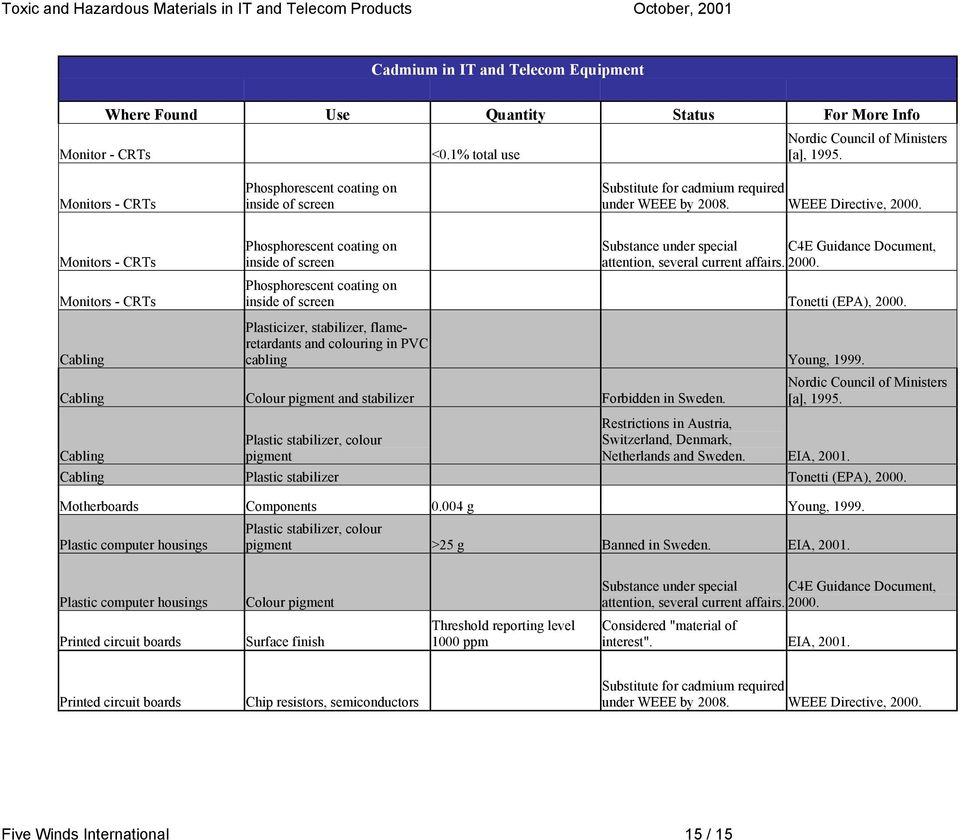
14 Cadmium A number of sources reviewed during this study reference the use of cadmium metal in IT and telecom equipment. Cadmium s use in electronic products is varied because of its attractive properties, including excellent corrosion resistance, low electrical resistance, good soldering characteristics, and solubility in strong acids (which facilitates the preparation of red, orange and yellow cadmium pigments for plastics). The most familiar use of cadmium is in nickel-cadmium (Ni-Cd) batteries; extensively used in earlier laptops, cell phones, etc. Ni-Cd batteries have since been replaced in most jurisdictions with either lithium-ion or metal-hydride batteries. Even though Ni-Cd batteries are being phased-out, older equipment containing Ni-Cd batteries still needs to be appropriately managed. Current uses of cadmium ranges from acting as a stabilizer in plastic components to being added to components as a colour pigment. Cadmium sulphide is used as a phosphorescent coating on the inside of fluorescent monitor screens in amounts between 5 and 10 grams per screen. Colour in a monitor screen is achieved using three electron guns, a shadow mask and the cadmium phosphorescent coating. Cadmium is also added to PVC plastic insulation of wires and cables as a plastic stabilizer and flame-retardant. Specific quantities of cadmium used in each component are difficult to find in the existing literature. The American Electronic Industry Association (EIA) considers cadmium a substance of concern and the WEEE Directive requires a substitute for cadmium in all uses by Cadmium in IT and Telecom Equipment Where Found Use Quantity Status For More Info PCs Plating applications (<0.01%) MCC as cited in EIA, PCs Plating applications in contacts and switches Tonetti (EPA), PCs Battery, emitter, housing, PWB, CRT % of total weight MCC, Batteries - laptop computers Power supply EIA, Nordic Council of Ministers Batteries - laptop computers Power supply [a], Batteries - laptop computers Power supply Substance under special C4E Guidance Document, attention, several current affairs Batteries - laptop computers Power supply (NiCd battery) Tonetti (EPA), Phosphorescent coating on Monitors - CRTs inside of screen 5-10 g/screen Young, Five Winds International 14 / 14

15 Cadmium in IT and Telecom Equipment Where Found Use Quantity Status For More Info Monitor - CRTs <0.1% total use Nordic Council of Ministers [a], Monitors - CRTs Phosphorescent coating on inside of screen Substitute for cadmium required under WEEE by WEEE Directive, Monitors - CRTs Monitors - CRTs Cabling Phosphorescent coating on inside of screen Substance under special C4E Guidance Document, attention, several current affairs Phosphorescent coating on inside of screen Tonetti (EPA), Plasticizer, stabilizer, flameretardants and colouring in PVC cabling Young, Cabling Colour pigment and stabilizer Forbidden in Sweden. Cabling Plastic stabilizer, colour pigment Restrictions in Austria, Switzerland, Denmark, Netherlands and Sweden. EIA, Nordic Council of Ministers [a], Cabling Plastic stabilizer Tonetti (EPA), Motherboards Components g Young, Plastic computer housings Plastic stabilizer, colour pigment >25 g Banned in Sweden. EIA, Plastic computer housings Colour pigment Printed circuit boards Surface finish Threshold reporting level 1000 ppm Substance under special C4E Guidance Document, attention, several current affairs Considered "material of interest". EIA, Printed circuit boards Chip resistors, semiconductors Substitute for cadmium required under WEEE by WEEE Directive, Five Winds International 15 / 15
16 Beryllium Beryllium metal offers a unique and incomparable combination of properties. It is one of the lightest structural materials available but is several times stronger than steel. It has excellent thermal conductivity, high electrical conductivity, good corrosion resistance, good fatigue resistance, high strength and good formability. Traditionally, copper-beryllium alloys were used in motherboards on personal computers. Beryllium is rarely used in this form anymore, but its use in combination with copper as an alloy is increasing. Beryllium improves the properties of copper contact springs because of its high strength, high conductivity and high elastic quality. Between 2-4% of these copper alloys is beryllium metal. Beryllium metal is sometimes overlooked as one of the components of concern in endof-life electronic equipment. Not a great deal of information is available on beryllium, as it has only recently been recognized as a potentially toxic or hazardous component in IT and telecom equipment. Beryllium in IT and Telecom Equipment Where Found Use Quantity Status For More Info Motherboards No longer used in motherboards. EIA, Motherboards Components 0.08 g Young, Motherboards Copper-beryllium alloy 2% beryllium Tonetti, (EPA) Connectors EIA, PBA (Printed Board Assembly) connectors PBA (Printed Board Assembly) connectors Contact springs, improve elasticity of copper alloy Contain 2-4% beryllium Use is slowly increasing. Contact springs, improve elasticity of copper alloy Threshold reporting level 1000 ppm Considered "material of interest". EIA, Nordic Council of Ministers [a], Finger clips Maintain electrical conductivity in metal housings EIA, PCs % total weight MCC, Monitors Components 0.05 g Young, Relays Improve properties of copper contact springs Young, Relays Improve properties of copper contact springs Nordic Council of Ministers [a], Relays High strength, high conductivity Substance under special C4E Guidance Document, attention, several current affairs Five Winds International 16 / 16

17 Beryllium in IT and Telecom Equipment Switches Where Found Use Quantity Status For More Info Nordic Council of Ministers [a], Switches Laser printers High strength, high conductivity Rotating mirror, lightweight rigidity for precision instrumentation Substance under special C4E Guidance Document, attention, several current affairs Substance under special attention. C4E Guidance Document, Five Winds International 17 / 17

18 Hexavalent Chromium (Cr VI) Very little information on the uses of hexavalent chromium in IT and telecom equipment exists in the literature that was reviewed. There is some consensus that chromium VI is typically used as a hardener or stabilizer for plastic housings and as a colorant in pigments. References to quantities of chromium VI in these components were poor. The use that is occurring seems to be in trace amounts, between 0.2 and 0.3 grams per component. As a colour pigment, the European Union is moving to restrict the use of chromium VI. Hexavalent chromium may also be present on the surface of metal parts that have been protected from corrosion with chromate conversion coatings no references to quantities of Cr VI present in this application were found. Chromium VI in IT and Telecom Equipment PCs PCs Where Found Use Quantity Status For More Info Decorative, hardener, housing, PWB % of total weight MCC, Anti-corrosion treatment Threshold reporting level 1000 ppm Considered "material of interest". EIA, Monitors Components 0.2 g Young, PCs & Monitors Packaging and packaging inks, colorant PCs & Monitors Colorant in pigments Banned in EU Packaging Directive (1994). EIA, Substance under special attention, RoHS Directive. C4E Guidance Document. Cabling Stabilizer, combined with PVC Young, Motherboards Components 0.3 g Young, Hard discs Hard disc plate, hardener Young, Five Winds International 18 / 18

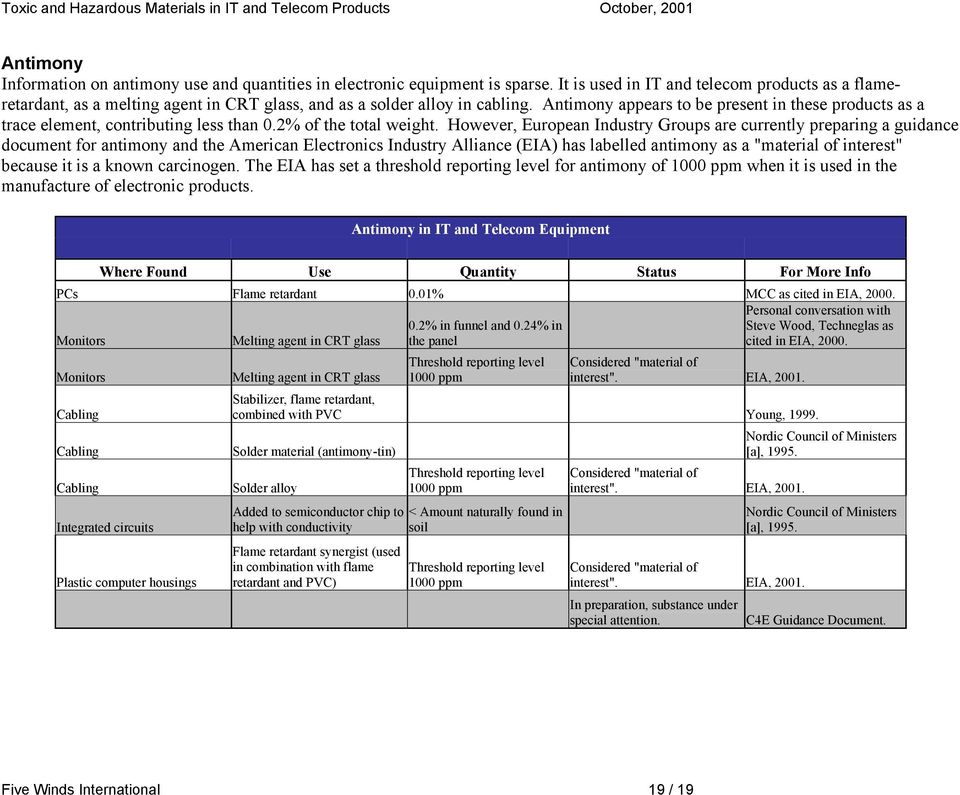
19 Antimony Information on antimony use and quantities in electronic equipment is sparse. It is used in IT and telecom products as a flameretardant, as a melting agent in CRT glass, and as a solder alloy in cabling. Antimony appears to be present in these products as a trace element, contributing less than 0.2% of the total weight. However, European Industry Groups are currently preparing a guidance document for antimony and the American Electronics Industry Alliance (EIA) has labelled antimony as a "material of interest" because it is a known carcinogen. The EIA has set a threshold reporting level for antimony of 1000 ppm when it is used in the manufacture of electronic products. Antimony in IT and Telecom Equipment Where Found Use Quantity Status For More Info PCs Flame retardant 0.01% MCC as cited in EIA, Personal conversation with Steve Wood, Techneglas as Monitors Melting agent in CRT glass cited in EIA, Monitors Melting agent in CRT glass 0.2% in funnel and 0.24% in the panel Threshold reporting level 1000 ppm Considered "material of interest". EIA, Cabling Stabilizer, flame retardant, combined with PVC Young, Nordic Council of Ministers Cabling Solder material (antimony-tin) [a], Cabling Integrated circuits Plastic computer housings Solder alloy Added to semiconductor chip to help with conductivity Flame retardant synergist (used in combination with flame retardant and PVC) Threshold reporting level 1000 ppm < Amount naturally found in soil Threshold reporting level 1000 ppm Considered "material of interest". EIA, Nordic Council of Ministers [a], Considered "material of interest". EIA, In preparation, substance under special attention. C4E Guidance Document. Five Winds International 19 / 19
20 Brominated Flame-Retardants Flame-retardants are found in the majority of IT and telecom products for fire safety requirements. They are incorporated into printed circuit boards, plastic computer housings, motherboards, keyboards and cables among other things to prevent the development or spread of fires. PBBs (or polybrominated biphenyls) and PBDEs (polybrominated diphenyl ethers), two types of brominated flameretardants, have been largely eliminated in several countries and replaced with TBBP-A (tetrabromobisphenol), a flame-retardant considered by some to be slightly less hazardous. TBBP-A is slated for full risk assessment as part of the EU s Fourth Priority Substances List process. Again the issue of proper management is still critical considering these flame-retardants will be present in many end-of-life products. The WEEE Directive requires substitution for both PBBs and PBDEs by Alternative flameretardants without bromine as an additive and designs with no flame-retardants are being implemented by several OEMs (see Chapter 5 for details). In terms of quantities of flame-retardants found in IT and telecom equipment, published research is quite poor. Some sources attempt to quantify the amounts but the numbers vary significantly from one to another. Brominated Flame-Retardants in IT and Telecom Equipment Where Found Use Quantity Status For More Info Largely eliminated 7-10 years Printed circuit boards (PBBs) Flame retardant ago. EIA, Printed circuit boards (TBBPAs) Flame retardant, additive or reactive Printed circuit boards (TBBPAs) Flame retardant 28.6 g Has partially replaced PBB and PBDE. Simon, Replacing PBDE although hasn't thoroughly been researched. Young, Nordic Council of Ministers Replacing PBDE. [a], Flame retardant, additive or Printed circuit boards (TBBPA) reactive 0.4kg/m2 of laminate, 17% TBBA Printed circuit boards Flame retardant, additive or (TBBPAs) reactive EIA, Printed circuit boards (PBBs) Flame retardant Printed circuit boards (TBBPAs) Printed circuit boards (PBBs & PBDEs) Flame retardant, additive or reactive Flame retardant, additive or reactive Only one PBB made in recent history, and production ceased in All others stopped in 1980's. EIA, Threshold reporting level 1000 ppm in any plastic part > 25 g EIA, Substitute required for PBBs and PBDEs under WEEE by WEEE Directive, Five Winds International 20 / 20

21 Brominated Flame-Retardants in IT and Telecom Equipment Where Found Use Quantity Status For More Info Printed circuit boards Flame retardant Tonetti (EPA), Plastic computer housings (PBDOs) Flame retardant EIA, Plastic computer housings (PBDEs) Flame retardant 500 g Use has declined in recent years. Young, Plastic computer housings (PBBs) Flame retardant, additive Simon, Plastic computer housings (PBDEs) Flame retardant, additive Simon, Plastic computer housings - ABS (PBDEs) Flame retardant Contains 25% PBDE After 1985, successive shift over to PVC which a good retardant due to high concentration of chlorine. Nordic Council of Ministers [a], Plastic computer housings (PBBs & PBDEs) Flame retardant, additive or reactive Substitute required for PBBs and PBDEs under WEEE by WEEE Directive, Motherboards (TBBPAs) Flame retardant 107 g Replacing PBDE. Young, Keyboard buttons (PBBs) Flame retardant, additive Simon, Connectors Cabling (PBBs & PBDEs) Flame retardant, additive or reactive Flame retardant, additive or reactive Substitute required for flame retardant under WEEE by WEEE Directive, Substitute required for PBBs and PBDEs under WEEE by WEEE Directive, Five Winds International 21 / 21
22 PolyVinyl Chloride PVC Many different types of plastics are used in the manufacture of electronic equipment. PVC, one of the major plastic polymers, appears to draw the most attention in literature focusing on potentially hazardous materials in electronics. This is probably because of the welldocumented risks of dioxin formation during the incineration of PVC material. The predominant use of PVC plastic in electronics is as a structural feature in plastic computer housings, keyboards and cables. PVC has good chemical resistance that original electronic equipment manufactures look for when designing durable products. Estimated quantities of PVC in different products range from 37.1 grams in a keyboard to a total of 314 grams in all of the cables connecting different component pieces together (for example the cables connecting the monitor, mouse and keyboard to the CPU). There are other factors that contribute to the potentially hazardous nature of PVC as a substance that needs to be managed with precaution at a product's end-of-life. Both chlorine and flame-retardants are often additives in the plastic manufacturing process and are added to cables and housings. It is extremely difficult to identify which types of plastics or flame-retardants are found in each component. This creates considerable difficulty when attempting to manage waste IT and telecom equipment. PVC in IT and Telecom Equipment Where Found Use Quantity Status For More Info Monitors EIA, Keyboards EIA, Keyboards Cable and plug 37.1 g Young, Cabling EIA, Cabling g Young, Cabling Good chemical resistance, used in protection mantle Good chemical resistance, used in protection mantle Nordic Council of Ministers [a], Threshold reporting level Cabling 1000 ppm EIA, Plastic computer housings Structural, cosmetic 23% by weight of PCs Young, Choking coils g Young, Cellular phone windows Plastic computer housings Good chemical resistance, used in protection mantle Structural, cosmetic Threshold reporting level 1000 ppm EIA, Threshold reporting level 1000 ppm EIA, In preparation, substance under special attention. C4E Guidance Document, Five Winds International 22 / 22
23 PolyChlorinated Biphenyls PCBs There is some uncertainty about where and when PCBs have been used in IT and telecom equipment. Some sources state that PCBs have never been used in PCs. Others refer to PCB use in old capacitors, while others cite PCB use as a possible flame-retardant in PVC plastic cables. Although no PCB quantities were located in the literature, it should still be regarded as a substance to manage with precaution at its end-of-life. It is likely that products containing PCBs are now obsolete, have already been disposed of or are currently being stored. PCBs in IT and Telecom Equipment Where Found Use Quantity Status For More Info Have never been used in PCs Capacitors (special) Capacitors Cabling Used for mains voltages and higher Forbidden in early 70s. Phase compensation of fluorescent tubes Flame retardant combined with PVC plastics Banned in U.S. and Sweden in MCC as cited in EIA, Not expected but historically used, "Controlled material" in the U.S. EIA, Nordic Council of Ministers [a], Nordic Council of Ministers [a], Five Winds International 23 / 23
24 3. Releases of Toxic and Hazardous Materials Many of the hazards associated with substances and materials in IT and Telecom equipment arise when the equipment reaches its end-of-life and is disassembled, recycled, incinerated or deposited in a landfill. This chapter presents information on the potential hazards from recycling, incinerating or landfilling wastes that contain toxic or hazardous substances and materials. Where possible, the information is specific to the IT and telecom components described in chapter 2 and these components are highlighted with boldface type. Other information is less specific and refers to releases from electrical and electronics waste in general. The information is organized in tables according to the substance of concern and the waste management option. Each table describes how a particular substance is released from the equipment at its end-of-life, provides relevant comments and directs the reader to sources for further information. This is similar to the organization of the data in chapter 2 of this study. As each substance behaves differently, it is necessary to consider for each type of equipment whether it is preferable to recycle, incinerate or deposit it to landfill. 3 When making this decision, it is important to recognize that both recycling and incineration still require that some fraction be deposited in a landfill and it is within these fractions that toxic or hazardous substances may be most concentrated. 4 Recycling Recycling in a broad sense is perceived as the preferable option for waste management. Recycling IT and telecom products to recover valuable components include manual disassembly, shredding, grinding, burning and melting (to reclaim plastics), solder melting, and metals processing. The substances examined in this study are reported as not being released from IT and telecom equipment during manual disassembly. During other recycling processes, toxic or hazardous substances are released and adverse impacts may be realized and even increased. One example is the formation of dioxins and furans when plastics containing bromine- or chlorinecompounds are heated for recycling. Recycling IT and telecom equipment appears to predominantly pose hazards in the occupational environment. Most well documented, are toxic or hazardous releases from cathode ray tubes and printed circuit boards. Metals and organics are released as fine particulate dusts and fumes during recycling when CRTs are crushed, PCBs are shredded, and when the residues are heated. In many cases, proper handling and controlled pre-treatment of IT and telecom wastes can minimize the hazards associated with these substances. For example, controlled breakage of waste fluorescent lamps and collection of mercury emissions will avoid uncontrolled breakage and emissions during transport to waste management facilities. Such precautionary measures help to ensure that recycling is actually the best option in terms of the product s life cycle impact. 3 Nordic Council of Ministers [b] Nordic Council of Ministers [b] Five Winds International 24 / 24
25 Incineration IT and telecom wastes, together with remnant fractions from recycling processes, may be incinerated to recover energy from the waste or to reduce the volume. 5 Incineration is paradoxical in nature. Incineration reduces the toxic or hazardous potential of some substances while increasing the toxic or hazardous potential of others, such as PVC. Incinerating IT and telecom waste concentrates substances, such as lead, in residues for value recovery or further management, yet incineration disperses other toxic or hazardous substances in the environment. 6 Toxic or hazardous air emissions are often attributed to incinerated electrical and electronic equipment. The most well referenced examples include historical air emissions of mercury and the more recently documented problem of dioxin and furan emissions when plastics containing halogens are incinerated (bromine and chlorine are two of the most common halogens incorporated into plastic). Compared with standard household wastes, electrical and electronic equipment contains significantly higher concentrations of bromine, lead and other metals. In one study, small white and brown goods 7 were responsible for 90 per cent of bromine in the bottom ash and fly ash residues. 8 Certain OECD countries have banned the incineration of electrical and electronic waste, 9 therefore making recycling a more favourable waste management option. If it is possible to use existing capacity, incineration appears economically preferable to landfilling because of the increased potential to recover rare metals and other materials of value. Plastics and CRTs from IT and telecom equipment appear to be the most well documented components releasing toxic or hazardous substances during incineration. Metals from CRTs and the dioxins and furans formed when plastics (PVC or BFR-treated plastic) are burned are the reasons for concern. Generally speaking, there are hazards associated with the incineration of IT and telecom wastes that stem from not understanding substance interactions or the effects of low dose exposure to many substances over time. Thus, calculating the risks associated with widely dispersing substances from IT and telecom wastes into the environment becomes laden with uncertainties. Deposition in a Landfill Landfilling Waste electrical and electronic equipment in general contribute significantly to the amount of heavy metals and halogenated substances in municipal waste streams. In landfills, negative environmental effects are associated both with deposited IT and telecom waste and with residues 5 The advantages and disadvantages of waste incineration are widely debated Incineration reduces the environmental hazards associated with some organic compounds, while increasing the hazardous nature of other compounds and dispersing them to air, water and soil. See Nordic Council of Ministers [b] 1995, p.21 for further discussion. 6 Incineration residues include: fly ash, bottom ash or slag and wastewater from acid flue gas cleaning, in addition to air emissions from the incineration stack. 7 In the Dutch Decree (1998) brown goods include sound equipment, image receiving equipment, computers, paper printing equipment, telecommunications equipment and electric and electronic charging equipment. 8 Dutch Decree These countries include Sweden, the Netherlands, and Switzerland. An incineration ban is also part of the WEEE Directive of the European Union (as cited in OECD, 2000). Five Winds International 25 / 25
26 deposited from the incineration of these wastes. Leaching and evaporation of heavy metals and other toxic or hazardous substances from the waste products pose significant problems. In addition, the variety of substances used in IT and telecom equipment will interact to exert synergistic effects, potentially increasing their release and magnifying their negative effects. 10 Metals from lamps in IT and telecom equipment are a well-referenced route for release of toxic or hazardous substances in landfills, namely lead and mercury. Plastics in cables and other components will also release cadmium, brominated flame-retardants and phthalates into landfill leachate. Research conducted to substantiate Europe s WEEE Directive indicates that this equipment is deposited in uncontrolled landfills to a significant extent in certain Member States. Even in controlled landfills, leaching of metals and other toxic or hazardous substances must be expected. 10 Nordic Council of Ministers [b] Five Winds International 26 / 26
27 Mercury The main concern with mercury during recycling of IT and telecom wastes appear to be emissions of the metal to air. In this form, it poses health hazards to workers. Of particular concern is the release of mercury when lamps are broken for recycling, though hazards can be minimised with proper controls. The incineration of IT and telecom wastes release mercury to the air. In Europe, an estimated 36 tonnes of mercury are emitted to the air each year from all waste incineration processes. 11 For mercury and all other toxic or hazardous substances, it is important to consider their interaction and the potential synergistic effects of the many substances in IT and telecom equipment. In landfills, it is well documented that mercury leaches from products into soil and groundwater and emits to air, where it transforms and is transported from the source. No information on the behaviour of mercury, from IT and telecom batteries, during waste management operations was collected during the course of this study. Recycling - Mercury in IT and Telecom Equipment Release Comment For more info Mercury may be released from glass when it is reclaimed and NEMA, processed to make new products. Crushing lamps releases mercury to the air. Mercury from products may be released to air during the recycling of products. With controls, mercury emitted to air during crushing operations can be collected. Lighting and electrical equipment contributed an estimated 11% to the total anthropogenic emissions of mercury to air in Europe in the mid 1990 s. NEMA, KemI Report no 10/97. KemI, Recycling the metal content of waste electrical & electronic equipment may generate dioxins and furans. WEEE DIRECTIVE, Riss, C4E WEEE Directive Five Winds International 27 / 27
28 Incineration - Mercury in IT and Telecom Equipment Release Comment For more info Without controls, incineration of lamps released 90% of the NEMA states lamps should not be incinerated. NEMA, contained mercury to the air in USA. Most incinerators should have controls in place by When incinerated, nearly all mercury in the waste leaves the furnace in the uncleaned flue gas (92%). For dry incineration plants, nearly all mercury in the waste is emitted to the air (75%). Nordic Council of Ministers [b] 1995 pp.41 Mercury contained in products may be emitted when they are incinerated. KemI, Landfilling - Mercury in IT and Telecom Equipment Release Comment For more info Mercury contained in products may volatilize from landfills. KemI, In landfills, metallic mercury and dimethylene mercury can vapourize (e.g. 1kg per year from a landfill in Sweden). Mercury will leach from devices, such as lamps and circuit breakers, when they are destroyed. Mercury is transported from landfills in soil and water, given its strong affinity for organic material. Nordic Council of Ministers [b] WEEE DIRECTIVE, WEEE DIRECTIVE, Nordic Council of Ministers [b] 1995 pp48. Uncontrolled landfill fires may emit metals. WEEE DIRECTIVE, Five Winds International 28 / 28
29 Lead Recycling Printed Circuit Boards and Cathode Ray Tubes from IT and telecom equipment pose the most well documented hazards. Lead is released from these components when heated as part of various recycling processes. Lead is released to air as dust or fumes, posing hazards to health and the environment. When IT and telecom wastes are incinerated, most of the lead they contain will be transferred to the slag (bottom ash) fraction. This fraction must then be treated as special waste and its use is governed by costly controls and regulations. A Dutch study determined that if small white and brown goods were not incinerated with the main waste stream the concentration of lead (and other metals) in the bottom ash would fall below the Dutch leaching requirements for lead and not need stringent control on its management. In landfills, lead will leach from CRTs and lead-solder. The acidic nature of landfill leachate may enhance the release of lead from components and the subsequent availability of lead for uptake to the environment. Recycling - Lead in IT and Telecom Equipment Release Comment For more info Lead is released as fumes from Printed Circuit Boards when PCBs are heated to soften the lead solder and remove chips. OECD, they are heated to harvest components. Lead is released as fine particulate dusts from Printed Circuit Boards if the board is burned or shredded. Melting lead solder in dismantling & recycling operations poses an array of potentially serious concerns. Leaded glass components, such as CRT televisions and monitors, may be separated and recycled to recover either the leaded glass (closed loop) or the lead metal (open loop). Dust containing lead is produced when workers break CRTs. Burning and shredding are common prior to smelting processes for reclaiming metal. OECD, Lead fumes are a danger to workers and the environment. OECD, While workers need protection from this dust, the glass need be broken into relatively small pieces before significant amounts of lead are released to the environment. C4E, OECD, If lead from CRTs is placed in a smelting process, most of the lead will remain in the slag from the process. OECD, To minimize the production of any dust, fume or vapour separation and recycling facilities should operate in accordance with relevant occupational and environmental legislation. C4E, Five Winds International 29 / 29
30 Recycling - Lead in IT and Telecom Equipment Release Comment For more info Lead is released in furnace exhaust emissions when Printed For details on control technologies, see OECD, OECD, Circuit Boards are burned, prior to smelting for metal recovery. Lead is released as lead oxide dust or fumes from CRTs and Printed Circuit Boards when processed at high temperatures. Risk from exposure to lead oxide is unlikely when working with leaded glass. Risk to the general public through air emissions and water discharges is low and no further action is recommended ( Preliminary Life Cycle Analysis for Pollution Prevention Assessment for Lead Solder, USEPA, 1992). OECD, C4E, Incineration - Lead in IT and Telecom Equipment Release Comment For more info Lead from CRTs or Printed Circuit Boards is released to air and ash fractions when incinerated. This ash must then be landfilled or may be used as a raw material (e.g. building & construction industry) depending on the lead concentration. OECD, 2000 Lead is more volatile in the presence of chlorine during incineration Lead should be phased out of use as a stabilizer in PVC by Nordic Council of Ministers [b] ENDS, March When waste that contains lead is incinerated, ca. 65% of the lead will end up in the incineration slag - 35% in the fly ash and flue gas and less than 1% will be released to air. Nordic Council of Ministers [b] Five Winds International 30 / 30
31 Landfilling - Lead in IT and Telecom Equipment Release Comment For more info Lead from lead-solder leaches from electronics in landfills. 4.4% of lead in landfill is from consumer electronics (not including NEMA, TV picture tubes). C4E, In the acidic groundwater of landfills, significant amounts of lead ions are dissolved from broken glass containing lead, e.g. cone glass from CRTs. In leaded glass, lead oxide is tightly bound in a glass matrix and is unavailable for uptake by the environment. Pollution from cone glass in landfills is "likely". Fleischer, et al., 1992 WEEE DIRECTIVE, 2000 Nordic Council of Ministers [b] Equipment containing leaded glass may be recycled or deposited to landfill. C4E, Lead in PVC "is not readily liberated during degradation". Lead is a standard stabiliser in PVC. EIA, Lead stabilisers are released from certain types of PVC cables that contain a combination of plasticizers. European Commission [b], In landfills, lead leaches from incineration ash. OECD, Leachate from landfills across the United States had lead concentrations below the maximum allowed limit (AWD Technologies Inc.). C4E, Five Winds International 31 / 31
32 Cadmium Recycling components that contain cadmium will release the cadmium to the air, where it becomes available for inhalation. Cadmium and cadmium oxide dust and fumes are emitted when plastics are burned, when metals are heated and when Printed Circuit Boards are shredded during metal recovery operations. In Europe, 16 tonnes of cadmium per year are emitted to air from incineration processes. In landfills, cadmium leaches from the plastics and batteries in IT and telecom equipment. Similar to other metals, cadmium also leaches from incineration residues that are landfilled. Recycling - Cadmium in IT and Telecom Equipment Release Comment For more info Cadmium oxide dust is released from plastic when it is burned. Plastic is burned prior to, or during, metal reclamation. OECD, Cadmium oxide dust or fume is released from Cd-plated metal contacts and switches, when processed at high temperatures. Breaking CRT screens, cadmium in phosphor coatings could pose inhalation hazards to workers in the breaking operations. e.g. in metal processing steps. OECD, OECD, Cadmium is released in fine particulate dusts from Printed Circuit Boards when they are burned or shredded. Burning and shredding are common prior to metal recovery processes. In some countries, certain products containing cadmium are restricted under regulations. 12 EC Directive 91/338/EEC. EC Directive 91/338/EEC. The Directive on Batteries and Accumulators (91/157/EEC) includes a ban on all batteries containing more than % Cd, beginning in This prohibition could eliminate NiCd batteries (in favour of NiMH and Li-ion batteries). C4E, Sweden, Denmark, Netherlands, Switzerland, Austria and Norway restricted certain cadmium products before the EC product restrictions on pigments, stabilizers and coatings. Now, cadmium and certain cadmium products are regulated under EC Directives 76/769/EEC, 91/338/EEC, 91/157/EEC and under The 1989 European Commission Action Programme on Cadmium. Five Winds International 32 / 32
33 Incineration - Cadmium in IT and Telecom Equipment Release Comment For more info Cadmium is emitted to air when computer monitors are OECD, incinerated. When incinerated, 79% of cadmium in the waste will be released to fly ash and flue gas cleaning residue, while 20% will be transferred to slag and 1% to air. Nordic Council of Ministers [b] Landfilling - Cadmium in IT and Telecom Equipment Release Comment For more info In landfills, cadmium is released from plastics, NiCd-batteries and from fly ash and slag incineration residues. Cadmium leaches from these sources. Leaching from deposited fly ash is higher than that from slag (bottom ash). Nordic Council of Ministers [b] Cadmium will tend to leach from incineration slag (bottom ash) into water at levels less than the maximum admissible concentrations for drinking water. Cadmium may leach into soil and groundwater. Resource Recovery Forum. Online WEEE Directive, In an OECD study, 90% of leachate samples from municipal solid waste landfills pass the WHO recommended cadmium drinking water standard of, even samples from 50-year old unlined landfill sites. C4E, Five Winds International 33 / 33
34 Beryllium Most recent studies on beryllium focus on its behaviour during recycling. This is partly because beryllium is not known to be toxic to the environment and because it has only recently been identified as a health hazard in IT and telecom equipment due to trends for recycling. Beryllium is most hazardous when inhaled as a dust or fume. Forms of beryllium are released when components are shredded and from copper-beryllium alloys when metals are heated. If an organization is aware of the risks of beryllium and manages or controls those risks appropriately, the risk to human health is small. However, if an organization is unaware of the risks, and takes no measures to control or manage the risks, the risk to human health can be quite serious 13. Noranda Inc. is currently in the process of documenting the risks of beryllium for its employees working at electronic recycling facilities. No information was found on the behaviour of beryllium in IT and telecom waste during incineration or landfilling processes. To some extent, it can be inferred that it behaves in a similar manner to other metals concentrating in incineration residues and mobilizing from products in landfill leachates. Recycling - Beryllium in IT and Telecom Equipment Release Comment For more info Operations generating airborne material, e.g. grinding or welding, require suitable air extraction and filtration (under Beryllium metal components should be segregated from equipment C4E, at end-of-life and returned to the supplier for recycling. existing workplace regulations). Beryllia components should not be passed through crushing and shredding operations without proper controls, due to the risk of dust generation. C4E, The greatest exposures to beryllium occur in the workplace (i.e., where it is mined, processed, or converted into alloys and Chemicals). Risk can only arise from airborne Be dust or fumes generated from the material. Beryllium from copper-beryllium alloys is released as beryllium oxide dust or fume during high temperature metal processing. USEPA, C4E, OECD, Beryllium metal scrap should not be re-melted without appropriate controls Beryllia ceramic components should be separated from equipment at end-of-life and returned to the supplier for recycling C4E, Thomas, Cindy, 2001: Personal Communication, Noranda Inc. May 3 rd, Five Winds International 34 / 34
35 Recycling - Beryllium in IT and Telecom Equipment Release Comment For more info Any operation (involving BeO), which could generate airborne material, e.g. grinding and polishing, laser cutting, high temperature heat treatment in moist atmospheres or handling of powder forms, requires suitable air extraction and ventilation C4E, Recycling of beryllium poses "small" health and human safety concerns if beryllium is airborne and inhaled. EIA, Beryllium was identified in 1995 by the Nordic Council of Ministers (1995 [b]) as requiring further assessment to determine the associated environmental impacts. Beryllium metal does not give off dust or fumes during application in electrical or electronic equipment. C4E, Incineration - Beryllium in IT and Telecom Equipment Release Comment For More Info Once products containing beryllium are incinerated, the Be (as Beryllium probably does not volatilize in incineration plants with an oxide or sulphur) is mainly transferred to the slag from incineration processes. grate furnace technologies. 14 Tillman, During the course of this study, no information was gathered on the release of beryllium from IT and telecom equipment in landfills. 14 These technologies are described further in Environmental Consequences of Incineration and Landfilling of Waste from Electr(on)ic Equipment, a document by the Nordic Council of Ministers [b] 1995, p.19. Five Winds International 35 / 35
36 Hexavalent Chromium (Cr VI) Studies show hexavalent chromium (Cr VI) is transferred to incineration residues. In landfills, chromium VI leaches from incineration residues and directly from products. Chapter 2 documents that the hexavalent form of chromium is used in the plastics of personal computers, cabling and packaging for IT and telecom equipment. Thus, these sources contribute to the chromium VI that is released to air, soil and water from incineration and landfill reactions. No specific information was found on the release of hexavalent chromium during recycling of IT and telecom equipment during the course of this study. Incineration - Chromium VI in IT and Telecom Equipment Release Comment For more info When incinerated, 90% of chromium in the waste will be contained in the final slag - less than 1% will be released to air and 10% to fly ash and flue gas cleaning residue. Nordic Council of Ministers [b] Chromium VI will evaporate from fly ash. WEEE DIRECTIVE, Soil contaminated with fly ash from incinerated hexavalent chromium, is highly toxic. Recycling Council of Ontario, Landfilling - Chromium VI in IT and Telecom Equipment Release Comment For more info Chromium easily leaches from landfills that are not "appropriately" WEEE DIRECTIVE, sealed. Chromium VI is easily soluble in fly ash that is deposited in landfills. Chromium and chlorine together exhibit increased toxicity synergistic effects. WEEE DIRECTIVE, Nordic Council of Ministers [b] Five Winds International 36 / 36
37 Antimony There appears to be little documentation on the behaviour of antimony during recycling, incineration and landfilling of IT and telecom equipment. A study by Tillman (1994) as cited in a report by the Nordic Council of Ministers (1995 [b]), measures the antimony transferred from incinerated products to incineration residues. However, the ratio of various product types in the waste composition is not stated. Recycling - Antimony in IT and Telecom Equipment Release Comment For more info Occupational exposure to antimony dust or contact with skin may USEPA, occur when processing antimony metal. Incineration - Antimony in IT and Telecom Equipment Release Comment For more info Without acid flue gas cleaning, 40% of Antimony from the waste is released in incineration slag, 58% in the fly ash and 2% is released in the incinerator shaft. Tillman, Antimony trioxide is a combustion product of Antimony Nordic Council of Ministers [b] No information was gathered on how antimony behaves, or is released from, IT and telecom equipment in landfills. Five Winds International 37 / 37
38 Brominated Flame-Retardants Specific information on releases of brominated flame-retardants from printed circuit boards and connectors was not available. Measurements in the table indicate that brominated flame-retardants are released from waste, from plastic and more specifically in some cases, from electrical and electronics waste. Brominated flame-retardants will release from plastics differently, depending on whether they are additives or are reacted into the plastic. In IT and telecom equipment, additive flame-retardants in printed circuit boards (PBDEs and TBBP-A), computer housings (PBBs), keyboard buttons, connectors and cabling pose the most significant hazard to workers during recycling processes. Bromine from incinerated, flame-retarded plastic will be present in incineration residues. Better documented is the evidence that incineration of plastics including brominated flame-retardants will produce toxic or hazardous dibenzo-dioxins and furans. The brominated flame-retardant groups PBDE and PBB are soluble in landfill leachate, particularly when used as additive flame-retardants in products. They will also volatilize from waste in landfills (e.g. PBDEs). Recycling - Brominated Flame-Retardants in IT and Telecom Equipment Release Comment For more info Bromine is released from plastic treated with brominated flameretardant during plastics extrusion to produce dibenzo-dioxins and This is due to the heating involved in the extrusion processes. OECD, furans. Extrusion processes during recycling of plastics treated with BFR lead to the formation of polybrominated dibenzo-dioxins and - furans. Dust containing PBDE is released from electrical and electronic equipment into the air during recycling. This has led to high concentrations of PBDE measured in the blood of recycling plant employees Partly for this reason, the German chemical industry stopped producing PBDEs in This has lead to high concentrations of PBDE measured in the blood of recycling plant employees. Recyclers usually do not recycle flame-retarded plastics, given the risks of generating dioxins and furans. Most recyclers do not process any plastic from waste ELECTRICAL & ELECTRONIC equipment because it is hard to properly distinguish flame-retarded plastic. Penta-, octa- or deca-brominated diphenylether are used in combination with antimony trioxide WEEE DIRECTIVE, Brenner, Sellström, WEEE DIRECTIVE, Brenner, Danish EPA, Sjödin et. al ENDS Report, Five Winds International 38 / 38
39 Recycling - Brominated Flame-Retardants in IT and Telecom Equipment Release Comment For more info When recycled, plastic is shredded and ground into flakes. These processes produce dust-containing plastics, which can damage lungs when inhaled. Taberman et.al Certain monomers in the plastic will evaporate during the shredding and grinding of plastics, posing ecotoxicity and human toxicity risks. Plastic is burned during metal recovery - dibenzo-dioxins and - furans are produced when BFR treated plastic is burned. Wastewater from plastics recycling processes is often discharged directly to sewers. Waste dumps are one of two principle point sources of PBB to the aquatic environment. Release from factory adding TBBP-A to products = 50 ng/g measured upstream and 430 ng/g measured downstream Taberman et.al OECD, Taberman et.al WEEE Directive, KemI PM nr 10/95. Incineration - Brominated Flame-Retardants in IT and Telecom Equipment Release Comment For more info When incinerated, bromine from brominated flame-retarded plastics will occur in the fly ash (as HBr and as bromide). Nordic Council of Ministers [b] 1995 pp.42 Incineration of products A18at C may generate polybrominated dibenzodioxins and dibenzofurans (at 800 C, 0.16% dibenzo- dioxins and furans are formed). Copper acts as a catalyst when flame-retardants are incinerated, increasing the risk of formation of dioxins. KemI PM nr 10/95. Schacht, SweEPA. During combustion, bromine from flame-retarded plastics forms dibenzo-dioxins and -furans. Bromine combines with carbon and hydrogen. OECD, Five Winds International 39 / 39
40 Incineration - Brominated Flame-Retardants in IT and Telecom Equipment Release Comment For more info TBBP-A has partially replaced PBB and PBDE. TBBP-A is slated for full risk assessment by the EU in the EU s Fourth Priority Substances List. Simon. A KemI state a need to identify hazards of waste deposits and burning of products treated with TBBP-A or products with TBBP-A incorporated. 15 KemI PM nr 10/95. TBBP-A is "not considered hazardous" when used as a EIA, reactive intermediate in plastic. 16 Landfilling - Brominated Flame-Retardants in IT and Telecom Equipment Release Comment For more info PBBs have measured 200 times more soluble in landfill WEEE DIRECTIVE, leachate than in distilled water. 17 In landfills, brominated flame-retardants leach from plastics and other materials and can spread. BFRs are also spread by volatilization from landfills. As a reactive flame-retardant, TBBP-A is unlikely to leach from products thus production facilities are greatest source of exposure Uncontrolled burning in landfills can emit dioxins, furans such as tetrachlorodibenzodioxin and polychlorinated and polybrominated dioxins and furans due to halogenated materials in the waste. PBDEs may leach into the soil and groundwater. Nordic Council of Ministers [b] WEEE DIRECTIVE, KemI PM nr 10/95. WEEE DIRECTIVE, TBBP-A has partially replaced PBB and PBDE (Simon, 1999). TBBP-A is slated for full risk assessment by the European Union. 16 TBBP-A is used in acrylonitrile butadiene styrene plastic (ABS) as an additive flame-retardant. ABS makes ca % of the plastic in a personal computer, according to EIA, PBBs are no longer produced, though they are a potential problem in equipment made prior to 2000 (Simon, 1999). Five Winds International 40 / 40
41 PolyVinyl Chloride PVC PVC plastics will release dioxins and furans during recycling processes and will generate dusts and fumes hazardous to workers when heated and shredded. For these reasons, very little PVC is recycled. In fact, only a small fraction of any plastic from electrical and electronic equipment is properly recycled. This is because different types of plastic are not clearly marked and recyclers want to avoid the risk of handling PVC. In certain applications, PVC will contain chloro-paraffins, poly-chlorinated biphenyl and other phthalates that are released during shredding and heating and pose potential hazards to recycling workers and the environment. The most well referenced information on PVCs document the production of dioxins and furans when it is incinerated. Within certain temperature ranges, the production of these compounds can be reduced. Incinerating PVC will also release chlorine to the air and in incineration residues. Specific to IT and telecom equipment, phthalates from PVC cabling will migrate from landfills. Recycling - PVC in IT and Telecom Equipment Release Comment For more info Chlorine from PVC will form dibenzo-dioxins and furans during OECD, plastics extrusion processes. PVC insulation on power cords has been removed by burning, sometimes in uncontrolled combustion. Incomplete burning will emit particles and dibenzo-dioxins and -furans in exhaust emissions. Recycling PVC containing heavy metals can lead to dilution of heavy metals into new products. PVC insulated electrical wire should be separated from personal computers during dismantling, when accessible. PVC in cable insulation contains chloro-paraffins. PVC can also contain polychlorinated biphenyl, a softener. PVC may also contain PCBs, as well as lead and cadmium as pigments or stabilizers Plastics recycling is limited because 1) many different resins are used in each type of equipment, 2) plastics are not clearly labelled by type, and 3) halogens in the plastic require protection measures for humans and the environment if plastics are shredded or heated. OECD, Nordic Council of Ministers [b] OECD, European Commission [b], Very little PVC waste, in particular waste electrical & electronic equipment is currently recycled. (approx. 20% of plastic in electrical & electronic equipment is PVC) WEEE DIRECTIVE, DG XI, Rohr, Five Winds International 41 / 41
42 Incineration - PVC in IT and Telecom Equipment Release Comment For more info Substantial evidence indicates PVC is not suitable for In particular, the quantity and toxic or hazardous nature WEEE DIRECTIVE, incineration. of flue gas residues generated from incineration of PVC. Danish EPA, Residues from incineration of PVC contain heavy metals and dioxins. Chlorine is released from PVC insulation during waste incineration and will form dibenzo-dioxins and furans. Combustion of plastics is not 100% effective small amounts of polycyclic aromatic hydrocarbons, dioxins and other decomposition products will be emitted End-of-pipe solutions to address this residue are less preferable than preventive measures that reduce the quantities of residues generated. European Commission [b], OECD, Nordic Council of Ministers [b] Concerns about dioxin formation from PVC due to incineration of obsolete personal computers "appear to be unfounded". Chlorine from waste in a wet incineration process is emitted mainly in wastewater (50%) and fly ash and sludge (38%) EIA, Nordic Council of Ministers [b] In dry incineration, chlorine from waste is released in fly ash and acid flue gas cleaning residue (60%), to air (30%) and in slag (10%) Nordic Council of Ministers [b] Landfilling - PVC in IT and Telecom Equipment Release Comment For more info Phthalates in landfilled cables migrate and are emitted. KemI Report no 4/97, DG ENV, PVC should be marked and separated out of the waste stream. This is stated in a recent draft resolution from the European Parliament Environment Committee ENDS, March Five Winds International 42 / 42
43 PolyChlorinated Biphenlys PCBs PCBs have been well recognized as a hazard to human health and to the environment for more than two decades. As IT and telecom equipment included in this study are relatively recent technologies, sources indicate that PCBs are not found in this equipment. During this study, one reference documents PCBs in capacitors and cites it as a risk for contamination of recycling residues. Given the chemical nature of PCBs, shredding and heating components that contain PCBs likely pose hazards to recycling workers in the occupational environment. When incinerated, PCBs will potentially form dioxins and furans. In landfills, PCBs will leach from products, such as circuit breakers. Components that contain PCBs will also be a source of dioxins and furans in unintentional, uncontrolled landfill fires. Recycling - PCBs in IT and Telecom Equipment Release Comment For more info PCBs, e.g. from capacitors, may remain in recovered materials and in shredder waste. 18 This will contain contaminated shredder wastes and must WEEE DIRECTIVE, be handled as dangerous (i.e. hazardous) waste that is more costly to process. Incineration - PCBs in IT and Telecom Equipment Release Comment For more info PCBs may be released to the air from incineration of wastes USEPA, containing PCBs. Uncontrolled incineration of PCBs produces dioxins and furans (polychlorinated and polybrominated dioxins and furans). WEEE DIRECTIVE, PCBs were historically used in capacitors. According to an EIA publication (2000), capacitors are not part of personal computers and thus, risk from PCBs are not an issue when the PCs become waste. Alternatively, an OECD document states capacitors, that may contain PCBs, are components of personal computers (OECD, 2000). Five Winds International 43 / 43
44 Landfilling - PCBs in IT and Telecom Equipment Release Comment For more info PCBs may leach when devices containing them, e.g. circuit WEEE DIRECTIVE, breakers, are destroyed PCBs may be released to the air from disposal sites containing capacitors (and other PCB wastes). USEPA, Uncontrolled landfill fires may emit dioxins, furans such as tetrachlorodibenzodioxin and polychlorinated and polybrominated dioxins and furans WEEE DIRECTIVE, Five Winds International 44 / 44
45 Substances in IT and telecom equipment may not exert negative environmental effects until their end-of-life stage, when the equipment is disassembled, recycled, incinerated or deposited in a landfill. At this stage, the potential toxic or hazardous effects of substances must be addressed. This will involve detailed studies, risk assessments, control technologies, containment facilities and monitoring and reporting activities. The opportunity to avoid these hazards and the associated costs arises at a much earlier stage at the stage of equipment design, when materials and technologies are developed and chosen. Investing research efforts and resources at the product development stage will have the greatest influence and offer the widest scope to identify improvements. A waste management strategy should aim to avoid waste and the costs associated with it. Given the accumulation of obsolete IT and telecom waste, choices must be made about recycling, incinerating and landfilling the various components. However, investing in an infrastructure based on this backlog may create a system that relies on a steady flow of waste. A management scheme dealing with the accumulated IT and telecom waste should be linked to a scheme that provides continuous incentive for waste avoidance. Five Winds International 45 / 45
46 4. OEM Initiatives to Reduce Toxic or Hazardous Materials Many Original Equipment Manufacturers ( OEMs ) in the IT and Telecom sector have initiated policies, management systems, programs and tools to reduce or eliminate toxic or hazardous materials from their products some examples of these initiatives are shown in Table 1. Details of these initiatives are discussed below, in sections organized alphabetically by OEM. Table 1: Example OEM Initiatives to Manage or Eliminate Toxic or Hazardous Substances from Products Type of Initiative Examples of Use Example OEMs Strategy or Policy Policy to eliminate Lead by 2002 Fujitsu Management Integrating product objectives into Environmental IBM System Management Systems Product Stewardship Organization HP Program Design for Environment (DfE) Apple, Compaq, IBM, Motorola, Philips, Sony Supply Chain Management Ericsson, Motorola, Sony DfE Tools (e.g. Green Design Advisor) Motorola Tool Product Declarations, Product Environmental Profiles Apple, HP, IBM Banned & Restricted Materials Lists 19 Ericsson, Motorola, Sony Supplier Self Assessments Ericsson As a result of these initiatives and other factors, several toxic or hazardous materials are banned or restricted by IT and Telecom OEMs. Table 2 shows the status of the toxic or hazardous materials examined in this study at ten OEMs. A blank entry in Table 2 should not be interpreted as indicating a particular OEM is not concerned about that specific substance only that no data concerning how that OEM treats the substance was available for this study. Table 2: Status of Some Toxic or Hazardous Materials at Selected OEMs Legend X = Banned or Scheduled Ban R = Restricted or Reportable S = Suspected or Watched Apple Compaq Ericsson Fujitsu Hewlett- Packard IBM Matsushita (Panasonic) Substance Mercury or its compounds X R R R X X Lead or its compounds S S X X S R X R S X Cadmium or its compounds X R R R X X Beryllium or its compounds X R R Hexavalent Chromium R R R R Antimony or its compounds R R R Brominated Flame Retardants R R X R R S R S R R Polyvinyl Chloride (PVC) R S R R X Polychlorinated Biphenyls (PCBs) X X X X Source: Company publications; Five Winds International Motorola Philips Sony 19 These lists are sometimes known as black and grey lists, particularly in the automotive sector. This report uses the terminology banned and restricted, which is more common in the electronics sector. Five Winds International 46 / 46
47 This chapter examines examples of initiatives to reduce or eliminate toxic or hazardous materials from products by ten IT and telecom OEMs. Brief case study examples for several products are also included. The information presented in this chapter represents some examples of these initiatives it is not an exhaustive list of all such initiatives by the ten OEMs included, nor does it include all OEMs active in this area. Unless otherwise referenced, information comes from published company sources (e.g. web sites, environmental reports). The priority focus concerning toxic or hazardous materials by OEMs examined in this study is the elimination of lead solder and brominated flame-retardants. The EU WEEE Directive targets both of these substances for elimination (with certain exceptions) and significant progress has been made identifying and implementing alternatives. For example, the results of a major international study on halogen-free flame-retardants are shown below and the status of lead-free solder at selected Japanese OEMs is shown in Table 3. The International Project on Flame-Retardancy in Electronics Conceptual Study Between 1997 and 1999, The Swedish Institute of Production Engineering Research (IVF), in cooperation with twelve major European and Japanese product manufacturers and material suppliers, carried out a comprehensive study of state-of-the-art halogen-free flame-retardants and design for flameretardancy. The conclusions of the study are shown below. 1. There is a trend towards halogen-free alternatives. An increasing number of actions are being taken by companies as well as society. 2. The issue of going halogen-free was first raised in Europe, but Japanese companies are responding to this issue faster than European companies. 3. Corporate initiatives are becoming a major driving force. 4. A wide range of bromine-free materials is available on the market meeting the UL94V-O 1 requirement. These materials look promising but there is a lack of data enabling a full assessment particularly concerning environmental performance. 5. Halogen-free materials are available for all levels of a product, from enclosures down to printed circuit board laminates and integrated circuit (IC) encapsulants. However, the supply of halogenfree laminates and in particular IC encapsulants is limited. 6. There are great opportunities in design for halogen-free, i.e. to reduce or eliminate the need for halogenated and other flame retardants by design measures The shift towards halogen-free creates market and business opportunities. The key issue is probably to choose the right timing and corporate procedure (i.e. what to do with whom). 8. There are no liability hindrances to a shift to halogen-free as long as flame-retardancy requirements are met. 9. Halogen-free or bromine-free may come to be perceived as an added value by the market in the future. Source: IVF, 1999, as cited in Bergendahl, A commonly used industry flammability standard. 2 For example, see the Apple Computer Power Mac G4 example discussed below. Five Winds International 47 / 47
48 Table 3: Status of Lead-Free Solder at Selected Japanese OEMs OEM Products using Lead-Free Solder Timing Fujitsu High End Servers Oct All new products Dec Hitachi Video cameras, Vacuum cleaners, Washing machines Spring 1999 All new products Mar Matsushita Optical disk drivers Nov (Panasonic) Mini Disks Sept All new products Mar NEC Pagers Dec Notebook PCs Oct All new products Dec Sony Video cameras Mar All new products Mar Source: Suga, University of Tokyo, 2000 Apple Computer Apple Computer recognizes the importance of environmental attributes in electronic products, and considers their products environmental performance to be a customer, market-driven issue. Environmental attributes (including the use of hazardous materials) are considered to be integral parts of the product s attributes during its design and development. For example, the design of the Power Mac G4 desktop computer released in the fall of 1999 incorporated a number of environmental innovations. In the Power Mac G4, the use of an inner sheet metal chassis design ensured that product safety fire enclosure requirements were met, and therefore the polycarbonate resin panels did not need to contain any flame retardant chemicals (such as halogenated flame retardants). 20 Apple publishes environmental profiles for several of its products using Apple s Product Environmental Specifications (APES). APES is a work-in-progress compilation of environmental attributes from various regional, country, and industry association product environmental criteria. It includes legislative and voluntary criteria from ECMA (European Computer Manufacturers Association), SITO (Swedish IT and Telecom Organization), Blue Angel (the German eco label), ENERGY STAR (U.S. energy efficiency eco label), and TCO (Swedish Confederation of Professional Employees). Section 3 of APES addresses hazardous materials used in products and includes declarations concerning mercury, lead, cadmium, brominated flame retardants and other materials that have been banned or restricted by legislation or eco labels. Apple has compiled the APES list of environmental attributes to guide product development and for use as environmental metrics. In addition to its use by product development teams, Apple uses APES to provide environmental specifications for their customers who have specific questions, needs, or concerns. 20 Sweatman et al., Five Winds International 48 / 48
49 Compaq Compaq focuses on environmental stewardship during every phase of the product life cycle. When Compaq engineers begin the design of a computer, they consider the environmental impact of component parts and their readiness to be recycled when the computer is no longer useful. Formalized in 1994, DfE Guidelines have been developed for use across Compaq product lines on a worldwide scale. They emphasize several key principles: Energy Conservation, Disassembly, Reuse and Recyclability, Low Impact Packaging, and Upgradeability. Compaq integrates numerous features into the design and manufacture of its products in an effort to reduce environmental impact over the life cycle. In Europe, two eco-labels recognize the company s production of environmentally sound products. In Germany, Compaq has received the Blue Angel eco-label and in Sweden the TCO 95 designation. These programs identify products that are environmentally friendly, recyclable and easily serviced. Compaq s commercial desktop product families are certified with the German Blue Angel eco-label. In the area of SCM, Compaq has developed a supplier development process to manage their supply chain. The suppliers are given a questionnaire to fill in information about their policy and commitment, compliance history, processes and assessment, their suppliers, CFCs and other hazardous materials, and their waste minimization initiatives. In terms of material specification, the suppliers policies must meet or exceed regulations. Compaq s environment health and safety criteria are used to track compliance on parts and purchasing contracts. Compaq monitors banned or restricted chemicals, materials, and substances globally and maintains a restricted material specification enabling them to meet at a minimum the strictest regulation in the countries where they do business. They have eliminated the use of brominated and chlorinated flame-retardants from the housing plastics in their products. Compaq uses purchasing and product specifications to control the types of materials used to manufacture their products. Ericsson In their 2000 Environmental report, Ericsson states eight environmental goals; three concern toxic or hazardous materials in products: Use lead-free solder in 80 percent of new products from 2002, Eliminate halogenated flame-retardants in printed circuit boards in 80 percent of new products from 2002, and Eliminate the use of beryllium oxide in new products from Concerns about toxicity and health hazards have led Ericsson to commit to using lead-free solder in 80 percent of their new products by In March 2000, a lead-free solder project was started to develop and release a production process for lead-free solder on printed circuit Five Winds International 49 / 49
50 board assemblies, and to ensure the reliability of lead-free interconnections. The alternative currently being tested is an alloy of tin, silver and copper. This has a higher melting temperature than the current tin/lead solder alloy, and requires modifications to components and the production process. Ericsson has been running lead-free tests since 1998 and high-volume verification tests are scheduled for June In partnership with universities and other institutions, Ericsson is investigating the metallurgic effects of different types of solder and surface finishes on components and printed boards. The high-temperature soldering process required for Ericsson s lead-free solder places new requirements on components, and hence on their suppliers. Ericsson has conducted seminars with suppliers and their own purchasing organization to highlight the new requirements. They have also surveyed 100 of their suppliers regarding their ability to deliver these components (see box Ericsson s Green Component Letter to Suppliers ), and several have been selected for future cooperation on this issue. The ability of suppliers to supply components that can withstand the higher temperature profile of the lead-free soldering system will help determine if Ericsson can meet its lead-free goal. Ericsson believes that brominated flame-retardants constitute an ecological threat serious enough to initiate a project to replace them with nitrogen-phosphorous compounds or inorganic compounds. Ten suppliers of halogen-free materials for printed circuit boards have been evaluated. Working closely with suppliers, Ericsson is carrying out beta testing on halogen-free printed circuit board materials. For many of the halogen-free alternatives, the production yield has actually been increased compared with using traditional materials. Ericsson claims to be on target to meet their stated goal of eliminating halogenated flame-retardants in printed circuit boards in 80 percent of new products from According to Ericsson, fulfilling this goal is dependent on the availability and price of halogen-free materials. Ericsson states beryllium oxide is known to constitute a health hazard similar to that of asbestos. Although most Ericsson products have never used beryllium oxide, a few products have components containing beryllium oxide. These will be replaced in all new products with alternative techniques or components. For example, the RBS 2401 GSM radio base station (part of the telecom network infrastructure for mobile telephones) is beryllium oxide-free. Prototypes of other beryllium oxide-free products are being manufactured and will soon be undergoing tests, in preparation for Ericsson s goal of eliminating beryllium oxide in new products from 2001 onwards. In addition to the above initiatives, Ericsson has developed lists of banned and restricted substances (see Appendix 2) to meet laws and legislation or anticipated laws and legislation in the countries they operate in. These lists specify the chemical substances that are generally banned from Ericsson s products and operations. Ericsson s product managers, product design functions, purchasing functions and suppliers are responsible for compliance with these lists. The banned and restricted substances apply to all Ericsson products, and to products that Ericsson purchases from its suppliers; hence they apply to everything ranging from electronics to office furniture. Additional lists cover the production processes used to make Ericsson s products. According to Ericsson, banned substances shall under no circumstances be present, Five Winds International 50 / 50
51 not even in low concentrations, [whereas] restricted substances shall be phased out as soon as possible and replaced with technically and economically acceptable alternatives. The focus of Ericsson s ban and the restriction are on the deliberate use of the listed substances. The ban or restriction does not apply in cases where a substance is present, in very small concentrations, from natural contamination. Ericsson s Green Component Letter to Suppliers Dear Ericsson Supplier, May 04, 2000 The development and commercialization of environmentally responsible products continues to be a key emphasis for the telecommunication industry, driving the need for environmentally friendly materials such as bromine free laminates and non-lead solders in printed circuit boards. This industry demand has been driven by several factors. Proposed legislation in the EU as well as public sentiment and concerns over the risks associated with these types of materials continues to fuel the need for solutions, and has generated a market need to provide consumers with green alternatives. Because of increasing market demands and the impending environmental legislation, there are new Ericsson directives, stating: Use lead-free solder in 80 % of our new products by the end of 2001 Eliminate by the end of 2001 the use of the following substances: o Halogenated flame retardants, in 80 % or our new printed boards o Beryllium oxide, in 100 % of our new products The chosen lead-free soldering processes under consideration by Ericsson will significantly increase the temperature requirements of components. This letter in turn is an attempt to initially determine where you as a key supplier to Ericsson are in relation to this directive. In order to help determine this, there are three areas we would like for you to review and report on concerning the make up of the components you supply to Ericsson. Can your components be used with the required solder paste/process year 2001? What is the temperature profile of your components (Initial)? What is the repair process temperature profile of your components (Rework)? Do the components you supply to Ericsson contain lead, halogens or beryllium oxide? If so, are there any plans to eliminate these materials? Please find attached a technical requirement specification, which explains in more detail the type of information we require. We appreciate your cooperation and would be grateful for a reply before June 9 th. If you have any questions, please contact Gunnar Löfquist, project manager, , [email protected]. Best regards, Telefonaktiebolaget LM Ericsson Corporate Sourcing Bo Westerberg Vice President Five Winds International 51 / 51
52 Fujitsu Adoption of Internal Hazardous Materials Standard Fujitsu has a voluntary internal standard banning or restricting the use of a variety of hazardous materials in its products. Examples of banned and restricted materials are shown below. Banned materials: PCB, asbestos, Polychlorinated Naphthalene, CFCs, specified halons, carbon tetrachloride, etc. (30 substances in total) Restricted materials: Cadmium, hexavalent chromium, arsenic, mercury, selenium, lead, HCFCs, HFCs, halogenated compounds, etc. (155 substances in total) Since 1996, Fujitsu has applied an internal design standard to assess the environmental attributes of all new products. This product environmental assessment covers 40 criteria, including the use of banned or restricted materials. To comply with Fujitsu s internal green products standard, the product or packaging materials must not contain internally restricted hazardous materials. Between 1996 and 1999, 1294 products were assessed, and 141 passed the standard. In 1999, 96 models passed the standard, including: Desktop PCs 33 models Notebook computers 22 models Cathode-ray tube/liquid crystal displays 12 models Page printers 5 models Point-of-sale terminals 4 models Network equipment 2 models ATMs 4 models IA servers 4 models Scanners 3 models Mobile telephones 2 models Small magnetic disks 2 models Opto-magnetic disks 2 models Workstations 1 models Total 96 models Fujitsu has a policy (see below) and targets to reduce and eventually eliminate the use of lead: Starting October 2000, the entire LSI [semiconductor] products will be made lead-free. Starting December 2001, lead-free solder will be adopted for ½ of the entire printed circuit board production. Starting December 2002, the complete elimination of lead will be targeted. Five Winds International 52 / 52
53 Fujitsu's Policy to Reduce the Use of Lead Mar 21,2000 FUJITSU LIMITED Environmental Engineering Center With a view to eliminating completely the use of lead, a polluting substance of environment, from our products, we have decided our policy to reduce the use of lead step by step. Now, we are going to promote our activities for the reduction of lead in line with this policy. Background Lead is a toxic substance that may cause serious anemia or mental disorder and is therefore regarded as polluting substance of our environment. The soldering material used for electronic equipment is in most cases an alloy of tin and lead. When this alloy comes into contact with water, the lead dissolves away and if this water is acidic (ph is 3 or less), the amount of such dissolution increases extremely. If the acid rain, which is of great problem in recent years, gets into contact with disposed electronic equipment, the contamination might be aggravated further. At the present moment, the use of lead is not regulated actually because too urgent restriction of the use of tin-lead soldering material could cause a great impact to the entire economic activities. However, the reduction of lead in the electronic equipment is certainly an issue we cannot avoid from the viewpoint of protecting global environment. We have so far developed, jointly with Fujitsu Laboratories Ltd., 2 kinds of lead-free soldering material for assembly of printed circuit board and for assembly of parts. This material was adopted as the soldering material for the assembly of Global Server [GS8900] (released on October 18, 1999). As shown in this example, we are making effort for the reduction of the use of lead in manufacturing. Our policy for the reduction of lead We are planning to reduce step by step the use of lead in the products produced by us as shown below. The use of lead has to be eliminated also in the process of manufacturing parts and components by outside companies other than Fujitsu. Accordingly, we are planning to specify in future the use of lead-free soldering material as our standard to request our parts suppliers their understanding and cooperation. (1) Starting October 2000, the entire LSI products will be made lead-free. For entire LSI products produced by electronic devices sector, the use of the solder material containing lead will be reduced completely by plating lead-free solder. (2) Starting December 2001, lead-free solder will be adopted for one half of the entire printed circuit boards production. In the manufacture of printed circuit board used for set products such as computers [including personal computers], hard-disks, displays, routers, mobile phones, we are planning to use lead-free solder for one half of the total production. (3) Starting December 2002, complete elimination of lead will be targeted We aim at eliminating the use of lead completely from our products. Contact Environmental Engineering Center FUJITSU LIMITED 4-1-1, Kamikodanaka, Nakahara-ku, Kawasaki city , Japan Phone: Fax: [email protected] Five Winds International 53 / 53
54 Hewlett-Packard (HP) HP s environmental policy is shown below. The product stewardship section of the policy states that HP will Design our products and services to minimize use of hazardous materials Hewlett-Packard Environmental Policy Product Stewardship Design our products and services to be safe to use, to minimize use of hazardous materials, energy and other resources, and to enable recycling or reuse. Pollution Prevention Conduct our operations in a manner that prevents pollution, conserves resources, and proactively addresses past environmental contamination. Continual Improvement Integrate environmental management into our business and decision-making processes, regularly measure our performance, and practice continual improvement. Legal Compliance Ensure our products and operations comply with applicable environmental regulations and requirements. Stakeholder Involvement Provide clear and candid environmental information about our products, services and operations to customers, shareholders, employees, government agencies and the public. Inform suppliers of our environmental requirements and encourage them to adopt sound environmental management practices. Foster environmental responsibility among our employees. Contribute constructively to environmental public policy. 7 March 2000 (signed) Carly Fiorina President and Chief Executive Officer Hewlett-Packard Company HP s product stewardship organization has the responsibility to recommend design changes to reduce the environmental impact of their products. Its responsibility extends to providing information about the environmental aspects of products and documentation for eco-labels. In addition, the organization is charged with staying current with the latest technological developments and end-of-life solutions such as product take-back programs affecting the environmental attributes of HP s products and services. HP s DfE guidelines recommend that its product designers consider the following: Place environmental stewards on every design team to identify design changes that may reduce environmental impact throughout the product's life cycle. Five Winds International 54 / 54
55 Eliminate the use of polybrominated biphenyl (PBB) and polybrominated diphenyl ether (PBDE) flame-retardants where applicable. Reduce the number and types of materials used, and standardize the types of plastic resins used. Use moulded-in colours and finishes instead of paint, coatings or plating whenever possible. Help customers use resources responsibly by minimizing the energy consumption of HP s printing, imaging and computing products. Increase the use of pre-and post-consumer recycled materials in product packaging. Minimize customer waste burdens by using fewer product or packaging materials overall. Design for disassembly and recyclability by implementing solutions such as the ISO plastics labelling standard, minimizing the number of fasteners and the number of tools necessary for disassembly. Although these DfE guidelines are not mandatory, it is apparent that they do have some influence on HP designers. Environmental profiles of several HP products (see below) indicate that halogenated flame-retardants have been eliminated from housing plastics for several models. Environmental profiles for seven HP desktops and workstations, seven printers, three scanners and eight classes of UNIX servers are available on the HP web site. 21 In addition to other product related environmental information, these profiles address toxic or hazardous materials. For example, the environmental profile for the Brio desktop PC includes the following information about voluntary restricted materials : Halogenated flame-retardants are not used in the housing plastics. Halogenated polymers (e.g. PVC) are not used in the housing plastics. Antimony trioxide is not used in the product The UNIX server environmental profile includes a statement that the following may require special handling at end-of-life : Lead in solder and/or cathode ray tube Lithium ion battery(s) are on the system board IBM IBM's Environmentally Conscious Products (ECP) program was established in The program has established five environmental design objectives for IBM products: 1. Develop products with consideration for their upgradeability to extend product life. 2. Develop products with consideration for their reuse and recyclability at the end of product life. 3. Develop products that can safely be disposed of at the end of product life. 4. Develop and manufacture products that use recycled materials where they are technically and economically justifiable Five Winds International 55 / 55
56 5. Develop products that will provide improvements in energy efficiency and/or reduced consumption of energy. All of IBM s product development groups have implemented IBM s Environmental Management System (EMS) with a focus on these objectives. Additionally, product development groups may establish more specific objectives and targets applicable to their product set. The second and third objectives address hazardous materials present in IBM products. ECP requirements have been incorporated into IBM's Integrated Product Development (IPD) process. The IPD process is a tool used by product and process development engineers, among others, to ensure a consistent, efficient end-to-end process for designing IBM's products. IBM's ECP program is supported by a dedicated group at IBM's Research Triangle Park, North Carolina, facility. The Engineering Center for Environmentally Conscious Products (ECECP) is IBM s centre of competence for DFE activities and serves as a resource for division environmental specialists, product development and procurement engineers, suppliers, and product recycling centres. The Center manages the PEP (Product Environmental Profiles) process. An important element of IBM s EMS, the PEP process is used to monitor and document the environmental characteristics of products. It also provides a tool for measuring ECP progress as part of the EMS and is a means for evaluating IBM products for compliance with worldwide environmental standards and legal requirements. In 1999, the PEP database was enhanced to include DfE assessments. DfE assessments are performed by all product development groups and provide a simple and convenient methodology for evaluating a product s design versus preferred environmental design characteristics. In 1999, IBM s target was to complete DfE assessments on a minimum of 80 percent of box-type products released during the year. Several product areas completed assessments on 100 percent of their new products, including servers, printing systems, retail store solutions and storage products. Personal Systems Group (responsible for desktop PCs and laptops) completed DfE assessments on 75 percent of product types released in ECECP activities also included a major focus on IBM s materials and component suppliers. In 1999, the Center worked with IBM s major plastics suppliers to promote IBM s objectives and targets for use of recycled plastics and development of more environmentally preferable flameretardants. Because of this focus, the ECECP was able to qualify four new plastics resins containing recycled materials, and has initiated evaluations of new plastics with nonhalogenated flame-retardants. The ECECP also conducted initial environmental evaluations of sheet metal surface treatments in Sheet metal used in IBM products is typically treated through a number of processes to prevent corrosion and rust. Some of these processes include the use of hexavalent chromium. Based on these evaluations, IBM has initiated a more extensive analysis of sheet metal alternatives through its Global Mechanical Commodity Council. This evaluation will examine Five Winds International 56 / 56
57 other important factors such as performance, worldwide availability, and cost, in addition to environmental factors, to determine the best sheet metal purchasing strategy for IBM. IBM's AS/400e series 600, S10, 620 and S20 of servers received a 1997 Edison Award for Environmental Achievement, sponsored by the American Marketing Association. The seventh annual Edison Award recognized IBM's comprehensive approach to environmental attributes throughout the product line, from energy efficiency and design for product end-of-life, to the reduction in use of hazardous materials. Matsushita/Panasonic The Matsushita Electric Group operates under the Panasonic brand in North America. Matsushita s policy is to reduce use of chemical substances that may be harmful to the human body and ecosystem. Their targets include using lead-free solder for all products by the end of 2002, and reducing the use of halogen compounds such as brominated flame retardants and polyvinyl chloride (PVC) resin in plastics. According to Matsushita, We are accelerating our efforts to eliminate recognized toxic substances and develop more environmentally benign materials, such as lead-free solder, nonhalogenated lead wires, and non-halogenated plastics. To control lead solder s possible impact on the environment at the time of its disposal, we successfully developed the first ever lead-free solder for flow soldering applications. The new development has been put to use in the television manufacture process since last December [1999]. 22 Matsushita/Panasonic uses lead-free solder in a portable mini-disk player. The solder contains tin, silver and bismuth and the company claims that the solder has the same temperature and agglutinating 23 qualities as lead solder. They also produce halogen-free 24 circuit boards and PVC-free wiring. Motorola Motorola has defined the long-term objectives shown below that reflect their ultimate ideals and vision of a sustainable world. Time is not specified in these objectives, as they may currently have financial and technological limitations. Motorola s Long Term Environmental Objectives Zero waste - Reuse or recycle all our waste materials. Benign emissions - Eliminate all emissions from our plants that adversely impact the environment. Closed loop - Conserve natural resources by fully integrating our products and processes in the recycling loop. 22 Nitta, T. and Thompson, D., Refers to the ability to form a mechanical bond, i.e. the adhesive properties of the solder. 24 Does not contain brominated flame-retardants or other halogens. Five Winds International 57 / 57
58 Green energy - Use energy in highly efficient ways at our sites and use renewable energy where practical. All products designed for the environment and safety - Design our products to reduce environmental impact and improve safety in our world. Motorola has also defined short-term goals that are considered stepping-stones toward achieving our long-term objectives. Their short-term goals are divided into three categories: Business, Process and Product. One of the short-term product goals shown below address hazardous materials present in products. Motorola s Short Term Environmental Product Design and Content Goals Design our products to be highly recyclable. Reduce the use of hazardous materials. Reduce energy use in our products. Increase the use of recycled materials in our products. Minimize the ratio of packaging material to product volume. Label all plastic parts weighing more than four grams to aid future recycling. To help engineers achieve these Design for Environment goals, Motorola partnered with the University of Erlangen in Germany to develop a software tool called the Green Design Advisor (GDA). The GDA enables Motorola s product designers to compare different materials and processes that could be used to create a product. This gives design engineers the ability to choose and compare different materials and processes based on their potential environmental impact. For example, the figure below, generated by the GDA, compares the environmental impact of two competing designs for a test product, illustrating that design B has a lower overall environmental impact. Figure 1: Motorola Green Design Advisor Allows Comparison of Competing Designs Source: Motorola Another tool Motorola has developed to assist their design engineers is the product environmental template (PET). The PET contains product goals for packaging reduction, Five Winds International 58 / 58
59 recyclability, energy reduction and material content. The PET also requires a documented endof-life strategy for new products. Motorola encourages their suppliers to provide them with environmentally preferred products. Suppliers are encouraged to create products that are energy efficient, highly recyclable and contain significant amounts of recycled materials and low amounts of hazardous materials. To evaluate supplier components and products for environmental performance, Motorola created an Eco Design Criteria Substances List (see Appendix 3). This list defines what substances need to be reported if they are in suppliers components and products. Motorola plans to revise this list as necessary to address regulatory developments and to better define life cycle impacts or stakeholder needs. According to Motorola, the Concorde cellular phone, scheduled to be released in the first quarter of 2001, contains significantly less lead solder and brominated flame-retardants than its predecessor. In 1999, the Illinois Engineering Council recognized Motorola s Advanced Technology Center in Schaumburg, IL by awarding it their Project of the Year award. The award cited Motorola s environmentally sensitive product design program, which demonstrated interdisciplinary engineering, social benefit and creativity. Philips Recognizing that good environmental policy makes for good economic policy, Philips has integrated its environmental policy into its products and processes. Within Philips environmental policy, product development objectives include: Evaluating the environmental impact over the total life cycle of a product, Taking steps toward more efficient use of materials, including packaging, Reducing or eliminating hazardous substances, Reducing energy consumption, and Contributing to improving recycling and disposal. Philips environmental objectives are detailed in its Global Environmental Policy. Additional targets are defined in their EcoVision program, focusing on green product development and manufacturing. Philips EcoVision Program ( ) Marketing Drive Green as part of Philips brand positioning Product development (EcoDesign) and marketing and sales shall be focused on one or more of the following Green Focal Areas: o Weight o Hazardous substances o Recycling and disposal Five Winds International 59 / 59
60 o Energy consumption o Packaging Every Line of Business will come up with a Green Flagship in 1998 (benchmarked and improved on the five Green Focal Areas) Every division will be asked in 1998 to define increasing percentages of its product portfolio that will be EcoDesigned in the period 1999 through % packaging reduction (weight, bench marked to predecessor) Under the EcoVision program, Green Flagship products must be developed. These are defined as products with a better environmental performance than their predecessors or competitors in one or more of five Green Focal Areas (weight, hazardous substances, recycling and disposal, energy consumption, and packaging) and which do not under-perform in the others. In 2000, 64 Philips products were selected as Green Flagships, and 44 of these were marketed as such. According to Philips President Cor Boonstra, we know from our market research that there is a demand for products that are ecologically sound. Our Green Flagship products respond to people s concerns about the environmental impact of the products they use. This enhances the emotional bond we have with our consumers, enhancing the Philips brand. This, in turn, enhances shareholder value. To support the EcoVision program and Green Flagship products, Philips has a list of banned substances (including asbestos, cadmium, mercury, CFC/HCFC, PCP, PCB, PCT, PBB/PBBE) and all products are evaluated against this list before introduction. 25 Sony Strategy for Harmful Chemical Substances in Purchased Components and Materials Sony has designated 56 chemicals as Sony Specified Environmental Substances Used in Components and Materials. In 1999, Sony started the process of supervising the amounts of these chemicals contained in the parts and materials used to make each Sony product. When selecting the 56 chemicals, Sony consulted relevant laws and the voluntary initiatives of industrial associations. Substances that had the potential to be used in electronics and electrical equipment were identified. From these, Sony determined that 56 substances required management. Working with its suppliers, Sony has assembled a database on the quantity of these substances found in the components and materials that it purchases. Sony is currently developing a system to calculate the total amount of specified substances in its products by using this database and information about the composition of each product. Sony kicked off its procurement management activities in fiscal 1997 with the goal of starting full-scale management in fiscal The company's efforts are progressing in three stages. Fiscal 1998: Establishment of a framework for the entire management system. Fiscal 1999: Data survey Sony surveyed suppliers to gather information on the quantity of specified substances contained in components that it purchases. 25 EIA, Five Winds International 60 / 60
61 Fiscal 2000 onwards: Evaluation of the environmental impact of products and implementation of actions to reduce their environmental impact. Sony s goal is to systematically reduce the environmental impact of specified substances based on measurements of their content in each Sony product. Sony has made progress in eliminating high environmental impact materials from its products. The company recently developed an external housing and FR-1 printed circuit board made of halogen-free flame-retardant plastics. According to Sony these plastics take advantage of technology to prevent the formation of toxic dioxin and furan compounds. In Europe, the housing and circuit board were first introduced in a colour TV set in 1995, followed by a computer display in In 1998, they were introduced into home VCRs and audio equipment in Europe. In 1998, Sony developed halogen-free CEM-3 circuit boards and FR-4 multi-layer circuit boards for high-performance products like DVD players. Sony started selling these products in April Sony s halogen-free external housing and printed circuit boards meet the EU s WEEE regulation banning halogenated flame-retardants, a regulation that is scheduled to take effect in These items also comply with German Blue Angel and Swedish TCO 95 eco label standards. Sony plans to progressively introduce products incorporating halogen-free external housings, circuit boards and similar components to other markets around the world. Sony has developed a lead-free solder made from tin, silver, bismuth, copper and germanium (Sn-2.0Ag-4.0Bi-0.5Cu-0.1Ge). 26 Sony claims that the small amount of germanium in the alloy drastically improves the solderability and the reliability of the Sn-Ag-Bi system. This new solder can be used with conventional soldering equipment, eliminating the need for extensive new capital expenditures. 27 Sony has pledged to phase-out use of PVC The numbers before each element represent their percentage weight in the alloy. The balance (not shown) is tin (Sn). 27 Habu, K. et al., Tomorrow, Five Winds International 61 / 61
62 5. Conclusions and Recommendations Table 4 summarizes the availability and quality of data for various toxic or hazardous materials found in IT and Telecom equipment. The summary is based on a 3-point scale. Data availability and data quality are rated as Good, Fair or Poor. Table 4: Summary of Data Quality and Availability Material Mercury Lead and its compounds Cadmium and its compounds Brominated Flame-Retardants Beryllium and its compounds Hexavalent Chromium (Cr VI) PVC PCBs Antimony Toxic or Hazardous Substances in Electronics Data availability - Fair Data quality - Fair Data availability - Good Data quality - Fair Data availability - Fair Data quality - Fair Data availability - Good for PBDE & PBB groups, Good also for TBBP-A: Poor for other halogenated flame-retardants Data quality - Fair Data availability - Fair Data quality- Poor Data availability - Poor Data quality - Poor Data availability- Fair Data quality- Poor Data availability - Poor Data quality - Poor Data availability - Poor Data quality - Poor Releases of Toxic or Hazardous Substances Data availability Good Data quality Good Data availability Good Data quality Good Data availability Good Data quality Good Data availability Good for PBDE & PBB groups, Good also for TBBP-A: Poor for other halogenated flame-retardants Data quality Fair Data availability Fair Data quality Good Data availability Poor Data quality Good Data availability Fair Data quality Good Data availability Fair Data quality Good Data availability Poor Data quality Poor There is a notable lack of published information available on potentially toxic or hazardous substances in telephones, mobile phones, fax machines and peripherals such as printers and scanners. This is especially apparent compared to the detailed information available for laptops, personal computers and monitors. The key results of this study can be summarized as follows: 1. Toxic and hazardous materials are present in IT and telecom products. The use of some toxic or hazardous materials is declining, but this is being offset by growth in these sectors and the introduction of new uses for toxic or hazardous materials (e.g. beryllium). 2. There is a risk that toxic or hazardous materials present in IT and telecom products will be released to the environment during recycling, landfilling or incineration. 3. The substances examined in this study are reported as not being released from IT and telecom equipment during manual disassembly. 4. The main occupational health concerns for recycling workers appear to be associated with mechanical or thermal recycling processes such as shredding, grinding, burning and melting (to reclaim plastics), solder melting, and metals processing. Five Winds International 62 / 62
63 5. Many major OEMs are making progress in reducing and eliminating toxic or hazardous materials from their products. The key drivers are actual or anticipated regulations by governments and customers (especially in Europe and Japan), and their own environmental policies. 6. The focus of OEM initiatives appears to be on eliminating lead solder and brominated flame-retardants from their products. This is driven, at least in part, by the EU WEEE Directive. 7. Supply Chain Management (SCM) is critical for OEMs to control and manage toxic or hazardous materials in their products. This has become even more important in recent years as the trend towards outsourcing electronics manufacturing continues. 8. Japanese OEMs are leading in eliminating lead-containing solder from their products. Based on this study, several recommendations can be made. Recommendation #1: Initiate a more extensive review process for this study. One way to improve the quality and potential impact of this study would be to implement a more extensive review process involving experts from industry, academia, and governments to take advantage of their knowledge and networks. This would be useful to identify gaps in the information and to improve the study. Recommendation #2: Collect primary information from OEMs Due to time and resource constraints, the review of OEM initiatives to reduce or eliminate toxic or hazardous materials was based mainly on published company sources (e.g. web sites, environmental reports, conference documents). A richer, more current and more complete understanding of OEM initiatives in this area (including drivers, barriers, opportunities and future plans) would require interviews with OEM staff, using close ended and open ended questions to verify the information collected and to collect new information. Recommendation #3: Collaborate with others for further work During the research for this study, there was a high degree of interest expressed by other parties (e.g. U.S. EPA, industry associations, OEMs) about obtaining a copy of this study when it is complete. It appears that many parties are interested in this topic and are looking for similar information. If further work is contemplated, there are many opportunities for collaboration. Recommendation #4: Start implementing solutions now It is clear from reviewing the literature that significant resources have already been devoted to understanding what toxic or hazardous materials are present in IT and telecom equipment and what happens to those materials when the equipment is recycled, landfilled or incinerated. Although there may be some gaps in the data, there is more than enough data and information available now to justify proceeding with solutions. It is clear from the actions of leading OEMs that, at least in some cases, technically and economically viable solutions do exist. Five Winds International 63 / 63
64 Glossary of Electronics Terms Acknowledgement There are several good glossaries of electronics terms available on the Internet. Most of the following definitions are taken from: Electronics Circuit Repair and Technology Center at and CNET glossary at Card A printed circuit board of smaller dimensions is commonly referred to as a card. A card is generally one level lower than the printed circuit board in the hierarchy of electronic packaging. A card is also referred to as a daughter board. Cathode Ray Tube (CRT) The active component of monitors and TVs, the cathode ray tube is a big bell of glass with electron guns at one end and a viewing screen at the other. The panel of the CRT is the front surface where the image is generated. The funnel-shaped rear section is enclosed with a special type of glass that is impregnated with lead. Source: Sony CEM-3 A printed circuit board substrate material composed of nonwoven glass fibres and a woven fabric that is copper plated on both sides. CEM-3 is lower cost than FR-4, another popular substrate with higher performance ratings. Chip-on-Board (COB) A configuration in which an integrated circuit or chip, is directly attached to a printed circuit board or substrate by solder or conductive adhesives. Electronic Packaging The technology of interconnecting semiconductor and other electronic devices to provide an electronic function. Encapsulant The material used to cover COB devices to provide mechanical protection and to ensure reliability, typically an epoxy. Encapsulation The sealing or covering of an element or circuit for the purpose of mechanical and environmental protection. Five Winds International 64 / 64
65 Eutectic The minimum melting point of a combination of two or more materials. The eutectic temperature of an alloy is always lower than the melting point of any of its individual constituents. The eutectic temperature is the particular temperature at which the eutectic occurs. Eutectic alloys, when heated, transform directly from a solid to a liquid and do not show any pasty regions. For example, eutectic solder paste has a composition of 63% tin (Sn) and 37% lead (Pb), and has a eutectic temperature of 183ºC. FR-1 An entry-level flame retardant ( FR ) printed circuit board substrate material based on a paper substrate with a phenolic resin binder. FR-4 A high performance flame retardant ( FR ) printed circuit board substrate material composed of woven glass fibre fabric with epoxy binder that is copper plated on both sides. Integrated Circuit A microcircuit that consists of interconnected elements inseparably associated and formed in-situ on or within a single substrate, usually silicon, to perform an electronic circuit function. Liquid Crystal Display (LCD) Created by sandwiching an electrically reactive substance between two electrodes, LCDs can be darkened or lightened by applying and removing current. Large numbers of LCDs grouped closely together can act as pixels in a flat-panel display. Mother Board The main printed circuit board of computers and other electronic devices is commonly referred to as a mother board. Smaller cards or daughter boards are often attached to mother boards. Plated Through Hole (PTH) A plated hole in a PCB is used as an interconnection between the top and bottom sides or the inner layers of a PCB. PTH is intended to mount component leads in through hole technology. Printed Circuit Board (PCB) or Printed Wiring Board (PWB) The term generally used for printed circuit configurations such as rigid or flexible, single, double, or multilayered boards that are completely processed. A PCB or PWB is a substrate of a glass fabric impregnated with a resin (usually epoxy) and cured and clad metal (almost always copper) upon which a pattern of conductive traces is formed to interconnect components. Printed Wiring Assembly Also called printed circuit assembly, this term is used for a printed wiring board in which all the individual components have been completely attached. Also know as a populated board. Five Winds International 65 / 65
66 Reflow Soldering The process of joining two metallic surfaces (without the melting of base metals) attained through the heating of predeposited solder paste to subsequently form solder fillets at the metallized areas. Solder Paste A homogenous and kinetically stable mixture of minute spherical solder particles, flux, and a vehicle system. Solder A low melting point alloy, usually of lead (Pb) and tin (Sn), that can wet copper, conduct current, and mechanically join conductors. Solderability The ability of a conductor to be wetted by solder and to form a strong bond with the solder. Soldering A process of joining metallic surfaces with solder, without melting the base material. Surface Mount Technology (SMT) A method of assembling printed circuit boards where the components are mounted onto the surface of the board rather than being inserted into holes in the board. Through Hole A hole connecting the two surfaces of a printed circuit structure. Wave Soldering A process in which many potential solder joints are brought in contact with a wave of molten solder for a short period of time and are soldered simultaneously. Five Winds International 66 / 66
67 References Association of Plastics Manufacturers in Europe, 1998: New report forecasts plastics use to grow faster than any other material in E&E sector, Press Releases & Events, APME Online. Available: Accessed 03/01. Bender, M., and Williams, J. 1998: Mercury Still Rising: A One Year Assessment of Actions Taken to Reduce Mercury Emissions and Protect Americans from Mercury Exposure. Mercury Policy Project, December Bergendahl, C.G. 2000: Electronics Goes Halogen-Free: International Driving Forces and the Availability and Potential of Halogen-Free Alternatives, Proceedings of the 2000 International Symposium on Electronics and the Environment. Piscataway, NJ: IEEE, 2000, pp Brenner, Knies, BASF, 1986: Formation of Polybrominated Dibenzofurans (PBDFs) and - Dioxins (PBDDs) during extrusion production of a Polybutyleneterephtalate (PBTP)/ Glassfibre resin blended with Decabromodiphenylether (DBDPE)/Sb2O3; product and workplace analysis, Brenner, Knies, BASF C4E, 2000: Guidance Document on the Appliance of Substances under Special Attention in Electric & Electronic Products. Published in co-operation by European Chemical Industry Council (CEFIC), European Association of Consumer Electronic Manufacturers (EACEM), European Electronic Component Manufacturers Association (EECA), European Information and Communication Technology Association (EICTA), and European Association of Metals (EUROMETAUX). Version 02. November 30, Chelsea Centre for Recycling and Economic Development, 1998: Potential Markets for CRTs and Plastics from Electronics Demanufacturing: Technical Scoping Report. University of Massachusetts, August Christiansen, K. M., 1998: Waste Annual Topic Update Topic Report no. 6/99. European Environment Agency. Copenhagen, Denmark, Danish Environmental Protection Agency, 1999: Brominated flame-retardants Substance Flow Analysis and Assessment of Alternatives, Danish EPA, Copenhagen, Danish Environmental Protection Agency, 1996: Environmental aspects of PVC, Danish Environmental Protection Agency Position, Danish EPA, Copenhagen, DG ENV, 1999: The Behaviour of PVC in Landfill, Study for DG ENV, Argus in association with University Rotstock, DG XI, 2000: Study for DG XI, Mechanical recycling of PVC wastes, Prognos, January Five Winds International 67 / 67
68 Electronic Industries Alliance, 1999: Addressing End-of-Life Electronics Through Design: A Compendium of Design-for-Environment Efforts of EIA Members. EIA, June Available at Electronic Industries Alliance, 2000: The Evolution of Materials Used in Personal Computers: A Paper Prepared for the OECD. EIA, September Electronic Industries Alliance, 2001: EIA Material Declaration Guide. EIA, February Available at ENDS, 1998: Evidence mounts on risks of brominated flame-retardants, ENDS Report 283. August 1998, London UK. As cited on SVTC website, European Commission, 2000: Proposal for a Directive of the European Parliament and of the Council on the restriction of the use of certain hazardous substances in electrical and electronic equipment. 500PC0347(02). European Commission, European Commission [b], 2000: Green Paper Environmental Issues of PVC. Presented by the Commission. Brussels, COM(2000) 469 final. European Commission, 1997: Recovery of WEEE: Economic and Environmental Impacts, European Commission, Fleischer, G. et al., 1992: Computer-schrott-Recycling Stand und Entwicklungsmöglichkeiten, Abfallwirtschaft in Forschung und Praxis, Band 51, Erich Schmidt Verlag. ISBN Florida Centre for Solid and Hazardous Waste Management, 1999: Characterization of Lead Leachability from Cathode Ray Tubes using the Toxicity Characteristic Leaching Procedure. University of Florida, December Habu, K., et al., 1999: Development of New Pb-free Solder Alloy of Sn-Ag-Bi System, Proceedings of the 1999 International Symposium on Electronics and the Environment. Piscataway, NJ: IEEE, 1999, pp Hermann, F., Klotz, G., and Urbach, H., 2000: Guidance Document on Substances under Special Attention, Proceedings of the 2000 International Symposium on Electronics and the Environment. Piscataway, NJ: IEEE, 2000, pp Identification of Relevant Industrial Sources of Dioxins and Furans in Europe, Landesumweltamt Nordrhein-Westfalen, IPC, 2000: IPC Roadmap: A Guide for Assembly of Lead-Free Electronics. IPC, June IVF, 1999: Alternatives to Halogenated Flame Retardants in Electronic and Electrical Products: Results From a Conceptual Study. IVF Research Publication Swedish Institute of Production Engineering Research, Five Winds International 68 / 68
69 KemI, 1997: Additives in PVC, Marking of PVC Report of a government commission. KemI Report no 4/97. Kemikalieinspektionen, The Swedish Chemicals Inspectorate. Solna, Sweden KemI, 1995: The Flame Retardants Project A collection of reports on some flame- retardants and an updated ecotoxicological summary for tetrabromobisphenol A. PM nr 10/95. Kemikalieinspektionen, The Swedish Chemicals Inspectorate. Solna, Sweden MCC, 1996: Electronics Industry Environmental Roadmap. Austin, TX: Microelectronics and Computer Technology Corporation, Muis et al., 1990: Environmental aspect of lighting A product oriented approach. Report 9008, Ministry of Housing, Physical Planning and the Environment, Rotterdam, The Netherlands Munthe et al., 1997: Mercury in products a source of transboundary pollutant transport. KemI Report no 10/97. Kemikalieinspektionen, The Swedish Chemicals Inspectorate. Solna, Sweden. Murphy, C.F., and Pitts, G., 2001: Survey of Alternatives to Tin/Lead Solder and Brominated Flame Retardants, Proceedings of the 2001 International Symposium on Electronics and the Environment. Piscataway, NJ: IEEE, 2001, pp. xx-yy. (in publication) NEMA, 2001: Fluorescent Lamps and the Environment. National Electrical Manufacturers Association, Rosslyn, Virginia, USA Nitta, T., and Thompson, D., 1999: Global Environmental Protection Technologies in the Matsushita Electric Group (Panasonic), Proceedings of the 1999 International Symposium on Electronics and the Environment. Piscataway, NJ: IEEE, 1999, pp Nordic Council of Ministers [a], 1995: Waste from electrical and electronic products: a survey of the contents of materials and hazardous substances in electric and electronic products. TemaNord Report 1995:554. Nordic Council of Ministers, Copenhagen Nordic Council of Ministers [b], 1995: Environmental Consequences of Incineration and Landfilling of Waste from Electr(on)ic Equipment. TemaNord: Taberman, S.O. et al. TemaNord Report 1995:555. Nordic Council of Ministers, Copenhagen Resource Recovery Forum. Online. Available: Accessed 03/01. Riss, Hagenmaier, 1990: Comparison of PCDD/PCDF levels in soil, grass, cow's milk, human blood and spruce needles in an area of PCDD/PCDF contamination through emissions from a metal reclamation plant, Riss, Hagenmaier, Chemosphere, Vol. 21, No 12, pp , 1990: as cited in European Commission, Five Winds International 69 / 69
70 Recycling Council of Ontario, 2000: Roles & Responsibilities for End-of-life Management of Waste Electrical & Electronic Equipment, Background Paper for RCO End-of-life E&EE Workshop. Toronto, Canada, 12 December 2000, pp. 22. Rohr, M., 1992: Umwelt Wirschaftsforum, No 1, 1992, as cited in: European Commission, 2000: Proposal for a Directive of the European Parliament and of the Council on the restriction of the use of certain hazardous substances in electrical and electronic equipment. 500PC0347(02). Schacht, U., B. Gras, and S. Sievers. Bestimmung von polybromierten und plychlorierten Dibenzofioxinen und furanen in verschiedenen umweltrelevanten Materialien in Dioxin- Informationsveranstaltung EPA Dioxin-Reassessment, edited by O. Hutziner and Heidelore Fiedler (contains further references on this subject, according to European Commission, 2000). Sellström, U., 1996: Polybrominated Diphenyl Ethers in the Swedish Environment, Stockholm Simon, A., 1999: Analysis of Drivers and Barriers for Reducing Hazardous Chemical Use in the Computer Industry. Lund, Sweden. IIIEE at Lund University, September Sjödin et al., 1999: Flame retardant exposure Polybrominated diphenyl ethers (PBDEs) in blood from Swedish workers, Stockholm Suga, T., 2000: Good Practice on the Substitution of Heavy Metals: Trend of Lead-free Soldering in Japan, EEB Workshop on Best Practice in the context of the WEEE Directive. Brussels: European Environmental Bureau, Sweatman et al., 2000: Design for Environment: A Case Study of the Power Mac G4 Desktop Computer, Proceedings of the 2000 International Symposium on Electronics and the Environment. Piscataway, NJ: IEEE, 2000, pp Available at Swedish Institute of Production Engineering Research, 1995: Handbook for Design of Environmentally Compatible Electronic Products. IVF Research Publication, October The European Atmospheric Emission Inventory of Heavy Metals and Persistent Organic Pollutants for 1990, Umweltbundesamt, Germany, Thomas, Cindy, 2001: personal communication, Noranda Inc., Toronto, ON, Mar. 20, 2001, (416) Tillman, D.A., 1994: Trace metals in combustion systems. Academic Press. ISBN Tojo, Naoko, 1999: Analysis of EPR Policies and Legislation through Comparative Study of Selected EPR Programs for E&EE. Lund, Sweden. IIIEE at Lund University. Tomorrow, 2001: Marks & Spencer wraps up use of PVC, Source: Five Winds International 70 / 70
71 13 February Tonetti, Robert, 2000: Environmentally Sound Management of Used and Scrap Personal Computers (PCs). US EPA for OECD, September Trubini, L.J., et al. 2000: Examining the Environmental Impacts of Lead-free Solder Alternatives, Proceedings of the 2000 International Symposium on Electronics and the Environment. Piscataway, NJ: IEEE, U.S. EPA, 1994: Mercury Usage and Alternatives in the Electrical and Electronics Industries. U.S. EPA, January UK DETR, 1999: Life Cycle Assessment and Life Cycle Financial Analysis of the Proposal for a Directive on Waste from Electrical and Electronic Equipment (UK 1999), Ecobalance UK and DMG Consulting Ltd for UK Department of Trade and Industry. Young, A., 1999: Free Trade and Computers: Trade Regime implications for an Integrated Product Policy to Reduce the Risk of Toxic Substances in the Computer Product Chain. Lund, Sweden. IIIEE at Lund University, September OEM Web Sites Apple: Compaq: Ericsson: Fujitsu: Hewlett-Packard: IBM: Matsushita (Panasonic): Motorola: Philips: Sony: Five Winds International 71 / 71
72 Appendix 1: Environmental Profiles of Selected Toxic or Hazardous Materials Environmental Profile of Selected Toxic or Hazardous Materials Mercury Toxic or Hazardous Substance Information on potential toxicity & environmental effect Elemental mercury is classified as dangerous (i.e. hazardous) substance, toxic by inhalation with danger of cumulative effects. Organic mercury has increased toxic properties. In the body, mercury affects the central nervous system and kidneys in humans. Mercury is classified as very toxic to aquatic organisms and is suspected to cause long-term effects in the aquatic environment. Mercury will bioaccumulate and biomagnify in the environment. It is easily transported long distances in the atmosphere. Lead Lead compounds are all classified as dangerous (i.e. hazardous) substances. 29 Lead affects the central nervous system and kidney of humans, and toxicity varies depending on exposure and amount of lead in the blood. Lead is toxic to organisms in the environment when it is soluble (i.e. bioavailable). Lead will not biomagnify in food chains. 29 C4E Guidance Document, Five Winds International 72 / 72
73 Environmental Profile of Selected Toxic or Hazardous Materials Toxic or Hazardous Substance Cadmium Information on potential toxicity & environmental effect Cadmium is classified as highly toxic. 30 The USEPA classifies cadmium as a probable human carcinogen of medium carcinogenic hazard. 31 Cadmium affects the renal and respiratory system in humans. Workers exposed to high levels of cadmium fume and dusts show the most pronounced effects of cadmium exposure. 32 Occupational studies indicate a risk of lung cancer from exposure to inhaled cadmium (USEPA, 2000). Small amounts of dissolved cadmium are toxic to aquatic and terrestrial organisms, when soluble cadmium species are available in the environment. Cadmium is persistent in the environment, has potential to bioaccumulate, and is toxic in the environment. Beryllium Beryllium metal, beryllium oxide and beryllium-copper alloys 33 are considered very toxic by inhalation. 34 USEPA classifies beryllium as a probable human carcinogen of medium carcinogenic hazard. Occupational inhalation exposure to high levels of beryllium may cause inflammation of the lungs and acute pneumonitis, in the short term. Long-term inhalation exposure may cause chronic beryllium disease (berylliosis) the onset of which may be delayed up to 20 years. Chronic beryllium disease may cause death (USEPA, 2000). Beryllium compounds are classified as non-toxic to the environment. 30 C4E Guidance Document, USEPA, 2000: Polychlorinated Biphenyls (PCBs) Unified Air Toxics Website, Office of Air Quality, Planning and Standards. September 21, Online C4E Guidance Document, It has been recognised by the EC and the OECD that alloys in general may be inappropriately hazard-classified under the present system, which uses arbitrary concentration limits more appropriate for simple mixtures. Discussion is underway, between the EC; the OECD and industry, to determine how alloys might be better classified by direct assessment of their own properties. Once this procedure is established, existing data will be presented to argue that copper beryllium alloys are in fact non-carcinogenic (2). 34 C4E Guidance Document, Five Winds International 73 / 73
74 Toxic or Hazardous Substance Environmental Profile of Selected Toxic or Hazardous Materials Information on potential toxicity & environmental effect Hexavalent Chromium Inhaled hexavalent chromium is a potential carcinogen and genotoxin. 35 Studies of workers have clearly established that inhaled hexavalent chromium is a human carcinogen (USEPA, 2000), with the respiratory tract as the major target organ. Exposure to hexavalent chromium can affect the gastrointestinal and neurological systems and may cause sensitization or burns upon contact with skin. Chromium and chlorine together exhibit increased toxicity synergistic effects. 36 Hexavalent chromium is persistent and toxic to the environment. Antimony Antimony is considered to have high acute toxicity (USEPA, 2000). Brominated Flame Retardants The USEPA has not classified antimony for carcinogenicity. PBDEs (poly brominated diphenyl ethers). PBDEs are suspected endocrine disruptors. 37,38 The behaviour of PBDEs resembles the well studied PCB s and DDT. 39 PBDEs are stable, persistent and will bioaccumulate. PBBs (poly brominated biphenyls) PBBs are stable, persistent and will bio-accumulate. Their behaviour resembles that of PCB s and DDT. TBBP-A (tetrabromo bisphenol-a) TBBP-A is highly toxic to aquatic organisms. It is less toxic than PBDEs and PBB when used reactively in plastics. 40 TBBP-A is persistent and suspected to bio-accumulate. 35 C4E Guidance Document, Nordic Council of Ministers, 1995 p Suspected effects of endocrine disruption include: abnormalities to reproductive systems, reduce and damaged sperm, immune suppression and reduction in cognitive abilities ( 2001) 38 WEEE Directive, Simon, Simon, Five Winds International 74 / 74
75 Environmental Profile of Selected Toxic or Hazardous Materials Toxic or Hazardous Substance PVC (polyvinyl chloride) PCBs (polychlorinated biphenyls) Information on potential toxicity & environmental effect Much of the concern over PVC plastics surrounds the use of additives. Stabilizers and plasticizers are additives that need to be assessed for toxic or hazardous characteristics and risks to human health and the environment. In particular, stabilizers containing heavy metals such as lead and cadmium, and the phthalate group of plasticizers (EU, 2000 [b]). PCBs are a group of chemicals containing 209 individual compounds (congeners) with varying harmful effects. The USEPA has classified all PCBs as probable human carcinogens of medium carcinogenic hazard. No information is available on the short-term effects of PCBs in humans. Long-term inhalation exposure to PCBs can affect the respiratory tract, gastrointestinal system, liver, skin and eyes. Occupational exposure to PCBs has been associated with low sperm counts and elevated blood concentrations of PCBs. PCBs are persistent in the environment and have potential to bioaccumulate. PCBs found in the environment will have varied composition because of biotransformation or bioaccumulation USEPA, 2000: Polychlorinated Biphenyls (PCBs) Unified Air Toxics Website, Office of Air Quality, Planning and Standards. September 21, Online. Five Winds International 75 / 75
76 Appendix 2: Ericsson Lists of Banned and Restricted Substances Five Winds International 76 / 76
77 Appendix 3: Motorola Eco-Design Substances List Five Winds International 77 / 77
Environmentally Sound Management of E- waste: Emerging Issues, Challenges and Opportunities for Material Recovery and Recycling
 Environmentally Sound Management of E- waste: Emerging Issues, Challenges and Opportunities for Material Recovery and Recycling Dr Sunil Herat Senior Lecturer in Waste Management & Project Leader Griffith
Directive 2002/95/EC
 European Community legislation is reproduced from the EUR-Lex website. Only European Community's legislation printed in the Official Journal of the European Communities is deemed to be authentic. 302L0095
Storage and treatment of cathode ray tubes (CRTs) and display equipment containing CRTs
 Storage and treatment of cathode ray tubes (CRTs) and display equipment containing CRTs Quick guide 874_11 Issued 27/10/2011 What s this document about? Who does this apply to? This document covers the
Elimination Of RoHS Substances In Electronic Products
 Elimination Of RoHS Substances In Electronic Products NEMI RoHS/Pb-Free Summit October 18-20, 2004 Environmental Regulatory Compliance Manager Microsoft Home & Entertainment Division (425) 707-4364 [email protected]
RoHS RIA November 2003
 PARTIAL REGULATORY IMPACT ASSESSMENT ON DIRECTIVE 2002/95/EC OF THE EUROPEAN PARLIAMENT AND OF THE COUNCIL ON THE RESTRICTION OF THE USE OF CERTAIN HAZARDOUS SUBSTANCES IN ELECTRICAL AND ELECTRONIC EQUIPMENT
Product End-of-Life Disassembly Instructions Product Category: Personal Computers
 Product End-of-Life Disassembly Instructions Product Category: Personal Computers Marketing Name / Model [List multiple models if applicable.] HP Pro 3120 Small Form Factor Business PC Purpose: The document
Product End-of-Life Disassembly Instructions
 Product End-of-Life Disassembly Instructions Product Category: Personal Computers Marketing Name / Model [List multiple models if applicable.] HP Compaq 8000 Elite Small Form Factor Business PC Purpose:
Product End-of-Life Disassembly Instructions Product Category: Personal Computers
 Product End-of-Life Disassembly Instructions Product Category: Personal Computers Marketing Name / Model [List multiple models if applicable.] HP Pavilion p6 PC Purpose: The document is intended for use
RoHS COMPLIANCE STATEMENT
 Document type: Document number: Version: Form (F) TBD 2.0 Document name: PDE-F-012- compliance statement Author: Reviewer: Approver: Release date: Pages: Sippe ahomi uuspe 2-May-06 17 COMPLIANCE STATEMENT
Product Regulatory Compliance Datasheet ediscovery 8200
 Product Regulatory Compliance Datasheet ediscovery 8200 TABLE OF CONTENTS I. GLOBAL ENVIRONMENTAL INFORMATION...1 II. SYSTEM DIMENSION AND WEIGHT...1 III. BATTERIES....2 IV. POWER CORDS AND USER DOCUMENTATION.....2
Product End-of-Life Disassembly Instructions
 Product End-of-Life s Product Category: Monitors and Displays Marketing Name / Model [List multiple models if applicable.] HP V26hz 2 inch LED Backlit Monitor Purpose: The document is intended for use
Mobile Toxic Waste: Recent Findings on the Toxicity of End-of-Life Cell Phones. Introduction. A Report by Basel Action Network (BAN) April 2004
 Mobile Toxic Waste: Recent Findings on the Toxicity of End-of-Life Cell Phones A Report by Basel Action Network (BAN) April 2004 Introduction The Basel Convention, which first and foremost is the world
What s in a Mobile Phone?
 What s in a Mobile Phone? Mobile Phones are complicated gadgets capable of processing millions of calculations per second. Their components each have their useful functions however also contribute to the
Product Regulatory Compliance Datasheet ediscovery 8100
 Date: August 2014 Product Regulatory Compliance Datasheet ediscovery 8100 TABLE OF CONTENTS I. GLOBAL ENVIRONMENTAL INFORMATION...1 II. SYSTEM DIMENSION AND WEIGHT...1 III. BATTERIES....2 IV. POWER CORDS
Product End-of-Life Disassembly Instructions
 Product End-of-Life Disassembly Instructions Product Category: Notebooks and Tablet PCs Marketing Name / Model [List multiple models if applicable.] HP ProBook 450 G1 Notebook PC Purpose: The document
Hong Kong Green Label Scheme Product Environmental Criteria for Copying Machines, Printers, Fax Machines and Multifunctional Devices (GL-006-003)
 BACKGROUND Hong Kong Green Label Scheme The Hong Kong Green Label Scheme (HKGLS) is an independent and voluntary scheme, which aims to identify products that are, based on life cycle analysis consideration,
China RoHS Directive Legislation Compliance October 2011
 China RoHS Directive compliance information: China RoHS Directive Legislation Compliance October 2011 Declaration & Restriction Scope Packaging Differences to EU RoHS First Catalogue China RoHS2 1 RoHS
Storage and treatment of fluorescent lamps
 Storage and treatment of fluorescent lamps Quick guide 214_12 Issued 30/04/2012 What s this document about? Who does this apply to? Main issues covered by this guide This document covers appropriate storage
Wurth Electronics Midcom Policy Statement on RoHS Compliance And Lead-Free Products
 Wurth Electronics Midcom Policy Statement on RoHS Compliance And Lead-Free Products General Environmental Policy Wurth Electronics Midcom is committed to the manufacture of environmentally-friendly products
Samsung WEEE Management Policy (US and Canada)
 Samsung WEEE Management Policy (US and Canada) 1. Purpose These requirements aim to minimize environmental impacts caused by all Electronic Waste generated by Samsung's US and Canadian operations and programs,
RESPONSIBLE RECYCLING ( R2 ) PRACTICES ACCREDITED CERTIFICATION PROGRAMS ELECTRONICS RECYCLERS
 RESPONSIBLE RECYCLING ( R2 ) PRACTICES For Use In ACCREDITED CERTIFICATION PROGRAMS For ELECTRONICS RECYCLERS October 30, 2008 TABLE OF CONTENTS INTRODUCTION... 1 THE R2 PRACTICES... 2 1. Environmental,
Product Regulatory Compliance Datasheet NBU 5330
 Product Regulatory Compliance Datasheet NBU 5330 TABLE OF CONTENTS I. GLOBAL ENVIRONMENTAL INFORMATION...1 II. BATTERIES....1 III. POWER CORDS AND USER DOCUMENTATION.....2 IV. DATASHEET RESPONSIBLE PARTY
Product End-of-Life Disassembly Instructions
 Product End-of-Life Disassembly Instructions Product Category: Notebooks and Tablet PCs Marketing Name / Model [List multiple models if applicable.] HP ProBook 440 G0 Notebook PC Purpose: The document
Product End-of-Life Disassembly Instructions
 Product End-of-Life Disassembly Instructions Product Category: Monitors and Displays Marketing Name / Model [List multiple models if applicable.] HP ProDisplay P222c 21.5-inch Video Conferencing Monitor
Product End-of-Life Disassembly Instructions
 Product End-of-Life Disassembly Instructions Product Category: Notebooks and Tablet PCs Marketing Name / Model [List multiple models if applicable.] HP EliteBook 2540p Notebook PC Name / Model #2 Name
Final Report. New No. Continue with amended wording (expiry date 31 July 2014 except for
 1 Executive Summary On the basis of the Directive 2002/95/EC on the restriction of the use of certain hazardous substances in electrical and electronic equipment ( RoHS Directive ) the European Commission
TCO Certified Edge Displays 1.2
 TCO Certified Edge Displays 1.2 15 November 2012 1 (12) Contents - TCO Certified Edge Displays 1.2 INTRODUCTION... 3 A CRITERIA... 4 A.1. MINIMUM 65% RECYCLED PLASTIC CONTENT... 5 A.2. HALOGEN FREE DISPLAY...
PCB RoHS Update OCT08 ELECTRONICS MANUFACTURING SERVICES
 PCB RoHS Update CT08 ELECTRNICS MANUFACTURING SERVICES 2006 Sanmina-SCI Corporation. Sanmina-SCI is a trademark of Sanmina-SCI Corporation. All trademarks and registered trademarks are the property of
Product Environmental Profile Step Down Transformers
 Product Environmental Profile Step Down Transformers Product overview Step-down transformers are used to convert a higher input voltage (208-200 V) to a lower output voltage (120-100 V). They are used
Here are some hazardous wastes commonly generated by the marina industry:
 Important Note: The following text is excerpted directly from the New York State Department of Environmental Conservation s publication, Environmental Compliance, Pollution Prevention, and Self Assessment
Product Regulatory Compliance Datasheet BE3600
 Product Regulatory Compliance Datasheet BE3600 TABLE OF CONTENTS I. GLOBAL ENVIRONMENTAL INFORMATION...1 II. BATTERIES...1 III. POWER CORDS AND USER DOCUMENTATION.....2 IV. DATASHEET RESPONSIBLE PARTY
Comp-AC. ENVIRONMENTAL INFORMATION Recycling instructions for drive of type ACS 200. ABB Oy Product Support 12.11.1998 TLC/Ari Niskanen
 1 ABB Oy Product Support 12.11.1998 TLC/Ari Niskanen Comp-AC ENVIRONMENTAL INFORMATION Recycling instructions for drive of type ACS 200 Table of contents 1. Introduction 2. Product package 3. Product materials
Treatment and Disposal Technologies for Medical Wastes in Developing Countries
 Treatment and Disposal Technologies for Medical Wastes in Developing Countries Mohd Nasir Hassan, PhD Environmental Engineer WORLD HEALTH ORGANIZATION (WHO) (Cambodia/Lao PDR) Where do We Start? Definition>>>>Legal
Plug-In to ecycling Guidelines for Materials Management
 United States Environmental Protection Agency May 2004 EPA530-K-04-004 www.epa.gov/osw Plug-In to ecycling Guidelines for Materials Management 1 Purpose As part of an effort by EPA to develop national
Service Overview. Chapter
 Chapter 1 Service Overview Carefully read through this chapter for a look at various components of the Eee PC 4G (701) and necessary cautions and tools before performing any service and repairs. T o provide
COMMISSION DIRECTIVE 2013/28/EU
 L 135/14 Official Journal of the European Union 22.5.2013 COMMISSION DIRECTIVE 2013/28/EU of 17 May 2013 amending Annex II to Directive 2000/53/EC of the European Parliament and of the Council on end-of-life
HP Standard 007-2 Vendor Requirements for Hardware Recycling
 HP Standard 007-2 Vendor Requirements for Hardware Recycling Responsible Group Document Identifier Revision and Date Last Re-validation date Abstract Applicability Status Global Social and Environmental
17 FREE : A New Class of Halogen-Free Cables
 DATACOM CABLE SOLUTIONS 7 FREE : A New Class of Halogen-Free Cables Written by: Alice Albrinck, Chemical Applications Engineer, General Cable July 00 TABLE OF CONTENTS INTRODUCTION What is a Halogen? Why
The Health and Environmental Impacts of e-waste
 The Health and Environmental Impacts of e-waste Presenter: Susanne Dittke Chemical Engineer/Environmental Consultant Tel: 0027-21-7069829 Email:[email protected] Skype: envirosense www.envirosensecc.co.za
Life Cycle of Electronics
 What is E-waste? Discarded electronics generally referred to as 'e-waste' can include any of our electronic waste items such as CDs, DVDs and DVD players, computers, television sets, video games and cell
Nu G Medical Waste System Technology (Pyrolysis / Thermal Decomposition)
 Product Description: Nu G Medical Waste System Technology (Pyrolysis / Thermal Decomposition) The NU G System uses pyrolysis thermal decomposition to treat infectious wastes typically generated in hospitals.
TCO Certified Edge Displays 2.0
 TCO Certified Edge Displays 2.0 2 April 2014 1 (12) Contents - TCO Certified Edge Displays 2.0 INTRODUCTION... 3 A CRITERIA... 4 A.1. MINIMUM 85% RECYCLED PLASTIC CONTENT... 5 A.2. HALOGEN FREE DISPLAY...
Compliance Bulletin Hazardous Waste Lighting Waste reviewed/revised March 2012
 Lamp Wastes Many commonly used lamps contain small amounts of mercury and other metals. Such lamps include fluorescent, compact fluorescent, high-pressure sodium, mercury vapor and metal halide lamps.
WASTE MANAGEMENT PLAN CERTIFICATION AND COMPLIANCE FORM (GSFA Residential Energy Retrofit Program)
 Golden State Finance Authority (GSFA) 1215 K Street, Suite 1650 Sacramento, California 95814 Phone: (855) 740-8422 Fax: (916) 444-3219 www.gsfahome.org WASTE MANAGEMENT PLAN CERTIFICATION AND COMPLIANCE
An Ghníomhaireacht um Chaomhnú Comhshaoil EPA TOPIC REPORT WASTE FROM ELECTRICAL AND ELECTRONIC EQUIPMENT IN IRELAND: A STATUS REPORT
 An Ghníomhaireacht um Chaomhnú Comhshaoil EPA TOPIC REPORT WASTE FROM ELECTRICAL AND ELECTRONIC EQUIPMENT IN IRELAND: A STATUS REPORT Simon Wilkinson Clean Technology Centre Cork Institute of Technology
The Lamp Recycling Outreach Project
 Training Module (1-hour version) for Generators and Handlers Of Fluorescent and Mercury-Containing Lamps (and Ballasts) (Training required by the Universal Waste Rule) Prepared by: The Lamp Recycling Outreach
Product End-of-Life Disassembly Instructions Product Category: Consumer Display
 Product End-of-Life Disassembly Instructions Product Category: Consumer Display Marketing Name / Model [List multiple models if applicable.] HP Pavilion 27xi 27-Inch IPS LED Backlit Monitor Purpose: The
LED Life-Cycle Assessment & Environmental Testing
 LED Life-Cycle Assessment & Environmental Testing DOE Solid State Lighting Booth Presentation LightFair 2013 Jason Tuenge Pacific Northwest National Laboratory Program Name or Ancillary Text eere.energy.gov
3M Mini D Ribbon (MDR) Connectors.050 Surface Mount Right Angle Receptacle - Shielded 102 Series
 M Mini D Ribbon (MDR) Connectors.050 Surface Mount Right Angle Receptacle - Shielded 102 Series Wiper-on-wiper contact for reliable repetitive plugging Ultra-low signal skew for high data rate transmission
The WEEE directive and CENELEC standards. What can be expected? How can recycling in Europe benefit from the standards? Agenda
 1 The WEEE directive and CENELEC standards What can be expected? How can recycling in Europe benefit from the standards? Lizzi Andersen, Senior Specialist, Waste and Resources, COWI A/S 1 Agenda Why standards?
Product environmental attributes THE ECO DECLARATION
 Product environmental attributes THE ECO DECLARATION The declaration may be published only when all rows and/or fields marked with an * are filled-in (n.a. for not applicable). Additional information regarding
REACH and RoHS System Supplier Training
 REACH and RoHS System Supplier Training 1 Background Increasingly, the EU and other international markets are restricting the presence of hazardous materials in products and packaging. Goal is to eliminate
Use of Substitute Fuels in Large Combustion Plants (LCPs)
 Use of Substitute Fuels in Large Combustion Plants (LCPs) By Pat Swords Content of the Presentation What are substitute fuels What is the experience to date with these fuels What are the regulatory implications
Product End-of-Life Disassembly Instructions Product Category: Notebooks and Tablet PCs
 Product End-of-Life Disassembly Instructions Product Category: Notebooks and Tablet PCs Marketing Name / Model [List multiple models if applicable.] HP Envy 6 Purpose: The document is intended for use
Product Environmental Data Management System: ECODUCE
 Product Environmental Data Management System: ECODUCE V Masaaki Takemae (Manuscript received January 7, 2005) Environmental problems have become important topics in corporate management. The regulations
Safety Data Sheet Aluminium profiles Apply for alloys Sapa EN AW 6060, 6063, 6005, 6005A, 6082, yellow chromated, with or without powder coating.
 Apply for alloys Sapa EN AW 6060, 6063, 6005, 6005A, 6082, yellow chromated, with or without powder coating. 1. Identification of the Substance/Preparation and Company Product name: (Alloys, Sapa EN AW
PHARMACEUTICAL AND CHEMICAL WASTE MANAGEMENT
 Medicines and Medical Devices Agency of Serbia PHARMACEUTICAL AND CHEMICAL WASTE MANAGEMENT Ivana Bozic, MSc Health, Safety and Environment ISWA Beacon Conference, Novi Sad, 08 10 December 2010 458, Vojvode
Product End-of-Life Disassembly Instructions
 Product End-of-Life Disassembly Instructions Product Category: Notebooks and Tablet PCs Marketing Name / Model [List multiple models if applicable.] HP ProBook 4740s Notebook PC Purpose: The document is
Inorganic mercury/ elemental mercury General information
 Inorganic mercury/ elemental mercury General information Key Points Fire Does not easily burn under normal conditions Reacts with nitric acid and hot concentrated sulphuric acid. May react explosively
3M Pin Strip Header.100,.295 Mating Length, Straight & Right Angle, Solder Tails 929 Series
 M Pin Strip Header.100,.295 Mating Length, Straight & Right Angle, Solder Tails 929 Series Stackable Tin Lead or gold plating available Solder stand-offs facilitate production wave soldering Board pin
IT Trading UK Ltd Computer & IT Equipment Disposal Specialists
 IT Trading UK Ltd Computer & IT Equipment Disposal Specialists Unit 4A Scott's Close, Downton Business Centre, Downton, Salisbury, Wiltshire, SP5 3RA Tel: 01725 513403 Fax: 01725 513714 Email: [email protected]
Halogen Free: What, Why and How. Presented by : Jim Cronin Environmental Monitoring and Technologies, Inc.
 Halogen Free: What, Why and How Presented by : Jim Cronin Environmental Monitoring and Technologies, Inc. We will discuss What are Halogens and how we interact with them. Why Halogens, within consumer
UNLIMITED VARIETY OF CREATIVE SHEET MATERIAL.
 UNLIMITED VARIETY OF CREATIVE SHEET MATERIAL. MADE IN SWITZERLAND Airex AG was founded in 1956 and pioneers with its innovations in the field of foamed plastic materials. Apart from manufacturing technical
Toxic Release Inventory (TRI) Reporting (SARA Title III Section 313)
 Toxic Release Inventory (TRI) Reporting (SARA Title III Section 313) Precision Machined Products Association May 2012 TRI Reporting What is it? Part of the Community Right to Know regulations; An inventory
GREEN CHOICE PHILIPPINES
 GREEN CHOICE PHILIPPINES NELP-GCP 20080024 COMPUTER MONITOR 1. ENVIRONMENTAL SCENARIO Information and communication technologies which include computers are widely used across any kind of business sector
3M Pin Strip Header Single and Dual Row.100,.235 /.318 Mating Length, Straight & Right Angle, Solder Tails 929 Series
 M Pin Strip Header Single and Dual Row.100,.25 /.18 Mating Length, &, Solder Tails 929 Series Stackable Gold, Matte Sn, or -Lead plating options High Temperature (PCT) plastic for Wave or IR soldering
Pollution and health impacts of waste incinerators
 Pollution and health impacts of waste incinerators Summary The recent European Landfill Directive will force the UK to reduce the amount of organic waste it disposes of in landfill sites. This is causing
MATERIAL SAFETY DATA SHEET
 MATERIAL SAFETY DATA SHEET P/Nno.: SDSID: 1/5 1. IDENTIFICATION OF THE SUBSTANCE/PREPARATION AND OF THE COMPANY/UNDERTAKING Application: For3D or metallographic replica For 3D or metallographic replica
Waste Management Guidance
 Waste Management Guidance 1 Contents Page 1. Introduction 3 2. Legislation 3 3. How to use this guide 4 4. Effective use of resources 4 5. Waste categories 5 6. Waste to be recycled A to Z 5 7. Non hazardous
Costs of air pollution from European industrial facilities 2008 2012 an updated assessment
 Costs of air pollution from European industrial facilities 2008 2012 an updated assessment Summary In 2012, air pollution from European industrial facilities cost at least EUR 59 billion (and up to EUR
Waste in the Wireless World:
 Strategies for a better environment Waste in the Wireless World: The Challenge of Cell Phones Bette K. Fishbein INFORM, Inc. 2002 INFORM, Inc. 120 Wall Street New York, NY 10005-4001 Tel 212 361-2400 Fax
Materials recovery from waste cathode ray tubes (CRTs)
 Creating markets for recycled resources Materials recovery from waste cathode ray tubes (CRTs) R&D Report: Glass Project code: GLA15-006 Date of commencement of research: 2nd September 2002 Finish date:
LCA EXPERIENCE IN THE FIELD OF RECYCLING OF PLASTICS FROM ELECTRONIC WASTE
 LCA EXPERIENCE IN THE FIELD OF RECYCLING OF PLASTICS FROM ELECTRONIC WASTE B. DeBenedetti, L. Maffia, G.L. Baldo 2 Dipartimento di Scienza dei Materiali ed Ingegneria Chimica, Politecnico di Torino, Italy
3M High Flex Life Cable.050" 28 AWG Stranded, PVC 3319 Series
 M High Flex Life Cable.050" 28 AWG Stranded, PVC 19 Series Flex life of 100 million cycles at 1 /4 inch diameter 19 strands of high strength copper alloy provide the longest flex life available for dynamic
Revealing the costs of air pollution from industrial facilities in Europe a summary for policymakers
 Revealing the costs of air pollution from industrial facilities in Europe a summary for policymakers A new European Environment Agency (EEA report, Revealing the costs of air pollution from industrial
Good Boards = Results
 Section 2: Printed Circuit Board Fabrication & Solderability Good Boards = Results Board fabrication is one aspect of the electronics production industry that SMT assembly engineers often know little about.
European waste policy:
 Waste: the problem European waste policy: prevention a dream? EU Waste policy: general principles and summary of legislation Waste Framework Directive - 2008 Waste Electr(on)ical Equipment 2002 and review
1. Waste management Prevention of waste Reduced landfilling of waste together with increased sustainable recycling of waste
 1. Waste management Prevention of waste Our production and consumption lead to large quantities of waste. An important element in work on eco cycles is therefore sustainable waste management. Articles
Frequently Asked Questions about Hazardous Waste Lamps (e.g., fluorescent or other lights containing mercury)
 Frequently Asked Questions about Hazardous Waste Lamps (e.g., fluorescent or other lights containing mercury) I. Current Regulatory Status of Fluorescent Lamps in NC What is the current regulatory status
3M Twisted Pair Flat Cable.050" 28 AWG Stranded, Mass Terminatable Pair, PVC 1700 Series
 M Twisted Pair Flat Cable.050" 28 AWG Stranded, Mass Terminatable Pair, PVC 1700 Series Wires are color-coded for easy identification Twist and flat repeat has variable length option Can be mass terminated
Healthcare Waste Management Training
 WHO Regional Office for Europe Healthcare Waste Management Training Module 6 International & national regulations, guidelines, policies Content International principles for handling waste Kenya s guidelines
Material Safety Data Sheet
 Material Safety Data Sheet Conforms to ISO 11014:2009 DRAIN CLEANER 1. IDENTIFICATION OF THE SUBSTANCE/PREPARATION AND OF THE COMPANY Product name : DRAIN CLEANER Product code : KC7 Use/description of
17 IMPLEMENTATION OF LEAD-FREE SOLDERING TECHNOLOGY. Eva Kotrčová České Vysoké Učení Technické Fakulta Elektrotechnická Katedra Elektrotechnologie
 17 IMPLEMENTATION OF LEAD-FREE SOLDERING TECHNOLOGY Eva Kotrčová České Vysoké Učení Technické Fakulta Elektrotechnická Katedra Elektrotechnologie 1. Introduction Lead is the toxic heavy metal which is
Displays. Cathode Ray Tube. Semiconductor Elements. Basic applications. Oscilloscope TV Old monitors. 2009, Associate Professor PhD. T.
 Displays Semiconductor Elements 1 Cathode Ray Tube Basic applications Oscilloscope TV Old monitors 2 1 Idea of Electrostatic Deflection 3 Inside an Electrostatic Deflection Cathode Ray Tube Gun creates
PRINTED CIRCUIT BOARD SURFACE FINISHES - ADVANTAGES AND DISADVANTAGES
 PRINTED CIRCUIT BOARD SURFACE FINISHES - ADVANTAGES AND DISADVANTAGES By Al Wright, PCB Field Applications Engineer Epec Engineered Technologies Anyone involved within the printed circuit board (PCB) industry
Product End-of-Life Disassembly Instructions
 Product End-of-Life Disassembly Instructions Product Category: Monitors and Displays Marketing Name / Model [List multiple models if applicable.] HP S2031 LCD Monitor Name / Model #3 Name / Model #4 Name
Common Green Procurement Survey Tools Ver. 2.00 Operating Manual
 Common Green Procurement Survey Tools Ver. 2.00 Operating Manual July 22, 2003 Japan Green Procurement Survey Standardization Initiative 1. Operation Flow Diagram: Survey/Reply Tool and Data Confirmation
Product End-of-Life Disassembly Instructions
 Product End-of-Life Disassembly Instructions Product Category: Monitors and Displays Marketing Name / Model [List multiple models if applicable.] HP 2509m Flat Panel Monitor Name / Model #3 Name / Model
Secondary Lead Smelting
 Secondary Lead Smelting Secondary Lead Smelting Objectives Describe the basic smelting process terms: smelting, refining, and alloying List key chemicals associated with secondary lead smelting Define
Printed Circuit Board Recycling Methods
 Printed Circuit Board Recycling Methods 1. Introduction to Printed Circuit Boards The Printed Circuit Board (PCB 1 ) manufacturing process is very complicated, involving many special chemicals and valuable