
Polk County Property Appraiser. Agricultural Classification Guidelines
|
|
|
- Annabelle Freeman
- 10 years ago
- Views:
Transcription
1 Polk County Property Appraiser Agricultural Classification Guidelines r.2016
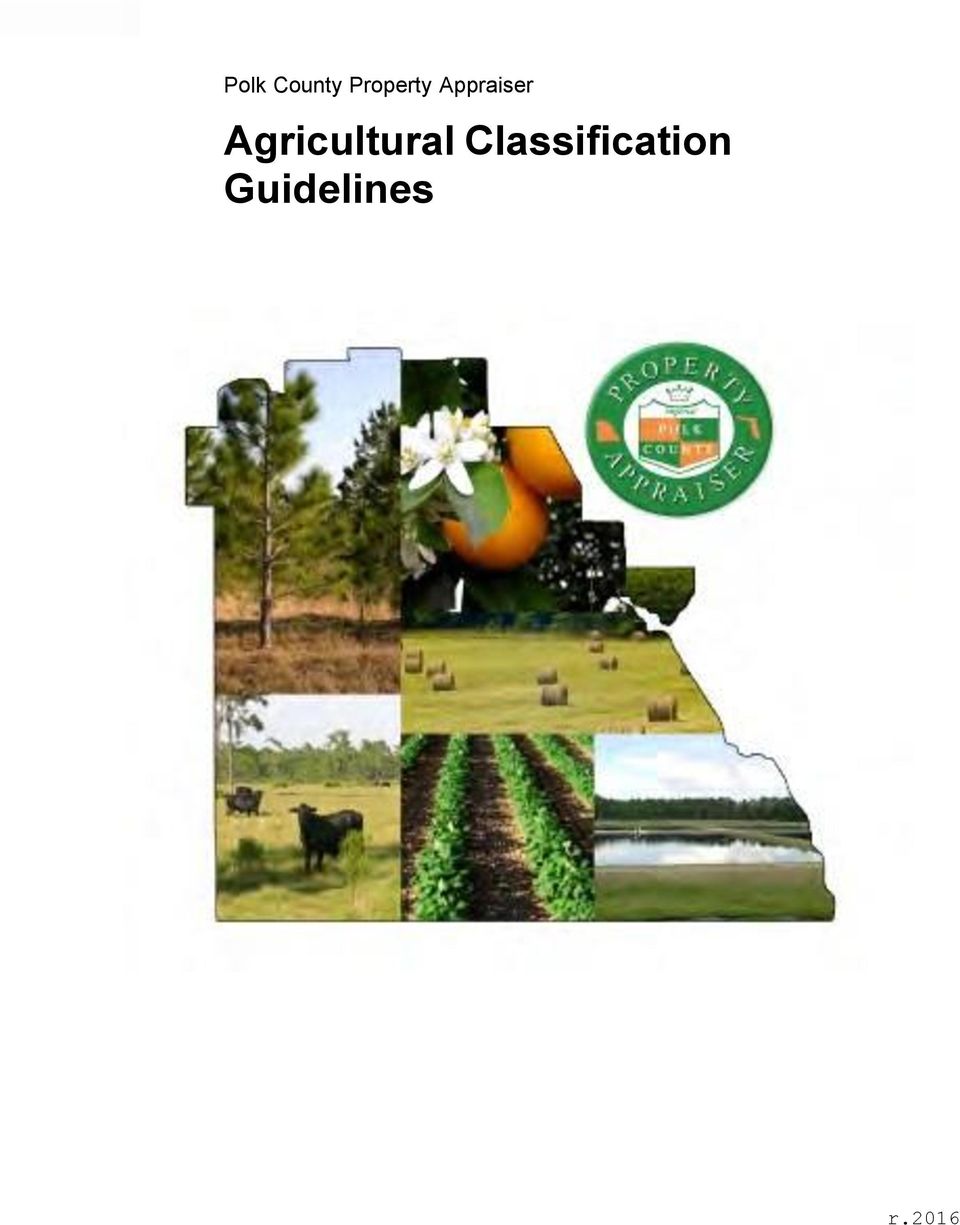
2 Contents Chapter 1. What is Agricultural (Ag) Classification? 4 Definition 4 Legislative Intent 5 Chapter 2. Qualifying for Ag Classification 6 Florida Statute (The Greenbelt Law) 6 Florida Statute (Annual Growing of Ag Crops) 10 Florida Statute (Florida Right to Farm Act) 11 Use of the Land is the Guidepost 13 Chapter 3. Types of Agricultural Operations 14 Citrus 14 Pasture 14 Timber 14 Hay Production 14 Sod 15 Crops 15 Nursery 15 Goat Farm 15 Horses 15 Chapter 4. Applying for Ag Classification 16 New Applicants 16 Renewals 17 Late Files 17 Value Adjustment Board (VAB) 17 Chapter 5. Removal of Ag Classification 18 Chapter 6. Agricultural Land Appraisal Guidelines 19 Criteria for ALL Agricultural Operations 19 Guidelines for Specific Agricultural Operations 20 Citrus 20 Pasture 21 Nursery 22 Goat Farm 22 Hay Production 23 Hay Establishment Practices 24 Hay Production Criteria for Platted Residential or Commercial Subdivisions 25 Timber 26 Sod 27 Crops 27 Horses 28 Miscellaneous 29 1 of 83

3 Chapter 7. Agricultural Land Review Cycle 30 Agricultural Land Monthly Departmental Responsibilities 30 Agricultural Land Appraisal Cycles 31 Citrus Reappraisal 31 Farmland Reappraisal 33 Pasture Reappraisal 34 Chapter 8. Citrus Health Response Program (CHRP) 35 Appendix A 40 AG 51 CROPLAND 40 AG 54 TIMBER 40 AG 60 PASTURE 41 AG 66 CITRUS 41 AG 67 POULTRY,BEES,FISH,RABBITS 42 AG 68 DAIRY 42 AG 69 ORNAMENTAL 43 Appendix B: Hay Production in Florida 44 Appendix C: Bermudagrass Production in Florida 50 Appendix D: Bahiagrass - Overview and Management 57 Appendix E: Resolution Appendix F: Section 222 Agriculture (Polk County) 67 Appendix G: Land Development Code City of Frostproof 73 Appendix H: Case Law 80 2 of 83

4 Chapter 1 Agricultural Classification CHAPTER 1 What is Agricultural (Ag) Classification? Definition Agricultural valuation is a special use appraisal for land that is devoted primarily to agricultural production. The value of land classified as Ag land does not constitute an exemption, although the classification can lower the assessed value of land and consequently the amount of taxes owed. An Agricultural Classification, more commonly known as "Greenbelt", is a classification of different types of agricultural property such as timber, pasture, groves and nursery, etc. Only lands primarily used for bona fide agricultural purposes shall receive an Agricultural Classification. "Bona fide agricultural purposes" means a good faith commercial agricultural use of the land. January 1st of each year is the effective assessment date. Therefore, the subject property must be used for the intended classification on or before this date, or a reasonable effort must have been made to place the property in agriculture classified use. It is the responsibility of the owner to establish and prove an agricultural operation. The Property Appraiser's staff cannot suggest or recommend to the owner what venture to begin or continue. 4 of 83

5 Chapter 1 Agricultural Classification Legislative Intent It is the declared policy of the State of Florida to conserve, protect and encourage the development and improvement of its agricultural lands for the production of food and other agricultural products and as valued natural and ecological resources for clean air water sheds wildlife habitat and other benefits of green space, including aesthetic purposes. The Legislature has also declared that Florida s economic and environmental future is enhanced by a tax policy which encourages sustainable agricultural use of its lands and discourages pressures to otherwise develop the land in indiscriminate manners, which brings conflicting land uses into juxtaposition, urban sprawl and creates higher costs for public services. The intent of the Greenbelt Law is to provide a means by which agricultural land may be protected and enhanced as a viable segment of the state s economy and as an economic and environmental resource of major importance. 5 of 83

6 Chapter 2. Qualifying for Ag Classification CHAPTER 2 Qualifying for Ag Classification For land to be granted agricultural classification, the use of the land must be primarily for bona fide commercial agriculture. The agricultural use must be commercial, which has been defined as making a profit or having the intent to make a profit. It is not necessary, however, to have the expectation of meeting the investment costs of the land and realizing a profit overall to be commercial. Nevertheless, it is not enough to grow fruit or vegetables for your own use or keep a pet cow or your own horses for pleasure or sport. The agricultural use must be bona fide. This means good faith commercial agricultural use of the land. Florida Statute (The Greenbelt Law) (3)(a) No lands shall be classified as agricultural lands unless a return is filed on or before March 1 of each year. The property appraiser, before so classifying such lands, may require the taxpayer or the taxpayer s representative to furnish the property appraiser such information as may reasonably be required to establish that such lands were actually used for a bona fide agricultural purpose. Failure to make timely application by March 1 shall constitute a waiver for 1 year of the privilege herein granted for agricultural assessment. However, an applicant who is qualified to receive an agricultural classification who fails to file an application by March 1 may file an application for the classification and may file, pursuant to s (3), a petition with the value adjustment board requesting that the classification be granted. The petition may be filed at any time during the taxable year on or before the 25th day following the mailing of the notice by the property appraiser as provided in s (1). Notwithstanding the provisions of s , the applicant must pay a nonrefundable fee of $15 upon filing the petition. Upon reviewing the petition, if the person is qualified to receive the classification and demonstrates particular extenuating circumstances judged by the property appraiser or the value adjustment board to warrant granting the classification, the property appraiser or the value adjustment board may grant the classification. The owner of land that was classified agricultural in the previous year and whose ownership or use has not changed may reapply on a short form as provided by the department. The lessee of property may make original application or reapply using the short form if the lease, or an affidavit executed by the owner, provides that the lessee is empowered to make application for the agricultural classification on behalf of the owner and a copy of the lease or affidavit accompanies the application. A county may, at the request of the property appraiser and by a majority vote of its governing body, waive the requirement that an annual application or statement be made for classification of property within the county after an initial application is made and the 6 of 83

7 Chapter 2. Qualifying for Ag Classification classification granted by the property appraiser. Such waiver may be revoked by a majority vote of the governing body of the county. (b) Subject to the restrictions specified in this section, only lands that are used primarily for bona fide agricultural purposes shall be classified agricultural. The term bona fide agricultural purposes means good faith commercial agricultural use of the land. 1. In determining whether the use of the land for agricultural purposes is bona fide, the following factors may be taken into consideration: a. The length of time the land has been so used. b. Whether the use has been continuous. c. The purchase price paid. d. Size, as it relates to specific agricultural use, but a minimum may not be required for agricultural assessment. e. Whether an indicated effort has been made to care sufficiently and adequately for the land in accordance with accepted commercial agricultural practices, including, without limitation, fertilizing, liming, tilling, mowing, reforesting, and other accepted agricultural practices; f. Whether the land is under lease and, if so, the effective length, terms, and conditions of the lease. g. Such other factors as may become applicable. 2. Offering property for sale does not constitute a primary use of land and may not be the basis for denying an agricultural classification if the land continues to be used primarily for bona fide agricultural purposes while it is being offered for sale. (c) The maintenance of a dwelling on part of the lands used for agricultural purposes shall not in itself preclude an agricultural classification. (d) When property receiving an agricultural classification contains a residence under the same ownership, the portion of the property consisting of the residence and curtilage must be assessed separately, pursuant to s , to qualify for the assessment limitation set forth in s The remaining property may be classified under the provisions of paragraphs (a) and (b). (e) Notwithstanding the provisions of paragraph (a), land that has received an agricultural classification from the value adjustment board or a court of competent jurisdiction pursuant to this section is entitled to receive such classification in any subsequent year until such agricultural use of the land is abandoned or discontinued, the land is diverted to a nonagricultural use, or the land is reclassified as nonagricultural pursuant to subsection (4). The property appraiser must, no later than January 31 of each year, provide notice to the owner of land that was classified 7 of 83

8 Chapter 2. Qualifying for Ag Classification agricultural in the previous year informing the owner of the requirements of this paragraph and requiring the owner to certify that neither the ownership nor the use of the land has changed. The department shall, by administrative rule, prescribe the form of the notice to be used by the property appraiser under this paragraph. If a county has waived the requirement that an annual application or statement be made for classification of property pursuant to paragraph (a), the county may, by a majority vote of its governing body, waive the notice and certification requirements of this paragraph and shall provide the property owner with the same notification provided to owners of land granted an agricultural classification by the property appraiser. Such waiver may be revoked by a majority vote of the county s governing body. This paragraph does not apply to any property if the agricultural classification of that property is the subject of current litigation. (4)(a) The property appraiser shall reclassify the following lands as non-agricultural: 1. Land diverted from an agricultural to a non-agricultural use. 2. Land no longer being utilized for agricultural purposes. 3. Land that has been zoned to a non-agricultural use at the request of the owner subsequent to the enactment of this law. (b) The board of county commissioners may also reclassify lands classified as agricultural to non-agricultural when there is contiguous urban or metropolitan development and the board of county commissioners finds that the continued use of such lands for agricultural purposes will act as a deterrent to the timely and orderly expansion of the community. (c) Sale of land for a purchase price which is three or more times the agricultural assessment placed on the land shall create a presumption that such land is not used primarily for bona fide agricultural purposes. Upon a showing of special circumstances by the landowner demonstrating that the land is to be continued in bona fide agriculture, this presumption may be rebutted. (5) For the purpose of this section, agricultural purposes includes, but is not limited to, horticulture; floriculture; viticulture; forestry; dairy; livestock; poultry; bee; pisciculture, when the land is used principally for the production of tropical fish; aquaculture; sod farming; and all forms of farm products as defined in s (3) and farm production. (6)(a) In years in which proper application for agricultural assessment has been made and granted pursuant to this section, the assessment of land shall be based solely on its agricultural use. The property appraiser shall consider the following use factors only: 1. The quantity and size of the property; 2. The condition of the property; 3. The present market value of the property as agricultural land; 8 of 83

9 Chapter 2. Qualifying for Ag Classification 4. The income produced by the property; 5. The productivity of land in its present use; 6. The economic merchantability of the agricultural product; and 7. Such other agricultural factors as may from time to time become applicable, which are reflective of the standard present practices of agricultural use and production. (b) Notwithstanding any provision relating to annual assessment found in s , the property appraiser shall rely on 5-year moving average data when utilizing the income methodology approach in an assessment of property used for agricultural purposes. (c)1. For purposes of the income methodology approach to assessment of property used for agricultural purposes, irrigation systems, including pumps and motors, physically attached to the land shall be considered a part of the average yields per acre and shall have no separately assessable contributory value. 2. Litter containment structures located on producing poultry farms and animal waste nutrient containment structures located on producing dairy farms shall be assessed by the methodology described in subparagraph Structures or improvements used in horticultural production for frost or freeze protection, which structures or improvements are consistent with the Department of Agriculture and Consumer Services interim measures or best management practices adopted pursuant to s or s (7)(c), shall be assessed by the methodology described in subparagraph 1. (d) In years in which proper application for agricultural assessment has not been made, the land shall be assessed under the provisions of s (7) Lands classified for assessment purposes as agricultural lands which are taken out of production by any state or federal eradication or quarantine program shall continue to be classified as agricultural lands for the duration of such program or successor programs. Lands under these programs which are converted to fallow, or otherwise nonincome-producing uses shall continue to be classified as agricultural lands and shall be assessed at a de minimis value of no more than $50 per acre, on a single year assessment methodology; however, lands converted to other incomeproducing agricultural uses permissible under such programs shall be assessed pursuant to this section. Land under a mandated eradication or quarantine program which is diverted from an agricultural to a nonagricultural use shall be assessed under s * Offering property for sale does not constitute a primary use of land and may not be the basis for denying an agricultural classification if the land continues to be 9 of 83

10 Chapter 2. Qualifying for Ag Classification used primarily for bona fide agricultural purposes while it is being offered for sale. ** * In 2008, House Bill 909 amended the statute to state that in no event shall a minimum acreage be required for Ag assessment. [F.S (3)(b)(1)(d)] ** In 2010, House Bill 981 amended the statute to add the following: Offering property for sale does not constitute a primary use of land and may not be the basis for denying an AG classification if the land continues to be used for bona fide AG purposes while it is being offered for sale. [F.S (3)(2)] Florida Statute (Annual Growing of Ag Crops) The Florida statutes also provide specific information about the value and taxation of agricultural crops: Annual growing of agricultural crops, non-bearing fruit trees, nursery stock; taxability. (1) Growing annual agricultural crops, non-bearing fruit trees, and nursery stock, regardless of the growing methods, shall be considered as having no ascertainable value and shall not be taxable until they have reached maturity or a stage of marketability and have passed from the hands of the producer and/or offered for sale. This section shall be construed liberally in favor of the taxpayer. (2) Raw, annual, agricultural crops shall be considered to have no ascertainable value and shall not be taxable until such property is offered for sale to the consumer. (3) Personal property leased or subleased by the Department of Agriculture and Consumer Services and utilized in the inspection, grading, or classification of citrus fruit shall be deemed to have value for purposes of assessment for ad valorem property taxes no greater than its market value as salvage. It is the expressed intent of the Legislature that this subsection shall have retroactive application to December 31, It is the declared policy of the State of Florida to conserve, protect and encourage the development and improvement of its agricultural lands for the production of food and other agricultural products and as valued natural and ecological resources for clean air sheds, wildlife habitat and other benefits of green space, including aesthetic purposes: 10 of 83
![461 (3)(b)(1)(d)] ** In 2010, House Bill 981 amended the statute to add the following: Offering property for sale does not constitute a primary use of land and may not be the basis for denying an AG](/docs-images/53/11836057/images/page_10.jpg "classification if the land continues to be used for bona fide AG purposes while it is being offered for sale. [F.S. 193.461 (3)(2)] Florida Statute 193.")
11 Chapter 2. Qualifying for Ag Classification Florida Statute (Florida Right to Farm Act) Florida Right to Farm Act. (1) SHORT TITLE. This section shall be known and may be cited as the Florida Right to Farm Act. (2) LEGISLATIVE FINDINGS AND PURPOSE. The Legislature finds that agricultural production is a major contributor to the economy of the state; that agricultural lands constitute unique and irreplaceable resources of statewide importance; that the continuation of agricultural activities preserves the landscape and environmental resources of the state, contributes to the increase of tourism, and furthers the economic self-sufficiency of the people of the state; and that the encouragement, development, improvement, and preservation of agriculture will result in a general benefit to the health and welfare of the people of the state. The Legislature further finds that agricultural activities conducted on farm land in urbanizing areas are potentially subject to lawsuits based on the theory of nuisance and that these suits encourage and even force the premature removal of the farm land from agricultural use. It is the purpose of this act to protect reasonable agricultural activities conducted on farm land from nuisance suits. (3) DEFINITIONS. As used in this section: (a) Farm means the land, buildings, support facilities, machinery, and other appurtenances used in the production of farm or aquaculture products. (b) Farm operation means all conditions or activities by the owner, lessee, agent, independent contractor, and supplier which occur on a farm in connection with the production of farm products and includes, but is not limited to, the marketing of produce at roadside stands or farm markets; the operation of machinery and irrigation pumps; the generation of noise, odors, dust, and fumes; ground or aerial seeding and spraying; the application of chemical fertilizers, conditioners, insecticides, pesticides, and herbicides; and the employment and use of labor. (c) Farm product means any plant, as defined in s , or animal useful to humans and includes, but is not limited to, any product derived therefrom. (d) Established date of operation means the date the farm operation commenced. If the farm operation is subsequently expanded within the original boundaries of the farm land, the established date of operation of the expansion shall also be considered as the date the original farm operation commenced. If the land boundaries of the farm are subsequently expanded, the established date of operation for each expansion is deemed to be a separate and independent established date of operation. The 11 of 83

12 Chapter 2. Qualifying for Ag Classification expanded operation shall not divest the farm operation of a previous established date of operation. (4) FARM OPERATION NOT TO BE OR BECOME A NUISANCE. (a) No farm operation which has been in operation for 1 year or more since its established date of operation and which was not a nuisance at the time of its established date of operation shall be a public or private nuisance if the farm operation conforms to generally accepted agricultural and management practices, except that the following conditions shall constitute evidence of a nuisance: 1. The presence of untreated or improperly treated human waste, garbage, offal, dead animals, dangerous waste materials, or gases which are harmful to human or animal life. 2. The presence of improperly built or improperly maintained septic tanks, water closets, or privies. 3. The keeping of diseased animals which are dangerous to human health, unless such animals are kept in accordance with a current state or federal disease control program. 4. The presence of unsanitary places where animals are slaughtered, which may give rise to diseases which are harmful to human or animal life. (b) No farm operation shall become a public or private nuisance as a result of a change in ownership, a change in the type of farm product being produced, a change in conditions in or around the locality of the farm, or a change brought about to comply with Best Management Practices adopted by local, state, or federal agencies if such farm has been in operation for 1 year or more since its established date of operation and if it was not a nuisance at the time of its established date of operation. (5) WHEN EXPANSION OF OPERATION NOT PERMITTED. This act shall not be construed to permit an existing farm operation to change to a more excessive farm operation with regard to noise, odor, dust, or fumes where the existing farm operation is adjacent to an established homestead or business on March 15, (6) LIMITATION ON DUPLICATION OF GOVERNMENT REGULATION. It is the intent of the Legislature to eliminate duplication of regulatory authority over farm operations as expressed in this subsection. Except as otherwise provided for in this section and s (2), and notwithstanding any other provision of law, a local government may not adopt any ordinance, regulation, rule, or policy to prohibit, restrict, regulate, or otherwise limit an activity of a bona fide farm operation on land classified as agricultural land pursuant to s , where such activity is regulated through 12 of 83

13 Chapter 2. Qualifying for Ag Classification implemented best management practices or interim measures developed by the Department of Environmental Protection, the Department of Agriculture and Consumer Services, or water management districts and adopted under chapter 120 as part of a statewide or regional program. When an activity of a farm operation takes place within a wellfield protection area as defined in any wellfield protection ordinance adopted by a local government, and the adopted best management practice or interim measure does not specifically address wellfield protection, a local government may regulate that activity pursuant to such ordinance. This subsection does not limit the powers and duties provided for in s or limit the powers and duties of any local government to address an emergency as provided for in chapter 252. Use of the Land is the Guidepost The Property Appraiser is not required to consider all of the factors listed, and a specific factor may not be selected above all others as the sole criteria for determining whether or not the property should be granted the agricultural classification. No one factor, by itself, is determinative. The Courts have ruled, for example, that it is not required that the owner is a farmer or that agricultural use is a permitted use under the local zoning regulations. See Appendix F Section 222 Agriculture (Polk County); Appendix G Land Development Code City of Frostproof. The Courts have stressed that the use of the land as of January 1st of the year in question is the guidepost in classifying the land and that agricultural use is now and has always been the test. See Appendix H for case law. 13 of 83

14 Chapter 3. Types of Agricultural Operations CHAPTER 3 Types of Agricultural Operations There are many types of agricultural operations in Polk County. Some of the agricultural operations may include more than one type of commodity. Examples of agricultural use include, but are not limited to the following: producing crops for human/animal consumption, cultivation/management of ornamental and flowering plants, cultivation of fruits, vegetables, herbs, and raising/breeding, livestock or other game. Brief descriptions of the typical agricultural in Polk County are listed below. For more detailed information about the various agricultural operations and the appraisal guidelines used in determining Ag Classification, see Chapter 6 Agricultural Land Appraisal Guidelines. Citrus Citrus operations include a variety of fruit types: orange, grapefruit, tangerines, and specialty. Pasture Pasture operations include cow/calf, feedlots, and dairy operations. The stocking rate of cattle is based on several factors including: pasture soil quality and size. Timber Timber operations vary widely. Operations may produce pulpwood, mulch, chip and saw. Hay Production Hay operations grow perennial, improved grasses such as Bahia, Bermuda, and specialty varieties. Soil quality is important in production of hay. These are cut and baled for livestock consumption and/or erosion control for road projects. These grasses are usually baled in the spring and/or fall. 14 of 83

15 Chapter 3. Types of Agricultural Operations Sod Sod operations are typically St. Augustine or Bahia grass. St. Augustine grass is primarily grown for landscaping purposes. Bahia grasses are generally used for larger commercial projects, erosion control, or road projects. Crops Crop operations are primarily vegetables. Crops also include blueberry, strawberry, and watermelon. Due to the climate in our area, a typical operation may produce two harvests per year. Nursery Nursery operations include propagation and sale of ornamental plants, citrus, and trees. A typical nursery can either be in-ground or containerized. They may be in greenhouses, shade houses, or open air. Goat Farm Goat farm operations primarily produce milk and meat. Both are sold for human consumption. Some producers breed for wholesale only. Horses Horses are limited to breeding. A breeding operation involves having brood mares and either a stud (stallion) on location or using artificial insemination for breeding mares. Land used primarily to train, show, race, ride, or use horses in some other manner not incidental to breeding does not qualify. 15 of 83

16 Chapter 4. Applying for Ag Classification CHAPTER 4 Applying for Ag Classification January 1 st is the statutory assessment date; therefore, the property must be in use on this date or a reasonable effort must have been made, and continues to be made, to place the property in agricultural use as of January 1 st of the given tax year. These guidelines, while specific, are still guidelines. The granting or denying of all or part of a particular application for Agricultural Classification is a decision made after analyzing the relevant facts and circumstances of the property. No final decision will be made on an application for an agricultural classification until all information relating to the application has been submitted and reviewed, the property has been inspected, and a final analysis of these factors has been completed. Under no circumstances shall an agricultural classification be promised to a taxpayer prior to completion of this final analysis, and no taxpayer is entitled to rely on any representation that his or her property will be granted an agricultural classification until such time as a final decision has been issued by the Property Appraiser s office. Pursuant to Florida Statute (1), the property appraiser has the authority to decide whether a parcel of land is entitled to an agricultural classification. Pursuant to Florida Statute (2), any landowner whose land is denied agricultural classification by the property appraiser may appeal to the Value Adjustment Board. New Applicants If you believe your property, as of January 1 of the current tax year, meets the criteria for the agricultural classification, you must file an initial application with the Polk County Property Appraiser s office by March 1. You may contact the office at or obtain an agriculture application from our website When you submit your application, please attach as much additional information as possible to show the use of your land is primarily for bona fide, commercial agriculture. Utilize the factors listed in the Agricultural Land Appraisal Guidelines chapter for guidance as to what documentation would assist us in making a correct determination. Such additional information, if not already provided, may be requested by the Property Appraiser as is reasonably required in making this determination. Any financial information submitted will be held confidential by Florida Statutes. If a property previously granted the agricultural classification has been conveyed, a new application must be submitted. If your agricultural classification is denied, we will notify you by mail, postmarked by July 1 st. 16 of 83

17 Chapter 4. Applying for Ag Classification Renewals Land that has been previously granted the agricultural classification will be automatically renewed in subsequent years providing the agricultural use of the land has not been abandoned or discontinued, and has not been conveyed. The automatic renewal is subject to property inspections for verification purposes. Polk County Board of County Commissioners adopted Resolution (09-099) on June 3, 2009 to waive renewal applications and the mailing of agricultural receipt cards. See Appendix E for copy of resolution. If, however, you have changed from one agricultural use to a different agricultural use, you should notify us promptly so that the agricultural use of your property may be changed accordingly. Ag classifications vary in value of land per acre. You must also notify the Property Appraiser s office if you have discontinued the agricultural use. Late Files If you failed to file by the March 1 filing date deadline, you may late file and file a petition with the Value Adjustment Board (VAB). The absolute deadline to late file for an agricultural classification is the same date as the annual deadline to file a valuation challenge which is noted on the Truth in Millage (TRIM) notice. All late file applications must be submitted with a petition to the Value Adjustment Board. Value Adjustment Board (VAB) If you believe the Property Appraiser s decision regarding the denial or removal of the agricultural classification is incorrect, you may contact our office at for further discussion and review. Taxpayers have the right to contact the Value Adjustment Board and file a petition for a hearing. The Property Appraiser would prefer discussion and resolution to avoid the costly process of a VAB hearing. If resolution cannot be obtained then filing a petition is the next step in the process. Taxpayers may obtain more information at A petition must be filed within 30 days of the notice from the Property Appraiser s office regarding the status of your application or removal of the agricultural classification. 17 of 83
18 Chapter 5. Removal of Ag Classification CHAPTER 5 Removal of Ag Classification The Property Appraiser is responsible for classifying all lands within the county as either agricultural or non-agricultural on an annual basis. Agricultural classification may be removed from the land for various reasons that may include the following: 1. Land diverted from an agricultural to a non-agricultural use. 2. Land no longer being utilized for bona fide commercial agricultural purposes. 3. Land that has been conveyed prior to January 1 st without a new agricultural classification application on file. The removal of the agricultural classification most often occurs during the reappraisal cycle. Each parcel is physically inspected for bona fide commercial use. Operations that appear to be abandoned are removed. Any operation whose commerciality is in question will be requested to submit supporting documentation. Field inspections are conducted as a result of work orders generated in-house that question the agricultural classification. Field checks are conducted when a taxpayer notifies the office of any concerns relating to the agricultural classification. Fraudulent use of the agricultural classification is taken very seriously by this office. All claims/reports are investigated promptly. 18 of 83

19 Chapter 6 Agricultural Land Appraisal Guidelines CHAPTER 6 Agricultural Land Appraisal Guidelines Listed below are general guidelines for the review of agricultural classification applications in determining eligibility. These guidelines should not be considered solely determinative. Each application is individually reviewed and physically inspected to determine actual use before the application is approved or denied. Criteria for ALL Agricultural Operations 1. Agricultural classification applies to land only - It does not apply to improvements on land such as barns, storage tanks, and farm or ranch outbuildings. Improvements are valued at market value. 2. The land must be devoted to agricultural use - The use must be current, meaning active management is taking place on the land. Land will not qualify simply because it is rural or open land or because the owner intends to use the land for an agricultural purpose. The land must be in agricultural use as of January 1 st or a reasonable effort must have been made to place the property in classified use. 3. The primary use of the land must be agricultural - If the land is used for more than one purpose, the acreage is defined in multiple land lines. 4. The operation should have an expectation of making a profit Properties that are granted agricultural classification do not always profit, it is the expectation or intent to be profitable. 5. Minimum acreage may not be required To qualify for an agricultural classification the parcel must have enough acreage to sustain a commercial operation. Hobby farms or livestock/produce for personal use do not qualify. 6. Lease property A current copy of the lease must accompany the application. The property owner has the responsibility to make sure the lessee is utilizing the property, has a commercial agricultural operation, and is willing to provide financial information regarding their operation. The lease must be in effect as of January of 83
20 Chapter 6 Agricultural Land Appraisal Guidelines 7. Annual Ag Renewal - If agricultural classification is granted, the classification will automatically renew, pending there has been no ownership conveyances and an annual inspection. Polk County Board of County Commissions adopted Resolution on June 3, 2009 to waive the annual renewal process. See Appendix E for copy of resolution. Guidelines for Specific Agricultural Operations Citrus Groves are recommended to be 4 acres or part of a larger operation in order to considered a commercial operation. Land must have been prepared or planted by January 1 st, or a signed contract for trees must be provided. Number of trees per acre, variety of citrus, and the effective age of the trees, is to be submitted with the application. A minimum of 100 trees per acre is the current standard. Proper care and management of the grove must be evident. Records provided upon request. Best Management Practices should be used. Specialty groves and organic operations will be evaluated on a case by case basis. If any licenses, permits, or agricultural certifications are required by federal, state, or local governments, they should be submitted. Provide an 18 month chronological timeline of all agricultural activity beginning 6 months prior to the current tax year. A lease by itself is not sufficient evidence that a parcel is in commercial agricultural use. Income and expense information should be submitted. Schedule F from IRS tax return. Provide a 3-year business plan. 20 of 83
21 Chapter 6 Agricultural Land Appraisal Guidelines Pasture Pasture land is recommended to be 10 acres or part of a larger operation in order to be considered commercial property. A commercial herd at a minimum of 6 head of cattle must be maintained on any operation of 20 acres or less. For parcels larger than 20 acres, herd size will be determined by quality of pasture land/soil. Provide the number of cattle currently on the property. Provide the number of cattle sold within the last 12 months. If any licenses, permits, or agricultural certifications are required by federal, state, or local governments, they should be submitted. Provide an 18 month chronological timeline of all agricultural activity beginning 6 months prior to the current tax year. If property is leased, the lease must be in effect as of January 1 st and a copy must be attached to the application. A lease by itself is not sufficient evidence that a parcel is in commercial agricultural use. Receipts from the sale of stock and expenses incurred from the ag operation are required. Schedule F from IRS tax return. Provide a 3-year business plan. 21 of 83
22 Chapter 6 Agricultural Land Appraisal Guidelines Nursery Nurseries are recommended to be 1 acre, irrigated and stocked in order to be considered a commercial operation. A list of the type of plants grown in the nursery should be included with the application. Proper care and management of the nursery must be evident records must provided upon request. Best Management Practices should be used. Operation must be wholesale please provide a list of all commercial accounts. If any licenses, permits, or agricultural certifications are required by federal, state, or local governments, they should be submitted. Provide an 18 month chronological timeline of all agricultural activity beginning 6 months prior to the current tax year. If property is leased, the lease must be in effect as of January 1 st and a copy must be attached to the application. Receipts from the sale of stock and expenses incurred from the ag operation are required. Schedule F from IRS tax return. Provide a 3-year business plan. Goat Farm Goat farms are recommended to be 3 acres or be part of a larger operation in order to be considered a commercial operation. A commercial herd of goats at a minimum of 12 goats must be maintained. Provide the number of goats currently on property. Provide the number of goats sold within the last 12 months. If any licenses, permits, or agricultural certifications are required by federal, state, or local governments, they should be submitted. 22 of 83
23 Chapter 6 Agricultural Land Appraisal Guidelines Provide an 18 month chronological timeline of all agricultural activity beginning 6 months prior to the current tax year. If property is leased, the lease must be in effect as of January 1 st and a copy must be attached to the application. A lease by itself is not sufficient evidence that a parcel is in commercial agricultural use. Receipts from the sale of stock and expenses incurred from the Ag operation are required. Schedule F from IRS tax return. Provide a 3-year business plan. Hay Production Hay fields are recommended to be 5 acres or part of a larger agricultural operation in order to be considered a commercial operation. An indicated effort has been made to maintain and care sufficiently for this type of ag classification i.e. fertilizing, mowing, weed management, etc. Best Management Practices should be used. A minimum of 2 cuts should be expected within 12 months. Seasonal weather, lack of rain, soil type may have an influence time of cuts. Provide date stamp pictures of hay cuts. If any licenses, permits, or agricultural certifications are required by federal, state, or local governments, they should be submitted. Provide an 18 month chronological timeline of all agricultural activity beginning 6 months prior to the current tax year. If property is leased, the lease must be in effect as of January 1 st and a copy must be attached to the application. A lease by itself is not sufficient evidence that a parcel is in commercial agricultural use. Receipts from the sale of hay and expenses incurred from the Ag operation are required. 23 of 83
24 Chapter 6 Agricultural Land Appraisal Guidelines Schedule F from IRS tax return. Provide a 3-year business plan. Hay Establishment Practices The process to establish a commercially viable hay crop may be lengthy one. A two year timeframe is not out of the ordinary. Similar to citrus, which may take 3-5 years to begin to produce a commercial crop, hay may not be harvested for 2 years from the initial preparation of the hayfield. This timeframe depends on a multitude of factors such as weather, soil, condition of the existing grass, etc. A business plan must be provided by the landowner or lessee in establishing a hay operation. An example of an acceptable plan is as follows: By mid to late spring of the initial year, mow vegetation down very low to prepare for no-till seeding. Spray selective herbicides to suppress weed competition. After mowing is completed, plant Bahia and Bermuda grass seed with the no-till planter. The grass will sprout when the summer rains begin. At that time keep the lot areas mowed down for a month as the grass sprouts and gets established. In early summer, apply 50 pounds of nitrogen fertilizer per acre to the new grass and continue to keep it mowed for weed suppression as the grass becomes further established. Spray selective herbicides to suppress weed competition. Periodically continue mowing for weed suppression. During early spring of the following year, apply 50 pounds of nitrogen fertilizer per acre. Late summer / fall of the following year, cut and bale hay. Continue the above process annually for ongoing hay production. 24 of 83
25 Chapter 6 Agricultural Land Appraisal Guidelines Hay producers can expect a wide range of production numbers from their hayfield annually. Weather, management techniques, and varieties can dramatically affect these outcomes. Also, the end consumer may dictate what methods are used for production. For example, hay may be produced for horses (hi-grade), cattle (midgrade), or erosion control (low-grade). Hay Production Criteria for Platted Residential or Commercial Subdivisions Hay fields are recommended to be 5 acres or part of a larger agricultural operation in order to be considered a commercial operation. Subdivisions with an aggregate of less than 5 acres will not qualify. Predominate use of total subdivision acreage must be in hay production. Only areas containing at least 150 linear feet of road frontage will be considered. Taxpayer must document the following after each cut: Number of rolls cut Date Stamp pictures of hay cuts Receipts that include the buyer name Price per roll A minimum of 2 cuts should be expected within 12 months. Seasonal weather, lack of rain, soil type may have an influence time of cuts. An indicated effort has been made to maintain and care sufficiently for this type of ag classification, i.e. fertilizing, mowing, weed management, etc. Best Management Practices should be used. If any licenses, permits, or agricultural certifications are required by federal, state, or local governments, they should be submitted. Provide an 18 month chronological timeline of all agricultural activity beginning 6 months prior to the current tax year. All leases must be submitted. 25 of 83
26 Chapter 6 Agricultural Land Appraisal Guidelines A lease by itself is not sufficient evidence that a parcel is in commercial agricultural use. Receipts of expenses incurred from the Ag operation are required. Provide a 3-year business plan. Taxpayer must submit a plat map of each subdivision indicating which lots are being applied for. Each application should reflect only one ownership. Municipal planning and zoning ordinances for agricultural properties within each cities jurisdiction are verified prior to granting Ag classification. Home Owner Association (HOA) covenants are reviewed for restrictions related to agricultural properties. Taxpayer should submit county planning department requirements for mowing setbacks for utility and vacant lots. Timber Timber operations are recommended to be at least 5 acres or part of a larger agricultural operation in order to be considered a commercial operation.. A Timber Management Plan signed by a certified forester is required. Proper care and management of the timber must be evident. Records provided upon request. Best Management Practices should be used. Typically 600 to 800 trees per acre. A commercial stand of planted pines requires a survival rate of 400 trees per acre. Tree and Planting costs and expense records are required. If any licenses, permits, or agricultural certifications are required by federal, state, or local governments, they should be submitted. Receipts from the sale of timber are required. Schedule F from IRS tax return. Provide a 3-year business plan. 26 of 83
27 Chapter 6 Agricultural Land Appraisal Guidelines Sod Sod operations are recommended to be 10 acres or part of a larger agricultural operation in order to considered a commercial operation. List sod types. Proper care and management of the sod must be evident. Records must be provided upon request. Best Management Practices should be used. If any licenses, permits, or agricultural certifications are required by federal, state, or local governments, they should be submitted. Provide an 18 month chronological timeline of all agricultural activity beginning 6 months prior to the current tax year. If property is leased, the lease must be in effect as of January 1 st and a copy must be attached to the application. A lease by itself is not sufficient evidence that a parcel is in commercial agricultural use. Receipts from the sale of sod and expenses incurred from the AG operation are required. Schedule F from IRS tax return. Provide a 3-year business plan. Crops Cropland operations typically consist of 2 acres or more. Size and Scope must be commercial. Proper care and management of the crop must be evident. Records must be provided upon request. Best Management Practices should be used. List crop types. If any licenses, permits, or agricultural certifications are required by federal, state, or local governments, they should be submitted. Provide an 18 month chronological timeline of all agricultural activity beginning 6 months prior to the current tax year. 27 of 83
28 Chapter 6 Agricultural Land Appraisal Guidelines If property is leased, the lease must be in effect as of January 1 st and a copy must be attached to the application. A lease by itself is not sufficient evidence that a parcel is in commercial agricultural use. Receipts from the sale of crop and expenses incurred from the ag operation are required. Schedule F from IRS tax return. Provide a 3-year business plan. Horses Horse Breeding operations typically consist of 10 acres or more. Size and Scope must be commercial. Horse breeding operations must have at a minimum of 3 brood mares. Pleasure horses do not qualify. Documents such as insemination reports, stud fees, marketing information, registration papers, etc. are required. If any licenses, permits, or agricultural certifications are required by federal, state, or local governments, they should be submitted. Provide an 18 month chronological timeline of all agricultural activity beginning 6 months prior to the current tax year. If property is leased, the lease must be in effect as of January 1 st and a copy must be attached to the application. A lease by itself is not sufficient evidence that a parcel is in commercial agricultural use. Receipts from the sale of stock and expenses incurred from the ag operation are required. Schedule F from IRS tax return. Provide a 3-year business plan. 28 of 83
29 Chapter 6 Agricultural Land Appraisal Guidelines Miscellaneous Miscellaneous operations may include fish, bees, poultry, hogs, fruit and nuts, grapes, etc. Minimum requirements will vary according to each type of operation. If any licenses, permits, or agricultural certifications are required by federal, state, or local governments, they should be submitted. Provide an 18 month chronological timeline of all agricultural activity beginning 6 months prior to the current tax year. If property is leased, the lease must be in effect as of January 1 st and a copy must be attached to the application. A lease by itself is not sufficient evidence that a parcel is in commercial agricultural use. Receipts from the sale of stock and expenses incurred from the ag operation are required. Schedule F from IRS tax return. Provide a 3-year business plan. 29 of 83
30 Chapter 7 Agricultural Land Review Cycle CHAPTER 7 Agricultural Land Review Cycle Agricultural Land Monthly Departmental Responsibilities JANUARY: All AG value models are reviewed and updated. Field inspections conducted. MARCH MAY: No lands shall be classified as agricultural lands unless a return is filed on or before March 1 of each year. Review ag applications that were filed in a timely manner; on or before March 1. Review all applications and conduct field inspections. MAY: Ag application approvals, denials, and removals are processed. JUNE: Per FL Statute Any landowner whose land is denied agricultural classification by the property appraiser may appeal to the Value Adjustment Board. The property appraiser shall notify the landowner in writing of the denial of agricultural classification on or before July 1 of the year for which the application was filed. Polk County sends written notification of denials by June 1. Respond to inquiries related to the denial or removal of agricultural classification. JULY: Field inspect any possible agricultural classification reinstatements and process agricultural classification applications that were filed late. AUGUST: Prepare for upcoming field inspections. Agricultural Classification applications that were filed late. Respond to inquiries related to Truth-In- Millage (TRIM) form. SEPTEMBER DECEMBER: Appraise agricultural parcels. 30 of 83
31 Chapter 7 Agricultural Land Review Cycle Agricultural Land Appraisal Cycles FL Statute Duties of the property appraiser in making assessments 1. The property appraiser shall complete his or her assessment of the value of all property no later than July 1 of each year, except that the department may for good cause shown extend the time for completion of assessment of all property. 2. In making his or her assessment of the value of real property, the property appraiser is required to physically inspect the property at least once every 5 years. Where geographically suitable, and at the discretion of the property appraiser, the property appraiser may use image technology in lieu of physical inspection to ensure that the tax roll meets all the requirements of the law. The Department of Revenue shall establish minimum standards for the use of image technology consistent with standards developed by professionally recognized sources for mass appraisal of real property. However, the property appraiser shall physically inspect any parcel or state-owned real property upon the request of the taxpayer or owner. Polk County appraises on a three year cycle. (Sept. Mar.) Year 1 - Citrus Year 2 - Farmland Year 3 Pasture Agricultural properties are physically inspected as many as three times per year. Citrus Reappraisal Run queries to extract all citrus parcels o Create citrus edit spreadsheet Physically inspect all citrus parcels o The following is confirmed on all parcels at time of physical inspection: Acreage Commercial use 31 of 83
32 Chapter 7 Agricultural Land Review Cycle Actual use Quality DOR use code Citrus varieties Irrigation Contiguous parcels are in use Verify with GIS system & aerials & plats Re-assessment of citrus types If any changes are discovered to the land use, note changes on citrus edit & deliver work to office so parcels can be reworked to reflect changes Commercial evidence requests are mailed to citrus parcels where discrepancies are discovered Record date requested information; date received; scan information to parcel record Taxpayers that do not comply with commercial evidence request are removed from greenbelt Look for new construction; if new construction is discovered cut out appropriate acreage for new construction & notify Real Estate Appraisal Department 32 of 83
33 Chapter 7 Agricultural Land Review Cycle Farmland Reappraisal Run queries to extract all farmland parcels o Create farmland edit spreadsheet Physically inspect all farmland parcels o The following is confirmed on all parcels at time of physical inspection: Acreage Commercial use/farmland type Quality DOR use code Irrigation Contiguous parcels are in use Verify with GIS system & aerials & plats Re-assessment of farmland type If any changes are discovered to the land use, note changes on Farmland edit & parcels are reworked to reflect changes Commercial evidence requests are mailed to Farmland parcels where discrepancies are discovered Record date requested information; date received; scan information to parcel record Taxpayers that do not comply with commercial evidence request are removed from greenbelt Look for new construction; if new construction is discovered cut out appropriate acreage for new construction & notify Real Estate Appraisal Department 33 of 83
34 Chapter 7 Agricultural Land Review Cycle Pasture Reappraisal Run queries to extract all pasture parcels o Create pasture edit spreadsheet Physically inspect all pasture parcels o The following is confirmed on all parcels at time of physical inspection: Acreage Commercial use/pasture type Quality DOR use code Contiguous parcels are in use Verify with GIS system & aerials & plats Re-assessment of pasture type If any changes are discovered to the land use, note changes on pasture edit & deliver to office so parcels can be reworked to reflect these changes Commercial evidence requests are mailed to pasture parcels where discrepancies are discovered Record date requested information; date received; scan information to parcel record Taxpayers that do not comply with commercial evidence request are removed from greenbelt Look for new construction; if new construction is discovered cut out appropriate acreage for new construction & notify Real Estate Appraisal Department 34 of 83
35 Chapter 8 Citrus Health Response Program (CHRP) CHAPTER 8 Citrus Health Response Program (CHRP) Recognizing the pest and disease risks associated with abandoned citrus groves, the state has initiated a comprehensive plan for their removal and destruction. This initiative will help mitigate the impact of exotic citrus pests and diseases (namely citrus greening and citrus canker) by identifying abandoned groves and working cooperatively with county tax assessor offices and property owners regarding abatement options and tax incentives which will foster removal of these reservoirs of infection. Key components: Catalog all abandoned groves throughout the state Map all high-risk abandoned groves Contact abandoned grove owners to ask their intentions for properties Inform owners if their groves are not kept in production, they will not be considered part of CHRP. Inform owners if they eliminate live citrus trees in abandoned groves, it is considered a bona fide agricultural practice and will remain in compliance with CHRP guidelines, thus maintaining their agriculture exempt status. Agricultural land tax exemption FDACS interpretation and position on Section (7), Florida Statutes, is that if you have a valid CHRP compliance agreement and are in good standing, then the property covered by the agreement is considered in agricultural use, thus for tax purposes is eligible for agricultural land use classification. County property appraisers in citrus-growing areas are developing policies that comply with Section (7), Florida Statutes. Property owners with abandoned groves should contact their local CHRP office for more information (see back). Proper documentation is required by county tax assessor offices for exemption, so please contact your local CHRP office for details. If you know of abandoned groves in your area, please report the property to your local CHRP office. 35 of 83
36 Chapter 8 Citrus Health Response Program (CHRP) Citrus Health Response Program Mission Working together to produce healthy citrus Ensure security of citrus germplasm and citrus nursery programs Support effective disease / disease vector management Monitor defendable phytosanitary protocol that allows fresh fruit movement to all markets Implement citrus nursery clean stock program Resources for the Industry Tools to support citrus Compliance agreements and business plans designed to provide guidance and protect citrus Grower Assistance Program decontamination training, survey assistance, self-survey and business plans Best Management Practices Participate with growers in the Business Plan Share Program Citrus Germplasm Introduction Program Important disease-free start Ensures citrus germplasm is free from any known graft-transmissible pathogens Each variety undergoes years of intensive testing before release Provides approved germplasm to citrus budwood registration program New 20,000 sq ft facility at future Alachua County budwood site Citrus Budwood Registration Responding to disease pressures Provides clean budwood to citrus industry Facilities located outside of citrus-growing area 80,000 sq ft facility in Levy County Redundant 60,000-sq-ft location planned in Alachua County Citrus Nursery Guidelines Providing clean stock for citrus groves Rules and regulations to protect industry, 5B-62 Geographic separation of new nurseries and groves Citrus nursery stock is propagated and housed in approved insect-proof structures All citrus nurseries are on 30-day inspection cycle Compliance agreements are required FDACS/DPI Citrus Health Response Program Offices 36 of 83
37 Chapter 8 Citrus Health Response Program (CHRP) Contact Information FDACS / DPI Citrus Health Response Program Offices Avon Park 3397 US Hwy 27 South Avon Park, FL Phone: Immokalee 424 East market Road, Unit 10 Immokalee, FL Phone: Tavares 4129 County Rd 561 Tavares, FL Phone: Vero Beach / Ft. Pearce th Street Vero Beach, FL Phone: Winter Haven 3027 Lake Alfred Rd Winter Haven, FL Phone: of 83
38 Chapter 8 Citrus Health Response Program (CHRP) 01/01/2010 Citrus Health Response Program (CHRP) Assessment Policy For Polk County Abandoned Grove Initiative The Citrus Health Response Program (CHRP) is the successor program to the Citrus Canker Eradication Program (CCEP). The purpose of the program is to manage the impact of citrus canker and citrus greening in commercial citrus groves. To accomplish that purpose, this program declares citrus canker, citrus greening, and the Asian citrus psyllid to be plant pest and nuisances. The program also sets forth procedures for establishing quarantine areas, identifying regulated articles, decontaminating regulated articles, and regulating the movement of citrus nursery stock from areas quarantined for citrus greening. (Rule: 5B F.A.C.) Please provide our office with the following required documentation no later than March 1: CHRP Abandoned Grove Compliance Agreement effective as of January 1, of applicable year. Site Report which is provided to owner thru the CHRP office as of January 1, of applicable year. If property is not currently receiving the greenbelt classification an application should be submitted prior to March 1. Agricultural Classification Properties currently receiving the agricultural benefit will not have to file a new application however parcels not under the greenbelt classification will be required to file an application with our office prior the statutory date of March 1. Statute (3) (a) 38 of 83
39 Chapter 8 Citrus Health Response Program (CHRP) Abandoned Grove Compliance Agreement An Abandoned Grove Compliance Agreement which has been approved and dated prior to January 1 of the applicable year must be submitted to our office no later than March 1 in order to receive the CHRP Abandoned Grove assessment for that tax year. The landowner must maintain compliance under the Abandoned Grove Compliance Agreement. When the Abandoned Grove Compliance Agreement has expired the property will be assessed according to use. Use Change If the Abandoned Grove Compliance Agreement is dated after January 1, an assessment of $50.00 an acre (per Florida Statue (7)) will go into effect for the following tax year. If after the first year of receiving the CHRP Abandoned Grove assessment, a different agricultural operation is put in place, the assessment will change accordingly. Any non-agricultural use will be assessed at full market value as of the statutory date of January 1. If the agricultural operation is changed within the tax year prior to receiving the CHRP Abandoned Grove assessment, the following tax year will be assessed at $50.00 an acre. The subsequent tax year will be assessed according to use. If a non - agricultural operation is put in place within the tax year prior to receiving the CHRP Abandoned Grove assessment, the property will not qualify for the CHRP Abandoned Grove assessment and will be assessed at full market value. Sale or Transfer of Property If property is sold or transferred while an Abandoned Grove Compliance Agreement is active, it is the responsibility of the new owner to file a new agricultural application. An Abandoned Grove Compliance Agreement whether transferred or newly established must be submitted along with the new agricultural application in order to continue with the CHRP Abandoned Grove assessment 39 of 83
40 Appendix A DOR Use Codes for Agricultural Land Appendix A DOR* Use Codes for Agricultural Land *DOR=Department of Revenue AG 51 CROPLAND 5100 Cropland 5101 Cropland w/misc. Imp Cropland w/res Cropland w/m.h Cropland w/undev. Lnd Cropland w/undev. w/misc. Imp Cropland w/undev. w/res Cropland w/undev. w/m.h Cropland w/com. Land 5121 Cropland w/com. Bldg Cropland w/m.h. Park 5123 Cropland w/golf Course 5134 Sod Farm w/misc.imp Sod Farm w/residence 5136 Sod Farm w/mobile Home AG 54 TIMBER 5400 Timber 5401 Timber w/misc.imp Timber w/res Timber w/m.h Timber w/undev. Lnd Timber w/undev. w/misc. Imp Timber w/undev. w/res Timber w/undev. w/m.h Timber w/com. Land 5421 Timber w/com. Bldg. 40 of 83
41 Appendix A DOR Use Codes for Agricultural Land AG 60 PASTURE 6000 Pasture 6001 Pasture w/misc. Imp Pasture w/res Pasture w/m.h Pasture w/undev. Lnd Pasture w/undev. w/misc. Imp Pasture w/undev. w/res Pasture w/undev. w/m.h Pasture w/com. Land 6021 Pasture w/com. Bldg Pasture w/m.h. Park 6023 Pasture w/golf Course 6030 Pasture w/farmland 6031 Pasture w/farmland w/misc. Imp Pasture w/farmland w/res Pasture w/farmland w/m.h Sunrise Acres AG 66 CITRUS 6600 Citrus 6601 Citrus w/misc. Imp Citrus w/res Citrus w/m.h Citrus w/undev. Lnd Citrus w/undev. w/misc. Imp Citrus w/undev. w/res Citrus w/undev. w/m.h Citrus w/com. Land 6621 Citrus w/com. Bldg Citrus w/m.h. Park 6623 Citrus w/golf Course 6630 Citrus w/pasture 6631 Citrus w/pasture w/misc. Imp Citrus w/pasture w/res. 41 of 83
42 Appendix A DOR Use Codes for Agricultural Land 6633 Citrus w/pasture w/m.h Citrus w/farmland 6641 Citrus w/farmland w/misc. Imp Citrus w/farmland w/res Citrus w/farmland w/m.h Citrus w/pasture/res/irrig AG 67 POULTRY,BEES,FISH,RABBITS 6700 Poultry, Bees, Fish, Rabbits Poultry, Bees, Fish, Rabbits... w/misc. Imp Poultry, Bees, Fish, Rabbits... w/res Poultry, Bees, Fish, Rabbits... w/m.h Poultry, Bees, Fish, Rabbits... w/undev. Lnd Poultry, Bees, Fish, Rabbits... w/undev. w/misc. Imp Poultry, Bees, Fish, Rabbits... w/undev. w/res Poultry, Bees, Fish, Rabbits... w/undev. w/m.h Poultry, Bees, Fish, Rabbits... w/com. Land 6721 Poultry, Bees, Fish, Rabbits... w/com. Bldg Hog Farm w/irrig 6754 Hog Farm w/misc.imp Hog Farm w/res 6756 Hog Farm w/mobilehome AG 68 DAIRY 6800 Dairy 6801 Dairy w/misc. Imp Dairy w/res Dairy w/m.h Dairy w/undev. Lnd Dairy w/undev. w/misc. Imp Dairy w/undev. w/res Dairy w/undev. w/m.h Dairy w/com. Land 6821 Dairy w/com. Bldg Dairies & Feed Lots w/irrig 42 of 83
43 Appendix A DOR Use Codes for Agricultural Land AG 69 ORNAMENTAL 6900 Nursery 6901 Nursery w/misc. Imp Nursery w/res Nursery w/m.h Nursery w/undev. Lnd Nursery w/undev. w/misc. Imp Nursery w/undev. w/res Nursery w/undev. w/m.h Nursery w/undev. w/com. land 6921 Nursery w/undev. w/com. Bldg Ornament & Citrus Nurs w/irrig 43 of 83
44 Appendix B: Hay Production in Florida Appendix B: Hay Production in Florida UF UNIV ERSIT Y Of FLORIDA IFAS Extension SS-AGR-70 Hay Production in Florida 1 C. G. Chambliss, M. B. Adjei. J. Arthington, W. E. Kunkle, and R. P. Cromwell 2 Even though Florida has a relatively warm cl imate. pastures do not grow year-round. Callie. horses. and other domestic gnncrs need some type of conserved forage during the lale fall. winter. and earl y spring when growth of warm season pastures is greatly reduced due to short days. cool temperatures, and possibly drought. In mally arcas of Florida. especially in northern Florida, the need for conserved or stored forage can best be mel wilh hay. Some ranchers in southern Florida with a relatively low stocking ratc can acculllulmc or stockpi le latc summer pasture growth for grazing during the fall and winter and thus do not feed hay. Florida, with its high humidity and frequent rainfall during the growing season. is not the easiest place to dry a hay crop, yet hay is oftell the best cho ice as a means of conserving forage. With modem harvesting equipment. the hay ing process is largely mechanized and therefore requires little hand la bor. If the hay crop can be harvested at an immature stage of growth, dried. and stored without excessive rain damage, it will provide a feed of good nutritional value. Besides the hay that is used by beef and dairy operations. there is a large market for horse-quality bemludagrass hay that can be grown in the state. The total production of alltypcs of hay in Florida ranges from 600,000 to 800,000 tons per year. Forages Fo r Hay: Perennial forage plants are recommended for hay instead of annuals in order to avoid the repeated cost of establ ishment. Several perennial grasses are used for hay in Florida. In nonhem Florida the improved hybrid bermudagrasses are the 1110st popular. These grasses are highly productive and generally dry f:1sler thanll10st other grasses. Bahiagrass can be harvested for hay but is mainly used for grazing. In southern Florida, stmgrass. bcnnudagrass. lill1 pograss (hcmanhria). and Mulato grass (Bracltiaria hybrid) can also be ILSed for hay. Perennial peanut can be grown to produce a high quality legume hay. The summer ailnuaileguille alycedover can be pl3l1ted following watermelons or a spring vegetable crop to produce one or two cuttings of hay. This oo<um<nl is SS AGR 70. """ <If a ~rit5 of the Agronom}' D<p... m<nl. Florid. COOp<r31i,-~ E~ICfI$ion S<",icc. IrtSlilU1C on-ood and Agri",llu"'] S<ic""",. lini'-ersi1y of FIUfida, I' irsl prinled Juno 1999, Re,-i$<'<1 April This publiealioo is also 8 pan oflhe Florida Fr:>ntg< Ilandbook. all dech""i< publication "fthe: Agr"nomy Il<pannltnl. FUf rnon: infon".. ion)1ju rna}' ronlatl... "til. Ad';'i Imbag ul1.<xiu). Pic,"" "isilthe: E[)IS Weh sile at hllp:/iedi,j fas. un _ <xl u. 2. C. G. Charnbliss (tlm:ascd). also,,;",c "",faw. Ap<lnom}' D<ranm<n1: M R. Adjci.lSSO<iale p"<lkssor. A,,<lDOm}' DcpMnltnl. Range Callk Research and Ed""alioo CcnlCr-Oota, F1.: J. Anhin&tnn. ossor;ialc profc'sw. Ronse COllie Rcscareh and Ed""alion C~nl<r'.()na. Fl.: W. E. Kun ~1c (<kc<:lis"d). profo""". An;n,", Sci<nce Ocparlnlcnl: 11.. P. Cromwell_ profo..." cmorilus. Ocran,,,,,nl of AgrioullUral and ljiological Engin<ering: 1:lorida COOp<JaI;"C E~I~nsi"" S<",ic.:. InSlitulo <If Food and Agrieultural S<icnocs. Uni,-crsil}' offlr:>rida. GailltS,-ilic. R J261 I. Tht uot oflntdt nom.. in Ihi. puhliu 1ion i. $OIt1}' fur Ih. rur""", of pro"idinl: $l'ume informoli"n. 1I. I1 F,\ S d<>t< n<lt gu'... rn'..... r. nl)' Iht p","u", nom"'. on" rtf.. t n<ts 10 Ihtnl In ' h;. pub".,.i;"n "... nol signify our opp"",.1 10 ' ht u<i..,;.," "f olhtr produ<1< of... il.hlt."n'pus;i;"', The ln.1l1uie 01 Food end A.gric:ulluntl Sclo-ncn (IFA.S) lion Equol Opporlunlly Inllllulion ou""'_ to ~lde _eorch. O'ducollonlllnlo"""Uon I nd otil... ",len only 10 Ind",lduoll Ind InomutloM that fun.tion _ non..:l l..,~ mlnatlon.. ~h.. opecllo..., crnd. coto<. "'Igloo. 19o, dl.. blllly... u.1 <>rt.ntotlo". rnarttol, W"', n.uoool origin, poiiticoi oplnlonl Of. ffiliatlonl. U.S. o.~ rtm-onl of AgrICultu... Cooperatlv. E.lflnl lon Servlc UnlvtfSl!y of FIotId IFA.S. Florida A.. " III. Unl... 1fy CoopeJllllv. ElI.nllon ProgJllm. and _rd. of Counly Commlsl lo"... CoopenU"1l. uny A.n1nglOO. o..n 44 of 83
45 Appendix B: Hay Production in Florida Hay Production in Florida Certain cool-season fora ges such as the small grains (especially oats). ryegrass. red clover. and alfalfa can be grown and harvested as hay. Alfalfa acts mostly as an annual in Florida but may persist for two years or morc on some of the clay soils of northem Florida. S ince alfalfa musi be harvesled on a 28 to 30 day sched ule. a producer desiring to grow alfalfa must be prepared to take some harvests as silage o r haylage, because rain will likely prevent drying of onc or more c uttings. The economics and risk involved in growing alfalfa in Florida have generally not been favorable. Other Ilay Crops: The summer annual grasses pearl millet and sorghum-sudangrass are beller suited for grazing or green chop than for hay. Their large sterns make drying diffic ult. and therefore are not generally recommended for hay. When planted with the intention of harvesting for hay, these grasses should be planted at a higher than nonnal seeding rate in o rder to decrease stem size. A Iso, the cut ste rns should be crushcd with a hay conditioner to speed drying. Naturally-occurring stands of crabgrass can be harvested for hay. This grass makes an excellent qual ity hay. but drying takes lo nger than for benlludag rass. Cowpeas, soybeans, and ()(her legumes have been used for hay. Leg umes usually produce a higher-quality hay than grasses: however. growing legumes fo r hay invoh'es greater risk. Legumes are more likely than grasses to lose their leaves from shattering if the crop is not handled properly. [fthe c rop, whe n almost d ry eno ugh to bale, is rained on and then allowed to redry, the probability of leaf-loss d uring baling is inc reased. If the crop is rained o n in the swath a nd stays wet for severa l days. it may TOt. Fertilization: Management ofbennudagrass and o ther perennial grasses for hay production is similar. For established stands of grass, t... ke soil samples in November to December, and subm it to the soillesting laboratory in order to detennine soi l ph and soi l levels of phosphoru s., potassium, and magnesium. The initial spring application of fertilizer (based on soil test «.'commendatio ns) should be applied as soon as the grass starts growing (February 10 Apri l). Apply 80 IbJA and all of the recommended P20 S and K 2 0 in early spring. Apply an add itional 80 Ib N and 40 Ib ~O/A after each cutting, except the last in the fall. Include 20 Ib of pp s in the supplemental ferti lizer if the soil tested low o r medium in P. Sulfu r, although not generally recommended, may be deficient in some areas. Unfortunately, there is not a good test fo r sulfur. but it may be wise to supply some sulfur at the initial spring applicatio n by using ammo nium sulfatc as the nitrogcn source. Weed Control: Thcre are exccllcnt broadlcaf weed control programs for grass hay crops. Also, Pe nsacola bahiagrass can be removed from bennudagrass hay fields with the herbicide Cimmaron. Other weedy grasses such as vascygrass o r mnidencane can be a problem for produce rs who are attcmpting to producc pure bcnnudagrass for the ho rse hay market. It has always been difficult to find a herbic ide that will control onc grass but leavc another. A new herbicidc, Journey, will control c rabgrass, sandbur, vaseygrass, Pensacola bahiagrass, nutsedge, and cenain broad leaves in bennudagrass. See the publication SS-AGR-08 Weed Management ill Pasl/lres (111(1 Rallge/and fo r dctails. Exccpt for alfalfa, good herbicide programs arc not available to remove broadlcaf weeds from legume hay crops. Occasio na lly, a poisonous plant such as sic klc-pod will in fest a pllillting of alyceclover to such an e;((enl that the crop must be abando ned. If a height differential exists, such that the weed is taller than the IlAY crop, then it may be possiblc to use a no n-selecti ve herbicide in a wi pe-o n application to remove the weoo. Whe n \0 Make Hay: In northern Florida. hay can be harvesled th roughout the gro wing season in most years. In southern Florida. hay can be harvested in the spring if there is sufficient growth before the summcr rains stnn, and in the fall aftcr the summcr rains stop. In southern Florida, summer showers occur almost every day and most of the grass is grown on flatwoods sites which tend to stay wet throughout the summer. Both ofthesc factors practically eliminate the possibi lity of getting a hay crop dry during the summer. Therefore, many producers will apply fe rtilizer in September to extra pasture IIrcas or hay fie lds of stargrass o r limpograss and harvest these areas in Octo ber or November, after the rainy season has ended. South Florida dairymen are harvesting their grass as silage and therefore are able to harvesl through the summer. So me ha y 2 45 of 83
46 Appendix B: Hay Production in Florida Hay Production in Florida 3 producers may be interested in considering the "roll-bale or tube silage system". For more information, visit the Un iversity of Florida's Animal Science Department's website at: I.ufl.edu/. TO N.% 11W"Ooyr _ DigIgr- ~"' I.... -c>_... Most of the hay made in Florida is made from perennial grasses such as bemludagrass and stargrass. The first growth of these grasses in the spring can be harvested when the grass reaches a height of 14 to 18", or when there is enough growth tojustify usc o f the harvesting equipment. Try to take at least oue harvest before the summer rams stan. A few producers usc recycled wastewater from adjourning municipalities for irrigating their hayficlds in order to overcome spring drought. A fier the fi rst harvest, plan to harvest on a 4-to 5-week schedule. Harvesting well-fertilized bemludagrass or stargrass at 4 to 5 weeks of regrowth produces acceptable yields of good quality grass hay. If the weather cooperates, harvest at 4 weeks. This will produce relatively high-quality hay. If harvest is delayed beyond 4 weeks, try not to go beyond 6 weeks, because there is usually no increase in yield for bernludagrass (bottom leaves begin to die) and quality continues to decrease. In general, all of the perennial grasses dccrease in quality as they mature (Figure I and Figure 2). Oude Protein. '!Io " 2, 11bNogr", 1lI ~- ~"'I ~-.-- Figure 1. Effects of matunty on forage prote,n. " " Always be ready to harvest at 4 weeks of regrowth or even SOOller if there is enough growth and prospects for good drying weather. Waiting a few more days to meet the calendar schedulc might be waiting for bad weather. "Make hay while the sun shines." All other perennial grasses should fo llow a ,,, R~rOWlh.. 1.kI Figure 2. Effect of ma t ur~y on forage TON. similar harvcst schedule. Floralta or l3igalta limpograss (hemarthria) can be harvested on a 6-week schedule without a serious loss in digestibility. A suggested harvest schedule for hay crops is given in Table I. Hay-making techniques Equipment Needed: The individual making hay should have good, reliable equipment. When the crop is ready to harvest and the weather is suitable, the eq ui pment should be ready to stan working with litt le fear of breakdown. Equipment breakdown can result in the loss of a hay crop. Basic equipment needed is a mower, rake, tedder, and baler. Other equipment such as a conditioner, inverter, and equipment to load and transport bales may be useful at times. Advice on how to use or operate the equipment can be obtained from the equipment manuals. Two types of balers are commonly used: one makes a small rectangular bale weighing 50 to 60 Ib, and the other makes a large roll bale weighing 600 to 1100 lb. The Weat her and Drying Time: The most di fficult variable to deal with when making hay in Florida is the weather. At certain times of the year (spring and fall) cold fronts pass over the state bringing rain. As soon as these fronts have passed there are usually scveral days of dry weather suitable for making hay. During the summer the rainfall comes from thundershowers which may appear daily and the chances for obtaining 3 to 4 days without rai n are greatly reduced. " " 46 of 83
47 Appendix B: Hay Production in Florida Hay Production in Florida 4 Table 1 Harvest schedule for various hay crops Crop Growth staae or heiaht Harvest interval. weeks Bermuda rass 14 - l S" ' -5 Slararass 14 - I S" ' -5 Mulato grass 14 - IS" ' -5 Bahia rass 10-12" 4-5 Pangola 14 -IS" 4-5 LimPOQrass 16-24" 5-6 Perennial Peanut 12 Dlus inches 6-8 AI ceciover (just before flowerinq) - Oa ts 'M'Ieat Rve Boot to earlv head R "" Red Crimson Arrowteaf Clovers Alfalfa Boot 10 earl head E. flowerin (1st harvest al bud stage.laler harvest at 1/10 bloom Sor hum-sudan 30 to 40" Soybean or Cowpea Mid-to full bloom - Drying (curing) lime is affecled by Ihe Iype or crop, the quant ity Of bulk put on the ground and weather condit ions (Iemperature, humidity, eloud cover. daylength, soilmoislure. CIC.). Bennudagrass and Mulato grass dry faster than Floralta limpograss. Grasses with largc-diamcler stems such as sorghum-sudan take longer to dry than grasses wilh sma ll stems. 11 is usually recommended that grasses with large sterns be processed thro ugh a condilioner in order 10 crush the sterns and speed up drying. All cut hay crops should be laid out in as wide a swath as possible. This wi ll maximize exposure orthe crop 10 wi nd and sunlight, thererore reducing drying lime. Legume crops should be put inlo a windrow in 3 to 4 hours after cutting or berore the plants are dry enough that the leavcs start to shatter when raked (berore plant moislure fall s below 4(010). If thc crop gets 100 dry berore windrowing. wail and rake in the morning just as Ihe surface dew begins 10 dry. Ideally the hay crop should be at 12 to 15% moisture before baling. Grasses put up in Ihe large ro lls have been b.11ed when Ihe moisture drops below 20%. but IS to 20% moislure will likely result in some heating and molding. A hay producer should havc an electronic moisture Icster to help in deciding when it is sa re to bale. I rthe hay crop is on thc ground and almost dry enough 10 bale, but is rained on, it may slill be salvaged if the rain stops aller one or two days. Grass can be turned or fluffed with a tedder. Material that has been mailed down by the rain is raised by the tedder in order to expose more surfacc area to the air or wind. Legumes are more diflicult to deal Wilh, whether rained on or not, since their leaves have a greater tendency to shatter. To reduce leaf shattering. a legumc hay crop should be raked inlo a windrow or tedded belare moisture in the plant drops below 40"/. An inverter may be userul in handling a legume since il appears 10 be less aggressive Ihan a tedder and less likely to knock the leaves oft. When a hay crop is rained on, the producer shou ld a\'oid (if possible) the tendency to nlsh the baling of the crop after Ihe second drying attempt. This ollen results in bales that ha\'e too high a moisture content and therefore will mold or rot. "MY llrcservalil'cs: Hay producers may ollen have their hay crop almost dry enough to bale when the rain comes. If they could add somcthing to the hay that would allow them to bale at 20 to 25% moisture, this wou ld pcnnil lhcm 10 bale sooner and perhaps ahead or a rain. A hay preservalive consisling primarily of propionic acid has been used for th is purpose. It is usually sprayed on the hay as it enters the throat orthe baler. This organic acid can be used on hay that contains 20 to 25% moisture. It wi ll suppress Ihe growth of molds and other microorganisms. In the past the product was quite 47 of 83
48 Appendix B: Hay Production in Florida Hay Production in Florida caustic to both the skin of the operator and the paint and metal of the baler. Newer formulations are less corrosive to equipmcnt, bui it is probably still a good idea to wash the baler after each use. The product will not suppress mold growth indefinitely. How long the mold growth will be suppressed is unclear--perhaps as long as 4 to 6 months. Another product for preserving "high moisture" hay is the hay inoculant. Certain types of "good bacteria" are spread on the hay with Ihe idea that they wi ll overwhelm and suppress the growth of molds and other undesirable organisms that cause heating or rotting of the hay. Whether or not these inoculants will work on Florida hay is unclear. Research studies in other states have not always been positive. Making quality hay: A good quality hay is one that has a relatively high level of Iota I digestible nutrients (TON), and is palatable. Some hay producers are mainly concemed with the quantity of hay produced per acre, when the focus should be on the quantity afton harvested per acre. Several factors can influence the amount of hay produced and its quality; these arc stage of growth or agc of the plants whcn harvestcd, foragc specics, fcrtiliz..1.lion, wced control, and the weather. Slage of growth or maturity when the hay is harvested is the single most importam fac tor affecting hay quality. Harvesting at the correct stage of maturity is the best way that producers can improve hay quality. Stage of maturity at which the hay is harvested influences not only the protein content (Figure I) and level of digestibility (Figure 2), but also how wel l animals eat the hay, especial ly bemludagrass hay. See Table I for appropriate maturity to harvest various hay crops for the best combination of quantity and quality. Annual grasses such as oats or sorghum-sudan arc usually higher in quality than wann season perennial grasses. Legumes, especially cool season legumes, arc usually higher in protein and digestibility (higher quality) than perennial grass hay. This may not always hold true. especially if the grass is highly fertil ized and harvested at an immature stage of growth, while the legume hay crop is harvested at a very mature stage and contains a certain percentage of grass that will also be very maturc (sec SS-AGR-63 Forage Testing). Fertilization can affect quality. Increasing the rate of nitrogen applied to grasses will not only incrcase yield but will also increase percent protein if the grass is harvested at an immature stage of growth. Digestibility may also increase slightly. Qual ity wi ll be lowered if a hay crop is raincd on after it has been CUI and dried but not yet baled and removed from the fiel d. Soluble sugars and some protein can be leached from the planl tissue, thus lowering quality. The extent of loss will dcpend on how dry the hay is when the rain comes and how much rain fa lls. The drier the hay and the greater the rainfall, the greater the loss. Hay Stor.tgc: Hay harvested in the spring. any legume hay harvested in Florida, and small rectangular bales should be stored in a shelter. A pcnllanent shelter would be desirable, but if this is not available, there are tarps made specifica lly for covering hay (Figure 3). Figure 3. Hay tarp. Ord inarly hay that is to be stored under a shelter shou ld be picked up and moved to the shelter as soon after baling as possible to prevent the hay from getting wet from rain; however, if the moisture level in the bale is on the high side (18 to 20%) then it may be wise to let the bales stand in the field for a day before stacking them under a shelter. If the inside of the bale is hot it should be left in the field until it cools. This will help prevent spontaneous combustion and fire which may occur in a stack or bam when hay that has too high a moisture content is placed there of 83
49 Appendix B: Hay Production in Florida Hay Production in Florida Grass hay, put up in large rolls. is often stored outside. I f hay is left outside in the open. there will be a certain amount of loss. The loss would be expected to be greater on a high-quality grass hay than it would be on a low-quality, more mature hay and on spring-harvested hay that would be outside through the entire rainy season. If large round bales are stored outside. the bales should be placed in an area that is well-drained, or on rock or some other structure that will prevent water from wicking up from the bottom of the bale. Do not stack bales. but place them end to end in s ingle roll's with enough space between rows so that the rounded sides of the bales do not touch. Round bales wrapped tight and with enough string to form a smooth, even surface usually have less water penetration and spoilage than bales with a looser and less-unifonll surface. Reeeut experiences indicate that net wrap on round bales may also reduce surface spoilage, especially for hay stored outside during the summer. Figure 4. Hay feeding ring. surface samples from weathered baled hay, instead use a eommereial hay core sampler or reach inside the bale to collect a sample fmm the interior. 6 Feeding Hay: When feed ing hay, the livestock producer should try to keep feeding losses to a minimum. Feeding losses arc mainly due to trampling and refusal. Leaf shatter from legume hay also may produce significant loss. Although labor intensive. feeding a one day supply in a feed bunk is a sure way to minimize loss. Feeding a one day supply on sod. and rotating feedin g areas has also been used effectively. When feeding the large roll bales. losses can be excessive if feedin g is not done properly. Use a feedin g panel or hay ring to restrict access to the hay (Figure 4). This will reduce trampl ing loss. trhay rings are not available, feed onl y as much hay as the animals can consume in one or two days. Also, make sure animals do not enter the hay storage area. Using Foragc Tcsting: The nutritional value of a hay can be detenn ined by taking a sample of the hay and sending it to a forage testing laboratory. Thcse labs usually test for total digestible nutrients, neutral detergent fiber, and protein. Some labs may also tcst for minerals. The produce r feeding hay can use the results of a forage test to detcnnine whether supplemental nutrients are needed and if so how much. The producer selling hay may use the forage test to help sell the hay (sec SS-AGR-63 Forage Tes/ing). It is important to collect a representative sample of hay to submit for testing. Do not collect 49 of 83
50 Appendix C: Bermudagrass Production in Florida Appendix C: Bermudagrass Production in Florida 50 of 83
51 Appendix C: Bermudagrass Production in Florida 51 of 83
52 Appendix C: Bermudagrass Production in Florida When planting tops, use material that is mature and has six weeks or more of growth. Try 10 plant during a doudy, rainy period. Moisture conditions must be ideal for this method to succeed. The soil becomes very hot during dear, bright summer days, and the plaming material can either dry out or ~sca l d.~ This seems to be more of a problem with tops than with dug sprigs. Also, chances of success when using tops are likely greater when planting on flatwoods as compared to upland deep sands. If ('QSsit>le, ~II p l~n 'ings sholll(l be coml'lete(l no l~l<'r than mid-august. l:a1l plantings have been successful in some years in peninsular Florida, but as a general rule fall planting is not recommended because of the possibility of damage from drought or an early freeze. Young plants should be allowed plenty of time (three months) to develop a stl"olis root syst.. m Ut:fore Luhi wt:ath.. r. 4. Planting Material: Obtain planting material (sprigs or tops) from nurseries that are pure as to variety and free from common bermudagrass or other weedy grasses. Plant fresh, pure,li"e sprigs or freshly cut tops that are six weeks old or older. Planting material should receive pounds ofn fertilizer per acre t...,o weeks before it is harvested to induce a flush of new tillers. Sprigs can be dug with a commercial sprig digger. They can also be harvested by using a spring-tooth harrow or field cultivator, along with a sidedelivery rake and pitchfork. Green tops can be harvested with con\'cntional hay equipment. Balers can be adjusted to form small bales that will weigh whatever is needed for ease of handling. Green bales should be mo,'cd and planted quickly before they go through a heating cycle. 5. Planting rate Plant 30_40 hll~he l.~ of dug ~ prig.~ or ap_ proximately 1500 pounds of tops per ac re. Higher planting rates can be used to ensure rapid development of a good stand if planting material is readily available or low in cost. One bushel is 1.25 cubic feet. 6. Planting Method: Always plant in a... 1'11 prepared, weed-free, moist seedbed. Land that has been turned with a moldboard plow or has received other primary tillage should be smoothed with a disk harrow to destroy germinating weed seeds just ahead ofthi' planter. Dug sprigs can be planted with commercial sprig planters that place the sprigs in the soil two to three inches deep. Tree planters and other machines have also been used. Both dug sprigs and tops can be broadcast on the surface with a spinner-type grass planter (slinger). Other planting devices are also available that broadcast large roll bales of green tops. The planting material should be immediately covered with a disk harrow to a depth of2-3 inches. Long tops (stems) can also be pushed into the soil with a ~fairwayh type roller called a crimper. Pack the soil with a heavy roller so that soil ca pillarity can be established, which will keep the soil moist around the planting material. 7. Establishment Weed Control, Spray immediately after planting (same day) with 2 Ib/acre of2,4-0 or other suitable preemergence herbicide. In days after planting, an application of or other similar herbicide, may be needed for cont rol of any broadleaf weeds that escaped the ini'i;>1 hert>icije tre~tment. Cont~ct your colmty ~gric\l l tural agent for updates on herbicide recommendations. These can be found in the "Weed Control Guide n or in the publication Weed Control in Pastures and Rangeland.~ With sustained soil moisture, good weed control, and adequate (enility, bermudagrass can be cstablished in three months and ready for the first hay harvest or light grazing. Late plantings should not be harvested, but allowed to go through the winter with plenty of top growth. When a producer intends to establish a large acreage it may be wi~ to first establish a smaller area of pure weed -f~ grass as a nursery. From the nursery the producer can harvest planting material for additional plantings. This practice spreads the risk of establishment failure over more than Olle season. FERTILIZATION FOR HAY AND GRAZING Bermudagrasses require fertilization or high soli nutrients tq produce high yields. They are,'ery respqnsive tq nitrogen. The initial application of fertilizer each year should be applied when the grass starts growing, which is usually in March (February in South Florida). For hay production apply 80 pounds of nitrogen per acre and soil test recommended amounts of P & K in early spring. After each cutting, except the last in the fa ll, apply an additional 80 lb N, and 40 Ib ](,O/a, along with 20 Ib P,O,lA ifthe soil tested low or medium in P. f"or grazing apply 80 pounds of mlrogen per acre and soli lest recommended amounts of P & K. An additional 80 pounds ofn can be applied mid-season if needed. Sulfur is not recommended, and in most situations a growth response to sulfur would noi be expected. As insurance against a potential sulfur deficiency, some producers are applying part of their nitrogen as ammonium sulfate, but a premium should not be paid for this source of nitrogen, relative to that of other nitrogen sources, simply for the insurance against a potential sulfur deficiency. If manure is used as a fertilizer, it will supply 3 52 of 83
53 Appendix C: Bermudagrass Production in Florida sulfur. lhe need for routine use of micronutrients has not been demonstrated. When using manure, if possible, determine the nutrient content of the manure being used and then apply the manure in amounts ncrded to supply the N, P, K nutrient recommendations. Additional N or K may be needed to supplement the manure. With the use of high nitrogen rates, ph will decrease over time. Ammonium sulfate lowers ph faster than other sources of nitrogen. Usc annual soil testing to follow the decrease in ph and to determine P and K levels. A good time to take soil samples is in the fall after the last hay harvest. Be especially careful not to fall behind in potassium <lpplicahon. Low potassium levels have resulted in thinning of stands. Bermudagrass is especially responsive to nitrogen. Table I presents estimates of crude protein and dry mailer yield (3%-5% moisture hay) for increasing amounts of nitrogen applied. Estimates of nitrogen removal in the harvested crop are also given. HAY MANAGEMENT The first hay harvest should be made when there is enough forage to justify equipment use. At this time the grass may be \4-16 inches high. Try to take the first harvest before summer rains start. Be ready to take each successive harvest at four weeks of regrowth. If the weather does not allow harvest at four weeks, harvest at five or six weeks. Maximum yield is usually obtained with a six week schedule. However, waiting until six weeks to harvest may result in further delays due to rain. If harvest is delayed beyond six weeks, quality (digestibility and protein) decreases rapidly. lhe effect of cutting interval on hay quality is shown in Table 2 and Table 3. rotting organisms if the rain continues for several days or if the grass is baled too wet. Hay producers can use an electronic moisture tester to determine when the grass is dry enough to bale. The moisture content should be at 15% or lower bdore baling in order 10 prevent the gro\\llh of molds and heating. Bales that are too wet can present a fire h37..ard through spontaneous combustion. Some producers have used hay preservatives (organic acids) that inhibit the growth of molds. This allows them to bale at moisture levels up to about 22%. The preservative is applied to the grass as it enters the bale chamber. When frequent rainfall does not permit drying and conserving the grass as hay, roll bale silage may be an alternative to consider. The roll bale silage system uses a conventional large round baler to roll up wet grass (50% moisture). The bale is then either wrapped in stretch plastic or stacked in a long horizontal plastic tube to exdudo.' oxygen. 'This requires a special machine to apply the plastic wrap or to stack bales in the tube. Because of extra expense, the roll bale Silage system should only be used to conserve young high-quality grass and only when the weather is too wet to make hay. Bermudagrass can be conserved by using a conventional silage system (field chopper, wagons, silos). Such a system requires considerable investment in equipment, but it is being used successfully by large dairy operations throughout the state. 1he big advantage of a Silage system is that it is not weather dependent. Grass can be har\'\'sted on a four to five week schedule. Animal intake is higher and gain per animal is greater with bermudagrass that is four weeks old when harvested. Cutting interval, or age of forage when harvested, affects both digestibility and protein level. Both decrease as CUlling interval increases. High rates of nitrogen fertilizer will tend to raise the protein level. Make every effort to avoid rain when cutting, drying, and baling the hay. If the hay is rained on, use a tedder after the rain to help spcrd drying. A heavy rain whlleach some soluble sugars out of the leaves, thus reducing the quality of the hay to some extent. A greater problem may be the growth of molds and other 4 53 of 83
54 Appendix C: Bermudagrass Production in Florida GRAZING MANAGEMENT Management of bermudagrass for gnzing is somewhat similar 10 that for hay. Young immature grass is morc nutritious than old mature grass. Heavier fertilization (more than 50 lbs N/acre), rotational grazing, and mowing as needed to keep the grass young and tender wil! result in highest animal production, Having the bermudagrass area divided in to several pastures will allow for rotational grazing and for mc(hanical harvest of excess production during the summer as hay or silage. A three-year grazing study was conducted at the Georgia Coastal Plain Experiment Station where yearling beef steers were used to compare Tifton 85 with Tifton 78. Both are high yidding, high quality hybrid I:lermudagrasscs. 1l1is study (Table 4) shows the potential for high animal gain that can be obtained from well-fertilized hybrid bcrmudagrass. Average daily gain was similar for Tifton 78 and Tifton 85, but Tifton 85 produced 46% higher liveweighl gain per acre compared 10 Tifton 78. Additional slet'rs were added 10 Ihe Tifton 85 pastures during the summer to utilize the extra forage produced. Figure 3. Crossbred heile.s gr~~ingrofton 85 bermud~gr~s5.. Credits: Yoan~ Newmall, UFIIFAS WEED CONTROL Maintaining a vigorous healthy stand of bermuda grass will help prevenl weed invasion. Despite following all of the recommended liming, fertilization, grazing, and hay production practices, a weed problem may occasionally develop. On established bermudagrass, many broad leaf weeds can be controlled in both bcrmudagrass pastures and hayfields with timelyapplicationsof2,4-d, Banyel, Remedy (tridopyr), Weedmaster (Banvcl + 2,4-D), Pastureguard (tridopyr + flu TOxypyr), GrazonNext (aminopyralid + 2,4- D), or Cleanwave (fluroxypyr + aminopyralid). Annual or perennial sedges can be effectively controlled wi th Outride (sulfosulfuron). Pensacola bahiagrass can be controlled with Cimarron plus (metsulfuron + chlorsulfuron). Velpar (hexaxinone) can be used for smutgrass control (be sure to check grazing and haying restrictions before application). Spot treatment of common bermuda with Roundup in a hybrid bermudagrass nursery is useful; however, the hybrid bermudagrass will be injured or killed in the treated area. Details on use of all the herbicides mentioned above are provided in the publication ~ Wet'd Control in Pastures and Rangeland ~ in the Weeds in the Sunshine series and also in the Weed Control Guide. Annual updates of this information can be obtained from your county ag ricultural extension office. Before using any herbicide, always read and study the label carefull y. fhe label will provide information on the time period that must elapse between application of herbicide and resumption of grazing or removal as hay. INSECTS Armyworms, striped grass loopers, and grasshoppers may occasionally be a problem usually in the summer and fall and especially on bermudagrass fields that have been recently fer tilized. These insects feed on the leaves and can completely strip a field of bermuda grass if not detected in time. If an infested field is to be harvested for hay and the grass is long enough when infestation occurs, go ahead and harvest. If it can be utili7.ed by grazing, do so. But if the grass is not ready to be harvested, an insecticide can be used to control the worms. Insecticides work best if applied when the worms are small. It is probably a good idea to check bennudagrass fields for worms during the summer and fall by walking the fields on a weekly basis and watching for callie egrets and other birds that might be feeding on the worms. Spittlebug is another insect that can damage bermudagrass in wet weather. lhe presence of the insect is indicated by a white froth or spittle-like material at the base of the plant which contains the young immature insect. Adults emerge from the froth as dark brown or black flying insects that are about 3/8 of an inch long with two orange-red lines across the wings. Spittlebugs appear in June and late August. When fceding, the adults and immature stages inject a toxin into the plant that causes the leaves to turn brown and look frosted. lhe affected areas enlarge as the adults spread and feed. Mowing or grazing to keep the grass from growing tall, lodging, and becoming densely matted 5 54 of 83
55 Appendix C: Bermudagrass Production in Florida 55 of 83
56 Appendix C: Bermudagrass Production in Florida 56 of 83
57 Appendix D: Bahiagrass Overview and Managment Appendix D: Bahiagrass - Overview and Management UFIFNWRIDA IFAS Extension Bahiagrass (Paspa/um notatum): Overview and Management' Yoana Newman, Joao Vendramini, and Ann Blount 2 SS-AGR-332 Bahiagrass is the most common and widely us.:d warmseason perennial grass in Florida. II i~ planted 10 over two million acres in the stale and on:r four million acres in the Snutheastern United States. This grass is popular in Florida because of its adaptation to low soil fertility and low input management. Bahiagrass can be established by seed an d thus provides 1.'3Sy propagation. II is used mainly for pasture and hay production with in\amediate yield and acceptable animal performance. Additional uses include wi ldlife habitat, erosion control, phytoremediation of phosphorusimpacted soils, and integrated pest management of nematodes and fungal diseases when used in rotation with annual crops. 'Ihis publication provides an overview of the grass and details of management and production. Originally (rom South America, bahiagrass is I'o"l'H adapted to coastal areas in Florida and the Coastal Plains in the Southern U.S., including Georgia, Alabama. Mississippi, Louisiana, and East Texas. [t establishes well in sandy soils with low water retention and low fertility, and tolerates drought, sporadic Oooding. and coutinuous grazing. Bahiagrass is a dense. tufted grass with leaves that are crowded at the base and sha[[ow, but sturdy, underground stems (rhizomes). It can grow inches \a[[ in a pros Irate habit, and the seed head has lypicahy a two-branched raceme with protruding anthers for po[[en production with characteristic purple coloration (Fig. 2). Reproduction is by seed, and bahiagrass spreads vegetatively by short, heavy runners (stolons). Genetically. there are two types or two ploidy levels found in this spedes that are cultivated: 1. This do<:um~nl is SS-AGR 331, Me 010 ~~ of 1M Agr""""" Depat!m~ nt Flo... da (~al"' ~ EXle<1llon ~. InSlilul~ of Food and AgricutMai s.cl... ~ Unl"""ityof Florida. OriglTI/II publication d'l~ Ma, 20\0. R~~ Ma, 20\ 1. Visillr.. EDIS w..bsm /II hlt;>"ji.oii.jfawfl.oiu. 2. YoaTI/I Newman, assist/lnt pt"ofessor. Agronomy Department Jo/Jo Vend/am i..., assistant professor, Agronomy Department Rang ~ canlt Research ~nd Education Ce<1ier-Ona: Ann Blount professor. Agronomy Departm ~ n~ No<th fl~ R~rch and Education (e<1!er- MananTI/I; florida ~ati"" Elttension Servk~.IMI~ute of Food and Agricultural s.c0en<~ Uni_IlIY of Florid. wi~<yi l ~. Fll2<>l1. The use of!rom n.m~s in this publication is ~ 10< Ir.. purpcseof providing 'PKifK in lo<m.~on. UfllfAS cioo. IlOl guar.nt... 0< warranty tr.. I>Icducts TI/Imfl1.nd morenc.. to m.m in thi' public.tion do not signify our.~ov.1 to tm.. dusion 01 othfi product, oi,uit.~ composition d1.mic.i, "'ould be u~ in acco<da",~ wim dilklion, on m~ manufactu~r,latj.i. Use PHtidd... I~. Read.nd fol low dilktion, Of! m. manufacturm latj.i. The 1n'litut.offoo<l... lq~uit"'..!idenm (W'AS) ~ on ~QUM Opporturi'l' 1n,\ituIIoO to PIO'>ido '-n eduto!lonoi inior... ion... "',.,.. _"od"/ to _... titut\onl. IhIt Iun('ion with non-dj",_",*",r...,..a to r><o.-color. roliglon. ogo. dj.-ry... lox'" _.. IIon.... itm '.. '... 1onoI or\gwi. poi;t~.. opn;on, '" oi'iolotion>.u5. DoI>o<\mOO!of lq~ uit..,..c_.,...l<_ StMce.~t)' 01_ 1'A5. FIorido A&M ~Coopor.!... (>tonsionptogr.m.ond_"'coo.nt~~'coopor.to>g._~ ~<honq'.",,_o of 83
58 Appendix D: Bahiagrass Overview and Managment area of Florida as ship ballast in the This variety was identified in 1938 by E. H. Finlayson. Escambia County Extension Agent. He collected and distributed seed of this bahiagrass and promoted it for pastures and land conservation. Pensacola bahiagrass has narrow leaves. good seed production, and is very persistent under intensive grazing. It is more cold tolerant than most tetraploid types. Most bahiagrass pastures in the Southeastern U.S. today are Pensacola bahiagrass, and 60% of the bahiagrass acreage in Florida is estimated to be Pensacola. Figure 2. Bilhiagrilss seedhead. The purple anthers tiln be observed covering each raceme. (Photograph by Carlos Acuna. Uf IlFAS.) diploids and tetraploids. and these will be discussed in the next section. Bahiagrass is best adapted to sandy loams and tolerates low fertility and low ph. 11 grows well on soils with acidic ph from 4.5 to 6.5. and the target soil ph is 5.5. At ph greater than 6.5, the grass shows chlorosis and stunted growth. [t survives well on droughty soils where it presents a more open stand to compensate for the low moisture available. Bahiagrass grows vigorously under high temperature and long days, and herbage production is greatest from April to October. More than 85% of the production occurs during the six warmest months (April through September). History and Released Cultivars TIle center of origin of this grass is subtropical South America. It is abundant in northern Argentina. Brazil. Eastern Bolivia. and Paraguay. In Florida. bahiagrass has a century-long history as ~common" bahiagrass. It was first introduced by the Bureau of Plant Industry and grown by the Florida Agricultural Experiment Station in [9 [3. Since the initial release, new cultivars have been adopted. The most popular cuhivars are the diploid ones including Pensacola, Tifton 9, TifQuik. and UF-Riata.The tet raploids are Paraguay. Argentine. and ~common.m Bahiagrass Introductions: Pensacola-Thought to originate from the Santa Fe Province of Argentina. this grass arrived in the Pensacola Tifton 9-This cultivar was developed and released by the University of Georgia and the U.S. Department of Agriculture (USDA) in 1989 by Glenn Burlon. Tifton 9 is a selection from Pensacola that was found to have superior yields in early spring and late fall. Tifton 9 is estimated to occupy 10% of the bahiagrass acreage in Florida. TifQuik- rhis cuhivar, recently released by the USDA and the University of Georgia, has fewer hard seeds and results in a more rapid or "quick M stand establishment. In the spring, it grows faster than Tifton 9 or Pensacola because of increased seedling emergence. UF-Riata- The University of I'lorida released this cultivar in UF-Riata was selected from Pensacola for further improvement in early spring and late fall production, and its longer period of forage production extends grazing into late fall and early spring in areas where bahiagrass is adapted. COOllllon- This bahiagrass has prostrate growth habit. is cold sensitive, good at spreading, and is persistent under grazing. Paraguay and Paraguay 22-TIlese ecotypes were plant introductions from Paraguay; they are more upright than common bahiagrass but are not routinely used in pastures. Very few acres planted to Paraguay 22 remain in Florida. Argentine-This ecotype from Argentina is highly productive with excellent spreading, lower seedhead production. but it has less frost and cold tolerance than Pensacola. It is estimated that Argentine makes up 25% of total bahiagrass acreage ill Florida. Wilmington-Collected in coastal North Carolina, it has more narrow leaves than typical tetraploid bahiagrass introductions, darker green color and is adapted to higher latitudes. It has turf potential of 83
59 Appendix D: Bahiagrass Overview and Managment Yield Bahiagrass herbage production is greatest under the (;omhinalion of high temperature, moisture, and long days. Annual production ranges from 3,000 to 10,000 Iblaere, depending on soil fertility and moisture conditions. Under highly fertilized management. yields of 12,000-14,000 Ibl acre may be obtained. In South Florida-under wanner conditions and a mild winter-produciion is usually 30% or more than that reported in Central and North Florida. As slaled previously, bahiagrass growth is affected by temperature and ramfall. Dunng the months of March, Apnl, and May, the lempernlures may be adequate for bahiagrass, but the herbage mass is lilllited by rainfall. The production will be morc limited in areas where soils are predominantly composed of fine sands. Research reports have shown that rotational grazing will result in greater productivity than continuous stocking (approximately 60 vs. 40 lb/acre of dry matter per day). However, nutritive value is not affected by grazing method. Nutritive Value Energy concentration ofbahiagrass-which is reflected in digestibility of the herbage-dedines considerably as the season progresses (Table I), regardless of fertility or ddoliation management. Different studies show that wellfertilized bahiagrass remains at 10%-12% crude protein (Cp). As a result, bahiagrass is not " 'ell suited 10 support demands oflivestock with high nutritional requirements, such as growing animals or lactating dairy cows. Concentrations for phosphoruo; (P) in leaf tissue may range from 0.15% to 0.4%, and for potassium (K), may range from 1.2% to 2.5%. If the leaf concentrations of phosphorus drop ~lowo.15%, or 1.2% for potassium, the addition of ferti lizer will be necessary to maintain adequate herbage production. Animal Performance Averagt' daily gains (ADG; Ib of live weight gained per day) ofbahiagrass are usually lower than other warm-season pt: rennial grasses such as limpograss or bermudagrass. Stud ies on continuously grazed (continuous stocking) bahiagrass pastures have ADG of crossbred yearling heifers ranging from 0.3 to I.2lb/day. Howe,-er, these numbers generally decline from summer to fail The ADG in summer will often runge from L2 to L3 lb/day in June July, 0.4 to 0.3 lb/day in August-September and lower (0.2) in September. When pastures are understocked in the summer, daily gains are usually low, associated with overmature growth. Planting Bahiagrass planting is by seed. Areas selected for planting should ha"e good soil moisture and be well drained. Renovation and replanting of pastures is common, but if planting new sites to Tifton-9 bahiagrass, the ideal planting sill' would be one that has not already been planted wilh bahiagrass, such as a bermudagrass or crop field. In Florida, it is best to establish bahiagrass during the rainy season (june-august). However, if irrigation is available, bahiagrass can be planted as early as March and possibly earlier in South Florida if warm tempf'ratures are present. Better results are obtained if planting in March since bahiagrass will come up before crabgrass and other summer annuals. When planting without irrigatian, late March through early May in Florida should be avoided as these are usually drier months compared to those in the summer. If targeting establishment with only summer rains, S«dbed preparation should be initiated two months prior to planting (April-May). Control weeds first (see "Weed Contror section), and once weeds are controlled and seedlings emerged, apply fertilizer following the soillesl recommendations as detailed below. After the seedbed is prepared and before broadcasting the seed, pack the soil with 3 roller to seal in the moisture. Next, plant the seed 'A to Y:t of an inch deep. Beware that a common mistake with bahiagrass planting is burying the seed too deep. Using a cultipacker planter or any precision seeder helps in placing the seed at a uniform depth. Use sufficient seed. The higher the seeding rate, the quicker the stand will close, and the opportunity for weeds to fill in the opf'n areas will be minimized. After seeding, pack the soil with a roller to seal the moisture in the soil. The weed control in bahiagrass at seedling stage needs to be done mechanically by mowing. From emergence to ap proximately six inches in height (seedling stage), bahiagrass docs not tolerate 1ll~1 herbicides. Light fertilizatioll ufuahiagrass: will gejltnlly Ue m:u:ss::uy within 7-10 days after seedling emergence. The initial application should consist of 30 lb nitrogen (N)/acre, all of the recommended r,o., and 50% of the recommended KIO. Approximately days after the initial application, an additional 50 lbs of nitrogen and the remaining KIO shnuld, 59 of 83
60 Appendix D: Bahiagrass Overview and Managment be applied. [fmanure or biosolids are used as the main source of nutrients, apply the entire annual application at one time after the plants are large enough to withstand physical damage from the application. Tab!e 2. Bahiagrass Seeding Ra tes Pen!i3cola Argentine TIfton 9 UF-Riata Seeding Rates (lb/acrel TifQuik Adapted from data from Newman et at. 2008, University of Flo,;da Well-fertilized plants will form a dense stand in days, at which time a light grazing or mowing can be done. Management A. Fertilizer and liming Recommendations Liming is needed only when soil ph is below the recommended target ph of 5.5. Lime as needed three to six months prior to fertilization to allow for the lime to react with the soil. Test your soil ph every two to three years. 1. FERTILIZATION FOR GRAZED PASTURES In Florida, special attention should be given to phosphorus fertilization in order to avoid environmental problems associated with phosphorus losses. A soil test in combination with tissue analysis should be used to determine if phosphorus fertilization is needed. A soil test alone is not adequate to determine bahiagrass phosphorus needs, and producers are encouraged to submit both a soil test and a tissue sample. For information on how to submit a tissue sample, see IFAS publication SL 252, Tissue Analysis as a Nutrient Management Tool for Balriagrass Pastures ( edis. ifas. ufl.eduf ss4 75). Nitrogen is the nutrient that is most limiting to bahiagrass growth, so producers should first consider needs and how much nitrogen they can afford. A medium nitrogen option for grazed, established stands is to apply 100 lb N/acre. The application should be split in two, and the first 50 lb N/ acre and all of tile soil-test recommended 1',0, and K,0 levels should be applied in early spri ng. The second 50lb N/acre should be applied in early summer. For a minimum fertilization alternative, apply Ib N/acre in the early spring to maximize much -needed forage. Do not apply K since N will be the limiting nutrient that the bahiagrass is dependent upon in this low-cost option. Apply 25 Ib P,O/ acre if your soil tests "Very Low" or "Low" in I' and tissue P concentration is below O. t 5%. Do not apply I' if tissue P concentration is at or above 0.15%, even if the soil tests "Very Low" or "Low" in P. For "Medium" and "High~ soil I' levels, neither P application nor tissue analysis is recommended since there will be no added benefit of P fertilization on bahiagrass yields. 2. FERTILIZATION FOR HAY PRODUCTION ONLY Apply 80 lb N/acre in early spring. Also in spring, apply SO Ib K ~O/acre if your soil tests "Very Low" or "Low" in K and 40 lb K,O/acre ifit tests "Medium." Apply 40 lb 1\0/ acre if your soil tests "Very Low~ or "Low" in P and tissue P concentration is below 0. 15%. Apply an add.itionalso Ib N and 40 lb K,O/acre after each cutting, except the last in the fall. Include 20 lb of P Placre after each cutting if the soil tested "Very Low" or "Low" in P. 3. FERTILIZATION FOR SEED PRODUCTION Apply 60 to SO Ib N/acre in February or March. At the same time, apply SO Ib ~O/acre if your soil tests ~Very Low" or "Low" in K and 40 Ib K,O/acrc ifit tests "Medium," Apply 40 lb P20,lacre if your soil tests "Very Low" or "Low" in P and tissue P concentration is below 0.15%. Graze until May, June, or July, depending 011 variety. Remove cattle before seedheads start to emerge, and apply an additional 6O-S0 lb N/acre. If the bahiagrass is not grazed, do not apply fertilizer in February or March since this may stimulate excessive top growth. Mowing from February to April may be needed to remove excessive top growth. Apply 6O-S0 tb N/acre before seedheads first appear. Apply 25 lb pp/ acre if your soil tests "Very Low" or "Low" in P and tissue P concentration is below 0.15%. Do not apply P if tissue P concentration is al or above 0. 15%, even if the soil tests "Very Low" or "Low" in p. For "Medium'" and "High" soil P levels, neither P application nor tissue analysis is recommended. Apply 50 lb K,O/acre if your soil tests "Very Low" or "Low" in K and none if illests "Medium" or "High." Fertilize Pensacola and Tifton 9 in March/April and Argentine in May/June. For additional information about bahiagrass ferti1il..3tion, see IFAS publication SL 129, UF/IFAS Standardized 4 60 of 83
61 Appendix D: Bahiagrass Overview and Managment Fertilization Recomme'ldations for Agronomic Crops ( edis.ifas.ufledu!ss J 63). B. Weed Control Bahiagrass seedlings are susceptible to phenoxy-type herbicides (2,4- D, dicamba, others), and they should not be applied until seedlings are at least six inches tall. Another caution: Pensacola-type (Pensacola, Tifton 9, UF-Riata, and TifQuik) bahiagrass wi!] be severely injured by the herbicide metsulfuron. When Pensacola bahiagrass is a weed in a bermudagrass pasture, metsulfuron wi!! selectively and effectively remove bahiagrass without harming bermudagrass. Bahiagrass pastures that are well fertilized and growing under optimal conditions will be competitive with weeds. However, many ranchers in Florida use low fertility management, which may require additional intervention for weed control. Most broadleaf weeds can be controlled with dicamba (brand names are Banvel, Clarity, or Vanquish), 2,4-D (several brands) or a combination of the two. Sulfosulfuron (brand name: Outrider) can be applied to established pastures for control of annual or perennial sedges. Hexazinone (brand name: Velpar) is used for smutgrass wntrol, but sprays of this herbicide will need to be kept away from desirable trees, especially oaks. To control specific weeds there are many options. For more information, see IFAS publication SS-AGR 08, Weed Management in Pastures and Range/ami ( edu!wg0(6). C. Grazing Management Bahiagrass is a highly persistent grass that has high tiller, rhizome, and root density. Because of its rhizomes, bahiagrass is able to withstand close defoliation. The stubble height in midsummer season should be approximately two inches for hay production, three inches if rotational grazing, and five inches if under wntinuou$ stocking. There is plenty of evidence that shows that when pastures are overgrazed and close grazing wntinues, the bahiagrass wi!! bewme weak and stand loss will eventually occur. On the other hand, rapid growth of bahiagrass is associated with rapid decline in nutritive value. By increasing the stocking during rapid growth of bahiagrass, excess old growth would be avoided. Also, the improvement of forage crude protein and digestibility, as well as the better performance of cows and calves will likely occur. o. Association with Legumes In late fall, bahiagrass can be overseedcd with annual ryegrass, small grains, or clovers. In North and Central Florida, annual ryegrass, small grains, crimson, white, ball, berseem, and red clover, and medics are recommended, while berseem clover can be used in Central and South Central Florida. Because of the dense nature of bahi a grass sod, competition from bahiagrass needs to be suppressed or minimized beforeoverseeding with the legumes. A common practice is to graze it very short as the fall season approaches and afterwards do a light disking of the soil to suppress bahiagrass competition with legume seedlings. Another practice is to burn the pasture with herbicide (chemical mowing), but this practice is risky and often results in stand loss. During the summer, companion legumes to bahiagrass are AcschyllQ/IIene and carpon desmodium since these species are well adapted to moist, flatwood soils. Other possible companion legumes are alyceclover, cowpeas, hairy indigo, stylo, and perennial peanut; these require good moisture and adequate soil drainage. Utilization A.Hay Bahiagrass that is well fertilized and cut prior to seedhead production will make good quality hay. 'The quality of the grass drops dramatically once the seed heads are present. Tifton 9, TifQuik, and UF-Riata have a more upright growth and are recommended for producers who want to 5 61 of 83
62 Appendix D: Bahiagrass Overview and Managment 62 of 83
63 Appendix D: Bahiagrass Overview and Managment UF Riata. These varieties are protected by federal seed laws and can only De sold by variety name. When purchasing seed of any varietyofbahiagrass, it is always best to buy seed from a reputable seed SOurce. Labels on the seed bag should indicate the state variety, % seed germination, date of testing, and purity. E. Sod-based Rotation with Agronomic Crops A recommended sod-based rotation with row crops is a four-year cropping system that indudes two years of bahiagrass, followed by peanut and then cotton. This sod-based rotation, which replaces the traditional peanut/ COlton rotation, has positive impacts on soil health, pest reduction, water use, and sustainable farm production. Studies conducted in North Florida have shown thai this is a viable system for farms that are in the acre range. More specifically, the suggested crop rotation is 10 grow two rears ofbahiagrass followed by an oat co, er crop. Afterwards, the bahiagrass is kil1ed off in the second year, next oat is planted into it, and then peanuts are strip-tilled the following warm season. Then oat is again used as a cover crop, and next cotton is planted before going back into bahiagrass. Cotton is no( recommended right after bahiagrass because of reported excessive juvenile (rank) growth. Bahiagrass In the rol:atlon can be grazed by callie, sold as seed, or baled as hay. Bahiagrass' extensive root system penetrates the natural compaction zone that exists at a depth of six to eight inches in most Southeastern coastal-region soils.. The roots of the subsequent crop use the channels created by the bahiagrass sod. After bahiagrass, there can De a four- to six-fold increase in crop roots down to a soil depth of fi, e feet. Nutrient extraction, especiauy nitrates, is also greatly enhanced when rooting depths are increased. When induded in the peanut/cotton rotation, bahiagrass reduces nematode infestation since most nematodes will not feed on bahiagrass. With a limited food source, nematode levels decline to a point that will not ca~ economic damage when the host crop is planted. For additional information, see IFAS publication SS AGR-126, Sod/Livestock-Based Peanut/Cattail Productioll System: Why We Recommelld It! ( ag258). Insects and Plant Diseases Mole crickets can cause serious damage to bahiagrass pastures in Florida. There are three pest mole crickets (Scapleriscus spp.) found in Florida: the southern, tawny, and short-winged mole cricket. Ofthese three, the tawny is the most damaging. I:orlunately, insedicidal- nemalode control (Steinernema scapterisci) and biological control with a wasp (Lana bicolor) are available for controlling these mole crickets. Bahiagrass is susceptible to ~dollar spot" (Scierolitlia homoeocarpa) and ~e rgot " (Claviceps paspali) diseases in hot, damp weathlor conditions (July-early September). These diseases will affect seed and production yield, but Table 3. Peanut yield for two crop rotations in FL during 2003 and Rotation Bahiagra$$-Bahiagrass Peanut Cotton f'e.anut..(ottorrcotton 2003 ",n "" JbS/ilCI"e S in general, none of these diseases are toxic or a problem 10 livestock.. However, if grass is heavily infected, pregnant mares may experience abortion, and cattle under stress might have some behavioral impact. If ergot is present, it can De managed by mowing the seedheads or by keeping pregnant horses confined. Dollar spot seems to have more severity in Pensacola-type bahiagrass than in Argentine. Summary Bahiagrass is a warm-season plant adapted to areas of low soil fertility typical of Florida's deep, sandy soils. It does not grow well in ph 6.5 and higher. Bahiagrass production is highest during midsummer when days are long. Bahiagrass is low to medium in crude protein and digestibility. Pensacola and Argentine ate recommended cujtivars for grazing, Tifton 9 and UF-Riata are recommended for hay production, and UF-Riata is recommended for ex-tending the production season in the fall Mole crickets are a serious pest to bahiagrass, but biological control through nematodes and wasp parasites is effective., 63 of 83
64 Appendix D: Bahiagrass Overview and Managment 64 of 83
65 Appendix D: Bahiagrass Overview and Managment 65 of 83
66 Appendix E: Resolution Appendix E : Resolution of 83
67 Appendix F: Section 222 Agriculture Polk County Appendix F: Section 222 Agriculture (Polk County) 67 of 83
68 Appendix F: Section 222 Agriculture Polk County 68 of 83
69 Appendix F: Section 222 Agriculture Polk County 69 of 83
70 Appendix F: Section 222 Agriculture Polk County 70 of 83
71 Appendix F: Section 222 Agriculture Polk County 71 of 83
72 Appendix F: Section 222 Agriculture Polk County 72 of 83
73 Appendix G: Land Development Code - City of Frostproof Appendix G: Land Development Code City of Frostproof 73 of 83
74 Appendix G: Land Development Code - City of Frostproof 74 of 83
75 Appendix G: Land Development Code - City of Frostproof 75 of 83
76 Appendix G: Land Development Code - City of Frostproof 76 of 83
77 Appendix G: Land Development Code - City of Frostproof 77 of 83
78 Appendix G: Land Development Code - City of Frostproof 78 of 83
79 Appendix G: Land Development Code - City of Frostproof 79 of 83
80 Appendix H: Case Law Appendix H: Case Law In the Supreme Court of Florida Case No Fifth District Court of Appeal Case No: Ronald Schultz Citrus County Property Appraiser Petitioner vs Sugarmill Woods, Inc Respondent Feb. 6, 1998 Rehearing Denied March 18, Taxpayers appealed property appraiser s denial of agricultural classification for property for ad valorem tax purposes. The Circuit Court, Citrus County, Patricia Thomas, upheld the appraiser s determinations. Taxpayers appealed. The District Court of Appeal, W. Sharp, J., held that: (1) taxpayers were not entitled to agricultural Classification for natural woodlands; (2) property used for cattle grazing could not be denied agricultural classification based on county zoning code; (3) property was entitled to agricultural classification based on tenant s cattle grazing operation; and (4) agricultural classification could not be denied solely because recorded plat purported to dedicated public streets and park areas. Furthermore: Property used for cattle grazing could not be denied agricultural classification for ad valorem tax purposes based on county zoning code under which cattle grazing was not permitted use or legal non conforming use for property, which was zoned planned development/residential; comprehensive development plans intended to regulate and control development were intended to have no impact on agricultural classifications. West s F.S.A. SS (4), (5), (3)(b), of 83
81 Appendix H: Case Law Florida Supreme Court (1999) The District Court of appeal held that: The District Court of Appeal, 706 So.2d 887,W. Sharp, J., ruled that zoned use of land is not, as a matter of law, determinative of actual, good faith use of land for tax purposes. On petition for review, the Supreme Court held that zoning alone is not determinative as a matter of law. Furthermore: The court also stressed that the key to determining entitlement to (an) agricultural classification is the actual physical activity being conducted on the land. District Court of Appeal of Florida, Second District. The Glades, Inc., a Florida corporation Connie Hubschman and Samuel Hubschman, trustees Appellants, v. Sam J. Colding as property appraiser for Collier County, and Guy Carlton, as tax collector ofr Collier County, Appellees. No Where area was continuously used in good faith for agricultural purposes since its reacquisition in 1979, agricultural tax classification could not be denied on ground that a road and cul-de-sac led into the property as part of platted subdivision and that high purchase price reflected that of developed land. West s F.S.A. SS (3) (a,b). Once the court finds a bona fide good-faith agricultural use, prior or future use of the land is irrelevant for agricultural tax classification West s F.S.A SS (3)(a,b) The District Court of appeal held that: Agricultural tax classification could not be denied on ground that a road and cul-desac led into the property as part of platted subdivision and that high purchase price reflected that of developed land. West s F.S.A SS (3) (a,b) 81 of 83
82 Appendix H: Case Law Furthermore: Once the court finds a bona fide good-faith agricultural use, prior or future use of the land is irrelevant for agricultural tax classify classification. West s F.S.A. SS (3)(a,b). Supreme Court of Florida. James L. Roden, etc., et al., Petitioners, V K&K Land management, Inc., a corporation, Respondent No The Supreme Court held that: On writ of certiorari, the Supreme Court, Boyd, J., held that: (1) it had jurisdiction of petition for writ of certiorari; (2) agricultural use is test for classification of land as agricultural land entitled to preferential tax treatment, and (3) presumption of nonagricultural use was rebutted with respect to 325 acres, of 350-acre tract sold for six times its agricultural assessment, which were continued for citrus production, while remaining 25 acres were developed in an amusement park. In addition: stated, at 370: use is still the guidepost in classifying land, although other specifically enumerated factors relative to use may also be considered. Agricultural use is now and has always been the test. Furthermore: Sale of land for a purchase price three or more times greater than its agricultural assessment creates a presumption that the land is not used for good faith agricultural purposes. Section (3), Florida Statutes. The presumption may be overcome (u)pon a showing of special circumstances by the landowner demonstrating that the land is to be continued in bona fide agriculture. In this case the District Court upheld the trial court s determination that there existed special circumstances sufficient to rebut the presumption. The court also stated the following: As the Department of Revenue has done before, it stresses that commercial success is a necessary circumstance for rebuttal. We reject this notion. As we stated in Straughn v.k &K Land Management 326 So.2d 421 (Fla. 1976), special circumstances may be drawn from the factors for consideration in the classification process listed in Section (3)(b). The presence of all or any one factor in particular is not necessary for the presumption s rebuttal. 82 of 83
83 Appendix H: Case Law District Court of Appeal of Florida, Second District. Kenneth M. Wilkinson, Lee County Property Appraiser, and William Fussell, Lee County Tax Collector, Appellants, V. Larry Kirby, Trustee, Appelee Nos , and Property taxpayer was entitled to agricultural classification for land which was purchased for development but was used exclusively as a tree farm. West s F.S.A. S (3)(b) 1-6 Property taxpayer overcame presumption that land which sold for a price which was tree or more times the amount of the agricultural assessment was not being used for agricultural purposes by showing that development project for which land was purchased failed and that owner placed land to legitimately The District Court of appeal held that: Property taxpayer was entitled to agricultural classification for land which was purchased for development but which was used exclusively as a tree farm. West s F.S.A. S (3)(b) 1-6 Furthermore: Property taxpayer overcame presumption that land which sold for a price which was three or more times the amount of the agricultural assessment was not being used for agricultural purposes by showing that development project for which land was purchased failed and that owner placed land to legitimate agricultural use. West s F.S.A. S (3) (c) 83 of 83
San Jacinto County Appraisal District PO Box 1170 Coldspring, Texas 77331 936-653-1450 936-653-5271 (Fax)
 San Jacinto County Appraisal District PO Box 1170 Coldspring, Texas 77331 936-653-1450 936-653-5271 (Fax) (Referenced) Property Tax Code Section 23.51 Guidelines to Qualify for 1-d-1 Open Space Land Appraisal
Fayette County Appraisal District
 Fayette County Appraisal District Agricultural Guidelines July 7, 2010 A SUPPLEMENT TO THE STATE OF TEXAS PROPERTY TAX MANUAL FOR THE APPRAISAL OF AGRICULTUAL LAND AND WILDLIFE MANAGEMENT ACTIVITIES AND
Liberty County Appraisal District
 Liberty County Appraisal District Agricultural Land Qualification Guidelines Introduction These guidelines are intended to set out both eligibility requirements and appraisal procedures. The Manual for
COMMONWEALTH OF PENNSYLVANIA AGRICULTURAL SECURITY AREA HANDBOOK
 COMMONWEALTH OF PENNSYLVANIA AGRICULTURAL SECURITY AREA HANDBOOK Bureau of Farmland Preservation 2301 North Cameron Street Harrisburg, PA 17110 Phone: 717-783-3167 Fax: 717-772-8798 www.agriculture.state.pa.us
RIGHT-TO-FARM LAWS: HISTORY & FUTURE
 RIGHT-TO-FARM LAWS: HISTORY & FUTURE Right-to-Farm Laws: Why? Right-to-farm laws were originally designed to protect agricultural operations existing within a state or within a given area of the state
Conservation Tax Credit Regulations Chapter 391-1-6 A-1 RULES OF GEORGIA DEPARTMENT OF NATURAL RESOURCES CHAPTER 391-1-6
 Conservation Tax Credit Regulations Chapter 391-1-6 A-1 RULES OF GEORGIA DEPARTMENT OF NATURAL RESOURCES CHAPTER 391-1-6 GEORGIA CONSERVATION TAX CREDIT PROGRAM TABLE OF CONTENTS 391-1-6-.01 Purpose and
North Carolina s Forestry Present-Use Valuation (PUV) Property Tax Program
 Woodland Owner Notes North Carolina s Forestry Present-Use Valuation (PUV) Property Tax Program Qualified North Carolina owners of soundly managed commercial forestland have been eligible for property
STATISTICAL PROFILE OF CAPE BRETON. Prepared By: Nova Scotia Federation of Agriculture
 STATISTICAL PROFILE OF CAPE BRETON Prepared By: Nova Scotia Federation of Agriculture 1.0 Introduction Agriculture in the Local Economy Agriculture in Cape Breton is characterized by a diversity of farm
Lower Your Property Taxes With Clean And Green
 Monday, October 22, 2001 The Agricultural Law Research & Education Center Lower Your Property Taxes With Clean and Green Page 1 Lower Your Property Taxes With Clean And Green This information will be updated
GILLESPIE CENTRAL APPRAISAL DISTRICT A
 GILLESPIE CENTRAL APPRAISAL DISTRICT A GRICULTURAL LAND USE GUIDELINES AND STANDARDS December 2012 Gillespie Central Appraisal District 2012 0 Gillespie Central Appraisal District 2012 1 101 West Main
Yuma County Land Use Code
 Yuma County Land Use Code THE BOARD OF COUNTY COMMISSIONERS OF YUMA COUNTY ADOPTED REVISED EFFECTIVE JANUARY 15, 2015 REVISED EFFECTIVE DECEMBER 1, 2011 REVISED EFFECTIVE FEBRUARY 1, 2010 EFFECTIVE JULY
Wildlife Habitat Conservation and Management Program
 Wildlife Habitat Conservation and Management Program Manual for Counties and Cities Oregon Department of Fish and Wildlife 2015 Table of Contents 1. Introduction Purpose of the habitat program Objective
Pennsylvania's Clean and Green Program
 Pennsylvania's Clean and Green Program The Penn State Dickinson Agricultural Law Resource and Reference Center * The purpose of this publication is to help you learn about and understand this important
How Your Property Tax Is Determined
 Property Tax Relief for Forest Landowners by Mel Baughman Extension Forester and Program Leader, University of Minnesota, Department of Forest Resources and University of Minnesota Extension, St. Paul,
WILLIAMSON CENTRAL APPRAISAL DISTRICT AG MANUAL
 WILLIAMSON CENTRAL APPRAISAL DISTRICT AG MANUAL Williamson Central Appraisal District Agricultural Land Qualification Guidelines TABLE OF CONTENTS Introduction... 1 Qualification Standards... 1 Improvements...
ADOPTED REGULATION OF THE DIVISION OF PUBLIC AND BEHAVIORAL HEALTH OF THE DEPARTMENT OF HEALTH AND HUMAN SERVICES. LCB File No.
 ADOPTED REGULATION OF THE DIVISION OF PUBLIC AND BEHAVIORAL HEALTH OF THE DEPARTMENT OF HEALTH AND HUMAN SERVICES LCB File No. R004-14 Effective April 1, 2014 EXPLANATION Matter in italics is new; matter
Property Tax Relief for Forest Landowners By Mel Baughman and Mike Reichenbach 1
 Property Tax Relief for Forest Landowners By Mel Baughman and Mike Reichenbach 1 Quick Comparison of Rural Preserve, SFIA, and Class 2c Rural Preserve SFIA Class 2c 10 contiguous acres: Green 20 contiguous
Statistical Profile of Lunenburg County
 Statistical Profile of Lunenburg County Prepared by the Nova Scotia Federation of Agriculture 1 Contents 1.0 Introduction... 2 Agriculture in the Local Economy... 2 2.0 Population and Population Change...
Arizona Department of Revenue. Property Tax Division. Agricultural Property Manual
 Arizona Department of Revenue Agricultural Property Manual Foreword Issued: August 2, 2012 FOREWORD In Arizona, qualified agriculturally used land is identified, classified, valued and assessed for property
ANSWERS TO COMMONLY ASKED QUESTIONS ABOUT AGRICULTURAL LAND VALUE IN KANSAS
 ANSWERS TO COMMONLY ASKED QUESTIONS ABOUT AGRICULTURAL LAND VALUE IN KANSAS By The Ag Use Section Property Valuation Division (PVD) March 26 th 2013 General Questions: Who establishes the appraised value
12A-1.087 Exemption for Power Farm Equipment; Electricity Used for Certain Agricultural Purposes; Suggested Exemption Certificate for Items Used for
 12A-1.087 Exemption for Power Farm Equipment; Electricity Used for Certain Agricultural Purposes; Suggested Exemption Certificate for Items Used for Agricultural Purposes. (1)(a) The sale, rental, lease,
Illinois Department of Revenue Regulations TITLE 86: REVENUE PART 130 RETAILERS OCCUPATION TAX SUBPART C: CERTAIN STATUTORY EXEMPTIONS
 Illinois Department of Revenue Regulations Title 86 Part 130 Section 130.305 Farm Machinery and Equipment TITLE 86: REVENUE PART 130 RETAILERS OCCUPATION TAX SUBPART C: CERTAIN STATUTORY EXEMPTIONS Section
Incentives for Farmers. And Agro-Business
 Incentives for Farmers And Agro-Business CONTENTS Remission of Duties on Agricultural Vehicles 1 Procedure to obtain a 20% Duty Concession on farm 1 Remission of Duties on Agricultural Equipment, Machinery
TITLE 6. Health and Sanitation CHAPTER 1. Health and Sanitation
 TITLE 6 Chapter 1 Chapter 2 Pollution Abatement CHAPTER 1 6-1-1 Health Officer; Duties and Powers 6-1-2 Rules and Regulations 6-1-3 Health Nuisances 6-1-4 Compulsory Connection to Sewer and Water 6-1-5
LOW INTEREST LOANS FOR AGRICULTURAL CONSERVATION
 LOW INTEREST LOANS FOR AGRICULTURAL CONSERVATION LILAC MANUAL LOW INTEREST LOANS FOR AGRICULTURAL CONSERVATION TABLE OF CONTENTS Introduction... 3 General Eligibility... 4 Specific Eligibility Criteria
ASSESSOR S CALENDAR. When in session, the board of county commissioners may cancel property taxes which for any lawful reason should not be paid.
 CONTINUOUS Assessor Submits Tax Numbers The assessor must provide a list of tax numbers, showing the complete legal description and the tax number for that description, to be recorded by the county recorder
Yates County, New York Agricultural Development and Farmland Enhancement Plan. Lowering Farm Taxes by G. J. Skoda
 Lowering Farm Taxes by G. J. Skoda Farmers typically identify taxes as one of the most significant factors affecting the future of their farming operations. They are affected by three major categories
OBSOLETE PROPERTY REHABILITATION ACT Act 146 of 2000. The People of the State of Michigan enact:
 OBSOLETE PROPERTY REHABILITATION ACT Act 146 of 2000 AN ACT to provide for the establishment of obsolete property rehabilitation districts in certain local governmental units; to provide for the exemption
SUMMARY OF CHANGES FOR THE PILOT AVOCADO CROP PROVISIONS (CA) (2012-0019)
 SUMMARY OF CHANGES FOR THE PILOT AVOCADO CROP PROVISIONS (CA) (2012-0019) The following is a brief description of changes to the Pilot Avocado Crop Provisions (CA) that will be effective for the 2012 crop
- If I sell my house during the year, who gets the tax ticket and who is responsible for the taxes?
 Real Estate Taxes - What is the Real Estate tax rate for Wythe County? - If I sell my house during the year, who gets the tax ticket and who is responsible for the taxes? - How and when will I be assessed
AGRICULTURAL PESTS ACT
 Province of Alberta AGRICULTURAL PESTS ACT Revised Statutes of Alberta 2000 Current as of November 1, 2014 Office Consolidation Published by Alberta Queen s Printer Alberta Queen s Printer 7 th Floor,
(Draft No. 4.1 H.329) Page 1 of 8 5/1/2014 - BNH - 04:23 PM. The Committee on Finance to which was referred House Bill No.
 (Draft No.. H.) Page of // - BNH - 0: PM TO THE HONORABLE SENATE: The Committee on Finance to which was referred House Bill No. entitled An act relating to use value appraisals respectfully reports that
- 1-2012-58. municipal power be exercised by by-law; to a municipality the authority to pass by-laws respecting the health, safety and wellbeing
 BY-LAW 2012-58 A BY -LAW OF THE CITY OF GREATER SUDBURY TO REGULATE THE USE OF MANUFACTURED FERTILIZERS CONTAINING PHOSPHORUS WHEREAS section 5 of the Municipal Act, 2001, S.O. 2001, c. 25 requires that
As used in sections 327A.01 to 327A.07, the terms in this section shall have the meanings assigned to them.
 327A.01 DEFINITIONS. Subdivision 1.Scope. As used in sections 327A.01 to 327A.07, the terms in this section shall have the meanings assigned to them. Subd. 2.Building standards. "Building standards" means
Frequently Asked Questions About Virginia s Use Value Assessment Program
 Publication EC-39P Frequently sked uestions bout Virginia s Use Value ssessment Program Frances S. Dowd, Research ssistant, gricultural and pplied Economics, Virginia Tech Franklin. Bruce Jr., Senior Project
York County Assessor s Office. Notice of Assessment and What You Should Know
 York County Assessor s Office Notice of Assessment and What You Should Know 1 Table of Contents Notice of Classification Appraisal & Assessment of Real Property Sample Notice of Assessment Important things
Arizona City Attorneys Association 2015 Annual Meeting. LAND USE ODDITIES Ellen Van Riper. Pigs can fly in the City of Phoenix
 Arizona City Attorneys Association 2015 Annual Meeting LAND USE ODDITIES Ellen Van Riper Pigs can fly in the City of Phoenix Not all land use regulations are found in your city s Zoning Ordinance. General
Maine Forest Service Interpretations of the Maine Forest Practices Act Statute and Rules (12 MRSA 8867-A to 8888 & MFS Rules Chapter 20)
 Maine Forest Service Interpretations of the Maine Forest Practices Act Statute and Rules (12 MRSA 8867-A to 8888 & MFS Rules Chapter 20) These interpretations take into account the full context, meaning,
State Law in Virginia affecting Local Codes & Ordinances
 State Law in Virginia affecting Local Codes & Ordinances Published as a public service by Page 1 of 15 INTRODUCTION State law changes in Virginia, impact many provisions in the ordinance codes of Virginia
Regular Session, 2008. ACT No. 858. To amend and reenact R.S. 9:3573.1, 3573.2(A), 3573.3(1), (8), (9) and (10), 3573.4,
 Regular Session, 0 SENATE BILL NO. ACT No. BY SENATOR MARIONNEAUX 0 AN ACT To amend and reenact R.S. :.,.(A),.(), (), () and (0),.,.(A)(),.0(C),.(B) and (C),.(B) and (C), and., and to repeal R.S. :.(),.,
Issue #2 January 25, 2016. RECENTLY ASKED QUESTIONS ABOUT THE REAL PROPERTY TAX LAW on the topic of SOLAR ENERGY SYSTEMS
 OFFICE OF COUNSEL Issue #2 January 25, 2016 RECENTLY ASKED QUESTIONS ABOUT THE REAL PROPERTY TAX LAW on the topic of SOLAR ENERGY SYSTEMS This is the second in a series of Recently Asked Questions (RAQs)
Cases Interpreting Pennsylvania's Clean and Green Act
 Cases Interpreting Pennsylvania's Clean and Green Act Written by Gregory R. Riley, Legal Research Assistant * The Penn State Dickinson Agricultural Law Resource and Reference Center (December 2002) Introduction
Please see Section IX. for Additional Information:
 The Florida Senate BILL ANALYSIS AND FISCAL IMPACT STATEMENT (This document is based on the provisions contained in the legislation as of the latest date listed below.) BILL: CS/SB 972 Prepared By: The
CITY DEVELOPMENT BOARD[263]
![CITY DEVELOPMENT BOARD[263]](/thumbs/27/11488241.jpg "CITY DEVELOPMENT BOARD[263]") IAC 8/10/11 City Development[263] Analysis, p.1 CITY DEVELOPMENT BOARD[263] [Chapters 1 and 2, IAC 7/27/77, superseded by Chapters 1 to 4, effective 4/12/78] [Prior to 1/9/91, City Development Board[220]]
IAC 8/10/11 City Development[263] Analysis, p.1 CITY DEVELOPMENT BOARD[263] [Chapters 1 and 2, IAC 7/27/77, superseded by Chapters 1 to 4, effective 4/12/78] [Prior to 1/9/91, City Development Board[220]]
CHAPTER 2014-254. Committee Substitute for Committee Substitute for House Bill No. 1445
 CHAPTER 2014-254 Committee Substitute for Committee Substitute for House Bill No. 1445 An act relating to the Citrus County Hospital Board, Citrus County; amending chapter 2011-256, Laws of Florida; authorizing
RANSBURG v. UNITED STATES 67-2 USTC 9672; 21 AFTR 2d 560 (S.D. Ind. 1967). Editor's Summary Key Topics
 RANSBURG v. UNITED STATES 67-2 USTC 9672; 21 AFTR 2d 560 (S.D. Ind. 1967). Editor's Summary Key Topics Capital. v. EXPENSE Christmas trees Costs of pruning and shearing Facts The taxpayers owned and operated
The Clean Up of Clandestine Drug Lab Sites in Minnesota
 CLEANUP OF CLANDESTINE DRUG LAB SITES ORDINANCE for Renville County ARTICLE I. GENERAL PROVISIONS SECTION 1.10 SECTION 1.20 SECTION 1.30 SECTION 1.40 SECTION 1.50 SECTION 1.60 SECTION 1.70 TITLE AND STATUTORY
PUBLIC Law, Chapter 643, LD 1314, 125th Maine State Legislature An Act To Standardize the Definition of "Independent Contractor"
 PLEASE NOTE: Legislative Information cannot perform research, provide legal advice, or interpret Maine law. For legal assistance, please contact a qualified attorney. Be it enacted by the People of the
JOB ANNOUNCEMENT. Nursery Manager DEGREE AND CURRICULUM:
 Horticulture Nursery Manager Associate degree in Horticulture or related degree. Will consider all qualified agriculture degrees. Manages nursery to grow horticultural plants, such as trees, shrubs, flowers,
TAX INCREMENT FINANCING POLICY GUIDELINES AND APPLICATION TOWN OF GRAY MAINE Approved July 3, 2012
 TAX INCREMENT FINANCING POLICY GUIDELINES AND APPLICATION TOWN OF GRAY MAINE Approved July 3, 2012 INTRODUCTION The purpose of this policy is to outline standards and processes that the Town of Gray (the
CLASS S - AGRICULTURE
 LIBRARY OF CONGRESS CLASSIFICATION OUTLINE CLASS S - AGRICULTURE (Click each subclass for details) Subclass S Subclass SB Subclass SD Subclass SF Subclass SH Subclass SK Agriculture (General) Plant culture
RESTRICTIVE COVENANTS. THIS DECLARATION OF RESTRICTIVE COVENANTS is made this day of, 20, by RECITALS
 STATE OF NEW YORK COUNTY OF DECLARATION OF RESTRICTIVE COVENANTS THIS DECLARATION OF RESTRICTIVE COVENANTS is made this day of, 20, by, ("Declarant"), A New York corporation with offices at,, New York.
A. MARIJUANA LAND USE IN MULTNOMAH COUNTY: CURRENT STATUS
 A. MARIJUANA LAND USE IN MULTNOMAH COUNTY: CURRENT STATUS 1. The County Land Use Planning Division routinely receives inquiries regarding marijuana regulations, associated land use regulations, and permitting
U.S. SOYBEAN SUSTAINABILITY ASSURANCE PROTOCOL
 US SOYBEAN SUSTAINABILITY ASSURANCE PROTOCOL A Sustainability System That Delivers MARCH 2013 Since 1980, US farmers increased soy production by 96% while using 8% less energy US SOYBEAN SUSTAINABILITY
Property Tax Real. hio. Taxpayer The tax is paid by all real property owners unless specifically exempt.
 108 Property Tax Real Taxpayer The tax is paid by all real property owners unless specifically exempt. Tax Base The tax is based on the assessed value of land and buildings. Assessed value is 35 percent
GUIDELINES. For the Michigan Homestead Property Tax Exemption Program
 Michigan Department of Treasury 2856, Formerly C-4381 (1-00) GUIDELINES For the Michigan Homestead Property Tax Exemption Program These guidelines are compiled questions and answers from the previous four
Home Equity Conversion Mortgage (Reverse Mortgage) This Mortgage ("Security Instrument") is given on (date). The Mortgagor is (Name), of
 Home Equity Conversion Mortgage (Reverse Mortgage) This Mortgage ("Security Instrument") is given on (date). The Mortgagor is (Name), of (street address, city, county, state, zip code), hereafter called
GREATER SYRACUSE PROPERTY DEVELOPMENT CORPORATION DISPOSITION OF REAL AND PERSONAL PROPERTY POLICY
 GREATER SYRACUSE PROPERTY DEVELOPMENT CORPORATION DISPOSITION OF REAL AND PERSONAL PROPERTY POLICY SECTION 1. PURPOSE. This policy (the "Policy") sets forth guidelines for the Land Bank's disposal of real
ZONING INFORMATION LIVESTOCK AND PASTURE MAINTENANCE STANDARDS
 City of Lewiston, Idaho Community Development Department Page 1 Section 37-195. Purpose. ZONING INFORMATION LIVESTOCK AND PASTURE MAINTENANCE STANDARDS The purpose of this article is to provide standards
AGREEMENT BETWEEN THE UNIVERSITY OF TEXAS HEALTH SCIENCE CENTER AT SAN ANTONIO and PROJECT ARCHITECT for A PROJECT OF LIMITED SIZE OR SCOPE
 AGREEMENT BETWEEN THE UNIVERSITY OF TEXAS HEALTH SCIENCE CENTER AT SAN ANTONIO and PROJECT ARCHITECT for A PROJECT OF LIMITED SIZE OR SCOPE This Agreement is made as of, 20 (the Effective Date ), by and
SAMPLE MULTI-YEAR LEASE AGREEMENT
 SAMPLE MULTI-YEAR LEASE AGREEMENT This Lease Agreement is entered into on this day of, 2009, by and between as lessor ( Lessor ), and, as lessee ( Lessee ), for the Lease of certain land bounded by in,
Certification. Septic Tank Contractors
 Certification I. Certification Required Chapter 290-5-26-.17 provides for certification and de-certification of septic tank contractors, inspection personnel, pumpers, soil scientists and maintenance personnel.
The Pest Control Act
 1 PEST CONTROL P-7 The Pest Control Act being Chapter P-7 of The Revised Statutes of Saskatchewan 1978, as amended by 1979, c.51; 1979-80, c.m-32.01; 1980-81, c.83; 1983, c.77 and c.78; 1989-90, c.54;
INCOME FROM FARMING OPERATIONS (INCLUDING PARTNERSHIP FARMING OPERATIONS)
 INCOME FOM FAMING OPEATIONS (INCLUDING PATNESHIP FAMING OPEATIONS) All income derived directly from any farming operations will be regarded as farming income. Income from farming activities will also include,
Agricultural and Forestry Activities
 Agricultural and Forestry Activities EROSION AND SEDIMENTATION CONTROL PLANNING AND DESIGN WORKSHOP APRIL 14, 2015 Presentation Overview Agricultural Exemption Sedimentation Pollution Control Act (SPCA)
Eligible Personal Property Exemptions for Assessors
 Eligible Personal Property Exemptions for Assessors In December of 2012 Governor Snyder signed into law Public Acts 397 through 403 and 406 through 408 of 2012. These Public Acts significantly changed
THE CITY OF NEW YORK DEPARTMENT OF FINANCE NOTICE OF RULEMAKING
 THE CITY OF NEW YORK DEPARTMENT OF FINANCE NOTICE OF RULEMAKING Pursuant to the power vested in me as Commissioner of Finance by sections 389(b) and 1043 of the New York City Charter, I hereby promulgate
SB 588. Employment: nonpayment of wages: Labor Commissioner: judgment enforcement.
 SB 588. Employment: nonpayment of wages: Labor Commissioner: judgment enforcement. (1) The Enforcement of Judgments Law provides for the enforcement of money judgments and other civil judgments. Under
HOUSE BILL NO. HB0037. Senior citizen property tax relief program.
 00 STATE OF WYOMING 0LSO-0 HOUSE BILL NO. HB00 Senior citizen property tax relief program. Sponsored by: Representative(s) Hammons, Bagby, Dockstader, Madden and Martin and Senator(s) Aullman, Geis and
TREE CONTRACTORS LICENSE APPLICATION
 500 CENTER AVENUE, BOX 779, MOORHEAD, MINNESOTA 56561 (218) 299-5166 TDD 711 TREE CONTRACTORS LICENSE APPLICATION Business Name: Business Address: Phone No. Cell Phone Applicant's Name: Applicant s Address
The Rights of Landowners Under Wisconsin Eminent Domain Law. Procedures Under sec. 32.06 Wisconsin Statutes
 The Rights of Landowners Under Wisconsin Eminent Domain Law Procedures Under sec. 32.06 Wisconsin Statutes FOREWORD This pamphlet is published by the Wisconsin Department of Commerce in cooperation with
Risk Management for Greenhouse and Nursery Growers in the United States
 Risk Management for Greenhouse and Nursery Growers in the United States Dr. Robin G. Brumfield, Specialist in Farm Management Dr. Edouard K. Mafoua, Research Associate in Agricultural Economics Rutgers,
Taxpayers Rights, Remedies and Responsibilities
 Susan Combs Texas Comptroller of Public Accounts Taxpayers Rights, Remedies and Responsibilities Texas Property Taxes The Basics The property tax is the largest funding source for local services in Texas.
Farm Credit s Mission to serve Young, Beginning, and Small Farmers. New loans made in 2010 to: Young: $7.3 billion Beginning: $10.
 Farming s Future: The Next Generation Gary Matteson, Farm Credit Council VP Young, Beginning, Small Farmer Programs and Outreach Looking to the Future must know where beginning farmers are what beginning
MODEL LAW ON MOTOR VEHICLE INSPECTION BY INDEPENDENT CONTRACTORS AND SELF INSPECTORS
 MODEL LAW ON MOTOR VEHICLE INSPECTION BY INDEPENDENT CONTRACTORS AND SELF INSPECTORS Section 1. Definitions.-- As used in this act, the term: (1) "Contractor" means any person, corporation, or partnership
150-301-032 (Rev. 08-11)
 Each Industrial Return is complete only when there is a cover sheet listing the company s name, address, and account numbers along with a set of schedules for each account. To get your customized cover
HOUSE BILL No. 2087. By Committee on Insurance 1-26. AN ACT enacting the Kansas professional employer organization licensing
 Session of 00 HOUSE BILL No. 0 By Committee on Insurance - 0 0 AN ACT enacting the Kansas professional employer organization licensing act. Be it enacted by the Legislature of the State of Kansas: Section.
Pasture, Rangeland, and Forage Insurance: A Risk Management Tool for Hay and Livestock Producers
 October 2012 Pasture, Rangeland, and Forage Insurance: A Risk Management Tool for Hay and Livestock Producers Monte Vandeveer, Otoe County Extension Educator University of Nebraska-Lincoln Institute of
ASSEMBLY, No. 1028 STATE OF NEW JERSEY. Introduced Pending Technical Review by Legislative Counsel PRE-FILED FOR INTRODUCTION IN THE 1996 SESSION
 ASSEMBLY, No. STATE OF NEW JERSEY Introduced Pending Technical Review by Legislative Counsel PRE-FILED FOR INTRODUCTION IN THE SESSION By Assemblymen DiGAETANO and KELLY 0 0 AN ACT concerning home improvement
Part VIII RULES GOVERNING PRACTICE IN THE TAX COURT OF NEW JERSEY TABLE OF CONTENTS
 APPENDIX C - New Jersey Tax Court Rules Part VIII RULES GOVERNING PRACTICE IN THE TAX COURT OF NEW JERSEY Rule 8:1. Rule 8:2. Rule 8:3. Rule 8:4. TABLE OF CONTENTS Scope: Applicability Review Jurisdiction
SECTION ELEVEN: ACTIVITIES REQUIRING A CERTIFIED EROSION AND SEDIMENT CONTROL PLAN 1
 SECTION ELEVEN: ACTIVITIES REQUIRING A CERTIFIED EROSION AND SEDIMENT CONTROL PLAN 1 An application for approval of a soil erosion and sediment control plan in accordance with these regulations shall be
COUNTY OF EL DORADO DEVELOPMENT SERVICES ZONING ADMINISTRATOR STAFF REPORT SPECIAL USE PERMIT
 COUNTY OF EL DORADO DEVELOPMENT SERVICES ZONING ADMINISTRATOR STAFF REPORT Agenda of: January 20, 2010 Item No.: Staff: 4.a. Aaron Mount SPECIAL USE PERMIT FILE NUMBER: APPLICANTS: REQUEST: LOCATION: S08-0030/Birt
LEGISLATIVE RESEARCH COMMISSION PDF VERSION
 CHAPTER 75 PDF p. 1 of 7 CHAPTER 75 (SB 246) AN ACT relating to construction of certain electric transmission lines. Be it enacted by the General Assembly of the Commonwealth of Kentucky: Section 1. KRS
Florida Senate - 2016 SB 534
 By Senator Hays 1 2 3 4 5 6 7 8 9 10 11 12 13 14 15 16 17 18 19 20 21 22 23 24 25 26 27 28 29 A bill to be entitled An act relating to water and wastewater; creating s. 159.8105, F.S.; requiring the Division
ANNUAL TAXPAYER ADVOCATE REPORT
 2015 ANNUAL TAXPAYER ADVOCATE REPORT Calendar Year 2014Activity January 15, 2015 Vermont Department of Taxes 133 State Street PO Box 429 Montpelier, VT 05633-1401 Tel: 802-828-6848 Fax: 802-828-5787 Agency
Section 5.900 - Emergency Water Shortage Regulations and Staged Water Use Reduction Plan Section 5.905 - Scope and Purpose
 Section 5.900 - Emergency Water Shortage Regulations and Staged Water Use Reduction Plan Section 5.900 of Chapter 5 of the District Code shall be known and cited as the Heritage Ranch Community Services
Sub. H.B. 9 * 126th General Assembly (As Reported by H. Civil and Commercial Law)
 Aida S. Montano Bill Analysis Legislative Service Commission Sub. H.B. 9 * 126th General Assembly (As Reported by H. Civil and Commercial Law) Reps. Oelslager, Flowers, Buehrer, White, Trakas BILL SUMMARY
BOND AGREEMENT: IRREVOCABLE LETTER OF CREDIT FOR COMPLETION OF IMPROVEMENTS
 BOND AGREEMENT: IRREVOCABLE LETTER OF CREDIT FOR COMPLETION OF IMPROVEMENTS All property owners on record with Tooele County MUST be listed as Applicants. They must each sign and have their signatures