
Asset Management Plan. High-performing and sustainable assets
|
|
|
- Silvester Miles
- 10 years ago
- Views:
Transcription
1 Asset Management Plan High-performing and sustainable assets DISTRIBUTION SCHEDULE Revision No. Date Distribution Reference R October 2012 Issued to KPMG R October 2012 Issued to KPMG R October 2012 Reviewed by KPMG R October 2012 Issued to KPMG R October 2012 Issued to KPMG R1.9 8 November 2012 Issued to KPMG R November 2012 Issued to ToPH (Amended Glossary of Terms) 1 P a g e

2 Contents 1.0 Introduction Asset Management The Plan s Purpose and Objective The Context of the Town The Town s Asset Management Vision The Town s Asset Management Strategy Strategic Objectives and Outcomes Direction, Accountability and Integration Lifecycle Management Data and Information Management Standards and Levels of Service Continuing Improvement The Town s Asset Base and Its Management Status of the Existing Asset Base Estimated Asset Replacement Cost by Entity Estimated Renewal & Replacement Demand Current Renewal & Replacement Expenditure Annual Renewal & Replacement Gap Cumulative Renewal & Replacement Gap Data and Information Land Infrastructure Buildings Plant & Equipment Revenue Assets ICT Ovals, Reserves, Sports Facilities, Landscaping & Horticulture and Miscellaneous Assets Significant and Mission Critical Assets Asset Condition and Replacement Cost Service Demand and Levels of Service P a g e
3 6.8 Management of Risk The Development of Asset Management Strategies and Plans Performance Management Asset Management Process Asset Management System (Software) Asset Management Plan Appendix 1: Asset Management Strategy Summary Appendix 2: Accompanying Notes to the Town of Port Hedland Asset Database Appendix 3: Asset Management Plan 3 P a g e
4 This Asset Management Plan should be read in conjunction with the Town of Port Hedland s Asset Management Strategy. 1.0 Introduction In October 2010, the Department of Local Government released the Integrated Planning and Reporting Framework (IPRF), which became law in August The IPRF consists of a Strategic Community Plan (SCP) and a Corporate Business Plan (CBP) that is informed by various strategies, including Long Term Financial Planning (LTFP), Workforce Planning (WP), and Asset Management. The IPRF requires all local governments to plan for the future including consideration of how the Town will continue to deliver services to the community on a long-term basis in a financially sustainable and efficient manner. Assets are fundamental to councils overall service delivery and planning. Responsibility for assets requires strong and informed councillor and executive oversight to achieve and maintain sustainable asset management outcomes. Asset management must form part of an effective integrated planning and reporting framework, linking with, and supporting long-term financial planning and strategic planning to ensure that the appropriate level of funds and resources are available to continue to provide services to the community in accordance with Council s objectives as set out in the Strategic Community Plan (SCP). A strong focus on long-term asset planning is important because there is: Increasing demand for services as the population grows and changes; Increasing community expectations in relation to service provision, accountability and value for money; Limited ability to grow revenue and finite resources; and A need to maintain, renew or replace assets. As part of the IPRF, the Town has adopted an Asset Management Framework within which the Town s assets will be managed. This framework consists of the Asset Management Policy, Asset Management Strategy (AMS) and an Asset Management Plan (AMP) (this document). Figure 1 demonstrates how the Asset Management Framework fits with the various documents required by the IPRF. 4 P a g e

5 AM Policy Overarching Policy & Key Principles AM Strategy AM Objectives; AM Practices; Action Plans for AM Improvement; Audit & Review Process AM Plans Asset/Service Description; Levels of Service; Demand Forecasts & Life Cycle Activities Figure 1: Asset Management and the Integrated Planning and Reporting Framework 2.0 Asset Management Asset management is a key part of business planning, which connects, at a strategic level, decisions about an organisation s business needs, the deployment of its assets, and its future investment needs. (Towards Better Management of Public Sector Assets, Sir Michael Lyons 2004). Asset management is a sub-set of strategic resource planning, and is a multi-discipline activity combining the following key areas of expertise: Management; Planning; Finance; Economics; Property; and Engineering. 5 P a g e

6 Asset management is about the process of guiding the utilisation of assets to ensure that they support the delivery of services to the community in the most efficient and effective manner. In all cases, it is recognised that an integral part of asset management is the consideration of nonasset or part-asset solutions to service delivery, e.g. third party involvement, outsourcing and leasing. At the most basic level, the following need to be in place to achieve asset management outcomes: Know what assets are owned or controlled by the Town; Know their condition; Understand the expected life of the assets; Understand what assets are required to underpin current and future service needs; The ability to decide what future asset needs mean in terms of acquisitions, disposals and maintenance; Know the cost to provide the service and asset; Have a system in place to prioritise resource allocation and that it is aligned with the SCP and CBP; Have all of the above summarised in an AMP; All costs (and revenues) are captured in the financial management system and entered into the Long Term Financial Plan (LTFP). 3.0 The Plan s Purpose and Objective This AMP provides the basis for the implementation of the AMS together with related matters, including organisational structure and governance, roles and responsibilities, data and performance management arrangements and performance measurement information. The Town s AMPs will ultimately provide the means of enabling the Town to manage the long-term (10-year) response of its assets to the existing and future demand for local government services and the planned growth of the Town in line with the Town s SCP and Corporate Business Plan (CBP). Being the Town s first AMP: Its purpose is to set the basis, principles and standards for the future management of assets, and from which the Town s future AMP can be developed and improved. Its objective is to provide a plan by which the Town s AMS can be implemented. 6 P a g e
7 4.0 The Context of the Town Port Hedland is a port town in the north west of Western Australia. The Town is disproportionately driving Australia s economy and is experiencing rapid growth. The Pilbara Region of Western Australia has become the heart of Australia s economy on the back of significant international demand for resources. Port Hedland s facilities are essential to support the extraction of these resources and handle their international distribution. The Western Australia Government, along with Karratha and Broome, has identified the Town of Port Hedland for development into a city over the next 20 years. The Town is expected to grow from a population of approximately 20,000 to 50,000 by The Town s current physical asset base, which is summarised in table 1, is estimated to have a replacement value of $574.8 million. Asset Classes Replacement Estimate Percentage of Replacement Buildings $178,211,322 31% ICT $3,617,588 1% Infrastructure $374,351,315 65% Plant & Equipment $18,645,000 3% Grand Total $574,825, % Table 1: Estimated Asset Replacement Cost by Asset Class The current growth of the Town and demand for services, together with its longer-term development, has significant and far-reaching implications for these assets. The Town is in the early stages of embarking on an asset management program and developing its asset management capacity and capability. This initial AMS, therefore, focuses on providing the basis for the development of future Asset Management Strategies and Asset Management Plans that ensure the continuing provision of services to the community, and prepare and plan for those in the Town s growth and development. 5.0 The Town s Asset Management Vision The Town s asset management vision is for a portfolio of high-performing and sustainable assets that is managed to international standards of practice; strives to meet the priorities and aspirations of the community and the strategic and operational needs of the Town; and is balanced within the Town s financial context. 7 P a g e
8 6.0 The Town s Asset Management Strategy 6.1 Strategic Objectives and Outcomes In order for the Town to achieve its asset management vision, it is important to recognise that asset management s successful contribution to the Town s delivery of services to the community is dependent upon two separate, but inter-dependent factors: the approach to managing the asset management process; and the performance of the assets themselves, both individually and as a portfolio. In recognition of this, the Town has prepared an AMS, which: Consolidates and documents the Town s existing knowledge about its assets and their current systems of management; Provides strategies for the improvement of the Town s asset management process; and Provide strategies for the optimal performance of the Town s assets. The AMS has identified five strategic objectives as being the pillars upon which its asset management vision for high-performing and sustainable assets will be built. These objectives are: Direction, Accountability and Integration To develop a whole-of-town asset management system and process that provide direction across the organisation, promote clear accountability at all levels of management, and integrate asset management into the corporate planning process Lifecycle Management To manage the Town s assets on the principles of lifecycle management to ensure their most effective and efficient performance Data and Information Management To ensure the quality and accuracy of asset data and information that enables analysis of asset performance and effective decision-making Standards and Levels of Service To develop asset management standards and levels of service that reflects the aspirations of the community and satisfies the internal requirements of the Town s business units Continuing Improvement To develop an organisation-wide asset management function with a culture of continuing improvement in skills, processes, knowledge and practices. 8 P a g e

9 Table 2 lists these objectives with their desired outcomes. Strategic Objective Direction and Accountability Lifecycle Management Data and Information Management Standards and Levels of Service Continuous Improvement Desired Outcome Defined roles and responsibilities and accountabilities that are clearly understood across the organisation and integrated into the Town s business and resources planning process. A portfolio of assets that is aligned with the Town s corporate, financial and business objectives, which is effectively and efficiently managed from asset conception, planning, design, use and disposal. The ability to identify, analyse and model asset trends that enhance asset efficiency and effectiveness and enable informed decision-making. A portfolio of assets that is aligned with community and organisational expectations and priorities having regard to the financial context of the Town. Ongoing improvement in asset management competency and capacity. Table 2: Strategic Objectives and Outcomes 6.2 The Town s Asset Base and Its Management The AMS (section 6) provides an assessment of the Town s current position of its asset management capacity and capability and of its asset base in relation to the strategic objectives and outcomes. Appendix 1 provides a summary of this position, and strategies and actions to achieve the desired outcomes. 9 P a g e
10 This plan provides further detail to that assessment and the implementation of strategies to improve the Town s asset management capacity and capability. Sections 6.3 through 6.12 outline the principal areas that the Town plans to improve the management and performance of its asset base. These represent the translation of the AMS into a plan for their implementation. 6.3 Status of the Existing Asset Base The AMS (section 6) provides a detailed analysis of the Town s existing assets. A high-level summary of this analysis follows in sections The implementation of this plan will enable these initial estimates and indicators to be analysed and refined on an asset-by-asset basis and plans developed to address the priority areas for renewal and replacement Estimated Asset Replacement Cost by Entity Asset Summary Replacement Estimate Percentage Municipal $449,272,498 78% Buildings $142,142,962 32% ICT $2,363,299 1% Infrastructure $287,721,237 64% Plant & Equipment $17,045,000 4% Airport $125,552,727 22% Buildings $36,068,360 29% ICT $1,254,289 1% Infrastructure $86,630,078 69% Plant & Equipment $1,600,000 1% Grand Total $574,825, % Table 3: Estimated Asset Replacement Cost by Entity 10 P a g e
11 Millions Millions Asset Management Plan Estimated Renewal & Replacement Demand $70 $60 $50 $40 $30 $20 $10 $ Buildings ICT Infrastructure Plant & Equipment Figure 2: Renewal & Replacement Demand The Total Renewal and Replacement Demand between the years 2012 and 2022 are estimated at approximately $240.3 million Current Renewal & Replacement Expenditure $18 $16 $14 $12 $10 $8 $6 $4 $2 $ Buildings ICT Infrastructure Plant & Equipment Figure 3: Current Renewal & Replacement Expenditure The Total Current Renewal and Replacement Expenditure between the years 2012 and 2022 is $77.1 million. The Current Renewal and Replacement Expenditure is the amount contained in the Town s 5-11 P a g e

12 Millions Millions Asset Management Plan Year Expenditure Budget for these asset classes, which has been extrapolated from to Annual Renewal & Replacement Gap $50 $40 $30 $20 $10 $ $10 Buildings ICT Infrastructure Plant & Equipment Figure 4: Annual Renewal & Replacement Gap The Total Annual Renewal and Replacement Gap for the years to is estimated at approximately $163.2 million Cumulative Renewal & Replacement Gap $180 $160 $140 $120 $100 $80 $60 $40 $20 $ Buildings ICT Infrastructure Plant & Equipment Figure 5: Cumulative Renewal & Replacement Gap 12 P a g e
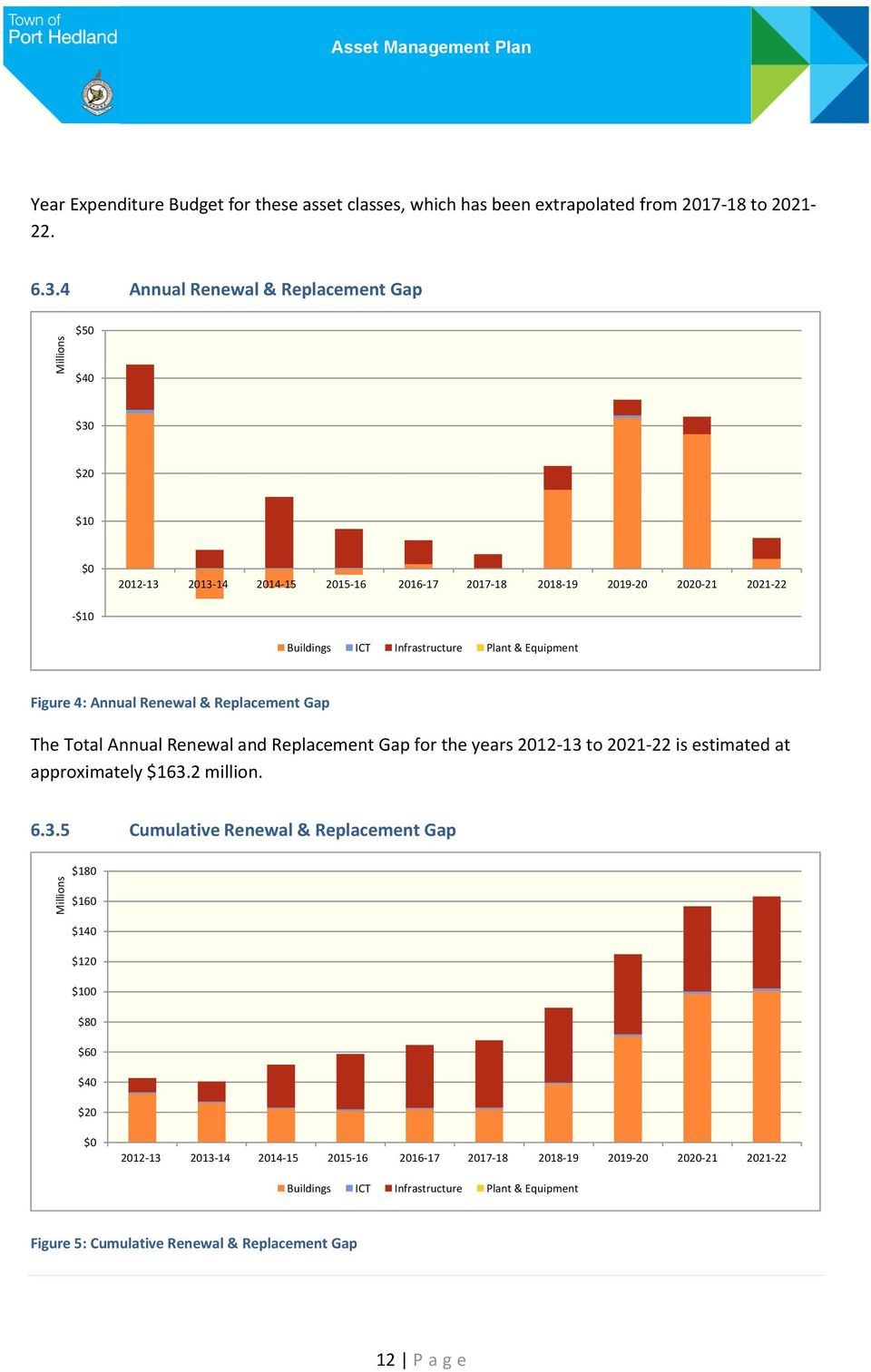
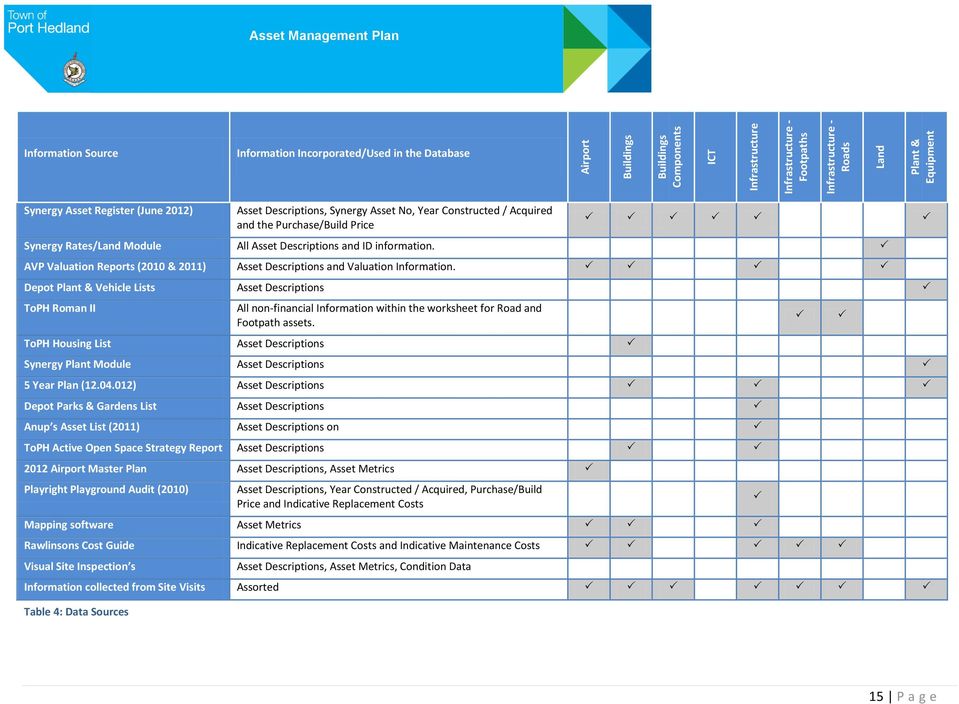
13 The total cumulative renewal and replacement gap for the years to is estimated at approximately $163.2 million. 6.4 Data and Information A database has been prepared for the Town, which consolidates all existing asset data into one asset register. Table 4 (at the end of this sub-section) summarises the sources of this data. A copy of the detailed notes accompanying the database is attached at Appendix 2. These notes identify a number of shortcomings in the Town s current data and information management systems and records. The AMS includes provision for a comprehensive audit of all asset data to confirm an agreed register of assets across the Town s directorates. The priorities for this audit are assessed as: Land Confirm all parcels of land owned and/or leased by the Town, including details of ownership and tenure, use and planning conditions, commercial terms, rights and obligations and value Infrastructure Reconcile and verify the existence, size and type of all roads and bridges, pathways, footpaths and cycleways; drainage, electrical, water/waste water and lighting systems Buildings Confirmation of stock, location, use, size, age, occupant and asset owner Plant & Equipment Reconciliation and consolidation of the multiple record systems to ascertain the actual assets held by the Town Revenue Assets Create a register for the details of all assets generating non-rates revenue for the Town, e.g. property leases, advertising boards, licenses, easements, and intangible assets such as wave-lengths and broadcasting rights. This will enable the formulation of strategies for these assets to optimise additional revenue streams for the Town ICT Audit of all ICT and audio visual assets to confirm asset stock, models, use, location and asset owners. 13 P a g e

14 6.4.7 Ovals, Reserves, Sports Facilities, Landscaping & Horticulture and Miscellaneous Assets Reconcile and verify the existence, type, size, age, user and asset owner of all ovals, reserves, sports facilities, landscaping and horticulture and other miscellaneous assets Confirmation of stock, location, use, size, age, occupant and asset owner. The outcomes of this audit will be a single whole-of-town Asset Register and Database that: Provides the platform for informed decision-making going forward; Enables the improvement of the Finance Register in terms of recording assets and their accounting treatment; Matches assets to asset owners; Enables the implementation of good asset management practice and process; Enables the production of reality-based Asset Management Strategies and Plans that are linked to the SCP and CBP by responding to the service and development needs of the Town; and Provides sound financial information for the LTFP. 14 P a g e

15 Airport Buildings Buildings Components ICT Infrastructure Infrastructure - Footpaths Infrastructure - Roads Land Plant & Equipment Asset Management Plan Information Source Information Incorporated/Used in the Database Synergy Asset Register (June 2012) Table 4: Data Sources Asset Descriptions, Synergy Asset No, Year Constructed / Acquired and the Purchase/Build Price Synergy Rates/Land Module All Asset Descriptions and ID information. AVP Valuation Reports (2010 & 2011) Asset Descriptions and Valuation Information. Depot Plant & Vehicle Lists Asset Descriptions ToPH Roman II All non-financial Information within the worksheet for Road and Footpath assets. ToPH Housing List Asset Descriptions Synergy Plant Module Asset Descriptions 5 Year Plan ( ) Asset Descriptions Depot Parks & Gardens List Asset Descriptions Anup s Asset List (2011) Asset Descriptions on ToPH Active Open Space Strategy Report Asset Descriptions 2012 Airport Master Plan Asset Descriptions, Asset Metrics Playright Playground Audit (2010) Asset Descriptions, Year Constructed / Acquired, Purchase/Build Price and Indicative Replacement Costs Mapping software Asset Metrics Rawlinsons Cost Guide Indicative Replacement Costs and Indicative Maintenance Costs Visual Site Inspection s Asset Descriptions, Asset Metrics, Condition Data Information collected from Site Visits Assorted 15 P a g e
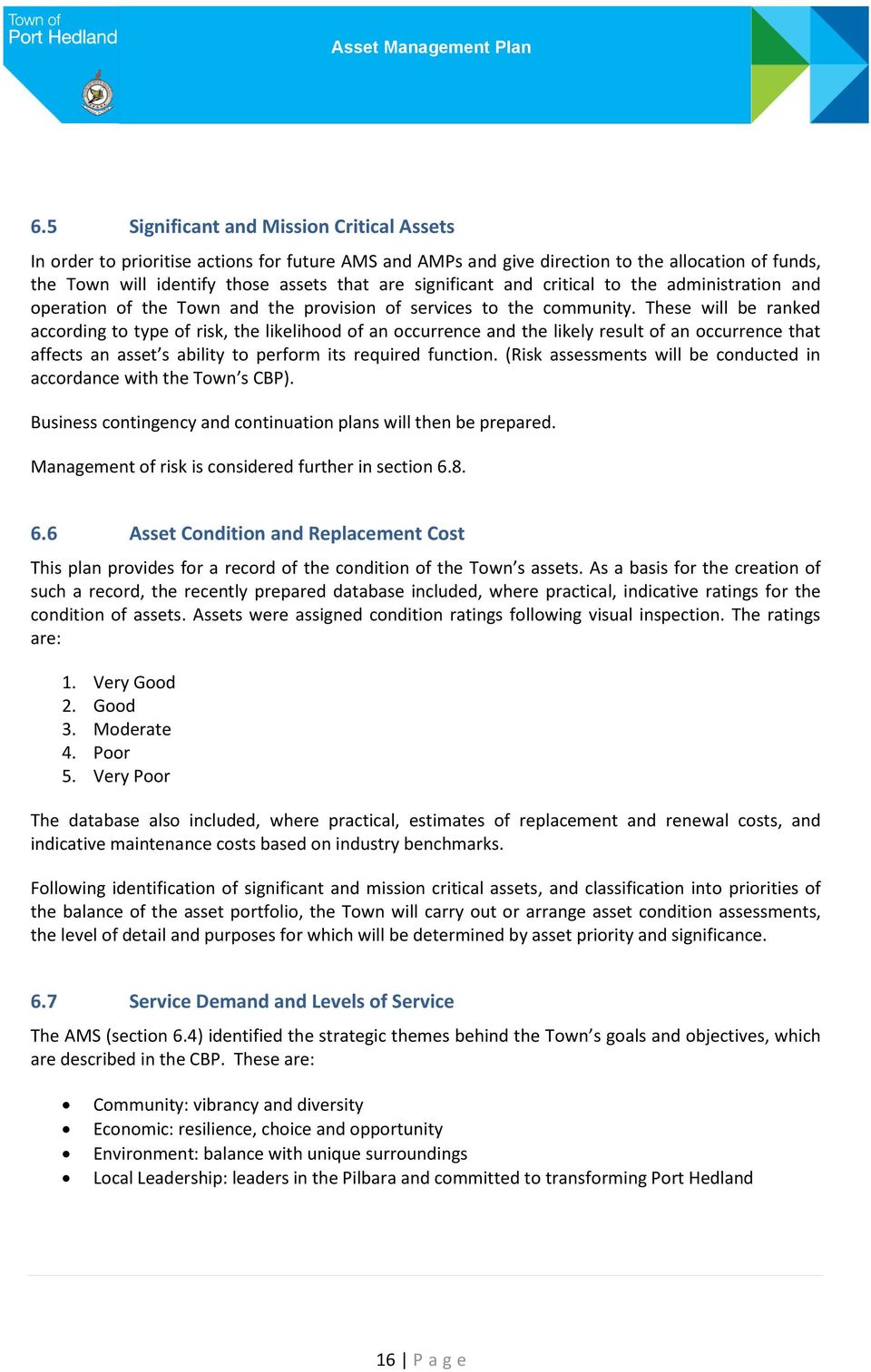
16 6.5 Significant and Mission Critical Assets In order to prioritise actions for future AMS and AMPs and give direction to the allocation of funds, the Town will identify those assets that are significant and critical to the administration and operation of the Town and the provision of services to the community. These will be ranked according to type of risk, the likelihood of an occurrence and the likely result of an occurrence that affects an asset s ability to perform its required function. (Risk assessments will be conducted in accordance with the Town s CBP). Business contingency and continuation plans will then be prepared. Management of risk is considered further in section Asset Condition and Replacement Cost This plan provides for a record of the condition of the Town s assets. As a basis for the creation of such a record, the recently prepared database included, where practical, indicative ratings for the condition of assets. Assets were assigned condition ratings following visual inspection. The ratings are: 1. Very Good 2. Good 3. Moderate 4. Poor 5. Very Poor The database also included, where practical, estimates of replacement and renewal costs, and indicative maintenance costs based on industry benchmarks. Following identification of significant and mission critical assets, and classification into priorities of the balance of the asset portfolio, the Town will carry out or arrange asset condition assessments, the level of detail and purposes for which will be determined by asset priority and significance. 6.7 Service Demand and Levels of Service The AMS (section 6.4) identified the strategic themes behind the Town s goals and objectives, which are described in the CBP. These are: Community: vibrancy and diversity Economic: resilience, choice and opportunity Environment: balance with unique surroundings Local Leadership: leaders in the Pilbara and committed to transforming Port Hedland 16 P a g e
17 The demand for assets and their levels of service are derived from the Town s service drivers, which are created by the Strategic Themes (longer-term strategies) and on-going business as usual service delivery to both the community (external) and support to the Town s administration (internal). Although the AMS makes provision for the integration of the longer-term strategies into a single AMP for the Town, this plan is principally concerned with the service drivers generated by the external and internal demand for services. This plan, therefore, calls for a review of all assets, in order of priority, by the asset owners. The review of assets will follow the inputs listed for the development of an AMP. Once these internal and external service drivers have been identified, it will be possible to determine and agree appropriate levels of service for each asset. 6.8 Management of Risk The policy and principles for the management of risk are embedded on the Town s CBP. Section 6.5 considers asset related risk in the context of business and service continuity. Table 5 identifies a number of risk categories together with associated potential risks and causes. This plan includes a comprehensive risk assessment and management exercise in relation to the performance of assets. Risk Category Potential Risks Potential Causes Property Environmental & Climatic damage Poor condition Non-performance The Public and the Community Personal injury Property damage Disruption to services Legal Public liability Damages Breach of contract Duty of care (negligence) Compliance Weathering & Cyclone Poor maintenance & maintenance backlogs/renewal & replacement gaps Lack of standards, performance measures and asset management Poor maintenance Lack of planning Lack of standards, performance measurement and contingency & continuity planning. Poor maintenance Lack of contingency planning Lack of information & data Poor inspection regimes, 17 P a g e
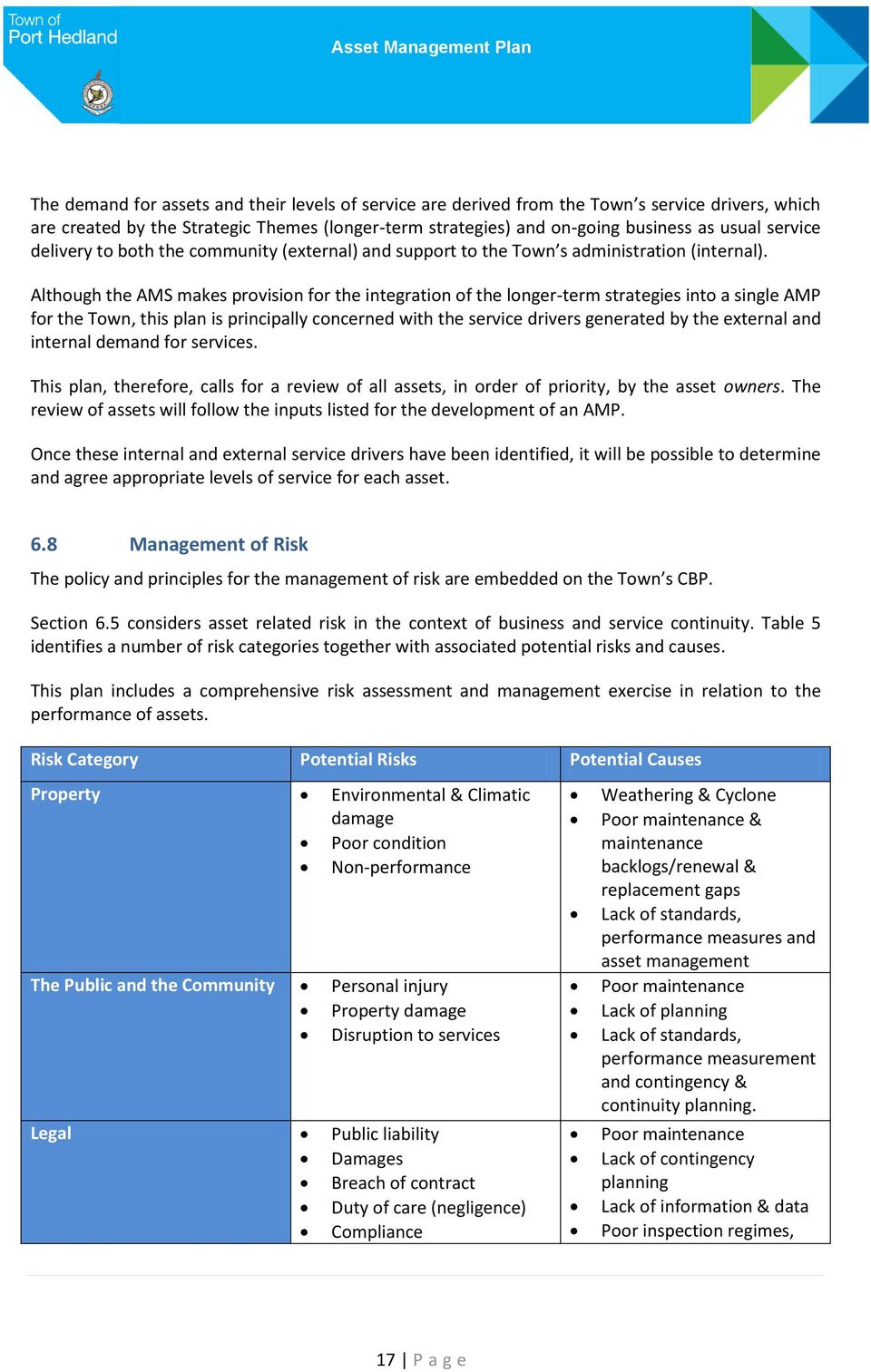
18 asset management processes and system Lack of governance, roles & responsibilities and accountability Financial Financial wastage (budgetary) Increased balance sheet liability Legal damages Inability to collect revenues (rates) Political Poor decision-making capacity Table 4: Risk Matrix Lack of planning & effective financial management regime (budgeting) Maintenance backlogs/renewal & replacement gaps Systems failure Lack of asset information & data Poor assessment of service demand drivers This demonstrates that most, if not all, asset related risks could be mitigated through good asset management systems and process. Maintenance is regarded by the asset management industry as a risk management activity. 6.9 The Development of Asset Management Strategies and Plans The aggregated outcomes of the actions described in sections will enable the Town to strengthen AMS and AMP of sufficient detail and quality to provide the Town with a reliable direction for the management of its assets in terms of the optimal asset portfolio, asset performance and financial need. These outcomes will provide the ability to prepare plans, budgets and programs based on need and priority determined by reliable asset data and life cycle information for the following: Detailed short to medium-term (annual and 5-yearly) operating and maintenance requirements; Renewal and replacement strategies; Capital investment strategies for new assets and upgrades; Asset disposal strategies; and Accommodation needs. They will also provide the basis for the development of a performance management system, which tracks individual assets, the portfolio as a whole, asset effectiveness and efficiency, industry benchmarks, and the asset management system and processes. 18 P a g e

19 6.10 Performance Management The measurement of asset performance is currently focused on the operational and technical management of assets. The AMS provides a strategy for a performance management system in the following areas: Asset performance against agreed internal and external levels of service; Performance of individual assets measured against benchmarks and financial and nonfinancial targets; Asset effectiveness; The DLG ratios; The renewal and replacement gaps; Maintenance effectiveness; The asset management processes; Improvement initiatives; and Staff performance and retention, appraisal systems, skills and experience gaps, and training and development programs Asset Management Process All asset management activity and successful asset management outcomes are dependent upon and underpinned by good processes and systems. The AMS describes a detailed strategy for the adoption of processes and an asset management system based on the industry-acknowledged asset management cycle. This plan provides for their implementation Asset Management System (Software) It is the Town s strategy to compile all asset information and data into spreadsheets over the first year of the plan. During this time the Town plans to finalise its total systems requirements for all administrative, management and service activity across the Town s directorates. However, the Town is currently considering its requirements for an asset management system In summary, these are: Linkage to the Financial system; Categorisation of asset classes and hierarchies; Capacity to store and record all asset details and characteristics; Maintenance planning and management functionality; Works management; Financial functions for procurement and contract management; The capacity to develop management and work processes with and for the Town; Basic reporting functions; 19 P a g e

20 Capacity for development to meet the Town s expanding needs as the level of asset management sophistication matures; Compatible with related asset management operational technological devices and equipment, such as web-based hand-held transfer of data between operational sites and the asset management system; Local government experience; Strong systems support and committed/demonstrated systems development program that responds to user need and feedback. 7.0 Asset Management Plan The detailed plan to implement these strategies is contained at Appendix 3. Figure 6 is a high-level summary of this plan, over which the asset management maturity curve has been superimposed to indicate the potential progress of the Town. The plan indicates the Town achieving Core standard by the 4 th quarter of year 2, and Advanced standard by the 3 rd quarter of year 3. Definitions for these standards were provided in table 18, section 6 of the AMS. The order of activity over the 36 month timeframe has been selected by priority, i.e. the immediate priority for the Town is to audit its data and asset records as soon as possible. All other asset management activity is dependent upon the accuracy and completeness of asset data and information. Although activities overlap each other, the priority rankings are: 1. Data audit 2. Asset Management Reviews 3. Identification of mission critical assets 4. Asset condition assessments 5. Confirmation of asset replacement and renewal costs 6. Assign asset owners 7. Define service demand and levels of service 8. Risk assessments 9. Acquire asset management software 10. Implement & refine software 11. Revise DLG ratios 12. Establish performance management system 13. Review/revise Asset Management Strategy & Plan 14. Develop and implement asset management processes 20 P a g e

21 21 P a g e
22 Process Year 1 Year 2 Year 3 Data Audit QTR 1 QTR 2 QTR 3 QTR 4 QTR 1 QTR 2 QTR 3 QTR 4 QTR 1 QTR 2 QTR 3 QTR 4 Asset Management Reviews Identify Mission Critical Assets Asset Condition Assessments Determine Replacement/Renewal Costs Assign Asset Owners Define Service Demand & Levels of Service Assess Risks to Assets and Assetrelated Service Risks Acquire Asset Management Software Implement & Refine AM Software Revise DLG Ratios Establish Performance Management System Review/Revise Asset Management Strategy & Plan Develop & Implement Asset Management Processes Figure 5: Summary Asset Management Plan Advanced Core 22 P a g e
23 8.0 Glossary of Terms The following terms are used in this framework. Assets are future economic benefits controlled by the Town of Port Hedland as a result of a past transaction or event whereby: Its value can be measured reliably, and; Its value must exceed a stated materiality threshold being $5,000 or form part of a network asset group, and; It must be probable that future economic benefits of the asset will eventuate (i.e the asset acquired supports the delivery of Council services to the community in line with Councils objectives) Asset Management refers to the combination of management, financial, economic, and engineering and other practices applied to assets from their planning, acquisition, operation, maintenance, replacement and disposal, to ensure that the assets meet the priorities of the Strategic Community Plan with the objective of providing the required level of service in the most costeffective manner. Asset Management Plan refers to a long term plan that combines multi-disciplinary asset management techniques to outline the assets activities, program and resources applied to provide a defined level of service for each asset class over the lifecycle of the asset. Asset Management Strategy means a strategy or approach for asset management. Asset Current refers to an asset that can easily be converted to cash within the next 12 months. Asset Non Current refers asset that cannot easily be converted to cash within next 12 months Attractive Item refers to an item defined as below: has a value of less than $5k (exc GST ); has an attractive nature; is prone to misappropriation for private use or theft. Council means the elected council (comprising Councillors) of the Town of Port Hedland. Depreciation is a systematic charge that recognises the wearing out or consumption of the noncurrent asset over its useful life. Gap Analysis a method of assessing the gap between the Towns current asset management practices and the future desirable asset management practices. 23 P a g e
24 Infrastructure comprises the asset sub-classes defined in section 5 of the Asset Management Framework and Guidelines issued by the Department of Local Government. Level of Service describes the outputs or objectives of the Town or the activity the Town intends to deliver to the customer. Service levels usually relate to quality, quantity, reliability, responsiveness, statutory functional requirements, environment, acceptability and cost. Life Expectancy is the estimated or expected time between placing the asset into service and removing it from service. Life Cycle means the phases of activities that an asset goes through, including planning, design, construction, acquisition, operation, maintenance, rehabilitation and disposal. Maintenance means regular ongoing day-to-day work necessary to keep an asset operating to achieve its optimum life expectancy. Network Asset Group refers to a collective group of assets; whilst individually do not function for their intended purpose and may be under the threshold of an asset defined herein, but collectively in a group of assets, functions as intended and exceeds the threshold of an asset, e.g. desktop computers, servers, laptops etc. Operations means the regular activities to provide public health, safety and amenity and to enable the assets to function e.g. road sweeping, grass mowing, and cleaning, street lighting and graffiti removal. Renewal means works to upgrade an asset, refurbish an asset or the replacement of part(s) of an asset to ensure continuing equivalent capacity or performance capability. Replacement means the complete replacement of an asset that has reached the end of its life, to provide a similar or agreed alternative, level of service. Replacement Cost means the cost of replacing an existing asset with an identical new asset. Risk means probability and consequence of an event that could impact on the Council s ability to meet its corporate objectives. Town of Port Hedland (Town) means the collective Town of Port Hedland organisation. Strategic Community Plan means the plan containing the long-term goals and strategies of the Town. Stakeholders are those people/sectors of the community that have an interest or reliance upon an asset and who may be affected by changes in the level of service of an asset. Upgrade means enhancing an existing asset to provide higher level of service. Whole of Life Cost refers to the total cost of an asset throughout its life cycle. 24 P a g e
25 25 P a g e
26 APPENDIX 1 Asset Management Strategy Summary 26 P a g e
27 Strategic Objective: Direction and Accountability Defined roles and responsibilities and accountabilities that are clearly understood across the organisation and integrated into the Town s business and resources planning process. Item Current Position Strategy Action Governance and Management Arrangements The Town has put initial governance arrangements in place as part of this strategy. The Workforce Plan provides for the appointment of asset management staff in the areas of Technical Services and Finance. Further development of governance and management arrangements over the next 12 months Development of roles and responsibilities and assignment of asset management tasks. Nomination of a senior corporate sponsor of asset management. Nomination of an owner of the corporate asset management function. Active involvement of Executive Management Team and asset owners. Elected Members are kept informed of asset management progress. 27 P a g e
28 Strategic Objective: Lifecycle Management A portfolio of assets that is aligned with the Town s corporate, financial and business objectives, which is efficiently and effectively managed from asset conception, planning, design, use and disposal. Item Current Position Strategy Action Asset Knowledge The Town has a broad picture and understanding of its asset base. This will be expanded in the areas of asset condition and performance. The Town will develop a detailed understanding of the asset portfolio in terms of asset inventory; asset condition, value, cost and appropriateness; and remaining life. Carry out a comprehensive asset audit, including land holdings and revenue assets. Confirm condition of significant & critical assets. Develop maintenance & renewal programs that align with strategy and asset owner requirements. The Town s Goals & Objectives Goals and objectives are being developed through the SCP and CBP. Asset Management Strategies and Plans will be framed to align the asset portfolio with the strategic goals and objectives of the Town. Integrate asset strategies and plans into single Asset Strategy and Planning documents that, as an aggregate, reflect the Town s Corporate Business Plan, Workforce Plan, ICT Plan and Long-term Financial Plan. Adopt a performance management system based on a balanced scorecard approach, i.e. financial, customer, internal business, and environmental and social perspectives. 28 P a g e
29 Service Drivers The current management of the Town s assets is principally driven by the requirements of the physical upkeep of assets, the operational requirements of the Town, and through community surveys. The CBP recognises 3 main demand sets that drive the requirement for services: Long-term strategic growth demand; Ongoing external demand from the community; and Ongoing internal operational demand from the Town s administration. Asset Strategies and Plans to address the long, medium and short-term needs of each service demand set. Implement an integrated whole-oforganisation strategic and planned approach to asset management. Each directorate of the Town s administration will define the criteria required of their assets having regard to the following: Asset type; Location; Utility; Serviceability and functionality; Condition; Amenity; and Financial criteria. Financial Performance Indicators This strategy presents initial assessments of the Town s asset replacement costs, expenditure forecasts, gaps and ratios. These will inform the LTFP. Data used for these assessments have been sourced from various and separate records, which have been identified as having a number shortcomings. Consolidate all asset data into a single comprehensive database that is linked to the Town s financial and accounting systems. Establish a new budgeting paradigm and financial reporting regime that reflects the whole-of-life management of assets. Manage the Renewal & Replacement Gap by: Check, cleanse and verify all asset data across all registers, records and systems. Develop new budget processes and financial reporting regimes for each asset type that is based upon their actual operating and service performance requirements as part of individual asset plans. ACR: refine the estimation of the ACR as improvements are made to financial & asset data. 29 P a g e
30 Prioritising and grading the importance of each asset; Identifying significant and mission critical assets; Assessing the continuing need and standards/levels of service for these assets; Defining minimum asset condition and in-use efficiency and effectiveness to support service levels; Assessing their condition; Assessing the risk and impact on the Town s services and operations of any failure to meet standards/levels of service; Develop individual asset plans for mission critical assets and the balance of asset classes by reference to the Town s financial context and availability of funds. ASR: confirm a ratio that reflects the true position of the Town by: Examining and confirming asset Written Down Values; Reviewing the estimated expenditure on asset renewal and replacement; and Refining the budget process and methodology. ARFR: Calculate ratio following finalisation of asset renewal program. Develop a Performance Management System comprising sets of Performance Objectives, Key Performance Indicators and Measures of Performance for each asset class. The Performance Management System will be drawn up and agreed in consultation with the Town s asset owners. Examples of maintenance performance indicators are shown in table 12 below. Asset Management Cycle & Processes The Town s current asset management processes are primarily related to 5-year and annual expenditure budgets, asset maintenance and operations. Introduce Asset Management processes based on acknowledged leading practice principles for the public sector that cover all stages of asset lifecycles. Maximise revenue streams from commercial assets, alternative and/or additional asset uses. Construct and implement processes for: Strategic Asset Planning; Asset Programs; Asset & Service Delivery Programs; Performance Management & Review; and Processes for Improvement. (Appendix 1.) Review asset portfolio for potential revenue sources. 30 P a g e
31 Strategic Objective: Data and Information Management The ability to identify, analyse and model asset trends that enhance asset efficiency and effectiveness and enable informed decision-making. Item Current Position Strategy Action Data Systems The Town has one asset register and maintains spreadsheets to record asset information and for the management of its assets, the responsibility for which is spread across the organisation. Asset records do not align between the corporate finance system and operating divisional records. A comprehensive audit of existing data and systems has occurred and shortfalls identified. The Town does not have an asset management software system (AMS). Consolidate data and information onto a single AMS that satisfies the following: Linkage to the Financial system; Categorisation of asset classes and hierarchies; Capacity to store and record all asset details; Maintenance planning & works; management; Procurement & contract management; Management & work processes; Reporting functions; Capacity to develop with Town s expanding requirements; Compatible with web-based devices to transfer data between operational sites and the AMS; Local government experience; Strong systems support. Define required asset data and asset information requirements. Define asset management information reporting hierarchy and requirements that are consistent with governance and management arrangements. Collate data onto individual spreadsheets for transfer into an AMS Develop specification for an AMS. Select and implement an AMS. Convert to an AMS within 12 months. 31 P a g e
32 Strategic Objective: Standards and Levels of Service A portfolio of assets that is aligned with community and organisational expectations and priorities having regard to the financial context of the Town. Item Current Position Strategy Action Levels of Service (LOS) & Property/Facility Management Standards The Town currently conducts community surveys to assess standards of service. The Town is planning the introduction of a formal LOS framework and documented service standards. Expand/enhance the community surveys to include information relating to the condition, use and effectiveness of assets. Document a LOS framework that clearly defines and documents LOS for: Community; Technical; Compliance; and Internal services. Design survey template for community feedback on assets; and methodology to interpret and analyse responses for input into strategies. Agree and set minimum internal and external standards for each asset category/facility supported by an inspection and management regime. Document a register of legislative requirements, codes of practice and standards, and other obligations. Develop processes to ensure their compliance. Performance Measurement The Town is currently planning the adoption of a formal performance measurement system. Develop a performance measurement system that comprises outcomes, standards and targets, indicators and measures, and bases of measurement. Apply the Town s risk management system to evaluate and manage asset and associated service related risks. Develop methodologies to measure and analyse the performance of the Town s assets, and the asset management systems and processes used in their management, against LOS and financial criteria. Examples of LOS for buildings are shown in table 15. Prioritise assets; analyse risks; and prepare and test contingency and continuity plans. 32 P a g e
33 Strategic Objective: Continuous Improvement Ongoing improvement in asset management competency and capacity. Item Current Position Strategy Action Asset Management Awareness, Knowledge and Understanding The Town is implementing the IPRF requirements of the DLG. These require an extended knowledge and understanding over and above current practices. Enhancement and development of asset management practices on an ongoing basis. Develop awareness, training and development programs for all levels of Town staff and Elected Members that caters for induction and ongoing development. These programs will be planned to align with the implementation of the improvement strategy. Develop a system of self- and external assessment. Benchmark against other jurisdictions, WALGA, Department of Local Government requirements, and other bodies. Maintain a process to track developments and innovations in best practice. Skills & Experience The Town possesses competent technical and operational skills and experience. Develop and acquire skills and experience necessary to fulfil the requirements of the IPRF in Asset Management Undertake skills audit. Identify required skills. Close gaps through a plan for recruitment, up-skilling & training. 33 P a g e
34 APPENDIX 2 Accompanying Notes to the Town of Port Hedland Asset Database 34 P a g e
35 APPENDIX 3 Asset Management Plan 35 P a g e
36 36 P a g e
37 Process Responsibility Year 1 Year 2 Year 3 1. ASSET MANAGEMENT ORGANISATION 1.1. Establish AM structure 1.2. Define formal roles & responsibilities 1.3. Identify internal & external customers and stakeholders 1.4. Capacity, capability & skills - Define required AM resources - Assess and build matrix of existing capacity, capability & skills - Analyse gaps required for good asset management process and to progress the Town towards Advanced status - Develop training & development programs 1.5. Develop AM communications strategy for whole-of-town AM culture 2. DEVELOPMENT OF ASSET MANAGEMENT STRATEGIES & PLANS 2.1. Link with CBP - Identify the Town s vision and 10-year business goals & objectives - Identify business/service drivers & service models for each directorate 2.2. Link with LTFP - The Town s financial context - Asset financial constraints - Financial ratios Q1 Q2 Q3 Q4 Q1 Q2 Q3 Q4 Q1 Q2 Q3 Q4 P a g e 37
38 Process Responsibility Year 1 Year 2 Year 3 - Annual budgets for assets - 10-year expenditure plan (renewal, upgrade & new) 2.3. Define asset categories/classes 2.4. Identify significant & critical assets 2.5. Define desired asset base in 10 years, incl. Accommodation Plans 2.6. Define critical success factors for each asset category 2.7. Review existing asset base & undertake detailed condition assessments for significant and critical assets 2.8. Analyse gaps 2.9. Develop asset strategies to close the gaps (capital, maintenance, accommodation, disposal & acquisition) Prioritise projects against criticality and financial context & constraints Q1 Q2 Q3 Q4 Q1 Q2 Q3 Q4 Q1 Q2 Q3 Q4 3. DEVELOP INDIVIDUAL ASSET PLANS 3.1. Maintenance, renewal, upgrade, disposal 3.2. Annual operating plans & budgets year plans 4. PERFORMANCE MEASUREMENT 4.1. Satisfy ratios for: - Asset Consumption (ACR) - Asset Sustainability (ASR) P a g e 38
39 Process Responsibility Year 1 Year 2 Year 3 - Asset Renewal Funding (ARF) 4.2. Set objectives for: - The AM system - AM Strategy - Asset performance: effectiveness (location, suitability, condition, amenity, functionality, utilisation) - Asset performance: efficiency (life cycle cost, cost-in-use, value-for-money) - Operational & maintenance management: maintenance spend, portfolio condition, effectiveness of spend - Levels of service for internal & external clients (community, technical, compliance, internal) - Outsource service providers, suppliers & contractors 4.3. Agree KPIs relevant to objectives 4.4. Define units of measurement 4.5. Develop measurement tools and techniques 4.6. Benchmark performance 4.7. Develop a quality management system (performance reviews) 4.8. Develop reporting regime relevant to all organisational levels, including a balanced scorecard. 5. DATA & SYSTEMS 5.1. Asset inventory & information - Complete, check, verify & cleanse database - Develop process for ongoing management & maintenance of database Q1 Q2 Q3 Q4 Q1 Q2 Q3 Q4 Q1 Q2 Q3 Q4 P a g e 39
40 Process Responsibility Year 1 Year 2 Year Develop common corporate framework based on asset hierarchy 5.3. Review account structure & finance system for sufficient componentisation to enable required level of financial reporting on assets 5.4. Develop database of unit rates for asset maintenance & renewal 5.5. Select/acquire an asset management software that interfaces with the Town s Finance Management System (Synergy) and ROMAN II. Key functionality requirements: - Hold details of all assets in at least the level of detail of the recently-built database - Store, maintain and update asset condition reports and defect conditions - Plan and long-term operation, maintenance, renewal and upgrade of assets; forward capital works programs; maintenance programs and works - Financial management & reports - Required reporting criteria - Property & facility management functionality 6. TRANSLATION OF STRATEGY & PLANS INTO ASSET PROGRAMS Develop and document processes for 6.1. Identification of potential projects 6.2. Preparation of asset business cases 6.3. Asset program development and evaluation 6.4. Financial planning for assets Q1 Q2 Q3 Q4 Q1 Q2 Q3 Q4 Q1 Q2 Q3 Q4 P a g e 40
41 Process Responsibility Year 1 Year 2 Year 3 Q1 Q2 Q3 Q4 Q1 Q2 Q3 Q4 Q1 Q2 Q3 Q4 7. DELIVERY OF ASSET PROGRAMS Develop and document processes to: 7.1. Assess optimum means of delivery 7.2. Design project structures and governance 7.3. Prepare project management plans 7.4. Communicate to stakeholders 7.5. Measure project performance 7.6. Assess and manage risk 8. RISK MANAGEMENT Design and document a risk management system for each asset category and significant & critical assets that: 8.1. Conforms to the CBP requirements for management of risk 8.2. Includes contingency and continuity plans for significant and critical assets 9. CONTINUOUS IMPROVEMENT Develop and document procedures for: 9.1. Reviewing and updating the AMS & AMP 9.2. A methodology for assessing remaining useful lives of asset groups, residual values and componentised depreciation 9.3. A methodology to collect and record asset data 9.4. A process for the handover of assets to asset custodians 9.5. A process to communicate the implications of asset P a g e 41
42 Process Responsibility Year 1 Year 2 Year 3 management plans to internal and external stakeholders 9.6. Reviewing and improving: - The asset management system and process - Corporate structure - Delivery models - Skills, capability & capacity - Asset performance Q1 Q2 Q3 Q4 Q1 Q2 Q3 Q4 Q1 Q2 Q3 Q4 P a g e 42
Asset Management Strategy. High-performing and sustainable assets
 Asset Management Strategy High-performing and sustainable assets DISTRIBUTION SCHEDULE Revision No. Date Distribution Reference R1.0 19 September 2012 R1.1 25 September 2012 Issued to KPMG for review R1.2
TEC Capital Asset Management Standard January 2011
 TEC Capital Asset Management Standard January 2011 TEC Capital Asset Management Standard Tertiary Education Commission January 2011 0 Table of contents Introduction 2 Capital Asset Management 3 Defining
Asset Management Policy
 Asset Policy DETAILS Council Admin Effective from: July 2015 Contact officer: Executive Coordinator Strategic Asset, Corporate Asset Next review date: June 2017 File reference: LG343/1045/03/01 ispot #
1. INTRODUCTION... 1 2. PURPOSE OF THE ASSET MANAGEMENT STRATEGY... 2 3. ASSET MANAGEMENT... 3
 ASSET MANAGEMENT STRATEGY 2010-2020 November 2009 1. INTRODUCTION... 1 2. PURPOSE OF THE ASSET MANAGEMENT STRATEGY... 2 3. ASSET MANAGEMENT... 3 4. WESTERN AUSTRALIAN ASSET MANAGEMENT IMPROVEMENT PROGRAM
CGAM022.1/12/10. Asset Management Improvement Strategy 2010
 Asset Management Improvement Strategy 2010 Version Control Version No. Date Details Author/s 1.0 July 2009 Adopted Strategy 2.0 October 2010 Update TABLE OF CONTENTS OF CONTENTS 4 OF THE ASSET MANAGEMENT
4 Adoption of Asset Management Policy and Strategy
 4 Adoption of Asset Management Policy and Strategy Abstract The report recommends the adoption of an updated Asset Management Policy 2014 and an Asset Management Strategy 2014-2019. Both documents are
Asset Management. Framework and Guidelines. Part 2 - Asset Management Guidelines for Western Australian Local Governments p1.
 Asset Management Framework and Guidelines Part 2 - Asset Management Guidelines for Western Australian Local Governments p1. Contents Foreword 4 Part 1 Asset Management Framework 5 1. Introduction 7 2.
Page 1 of 24. To present the Asset Management Policy 2014 for Council adoption.
 Page 1 of 24 COMMUNITY AND SERVICES SPECIAL COMMITTEE REPORT 9 DECEMBER 2104 AGENDA ITEM 6.1 ASSET MANAGEMENT POLICY 2014 REVIEW Director: Manager: Ian Butterworth Director Infrastructure and Engineering
Long-Term Asset Management Plan 2011-2021
 Long-Term Asset Management Plan 2011-2021 Contents Introduction...3 A shared vision...4 Strategic planning to achieve our goals...4 Towards 2031...5 A long-term vision, communicated by our community...5
2. CORPORATE POLICIES 2.3 OTHER CORPORATE 2.3.11 Asset Management Policy
 2. CORPORATE POLICIES Background & Issues Local Government across Australia is facing the challenge of building, operating and maintaining vital infrastructure necessary for the well-being of their communities.
Asset Management Plan Overview
 Council Strategy Asset Management Plan Overview City of Albany 2013 File Ref: CM.STD.6 Synergy Ref: NMP1331749 102 North Road, Yakamia WA 6330 Version: 25/06/2013 PO Box 484, ALBANY WA 6331 Tel: (08) 9841
The Asset Management Landscape
 The Asset Management Landscape ISBN 978-0-9871799-1-3 Issued November 2011 www.gfmam.org The Asset Management Landscape www.gfmam.org ISBN 978-0-9871799-1-3 Published November 2011 This version replaces
Infrastructure Asset Management Strategy
 Infrastructure Asset Management Strategy Strategy Owner Manager Parks and Assets Engineering and Infrastructure Creation Date 27 March 2006 Revision Date 4 March 2015 Please check Council s Intranet to
Asset Management Policy March 2014
 Asset Management Policy March 2014 In February 2011, we published our current Asset Management Policy. This is the first update incorporating further developments in our thinking on capacity planning and
City of Canning. Asset Management Strategy 2015 2018
 City of Canning Asset Management Strategy 2015 2018 Document Control Version No Version Date Description TRIM Reference 1.0 11 December 2012 Asset Management Strategy D12/68776 2.0 23 September 2015 Updated
ROADS ALLIANCE ASSET MANAGEMENT COMMUNIQUÉ AUGUST 2010 LOCAL GOVERNMENT ASSOCIATION OF QUEENSLAND LTD
 ROADS ALLIANCE ASSET MANAGEMENT COMMUNIQUÉ AUGUST 2010 LOCAL GOVERNMENT ASSOCIATION OF QUEENSLAND LTD Contents 4 Glossary 6 Background 9 Purpose of Communiqué 9 Australian and State Government Drivers
Glenorchy City Council Asset Management Strategy for Infrastructure Assets
 Glenorchy City Council Asset Strategy for Infrastructure Assets 2014/15 to 2017/18 Version 1.3 June 2014 Glenorchy City Council Asset Strategy for Infrastructure Assets Document Control Document Control
TITLE C171 ASSET MANAGEMENT POLICY DEPARTMENT. Engineering Services POLICY DIRECTIVE
 TITLE C171 ASSET MANAGEMENT POLICY DEPARTMENT Engineering Services POLICY DIRECTIVE This Asset Management policy will ensure that Asset Management is clearly recognised by Council and community in accordance
ASSET MANAGEMENT STRATEGY
 City of Salisbury ASSET MANAGEMENT STRATEGY Version 6 June 2015 City of Salisbury Asset Management Strategy Document Control Document Control NAMS.PLUS Asset Management www.ipwea.org/namsplus Document
LONG TERM FINANCIAL PLAN (INTERIM) 2012/13 to 2022/23
 LONG TERM FINANCIAL PLAN (INTERIM) 2012/13 to 2022/23 INTRODUCTION Long term financial planning is a key element of the Integrated Planning and Reporting Framework. It is the mechanism that enables local
ASSET MANAGEMENT STRATEGY
 Wattle Range Council ASSET MANAGEMENT STRATEGY Version February 2014 V1 Wattle Range Council Asset Management Strategy Document Control Document Control NAMS.PLUS Asset Management www.ipwea.org.au/namsplus
IAM Certificate in Asset Management Ver1.2 January 2013
 IAM Certificate in Asset Management Ver1.2 January 2013 Introduction 1.1 The IAM Certificate is aimed primarily at new entrants and those with some experience in asset management roles and seeking to achieve
A Guide For Preparing The Financial Information Component Of An Asset Management Plan. Licensing, Monitoring and Customer Protection Division
 A Guide For Preparing The Financial Information Component Of An Asset Management Plan Licensing, Monitoring and Customer Protection Division July 2006 Contents 1 Important Notice 2 2 Scope and purpose
CORPORATE PERFORMANCE MANAGEMENT GUIDELINE
 -001 CORPORATE PERFORMANCE MANAGEMENT GUIDELINE -001 TABLE OF CONTENTS 1 Introduction... 3 1.1 Scope... 3 1.2 Purpose... 3 2 Performance Management Framework Overview... 4 3 Performance Management Framework...
Long Term Financial Planning
 Long Term Financial Planning Framework and Guidelines Long Term Financial Planning Framework and Guidelines for Western Australian Local Governments p1. Contents Foreword 4 1. Introduction 7 2. Purpose
Asset Management Strategy
 Asset Management Strategy City of Stonnington April 2011 Odysseus-imc Pty Ltd APPROVAL FUNCTION NAME DATE Checked by S. Muir 4 Mar 2011 Reviewed by T. Griffin 6 Mar 2011 Approved by S. Muir 4 April 2011
Asset Management Plan
 BUILDING Asset Management Plan Version 1 May 2013 Document Control Document ID: Buildings AMP 2013 Rev No Date Revision Details Author Reviewer Approver 1 22 May 2013 JN RG WI Copyright 2012 All rights
Quick Guide: Meeting ISO 55001 Requirements for Asset Management
 Supplement to the IIMM 2011 Quick Guide: Meeting ISO 55001 Requirements for Asset Management Using the International Infrastructure Management Manual (IIMM) ISO 55001: What is required IIMM: How to get
ASSET MANAGEMENT STRATEGY
 ASSET MANAGEMENT STRATEGY Page 1 of 15 TABLE OF CONTENTS 1. INTRODUCTION...3 2. THE ASSET LIFECYCLE...3 2.1 Asset Planning...5 2.2 Asset Creation / Acquisition...6 2.3 Asset Operations...7 2.4 Asset Maintenance...7
Asset Management Strategy
 Asset Management Strategy File Ref: CM.STD.6 Synergy Ref: NMP1331737 Version: 25/06/2013 City of Albany 2013 102 North Road, Yakamia WA 6330 PO Box 484, ALBANY WA 6331 Tel: (08) 9841 9333 Fax: (08) 9841
Sustaining Local Assets. Local government asset management policy statement
 Sustaining Local Assets Local government asset management policy statement December 2003 ISBN 0 646 42106 9 Authorised by the Victorian Government Address: Local Government Victoria Department for Victorian
Building Infrastructure Asset Management Plan
 Building Infrastructure Asset Management Plan Version 1.1 Building Infrastructure Asset Management Plan (Version 1.1) Page 1 of 19 Document Control Council policy documents change from time to time and
Asset Management Policy. Sutherland Shire Council. Council Online - IM/Policies - Policies & Forms - IM/Policy Asset Management1
 Asset Management Policy Sutherland Shire Council Council Online - IM/Policies - Policies & Forms - IM/Policy Asset Management1 Document review and approval This document has been approved by Subject matter
Guide to Integrated Strategic Asset Management
 Guide to Integrated Strategic Asset Management Issue date: 14 November 2011 Acknowledgements This guide is based on the Australasian Procurement and Construction Council Inc. s (APCC) publication, Asset
Asset Management Policy, Strategy and Plan. Guidelines for Developing an Asset Management Policy, Strategy and Plan
 Asset Management Policy, Strategy and Plan Guidelines for Developing an Asset Management Policy, Strategy and Plan August 2004 Published by Local Government Victoria Department for Victorian Communities
ENTERPRISE RISK MANAGEMENT FRAMEWORK
 ROCKHAMPTON REGIONAL COUNCIL ENTERPRISE RISK MANAGEMENT FRAMEWORK 2013 Adopted 25 June 2013 Reviewed: October 2015 TABLE OF CONTENTS 1. Introduction... 3 1.1 Council s Mission... 3 1.2 Council s Values...
LOCAL GOVERNMENT AND PLANNING MINISTERS COUNCIL. Local Government Financial Sustainability. Nationally Consistent Frameworks.
 LOCAL GOVERNMENT AND PLANNING MINISTERS COUNCIL Local Government Financial Sustainability Nationally Consistent Frameworks Framework 2 ASSET PLANNING AND MANAGEMENT May 2007 ASSET PLANNING AND MANAGEMENT
Asset Management Policy
 Printed copies of this document are uncontrolled. Before using this printed copy, check Council's Intranet to verify that this is a current copy. Asset Management Policy Reference Number: 4.7 Classification:
SOL PLAATJE LOCAL MUNICIPALITY
 SOL PLAATJE LOCAL MUNICIPALITY LONG TERM FINANCIAL PLANNING POLICY 1 P a g e TABLE OF CONTENTS TABLE OF CONTENTS... A 1. INTRODUCTION...1 2. PURPOSE OF THIS DOCUMENT...1 3. DEFINITIONS... 2 4. OBJECTIVES...
ASSET MANAGEMENT STRATEGY
 ASSET MANAGEMENT STRATEGY Version 3 - Final Adopted 19 February 2013 NAMS.PLUS Burnie City Council Asset Strategy Document Control Document Control NAMS.PLUS Asset www.ipwea.org.au/namsplus Document ID:
Rate Setting, Asset Management and Financial Sustainability. A guide for local governments June 2013
 Rate Setting, Asset Management and Financial Sustainability A guide for local governments June 2013 1 Rate Setting, Asset Management and Financial Sustainability A guide for local governments June 2013
ASSET MANAGEMENT STRATEGY
 ASSET MANAGEMENT STRATEGY Adopted May 2011 Table of Contents Page 1. Introduction 3 2. Purpose 4 3. Asset Register System 4 4. Asset Management Working Group 4 5. Asset Management Plans 5 6. Condition
Asset Management Plan
 Wandering Shire Council Roads Asset Management Plan TABLE OF CONTENTS 1 Executive Summary... 2 Context... 2 Questions you may have... 4 2. INTRODUCTION... 5 2.1 Background... 5 2.2 Goals and objectives
Local Government Operational Guidelines. Number 18 June 2013. Financial Ratios
 Local Government Operational Guidelines Number 18 June 2013 Page 2 of 20 1. Introduction This guideline is intended to provide a clear explanation of each ratio required to be included in the annual financial
Risks and uncertainties
 Risks and uncertainties Our risk management approach We have a well-established risk management methodology which we use throughout the business to allow us to identify and manage the principal risks that
2017 19 TasNetworks Regulatory Proposal Expenditure Forecasting Methodology
 2017 19 TasNetworks Regulatory Proposal Expenditure Forecasting Methodology Version Number 1 26 June 2015 Tasmanian Networks Pty Ltd (ACN 167 357 299) Table of contents 1 Introduction... 1 2 Meeting our
PORTFOLIO, PROGRAMME & PROJECT MANAGEMENT MATURITY MODEL (P3M3)
 PORTFOLIO, PROGRAMME & PROJECT MANAGEMENT MATURITY MODEL (P3M3) 1st February 2006 Version 1.0 1 P3M3 Version 1.0 The OGC logo is a Registered Trade Mark of the Office of Government Commerce This is a Value
HORNSBY SHIRE COUNCIL LONG TERM FINANCIAL PLAN 2014/15-2023/24 HORNSBY SHIRE COUNCIL LONG TERM FINANCIAL PLAN 2014/15-2023/24 SECTION INTRODUCTION
 HORNSBY SHIRE COUNCIL LONG TERM FINANCIAL PLAN 2014/15-2023/24 HORNSBY SHIRE COUNCIL LONG TERM FINANCIAL PLAN 2014/15-2023/24 SECTION INTRODUCTION P1 P2 CONTENTS Executive Summary Financial Results Future
Campbelltown City Council Asset Management Strategy 2012-2022
 Campbelltown City Council Asset Management Strategy 2012-2022 Disclaimer This document was first published on 1 July 2012. The information contained in this document is to be considered general in nature
Performance objectives
 Performance objectives are benchmarks of effective performance that describe the types of work activities students and affiliates will be involved in as trainee accountants. They also outline the values
LONG TERM FINANCIAL PLAN 2011/2012 2020/2021
 LONG TERM FINANCIAL PLAN 2011/2012 2020/2021 INDEX TO CONTENTS 1. Long Term Financial Planning Defined 1.1 Purpose 1.2 Principles 1.3 CEO Statement on Financial Sustainability 2. Impacts upon the Current
Highway Asset Management Strategy
 1. Introduction 1.1. Cheshire East Council (CEC) recognises the importance of its highway infrastructure and how an effectively maintained and managed network contributes to the achievement of its corporate
ASSET MANAGEMENT STRATEGY
 SHIRE OF BODDINGTON ASSET MANAGEMENT STRATEGY Version 1 January 2014 Asset Management Strategy Document Control Rev No Date Revision Details Author Reviewer Approver 1 January 2014 Draft Strategy T McCarthy
Lake Macquarie City Council Asset Management Strategy and Asset Management Plans. Table of Contents
 Lake Macquarie City Council Asset Management Strategy and Asset Management Plans Table of Contents 1. Lake Macquarie Asset Management Strategy 2010-2020- Version 3, April 2013 2. Roads and Infrastructure
Guide to Integrated Strategic Asset Management
 Guide to Integrated Strategic Asset Management AAMCOG Guide to Integrated Strategic Asset Management Version 2.0 28 March 2012 Acknowledgements This guide is based on the Australasian Procurement and Construction
Roads and Footpaths Infrastructure Asset Management Plan
 Roads and Footpaths Infrastructure Asset Management Plan Version 2a November 2012 This page is left blank intentionally Prepared By: Rob Damhuis Senior Transport Asset Management Consultant Opus International
The Asset Management Landscape
 The Asset Management Landscape Second Edition ISBN 978-0-9871799-2-0 Published March 2014 www.gfmam.org The Global Forum on Maintenance and Asset Management The Global Forum on Maintenance and Asset Management
Financial Sustainability Information Paper 8. Long-term Financial Plans
 Financial Sustainability Information Paper 8 Long-term Financial Plans Revised January 2012 Introduction This Information Paper is one of a series of Information Papers about Financial Sustainability and
Handbook for municipal finance officers Performance management Section J
 1. Introduction The Department of Provincial and Local Government (DPLG) defined performance management as a strategic approach to management, which equips leaders, managers, employees and stakeholders
Asset Management Policy
 Asset Management Policy Reference Number: 6.9 12/270470 Type: Category: Council Asset Management Relevant Community Plan Outcome: Demonstrate effective leadership with strong community collaboration Build
National Assessment Frameworks For Local Government Asset Management and Financial Planning Implementation Proposal Paper
 For Local Government Asset Management and Financial Planning Prepared by Chris Champion and Leon Patterson, Institute of Public Works Engineering Australia June 2012 Contents Executive Summary... 1 Introduction...
COMPREHENSIVE ASSET MANAGEMENT STRATEGY
 COMPREHENSIVE ASSET MANAGEMENT STRATEGY APPROVED BY SENIOR MANAGEMENT COMMITTEE ON AUGUST 23, 2012 (TO BE FINALIZED AFTER APPROVAL OF CAM POLICY BY COUNCIL) August 2012 Contents CONTENTS EXECUTIVE SUMMARY
Slough Borough Council. Highway Asset Management Strategy
 Slough Borough Council Highway Asset Management Strategy OUR AMBITION USING RESOURCES WISELY By 2019 the Council s income and the value of its assets will be maximised 1 Key Priorities 1.1 We understand
Public Transport Authority. Strategic Plan 2010-2014
 Public Transport Authority Strategic Plan 2010-2014 The Transport Portfolio The Government of Western Australia is committed to improving the service delivery of an integrated public passenger transport
10.0 ASSET MANAGEMENT PRACTICES
 10.0 ASSET MANAGEMENT PRACTICES 10.1 Current Asset Management Practices This section outlines the decision making tools Taupō District Council (TDC) currently uses to determine long term maintenance, renewal
WORKFORCE PLAN Page 1
 2015 2019 WORKFORCE PLAN Page 1 Contents 1. Introduction... 3 2. Developing the Plan... 6 3. Organisational Structure... 9 4. Workforce Profile... 10 5. Workforce Requirements... 11 6. Workforce Strategies...
Logan City Council. Strategic Planning and Performance Management Framework
 Logan City Council Strategic Planning and Performance Management Framework 1 Table of contents 1. Overview 3 a) Purpose 3 b) Key Features 3 2. Context 4 a) National Framework for Sustainability 4 b) Elements
10.0 ASSET MANAGEMENT PRACTICES
 10.0 ASSET MANAGEMENT PRACTICES 10.1 Current Asset Management Practices This section outlines the decision making tools Taupō District Council (TDC) currently uses to determine long term maintenance, renewal
10.0 ASSET MANAGEMENT PRACTICES. Table of Contents
 10.0 ASSET MANAGEMENT PRACTICES Table of Contents 10.0 ASSET MANAGEMENT PRACTICES... 119 10.1 Current Asset Management Practices... 120 10.2 Asset Management Processes... 120 10.2.1 Attribute data collection
Guide to the National Safety and Quality Health Service Standards for health service organisation boards
 Guide to the National Safety and Quality Health Service Standards for health service organisation boards April 2015 ISBN Print: 978-1-925224-10-8 Electronic: 978-1-925224-11-5 Suggested citation: Australian
10.0 ASSET MANAGEMENT PRACTICES
 10.0 ASSET MANAGEMENT PRACTICES 10.1 Current Asset Management Practices This section outlines the decision making tools Taupo District Council (TDC) currently uses to determine long term maintenance, renewal
Bedfordshire Fire and Rescue Authority Corporate Services Policy and Challenge Group 16 September 2015 Item No. 11
 For Publication REPORT AUTHOR(S): Bedfordshire Fire and Rescue Authority Corporate Services Policy and Challenge Group 16 September 2015 Item No. 11 ASSISTANT CHIEF OFFICER (HUMAN RESOURCES AND ORGANISATIONAL
GLAMORGAN SPRING BAY COUNCIL. Asset Management Strategy
 GLAMORGAN SPRING BAY COUNCIL Asset Management Strategy Table of Contents Introduction... 3 Vision... 3 Objective of the Asset Management Strategy... 4 Aim of the Asset Management Strategy... 4 Links to
Qualification Outline
 Qualification Outline Certificate IV in Project Management Practice BSB41513 Get it done. Get it done well Web: www.kneedeep.com.au/certification.html Phone: +61 8 7127 4885 Email: [email protected]
Title: Rio Tinto management system
 Standard Rio Tinto management system December 2014 Group Title: Rio Tinto management system Document No: HSEC-B-01 Standard Function: Health, Safety, Environment and Communities (HSEC) No. of pages: 23
Guide on Developing a HRM Plan
 Guide on Developing a HRM Plan Civil Service Branch June 1996 Table of Contents Introduction What is a HRM Plan? Critical Success Factors for Developing the HRM Plan A Shift in Mindset The HRM Plan in
The Risk Management strategy sets out the framework that the Council has established.
 Derbyshire County Council Management Policy Statement The Authority adopts a proactive approach to Management to achieve Best Value and continuous improvement and is committed to the effective management
Risk Management Policy and Framework
 Risk Management Policy and Framework December 2014 phone 1300 360 605 08 89589500 email [email protected] location 1Bagot Street Alice Springs NT 0870 post PO Box 2257 Alice Springs NT 0871
INTEGRATED PLANNING AND REPORTING
 Government of Western Australia Department of Local Government INTEGRATED PLANNING AND REPORTING Framework and Guidelines Integrated Planning and Reporting Framework and Guidelines p1. Contents Foreword
Budget development and management within departments
 V I C T O R I A Auditor General Victoria Budget development and management within departments Ordered to be printed by Authority. Government Printer for the State of Victoria No. 39, Session 2003-2004
A Risk Management Standard
 A Risk Management Standard Introduction This Risk Management Standard is the result of work by a team drawn from the major risk management organisations in the UK, including the Institute of Risk management
HIGHWAY INFRASTRUCTURE ASSET MANAGEMENT STRATEGY
 HIGHWAY INFRASTRUCTURE ASSET MANAGEMENT STRATEGY 16 November 2015 Highway Infrastructure Asset Management Strategy Contents Introduction 1.0 The Need for Asset Management 1.1. Background 1.2. Aims and
Asset management policy
 Asset management policy POL-C-002 Version 3.1 26 February 2007 Contents 1. Title... 3 2. Introduction... 3 3. Scope... 3 4. Principles and guidelines... 3 5. Definition of responsibilities... 10 6. References...
Corporate Plan 2015-19
 Corporate Plan 2015-19 i ii Serving the Australian Parliament The DPS Corporate Plan 2015-2019 This corporate plan lays out the strategic direction for the Department of Parliamentary Services for the
Information Paper 9. Local Government Financial Indicators
 Information Paper 9 Local Government Financial Indicators November, 2006 Introduction Formal financial statements contain a wealth of information. Unfortunately their detail and format often mean it is
AUDIT & PERFORMANCE REVIEW COMMITTEE ON 26 TH SEPTEMBER 2007
 PAGE: 1 REPORT TO: SUBJECT: BY: AUDIT & PERFORMANCE REVIEW COMMITTEE ON 26 TH SEPTEMBER 2007 ASSET MANAGEMENT CHIEF FINANCIAL OFFICER 1. REASON FOR REPORT 1.1 To provide the Audit and Performance Review
PEOPLE AND ORGANISATION DEVELOPMENT STRATEGIC FRAMEWORK FOR LOCAL GOVERNMENT IN NORTHERN IRELAND
 PEOPLE AND ORGANISATION DEVELOPMENT STRATEGIC FRAMEWORK FOR LOCAL GOVERNMENT IN NORTHERN IRELAND DRAFT JULY 2011 PEOPLE AND ORGANISATION DEVELOPMENT STRATEGIC FRAMEWORK FOR LOCAL GOVERNMENT IN NORTHERN
Bridgend County Borough Council. Corporate Risk Management Policy
 Bridgend County Borough Council Corporate Risk Management Policy December 2014 Index Section Page No Introduction 3 Definition of risk 3 Aims and objectives 4 Strategy 4 Accountabilities and roles 5 Risk
Infrastructure Asset Management Strategy
 Infrastructure Asset Management Strategy The vision, scope and context of Asset Management of the Highways and Transport Infrastructure for Community and Customer Services. Version 1 Highways and Transport