
Procedural Guide. Planning appeals - England
|
|
|
- Beverley Mitchell
- 10 years ago
- Views:
Transcription
1 Procedural Guide Planning appeals - England This Guide applies to o planning appeals; o householder development appeals; o minor commercial appeals; o listed building appeals; o advertisement appeals; o discontinuance notice appeals. 31 July 2015

2

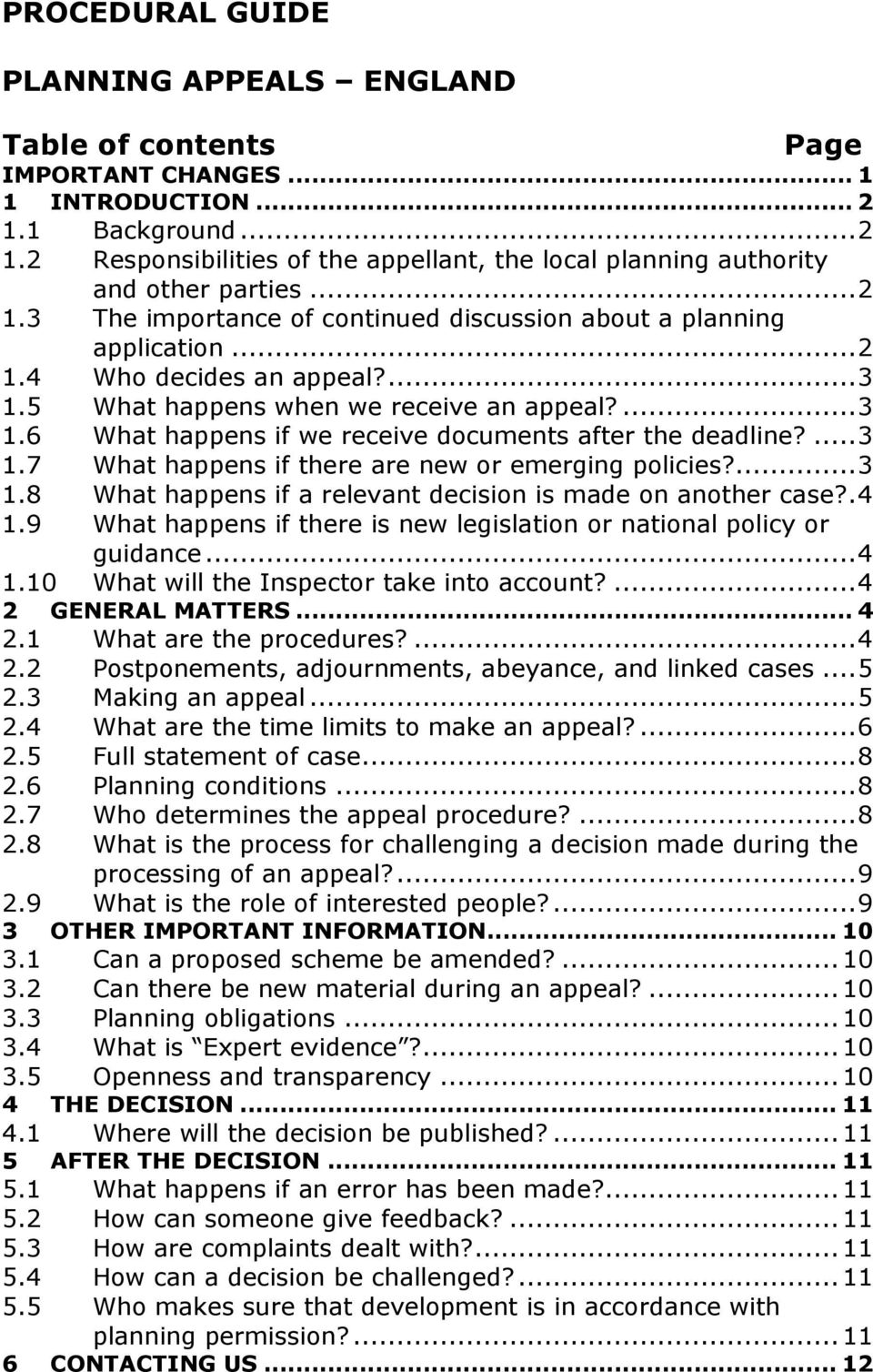
3 PROCEDURAL GUIDE PLANNING APPEALS ENGLAND Table of contents Page IMPORTANT CHANGES INTRODUCTION Background Responsibilities of the appellant, the local planning authority and other parties The importance of continued discussion about a planning application Who decides an appeal? What happens when we receive an appeal? What happens if we receive documents after the deadline? What happens if there are new or emerging policies? What happens if a relevant decision is made on another case? What happens if there is new legislation or national policy or guidance What will the Inspector take into account? GENERAL MATTERS What are the procedures? Postponements, adjournments, abeyance, and linked cases Making an appeal What are the time limits to make an appeal? Full statement of case Planning conditions Who determines the appeal procedure? What is the process for challenging a decision made during the processing of an appeal? What is the role of interested people? OTHER IMPORTANT INFORMATION Can a proposed scheme be amended? Can there be new material during an appeal? Planning obligations What is Expert evidence? Openness and transparency THE DECISION Where will the decision be published? AFTER THE DECISION What happens if an error has been made? How can someone give feedback? How are complaints dealt with? How can a decision be challenged? Who makes sure that development is in accordance with planning permission? CONTACTING US... 12
4 Annexes A Who decides an appeal? B Can there be new material during an appeal? C Householder, advertisement and minor commercial appeals.. 16 D Written representations procedure for other appeals E Hearings procedure F Inquiries procedure G Inquiries procedure for appeals proceeding by an inquiry where the jurisdiction has been recovered for the Secretary of State to make the decision H Cases following a bespoke timetable I Communicating electronically with us J Full statement of case K Criteria for determining the procedure for planning, enforcement, advertisement and discontinuance notice appeals L How can a decision be challenged? M Can a proposed scheme be amended? N Planning obligations O What is Expert evidence? P What happens if an error has been made? Q Feedback and complaints R What is the procedure for advertisement and discontinuance notice appeals? S Setting dates for hearings and inquiries T Statement of common ground... 98

5 IMPORTANT CHANGES This document was last published on 15 July 2015 and contained revisions in particular to: provide greater clarity where we might use our discretion to accept late documents; advise that an Inspector s decision may be read for quality assurance purposes; remove references to a published list of model conditions by the Planning Inspectorate (as guidance on the use of planning conditions is provided by DCLG); advise on the information we need where a planning obligation provides for a pooled contribution; reflect the Town and Country Planning (Development Management Procedure) (England) Order 2015 Statutory Instrument 2015/595; update advice on complying with a bespoke timetable; update advice on communicating electronically with us; reflect the forthcoming transition of the Planning Inspectorate s content from the Planning Portal to GOV.UK by including our GOV.UK website address and replacing URLs with embedded hyperlinks. This version has been further revised and contains revised guidance in Annexes C and D about site visits. 1

6 1 INTRODUCTION 1.1 Background The content of this document is guidance only with no statutory status. However, all parties should follow the general principles, as will Inspectors who may adapt them as necessary for an individual appeal whilst ensuring that no party is prejudiced. It should be read alongside the planning practice guidance published by the Department for Communities and Local Government. 1.2 Responsibilities of the appellant, the local planning authority and other parties Making an appeal should not be used as a bargaining tactic but only as the last resort. Appellants should be confident at the time they make their appeal that they are able to make their full case When refusing an application, the local planning authority should consider carefully whether it has a sufficiently strong case, capable of being argued at appeal, on the basis of the material before it The Secretary of State s ability to deliver timely and high-quality decisions on appeals relies on all parties following good practice and behaving reasonably. The parties must meet the statutory timetables to ensure that no-one is disadvantaged and the appeal can be processed efficiently. Keeping to the timetables is fundamental to an efficient and fair appeals service and we expect everyone to comply with them If a party does not behave reasonably they leave themselves open to costs being awarded against them. This would be on the basis that the behaviour had directly caused another party to incur expenses that would not otherwise have been necessary Costs may be awarded in response to an application for costs by one of the parties. Also costs may be awarded at the initiative of the Inspector There is guidance about costs awards in the planning practice guidance The appellant should read the information about making an application for costs before they make their appeal. 1.3 The importance of continued discussion about a planning application The local planning authority should have constructive discussions with the applicant and, if it has any concerns, give the applicant the opportunity to amend the application before it is decided. This should help to avoid the need to appeal, especially appeals where the local planning authority has failed to make a decision. 2

7 1.3.2 The reasons for refusal should be clear and comprehensive and if the elected members decision differs from that recommended by their planning officers it is essential that their reasons for doing so are similarly clear and comprehensive. Clear reasons for refusal will help continued discussions and may mean that agreement can be reached. A new application may often be the best way forward. 1.4 Who decides an appeal? Nearly all appeals are decided by our Inspectors or by appointed persons; in each case they are solely responsible for their decision 1. A very small percentage are decided by the Secretary of State - these tend to be the very large or contentious proposed schemes. For further information please see Annexe A. Also, guidance on the Secretary of State s decision making functions on recovered planning appeals is available in Guidance on Planning Propriety Issues. 1.5 What happens when we receive an appeal? Once we have received an appeal and ensured that it is valid we will confirm the procedure and notify the appellant and the local planning authority of the appeal start date (from which the date for receipt of documents and representations will be calculated), reference number, the timetable for the appeal and the specific address (room number and address) to which any correspondence should be sent. 1.6 What happens if we receive documents after the deadline? All available evidence should be sent to us by the appellant with their full statement of case when they make their appeal and by the local planning authority with their questionnaire or full statement of case. If we receive documents after the relevant statutory time limits normally we will return them and they will not be seen by the Inspector. The Inspector will not accept any documents at the site visit There are some exceptions where we might use our discretion to accept late documents and these are set out below in paragraphs 1.7 to 1.9. Where the change in circumstances is likely to affect the outcome of the appeal we will ensure that all parties have an appropriate opportunity to comment on the new material. 1.7 What happens if there are new or emerging policies? The local planning authority must alert us in writing, as soon as possible, if it becomes aware at any stage before the appeal decision is issued of any material change in circumstances which have occurred since it determined the application (eg a newly adopted or emerging policy) that is directly relevant to the appeal. It should indicate the anticipated date of adoption of any emerging policy. The appellant may also do this in writing, 1 The judgment in Billy Smith v SSCLG and South Bucks DC [2014] EWCH 935 (Admin) confirmed that it is legitimate for an Inspector s decision to be read for quality assurance purposes. The key to this is in ensuring that the Inspector takes the decision and the reader (or mentor as referred to by the Judge) does not interfere in his or her judgment. 3

8 as soon as possible, and ask for our agreement to their sending in further representations, necessary as a result of the change(s), and agree a date for the receipt of representations. 1.8 What happens if a relevant decision is made on another case? The local planning authority must alert us in writing, as soon as possible, if it makes a decision (either to grant or refuse planning permission or to issue an enforcement notice) on a similar development. Also it should alert us if it is aware of a decision on an appeal that is relevant. The appellant may also do this in writing, as soon as possible, and ask for our agreement to their sending in further representations, necessary as a result of the change(s), and agree a date for the receipt of representations. For further information please see Annexe B. 1.9 What happens if there is new legislation or national policy or guidance If a party to an appeal considers that changes to legislation or Government policy or guidance are a material consideration, they should inform us, in writing, as soon as possible and ask for our agreement to their sending in further representations, necessary as a result of the change(s), and agree a date for the receipt of representations What will the Inspector take into account? The Inspector has to make the decision (or the report and recommendation to the Secretary of State for a recovered appeal) under the circumstances existing at the time he or she makes it. The Inspector will therefore take account of: the material submitted to the local planning authority; all the appeal documents; any relevant legislation and policies, including changes to legislation, any new Government policy or guidance and any new or emerging development plan policies since the local planning authority s decision was issued; any other matters that are material to the appeal. 2 GENERAL MATTERS 2.1 What are the procedures? There are 3 procedures that an appeal can follow, written representations, a hearing or an inquiry. For all the procedures the Inspector will visit the appeal site. Annexe C contains the written representations procedure for an appeal against the refusal of: a householder application; an application for advertisement consent; a minor commercial (shop front) application; 4

9 Annexe D contains the procedure for other written representations appeals; Annexe E contains the procedure for hearings hearings are a round table discussion led by the Inspector; Annexe F contains the procedure for inquiries this is the most formal of the procedures; Annexe G contains the procedure for an appeal which has been recovered and is proceeding by an inquiry For planning appeals that are recovered for the decision to be made by the Secretary of State the Inspector reports with recommendations to the Secretary of State (please see Annexe A). Most of these appeals will proceed by inquiry (please see Annexe G). However if they proceed by written representations or a hearing please see Annexe D and Annexe E respectively Inquiries that are expected to sit for 3 days or more (including appeals which have been recovered ) will follow a bespoke programme. For further information please see Annexe H and our Guide to Rule 6 for interested parties involved in an inquiry planning appeals and called-in applications - England. 2.2 Postponements, adjournments, abeyance, and linked cases Our usual practice is to resist postponements and adjournments in view of the delay and disruption this causes. Appellants should therefore not make their appeal until they are ready to proceed to the decision. We will not put cases into abeyance unless there are exceptional reasons We may decide to link appeals that relate to the same site in order to minimise the use of resources for all parties. We will make decisions to link on a case by case basis. 2.3 Making an appeal Only the person who made the planning application can make an appeal The following Making your appeal: How to complete your appeal form documents are available online: How to complete your planning appeal form - England How to complete your householder planning appeal form - England How to complete your listed building consent appeal form - England How to complete your advertisement/discontinuance notice appeals form England Potential appellants should read the relevant How to... before they make their appeal as they contain important advice about the information they may wish to provide on the appeal form If an appellant wants to make an appeal in relation to more than one application eg in relation to an application for planning permission and an 5

10 application for listed building consent 2, they must make a separate appeal for each Wherever possible the appellant should make their appeal(s) online through the Appeals Casework Portal We encourage and support appellants, local planning authorities and interested people to work electronically with us both online and by . For further information about system availability, system requirements and our guidelines for submitting documents to us electronically please see Annexe I If a potential appellant does not have access to the internet they should contact us and we will send them the relevant appeal form(s) Appellants must send complete appeals and supporting documents to us so that we receive them within the time limit. At the same time they must send a copy to the local planning authority. 2.4 What are the time limits to make an appeal? There are different time limits to make an appeal depending on the type of appeal and the circumstances For an appeal in relation to: refusal of a householder planning application We must receive it within 12 weeks from the date on the decision notice but if the local planning authority has taken enforcement action - note the important information in paragraph Note If the local planning authority has failed to determine a householder planning application or an appeal is being made against the grant of permission subject to conditions to which the applicant objects, the time limits under other types of planning applications below apply. advertisement consent application We must receive it: within 8 weeks of the date of receipt of the decision; or within 8 weeks of the expiry of the period which the local planning authority had to determine the application. Note The local planning authority determination period is usually 8 weeks. If the applicant has agreed a longer period with the local planning authority, the time limit runs from the end of that period. 2 For further information please see Conserving and enhancing the historic environment in the planning practice guidance. 6

11 Note If the local planning authority has failed to determine an application for express consent to display an advertisement or an appeal is being made against the grant of consent subject to conditions to which the applicant objects, the time limits under other types of planning applications below apply. discontinuance notice appeals An appeal against a discontinuance notice must be received by us before the effective date of the notice. The effective date will be on the notice. refusal of a planning application for minor commercial development We must receive it: within 12 weeks from the date on the decision notice. But if the local planning authority has taken enforcement action - note the important information in paragraph Note If the local planning authority has failed to determine a planning application for minor commercial development or an appeal is being made against the grant of permission subject to conditions to which the applicant objects, the time limits under Other types of planning applications below apply. other types of planning applications We must receive it: within 6 months from the date on the decision notice, or within 6 months from the expiry of the period which the local planning authority had to determine the application. But if the local planning authority has taken enforcement action - note the important information in paragraph Note The local planning authority determination period is usually 8 weeks (usually 13 weeks for major developments). However, if the local planning authority has also to determine an environmental impact assessment application the determination period is 16 weeks. If the applicant has agreed a longer period with the local planning authority, the time limit runs from the end of that period However, if an enforcement notice has been served for the same or very similar development for the above appeals the time limit is: within 28 days from the date of the local planning authority s decision if the enforcement notice was served before the decision was made yet not longer than 2 years before the application was made. within 28 days from the date the enforcement notice was served if served on or after the date the decision was made (unless this extends the normal appeal period) For an appeal in relation to: 7

12 listed building consent application We must receive it: within 6 months from the date on the notice of the decision, or within 6 months of the expiry of the period which the local planning authority had to determine the application. Note The local planning authority determination period is usually 8 weeks. If the applicant has agreed a longer period with the local planning authority the time limit runs from the end of that period. 2.5 Full statement of case Appellants must set out their full statement of case when making the appeal. For further information about the full statement of case please see Annexe J. 2.6 Planning conditions The appellant and local planning authority should look at the planning practice guidance on the use of planning conditions; and Appendix A Suggested Models of Acceptable Conditions for Use in Appropriate Circumstances (which is still in existence) to Circular 11/95: Use of conditions in planning permission (which has been cancelled) The appellant when making their appeal and the local planning authority when sending us its completed copy of our questionnaire, or as a separate document when sending its full statement of case should indicate if they wish to accept or can suggest a planning condition(s) that they think would mitigate the impact of the proposal The fact that conditions are suggested does not mean that the appeal will be allowed and planning permission granted or that, if allowed, conditions will be imposed. A hearing or inquiry will usually include a discussion about the conditions which may be imposed if the proposal is granted planning permission. 2.7 Who determines the appeal procedure? Section 319A of the Town and Country Planning Act 1990 gives the Secretary of State the duty to determine the procedure for dealing with various appeals. This duty, which has been commenced in relation to planning, advertisement and enforcement appeals, will be exercised by us, taking account of the criteria for determining the appeal procedure (please see Annexe K). The duty to determine the procedure does not yet apply to listed building appeals When making their appeal, the appellant must identify which procedure they consider to be the most appropriate and give reasons to support this We will ensure that the most appropriate appeal procedure is selected, taking account of the criteria, the views of the appellant, the local 8

13 planning authority and any appropriate expert involvement. We will determine which procedure will be followed within 7 working days of receiving a valid appeal We will give reasons for the determination where this differs from the procedure requested by the appellant or the local planning authority. If circumstances change we will review the procedure and if necessary we will change it at any point before a decision on the appeal is made. The Inspector also may decide that the procedure needs to be changed The appellant or the local planning authority may ask for the determination to be reviewed by a senior officer Although the criteria in Annexe K do not directly apply to listed building appeals they are a useful indication which procedure would be appropriate for these appeals. The appellant and the local planning authority should consider Annexe K when indicating which procedure they want. 2.8 What is the process for challenging a decision made during the processing of an appeal? If the appellant, the local planning authority or an interested person thinks that we have made an administrative decision during the processing of an appeal that is wrong, they should write to our Case Officer giving clear reasons why they think we should review our decision For decisions made by administrative staff during the processing of an appeal there is no statutory right to challenge that decision in the High Court. However it is possible to make an application for judicial review of such a decision. This includes decisions made by administrative staff ( Costs and Decision Officers ) in our Costs and Decisions Branch during the processing of an application for an award of costs. For further information please see Annexe L. 2.9 What is the role of interested people? People who are interested in the outcome of an appeal interested people (often also called third parties, interested parties or interested persons ) have an important role to play in the planning process. Their representations indicating support for, or opposition to, a proposed scheme are taken into account along with other material considerations Guide to taking part in documents explain how interested people can get involved in the appeal process. They are available for the following appeal procedures: Written representations England Hearing England Inquiry - England 9

14 3 OTHER IMPORTANT INFORMATION 3.1 Can a proposed scheme be amended? If, exceptionally, the appellant wishes to amend a scheme at the appeal stage, we will consider each request on its own merits. For further information please see Annexe M. 3.2 Can there be new material during an appeal? There will be rare occasions when new matters will arise during an appeal which ought to be considered by the Inspector. For further information please see Annexe B. 3.3 Planning obligations The appellant and the local planning authority should include with their appeal documentation any certified or draft (as appropriate) section 106 planning obligation which they wish the Inspector to consider. Where the planning obligation provides for a pooled contribution towards items that may be funded by the Community Infrastructure Levy, the local planning authority should also clarify the number of planning obligations which have been entered into on or after 6 April 2010 which provide for the funding or provision of a project, or provide for the funding or provision of that type of infrastructure for which it is seeking an obligation in relation to the appeal proposal. This information is required for each obligation sought by the local planning authority. The local planning authority (and the appellant) should inform us as a matter of urgency of any further changes in circumstances on this matter as the appeal progresses. For further information please see Annexe N and planning practice guidance paragraphs What is Expert evidence? Expert evidence is evidence that is given by a person who is qualified, by training and experience in a particular subject or subjects, to express an opinion. For further information please see Annexe O. 3.5 Openness and transparency Hearings and inquiries are open to journalists and the wider public, as well as interested people. Provided that it does not disrupt proceedings, anyone will be allowed to report, record and film proceedings including the use of digital and social media. Inspectors will advise people present at the start of the event that the proceedings may be recorded and/or filmed, and that anyone using social media during or after the end of the proceedings should do so responsibly If anyone wants to record or film the event on equipment larger than a smart phone, tablet, compact camera, or similar, especially if that is likely to involve moving around the venue to record or film from different angles, they should contact us and the local planning authority in advance to discuss arrangements. 10

15 4 THE DECISION 4.1 Where will the decision be published? When made, the decision will be published online and can be viewed using the search facility. 5 AFTER THE DECISION 5.1 What happens if an error has been made? We cannot change the decision however we have the power, in limited circumstances, to correct certain types of errors in decisions. For further information please see Annexe P. 5.2 How can someone give feedback? We welcome feedback about people s experience of dealing with us. This can be provided to us at any time. Further information is available here. 5.3 How are complaints dealt with? If after the decision on an appeal has been published, we receive a complaint against an Inspector s decision or the Inspector or the way we administered a case it is dealt with by the Customer Quality Team who are independent of the teams who process cases. All complaints are investigated thoroughly and impartially. For further information please see Annexe Q. 5.4 How can a decision be challenged? The High Court is the only authority that can formally identify a legal error in an Inspector s or Secretary of State s decision and require that decision to be re-determined. Applications to challenge planning appeal decisions must be received by the Administrative Court within 42 days (6 weeks) from the date of the decision. For further information please see Annexe L. 5.5 Who makes sure that development is in accordance with planning permission? If planning permission is granted, by the local planning authority at application stage or by the Inspector or the Secretary of State on appeal, the local planning authority has the sole responsibility for monitoring the implementation of the permission and ensuring that it is in accordance with the plans and any conditions If the local planning authority considers that the development does not comply with the permission it has the power to take enforcement action. 11

16 6 CONTACTING US 6.1 To discuss a particular appeal please contact our Case Officer the local planning authority can provide their details or they can be found online using the search facility. For general enquiries our contact details are: The Planning Inspectorate Customer Support Team Room 3/13 Temple Quay House 2 The Square Bristol BS1 6PN Helpline: [email protected] Or for queries about problems with working electronically: [email protected] Further information on the Planning Inspectorate is available at: 12

17 Annexe A A Who decides an appeal? A.1 Legislation A.1.1 Under section 78 of the Town and Country Planning Act 1990 there is a right for the original applicant to make an appeal to the Secretary of State. Through legislation, for the vast majority of appeals, the authority to decide an appeal ( the jurisdiction ) has been transferred to an Inspector. A.1.2 However, jurisdiction may be recovered for the Secretary of State to make the decision. These are referred to as recovered appeals. For the criteria used to decide if an appeal should be recovered please see the planning practice guidance on appeals. A.1.3 Recovery of jurisdiction can occur at any stage before the decision is issued, even after the site visit, a hearing or an inquiry has taken place. A.2 If an appeal is recovered what happens? A.2.1 If an appeal is recovered we will write to tell the appellant and the local planning authority setting out the reasons for this. A.2.2 A recovered appeal can proceed by written representations, a hearing or an inquiry, and will follow the appropriate rules for each procedure. We will determine which procedure is most appropriate for the appeal, following the criteria (please see Annexe K) and will tell the appellant and the local planning authority in writing which procedure the appeal will follow. A.2.3 If the appeal is proceeding by written representations or by a hearing it will continue to follow the procedures in Annexe D and Annexe E respectively. A.2.4 If the appeal is proceeding by an inquiry it will follow the legislation and procedure as described in Annexe G. A.2.5 If the inquiry is expected to sit for 3 days or more, we will invite the appellant, the local planning authority and any Rule 6 party to agree a bespoke programme. For further information about a bespoke timetable please see Annexe H and for further information about Rule 6 parties please see our Guide to Rule 6 for interested parties involved in an inquiry planning appeals and called-in applications - England. A.2.6 If a party has a statutory right to appear at the inquiry, they will be asked to provide a full written statement of case before the inquiry under the Rules. A.2.7 We will: require the local planning authority to publicise the inquiry arrangements in the local press; 13

18 require the local planning authority to inform owners and occupiers of properties near the appeal site, those who made representations to the local planning authority at application stage and anyone else it thinks may be affected by the development of the inquiry arrangements; require the appellant, if he or she controls the site, to post a notice on the site - in a place where it can be seen by the public - giving details of the inquiry arrangements. A.2.8 If an interested party is not going to attend the inquiry but want their views to be known they must send their representations to our Case Officer within 6 weeks of the start date. A.3 Report to the Secretary of State and the decision A.3.1 If an appeal has been recovered, the Inspector will write a report which will contain his or her conclusions and make a recommendation on whether the appeal should be allowed and planning permission be granted (with or without conditions) or dismissed. A.3.2 The report will be sent to the Secretary of State to make the decision taking into account the Inspector s recommendation. When the Secretary of State has reached a decision, this will be explained in the decision letter. This letter will normally be sent by Planning Casework which is part of the Department for Communities and Local Government, based in London. A.3.3 Under the statutory timetabling provisions set down by the Act 3 all parties involved in the appeal will normally be advised of the expected date of the Secretary of State s decision within 10 days of the close of the hearing or inquiry 4. A.3.4 Recovered appeal decision letters are available on the Department for Communities and Local Government area of the GOV.UK website and online using the search facility. 3 Section 55 and Schedule 2 of the Planning and Compulsory Purchase Act Or in the case of an appeal proceeding by written representations within 10 days of the site visit. 14

19 Annexe B B Can there be new material during an appeal? B.1 The importance of ongoing discussion B.1.1 Ongoing discussion between the applicant and the local planning authority should ensure that the applicant has the opportunity to respond to any issues/concerns before the local planning authority s decision is made. This will mean that there should be no unexpected issues raised by that decision. B.2 Changed circumstances B.2.1 If: a decision has been made, or enforcement action taken, on a local similar development since the appealed application was decided, (either by the local planning authority or on appeal); there has been a change in circumstances (eg new or emerging legislation or Government policy or guidance or local policy) since the local planning authority s decision (see paragraphs 1.9 and 1.10); the local planning authority must alert us in writing, as soon as possible (copying their correspondence to the appellant), to the decision or the change in circumstances. The appellant may also do this. See paragraphs 1.7 to B.2.2 New evidence will only be exceptionally accepted where it is clear that it would not have been possible for the party to have provided the evidence when they sent us their full statement of case. B.2.3 If, exceptionally, any party provides new evidence at appeal stage this may lead to: delay so that we can give the other party or interested people the opportunity to comment; and/or additional expense by another party who may make an application for costs; or the Inspector initiating an award of costs. 15

20 Annexe C C Householder, advertisement and minor commercial appeals Part 1 of The Town and Country Planning (Appeals) (Written Representations Procedure) (England) Regulations 2009 (Statutory Instrument 2009/452) as amended by The Town and Country planning (Appeals) (Written Representations Procedure and Advertisements) (England) (Amendment) Regulations 2013 Statutory Instrument 2013/2114 C.1 Householder appeals C.1.1 An appeal in connection with refusal of a householder application ( a householder appeal ) will normally proceed by the Part 1 written representations procedure. C.1.2 Householder application 5 means: (a) an application for planning permission for development for an existing dwellinghouse, or development within the curtilage of such a dwellinghouse for any purpose incidental to the enjoyment of the dwellinghouse; or (b) an application for any consent, agreement or approval required by or under a planning permission, development order or local development order in relation to such development, but does not include an application for change of use or an application to change the number of dwellings in a building. C.1.3 Householder application also includes an application for prior approval of a larger single-storey rear extension. C.2 Advertisement or minor commercial appeals C.2.1 An appeal against the refusal of an application for express consent to display an advertisement or against the refusal of an application for minor commercial development (shop front development) will normally proceed by the Part 1written representations procedure. C.2.2 Minor commercial application 6 means: (a) an application for planning permission for development of an existing building or part of a building currently in use for any of the purposes falling within Part A of the Schedule to the Town and Country Planning (Use Classes) Order 1987, or 5 This is defined in Article 2 - Interpretation - of the Town and Country Planning (Development Management Procedure) (England) Order 2015 Statutory Instrument 2015/ This also is defined in Article 2 of the 2015 Order referred to in the above footnote. 16

21 (b) an application for any consent, agreement or approval required by or under a planning permission, development order or local development order in relation to such development, where such an application does not include a change of use, a change to the number of units in a building, or development that is not wholly at ground floor level or that would increase the gross internal area of a building. C.2.3 Please see Appendix C.1 which contains Schedule 1A. C.3 Process and scope C.3.1 For appeals proceeding by written representations, under Part 1 of the Regulations, relevant documentation can be seen online and can be viewed using the search facility. C.3.2 The following appeals are within the scope of the Part 1 process: appeals against the refusal of householder applications for planning permission for development such as dwellinghouse extensions, alterations, garages, swimming pools, walls, fences, vehicular access, porches and satellite dishes (this list is not exhaustive); appeals against refusal of express consent to display an advertisement; appeals against refusal of a minor commercial (shop front) development (eg ground floor security shutters or any other ground floor level external alterations) appeals against the refusal of any consent, agreement, or approval required by or under a planning permission, development order or local development order in relation to such development. This includes appeals against the refusal of an application for prior approval of a larger single-storey rear extension; and appeals against a local planning authority s decision to refuse to remove or vary a condition or conditions attached to a previous planning permission for householder or minor commercial (shop front) development or advertisement consent. A timetable for these appeals is in Appendix C.2 to this annexe. C.3.3 The following are not within the scope of the Part 1 process described in this annexe: appeals in relation to proposals for additional dwellings, replacement dwellings and any change of use; appeals in relation to proposals for any development to a flat; appeals against the decision of the local planning authority to impose a condition or conditions on a planning permission; appeals where the local planning authority has failed to make a decision (non-determination or failure appeals); appeals following service of a discontinuance notice. 17
22 As these are not householder or minor commercial appeals they will proceed by the process explained in Annexe D of this Guide. For information about the process for appeals against a condition on an advertisement consent, advertisement appeals where the local planning authority has failed to make a decision and appeals against a discontinuance notice please see Annexe R. C.3.4 Minor commercial (shop front) appeals made under the reduced timetable because enforcement action has been taken by the local planning authority (please see paragraph 2.4 3) are also not within the scope of the Part 1 process as described in this annexe. The appeal will follow a Part 2 process which is different from the Part 2 process described in Annexe D of this Guide. A timetable for this different process is illustrated in Appendix D.2 to Annexe D. C.3.5 There may be circumstances where an appeal is not suitable to proceed by the Part 1 process. This may be evident at the beginning, or come to light during the processing of an appeal. In such instances we may determine that the appeal should proceed under Part 2 of the Regulations as a written representations appeal or we may determine that a hearing or inquiry should be held. C.3.6 However if we determine that an appeal, which would normally be under the Part 1 process, is unsuitable for that process but is suitable for the Part 2 written representations process the appeal will normally follow a Part 2 process which is different from the Part 2 process described in Annexe D of this Guide. A timetable for this different process is illustrated in Appendix D.2 to Annexe D. C.3.7 We may agree special arrangements for an appeal that would normally proceed under the Part 1 process where it would be sensible for it to be considered simultaneously with a related appeal (such as one relating to listed building consent) by the same appellant. C.4 The appellant C.4.1 The appellant must ensure that we receive their: householder planning appeal within 12 weeks (not 3 months) from the date on the notice of the local planning authority s decision. However if the local planning authority has taken enforcement action the time limit is shorter than given here. For important information please see paragraph advertisement appeal within 8 weeks of the date of receipt of the local planning authority s decision. 18
23 minor commercial appeal within 12 weeks of the date of the local planning authority s decision. However if the local planning authority has taken enforcement action the time limit is shorter than given here. For important information please see paragraph C.5 Grounds of appeal C.5.1 The appellant s grounds of appeal should fully disclose their case through full representations and any supporting evidence. The grounds of appeal must be concise, clear and comprehensive. The appellant should respond to the reasons for refusal set out in the local planning authority s decision notice, any issues raised in the planning officer s report and/or the Committee minutes, and should explain the basis on which they consider planning permission should be granted. C.5.2 The appellant may also wish to respond to any representations the local planning authority received from interested people during the application stage. C.5.3 Some local planning authorities publish the planning officer's report, Committee minutes, representations received from interested people and other documents relating to the application on their websites, but not all. As part of considering the merit of making an appeal the onus is on the appellant to make the necessary arrangements to view these documents. C.5.4 Having made their appeal, the appellant will not normally be able to send any further material unless further information or response is required and requested by the Inspector. C.6 What happens when we receive an appeal? C.6.1 Within 7 days of receiving a valid appeal we will determine whether the appeal is suitable for the Part 1 process, and, if so, will confirm to the appellant and the local planning authority: the reference number allocated to the appeal; that the appeal will proceed by way of the Part 1 process. C.6.2 appeal. The date of this notification letter will be the start date for the C.6 3 If we determine, at this stage or later, that the appeal is not suitable for the Part 1 procedure we will notify the appellant and the local planning authority and explain what procedure the appeal will follow. C.7 What does the local planning authority have to do? C.7.1 When notified by us that an appeal is to proceed by the Part 1 procedure, the local planning authority must send copies of all of the relevant documents to us and to the appellant within 5 working days of the start date 19
24 along with a completed copy of the appropriate appeals questionnaire. The local planning authority must indicate on the questionnaire what appeal procedure it considers appropriate, taking account of the criteria (see Annexe K). If this differs from that determined by us we will review the procedure. C.7.2 The local planning authority s case will be its reasons for refusal and the documentation supplied with the questionnaire. The local planning authority s reasons for refusal should be clear and, where the Committee's decision goes against the planning officer's recommendation, it is good practice for the reasons for this to be stated clearly in the Committee minutes. In turn this will mean that if an appeal is made the local authority s documentation will contain all of its reasons and if the appellant arranges to view the documentation before they make their appeal, they will be aware of the full background to the refusal. With its documentation the local planning authority should identify any factual error in the appellant s grounds of appeal and any new material or changes made which were not before it at the time it made its decision. C.7.3 The local planning authority will not normally be able to send any further material after the questionnaire stage unless further information or response is required and requested by the Inspector. C.8 Who tells interested people about the appeal? C.8.1 Within 5 working days of the start date the local planning authority must notify interested people: that an appeal has been made; that any representations made to the local planning authority in relation to the application, will be sent to the Planning Inspectorate and the appellant, and will be considered by the Inspector when deciding the appeal; how they can withdraw their representations if they wish to do so; and that the decision will be published online. C.8.2 The local planning authority will already have informed interested people at the application stage that, in the event of an appeal, there normally will be no further opportunity to make representations at appeal stage. C.8.3 We encourage local planning authorities to use the online model notification letter. C.9 Is the appeal site visited? C.9.1 Visits to the appeal site and any relevant neighbouring land or properties are normally carried out where it is necessary to assess the impact of a development on its surroundings. The purpose of the visit is solely to enable the site and its surroundings to be viewed. C.9.2 Where the site is sufficiently visible from the road or public viewpoint the visit will be carried out unaccompanied. This is likely to be the 20
25 case for the majority of advertisement consent appeals and minor commercial appeals. C.9.3 If access to the site is clearly required, we will contact the appellant/agent with a date and usually a morning or afternoon time slot when the Inspector or his/her representative will carry out the site visit. Similar arrangements will be made with individual neighbours where it is considered to be necessary to view the site from their property. C.9.4 The local planning authority should advise us (when completing the questionnaire) and the neighbour concerned if it is certain of such a need, and provide us with the neighbour s contact details. C.9.5 If the appellant s or agent s presence is required at the appeal site it will be required solely to provide access to the site. The local planning authority will not attend the site visit. C.9.6 Where, during an unaccompanied site visit, the Inspector or his/her representative decides that he or she needs to access the site, he or she may approach the occupants to gain permission/access. C.9.7 Where the Inspector or his/her representative decides that he or she needs to view the site from a neighbour s property, he or she may approach the occupants to gain permission/access. C.9.8 A site visit is not an opportunity for anyone present to discuss the merits of the appeal or the written evidence they may have previously provided. The Inspector or his/her representative will therefore not allow any discussion about the case with anyone at a site visit. 21
26 Appendix C.1 Definition of minor commercial development As explained in Article 2 - Interpretation - of the Town and Country Planning (Development Management Procedure) (England) Order 2015 Statutory Instrument 2015/595, minor commercial development is defined as: (a) (b) an application for planning permission for development of an existing building or part of a building currently in use for any of the purposes falling within Part A of the Schedule to the Town and Country Planning (Use Classes) Order 1987, or an application for any consent, agreement or approval required by or under a planning permission, development order or local development order in relation to such development, where such an application does not include a change of use, a change to the number of units in a building, or development that is not wholly at ground floor level or that would increase the gross internal area of a building. SCHEDULE PART A Class A1. Shops Use for all or any of the following purposes (a) for the retail sale of goods other than hot food, (b) as a post office, (c) for the sale of tickets or as a travel agency, (d) for the sale of sandwiches or other cold food for consumption off the premises, (e) for hairdressing, (f) for the direction of funerals, (g) for the display of goods for sale, (h) for the hiring out of domestic or personal goods or articles, (i) for the washing or cleaning of clothes or fabrics on the premises, (j) for the reception of goods to be washed, cleaned or repaired, (k) as an internet café, where the primary purpose of the premises is to provide facilities for enabling members of the public to access the internet; where the sale, display or service is to visiting members of the public. Class A2. Financial and professional services Use for the provision of (a) financial services, or (b) professional services (other than health or medical services), or (c) any other services (including use as a betting office) which it is appropriate to provide in a shopping area, 22
27 where the services are provided principally to visiting members of the public. Class A3. Restaurants and cafes Use for the sale of food and drink for consumption on the premises. Class A4. Drinking establishments Use as a public house, wine-bar or other drinking establishment. Class A5. Hot food takeaways Use for the sale of hot food for consumption off the premises. 23
28 Timetable for appeals through the Part 1 process Appendix C.2 Timetable Interested people Appellant Local planning authority Appeal received by us The local planning authority receives a copy of the appeal We set the start date and the timetable 5 working days after the start date No opportunity to comment Sends the appeal form, all supporting documents and any application for costs to us and to the local planning authority. The appeal representations should make up the full case The local planning authority sends us its completed questionnaire and all application documents Inspector visits the site and the decision is issued later Notifies interested people of the appeal and explains there is no opportunity for further representations 24
29 Annexe D D Written representations procedure for other appeals Part 2 of The Town and Country Planning (Appeals) (Written Representations Procedure) (England) Regulations 2009 (Statutory Instrument 2009/452) as amended by The Town and Country planning (Appeals) (Written Representations Procedure and Advertisements) (England) (Amendment) Regulations 2013 Statutory Instrument 2013/2114 D.1 What is the process? D.1.1 Under the Part 2 written representations procedure, the Inspector will decide the appeal on the basis of the written material provided by all parties and following a visit to the appeal site. A timetable for the procedure is at Appendix D.1 and our start letters will provide dates for the receipt of representations and documents. D.2 The appellant D.2.1 The appellant must ensure that we receive their planning appeal within the time limit which is usually within 6 months of the date of the notice of the local planning authority s decision. However if the local planning authority has taken enforcement action the time limit is shorter. For important information please see paragraph Note - If the time limit of 28 days applies (as explained in paragraph 2.4.3); or the appeal relates to an advertisement appeal other than that defined at Regulation 2(1)(a) (this is the refusal of an application for express consent) of the Written Representations Regulations; or the appeal follows service of a discontinuance notice; or we have determined that any particular householder, advertisement or minor commercial appeal is not suitable to be considered following written representations under the Part 1 procedure; the appeal may still proceed by written representations, however the procedure explained in this annexe will not apply. In these circumstances the appeal will follow the timetable illustrated at Appendix D.2 of this annexe. Our start letter will provide the dates for the receipt of representations. D.2.2 For all appeals following the Part 2 written representations procedure the appellant must send a copy of the planning application form and the local planning authority s decision notice with the appeal along with the other essential supporting documents detailed on the online and paper appeal forms to us. The appellant must copy the appeal to the local planning authority. D.2.3 If the appellant wishes to add to the information they supplied with their application to the local planning authority they may do so. When they 25
30 make their appeal they should fully disclose their case through a full statement of case containing the full particulars of their case and copies of any documents to which it refers, and any other supporting evidence, including any expert reports. For further information about a full statement of case please see Annexe J. There is no opportunity to add to the full statement of case during the process so the appellant should only make their appeal when they are certain that they have finalised their case. D.3 Notice to interested people D.3.1 Within one week of the start date the local planning authority must notify interested people 7 : that an appeal has been made; that any representations made to the local planning authority in relation to the application will be sent to the Planning Inspectorate and the appellant and will be considered by the Inspector when deciding the appeal; how they can withdraw their earlier representations if they wish to do so; that further written representations may be sent to the Planning Inspectorate within 5 weeks of the start date (and give the address and address to which any further representation should be sent); and that the decision will be published online. D.3.2 We encourage local planning authorities to use the online model notification letter. D.4 The appeal questionnaire D.4.1 The local planning authority must send a completed copy of our questionnaire and copies of all of the relevant documents to us and to the appellant within one week of the start date of the appeal. The local planning authority must indicate on the questionnaire which appeal procedure it considers appropriate, taking account of the criteria (please see Annexe K). If this differs from that determined by us we will review the procedure. D.4.2 The relevant documents considered during the application process should be sufficient to present the local planning authority s case. The local planning authority should notify us and the appellant (by indicating on the questionnaire that it does not intend to send a full statement of case at 5 weeks) if it decides to treat the questionnaire, and supporting documents, as its full representations on an appeal. 7 Please see paragraph 2.9 for the various terms frequently used to describe people who are interested in an appeal. These are defined in legislation as Interested persons being (a) any person notified or consulted in accordance with the Act or a development order about the application which has given rise to the appeal; and (b) any other person who made representations to the local planning authority about that application - Regulation 6 of The Town and Country Planning (Appeals) (Written Representations Procedure) (England) Regulations 2009 (as amended). 26
31 D.5 Local planning authority s full statement of case at the 5 week stage D.5.1 If the local planning authority decides it needs to make further representations, it should send its full statement of case to us (2 copies if not sent electronically) within 5 weeks of the start date. These should not normally include new evidence or additional technical data. We will copy the full statement of case to the appellant. D.6 Interested people s representations at the 5 week stage D.6.1 Interested people notified of the appeal can rely on the representations they made to the local planning authority at the application stage, as it will forward these to us and the representations will be taken into account by the Inspector. D.6.2 If having considered the appellant s full statement of case an interested person wishes to make representations or further representations they should do so online using the search facility or send them by or by post to us (3 copies if possible). They should ensure that we receive them within 5 weeks of the start date. We will copy any representations received to the appellant and the local planning authority. There is normally no further opportunity for interested people to make representations after the 5 week stage. D.7 Comments at the 7 week stage D.7.1 We will copy any representations from interested people received at the 5 week stage to the appellant and the local planning authority. We will copy any full statement of case received from the local planning authority at the 5 week stage to the appellant. If either the appellant or the local planning authority wishes to comment on any representations made at the 5 week stage, they must send their comments to us (2 copies if not sent electronically) within 7 weeks of the start date. These comments should be in the form of a concise response and should not introduce new material or technical evidence. We will copy any such comments to the other appeal party for information only. D.8 Is the appeal site visited? D.8.1 Visits to the appeal site and any relevant neighbouring land or properties are normally carried out where it is necessary to assess the impact of a development on its surroundings. The purpose of the visit is solely for the site and its surroundings to be viewed. D.8.2 Where the site is sufficiently visible from the road or public viewpoint the visit will be carried out unaccompanied. D.8.3 If access to the site is clearly required, we will contact the appellant/agent with a date and usually a time slot when the Inspector or his/her representative will carry out the site visit. Similar arrangements will be made with individual neighbours where it is considered to be necessary to view the site from their property. 27
32 D.8.4 Except in the case of an accompanied site visit (see paragraph D.8.7), if the appellant s or agent s presence is required at the appeal site, it will be required solely to provide access to the site and neither the local planning authority nor interested people will attend the site visit. D.8.5 Where, during an unaccompanied site visit, the Inspector or his/her representative decides that he or she needs to access the site, he or she may approach the occupants to gain permission/access. D.8.6 Where the Inspector or his/her representative decides that he or she needs to view the site from a neighbour s property, he or she may approach the occupants to gain permission/access. D.8.7 In some circumstances we may deem it necessary for the Inspector or his/her representative to be accompanied by both the appellant (or agent) and a representative of the local planning authority, and, where appropriate, interested people. This is most likely to be the case where site measurements are in dispute or where it is anticipated that those present will need to point out physical features that they have referred to in their written evidence. D.8.8 A site visit is not an opportunity for anyone present to discuss the merits of the appeal or the written evidence they may have previously provided. The Inspector or his/her representative will therefore not allow any discussion about the case with anyone at a site visit, except that if it is an accompanied site visit (referred to in paragraph D.8.7 above) the Inspector or his/her representative may ask the invited parties to point out physical features that they have referred to in their written evidence. 28
33 Timetable for the Part 2 written procedure Appendix D.1 Timetable Interested people Appellant Local planning authority Appeal received We set the start date and the timetable Within 1 week from the start date Within 5 weeks from the start date (Only exceptionally will we accept late representations) Receive the local planning authority s letter about the appeal, telling them that they must send us any representations within 5 weeks from the start date Send their representations to us Sends the appeal form with their full statement of case and all supporting documents to us and the local planning authority. The appeal statement of case must make up their full case Receives a completed questionnaire and any supporting documents from the local planning authority Receives the appeal documents Sends the appellant and us a completed questionnaire and supporting documents. It writes to interested people about the appeal If the local planning authority decides not to treat the questionnaire and supporting documents as its representations it sends us its full statement of case Within 7 weeks from the start date Sends us their final comments on the local planning authority s full statement of case and on any representations from interested people. If there is one, sends us a copy of the certified planning obligation Sends us its final comments on any representations from interested people No new evidence is allowed No new evidence is allowed Inspector visits the site and the decision is issued later 29
34 Appendix D.2 Timetable for the Part 2 written procedure for: all appeals (except householder) where the local planning authority has taken enforcement action; for householder, advertisement and minor commercial development appeals which we determine are not suitable for the Part 1 process in Annexe C; advertisement appeals where the local planning authority has issued conditional consent, or failed to determine the application; appeals following the service of a discontinuance notice. Timetable Interested people Appellant Local planning authority Appeal received We set the start date and the timetable Within 2 weeks from the start date Within 6 weeks from the start date (Only exceptionally will we accept late representations) Within 9 weeks from the start date Inspector visits the site and the decision is issued later Receive the local planning authority s letter about the appeal, telling them that they must send us any representations within 6 weeks from the start date Send their representations to us Sends the appeal form and all supporting documents to us and the local planning authority. The grounds of appeal should make up their full case Receives a completed questionnaire and any supporting documents from the local planning authority Sends us any further representations. These should relate only to issues raised by the questionnaire and any supporting documents Sends us their final comments on the local planning authority s representations and on any representations from interested people. If there is one, sends us a copy of the certified planning obligation. No new evidence is allowed Receives the appeal documents Sends the appellant and us a completed questionnaire and supporting documents. It writes to interested people about the appeal If the local planning authority decides not to treat the questionnaire and supporting documents as its representations it sends us its further representations Sends us its final comments on the appellant s representations and on any representations from interested people No new evidence is allowed 30
35 Annexe E E Hearings procedure The Town and Country Planning (Hearings Procedure) (England) Rules 2000 (Statutory Instrument 2000/1626), as amended by The Town and Country Planning (Hearings and Inquiries Procedures) (England) (Amendment) Rules 2009 (Statutory Instrument 2009/455) and by The Town and Country Planning (Hearings and Inquiries Procedure) (England) (Amendment) Rules 2013 Statutory Instrument 2013/2137 E.1 What is the process? E.1.1 The hearing is an inquisitorial process led by the Inspector who identifies the issues for discussion based on the evidence received and any representations made. The hearing may include a discussion at the site or the site may be visited, on an accompanied (without any discussion), or unaccompanied basis. E.1.2 Statutory parties 8 are entitled to appear at the hearing. Other interested people can attend and may participate in the discussion at the discretion of the Inspector. Statutory parties and interested people may be represented by an advocate but this is not essential. Any advocate may be legally qualified but this also is not essential. E.1.3 The timetable for the hearing procedure is designed to enable the appeal to proceed quickly and fairly. There is a timetable for the hearing procedure at Appendix E.1 to this annexe. Our start letter will provide the dates for the receipt of representations and documents. E.1.4 If we receive a document after the deadline normally we will return it and it will not be seen by the Inspector. E.2 Setting the date of the hearing E.2.1 Where, taking account of the criteria set out in Annexe K, the appellant considers a hearing to be the most appropriate procedure, they should agree with the local planning authority at least 2 dates on which the hearing could take place. This should be done before making their appeal. The agreed dates should fall within the timetable for hearings and should be given on the appeal form. For further information please see Annexe S. E.3 The appellant E.3.1 The appellant must ensure that we receive their planning appeal within the time limit which is usually within 6 months of the date of the notice of the local planning authority s decision unless the local planning authority has taken enforcement action in which case the time limit is shorter. For important information please see paragraph Statutory parties are defined in The Town and Country Planning (Hearings Procedure) (England) Rules 2000 SI 2000/1626 (as amended). 31
36 Note - If the time limit of 28 days applies (as explained in paragraph 2.4.3); or we have determined that any particular householder, or minor commercial appeal is not suitable to be considered following written representations under the Part 1 process and that a hearing is necessary; the procedure explained in detail within this annexe will not apply. In these circumstances the appeal will follow the timetable illustrated at Appendix E.2 Our start letter will provide the dates for the receipt of representations and documents. E.3.2 If we have determined that an advertisement consent appeal is not suitable for the written representations procedures and that a hearing is necessary, the appeal will follow a hearing process which is explained in Annexe R. E.3.3 For all other planning appeals following the hearing procedure the appellant must send a copy of the planning application form, the local planning authority s decision notice with the appeal, their full statement of case and the draft statement of common ground, with the other essential supporting documents detailed on the online and paper appeal form to us. The appellant must copy the appeal to the local planning authority at the same time as they send it to us. E.3.4 If the appellant wishes to add to the information they supplied with their application to the local planning authority they may do so. When they make their appeal they should fully disclose their case through a full statement of case, which should comprise of a written statement containing the full particulars of their case and copies of any documents to which it refers, and any other supporting evidence. E.3.5 There is no opportunity to add to the statement during the process so the appellant should only make their appeal when they are certain that they have finalised their case. For further information about a full statement of case please see Annexe J and for further information about the statement of common ground please see Annexe T. E.4 Who tells statutory parties and interested people about the appeal? E.4.1 Within one week of the start date the local planning authority must notify statutory parties and interested people who made representations about the application: that an appeal has been made; that any representations made to the local planning authority in relation to the application will be sent to the Planning Inspectorate and the appellant and will be considered by the Inspector when deciding the appeal; how they can withdraw their earlier representations if they wish to do so; 32
37 that further written representations may be sent to the Planning Inspectorate within 5 weeks of the start date (and give the address and address to which any further representation should be sent); that the decision will be published on the Planning Portal. E.4.2 We encourage local planning authorities to use the online model notification letter. E.5 The appeal questionnaire and supporting documents E.5.1 The local planning authority must send a completed copy of our questionnaire and copies of all of the documents referred to in it and any other relevant documents to support its decision, to us and to the appellant within one week of the start date of the appeal. The local planning authority must indicate on the questionnaire which appeal procedure it considers appropriate, taking account of the criteria (please see Annexe K). If this differs from that determined by us, we will review the procedure. E.6 Statutory parties and interested people s representations at the 5 week stage E.6.1 Statutory parties and interested people can rely on the representations they made to the local planning authority at the application stage, as it will forward them to us and the representations will be taken into account by the Inspector. E.6.2 If, having considered the appellant s full statement of case, a statutory party or an interested person wishes to make representations or further representations they should do so online using the search facility or send them by or by post to us (3 copies if possible). They should ensure that they are received within 5 weeks of the start date. We will copy any representations received to the appellant and the local planning authority. E.7 Who tells people about the hearing? E.7.1 Having regard to the dates provided by the appellant when making their appeal we will notify the appellant and the local planning authority and any statutory party of the date, time and place of the hearing and the name of the Inspector who will conduct it. We will ask the local planning authority to notify those persons other than the appellant with an interest in the land, those who made representations at the application and/or appeal stages, those entitled to appear at the hearing and anyone else it considers to be affected by or interested in the proposed development. E.8 The local planning authority s full statement of case and the agreed statement of common ground at 5 weeks E.8.1 The local planning authority must send their full statement of case and the agreed statement of common ground to us (2 copies if not sent electronically) ensuring we receive them within 5 weeks of the start date. We will copy documents to the other appeal party. We will inform the appellant and the local planning authority of the name and address of any 33
38 statutory party who makes representations on the appeal. The appellant must send a copy of their full statement of case and the local planning authority must send a copy of its full statement of case and the agreed statement of common ground to any statutory party who make representations on the appeal. E.9 Acceptance of late evidence in exceptional circumstances E.9.1 Appellants, local planning authorities and interested people should not try to get around the rules by taking late evidence to the hearing. E.9.2 If, exceptionally, a party feels that further evidence should be taken into account this may be taken to the hearing. Inspectors do have discretion whether to accept late evidence. E.9.3 Before deciding whether, exceptionally, to accept it, the Inspector will require: an explanation as to why it was not received by us in accordance with the rules; and an explanation of how and why the material is relevant; and the opposing party s views on whether it should be accepted. E.9.4 The Inspector will refuse to accept late evidence unless fully satisfied that: it is not covered in the evidence already received; and it is directly relevant and necessary for his or her decision; it would not have been possible for the party to have provided the evidence when they sent us their full statement of case; and it would be procedurally fair to all parties (including interested people) if the late evidence were taken into account. E.9.5 If the Inspector accepts late evidence this may result in the need for an adjournment. The other party may make an application for costs or the Inspector may initiate an award of costs. This would be on the basis that the necessary adjournment had directly caused another party to incur expenses that would not otherwise have been necessary. 34
39 Timetable for the hearing procedure Appendix E.1 Timetable Interested people Appellant Appeal received We set the start date and the timetable Within 1 week from the start date Within 5 weeks from the start date (Only exceptionally will we accept late statements or representations) Receive the local planning authority s letter about the appeal, telling them that they must send us any representations within 5 weeks of the start date Send their representations to us Sends the appeal form, the full statement of case, all supporting documents and the draft statement of common ground to us and the local planning authority. The statement of case must make up the full case Receives a completed questionnaire and any supporting documents from the local planning authority Local planning authority Receives the appeal documents Sends the appellant and us a completed questionnaire and supporting documents. It writes to interested people about the appeal Sends us its full statement of case and the agreed statement of common ground We confirm the hearing date which will normally be within 10 weeks of the start date or the earliest date after that period which is practicable At least 2 weeks before the date of the hearing No later than 10 working days before the hearing Receive details from the local planning authority about the hearing arrangements If there is one, sends us the draft planning obligation Tells interested people about the hearing arrangements and may put a notice in a local paper about the hearing 35
40 Appendix E.2 Timetable for the hearing procedure for: appeals where the local planning authority has taken enforcement action so the 28 days appeal period applies - see paragraph (except householder appeals); and for householder and minor commercial development appeals which we determine are not suitable for the Part 1 written representations process and that a hearing is necessary Timetable Interested people Appellant Appeal received We set the start date and the timetable Within 2 weeks from the start date Within 6 weeks from the starting date (Only exceptionally will we accept late statements or representations) Receive the local planning authority s letter about the appeal, telling them that they must send us any representations within 6 weeks of the start date Send their representations to us Sends the appeal form, grounds of appeal and all supporting documents to us and the local planning authority. The grounds of appeal should make up the full case Receives a completed questionnaire and any supporting documents from the local planning authority Sends us their hearing statement Local planning authority Receives the appeal documents Sends the appellant and us a completed questionnaire and supporting documents. It writes to interested people about the appeal Sends us its hearing statement We set the hearing date which will normally be within 12 weeks of the start date or the earliest date after that period which is practicable At least 2 weeks before the date of the hearing No later than 10 working days before the hearing Receive details from the local planning authority about the hearing arrangements If there is one, sends us the draft planning obligation Tells interested people about the hearing arrangements and may put a notice in a local paper about the hearing 36
41 Annexe F F Inquiries procedure The Town and Country Planning Appeals (Determination by Inspectors) (Inquiries Procedure) (England) Rules 2000 (Statutory Instrument 2000/1625) 9 ; as amended by The Town and Country Planning (Hearings and Inquiries Procedures) (England) (Amendment) Rules 2009 (Statutory Instrument 2009/455) and by The Town and Country Planning (Hearings and Inquiries Procedure) (England) (Amendment) Rules 2013 (Statutory Instrument 2013/2137) For appeals which have been recovered for the Secretary of State to decide, which are proceeding by an inquiry, please see Annexe G. F.1 What is the process? F.1.1 An inquiry is open to the public and provides for the investigation into, and formal testing of, evidence, usually through the questioning ( cross examination) of expert witnesses and other witnesses. Parties may be formally represented by advocates. The site may be visited before, during or after the inquiry. F.1.2 Statutory parties 10 are entitled to participate in an inquiry. Interested people can attend and may participate in an inquiry at the discretion of the Inspector. F.1.3 The timetable for the inquiry procedure is designed to enable the appeal to proceed quickly and fairly. If we receive a document after the deadline normally we will return it and it will not be seen by the Inspector. A timetable is at Appendix F.1 to this annexe and our start letters will contain the dates for receipt of representations and documents. F.2 Setting the date of the inquiry F.2.1 Where, taking account of the criteria set out in Annexe K the appellant considers an inquiry lasting no more than 2 days is likely to be the most appropriate procedure, they should agree with the local planning authority at least 2 dates on which the inquiry could take place. This should be done before making their appeal. The agreed dates should fall within the timetable for inquiries and should be given on the appeal form. For further information please see Annexe S. F.2.2 If the inquiry will last for 3 days or more the appeal will follow a bespoke timetable (see Annexe H). Although the appeal form does not 9 The Inquiries Procedure Rules set out in Statutory Instrument 2000/1625 (as amended) are used for planning appeals transferred to be decided by an Inspector on behalf of the Secretary of State. 10 Statutory Parties are defined in The Town and Country Planning (Inquiries Procedure) (England) Rules 2000 Statutory Instrument 2000/1624 (as amended) and in The Town and Country Planning Appeals (Determination by Inspectors) (Inquiries Procedure) (England) Rules 2000 Statutory Instrument 2000/1625 (as amended). 37
42 require agreed dates to be provided for these longer inquiries it is helpful if the parties discuss suitable dates and that these are suggested on the appeal form. F.2.3 The appellant should also include the expected number of witnesses, topics to be addressed by witnesses, whether there will be legal representation and an estimate for the overall inquiry length. F.2.4 The appellant should be realistic, the estimate should include time for opening and closing statements, any sessions on conditions and any section 106 obligation and the time they consider may be necessary for questions to be put to their and the local planning authority s witnesses and to interested people. If the appellant has instructed a barrister or other advocate they should get their views on the likely length of the inquiry. F.2.5 We will take account of the estimates we receive from the appellant and the local planning authority and our own experience when we set the likely length of the inquiry. Once set we will expect the length of the inquiry to stay within the agreed timetable. F.3 The appellant F.3.1 The appellant must ensure that we receive their planning appeal within the time limit which is usually within 6 months of the date of the notice of the local planning authority s decision unless the local planning authority has taken enforcement action in which case the time limit is shorter. For important information please see paragraph F.3.2 If: the time limit of 28 days applies (as explained in paragraph 2.4.3); or we have determined that the appeal is not suitable for written representations under the Part 1 process and that an inquiry is necessary; the procedure explained in this annexe will not apply. In these circumstances the appeal will follow the timetable illustrated at Appendix F.2. Our start letter will provide the dates for the receipt of representations and documents. F.3.3 If the appeal is recovered (please see Annexe A) and is proceeding by an inquiry the procedure explained in this annexe will not apply. Instead the procedure in Annexe G will apply. F.3.4 The appellant must send a copy of the planning application form, the local planning authority s decision notice, their full statement of case and the draft statement of common ground, with the other essential supporting documents detailed on the online and paper appeal forms to us. The appellant must copy the appeal to the local planning authority at the same time as they send it to us. F.3.5 If the appellant wishes to add to the information they supplied with their application to the local planning authority they may do so. When they make their appeal they should fully disclose their case through a full statement of case, which should be a written statement containing the full 38
43 particulars of their case and copies of any documents to which it refers, and any other supporting evidence. For further information about a full statement of case please see Annexe J and for further information about the statement of common ground please see Annexe T. There is no opportunity to add to the statement during the process so the appellant should only make their appeal when they are certain that they have finalised their case. F.4 Bespoke timetabling F.4.1 For inquiries expected to sit for 3 days or more we will invite the appellant and the local planning authority and any Rule 6 parties to agree a bespoke programme to cover the dates of the inquiry, the receipt of evidence and any pre-inquiry meeting. For further information please see Annexe H. F.5 The appeal questionnaire and supporting documents F.5.1 The local planning authority must send a completed copy of our questionnaire and copies of all of the documents referred to in it and any other relevant documents to support its decision, to us and to the appellant within one week of the start date of the appeal. The local planning authority must indicate on the questionnaire which appeal procedure it considers appropriate, taking account of the criteria (please see Annexe K). If this differs from that determined by us, we will review the procedure. F.5.2 If the local planning authority agrees with the appellant and/or it considers that the case ought to be dealt with by inquiry, the expected number of witnesses, topics to be addressed by witnesses, time estimates for the overall inquiry length and the presentation of the local planning authority s case and whether there will be legal representation should be included with the questionnaire. F.6 Who tells statutory parties and interested people about the appeal? F.6.1 Within one week of the start date the local planning authority must notify interested people: that an appeal has been made; that any representations made to the local planning authority in relation to the application will be sent to the Planning Inspectorate and the appellant and will be considered by the Inspector when deciding the appeal; how they can withdraw their earlier representations if they wish to do so; that any further written representations must be sent to the Planning Inspectorate within 5 weeks of the start date (and give the address and address to which any further representation should be sent); and that the decision will be published online. F.6.2 We encourage local planning authorities to use the online model notification letter. 39
44 F.7 Statutory parties and interested people s representations at the 5 week stage F.7.1 Statutory parties and interested people can rely on the representations they made to the local planning authority at the application stage, as it will forward them to us and the representations will be taken into account by the Inspector. F.7.2 If, having considered the appellant s full statement of case, a statutory party or an interested person wishes to make representations or further representations they should do so online using the search facility or send them by or by post to us (3 copies if possible). They should ensure that they are received within 5 weeks of the start date. We will copy any representations received to the appellant and the local planning authority. F.7.3 If any person notifies us of an intention to appear and give evidence at an inquiry we may require them (under Rule 6 (6) of the Inquiry Procedure Rules) to provide a full statement of case. They should send their full statement of case to us (3 copies if not sent electronically) and a copy to any statutory party within 4 weeks of us telling them to do this. We will copy the statements of case to the local planning authority and the appellant. F.7.4 For further information please see Guide to Rule 6 for interested parties involved in an inquiry planning appeals and called-in applications - England and Annexe J which contains information about the full statement of case. F.8 Who tells people about the inquiry? F.8.1 Having regard to the dates provided by the appellant when making their appeal, or as part of agreeing a bespoke programme we will notify the appellant, the local planning authority and any statutory party of the date, place, time and length of the inquiry and the name of the Inspector who will conduct it. We will ask the local planning authority to notify those persons other than the appellant with an interest in the land, other owners/occupiers of property near the site, those who made representations at the application and/or appeal stages, those entitled to appear at the inquiry and anyone else it considers to be affected by or interested in the proposed development. F.9 Pre-inquiry instructions from the Inspector F.9.1 A pre-inquiry meeting may be held to discuss the programming of the inquiry and other matters. We will give not less than 2 weeks written notice of a pre-inquiry meeting to: the appellant; the local planning authority; any statutory party; any other person known to be entitled to appear at the inquiry; and any other person whose presence at the meeting appears to the Inspector to be desirable. 40
45 F.9.2 The Inspector will normally issue a note of the meeting setting out agreed points. This will set out matters which the Inspector wants the parties to address, may direct the manner in which they wish to receive evidence, which may include giving advice about the length of proofs and may also set out a provisional timetable to which the parties will be expected to keep. F.9.3 Sometimes an Inspector may merely issue pre-inquiry notes rather than holding a pre-inquiry meeting. F.10 The local planning authority s full statement of case and the agreed statement of common ground at 5 weeks F.10.1 The local planning authority must send their full statement of case and the agreed statement of common ground to us (2 copies if not sent electronically) ensuring we receive it within 5 weeks of the start date. We will copy documents to the other appeal party. We will inform the appellant and the local planning authority of the name and address of any statutory party who makes representations on the appeal. The appellant must send a copy of their full statement of case and the local planning authority must send a copy of its full statement of case and the agreed statement of common ground to any statutory party who make representations on the application or on the appeal. For further information about the local planning authority s full statement of case please see Annexe J and for further information about the statement of common ground please see Annexe T. F.11 What are proofs of evidence? F.11.1 The term proofs of evidence is used in the Inquiries Procedure Rules and refers to the document containing the written evidence about which a person appearing at a public inquiry will speak. It must be received by us no later than 4 weeks before the inquiry. F.11.2 The case for the appellant, the local planning authority (and any Rule 6 party) should be set out in full in their full statement of case. Accordingly, the main role of a proof of evidence is to allow expert witnesses to: marshal previously provided evidence in a way which is convenient to the presentation of their case at the inquiry; give their professional opinion on evidence provided by other parties in their statements of case. F.11.3 It should: refer to the information that witnesses representing the appellant, or the local planning authority, wish the Inspector to take into account; cover only areas which remain at issue between the parties; contain the witness s concisely expressed opinion and argument; contain a clear cross reference to any supporting documents, for example containing data, analysis or copies of legal cases which should have been provided with the full statement of case; 41
46 not include new areas of evidence unless, exceptionally, there is good reason why new factual evidence has to await the exchange of written proof(s); not repeat or quote national or local policy, but should provide policy name and paragraph numbers; not omit necessary detail; not include long irrelevant biographical detail of the witness. F.11.4 The evidence of each witness should address distinct topics and not overlap another s. F.11.5 Witnesses and their advocates should limit the length of proofs. If the proof exceeds 1,500 words it should be accompanied by a summary. It is normally only the summaries that will be read out at the inquiry. F.11.6 Summaries should concentrate on the main points at issue. They must not introduce new or different evidence nor go beyond the scope of the text they summarise. It may sometimes be difficult to summarise complex technical evidence effectively, and the above advice is not intended to prevent witnesses properly explaining their evidence. Successful summaries of complex evidence will help make the salient points clearer to the interested parties, as well as saving time. F.11.7 If the proof of evidence includes evidence given by an expert witness please see Annexe O. F.12 Acceptance of late evidence in exceptional circumstances F.12.1 Appellants, local planning authorities and interested people should not try to get around the rules by taking late evidence to the inquiry. F.12.2 However if, exceptionally, a party feels that further evidence should be taken into account they may take it to the inquiry. Inspectors do have discretion whether to accept late evidence. F.12.3 Before deciding whether, exceptionally, to accept it, the Inspector will require: an explanation as to why it was not received by us in accordance with the rules; and an explanation of how and why the material is relevant; and the opposing parties views on whether it should be accepted. F.12.4 The Inspector will refuse to accept late evidence unless fully satisfied that: it is not covered in the evidence already received; and it is directly relevant and necessary for his or her decision; it would not have been possible for the party to have provided the evidence when they sent us their full statement of case; and it would be procedurally fair to all parties (including interested people) if the late evidence were taken into account. F.12.5 If the Inspector accepts late evidence this may result in the need for an adjournment. Another party may make an application for costs or the 42
47 Inspector may initiate an award of costs. This would be on the basis that the necessary adjournment had directly caused another party to incur expenses that would not otherwise have been necessary. 43
48 Timetable for the inquiry procedure if: Appendix F.1 not a recovered appeal; not following a bespoke timetable; the time limit of 28 days does not apply (as explained in paragraph 2.4.3); it is not an appeal where we have determined that the appeal is not suitable for written representations under the Part 1 process and that an inquiry is necessary. Timetable Interested people Appellant Local planning authority Appeal received We set the start date and the timetable Within 1 week from the start date Within 5 weeks from the start date (Only exceptionally will we accept late statements or representations) We set the inquiry date which will normally be within 16 weeks of the start date 4 weeks before the inquiry Receive the local planning authority s letter about the appeal, telling them that they must send us any representations within 5 weeks of the start date Send their representations to us Sends the appeal form and all supporting documents to us and the local planning authority. The full statement of case must make up the full case. Also provides a draft statement of common ground Receives a completed questionnaire and any supporting documents from the local planning authority Sends us their proof of evidence. Receives the appeal documents Sends the appellant (or applicant) and us a completed questionnaire and supporting documents. It writes to interested people about the appeal Sends us its full statement of case and the agreed statement of common ground Send us its proof of evidence. It may put a notice in a local paper about the inquiry At least 2 weeks before the inquiry Receive details from the local planning authority about the inquiry arrangements Displays a notice on site giving details of the inquiry Notifies interested people about the inquiry arrangements No later than 10 working days before the inquiry If there is one, sends us the draft planning obligation 44
49 Timetable for the inquiry procedure for: Appendix F.2 appeals where the local planning authority has taken enforcement action so the 28 days appeal period applies - see paragraph (except householder appeals); and for householder and minor commercial development appeals which we determine are not suitable for the Part 1 written representations process and that an inquiry is necessary. Timetable Interested people Appellant Local planning authority Appeal received We set the start date and the timetable Within 2 weeks from the start date Within 6 weeks from the starting date (Only exceptionally will we accept late statements or representations) We set the inquiry date which will normally be within weeks of the start date Receive the local planning authority s letter about the appeal, telling them that they must send us any representations within 6 weeks of the start date Send their representations to us Sends the appeal form and all supporting documents to us and the local planning authority. The grounds of appeal should make up the full case. Receives a completed questionnaire and any supporting documents from the local planning authority Sends us their inquiry statement and the statement of common ground that they have agreed with the local planning authority Receives the appeal documents Sends the appellant and us a completed questionnaire and supporting documents. It writes to interested people about the appeal Sends us its inquiry statement 4 weeks before the inquiry At least 2 weeks before the inquiry No later than 10 working days before the inquiry Receive details from the local planning authority about the inquiry arrangements Sends us their proof of evidence. Displays a notice on site giving details of the inquiry If there is one, sends us the draft planning obligation Send us its proof of evidence. It may put a notice in a local paper about the inquiry Notifies interested people about the inquiry arrangements 45
50 Annexe G The Town and Country Planning (Inquiries Procedure) (England) Rules 2000 (Statutory Instrument 2000/1624) as amended by The Town and Country Planning (Hearings and Inquiries Procedures) (England) (Amendment) Rules 2009 (Statutory Instrument 2009/455) and by The Town and Country Planning (Hearings and Inquiries Procedure) (England) (Amendment) Rules 2013 (Statutory Instrument 2013/2137). Note these are the Rules which apply to appeals which have been recovered for the Secretary of State to determine. G Inquiries procedure for appeals proceeding by an inquiry where the jurisdiction has been recovered for the Secretary of State to make the decision G.1 What is the process? G.1.1 An inquiry provides for the investigation into, and formal testing of, evidence, usually through expert witnesses. Parties may be formally represented by advocates. The site may be visited before, during or after the inquiry. G.1.2 Statutory parties 11 are entitled to participate in an inquiry. Interested people 12 can attend and may participate in an inquiry at the discretion of the Inspector. G.1.3 The timetable for the inquiry procedure is designed to enable the appeal to proceed quickly and fairly. G.2 Setting the date of the inquiry G.2.1 Where, taking account of the criteria set out in Annexe K the appellant considers an inquiry lasting no more than 2 days is likely to be the most appropriate procedure, they should agree with the local planning authority at least 2 dates on which the inquiry could take place. This should be done before making their appeal. The agreed dates should fall within the timetable for inquiries and should be given on the appeal form. For further information please see Annexe S. G.2.2 If the inquiry will last for 3 days or more the appeal will follow a bespoke timetable (see Annexe H). Although the appeal form does not require agreed dates to be provided for these longer inquiries it is helpful if the parties discuss suitable dates and that these are suggested on the appeal form. 11 Statutory Parties are defined in The Town and Country Planning (Inquiries Procedure) (England) Rules 2000 Statutory Instrument 2000/1624 (as amended) and in The Town and Country Planning Appeals (Determination by Inspectors) (Inquiries Procedure) (England) Rules 2000 Statutory Instrument 2000/1625 (as amended). 12 Interested persons being (a) any person notified or consulted in accordance with the Act or a development order about the application which has given rise to the appeal; and (b) any other person who made representations to the local planning authority about that application. 46
51 G.2.3 The appellant should include also the expected number of witnesses, topics to be addressed by witnesses, whether there will be legal representation and an estimate for the overall inquiry length. G.2.4 The appellant should be realistic, the estimate should include time for opening and closing the inquiry, any sessions on conditions and any section 106 obligation and the time they consider may be necessary for questions to be put to both their and the local planning authority s witnesses. If the appellant has instructed a barrister it may be useful to get their views on the likely length of the inquiry. G.2.5 We will take account of the estimates we receive from the appellant and the local planning authority and our own experience when we set the likely length of the inquiry. Once set we will expect the length of the inquiry to stay within the agreed timetable. G.3 The appellant G.3.1 The appellant must ensure that we receive their planning appeal within the time limit which is usually within 6 months of the date of the notice of the local planning authority s decision unless the local planning authority has taken enforcement action in which case the time limit is shorter. For important information please see paragraph G.3.2 The appellant must send a copy of the planning application form and the local planning authority s decision notice with the appeal along with the other essential supporting documents detailed on the online and paper appeal forms. The appellant must copy the appeal to the local planning authority at the same time as they send it to us. G.3.3 The appellant should fully disclose their case for planning permission to be granted by providing a full statement of case and any supporting evidence. For further information about a full statement of case please see Annexe J. G.4 Bespoke timetabling G.4.1 If the inquiry is expected to sit for 3 days or more we will invite the appellant/applicant and the local planning authority and any Rule 6 parties to agree a bespoke programme to cover the dates of the inquiry, the receipt of evidence and any pre-inquiry meeting. For further information please see Annexe H. G.5 The appeal questionnaire and supporting documents G.5.1 The local planning authority must send a completed copy of our questionnaire and copies of all of the documents referred to in it and any other relevant documents to support its decision, to us and to the appellant within 2 weeks of the start date of the appeal. The local planning authority must indicate on the questionnaire which appeal procedure it considers appropriate, taking account of the criteria (please see Annexe K). If this differs from that determined by us, we will review the procedure. 47
52 G.5.2 If the local planning authority agrees with the appellant and/or it considers that the case ought to be dealt with by inquiry, the expected number of witnesses, topics to be addressed by witnesses, time estimates for the overall inquiry length and the presentation of the local planning authority s case and whether there will be legal representation should be included with the questionnaire. G.6 Who tells statutory parties and interested people about the appeal? G.6.1 Within 2 weeks of the start date the local planning authority must notify statutory parties and interested people: that an appeal has been made; that any representations made to the local planning authority in relation to the application will be sent to the Planning Inspectorate and the appellant and will be considered by the Inspector when deciding the appeal; how they can withdraw their earlier representations if they wish to do so; that further written representations may be sent to the Planning Inspectorate within 6 weeks of the start date (and give the address and address to which any further representation should be sent); and that the decision will be published online. G.6.2 We encourage local planning authorities to use the online model notification letter. G.7 Statutory parties and interested people s representations at the 6 week stage G.7.1 Statutory parties and interested people can rely on the representations they made to the local planning authority at the application stage, as it will forward them to us and the representations will be taken into account by the Inspector. G.7.2 If, having considered the appellant s full statement of case, a statutory party or an interested person wishes to make representations or further representations they should do so online using the search facility or send them by or by post to us (3 copies if possible). They should ensure that they are received with 6 weeks of the starting date. We will copy any representations received to the appellant and the local planning authority. G.7.3 If any person notifies us of an intention to appear and give evidence at an inquiry we may require them (under Rule 6 (6) of the Inquiry Procedure Rules) to provide a statement of case. They should send their statement of case to us (3 copies if not sent electronically) and a copy to any statutory party within 4 weeks of us telling them to do this. We will copy the statements of case to the local planning authority and the appellant (or applicant). 48
53 G.7.4 For further information please see Guide to Rule 6 for interested parties involved in an inquiry planning appeals and called-in applications - England and Annexe J which contains information about the full statement of case. G.8 Who tells people about the inquiry? G.8.1 We will notify the appellant, the local planning authority and any statutory party of the date, place, time and length of the inquiry and the name of the Inspector who will conduct it. We will ask the local planning authority to notify any other interested people. G.9 Pre-inquiry instructions from the Inspector G.9.1 A pre-inquiry meeting may be held to discuss the programming of the inquiry and other matters. We will give not less than 2 weeks written notice of a pre-inquiry meeting to: the appellant; the local planning authority; any statutory party; any other person known to be entitled to appear at the inquiry; and any other person whose presence at the meeting appears to the Inspector to be desirable. G.9.2 The Inspector will normally issue a note of the meeting setting out agreed points. This will set out matters which the Inspector wants the parties to address, may direct the manner in which they wish to receive evidence, which may include giving advice about the length of proofs and may also set out a provisional timetable to which the parties will be expected to keep. G.9.3 Sometimes an Inspector may merely issue pre-inquiry notes rather than holding a pre-inquiry meeting. G.10 Statement of common ground G.10.1 As required by the Inquiry Procedure Rules, the appellant must provide a draft statement of common ground when they make their appeal, and the local planning authority must send the agreed statement of common ground with their inquiry statement and ensure that we and any statutory party receive a copy of it within 6 weeks of the start date. G.10.2 A statement of common ground is essential to ensure that the evidence at an inquiry focuses on the material differences between the appellant and the local planning authority. It will provide a commonly understood basis for the appellant and the local planning authority to inform the statements of case and the subsequent production of proofs of evidence. G.10.3 If there are any Rule 6 parties they can be involved in producing the statement. For further information please see the Guide to Rule 6 for interested parties involved in an inquiry- planning appeals and call-in applications - England. 49
54 G.10.4 The statement of common ground should clearly identify matters that are agreed between the appellant and the local planning authority followed by matters that are in dispute. This means that the other documents and the inquiry can focus on the areas still at issue. For further information please see Annexe T. G.10.5 There is a statement of common ground form available online. Appellants can complete that form, save it to their computer and to the other party(ies) and, when finalised, to us. G.11 The local planning authority s full statement of case G.11.1 The local planning authority must send their statement of case (2 copies if not sent electronically) to us ensuring it is received within 6 weeks of the start date. We will inform the appellant and the local planning authority of the name and address of any statutory party who makes representations on the appeal as they must also send a copy to any statutory party. For further information please see Annexe J. G.11.2 However, where the Secretary of State has arranged for a preinquiry meeting to be held (under Rule 5), the local planning authority, must send their full statement of case to us ensuring it is received within 4 weeks of its conclusion. The appellant may wish to modify their full statement of case after the pre-inquiry meeting has been held. In these circumstances the appellant must send a copy of their modified full statement of case to the local planning authority, to any statutory party and to us within 4 weeks of the conclusion of the pre-inquiry meeting. Where a pre-inquiry meeting is called by the Inspector (under Rule 7) the local planning authority s statements should be received within 6 weeks of the start date, or as agreed in the bespoke timetable. G.12 What are proofs of evidence? G.12.1 The case for the appellant, the local planning authority (and any Rule 6 party) should be set out in full in their full statement of case. Accordingly, the main role of a proof of evidence is to allow expert witnesses to: marshal previously provided evidence in a way which is convenient to the presentation of their case at the inquiry; give their professional opinion on evidence provided by other parties in their statements of case. G.12.2 It should: refer to the information that witnesses representing the appellant, or the local planning authority, wish the Inspector to take into account; cover only areas which remain at issue between the parties; contain the witness s concisely expressed opinion and argument; contain a clear cross reference to any supporting documents, for example containing data, analysis or copies of legal cases which should have been be provided with the full statement of case; 50
55 not include new areas of evidence unless, exceptionally, there is good reason why new factual evidence has to await the exchange of written proof(s); not repeat or quote national or local policy, but should provide policy name and paragraph numbers; not omit necessary detail; not include long irrelevant biographical detail of the witness. G.12.3 The evidence of each witness should address distinct topics and not overlap another s. G.12.4 Witnesses and their advocates should limit the length of proofs. If the proof exceeds 1,500 words it should be accompanied by a summary. It is normally only the summaries that will be read out at the inquiry. G.12.5 Summaries should concentrate on the main points at issue. They should not introduce new or different evidence nor go beyond the scope of the text they summarise. It may sometimes be difficult to summarise complex technical evidence effectively, and the above advice is not intended to prevent witnesses properly explaining their evidence. Successful summaries of complex evidence will help make the salient points clearer to the interested parties, as well as saving time. G.12.6 Before the inquiry Inspectors may direct the manner in which they wish to receive evidence which may include giving further advice about the length of proofs. G.12.7 If the proof of evidence includes evidence given by an expert witness please see Annexe O. G.12.8 Proofs of evidence should be received by no later than 4 weeks before the inquiry. G.13. Acceptance of late documents in exceptional circumstances G.13.1 If we receive a document after the deadline we will return it and it will not be seen by the Inspector. Appellants, local planning authorities and interested people should not try to get around the rules by taking late evidence to the inquiry. G.13.2 However if, exceptionally, a party feels that an inquiry document we returned, because it was received after the deadline, should be taken to the inquiry and be taken into account, Inspectors do have discretion whether to accept late evidence. G.13.3 Before deciding whether, exceptionally, to accept it, the Inspector will require: an explanation as to why it was not received by us in accordance with the rules; and an explanation of how and why the material is relevant; and the opposing parties views on whether it should be accepted. 51
56 G.13.4 The Inspector will refuse to accept late evidence unless fully satisfied that: it is not covered in the evidence already received; and that it is directly relevant and necessary for his or her decision; and it would be procedurally fair to all parties (including interested people) if the late evidence were taken into account. G.13.5 If the Inspector accepts late evidence this may result in the need for an adjournment. Another party may make an application for costs or the Inspector may initiate an award of costs. This would be on the basis that the necessary adjournment had directly caused another party to incur expenses that would not otherwise have been necessary. 52
57 Appendix G.1 Timetable for the inquiry procedure if the appeal has been recovered for the Secretary of State to decide and it is not following a bespoke timetable Timetable Interested people Appellant Local planning authority Appeal received We set the start date and the timetable Within 2 weeks from the start date Within 6 weeks from the starting date (Only exceptionally will we accept late statements or representations) We set the inquiry date which will normally be within weeks of the start date Receive the local planning authority s letter about the appeal, telling them that they must send us any representations within 6 weeks of the start date Send their representations to us Sends the appeal form and all supporting documents to us and the local planning authority. The full statement of case must make up the full case. Also provides a draft statement of common ground Receives a completed questionnaire and any supporting documents from the local planning authority Receives the appeal documents Sends the appellant and us a completed questionnaire and supporting documents. It writes to interested people about the appeal Sends us full statement of case and the agreed statement of common ground 4 weeks before the inquiry Sends us their proof of evidence. Send us its proof of evidence. It may put a notice in a local paper about the inquiry At least 2 weeks before the inquiry Receive details from the local planning authority about the inquiry arrangements Displays a notice on site giving details of the inquiry Notifies interested people about the inquiry arrangements No later than 10 working days before the inquiry If there is one, sends us the draft planning obligation 53
58 Annexe H H Cases following a bespoke timetable H.1 Background H.1.1 The inquiry process is governed by the Inquiries Procedure Rules which set out the fixed points at which action must be taken and/or documents must be sent to/received by us. H.1.2 However, for appeals expected to sit for 3 days or more this approach is not necessarily the best way to deal with a case. Therefore using the flexibility provided in the Rules we are able to manage these appeals on a bespoke timetable. H.1.3 Currently, we do this for appeals under section 78. It is our decision whether an appeal follows a bespoke timetable. H.2 General principles H.2.1 As explained in Annexe F and Annexe G, when the appellant makes their appeal they should fully disclose their case through a full statement of case, which should comprise of a written statement containing the full particulars of their case and copies of any documents to which it refers, and any other supporting evidence. There is no opportunity to add to the statement during the process so the appellant should only make their appeal when they are certain that they have finalised their case. For further information about a full statement of case please see Annexe J and for further information about the statement of common ground please see Annexe T. H.2.2 Before an appellant makes an appeal that they think is likely to sit for 3 or more days they should discuss a draft bespoke timetable with the local planning authority and all other parties who have the right to appear (including any Rule 6 parties where they are known at that time). Please see Annexe F (for appeals to be decided by the Inspector) and Annexe G (for appeals which have been recovered for the Secretary of State to decide) and for further information please see our Guide to Rule 6 for interested parties involved in an inquiry planning appeals and called-in applications - England. H.2.3 Parties must work constructively to identify mutually acceptable dates within the timetable and must not try to gain a tactical advantage. This requires close liaison and co-operation at all stages. Parties should be confident that they can keep to the timetable. H.2.4 The appellant and the local planning authority should try to agree a bespoke timetable before the appellant makes their appeal and it should be provided to us when the appeal is made. H.2.5 If it is not apparent why an extended bespoke timetable is being proposed, or we are not satisfied that one is justified, we may not agree to the proposed timetable. 54
59 H.2.6 If the parties cannot agree a bespoke timetable with us we may impose one. In applying the bespoke process we will always have full regard to the fairness of the process to all parties interests. H.2.7 Inquiry dates agreed as part of a bespoke timetable may not always meet the 16 weeks target (22 weeks for recovered appeals)as given in the Inquiries Procedure Rules. However, if it is suggested that it should be later, the proposed date should be as close as possible to 16 weeks (or 22 weeks), or clear reasons should be given if the agreed date is much later. H.2.8 Similarly, it may be that the parties propose to vary the timing of the receipt of the questionnaire, the agreed statement of common ground and the proofs of evidence. This should not substantially extend the overall timescale of the appeal. H.2.9 Where an inquiry is scheduled for fewer than 3 days and then a pre-inquiry meeting is required; or an environmental statement is required; or other circumstances become apparent; with the agreement of the appellant and the local planning authority, we may transfer the case to a bespoke timetable. H.3 Complying with a bespoke timetable H.3.1 We expect the parties to comply with a bespoke timetable so all parties must co-operate to ensure that it is met. Legal representatives should take adequate steps, at an early stage, to ensure that a suitable representative is available for the inquiry. It should not be assumed that an adjournment will be granted where an applicant s chosen legal representative is not available for an inquiry. Where, exceptionally, a party wishes to vary an element of the timetable, it should normally first try to obtain the agreement of the other main party, or parties, before proposing the variation to us. In considering the request we will need to be sure that: no other parties interests would be unreasonably prejudiced; and it would not result in a need to rearrange an inquiry. H.3.2 Failure to keep to a bespoke timetable which has caused another party unnecessary or wasted expense could result in a claim for costs against the offending party being upheld. Or the Inspector may initiate an award of costs. H.4 Pre-inquiry instructions from the Inspector H.4.1 A pre-inquiry meeting may be held to discuss the programming of the inquiry and other matters. We will give not less than 2 weeks written notice of a pre-inquiry meeting to: the appellant; the local planning authority; any statutory party; any other person known to be entitled to appear at the inquiry; and 55
60 any other person whose presence at the meeting appears to the Inspector to be desirable. H.4.2 The Inspector will normally issue a note of the meeting setting out agreed points. This will set out matters which the Inspector wants the parties to address, may direct the manner in which they wish to receive evidence, which may include giving advice about the length of proofs and may also set out a provisional timetable to which the parties will be expected to keep. H.4.3 Sometimes an Inspector may merely issue pre-inquiry notes rather than holding a pre-inquiry meeting. H.5 The decision H.5.1 We will undertake to ensure that: in cases that are determined by an Inspector, the date by which the decision will be issued will be notified to parties within 4 working days of the closure of the inquiry unless there are exceptional reasons; or in cases that are determined by the Secretary of State the date by which the report will be submitted to the Secretary of State will normally be notified to the parties within 10 working days of the closure of the inquiry unless there are exceptional reasons. 56
61 Annexe I I Communicating electronically with us I.1 System availability I.1.1 Our online facilities will usually be available 24 hours a day. We will sometimes need to take the system out of service for a while to implement upgrades. Wherever possible, we will do this outside of usual office hours. I.2 System requirements I.2.1 Before you start, you should ensure that you have the following system requirements: Adobe Acrobat (Version 9 or higher recommended); an internet browser (Internet Explorer/Chrome/Firefox recommended); an account; ensure that your internet browser has JavaScript enabled, which is usually the default setting.; ensure that cookies are allowed; ensure that the web address for the Planning Portal is NOT added to the IE proxy server exceptions. Note This is normally only applicable to corporate networks. I.3 Guidelines for submitting documents I.3.1 Please see Appendix I.1 for our detailed advice. 57
62 Guidelines for submitting documents Appendix I.1 Acceptable file formats File sizes PDF Microsoft Word TIF JPEG PNG ZIP.pdf.doc or.docx.tif or.tiff.jpg or.jpeg.png.zip Documents submitted may be no bigger than 15mb each. It is your responsibility to keep your documents to a manageable size. Security Copyright If you have documents that are larger than this you can try the following; Break long documents into several files, but note the document naming conventions below. Try and use black and white wherever possible (unless submitting photographs). If submitting images, your software may have file/image compression facilities to make them smaller. Note scanned documents are usually bigger than nonscanned versions. Provided you are using the acceptable file types above, you can use ZIP files to compress documents. If you have a large file and you are unable to use the options listed, you can anything up to 10mb to [email protected] Remove any document security and enable macros if necessary. Documents should not be password protected, they should not be formatted as read only and printing should be enabled. Ensure you have the owner s permission and have paid any copyright licence fee before sending in documents. File names Ensure all documents have descriptive names, including the type of document you are sending, eg Proposed plan 1 March Number appendices and submit them as separate documents. Ensure the first page includes the appendix number. Name them to indicate what they form part of, and their sequence eg Appeal statement Appendix 2 Traffic census. Use Part 1, Part 2 etc in the file name if you have split up a large document eg Appeal statement in Appendix 1 Environmental Assessment Part 1 of 3. Include the required paper size in the document name for plans and drawings eg Proposed plan A3 size 1 March Include scale bar(s) on all plans and drawings. Do not use a colon : in any file names. 58
63 Scanning Ordnance Survey Ensure documents are complete and legible and avoid scanning more than one document into a single file. Use black and white unless colour is essential. People may only scan an Ordnance Survey map if they; Have an annual licence to make copies; or Have purchased a bulk copy arrangement; or Are using a local planning authority supplied map under the map return scheme (for which a fee is normally payable at the local planning authority s discretion), or Have purchased the site-specific map from the Planning Portal for the purposes of attaching to a planning application, appeal or representation. Images More information on map licensing is available on the Ordnance Survey website: Send pictures, photographs, plans, maps or drawings as individual files. Avoid the use of bitmap images as they are very large. Hyperlinks You should not use hyperlinks within documents you send to us. Instead, you should download such documents yourself and attach them separately. You should not use hyperlinks to a website page containing multiple documents or links. Formatting You should ensure that you number all pages accordingly. Sending s If you send anything by you should get an automatic acknowledgement, provided it is sent to [email protected] or to a team address (which can be found at the top of letters from us about the appeal). If you do not get an automatic acknowledgement, then you should contact us. For any correspondence which you send to us via , you should; Quote the appeal reference and/or appellant s name, site address and local planning authority name in the subject line or in the body of your . If you are attaching more than one document, please list them in the covering . If you are sending a series of s, include 1 of 5, 2 of 5 etc in the subject line of the , so we know how many to expect and can check with you if any appear to be missing. 59
64 Annexe J J Full statement of case J.1 Introduction J.1.1 The appellant must provide their full statement of case giving full particulars and copies of any documents it refers to and any other evidence at the time of making their appeal. J.2 What should be in the appellant s full statement of case? J.2.1 The appellant should fully support their opinion that their development should be granted planning permission. Before making an appeal (whether against refusal or non-determination) the appellant should review the documents and arguments identified during consideration of their application, especially any correspondence from interested people and planning officer reports/communications. Any arguments in reaction to these documents should therefore be included in their full statement of case. J.2.2 It is the appellant s responsibility to ensure that, at the time they make their appeal they are able to provide full disclosure of the details of their case and the arguments being put forward. This will ensure: that we will be able to make an informed decision on the appeal procedure; and all other parties (including interested people) viewing the appeal documents will be fully aware of the arguments and issues from the start. J.2.3 The appellant s full statement of case: must contain full details of relevant facts and planning/legal arguments; must contain all available evidence; must be accompanied by all documents (including for example data, analysis or copies of legal cases) maps and plans and any relevant extracts to which the statement refers. If any case law is cited it should include the full report reference; should respond to the reasons for refusal set out in the local planning authority s decision notice (if a decision was made); should cite any statutory provisions and case law (and contain the full report reference) they consider supports their arguments; should take due account of any representations received from interested people by the local planning authority at application stage; 60
65 should contain any policies or other documents not referred to by the local planning authority in their decision but considered to support an appellant s case; should describe any suggested mitigating factors; should suggest any conditions which they would be prepared to accept and provide the reasons for suggesting these; should focus on the areas of differences; must include any data referred to, and outline any assessment methodology and the assumptions used to support the arguments. J.2.4 The full statement of case conclusions should be briefly summarised at the end with appropriate references. The full statement of case should not normally exceed 3,000 words. Whilst this might not be appropriate in all circumstances, we do expect a concise document to be provided. J.3 The local planning authority s full statement of case J.3.1 The local planning authority s full statement of case should be a succinct statement supporting the reasons for opposing the development. It should be concise and highlight where there are differences between the evidence supplied by the appellant in their full statement of case and the arguments being put forward by the local planning authority. J.3.2 The local planning authority s full statement of case: must be accompanied by all the documents the local planning authority relies on (including for example data, analysis or copies of legal cases) maps and plans and any relevant extracts to which the statement refers. should cite any statutory provisions and case law (and contain the full report reference) it considers supports its arguments; must contain all the factual evidence the local planning authority relies on; must contain all available evidence; must include any data referred to, and outline any assessment methodology and the assumptions used to support the arguments; should respond to the appellant s full statement of case; should take due account of any representations received from interested people at application stage; 61
66 must set out both the planning and legal arguments which the local planning authority is putting forward as to why they consider planning permission should be refused (or why any conditions on a permission should be retained); should suggest any conditions which it would be prepared to accept and provide the reasons for suggesting these; should focus on the areas of differences; should not raise new issues; should not, normally, introduce additional policies. J.3.3 The full statement of case conclusions should be briefly summarised at the end with appropriate references. The full statement of case should not normally exceed 3,000 words. Whilst this might not be appropriate in all circumstances, we do expect a concise document to be provided. J.4 Statement of case from a Rule 6 party J.4.1 The information above, depending on whether they support or oppose the appeal, applies to a statement of case we have required to be supplied by a Rule 6 party. 62
67 Annexe K K Criteria for determining the procedure for planning, enforcement, advertisement and discontinuance notice appeals The criteria for each procedure cannot be fully prescriptive or entirely determinative: they require judgement to be applied using common sense. More than one criterion may apply. Written representations - written representations would be appropriate if: the planning issues raised or, in an enforcement appeal, the grounds of appeal, can be clearly understood from the appeal documents and a site inspection (if required 13 ); or the issues are not complex and the Inspector is not likely to need to test the evidence by questioning or to clarify any other matters; or in an enforcement appeal the alleged breach, and the requirements of the notice, are clear. Hearing - a hearing would be appropriate if: the Inspector is likely to need to test the evidence by questioning or to clarify matters 14 ; or the status or personal circumstances of the appellant are at issue 15 ; or there is no need for evidence to be tested through formal questioning by an advocate or given on oath; or the case has generated a level of local interest such as to warrant a hearing 16 ; or it can reasonably be expected that the parties will be able to present their own cases (supported by professional witnesses if required) without the need for an advocate to represent them; or in an enforcement appeal, the grounds of appeal, the alleged breach, and the requirements of the notice, are relatively straightforward. Inquiry - an inquiry would be appropriate if: there is a clearly explained need for the evidence to be tested through formal questioning by an advocate 17 ; or 13 A small number of appeals do not require a site visit and can be dealt with on the basis of the appeal documents. 14 For example where detailed evidence on housing land supply needs to be tested by questioning. 15 For example whether in traveller appeals the definition in Annex 1 of DCLG s planning policy for traveller sites is met, or in agricultural dwelling appeals. 16 Where the proposal has generated significant local interest a hearing or inquiry may need to be considered. In such circumstances the local planning authority should indicate which procedure it considers would be most appropriate taking account of the number of people likely to attend and participate at the event. We will take that advice into account in reaching the decision as to the appropriate procedure. 17 This does not preclude an appellant representing themselves as an advocate. 63
68 the issues are complex 18 ; or the appeal has generated substantial local interest to warrant an inquiry as opposed to dealing with the case by a hearing 19 ; or in an enforcement appeal, evidence needs to be given on oath 20 ; or in an enforcement appeal, the alleged breach, or the requirements of the notice, are unusual and particularly contentious. Note - It is considered that the prospect of legal submissions being made is not, on its own, a reason why a case would need to be conducted by inquiry. Where a party considers that legal submissions will be required (and are considered to be complex such as to warrant being made orally), the Inspectorate requires that the matters on which submissions will be made are fully explained including why they may require an inquiry - at the outset of the appeal or otherwise at the earliest opportunity. 18 For example where large amounts of highly technical data are likely to be provided in evidence. 19. Where the proposal has generated significant local interest a hearing or inquiry may need to be considered. In such circumstances the local planning authority should indicate which procedure it considers would be most appropriate taking account of the number of people likely to attend and participate at the event. We will take that advice into account in reaching the decision as to the appropriate procedure. 20 For example where witnesses are giving factual evidence about how long the alleged unauthorised use has been taking place. 64
69 Annexe L L How can a decision be challenged? Important Note - The content of this document is guidance only with no statutory status. This guidance is not definitive. Because High Court challenges can involve complicated legal issues, if someone is considering making a challenge they may wish to take legal advice from a qualified person, such as a solicitor. Further information is available from the Administrative Court (see below). L.1 What is the process for challenging a decision made during the processing of a case? L.1.1 For decisions made by administrative staff during the processing of an appeal there is no statutory right to challenge that decision in the High Court (please see the information about High Court challenges below). However it is possible to make an application for judicial review of such a decision. Rule 54.5(5) of the Civil Procedure Rules 1998 (as amended) requires that an application for judicial review relating to a decision of the Secretary of State 21 under the planning acts, must be made not later than 6 weeks after the grounds to make the claim first arose. L.1.2 However, if the appeal is decided before the end of this time limit then the only way to challenge decisions by administrative staff would be as part of the challenge to the appeal decision itself through the High Court (see paragraph L.2). L.2 What is the time limit for making a challenge in the High Court? L.2.1 A challenge to a decision on a planning appeal in the High Court must be made within 42 days (6 weeks) of the date of the decision this period cannot be extended. L.3 On what grounds can a decision be challenged? L.3.1 A decision cannot be challenged merely because someone disagrees with the Inspector s decision. For a challenge to be successful the challenger would have to satisfy the High Court that the Inspector made an error in law, eg misinterpreting or misapplying a policy or failing to take account of an important consideration. If a mistake has been made and the High Court considers it might have affected the outcome of the appeal it will return the appeal to the Planning Inspectorate for it to be decided again. L.4 Under what legislation can a decision on a planning appeal be challenged? L.4.1 These are normally applications under section 288 of the Town and Country Planning Act For listed building or conservation area consent 21 Our administrative staff make decisions about the processing of an appeal on behalf of the Secretary of State. 65
70 appeal decisions challenges are made under section 63 of the Planning (Listed Buildings and Conservation Areas) Act Challenges must be received by the Administrative Court within 42 days (6 weeks) of the date of the decision - this period cannot be extended. L.5 Who can make a challenge? L.5.1 In planning cases, a person aggrieved by the decision may do so if they have sufficient interest in it. This could include interested people as well as appellants, local planning authorities and landowners. L.6 How much is it likely to cost? L.6.1 An administrative charge is made by the Court for processing a challenge (the Administrative Court should be able to give advice on current fees please see Further information below). The legal costs involved in preparing and presenting a case in Court can be considerable, and if the challenge fails the challenger will usually have to pay our costs as well as their own. However, if the challenge is successful we will normally be required to meet their reasonable legal costs. L.6.2 Sometimes a request can be made to the Court for an order (a Protective Costs Order) which excludes liability or limits liability for the other side s costs up to a certain amount including costs of the decision maker and any interested people. The Administrative Court or a legal adviser will be able to advise if this is possible. L.7 How long will it take? L.7.1 This can vary considerably. Many challenges are decided within 6 months, some can take longer. L.8 Does a challenger need to get legal advice? L.8.1 A challenger does not have to be legally represented in Court but it is normal to do so, as they may have to deal with complex points of law made by our legal representative. L.9 Will a successful challenge reverse the decision? L.9.1 Not necessarily. If a challenge is successful the High Court will return the case to us for it to be decided again. This does not necessarily mean that the original decision will be changed or reversed. An Inspector may come to the same decision but for different or expanded reasons. L.10 What happens if a High Court challenge fails? L.10.1 Although it may be possible to take the challenge to the Court of Appeal, a compelling argument would have to be put to the Court for the judge to grant permission to do this. 66
71 L.11 Further information L.11.1 Further information about making a High Court challenge can be obtained from: Administrative Court at the Royal Courts of Justice Queen s Bench Division Strand London WC2A 2LL Phone: Website: L.12 What happens if a challenge is successful? L.12.1 If a challenge is successful the appeal will be returned to the Planning Inspectorate for us to decide it again. We will give all High Court re-determination cases priority status, and they will normally be dealt with quickly, though without prejudicing any party. We will usually appoint a different Inspector to re-determine the appeal. L.12.2 The appeal will usually be decided by either further written representations or an inquiry. We will rarely arrange a hearing even if the original appeal was dealt with this way. We consider that a hearing decision that has been examined in the formal setting of the High Court would normally need to be re-determined under the formal inquiry procedure, in order to allow a full examination of the legal issues raised. However, where all parties agree that a hearing would be appropriate we will take this into account when determining the procedure for the re-determined appeal. L.12.3 Where the appeal was originally dealt with by written representations, we would normally re-determine it by means of further written representations. However, where there has been a material change in circumstances, we may consider this is no longer the most appropriate procedure; having regard to the criteria (please see Annexe L). L.12.4 Where the appeal was originally dealt with by an inquiry, it will probably be re-opened. Where there have been significant changes in circumstances (eg new legislation or local or national policies) since the original inquiry or hearing the Inspector would normally allow further evidence to address these. L.13 What will the timetable be for the hearing or inquiry? L.13.1 For re-determined appeals where the inquiry is expected to last for 3 days or more, we would usually agree a bespoke timetable with the main parties to cover the dates of the inquiry and the receipt of evidence. For further information please see Annexe H. L.13.2 In other cases we would normally try to agree dates for a hearing or an inquiry in accordance with our standard practice, please see Annexe E and Annexe F. Where the re-determined case is proceeding by written 67
72 representations we would normally contact the parties to make arrangements for a further visit, unless it has been agreed that a further visit is unnecessary. Cases to be re-determined by the Secretary of State will be determined in accordance with the timetable published by the Secretary of State. L.14 Contacting us High Court Team The Planning Inspectorate 4/06 Kite Wing Temple Quay House 2 The Square Bristol BS1 6PN Phone: [email protected] Website: feedback L.15 Contacting the Ombudsman The Parliamentary & Health Service Ombudsman Millbank Tower Millbank London SW1P 4QP Helpline: Website: [email protected] 68
73 Annexe M M Can a proposed scheme be amended? M.1 Making a new application M.1.1 If an applicant thinks that amending their application proposals will overcome the local planning authority s reasons for refusal they should normally make a fresh planning application. The local planning authority should be open to discussions on whether it is likely to view an amended scheme favourably. M.2 If an appeal is made M.2.1 If an appeal is made the appeal process should not be used to evolve a scheme and it is important that what is considered by the Inspector is essentially what was considered by the local planning authority, and on which interested people s views were sought. M.2.2 Where, exceptionally, amendments are proposed during the appeals process the Inspector will take account of the Wheatcroft Principles when deciding if the proposals can be formally amended. In the Wheatcroft judgment 22 the High Court considered the issue of amendments in the context of conditions and established that the main, but not the only, criterion on which judgment should be exercised is whether the development is so changed that to grant it would be to deprive those who should have been consulted on the changed development of the opportunity of such consultation. It has subsequently been established that the power to consider amendments is not limited to cases where the effect of a proposed amendment would be to reduce the development 23. M.2.3 Whilst amendments to a scheme might be thought to be of little significance, in some cases even minor changes can materially alter the nature of an application and lead to possible prejudice to other interested people. M.2.4 The Inspector has to consider if the suggested amendment(s) might prejudice anyone involved in the appeal. He or she may reach the conclusion that the proposed amendment(s) should not be considered and that the appeal has to be decided on the basis of the proposal as set out in the application. 22 Bernard Wheatcroft Ltd v SSE [JPL, 1982, P37]. This decision has since been confirmed in Wessex Regional Health Authority v SSE [1984] and Wadehurst Properties v SSE & Wychavon DC [1990] and Breckland DC v SSE and T. Hill [1992]. 23 See Breckland DC v. Secretary of State for the Environment (1992) 65 P&CR
74 Annexe N N Planning obligations N.1 Introduction N.1.1 Planning obligations in connection with planning appeals comprise both agreements and unilateral undertakings (section 106 of the Town and Country Planning Act 1990 the Act as amended). In this annexe where it refers to the Inspector, it should be taken to mean the Secretary of State for recovered appeals (please see Annexe A). N.1.2 This annexe provides good practice advice to guide applicants/appellants in preparing planning obligations. It should be read alongside Government policy on the use of planning obligations in the National Planning Policy Framework and the planning practice guidance. Also the Law Society has published a second edition of its model section 106 agreement (June 2010). N.1.3 It is the responsibility of the appellant to clarify at an early stage the details of those with an interest in the land and therefore the numbers of parties and the logistics of completing the deed. N.1.4 A glossary of legal and technical terms is at Appendix N.1. Guidance on Execution of a Deed is at Appendix N.2. N.2 Deadline for receipt of planning obligations Written representations cases N.2.1 If the appellant intends to send a planning obligation and wants to be certain that it will be taken into account by the Inspector they must make sure that it is executed and a certified copy is received by us no later than 7 weeks from the start date. N.2.2 Planning obligations received after this date will be taken into account only at the Inspector s discretion as he or she will not delay the issue of a decision to wait for an obligation to be executed, unless there are very exceptional circumstances. Hearing and inquiry cases N.2.3 There should be a continuous dialogue between the parties in the run up to the hearing or inquiry about the state of the draft section 106 to ensure that the final draft is as good as it can be. N.2.4 If the appellant intends to send a planning obligation they should make sure that a final draft, agreed by all parties to it, is received by us no later than 10 working days before the hearing or inquiry opens. The Inspector s and other parties ability to prepare for the hearing or inquiry is likely to be significantly hampered if this deadline is not met. 70
75 N.2.5 We ask for a final draft, rather than an executed planning obligation, to allow for the possibility that the wording may need to be changed as a result of discussion and examination during the hearing or inquiry. Nonetheless the planning obligation should normally be executed before the hearing or inquiry closes, without the need for an adjournment. However if that is not practicable the Inspector will agree the details for the receipt of the executed planning obligation with the appellant/applicant and the local planning authority at the hearing or inquiry. N.3 Justifying the need for the planning obligation N.3.1 Regulation 122 of the Community Infrastructure Levy Regulations 2010 Statutory Instrument 2010/948 makes it unlawful for any planning obligation to be taken into account as a reason to grant a planning permission if it does not meet the 3 tests set out in the Regulation. The Inspector will need to assess whether these tests are met by a planning obligation, even where the parties are satisfied with it. The parties should ensure that they provide the necessary evidence to enable this assessment to be made. Inspectors will not take into account any obligations, including standard charges or formulae, which do not meet all the statutory tests. N.3.2 The Framework sets out at paragraph 204, 3 policy tests which mirror the tests in the Regulations. N.3.3 The following evidence is likely to be needed to enable the Inspector to assess whether any financial contribution provided through a planning obligation (or the local planning authority s requirement for one) meets the tests: the relevant development plan policy or policies, and the relevant sections of any supplementary planning document or supplementary planning guidance; quantified evidence of the additional demands on facilities or infrastructure which are likely to arise from the proposed development; details of existing facilities or infrastructure, and up-to-date, quantified evidence of the extent to which they are able or unable to meet those additional demands; the methodology for calculating any financial contribution necessary to improve existing facilities or infrastructure, or provide new facilities or infrastructure, to meet the additional demands; details of the facilities or infrastructure on which any financial contribution will be spent. N.4 Format of the planning obligation N.4.1 All parts of the planning obligation, including the signatures, should follow in sequence without gaps. The signatures should preferably not start on a new page. The planning obligation should be securely bound and its pages should be numbered. N.4.2 Any manuscript alterations to the text must be initialed by all the parties. Any documents or plans which are annexed to the planning 71
76 obligation must be clearly identified in the text (by document title and date or drawing number) and any plans which are identified must be attached. Any plans must be signed by all the parties and any colouring of plans must match the description given in the text. If any plan is found to be inaccurate or missing, the planning obligation will need to be re-executed with the correct plan(s) attached. N.4.3 The original planning obligation should be held by an officer (a solicitor) of the enforcing planning authority it should not be sent to us as we destroy hard copy case files after 1 year. A copy should be sent to us with a signed statement by that officer certifying that it is a true copy of the original. N.5 Parties to the planning obligation N.5.1 Under section 106(1) of the Act, any person interested in the land may enter into a planning obligation. Persons can only bind their own interest and any successors in title to that interest. Normally all persons with an interest in land affected by a planning obligation including freeholder(s), leaseholder(s), holders of any estate contract(s) and any mortgagees must sign the obligation. Where there are different ownerships it may be necessary to define them by reference to a plan. N.5.2 The planning obligation must give details of each person s title to the land. This should be checked by the local planning authority, and in hearing and inquiry cases the Inspector will ask for its assurance. In written representations cases, and in cases where the local planning authority is unable to give an assurance, the applicant or appellant will need to provide evidence of title to the Inspector. Normally this is in the form of an up to date copy entry or entries from the Land Registry. N.5.3 Where a developer has only an option to purchase the land, the current landowner(s) will need to be party to any obligation binding the land. N.5.4 Counterpart documents are legal documents identical in all respects except that each is signed by a different party or parties. This is not appropriate to planning obligations, since these are public law documents which are entered on the planning register and the local land charges register and are often copied to residents and other interested people. The planning obligation should be conveniently available as one single document executed by all the relevant parties. N.5.5 There may be circumstances where it is agreed in advance by the parties that counterparts are the only practical option. In these cases, both the Inspector and the local planning authority should be satisfied that certified copies of all the individually signed documents have been provided (by a solicitor or other suitably legally qualified person). 72
77 N.6 Content of the planning obligation General points N.6.1 It should provide clear and concise definitions for frequently-used terms and use consistent terminology throughout. N.6.2 The planning obligation must be dated and executed by all the parties to it as a deed. For details of how to achieve execution as a deed, see Appendix N.2. N.6.3 N.6.4 The planning obligation must identify: the land to which it relates (by a plan if necessary); and the parties to the obligation, by names and addresses, and their relevant interest in the land. If a party is an offshore company we expect it to give an address for service of documents in the UK. It must state: that it is a planning obligation and name the planning authority by which it is enforceable; which part or parts come into effect upon the grant of planning permission - even if the actions required by the obligation are triggered by subsequent events, such as commencement of the development; precisely the requirements which it imposes on the party or parties giving the covenant(s) in sufficient detail (including the parts of the land to which they are to apply, where relevant) to make them enforceable; and that any financial contributions are to be paid to the local planning authority or (by a suitably worded provision in the deed) any other relevant body responsible for the provision of the particular public services to which the contributions apply. N.6.5 It might be necessary to define by reference to a plan the proposed site(s) of particular facilities (eg open space) to be provided, or the detailed specification of the purposes to which particular financial contributions are to be put (including any time limits, quality checks, etc. which are to be applied). N.6.6 It must make it clear when each of its requirements is triggered and whether there are any conditions affecting the performance of that requirement. For example, it should make it clear whether some other event needs to occur, or formal notice needs to be given, before a financial contribution becomes payable; or whether the terms of a transfer of land need to be agreed before affordable housing or some other community benefit is delivered. N.6.7 Care should be taken to ensure that the obligations fall within the terms of section106. See for example Westminster City Council v. Secretary of State [2013] EWHC 690 (Admin.). 73
78 Requirements imposed by unilateral undertakings N.6.8 If using the unilateral undertaking form of obligation, it is acceptable for it to set out the conditions under which any financial contribution may be made such as the purpose for which it may be used and the timing or phasing of the payments. N.6.9 However, a unilateral undertaking should not try to impose requirements or obligations on any person other than the signing party eg it would not be acceptable to try to require a Registered Provider to exchange contracts within a set period. N.7 Modifying or discharging planning obligations N.7.1 A deed executed under section 106 cannot provide for its own modification or discharge after a given period or in given circumstances. N.7.2 Planning obligations, whether section 106 agreements or unilateral undertakings, can usually only be modified or discharged under section 106A of the Act 24. Section 106A enables modification or discharge to be achieved either by an agreement with the local planning authority (which must be executed as a deed), or by an application to the local planning authority. N.7.3 Periods within which applications to modify or discharge an obligation can be made, are as follows: for obligations entered into on or before 6 April 2010 an application can be made at any time; for obligations entered into after 6 April 2010 an application can be made after 5 years beginning with the date the obligation has been entered into to. N.7.4 refused. There is a right of appeal under section 106B if any application is N.7.5 Great care should be taken in preparation, before executing a unilateral undertaking, so as to avoid any need to modify it subsequently. However, sometimes during the course of an appeal it becomes clear that changes are required to an executed unilateral undertaking to ensure that it will deliver what is intended. The strong preference is for this to be done by an agreement with the local planning authority as that can provide for the original unilateral undertaking to be superseded. If an application is made the original unilateral undertaking will remain in force (as it cannot be withdrawn or superseded other than by agreement with the local planning authority), but it will be for the local planning authority to secure enforcement of the preferred version. 24 The Growth and Infrastructure Act 2013 inserted new sections 106BA, BB and BC into the Town and Country Planning Act This introduced a new application and appeal procedure to review affordable housing obligations on the grounds of viability. Information for applicants and local planning authorities on this measure and the procedures is in the Department for Communities and Local Government guidance - Section 106 affordable housing requirements: review and appeal (April 2013). 74
79 N.8 Planning obligations and the provision of affordable housing N.8.1 This section should be read alongside the relevant sections of the Law Society s model section 106 agreement (second edition - June 2010). N.8.2 If a planning obligation provides for affordable housing as part of the proposed development, the Inspector will need to be satisfied that: the type(s) of affordable housing which it is proposed to provide are satisfactorily defined; where there is a split between the different types of affordable housing it is justified and that there are arrangements to secure it; there are clear and specific provisions dealing with the distribution of the affordable housing; the covenants are drafted in a way which will ensure delivery of the proposed housing. The planning obligation should state who is to be responsible for the construction of the affordable housing; if the land to be used for affordable housing is to be transferred (eg to a Registered Provider), the relevant land is clearly identified on a plan, and there is a restriction on development until arrangements for the transfer are made as set out in the planning obligation or in a document annexed to it; if the Registered Provider is a party to the planning obligation, it includes positive covenants to ensure that the affordable housing will be constructed and (by a suitably worded provision) transferred to the Registered Provider (possibly with a cascading mechanism in case of default by the preferred Registered Provider); if none of the parties to the planning obligation is a Registered Provider (and assuming the applicant itself is not going to build the affordable housing), there are adequate and reasonable arrangements for securing a Registered Provider; the phasing arrangements for delivery of the affordable housing are satisfactory. The planning obligation should not allow most of the market housing to be sold before the affordable units are available for occupation. The provision/occupation of both types of housing should be appropriately synchronised; if the affordable housing is to be provided off-site, or a financial contribution made in lieu of provision, there is robust justification for this, and what is on offer is of broadly equivalent value (see paragraph 50 of the Framework); the planning obligation contains adequate controls to ensure that any affordable housing is retained as affordable for an unlimited duration; the arrangements for allocating the affordable housing (eg nomination rights involving use of the local authority s housing waiting list or allocations to qualifying persons by a Registered Provider) are satisfactory; if the planning obligation includes a cascade arrangement, there are adequate time-periods at each stage, especially before 75
80 triggering any fall-back clause which would enable the affordable housing to revert to the developer for sale on the open market; and the proposed arrangements for managing the affordable housing are adequate. N.9 Planning obligations for pooled contributions/tariffs N.9.1 The Community Infrastructure Levy Regulations 2010, Regulation 123(3) as amended concerns limitations on the use of planning obligations in the determination of planning applications and appeals. Following the end of the transitional period on 6 April 2015, the requirements of the Regulation came into effect. The Regulations are available online. For further information please see planning practice guidance paragraphs N.9.2 Broadly, following the end of the transitional period, a planning obligation may not constitute a reason for granting planning permission where it provides for the funding or provision of an infrastructure project or type of infrastructure, and five or more separate planning obligations have previously been entered into on or after 6 April 2010 that already provide for the funding or provision of that project or type of infrastructure. Obligations requiring a highway agreement to be entered into are not limited in this way. N.9.3 Planning practice guidance paragraph 24 outlines that local planning authorities are required to keep a copy of any planning obligation, together with details of any modification or discharge of the planning obligation, and make these publically available on their planning register. N.9.4 Where the local planning authority considers that a contribution/contributions secured by a planning obligation or obligations would be required to make the appeal proposal acceptable in planning terms, we ask that it should also clarify the number of planning obligations which have been entered into on or after 6 April 2010 which provide for the funding or provision of a project, or provide for the funding or provision of that type of infrastructure for which it is seeking an obligation in relation to the appeal proposal. This information is required for each obligation sought by the local planning authority. N.9.5 The local planning authority (and the appellant) should inform us as a matter of urgency of any further changes in circumstances on this matter as the appeal progresses, i.e. if any further relevant obligations have been entered into as a result of the local planning authority granting permission and/or appeals being allowed. It is in the interest of both the local planning authority and the appellant to do so, as any failure to keep us informed could result in delays in the processing of the appeal and/or, at worst, unlawful appeal decisions being made. 76
81 Glossary Affordable housing Agreement Attorney Benefit Certified copy Common seal Completed Completion Condition precedent Covenant Deed Delivered Discharge Enforceable / Legally enforceable Estate contract Evidence of title / Details of title Executed Instrument / Legal instrument [Legal] interest in land Landowner Liability Mortgagee Appendix N.1 See National Planning Policy Framework [DCLG, March 2012]. A legal document executed and delivered by all the parties named. Must be between 2 or more parties. A person appointed by another to act in the latter s place. Something, for example an area of open space, a community facility, an item of infrastructure, or a financial contribution, which is provided by means of a planning obligation. A copy of a legal document which has been signed and certified as a true copy by the person to whose custody the original is entrusted. See Sealing below. A legal document that has been executed and delivered to the other party or parties unconditionally. The act of completing a legal document. A provision which delays the right or requirement to do something until another action or event has occurred. A binding promise given by one party to another to observe or perform an obligation. A legal document that is executed as a deed. A deed is delivered at the point at which it takes effect, that is to say when it has been both executed and dated. Release from a planning obligation. Binding in a legal sense and capable of being enforced if not complied with. A contract by an owner of land to convey the land to another. Documents which evidence ownership of property, (also sometimes referred to as Title Deeds see below.) See Appendix N.2. A formal legal document. An interest in land includes freehold ownership, leasehold interest, interest as a mortgagee, etc. Under section 106 it is a pre-requisite to entering into a planning obligation. Person holding a legal estate in land, eg a freeholder or leaseholder. A duty or obligation enforceable by law. A person with security against a property usually by way of a loan. 77
82 An obligation in the strict sense is something which a party is legally bound to do (eg they may be bound by a section 106 agreement or unilateral undertaking to make a financial contribution towards educational facilities, lay out an access road, and so on). Obligation / Planning obligation Option to purchase Power of Attorney Registered Provider Section 106 agreement Sealing (of a legal document) Successor(s) in title Title Title Deed Unilateral undertaking Witness / witnessing A planning obligation is an obligation to do any of the things listed in section 106(1) of the Town and Country Planning Act 1990, and is contained in an instrument executed as a deed see section106(9). However the term obligation is also sometimes used as shorthand for planning obligation, which in this generic sense refers to both section 106 agreements and unilateral undertakings. A right (made by agreement) to buy or not, within a certain time. Legal document authorising a named person to sign documents on another s behalf in specified circumstances. An organisation which is registered with the Homes and Communities Agency as a provider of social housing. This can include Housing Associations, Local Authorities and private companies. An agreement made under section 106 of the Town and Country Planning Act 1990, containing covenants from one or more parties (who must have a legal interest in the land) to another party (usually the local planning authority). Method of signing a document by means of a corporate or common seal. See Appendix N.2. Persons who are entitled to succeed the current holder(s) of a title to a property. A right to ownership of land or property. A legal document which provides evidence of title to the land or property. A planning obligation executed solely by the party or party giving the covenants and not by the party (usually the local planning authority) having the benefits of those covenants. In this way it differs from a section 106 agreement which is executed by all the parties including the local planning authority. A document is witnessed if it is signed in the presence of one or more other persons the witness(es) who then also sign to indicate that they have witnessed the signature. 78
83 Appendix N.2 Execution as a deed Section 106(9) of the Town and Country Planning Act 1990 (as substituted by section 12 of the Planning and Compensation Act 1991) states that a planning obligation may not be entered into except by an instrument [that is to say, a formal legal document] executed as a deed. Execution of a deed can be fulfilled in the following ways: 1. Execution by an individual Section 1(3) of the Law of Property (Miscellaneous Provisions) Act 1989 provides that an instrument is validly executed as a deed by an individual if: (i) it is signed by him in the presence of a witness who attests the signature; (or, at his direction and in his presence and the presence of two witnesses who each attest the signature) and (ii) it is delivered as a deed by him or a person authorised to do so on his behalf. Example The above requirements are satisfied if: The following words appear in the document: In Witness to the above the Owner has executed and delivered this Deed the day and year first above written. and The document is signed in the following manner: Signed as a Deed by: ) A N Other ) (A N O signs here) In the presence of ) (Signature of witness) (Name of witness in print) (Address of witness) 79
84 2. Execution by a company Section 44 of the Companies Act 2006 provides that a document is executed as follows: (i) By the affixing of its Common Seal, OR (ii) By signature in accordance with section 44(2) that is, by any 2 authorised signatories. Authorised signatories are defined as: every Director of the Company and the Secretary (or any joint secretary) of the Company OR (iii) By a Director of the Company in the presence of a witness who attests the signature Examples The above requirements are satisfied in the examples below: (i) By Sealing The following words appear in the document: In Witness to the above the Company has affixed its Common Seal the day and year first above written. and The Common Seal of ) J R Ltd was affixed ) (Seal of JR Limited here) in the presence of ) (Director)... (Director/Secretary) [Usually a Director signs according to the rules of the Company.] (ii) By signature The following words appear in the document: In Witness to the above the Company has executed and delivered this document as a Deed the day and year first above written. and The document is signed in the following manner: Executed as a Deed by) 80
85 J R Ltd ) [signatures of authorised signatories 25 here] Acting by ) (Signature) (Name and position in print) (Signature) (Name and position in print) (iii) By signature by a director in the presence of a witness The document should be signed in the following manner: Signed as a Deed by) JR Limited ) [signature of Director here] Acting by ) (Signature) (Name and position in print). (Signature of witness).. (Name of witness) 3. Other scenarios If it is proposed to execute a document in any other way, documentary evidence that the signatories are authorised to sign should be provided. For example: If a Company signs on behalf of an individual or another Company - section 44(8) of the Companies Act 2006 applies. If the office of Director or Secretary of a Company is held by an individual of a Firm (e.g. a firm of accountants or solicitors) - section 44(7) of the Companies Act 2006 applies. If a Building Society or Bank refers to authorised signatories who are not Directors or the Company Secretary. If a document is signed on behalf of a Trust by named Trustees. There are special provisions for execution under a power of attorney. In the case of foreign corporations, it is usually necessary to obtain opinion letters from suitable foreign lawyers to confirm due execution. 25 See above for definition of authorised signatories. 81
86 4. General note If parties are legally represented we would expect their lawyers to inform the Inspector as to whether or not they are satisfied with the execution of the obligation. 82
87 O What is Expert evidence? Annexe O O.1 Who provides expert evidence? O.1.1 Expert evidence is evidence that is given by a person who is qualified, by training and experience in a particular subject or subjects, to express an opinion. It is the duty of an expert to help an Inspector on matters within his or her expertise. This duty overrides any obligation to the person from whom the expert has received instructions or by whom he or she is paid. O.1.2 The evidence should be accurate, concise and complete as to relevant fact(s) within the expert s knowledge and should represent his or her honest and objective opinion. If a professional body has adopted a code of practice on professional conduct dealing with the giving of evidence, then a member of that body will be expected to comply with the provisions of the code in the preparation and presentation (written or in person) of the expert evidence. O.2 Endorsement O.2.1 Expert evidence should include an endorsement such as that set out below or similar (such as that required by a particular professional body). This will enable the Inspector and others involved in an appeal to know that the material in a proof of evidence, written statement or report is provided as expert evidence. An appropriate form of endorsement is: The evidence which I have prepared and provide for this appeal reference APP/xxx (in this proof of evidence, written statement or report) is true [and has been prepared and is given in accordance with the guidance of my professional institution] and I confirm that the opinions expressed are my true and professional opinions. O.2.2 Giving expert evidence does not prevent an expert from acting as an advocate so long as it is made clear through the endorsement or otherwise what is given as expert evidence and what is not. 83
88 Annexe P P What happens if an error has been made? P.1 Background P.1.1 Under section 56 of the Planning and Compulsory Purchase Act 2004, we may correct certain types of errors within our decision notices (sometimes referred to as the Slip Rule ) if we consider it to be in the public interest to do so. This allows us to issue a correction notice only to correct errors which are not material and which would not have the effect of altering or varying the decision. On receipt of a request, we will decide whether a correction should be made. P.1.2 A correction notice may be issued in relation to the following decision types: Planning Enforcement LDC Listed Building (including Listed Building Enforcement) Conservation Area Consent Costs Advertisement P.1.3 A correction notice will be accompanied by an amended decision (superseding the original decision) which has full legal status. That decision will carry a fresh date and will replace (and be subject to the same provisions as) the original in all respects. P.1.4 The Act requires any person who wants us to correct a decision to request this in writing and within the relevant High Court challenge period. This is within 6 weeks from the date of the decision notice for planning appeals. P.1.5 If any person wants us to consider correcting a decision they should explain clearly what error they think has been made. Contacting us Customer Quality Team The Planning Inspectorate 1/23 Hawk Wing Temple Quay House 2 The Square Bristol BS1 6PN Phone: [email protected] Website: feedback 84
89 Annexe Q Q Feedback and complaints Q.1 How do we handle feedback? Q.1.1 We try hard to ensure that everyone who uses the appeal system is satisfied with the service they receive from us. We welcome feedback and like to hear that we have provided a good service. However although we aim to give the best service possible, there will unfortunately be times when things go wrong and we fail to achieve the high standards we set ourselves. Q.1.2 We appreciate that many of our customers will not be experts on the planning system and for some it will be their one and only experience of it. We consider that people s opinions are important and realize that they may be strongly-held. Q.1.3 All correspondence we receive after the appeal decision is issued is handled by the Customer Quality Team which works independently of all of our casework and Inspector teams. We will reply as soon as possible in clear, straightforward language, avoiding jargon and complicated legal terms. Q.1.4 People can contact us by , write to us, or phone us (see Contacting us below). Whilst we are happy to talk to people on the phone, where there are a number of issues to relay it may be easier to put these in writing setting out the points clearly. We will acknowledge all correspondence, advise who is dealing with it and provide a timescale for replying. We aim to reply to 80% of all correspondence within 20 working days. Q.2 Looking at appeal documents Q.2.1 Before making a complaint it would usually be a good idea to look at the appeal documents. We normally keep appeal files for one year after the decision is issued, after which they are destroyed. People can look at appeal documents at our office in Bristol, by contacting us to make an appointment (see Contacting us below). We will obtain the file from our storage facility ready for it to be viewed at the appointment. Q.2.2 Alternatively, if visiting Bristol would involve a long or difficult journey it may be more convenient to arrange to view the local planning authority s copy of the file, which should be similar to ours. Q.3 How we investigate complaints Q.3.1 There is no time limit in which complaints must be made, but we would normally expect them to be made promptly once the reason for the complaint becomes apparent. As explained in paragraph Q.2.1 above, we normally only keep appeal files for one year after the decision is issued, after which they are destroyed. Whilst we are able to deal with complaints that are older than that, our ability to do so thoroughly may be restricted if the file has been destroyed, and the recollections of the people concerned will 85
90 naturally fade over time. In such circumstances, complainants will probably need to send us documents to support their complaint. Q.3.2 It is the job of the Customer Quality Team to investigate complaints about procedure, decisions or an Inspector s conduct. All complaints are investigated impartially and as thoroughly as possible. Q.3.3 However, to help us gain as full a picture as possible, we may need to ask the Inspector or other staff for comments. This helps us to decide whether an error has been made. If this is likely to delay our full reply we will let the complainant know. Q.3.4 Sometimes complaints arise due to misunderstandings about how the appeal system works. When this happens we will try to explain things as clearly as possible. Sometimes there is confusion about what the appeal decision means. In planning appeals (under section 78 of the Town and Country Planning Act 1990) Allowed means that planning permission has been granted, Dismissed means that it has not. Q.3.5 Planning appeals often raise strong feelings and it is inevitable that there will be at least one party who will be disappointed with the outcome of an appeal. This often leads to a complaint, either about the decision or the way the appeal was handled. Q.3.6 Sometimes the appellant, the local planning authority or a local resident may have difficulty accepting a decision simply because they disagree with it. Q.3.7 We appreciate that the party, especially an appellant, that loses an appeal will be disappointed but it is very important to understand that we cannot re-open an appeal to re-consider its merits, add to what the Inspector has said or change the decision. We will however do our best to clarify things, if it is necessary and possible. Q.3.8 Sometimes a complaint is not one we can deal with (for example, complaints about how the local planning authority dealt with another similar application), in which case we will explain this and suggest who may be able to deal with the complaint instead. Q.3.9 Similarly we cannot resolve any issues someone may have with the local planning authority about the planning system or the implementation of a planning permission. Q.3.10 If the complainant considers that our reply has not adequately responded to their concerns, our policy is that a senior manager will review their complaint and send a final reply. Q.4 Who is responsible for monitoring a development? Q.4.1 If planning permission is granted, either by the local planning authority at application stage or by the Inspector or the Secretary of State on appeal, or the Secretary of State on a called-in application, the local planning authority has the sole responsibility for monitoring the 86
91 implementation of the permission and ensuring that it is in accordance with the plans and any conditions. The Planning Inspectorate does not have this role. Q.4.2 If the local planning authority considers that the development does not comply with the permission they have the power to take enforcement action. Q.5 What we cannot change Q.5.1 As we have already stated above, we cannot change the Inspector s decision, or re-open the appeal once the decision has been issued. Q.5.2 Although we can rectify certain minor errors (please see Annexe Q), we cannot reconsider the evidence the Inspector took into account or the reasoning in the decision or change the decision reached even if we acknowledge that an error has occurred. This can only be done following a successful High Court challenge resulting in the appeal being returned to us to decide it again, please see Annexe M. Q.6 What we will do if we have made a mistake Q.6.1 We are keen to learn from our mistakes and try to make sure they do not happen again. Complaints and our responses to them are therefore one way of helping us improve the appeals system. Q.6.2 If a mistake has been made we will write explaining what has happened and we will apologize. The Inspector, or the administrative member of staff, and their line manager will be told that the complaint has been upheld and we will look to see if lessons can be learned from the mistake, such as whether our procedures can be improved or training given, so that similar errors can be avoided in future. Q.6.3 Remedies which we may offer include: an apology, explanation, and acknowledgement of responsibility; remedial action which may include: reviewing service standards; revising published material; revising procedures to prevent the same thing happening again; training or supervising staff; or any combination of these. Q.6.4 Where maladministration or an error by us has led to injustice or hardship, we will try to offer a remedy that returns the complainant to the position they would have been in otherwise. If that is not possible, we will provide compensation for additional expenses incurred as a direct result of an acknowledged error by us, where there are compelling reasons to do so. However, certain circumstances will be beyond our control, and where this is the case we will not meet a claim for financial compensation unless there are very exceptional circumstances. 87
92 Q.6.5 We will consider carefully requests for financial compensation and would expect these normally to be received within 6 months of the date of the error or of any subsequent appeal decision by us related to that error (eg a decision on an appeal that we have had to re-determine). However in exceptional circumstances (which should be explained) we will consider requests outside of this time limit. Q.7 Role of the Ombudsman Q.7.1 The Parliamentary and Health Service Ombudsman can investigate complaints of maladministration against Government Departments or their Executive Agencies. Normally the Ombudsman will not investigate a complaint: unless the complainant has followed our complaints process completely and is still not satisfied with our replies; or if there is a legal route that can be followed to challenge a decision. Q.7.2 For appeals there is a legal route, for further information please see Annexe L. Q.7.3 Complaints to the Ombudsman must be made through a Member of Parliament. We would normally expect such a complaint to be made within 6 months of the date of our final reply to the original complaint, but it is for the Ombudsman s office to determine whether they will accept a case. Q.7.4 Even if the Ombudsman does decide to investigate a complaint the Ombudsman cannot change the Inspector s decision. Q.8 Frequently asked questions Why did an appeal succeed when local people were all against it? The representations of local people are important but they are likely to be more persuasive if based on planning reasons, rather than a basic like or dislike of the proposal. Inspectors have to make up their own minds based on all of the evidence, including the representations, whether the appeal should be allowed or dismissed. How can Inspectors know about local feeling or issues if they don t live in the area? Using Inspectors who do not live locally ensures that they have no personal interest in any local issues or any ties with the appellant or their agent, the local planning authority or its policies. However, Inspectors will be aware of policies and local opinion from the information provided by the appellant and the local planning authority and the representations people have made on the appeal. I wrote to you giving my opinion, why didn t the Inspector mention this? Inspectors must give reasons for their decision and take into account all representations received but it is not necessary to list every piece of evidence. Why did my appeal fail when similar appeals nearby succeeded? Although two cases may be similar, there will nearly always be some aspect of a 88
93 proposal which is unique. Each case must be decided on its own particular merits taking into account the evidence provided by the parties on that case (which is likely to differ from case to case). I ve just lost my appeal, is there anything else I can do to get my permission? Perhaps you could change some aspect of your proposal to increase its acceptability. For example, if the Inspector thought your proposal would look out of place, could it be re-designed to be more in keeping with its surroundings? If so, you can make a revised application to the local planning authority. Talking to a planning officer about this might help you explore your options. Q.9 Contacting us Customer Quality Team The Planning Inspectorate 1/23 Hawk Wing Temple Quay House 2 The Square Bristol BS1 6PN Phone: [email protected] Website:feedback 89
94 Annexe R R What is the procedure for advertisement and discontinuance notice appeals? R.1 Introduction R.1.1 This annexe provides guidance and advice about advertisement appeals (which follow either conditional grant of consent or the local planning authority s failure to determine) and appeals against discontinuance notices. The annexe also covers any advertisement consent appeal and discontinuance notice appeals where we determine that a hearing is necessary. This advice should therefore be read alongside that contained in Annexe C, which explains how advertisement appeals against refusal of advertisement consent will be decided under the Part 1 written representations process, as described within Statutory Instrument 2009/452, as amended. R.1.2 An applicant may appeal against the decision of the local planning authority to: refuse consent for the advertisement(s) shown on the application form; grant consent for the advertisement(s) subject to conditions to which the applicant objects; serve a discontinuance notice. R.1.3 Also the applicant may appeal if the local planning authority fails to give notice of its decision within the appropriate period of an application for consent. Either: within 8 weeks of the date the local planning authority accepted it as valid; or if the applicant agreed with the local planning authority, in writing, a period longer than the 8 weeks, but it has failed to decide the application within that period we must receive the appeal within 8 weeks of the end of that extended period. R.2 Legislation, policy and guidance R.2.1 Section 220 of the Town and Country Planning Act 1990 sets out the basis for the provision of regulations controlling display of advertisements. R.2.2 Advertisement appeals in England are regulated through the Town and Country Planning (Control of Advertisements) (England) Regulations 2007 Statutory Instrument 783/2007. Minor amendments were made in Statutory Instrument 1739/2007. The Regulations were further amended in 2011 and 2012 by Statutory Instruments 2057/2011 and 2372/2012, and by The Town and Country Planning (Appeals) (Written Representations Procedure and Advertisement) (England) (Amendment) Regulations 2013, Statutory Instrument 2013/2114. R.2.3 These Regulations confirm the right of appeal under section 78 of the Town and Country Planning Act 1990, albeit with specific amendment in 90
95 its application to advertisement appeals and appeals against discontinuance notices. R.3 Deadline for receipt of advertisement appeal R.3.1 by us: The appeal and essential supporting documents must be received within 8 weeks of the date the applicant received the local planning authority s decision notice; or for non-determination ( failure ) appeals, within 8 weeks of the date by which the local planning authority should have decided the application. For information about how to make an appeal please see paragraph 2.3 and the How to complete your advertisement/discontinuance notice appeal form. R.3.2 If the local planning authority has refused listed building consent for the building on which the advertisement will be displayed, or failed to determine it within time, it is helpful to make any listed building consent appeal at the same time as making the advertisement appeal so that they can be considered together. R.4 Advertisement appeals general Does the advertisement need express consent? R.4.1 Part 2 and Schedule 3 of the 2007 Regulations grant deemed consent for certain advertisements, therefore negating the need for specific, express, consent. R.4.2 The Court, in Thomas v National Assembly for Wales & Neath Port Talbot County Borough Council [2009] 1734 (Admin), held that if an applicant for express consent specifically requests a ruling on whether deemed consent already exists thereby making an express consent unnecessary the Inspector (or local planning authority at application stage) must consider whether that is the case 26. There is no requirement for the local planning authority or the Inspector to consider this where a request has not been expressly made. Conditions R.4.3 There is no need to suggest the standard conditions, which apply to all consents. These can be found at Schedule 2 of the 2007 Regulations. R.4.4 All consents are automatically granted for 5 years, unless specifically stated (Regulation 14(7)). Therefore a time-limited condition need only be suggested where a period other than 5 years is thought necessary. 26 This is a Welsh case and so considered the 1992 Regulations, which still apply in Wales, although as no provision for determining deemed consent was added to the 2007 Regulations it is considered that it also applies in England. 91
96 R.4.5 Suggested conditions for a hoarding or general advertisement should seldom, if ever, seek to control content. However, conditions can control size or colour etc in relation to a specific advertisement, if required for the purposes of amenity or public safety. Any suggestions for such conditions should be justified. R.4.6 When suggesting a condition relating to illumination of advertisements it is useful to refer to Technical Report No 5: Brightness of Illuminated Advertisements by the Institution of Lighting Engineers. The latest version is the 3rd edition dated Paragraph 11.3 of the Technical Report contains a suggested condition relating to intensity of illumination. R.4.7 The fact that conditions are suggested does not mean that the appeal will be allowed and consent granted or that, if allowed, conditions will be imposed. Advertisements in special areas R.4.8 If the appeal site is in an Area of Special Control of Advertisements, conservation area, or Area of Outstanding Natural Beauty local planning authority statements should include maps outlining the boundaries of such areas. In relation to a site in an Area of Special Control of Advertisements the information could be crucial to the handling of the appeal and may affect whether consent can be granted. We do not hold information on Areas of Special Control of Advertisements and we rely on the local planning authority to clearly state where this applies. R.4.9 The specific duty in section 72 of the Planning (Listed Building and Conservations Areas) Act 1990 applies where a site is in a conservation area. However, that in section 66 regarding listed buildings does not apply, except where enforcement action is involved. Listed building consent as well as advertisement consent is normally required for advertisements attached to listed buildings, because the attachment generally comprises an alteration to the listed building affecting its character as a building of special architectural or historic interest. Where a listed building is involved the listed building description should be included in the local planning authority s statement. R.5 Who decides the procedure for an appeal? R.5.1 Under section 319A of the 1990 Planning Act the Secretary of State has the duty to determine the procedure to be used to decide advertisement and discontinuance notice appeals. This duty will be exercised by us, taking account of the criteria for determining the appeal procedure (please see Annexe K). R.6 What are the regulations? R.6.1 Where we, determine that an advertisement appeal will proceed by written representations, if it is against the local planning authority s refusal of an application for express advertisement consent; or refusal of an application to vary a condition. 27 As the Report is from 2001 it refers to the 1992 Regulations. 92
97 it will follow the shorter procedure detailed in Part 1 of the Town and Country (Appeals) (Written Representations) (England) regulations Please refer to Annex C for details of this procedure. R.6.2 Where the local planning authority has: failed to determine an application for express advertisement consent; or granted conditional advertisement consent; or issued a discontinuance notice; and we determine that the appeal will proceed by written representations, it will follow the Part 2 written procedure. This is explained in more detail in paragraphs R.7.1 to R.9.4 below R.6.3 Where we determine that an advertisement appeal or a discontinuance notice appeal should be the subject of a hearing, the procedure and conduct of the hearing is regulated by the Town and Country Planning (Hearings Procedure)(England) Rules 2000 Statutory Instrument 2000/1626. These are explained in more detail in paragraphs R.10.1 to R.10.4 below. Statutory Instruments 2000/1625 and 2000/1624 have also been amended relating to the conduct of inquiries. R.7 The Part 2 written procedure R.7.1 When making an appeal, the appeal form should be accompanied by the appellant s full grounds of appeal, including all relevant documents on which they rely. The appeal questionnaire R.7.2 The local planning authority must send a completed copy of our questionnaire and copies of all of the relevant documents to us and to the appellant within 2 weeks of the start date of the appeal. The local planning authority will indicate on the questionnaire which appeal procedure it considers appropriate, taking account of the criteria (please see Annexe K). If this differs from that determined by us we will review the procedure. R.7.3 The relevant background documents should be sufficient to present the local planning authority s case. The local planning authority should notify us and the appellant if it decides to treat the questionnaire, and supporting documents, as its full representations on an appeal. Local planning authority s representations at the 6 week stage R.7.4 If the local planning authority decides it needs to make further representations, it should send these to us (2 copies if not sent electronically) within 6 weeks of the start date. These should not normally include new evidence or additional technical data. We will copy these further representations to the appellant. 93
98 The appellant s representations at the 6 week stage R.7.5 The appellant will normally have no need to add to the grounds of appeal provided when making their appeal. However, they may make further representations at this time. If doing so, they should send these to us (2 copies if not sent electronically) within 6 weeks of the start date. We will copy these further representations to the local planning authority. Interested people s representations and the 6 week stage R.7.6 Any interested people notified of the appeal can rely on the representations they made to the local planning authority at the application stage, as it will forward these to us and the representations will be taken into account by the Inspector. R.7.7 If having considered the appellant s grounds of appeal an interested person wishes to make representations or further representations they should do so online using the search facility or send them by or by post to us (3 copies if possible). They should ensure that we receive them within 6 weeks of the start date. We will copy any representations received to the appellant and the local planning authority. There is normally no further opportunity for interested people to make representations after the 6 week stage. R.8 Comments at the 9 week stage R.8.1 If either the appellant or the local planning authority wishes to comment on any representations made at the 6 week stage, they must send their comments to us (2 copies if not sent electronically) within 9 weeks of the start date. These comments should not introduce new material or technical evidence. We will copy the comments to the other appeal party. R.9 Is the appeal site visited? R.9.1 Visits to the appeal site and of any relevant neighbouring land or properties are normally carried out where it is necessary to assess the impact of a development on its surroundings. The purpose of the visit is solely to enable the site and its surroundings to be viewed. R.9.2 Where the site is sufficiently visible from the road or public viewpoint the visit will be carried out unaccompanied. This is normally the case for advertisement appeals. R.9.3 If access to the site is required, we will contact the appellant/agent and the local planning authority with a date when the Inspector will carry out the site visit. R.9.4 The Inspector will not allow any discussion about the case with anyone at the site visit. 94
99 R.10 Hearing R.10.1 The local planning authority must send a completed copy of our questionnaire and copies of all of the relevant documents to us and to the appellant within 2 weeks of the start date of the appeal. The local planning authority will indicate on the questionnaire which appeal procedure it considers appropriate, taking account of the criteria (please see Annexe K). If this differs from that determined by us we will review the procedure. R.10.2 The relevant background documents should be sufficient to present the local planning authority s case. The local planning authority should notify us and the appellant if it decides to treat the questionnaire, and supporting documents, as its full representations on an appeal. The appellant s and the local planning authority s written statements at the 6 week stage R.10.3 Where we have determined that a hearing is necessary, both the appellant and the local planning authority are required to send us any written statement of the representations they intend to put forward within 6 weeks of the start date. The statement should contain full particulars of the case being put forward and should be accompanied by any documents (including maps and plans) which it is intended to refer to at the hearing. R.10.4 The conduct of the hearing is at the discretion of the Inspector who may, if the occasion warrants, permit cross-examination. R.11 Discontinuance notice appeals R.11.1 A discontinuance notice can be issued only against an advertisement displayed with deemed consent. It is a formal document that, once it takes effect, can result in conviction for non-compliance. R.11.2 Although there is no requirement that a notice shall contain any statement of the right of appeal against it, local planning authorities are expected, as a matter of good practice, to alert the recipients to their right of appeal please see paragraph R.2.3. R.11.3 We must receive an appeal against a discontinuance notice before the date it will come into effect. R.11.4 Appeals against a discontinuance notice proceeding by written representations will proceed by the Part 2 procedure outlined in paragraphs R.7.1 to R.9.4 above although any references to application should be ignored. R.11.5 Appeals against a discontinuance notice proceeding by a hearing will follow the process contained in paragraphs R.10.1 to R.10.4 above. R.11.6 The local planning authority should state (in their 6 week representations or in their hearing statement as appropriate) whether the discontinuance notice is part of a wider campaign and if not why action has been taken against this particular site/advert; this is particularly useful where 95
100 the appellant has referred to other advertisements in the area which, in their view, have a comparable impact to the appeal display/site. 96
101 Annexe S S Setting dates for hearings and inquiries S.1 Agreeing and suggesting dates S.1.1 Before making an appeal the appellant should consider which procedure is most appropriate according to the criteria at Annexe L. If the hearing or inquiry procedure appears to be the most appropriate, unless any inquiry is likely to sit for 3 days or more, they should agree with the local planning authority at least 2 dates on which the inquiry or hearing could take place. S.1.2 The appellant should allow 7 working days from making the complete appeal for us to start it and the suggested dates should fall within the period week 7 week 11 from receipt of the appeal where a hearing is proposed and within the period week 10 week 17 where a one or two day inquiry is being proposed. This will help ensure that any hearing/inquiry is arranged within 10/16 week period from the start date. The appellant should note these on the appeal form. S.1.3 Where mutually convenient dates have not been agreed, the appellant and the local planning authority should let us know why and suggest their own preferred dates. S.2 What happens next? S.2.1 Where dates are agreed and provided with the appeal we contact the local planning authority and the appellant/agent by phone to confirm whether we will use the dates provided and will proceed to fixing the event within 48 hours. If one or more party(ies) is no longer able to meet the agreed date(s), for whatever reason, we may impose an alternative. S.2.2 Where agreed dates are out of target or if we do not have a suitable Inspector available (only likely in the most complex of cases), we will give parties 48 hours to agree another date (in target). If agreement cannot be reached we will impose a date. S.2.3 If no agreed dates are provided when we receive the appeal we will impose a date on the parties. 97
102 Annexe T T Statement of common ground T.1 Draft statement of common ground T.1.1 For an appeal proceeding by a hearing or an inquiry the appellant must provide a draft statement of common ground (as required by the Hearing and the Inquiry Procedure Rules) when making their appeal. A draft statement of common ground means a written statement containing factual information about the proposal which is the subject of the appeal that the appellant reasonably considers will not be disputed by the local planning authority 28. T.1.2 It would be a good idea for the appellant to discuss the draft statement of common ground with the local planning authority when they contact them, before they make their appeal, to agree hearing or inquiry dates. T.2 Agreed statement of common ground T.2.1 Once the appeal is made the appellant and the local planning authority must prepare an agreed statement of common ground together. The local planning authority must ensure that we and any statutory party receive a copy of it within 5 weeks of the start date (or any other date agreed under a bespoke timetable). T.2.2 A statement of common ground is essential to ensure that the evidence considered at a hearing or an inquiry focuses on the material differences between the appellant and the local planning authority. It will provide a commonly understood basis for the appellant and the local planning authority and provide context to inform the statements of case and, for an inquiry, the subsequent production of proofs of evidence. T.2.3 Working together in agreeing a statement of common ground will assist the parties in providing relevant evidence and should help to reduce the quantity of material which needs to be presented and considered. T.2.4 If before the 5 week stage there are any Rule 6 parties they can be involved in producing the statement. For further information please see the Guide to Rule 6 for interested parties involved in an inquiry planning appeals and called-in applications - England. T.2.5 The statement of common ground should clearly identify matters that are agreed between the appellant and the local planning authority followed by matters that are in dispute. This means that the other documents provided with any full statement of case will allow the hearing or inquiry to focus on the areas still at issue. The statement of common ground should: be a single document, compiled and signed by the main parties; 28 This definition is in Article 37, paragraph 8 of The Town and Country Planning (Development Management Procedure) (England) Order
103 be concise and not duplicate information already sent by anyone; explain revisions or amendments to the original proposal and confirm if they were agreed at application stage 29 ; include a list of the agreed plans and drawings on which the Inspector will be asked to base his or her decision and which were considered at application stage; include a list of agreed and/or shared core documents, ministerial statements, and policies and references to any relevant passage of the National Planning Policy Framework the Framework ; include relevant statutory and emerging development plan policies, their status and the suggested weight to be attached to them and Supplementary Planning Guidance and Supplementary Planning Documents; identify and provide the reference number(s), of any relevant appeal decisions, relating to the site or neighbouring sites; identify whether there is/is not agreement over measurements, identify agreed elements of the evidence and any technical studies that have been undertaken; include a list of suggested conditions (agreed and not agreed) and include the reasons why the conditions are suggested; say if there is a draft planning obligation which would satisfactorily address one or more of the reasons for refusal. For further information please see Annexe O. T.2.6 There is a statement of common ground form available online. Appellants and the local planning authority can complete that form, save it to their computer and to the other party and, when finalised, to us. 29 This advice relates only to amendments made before a local planning authority issued a decision. Any appeal stage amendments will be at the discretion of the Inspector in light of Wheatcroft considerations (see Annexe N) so any references in a statement of common ground to a jointly agreed amended drawing should be made on that understanding. 99
Statement of Community Involvement (SCI) March 2016
 Statement of Community Involvement (SCI) Contents Section Page No. 1.0 What is a Statement of Community Involvement?... 1 2.0 Who can get involved in the planning process?... 3 3.0 Empowering disadvantaged
2014 No. 1532 TOWN AND COUNTRY PLANNING, ENGLAND
 S T A T U T O R Y I N S T R U M E N T S 2014 No. 1532 TOWN AND COUNTRY PLANNING, ENGLAND The Town and Country Planning (Development Management Procedure and Section 62A Applications) (England) (Amendment)
Pre Application Advice Charging Scheme and Post Application Service Introduction (1 st February 2014)
 Pre Application Advice Charging Scheme and Post Application Service Introduction (1 st February 2014) The Development Control Service is responsible for providing planning advice, processing planning applications
DEVELOPMENT MANAGEMENT
 DEVELOPMENT MANAGEMENT Sub Heading Sub Heading 2 march 2012 PRE APPLICATION ADVICE SERVICE FOR PLANNING APPLICATIONS Introduction CONTACT DETAILS Telephone 0191 433 3416 / 0191 433 3426 Fax 0191 477 8422
Lawful Development Certificates
 Lawful Development Certificates A User s Guide www.communities.gov.uk community, opportunity, prosperity Lawful Development Certificates A User s Guide December 2007 Communities and Local Government:
Statement of Community Involvement
 Hull Local Plan Statement of Community Involvement Adopted 23 September 2013 1. Introduction 1.1 This is Hull City Council s Statement of Community Involvement (SCI) it describes how we will carry out
Pre-application advice from the Planning and Development Service at Torridge District Council.
 Pre-application advice from the Planning and Development Service at Torridge District Council. April 2015 Why seek pre-application advice? Open and constructive discussions are an opportunity for the Local
Council Tax Relief on the Grounds of Hardship
 Council Tax Relief on the Grounds of Hardship 1. Introduction 1.1 The Local Government Finance Act 1992 section 13a has always allowed for a discretionary relief of Council Tax in exceptional circumstances
Trustees and Liquidators in Bankruptcies and Compulsory Liquidations
 Trustees and Liquidators in Bankruptcies and Compulsory Liquidations Information on the appointment, functions, powers and payment of trustees and liquidators, and their complaints procedure. Contents
Planning Act 2008: Guidance on Changes to Development Consent Orders. December 2015 Department for Communities and Local Government
 Planning Act 2008: Guidance on Changes to Development Consent Orders December 2015 Department for Communities and Local Government Crown copyright, 2015 Copyright in the typographical arrangement rests
REDUNDANCY PROCEDURE 1 POLICY STATEMENT & SCOPE
 REDUNDANCY PROCEDURE 1 POLICY STATEMENT & SCOPE 1.1 Recognising that its employees are its most important resource, The College is committed to maintaining security of employment for all its employees.
Pre-Application Planning Advice
 Pre-Application Planning Advice Guidance Note and Schedule of Fees Regeneration and Planning (Development Management) December 2014 The Development Management Service is responsible for the determination
Rotherham Metropolitan Borough Council
 Rotherham Metropolitan Borough Council Town and Country Planning Act 1990 Eton Construction Ltd Mr P Harris 79a Wellgate Rotherham S60 2LZ Reference RB2014/1538 Decision Date 08 January 2015 Description
GUIDANCE ON PRE APPLICATION ADVICE
 Issued 21 st May 2014 1. Introduction GUIDANCE ON PRE APPLICATION ADVICE 1.1 In line with national planning policy, the Council welcomes and encourages discussion before a developer submits an application
Welsh Government. Practice Guide. Realising the potential of pre-application discussions
 Welsh Government Practice Guide Realising the potential of pre-application discussions May 2012 Digital ISBN 978 0 7504 7623 2 Crown Copyright 2012 WG 15424 (2) Table of contents 1 Introduction...3 Background...3
Consumer Code. for Home Builders. This document contains the Rules that govern the behaviour of Home Builders and Home Warranty Bodies
 Consumer Code for Home Builders This document contains the Rules that govern the behaviour of Home Builders and Home Warranty Bodies First Edition January 2010 Contents Meaning of words... 3 Introduction...
Managing Change HR Policy and Procedures
 Managing Change HR Policy and Procedures Incorporating changes following the review process in September 2012 Issued October 2012 2 Contents Page 1. Scope 3 2. Managing Organisational Change Key Principles
Scottish Homeowners Property Factors Toolkit
 Scottish Homeowners Property Factors Toolkit Govan Law Centre, Glasgow, 2013. 1 Scottish Homeowners Property Factors Toolkit Are you unhappy with the service you are getting from your factor in Scotland?
2015 No. [INSURANCE] The Flood Reinsurance Scheme Funding and Administration Regulations 2015
![2015 No. [INSURANCE] The Flood Reinsurance Scheme Funding and Administration Regulations 2015](/thumbs/21/1215393.jpg "2015 No. [INSURANCE] The Flood Reinsurance Scheme Funding and Administration Regulations 2015") Draft Regulations laid before Parliament under section *** of the Water Act 2014, for approval by resolution of each House of Parliament. S T A T U T O R Y I N S T R U M E N T S 2015 No. [INSURANCE] The
Draft Regulations laid before Parliament under section *** of the Water Act 2014, for approval by resolution of each House of Parliament. S T A T U T O R Y I N S T R U M E N T S 2015 No. [INSURANCE] The
1. General Role and Conduct of Members and Officers
 Hampshire County Council Local Protocol on Planning, Rights of Way and Commons Registration for Members of Regulatory Committee, Substitute Members of Regulatory Committee and Officers 1. General Role
How To Help The Council With Its Finances
 COUNCIL TAX AND BUSINESS RATES RECOVERY PROCEDURE SECTIONS 1. The Council s Aims 2. The Revenues Service 3. The Legal Framework 4. Demand Notice 5. Joint & Several Liability 6. Instalments 7. Methods of
Guidance on Householder permitted development rights
 FORWARD CONTENTS CLOSE Guidance on Householder permitted development rights Circular 1/2012 CONTENTS BACK FORWARD CLOSE 1. INTRODUCTION 04 2. BEFORE STARTING 05 3. MAIN CONCEPTS 07 Principal elevation
RESOLVING DISPUTES AT WORK: New procedures for discipline and grievances A GUIDE FOR EMPLOYEES
 RESOLVING DISPUTES AT WORK: New procedures for discipline and grievances A GUIDE FOR EMPLOYEES This guide tells you about new rights and procedures you must follow if you have a grievance in work are facing
Redundancy & Redeployment Policy. Transformation & Human Resources
 Redundancy & Redeployment Policy Transformation & Human Resources Issued by HR Policy Team Effective from REDUNDANCY AND REDEPLOYMENT POLICY 1 General Principles Purpose 1.1 The purpose of the policy is
Health & Wellbeing Framework. Absence Management Policy
 Health & Wellbeing Framework Absence Management Policy 1 Introduction This Policy is part of the Health & Wellbeing Framework which is made up of a number of elements which together encompass all formal
A Guide to the Fees for Planning Applications in England
 A Guide to the Fees for Planning Applications in England These fees apply from 15 April 2015 onwards. This document is based upon The Town and Country Planning (Fees for Applications, Deemed Applications,
Disciplinary Policy and Procedure
 Disciplinary Policy and Procedure Policy The success of the University is dependent on its most important resource, its staff. It is therefore vital that all employees are encouraged to work to the best
LEGAL SCHEME REGULATIONS
 LEGAL SCHEME REGULATIONS These Regulations came into force on 1 July 2014. 1 Introduction 1.1 These Regulations govern the Union s legal Scheme. The Rules of the Union set out your other rights and entitlements.
Department for Communities and Local Government
 Department for Communities and Local Government Permitted development for householders Technical Guidance April 2014 Department for Communities and Local Government Please note: This technical guidance
Building Report & Consent
 1 Building Report & Consent The material contained in this brochure has been prepared as a guide. No reader should rely on it without seeking their own independent professional advice. June 2011 The Report
2015 No. 595 TOWN AND COUNTRY PLANNING, ENGLAND. The Town and Country Planning (Development Management Procedure) (England) Order 2015
 S T A T U T O R Y I N S T R U M E N T S 2015 No. 595 TOWN AND COUNTRY PLANNING, ENGLAND The Town and Country Planning (Development Management Procedure) (England) Order 2015 Made - - - - 18th March 2015
TEACHER CAPABILITY POLICY Guidelines and Procedural Document
 Human Resources Manual for Schools TEACHER CAPABILITY POLICY Guidelines and Procedural Document 1. Purpose This policy applies only to teachers or head teachers about whose performance there are concerns
Perth and Kinross Council Development Control Committee 18 March 2009 Recommendation by Development Quality Manager
 Perth and Kinross Council Development Control Committee 18 March 2009 Recommendation by Development Quality Manager 4(9) 09/161 Alteration and Extension to Existing Public House to Provide a New Bookmakers
Policy and Procedure. Managing Attendance. Policy and Procedure
 Managing Attendance Policy and Procedure Agreed at CNG on 25 th April 2007 Managing Attendance Policy and Procedure Table of contents: TABLE OF CONTENTS Section 1 The Policy 3 Aim of the Process 3 Key
Council accounts: a guide to your rights. Update July 2013
 Council accounts: a guide to your rights Update July 2013 As a local resident you have legal rights, which let you inspect your council s accounts and related documents. Contents Introduction...5 What
GUIDANCE FOR APPLICANTS AND LANDOWNERS AND/OR OCCUPIERS
 GUIDANCE FOR APPLICANTS AND LANDOWNERS AND/OR OCCUPIERS Application to the Secretary of State for Energy and Climate Change for the grant of a Necessary (Compulsory) Electricity Wayleave in England and
Annex B Consumer Credit Rules from 6 April 2007
 Annex B Consumer Credit Rules from 6 April 2007 The rules will be available on the internet from 6 April 2007 in the Dispute Resolution: Complaints (DISP) module of the electronic FSA handbook. The extract
Rotherham Metropolitan Borough Council
 Rotherham Metropolitan Borough Council Town and Country Planning Act 1990 Self Architects The White House 24A St Andrews Road Sheffield S11 9AL Reference RB2014/1110 Decision Date 20 October 2014 Description
Insurance Broking Terms of Reference
 Insurance Broking Terms of Reference Effective 1 January 2009 These terms of reference apply to those members of the Financial Ombudsman Service Limited who have been designated as having the Insurance
APPLICATIONS FOR A FINANCIAL REMEDY
 APPLICATIONS FOR A FINANCIAL REMEDY PART 9 PART 9 Contents of this Part I APPLICATION AND INTERPRETATION Rule 9.1 Application Rule 9.2 Application of Magistrates Courts Rules 1981 Rule 9.3 Interpretation
Pre-application service for Nationally Significant Infrastructure Projects
 Pre-application service for Nationally Significant Infrastructure Projects Prospectus for Applicants Version 1 (May 2014) In this prospectus... This is a clickable PDF Executive summary 3 1 2 3 Purpose
APRIL 2015 CARE AND SUPPORT CHARGING POLICY
 APRIL 2015 CARE AND SUPPORT CHARGING POLICY London Borough of Barking and Dagenham Care and Support Fairer Charging Policy 1.0 Introduction 1.1 The Care and Support Charging Policy is designed that the
Dated 29 February 2016. Flood Re Limited. Payments Dispute Process. Version 1.0
 Dated 29 February 2016 Flood Re Limited Payments Dispute Process Version 1.0 1. General 1.1 The following provisions will apply to all disputes referred to and conducted under this Payments Dispute Resolution
NHS WALES. Local Health Boards DISCIPLINARY PROCEDURE AND RULES
 NHS WALES Local Health Boards DISCIPLINARY PROCEDURE AND RULES 1. POLICY STATEMENT 1.1 It is the policy of Local Health Boards to promote good employment relations between them and their staff. Consequently
SCOTTISH EXECUTIVE Development Department PLANNING. Removal of Legal Impediments to E-Planning. Consultation Paper
 SCOTTISH EXECUTIVE Development Department PLANNING Removal of Legal Impediments to E-Planning Consultation Paper August 2003 abcdefghijkl Victoria Quay Edinburgh EH6 6QQ Development Department Planning
Exclusion from schools and pupil referral units in England A guide for those with legal responsibilities in relation to exclusion
 Exclusion from schools and pupil referral units in England A guide for those with legal responsibilities in relation to exclusion Draft for co Contents 1. About this guide 3 2. The head teacher s power
FAMILY COURT PRACTICE NOTE LAWYER FOR THE CHILD: SELECTION, APPOINTMENT AND OTHER MATTERS
 PRINCIPAL FAMILY COURT JUDGE S CHAMBERS FAMILY COURT PRACTICE NOTE LAWYER FOR THE CHILD: SELECTION, APPOINTMENT AND OTHER MATTERS 1 BACKGROUND 1.1 The terms of this Practice Note have been settled in consultation
Community Infrastructure Levy collection and enforcement. Information document
 Community Infrastructure Levy collection and enforcement Information document Crown copyright, 2011 Copyright in the typographical arrangement rests with the Crown. You may re-use this information (not
Motoring Legal Solutions Policy Document
 Motoring Legal Solutions Policy Document Please read this document carefully to familiarise yourself with our terms and conditions and how you can contact us if you are involved in an accident which is
CAPABILITY AND POOR PERFORMANCE PROCEDURE
 CAPABILITY AND POOR PERFORMANCE PROCEDURE 1. Introduction 1.1 Staff and managers are jointly responsible for ensuring that satisfactory performance standards are maintained at all times. Acceptable standards
FACTORING SERVICE BLOCKS AND COMMON PARTS
 FACTORING SERVICE BLOCKS AND COMMON PARTS ABOUT OUR ORGANISATION Atrium Initiatives Atrium Initiatives was formed in 2005. Its parent company is Atrium Homes, a not for profit company. Atrium Initiatives
Item: 16 Page: 5. 1. Purpose
 Item: 16 Page: 5 1. Purpose 1.1 Improving Choice in Verification of Building Standards. A Scottish Government consultation on the introduction of the National House Building Council (NHBC) for the verification
Plain English guide to planning for free schools
 Plain English guide to planning for free schools January 2015 Department for Communities and Local Government Crown copyright, 2014 Copyright in the typographical arrangement rests with the Crown. You
Town and Country Planning Act 1990 Town and Country Planning (Control of Advertisements) Regulations 2007
 Planning Services Minicom: (01225) 477535 Trimbridge House, Trim Street, Bath, BA1 2DP Fax: (01225) 394199 Telephone: (01225) 394100 DX: 8047 (Bath) [email protected] Date: 9th March 2009
Mr A McWilliams Bespoke Building 16 Deal Crescent Berkley Pendlesham Worcester WR4 0LJ
 Our Ref: W/12/00059/PN Your ref: The person dealing with this enquiry is: Lucy Parsons Direct Dial No: 01386 565322 27/02/2012 Mr A McWilliams Bespoke Building 16 Deal Crescent Berkley Pendlesham Worcester
Human Resources ATTENDANCE MANAGEMENT POLICY AND PROCEDURE. Agreed June 2013
 Human Resources ATTENDANCE MANAGEMENT POLICY AND PROCEDURE Agreed June 2013 To be reviewed 2015 Contents Page 1. Scope and Policy 3 2. Accountability 3 3. Learner Involvement 3 4. Process 4.1 Rules for
Keeping pets in strata schemes. Your questions answered.
 Keeping pets in strata schemes. Your questions answered. A PROJECT OF THE NSW YOUNG LAWYERS ANIMAL RIGHTS COMMITTEE This guide has been prepared for information purposes only. It should not be taken or
Section 106 affordable housing requirements
 Section 106 affordable housing requirements Review and appeal April 2013 Department for Communities and Local Government Crown copyright, 2013 Copyright in the typographical arrangement rests with the
The Planning System: General Principles
 The Planning System: General Principles The Plan-Led System: Structure 1. In England there is a hierarchical structure of guidance and plans covering national, regional and local planning which includes:
A quick guide to unit title developments March 2011
 A quick guide to unit title developments March 2011 Contents Introduction... 3 Unit Titles... 6 Information for unit owners... 8 Body Corporate... 9 Body corporate governance... 10 Meetings and voting...
Guidance on managing staff employment in schools. This guidance is intended for: Governors Head Teachers Local Authorities
 Guidance on managing staff employment in schools This guidance is intended for: Governors Head Teachers Local Authorities Contents Chapter 1: Introduction 06 Chapter 2: Delegation of authority by the
A Guide to the Fees for Planning Applications in England
 A Guide to the Fees for Planning Applications in England These fees apply from 31 July 2014 onwards. This document is based upon The Town and Country Planning (Fees for Applications, Deemed Applications,
WORK HEALTH AND SAFETY CONSULTATION, CO-OPERATION AND CO-ORDINATION
 WORK HEALTH AND SAFETY CONSULTATION, CO-OPERATION AND CO-ORDINATION Code of Practice DECEMBER 2011 Safe Work Australia is an Australian Government statutory agency established in 2009. Safe Work Australia
Services to owners Policy
 Services to owners Policy Contents 1. Background 2. Introduction 3. Legal Position 4. Service Provision Policy 5. Service Provision Services a. Factoring service b. Administration service c. Estate management
Section 4 Bail Accommodation Table of Contents
 Section 4 Bail Accommodation Table of Contents 1 Background 1.1 Introduction 1.2 Application of this instruction in respect of children and those with children 2 Applying for Support Under Section 4(1)(c)
Act quickly after an accident and call us now on 0800 783 6066
 DASDrive Plus legal protection This is your policy wording Act quickly after an accident and call us now on 0800 783 6066 www.dasdrive.co.uk Important information This is your DASDrive Plus legal protection
Consumer Code. for Home Builders
 Consumer Code for Home Builders This document contains the Consumer Code requirements together with non-mandatory good practice guidance for Home Builders Second Edition January 2010 Contents Meaning of
PLUMBING INDUSTRY LICENSING SCHEME (SCOTLAND AND NORTHERN IRELAND) DUTIES OF A LICENSED BUSINESS
 PLUMBING INDUSTRY LICENSING SCHEME (SCOTLAND AND NORTHERN IRELAND) DUTIES OF A LICENSED BUSINESS January 2010 INTRODUCTION This document has been prepared to provide Licensed Business with a guide to their
LEGAL ADVICE AND ASSISTANCE POLICY AND GUIDANCE
 LEGAL ADVICE AND ASSISTANCE POLICY AND GUIDANCE Northern Ireland Commissioner for Children and Young People Equality House 7 9 Shaftesbury Square BELFAST BT2 7DP Telephone: 028 9031 1616 Website: www.niccy.org
20th February 2015 ScottishPower Standard Domestic Tariff. Prices. Your domestic gas and electricity pricing information
 20th February 2015 ScottishPower Standard Domestic Tariff Prices Your domestic gas and electricity pricing information How to find your electricity supply area See what supply area you are in by using
Guidelines for Employees, Employers and Practitioners appearing before the Employment Appeals Tribunal
 Guidelines for Employees, Employers and Practitioners appearing before the Employment Appeals Tribunal This is a guideline only and, as such, does not purport to give a full and comprehensive description
STATUTE OF THE COMMONWEALTH SECRETARIAT ARBITRAL TRIBUNAL
 STATUTE OF THE COMMONWEALTH SECRETARIAT ARBITRAL TRIBUNAL Adopted by Commonwealth Governments on 1 July 1995 and amended by them on 24 June 1999, 18 February 2004, 14 May 2005, 16 May 2007 and 28 May 2015.
Newcastle University disciplinary procedure
 Newcastle University disciplinary procedure Contents 1. INTRODUCTION... 1 2. RIGHT OF REPRESENTATION... 3 3. TRADE UNION REPRESENTATIVES... 3 4. SCHEDULING OF FORMAL MEETINGS AND APPEALS... 3 5. INVESTIGATION...
Queensland building work enforcement guidelines
 Queensland building work enforcement guidelines Achieving compliance of building work with the provisions of the Building Act 1975 and the Integrated Planning Act 1997 Effective 1 September 2002 Contents
as in force on 1 st September 2014
 THE TRIBUNAL PROCEDURE (FIRST-TIER TRIBUNAL) (HEALTH, EDUCATION AND SOCIAL CARE CHAMBER) RULES 2008 S.I. 2008 No. 2699 (L. 16) as in force on 1 st September 2014 This document shows the Rules as amended
International Construction Warranties Limited. Terms & Conditions. Version UK1
 International Construction Warranties Limited Terms & Conditions Version UK1 Rules of Registration Version 5 All Companies applying for or taking out a Warranty on a New Development with ICW shall comply
2.1. These Terms of Admission, ( Terms ) as may be from time to time amended set out the general terms which apply to you.
 Terms of Admission 1. Definitions 1.1. You means everyone who purchases a ticket and everyone who visits a cinema operated by The Regal Cinema Evesham Ltd ( TRCEL ), whether or not they have purchased
Empty Dwelling Management Orders Guidance for residential property owners. housing
 Empty Dwelling Management Orders Guidance for residential property owners housing Contents Introduction 2 Summary 3 Key facts for property owners 4 Making of Empty Dwelling Management Orders 5 Money Matters
PLANT VARIETIES PROTECTION ACT (CHAPTER 232A, SECTION 54) PLANT VARIETIES PROTECTION RULES
 CAP. 232A, R 1] Plant Varieties Protection Rules [2006 Ed. p. 1 PLANT VARIETIES PROTECTION ACT (CHAPTER 232A, SECTION 54) PLANT VARIETIES PROTECTION RULES Rule 1. Citation 2. Definitions 3. Fees 4. Forms
Fairer Contributions Policy
 Appendix 6 Fairer Contributions Policy July 2011 Adult and Community Services Fairer Contributions Policy 1. Introduction 1.1 The Fairer Contributions Policy is designed to ensure that people pay a fair
TO AGREE FEE SCALES IN RELATION TO THE COUNCIL S NEW STATUTORY OBLIGATION
 Contact: Michael Jordan Tel: 020 8583 5331 E-Mail: [email protected] Executive Briefing 6 th September 2005 Executive Public 13 th September 2005 TO AGREE FEE SCALES IN RELATION TO THE COUNCIL
How To Understand A Rent Review Clause
 1 Property Topics & Guides - Copyright Introduction Rent Review clauses are a feature of most modern commercial leases which are granted for a term in excess of 3-5 years. The majority of rent review clauses
Teacher appraisal and capability. A model policy for schools
 Teacher appraisal and capability A model policy for schools May 2012 Contents Introduction 3 Model policy for appraising teacher performance and dealing with capability issues 5 Purpose 5 Application of
DISCIPLINARY AND GRIEVANCE ARRANGEMENTS. the disciplinary process: how councils can deal with concerns about employee
 Legal Topic Note LTN 22 January 2013 DISCIPLINARY AND GRIEVANCE ARRANGEMENTS 1. This LTN provides guidance on: the disciplinary process: how councils can deal with concerns about employee misconduct or
Questions submitted by Property Managers Association Scotland (PMAS) 2015
 Questions submitted by Property Managers Association Scotland (PMAS) 2015 Q 1. The Property Managers Association considers that it is appropriate that any Application made by an Applicant should be reported
The Association offers a factoring service to homeowners whose properties
 PARAGON HOUSING ASSOCIATION LIMITED POLICY: POLICY AREA: FACTORING POLICY FINANCE AND INVESTMENT DATE APPROVED: 21 ST AUGUST 2013 DATE NEXT REVIEW: AUGUST 2018 Contents 1. Introduction 2. Aims 3. Objectives
TABLE OF CONTENTS 2 WHAT CAN A PLANNING OBLIGATION DO? 2 3 FORMALITIES 3 4 GOVERNMENT POLICY 3 5 PLANNING OBLIGATIONS AND CIL 5 6 COMMON PROVISIONS 5
 TABLE OF CONTENTS 1 INTRODUCTION 2 2 WHAT CAN A PLANNING OBLIGATION DO? 2 3 FORMALITIES 3 4 GOVERNMENT POLICY 3 5 PLANNING OBLIGATIONS AND CIL 5 6 COMMON PROVISIONS 5 7 EXAMPLES OF SOME UNUSUAL PROVISIONS
Greenhead College Corporation ABSENCE POLICY
 Greenhead College Corporation ABSENCE POLICY - 1 - GREENHEAD COLLEGE SICKNESS ABSENCE AND ILL HEALTH POLICY Greenhead College values the contribution of its staff in the successful running of the college
Guidance for the instruction of experts in civil claims
 Guidance for the instruction of experts in civil claims Introduction 1. The purpose of this guidance is to assist litigants, those instructing experts and experts to understand best practice in complying
Responding to a Planning Application
 Responding to a Planning Application A guide by Diana Cairns of Planning Democracy How will I hear about a new planning application? You may hear about a new planning application in a number of ways, for
Dealing with Allegations of Abuse Against Staff in Schools. Practice Guidance
 Dealing with Allegations of Abuse Against Staff in Schools Practice Guidance About this guidance This is statutory guidance from the Department for Education. Schools and colleges must have regard to it