
Guide to Your Written Health and Safety Program
|
|
|
- Eileen Hodges
- 10 years ago
- Views:
Transcription
1 Guide to Your Written Health and Safety Program Developed by: State of Wisconsin Department of Administration Bureau of State Risk Management

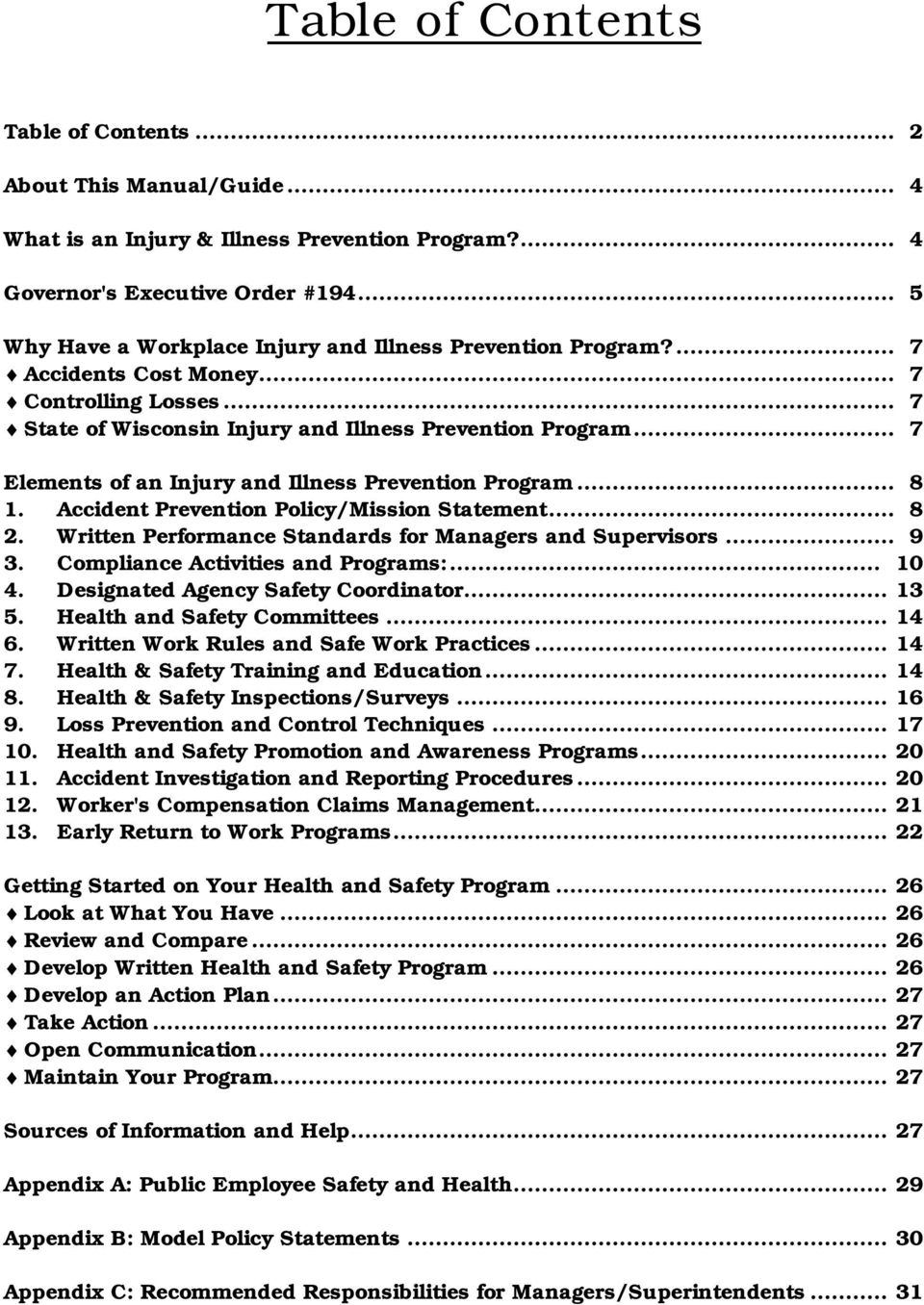
2 Table of Contents Table of Contents... 2 About This Manual/Guide... 4 What is an Injury & Illness Prevention Program?... 4 Governor's Executive Order # Why Have a Workplace Injury and Illness Prevention Program?... 7 Accidents Cost Money... 7 Controlling Losses... 7 State of Wisconsin Injury and Illness Prevention Program... 7 Elements of an Injury and Illness Prevention Program Accident Prevention Policy/Mission Statement Written Performance Standards for Managers and Supervisors Compliance Activities and Programs: Designated Agency Safety Coordinator Health and Safety Committees Written Work Rules and Safe Work Practices Health & Safety Training and Education Health & Safety Inspections/Surveys Loss Prevention and Control Techniques Health and Safety Promotion and Awareness Programs Accident Investigation and Reporting Procedures Worker's Compensation Claims Management Early Return to Work Programs Getting Started on Your Health and Safety Program Look at What You Have Review and Compare Develop Written Health and Safety Program Develop an Action Plan Take Action Open Communication Maintain Your Program Sources of Information and Help Appendix A: Public Employee Safety and Health Appendix B: Model Policy Statements Appendix C: Recommended Responsibilities for Managers/Superintendents... 31
3 Appendix D: Recommended Responsibilities for Supervisors Appendix E: Checklist for Top-Management's Commitment to Workplace Safety...33 Appendix F: Recordkeeping Requirements for Public Sector Agencies Appendix G: ILHR/OSHA Required Programs/Instruction/Procedures Checklist Appendix H: Safety Coordinator's Suggested Job Description Appendix I: Suggested Health and Safety Committee Charter Appendix J: Sample Code of Safe Practices Appendix K: Sample Employee Safety Orientation Checklist Appendix L: Required/Recommended Health and Safety Training...49 Appendix M: ILHR/OSHA Inspections/Tests/Monitoring Checklist Appendix N: Self-Administrated Health and Safety Checklists Appendix O: ILHR/OSHA Medical Surveillance Checklist Appendix P: Planning for Emergencies Checklist Appendix Q: Suggested Loss Prevention and Control Techniques Appendix R: Glossary of Worker's Compensation Terms Appendix S: Sample Written Health and Safety Program Appendix T: Overall Action Plan Appendix U: Health and Safety Self-Rating Worksheet Issued September 1993 Revised May 1998

4 About This Manual/Guide Every Wisconsin State Agency has a legal obligation to provide and maintain a safe and healthful workplace for its employees according to Wisconsin State Statute In addition, each agency is required by a Governor's Executive Order (#194) to develop and implement a written comprehensive health and safety program to reduce the incidence of workplace injuries and illnesses. The purpose of this manual is to assist state agencies with the development of their written health and safety program and to outline steps that can be taken to prevent or control hazards and promote safety awareness and safe work practices. The information in this publication is based on principles and techniques developed by occupational safety and health professionals nationwide. The purpose of this manual is to provide guidance, rather than prescribe specific requirements, and is not intended as a legal interpretation of any federal or state standard. The material in this manual has been adapted from a similar manual developed by the Occupational Safety and Health Administration (OSHA) and the CAL/OSHA Consultation Service. This information, inspection checklists and forms in this manual may be reproduced without permission for the purpose of enhancing workplace health and safety. What is an Injury and Illness Prevention Program? The State of Wisconsin has long been recognized as an innovator and leader in the areas of environmental compliance, education, and welfare reform. Wisconsin has a welldocumented track record for protecting its citizenry. The state s first industrial code dates back to the late 1800's. In 1911, Wisconsin was the first state to pass a Worker's Compensation law, further assuring the protection of its workers. Other states continue to struggle with how to provide occupational safety and health protection for their public sector employees. The State of Wisconsin in 1980 enacted legislation giving public employees the same protection as that afforded employees in the private sector. In keeping with this tradition of progressiveness, a Governor's Executive Order was issued on July 30, 1993 to further advance the health and safety of State employees and reduce losses, both personal and economic, associated with workplace injuries and illnesses (see pages 5-6).

5 EXECTIVE ORDER #194 Relating to workplace health and safety of state employees WHEREAS, it is the policy of the State of Wisconsin to provide a safe and healthful workplace for all state employees; and WHEREAS, workplace injuries and illnesses produce human suffering, economic and social losses and impair the operating efficiency of state government; and WHEREAS, workplace injuries and illnesses can be reduced or eliminated by systematic planning training, safe work practices and the effective use of hazard control measures; and WHEREAS, occupational accident and illness prevention requires management and employee commitment, accountability, cooperation, and leadership at all levels of state government; and WHEREAS, laws and regulations governing health and safety in the workplace apply to the operation of state government; and WHEREAS, state government should lead by example by complying with all state and federal health and safety requirements; NOW, THEREFORE I, TOMMY G. THOMPSON, Governor of the State of Wisconsin, by the authority vested in my by the Constitution and the laws of this State do hereby: Proclaim that all state agencies, institutions and university campuses and centers must develop and promulgate a comprehensive written health and safety program whose purpose is to attain the following objectives: 1. Minimize the risk of occupational injuries and illness by the use of recommended loss prevention and control techniques. 2. Establish written performance/accountability standards and objectives for managers and supervisors to reduce occupational injuries and illnesses and enhance workplace health and safety. 3. Provide adequate health and safety training and education for managers, supervisors and employees.

6 4. Establish health and safety committees consisting of representatives from all levels and areas of the organization. 5. Promote health and safety awareness and safe work practices. 6. Establish a procedure for conducting periodic health and safety inspections/surveys so that potential hazards are detected and corrected or controlled in a timely manner. 7. Provide for increased compliance with all applicable State and Federal health and safety standards and regulations. 8. Designate an individual to serve as the organization's Health and Safety Coordinator to assist in directing its injury/illness prevention program. 9. Promote effective investigation and management of worker s compensation claims and the early return to work of injured employees using transitional work assignments and other rehabilitation strategies. FURTHER, all written Health and Safety Programs must be submitted to the Department of Administration, Bureau of State Risk Management for approval and ongoing review. The Department of Industry, Labor and Human Relations, Bureau of Safety Inspections will maintain its authority and final approval of worksite safety plans required through Chapter ILHR 32 - Administration Rules and the Bureau s inspection program. The Department of Administration, Bureau of State Risk Management and the Department of Industry, Labor and Human Relations, Bureau of Safety Services will report annually to the Governor on progress in achieving improved worksite health and safety in State Government. All state employees must be informed of this Executive Order, its intent and requirements for providing a safe and healthy workplace throughout state government. Tommy G. Thompson Governor

7 Why Have a Workplace Injury and Illness Prevention Program? One of the most valuable assets employers have is their employees. This is true if the employer is a small business, large corporation, or a government agency. Investing in a workplace injury and illness prevention program has proven to be one of the best and most cost effective ways employers can protect both their human and physical assets. overtime costs adverse publicity administrative costs increased agency premiums Controlling Losses The success of many corporations and states such as Oregon and Michigan has shown that a comprehensive written health and safety program will Accidents Cost Money The direct costs of workplace injuries and illnesses (medical expenses and worker s compensation benefits) are well known. What may not be so well known are the indirect or hidden costs of accidents, which are often 3-4 times greater than the direct cost. Consider what one lost workday injury/illness could cost in terms of: productive time lost by an injured employee productive time lost by supervisors time and costs to resume operations after the accident time and costs to hire other individuals to replace the injured worker time and cost to repair or replace any damaged equipment reduced morale and perhaps efficiency significantly reduce the costs associated with workplace injuries and illnesses. Research has also shown that an effective safety program will have a positive effect on employee morale and productivity. The process of establishing your written health and safety program will help you identify what has to be done in your organization to control hazards and promote greater health and safety awareness among employees and supervisors. Developing a written program will also help you outline the policies that are necessary to achieve your injury and illness prevention goals.

8 State of Wisconsin Injury and Illness Prevention Program In the State of Wisconsin, public sector employers are required by law (Wisconsin Statute ) to provide a safe and healthful workplace for their employees. A summary of this statute and its requirements are detailed in Appendix A. Additional requirements for public employee safety and health are codified in Wisconsin Administrative Code, Chapter 32. Further, Executive Order #194 was signed by Governor Tommy G. Thompson on July 30, 1993 to advance the health and safety of state employees in the workplace. What follows are guidelines, inspection checklists and sample forms that will assist state agencies and institutions in developing their own written health and safety program as mandated by the Governor's Executive Order and further supported by State Statues and Department of Commerce Administrative Codes.

9 Elements of an Injury and Illness Prevention Program The Governor's Executive Order #194 can be summarized into the following 13 required elements. your program. Both reflect the priority your agency places on these issues. 1. Accident prevention policy/mission statement 2. Written performance/accountability standards and objectives for managers and supervisors to: a. Reduce injuries and illnesses b. Enhance workplace health and safety 3. Compliance activities and programs. 4. Designated agency safety coordinator 5. Health and safety committees 6. Written safety rules and practices 7. Health and safety training and education 8. Health and safety inspections/surveys 9. Loss prevention and control techniques 10. Health and safety promotion and awareness programs 11. Accident investigation and reporting procedures 12. Worker s Compensation claims management 13. Early return to work programs Each of these 13 elements is described on subsequent pages. 1. Accident Prevention Policy/Mission Statement Your agency's commitment to employee health and safety shows in the decisions you make and the specific actions you take to develop and promote Employees (and supervisors) in return will respond to that level of commitment. Every successful organization realizes that maximum efficiency and quality can only be achieved by eliminating or controlling potential hazardous work practices before they result in a workplace injury or illness. Agencies can begin developing an effective injury and illness prevention program by integrating this philosophy into their entire operation and organizational values. One way to visibly demonstrate this philosophy and the commitment of topmanagement is to develop an accident prevention policy or mission statement. Your policy/mission statement should clearly communicate to your employees the value in which health and safety protection is held in your agency in relation to other organizational values and objectives. Your policy/ mission statement should also make the order of priorities clear so that all employees will know what choice to make if a conflict occurs between employee health and safety and another organizational value. Several examples of policy/mission statements can be found in Appendix B. In order for your health and safety policy to be effective, you must clearly communicate your policy to all your employees by both explanation and example. For example, you may want to explain your policy in group meetings

10 and/or express your commitment in a letter sent to each employee. You should also consider posting your mission statement throughout each of your locations. Your policy is also communicated by example when managers and supervisors follow all agency safety rules and practice the same safe behavior and habits that are expected of employees. 2. Written Performance and Accountability Standards and Objectives for Managers and Supervisors to: a. Reduce injuries and illnesses b. Enhance workplace health and safety Your commitment to protecting your employees from workplace hazards and injuries is reflected in all aspects of your safety and health program, but nowhere more than in the organization and management of the program. In order to leave no doubt about your agency's conviction that safety and health is just as important as productivity and quality, you should equate safety and health activities with your other agency functions. For example, the following actions would demonstrate to your employees and management team that your agency is serious about safety and health protection. 1. Establish written performance standards and objectives for managers and supervisors for injury and illness prevention and workplace health and safety in the same way you set objectives for other program priorities. 2. Assign specific health and safety responsibilities to your management team just as you would assign other performance responsibilities. Include these responsibilities in each Position Description (PD). 3. Hold your supervisors and managers accountable for their health and safety objectives and responsibilities, and reward good performance and correct any problem areas. 4. Allocate sufficient agency resources for: a. the identification and control of potential health and safety and health hazards b. the installation and maintenance of engineering controls c. personal protective equipment d. medical treatment, surveillance and monitoring e. safety and health training and education, and f. Fire prevention and suppression equipment 5. Establish clear lines of communication for your employees to inform management of their safety and health concerns without fear of reprisal. This utilizes employee insight and experience in safety and health protection. 6. Communicate to your employees your agency's concern for health and safety by: a. Including safety and health topics in staff meetings and personal conversations with employees; b. taking any necessary corrective action after inspections, accidents, or employee complaints and; c. providing feedback on safety performance and suggestions. 7. Set a good example! If, for instance, you require safety glasses to be worn in a specific area, then each member of management must also wear them in that area.

11 Once your supervisors and managers are convinced that health and safety protections are essential aspects of daily departmental operations, you will have a solid foundation for an effective workplace injury prevention program. A sample list of safety responsibilities for both managers and supervisors is provided in Appendixes C and D. A checklist to evaluate topmanagement's commitment to health and safety can be found in Appendix E. 3. Compliance Activities and Programs: Safety and Health Recordkeeping No organization can be successful without adequate recordkeeping. This enables you to learn from past experience and make corrections for future operations. Records of accidents, workrelated injuries, illnesses and property losses also serve a similar purpose. These records will help you to identify the causes of accidents and injuries and the control procedures that should be instituted to prevent losses from recurring. These records will also provide you with one measure for evaluating the success of safety and health activities. Success normally means a reduction or elimination of employee injuries and illnesses during a calendar or fiscal year. Success can also be measured in terms of reduced overtime costs, and absenteeism. Injury and Illness Records In accordance with the ILHR/OSHA recordkeeping requirements, information on occupational injuries and illnesses must be recorded and maintained for at least five years. Six important steps are required by the ILHR/OSHA recordkeeping system: 1. Obtain a First Report of Injury for every work-related injury or illness. 2. Record each injury or illness on the OSHA Log and Summary of Occupational Injuries and Illnesses, OSHA Form 200, or on an equivalent log, according to instructions. 3. Prepare a supplementary record of the occupational injuries and illnesses on OSHA Form 101, or the Employer's First Report of Injury or Illness (Form WKC 12)), with the same information. 4. Every year, prepare a summary of the OSHA Form 200, (or the last page of an equivalent log) and post the summary page no later than February 1 and keep it posted where employees can see the summary until March Maintain the last five years of these records in your files. 6. Provide copies of the injury and illness log to Department of Commerce safety inspectors and/or employee representatives upon request. During the year, regularly review these records to see where your injuries and illnesses are occurring. Look for any patterns or repeat situations. These records can also help you identify hazardous areas in your workplace and pinpoint where corrective action is needed. Since the basic ILHR/OSHA recordkeeping system is intended for only "recordable" injuries and illnesses, you might consider expanding your system to include all incidents relating to workplace safety and health, even those where no injury or illness resulted. (Referred to as near misses). This information can assist you in pinpointing unsafe acts,

12 conditions or procedures. Appendix F provides a summary of the ILHR/OSHA recordkeeping requirements. Forms and training material are available from the Bureau of State Risk Management. Exposure Records Injury and illness records are not the only records you need to maintain. Most of the ILHR/OSHA standards concerning toxic substances and hazardous exposures require records of employee exposure to these substances and their sources, physical examination reports, employment records, and other information. Refer to State Statute for additional information. Documentation of Your Activities Essential records, including those legally required for worker s compensation, medical surveillance and ILHR/OSHA standards, must be maintained for as long as required. Keep in mind that any inspection or survey conducted by the Department of Commerce or an outside consultant may require you to demonstrate the effectiveness of your recordkeeping program. Written documentation of required safety and health training must also be maintained. The documentation must specifically include the employee's name or other identifier, training dates, type(s) of training and the name of the training provider. These records should be kept for at least three years. In addition to the compliance requirements previously described, the following is a summary of the key ILHR/OSHA regulations and statutes. If you have questions concerning specific compliance requirements, contact the Department of Commerce, Division of Safety and Building at (608) Summary of Key State Statutes and ILHR/OSHA Regulations. State Statute Key requirements: Employers have a legal obligation to provide a safe and healthful working environment The authority to conduct inspections and enforce standards is given to the Department of Commerce Employers must maintain records of injuries and illnesses Employers must maintain employee exposure records Employers must notify exposed employees of his/her monitoring results and any corrective action taken Employers must post a summary of employee rights and protections - DILHR Notice SBD 9301-P (4,92) (see Appendix A - for further detail) Employers must not discriminate against employees who file a complaint with the Department of Commerce. Access to Employee Exposure and Medical Records ILHR Required Elements: Provide right of access to medical and exposure records to employees and designated representatives Provide employee notification of access rights at time of initial employment and annually thereafter Retention of records (30 years) Employee Emergency and Fire Prevention Plans ILHR/OSHA Required Elements: Action plans in writing to ensure employee safety from fire and other emergencies

13 Written plan must include - Escape procedures, route assignments - Shutdown procedures - Method to account for personnel - Rescue and medical duties - Preferred means of reporting emergencies - Names and persons/departments to contact - Employee training Occupational Noise Exposure ILHR Required elements: A Hearing Conservation Program is needed whenever employee noise exposures equal or exceed an 8-hour Time Weighted Average of 85 decibels. The program must include - Noise monitoring - Employee notification of test results - Audiometric testing - Initial base line audiogram and retesting at least annually - Hearing protectors - Available to employees exposed to TWA of 85 decibels. Required in excess of TWA of 90 decibels or more until control measures to reduce sound levels are instituted - Initial and annual training and recordkeeping Respiratory Protection ILHR Required Elements: Respiratory protection must be used when engineering controls are not feasible or while being instituted to reduce airborne containments below the PEL Minimal acceptable program: - Written standard operating procedures - Selection based upon hazards - Training - Individual use - Cleaning and maintenance - Proper storage - Regular inspection - Medical surveillance - Air quality testing - Fit testing Control of Hazardous Energy (Lockout/Tagout) ILHR Purpose/Scope: Purpose is to safeguard employees while servicing or performing maintenance on machines where unexpected start-up or release of stored energy could cause injury Applicable when servicing and/or performing maintenance, i.e., constructing, installing, setting up, adjusting, inspection, modifying. These activities include lubrication, cleaning or unjamming Cord and plug equipment are exempt Required Elements: Written energy control program Written Energy Control Procedure(s) - scope, purpose, authorizations, rules and techniques to control energy sources Energy-isolating Devices - mechanisms to prevent transmission or release of energy (locks and tags, hasps, etc.) Employee training for authorized, affected and other employees Periodic inspections Annual program evaluation Exchange of information with outside contractors Related Standards... Subpart O Machinery/Guarding, Safety Related Work Practices (Electrical) Occupational Exposure to Bloodborne Pathogens ILHR

14 Scope: Covers employees who could be "reasonably anticipated" as a result of performing their job duties to incur contact with blood and other potentially infectious materials Included (but not limited to) are physicians, nurses, dentists and other health care personnel, housekeeping and laundry workers, law enforcement officers, fire fighters, and other emergency response personnel where a reasonable expectation of contact exists Required Elements: Written Exposure Control Plan that includes - Exposure determination and listing of affected job classifications and/or tasks - Procedures for evaluating exposure incidents - Methods of compliance Universal precautions (treating body fluids/materials as if infectious) and engineering and work practice controls Hepatitis B Vaccination - Available within 10 working days of assignment, at no cost to employee Post Exposure Evaluation and Followup - A confidential medical evaluation should be immediately available that documents the circumstances of exposure, the source individual, the type of the testing procedures used, and the use of a post-exposure prophylaxis if needed. Hazard Communication - Labels and signs for regulated waste Information and Training - Initially upon assignment and annually Recordkeeping - Medical and training records need to be maintained Hazard Communication ILHR Required Elements: Written Hazard Communication Program List of hazardous chemicals in workplace Material Safety Data Sheets for all hazardous substances Container labeling Employee training Related Standards...Air Contaminants Standard Z Tables, HAZWOPER , Lab Standard Confined Space Entry Chapter ILHR 32, Section VI - Wisconsin Administrative Code Definition: - Large enough and so configured that an employee can enter and perform assigned work - Limited entry/egress - Not designed for human occupancy - Could contain dangerous contaminants or material that has the potential for engulfment Required Elements: Written confined space entry procedures Testing and monitoring prior to and during entry Direct readout sampling device Level 1 and 2 space entry procedures Full body harnesses for vertical entry Rescue personnel equipped with SCBA and body harness Training for all employees required to enter confined spaces in First Aid and CPR Entrances to confined spaces located on streets must be properly protected Appendix G provides a summary of the ILHR/OSHA required programs, procedures and certifications.

15 4. Designated Agency Safety Coordinator The Executive Order requires that each agency/institution assign someone the responsibility and authority to manage/coordinate its employee health and safety program. The person assigned as your organization s safety coordinator must be identified by name or position in your written program. In smaller agencies, the safety coordinator function can be added to an existing position. In larger agencies, a full-time position may be required. The success of your organization s health and safety program hinges on the individual you choose. This person cannot succeed however, without your agency s or institution s full cooperation and support. Remember, even when you appoint someone as your safety coordinator and delegate to that person the authority to manage your program, the ultimate responsibility for health and safety in your workplace still rests with your management team. Some suggested Safety Coordinator responsibilities are listed in Appendix H. 5. Health and Safety Committees A well-organized and functioning health and safety committee can provide a valuable avenue for developing and maintaining positive interest in employee health and safety. To guarantee flexibility and efficiency, the composition of health and safety committees should be tailored to the specific needs and structure of each organization. The following are suggested activities the committee may wish to engage: 1. Prepare and make available to the affected employees, written records (minutes) of the safety and health issues discussed at the committee meetings. 2. Conduct inspections and review results of periodic worksite inspections performed by supervisors. 3. Review investigation reports of accidents that result in an occupational injury, or illness or exposure to hazardous substances, and where appropriate, submit suggestions to management for the prevention of future incidents. 4. Review investigations of alleged hazardous conditions brought to the attention of any committee member. When determined necessary, the committee may conduct an inspection and/or investigation to assist in remedial solutions. 5. Evaluate employee safety and ergonomic suggestions. 6. Verify corrective action taken by the employer to abate orders issued by the Department of Commerce. 7. Monitor the effectiveness and progress of the organization s health and safety program. Sample guidelines and procedures to develop a health and safety committee are provided in Appendix I. Note: Previously established health and safety committees are not superseded by this required element. 6. Written Work Rules and Safe Work Practices Written rules and safe work procedures are an essential part of an effective program. Written rules describe acceptable and safe behavior and identifies actions that are not appropriate and could endanger the safety of employees and visitor. Safe work practices and operating procedures
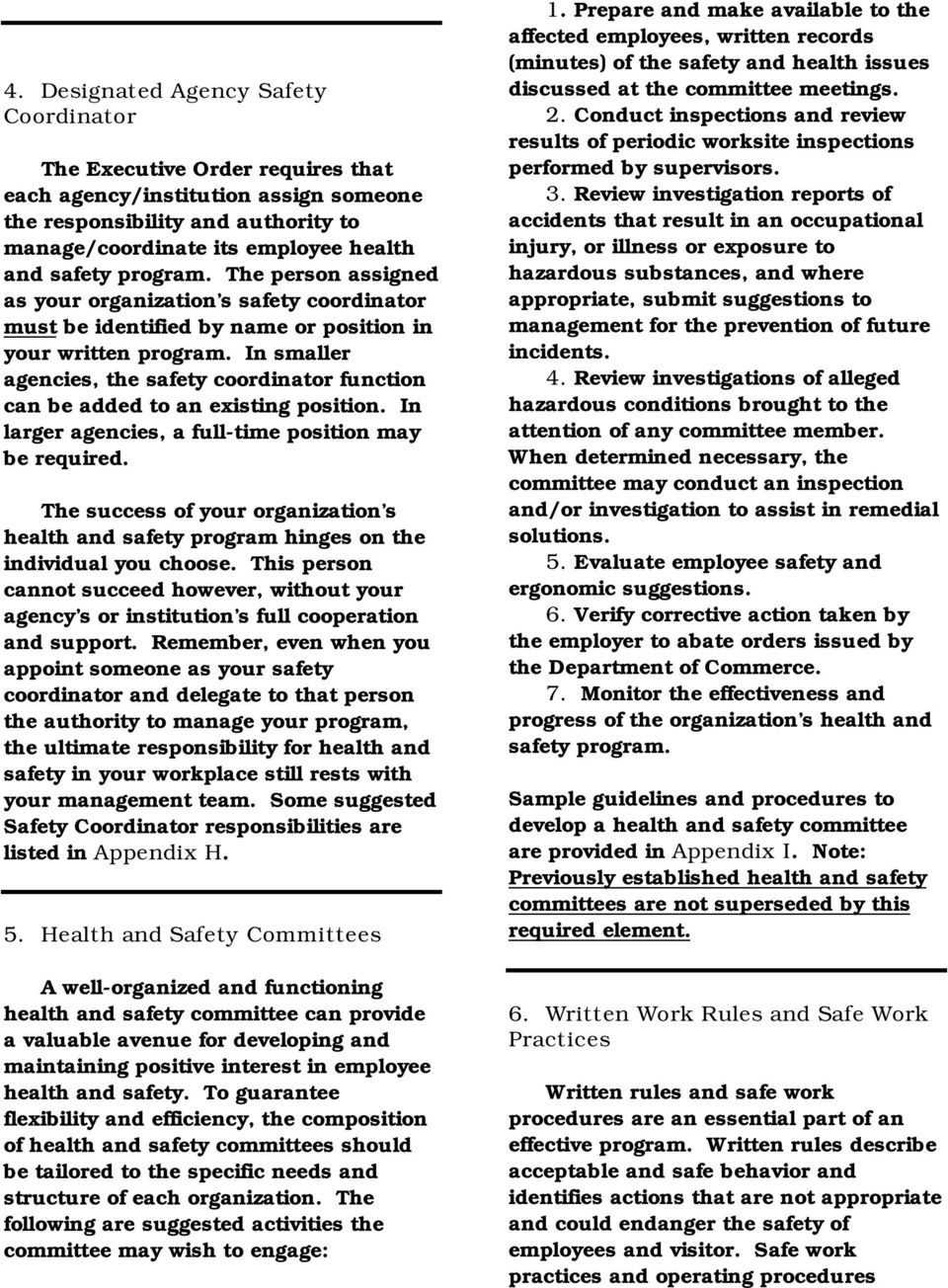
16 protect employees from known or potential hazards whenever exposure occurs. To be successful, your agency should have: 1. Written safety rules that apply to everyone in the organization. These written rules should address areas such as personal protective equipment, appropriate clothing, expected behavior, and emergency procedures. Supervisors and should periodically review and update all rules to make sure they reflect present conditions. Safety rules should also be written for new exposures when they are introduced into the workplace. 2. Safe and healthful work practices and procedures developed for each specific job or task. 3. Specific written operating procedures for abnormally hazardous tasks (i.e. confined space entry, lockout/tagout, respirator usage, etc.). 4. Disciplinary procedures to assure that safety rules and work procedures are put into practice and enforced. Appendix J provides a listing of suggested safety rules for general industry and office situations to assist you in developing safety rules that are appropriate for your organization. 7. Health and Safety Training and Education Training is one of the most important elements of any injury and illness prevention program. An effective training program allows employees to learn their jobs properly, brings new ideas into the workplace, reinforces existing ideas and practices, and puts your health and safety program into action. Employees benefit from safety and health training through fewer workrelated injuries and illnesses, and reduced stress and worry caused by exposure to hazards. Employers benefit from reduced workplace injuries and illnesses through lower costs and a more cohesive and productive work force. As the employer, you must ensure that all employees are knowledgeable about the materials and equipment they are working with, what known hazards are present and how they are controlled. As the employer, you are also required by the Department of Commerce and the Governor's Executive Order to establish and implement a formal health and safety training and education program. This program must, at a minimum, provide training and instruction: to all employees when your program is first established to all new and transferred employees to all employees given new job assignments for which training has not been previously received whenever new substances, processes, procedures or equipment are introduced to the workplace that present a new hazard whenever new personal protective equipment or different work practices are used on existing hazards whenever a new or previously unrecognized hazard is identified Supervisor/Employee Training: An effective injury and illness prevention program must include training for supervisors and employees so that both groups understand their responsibilities and how to prevent workplace injuries and illnesses. Supervisory Training:
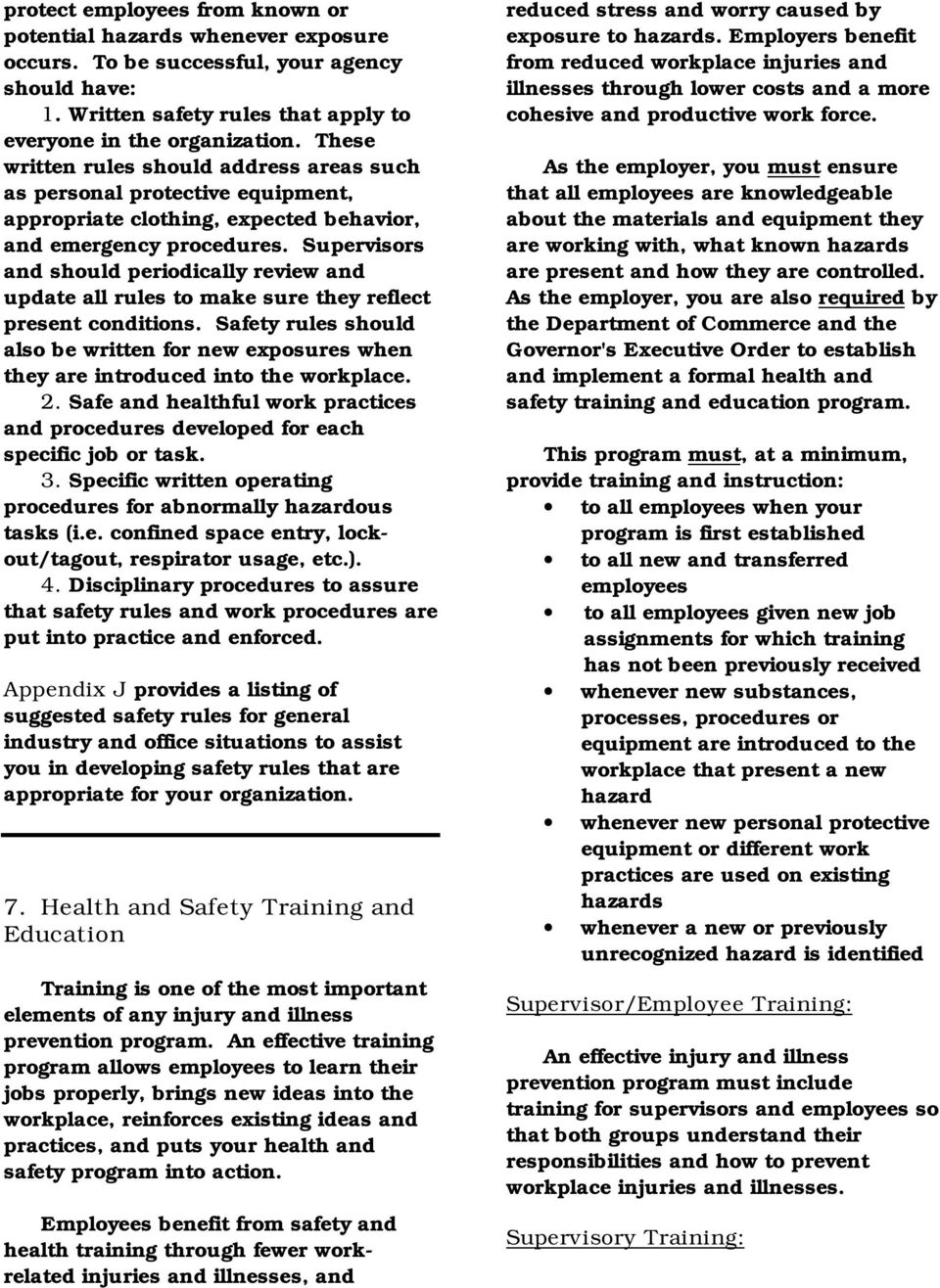
17 Training of supervisors is essential since they have the primary responsibility for 'the health and safety of their employees. You may want to start your training program by working to build good safety attitudes so that all of your management team is convinced of the value of workplace safety and health. You should also explain to supervisors how they are the key figures in the implementation and overall success of your injury prevention program. In order for them to be effective and meet their safety responsibilities, supervisors must be trained in the following areas: 1. The need to establish and maintain safe and healthful working conditions. 2. The hazards associated with the jobs in their department; their potential effects on employees; and the rules, procedures and work practices for controlling exposure to those hazards. 3. How to convey this information by example and instruction to employees to ensure that they understand and follow safe procedures. 4. How to investigate accidents in order to take appropriate corrective and preventative action. Employee Training: Employees should be able to perform their job tasks in a hazard-free environment. You have taken a major step in this direction by implementing an effective Hazard Assessment and Control Program. However, employees may create hazards through their own actions if they have not been properly trained. Hazardous situations can also be avoided or made less hazardous if employees receive appropriate training and instructions. Some of the safety training employees must receive includes: 1. Proper job instruction on safe work procedures and how these work procedures protect against exposure to hazards. 2. The proper use of personal protective equipment (PPE), including knowing where and when PPE is required, the limitations of PPE, how to maintain PPE in good condition and how to properly dispose of PPE. 3. What to do in case of an emergency that may occur in the workplace. A sample employee safety orientation checklist is shown in Appendix K. This checklist should be used whenever a new employee is hired or transfers occur, to reduce the risk of injury. In order to develop and initiate your training program, you may need to utilize outside professionals. You may also have in-house staff who are qualified to provide some of the training. Ideally, you should combine outside trainers with your own in-house training capabilities so you can provide training that is timely and specific to the needs of your workplace and your employees. For assistance in addressing your health and safety training needs, you may need to contact the Bureau of State Risk Management (BSRM). A Safety and Risk Management Training procurement bulletin (No ) has also been prepared to assist in arranging for classes. This bulletin lists 341 training courses that vary in length and cost. Agencies can arrange for the courses directly with the vendor or contact DOA Loss Control for further assistance. A listing of required and recommended health and safety training is provided in Appendix L to further assist you in planning your training program.

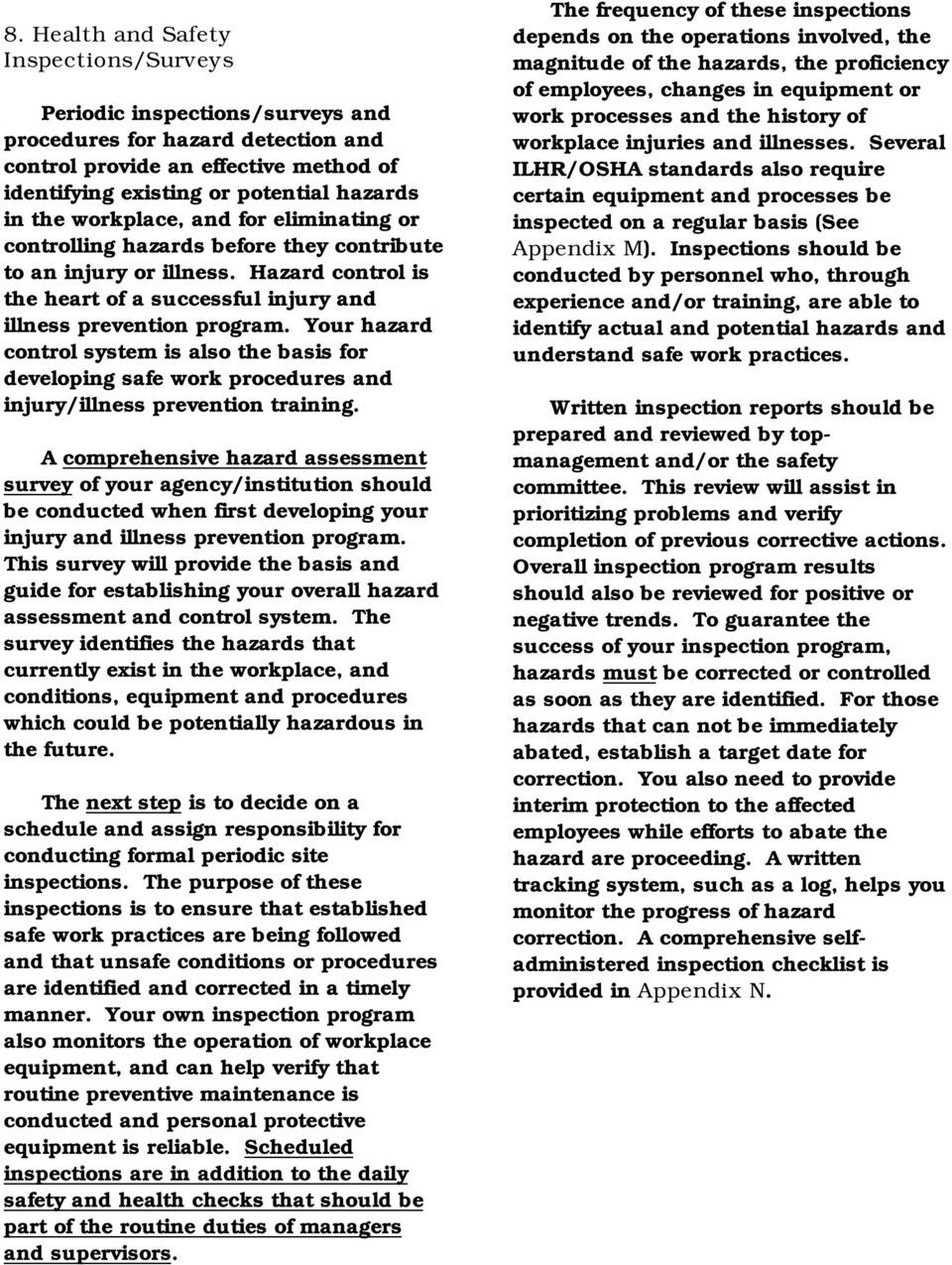
18 8. Health and Safety Inspections/Surveys Periodic inspections/surveys and procedures for hazard detection and control provide an effective method of identifying existing or potential hazards in the workplace, and for eliminating or controlling hazards before they contribute to an injury or illness. Hazard control is the heart of a successful injury and illness prevention program. Your hazard control system is also the basis for developing safe work procedures and injury/illness prevention training. A comprehensive hazard assessment survey of your agency/institution should be conducted when first developing your injury and illness prevention program. This survey will provide the basis and guide for establishing your overall hazard assessment and control system. The survey identifies the hazards that currently exist in the workplace, and conditions, equipment and procedures which could be potentially hazardous in the future. The next step is to decide on a schedule and assign responsibility for conducting formal periodic site inspections. The purpose of these inspections is to ensure that established safe work practices are being followed and that unsafe conditions or procedures are identified and corrected in a timely manner. Your own inspection program also monitors the operation of workplace equipment, and can help verify that routine preventive maintenance is conducted and personal protective equipment is reliable. Scheduled inspections are in addition to the daily safety and health checks that should be part of the routine duties of managers and supervisors. The frequency of these inspections depends on the operations involved, the magnitude of the hazards, the proficiency of employees, changes in equipment or work processes and the history of workplace injuries and illnesses. Several ILHR/OSHA standards also require certain equipment and processes be inspected on a regular basis (See Appendix M). Inspections should be conducted by personnel who, through experience and/or training, are able to identify actual and potential hazards and understand safe work practices. Written inspection reports should be prepared and reviewed by topmanagement and/or the safety committee. This review will assist in prioritizing problems and verify completion of previous corrective actions. Overall inspection program results should also be reviewed for positive or negative trends. To guarantee the success of your inspection program, hazards must be corrected or controlled as soon as they are identified. For those hazards that can not be immediately abated, establish a target date for correction. You also need to provide interim protection to the affected employees while efforts to abate the hazard are proceeding. A written tracking system, such as a log, helps you monitor the progress of hazard correction. A comprehensive selfadministered inspection checklist is provided in Appendix N.
19 than the product(s) currently in use 9. Loss Prevention and Control Techniques An effective Health and Safety Program relies on the use of various loss prevention and control techniques to prevent or control hazards that contribute to work-related injuries and illnesses. Hazards in the workplace take many forms, including air contaminants, tasks involving repetitive motions, chemical spills, equipment with moving parts, extreme heat or cold, noise, fire and toxic materials such as silica and asbestos. There are seven basic methods or techniques to prevent or control these hazards before they result in an injury or illness. 1. Engineering Controls The most preferred method for controlling health and safety hazards is to eliminate or control the source of the hazard by the use of engineering controls. Some examples of engineering controls include: * Ergonomically designed tools, equipment and workstations * Isolation or enclosure of hazardous processes or noisy equipment * Mechanical exhaust systems/booths for controlling toxic materials * Substitution of products that are not hazardous or less hazardous * Replacement of potentially unsafe equipment or machinery with new equipment/machines that meet or exceed safety standards * Electrical or mechanical safety interlocks and guards for machine hazards * Provisions to shutdown and lockout machinery when performing service or repair * Fire prevention systems 2. Procedural Controls When engineering controls are not feasible or affordable, or when guards or enclosures on equipment must be temporarily removed to conduct repairs and/or when employees are performing non-routine hazardous work such as confined space entry, procedural controls should be used to protect the safety and health of workers. Procedural controls include work rules, general work practices and specific written safe operating procedures. The following techniques should be used to insure that employees always follow these procedural controls: * Work practice training to help workers understand why special precautions are needed * Positive reinforcement to promote and encourage safe work habits * Correction of unsafe performance

20 * Disciplinary action, if needed, to enforce safety rules and protect employees and visitors Procedural controls are effective in preventing accidents, however, they are only as good as the management systems that insure their constant use. 3. Personal Protective Equipment A further method of controlling exposure to hazards when worker exposure cannot be completely engineered out of normal operations and maintenance work is to provide personal protective equipment (PPE). The term PPE includes safety glasses, goggles, face shields, aprons, hard hats, hearing protectors, chemical resistant clothing and gloves, steel toed shoes and respirators. Many ILHR/OSHA standards require certain types of personal protective equipment depending upon the level and duration of exposure. There is also a section in the Federal Standards (29 CFR 1910 Subpart 1) which specifically addresses PPE. If respirators are worn at your worksite, a written respirator program is also required (See 29 CFR ). The keys to the effective use of PPE to control hazards are: * Proper selection based on a written hazard assessment * Proper fit and comfort * Employee and supervisory training * Replacement procedures for damaged or worn part and equipment * Consistent enforcement 4. Administrative Controls Administrative controls should only be used when other methods are not feasible to control hazards. They include rotation of workers through different jobs, longer rest breaks, and additional relief workers. The purpose of these controls is to reduce worker exposure to toxic substances, extreme temperatures or to ergonomic hazards often found in highly repetitive tasks. Administrative controls however require ongoing and consistent training and enforcement to be effective. They also are costly and increase the workload of supervisors. Because of these limitations, administrative controls should always be used in conjunction with other controls and replaced, when feasible, with more effective methods. 5. Medical Programs and Surveillance Medical Programs The availability of first aid and emergency medical assistance is essential in order to minimize the harmful consequences of injuries and illnesses. The nature of the services needed for your agency/institution will depend on the potential seriousness of injuries and the health-hazard exposures which may occur and/or the proximity of a clinic or hospital to your worksite. The key components of an effective occupational medical program for the treatment of injured or ill employees include: * Written policy and procedures

21 * Adequate training and assignment of emergency responders and first aid personnel (if applicable to your worksite) * Reliable outside medical resources and consultation on matters relating to worker's health * First aid supplies, bloodborne pathogens protective equipment for emergency responders and biohazard clean-up kits * Medical record retention system and first aid logs Medical Surveillance Medical surveillance involves the systematic collection and evaluation of employee health data and medical tests to identify specific instances of illness or health trends that may suggest an adverse effect from workplace exposures. Many OSHA standards specify that employees exposed to certain potentially harmful substances (i.e., lead, asbestos, etc.) above the permissible "action level" and/or employees who are required to wear respirators or hearing protection must receive (at no cost to employees) an initial and sometimes an annual physical examination. Employees who develop signs or symptoms of a medical problem related to an exposure or who are assigned to a known problem area should also be included in the medical surveillance program. A comprehensive medical surveillance program will: 1) help identify serious unknown hazards or deficiencies in your hazard control system; 2) provide for early detection of medical problems; 3) lower lost work days and medical costs; and 4) improve employee morale and productivity. Appendix O lists the types and extent of medical surveillance required by ILHR/OSHA standards. 6. Emergency Planning Planning and training for emergencies are essential in order to minimize the harmful consequences of an emergency incident. If personnel are not thoroughly trained to react to emergencies so that their responses are immediate and precise, they may expose themselves and others to greater danger rather than reduce their exposure. The types of emergencies that may arise at your worksite depends on the nature of your operations and its geographical location. They could include fire, severe weather, chemical spills and bomb threats. A written plan must be developed to address each of these emergency situations. The extent to which training and drills are needed will depend on the potential severity and complexity of each emergency and the previous experience and training of emergency responders. A checklist for planning emergencies is provided in Appendix P. 7. Preventive Maintenance Preventive maintenance (PM) on equipment plays a critical role in ensuring that hazard controls remain in place and are effective. A good PM program also helps to ensure that new hazards are not created due to malfunctioning equipment. A ventilation system for example relies on the proper functioning of ductwork, fans, motors and filters. Many guards on machines are electronic or electrically energized
22 and require scheduled maintenance to continue to operate smoothly. A good PM program is achieved by first conducting a comprehensive survey of maintenance needs at each worksite. The next step is to establish a maintenance schedule and assign responsibility for performing each task identified in the survey. Posting and/or computerizing this schedule helps maintenance employees and supervisors to better plan their work activities and holds them accountable for following the schedule. Finally, it's important to document all maintenance work to verify its completion. This is especially critical in the event of equipment-related injury and/or a third party liability suit by the injured employee or the equipment manufacturer. A list of specific suggested loss control techniques is provided in Appendix Q. 10. Health and Safety Promotion and Awareness Programs Your program must include a system for promoting health and safety awareness. The following are suggested techniques for communicating safety and health information and increasing awareness levels: 1. Schedule general or departmental employee meetings during which safety is freely and openly discussed. These meetings should be regular, scheduled, and announced to all affected employees so that maximum employee attendance can be achieved. If properly planned, effective safety meetings can be held in a 15 to 20 minute time frame. 2. Audiovisual programs are excellent vehicles for increasing safety awareness. 3. Posters, bulletins and "accident alerts" can be very effective ways of communicating with employees. 4. Newsletters or similar publications devoted to safety are also excellent communication devices. 5. A safety suggestion program can be used by employee to communicate their concerns to management. 6. Post and advertise your agency's safety policy or mission statement to inform all employees that safety is a priority issue with management. 7. Promote safety and health issues through employee wellness committees and/or health fairs. 11. Accident Investigation and Reporting Procedures A primary tool you should be using in an effort to identify and recognize the hazards or areas responsible for accidents is a thorough and properly completed accident investigation. The accident investigation should be in writing and adequately identify the cause(s) of the injury/illness or near-miss occurrence. Accident investigations should be conducted by trained individuals, and with the primary focus of understanding why the accident or near miss occurred and what actions can be taken to avoid recurrence. In some agencies, this responsibility may be assigned to their safety coordinator. In other agencies, the responsibility may lie directly with the supervisor responsible for the affected
23 area or injured employee. Questions to ask in any accident investigation include: 1. What happened? The investigator should describe what took place that prompted the investigation: an injury to an employee, an incident that caused an operational delay, damaged material or any other conditions recognized as having a potential for losses or delays. 2. Why did the accident happen? The investigator must obtain all the facts surrounding the occurrence: what caused the situation to occur; who was involved; was/were the employee(s) qualified to perform the functions involved in the accident or near miss; were they properly trained; were proper operating procedures established for the task involved; were procedures followed, and if not, why not; where else could this or a similar situation exist, and how can this situation be corrected. 3. What should be done? The person conducting the investigation must determine which aspects of the operation or process require additional attention. The purpose of the investigation is not to establish blame, but to determine what type of constructive action can eliminate the cause(s) of the accident or near miss. 4. What action has been taken? Actions already taken to reduce or eliminate the exposures being investigated should be noted, along with those remaining to be addressed. Any interim or temporary precautions should also be documented. Any pending corrective action and reason for delaying its implementation must be identified. Corrective action should be identified in terms of not only how it will prevent a recurrence of the accident or near miss, but also how it will improve the overall operation. The solution should be a means of achieving not only accident control, but also total operational control. Your agency's safety and health committee(s) and department managers should review investigations of all accidents and near-miss incidents to assist in recommending appropriate corrective actions to prevent a similar recurrence. A thorough investigation of injuries, illnesses, incidents and near misses will help you identify causes and needed corrective actions, and can help you determine why accidents occur, where they happen, and any accident trends. This information is critical to preventing and controlling hazards and potential accidents. 12. Worker's Compensation Claims Management Effective claims management can not only significantly reduce worker s compensation costs, but can also help promote positive employee participation in your injury prevention program. The key to effective claims management is to establish and maintain close communication with the injured employee and his/her medical providers. How the employee perceives the organization's response to his/her injury or illness will set the tone of the entire claim management process. If an employee feels that he or she is being treated fairly, the person's recovery time is often shorter and he or she is less likely to feel the need to retain an
24 attorney. Agencies should adopt the following claims management strategies: 1. Issue a written policy requiring that employees to report all job related injuries and illnesses to their immediate supervisor or designated member of management within 24 hours. 2. Supervisors/safety coordinators who are not satisfied that the alleged injury or illness occurred "on the job," should indicate to their Worker's Compensation Coordinator that they want the claim further investigated. 3. Establish a policy to have all employees report to a designated management person to secure proper authorization before going to the doctor. (Note: Emergency situations are not covered by this procedure.) 4. Instruct the injured or ill employee going to the doctor to return to the workplace (if possible) after the office visit, and report on the treatment given. If this is not possible, follow up by phone. 5. Develop a selection plan that will secure for your organization employees who can safely perform the required job tasks consistent with ADA requirements. In addition, agencies may be requested to cooperate with DOA's, DOT s or University System s Worker's Compensation section in implementing the following claims management techniques and practices: 1. Notify your Worker's Compensation claims examiner or coordinator if you have an injured employee who is off the job, yet is active in other areas (i.e. sports, etc.) or working elsewhere. 2. Utilize the services of a private rehabilitation nurse or counselor involving serious injuries or in cases involving unexpected complications. 3. Utilize rehabilitation techniques such as physical therapy and work hardening to help condition the injured worker to resume his/her pre-injury activities. 4. If an employee initiates a third party lawsuit relating to his or her injury or illness, notify your Worker s Compensation examiner/coordinator and give them this information. Appendix R provides a useful glossary of terms for Worker's Compensation Claims Management. 13. Early Return to Work Programs Returning an injured employee to work as soon as medically feasible is an essential part of any claims management program. National research has shown that the majority of injured workers will return to their previous jobs at full capacity if employers establish a return to work program. The following facts will easily persuade you that return to work programs make good sense for everyone: Returning employees back to work will reduce costs by not having to hire replacement personnel for essential work. Future worker's compensation costs may be reduced, depending on how effective claims and injuries are managed. Even if employees initially can only return to work part time, temporary partial disability payments will be less costly than temporary total disability payments while the employee is off work completely. Employees off work for six months will have only a 50% chance of returning to work at all.
25 Employees off work for a year because of an injury have only a 25% chance of returning to the work place. Employees off work for two years have virtually no chance of returning to work. Early return to work reduces legal costs. Employees are less likely to feel their rights have been violated, causing them to retain an attorney. The psychological benefits of this program are also good reasons for returning employees back to work. You'll find that most employees really want to come back to work. A return to work program demonstrates to employees that you do care about them and value their importance and contributions within your organization. The following scenarios dispel the most common misunderstandings raised about return to work programs: 1. "Employees don't want to return to work; they'd rather stay home and collect a "free" paycheck". "My employer doesn't want me to return to work; they're just looking for an excuse to get rid of me." Most disputes over return to work issues can be traced to one failure: a breakdown in communication. Maintaining lines of communication is perhaps the most important component of a successful return to work program. Remember that communication works both ways. Supervisors must be sensitive to the fact that many employees are concerned about losing their jobs after experiencing a work-related injury or illness. Employees on the other hand must realize that failure on their part to provide their supervisor with regular medical up-dates could make them appear to be "malingering." Both employees and supervisors have responsibility to keep each other informed of medical status and return to work expectations. Regular communication between supervisors and employees can hasten recovery and return employees to their regular job duties. 2. We don't have any "light" duty. Early return to work programs usually require "transitional" duty. Avoid the reference to "light" duty, which often carries a negative connotation. Many workers can come back to their regular job with only some tasks removed because of their medical restrictions. If that cannot be done, almost every agency has some work that is put off because "no one has time." These tasks may include: taking inventory of supplies, reviewing old files, organizing the library or material safety data sheets, or updating resident care plans. Arrange to check with all your units or division for such work. Remember that transitional duty is only a "temporary" assignment that should be reviewed regularly by the employee's supervisor, and safety and personnel officers. Transitional duty should last no more than several months for any one employee. 3. If a worker comes back "too early," he/she will re-injure themselves. This is why you have to work very closely with the worker and the treating doctor to make sure that the job tasks actually fit the medical limits. Worker's in early return to work programs need close supervision and monitoring. They also have to agree not to work outside
26 their restrictions; and fellow workers must know not to ask them to do so. Supervisors also need to monitor the program to make sure that the system is working correctly. 4. Transitional duty jobs are "fun" and workers won't want to come back to their regular work. When workers return to work on modified duty, you must make sure that they fully understand this is temporary work. Using the proper terminology (i.e., modified or transitional work, not light duty) will avoid the appearance to other employees that the modified work is "easy or fun". Indicate that they will be expected to return to their full job as soon as medically able. The doctor should progressively reduce the restrictions as their medical condition improves. You can then add tasks to progress toward regular work. 5. Most people don't know how or want to talk to doctors. Many people feel intimidated when speaking with a medical doctor. The Worker's Compensation sections in the Bureau of State Risk Management, UW System and the Department of Transportation have trained personnel to assist you in making these contacts. Early return to work programs work for the injured worker and for your agency. You can design and set up a program to meet your agency needs. Any work-related injury/illness requires the proper investigation, reporting and documentation. Refer to the sections on record keeping, accident investigation and worker's compensation claims management for information on these activities. In addition, the following framework is offered to assist agencies in developing an early return to work program. 1. Pre-select or pre-plan transitional employment positions. 2. Require the employee to return to work immediately when medically able. Assess what types of transitional work are available for that employee consistent with his/her medical restriction(s). 3. Require the employee to bring his/her medical status report with him/her to the worksite. Clarify restrictions with medical provider if necessary. 4. Attempt to accommodate the employee's medical restrictions within his/her current job. 5. If accommodations can not be made, look at available transitional jobs or develop further accommodations. 6. If the employee's current job cannot be changed, look for other job tasks within the work unit, division or agency that fall within the prescribed restrictions. 7. Offer the employee modified work. Give the location, date and the time to report for work, the name and phone number of the supervisor, the number of days/weeks that work will be available and the wage rate. 8. The offer of modified work can be made by telephone, in person, and/or by certified mail. Note: The return to work date does not have to begin on a Monday or coincide with the beginning of a pay period. Agencies are encouraged to be flexible
27 when scheduling return-to-work dates. Return to work dates should also be coordinated with the treating physician. 9. Employee returns to modified work and supervisor monitors his/her progress. 10. Receive and review new medical status reports after each visit to the treating practitioner. 11. As the employee's restrictions change, update the return to work schedule and type of work being performed. Modified duty status should be reviewed every two weeks. 12. The employee stays on modified work until released for regular work, or until a pre-set time frame has elapsed, or permanent restrictions become evident. At this time, additional resources may be needed to accommodate the employee. Employees with permanent restrictions may create special challenges. However, every attempt should be made to find suitable permanent employment within the employee's permanent restrictions. When this is possible, an offer of employment should be made to the employee in writing. If suitable employment is not available, job retraining may be offered through the Division of Vocational Rehabilitation. Since every situation may be unique, additional assistance is available through the Worker's Compensation Section of the Bureau of State Risk Management. Note: Employees in "protective" classifications may have additional options available to them. When modified work is available within the employee's medical restrictions, he/she does not have the option of refusing this work. Return to work polices should clearly describe what is expected of employees. In some instances, benefits may be suspended and disciplinary actions invoked. In circumstances where the employee has not been released for work or modified work is not available, the employee must maintain regular contact with his/her supervisor. This should be done at least weekly. The employee should provide status reports from his/her doctor at least monthly until released for work or permanent limits are declared. The supervisor may need to seek advice from his/her agency's safety or worker's compensation coordinator when this situation arises.
28 Getting Started on Your Health and Safety Program Look at What You Have: Before you make any changes in your safety and health operations, gather as much information as possible about the current conditions at your work place, and the work practices that are already part of your injury and illness prevention program. This information can help you identify workplace problems and determine what's involved in solving them. inspections; loss prevention techniques; accident investigation procedures for preventing the reoccurrence of injuries; health and safety committees and training and education for employees and supervisors. Compare what you currently have with the written plans and activities required by the Department of Commerce and the specific health and safety An assessment of your workplace may be conducted by the person responsible for your agency's injury and illness prevention program, a trained safety committee member(s), and/or a professional occupation safety and health consultant. If you have difficulty deciding where to begin, call DOA Loss Control at (608) Review and Compare: After all the facts about your current activities are gathered, review how the information on your workplace corresponds with the critical components of an injury and illness prevention program: management commitment; assignment of responsibilities; safety communication system; written safety rules and safe work practices; scheduled regulations applicable to your workplace. You may find that you're already well on your way toward having an effective injury and illness prevention program. Develop a Written Health & Safety Program: Review the required elements of the Governor's Executive Order as summarized on the previous pages of this manual. Develop a written health and safety program which addressees each of these elements, or make sure each element is addressed in your existing plan. A sample written health and safety program is provided in Appendix S.
29 Develop an Action Plan: An action plan is a specific, written description of how you intend to implement the goals, objectives and specific improvements identified in your overall written program. An effective action plan has two parts. The first part is an overall list of the major changes or improvements needed to make your injury and illness prevention program effective. Assign each item a priority and a target date for completion, and identify the person(s) who will monitor or direct each action. The second part of an action plan involves taking each major change or improvement listed and developing a specific plan and timetable for making each particular change. Write out what you want to accomplish, the steps required, who will be assigned to complete each step, and when each step is to be finished. This part of the action plan helps you monitor program improvements. Worksheets to help you design an overall action plan and to describe specific action steps appear in Appendix T of this manual. Take Action: Once your written program and action plans are developed, begin the process of implementation. Make sure your goals and plans are realistic and manageable. Then address the specific steps you have listed in your action plan to achieve your health and safety objectives. You can, of course, work on more than one action plan at a time. Priorities may also change as other needs are identified or as your agency s resources change. Remember, an injury and illness prevention program is a "plan put into action." Open Communication: Open communication with your employees is crucial to the success of your program. Their cooperation depends on understanding the purpose and goals of your injury and illness prevention program, why the program is important to them, and how it affects their work. The more you do to keep them informed of the changes and improvements you are making, the greater are the chances of your success. Maintain Your Program: In order to maintain your health and safety program, it is important to periodically review each critical component of your program to determine what is working well and what changes, if any, are needed. When you identify needs that should be addressed, you have the basis for new health and safety objectives for program improvement. Use the health and safety self-rating worksheet in Appendix U to evaluate the effectiveness of your health and safety program. Sources of Information and Help
30 1. The Bureau of State Risk Management/Loss Control Section and the Department of Commerce can suggest sources (both governmental and private) for information, advice and training aids to help you develop and maintain your health and safety program. A surprising amount of assistance can be obtained at little or no cost to you. 2. Other agencies and public employers have most likely encountered similar health and safety problems and have probably found an effective and efficient solution. Most safety managers or coordinators are also willing to share information about their success and the problems they encountered and overcame. The Wisconsin State Agency Safety Council Resource Directory has further information about each organization s health and safety programs and the name and phone number of their safety coordinator. A copy of this Directory can be obtained from the Bureau of State Risk Management by calling (608) Most equipment manufacturers have become quite concerned with safety in the use of their products. To help their customers and to minimize their liability, many manufactures are willing to furnish training and/or technical information to enhance the safe operation of their equipment. 4. Many worker s compensation carriers, as well as fire insurance companies, can conduct loss prevention surveys to evaluate safety hazards and give you guidance and assistance in establishing and monitoring your program. Contact DOA Loss Control for further information. 5. Most employer associations, such as the Wisconsin Council of Safety, provide information and resources regarding safety issues to better serve their members. If your agency is a member of these associations, find out what the organization is doing to help its members. If you're not a member, ask if these groups are also circulating their educational materials to non-members 6. The National Safety Council has a broad range of information and services available to members as well as nonmembers. For assistance, you can write or call: National Safety Council P.O. Box 558 Itasca, IL (800) American Society of Safety Engineers (ASSE). Services include publications, audio-visual materials and educational programs. For assistance, you can write or call: American Society of Safety Engineers 1800 E. Oakton St. Des Plaines, IL (847) National Institute of Occupational Safety and Health (NIOSH). Services include publications, criteria documents and hazard alerts. For assistance, you can write or call NIOSH 4676 Columbia Parkway Cincinnati, Ohio (513) American Industrial Hygiene Association (AIHA). Services include
31 publications, training materials and seminars. For assistance, you can write or call: AIHA 345 White Pond Drive Akron, Ohio (216) An Occupational Health and Safety Technical Assistance Manual was developed by the Bureau of State Risk Management to help assist state agencies to further advance their injury prevention program. This manual consists of approximately 4,000 pages of reference material. Each large agency/institution and campus received one complimentary manual in Additional manuals may be purchased through State Document Sales at a cost of $ To order, call National Society to Prevent Blindness. Services include eye health and safety educational and training materials. The Society also sponsors membership to the Wise Owl Club of America, which is a program that awards membership to those who have saved their sight by wearing proper eye protection. For assistance write or call National Society to Prevent Blindness 759 North Milwaukee Street Milwaukee, WI (414)
32 Appendix A: Public Employee Safety and Health AUTHORITY Wisconsin statutes section requires the Department of Commerce to adopt and enforce safety and health standards that will provide protection to public employees at least equal to that provided to private sector employees under standards promulgated by the federal occupational safety and health administration (OSHA). INSPECTION A public employee or public employee representative who believes that a safety or health standard is being violated, or that a situation exists which poses a recognized hazard likely to cause death or serious physical harm, may request the department to conduct an inspection. If the requester so designates, the identity of the requester will be kept confidential. If the department decides not to make an inspection the requester will be so notified. A representative of the employer and a public employee representative will be permitted to accompany the department inspector during the inspection. The employee shall not be discriminated against with respect to pay received or withheld for time spent on the inspection. ENFORCEMENT If the department finds a violation of state standards, abatement orders will be issued to the employer. The employer shall post a copy of the orders at or near the site of the violations for 3 days or until the violation is corrected, whichever is longer. Copies of the orders will be sent to the top elected official, the bargaining unit and to the person requesting the inspection. If the department decides not to issue orders in response to a request, a written notice of that decision shall be sent to the public employee who requested the investigation. All decisions are reviewable if disputed. DISCRIMINATION No public employer may discriminate against or discharge any public employee for exercising any right afforded by this section. A state employee who believes he or she has been discriminated against may file a complaint with the personnel commission within 30 days of employee's receipt of knowledge of discrimination. A public employee other than a state employee may file a complaint with the state division of Equal Rights within 30 days. For more information contact: Department of Commerce Bureau of Program Development 201 W. Washington Avenue Madison, WI 53707
33 (608) Public employers are required to post this notice where notices to employees are usually posted Appendix B: Model Health and Safety Policy/Mission Statements The policy of this agency is that every employee is entitled to a safe and healthful place in which to work. To meet this objective, every reasonable effort will be made to protect the health and safety of employees in the interest of accident prevention and health preservation. Training for all employees in good safety and health practices Our objective is to develop and maintain a health and safety program that will reduce the incidence of injuries and illnesses to an absolute minimum. Our goal is zero accidents and injuries." It is the intent of this agency to comply with all applicable state and federal health and safety standards. To do this, we must constantly be aware of conditions in all work areas that can produce occupational injuries and illnesses. Your cooperation in detecting and reporting hazards and, in turn, controlling them, is a condition of your employment. Inform your supervisor immediately of any unsafe situation beyond your ability to correct." Our health and safety program will include: Conducting periodic health and safety inspections Establishing a system of recognition and awards for outstanding safety service or performance Investigating accidents to determine the primary and secondary causes in order to prevent the recoccuence of a similar accident Developing and enforcing safety rules and safety practices We recognize that the responsibilities for safety and health are shared. Management accepts responsibility for the leadership and effectiveness of the safety and health program and for providing the necessary equipment, resources and safeguards required to ensure safe working conditions. Supervisors are responsible for developing proper attitudes toward safety and health in themselves and in those they supervise, and for ensuring that all operations are performed with the utmost regard for the safety and health of all personnel involved, including themselves. Employees are responsible for their full and genuine cooperation in all aspects of the safety and health program including compliance with all rules and regulations and for continuously practicing safety while performing their jobs. No job is so important that we can not perform our work safely.
34 The health and safety of our employees is a major consideration in the operation of this agency. Management and supervisory personnel will be accountable for the health and safety of the employees working under their supervision and will be expected to conduct operations in a safe manner at all times. Management will also be responsible for establishing safe working conditions and proper attitudes toward safety and for promoting the health and health and safety of all employees.
35 Appendix C: Recommended Safety Responsibilities for Agency Managers/Institution Directors Department managers/institution directors should demonstrate their responsibility for health and safety by: A. Familiarizing themselves with their agency's/institution's health and safety program and ensure its effective implementation. B. Reviewing accident summary reports to keep informed on the agency's accident experience, and taking appropriate action when accident trends are unfavorable. C. Reviewing all health and safety considerations when purchasing and introducing new machines, operations, procedures or materials into the facilities. D. Appointing an individual to serve as their agency s health and safety coordinator and providing support, training and adequate resources. E. Involving the agency's safety coordinator in the planning, purchasing, installation and final inspection before any tool or piece of equipment is placed into operation. F. Providing maximum support to all programs and committees whose function is to further the cause of health and safety in the workplace. G. Becoming familiar with the safety responsibilities and activities of all supervisors reporting to them and providing support in any way required. H. Developing measurable safety objectives and activities for all supervisors. I. Attending safety meetings and training sessions when requested and insure that reasonable recommendations for corrective action receive timely consideration. J. Personally reviewing serious accidents and near misses to insure that all proper investigations are completed and corrective action is taken in a timely manner. K. Personally participating in safety inspections on periodic basis and otherwise demonstrate a visible interest in the health and safety of all subordinates. L. Providing a system of recognition for successful safety performance. M. Assisting individual supervisors to develop safety management skills and knowledge. N. Personally following all safety rules established by their agency/institution. 0. Approving work rules/procedures to guide the safe conduct of employees.
36 P. Ensuring that good housekeeping practices are maintained at all times.
37 Appendix D: Recommended Safety Responsibilities For Supervisors Supervisors should demonstrate their responsibility for health and safety by: A. Maintaining a thorough knowledge of their agency's safety policies and programs. B. Providing complete health and safety instruction and training for employees. C. Consistently enforcing all safety rules in accordance with the agency's disciplinary policy. D. Investigating all accidents and near-miss accidents in his/her area of responsibility in a timely manner. E. Encouraging employee participation in health and safety committees, health fairs suggestion programs, etc.. F. Providing adequate personal protective equipment and training on the proper use, maintenance, storage and disposal of this equipment. G. Insuring that all appropriate protective devices are installed and intact on all machines, that all fire-fighting equipment in his/her area is installed and accessible, and that proper housekeeping procedures are followed. H. Instilling a high level of safety awareness in all employees through positive leadership, education and positive reinforcement. I. Insuring that injured and ill employees are referred to proper medical treatment for immediate treatment. J. Conducting periodic planned safety inspections in their area of responsibility. K. Conducting safety meetings with their employees at least quarterly. L. Conducting frequent one on one safety talks with employees. M. Conducting a thorough safety orientation for new and transferred employees. N. Personally following all safety rules and safe work practices established by their agency/institution. O. Attending safety meetings and training sessions when requested. P. Issuing work orders and written requests to address hazardous conditions in their area of responsibility and following up to ensure timely correction of the problem.
38
39 Appendix E: Checklist for Top-Management's Commitment to Workplace Health and Safety Place a check mark next to each activity that top-management at your agency/institution does to support and promote health and safety. Issues a written injury and illness prevention policy and visibly supports the policy. Wears appropriate personal protective equipment (PPE) while touring the facility. Discusses health and safety issues with employees during periodic tours of the facility. Reviews the status of the organization s written health and safety program and annual action plan. Occasionally attends employee safety meetings and training sessions. Reviews copies of accident investigation reports. Interviews department managers and/or supervisors when one of their employees has a lost-time accident or serious near miss. Reviews agency safety performance and keeps informed of the leading causes of accidents. Receives copy of safety committee minutes. Occasionally attends committee meetings. Reviews reports on safety achievements and inspections. Ensures that safety is a regular agenda item at staff and department meetings. Responds promptly to suggestions to improve workplace safety conditions. Total number of check marks Overall Rating: 0-3 Checks: Poor 4-6 Checks: Fair
40 7-9 Checks: Good Checks: Excellent
41 Appendix F: Recordkeeping Requirements for Public Sector Employers WISCONSIN STATUTES (7) (7)(a) (7)(b) (7)(c) (7)(d) Public employers shall maintain records of injuries and illnesses. Public employers shall maintain records of employee exposures to toxic materials and harmful physical agents required by Sub. (3) (adopted OSHA Standards). The employer shall notify the exposed employee of his/her monitoring results, and any corrective action taken. The employer must post a summary of employee's rights and protections required under this section. CHAPTER 32.50, 29 CFR (a) (b) (d)(1) Each employer shall maintain a log and summary of all recordable injuries and illness on the OSHA 200 form. Employers may maintain the log at a remote location only if there is sufficient information to complete the log within 6 days and at each location there is a copy of the log that reflects at least the past 45 days. Each employer shall post a copy of the previous year's summary during the month of February These records must be maintained for at least 5 years Each employer shall provide access to these records to the representative of the State, or employee representative An employer with 10 or fewer employees need only to comply with: a) Obligation to report any fatality or multiple hospitalization accident and, b) Obligation to maintain a log of injuries and illnesses under
42 Appendix G: ILHR/OSHA Required Written Progra Instruction/Procedure/Certification Checklist Standard Subject Coverage (a) Emergency action plan Written procedures/actions required fo from fires and other emergencies (b)(2) Vehicle mounted elevating and rotating work platform Field modifications certified by manufa (i)(3) Ionizing radiation Written operating procedures applicabl (b)(4) Gaseous hydrogen systems Legible instructions for the user at ope (c)(4) Liquefied hydrogen systems Legible instructions for the user at ope (b)(9) Bulk oxygen systems Legible instructions for the user at ope (e)(9) Flammable and combustible liquids Written procedures to control leakage (h)(8) Flammable and combustible liquids Written procedures to control leakage (c)(5)(iv) Explosives Floors stained with nitroglycerin clean manufacturer's instructions (c)(5)(v) Explosives Deteriorated explosives destroyed per t instructions (h)(3)(iv)(b) Explosives Water gel: procedures to prevent foreig (b) Hazardous waste and emergency response Written safety and health program (j) Hazardous waste and emergency response Written procedures to handle chemica incidents (d)(2) Personal Protective Equipment Written hazard assessment and certific
43 Standard Subject Coverage (c))(1) Respirators Written respirator program with works procedures (a)(5) Vermin control Extermination program where vermin (e)(1)* Confined Space Entry Written permit system (c)(2) Lockout/Tagout Written procedures (b) Fire brigades Written organizational statement and d (c)(4) Fire brigades Written procedures to describe actions hazards (f)(2)(iii) Fire brigades Quantitative fit test procedures for neg pressure SCBA's (b)(1) Fire extinguisher Written fire safety policy and emergenc (c)(1) Fire extinguishing systems Emergency action plan for areas protec system (b)(5) Employee alarm systems Procedures for sounding emergency al (h)(11) Mechanical power presses Safety system certification/validation f device initiation (a)(1)(iv) Welding Procedures covering operation and ma fuel-gas supply equipment (d)(2)(iv) Welding Written permit before cutting or weldin (d)(2)(xii)(a) Welding Cutting and welding procedures (e)(4)(iv) Welding Preplanned rescue procedure when we confined space
44 Standard Subject Coverage (f)(11) Welding Manufacturer's instruction for cleanin (d)(1)(v) Laundry operations Safe work practices/detailed instructio (b)(9)(ii)(a) Wiring design and protection Written assured equipment grounding Electrical Written safety-related work practices (b)(2)(ii) Electrical Written locking/tagging procedures (f)(2) Asbestos Written program to reduce exposure b (e)(5)(ii) Carcinogens Written emergency procedures (f)(2) Vinyl chloride Program to reduce exposure below the (i) Vinyl chloride Written plan for emergency situations (g)(2) Inorganic arsenic Written program to reduce exposure b (k)(4) Inorganic arsenic Written housekeeping and maintenanc (1) Access to employee exposure and medical records Written procedures to provide access t (e)(3) Lead Written program to reduce exposure b (f)(2) Cadmium Written program to reduce exposure b (f)(2) Benzene Written program to reduce exposure b (c)(1) Bloodborne Pathogens Written exposure control plan (g)(2) DBCP Written program to reduce exposure b (g)(2 Acrylonitrile Written program to reduce exposure b (i)(1)(j) Acrylonitrile Written plan for emergency situations
45 (f)(2) Ethylene Oxide Written program to reduce exposures b the TWA Standard Subject Coverage (h)(1) Ethylene Oxide Written plan for emergency situations (k) Formaldehyde Written emergency procedures (d) 1,3 Butadiene Written program revised every 12 mon exceeds the PEL or STEL/ written goal (e) Hazard Communication Written program, safe work practices (e) Lab Safety Written hygiene plan, safe work practic Admin. Code 32 Section VI Confined Space Entry Written program, safe work practices *Note: The OSHA Standard for confined space entry ( ) does not currently apply to public sector anticipated effective date for public employers is 1/1/99.
46 Appendix H: Safety Coordinator's Suggested Job Description 1. Professional Development * Establish and maintain a health and safety reference library. * Keep apprised of changes in health and safety regulations. * Participate in professional organizations related to occupational health and safety. * Serve as agency's representative on State Safety Agency Council (Madison based only) 2. Program Development and Administration * Develop and maintain the agency s written health and safety program. * Develop and maintain injury and illness prevention policies and procedures to include: safety rules awareness and motivational programs accident investigations health and safety inspections/surveys * Plan and prepare for natural and "man-made" disasters. * Establish a medical program which includes on-site first aid capabilities and off -site emergency medical care and medical surveillance. * Develop and initiate special agency injury prevention campaigns 3. Training and Communication * Provide a general safety orientation for all new employees. * Serve on the Health and Safety Committee. * Accompany Department of Commerce health and safety inspectors and outside consultants on tours of the facilities. * Follow up on citations and recommendations generated by the Department of Commerce safety inspectors and outside consultants. * Determine the need for surveys by specialists, such as fire protection engineers, industrial hygienists, and ergonomist. 4. Internal Consultant * Work with the Personnel Department to assure safe placement and job assignment of new and transferred employees. * Conduct hazard analysis of existing facilities and operations. * Work with Facilities Engineering on special hazards or workplace design.
47 * Study the potential hazards of planned and proposed changes to facilities and operations and make appropriate recommendations. * Conduct a thorough investigation of those accidents where specialized knowledge is required. * Conduct research on health and safety issues. 5. Information Management * Maintain the Agency's accident recordkeeping system. * Maintain documentation on all aspects of the injury and illness prevention program. 6. Measuring Performance and Results * Audit employee and supervisory safety performance. * Review the overall safety performance of the agency.
48 Appendix I: Suggested Health and Safety Committee Charter 1. Purpose The purpose of the health and safety committee is to promote a healthy and safe work environment for all employees through employee involvement, training and regular inspections of the workplace. 2. Procedures The following procedures will be followed: * Committee members will be appointed from all areas and levels of the organization. * The terms of members shall be a maximum of one year. Should a vacancy occur on the committee, a new member shall be appointed. * The chairperson and secretary shall be elected by the safety and heath committee. * The frequency of meetings shall be determined by the committee. * The date, hour, and location of meetings shall be determined by the committee. * The length of each meeting shall not exceed 2 hours except by majority vote of the health and safety committee. * The attendance and subjects discussed shall be documented and maintained on file for a period of one year. Copies of the minutes will be provided to: * senior management * the safety coordinator, and * employees, by posting on the bulletin board and in break areas. 3. Scope of Activities * Conduct worksite safety inspections. * Assist in accident investigation to determine means of prevention. * Review accident and safety performance reports to uncover trends. * Accept and evaluate employee suggestions for improving workplace health and safety. * Review job procedures and recommend improvements. * Monitor the effectiveness and progress of the health and safety program. * Promote and publicize health and safety issues. * Sponsor/coordinate health and safety training programs, health fairs, and other promotional activities. Appendix J:
49 Sample Code of Safe Practices General Industry Note: This is a suggested format which is general in nature and intended as a basis for the preparation of a code of safe practices for general industry which may adapted to fit your operations more exactly. Our policy is that everything possible will be done to protect employees, customers and visitors from accidents. Safety is a cooperative undertaking requiring participation by every employee. Failure by any employee to comply with these safety rules will be grounds for corrective discipline. Supervisors shall insist that employees observe all applicable state, federal safety regulations, rules and practices and take action as is necessary to obtain compliance. To comply with this policy: 1. Employees shall report all unsafe conditions and equipment to their supervisor or safety coordinator. 2. Employees shall report all accidents, injuries and illnesses to their supervisor or safety coordinator immediately. 3. Anyone known to be under the influence of intoxicating liquor or drugs shall not be allowed on the job while in that condition. 4. Horseplay, scuffling, and other acts which tend to have an adverse influence on the safety or well being of the employees are prohibited. 5. Means of egress shall be kept unblocked, well lighted and unlocked during work hours. 6. In the event of fire, sound alarm and evacuate. 7. Upon hearing fire alarm, stop work and proceed to the nearest clear exit. Assemble at the designated location. 8. Only trained workers may attempt to respond to a fire or other emergency. 9. Exit doors must comply with fire safety regulations during business hours. 10. Stairways should be kept clear of items that can be tripped over and all areas under stairways that are egress routes should not be used to store combustibles. 11. Materials and equipment will not be stored against doors or exits, fire ladders or fire extinguisher stations.
50 Code of Safe Practices (Continued) 12. Aisles must be kept clear at all times. 13. Work areas should be maintained in a neat, orderly manner. Trash and refuse are to be thrown in proper waste containers. 14. All spills shall be wiped up promptly. 15. Always use the proper lifting technique. Never attempt to lift or push an object that is too heavy. Employees must contact their supervisor when help is needed to move a heavy object. 16. Never stack material precariously on top of lockers, file cabinets or other relatively high places. 17. When carrying material, caution should be exercised in watching for and avoiding obstructions, loose material or tripping hazards. 18. Do not stack material in an unstable manner. 19. Report exposed wiring and cords that are frayed or have deteriorated insulation so that they can be repaired promptly. 20. Never use a metal ladder in an area where the ladder could come in contact with energized parts of equipment, fixtures or circuit conductors. 21. Maintain sufficient access and working space around all electrical equipment to permit ready and safe operations and maintenance. 22. Do not use any portable electrical tools and equipment that are not grounded or double insulated. 23. All electrical equipment should be plugged into appropriate wall receptacles or into an extension of only one cord of similar size and capacity. Three-pronged plugs should be used to ensure continuity of ground. 24. All cords running into walk areas must be taped down or inserted through rubber protectors to preclude them from becoming tripping hazards. 25. Inspect motorized vehicles and other mechanized equipment daily or before use. 26. Shut off engine, set brakes and block wheels prior to loading or unloading vehicles. 27. Inspect pallets and their loads for integrity and stability before loading or moving.
51 28. Do not store compressed gas cylinders in areas that are exposed to heat sources, electric arcs or high temperature lines. Code of Safe Practices (Continued) 29. Do not use compressed air for cleaning unless the pressure is less than 30 psi. 30. Identify contents of pipelines prior to initiating any work that affects the integrity of the pipe. 31. Wear hearing protection in all areas identified as having high noise exposure. 32. Goggles or a face shield must be worn when grinding. 33. Do not use any faulty or worn hand or power tools. 34. Guard floor openings by a cover, guardrail, or an equivalent form of protection. 35. Do not enter into a confined space unless tests for toxic substances, explosive concentrations, and oxygen deficiency have been taken. 36. Always keep flammable or toxic chemicals in closed containers when not in use. 37. Do not eat in areas where hazardous chemicals are present. 38. Be aware of the potential hazards involving various chemicals stored or used in the workplace. Always read the warning label and refer to the material safety data sheet (MSDS) when needed. 39. Cleaning supplies must be stored away from edible items on kitchen shelves. 40. Cleaning solvents and flammable liquids must be stored in appropriate containers. 41. Solutions that may be poisonous or not intended for consumption should be kept in well-labeled containers. 42. When working with a Video Display Terminal (VDT), have the chair and other equipment properly adjusted, positioned and arranged to minimize strain on all parts of the body. 43. Never leave the lower desk or cabinet drawers open that present a tripping hazard. Use care when opening and closing drawers to avoid pinching fingers. 44. Do not open more than one upper drawer at a time, particularly the top two drawers on tall file cabinets.
52 45. Appliances such as coffeepots and microwaves must be kept in working order and inspected for signs of wear, heat or fraying of cords. 46. Fans used in work areas must be properly guarded. Guards must not allow fingers to be inserted through the mesh. Note: Newer fans are normally equipped with proper guards. Appendix J: Sample Code of Safe Practices Office Areas Note: This is a suggested format which is general in nature and intended as a basis for the preparation of a code of safe practices for office employees which may be adapted to fit your operations more exactly. "Our policy is that everything possible will be done to protect employees, customers and visitors from accidents. Health and safety is a cooperative undertaking requiring participation by every employee. Failure by any employee to comply with safety rules will be grounds for corrective discipline. Supervisors shall insist that employees observe all applicable Agency, State and Federal safety rules and practices and take action as is necessary to obtain compliance." To implement this policy: 1. Employees shall report all unsafe conditions and equipment to your supervisor or safety coordinator. 2. Employees shall report all accidents, injuries and illnesses to your supervisor or safety coordinator immediately. 3. Means of egress shall be kept unblocked, well lighted and unlocked during work hours. 4. In the event of fire, sound alarm and evacuate. Do NOT use the elevator. 5. Upon hearing the fire alarm, stop work and proceed to the nearest clear exit. Assemble at the designated location. 6. Only trained workers may attempt to respond to a fire or other emergency. 7. Exit doors must comply with fire safety regulations during business hours. 8. Stairways should be kept clear of items that can be tripped over and all areas under stairways that are egress routes should not be used to store combustibles.
53 9. Materials and equipment will not be stored against doors or exits, fire ladders or fire extinguisher stations. 10. Aisles must be kept clear at all times. 11. Work areas should be maintained in a neat, orderly manner. Trash and refuse are to be thrown in proper waste containers. 12. All spills shall wiped up promptly. Code of Safe Practices (Continued) 13. Files and supplies should be stored in such a manner as to preclude damage to the supplies or injury to personnel when they are moved. Heaviest items should be stored closest to the floor and lightweight items stored above. 14. All cords running into walk areas must be taped down or inserted through rubber protectors to preclude them from becoming tripping hazards. 15. Never stack material precariously on top of file cabinets or other high places. 16. Never leave lower desk or cabinet drawers open that present a tripping hazard. Use care when opening and closing drawers to avoid pinching fingers. 17. Do not open more than one upper drawer at a time; particularly the top two drawers on tall file cabinets. 18. Always use the proper lifting technique. Never attempt to lift or push an object which is too heavy. Employees must contact their supervisor when help is needed to move a heavy object. 19. When carrying material, caution should be exercised in watching for and avoiding obstructions, loose material, or tripping hazard. 20. All electrical equipment should be plugged into appropriate wall receptacles or into an extension of only one cord of similar size and capacity. Three-pronged plugs should be used to ensure continuity of ground. 21. Appliances such as coffeepots and microwaves should be kept in working order and inspected for signs of wear, heat or fraying of cords. 22. Fans used in work areas should be properly guarded. Guards must not allow fingers to be inserted through the mesh guard.
54 23. Equipment such as scissors, staples, etc., should be used for their intended purposes only and should not be misused as hammers, pry bars or screwdrivers. Misuse can cause damage to the equipment and possible injury to the user. 24. Cleaning supplies should be stored away from edible items on kitchen shelves. 25. Cleaning solvents and must be stored in appropriate containers. 26. Solutions that may be poisonous or not intended for consumption must be kept in well-labeled containers. 27. When working with a Video Display Terminal (VDT), have the chair and other equipment properly adjusted, positioned and arranged to minimize strain on all parts of the body. Appendix K: Sample Employee Safety Orientation Checklist Employee Name: Agency: Job Classification: Division: Title: Hired/Transferred: Date This checklist can be used for conducting safety orientation for new and transferred employees. Once completed and signed by both the supervisor and the employee, this checklist serves as documentation that orientation has taken place. Place a check in each box to indicate that the subject has been covered Explain the agency's health and safety program, including: * Orientation * Health and safety training * Accident investigation and reporting * Functions of the health and safety committee * Hazard Communication (Right to Know) * Safety suggestions * Safety inspections * Role of Agency Safety Coordinator * General safety rules Personal protective equipment required.
55 Line of communication and responsibility for immediately reporting accidents/near misses. * When to report an injury/near miss * How to report an injury/near miss * To whom should an injury should be reported * Filing an accident report form General overview of operation, procedures, methods, and potential hazards. Specific safety rules applicable to the employee's job and duties. Pertinent agency safety rules and OSHA safety and health standards. First aid supplies, equipment and training. * Obtaining medical treatment * Location of facilities/first aid kits * Location and names of qualified first aiders Emergency plan. * Exit locations and evacuation routes * Use of firefighting equipment (extinguishers, etc.) * Specific procedures (medical, chemical, fire, etc.) Vehicle safety (if applicable). * Carpool * Van driver * Commercial driver's license 10. Personal work habits. * Serious consequences of horseplay * Inattention * Smoking policy * Good housekeeping practices * Proper lifting techniques * Proper use of machinery and hand tools * Personal hygiene These signatures document that the above elements have been discussed to the satisfaction of both parties, and that both the supervisor and employee accept responsibility for maintaining a safe and healthy work environment. Date: Supervisor's Signature: Date: Employee's Signature:
56 Adapted with permission from the State of Minnesota s Work Place Safety Consultation Division
57 Appendix L: Required/Recommended Health and Safety Training for Public TYPE OF ACTIVITY/TRAINING LEGAL AUTHORITY (REGULATION) WHO RECEIVES HOW OFTEN Accident Prevention Signs ILHR, (c)(f) All employees Initial/Periodic Aerial Lifts ILHR, (b)(2)(ii) Affected employees Initial/Periodic Asbestos ILHR, (j) Employees exposed to asbestos at or above Action Level or excursion limit Custodial employees in areas containing asbestos Initial/Annual Initial/Annual Back Injury Prevention Recommended training All employees Periodic Bloodborne Pathogens ILHR, (d) Designated first aid responders, possibly maintenance staff Initial/Annual 1,3 Butadiene ILHR Employees exposed at or above action level/pel Initial/Annual Carcinogens - Regulated Area ILHR, Employees entering area Initial/Periodic Confined Space Entry Wis. Adm. Code 32, Chapter VI Authorized entrants/attendants or rescue personnel Initial/Annual Department of Commerce Compliance Seminar Recommended training Managers/supervisors, safety coordinators Periodic
58 Electrical Safety ILHR, (b)(1) Employees working on/near or with electrical equipment Initial/Periodic TYPE OF ACTIVITY/TRAINING LEGAL AUTHORITY (REGULATION) WHO RECEIVES HOW OFTEN Emergency Response/Spills ILHR, (e) Personnel expected to respond Initial/Annual Emergency Training/Fire Prevention Employee Rights/Responsibilities ILHR, (b) All employees Initial/Periodic Change in plan Wis. State Statute All employees Upon Hire Ethylene Oxide (ETO) ILHR, (j) Employees exposed to ETO Initial/Annual Fall Protection ILHR, (a) All exposed workers Initial/Periodic Fire Extinguishers ILHR, (d) Designated employees, floor captains Initial/Annual Fixed Extinguishing Systems ILHR, (b) Employees who service these systems Initial/Annual Flammable and Combustible Liquids ILHR, (b) All employees who handle, store or dispense these products Initial/Periodic Formaldehyde ILHR, (n) Employees with exposure Initial/Annual
59 Hazard Communication ILHR, (h) All employees exposed to chemical hazards Initial/Periodic TYPE OF ACTIVITY/TRAINING LEGAL AUTHORITY (REGULATION) WHO RECEIVES HOW OFTEN Hazardous Waste * ILHR, (e) All employees working at hazardous waste sites Initial/Annual Indoor Air Quality Recommended training Building managers, supervisors, safety coordinators, safety committee members Non-Ionizing Radiation ILHR, (i) Areas where these materials are used Periodic Initial/Periodic Laboratory Safety ILHR, (f) All laboratory employees Initial/Periodic Laundry Equipment ILHR, (d) Employees using laundry machines Initial/Periodic Lead ILHR, (j) Employees exposed to lead Initial/Periodic Annual if exposed above Action Level
60 Lockout/Tagout ILHR, (c)(7) All authorized and affected employees Initial/Periodic Liquified Petroleum(LP) Gases ILHR, (b) All employees who handle or dispense these products Initial/Annual Medical Services/First Aid ILHR, (a)(b) First aid providers Initial/Every three years Occupational Noise Exposure ILHR, (n)(o) Employees working in high noise areas Initial/Annual Change in wor TYPE OF ACTIVITY/TRAINING LEGAL AUTHORITY (REGULATION) WHO RECEIVES HOW OFTEN Office Health and Safety Recommended training Office supervisors and employees Initial/Periodic Personal Protective Equipment ILHR, (f) Employees required to wear PPE Initial/Change work/ppe use Power Presses ILHR, (f) Employees exposed to power presses Initial/Periodic Powered Industrial Trucks ILHR, (i) All operators of PIT s Initial/Periodic Respiratory Protection * ILHR, (k) All employees required to wear a respirator Initial/Annual Change in wor Safety Fundamentals for Supervisors Recommended training Managers/supervisors, safety coordinators Initial/Periodic Servicing of Single and Multi-Piece Rim Wheels ILHR, (g) Maintenance garage employees Initial/Periodic Stress Management Recommended training All employees Periodic Upper Body Cumulative Trauma Recommended training All employees involved in repetitive activities Periodic
61 Video Display Terminals Recommended training Employees who work on VDT s Initial/Periodic Ventilation (Personal Protection, Open Tanks) ILHR, (d) Employees working around open surface tanks Initial/Periodic * Agencies should consult other sources for the training requirements required by EPA/DNR environmental regula * The requirement to conduct annual training is based on the recently revised OSHA Respiratory Protection Stand will not apply to public employers until Januray 1, Note: These estimated times needed to provide training for each training course is the estimated amount of time n employee to obtain a minimum level of competency. More or less time may needed depending on class size and th attendees. Appendix M: ILHR/OSHA Required Inspections/Tests/Monitoring Standard Subject Required Coverage (d)(1)(x) Portable wood ladders All wooden ladders Frequently (c)(2)(vi) Portable metal ladders Metal ladders that tip over, or are exposed to oil and grease Immediately (f) Fixed ladders All fixed ladders Regularly (m) Automatic sprinkler systems All systems Periodic (n) Fire alarm signaling system All systems tested (non-supervised and supervised) Non-supervised supervised - an (e) Powered platforms for exterior building maintenance All powered platforms Before being pla months; mainte governor and se annually.
62 (c)(2)(i) Vehicle-mounted elevating and rotating work platforms Extensible and articulating boom platform lift controls Each day prior (c)(2)(xii) Vehicle-mounted elevating and rotating work platforms Aerial life before travel Prior to moving (c)(3) Vehicle-mounted elevating and rotating work platforms Electrical tests Per ANSI A (e)(1) Manlifts Steps, rails, landings, belts, illumination, motors, brakes, limit switches, etc. Every 30 days; Limit switches m (a)(3)(i) Abrasive blasting Slit abrasive-resistant baffles Regularly Standard Subject Required Coverage (a)(4)(i)(b) Abrasive blasting Exhaust ducts static pressure Upon completio periodically ther (a)(6) Abrasive blasting Air supply and air compressors tested Regularly (b)(4)(ii) Grinding, polishing and buffing operations Exhaust systems tested Per ANSI Z (c)(3)(iii)) Spray-finishing Overspray filters As needed operations (d)(4)(iii)(a )(5) Open surface tanks Supply air volumes and pressures for push-pull systems Measured and a (d)(8) Open surface tanks Airflow, hood static pressure, hoods and duct system After installation after a prolonge
63 (d)(11) (iii) Open surface tanks Atmosphere tests before entering tanks Prior to entry (d) Noise When employees may exceed 8-hr 85 dba TWA Initially; change or equipment; n attenuation of h inadequate (h)(5) Noise Audiometer calibration Daily, annual, e (d) Ionizing radiation Survey of materials and equipment and levels of radiation As necessary (f)(3) Ionizing radiation Signal-generating systems Initially/Periodi (a) Compressed gases All compressed gas cylinders As stated by DO (b) Gaseous hydrogen Hydrogen containers and units As stated by DO systems Standard Subject Required Coverage (b)(1)(vi) Gaseous hydrogen All piping, tubing and fittings After installation systems (c)(1)(vii) Liquefied hydrogen All field-erected piping After installation systems (b)(4)(iii) Bulk oxygen systems High pressure gaseous oxygen containers As stated by AS (b)(8)(iv) Bulk oxygen systems All field-erected piping After installation (b)(2)(v)) Above ground tanks Flow capacity of tank venting devices 12 As appropriate with flammable or inches and smaller in nominal pipe size combustible liquids
64 (b)(5)(vi) All tanks Independent pumping units Periodically (b)(7)(i) All tanks Independent pumping units Periodically (c)(7) Piping, valves and fittings Hydrostatically or pneumatically tested; joints and connections Before being cov in use (e)(5)(v) Flammable and All plant fire protection facilities Periodically combustible liquids (e)(8) Flammable and Hot work Prior to the wor combustible liquids (f)(4)(vi) Flammable and Relief devices on pumps on wharves Yearly combustible liquids (f)(4)(vii) Flammable and combustible liquids Pressure hoses and couplings on wharves Appropriate to t Standard Subject Required Coverage (g)(3)(v)(f ) Flammable and combustible liquids Pressure piping system between pump discharge and connection for dispensing facility Alter installation (h)(6)(iv) Flammable and combustible liquids All plant fire protection facilities in processing plants Periodically (h)(7)(ii) Flammable and Hot work Prior to the wor combustible liquids (b)(5)(i) Spray booths Filter rolls As needed (e)(6) (iii) Spray booths Pressure hose and couplings Appropriate to t
65 (f)(3) Dip tanks containing All dip tank facilities Periodic flammable or combustible liquids (d)(2) (iii)(b) Explosives Fire extinguishers in vehicle used to transport explosives Periodic (d)(2) (iv) Explosives Motor vehicle used to transport explosives As needed (g)(2) (iv)(a) Explosives Sensitivity of the blasting agent Regular interval formulation cha (h)(3)(v) Explosive (water gel) Mixing, conveying and electrical equipment Daily (b)(3) LP gases Container As stated by AS (b)(8) LP gases All piping tubing and hose After assembly Standard Subject Required Coverage (b)(11) LP gases Vaporizers of less than one quart As needed (ii)(c) capacity heated by ground or surrounding air (g)(12)(i) LP gases DOT containers requalified Per DOT regulat (h)(9)(vii) LP gases Piping After assembly (d)(6) Anhydrous ammonia Containers for refrigerated storage that require field fabrication After re-assemb
66 (c) Hazardous waste All hazardous waste sites Preliminary eva operations and emergency response (h) Hazardous waste operations and emergency response Exposed employees monitoring Initially/periodi (l)(3) Hazardous waste operations and emergency response Emergency response Initially/periodi (d)(1)(iii) Respirators * Work area conditions and degree of the employee s exposure As needed (h)(1) Respirators * Cleaning and disinfecting As often as nece sanitary conditi respirators used (h)(3) (A,B C) Respirators * Inspection of all respirators Before and after cleaning SCBA's must be the manufactur Standard Subject Required Coverage (i)(1)(ii) Respirators * Air supply from compressor Frequently (i)(4)(i) Respirators * Breathing air cylinders Tested and mai (l)(1) Respirators* Effectiveness of the program Periodic (c)(4) Lockout/Tagout Energy control procedures are implemented (d)(5) Lockout/Tagout Verification that energy is isolated and de- energized At least annuall Prior to starting
67 (e)(1) Lockout/Tagout Ensure components are operational intact, employees safety positioned Prior to removin (d) Fire brigades Fire fighting equipment Annually; fire ex respirators mon (e) Portable fire extinguishers Portable extinguishers or hoses used in lieu other systems Visual inspectio annually; (f)(2)(12) Portable fire extinguishers Hydrostatic checks of cylinders and hose assembly Dry chemical ev As stated in Tab When in eviden (e)(1)(i) Standpipe and hose systems Hydrostatic checks of Class II and III systems After installation (e)(2)(iii) Standpipe and hose systems Hose systems Annually; after (e)(2)(v) Standpipe and hose systems Hemp or linen hose Annually (c)(2) Automatic sprinkler systems Main drain flow, test valve Main drain flow Test valve - ever Standard Subject Required Coverage (c)(3) Automatic sprinkler systems Acceptance tests After installation (c)(8)(ii) Automatic sprinkler systems When using older style sprinklers to replace standard sprinklers Prior to installa (b)(6)-(8) Fixed extinguishing systems All such systems and containers Systems - annu Containers - sem
68 (a) (b)(4) (a)(1) (a)(1) Fixed extinguishing systems-dry chemical Fixed extinguishing systems-dry chemical Fixed extinguishing systems - gaseous Fixed extinguishing systems - water spray and foam All such systems and containers Same as Dry chemical supply Annually All such systems and containers Same as All such systems and containers Same as (c)(2) Fire detection systems Fire detectors and detection systems As often as need (d)(2) Employee alarm systems Non-supervised alarm systems Every 2 months (d)(4) Employee alarm systems Supervised alarm systems Annually (m)((7) Powered industrial trucks Flooring of trucks, trailers and railroad cars Before being dri (q)(7) Powered industrial trucks All trucks Beginning of ea (b)(3) Overhead and gantry cranes Modified cranes rerating Standard Subject Required Coverage Upon modificati (j) Overhead and gantry New and altered cranes Prior to use, dai cranes (k) Overhead and gantry New and altered cranes Prior to initial u cranes
69 (m) Overhead and gantry Ropes Monthly cranes (n)(3) (vii) Overhead and gantry cranes Brakes Each time the lo load (d) Slings Sling, all fastenings and attachments Prior to each da (e)(3) Slings Alloy steel chain slings in use At least annuall (e)(4) Slings Each new, repaired or reconditioned alloy steel chain sling- proof tested (e)(7) Slings Repairing and reconditioning alloy steel chain sling when welding or heat-testing is performed (f)(4)(ii) Slings Wire rope slings end attachment - proof tested Prior to use Before use Prior to initial u (g)(5) Slings Metal mesh slings - proof tested Before use (i)(8)(ii) Slings Synthetic web slings repaired and proof tested Prior to its retur (d) Abrasive wheel All wheels, spindle speed Immediately bef machinery (e) Mechanical power All presses Weekly presses Standard Subject Required Coverage (h)(10) PSDI for mechanical power press Presence sensing device initiation (PSDI, bearings, automatic lubrication systems, clutch and brake mechanisms Beginning of ea change is made
70 (p)(1) Mechanical power transmission apparatus All equipment Every 60 days (p)(4) Mechanical power transmission apparatus Hangers As needed (p)(6) (ii) Mechanical power transmission apparatus Belts, lacings and fasteners As needed (c)(5) Portable powered tools Portable abrasive wheels, spindle speed Immediately bef (d)(4) Portable powered tools Explosive actuated fastening tools Before using an (a)(2) Portable equipment Jacks No less than eve (a)(1) Welding, cutting, Oxygen-fuel gas systems, workers' Before being lef brazing competency (a)(4) (iii)(g) Welding, cutting, brazing Fittings and pipes on oxygen-fuel gas systems Before assembly (a)(4)(v ) Welding, cutting, brazing Oxygen fuel gas piping system As needed (a)(5) Welding, cutting, Oxygen-fuel gas union nuts and Before use (vi) brazing connections on regulators (a)(7) Welding, cutting, Calcium carbide storage containers Periodic (iii)(b) brazing Standard Subject Required Coverage (b)(4) (ii) Welding, cutting, brazing Arc welding machine hook-ups Before starting
71 (b)(4) (ix)(b) Welding, cutting, brazing Arc welders that have become wet Before use (c)(6) Welding, cutting, brazing Resistance welding machines Periodic (d)(2) (iv) Welding, cutting, brazing All operations of welding and cutting Before beginnin (d)(3) Welding, cutting, brazing Used drums, barrels, tanks, other containers Before any hot w (g)(1) Welding, cutting, brazing X-rays and radioactive isotopes As stated in AN (a) Selection/use of electrical safety work Live parts which employees may be exposed As needed practices (a)(2) Use of electrical equipment Portable cord and plug connected equipment and extension cords Each shift (c)(2) Use of electrical Test instruments and equipment Before use equipment (a)(1)(ii ) Electrical safeguards for worker protection Protective equipment Periodically (d) Asbestos Where exposure occurs Initially/periodi (g)(4) Asbestos Negative pressure respirator fit testing Initially/every (d) Vinyl Chloride Where exposure occurs Initially/periodi Standard Subject Required Coverage (e) Inorganic arsenic Negative pressure respirator fit testing Initially/every 6
72 (k)(5) Inorganic arsenic Dust collection and ventilation equipment Periodic (d) Lead Where exposure occurs Initially/periodi Cadmium Where exposure occurs Initially/periodi above action lev (e)(5) Lead Ventilation Every 3 months change (e) Benzene Where exposure occurs Initially/periodi (e) Coke oven emissions Where exposure occurs Initially/periodi (d) Cotton Dust Where exposure occurs Initially/periodi (e)(4) Cotton Dust Mechanical ventilation Reasonable inte (f) DBCP Where exposure occurs Initially/periodi (e) Acrylonitrile Where exposure occurs Initially/periodi (d) Ethylene Oxide Where exposure occurs Initially/periodi (d) Formaldehyde Where exposure occurs Initially/periodi (j) Formaldehyde Leak and spill detection Regular (d) 1,3 Butadiene Where exposure occurs Initially/periodi (e) Lab Safety Fume Hoods Annually * Note: These inspection requirements are based on the recently revised OSHA Respiratory Protection Standard. T not take effect for public employers until January 1, 1999.
73 Appendix N: Self-Administrated Health and Safety Checklists Part 1 - Health and Safety Program Administration Agency/Institution/Worksite: Contact Person: (Name/Title) Date: Audit GUIDELINES - GENERAL: Management is responsible for instituting a program which provides systemati procedures and practices that are adequate to recognize and protect their employees from occupational h hazards. An effective health and safety program includes provisions for the systematic identification, eval prevention or control of general workplace hazards, specific job hazards and potential hazards that may a foreseeable conditions. An effective occupational health and safety program will include the following four elements: 1) Managem and Employee Involvement; 2) Work site Analysis; 3) Hazard Prevention and Control; 4) Health and Safety Please circle the number that most closely relates to your impression of each item's effectiveness: (1) Poor, (2) Fair, (3) Good, (4) Very Good, (5) Excellent 1.0 Management Commitment and Employee Involvement In order that all employees understand the importance of workplace health and safety protection by the following actions. 1.1 Issue a policy/mission statement on health and safety so that all personnel understand the priority of accident prevention and health preservation in relation to other organizational values. 1.2 Establish and communicate clear goals and objectives for the health and safety program and an action plan(s) for meeting those goals/objectives so that all members of the organization understand the results desired and the measures planned for achieving them. 1.3 Provide visible top management support and involvement in implementing the program so that all personnel will understand that management's commitment is serious
74 1.4 Provide for and encourage employee involvement in the structure and operation of the program, especially in regard to decisions that affect their personal safety and health, so that they will commit their insight and energy to achieving the organization's health and safety goals and objectives. 1.5 Assign and communicate responsibility for all aspects of the program so that managers, supervisors, and employees in all parts of the organization know what performance is expected of them. 1.6 Provide adequate authority, resources and training to responsible supervisors, safety coordinators, safety committee members and employees so that assigned responsibilities can be met. 1.7 Hold managers, supervisors and employees accountable for meeting their responsibilities so that all job tasks will be performed in a safe and healthful manner. 1.8 Review all elements of the health and safety program at least annually to evaluate their success in meeting the organization's goals so that deficiencies can be identified and the program revised when they do not produce desired results Work Site Analysis In order that all hazards are identified using the following methods TOTAL SCORE 2.1 Conduct a comprehensive base line health and safety survey and periodic surveys of all or selected facilities, processes, materials and/or equipment Perform a job hazard analysis (JHA) on all jobs or on selected high-risk job tasks Provide for a system for employee reporting of work site hazards and timely and appropriate responses to ensure that appropriate corrective action is taken. 2.4 Provide for investigation of accidents and "near misses", so that their causes and means for prevention are identified. 2.5 Analyze injury and illness trends over time so that patterns with common causes can be identified and prevented TOTAL SCORE
75 3.0 Hazard Prevention and Control In order that all current and potential hazards are corrected or controlled in a timely manner. Establish procedures for that purpose, using the following loss prevention and control techniques. 3.1 Engineering techniques where feasible and appropriate Procedures for safe work which are understood and followed by all affected personnel as a result of training, positive reinforcement and correction of unsafe performance and, if necessary, enforcement through a clearly communicated disciplinary system Provision for personal protective equipment Administrative controls, such as reducing the duration of exposure, when needed Provision for facility and equipment maintenance so that hazardous conditions are prevented. 3.6 Planning, preparation and training for emergencies and the conducting of periodic drills so that the response of all parties to emergencies will be "second nature". 3.7 Establishment of a medical program which includes availability of first aid and medical care so that harm will be minimized if an injury or illness does occur Health and Safety Training for employees, supervisors and managers in order to 4.1 Ensure that all employees understand the hazards to which they may be exposed and how to prevent harm to themselves and others from exposure to these hazards. 4.2 Ensure that employees accept and follow established safety and health rules and procedures. 4.3 Ensure that employees understand the proper use of personal protective equipment (PPE) including knowing when PPE is required, how to use the equipment and how to maintain it in good condition Ensure that employees know what to do in case of an emergency Ensure that supervisors understand their health and safety responsibilities Ensure that supervisors can analyze the work in order to identify potential health and safety hazards and the potential harmful affects upon employees
76 4.7 Ensure that supervisors and employees know how to properly maintain the required health and safety protection systems and equipment in their work areas. 4.8 Reinforce employee training on the nature of the potential hazards in their work areas and on needed protective measures through performance feedback and, if necessary, enforcement of safe work practices. 4.9 Ensure that managers understand their safety and health responsibilities so that they will effectively carry out those responsibilities Comments: TOTAL SCORE
77 Source: This checklist was developed by Sentry Insurance in conjunction with the Department of the Bureau of State Risk Management. Appendix N: Self-Administered Health and Safety Checklists Part 2 - Key ILHR/OSHA Standards Compliance Agency/Institution/Work site: Contact Person(s): (Name/Title) Chapter 32 - Wis. Adm. Codes Yes No NA Date: Audito 1.0 Subpart C - General Safety and Health Provisions 1.1 Employee Exposure and medical records are preserved and maintained for at least the duration of employment, plus 30 years Access to exposure and medical records is provided in a reasonable time, place and manner or 15 days within request Upon entering employment and annually thereafter, employee information is provided pertaining to existence, location and availability and rights of access to these records Subpart D - Walking-Working Surfaces 2.1 Housekeeping Conditions - All places of employment, passageways, storerooms and service rooms should be kept clean and orderly in a sanitary condition Aisles and Passageways - Where mechanical handling equipment is used - Sufficient safe clearances shall be allowed for aisles; permanent aisles and passageways shall be appropriately marked Protection of Open Sided Floors, Platforms and Runways - Every open-sided floor or platform 4 feet or more above adjacent floor or ground level shall be guarded by a standard guard railing
78 2.4 Care and Use of Ladders - Ladders shall be maintained in good condition at all times. Ladders should be inspected frequently Subpart E - Means of Egress 3.1 Exits shall be clearly visible with adequate and reliable illumination Exits shall be continuously maintained free of obstructions or impediments, to use in case of a fire or other emergency An emergency action plan and fire prevention plan shall be in writing and contain minimum elements Training shall be provided for employees under the emergency action plan and fire prevention plan Subpart G - Occupational Health and Environmental Control 4.1 Exhaust systems for abrasive blasting; grinding, polishing and buffing operations; spray finishing operations Noise evaluation and Hearing Conservation Program whenever employee noise exposures equal or exceed an eight-hour time-weighted average of 85 decibels Subpart H - Hazardous Materials 5.1 Compressed gases stored, protected and maintained in accordance with established safe practices; periodic inspection of equipment; separation of oxygen and fuel gas cylinders in storage Flammable and combustible liquids properly stored in cabinets; safety containers used; ignition sources controlled; suitable fire control devices; spill cleanup equipment and procedures in place Spray finishing using flammable and combustible materials conducted in spray booths, designed, installed and maintained in accordance with established criteria; ignition sources controlled Storage and handling of liquefied petroleum gases; storage and handling of anhydrous ammonia ;
79 5.5 Emergency response plans written and in place in the event of hazardous materials release or spills; equipment and training provided to personnel Subpart I - Personal Protective Equipment 6.1 Necessary protective equipment shall be provided, used and maintained in a sanitary and reliable condition whenever necessary by reason of hazards of processes or environment, chemical hazards, radiological hazards, or mechanical irritants Protective eye and face equipment shall be required where there is reasonable probability of injury that can be prevented by such equipment; protection shall meet minimum design and construction specifications Respirators shall be provided when such equipment is necessary to protect the health of the employee; there shall be a written Respiratory Protection Program; medical qualification and fit testing of users shall be done; equipment shall be maintained and inspected regularly Head, foot and hand protection shall be provided where necessary due to the exposures presented at the workplace; equipment shall meet design and construction requirements , , Subpart J - General Environmental Controls 7.1 Safety signs and tags should be used to designate general instructions and suggestions relative to safety measures A program of lockout/tagout shall be established for the servicing and maintenance of machines and equipment where unexpected energization or start-up or the release of stored energy could cause injury to employees; necessary lockout devices shall be provided to employees; training shall be done for authorized and affected employees Subpart L - Fire Protection 8.1 Although this section does not require a fire brigade, if a fire brigade is organized, the requirements of this section apply, including elements of organization, training and education, fire fighting equipment and personal protective equipment
80 8.2 Portable fire extinguishers shall be maintained in a charged position at designated places, conspicuously located and unobstructed from visibility; inspections shall be conducted monthly on fire extinguishers, a more thorough examination shall be conducted annually Where fire protection systems are provided, these systems shall be maintained, inspected and tested to comply with criteria established in this section. 8.3 A. Standpipe and hose systems B. Automatic sprinkler systems C. Fixed extinguishing systems , , D. Fire detection systems E. Employee alarm systems Subpart N - Materials Handling and Storage 9.1 The storage of materials should not create a hazard (bags, containers, bundles, etc.), they should be stacked, blocked, interlocked and limited in height so that they are stable and secure against sliding or collapse Restraining devices shall be used for the servicing of multi-piece and singlepiece rim wheels on large vehicles, such as trucks, tractors, trailers, buses and off-road machines; employee training and established safe operating procedures shall be in place for servicing the same Only authorized and trained employees shall operate powered industrial trucks; trucks shall be used in a safe manner; unsafe equipment shall be removed from service Cranes shall be inspected at frequent and periodic intervals. Record keeping on periodic inspections shall be maintained Hoisting slings shall have identifying tags and shall be inspected regularly for damage or defects by competent person Subpart O - Machinery and Machine Guarding
81 10.1 General Requirements for all Machines - One or more methods of machine guarding shall be provided on machines from hazards such as those created by point of operation, in-going nip points, rotating parts, flying chips Woodworking Equipment - Guards and safety devices shall be provided on woodworking equipment; inspection and maintenance shall be done on woodworking machines, to ensure safe operating condition Abrasive Wheel Machinery - Guards and safety devices shall be provided on abrasive wheel machinery; inspection and maintenance shall be done on abrasive wheel machinery to ensure safe operating condition Mechanical Power Presses - Guards and safety devices shall be provided on mechanical power presses; inspection and maintenance shall be done on mechanical power presses to ensure safe operating condition Power transmission belts, pulleys and chain drives shall be guarded Subpart P - Hand and Portable Powered Tools and other Hand-held Equipment 11.1 Hand and portable powered tools and equipment shall be in safe condition and maintenance; compressed air shall not be used for cleaning purposes, except where reduced to less than 30 psi Guards and safety devices shall be provided on portable powered tools; inspection and maintenance shall be done to ensure safe condition Subpart Q - Welding, Cutting and Brazing 12.1 Basic precautions for fire prevention in welding or cutting work done; combustible material segregated; fire extinguishers provided; authorization before cutting or welding is permitted; welding or cutting activity segregated Protection of personnel cutting or welding; health protection and ventilation systems for removal of contaminants and 253
82 12.3 Maintenance and storage of cylinders and containers used in cutting or welding; use of protective equipment, hose, regulators and pressure relief devices, in accordance with established criteria in this section , 253, 254 and Subpart S - Electrical 13.1 Proper marking of electrical equipment; identification and marking of disconnecting means and circuits Adequate working clearances to high voltage equipment; clear space and access in front of switch boards and other electrical equipment Proper electrical polarity and grounding of equipment, including cord and plug connected equipment Wiring methods and installations in accordance with standard (NEC) practices; temporary wiring and makeshift wiring not permitted Lockout/tagout practices followed on electrical equipment repair; workers exposed to or working with electrical equipment and devices properly trained Subpart Z - Toxic and Hazardous Substances 14.1 Exposure to air contaminants controlled and limited to published permissible exposure limits Hazard Communication Program developed and published pertaining to the use, handling and storage of hazardous materials and chemicals; listing and inventory of chemicals used; proper labeling of containers; compilation of MSDS; training and education of chemical users Bloodborne Pathogens Standard compliance, including written exposure control plans; training and communicating hazards to employees; preventive measures and vaccination for hepatitis B; methods of control, including universal precautions; housekeeping and cleanup of material Exposure to hazardous chemicals in laboratories. A chemical hygiene plan is written and developed to protect employees from health hazards associated with hazardous chemicals in laboratories, including employee information and training, medical consultation and surveillance and exposure monitoring
83 14.5 Confined space-entry procedures developed and written and employees properly trained according to established procedures. Administrative Code 32 Comments: Source: This checklist was developed by Sentry Insurance in conjunction with the Department of Correctio of State Risk Management.
84 Appendix N: Self-Administered Health and Safety Checklists Part 3 - Department/Unit/Area Health and Safety Inspection Agency/Institution/Work site: Contract Person: (Name/Title) 1.0 Safety and health training programs have been established. Date: Auditor(s Yes No NA 1.1 Work and safety orientation is provided for new or transferred personnel. 1.2 Specific work or job training instruction relative to hazards and exposures is provided when needed. 1.3 Adequate safety supervision and periodic refresher job and safety training is provided. 2.0 Written safety rules, standard operating practices, and established safe work practices have been developed. 2.2 Safety rules are written, published and communicated to all personnel. 2.2 New equipment or processes are analyzed for hazards and exposures prior to use. 2.3 Supervisors consistently enforce safety rules and disciplinary policies are established. 3.0 Accidents are investigated and corrective measures are taken to prevent recurrence. 3.1 Accident reports are completed by supervisors within 24 hours of notice and corrective measures identified and followed up upon by management. 3.2 Corrective interviews/instruction is given to personnel involved in accidents or near misses. 4.0 First aid and medical services are planned and made available in the event of a workplace injury or illness. 4.1 A policy on reporting of work-related injuries and illnesses is established and followed.
85 4.2 Designated and trained first aid and medical personnel are available. 4.3 A procedure on bloodborne pathogens control is established and followed. 5.0 Contingency plans in the event of emergency, such as fire, tornado or chemical spill, are established. 5.1 Personnel are oriented in contingency plans; periodic drills conducted. 5.2 Alarms are tested and maintained. 5.3 Evacuation routes or safe refuge areas identified. 6.0 Housekeeping and the general work environment is adequately maintained and orderly. 6.1 Aisles, stairs and floors are in good condition and clean. 6.2 Storage and piling of material is stable and orderly. 6.3 Illumination and ventilation is adequate. 6.4 Waste receptacles are provided and emptied at regular intervals. 6.5 Adequate space is available for work and storage; permanent aisles marked and kept unobstructed. 7.0 Machinery and equipment is in good condition, with adequate safety guards and safety devices in place. 7.1 Point of operation guards are in place. 7.2 Mechanical power transmission apparatuses are adequately guarded. 7.3 Saws and other woodworking equipment are provided with blade guards and safety devices. 7.4 Powered and non-powered hand tools are in good condition; safely and neatly stored; electrically grounded. 7.5 Abrasive wheel grinders adequately are guarded; tool rests and tongue guards adjusted. 7.6 Compressed air is used for cleaning regulated to less than 30 psi.
86 8.0 Electrical installations and equipment is properly installed and in good condition. 8.1 Switches and breakers are properly identified and labeled according to the equipment being controlled. 8.2 Fixed and portable equipment is properly grounded. 8.3 No temporary wiring is in evidence. 8.4 Electrical outlets are not overloaded. 9.0 Hazardous materials and chemicals are properly used, handled and controlled. 9.1 Material Safety Data Sheets are available for chemicals and toxic materials being used. 9.2 Chemical containers are properly labeled and stored. 9.3 Flammable liquids are stored in cabinets and safety containers being used. 9.4 Gas cylinders are stored to protect against physical damage and secured in place. 9.5 Fuels and oxygen cylinders properly separated and in ventilated areas. 9.6 No smoking in areas where chemicals or flammable materials are used Personal protective equipment is provided and used by personnel Eye and face protection is provided where hazards of flying metal, dust or where corrosive chemicals are used Gloves, aprons and other protective apparel are used where necessary Respiratory protection, suitable for the exposure, is used; users receive proper fit testing, medical monitoring and training 11.0 Environmental hazards and exposures have been identified and tested Proper ventilation of air contaminants using local exhaust or general ventilation systems is provided Hearing protection is provided and used for noisy or loud areas or processes.
87 11.3 Proper lighting and illumination of work areas is provided 11.4 Contingency cleanup plans and equipment for chemical spills or releases are provided Fire protection and prevention procedures and equipment have been established Fire extinguishers are fully charged, mounted and accessible to personnel Alarm systems are operable and tested regularly Fire hazards are controlled, including the control of smoking, ignition sources, and electrical hazards Proper storage of flammable materials, including flammable liquids, oily rags and other materials is provided; housekeeping conditions are adequate to control excessive buildup of debris, dust and other materials. Comments:
88 Source: This checklist was developed by Sentry Insurance in conjunction with the Department of Correction State Risk Management.
89 Appendix N: Office Area Safety Inspection Checklist Agency: Inspected By: Location: Date Inspected: Description WALKING SURFACES Aisles correctly established and clear No tripping hazards in evidence Entrance mats used in wet weather Cords not stretched across aisles/rugs Floors dry - not slippery Carpet is secure and free of tears Corrective Action Needed STAIRWAYS, FIRE EXTINGUISHERS, HALLS, EMERGENCY EXITS Adequate lighting in stairways Fire extinguisher accessible & fully charged Stairways clear - not cluttered Stair treads in good condition Handrails installed and in good condition Emergency exit doors clearly marked Halls kept clear of equipment and supplies BOOKCASES, SHELVES, CABINETS Shelves not overloaded Heavy storage shelves secured to wall File drawers closed when not in use Bookcases & cabinets secured from tipping ELECTRICAL EQUIPMENT, CHAIRS, TOOLS, CHEMICALS, AIR MOVEMENT Electrical outlets not overloaded Electrical equipment properly grounded Electrical cords & plugs in good condition Extension cords not substituted for permanent wiring Chairs in good mechanical condition Paper cutter equipped with guard Paper shredder guarded Step stools and ladders properly used Chemical products properly used & stored Unobstructed vents and air movement Date Corrected X Satisfactory Needs Improvement
90 Appendix O: ILHR/OSHA Medical Surveillance Checklis ILHR/OSHA Standard Subject Required Coverage (d)(9)(viii) Open Surface Tanks Workers exposed to chromic acid, or with sores, burns, skin lesions (g) Noise Audiometric tests for employees exposed to 85 dba for 8-hr TWA Peri Initi (f) Hazardous Wastes and Emergency Response Employees who could be exposed above the PEL for 30 days or more per year; employees who wear a respirator 30 days or more per year; Prio ann med HAZMAT teams; emergency exposures (e)(1-7)) Respirators Persons required to wear respirators Initi nece (b)(2) Fire Brigades Employees who fight interior structural fires Initi (d)(6) Diving Physical fitness of dive team members Initi (j) Asbestos Employees exposed to asbestos above the action level Preterm (d)(2) Carcinogens Special surveillance after exposure due to an emergency With (g) Carcinogens Authorized employees and those assigned to enter regulated areas Prea (k) Vinyl Chloride Employees exposed above the action level; emergency exposures Initi ann
91 Post and emp expo ILHR/OSHA Standard Subject Required Coverage (n) Inorganic Arsenic Employees exposed above the action level at least 30 days per year (j) Lead Employees exposed at or above the action level at least 30 days per year (l) Cadmium Employees exposed above the action level at least 30 days per year (j) Benzene Employee exposed above AL at least 30 days per year; employees exposed above PEL at least 10 days per year; employees exposed to 10 ppm for 30 days in a year prior to the standard; tire builders who use greater than 0.1% benzene solvents Bloodborne Pathogens All employees who could reasonably anticipate exposure to blood and other potentially infectious materials as a result of performing their job duties Initi ann term Upo and ther Whe Initi ann Initi ann whe Hep all e occu bloo days
92 (m) 1,2, Dibrono-3- Chloropropane (DBCP) Employees in a regulated area and emergency exposures Initi ther med ILHR/OSHA Standard Subject Required Coverage (n) Acrylonitrile (AO) Employees exposed above the action level (j) Ethylene Oxide (EtO) Employees exposed above the action level at least 30 days per year, emergency situations (j) Formaldehyde Employees exposed above the AL or STEL; where symptoms develop; emergency exposures (j) 1,3 Butadiene Employees exposed at or above action level for 30 days Employees exposed 10 to 29 days at or above the PEL or STEL Employees exposed at or above PEL or STEL for 30 or more days a year for 10 or more years Employees exposed at or above action for 60 days a year for 10 or more years Employees who had an exposure above 10 ppm for 30 days in any past year Emergency situations Initi ther med the Initi term nece Prio med Med assi year Upo not Upo than sinc Ann incl cou With an e
93 (g) Lab Safety Employees exposed above action level, emergency exposures and/or when signs or symptoms develop from exposures Initi deem exam
94 Appendix P: Planning for Emergencies Checklist 1. Has a Contingency Analysis been conducted to determine what emergencies might arise? 2. Have emergency plans and procedures been developed for potentially catastrophic events such as: a. Fires? b. Blasts and explosions? c. Leaks and spills? d. Extreme weather? e. Floods? f. Earthquakes? 3. Do these plans provide for procedures for extinguishing different types of fires that might occur in the facility? 4. Do these plans have adequate evacuation and recovery procedures for each type of emergency? 5. Have responsibilities been assigned in the plan to specific personnel to direct operations to counter emergencies? Are these persons aware of their responsibilities? Are they qualified to direct/lead people to take the necessary actions which might be required? 6. Are emergency crews qualified, designated, and on station? 7. Are different communications channels assigned to support emergency operations? 8. Are there plans to evacuate personnel from each work site in the event of emergencies? 9. Are evacuation route and warning signals information posted in each work area? Are the evacuation routes and exits marked? 10. Are the emergency plans and procedures posted in prominent areas? 11. Have all personnel received training in emergency procedures: 12. Are there drills being conducted periodically for personnel? 13. Is there a procedure to ensure that all personnel have been alerted to the emergency and those who will not combat it have been evacuated? 14. Are the egress provisions adequate (i.e., doors, stairways, elevators) for the evacuation in the event of an emergency? 15. Do all doors open in the proper direction to facilitate egress of personnel in emergencies? 16. Are there procedures to preclude obstructions to personnel or equipment in critical evacuation or emergency equipment access routes or areas? 17. Can egress routes from work areas be followed by personnel in the dark or in smoke? 18. Is the emergency equipment called out in the emergency procedures available at the facility, and is it operational? Can the equipment be reached easily if an emergency occurs? 19. Are warning systems installed (sirens, loudspeakers, etc.) and are they tested periodically? Are all personnel familiar with the meanings of warning signals and required action to be taken? 20. Is there a fire detection system at each facility? Are fire extinguishers sized, located, and of the types required by Department of Commerce/OSHA standards, and are they suitable for the types of fires which might occur?
95 21. Is there fire-fighting equipment located near flammables or hazardous are Appendix Q: Suggested Loss Prevention and Control Techniques Utilize the following suggested loss prevention and control techniques to prevent workplace injuries and illnesses and to comply with applicable health and safety standards: Establish a process or method to retain internal or external expert advise when you make facility and equipment changes to be sure that the changes are not introducing new hazards into your workplace. Develop teams or assign certain individuals to analyze selected jobs (taking them apart step-by-step) to see if there are any hidden hazards in the equipment or procedures currently in place. Some specialized training may be necessary at the start. Establish a system to insure that your hazard controls haven't failed and that new hazards haven't appeared. This is usually done by routine self-inspections performed by supervisors and/or members of the safety committee. Develop written safe work procedures, based on a detailed analysis of the job hazards in your workplace and make sure that the employees performing each job understand the proper safety procedures and follow them. This may be easier if employees are involved in the analysis that results in those procedures. Give special attention to non-routine tasks such as confined space entry. In order to enforce the rules your agency has established for safe work procedures, develop a disciplinary system that will be fair and understood by everyone and consistent with existing contractual agreements. Where necessary to protect your employees, provide personal protective equipment (PPE) and be sure your employees know why they need PPE, and how to use and maintain the equipment Conduct an ergonomic hazard assessment of your worksite, including office areas. This may require the services of a consultant or a person within your organization who has completed training in ergonomics. Contact DOA Risk Management for further assistance. Plan for emergencies, including fire, natural disasters and conduct periodic drill (See Appendix P). Develop a medical program that meets the needs of your worksite and involves nearby doctors and emergency facilities. Invite medical personnel to visit your facility before
96 emergencies occur to help you plan the best way to provide medical care and treatment for injured and ill employees. Post emergency phone numbers. Develop a procedure to insure that work orders pertaining to health and safety problems receive immediate attention. Suggested Loss Prevention and Control Techniques (Continued) Develop a comprehensive written fire prevention plan and inspection program for fire extinguishers, sprinklers, smoke detectors and alarms. Utilize mechanical devices whenever possible to lift and transport heavy objects, residents, etc.. Establish a program of regular inspections and preventative maintenance for equipment, vehicles, machines, etc., to prevent breakdowns that can create hazards. Review your organization's safety rules and expectations when outside contractors are performing work on your premises. Develop and use a sign off checklist to verify and document compliance. Conduct air sampling to determine exposure levels to potentially hazardous materials, (i.e. dust, silica, lead, asbestos, etc.). Complete an inventory list of the chemicals currently used at your worksite. Obtain a Material Safety Data Sheet (MSDS) for each product. Train employees and supervisors on the proper use of these products. If possible, substitute less toxic products/chemicals for those products that have a high risk factor. Avoid using products that are carcinogenic. Provide adequate ventilation and exhaust systems and equipment when workers are exposed to hazardous levels of dust, vapors and fumes. Test this equipment on a regular basis (at least annually). Develop a written procedure for reporting injuries and illnesses that is understood by all employees and supervisors. If your facility is remote from medical facilities (more than 3-4 minutes), you are required to ensure that a person or persons be adequately trained and available to render first-aid/cpr. Adequate first-aid supplies must be readily available for emergency use. Arrangements for this training can be made through your local Red Cross Chapter. Capital Police also provide CPR training upon request. Call for more information.
97 Check battery charging stations, maintenance operations, laboratories, heating and ventilating systems and any corrosive materials areas to make sure you have the required eye wash stations and showers. Reduce exposure to noise, vibration, etc. by the use of engineering controls (mufflers, enclosures, etc.) and hearing protectors (i.e., muffs, plugs, etc.) Suggested Loss Prevention and Control Techniques (Continued) Provide a procedure for your employees to notify their supervisors or another member of management when they observe conditions that appear harmful to them and encourage them to report hazards promptly. Develop safety suggestion forms. Purchase flammable storage cabinets and approved containers when flammable liquids are not in use. Train employees to work safely with these chemicals. Store heavy objects between knee and shoulder level. Avoid storing heavy and/or Develop specific written procedures for locking out equipment when maintenance work is being performed. Provide required safety equipment and locks. In areas where workers are potentially exposed to cumulative trauma "disorders due to high repetitions such as food service. Establish a program (if needed) of job rotation, exercises and/or rest breaks. If possible, engineer out the exposure. Contact DOA Risk Management for further guidance and assistance. Install non-flammable welding curtains or use portable welding screens around welding operations to protect other employees from arc rays. Develop and use a hot work permit. Ensure that saws and other woodworking equipment are provided with blade guards and other safety devices. Install traffic mirrors and Stop signs as deemed necessary in high traffic areas. Mark aisles with yellow traffic paint or tape. Ensure that all hand-powered tools, fans, etc. are properly grounded and guarded. Avoid placing cumbersome or heavy objects at floor level or above shoulder height. Train employees to use proper body mechanics and lifting techniques.
98 Purchase ergonomic office chairs, wrist and foot rests and anti-glare screens as needed.
99 Appendix R: Glossary of Worker's Compensation Terms Glossary of terms commonly used in Worker's Compensation Claims Management: BAD FAITH This rule provides that an employer who unreasonably refuses or unreasonably fails to report an alleged injury to its insurance company providing worker's compensation coverage shall be deemed to have acted with malice or bad faith. It is the employer's duty to promptly report any allegation of a worker's compensation injury to the insurance company. The employer should not delay reporting because it has some doubts about the merits of a particular claim. The duty to investigate and decide whether a claim is meritorious is that of the insurance company. In reaching a determination, the insurance carrier will probably consult with the employer, however, the decision as to whether or not a claim should be paid is that of the insurance carrier. The employer may well be found to have acted with malice or in bad faith if it refuses to report the claim to the insurance carrier. The employer runs a serious risk of being found guilty of bad faith if after a refusal to report a claim, and investigation by the insurance carrier or any hearing before the department, it is found that a claim is, indeed, compensable. The rule also provides that an insurance company or self insured employer who without credible evidence which demonstrates that the claim for payments is fairly debatable and unreasonably fails to make payment of compensation or reasonable and necessary medical expense, or after having commenced these payments unreasonably suspends or terminates them, shall be deemed to have acted with malice or bad faith. In other words, the insurance carrier or self-insured employer cannot arbitrarily or capriciously refuse to make payment or terminate payments without some evidence on which to base such refusal or cessation. COMPROMISE AGREEMENT In some cases, if there is doubt that the claim is due to or aggravated by the employment, or if there is a dispute about the extent of disability or if there is uncertainty on both sides about how the case would turn out as a result of a hearing, a compromise agreement may be made. Under this type of agreement, the employee is not allowed to ask to reopen the claim after one year from the date of the agreement. Unless an actual dispute arises, the parties should not attempt to make a compromise agreement, but should stipulate to the facts without using the word "compromise". For all practical purposes the case cannot be reopened once an order on compromise is issued. DISFIGUREMENT If an employee is so permanently disfigured as to cause potential or probable wage loss, the Department of Workforce Development/Worker s Compensation Division may allow a sum it deems just for compensation, not exceeding the employee s average annual earnings as defined by law. The Worker's Compensation Division will consider the employee s age, education, training and previous experience and
100 earnings, present occupation and possible future occupational change in determining the potential for wage loss and the sum awarded. FUNCTIONAL CAPACITY EVALUATIONS Functional capacity evaluations are performed at the request of the treating physician, worker's compensation board panel, employer, rehabilitation nurse, attorney or insurance carrier. The components of the functional capacity evaluation can be condensed or expanded as need be. This is determined by the status of the injured worker. Standardized information concerning the personal and vocational history of the worker is obtained through interview. Various measurements are then taken: heart rate including sitting and walking rate, percent body fat, and range of motion restrictions. The worker is asked to rate his pain on a scale from 1-10 and identify pain location. Physical testing is then conducted to determine the workers functional capacity. Static Strength tests incorporate the use of a dynamometer. The immobile dynamometer bar is placed at various heights to test the static strength of the torso, leg, arm, back and hand grip. The best of three attempts is recorded along with the pain level before and after each lift and the reason for stopping. Maximum Effort tests involve lifting an object from the floor to various heights. The maximum poundage is recorded at each height as is the pain level and reason for stopping. Maximum effort tests are then carried out involving activity categories such as carrying, pushing, pulling, climbing, static pushing, static pulling, bending, squatting, and sitting. Endurance Testing involves the previously described activities of lifting, etc. measured overtime. The data is compiled and compared to industrial statistics so that the worker can be ranked in accordance with pre set standards. The data can also uncover underlying pathology requiring a return to the physician, the need for further testing in the area of symptom magnification or a further specific rehabilitation program according to the critical demands of the job. INJURIES COVERED BY THE LAW The worker's compensation law of Wisconsin defines an injury as any mental or physical harm due to workplace accidents or diseases, including accidental damage to artificial limbs, dental appliances and teeth. Injuries covered include: Physical harm or injury such as bruises, burns, cuts, fractures, crushing injuries, hernias, sprains, strains, stiffness, amputation, loss or paralysis of part of the body, sudden loss of hearing, sudden loss of vision and disfigurement. Mental harm such as nervous disorders, hysteria, and traumatic neurosis. The effects of brain hemorrhage caused by an industrial accident may also result in such harm. If the injury is mental harm or emotional stress without a physical trauma, the injured employee must show that it resulted from a situation of greater dimensions than the day-today mental stresses and tensions which all employees experience.
101 Accidental injury such as physical or traumatic mental harm occurring suddenly and unexpectedly as a result of some employment-related activity. Occupational disease is chronic physical or mental harm caused by exposure over a period of time to some employment-related substance, condition or activity. occupational disease includes loss of hearing and deterioration of bodily functions. Examples of common types of occupational disease are dermatitis, infection, silicosis, tuberculosis, pneumonia, lead poisoning and respiratory disease. In addition, occupational disease includes deterioration of bodily function caused by working conditions over a period of time. For instance, hernias and back trouble caused by repetitive motion or repeated strain over a period of time are considered occupational diseases under the law. Occupational Deafness. Benefits are payable if prolonged exposure to noise causes permanent partial or total loss of hearing. INJURY OR DISEASE ARISING OUT OF EMPLOYMENT Worker's compensation benefits are payable, "where, at the time of injury, the employee is performing service growing out of and incidental to his or her employment." The employee must prove that the injury happened while engaged in some activity related to employment. INCREASED OR DECREASED COMPENSATION (SAFETY VIOLATION) There are several provisions in the law for increasing or decreasing weekly benefits and death benefits that are important to the enforcement of Wisconsin's safety code. 15% INCREASE FOR EMPLOYER VIOLATION If injury is caused by an employer's violation of the "safe place" statute or of a safety order, or because of failure of an employer to reasonably enforce compliance by employees with a safety order, 15% increased compensation is payable to the employee or dependents up to a statutory maximum. When employees claim such violations, they should report accidents to the Worker's Compensation Division which may make its own investigation. 15% DECREASE FOR AN EMPLOYEE'S VIOLATION OR INTOXICATION If an employee fails to use a safety device or to obey a reasonable safety rule, compensation may be decreased by 15% up to a state maximum. The safety device must be provided and adequately maintained and its use must be reasonably enforced by the employer or compensation will not be reduced. Likewise, a safety rule must be enforced and the employee must have notice of the rule before compensation would be reduced. If an injury occurs because of an employee's intoxication by alcohol or illegal drugs, compensation may be decreased by 15%. MALINGERING
102 Malingering is defined as someone pretending to be ill or injured to prevent return to work or normal function. A malingerer prolongs the rehabilitation process, increasing cost and regressing successful completion of the professional team efforts. A new term developed for this problem is "symptom magnification." MULTIPLE INJURY VARIATIONS If an accident causes more than one permanent injury (such as loss of two or more fingers), the number of weeks of permanent partial benefits are increased for each additional equal or lesser disability in a series of increasing steps as established by statute. NONDISABLING TOXIC OR HAZARDOUS EXPOSURE An employee may work with toxic or hazardous materials or conditions that cause some physical changes which are not yet disabling but might become disabling with further exposure. That employee may be entitled to benefits if he or she leaves that job through discharge, transfer or simply quitting. To be entitled to benefits, the employee must show that it was inadvisable to continue in that job and that by leaving the job the employee has had a wage loss. The benefits are paid as the wage loss occurs. The maximum for these benefits is set by law. NOTICE OF INJURY An injured employee should give notice to the employer within 30 days of any injury. In the case of an occupational disease, the employee should give notice within 30 days of the time the employee knows about the disability and its relation to the employment. However, if notice is not given within 30 days, it is still possible to give notice any time within two years of the date the injury occurred, the onset of the disease, or the date the worker first realized that such injury or disease was caused by his or her work. If the employer receives notice within two years and the employer was not misled by the fact that earlier notice was not given, benefits may be payable. The two-year limit does not apply if the employer knew or should have known of the injury. PERMANENT PARTIAL DISABILITY (PPD) The healing period lasts until the employee is as well as he or she is expected to get as determined by competent medical evidence. If at that time the employee has limitations which are expected to remain unchanged in the future, he or she is entitled to benefits for permanent disability. Permanent disabilities, including loss or partial loss of particular parts of the body, or physical or mental capacities, are compensated after the temporary injury has healed. Permanent partial benefits for both scheduled and nonscheduled injuries are computed at two-thirds of a maximum average permanent partial weekly wage provided for in the law at the time of injury.
103 PERMANENT TOTAL DISABILITY (PTD) In case of an extremely serious injury which prevents the employee from performing any gainful employment, the law provides that weekly benefits be paid for life. The law defines a permanent total injury as the loss of both eyes, the loss of both arms, the loss of both legs, the loss of an arm and a leg and other extreme conditions determined by the Division to prevent the injured employee from working. Duration: Permanent total disability payments are paid for life. Amount: Permanent total disability benefits amount to two thirds of the employee's own average weekly rate subject to the maximum amount specified by law. REHABILITATION If employees suffer from any serious work-related injury or disease which makes it difficult or impossible to do the work previously performed, they may receive up to 40 weeks of additional benefits while taking rehabilitation training on approval of the State Division of Vocational Rehabilitation. Under the law, the Workers' Compensation Division may extend this period if further training is advisable. In addition, employees are entitled to the cost of transportation and maintenance if they must go outside the community for such training. The Division refers all seriously handicapped persons to the Division of Vocational Rehabilitation if their injury has resulted, or is likely to result, in permanent disability, and the claimant has been told by a doctor that he or she cannot return to the former place of employment. SELECTION OF A DOCTOR When a worker reports an injury, the employer must offer the worker the right to select a doctor of the worker's choice for treatment. The employee may select any physician, psychologist, chiropractor or podiatrist who is licensed to practice in Wisconsin. If the injury creates an emergency situation, the employer may make whatever arrangements are necessary for immediate treatment. Once the emergency passes, the worker has the right to select a doctor for future treatment. EMPLOYEE ALLOWED FIRST AND SECOND CHOICE OF DOCTOR If the employee is not satisfied with the first doctor, one more choice of a doctor is allowed. The worker however, must notify the employer of this second choice. The law recognizes that if the employee does not have confidence in the first doctor, recovery may be delayed. If the attending doctor refers the employee to a specialist or a series of specialists, this referral is still considered to be treatment by one doctor. If several doctors in one partnership or clinic are seen, these are all considered one doctor. After changing doctors once, any further change may be made only by mutual agreement between the employee, employer and insurance carrier if applicable.
104 Failure to notify the employer of the initial selection or of a change of doctors can lead to a disputed claim and the possibility of the injured employee having to pay for the entire cost of treatment. STIPULATION-OF-FACTS AGREEMENT A stipulation-of-facts agreement is beneficial in cases where it is advantageous to both sides to identify the facts. This agreement commits each side to something that they might not want to otherwise concede. For instance, the agreement will state the percentage of permanent partial disability to eliminate further controversy over this point. In cases where there will be a lengthy payment period, it obligates both sides to accept the agreed upon number of weeks. The worker (or dependents in cases involving death) should make sure all facts are stated to the worker's satisfaction as to percentage of permanent disability and number of weeks of payment. The State (or the insurance company) cannot claim at a later date that the disability actually amounted to a lesser amount unless the State can bring proof of that fact. STATUTE OF LIMITATIONS The statute of limitations in effect on the date of injury determines the maximum time within which a claim must be made. For many years, the Worker's Compensation Act provided that a claim could not be made more than six years after the date of injury or from the date of last payment of compensation. Since then, there have been changes. 1. The statute was amended to remove any statute of limitation for injuries caused by ionized radiation. 2. Effective January 1, 1974, the statute of limitations for bringing a claim for lung disease or for exposure to toxic substances was extended to 12 years. 3. Effective December 30, 1975, a significant change was made to remove the statute of limitations completely for claims for occupational disease. The amendment provided that valid claims made after the usual period for the statute of limitations would be paid from a state fund. This is still in effect for occupational diseases. 4. Effective January 1, 1978, the basic statute of limitations within which a claim may be made against an employer or insurance company was extended from 6 years to 10 years. 5. Effective May 13, 1980, the basic statute of limitations was extended from 10 years to 12 years. TWELVE-YEAR STATUTE OF LIMITATIONS When an employee has stopped receiving weekly compensation benefits for temporary or permanent disability after an accidental injury, the claim may be reopened at any time within 12 years from the date compensation was last paid. This 12-year period does not apply, however, where a compromise agreement has
105 been made and approved by the Department of Workforce Development or where a final award has been issued after a hearing. A final award closes the claim after the time allowed for appeal unless the award is set aside on an appeal. A compromise closes the claim. Within one year after the department's approval of the compromise, any. party to the compromise may ask the department to set aside or modify the compromise. The department may not grant the request. Few are ever reopened. When medical treatment will be required beyond the 12-year period and there has not been a compromise or final award, the employee can file an application for hearing to keep the claim open until a hearing is held and a final order issued. In cases of occupational disease, there is no statute of limitations. The employee may make a claim against the employer or its insurance company within 12 years from the date of injury or the date on which compensation was last paid. If this 12-year period has expired, the employee may make a claim against the Work Injury Supplemental Benefits Fund, which is funded completely by specific case assessments on employers and insurance companies. TEMPORARY TOTAL DISABILITY (TTD) Almost all worker's compensation cases initially are for temporary total disability which covers the period immediately after injury. This is the period of treatment and healing before it can be determined whether or not there is any permanent disability. TTD benefits are paid: 1) when the employee is unable to work and has a total loss of wages; 2) when the employee is still recovering and is able to do some type of work, but the employer cannot provide work within the limitations the doctor has set. Duration: Temporary total disability benefits are paid until the employee's condition has become stabilized and treatment and convalescence are not likely to result in additional improvement. Amount: TTD benefits amount to two-thirds of the employees own average weekly wage subject to a maximum amount specified by law. For 1998, the maximum weekly TTD rate is $ This applies to normal full-time work. Wages and rates may vary for part-time employment. TEMPORARY PARTIAL DISABILITY (TPD) Temporary partial disability benefits are paid when an employee is working at a lesser-paying job or is working fewer hours because of the temporary effects of an industrial accident or disease. Benefits are paid when the employee is offered a wage reduction because of the disabling effects of the injury or disease during the healing period. TPD benefits are paid in proportion to the wage reduction. Duration: Temporary partial disability benefits are paid while the employee is working at a lesser-paying job or working part-time until the employees
106 condition becomes stabilized, and treatment and convalescence is not likely to result in additional improvement. Amount: Temporary partial disability benefits will vary. The employee receives the same percentage of temporary total disability benefits that the percentage wage loss is when compared to his or her wage at the time of injury. THIRD-PARTY SUITS If a person is injured by negligence of a third party (such as outside contractor doing work in the facility), the injured person may receive worker's compensation and also sue the third party. The worker will receive at least one-third of the net amount recovered from the third party. All costs of collection, including attorney's fees, are deducted before the proceeds are divided. The insurance carrier or employer is then repaid the amount paid as compensation to the injured employee, and if any balance remains, it is paid to the employee. Action against a third party is usually by joint action of the employer and/or the insurance carrier and the injured employee. Each party must give the other parties reasonable notice of such action. UNREASONABLE REFUSAL TO REHIRE If an employer unreasonably refuses to rehire an employee following an injury, the Worker's Compensation Division may award the employee the wages lost during the period of refusal, up to one year's wages. In determining whether or not refusal to re-employ is unreasonable, the division must consider whether suitable employment is available within the employee's physical and mental limitations. The availability of work may be affected by seniority provisions in effect at the work site. WORK INJURY SUPPLEMENTAL BENEFIT FUND (SECOND INJURY PROGRAM) The Work Injury Supplemental Benefit Fund (Second Injury Program) was created to reduce discrimination in hiring workers with a disability. If a worker with a disability is injured on the job, the employer may not have to bear the full financial burden of paying for the effects of the combined disability and the injury. The previous disability does not have to be the result of a work-related injury. The preexisting disability can include such conditions as loss of vision, loss of hearing, diabetes and heart problems. The present work-related injury must be severe enough to entitle the employee to 200 or more weeks of compensation for permanent disability. The previous disability must be enough to have entitled the employee to 200 or more weeks of compensation for permanent disability had it been caused by a work-related injury. The Division will notify the employee if his/her recent injury qualified the employee for possible benefits for a pre-existing disability.
107 WORK HARDENING The main objective of work hardening is to condition the worker to resume his/her pre-injury work activities. The worker is assisted and encouraged to reach his/her maximum work potential as rapidly as possible. If the worker cannot resume preinjury work activities her/she may become a candidate for a different job. A typical work hardening program involves mobility and strengthening exercises to regain the general strength possessed prior to injury. This may involve the physical therapist gaining knowledge of the critical demands of the job. These critical demands or specific job duties assist the physical therapist in setting up job simulation activities. In actual performance of the critical demands or job simulation, the worker's ability will either allow him/her to continue or limit him. These limitations may identify further pathology and require an additional musculoskeletal evaluation. An important part of this program is the education of the worker in doing his/her job using proper body mechanics. This is further enhanced through education about back care and injury prevention. This program is progressed gradually from the post-injury level through reconditioning of the musculoskeletal, cardiorespiratory, and psychomotor systems to prepare for return to work HAZARDOUS DUTY BENEFITS By state statute, employees in certain job classifications who suffer an injury while engaged in the performance of specifically defined job duties shall be paid by the agency on the same basis as prior to the injury as defined under Wis. State Statute DUTY DISABILITY BENEFITS By state statue, an employee classified in a protective occupation who experiences a work-related injury that causes a permanent disability which causes the employee to retire from his or her job is entitled to apply for a duty disability retirement as defined under Wis. State Statute
108 Appendix S: Sample Written Health and Safety Program Name of Agency/Institution/Campus ELEMENT #1 Policy/Mission Statement for Injury and Illness Prevention: * Insert your policy/mission statement for accident prevention. * Insert your goals and objectives for accident prevention. ELEMENT #2 Accountability and Responsibility for Health and Safety: * Describe how managers and supervisors will be held accountable (and evaluated) for reducing injuries and illness. * Describe how managers and supervisors will be held accountable (and evaluated) for enhancing workplace health and safety. * Describe the role and responsibilities of employees. ELEMENT #3 Health and Safety Compliance Activities: * Describe your intent to comply with all applicable Department of Commerce/OSHA health and safety standards. * Describe the specific activities and programs you intend to initiate, complete and maintain to provide increased regulatory compliance, such as the development of written plans, exposure monitoring, employee and supervisory training and the purchase of specialized equipment such as confined space sampling devices and fall protection equipment. ELEMENT #4
109 Designated Health and Safety Coordinator: * Identity by title and/or the name of the person who will be responsible for coordinating your health and safety program. * Describe this person's role and responsibility and reporting relationship within the organization. ELEMENT #5 Health and Safety Committee: * Describe the role and responsibility of the committee(s). * Describe the composition of the committee(s), frequency of meetings, procedure to elect officers, record minutes, etc. (see Appendix I). ELEMENT #6 Written Rules and Safe Work Practices and Procedures: * Describe your intent to develop, issue, and enforce written safety rules. * Describe your intent to develop, issue and enforce written safe operating procedures (SOPS) for all hazardous operations. ELEMENT #7 Health and Safety Training and Education: * Describe the training and education programs that you currently offer and/or those programs and courses that will be offered in the future for: - Employees - Supervisors - Managers - Safety/Ergonomic Committee members - New hires and transfers
110 ELEMENT #8 Periodic Health and Safety Inspections and Surveys: * Describe your inspection/survey plan and follow-up procedures to correct unsafe acts and conditions and potential health and safety problems. * Describe the responsibility and the role of supervisors, your safety committee and your agency's health and safety coordinator for conducting these inspections. ELEMENT #9 Loss Prevention and Control Techniques to Minimize Risk: * Describe the procedures and techniques you now use or intend to use to insure prevention and control of hazards: (see Appendix Q) - Engineering/ergonomic controls and techniques - Administrative controls such as job rotation, etc. - Machine guarding - Facility and equipment maintenance program - Chemical hazard control programs - Personal protective equipment - Ventilation controls (if applicable) - Planning and preparation for emergencies - Fire control programs - Medical program/surveillance - Hazard assessments of new equipment and processes - Good housekeeping programs - Hazard assessment/control program for outside contractors - Hazard reporting procedures - Product substitution - Mechanical lifting devices - Industrial hygiene surveys - Procedural controls ELEMENT #10 Health and Safety Promotion and Awareness: Describe what methods and techniques will be used to promote greater employee awareness such as: - Safety posters - Health/Ergonomic fairs and committees
111 - Safety/Ergonomic suggestion forms - Brochures/Videos/Newsletters/Bulletin boards - Safety meetings - One-on-one safety contacts by supervisors - Safety displays/demonstrations - Recognition system for outstanding safety performance ELEMENT #11 Investigation of Accidents and Near Misses: * Describe your accident reporting and investigation policy and procedures. Indicate the role of supervisors, managers, the safety committee and your agency's/institution's safety and worker's compensation coordinator(s). ELEMENT #12 Worker's Compensation Claims Management: * Describe your policy and procedures for effectively managing worker's compensation claims. * Describe the role of your worker's compensation coordinator. * Describe your procedure for evaluating claims. ELEMENT #13 Early Return to Work Program: * Describe your intent and procedures to return injured employees back to work as soon as possible using transitional (modified) work assignments and other rehabilitation strategies such as work hardening and retraining. Note: Use Appendix T to develop specific action plans to support your intentions to address each required program element listed above. Attach these action plans to your written health and safety program.
112 Appendix T: Overall Action Plan # Action Steps To Be Taken Priority Completion Date 1 Actual Completion Date Make additional copies of this worksheet as needed.
113 Action Step Number Description of Action to be Taken: # Specific Steps Required Person(s) Assigned Projected Completion Date Problems & Delays Encountered Actual Completion Date
114 Appendix U: Health and Safety Self-Rating Worksheet Name of Agency/Campus/Institution: This self-rating worksheet may be used to help evaluate the effectiveness of your workplace health and safety program. This evaluation should be performed at least annually. Required Elements per Executive Order (0) Poor 1) Current written policy/mission statement (1) Fair (2) Good (3) Excellent 2) Written performance standards for managers/supervisors 3) Written health and safety programs and compliance activities required by the Department of Commerce 4) Designated safety coordinator with adequate training/resources 5) Active health and safety committee(s) 6) Written and enforced safety rules and practices 7) General awareness and job-specific health and safety training for employees/supervisors 8) Periodic health and safety inspections/surveys 9) Loss prevention/control techniques to minimize risk 10) Health and safety promotion/awareness activities 11) Thorough accident investigations and reporting 12) Effective claims management policy and procedures 13) Effective early return to work policy/program Comments: TOTALS Combined Point Total:
115 Overall Rating: 0-9; Poor 10-19; Fair 20-29; Good 30-39; Excellent Name of Rater: Date:
OSHA Compliance Checklist ASC
 OSHA Compliance Checklist ASC Date Inspectors Facility OSHA is the agency responsible for establishing and enforcing standards that will make the workplace safe and healthful for the employees. The way
OSHA Training Guidelines (An Unofficial Summary)
 OSHA Training Guidelines (An Unofficial Summary) Many standards promulgated by the Occupational Safety and Health Administration (OSHA) explicitly require the employer to train employees in the safety
Your Workplace Injury & Illness Prevention Program
 Guide to Developing Your Workplace Injury & Illness Prevention Program with checklists for self-inspection CS-1 Reviewed/Updated May 2011 Cal/OSHA Consultation Service State of California-Department of
KEY CAL/OSHA STANDARDS THAT APPLY TO MOST EMPLOYERS
 KEY CAL/OSHA STANDARDS THAT APPLY TO MOST EMPLOYERS FACTSHEET 1 Below are some key Cal/OSHA standards that apply to most employers: A. INJURY AND ILLNESS PREVENTION PROGRAM STANDARD (Title 8 California
Injury and Work- Related Illness Prevention Program
 Associated Students, California State University, Northridge, Inc. Injury and Work- Related Illness Prevention Program 1. PURPOSE STATEMENT It is the intention of the Associated Students, California State
Injury & Illness (IIPP)
 Associated Students, Inc. Injury & Illness Prevention Program (IIPP) Created on September 26, 2005 ASSOCIATED STUDENTS, INCORPORATED CALIFORNIA STATE POLYTECHNIC UNIVERSITY, POMONA EMPLOYEE ACKNOWLEDGEMENT
INJURY AND ILLNESS PREVENTION PROGRAM. For SOLANO COMMUNITY COLLEGE DISTRICT
 INJURY AND ILLNESS PREVENTION PROGRAM For SOLANO COMMUNITY COLLEGE DISTRICT Adopted: August 1992 Updated: January 2004 Updated: January 2006 Updated: January 2009 TABLE OF CONTENTS INTRODUCTION... 1 GOALS...
University of California Santa Cruz
 University of California Santa Cruz Departmental Policy for Compliance with California Code of Regulations 8-3203 UCSC Injury and Illness Prevention Program Revised 10/01 INJURY AND ILLNESS PREVENTION
810. Health and Safety Policy
 Adopted: May 14, 2012 Model Policy 810 Revised: June 22, 2015 Orig. 2012. 810. Health and Safety Policy I. PURPOSE The Windom School District strives to provide a safe, healthy work and educational environment
Baseline Questionnaire
 FEDERAL AGEC OCCUPATIOAL SAFET AD HEALTH PROGRAMS Baseline Questionnaire Instructions: Respond to each question below by circling "" or "" to indicate "yes" or "no." An explanation is required for each
Elements of an Effective Health and Safety Program. Health and Safety Program Management Guidelines
 Elements of an Effective Health and Safety Program Health and Safety Program Management Guidelines Effective Health and Safety Programs It has been found that effective management of worker health and
Elements of an Occupational Health and Safety Program
 Occupational Health and Safety Division Elements of an Occupational Health and Safety Program Table of Contents Introduction 3 What workplaces must have a program? 5 What criteria must the program meet?
Elements of an Effective Safety and Health Program
 Elements of an Effective Safety and Health Program Voluntary Safety and Health Program Management Guidelines Wholesale and Retail Trade Sector Healthy Workplaces 1 Effective Safety and Health Programs
OSHA SAFETY TRAINING TABLE for more information see www.osha.gov
 OSHA SAFETY TRAINING TABLE for more information see www.osha.gov CATEGORY DESCRIPTION WHO RECEIVES HOW OFTEN AWAIR Requires employers to set up a written accident & injury reduction program based on clearly
PERSONNEL WORK PLACE SAFETY PROGRAM
 5440 PERSONNEL WORK PLACE SAFETY PROGRAM Accidents are undesirable, unplanned occurrences which can be prevented and which often result in bodily harm, loss of school time, property damage, expensive legal
University of Wisconsin-Stout. Occupational Safety & Health Plan. Overview
 University of Wisconsin-Stout Occupational Safety & Health Plan Overview Wisconsin Statutes 101.055 and Wisconsin Administrative Code (Comm 32.11) require all public employers to develop and implement
This program is listed as a mandatory inspection item on the MnOSHA Investigation Checklist, Item 7D.
 Standard: Summary: Coverage: Workplace Accident and Injury Reduction Program RESOLUTION NO# 0809-88 Minnesota Statutes 182.653, A Workplace Accident and Injury Reduction Program Minnesota Rules 5205.1500,
The Company Safety and Health Plan. The Company Safety and Health Plan. Contents. Employer / Instructor Notes:
 Contents Quiz Employer / Instructor Notes: 1. Review and the Quiz (prior to conducting training) 2. Ask employees to read your Company Safety and Health Plan (Employee Workbook) 3. Hold open discussion
Six steps to Occupational Health and Safety
 Six steps to Occupational Health and Safety This booklet gives basic guidelines for workplace health and safety systems to help industry in NSW comply with the "duty of care" principle outlined in the
Employee Safety and Health Training Plan
 Employee Safety and Health Training Plan Environmental Health, Safety, and Risk Management Department Box 6113, SFA Station Nacogdoches, Texas 75962-6113 Revised: January 2011 Purpose and Scope This plan
San Diego State University Research Foundation Injury & Illness Prevention Program
 San Diego State University Research Foundation Injury & Illness Prevention Program A Program for Compliance with the General Industry Safety Orders of the California Code of Regulations Revised August
CITY OF, MN AWAIR. A Workplace Accident & Injury Reduction Program. Safety Manual
 CITY OF, MN AWAIR A Workplace Accident & Injury Reduction Program Safety Manual Table of Contents Page(s) Introduction... 1 Policy Statement... 2 Revisions and Applications... 3 Objectives and Goals...
OCCUPATIONAL SAFETY & HEALTH ADMINISTRATION REQUIREMENTS APPLICABLE TO PALM BEACH STATE COLLEGE
 Palm Beach State College Florida s First Public Community College OCCUPATIONAL SAFETY & HEALTH ADMINISTRATION REQUIREMENTS APPLICABLE TO PALM BEACH STATE COLLEGE 2011 Asbestos Signs 29 CFR 1910.1001(j)(3)(v)
NCI-Frederick Safety and Environmental Compliance Manual 03/2013
 C-6. Medical Surveillance I. Purpose The purpose of the medical surveillance of employees at the NCI-Frederick is to preserve health and prevent work related disease. The medical surveillance program will
Risk Management Department Safety & Worker s Compensation Training Classes
 Risk Management Department Safety & Worker s Compensation Training Classes The following safety and worker s compensation training is available from Risk Management and is scheduled by contacting the Risk
S H M S G. afety & ealth anagement ystem uidelines. Elements of a safety and health management system Written sample Resources. SP #2 (Rev.
 S H M S G afety & ealth anagement ystem uidelines Elements of a safety and health management system Written sample Resources SP #2 (Rev. 04/11) Table of Contents Introduction... 1 Elements of a Safety
ASSESSING SAFETY & HEALTH MANAGEMENT PROGRAMS Individual Assessment Guide
 ASSESSING SAFETY & HEALTH MANAGEMENT PROGRAMS Individual Assessment Guide Developed by Onsite Safety & Health Consultation Program Industrial Services Division Illinois Department of Commerce & Community
PITTSBURG TANK AND TOWER CO., INC.
 PITTSBURG TANK AND TOWER CO., INC. HEALTH, SAFETY & ENVIROMENTAL PROGRAM INDEX 1.SAFETY POLICY & MANAGEMENT RESPONSIBILITIES - Safety Policy - Administrative Duties * Top Management * Safety Director *
Accidents/Incidents are Preventable
 Section 4 Fundamentals of Accident/Incident Prevention Accidents/Incidents are Preventable Many people believe that accidents are the inevitable result of unchangeable circumstances, fate, or a matter
Injury and Illness Prevention Plan (IIPP) University of Nebraska-Lincoln
 Environmental Health and Safety Injury and Illness Prevention Plan (IIPP) University of Nebraska-Lincoln Revised March 2011 UNL Environmental Health and Safety 3630 East Campus Loop Lincoln, Nebraska 68583-0824
Temporary Worker Safety Checklist
 Temporary Worker Safety Checklist The following checklists provide guidance for staffing agencies and employers that hire temporary workers regarding the steps each party should take to ensure it is meeting
ACCIDENT PREVENTION PLAN. A Sample Plan for Counties
 ACCIDENT PREVENTION PLAN A Sample Plan for Counties TABLE OF CONTENTS MANAGEMENT COMPONENT... 1 Safety Policy Statement Safety Committee Members Authority and Accountability Statement RECORDKEEPING COMPONENT...
OSHA Safety and Health Program Management Guidelines
 www.osha.gov OSHA Safety and Health Program Management Guidelines November 2015 Relationship to the 1989 Guidelines and Existing Legal Requirements These guidelines update and replace the Occupational
Implementing Occupational Health & Safety in Schools and District Worksites
 Implementing Occupational Health & Safety in Schools and District Worksites Overview... 2.1 Getting Started (Establishing Due Diligence)... 2.1 How to Use This Manual... 2.1 Responsibility of the Principal
Sample Written Program. For HEARING CONSERVATION
 Sample Written Program For HEARING CONSERVATION 1 HEARING CONSERVATION PROGRAM Co Name Prepared by Date I. PURPOSE This purpose of this hearing conservation program is to prevent occupational hearing loss
COLUMBUS STATE COMMUNITY COLLEGE EMPLOYEE SAFETY MANUAL
 COLUMBUS STATE COMMUNITY COLLEGE EMPLOYEE SAFETY MANUAL HAZARDOUS MATERIAL MANAGEMENT Effective October 15, 1995 Page 1 of 4 Updated August, 2008 Revised August, 2009 A. Columbus State Community College
Hobart and William Smith Colleges. Environmental, Health and Safety Program
 Hobart and William Smith Colleges Geneva, New York Environmental, Health and Safety Program Copies of the EHS Program: 1. Human Resources Office 2. Office of the President (Provost) 3. Campus Safety Office
GEORGIA INSTITUTE OF TECHNOLOGY ENVIRONMENTAL HEALTH AND SAFETY PERSONAL PROTECTIVE EQUIPMENT
 PURPOSE To protect the health and welfare of GEORGIA TECH employees in areas where there may be a risk of injury or exposure to hazardous substances or conditions employees who work in areas where physical
HealthandSafetyOntario.ca. Introduction. Responsibilities. Health and Safety Policy
 starting your Health and safety program Introduction Workplace injuries and illnesses can be prevented. The key to achieving safe production is to identify and control all workplace health and safety hazards.
A Comparison. Safety and Health Management Systems and Joint Commission Standards. Sources for Comparison
 and Standards A Comparison The organizational culture, principles, methods, and tools for creating safety are the same, regardless of the population whose safety is the focus. The. 2012. Improving Patient
Hazard Identification, Risk Assessment & Control Program
 Hazard Identification, Risk Assessment & Control Program 1. INTRODUCTION Hazard Identification, Risk Assessment and Control The Nova Scotia Occupational Health and Safety Act, Capital Health Policies and
1. Organization and Management of UNR Safety Programs
 WRITTEN WORKPLACE SAFETY PLAN University of Nevada, Reno 1. Organization and Management of UNR Safety Programs Administrative Responsibilities Final responsibility for maintenance of campus safety and
Contractor Safety Management
 1.0 Introduction Memorial University will ensure that a diligent contractor management process is established. This procedure establishes requirements for contract administration and oversight of contractor
Getting the occupational safety basics organised
 Getting the occupational safety basics organised 10 important measures Introduction Occupational health and safety are the foundation of wellbeing at work. The employer is responsible for providing safe
Stanford University. Injury and Illness Prevention Program
 Stanford University Injury and Illness Prevention Program Revision - December 2008 Stanford University INJURY AND ILLNESS PREVENTION PROGRAM (IIPP) CONTENTS PAGE 1.0 INTRODUCTION 1 2.0 RESPONSIBILITIES
(Sample) Safety and Health Training Plan
 (Sample) Safety and Health Training Plan 1.0 Introduction Training is one of the most important components within our company s safety management system. It gives employees an opportunity to learn their
EMPLOYEE SAFETY TRAINING PROCEDURE
 UNIVERSITY OF ALASKA FAIRBANKS SAFETY SYSTEM POLICY AND PROCEDURE DOCUMENT NUMBER: 301 ISSUE DATE: SEPTEMBER 1996 REVISION DATE: APRIL 2003 SUBJECT: Employee Safety Training Procedure EMPLOYEE SAFETY TRAINING
Sample Hazard Communications Program for Spray Polyurethane Foam Applications
 Sample Hazard Communications Program for Spray Polyurethane Foam Applications Sample Hazard Communication Program for Spray Polyurethane Foam Applications Introduction This sample Hazard Communication
INJURY AND ILLNESS PREVENTION PROGRAM
 INJURY AND ILLNESS PREVENTION PROGRAM Dept: UNIVERSITY OF CALIFORNIA SANTA BARBARA Written Program Summary: UCSB Injury and Illness Prevention Program The IIPP is a Cal/OSHA regulation instituted in 1991.
INDEPENDENT SCHOOL DISTRICT 199 Inver Grove Heights Community Schools 2990 80 th Street East Inver Grove Heights, Minnesota 55076 HEALTH AND SAFETY
 POLICY: 807 ADOPTED: 06/25/12 INDEPENDENT SCHOOL DISTRICT 199 Inver Grove Heights Community Schools 2990 80 th Street East Inver Grove Heights, Minnesota 55076 HEALTH AND SAFETY I. PURPOSE In order to
Workplace Injury and Illness Prevention Program. Guide to Developing an IIPP
 Workplace Injury and Illness Prevention Program Guide to Developing an IIPP In California every employer has a legal obligation to provide and maintain a safe and healthful workplace for employees, according
Management Plan For Control of Blood-borne Pathogens, Infectious Wastes and Other Potentially Hazardous Biological Agents
 Management Plan For Control of Blood-borne Pathogens, Infectious Wastes and Other Potentially Hazardous Biological Agents 1.0 Executive Summary 1.1 The Bloodborne Pathogen standard, initiated by OSHA,
Accident, Injury & Illness Program Training
 CITY OF PHILADELPHIA RISK MANAGEMENT DIVISION Safety Directive #A-8 Revision #1 Title: Accident, Injury & Illness Program Training Purpose Training is one of the most important elements of any safety &
SAFETY TRAINING CLASSES & SERVICES LIST
 SAFETY TRAINING CLASSES & SERVICES LIST CUSTOM CLASS ROOM TRAINING AVAILABLE, BACKED WITH ON-SITE SUPPORT SAFETY, TRAINING COURSES OFFERED BY OUR CERTIFIED ELITE RISK CONTROL TEAM: EM 385-1-1 (Military)
Student Shop Safety Policy GS92 Page 1
 Policy Subject: Student Shop Safety Effective: 8/1/2012 Affected Area: Machine Shops on Campus Reviewed/Revised: 8/1/2012 1.0 Purpose, Applicability, and Scope 1.1 Purpose- This policy identifies the requirements
INTRODUCTION TO OSHA PRESENTATION
 Introduction to OSHA 2-hour Lesson Directorate of Training and Education OSHA Training Institute Lesson Overview Purpose: To provide workers with introductory information about OSHA Topics: 1. Why is OSHA
EXPOSURE CONTROL PLAN (sample) 1 Child Care Directors and Employers
 EXPOSURE CONTROL PLAN (sample) 1 Child Care Directors and Employers The Model Exposure Control Plan is intended to serve as an employer guide to the OSHA Bloodborne Pathogens standard. A central component
OCCUPATIONAL SAFETY AND HEALTH ADMINISTRATION (OSHA)
 OCCUPATIONAL SAFETY AND HEALTH ADMINISTRATION (OSHA) The OSHA/VOSH 1910.1030 Blood borne Pathogens Standard was issued to reduce the occupational transmission of infections caused by microorganisms sometimes
Hearing Protection Standard OSHA Standard 29 CFR 1910.95
 Hearing Protection Standard OSHA Standard 29 CFR 1910.95 The purpose of this standard is protect employees over exposure to noise and to prevent hearing loss. This standard also states that employees must
Clarkson University Environmental Health & Safety Program Overview
 Clarkson University Environmental Health & Safety Program Overview Mission Clarkson University is committed to maintaining a safe living, learning, and working environment and to furnishing a workplace
Integrated Safety Plan (ISP) Workbook
 Integrated Safety Plan (ISP) Workbook Developed by Penn State Environmental Health and Safety Page 1 of 17 Introduction This workbook has been developed in order to guide you through the process of implementing
Office of Advocacy. Occupational Safety and Health Administration's (OSHA) Draft Proposed Safety and Health Program Rule 29 CFR 1900.
 Office of Advocacy Occupational Safety and Health Administration's (OSHA) Draft Proposed Safety and Health Program Rule CONTENTS (a) Scope (b) Basic obligation (c) Management leadership and employee participation
CHAPTER 11 NOISE AND HEARING CONSERVATION PROGRAM
 CHAPTER 11 NOISE AND HEARING CONSERVATION PROGRAM INTRODUCTION This program contains information on the effects, evaluation, and control of noise. For assistance in evaluating a noise problem, contact
CHAGUARAMAS TERMINALS LTD.
 POLICY MANUAL All rights reserved to CrewsInn Limited. No part of this document may be reproduced in any form or by any means, without permission in writing from the company CHAGUARAMAS TERMINALS LTD.
DRI WORKPLACE SAFETY PLAN (WSP)
 A. INTRODUCTION A written Workplace Safety Plan (WSP) is required by Nevada Revised Statutes 618.383 and Nevada Administrative Code 618.538-618.540. The written plan is required to identify employees responsibilities
Michigan Occupational Safety and Health Act
 Michigan Occupational Safety and Health Act Introduction Every year, accidents in the work place cause serious injuries and loss of life. These injuries and deaths negatively affect employee morale and
Workplace Injuries: Controls & Recordkeeping
 Workplace Injuries: Controls & Recordkeeping Health and Safety Management Professional Certificate in Human Resources Injuries, Controls & Recordkeeping Defining a workplace Injury Workplace Illnesses
Sample New Employee Safety Checklist
 Sample New Employee Safety Checklist Supervisors must review the appropriate items from this list with each new employee. The Washington State Industrial Health and Safety Act (WAC 296-24-040) requires
Page85. Lock-out Tag-out Plan
 Page85 Lock-out Tag-out Plan Page86 Lock-out / Tag-Out Plan Table of Contents 1. Policy 2. Purpose 3. Scope 4. General Procedures 5. Application of Control Procedure 6. Release from Control Procedure 7.
Model Safety Program
 Model Safety Program DATE: SUBJECT: Contractor Safety Verification Program REGULATORY STANDARD: OSHA 29 CFR RESPONSIBILITY: The, is solely responsible for all facets of this program and has full authority
tips How smallchangescan saveyou big, &
 warehousesafety tips How smallchangescan saveyou big preventaccidentsreduceinjuries, & increaseproductivity.. Table of Contents Welcome Statement...4 Safety Policy Statement...5 Guiding Principles...6
Conducting a Job Hazard Assessment. Environmental, Health and Safety 275-3241
 Conducting a Job Hazard Assessment Environmental, Health and Safety 275-3241 EH&S Programs: Fire Safety Blood Borne Pathogens Hazard Communication Personal Protective Equipment Emergency Preparedness General
British Columbia Institute of Technology. BCIT Safety Manual ASBESTOS MANAGEMENT
 BCIT Safety Manual Contents 1. Purpose... 3 2. Definitions... 3 2.1 Asbestos... 3 2.2 Asbestos Containing Material (ACM)... 3 2.3 Friable Material... 3 2.4 Low Risk Work Activity... 3 2.5 Moderate Risk
15 FAM 960 SAFETY, OCCUPATIONAL HEALTH, AND ENVIRONMENTAL MANAGEMENT (SHEM) PROGRAM REQUIREMENTS
 15 FAM 960 SAFETY, OCCUPATIONAL HEALTH, AND ENVIRONMENTAL MANAGEMENT (SHEM) PROGRAM REQUIREMENTS (Office of Origin: OBO) 15 FAM 961 IMPLEMENTATION Each post abroad must implement a comprehensive safety
KUMC. Medical Surveillance Program
 KUMC Medical Surveillance Program INTRODUCTION Employees at KUMC could potentially be exposed to safety hazards such as chemical, biological, and physical hazards. These hazards are most likely to occur
Division of Public Health Administrative Manual
 PURPOSE To establish a protocol for the development of a written Division of Public Health Hazard Communications Program at each applicable office or laboratory workplace and to assure that employees are
George Mason University Accident and Incident Plan
 George Mason University Prepared by: Environmental Health and Safety Office May 2015 Foreword The is intended for use by all parties working at, attending, or visiting George Mason University. This Plan
Business & Legal Reports (BLR) Training. Workplace Safety Online Courses. Accident Investigations. Aerial Lift Safety
 Business & Legal Reports (BLR) Training Workplace Safety Online Courses COURSE TITLE Accident Investigations Aerial Lift Safety Americans with Disabilities Act - What Supervisors Need to Know Arc Flash
identify hazards, analyze or evaluate the risk associated with that hazard, and determine appropriate ways to eliminate or control the hazard.
 What is a risk assessment? Risk assessment is the process where you: identify hazards, analyze or evaluate the risk associated with that hazard, and determine appropriate ways to eliminate or control the
Control of Hazardous Energy LOCKOUT/TAGOUT 29 CFR 1910.147
 Control of Hazardous Energy LOCKOUT/TAGOUT 29 CFR 1910.147 Contents I. Introduction II. Scope and Application III. Definitions IV. Lockout/Tagout Manual V. Energy Control Procedures 1. Applying Energy
Safety and Health Resource Manual. Sample Permit-Required Confined Space Written Program
 Sample Permit-Required Confined Space Written Program Purpose The purpose of this document is to communicate Employer s compliance with MIOSHA s requirements for a permit-required confined space entry
DNREC DIVISION OF AIR AND WASTE MANAGEMENT PROGRAM ADMINISTRATION AND ORGANIZATIONAL STRUCTURE
 Health & Safety Manual, Section 1-7 Page: 1 DNREC DIVISION OF AIR AND WASTE MANAGEMENT PROGRAM ADMINISTRATION AND ORGANIZATIONAL STRUCTURE The purpose of the Department of Natural Resources and Environmental
WORKING IN CONFINED SPACES GUIDELINES
 WORKING IN CONFINED SPACES GUIDELINES Contents 1 Introduction... 2 2 Scope... 2 3 Definitions... 2 4 Responsibilities... 3 4.1 Permit Authoriser... 3 4.2 Permit Receiver... 3 4.3 Responsible UOW Officer...
The methods of implementation of these elements of the standard are discussed in the subsequent pages of this ECP.
 Exposure Control Plan (ECP) for Bloodborne Pathogens Updated 9/15/2009 Purpose Our Company is committed to providing a safe and healthful work environment for our entire staff. In pursuit of this endeavor,
Roger Williams University. Bloodborne Pathogens Exposure Control Plan
 Roger Williams University Bloodborne Pathogens Exposure Control Plan Revised 12/2010 ROGER WILLIAMS UNIVERSITY BLOODBORNE PATHOGENS EXPOSURE CONTROL PLAN I. STATEMENT OF POLICY It is the policy of Roger
OCCUPATIONAL HEALTH AND SAFETY RISK ASSESSMENT PROGRAM FOR AGRICULTURE
 OCCUPATIONAL HEALTH AND SAFETY RISK ASSESSMENT PROGRAM FOR AGRICULTURE Definitions of Commonly Used Terms in Risk Management Hazard: anything, including a work practice or procedure, that causes, or has
Risk management a practical approach
 Risk management a practical approach Introduction Preventing work related accidents and injuries is the primary concern for all those involved in health and safety. Work related accidents and injuries
Enviro Safety Products Resource Center. OSHA Checklist for General Industry
 Enviro Safety Products Resource Center OSHA Checklist for General Industry The Occupational Safety and Health Administration (OSHA) require many standards to be met by businesses and industries. OSHA sets
HEALTH & SAFETY PLAN
 HEALTH & SAFETY PLAN REVISED: 8/18/2015 SECTIONS 1 Overview 2 Accident Reporting System 3 Accident Investigation System 4 Site Emergency Plan 5 Crisis Response Plan 6 Material Safety Data Sheets 7 Photo
Respiratory Safety and PPE Module 7. Special Warehouse Worker Hazards in Structural Steel Fabricating and Supply Companies
 Respiratory Safety and PPE Special Warehouse Worker Hazards in Structural Steel Fabricating and Supply Companies Drawing from OSHA 3384-09 2011 1 Respiratory Safety and PPE OSHA Grant Information This
Lockout Tagout Program. Table of Contents
 Environmental Health and Safety Name: Lockout Tagout Program Date Created: 2/1/2014 Date Revised: 11/17/2014 Created By: Jill Jones Table of Contents Purpose and Regulatory Standards... 1 Scope... 1 Employer
Model Safety Program
 Model Safety Program DATE: SUBJECT: Standard Practice Instruction for Accident Investigation and Reporting REGULATORY STANDARD: OSHA 29 CFR 1904 RESPONSIBILITY: The company is. He/she is solely responsible
HAZARD COMMUNICATION PROGRAM PURPOSE
 HAZARD COMMUNICATION PROGRAM PURPOSE The Occupational Safety and Health Administration (OSHA) has promulgated its Hazard Communication Standard (29CFR 1910.1200) to ensure that the hazards of all chemicals
June 2010 HEALTH, SAFETY, AND ENVIRONMENT MANAGEMENT SYSTEM (HSEMS)
 June 2010 HEALTH, SAFETY, AND ENVIRONMENT MANAGEMENT SYSTEM (HSEMS) TABLE OF CONTENTS PAGE PART I INTRODUCTION Corporate Health, Safety and Environment Policy.. 1 Purpose... 2 HSEMS Framework... 3 PART