
HYPER X INTERFACE MANUAL FOR HYPERX READERS LMB, LML
|
|
|
- Thomas White
- 10 years ago
- Views:
Transcription
1 HYPER X INTERFACE MANUAL FOR HYPERX READERS LMB, LML EN G 1/72

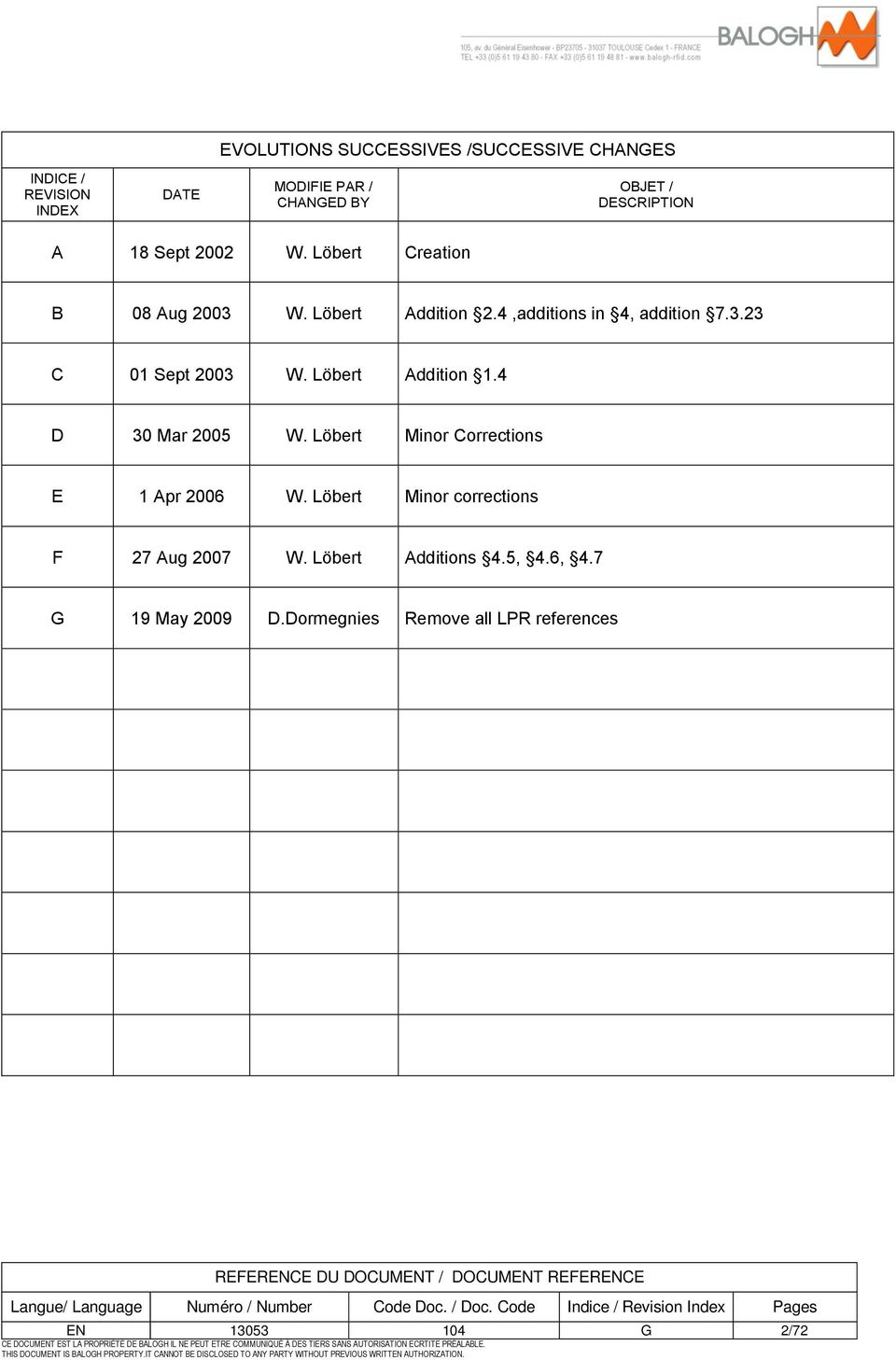
2 EVOLUTIONS SUCCESSIVES /SUCCESSIVE CHANGES INDICE / REVISION INDEX DATE MODIFIE PAR / CHANGED BY OBJET / DESCRIPTION A 18 Sept 2002 W. Löbert Creation B 08 Aug 2003 W. Löbert Addition 2.4,additions in 4, addition C 01 Sept 2003 W. Löbert Addition 1.4 D 30 Mar 2005 W. Löbert Minor Corrections E 1 Apr 2006 W. Löbert Minor corrections F 27 Aug 2007 W. Löbert Additions 4.5, 4.6, 4.7 G 19 May 2009 D.Dormegnies Remove all LPR references EN G 2/72
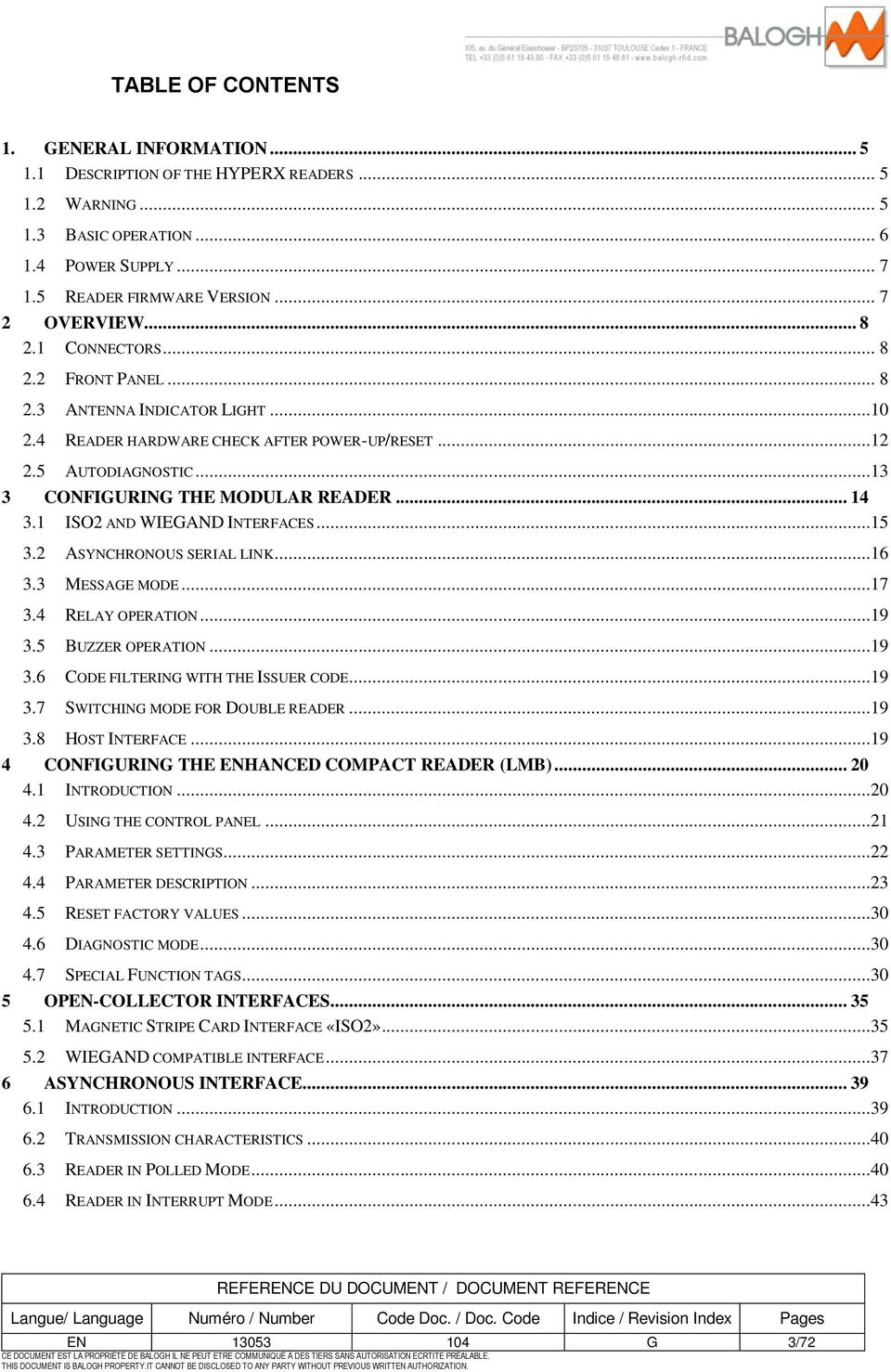
3 TABLE OF CONTENTS 1. GENERAL INFORMATION DESCRIPTION OF THE HYPERX READERS WARNING BASIC OPERATION POWER SUPPLY READER FIRMWARE VERSION OVERVIEW CONNECTORS FRONT PANEL ANTENNA INDICATOR LIGHT READER HARDWARE CHECK AFTER POWER-UP/RESET AUTODIAGNOSTIC CONFIGURING THE MODULAR READER ISO2 AND WIEGAND INTERFACES ASYNCHRONOUS SERIAL LINK MESSAGE MODE RELAY OPERATION BUZZER OPERATION CODE FILTERING WITH THE ISSUER CODE SWITCHING MODE FOR DOUBLE READER HOST INTERFACE CONFIGURING THE ENHANCED COMPACT READER (LMB) INTRODUCTION USING THE CONTROL PANEL PARAMETER SETTINGS PARAMETER DESCRIPTION RESET FACTORY VALUES DIAGNOSTIC MODE SPECIAL FUNCTION TAGS OPEN-COLLECTOR INTERFACES MAGNETIC STRIPE CARD INTERFACE «ISO2» WIEGAND COMPATIBLE INTERFACE ASYNCHRONOUS INTERFACE INTRODUCTION TRANSMISSION CHARACTERISTICS READER IN POLLED MODE READER IN INTERRUPT MODE...43 EN G 3/72
4 7 MODBUS READER COMMANDS COMMANDS FOR ALL READERS SPECIAL COMMANDS FOR THE MODULAR READER SPECIAL COMMANDS FOR THE LMB DIGITAL I/O (LMB ONLY) DIGITAL INPUTS DIGITAL OUTPUTS EXTERNAL CONNECTIONS CONNECTORS ASYNCHRONOUS LINK OPEN-COLLECTOR INTERFACE OUTPUTS (JR3 LMB ONLY) INPUTS (JR4 LMB ONLY) RELAY (MODULAR) APPENDIX A : ALGORITHM FOR CALCULATING THE CRC APPENDIX B : CHANNEL FREQUENCIES EN G 4/72

5 1. GENERAL INFORMATION 1.1 Description of the HYPERX readers HYPERX is a multi-tag dynamic identification system using microwaves. A reader emits microwaves up to a distance of one or more meters, depending on model. When a tag enters this zone, it modulates this radiation, thereby sending its code back to the reader, which then processes the received signal and extracts the code. There are two types of readers, modular (different modules assembled in a rack) and compact. For the modular readers, SPI is the reader module which provides the host interface. SPI performs digital processing of the signal received from the microwave receiver module (SAM or LAM) and communication functions with a host. It plugs into a custom rack for single-europe size boards, taking up a slot of width 6E. A custom backplane provides interconnection between the modules. The compact reader is compact version of the basic modular reader in the form of a single box. It perform basically the same functions as the modular reader, with differences in performance (see the appropriate product specifications). Basic functions performed are : tag detection communication interfaces: asynchronous serial link (RS 232, RS 422 or RS 485) using MODBUS / MODBUS protocol (polled or interrupt) compatible magnetic stripe card format ISO-7811/2 compatible WIEGAND tags relay 24V/1A for external circuit-switching (modular) on-board log (time-stamped) in non-volatile memory (LMB only) Certain functions described in this document are only relevant to recent firmware versions. Identify the version you are equipped with and make sure the desired function is supported. 1.2 Warning The badges intended to use with the long range readers may be deprogrammed or damaged when using mobile phones in direct vicinity. A clearance distance between the badges and mobile phones must be at least 10 cm. The installation of the long range reader may only be carried out in places that fulfil climatic and technical conditions stated by the manufacturer. BALOGH is not liable for damages resulting from improper handling or incorrect installation. All reconstructions or technological changes result in complete exclusion of liability. EN G 5/72

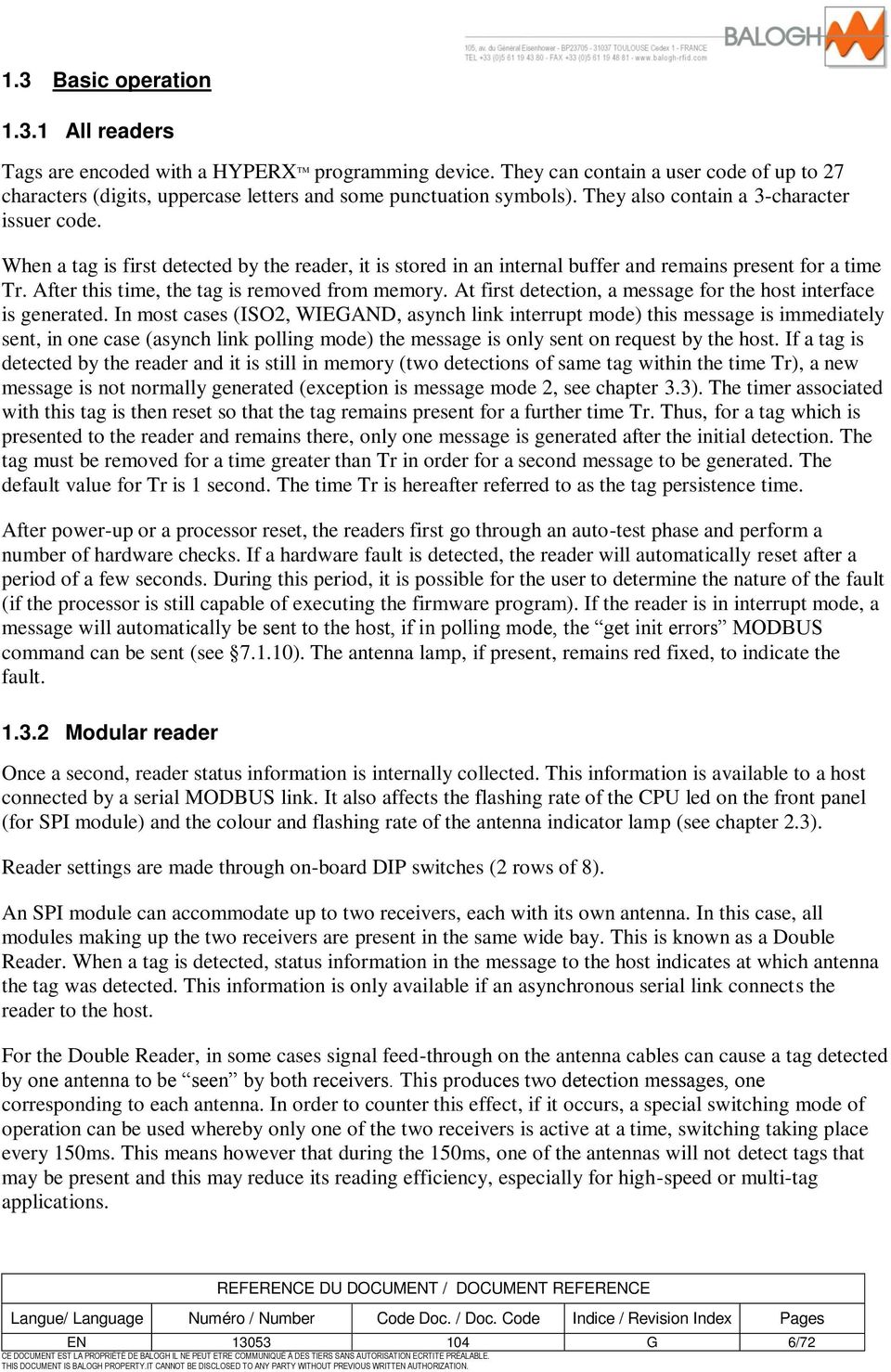
6 1.3 Basic operation All readers Tags are encoded with a HYPERX TM programming device. They can contain a user code of up to 27 characters (digits, uppercase letters and some punctuation symbols). They also contain a 3-character issuer code. When a tag is first detected by the reader, it is stored in an internal buffer and remains present for a time Tr. After this time, the tag is removed from memory. At first detection, a message for the host interface is generated. In most cases (ISO2, WIEGAND, asynch link interrupt mode) this message is immediately sent, in one case (asynch link polling mode) the message is only sent on request by the host. If a tag is detected by the reader and it is still in memory (two detections of same tag within the time Tr), a new message is not normally generated (exception is message mode 2, see chapter 3.3). The timer associated with this tag is then reset so that the tag remains present for a further time Tr. Thus, for a tag which is presented to the reader and remains there, only one message is generated after the initial detection. The tag must be removed for a time greater than Tr in order for a second message to be generated. The default value for Tr is 1 second. The time Tr is hereafter referred to as the tag persistence time. After power-up or a processor reset, the readers first go through an auto-test phase and perform a number of hardware checks. If a hardware fault is detected, the reader will automatically reset after a period of a few seconds. During this period, it is possible for the user to determine the nature of the fault (if the processor is still capable of executing the firmware program). If the reader is in interrupt mode, a message will automatically be sent to the host, if in polling mode, the get init errors MODBUS command can be sent (see ). The antenna lamp, if present, remains red fixed, to indicate the fault Modular reader Once a second, reader status information is internally collected. This information is available to a host connected by a serial MODBUS link. It also affects the flashing rate of the CPU led on the front panel (for SPI module) and the colour and flashing rate of the antenna indicator lamp (see chapter 2.3). Reader settings are made through on-board DIP switches (2 rows of 8). An SPI module can accommodate up to two receivers, each with its own antenna. In this case, all modules making up the two receivers are present in the same wide bay. This is known as a Double Reader. When a tag is detected, status information in the message to the host indicates at which antenna the tag was detected. This information is only available if an asynchronous serial link connects the reader to the host. For the Double Reader, in some cases signal feed-through on the antenna cables can cause a tag detected by one antenna to be seen by both receivers. This produces two detection messages, one corresponding to each antenna. In order to counter this effect, if it occurs, a special switching mode of operation can be used whereby only one of the two receivers is active at a time, switching taking place every 150ms. This means however that during the 150ms, one of the antennas will not detect tags that may be present and this may reduce its reading efficiency, especially for high-speed or multi-tag applications. EN G 6/72
7 If during the auto-test phase, a hardware fault is detected, the CPU green led blinks rapidly. If a fault is found with one of the other modules (SHF or SAM/LAM) then the CPU green led blinks rapidly and the antenna lamp blinks green irregularly. In the case of a hardware fault, an error code is available to the host with the structure given in Table LMB Reader settings are made and displayed using the two 7-segment displays and the two buttons. This allows a much greater flexibility, there is virtually no limit to the number of new parameters that can be added nor to the number of values for any parameter. Settings are stored in non-volatile EEPROM. This reader has two digital inputs for controlling reading conditions and two digital outputs that can drive relays or other loads. The other major innovation for this new reader is the on-board logging capability. Up to 4000 timestamped events can be recorded in non-volatile memory and this can be downloaded when the reader is off-line. 1.4 Power Supply Input Voltage LML : 12Vdc nominal, 11,5V min to 15V max. LMB : 12Vdc to 24Vdc nominal, 11,5V min to 28V max. A red led low voltage, near the power supply connector, indicates the voltage supply is less than 11Vdc. At the time of the low voltage detection, power to the rest of the reader is cut and a timer of about twenty seconds is enabled. After this time, the reader tries to power on. If the voltage is right, the reader will turn on, if the voltage is still too low, it enables the timer again and so on Consumption The consumption for modular readers depends on their composition. It is typically (for FSM, SHF, SAM, SPI) 1.5 A at 12 VDC The LMB consumption is roughly 0.6 A at 12 VDC. WARNING : For the modular reader, live insertion or withdrawal of the modules can cause irreversible damage! 1.5 Reader firmware Version Modular: This manual applies to firmware versions up to and including LMB : This manual applies to firmware versions up to and including 1.19 EN G 7/72


8 2 OVERVIEW 2.1 Connectors There are several PHOENIX - type connectors: The 5-pin connectors (5.08mm pitch) are for the serial link to a host. The 3-pin connector (5.08mm pitch) allows switching (using the internal relay) of an external circuit (LML) The small 4-pin connector (3.81mm pitch) is for control inputs (LMB only) The small 6-pin connector(3.81mm pitch) is for control outputs (LMB only) The 2-pin connector(5.08mm pitch) is for the DC power supply (except when modular reader uses mains power) (See 9.1 for the wiring instructions) For the modular reader, the connectors are accessible on the front panel of the SPI module. For the compact readers, the connectors are accessible from the back at the top. 2.2 Front Panel Modular reader Figure 2-1: Front Panel of module SPI, comprising 2 Connectors, 4 leds and 1 Reset button EN G 8/72

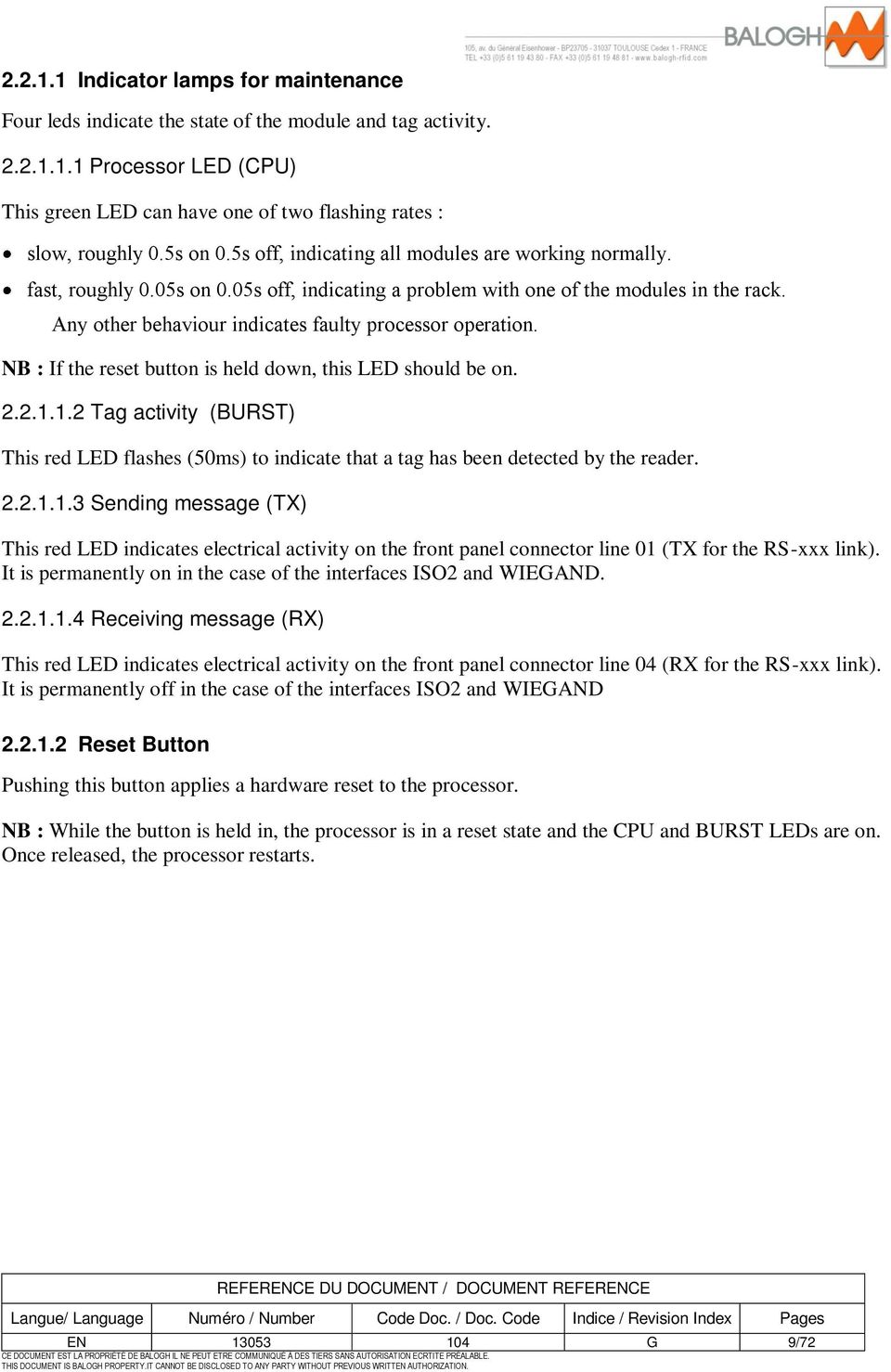
9 Indicator lamps for maintenance Four leds indicate the state of the module and tag activity Processor LED (CPU) This green LED can have one of two flashing rates : slow, roughly 0.5s on 0.5s off, indicating all modules are working normally. fast, roughly 0.05s on 0.05s off, indicating a problem with one of the modules in the rack. Any other behaviour indicates faulty processor operation. NB : If the reset button is held down, this LED should be on Tag activity (BURST) This red LED flashes (50ms) to indicate that a tag has been detected by the reader Sending message (TX) This red LED indicates electrical activity on the front panel connector line 01 (TX for the RS-xxx link). It is permanently on in the case of the interfaces ISO2 and WIEGAND Receiving message (RX) This red LED indicates electrical activity on the front panel connector line 04 (RX for the RS-xxx link). It is permanently off in the case of the interfaces ISO2 and WIEGAND Reset Button Pushing this button applies a hardware reset to the processor. NB : While the button is held in, the processor is in a reset state and the CPU and BURST LEDs are on. Once released, the processor restarts. EN G 9/72

10 2.2.2 LMB BALOGH Figure 2-2 : Front panel of Compact reader A single red/green lamp (antenna indicator light) is situated in the top-centre of the panel (see 2.3 below). 2.3 Antenna Indicator Light The LED on the antenna (or in the case of the compact readers, on the front panel) indicates the state of the reader. It is under reader software control. It can also be controlled by the host using the MODBUS protocol on an asynchronous serial link. The state diagram below shows the different possible states during power-up (or after a processor reset). State Diagram : Events : a. internal hardware fault detected b. autotest OK c. module fault detected d. module fault disappears EN G 10/72

11 e. internal hardware fault detected f. internal hardware fault disappears g. received command turn reader off h. received command turn reader on State Name Antenna LED Emission CPU LED 6 status cf dm 0 Test red, fixed off on nd² nd 1 Hardware fault see note 1 off fast blink 0 nd 2 Normal green, regular blink on slow blink Module fault green, irregular blink on fast blink Reader not ready red, slow blink off fast blink 0 x³ 5 4 Reader OFF off off slow blink x x 6 5 Tag detected off for 1s on x 1 x 7 5 Tag with low battery detected short red blink on x x x Notes : Table 2-1:State table for antenna led 1. The LED behaviour and the timeout duration depend on the nature of the fault. In the case of a faulty configuration, the reset is immediate and the LED stays red. For a hardware fault, reset takes place after 4 seconds. 2. nd = not defined 3. x = don t care 4. This state only exists for the modular readers. 5. This state is not shown in order not too overload the diagram. It lasts for 1 second, then normal operation resumes. 6. For modular reader only EN G 11/72

12 2.4 Reader hardware check after powerup/reset After a reset/power-up, the reader goes through an auto-test phase performing a hardware check. During this time which lasts for one or more seconds, the antenna light is red/fixed, the buzzer sounds and the reader is not operational. At the end of the test, an error-status-byte is available. If one or more critical hardware elements failed then the reader is put into the error state (antenna light red/fixed or slow blink, no tag reading) and a reset is automatically generated after a few seconds. If the reader serial link is in interrupt mode, then this error-status-byte is sent over the link. If in polling mode, it can be read with the MODBUS command read init errors. In the case of the enhanced compact reader, the display allows visualizing (with a 2-letter code) the test in progress and the result. At the end of this phase, if there have been no errors, the display is turned off, otherwise an error code is displayed. Note that some of the tests are very fast, so the corresponding display code will not normally be seen. The tests performed are in order : N Display Test bit(s) of error code 1 P On-chip Ram 2 2 P0 Off-chip Ram (Log page 0) 2 3 P1 Off-chip Ram (Log page 1) 2 4 PE Code checksum 1 5 EE EEPROM 3 6 SC SCC 4,5 7 sn Electronic serial number 7 8 rt Real-time clock 8 9 IS Serial interface 6 Error code (1 byte) : Bit Description Consequence 1 Code checksum Critical 2 Off-chip Ram Critical 3 EEPROM Critical 4 Bus access SCC Critical 5 SCC Critical 6 Serial interface Degraded 7 Electronic serial number Critical 8 Real-time clock Degraded A failure of the serial interface is not critical if the host interface uses DATA/CLOCK or WIEGAND. A failure of the RTC is not critical if the log function is not used. Examples of error codes : Display Meaning 04 EEPROM failure 18 SCC failure 40 Electronic serial number EN G 12/72

13 If the reader serial link is in interrupt mode, then at the end of the test phase, several diagnostic messages are emitted. A first message emits the firmware version, the time and the date: 01.T.000v :03:36 06/08/03 A second message emits the setup (28 parameters) and the log status : 01.S.000C= J=0504 A third message is emitted if a failure occurred during the test phase : 01.E.000TEST READER=F(18) 2.5 Autodiagnostic If the reader is equipped with an antenna that includes an autodiagnostic function (e.g. the model E), then a further diagnostic test is performed. This test can also be performed at any time using the appropriate MODBUS command (see ). Once again, if the reader serial link is in interrupt mode then the result of this diagnostic test is emitted : 01.E.000TEST READER=OK 01.E.000TEST READER=(00) 01.E.000TEST READER=(18) : all OK : reader diagnostic error, no hardware errors : hardware failure (SCC) EN G 13/72
14 3 CONFIGURING THE MODULAR READER There are two versions of the module currently available, for simplicity hereafter referred to as the old version and the new version. The old version consists of a mother board and a smaller daughter board using traditional through-hole technology. Configuring is done using jumpers. The new version consists of a single board using surface-mount technology. Configuring is done using miniature switches. In order to correctly configure the module, you must identify the version you are installing. In the following paragraphs, text in italics refers to the old version. For old versions only - some jumpers do not change position : J1 - must be in position 2-3 J6 - must be present J7 - must be absent J13 - must be present in position 2-3 These four jumpers no longer exist on the new version. The different operating modes are selected using switches/jumpers which are either : ON (present) or OFF (absent) They are identified by their positions on four connectors: J1 (8 positions 1 to 8) / J3 (10 positions 1 to 10) J2 (4 positions 9 to 12) / J8 (2 positions 11 to 12) J4 (8 positions 1 to 8) / J4 (8 positions 1 to 8) J3 (8 positions 1 to 8) / J5 (8 positions 9 to 16) J8 J5 J3 J4 Figure 3-1 : Connector locations for SPI module - old board EN G 14/72

15 J1 J2 J3 J4 The serial link to a host can be one of two types : Open-Collector (ISO2 or WIEGAND) Asynchronous RS 232, RS 422 and RS 485. Figure 3-2 : Connector locations for SPI module - new board NB: Only one of these interfaces can be active at a time Certain switch / jumper combinations are forbidden. If these combinations are detected during the initialisation period (immediately following a reset), an internal reset is generated after a period of 4 seconds. The following combinations are forbidden : Message mode 3 together with WIEGAND interface Message mode 2 together with POLLING mode 3.1 ISO2 and WIEGAND Interfaces ISO2 Interface Positions 1 to 4 of J4 must be as follows : message length OFF OFF OFF OFF OFF OFF ON OFF WIEGAND Interface Positions 1 to 4 of J4 must be as follows : OFF OFF OFF ON variable fixed EN G 15/72

16 3.1.3 Tag persistence Positions 5 and 6 of J4 must be as follows : 6 5 Persistence ON ON 1 s ON OFF 2 s OFF ON 5 s OFF OFF 10 s Minimum Time Between Messages (MTBM) Positions 7 and 8 of J4 must be as follows : 8 7 MTBM ON ON 1000 ms ON OFF 100 ms OFF ON 200 ms OFF OFF 500 ms Tag message repetition Position 3 of J3 / 11 of J4 must be as follows : OFF ON repetition disabled enabled 3.2 Asynchronous serial link Address The module s physical address is the logical slave address that the host application software uses to address the module (see 6.3). There are ten usable addresses (1 to 10) as shown below, the settings for 0 and 11 to 15 are used for other functions. The four positions 1 to 4 of J4 determine the physical address: Address ON ON ON ON reserved use ON ON ON OFF 1 ON ON OFF ON 2 ON ON OFF OFF 3 ON OFF ON ON 4 ON OFF ON OFF 5 ON OFF OFF ON 6 ON OFF OFF OFF 7 OFF ON ON ON 8 OFF ON ON OFF 9 OFF ON OFF ON 10 OFF ON OFF OFF Time Designa (see 6.4.2) OFF OFF ON ON Code Only (see 6.4.2) OFF OFF ON OFF ISO2 fixed length (see 3.1.1) OFF OFF OFF ON WIEGAND (see 3.1.2) OFF OFF OFF OFF ISO2 variable length (see 3.1.1) EN G 16/72

17 NB : A MODBUS command message which has a slave address equal to 0 corresponds to a broadcast message, which explains why a reader cannot have an address of 0 for polling applications Character Format and Baud rate Baud rate is chosen using positions 5 and 6 of J4: 6 5 Baud rate ON ON 9600 Bauds ON OFF 4800 Bauds OFF ON 1200 Bauds OFF OFF Bauds Format is chosen using positions 7 and 8 of J4: 8 7 Format ON ON 7 bits data 1 bit even parity ON OFF 7 bits data 1 bit odd parity OFF ON 8 bits data no parity OFF OFF not used Protocol : polling or interrupt The type of protocol, polled or by interrupt, is chosen with position 5 on J3 / 13 on J5 : OFF ON Frame format protocol interrupt polling Position 8 on J3 / 16 on J5 determines the frame format, test (ASCII) or MODBUS (binary). frame format OFF Test - ASCII message ON Normal - MODBUS frame The test format allows connection to a dumb terminal for easy on-site display. For a description see Message mode The mode is chosen using positions 1 and 2 on J3 / 9 and 10 on J5. The mode determines in what cases the detection of a tag causes a message to be transmitted to the host. Type 0 - Each time a tag is detected, a timer is armed (nominal value = 1s). Tag detection only causes a message to be transmitted if this timer is not active. Each tag detected has a timer associated with it. Type 1 - This mode is no longer supported EN G 17/72
18 Type 2 - Repeated message transmission while tag is present. Only available for the ISO2 interface and the asynchronous start/stop interface in the interrupt mode. Type 3 - When a tag disappears (is removed from internal memory), an extra message is transmitted to host which includes the tag s code as well as the number of times that the badge was detected. This number cannot be greater than 99. Not available for the WIEGAND interface. Otherwise identical to type 0. 2 (10) 1 (9) message mode OFF OFF Type 3 OFF ON Type 2 ON OFF Type 1 - no longer supported ON ON Type 0 a;1,2 0 1 a;1 Type 0 b a;2,3 0 4 Type 2 e;4 a;1,2 0 1 a;1 Type 3 b; 6 Events Actions a : tag is detected 1 : arm disappearance timer b : timeout disappearance 2 : start message transmission e : message is sent 3 : turn off reader 4 : turn on reader 6 : send tag disappearance message Figure 3-3 : Flow Graphs describing the three message transmission modes EN G 18/72
19 3.4 Relay operation When a tag is detected, the relay operates. The switch / jumper in position 3 on J3 / 11 on J5 determines one of two modes of deactivation (for ISO2 and WIEGAND, deactivation is automatic) : automatic relay deactivation after 2 second delay or relay deactivation controlled by host via MODBUS OFF ON 3.5 Buzzer operation Deactivation automatic under host control The switch / jumper in position 4 on J3 / 12 on J5 activates or deactivates the buzzer on tag detection. When enabled, the buzzer emits a short sound (duration 50 ms) each time a tag is read. OFF ON Buzzer Enabled Disabled When enabled, the buzzer sounds for 50ms at every tag detection. 3.6 Code filtering with the Issuer code The switch / jumper in position 6 on J3 / 14 on J5 enables or disables this feature. A description is given in chapter Applies only to ISO2 and Asynchronous interfaces. As of firmware version 4.11, applies to the WIEGAND interface as well. OFF ON Filtering Disabled Enabled 3.7 Switching mode for Double reader The switch / jumper in position 7 on J3 / 15 on J5 enables or disables this feature. A description is given in chapter 1.2. This feature must be disabled for single readers. OFF ON Switch mode Disabled Enabled 3.8 Host Interface The following positions on J1 and J2 / J3 and J8 determine the electrical interface to the host, by fixing which lines are physically routed through to the front-panel connector. Type Position RS-232 1, 11 RS-422 2, 4, 9, 10, 12 RS-485 2, 4, 6, 7,12 ISO2 3, 5, 8 WIEGAND 3, 5, 8 EN G 19/72

20 4 CONFIGURING THE ENHANCED COMPACT READER (LMB) 4.1 Introduction There are three ways of configuring the LMB compact reader. Via the control panel described in this chapter, by means of commands sent via the serial connection (see 7), and by means of function tags (FT). Each method has its raison d'être and time to be used via control panel via commands via special function tags Select/Save Display/Change PC RSxxx SFT before installation during installation after installation Configuration via the control panel should take place before or during the installation in order to correctly configure the majority of the settings. There may not yet be an available computer system. Configuration via commands can be done at any time but obviously requires the transmission/network part to be correctly configured. After installation, the control panel is rarely available (hidden or inaccessible) and it might not be possible to interrupt the functioning of the IT system in order to apply changes to (generally) only one or two settings. This being the case, the function tags are very useful since they act directly on the reader without a wired connection. The special function tags must be ordered separately. A description of them and their use can be found in chapter 4.7 EN G 20/72

21 4.2 Using the control panel Select/Save Display/Change Figure 4-1 : LMB control panel The control panel has two 7-segment displays and two buttons. Pressing the button (Select) allows you to select a parameter. The title of this parameter is then displayed. If you press once on the button (Display), the parameter 's current value is displayed. At this time, if you press the Select button, the next parameter is displayed, but if you press the Change button, the parameter s next value is displayed and the little red dot (decimal point) lights up to indicated that the value is going to be modified. Pressing successively on the (Change) button or keeping it pressed enables you to see all the possible values for this setting. The display is cyclical, i.e. after the last value, the first one appears again. When you then press the (Save) button, the value displayed at that moment is registered and becomes the new current value (at the same time the display shows "SA" for 1 second). If you have pressed the (Change) button, but do not in fact want to change the value, you can either await the expiry of a time delay (which exists in order to prevent the reader being left in a non-functioning state by mistake the value is currently set at 8s) or press the Reset button. In summary: display state action result off press red button display title of current parameter press black button no change title parameter N press red button display title of next parameter press black button display value of current parameter value parameter N press red button display title of next parameter press black button display next value of current parameter +. value +. press red button display SA, store new value press black button display next value of current parameter +. The display is the right way up when the reader is mounted with connectors and display towards the bottom. If the reader is mounted with the display at the top then the first parameter can be changed so that the display does not read upside down. The buttons however do not change functions. The display cycles through all the parameters (starting with setting 1), when it comes to the end it starts again at the beginning. When the display turns off, it remembers its position, so that next time the red button is pressed, display starts with the previously displayed parameter. Successive parameters are obtained either by briefly pressing the red button, or by keeping it pressed in, which makes parameters scroll automatically. Similarly, you can make the parameter values scroll by keeping the black button pressed in. EN G 21/72
22 4.3 Parameter settings All parameters are stored in non-volatile EEPROM memory. The number in the second column indicates the order in which they are displayed. Parameter Title displayed Value Value displayed Default Notes Display orientation up * display at bottom 1 dn display at top Channel Number 2 nc 1 to Tag Persistence 3 tp 0,1s 0 0,5s 1 1s 2 * 2s 3 5s 4 10s 5 Buzzer 4 bu OFF of on tag detect ON on * Issuer Code Filtering 5 FI OFF 0 * 1 st code 1 EEPROM 2 code in EEPROM Issuer Code size 6 tc 3 3 * 4 4 Lamp behaviour 7 LE NORMAL 0 * OTHER 1 TBD Message mode 8 tf 0 0 * Spec Function Tags 9 bf OFF of * ON on not available yet Logging 10 Jo OFF 0 time/date-stamped events 1 1 tag detect plus reset 3 3 * 2 plus errors RS interface 11 ta RS * RS RS OC interface 12 to unused nu * Open Collector interface ISO2 fixed IF ISO2 variable Ir WIEGAND IE Reader Address 13 Ad 1 to Baud rate 14 br * Character Format 15 Fo 8 bit 8n * 7 bit even 7P 7 bit odd 7I Frame format 16 Fr ASCII AS * ASCII with header for tag code code only CS ASCII without header Time Designa td special format MODBUS Jb Polling/Interrupt 17 Po Interrupt of * Polling on EN G 22/72
23 MTBM 18 tb 0,1s 0 Mean Time Between 0,2s 1 * Messages 0,5s 2 (for ISO2/WIEGAND) 1s 3 2s 4 Nb Emissions 19 ne 1 to emissions in interrupt mode Output1 20 S1 unused 0 Copy buzzer 1 identical to buzzer outpout 2s on read 2 * host 3 under host control Output2 21 S2 unused 0 SFT vehicle 1 identical to buzzer outpout tag battery low 2 * host 3 under host control Range 22 Pr 0 to = max range reserved 23 - Input1 24 E1 disabled of * enable reading on tag reading validated upon activated input Input2 25 E2 disabled of * TBD On tag reading validated upon de-activated input reserved 26 - Hopping period 27 Pe 100 ms 0 * As of v Serial Interface Test 28 LS 0 of * 1 on Reader Type tl undefined nd *** this value is read-only *** different display for versions prior to v1.0.9 see parameter description Table 4-1 : LMB - Parameter settings 4.4 Parameter description Display Orientation Allows reading the display right side up irrespective of the reader installation (display at top or display at bottom). Choose up for display at bottom, dn for display at top Channel number This is the reader operating frequency, see the table in 11. This only needs to be changed if the installation has several readers or if there are interference problems. EN G 23/72
24 4.4.3 Tag persistence The time a tag remains in internal memory after a single detection. In order for this tag to be able to be read again, it needs to remain undetected for this time. Persistence means that multiple rapid detections of the same tag produce only one message for the host system Buzzer Enable or disable the beep when a tag is detected Issuer code filtering Allows tag filtering based on the issuer code. A value of one corresponds to the traditional auto-learn mode of the other readers, i.e. the issuer code of the first tag detected after a reset becomes the reference code for filtering. A value greater than or equal to 6 indicates filtering according to one or more internally stored codes. These codes in non-volatile memory are loaded with MODBUS commands. Up to six codes can be loaded. For each one there is a bit in the byte as shown in the table below. Bits 2 to 7 represent the six code positions, a one indicates that filtering is active for this code. The value displayed is the decimal value of this byte. Here are some examples : Bit 7 Bit 0 filter type display No filtering Auto-learn filter code filter code 2 0A filter codes 1 & 2 0E filter codes 1, 2 & 3 1E Filter code 5 42 Table 4-2 : Issuer code filtering for LMB Note that for values of 6 or above, i.e. filtering based on internally stored codes, the value displayed is a read-only indication. Setting up the filtering based on internally stored codes can only be done using MODBUS commands Issuer code length Cannot be changed (fixed at 3). EN G 24/72
25 Messages sur Liaison Série Lamp Defines the behaviour of the lamp. Only one behaviour is available at present : event tag detected tag detected with battery low normal operation faulty operation Message mode Three modes are available : Lamp lamp goes out for 1 s red flash for 0,3 s Green blink once a second lamp is continuously red Message mode 0 : tag code message generated for every NEW tag detected Message mode 2 : tag code message generated repeatedly while tag is present Message mode 3 : tag code message generated for every NEW tag detected and for every tag that disappears (is deleted from internal memory) In mode 2, the time between two transmissions is determined by parameter N 18 (MTBM). This mode is only used together with the interrupt mode (parameter N 17 = 0). In mode 3, the disappearance message is generated a certain time (Tp) after the last tag detection, where Tp is given by parameter N 3 (persistence). The disappearance message is the same as the appearance message, with the three characters *NN added, where NN is the number of times this tag has been detected. The diagram below shows the messages generated in these modes for a tag that has been detected 40 times. Detection Badge CODE MTBM CODE CODE CODE CODE Tp CODE CODE*40 EN G 25/72
26 4.4.9 Special function tags Enables the use of the special function tags. These tags allow interacting with the reader at a distance, for example setting up parameters, switching outputs, setting time/date etc. If this parameter is off, the use of all Special Function Tags is disabled. Available as of v Logging Enables time-stamped logging of events. value Events logged off None 1 Tags detected 2 Tags + resets 3 Tags + resets + errors Extracting the log information should be done off-line with special software (using MODBUS commands). This can be supplied by BALOGH or developed by the user Asynchronous serial interface type Selects the RS interface type 232, 422 or 485. This interface can be the host interface or the service interface. If it is the host interface, see the comments for the next parameter Open Collector interface type Selects the type of open-collector interface. If the host interface is asynchronous then a value of nu (not used) must be stored Reader address The reader address necessary for multi-reader network operation. If the interface to host is point-topoint, leave unchanged Baud rate Selects the asynchronous baud-rate Character format For binary frame format (MODBUS) choose 8 bits/no parity. For ASCII frame formats select according to host interface Frame format for tag code Defines the format of the message transmitted following detection of a tag in interrupt mode only. For example, for the tag (0)(123)(CODE_TAG) : EN G 26/72
27 MODBUS, message = e f f 4b 4a e xx xx ASCII, message = CODE_TAG(CR)(LF) Code only, message = 123CODE_TAG Polling Allows you to select the manner in which a tag code is transmitted to the host interface. With polling OFF (interrupt mode), the detection of a new tag generates a message which is immediately sent to the interface. With polling ON, this message is only sent in response to the MODBUS command "Read tag". If the reader does not receive this command during the time the tag is present, the tag is not seen. However if logging is enabled, the tags detection can be verified later MTBM Defines the Mean Time Between Messages ( i.e. between two transmissions in interrupt mode) : for the open-collector interface, whether for different tags or for repeated messages (see also the following setting). This is due to the fact that some older equipment cannot process back to back message transmission. for an asynchronous serial link in interrupt mode, defines the time between transmissions in message mode Number of tag-code transmissions For asynchronous interface, in interrupt mode, the maximum number of transmissions of the same tag code if no ACK is received. For open-collector interface, if the value is greater than one, then the message is repeated. The time between messages is given by the MTBM value Output 1 Defines the behaviour of Output 1 : Value Description 0 Disabled 1 Synchronised to buzzer (50ms at every tag detection) 2 Active for 2 seconds when new tag is detected 3 Under exclusive host control 4 Copy green led (is active when antenna led is green) EN G 27/72
28 Output 2 Defines the behaviour of Output 2 : Range Value Description 0 Disabled 1 Active with Special Function Tag Vehicle 2 Active for 2 seconds when tag battery low is detected 3 Under exclusive host control 4 Copy red led (is active when antenna led is red) Selects 4 different values for the range 0 (minimum) to 3 (maximum). This parameter changes the receiver threshold, it does not modify output power Input 1 Allows validation of the reading of tags using the digital input I1. Upon activation of the input (Vin > 5V), tag identification is enabled. Upon de-activation of the input (Vin ~ 0V), identification is disabled Input 2 Allows validation of the reading of using the digital input I2 (opposite of "Input 1"). Upon de-activation of the input (Vin ~ 0V), tag identification is enabled. Upon activation of the input (Vin > 5V), identification is disabled Channel Hopping period Determines the time the reader operates in each channel while in the channel-hopping mode (Channel N = 0) Serial Link Test Allows a test of the reader s serial interface to be carried out by sending a test message with the output looped back onto the input. In RS232 and RS422 this loop-back is done within the interface chip. In RS485 it must be done by external cabling at the connector. In RS422 and RS485 this test lasts approximately 3 seconds (T3 below), as it must be able to function in a network topology in which up to 30 readers can be connected on the same bus. In this case, in order to avoid collisions between the transmissions from the various readers, a 100ms slot is allocated to each reader in accordance with its address on the bus. EN G 28/72
29 adr 2 adr 4 adr 1 adr 3 adr 31 Reset transmission slots adr 2 T1 T2 adr 31 T1 T3 Figure 4-2 : Serial connection test Reader type Identifies the reader model. This value is read-only and can in no case be modified by the user. Two types of display exist depending on the firmware version : Reader type display (from v1.0.9) display (up to v1.0.7) EN G 29/72
30 4.5 Reset factory values Reset You can return the reader at any time to the default values (factory settings) by doing a processor reset (press the black reset button), whilst keeping the large black button pressed. 4.6 Diagnostic mode Reset In this mode the reader does not do the series of automatic tests at start-up (checksum Flash, RAM, EEPROM etc). It becomes operational immediately if there is no serious equipment failure. It thus allows you to modify a setting that in "normal" mode causes a blockage. This mode is activated by doing a processor reset (press the black reset button), whilst keeping the large red button pressed. 4.7 Special Function tags Introduction A special function tag is a tag which contains a special code, the reading of which can act upon the operation or the characteristics of the reader. The recognition of special function tags can be enabled or disabled globally by one of the configuration settings. This setting is enabled by default. A special function tag s persistence time is 5 seconds. This facilitates configuration in the case of difficult reading conditions. Special function tags use the NORMAL mode. The special function tag is registered in the log, but only if logging is enabled. EN G 30/72
31 4.7.2 Tag recognition A special function tag must be detected a minimum of 5 times before it is recognized. This is so as to avoid spurious reading of a such a tag due to radio reflections, and therefore undesired modification of the reader. Upon recognition of a special function tag, the reader emits a 2-second long beep Types of special function tags There are several categories of special function tags: ones which change data in the reader (configuration, time, channel N ), ones which trigger an action (journal reading, output switching) and certain special tags (presence of a vehicle, UNDO/Stop). The UNDO/Stop tag, used after a SFT that alters the reader s data, allows you to go back, and, in the case of a SFT that triggers an action, to stop that action. There is a time delay attached to the SFT ; after five minutes, the UNDO tag will have no effect. The UNDO function is no longer possible after a reset of the reader. The "vehicle presence" FT is distinctive in that both its recognition and disappearance produce an action (switching of one of the outputs). Other special function tags produce an action only during their recognition Special function tags Description The "UNDO/Stop" SFT This is a special FT that allows you to "go back". If the previous SFT changed the status of the reader, the UNDO FT allows you to return to the previous status. In the event that the previous FT changed the configuration, this tag allows you to go back to the previous configuration. In the event that the previous special function tag triggered an action that lasts over time (for example, dump of the log onto the serial link), this tag allows the action in progress to be stopped. The exact effect of the UNDO SFT, depending on the SFT used previously, is given in Table 4-1. The UNDO FT cannot be presented twice in succession - only one status is memorized. The "Settings" SFT This SFT allows one or several of the reader s parameters to be changed (those stored in the EEPROM memory). Its action is equivalent to manipulating the red and black buttons, but does not require access to the reader. EN G 31/72
32 The "Time-setting" SFT This SFT contains a fixed precise time (defined in advance) and therefore allows the reader to be set at the same time as the SFT. The "Summer Time" SFT (go forward one hour) This SFT allows the reader s time to be put forward by one hour. The "Winter Time" SFT (go back one hour) This SFT allows the reader s time to be put back by one hour. The"Read Log" SFT Upon recognition of this SFT, the log records are sent to the serial link, from the most recent up to the oldest. Transmission is done in accordance with the current settings : rate, character parity, frame format. Transmission can be interrupted at any time by presenting the UNDO tag. the POLLING parameter must be at 0 (off). During the transmission (which can last several minutes), both the reading of ordinary tags and the reception of MODBUS commands are suppressed. The "Add an IssuerCode" SFT (for filtering) This SFT allows addition of an issuer code for filtering into one of the six locations. If another code is already present in the location indicated, it is over-written. The "Delete an Issuer Code" SFT This SFT allows an issuer code to be deleted. The "Read Issuer Codes" SFT This SFT causes the dump of the 6 issuer code fields onto the serial link in the format: A dot separates the codes, which can be 3 or 4 characters in length. Transmission is done in accordance with the current settings : rate, character parity, frame format. EN G 32/72
33 The "Increment Channel" SFT This SFT allows the reader s channel number to be incremented. When the highest channel number has been reached, it loops back to channel 1. This SFT does not allow channel 0 to be programmed. If the reader is in random channel mode (channel N = 0), the SFT is refused. The "Decrement Channel" SFT This SFT allows the reader s channel number to be decremented. When channel number 1 is reached, it loops back to the highest channel number. This SFT does not allow channel 0 to be programmed. If the reader is in random channel mode (channel N = 0), the SFT is refused. The "Go into Random Channel" SFT This SFT puts the reader in random channel (frequency hopping) mode (channel N = 0). The time between channel jumps is given by the PE parameter. In this mode, the display shows "0" if you activate display nc The "Return to Fixed Channel" SFT This SFT puts the reader in fixed channel mode. It is only usable after use of the previous SFT (Go into Random Channel mode). The UNDO SFT has the same effect. The "Vehicle" SFT This SFT acts on output 2. The parameter that determines the behaviour of this output must be positioned on "Vehicle SFT". When the VEHICLE SFT appears, the output is activated ; when it disappears, the output is deactivated. This tag, located just below the road surface, allows the presence of a vehicle to be detected the vehicle hides the tag (causes it to disappear) when it passes over it. The presence of this SFT does not prevent the use of other SFTs. The "Test Output" SFT This SFT activates one of the two outputs, regardless of the value of the "output" setting. It makes it possible to test that the output circuits are working properly. EN G 33/72
34 The "Reset" SFT This SFT causes a reader reset. There are three types of Reset SFT : a complete reset. a short reset. a short reset with the additional loading of default (factory) settings A summary of special function tags: name of SFT effect of UNDO SFT UNDO/Stop - Settings re-establish config. set time re-establish time put forward by one hour re-establish time put back by one hour re-establish time read log stop reading vehicle presence - add an issuer code delete the CI remove an issuer code - read issuer codes - increment channel N re-establish channel decrement channel N re-establish channel go into random channel mode re-establish channel return to fixed channel mode - Test output - Complete reset - Short reset - Reset with loading of factory settings - Table 4-1 : List of special function tags EN G 34/72
35 5 OPEN-COLLECTOR INTERFACES 5.1 Magnetic Stripe Card Interface «ISO2» Description Using this interface allows the reader to take the place of a standard magnetic stripe card reader (ISO ). This interface consists of three signals, MDATA (negative logic) for the data, STROBE (active low) indicates when data are valid, and PRES_BADGE (active low) a signal encompassing message transmission as shown below. The characters are transmitted synchronously in a frame format at a rate of roughly 1000 bits/s. NRZ STROBE MDATA T = 1 ms Figure 5-1: Signal timing for the ISO2 interface. Period for NRZ data is roughly 1 ms STROBE or MDATA PRES_BADGE 2 ms Figure 5-2 : Timing showing the signal Presence Badge. 50 ms The STROBE and MDATA signals are open-collector outputs (circuit shown in Figure 9-8). For proper operation a pull-up resistor of about 1K ohm should be used Message format A message consists of a preamble of 15 zeros (for receiver synchronisation), the data frame as described below, and a postamble of 10 zeros. The data are formatted into characters of 5 bits - 4 bits for a binary coding plus one bit for odd parity. The data is framed as shown below. 1 Character 1 Character 1 Character START data END LRC EN G 35/72
36 The checksum (LRC) is the result of an exclusive-or function performed on all the preceding characters. START character = 0BH END character = 1FH. In previous firmware versions only digits were allowed as data elements. As of version 4.04 modular (all versions LMB), extended coding can be used, by which the six letters A to F can be transmitted as data elements. Thus sixteen codes, 0 9 and A F are transmitted using the 16 binary codes available with the 4 bit words. However in this case, the end of the frame can no longer be determined using the END character as it is indistinguishable from the data element F. The position of the LRC character must be determined relative to the end of the transmission, from the postamble of 10 zeros. The contents of the data field depend upon the message mode chosen and the length. For a variable length frame, this field begins with a three-character issuer code, if no issuer code filtering is enabled, followed by the user-code. For the fixed length frame, this field contains exactly 37 characters, the characters after the user-code, if there are less than 37, are all equal to 0DH. In the case of message mode 3, the data also contains the number of times the tag was detected, a twocharacter field. The special separation character 0CH precedes this number. The order of bit transmission for each character is LSB first. Typical examples of the data field for a user code of length n digits : message mode 0, length variable issuer code user code length = 3 + n message mode 3, length variable issuer code user code 0CH nb. det length = 3 + n + 3 message mode 3, length variable, issuer code filtering user code 0CH nb. det length = n + 3 message mode 0, length fixed issuer code user code 0DH 0DH... 0DH length = 37 message mode 3, length fixed issuer code user code 0CH nb. det 0DH 0DH... 0DH length = 37 message mode 3, length fixed, issuer code filtering user code 0CH nb. det 0DH 0DH... 0DH length = 37 EN G 36/72
37 5.1.3 Tag code transmission Tag code transmission to host can be modified using two further parameters. The first is the minimum time between consecutive tag code transmissions (MTBM). This can be set to one of several values (from 100 ms to 1 s), allowing interconnection to readers with different reaction times. The second is the possibility of repeating the transmission of the tag code. This may be desirable in certain cases. If this option is enabled, the tag code is sent a second time after a time MTBM. 5.2 WIEGAND compatible interface Description Using this interface allows the reader to take the place of a WIEGAND-effect card reader. This interface comprises two signals, DATA 0 and DATA 1. A logical 0 produces a negative pulse on the DATA_0 line and a logical one produces a negative pulse on the DATA_1 line. The timing is given in Figure 5-3 below. The data is transmitted synchronously in a frame format at a rate of roughly 1000 bits/s NRZ DATA "1" DATA "0" 1.0 ms 50 µs Figure 5-3 : Timing for WIEGAND Interface. The DATA_0 and DATA_1 signals are open-collector outputs (circuit shown in Figure 9-8). For proper operation a pull-up resistor of about 1K ohm should be used Message format The WIEGAND message has a fixed length of 26 bits, and the following structure : bit number EP FC CC OP EN G 37/72
38 EP - Even parity bit If the number of ones in the bits 2 to 13 is odd, then this bit is equal to 1, otherwise it is equal to 0. FC - Facility Code length = 8 bits (bits 2 to 9) A number, 0 to 255, binary-coded using 8 bits, MSB is bit 2. CC - Card Code length = 16 bits (bits 10 to 25) A number, 0 to 65535, binary-coded using 16 bits, MSB is bit 10. OP - Odd parity bit If the number of ones in the bits 14 to 25 is even, then this bit is equal to 1, otherwise it is equal to 0. Message transmission begins with bit Issuer code filtering As well as the user data field, which for WIEGAND corresponds to the 26 bit frame described above, the HYPERX tag contains a three character issuer code, provided by BALOGH, which is unique for each installation. This code is automatically added when the tag is first programmed. When Issuer code filtering is enabled, only those tags whose issuer code is identical to the reference issuer code are allowed. The issuer code is not transmitted to the host, it is only used in this case for filtering purposes. The reference issuer code can be defined to be the issuer code contained in the first tag which is detected after a processor reset. It is memorized, and the issuer codes of all succeeding tags are compared to this reference. If they are the same, the tag is allowed, if not the tag is rejected. All readers support this mode. For the LMB, the reference issuer code can also be defined using MODBUS commands. Up to 6 different codes can be uploaded into non-volatile memory and any one can be used at any time as the reference code. The issuer code consists of three ASCII digits, 0-9, allowing combinations. NOTE for modular : For firmware versions till 4.10, this facility is automatically enabled if the WIEGAND interface is selected. It can also be enabled for the other interfaces if desired. As of firmware version 4.11, this facility must be enabled by switch/jumper Tag code transmission Tag code transmission to host can be modified using two further parameters. The first is the minimum time between consecutive tag code transmissions (MTBM). This can be set to one of several values (from 100 ms to 1 s), allowing interconnection to readers with different reaction times. The second is the possibility of repeating the transmission of the tag code. This may be desirable in certain cases. If this option is enabled, the tag code is sent a second time after a time MTBM. EN G 38/72
39 6 ASYNCHRONOUS INTERFACE 6.1 Introduction Readers can be connected to a host using either a point-to-point configuration or a multipoint (bus) configuration. Furthermore, two types of protocol are possible : polling by host or interrupt. The interrupt protocol uses either the MODBUS frame format or the test mode format. Note : 1. The interrupt protocol should only be used on a point to point link. A multipoint or network configuration using the standards for differential data transmission RS-485 (2- wire, 2-way) or RS-422 (4-wire, 2 for each way), is used if several readers are to be interconnected. In this case the polled MODBUS protocol is implemented reader #1.. reader #n RS HOST Figure 6-1 : Network topology using RS-485 reader #1.. reader #n RS HOST 2 Figure 6-2 : Network topology using RS-422 If only one reader is to be connected, either of the three standards can be used. In this case either of the two protocols, polled (see chapter 6.3) or interrupt (see chapter 6.4), are possible. RS-232 RS-422 RS-485 reader HOST Figure 6-3 : Point-to-point topology The table below summarizes the different combinations : EN G 39/72
40 Type of connection Protocol point-to-point multipoint Interrupt RS-232/422/485 Polling RS-232/422/485 RS-422 or RS Transmission characteristics All protocols are character-oriented. The character formats are : bits even parity / 1 stop bit 7 bits odd parity / 1 stop bit bits no parity / 1 stop bit Four baud-rates are possible : bauds bauds 600 bauds bauds Settings are configured by user. NB : In practice, the MODBUS protocol requires 8 bits / no parity. The other formats are used for special situations. 6.3 Reader in Polled Mode This is a master/slave protocol. Each exchange is initiated by the master and consists, except in one case (broadcast message), an exchange of two frames - a command issued by the master and a reply from the slave. All frames have the following structure : Slave no. function code data control NB : A HYPER X reader is a MODBUS slave. The commands issued by the master are either addressed to one slave (identified by its number or address) or to all slaves on the network (broadcast). The four fields have the following meanings : Slave number (1 byte) : Specifies the destination, from 1 to 11 (1 to 31 for the LMB). If the number is 0, it is a broadcast message. In this case there is no reply. function code (1 byte) : Command : Determines the type of action to be performed (read, write, bit, word). Reply : Result (success or error). data field (n bytes): EN G 40/72
41 Contains the parameters associated with the function : command code, number of bytes, values. control field (2 bytes): For error detection (CRC 16) - See chapter 10. The MODBUS protocol defines many functions (second field in frame). The following four of them are implemented on the HYPERX readers: function 3 function 5 function 6 function 16 : read n words : write one bit : write one word : write n words If the message is received with errors (CRC incorrect), the reader does not reply. If the message is received correctly but the reader cannot process it, an error message is sent. This error message has its function code field modified, (the msb is set to 1) and the data field contains one byte, an error code with the following values : Example : Error code Meaning 1 Function code unknown 2 Command unknown 3 Data incorrect 4 System non ready 8 Execution failure Table 6-1 : MODBUS error codes PC > reader (incorrect command) reader > PC C0 F1 The maximum time allowable between the reception of two characters is a protocol parameter which allows a slave to resynchronise to a frame-start, if transmission is interrupted. If this time is exceeded, the slave rejects the frame currently being received. For the HYPERX reader, this time is equal to 20 ms except in the case of a baud-rate of 1200 bauds for which it is 30 ms Write one bit Command 1 byte 1 byte 2 bytes 1 byte 1 byte 2 bytes Address reader 05 command code bit value 00 CRC 16 Reply if bit = 0, bit value = 00H, if bit = 1, bit value = FFH 1 byte 1 byte 2 bytes 1 byte 1 byte 2 bytes Address reader 05 command code bit value 00 CRC 16 EN G 41/72
42 The Reply frame is identical to the Command Frame. If the address is 00H, all the readers process the command without sending a reply Write one word Command Reply 1 byte 2 bytes 2 bytes 2 bytes Address reader 06 command code value* CRC 16 * A word consists of two bytes, msb first 1 byte 1 byte 2 bytes 2 bytes 2 bytes Address reader 06 command code value* CRC 16 The Reply frame is identical to the Command Frame. If the address is 00H, all the readers process the command without sending a reply Write n words Command Reply 1 byte 1 byte 2 bytes 2 bytes 1 byte n bytes 2 bytes Address reader 10H command code nbr of nbr of values * CRC 16 words characters * words to be written, in order 1 byte 1 byte 2 bytes 2 bytes 2 bytes Address reader 10H command code nbr of words CRC 16 If the address is 00H, all the readers process the command without sending a reply Read n words Command - Reply 1 byte 2 bytes 2 bytes 2 bytes Address reader 03 command code nbr of words CRC 16 1 byte 1 byte 1 byte n bytes Address reader 03 nbr characters values * CRC 16 read * bytes read, in order number of characters read = 2 X number of words in Command (always even) EN G 42/72
43 6.4 Reader in Interrupt Mode The format used for tag code transmission in this mode is either ASCII text or a MODBUS frame (see below), depending on the user setting. In this mode, as soon as a reader has a message to send to the host (i.e. a tag that has been detected), it sends it, rather than waiting for an invitation, as is the case in the polled mode. However it is important to realise that the interrupt nature of this mode refers only to tag codes. All other MODBUS commands can be sent by the host in this mode and the reader will reply. The reader cannot send a reply straight away if it has just detected a tag and has started to send this message. The host must decide if and when it can safely interrogate the reader Binary format The message sent has the following structure : 1 byte 1 byte 1 byte n bytes 2 bytes nb characters values CRC 16 This structure is the same as that of a reply frame to the command read n words. The first field is fixed at 2 (STX) and the second field, the code function, is fixed at Example : 11 bytes B CRC 16 Here, the data field contains 11 bytes. The badge status = 0, the code read is ABC See chapter for details of the structure of the data field. The host replies with an ACK or a NAK. The same message is retransmitted up to NE times in case an ACK is not received. If a NAK is received the message is sent again immediately, if no reply is received the message is sent after a 100ms timeout. After NE failed attempts, transmission for that message is abandoned. NE is the number of emissions parameter (see ). If, during the initialisation stage after processor reset, a hardware fault is detected, causing the bit MS/CF in the status word to be set, then the init errors frame, providing information about the nature of the fault, is automatically sent. This frame has the following format, where the meaning of the byte values is given in : 2 bytes Values CRC ASCII formats The first ASCII format (simply called ASCII) produces the following output : <reader_address>.<status_badge>.<distributor_code><user_code> where EN G 43/72
44 reader_address : 1 - B = addresses 1 to 11 (modular) : = addresses 1 to 31 (LMB) status_badge : 0 = tag battery OK, 1 = tag battery low distributor_code : nnn where n is a digit user_code : from 1 to 27 characters The presence of the issuer code depends on the issuer code filtering setting. Examples (modular): Message address battery issuer code user code ABCDEF OK 001 ABCDEF HYPER X OK 123 HYPER X.007 B low Examples (LMB): Message address battery issuer code user code ABCDEF OK 001 ABCDEF HYPER X OK 123 HYPER X low The second ASCII format (called CODE ONLY) transmits only the user code. For the three cases above, we would get : ABCDEF-100 HYPER X EN G 44/72
45 7 MODBUS Reader Commands N Command Function code Command code Command parameter Reply parameter 1 Get reader status nb words = 1 1 word status_l 2 Get modules status nb words = 1 1 word status_m 3 Get tag nb words = n n words tag 4 Turn reader ON / OFF word emis 5 Relay control bit ( 0 =enable ) 1 bit ( 0 =enable ) 6 Reset reader bit ( 0 =reset ) 7 Persistence time word time 8 Antenna LED control word led 9 Get previous tag nb words = n n words 10 Read firmware version nb words = 1 1 word version 11 Get config 3 004A nb words = words config 12 Write config B 10 words config 13 Inject code (test) C 14 Get init errors 3 004F nb words = 1 1 word status_e 15 Select channel word channel 16 Buzzer bit ( 0 = ON ) 17 Write outputs word outputs 18 Read inputs nb words = 1 1 word inputs 19 Load issuer code words ci 20 Enable issuer code word no_ci 21 Read issuer code nb words = 2 2 words ci 22 Get status mem_tags nb words = 8 8 words status_mem_tags 23 Get mem_tags 3 008x nb words = n n words mem_tags 24 Get reader type nb words = 1 I word reader 25 Set power level nb words = 1 I word niveau 26 Set range nb words = 1 I word portee 27 Get date nb words = 3 3 words date 28 Set date words date 29 Get log status nb word s = 1 1 word status_j 30 Get log record nb words = n n words record 31 Get previous log record nb words = n n words record 32 Reset log address bit ( 0 =reset ) 33 Clear log nb words = 1 34 Get max length (log) nb words = 1 1 word len_max 35 Get current length (log) nb words = 1 1 word len_cur 36 Get nb records (log) nb words = 1 37 Get serial number nb words = 3 3 words sn Table 7-1 : Summary of all MODBUS commands LML LMB EN G 45/72
46 7.1 Commands for all readers N Command Function Command Command Reply parameter code code parameter 1 Get reader status nb words = 1 1 word status_l 3 Get tag nb words = n n words tag 6 Reset reader bit ( 0 =reset ) 7 Persistence time word time 8 Antenna LED control word led 9 Get previous tag nb words = n n words 10 Read firmware version nb words = 1 1 word version 11 Get config 3 004A nb words = words config 12 Write config B 10 words config 13 Inject code (test) C 14 Get init errors 3 004F nb words = 1 1 word status_e Table 7-2 : MODBUS commands common to all readers Get reader status This is a command of type read n words, code = 0040H. If the command parameter nb words is not equal to 1, the reader replies with the MODBUS error 3 (Data incorrect). The reader returns one word (two bytes, MSbyte first) For modular: D15 D8 D7 D0 BA 0 N5 N4 N3 N2 N1 N0 UC AM DP CF DM E2 E1 RE bit name modular reader compact reader D15 BA 0 = 1 tag has been read,1 = two or more tags have been read D13-D8 N5.. N0 number of characters in tag (1 to 34), binary-coded in 6 bits D7 UC User config, one or more parameters have been changed via a MODBUS command (active 1) D6 AM Fault in Power supply module 1 D5 DP Tag memory overflow D4 CF Critical hardware fault D3 DM Fault in one of the external modules D2 E2 Radio reception enabled for Antenna 2 1 D1 E1 Radio reception enabled for Antenna 1 D0 RE Relay activated - NB : When not specified, the bits are active low. The length specified by the bits N5 N0 includes one byte for the tag s status, three for the issuer code and the rest for the user-code (see chapter 7.1.4). This number may be even or odd. However, when using the command read n words in order to read a tag-code, an even number of words must be specified and the reply always contains an even number of bytes, the last of which may not be significant. EN G 46/72
47 If either of the bits AM or DM are active, the host should issue the command read modules status (chapter 7.2.1) in order to determine the cause. If the bit MS is active, the host should issue the command read init errors (chapter ). Example : PC > reader DE reader > PC D For LMB : D15 D8 D7 D0 BA 0 N5 N4 N3 N2 N1 N0 E2 E1 OV CF NF SR EE BP Bit name Description D15 BA 0 = 1 tag has been read,1 = two or more tags have been read N5.. N0 number of characters in tag (1 to 34), binary-coded in 6 bits D7 E2 State of input 2 D6 E1 State of input 1 D5 OV Tag memory overflow (active 0) D4 CF Critical hardware fault (active 0) D3 NF Non-critical hardware fault (active 0) D2 SR State of reader (1 = initialised, 0 = non-initialised) D1 EE State of EEPROM (1 = OK, 0 = error) D0 BP 1 = one or more tags present in front of antenna D13-D Get tag This is a command of type read n words, code = 0042H. If the number of words to be read (see 0) is different from the number of words available (see command get reader status), the reader replies with the MODBUS error 8 (execution failure). This error is also produced if no tags are present. The data field structure of the reply frame is as follows : 1 byte 3 bytes 1 to 30 bytes status_tag distributor_code user_code The length of this field can vary from a minimum of 5 to a maximum of 34. The issuer code may not be present if issuer codefiltering is enabled. Only two bits of status_tag are used : D7 D1 D X X D0 D1 : tag battery (0 = OK, 1 = low) : Antenna number ( 0 = antenna 1 / SAM1, 1 = antenna 2 / SAM2 ) - for modular reader only For modular readers : EN G 47/72
48 Antenna 1 is connected to the receiver module SAM1 (immediately to left of SPI in rack) Antenna 2 is connected to the receiver module SAM2 (leftmost SAM in a double rack). The user-code can vary in length from 1 to 30 characters. It consists of any ASCII characters whose ASCII codes lie between 20H and 5FH. Example : PC > reader E4 1D reader > PC C5 B Reset reader This is a command of type write one bit, code = 0045H. If the parameter byte contains 0, an internal processor reset is generated. Any other value produces the MODBUS error 3 (data incorrect). Example : PC > reader DC 1F (reset) reader > PC DC 1F Tag Persistence This is a command of type write one word, code = 0046H. One word (two bytes) must be sent, the most significant byte first. For modular : This time is expressed as a multiple of 50ms and binary-coded using 11 bits, giving a range from 50ms to 100 seconds. time D15 D8 D7 D0 x x x X x T10 T9 T8 T7 T6 T5 T4 T3 T2 T1 T0 If a value of 0 is programmed, then the reader will send the tag-code at each detection. This is incompatible with several reader configurations and must be used with caution. If this command is successfully executed by the reader, then the UC bit in the status word status_l is set to 1. Example : PC > reader (time = 2s) reader > PC For LMB only : Only 3 bits in the first byte are valid, they code for the same value as in Table 4-1. Example : PC > reader (time = 2s) reader > PC EN G 48/72
49 7.1.8 Antenna LED control This is a command of type write one word, code = 0047H. One word (two bytes) must be sent, the most significant byte first. led D15 D8 D7 D0 NA RV CF AE T3 T2 T1 T0 x x x x x x x x NA : N antenna ( 0 = antenna 1, 1 = antenna 2 ) ( =0 for compact reader) RV : 0 = LED red, 1 = LED green CF : 0 = blink, 1 = fixed AE : 0 = on, 1 = off T3.. T0 : Blink period (on or off-time) as multiple of 50ms binary-coded using 4 bits. Thus : 0001 : 50ms / 50 ms 0010 : 100ms / 100 ms 0011 : 150ms / 150 ms : 750ms / 750 ms If this command is successfully executed by the reader, then the UC bit in the status word status_l is set to 1. Example : PC > reader A 8F (led ant 1 blinks red 250/250ms) reader > PC A 8F Read previous tag This is a command of type read n words, code = 0048H. If the number of words to be read (chapter 0) is different from the number of words available, the reader replies with the MODBUS error 8 (execution failure). This error is also produced if no tags are present. This command makes the reader retransmit the previous tag code, providing no other transmission has occurred since. It is used in polling mode if the reader s reply contains errors and the host wishes a retransmission. In such a case, repeating the command read tag is of no use, this command must be used. The number of words to be read must be the same as that used in the previous read tag command. Example : PC > reader A5 DF (read 3 words) reader > PC B B3 (CRC incorrect) PC > reader DD (retransmit 3 words) reader > PC B B3 (CRC OK) Get Init Errors This is a command of type read n words, code = 004FH. If the command parameter nb words is not equal to 1, the reader replies with the MODBUS error 3 (Data incorrect). EN G 49/72
50 The reader returns one word status_e (two bytes, MSbyte first). After a manual reset, the reader performs an internal test of its major hardware elements. If an error is detected, the CF bit in the reader status word is set (see 0) and the reader resets itself after 4 seconds and continues to do so until the fault disappears. This command, if sent after the end of the test (the buzzer sounds while the test is in progress), will determine the nature of the fault. One word status_e is to be read: For modular Only the 5 bits D0 to D4 are used : status_e D15 D8 D7 D0 x x x x x x x x x x x SCC SCB SCA RAM ROM Bit ROM RAM SCA SCB SCC Description EPROM checksum is incorrect RAM failure SCC channel A failure SCC channel B failure SCC bus access failure Table 7-3 : Init error code for modular reader The bits are active 1. Example : PC > reader F B5 DD reader > PC B8 44 (no errors) For LMB Only the first byte contains the error codes : D7 D0 RTC ESN IRS SCCA SCB EEP RAM ROM Bit ROM RAM EEP SCB SCCA IRS ESN RTC Description Error FLASH checksum Error external RAM Error EEPROM Error SCC Bus Error SCC Error serial interface Error serial number Error RTC EN G 50/72
51 Table 7-4 : Init error code for LMB Get EPROM version This is a command of type read n words, code = 0049H. If the command parameter nb words is not equal to 1, the reader replies with the MODBUS error 3 (Data incorrect). The reader returns one word version (two bytes, MSbyte first). version identifier major index minor index minor index D15 D14 D13 D12 D11 D10 D9 D8 D7 D6 D5 D4 D3 D2 D1 D0 Reader type identifier Modular 0 LMB 6 Thus, version = 0401H indicates a modular reader with EPROM version Version = 5403H indicates a compact reader with EPROM version Example : PC > reader DC reader > PC D0 16 (LMB version 1.07) Get Config This is a command of type read n words, code = 004AH. If the command parameter nb words is not correct, the reader replies with the MODBUS error 3 (Data incorrect) Modular The reader returns two bytes corresponding to the states of the two sets of switches. The first byte corresponds to the Address switches, the second to the Mode switches. Zeros correspond to switches in the ON position (see chapter 3 for description of switch positions) LMB For firmware versions from v1.09, 28 bytes must be read, only the first 27 of which are significant. Each byte corresponds in order to the value of the parameter of that number (byte 1 corresponds to parameter 1 etc). See Table 4-1. Example : PC > reader A 00 0E E5 EB (read 14 words) reader > PC C F8 D6 For firmware versions v1.07 and earlier, 26 bytes must be read, only the first 25 of which are significant (as these versions have 2 less parameters). EN G 51/72
52 7.2 Special commands for the modular reader N Command Function Command Command Reply parameter code code parameter 2 Get modules status nb words = 1 1 word status_m 4 Turn reader ON / OFF word emis 5 Relay control bit ( 0 =enable ) 1 bit ( 0 =enable ) Get modules status This is a command of type read n words, code = 0041H. If the command parameter nb words is not equal to 1, the reader replies with the MODBUS error 3 (Data incorrect). The reader returns one word status_m (two bytes, MSbyte first). status_m bit name description D15 DCH Battery-charger fault D14 DAC Mains fault D13 DDC Battery backup fault D12 DTE External DC input voltage fault D11 PSHF2 Microwave source module HF2 present D10 PSHF1 Microwave source module HF1 present D9 PCMR2 Module SAM2 present D8 PCMR1 Module SAM1 present D7 unused 1 D6 unused 1 D5 ERV2 Phase-lock error source HF 2 D4 ERV1 Phase-lock error source HF 1 D3 ERS2 Fault in module HF 2 D2 ERS1 Fault in module HF 1 D1 PEM2 Microwave power present on SAM2 D0 PEM1 Microwave power present on SAM1 Example : NB : All bits are active low. PC > reader D4 1E reader > PC FA FE 7B Turning reader ON / OFF This command turns the microwave emission on or off. This is a command of type write one word, code = 0043H. One word (two bytes) must be sent, the most significant byte first. D15 D8 D7 D0 NA x x x x x x x x x x x x x x VE EN G 52/72
53 NA : N. antenna ( 0 = antenna 1, 1 = antenna 2 ) VE : Enable emission ( 0 = enable, 1 = disable ) If this command is successfully executed by the reader, then the UC bit in the status word status_l is set to 1. Example : PC > reader reader > PC B9 DE B9 DE Relay control This is a command of type write one bit, code = 0044H. If the parameter byte contains 0 the relay is energised, if it contains FFH, the relay is de-energised. If this command is successfully executed by the reader, then the UC bit in the status word status_l is set to 1. Example : PC > reader D DF (energise relay) reader > PC D DF 7.3 Special commands for the LMB N Command Function Command Command Reply parameter code code parameter 15 Select channel word channel 16 Buzzer bit ( 0 = ON ) 17 Write outputs word outputs 18 Read inputs nb words = 1 1 word inputs 19 Load issuer code words ci 20 Enable issuer code word no_ci 21 Read issuer code nb words = 2 2 words ci 22 Get status mem_tags nb words = 8 8 words status_mem_tags 23 Get mem_tags 3 008x nb words = n n words mem_tags 24 Get reader type nb words = 1 I word reader 25 Set power level nb words = 1 I word niveau 26 Set range nb words = 1 I word portee 27 Get date nb words = 3 3 words date 28 Set date words date 29 Get log status nb word s = 1 1 word status_j 30 Get log record nb words = n n words record 31 Get previous log record nb words = n n words record 32 Reset log address bit ( 0 =reset ) 33 Clear log nb words = 1 34 Get max length (log) nb words = 1 1 word len_max 35 Get current length (log) nb words = 1 1 word len_cur 36 Get nb records (log) nb words = 1 37 Get serial number nb words = 3 3 words sn 38 Perform auto-diagnostic 3 005A nb words = 11 EN G 53/72
54 7.3.1 Set channel number This is a command of type write one word, code = 0050H. One word (two bytes) must be sent, the most significant byte first. This command lets the user select one of 31 operating frequencies. channel D15 D8 D7 D C4 C3 C2 C1 C0 Bits C4..C0 code the channel number. Channel 0 is not used. If this value, or a value greater than the maximum value is programmed, the reader replies with the MODBUS error 3 (Data incorrect). Channel C4 C3 C2 C1 C0 0 not used The correspondence between channel number and microwave frequency is given in chapter11. Example : PC > reader DD (set channel 9) reader > PC DD Buzzer Allows buzzer control identical to the buzzer parameter ( 4.4.4). Only the first of the 2 bytes are valid, if the byte = 0, the buzzer is enabled, otherwise it is disabled. Example : PC > reader D 8B (turn buzzer off) reader > PC D 8B Write outputs Allows writing the 2 outputs S1 and S2. The first byte selects the output(s), the second selects the state. D15 D8 D7 D0 x x x x x x S2 S x x x A2 A1 S1 S2 A1 A2 : 1 = output S1 : 1 = output S2 : 0 = deactivate, 1 = activate S1 : 0 = deactivate, 1 = activate S2 EN G 54/72
55 Examples : PC > reader E8 78 (activate output 1) reader > PC E8 78 PC > reader (deactivate output 2) reader > PC PC > reader D9 (activate outputs 1 and 2) reader > PC D9 Note : in order to be able to write to the outputs, the outputs parameter must be in the host control setting Read Inputs Allows reading the state of the 2 inputs. Two bytes are read: D15 D8 D7 D1 D E2 E1 Example : E1 : 0 = input E1 activated, 1 = input E1 deactivated (see 8.1) E2 : 0 = input E2 activated, 1 = input E2 deactivated (see 8.1) PC > reader B reader > PC F8 45 (both inputs deactivated) Load Issuer code Allows loading a issuer code (up to 6 are allowed) into the reader s non-volatile memory. This code can then be used for issuer code filtering. 3 words (6 bytes) with the following structure are written: byte 1 byte 2 byte 3 byte 4 byte 5 byte 6 NO IC1 IC2 IC3 IC4 0 NO : index, 0 to 5 (0 for first issuer code, 1 for second etc) IC1 : 1 st character of issuer code IC2 : 2 nd character of issuer code IC3 : 3 rd character of issuer code IC4 : always 0 Last byte = 0 Example : PC > reader EN G 55/72
56 reader > PC C Enable Issuer code Allows enabling a particular issuer code for filtering. The code must already have been loaded into memory with the previous command. Two bytes must be written, the first identifies the code (0 to 5), the second specifies whether filtering is to be enabled (0) or disabled (1). Example : PC > reader reader > PC Get Issuer code Reads the current issuer code used for filtering. If no filtering is present, an error code is returned. Four bytes are read : byte 1 byte 2 byte 3 byte 4 IC1 IC2 IC3 IC4 IC1 : 1 st character of issuer code IC2 : 2 nd character of issuer code IC3 : 3 rd character of issuer code IC4 : always 0 If several issuer codes have been enabled for filtering, this command returns the issuer code with the highest number e.g. if issuer codes 1 and 3 are enabled, then this command will return issuer code 3. Note that the four bytes returned are in the modified ASCII format, ASCII-20H, thus 20H needs to be added to each byte to produce the correct ASCII character. Example : PC > reader reader > PC A ( 123 ) Get status of tags in memory Allows determining if any tags are present in the reader s memory. As long as a tag is detected by the reader (buzzer emits a short beep at each detection) it remains in memory. It is stored in one of 16 memory locations. This command returns, for each memory location, a status byte containing a numerical value n. If no tag is present n=0, otherwise a tag of length n bytes is present. (same definition of length as for the get status 0 command). Example : n1 n2 n3 n4 n5 n6 n7 n8 n9 n10 n11 n12 n13 n14 n15 n16 PC > reader reader > PC DC D C1 D4 EN G 56/72
57 7.3.9 Get tag in memory Returns the the tag code present in the specified internal memory location. The length parameter that must be supplied is given by the value returned by the get status of tags in memory command. If the tag disappears in the meantime (in the time between the execution two commands) the reader replies with an error code. In order to read at memory location 1, the command code 80H is used, for memory location 2, 81H etc till location 16, 8FH. Example : PC > reader reader > PC E E E Get reader type Determines the reader type returns one word, only the first byte of which is significant. Example : type reader Table 7-5 : LMB Reader types PC > reader A reader > PC BB E4 (7023) Set range Allows (very roughly) fixing the reader s range by adjusting the receiver threshold voltage. Two bytes are written, the second is ignored. D15 D8 D7 D1 D0 x x x x x x P1 P0 x x x x x x x x P1..P0 range 00 few cms 01 minimum 10 medium 11 maximum Example : PC > reader A (set range to medium) reader > PC A EN G 57/72
58 Get Date Returns the reader s date. Six bytes are returned in the following order : Each byte is BCD. Example : 1 byte 1 byte 1 byte 1 byte 1 byte 1 byte seconds minutes hours day month year PC > reader e6 (read 3 words) reader > PC c3 50 (09:36:48,13 april 2001) Set Date Allows setting the date and time of the reader. Six bytes are sent in the following order : Each byte is BCD. Example : 1 byte 1 byte 1 byte 1 byte 1 byte 1 byte seconds minutes hours day month year PC > reader d (10:10:13,13 april 2001) reader > PC d1 e Get log status Returns 2 bytes in the following order : 1 byte 1 byte bits 2 6 status nb to read (msb) nb to read (lsb) The 2 msb of the first byte give the log status : status description 0 empty 1 Page 0 filling up 2 Page 1 filling up 3 Both pages full The remaining 6 bits and the 8 bits of the second byte form a binary-coded 14-bit decimal number indicating the number of records remaining to be read (this depends on the position of the current address pointer. PC > reader D4 reader > PC E 09 A4 (Page 0 filling up, 126 records to read) EN G 58/72
59 Get current record Allows reading the current record. The length must be specified, this is obtained with the command read current length (see ) and this value must be incremented by one. The bytes read have the following structure : time : seconds / minutes / hours date : day / month / year type : 0 = badge, 1 = reset, 2 = error n 1 time date type message cs BCD BCD message : tag code or error message (there is no message in the case of a reset) cs : 00 = checksum ok, FF = checksum bad Example : For the record : FF E D1, the command read current record length returns the value 15. The command read current record must then specify a length of 16 and will return: E Example : PC > reader b4 24 (read 4 words) reader > PC (Reset on 16:35:23,12 april 2001) Get previous record Sending the command read current record causes the address pointer to be moved one record back (in time) this allows efficient reading of log records. However, it may be necessary to repeat the reading of a record. This command answers that need, it moves the address pointer forward (in time), sends the record, then moves it back again. The address pointer hasn t moved, so this command does not allow reading records backwards. The length parameter must be same as that used in the read current record command : PC > reader D6 reader > PC AA Reset log address This command moves the address pointer back to the most recent record. This allows recommencing the log reading. This command requires the first byte =0. Example : PC > reader reader > PC dd e dd e6 EN G 59/72
60 Clear log This command will delete the entire contents of the log. It may take a few seconds. Example : PC > reader ca 57 reader > PC e1 e Get max record length Determines the length of the longest record. The first byte contains the value, the second is 0. Example : PC > reader e6 (read 1 word) reader > PC a 00 e3 24 (42) Get current record length Returns the length of the current record. This value must be incremented by one and used as the length parameter in the get current record command (see ). The first byte contains the value, the second is 0. Example : PC > reader e5 (read 1 word) reader > PC fe 74 (7+1) Get number of records Returns the number of records present in the log. An integer value coded as 2 bytes (msb first) is returned. Example : PC > reader (read 1 word) reader > PC b b6 7a c2 (2998 = 0xbb6) Get serial number Returns the reader s electronic serial number. Six bytes are returned in the following order : Example : 1 byte 1 byte 1 byte 1 byte 1 byte 1 byte sn[5] sn[4] sn[3] sn[2] sn[1] sn[0] PC > reader reader > PC fe a EN G 60/72
61 Perform Autodiagnostic This command performs an internal test which checks tag detection. The test checks antenna operation, checks that the correct antenna is installed (in the case of external antennas), and verifies tag detection with an internally generated code burst produced by the antenna. This test is only available with the 7023 reader. The test can take up to 100ms to perform, so the host system must wait at least this long for a reply from the reader. The reader replies with one word (2 bytes), only the first byte of which is significant : status byte: 7 0 L A R n n n n n L = reader state, 0 = error, 1 = OK A = antenna type, 0 = incorrect, 1 = correct R = reserved nnnnn = antenna identifier Examples : value meaning 0xCn auto diagnostic OK (antenna n) 0x8n reader functional, bad antenna (n) 0x08 test impossible 0x00 test failed It is important to know how to implement this command correctly. As soon as this command is received, the reader performs up to 3 different tests, each one at a different channel, in a time of approximately 1 second. In the case of an electrically noisy environment, this test can give a negative result due to a transitory phenomenon. It must therefore be redone. It is even recommended that it be done several times in succession. The number of positive results give an indication of the reader s functioning quality. For example, you can launch this test 10 times in succession (which can be done when there is no user activity, at night ) and if the number of positive responses is lower than a threshold (to be determined empirically depending on the reading requirements or the environment), this indicates an installation problem that must be urgently addressed. Example : PC > reader A A4 19 reader > PC C2 00 E9 24 (read 1 word) (test OK, antenna AT2) PC > reader A A4 19 (read 1 word) reader > PC B8 44 (fail test) PC > reader A A4 19 (read 1 word) reader > PC BF 84 (test impossible) EN G 61/72
62 8 DIGITAL I/O (LMB only) 8.1 Digital Inputs There are two identical inputs. Each input circuit shown below is isolated from reader electronics by an optocoupler. An open-circuit or a voltage less than 6V applied between EI and GND produces an internal 1 logic state. A voltage above 6V will produce an internal 0 logic state. The inputs are read and states updated every 10 ms. The status shows up in the reader status (see 7.1.1). Input voltage Internal logic state Yellow led < 6 V 1 (inactive) ON > 6 V 0 (active) OFF These inputs can be used to globally enable or disable all tag reading using an external signal. opto yellow/ jaune LMB Zener 12V EI1 (EI2) Connector JR4 GND1 (GND2) Figure 8-1 : Circuit diagram for digital input 8.2 Digital Outputs There are two identical outputs. Each output circuit shown below is isolated from reader electronics by an optocoupler. yellow led LMB VI1 (VI2) optocoupler CTP SIC1 (SIC2) Connector JR3 SIE1 (SIE2) Figure 8-2 : Circuit diagram of digital output stage Figure 8-3 Figure 8-4 EN G 62/72
63 This output circuit is designed to work with relays. The relay coil (or other load) is connected between VI and SIC. An external DC voltage applied to VI (12 to 24 VDC) must be able to supply the current needed for the relay coil. The output transistor is turned on (thus allowing current to flow through the relay coil) when a 1 is written to the output. The yellow led is on. Writing a 0 will turn the relay off. The yellow led is off. The output can supply roughly 100mA and can drive a 12V or a 24V relay. Exemple of a relay wiring : LMB VI1 (VI2) VCC SIC1 (SIC2) Relay Connector JR3 SIE1 (SIE2) Figure 8-5 : Relay wiring EN G 63/72
64 12VDC-24VDC 9 EXTERNAL CONNECTIONS 9.1 Connectors LMB JR4 (IN) JR3 (OUT) JR2 (OC) JR1 (RS) Figure 9-1 : Connector layout for LMB EN G 64/72
65 9.1.2 LML SPI LIAISONS RS & CO RELAIS Figure 9-2 : SPI front panel with connectors 9.2 Asynchronous link The pins are associated with different signals, depending on the type of link used. For the LMB, the JR1 connector is used, for the other readers it is the sole 5-pin connector. pin RS-232 RS-422 RS TX TX+ + V 2 TX- - V 3 RX+ 4 RX RX- 5 GND GND GND The following figures show how to connect the reader for RS-232, RS-422 and RS-485. COM port subd 9 ConnectorJR1 PC RX TX GND TX Reader RX GND Figure 9-3 : RS232 connection to reader EN G 65/72
66 Connector JR1 PC Converter RS232/ RS422 RX+ RX- TX+ TX TX+ TX- RX+ RX- GND Reader Figure 9-4 : RS422 connection to reader Connector JR1 Equipment RS TX+ TX- RX+ RX- GND Reader Figure 9-5 : RS485 connection to reader Cables for RS-422 and RS-485 Clean environments - twisted pairs, without screen. Noisy environments - twisted pairs, individual screen for each pair Each cable is characterised by : its characteristic impedance (Z 0 in ohms) its distributed capacity (C L in pf/m). its distributed resistance (R L in ohms/m) For short cable lengths, normal cables are satisfactory. For cable lengths greater than 1000 metres, high quality cables (low C L and R L ) should be used for all baud rates Line Termination For a simplex link, the termination (if present) should be placed at the receiving end of the line. For a duplex link, the termination (if present) should be placed at the each end of the line. For baud rates less than 1200 bauds, no termination is necessary. For baud rates greater than 9600 bauds and line lengths greater than 1000 metres, a resistor equal to the line impedance (120 ohms) is EN G 66/72
67 usually necessary. For cases in-between, there is no clear-cut rule and depends on individual installations (combination of baud-rate, line-length, cable quality, emitter/receiver characteristics) Electrical connections For an RS-232 link, wiring up is straightforward, the TX and RX lines of both equipments are connected together. For a differential link (RS-422 or RS-485), the polarities are not always clearly defined. Normally the + line is at a high level at rest and is active low. For the - line, the opposite is true. This is the case for the differential interface for the HYPERX readers. However if the differential signals are generated by a converter acting on RS-232 signals, then the + line can be at a low level at rest and active high. In this case, the + line of one equipment must be connected to the - line of the other equipment Connection of 0V Whether this is necessary or not, depends on the installation. If host and reader are distant with different local ground potentials, then an RS-232 link may not work if the 0V references are not connected. However connecting them will cause ground currents to circulate. In general, for large link lengths, a differential link should be used. This also tolerates a large common-mode voltage difference Networking Topologies The preferred topology is the bus. R L R : line-matching resistor, added if needed Figure 9-6 : Simplex link EN G 67/72
68 R R L R : line-matching resistors, added if needed Figure 9-7 : Half duplex link The length of the derivation should be as short as possible (< 30 cm). The maximum length allowed can be calculated from the cable characteristics using the equation below. L < 1300 / (Z 0 x C L ) L in metres, Z O in ohms and C L in pf/m Line biasing For RS-485, line biasing may prove necessary and must be done externally and only at one point on the line. The line + is connected to +5V via a 4K7 resistor. The line - is connected to 0V via a 4K7 resistor. 9.3 Open-collector interface Both the ISO2 and the WIEGAND interfaces use an Open-collector interface. The output circuit (on the HYPERX readers) is shown in Figure 9-8. For correct operation, pull-up resistors (typical values are 1K) must be connected to any voltage supply between 5V and 12V. For the ISO2 interface, this concerns the three signals STROBE, MDATA and PRES_BADGE, for the WIEGAND interface this concerns the two signals DATA1 and DATA0. See chapter 9.1 for connector pins. Interconnection with HYPERX readers is shown below : The pins are associated with different signals, depending on the type of link used. For the LMB, the JR2 connector is used, for the other readers it is the sole 5-pin connector. pin ISO2 WIEGAND 1 STROBE DATA 1 2 MDATA DATA 0 3 PRES_BADGE 4 Valim Valim 5 GND GND Note : the Valim on pin 4 is internally connected to the supply voltage. EN G 68/72
69 VCC 33K CTP up 10K 12V 10n Figure 9-8 : Circuit diagram for Open-collector interface The following figures show how to connect the reader for ISO2 and WIEGAND VDC O1 1K CLOCK HYPERX READER O2 O3 DATA PRES_BADGE USER EQUIPMENT O5 0V Figure 9-9 : ISO2 connection to reader 5-12 VDC 1K O1 DATA1 HYPERX READER O2 DATA0 USER EQUIPMENT O5 0V Figure 9-10 : WIEGAND connection to reader EN G 69/72
70 9.4 Outputs (JR3 LMB only) pin name description 1 VI1 Supply voltage for output 1 2 SIC1 Collector output 1 3 SIE1 Emitter output 1 4 VI2 Supply voltage for output 2 5 SIC2 Collector output 2 6 SIE2 Emitter output Inputs (JR4 LMB only) pin name description 1 EI1 Signal for input 1 2 GND1 Reference for input 1 3 EI2 Signal for input 2 4 GND2 Reference for input Relay (modular) pin name 1 Make 2 Common 3 Break This connection allows a signal to be switched using the on-board relay. When the relay is not energized, pins 2 and 3 are connected together, when it is, pins 1 and 2 are connected together. The relay can switch currents of up to 1A and voltages up to 150VDC/125VAC. EN G 70/72
71 10 APPENDIX A : Algorithm for calculating the CRC16 start set CRC16 = 0xFFFF get byte CRC16 ^ byte CRC16 n = 0 shift right 1 bit CRC16 no carry? yes CRC16 ^ polynomial CRC16 n = n + 1 n = 8? no finished all bytes? stop yes yes no EN G 71/72
72 11 APPENDIX B : Channel frequencies Sorted by frequency Sorted by channel number Channel N frequency (MHz) Channel N frequency (MHz) EN G 72/72
4511 MODBUS RTU. Configuration Manual. HART transparent driver. No. 9107MCM100(1328)
 4511 MODBUS RTU Configuration Manual HART transparent driver No. 9107MCM100(1328) 9107 CONTENTS Introduction... 3 Modbus basics... 3 Modbus RTU... 3 Supported Function Codes... 3 Modbus Parameters and
ENET-710. ENET-710 - Ethernet Module ENET-710 JAN / 06 FOUNDATION
 ENET-710 ENET-710 - Ethernet Module JAN / 06 ENET-710 FOUNDATION E N E T 7 1 0 ME smar www.smar.com Specifications and information are subject to change without notice. Up-to-date address information is
DeviceNet Communication Manual
 DeviceNet Communication Manual Soft-Starter Series: SSW-07/SSW-08 Language: English Document: 10000046963 / 00 03/2008 Summary ABOUT THIS MANUAL... 5 ABBREVIATIONS AND DEFINITIONS... 5 NUMERICAL REPRESENTATION...
DS1621 Digital Thermometer and Thermostat
 Digital Thermometer and Thermostat www.dalsemi.com FEATURES Temperature measurements require no external components Measures temperatures from 55 C to +125 C in 0.5 C increments. Fahrenheit equivalent
DS1621 Digital Thermometer and Thermostat
 www.maxim-ic.com FEATURES Temperature measurements require no external components Measures temperatures from -55 C to +125 C in 0.5 C increments. Fahrenheit equivalent is -67 F to 257 F in 0.9 F increments
PACKAGE OUTLINE DALLAS DS2434 DS2434 GND. PR 35 PACKAGE See Mech. Drawings Section
 PRELIMINARY DS2434 Battery Identification Chip FEATURES Provides unique ID number to battery packs PACKAGE OUTLINE Eliminates thermistors by sensing battery temperature on chip DALLAS DS2434 1 2 3 256
MDM192 MULTI-DROPS DIGITAL MODEM FOR PRIVATE LINE. USER GUIDE Document reference : 9010709-03
 MDM192 MULTI-DROPS DIGITAL MODEM FOR PRIVATE LINE USER GUIDE Document reference : 9010709-03 If you have questions about the MDM192 or desire assistance, contact ETIC TELECOMMUNICATIONS at the following
Software User Guide UG-461
 Software User Guide UG-461 One Technology Way P.O. Box 9106 Norwood, MA 02062-9106, U.S.A. Tel: 781.329.4700 Fax: 781.461.3113 www.analog.com ezlinx icoupler Isolated Interface Development Environment
Single channel data transceiver module WIZ2-434
 Single channel data transceiver module WIZ2-434 Available models: WIZ2-434-RS: data input by RS232 (±12V) logic, 9-15V supply WIZ2-434-RSB: same as above, but in a plastic shell. The WIZ2-434-x modules
Modbus Communications for PanelView Terminals
 User Guide Modbus Communications for PanelView Terminals Introduction This document describes how to connect and configure communications for the Modbus versions of the PanelView terminals. This document
LEN s.r.l. Via S. Andrea di Rovereto 33 c.s. 16043 CHIAVARI (GE) Tel. +39 0185 318444 - Fax +39 0185 472835 mailto: [email protected] url: http//www.len.
 MA511 General Index 1 INTRODUCTION... 3 1.1 HARDWARE FEATURES:... 4 2 INTERFACE... 5 2.1 KEYBOARD... 6 2.2 POWER ON... 7 2.3 POWER OFF... 7 2.4 DETECTOR CONNECTION... 7 2.5 DETECTOR SUBSTITUTION...7 3
Connecting UniOP to Telemecanique PLC s
 Connecting UniOP to Telemecanique PLC s Contents 1. Introduction... 2 2. Uni-Telway Driver... 2 2.1 Uni-Telway Addresses... 2 2.2 Designer Controller Setup... 4 2.3 Point To Point Connection Addressing...
USER MANUAL CHARGING STATIONS FOR ELECTRIC VEHICLES
 USER MANUAL CHARGING STATIONS FOR ELECTRIC VEHICLES 204.CAxxx 204.CBxxx 204.UBxxx 204.WBxxx MP36289 1 ZP90856-GB-6 INDICE 1 SYSTEM DESCRIPTION... 4 1.1 MODES OF OPERATION... 4 2 USER INTERFACE... 6 2.1
Elettronica dei Sistemi Digitali Costantino Giaconia SERIAL I/O COMMON PROTOCOLS
 SERIAL I/O COMMON PROTOCOLS RS-232 Fundamentals What is RS-232 RS-232 is a popular communications interface for connecting modems and data acquisition devices (i.e. GPS receivers, electronic balances,
Allows the user to protect against inadvertent write operations. Device select and address bytes are Acknowledged Data Bytes are not Acknowledged
 Write Protect CAT24WCxxx I 2 C Serial EEPROMs. Allows the user to protect against inadvertent write operations. WP = V CC : Write Protected Device select and address bytes are Acknowledged Data Bytes are
500r+ Installation and User Guide
 500r+ Installation and User Guide Compatible Equipment 502rUK-50 Watch/Pendant PA. 509rUK-50 Smoke Detector 515rUK-00 10 metre passive infra red movement detector. 525rUK-00 Remote Set/Unset (Full and
APR-PRT3 Printer Module: C-Bus Programming Instructions
 APR-PRT3 Printer Module: C-Bus Programming Instructions We hope this product performs to your complete satisfaction. Should you have any questions or comments, please visit www.paradox.com and send us
AC-115 Compact Networked Single Door Controller. Installation and User Manual
 AC-115 Compact Networked Single Controller Installation and User Manual December 2007 Table of Contents Table of Contents 1. Introduction...5 1.1 Key Features... 6 1.2 Technical Specifications... 7 2.
PCAN-MicroMod Universal I/O Module with CAN Interface. User Manual. Document version 2.1.0 (2014-01-16)
 PCAN-MicroMod Universal I/O Module with CAN Interface User Manual Document version 2.1.0 (2014-01-16) Products taken into account Product Name Part number Model PCAN-MicroMod IPEH-002080 with firmware
WEA-Base. User manual for load cell transmitters. UK WEA-Base User manual for load cell transmitters Version 3.2 UK
 WEA-Base User manual for load cell transmitters 1 Contents 1. Technical data... 3 2. Assembly... 4 2.1 Power supply... 4 2.2 Load cells... 4 2.3 RS-485... 4 2.4 Relays... 5 2.5 Digital input... 5 2.6 Analogue
SIMATIC NET. CP 243-2 AS-Interface Master B C. Preface Contents. Technical Description and Installation Instructions Interface to the User Program
 Preface Contents SIMATIC NET CP 243-2 AS-Interface Master Manual Technical Description and Installation Instructions Interface to the User Program 2 in the S7-200 CPU Access to the Data of the AS-i Slaves
GE Power Controls FIELDBUS APPENDIX PROFIBUS DP. Doc. No.: ASTAT Plus PB_Appendix-v0
 GE Power Controls = FIELDBUS APPENDIX PROFIBUS DP = Doc. No.: ASTAT Plus PB_Appendix-v0 Fieldbus Appendix: PROFIBUS DP 1 Fieldbus Introduction...... 2 1.1 Introduction to Profibus-DP... 2 1.2 Network Overview...
L5354 ControlNet Communications Interface
 L5354 ControlNet Communications Interface Technical Manual HA470733 Issue 2 Copyright SSD Drives Inc 2005 All rights strictly reserved. No part of this document may be stored in a retrieval system, or
S4000TH HART. HART Communication Manual
 HART Communication Manual The information and technical data disclosed in this document may be used and disseminated only for the purposes and to the extent specifically authorized in writing by General
2. Terminal arrangement. Default (PV display) (SV display) Communication protocol selection Selects the Communication protocol. Modbus ASCII mode:
 COMMUNICATION INSTRUCTION MANUAL TEMPERATURE CONTROLLER KT4, KT8 and KT9 No.KTC1E6 2009.05 To prevent accidents arising from the misuse of this controller, please ensure the operator receives this manual.
A RF18 Remote control receiver MODULE
 A RF18 Remote control receiver MODULE User Guide No part of this document may be reproduced or transmitted (in electronic or paper version, photocopy) without Adeunis RF consent. This document is subject
Develop a Dallas 1-Wire Master Using the Z8F1680 Series of MCUs
 Develop a Dallas 1-Wire Master Using the Z8F1680 Series of MCUs AN033101-0412 Abstract This describes how to interface the Dallas 1-Wire bus with Zilog s Z8F1680 Series of MCUs as master devices. The Z8F0880,
Bluetooth HC-06 with serial port module Easy guide
 1 Bluetooth HC-06 with serial port module Easy guide This manual consists of 3 parts: PART 1. Overview of Bluetooth HC-06 module with serial port. PART 2. Installing Bluetooth HC-06 module with Bolt 18F2550
RN-WIFLY-EVAL-UM. WiFly Evaluation Kit. 2012 Roving Networks. All rights reserved. RN-WIFLY-EVAL-UM Version 1.32r 10/9/2012 USER MANUAL
 WiFly Evaluation Kit 2012 Roving Networks. All rights reserved. Version 1.32r 10/9/2012 USER MANUAL OVERVIEW This document describes the hardware and software setup for Roving Networks evaluation kits,
210E - 210ECL - 2010ECL - 2018ECL RMS Signal Monitor. Operations Manual
 210E - 210ECL - 2010ECL - 2018ECL RMS Signal Monitor Operations Manual THIS MANUAL CONTAINS TECHNICAL INFORMATION FOR THE FOLLOWING SERIES OF MODEL 210/2010/2018 SIGNAL MONITORS: 210E, 210ECL, 2010, 2010ECL,
udrive-usd-g1 Embedded DOS micro-drive Module Data Sheet
 4D SYSTEMS udrie-usd-g1 Embedded DOS micro-drive Module Document Date: 2nd April 2009 Document Revision: 2.0 Page 1 of 9 udrie-usd-g1 Embedded DOS micro-drive 4D SYSTEMS Description Features The is an
ACCESS 9340 and 9360 Meter Ethernet Communications Card 9340-60-ETHER
 User s Guide PMCM-ETHCC-0208 2/2008 ACCESS 9340 and 9360 Meter Ethernet Communications Card 9340-60-ETHER TABLE OF CONTENTS INTRODUCTION... 2 Supported Ethernet Protocols... 2 Hardware... 2 Meter Firmware...
Keep it Simple Timing
 Keep it Simple Timing Support... 1 Introduction... 2 Turn On and Go... 3 Start Clock for Orienteering... 3 Pre Start Clock for Orienteering... 3 Real Time / Finish Clock... 3 Timer Clock... 4 Configuring
Web Site: www.parallax.com Forums: forums.parallax.com Sales: [email protected] Technical: [email protected]
 Web Site: www.parallax.com Forums: forums.parallax.com Sales: [email protected] Technical: [email protected] Office: (916) 624-8333 Fax: (916) 624-8003 Sales: (888) 512-1024 Tech Support: (888) 997-8267
Inwall 4 Input / 4 Output Module
 Inwall 4 Input / 4 Output Module IO44C02KNX Product Handbook Product: Inwall 4 Input / 4 Output Module Order Code: IO44C02KNX 1/27 INDEX 1. General Introduction... 3 2. Technical data... 3 2.1 Wiring Diagram...
ETS4 Diagnostics. KNX Association
 ETS4 Diagnostics Table of Contents 1 Diagnostics and fault location... 3 2 Diagnostics: Individual addresses...... 4 2.1 Devices in Programming Mode... 4 2.2 Checking if an address exists and locating
CAM-VGA100 User Manual
 CAM-VGA100 User Manual Release Note: 1. Jan 28, 2004 official released v1.0 2. Feb 24, 2004 official released v1.1 Fix the definition of verify code Fix the bug of unable jump to power save mode Fix the
Part Number Description Packages available
 Features 3 digital I/O Serial Data output Connects directly to RF Modules Easy Enc / Dec Pairing Function Minimal External Components Required Performs all encoding/decoding of data for Reliable Operation.
DS1721 2-Wire Digital Thermometer and Thermostat
 www.dalsemi.com FEATURES Temperature measurements require no external components with ±1 C accuracy Measures temperatures from -55 C to +125 C; Fahrenheit equivalent is -67 F to +257 F Temperature resolution
PCS0100en 02.2008. Persy Control Services B.V. Netherlands
 P-Bus Gateway PBGW2.128 Universal gateway between the P-bus protocol and open standard protocols. The variety of available electrical interfaces on the gateway offers a wide range of possibilities for
Modbus Protocol. PDF format version of the MODBUS Protocol. http://www.http://www.modicon.com/techpubs/toc7.html. The original was found at:
 Modbus Protocol PDF format version of the MODBUS Protocol The original was found at: http://www.http://www.modicon.com/techpubs/toc7.html (In case of any discrepancies, that version should be considered
DeviceNet Bus Software Help for Programming an Allen Bradley Control System
 FBP FieldBusPlug V7 DeviceNet Bus Software Help for Programming an Allen Bradley Control System DeviceNet Software Help for Programming an Allen Bradley Control System Contents Page General Purpose...
OPERATING INSTRUCTIONS Model ST-888 DTMF ANI/ENI Display Decoder
 P R O D U C T G R O U P OPERATING INSTRUCTIONS Model ST-888 DTMF ANI/ENI Display Decoder Manual # 600-0901 November 30, 1999 Rev. D - 99068 DESCRIPTION The ST-888 Mobilecall Display Decoder is a desktop
MANUAL FOR RX700 LR and NR
 MANUAL FOR RX700 LR and NR 2013, November 11 Revision/ updates Date, updates, and person Revision 1.2 03-12-2013, By Patrick M Affected pages, ETC ALL Content Revision/ updates... 1 Preface... 2 Technical
PK5500 v1.1 Installation Instructions
 PK5500 v1.1 Installation Instructions 1 2 3 4 5 6 7 8 9 * 0 # WARNING: Please refer to the System Installation Manual for information on limitations regarding product use and function and information on
Process Control and Automation using Modbus Protocol
 Process Control and Automation using Modbus Protocol Modbus is the fundamental network protocol used in most industrial applications today. It is universal, open and an easy to use protocol. Modbus has
Belimo Gateway MP to Modbus RTU - UK24MOD
 Product information UK24MOD MODBUS RTU Belimo Gateway MP to Modbus RTU - UK24MOD Contents Complete overview 2 Technical data 3 Safety notes 4 Product features 4 Installation and commissioning 4 Electrical
Series Six Plus Programmable Controller
 Series Six Plus Programmable Controller Gl?K-0147B June 1989 Central Processor Unit 8-Slot Rack 1l-Slot Rack General Description The Central Processor Unit (CPU) for the Series Six Plus Programmable Logic
LTM-1338B. Plus Communications Manual
 LTM-1338B Plus Communications Manual 2000. Best Power, Necedah, Wisconsin All rights reserved. Best Power The System Setup option from the Main Menu on the front panel is passwordprotected. The default
Allen-Bradley/Rockwell
 MANUFACTURER DATA SHEET High Speed Counter Manufacturer: Allen-radley/Rockwell Model Number: 1746-HSCE See www.geomartin.com for additional PDF datasheets Martin Part Number: E-014901-03 VendorPartNumber:
Crow Limited Warranty. Print Version 017
 Crow Limited Warranty (Crow) warrants this product to be free from defects in materials and workmanship under normal use and service for a period of one year from the last day of the week and year whose
Serial Communications
 April 2014 7 Serial Communications Objectives - To be familiar with the USART (RS-232) protocol. - To be able to transfer data from PIC-PC, PC-PIC and PIC-PIC. - To test serial communications with virtual
PRODUCT MANUAL SKX OPEN SKX ADVANCE ZN1RX-SKXOPEN. Edition 2 Version 1.1
 PRODUCT MANUAL SKX OPEN SKX ADVANCE ZN1RX-SKXOPEN Edition 2 Version 1.1 INDEX 1. Introduction... 3 1.1. SKX Interface... 3 1.2. SKX Installation... 5 1.3. SKX Advance: Application Program... 5 1.3.1. SKX
CipherLab 5100 Time Attendance Utility Manual
 CipherLab 5100 Time Attendance Utility Manual K:\Products\Product Technical\BI\BI-PC5100T\CipherLab5100TimeAttendnaceUtilityManual0707-process.doc Page 1 / 13 1 Login A popup form as follows will appear
User Manual Software for DSL Digital Speed Switch
 User Manual Software for DSL Digital Speed Switch Software version from 1.0.1 Baumer Hübner GmbH Max-Dohrn-Str. 2+4 D-10589 Berlin Phone +49 (0)30 690 03-0 Fax +49 (0)30 690 03-104 [email protected]
M68EVB908QL4 Development Board for Motorola MC68HC908QL4
 M68EVB908QL4 Development Board for Motorola MC68HC908QL4! Axiom Manufacturing 2813 Industrial Lane Garland, TX 75041 Email: [email protected] Web: http://www.axman.com! CONTENTS CAUTIONARY NOTES...3 TERMINOLOGY...3
Secure My-d TM and Mifare TM RFID reader system by using a security access module Erich Englbrecht ([email protected]) V0.1draft
 Application Report Secure My-d TM and Mifare TM RFID reader system by using a security access module Erich Englbrecht ([email protected]) V0.1draft Embedded RF ABSTRACT This application report describes
User Manual. AS-Interface Programmer
 AS-Interface Programmer Notice: RESTRICTIONS THE ZMD AS-INTERFACE PROGRAMMER HARDWARE AND ZMD AS-INTERFACE PROGRAMMER SOFTWARE IS DESIGNED FOR IC EVALUATION, LABORATORY SETUP AND MODULE DEVELOPMENT ONLY.
6ES7313-5BF03-0AB0. Supply voltages Rated value 24 V DC Yes permissible range, upper limit (DC) circuit breaker type B, min. 4 A
 6ES7313-5BF03-0AB0 Page 1 Product data sheet 6ES7313-5BF03-0AB0 SIMATIC S7-300, CPU 313C, COMPACT CPU WITH MPI, 24 DI/16 DO, 4AI, 2AO 1 PT100, 3 FAST COUNTERS (30 KHZ), INTEGRATED 24V DC POWER SUPPLY,
GSM HOME SECURITY SYSTEM
 Cell /Mobile phone home security system GSM HOME SECURITY SYSTEM Model : GSM-120 TABLE OF CONTENTS 1. FEATURES... 1 2. APPLICATION... 2 3. SPECIFICATIONS... 3 4. FRONT PANEL & LAYOUT DESCRIPTION...6 5.
DS1307ZN. 64 x 8 Serial Real-Time Clock
 DS137 64 x 8 Serial Real-Time Clock www.maxim-ic.com FEATURES Real-time clock (RTC) counts seconds, minutes, hours, date of the month, month, day of the week, and year with leap-year compensation valid
ALARM ANNUNCIATOR ME - 3010 INSTRUCTION MANUAL
 ALARM ANNUNCIATOR ME - 3010 INSTRUCTION MANUAL INTRODUCTION... 2.. TECHNICAL DATA... 3 ACCESSORIES... 5. INSTALLATION... 7 OPERATION... 12. TECHNICAL INFORMATION... 13 MAINTENANCE... 14. CONFIGURATIONS...
RN-XV-RD2 Evaluation Board
 RN-XV-RD2 Evaluation Board 2012 Roving Networks. All rights reserved. -1.01Version 1.0 9/28/2012 USER MANUAL OVERVIEW This document describes the hardware and software setup for Roving Networks RN-XV-RD2
How to read this guide
 How to read this guide The following shows the symbols used in this Quick start guide with descriptions and examples. Symbol Description Example P oint Reference Caution [ ] This symbol explains information
User s Information Guide R1A
 HSC505-R Home Security Controller - User Manual Release R1a Pi HSC505 and Pi HSC505R Home Security Controller User s Information Guide R1A Page 1 QD Dynamics (Pty) Ltd reserves the right to make changes
Serial Communications
 Serial Communications 1 Serial Communication Introduction Serial communication buses Asynchronous and synchronous communication UART block diagram UART clock requirements Programming the UARTs Operation
What is Easy-Radio? Devices Covered. Frequency Hopping Transceiver. Where x00 denotes frequency of operation. E.g. 400 = 433MHz
 What is Easy-Radio? Easy-Radio modules combine low power radio transmitters, receivers or transceivers with on-board microcontrollers to produce intelligent RF modules that provide simple to use wireless
is then retained absolutely without interruption.
 Page 1 of 11 DC UPS uninterruptible power supplies - DC UPS module 15 A Compact design, only 50 mm wide Absolutely interruption-free buffering of power failures through immediate electronic connection
FOSTCDR. Industrial Serial to Multimode Fiber Optic Converter PRODUCT INFORMATION B&B ELECTRONICS. Specifications Serial Technology
 FOSTCDR pn 8684R1 FOSTCDR-0812ds page 1/5 Industrial Serial to Multimode Fiber Optic Converter Data Rates up to 115.2 kbps 2.5 Mile (4 km) Range 10 to 30 VDC Input Voltage Wide Operating Temperature 2000V
LonManager PCC-10 and ISA Protocol Analyzers Models 33100-00 and 33100-10
 LonManager and Protocol Analyzers Models 33100-00 and 33100-10 Description The LonManager Protocol Analyzer provides LONWORKS manufacturers, system integrators, and end-users with a rich set of Windows
MANUAL PC1000R [email protected]
 MANUAL PC1000R [email protected] Features The APart PC1000R is a professional multisource CD/USB/SD card music player, equipped with balanced and unbalanced analog outputs, coaxial and optical digital
Part Number 129777-01 Revision A, January 1996. 3500 Monitoring System Rack Configuration and Utilities Guide
 Part Number 129777-01 Revision A, January 1996 3500 Monitoring System Rack Configuration and Utilities Guide Copyright 1995 Bently Nevada Corporation All Rights Reserved. No part of this publication may
MiniPlex-41USB NMEA-0183 multiplexer Manual
 MiniPlex-41USB NMEA-0183 multiplexer Manual MiniPlex-41USB, V1.0 Firmware V1.30 CustomWare, 2004 Introduction The MiniPlex-41USB is a four-channel NMEA multiplexer, enabling the connection of multiple
ZC-24DO CANopen I/O Module: 24 Digital Outputs
 Z-PC Line EN ZC-24DO CANopen I/O Module: 24 Digital Outputs Installation Manual Contents: - General Specifications - Technical Specifications - Installation Rules - Electrical connections - DIP-switches
In-Vehicle Networking
 In-Vehicle Networking SAE Network classification Class A networks Low Speed (
ARM Thumb Microcontrollers. Application Note. Software ISO 7816 I/O Line Implementation. Features. Introduction
 Software ISO 7816 I/O Line Implementation Features ISO 7816-3 compliant (direct convention) Byte reception and transmission with parity check Retransmission on error detection Automatic reception at the
FB-500A User s Manual
 Megapixel Day & Night Fixed Box Network Camera FB-500A User s Manual Quality Service Group Product name: Network Camera (FB-500A Series) Release Date: 2011/7 Manual Revision: V1.0 Web site: Email: www.brickcom.com
Firmware version: 1.10 Issue: 7 AUTODIALER GD30.2. Instruction Manual
 Firmware version: 1.10 Issue: 7 AUTODIALER GD30.2 Instruction Manual Firmware version: 2.0.1 Issue: 0.6 Version of the GPRS transmitters configurator: 1.3.6.3 Date of issue: 07.03.2012 TABLE OF CONTENTS
SUDT AccessPort TM Advanced Terminal / Monitor / Debugger Version 1.37 User Manual
 SUDT AccessPort TM Advanced Terminal / Monitor / Debugger Version 1.37 User Manual Version 1.0 - January 20, 2015 CHANGE HISTORY Version Date Description of Changes 1.0 January 20, 2015 Initial Publication
Microcontroller Based Low Cost Portable PC Mouse and Keyboard Tester
 Leonardo Journal of Sciences ISSN 1583-0233 Issue 20, January-June 2012 p. 31-36 Microcontroller Based Low Cost Portable PC Mouse and Keyboard Tester Ganesh Sunil NHIVEKAR *, and Ravidra Ramchandra MUDHOLKAR
MEMOBUS/Modbus Communications
 2 2.1 MEMOBUS/MODBUS CONFIGURATION............260 2.2 COMMUNICATION SPECIFICATIONS..............261 2.3 COMMUNICATION TERMINAL RESISTANCE........262 2.4 CONNECTING A PLC...........................263 2.5
TSX ETY 110 Module 8
 Module 8 Introduction Subject of this chapter What s in this Chapter? This chapter describes the implementation of a TSX ETY 110 module. This chapter contains the following sections: Section Topic Page
USER GUIDE EDBG. Description
 USER GUIDE EDBG Description The Atmel Embedded Debugger (EDBG) is an onboard debugger for integration into development kits with Atmel MCUs. In addition to programming and debugging support through Atmel
Programming and Using the Courier V.Everything Modem for Remote Operation of DDF6000
 Programming and Using the Courier V.Everything Modem for Remote Operation of DDF6000 1.0 Introduction A Technical Application Note from Doppler System July 5, 1999 Version 3.x of the DDF6000, running version
MSF/DCF PC CLOCK CARD INSTALLATION AND CONNECTION DETAILS
 MSF/DCF PC CLOCK CARD INSTALLATION AND CONNECTION DETAILS Sonifex Ltd, 1999. All Rights Reserved Revision 2.00c, MSFDCF08, February, 1999 Sonifex Ltd, 61, Station Road, Irthlingborough, Northants., NN9
1.Eastron SDM220Modbus Smart Meter Modbus Protocol Implementation V1.0
 1.Eastron SDM220Modbus Smart Meter Modbus Protocol Implementation V1.0 1.1 Modbus Protocol Overview This section provides basic information for interfacing the Eastron Smart meter to a Modbus Protocol
How To Power A Power Control On An Ip40 (Ipl) With A Power Supply (Iplug) With An Ip20 Controller (Iphones) With Power Control (Power Control) With No Antenna) With The Ip20 (Power)
 MODEL NUMBER: ISC910-1-0-GB-XX ISC911-5-0-GB-XX IXP20 CONTROLLER SPECIFICATIONS Working Environment Plastic Housing... Power ImproX IXP20 Controller INSTALLATION MANUAL Designed to work in an indoor (dry)
ABB Drives. User s Manual. Pulse Encoder Interface Module RTAC-01
 ABB Drives User s Manual Pulse Encoder Interface Module RTAC-0 Pulse Encoder Interface Module RTAC-0 User s Manual 3AFE 64486853 REV A EN EFFECTIVE:.5.00 00 ABB Oy. All Rights Reserved. Safety instructions
HARDWARE MANUAL. BrightSign HD120, HD220, HD1020. BrightSign, LLC. 16795 Lark Ave., Suite 200 Los Gatos, CA 95032 408-852-9263 www.brightsign.
 HARDWARE MANUAL BrightSign HD120, HD220, HD1020 BrightSign, LLC. 16795 Lark Ave., Suite 200 Los Gatos, CA 95032 408-852-9263 www.brightsign.biz TABLE OF CONTENTS OVERVIEW... 1 Block Diagram... 2 Ports...
PRT3 Printer Module: ASCII Protocol Programming Instructions
 PRT3 Printer Module: ASCII Protocol Programming Instructions We hope this product performs to your complete satisfaction. Should you have any questions or comments, please visit www.paradox.com and send
PD 100A. Printing data system
 PD 100A Printing data system Operating instructions ENGLISH IMPORTANT: Read these instructions carefully before installing and using the device; do not forget following all additional information. Keep
How to use the OMEGALOG software with the OM-SQ2010/SQ2020/SQ2040 Data Loggers.
 How to use the OMEGALOG software with the OM-SQ2010/SQ2020/SQ2040 Data Loggers. OMEGALOG Help Page 2 Connecting Your Data Logger Page 2 Logger Set-up Page 3 Download Data Page 8 Export Data Page 11 Downloading
Serial Communications / Protocol in AirTest Products
 Serial Communications / Protocol in AirTest Products General The standard sensor has two different ways of serial communication with sensor s peripherals and the outside world. One is through the UART
DK40 Datasheet & Hardware manual Version 2
 DK40 Datasheet & Hardware manual Version 2 IPC@CHIP DK40 Evaluation module Beck IPC GmbH http://www.bcl.de page 1 of 11 Table of contents Table of contents... 2 Basic description... 3 Characteristics...
Application Unit, MDRC AB/S 1.1, GH Q631 0030 R0111
 , GH Q631 0030 R0111 SK 0010 B 98 The application unit is a DIN rail mounted device for insertion in the distribution board. The connection to the EIB is established via a bus connecting terminal at the
M1000 Process Alarm Monitor
 Data Sheet Process Alarm Monitor Reliable Supervision and Control 10 inputs with LED indications Supports both NO/NC input contacts 10 open collector outputs Built-in siren relay Text label for alarm descriptions
Conventional Fire Detection and Extinguishant Control System Specification
 Conventional Fire Detection and Extinguishant Control System Specification Page 1 of 9 Scope Furnish a complete 24VDC Conventional, electrically supervised, combined fire detection and extinguishant release
RS-485 Protocol Manual
 RS-485 Protocol Manual Revision: 1.0 January 11, 2000 RS-485 Protocol Guidelines and Description Page i Table of Contents 1.0 COMMUNICATIONS BUS OVERVIEW... 1 2.0 DESIGN GUIDELINES... 1 2.1 Hardware Design
Light scene push button 8gang comfort flush-mounted 751688xx
 751688xx Documentation Product name: Light scene push button 8gang comfort Design: flush-mounting type (Up) ETS search path: Push button / Push button general / Light scene push button 8gang comfort Functional
The I2C Bus. NXP Semiconductors: UM10204 I2C-bus specification and user manual. 14.10.2010 HAW - Arduino 1
 The I2C Bus Introduction The I2C-bus is a de facto world standard that is now implemented in over 1000 different ICs manufactured by more than 50 companies. Additionally, the versatile I2C-bus is used