
FINAL REPORT Part b) Appendices
|
|
|
- Amelia Johns
- 10 years ago
- Views:
Transcription
1 Study on the implementation of Recommendation 97/489/EC concerning transactions carried out by electronic payment instruments and in particular the relationship between holder and issuer Call for Tender XV/99/01/C FINAL REPORT Part b) Appendices 20 th March 2001 Study on the implementation of Recommendation 97/489/EC 1
2 APPENDICES Appendices 1. Methodology...3 Appendices 2. Tables...28 Appendices 3. List of issuers and EPIs analysed and surveyed Appendices 4. General summary of each Work Package Appendices 5. Reports country per country (separate documents) Study on the implementation of Recommendation 97/489/EC 2
3 Appendices 1 Methodology Study on the implementation of Recommendation 97/489/EC 3
4 Content of Appendices 1 1. Structure of the report Route Map Methodology Tools used...14 Study on the implementation of Recommendation 97/489/EC 4

5 1. The Structure of the Report The aims of the study were to investigate how far the 1997 Recommendation has been effective in improving the position of EPI holders, both as a matter of substantive law and in actual practice. A methodology was adopted which investigated the law and practice in each Member State through the following steps: 1. Desk-based research into the current state of the law, Codes of Practice and self-regulation. 2. An analysis of the contractual terms and conditions which define and govern the relationship between holders and issuers. 3. Contacts with consumer bodies to identify non-compliance issues reported to them, and the results of any investigations undertaken by those bodies which would add further information to the study. 4. Surveys of sample account-opening transactions, to determine in particular whether potential holders were provided with the information required by the Recommendation, whether that information was provided at the appropriate time and whether it was provided in a comprehensible form. 5. Surveys of holders of EPIs to determine whether their experiences of the operation of the relationship between themselves and the EPI issuer indicated compliance in practice with the requirements of the Recommendation. The Appendices to this study set out the results of these investigations in detail. From the reports compiled in each Member States the following tables and conclusions were produced: A substantial series of comparative tables, assessing compliance with the Recommendation by EPI and country; An overall assessment of compliance across the Member States which identifies the main problem areas; Possible reasons for non-compliance; Possible solutions to deal with these problems. Study on the implementation of Recommendation 97/489/EC 5

6 2. Route Map To use the report most effectively the following should be taken into account: 1) Detailed reports on each Member State For a detailed analysis of the implementation of the Recommendation in each of the Member States, the national reports contained in the appendices (no.5) should be consulted. These reports are divided into five workpackages which provide information on Member States compliance in the following areas: - Work Package 1: Steps taken in the Member States to implement the Recommendation; - Work Package 2: Contract analysis; - Work Package 3: Contact with consumer associations; - Work Package 4: Anonymous on-the-spot surveys; - Work Package 5: Statistical analysis. 2) Overview of national reports For an overview of the results in the national reports, the summaries of each Workpackage contained in the appendices (no.4) should be consulted. 3) Comparative analysis and conclusions The conclusions in the main body of the report (3.3) assess how far the Recommendation has been complied with by comparing the law and practice of the Member States. The conclusions identify the differences in levels of compliance between different categories of EPI 4) Summarised Comparative analysis For a comparative analysis of the results the tables summarise the main findings of the report. These are contained in the appendices (no.2). 5) Reasons for non compliance Possible reasons for non-compliance can be found in the main body of the report (no.3.4) 6) Solutions Section 4 of the report sets out the range of possible solutions which could be adopted to resolve the problems of non-compliance identified in the study. Study on the implementation of Recommendation 97/489/EC 6

7 3. Methodology This section provides an outline of the methodology used to produce the legal findings. In order to reach the goal of the study, the work of the candidate will be divided into 7 Work Packages and will be assisted by six different tools. The 7 Work Packages are: - Work Package 1: Steps taken in the Member States to implement the Recommendation; - Work Package 2: Contract analysis; - Work Package 3: Contact with consumer panels; - Work Package 4: Anonymous on-the-spot surveys; - Work Package 5: Statistical analysis; - Work Package 6: Presentation of the results; - Work Package 7: Management tasks. The following tools are going to be developed at the beginning of the study: - technical resources: beside the existing technical equipment of each partners, an Intranet will be created as the workspace and main communication tool for all partners; - a sample of issuers of electronic payment instruments will be created in each country in order to identify the most representative issuers and the payment instruments they provide; - a compliance check-list will enable partners to check whether the Recommendation is implemented or not; - methodological guidelines: 1) format for presenting the sample, 2) methodology for performing the anonymous on-the-spot surveys, 3) structure of the 4 reports due for WP1, WP2, WP3 and WP4, 4) BvD questionnaire for statistical analysis. Study on the implementation of Recommendation 97/489/EC 7

8 WORK PACKAGE 1: STEPS TAKEN IN THE MEMBER STATES TO IMPLEMENT THE RECOMMENDATION - Building the sample: See point Sample of issuers and EPI under Tools - Steps taken in the Member States to implement the Recommendation: According to article 11 of the Recommendation, Member States are invited to take the necessary measures to ensure that issuers of electronic payment instruments conduct their activity in accordance with the provisions of the Recommendation. To examine the steps which the various Member States have taken to implement the recommendation within their national law, the research will involve: - the collection of relevant legal texts and draft legislation in each of the Member State for a detailed analysis of their provisions to ascertain their method of incorporating the principles of the Recommendation into national law; - owing to the differing methods of implementation there will also be an examination of relevant codes of practice and a review of the significance of these codes within the relevant legal framework; - there will be an examination of the adequacy of the methods available within each Member State for settling disputes between issuer and holder; - determining the existence of the principle of reversal of the burden of proof in favour of consumers. To determine the application of these regulations, a detailed analysis of the case law and arbitration decisions in this area will be performed. This work will be done with the help of the Compliance checklist, used to verify the compliance with the Recommendation. WORK PACKAGE 2: CONTRACTS ANALYSIS The second task will involve an examination of the contracts supplied by issuers of electronic payment instruments and their compliance with the Recommendation. This comprises an analysis of the contractual conditions of sale given in writing to users prior to contract conclusion. This will be achieved by examining contracts from issuers of various types of EPIs within the sample group. This work will be carried out with the help of the second and third tools above described: the sample of issuers and EPIs and the compliance check-list. The sample will allow for the identification of the issuers whose contractual conditions will be analysed; the check-list will enable the partners to verify the compliance of the contracts with the Recommendation. This task will involve notably an examination of the contracts including: - the extent to which the terms used meet the required standards of clarity and comprehensiveness and whether they are supplied in an appropriate language at the appropriate time; - the obligations and liabilities of the holder and issuer and the steps imposed upon the holder regarding the safeguarding of the payment instrument; Study on the implementation of Recommendation 97/489/EC 8

9 - adherence to the requirement to detail charges, exchange rates and interest rates; - examination of the redress and complaints procedures and the means of gaining access to them; - clear information detailing the transactions effected allowing the user to identify the transaction and the amount debited and any fees and rates of exchange applicable. WORK PACKAGE 3: CONTACTS WITH CONSUMER PANELS Contacts with consumers panels, namely existing consumers associations and/or panels specifically set up to analyse the situation with regard to new means of payment will be taken. This will involve both qualitative and quantitative analysis through recourse to information provided by organisations which gather consumers complaints such as the Consumers Association and the Banking Ombudsman (such as consumer surveys and studies performed in the field of electronic payments). The following method of work should be followed: 1 st step: enter into contact with consumer associations and, whenever existing, with banking ombudsmen. Those contacts are aimed at: - collecting information on the complaints received by consumer associations and banking ombudsmen, related to the relation between issuers and holders of EPIs; - providing a clear idea of the existing consumer panels specifically created in the field of EPIs granted to consumers. 2 nd step: if consumer panels exist: contacts should be taken with those panels in order to try to collect relevant information (reports, studies, surveys, etc.) on the relation between issuers and holders of EPIs. 3 rd step: An analysis of the information collected should be performed: - analysis of the profile and frequency of the complaints, - analysis of the results obtained in the information provided by Respectively the second and the third tools above described (the sample of issuers and the compliance check-list) will be used to carry out this task. The sample group will allow for the identification of the most relevant issuers and EPIs that will be analysed. The check-list will be used to check whether the results obtained by the consumer associations on the practice of issuers with regard to electronic payment systems comply with the Recommendation, and to identify major shortcomings. Study on the implementation of Recommendation 97/489/EC 9

10 WORK PACKAGE 4: ANONYMOUS ON-THE-SPOT SURVEYS On-the-spot surveys will be carried out in the local branches of the issuing institutions to establish how the issuers apply the provisions of the Recommendation in practice. The purpose of these surveys is to determine how various issuers comply with their obligations to customers as they proceed through each of the stages of acquiring and using an EPI, from finding out how the instrument works to dealing with any disputes which arise. The surveys will be conducted anonymously by shadowing customers dealing with issuers of EPIs. Here again, the sample of issuers and the compliance check-list will be used: - the sample: to identify the EPIs for which an anonymous on-the-spot survey will be carried, - the compliance check-list: to verify the compliance of the practice with the Recommendation. The on-the-spot surveys will involve shadowing customers opening accounts with the sample group of issuers in each Member State to determine whether they have complied with the requirements to provide the requisite information prior to concluding a contract. In order to assess whether the issuer has complied with its obligations after the contract has been concluded it will be necessary to have access to a wider group of customers. A sample group of users will be set up. This users group will be used to provide information on whether issuers have complied with all of their obligations after conclusion of the contract such as the provision of information after each transaction, dealing with lost or stolen cards and settling disputes. This information will be used in conjunction with information from the issuer itself and information from consumer bodies and associations to provide both qualitative and quantitative analysis of the practices of issuers. This group will also be used to determine whether the holders of EPIs comply with the obligations placed upon them. Anonymous on-the-spot surveys will notably consider: - whether the electronic payment issuers have provided the terms and conditions governing the issuing and use of an electronic payment instrument when the contract was signed or in good time prior to the delivery of an electronic payment instrument; - whether information provided subsequent to a transaction includes the relevant information and is sufficiently clear; - whether the issuer has fulfilled the obligations stated in the contract; - whether the holder has fulfilled their obligations to keep the EPI safe; - whether both parties meet their obligations for notifying the loss or theft of an EPI; - whether the day-to-day practice of issuers differ from the terms and conditions set forth in the contracts. WORK PACKAGE 5: STATISTICAL ANALYSIS The objectives of the statistical analysis are to: 1. identify which provisions of the Recommendation are properly implemented by national legislation and/or by issuers and which ones are less or not ; Study on the implementation of Recommendation 97/489/EC 10

11 2. synthetically describe the extent of compliance with the Recommendation per country, issuer and EPI, with the help of statistics providing the Commission with a clear overview of the Recommendation s implementation in each European country. 3. analysing whether systematic i.e. statistically significant relations exist between characteristics (i.e. profile) of EPIs, issuers and countries on the one hand, and their performance in complying with the Recommendation on the other hand. The information and data collected at country level, and in particular through the compliance check-list, will be transformed into logical/quantified indicators. The statistical analysis will be performed on these indicators. The results of this will be reviewed by the collectors of information for critical review and validation of interpretation. Two main categories of indicators are considered: 5.1. Indicators of profile (characteristics) (sources of information for each item will be stated: documents, BvD questionnaire, sample of issuers, ad-hoc BvD phone survey) Per country - legislation or draft legislation, - existence of a specific procedure to settle disputes, - consumers involved in the setting-up procedure (of code of conduct), - intensity of use of EPIs Per EPI per country - EPI exists or not, - "market share", - price Per issuer per country - credit institution or not, - business company or not, - type of legal structure (a small number of categories), - main business (a small number of categories), - type of shareholders (a small number of categories), - size (a small number of categories) Indicators of performance Performance is defined as compliance with the provisions of the Recommendation, and is assessed on a scale between 1 (very weak) and 5 (very strong), as follows: 1: very weak 2: weak 3: moderate 4: strong 5: very strong The partners will carry out such assessment with the help of a common methodology. The consistent use of the methodology will be calibrated throughout the study. Study on the implementation of Recommendation 97/489/EC 11

12 Performance is assessed at country level as well as at EPI level and issuer level when relevant (i.e. differences between EPIs or issuers within a country). Compliance will be analysed regarding the following criteria: - overall legislation and draft legislation, - transparency of conditions for transaction, - obligations and liabilities of the parties to a contract, - notification procedure and liability of the issuer after notification, - burden of proof, - settlement of disputes. WORK PACKAGE 6: PRESENTATION OF THE RESULTS The presentation of the results will include the following tasks: - drafting the initial progress assessment; - drafting the interim report; - drafting the final report. These tasks involve the gathering of information collected by all the partners of the Consortium during the various steps (Work Packages 1 to 4). For obvious efficiency reasons (heavy workload compared to the time schedule and the available resources), the country reporting will be based on standard formats for each of the 4 first Work Packages. In each country it is also appropriate that the data and information collection is closely based on the reporting standard formats. WORK PACKAGE 7: MANAGEMENT TASKS The management tasks will include, on the one hand, the co-ordination of the partners, ensured by CRID and the IT Law Unit with the support of BvD, and on the other hand, the financial co-ordination ensured by CRID. Beside those management tasks, the three partners will take part in the meetings of the Steering Committee that are to be held with the European Commission at three occasions: - at the time of the delivery of the Initial Progress Report; - at the time of the delivery of the Interim Report; - at the time of the delivery of the Final Report. The management and co-ordination of the Consortium will be ensured by the two leaders of the Consortium, namely CRID and the IT Law Unit. They will ensure, throughout the study, various management tasks such as: - the financial co-ordination of the study; - compliance of all the partners with the methodology described in the Application Dossier and with the methodology developed throughout the study; - on-time delivery of high quality reports; - collection of inputs of all partners; Study on the implementation of Recommendation 97/489/EC 12

13 - a strong communication link between partners; - proper functioning of the Intranet created for the purpose of the study. Under the responsibility of the two leaders, BvD will ensure the monitoring of the work progress at Work Packages and partners levels. This control will be carried out by phone at the midterm of each Work Package and will consist of a list of questions asked to the partners for assessing the progress of work and for identifying any situation requiring corrective measures to finalise the work on due time. The summary results of the monitoring will be communicated to the 2 leader partners. Study on the implementation of Recommendation 97/489/EC 13

14 4. Tools The Consortium has carried out the work for the purpose of the study with the help of six technical tools, namely: 1) technical resources, 2) a sample of issuers and EPIs, 3) a compliance check-list, 4) methodology for performing the anonymous on-the-spot surveys, 5) format of the 4 reports due for WP1, WP2, WP3 and WP4, 6) BvD questionnaire. 1. Technical resources All the partners of the Consortium are equipped with a computer and an Internet connection, allowing easy, fast and efficient communication between themselves and access to all the variety of information that can be found on the Internet. In order to create a strong communication between partners, and to stimulate an interactive collaboration, an Intranet has been created at the at the beginning of the study. Access was reserved to members of the Consortium. A common mailing list was also created. 2. Sample of issuers and EPIs The sample was aimed at correctly and qualitatively representing the existing issuers in each European country and the type of electronic payment instruments (EPIs) they provide. It was presented in a table completed in each country. Two important points must be developed with regard to this sample: - first, the methodology that was followed for constituting the sample; - second, the different ways the sample was used How to build the sample? The aim of the table main tool to build the sample was to present the situation in each European country concerning the issuers of electronic payment instruments and the types of EPIs they provide. The sample aimed not at a quantitative representation: the number of issuers to consider would imply resources much in excess of what is available in this study. The sample aimed at a qualitative representation, i.e. covering the diversity of EPIs and issuers that exist in each country Regarding the issuers of EPIs A selection of issuers in each country was performed, taking into account the following criteria: Study on the implementation of Recommendation 97/489/EC 14

15 - First step: a distinction between credit institutions 1, on the one hand, and other types of issuers on the other hand should be made. This first distinction gave an overview of the different status of the issuers and of their proportion; - Second step: inside the category of credit institutions a division was made as follows: To achieve the representativeness among the credit institutions, the issuers were chosen in priority (but not only) on the basis of the membership to electronic clearing networks (such as CETREL in Luxembourg, CEC and Banksys in Belgium). The sample was also built to include as far as possible issuers that issue a large number of different EPIs in order to allow interesting comparisons between those issuers behaviours. After this first selection, a second one took place on a market share basis to allow the analysis of credit institutions of different sizes. A selection from 3 to 5 credit institutions among the largest ones was made; A selection from 3 to 4 credit institutions among the small and medium ones was made, the choice was made in order to focus the analysis on the credit cards that offer the largest number of EPIs. - Third step: inside the category of non credit institutions, a division was made as follows: A selection from 2 to 3 international companies offering credit instruments such as Visa, MasterCard, Diner s, American Express, etc. was made; A selection from 2 to 3 issuers that offer instruments that are used in a closed group of retailers (e.g.: petrol companies; stores; etc.) was made. The range of between 2 and 5 institutions for the various categories allowed the partners to take into account the diversity of situations from country to country (population of issuers, diversity of issuers and EPIs categories, etc.) while keeping in line with the resources available for the study. This selection will led to the analysis of: - A minimum of 10 issuers: 6 credit institution issuers, 4 non credit institution issuers; - A maximum of 15 issuers: 9 credit institution issuers, 6 non credit institution issuers. It is important to mention that the above-mentioned criteria could have been adapted to the particularities of a country: the situation might have arise where the criteria were not possible to fulfil, in this case an adaptation was possible (such as a smaller number of issuers than stated above, or a different distribution between credit and non credit institutions issuers). 1 Credit institution means an undertaking whose business is to receive deposits or other repayable funds from the public and to grant credits for its own account (article 1 of Directive 77/780/EEC of 12 December 1977 on the co-ordination of laws, regulations and administrative provisions relating to the taking up and pursuit of the business of credit institutions). Study on the implementation of Recommendation 97/489/EC 15

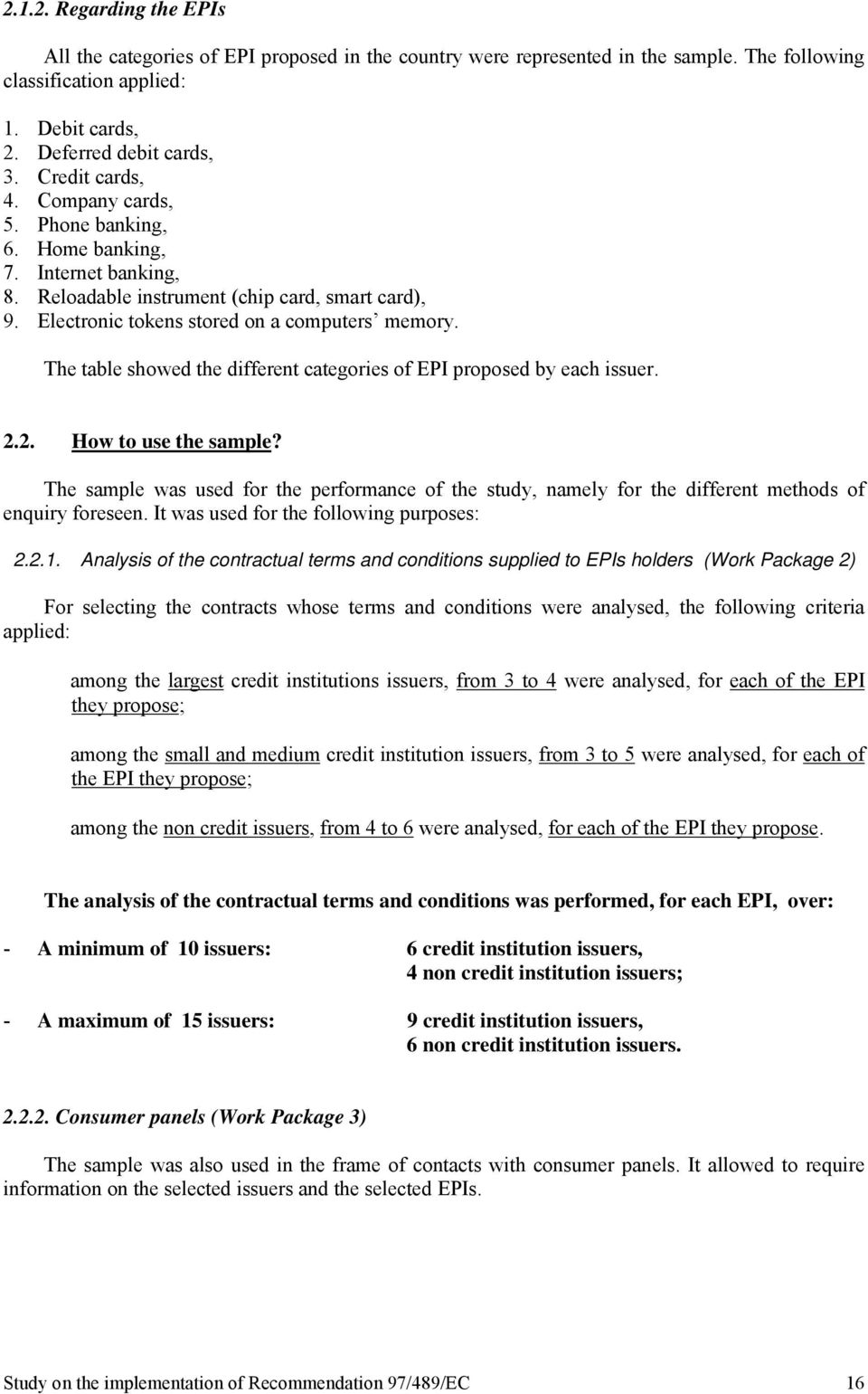
16 Regarding the EPIs All the categories of EPI proposed in the country were represented in the sample. The following classification applied: 1. Debit cards, 2. Deferred debit cards, 3. Credit cards, 4. Company cards, 5. Phone banking, 6. Home banking, 7. Internet banking, 8. Reloadable instrument (chip card, smart card), 9. Electronic tokens stored on a computers memory. The table showed the different categories of EPI proposed by each issuer How to use the sample? The sample was used for the performance of the study, namely for the different methods of enquiry foreseen. It was used for the following purposes: Analysis of the contractual terms and conditions supplied to EPIs holders (Work Package 2) For selecting the contracts whose terms and conditions were analysed, the following criteria applied: among the largest credit institutions issuers, from 3 to 4 were analysed, for each of the EPI they propose; among the small and medium credit institution issuers, from 3 to 5 were analysed, for each of the EPI they propose; among the non credit issuers, from 4 to 6 were analysed, for each of the EPI they propose. The analysis of the contractual terms and conditions was performed, for each EPI, over: - A minimum of 10 issuers: 6 credit institution issuers, 4 non credit institution issuers; - A maximum of 15 issuers: 9 credit institution issuers, 6 non credit institution issuers Consumer panels (Work Package 3) The sample was also used in the frame of It allowed to require information on the selected issuers and the selected EPIs. Study on the implementation of Recommendation 97/489/EC 16
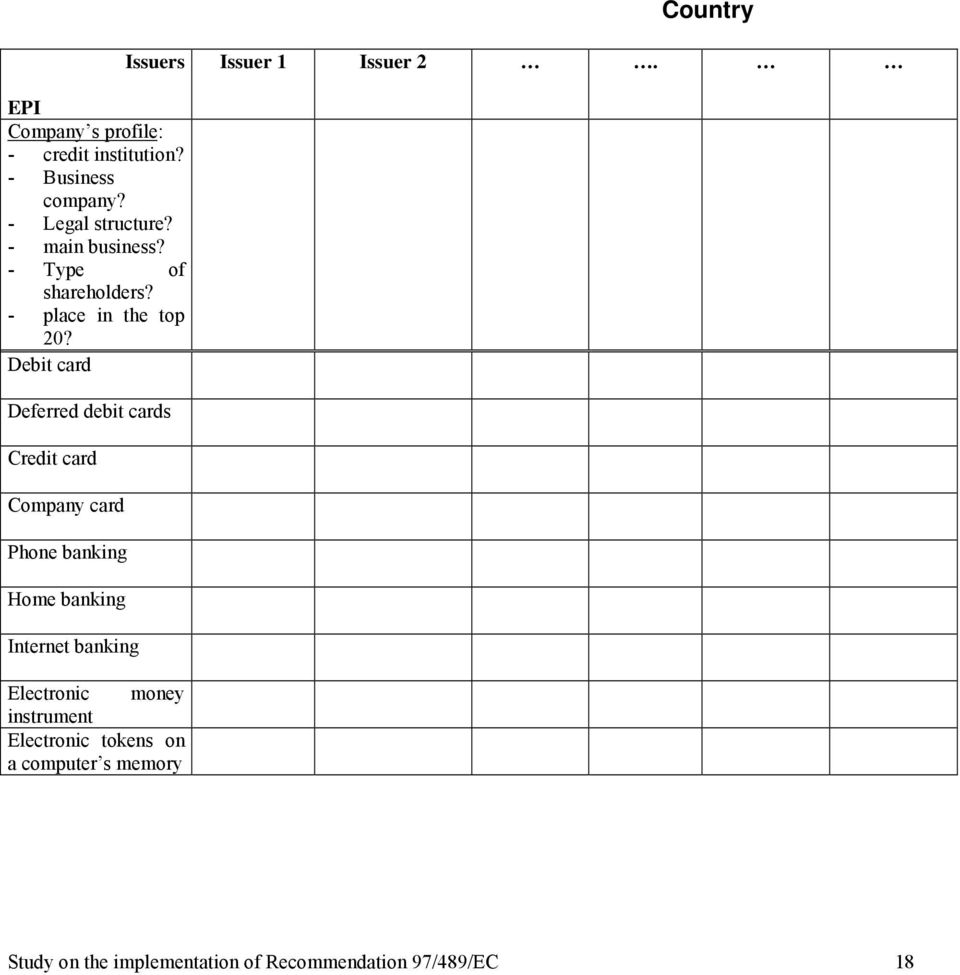
17 Anonymous on-the-spot surveys (Work Package 4) The sample was used for selecting the EPIs and the issuers for whom an anonymous on-the-spot survey was performed. A selection of approximately 15 EPIs in each country was performed, which means that approximately 15 anonymous on-the-spot surveys were carried out. The selection was based on the results obtained from the work carried out under Work Package 1, Work Package 2, and Work Package Format of the sample For constituting the sample, the following table was used. Study on the implementation of Recommendation 97/489/EC 17

18 Country Issuers Issuer 1 Issuer 2. EPI Company s profile: - credit institution? - Business company? - Legal structure? - main business? - Type of shareholders? - place in the top 20? Debit card Deferred debit cards Credit card Company card Phone banking Home banking Internet banking Electronic money instrument Electronic tokens on a computer s memory Study on the implementation of Recommendation 97/489/EC 18
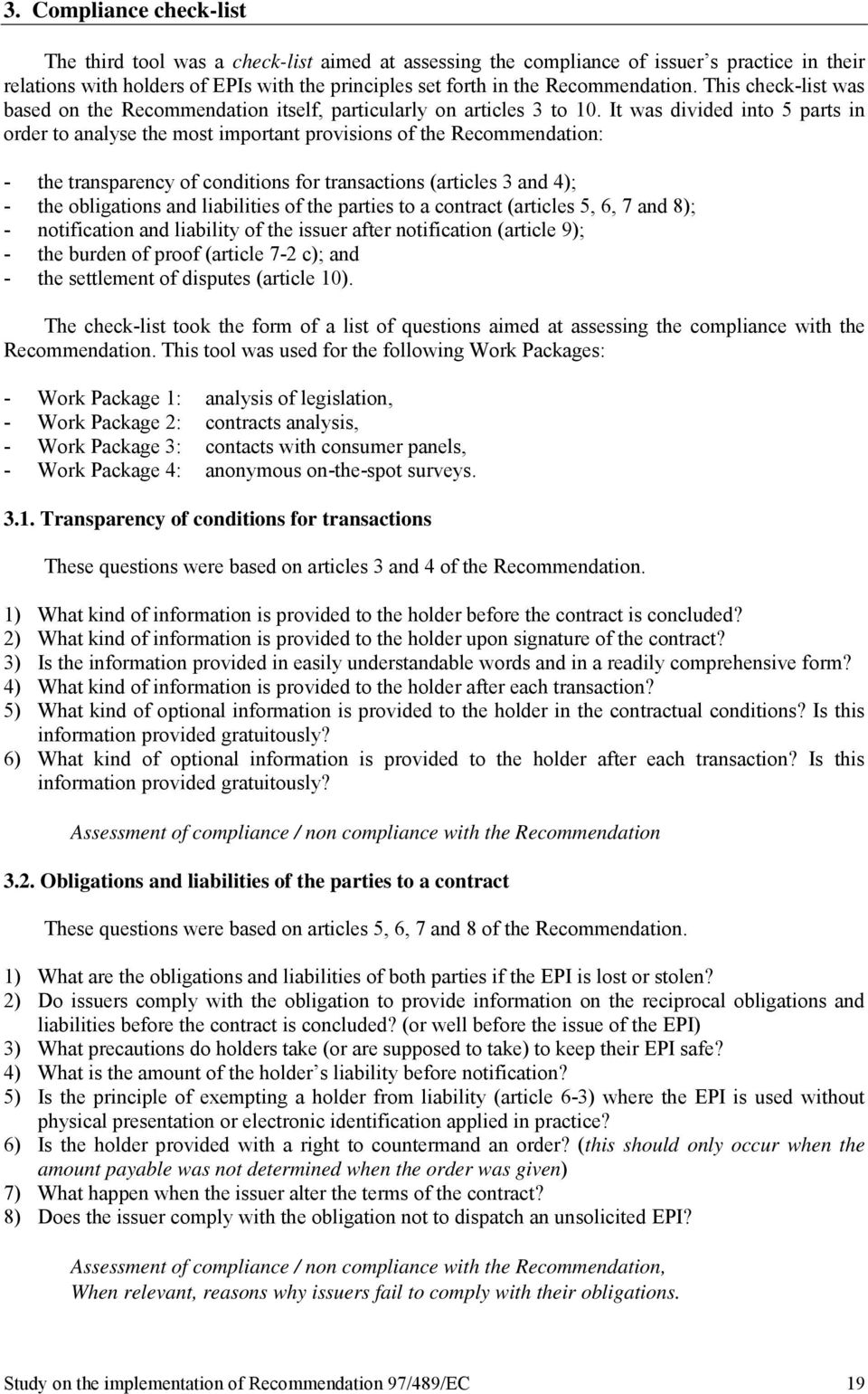
19 3. Compliance check-list The third tool was a check-list aimed at assessing the compliance of issuer s practice in their relations with holders of EPIs with the principles set forth in the Recommendation. This check-list was based on the Recommendation itself, particularly on articles 3 to 10. It was divided into 5 parts in order to analyse the most important provisions of the Recommendation: - the transparency of conditions for transactions (articles 3 and 4); - the obligations and liabilities of the parties to a contract (articles 5, 6, 7 and 8); - notification and liability of the issuer after notification (article 9); - the burden of proof (article 7-2 c); and - the settlement of disputes (article 10). The check-list took the form of a list of questions aimed at assessing the compliance with the Recommendation. This tool was used for the following Work Packages: - Work Package 1: analysis of legislation, - Work Package 2: contracts analysis, - Work Package 3: consumer panels, - Work Package 4: anonymous on-the-spot surveys Transparency of conditions for transactions These questions were based on articles 3 and 4 of the Recommendation. 1) What kind of information is provided to the holder before the contract is concluded? 2) What kind of information is provided to the holder upon signature of the contract? 3) Is the information provided in easily understandable words and in a readily comprehensive form? 4) What kind of information is provided to the holder after each transaction? 5) What kind of optional information is provided to the holder in the contractual conditions? Is this information provided gratuitously? 6) What kind of optional information is provided to the holder after each transaction? Is this information provided gratuitously? Assessment of compliance / non compliance with the Recommendation 3.2. Obligations and liabilities of the parties to a contract These questions were based on articles 5, 6, 7 and 8 of the Recommendation. 1) What are the obligations and liabilities of both parties if the EPI is lost or stolen? 2) Do issuers comply with the obligation to provide information on the reciprocal obligations and liabilities before the contract is concluded? (or well before the issue of the EPI) 3) What precautions do holders take (or are supposed to take) to keep their EPI safe? 4) What is the amount of the holder s liability before notification? 5) Is the principle of exempting a holder from liability (article 6-3) where the EPI is used without physical presentation or electronic identification applied in practice? 6) Is the holder provided with a right to countermand an order? (this should only occur when the amount payable was not determined when the order was given) 7) What happen when the issuer alter the terms of the contract? 8) Does the issuer comply with the obligation not to dispatch an unsolicited EPI? Assessment of compliance / non compliance with the Recommendation, When relevant, reasons why issuers fail to comply with their obligations. Study on the implementation of Recommendation 97/489/EC 19
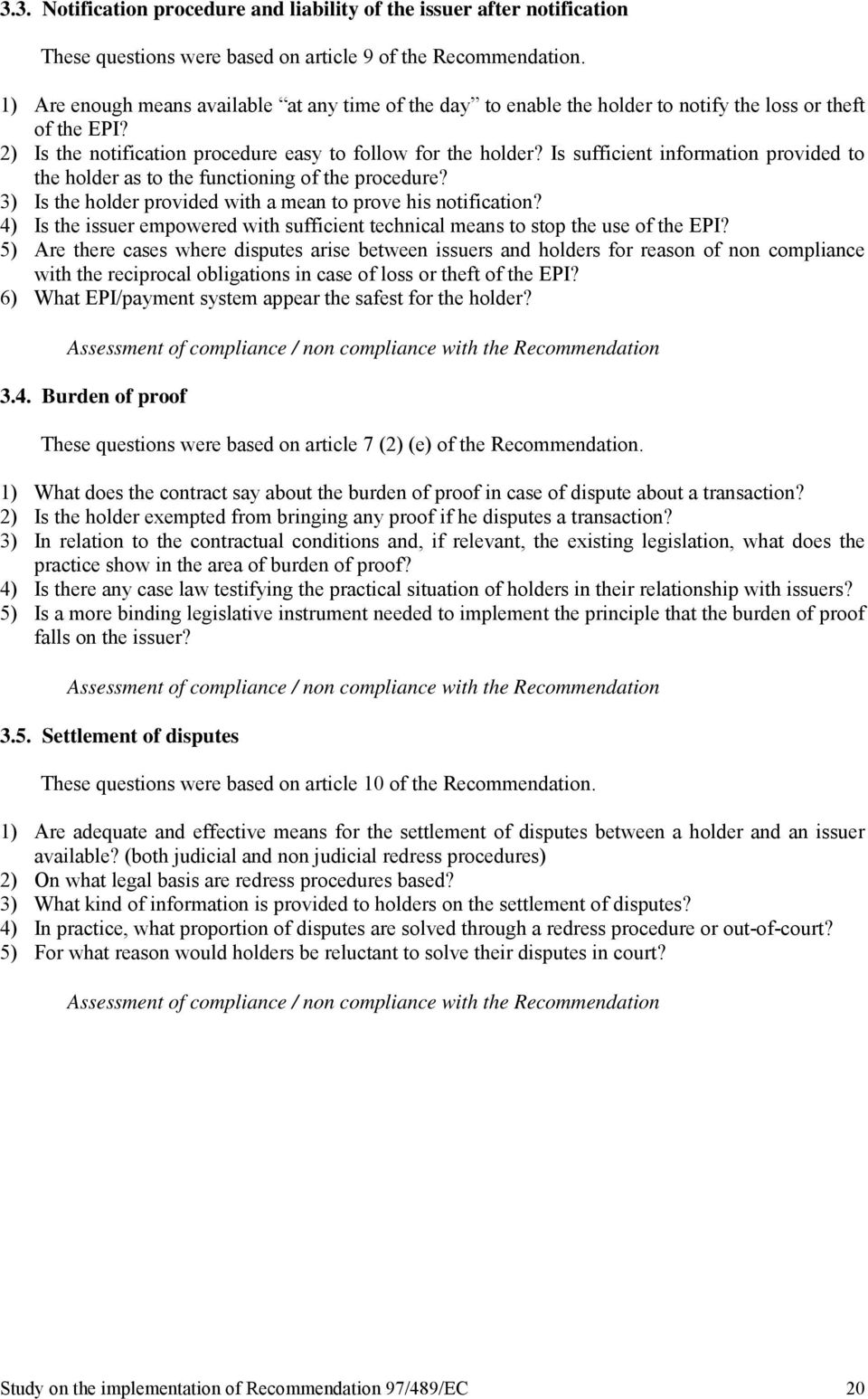
20 3.3. Notification procedure and liability of the issuer after notification These questions were based on article 9 of the Recommendation. 1) Are enough means available at any time of the day to enable the holder to notify the loss or theft of the EPI? 2) Is the notification procedure easy to follow for the holder? Is sufficient information provided to the holder as to the functioning of the procedure? 3) Is the holder provided with a mean to prove his notification? 4) Is the issuer empowered with sufficient technical means to stop the use of the EPI? 5) Are there cases where disputes arise between issuers and holders for reason of non compliance with the reciprocal obligations in case of loss or theft of the EPI? 6) What EPI/payment system appear the safest for the holder? Assessment of compliance / non compliance with the Recommendation 3.4. Burden of proof These questions were based on article 7 (2) (e) of the Recommendation. 1) What does the contract say about the burden of proof in case of dispute about a transaction? 2) Is the holder exempted from bringing any proof if he disputes a transaction? 3) In relation to the contractual conditions and, if relevant, the existing legislation, what does the practice show in the area of burden of proof? 4) Is there any case law testifying the practical situation of holders in their relationship with issuers? 5) Is a more binding legislative instrument needed to implement the principle that the burden of proof falls on the issuer? Assessment of compliance / non compliance with the Recommendation 3.5. Settlement of disputes These questions were based on article 10 of the Recommendation. 1) Are adequate and effective means for the settlement of disputes between a holder and an issuer available? (both judicial and non judicial redress procedures) 2) On what legal basis are redress procedures based? 3) What kind of information is provided to holders on the settlement of disputes? 4) In practice, what proportion of disputes are solved through a redress procedure or out-of-court? 5) For what reason would holders be reluctant to solve their disputes in court? Assessment of compliance / non compliance with the Recommendation Study on the implementation of Recommendation 97/489/EC 20
21 4. Methodology for performing the anonymous on-the-spot surveys 4.1. Anonymous on-the-spot surveys beside issuers Three steps were analysed: - the demand of an EPI, - the use of the EPI, - the case of loss or theft of the EPI (or of the means which enable it to be used). Method followed for performing the surveys: Step 1: demand of an EPI 1. go to a credit or non credit institution and ask to apply for an EPI, 2. do not ask for any specific information: be passive and see what the issuer provides you spontaneously, 3. in case the issuer did not provide you with any information (or with very little information), ask if you could be provided with further information. Step 2: use of the EPI 1. check what kind of information is provided after a transaction, 2. check the procedure to obtain the information (information spontaneously provided or requires steps to be taken by the holder), the content of the information and the format in which it is transmitted. Step 3: loss or theft of the EPI (or of the means which enable it to be used) 1. test the notification procedure: what steps should be taken, is it easily accessible (24 hours a day) 2. test if the holder is provided with a means to prove the notification in case of phone notification Surveys beside holders of EPIs The aim of such surveys was to determine whether the holders of EPIs complied with the obligations placed on them by the recommendation. A sample group of holders was asked the following questions: 1. Do you make everything possible to keep your EPI safe? - Do you give your personal identification number to anyone? - Do you make it easily accessible (written on the EPI, in your purse, in your bag, etc.)? 2. In case of loss or theft of the EPI: - Do you notify without any delay to the issuer (as soon as you are aware of the problem)? - Do you know the steps to take to notify? Do you think you are correctly informed by the issuer on the steps to take to notify? - Were you provided with a mean to prove the notification? (in case of phone notification)? - What amount was charged to you by the issuer (if any)? (in case your EPI was fraudulently used by a third party) What kind of costs did the loss or theft incurred to you? Study on the implementation of Recommendation 97/489/EC 21
22 - Did the issuer try to put forward your fraud or negligence to reduce his liability? 3. Unsolicited EPIs - Has the holder ever received from the issuer a new EPI without asking for it? - If yes, did it incur any cost? - Did the holder complain to the issuer? 5. Formats for the reports of WP1, WP2, WP3 and WP Reporting of WP1: analysis of the steps taken by the Member States to implement the recommendation 1. Analysis of existing legislation and draft legislation 1.1. Existing legislation Overview of the existing legislation Content Compliance with the recommendation: apply the compliance check-list 1.2. Draft legislation Overview of the draft legislation Content Compliance with the recommendation: apply the compliance check-list 2. Analysis of relevant codes of conduct 2.1. Overview of the existing codes of conduct / codes of best practices 2.2. Content 2.3. Compliance with the recommendation: apply the compliance check-list 3. Case law and/or arbitration decisions 3.1. Overview 3.2. Content 3.3. Compliance with the recommendation: apply the compliance check-list 4. Dispute settlement mechanisms 4.1. Overview of existing dispute settlement mechanisms 4.2. Compliance with the recommendation: apply the compliance check-list 5. Principle of burden of proof 5.1. Is the principle of burden of proof reversed in favour of the consumer? 5.2. Compliance with the recommendation 5.2. Reporting of WP2: Contract analysis Study on the implementation of Recommendation 97/489/EC 22
23 1. Overview of the contracts collected 1.1. Assessment of issuers 1.2. Description of the contracts collected 2. Compliance with the Recommendation 1.1. Transparency for conditions for transactions 1.2. Obligations and liabilities of the parties to a contract 1.3. Notification and liability of the issuer after notification 1.4. Burden of proof 1.5. Settlement of disputes 5.3. Reporting of WP3: Consumer panels 1. Description of contacts 1.1. Type of associations contacted (consumer associations, banking ombudsmen, etc.) 1.2. Contacts with specific consumer panels 2. Information collected 2.1. Beside consumer associations and banking ombudsmen 2.2. Beside specific consumer panels Study on the implementation of Recommendation 97/489/EC 23
24 5.4. Reporting of WP4: Anonymous on-the-spot surveys 1. Table to be fulfilled for each survey 1) Data concerning the survey - date (if applicable, mention the different the issuer) - issuer (status, address, etc.) - EPI concerned 2) Context of the demand - holder already known by the issuer: the holder is already client and asks for a new EPI - or, new relationship between the issuer and the holder 3) General information required by the issuer - personal status? - Gross salary? - Kind of personal information required? - Etc. 4) Information spontaneously provided by the issuer before conclusion of the contract - kind of information provided - format (medium) in which the information is provided - time the information is provided 5) Information provided by the issuer before conclusion of the contract as a respond to a specific request from the holder - kind of information requested by the holder - kind of information provided (+ mention of the information not provided by the issuer) - format (medium) in which the information is provided Anonymous on-the-spot survey n.. Study on the implementation of Recommendation 97/489/EC 24
25 6) Information provided by the issuer subsequent to a transaction - kind of information provided - format in which the information is provided - time the information is provided (how long after the transaction?) - for electronic money instruments: is there a possibility to check the last 5 transactions? 7) In case of loss or theft of the EPI - procedure to be followed by the holder to notify the issuer - is the procedure easily accessible? - Is a mean to prove the notification provided to the holder? (in case of phone notification) 2. Completed compliance check-list 2.1. Transparency for conditions for transactions: this should include a clear distinction between compulsory information and optional information (referred to in the recommendation as where appropriate, the following information will be provided ) 2.2. Obligations and liabilities of the parties to a contract 2.3. Notification and liability of the issuer after notification 2.4. Burden of proof 2.5. Settlement of disputes 3. Conclusion: assessment of the issuers practice? Where relevant, a distinction should be operated between issuers (major vs. small issuers; financial issuers vs. non-financial issuers, etc.), and between EPIs (recommendation correctly implemented for some EPIs but not for others, etc.). Study on the implementation of Recommendation 97/489/EC 25
26 6. Statistical analysis questionnaire COUNTRY QUESTIONNAIRE FOR STATISTICAL ANALYSIS First part of the questionnaire Profile of legislation 1. Does the country considered have a legislation about the EPIs and the transactions between issuers and holders? YES NO 2. If no, is there at least a draft legislation? YES NO 3. Assess the compliance of the existing legislation or draft legislation with the Recommendation 1 very weak 2 weak 3 - moderate 4 strong 5 very strong 4. In general, are the consumers involved in the setting-up procedure of the Codes of conduct? YES NO 5. Is there a specific procedure/mechanism to settle the disputes between issuers and holders of EPIs? YES NO 6. Is the principle of burden of proof reversed in favour of the consumer YES NO Second part of questionnaire Assessment of the compliance For each EPI and issuer, please rank between 1 to 5 the compliance of the 6 following criteria in the table: Study on the implementation of Recommendation 97/489/EC 26
27 1. Transparency of conditions for transaction Issuers N 1 N 2 N 3 N 4 N 5 N 6 N 7 EPIs EPI n 1 EPI n 2 EPI n 3 EPI n 4 EPI n 5 EPI n 6 Significance of scores 1 = very weak compliance 2 = weak compliance 3 = moderate compliance 4 = strong compliance 5 = very strong compliance The same table will be done for: 2. Obligations and liabilities of the parties to a contract, 3. Notification procedure and liability of the issuer after notification, 4. Burden of proof, 5. Settlement of disputes. Study on the implementation of Recommendation 97/489/EC 27
28 Appendice 2 Tables Study on the implementation of Recommendation 97/489/EC 28
29 Debit card = payment instrument that allows payment by the direct and normally online debit of an account. Study on the implementation of Recommendation 97/489/EC 29
30 CONSIDERED EPI : Debit card CRITERIA : Transparency of conditions for the transactions WP1 : steps taken by MS WP2 : Contract analysis WP3 : Contact with consumers WP4 : on the spot surveys Belgium (BE) scope of legislation Generally in No information from Compliance: except in limited to distance compliance one case where no contracts consumer panels terms were provided even after request Denmark Compliance, even Compliance No information from Compliance more extensive consumer panels Germany no provision in In compliance No information from Compliance: format of legislation information not always consumer panels clear Greece Compliance Generally in EKPOIZO and bank Non-compliance: compliance but not ombudsman reported terms provided late or always readily cases of insufficient only after request comprehensive and/or misleading information and of delayed monthly statements Spain Compliance no data No information from Non-compliance: much information consumer panels provided only after request and/or in oral form France Compliance for precontractual Generally in No information from Compliance compliance information, no consumer panels compliance for posttransaction information Study on the implementation of Recommendation 97/489/EC 30
31 Ireland Compliance limited to Technical language No information from Late compliance: only pre-transaction and poor spacing moderate quality of information consumer panels language and format Italy Compliance No information from Non-compliance consumer panels Luxembourg Non compliance Language is technical and print small Netherland Generally in compliance Austria no provision in legislation Generally compliance No information from Compliance: but in some cases consumer panels information was only provided after request (especially on cancellation rights) No information from Late compliance: only moderate quality of consumer panels format, and in one case no information provided at all in No information from Compliance consumer panels Portugal Generally in Generally in No information from Compliance: but in compliance compliance one case only oral consumer panels information provided on charges Finland Non compliance Compliance No information from Compliance: though in one case only general consumer panels information was provided, not the terms and conditions Sweden Non compliance In compliance No information from Compliance consumer panels Study on the implementation of Recommendation 97/489/EC 31
32 UK Compliance In compliance No information from Compliance: but in some cases consumer panels applications can be made at a bank without the terms being provided automatically (available on display stands) Study on the implementation of Recommendation 97/489/EC 32
33 CONSIDERED EPI : Debit card CRITERIA : obligations and liabilities of the parties WP1 : steps taken by MS WP2 : Contract analysis Belgium (BE) Liability of holders Generally more stringent compliance Denmark Compliance, even more extensive Compliance Germany few existing Generally provisions, but compliance compliant WP3 : Contact with WP4 : on the spot consumers surveys in No information from Survey results do not differentiate separate consumer panels classes of EPI No information from Compliance consumer panels in Consumers have too Survey results do not numerous code differentiate separate numbers to remember. classes of EPI The sending of EC Cards and its PIN by conventional mail may be considered as a transfer of the risk of transportation on the consumer. They are no clear court rulings concerning the loss of the card in those case yet. Study on the implementation of Recommendation 97/489/EC 33
34 Greece limit of holder's liability freely estimated by issuer, no exemption in the frame of article 6.3 of Recommendation Spain generally compliant, no data although limit of 150 euros can be freely increased by issuer France few existing provisions, but compliant Ireland Generally in compliance, although article 6.3 not implemented Not in compliance with liability provisions or notification provisions Contracts do not comply with limits on holder's liability Not all contracts comply with limits on holder's liability the draft brochure of Non-compliance: the Greek Bank Federation still consider that the use of the PIN by a third party supposes a fault form the holder. Issuers provide few information on reciprocal obligations/liabilities, and do not inform properly about contract terms alteration AUSBANC denounces the reverse of the burden of proof resulting from the issuer practices alleging negligence in the custody of the card. full liability of holder. It is reported that some holders disclose their PIN code to third parties Survey results do not differentiate separate classes of EPI No information from Compliance: but 40% of holders disclosed consumer panels PIN to a family member No information from Compliance: except on limitation of liability consumer panels Italy non compliance no data No information from Non-compliance: unlimited liability, consumer panels unsolicited EPIs Study on the implementation of Recommendation 97/489/EC 34
35 Luxembourg only some provisions Generally in No information from Compliance implemented compliance consumer panels Netherland non compliance no data No information from consumer panels classes of EPI Austria no provision in Not in compliance with legislation liability provisions Portugal Generally in compliance, although article 6.3 not implemented Finland Generally compliance some issuers don't assume entire liability after notification partly in compliance Not in compliance with (no maximum liability provisions amount for holder's liability) The holder has no overview of his liability because there are no uniform limits for daily cash withdraws and the banks can change them at any time by simply displaying new conditions in the bank building. There is no information given after a transaction. The issuer may send the card through conventional mail. On the other hand holders are liable for all damages caused by the loss of the EPI. Survey results do not differentiate separate Survey results do not differentiate separate classes of EPI in No information from Compliance although consumer panels No information from Compliance consumer panels Study on the implementation of Recommendation 97/489/EC 35
36 Sweden Non compliance Not in compliance with liability provisions UK Compliance Generally in compliance No information from Compliance consumer panels No information from Survey results do not differentiate separate consumer panels classes of EPI Study on the implementation of Recommendation 97/489/EC 36
37 CONSIDERED EPI : Debit card CRITERIA : notification procedure and liability of the issuer after notification WP1 : steps taken by MS WP2 : Contract analysis Belgium (BE) Compliance Generally in compliance Denmark Compliance, even more extensive Compliance Germany Compliance Generally in compliance Greece no explicitly formulated obligation of a 24 hours service, no mean to prove the notification no 24 hours service, no mean to prove the notification except in writing WP3 : Contact with consumers No information from contact with consumer panels. No information from contact with consumer panels. No information from contact with consumer panels. EKPOIZO complaints issuers do not stop the use fof the card immediately after the notification resulting to the liability of holders WP4 : on the spot surveys Compliance Compliance Compliance reported partial that for subsequent unauthorized transactions. Bank ombusdman reported insufficient phone lines for notification, phone calls have been recorded only in case of credit cards. compliance, phone calls not always recorded. Study on the implementation of Recommendation 97/489/EC 37
38 Spain France no mean to prove the no data notification, no obligation for a 24 hours service few provisions in the Compliance law, case law in compliance No information from Partial compliance: contact with consumer generally good panels. procedures, but insufficient information given to holder in No information from contact with consumer panels. some cases Compliance Ireland no mean to prove the notification Generally compliance in 2 successful complaints related to the failure of the issuer to stop the card immediately on receipt of the notification. One was based ont the lack of an emergency phone number. Italy non compliance No information from contact with consumer panels. Luxembourg Compliance Generally in compliance No information from contact with consumer panels. Netherland non compliance No information from contact with consumer panels. Compliance Partial compliance: notification not available 24 hrs Compliance Compliance Study on the implementation of Recommendation 97/489/EC 38
39 Austria no provision in legislation Portugal Generally in compliance Not in compliance General terms mention that it might need 6 hours after notification in order to block the account. On the other hand, the holder must notifiy the loss written or in person during the issuer opening hours Notification must be confirmed in writing Finland non compliance Generally in compliance Sweden partly compliant Generally in compliance UK Generally in compliance but no requirement regarding the mean to prove the notification Generally compliance in whereas outside outside the opening there is a phone service. No information from contact with consumer panels. No information from contact with consumer panels. No information from contact with consumer panels. No information from contact with consumer panels. Compliance Compliance: but requirements for subsequent written confirmation can be difficult to comply with Compliance Compliance Compliance Study on the implementation of Recommendation 97/489/EC 39
40 CONSIDERED EPI : Debit card CRITERIA : burden of proof WP1 : steps taken by MS WP2 : Contract analysis WP3 : Contact with consumers WP4 : on the spot surveys Belgium (BE) No provision in the Generally in No information from Unclear law, draft law in compliance compliance, case law places the burden on the holder Denmark Compliance Compliance No information from Compliance Germany Non compliance: No provision reversal in the disadvantage of the holder, although the courts deny this reversal Greece issuers internal records are used as evidence for the accuracy of the transaction, holder has to prove the contrary burden not reversed, holder has to provide evidence to the contrary of issuers internal records The courts prevailing opinion is that there is a prima facie evidence of negligence in case of fraudulent use of the card. This was explained with the secure system used by issuers. The holder is only liable for negligence but he must prove the facts that lead to his discharge. Holder has to provide evidence to the contrary of the issuer internal records. Unclear: issuer argues liability of holder in some cases Non-compliance Study on the implementation of Recommendation 97/489/EC 40
41 Spain burden on the holder (although case law seem to apply the reversal in favor of the consumer) France case law in compliance Generally compliance Not in compliance in AUSBANC denounces Compliance the reverse of the burden of proof resulting from the issuer practise alleging negligence in the custody of the card. No information from Compliance Ireland burden on the holder No provision It appears that the Compliance Ombudsman focused on the question of wether there was any evidence of the machine malfunction and made his decision accordingly.the benefit of the doubt accrue to the complaint. Italy burden on the holder No information from Non-compliance Luxembourg Generally in Not clear No information from Compliance compliance Netherland non compliance no data No information from Unclear Study on the implementation of Recommendation 97/489/EC 41
42 Austria no provision in No provision No information from Unclear legislation Portugal Non-compliance Burden not reversed No information from Unclear: issuer argues liability of holder in some cases Finland compliance No provision No information from Compliance Sweden compliance No provision No information from Compliance UK compliance Burden reversed but No information from Compliance this is not always mentioned in the contract. Study on the implementation of Recommendation 97/489/EC 42
43 CONSIDERED EPI : Debit card CRITERIA : settlement of disputes WP1 : steps taken by MS WP2 : Contract analysis WP3 : Contact with consumers WP4 : on the spot surveys Belgium (BE) Compliance Sometimes No information from No information from information provided surveys - holders unaware Denmark Compliance Compliance No information from No information from surveys - holders unaware Germany compliance information provided No information from on dispute resolution unaware Greece judicial means of No provision Banks do not inform redress not effective, properly the holders but ADR efficient only about the existing in the sense that the dispute mechanisms. majority of cases brought before the banking ombudsman close after his intervention Spain Compliance no data No information from unaware France compliance Some information No information from provided No information from surveys - holders No information from surveys - holders unaware No information from surveys - holders No information from surveys - holders unaware Study on the implementation of Recommendation 97/489/EC 43
44 Ireland Generally in No provision No information from compliance unaware Italy compliance No information from unaware Luxembourg non compliance No provision No information from unaware Netherland Compliance no data No information from unaware Austria non compliance No provision No information from Portugal Non-compliance Competent court specified No information from No information from surveys - holders No information from surveys - holders No information from surveys - holders No information from surveys - holders No information from surveys - holders unaware No information from surveys - holders unaware Finland Compliance information on dispute No information from No information from resolution bodies surveys - holders provided. unaware Sweden Compliance no data No information from No information from surveys - holders unaware UK Compliance Information provided No information from No information from on internal dispute surveys - holders resolution and unaware ombudsmen Study on the implementation of Recommendation 97/489/EC 44
45 Deferred debit card = payment instrument that allows payment by a deferred debit of an account, i.e. the account is only debited after a certain period of time defined in the contract between the parties. Study on the implementation of Recommendation 97/489/EC 45
46 CONSIDERED EPI : Deferred debit card CRITERIA : Transparency of conditions for the transactions WP1 : steps taken by MS WP2 : Contract analysis Belgium (BE) scope of legislation Generally limited to distance compliance contracts Denmark Compliance, even Compliance more extensive Germany no provision in legislation Greece generally in compliance In compliance Generally compliance but terms not always clear Spain Compliance Generally in compliance France Compliance for precontractual No data information, no compliance for posttransaction information WP3 : Contact with WP4 : on the spot consumers surveys in No information from Compliance: though only on request No information from Compliance No information from No data in EKPOIZO and bank Non-compliance: ombudsman reported terms provided late or cases of insufficient only after request and/or misleading information and of delayed monthly statements No information from Non-compliance: much information provided only after request and/or in oral form No information from No data Study on the implementation of Recommendation 97/489/EC 46
47 Ireland Compliance limited to pre-transaction information No data No information from Late compliance: only moderate quality of language and format Italy Compliance Generally in No information from Non-compliance compliance Luxembourg Non compliance No data No information from No data Netherland Generally in compliance Austria no provision in legislation Portugal Generally in compliance No data Generally compliance Generally compliance but lack of clarity with some provisions relating to liability. No information from Late compliance: only moderate quality of format in No information from Compliance in No information from Compliance Finland Non compliance No data No information from Compliance Sweden Non compliance No data No information from No data UK Compliance No data No information from No data Study on the implementation of Recommendation 97/489/EC 47
48 CONSIDERED EPI : Deferred debit card CRITERIA : obligations and liabilities of the parties WP1 : steps taken by MS WP2 : Contract analysis Belgium (BE) Liability of holders Generally more stringent compliance Denmark Compliance, even more extensive Compliance Germany few existing Generally provisions, but compliance compliant Greece limit of holder's liability freely estimated by issuer, no exemption in the frame of article 6.3 of Recommendation WP3 : Contact with WP4 : on the spot consumers surveys in No information from Survey results do not differentiate separate classes of EPI in Not in compliance with liability provisions or notification provisions No information from Compliance Misuses in case of distance sales are too easy. No data the draft brochure of Non-compliance: the Greek Bank Federation implies unlimited liability of the holder till notification. Issuers provide few information on reciprocal obligations/liabilities, and do not inform properly contract alteration about terms full liability of holder. It is reported that some holders disclose their PIN code to third parties Study on the implementation of Recommendation 97/489/EC 48
49 Spain generally compliant, No data although limit of 150 euros can be freely increased by issuer France few existing No data provisions, but compliant Ireland Generally in No data compliance, although article 6.3 not implemented Italy non compliance Generally in compliance AUSBANC denounces Survey results do not the reverse of the differentiate separate burden of proof classes of EPI resulting from the issuers practise alleging negligence in the custody of the card. No information from Compliance: but nearly 50% of holders disclosed PIN No information from Compliance: except on limitation of liability No information from Non-compliance: drafting of terms complies, but terms not made available unless express request Luxembourg only some provisions No information from No data implemented Netherland non compliance No information from Survey results do not differentiate separate classes of EPI Austria no provision in Not in compliance No information from Survey results do not legislation with liability differentiate separate provisions classes of EPI Portugal Generally in Not in compliance with No information from Compliance compliance, although liability provisions article 6.3 not implemented Study on the implementation of Recommendation 97/489/EC 49
50 Finland partly in compliance No data No information from Compliance (no maximum amount for holder's liability) Sweden Non compliance No data No information from No data UK Compliance No data No information from No data Study on the implementation of Recommendation 97/489/EC 50
51 CONSIDERED EPI : Deferred debit card CRITERIA : notification procedure and liability of the issuer after notification WP1 : steps taken by MS WP2 : Contract analysis WP3 : Contact with consumers WP4 : on the spot surveys Belgium (BE) Compliance Compliance No information from Compliance Denmark Compliance, even Compliance No information from Compliance more extensive Germany Compliance Generally in No information from No data compliance Greece no explicitly no 24 hours service, EKPOIZO reported partial compliance, formulated no mean to prove the complaints that phone calls not always obligation of a 24 notification except in issuers do not stop the recorded. hours service, no writing use fof the card mean to prove the notification immediately after the notification resulting to the liability of holders for subsequent unauthorized transactions. Bank ombusdman reported insufficient phone lines for notification, phone calls have been recorded only in case of credit cards. Study on the implementation of Recommendation 97/489/EC 51
52 Spain France no mean to prove the No data notification, no obligation for a 24 hours service few provisions in the No data law, case law in compliance No information from Partial compliance: generally good procedures, but insufficient information given to holder in some cases No information from Compliance Ireland no mean to prove the No data No information from Compliance notification Italy non compliance Must be confirmed in No information from Partial compliance: writing notification not available 24 hrs Luxembourg Compliance No data No information from No data Netherland non compliance No data No information from Compliance Austria no provision in Not in compliance No information from Compliance legislation Portugal Generally in Notification must be No information from Compliance compliance confirmed in writing Finland non compliance No data No information from Compliance Study on the implementation of Recommendation 97/489/EC 52
53 Sweden partly compliant No data No information from No data UK Generally in No data compliance but no requirement regarding the mean to prove the notification No information from No data Study on the implementation of Recommendation 97/489/EC 53
54 CONSIDERED EPI : Deferred debit card CRITERIA : burden of proof WP1 : steps taken by MS WP2 : Contract analysis WP3 : Contact with consumers WP4 : on the spot surveys Belgium (BE) No provision in the Compliance No information from Unclear law, draft law in compliance, case law places the burden on the holder Denmark Compliance Compliance No information from Compliance Germany Non compliance: No provision The courts prevailing No data reversal in the opinion is that there is disadvantage of the holder, although the a prima facie evidence of negligence in case courts deny this of fraudulent use of reversal the card. This was explained with the secure system used Greece issuers internal records are used as evidence for the accuracy of the transaction, holder has to prove the contrary burden not reversed, holder has to provide evidence to the contrary of issuers internal records by the issuers. Holder has to provide evidence to the contrary of the issuer internal records. Non-compliance Study on the implementation of Recommendation 97/489/EC 54
55 Spain burden on the holder No data (although case law seem to apply the reversal in favor of the consumer) France case law in compliance No data AUSBANC denounces Compliance the reverse of the burden of proof resulting from the issuers practise alleging negligence in the custody of the card. No information from Compliance Ireland burden on the holder No data No information from Compliance Italy burden on the holder Burden not reversed No information from Non-compliance Luxembourg Generally in No data No information from No data compliance Netherland non compliance No data No information from Unclear Austria no provision in legislation No provision No information from Unclear Portugal Non-compliance Burden not reversed No information from Unclear: issuer argues liability of holder in some cases Finland compliance No data No information from Compliance Study on the implementation of Recommendation 97/489/EC 55
56 Sweden compliance No data No information from No data UK compliance No data No information from No data Study on the implementation of Recommendation 97/489/EC 56
57 CONSIDERED EPI : Deferred debit card CRITERIA : settlement of disputes WP1 : steps taken by MS WP2 : Contract analysis WP3 : Contact with consumers WP4 : on the spot surveys Belgium (BE) Compliance No provision No information from No information from surveys - holders unaware Denmark Compliance Compliance No information from No information from surveys - holders unaware Germany compliance information provided No information from No data on dispute resolution Greece judicial means of No provision Banks do not inform No information from redress not effective, properly the holders surveys - holders but ADR efficient only about the existing unaware in the sense that the dispute mechanisms. majority of cases brought before the banking ombudsman close after his intervention Spain Compliance no data No information from unaware France compliance no data No information from Ireland Generally in compliance no data No information from surveys - holders No information from surveys - holders unaware No information from No information from surveys - holders unaware Study on the implementation of Recommendation 97/489/EC 57
58 Italy compliance Some information on No information from No information from dispute resolution surveys - holders provided unaware Luxembourg non compliance No information from No data Netherland Compliance Address of complaints body not always given. Some methods of resolution excluded. No information from Austria non compliance No provision No information from unaware Portugal Non-compliance Competent court No information from specified No information from surveys - holders unaware No information from surveys - holders No information from surveys - holders unaware Finland Compliance no data No information from No information from surveys - holders unaware Sweden Compliance no data No information from No data UK Compliance no data No information from No data Study on the implementation of Recommendation 97/489/EC 58
59 Credit card = payment instrument that allows purchases to be made on a credit basis. It enables the holder to make purchases from any retailer accepting the credit card and repay the total sum spent to the credit card issuer at the time and over the period of time specified in the contract. Study on the implementation of Recommendation 97/489/EC 59
60 CONSIDERED EPI : credit card CRITERIA : Transparency of conditions for the transactions WP1 : steps taken by MS WP2 : Contract analysis WP3 : Contact with consumers WP4 : on the spot surveys Belgium (BE) compliance Generally in No information from Partial compliance: compliance terms not made consumer panels available in adviance of signature, not easy to understand Denmark Compliance, even Compliance No information from Compliance: except in more extensive one case where part consumer panels of terms were supplied after the contract Germany no provision in In compliance No information from No data legislation consumer panels Greece generally in Generally in EKPOIZO and bank Non-compliance: compliance compliance but terms ombudsman reported terms provided late or not always clear cases of insufficient only after request and/or misleading information and of delayed monthly statements Spain Compliance no data No information from Non-compliance: much information consumer panels provided only after request and/or in oral form France Compliance for precontractual no data No information from Compliance information, no consumer panels compliance for posttransaction information Study on the implementation of Recommendation 97/489/EC 60
61 Ireland Compliance limited to Detailed provisions but ODCA reported a case Late compliance: only pre-transaction technical language relating to the lack of moderate quality of information and poor spacing. information on credit language and format card statement Italy Compliance Not in compliance No information from Non-compliance consumer panels Luxembourg Non compliance Technical language No information from Compliance: but in and small print some cases consumer panels information was only provided after request (especially on cancellation rights) Netherland Generally in Generally in No information from No data compliance compliance consumer panels Austria Generally in compliance Portugal Generally in compliance Generally compliance Generally compliance but lack of clarity with some provisions relating to liability. Finland Non compliance Generally in compliance but print small and may be hard to read. in Terms about Compliance exchange rates are vague and not transparent. Informations about settlement of accounts are uncomplete. in No information from Compliance consumer panels No information from Compliance consumer panels Study on the implementation of Recommendation 97/489/EC 61
62 Sweden Generally in compliance In compliance but information in small type No information from Compliance consumer panels UK Compliance In compliance No information from Compliance: but in some cases consumer panels applications can be made at a bank without the terms being provided automatically (available on display stands) Study on the implementation of Recommendation 97/489/EC 62
63 CONSIDERED EPI : credit card CRITERIA : obligations and liabilities of the parties WP1 : steps taken by MS WP2 : Contract analysis Belgium (BE) Liability of holders Generally more stringent compliance Denmark Compliance, even more extensive Compliance Germany few existing Generally provisions, but compliance compliant Greece limit of holder's liability freely estimated by issuer, no exemption in the frame of article 6.3 of Recommendation Spain generally compliant, no data although limit of 150 euros can be freely increased by issuer Not in compliance with liability provisions or notification provisions WP3 : Contact with WP4 : on the spot consumers surveys in No information from Survey results do not differentiate separate consumer panels classes of EPI No information from Compliance consumer panels in Misuses of credit card No data for distance sale are to easy. the draft brochure of Non-compliance: the Greek Bank Federation implies unlimited liability of the holder till notification. Issuers provide few information on reciprocal obligations/liabilities, and do not inform properly about contract terms alteration AUSBANC denounces the fact that issuers allege negligence in the custody of the card, producing the reverse of the burden of proof. full liability of holder. It is reported that some holders disclose their PIN code to third parties Survey results do not differentiate separate classes of EPI Study on the implementation of Recommendation 97/489/EC 63
64 France few existing no data provisions, but compliant Ireland Generally in Generally compliance, although compliance article 6.3 not implemented Italy non compliance No provision on limits of holder's liability Luxembourg only some provisions implemented Not in compliance with liability provisions Netherland non compliance Generally in compliance with limit to holder's liability. Time period for contract changes not always met. Austria compliance Not in compliance with liability provisions Portugal Generally in Not in compliance with compliance, although liability provisions article 6.3 not implemented Finland partly in compliance (no maximum amount for holder's liability) Sweden partly compliant Not in compliance with liability provisions Not in compliance with liability provisions No information from Compliance consumer panels in The ODCA reported a Compliance: except case of unsolicited on limitation of liability increase in credit card limit. No information from Non-compliance consumer panels No information from Non-compliance: full liability of holder until consumer panels notification No information from No data consumer panels No information from consumer panels Survey results do not differentiate separate classes of EPI No information from Compliance consumer panels No information from Compliance consumer panels No information from Compliance consumer panels Study on the implementation of Recommendation 97/489/EC 64
65 UK Compliance Generally in compliance No information from consumer panels Survey results do not differentiate separate classes of EPI Study on the implementation of Recommendation 97/489/EC 65
66 CONSIDERED EPI : credit card CRITERIA : notification procedure and liability of the issuer after notification WP1 : steps taken by MS WP2 : Contract analysis WP3 : Contact with consumers WP4 : on the spot surveys Belgium (BE) Compliance Compliance No information from Compliance consumer panels Denmark Compliance, even more extensive Compliance Germany Compliance Generally in compliance Greece no explicitly formulated obligation of a 24 hours service, no mean to prove the notification no 24 hours service, no mean to prove the notification except in writing No information from Compliance: except in one case where it consumer panels required 20 telephone calls to block the EPI No information from No data consumer panels EKPOIZO complaints issuers do not stop the use fof the card immediately after the notification resulting to the liability of holders reported partial that for subsequent unauthorized transactions. Bank ombusdman reported insufficient phone lines for notification, phone calls have been recorded only in case of credit cards. compliance, phone calls not always recorded. Study on the implementation of Recommendation 97/489/EC 66
67 Spain France Ireland no mean to prove the no data notification, no obligation for a 24 hours service few provisions in the no data law, case law in compliance no mean to prove the Generally notification compliance No information from Partial compliance: generally good consumer panels procedures, but insufficient information given to holder in some cases No information from Compliance consumer panels in No information from Compliance consumer panels Italy non compliance Must be in writing No information from Partial compliance: notification not consumer panels available 24 hrs Luxembourg Compliance Generally in No information from Compliance compliance consumer panels Netherland non compliance Sometimes unclear No information from No data consumer panels Austria only mention of a Not in compliance contact point for notification Portugal Generally in compliance Notification must be confirmed in writing Finland non compliance Generally in compliance No information from Compliance consumer panels No information from Compliance: but requirements for consumer panels subsequent written confirmation can be difficult to comply with No information from Compliance consumer panels Study on the implementation of Recommendation 97/489/EC 67
68 Sweden partly compliant Generally in compliance UK Generally in compliance but no requirement regarding the mean to prove the notification Generally compliance No information from Compliance consumer panels in No information from Compliance consumer panels Study on the implementation of Recommendation 97/489/EC 68
69 CONSIDERED EPI : credit card CRITERIA : burden of proof WP1 : steps taken by MS WP2 : Contract analysis WP3 : Contact with consumers WP4 : on the spot surveys Belgium (BE) No provision in the Generally in No information from Unclear law, draft law in compliance compliance, case law consumer panels places the burden on the holder Denmark Compliance Compliance No information from Compliance consumer panels Germany Non compliance: No provision reversal in the disadvantage of the holder, although the courts deny this reversal Greece issuers internal records are used as evidence for the accuracy of the transaction, holder has to prove the contrary burden not reversed, holder has to provide evidence to the contrary of issuers internal records The courts prevailing opinion is that there is a prima facie evidence of gross negligence if the card has been used fraudulently.this was explained with the secure system used by issuers. Holder has to provide evidence of the contrary of the issuer's internal records. No data Non-compliance Study on the implementation of Recommendation 97/489/EC 69
70 Spain burden on the holder no data (although case law seem to apply the reversal in favor of the consumer) France case law in compliance no data Ireland burden on the holder Provisions in some contracts to reverse burden but not all. AUSBANC denounces Compliance the reverse of the burden of proof resulting of issuer practices alleging negligence in the custody of the card. No information from Compliance consumer panels No information from Compliance consumer panels Italy burden on the holder Burden not reversed No information from Non-compliance consumer panels Luxembourg Generally in Not clear No information from Compliance compliance consumer panels Netherland non compliance Not in compliance No information from No data consumer panels Austria Not in compliance No provision No information from Unclear consumer panels Portugal Non-compliance Burden not reversed No information from Unclear: issuer argues liability of holder in consumer panels some cases Finland compliance No provision No information from Compliance consumer panels Study on the implementation of Recommendation 97/489/EC 70
71 Sweden compliance No provision No information from Compliance consumer panels UK compliance Burden reversed No information from Compliance consumer panels Study on the implementation of Recommendation 97/489/EC 71
72 CONSIDERED EPI : credit card CRITERIA : settlement of disputes WP1 : steps taken by MS WP2 : Contract analysis WP3 : Contact with consumers WP4 : on the spot surveys Belgium (BE) Compliance Generally in No information from No information from compliance surveys - holders consumer panels unaware Denmark Compliance Information provided No information from No information from except for non-credit surveys - holders institution cards consumer panels unaware Germany compliance Information provided No information from No data on dispute resolution consumer panels Greece judicial means of No provision Banks do not inform No information from redress not effective, properly the holders surveys - holders but ADR efficient only about the existing unaware in the sense that the dispute mechanisms. majority of cases brought before the banking ombudsman close after his intervention Spain Compliance Generally in compliance No information from consumer panels unaware France compliance no data No information from consumer panels unaware Ireland Generally in No provision No information from compliance consumer panels No information from surveys - holders No information from surveys - holders No information from surveys - holders unaware Study on the implementation of Recommendation 97/489/EC 72
73 Italy compliance Some information on No information from No information from dispute resolution surveys - holders consumer panels unaware Luxembourg non compliance No provision No information from No information from surveys - holders consumer panels unaware Netherland Compliance Address of complaints No information from No data body not always mentioned. consumer panels Austria compliance No provision No information from No information from surveys - holders consumer panels unaware Portugal Non-compliance Court specified No information from No information from surveys - holders consumer panels unaware Finland Compliance Address of complaints No information from body given. consumer panels unaware Sweden Compliance No provision No information from consumer panels No information from surveys - holders No information from surveys - holders unaware UK Compliance Information provided No information from No information from on internal dispute surveys - holders resolution and consumer panels unaware ombudsmen. Study on the implementation of Recommendation 97/489/EC 73
74 Company cards = payment instrument that allows the client to buy some defined products (like petrol) or to shop in defined shopping places (such as supermarkets of the same group). This instrument works generally under a deferred debit scheme. Study on the implementation of Recommendation 97/489/EC 74
75 CONSIDERED EPI : company card CRITERIA : Transparency of conditions for the transactions WP1 : steps taken by MS WP2 : Contract analysis WP3 : Contact with consumers WP4 : on the spot surveys Belgium (BE) scope of legislation no data No information from No data limited to distance contracts consumer panels Denmark Compliance, even no data No information from Compliance more extensive consumer panels Germany no provision in Generally in No information from Compliance: format of legislation compliance information not always consumer panels clear Greece generally in generally in No information from No data compliance compliance consumer panels Spain Compliance no data No information from Non-compliance: much information consumer panels provided only after request and/or in oral form France Compliance for precontractual no data No information from Late compliance information, no consumer panels compliance for posttransaction information Ireland no legislation, no Technical language No information from Late compliance: only code of conduct and poor spacing moderate quality of consumer panels language and format Italy Compliance Partly in compliance No information from Non-compliance consumer panels Study on the implementation of Recommendation 97/489/EC 75
76 Luxembourg Non compliance no data No information from Compliance consumer panels Netherland no data no data No information from No data consumer panels Austria no provision in Generally in No information from Compliance legislation compliance except holder's obligations, consumer panels exchange rates and fees. Portugal no legislation on this Generally in No information from instrument compliance but lack of clarity with some consumer panels provisions relating to liability. charges Finland Non compliance Generally in compliance but print small and may be hard to read. Non-compliance: only some gave written information, and even then no information on No information from Compliance consumer panels Sweden Non compliance In compliance but No information from Compliance information in small type consumer panels UK Compliance In compliance No information from Compliance consumer panels Study on the implementation of Recommendation 97/489/EC 76
77 CONSIDERED EPI : company card CRITERIA : obligations and liabilities of the parties WP1 : steps taken by MS WP2 : Contract analysis Belgium (BE) Liability of holders no data more stringent Denmark Compliance, even more extensive Germany few existing provisions, but compliant Greece issuer not liable before notification no data Spain generally compliant, no data although limit of 150 euros can be freely increased by issuer France few existing no data provisions, but compliant Ireland no legislation, no Some code of conduct Not in compliance with liability provisions not in compliance with liability/notification provisions impose no limit on holder's liability WP3 : Contact with consumers No information from consumer panels One case of payment card used as "bearer card" and another case of unsollicited EPI Sometimes illegal terms that declare holder fully liable in case of lost or theft No information from consumer panels No information from consumer panels No information from consumer panels contracts No information from consumer panels WP4 : on the spot surveys No data Compliance Survey results do not differentiate separate classes of EPI No data Survey results do not differentiate separate classes of EPI Compliance: but 33% disclosure of PIN Compliance: except on limitation of liability Study on the implementation of Recommendation 97/489/EC 77
78 Italy non compliance Not in compliance No information from consumer panels Luxembourg only some provisions Not in compliance No information from implemented consumer panels Netherland no data no data No information from consumer panels Austria no provision in Not in compliance with No information from legislation liability provisions. Time period for consumer panels contract alterations sometimes too short. Portugal no legislation on this Not in compliance No information from instrument consumer panels Finland partly in compliance Not in compliance with No information from (no maximum liability provisions amount for holder's consumer panels liability) Sweden Non compliance Not in compliance with No information from liability provisions consumer panels UK Compliance Generally in No information from compliance consumer panels Non-compliance: drafting of terms complies, but terms not made available unless express request Non-compliance: full liability of holder until 5 days after notification No data Survey results do not differentiate separate classes of EPI Compliance Compliance Compliance Survey results do not differentiate separate classes of EPI Study on the implementation of Recommendation 97/489/EC 78
79 CONSIDERED EPI : company card CRITERIA : notification procedure and liability of the issuer after notification WP1 : steps taken by MS WP2 : Contract analysis WP3 : Contact with consumers WP4 : on the spot surveys Belgium (BE) Compliance no data No information from No data consumer panels Denmark Compliance, even no data No information from Compliance more extensive consumer panels Germany Compliance Notification must be in No information from No data writing consumer panels Greece no explicitly no 24 hours service, No information from Non-compliance formulated no mean to prove the obligation of a 24 notification except in consumer panels hours service, no writing mean to prove the notification Spain no mean to prove the no data notification, no obligation for a 24 hours service France few provisions in the no data law, case law in compliance Ireland no legislation, no Generally code of conduct compliance No information from Partial compliance: generally good consumer panels procedures, but insufficient information given to holder in some cases No information from Compliance consumer panels in No information from Compliance consumer panels Study on the implementation of Recommendation 97/489/EC 79
80 Italy non compliance Must be in writing No information from Partial compliance: notification not consumer panels available 24 hrs Luxembourg Compliance no data No information from Compliance consumer panels Netherland no data no data No information from No data consumer panels Austria no provision in legislation Portugal no legislation on this instrument Not in compliance no data Finland non compliance Generally in compliance Sweden partly compliant Generally in compliance UK Generally in compliance but no requirement regarding the mean to prove the notification Generally compliance No information from Compliance consumer panels No information from Non-compliance: no reporting procedures consumer panels No information from Compliance consumer panels No information from Compliance consumer panels in No information from Unclear: in one of the two EPIs surveyed, consumer panels notification could only be made during store opening hours Study on the implementation of Recommendation 97/489/EC 80
81 CONSIDERED EPI : company card CRITERIA : burden of proof WP1 : steps taken by MS WP2 : Contract analysis WP3 : Contact with consumers WP4 : on the spot surveys Belgium (BE) No provision in the no data No information from No data law, draft law in compliance, case law consumer panels places the burden on the holder Denmark Compliance no data No information from Compliance consumer panels Germany Non compliance: No provision No information from Unclear: issuer argues reversal in the liability of holder in disadvantage of the consumer panels some cases holder, although the courts deny this reversal Greece issuers internal burden not reversed, No information from No data records are used as holder has to provide evidence for the evidence to the consumer panels accuracy of the contrary of issuers transaction, holder internal records has to prove the contrary Spain burden on the holder no data (although case law seem to apply the reversal in favor of the consumer) No information from Compliance consumer panels France case law in compliance no data No information from Compliance Study on the implementation of Recommendation 97/489/EC 81
82 consumer panels Ireland no legislation, no No provision No information from Compliance code of conduct consumer panels Italy burden on the holder Burden is not reversed No information from Non-compliance consumer panels Luxembourg Generally in no data No information from Compliance compliance consumer panels Netherland no data no data No information from No data consumer panels Austria no provision in No provision No information from Unclear legislation consumer panels Portugal no legislation on this no data No information from Unclear: issuer argues instrument liability of holder in consumer panels some cases Finland compliance No provision No information from Compliance consumer panels Sweden compliance No provision No information from Compliance consumer panels UK compliance Burden reversed No information from Compliance consumer panels Study on the implementation of Recommendation 97/489/EC 82
83 CONSIDERED EPI : company card CRITERIA : settlement of disputes WP1 : steps taken by MS WP2 : Contract analysis WP3 : Contact with consumers WP4 : on the spot surveys Belgium (BE) Compliance no data No information from No data consumer panels Denmark Compliance no data No information from No information from surveys - holders consumer panels unaware Germany compliance Information provided No information from No information from on dispute resolution surveys - holders consumer panels unaware Greece only judicial means of no provision No information from No data redress available consumer panels Spain Compliance Generally in No information from No information from compliance surveys - holders consumer panels unaware France compliance no data No information from No information from surveys - holders consumer panels unaware Ireland no legislation, no No provision No information from No information from code of conduct surveys - holders consumer panels unaware Italy compliance No provision No information from No information from surveys - holders consumer panels unaware Luxembourg non compliance no data No information from No information from surveys - holders consumer panels unaware Study on the implementation of Recommendation 97/489/EC 83
84 Netherland no data no data No information from No data consumer panels Austria non compliance No provision No information from consumer panels unaware Portugal no legislation on this one contract mentions No information from instrument the competent court to solve disputes consumer panels Finland Compliance Information given on No information from dispute resolution bodies. consumer panels unaware Sweden Compliance no data No information from consumer panels unaware UK Compliance Information on internal No information from resolution system and ombudsmen consumer panels No information from surveys - holders No information from surveys - holders unaware No information from surveys - holders No information from surveys - holders No information from surveys - holders unaware Study on the implementation of Recommendation 97/489/EC 84
85 Phone banking = service that allows the client to use the phone to carry out various banking operations. This includes the possibility to make payments by making a credit transfer from a banking account. Study on the implementation of Recommendation 97/489/EC 85
86 CONSIDERED EPI : phone banking CRITERIA : Transparency of conditions for the transactions WP1 : steps taken by MS WP2 : Contract analysis Belgium (BE) scope of legislation Not in compliance limited to distance contracts Denmark Compliance, even more extensive Germany no provision in legislation Compliance In compliance WP3 : Contact with consumers WP4 : on the spot surveys No information from Non-compliance: much information provided only orally, and in some cases no terms supplied even after request No information from Compliance: though in one case terms sent after contract No information from No data Greece generally in non compliance No information from Non-compliance: compliance terms provided late or not at all Spain Compliance Generally in No information from Non-compliance: compliance much information provided only after request and/or in oral form France Compliance for precontractual Generally in No information from Non-compliance compliance information, non compliance for posttransaction information Ireland no legislation, no Technical language No information from Late compliance: only code of conduct and poor spacing moderate quality of language and format Study on the implementation of Recommendation 97/489/EC 86
87 Italy Compliance Generally in compliance Luxembourg Non compliance Generally in compliance Netherland Generally in compliance Austria no provision in legislation Portugal no legislation on this instrument Generally compliance Generally compliance Generally compliance but lack of clarity with some provisions relating to liability. No information from Non-compliance No information from Compliance in No information from Compliance in No information from Compliance in No information from Compliance Finland Non compliance Generally in No information from Compliance compliance Sweden Non compliance In compliance No information from No data UK Compliance In compliance No information from Compliance Study on the implementation of Recommendation 97/489/EC 87
88 CONSIDERED EPI : phone banking CRITERIA : obligations and liabilities of the parties WP1 : steps taken by MS Belgium (BE) Liability of holders more stringent Denmark Compliance, even more extensive Germany few existing provisions, but compliant WP2 : Contract analysis No provision on limits of holder's liability WP3 : Contact with WP4 : on the spot consumers surveys No information from Survey results do not differentiate separate classes of EPI Compliance Compliance The Consumer Ombudsman made an annoucement in the press in order to warn the holders against applying a telephone with a memory when using the system. Not in compliance with liability provisions No information from No data Greece issuer not liable in some cases overall No information from Non-compliance: before notification, non compliance, in liability of holder no exemption in the others non compliance frame of article 6.3 only with liability/notification provisions Spain generally compliant, although limit of 150 euros can be freely increased by issuer no data OCU remarks that usually contracts do not establish a limit of liability in favour of the holder in case of loss of the secret keys or codes or access to this secret key or code by non authorized persons. full Survey results do not differentiate separate classes of EPI Study on the implementation of Recommendation 97/489/EC 88
89 France few existing Not in compliance provisions, but compliant Ireland no legislation, no code of conduct Not in compliance with limits on liability No information from Compliance No information from Compliance: except on limitation of liability Italy non compliance Not in compliance with No information from Non-compliance limits on liability Luxembourg only some provisions Not in compliance with No information from Non-compliance: full implemented liability provisions liability of holder until notification Netherland non compliance Not all contracts No information from Survey results do not comply with limits on differentiate separate holder's liability. classes of EPI Holder often liable for full amounts of loss. Time period for contract changes not always met. Austria no provision in Not in compliance with No information from Survey results do not legislation liability provisions differentiate separate classes of EPI Portugal no legislation on this Not in compliance No information from Non-compliance: no instrument written information on liability of parties, including liability after notification Finland partly in compliance Not in compliance as No information from Compliance (no maximum no provision limiting amount for holder's holder's liability liability) Study on the implementation of Recommendation 97/489/EC 89
90 Sweden Non compliance No provisions on holder's liability UK Compliance No provision on limits of holder's liability No information from No data No information from Survey results do not differentiate separate classes of EPI Study on the implementation of Recommendation 97/489/EC 90
91 CONSIDERED EPI : phone banking CRITERIA : notification procedure and liability of the issuer after notification WP1 : steps taken by MS WP2 : Contract analysis WP3 : Contact with consumers WP4 : on the spot surveys Belgium (BE) Compliance Generally in No information from Compliance compliance Denmark Compliance, even more extensive Compliance Germany Compliance Generally in compliance Greece no explicitly Must be in writing formulated obligation of a 24 hours service, no mean to prove the notification No information from Compliance No information from No data No information from Compliance Spain no mean to prove the no data notification, no obligation for a 24 hours service France few provisions in the Generally law, case law in compliance compliance Ireland no legislation, no Generally code of conduct compliance No information from Partial compliance: generally good procedures, but insufficient information given to holder in some cases in No information from Compliance in No information from Compliance Study on the implementation of Recommendation 97/489/EC 91
92 Italy non compliance No provision No information from Partial compliance: notification not available 24 hrs Luxembourg Compliance No system of No information from Compliance: no notification but user telephone notification can block access but customer can initiate blocking of service Netherland non compliance Sometimes unclear No information from Compliance Austria no provision in Not in compliance No information from Compliance legislation Portugal no legislation on this Generally in No information from Compliance: but instrument compliance requirements for subsequent written confirmation can be difficult to comply with Finland non compliance No provision No information from Compliance: same number for banking transactions and notification Sweden partly compliant No provision No information from No data UK Generally in No provision compliance but no requirement regarding the mean to prove the notification No information from Compliance Study on the implementation of Recommendation 97/489/EC 92
93 CONSIDERED EPI : phone banking CRITERIA : burden of proof WP1 : steps taken by MS WP2 : Contract analysis WP3 : Contact with consumers WP4 : on the spot surveys Belgium (BE) No provision in the Not in compliance No information from Unclear law, draft law in compliance, case law places the burden on the holder Denmark Compliance Compliance No information from Compliance Germany Non compliance: reversal in the disadvantage of the holder, although the courts deny this reversal Greece issuers internal records are used as evidence for the accuracy of the transaction, holder has to prove the contrary No provision burden not reversed, holder has to provide evidence to the contrary of issuers internal records No information from No data No information from Non-compliance in one case: terms prohibit holder from disputing transactions Spain burden on the holder no data (although case law seem to apply the reversal in favor of the consumer) No information from Compliance Study on the implementation of Recommendation 97/489/EC 93
94 France case law in Burden not reversed No information from Compliance compliance Ireland no legislation, no No provision No information from Compliance code of conduct Italy burden on the holder Burden not reversed No information from Non-compliance Luxembourg Generally in Burden not reversed No information from Compliance compliance or not mentioned Netherland non compliance Not in compliance No information from Unclear Austria no provision in No provision No information from Unclear legislation Portugal no legislation on this Burden not reversed No information from Unclear: issuer argues instrument liability of holder in some cases Finland compliance No provision No information from Compliance Sweden compliance No provision No information from No data UK compliance Burden of proof reversed No information from Compliance Study on the implementation of Recommendation 97/489/EC 94
95 CONSIDERED EPI : phone banking CRITERIA : settlement of disputes WP1 : steps taken by MS WP2 : Contract analysis WP3 : Contact with consumers WP4 : on the spot surveys Belgium (BE) Compliance Sometimes No information from No information from information on dispute surveys - holders resolution is provided unaware Denmark Compliance Compliance No information from No information from surveys - holders unaware Germany compliance information provided No information from No data on dispute resolution Greece judicial means of No provision No information from redress not effective, but ADR efficient only in the sense that the majority of cases brought before the banking ombudsman close after his intervention Spain Compliance No information from unaware France compliance Information on dispute No information from resolution unaware Ireland no legislation, no No provision No information from code of conduct No information from surveys - holders unaware No information from surveys - holders No information from surveys - holders No information from surveys - holders unaware Study on the implementation of Recommendation 97/489/EC 95
96 Italy compliance Some information on No information from dispute resolution unaware Luxembourg non compliance No provision No information from unaware Netherland Compliance Address of complaints No information from body not always given. Some methods of resolution excluded. Austria non compliance No provision No information from unaware Portugal no legislation on this Competent court No information from instrument stipulated unaware Finland Compliance information on dispute No information from resolution unaware Sweden Compliance Information provided No information from No data on dispute resolution bodies UK Compliance Information provided No information from on internal dispute resolution and ombudsmen No information from surveys - holders No information from surveys - holders No information from surveys - holders unaware No information from surveys - holders No information from surveys - holders No information from surveys - holders No information from surveys - holders unaware Study on the implementation of Recommendation 97/489/EC 96
97 Home banking = service that allows the client to carry out various banking operations (including payments by credit transfers) using his computer with a point to point connection to the bank using the phone line without using the Internet network. Study on the implementation of Recommendation 97/489/EC 97
98 CONSIDERED EPI : home banking CRITERIA : Transparency of conditions for the transactions WP1 : steps taken by MS WP2 : Contract analysis Belgium (BE) scope of legislation Not in compliance limited to distance contracts Denmark Compliance, even Compliance more extensive Germany no provision in legislation Greece generally in compliance In compliance non compliance Spain Compliance Generally in compliance France Compliance for precontractual Partly in compliance information, non compliance for posttransaction information Ireland no legislation, no code of conduct WP3 : Contact with WP4 : on the spot consumers surveys No information from Compliance No information from Compliance Terms of the Central Compliance: format of Board of Credit ignore information not always the principle of clear understanding and transparency. No information from Partial compliance: most terms provided in writing in advance No information from Non-compliance: much information provided only after request and/or in oral form No information from Late compliance No information from Late compliance: only moderate quality of language and format Study on the implementation of Recommendation 97/489/EC 98
99 Italy Compliance Not in compliance, No information from Non-compliance language unclear,limited information Luxembourg Non compliance Generally in No information from Compliance compliance Study on the implementation of Recommendation 97/489/EC 99
100 CONSIDERED EPI : home banking CRITERIA : obligations and liabilities of the parties WP1 : steps taken by MS WP2 : Contract analysis Belgium (BE) Liability of holders Not in compliance more stringent Denmark Compliance, even more extensive Germany few existing provisions, but compliant Greece issuer not liable before notification, no exemption in the frame of article 6.3 Compliance Not in compliance with liability provisions Not in compliance with liability provisions or notification provisions WP3 : Contact with consumers WP4 : on the spot surveys No information from Survey results do not differentiate separate classes of EPI No information from Compliance Terms of the Central Survey results do not Board of Credit do not differentiate separate see any liability of the classes of EPI banks for mistakes which arise in their sphere. For example, there is no regulation for cases of movements in an account without order although the order could not come from the account holder. No information from Non-compliance: liability of holder full Study on the implementation of Recommendation 97/489/EC 100
101 Spain generally compliant, although limit of 150 euros can be freely increased by issuer no data OCU remarks that usually contracts do not establish a limit of liability in favour of the holder in case of loss of the secret keys or codes or access to this secret keys or codes by non authorized persons. Survey results do not differentiate separate classes of EPI France few existing Not in compliance - no No information from Compliance provisions, but information on limit to compliant holder's liability Ireland no legislation, no No information from Compliance: except code of conduct on limitation of liability Italy non compliance No provision No information from Non-compliance Luxembourg only some provisions Not in compliance as No information from Compliance implemented holder fully liable Netherland non compliance Not all contracts No information from Survey results do not comply with limits on differentiate separate holder's liability. classes of EPI Holder often liable for full amount. Time period for contract changes not always met. Some contracts allow for countermand of order Study on the implementation of Recommendation 97/489/EC 101
102 Austria no provision in legislation Portugal Finland no legislation on this instrument partly in compliance no data (no maximum amount for holder's liability) Not in compliance with liability provisions Not in compliance No information from Survey results do not differentiate separate classes of EPI No information from Non-compliance: no written information on liability of parties, including liability after notification No information from No data Sweden Non compliance no data No information from No data UK Compliance No provision No information from Survey results do not differentiate separate classes of EPI Study on the implementation of Recommendation 97/489/EC 102
103 CONSIDERED EPI : home banking CRITERIA : notification procedure and liability of the issuer after notification WP1 : steps taken by MS WP2 : Contract analysis WP3 : Contact with consumers WP4 : on the spot surveys Belgium (BE) Compliance No provision No information from Compliance Denmark Compliance, even Compliance No information from Compliance more extensive Germany Compliance Non compliance HomeBanking No data conditions of the Central Board of Credit contain no regulation concerning liability before blocking notification. Greece no explicitly non compliance - Must No information from Non-compliance: formulated be in writing available working obligation of a 24 hours only hours service, no mean to prove the notification Spain no mean to prove the no data No information from Partial compliance: notification, no generally good obligation for a 24 procedures, but hours service insufficient information given to holder in France few provisions in the User can change the law, case law in code compliance some cases No information from Compliance Study on the implementation of Recommendation 97/489/EC 103
104 Ireland no legislation, no no data No information from Compliance code of conduct Italy non compliance No provision No information from Partial compliance: notification not available 24 hrs Luxembourg Compliance No provision No information from Compliance: customer can initiate blocking of service - in some cases, additional telephone notification during banking hours Netherland non compliance Sometimes unclear No information from Compliance Austria no provision in Not in compliance No information from Compliance legislation Portugal no legislation on this instrument no data No information from Compliance Finland non compliance no data No information from No data Sweden partly compliant no data No information from No data UK Generally in No provision compliance but no requirement regarding the mean to prove the notification No information from Compliance Study on the implementation of Recommendation 97/489/EC 104
105 CONSIDERED EPI : home banking CRITERIA : burden of proof WP1 : steps taken by MS WP2 : Contract analysis WP3 : Contact with consumers WP4 : on the spot surveys Belgium (BE) No provision in the Not in compliance No information from Unclear law, draft law in compliance, case law places the burden on the holder Denmark Compliance Compliance No information from Compliance Germany Non compliance: No provision reversal in the disadvantage of the holder, although the courts deny this reversal Greece issuers internal records are used as evidence for the accuracy of the Spain transaction, holder has to prove the contrary burden on the holder no data (although case law seem to apply the reversal in favor of the consumer) burden not reversed, holder has to provide evidence to the contrary of issuers internal records No information from Unclear: issuer argues liability of holder in some cases No information from Non-compliance, terms prohibit holders from disputing transactions No information from Compliance Study on the implementation of Recommendation 97/489/EC 105
106 France case law in Burden not reversed No information from Compliance compliance Ireland no legislation, no No information from Compliance code of conduct Italy burden on the holder Burden not reversed No information from Non-compliance Luxembourg Generally in Burden not reversed No information from Compliance compliance Netherland non compliance Not in compliance No information from Unclear Austria no provision in legislation Portugal no legislation on this instrument No provision Burden not reversed No information from Unclear No information from Unclear: issuer argues liability of holder in some cases Finland compliance no data No information from No data Sweden compliance no data No information from No data UK compliance No provision No information from Compliance Study on the implementation of Recommendation 97/489/EC 106
107 CONSIDERED EPI : home banking CRITERIA : settlement of disputes WP1 : steps taken by MS WP2 : Contract analysis WP3 : Contact with consumers WP4 : on the spot surveys Belgium (BE) Compliance No provision No information from No information from surveys - holders unaware Denmark Compliance Compliance No information from No information from surveys - holders unaware Germany compliance information provided No information from No information from on dispute resolution surveys - holders unaware Greece judicial means of No provision No information from No information from redress not effective, surveys - holders but ADR efficient only unaware in the sense that the majority of cases brought before the banking ombudsman close after his intervention Spain Compliance No information from No information from surveys - holders unaware France compliance No provision No information from No information from surveys - holders unaware Ireland no legislation, no No information from No information from code of conduct surveys - holders unaware Study on the implementation of Recommendation 97/489/EC 107
108 Italy compliance Some information on No information from dispute resolution unaware Luxembourg non compliance No provision No information from unaware Netherland Compliance Address of complaints No information from body not always given. Some methods of resolution excluded. Austria non compliance No provision No information from unaware Portugal no legislation on this no data No information from instrument unaware Finland Compliance no data No information from No data Sweden Compliance no data No information from No data UK Compliance No provision No information from No information from surveys - holders No information from surveys - holders No information from surveys - holders unaware No information from surveys - holders No information from surveys - holders No information from surveys - holders unaware Study on the implementation of Recommendation 97/489/EC 108
109 Internet banking = service that allows the client to carry out various banking operations (including payments by credit transfers) with his computer using the Internet network. Study on the implementation of Recommendation 97/489/EC 109
110 CONSIDERED EPI : internet banking CRITERIA : Transparency of conditions for the transactions WP1 : steps taken by MS WP2 : Contract analysis Belgium (BE) scope of legislation no data limited to distance contracts Denmark Compliance, even Compliance more extensive Germany no provision in legislation Greece generally in compliance Generally compliance Generally compliance information limited Spain Compliance Generally in compliance WP3 : Contact with consumers WP4 : on the spot surveys No information from Compliance No information from Compliance in Conclusion of the Compliance contract is generally complicated, takes a long time and is not transparent. In most cases standard terms and prices are not completly disclosed. Absolute security and secrecy of data can not be guaranteed. in No information from No consistency: some compliant, some partially, others but supplied terms late No information from Non-compliance: much information provided only after request and/or in oral form Study on the implementation of Recommendation 97/489/EC 110
111 France Compliance for precontractual Generally in No information from Non-compliance compliance information, non compliance for posttransaction information Ireland no legislation, no Technical language No information from Late compliance: only code of conduct and poor spacing. moderate quality of language and format Italy Compliance Generally in No information from Non-compliance: compliance although a minority of issuers used the technology to comply fully Luxembourg Non compliance Generally in No information from Compliance compliance but language technical Netherland Generally in Generally in No information from Compliance compliance compliance Austria no provision in Generally in No information from Compliance legislation compliance Portugal no legislation on this Generally in No information from Compliance instrument compliance but lack of clarity with some provisions relating to liability. Finland Non compliance Generally in No information from Compliance compliance Sweden Non compliance In compliance No information from Compliance Study on the implementation of Recommendation 97/489/EC 111
112 UK Compliance In compliance No information from Compliance Study on the implementation of Recommendation 97/489/EC 112
113 CONSIDERED EPI : internet banking CRITERIA : obligations and liabilities of the parties WP1 : steps taken by MS WP2 : Contract analysis Belgium (BE) Liability of holders no data more stringent Denmark Compliance, even more extensive Germany few existing provisions, but compliant Greece issuer not liable before notification, no exemption in the frame of article 6.3 Spain generally compliant, although limit of 150 euros can be freely increased by issuer Compliance Not in compliance with liability provisions Not in compliance with liability provisions or notification provisions WP3 : Contact with WP4 : on the spot consumers surveys No information from Survey results do not differentiate separate classes of EPI No information from Compliance Survey results do not differentiate separate No information from classes of EPI No information from Non-compliance: liability of holder no data OCU remarks that usually contracts do not establish a limit of liability in favour of the holder in case of loss of the secret keys or codes or access to this secret keys or codes by non authorized persons. full Survey results do not differentiate separate classes of EPI Study on the implementation of Recommendation 97/489/EC 113
114 France few existing provisions, but compliant Ireland no legislation, no code of conduct Not in compliance no provision on limited liability of holder no data Italy non compliance Not in compliance with liability provisions Luxembourg only some provisions implemented Not in compliance Netherland non compliance Not all contracts comply with limits on holder's liability. Time period for contract changes not always met. Austria no provision in legislation Portugal Finland no legislation on this instrument partly in compliance No provisions on limit (no maximum of holder's liability amount for holder's liability) Courts consider that the bank must refund a transaction executed via Internet if the holder is not the author of the order. Compliance No information from Compliance: except on limitation of liability No information from Non-compliance No information from Non-compliance: full liability of holder until notification No information from Survey results do not differentiate separate classes of EPI Not in compliance No information from with liability provisions classes of EPI Not in compliance No information from Non-compliance: Survey results do not differentiate separate no written information on liability of parties, including liability after notification No information from Compliance Study on the implementation of Recommendation 97/489/EC 114
115 Sweden Non compliance No provisions on holder's liability UK Compliance No provisions on limit of holder's liability No information from Compliance No information from Compliance: except for one case where holder has unlimited liability for unauthorised transactions made using security codes Study on the implementation of Recommendation 97/489/EC 115
116 CONSIDERED EPI : internet banking CRITERIA : notification procedure and liability of the issuer after notification WP1 : steps taken by MS WP2 : Contract analysis WP3 : Contact with consumers WP4 : on the spot surveys Belgium (BE) Compliance no data No information from Compliance: in one case, additional method of notification by was provided Denmark Compliance, even Compliance No information from Compliance more extensive Germany Compliance Generally in No information from No data compliance Greece no explicitly Must be in writing No information from Compliance in one formulated case, non compliance obligation of a 24 in 2 cases: notification hours service, no only possible during mean to prove the notification working hours, and in one case only at bank premises Spain no mean to prove the no data No information from Partial compliance: France notification, no obligation for a 24 hours service few provisions in the law, case law in compliance Generally compliance generally procedures, good but insufficient information given to holder in some cases in No information from Non-compliance Study on the implementation of Recommendation 97/489/EC 116
117 Ireland no legislation, no code of conduct no data No information from Compliance Italy non compliance No provision No information from Non-compliance: in the case of one issuer, loss or theft could only be reported in writing and during physical bank opening hours Luxembourg Compliance Must confirm in writing No information from Compliance: customer can initiate blocking of service - in some cases, additional telephone notification during banking hours Netherland non compliance Sometimes unclear No information from Compliance Austria no provision in Not in compliance No information from Compliance legislation Portugal no legislation on this Generally in No information from Compliance: but instrument compliance procedures unclear in some cases Finland non compliance No provision No information from Compliance Sweden partly compliant No provision No information from Compliance: though in one case notification procedures not easily discoverable Study on the implementation of Recommendation 97/489/EC 117
118 UK Generally in No provision compliance but no requirement regarding the mean to prove the notification No information from Compliance Study on the implementation of Recommendation 97/489/EC 118
119 CONSIDERED EPI : internet banking CRITERIA : notification procedure and liability of the issuer after notification WP1 : steps taken by MS WP2 : Contract analysis WP3 : Contact with consumers WP4 : on the spot surveys Belgium (BE) Compliance no data No information from Compliance: in one case, additional method of notification by was provided Denmark Compliance, even Compliance No information from Compliance more extensive Germany Compliance Generally in No information from No data compliance Greece no explicitly Must be in writing No information from Compliance in one formulated case, non compliance obligation of a 24 in 2 cases: notification hours service, no only possible during mean to prove the notification working hours, and in one case only at bank premises Spain no mean to prove the no data No information from Partial compliance: France notification, no obligation for a 24 hours service few provisions in the law, case law in compliance Generally compliance generally procedures, good but insufficient information given to holder in some cases in No information from Non-compliance Study on the implementation of Recommendation 97/489/EC 119
120 Ireland no legislation, no code of conduct no data No information from Compliance Italy non compliance No provision No information from Non-compliance: in the case of one issuer, loss or theft could only be reported in writing and during physical bank opening hours Luxembourg Compliance Must confirm in writing No information from Compliance: customer can initiate blocking of service - in some cases, additional telephone notification during banking hours Netherland non compliance Sometimes unclear No information from Compliance Austria no provision in Not in compliance No information from Compliance legislation Portugal no legislation on this Generally in No information from Compliance: but instrument compliance procedures unclear in some cases Finland non compliance No provision No information from Compliance Sweden partly compliant No provision No information from Compliance: though in one case notification procedures not easily discoverable Study on the implementation of Recommendation 97/489/EC 120
121 UK Generally in No provision compliance but no requirement regarding the mean to prove the notification No information from Compliance Study on the implementation of Recommendation 97/489/EC 121
122 CONSIDERED EPI : internet banking CRITERIA : settlement of disputes WP1 : steps taken by MS WP2 : Contract analysis WP3 : Contact with consumers WP4 : on the spot surveys Belgium (BE) Compliance no data No information from No information from surveys - holders unaware Denmark Compliance Compliance No information from No information from surveys - holders unaware Germany compliance information provided No information from No information from on dispute resolution surveys - holders unaware Greece judicial means of No provision No information from No information from redress not effective, surveys - holders but ADR efficient only unaware in the sense that the majority of cases brought before the banking ombudsman close after his intervention Spain Compliance no data No information from No information from surveys - holders unaware France compliance Information on dispute No information from No information from resolution provided surveys - holders unaware Ireland no legislation, no No provision No information from No information from code of conduct surveys - holders unaware Study on the implementation of Recommendation 97/489/EC 122
123 Italy compliance Some information on No information from dispute resolution unaware Luxembourg non compliance No provision No information from unaware Netherland Compliance Address of complaints No information from body not always given. Some methods of resolution excluded. Austria non compliance No provision No information from unaware Portugal no legislation on this Competent court No information from instrument stipulated unaware Finland Compliance Information on dispute No information from resolution provided unaware Sweden Compliance Information provided No information from on dispute resolution bodies unaware UK Compliance Information provided No information from on internal dispute resolution and ombudsmen No information from surveys - holders No information from surveys - holders No information from surveys - holders unaware No information from surveys - holders No information from surveys - holders No information from surveys - holders No information from surveys - holders No information from surveys - holders unaware Study on the implementation of Recommendation 97/489/EC 123
124 Electronic money instruments = reloadable payment instrument which stores monetary value and from which an amount is deducted each time a payment is made. The reloadable character of the instrument allows it to be reloaded with new monetary units each time it is needed. Study on the implementation of Recommendation 97/489/EC 124
125 CONSIDERED EPI : electronic money CRITERIA : Transparency of conditions for the transactions instrument WP1 : steps taken by MS WP2 : Contract analysis WP3 : Contact with consumers WP4 : on the spot surveys Belgium (BE) scope of legislation no data No information from Partial compliance: in limited to distance some cases terms contracts supplied only on request. In one case, no terms supplied Denmark Compliance, even no data No information from No data more extensive Germany no provision in Generally in No information from Compliance legislation compliance Greece no such instrument no such instrument no such instrument no such instrument Spain Compliance no data No information from Non-compliance: much information provided only after request and/or in oral form France Compliance for precontractual no data No information from Late compliance information, non compliance for posttransaction information Ireland no such instrument no such instrument no such instrument no such instrument Study on the implementation of Recommendation 97/489/EC 125
126 Italy Compliance Not in compliance - no information provided Luxembourg Non compliance Language technical and print small Netherland Generally in compliance Austria no provision in legislation Portugal Generally in compliance Generally compliance though no specific provision on checking last 5 transactions Generally compliance Generally compliance but lack of clarity with some provisions relating to liability. No information from Unclear: only two surveys, one compliant and one non-compliant No information from Compliance in No information from Late compliance: only moderate quality of format in No information from Compliance in No information from Compliance: but only oral information on charges Finland Non compliance no data No information from Compliance Sweden Non compliance no data No information from Compliance UK Compliance no data No information from No data Study on the implementation of Recommendation 97/489/EC 126
127 CONSIDERED EPI : electronic money CRITERIA : obligations and liabilities of the parties instrument WP1 : steps taken by MS WP2 : Contract analysis WP3 : Contact with consumers WP4 : on the spot surveys Belgium (BE) Liability of holders no data No information from Survey results do not more stringent differentiate separate classes of EPI Denmark Compliance, even no data No information from No data more extensive Germany few existing Generally in EMI is implemented Compliance depends provisions, but compliance on every EC cards on the technology - in compliant (holder has no some cases, no choice). Holder is transaction data warned that no PIN is available needed and that he is liable in case of loss. If it is loaded the amount is lost in case of fraudulent use. Greece no such instrument no such instrument no such instrument no such instrument Study on the implementation of Recommendation 97/489/EC 127
128 Spain generally compliant, although limit of 150 euros can be freely increased by issuer no data OCU remarks that contractual terms usually establish that the holder will bear the loss in consequence of the loss or theft of the card up to the totally of the quantity pending of use even after notification of this facts to the issuer. Survey results do not differentiate separate classes of EPI France few existing no data No information from Compliance: but provisions, but disclosure of PIN compliant Ireland no such instrument no such instrument no such instrument no such instrument Italy non compliance No provision No information from Non-compliance: unlimited liability Luxembourg only some provisions Not in compliance No information from Possible noncompliance: implemented holder unable to check last five transactions Netherland non compliance Not all contracts No information from Non-compliance: comply with limits on holder receives no holder's liability. transaction data Value on EMI lost if card is lost or stolen. Time period for contract changes not always met. Study on the implementation of Recommendation 97/489/EC 128
129 Austria no provision in Not in compliance with No information from Survey results do not legislation liability provisions differentiate separate classes of EPI Portugal Generally in Not in compliance No information from Compliance compliance, although article 6.3 not implemented Finland partly in compliance no data No information from Compliance (no maximum amount for holder's liability) Sweden Non compliance no data No information from Compliance UK Compliance no data No information from No data Study on the implementation of Recommendation 97/489/EC 129
130 CONSIDERED EPI : electronic money CRITERIA : notification procedure and liability of the issuer after notification instrument WP1 : steps taken by MS WP2 : Contract analysis WP3 : Contact with consumers WP4 : on the spot surveys Belgium (BE) Compliance no data No information from Compliance Denmark Compliance, even no data No information from No data more extensive Germany Compliance Generally in No information from Compliance compliance Greece no such instrument no such instrument no such instrument no such instrument Spain no mean to prove the no data OCU remarks that Partial compliance: notification, no contractual terms generally good obligation for a 24 usually establish that procedures, but hours service the holder will bear the insufficient information loss in consequence given to holder in of the loss or theft of some cases the card up to the totally of the quantity pending of use even after notification of this facts to the issuer. France few provisions in the no data No information from Compliance law, case law in compliance Ireland no such instrument no such instrument no such instrument no such instrument Study on the implementation of Recommendation 97/489/EC 130
131 Italy non compliance No provision No information from Non-compliance: in particular, mechanisms for reporting loss or theft of EPI were rarely available 24 hrs Luxembourg Compliance Generally in No information from Not applicable: value compliance stored on card whose use cannot be blocked Netherland non compliance Sometimes unclear No information from Compliance Austria no provision in Not in compliance No information from Compliance legislation Portugal no provision no data No information from Compliance Finland non compliance no data No information from Compliance Sweden partly compliant no data No information from Compliance UK Generally in no data No information from No data compliance but no requirement regarding the mean to prove the notification Study on the implementation of Recommendation 97/489/EC 131
132 CONSIDERED EPI : electronic money CRITERIA : burden of proof instrument WP1 : steps taken by MS WP2 : Contract analysis WP3 : Contact with consumers WP4 : on the spot surveys Belgium (BE) No provision in the no data No information from Unclear law, draft law in compliance, case law places the burden on the holder Denmark Compliance no data No information from No data Germany Non compliance: No provision No information from Unclear: issuer argues reversal in the liability of holder in disadvantage of the some cases holder, although the courts deny this reversal Greece no such instrument no such instrument no such instrument no such instrument Spain burden on the holder no data No information from Compliance (although case law seem to apply the reversal in favor of the consumer) France case law in no data No information from Compliance compliance Ireland no such instrument no such instrument no such instrument no such instrument Study on the implementation of Recommendation 97/489/EC 132
133 Italy burden on the holder No provision No information from Unclear: contracts silent on this matter Luxembourg Generally in Not in compliance No information from Compliance compliance Netherland non compliance Not in compliance No information from Unclear Austria no provision in No provision No information from Unclear legislation Portugal Non-compliance no data No information from Unclear: issuer argues liability of holder in some cases Finland compliance no data No information from Compliance Sweden compliance no data No information from Compliance UK compliance no data No information from No data Study on the implementation of Recommendation 97/489/EC 133
134 CONSIDERED EPI : electronic money CRITERIA : settlement of disputes instrument WP1 : steps taken by MS WP2 : Contract analysis WP3 : Contact with consumers WP4 : on the spot surveys Belgium (BE) Compliance no data No information from No information from surveys - holders unaware Denmark Compliance no data No information from No data Germany compliance information provided No information from No information from on dispute resolution surveys - holders unaware Greece no such instrument no such instrument no such instrument no such instrument Spain Compliance Generally in No information from No information from compliance surveys - holders unaware France compliance no data No information from No information from surveys - holders unaware Ireland no such instrument no such instrument no such instrument no such instrument Italy compliance No provision No information from unaware Luxembourg non compliance No provision No information from No information from surveys - holders No information from surveys - holders unaware Study on the implementation of Recommendation 97/489/EC 134
135 Netherland Compliance Address of complaints body not always given. Some methods of resolution excluded. No information from Austria non compliance No provision No information from unaware Portugal Non-compliance no data No information from unaware Finland Compliance no data No information from unaware Sweden Compliance no data No information from unaware UK Compliance no data No information from No data No information from surveys - holders unaware No information from surveys - holders No information from surveys - holders No information from surveys - holders No information from surveys - holders Study on the implementation of Recommendation 97/489/EC 135
136 Electronic tokens = monetary value stored on the memory of a computer that allows payment to be made in a digital environment like the Internet. Study on the implementation of Recommendation 97/489/EC 136
137 CONSIDERED EPI : electronic tokens CRITERIA : Transparency of conditions for the transactions WP1 : steps taken by WP2 : Contract WP3 : Contact with WP4 : on the spot MS analysis consumers surveys Belgium (BE) no such instrument no such instrument no such instrument no such instrument Denmark no such instrument no such instrument no such instrument no such instrument Germany no provision in Generally in No information from Compliance legislation compliance Greece no such instrument no such instrument no such instrument no such instrument Spain no such instrument no such instrument no such instrument no such instrument France no such instrument no such instrument no such instrument no such instrument Ireland no such instrument no such instrument no such instrument no such instrument Italy no such instrument no such instrument no such instrument no such instrument Luxembourg no such instrument no such instrument no such instrument no such instrument Study on the implementation of Recommendation 97/489/EC 137
138 Netherland no such instrument no such instrument no such instrument no such instrument Austria no provision in no data No information from Compliance legislation Portugal no such instrument no such instrument no such instrument no such instrument Finland Non compliance Generally in compliance No information from No data Sweden no such instrument no such instrument no such instrument no such instrument UK Compliance In compliance No information from Partial compliance: only one EPI surveyed, and information not clear on all points Study on the implementation of Recommendation 97/489/EC 138
139 CONSIDERED EPI : electronic tokens CRITERIA : obligations and liabilities of the parties WP1 : steps taken by WP2 : Contract WP3 : Contact with WP4 : on the spot MS analysis consumers surveys Belgium (BE) no such instrument no such instrument no such instrument no such instrument Denmark no such instrument no such instrument no such instrument no such instrument Germany few existing provisions, but compliant Generally in compliance. Amount of liability limited by system itself due to maximum value storage No information from Survey results do not differentiate separate classes of EPI Greece no such instrument no such instrument no such instrument no such instrument Spain no such instrument no such instrument no such instrument no such instrument France no such instrument no such instrument no such instrument no such instrument Ireland no such instrument no such instrument no such instrument no such instrument Italy no such instrument no such instrument no such instrument no such instrument Study on the implementation of Recommendation 97/489/EC 139
140 Luxembourg no such instrument no such instrument no such instrument no such instrument Netherland no such instrument no such instrument no such instrument no such instrument Austria no provision in legislation no data No information from Survey results do not differentiate separate classes of EPI Portugal no such instrument no such instrument no such instrument no such instrument Finland partly in compliance (no maximum amount for holder's liability) Not in compliance - no limit to liability mentioned No information from No data Sweden no such instrument no such instrument no such instrument no such instrument UK Compliance Lost tokens are forfeited No information from Survey results do not differentiate separate classes of EPI Study on the implementation of Recommendation 97/489/EC 140
141 CONSIDERED EPI : electronic tokens CRITERIA : notification procedure and liability of the issuer after notification WP1 : steps taken by WP2 : Contract WP3 : Contact with WP4 : on the spot MS analysis consumers surveys Belgium (BE) no such instrument no such instrument no such instrument no such instrument Denmark no such instrument no such instrument no such instrument no such instrument Germany Compliance Generally in No information from No data compliance Greece no such instrument no such instrument no such instrument no such instrument Spain no such instrument no such instrument no such instrument no such instrument France no such instrument no such instrument no such instrument no such instrument Ireland no such instrument no such instrument no such instrument no such instrument Italy no such instrument no such instrument no such instrument no such instrument Luxembourg no such instrument no such instrument no such instrument no such instrument Netherland no such instrument no such instrument no such instrument no such instrument Study on the implementation of Recommendation 97/489/EC 141
142 Austria no provision in no data No information from No data legislation Portugal no such instrument no such instrument no such instrument no such instrument Finland non compliance No provision No information from No data Sweden no such instrument no such instrument no such instrument no such instrument UK Generally in no data compliance but no requirement regarding the mean to prove the notification No information from Compliance Study on the implementation of Recommendation 97/489/EC 142
143 CONSIDERED EPI : electronic tokens CRITERIA : burden of proof WP1 : steps taken by WP2 : Contract WP3 : Contact with WP4 : on the spot MS analysis consumers surveys Belgium (BE) no such instrument no such instrument no such instrument no such instrument Denmark no such instrument no such instrument no such instrument no such instrument Germany Non compliance: No provision No information from No data reversal in the disadvantage of the holder, although the courts deny this reversal Greece no such instrument no such instrument no such instrument no such instrument Spain no such instrument no such instrument no such instrument no such instrument France no such instrument no such instrument no such instrument no such instrument Ireland no such instrument no such instrument no such instrument no such instrument Study on the implementation of Recommendation 97/489/EC 143
144 Italy no such instrument no such instrument no such instrument no such instrument Luxembourg no such instrument no such instrument no such instrument no such instrument Netherland no such instrument no such instrument no such instrument no such instrument Austria no provision in no data No information from Unclear legislation Portugal no such instrument no such instrument no such instrument no such instrument Finland compliance No provision No information from No data Sweden no such instrument no such instrument no such instrument no such instrument UK compliance no data No information from Compliance Study on the implementation of Recommendation 97/489/EC 144
145 CONSIDERED EPI : electronic tokens CRITERIA : settlement of disputes WP1 : steps taken by WP2 : Contract WP3 : Contact with WP4 : on the spot MS analysis consumers surveys Belgium (BE) no such instrument no such instrument no such instrument no such instrument Denmark no such instrument no such instrument no such instrument no such instrument Germany compliance information provided on dispute resolution No information from No data Greece no such instrument no such instrument no such instrument no such instrument Spain no such instrument no such instrument no such instrument no such instrument France no such instrument no such instrument no such instrument no such instrument Ireland no such instrument no such instrument no such instrument no such instrument Italy no such instrument no such instrument no such instrument no such instrument Luxembourg no such instrument no such instrument no such instrument no such instrument Study on the implementation of Recommendation 97/489/EC 145
146 Netherland no such instrument no such instrument no such instrument no such instrument Austria non compliance no data No information from No information from surveys - holders unaware Portugal no such instrument no such instrument no such instrument no such instrument Finland Compliance Information provided on dispute resolution No information from No data Sweden no such instrument no such instrument no such instrument no such instrument UK Compliance No provision No information from No information from surveys - holders unaware Study on the implementation of Recommendation 97/489/EC 146
147 Appendices 3 List of issuers and EPIs analysed and surveyed Study on the implementation of Recommendation 97/489/EC 147
148 Belgium Study on the implementation of Recommendation 97/489/EC 148
149 Belgium Issuers EPI Company s profile: - credit institution? Fortis BBL Dexia Belgium AXA banque (AnHyp) 2 YES YES YES YES AXA banque (Ippa) 3 YES Real Bank YES - Business company? - Legal structure? - main business? NO All segments of banking NO All segments of banking NO Traditional partner of local collectivities NO Retail banking, mortgages and loans NO Retail banking and savings NO Saving accounts and certificates - Type of shareholders? - place in the top 20? Member of the Fortis group Number 2 Member of the ING group Number 5 Partly owned by the Belgian state through the local collectivities and Member of the Dexia goup Number 3 Member of the AXA group Number 15 Member of the AXA group Number 16 Parlty owned by Cobepa and Groupe Josi Number Ippa and AnHyp have been acquired by AXA Bank. The purpose of this acquisition is to merger both entities after a certain period of transition. According to the fact that they still offer their own products, we have chosen to present them separately. After the merger AXA Bank will normally be the 6 th biggest bank of Belgium. 3 Ippa and AnHyp have been acquired by AXA Bank. The purpose of this acquisition is to merger both entities after a certain period of transition. According to the fact that they still offer their own products, we have chosen to present them separately. After the merger AXA Bank will normally be the 6 th biggest bank of Belgium. Study on the implementation of Recommendation 97/489/EC 149
150 Issuers Fortis BBL Dexia Belgium AXA banque AXA banque Real Bank (AnHyp) 4 (Ippa) 5 EPI 1. Debit card (1) (1) (1) (1) (1) (1) 2. Deferred debit cards (2) Visa and Eurocard 3. Credit card (2) Visa and Eurocard (2) Visa and Eurocard (2) Visa and Eurocard (2) Visa and Eurocard (2) Visa and Eurocard (2) Visa and Eurocard (2) Visa and Eurocard (2) Visa and Eurocard (2) Visa and Eurocard (2) Eurocard (2) EuroCard 4. Company card NO NO NO NO NO NO 5. Phone banking NO G Phone My Bank An Hyp phone Ippa Phone 6. Home banking NO PCbanking Home Bank PC Banking 7. Internet banking GBanking Home Bank Net Banking Homebanking Ippa Home Irisweb 8. Electronic money instrument Proton Proton Proton Proton Proton Proton 9. Electronic tokens NO NO NO NO NO NO Remarks : (1) Mister Cash and Bancontact are the debit card functionality offered by BANKSYS to the members of its network. (2) The qualification of the card depends on the choice made by the holder in the contract he signs with its credit institution to obtain the card: 4 Ippa and AnHyp have been acquired by AXA Bank. The purpose of this acquisition is to merger both entities after a certain period of transition. According to the fact that they still offer their own products, we have chosen to present them separately. After the merger AXA Bank will normally be the 6 th biggest bank of Belgium. 5 Ippa and AnHyp have been acquired by AXA Bank. The purpose of this acquisition is to merger both entities after a certain period of transition. According to the fact that they still offer their own products, we have chosen to present them separately. After the merger AXA Bank will normally be the 6 th biggest bank of Belgium. Study on the implementation of Recommendation 97/489/EC 150
151 - either he chooses to pay by a monthly debit of its bank account and in that case the card does not give right to an opening of credit = deferred debit card; - or he chooses to pay only parts of the amount on which interests rates are added = credit card. Study on the implementation of Recommendation 97/489/EC 151
152 Issuers KBC Fimaser Texaco Belgium EPI Company s profile: - credit institution? - Business company? YES NO NO YES NO YES - Legal structure? Société anonyme Société Anonyme Société anonyme - main business? All segments of the banking activity Credit Petrol products delivery - Type of shareholders? The KBC-CBC group Partly owned by Cetelem (40%) and by GIB (60%) Part of the TEXACO group - place in the top 20? Number 3. Study on the implementation of Recommendation 97/489/EC 152
153 Issuers KBC Fimaser Texaco Belgium EPI 1. Debit card (1) No No 2. Deferred debit cards (2) VISA or Eurocard (2) Aurora card Texaco petrol card NO 3. Credit card (2) VISA or Eurocard (2) Aurora card 4. Company card NO Texaco petrol Aurora card card 5. Phone banking YES No No Tele-KB-foon 6. Home banking YES No No 7. Internet banking 8. Electronic money instrument 9. Electronic tokens NO No No YES No No Proton NO No No (1) Mister Cash and Bancontact are the debit card functionality offered by BANKSYS to the members of his network. (2) The qualification of the card depends on the choice made by the holder in the contract he signs with its credit institution to obtain the card: - either he chooses to pay by a monthly debit of its bank account and it that case the card does not give right to an opening of credit = deferred debit card; - or he chooses to pay only parts of the amount on which interests rates are added = credit card. Study on the implementation of Recommendation 97/489/EC 153
154 Denmark Study on the implementation of Recommendation 97/489/EC 154
155 Issuers EPI Company s profile: credit institution? Den danske Bank Unibank Jyske Bank Sparekassen Kronjylland Arbejdernes Landsbank Sydbank Diners Eurocard No No Business company? Legal structure? main business? Type shareholders? of ? 21 14?? place in the top 20? 1. Debit card Dankort Dankort Dankort Dankort Dankort Dankort No No Visa Visa Visa Visa Visa Visa 2. Deferred debit No No cards 3. Credit card Mastercard Mastercard Eurocard Eurocard Mastercard No 4. Electronic money instrument No No No No No No No No 5. Company card No No No No No No No No 6. Phone banking No No 7. Home banking No No No No No Study on the implementation of Recommendation 97/489/EC 155
156 Issuers Den danske Unibank Jyske Bank Sparekassen Arbejdernes Sydbank Diners Eurocard Bank Kronjylland Landsbank EPI 8. Internet banking No No No 9. Electronic tokens on a computer s memory No No No No No No No No Issuers EPI Company s profile: credit institution? Business company? Legal structure? main business? Q8 No Magasin No Type shareholders? of?? place in the top 20? 1. Debit card No No 2. Deferred debit cards No No 3. Credit card Study on the implementation of Recommendation 97/489/EC 156
157 Issuers EPI 4. Electronic money instrument Q8 No Magasin No 5. Company card No No 6. Phone banking No No 7. Home banking No No 8. Internet banking No No 9. Electronic tokens on a computer s memory No No Remarks: The Visa Card can be either a debit card or a deferred debit card. At the moment there are no Danish issuers of electronic tokens on a computer s memory. The electronic money instruments issued in Denmark are not reloadable. Study on the implementation of Recommendation 97/489/EC 157
158 Germany Study on the implementation of Recommendation 97/489/EC 158
159 Issuers EPI Company s profile: - credit institution? - Business company? - Legal structure? - main business? - Type of shareholders? - place in the top 20? Issuer 1 VISA Compound of credit institutions Issuer of credit cards 1800 members international No.1 worldwide Issuer 2 Eurocard /Mastercard GmbH / main / private Issuer of credit and debit cards 3500 c.i. in Germany No.1 Germany Issuer 3 Sparkasse Public / main Private, commercial banking No.1 financial compound Issuer 4 Deutsche Bank Private / main / AG Private., com., investm., public, international banking Mainly private shareholders (Allianz Daimler) No.1 Private Bank (Germany) Issuer 5 Dresdner Bank Private / main / AG Private., com., investm., public, international banking Mainly private shareholders No.2 Private Bank (Germany) Issuer 5a Sparda Bank Issuer 6 HypoV ereinsb ank Private / AG Private, com., investm., public, internat ional bankin g Mainly private shareho lders Issuer 7 Comdirect Private / AG direct banking + broking 100 % Commerzbank No.1 direct bank Issuer 8 Shell AG (EuroShell) No Private / AG Petroleum and Oil business Mainly private shareholders One of the top Petroleum and Oil Companies Issuer 9 Sixt AG No Private / AG Car Renting and Leasing No. 1 (Car Renting Company in Germany) Issuer 10 Douglas GmbH No Private / GmbH Drugstore, beauty products Part of the Oetker-Group, supposedly No. 1 in Germany Issuer 11 Karstadt No Private / AG Department store Public / national Top 5 (Germany) Issuer 12 T-Mobil No private / GmbH mobile phone 100 % Deutsche Telekom No.1 for reloadable mobile phone cards Mediu m-sized Private Bank Debit card (Eurochequecard) 42 million in Germany (Eurochequecard) 20,7 of all 42 million, (VISA) 3,5 of all 5,3 million (Eurochequecard) (Eurochequecard, VISA) (Euroc hequecard, VISA) (Eurochequecard, VISA) No No No No No Study on the implementation of Recommendation 97/489/EC 159
160 Differed debit cards 5,3 million cards total (Germany) 600 million cards total (world-wide) Credit card No 8,1 million (Germany) 330 million (world-wide) Electronic money instrument No No (Euro- /Mastercard) (Geldkarte = reloadable chip card function on Eurochequecards) (Euro- /Mastercard) (Euro- /Master card) No No No No No No No No No No No No No No (Geldkarte function on every Eurochequecard) (Geldkarte) (Geldkarte) (Geldk arte) (Geldkarte) Company card No No No No No No No (Tankkarte für Firmenkunden = Petrol card for business customers) No No No No Mobile phone card, reloadable by cash, credit transfer, credit card (sog. Sixt- Kreditkarte für Firmenkunden = so-called Sixt-credit card for business customers) (Kundenkarte = customer card) Phone banking No No 6 No No No No No Home banking No No No No No No No No Internet banking Electronic tokens on a No No (Secure Electro nic Transac tion, SET- System ) No, but only in combination No ecash, partly combined with Cybercash Cyberc ash No No No No No No No No No No No 6 We will query either HypoVereinsbank or Comdirekt on Homebanking/Phonebanking Study on the implementation of Recommendation 97/489/EC 160
161 computer s memory with ecash on the so-called Yahoo-Card Eurocard/Mast ercard on the so-called Yahoo-Card Study on the implementation of Recommendation 97/489/EC 161
162 Greece Study on the implementation of Recommendation 97/489/EC 162
163 Issuers EPI Company s profile: National Bank of Greece Commercial Bank of Greece Alpha Bank Credit Eurobank Egnatia Bank Piraeus Macedonia- Thrace Bank Shell - credit institution? - Business company? - Legal structure? - main business? - Type of shareholders? Limited by shares All segments of banking Partly owned by the Greek state (state and state organisations and social security funds) at ca. Limited by shares All segments of banking Partly owned by the Greek state, notably social security funds at ca. 43% and private investors Limited by shares All segments of banking Private investors Limited by shares All segments of banking Private investors Private investors Limited by Limited shares All segments of banking by shares All segments of banking Private investors Limited by shares All segments of banking Member of the Piraeus Bank group 14 Private investors Limited by shares Petrol products delivery Member of the Shell group 7 Main source for the placement of the Greek banks has been the bankscope database. However, the information therein is partly based on data from 31/12/98 or 31/12/99. The Greek supervisory Authority of the Greek Banks, that is the Bank of Greece, could not provide me at that time updated information because the banks have still not officially submitted the total assets for the year These shall be available in a month. 8 According to the total assets of 31/12/ According to the total assets of 31/12/ According to the total assets of 31/12/ According to the total assets of 31/12/1998. In the meantime Eurobank has acquired two small banks (Bank of Crete and Bank of Athens) and the ranking must have been changed. 12 According to the total assets of 31/12/ According to the total assets of 30/06/1999. In the meantime Piraeus Bank has acquired and merged with one other Bank (Macedonia Thrace Bank SA) and the ranking must have been changed. 14 Till the end of June 2000 MT-Bank shall be fully merged with Piraeus Bank. However, the products of the Bank will continue to exist for a certain period of time 15 According to the total assets of 31/12/1998 Study on the implementation of Recommendation 97/489/EC 163
164 EPI Issuers National Bank of Greece 37% and private investors Holder of a series of companies (52 companies are controlled by shares through the National Bank of Greece) Commercial Bank of Greece Alpha Bank Credit Eurobank Egnatia Bank Piraeus Macedonia- Thrace Bank Shell - place in the top 20? 7 Number 1 8 Number 2 9 Number 3 10 Number 7 11 Number Number 8 13 Number Shell is the second company after Mobil BP in this branch Study on the implementation of Recommendation 97/489/EC 164
165 1. Debit card Ethnocash - Maestro 16 Telebank-debit AlphaCard 2000 AlphaCard Electron Link24 Card No Multicash Cashcard- Maestro No 2. Deferred debit cards 18 Eurocard; Eurocardexecutive; Ethnokartamastercard: Visa-Ethniki; Agapo ta paidiamastercard Also a series of co-branded cards 3. Credit card Eurocard; Eurocardexecutive; Ethnokartamastercard: Visa-Ethniki; Agapo ta Emporokarta; Emporokarta- Visa; Emporokarta- Business-Visa card; Mastercard; Electron-Visa (this card is not coupled with holderϊs bank account) Also a series of co-branded cards Emporokarta; Emporokarta- Visa; Emporokarta- Visa-business card; Mastercard; AlphaCard Visa; American Express (charge card) and a series of co-branded cards AlphaCard Visa; and a series of co-branded cards Mastercard; Eurobank Visa; Electron (the card is coupled with holderϊs bank account) and a series of co-branded cards Mastercard; Eurobank Visa; Electron (the card is coupled with holderϊs bank account) And a series of co-branded cards ViaCard Visa ViaCard Visa and a series of co-branded cards (i.e. Peugeuot Visa, Nissan Visa, Daewoo Visa, Travel Visa Classic; Visa Gold; Grand MasterCard; and co-branded cards Visa Classic; Visa Gold; Grand- MasterCard; and co-branded brands Mastercard Mastercard * Euro-shell; No 16 Only used as cash card (money withdrawal) 17 Only used as cash card (money withdrawal) 18 The qualification of the card depends on the choice made by the holder in the contract he signs with his credit institution to obtain the card. If he chooses to link the card with his bank account and/or he pays the amount within a pre-defined period of time (normally by the end of the month) the card functions as a deferred debit card. If by the end of the pre-defined period there is no money in his bank account or he does not pay the invoice issued by the Visa or Eurocard etc. then interest rates are added = credit card. * This card is not coupled with a bank account of the holder because the fees required by the banks are not affordable by Shell (about 1,5% of the turnover). The card holder transfers the amount to the bank account of Shell by the end of the debit period (30-60 days). I will try to carry out an on the spot study for this card. However, due to the fact that this card is issued only to companies (owners of at least 3 vehicles) this might be proven impossible. Study on the implementation of Recommendation 97/489/EC 165
166 paidiamastercard Also a series of co-branded cards Electron (this card is not coupled with holderϊs bank account) Also a series of co-branded cards Credit Visa) 4. Electronic money no no no no no no no no instrument Company card No No No No No No No Member are companies that own more than 3 vehicles. Multifunctional card (holders buy gazoline and goods in the Shell stores; pay the ferries; pay the hotels; pay toll in the highways; clearing facilities for the VAT paid in other countries than Greece; offers breakdown service) 19 According to the Act of the Board of the Bank of Greece 2366/ the issuing of prepaid cards and electronic portofolios is allowed only for credit institutions that undertakes deposit-taking activities. At the moment reloadable instruments do not exist in Greece. Alpha Bank, National Bank of Greece and the Greek Telecom (OTE) are preparing the issuing of such an instrument, but it is still not implemented. Commercial Bank of Greece is mentioning on the web-site that a "smart card" pilot project is running. Upon my and telephone request I received two contradictory answers. On the one hand, it has been told me that this project has been suspended two years ago, on the other hand, the project is still undergoing the test phase. Study on the implementation of Recommendation 97/489/EC 166
167 6. Phone banking GSMbanking (only for obtaining information about the bank account and credit cardϊs state only for giving information to the clients about their credit cardϊs account AlphaPhone (for money transactions to other clients of the same bank but not for transactions to clients of other banks) 7. Home banking No No AlphaLine (money transactions to clients of the same bank and stock markets info). information about the state of the account; money transactions to accounts of the same bank, notices of new emissions in the stock market, applications for credits etc. No win-phone; win-mobile (GSM) both instruments for obtaining information about the state of the bank accounts of the holder, for money transactions of the same holder and for orders in the stock markets No No No No No No No Study on the implementation of Recommendation 97/489/EC 167
168 8. Internet banking (Only for transactions between account holders of the National Bank of Greece) No AlphaWeb Banking for money transactions to bank accounts of the same bank transactions to bank accounts of the same bank, information about the holderϊs bank account state, payments of the credit card WebTeller for transactions to bank accounts also of other banks 20 ; WebTrader for orders in the stock markets win-internet for transactions to bank accounts also of other banks 21 and orders in the stock markets No No 9. Electronic tokens No No No No No Νο Νο No 20 This is a novum because the most banks in Greece offer this facility only for bank accounts of their own bank. 21 This is a novum because the most banks in Greece offer this facility only for bank accounts of their own bank. Study on the implementation of Recommendation 97/489/EC 168
169 Spain Study on the implementation of Recommendation 97/489/EC 169
170 EPI Issuers Company s profile: - credit institution? - Business company? - Legal structure? - main business? - Type of shareholders? - place in the top 20? LA CAIXA YES SAVINGS BANK 22 5 BANESTO YES PRIVATE NATIONAL 3 BANCO SANTANDER CENTRAL HISPANO YES PRIVATE NATIONAL 1 BANCO BILBAO VIZCAYA ARGENTARIA (BBVA) YES PRIVATE NATIONAL 2 SA NOSTRA YES SAVINGS BANK 23 NOT CONFIRMED 24 EL CORTE INGLÉS NO YES CORPORATION DEPARTMENT STORES PRIVATE NATIONAL - BANCO DE SABADELL YES PRIVATE NATIONAL 4 Debit card Visa Electrón 4b Mastercard 4b Maestro 4b Mastercard Deferred debit cards Visa Visa Supertarjeta Classic (visa) Supertarjeta Oro (visa) American Express Electrón Servired Tarjeta Integral 25 Tarjetón BBV Tarjetón BBV ORO 6000 Maestro NO 4b Maestro 4b Mastercard Visa Classic Visa Oro 6000 Mastercard Tarjeta El Corte Inglés Visa 22 The Savings Banks have foundational nature and there are not shareholders. 23 The Savings Banks have foundational nature and there are not shareholders. 24 It is a significant local Savings Bank. 25 This card includes the next services: debit card (electrón or Servired), phone banking (línea BBV), Internet banking (BBVnet) and reloadable instrument (visa cash). Study on the implementation of Recommendation 97/489/EC 170
171 Credit card Visa Visa Supertarjeta Classic (visa) Supertarjeta Oro (visa) American Express Tarjetón BBV Tarjetón BBV ORO Visa Classic Visa Oro 6000 Mastercard Tarjeta El Corte Inglés Visa Electronic instrument money Visa Cash Cash NO Visa Cash Tarjeta ciudadana NO NO Company card NO NO NO NO NO NO NO Phone banking Home banking Internet banking Reloadable instrument (chip card, smart card) Electronic tokens on a computer s memory Línea Abierta Personal Línea Abierta Windows Línea Abierta Web Línea Banesto Superlínea Santander and Línea BCH Línea BBV Fono Sa Nosta NO Fono Banc BS NO NO NO NO NO NO Internet Banesto Santander Supernet and BCH Internet BBVnet Net Sa Nostra NO Banc Sabadell Net Visa Cash NO NO Visa Cash Tarjeta NO NO Ciudadana NO NO NO NO NO NO NO Study on the implementation of Recommendation 97/489/EC 171
172 EPI Issuers BANCA MARCH BANKINTER CAJAMADRID REPSOL PRYCA Company s profile: - credit institution? - Business company? - Legal structure? - main business? - Type of shareholders? YES PRIVATE NATIONAL YES PRIVATE NATIONAL YES SAVINGS BANK NO YES PETROL CORPORATION PRIVATE NATIONAL NO YES DEPARTMENT STORES PRIVATE CARREFOUR-MARCH - place in the top 20? Debit card 8 4b 4b Mastercard 6 Visa Electrón 7 Visa Electrón Maestro - Visa Electrón - Pryca Card Deferred debit cards Visa Europ Assistance Visa Visa Mastercard Eurocard Visa Mastercard Pryca Card Credit card Visa Europ Assistance Visa Visa Mastercard Eurocard Visa Mastercard Pryca Card Company card NO NO NO NO NO Phone banking Telemarch Banca Telefónica Bankinter Banca Telefónica de Cajamadrid NO NO Home banking Efectivo 98 NO NO NO NO Study on the implementation of Recommendation 97/489/EC 172
173 Internet banking NO ebankinter Oficina Virtual NO NO Reloadable instrument (chip card, smart card) Electronic tokens on a computer s memory NO NO Visa Cash Visa Cash NO NO NO NO NO NO Study on the implementation of Recommendation 97/489/EC 173
174 France Study on the implementation of Recommendation 97/489/EC 174
175 EPI Issuers Banque nationale de paris Company s profile -credit institution? -Business company? -Legal structure? -Main business? -Type of shareholders? -Place in the top 3 20?(AFB) Debit card carte bleue nationale Banques Populaires 8 carte Visa Crédit Lyonnais 7 (carte bleue visa) Crédit Agricole 1 La Poste? Caisse D'épargne 2 Crédit Mutuel carte Visa (Maestro, Eurocard, Gold) 6 Société Générale 5 carte retrait éclair Cirrus 2. Deferred debit cards 3. Credit cards (Carte bleue visa : Provisio) (carte banque populaire Aurore) carte Libre Cours (carte open)? (satellis aurore) carte Préférence (carte alterna) 4. Electronic money Instrument (Monéo) No (?) (Monéo) (Monéo) (Modéus ) (Modéus) CIC (carte allure) Mondex (Modéus)? 5. Company card No carte Kyriel 6. Phone banking Poste (Domitel) (Vocalia) Filbanque (Alodis) (Infosolde) Appel Phonécueil 7. Home banking (Minitel) (Telécureil) Domitel (Logitel) téléplus (3615 Cadif, Filfax) (Vidéopo ste Plus) Study on the implementation of Recommendation 97/489/EC 175
176 EPI Issuers Banque nationale de paris 8. Internet banking (BNP Net) Banques Populaires cyberplus Crédit Lyonnais (Crédit Lyonnais Interactif) Crédit Agricole crédit Agricole En Ligne La Poste (Vidéopo ste Micro) Caisse D'épargne (Netécureil) Crédit Mutuel Société Générale CIC (Cybermut) (Loginet) (Filbanque multimédia) 9. Electronic tokens No No No No No No No No (?) Remarks: - the Visa card can either be a debit card, a deferred debit card or a credit card, - the Carte bleue can either be debit card or a deferred debit card. Study on the implementation of Recommendation 97/489/EC 176
177 Issuers EPI Company s profile: - credit institution? - Business company? - Legal structure? - main business? - Type of shareholders? Pass (Carrefour ) no yes Cofinoga no yes SA(société anonyme) Accord (Auchan) no yes Cetelem ( carte aurore) no? Debit card yes (stores) (stores) yes yes (caisse d'épargne) Deferred debit cards? yes Credit card yes Electronic money instrument no no no No Company card yes yes Phone banking? no yes Home banking? (minitel) no yes Internet banking?? no yes Study on the implementation of Recommendation 97/489/EC 177
178 Remark: - the 4 above-mentioned instruments can either be debit card, deferred debit card or credit card, according to the holder s choice. - They are all company cards, some of them offer the services of phone banking, home banking and/or Internet banking. Study on the implementation of Recommendation 97/489/EC 178
179 Ireland Study on the implementation of Recommendation 97/489/EC 179
180 Issuers EPI Company s profile: Bank of Ireland Allied Irish Bank Ulster Bank Educational Building Society ACC Bank Plc TSB Bank - credit institution? - Business company? - - Legal structure? - - main business? - Type of shareholders? - place in the top 20? Private company Corporation Banking Private 2 Private company Corporation Banking Private 1 Private company Corporation Banking Private NR Building Society Mutual Society Banking No shareholders (members) 11 No (State owned) State owned company Banking State 18 No (State owned) Trust corporation Banking No shareholders 22 Debit card YES - YES Laser Laser YES Laser YES Laser YES Laser Laser Deferred debit No No No No No cards American Express Credit card YES YES Visa, YES Visa, YES Visa YES Visa YES Visa Visa, Mastercard Mastercard Mastercard Electronic money No No No No No No instrument Company card No No No No No No Study on the implementation of Recommendation 97/489/EC 180
181 Issuers Bank of Allied Irish Ulster Bank Educational ACC Bank Plc TSB Bank Ireland Bank Building EPI Society Phone banking No YES Home banking YES No No No Internet banking YES YES No No No Reloadable instrument (chip card, smart card) Electronic tokens on a computer s memory No (on pilot) No No No No No (on pilot) No No No No Study on the implementation of Recommendation 97/489/EC 181
182 Issuers EPI Company s profile: Diner s Club American Express Marks & Spencers Texaco (Ireland) Ltd - credit institution? - Business company? - Legal structure? - main business? - Type of shareholders? No Private company Corporation Financial services Owned by Citybank No Private Company Corporation Financial services Owned by American Express Company (US) No Plc Corporation Retailers Private No Private Company Corporation Petrol retailers Part of Texaco Inc. Debit card No No No No Deferred cards debit YES YES No No Credit card No YES - Amex No No Blue card Electronic money No No No No instrument Company card No No YES YES Study on the implementation of Recommendation 97/489/EC 182
183 Phone banking No No No No Home banking No No No No Internet banking No No No No Reloadable No No No No instrument (chip card, smart card) Electronic tokens No No No No on a computer s memory Study on the implementation of Recommendation 97/489/EC 183
184 Italy Study on the implementation of Recommendation 97/489/EC 184
185 EPI Italy Company s profile: - credit institution? - Business company? - Legal structure? - main business? - Type of shareholder s? - - place in the top 20? Sanpaolo IMI spa yes no spa banking Istituto San Paolo+Istituto Mobiliare Ital. 1. Debit card Bancomat/ Pagobancomat 2. Deferred debit cards 7 Visa Mastercard Cassa di Risparmio delle Provincie Lombarde spa- CARIPLO yes no spa banking Gruppo Intesa 11 Bancomat/ Pagobancomat Visa Electron Cirrus/Maestro Visa Mastercard Rolo Banca 1473 spa yes no spa banking Gruppo Credito Italiano 25 Bancomat/ Pagobancomat Previdencard Cirrus/Maestro Visa American Express Carta sì Diners Silver Blu Banca Agricola Mantovana spa yes no spa banking Gruppo Bancario Monte dei Paschi 79 Bancomat/ Pagobancomat Visa Mastercard American Express Carta sì Diners Banca Sella spa yes no spa banking 132 Bancomat/ Pagobancomat Europay Visa Electron Visa Mastercard Banca del Fucino spa yes no spa banking 251 Bancomat/ Pagobancomat American Express Carta sì Diners Wind spa no yes spa telephone company Enel+Deutsche Telecom + FranceTel. 3 rd mobile tel. company no no Coin spa no yes spa store Gruppo Coin spa No 3. Credit card Visa Revolving Diners Carta sì Consel Keyclient no No Silver Blu 4. Company card no no no no no no no Coincard Study on the implementation of Recommendation 97/489/EC 185
186 5. Phone banking 6. Home banking Banca Telefonica DirectaGreen Mobile LINKS Sanpaolo QuiCariplo Telebanca QuiCariplo HomeBanking yes TeleBAM LineaDirettta No more no Remote Banking Corporate banking Fucino on line no 7. Internet banking QuiCariplo Networld Roloweb BAM on line Winconto Fucino on line no 8. Electronic money instrument 9. Electronic tokens on a computer s memory no no no no no no Ricaricabile Wind no no no no no no no Study on the implementation of Recommendation 97/489/EC 186
187 Italy Tell spa Freedomland ITN spa EPI Company s profile: - credit institution? No No - Business company? - Legal structure? Spa Spa - main business? e-commerce Internet TV - Type of shareholder s? Gruppo Spallanzani - - place in the top 20? 1. Debit card no no 2. Deferred debit cards no no 3. Credit card no no 4. Company card 5. Phone banking 6. Home banking 7. Internet banking no no no no no no no no Study on the implementation of Recommendation 97/489/EC 187
188 8. Electronic money instrument 9. Electronic tokens on a computer s memory Tellonline no Eurocom Card no Study on the implementation of Recommendation 97/489/EC 188
189 Luxembourg Study on the implementation of Recommendation 97/489/EC 189
190 EPI Issuers Company s profile: - credit institution? Banque et Caisse d Epargne de l Etat BIL Banque Internationale à Luxembourg Fortis Bank Luxemburg Crédit Agricol Indosuez Luxembourg Caisse centrale Raiffeisen Banque générale du Luxembourg - Business company (NCI)? No No No No No No - Legal structure? - main business? n.a. All segments of banking activity Société anonyme Retail and private banking Société anonyme All segments of banking Société anonyme Investment and private banking Co-operative company All segments of the banking activity Société anonyme All segments of banking activity - Type of shareholders? - place in the top 20? State Luxemburg Number 3 Partly owned by the Credit Communal Belgium and the Crédit local de France. Member of the DEXIA group. Number 2 Member of the Fortis goup Number 41 Subsidiary of the Crédit Agricol Indosuez Number 32? 47 Partly owned by the Generale Bank (52.64%) and the public (44.33%) Number 1 Study on the implementation of Recommendation 97/489/EC 190
191 Issuers Banque et Caisse EPI d Epargne de l Etat 1. Debit card S-card+ 2. Deferred debit cards Visa and Eurocard 3. Credit card Eurocard and Visa BIL Banque Internationale à Luxembourg BIL-Eurocheque Bancomat Visa and Eurocard Visa and Eurocard 4. Company card NO BIL-Servicard 5. Phone banking NO S-fax and S- Phone 6. Home banking S-Line Fortis Bank Luxemburg Carte eurochèque Visa Visa Crédit Agricol Indosuez Luxembourg NO NO NO Caisse centrale Raiffeisen Bancomat et eurchèque card Visa and Eurocard Visa and Eurocard Banque générale du Luxembourg Bancomat card Visa and Eurocard Visa and Eurocard NO NO NO NO Fax-Phone banking Raiffeisen- FaxPhone NO NO NO Raiffeisen- Multiline 7. Internet banking S-Net BILonline ebanking.com e-private [email protected] Web Banking 8. Electronic money instrument Minicash Minicash Minicash No Minicash Minicash 9. Electronic tokens NO NO NO NO NO NO NO Study on the implementation of Recommendation 97/489/EC 191
192 Issuers Banque de Luxembourg Poste et Telecom. Luxembourg LUXGSM Texaco Card EPI Company s profile: - credit institution? YES YES NO NO - Business company? NO NO YES YES - Legal structure? Société anonyme n.a. n.a. Société anonyme - main business? All segments of banking Post, telecommunications and financial services Telecommunications Petrol Company - Type of shareholders n.a. State Luxemburg Poste et Telecom. Luxembourg n.a. - place in the top 20? 24 n.a. n.a. n.a. 1. Debit card NO NO Bancomat Bancomat(after 3 months and only if there are minimum LUF on the account) 2. Deferred debit cards NO Visa and Eurocard Visa and Postomat Texaco Petrol Card 3. Credit card NO NO Visa and Eurocard Visa and Postomat 4. Company card No No TIP TOP Card Texaco Petrol Card 5. Phone banking No No NO NO 6. Home banking No No NO NO 7. Internet banking No No NO NO 8. Electronic money instrument NO Minicash Minicash TIP TOP Card 9. Electronic tokens No No NO NO Study on the implementation of Recommendation 97/489/EC 192
193 The Netherlands Study on the implementation of Recommendation 97/489/EC 193
194 Issuers ABN AMRO Bank N.V. ING Bank N.V. Rabobank Nederland SNS Bank N.V. Postbank N.V. EPI Company s profile: - credit institution? - Business company? - Legal structure? - main business? - Type of shareholders? - place in the top 20? Public limited company All segments of banking Private, international Country ranking: 1. Total assets: $507,371,982,736 (Dec ). Source: 1. Debit card Public limited company Subsidiary of the ING Group Private All segments of banking Private, international Country ranking: 2. Total assets: $328,920,445,463 (Dec ). Source: Cooperative association Main institution Private All segments of banking All bank branches are member of the Rabobank cooperative association. Country ranking: 3. Total assets: $293,231,203,709 (Dec ). Source: Public limited company Subsidiary of the SNS Reaal Group Private Private banking and insurance Public limited company Subsidiary of the ING Group Private Private banking Private, international Country ranking: unclear from bankersalmanac, but one of the leading financial services providers with relations with 75% of businesses and 50% of households 1.Bankpas: usable with ABN AMRO ATM's only. 2. Bankpas extra: usable with all Dutch ATM's. 3. Europas with Chipknip: also usable with ATM's abroad. 1.Europas with chipper 1. Europas with Chipknip 1. Europas with Chipknip 1. Giropas with Chipper Study on the implementation of Recommendation 97/489/EC 194
195 Issuers ABN AMRO Bank N.V. ING Bank N.V. Rabobank Nederland SNS Bank N.V. Postbank N.V. EPI 2. Deferred debit cards 1. ABN AMRO credit card 1.ING Bank credit card 2.ING Bank credit card gold 1. Rabocard 1. SNS credit card ABN AMRO gold card Upon request a credit facility is available for both cards. In that case interest has to be paid over the amount not reimbursed aftyer one month. 3. Credit card Upon request a credit facility is available. In that case interest has to be paid over the amount not reimbursed aftyer one month. See text under Company card ABN AMRO offers company cards to small and mediumsized businesses See text under 2. 1.Postbank Card 2.Postbank Card gold Study on the implementation of Recommendation 97/489/EC 195
196 Issuers ABN AMRO Bank N.V. ING Bank N.V. Rabobank Nederland SNS Bank N.V. Postbank N.V. EPI 5. Phone banking ABN AMRO offers a telephone service enabling balance overviews and payments. Rabofoon: balance overview, payments, transfer money between own accounts, withdraw money from continuous credit account Girofoon:transfer money to own account, transfer money to investment fund, withdraw money from a continuous credit account, upon request transfer to other accounts, payments of up to 500 Guilders vai any telephone, and of up to 10,000 Guilders via GSM, Chippertelephone or Thuischipper. Study on the implementation of Recommendation 97/489/EC 196
197 Issuers ABN AMRO Bank N.V. ING Bank N.V. Rabobank Nederland SNS Bank N.V. Postbank N.V. EPI 6. Home banking 1.For private clients ABN AMRO offers HomeNet. This offers: balance overviews, payments due at a certain date, investment portfolio. 1.ING Interactive Banking: Similar to ING Electronic Banking but includes Internet acess (optional) and . 1.Telebankieren:balance overview, payments 1.SNS Online: balance overview, investmentportfolio 1.Girotel:balance overview,payments,etc. For business clients ABN AMRO offers the Office Net range of products. These include: 2.Office Net Basic (DOS programme): balance overviews, payments due at a certain date, immediate payments. 3.Office Net Extra (DOS programme): busy payment traffic, international payments, debt collection. 4.Office Net Plus (Windows): national and international payments, investment portfolio. 5.Office Net Mac: for private and business clients who want to use a Macintosh. Study on the implementation of Recommendation 97/489/EC 197
198 2.ING Electronic Banking: balance overview, payments. 3. MKB Interactive Banking for small and medium-sized businesses. 2.Telebankieren Extra:as Telebankieren plus, debt collection, immediate payments, international payments. 7. Internet banking 1. I-Pay: Not a true 'banking system', but I-Pay enables payment for purchases on the Internet in two ways. One method uses a debet card, the other one a credit card (which could probably also be a deferred debit card). I-Pay: Not a true 'banking system', but I-Pay enables payment for purchases on the Internet in two ways. One method uses a debet card, the other one a credit card (which could probably also be a deferred debit card). 1.Internet Bankieren:balance overview, payments, payments due at a certain date, immediate payments, investment portfolio. 2.Rabo Direct Betalen:Using a Digipass to ensure safe communications, payments can be made with a maximum of 5000 Guilders 1. I-Pay: Not a true 'banking system', but I- Pay enables payment for purchases on the Internet in two ways. One method uses a debet card, the other one a credit card (which could probably also be a deferred debit card 1.Gironet 2. I-Pay: Not a true 'banking system', but I-Pay enables payment for purchases on the Internet in two ways. One method uses a debet card, the other one a credit card (which could probably also be a deferred debit card 8. Electronic money instrument 26 Chipknip Chipper/Chipknip 3. I-Pay: Not a true 'banking system', but I-Pay enables payment for purchases on the Internet in two ways. One method uses a debet card, the other one a credit card (which could probably also be a deferred debit card. Chipknip Chipknip Chipper 26 It is standard for both the Chipper and the Chipknip to be integrated on the standard bank cards, like the Europasses offered by different banks. Very few Chippers or Chipknips exist which have not been integrated on a bank card, if at all. Study on the implementation of Recommendation 97/489/EC 198
199 Issuers ABN AMRO Bank N.V. ING Bank N.V. Rabobank Nederland SNS Bank N.V. Postbank N.V. EPI 9. Electronic tokens on a computer s memory Study on the implementation of Recommendation 97/489/EC 199
200 Issuers VSB Bank N.V. Van Lanschot Bankiers N.V. Fortis Bank N.V. Friesland Bank N.V. American Express Diners Club EPI Company s profile: - credit institution? - Business company? - Legal structure? - main business? - Type of shareholders? - place in the top 20? Public limited company. Susidiary of the Fortis group All segments of banking Public limited company Commercial, private, investment and insurance Country ranking: 6. Total assets: $8,739,021,154 (Dec ). Source: Public limited company Member of the Fortis group Commercial, private and investment banking Public limited company Regional bank, commercial and private banking Country ranking: 7. Total assets: $4,988,706,239 (Dec ). Source: 1. Debit card Europas with Chipknip 2. Deferred debit cards 1. Eurocard 1.Friesland Bank credit card 2.Eurocard Gold 3. Credit card 4. Company card 5. Phone banking Saldo- en Transactielijn: balance overview, transfers between own accounts. American Express Card Diner's Club Card Study on the implementation of Recommendation 97/489/EC 200
201 6. Home banking PC Banking: balance overview, payments, payments due at certain date, periodical payments. 7. Internet banking ComfortNet: balance overview, national payments, payments due at a certain date, overview of status of investments. 1. For private clients: Home Finance: balance overview, payments. 2. MultiCash: balance overview, national and international payments, liquid assets management 8. Electronic money instrument Electronic tokens on a computer s memory 1. I-Pay: Not a true 'banking system', but I- Pay enables payment for purchases on the Internet in two ways. One method uses a debet card, the other one a credit card (which could probably also be a deferred debit card Chipknip 1. I-Pay: Not a true 'banking system', but I-Pay enables payment for purchases on the Internet in two ways. One method uses a debet card, the other one a credit card (which could probably also be a deferred debit card Chipknip 1. I-Pay: Not a true 'banking system', but I- Pay enables payment for purchases on the Internet in two ways. One method uses a debet card, the other one a credit card (which could probably also be a deferred debit card Chipknip 1. I-Pay: Not a true 'banking system', but I-Pay enables payment for purchases on the Internet in two ways. One method uses a debet card, the other one a credit card (which could probably also be a deferred debit card Chipknip 27 It is standard for both the Chipper and the Chipknip to be integrated on the standard bank cards, like the Europasses offered by different banks. Very few Chippers or Chipknips exist which have not been integrated on a bank card, if at all. Study on the implementation of Recommendation 97/489/EC 201
202 The Netherlands Issuers EPI Company s profile: - credit institution? - Business company? - Legal structure? - main business? - Type of shareholders? - place in the top 20? 1. Debit card KPN Telecom No KPN Telecom is part of Koninklijke KPN N.V., a public limited company. Telecommunications services 2. Deferred debit cards 3. Credit card 4. Company card 5. Phone banking 6. Home banking Study on the implementation of Recommendation 97/489/EC 202
203 7. Internet banking 1. NetTransact: Not a true 'banking system', but aimed at paying for Internet purchases. Supports: Cash on delivery, Eurocard/Mastercard, Visa. For over a year the Nettransact site promises giro and authorisation payments. It also promises American Express starting from the fourth quarter of Electronic money instrument 9. Electronic tokens on a computer s memory 2. NetTransact Lite: supports Eurocard/Mastercard, Visa. It promises Rabobank Direct Betalen and American Express starting from the fourth quarter of Study on the implementation of Recommendation 97/489/EC 203
204 Austria Study on the implementation of Recommendation 97/489/EC 204
205 Issuers Issuer 1 Issuer 2 Issuer 3 Issuer 4 Issuer 5 Issuer 6 Issuer 7 Issuer 8 Issuer 9 Issuer 10 Issuer 11 PI ompany s profile: credit institution? Business company? Legal structure? main business? Type of shareholders? place in the top 20? VISA yes yes compound of cred. institutions issuer of credit cards 1800 members international No.1 world-wide EUROCARD/Mast ercard yes yes GmbH / main / private issuer of credit and debit cards No.1 Austria Creditanstalt/ Bankverein Private (used to be public) private, com., investm., public, international banking majority: Bank Austria Bank Austria Public/partly private private, com., investm., public, international banking No.1 Private Bank (Austria) Hypo Tirol Bank Public/partly private Banking Medium-size bank Raiffeisen Zentralbank Private Banking, credit, mostly business customers 1,7 Millionen members No. 1 Private Bank Austria Meinl No private Grocery Store Österreichisc he Lotterien GmbH No Private/Public GmbH Lottery, Gambling Shareholders: - Casinos Austria AG 34% - P.S.K. Beteiligungsve rwaltung AG 34% - Lotto-Toto Holding Gesellschaft m.b.h. 26% - Österreichisch er Rundfunk 6% max.mob il. Telekom munikati on Service GmbH No Private, GmbH Phone and Telecom municatio ns Services Sharehold ers: - T-Mobil (100%- Deutsche Telekom AG) 91% - Krone Verlag 9% Market share: 38% of the GSM market, among the top P. S. K Postspar kasse Ikea Möbelver trieb OHG No Private Furniture sales Division of IKEA internatio nal Study on the implementation of Recommendation 97/489/EC 205
206 ebit card (Eurochequecard, VISA) (Eurochequecard) (Eurocheque -card, VISA) GSM businesse s No No No No YES (ec card) No iffered debit cards (Euro- /Mastercard, Dinersclub) redit card lectronic strument money 600 million cards total (world-wide) (Europay Austria) 330 million cards total (world-wide) No Geldkarte/Quick (= reloadable chip card function on Eurocheque-cards) (Euro- /Mastercard) No No No No (IKEA Business Service Card) No No No No No No No (Geldkarte/Qui ck) (Quickfunction; similar to Geldkarte ) (Geldkarte) No No No (klax.max reloadabl e phonecar d) ompany card No No No No No (Web club card, allows access to online games) hone banking No No (ELBA WAP) No No No No ome banking No No No No No No No (Teleban king) ternet banking No No (ELBA Internet No No No No lectronic tokens on computer s emory Banking System) No No No ecash no no no No No No No No (IKEA Business Service Card) Study on the implementation of Recommendation 97/489/EC 206
207 Portugal Study on the implementation of Recommendation 97/489/EC 207
208 EPI Issuers Company s profile: - credit institution? - Business company? - Legal structure? - main business? - Type of shareholders? - place in the top 20? Caixa Geral de Depósitos (CGD) S.A. State owned 1 Banco Comercial Português (BCP) S.A. 2 Banco Português de Investimento (BPI) S.A. Itaúsa Group 12,5% La Caixa Group 12,4% Allianz 8,4% Sonae 4,3% CGD 2,8% Banco Pinto & Sotto Mayor (BPSM) S.A. BCP Group Banco Totta & Açores (BTA) S.A. more than 90% hold by Banco Santander Central Hispano Banco Nacional Ultramarino (BNU) S.A. CGD 99% portuguese State 1% Finibanco S.A. Banco Português de Negócios (BPN) S.A. 1. Debit card (electron*, maestro, club swatch, mega cartão jovem, classic*, gold*) 2. Deferred debit cards (1) (classic*, gold*, classic and gold empresas*) (electron* prestige*, American Express) (1) (europa*, prestige*, American Express) (electron*, gold*, classic*, universo*, prémio*) (1) (gold*, classic*, universo*, prémio*) (electron*, classic*, gold*, mix 2*) (1) (classic*, gold*) (totta gold, totta executivo, tottamatic) (1) (totta gold, tottacard) (electron*, classic*, premier*) (1) (classic*, premier*) (electron*, classic*, gold*) (classic*, gold*) (BPN) (BPN*) * Visa cards. (1) The qualification of these cards as deferred debit cards or credit cards depends on the choice made by the holder when signing the contrat with the credit institution : either he chooses, respectively, to pay every month the whole amount spended, or to pay only a percentage of that amount each month. Study on the implementation of Recommendation 97/489/EC 208
209 3. Credit card (classic*, gold*) (europa*, prestige*, American Express) (gold*, classic*, universo*, prémio*) (classic*, gold*) (totta gold, tottacard) (classic*, premier*) (classic*, gold*) 4. Company card No No No No No No No No 5. Phone banking (Caixadirecta) 6. Home banking (caixaelectróni ca) 7. Internet banking (caixadirecta on-line) 8. Electronic money instrument 9. Electronic tokens on a computer s memory (club swatch, megacartão jovem) (Novarede 24h BCP 24h) (Banco 7, HomeBank BCP, HomeBank NR) (BPI directo) (Banco electrónico BPI) (BPInet) (Telebalcão) (Bit) (tottaphone) (Bit) (BNU directo) (Banca electrónica) No (BPN*) No (mix 2*) (classic*, premier*) No No No No No No No No No No No * Visa cards. Study on the implementation of Recommendation 97/489/EC 209
210 Issuers EPI Company s profile: - credit institution? - Business company? - Legal structure? - main business? - Type of shareholders? UNICRE No S.A. cards issuer and manager 31 credit institutions (CGD,BTA,BP A, BPSM, BNU: 8,8% each) Marques e Soares No S.A. department store MaxMat No S.A. construction products (retail) 1. Debit card No No No 2. Deferred debit cards (1) (unibanco classic* and gold*, metropolis) 3. Credit card (unibanco classic* and gold*, metropolis) No 4. Company card No 5. Phone banking No No No 6. Home banking No No No 7. Internet banking No No No No * Either Visa or Mastercard cards. (1) The qualification of these cards as deferred debit cards or credit cards depends on the choice made by the holder when signing the contrat with the credit institution : either he chooses, respectively, to pay every month the whole amount spended, or to pay only a percentage of that amount each month. Study on the implementation of Recommendation 97/489/EC 210
211 8. Electronic money instrument 9. Electronic tokens on a computer s memory No No No No No No Study on the implementation of Recommendation 97/489/EC 211
212 Finland Study on the implementation of Recommendation 97/489/EC 212
213 Issuers EPI Company s profile: - credit institution? - Business company? - Legal structure? - main business? - Type of shareholders? - place in the top 20? 1 1. Debit card Automatkort Bankkort Visa Electron 2. Deferred debit cards * Merita Bank Okobank Group Leonia Bank Saving banks (Based on Aktia Savings Bank) Visa Gold Visa** 2 Guldkortet 3 (as group) Bankkort Visa Electron Automatkort 4 (as group) Automatkort Insidekort Visa Electron Bankkort Visa Neste OY Diners Club IKEA Sonera PLC Oil/energy No No Furniture No Telecommunica tion 3. Credit card Master Card Visa** Visa Gold Master Card Visa** Visa Gold OK kortet Diners Club 4. Company card Neste Ikea card 5. Phone banking Solo (Includes WAP banking) 6. Home banking Guldmynt Telefonbanken Telefonbanken Mobile Pay 7. Internet banking Solo Guldmynt Web bank Internetbanken 8. Electronic money Kortkontant instrument Avanti 9. Electronic tokens Merita Bank was Guldkortet Avanti Kontantkortet Avanti Study on the implementation of Recommendation 97/489/EC 213
214 on a computer s memory one of the banks that were running a pilot with ecash, but it has now been discontinued. * The category Deferred Debit Card is not easily defined. Banks and other card issuers will frequently combine it with a direct debit agreement, meaning that a card in most instances will function as a deferred debit card, even though it formally is a credit (charge) card. ** Visa is granted by a separate company, Luottokunta/Kreditlaget, which do the credit check for all banks in Finland offering Visa. But the card is issued by the banks. Some comments about the situation in Finland. There are four dominant players: Merita Bank, Oskobank Group, Leonia Bank (former Postal Bank) and the savings banks as a group. There are some small banks, and some foreign banks operating in Finland, but they are all significantly smaller than the major four. The banks offer more or less the same services, under the same conditions: They have Visa Electron, Visa and Visa Gold. They also have Bankkort which can only be used in Finland, and Automatkort, which can only be used for cash withdrawal. In Finland, Visa (except Visa Electron) are issued as credit card, but might have a debit arrangement that makes it a deferred debit card. Then there is Master Card, which is a credit card. They all share the ATM network Otto. Some banks now offer a cash card. It is the same card, but might be marketed under different brand names. It can be recharged in Otto ATMs. One can also buy disposable cash card under the name Avanti, which can be used in the same system. Diners Club and American Express do not seem to be major players in Finland, but Diners seems to be more active as card issuer. (The Diners Club franchise for the Nordic Countries is held by the Swedish SEB Bank). Two company cards are included. But it seems that the trend is co-branded cards, not company cards. One can get a bank issued credit card in combination with a customer card in major stores. The Sonera Mobile Pay is an interesting development. But it is just launched, and with a very limited places where it can be used. The concept is that your mobile phone is your payment device, and that you later get billed on you phone bill, or charge our credit card. But the system was not launched when we collected the information, meaning that we only have the information that is available on the internet (which is not very much at the moment). Study on the implementation of Recommendation 97/489/EC 214
215 Sweden Study on the implementation of Recommendation 97/489/EC 215
216 Issuers EPI Company s profile: - credit institution? - Business company? - Legal structure? - main business? - Type of shareholders? - place in the top 20? 1 1. Debit card Bankkort Visa Maestro 2. Deferred debit cards SEB Handelsbanken FöreningsSpare banken Nordbanken (Merita Nordbanken) No Bankkort Visa MasterCard Maestro Bankkort Visa Maestro MasterCard Bankkort Visa MasterCard Electron Diners Club EuroCard ICA Statoil IKEA Payment Bank No Payment services Banks No Grocery Private No Oil Norwegian Government No Furniture Private 3. Credit card Betal och kredit (MasterCard) Diners Club Eurocard 4. Company card Allkort Visa Allkort MasterCard Visa MasterCard Diners Club Co-branded cards EuroCard ICA Card Statoil Card IKEA Card 5. Phone banking 6. Home banking 7. Internet banking Internetkontoret Internetbank Solo 8. Electronic money instrument 9. Electronic tokens on a computer s Cash Cash Cash Cash Study on the implementation of Recommendation 97/489/EC 216
217 memory In Sweden, as in Finland, there are a few products offered by several banks, on rather standardised terms. But it interesting to note that MasterCard and Visa are offered both as debit- and credit card even by the same bank. Cash is an E-money system based on the Belgian Proton system. Several banks offer SET certificates and other smart card based security system for internet transactions. Study on the implementation of Recommendation 97/489/EC 217
218 United Kingdom Study on the implementation of Recommendation 97/489/EC 218
219 Issuers Issuer 1 Issuer 2 Issuer 3 Issuer 4 Issuer 5 Issuer 6 Issuer 7 Issuer 8 EPI HSBC Barclays Bank Nat West Egg Lloyds TSB Nationwide Building Society Tesco Personal Finance Yahoo Company s profile: - credit institution? - Business company? - Legal structure? - main business? - Type of shareholders? - place in the top 20? Public Limited Co. Banking & financial services 7 Public Limited Co Banking Financial Services 2 & Public Limited Co Banking & Financial Services (RBS) 3 Public Limited Co Banking & Financial Services (Prudential) - Public Limited Co Banking Financial Services NR & No Statutory corporation Member-owned 14 Public Limited Co Banking & Financial Services (Tesco) - No Public Limited Co 1. Debit card No Banking & Financial Services - 2. Deferred debit cards No No No No No No No No 3. Credit card 4. Company card No No No No No No No No 5. Phone banking No No No 6. Home banking TV Banking No No No No No No No 7. Internet banking No Study on the implementation of Recommendation 97/489/EC 219
220 8. Electronic money instrument 9. Electronic tokens on a computer s memory No No No No No No No No No No No No No No No No Issuers Issuer 9 Issuer 10 Issuer 11 Issuer 12 EPI American Express Marks & Spencer John Lewis Y-creds Company s profile: - credit institution? - Business company? - Legal structure? - main business? - Type of shareholders? - place in the top 20? No Public Limited Co Banking & Financial Services - No Public Limited Co Banking & Financial Services - No Partnership Employee owned - No Public Limited Co Private - 1. Debit card No No No No 2. Deferred debit cards No No No No 3. Credit card No No No 4. Company card No No 5. Phone banking No No No No Study on the implementation of Recommendation 97/489/EC 220
221 6. Home banking No No No No 7. Internet banking No No No No 8. Electronic money instrument 9. Electronic tokens on a computer s memory No No No No No No No Possible instruments we have identified for performing the anonymous on-the-spot surveys (i.e. approximately 15 instruments, as far as possible representatives of issuers and of the EPIs available on the market) are highlighted in grey. These are provisional and subject to change in light of the Contracts Analysis (Work Package 2). Study on the implementation of Recommendation 97/489/EC 221
222 Appendices 4 General summary of each Work Package Study on the implementation of Recommendation 97/489/EC 222
223 Work Packages Work Package 1: Work Package 2: Work Package 3: Work Package 4: Work Package 5: Analysis of the steps taken by the Member States to implement the Recommendation, Analysis of the contracts between issuers and holders, Contacts with consumers panels, Anonymous on-the-spot surveys, Statistical analysis. Study on the implementation of Recommendation 97/489/EC 223
224 WORK PACKAGE 1 Transparency of conditions for transactions According to the study, only Danish law fully complies with all the provisions of the Recommendation. In some way, some provisions are even judged more onerous than those of the recommendation. Portugal is judged as being in general in compliance with the obligations set by the Recommendation. In Belgium, although currently not complying with the Recommendation (nothing specific in the law for other instruments than credit cards and opening of credit, code of conduct not enough specific), there is a draft legislation aimed at fully transposing the recommendation. In Luxembourg, the draft law does not implement this part of the Recommendation. For other countries, only some of the obligations are met thanks to general legislation such as civil codes (see e.g. Germany and Holland), or consumer protection laws (Greece, Finland, Ireland, Spain). The provisions generally implemented are the obligation to communicate the t&c in a readily, written (see however The Netherlands) and comprehensive form and to provide information on interest rates. Greece and Italy have different set of legislation where we can find different obligations that together with Codes of conduct reach the most important provisions of the Recommendation. The Code of conduct of the Italian bank is in general close to the Recommendation. Ireland, The Netherlands and Austria have adopted the Code of best practice of the European Credit Sector Associations. The scope of this act is however limited (credit and debit cards and no other form of payment). In France, civil code, consummation code and banking law taken together impose transparency for the following obligations: - general conditions for the banking operations the credit institutions accomplish. - conditions of the use of the bank account and costs of the various services it gives access to, mutual obligations between the institution and the customer - conditions written down in a clear and understandable way. - The modifications to the contract are valid only if they have been communicated previously to the customer, the customer has accept them deliberately and the fees and commissions are the real and exact compensation of the service used by the customer - Obligation not to dispatch an unsolicited EPI In UK, the Banking Code of Conduct only covers general information and is not fully in compliance with all the provisions of the Recommendation. In Sweden, Codes of conduct have no tradition and the law in general is not in compliance with article 3 and 4 of the Recommendation. Study on the implementation of Recommendation 97/489/EC 224
225 CONCLUSION For most of the Member States, articles 3 and 4 of the Recommendation are not fully implemented and only some of the provisions are found in different binding and non-binding instruments. Generally, there is no explicit obligation to describe the holder s and issuer s respective obligations and liabilities, to set the normal period within which the holder s account will be debited or credited, to precise the period during which a given transaction can be contested by the holder. According to the study, obligations of information subsequent to a transaction are also rare. For purposes of clarity and uniformity within the member states, a more binding instrument might here be advisable, especially if the EU Commission judges that all the terms that must normally be included in the terms and conditions according to the Recommendation are fundamentals. Obligations and liabilities of the parties to the contract Again, Denmark is the best scholar in the implementation of those provisions. This country is almost in compliance with the Recommendation except for articles 5a (but according to the authors the compliance is implicit) and 7.2 (a) (disclosure of pin). Belgium and Luxembourg are the two others countries that intend to implement the Recommendation having a draft regulation. In Luxembourg, article 5a (obligation of the holder to take reasonable steps to keep the instrument safe), 7.1 (possibility to alter contractual terms) and 7.2 b (obligation not to dispatch an unsolicited instrument, and article 8 (liabilities of the issuer) are however not included in the draft law. For other countries, except for Austria, there is no maximum amount of liability for the holder (except for UK). In Germany, the amount will be fixed by the Courts depending on the extent of the holder s fault. In other countries, this is in general a purely contractual matter. article 6.3 (non liability of the holder when the instrument is used without physical presentation or electronic identification) would only be transposed in the Spanish and Portuguese law. the spirit (distinction between notification and non notification, fraudulent acts or negligence, ) of the liability system is generally the same in all of those countries but the notion of negligence or obligations of the holders and issuers are not explicitly defined in any of those law. In Ireland, except of the provisions of the Code of Practice of the European Credit Sector association there is nothing in this country that regulates obligations and liabilities of the parties. But the author of the report pointed out the fact that the Code of Practice of the European Credit Sector association urgently requires expansion to take account of the other forms of EPI covered by the Recommendation. France and The Netherlands (except for 7.2 e) are identified as having a lack of regulation. In UK, the amount of the holder s liability before notification is fixed to 50in the Banking code and existing legislation and common law. In principle the holder is not liable after notification but obligations and liabilities of the parties are not clearly defined. In addition Study on the implementation of Recommendation 97/489/EC 225
226 article 6.3 is not transposed in any law or code of practice. No right to countermand an order. CONCLUSION In most of the countries, it appears that, if the general philosophy of the Recommendation can be found, the obligations and liabilities of the parties in a contract are certainly not clearly defined by regulation and that the Recommendation has poorly been transposed. The notification procedure and liability of the issuer after notification The rules of the Danish EPIA on notification and liability are in compliance with the Recommendation, since the Danish rules in general are more favourable towards the holder. In Belgium, the Recommendation is in part transposed in the law that implemented distance contracts. Draft legislation transposes the section. In general, the system of notification working in Belgium fulfils the requirements of the Recommendation. In Luxembourg, issuer has an obligation to provide means to notify and to take all reasonable actions to stop the use. Other countries have nothing specific with this regards in their legislation. In France, the case law is however in general in conformance with the recommendation except for the maximum amount of liability before the notification. In Portugal, the law only imposes issuers to have a 24 hours phone or fax service. In UK, the banking code has an implies requirement with regards to the means available to enable the holder to notify the lost or theft of the EPI. For credit cards, both Sweden and UK laws foresee a jointly liability between issuers and holders. The burden of proof Denmark is in compliance with the recommendation. Belgium and Luxembourg have a draft legislation to implement it. In Finland, there is the consumer complaints board where the consumer is exempted from bringing any proof if he disputes a transaction. In UK, burden is on the issuer. In The Netherlands, the requirement put forward by the recommendation is fulfilled but the authors point out the fact that in fine, it is almost impossible for consumers to bring forward counterproof. They are totally dependant on the data logged by the issuer. In Germany, the matter is regulated by traditional proof law. A more binding legislative instrument would clarify the situation but the authors of the report estimates that new legislation is really necessary. The same comments can be made for Spain and Sweden. Study on the implementation of Recommendation 97/489/EC 226
227 Settlement of disputes Most of the reports insist on the fact that article 10 is not really specific. They are therefore quite subjective and most authors conclude that their countries are in compliance with the Recommendation. Danish EPIA does not contain specific rules on that question. However, the goal of article 10 of the Recommendation is reached by other sets of rules. In Ireland, authors estimate that Irish system is subject to limitations which limits its effectiveness. According to them, there is also potential for the independence of the scheme to be compromised trough withdrawal of restriction of funding. In Austria, there is no specific dispute mechanism. In Italy and Portugal, there are only ordinary judicial actions. The authors of the Portugal report estimate therefore that their country is not compliant with the recommendation. Study on the implementation of Recommendation 97/489/EC 227
228 WORK PACKAGE 2 This report provides an analysis of the national reports on the contracts in the Member States and examines their compliance with the Recommendation. Transparency of conditions for transactions On examination of the national reports it is clear that the contracts in the Member States provide some of the information required but most do not comply fully with the Recommendation. In general Denmark has a higher standard of protection for consumers provided under national law than the Recommendation and complies with the requirements. However the obligation to provide information to the holder is less extensive than the obligation in the Recommendation but this might be due to the fact that the electronic payment instrument act (EPIA) only entered into force on July 1, The Austrian and the UK contracts are generally in compliance with the information requirements. However in the Austrian contracts for company cards information on the holder s obligations and the period of time during which transactions can be contested is omitted. In France, Belgium, Portugal, Sweden, Finland and Germany most of the information is provided in the contracts. However the obligations of the holder are not always clearly defined. In Portugal the terms are not always clear because of the technical language used and in Sweden and Finland the small print often makes contracts difficult to read. In Greece there is no reference to costs and the terms are not always clear. A particular problem appears to exist for phone, home and internet banking where the obligations of the holder and the costs are not clear. In Holland the terms relating to liability are unclear and complicated and the holder s obligations are not clear. Fees and charges are not mentioned nor is the period during which the holder s account will be debited. In fact many terms had to be specifically requested. In Ireland the contracts provide only some of the information. The information which is provided is not clear because of the small print, poor spacing and technical language. This is also a problem for Luxembourg where the technical language and physical appearance make the contracts less than clear. In Spain there is no clear information on the types of activities which the EPI can be used for and some of the terms are technical. In Italy the issuers do not always supply information on the obligations of the parties and the terms are not always clear as technical terms are used by some issuers. Study on the implementation of Recommendation 97/489/EC 228
229 CONCLUSION For most of the Member States, articles 3 and 4 of the Recommendation are not fully complied with and only some of the provisions are found in the contracts. The form in which the information is provided is also problematic because of the technical language used. Obligations and liabilities of the parties to the contract The majority of contracts do not comply with all of the provisions of Articles 3 & 4. In Austria the obligations of the holder are in compliance but the liabilities of the holder are far higher than the limits specified in the Recommendation in certain circumstances. In particular if the EPI is left in a car, or where the PIN has been misused with a credit card. It is also clear that the terms for company cards and phone banking are not in compliance. In Belgium the holder s obligations are defined but in some contracts the limit of a holder s liabilities are not mentioned. Where the holder has been seriously negligent the liability is higher than the limit specified in the Recommendation. The contracts relating to phone banking do not mention the holders liability before notification and for internet banking the holder is liable for wrongful use of the code or password. The notification period set in article 7-1. (one month) is generally complied with. The Danish contracts are generally in compliance with the Recommendation. In Finland the contracts do not specify a limit to the holder s liability prior to notification though they do place an obligation on the holder to take reasonable care of the EPI and report any loss or theft. The contracts generally provide for at least 1 month s notice when there has been a change to the terms. In France the contracts do not comply with the limited liability provision for holders. In particular there is liability where a confidential code is used or where there is late notification. The issuer will only accept liability for non-execution or defective execution of equipment under his control. The contracts do generally comply with the notification periods when the contract is changed. In Germany the liability of the holder will depend on the extent of the holder s fault. For example a holder will be liable according to some contracts if she did not inform the issuer without delay in case of loss of the EPI or if the PIN code was kept together with the card. In Greece the contracts fail to comply with the notification period specified. If the holder has not notified the issuer of the loss or theft of an EPI this is considered to be gross negligence. The contracts do not comply with the Recommendation as they place all liability on the holder prior to notification due to the presumption of gross negligence if not immediately notified. The issuer does not accept liability for the malfunctioning or inaccuracy of information provided by the system. Study on the implementation of Recommendation 97/489/EC 229
230 In the Dutch contracts the liability provisions do not comply with the Recommendation. In particular internet/home/phone banking contracts place full liability on the holder up until the moment of notification. The notification period is also often less than 1 month. In Ireland the contracts do not comply with the liability provisions there is also no mention of a right to countermand or provision where there is no electronic identification of an EPI. In Italy many of the contracts make no provisions on the obligations and liabilities of the parties. Where they do the holder is liable for any use of the EPI. In Luxembourg the contracts for debit cards often comply with the holder liability requirements but for credit cards, internet and phone banking there is a lack of compliance and the holder is generally fully liable until notification. In Portugal the liability of the holder is not consistently limited in all contracts. Often there is no limit particularly for home/internet/phone banking contracts. The issuer is generally only liable for any defection execution of his own equipment. In Spain the holder is obliged to inform the issuer without delay. Although in many cases the holder s liability is often limited to 120 or 150 euros except in cases of fraud or extreme negligence this is sometimes limited to the 24 hours prior to notification. For phone/home banking there is no limit on a holder s liability. In Sweden there is no limit on a holder s liability prior to notification though the holder s obligation to take care of the EPI is clearly stated. Changes to the contract take effect in some contracts in less than 1 month. In the UK there is an obligation on the holder to take care of the EPI and the holder s liability is limited to 50 or less prior to notification. Again there are problems for internet contracts where liability is not always limited. CONCLUSION In most of the countries the provisions of the Recommendation have not been fully incorporated in the contracts between the issuer and the customer. Areas where there appear to be particular problems are the liability of the holder, notification of changes, countermanding (for unspecified sums) and exemption of liability where no electronic identification (where there was no physical presentation of instruments). In particular the phone/home/internet banking contracts often make no provision to limit a holder s liability before notification. It is also unclear what constitutes gross negligence does the failure to immediately inform the issuer of the loss of an EPI fall within this category? The contracts often include a far shorter period for notification of changes than the month specified in the Recommendation. There is often no provision for the liability of the issuer for defective or non-executed transactions. However the obligations of the holder to keep the EPI safe are included within many contracts. In general there were no provisions prohibiting the countermanding of an order except where the amount was not determined at the time. There is also rarely a provision exempting a holder from liability when the payment instrument has not been used without physical presentation or electronic identification. Study on the implementation of Recommendation 97/489/EC 230
231 The notification procedure and liability of the issuer after notification Denmark is the only country which fully complies with the Recommendation. In Austria there is often no means of notifying an issuer 24 hours a day. Often notification periods are limited to office hours and suspension of the EPI may be effective only 6 hours after being received. Belgium and Germany often have 24 hour notification procedures but this is not consistent for all contracts. Also in Germany in certain contracts notification must be made by fax which may not be available 24 hours a day. In France, Finland and the UK the issuer bears the loss after notification. There are notification facilities available 24 hours a day except for internet banking. In Greece notification is always in writing so there is potential for delays while in Holland and Italy there is no mention of notification facilities in most contracts. In Spain there is not always a phone number for notification. In Ireland notification is generally by phone and there is sometimes a requirement for written verification. In Luxembourg there is a phone number contact but this is not always available 24 hours a day. There is no provision for an issuer to cancel an EPI within a specific time frame. Sometimes there is a requirement for written verification. In Portugal although there is 24 hour phone notification which must be confirmed in writing and sometimes issuers will only assume responsibility after verification has been received in writing. In Sweden notification is by phone. CONCLUSION In most contracts there is no mention of the issuers liability after notification of loss or theft of the EPI. There is generally no means for the customer to prove the notification though the majority of contracts provide for a means of notifying. For internet banking there is often no means for notifying the issuer instead the holder must change the password or identification number herself. The burden of proof In Austria, Sweden, Finland and Germany there is no provision in the contract on the burden of proof. In Denmark and the UK the burden of proof is reversed. In the Belgian, French, Greek, Irish, Italian, Luxembourg, Spanish and Dutch contracts there is a failure to fully comply with the Recommendation. In some Belgian contracts the records will be considered accurate unless the holder proves to the contrary. In France and Greece the records are considered to be evidence of the transaction while in Ireland the holder must bring proof to establish that the records are inaccurate. In Italy some contracts state that recording Study on the implementation of Recommendation 97/489/EC 231
232 of the messages will be considered conclusive evidence of the transactions. In Portugal some contracts impose the burden of proof on the issuer and some on the holder. In most countries it is clear that the burden of proof is not reversed. Settlement of disputes In many contracts there are no specific provisions on the settlement of disputes. In Belgium, only one bank mentions the Ombudsman in its contract. Danish contracts make reference to the issuer, the Consumer Complaints Board, The Appeal Committee for Credit Institutions and the Consumer Ombudsman. In Holland the contract terms mention a dispute settlement body but provide no address. In Italy one contract mentions submission of disputes to an arbitration board. In Portugal most contracts impose a judicial procedure for the settlement of disputes and also impose the specific court competent to judge those disputes. In the UK most contracts mention the internal dispute resolution system and the ombudsman. In Sweden contracts generally provide information on the Consumers Banking Office and National Consumer Complaints Board. In Finland the contracts usually include reference to the industry s advisory service and the Consumer Complaints Board Study on the implementation of Recommendation 97/489/EC 232
233 WORK PACKAGE 3 This reports highlights the problem areas which have been brought to the attention of consumer organisations in each of the Member States. Transparency of conditions for transactions Although holders have not been forthcoming with complaints relating to the transparency of the terms and conditions the reports do show that issuers do not always provide this information in a suitable form: Whether, because the information is not easily comprehensible (by ex.: Portugal : technical vocabulary used, small written types, too light ink used, etc.; Italy : complexity of the contractual terms). Whether, because the information is not complete or sufficient (by ex.: lack of information about the financial limits of the card and about the termination of the contract). To provide another example, in Portugal, the information related to the interest rates, to the commission fees, etc., is only delivered on request. In Germany the consumer organisation, AgV, found in its study of online banking that most of the banks failed to disclose all of their standard terms and price lists. Obligations and liabilities of the parties to the contract Most of the complaints relate to the liabilities of the holder or those of the issuer in case of loss or theft of cards. It generally appears that holders do not take all the reasonable required steps to keep safe their EPI and the means which enable it to be used. In Luxembourg, the ULC (Union Luxembourgeoise des Consommateurs) considers that magnetic cards are not safe enough (it is for example too easy to duplicate or to copy the signature of a card that has been lost and to re-use it). In other respects the UCL also remarks that, due to the lack of case law related to the notions of acting with extreme negligence or fraudulently, issuers in Luxembourg can easily deny their liabilities putting forward the extreme negligence of the holder or his fraud. In the UK few disputes have been brought to the attention of consumer associations on the use of EPIs. Where complaints have been brought the Ombudsman s complaints data indicate that the bank s own internal dispute resolution mechanisms deal with most problems concerning EPI. It seems that the majority of cases that reach them are successfully conciliated, while very few go on to reach the law courts. Surveys show several instances of an EPI being issued when it was not requested by the consumer. The following problems were also identified. For example, in Greece, issuers do not always comply with the obligation to inform correctly the holder about the alteration of the contractual terms. In Italy, holders may not countermand an order where the amount was Study on the implementation of Recommendation 97/489/EC 233
234 not determined when the order was given. In The Netherlands, it was reported that, in 1996, the practice has demonstrated that more cash could be withdrawn from the machine than the amount normally permitted by the bank. It was also reported that foreign money could be withdrawn without using any personal identification number. In Austria the VKI, the main consumer association, has commented on the standard terms for debit cards and their use at cash dispensers. It criticises the following provisions: - There are no uniform limits for daily cash withdraws anymore. The banks can change these limits at any time by simply displaying new conditions in the bank building. So the holder has no overview as far as his risk is concerned. - The issuers state in their terms that they might need six hours after notification in order to block the account. The VKI does not see any technical reason for this right to reserve. The VKI does not understand why the holder has to notify the loss in writing or in person during the issuer s opening hours whereas outside the opening hours there is a telephone-service. Their reports also show that customers are unaware of the extent of their liability and often underestimate the amount. There is no information given after a transaction which makes it according to a customer survey of the VKI more difficult to keep an overview of the financial situation. Therefore holders wished to receive a receipt after a transaction. In Germany a study by the AgV concluded that the customer generally has to bear the risk of defective transactions in online banking. In online banking contracts there are no regulations about technical malfunctions of the access instruments and equipment and the banks do not generally accept liability for mistakes on their part. Furthermore there are no regulations concerning liability before blocking notification. The notification procedure and liability of the issuer after notification Two major issues must be pointed out: - Issuers do not always provide the means that enable holders to notify the loss or theft of his/her EPI at any time of the day or the night; - In most of the countries, issuers do not provide the holder with any evidence of the notification of lost he made to the holder. This is why some consumer associations suggest that issuers confirm the notification by sending a fax or a letter and recommend to the holder to keep proof of this. In Belgium, an issuer refused to take into account the notification the holder made to Card Stop arguing that its contractual terms specified that the notification had to be addressed to the issuer first. After the intervention of the Ombudsman, the issuer recognized that it was difficult to refuse a notification addressed to an organization such as Card Stop whose number is mentioned on every ATM. In Austria the issuers state in their terms that they might need six hours after notification in order to block the account. Study on the implementation of Recommendation 97/489/EC 234
235 In Germany it is a contractual rule that the holder is not liable anymore after notification. But although this is a clear rule, the holder often has to dispute with the bank and to assert his right. The burden of proof For the majority of the countries, it seems that the burden of proof falls on the issuer. The effectiveness of this principle must however be attenuated. In practice, it appears that the issuer brings its internal records as evidence and therefore the holder must bring proof of the failing of the electronic system or fraud in order to succeed. In Luxembourg, most of the issuers put on the holder the burden of proof of the moment and circumstances of the loss or theft. In other respects, some consumer associations (in The Netherlands about Ghost transaction, and in a certain way in Belgium) emphasize that the main problem is the weakness of the position of the holder in order to produce the contrary evidence. But in Ireland, it appears that the Ombudsman focused on the question of whether there was any evidence of machine malfunction and made his decision accordingly the doubt should accrue the complaint. In Germany it is still the courts` prevailing opinion that there is prima facie evidence for the fact that the holder acted in gross negligence, if his card has been uses fraudulently. It is clear that the holder is only liable for gross negligence. But it is the holder who has to set forth the facts that lead to her/his discharge. If there are doubts s/he also has to prove them. Settlement of disputes Complaints related to EPI are generally brought before extra-judicial authorities - in most cases before the Ombudsmen created by financial institutions. Indeed, holders are reluctant to solve their disputes before a judicial court owing to the cost and slowness of this kind of procedure. In Portugal, it seems they do not have adequate and effective means for the settlement of disputes between a holder and an issuer, except the intervention of consumer associations. In The Netherlands, complaints are brought before The Disputes Settlement Committee. It seems that this procedure seldom lead to a satisfactory solution for the holder. In Luxembourg, whether holder and issuer reach to a gentlemen agreement owing to the intervention of ULC and CETREL, whether the holder bring the case before the CSSF (Conseil de Surveillance du Secteur Financier) that apply an indistinct or unknown procedure. In the UK the Banking Ombudsman s Report shows that more cases were settled by conciliation than by formal decision and that only a minority of cases had to go on to formal decision. The majority of disputes in Germany deal with negligence as regards PINs, TANs and other means of security. Study on the implementation of Recommendation 97/489/EC 235
236 In Austria the VKI has asked for the creation of an independent arbitration body as at present there are no redress procedures available. Study on the implementation of Recommendation 97/489/EC 236
237 WORK PACKAGE 4 Work Package 4 examines the compliance in practice, rather than in theory, of EPI issuers with the Recommendation. The information upon which this section is based was gathered via surveys of EPI issuers and users. This section sets out the research team s initial impressions of the results of Work Package 4. It is intended only as a guide to the likely content of the final analysis, which has yet to be completed, and its conclusions are subject to change. In particular: The analysis here deals only with those issues for which reasonably clear answers could be ascertained in the time available, and additional issues will be analysed in the final report; On some issues the surveys elicited little information, e.g. on limits for the holder s liability in practice (as opposed to theory), and it seems likely that the conclusions of Work Package 2 will provide the main source of information on these issues. Transparency of conditions for transactions Supply of terms and conditions The surveys demonstrate that each country s overall level of compliance with this aspect of the Recommendation fell into one of three groups: In most cases information was supplied to holders in accordance with the Recommendation, both as to content and time of supply; In most cases the content of information supplied met the Recommendation, but the supply was often late; or In most cases, there was a failure to supply information in accordance with the Recommendation. Most, but not all, jurisdictions comply with this part of the Recommendation to some extent. Problems arise in two main areas: The required information is supplied, but only after the holder has signed up to the EPI; In the case of on-line bank accounts, the information may be in theory available to the holder but is not easily accessible or brought expressly to the holder s attention. It may be worth noting that although most Greek issuers comply with this part of the Recommendation, those which do not comply are among the largest issuers. Study on the implementation of Recommendation 97/489/EC 237
238 Substantial compliance with Recommendation Austria Denmark Germany Greece 28 Luxembourg Portugal (for bank-issued payment cards) UK Content complies, but supplied late Ireland Netherlands Substantial failure to comply with Recommendation Belgium Portugal (for Internet accounts and non-bank-issued payment cards) Spain (much information provided only after request and/or in oral form) Comprehensibility of information Each country s general level of compliance on this point has been analysed as Good, Moderate or Poor in respect of both the language used and the format in which the information was supplied. With the exception of Portugal, most jurisdictions comply adequately with this part of the Recommendation. However, there is a general view that that the layout and presentation of EPI terms and conditions often hinders the comprehensibility of the information. Language Format Good Moderate Poor Good Moderate Poor Austria Belgium Denmark Germany Netherlands 29 Luxembourg UK Greece Ireland Portugal Austria Belgium Denmark 30 Luxembourg Germany Greece Ireland Netherlands Portugal Information provided after transaction Surprisingly, the surveys reveal that almost all EPI holders received a good quality of information after each payment transaction. However (with the exception of Austria, France and the UK) it is not generally reported that users of electronic money EPIs are able to review their most recent transactions. Optional information Optional information is rarely provided, except where ATMs are used where a range of optional information is generally available. The exception is Denmark, where much optional information is provided prior to signing up to the EPI. 28 But a minority of substantial issuers in Greece are non-compliant. 29 Except that liability clauses are difficult for holders to understand. 30 Although the quantity of compulsory information makes comprehension difficult - this is under review. Study on the implementation of Recommendation 97/489/EC 238
239 Obligations and Liabilities of Parties to a Contract Liability provisions In general holders are not well-informed on their liability position. This may partly be explained by the fact that in a surprisingly large number of instances the holder was not charged for pre-notification losses, even where the account terms permitted the holder to charge. Limited liability in all cases Denmark (except fraud or gross negligence) UK 31 Limited liability in some cases Ireland Belgium Netherlands Luxembourg Portugal (but not properly explained in many contracts) Unlimited liability in most cases Greece Safety of EPI and PIN All the jurisdictions surveyed made it clear to holders that there is an obligation to keep the EPI and PIN safe. On the question whether holders (in general) comply with this obligation, it is clear from the table below that the PIN is commonly disclosed, though this is usually to a family member for use in an emergency. EPI kept safe PIN kept safe No No Denmark France Germany Ireland Luxembourg Spain Greece Portugal Denmark Germany Belgium (about 67%) France (about 30%) Greece Ireland (50%) Luxembourg Portugal Spain (about 30%) Exemption of liability for not present transactions This is more a matter of substantive law than account terms, but some information was discoverable. Denmark Luxembourg UK No No consistent approach Belgium Ireland Greece Netherlands Portugal 31 In one case only was there potential unlimited liability. Study on the implementation of Recommendation 97/489/EC 239
240 Countermand of payment There was little information from holders on this issue, largely because the facts are so uncommon. The most likely case where an EPI is used to make a payment of an uncertain amount is in crossborder mail order, where the supplier adds postage costs to the ascertained price. The results here should therefore be treated with caution. As a rule, account terms are either silent on this point or expressly prohibit countermand. In practice, some issuers occasionally permit countermand as a concession to particular customers. Countermand expressly permitted Countermand expressly prohibited Belgium 32 Netherlands 33 Luxembourg 34 Portugal No consistent approach Denmark Greece Alteration of terms This is not an issue of which holders are usually aware, and so the surveys did not elicit much information. The results of Work Package 2 are more reliable on this point. Issuer must notify new terms Ireland UK Issuer must give at least one month s notice Netherlands Belgium Change permitted without notice Luxembourg Unsolicited EPIs Unsolicited EPIs clearly remain a problem. Even in those countries which comply substantially with the Recommendation, occasional unsolicited EPIs are sent (though this may represent the inevitable error rate). Perhaps more worrying is that in the UK, where the sending of unsolicited EPIs is expressly prohibited by law, 12.5% of those surveyed had received an unsolicited EPI. A more comforting matter is that if those to whom unsolicited EPIs were sent complained, they were not charged and the EPIs were cancelled. Compliance Mostly compliant Substantial non-compliance Austria 35 Belgium Denmark France Germany 36 Ireland 37 Luxembourg (Non-compliance in 2 of 40 surveys) Greece Netherlands Portugal (14% of surveys) Spain (20% of surveys) UK (12.5% of surveys) 32 The question is however only mentioned in a few contract. 33 Except in one case; and in another the terms did not address the issue. 34 Though issuers may allow countermand as a concession, not a right, in some cases. 35 Except that debit cards automatically include electronic money facilities. 36 Except that debit cards automatically include electronic money facilities. Study on the implementation of Recommendation 97/489/EC 240
241 Notification and Liability Clear procedures in case of loss/theft Austria Greece 39 No Belgium Spain Denmark 38 France Germany Ireland Luxembourg Netherlands Portugal UK Special identification procedure Belgium Austria No Ireland Germany Luxembourg Netherlands Portugal Burden of Proof The position as to burden of proof is unclear in may countries. In some, the account terms provide clearly that the burden of proof is on the EPI issuer. In others, the terms stipulate that the issuer s records are the primary evidence, and it is for the holder to disprove them. However, the holder is not prevented from adducing additional evidence on this point. Because there are no reported court decisions, it is unclear whether those terms which are unfavourable to the holder on this point would be upheld. It may be worth noting that account terms are particularly unfavourable to the holder in Greece. The surveys did reveal some information about how commonly an issuer argues holder liability in case of loss or theft, although there were few instances of loss, theft or misuse: 37 Except for unsolicited extension of credit limits. 38 Although holders perceive the procedures to be unclear because of the volume of compulsory information, which makes the procedures difficult to find. 39 Inadequate procedures for non-bank EPIs, home banking and Internet banking. Study on the implementation of Recommendation 97/489/EC 241
242 Issuer argues liability Germany (in some cases) Portugal (in some cases) Issuer accepts liability France (one case only) Ireland Luxembourg Spain UK (in 14 case of 15) Settlement of Disputes The surveys elicited almost no information on this point, which substantiates the information received from consumer organisations in earlier Work Packages that disputes are rare and are usually resolved amicably. Study on the implementation of Recommendation 97/489/EC 242
243 WORK PACKAGE 5 The statistical analysis gives a threefold picture: - The global compliance of the legal framework at country level (legislation implemented, draft legislation or codes of conduct); - The compliance of the contracts and practice, at country and EPI levels, distributed over 5 criteria: transparency of conditions for transactions, obligations and liabilities of the parties to a contract, notification procedure and liability of the issuer after notification, burden of proof, settlement of disputes; - The factors influencing positively or negatively the degree of compliance. This analysis is based on about 390 marks of compliance of pairs issuer-epi for each of the five criteria. The marks vary between 1 and 5 with the following significance: 1 - there is no or nearly no compliance; 2 - non compliance predominates but there are some non negligeable elements of compliance; 3 - there is a balance of compliance and non compliance; 4 - good compliance ie there is overall compliance but with some non negligeable drawbacks; 5 - perfect or nearly perfect compliance. The marks have been attributed by the experts in charge of the country analysis, based on the detailed information collected in the frame of WPs 1 to 4. The marks should be considered as describing a general tendency (some degree of "subjectivity") as the experts have had to summarise in one single mark all the observations made in the frame of the study. The main outcomes of the statistical analysis are summarised as follows: - For most countries there is a consistency between the degree of compliance of the legal/regulatory frame on the one hand, and of the contracts and practice on the other; - The degrees of compliance of contracts and practice vary more between countries than between EPIs. This is true for each of the five criteria of compliance. This underlines the importance of the country frame; - Overall, the degree of compliance is the highest for the transparency of conditions for transactions, the lowest for the settlement of disputes. It is moderate for the three other criteria; - Among the factors related to a higher degree of compliance that were analysed, the most influencing ones are the (country) intensity of use of the EPIs and the existence of a legislation or draft legislation. Three other factors exert also a positive influence, but to a lesser extent. They relate to the profile of the issuers: larger sized credit institutions, issuers from the banking/finance sector, issuers owned by the state or by larger groups. Study on the implementation of Recommendation 97/489/EC 243
DEBIT CARD & ELECTRONIC FUNDS TRANSFER DISCLOSURE
 DEBIT CARD & ELECTRONIC FUNDS TRANSFER DISCLOSURE The purpose of this Disclosure Statement is to make you aware of your rights and responsibilities when using our Debit Card and Electronic Funds Transfer
TERMS AND CONDITIONS OF AGREEMENT FOR CREDIT CARD WITH FIXED PAYMENT Valid as of 01.01.2012
 1. GENERAL PROVISIONS 1.1 Agreement for credit card with fixed payment (hereinafter the Agreement) regulates the rights and obligations for using a credit card issued by (hereinafter the Bank). 1.2 A credit
T s And C s. Credit card. It s Ours. Effective 28 May 2015
 T s And C s. Credit card terms Effective April and 2012 conditions Effective 28 May 2015 It s Ours. 1 What s Inside Here. Kiwibank Credit Card Terms and Conditions 2 1. Responsibility for your use and
Lombard Visa Card Account Conditions of Use
 Lombard Finance Pty Limited Phone: 1300 132 302 PO Box 6227, Baulkham Hills NSW 2153 ABN 31 099 651 877 Australian Credit Licence 247 415 V0312 Lombard Visa Card Account Conditions of Use Your contract
Credit Card Contract
 Credit Card Contract Credit Card Booklet Cardholder enquiries & Lost and stolen cards Telephone : (679) 321 4300 Facsimile : (679) 330 3738 BSP/SecDocTemp006 Page 1 of 21 Template Issue No.3 reviewed 19032012
Frontier State Bank ELECTRONIC FUNDS TRANSFER
 Frontier State Bank ELECTRONIC FUNDS TRANSFER YOUR DEISCLOSURE STATEMENT AND AGREEMENT FOR TRANSFUND CARD, DEBIT CARD AND OTHER ELECTRONIC FUND TRANSFER SERVICES This is a Disclosure Statement and Agreement
Righting wrongs. How Westpac helps you resolve credit and debit card transaction disputes.
 Righting wrongs. How Westpac helps you resolve credit and debit card transaction disputes. Although at Westpac we do everything we can to prevent it, sometimes problems arise with credit and debit card
C O N D I T I O N S C H E Q U E A N D C A S H C A R D A C C O U N T S
 This is a translation of an original document in the Danish language. In case of discrepancies, the Danish version prevails. C O N D I T I O N S C H E Q U E A N D C A S H C A R D A C C O U N T S Below
ACT on Payment Services 1 ) 2 ) of 19 August 2011. Part 1 General Provisions
 ACT on Payment Services 1 ) 2 ) of 19 August 2011 Part 1 General Provisions Article 1. This Act sets out rules for the provision of payment services, including: 1) the conditions for provision of payment
Contact information for account assistance is listed on the last page of this brochure. Please read the following terms and conditions carefully.
 2014 ELECTRONIC FUND TRANSFER DISCLOSURES AND AGREEMENT The following disclosures and agreement ( Disclosures and Agreement ) describe your rights, protection, and liabilities as a consumer, pursuant to
STATE EMPLOYEES CREDIT UNION VISA GIFT CARD TERMS AND CONDITIONS Effective September 2013
 STATE EMPLOYEES CREDIT UNION VISA GIFT CARD TERMS AND CONDITIONS Effective September 2013 This Cardholder Agreement ( Agreement") sets forth the terms and conditions of your SECU Visa Gift Card ( Card
TERMS AND CONDITIONS for the Select Retailer Group Prepaid Virtual Card and the Spend Anywhere Prepaid Virtual Card
 TERMS AND CONDITIONS for the Select Retailer Group Prepaid Virtual Card and the Spend Anywhere Prepaid Virtual Card This Agreement applies to Your Virtual card. You must read it carefully. By applying
General card terms for corporate customers
 Page 1 / 9 General card terms for corporate customers Valid from 16.2.2014 1. Scope and definitions These General Terms and Conditions for Corporate Cards apply to cards issued by (referred to herein as
Electronic Funds Transfer Agreement and Disclosures
 Electronic Funds Transfer Agreement and Disclosures ELECTRONIC FUNDS TRANSFER AGREEMENT AND DISCLOSURES Agreement 1. Issuance of Card or Personal Identification Number. In this Agreement and Disclosures
WORLD TRAVEL CARD TERMS & CONDITIONS
 WORLD TRAVEL CARD TERMS & CONDITIONS 1. PNB World Travel Card (hereinafter referred as the card) means the Card issued by the Punjab National Bank (hereinafter referred as the Bank), to the applicant (hereinafter
Expect to know where you stand with your Visa Debit Card
 Expect to know where you stand with your Visa Debit Card VISA DEBIT CONDITIONS OF USE Acceptance of Conditions of Use 1.1 By using your Debit Card, you agree that these Conditions of Use are binding on:
DOWNRIVER COMMUNITY FEDERAL CREDIT UNION VISA BUSINESS CREDIT CARD AGREEMENT
 1 DOWNRIVER COMMUNITY FEDERAL CREDIT UNION VISA BUSINESS CREDIT CARD AGREEMENT THIS IS YOUR AGREEMENT WITH DOWNRIVER COMMUNITY FEDERAL CREDIT UNION REGARDING RIGHTS AND RESPONSIBILITIES ASSOCIATED WITH
credit card Conditions of Use
 VISA credit card Conditions of Use EFFECTIVE FROM 20 MARCH 2013 a refreshing attitude to banking QUEENSLAND COUNTRY CREDIT UNION VISA CREDIT CARD 1 Contents 1. Introduction 3 2. Additional Cards 3 3. Application
First Citizens' Federal Credit Union 200 Mill Road, Suite 100 PO Box 270 Fairhaven, MA 02719 508-999-1341 www.firstcitizens.org
 First Citizens' Federal Credit Union 200 Mill Road, Suite 100 PO Box 270 508-999-1341 www.firstcitizens.org YOUR RIGHTS AND RESPONSIBILITIES ELECTRONIC FUND TRANSFER DISCLOSURE For purposes of this disclosure
LAW ON PAYMENT SERVICES
 LAW ON PAYMENT SERVICES Part I INTRODUCTORY PROVISIONS Subject matter Article 1 This Law regulates the conditions and manner of providing payment services, electronic money, payment systems and supervision
first direct credit card terms
 first direct credit card terms 1 Definitions These are the definitions used in this Agreement: : a transfer to the Account of an amount you owe to another lender (who is not a member of the HSBC Group)
Gem Visa Conditions of Use
 Gem Visa Conditions of Use gemvisa.co.nz Disclosure Statement Financial Advisers Act 2008 The information provided in this statement is important and may assist you in selecting a financial services provider,
Business Access Saver and Internet and Phone Banking. Terms and Conditions and Fees and Charges
 Business Access Saver and Internet and Phone Banking Terms and Conditions and Fees and Charges Effective Date: 17 January 2012 Terms and Conditions For Business Access Saver and Internet and Phone Banking
Visa Debit Card Agreement and Disclosures
 www.starone.org Visa Debit Card Agreement and Disclosures 1. Definition of Parties 2. Agreement Acceptance 3. Sign Your Card 4. Account Access 5. Electronic Check Transactions 6. Illegal or Unlawful Transactions
Act LXXXV of 2009. on the Pursuit of the Business of Payment Services
 Act LXXXV of 2009 on the Pursuit of the Business of Payment Services Chapter I INTRODUCTORY PROVISIONS Scope Section 1 (1) This Act applies to payment services provided in the territory of Hungary. (2)
Current Account, Current Account Plus, Student Current Account, Privilege Current Account, Privilege Premier Current Account. Terms and conditions
 Current Account, Current Account Plus, Student Current Account, Privilege Current Account, Privilege Premier Current Account. Terms and conditions With effect from 5 July 2015 Terms and conditions of the
FUNDS AVAILABILITY POLICY DISCLOSURE
 FUNDS AVAILABILITY POLICY DISCLOSURE YOUR ABILITY TO WITHDRAW FUNDS AT BLUE RIDGE BANK AND TRUST CO. Our policy is to make funds from your cash and check deposits available to you on the same business
Banking & Finance Policies and Procedures Manual (Extract)
 Banking & Finance Policies and Procedures Manual (Extract) This extract comprises the sections of the Policies and Procedures Manual developed by the Banking & Financial Services Ombudsman which deal with:
SPECIFIC TERMS APPLICABLE TO YOUR HIGH YIELD CHECKING ACCOUNT
 SPECIFIC TERMS APPLICABLE TO YOUR HIGH YIELD CHECKING ACCOUNT Variable Rate information. This account is subject to a Variable Rate. The interest rate and annual percentage yield (APY) may change at any
Hang Seng Credit Card Benefits Directory
 Hang Seng Credit Card Benefits Directory Content 1. Important Points to Remember Page 1 2. Customer Privileges - Hang Seng Credit Card Rewards Programme Page 2 - Online Shopping Security Page 3 - Greater
FUNDS TRANSFER AGREEMENT AND DISCLOSURES
 REG E DISCLOSURE This disclosure contains information about terms, fees, and interest rates for some of the accounts we offer. ELECTRONIC FUNDS TRANSFER AGREEMENT AND DISCLOSURES This form complies with
T s And C s. On 28 May 2015, Kiwibank will be changing its Credit Card Terms and Conditions. View the new Credit Card Terms and Conditions here
 On 28 May 2015, Kiwibank will be changing its Credit Card Terms and Conditions. View the new Credit Card Terms and Conditions here T s And C s. Credit card terms Effective April and 2012 conditions Effective
"You" and "your" mean the account holder(s) and anyone else with authority to deposit, withdraw, or exercise control over the funds in the account.
 FIRST BANK KANSAS Information about Electronic Fund Transfers The Electronic Fund Transfer Act and Regulation E require banks to provide certain information to customers regarding electronic fund transfer
ATM/Debit Terms and conditions
 ATM/Debit Terms and conditions www.bankofireland.com Bank of Ireland is regulated by the Central Bank of Ireland. 37-1108R (11/11) Terms and Conditions ATM Card and Visa Debit Card 1.0 Definitions of Terms
CONDITIONS OF USE for GREATER CREDIT CARDS
 Head Office: 103 Tudor Street, Hamilton NSW 2303 PO Box 173, Hamilton NSW 2303 Phone: 1300 651 400 Fax: (02) 4921 9112 Web: www.greater.com.au Email: [email protected] ABN 88 087 651 956 Australian
DECISION PROMULGATING THE PAYMENT SYSTEM ACT
 THE CROATIAN PARLIAMENT 3247 Pursuant to Article 88 of the Constitution of the Republic of Croatia, I hereby issue the DECISION PROMULGATING THE PAYMENT SYSTEM ACT I hereby promulgate the Payment System
Savings Accounts. General Terms and Conditions
 Allenview House, Hanham Road, Wimborne, Dorset BH21 1AG Telephone: 0800 783 2367 Fax: 01202 841694 Email: [email protected] Web: teachersbs.co.uk Savings Accounts General Terms and Conditions 1.
Words importing only the singular shall include the plural and vice versa.
 GENERAL TERMS AND CONDITIONS FOR DEBIT CARD 1. PHRASING Words importing only the singular shall include the plural and vice versa. Where the Account is a Joint Account, reference to single customer shall
First Trust Bank Visa Card / First Trust Bank MasterCard INTO Visa Card / ICAI Gold MasterCard Terms & Conditions of use
 First Trust Bank Visa Card / First Trust Bank MasterCard INTO Visa Card / ICAI Gold MasterCard Terms & Conditions of use Effective date 30 June 2015 These conditions apply to the Agreement (referred to
David Jones Storecard and David Jones American Express Card Member Agreement, Financial Services Guide and Purchase Protection. Terms and Conditions
 David Jones Storecard and David Jones American Express Card Member Agreement, Financial Services Guide and Purchase Protection Terms and Conditions Issued May 2016 DAVID JONES STORECARD AND DAVID JONES
UNIVERSITY FEDERAL CREDIT UNION ABILITY CARD TERMS AND CONDITIONS
 UNIVERSITY FEDERAL CREDIT UNION ABILITY CARD TERMS AND CONDITIONS Please keep these Terms and Conditions handy and refer to them when you need to. And remember, whenever you have a question, you can call
ELECTRONIC FUNDS TRANSFER SERVICES PROVIDED
 411 McMurray Road Bethel Park, PA 15102 Phone: (412) 409-2265 ELECTRONIC FUNDS TRANSFERS-REGULATION E YOUR RIGHTS AND RESPONSIBILITIES For purposes of this disclosure the terms "we", "us" and "our" refer
ANZ Credit Cards CONDITIONS OF USE
 ANZ Credit Cards CONDITIONS OF USE EFFECTIVE 5 OCTOBER 2015 ANZ Credit Cards Conditions of Use These Conditions of Use (as amended from time to time) govern the use of your ANZ Visa card, ANZ Visa Gold
Hang Seng Credit Card Cash Dollars - Hong Kong
 Contents Hang Seng Commercial Card / Corporate Card 1. Important Points to Remember 2. Customer Privileges Better Business Expense Management Financial Flexibility Superior Privileges Hang Seng Credit
Supplementary Information Document. The NFU Mutual Portfolio Investment Plan The NFU Mutual Stocks & Shares ISA
 Supplementary Information Document The NFU Mutual Portfolio Investment Plan The NFU Mutual Stocks & Shares ISA Supplementary Information Document The NFU Mutual Portfolio Investment Plan The NFU Mutual
Actorcard Prepaid Visa Card Terms & Conditions
 Actorcard Prepaid Visa Card Terms & Conditions These Terms & Conditions apply to your Actorcard prepaid Visa debit card. Please read them carefully. In these Terms & Conditions: "Account" means the prepaid
DEBIT MASTERCARD AGREEMENT Revision 10-27-10
 Please read this disclosure carefully because it tells you your rights and obligation concerning Electronic Fund Transfers and your Debit MasterCard. You should keep this disclosure for further reference.
Credit Cards CARD TRANSACTIONS AND YOU. Credit Cards. A consumer education programme by:
 Credit Cards CARD TRANSACTIONS AND YOU Credit Cards A consumer education programme by: CONTENTS 1 Introduction 2 What is a credit card and how it works Applying for a credit card 3 Application process
Get the most from a Westpac Debitplus Visa card.
 Get the most from a Westpac Debitplus Visa card. Debitplus, it s the easy way to buy things using your own money. Debitplus is the convenient way to buy products and services. You simply use it to access
INTERNATIONAL PAYMENTS - PERSONAL
 APPLICATION FORM This Agreement is a contract between you and Eurochange PLC and applies to your use of our foreign currency payment services. If you wish to use our services you must read, agree with
ELECTRONIC FUND TRANSFERS AGREEMENT AND DISCLOSURE
 ELECTRONIC FUND TRANSFERS AGREEMENT AND DISCLOSURE This Electronic Fund Transfers Agreement and Disclosure is the contract which covers your and our rights and responsibilities concerning the electronic
Electronic Funds Transfer, Internet and Mobile Banking Agreement and Disclosure For Personal Accounts
 Electronic Funds Transfer, Internet and Mobile Banking Agreement and Disclosure For Personal Accounts First State Bank Central Texas offers the highest quality banking products and services available.
Pulaski Bank. www.pulaskibankstl.com. Electronic Funds Transfer ELECTRONIC FUND TRANSFER AGREEMENT AND DISCLOSURE
 www.pulaskibankstl.com Electronic Funds Transfer ELECTRONIC FUND TRANSFER AGREEMENT AND DISCLOSURE For purposes of this disclosure and agreement the terms "we", "us" and "our" refer to. The terms "you"
0% Introductory APR* for 6 billing cycles. 11.90% APR 0% Introductory APR for 6 billing cycles.
 Bridge Credit Union Platinum Visa Rewards Credit Card Account Agreement Important Pricing and Terms information Interest Rates and Interest Charges Annual Percentage Rate (APR) for Purchases APR for Cash
Expect to know where you stand with your Visa Card
 Expect to know where you stand with your Visa Card CONDITIONS OF USE Acceptance of Conditions of Use 1.1 By using your Credit Card, you agree that these Conditions of Use are binding on: a) You as the
NO PURCHASE NECESSARY TO ENTER OR WIN. A PURCHASE DOES NOT IMPROVE YOUR CHANCES OF WINNING. VOID WHERE PROHIBITED BY LAW.
 NO PURCHASE NECESSARY TO ENTER OR WIN. A PURCHASE DOES NOT IMPROVE YOUR CHANCES OF WINNING. VOID WHERE PROHIBITED BY LAW. 1. Promotion Description: The ' Libidex $500 v3.0' ("Sweepstakes") begins on 01/11/2016
ELECTRONIC FUND TRANSFERS DISCLOSURE AND AGREEMENT
 ELECTRONIC FUND TRANSFERS DISCLOSURE AND AGREEMENT AGREEMENT 1. Issuance of ATM Card or MasterCard Debit Card or Personal Identification Number. In this Disclosure and Agreement, the words you, your and
Debit MasterCard. Conditions of Use. These are the conditions of use that apply to your Rabobank Debit MasterCard. You must read and retain them.
 Debit MasterCard Conditions of Use These are the conditions of use that apply to your Rabobank Debit MasterCard. You must read and retain them. May 2013 Contents 1. Signing your card... 3 2. Ownership
Visa Reloadable Frequently Asked Questions. EMV Travel Card
 Visa Reloadable Frequently Asked Questions EMV Travel Card How does the International Prepaid Card work? The International Prepaid Card is a reloadable prepaid Visa debit card, which means you can spend
IMPORTANT ACCOUNT INFORMATION FOR OUR CUSTOMERS from
 IMPORTANT ACCOUNT INFORMATION FOR OUR CUSTOMERS from The First National Bank of Throckmorton 210 N. Minter Ave. P.O. Box 399 Throckmorton, TX 76483-0399 (940)849-2561 ELECTRONIC FUND TRANSFERS YOUR RIGHTS
CONSUMER ONLINE BANKING DISCLOSURE AND AGREEEMENT
 CONSUMER ONLINE BANKING DISCLOSURE AND AGREEEMENT This Agreement describes your rights and obligations as a user of the Online Banking service and/or the Bill Payment and Presentment service ("Services").
smile current account Terms and Conditions
 smile current account Terms and Conditions Terms and Conditions of the smile current account, overdraft and debit card (incorporating smilemore and smile student) With effect from 5 July 2015 Terms and
IMPORTANT ACCOUNT INFORMATION FOR OUR CUSTOMERS from. The Roscoe State Bank 117 Cypress St. Roscoe, TX 79545 (325)766-3311
 IMPORTANT ACCOUNT INFORMATION FOR OUR CUSTOMERS from The Roscoe State Bank 117 Cypress St. Roscoe, TX 79545 (325)766-3311 ELECTRONIC FUND TRANSFERS YOUR RIGHTS AND RESPONSIBILITIES Indicated below are
T s And C s. General terms. It s Ours. Effective April 2015
 T s And C s. General terms and Effective conditions April 2012 Effective April 2015 It s Ours. a What s Inside Here. General provisions 1 1. What are these terms about? 1 2. When can our terms and product
ELECTRONIC FUND TRANSFERS YOUR RIGHTS AND RESPONSIBILITIES
 ELECTRONIC FUND TRANSFERS YOUR RIGHTS AND RESPONSIBILITIES Indicated below are types of Electronic Fund Transfers we are capable of handling, some of which may not apply to your account. Please read this
Personal information, for purposes of this Policy, includes any information which relates to an identified or an identifiable person.
 PART I: INTRODUCTION AND BACKGROUND Purpose This Data Protection Binding Corporate Rules Policy ( Policy ) establishes the approach of Fluor to compliance with European data protection law and specifically
Credit Card Conditions of Use. Credit Guide.
 Credit Card Conditions of Use Credit Guide. Effective Date: September 2015 This document contains the terms and conditions that apply to St.George Bank Business Visa Debit Card cardholders and to all transactions
Cash Account Cash Account
 Cash Account Cash Account Looking after your money, everyday Contents Cash Account 3 What s not included? 5 Using your Cash Account 6 Getting more from your Visa debit card 7 How to pay money into your
Burke and Herbert Bank 100 S. Fairfax Street Alexandria, VA 22314 (703) 684-1655 www.burkeandherbertbank.com ELECTRONIC FUND TRANSFER DISCLOSURE
 Burke and Herbert Bank 100 S. Fairfax Street Alexandria, VA 22314 (703) 684-1655 www.burkeandherbertbank.com ELECTRONIC FUND TRANSFER DISCLOSURE For purposes of this disclosure the terms "we", "us" and
PROPERTY CASUALTY INSURANCE REGULATION IN THE UNITED KINGDOM. Richard Spiller, Esq. 011 44 171 556 4541. Introduction
 PROPERTY CASUALTY INSURANCE REGULATION IN THE UNITED KINGDOM This article considers: Richard Spiller, Esq. 011 44 171 556 4541 Introduction 1. What activities by an overseas insurer amount to the carrying
Debit MasterCard BusinessCard Application
 Debit MasterCard BusinessCard Application Company Name: COMPANY INFORMATION: (Please Print) Date: Street Address: City: State: Zip: Mailing Address: City: State: Zip: Contact Person: Phone Number: Tax
SWEDBANK AS TERMS AND CONDITIONS FOR PAYMENT CARDS SERVICING Valid from 01.12.2014
 SWEDBANK AS TERMS AND CONDITIONS FOR PAYMENT CARDS SERVICING Valid from 01.12.2014 1. TERMS AND DEFINITIONS 1.1 Account is a current account of the Merchant specified in the Agreement. 1.2 Agreement is
Electronic Funds Transfer Disclosure Agreement
 Electronic Funds Transfer Disclosure Agreement Your use of any EFT service offered by the Bank will be governed by this Disclosure and by any separate agreement or disclosure that also applies to the EFT
CONDITIONS OF USE. for GREATER BUSINESS VISA CREDIT CARDS
 Head Office: 103 Tudor Street, Hamilton NSW 2303 PO Box 173, Hamilton NSW 2303 Phone: 1300 651 400 Fax: (02) 4921 9112 Web: www.greater.com.au Email: [email protected] ABN 88 087 651 956 Australian
Hang Seng enjoy Card Benefits Directory
 Hang Seng enjoy Card Benefits Directory Content Important Points to Remember Page 1 Customer Privileges - Hang Seng enjoy Card Rewards Programme Page 2 - Online Shopping Security Page 4 - Maximum Financial
Title: Mr Mrs Ms Others... Family Name (in block letters):... First Names (in block letters):... NIC No:...Nationality:...
 Business Credit Card Application Form (Nominee) Nominee Details Title: Mr Mrs Ms Others... Family Name (in block letters):... First Names (in block letters):... Embossing name on card (in block letters
ANZ Commercial Card TERMS AND CONDITIONS 11.2015. ANZ Corporate Card ANZ Visa Purchasing Card ANZ Business One
 ANZ Commercial Card TERMS AND CONDITIONS 11.2015 ANZ Corporate Card ANZ Visa Purchasing Card ANZ Business One Containing Terms and Conditions for: Facility Terms and Conditions Electronic Banking Conditions
Know Your Rights and Responsibilities Electronic Funds Transfer Disclosure
 Know Your Rights and Responsibilities Electronic Funds Transfer Disclosure 100 East Water Street Sandusky, OH 44870 ELECTRONIC FUND TRANSFERS Your Rights and Responsibilities Indicated below are types
ATM Card. Select Checking. Basic Checking
 MEMBER AGREEMENT Your acceptance and/or use of the VISA Debit Card or the ATM Card or allowing anyone to use the Card constitutes your agreement to all of the following terms and you will be responsible
AN INTRODUCTION TO THE EU DIRECTIVE ON THE PROTECTION OF PERSONAL DATA
 AN INTRODUCTION TO THE EU DIRECTIVE ON THE PROTECTION OF PERSONAL DATA By Peter K. Yu Introduction The Internet and new communications technologies have made shopping more convenient than ever. Online
ELECTRONIC FUND TRANSFERS AGREEMENT AND DISCLOSURE WITH APPLICATION
 ELECTRONIC FUND TRANSFERS AGREEMENT AND DISCLOSURE WITH APPLICATION This Electronic Fund Transfers Agreement and Disclosure is the contract which covers your and our rights and responsibilities concerning
1. Responsibility: 2. Lost Card Notification: 3. Liability for Unauthorized Use: 4a. Credit Line:
 In this Agreement the words you and your mean each and all of those who apply for the card or who sign this Agreement. Card means the VISA Credit Card and any duplicates and renewals we issue. Everyone
VISA BUSINESS CHECK CARD MASTER AGREEMENT
 Vea el reverso para información en español. X617 VISA BUSINESS CHECK CARD MASTER AGREEMENT This Visa Business Check Card Master Agreement (the Agreement ) establishes the terms and conditions governing
Rothschild Visa Card Terms and Conditions
 Rothschild Visa Card Terms and Conditions These Rothschild Visa Card Terms and Conditions (June 2010 edition) are in addition to and supplemental to the Bank s standard Terms and Conditions (October 2007
Regulation E Electronic Funds Transfer Agreement & Disclosure
 Regulation E Electronic Funds Transfer Agreement & Disclosure This Agreement and Disclosure is made in compliance with federal law regulating electronic funds transfer (EFT) services. Electronic Funds
Online Banking Application
 Online Banking Application In this Agreement the words you and your mean each person who signs this Application. The words we, us and our mean ALABAMA TEACHERS CREDIT UNION. The word PIN means your Personal
Bill Payment Service Agreement
 www.starone.org Bill Payment Service Agreement 1. INTRODUCTION This Agreement is the contract which covers your and our rights and responsibilities concerning the Bill Payment Services offered to you by
TERMS & CONDITIONS FOR EBS DEMAND SAVINGS ACCOUNTS
 TERMS & CONDITIONS FOR EBS DEMAND SAVINGS ACCOUNTS Conditions 1. These Conditions apply to the operation of Demand Accounts. Capitalised terms used in these Conditions are defined at the end of this document
Terms of Access to Payment Systems
 1 Terms of Access to Payment Systems The Different Positions of Small and Large Banks English summary of Swedish Competition Authority report 2006:1 2 Summary The Swedish banking market is dominated by
ELECTRONIC FUND TRANSFER AGREEMENT AND DISCLOSURE
 Arvest Bank ELECTRONIC FUND TRANSFER AGREEMENT AND DISCLOSURE The federal Electronic Fund Transfer Act and Regulation E require institutions to provide certain information to consumers regarding electronic
Summary of facts on the legal guaranty of conformity and commercial warranties
 Summary of facts on the legal guaranty of conformity and commercial warranties Main legal sources: Directive 1999/44/EC on sale of consumer goods and associated guarantees and Directive 2011/83/EU on consumer
Share Secured Visa Credit Card Agreement. 10.99% when you open your accounts, based on your credit worthiness.
 Share Secured Visa Credit Card Agreement Interest Rates and Interest Charges ANNUAL PERCENTAGE RATE (APR) for Purchases APR for Balance Transfers 10.99% 10.99% when you open your accounts, based on your
CONSUMER ELECTRONIC FUNDS TRANSFER AND DEBIT CARD AGREEMENT
 We, us and our refer to. CONSUMER ELECTRONIC FUNDS TRANSFER AND DEBIT CARD AGREEMENT You and your apply to any individual who has an Account with us and is authorized to initiate the applicable EFTs. Account
Claims Management Services Regulation. Conduct of Authorised Persons Rules 2013 (2)
 Claims Management Services Regulation Conduct of Authorised Persons Rules 2013 (2) Effective from 8 July 2013 Contents Introduction 1 Definitions 1 General Rules Principles 2 Conduct of Business 2 Professional
Prepaid Card Terms and Conditions
 Prepaid Card Terms and Conditions These terms and conditions apply to your Prepaid Card. You must read them carefully. In these terms and conditions "you" means the named Prepaid Cardholder and the authorised
1. EFT Services. If approved, you may conduct any one or more of the EFT services offered by the Credit Union.
 ELECTRONIC FUNDS TRANSFER AGREEMENT AND DISCLOSURE This Electronic Funds Transfer Agreement is the contract which covers your and our rights and responsibilities concerning the electronic funds transfer
Electronic Fund Transfer Services and Member Agreement Notice Regarding Electronic Fund Transfer Services
 Electronic Fund Transfer Services and Member Agreement Notice Regarding Electronic Fund Transfer Services ELECTRONIC FUNDS TRANSFER AGREEMENT AND DISCLOSURE This Electronic Funds Transfer Agreement is