
OrCAD Component Information System. User s Guide
|
|
|
- Tamsyn Heath
- 10 years ago
- Views:
Transcription
1 OrCAD Component Information System User s Guide

2 Copyright 1998 OrCAD, Inc. All rights reserved. Trademarks OrCAD, OrCAD Layout, OrCAD Express, OrCAD Capture, OrCAD PSpice, and OrCAD PSpice A/D are registered trademarks of OrCAD, Inc. OrCAD Capture CIS, and OrCAD Express CIS are trademarks of OrCAD, Inc. Microsoft, Visual Basic, Windows, Windows NT, and other names of Microsoft products referenced herein are trademarks or registered trademarks of Microsoft Corporation. All other brand and product names mentioned herein are used for identification purposes only, and are trademarks or registered trademarks of their respective holders First edition 30 November 1998 Technical Support (503) Corporate offices (503) OrCAD Japan K.K OrCAD UK Ltd Fax (503) General Technical Support World Wide Web OrCAD Design Network (ODN) SW Nimbus Ave. Beaverton, OR USA

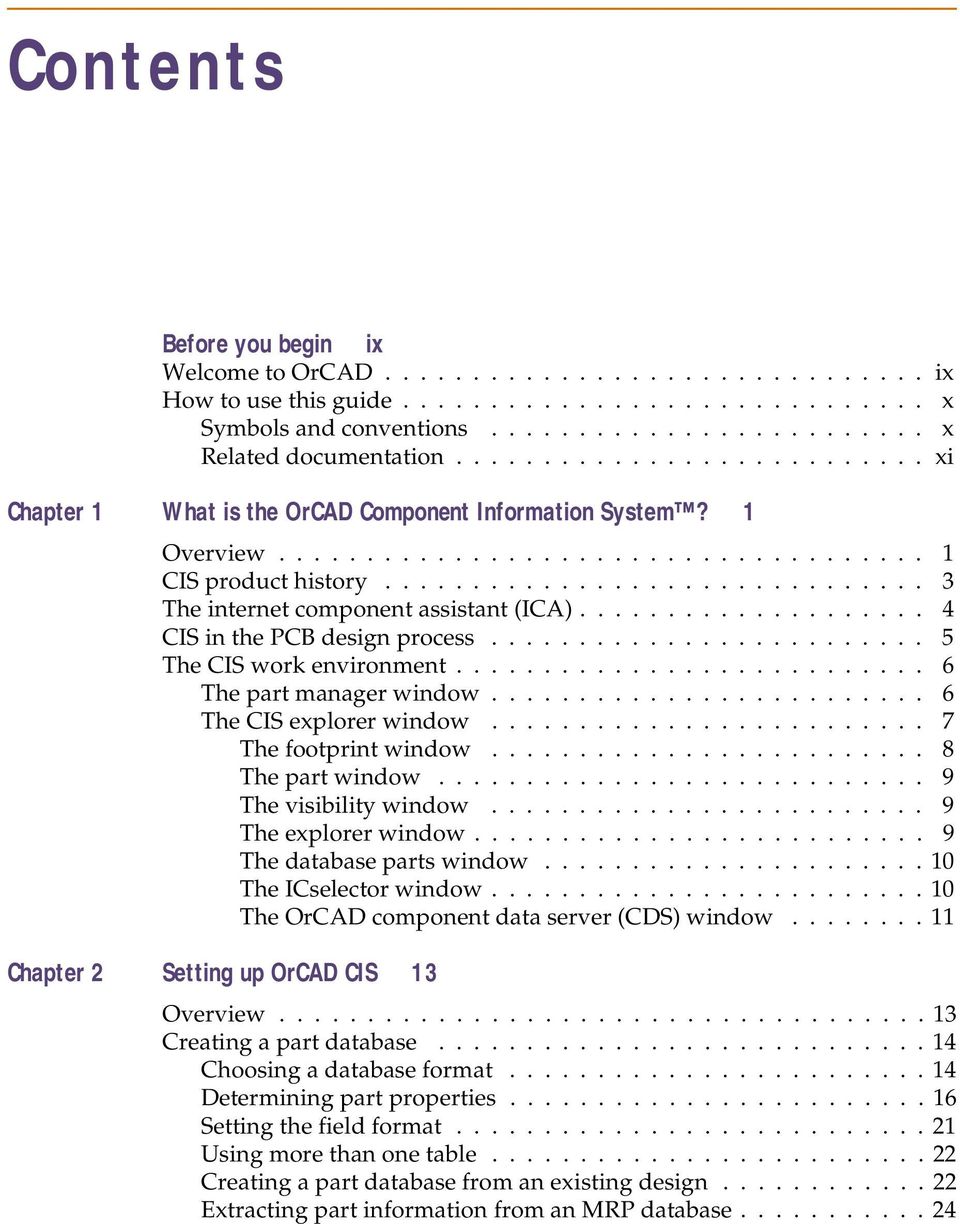
3 Contents Before you begin ix Welcome to OrCAD ix How to use this guide x Symbols and conventions x Related documentation xi Chapter 1 Chapter 2 What is the OrCAD Component Information System? 1 Overview CIS product history The internet component assistant (ICA) CIS in the PCB design process The CIS work environment The part manager window The CIS explorer window The footprint window The part window The visibility window The explorer window The database parts window The ICselector window The OrCAD component data server (CDS) window Setting up OrCAD CIS 13 Overview Creating a part database Choosing a database format Determining part properties Setting the field format Using more than one table Creating a part database from an existing design Extracting part information from an MRP database
4 Contents Setting up the ODBC data source Creating and setting up a configuration file Creating a configuration file and setting options Defining part reference associations Setting administrative preferences Setting ICA supplier preferences Saving the configuration file Setting up the ICA to access external part data Creating Crystal Reports templates Chapter 3 Working with OrCAD CIS 49 Overview Using the CIS interface Using the part manager window Using the CIS explorer window Using docking windows Using the database parts and OrCAD CDS windows Placing database parts on your schematic Using the explorer to locate a database part Using the query feature to locate database parts Creating and executing a query Placing a local database part on your schematic Browsing part properties Creating a new database part Deriving a new database part from the local part database Using the ICA to locate and create a new database part Learning about ICselector search techniques Using the ICA to locate a part Using the ICA to create and place a part Linking a placed part to a database part Copying part properties using the part manager Viewing and updating part status Opening the part manager Updating the part status for your design Saving the status report Creating design variants Creating design variant names Setting design variant properties Generating design variant reports Previewing or printing design variant schematic pages Creating reports iv

5 Contents Creating a standard CIS bill of materials Creating a report using a Crystal Reports template Glossary 101 Index 111 v

6 Contents vi

7 Tables Table 1 Required part properties Table 2 Optional part properties

8 Tables viii

9 Before you begin Welcome to OrCAD OrCAD offers a total solution for your core design tasks: schematic- and VHDL-based design entry; FPGA and CPLD design synthesis; digital, analog, and mixed-signal simulation; and printed circuit board layout. What's more, OrCAD's products are a suite of applications built around an engineer's design flow not just a collection of independently developed point tools. OrCAD Component Information System (CIS) is just one element in OrCAD's total solution design flow. OrCAD CIS is a part management system that is available as an option for use with OrCAD Capture. OrCAD CIS helps you manage part properties (including part information required at each step in the printed circuit board design process, from implementation through manufacturing) within your schematic designs.

10 Before you begin How to use this guide This guide is designed so you can quickly find the information you need to use OrCAD CIS. To help you learn and use CIS efficiently, this manual is separated into the following sections: What is the OrCAD Component Information System? on page -1 Setting up OrCAD CIS on page -13 Working with OrCAD CIS on page -49 Symbols and conventions OrCAD printed documentation uses a few special symbols and conventions. Notation Examples Description C+r Press C+r Means to hold down the C key while pressing r. A, f, o From the File menu, choose Open (A, f, o) Means that you have two options. You can use the mouse to choose the Open command from the File menu, or you can press each of the keys in parentheses in order: first A, then f, then o. Monospace font In the Part Name text box, type PARAM. Text that you type is shown in monospace font. In the example, you type the characters P, A, R, A, and M. UPPERCASE In Capture, open CLIPPERA.DSN. Path and filenames are shown in uppercase. In the example, you open the design file named CLIPPERA.DSN. Italics In Capture, save design_name.dsn. Information that you are to provide is shown in italics. In the example, you save the design with a name of your choice, but it must have an extension of.dsn. x

11 How to use this guide Related documentation In addition to this guide, you can find technical product information in the online Help, the online interactive tutorial, online books, OrCAD s technical web site, as well as other books. The table below describes the types of technical documentation provided with Capture CIS. This documentation component... Provides this... This guide OrCAD Component Information System User s Guide Online Help Online interactive tutorial Online OrCAD Component Information System User s Guide Online OrCAD Component Information System Quick Reference Card A comprehensive guide for understanding and using the features available in Capture CIS. Comprehensive information for understanding and using the features available in Capture CIS. You can access Help from the Help menu in Capture CIS, by choosing the Help button in a dialog box, or by pressing 1. Topics include: Explanations and instructions for common tasks. Descriptions of menu commands, dialog boxes, tools on the toolbar and tool palettes, and the status bar. Error messages and glossary terms. Reference information. Product support information. You can get context-sensitive help for a error message by placing your cursor in the error message line in the session log and pressing 1. A series of self-paced interactive lessons. You can practice what you ve learned by going through the tutorial s specially designed exercises that interact directly with Capture CIS. You can start the tutorial by choosing Learning Capture from the Help menu. An online, searchable version of this guide. Concise descriptions of the commands, shortcuts, and tools available in Capture CIS. xi

12 Before you begin This documentation component... Provides this... ODN OrCAD Design Network at An internet-based technical support solution. ODN provides a variety of options for receiving and accessing design and technical information. ODN provides: A Knowledge Base with thousands of answers to questions on topics ranging from schematic design entry and VHDL-based programmable logic design to printed circuit board layout methodologies. A Knowledge Exchange forum for you to exchange information, ideas, and dialog with OrCAD users and technical experts from around the world. A list of new postings appears each time you visit the Knowledge Exchange, for a quick update of what s new since your last visit. Tech Tips that deliver up-to-the-minute product information in your box. Stay informed about the latest advances, tips, and announcements on your OrCAD product. Online technical support via the Tech Support Connection. Use this service to submit technical support incidents online. Create submissions, upload files, track your incidents and add comments directly into OrCAD s support database. xii

13 What is the OrCAD Component Information System? 1 Overview OrCAD Component Information System (CIS) is a part management system that is available as an option for use with OrCAD Capture. OrCAD CIS helps you manage part properties (including part information required at each step in the printed circuit board design process, from implementation through manufacturing) within your schematic designs. CIS provides access to local (preferred parts database) and remote part databases that contain all relevant information for the parts used in your designs. This information may include company part numbers, part descriptions, PCB layout footprints, technical parameters (such as speeds, tolerances, and ratings), and purchasing information. With CIS, you can select a part from your preferred parts database or a remote database and place it directly in your schematic design. You can configure CIS to transfer any or all properties associated with that part to the schematic

14 Chapter 1 What is the OrCAD Component Information System? when you place the part. CIS maintains a link to the engineering database part so that you can retrieve other part properties at any time. Linking placed parts to your preferred parts database gives you access to complete part information during the schematic design process. If you need a part for your design that is not yet in the parts database, you can create the part in the design and add the part to your part database immediately or at a later time. You can also link a non-database part you ve created before to a database part at any time. Local Preferred Part Data UNC, URLs, path to browsable files OrCAD Layout Libraries Preferred Parts Database OrCAD Capture Libraries ODBC Combined or separate databases Corporate Database (MRP/ERP/PDM) OrCAD Capture OrCAD CIS Upload BOM to corporate system Reports Tab delimited ASCII Comma delimited ASCII MS Access database format External New Part Data ICselector Component Data Server (CDS) Internet ICA Seagate Crystal Reports OrCAD Layout Libraries OrCAD Capture Libraries Supplier Pricing & Availability URLs to Mfr. Spec Sheets To File To Exchange Folder To Lotus Notes Database To MS Mail 2

15 CIS product history OrCAD CIS Release 9 is the latest version of the OrCAD Enterprise CIS product offering. With the release of version 7.2 in April 1998, the OrCAD Enterprise CIS family was the evolution and final merging of two popular OrCAD CIS product lines Enterprise Edition and EDA-Bridge. Enterprise Edition evolved from the DDL product originally developed by an OrCAD Industry Partner called Q-Point. Q-Point was acquired by OrCAD in June OrCAD Enterprise Edition was packaged and shipped under the product names OrCAD Capture EE and OrCAD Express EE. Version 7.1 was the last release of both these products lines. They were replaced by OrCAD Enterprise CIS v7.2. EDA-Bridge was acquired as part of The T.E.A.M. Corporation merger in April The product was sold as a stand-alone option and was available until the release of OrCAD Capture v7.1 and OrCAD Express v7.1. Subsequently, EDA-bridge was replaced by OrCAD Enterprise CIS version 7.2. Enterprise CIS v7.2 merged features of EDA-Bridge and Enterprise Edition, and can be used with both OrCAD Capture v7.2 and OrCAD Express v7.2. With the Release 9.0, the name OrCAD Enterprise CIS has been shortened to OrCAD CIS. OrCAD Capture is available with CIS as a product called OrCAD Capture CIS. OrCAD Capture CIS has additional options that can be purchased, including digital simulation and programmable logic functionality from the OrCAD Express family and analog simulation from the OrCAD PSpice family. CIS product history As part of an effort by OrCAD to simplify packaging and licensing of the Design Desktop for Windows product line, the architecture of Express has changed with Release 9.0 to be a plug-in for Capture and Capture CIS. 3

16 Chapter 1 What is the OrCAD Component Information System? The internet component assistant (ICA) The CIS internet component assistant (ICA) allows you to access new components over the Internet by providing a web link to the ICselector database and to the OrCAD component data server (CDS). With a valid registration number, you can download component information to create temporary parts in your local preferred part database for immediate use in your schematic designs. Temporary parts can then be elevated through your enterprise approval process, assigned corporate part numbers, and accepted as preferred parts within the database. 4

17 CIS in the PCB design process To use CIS in your printed circuit board design flow, you or your system administrator must perform the following setup tasks. 1 Create the preferred part database. This involves creating and entering the part data appropriate for the database. 2 Set up the Open Database Connectivity (ODBC) data source to point to the preferred part database. 3 Configure the part management system. Each of these tasks is described in Chapter 2, Setting up OrCAD CIS. Once the setup is complete, you can use CIS in Capture to: Select parts with associated properties from the database and place them on schematic pages in your design. Check the status of placed parts and update placed part properties to reflect changes to the database. Generate bills of materials and other reports using both design and part database information. CIS in the PCB design process Create the part database Setup Set the ODBC data source Configure CIS Place database part Update part status Design Create reports 5

18 Chapter 1 What is the OrCAD Component Information System? For descriptions of how to use the CIS Windows interface, see Using the CIS interface on page 50. The CIS work environment The CIS work environment includes two specialized windows that allow you to manage your local part database and explore sources of part data the part manager and the CIS explorer. All the CIS functionality for these windows is integrated into Capture menus. The part manager window The part manager window summarizes the status of all the parts in your design. The part manager displays information for each part in your design including: Schematic page on which the part is placed Part reference designator Part value Part number Status of the placed part relative to the part database Database table that contains the placed part s associated database part Capture source library from which the part was placed Capture source package to which the part belongs 6
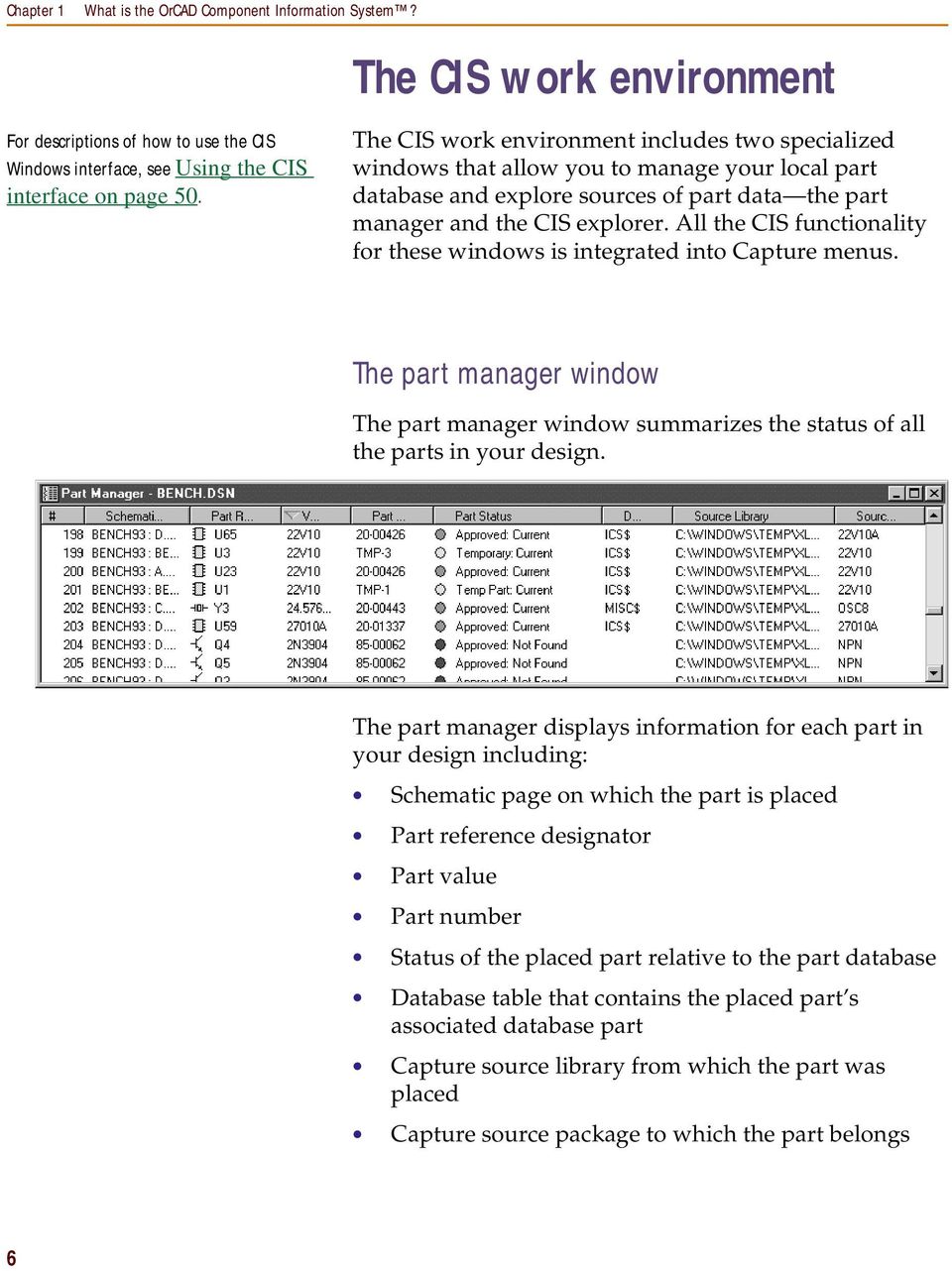
19 The CIS work environment The CIS explorer window The CIS explorer window allows you to search for and retrieve a variety of part information. The main window contains two tabbed windows the local part database and the internet component assistant (ICA). The following table lists the windows available for each tabbed window. 7

20 Chapter 1 What is the OrCAD Component Information System? This window... Footprint Part Visibility Explorer Database parts ICselector OrCAD component data server (CDS) Is available in this tabbed window... Both Both Both Local part database Local part database Internet component assistant (ICA) Internet component assistant (ICA) The CIS explorer window displays in one of two modes, depending on whether you are placing or linking a database part. The mode is displayed as part of the window title bar. The footprint window Note The footprint window is only available if you chose to view OrCAD Layout-generated footprint libraries during installation. The footprint window displays the Layout-generated PCB footprint associated with the currently selected database part. 8

21 The CIS work environment The part window The part window displays the Capture library part associated with the currently selected database part. If the part has a convert (such as a DeMorgan equivalent), you can select it. For a multiple-part package, you can select the specific part in the package. The visibility window The visibility window displays the default settings for which part properties are visible on your schematic page. You can use the visibility window to override these default settings. You can also set custom visibility settings for the current part selection. You can also use the visibility window to display a compact summary of the part properties and their contents for the part you have selected in the parts database or OrCAD component data server (CDS) window. You can see more of the properties and contents in this view because the visibility window displays them in rows rather than columns. The explorer window The explorer window allows you to search for parts using local data from your preferred part database. The window contains two tabbed sections explore and query. In the explore tab, you can search for parts using a hierarchical tree organized by part type. The query tab allows you to further filter your selection based on parametric or field data. 9
22 Chapter 1 What is the OrCAD Component Information System? The database parts window The database parts window displays the results of your part browsing and database queries. The ICselector window The ICselector window allows you to search the extensive EDTN part database over the Internet. Because this is a live link to the database, you always have access to the most recent part information. You search the database for parts using a hierarchical tree organized by part type and by querying for part properties. When you find the right part, you can place it directly onto your working schematic using the OrCAD component data server (CDS). 10
23 The CIS work environment The OrCAD component data server (CDS) window When you have obtained part records by querying and filtering the Aspect EDTN database, the parametric information for the records is displayed in the OrCAD component data server (CDS), including: Part manufacturers and manufacturer part numbers Part values OrCAD schematic parts and PCB footprints Supplier pricing and availability information URLs of manufacturer specification sheets CIS users have access to OrCAD schematic representations of parts and PCB footprints over the Internet. You can then transfer the following information: Part information displayed in the CDS as a temporary record to your local preferred part database OrCAD schematic representations of parts and PCB footprints to your local libraries 11
24 Chapter 1 What is the OrCAD Component Information System? 12
25 Setting up OrCAD CIS 2 Overview This chapter describes the three tasks necessary to set up OrCAD Component Information System (CIS), including: 1 Create a part database. See Creating a part database on page Set up the Open Database Connectivity (ODBC) data source name. See Setting up the ODBC data source on page Create a configuration file to enable CIS to access and use the part database. See Creating and setting up a configuration file on page 29. Also included are procedures for setting the up the CIS work environment. These are: Setting up the ICA to access external part data on page 45 Creating Crystal Reports templates on page 46
26 Chapter 2 Setting up OrCAD CIS Creating a part database You can create a database from an existing Capture design. For more information, see Creating a part database from an existing design on page You can also extract information for your part database from an MRP database. For more information, see Extracting part information from an MRP database on page The part database is the entity that contains all the relevant information for the parts you use in your designs. You can think of a part database as one or more tables, with each row in a table representing a part and each column representing a part property. Before you create your part database, you need to choose whether to use a database or spreadsheet application. Then, when you create your part database, you need to carefully setup its structure and organization, including: Part property assignments. See Determining part properties on page Field formats for properties. See Setting the field format on page Number of tables used in the database implementation. See Using more than one table on page Using ODBC, CIS interfaces directly with your ODBC compliant database or spreadsheet. This means you can use your preferred application to create and maintain your part database. Choosing a database format Note OrCAD developed, wrote, and tested CIS in the Access 97 and SQL Server 6.5 environment. Access offers high performance queries with databases of several thousand parts. If your database outgrows Access, moving to SQL Server is a seamless process. Using the upsize wizard, Access can easily transfer the database to SQL Server and still serve as an interface for maintaining data. To take full advantage of the speed and power of CIS, you may want to use a database application rather than a spreadsheet application. As a general rule, you should use a database application for databases with more than 1,000 parts. Database applications offer the following advantages over spreadsheets: Comprehensive data management features Better performance for part searching Form-based entry for entering part information Safeguard against duplicate part numbers 14
27 Creating a part database The disadvantages of spreadsheets and delimited text files include: Lack of structure. During data entry, spreadsheets allow you to configure every cell in a different format. This makes querying fields (columns) very difficult because CIS expects queried fields to be in a consistent format. Lack of ANSI SQL compliance. Because true databases are ANSI SQL compliant, their drivers do very little work in relaying SQL commands to connected data sources. In contrast, with non-sql compliant spreadsheets, the ODBC driver is responsible for translating the SQL commands into functions that the spreadsheet can understand. This results in a dramatic increase in the time your queries can be processed. Query time increases are even more dramatic with text files because the driver must search for and compile a matching list entirely on its own. An optimized, SQL-compliant database format is several times faster than a spreadsheet with more than 100 parts or a text file of over 20 parts. Lack of replication support. If you have users in more than one location accessing your database, you have either a single, central database or a replicated database. Replication is a method of storing a single database in more than one location. True databases support scheduled synchronization: they maintain data integrity by checking separate database transaction logs and replicating modifications on multiple systems. If you are using a spreadsheet or text program, you must check manually because your format does not support replication. Structured query language (SQL) is used in querying, updating, and managing relational databases. 15
28 Chapter 2 Setting up OrCAD CIS You may want to look at the sample part databases provided with CIS. Two samples are provided in the SAMPLES folder. The first part database, BENCH.MDB, is an Access 97 database. The second, BENCH.XLS, is an Excel spreadsheet. As you read this section, refer to these samples to get a better understanding of how to set up your part database. Example: You can name the Part Number property My Company Part Number. Example: you may call a property Tolerance in the database and Tol on the placed part. Determining part properties The first step in creating a part database is to determine the properties to include for each part. Typical properties in a part database include part number, part description, tolerance, rating, speed, timing parameters, PCB footprint, manufacturer, and cost. CIS supports an unlimited number of properties, so you can include as much information in your part database as you want. There are no restrictions on database table property names. Also, the names you use in the database can be different than the property names you assign to the placed parts. Database property types and placed-part property names are defined during database configuration. For more information, see Creating and setting up a configuration file on page Note Do not use the same property name more than once. For example, if you have two manufacturer columns in your database, call them Manufacturer 1 and Manufacturer 2. When you transfer a property, that property is included in the schematic as an attribute of the placed part. Normally, you transfer properties that are required by CIS (such as Part Number and Schematic Part), used in the design process (such as Value, Tolerance, and Rating), or needed for use by other software products (such as PCB Footprint). Properties that aren t transferred can still be included in a bill of materials report. Parts in your database must include all of the properties in Table 1. Any of the optional properties in Table 2 may also be added. Recommendations on whether to transfer properties to your design are included in both tables. Properties recommended for transfer to the design are either likely to be required for netlisting or are generally needed on printouts of the design. 16
29 Creating a part database Table 1 Required part properties Property Part Number Part Type Description Required to identify the part in association with the CIS Part_Number property type. This property is required by the part manager and the bill of materials report. CIS lets you enter more than one database part with the same number in the database. However, you should use a unique part number for each part and have no duplicate part entries in your database. Identifies the part type. The Part Database Explorer uses this property to define the part database folder hierarchy. Use this property to facilitate part searches. Typical contents are resistor, resistor\fixed, capacitor, capacitor\electrolytic, IC, IC\Memory\SRAM, connector, and so on. The levels of the hierarchy are defined using the backslash (\) character (or any character you define in the configuration). You can define any number of levels in the hierarchy. This property is also used by the Part Reference Associations option. (See Defining part reference associations on page 35.) This property is case-sensitive. Make sure you use uppercase-lowercase conventions consistently when entering values for this property. Transfer to design? Required No 17
30 Chapter 2 Setting up OrCAD CIS Property Schematic Part (Symbol) Description The part name. This property is required to use the Place Database Part command. Only the part name is necessary if the part is stored in the same directory as any part library that is configured in Capture. (See the OrCAD Capture User s Guide for more information about configuring part libraries.) However, to make sure that you don t accidentally place an identically named part, you should include the library name, a backslash (\), and then the part name. Examples include: DEVICE\CAP DEVICE\DIODE ANALOG\CMP01 In addition, you can use the explicit path so CIS can locate an unconfigured library. For example: C:\MYLIB\DEVICE\CAP You can also assign multiple schematic part names to a single part. Use the same format as above for each name and separate each one with a comma. For example: DEVICE\CAPACITOR NON-TOL, DEVICE\CAP NT, BENCH\SMALL CAP Then, when you update your design s part status, CIS can approve and make current a schematic part which has several acceptable names. Also, if a database part has several different valid schematic parts, you will be able to choose any one of them when you are placing parts from the parts database or the OrCAD component data server (CDS). All the configured schematic parts for the database part will be available from a drop-down list under the Schematic Part property name. CIS locates the Capture library using the following set of prioritized rules: 1 Search the library at the explicit path, if provided. 2 Search the first library listed in CAPTURE.INI that has a matching library filename. 3 Search all directories that contain configured libraries. 4 If no libraries are included specifically in your Capture design, CIS searches the ORCAD\CAPTURE\LIBRARY directory. Transfer to design? Automatic 18
31 Creating a part database Property Value Description The part value. Examples are 1.2K, 10.0uF, and 74ALS374. CIS supports the use of common magnitude identifiers (such as K and uf). The database query feature (available in the part database explorer) uses intelligent unit conversion to interpret common magnitude identifiers encountered in part definitions, since entries in a part database are often inconsistent (for example, the Value for a 2.7K resistor might be in the database as 2.7K, 2,700, 2.70K, 2.700K, , M, and so on). Unit suffixes (such as F for farads or H for henries) are ignored in translation. The magnitude identifiers supported in CIS are shown below. Identifier Represents Magnitude f femto p pico n nano 10-9 u micro 10-6 m milli 10-3 K kilo 10 3 M mega 10 6 G giga 10 9 T tera Transfer to design? Required 19
32 Chapter 2 Setting up OrCAD CIS Table 2 Optional part properties Property Description Transfer to design? Availability Number of the parts in stock at your company. Not recommended Data Sheet The name of the detailed datasheet for this part. Set the Browsable check box in the configuration for CIS to automatically launch the appropriate browser for this property. Examples include: 74ALS374.PDF, and RES1K1/4W.DOC. You can browse any format you want. CIS uses the application assigned to that file extension in your Windows registry. (Extension assignments are managed in the Windows Explorer. See your MS Windows documentation for more information.) For example, a.doc entry might cause CIS to launch Microsoft Word, and a URL entry might cause it to launch your default web browser. Note CIS uses the PATH environment variable and the current working directory to find the specified document. Not recommended Description A brief description of the part. Not recommended Distributor Name of part distributor. Not recommended Distributor Part Number Part number used to order from the distributor. Not recommended Manufacturer Name of part manufacturer. Not recommended Manufacturer Part Number Part number used to order from the manufacturer. Not recommended 20
33 Creating a part database Property PCB Footprint Price Rating Description The PCB footprint name (from the footprint library) assigned to a part. You can assign multiple PCB footprints to a single part by entering them in the part s footprint field in your part database and separating each footprint name with a comma. Then, when you update your design s part status, CIS can approve and make current a schematic part which has several acceptable footprint names. Also, if a database part has several different valid PCB footprints, you will be able to choose any one of them when you are placing parts from the parts database or the OrCAD component data server (CDS). All the configured PCB footprints for the database part will be available from a drop-down list under the PCB Footprint property name. Part price. Use this information when selecting parts to design for cost. Include this property in reports to get a cost roll-up of your design. The maximum rating for the part (for example, maximum voltage or power dissipation). Transfer to design? Recommended Not recommended Optional Tolerance The percent tolerance specified for the part. Optional Voltage The voltage requirement of the part. Optional Setting the field format CIS can work with database text and number format fields (known as the cell format in spreadsheets). As a general rule, set each database field (that is, each table column) to text format. CIS converts other database field formats, such as float, to text format when properties are transferred to placed parts. 21
34 Chapter 2 Setting up OrCAD CIS Using more than one table CIS can reference more than one table or worksheet in your part database. For example, you can group your parts into several tables according to type. That is, you can place resistors in one table, ICs in another, capacitors in another, and the remaining parts in a fourth table. When you re viewing database parts with CIS, each table has a unique view. You can arrange the column settings for each table independently, allowing you to view different properties for each. Creating a part database from an existing design You can obtain a wizard from the OrCAD Design Network (ODN) that automates this process. The wizard also automatically derives schematic part and source library information for the placed parts in your Capture schematic. If you use the manual procedure detailed here, you will have to manually reference your placed parts to your libraries. To download the CIS wizard, visit the OrCAD website and log in to ODN at You can also create a part database by extracting part properties from an existing Capture design using the CIS Bill of Materials command. Tip If your designs are created in another schematic capture program that creates bills of materials for part properties, you can still create a part database from an existing design. Follow the instructions supplied with the program to create the appropriate bill of materials file from your design. Then, use the bill of materials file to create a part database based on that design. 22
35 Creating a part database Consider the example in the following illustration. The Standard Bill of Materials dialog box lists a typical set of properties to extract from the design. In the Output Format list, CIS lists a number of properties that will be extracted to the bill of materials. You can add to this list by selecting properties from the Select Properties list and clicking the Add button. You can remove properties from the Output Format list by selecting them and clicking the Remove button. When you click OK in the Standard Bill of Materials dialog box, CIS creates a file with the property information for all the parts in the design. You can directly import this file into your database. 23
36 Chapter 2 Setting up OrCAD CIS Note Your database should have a unique part number for each part and no duplicate part entries. Although some database applications will not import more than one occurrence of a keyed property, you may need to eliminate duplicate part entries manually. To do this, sort the database by part number, then delete duplicate entries using your database or spreadsheet program. Extracting part information from an MRP database You can also extract information from an existing manufacturing resource planning (MRP) database, to create a part database. Save the MRP database as an ASCII file, then use that file as your part database file or as a source for a true part database file (for example, an MS Access format file). You may need to enhance the information in an MRP database, since it generally will not include everything required for schematic design. However, an MRP database usually contains a complete list of your company s parts, part numbers, part descriptions, costs, quantities in stock, lead times, manufacturers, and alternate manufacturers. 24
37 Creating a part database Often, the data in an MRP database exists in a format that does not lend itself to ease of use. For example, the part value may be merged with the description, such as: RES 1K 5% 1/4W This makes searching for parts more difficult. If you can, split this information out in the MRP database into separate database properties, such as Part Type, Value, Tolerance, and Rating. You can also contact the OrCAD Enterprise Services group for assistance in converting your data into a more convenient format. To take advantage of updated information in an MRP database, you need to set up a means of extracting MRP data on a regular basis and using it to update your part database. That way, your part database will include information that changes frequently, such as quantity in stock and lead time. 25
38 Chapter 2 Setting up OrCAD CIS Setting up the ODBC data source You must define the data source on each user s system. When you do so, use the same data source name. This allows users to share the same configuration file. Note If your workgroup is sharing a configuration file, make sure to write-protect the file. Before you can set the CIS configuration, you must define the open database connectivity (ODBC) data source for your database. CIS interfaces to your part database using a defined ODBC data source name. A data source consists of a database filename and an associated ODBC driver with which to access it. If you are setting up a client-server database, the data source also references the database server. You define the data source name, assign the database file name, and specify the ODBC driver using the 32-bit ODBC Windows control panel. To set the data source for the local database 1 From the Windows Settings menu, choose Control Panel. 2 Double-click on the ODBC icon. Depending on your system configuration, Windows displays the ODBC Data Source Administrator or a Data Sources dialog box. Note If you do not see an icon for 32-bit ODBC, run the Capture CIS installation program to install ODBC. 26
39 Setting up the ODBC data source 3 Click the ODBC Drivers tab and make sure the driver appropriate to your database or spreadsheet is installed on your system. If the driver for your application is not present, you must install it. Check the CIS installation disk or contact the database or spreadsheet program supplier. 4 Click the User DSN tab then choose the Add button. Windows displays the Create New Data Source dialog box. If you are using Windows NT, you should click the System DSN tab to create new data sources. If you do not use the System DSN tab, users with different logins will not be able to use the ODBC source. 27
40 Chapter 2 Setting up OrCAD CIS 5 Choose the appropriate driver for your program (Microsoft Access, in this example), then click the Finish button. See Setting administrative preferences on page 39 for more information on temporary parts. 6 Assign a name for the data source. If desired, enter a description for the data source name. Note Step 7 may be different depending on the type of program you used to create your database. 7 Under Database, click the Select button, and locate the database. 8 Click the Options button, and clear the Read Only check box so users can create new parts and add them to the database using CIS. 9 Click OK to set the data source. 28
41 Creating and setting up a configuration file CIS requires a configuration (.DBC) file to make use of your part database. The configuration file: Identifies the ODBC data source to use as the part database and specifies the tables to use within that database. Identifies the part properties that are transferred to your design when you place or link a database part. Sets the visibility for each of the transferred properties. Contains the part type associations. Note If you use a CIS v7.2 configuration file with CIS Release 9, the file will be updated to support the new features of this release. After CIS updates the file, though, you cannot use it again with CIS v7.2. If you are using a configuration file from before CIS v7.2, you must recreate the file because the configuration file format was changed for CIS v7.2. Creating and setting up a configuration file Keep the configuration (.DBC) file in a read-only directory that is accessible to all CIS users. You should make the directory read-only to prevent users from inadvertently changing the configuration. Creating a configuration file and setting options When you create a configuration file, you are creating an interface between CIS and your database using your defined ODBC data source name. You need to set the options for the file so that CIS knows how to handle your database table part properties. If you haven t set up an ODBC data source for your database, see Setting up the ODBC data source on page To create a configuration file and set options 1 Open a new or existing schematic design in Capture. 29
42 Chapter 2 Setting up OrCAD CIS 2 From the project manager s Options menu, choose CIS Configuration. CIS displays the CIS Configuration File dialog box. 3 Click the New button. CIS displays the Configure Database dialog box. 30
43 Creating and setting up a configuration file 4 Click the Browse button. CIS displays the Browse Data Source dialog box. 5 Select the data source name you defined for your ODBC driver, then click OK. The Configure Database dialog box lists the tables found in your data source. 31
44 Chapter 2 Setting up OrCAD CIS 6 In the Tables list, click in the check box for the table containing the parts you want to configure. When you select a table, the Configuration area lists the properties it contains. Each row represents a part property, and each property has the following characteristics: Table Property Name. This is the name of the property as it is defined in the part database. Table Property Type. This is the data type for the property. Most properties are type Text, but there may be other data types. Property Type. The Property Type determines how CIS interprets the property. Your database must include a property of type Part_Number in every table. 32
45 Creating and setting up a configuration file Set the following property types: The Part_Type type for the database property that defines the part type. (This defines the field for folder view in CIS explorer.) The Schematic_Part type for the database property that contains the schematic part (symbol) name. The PCB_Footprint type for the database property that contains your Layout footprint name. If you want the database to include footprints not generated by OrCAD Layout, set the property type to Normal. This prevents the footprint viewer from trying to interpret them. folder view in CIS explorer Transfer To Design. Setting this characteristic (by selecting the appropriate check box) causes CIS to transfer the property along with the part when the part is placed or linked to a schematic part. Caution CIS will not work unless your transfer at least the Part_Number and Value properties. OrCAD Property Name. This defines the name of the property when it is transferred to the placed part. By default, it uses the name of the property as it appears in the database. Note that the OrCAD Property Name applies only to properties for which you have enabled the Transfer to Design characteristic. ICA Property Name. This maps property names on new parts created with the internet component assistant (ICA) to corresponding database property names. Visible. This sets the default visibility of the property when it is copied to the placed part. There are three visibility choices: Visible. CIS displays the property with the part on the schematic page. Invisible. CIS does not display the property with the part on the schematic page. Example: If the property name in the database is Component Tolerance and you want to call it Tolerance on the placed part, type Tolerance or choose Tolerance from the drop-down list. Example: You can map the ICA property name Mfr to your database property name Manufacturer. 33
46 Chapter 2 Setting up OrCAD CIS For more information about placing and linking database parts, see Placing database parts on your schematic on page 3-57 and Linking a placed part to a database part on page For more information about linking database parts, see Linking a placed part to a database part on page No Change. CIS does not modify the property visibility. If the property does not exist, it is set to invisible. You can override the default visibility for specific parts when you place or link database parts. Cells that you cannot change are shown with a light gray background in this column. Key. This sets the property as a key during the initial part search. The key is used when you are linking a database part to a previously placed part. Normally, you set only the Value property as a key so that when you want to link a part, CIS searches the part database for parts with a specific value. If you don t have a Value property in your database, do not set a key. Browsable. This sets browse capability for the property. It allows you to put references to datasheets, drawings, and documents in your part database. For example, you can reference Adobe Acrobat (.PDF) files, Microsoft Word (.DOC) files, and even worldwide web addresses (URLs). You can then view these items online in CIS when browsing the part database. For more information about linking database parts, see Linking a placed part to a database part on page You can browse any format you want. CIS uses the application assigned to that file extension in your Windows registry. (Extension assignments are managed in the Windows Explorer.) For example, a.doc entry might cause CIS to launch Microsoft Word, and a URL entry might cause it to launch your default web browser. Note CIS uses the PATH environment variable and the current working directory to find the specified document. 7 (Optional) Type the part reference prefixes in the Allowed Part Reference Prefixes text box. This is useful when your database consists of several part tables that are organized by device type (for example, capacitors in one table, resistors in another, and so on). When you are linking database parts to placed parts, CIS uses allowed part reference prefixes 34
47 Creating and setting up a configuration file to limit your search to the appropriate tables. The result is that your search takes less time. For example, if a table contains only capacitors, you could enter C as the allowed part reference prefix. Then, when you choose the Link Database Part command, CIS searches that table only when the placed part you are linking has a part reference prefix of C. Note Leave this box blank if you want the table to be searched regardless of the part reference prefix. 8 Repeat steps 6 and 7 for each table in the database. 9 Click OK or choose another tab to continue configuring your database. Defining part reference associations Part reference associations are used to improve the speed and accuracy of the search for database parts to link to placed parts. You create associations between a particular part type and the prefixes in the part database for that part type. For example, you can create a part reference association for resistors such that all resistors in the part database use the R prefix. Note Defining part reference associations only improves part search speeds for true databases (for example, Microsoft Access) there is no speed improvement from setting up associations if you are using a spreadsheet or a text file for your database. Once you ve defined part reference associations for your database, when you choose the Link Database Part command, CIS displays database parts of the appropriate type. Without defined part reference associations, CIS displays all parts in the database that match the keyed property value, regardless of the part type. By defining an appropriate reference association, you can limit the number of parts that CIS displays. You must create a configuration file for your database before you can define its part reference associations. If you have not already created a configuration file for your database, see Creating a configuration file and setting options on page Example: If you select an inductor, L1, on the schematic page with a value of 100uH, then choose the Link Database Part command, CIS displays all parts in the database having a value of 100 x This may include capacitors, inductors, or other parts with a similar value. By defining a reference association between inductors and the L prefix, you can limit the parts that CIS displays to inductors only. 35
48 Chapter 2 Setting up OrCAD CIS Example: An association between the part reference prefix C and the part type Capacitor applies to part types of Capacitor, Capacitor\Electrolytic, and Capacitor\Ceramic\Fixed. Note that a part reference prefix associated with the part type Capacitor\Ceramic does not apply to part types of Capacitor or Capacitor\Electrolytic. Note Defining part reference associations is optional. You can define associations later if you need to improve the search performance during database part linking. When you define part reference associations for your part database, keep the following points in mind: Part reference associations apply to all database tables. The Part Type Property Contents value in the dialog box is case-sensitive. You can associate one prefix with several different part types. An association applies to its level in the part type hierarchy and all lower levels. A part reference prefix without a defined part type association can be matched to any part type in the database. If a particular part in the database does not have its Part Type property contents defined, that part will be matched only to part reference prefixes with no defined part type associations. To define part reference associations You can add icons for custom part references that will automatically display in the Part Reference column of the part manager window. Add your custom icons to the standard icons used for the Part Reference column located in the directory: ORCAD\CAPTURE\VENDOR Each icon s filename corresponds to a part reference prefix (for example, the icon for the part reference prefix R is stored in R.BMP). Caution You can use a bitmap editor (such as Microsoft Paint) to modify the bitmaps, but be careful not to change the image size. 1 In your local preferred parts database, make sure that the Part Type property field is indexed. 2 If you are not already in the Configure Database dialog box, do the following: a Open a new or existing schematic design in Capture. 36
49 Creating and setting up a configuration file b From the project manager s Options menu, choose CIS Configuration. CIS displays the CIS Configuration File dialog box. c d If necessary, click Browse to locate the database configuration file you want to setup. Click Setup. CIS displays the Configure Database dialog box. 37
50 Chapter 2 Setting up OrCAD CIS 3 In the Configure Database dialog box, choose the Part Reference Associations tab. 4 Enter a part type in the Part Type Property Contents column and a corresponding part reference prefix (or set of prefixes) for that part type in the Applicable Part Reference Prefixes column. Separate prefix entries with commas. Note Part prefixes need not be unique to a particular part type. That is, you can make an association between one prefix and several different part types. 5 Click OK or choose another tab to continue configuring your database. 38
51 Creating and setting up a configuration file Setting administrative preferences Administrative preferences allow you to customize some CIS features for your work environment. To set administrative preferences 1 If you are not already in the Configure Database dialog box, do the following: a b Open a new or existing schematic design in Capture. From the project manager s Options menu, choose CIS Configuration. CIS displays the CIS Configuration File dialog box. c d If necessary, click Browse to locate the database configuration file you want to setup. Click Setup. CIS displays the Configure Database dialog box. 39
52 Chapter 2 Setting up OrCAD CIS 2 In the Configure Database dialog box, choose the Administrative Preferences tab. If you want a database part to work with two or more different layout footprints, you can enter multiple PCB footprint names in your part database. For more information, see the PCB Footprint property entry in Table 2 on page 21. Example: The database could have part types Capacitor\Electrolytic and Capacitor\Ceramic. Example: Speed Grade does not apply to resistors. 3 Select the Allow Duplicate Part Numbers check box to allow the same part number to appear more than once in the database. 4 In the Part Type Delimiter text box, type the character that indicates a hierarchical level within a path in the database. Normally, the delimiter is a backslash (\) character. 5 Check the Transfer Blank Properties box to create a property on the placed part even if the database part property does not have a specific value. This is useful if all your database parts are in a single table since, in that case, you will have properties in the table which are not relevant to certain types of parts. 40
53 Creating and setting up a configuration file 6 Select the Assign Temporary Part Numbers Automatically check box so that CIS will create and track temporary part numbers for you. That way when you create a new part, CIS automatically assigns a temporary part number to that part and enters the part number into the part record in the database as well as in a special table named TMPPRTS. Caution CIS automatically creates the TMPPRTS table. Do not remove, rename, or modify the structure of this table or temporary part number tracking will not operate properly. Also, never remove temporary part records, even after you have assigned them approved part numbers. If you do, designs that have not yet been updated with the new part numbers will have to be updated manually. 7 In the Temporary Part Number Prefix text box, enter the prefix to use for temporary part numbers. CIS automatically increments the temporary part number each time you create a new part. The temporary part number is then appended to this supplied prefix. 8 In the Part Not Present Display Value text box, enter the text description that you want CIS to use for variant parts set to Not Present. The property is displayed in the following locations: Part Number and Value fields in the part manager Design variant columns in variant reports Variant parts on schematic page previews and printouts. For more information, see Previewing or printing design variant schematic pages on page Click OK or choose another tab to continue configuring your database. To promote a temporary part to an approved part, do the following: 1 Using your database application, enter the approved part number in the TMPPRTS table next to the corresponding temporary part number. 2 Replace the temporary part number with the approved part number in the part table. CIS automatically monitors the TMPPRTS table and notifies you if a temporary part in the design has been promoted to an approved part. If your workgroup is using a shared, read-only database configuration file, all users must use the same temporary part prefix. The Part Not Present Display Value does not display in Capture s schematic page editor. This property also cannot be repositioned or edited in the schematic page editor. For this reason, you will have to print preview or print a schematic page to make sure that the value you assign the property does not overlap another part or property display. Because a long value is more likely to overlap a display, you should use a fairly short text equivalent for the default Not Present value. 41
54 Chapter 2 Setting up OrCAD CIS Setting ICA supplier preferences ICA supplier preferences allow you to specify which component suppliers you wish CIS to search for part pricing and availability. To set ICA supplier preferences 1 If you are not already in the Configure Database dialog box, do the following: a b Open a new or existing schematic design in Capture. From the project manager s Options menu, choose CIS Configuration. CIS displays the CIS Configuration File dialog box. c d If necessary, click Browse to locate the database configuration file you want to setup. Click Setup. CIS displays the Configure Database dialog box. 42
55 Creating and setting up a configuration file 2 In the Configure Database dialog box, choose the ICA Supplier Preferences tab. 3 In the list on the left, select the name of a supplier to be added to the list on the right, and click the Add button. or In the list on the right, select the name of a supplier to remove, and click the Remove button. 4 In the list on the right, select a supplier name, and use the arrow buttons to move the supplier higher or lower in the order of preference. Note The internet component assistant only shows information for the first supplier that has the part you want, in the order of the preference you set here. 5 Click OK or choose another tab to continue configuring your database. You should select as many part distributors as possible in case your preferred distributor does not carry a part you need. 43
56 Chapter 2 Setting up OrCAD CIS Saving the configuration file 1 (Optional) In the CIS Configuration File dialog box, choose Save As to save the configuration for future use. 2 Choose OK to set the configuration for the current session and close the CIS Configuration File dialog box. 44
57 Setting up the ICA to access external part data Setting up the ICA to access external part data Note Internet Explorer 4 must be installed on your system for the internet component assistant (ICA) to run. Setup of the ICA is handled during the Capture CIS installation process. CIS uses the OrCAD product registration number to control your access to the internet component assistant web databases. You enter the registration number when you install Capture CIS. The first time you use the ICA Query tab, the ICselector requests some general user information. If you need assistance accessing the ICA, OrCAD at [email protected]. 45
58 Chapter 2 Setting up OrCAD CIS Creating Crystal Reports templates Crystal Reports is a widely-used report design software produced by Seagate Technology, Inc. If you want to make a standard CIS bill of materials template, see Creating a standard CIS bill of materials on page You only need Crystal Reports software to create templates, not to use them. For this reason, you only need to buy one copy of the software for your entire workgroup. You should use a schematic design that has all the non-database part properties defined that you want to use when designing your Crystal Reports templates. You can use Crystal Reports in conjunction with CIS to make customized report templates with more advanced features than the standard CIS bill of materials, including precision formatting and formulas that total, filter, and analyze data for highly specific results. When you create customized Crystal Reports templates, you can use all of the part properties included in your preferred parts database and your individual design projects. Note You must have Crystal Reports Designer installed on your system with CIS to create Crystal Reports templates. If you do not own a copy of Crystal Reports Version 6 software, visit OrCAD s website at for reseller information. Once you have created Crystal Reports templates, any CIS user with access to them can generate, preview, print, and export reports with their design s database part information from within CIS. They will not need to have copies of Crystal Reports installed locally on their workstations to use these templates. These are the main steps you will follow to create your Crystal Reports templates: 1 Create an Access database bill of materials (.MDB) file using a standard CIS bill of materials. 2 Create report template (.RPT) files in Crystal Reports using the Access database file. 3 Store the Crystal Reports template files where CIS can use them. To create an Access database (.MDB) file for use by Crystal Reports 1 Open a new or existing schematic design in Capture. 2 From the project manager s Reports menu, point to CIS Bill of Materials and choose Standard. CIS displays the Standard Bill of Materials dialog box. 46
59 Creating Crystal Reports templates 3 In the Template Name text box, type in a name for the report (for example, Report for Crystal Reports template). 4 In the Select Properties list on the left, double-click each of the part properties until all of them are moved to the Output Format list on the right. 5 Click OK. The report may take several minutes to generate. 6 From the File menu, choose Save As. CIS displays the Save As dialog box. 7 In the Save As Type list, select Access format (*.MDB). 8 Specify the file name and location and click OK. Do not try to be selective about the part properties you include at this time. Generating this report with all the properties in your database allows you to create a single database file with all the headings you might want to use to design your templates in Crystal Reports. This way, you will not have to repeat this procedure again unless the part properties used in your database change. 47
60 Chapter 2 Setting up OrCAD CIS To create a Crystal Reports template Note You must have Crystal Reports Designer installed on your system with CIS to create Crystal Reports templates. If you do not own a copy of Crystal Reports Version 6 software, visit OrCAD s website at for reseller information. 1 Using Crystal Report Designer, create a custom report using the Access database bill of materials (.MDB) file as your data file. To avoid having to browse for your template, store the file in the same directory as your database configuration (.DBC) file. The template will automatically appear in the Crystal Reports Bill of Materials dialog box. You only need Crystal Reports software to create templates, not to use them. For this reason, you only need to buy one copy of the software for your entire workgroup. To store a template file for use by CIS 1 Store your Crystal Reports template (.RPT) file where all users in your workgroup have access to it. 48
61 Working with OrCAD CIS 3 Overview This chapter describes the various procedures you use when working with the OrCAD Component Information System (CIS), including the following: Using the CIS interface on page 50 Placing database parts on your schematic on page 57 Browsing part properties on page 62 Creating a new database part on page 63 Linking a placed part to a database part on page 73 Copying part properties using the part manager on page 76 Viewing and updating part status on page 78 Creating design variants on page 83 Creating reports on page 92
62 Chapter 3 Working with OrCAD CIS For descriptions of the functions of the windows in the CIS interface, see The CIS work environment on page 1-6. Using the CIS interface The CIS user interface includes standard Windows interface functionality along with a few additional features to make your work environment easy to use. You can also customize the layout of CIS windows for each of your Capture projects. The main CIS interface is comprised of the part manager and CIS explorer windows. Additional CIS menu commands are interspersed throughout the menus in Capture. Using the part manager window To open the part manager window, do the following: 1 From the project manager s Tools menu, point to Part Manager and choose Open. For information about how to use the part database management features of the part manager, see Viewing and updating part status on page You can adjust the work environment for the part manager in the following ways: Sort the part manager data by any one of the data columns. Adjust the part manager display by changing data column width and splitting the window into panes. Display the toolbar. 50
63 Using the CIS interface To sort information in the part manager 1 Click the heading of the column you want to sort by. To reverse the sort order, click the same column heading again. column heading column heading border The column by which the data in the part manager is currently sorted is indicated by a triangle icon. If the triangle points upward, the data is sorted in ascending order. If it points downward, the data is sorted in descending order. To adjust the part manager display 1 To adjust the width of a column, select the right border of the column heading and drag it to the left or right. 2 To split the part manager into panes, choose Split from the part manager s Window menu. To display the part manager toolbar 1 Move or dock the toolbar as desired. 2 To display the name of the button command, point at the button briefly. 3 To display the toolbar, choose Toolbar from part manager s View menu. The tasks that you use these tools to perform are described later in this section. 51
64 Chapter 3 Working with OrCAD CIS 4 To hide the toolbar, click the hide button in the top corner of the toolbar. Using the CIS explorer window CIS displays the CIS explorer when you choose Place Database Part or Link Database Part from a schematic page in Capture s schematic page editor. Information about how to use the database part features of the CIS explorer is covered in the following sections of this chapter. The CIS explorer contains two tabbed windows the Local Part Database and the Internet Component Assistant (ICA). You can navigate between these windows by clicking either one of the tabs at the bottom of the CIS explorer. Each window consists of a set of docking windows that can be redisplayed as floating windows or hidden. Both windows also contain a non-docking part selection window that cannot be redisplayed as floating or hidden (the database parts and OrCAD component data server windows). 52
65 Using the CIS interface Using docking windows Docking windows can be positioned and sized independently like standard windows. But, they allow you added control over your workspace in relation to the other windows inside the CIS explorer. Docking windows have these unique features: Docking to the main window Expanding or contracting relative to other windows Floating over other docking windows Depending on the function of the window, you can also choose to show or hide some docking windows. docking window CIS retains the size, position, and state of the windows between Capture sessions. To dock a window in the CIS explorer 1 Drag the window by the double bar over another border of the CIS explorer. The other windows automatically adjust to allow the window you are moving to dock on that border. hide button expand/contract arrow double bar To expand or contract a window relative to other windows 1 Click the arrow above the window s double bar to expand or contract the window in the direction of the arrow. The bordering window automatically expands or contracts to fit the new window size. Since the expand/contract feature only functions horizontally, the arrow is dimmed if the window is not bordered by another window on the left or right. 53
66 Chapter 3 Working with OrCAD CIS To change a docked window to a floating window 1 Double-click in the window border. The docking window redisplays with a title bar instead of the double bar. window border To dock a floating window 1 Double-click the window title bar to return the window to its previous docked location, or drag the window by the title bar to a different docking border. To position a floating window over a dock (without docking it) 1 Press and hold down C and drag the window by the title bar. To show or hide a window 1 To show a window, choose the window name (for example, Visibility) from the View menu. 2 To hide a window, click the hide button in the top corner of the window, or choose the window name from the View menu. 54
67 Using the CIS interface Using the database parts and OrCAD CDS windows database parts window OrCAD component data server (CDS) window You can use the spreadsheet format of the database parts and OrCAD component data server (CDS) windows to do the following: Sort rows using column values Adjust column widths Change the order of the columns Note For descriptions of the database parts window and the OrCAD component data server (CDS), see The CIS explorer window on page 1-7. The database parts and OrCAD component data server (CDS) windows are part of the main CIS explorer window you cannot hide or dock them. This is so that they will be present at all times to place and link database parts. Once you set up the columns, CIS saves the new settings for your next session. 55
68 Chapter 3 Working with OrCAD CIS The column by which the data is currently sorted is indicated by a triangle icon. If the triangle points upward, the data is sorted in ascending order. If it points downward, the data is sorted in descending order. To sort rows using column values 1 Click a column heading to select the column, then click the column heading again to sort by its values. Click the same column heading again to reverse the sort order. column heading column heading border To adjust column widths 1 Select the right border of a column heading and drag it to the left or right. To change the order of the columns 1 Click on a column heading to highlight it. 2 Drag the column heading to the left or right until the vertical red line is in the correct location. 56
69 Placing database parts on your schematic This section describes how to do the following: Locate a part in your parts database. Place a database part on a schematic page. When you place a database part, CIS includes all database part properties to be transferred. Note The Place Database Part command will not work unless you have entered the schematic part name in your database and have set the Schematic_Part property type in the configuration. Placing database parts on your schematic For information about locating and placing parts from the internet component assistant (ICA), see Using the ICA to locate and create a new database part on page Using the explorer to locate a database part You can use the explorer to locate a particular part in your database. To locate a database part with the explorer 1 From the schematic page editor s Place menu, choose Database Part. CIS displays the explorer window. 2 In the explorer window, choose the Explore tab. The drum icon (labeled Benchacc in this example) represents the part database. 3 Choose or double-click the drum icon, to expand the database into the configured part tables. Similarly, choose on the table to expand the tree to display the first-level part type folders. 57
70 Chapter 3 Working with OrCAD CIS 4 Locate the part you want to place. When you open a part type folder at any given level, the database parts at that level are displayed in the database parts window. Note CIS uses the part type property contents from your part database to determine the folder hierarchy. For a description of how to define your part database hierarchy, see Creating a part database on page 14. Using the query feature to locate database parts You can also use the query feature in the CIS explorer window to locate all parts in the database that fit a set of criteria. This is useful when you want to view all the available parts that match a set of attributes. To use the query feature, you must first create the query criteria, then execute the database search. Creating and executing a query 1 From the schematic page editor s Place menu, choose Database Part. CIS displays the CIS explorer window. 2 In the Explorer window, choose the Query tab. 58
71 Placing database parts on your schematic 3 In the first cell in the Property column, type in the name of a property or choose one from the cell s drop-down list. 4 In the first cell in the Compare column, type in a logical operator or choose one from the cell s drop-down list. The available logical operators include the following: This operator... Means this... = Equal to < Less than > Greater than <= Less than or equal to >= Greater than or equal to!= Not equal to Contains Contains 5 In the first cell in the Value column, enter a value. If you re using the equal to (=) logical operator, you can use wildcard characters for the value: an asterisk (*) matches a group of characters, and a question mark (?) matches any single character. 6 Repeat steps 3 through 5 as necessary to construct subsequent rows of search criteria. You can delete a query row by selecting the row and then pressing D. Since a database search identifies only those parts that meet all the search criteria, you can use additional rows of criteria to pinpoint specific parts. 59
72 Chapter 3 Working with OrCAD CIS To gain a better understanding of database queries and their results, see the examples in the CIS online Help. You can define property place holder positions in the schematic library for properties which you want pre-positioned. For example, you can define a Tolerance property in the resistor schematic part and position it so that when the part is placed, the property position is satisfactory. See the OrCAD Capture User s Guide for more information. You can also use the library convert feature to hold two different orientations of the part, one for the normal orientation and one for the 90-degree rotation. See the OrCAD Capture User s Guide for more information. 7 To perform the query, press R or choose Re-search Database from the Update menu. CIS displays the results in the database parts window. Placing a local database part on your schematic After locating the database part from the local part database, you can place it on your schematic page. If you want to place a part from the ICA, see Using the ICA to locate and create a new database part on page Any properties specified during configuration as transferable are copied to the placed part and are present in the placed part properties. CIS sets the appropriate property visibility. If the property is set to Visible and exists in the library, CIS uses the property position defined in the library; otherwise, CIS displays the property in a default position. If you change the position of a property in the part editor, any subsequent updates to the part (using the Link Database Part command) retain the new position. 60
73 Placing database parts on your schematic To place a database part on your schematic 1 In the database parts window, select the part you want to place. 2 If the database part has multiple schematic parts associated with it and you want to select a different schematic part name, select one from the drop-down list for the Schematic Part property name. 3 If you want to override the default visibility settings of one or more transferable part properties, change the settings in the visibility window. 4 Start placing the part by doing one of the following: In the database parts window, double-click your selected part. From the Update menu, choose Place Database Part. 5 Click to place the part. Press E when you re finished placing instances of this part. For information about associating multiple schematic parts with a part in your database, see the Schematic Part property entry in Table 1 on page 18. There are three possible visibility settings: CIS displays the property with the part on the schematic page. CIS does not display the property with the part on the schematic page. CIS does not modify the property visibility. If the property does not exist, it is set to invisible. You cannot change the visibility setting of properties that have not been configured as transferable in the database. The row of an unchangeable property has a light gray background in the Visible column. 61
74 Chapter 3 Working with OrCAD CIS Browsing part properties For information about configuring CIS, see Creating and setting up a configuration file on page Since the browsing feature is generic, you can view virtually any kind of data. You can include references to your component datasheets on your company s intranet, as Word files, Acrobat files, or any other format. For example, you may want to view package drawings, mechanical models, simulation models, and so on. Database parts may include browsable properties. These properties actually specify links to documents or web sites. CIS allows you to browse properties for which the Browsable option was set during configuration. To browse a database part property 1 In the database parts window, click the database part property you want to browse. The cursor turns into a hand when you point at a browsable property. Example: If the part property value is a URL such as: datasheets/74als138.html CIS starts your default web browser and displays the web page for that URL. CIS launches the appropriate browser based on the value of the part property. 62
75 Creating a new database part Almost every design will use some new parts that aren t in your part database and do not have a company part number. CIS lets you create a new part while you re working and save it to the database. This allows you to continue working without having to stop for the part approval process. When you save a temporary part to your database, CIS can automatically assign a temporary part number and track the part for you in the part manager. Later, if the part is approved and assigned a company part number, CIS can automatically update your design with the new part information. You can create new database parts using one of the following methods: Derive a new database part from your local part database. See Deriving a new database part from the local part database below. Locate and create a new database part using the internet component assistant (ICA). See Using the ICA to locate and create a new database part on page Note You must have write permission for the part and footprint libraries to save a part with the internet component assistant (ICA). Creating a new database part For more information about updating part information on designs, see Viewing and updating part status on page 78. Deriving a new database part from the local part database You can create new database parts using parts that are already stored in your database. Once you have selected and altered an existing database part, you can store it as a temporary part in your database and place instances of the new part on schematic pages. 63
76 Chapter 3 Working with OrCAD CIS To create a new part in the part database 1 If a schematic page is not already open and active, open a schematic page. 2 From the Place menu, choose Database Part. CIS displays the CIS explorer. For more information about locating parts in your local part database, see Placing a local database part on your schematic on page Use the explore and query features to locate the part you want to use as the basis for creating your new database part. 4 Select the desired part in the database parts window. 64
77 Creating a new database part 5 From the Edit menu, choose Derive New Database Part. 6 Enter the appropriate values for the new part s properties in the Contents cells. Note If you have selected Assign Temporary Part Numbers Automatically in the configuration, a temporary part number is already assigned which you cannot modify. 7 Modify the visibility settings for each property as desired. 8 If desired, use the Browse buttons to choose an alternate schematic part or footprint for this database part. 9 Click the Place Part button. The dialog box closes, the new part is added to the part database, and you are returned to the schematic page with the pointer in place part mode. 10 Click to place the part. Press E when you re finished placing instances of the part. Note Once the new part is added to the database, you must have administrative privileges for the database to modify the properties that you set above. 65
78 Chapter 3 Working with OrCAD CIS Using the ICA to locate and create a new database part You can use the ICA to access the Aspect EDTN ICselector database and the OrCAD component data server (CDS) for parts that are not currently included in your local part database. You can learn how to effectively search the Aspect database for part information using ICselector by completing the tutorials on Aspect EDTN s Internet web site. To access these tutorials, see Learning about ICselector search techniques below. When you are ready to use the ICselector to locate and create parts during a design session, do the following: 1 Locate a part using the ICA. See Using the ICA to locate a part on page Create and place a part using the ICA. See Using the ICA to create and place a part on page The ICselector online Help is accessible directly from the CIS internet component assistant (ICA) interface. To access the tutorial, you should use your web browser as described in To access the ICselector online tutorial below. Learning about ICselector search techniques The Aspect EDTN ICselector website has a tutorial in its online Help that is very useful for learning how to use the ICselector search capabilities. Once you register to use ICselector during the Capture CIS installation, you will have access to the ICselector online Help. Once you understand how to use the ICselector search capabilities, see Using the ICA to locate a part on page 67 and Using the ICA to create and place a part on page 3-69 for information about using the ICA to find, create, and place parts. To access the ICselector online tutorial 1 From within your web browser, open the following URL: 2 Under About ICselector, click ICselector Demo. 66
79 Creating a new database part 3 Click the Demo Tutorial link. 4 Use the tutorial as described on ICselector Demo Tutorial page. Using the ICA to locate a part You can use the ICA to locate a part from the Aspect EDTN ICselector database. When you finish a query on the database, the OrCAD component data server (CDS) will display the associated PCB footprints, schematic parts, supplier information, and URLs to manufacturer specification sheets. To use the ICA to locate a part 1 Open a new or existing schematic design in Capture and, if a schematic page is not already open and active, open a schematic page. 2 From the Place menu, choose Database Part. CIS displays the CIS explorer. Internet Component Assistant (ICA) tab 67
80 Chapter 3 Working with OrCAD CIS 3 Click the Internet Component Assistant (ICA) tab at the bottom of CIS explorer window. CIS displays the ICselector, along with at least one empty window. 4 In the ICselector, click the folder icons next to the part category names to expand the categories, then choose a category name (or choose Integrated Circuits to search the entire ICselector database). 5 Type in your search criteria (such as the part number SN74ALS???N in the example below), and click the Search button. 68
81 Creating a new database part CIS returns up to ten matching parts at a time in both the ICselector and the OrCAD component data server (CDS) window. 6 Scroll down the list in the ICselector or in the OrCAD component data server (CDS) window to find the part you want. or Click the Next Page button (at the bottom of the ICselector list) to get the next group of up to ten matching parts, if more are available. 7 When you have located the part you want to use as the basis for creating your new database part, complete Using the ICA to create and place a part below. For more information on using the ICselector, click the Help buttons in the explorer window. Using the ICA to create and place a part When you have found the part you want to create, you can add the part to your database and place instances of the new database part on your schematic page. If you have not already located a part in the ICA to use as a basis for database part creation, see Using the ICA to locate a part on page
82 Chapter 3 Working with OrCAD CIS To use the ICA to create and place a part 1 In the OrCAD component data server (CDS) window, select the part you want to use as the basis for creating your new database part. The number of steps (1 to 3) in the wizard and the options available (see the table below) in Step 1 of the wizard will vary depending on the following: The presence of the correct schematic part for the database part in your local libraries. The presence of the correct, configured Layout footprint for the part in your local libraries. 2 From the Edit menu, choose Derive New Database Part. CIS displays Step 1 of the New Database Part Wizard. 3 Select options in the wizard using the following table as a guide: If you want to... Save the part in your part database* Save the schematic part in a local library** Save the Layout footprint in a local library** Do the following... Select the Save This Component In My Part Database option, and choose the database table in which you want the new database part to be stored. Select the Save the Schematic Part option. Select the Save the Layout Footprint option. * If you choose not to add the part to your part database, CIS will assign a temporary part number to the placed part, but will not add the temporary part number to your database. ** These options will not be available if you already have the correct schematic part and Layout footprint names for the new part stored in your local libraries. 70
83 Creating a new database part 4 If you are saving a schematic part or Layout footprint to a local library, complete the subsequent wizard steps. You will need to either accept the default library name supplied by CIS or browse to find a library in which to store the part or footprint. When you finish the New Database Part wizard, CIS displays the New Database Part dialog box. 5 Enter the appropriate values for the new part s properties in the Contents cells. 6 Modify the visibility settings for each property as desired. 7 If desired, use the Browse buttons to choose an alternate schematic part or footprint for this database part. Note Note If you have selected Assign Temporary Part Numbers Automatically in the configuration, a temporary part number is already assigned which you cannot modify. Make sure that you have a schematic part selected before continuing. If you do not, CIS will return an error when you attempt to place the part and you will have to repeat this procedure to begin placing the part. If you accept the CIS default library name and the library has not already been created, Capture will prompt you to allow it to create the library and add the new part to that library. However, before you can place the part from your local part database, you must add the new library to your Capture configuration by doing the following: 1 From the schematic page editor s Place menu, choose Part. 2 In the Place Part dialog box, click the Add Library button. 3 Browse for and select the new library then click Open. 4 Click Cancel. 5 Exit and restart Capture. You can now place the part from your local part database. selected schematic part 71
84 Chapter 3 Working with OrCAD CIS Note If you chose to add the new part to the database in step 3, a new record is added for the part at this point. Once this new part is added to the database, you must have administrative privileges for the database to modify the properties that you set above. 8 Click the Place Part button. The dialog box closes and you are returned to the schematic page with the pointer in place part mode. 9 Click to place the part. Press E when you re finished placing instances of this part. 72
85 Linking a placed part to a database part Linking a placed part to a database part You can use the part manager or the Link Database Part command to assign a database part (and the associated transferable properties) to one or more placed parts. By linking a placed part to a database part, you replace the part and its properties with the database part and its transferable properties. If you are linking a part occurrence to a database part, both the occurrence and instance properties will be set to the database properties. Note CIS warns you if you select a database part to link to a group of placed parts whose part reference prefixes or values differ. CIS will, however, allow you to link a placed part to a database part with a different schematic part name. To link using the part manager 1 From the project manager s Tools menu, point to Part Manager and choose Open. CIS displays the part manager window. 2 In the part manager, select a placed part or a group of placed parts. To select a group of parts, do one of the following: For a group of nonadjacent parts, hold down C and click the parts. For a group of adjacent parts, hold down S and click the first then the last part in the range. 3 From the Tools menu, choose Link Database Part. or Click the Link Database Part toolbar button. 4 In the part database explorer: Double-click the database part you want. or Select the database part you want and, from the Update menu, choose Link Database Part. Using the visibility window, you can override the default visibility settings of one or more part properties. CIS displays the property with the part on the schematic page. CIS does not display the property with the part on the schematic page. CIS does not modify the property visibility. If the property does not exist, it is set to invisible. You cannot change the visibility setting of properties that have not been configured as transferable in the database. The row of an unchangeable property has a light gray background in the Visible column. You can group similar parts in the part manager by sorting on one of the columns (for example, the Value column). Choose a column heading to sort the list by the information in that column; choose the same heading again to reverse the sort order. 73
86 Chapter 3 Working with OrCAD CIS If your design has variants, you must make the core schematic active before you can link a placed part to a database part with a different schematic part name. If the schematic part property for the placed part is different from that of the selected database part, CIS will highlight the database part s row yellow when you select it in the database parts window. Then, if you double-click or choose Link Database Part, CIS will allow you to change the schematic part property of the placed part to match the database part. Note Because the schematic part used for the placed part will change, you must check the schematic page to make sure that you have correct connectivity when you are finished linking. CIS links it to the placed part, and the appropriate properties are transferred. To link using the schematic page editor 1 Select one or more parts on a schematic page. 2 From the Edit menu, choose Link Database Part. CIS performs a database query, using the keyed properties for the database, then displays the results of the query in the database parts window. database parts window 74
87 Linking a placed part to a database part Keyed properties are defined in the database configuration. Generally, though, the Value property is the primary keyed property. The initial query searches for parts with a value matching that of the placed part. CIS also uses the configuration settings for Allowed Part Reference Prefixes and Part Reference Associations to filter the database for only those parts that apply to the reference prefix of the selected parts. 3 Select the database part you want to apply to the selected placed parts. You can also create a new query if the initial query did not locate the part of interest. 4 In the part database explorer, do one of the following: Double-click the database part you want. or Select the database part you want and, from the Update menu, choose Link Database Part. If the schematic part property for the placed part is different from that of the selected database part, CIS will highlight the database part s row yellow when you select it in the database parts window. Then, if you double-click or choose Link Database Part, CIS will allow you to change the schematic part property of the placed part to match the database part. Note Because the schematic part used for the placed part will change, you must check the schematic page to make sure that you have correct connectivity when you are finished linking. The database part is linked to the placed parts, which also receive the transferable properties, including the part value. If you select several parts, CIS uses the keyed properties and part reference prefix of the first part in the group (from top left to bottom right) for the initial query. If your design has variants, you must make the core schematic active before you can link a placed part to a database part with a different schematic part name. If any of the selected placed parts are multiple-part packages and have defined part references, CIS updates all other parts in the package at the same time. For example, if the selected placed part is U33B, CIS will update U33A, U33C, and any other parts in the package as well. If the selected placed part reference is undefined, only the selected part is updated. 75
88 Chapter 3 Working with OrCAD CIS For information about transferring database part properties to placed parts, see Linking a placed part to a database part on page 73. Copying part properties using the part manager You can also use the part manager to copy properties from one part to another (or to several others) in the design. CIS copies only those properties defined in the database configuration file as transferable. To copy properties from one part to another 1 Open the schematic design that contains the part properties you want to copy. 2 From the project manager s Tools menu, point to Part Manager and choose Open. CIS displays the part manager, showing all parts in the design, sorted by part reference. You can use the Split command (from the part manager s Window menu) to display two areas of the part manager. This can make copying properties from one part to another much easier (by dragging the part across split panes) if the two parts are widely separated in the part manager. 3 Select the part with the properties to be copied. 4 Drag the selected part onto the part on the schematic page that is to receive the copied properties. 76
89 Copying part properties using the part manager To copy properties from one part to a group of parts 1 Open the schematic design that contains the part properties you want to copy. 2 From the project manager s Tools menu, point to Part Manager and choose Open. CIS displays the part manager, showing all parts in the design, sorted by part reference. 3 In the part manager, select the part with the properties you want to copy. 4 From the Edit menu, choose Copy. 5 Select the destination parts by holding down C while you select individual parts to add to the selected group, or by holding down S and selecting a contiguous group of parts. 6 From the Edit menu, choose Paste. CIS copies the properties from the first part to all the selected destination parts. 77
90 Chapter 3 Working with OrCAD CIS Viewing and updating part status You can also set up how CIS sorts and displays the information in the part manager. For more information, see Using the part manager window on page 50. Use the CIS part manager to view and update the database status of placed parts in your design. Note You should always update part status prior to creating a report. By making sure that all part status indicators are green before creating your bill of materials and netlist, you ensure that your report is complete. Opening the part manager When you open the part manager, CIS generates a report describing the status of your design s placed parts the last time they were checked against the database parts. If you have changed part properties on any placed parts or placed any non-database parts since the last time you updated part status, the report generated when you open the part manager will not reflect the current status of your design with respect to the database. To open the part manager 1 Open a new or existing schematic design. 2 From the project manager s Tools menu, point to Part Manager and choose Open. CIS displays the part manager, showing all parts in the design, sorted by part reference. If no configuration (.DBC) file has been specified for use with the part manager, no information will be displayed in these columns when you open the part manager for the first time. For information on setting up a part database and configuration file, see Chapter 2, Setting up OrCAD CIS. 78
91 Viewing and updating part status Updating the part status for your design You can update the part status for your design using the part manager. When you update the part manager, CIS checks all the placed parts in your design against the part database, and updates part properties where necessary. Any properties that you have assigned to part instances are retained when you update part status for your design, even if they differ from the values in the database. To update part status for your design 1 Do one of the following: From the project manager s Tools menu, point to Part Manager and choose Update. From the part manager s Tools menu, choose Update Part Status. CIS checks each placed part against the database part to which it is linked. The part database is searched for the Part Number property that matches the placed part, then the transferred properties are compared. For each placed part that is not current, you are prompted with the Update Part dialog box. This dialog box lets you decide whether or not you want to update the placed part properties with the transferred properties from the database part. Example: Assume that an AND gate part in your database has a Part Number value of 456. Suppose that you assign a Part Number value of 123 to an instance of an AND gate in your design. That Part Number value applies only to that particular instance of the AND gate. When you update part status, CIS assigns the Part Number value 456 to all instances of the AND gate except that instance, which retains the value 123. The first row lists the database part and its properties, and the second row lists the placed part and its properties. The differences between the database part and placed part are highlighted in red. 79
92 Chapter 3 Working with OrCAD CIS 2 Click one of the following buttons: Click this button... Yes Yes All No No all To do this... Update the placed part. Update all placed parts whose properties don t match the database part properties. Not update the placed part. Not update any of the placed parts whose properties don t match the database part properties. Note In some cases, CIS cannot automatically determine the correct database part with which to refresh the placed part. In these cases, you must wait until the update is complete and link the placed part to a database part. (See Linking a placed part to a database part on page 73.) When complete, the part manager window displays the updated part status. The Part Status column contains both text and color-coded icons that indicate whether your placed part is linked to a part in a part database. The following table lists all the possible status conditions and what the each status condition means. 80
93 Viewing and updating part status This status... Green icon Yellow icon Red icon Approved Temporary Undefined Current Defined Undefined part reference Not current Duplicate Not found Means the part... Is approved and current Is in the approval process Would be incorrect if you generated a BOM Has a defined part number property type Has a temporary part number Has no part number property Transferable properties match those of the database part Has a part number property Has an undefined part reference Has at least one transferable property that does not match the database part properties Has a part number that occurs more than once in the part database Has a part number that does not exist in the part database If your configuration specifies that CIS assign temporary part numbers automatically, each status is preceded by either Temporary Part (if the placed part number prefix is the temporary part number prefix) or Approved Part. When the status of all the parts in your design is Current, you are ready to generate a report such as a bill of materials. Once you have updated part status, the part manager also includes tips for parts with a red icon status. The tips give more detail about the part s status and about placed part properties that do not match the database part properties. To display a tip, point briefly over the status column. Note The part status is based only on the part properties you have specified to be transferred from the part database. Other properties that may reside in the part are not checked. 81
94 Chapter 3 Working with OrCAD CIS Saving the status report You can save the contents of the part manager window to a text (.PRP) file. The report file is saved (in the current sort order) in tab-delimited format which can be edited with a spreadsheet program or word processor. To save a status report 1 Choose one of the following options: Example: If your design s filename is MYDESIGN.DSN, CIS automatically names your report MYDESIGN.PRP when you choose the Save command. To do this... Save the report file using the name of your design file Save the report file using the name of your choice Select this option... From the File menu, select Save From the File menu, select Save As 82
95 Creating design variants Creating design variants Design variants are different assembly configurations of your basic or core design. When manufacturing design variants, the fabricated board will match the core design while the variants define how the board should be populated with parts. You can create and maintain all of your design variants within a single Capture project. Because your design variations are captured within a single project, you can print variant schematic sheets and create variant bills of materials without having to maintain separate designs. Design variations include different property values for common components and different or not present components for identical footprints. These are the main steps that you will follow to create your design variants: 1 Create design variant names. For instructions on how to do this, see Creating design variant names on page Set design variant properties. For instructions on how to do this, see Setting design variant properties on page Once you have created your design variants, you can check or document them by doing any of the following: Generate design variant reports. See Generating design variant reports on page Preview or print design variant schematic pages. See Previewing or printing design variant schematic pages on page Generate CIS standard bills of materials or advanced reports using Crystal Reports for your design variants. See Creating reports on page Examples of product variation requirements include: Use in geographical regions with different performance requirements for component attributes such as power level, emissions standards, etc. Minor differences between product models such as the number and type of resistors. 83
96 Chapter 3 Working with OrCAD CIS Creating design variant names You can create an unlimited number of design variant names. Once you have created your set of design variant names, you can view and edit each design variant individually in the part manager. To create design variant names 1 Open the core schematic design in Capture. 2 From the project manager s Tools menu, point to Part Manager and choose Open. CIS displays the part manager. 3 From the Edit menu, choose Variants. CIS displays the Edit Variants dialog box. To change a variant name you have already entered: 1 Double-click the name. CIS displays the insertion point at the end of the selected name. 2 When you have changed the variant name, press R. To delete a variant name, select the name and click. 4 Click. CIS displays a blank variant name row with an insertion point. 5 Type the name of a variant and press R. 6 Repeat steps 4 and 5 until you are finished entering variant names. You can add an unlimited number of design variants. 84
97 Creating design variants 7 Click OK. CIS redisplays the part manager with the active variant list in the toolbar and a variant column heading. active variant list variant column heading Setting design variant properties Using the part manager, you can set each of your design variants to have different properties for any core design part. The variant properties you can set include the following: Part not assembled (not present) Part linked to a different database part s parametric data using identical footprint To set design variant properties 1 Open the core schematic design in Capture. 2 From the project manager s Tools menu, point to Part Manager and choose Open. CIS displays the part manager. 3 From the part manager toolbar s Active Variant list, select the design variant you want to modify. core design active example: variant design active 85
98 Chapter 3 Working with OrCAD CIS Although the default description is Not present, you can configure CIS to display any text description you want in the Value and Part Number property columns. For more information, see Setting administrative preferences on page If you want any parts to be not present for this design variant, do the following: a b Select the placed part you want to be not present. To select a group of parts, do one of the following: For a group of nonadjacent parts, hold down C and click the parts. For a group of adjacent parts, hold down S and click the first then the last part in the range. From the Edit menu, choose Set Variant Part As Not Present. CIS redisplays the part record with a check mark in the variant column and, as shown in this example, a value of Not present displayed in the Value and Part Number property fields. c Repeat steps a and b for each remaining part you want to set not present for this design variant. 5 If you want to change the parametric data of a variant part, link the part to a database part by doing the following: Caution a b When linking a variant part to a database part, make sure that the database part uses the same PCB footprint as the core design part on which the variant part is based. Otherwise, you will not be able to manufacture the design variant. Select the placed part whose parametric data you want to change. From the Tools menu, choose Link Database Part or double-click the selected part. 86
99 Creating design variants c In the part database explorer, do one of the following: Double-click the database part you want. or Select the database part you want and, from the Update menu, choose Link Database Part. d Repeat steps a to c for each remaining part whose parametric data you want to change for this design variant. 6 From the project manager s Tools menu, point to Part Manager and choose Update. 7 Repeat steps 3 through 6 for each remaining design variant you want to modify. When you link your variant part to a database part, CIS transfers the property values (parametric data) automatically. For more information about updating part status, see Viewing and updating part status on page Generating design variant reports You can generate design variant reports to check what part properties have changed on the variant compared to those on the core schematic design. You can also print or save the report. To generate a design variant report 1 Open the core schematic design in Capture. 2 From the project manager s Tools menu, point to Part Manager and choose Open. CIS displays the part manager. 87
100 Chapter 3 Working with OrCAD CIS By default, CIS selects all of your design variants for the variant report. 3 From the Reports menu, choose Variant Report. CIS displays the Variant Report dialog box. You can also modify the Selected Variants to Report list using the following methods: Move a single variant by double-clicking it. Move a set of non-consecutive variants by C-clicking them one at a time. Move a set of consecutive variants by selecting the first one then S-clicking the last one. 4 Modify the list of design variants selected for your report by selecting a variant and doing either of the following: To do this... Remove a variant from the Selected Variants to Report list Add a variant to the Selected Variants to Report list Select this option... Click Click 88
101 Creating design variants 5 Click OK. CIS generates then displays the variant report. You can sort data and adjust columns in your variant report using the same methods you use in the part manager window. For information about using the part manager window, see Using the part manager window on page To save your design variant report, choose one of the following options: To do this... Save the report file using the name of your design file Save the report file using the name of your choice Select this option... From the File menu, select Save From the File menu, select Save As Example: If your design s filename is MYDESIGN.DSN, CIS automatically names your report MYDESIGN.VRT when you choose the Save command. CIS automatically assigns the suffix.vrt to the report filename. The report is saved (in the current sort order) in a tab-delimited file, which can be edited with a spreadsheet program or word processor. 89
102 Chapter 3 Working with OrCAD CIS Previewing or printing design variant schematic pages The value of the Part Not Present Display Value property is the text description that CIS uses for not present variant parts. The property is displayed in the following locations: Part Number and Value fields in the part manager Design variant columns in variant reports Variant parts on schematic page previews and printouts You can preview or print design variant schematic pages in Capture the same way that you print non-variant schematic pages. However, only the active design variant is previewed or printed. Note Because the Part Not Present Display Value property is not visible in the schematic page editor, you should look at the print preview of the page or print the page out to make sure that the property value does not overlap other parts or properties on the page. However, if the value does overlap other parts or properties, you cannot edit how the variant displays on your schematic pages only the core schematic pages can be edited. You can do either or both of the following to adjust the preview and print display of the variant value on the schematic page: Shorten the text value of Part Not Present Display Value. This value is set during database configuration. See Setting administrative preferences on page From the schematic page editor, change the value position relative to the part body using the part editor. See the Capture User s Guide for more information. To preview or print a design variant schematic 1 Open the core schematic design in Capture. 2 From the project manager s Tools menu, point to Part Manager and choose Open. CIS displays the part manager. 90
103 Creating design variants 3 From the part manager toolbar s Active Variant list, select the design variant you want to print. core design active example: variant design active 4 In the schematic page editor, preview or print the schematic page. See the OrCAD Capture User s Guide for information about previewing and printing your schematic pages. 91
104 Chapter 3 Working with OrCAD CIS Creating reports Mechanical parts like screws, washers, heat sinks, and other hardware can be documented as parts without pins. that won t appear in a netlist because they don t have pins. These will appear in the report but not in the netlist. Crystal Reports is a widely-used report design software produced by Seagate Technology, Inc. You can use Crystal Reports in conjunction with CIS to make customized report templates with more advanced features than the standard CIS bill of materials, including precision formatting and formulas that total, filter, and analyze data for highly specific results. You must have Crystal Reports installed on your system with CIS to create Crystal Reports templates. If you do not own a copy of Crystal Reports software, visit OrCAD s website at for reseller information. If you want to make a Crystal Reports template, see Creating Crystal Reports templates on page A report contains relevant information about the parts in your design. You can customize the report to include both database and placed part properties. CIS supports the following two types of reports: Standard bills of materials that you create completely within CIS. See Creating a standard CIS bill of materials below. Advanced reports that you generate from within CIS using templates created in Crystal Reports. See Creating a report using a Crystal Reports template on page Creating a standard CIS bill of materials A bill of materials lists all the part in your design. You can use the standard CIS bill of materials feature to create multiple, named report templates so that you can generate separate bills of materials for the different requirements of engineering, purchasing, and manufacturing. You can also create templates that generate part information only for the design variant you select. 92
105 Creating reports To create a standard CIS bill of materials Note Do not use the Bill of Materials command from the project manager s Tools menu to create your reports. This command does not use your part database information to produce the bill of materials. Only the CIS Bill of Materials commands from the Reports menu utilize your part database information. 1 From the part manager s Reports menu, point to CIS Bill of Materials and choose Standard. CIS displays the Standard Bill of Materials dialog box. You can also access the CIS Bill of Materials commands using the project manager s Reports menu. 2 In the Template Name text box, type in a name for the template, or select one from the drop-down list. 3 Select a part property you want in the bill of materials and click the Add button. The part property moves to the Output Format list. You can also double-click a property to move it from one side to the other. You can create multiple, named templates and define a different format for each. However, since a bill of materials file is, by default, saved using the design name and a.bom extension, you ll have to save each report under a unique filename using the part manager s Save As command (from the File menu). 93
106 Chapter 3 Working with OrCAD CIS You specify the properties that are transferred from the database to your placed parts when you configure CIS. Note The property types that appear in the Select Properties list box include the following: Default CIS property names Properties transferred from placed parts on schematics Properties transferred from database parts The order of the items in the Output Format list box determines the order in which they appear in the report. To change the order of an item, select it and move it using the up or down arrow buttons to the right of the Output Format list box. 4 Repeat step 3 until all the properties you want in the bill of materials appear in the Output Format list box. 5 Select at least one property in the Output Format list box then select the Keyed option. You must do this to specify how CIS matches and groups records in the report. Normally, you should set Part Number to Keyed, so that parts with the same part number will be grouped in the report. Note Keyed properties that are missing from the placed part or have blank contents are not grouped, but remain as distinct items in the report. This is so that undefined parts display as separate line items. 6 Select one of the Part Reference Options from the following table: To do this... Group parts with matching keyed properties on a single line Put each part on a separate line* Allow part ranges (such as R1 R14) Select this option... Standard Standard Separate Line Per Part Compressed * Item Number and Quantity are only listed in the first line of each grouping. For more information about design variants, see Creating design variants on page In the Exclude Part Reference Prefixes field, specify part reference prefixes for parts you do not want to include in the report. Typically, you use this to omit parts that are not purchased for manufacture. 8 If your design has design variants, select <Core Design> or a variant from the Variant list. 94
107 Creating reports 9 Click the OK button. CIS automatically adds the template name for the bill of materials you have designed to the Template Name list so that you can use the template again the next time you want to generate a bill of materials. If any design errors are encountered during report creation, a dialog box prompts you to view the errors in the session log. If no design errors are encountered during report creation, the bill of materials report appears in a window. CIS checks for parts that are grouped (by having the same part number, for example), but that have different properties or packaging or have duplicate part references between instances of the parts. CIS creates a report of the entire physical design regardless of the schematics and pages selected in the project manager. You can choose a column heading to sort the rows by the values in that column, and choose the same column heading again to reverse the sort order. You can adjust the column widths by dragging the vertical lines between the column heading names to the left or right. If you save the bill of materials, it is saved with the current sort order. 10 From the File menu, choose Save or Save As to save the report. CIS displays the Save As dialog box. 11 Specify a filename, save location, and format type. By default, CIS saves the report in tab-delimited format, but you can choose any of the following formats: TAB - Tab Separated Format (Excel) CSV - Comma Separated Format Access - Compatible with Microsoft Access as well as Seagate Crystal Reports. You can use a spreadsheet application to sort the exported output by multiple keys. 95
108 Chapter 3 Working with OrCAD CIS If you want to make a Crystal Reports template, see Creating Crystal Reports templates on page When you export a report to a different file format, you may lose some or all of the formatting. The export function can only preserve as much formatting as the export format allows. Creating a report using a Crystal Reports template In addition to the standard CIS bill of materials, the print preview, print, and export functions of Seagate s Crystal Reports software have been integrated into CIS to allow you to use Crystal Reports templates without having to install the software on your system. You only need access to the template files on your local drive or a network to generate your custom reports. You can distribute reports you create in Crystal Reports in many ways, including the following: Print and distribute by hand Export in Crystal Reports Designer format (.RPT) Attach to an message in MS Word (.DOC) or Excel (.XLS) format Post in an MS Exchange folder in MS Word (.DOC) or Excel (.XLS) format Export to HTML and publish on the Internet To select and setup a predefined Crystal Reports template You can also access the CIS Bill of Materials commands using the project manager s Reports menu. 1 From the part manager s Reports menu, point to CIS Bill of Materials and choose Crystal Reports. CIS displays the Crystal Reports Bill of Materials dialog box. 96
109 Creating reports 2 In the Crystal Report Template list, select a report name, or click the Browse button and locate another template. 3 Select one of the Part Reference Options from the following table: To do this... Group parts with matching keyed properties on a single line Put each part on a separate line Allow part ranges (such as R1 R14) Select this option... Standard Standard Separate Line Per Part Compressed Sample Crystal Reports templates (.RPT files) are provided in ORCAD\CAPTURE\SAMPLES. These templates are designed to be used only with the BENCH.XLS and BENCH.MDB sample part databases. You must create your own Crystal Reports templates to work with your preferred parts database. If you want to create more templates, see Creating Crystal Reports templates on page You must have a copy of Crystal Reports software to create your own templates. Visit OrCAD s website at for reseller information. 4 In the Exclude Part Reference Prefixes field, specify part reference prefixes for parts you do not want to 97
110 Chapter 3 Working with OrCAD CIS For more information about design variants, see Creating design variants on page include in the report. Typically, you use this to omit parts that are not purchased for manufacture. 5 If your design has design variants, select <Core Design> or a variant from the Variant list. 6 Select an option from the following table: To do this... Click this button... Then proceed to... Print your report Print To print a Crystal Reports report below Preview your report before printing or exporting Export your report to a file, an MS Exchange folder, a Lotus Notes database, or MS Mail. Print Preview Export To preview a Crystal Reports report below To export a Crystal Reports report on page 3-99 CIS creates a report of the entire physical design regardless of the schematics and pages selected in the project manager. Note After you select one of the above options, CIS generates the report. This can take several minutes, depending on the number of parts in your design and the complexity of the Crystal Reports template. CIS checks for parts that are grouped (by having the same part number, for example), but that have different properties or packaging or have duplicate part references between instances of the parts. To print a Crystal Reports report Depending on the design of the Crystal Reports template, you might be required to input some information about your design (for example, part number or revision level) before you print. 1 If you have not done so already, complete To select and setup a predefined Crystal Reports template on page When CIS displays Crystal Report s Print dialog box, select the print options you want and click OK. To preview a Crystal Reports report 1 If you have not done so already, complete To select and setup a predefined Crystal Reports template on page
111 Creating reports 2 When CIS displays Crystal Report s print preview window, you can browse through the report using the navigation buttons on the toolbar. The toolbar also displays status information about the records in your report. current page zoom setting total to be processed page backward controls page forward controls percentage of total processed number read 3 When you are ready to print or export your report, select one of the toolbar options from the following table: To do this... Click this button... Then proceed to... Print your report Export your report to a file, an MS Exchange folder, a Lotus Notes database, or MS Mail. To print a Crystal Reports report on page 3-98 To export a Crystal Reports report below To export a Crystal Reports report 1 If you have not done so already, complete To select and setup a predefined Crystal Reports template on page When CIS displays Crystal Report s Export dialog box, select the format in which you want to export the report. For example, if you want to convert the report to Microsoft Excel 4.0 format, choose Excel 4.0 (.XLS) from the list. 99
112 Chapter 3 Working with OrCAD CIS 3 From the Destination list, select one of the following options: When you export a report to a disk file, CIS displays the Choose Export File dialog box. Do the following: 1 Select a path and file name for your file. 2 Click OK. The program exports the report to a disk file in the format you specify. To do this... Save the report to a disk file Attach the report to a MS Mail document Store the report in an MS Exchange folder Attach the report to a Lotus cc:mail document Send the report to a Lotus Notes database Select this... Disk file Microsoft Mail (MAPI) Exchange Folder Lotus cc:mail (VIM) Lotus Notes Database While the program assigns the native extension to all files you export in a specific word processor, database, or spreadsheet format, it automatically assigns the.txt extension for all files you export in one of the common data interchange formats. However, the program you want to use the data in may require an extension other than.txt. Consult the manual for that program to determine the correct file extension, and change the extension accordingly in the File Name text box. 4 Click OK. The export process begins. 100
113 Glossary administrative preferences allowed part reference prefixes applicable part reference prefix blank property BOM browsable property CDS Options that you can set to customize database configuration features (for example, allowing duplicate part numbers or assigning temporary part numbers automatically). The part reference prefixes that you assign to the data source tables of a part database during configuration. These assignments decrease search time when you are linking database parts by limiting the data source tables that CIS searches. The part reference prefixes that you assign to the part types of a part database during configuration. These assignments decrease search time when you are linking database parts by limiting the part types that CIS searches. A database part property that does not have a value. Bill of materials. A report that includes a set of properties for all the physical parts required to build a design. A property that is set in the configuration (.DBC) file to allow references to datasheets, drawings, and documents in your part database. Referenced file locations can be local or Internet URLs. Component data server. The OrCAD component data server supplies schematic representations of parts, PCB footprints, supplier pricing and availability information, and URLs of manufacturer specification sheets for parts that you select from the internet component assistant (ICA).
114 Glossary CIS CIS explorer core design Crystal Reports data sheets data source database database configuration (.DBC) file database field name database part database table Component Information System. A part management system that helps you manage part properties within your schematic designs, including part information required at each step in the printed circuit board design process. The environment where you search for and retrieve a variety of part information for use in your schematic designs. A schematic design from which design variants can be created. A widely-used report design software produced by Seagate Technology, Inc. The Crystal Reports Print, Print Preview, and Export options have been integrated into OrCAD CIS to create customized bill of materials reports for printed circuit board designs. Documents published by component manufacturers that contain the specifications engineers need to select the correct parts for their printed circuit board designs. A data source consists of a database filename or server name and an associated ODBC driver with which to access the database. A collection of information related to a particular subject or purpose, such as maintenance of a list of approved parts. The file that enables CIS to access and use your part database. When you configure CIS, you can specify the database tables that CIS uses, the part properties that will be transferred to your designs, the visibility of transferred part properties, and the part type associations. This information is stored in the.dbc file. See table property name. A part whose identifiers and properties are collected in a database. A subset of database information with a common identifier or property, such as capacitors. Tables organize data into columns (called fields) and rows (called records). 102
115 Glossary design errors design variant EE ERP ICA ICA property name ICA supplier preferences Errors in the electrical connectivity of your design. If CIS finds design errors while generating a bill of materials, a dialog box will prompt you to view the errors in the session log so that you can fix them and generate a valid bill of materials. A variation of the core design of a project that you can use to create a bill of materials for a different version of the project. All variations are kept within a single design. Design variations include different property values for common components and different or not present components for identical footprints. Enterprise Edition. A previous release of the OrCAD Enterprise CIS product offering. Enterprise Edition evolved from the DDL product originally developed by an OrCAD Industry Partner called Q-Point. The software was packaged and shipped under the product names OrCAD Capture EE and OrCAD Express EE. The current release is OrCAD Capture CIS with the option to include Express and PSpice. Enterprise resource planning. See MRP. Internet component assistant. A tabbed window of the CIS Explorer that makes new components accessible to you over the Internet by providing a web link to the Aspect EDTN ICselector database and the OrCAD component data server (CDS). Using the ICA, you can download component information to create temporary parts in your local preferred part database for immediate use in your schematic designs. A property that you select during database configuration that maps property names on new parts created with the internet component assistant (ICA) to corresponding database property names in your preferred part database. Preferences that you set when configuring your database to specify the component suppliers you wish CIS to search for part pricing and availability and the order in which you want them searched. 103
116 Glossary ICselector instance intelligent unit conversion keyed property Link Database Part MIS MRP not present ODBC A part database maintained by Aspect EDTN with an interface in the ICA tab of the CIS explorer. Using the ICA interface, you can search the database for parts over the Internet using a hierarchical tree organized by part type and by querying for part properties. A part or a symbol that you have placed on a schematic page. The method that the database query feature uses to interpret common magnitude identifiers in part definitions. For example, intelligent unit conversion recognizes 2.7K, 2,700, 2.700K, and M to be equal. A part property that CIS searches your preferred part database for when you are trying to link a placed part to a database part. You set which properties are keyed when you are configuring your database. Normally, you set only the Value property as a key so that CIS searches the database for parts with a specific value. The command you use to link a part you ve placed on a schematic page with a part in your preferred parts database. Once these parts are linked, you can automatically update a placed part when the database part changes. Management information services. The department responsible for creating and maintaining company-wide information systems. Manufacturing resource planning. The computerized method for planning the use of a company's resources, including scheduling raw materials, vendors, and production equipment processes. See part not present. Open Database Connectivity. Microsoft technology that provides a common interface for accessing heterogeneous databases. Using ODBC, CIS interfaces directly with whatever database or spreadsheet you want to use to create and maintain your part database. 104
117 Glossary package part part database part description part instance part manager part not present part number part property part reference association part reference prefix A physical part that contains one or more logical parts. For example, a 2N3905 transistor, a fuse, and a 74LS00 are packages. Each part in a package has a unique part reference comprised of a prefix common to all the parts in the package, and a letter unique to each part. For example, a 74LS00 whose part reference prefix is U15 would have four parts whose part references are U15A, U15B, U15C, and U15D. A part is a basic building block of a design. A part may represent a physical component, or it may represent a function, a simulation model, or a text description for use by an external application. A part's behavior is described by a SPICE model, an attached schematic folder, HDL statements, or other means. Parts usually correspond to physical objects---gates, connectors, and so on---that come in packages of one or more parts. Packages with more than one part are sometimes referred to as multiple-part packages. See also package. A collection of part information. See also database. A brief textual description of a part. A part placed on a schematic page. A CIS window that summarizes the status of all the parts in a design. Using the part manager, you can update part status, link database parts to placed parts, and create design variants. A variant part setting indicating that a core schematic s part is not installed in the footprint for a design variant. You can set parts as present or not present when you create design variants. The number that uniquely identifies a part within the database. A property of a part. See also property. An association between a particular part type and the part reference prefixes used in the part database for that part type. A single letter designator for a part type. For example, C is the part reference prefix for the part type capacitor. 105
118 Glossary part status part type part type delimiter part type property contents PATH environment variable PCB footprint PDM Place Database Part PPD present present part The status of a placed part relative to the part database. Part status can be approved and current (green), in the approval process (yellow), or incorrect in the bill of materials (red). For a complete list of possible part statuses and their definitions, see the table on page 81. A group of parts that have similar electrical functionality, such as capacitors or resistors. The character that indicates a hierarchical level within a path in the database. You can choose your part type delimiter when you are configuring your database. By default, the delimiter is a backslash (\) character. The part type as defined in your database's part type property (such as resistor, capacitor, or IC). When you configure your database, you can associate these part type properties with part reference prefixes. The directory path that a Windows application uses to search for a file if the file is not in the application s installation directory or the current working directory. A description of the physical layout dimensions of pads for a component on a printed circuit board. Product data management. See MRP. The command you use to place a part on a schematic page from your preferred parts database or the internet component assistant (ICA). Once you have placed a part, CIS can automatically update the placed part when the database part changes. Preferred parts database. The database in which you store and maintain all the parts and part properties you use in your designs. The database parts you place on or link to your designs from the PPD remain linked to your PPD. This way, when you change a database part, CIS can automatically update the placed parts on your designs. See present part. A variant part with a core schematic s part installed in the footprint. You can set parts as present or not present when you create design variants. 106
119 Glossary property property name property type property visibility query report schematic part schematic part property source library source package A characteristic of an object that can be edited. A property consists of a name and a value. Examples of property names are part value and color. Their respective property values can be something such as.1uf and red. The name of a part property. You can use a different name for the same property in your database than for your placed parts. You define property names when you are configuring your database. See also property. The property type determines how CIS interprets the database property. Your database must include a property of type Part_Number in every table. Other examples include Normal, Schematic_Part, and Part_Type. See also property. The default visibility setting of a property when it is copied to from your database to a placed part. You set property visibility when you are configuring your database. See also visibility. A question about the data stored in your database tables, or a request to perform an action on the data. Using CIS, you can query your preferred part database and the internet-based ICselector database. A report is an organized presentation of data. Using CIS, you can create standard bills of materials as well as more advanced reports using Crystal Reports templates. The name of a part as listed in a local Capture library (.OLB files) or the OrCAD component data server (CDS). The CIS explorer searches these sources for schematic parts when you place, link, or derive database parts. The part name property. This property is required to use the Place Database Part command. When entering a name for this property, you may include the library name, a backslash (\), and then the name of the part as listed in the Capture library. A Capture or Express library from which you can place a part. The name of a part as it appears in a Capture or Express library. 107
120 Glossary SQL tab-delimited file table property name table property type temporary part number temporary part number prefix TMPPRTS table transferable properties Update Part Status URL Structured query language. A language used in querying, updating, and managing relational databases. A file whose discrete elements of data (such as part property values) are separated by tabs. You can save CIS report files in tab-delimited format and then modify the information with a spreadsheet editor or word processor. The name of a part property as it is defined in the part database. Also known as the database field name. The data type for a part property. Most properties are type Text, but there may be other data types. A part number that CIS automatically generates to track newly created parts. CIS enters the number into the part record in the database as well as in a special table named TMPPRTS. The prefix that CIS appends to temporary part numbers. You can set this prefix when you configure CIS. A table in your part database that CIS creates when you enable temporary part number tracking. CIS automatically monitors the TMPPRTS table and notifies you if a temporary part in the design has been promoted to an approved part. Properties that CIS transfers from database parts to parts you place on your schematic. You can set the properties that CIS transfers to your designs during database configuration. The command you use to update your design s placed part properties to reflect changes in the part database. When you update part status for your design, CIS detects property values that you have changed for part instances and allows you to retain the values for the schematic part or, when possible, choose to automatically update the values to match those in the database. CIS displays the updated part status in the part manager. Uniform resource locator. Text used for identifying and addressing an item in a computer network (for example, In short, a URL provides location information so that your browser can find and display items from a remote network. 108
121 Glossary value variant property visibility The part value. Examples are 1.2K, 10.0uF, and 74ALS374. CIS supports the use of common magnitude identifiers (such as K and uf). A part property with a different set of values than the same part property in the core design. Variant properties are used to create design variants. The setting that determines whether a part property is visible on your schematic page. You can set the default visibility for part properties during database configuration. You can also override default visibility settings when you place parts and when you select placed parts on the schematic page. 109
122 Glossary 110
123 Index A administrative preferences Administrative Preferences tab, 40 definition of, 101 setting, 39 allowed part reference prefixes definition of, 101 setting, 34 applicable part reference prefixes definition of, 101 setting, 38 B bill of materials, See BOM blank properties definition of, 101 transferring, 40 BOM creating a part database from a design, 22 creating Crystal Reports templates, 46 creating standard CIS, 92 creating using Crystal Reports templates, 96 definition of, 101 exporting Crystal Reports, 99 previewing Crystal Reports, 98 printing Crystal Reports, 98 Standard CIS Bill of Materials dialog box, 23, 93 browsable properties definition of, 101 setting, 20, 34 browsing part properties, 62 C CDS definition of, 101 overview, 11 using the window, 55 CIS definition of, 102 setting up, 13 working with, 49 CIS bill of materials, See BOM CIS Configuration command, 30, 37, 39, 42 CIS Configuration File dialog box, 30, 37, 39, 42 CIS explorer definition of, 102 Internet Component Assistant (ICA) tab, 7, 68 Local Part Database tab, 7
124 Index overview, 7 using the window, 52 commands CIS Bill of Materials Crystal Reports, 96 Standard, 93 CIS Configuration, 30, 37, 39, 42 Link Database Part, 73 75, 87 Open Part Manager, 50, 73, Place Database Part, 57, 61 Save, 82, 89, 95 Save As, 82, 89, 95 Toolbar, 51 Update Part Manager, 79 component data server, See CDS Component Information System, See CIS configuration files creating and setting up, 29 definition of, 102 Configure Database dialog box, 30 copying properties, 77 core designs creating design variants from, 83 definition of, 102 Crystal Reports Bill of Materials dialog box, 96 creating a report from a template, 96 creating templates, 46 definition of, 102 exporting a report, 99 previewing a report, 98 printing a report, 98 D data sheets, definition of, 102 data sources definition of, 102 setting up ODBC, 26 database configuration (.DBC) files, See configuration files database field name, See table property name database parts browsing properties, 62 creating new, 64 definition of, 102 placing, 57 querying for, 58 database parts window overview, 10 using, 55 database tables configuring part properties, 29, 32 definition of, 102 databases choosing a format, 14 creating a part database, 14 creating and setting up a configuration file, 29 creating from an existing design, 22 defining part reference associations, 35 definition of, 102 determining the part properties, 16 EDTN s ICselector, 10 extracting part information from MRP, 24 setting the field format, 21 setting up the ODBC data source, 26 using more than one table, 22 design errors, definition of, 103 design variants creating, 83 creating names, 84 definition of, 103 generating reports, 87 previewing or printing schematic pages, 90 setting properties, 85 dialog boxes CIS Configuration File, 30, 37, 39, 42 Configure Database, 30 Administrative Preferences tab, 40 ICA Supplier Preferences tab, 43 Part Reference Associations tab, 38 Crystal Reports Bill of Materials, 96 Edit Variants, 84 New Database Part, 65 Standard Bill of Materials, 23, 93 Update Part, 79 Variant Report, 88 E Edit Variants dialog box, 84 EE definition of, 103 product evolution, 3 Enterprise Edition, See EE enterprise resource planning, See ERP ERP, definition of, 103 explorer window 112
125 Index Explore tab, 9, 57 Query tab, 9, 58 F footprint window, 8 I ICA creating database parts, 69 definition of, 103 ICA property name, 33 locating parts, 67 overview, 4 placing parts on a schematic, 69 setting supplier preferences, 42 setting up access to external part data, 45 using ICA windows, 52 using the ICA, 66 ICA property names definition of, 103 mapping to database property names, 33 ICA supplier preferences definition of, 103 setting, 42 ICA Supplier Preferences tab, 43 ICselector, 66 definition of, 104 learning search techniques, 66 locating internet database parts, 67 overview, 10 instances definition of, 104 deriving new database parts, 63 updating part status, 79 intelligent unit conversion CIS database query feature, 19 definition of, 104 internet component assistant, See ICA K keyed properties defining part reference associations, 35 definition of, 104 L Link Database Part command definition of, 104 using, 73 75, 87 M management information services, See MIS manufacturing resource planning, See MRP MIS, definition of, 104 MRP, definition of, 104 N New Database Part dialog box, 65 not present, See part not present O ODBC definition of, 104 setting up the data source, 26 using defined data source name, 29 Open Database Connectivity, See ODBC Open Part Manager command, 73, OrCAD component data server, See CDS P packages, definition of, 105 part databases choosing a format, 14 creating, 14 creating and setting up a configuration file, 29 creating from an existing design, 22 defining part reference associations, 35 definition of, 105 determining the part properties, 16 EDTN s ICselector, 10 extracting part information from MRP, 24 setting the field format, 21 setting up the ODBC data source, 26 using more than one table, 22 part descriptions definition of, 105 determining part properties, 16 part instances, definition of,
126 Index part manager adjusting the display, 51 copying part properties, 76 definition of, 105 displaying the toolbar, 51 linking parts, 73 opening, 50, 78 overview, 6 saving the window contents, 82 sorting information, 51, 78 splitting into panes, 51 updating part status, 79 using the window, 50 viewing and updating part status, 78 part not present definition of, 105 display value, 41 setting design variant properties, 85 part numbers definition of, 105 determining part properties, 16 property, 17 temporary, 41 part properties browsing, 62 checking and documenting variant parts, 87 configuring CIS for use, 29 creating reports for, 92 definition of, 105 determining for a part database, 16 optional for a database, 20 required for a database, 17 updating for placed parts, 79 part reference associations defining, 35 definition of, 105 Part Reference Associations tab, 38 part reference prefixes definition of, 105 limiting database tables searched, 34 matching to part types, 36 setting as allowed, 34 setting as applicable, 38 part status definition of, 106 viewing, 6 viewing and updating, 78 part type delimiter definition of, 106 setting, part type property contents definition of, 106 setting up part reference associations, 38 part types defining part reference associations, 35 definition of, 106 property, 17 part window, 9 parts browsing properties, 62 creating new, 64 definition of, 105 placing, 57 querying for, 58 PATH environment variables, definition of, 106 PCB footprints definition of, 106 footprint window, 8 PDM, definition of, 106 Place Database Part command definition of, 106 using, 57, 61 placing a local database part, 60 PPD, definition of, 106 preferred parts database, See PPD present parts definition of, 106 setting design variant properties, 85 present, See present parts product data management, See PDM properties copying, 77 definition of, 107 part number, 17 part type, 17 transferring to the design, 16 property names assigning, 16 definition of, 107 ICA property names, 33 OrCAD property names, 33 table property name, 32 property types CIS interpretation, 32 definition of, 107 icons in Standard CIS Bill of Materials dialog box, 94 table property types, 32 property visibility default settings, 33
127 Index definition of, 107 overriding default settings, 34, 61, 73 visibility settings, 33 visibility window, 9 Q query database, 19, 58 definition of, 107 using the ICA, 67 R reports creating a part database from a design, 22 creating Crystal Reports templates, 46 creating standard CIS, 92 creating using Crystal Reports templates, 96 definition of, 107 exporting Crystal Reports, 99 generating for design variants, 87 previewing Crystal Reports, 98 printing Crystal Reports, 98 Standard CIS Bill of Materials dialog box, 23, 93 S Save As command, 82, 89, 95 Save command, 82, 89, 95 schematic part property definition of, 107 using, 18 schematic parts, definition of, 107 sorting bill of materials, 95 part manager, 51, 78 source libraries, definition of, 107 source packages, definition of, 107 standard CIS bill of materials, See BOM T tab-delimited files definition of, 108 saving a part status report, 82 saving a standard CIS bill of materials, 95 table property names, definition of, 108 table property types, definition of, 108 temporary part number prefixes definition of, 108 setting, 41 temporary part numbers definition of, 108 description, 41 enabling, 41 promoting to an approved part, 41 TMPPRTS table approving temporary parts, 41 definition of, 108 Toolbar command, 51 transferable properties definition of, 108 using the Link Database Part command, 73 U uniform resource locator, See URL Update Part dialog box, 79 Update Part Status command definition of, 108 using, 79 URL accessing the ICselector online tutorial, 66 browsable properties, 34 browsing a database part property, 62 definition of, 108 V values, definition of, 109 variant properties definition of, 109 setting, 85 Variant Report dialog box, 88 visibility default settings, 33 definition of, 109 overriding default settings, 34, 61, 73 property visibility settings, 33, 61, 73 visibility window, 9 visibility window, 9 W windows 115
128 Index database parts, 10, 61 explorer Explore tab, 9, 57 Query tab, 9, 58 footprint, 8 ICselector, 10, 68 OrCAD component data server (CDS), 11, 70 part, 9 visibility, 9 116
OrCAD Capture with CIS Option and Allegro DE CIS. It explains the whole Capture CIS environment.
 Title: Product: Summary: Capture CIS Environment OrCAD Capture with CIS Option and Allegro DE CIS It explains the whole Capture CIS environment. Author/Date: Beate Wilke / 11.11.2009 Table of Contents
InfoView User s Guide. BusinessObjects Enterprise XI Release 2
 BusinessObjects Enterprise XI Release 2 InfoView User s Guide BusinessObjects Enterprise XI Release 2 Patents Trademarks Copyright Third-party contributors Business Objects owns the following U.S. patents,
Business Intelligence Tutorial
 IBM DB2 Universal Database Business Intelligence Tutorial Version 7 IBM DB2 Universal Database Business Intelligence Tutorial Version 7 Before using this information and the product it supports, be sure
2. Unzip the file using a program that supports long filenames, such as WinZip. Do not use DOS.
 Using the TestTrack ODBC Driver The read-only driver can be used to query project data using ODBC-compatible products such as Crystal Reports or Microsoft Access. You cannot enter data using the ODBC driver;
Business Portal for Microsoft Dynamics GP 2010. User s Guide Release 5.1
 Business Portal for Microsoft Dynamics GP 2010 User s Guide Release 5.1 Copyright Copyright 2011 Microsoft. All rights reserved. Limitation of liability This document is provided as-is. Information and
Introduction to Microsoft Access 2003
 Introduction to Microsoft Access 2003 Zhi Liu School of Information Fall/2006 Introduction and Objectives Microsoft Access 2003 is a powerful, yet easy to learn, relational database application for Microsoft
BusinessObjects Enterprise InfoView User's Guide
 BusinessObjects Enterprise InfoView User's Guide BusinessObjects Enterprise XI 3.1 Copyright 2009 SAP BusinessObjects. All rights reserved. SAP BusinessObjects and its logos, BusinessObjects, Crystal Reports,
FileMaker Pro and Microsoft Office Integration
 FileMaker Pro and Microsoft Office Integration page Table of Contents Executive Summary...3 Introduction...3 Top Reasons to Read This Guide...3 Before You Get Started...4 Downloading the FileMaker Trial
ODBC Driver Version 4 Manual
 ODBC Driver Version 4 Manual Revision Date 12/05/2007 HanDBase is a Registered Trademark of DDH Software, Inc. All information contained in this manual and all software applications mentioned in this manual
Producing Listings and Reports Using SAS and Crystal Reports Krishna (Balakrishna) Dandamudi, PharmaNet - SPS, Kennett Square, PA
 Producing Listings and Reports Using SAS and Crystal Reports Krishna (Balakrishna) Dandamudi, PharmaNet - SPS, Kennett Square, PA ABSTRACT The SAS Institute has a long history of commitment to openness
Search help. More on Office.com: images templates
 Page 1 of 14 Access 2010 Home > Access 2010 Help and How-to > Getting started Search help More on Office.com: images templates Access 2010: database tasks Here are some basic database tasks that you can
Microsoft Query, the helper application included with Microsoft Office, allows
 3 RETRIEVING ISERIES DATA WITH MICROSOFT QUERY Microsoft Query, the helper application included with Microsoft Office, allows Office applications such as Word and Excel to read data from ODBC data sources.
Lesson 07: MS ACCESS - Handout. Introduction to database (30 mins)
 Lesson 07: MS ACCESS - Handout Handout Introduction to database (30 mins) Microsoft Access is a database application. A database is a collection of related information put together in database objects.
Sage ERP MAS 90 Sage ERP MAS 200 Sage ERP MAS 200 SQL. Installation and System Administrator's Guide 4MASIN450-08
 Sage ERP MAS 90 Sage ERP MAS 200 Sage ERP MAS 200 SQL Installation and System Administrator's Guide 4MASIN450-08 2011 Sage Software, Inc. All rights reserved. Sage, the Sage logos and the Sage product
Results CRM 2012 User Manual
 Results CRM 2012 User Manual A Guide to Using Results CRM Standard, Results CRM Plus, & Results CRM Business Suite Table of Contents Installation Instructions... 1 Single User & Evaluation Installation
Jet Data Manager 2012 User Guide
 Jet Data Manager 2012 User Guide Welcome This documentation provides descriptions of the concepts and features of the Jet Data Manager and how to use with them. With the Jet Data Manager you can transform
Generating a Custom Bill of Materials
 Summary Tutorial TU0104 (v2.3) May 16, 2008 This tutorial describes how to use the Report Manager to set up a Bill of Materials (BOM) report. The manipulation of data and columns and exporting to an Excel
Installation and Program Essentials
 CS PROFESSIONAL SUITE ACCOUNTING PRODUCTS Installation and Program Essentials version 2015.x.x TL 28970 3/26/2015 Copyright Information Text copyright 1998 2015 by Thomson Reuters. All rights reserved.
Adobe Dreamweaver CC 14 Tutorial
 Adobe Dreamweaver CC 14 Tutorial GETTING STARTED This tutorial focuses on the basic steps involved in creating an attractive, functional website. In using this tutorial you will learn to design a site
Linking from a Company Database to Components in Your Design
 Linking from a Company Database to Components in Your Design Summary Tutorial TU0119 (v1.1) November 18, 2004 This tutorial describes how to set up links from a company component database to components
Using FileMaker Pro with Microsoft Office
 Hands-on Guide Using FileMaker Pro with Microsoft Office Making FileMaker Pro Your Office Companion page 1 Table of Contents Introduction... 3 Before You Get Started... 4 Sharing Data between FileMaker
Business Intelligence Tutorial: Introduction to the Data Warehouse Center
 IBM DB2 Universal Database Business Intelligence Tutorial: Introduction to the Data Warehouse Center Version 8 IBM DB2 Universal Database Business Intelligence Tutorial: Introduction to the Data Warehouse
ACCESS 2007. Importing and Exporting Data Files. Information Technology. MS Access 2007 Users Guide. IT Training & Development (818) 677-1700
 Information Technology MS Access 2007 Users Guide ACCESS 2007 Importing and Exporting Data Files IT Training & Development (818) 677-1700 [email protected] TABLE OF CONTENTS Introduction... 1 Import Excel
GP REPORTS VIEWER USER GUIDE
 GP Reports Viewer Dynamics GP Reporting Made Easy GP REPORTS VIEWER USER GUIDE For Dynamics GP Version 2015 (Build 5) Dynamics GP Version 2013 (Build 14) Dynamics GP Version 2010 (Build 65) Last updated
Crystal Reports Installation Guide
 Crystal Reports Installation Guide Version XI Infor Global Solutions, Inc. Copyright 2006 Infor IP Holdings C.V. and/or its affiliates or licensors. All rights reserved. The Infor word and design marks
Personal Call Manager User Guide. BCM Business Communications Manager
 Personal Call Manager User Guide BCM Business Communications Manager Document Status: Standard Document Version: 04.01 Document Number: NN40010-104 Date: August 2008 Copyright Nortel Networks 2005 2008
MODULE 2: SMARTLIST, REPORTS AND INQUIRIES
 MODULE 2: SMARTLIST, REPORTS AND INQUIRIES Module Overview SmartLists are used to access accounting data. Information, such as customer and vendor records can be accessed from key tables. The SmartList
Colligo Email Manager 6.0. Offline Mode - User Guide
 6.0 Offline Mode - User Guide Contents Colligo Email Manager 1 Key Features 1 Benefits 1 Installing and Activating Colligo Email Manager 2 Checking for Updates 3 Updating Your License Key 3 Managing SharePoint
3. On the top menu bar, click on File > New > Project as shown in Fig. 2 below: Figure 2 Window for Orcad Capture CIS
 Department of Electrical Engineering University of North Texas Denton, TX. 76207 EENG 2920 Quickstart PSpice Tutorial Tutorial Prepared by Oluwayomi Adamo 1. To run the PSpice program, click on Start >
Table of Contents. Part I Welcome. Part II Introduction. Part III Getting Started. Part IV The User Interface. Part V Quick Start Tutorials
 Contents I Table of Contents Part I Welcome 5 Part II Introduction 5 1 Overview... 5 2 Product... Levels 5 3 Technical... Support 6 4 Copyright... 7 Part III Getting Started 7 1 Installation... 7 2 Register...
Setting Up ALERE with Client/Server Data
 Setting Up ALERE with Client/Server Data TIW Technology, Inc. November 2014 ALERE is a registered trademark of TIW Technology, Inc. The following are registered trademarks or trademarks: FoxPro, SQL Server,
Centran Version 4 Getting Started Guide KABA MAS. Table Of Contents
 Page 1 Centran Version 4 Getting Started Guide KABA MAS Kaba Mas Welcome Kaba Mas, part of the world-wide Kaba group, is the world's leading manufacturer and supplier of high security, electronic safe
MICROSOFT OFFICE ACCESS 2007 - NEW FEATURES
 MICROSOFT OFFICE 2007 MICROSOFT OFFICE ACCESS 2007 - NEW FEATURES Exploring Access Creating and Working with Tables Finding and Filtering Data Working with Queries and Recordsets Working with Forms Working
Business Portal for Microsoft Dynamics GP 2010. Key Performance Indicators
 Business Portal for Microsoft Dynamics GP 2010 Key Performance Indicators April 2, 2012 Copyright Copyright 2012 Microsoft. All rights reserved. Limitation of liability This document is provided as-is.
Site Maintenance Using Dreamweaver
 Site Maintenance Using Dreamweaver As you know, it is possible to transfer the files that make up your web site from your local computer to the remote server using FTP (file transfer protocol) or some
FileMaker 11. ODBC and JDBC Guide
 FileMaker 11 ODBC and JDBC Guide 2004 2010 FileMaker, Inc. All Rights Reserved. FileMaker, Inc. 5201 Patrick Henry Drive Santa Clara, California 95054 FileMaker is a trademark of FileMaker, Inc. registered
Migrating helpdesk to a new server
 Migrating helpdesk to a new server Table of Contents 1. Helpdesk Migration... 2 Configure Virtual Web on IIS 6 Windows 2003 Server:... 2 Role Services required on IIS 7 Windows 2008 / 2012 Server:... 2
Colligo Email Manager 6.0. Connected Mode - User Guide
 6.0 Connected Mode - User Guide Contents Colligo Email Manager 1 Benefits 1 Key Features 1 Platforms Supported 1 Installing and Activating Colligo Email Manager 2 Checking for Updates 3 Updating Your License
IBM FileNet eforms Designer
 IBM FileNet eforms Designer Version 5.0.2 Advanced Tutorial for Desktop eforms Design GC31-5506-00 IBM FileNet eforms Designer Version 5.0.2 Advanced Tutorial for Desktop eforms Design GC31-5506-00 Note
Sage 100 ERP. Installation and System Administrator s Guide
 Sage 100 ERP Installation and System Administrator s Guide This is a publication of Sage Software, Inc. Version 2014 Copyright 2013 Sage Software, Inc. All rights reserved. Sage, the Sage logos, and the
for Sage 100 ERP Business Insights Overview Document
 for Sage 100 ERP Business Insights Document 2012 Sage Software, Inc. All rights reserved. Sage Software, Sage Software logos, and the Sage Software product and service names mentioned herein are registered
Attix5 Pro Server Edition
 Attix5 Pro Server Edition V7.0.2 User Manual for Mac OS X Your guide to protecting data with Attix5 Pro Server Edition. Copyright notice and proprietary information All rights reserved. Attix5, 2013 Trademarks
Microsoft Dynamics GP. Engineering Data Management Integration Administrator s Guide
 Microsoft Dynamics GP Engineering Data Management Integration Administrator s Guide Copyright Copyright 2007 Microsoft Corporation. All rights reserved. Complying with all applicable copyright laws is
MICROSOFT ACCESS 2007 BOOK 2
 MICROSOFT ACCESS 2007 BOOK 2 4.1 INTRODUCTION TO ACCESS FIRST ENCOUNTER WITH ACCESS 2007 P 205 Access is activated by means of Start, Programs, Microsoft Access or clicking on the icon. The window opened
Chapter 24: Creating Reports and Extracting Data
 Chapter 24: Creating Reports and Extracting Data SEER*DMS includes an integrated reporting and extract module to create pre-defined system reports and extracts. Ad hoc listings and extracts can be generated
DCA. Document Control & Archiving USER S GUIDE
 DCA Document Control & Archiving USER S GUIDE Decision Management International, Inc. 1111 Third Street West Suite 250 Bradenton, FL 34205 Phone 800-530-0803 FAX 941-744-0314 www.dmius.com Copyright 2002,
Component, Model and Library Concepts. Components - the Basic Building Blocks. Modified by on 2-Jul-2014
 Component, Model and Library Concepts Modified by on 2-Jul-2014 This article explains Altium Designer components, models and libraries, and their relationships. Approaches for identifying and managing
Getting Started with Access 2007
 Getting Started with Access 2007 Table of Contents Getting Started with Access 2007... 1 Plan an Access 2007 Database... 2 Learning Objective... 2 1. Introduction to databases... 2 2. Planning a database...
Introduction to PASW Statistics 34152-001
 Introduction to PASW Statistics 34152-001 V18 02/2010 nm/jdr/mr For more information about SPSS Inc., an IBM Company software products, please visit our Web site at http://www.spss.com or contact: SPSS
Quickstart Tutorial. Bradford Technologies, Inc. 302 Piercy Road, San Jose, California 95138 800-622-8727 fax 408-360-8529 www.bradfordsoftware.
 Quickstart Tutorial A ClickFORMS Tutorial Page 2 Bradford Technologies. All Rights Reserved. No part of this document may be reproduced in any form or by any means without the written permission of Bradford
Business Portal for Microsoft Dynamics GP 2010. Project Time and Expense User s Guide
 Business Portal for Microsoft Dynamics GP 2010 Project Time and Expense User s Guide Copyright Copyright 2010 Microsoft. All rights reserved. Limitation of liability This document is provided as-is. Information
Colligo Email Manager 5.1. User Guide
 5.1 User Guide Contents Enterprise Email Management for SharePoint 2010 1 Benefits 1 Key Features 1 Platforms Supported 1 Installing and Activating Colligo Email Manager 2 Managing SharePoint Sites 5 Adding
Using Delphi Data with Excel and Access
 $FDGHPLF&RPSXWLQJ &RPSXWHU 7UDLQLQJ 6XSSRUW 6HUYLFHV 1HWZRUNLQJ6HUYLFHV :HEHU%XLOGLQJ Using Delphi Data with Excel and Access Using Delphi Data The raw data used to create the CSU financial, human resource,
BLUECIELO MERIDIAN ASSET MANAGEMENT MODULE 2014
 BLUECIELO MERIDIAN ASSET MANAGEMENT MODULE 2014 User's Guide Manual BlueCielo ECM Solutions bluecieloecm.com December 09 2014 LEGAL NOTICE 2014 BlueCielo ECM Solutions B. V. Polarisavenue 1 2132 JH Hoofddorp
QuadraMed Enterprise Scheduling Combined Service Installation Guide. Version 11.0
 QuadraMed Enterprise Scheduling Combined Service Installation Guide Version 11.0 Client Support Phone: 877.823.7263 E-Mail: [email protected] QuadraMed Corporation Proprietary Statement This
Create a New Database in Access 2010
 Create a New Database in Access 2010 Table of Contents OVERVIEW... 1 CREATING A DATABASE... 1 ADDING TO A DATABASE... 2 CREATE A DATABASE BY USING A TEMPLATE... 2 CREATE A DATABASE WITHOUT USING A TEMPLATE...
Forms Printer User Guide
 Forms Printer User Guide Version 10.51 for Dynamics GP 10 Forms Printer Build Version: 10.51.102 System Requirements Microsoft Dynamics GP 10 SP2 or greater Microsoft SQL Server 2005 or Higher Reporting
IT Academy Lesson Plan
 10 IT Academy Lesson Plan Microsoft Sharepoint Turn potential into success Microsoft Office SharePoint 2010: Lesson Plans Introduction Preparing to teach courses on Microsoft SharePoint 2010 for the first
Customizing component reports Tutorial
 Tutorial 1 Software, documentation and related materials: Copyright 2002 Altium Limited. All rights reserved. Unauthorized duplication, in whole or part, of this document by any means, mechanical or electronic,
DataPA OpenAnalytics End User Training
 DataPA OpenAnalytics End User Training DataPA End User Training Lesson 1 Course Overview DataPA Chapter 1 Course Overview Introduction This course covers the skills required to use DataPA OpenAnalytics
User Guide. Analytics Desktop Document Number: 09619414
 User Guide Analytics Desktop Document Number: 09619414 CONTENTS Guide Overview Description of this guide... ix What s new in this guide...x 1. Getting Started with Analytics Desktop Introduction... 1
FileMaker Server 11. FileMaker Server Help
 FileMaker Server 11 FileMaker Server Help 2010 FileMaker, Inc. All Rights Reserved. FileMaker, Inc. 5201 Patrick Henry Drive Santa Clara, California 95054 FileMaker is a trademark of FileMaker, Inc. registered
FileMaker 12. ODBC and JDBC Guide
 FileMaker 12 ODBC and JDBC Guide 2004 2012 FileMaker, Inc. All Rights Reserved. FileMaker, Inc. 5201 Patrick Henry Drive Santa Clara, California 95054 FileMaker and Bento are trademarks of FileMaker, Inc.
FOR WINDOWS FILE SERVERS
 Quest ChangeAuditor FOR WINDOWS FILE SERVERS 5.1 User Guide Copyright Quest Software, Inc. 2010. All rights reserved. This guide contains proprietary information protected by copyright. The software described
VERITAS NetBackup Microsoft Windows User s Guide
 VERITAS NetBackup Microsoft Windows User s Guide Release 3.2 Windows NT/95/98 May, 1999 P/N 100-001004 1994-1999 VERITAS Software Corporation. All rights reserved. Portions of this software are derived
Introduction. Why Use ODBC? Setting Up an ODBC Data Source. Stat/Math - Getting Started Using ODBC with SAS and SPSS
 Introduction Page 1 of 15 The Open Database Connectivity (ODBC) standard is a common application programming interface for accessing data files. In other words, ODBC allows you to move data back and forth
Change Management for Rational DOORS User s Guide
 Change Management for Rational DOORS User s Guide Before using this information, read the general information under Appendix: Notices on page 58. This edition applies to Change Management for Rational
STATISTICA VERSION 9 STATISTICA ENTERPRISE INSTALLATION INSTRUCTIONS FOR USE WITH TERMINAL SERVER
 Notes: STATISTICA VERSION 9 STATISTICA ENTERPRISE INSTALLATION INSTRUCTIONS FOR USE WITH TERMINAL SERVER 1. These instructions focus on installation on Windows Terminal Server (WTS), but are applicable
ORACLE BUSINESS INTELLIGENCE WORKSHOP
 ORACLE BUSINESS INTELLIGENCE WORKSHOP Integration of Oracle BI Publisher with Oracle Business Intelligence Enterprise Edition Purpose This tutorial mainly covers how Oracle BI Publisher is integrated with
Administrator s Guide
 Administrator s Guide Citrix Network Manager for MetaFrame XPe Version 1.0 Citrix Systems, Inc. Information in this document is subject to change without notice. Companies, names, and data used in examples
14.1. bs^ir^qfkd=obcib`qflk= Ñçê=emI=rkfuI=~åÇ=léÉåsjp=eçëíë
 14.1 bs^ir^qfkd=obcib`qflk= Ñçê=emI=rkfuI=~åÇ=léÉåsjp=eçëíë bî~äì~íáåö=oéñäéåíáçå=ñçê=emi=rkfui=~åç=lééåsjp=eçëíë This guide walks you quickly through key Reflection features. It covers: Getting Connected
In the same spirit, our QuickBooks 2008 Software Installation Guide has been completely revised as well.
 QuickBooks 2008 Software Installation Guide Welcome 3/25/09; Ver. IMD-2.1 This guide is designed to support users installing QuickBooks: Pro or Premier 2008 financial accounting software, especially in
Getting Started Guide
 Getting Started Guide Introduction... 3 What is Pastel Partner (BIC)?... 3 System Requirements... 4 Getting Started Guide... 6 Standard Reports Available... 6 Accessing the Pastel Partner (BIC) Reports...
Colligo Email Manager 6.2. Offline Mode - User Guide
 6.2 Offline Mode - User Guide Contents Colligo Email Manager 1 Benefits 1 Key Features 1 Platforms Supported 1 Installing and Activating Colligo Email Manager 3 Checking for Updates 4 Updating Your License
Microsoft Access 2010 handout
 Microsoft Access 2010 handout Access 2010 is a relational database program you can use to create and manage large quantities of data. You can use Access to manage anything from a home inventory to a giant
Teamstudio USER GUIDE
 Teamstudio Software Engineering Tools for IBM Lotus Notes and Domino USER GUIDE Edition 30 Copyright Notice This User Guide documents the entire Teamstudio product suite, including: Teamstudio Analyzer
Distributing forms and compiling forms data
 Distributing forms and compiling forms data Recent versions of Acrobat have allowed forms to be created which the end user can fill in with the free Adobe Reader and save what has been entered. The form
Colligo Contributor File Manager 4.6. User Guide
 Colligo Contributor File Manager 4.6 User Guide Contents Colligo Contributor File Manager Introduction... 2 Benefits... 2 Features... 2 Platforms Supported... 2 Installing and Activating Contributor File
Component, Model and Library Concepts
 Component, Model and Library Concepts Summary Article AR0104 (v2.0) June 07, 2006 This article defines components, models and libraries, and their relationships. The search sequence for locating models
Legal Notes. Regarding Trademarks. 2012 KYOCERA Document Solutions Inc.
 Legal Notes Unauthorized reproduction of all or part of this guide is prohibited. The information in this guide is subject to change without notice. We cannot be held liable for any problems arising from
FileMaker Server 13. FileMaker Server Help
 FileMaker Server 13 FileMaker Server Help 2010-2013 FileMaker, Inc. All Rights Reserved. FileMaker, Inc. 5201 Patrick Henry Drive Santa Clara, California 95054 FileMaker and Bento are trademarks of FileMaker,
Software Application Tutorial
 Software Application Tutorial Copyright 2005, Software Application Training Unit, West Chester University. No Portion of this document may be reproduced without the written permission of the authors. For
MAS 500 Intelligence Tips and Tricks Booklet Vol. 1
 MAS 500 Intelligence Tips and Tricks Booklet Vol. 1 1 Contents Accessing the Sage MAS Intelligence Reports... 3 Copying, Pasting and Renaming Reports... 4 To create a new report from an existing report...
HP EMAIL ARCHIVING SOFTWARE FOR EXCHANGE
 You can read the recommendations in the user guide, the technical guide or the installation guide for HP EMAIL ARCHIVING SOFTWARE FOR EXCHANGE. You'll find the answers to all your questions on the HP EMAIL
FileMaker Server 14. FileMaker Server Help
 FileMaker Server 14 FileMaker Server Help 2007 2015 FileMaker, Inc. All Rights Reserved. FileMaker, Inc. 5201 Patrick Henry Drive Santa Clara, California 95054 FileMaker and FileMaker Go are trademarks
QAD Enterprise Applications. Training Guide Demand Management 6.1 Technical Training
 QAD Enterprise Applications Training Guide Demand Management 6.1 Technical Training 70-3248-6.1 QAD Enterprise Applications February 2012 This document contains proprietary information that is protected
Fairfield University Using Xythos for File Sharing
 Fairfield University Using Xythos for File Sharing Version 7.0 Table of Contents I: Manage your Department Folder...2 Your Department Folder... 2 II: Sharing Folders and Files Inside of Fairfield U...3
Using SQL Reporting Services with Amicus
 Using SQL Reporting Services with Amicus Applies to: Amicus Attorney Premium Edition 2011 SP1 Amicus Premium Billing 2011 Contents About SQL Server Reporting Services...2 What you need 2 Setting up SQL
MGC WebCommander Web Server Manager
 MGC WebCommander Web Server Manager Installation and Configuration Guide Version 8.0 Copyright 2006 Polycom, Inc. All Rights Reserved Catalog No. DOC2138B Version 8.0 Proprietary and Confidential The information
Teradata SQL Assistant Version 13.0 (.Net) Enhancements and Differences. Mike Dempsey
 Teradata SQL Assistant Version 13.0 (.Net) Enhancements and Differences by Mike Dempsey Overview SQL Assistant 13.0 is an entirely new application that has been re-designed from the ground up. It has been
LANDESK Service Desk. Desktop Manager
 LANDESK Service Desk Desktop Manager LANDESK SERVICE DESK DESKTOP MANAGER GUIDE This document contains information, which is the confidential information and/or proprietary property of LANDESK Software,
XMailer Reference Guide
 XMailer Reference Guide Version 7.00 Wizcon Systems SAS Information in this document is subject to change without notice. SyTech assumes no responsibility for any errors or omissions that may be in this
Password Memory 6 User s Guide
 C O D E : A E R O T E C H N O L O G I E S Password Memory 6 User s Guide 2007-2015 by code:aero technologies Phone: +1 (321) 285.7447 E-mail: [email protected] Table of Contents Password Memory 6... 1
User's Guide. Using RFDBManager. For 433 MHz / 2.4 GHz RF. Version 1.23.01
 User's Guide Using RFDBManager For 433 MHz / 2.4 GHz RF Version 1.23.01 Copyright Notice Copyright 2005 Syntech Information Company Limited. All rights reserved The software contains proprietary information
Business Objects InfoView Quick-start Guide
 Business Objects InfoView Quick-start Guide Last Modified: 10/28/2015 The latest PDF version of this document can be found at: http://www.calpolycorporation.com/docs/finance/boeinfoviewquickstart.pdf What
NetBak Replicator 4.0 User Manual Version 1.0
 NetBak Replicator 4.0 User Manual Version 1.0 Copyright 2012. QNAP Systems, Inc. All Rights Reserved. 1 NetBak Replicator 1. Notice... 3 2. Install NetBak Replicator Software... 4 2.1 System Requirements...
How To Set Up A Xerox Econcierge Powered By Xerx Account
 Xerox econcierge Account Setup Guide Xerox econcierge Account Setup Guide The free Xerox econcierge service provides the quickest, easiest way for your customers to order printer supplies for all their
Hands-on Guide. FileMaker Pro. Using FileMaker Pro with Microsoft Office
 Hands-on Guide FileMaker Pro Using FileMaker Pro with Microsoft Office Table of Contents Introduction... 3 Before You Get Started... 4 Sharing Data between FileMaker Pro and Microsoft Excel... 5 Drag and
Reporting Tips and Tricks
 Chapter 16 Reporting Tips and Tricks Intuit Statement Writer New for 2009! Company Snapshot New for 2009! Using the Report Center Reporting Preferences Modifying Reports Report Groups Memorized Reports
BusinessObjects User s Guide: Reporting Techniques and Formatting
 BusinessObjects User s Guide: Reporting Techniques and Formatting BusinessObjects 6.5 Windows 2 BusinessObjects User s Guide: Reporting Techniques and Formatting Copyright Trademarks Use restrictions Patents