
Samba 3 as NT 4 Primary Domain Controller. Or doing the Samba domain style
|
|
|
- Alan Dennis
- 10 years ago
- Views:
Transcription
1 Samba 3 as NT 4 Primary Domain Controller Or doing the Samba domain style by P.M.J. de Bruijn Version 0.90, 28th January 2005

2 License Copyright c by P.M.J. de Bruijn. This material may be distributed only subject to the terms and conditions set forth in the Open Publication License, v1.0 or later (the latest version is presently available at Distribution of substantively modified versions of this document is prohibited without the explicit permission of the copyright holder. Distribution of the work or derivative of the work in any standard (paper) book form is prohibited unless prior permission is obtained from the copyright holder. P.M.J. de Bruijn ii

3 Contents 1 Introduction 1 2 The case 2 3 Installation Partitioning Bootloader Network Packages Update General configuration secure shell S.M.A.R.T. monitoring hardware sensors microcode update ecc support serial console NTP 10 6 DHCP 11 7 Samba Preparing diskspace Quota Configuration Group mappings Net logon Setting the root password Name resolution Activating Samba Verifying operation Administrative scripts P.M.J. de Bruijn iii

4 CONTENTS CONTENTS smb.inc smbgroupadd smbgroupdel smbuseradd smbusermod smbuserdel smbuserinf smbmassuseradd.pl Printing Automatic driver download PDF Distiller Mapping printers SNMP Installation Configuration Activation Verifying operation Monitoring Joining the domain Windows NT 4.0 Workstation (SP6) Windows 2000 Professional (SP4) Windows XP Professional (SP2) OpenOffice.org Server Client Performance Samba Linux Security Services Maintenance Resizing partitions A Frequently Asked Questions 38 A.1 Windows A.2 block-major-43 Warnings A.3 Common area permissions P.M.J. de Bruijn iv

5 CONTENTS CONTENTS B Bibliography 39 C Changelog 40 P.M.J. de Bruijn v

6 Chapter 1 Introduction This tutorial will teach you everything you will need to know to setup a Samba based NT 4 Primary Domain Controller for small businesses. Note that most console outputs were copied verbatim, but not all. Some console outputs had too much irrelevant information, in such case the output was sanitized. Also bear in mind that this tutorial was made for experienced Linux users. If you doubt your Linux related skills I would really advise against using this tutorial. Even more so in a production environment. Beware that this is still very much a work in progress. P.M.J. de Bruijn 1
7 Chapter 2 The case A small local company called Johnson & Co has installed a new network infrastructure. The new infrastructure looks like this: Your task will be to install their new Samba server. You were given the following objectives: All users must have roaming profiles. All users must belong to a workgroup. All workgroups must have a common file area, where all it s members can share documents. Consideration was given to purchase Adobe Acrobat, a cheaper alternative would be welcome. Good luck! P.M.J. de Bruijn 2

8 Chapter 3 Installation For this tutorial I chose to use CentOS Linux 3.3. I have chosen CentOS because it s a deritive of Red Hat Enterprise Linux 3. And such a distribution would most likely be deployed in a real enterprise. I will not go through every bit of the installation procedure, you ll be expected to make sensable choices along the way. Always make notes of what you have done! 3.1 Partitioning When asked, choose to do manual partitioning with Disk Druid. Below you will see a table of what your partitions should look like. partition size filesystem mount point /dev/sda1 128MiB ext3 /boot /dev/sda2 512MiB swap /dev/sda3 4096MiB ext3 / /dev/sda4 max Extended Partition /dev/sda5 max Physical Volume (LVM) I ve mounted /boot onto a seperate partition because to protect it s integrity. The /boot partition always has next to zero disk activity, so it s chances of recovery are greater if it s a seperate partition. The swap partition should be about twice the amount of RAM you have, note that this is nothing more than a guideline. For the root partition, just make sure you have more than enough space for all the software you re installing. Some may think it wise to put /var/log on a seperate partition also, so if you have the space you may want to do so. All space we have left will be made into a LVM Physical Volume, so we can divide that space later when our system is already running. P.M.J. de Bruijn 3

9 3 Installation 3.2 Bootloader 3.2 Bootloader Choose the GRUB bootloader, it will do fine. GRUB also tends to be a bit more flexible in emergencies. It allows it s configuration to be temporarily changed at boot time, which can be a lifesaver! 3.3 Network Network configuration would be quite straight forward, assign the server a static IP address. An example is given below: 3.4 Packages eth0 Activate on boot Yes IP Address Netmask Default Gateway Primary Nameserver We will be needing the following package groups: Editors Text-based Internet Authoring and Publishing Windows File Server Network Servers Development Tools Kernel Development System Tools Printing Support 3.5 Update After the installation has completed, the first order of business would be to make sure all our software is up to date. P.M.J. de Bruijn 4

10 3 Installation 3.5 Update # rpm --import # yum update Gathering header information file(s) from server(s) Server: CentOS Addons Server: CentOS Base Server: CentOS Extras Server: CentOS Updates Finding updated packages Downloading needed headers squirrelmail e3 100% ========================= 28 kb 00:00 kernel-hugemem % ========================= 40 kb 00:00 kernel el.ath 100% ========================= 43 kb 00:00 kernel-unsupported % ========================= 45 kb 00:00 kernel-hugemem-unsupporte 100% ========================= 49 kb 00:00 kernel-boot e 100% ========================= 35 kb 00:00 kernel-smp el 100% ========================= 44 kb 00:00 kernel-unsupported % ========================= 45 kb 00:00 kernel-smp-unsupported-0-100% ========================= 45 kb 00:00 kernel-smp-unsupported-0-100% ========================= 45 kb 00:00 kernel-smp el 100% ========================= 43 kb 00:00 kernel-doc el 100% ========================= 45 kb 00:00 kernel el.i58 100% ========================= 43 kb 00:00 kernel-unsupported % ========================= 45 kb 00:00 No Packages Available for Update No actions to take P.M.J. de Bruijn 5

11 Chapter 4 General configuration 4.1 secure shell CentOS starts the ssh daemon by default. We want to add a warning for anybody who tries to login through ssh. First we must make a banner file, called /etc/ssh/sshd banner: This is a private system. Do not attempt to login unless you are an authorized user. Any authorized or unauthorized access and use may be monitored and can result in criminal or civil prosecution under applicable law. Then edit /etc/ssh/sshd config to include the following statement: Banner /etc/ssh/sshd_banner Next restart the sshd service: # service sshd restart Stopping sshd: [ OK ] Starting sshd: [ OK ] 4.2 S.M.A.R.T. monitoring CentOS includes a S.M.A.R.T. monitoring daemon, which will keep your harddisks conditions in check. And reports when anything goes wrong. First you need to add all you re harddisks to the /etc/smartd.conf file in the following fashion: /dev/sda -H -m [email protected] Next we need to activate the S.M.A.R.T. monitoring daemon, and make sure it activates on reboot. P.M.J. de Bruijn 6

12 4 General configuration 4.3 hardware sensors # service smartd start Starting smartd: [ OK ] # chkconfig --list smartd smartd 0:off 1:off 2:off 3:off 4:off 5:off 6:off # chkconfig --level 2345 smartd on 4.3 hardware sensors Most recently bought computers should have temperature sensors onboard, the lm sensors package gives you the ability to view that information. You will also need the kernel-unsupported package which contain all driver modules which Redhat does not support. # yum install lm_sensors kernel-unsupported After installing these packages proceed as following: [root@localhost root]# sensors-detect We can start with probing for (PCI) I2C or SMBus adapters. You do not need any special privileges for this. Do you want to probe now? (YES/no): YES Probing for PCI bus adapters... Use driver i2c-piix4 for device 00:04.3: Intel 82371AB PIIX4 ACPI Use driver i2c-matroxfb for device 01:00.0: MGA G100 [Productiva] AGP Probe succesfully concluded. We will now try to load each adapter module in turn. Load i2c-piix4 (say NO if built into your kernel)? (YES/no): YES Module loaded succesfully. Load i2c-matroxfb (say NO if built into your kernel)? (YES/no): YES Module loaded succesfully. Do you now want to be prompted for non-detectable adapters? (yes/no): NO To continue, we need module i2c-dev to be loaded. If it is built-in into your kernel, you can safely skip this. i2c-dev is not loaded. Do you want to load it now? (YES/no): YES Module loaded succesfully. Next adapter: SMBus PIIX4 adapter at e800 (Non-I2C SMBus adapter) Do you want to scan it? (YES/no/selectively): YES Some chips are also accessible through the ISA bus. ISA probes are typically a bit more dangerous, as we have to write to I/O ports to do this. Do you want to scan the ISA bus? (YES/no): YES I will now generate the commands needed to load the I2C modules. Sometimes, a chip is available both through the ISA bus and an I2C bus. ISA bus access is faster, but you need to load an additional driver module for it. If you have the choice, do you want to use the ISA bus or the I2C/SMBus (ISA/smbus)? SMBus Do you want to generate /etc/sysconfig/lm_sensors? (YES/no): YES Copy prog/init/lm_sensors.init to /etc/rc.d/init.d/lm_sensors for initialization at boot time. P.M.J. de Bruijn 7

13 4 General configuration 4.4 microcode update Now you have finished detecting all sensors present in your machine. Next we re going to make sure all sensor drivers are loaded at boot time: # cp /usr/share/doc/lm_sensors-2.6.5/lm_sensors.init /etc/init.d/lm_sensors # service lm_sensors start Starting up sensors: # chkconfig --add lm_sensors # chkconfig --level 2345 lm_sensors on Dependant on what hardware you have, you can check your sensors like this: # sensors lm78-j-i2c-0-2d Adapter: SMBus PIIX4 adapter at e800 Algorithm: Non-I2C SMBus adapter VCore 1: V (min = V, max = V) ALARM VCore 2: V (min = V, max = V) ALARM +3.3V: V (min = V, max = V) +5V: V (min = V, max = V) +12V: V (min = V, max = V) -12V: V (min = V, max = V) -5V: V (min = V, max = V) fan1: 0 RPM (min = 3000 RPM, div = 2) ALARM fan2: 0 RPM (min = 3000 RPM, div = 2) ALARM fan3: 0 RPM (min = 3000 RPM, div = 2) ALARM temp: +18.0C (limit = +60C, hysteresis = +50C) vid: V eeprom-i2c-0-52 Adapter: SMBus PIIX4 adapter at e800 Algorithm: Non-I2C SMBus adapter Memory type: SDRAM DIMM SPD SDRAM Size (MB): 256 eeprom-i2c-0-53 Adapter: SMBus PIIX4 adapter at e800 Algorithm: Non-I2C SMBus adapter Memory type: SDRAM DIMM SPD SDRAM Size (MB): 256 eeprom-i2c-1-50 Adapter: DDC:fb0 #0 on i2c-matroxfb Algorithm: Bit-shift algorithm 4.4 microcode update All Intel microprocessors since the Pentium Pro have been able to receive newer firmware, also called microcode in the microprocessor business. Note that the microcode is placed into volatile RAM, so you can never permanently damage your processor with a microcode update. This also implies that the update must be uploaded to the processor at every boot. # service microcode_ctl start Applying Intel IA32 Microcode update: [ OK ] P.M.J. de Bruijn 8
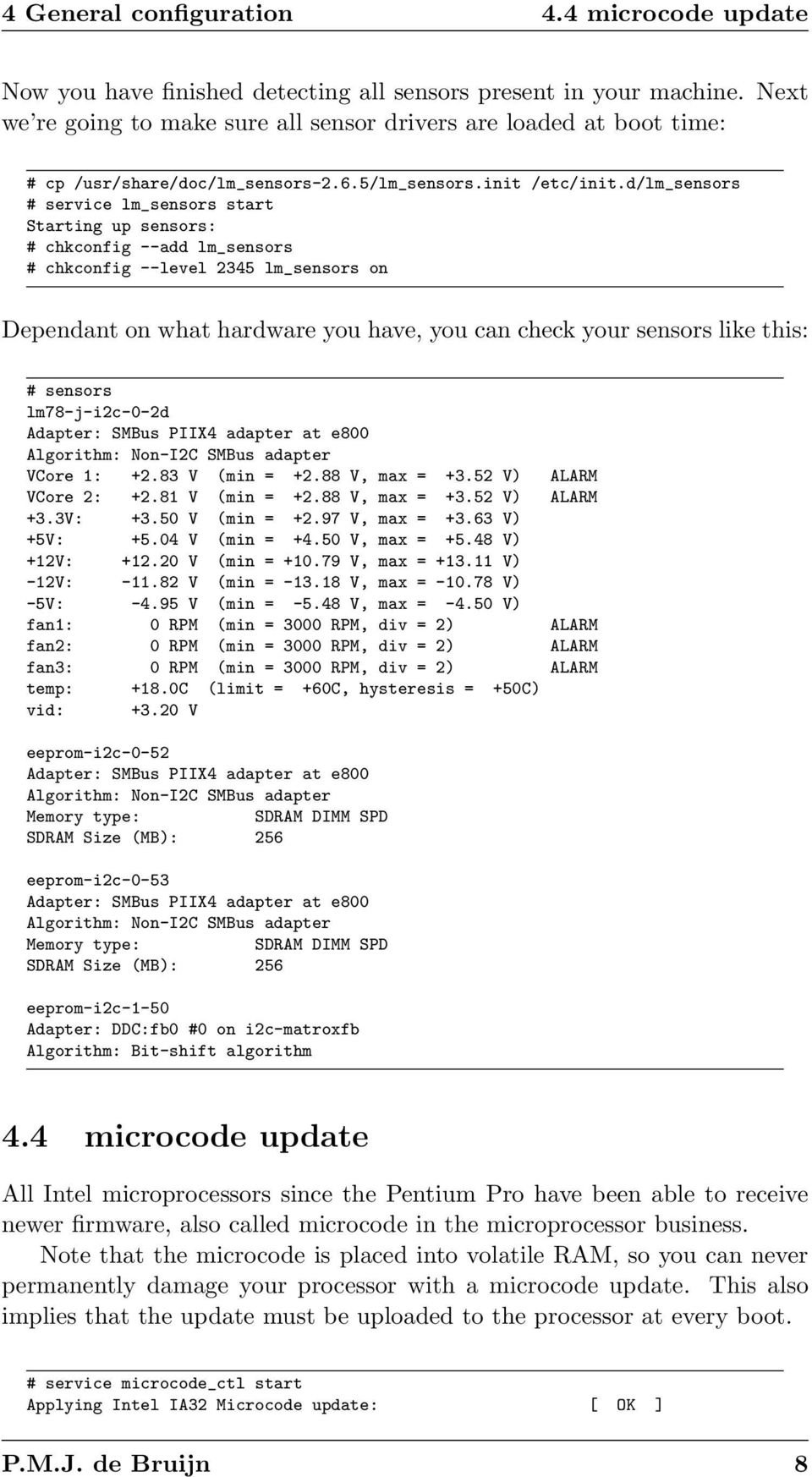
14 4 General configuration 4.5 ecc support # dmesg grep microcode microcode: CPU0 updated from revision 0xc to 0x13, date = # chkconfig --level 2345 microcode_ctl on # chkconfig --list microcode_ctl microcode_ctl 0:off 1:off 2:on 3:on 4:on 5:on 6:off 4.5 ecc support CentOS Linux also support monitoring Error Correcting Code memory, here is how you can use it: # modprobe ecc # dmesg grep ECC ECC: monitor version 0.14 (Oct ) 4.6 serial console In an emergency situation it might be handy to be able to login through a serial console. You can accomplish that, by adding the following lines to your /etc/inittab: # Run serial gettys in standard runlevels s0:2345:respawn:/sbin/agetty -L 9600 ttys0 vt100 s1:2345:respawn:/sbin/agetty -L 9600 ttys1 vt100 This will allow you to login as a normal user. If you wish to be able to login as root through the serial consoles, you need to add the console to your /etc/securetty: /dev/ttys0 /dev/ttys1 Now you ll be able to use HyperTerminal or Commi to login with the following settings: Baud rate 9600 Data bits 8 Stop bits 1 Parity None Flow control Hardware P.M.J. de Bruijn 9

15 Chapter 5 NTP To neatly synchronize the time across the entire network we can utilize the Network Time Protocol. You can use the configuration file below (called /etc/ntp.conf) as a guideline, please do not use it exactly like this, many NTP server administrator like to be notified before you use them. Please select your server from and notify the appropriate administrator you intend to use their time server. restrict default ignore restrict restrict mask notrust nomodify notrap server ntp1.theinternetone.net server ntp2.theinternetone.net server ntp3.theinternetone.net server fudge stratum 10 driftfile /var/lib/ntp/drift broadcastdelay authenticate yes keys /etc/ntp/keys Now we must make sure ntpd starts at every boot: # service ntpd start Starting ntpd: [ OK ] # chkconfig --list ntpd ntpd 0:off 1:off 2:off 3:off 4:off 5:off 6:off # chkconfig --level 2345 ntpd on P.M.J. de Bruijn 10

16 Chapter 6 DHCP The easiest way to assign IP addressen to multiple workstations is to use the Dynamic Host Client Protocol Daemon. You can use the sample configuration below: ddns-update-style none; default-lease-time 28800; max-lease-time 43200; subnet netmask { range dynamic-bootp ; option subnet-mask ; option routers ; option domain-name-servers ; option ntp-servers ; option netbios-name-servers ; option netbios-node-type 8; allow unknown-clients; host hplj { hardware ethernet AE:89:F3:A7:03:34; fixed-address ; } } Next we ll need to start the DHCP Daemon and make sure it starts at every reboot. # service dhcpd start Starting dhcpd: [ OK ] # chkconfig --list dhcpd dhcpd 0:off 1:off 2:off 3:off 4:off 5:off 6:off # chkconfig --level 2345 dhcpd on P.M.J. de Bruijn 11

17 Chapter 7 Samba 7.1 Preparing diskspace During the installation we already made one Physical Volume partition. # vgcreate samba /dev/sda5 vgcreate -- INFO: using default physical extent size 32 MB vgcreate -- INFO: maximum logical volume size is 2 Terabyte vgcreate -- doing automatic backup of volume group "samba" vgcreate -- volume group "samba" successfully created and activated # lvcreate -L 128M samba -n netlogon # lvcreate -L 320M samba -n profiles # lvcreate -L 3200M samba -n homes # lvcreate -L 1024M samba -n applications # lvcreate -L 320M samba -n common # mkfs -t ext3 /dev/samba/netlogon # mkfs -t ext3 /dev/samba/profiles # mkfs -t ext3 /dev/samba/homes # mkfs -t ext3 /dev/samba/applications # mkfs -t ext3 /dev/samba/common Then we need to add those mount points to our /etc/fstab: /dev/samba/netlogon /var/lib/samba/netlogon ext3 defaults 0 0 /dev/samba/profiles /var/lib/samba/profiles ext3 defaults,usrquota,grpquota 0 0 /dev/samba/homes /var/lib/samba/homes ext3 defaults,usrquota,grpquota 0 0 /dev/samba/applications /var/lib/samba/applications ext3 defaults 0 0 /dev/samba/common /var/lib/samba/common ext3 defaults,usrquota,grpquota 0 0 Now, we can t mount them yet, because our mount points do not yet exist. But we can quickly remedy that situation: # mkdir -p /var/lib/samba # mkdir -p /var/lib/samba/netlogon # mkdir -p /var/lib/samba/profiles # mkdir -p /var/lib/samba/homes # mkdir -p /var/lib/samba/applications # mkdir -p /var/lib/samba/common P.M.J. de Bruijn 12

18 7 Samba 7.2 Quota # mount -a # df -h Filesystem Size Used Avail Use% Mounted on /dev/sda3 4.0G 1.8G 2.0G 48% / /dev/sda1 122M 14M 102M 13% /boot none 125M 0 125M 0% /dev/shm /dev/samba/netlogon 124M 4.1M 114M 4% /var/lib/samba/netlogon /dev/samba/profiles 310M 8.1M 286M 3% /var/lib/samba/profiles /dev/samba/homes 3.1G 33M 2.9G 2% /var/lib/samba/homes /dev/samba/applications 1008M 33M 925M 4% /var/lib/samba/applications /dev/samba/common 310M 8.1M 286M 3% /var/lib/samba/common 7.2 Quota In the previous section we already made sure that our filesystems were ready for use with linux quota s. Now we only have to active the linux quota subsystem. # quotacheck -avug quotacheck: Scanning /dev/samba/profiles [/var/lib/samba/profiles] done quotacheck: Checked 2 directories and 0 files quotacheck: Old file not found. quotacheck: Old file not found. quotacheck: Scanning /dev/samba/homes [/var/lib/samba/homes] done quotacheck: Checked 2 directories and 0 files quotacheck: Old file not found. quotacheck: Old file not found. quotacheck: Scanning /dev/samba/common [/var/lib/samba/common] done quotacheck: Checked 2 directories and 0 files quotacheck: Old file not found. quotacheck: Old file not found. 7.3 Configuration All general configuration of Samba can be found in /etc/samba/smb.conf. # Global parameters [global] workgroup = JOHNSON interfaces = eth0, lo bind interfaces only = Yes passdb backend = tdbsam username map = /etc/samba/smbusers log level = 1 syslog = 0 log file = /var/log/samba/%m.log max log size = 100 smb ports = name resolve order = wins bcast hosts time server = Yes show add printer wizard = No add machine script = /usr/sbin/useradd -g computers -d /dev/null -s /bin/false %u logon script = netlogon.bat P.M.J. de Bruijn 13

19 7 Samba 7.3 Configuration logon path = \\%L\profiles$\%U logon drive = Q: logon home = \\%L\%U domain logons = Yes preferred master = Yes wins support = Yes utmp = Yes map acl inherit = Yes veto files = /lost+found/aquota.user/aquota.group/ veto oplock files = /*.mdb/ [netlogon] comment = Netlogon path = /var/lib/samba/netlogon guest ok = Yes locking = No [profiles$] comment = Profiles path = /var/lib/samba/profiles read only = No create mask = 0600 force create mode = 0600 directory mask = 0700 force directory mode = 0700 profile acls = Yes [homes] comment = Homes valid users = %S read only = No create mask = 0600 force create mode = 0600 directory mask = 0700 force directory mode = 0700 browseable = No [applications] comment = Applications path = /var/lib/samba/applications read only = No create mask = 0644 force create mode = 0644 directory mask = 0755 force directory mode = 0755 [common] comment = Common path = /var/lib/samba/common read only = No create mask = 0640 force create mode = 0640 directory mask = 0750 force directory mode = 0750 [printers] comment = Printers path = /var/spool/samba guest ok = Yes printable = Yes use client driver = Yes P.M.J. de Bruijn 14

20 7 Samba 7.4 Group mappings default devmode = Yes browseable = No It is considered good practise to maintain two versions of the smb.conf file. One called (for example) smb.conf.full and the normal smb.conf. The smb.conf.full file may contain elaborate comments, so keep everything clear, then we use testparm to filter them out for the file Samba actually uses for it s settings: # testparm smb.conf.full > smb.conf Load smb config files from smb.conf.full Processing section "[netlogon]" Processing section "[profiles$]" Processing section "[homes]" Processing section "[applications]" Processing section "[printers]" Loaded services file OK. Server role: ROLE_DOMAIN_PDC Press enter to see a dump of your service definitions 7.4 Group mappings Because Windows and Unix user and group permission scheme s are very different Samba needs to maintain a translation table. This translation table already exists but is incomplete. Use the following commands to make it whole: # groupadd -r computers # net groupmap add ntgroup="domain Computers" unixgroup=computers No rid or sid specified, choosing algorithmic mapping Successully added group Domain Computers to the mapping db # net groupmap modify ntgroup="domain Admins" unixgroup=root Updated mapping entry for Domain Admins # net groupmap modify ntgroup="domain Users" unixgroup=users Updated mapping entry for Domain Users # net groupmap modify ntgroup="domain Guests" unixgroup=nobody Updated mapping entry for Domain Guests # net groupmap list sort Account Operators (S ) -> -1 Administrators (S ) -> -1 Backup Operators (S ) -> -1 Domain Admins (S ) -> root Domain Guests (S ) -> nobody Domain Computers (S ) -> computers Domain Users (S ) -> users Guests (S ) -> -1 Power Users (S ) -> -1 Print Operators (S ) -> -1 Replicators (S ) -> -1 System Operators (S ) -> -1 Users (S ) -> -1 Also very the contains of the /etc/samba/smbusers file: P.M.J. de Bruijn 15
![conf Load smb config files from smb.conf.full Processing section "[netlogon]" Processing section "[profiles$]" Processing section "[homes]" Processing section "[applications]" Processing section "[printers]" Loaded services file OK.](/docs-images/42/1138052/images/page_20.jpg "Server role: ROLE_DOMAIN_PDC Press enter to see a dump of your service definitions 7.")
21 7 Samba 7.5 Net logon # cat /etc/samba/smbusers # Unix_name = SMB_name1 SMB_name2... root = administrator admin nobody = guest pcguest smbguest 7.5 Net logon At each logon your Windows client will execute a batch file. The purpose of the file is to allow an Administrator to make several drive to share mappings for make network access easier for the users. An example off echo. echo WARNING: Do not close this window!!! echo. net use O: \\NETFINITY\applications net use P: \\NETFINITY\common echo. echo WARNING: You may now close this window!!! echo. Please keep in mind that Windows and Unix machines use different end-ofline encoding. Luckily CentOS has a nifty tool to compensate. It s called unix2dos and it works like this: # unix2dos < netlogon.bat.unix > netlogon.bat # ls -l total 14 drwx root root Dec 28 15:07 lost+found -rw-r--r-- 1 root root 167 Dec 28 15:49 netlogon.bat -rw-r--r-- 1 root root 159 Dec 28 15:49 netlogon.bat.unix 7.6 Setting the root password Samba maintains a seperate password database. So our root user will not yet have a Samba password assigned. So here we go: # smbpasswd -a root New SMB password: Retype new SMB password: Unable to open/create TDB passwd Unable to open/create TDB passwd pdb_getsampwnam: TDB passwd (/etc/samba/passdb.tdb) did not exist. File success fully created. TDBSAM version too old (0), trying to convert it. TDBSAM converted successfully. Added user root. P.M.J. de Bruijn 16
22 7 Samba 7.7 Name resolution 7.7 Name resolution In our current system state, our CentOS machine will not be able to interpret NetBIOS names. This is not of critical importance. But it s nice to have. We will need to edit /etc/nsswitch.conf, and match the hosts statement to this one: hosts: files wins dns 7.8 Activating Samba After all configuration has been done, we can finally start the two Samba daemons: smbd and nmbd. # service smb start Starting SMB services: [ OK ] Starting NMB services: [ OK ] # chkconfig --list smb smb 0:off 1:off 2:off 3:off 4:off 5:off 6:off # chkconfig --level 2345 smb on 7.9 Verifying operation We can check whether Samba works correctly using smbclient: # smbclient -L NETFINITY -U% Domain=[JOHNSON] OS=[Unix] Server=[Samba E.1] Sharename Type Comment netlogon Disk Netlogon profiles$ Disk Profiles applications Disk Applications IPC$ IPC IPC Service (Samba E.1) ADMIN$ IPC IPC Service (Samba E.1) Domain=[JOHNSON] OS=[Unix] Server=[Samba E.1] Server Comment NETFINITY Samba E.1 Workgroup Master JOHNSON NETFINITY 7.10 Administrative scripts These scripts can really make maintenance easier. Please make sure you understand what they do. Error checking is next too non-existant in these scripts. They were designed to easy the job of a competent administrator. P.M.J. de Bruijn 17
23 7 Samba 7.10 Administrative scripts I recommend you put these script in /root/bin, which is already available as $PATH for the root user smb.inc 1 #!/bin/bash 2 3 SMB_PROFILES=/var/lib/samba/profiles 4 SMB_HOMES=/var/lib/samba/homes 5 SMB_COMMON=/var/lib/samba/common 6 7 UNIX_GROUP_PREFIX="smb" 8 9 ntunix () 10 { 11 net groupmap list grep "^$1 (S[0-9\-]*) -> [a-z][a-z0-9]\+$" sed s/.* -> // 12 } unixnt () 15 { 16 net groupmap list grep "^.*(S[0-9\-]*) -> $1$" sed s/ (S.*// 17 } unixify () 20 { 21 echo "$1" sed s/[^[:alnum:]]//g tr A-Z a-z 22 } smbgroupadd 1 #!/bin/bash 2 3 source smb.inc 4 5 usage () 6 { 7 echo "usage: $0 [-c] [-g unixgroup] ntgroup" 8 } 9 10 UNIX_GROUP="" DONT_CREATE_COMMON_AREA= while getopts ":cu:g:" OPT; do 15 case $OPT in 16 c) 17 DONT_CREATE_COMMON_AREA=1 18 ;; 19 u) 20 UNIX_GROUP="$OPTARG" 21 ;; 22 g) 23 UNIX_GROUP="$OPTARG" 24 ;; 25 *) 26 usage 27 exit 1 28 ;; P.M.J. de Bruijn 18
24 7 Samba 7.10 Administrative scripts 29 esac 30 done 31 shift $(($OPTIND - 1)) if [[ -z "$1" ]]; then 34 usage 35 exit 1 36 fi NT_GROUP="$1" if [[ -z "$UNIX_GROUP" ]]; then 41 UNIX_GROUP="$UNIX_GROUP_PREFIX$(unixify "$NT_GROUP")" 42 fi echo "NT-Group: $NT_GROUP" 45 echo "UNIX-Group: $UNIX_GROUP" groupadd "$UNIX_GROUP" 48 net groupmap add ntgroup="$nt_group" unixgroup="$unix_group" if [[ $DONT_CREATE_COMMON_AREA = 0 ]]; then 51 mkdir -p "$SMB_COMMON/$NT_GROUP" chown "root:$unix_group" "$SMB_COMMON/$NT_GROUP" chmod "750" "$SMB_COMMON/$NT_GROUP" echo "Common area created." 58 fi exit smbgroupdel 1 #!/bin/bash 2 3 source smb.inc 4 5 usage () 6 { 7 echo "usage: $0 [-c] ntgroup" 8 } 9 10 DONT_DELETE_COMMON_AREA= while getopts ":c" OPT; do 13 case $OPT in 14 c) 15 DONT_DELETE_COMMON_AREA=1 16 ;; 17 *) 18 usage 19 exit 1 20 ;; 21 esac 22 done 23 shift $(($OPTIND - 1)) if [[ -z "$1" ]]; then P.M.J. de Bruijn 19
25 7 Samba 7.10 Administrative scripts 26 usage 27 exit 1 28 fi NT_GROUP="$1" 31 UNIX_GROUP=$(ntunix "$NT_GROUP") echo "NT-Group: $NT_GROUP" 34 echo "UNIX-Group: $UNIX_GROUP" net groupmap delete ntgroup="$nt_group" 37 groupdel "$UNIX_GROUP" if [[ $DONT_DELETE_COMMON_AREA = 0 ]]; then 40 rm -Rf "$SMB_COMMON/$NT_GROUP" echo "Common area destroyed." 43 fi exit smbuseradd 1 #!/bin/bash 2 3 source smb.inc 4 5 usage () 6 { 7 echo "usage: $0 [-c comment] [-t template] [-n ntgroup] [-u unixgroup] [-g unixgroup] [-N ntgroup] [-U unixgr 8 } 9 10 COMMENT="" 11 TEMPLATE="" 12 UNIX_GROUP="" 13 SEC_UNIX_GROUP="" 14 PASSWORD="" while getopts ":c:t:n:u:g:n:u:g:p:" OPT; do 17 case $OPT in 18 c) 19 COMMENT="$OPTARG" 20 ;; 21 t) 22 TEMPLATE="$OPTARG" 23 ;; 24 n) 25 UNIX_GROUP="$(ntunix "$OPTARG")" 26 ;; 27 u) 28 UNIX_GROUP="$OPTARG" 29 ;; 30 g) 31 UNIX_GROUP="$OPTARG" 32 ;; 33 N) 34 OLDIFS=$IFS; 35 IFS="," 36 for NT_GROUP in $OPTARG; do 37 SEC_UNIX_GROUP="$(ntunix $NT_GROUP),$SEC_UNIX_GROUP" P.M.J. de Bruijn 20
26 7 Samba 7.10 Administrative scripts 38 done 39 SEC_UNIX_GROUP="$(echo "$SEC_UNIX_GROUP" sed s/,$// )" 40 IFS=$OLDIFS; 41 ;; 42 U) 43 SEC_UNIX_GROUP="$OPTARG" 44 ;; 45 G) 46 SEC_UNIX_GROUP="$OPTARG" 47 ;; 48 p) 49 PASSWORD="$OPTARG" 50 ;; 51 *) 52 usage 53 exit 1 54 ;; 55 esac 56 done 57 shift $(($OPTIND - 1)) echo $SEC_UNIX_GROUP if [[ -z "$1" ]]; then 62 usage 63 exit 1 64 fi if [[ -n "$COMMENT" ]]; then 67 COMMENT="-c $COMMENT" 68 fi if [[ -z "$UNIX_GROUP" ]]; then 71 UNIX_GROUP="users" 72 fi if [[ -n "$SEC_UNIX_GROUP" ]]; then 75 SEC_UNIX_GROUP=" -G $SEC_UNIX_GROUP " 76 fi mkdir -p $SMB_PROFILES/$1 79 mkdir -p $SMB_HOMES/$ if [[ -n $TEMPLATE ]]; then 82 cp -R $SMB_PROFILES/$TEMPLATE/* $SMB_PROFILES/$1 83 cp -R $SMB_HOMES/$TEMPLATE/* $SMB_HOMES/$1 84 fi useradd $COMMENT -g $UNIX_GROUP $SEC_UNIX_GROUP -d $SMB_HOMES/$1 -s /bin/false -M $ if [[ -n "$PASSWORD" ]]; then 89 echo -e "$PASSWORD\n$PASSWORD" smbpasswd -a -s $1 90 else 91 smbpasswd -a -n $1 92 fi chown -R $1.$UNIX_GROUP $SMB_PROFILES/$1 95 chown -R $1.$UNIX_GROUP $SMB_HOMES/$ chmod 700 $SMB_PROFILES/$1 98 chmod 700 $SMB_HOMES/$1 99 P.M.J. de Bruijn 21
27 7 Samba 7.10 Administrative scripts 100 if [[ -n $TEMPLATE ]]; then 101 edquota -p $TEMPLATE -u $1 102 fi exit smbusermod 1 #!/bin/bash 2 3 source smb.inc 4 5 usage () 6 { 7 echo "usage: $0 [-c comment] [-t template] [-n ntgroup] [-u unixgroup] [-g unixgroup] [-N ntgroup] [-U unixgr 8 } 9 10 COMMENT="" 11 TEMPLATE="" 12 UNIX_GROUP="" 13 SEC_UNIX_GROUP="" 14 PASSWORD="" while getopts ":c:t:n:u:g:n:u:g:p:" OPT; do 17 case $OPT in 18 c) 19 COMMENT="$OPTARG" 20 ;; 21 t) 22 TEMPLATE="$OPTARG" 23 ;; 24 n) 25 UNIX_GROUP="$(ntunix "$OPTARG")" 26 ;; 27 u) 28 UNIX_GROUP="$OPTARG" 29 ;; 30 g) 31 UNIX_GROUP="$OPTARG" 32 ;; 33 N) 34 OLDIFS=$IFS; 35 IFS="," 36 for NT_GROUP in $OPTARG; do 37 SEC_UNIX_GROUP="$(ntunix $NT_GROUP),$SEC_UNIX_GROUP" 38 done 39 SEC_UNIX_GROUP="$(echo "$SEC_UNIX_GROUP" sed s/,$// )" 40 IFS=$OLDIFS; 41 ;; 42 U) 43 SEC_UNIX_GROUP="$OPTARG" 44 ;; 45 G) 46 SEC_UNIX_GROUP="$OPTARG" 47 ;; 48 p) 49 PASSWORD="$OPTARG" 50 ;; 51 *) 52 usage P.M.J. de Bruijn 22
28 7 Samba 7.10 Administrative scripts 53 exit 1 54 ;; 55 esac 56 done 57 shift $(($OPTIND - 1)) if [[ -z "$1" ]]; then 60 usage 61 exit 1 62 fi if [[ -n "$COMMENT" ]]; then 65 COMMENT="-c $COMMENT" 66 fi if [[ -n "$UNIX_GROUP" ]]; then 69 UNIX_GROUP=" -g $UNIX_GROUP" 70 fi if [[ -n "$SEC_UNIX_GROUP" ]]; then 73 SEC_UNIX_GROUP=" -G $SEC_UNIX_GROUP " 74 fi usermod $UNIX_GROUP $SEC_UNIX_GROUP $ if [[ -n $PASSWORD ]]; then 79 echo -e "$PASSWORD\n$PASSWORD" smbpasswd -s $1 80 fi if [[ -n $TEMPLATE ]]; then 83 edquota -p $TEMPLATE -u $1 84 fi exit smbuserdel 1 #!/bin/bash 2 3 source smb.inc 4 5 usage () 6 { 7 echo "usage: $0 -p username" 8 } 9 10 while getopts ":p" OPT; do 11 case $OPT in 12 p) 13 PRESERVE=1 14 ;; 15 *) 16 usage 17 exit 1 18 ;; 19 esac 20 done 21 shift $(($OPTIND - 1)) if [ -z $1 ]; then P.M.J. de Bruijn 23
29 7 Samba 7.10 Administrative scripts 24 usage 25 exit 1 26 fi echo "Username: $1" smbpasswd -x $1 31 userdel $ if [ $PRESERVE ]; then 34 chown -R root.root $SMB_PROFILES/$1 35 chown -R root.root $SMB_HOMES/$1 36 else 37 rm -Rf $SMB_PROFILES/$1 38 rm -Rf $SMB_HOMES/$1 39 fi exit smbuserinf 1 #!/bin/bash 2 3 source smb.inc 4 5 usage () 6 { 7 echo "usage: $0 username" 8 } 9 10 gidgroupname () 11 { 12 grep ":$1:" /etc/group awk -F: { print $1 } 13 } if [[ -z "$1" ]]; then 16 usage 17 exit 1 18 fi UNIX_GROUP_ID=$(id --group $1) 21 UNIX_GROUP=$(gidgroupname $UNIX_GROUP_ID) 22 NT_GROUP=$(unixnt $UNIX_GROUP) SEC_UNIX_GROUP_ID=$(id --groups $1) 25 SEC_UNIX_GROUP="" 26 SEC_NT_GROUP="" for GID in $SEC_UNIX_GROUP_ID; do 29 SEC_UNIX_GROUP=" $(gidgroupname $GID) $SEC_UNIX_GROUP" 30 SEC_NT_GROUP=" $(unixnt $(gidgroupname $GID)) $SEC_NT_GROUP" 31 done echo "Username: $1" 34 echo "Primary group (UNIX): $UNIX_GROUP" 35 echo "Primary group (NT): $NT_GROUP" 36 echo "Secondary group (UNIX): $SEC_UNIX_GROUP" 37 echo "Secondary group (NT): $SEC_NT_GROUP" 38 echo 39 quota $1 P.M.J. de Bruijn 24
30 7 Samba 7.10 Administrative scripts exit smbmassuseradd.pl This script was written in Perl because it provided a ready made CSV parser. We first need to install the CSV parser called Text::CSV. # perl -MCPAN -e "shell" cpan> install Text::CSV cpan> quit # I you have installed the CSV parser you can make use of the following script: 1 {PLACEHOLDER -- COMING SOON} This script will take a.csv file as input and a.tex file as output. From the.tex file letters can be generated with pdflatex. These letters are addressed to your newly added users, and include their account information. The.csv file requires the following format: " fullname ","template"," prigroup "," secgroup, secgroup ","password","username" Please mind the quotation marks. Use them exactly like represented here. P.M.J. de Bruijn 25
31 Chapter 8 Printing 8.1 Automatic driver download First you ll need to download and install a printer driver. Please go to the following URL: Then go to the following section: PostScript printer drivers Windows Then download the following files: Adobe Universal PostScript Windows Driver Installer English PPD Files: Adobe Then install the Adobe Universal PostScript Windows Driver onto a Windows NT machine. First make sure /usr/share/cups/drivers exists: # mkdir -p /usr/share/cups/drivers Then transfer the following files to your CentOS server using (for example) WinSCP, and put them into /usr/share/cups/drivers. C:\WINNT\system32\spool\drivers\W32X86\2\ADOBEPS5.DLL C:\WINNT\system32\spool\drivers\W32X86\2\ADOBEPSU.DLL C:\WINNT\system32\spool\drivers\W32X86\2\ADOBEPSU.HLP C:\WINNT\system32\spool\drivers\WIN40\ADFONTS.MFM C:\WINNT\system32\spool\drivers\WIN40\DEFPRTR2.PPD C:\WINNT\system32\spool\drivers\WIN40\ICONLIB.DLL C:\WINNT\system32\spool\drivers\WIN40\PSMON.DLL C:\WINNT\system32\spool\drivers\WIN40\0\ADOBEPS4.DRV C:\WINNT\system32\spool\drivers\WIN40\0\ADOBEPS4.HLP It s generally recommendable to backup these files to future use: # tar cvzf ~/samba-cups-adobeps.tar.gz * P.M.J. de Bruijn 26
32 8 Printing 8.2 PDF Distiller 8.2 PDF Distiller drivers]# cupsaddsmb -U root -v PDFDistiller Password for root required to access localhost via SAMBA: Running command: smbclient //localhost/print\$ -N -U root%mypassword -c mkdir W32X86;put /var/spool/cups/tmp/41da95aee23e5 W32X86/PDFDistiller.PPD;put /usr/s hare/cups/drivers/adobeps5.dll W32X86/ADOBEPS5.DLL;put /usr/share/cups/drivers/ ADOBEPSU.DLL W32X86/ADOBEPSU.DLL;put /usr/share/cups/drivers/adobepsu.hlp W32X8 6/ADOBEPSU.HLP Domain=[JOHNSON] OS=[Unix] Server=[Samba E.1] NT_STATUS_OBJECT_NAME_COLLISION making remote directory \W32X86 putting file /var/spool/cups/tmp/41da95aee23e5 as \W32X86/PDFDistiller.PPD putting file /usr/share/cups/drivers/adobeps5.dll as \W32X86/ADOBEPS5.DLL putting file /usr/share/cups/drivers/adobepsu.dll as \W32X86/ADOBEPSU.DLL putting file /usr/share/cups/drivers/adobepsu.hlp as \W32X86/ADOBEPSU.HLP Running command: rpcclient localhost -N -U root%mypassword -c adddriver "Wind ows NT x86" "PDFDistiller:ADOBEPS5.DLL:PDFDistiller.PPD:ADOBEPSU.DLL:ADOBEPSU.H LP:NULL:RAW:NULL" Printer Driver PDFDistiller successfully installed. Running command: smbclient //localhost/print\$ -N -U root%mypassword -c mkdir WIN40;put /var/spool/cups/tmp/41da95aee23e5 WIN40/PDFDistiller.PPD;put /usr/sha re/cups/drivers/adfonts.mfm WIN40/ADFONTS.MFM;put /usr/share/cups/drivers/adobe PS4.DRV WIN40/ADOBEPS4.DRV;put /usr/share/cups/drivers/adobeps4.hlp WIN40/ADOBE PS4.HLP;put /usr/share/cups/drivers/defprtr2.ppd WIN40/DEFPRTR2.PPD;put /usr/sh are/cups/drivers/iconlib.dll WIN40/ICONLIB.DLL;put /usr/share/cups/drivers/psmo N.DLL WIN40/PSMON.DLL; Domain=[JOHNSON] OS=[Unix] Server=[Samba E.1] NT_STATUS_OBJECT_NAME_COLLISION making remote directory \WIN40 putting file /var/spool/cups/tmp/41da95aee23e5 as \WIN40/PDFDistiller.PPD putting file /usr/share/cups/drivers/adfonts.mfm as \WIN40/ADFONTS.MFM putting file /usr/share/cups/drivers/adobeps4.drv as \WIN40/ADOBEPS4.DRV putting file /usr/share/cups/drivers/adobeps4.hlp as \WIN40/ADOBEPS4.HLP putting file /usr/share/cups/drivers/defprtr2.ppd as \WIN40/DEFPRTR2.PPD putting file /usr/share/cups/drivers/iconlib.dll as \WIN40/ICONLIB.DLL putting file /usr/share/cups/drivers/psmon.dll as \WIN40/PSMON.DLL Running command: rpcclient localhost -N -U root%mypassword -c adddriver "Wind ows 4.0" "PDFDistiller:ADOBEPS4.DRV:PDFDistiller.PPD:NULL:ADOBEPS4.HLP:PSMON.DL L:RAW:ADOBEPS4.DRV:PDFDistiller.PPD,ADOBEPS4.HLP,PSMON.DLL,ADFONTS.MFM,DEFPRTR2.PPD,ICONLIB.DLL" Printer Driver PDFDistiller successfully installed. Running command: rpcclient localhost -N -U root%mypassword -c setdriver PDFDi stiller PDFDistiller Succesfully set PDFDistiller to driver PDFDistiller. drivers]# # lpinfo -v grep pdf direct pdf # lpinfo -m grep adist adist5.ppd.gz Acrobat Distiller # lpadmin -p "PDFDistiller" -E -v pdf:/var/lib/samba/documents/ -m adist5.ppd.gz P.M.J. de Bruijn 27
33 8 Printing 8.3 Mapping printers 8.3 Mapping printers If you wish to make the PDFDistiller network printer to be installed by default for every user you can include the following file into your netlogon.bat: C:\>rundll32 printui.dll,printuientry /in /n "\\NETFINITY\PDFDistiller" This will also automatically download the required drivers from the indicated server, if point n print has been configured. P.M.J. de Bruijn 28
34 Chapter 9 SNMP There are several ways to monitor you Samba server. One of those involves to use of the Simple Network Management Protocol and the accompanying utilies. 9.1 Installation Please make sure you have the net-snmp and net-snmp-utils rpms installed. You can check it like this: # yum install net-snmp net-snmp-utils 9.2 Configuration You can use this as a sample configuration file, please save it as /etc/snmp/snmpd.conf: rocommunity public syslocation "The Netherlands" syscontact "P.M.J. de Bruijn <[email protected]>" sysservices 76 If you re not satisfied with this configuration you are free to use the snmpconf utility to modify anything you dislike. 9.3 Activation As with all system services we can activate snmpd using the service command. With chkconfig we can make sure it activates on every boot. # service snmpd start Starting snmpd: [ OK ] # chkconfig --level 2435 snmpd on P.M.J. de Bruijn 29
35 9 SNMP 9.4 Verifying operation 9.4 Verifying operation You can verity snmpd operation like this: # snmpwalk -Os -c public -v 2c netfinity system head -7 sysdescr.0 = STRING: Linux netfinity EL #1 Fri Dec 24 02:04:03 sysobjectid.0 = OID: netsnmpagentoids.10 sysuptime.0 = Timeticks: (50105) 0:08:21.05 syscontact.0 = STRING: "P.M.J. de Bruijn <[email protected]>" sysname.0 = STRING: netfinity syslocation.0 = STRING: "The Netherlands" sysservices.0 = INTEGER: Monitoring There are several ways you can monitor your system now, for example you could do a periodic snmpwalk yourself, but this would get tedious real fast, also with snmpwalk you don t get any perspective. You can use third party software like MRTG or HP OpenView for constant monitoring and graphing. P.M.J. de Bruijn 30
36 Chapter 10 Joining the domain 10.1 Windows NT 4.0 Workstation (SP6) Click the Start button. Then go to Settings, wait for the menu to expand and click Control Panel. A new window will present itself, please open the Networking icon. Go to the Protocols tab. Then select TCP/IP Protocols and click Properties. Make sure Obtain an IP address from a DHCP server is active. To join a Windows NT 4 Workstation client into our domain, please repeat the previously stated action until your back in the Networking window again. Then take a look at the Identification page. Click on the Change button. Change the Member of to Domain and fill in the appropriate domain name, in our case JOHNSON. Next, make sure that Create a Computer Account in the Domain is checked. Fill in the User Name and Password fields with the Administrator account. Click OK. You ll see a welcome window. And you will be asked to reboot the machine. Please do so Windows 2000 Professional (SP4) Click the Start button. Then go to Settings, wait for the menu to expand and click Network and Dial-up Connections. A new window will open, click Local Area Connection. Click on the Properties button. Select Internet Protocol (TCP/IP), then click Properties. Make sure that Obtain an IP address automatically and Obtain DNS server address automatically are selected. To join a Windows 2000 Professional client into our domain, please open the properties window of My Computer. Then proceed to the Network Indentification tab. Then you ll see the following text: To rename this computer or join a domain, click Properties. So click Properties. Then activate the Domain radiobutton and enter the domain s name. Most likely you ll be asked for the domain administrators account and password, you ll need to provide it. P.M.J. de Bruijn 31
37 10 Joining the domain 10.3 Windows XP Professional (SP2) Then reboot, and your machine is part of the domain Windows XP Professional (SP2) Click the Start button. Then right click on the My Network Places icon. Select Properties. Next right click on Local Area Connection and select Properties again. Look for the General tab. Then select Internet Protocol (TCP/IP) from the list, and click Properties once more. Make sure the radio button are set to Obtain an IP address automatically and Obtain DNS server address automatically. To join a Windows XP Professional client into our domain, please open the properties window of My Computer. Then proceed to the Computer Name tab. Then you ll see the following text: To rename this computer or join a domain, click Change. So click Change. Then activate the Domain radiobutton and enter the domain s name. Most likely you ll be asked for the domain administrators account and password, you ll need to provide it. Then reboot, and your machine is part of the domain. P.M.J. de Bruijn 32
38 Chapter 11 OpenOffice.org 11.1 Server First you need to login as Administrator on a Windows workstation. Then start the OpenOffice.org installer called setup.exe with the -net parameter. Go through the setup as normal, but specify O:\OpenOffice.org\ as the installation directory Client Then each user can login and start O:\OpenOffice.org\OpenOffice.org Setup. Just follow the instructions and do a workstation install, which will use about 2MB of the users allocated profile space. P.M.J. de Bruijn 33
39 Chapter 12 Performance Mind that you should not blindly use any of these settings! Test them excessively in your own lab environment. These are mere guidelines Samba In most LAN environments these parameters should improve file serving performance somewhat: socket options = IPTOS_LOWDELAY TCP_NODELAY 12.2 Linux Version 2.4.x of the Linux kernel gives the user the ability to do some tuning of the disk scheduler. With some experimentation I found that these settings will leverage more consistent performance. # elvtune -r w 2048 /dev/sda /dev/sda elevator ID 1 read_latency: 1024 write_latency: 2048 max_bomb_segments: 6 If you notice benefit from the elevator tuning you might want to consider having these settings auto applied at every boot. You can add the following line to your /etc/rc.local file: elvtune -r w 2048 /dev/sda > /var/log/elvtune.log 2>&1 P.M.J. de Bruijn 34
40 Chapter 13 Security 13.1 Services We can determine which sockets are bound by scanning our own machine. # nmap -st localhost Starting nmap V ( ) Interesting ports on netfinity ( ): (The 1594 ports scanned but not shown below are in state: closed) Port State Service 22/tcp open ssh 25/tcp open smtp 111/tcp open sunrpc 139/tcp open netbios-ssn 199/tcp open smux 445/tcp open microsoft-ds 631/tcp open ipp Nmap run completed -- 1 IP address (1 host up) scanned in 1 second # nmap -su localhost Starting nmap V ( ) Interesting ports on netfinity ( ): (The 1460 ports scanned but not shown below are in state: closed) Port State Service 67/udp open dhcpserver 111/udp open sunrpc 123/udp open ntp 137/udp open netbios-ns 138/udp open netbios-dgm 161/udp open snmp 631/udp open unknown 756/udp open unknown Nmap run completed -- 1 IP address (1 host up) scanned in 6 seconds As you might see we have quite a lot of services available to our network users. Note you can use the following list to determine what port are used by which services: IANA Assigned Port Numbers Now lets see which services are enabled at our current runlevel (3). P.M.J. de Bruijn 35
41 13 Security 13.1 Services # chkconfig --list grep 3:on Now we can disable all NFS related services: # chkconfig --level 2345 nfslock off # chkconfig --level 2345 portmap off # service nfslock stop Stopping NFS statd: [ OK ] # service portmap stop Stopping portmapper: [ OK ] Next up, we still have an unidentified service called smux. We can find out what it does as follows: # lsof grep smux snmpd 1966 root 8u IPv TCP *:smux (LISTEN) It seems to be part of the SNMP package, which we enabled on purpose, so this port may remain open. P.M.J. de Bruijn 36
42 Chapter 14 Maintenance This section talks about various maintenance tasks Resizing partitions Since the introduction of the Logical Volume Manager it s been possible to add disks to an existing virtual volume. This makes expansion of available disk space quite easy. It can be done like this: # umount /var/lib/samba/common # lvextend -L +500 /dev/samba/common # e2fsck -f /dev/samba/common # resize2fs /dev/samba/common -p # mount /var/lib/samba/common First we ll unmount the filesystem. Then the lvextend command extends the logical volume by 500 MegaByte of disk space. Next we check the filesystem for errors, before resizing it. Then we use resize2fs to expand the ext3 filesystem to match the size of the logical volume under it. And at last we remount the filesystem and it s ready to be used once more. P.M.J. de Bruijn 37
43 Appendix A Frequently Asked Questions A.1 Windows 98 I firmly recommend against using Windows 98 in any network environment, especially in conjunction with a Microsoft style Domain. Please view the following article for more information: A.2 block-major-43 Warnings Luckily this error is cosmetic, your system should work just fine. Of course we ll want to keep our systems nice and tidy. We can fixup the cosmetics by adding the following line to your /etc/modules.conf file: alias block-major-43 off A.3 Common area permissions All users in a certain group can delete and rename all files in their common area. This is because the parent directory has writable group permission set. This gives a user the ability to delete and rename. If you do not wish this behaviour a user can create a directory which he or she owns. Then the other users will only be able to read inside that specific directory. P.M.J. de Bruijn 38
44 Appendix B Bibliography Michael Jang RHCE Redhat Certified Engineer Linux Study Guide Osborne/McGraw-Hill, Fourth Edition, 2004, ISBN: John H. Terpstra Samba-3 by Example Prentice Hall, First Edition, 2004, ISBN: Cameron Newham & Bill Rosenblatt Learning the bash shell O Reilly, Second Edition, 1998, ISBN: Roy Costa & Michael Macisaac Printing with Linux on IBM eserver zseries using CUPS and Samba IBM Redbooks Paper, 2004 P.M.J. de Bruijn 39
45 Appendix C Changelog The following gives a somewhat accurate representation of when changes Date Change 27 Dec 2004 First Edition. 16 Jan 2005 Added Performance. Added SNMP. Added OpenOffice.org. Did some work on the administration scripts. 18 Jan 2005 Added the administration scripts. were made to this document: Added the security section. Added the maintenance section. 19 Jan 2005 Did some cleaning up. 23 Jan 2005 Adjusted headers, footers. Adjusted the title page. 28 Jan 2005 Did some work on the smbmassuseradd.pl script. Added a debug mode to the smbuseradd script. P.M.J. de Bruijn 40
SAMBA SERVER (PDC) Samba is comprised of a suite of RPMs that come on the RHEL/Fedora CDs. The files are named:
 SAMBA SERVER (PDC) INTRODUCTION Samba is a suite of utilities that allows your Linux box to share files and other resources, such as printers, with Windows boxes. This lesson describes how you can make
Samba. Samba. Samba 2.2.x. Limitations of Samba 2.2.x 1. Interoperating with Windows. Implements Microsoft s SMB protocol
 Samba Samba Interoperating with Windows Nick Urbanik Copyright Conditions: GNU FDL (seehttp://www.gnu.org/licenses/fdl.html) A computing department Implements Microsoft s SMB protocol
# Windows Internet Name Serving Support Section: # WINS Support - Tells the NMBD component of Samba to enable its WINS Server ; wins support = no
 Sample configuration file for the Samba suite for Debian GNU/Linux. This is the main Samba configuration file. You should read the smb.conf(5) manual page in order to understand the options listed here.
Deploying IBM Lotus Domino on Red Hat Enterprise Linux 5. Version 1.0
 Deploying IBM Lotus Domino on Red Hat Enterprise Linux 5 Version 1.0 November 2008 Deploying IBM Lotus Domino on Red Hat Enterprise Linux 5 1801 Varsity Drive Raleigh NC 27606-2072 USA Phone: +1 919 754
Newton Linux User Group Graphing SNMP with Cacti and RRDtool
 Newton Linux User Group Graphing SNMP with Cacti and RRDtool Summary: Cacti is an interface that can be used to easily manage the graphing of SNMP data. These graphs allow you to visualize performance
Red Hat Linux Administration II Installation, Configuration, Software and Troubleshooting
 Course ID RHL200 Red Hat Linux Administration II Installation, Configuration, Software and Troubleshooting Course Description Students will experience added understanding of configuration issues of disks,
QuickBooks Enterprise Solutions. Linux Database Server Manager Installation and Configuration Guide
 QuickBooks Enterprise Solutions Linux Database Server Manager Installation and Configuration Guide Copyright Copyright 2007 Intuit Inc. All rights reserved. STATEMENTS IN THIS DOCUMENT REGARDING THIRD-PARTY
Freshservice Discovery Probe User Guide
 Freshservice Discovery Probe User Guide 1. What is Freshservice Discovery Probe? 1.1 What details does Probe fetch? 1.2 How does Probe fetch the information? 2. What are the minimum system requirements
Installing QuickBooks Enterprise Solutions Database Manager On Different Linux Servers
 Installing QuickBooks Enterprise Solutions Database Manager On Different Linux Servers 1 Contents QuickBooks Enterprise Solutions and Linux... 3 Audience of This Guide... 3 What is the Linux Database Manager
Intuit QuickBooks Enterprise Solutions. Linux Database Server Manager Installation and Configuration Guide
 Intuit QuickBooks Enterprise Solutions Linux Database Server Manager Installation and Configuration Guide Copyright Copyright 2013 Intuit Inc. All rights reserved. STATEMENTS IN THIS DOCUMENT REGARDING
SAMBA VI: As a Domain Controller
 Page 1 of 8 DocIndex Search Main - DocIndex - Connectivity SAMBA VI: As a Domain Controller Running A Linux Primary Domain Controller Joining Windows Machines To The Domain Making Your Life Easier Going
Networking Best Practices Guide. Version 6.5
 Networking Best Practices Guide Version 6.5 Summer 2010 Copyright: 2010, CCH, a Wolters Kluwer business. All rights reserved. Material in this publication may not be reproduced or transmitted in any form
Installing, Uninstalling, and Upgrading Service Monitor
 CHAPTER 2 Installing, Uninstalling, and Upgrading Service Monitor This section contains the following topics: Preparing to Install Service Monitor, page 2-1 Installing Cisco Unified Service Monitor, page
Deploying Windows Streaming Media Servers NLB Cluster and metasan
 Deploying Windows Streaming Media Servers NLB Cluster and metasan Introduction...................................................... 2 Objectives.......................................................
Using Single Sign-on with Samba. Appendices. Glossary. Using Single Sign-on with Samba. SonicOS Enhanced
 SonicOS Enhanced Using Single Sign-on with Samba Using Single Sign-on with Samba Introduction Recommended Versions Caveats SonicWALL Single Sign-on in Windows SonicWALL Single Sign-on with Samba Checking
Server & Workstation Installation of Client Profiles for Windows
 C ase Manag e m e n t by C l i e n t P rofiles Server & Workstation Installation of Client Profiles for Windows T E C H N O L O G Y F O R T H E B U S I N E S S O F L A W General Notes to Prepare for Installing
How To Use 1Bay 1Bay From Awn.Net On A Pc Or Mac Or Ipad (For Pc Or Ipa) With A Network Box (For Mac) With An Ipad Or Ipod (For Ipad) With The
 1-bay NAS User Guide INDEX Index... 1 Log in... 2 Basic - Quick Setup... 3 Wizard... 3 Add User... 6 Add Group... 7 Add Share... 9 Control Panel... 11 Control Panel - User and groups... 12 Group Management...
Pearl Echo Installation Checklist
 Pearl Echo Installation Checklist Use this checklist to enter critical installation and setup information that will be required to install Pearl Echo in your network. For detailed deployment instructions
Using iscsi with BackupAssist. User Guide
 User Guide Contents 1. Introduction... 2 Documentation... 2 Terminology... 2 Advantages of iscsi... 2 Supported environments... 2 2. Overview... 3 About iscsi... 3 iscsi best practices with BackupAssist...
Addonics T E C H N O L O G I E S. NAS Adapter. Model: NASU2. 1.0 Key Features
 1.0 Key Features Addonics T E C H N O L O G I E S NAS Adapter Model: NASU2 User Manual Convert any USB 2.0 / 1.1 mass storage device into a Network Attached Storage device Great for adding Addonics Storage
TDP43ME NetPS. Network Printer Server. Control Center. for Ethernet Module
 Panduit Corp. 2010 TDP43ME NetPS PA26306A01 Rev. 01 11-2010 Network Printer Server Control Center for Ethernet Module NOTE: In the interest of higher quality and value, Panduit products are continually
Deskpool Quick Start. Version: V2.1.x. Based on Hyper-V Server 2012 R2. Shenzhen Jieyun Technology Co., Ltd (www.jieyung.com)
 Deskpool Quick Start Based on Hyper-V Server 2012 R2 Version: V2.1.x Shenzhen Jieyun Technology Co., Ltd (www.jieyung.com) Last updated on March 18, 2015 Copyright Shenzhen Jieyun Technology Co., Ltd.
Core Protection for Virtual Machines 1
 Core Protection for Virtual Machines 1 Comprehensive Threat Protection for Virtual Environments. Installation Guide e Endpoint Security Trend Micro Incorporated reserves the right to make changes to this
Installation Notes for Outpost Network Security (ONS) version 3.2
 Outpost Network Security Installation Notes version 3.2 Page 1 Installation Notes for Outpost Network Security (ONS) version 3.2 Contents Installation Notes for Outpost Network Security (ONS) version 3.2...
GL254 - RED HAT ENTERPRISE LINUX SYSTEMS ADMINISTRATION III
 QWERTYUIOP{ GL254 - RED HAT ENTERPRISE LINUX SYSTEMS ADMINISTRATION III This GL254 course is designed to follow an identical set of topics as the Red Hat RH254, RH255 RHCE exam prep courses with the added
Configure Samba with ACL and Active Directory integration Robert LeBlanc ([email protected]) BioAg Computer Support, Brigham Young University
 Configure Samba with ACL and Active Directory integration Robert LeBlanc ([email protected]) BioAg Computer Support, Brigham Young University This document uses Debain Linux 3.1 (Sarge) on x86 hardware.
OnCommand Performance Manager 1.1
 OnCommand Performance Manager 1.1 Installation and Setup Guide For Red Hat Enterprise Linux NetApp, Inc. 495 East Java Drive Sunnyvale, CA 94089 U.S. Telephone: +1 (408) 822-6000 Fax: +1 (408) 822-4501
NNAS-D5 Quick Installation Guide
 NNAS-D5 Quick Installation Guide NOTE: By default, LAN0 (eth0) is set to DHCP. If a DHCP server is available or detected, LAN0 will be assigned a DHCP IP address. If a DHCP server is not available, LAN0
TimeIPS Server. IPS256T Virtual Machine. Installation Guide
 TimeIPS Server IPS256T Virtual Machine Installation Guide TimeIPS License Notification The terms and conditions applicable to the license of the TimeIPS software, sale of TimeIPS hardware and the provision
AVG 8.5 Anti-Virus Network Edition
 AVG 8.5 Anti-Virus Network Edition User Manual Document revision 85.2 (23. 4. 2009) Copyright AVG Technologies CZ, s.r.o. All rights reserved. All other trademarks are the property of their respective
Chapter 2 Preparing Your Network
 Chapter 2 Preparing Your Network This document describes how to prepare your network to connect to the Internet through a router and how to verify the readiness of your broadband Internet service from
Windows Domain Network Configuration Guide
 Windows Domain Network Configuration Guide Windows Domain Network Configuration Guide for CCC Pathways Copyright 2008 by CCC Information Services Inc. All rights reserved. No part of this publication may
How To Create An Easybelle History Database On A Microsoft Powerbook 2.5.2 (Windows)
 Introduction EASYLABEL 6 has several new features for saving the history of label formats. This history can include information about when label formats were edited and printed. In order to save this history,
Samba on HP StorageWorks Enterprise File Services (EFS) Clustered File System Software
 Samba on HP StorageWorks Enterprise File Services (EFS) Clustered File System Software Installation and integration guide Abstract... 2 Introduction... 2 Application overview... 2 Application configuration...
InventoryControl for use with QuoteWerks Quick Start Guide
 InventoryControl for use with QuoteWerks Quick Start Guide Copyright 2013 Wasp Barcode Technologies 1400 10 th St. Plano, TX 75074 All Rights Reserved STATEMENTS IN THIS DOCUMENT REGARDING THIRD PARTY
Syncplicity On-Premise Storage Connector
 Syncplicity On-Premise Storage Connector Implementation Guide Abstract This document explains how to install and configure the Syncplicity On-Premise Storage Connector. In addition, it also describes how
Linuxdays 2005, Samba Tutorial
 Linuxdays 2005, Samba Tutorial Alain Knaff [email protected] Summary 1. Installing 2. Basic config (defining shares,...) 3. Operating as a PDC 4. Password synchronization 5. Access control 6. Samba
Deploying a Virtual Machine (Instance) using a Template via CloudStack UI in v4.5.x (procedure valid until Oct 2015)
 Deploying a Virtual Machine (Instance) using a Template via CloudStack UI in v4.5.x (procedure valid until Oct 2015) Access CloudStack web interface via: Internal access links: http://cloudstack.doc.ic.ac.uk
Acronis Backup & Recovery 11.5 Quick Start Guide
 Acronis Backup & Recovery 11.5 Quick Start Guide Applies to the following editions: Advanced Server for Windows Virtual Edition Advanced Server SBS Edition Advanced Workstation Server for Linux Server
Lustre SMB Gateway. Integrating Lustre with Windows
 Lustre SMB Gateway Integrating Lustre with Windows Hardware: Old vs New Compute 60 x Dell PowerEdge 1950-8 x 2.6Ghz cores, 16GB, 500GB Sata, 1GBe - Win7 x64 Storage 1 x Dell R510-12 x 2TB Sata, RAID5,
Faculty Details. : Assistant Professor ( OG. ),Assistant Professor (OG) Course Details. : B. Tech. Batch : 2010-2014. : Information Technology
 COURSE FILE (COURSE PLAN) Year : 2012-13 Sem: ODD Faculty Details Name of the Faculty : Mullai.P & Yaashuwanth.C Designation : Assistant Professor ( OG. ),Assistant Professor (OG) Department : Information
TEL2821/IS2150: INTRODUCTION TO SECURITY Lab: Operating Systems and Access Control
 TEL2821/IS2150: INTRODUCTION TO SECURITY Lab: Operating Systems and Access Control Version 3.4, Last Edited 9/10/2011 Students Name: Date of Experiment: Read the following guidelines before working in
The Barracuda Network Connector. System Requirements. Barracuda SSL VPN
 Barracuda SSL VPN The Barracuda SSL VPN allows you to define and control the level of access that your external users have to specific resources inside your internal network. For users such as road warriors
PRINT CONFIGURATION. 1. Printer Configuration
 PRINT CONFIGURATION Red Flag Server5 has improved the designs of the printer configuration tool to facilitate you to conduct print configuration and print tasks management in a more convenient and familiar
How to Test Out Backup & Replication 6.5 for Hyper-V
 How to Test Out Backup & Replication 6.5 for Hyper-V Mike Resseler May, 2013 2013 Veeam Software. All rights reserved. All trademarks are the property of their respective owners. No part of this publication
May 2002 16PZ-0502A-WWEN Prepared by: Internet & E-Commerce Solutions
 May 2002 Prepared by: Internet & E-Commerce Solutions Contents Introduction... 3 Solution Overview... 3 Obtaining Compaq Management Agents (CMA) for Linux... 3 Integrating Compaq Management Agents MIBs
Enterprise Manager. Version 6.2. Installation Guide
 Enterprise Manager Version 6.2 Installation Guide Enterprise Manager 6.2 Installation Guide Document Number 680-028-014 Revision Date Description A August 2012 Initial release to support version 6.2.1
Getting Started With Your Virtual Dedicated Server. Getting Started Guide
 Getting Started Guide Getting Started With Your Virtual Dedicated Server Setting up and hosting a domain on your Linux Virtual Dedicated Server using cpanel. Getting Started with Your Virtual Dedicated
How to simulate network devices using the Verax SNMP Simulator (Linux/Windows)
 How to simulate network devices using the Verax SNMP Simulator (Linux/Windows) Table of contents Abstract... 3 1. Verax SNMP Simulator installation... 4 2. Extracting SNMP record files from a physical
SevOne NMS Download Installation and Implementation Guide
 SevOne NMS Download Installation and Implementation Guide 5.3.X 530 V0002 Contents 1. Get Started... 3 2. SevOne Download Installation... 6 3. Appliance Network Configuration... 9 4. Install License and
Cloud.com CloudStack Community Edition 2.1 Beta Installation Guide
 Cloud.com CloudStack Community Edition 2.1 Beta Installation Guide July 2010 1 Specifications are subject to change without notice. The Cloud.com logo, Cloud.com, Hypervisor Attached Storage, HAS, Hypervisor
Ultra Thin Client TC-401 TC-402. Users s Guide
 Ultra Thin Client TC-401 TC-402 Users s Guide CONTENT 1. OVERVIEW... 3 1.1 HARDWARE SPECIFICATION... 3 1.2 SOFTWARE OVERVIEW... 4 1.3 HARDWARE OVERVIEW...5 1.4 NETWORK CONNECTION... 7 2. INSTALLING THE
CommandCenter Secure Gateway
 CommandCenter Secure Gateway Quick Setup Guide for CC-SG Virtual Appliance and lmadmin License Server Management This Quick Setup Guide explains how to install and configure the CommandCenter Secure Gateway.
PARALLELS SERVER BARE METAL 5.0 README
 PARALLELS SERVER BARE METAL 5.0 README 1999-2011 Parallels Holdings, Ltd. and its affiliates. All rights reserved. This document provides the first-priority information on the Parallels Server Bare Metal
Network User's Guide for HL-2070N
 f Multi-Protocol On-board Print Server Network User's Guide for HL-2070N Please read this manual thoroughly before using the printer. You can print or view this manual from the Printer CD-ROM at any time,
READYNAS INSTANT STORAGE. Quick Installation Guide
 READYNAS INSTANT STORAGE Quick Installation Guide Table of Contents Step 1 Connect to FrontView Setup Wizard 3 Installing RAIDar on Windows 3 Installing RAIDar on Mac OS X 3 Installing RAIDar on Linux
Intelligent Power Protector User manual extension for Microsoft Virtual architectures: Hyper-V 6.0 Manager Hyper-V Server (R1&R2)
 Intelligent Power Protector User manual extension for Microsoft Virtual architectures: Hyper-V 6.0 Manager Hyper-V Server (R1&R2) Hyper-V Manager Hyper-V Server R1, R2 Intelligent Power Protector Main
NATIONAL POPULATION REGISTER (NPR)
 NATIONAL POPULATION REGISTER (NPR) Project Name: NPR Version No: 1.0.0 Release Date: Group Name: NPR-ECIL Version Date: LINUX SERVER INSTALLATION AND CONFIGURATION FOR JAVA BASED NPR DATAENTRY SOFTWARE
Acano solution. Virtualized Deployment R1.1 Installation Guide. Acano. February 2014 76-1025-03-B
 Acano solution Virtualized Deployment R1.1 Installation Guide Acano February 2014 76-1025-03-B Contents Contents 1 Introduction... 3 1.1 Before You Start... 3 1.1.1 About the Acano virtualized solution...
RealPresence Platform Director
 RealPresence CloudAXIS Suite Administrators Guide Software 1.3.1 GETTING STARTED GUIDE Software 2.0 June 2015 3725-66012-001B RealPresence Platform Director Polycom, Inc. 1 RealPresence Platform Director
NetIQ Sentinel 7.0.1 Quick Start Guide
 NetIQ Sentinel 7.0.1 Quick Start Guide April 2012 Getting Started Use the following information to get Sentinel installed and running quickly. Meeting System Requirements on page 1 Installing Sentinel
Procedure to Create and Duplicate Master LiveUSB Stick
 Procedure to Create and Duplicate Master LiveUSB Stick A. Creating a Master LiveUSB stick using 64 GB USB Flash Drive 1. Formatting USB stick having Linux partition (skip this step if you are using a new
ReadyNAS Setup Manual
 ReadyNAS Setup Manual NETGEAR, Inc. 4500 Great America Parkway Santa Clara, CA 95054 USA October 2007 208-10163-01 v1.0 2007 by NETGEAR, Inc. All rights reserved. Trademarks NETGEAR, the NETGEAR logo,
Introduction to Operating Systems
 Introduction to Operating Systems It is important that you familiarize yourself with Windows and Linux in preparation for this course. The exercises in this book assume a basic knowledge of both of these
Installation and Deployment
 Installation and Deployment Help Documentation This document was auto-created from web content and is subject to change at any time. Copyright (c) 2016 SmarterTools Inc. Installation and Deployment SmarterStats
Windows Template Creation Guide. How to build your own Windows VM templates for deployment in Cloudturk.
 Windows Template Creation Guide How to build your own Windows VM templates for deployment in Cloudturk. TABLE OF CONTENTS 1. Preparing the Server... 2 2. Installing Windows... 3 3. Creating a Template...
026-1010 Rev 7 06-OCT-2011. Site Manager Installation Guide
 026-1010 Rev 7 06-OCT-2011 Site Manager Installation Guide Retail Solutions 3240 Town Point Drive NW, Suite 100 Kennesaw, GA 30144, USA Phone: 770-425-2724 Fax: 770-425-9319 Table of Contents 1 SERVER
INFUSION BUSINESS SOFTWARE Installation and Upgrade Guide
 INFUSION BUSINESS SOFTWARE Installation and Upgrade Guide 27/01/2016 Published by Infusion Business Software Ltd All Rights Reserved Copyright Infusion Business Software Ltd 2012 Copyright No part of this
AVG 9.0 Internet Security Business Edition
 AVG 9.0 Internet Security Business Edition User Manual Document revision 90.5 (16. 4. 2010) C opyright AVG Technologies C Z, s.r.o. All rights reserved. All other trademarks are the property of their respective
Appendix B Lab Setup Guide
 JWCL031_appB_467-475.indd Page 467 5/12/08 11:02:46 PM user-s158 Appendix B Lab Setup Guide The Windows Server 2008 Applications Infrastructure Configuration title of the Microsoft Official Academic Course
Distributed File System
 Petru Maior University, Târgu-Mureș Science Department Information Technolgy Master Course Distributed File System Students: Bardosi Florin Cifor Crina Danciu Ioana Hintea Dan Alexandru Table of Contents
Overview of ServerView Windows Agent This chapter explains overview of ServerView Windows Agent, and system requirements.
 ServerView User s Guide (For Windows Agent) Areas Covered - Before Reading This Manual This section explains the notes for your safety and conventions used in this manual. Chapter 1 Overview of ServerView
How To Install Acronis Backup & Recovery 11.5 On A Linux Computer
 Acronis Backup & Recovery 11.5 Server for Linux Update 2 Installation Guide Copyright Statement Copyright Acronis International GmbH, 2002-2013. All rights reserved. Acronis and Acronis Secure Zone are
Kaspersky Endpoint Security 8 for Linux INSTALLATION GUIDE
 Kaspersky Endpoint Security 8 for Linux INSTALLATION GUIDE A P P L I C A T I O N V E R S I O N : 8. 0 Dear User! Thank you for choosing our product. We hope that this documentation will help you in your
TB168 (Rev4) - Networking Linux Based Controls
 TB168 (Rev4) - Networking Linux Based Controls Creating a Network If not already connected, create the network using cables, switches, routers, etc. To successful connect a DHCP network you will require
How To Install An Aneka Cloud On A Windows 7 Computer (For Free)
 MANJRASOFT PTY LTD Aneka 3.0 Manjrasoft 5/13/2013 This document describes in detail the steps involved in installing and configuring an Aneka Cloud. It covers the prerequisites for the installation, the
Portions of this product were created using LEADTOOLS 1991-2009 LEAD Technologies, Inc. ALL RIGHTS RESERVED.
 Installation Guide Lenel OnGuard 2009 Installation Guide, product version 6.3. This guide is item number DOC-110, revision 1.038, May 2009 Copyright 1992-2009 Lenel Systems International, Inc. Information
WHM Administrator s Guide
 Fasthosts Customer Support WHM Administrator s Guide This manual covers everything you need to know in order to get started with WHM and perform day to day administrative tasks. Contents Introduction...
Setup and Configuration Guide for Pathways Mobile Estimating
 Setup and Configuration Guide for Pathways Mobile Estimating Setup and Configuration Guide for Pathways Mobile Estimating Copyright 2008 by CCC Information Services Inc. All rights reserved. No part of
Univention Corporate Server. Operation of a Samba domain based on Windows NT domain services
 Univention Corporate Server Operation of a Samba domain based on Windows NT domain services 2 Table of Contents 1. Components of a Samba domain... 4 2. Installation... 5 3. Services of a Samba domain...
LOCKSS on LINUX. CentOS6 Installation Manual 08/22/2013
 LOCKSS on LINUX CentOS6 Installation Manual 08/22/2013 1 Table of Contents Overview... 3 LOCKSS Hardware... 5 Installation Checklist... 6 BIOS Settings... 9 Installation... 10 Firewall Configuration...
Desktop : Ubuntu 10.04 Desktop, Ubuntu 12.04 Desktop Server : RedHat EL 5, RedHat EL 6, Ubuntu 10.04 Server, Ubuntu 12.04 Server, CentOS 5, CentOS 6
 201 Datavoice House, PO Box 267, Stellenbosch, 7599 16 Elektron Avenue, Technopark, Tel: +27 218886500 Stellenbosch, 7600 Fax: +27 218886502 Adept Internet (Pty) Ltd. Reg. no: 1984/01310/07 VAT No: 4620143786
FileMaker Server 7. Administrator s Guide. For Windows and Mac OS
 FileMaker Server 7 Administrator s Guide For Windows and Mac OS 1994-2004, FileMaker, Inc. All Rights Reserved. FileMaker, Inc. 5201 Patrick Henry Drive Santa Clara, California 95054 FileMaker is a trademark
Dell UPS Local Node Manager USER'S GUIDE EXTENSION FOR MICROSOFT VIRTUAL ARCHITECTURES Dellups.com
 CHAPTER: Introduction Microsoft virtual architecture: Hyper-V 6.0 Manager Hyper-V Server (R1 & R2) Hyper-V Manager Hyper-V Server R1, Dell UPS Local Node Manager R2 Main Operating System: 2008Enterprise
Installing Windows Rights Management Services with Service Pack 2 Step-by- Step Guide
 Installing Windows Rights Management Services with Service Pack 2 Step-by- Step Guide Microsoft Corporation Published: October 2006 Author: Brian Lich Editor: Carolyn Eller Abstract This step-by-step guide
Secure Shell Demon setup under Windows XP / Windows Server 2003
 Secure Shell Demon setup under Windows XP / Windows Server 2003 Configuration inside of Cygwin $ chgrp Administrators /var/{run,log,empty} $ chown Administrators /var/{run,log,empty} $ chmod 775 /var/{run,log}
How to Tunnel Remote Desktop using SSH (Cygwin) for Windows XP (SP2)
 How to Tunnel Remote Desktop using SSH (Cygwin) for Windows XP (SP2) The ssh server is an emulation of the UNIX environment and OpenSSH for Windows, by Redhat, called cygwin This manual covers: Installation
Linux System Administration on Red Hat
 Linux System Administration on Red Hat Kenneth Ingham September 29, 2009 1 Course overview This class is for people who are familiar with Linux or Unix systems as a user (i.e., they know file manipulation,
UltraBac Documentation. UBDR Gold. Administrator Guide UBDR Gold v8.0
 UltraBac Documentation UBDR Gold Bare Metal Disaster Recovery Administrator Guide UBDR Gold v8.0 UBDR Administrator Guide UBDR Gold v8.0 The software described in this guide is furnished under a license
Linux Development Environment Description Based on VirtualBox Structure
 Linux Development Environment Description Based on VirtualBox Structure V1.0 1 VirtualBox is open source virtual machine software. It mainly has three advantages: (1) Free (2) compact (3) powerful. At
MarkLogic Server. Installation Guide for All Platforms. MarkLogic 8 February, 2015. Copyright 2015 MarkLogic Corporation. All rights reserved.
 Installation Guide for All Platforms 1 MarkLogic 8 February, 2015 Last Revised: 8.0-4, November, 2015 Copyright 2015 MarkLogic Corporation. All rights reserved. Table of Contents Table of Contents Installation
Backup & Disaster Recovery Appliance User Guide
 Built on the Intel Hybrid Cloud Platform Backup & Disaster Recovery Appliance User Guide Order Number: G68664-001 Rev 1.0 June 22, 2012 Contents Registering the BDR Appliance... 4 Step 1: Register the
Version 3.8. Installation Guide
 Version 3.8 Installation Guide Copyright 2007 Jetro Platforms, Ltd. All rights reserved. This document is being furnished by Jetro Platforms for information purposes only to licensed users of the Jetro
EXPRESSCLUSTER X for Windows Quick Start Guide for Microsoft SQL Server 2014. Version 1
 EXPRESSCLUSTER X for Windows Quick Start Guide for Microsoft SQL Server 2014 Version 1 NEC EXPRESSCLUSTER X 3.x for Windows SQL Server 2014 Quick Start Guide Document Number ECX-MSSQL2014-QSG, Version
NetProbe Lite. Web Based 8 Channel Sensor Collector. User Manual. Version 1.2
 NetProbe Lite Web Based 8 Channel Sensor Collector User Manual Version 1.2 Copyright Information Copyright 2004-2005, Mega System Technologies, Inc. All rights reserved. Reproduction without permission
25265 - SYSTEM ADMINISTRATION LAB
 25265 - SYSTEM ADMINISTRATION LAB Ex.NO:1 Installation of Windows Server 2003 AIM: To write Installation of Windows 2003 Server. PROCEDURE: To install Windows Server 2003: 1 Insert the Windows Server 2003