
Department of Nursing
|
|
|
- Randolph Tucker
- 10 years ago
- Views:
Transcription
1 Department of Nursing Undergraduate Student Handbook Nursing Students, Faculty, Staff and Alumni Achieving Success Against The Odds Motto, Graduating Nursing Class of 1994" ACCREDITED BY: APPROVED BY: National League of Nursing Commission on Collegiate Delaware Board of Nursing Accreditation Commission Nursing Education 820 Silver Lake Road 3343 Peachtree Road NE, One DuPont Circle, NW, Suite 530 Dover, Delaware Suite 850 Washington, DC Atlanta, Georgia

2 TABLE OF CONTENTS SECTION..PAGE I: Introduction... 5 A. Purpose of the Nursing Student Handbook B. Greetings from the Dean of the College of Education, Health and Public Policy... 6 C. Greetings from the Chairperson of the Department of Nursing D. History of Delaware State University... 8 E. History of the Department of Nursing II: Mission, Philosophy, Purposes, and Outcomes.... A. Delaware State University Mission and Philosophy B. College of Education, Health and Public Policy Mission C. Department of Nursing Mission and Philosophy D. Purposes and Outcomes of the Nursing Program E. Department of Nursing Organizational Chart III: Curriculum.... A. Organizing Framework Visual Scheme Glossary of Terms B. Undergraduate Programs of Study Curriculum: Four-year Program of Study BSN Course Descriptions & Prerequisites RN BSN Program of Study C. Nursing Curricula: Pre-Professional Phase & Professional Phase.. 31 D. Nursing Program of Study Graph E. Undergraduate Nursing Program Outcomes IV: Academic Policies... I. Policies Related to Admission to Nursing Program. 35 II. Policies Related to Progression, Probation, Dismissal & Readmission

3 TABLE OF CONTENTS SECTION PAGE IV: Academic Policies (cont) III: Policies Related to Graduation IV. General Academic Policies V. Academic Dishonesty Policies 45 VI. Clinical Practicum Policies.. 48 V: Nursing Student Activities and Resources..... A. Nursing Student Association B. Nursing Honor Society C. Scholarships and Loans D. Computer Lab E. Nursing Skills Lab
4 SECTION I INTRODUCTORY MATERIALS 4

5 INTRODUCTION A. Purpose of the Nursing Student Handbook The faculty of the Department of Nursing is pleased to have you as a student of this department. You have chosen a major in a discipline that is demanding and exacting. For the remainder of the time that you are in the Nursing Program, you will be learning to care for clients who will be dependent upon you to exercise good judgment and be accountable for your actions at all times. For this reason, this handbook has been prepared for you and is to be used to assist you to adapt to the professional nursing student role. It contains information about regulations that are prerequisites to and requisites for success in the Nursing Program. This information is to be used as a supplement to the general University Student Handbook. Published by Delaware State University Department of Nursing Dover, Delaware And it is available online at Delaware State University is an Equal Educational and Employment Opportunity Institution. The provisions in the Nursing Student Handbook do not constitute a contract between a student and the Department of Nursing. The nursing faculty, through appropriate University procedures, reserves the right to revise any provision or policy at any time within the student s term of enrollment, if deemed advisable. Advance notice of any changes will be given whenever possible. 5

6 B. Greetings from the Dean College of Education, Health and Public Policy of Delaware State University On behalf of the College of Education, Health and Public Policy, I am pleased to welcome you to Delaware State University and the Department of Nursing. By entering DSU and choosing a career in nursing, you will become a part of a profession that is dedicated to helping people. The years ahead of you will be filled with hard work in the classroom, laboratory and clinical placements. However, you will also reap pleasure from the services you have provided. Your family and friends, as well as the faculty, administration and staff, are here to assist you in reaching your goal. Please do not hesitate to seek the support you need. Best wishes as you pursue your degree in nursing. Sincerely, John N. Austin, Interim Dean 6

7 Greetings from the Chairperson Department of Nursing Welcome to the Department of Nursing at Delaware State University. We take great pride in your selection of professional nursing as your career choice. This Nursing Program will present you with many challenges. You will learn how to overcome those challenges to become the professional you want to be. Overcoming the challenges will be done through your fortitude, persistence, asking questions and being prepared for each class day. Your goal is to remain focused on your desired outcome. The Department of Nursing has established purposes and goals that direct and guide us to achieve outcomes that benefit students, faculty and the community. The Department of Nursing has the responsibility for educating its students to be responsible practitioners, lifelong learners, inquisitive users of medical science and practitioners of evidence-based knowledge. The faculty in the Department of Nursing is vested in preparing future nurses who: 1) can work within the diverse segments of nursing; 2) understand the nature of cultural diversity; 3) can work with diverse cultural populations, and 4) use evidence-based practice. The Department of Nursing offers a Bachelor of Science degree in Nursing. There is a special track for licensed practical nurses seeking a BS degree in Nursing. The department offers a RN- BSN track for nurses prepared in diploma or Associate degree nursing programs who desire to earn a BS in Nursing. For nurses seeking a Master s Degree in Nursing, the department offers the Master of Science in Nursing degree. The Department of Nursing is currently accredited by both the National League for Nursing Accrediting Commission (NLNAC) and the Commission on Collegiate Nursing Education (CCNE). We take pride in these accreditations as each ensures the public of the quality of the program into which they may enter. Contact information for the accreditors is located on the cover page. Again, I welcome you to the Department of Nursing. This will be an enriching experience for you and for the faculty of the department. With warm regards, Yvonne N. Stringfield, Ed.D., RN Chair and Associate Professor 7

8 C. Background and History of Delaware State University Delaware State University is located in the beautiful capital city of Dover in Delaware. It is a modern 400-acre educational facility boasting a pleasant social environment and challenging academic programs. Delaware State University is a 1890s land-grant Historically Black College and University. Currently, the University has approximately 3,800 students from a variety of cultural, ethic and international backgrounds. Degrees in various academic disciplines are offered. Over the years, Delaware State University has developed its 400-acre campus into a complex consisting of a University Plaza, numerous buildings, the newest of which include the Martin Luther King Jr. Student Center, the Wellness & Recreation Center, William C. Jason Library, Luna I. Mishoe Science Center, Bank of America Building, and the Administration Building, which offers a one stop student center for financial aid, registration and admission activities in one area of the building. Delaware State College became a University in 1993 and has since been able to increase its cadre of faculty with terminal degrees, enhance its focus on teaching and increase its efforts of scholarship and service to the community, state and the nation. Delaware State University is centrally located on the Delmarva Peninsula, approximately 100 miles or less from Maryland, Virginia, Washington, DC, New Jersey and New York. Delaware State University is accredited by the Middle States Commission on Higher Education (MSCHE). The baccalaureate degree Nursing Program is accredited by the National League for Nursing Accrediting Commission (NLNAC) and approved by the Delaware Board of Nursing. The Nursing Program has been awarded preliminary accreditation approval from the Collegiate Commission of Nursing Education (CCNE). The program maintains membership in the National League for Nursing Council of Baccalaureate and Higher Degree Programs and the American Association of Colleges of Nursing. At the academic hub of Delaware State University is the William C. Jason Library. The library has cataloged collections of more than 314,133 printed volumes, and including its collection of electronic books and journals, micro books, microfiche, audio-visual volumes and bound periodicals, the library has a total holding of more than 475,033. The University offers orientation and counseling services for beginning and returning students, financial aid and scholarships, medical benefits and placement services. 8

9 D. History of the Department of Nursing The Nursing Program at Delaware State University was developed in response to a federally funded survey that determined a need in Delaware for more nurses from diverse backgrounds prepared at the baccalaureate degree level. In 1972, the Nursing Program at then-delaware State College gained approval from the College Faculty Senate, the Delaware State College Board of Trustees, and provisional approval from the Delaware Board of Nursing with full approval in The first class of students was admitted to the Nursing Program in January The first class graduated in December In 1987, the Nursing Program received its initial accreditation by the National League for Nursing. In September 1989, the RN to BSN path was established, but became inactive in The LPN- BSN track was initiated in This path allowed LPNs who were seeking the BSN to enter the BSN Program and earn credit for prior learning through challenge exams. In 2003, the Nursing Program received initial accreditation by the Commission on Collegiate Nursing Education (CCNE) and re-accreditation by the National League for Nursing Accrediting Commission. The MSN Program, in fall 2005, ushered in the first graduate Community Health in nursing program in the state of Delaware. This program allowed students a choice between a traditional role in Community Health and the advanced role of Clinical Nurse Specialist. This program is complemented by the nursing education track. The department provides a computer laboratory that is equipped with personal computers and interactive video to facilitate learning. The Price Building has six Smart classrooms that are utilized for nursing courses. Student organizations within the Department of Nursing include the Student Nurses Association and Nursing Honor Society. In 2006, the Charter Chapter of the Chi Eta Phi Sorority inducted the first ten student members and inaugurated the Tau Eta Alpha Beta Chapter at DSU. The BSN and MSN programs admit students who meet the admission criteria and who demonstrate potential for success in professional nursing practice. The affordable tuition makes Delaware State University s Nursing Program an excellent choice for the beginning student as well as the adults returning to school to continue their education. Delaware State University Department of Nursing 1200 North DuPont Highway Price Building Room 123 Dover, Delaware Phone: Fax:

10 SECTION II MISSION, PHILOSOPHY, PURPOSES AND GOALS-OUTCOMES 10

11 A. Mission Statements 1. Delaware State University (DSU) Mission Delaware State University is a public, comprehensive, 1890 land-grant institution. The mission of the University is to provide for the people of Delaware and others who are admitted, meaningful and relevant education that emphasizes both the liberal and professional aspects of higher education. Within this context, the University provides educational opportunities to all qualified citizens of this state and other states at a cost consistent with the economic status of the students as a whole. While recognizing its historical heritage, the University serves a diverse student population with a broad range of programs in instruction, service, and research, so that its graduates will become competent, productive, and contributing citizens. Vision Statement As one of America s most highly respected Historically Black Colleges and Universities, Delaware State University will be renowned for a standard of academic excellence that prepares our graduates to become the first choice of employers in a global market and invigorates the economy and the culture of Delaware and the Mid-Atlantic Region. Core Values Community Integrity Diversity Scholarship Outreach Philosophy Delaware State University, a progressive, 1890 land-grant, comprehensive, public-assisted institution, is committed foremost to academic excellence and intellectual competence. Freedom of expression, and inquiry, exchange of ideas, cultural activities, intensive classroom instruction and numerous informal events of the University community combine to ensure that each student receives a thorough and marketable education. The University recognizes that education is attained, in part, through the activities of the students themselves. It strives to provide and maintain a corps of scholars, lecturers and educators dedicated to the enlightenment of mankind. 11

12 To this end, the University endeavors to: Provide a well-rounded liberal arts education with a concentration in either the sciences, the humanities or the professions; Provide service to the citizens of the state by increasing their ability to make practical application of knowledge; Develop conceptual thinking ability and nature the inquiring mind of each student. Develop student skills in oral and written communication; Encourage optimum physical development and the safeguarding of health; and Encourage students to serve their home, the community, the nation and the world. 2. College of Education, Health and Public Policy Mission The mission of the College of Education, Health and Public Policy (CHEPP) is to offer meaningful, relevant and service-oriented educational opportunities for diverse populations in the respective departments of the school. The educational programs of the school are guided by the standards and ethics of the various professional organizations and accrediting agencies. The CEHPP, through its various departments, fosters and supports scholarly research endeavors among its faculty and students and the dissemination of knowledge that ultimately improves the lives of the citizens of the State of Delaware, the nation and the world. The school is dedicated to developing and mentoring informed professionals, who are empowered to lead and manage change while shaping society s future. The College of Education, Health and Public Policy prepares students for positions in the professions and for graduate study. 3. Department of Nursing Mission Mission The faculty of the Department of Nursing subscribes to the philosophies and missions of Delaware State University and the College of Education, Health and Public Policy to seek to serve through the delivery of high quality education to a diverse student population and the dissemination of knowledge that improves the quality of lives of the citizens of the State of Delaware, the nation and the world. The mission of the Department of Nursing is to provide meaningful, relevant and timely education in the liberal arts and the art and science of nursing. The department also strives to provide professional aspects of higher education for students from diverse cultural backgrounds. The nursing program provides theoretical and clinical learning opportunities that prepare professional nurses to provide health care to individuals, families and communities that prevent disease, and promote, maintain and restore the highest quality of life achievable. 12
13 B. Philosophy Department of Nursing We, the faculty of the Department of Nursing being an integral part of Delaware State University, subscribe to its philosophy and share in its mission to provide meaningful and relevant education that emphasizes the liberal, occupational and professional aspects of higher education for a diverse student population. We believe that clients are complex bio-psycho-social and spiritual beings who are constantly interacting with a changing environment. Adaptation is vital to the fulfillment of basic human needs common to all persons. We further believe that an individual possesses self-determination, is self-directed, and strives towards self-actualization. Self-actualization may be achieved when physiologic, belonging and love, and esteem needs are met. An individual exists as a part of the larger society, a network of interacting individuals, families, groups and communities. Their various cultures, mores and values give meaning to their interactions, which are facilitated principally through the process of communication. We believe that health is a dynamic process wherein clients constantly adapt to changing internal and external environments in order to maintain a state of physical, emotional, psychological, sociological and spiritual well being. Clients are considered healthy when they are able to meet basic needs and maintain dynamic equilibrium. Illness, however, is an adaptive response that results in a failure to meet basic client needs or an inability to maintain dynamic equilibrium. Adaptive responses occur on a continuum ranging from high level wellness to illness. The goal of nursing is to assist clients to satisfy needs and to progress to high-level wellness by promoting adaptation. The practice of professional nursing involves a systematic process of assessing levels of adaptation, planning, implementing and evaluating client responses to nursing actions. Professional nursing practice further involves the use of various helping behaviors to manipulate the environment in order to promote, maintain and/or restore health. These behaviors include guiding, supporting, teaching, acting for or doing for clients and providing an environment which promotes personal development. Recognizing the tremendous increase in knowledge in all areas, we believe that nursing shares with other professional health disciplines the broad responsibility of providing for the health needs of society. The uniqueness of professional nursing is the ability of practitioners to provide direct, personal service to individuals, families, and groups in assisting them to attain and maintain their highest level of independent functioning. We believe that baccalaureate nursing education, a prerequisite for the practice of professional nursing, is based upon a body of knowledge that utilizes concepts from nursing research and practice, bio-psycho-social sciences and the humanities. A judicious arrangement of learning experiences gives the student an opportunity to develop the ability to think critically, act responsibly and communicate effectively. These experiences also equip the student to understand self and others, to become more aware of forces that influence people and how the forces can be modified to improve society. These attributes will enable the nurse to assume an increasingly independent and expanded role and to act as an agent of change on behalf of clients. 13

14 We believe that a democratic environment where students think critically and act independently facilitates the teaching-learning process. The faculty recognizes that some students, because of previous social and economic problems, have been unable to reach their potential as it is measured by traditional means. Such students when provided with the necessary academic and social supports can pursue and succeed in a baccalaureate nursing education curriculum. The faculty provides for these differences by planning varied learning experiences, and by encouraging independent study and self-evaluation. Through these efforts, the faculty endeavors to prepare at the baccalaureate level, a professional nurse who can participate in the democratic process as a responsible citizen, render direct nursing care, assume leadership responsibility on the health care team, and continue professional and personal development. C. Purposes and Goals of the Nursing Program Purposes of the Nursing Program are to: 1. Provide educational opportunities to a diverse population of students; 2. Offer educational opportunities for students of diverse cultural backgrounds who demonstrate ability and potential for success in nursing studies, such as through SAT scores only; 3. Prepare knowledgeable, entry-level practitioners for meeting present and future health care needs; 4. Develop an educational base for graduate study in nursing; 5. Foster professionalism and scholarly activity for nursing students and faculty. Nursing Program Outcomes Specific program outcomes are to prepare a baccalaureate degree nursing graduate who: 1. Analyzes concepts from the biopsychosocial sciences and the humanities to provide a foundation for nursing practice; 2. Manages safe and therapeutic client care in structured and unstructured settings to promote adaptation of culturally diverse individuals, families, groups, and communities as clients across the life span; 3. Integrates critical thinking in the decision-making process to meet the health care needs of clients; 4. Collaborates with culturally diverse clients and with members of the multidisciplinary health team in the promotion, maintenance and restoration of health in a variety of settings; 5. Incorporates research findings to implement evidence-based nursing practice in the care of clients; 6. Practices within a framework of professional nursing values and legal/ethical concepts as a member of the collaborative care team; 7. Demonstrates ongoing personal and professional development. 14
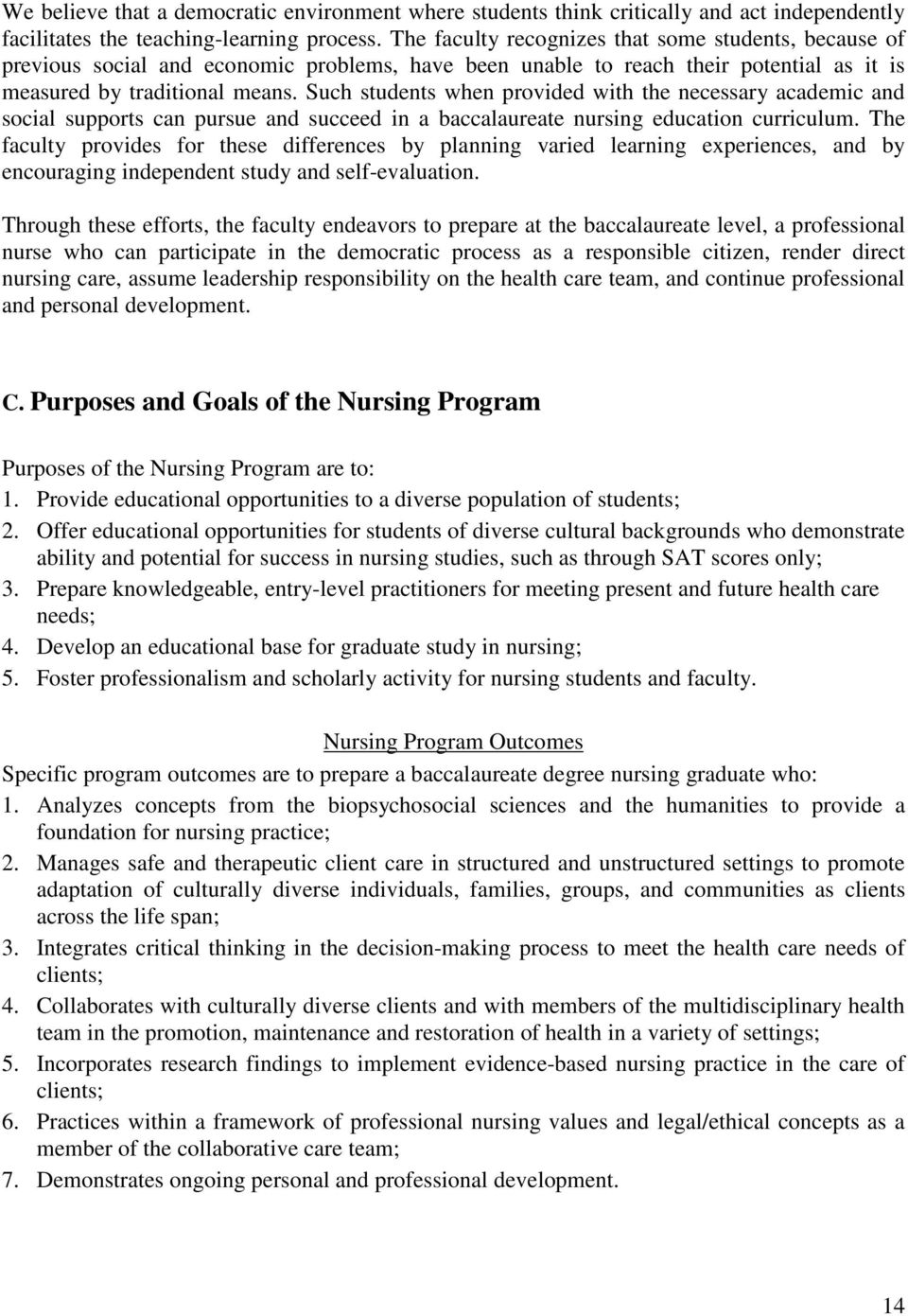
15 E. Department of Nursing Organizational Chart Chairperson Program Directors Faculty Department Secretary Budget Analyst Undergraduate Program Director Graduate Program Director Undergraduate Students Graduate Students 15

16 SECTION III CURRICULUM 16

17 A. Organizing Framework of Visual Scheme DEPARTMENT OF NURSING ORGANIZATING ORGANIZING FRAMEWORK FRAMEWORK HEALTH Wellness Illness Adaptation/Maladaptation CLIENT HUMAN NEEDS Physiologic Safety and Security Love and Belonging Self-Esteem Self-Actualization CLIENTS HUMANS ENVIRONMENT Internal and External Individuals Families Communities Groups Holism NURSING ROLES Caregiver Leader Researcher Critical-Thinker Problem Solver Communicator Change-Agent Teacher Counselor Advocate Professional Self- Development NURSING Biological Psychological Sociological Spiritual (Growth and Development) NURSING PROCESS Assessment Analysis/Diagnosis Planning Implementation Health Promotion & Illness Prevention Health Maintenance Health Restoration Evaluation Faculty approval: May 26, 2005 Faculty Approval: May 26, 2005 SGM [SGM] May 12, 2008 May 18, 2011 July 20,
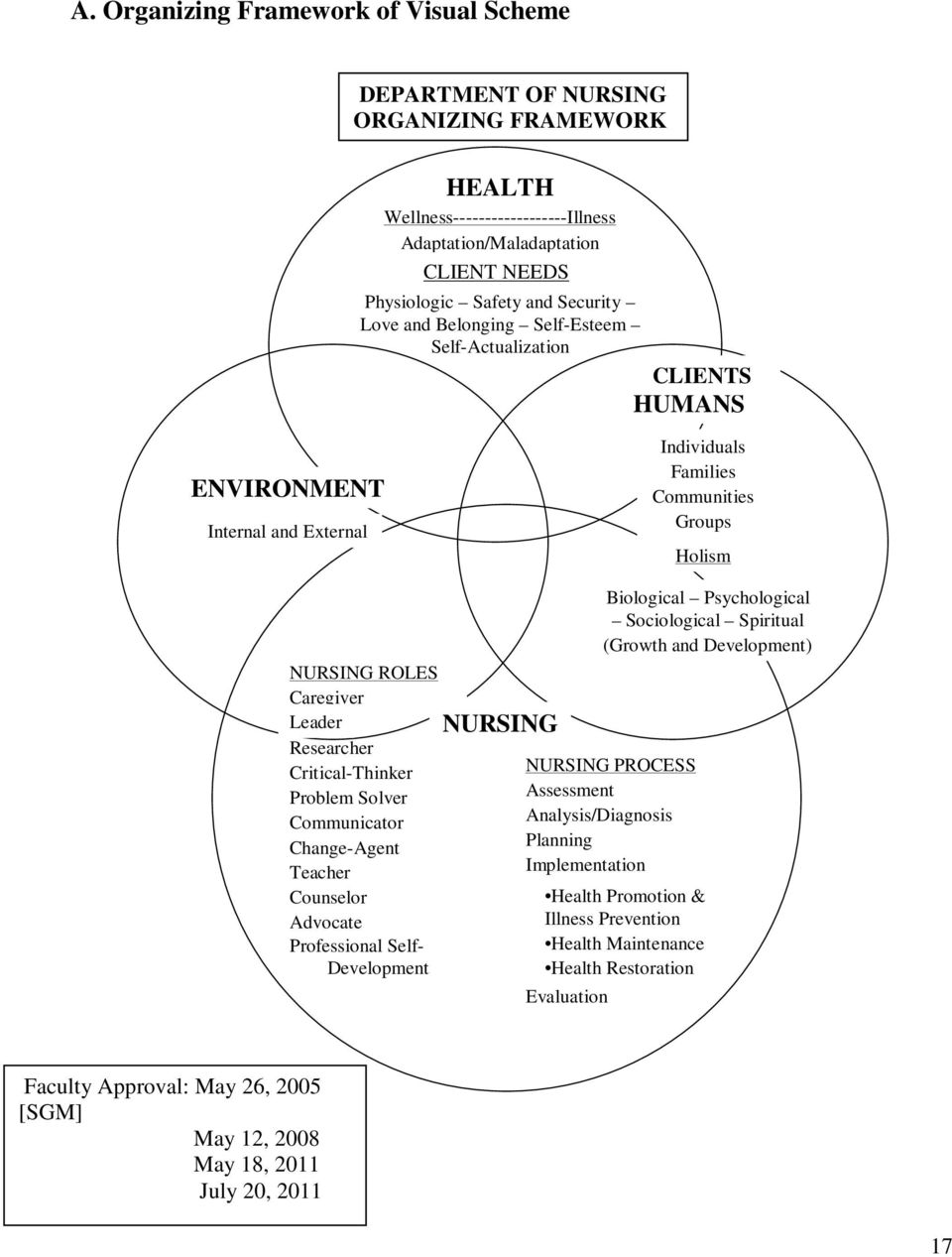
18 B. Organizing Framework Narrative Introduction The organizing framework, the keystone of the curriculum, emanates from the University and Department philosophies and provides guidelines for the selection and organization of learning experiences for the nursing curriculum. It promotes the understanding of individuals adapting to a changing environment. The organizing framework used in the Department of Nursing at Delaware State University is eclectic and is based upon the interrelationship of four major concepts: Clients, Environment, Health and Nursing (see figure above). The major concepts are comprised of sub-concepts as follows: 1) Clients: basic needs, biopsycho-social, cultural and spiritual dimensions; 2) Environment: culture, social roles, family, community, society and physical surroundings; 3) Health: adaptation, health-illness continuum through health promotion, maintenance and restoration activities; and 4) Nursing: communication, role socialization, critical thinking, nursing process, nursing leadership and nursing research. These major concepts appear in the curriculum as vertical strands and are organized according to increasing levels of complexity. In addition, the nursing process is interwoven as the horizontal strand. Theoretical formulations that provide the basis for resolving problems are derived from the following theories: adaptation, stress, human need, change, holistic, growth and development, and systems. Concepts Client: The client is viewed as a holistic being possessing biological, psychological, sociological and spiritual components. A client possesses self-determination, is self-directed, and has certain basic needs that are classified in a hierarchy according to their importance for survival and growth (Maslow, 1954). Needs are requirements which motivate responses to maintain biologic, psychologic, sociologic and spiritual integrity. Basic Human Needs hierarchy includes these needs: physiologic, safety, love and belonging, esteem, and self-actualization. The physiological needs have the highest priority until they are satisfied or are not threatened, then the need for safety takes priority. This process of differential need fulfillment follows through to selfactualization that has priority only when the other areas in the need hierarchy have been satisfied. Clients include individuals, families, communities and groups. Environment: The environment is the internal structure and external influences including family members, the community and society, as well as the client s physical surroundings that interact to influence adaptation. Culture and values provide the means by which individuals, families, groups and communities interact with each other. Society functions to ensure that the needs of its members are met and to provide opportunities for them to develop their own social roles, identities and values. Health: Health is a dynamic process wherein a human being constantly adapts to changing internal and external environments in order to maintain a state of physical, psychological, sociological and spiritual well being. Health and illness, dimensions of life, occur on a continuum. 18

19 Nursing: Nursing is a process of promoting adaptation by assisting clients to attain need satisfaction. The goal of nursing is to promote human adaptation within each of the hierarchy of needs. Effective communication is essential for the establishment of a nurse-client relationship. Through this relationship, nurses can help clients become aware of their needs and establish healthy ways of meeting the needs. The nurse assists clients to adapt using the nursing process, the components of which are assessing, diagnosing, planning, implementing and evaluating. Role socialization is a process of attitude development by which students of nursing become responsible, accountable and contributing members of the nursing profession. Nursing leadership prepares the student to guide and direct others in administering safe and effective nursing care. Nursing research is a systematic investigation of nursing practice and the effect of this practice on individual, family, group and community health. Understanding the steps of the research process enables students to critically analyze research studies and evaluate the applicability of the findings in clinical practice. Interrelatedness of Concepts A client possesses categories of needs, but responds as a bio-psycho-social unit to changes in the environment. These responses can be assessed and analyzed within each of a client s hierarchy of needs. A client s ability to adapt is dependent upon the ability to cope with environmental changes. A response that meets basic needs and maintains integrity is an adaptive response and results in wellness or health. Adaptive responses that are inadequate to meet basic needs result in illness and mal-adaptation. The goal of nursing is to promote a client s adaptation within each hierarchy of needs. If a client is adapting successfully, the nursing goal is to maintain that response through activities of health promotion and illness prevention. If the client is experiencing adaptation problems, the goal of nursing is to promote adaptation by facilitating action that maintain and restore health. Nurses intervene to maintain or achieve adaptation by the use of such behaviors as caring, guiding, supporting, counseling, teaching and promoting self-development. Health teaching, guidance and counseling are nursing activities that assist individuals, families, communities and groups to adapt to change. Although the client is considered a focal point of nursing activity, families, groups and communities provide the setting within which the nurse functions to promote health and strengthen adaptation and coping mechanisms. A client s potential for adaptation and coping may be enhanced by the provision of adequate external supports. Families, communities and groups are also recipients of nursing care. The nursing process is a systematic problem-solving method. In utilizing this process, the nurse gathers and analyzes data, makes a nursing diagnosis, selects an appropriate approach to solve the problem, identifies goals, implements the plan of care and evaluates the results. The nurse utilizes Maslow s hierarchy of needs to determine the client s status by making a systematic assessment within each level of the hierarchy of needs. Following the assessment, data is analyzed which assist in formulating nursing diagnoses. Client-centered goals are identified to reinforce adaptation to the hierarchy of needs. The nurse then implements a plan of care that assists the client with unmet needs. The nurse evaluates the effectiveness of the entire process by judging whether the defined 19

20 goals were attained. Inherent in the evaluation process is the reassessment and modification of the plan. The professional nurse strives to provide culturally sensitive and competent care. Professional nursing practice is based on scientific knowledge obtained from nursing research and research in other sciences. The nurse draws from a broad knowledge base of nursing science, biopsycho-social sciences, the humanities, nursing history and nursing practice to develop the critical thinking skills needed to solve client-related problems. An understanding of the scientific method is necessary to develop beginning skills as a consumer of research. The nurse utilizes the communication process in all components of the nursing process with individuals, families, communities and groups. Successful communication is dependent on the use of therapeutic skills, self-awareness, sensitivity and responsiveness to others. The learner is socialized into the nursing role through a process of change. Knowledge of theories of change is necessary in order for the nurse to utilize planned change in solving problems. Nurses effect change by acting as a change agent to facilitate adaptation. Knowledge of leadership strategies facilitate the assumption of the nursing role and enhance the change agent role. Nurses also utilize the teaching/learning process to effect change with individuals, families, communities and groups. Learning is a change in behavior that is acquired because of practice and can be repeated when necessary. Change in behavior and the effects of learning can be observed and evaluated. Knowledge of teaching/learning principles and the process of learning are integral to the nursing process and the assumption of the nursing role. C. Glossary of Terms Based on the DSU Department of Nursing Organizing Framework Adaptation: the process of clients responding to changes in internal and external environments to maintain or achieve health and wellness. Caregiver: role of the nurse that includes health promotion, maintenance and restoration across the life span. Change: a process that leads to modification in behavior, patterns or outcomes in response to a stimulus. Client: the unit with whom the nurse intervenes to promote adaptation. Clients include individuals, families, communities and groups. Community: any group of clients living in the same area or having work or other interest in common. Concept: an idea, mental image of reality or phenomena. 20

21 Critical Thinking: critical thinking begins with students thinking about their thinking, making sense about the information being considered, and making an interpretation judgment about its meaning. Critical thinking is an essential cognitive component of the complex decision-making process that occurs in nursing practice. Critical thinking is engaged in by students during their (a) application of specialized knowledge to human health related situations, (b) exploration of information in the internal and external environments of clients, and (c) holistic interpretation of objective and subjective data, for the purpose of making judgments about nursing actions that promote adaptation and assist clients in meeting human needs. Culture: a view of the world and the life experience through a set of traditions, values and behaviors used and transmitted from generation to generation by a specific group of clients. Also includes related beliefs, attitudes and institutions shared by a particular group. Cultural Sensitivity/Competence: having and acting on the knowledge, skill, tolerance and ability to include the unique influences of culture appropriately when planning and delivering nursing care to clients from a variety of cultures different from ones own. Development: a client s increasing capacity and skill in holistic functioning related to growth. Eclectic: choosing; selecting from various systems, doctrines or sources. Environment: the internal structure and external influences including family members, communities, groups and the society as well as the client s physical surroundings that interact to influence adaptation and health. External Environment: external aspects, processes, and factors that influence client adaptation and health states, i.e. families, communities, groups, society, technology, pollution. Family: an intergenerational social group organized and governed by social norms regarding descent, relationships, reproduction and socialization of clients across the life span. Group: three or more clients gathered together interacting with one or more phenomena in common. Growth: increase in physical size also related to developmental function. Health: a dynamic process wherein man constantly adapts to changing internal and external stimuli in order to maintain a state of physical, emotional, psychological, sociological and spiritual well being. Health Promotion: any nursing care activity that assists a client to achieve the highest state of wellness and well-being possible. Health promotion also includes illness prevention activities. Levels of Illness Prevention: Primary Prevention - nursing actions that focus on prevention of the development of any signs or symptoms of an illness occurring in a client. 21
22 Secondary Prevention - nursing actions that focus on diagnosis and treatment of pathological process shortening its duration and returning the client to high-level wellness as soon as possible. Tertiary Prevention - nursing actions that focus on limiting or stopping the processes of illness and disability, returning the client to their highest level of wellness and functioning as possible. Health Maintenance: any nursing care activity that assists a client to support the highest level of wellness possible in the presence of various levels of health and illness. These actions may include a variety of therapeutic interventions that are within the scope of professional nursing practice. These interventions may include assisting clients to fulfill or achieve adaptation in the presence of any unmet client need. Health Restoration: any nursing care activity that assists a client to regain the highest level of health, wellness or quality of life possible following or in the presence of various states of illness along the wellness-illness continuum. These nursing actions may include rehabilitation, restorative, comfort and palliative measures. Hierarchy: a group of things that are arranged in order of rank, grade, class or importance. Holism: the view that a client is more than the sum of their parts. A client includes biological, psychological, sociological, spiritual and other components to equal a whole or complete human being. Illness: a state in which client needs are not adequately met or fulfilled resulting in maladaptation. Individual: a holistic being possessing biological, psychological, sociological and spiritual components and as being in constant with a changing environment. Integrity: completeness and unimpaired wholeness. Internal Environment: the internal aspects and processes of a client s structure and being. Such aspects and processes include physical structure and function, biological, and chemical processes, feelings, beliefs, emotions, and cognition. Maladaptation: a client s inability to respond to changes in the internal external environments to achieve wellness resulting in illness. Need: a requirement or requisite; the lack of something desirable or useful. Nursing: ANA definition: the diagnosis and treatment of client responses to actual or potential health problems. DSU definition: a process of promoting adaptation to assist clients to attain highlevel wellness and need satisfaction. 22
23 Nursing Role: expected behaviors and activities engaged in by the professional nurse while providing health care and promoting client adaptation. At DSU, the roles of the nurse include caregiver, leader, researcher, critical thinker, problem solver, communicator, change agent, teacher, counselor, advocate and professional development. Organizing Framework: an internally unified way of understanding major interrelated concepts of the nursing curriculum. Role Socialization: the process by which individuals learn the knowledge, skills and dispositions of their social group or society. Society: is a network of diverse, interacting individuals, families, communities and groups that provides its members an opportunity to develop their own roles, identities and values. Spirituality: beliefs in a higher power, creative being, divine being or infinite source of energy; the belief may or may not be associated with an organized religion. Stimulus: anything that arouses or incites action from a receptor that results in a change, as in a stimulus-response reaction. Therapeutic Communication: communication is a continuous, circular process engaged in by students to establish therapeutic client relationships. In therapeutic relationships nurses exchange verbal and nonverbal messages that assist individuals, families, groups and communities to adapt to change and fulfill client needs. Therapeutic Nursing Interventions: therapeutic nursing interventions are nursing actions that assist clients to achieve personal health goals, basic client needs and adapt to change and health problems. Nursing actions are goal specific and based on assessment data. Nursing actions are also designed to facilitate the promotion, maintenance and restoration of health. Nursing Values: values of the professional nurse include caring, altruism, autonomy, human dignity, integrity and social justice. Wellness: client needs are being adequately met and a state of successful adaptation is occurring in response to internal and external environmental changes. 23
24 D. Curriculum Four-Year BSN (Nursing/ NURS) Course Descriptions and Prerequisites in the Nursing Program Course descriptions are published in greater detail in each course syllabus. Students are referred to the DSU Web page for course descriptions and prerequisites as there may be changes to this information. Credits/Lec/Lab NURS 191 University Seminar I 1:1:0 General education requirement in nursing orients students to the University environment and support systems. Facilitates campus community involvement of students by requiring their attendance at special academic and cultural events on campus. Emphasizes necessary tools and strategies for academic success. Techniques are used with students to assist them to assess learning styles, personality traits and motivation strategies. NURS 192 University Seminar II 1:1:0 General education requirements sequel to University Seminar I. Begins to focus students toward academic skills necessary for success in the nursing program and discipline. NURS 204 Pathophysiology in Nursing 2:2:0 Course introduces pathophysiologic disruptions to human system functioning. Emphasizes the use of therapeutic drugs and diet therapy in assisting individuals to achieve adaptation in the presence of selected disease processes. Prerequisites: CHEM 107, BIOL 207, 208. Co-requisites: NURS 292 AND BIOL 221 NURS 292 Foundations for Nursing 1:1:0 This is a Web-based course. Students taking this course will be assigned specific websites that must be used in order to be successful. The course introduces students to medical terminology, drug dosage calculations and basic safety practices in nursing. This is a nursing support course that is a prerequisite for entry into the nursing major. Prerequisites: BIOL 207, BIOL 208, CHEM 107 Co-requisites: NURS 204, NURS 292, BIOL 221. NURS 300 Growth and Development Across the Life Span 2:2:0 The course will assist nursing students to apply knowledge of multiple theories of human development in planning nursing care and to understand principles of normal growth and development patterns across the life span. Aspects related to biological, psychological, sociological and spiritual dimensions of human functioning are included, and health promotion across the life span is emphasized. Prerequisites: Admission to clinical nursing. Co-requisites: Nursing 301,
25 Junior Level Nursing Courses Credits/Lec/Lab NURS 307 Introduction to Nursing Practice 5:3:6 Focuses on fundamental nursing interventions and assisting individual clients to fulfill basic human needs. Adaptation related to meeting physiological, safety, and security needs are emphasized. Students begin to apply principles of the nursing process when planning care for individual clients in long term care structured settings. Opportunities to practice in the roles of caregiver, communicator, problem solver and a group member of the health care team are provided. Prerequisites: Admission to clinical nursing, successful completion of all General Education and Support courses (as shown on the Nursing Program of Study for the first four semesters). Co-requisites: NURS 308, NURS 309 NURS 308 Health Assessment 4:3:3 This course is designed to provide students with knowledge and skills necessary to collect data related to individual health using a multidimensional approach. Students are introduced to assessment devices and procedures used to collect data related human body structure and functioning using a systems approach. Psychologic, social and cultural aspects of assessment are also introduced to assist students to analyze environmental influences on human structure and function. Assessment of normal growth and development is also emphasized. Prerequisites: Admission to clinical nursing, successful completion of all General Education and Support courses (as shown on the Nursing Program of Study for the first four semesters). Co-requisites: NURS 307, NURS 309 NURS 309 Psychiatric/Mental Health Nursing 5:3:6 This course provides students with didactic and clinical learning experiences utilizing the nursing process as a means of providing health care to individuals, families and groups experiencing maladaptive alterations in mental health. Student development in the following nursing roles are emphasized: communicator in the therapeutic nurse-client relationship, advocate of client s rights and caregiver. Prerequisites: Admission to clinical nursing, successful completion of all General Education and Support courses (as shown on the Nursing Program of Study for the first four semesters). Co-requisites: NURS 307, NURS 308 NURS 310 Introduction to Nursing Research 3:3:0 An introductory course to fundamentals and principles of the research process and their application in nursing. Emphasis is placed on developing proficiency in critiquing and evaluating nursing research findings as they relate to the practice of nursing. Prerequisites: Successful completion of NURS 307, NURS 308, NURS 309 Co-requisites: NURS 311, NURS
26 Credits/Lec/Lab NURS 311 Nursing Care of the Child and Family 5:3:6 Students develop competencies and skills needed to manage health care of children experiencing potential and actual problems in fulfilling human needs and achieving bio-psycho-social adaptation. Roles of the nurse in promoting health and adaptation for the child within the context of a family are emphasized in clinical and theoretical components of the course. Prerequisites: Successful completion of NURS 307, NURS 308, NURS 309, Co-requisites: NURS 310 and NURS 312. NURS 312 Health Promotion, Maintenance and Restoration I (HPMR I) 5:3:6 This course provides students with both didactic and clinical learning experiences designed to provide nursing care to adult patients/clients who are experiencing acute and chronic medical-surgical health problems in clinical and community health settings. In this course students use the nursing process to provide care to individuals. The course also focuses on individual and family responses to illness experience. Emphasis is placed on the multiple roles of the nurses: caregiver, teacher, critical thinker, and problem solver. Normal and abnormal physiological to stress and adaptive mechanisms and nutritional principles and therapies are introduced. Strategies of health promotion, maintenance and restoration are emphasized. Prerequisites: Successful completion of NURS 307, NURS 308, NURS 309, Co-requisites: NURS 310 and NURS 311. Senior Level Nursing Courses Prerequisites: Year 1 and year 2 courses in Nursing Program of Study Credits/Lec/Lab NURS 407 Health Promotion, Maintenance and Restoration II 5:3:6 This course utilizes the nursing process in the study of individuals with simple, adaptive problems resulting from interference with basic human needs. The theoretical and clinical components are designed to assist the student to determine priority of client needs and to recognize client responses to illness. The course provides for development of critical thinking skills and strategies of health promotion, maintenance and restoration across the life span. Prerequisites: Successful completion all junior level nursing courses [NURS 307, NURS 308, NURS 309, NURS 310, NURS 311 & NURS 312] Co-requisites: NURS 408, NURS
27 Credits/Lec/Lab NURS 408 Maternal Newborn Nursing and Women s Health 5:3:6 Course provides didactic and clinical learning experiences designed to assist students to apply the nursing process in providing care to the childbearing family during antepartum, intrapartum and postpartum periods in a variety of settings. Health maladaptations as they relate to growth and development are examined. The nurses role in health promotion and disease prevention to fulfill human needs for childbearing families and women is emphasized. Prerequisites: Successful completion all junior level nursing courses Co-requisites: NURS 407, NURS 409 NURS 409 Community Health Nursing 5:3:6 This course provides didactic and clinical learning experiences for students in selected principles of community health, public and family health nursing. Students conduct in-depth community and family health assessments employing basic epidemiological principles and data collection strategies. The nursing process is utilized by students engaging in health promotion and maintenance strategies in a variety of community health settings. Prerequisites: Successful completion all junior level nursing courses Co-requisites: NURS 407, NURS 408 NURS 410 Special Topics in Nursing 3:3:0 A synthesis course that provides students with repeated opportunities to critically analyze and apply knowledge and skills, learned earlier in the program, in providing care to individuals, families and groups experiencing complex problems across the life span. Test taking and psychometric principles and skills are emphasized. Prerequisites: NURS 407, NURD 408, NURS 409 Co-requisites: NURS 411, NURS 412 NURS 411 Issues and Leadership in Nursing 3:3:0 This course explores the impact of socio-economic, political and technological variables on nursing practice. Legal and ethical issues related to health care are emphasized and concerns pertaining to quality assurance are examined. An exploration of leadership and management theories and principles and their application to nursing practice in the provision of health care is presented. Student development in the roles of problem-solver, change agent and leader is emphasized. Prerequisites: Successful completion of first semester senior level nursing courses. This is a Capstone course Prerequisites: NURS 407, NURD 408, NURS 409 Co-requisites: NURS 410, NURS
28 Credits/Lec/Lab NURS 412 Health Promotion, Maintenance and Restoration III 7:4:12 This course focuses on application of the nursing process in the study of individuals with complex adaptation problems. The cultural, ethical, psychosocial and legal aspects of these complex health problem as they affect individuals and their families, the health team and society are emphasized. This course allows the student to examine the historical aspects of nursing as related to patients complex needs. Clinical experiences with client are provided in a variety of settings. Prerequisites: Successful completion of NURS 407, NURD 408, NURS 409 Co-requisites: NURS 410, NURS
29 RN to BSN Program Credits/Lec/Lab NURS 209 Scope of Professional Nursing Practice 3:3:0 Prerequisites: Admissions to RN-BSN Program. State licensure as Registered Nurse. This is the first nursing course in the RN to BSN program of study. The course focuses on concepts, theories, models and philosophies basic to the practice of nursing. Designed to assist the registered nurse student to analyze previous knowledge and examine more advanced theoretical concepts as they apply to individuals, families and groups. Application of the DSU organizing framework to nursing practice is emphasized. Prerequisites: Admission to the Nursing Program. Successful completion of all Nursing Support courses, ENGL 101 and 102, PSYC 201 and 316 or NURS 300, SCCJ 101, GLSC 395 NURS 308 Health Assessment (RNs) 4:3:3 This course is designed to provide students with knowledge and skills necessary to collect data related to individual health using a multidimensional approach. Students are introduced to assessment devices and procedures used to collect data related to human body structure and functioning using a systems approach. Psychologic, social and cultural aspects of assessment are also introduced to assist students to analyze environmental influences on human structure and function. Assessment of normal growth and development is also emphasized. Prerequisites: Admission to the Nursing Program. Successful completion of all Nursing Support courses, ENGL 101 and 102, PSYC 201 and 316 or NURS 300, SCCJ 101, GLSC 395 NURS 310 Introduction to Nursing Research 3:3:0 An introductory course to fundamentals and principles of the research process and their application in nursing. Emphasis is placed on developing proficiency in critiquing and evaluating nursing research findings as they relate to the practice of nursing. Prerequisites: Admission to the Nursing Program. Successful completion of all Nursing Support courses, ENGL 101 and 102, PSYC 201 and 316 or NURS 300, SCCJ 101, GLSC 395 Co-requisites: NURS 209, NURS 313 NURS 313 Independent Study in Nursing 3:0:0 These courses provide students opportunities for in depth study of selected topics, issues, skills or techniques in nursing. Learning objectives are established by faculty and students with periodic instruction and evaluation of student progress. Prerequisite: Departmental Approval. Credits: one to three hours 29
30 Credits/Lec/Lab NURS 314 Nursing Informatics and Technology 3:3:0 This course will explore the impact of technology on health care, medical record keeping, the influence of HIPAA on record keeping, technological variables in nursing practice. It will focus on the role of the nurse in electronic information handling and considerations for strategic planning. NURS 409 Community Health Nursing 6:4:6 This course provides didactic and clinical learning experiences for students and selected principles of community health, public and family health nursing. Students conduct in-depth community and family health assessments employing basic epidemiological principles and data collection strategies. The nursing process is utilized by students engaging in health promotion and maintenance strategies in a variety of community health settings. NURS 411 Issues and Leadership in Nursing 3:3:0 Prerequisites: Awarded 60 DSU credits for prior learning in Nursing; Nursing 209, Nursing 211, Nursing 303, Nursing 413 and Nursing 414. Corequisites: Nursing 402 and Nursing 420. This course assists the RN student to focus on the role of the professional nurse as a leader in the health care environment and a manager of the health care of clients in a variety of clinical settings. Theories of leadership, management, organizational behavior, planned change and conflict resolution will be applied to leadership in professional nursing. Roles of the professional nurse as a change agent and problem solver in health care organizations are emphasized. NURS 420 Social & Political Issues in Nursing 2:2:0 A course designed for registered nurse students to study selected ethical, legal, political and social issues influencing the nursing profession and health care. Development of professional nursing roles including advocate, change agent, political activist and social problem solver and communicator in political groups are emphasized. Prerequisites: Awarded 60 DSU credits for prior learning in Nursing; Nursing 209, Nursing 211, Nursing 303, Nursing 413 and Nursing 414. Corequisites: Nursing 402, Nursing 418. NURS 413 Independent Study in Nursing 3:0:0 This courses provides students opportunities for in-depth study of selected topics, issues, skills or techniques in nursing. Learning objectives are established by faculty and students with periodic instruction and evaluation of student progress. Prerequisite: Departmental Approval. 30
31 C. The Nursing Curricula Category I: Pre-Professional Phase This consists of the first two years of General Education and Nursing Support courses as shown on the Nursing Program of Study. University Seminar I and II are the nursing courses in year one of the four year program of study that begin to focus students toward academic skills necessary for success in the nursing program and discipline. All Pre-Professional Phase support courses e.g. Growth and Development Across the Lifespan, must be successfully completed with a minimum grade of C prior to application for acceptance into the Nursing Program. Category II: Professional Phase The professional phase sequence includes nursing courses which are arranged in increasing complexity. The professional nursing courses, as shown on the Nursing Program of Study, begin in the Junior Fall Semester with Introduction to Nursing culminating in the Senior Spring Semester HPMR III. 31
32 D. Nursing E Program of Study Freshman Fall Semester Freshman Spring Semester Course Course Name Sem Cr Gr Course Course Name Sem Cr Gr NURS-191 University Seminar I GE 1 NURS-192 University Seminar II GE 1 BIOL-207 Anatomy & Physiology I 4 BIOL -208 Anatomy &Physiology II 4 MTSC-121 College Algebra GE 3 ***** Statistics 3 ENGL-101 English Comp. I GE 3 ENGL-102 English Comp. II GE 3 PSYC-201 Intro to Psychology 3 SCCJ-101 Intro. to Sociology GE 3 **** Elective 3 **** Arts/Humanities GE 3 Total Credits 17 Total Credits 17 Sophomore Fall Semester Sophomore Spring Semester Course Course Name Sem Cr Gr Course Course Name Sem Cr Gr MVSC-101 Fitness and Wellness GE 2 GLST-395 Global Societies GE 3 ENGL-200 Speech GE 3 BIOL -221 Fund. of Microbiology SO 4 CHEM-107 Chem. for Health Sci. FO 4 NURS-204 Pathophysiology SO 2 PSYC-316 Developmental Psych or 3 ENGL-xxx Literature GE 3 NURS-300 Growth and Development (2) HIST-xxx History GE 3 **** Arts/Humanities GE 3 NURS-292 Foundations in Nursing SO 1 Total Credits 15 Total Credits 16 Junior Fall Semester Junior Spring Semester Course Course Name Sem Cr Gr Course Course Name Sem Cr Gr NURS-307 Intro to Nursing Practice 5 NURS-310 Nursing Research* 3 NURS-308 Health Assessment 4 NURS-311 Child & Family 5 NURS-309 Psych/Mental Health 5 NURS-312 HPMR 1 6 Total Credits 14 Total Credits 14 Senior Fall Semester Senior Spring Semester Course Course Name Sem Cr Gr Course Course Name Sem Cr Gr NURS-407 HPMR II 6 NURS-410 Special Topics 3 NURS-408 Maternal Newborn 5 NURS-411 Issues &Leadership ** * 3 NURS-409 Community Health 5 NURS-412 HPMR III 8 Name: ID#: Phone: Advisor: Date: Total Credits 16 Total Credits 14 Satisfies the Multicultural across-the-curriculum Requirement (two courses required) Must take at least one African-American course in one of the designated areas ** Senior Capstone Credits < 122 > *Writing Intensive SO Spring Only FO Fall Only B Both Sem. V Variable 32
33 E. Program Student Learning Outcomes 1. Analyzes concepts from the bio-psycho-social sciences and the humanities to assist in meeting health care needs of culturally diverse individuals, families, groups and communities as clients. 2. Manages safe and therapeutic client care in structured and unstructured settings to assist in meeting the needs of clients across the life span with complex problems of adaptation. 3. Integrates critical thinking in the decision-making process in the provision of health care. 4. Collaborates with culturally diverse individuals, families, groups and communities, and with the multidisciplinary team to evaluate goals and interventions which assist in promoting, maintaining and restoring health. 5. Incorporates research findings to implement evidence-based nursing practice in the care of clients. 6. Utilizes professional standards in the evaluation of health care provided by self and the collaborative health team. 7. Demonstrates ongoing personal and professional role development. 33
34 SECTION IV ACADEMIC POLICIES 34
35 I. POLICIES RELATED TO ADMISSION TO THE NURSING PROGRAM A. 1. Admission to Delaware State University. The Department of Nursing or its designee will provide advisement for all students seeking admission to the Nursing Program unless the students are admitted to the Project Success Program. 2. Pre-nursing students who have not taken Chemistry and Biology courses in high school or have a grade of less than a B in these two high school courses must take: a. BIOL103 Human Biology or BIOL111 Human Disease prior to taking BIOL207 Anatomy and Physiology; and/or b. CHEM 100 Chemistry prior to taking CHEM107 Chemistry for Health Sciences. 3 The combination of BIOL 207 Anatomy and Physiology I and BIOL 208 Anatomy and Physiology II may only be taken twice this includes failures and withdrawals. 4. The nursing entrance test must be taken by February 1 st of the spring semester prior to the academic year in which you plan to seek admission to the nursing major. In order to pass this test, each student must obtain scores that are at or higher than the scores designated by the Department of Nursing. The entrance test may be taken no more than twice to be considered for admission to the major. 5. Pre-professional students must have completed ALL of the courses listed for the first four semesters (listed on the Nursing Program of Study sheet) and earned a minimum grade of C in each of the general education and support courses with an earned GPA of not less than 2.8 (GPAs are not rounded up) at the time of initial review in March of the year application is submitted. Conditional admission decisions to the nursing major are made in the month of March and are based on data available at that time (GPA > 2.8, courses completed, current course enrollment, and entrance exam scores). Final decisions are made at the end of May. No one is guaranteed admission to the nursing major. 6. Application for admission must be submitted online between November 15 th and February 25 th. No late applications or paper applications will be accepted. 7. Once admitted to the program, each student is responsible for her or his own transportation to and from their assigned clinical sites. 35
36 B. Criteria for Professional Phase Nursing Courses 1. Documentation of the following must be submitted to the Department of Nursing by July 1 st prior to the start of the first clinical course (Junior level nursing courses): (Students are financially responsible for the following.) Health care provider CPR which must include Infant, Child and Adult CPR, Care of the choking victim, and use of the AED. CPR certification must be valid throughout the entire program. National fingerprints with criminal background check must be no older than three months prior to the start of the first clinical course. Child abuse and elder abuse background checks will be requested for each assigned clinical agency. Physical examination within three months of the first clinical course that includes a statement that you are physically able to meet performance requirements in clinical, which includes but is not limited to strenuous lifting, pushing and standing for long periods of time, walking long distances, etc. Urine drug screen (10 panel) prior to beginning the first clinical nursing course. Immunizations MUST SHOW DOCUMENTATION/PROOF of the following: MMR 1 and MMR 2 (Measles, Mumps, Rubella) Td Tetanus and Diphtheria booster within the last 10 years and valid throughout the entire clinical program Polio Series of three Varicella (chickenpox) vaccine, proof of disease or Varicella titer Hepatitis B vaccine 3 doses, or waiver Two step PPD completed within 3 months prior to beginning clinical rotation. 2. Students must purchase uniforms as designated by the Department, a DSU Department of Nursing uniform patch and equipment (stethoscope with bell and diaphragm, pen light). 3. Students are responsible for their own transportation to and from assigned clinical sites. Clinical rotations may be scheduled during day, evening and/or weekend shifts. 4. Continuation in the nursing major: A student who is unsuccessful (fails) in one nursing course can return the following year to repeat the course. A student who is unsuccessful (fails) the same or a second nursing course has to reapply for admission during the next application cycle (there is no guarantee that he or she will be readmitted). A student who is unsuccessful (fails) in three or more nursing courses will not be granted readmission to the Nursing Program. A withdrawal from a nursing course for academic reasons counts as a failure. 5. Transfer students in good standing with at least 60 acceptable college transfer credits or a college degree may be exempt from University Seminar I and II. However, all other requirements listed above must be met for admission to the Professional Nursing Level. The successful completion of the designated nursing entrance exam is required of all students entering the generic Nursing Program. 36
37 6. All applicants to the Nursing Program shall receive a letter from the department chairperson notifying them of their admission status in the program. 7. All students admitted to the Nursing Program shall be assigned a nursing advisor. 8. Transfer credit for course work in nursing from other colleges and universities is evaluated on a course by course basis through the following procedure: a. The student makes a formal request in writing to the chairperson of nursing to have nursing courses reviewed by the faculty with teaching responsibility for said course b. Evidence of course materials submitted to the Admissions Committee for review: 1. transcripts 2. course outlines and syllabi c. Following careful review of course materials by the Admissions Committee, the student will be notified of transfer credit status. d. Possible actions of the Admissions Committee: 1. Deny transfer credit, in which case student will be required to take the nursing course(s) at DSU. 2. Award requested transfer credit for appropriate DSU course(s). A letter will be written by the chairperson of the Department of Nursing to the DSU records office, requesting the credit to be awarded. 3. Request that the student take a faculty designated challenge exam demonstrating knowledge in course content for which DSU credit is sought. 37
38 II. POLICIES RELATED TO PROGRESSION, PROBATION, DISMISSAL AND READMISSION IN THE NURSING PROGRAM A. Progression in the Nursing Program. 1. Students may not progress to the next nursing course in the nursing sequence prior to passing all prerequisite courses. 2. A student must maintain a minimum grade of 2.0 in nursing courses to progress in the Nursing Program. Students who fail to maintain this GPA in nursing courses will not be permitted to register for the next scheduled nursing course. 3. Students who fail a nursing course in any semester shall repeat that course during the next semester in which the course is offered. Students who do not successfully repeat the failed course(s) during the next semester the course is offered, or who withdraw from the course while failing, will be dismissed and are required to seek readmission to the Nursing Program. 4. Students must pass both the theory and clinical/laboratory portions of any nursing course to receive credit for that course. Failure of any component will result in failure of the entire course. The determination of numerical grades for clinical nursing courses will be based upon the theoretical component of the course. Clinical practice will be graded on a Pass/Fail basis. However, a student must receive a passing grade in both theory and clinical components in order to pass the course. If either the theory or clinical portion of the course is failed, the entire course must be repeated. There will be no exceptions to this regulation. B. Academic Probation 1. All students shall be placed on academic probation prior to dismissal from the Nursing Program for poor academic performance. * Students who fail one nursing course shall be placed on academic probation. * Students who have a cumulative Grade Point Average (GPA) that falls below 2.0 in any semester shall be placed on academic probation the following semester. C. Dismissal from the Nursing Program 1. Failure to make satisfactory and continuous progress in the Nursing Program shall be cause for dismissal. a. Students who have a GPA of less than 2.0 for two consecutive semesters shall be dismissed from the Nursing Program. 38
39 b. Students who fail two or more nursing courses, clinical and/or nonclinical, shall be dismissed from the Nursing Program. Failure is defined as failure of the same course twice, or failure of any two different nursing courses. c. Withdrawal from a course while failing is considered a failure of that course. A student withdrawing from a nursing course twice while failing or withdrawing from a nursing course on a second attempt while failing, shall be dismissed from the Nursing Program. d. A nursing course once failed still counts as one failure even after the course has been successfully repeated. e. Students who are dismissed from the Nursing Program for poor academic performance may apply for readmission. 2. Health problem(s) a student shall be dismissed from the program if experiencing any health problem(s) determined to be harmful or potentially harmful to self or others. 3. Other reasons for dismissal a. Violation of confidentiality b. Unsafe nursing practice c. Academic dishonesty d. Verbal or non-verbal disrespect, showing excessive anger, cursing or violence toward faculty, staff or other students. e. Criminal behavior or record of conviction of crime upon background check. f. Illegal substance use and/or abuse. i. Students suspected of substance use will be required to take a drug or alcohol test. ii. If the test is positive, the student will be referred to the University Counseling Center. iii. The student will not be allowed to attend classes or clinical iv. A student missing classes or clinical practice will be subject to course failure and/or dismissal from the program. D. Readmission to Nursing Program 1. Students dismissed from the Nursing Program due to poor academic performance only may apply for readmission at the end of two academic semesters following the dismissal if the criteria listed below are achieved. a. Overall GPA of 2.8 on a 4.0 scale. b. Positive recommendation from Admissions Committee in the Department of Nursing. 39
40 c. An interview with the Department Chairperson and the Nursing Admissions Committee. d. Presentation of a written plan explaining how success in the Nursing Program will be achieved. e. Students readmitted to the Nursing Program following a one year absence shall be readmitted under the most current policies and curriculum in use by the program at the time of readmission. 2. Students readmitted to the Nursing Program may not fail any nursing course. Failure of any nursing course will result in final dismissal from the Nursing Program. 3. Nursing faculty reserve the right to deny a student readmission to the Nursing Program based on a student s past academic and professional performance and faculty judgment regarding a student s ability to succeed in the program if readmitted. E. Grading Scale in the Department of Nursing Numerical Grade Letter Grade Numerical Equivalent A B C (failure) D and below F 0.0 F. A minimum grade of C or better must be received in all general education and preprofessional phase support courses. G. Policy on Rounding Grades In all nursing courses, grades will not be rounded up. 40
41 III. POLICIES RELATED TO GRADUATION A. Nursing students must complete the minimum number of credit hours for the nursing program of study. B. DSU Nursing Pin - each nursing student who is eligible to graduate is eligible to purchase a DSU nursing pin. The pin signifies completion of all requirements of the nursing program at Delaware State University. Graduates are pinned at the Annual Pinning Ceremony held during May of each year. C. Only nursing students who have successfully met all of the requirements of the nursing program shall be eligible to participate in the annual Pinning Ceremony. D. Directions for applying to take the NCLEX-RN will be provided to graduating seniors during the last semester of the senior year. E. Students planning to graduate in May must complete the graduation application process during the preceding September. 41
42 IV. GENERAL ACADEMIC POLICIES A. Academic Advising and Counseling 1. Each student will be assigned an advisor upon admission to the program. (Please note: Although the purpose of this assignment is mainly academic in nature, nursing faculty members have a commitment to assist the student with any concerns wished to discuss. Personal problems may have a direct impact upon academic performance both in the University and in the Department of Nursing. Faculty may be aware of services or resources available at Delaware State University and the surrounding community that could be helpful to the student). 2. Nursing faculty advisors will assist students in academic activities related to successful progression through the Nursing Program. Students should make appointments and meet with their nursing advisor during specific periods of the academic year as follows: a. registration and pre-registration; b. at the beginning of each semester to discuss progress made in prior semester and plans, problems, questions or concerns for current semester; c. prior to dropping or withdrawing from a course; and d. when experiencing academic or personal problems at any time. 3. The assigned nursing faculty advisor may be changed upon request of the student and/or faculty member. Such request must be made to the chairperson of the Department of Nursing. B. Math Proficiency Examinations: All nursing students must demonstrate competent skill and ability to calculate accurate and safe dosages of drugs and solutions in each clinical nursing course. To ensure that students maintain such competency, the following policy shall be followed: 1. A math proficiency exam shall be administered by faculty in each clinical nursing course during the first two weeks of the semester. 2. A grade of 90% or above must be achieved to pass the examination. 3. The examination may be taken twice. If not successful on the second attempt, the student will not be able to continue in the course. 4. Students may not administer medications while in a clinical course prior to achieving success on the math proficiency examination. C. Standardized Achievement Tests - At the end of each clinical course faculty may administer an appropriate achievement test to students completing the course. Results of the test will be used by faculty to evaluate student progress in courses and plan appropriate remediation for students as necessary. If an achievement test is required, the student must take the examination and achieve a satisfactory score prior to 42
43 progressing to the next level nursing course. Specific requirements for achievement tests will be included in each course syllabus. D. Course Examinations - All written examinations and quizzes are to be taken on the day that they are scheduled. In cases of emergency only, a student may arrange with the faculty (at the faculty member s discretion) to be given a make-up examination. Faculty must be notified prior to the scheduled examination of student absence. Course policies concerning examinations and quizzes are included in each course syllabus. E. Senior Comprehensive Examinations Seniors are required to take three national standardized examinations to assess preparedness for NCLEX. Remediation is required for all areas in which a student scores less than the desired level in any area of either examination. F. Independent Study Guidelines - Any student at the junior or senior level may register for an independent study course ( or ) with departmental approval. These one to three hour courses provide for the student an in-depth study of specific subjects, specific skills or techniques. Learning objectives are established by the student and faculty for periodic progress evaluation. These courses may not be used to take regularly scheduled nursing courses without prior departmental approval. Students who have taken nursing courses at other college or universities may use the independent study option to complete course work which the nursing faculty feels was not included in the transferred course. G. Course and Instructor Evaluations The Department of Nursing complies with the University policy regarding course/instructor evaluations. Instructor/course evaluations will not affect the student s grade in any nursing course. All written comments and scores are reported as group data so individual students cannot be identified. H. Class and Clinical Attendance Department policies regarding attendance are written in each course syllabus. Students must attend classes with regularity and punctuality to meet the objectives of each course. 1. Attendance at all nursing laboratories, clinical practice experiences and classes is compulsory. Any time missed from clinical must be made up. Nursing faculty will decide if the clinical time will be made up. 2. A health care provider s excuse must be presented for illness causing an absence of more than two days. If a student becomes pregnant, has surgery, sustains an injury or has any other significant change in health status during a course, a health care provider must provide a written statement that the student may continue in the clinical component(s) of the course. Illness or problems resulting in sustained absence from class may result in student being asked to withdraw from the course and/or the program. 43
44 3. If an extreme emergency which necessitates absence from the clinical agency arises, students must notify the administrative nursing personnel (supervisor, head nurse, etc.) and/ or faculty member prior to the clinical experience. 4. Students are referred to the policy and procedure manuals of specific agencies for general policies regulating clinical practice at that facility. I Liability Insurance - All students are required to carry malpractice insurance. The cost for this coverage is paid by the student. Arrangements for coverage are made by the Chairperson of the Nursing Department and Safety/Risk Manager in the Human Resources; the cost is included in the appropriate course fees. J. Grievance Procedure The grievance procedure is a mechanism designed to protect the individual rights and liberties (due process) of nursing students. A student may appeal any action or grade that they feel was assigned in an arbitrary or capricious manner. The grievance procedure is initiated as follows: A. Request a conference with the faculty member(s). B. If the problem is not resolved, present the complaint in writing to the Department of Nursing Chair. C. If the problem remains unsolved, present the complaint in writing, filing a Compliant Against Instruction. This form can be obtained in the Department of Nursing. The form is then to be sent to the CEHPP Dean within five (5) business days. D. The Dean will review the case, make the final decision, and forward signed statement of his or her position to all persons involved. 44
45 V. ACADEMIC DISHONESTY POLICIES A. Academic dishonesty will not be tolerated in the Department of Nursing. Students are required to read and sign the Academic Dishonesty Form published in each course syllabus. B. The following policies will be applied by nursing faculty to students found engaging in academic dishonesty. 1. The first time documentation of academic dishonesty will result in a grade of zero for the assignment and made a part of the student s record. 2. A second documentation of academic dishonesty (in the same or in subsequent course) will result in a failing grade for the course and a recommendation of expulsion from the University. 3. A student who assists in academic dishonesty will be considered equally subject to discipline as a student who accepts such assistance. 4. A student who is aware of academic dishonesty but fails to report it to faculty will be considered equally subject to disciplinary action as a student who actually participates in the academic dishonesty. 5. Documentation related to evidence of academic dishonesty will become a part of the permanent student record. C. There are four major forms of academic dishonesty addressed by faculty at Delaware State University. 1. Plagiarism A writer does not claim the words and ideas of another as their own; they give credit where credit is due. Quotation marks should be used to indicate the exact words of another. Each time you paraphrase another author (summarize a passage or rearrange the order of a sentence and change some of the words) you will need to credit the source in the text (American Psychological Association, 2001, p. 349). Examples of plagiarism: a. Quoting another person s actual words, complete sentences or entire written work without acknowledgment of the source. b. Using another person s ideas, opinions or theory, even if it is completely paraphrased in one s own words without acknowledge of the source. c. Borrowing facts or statistics or other illustrative materials that are not common knowledge without acknowledgment of the source. d. Copying another student s essay test answers or paper. 45
46 e. Copying, or allowing another student to copy a computer file that contains another student s assignment and submitting it in part or in its entirety, as one s own. f. Working together on an assignment, sharing the computer files and programs involved and then submitting copies of the assignment as one s own individual work. 2. Cheating A student engages in an act of deception whenever he/she seeks to misrepresent mastery of information on an academic exercise that has not been mastered. Examples of cheating a. Copying from another student s test paper. b. Allowing another student to copy from a test paper. c. Using course textbook or other material (e.g. notebook) brought to a class meeting but not authorized for use during the test. d. Collaborating with another during a test by receiving information without authority, or collaborating with others on projects when such collaboration is expressly forbidden. e. Using or possessing specifically prepared materials during a test, e.g. notes, discs, etc. that are not authorized. f. Taking a test for someone else or permitting someone else to take a test for you. 3. Fabrication This involves a student who falsifies research or invents information with the intent to deceive. Examples of fabrication: 1. Citation of information not taken from the source indicated. This can include incorrect documentation of secondary source materials. 2. Listing sources in a bibliography or reference list not directly used in an academic exercise. 3. Submission in a paper, lab report or other assignment of false, invented or factious data or evidence. 4. Submitting as your own academic work written work prepared totally or in part by another person. 5. Falsifying client records: Writing data in a client s clinical record that you did not gather. 4. Academic Misconduct A student engages in academic misconduct whenever there is the violation of University policies, tampering with grades or distribution of any part of an unadministered test. 46
47 Examples of academic misconduct: 1. Stealing, buying or otherwise obtaining all or parts of an unadministered test. 2. Selling or giving away all or part of an unadministered test and/or the answers. 3. Bribing any other person to obtain an unadministered test and/or including the answers to an unadministered test. 4. Entering a building or office for the purpose of changing a grade in a grade book, in a computer file, on a test or any other work for which a grade is given. 5. Changing, altering or being an accessory to the changing and/or altering of a grade in a grade book, on a test, or any other official academic record of the University which relates to grades. 6. Entering a building or office for the purpose of obtaining an unadministered test. 7. Continuing to work on an examination or project after the specified allotted time has elapsed. D. To encourage students to make decisions to behave in an ethical, honest manner, faculty will encourage students to seek assistance from instructors when needed. When students cannot meet deadlines for course requirements, faculty may explore options with students to meet course requirements if there are documented reasons E. To assist in student recognition of these policies, course coordinators and faculty will review the policy of academic honesty on the first class day. The policy will be part of each course syllabus and nursing student handbook. 47
48 VI. CLINICAL PRACTICUM POLICIES A. General Policies 1. The student is responsible for ensuring that all clinical requirements are completed prior to the beginning of each clinical course. 2. Educational experiences are designed for students enrolled in the nursing program to assist them to gain knowledge and skills necessary to provide safe and competent health care to individuals, families, groups and communities. 3. Each student is responsible for ensuring that their actions while practicing in any clinical setting are safe, competent and ethically correct. Additionally, it is the responsibility of each nursing student to ensure that their action(s) does not result in causing any physiological, psychological or sociological harm to a client or staff. 4. The nursing faculty member assigned to conduct each clinical experience will accompany students to the clinical agency and is legally responsible for guiding the clinical experience and is ultimately responsible for nursing student practice. 5. Smoking is prohibited in any clinical area by all nursing students of Delaware State University. 6. Swearing and/or the use of any profane language are prohibited while engaging in clinical practice or performing in any professional nursing role at Delaware State University. 7. Certain aspects of assigned clients care may be postponed by agency staff to enable students to gain experience. Clients often are inconvenienced by waiting. For this reason punctual attendance in the clinical practicum is mandatory. 8. A student who becomes pregnant while pursuing the nursing major risks delaying the completion of the program. Assignment to certain required areas in clinical facilities may be potentially dangerous to mother and/or fetus. A medical release form from the student s obstetrician is required. Such students will be required to postpone these experiences during certain stages of pregnancy. This may necessitate withdrawal from the course. In such instances withdrawal or incomplete grade status will depend upon the degree to which the student has achieved the objectives of the course as determined by the individual faculty person. Requests for a student to withdraw may be issued by the Chairperson upon recommendation of the faculty person in charge of the course. 9. It is assumed that course objectives of courses previously taken by students have been met. Therefore, students are expected to maintain the level of achievement attained in all previous courses. Students may be assigned skills remediation lab at the discretion of the course faculty. 48
49 10. Protection of confidentiality and privacy rights of clients is a major responsibility of nursing students involved in client care. a. Confidentiality is an implied agreement that information received from a client will not be disclosed to anyone not directly involved in the client s care and treatment. Accordingly, it is violation of confidentiality to disclose information pertinent to a client s treatment and welfare to anyone not directly concerned with the client s care. b. All persons have a right to privacy, i.e., the right to keep information about one s self inaccessible to others. Accordingly, it is a violation of privacy to discuss another student s academic performance, a clinical staff person s work performance, or a client s activities, health status, prior personal life except as permitted by the individual or as the information is directly related to course work or care of the client. c. Students will be familiar with HIPPA regulations. 11. Students are responsible for their own meals while on clinical assignment. Students may bring lunches with them, but meals may be eaten only in areas designated by agency administration. 12. Students are responsible for their own transportation while on clinical assignment. 13. Students must abide by facility regulations (i.e. parking, dress, etc.). 49
50 B. Regulations for Dress, Appearance and Behavior in Clinical Practice All DSU nursing students when taking care of clients at any clinical agency or setting, during observational experiences, when collecting data for client assignments, and attending workshops or orientations must adhere to the following guidelines: 1. Identify her/himself to agency staff when arriving at the clinical setting. 2. Maintain a clean and neat appearance. 3. Behave in a professional, courteous and polite manner. 4. Wear hair neat, off the collar and of a natural color. 5. Maintain nails no longer than the finger tips and unpolished. No artificial nails are allowed. 6. No chewing of gum, eating or drinking. 7. No loud or boisterous speaking. 8. Maintain protection of all confidential information. 9. No jeans, tight-fitting or short clothing, halter tops or shoes exposing the heels or toes 10. Skirts must be at least knee length. 11. Personal facial coverings are prohibited. (rationale - facial coverings trap microorganisms near mouth and nose and the appearance of a nurse wearing personal facial coverings may be frightening or offensive to some clients and staff). 12. DSU name pin must be worn at all times while in the clinical setting. 13. In some settings you may be instructed by faculty to wear a white lab coat over your street clothes. 14. Limited jewelry (i.e., post earrings and smooth wedding bands are acceptable.) 15. No visible tattoos, face or body piercings (including tongue). C. Specific Uniform Regulations 1. Medical-Surgical/Maternity/Pediatrics a. school uniform b. school patch for left sleeve c. white shoes and stockings/socks d. watch with a second hand, stethoscope, pen light 50
51 2. Community /Mental Health: a. white monogrammed top and navy blue skirt or slacks and black shoes, or uniform as designated by agency D. Criteria for Student Performance in all Client Care Situations For Satisfactory Performance, There Can Be No Violation of Any Criteria 1. The nursing process must be utilized at all times when giving client care. This includes, but is not limited to: a. collecting and analyzing assessment data. b. formulating nursing diagnoses. c. stating scientific rationale for nursing diagnoses, based on assessment data. d. planning and implementing care directed toward achievement of goals and objectives. e. identifying principles upon which care is based. f. adapting or revising the plan of care as necessary. 2. The client s physiological and/or psychological well being must not be jeopardized by a student s action. 3. Principles and techniques of asepsis and universal precautions must be maintained. 4. Verbal and written communication must be clear, concise, grammatically correct and appropriate. Writing must be legible. 5. There must be compliance with the policies relative to uniforms, attendance and punctuality designated in the Delaware State University Department of Nursing Student Handbook. 6. Students must be physically, psychologically, and emotionally safe and healthy in order to be permitted to participate in clinical practice and the care of clients. E. Poor Performance in a Clinical Nursing Course 1. Students experiencing difficulty in demonstrating acceptable clinical performance will be notified of their unsatisfactory performance by the nursing faculty member responsible for the student s instruction. 2. A contract for remediation may be made between student and faculty member designed to facilitate improved performance by student. Failure to follow the contract will result in dismissal from the course. F. A nursing student may be dismissed from or not permitted to attend a clinical practice setting by nursing faculty responsible for directing the clinical learning experience for the following reasons. 1. Lateness - Students reporting to the clinical practicum more than 15 minutes after the designated hour for beginning assignments are to 51
52 be sent off duty for reasons of lateness. A student who is sent off duty more than twice will be dismissed from the clinical component of the Course. This will result in a failure for the course. 2. Absence(s) from Clinical - Students who miss more than two clinical days may be subject to dismissal from course. 3. Lack of Preparation - A student who comes to the clinical area unprepared to deliver safe client care will be, on the second occurrence, dismissed from clinical which constitutes a course failure. Students who not complete skills lab remediation prior to next clinical assignment are ineligible to attend that experience which will result in a failure for the day. 4. Unsafe Clinical Performance - A student may be dismissed from clinical and/or the nursing program because of unsafe clinical performance. Unsafe clinical performances means that a student engages in activities that are harmful, or potentially harmful. 5. Faculty Judgment: A student s ability to practice safely is based on the independent professional judgment of the nursing faculty member responsible for the clinical learning experience. Examples of unsafe activities are as follows a. Failure to identify and use principles of basic natural and behavioral sciences in formulating plans of care as well as administering care. b. Failure to carry out manipulative or expressive nursing procedures in a safe manner (e.g. giving personal information to clients and families, drug dosage miscalculations). c. Engaging in activities for which the student is not prepared, i.e. activities that a student has not been approved to perform. d. Engaging in activities which do not fall within the realm of nursing practice as stipulated by Nurse Practice Act, faculty and agency personnel and policy. e. Failure to utilize the nursing process. f. Deliberately giving inaccurate information relating to client care. g. Engaging in client care when physical, mental or emotional condition is a threat to others (i.e., having known communicable disease, intoxication via drugs or alcohol, emotional instability). 6. Presence of any health problem that may result in client, staff or student being harmed. 52
53 7. Suspicion of/evidence of substance abuse, use, influence or intoxication. 8. Absence from clinical or lateness to clinical without proper timely notification of faculty and/or clinical agency staff. 9. Any violation of the Code of Ethics, Delaware Nurse Practice Act or ANA Standards of Practice will result in dismissal from clinical study. G. Procedure for Dismissal from the Clinical Practicum If in the judgment of a nursing faculty member, a student must be dismissed from the clinical area, the following criteria shall be followed: 1. Faculty member will direct student to leave clinical area. (Chairperson of Department of Nursing must be notified if student is dismissed from clinical.) 2. Faculty will inform student of reason(s) for dismissal and arrange a meeting with student within a timely manner. Faculty will meet with student and instruct student verbally and in writing of corrective actions necessary for student to return to clinical. 3. Student shall leave clinical area as directed by the faculty member. 4. If student is unable to return to clinical by the next scheduled clinical day, a meeting between student, faculty and Chairperson of Nursing will be arranged immediately. 5. Student should follow instructions given by faculty member in order to return to clinical practice as soon as possible. 6. Students removed from a clinical component due to violation of any of the criteria which results in unsafe or unsatisfactory clinical performance must follow through on faculty member s recommendation(s) prior to readmission to the clinical component. Failure to follow through prior to the next clinical day will result in failure for the day. 53
54 SECTION V NURSING STUDENT ACTIVITIES AND RESOURCES 54
55 A. Nursing Student Association (SNA) The Delaware State University Student Nurses Association is modeled after the Delaware State Student Nurses Association. Pre-professional phase and professional phase nursing students are encouraged to join the SNA and participate in service activities and community projects. Service activities and community projects are planned and carried out by members of the SNA, under the supervision of the SNA faculty advisor. At least one nursing faculty member is appointed to serve as advisor to the SNA for each academic year. The faculty advisor will be responsible for ensuring that the activities and commitments of the SNA are completed in a timely and professional manner consistent with the bylaws of the SNA, the Nursing Faculty Organization and the University Student Government Association. B. Nursing Honor Society (NHS) The Nursing Honor Society at Delaware State University is modeled using guidelines adapted from the Honor Society of Nursing, Sigma Theta Tau International (STTI) in order to facilitate future chartering of the DSU Honor Society into a viable chapter of Sigma Theta Tau International. The purpose of the NHS is to promote scholarly activity among its members. Students meeting the NHS criteria for membership are invited to join the DSU Nursing Honor Society, along with alumni, faculty and community leaders. Induction of new members occurs during the fall semester of each year, and at other times as deemed necessary. Annual dues are paid at the start of the academic year and at Induction. Election of officers of the NHS is held yearly with officers serving two years with staggering terms and the right to seek re-election for a second term. Officers include students who have been inducted to the NHS, and active members of the NHS (alumni, nursing faculty, and community leaders. Officers include the president, vice president, treasurer and secretary; leadership includes the faculty counselor, chair of governance/ leadership succession and chairperson of program planning committee). C. Scholarships and Loans DSU student financial aid is administered by the executive director of the Financial Aid Office, assisted by financial aid officers, resource counselors, scholarship resource counselors, customer service representatives and assistants. The Financial Aid Office maintains an extensive electronic access system through the DSU website: This site links students to key forms, applications and other significant information relating to available services for students and prospective students. The Scholarships for Disadvantaged Students is a program funded by the U.S. Department of Health & Human Services Health Resources and Services Administration (HRSA). Funding and awards for the Scholarships for Disadvantaged Students (SDS) vary each year. Awards are made to those students who are enrolled in the professional phase nursing courses and meeting the eligibility criteria as set forth by HRSA. 55
56 D. Computer Lab The computer lab in the Price Building is equipped with 26. The computer laboratory is wireless and is used exclusively by nursing students to complete online assignments, for correspondence, to register for courses, and to take online exams and quizzes The computer lab is open as posted, usually Monday through Friday between 8:30 and 4:30. E. Nursing Skills Labs Students are oriented to the skills laboratories during the NURS 307 Introduction to Nursing course and NURS 308 Health Assessment. Three nursing laboratories are located on the first floor of the Price Building. Each of the two nursing skills laboratories are designed as functional nursing units that are equipped with six patient care units. These units consist of an electric hospital bed with over-bed table, bedside table and chair. Each lab unit has a nurses station and desktop computer, two low fidelity simulators, a computer on wheels and the capability to run an electronic health record software program. There is a simulated pyxis medication administration system in each lab. The high fidelity simulation lab is a separate room and has two adult human patient simulators and one infant simulator, featuring a large observation window open to the adjacent skills lab. The simulation consoles (laptops) are equipped with a webcam to facilitate the total simulation environment and provide for a visual and audio debriefing of the experience. The DON also has two digital video cameras and tripods that can be utilized in the two skills labs to facilitate simulations within the two skills labs. During simulation experiences the faculty student ratio drops to 1: 2-6, depending on the specifics of the simulation. 56
SALT LAKE COMMUNITY COLLEGE PHILOSOPHY OF THE NURSING PROGRAM
 SALT LAKE COMMUNITY COLLEGE PHILOSOPHY OF THE NURSING PROGRAM The philosophy of the nursing program is consistent with the mission statement and values of Salt Lake Community College. The mission of the
Purpose. Admission Requirements NURSING EDUCATION STUDENT LEARNING OUTCOMES RESIDENCY REQUIREMENTS. Clinical Requirements
 NURSING EDUCATION Purpose This program is designed for professional nurses who have earned a Master s or Doctoral Degree in Nursing and seek further education in advanced nursing practice. Concentrations
Post Graduate/APRN Certificate Programs
 POST-GRADUATE CERTIFICATE Post Graduate/APRN Certificate Programs Purpose This distance education program is designed for the experienced registered nurse who has earned a master s or doctoral degree in
RN-MS Program. Purpose. Admission Requirements. State Requirements for Online/Distance Education. Degree Requirements
 RN-MS PROGRAM RN-MS Program Purpose This accelerated program is designed for the experienced, practicing registered nurse who plans to continue nursing studies through the master's level and does not hold
Nurse Practitioner Student Learning Outcomes
 ADULT-GERONTOLOGY PRIMARY CARE NURSE PRACTITIONER Nurse Practitioner Student Learning Outcomes Students in the Nurse Practitioner Program at Wilkes University will: 1. Synthesize theoretical, scientific,
NUR 110/Development of Unitary Man and 1 course unit Environment Across the Life Span NUR 200/Pharmacological Interventions 1 course unit
 Nursing Courses-1 NUR 110/Development of Unitary Man and Environment Across the Life Span Open to non-majors with permission of the chairperson Focuses on holistic human beings and includes the normal
MASTER OF SCIENCE IN NURSING
 300 MASTER OF SCIENCE IN NURSING Clarke University offers a Master of Science in Nursing degree in Nurse Educator and Family Nurse Practitioner programs, a post-master s certificate program and a master
SOUTHERN UNIVERSITY AND A&M COLLEGE BATON ROUGE, LOUISIANA
 MASTER OF SCIENCE IN NURSING (MSN) COURSE DESCRIPTIONS 600. THEORETICAL FOUNDATIONS OF ADVANCED NURSING (Credit, 3 hours). A systematic examination of the concepts of nursing, human beings, health, and
ESSENTIAL DUTIES AND RESPONSIBILITIES. Program Duties and Responsibilities:
 An Invitation to Apply: Simmons College School of Nursing and Health Sciences: Department of Nursing Director of the Doctor of Nursing Practice (DNP) Program THE SEARCH Simmons College School of Nursing
Doctor of Nursing Practice
 308 Doctor of Nursing Practice Clarke University offers a Doctor of Nursing degree in Family Nurse Practice to serve the needs of the working health care professionals seeking post baccalaureate study.
COLLEGE OF HEALTH & HUMAN SERVICES
 COLLEGE OF HEALTH AND HUMAN SERVICES 187 COLLEGE OF HEALTH & HUMAN SERVICES The College of Health and Human Services provides quality education for professional practice in a variety of areas associated
School of Nursing and Allied Health Dean Dr. Kimberly Sharp
 300 School of and Allied Health Dean Dr. Kimberly Sharp Division of Division Chair Dr. Elizabeth Battalora Professors D. Sharp, K. Sharp Associate Professors Migues, Sonneland Instructor R. Shamblin The
NURSING (NURS) Southeastern Louisiana University -- Nursing Course Listing
 Head of the School: Associate Professor Moffett Professors: Bond, Booth, Hyde, Lund Associate Professor: Carruth, Hill, Holland, Meeker, Prestholdt Assistant Professors: Davis, Guy, Lacour, Logan, Maynor,
ORGANIZATIONAL FRAMEWORK
 ORGANIZATIONAL FRAMEWORK The organizing framework of the associate degree in nursing program is derived from the Philosophy of the Division of Nursing. It supports the Values of the College, which include
WWCC NURSING STUDENT HANDBOOK 2015-16 ADDENDUM: SECOND-YEAR STUDENTS DURING 2015-16 ACADEMIC YEAR ONLY (Revised 9.16.15) PROGRAM OF LEARNING
 WWCC NURSING STUDENT HANDBOOK 2015-16 ADDENDUM: SECOND-YEAR STUDENTS DURING 2015-16 ACADEMIC YEAR ONLY (Revised 9.16.15) Second-year nursing students during the 2015-16 academic year will be completing
COLLEGE OF HEALTH & HUMAN SERVICES
 COLLEGE OF HEALTH AND HUMAN SERVICES 159 COLLEGE OF HEALTH & HUMAN SERVICES Degree Program Dothan Campus Montgomery Campus The College of Health and Human Services provides quality education for professional
School of Nursing. Objectives. Undergraduate Degree Offered. Graduate Degree Offered. Accreditation. Programs of Study.
 256 Luth M. Tenorio, PhD, RN, Dean Janet M. Claypool, MN, RNC, Associate Dean Objectives The aim of the is to provide educational preparation for professional practice. There are four major goals for the
SCHOOL OF NURSING BACCALAUREATE IN NURSING DEGREE (BSN) Nursing. Nursing. Julie Luetschwager, Ph.D., Dean
 105 SCHOOL OF NURSING Julie Luetschwager, Ph.D., Dean Regina Hall, Room 118 (920) 923-8094 Excellence in education is at the forefront of Marian s commitment to students. Graduates of our programs in nursing
COLLEGE OF HEALTH & HUMAN SERVICES
 COLLEGE OF HEALTH AND HUMAN SERVICES 195 COLLEGE OF HEALTH & HUMAN SERVICES The College of Health and Human Services provides quality education for professional practice in a variety of areas associated
Texas A&M University Corpus Christi College of Nursing and Health Sciences Graduate Nursing Department
 Texas A&M University Corpus Christi College of Nursing and Health Sciences Graduate Nursing Department The Master of Science in Nursing (MSN) program prepares registered nurses for advanced clinical practice
SCHOOL OF NURSING. Baccalaureate in Nursing Degree (BSN) Nursing. Pat O Connor, Interim Dean Greta Kostac, Ph.D, Interim Dean
 102 SCHOOL OF NURSING Degree programs for Registered Nurses (RNs) Pat O Connor, Interim Dean Greta Kostac, Ph.D, Interim Dean Regina Hall, Room 118 (920) 923-8094 Excellence in education is at the forefront
BACHELOR OF SCIENCE IN NURSING (BSN)
 BACHELOR OF SCIENCE IN NURSING (BSN) (Please see the Undergraduate Program Offerings by Campus chart in the catalog or on the Herzing Website at www.herzing.edu/career-programs/downloads for a list of
HAMPTON UNIVERSITY ONLINE Hampton University School of Nursing Master of Science in Nursing
 Program Overview The RN MS on line program is designed to provide an educational opportunity by which a Registered Nurse with Diploma and Associate degree preparation can increase their education level
SCHOOL OF NURSING Philosophy Statement
 SCHOOL OF NURSING Philosophy Statement Nursing is a discipline, a profession, and a service. The discipline of nursing is a body of knowledge, formalized in philosophical and scientific theory/theoretical
RARITAN VALLEY COMMUNITY COLLEGE ACADEMIC COURSE OUTLINE NURS 130: NURSING TRANSITIONS
 RARITAN VALLEY COMMUNITY COLLEGE ACADEMIC COURSE OUTLINE NURS 130: NURSING TRANSITIONS I. Basic Course Information A. Course Number and Title: NURS 130 Nursing Transition B. New or Modified Course: Modified
(Revised Curriculum 2008)
 Master of Nursing Science Program in Community Nurse Practitioner (Revised Curriculum 2008) Curriculum Master of Nursing Science Program in Community Nurse Practitioner Academic Degree Master of Nursing
BSN STUDENT HANDBOOK Revised March 2009
 BSN STUDENT HANDBOOK Revised March 2009 INTRODUCTION The Bachelor of Science in Nursing Program is designed for registered nurses who desire a baccalaureate degree in nursing. It provides career mobility
Common Outcomes/Competencies for the CCN Nursing Web Page
 Common Outcomes/Competencies for the CCN Nursing Web Page NURS 120: Foundations of Nursing This course introduces concepts related to the practical nurse s roles and responsibilities in today s society.
School of Nursing Luth M. Tenorio, PhD, RN, Dean Janet Claypool, MN, Associate Dean Phone: (206) 296-5660
 Luth M. Tenorio, PhD, RN, Dean Janet Claypool, MN, Associate Dean Phone: (206) 296-5660 Degree and Certificate Offered Master of Science in Nursing (MSN) Leadership in Community Nursing (LCN) Family Primary
Center for Medicine, Nursing and Health Sciences North Haven Campus
 School of Nursing School and Program Information..................................................168 Mission Statement.............................................................. 169 Values.........................................................................
National Standards. Council for Standards in Human Service Education. http://www.cshse.org 2013 (2010, 1980, 2005, 2009)
 Council for Standards in Human Service Education National Standards ASSOCIATE DEGREE IN HUMAN SERVICES http://www.cshse.org 2013 (2010, 1980, 2005, 2009) I. GENERAL PROGRAM CHARACTERISTICS A. Institutional
MASTER OF SCIENCE IN NURSING Director: Jennifer Twaddell
 Nursing MASTER OF SCIENCE IN NURSING Director: Jennifer Twaddell Department of Nursing Mission and Purposes The Department of Nursing is dedicated to carrying out the mission of the College of Arts and
NURSING Chair: Barbara B. Synowiez
 21 NURSING Chair: Barbara B. Synowiez Faculty: Joyce Beard, Cherry M. Beasley 1, Jennifer Johnson, Jennifer Jones-Locklear, Katharine Kemplin, Debbie Locklear, Kathy Locklear, Melonie Moody 2, Pamela Morgan,
Information for Nursing Students
 Information for Nursing Students This section of the student handbook has been prepared to familiarize students with the philosophy and conceptual framework of the nursing program, and to provide other
Doctor of Nursing Practice (DNP)
 DOCTOR OF NURSING PRACTICE (DNP) Doctor of Nursing Practice (DNP) Purpose The distance education program leading to the Doctor of Nursing Practice degree at Wilkes University is linked to the mission statements
Bachelor of Science Degree In Nursing
 Bachelor of Science Degree In Nursing Option for Registered Nurses 2013/2014 Student Handbook On Blackboard at UT Martin Campus and UT Martin Ripley Center Campus Accredited by the Accreditation Commission
M.S.N. Graduate Program
 M.S.N. Graduate Program Graduate Program Mission The Saint Luke s College of Health Sciences is an educational leader serving exceptional students pursuing a graduate nursing degree. An institution of
MASTER OF SCIENCE IN NURSING Director: Jennifer Twaddell
 Graduate Studies and Research 476 The University of North Carolina at Pembroke 2014-2015 Academic Catalog MASTER OF SCIENCE IN NURSING Director: Jennifer Twaddell Department of Nursing Mission and Purposes
DEPARTMENT OF NURSING C.W.POST CAMPUS LONG ISLAND UNIVERSITY GRADUATE STUDENT HANDBOOK
 DEPARTMENT OF NURSING C.W.POST CAMPUS LONG ISLAND UNIVERSITY GRADUATE STUDENT HANDBOOK C.W. POST CAMPUS DEPARTMENT OF NURSING GRADUATE STUDENT HANDBOOK TABLE OF CONTENTS PAGE MISSION STATEMENT FOR C.W.
ASSOCIATE OF SCIENCE IN NURSING PROGRAM
 A LEADING AMERICAN UNIVERSITY WITH INTERNATIONAL REACH ASSOCIATE OF SCIENCE IN NURSING PROGRAM Dear Preceptor, The faculty members of the Associate of Science in Nursing Program of Western Kentucky University
Annual Program Evaluation Practical Nursing Program St. Charles Community College. 2008/2009 Academic Year Math-Science-Health Chris Breitmeyer, Dean
 Annual Program Evaluation Practical Nursing Program St. Charles Community College 2008/2009 Academic Year Math-Science-Health Chris Breitmeyer, Dean Written by: Bernadette C. Moody, MSN, RN Director of
Kaplan University School of Nursing
 Kaplan University School of Nursing 2013 School Overview healthcare.kaplan.edu Contents Who We Are... 5 Our Goal... 5 Kaplan University History... 6 School of Nursing Mission... 6 School of Nursing Philosophy...
DEPARTMENT OF NURSING C.W.POST CAMPUS LONG ISLAND UNIVERSITY UNDERGRADUATE STUDENT HANDBOOK
 DEPARTMENT OF NURSING C.W.POST CAMPUS LONG ISLAND UNIVERSITY UNDERGRADUATE STUDENT HANDBOOK C.W. POST CAMPUS DEPARTMENT OF NURSING UNDERGRADUATE STUDENT HANDBOOK TABLE OF CONTENTS MISSION STATEMENT FOR
National Standards. Council for Standards in Human Service Education. http://www.cshse.org 2013 (2010, 1980, 2005, 2009)
 Council for Standards in Human Service Education National Standards BACCALAUREATE DEGREE IN HUMAN SERVICES http://www.cshse.org 2013 (2010, 1980, 2005, 2009) I. GENERAL PROGRAM CHARACTERISTICS A. Institutional
OAKLAND UNIVERSITY SCHOOL OF NURSING RN/BSN DEGREE COMPLETION SEQUENCE
 OAKLAND UNIVERSITY SCHOOL OF NURSING RN/BSN DEGREE COMPLETION SEQUENCE Please visit the School of Nursing website at: www2.oakland.edu/nursing/ ON-LINE PROGRAM AT IN-STATE TUITION RATES Oakland University
Westminster Campus Nursing Program Curriculum Organizing Framework
 Westminster Campus Nursing Program Curriculum Organizing Framework The curriculum organizing framework describes the concepts, beliefs and philosophy upon which the nursing curriculum is organized and
CERRITOS COLLEGE HEALTH OCCUPATIONS DIVISION ASSOCIATE DEGREE NURSING PROGRAM
 CERRITOS COLLEGE HEALTH OCCUPATIONS DIVISION ASSOCIATE DEGREE NURSING PROGRAM DEAR APPLICANT: Thank you for your interest in the Associate Degree Nursing Program, which leads to eligibility for licensure
People. Advocates. 5700 College Rd. Lisle, IL 60532 (630) 829-6300 www.ben.edu/edhealth [email protected]
 People. Advocates. We are Benedictine Benedictine University is more than just a place to educate the mind. At Benedictine, we believe in developing the whole person academically, socially and spiritually.
NUNAVUT. HEALTH & WELLNESS CAREERS Nursing PROGRAM REPORT. 198 Bachelor of Science in Arctic Nursing
 NUNAVUT HEALTH & WELLNESS CAREERS Nursing PROGRAM REPORT 198 Bachelor of Science in Arctic Nursing Start Term: No Specified Start Date End Term: No Specified End Date Program Status: Approved Action Type:
Program Outcomes At the completion of the baccalaureate program, the graduate will be able to:
 Bachelor of Science in Nursing Improving the nation s health in the twenty-first century requires increasing the variety of care delivery settings available to the general population. Professional nurses
STUDY PLAN Master Degree in Clinical Nursing/ Palliative Care (Thesis )
 STUDY PLAN Master Degree in Clinical Nursing/ Palliative Care (Thesis ) I. GENERAL RULES AND CONDITIONS: 1. This plan conforms to the valid regulations of the programs of graduate studies. 2. Areas of
EDYTH T. JAMES DEPARTMENT OF NURSING
 EDYTH T. JAMES DEPARTMENT OF NURSING Our nursing program has a rich 106-year history that includes being the first nursing school established in the state of Maryland. The Washington Missionary College
Advanced Practice Nursing
 Wegmans School of Nursing Master of Science in: Advanced Practice Nursing Program Overview The mission of the program at St. John Fisher College is to provide a stimulating milieu of academic and clinical
RN- BSN Program Admission and Curriculum. Accreditation Statement. Admission Criteria RN- BSN Program
 RN- BSN Program Admission and Curriculum Accreditation Statement The University of Pikeville RN- BSN program is accredited by the Accreditation Commission for Education in Nursing (ACEN), 4 Peachtree Road
University of Pikeville Division of Nursing RN- to- BSN Program. Accreditation Statement. Admission Criteria* RN to BSN Program
 University of Pikeville Division of Nursing RN- to- BSN Program Accreditation Statement The University of Pikeville RN- BSN program is a candidate for accreditation by the National League for Nursing Accrediting
Psychology. Mission. Outcomes
 233 Psychology Mission The mission of the psychology department is to assist students in the development of lifelong professional, spiritual, scholarly and scientific talents. Talents in psychology involve
Psychology Professor Joe W. Hatcher; Associate Professor Kristine A. Kovack-Lesh (Chair) Visiting Professor Jason M. Cowell
 Psychology Professor Joe W. Hatcher; Associate Professor Kristine A. Kovack-Lesh (Chair) Visiting Professor Jason M. Cowell Departmental Mission Statement: The Department of Psychology seeks for its students
University of Pikeville Division of Nursing RN-to-BSN Program. Accreditation Statement
 University of Pikeville Division of Nursing RN-to-BSN Program Accreditation Statement The University of Pikeville RN-BSN completion program is a candidate for accreditation by the National League for Nursing
Nursing (NUR) The University of Alabama in Huntsville 1. NUR 000 - NURSING-CREDIT BY VALIDATION Semester Hours: 4-39
 The University of Alabama in Huntsville 1 Nursing (NUR) NUR 000 - NURSING-CREDIT BY VALIDATION Semester Hours: 4-39 NUR 201 - MULTIDIM ASPECTS HL CAREER OPT This course is designed for the student who
Nursing (NURS) 3205. Nursing Research and Evidence-Based Practice. 3215. Nursing Research
 Nursing (NURS) Dean: Professor Regina M. Cusson Office: Room 201, Storrs Hall For major requirements, see the School of Nursing section of this Catalog. 1110. Introduction to Health and the Discipline
The Lakeland Advantage. For more information. Career Opportunities
 Nursing Registered nurses play a critical role in providing quality healthcare services to patients. RNs administer treatments and medications, review the results of diagnostic tests, and assist clients
Nursing. take your career to the next level. Graduate School. Master s Degrees: Doctoral Degree: Advanced Certificates: BUFFALO NEW YORK
 Graduate School take your career to the next level Nursing Master s Degrees: Community Health Family Nurse Practitioner Doctoral Degree: Nursing Practice (D.N.P.) Advanced Certificates: Family Nurse Practitioner
Nursing (M.S.N.) and Certificate Programs
 Seattle Pacific University 2005 2006 Graduate Catalog 83 SCHOOL OF HEALTH SCIENCES MARSTON HALL 206.281.2233 [email protected] WWW.SPU.EDU/DEPTS/HSC Nursing (M.S.N.) and Certificate Programs At a time of
Master of Science in Nursing Education and Administration
 BELLARMINE UNIVERSITY in veritatis amore Donna and Allan Lansing School of Nursing & Health Sciences Master of Science in Nursing Education and Administration The purpose of the Master of Science in Nursing
Master of Science in Nursing
 Curry College s Master of Science in Nursing is designed for nurses who want to enhance their practice with cutting-edge knowledge and skills. Among the program features are: Convenient campus locations
Nursing Programs Philosophical Concepts
 Nursing Programs Philosophical Concepts PHILOSOPHICAL CONCEPTS: DEFINITION OF TERMS CRITICAL ELEMENTS: The five critical elements (5 C s) are the essential attributes that the faculty believe all nursing
Department of Nursing
 Department of Nursing The Department of Nursing offers two undergraduate programs of study leading to the associate degree and the baccalaureate degree. Upon completion of the first two years, the student
Department of Nursing. Registered Nursing. RN-to-BSN Program Track
 Department of Nursing Registered Nursing Diann Williams, MSN, RN, CNE Chairperson Instructors Terica Woods, MSN, RN Carolyn Hood, MSN, RN Shawna Hughey, DNP, MSN, RN UAPB offers two (2) program tracks
NURSING. Faculty. Bachelor of Science in Nursing. Programs Offered
 NURSING (707) 664-2465 Fax: (707) 664-2653 www.sonoma.edu/nursing DEPARTMENT CHAIR Deborah A. Roberts ADMINISTRATIVE STAFF Ana Munoz Eileen O Brien Faculty *Liz Close *Carole Heath Michelle Kelly Deborah
Calendar. Program Mission and Outcomes
 Mercy College of Nursing and Health Sciences 31 Mercy College of Nursing and Health Sciences Master of Science in Nursing Dean: Kezia Lilly Faculty: Dana Hunt Office: 4431 S. Fremont St. Springfield, MO
Calendar. Program Mission and Outcomes. Class Dates. Deadlines for Intent to Graduate Card Fall 2015... September 10 Spring 2016...
 43 Mercy College of Nursing and Health Sciences Master of Science in Nursing Dean: Kezia Lilly Director: Cozi Bagley Faculty: Dana Hunt Office: 4431 S. Fremont St. Springfield, MO 65804 (417) 820-2069
RN-BS Nursing Program Handbook 2014-2015
 Academic Policies Professional Standards Program Curricula Student Resources RN-BS Nursing Program Handbook 2014-2015 www.canton.edu Table of Contents Purpose.p.4 About the Program...p.4 Mission of the
Navarro College Associate Degree Nursing Program Excerpt from ADN Student Handbook
 Navarro College Associate Degree Nursing Program Excerpt from ADN Student Handbook I. INTRODUCTION The following policies, guidelines, and statements are subject to on-going review and may change due to
RN - BSN Student Handbook
 Department of Nursing RN - BSN Student Handbook August 2015 Dear R.N. Student: Your enrollment in the nursing program at Wheeling Jesuit University Department of Nursing affirms your choice to participate
Master of Arts, Counseling Psychology Course Descriptions
 Master of Arts, Counseling Psychology Course Descriptions Advanced Theories of Counseling & Intervention (3 credits) This course addresses the theoretical approaches used in counseling, therapy and intervention.
INTRODUCTION PHILOSOPHY OF THE SCHOOL OF NURSING
 1 INTRODUCTION A clinical preceptorship can be defined as a supervised clinical experience which allows students to apply knowledge gained in the didactic portion of a program to clinical practice. Because
graduate programs School of Health Sciences
 graduate programs School of Health Sciences 86 Nursing Our graduate education program in nursing allows the learner to demonstrate leadership in health care settings, practice in advanced clinical roles
NORTHEAST ALABAMA COMMUNITY COLLEGE
 NORTHEAST ALABAMA COMMUNITY COLLEGE SECOND LEVEL NURSING HANDBOOK SUMMER SEMESTER 2014 SPRING SEMESTER 2015 TABLE OF CONTENTS Philosophy of Nursing Program 1 Conceptual Framework 3 Level II Student Learning
B.Sc. in Nursing. Study Plan. * For prerequisite & equivalent courses see the Courses Description. 6 C.H. University Compulsory Courses Page ( 64 )
 140 B.Sc. in Nursing Study Plan University Compulsory Courses Page ( 64 ) University Elective Courses Pages ( 64 & 65 ) Faculty Compulsory Courses 16 C.H 9 C.H 10 C.H Line No. Code Course 10101 MED10A
NURSING. Faculty. Bachelor of Science in Nursing. Programs Offered
 NURSING (707) 664-2465 Fax: (707) 664-2653 www.sonoma.edu/nursing DEPARTMENT CHAIR Deborah A. Roberts ADMINISTRATIVE STAFF Ana Munoz Kristi Nellman Faculty *Liz Close Michelle Kelly Deborah Kindy Wendy
School of Nursing Bachelor of Science in Nursing for Registered Nurses RN-BSN
 School of Nursing Bachelor of Science in Nursing for Registered Nurses RN-BSN Program Coordinator: P. Neal The King Nursing faculty believes nursing serves society through the competent and compassionate
Council on Social Work Education. Curriculum Policy Statement for Baccalaureate Degree Programs in Social Work Education
 Council on Social Work Education Curriculum Policy Statement for Baccalaureate Degree Programs in Social Work Education B1.0 SCOPE AND INTENT OF THE CURRICULUM POLICY STATEMENT B1.1 This document sets
Kaplan University School of Nursing
 Kaplan University School of Nursing 2013 2014 School Overview healthcare.kaplan.edu 866.583.6765 (Toll Free) healthcare.kaplan.edu 2 Contents Our Goal... 5 Kaplan University History... 6 School of Nursing
College of Education. Rehabilitation Counseling
 * 515 MEDICAL AND PSYCHOSOCIAL ASPECTS OF DISABILITIES I. (3) This course is designed to prepare rehabilitation and mental health counselors, social works and students in related fields with a working
UTHealth School of Nursing MSN Preceptor Handbook
 UTHealth School of Nursing MSN Preceptor Handbook Introduction A clinical preceptorship is a supervised clinical experience that allows students to apply knowledge and skills in a practice setting. Each
GRADUATE PROGRAM CURRICULUM
 GRADUATE PROGRAM CURRICULUM COLLEGE OF EDUCATION & HUMAN SERVICES Dr. Hank Weddington, Dean Dr. Neal Grey, Chair SCHOOL OF COUNSELING & HUMAN SERVICES MASTER OF ARTS IN COUNSELING OFFERED IN HICKORY, ASHEVILLE
r o c h e s t e r co l l e g e c ta lo g 141
 School of Nursing r o c h e sdepartment School t e r coof l lnursing e gof e Religion cata lo& g Bible 2012-2013 141 school of (NUR) The mission of the Rochester College School of Nursing is to prepare
MSC - Catalog 2006-2008 Academic Programs - School of Nursing 131
 MSC - Catalog 2006-2008 School of Nursing 131 MISSION AND GOALS The School of Nursing is responsible for teaching, research, and service in the discipline of nursing, as accomplished through its educational
To have a global reputation for transforming health care through innovative nursing practice, education, and research.
 The University of Alabama in Huntsville 1 Nursing 1610 Ben Graves Drive Telephone: 256.824.6345 Email: [email protected] Dean: Marsha Howell Adams, PhD, RN, CNE, ANEF, FAAN, Professor Mission Educate and
CERRITOS COLLEGE HEALTH OCCUPATIONS DIVISION ASSOCIATE DEGREE NURSING PROGRAM INFORMATION PACKET www.cerritos.edu/ho
 CERRITOS COLLEGE HEALTH OCCUPATIONS DIVISION ASSOCIATE DEGREE NURSING PROGRAM INFORMATION PACKET www.cerritos.edu/ho DEAR APPLICANT: Thank you for your interest in the Associate Degree Nursing Program,
Program of Study: Master of Science in Nursing: Family Nurse Practitioner
 Program of Study: Master of Science in Nursing: Family Nurse Practitioner Program Description The Master of Science in Nursing: Family Nurse Practitioner program prepares experienced professional nurses
Standards for the School Counselor [23.110]
![Standards for the School Counselor [23.110]](/thumbs/25/6617639.jpg "Standards for the School Counselor [23.110]") II. STANDARDS FOR THE SCHOOL SERVICE PERSONNEL CERTIFICATE Standards for the School Counselor [23.110] STANDARD 1 - Academic Development Domain The competent school counselor understands the learning process
II. STANDARDS FOR THE SCHOOL SERVICE PERSONNEL CERTIFICATE Standards for the School Counselor [23.110] STANDARD 1 - Academic Development Domain The competent school counselor understands the learning process
DOMINICAN COLLEGE DIVISION OF NURSING
 DOMINICAN COLLEGE DIVISION OF NURSING FAMILY NURSE PRACTITIONER PROGRAM PRECEPTOR HANDBOOK 2015 2016 DOMINICAN COLLEGE DIVISION OF NURSING 470 WESTERN HIGHWAY ORANGEBURG, NY 10962 (845) 848-6028 Created
COLLEGE OF NURSING Anita G. Hufft, Ph.D., R.N., Dean Room 224, S. Walter Martin Hall
 COLLEGE OF NURSING Anita G. Hufft, Ph.D., R.N., Dean Room 224, S. Walter Martin Hall The College of Nursing offers a program that leads to a Master of Science in Nursing (M.S.N.) degree. Master s nursing
College of Health Sciences
 College of Health Sciences Department of Nursing RN BSN Track 1 Nursing Profession Nursing is a caring profession that will always provide service to society. It is an interactive and deliberate process