
Redesigning Workflow and Practice Components to Comply with Meaningful Use Regulations
|
|
|
- Allan Underwood
- 10 years ago
- Views:
Transcription

1 Redesigning Workflow and Practice Components to Comply with Meaningful Use Regulations SEPTEMBER 23, 2010

2 2 Speaker Biography Partner of Cumberland Consulting Group 25 years of consulting experience Former Partner with Ernst & Young, Vice President with Cap Gemini Ernst & Young and Delivery Executive with EDS Focuses on implementing practice management and electronic medical records systems for ambulatory providers including community health centers and Federally Qualified Health Centers to improve patient care and increase health center revenue Experience using application software to drive clinical and operational process improvement

3 3 Cumberland Consulting Group Overview Based in Brentwood, TN, Cumberland is a national technology implementation and project management firm serving ambulatory, acute and post-acute providers Cumberland is a member of the Tennessee Primary Care Association and the National Association of Community Health Centers Cumberland provides three types of services: Strategic Information Technology Planning System Selection System Implementation Selected CHC Clients: Unity Health Care, CHCANYS, Tennessee Primary Care Association, Community Health Centers (FL), D.C. Primary Care Association, HCNNY, Whitman Walker, SOME, LCDP, Mary s Center, Family & Medical Counseling Svc., Bread for the City, Grace Hill Neighborhood Health Centers Named one of the Seven Small Jewels of the consulting profession and one of the top 10 small firms to work for in America by Consulting Magazine for the last three years

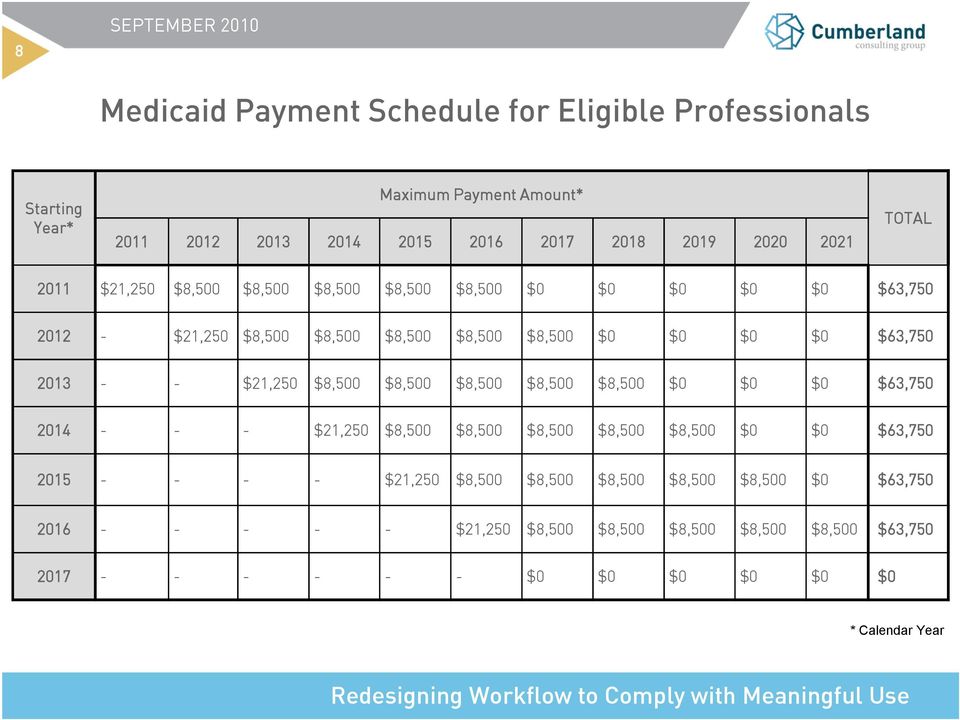
4 4 Presentation Overview Provide an overview of meaningful use criteria required to qualify for up to $63,000 in Medicaid reimbursements under the American Recovery and Reinvestment Act of 2009 (ARRA) Examine workflow redesign and steps toward achieving meaningful use compliance, while also improving patient safety, care and efficiency

5 5 Meaningful Use Incentives Redesigning Workflow to Achieve Meaningful Use

6 6 Meaningful Use Incentives On July 13th, 2010, the final ruling for the first stage requirements of Meaningful Use (MU) of electronic health records was released, which outlines the criteria eligible professionals and hospitals must meet through 2011 and 2012 in order to qualify for stimulus dollars Medicaid Requires >30% of patient population are needy individuals Incentive payments begin in 2011 Incentive limit is equal to 85% of net average allowable costs In the first qualifying year demonstration of an effort to adopt, implement or upgrade a certified EHR is the only requirement Needy individuals include individuals who: Receive assistance under Medicaid Receive assistance under the SCHIP Receive uncompensated care from the provider Receive reduced charges by the provider on a sliding scale basis based on the patient s ability to pay Eligible Professionals may receive payments from Medicare or Medicaid, but not both. This presentation is focused on Medicaid payments
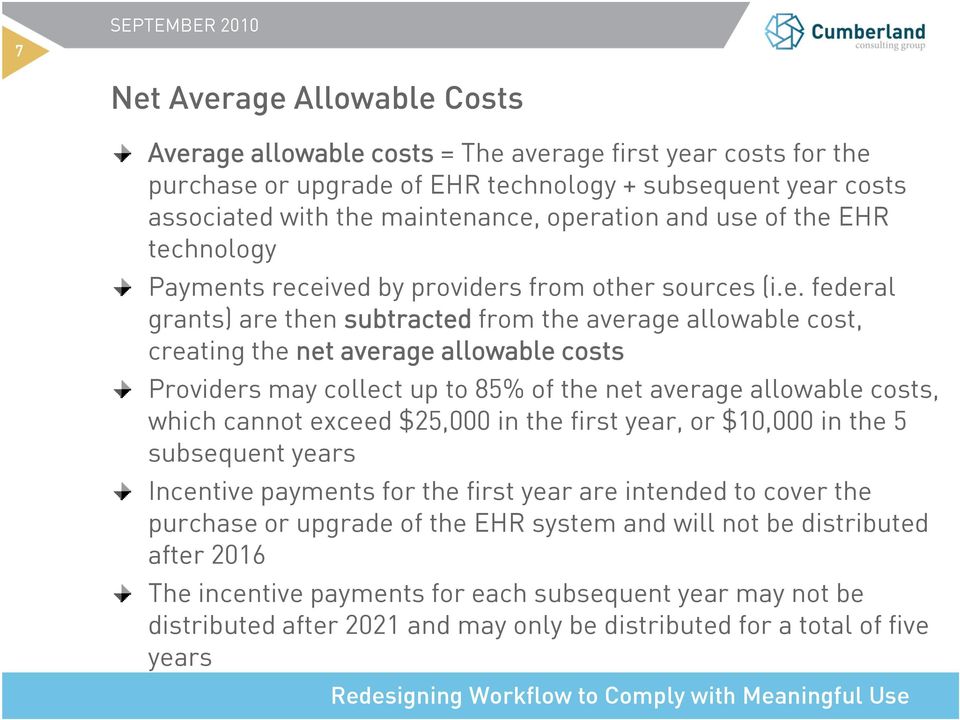
7 7 Net Average Allowable Costs Average allowable costs = The average first year costs for the purchase or upgrade of EHR technology + subsequent year costs associated with the maintenance, operation and use of the EHR technology Payments received by providers from other sources (i.e. federal grants) are then subtracted from the average allowable cost, creating the net average allowable costs Providers may collect up to 85% of the net average allowable costs, which cannot exceed $25,000 in the first year, or $10,000 in the 5 subsequent years Incentive payments for the first year are intended to cover the purchase or upgrade of the EHR system and will not be distributed after 2016 The incentive payments for each subsequent year may not be distributed after 2021 and may only be distributed for a total of five years
8 8 Medicaid Payment Schedule for Eligible Professionals Starting Year* Maximum Payment Amount* TOTAL 2011 $21,250 $8,500 $8,500 $8,500 $8,500 $8,500 $0 $0 $0 $0 $0 $63, $21,250 $8,500 $8,500 $8,500 $8,500 $8,500 $0 $0 $0 $0 $63, $21,250 $8,500 $8,500 $8,500 $8,500 $8,500 $0 $0 $0 $63, $21,250 $8,500 $8,500 $8,500 $8,500 $8,500 $0 $0 $63, $21,250 $8,500 $8,500 $8,500 $8,500 $8,500 $0 $63, $21,250 $8,500 $8,500 $8,500 $8,500 $8,500 $63, $0 $0 $0 $0 $0 $0 * Calendar Year
9 9 Meaningful Use Criteria Redesigning Workflow to Achieve Meaningful Use

10 10 Health Information Technology for Economic and Clinical Health (HITECH) Act Background Part of American Recovery and Reinvestment Act (ARRA) enacted on February 17th, 2009 Initial set of Standards, Implementation Specifications and EHR Certification Criteria available for public inspection on December 30, 2009 Proposed definition of EHR certification Proposed definition of Meaningful Use Three stages over 5 years 2011 through 2015 Stage 1 Meaningful Use final ruling issued on July 13, 2010 Relaxed some requirements and provided additional flexibility Revised to leave open the number of future stages and dates

11 11 Summary of Meaningful Use In the Stage 1 final regulation, Meaningful Use elements are divided into two groups: Core objectives starting point for meaningful use of EHRs (all must be met) Menu set an à la carte menu of ten additional tasks from which providers can choose any 5 to implement in 2011 and 2012

12 12 Meaningful Use Core Set Objectives These objectives are to be achieved by all eligible professionals and hospitals in order to qualify for incentive payments


13 13 Meaningful Use Core Set Objectives (cont.)


14 14 Meaningful Use Menu Set Eligible professionals and hospitals may select any five choices from the menu set
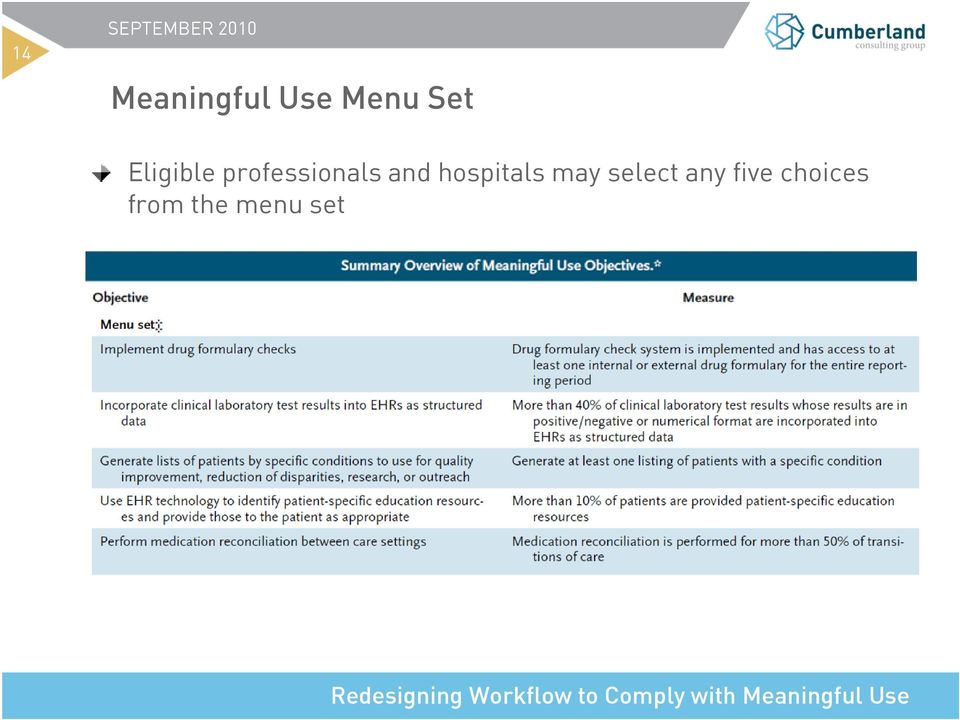
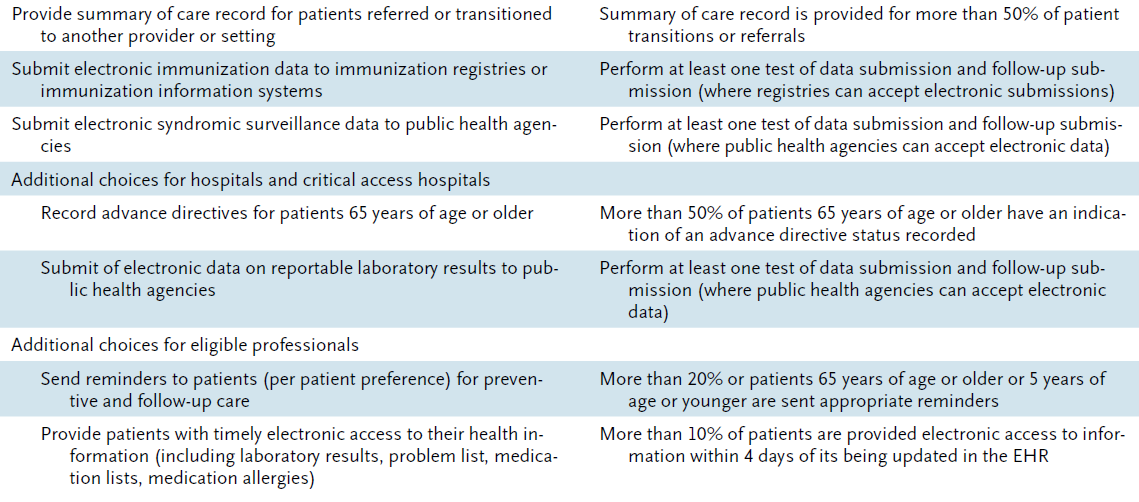
15 15 Meaningful Use Menu Set (cont.)

16 16 Meaningful Use Criteria by Payment Year First Payment Year Payment Year Stage 1 Stage 1 Stage 2 Stage 2 TBD 2012 Stage 1 Stage 1 Stage 2 TBD 2013 Stage 1 Stage 1 TBD 2014 Stage 1 TBD In the first qualifying year only three months of meaningful use is required to qualify for incentive payments

17 17 Achieving Meaningful Use: Workflow Redesign Redesigning Workflow to Achieve Meaningful Use
18 18 Achieving Meaningful Use: Workflow Redesign Although your practice may currently be using a clinical documentation system, operational changes may still be necessary to change processes and workflow in order to properly capture and report data in alignment with MU requirements Although your EMR may be capable of capturing information required for MU criteria (e.g., smoking status), providers may not be capturing that information as part of an encounter Front-office staff may not be capturing demographic data appropriately in the system (i.e., in a structured format) to comply with MU reporting requirements To achieve meaningful use, a workflow redesign process may be required to ensure processes are aligned with practice management and clinical documentation standards defined in meaningful use criteria
19 19 Achieving Meaningful Use: Workflow Redesign Example 1: Patient registration practices may need some fine-tuning in order to meet core measures of reporting at least 50% patient demographics as structured data AND in order to electronically submit accurate clinical quality measures to CMS or states Capturing appropriate data begins at patient registration. It is important to train your staff to capture all required demographics (not dummy data) for your patient population in compliance with regulatory and funding sources Considerations: Add required data elements to registration screens Develop appropriate training material and reinforce best practices for data capture If the data are not collected, you can t report on them

20 20 Achieving Meaningful Use: Workflow Redesign Example 2: Core Measure: More than 30% of patients prescribed meds must have at least one medication ordered through CPOE. This often requires medical staff to change the way they document orders and prescribe medication Many physicians have difficulty transitioning from paperbased and verbal medication orders to CPOE It is important to develop a strong internal campaign and have appropriate staff champion these efforts in order to have all prescribing professionals on board Substantial redesign of current-state processes may be required to ensure the PM/EMR system is used in a meaningful way

21 21 Workflow Redesign Process Workflow redesign is not a difficult process, but it requires the right mix of executive sponsorship, engagement, focus and time to get it right Key ingredients to successful workflow redesign: Executive leadership/sponsorship Workflow redesign is a time-consuming effort that requires your experienced staff (who already have day jobs). Without executive sponsorship, the process will not have appropriate stakeholders involved Experienced facilitation Although your experienced staff provide the brain power, facilitators experienced with the process can educate your staff about the process and lead the effort Conduct focused design sessions Set a limited agenda and focus on specific processes. Include appropriate stakeholders, but not too many (20 people in a design session is too many). Record off-topic issues (parking lot) and move on
22 22 Key Ingredients (continued) Key ingredients to successful workflow redesign: Assign pre-work Collect pertinent information before the meeting (e.g., paper forms) so appropriate information is available in the meeting Assign home-work Personnel may be required to collect additional inputs or data collection following the meeting Keep minutes Parking lot issues, key decisions and follow-up items should be recorded and published to all participants. A single coordinator should keep track of issues and follow-up items Include reference material To clarify future-state processes and system features, have reference material (e.g., PM/EMR screenshots or live system screens) to demonstrate how the design session relates to the actual system usage Discuss real-world scenarios Test future-state processes to determine feasibility in actual patient encounters
23 23 Workflow Documentation
24 24 Workflow Redesign Output
25 25 Next Steps Validate design Once future-state workflow is defined and documented by the design group, validate key workflow changes with additional stakeholders. Incorporate feedback into revised process flows Configure the system Incorporate future-state workflows into the system according to the finalized workflow process maps Develop training curriculum Develop training materials focused on how to use the system to accomplish future-state workflows. Trainers should fully understand the future-state workflows and ideally should have been involved in the workflow design process Incorporate new workflows into practice and measure change Design measures to evaluate compliance with enhanced workflow design and determine corrective actions if necessary

26 26 Additional Considerations Redesigning Workflow to Achieve Meaningful Use
27 27 Additional Considerations In addition to the workflow redesign process, several best practices will help you accomplish your goals and allow you to manage your project effectively
28 28 Appropriate Governance The first step should be recognizing EMR implementation is not simply a technology project, it is an organizational change that will likely require more time and resources than expected and will impact short-term productivity. Most issues can be addressed by an engaged executive team Without the full support of the executive staff the effort will be problematic. It is important to develop and enforce a strategic internal communications plan and company-wide campaign in support of the project Considerations: Champion the project to reduce resistance Avoid low clinical adoption Set a course and lead the organization through the change
29 29 Build a Winning Team Some organizations spent years unsuccessfully trying to implement EMRs before securing the right resources. A winning team consists of: Administrative and clinical personnel An experienced project manager (preferably a certified PMP) leading implementation A team with experience working in CHC / FQHC settings and experience with selected software Resources with exclusive focus (full-time) on implementation throughout the project and who report directly to the project team NOT in addition to their day-job
30 30 Conduct a Objective Selection Process Before looking into a software system and walking through a demo, CHCs should undergo a requirements definition process Comprehensive assessment of your specific workflow, needs and services in order to select an EMR system that will support your best practices and strategic initiatives Considerations: Develop a weighted, objective scoring tool based on detailed requirements Run the selection as a project with clear objectives and milestones Include all appropriate stakeholders Vendors will demonstrate the best features of their application and downplay shortcomings Discovery-day process
31 31 Implementation NOT Installation Common misconception: Implementing EMR is a technology / IT department project Unlike simply installing a new software program, successful EMR implementations involve stakeholders from the entire organization and should be viewed as a major change in an organization s operations These projects are clinical quality and process improvement projects, the new software should be a byproduct of the process redesign effort Considerations: Assembling a team of clinical, operational, administrative and IT stakeholders to remain engaged throughout the effort Determine project s real costs (hardware, software and services) Incentivize staff as appropriate

32 32
Top Ten Mistakes to Avoid When Selecting and Implementing EMR Systems
 Top Ten Mistakes to Avoid When Selecting and Implementing EMR Systems JUNE 10, 2010 2 Presentation Overview As CHCs across the country implement new Practice Management and EMR systems to comply with meaningful
Meaningful Use - The Basics
 Meaningful Use - The Basics Presented by PaperFree Florida 1 Topics Meaningful Use Stage 1 Meaningful Use Barriers: Observations from the field Help and Questions 2 What is Meaningful Use Meaningful Use
Frequently Asked Questions: Electronic Health Records (EHR) Incentive Payment Program
 1. Where did the Electronic Health Records (EHR) Incentive Program originate? The American Recovery and Reinvestment Act (ARRA) was signed into law on February 17, 2009, and established a framework of
EHR Meaningful Use Incentives for School-Based Health Clinics
 EHR Meaningful Use Incentives for School-Based Health Clinics Denise Holmes Institute for Health Care Studies Michigan State University September 27, 2011 Background The Health Information Technology for
Session Objectives. Economic Stimulus Package. Electronic Medical Records Evaluation, Selection & Implementation Process
 Electronic Medical Records Evaluation, Selection & Implementation Process Presented by: Sherri L. Boston, MBA, COE, OCS Session Objectives Provide an overview of the Electronic Health Records (EHR) provisions
The Road to Meaningful Use EHR Stimulus Payments. By Amy S. Leopard, Walter & Haverfield LLP
 The Road to Meaningful Use EHR Stimulus Payments By Amy S. Leopard, Walter & Haverfield LLP On July 28, 2010, the Centers for Medicare and Medicaid Services (CMS) published a final rule regarding what
Meaningful Use: FAQs for Providers
 Meaningful Use: FAQs for Providers On Feb. 17, 2009, President Obama signed the American Recovery and Reinvestment Act of 2009 (ARRA) into law. This law includes provisions (known as the HITECH Act) designed
A Guide to Understanding and Qualifying for Meaningful Use Incentives
 A Guide to Understanding and Qualifying for Meaningful Use Incentives A White Paper by DrFirst Copyright 2000-2012 DrFirst All Rights Reserved. 1 Table of Contents Understanding and Qualifying for Meaningful
How To Bridge The Chasm Between Provider And Patient
 the Health Care Delivery System Opportunities for Transforming the Health Care Delivery System Opportunities for Transforming the Health Care Delivery System Opportunities for Transforming Pennsylvania
An Overview of Meaningful Use: FAQs
 An Overview of Meaningful Use: FAQs On Feb. 17, 2009, President Obama signed the American Recovery and Reinvestment Act of 2009 (ARRA) into law. This new law includes provisions (known as the HITECH Act)
Incentives to Accelerate EHR Adoption
 Incentives to Accelerate EHR Adoption The passage of the American Recovery and Reinvestment Act (ARRA) of 2009 provides incentives for eligible professionals (EPs) to adopt and use electronic health records
Stage 2 Final Rule Overview: Updates to Stage 1 and New Stage 2 Requirements
 Stage 2 Final Rule Overview: Updates to Stage 1 and New Stage 2 Requirements The Centers for Medicare and Medicaid Services (CMS) issued the Stage 2 Final Rule on September 4, 2012. The Stage 2 Final Rule
ARRA, HITECH Act, and Meaningful Use
 ARRA, HITECH Act, and Meaningful Use Overview American Recovery and Reinvestment Act Health Information Technology for Economic and Clinical Health (HITECH) Act Interoperability and Standards Meaningful
1/16/2015 HOW CLINICAL EDUCATORS CAN DISCLOSURE LEARNING OBJECTIVES MAKE MEANINGFUL USE MEANINGFUL. We have no financial disclosures
 HOW CLINICAL EDUCATORS CAN MAKE MEANINGFUL USE MEANINGFUL Daryl Wieland, MD Tammy Gruenberg, MD Michelle Giannone, MD Albert Einstein College of Medicine, Bronx, NY DISCLOSURE We have no financial disclosures
10 Signs Your EMR Implementation Might Be in Trouble
 10 Signs Your EMR Implementation Might Be in Trouble NOVEMBER 28, 2011 2 Brian Junghans Partner and Co-founder of Cumberland Consulting Group 20 years of HIT consulting experience Significant Project Management
Nebraska Medicaid. Record (EHR) Incentive Program
 Nebraska Medicaid Electronic Health Record (EHR) Incentive Program Sarah Briggs Administrator, Medicaid IT Initiatives Division of Medicaid & Long Term Care Topics Overview of the Program Legislation Medicare/Medicaid
What GI Practices Need to Know About the Electronic Health Record Incentive Program. Joel V. Brill, MD, AGAF Lawrence R. Kosinski, MD, MBA, AGAF
 What GI Practices Need to Know About the Electronic Health Record Incentive Program Joel V. Brill, MD, AGAF Lawrence R. Kosinski, MD, MBA, AGAF Disclosures Joel V. Brill, MD AGAF AGA Registry Executive
Medicare and Medicaid Programs; EHR Incentive Programs
 Medicare and Medicaid Programs; EHR Incentive Programs Background The American Recovery and Reinvestment Act of 2009 establishes incentive payments under the Medicare and Medicaid programs for certain
Minnesota EHR Incentive Program (MEIP) 2015 2017 Program Year Timeline for EPs, EHs and CAHs. Updated November 2015
 Minnesota EHR Incentive Program (MEIP) 2015 2017 Program Year Timeline for EPs, EHs and CAHs Updated November 2015 Glossary CAH Critical access hospitals CEHRT Certified electronic health record technology
MEDICARE AND MEDICAID ELECTRONIC HEALTH RECORD (EHR) INCENTIVE PROGRAM: OVERVIEW
 MEDICARE AND MEDICAID ELECTRONIC HEALTH RECORD (EHR) INCENTIVE PROGRAM: OVERVIEW The American Recovery and Reinvestment Act of 2009 provides for incentive payments for Medicare and Medicaid eligible hospitals
Efficient Clinical Workflows Enhance User Acceptance and Other EHR Benefits
 Efficient Clinical Workflows Enhance User Acceptance and Other EHR Benefits Chuck DeBusk, VP, Performance and Process Improvement Jessica Hensler, MBA, Management Engineer Universal Health Services, Inc.
Nevada Incentive Payment Program For Electronic Health Records
 Nevada Incentive Payment Program For Electronic Health Records State of Nevada Department of Health and Human Services Division of Health Care Financing and Policy 2013 Hewlett-Packard Development Company,
REQUIREMENTS GUIDE: How to Qualify for EHR Stimulus Funds under ARRA
 REQUIREMENTS GUIDE: How to Qualify for EHR Stimulus Funds under ARRA Meaningful Use & Certified EHR Technology The American Recovery and Reinvestment Act (ARRA) set aside nearly $20 billion in incentive
Adopting an EHR & Meaningful Use
 Adopting an EHR & Meaningful Use Learn how to qualify for the EHR Incentive Program The materials in this presentation, or prepared as part of this presentation, are provided for informational purposes
NHCHC Meaningful Use of Electronic Health Records Resource Catalogue. Meaningful Use Overview
 Meaningful Use Overview Meaningful use is the use of a certified electronic health record (EHR) to demonstrate improved quality and safety of health care delivery for a patient population within a clinical
Meaningful Use Stages 1 and 2 and How to Survive a Meaningful Use Audit. Charles Jarvis, Senior Manager
 Meaningful Use Stages 1 and 2 and How to Survive a Meaningful Use Audit Charles Jarvis, Senior Manager Outline Overview Meaningful Use Stage 1 Differences between Stage 1 and Stage 2 Surviving a Meaningful
9/9/2015. Medicare/Medicaid Incentive Program. Medicare/Medicaid Incentive Program. Meaningful Use, Penalties and Audits
 Meaningful Use, Penalties and Audits SHERI SMITH, FACMPE STATE VOLUNTEER MUTUAL INSURANCE COMPANY Copyright 2014 State Volunteer Mutual Insurance Company Medicare/Medicaid Incentive Program Medicare/Medicaid
The Impact of Proposed Meaningful Use Modifications for 2015-2017 June 23, 2015
 The Impact of Proposed Meaningful Use Modifications for 2015-2017 June 23, 2015 Today s presenters: Al Wroblewski, Client Services Relationship Manager Elisabeth Renczkowski, Content Specialist Disclaimer
Electronic Health Record Incentive Program Update May 29, 2015. Florida Health Information Exchange Coordinating Committee
 Electronic Health Record Incentive Program Update May 29, 2015 Florida Health Information Exchange Coordinating Committee Topics Payment Data Participation Years and Payments Meaningful Use Progression
Electronic Health Records: What it Means for Today s Radiologist By: Anne Reynolds
 Electronic Health Records: What it Means for Today s Radiologist By: Anne Reynolds Introduction Program Overview In February of 2009, President Obama signed the American Recovery and Reinvestment Act of
The HITECH Act and Meaningful Use Implications for Population and Public Health
 The HITECH Act and Meaningful Use Implications for Population and Public Health Bill Brand, MPH Public Health Informatics Institute Meaningful Use for Public Health Professionals: Basic Training May 16,
EMR Use in the Age of Healthcare Reform. C. Martin Harris, M.D. Chief Information Officer, Cleveland Clinic Executive Director, ecleveland Clinic
 EMR Use in the Age of Healthcare Reform C. Martin Harris, M.D. Chief Information Officer, Cleveland Clinic Executive Director, ecleveland Clinic Agenda General Overview Requirements Payments Process to
Medicaid Electronic Health Records (EHR) Incentive Program FAQ
 STATE OF NEVADA DEPARTMENT OF HEALTH AND HUMAN SERVICES DIVISION OF HEALTH CARE FINANCING AND POLICY MICHAEL J. WILLDEN Director BRIAN SANDOVAL Governor CHARLES DUARTE Administrator Medicaid Electronic
The American Recovery and Reinvestment Act of 2009, Meaningful Use and the Impact on Netsmart s Public Health Clients
 The American Recovery and Reinvestment Act of 2009, Meaningful Use and the Impact on Netsmart s Public Health Clients Updated November 2011 Netsmart Note: The Health Information Technology for Economic
Medicaid Electronic Health Records Meaningful Use Audits. Lisa Reuland, Program Manager October 22, 2015
 Medicaid Electronic Health Records Meaningful Use Audits Lisa Reuland, Program Manager October 22, 2015 1 Agenda Electronic Health Records Incentive Program Eligible Providers Participation for HER Program
Navigating a Meaningful Use Audit: Are You Ready? Brian Flood
 Navigating a Meaningful Use Audit: Are You Ready? Brian Flood 2014 Husch Blackwell LLP Agenda For This Segment ARRA, HITECH, and Meaningful Use What is Meaningful Use? Progress to Date How providers meet
CMS FINALIZES REQUIREMENTS FOR THE MEDICAID ELECTRONIC HEALTH RECORDS (EHR) INCENTIVE PROGRAM
 CMS FINALIZES REQUIREMENTS FOR THE MEDICAID ELECTRONIC HEALTH RECORDS (EHR) INCENTIVE PROGRAM For Immediate Release: Friday, July 16, 2010 Contact: CMS Office of Public Affairs 202-690-6145 The Centers
Medicaid EHR Incentive Frequently Asked Questions
 Medicaid EHR Incentive Frequently Asked Questions All external hyperlinks are provided for your information and for the benefit of the general public. The Rhode Island Department of Human Services does
Meaningful Use Updated Sajid Ahmed MPD/ PDM 1
 Meaningful Use Updated Sajid Ahmed MPD/ PDM 1 Introduction What You Need to Do What Your EHR Needs to Do MPD/ PDM 2 But first a few things didn t change MPD/ PDM 3 Meaningful Use Notice of Proposed Rule
Adopting, Implementing or Upgrading to Certified Electronic Health Record Technology & Becoming a Vendor with the State of Idaho
 Adopting, Implementing or Upgrading to Certified Electronic Health Record Technology & Becoming a Vendor with the State of Idaho Michele Turbert Program Research and Development Specialist, Division of
OPTIMIZING THE USE OF YOUR ELECTRONIC HEALTH RECORD. A collaborative training offered by Highmark and the Pittsburgh Regional Health Initiative
 OPTIMIZING THE USE OF YOUR ELECTRONIC HEALTH RECORD A collaborative training offered by Highmark and the Pittsburgh Regional Health Initiative Introductions Disclosures Successful completion of training
Electronic Health Record (EHR) Incentive Program. Stage 2 Final Rule Update Part 2
 Office of Medical Assistance Programs Electronic Health Record (EHR) Incentive Program Stage 2 Final Rule Update Part 2 November 7, 2012 Medical Assistance HIT Initiative 1 Office of Medical Assistance
Medweb Telemedicine 667 Folsom Street, San Francisco, CA 94107 Phone: 415.541.9980 Fax: 415.541.9984 www.medweb.com
 Medweb Telemedicine 667 Folsom Street, San Francisco, CA 94107 Phone: 415.541.9980 Fax: 415.541.9984 www.medweb.com Meaningful Use On July 16 2009, the ONC Policy Committee unanimously approved a revised
Modified Stage 2 Meaningful Use 2015-2017
 Click to edit Master title style Modified Stage 2 Meaningful Use 2015-2017 Bruce Maki, MA M-CEITA / Altarum Institute Regulatory & Incentive Program Analyst 12/14/2015 1 1 Agenda 1. Overview of M-CEITA
Agenda. Overview of Stage 2 Final Rule Impact to Program
 Electronic Health Record (EHR) Incentive Payment Program Review of Meaningful Use Stage 2 Regulation Changes and Other Impacts to the Medicaid EHR Incentive Program for 2014 that combines the effective
JULY 2010 FINAL RULE. Medicare & Medicaid Programs Electronic Health Record Incentive Program as it Applies to Physicians
 JULY 2010 FINAL RULE Medicare & Medicaid Programs Electronic Health Record Incentive Program as it Applies to Physicians 2 JULY 2010 FINAL RULE - STAGE ONE MEANINGFUL USE Summary Points Brief History...
Medicaid Electronic Health Records (EHR) Incentive Program FAQ
 Program Basics 1. What is the Texas Medicaid EHR Incentive Program? As part of the American Recovery and Reinvestment Act of 2009, federal incentive payments will be available to doctors and hospitals
Meaningful Use Stage 2. Presenter: Linda Wise, EMR Training Specialist
 Meaningful Use Stage 2 Presenter: Linda Wise, EMR Training Specialist 1 AGENDA 2 Agenda Meaningful Use in Review Moving Into Stage 2 Meaningful Use Learning the Requirements Understanding the Measures
Frequently Asked Questions Ohio Health Information Partnrship
 Frequently Asked Questions Ohio Health Information Partnrship Q. What is the Ohio Health Information Partnership? A.The Ohio Health Information Partnership (OHIP) is the non profit entity that will assist
ARRA HITECH Programs and Goals Where is Nevada?
 ARRA HITECH Programs and Goals Where is Nevada? Regional Extension Center HealthInsight NV and UT $7,151,783 awarded, 50% to NV or $3,575,892 Feb. 2010 Feb. 2014 Approx. 700 NV providers enrolled out of
MDeverywhere, Inc. Presents 2014 CMS EHR Incentive Program Requirements: What Providers Need To Know
 MDeverywhere, Inc. Presents 2014 CMS EHR Incentive Program Requirements: What Providers Need To Know Presented by: Kristen Heffernan Director Product Management & Marketing, Henry Schein MicroMD Agenda
FAQs for AMDA Members on the Medicare and Medicaid Electronic Health Record Incentive Programs, Including Medicare Payment Adjustments
 FAQs for AMDA Members on the Medicare and Medicaid Electronic Health Record Incentive Programs, Including Medicare Payment Adjustments Long Term Post-Acute Care Providers I am a physician or nurse practitioner
NY Medicaid EHR Incentive Program. Eligible Professionals Meaningful Use Stage 2 (MU2) Webinar www.emedny.org/meipass
 Eligible Professionals Meaningful Use Stage 2 (MU2) Webinar www.emedny.org/meipass May 2015 2 Meaningful Use Stage 2 Overview of EHR Introduction to Meaningful Use Meaningful Use Stage 2 Objectives Clinical