
CASINO GAMING (Table Games)
|
|
|
- Agnes Bond
- 10 years ago
- Views:
Transcription
1 CASINO GAMING (Table Games) Contents A. Introduction B. Background C. Current Casino Policies D. Current Situation Assessment E. Landscape of Other Provinces F. Summary of Findings Public Views and Stakeholder Consultations G. Primary Issues and Recommendations Casino Gaming (Table Games) (Report Date: 21 July 2001) 9-1

2 A. Introduction Casino gaming (table games) is a form of charitable gaming in the province. Casino events may only be held when the Alberta Gaming and Liquor Commission, under provisions of the Gaming and Liquor Act and policies of the Commission Board, issues a casino event licence to an eligible charitable or religious organization. The licence authorizes the organization to hold a casino event at a permanent, licensed casino facility or during a special occasion event, such as a major exhibition. The licensed organization is required to provide volunteers for various key positions during the casino event and to use the proceeds it earns for approved charitable or religious purposes. This section discusses the background to casino gaming in the province. It provides key information related to current casino policies and an assessment of the current situation regarding casino gaming, including a discussion of the First Nations gaming policy that allows for onreserve casinos, announced by the government in January As well, the casino policies of other provinces are provided for comparison. Highlights of some key views and perspectives of Albertans and those of stakeholders regarding casinos are also provided. This section concludes with recommendations to address primary issues that were identified during the Gaming Licensing Policy Review. 9-2 (Report Date: 21 July 2001) Casino Gaming (Table Games)
3 B. Background Casinos in Alberta Casino gaming (table games) is a form of charitable gaming. It is governed by the Criminal Code (Canada), Gaming and Liquor Act (Alberta), Gaming and Liquor Regulation (Alberta), and the policies of the Board as contained in Casino Licence Terms & Conditions and Operating Guidelines and Casino Terms & Conditions and Operating Guidelines. In Alberta, casino gaming typically includes both table games and slot machines and is held in a facility licensed by the Alberta Gaming and Liquor Commission. In this section, casino gaming refers to the table game activities offered in casinos. For a detailed discussion about electronic gaming devices, see the separate section Slot Machines. The casino facility may only operate under a casino event licence issued by the Commission to an eligible charitable or religious organization. The charitable or religious organization is required to provide volunteers for various key financial positions during the casino event and earns proceeds from the table games at the casino event. The proceeds must be used for approved charitable or religious purposes. Charitable volunteers have no direct role or involvement in the operation of slot machines during the charitable casino event. This charitable model of casino gaming in Alberta is distinct from the casino model of a number of other provinces, in which casino gaming is conducted and managed by government through a crown agency and net revenues are allocated at the discretion of the government. In Alberta, licensed charitable groups conduct and manage table games at casino events. Casino Table Games and Slot Machines There is an important distinction to be made between the conduct and management of casino table games and that of slot machines in casino facilities. Charities are licensed specifically to conduct and manage the table games in Alberta casinos. This is possible through provisions of the Criminal Code, which authorizes the provincial government to issue licenses to charitable and religious organizations to conduct and manage specified types of lottery schemes as long as the proceeds are used for charitable or religious purposes. Under Alberta s Gaming and Liquor Act, a casino event (or the operation of the casino) occurs under a licence issued by the Commission to a charitable or religious group. The group earns net proceeds from the table games and also receives a commission from the slot machines. The casino facility licensee receives a fee for providing space and services. Under the Criminal Code, only a provincial government may conduct and manage electronic gaming devices such as slot machines. The Gaming and Liquor Act authorizes the Commission to fulfill that role on behalf of the province. In that regard the Commission enters into an agreement with casino facility licensees to provide various services to operate slot machines during licensed casino events. The licensed charitable groups have no direct role or function Casino Gaming (Table Games) (Report Date: 21 July 2001) 9-3

4 regarding the operation of slot machines, but are paid a commission for allowing the province to operate slot machines during their licensed casino event. Further details are provided in the separate section Slot Machines. In , almost 2,700 casino event licences were issued. Casino table games generated gross revenues of approximately $610 million and returned $499 million in prizes to players. Charities received $34.3 million from casino gaming. An additional $52.4 million in net revenues from slot machines was provided to charities that held casino events, for a combined total of $86.8 million. Charities paid $77 million in expenses to casino facility operators, casino advisors, trustees and others for their services related to table games. Types of Table Games Following are the types of table games currently permitted in casinos in the province: Blackjack (Lucky Sevens, Multiple Action Blackjack, and Hole Card Blackjack) Mini Baccarat Poker (Seven Card Stud, Texas Hold em, Omaha Hold em, High/Low Split and Bad Beat Poker Pots) Pai Gow Poker Other Table Games (Red Dog, Super Pan Nine, Casino War) Roulette Sic Bo Approved Wheels of Fortune Caribbean Poker (Caribbean Stud Poker and Caribbean Draw Poker) Let It Ride Wild Jackpot Poker Tile Pai Gow Hand-Held Mini-Baccarat Craps Types of Casino Licences There are two types of casino licences: (1) the casino event licence and (2) the casino facility licence. The casino event licence is issued to a charitable or religious organization, or to an agricultural fair or exhibition, which authorizes the holding of casino table games for a specified period of time in a licensed casino facility. The licensed charity is required to provide volunteers for various positions during the casino event. The eligibility criteria for a charitable gaming event licence are described in the appendix Gaming Revenues, Disbursements and Use of Proceeds. The fee for a casino event licence is calculated by multiplying the number of gaming tables by $15, and multiplying that amount by the number of casino days authorized under the licence. Poker tables are excluded from the calculation. A casino facility licence is issued to a person or affiliated group of persons or a company that meets the requirements of the Gaming and Liquor Act and the Gaming and Liquor Regulation 9-4 (Report Date: 21 July 2001) Casino Gaming (Table Games)

5 and is approved by the Board. The casino facility licensee must provide space and services to licensed charities holding a casino event that meet the standards and requirements outlined in Casino Terms & Conditions and Operating Guidelines. Evolution of Casinos in Alberta Agricultural fairs and major exhibitions in the province played a pivotal and pioneering role in casino gaming. The province s first casino opened at Edmonton s Klondike Days annual fair in 1967 and was operated by a non-profit group. The casino was opened for one week and held at the Silver Slipper Saloon on the Edmonton Exhibition grounds. The Calgary Stampede opened the Frontier Casino on the Stampede grounds during its summer exhibition in In 1970, the Criminal Code was amended, transferring the authority to license and operate lottery schemes from the federal government to provinces. At this time, both the Calgary Stampede and Edmonton Northlands operated up to three casinos per year. 1970s - Charitable System of Gaming The charitable system of casino gaming was developed in the mid seventies. In 1974, 158 casino event licences were issued in the province. The total drop (money spent to buy chips) in that year was $4.4 million. The first non-profit casino venue was established by the Kinsmen Club in Edmonton in At about the same time Edmonton Northlands and Calgary Stampede agreed to hold one casino per year in exchange for having the exclusive right to operate casinos during the time of their 10 day summer fairs. Starting in 1976, the licensing system was based on: casinos being an alternative fundraising activity by eligible community organizations, which were required to be accountable for the use of proceeds and the conduct and management of casino gaming being the responsibility of the charity. These formed the key elements of the charitable gaming model for casinos in the province. From June 1, 1976 to December 31, 1980, three casino licences were issued per week in Calgary and Edmonton. Only one public casino could be held at a time in any city. 1980s - Permanent Charitable Casinos The province s first permanent, privately-operated charitable casino opened in Calgary in 1980 and the second was established in Edmonton in Beginning in 1981, the licensing authority held random draws once every two months to determine the dates when an eligible charity could hold a casino event. They involved drawing a casino date from one envelope and drawing a charity name for that date from another envelope to Casino Gaming (Table Games) (Report Date: 21 July 2001) 9-5

6 match the two. The names of the charities were placed in the random draw on a first come first served basis to hold a casino in the next available two month period. In 1985, the Criminal Code was amended, granting authority to the provinces to conduct and manage mechanical and electronic gaming devices. It would be more than 10 years before the province would introduce slot machines to casinos. In 1987, charities were given the option to pool revenues from casino events. In 1988 the number of allowable casinos per week was increased to eight from four. The number of blackjack tables permitted in casinos was increased. The betting limit was increased to $50. Starting in October, 1988, casino draws were held every six months on a first come first served basis. In 1989, casino draws were held quarterly. 1990s - Growth of Casino Gaming In July 1990, charities were permitted to enter into pre-signed agreements with facility operators to hold a casino event in the operator s facility. Mini Baccarat was permitted in casinos in In 1995, the Lotteries Review Committee conducted public hearings, seeking input into various issues on future directions for lotteries and gaming in the province. One of the issues dealt with how casinos should operate in the future. It made various recommendations in this regard (see Current Casino Policies in this section). In 1995 the number of permanent casino facilities increased to 11 full-time casinos and three that operated on weekends. In July 1995, the Alberta Gaming and Liquor Commission amalgamated all liquor and gaming regulatory, enforcement and marketing agencies, including the Alberta Gaming Commission, the Gaming Control Branch, Alberta Lotteries and Gaming and the Alberta Liquor Control Board. In July 1996, the Alberta Gaming and Liquor Commission would be formally established in the Gaming and Liquor Act (Alberta). In September 1995, poker was introduced to casinos. Between 1985 and 1995 new casino facilities were opening and, due to the resulting increase in facility fees charged by operators, the charitable groups share of proceeds decreased. Various changes were made to casino policies in 1996 to address the decrease in the charities proceeds. In January 1996, up to nine licences were issued per week in Edmonton and Calgary. The number of licences was increased to 12 per week in the two cities starting July 1, Slot machines were first introduced into summer fair casinos and then, beginning in 1996, installed into permanent casino facilities and racing entertainment facilities. 9-6 (Report Date: 21 July 2001) Casino Gaming (Table Games)

7 Facility Fee Fixed to a Maximum Percentage of Net Revenue Two changes were made on July 1, 1996, to address the issue of charities losing money during casino events. * The operating expense fee which had to be paid before a charity could earn any casino proceeds was removed. In its place casino operators were limited to a fixed fee that could not exceed a maximum percentage of the net proceeds (after prizes). In addition the pooling of casino proceeds was made mandatory at all casino facilities in the province to even out the disparity in net revenues between different casino events at the same casino facility. This averaging of revenues guaranteed charities would earn proceeds from a casino event rather than experience a loss as had occurred previously. The Commission began to license casino facilities in 1996, under the province s new Gaming and Liquor Act and Gaming and Liquor Regulation. First Nations Interest in Gaming First Nations began to express interest in operating casinos to fund economic development in the 1990s. The Native Gaming Committee, comprised of government MLAs, submitted its report to the government with recommendations in April To assure the viability of casinos as a source of revenue for non-profit organizations, the committee recommended a maximum of four First Nations casinos be licensed on reserves, or contiguous to the reserve and that First Nations casinos be subject to the same rules, regulations and legislation as other charitable casino gaming initiatives. Casino Gaming Transformed Various developments helped to begin the transformation of the province s casinos from basic gambling rooms to more elegant destinations that were expanded to allow space for slot machines. Among them were the relocation of the Palace Casino in August 1996 and the opening of Baccarat Casino in October 1996 and Casino Calgary in May On July 28, 1997, the casino operating guidelines allowed the maximum number of slot machines in casino facilities to be doubled, the hours for table games to be extended by one hour to a maximum of 14 and for liquor to be served on the casino gaming floor. The Silver Dollar Casino in Calgary was designated to serve rural communities around Calgary. Beginning on October 1, 1997, casinos could operate on Sundays. * Such losses were experienced for various reasons. Among them, the building of new casino facilities resulted in an increase in the facility fee cost. Charities were required to pay the facility fee cost before they could earn any proceeds from casino events. To protect themselves from the possibility of losing money they could buy no loss insurance. In addition, the level of net revenues earned from casino to casino was based on the luck of the draw. For example, the amount earned would be influenced, among other factors, by when the event occurred. In the larger centres since only one casino event was held on Monday or Tuesday, charities typically earned more in revenue than casinos held other days when more casino licences were issued and there was more competition for the casino dollar. Casino Gaming (Table Games) (Report Date: 21 July 2001) 9-7

8 Effective April 1, 1998, revenue from slot machines was pooled on a city-wide basis, affecting the cities with more than one casino facility (that is, Edmonton with four casino facilities, Calgary with five, Red Deer with two and Lethbridge with two). Previously the revenue was pooled by facility. The Alberta Lotteries and Gaming Summit 98 was held in Medicine Hat in April The government accepted or accepted in principle all of the summit recommendations, including the recommendation the charitable model for operating casinos and bingo be maintained. In December 1998, casinos were permitted to operate poker rooms during extended hours, beyond those of the rest of the casino, as long as the room could be accessed by a separate outside entrance during the extended hours. The policy change was aimed at discouraging illegal poker rooms from operating in the province, in particular in Edmonton and Calgary. Casino operators have expanded their facilities since 1997 to accommodate additional slot machines and attract additional slot players. The incremental sales generated through slot machines would help to make expansion and renovation viable. Those facilities that performed renovations and invested in decor and ambience experienced higher increases in sales while those that did not experienced declines in sales. On May 25, 1999, the provincial government established the Ministry of Gaming, the first in Canada. In the summer of 1999, the Cash Casino in Lethbridge closed. Craps was legalized by an amendment to the Criminal Code in In that year various casino facilities in the province began offering this dice game to their customers. The Gaming Licensing Policy Review was announced in December The Minister of Gaming requested, pending the outcome of the review, the Commission suspend consideration of requests to license or approve new casinos, casino expansions or re-locations, new games and new gaming environments. Proceeds to charities from casino slot machines was $52.4 million in , exceeding for the first time the proceeds from casino table games. Slot revenue had increased dramatically since when casino slot machines were introduced and generated $166,000 in proceeds to charities. 2000s - First Nations Gaming Policy The government announced the First Nations Gaming Policy in January 2001, which will allow for on-reserve casinos. The specific terms and conditions for on-reserve casinos, to be developed as part of the Gaming Licensing Policy Review, are to be consistent with those for other casinos in the province with the exception that First Nations charity workers will be paid for their participation and the casino event licensee can be one umbrella charity. 9-8 (Report Date: 21 July 2001) Casino Gaming (Table Games)
9 C. Current Casino Policies Criminal Code Requirements In Canada, the Criminal Code (Canada) establishes the legal foundation for gaming activities. All gambling that occurs in any province or territory must meet the requirements of the Criminal Code. Casino table games are considered a lottery scheme. These table games would be illegal if it were not for provisions of Section 207(1)(b) of the Criminal Code which state it is lawful for a charitable or religious organization, pursuant to a licence issued by the Lieutenant Governor in Council of a province or by such other person or authority in the province as may be specified by the Lieutenant Governor in Council thereof, to conduct and manage a lottery scheme in that province if the proceeds from the lottery scheme are used for a charitable or religious object or purpose; Section 207(2) of the Criminal Code allows a provincial authority to prescribe terms and conditions relating to the conduct, management and operation of licensed lottery schemes. Gaming and Liquor Act (Alberta) In Alberta, casinos are administered and regulated under the provisions of the Gaming and Liquor Act (Alberta) and the Gaming and Liquor Regulation (Alberta). The Gaming and Liquor Act grants authority to the Commission to issue casino licences and to impose conditions on those licences subject to the authorization of the Lieutenant Governor in Council (s. 35). The act also authorizes the Lieutenant Governor in Council to make regulations respecting conditions and eligibility requirements that must be met before a licence is issued or a person is registered (s. 126). Gaming and Liquor Regulation (Alberta) The Gaming and Liquor Regulation establishes the casino licence, which authorizes a casino (s. 19(d)). Under section 20 of the regulation, only charitable or religious organizations are eligible for a casino licence and must satisfy the Board of the Commission the proceeds from the gaming activity will be used for a charitable or religious object or purpose approved by the Board. The regulation also establishes the following class of registration of gaming worker: casino worker: authorizes a person to perform a function specified in the registration at a casino; (s. 25(a)). A gaming worker is a person paid to assist a gaming licensee in the conduct or management of a gaming activity (s. 24). Casino Gaming (Table Games) (Report Date: 21 July 2001) 9-9
10 The regulation also establishes the casino facility licence. That licence authorizes the operation of a facility in which a casino may be conducted (s. 22(b)). Section 23(1)(3) of the regulation provides that: A casino facility licence may only be issued to an individual, partnership or corporation. The regulation also requires anyone who deals in gaming supplies must be registered with the Commission (s. 27). Casino Policies The province s casino policies are contained in two documents: Casino Licence Terms & Conditions and Operating Guidelines - A set of policies for charities holding casino events indicating the requirements under a casino event licence. Casino Terms & Conditions and Operating Guidelines - A detailed set of policies mainly for casino facility operators. It covers among other subjects casino operational requirements, facility standards and requirements, security standards, permitted games, rules of play, etc. Lotteries Review Committee A number of current casino policies were adopted in response to recommendations of the Lotteries Review Committee in The committee specifically recommended the following, many of which were to be adopted: That the number of charitable casino event licences in Edmonton and Calgary be increased to 12 from eight due to demand. That operating hours for casinos should be extended to allow for 13 consecutive hours, within the hours of 11 a.m. to 2 a.m. That casino VLT revenues should go to non-profit organizations (note: slot machines were not yet introduced to casinos; VLTs were located in separate lounges of casinos). That casino revenues should be pooled over a three-month period so that non-profit groups can share in the revenues. That 15% of net VLT revenues in casinos should be shared by non-profit groups and the casino operator as follows: 2/3 to the former, 1/3 to the latter as a management fee. The remaining revenue would continue to go to the province to be reallocated according to the funding formula as suggested. That smaller groups share one licence to avoid issuing casino licences to organizations that intentionally split for the purpose of obtaining more than one licence during the year. That large-scale, Vegas-style casinos should not be allowed anywhere in Alberta and casinos must be government regulated and retain their non-profit status (Report Date: 21 July 2001) Casino Gaming (Table Games)

11 Casino Policies Revised In response to the Lotteries Review Committee, the number of casino event licences were increased to 12 from eight per week in Edmonton and Calgary starting July 1, The intent was to reduce the length of the wait list to hold a casino event. Operating hours were extended to a maximum of 13 consecutive hours within the hours of 11 a.m. to 2 a.m. (and currently is a maximum of 14 hours). Slot machines were introduced into casino facilities in early 1996 and a portion of the net revenues generated by them were allocated to licensed charities. The pooling of table revenue by facility was established in July Groups applying for licences were reviewed as to their relationship with other groups that may be related or which belong to the same umbrella group and casino events were allocated accordingly. This was aimed in part at preventing the issuing of casino events licences to groups that divide for the purpose of obtaining additional casino event licences. Casinos continue to be strictly regulated and controlled by the province. Native Gaming Committee In April 1996, the Native Gaming Committee, comprised of government MLAs and chaired by Judy Gordon - MLA Lacombe Stettler, issued its findings and recommendations, including those relating to First Nations gaming. Among them was a recommendation to allow for up to four First Nations casinos on or contiguous to reserves. The government endorsed the committee s report and recommendations in June From 1996 to 2001, a number of First Nations expressed interest in establishing an on-reserve casino. First Nations and the Commission have held discussions on gaming, including sessions to clarify the requirements for casinos under the province s charitable model. In January 2001, the government formally announced a First Nations gaming policy. The policy takes into account the changes that have occurred in gaming in the province over the past five years. Key Casino Policies Following is a summary of the current key casino policies regarding the casino event licence and the casino facility licence. The casino event licensee (charity) provides volunteers who are responsible for cash and financial controls. The casino facility licensee (operator) provides gaming expertise and facilities and is responsible for the game chips. During the operation of a casino, players exchange cash for chips and vice versa. At the completion of a two-day event, the charity s cash is reconciled to the operator s chips and any discrepancies noted. This balancing and separation of responsibility provides financial integrity and control. Casino Gaming (Table Games) (Report Date: 21 July 2001) 9-11

12 Casino Event Licensee Requirements A casino event may only occur in the province when a casino event licence has been issued by the Commission to an eligible charitable or religious organization. Generally, casino events last two days and are held in a permanent licensed casino facility. In some cases, a casino event licence may also be issued to eligible charitable organizations that intend to operate a relatively small number of table or wheel games in an unlicensed facility, such as a small agricultural fair or rural community hall. A casino event licensee enters into a contractual agreement with the operator of a casino facility in which it wishes to conduct its casino event. A charitable organization may select the casino facility in which to hold its events. In this regard, the charity is limited based on the designated region within which they may hold casino events. For example, only charities based in Edmonton, a designated region for purposes of casino gaming, may hold a casino event at a casino facility in the city, subject to availability. There are various requirements for volunteers of the licensed charity. The licensed charity must appoint volunteers to fill the following positions during its casino event: General Manager and Alternate General Manager - Responsible for all aspects of the casino, including designated staff are in place, witnesses interim and final pull of drop boxes, all key financial transactions and security. Banker - Supervises the cash cage and is directly accountable to the General Manager; is responsible for Cashiers and Chip Runners. Cashier - Receives and counts opening cash fill and required forms from the Banker; documents transactions with the banker and maintains security of chips and cash; ensures all player cash-outs over $200 are witnessed by any of the General Manager, Banker, Financial Controls Supervisor or Advisor; at the end of a shift accounts for all chips and cash for which they were responsible. Chip Runner - Participates in games opening or transfers opening chip fills from Banker to games as requested; at final close of games each day witnesses chip count, completes Closing Game Inventory of Chips. Count Room Supervisor - Directly accountable to the General Manager for supervision of count room procedures including count room staff. Counter - Empties drop boxes, shows everyone present that they are empty; assists sorting of cash or chips as needed; counts sorted cash or chips. Sorter - Sorts cash or chips into denominations; gives all other drop box contents to Count Room Supervisor; witnesses count by Counter. Amalgamator - Receives cash or chips from sorter; amalgamates all cash or chips in count room by denomination and bundles cash; assists count room supervisor to summarize cash and chips at the end of each drop. The charities pay facility operators a fixed fee for space and services, to a maximum of 50% of net proceeds earned in Edmonton and Calgary casinos, 35% in St. Albert and 25% in other locations. Licensed charities must pool net casino proceeds (and/or losses) with all charities licensed in the same casino facility within the same pooling period (Report Date: 21 July 2001) Casino Gaming (Table Games)
13 Net casino proceeds from all facilities operated by the same casino facility licensee in a city are pooled within the same pooling period. The pooling period is the same as the quarterly draw period. Quarters are January-March, April-June, July-September, and October-December. Pooling guarantees charities a return from holding a casino event. It is a fair system of dividing net revenue regardless of the days on which a charity s casino event may be held. As well, any losses incurred are included in the pool with the end result that all charities earn money from holding a casino event. The facility licensee, with the Commission s approval, is required to select a trustee and establishes a casino pooling trust agreement to be used for the casino facility. All licensed charities are required to sign an agreement with the trustee and submit a copy of the master agreement to the Commission for approval before the pooling period begins. Slot machine proceeds are pooled by city during the same quarterly periods and divided as follows: charity commission - 15%, casino facility operator commission - 15%, and Alberta Lottery Fund -70%. Licensed charities are required to provide a series of reports to the Commission within seven days after the casino event is completed. Any discrepancies must be reported. For a detailed discussion about eligibility requirements and the allowable uses of proceeds from charitable gaming, refer to the appendix Gaming Revenues, Disbursements and Use of Proceeds. Casino Facility Operator Requirements During a casino event the casino facility licensee must provide to the licensed charity the following: use of the casino facility, all the required casino gaming equipment, operating floats, chip inventory, registered gaming workers, playing cards, surveillance equipment, armoured car service, insurance and marketing and promotions. Each casino facility licensee must provide the charity licensed to hold a casino event in the facility with a Casino Facility and Service Agreement. That agreement must establish fixed fees or charges for the operation of the casino. The operator is entitled either to the fixed fees or a percentage of the gross casino proceeds, whichever is less. The revenue sharing formulas of net gaming proceeds are as follows: 50% of net proceeds for Edmonton and Calgary casinos, up to the fixed fee for the facility; 65% of net proceeds for the St. Albert casino, up to the fixed fee for the facility; and 75% of net proceeds for other casinos, up to the fixed fee for the facility. The facility operator and event licensee are jointly responsible for any losses incurred in proportion to the revenue sharing formula. Casino Gaming (Table Games) (Report Date: 21 July 2001) 9-13

14 Casinos are allowed to operate table games a maximum of 14 consecutive hours, within the hours of 10:00 a.m. to 2:00 a.m. Slot machines may be operated for up to 17 consecutive hours within the hours of 10:00 a.m. to 3:00 a.m. Casinos held at agricultural fairs and exhibitions may operate a maximum of 16 consecutive hours. Casinos are allowed to operate seven days a week and must be closed on Christmas Day. Poker rooms may operate beyond regular casino hours. The intent is to discourage illegal clubs from operating in the same city as the casino. Poker rooms must have a separate entrance to the room from the outside so patrons do not have to enter through the main casino gaming floor. Those under 18 years of age are not permitted to be in a casino facility or to work as casino volunteers. Facility Requirements Prior to receiving a casino facility licence, the proposed facility is required to meet various community standards. For example, it must not have a negative impact on other existing gaming facilities (that is, put the charities using the facilities in a high risk financial situation). The facility may not be located within the same building envelope as an existing casino facility. The applicant for a casino facility licence is required to undergo extensive background checks, including criminal record checks. The applicant must bear the costs associated with the background checks. The applicant must ensure the proposed facility is always in compliance with all municipal, provincial and federal legislation and obtains all the necessary permits, licences and authorizations. The Casino Terms & Conditions and Operating Guidelines specify the areas, rooms or equipment that are required in a casino facility. They include, among others: a gaming floor, main cash cage, slot machine cash cage, count room, security desk, monitor room and security equipment. The sizes of the areas or rooms is based on whether the facility offers 16 or more table games or fewer than that amount. For example, the gaming floor size with 16 or more tables must be a minimum of 20,000 square feet (1,858 square metres), with less than 16 tables 7,500 square feet (697 square metres). If liquor is served all the necessary liquor licence requirements must be met. Signs and documents must be posted. Those include the casino facility licence, casino event licence, house rules poster, gaming irregularities poster, problem gambling poster, a No Minors Allowed sign, among others. Each facility must have the specified security equipment including a closed-circuit television system. Various procedures are outlined if cheating at play or other illegal activity is observed or suspected (Report Date: 21 July 2001) Casino Gaming (Table Games)

15 Casino facility operators provide paid staff for most of the following gaming positions: a) games manager b) pit supervisor c) pit boss d) dealer e) cash cage advisor f) count room advisor g) financial control supervisor h) slot machine manager i) slot machine operator, including slot machine attendant and cashier j) security guard k) monitor room personnel and l) casino manager All the positions above except f) and g) are employees of the casino. The cash cage advisor and count room advisor are independent advisors and hired by the charity conducting the casino event to assist in the event. The financial control supervisor position is an optional position offered by the casino facility licensee, one that would be filled by a casino employee to serve as a casino advisor to a licensed charity instead of an independent advisor. Most casinos do not have a financial control supervisor position. Gaming workers hired by the facility operator must pass a criminal record check and be registered by the Commission. The registration of a gaming worker must be kept current. Various policies are provided for the conduct and appearance of gaming workers and the duties of each position. Operating procedures are provided for the cash cage and count room. The casino terms and conditions apply to the gaming floor layout, games mix, table set up, betting procedures, betting limits and games floor. The terms and conditions include the rules of play for each of the table games permitted in the casino. The casino terms and conditions also specify the requirements on the casino gaming floor for slot machines, including the maximum number of slot machines that may be provided based on a space allotment per machine. Casino facility licensees may only operate slot machines under a casino gaming retailer agreement with the Commission. Refer to the section Slot Machines. Casino Gaming (Table Games) (Report Date: 21 July 2001) 9-15

16 D. Current Situation Assessment Permanent Casino Facilities There are 16 permanent charitable casino facilities throughout the province. Nine are located in Edmonton and Calgary and seven are regional casino operations (the Silver Dollar Casino in Calgary serves rural charities). The locations and names of the province s permanent casino facilities, and their respective number of table games and slot machines as of March 31, 2001, are listed in the following table: Table 9-1: Licensed Casino Facilities Number of Table Games & Slot Machines at March 31, 2000 CITY CASINO FACILITY NUMBER OF TABLES NUMBER OF SLOT MACHINES Edmonton Palace Casino Bacarrat Casino Casino Edmonton ABS Yellowhead Casino Calgary ABS Casino Calgary Stampede Casino Elbow River Inn Casino Silver Dollar Casino Cash Casino Red Deer Cash Casino Jackpot Casino Fort McMurray Boomtown Casino 7 50 Grande Prairie Great Northern Casino Medicine Hat Vanshaw Casino St. Albert Gold Dust Casino Lethbridge ABS Casino TOTAL Summer Fair Program The Board of the Commission each year authorizes casinos as part of the summer fair program. In the Board authorized casino events at seven summer fairs as follows: Calgary Exhibition and Stampede, Edmonton Northlands, Lethbridge and District Exhibition, Medicine Hat Exhibition and Stampede, Westerner Exposition Association (Red Deer), Camrose Regional Exhibition and Agricultural Society and T suu Tina First Nation PowWow Days. The summer fairs offered table games and a number also offered slot machines at their casino events. Edmonton Northlands, Calgary Stampede and Camrose Regional exhibitions offer table games as well as slot machines. The major exhibitions in Red Deer, Medicine Hat and Lethbridge were licensed to hold their summer fair casinos at the existing permanent casino facilities in those centres. None of them have table games at their summer fair site. Only slots were operated during the T suu Tina First Nation PowWow Days. A few small agricultural fairs receive casino licences to operate table games (Report Date: 21 July 2001) Casino Gaming (Table Games)

17 Permanent Facilities: Casino Licences Issued by Community In all cases, except for the Red Deer casinos, there is a balance between the number of casino event licences issued in a municipality at any one time and the number of permanent casino facility operations found there. For example: In Calgary, 35 two-day casino event licences are issued biweekly. That equals 70 days of operation over 14 calendar days, providing five casinos with adequate licences to operate seven days per week. Seven two-day licences are issued biweekly in Grande Prairie, Ft. McMurray, Medicine Hat and Lethbridge, providing each casino with seven days of operation per week. In Red Deer two casinos compete for charities licences on weekdays so that one operator remains open while the other must remain closed or dark. Additional weekend licences are issued so both operators can remain open on weekends. Over a 14 day cycle there are six days where both casinos are open: Friday-Saturday during the first week and Thursday-Friday- Saturday-Sunday during the following week. The Commission controls the number of casino facilities in each municipality through the rate at which it issues licences. For example, the Commission issues 35 casino licences biweekly in Calgary. If the Commission were to issue 42 casino licences biweekly, an additional casino facility would be required. Designated Casino Regions A charity is required to hold casino events within a casino facility that falls within its designated region in the province. For example, only charities based in Edmonton and Calgary may access casino events in those cities or regions. A licensee in a rural location may only conduct events in the nearest regional casino facility to that location. It must be a facility other than one located in Edmonton or Calgary (an exception is the Silver Dollar Casino in Calgary, which serves charities in rural communities around Calgary). Wait Times to Hold Casino Events The wait time for a charity to hold a casino event at a permanent casino after it has obtained a casino event licence from the Commission varies by community based on the level of demand for event licences. The wait time in most communities is considerably longer than one year as shown in the following table: Casino Gaming (Table Games) (Report Date: 21 July 2001) 9-17
18 Table 9-2: Approximate Waiting Period to Hold Casino Events, by City CITY WAITING PERIOD Edmonton 22 months Calgary 18 months Red Deer 20 months Lethbridge 22 months St. Albert 29 months Medicine Hat 6 months Fort McMurray 12 months Grande Praire 16 months The approximate wait time for rural charities around the City of Calgary, which conduct their casino events at the Silver Dollar Casino in Calgary, is 20 months. Revenues Increase as Casino Gaming Environments Enhanced The gaming environment within permanent casino facilities throughout the province has improved over the past few years, providing a higher-quality gaming-entertainment experience. As a result, the facility standards for casino gaming in general in the province have risen. The Commission continues to examine casino facility standards to ensure the integrity of gaming activities is maintained and to meet player expectations. Among recent improvements, the Great Northern Casino in Grande Prairie moved to a new location and the Medicine Hat casino renovated its existing space in The ABS Casino in Edmonton closed one of its locations and opened its new Yellowhead casino facility in August The Palace Casino also expanded and renovated to provide an improved environment for its customers. Based on customer demand, Casino Edmonton expanded its facility to accommodate additional slot machines, as did the Cash Casino facilities in both Red Deer and Calgary. In September 1999, ABS Casino Calgary was authorized to expand its gaming floor to accommodate additional slot machines. The casino in Fort McMurray moved to a downtown location on May 17, 2000, and began operating under the new name Boomtown Casino. As casino facilities were improved and with the introduction of slot machines, the revenues from table games have increased. As more slot machines were allocated to casinos each year over the past five years, due to demand and performance, the revenue from slot machines has also steadily increased. Casino operators and other interested parties continue to express interest in expansion, whether as renovations to their facilities, relocation or new casino facilities (Report Date: 21 July 2001) Casino Gaming (Table Games)

19 Revenue and Proceeds from Casino Events In , casinos generated $610 million in gross revenue from table games, an increase in gross revenue of 101% since As stated previously, that growth is attributed to the improvements made in casino facilities over the past few years. Graph 9-1: Breakdown of Casino Revenue 800,000 ($000s) 600, , , Prizes Charity Proceeds Expenses As noted in the table that follows, the number of casino event licences increased by 178% over 10 years, to almost 2,700 licences in from the 954 issued in The proceeds to charities increased by 364% over the same period, to $86.8 million from $18.7 million. The total levels of charitable proceeds fluctuated from 1990 to , but then increased in each consecutive year over the last four years shown in the table. Chart 9-1: Casino Revenues and Licences to Year Gross Casino Revenue ($000) Prizes ($000) Expenses ($000) Slot Proceeds Charity Proceeds ($000) Licences Avg. Charity Proceeds per Licence , ,011 77,012 52,413 86,755 2,695 $32, , ,056 61,890 37,440 76,621 2,695 $28, , ,496 54,981 24,258 58,435 2,534 $23, , ,997 50,725 10,975 43,965 2,291 $19, , ,753 35,672 2,680 27,853 1,769 $15, , ,724 34, ,818 1,418 $12, , ,751 30,715-19,604 1,222 $16, , ,158 29,497-22,979 1,192 $19, , ,705 25,668-20,914 1,041 $20, , ,428 23,629-19, $19, , ,114 20,442-18, $19,602 1 The fiscal year was not included, due to the overlap between the 1992 calendar year and the fiscal year. In addition, the variations in the figures reported for 1993 as compared to were relatively small. Casino Gaming (Table Games) (Report Date: 21 July 2001) 9-19

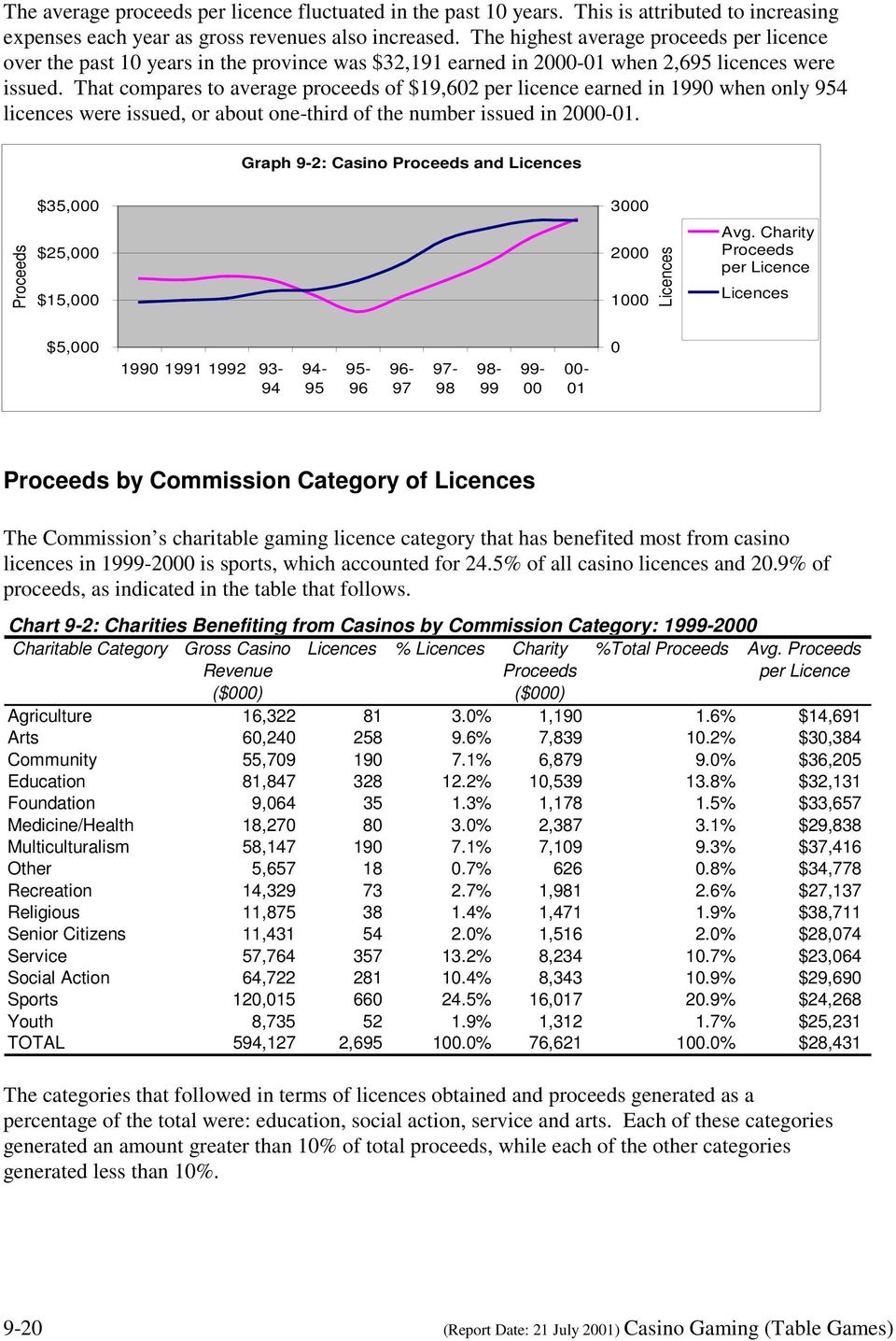
20 The average proceeds per licence fluctuated in the past 10 years. This is attributed to increasing expenses each year as gross revenues also increased. The highest average proceeds per licence over the past 10 years in the province was $32,191 earned in when 2,695 licences were issued. That compares to average proceeds of $19,602 per licence earned in 1990 when only 954 licences were issued, or about one-third of the number issued in Graph 9-2: Casino Proceeds and Licences Proceeds $35,000 $25,000 $15, Licences Avg. Charity Proceeds per Licence Licences $5, Proceeds by Commission Category of Licences The Commission s charitable gaming licence category that has benefited most from casino licences in is sports, which accounted for 24.5% of all casino licences and 20.9% of proceeds, as indicated in the table that follows. Chart 9-2: Charities Benefiting from Casinos by Commission Category: Charitable Category Gross Casino Revenue Licences % Licences Charity Proceeds %Total Proceeds Avg. Proceeds per Licence ($000) ($000) Agriculture 16, % 1, % $14,691 Arts 60, % 7, % $30,384 Community 55, % 6, % $36,205 Education 81, % 10, % $32,131 Foundation 9, % 1, % $33,657 Medicine/Health 18, % 2, % $29,838 Multiculturalism 58, % 7, % $37,416 Other 5, % % $34,778 Recreation 14, % 1, % $27,137 Religious 11, % 1, % $38,711 Senior Citizens 11, % 1, % $28,074 Service 57, % 8, % $23,064 Social Action 64, % 8, % $29,690 Sports 120, % 16, % $24,268 Youth 8, % 1, % $25,231 TOTAL 594,127 2, % 76, % $28,431 The categories that followed in terms of licences obtained and proceeds generated as a percentage of the total were: education, social action, service and arts. Each of these categories generated an amount greater than 10% of total proceeds, while each of the other categories generated less than 10% (Report Date: 21 July 2001) Casino Gaming (Table Games)
21 The highest average proceeds per licence were generated in the following categories: religious, followed by multiculturalism, community groups, other (those that do not fit into any of the other 14 categories), foundation, education, arts and medicine/health. The average proceeds per licence in the rest of the categories were less than the provincial average per licence. Pooling of Casino Proceeds Due to extreme fluctuations in the daily casino hold, charities proceeds are averaged through pooling. Casino table proceeds are pooled by casino facility for 90 days. As table profits are pooled by casino facility the more successful casinos offer a higher pooled average. Charities in urban locations with more than one casino have the option of choosing the casino facility in which to conduct their licensed casino event. The table drop in the regional casinos outside Edmonton and Calgary is substantially less than the table drop in the two major centres. Charities holding casinos receive a portion of the net revenue from slot machines generated during their casino events. When the slot machine portion of revenue from casino events is included in the total, charities earned a total of $76.6 million from casinos in The casino pool payouts per quarter vary from urban to rural locations, and among casinos in those locations. In charities in Calgary earned from $21,000 to $60,000 in proceeds for holding a two-day casino event. The comparable figures for Edmonton ranged from $38,000 to $55,000 and those for regional casinos ranged from $2,800 to $19,800. First Nations On-Reserve Casinos In January 2001, the government announced a First Nations gaming policy that allows for onreserve casinos. The policy formally responds to the interest of First Nations to provide onreserve gaming. The First Nations gaming policy must be taken into account when any consideration is given to the expansion of casino gaming or facilities in the province. Under the policy on-reserve casinos will be required to follow the terms and conditions established for all other charitable casinos in the province. For example, the division of table game revenue would be determined on a casino by casino basis, consistent with the existing casino policy. Specific conditions that apply to on-reserve casinos include the following: The net sales from slot machines will be divided as follows: 15% to the licensed charity; 15% commission to the casino facility operator; 30% to Alberta Lottery Fund for traditional initiatives, and 40% to Alberta Lottery Fund and specifically allocated to a First Nations Development Fund. The development fund will be available Casino Gaming (Table Games) (Report Date: 21 July 2001) 9-21
22 to all Alberta First Nations to support economic, social and community development projects, including addictions programs, education, health and infrastructure. That is, 30% of the net sales would be commissions divided equally between the charity and facility and 70% would go to the Alberta Lottery Fund, the same division of net slot revenue that currently exists among charitable casinos in the province. The host First Nation will be designated as the charity, through a registered notfor-profit society; and The host First Nation (as casino licensee and charity) and the casino operator must be clearly separate and distinct entities. For the purposes of the First Nations Gaming Policy, a host First Nation is a First Nation with an operating casino licensed by the Province of Alberta and is located on an Indian reserve set apart prior to January 1, 2001, or on a reserve set apart after that date which is contiguous to an existing reserve and to which the Province of Alberta has consented (Report Date: 21 July 2001) Casino Gaming (Table Games)
23 E. Landscape of other Provinces Where commercial casinos are permitted in other provinces, they are conducted and managed by the provincial government or its agent. Ontario operates its commercial casinos through a provincial crown corporation. In B.C. a portion of the proceeds from the commercial casinos are available to charities by applications through its Direct Access Program administered by the B.C. Gaming Commission. Smaller charitable casinos are being established in rural locations in Ontario. A few provinces allow only Monte Carlo style casinos (typically blackjack tables and wheels of fortune) under licence to charities and do not have commercial casinos. Participation in Casinos Growing in Canada According to Statistics Canada, the largest generators of gaming revenues across the country are casinos. Since 1996, when Statistics Canada first examined the gambling industry, the growth in casino gaming has continued to outstrip that in most other industries. They exceeded revenues from VLTs in 1997 and ticket lotteries in Between 1992 and 1997, GDP in the gambling industry increased by 125% compared with just 14% in all other industries (Statistics Canada 2000, Update on Gambling). The report also noted participation among players from 1996 to 1998 increased in casinos, as well as slot machines and VLTs, to 20% from 17% during those years. Meanwhile, participation across Canada decreased for all other gaming activities, including government ticket lotteries (to 77% from 86%); non-government lotteries, raffles and other games of chance (to 34% from 39%), and bingo (to 10% from 12%). A number of other provinces have authorized casinos. As noted in the table that follows, each province has its own distinct model of casino gaming. In Alberta, charitable and religious organizations conduct and manage casino events. In a number of other provinces the provincial governments or their agents conduct and manage casinos rather than charitable or religious organizations. Casino Gaming (Table Games) (Report Date: 21 July 2001) 9-23
24 Table 9-3: Landscape of Casino Gaming in Other Provinces at March 31, 2000 JURISDICTION NUMBER OF CASINOS / DIVISION OF REVENUE COMMENTS SLOTS British Columbia 18 Casinos 2 destination casinos Slots 25% slot win to operator Minimum age: 19 Conducted & Managed by: 16 community casinos 75% to BCLC Alcohol prohibited at British Columbia Lottery community casinos. Corporation a crown corporation. Regulated by: Gaming Policy Secretariat BC Gov t guarantees $125 million to charities each year (indexed annually at the rate of the Vancouver price index). June 1999 end to gaming expansion announced. 2,399 Slots 523 destination 1,875 community 368 Table games 13 Poker tables 6 destination casinos approved in principle prior to gaming freeze in 1999; one is scheduled to open in Spring Table Games 40% table win to operator 60% to BCLC Up to an additional 3% of table and slot win can go to the casino service provider for facility development based on an approved plan being in place. Win = money the casino service provider receives from wagers, minus the winnings paid out. Maximum 300 slots; 30 table games; plus an additional 4 poker tables per casino. Host municipalities receive 10% of net revenues from community casinos and 1/6 of net revenue from destination casinos Net Win Slot: $230.5 million Table: $214.7 million Alberta Conducted & Managed by: Licensed charitable organizations. 16 Casinos 16 charitable casinos 0 commercial casinos 3,430 Slots Slots 15% operator 15% charity 70% AB Lottery Fund Minimum age: 18 Casino events only held under license to eligible charitable organizations. Slots conducted and managed by Alberta Gaming and Liquor Commission. Regulated by: AGLC 353 Table Games Table Games: EDM and CGY: Minimum 50% net proceeds to charity. St. Albert: minimum 35% Regional: minimum 25% AGLC issues licences to private casino facility operators to provide space and services Revenue Slot*: $240.6 million Table*: $101.1 million *Slot net sales; table hold (wagers less prizes) 9-24 (Report Date: 21 July 2001) Casino Gaming (Table Games)
25 JURISDICTION NUMBER OF CASINOS / SLOTS Saskatchewan 7 Casinos 1 commercial casino Conducted & Managed by: 4 First Nations casinos Saskatchewan Gaming 1 Full-time exhibition Corporation a crown casino corporation owns the slots 1 Part-time exhibition at Casino Regina and casino (open 4 days/week operates the casino. year round). Saskatchewan Indian Gaming Authority (SIGA) conducts and manages First Nations casino operations under contract with SLGA (who own slots). Regulated by: Saskatchewan Liquor and Gaming Authority Slots 620 Casino Regina 620 First Nations 196 Table Games 41 Casino Regina 71 First Nations 84 exhibition DIVISION OF REVENUE Commercial 50% SK Gen. Revenue 25% First Nations Fund 25% Associated Entities Fund First Nations 37.5% SK Gen. Revenue 37.5% First Nations Fund 25% Associated Entities Fund (if off-reserve) or Community Development Corporations (on reserve). Exhibition VLTs 15% siteholder 85% SK Government Table games 100% siteholder COMMENTS Minimum age: 19 Current government policy - no expansion of electronic gaming. No slots at exhibition casinos - only VLTs. Siteholders for exhibition casinos are exhibition associations Revenue Figures not available until June Manitoba Conducted & Managed by: Manitoba Lottery Corporation a crown corporation. Regulated by: Manitoba Gaming Control Commission 2 Casinos 2 commercial 1,231 Slots 64 Table Games 100% MLC Minimum age: 18 Crystal Casino was consolidated with Club Regent ad McPhillips Street Station casinos in July Revenue $147.2 million Ontario Conducted & Managed by: Ontario Lottery and Gaming Commission a crown corporation. Regulated by: Alcohol and Gaming Commission of Ontario June 2000 OLGC chair announces 3-year freeze on gaming expansion. 8 Casinos 3 commercial 5 charity 8,978 Slots 8,078 Commercial 900* Charity Table Games 356 Commercial 80* Charity Commercial Casinos 100% OLGC* *Net profits from Casino Rama are shared by 134 ON First Nations groups. Charity Casinos Charities receive 100% of net proceeds. Host local gov t receives 5% gross slot revenue. Minimum age: Gaming Revenue Commercial casinos: $2.0 billion Slot: $1.5 billion Table: $511 million Charity casinos: $65.3 million* *Only two of five charity casinos operated for entire Fiscal Betting Limits: Commercial: $10,000 Charity: $100 Casino Gaming (Table Games) (Report Date: 21 July 2001) 9-25
26 JURISDICTION NUMBER OF CASINOS / SLOTS Quebec 3 Casinos 3 Commercial Conducted & Managed by: Loto-Quebec a crown 5,185 Slots corporation. 3,000 Casino de Montreal; 1,410 Casino Regulated by: RACJ (Re gie de alcools de courses et de jeux) de Hull 775 Casino de Charlevoix. DIVISION OF REVENUE COMMENTS 100% Loto-Quebec Minimum age: Revenue $683.5 million: $454.1 million C de M $194.0 million C de H $35.4 million C de C 194 Table Games 118 C de M 55 C de H 21 C de C Nova Scotia Conducted & Managed by: Nova Scotia Gaming Corporation a crown corporation. 2 Casinos 2 commercial 1000 Slots 650 Halifax Casino 350 Sydney Casino 100% NS Gaming Corp Revenue $81.3 million: $54.4 Halifax $26.9 Sydney Operated by: Metropolitan Entertainment Group. Regulated by: Nova Scotia Alcohol and Gaming Authority. New Brunswick Conducted & Managed by: Licensed charitable organizations. Regulated by: Lotteries Commission of NB Licensed by: Trade Practices & Licensing Branch Department of Public Safety 52 Table Games 39 Halifax Casino 13 Sydney Casino No commercial casinos. No permanent casino facilities. No slots. Single and series charitable event licenses. 100% net proceeds to charity. April 2000 responsibility for licensing and enforcement transferred from Revenue Division of Finance Department the newly formed Department of Public Safety. Responsibility of policy remains with Lotteries Commission of NB. Newfoundland & Lab Conducted & Managed by: Licensed charitable organizations. Regulated & Licensed by: Licensing Branch Department of Public Safety No commercial casinos. No permanent casino facilities. No slots. Single and series charitable event licences. 100% net proceeds to charity (Report Date: 21 July 2001) Casino Gaming (Table Games)
27 JURISDICTION NUMBER OF CASINOS / SLOTS Prince Edward Island No commercial casinos. Conducted & Managed by: Licensed charitable organizations. Regulated & Licensed by: Consumer Services Section Office o/t Attorney General No permanent casino facilities. No slots. Single and series charitable event licences. DIVISION OF REVENUE 100% net proceeds to charity. COMMENTS Yukon Conducted & Managed by: Licensed charitable and religious organizations. No commercial licences. No permanent casinos facilities. 100% net proceeds to charity. Minimum age: 19. Maximum event length is three days. Regulated & Licensed by: Licensing Branch Department of Justice Northwest Territories Conducted & Managed by: Licensed charitable organizations. Regulated & Licensed by: Licensing Branch Municipal and Community Affairs No commercial licences. No permanent casinos facilities. No slots. Expense limit: minimum 25% of gross proceeds. Minimum age: 16 can be set higher at licensee request. Maximum event length is three days. Nunavut No commercial licences. Conducted & Managed by: Licensed charitable organizations. Regulated & Licensed by: Consumer Affairs. No permanent casinos facilities. No slots. Casino Gaming (Table Games) (Report Date: 21 July 2001) 9-27
28 F. Summary of Findings Public Views and Stakeholder Consultations Stakeholder Consultations The Gaming Licensing Policy Review process included obtaining the views and perspectives of the Alberta public, including both players and non-players, and stakeholders. This summary of findings presents a snapshot of those views and perspectives focusing on casino gaming. The review process also included a review of gaming-related literature gathered from jurisdictions around the world. A few key sources are described here. The findings are divided as follows: Public - The views and attitudes of adult Albertans about gaming activities in the province. Stakeholders - The views and perspectives of stakeholders. Stakeholders are either directly involved in the gaming industry, or indirectly involved through the services they provide or through some related experience or interest. Most stakeholders have knowledge of at least some of the gaming licensing policies currently in effect. Others will be fully aware of those licensing policies, in particular as they may apply to the gaming activity with which they are directly involved. Landscape- The perspectives related to casinos in other countries. Public In May 2000, during the gaming licensing policy review, the views and perspectives of adult Albertans were sought through public opinion research. The research shows Albertans tend to view casino table games and slot machine gaming as a harder form of gambling. More than half of Albertans also believe that it is up to each individual to control his or her own gambling. More than half of the public indicated they are not well informed about where casino proceeds go. Only about 28% said they were somewhat or well informed. About half of respondents believe proceeds go to government (even though all casino table game proceeds go to charitable groups). The top four areas identified by respondents as deserving of gaming proceeds in general were charities (34.9%), health care (29.1%), education and schools (23.2%) and community organizations (20.9%). Other areas each received less than 15% support (Report Date: 21 July 2001) Casino Gaming (Table Games)
29 Well more than half of respondents felt casino proceeds go to a good cause. More than half of respondents indicated their main source of information about where proceeds go is the newspaper. Graph 9-3: Knowledge of the Use of Casino Proceeds (Albertans 18+) Public Workers Charities 0% 25% 50% 75% 100% % Very Well or Somewhat Well Informed Most respondents would like the availability of casino table games to remain the same (67%). A smaller percentage would like to see the availability reduced (30%). There was little demand (4%) expressed from the public for an increased availability of casino table games. Graph 9-4: Desired Availibility of Casino Gaming (Albertans 18+) Public Workers Charities More Available Same Less Available 0% 25% 50% 75% 100% % of Respondents Respondents indicated clearly players should be able to play slots at resort casinos (93.9%), or local casino (92.4%). A majority also indicated they should be able to play them in a gaming room in a hotel (65.2%) and First Nation casino on reserve land (68.2%). Among respondents, about 6% bet on table games in the last year, 13% played slot machines and the rest indicated they did not participate in casino gaming activities. Among players, the average amount spent over the last month (when the public opinion research was undertaken) was $ for slot machines and $ for table games. The preferred places to play slots, if the activity were to be available in all the following locations, would be the local casino (84.4%), resort casino (70.9%), gaming room in a hotel (57.8%) and bars and lounges (54.6%). In addition, 42.2% said they would play slots at a First Nations casino on reserve land and 32.1% would play them at race tracks. Of players, close to half indicated they would play slots and a little more than one-third indicated they would probably play them when visiting a casino. Casino Gaming (Table Games) (Report Date: 21 July 2001) 9-29
30 The ideal features in a gaming facility for respondents are security and a clean, modern environment. Other features that also rated highly were spacious surroundings, convenient parking, easily identifiable staff and non-smoking sections. Stakeholders Consultation with stakeholders occurred during the Gaming Licensing Policy Review. During September and October 2000, facilitated interviews and discussions occurred with stakeholder groups throughout Alberta. In addition, representative telephone surveys were conducted involving more than 600 representatives of charitable organizations. Also surveyed for their views were 300 industry workers involved with bingo and casino gaming. Stakeholders generally hold the province s charitable gaming model in high regard. Casinos are one part of the model in which charities benefit directly from the revenue generated by activities they are licensed to conduct. Stakeholders have clearly expressed the need to maintain that model so charities may continue to benefit directly from revenues they generate from gaming activities. There is an increasing demand by charities to hold casino events. Integrity of gaming is of common interest. Stakeholders feel the Commission has been professional and acts with integrity and the gaming industry is well regulated. None called into question the Commission s own integrity, even though the stakeholders may be opposed to some policy decisions of the Commission. Stakeholders generally desire a level playing field where everyone knows the rules and there is fair opportunity to participate. Many wanted the same rules that currently exist for charitable casinos to also apply to First Nations on-reserve casino facilities that may be built in the future. There is a wide range of knowledge among stakeholders about where the proceeds from gaming go and how they are used. Some are well informed and others less so. Many want to see more money spent informing people about how proceeds are used, a view that is consistent with that of most Albertans. A number of stakeholders identified the issue of how the Commission determines which groups are eligible for a casino gaming event licence, especially since the demand for such licences is intense and the proceeds from a two-day event continue to increase. A few wondered whether the rules are fair, and if all charitable groups were considered. Few suggestions were made to improve rules and regulations. Many stakeholders expressed an interest in providing more input in the development of gaming policies. As to social responsibility, some stakeholders feel the Commission (and the media) overstates the problems associated with gambling and should allow the marketplace to determine growth. Other stakeholders feel the Commission understates the problem and should further restrict gaming activities (Report Date: 21 July 2001) Casino Gaming (Table Games)
31 Industry Stakeholders Most charities believe access to gambling is well controlled and regulated and rules have been consistently enforced. A minority believe more types of gambling should be permitted in the province. Charities felt a better job could be done to communicate the benefits of gaming. Communicating with the gaming industry could also be improved upon. The views of gaming workers in casinos and bingo, for the most part, reflected similar views to those of charitable groups as discussed above. A representative of a gaming industry association wanted the First Nations gaming policy, specifically the disbursement of proceeds from First Nations on-reserve casinos, to be on a level playing field with existing casinos and the process of disbursements of funds be transparent and accountable. The association felt accessibility to games such as keno would be better in agecontrolled facilities like casinos or liquor lounges. The group supported an open, competitive request for proposals process for establishing new casinos. Casino operators wanted the same rules to apply to everyone, including First Nations casinos. A major concern expressed by the operators is a need for a game plan for the industry to move forward. Based on the current number of casino facilities in the province, the casino industry operators believe the casino market in Alberta has reached 80% of its potential. They also believe there is more opportunity for growth in Calgary than in Edmonton. Other gaming retailers or licensees felt casinos were receiving undue attention. VLT retailers, for example, wanted to be treated in the same way as casinos, that is, to be allowed to grow or expand. Bingo stakeholders felt there was unfair competition from casinos, from video lottery terminals (VLTs) and slot machines approved by the Commission. They desired a plan for gaming development rather than what they perceive as an ad hoc approach with bingo. They feel they compete for the same player, citing nickel slot machine players as bingo players. To compete they feel there is a need to introduce electronic bingo, keno and slot machines in bingo halls. At the same time, both bingo and horse racing representatives want to see a better differentiation of gaming products being offered, to distinguish among them. For example, it was felt racing entertainment centres should have exclusivity to the electronic horse race games, which also are found in casinos. Representatives of the horse racing industry felt that the Commission favours casinos, some VLT operators and charities at the expense of those experiencing declining attendance, such as bingo and horse racing. Another stakeholder felt casinos were no longer being driven by charities as once they were, but by a few companies motivated by profit. Casino Gaming (Table Games) (Report Date: 21 July 2001) 9-31
32 A representative of a major exhibition felt one casino operator was too dominant. There was a desire for more technical support for repairing slot machines in racing entertainment centres. Another representative felt it important to accurately define what groups constitute a charity. It was felt some groups which provide little or no service to community are obtaining the same dollars from charitable gaming as those doing great work. Major exhibitions and agricultural societies feel left out of the picture, even though they were the early partners in casino gaming in the province. One representative suggested exclusive licences for casino gaming during its major exhibition be reinstated. Rural fairs and exhibitions desired greater access to urban casino events. They see their activities diminishing while those in the cities are growing. For some charities, it is not practical for them to work at a regional casino due to the travel distance required to get there. Municipalities and Police Services A representative of a municipal association expressed concern about the potential impact on roads and infrastructure related to First Nations casinos. The representative also felt more support should be provided to rural groups through equal access to the level of funds from busier urban casinos. One municipal representative believes gaming should be available through dedicated gaming venues such as casinos and First Nations casinos should be treated in the same way as existing ones. Another urban municipal representative was concerned about social or infrastructure costs related to having a casino in their own community, and that city council could well be opposed to any more casinos in the city. The official felt municipalities could be better compensated for costs associated with casino gaming. An urban municipal official felt casino gaming attached to hotels or convention facilities would benefit tourism in the area. Of greatest importance is the need to keep the industry fair and clean. The official of another municipality felt gaming was not a sustainable activity adding real longterm value to the province. Gambling must be controlled. It was felt an issue would be to have a First Nation act both as operator of an on-reserve casino and the charity receiving benefits from it. Police services felt the Commission has done a good job in regulating gaming in the province. Nevertheless, they did have some issues. One police service representative wondered whether on-reserve casinos would increase social problems on the reserve and this could be of concern. A balancing of social responsibility and growth of gaming is required. A full cost benefit analysis would be appropriate. The representative was not aware the Alberta Gaming and Research Institute was formed to provide research into social and economic benefits and costs. Another representative wondered whether police services should be directly involved with policing in casinos. Preventing crime and addressing criminal activities through joint forces with the Commission was suggested as a possibility. This was a common suggestion of most police services and was also suggested by an official with the provincial Justice department (Report Date: 21 July 2001) Casino Gaming (Table Games)
33 One police service official felt VLT gaming has created problems which would be worsened with First Nations casinos. Service Agencies and Advocacy Foundation A public policy advocacy foundation expressed support for the charitable model of gaming, which reinforces the integrity of the entire industry. A representative indicated charities would be concerned with any change from the current charitable gaming model. The representative felt keeping charities involved helps keep the industry as transparent as possible. The foundation believes an organization such as the Commission is bound to be biased in its decisions when it generates revenue from gaming. Even so, the foundation believes the Commission is doing a good job balancing the public and special interests. It also believes the Commission is doing better than other jurisdictions in the area of consultation. On a more general note, the foundation felt the Commission should produce more information on the state of gaming in the province. It was felt a detailed information report, for example, would help in discussions related to First Nations casinos and how government wants to equitably and responsibly develop those casinos. A problem gambling treatment agency saw as an issue the role of the Commission as promoter, regulator and profiteer from gaming. A representative of the agency felt Alberta could do more to fund problem gambling education, prevention and treatment programs. The agency hopes some funds will be dedicated to address First Nations problem gambling. Such funding should be tied in with current programs rather than be operated parallel to them. It was expected new games will continue to be demanded to satisfy consumer demands, particularly those of baby boomers who like change and younger players that like fast-paced electronic gaming. A problem gambling foundation feels casinos are slightly better than VLTs, since they are less accessible. Landscape The regulatory environments for gaming between Canada and other jurisdictions differ. In any case, it is worth examining or considering the events and activities occurring internationally to compare gaming activities, issues and developments. U.S. Experience Much of the information provided in this landscape information is drawn from a report of the U.S. National Gambling Impact Study Commission. The commission was appointed by the federal government of the United States to examine the impact of gambling across the U.S. Research and study was conducted over two years and the commission issued its report with findings and recommendations in June The U.S. federal government has largely deferred the regulatory functions of casino gaming to the state. The federal government has instead focused its attention largely on criminal matters, Casino Gaming (Table Games) (Report Date: 21 July 2001) 9-33
34 especially when these activities cross state lines. Examples of U.S. federal legislation related to gaming include: Gaming Devices Act (1951), which prohibits the transportation of gambling devices across state lines. It was amended to exempt cruise ships but not airlines either originating from or bound to the U.S.; Travel Act (1952), which prohibits the use of mail either inter-state or internationally for any business enterprise involving gambling; Wire Communications Act (1961), which prohibits the use of wire communications (telephones, telegrams, etc.) to transmit bets or wagers, or information that assists in placing bets and wagers; Racketeering Influenced and Corrupt Organizations (RICO, 1971), aimed at combating the infiltration of organized crime and racketeering into legitimate organizations operating interstate commerce including gambling; and Bank Secrecy Act (1985), was amended to include casinos among other cash-intensive businesses in order to prevent money laundering. It was renamed the Money Laundering Act in 1986 and strengthened the federal government s powers in this area. Finally, in 1990 the Treasury department created the Financial Crimes Enforcement Network (FinCEN) to establish, oversee and implement policies to prevent and detect money laundering. The United States allows for First Nations gaming through special federal statute. The Indian Gaming Regulation Act (IGRA 1988), provides a statutory basis for the regulation of Indian gambling, specifying certain mechanisms and procedures, including the requirement gambling revenues be used for the economic development and welfare of the tribe. This was an outgrowth of the federal government s responsibility for, and legislative authority over, Native American reservations. States must approve First Nation gaming activities and enter into a compact with each tribe, subject to these federal requirements. State governments are responsible for approving and regulating gambling within the state. In most cases, the public has voted either by statewide referendum or local option election, before casino gambling is permitted. However, in some cases elected official have made these decisions without a public vote. Whatever the case, the state government decides the level and degree of casino gambling that will be permitted and is responsible for developing the administrative structures necessary to regulate and tax casino gambling within their borders. The U.S. report cites two types of casino models. One is the Nevada model, in which gambling is generally viewed as a business with economic opportunity. The other is the New Jersey model, in which the potential harm or negative aspects of casino gambling, and its difference from other businesses, is emphasized. Despite this emphasis, the New Jersey Model recognizes casino gambling may nevertheless generate notable economic activity. The report notes: For many people, casinos symbolize the gambling industry. Hence, casino locations are often viewed as indicative of a community s embrace of the gambling industry. It indicates: 9-34 (Report Date: 21 July 2001) Casino Gaming (Table Games)
35 In addition to Las Vegas resort casinos, there are now nearly 100 riverboat and dockside casinos in six states and approximately 260 casinos on Indian reservations. The expansion of gambling to these new sites has been called the most significant development in the industry in the 1990s (citing Harold Vogel, 4 Entertainment Industry Economics (1998)). Later on, the report notes: Casinos are an important source of entertainment, jobs and income. The largest casino markets are: Nevada with 28 full-scale casinos, 1,978 slots only locations, one Indian casino, and gross casino revenues for 1997 of $7.87 billion; New Jersey, with 14 casinos and gross casino revenues for 1997 of $3.9 billion; and Mississippi, with 29 state-regulated casinos, one Indian casino, and gross casino revenues for 1997 of $1.98 billion. The National Gambling Impact Study Commission report cites the study conducted by Arthur Andersen Consulting (1997) into the gaming industry on behalf of the American Gaming Association, which considered cannibalization or the substitution theory. Here is what was reported: First, the size of the U.S. economy is not fixed; rather it expands over time as new jobs are created. Second, at the macroeconomic level, the industries which some maintain have been affected by consumer spending on gaming have grown concurrently with the gaming industry. Third, economists have known for centuries that for an economy to grow, it must produce the goods and services which consumers prefer. Fourth, casino gaming relies more heavily than most industries on domestic labor and domestic suppliers (including capital). In addition, spending by foreigners in U.S. casinos also represents an export activity for the domestic economy. Regarding crime, the commission report noted all the evidence presented indicates that the effective state regulation, coupled with the takeover of much of the industry by public corporations, has eliminated organized crime from the direct ownership and operation of casinos. The report notes: Taken as a whole, the literature shows communities with casinos are just as safe as communities that do not have casinos. A former Illinois state gaming board administrator was asked to develop a model regulation for casino gaming. In that process, Michael Belletire noted: Perhaps the most significant factor in shaping the dynamics of the regulatory process is the scope of legislatively authorized casino gambling. However, according to Belletire, restricting the market and putting it in the hands of regulators may subject the process to undue influence in awarding licences. To counter that possibility, he recommended the following: Independence in licensure decision making; Placing the burden to prove suitability for licensure upon the applicant; An explicit requirement for competitive proposals for limited availability licenses; Carefully articulated policy standards for deciding among competing applications; Comprehensive disclosure of financial and political relationships; and Explicit powers to review, investigate and approve contractual relationships entered into by applicants and licensed operators; Casino Gaming (Table Games) (Report Date: 21 July 2001) 9-35
36 Requirements that ensure confidentiality in the treatment of sensitive personal and financial information balanced by appropriate public meeting requirements; and In-depth and independent investigate practices and personnel. He noted: One of the most powerful tools in overseeing the conduct of gambling operations is the video camera surveillance system. Typically, surveillance requirements are imposed by rules and regulations rather than by statute. One of the Commission s recommendations is that U.S. states should refuse to allow the introduction of casino-style gambling into pari-mutuel facilities for the primary purpose of saving the facilities which the market has determined no longer services the community or for purpose of competing with other forms of gambling. There is no definitive answer regarding the economic impact of casinos. Numerous commissioned gambling impact studies have been undertaken throughout North America over the last five years, resulting in a wide range of conclusions. The Arthur Anderson report that was referred to earlier is an example of one study that promoted the positive economic benefits of casino gambling. At the other end of the spectrum is the Robert Goodman report, The Luck Business (1995), in which the author suggests the economic benefit of casino gambling to communities have been grossly overstated: In spite of the lack of evidence to support their positions, local politicians and business leaders continue to tout the use of casinos as incubators of jobs and as generators of consumer dollars for local stores and other businesses. The extravagant claims are contradicted by the gambling industry s own executives and research consultants. In summary, balanced and unbiased research into the economic costs and benefits of casino gambling is still required. Currently, there is a lack of empirical evidence to either support or refute these claims regarding the economic impact that casinos have on communities. It appears this situation may likely continue until the academic debate is resolved over how the costs and benefits should be defined, what costs should be included and how they should be measured (Report Date: 21 July 2001) Casino Gaming (Table Games)
37 G. Primary Issues and Recommendations Assessing Proposed Casino Policy Recommendations The process of arriving at recommended casino licensing policies was comprehensive, involving a number of steps. The first step was to arrive at an initial assessment of current casino licensing policies within the gaming licensing policy framework. Are casino licensing policies clear, comprehensive and up to date? The next step was to obtain the perspectives of stakeholders about casino licensing policies and gaming in Alberta generally. Information was also gathered about casino activities occurring in other jurisdictions, to provide some comparisons among the respective jurisdictions That step was followed by an intensive review of stakeholder perspectives and the findings from other jurisdictions and assessing options to address casino gaming in Alberta over at least the next five years. As policy options or strategies took shape, the following question was asked: How well does a proposed policy strategy measure up to the key elements of the province s licensing policy framework? For example, the questions asked included: Does a proposed casino licensing policy strategy meet the requirements of the Criminal Code, the Gaming and Liquor Act and Gaming and Liquor Regulation? Is it consistent with the guiding principles for gaming? Is a proposed strategy consistent with government s policies that specifically address casino gaming? Does it fit within the objectives and goals of the Ministry s three-year business plan? Only policy strategies that met the key elements of the policy framework would be considered further. Following from that step, various recommendations were formed regarding casino gaming in the province. Primary Issues The Gaming Licensing Policy Review, in consultation with stakeholders, identified a number of primary issues regarding casino licensing policies. A number of recommendations for licensed gaming facilities, including licensed casino facilities, appear in the section Gaming in General. The primary issues and their respective recommendations appear under the following topic areas. Casino Gaming (Table Games) (Report Date: 21 July 2001) 9-37
38 A. ELIGIBILITY, USE OF PROCEEDS POLICY POSITION: 1. Provide a fair and equitable opportunity to eligible charities to obtain a casino event licence. The return to charities from each two-day casino event held in a licensed casino facility has increased dramatically since 1997 and in cases may exceed the financial need of the charity. In the last quarter of , the average proceeds earned per charity for a two-day event in Edmonton casinos, including commissions from slot machines, ranged from $38,000 to $55,000 and in the Calgary casinos from $21,000 to $60,000. Charities in other or regional casinos earn proceeds that range from $2,800 to $19,800. In addition, the demand by charities for casino event licences continues to grow. As a result of the demand, charities must wait for at least 12 months to hold a casino event in a permanent casino facility after being approved for a casino event licence. The wait time for casinos in the larger centres is longer, with the longest waiting period being approximately 29 months. CASINO RECOMMENDATION - 1 Give eligible charities the option of receiving a one or two day casino event licence. Comment - Currently almost all casino event licences held at a licensed casino facility are issued for two days. This recommendation gives charities, in particular smaller charitable groups, an option to hold a one-day casino event at a casino rather than a two-day event. This would result in half the revenue that otherwise would be earned, but may be more in line with the revenue needs or expectations of the charity. It would also help to reduce the wait list for charities to hold their casino events by freeing up casino events for more charities. B. ENFORCEMENT, SECURITY, FINANCIAL CONTROLS The integrity of gaming activities is critical to the public and stakeholders. Ensuring the integrity of gaming activities is a guiding principle of the Commission. That guiding principle is supported through policies and procedures regarding enforcement and security. Proper financial controls help to protect the revenue generated from casino events and ensure accountability. POLICY POSITION: 1. The internal controls of every casino operation must meet stringent operational standards to ensure the integrity of gaming activities is maintained and the revenue generated from them is protected. Internal controls refers to the systems, processes and procedures related to the proper, secure and smooth operation and delivery of a casino event. Such controls take into account the security and financial controls of a licensed casino facility. The Casino 9-38 (Report Date: 21 July 2001) Casino Gaming (Table Games)
39 Terms & Conditions and Operating Guidelines specify the standards for internal controls that casino facility licensees are required to meet. CASINO RECOMMENDATION - 2 Enhance the internal operating standards and controls for casinos will to ensure the continued smooth operation of casino facilities in the province. Comment - This recommendation is aimed at ensuring the terms and conditions for casinos, specifically internal operating standards and controls, are in step with the changes and growth that have occurred in casino gaming in the province over the past five years. For example, electronic technology is a valuable tool in providing financial controls and monitoring the revenues that are generated from casino gaming. It minimizes the manual reporting requirements and the potential for manual entry errors and fraud. The technology used in casinos should be acceptable to meet current operating standards. As another example, the reporting lines and procedures for monitor rooms and casino security managers should be part of the review to enhance internal operating standards and controls. The independence of security staff is important to the secure operation of a casino and to ensure the Commission s terms and conditions are followed without conflict. Such conflict is conceivable when a security staff reports to a hired casino facility supervisor, whose direction may be inconsistent with that of the Commission. In other provinces, the government has a direct presence through dedicated, full-time personnel in casino facilities. The increased presence of Commission staff in casino operations is a consideration in the enhanced operating standards. CASINO RECOMMENDATION - 3 Require that the casino advisors hired by charities to help conduct casino events be independent and not hired from or be affiliated with casino facility operators. Comment - Charities hire casino advisors to assist them to conduct and manage their casino events in a licensed casino facility. Occasionally, a casino facility licensee may offer the services of casino staff to act as an advisor to the charity. The casino advisor is required to know the proper operations of a charitable casino and the requirements of charity volunteers in holding a casino event. The advisor helps guide the charity throughout the casino event. It is important the casino advisor function continue to be kept separate and at arm s length from the facility licensee s operations, particularly as the key financial requirements of a casino event is the responsibility of the charity. Casino Gaming (Table Games) (Report Date: 21 July 2001) 9-39
40 POLICY POSITION: 2. Reduce the possibility or exposure to the threat of crime related to casino gaming. Some criminal activities such as theft, fraud and cheating at play have been detected in casinos, although are not believed to be widespread. In some instances, casino staff have been recruited by players to commit offences. Police services have expressed their concerns about the possibility of money laundering and loan sharking in casinos. Any criminal activity or its threat must be curtailed and the exposure to the threat of crime reduced. CASINO RECOMMENDATION - 4 Establish a closer working relationship with police services in addressing gaming-related crime and provide resources to address this issue. Comment - Police services have indicated they presently lack the resources to focus on gambling-related crime. Yet the police are important to the full and effective enforcement of gambling laws and regulations. Therefore, resources should be provided to enable police to become more involved. In this regard, consideration should be given to establishing joint forces operations (JFOs) involving both the Commission and police. Police services and an official in the provincial Department of Justice suggest that JFOs are an effective means to address crime. Among other activities, a program of crime prevention and detection could be developed and provided to key staff in casinos. CASINO RECOMMENDATION - 5 Review the authority, mandate and jurisdiction of the Commission to enforce gaming legislation in unlicensed premises. Comment - Commission investigators and inspectors are limited in their ability to enforce gaming laws. They are restricted to enforcing gaming laws in premises licensed by the Commission and do not have jurisdiction to investigate other activities, such as loan sharking, money laundering or illegal gaming houses. Such limitations occur by authority, mandate and agreement with the police services and Alberta Solicitor General. C. REVENUE DIVISION Revenue division refers to how revenue is divided between the licensed charities that hold events in a casino facility and the operator of the facility to cover expenses. Charitable gaming policies are aimed at ensuring that the financial return to charities from the gaming activities they conduct and manage are maximized. POLICY POSITION: 1. Ensure the financial benefit to charities from casino gaming is maximized. Current licensing policies require charities be the main beneficiaries of casino table games, which they are licensed to conduct and manage. Charities are not required to 9-40 (Report Date: 21 July 2001) Casino Gaming (Table Games)
41 provide any volunteers related to slot machine gaming since it involves electronic gaming devices and therefore must be conducted and managed by the Commission on behalf of the government. As such, the primary beneficiary of electronic gaming devices is the Alberta Lottery Fund and licensed charitable groups holding a licensed casino event obtain a commission from the gaming devices. CASINO RECOMMENDATION - 6 Require that charitable proceeds from casino table games be pooled by city and divided accordingly. Comment - The proceeds from slot machines are already being pooled by city and divided equally among the charitable groups that held casino events over fiscal quarterly period. Currently, casino table games are pooled by casino facility over a 90-day period. Some casino facilities generate considerably higher proceeds from table games than do others. As a result, some charitable groups will obtain higher total proceeds from casino events than others, creating an artificial advantage for such groups. The recommendation will create a fairer distribution of revenue to charitable groups that hold casino events in a city with two or more casinos. It also will eliminate the competition among charities to hold their events at the more profitable casinos in a city. This recommendation will not affect the casino facility operator s recovery of costs. A cost recovery structure will continue to apply and to allow casino facility operators to be competitive. Casino Gaming (Table Games) (Report Date: 21 July 2001) 9-41
What We Heard. Introduction. Consultation Process. What We Heard. Casino Hours Consultative Review
 Casino Hours Consultative Review Introduction A number of casino operators have expressed a desire to have allowable casino table game hours mirror that of casino slot machines. Current Alberta Gaming
CASINO LICENSEE TERMS & CONDITIONS AND OPERATING GUIDELINES
 CASINO LICENSEE TERMS & CONDITIONS AND OPERATING GUIDELINES The following excerpts are taken from the Casino Terms & Conditions and Operating Guidelines (CTCOG). For crossreferencing purposes, the italicized
SLOT MACHINES. Contents
 SLOT MACHINES Contents A. Introduction B. Background C. Current Slot Machine Policies D. Current Situation Assessment E. Landscape of Other Provinces F. Summary of Findings Public Views and Stakeholder
MONTE CARLO CHARITY EVENT TERMS AND CONDITIONS
 MONTE CARLO CHARITY EVENT TERMS AND CONDITIONS SASKATCHEWAN LIQUOR AND GAMING AUTHORITY Monte Carlo Charity Events - TABLE OF CONTENTS Section Page 1. Definitions...1 2. General...1 3. Ticket Requirements...2
Casino Gaming Rule 2010
 Queensland Office of Liquor and Gaming Regulation Casino Gaming Rule 2010 This Rule is prepared by the Queensland Office of Liquor and Gaming Regulation 2010 V6 1 Queensland Contents Part 1 Preliminary...
STANDARD PROCEDURES. for Limited Casinos
 Gaming Policy and Enforcement Branch STANDARD PROCEDURES for Limited Casinos SEPTEMBER 2015 Know your limit, play within it. For Help: 1-888-795-6111 or www.bcresponsiblegambling.ca Table of Contents 1.
cachecreek.com 14455 Highway 16 Brooks, CA 95606 888-77-CACHE
 Baccarat was made famous in the United States when a tuxedoed Agent 007 played at the same tables with his arch rivals in many James Bond films. You don t have to wear a tux or worry about spies when playing
Raffle Terms & Conditions Total Ticket $10,000 and Less
 Raffle Terms & Conditions Total Ticket $10,000 and Less The role of the Alberta Gaming and Liquor Commission and the intent of these Terms & Conditions are to ensure the integrity of licensed raffles in
1 Bet Threat Texas Hold Em Gaming Equipment Rules of the Games Temporary Amendments: N.J.A.C. 19:40-1.2; and 19:46-1.17, 1.18 and 1.
 1 Bet Threat Texas Hold Em Gaming Equipment Rules of the Games Temporary Amendments: N.J.A.C. 19:40-1.2; and 19:46-1.17, 1.18 and 1.19 Temporary New Rules: N.J.A.C. 19:46-1.13X and 19:47-35 Authority:
BINGO. TERMS & CONDITIONS and OPERATING GUIDELINES
 TERMS & CONDITIONS and OPERATING GUIDELINES 1 TERMS & CONDITIONS and OPERATING GUIDELINES Table of Contents 1. GENERAL INFORMATION 1.1 Definitions 1.2 Legislation and Board Policies 1.3 Guiding Principles
Canadian Gambling Digest 2008-09
 Canadian Gambling Digest - Prepared by the Responsible Gambling Council on behalf of the Canadian Partnership for Responsible Gambling. March 3st,. Canadian Gambling Digest 8-9 Introduction Table of Contents
Regular and Special Bingo Licence Terms and Conditions
 Alcohol and Gaming Commission of Ontario Gaming Registration & Lotteries 90 SHEPPARD AVENUE EAST SUITE 200 TORONTO ON M2N 0A4 Tel.: 416 326-8700 Fax: 416 326-5555 1 800 522-2876 toll free in Ontario Website:
Problem and Responsible Gambling Strategy
 Problem and Responsible Gambling Strategy Proposal for Enhancement to Address Increasing Problem Gambling Needs in Alberta 2005 2006 Approved April 2005 (AADAC and AGLC Board) PROPOSAL FOR FUNDING Problem
(SEE IF YOU KNOW THE TRUTH ABOUT GAMBLING)
 (SEE IF YOU KNOW THE TRUTH ABOUT GAMBLING) Casinos loosen the slot machines at the entrance to attract players. FACT: This is an urban myth. All modern slot machines are state-of-the-art and controlled
Canadian Gambling Digest 2013-2014
 Canadian Gambling Digest 213-214 Prepared by the Responsible Gambling Council on behalf of the Canadian Partnership for Responsible Gambling. August, 215. Canadian Gambling Digest 213-14 Introduction a
Dear Reader: Presented herewith is the Annual Gaming Report pursuant to Section 56 of the Gaming Control Act for the year ending March 31, 2013.
 Dear Reader: Presented herewith is the Annual Gaming Report pursuant to Section 56 of the Gaming Control Act for the year ending March 31, 2013. The Annual Gaming Report covers the activities of the Alcohol
REGULAR AND SPECIAL BINGO LICENCE TERMS AND CONDITIONS DEFINITIONS
 Alcohol and Gaming Commission of Ontario Gaming Registration & Lotteries Commission des alcools et des jeux de l=ontario Inscription pour les jeux et loteries 20 Dundas Street West 20, rue Dundas ouest
Know it all. Table Gaming Guide
 Know it all. Table Gaming Guide Winners wanted. Have fun winning at all of your favorite games: Blackjack, Craps, Mini Baccarat, Roulette and the newest slots. Add in seven mouthwatering dining options
How to Play. Player vs. Dealer
 How to Play You receive five cards to make your best four-card poker hand. A four-card Straight is a Straight, a four-card Flush is a Flush, etc. Player vs. Dealer Make equal bets on the Ante and Super
Advice on non-commercial and private gaming and betting
 Advice on non-commercial and private gaming and betting November 2012 Contents 1 Introduction 3 2 Defining non-commercial and private gaming and betting 3 3 Non-commercial prize gaming 4 4 Non-commercial
1. Introduction 3. 2. General Rules 7. 3. Roulette 9. 4. Blackjack 15. 6. Punto Banco 28. 8. Dice/Craps 40. 9. Sic Bo 46. 12.
 Rules of casino games in Great Britain August 2007 Contents 1. Introduction 3 2. General Rules 7 3. Roulette 9 4. Blackjack 15 5. Three Card Poker 24 6. Punto Banco 28 7. Casino Stud Poker 35 8. Dice/Craps
Las Vegas Strip Table Mix
 Las Vegas Strip Table Mix The Evolution of Casino Games, 1985-2013 An Examination of Shifting Unit and Revenue Trends Contents Executive Summary 1 Methodology, Definitions 2 Unit Share 3 Revenue Share
GENERAL ASSEMBLY OF NORTH CAROLINA SESSION 2015 H 1 HOUSE BILL 894. Short Title: Game Nights/Nonprofit Fund-Raiser. (Public)
 GENERAL ASSEMBLY OF NORTH CAROLINA SESSION H 1 HOUSE BILL Short Title: Game Nights/Nonprofit Fund-Raiser. (Public) Sponsors: Referred to: Representatives Boles, Floyd, Lucas, and Saine (Primary Sponsors).
BINGO LICENSEE TERMS & CONDITIONS LICENSED BINGO FACILITIES
 BINGO LICENSEE TERMS & CONDITIONS LICENSED BINGO FACILITIES These Bingo Licensee Terms & Conditions govern licences issued to groups conducting bingo in a licensed bingo facility that is in operation four
Gaming Control Act CHAPTER 4 OF THE ACTS OF 1994-95. as amended by
 Gaming Control Act CHAPTER 4 OF THE ACTS OF 1994-95 as amended by 2003, c. 4, s. 14; 2008, c. 57; 2010, c. 2, ss. 102, 103; 2011, c. 63, ss. 1(b), 4, 5; 2012, c. 23 2013 Her Majesty the Queen in right
Terms and Conditions for Charitable Texas Hold em Poker Tournaments
 Terms and Conditions for Tournaments Under subsection 34(2) of the Gaming Control Act, a license is subject to terms and conditions as may be imposed by the Registrar. These are the terms and conditions
on a table having positions for six players on one side of the table 1. A true to scale rendering and a color photograph of the
 Full text of the proposal follows (additions indicated in boldface thus; deletions indicated in brackets [thus]): 13:69E 1.13M Boston 5 stud poker table; boston 7 stud poker table; physical characteristics
LOTTERY LICENSING POLICY MANUAL
 LOTTERY LICENSING POLICY MANUAL CHAPTER 9: BINGO IN NON-POOLING BINGO HALLS Table of Contents 9.1.0. Introduction... 180 9.1.1. Authority to license... 181 9.1.1(a) Provincial licensing authority... 181
Casino Gaming Regulation
 Chapter 4 Section 4.01 Alcohol and Gaming Commission of Ontario Casino Gaming Regulation Follow-up to VFM Section 3.01, 2010 Annual Report Background Casino gaming in Ontario is primarily overseen by two
ALCOHOL AND GAMING COMMISSION OF ONTARIO POOLING BINGO HALLS: ADVERTISING & MARKETING GUIDELINES
 ALCOHOL AND GAMING COMMISSION OF ONTARIO POOLING BINGO HALLS: ADVERTISING & MARKETING GUIDELINES September 2010 6183 (2010/09) TABLE OF CONTENTS Introduction..3 Definitions........3 Hall Marketing Plan...4
NOTE: Any questions about the review or bingo in general should be directed to Penny Kleinmeyer, Manager, Bingo Programs (780) 447-8856.
 NOTE: The Bingo Review Committee was formed by the Alberta Gaming and Liquor Commission in 1998 to conduct a review of Alberta s bingo industry. The Committee s work concluded with the presentation of
GLOSSARY ADR. cage. a secured area within a casino where records of transactions are kept, money is counted and chips can be exchanged for cash CAGR
 The following glossary contains explanations and definitions of certain terms used in this prospectus as applicable to our Company and business. These terms and their meanings used in this prospectus may
1. General...3. 2. Black Jack...5. 3. Double Deck Black Jack...13. 4. Free Bet Black Jack...20. 5. Craps...28. 6. Craps Free Craps...
 Table of Contents Sec Title Page # 1. General...3 2. Black Jack...5 3. Double Deck Black Jack...13 4. Free Bet Black Jack...20 5. Craps...28 6. Craps Free Craps...36 7. Roulette...43 8. Poker...49 9. 3-Card
MEDIA BINGO TERMS AND CONDITIONS
 MEDIA BINGO TERMS AND CONDITIONS SASKATCHEWAN LIQUOR AND GAMING AUTHORITY Media Bingo - Terms and Conditions TABLE OF CONTENTS Section Page 1. Definitions...1 2. General...2 3. Joint Operations...3 4.
SCHEDULE C TOWN OF IQALUIT LOTTERY GUIDELINES
 SCHEDULE C TOWN OF IQALUIT LOTTERY GUIDELINES SECTION I - GENERAL 1. General: 1. Lottery licenses shall not be issued to organizations to hold events outside the Town, with the exception of Raffle lotteries.
LOTTERY LICENSING POLICY MANUAL
 LOTTERY LICENSING POLICY MANUAL CHAPTER 7: BREAK OPEN TICKETS Table of Contents 7.1.0. Introduction... 154 7.1.0(a) Other types of break open ticket games... 154 7.1.0(a)(i) Seal card games... 154 7.1.0(a)(ii)
TABLE GAMES APPROVED FOR PLAY IN MISSISSIPPI CASINOS
 GAME Type DATE Baccarat / Mini-Baccarat MCA 75-76-5 (k) Beat the Banker MCA 75-76-5 (k) Big Injun MCA 75-76-5 (k) Blackjack MCA 75-76-5 (k) Chemin de fer MCA 75-76-5 (k) Chuck-a-Luck (DaiShu) MCA 75-76-5
BCLC Submission to the Standing Senate Committee on Legal and Constitutional Affairs Bill C-290
 BCLC Submission to the Standing Senate Committee on Legal and Constitutional Affairs Bill C-290 OCTOBER 22, 2012 Summary of submission: This submission is presented by British Columbia Lottery Corporation
Department of Legislative Services 2012 Session
 House Bill 7 Ways and Means Department of Legislative Services 2012 Session FISCAL AND POLICY NOTE Revised (Delegate Olszewski) HB 7 Judicial Proceedings Criminal Law - Betting, Wagering, and Gambling
Gaming Information for Charitable Groups A Resource Manual
 Gaming Information A Resource Manual March 2014 Eighth Edition Gaming Information Gain essential information on charitable gaming activities. Gain experience. Gain knowledge. Gain information. A Resource
PENNSYLVANIA GAMING CONTROL BOARD REMAINING TEMPORARY TABLE GAMES REGULATIONS TITLE 58. RECREATION CHAPTERS: 581, 583, 585, 587, 588, 589,
 PENNSYLVANIA GAMING CONTROL BOARD REMAINING TEMPORARY TABLE GAMES REGULATIONS TITLE 58. RECREATION CHAPTERS: 581, 583, 585, 587, 588, 589, 590, 591, 592 & 593 THIS DOCUMENT CONTAINS THE REMAINING TEMPORARY
LOTTERY LICENSING POLICY MANUAL
 LOTTERY LICENSING POLICY MANUAL CHAPTER 3: GENERAL LOTTERY LICENSING POLICIES Table of Contents 3.1.0. Introduction... 91 3.1.1. Definition of a lottery scheme... 91 3.1.2. Games of chance and games of
History of Indiana Charity Gaming
 In FY05, 2,616 licenses were issued to qualifying organizations, 423 more than FY04. In June 1992, the Department was given the responsibility of enforcing charity gaming laws in Indiana. Only qualified
(1) American Wheel: Thirty-eight (38) compartments containing the numbers one through thirty-six (1-36) and a zero (0) and double zero (00).
 BASIS AND PURPOSE FOR RULE 22 The purpose of Rule 22 is to establish playing rules for authorized types of roulette and management procedures for conducting roulette games in compliance with section 12-47.1-302
Scratchcard Games. Section 6
 Scratchcard Games Section 6 Licence under Section 6 of The National Lottery etc. Act 1993 LICENCE UNDER SECTION 6 OF THE NATIONAL LOTTERY ETC. ACT 1993 The Gambling Commission in exercise of the powers
Gambling in Portugal
 Gambling in Portugal Information Leaflet Introduction This leaflet has been produced to enable the public to have concise information in layman s terms about gambling in Portugal. The information contained
The Gambling Act 2005 received Royal Assent in April 2005.
 Gambling Act 2005 and the Gambling Commission The questions, answers and notes below attempt to address potential concerns that may arise from the change in legislation. A great deal of the details of
Standard 12: The student will explain and evaluate the financial impact and consequences of gambling.
 STUDENT MODULE 12.1 GAMBLING PAGE 1 Standard 12: The student will explain and evaluate the financial impact and consequences of gambling. Risky Business Simone, Paula, and Randy meet in the library every
gambling making an informed decision
 gambling making an informed decision responsible gambling Responsible gambling occurs in a regulated environment where the potential for harm associated with gambling is minimised and people make informed
BAD BEAT. Bad Beat will reset at $10,000 with a qualifier of four deuces beaten. Every Monday at 6:00 AM the Bad Beat will increase by $10,000.
 BAD BEAT Bad Beat will reset at $10,000 with a qualifier of four deuces beaten. Every Monday at 6:00 AM the Bad Beat will increase by $10,000. OFFICIAL RULES Horseshoe may change or cancel this promotion
PLACE BETS (E) win each time a number is thrown and lose if the dice ODDS AND LAYS HARDWAYS (F) BUY & LAY BETS (G&H)
 craps PASS LINE BET (A) must be rolled again before a 7 to win. If the Point is and the shooter continues to throw the dice until a Point is established and a 7 is rolled before the Point. DON T PASS LINE
THE GREEK GAMING LEGISLATIVE FRAMEWORK
 THE GREEK GAMING LEGISLATIVE FRAMEWORK Dimitris Panageas Legal Counsel, Club Hotel Loutraki S.A. European Association for the Study of Gambling (EASG) 9 th European Conference on Gambling Studies and Policy
Rules of core casino games in Great Britain
 Rules of core casino games in Great Britain June 2011 Contents 1 Introduction 3 2 American Roulette 4 3 Blackjack 5 4 Punto Banco 7 5 Three Card Poker 9 6 Dice/Craps 11 2 1 Introduction 1.1 This document
SMALL GAMES OF CHANCE OVERVIEW
 DISCLAIMER The Pennsylvania Department of Revenue has prepared this overview on Pennsylvania s Local Option Small Games of Chance Act, 1988 P.L. 1262, No. 156, as amended, for use by the general public.
k o G ob in d m n a a G H
 Gaming Handbook Welcome to a world of excitement This MGM Grand Detroit Gaming Guide is designed to enhance your gaming fun and total casino experience. The guide provides you with concise, easy-to-understand
August 31, 2005 Phone: (303) 866-5632 / (303) 205-1334. DENVER Colorado Attorney General John Suthers and Colorado Limited Gaming Control
 NEWS RELEASE Colorado Department of Law Attorney General s Office Colorado Department of Revenue Limited Gaming Control Commission 1525 Sherman Street, 7th Floor, Denver, CO 80203 1881 Pierce St., Ste.
Can I hold a race night, casino night or poker night? Click here for printer-friendly version
 Can I hold a race night, casino night or poker night? Click here for printer-friendly version Can I hold a race night or casino night to raise funds for charity? You should read all of the information
Guidelines on sales promotion measures when providing gambling
 Guidelines on sales promotion measures when providing gambling Contents 1 Introduction... 2 2 Gambling providers purchase-required games... 3 2.1 Examples of purchase-required gambling... 3 2.2 Jackpots
Texas Hold em No Limit Freeze Poker Tournament
 Texas Hold em No Limit Freeze Poker Tournament Tournament Overview and Rules & Regulations South Beach Casino and Resort will be conducting Texas Hold em No Limit Poker Tournaments. The entry fee for each
PROVINCE OF BRITISH COLUMBIA. Summary Review. Anti-Money Laundering Measures at BC Gaming Facilities
 PROVINCE OF BRITISH COLUMBIA Summary Review Anti-Money Laundering Measures at BC Gaming Facilities February 2011 2 P a g e EXECUTIVE SUMMARY In early January 2011, a series of news reports ran on cash
gaming guide GAMBLING PROBLEM? CALL 1-800-GAMBLER. PaSands.com Follow Us GA MING HOTEL DINING OUTLETS ENTERTAINMENT
 gaming guide GAMBLING PROBLEM? CALL 1-800-GAMBLER. PaSands.com Follow Us GA MING HOTEL DINING OUTLETS ENTERTAINMENT Premier Gaming AT THE Sands Bethlehem Welcome to Sands Bethlehem. This guide is provided
Elements of Alberta's Cancer - Part 1
 Province of Alberta CHARITABLE FUND-RAISING ACT Revised Statutes of Alberta 2000 Current as of November 5, 2014 Office Consolidation Published by Alberta Queen s Printer Alberta Queen s Printer 7 th Floor,
Article. Gambling 2011. by Katherine Marshall. Component of Statistics Canada Catalogue no. 75-001-X Perspectives on Labour and Income
 Component of Statistics Canada Catalogue no. 75-001-X Perspectives on Labour and Income Article Gambling 2011 by Katherine Marshall September 23, 2011 Statistics Canada Statistique Canada Standard symbols
FOUR CARD POKER EXPERIENCEEVERYTHING. 24/7 ACTION SilverReefCasino.com (866) 383-0777
 FOUR CARD POKER Four Card Poker is a game that rewards skill, patience and nerve. It is similar to Three Card poker but with one major difference. In Three Card Poker, the play wager must equal the ante;
The Saskatchewan Gaming Corporation Casino Regulations
 SASKATCHEWAN GAMING 1 The Saskatchewan Gaming Corporation Casino Regulations Repealed by Chapter A-18.011 Reg 3 (effective February 1, 2003). Formerly Chapter A-18.01 Reg 4 (effective January 25, 1996).
Blackjack...5. Craps...8. Roulette... 10. Mini/Midi-Baccarat...11. Pai Gow Poker... 12. Pai Gow... 14. Let It Ride... 16. Three Card Poker...
 GAMING GUIDE 2 3 W E L C O M E Blackjack...5 Craps...8 Roulette... 10 Mini/Midi-Baccarat...11 Pai Gow Poker... 12 Pai Gow... 14 Let It Ride... 16 Three Card Poker... 18 Spanish 21...20 Big Six Wheel...22
Full text of the readopted rules can be found in the New Jersey Administrative Code at N.J.A.C. 13:47.
 Readoption with Amendments: N.J.A.C. 13:47 Rules of Legalized Games of Chance NEW JERSEY REGISTER VOLUME 40, ISSUE 2 ISSUE DATE: JANUARY 22, 2008 RULE ADOPTIONS LAW AND PUBLIC SAFETY DIVISION OF CONSUMER
Raffle/Bingo License Instructions
 Raffle/Bingo License Instructions Township of Robbinsville Office of the Township Clerk 1 Washington Boulevard, 2 nd Floor, Suite 6 Robbinsville, NJ 08691 (609) 918-0002 Identification Number Required:
Community Facility Enhancement Program (CFEP)
 Community Facility Enhancement Program (CFEP) Guidelines Funded by the Government of Alberta through the Alberta Lottery Fund in order to build strong communities and enhance the quality of life for Albertans.
COMBINED FACILITY REPORT: ATLANTIC CITY CASINOS, 2012
 COMBINED FACILITY REPORT: ATLANTIC CITY CASINOS, 2012 CENTER FOR GAMING RESEARCH, APRIL 2013 Executive Summary In 2012, Atlantic City casinos had among them 1,629 table games, 26,991 slot machines, and
Promoting society and local authority lotteries
 Promoting society and local authority lotteries Advice for society and local authority lotteries which require a licence or registration September 2014 1 Introduction 1.1 Lotteries are illegal unless they
Licence conditions and codes of practice. February 2015 (Updated April 2015)
 Licence conditions and codes of practice February 2015 (Updated April 2015) Contents If using an electronic version of this document, please click on the headings to move to the relevant section or provision.
Contents 1. Introduction 3 2. General Rules 5 3. Roulette 7 4. Blackjack 16 5. Three Card Poker 25 6. Punto Banco 29 7. Casino Stud Poker 38 8.
 Rules of casino games in Great Britain Archive version Effective only until June 2011 Contents 1. Introduction 3 2. General Rules 5 3. Roulette 7 4. Blackjack 16 5. Three Card Poker 25 6. Punto Banco 29
Alberta Education/ASBOA Bootcamp 101
 Alberta Education/ASBOA Bootcamp 101 Presentation by Capital Planning September 18, 2015 Presentation Outline Roles & Responsibilities of Education and Infrastructure Capital Project Planning - Submission
CARDIFF COUNCIL LICENSING GAMBLING ACT 2005 GUIDANCE
 CARDIFF COUNCIL LICENSING GAMBLING ACT 2005 GUIDANCE June 2008 CONTENTS Page Introduction 3 Overview 4 The Application Process 5 Annual Fees 6 Adult Gaming Centres, Licensed Family Entertainment Centres
BINGO INFORMATION AND GUIDE FOR PERMIT HOLDERS
 Effective from 3/2/2011 BINGO INFORMATION AND GUIDE FOR PERMIT HOLDERS The information provided herein is intended as an information guide only and is not a substitute for prescribed permit conditions
Chapter 1. General provisions
 Regulations relating to bingo Legal authority: Issued by the Norwegian Ministry of Culture...pursuant to Act no 11 of 24 February 1995 relating to lotteries etc. section 3. Chapter 1. General provisions
Community Initiatives Program (CIP)
 Community Initiatives Program (CIP) Program Guidelines Funded by the Government of Alberta through the Alberta Lottery Fund in order to build strong communities and enhance the quality of life for Albertans.
LARGE RAFFLE TERMS AND CONDITIONS (Raffles with a prize value of more than $50,000)
 LARGE RAFFLE TERMS AND CONDITIONS (Raffles with a prize value of more than $50,000) SASKATCHEWAN LIQUOR AND GAMING AUTHORITY Large Raffle - Terms and Conditions TABLE OF CONTENTS Section Page 1. Definitions...1
Gambling participation: activities and mode of access
 Gambling participation: activities and mode of access January 2015 1 Key findings 1.1 The following findings are based on a set of questions commissioned by the Gambling Commission in omnibus surveys conducted
Slots... 1. seven card stud...22
 GAMING GUIDE table of contents Slots... 1 Blackjack...3 Lucky Ladies...5 Craps...7 Roulette... 13 Three Card Poker... 15 Four Card Poker... 17 Texas Hold em Bonus Poker... 18 omaha Poker... 21 seven card
Charitable Gaming in Review 2013-2014
 Charitable Gaming in Review 2013-2014 Choices Albertans Can Trust The Alberta Gaming and Liquor Commission (AGLC) is responsible for the licensing and regulation of charitable gaming in Alberta. In accordance
Gambling participation: activities and mode of access
 Gambling participation: activities and mode of access July 2013 1 Key findings 1.1 The following findings are based on a set of questions commissioned by the Gambling Commission in omnibus surveys conducted
Casino Oceanus at Jai Alai Fact Sheet
 Casino Oceanus at Jai Alai Fact Sheet Casino Oceanus at Jai Alai is the only casino directly accessible from the Macau Ferry Terminal, with over 260 table games and over 560 slot machines on three floors,
AMENDED: February 21, 2013 Effective: April 29, 2013 PICK - 6 LOTTO GAME RULES (6 OUT OF 49 LOTTERY)
 Page 1 AMENDED: February 21, 2013 Effective: April 29, 2013 PICK - 6 LOTTO GAME RULES (6 OUT OF 49 LOTTERY) The following rules have been adopted by the State Lottery Commission pursuant to the authorization
Gambling participation: activities and mode of access
 Gambling participation: activities and mode of access January 2014 1 Key findings 1.1 The following findings are based on a set of questions commissioned by the Gambling Commission in omnibus surveys conducted
How To Stop Gambling In France
 THE FRENCH ONLINE GAMBLING REGULATION BILL SPORTS BETTING HORSE RACING BETTING POKER PUBLIC INFORMATION PRESENT SITUATION OF GAMBLING IN FRANCE General Prohibition (by 3 acts of Parliament) 1 1 2 Legal