
SUSTAINABILITY REPORT
|
|
|
- Alexia Atkinson
- 10 years ago
- Views:
Transcription
1 DANONE 2011 SUSTAINABILITY REPORT Strategy and Performance The strategy in action: Health, For All, Nature, People performance indicators complete GRI INDEX COMMITMENTS and Progress Danone Sustainability Report

2 Strategy 4 Editorial: Franck Riboud 6 Key social topics SOCIAL ISSUES 7 NUTRITION AND health issues 9 ENVIRONMENTAL ISSUES The strategy in action: 2011 results Focus on the four strategic priorities health 14 for all 27 Nature 36 people Dashboard: 2011 stakeholder commitments and outlook ConsUMERS 58 CommunITIES 64 SUPPLIERS 64 environment 66 EMPLOYEES Measuring progress and performance throughout the value chain Danone Way 75 Respect 80 DANONE's evaluation by non-financial rating agencies A social initiative built on Danone s specific features social integration tools in the company's business 88 stakeholders at the heart of dialogue 92 corporate governance 100 nutrition and health governance Historical approach and highlights reference DocumentS 105 highlights and key dates Danone Sustainability Report 2011

3 Performance 110 GRI Index 134 (*) Self-evaluation of the application of GRI according to version 3.0 guidelines for the GRI with approval by KPMG Audit. Performance Indicators Governance, Commitments and ENGAGEMENT 134 economic 142 Environmental 154 Social 182 human rights 200 Society 206 product responsibility impacts and responsibilities in business, from end to end 230 Contacts 124 company ProfilE and report parameters COMPANY PROFILE 125 report PARAMETERS 126 Validation of THE report by an external third party 131 Danone Sustainability Report
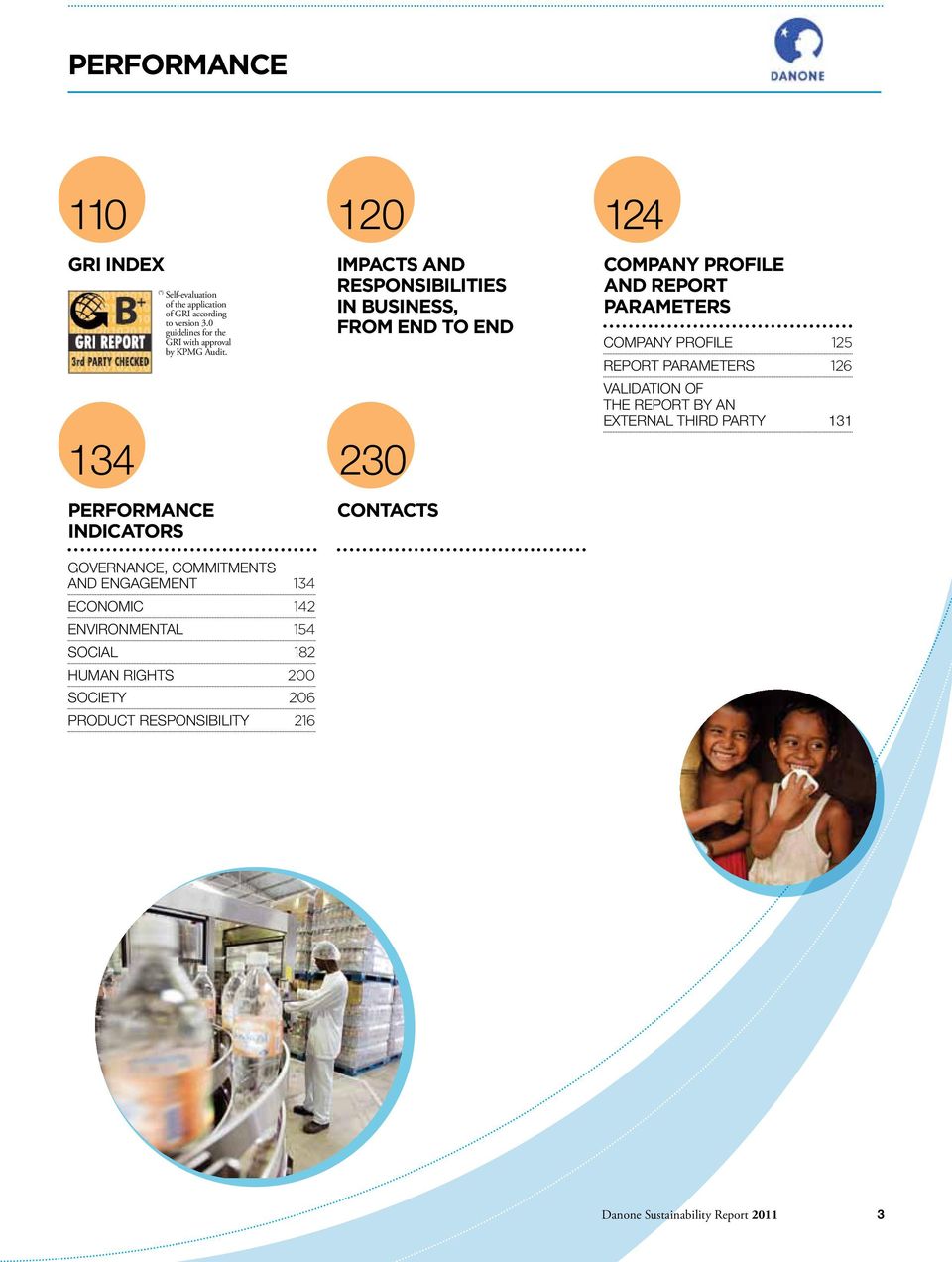
4 SUSTAINABILITY REPORT 2011 EDITORIAL: FRANCK RIBOUD "in sustainable development more than any other area, we can only rise to the challenges if we are able to develop radically different approaches" People often ask me why Danone s sustainable development action places such importance on social innovation projects. For example, why did we include this focus in the individual targets of the company s 1,400 managers? Why have we set up investment funds like the Danone Ecosystem Fund and, more recently, the Livelihoods Fund? What economic benefit can a major corporation like Danone expect in return? And should we continue in this way despite the difficult and uncertain global context? My answer to those who might be tempted to turn back is simple: in sustainable development more than any other area, we can only rise to the challenges if we are able to develop radically different approaches. This requires the ability to explore and try out new ways. It is therefore more vital than ever that Danone s eyes and ears be wide open to the world, to meet current expectations and make the necessary changes to prepare the company for those of tomorrow. Our approach of being an open-minded company seeking to co-design new solutions with our stakeholders is firmly rooted in Danone s culture and model and contributes to our overall long-term performance. The credibility of a global food company like Danone hinges on our capacity to be consistent in our mission and to adjust to local conditions. In 2011, Danone continued efforts on the strategic priorities (1) defined in 2008 and I would like to mention a few examples here: in inventing new models to bring health through food "to as many people as possible," 2011 was marked by the creation of a production and R&D unit in India dedicated to low-income populations. We also launched Fundooz, a first nutrition product for children. The experience in India will enhance action we have been taking for five years in Bangladesh to develop products and distribution channels that meet the needs of a greater number of consumers. These new approaches prompt us to question ourselves and they drive innovation in countries where the group has long been established; 4 Danone Sustainability Report 2011
5 on the "Nature" priority, we share the conviction that production methods and consumption patterns seen in the past fifty years cannot be generalized across the planet; we must bring about profound changes. From this perspective, the ambitious goal of reducing the group s carbon emissions by 30% between 2008 and end-2012 is on target, since we achieved a 27.5% reduction by the end of This goal demanded a lot of the teams but it also accelerated the move towards a low-carbon "circular economy" in which materials will be recycled infinitely. This revolution also leads to significant cost reductions; in 2011, Danone created the Livelihoods Fund, establishing a link between food security and climate change. After testing the concept in Senegal where, since 2008, 10,000 hectares of mangrove forest have been restored to provide fish resources, protect rice fields, and store significant amounts of carbon, we asked other companies to join us in creating Livelihoods. This shared platform has already invested in other major projects in Africa and Asia and contributes to the carbon offset programs of these companies; the quality of the raw materials Danone uses for its products, such as water, milk, cereal and fruit, is a key focus for the group. The Danone Ecosystem Fund established in 2009 progressed tremendously in 2011, supporting 35 projects in total, primarily in agriculture and water resource preservation. From Ukraine to Indonesia, via France and Mexico, these programs provide a testing ground to foster farming models that meet our economic, social and environmental requirements; for Danone employees working in countries with no welfare system, the highlight of the year will be the introduction of the Dan'Cares program for basic healthcare coverage. The program benefitted 28,000 employees in 2011 and will be rolled out to the entire workforce in Despite the global economic upheaval that prevailed in 2011, Danone continued to forge ahead with the double objective of delivering annual financial performance while developing our capacity to shape the future. Franck Riboud Danone s CEO (1) Health, For All, Nature, and People Danone Sustainability Report

6 StratEgY KEY SOCIAL TOPICS SOCIAL ISSUES 7 NUTRITION AND health issues 9 ENVIRONMENTAL ISSUES 11 6 Danone Sustainability Report 2011

7 SOCIAL ISSUES Employment and skills are crucial issues for companies and the regions where they do business, whether in emerging countries or mature areas of the world. The primary risk for companies in emerging countries is the scarcity of local talents which can prevent them from fulfilling their growth ambitions, in particular due to: very strong competition between Western companies to attract the same talents; the inadequacy of talents produced by the local education system with regard to needs; a growing preference on the part of local students to work for local companies with an international profile; the large number of talents in emerging countries who are educated in Western universities and do not wish to return to their home country. These days, multinational groups need to devote a significant share of their resources to develop talent pools of their own in each country, creating where necessary specific training courses in partnership with local agents (universities, training centers, etc.). In the mature countries, looking past the immediate impact of the economic crisis, in particular on employment for young people and older employees, the major issues are the aging of the active workforce and the risk that the skills of older employees will not correspond to those needed by companies. Today, notwithstanding the fact that the age of retirement continues to be put off, most investment in skills development stops when employees have reached their forties, according to the OECD. Companies need to start investing far more in the mid-career age group of 40-to-45-year-olds and, together with the public authorities, create a true lifelong learning strategy for increasing and constantly adapting these populations skills. In addition, despite very significant training efforts carried out over the past 30 years (on average, in the OECD countries, 35% of 25-to-34-year-olds have completed university studies, compared with 20% of the 55-to-64 age group), diploma degree is not a protection against unemployment, particularly when supply and demand are not well matched, leading to a lack of workers in certain sectors, and to hiring overqualified staff in others. This should be done in order to get better at matching the skills needed with available training and courses, through strong cooperation between businesses, educational institutions and the public authorities. Companies also need to address the issue of social cohesion in today s society, specifically how to maintain social cohesion within the society in the face of growing inequalities and societal demands. Danone Sustainability Report

8 KEY SOCIAL TOPICS SOCIAL ISSUES While households real available income has increased by 1.7% per year on average in all OECD countries over the past 20 years, the average income of the richest 10% has grown much faster, and today measures some nine times that of the poorest 10%, with large variations between countries (relatively small gaps in the Scandinavian countries, a difference of 14 to 1 in countries such as the United States and Turkey, and as much as 27 to 1 in Chile and Mexico). The Gini coefficient (a standard measure of income inequality) has risen by 10% in 20 years (from 0.28 to 0.31) in the OECD, with income inequality having increased in 17 of the 22 OECD countries. These inequalities are causing increasing tensions in the various mature countries, leading to high risks in terms of social cohesion which have been further heightened by a dual effect of the economic crisis: an important unemployment increase, with dramatic consequences in terms of dropping income, sometimes going as far as loss of access to medical care; rising public debt, which causes governments to reduce income support for job seekers or to increase the prevalence of partial unemployment situations with significantly lower salaries. In certain countries, household debt has also risen in response to the employment crisis. Certain working conditions and salary levels are no longer tolerated in certain countries (see for example the multiplication of labor conflicts in countries such as China, in particular in Guangdong in November 2011). More generally, companies are faced with issues of income equity and of the pace and methods of improving competitiveness, notably that of increased labor intensity. How can well-being and efficiency be allied? How can wealth created within the company be redistributed, as well as within its ecosystem? Another major social issue is that of government disengagement and the question of pensions. The aging of the population is primarily a result of the positive evolution of life expectancy worldwide, rising from 50 years on average in 1960 to 68 years today, with a ten-year progression in rich countries (from 69 to 79 years) and a 21-year increase in developing countries, (from 45 to 66 years). This positive development nonetheless poses major risks for the future, particularly that of financing pensions when a given number of people in the workforce must support an ever greater number of retirees. Government deficits, particularly in Europe, are also leading to reduced healthcare reimbursements, leaving a greater proportion of these costs to individuals. Companies cannot ignore this phenomenon, and must come up with new systems to offer both competitive salaries, and benefits (healthcare coverage, retirement plans, etc.) that is sufficient enough to cover the employee today and in the face of future life events. 8 Danone Sustainability Report 2011

9 Nutrition and health issues Among consumers primary expectations in terms of health are food safety and quality, and that products sold truly comply with their nutritional and organoleptic specifications, and offer the scientifically proven health benefits that these imply. This quality commitment is maintained throughout the lifecycle of the product, from development and production to the point of consumption, from raw materials to products sold. Consumers also express a variety of other expectations related to ease (of purchase, conservation and preparation), availability and price. In developed countries, their expectations are largely expressed through consumer organizations which have become key partners to the company. The primary goal is to continue to increase consumer confidence in the brands, which make ongoing investments to guarantee the quality and safety of their products, respect the environment and are conscious of their social impact. Food is a daily need for each one of us, providing our bodies with energy and essential nutrients, as well as conveying pleasure, symbolism, identity and values to individuals, and tradition, culture and conviviality within communities. All the scientific studies confirm that a varied and balanced diet and regular physical exercise are factors known to contribute to good health and prevention of chronic diseases. On the other hand, poor diet along with a sedentary lifestyle can contribute to an increased risk of certain conditions including diabetes, osteoporosis, high blood pressure, etc. Scientific progress continues to confirm how individual dietary needs are very specific, varying by age (infancy, childhood, adolescence, adulthood, senior citizens), gender, and physiological condition (pregnancy, metabolic deficiency, chronic disease, aging, etc.). Paying close attention to nutrition therefore helps ensure optimal growth and health, prevent certain diseases, or even improve the efficacy of certain therapeutic treatments. In particular, there is more and more evidence that early nutritional input (the first 1,000 days of life including pregnancy and the first two years) is a major determinant of future health, and that breastfeeding exclusively for the first six months of a baby s life provides optimal nutritional benefit. This reality must then be viewed in the context of very diverse socio-economic situations from country to country and in different population groups who have unequal access to food resources. The global situation in terms of diet-related health is a concern everywhere, characterized by the escalation of two specific challenges: Undernourishment and malnutrition arising from poverty, food insecurity and/or poor quality of food resources, which impact nearly one billion people. The recent global food crises have defeated certain countries efforts to combat malnutrition, and it is likely that the volatility of food raw material prices will only foster this phenomenon in the future; Danone Sustainability Report

10 KEY SOCIAL TOPICS Nutrition and health issues Overweight, obesity and chronic diseases related to diet such as diabetes, high blood pressure, cardiovascular disease and more, are due in part to diets that are not suited to the body s needs in terms of both quantity and quality. This situation is worsening quickly in the emerging countries under the impact of a rapid nutritional transition. The World Health Organization (WHO) predicts that more than 1.5 billion people will be overweight by 2015, while the International Obesity Task Force (IOTF) anticipates more than 360 million people suffering from diabetes in WHO sounded the alarm in 2004 (Global Strategy on Diet, Physical Activity and Health), and reinforced the message in 2010 with the publication of recommendations for marketing food and beverage products to children, which led certain United Nations member states to introduce national health programs aimed at preventing diet-related diseases. In the face of these programs limited results, the United Nations High Level Group published a political statement in September 2011 on non-communicable diseases, calling on all member states to take urgent action to formulate true national strategies to combat diet-related diseases. These two initiatives view food industry players as stakeholders in the solution and call on them to implement voluntary policies with regard to product nutritional quality (reduction in fat, sugar and salt content), responsible communication (nutrition labeling, claims and advertising) and promoting healthy lifestyles. The authorities expect such voluntary measures to have a concrete impact in the short term with regard to product offers and marketing practices; otherwise, politicians may decide to introduce new regulations in the food sector. The ability of the major food-industry players to apply a responsible approach and address the dual concerns of malnutrition and diet-related obesity/chronic disease will be assessed in detail for the first time in 2012 through the publication of a new rating index, ATNI (Access to Nutrition Index) designed by the NGOs GAIN (Global Alliance for Improved Nutrition) and Welcome Trust, with the financial support of the Bill & Melinda Gates Foundation. The challenge of this dual burden (malnutrition, obesity) is further impacted by the aging of the population in developed countries; WHO estimates that over 25% of the European population will be older than 65 by For these groups, prevention and treatment of diseases arising from old age, in particular through specific nutritional intakes, will be essential to the survival of healthcare systems. 10 Danone Sustainability Report 2011
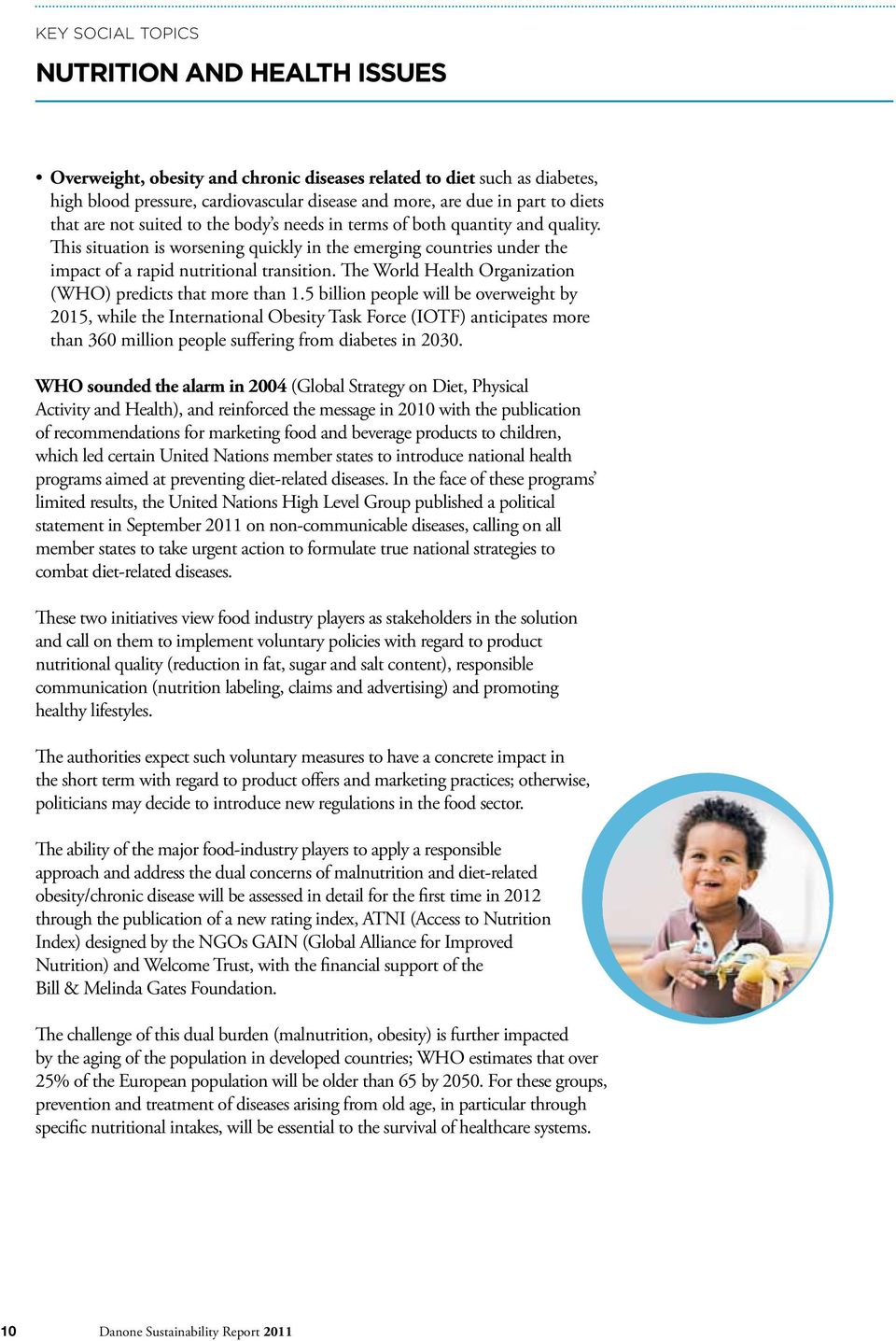
11 Environmental ISSUES By 2050, the world s population will have reached nine billion people, with modes of consumption that are changing significantly. Food needs and increasing pressure on natural resources will increase. This trend is already having multiple effects: pollution and loss of land, pollution of rivers and groundwater, greenhouse gas emissions, rising waste production and loss of biodiversity. While agriculture is a vital necessity for people, it is responsible for nearly 25% of greenhouse gases, 70% of water consumption and 40% of groundwater pollution. Loss of biodiversity could itself lead to reduced agricultural production (estimated 25% impact by 2050), threatening our planet s food security. Agriculture needs to reinvent itself to face up to these challenges. We must produce more with fewer inputs on a smaller cultivated area, while also significantly improving the impacts of agricultural practices on water and soil. Livestock farming is particularly criticized as being solely responsible for 18% of greenhouse gas emissions and 37% of soil degradation. Agri-food companies are facing the dilemma of how to meet the needs of an ever greater number of consumers, on the one hand, and limit the environmental impact of their activities on the other. Stakeholders expectations, for now, are mainly focused on reducing the impact of industrial production and precisely measuring these reductions (ISO certification, carbon footprint measurements, reduced water and energy consumption, contributions to eliminating waste). Managing the impacts arising from packaging requires reduced use of materials upstream, improved collection and recycling, and transitioning to packaging made of renewable biomass (not in competition with food), rather than fossil materials. Pressure on supplies of agricultural raw materials is strong (increased price volatility, new competitors for land such as biofuels, climate impact, loss of biodiversity). This context, relative to supply, is transforming society to push for improvements in strategy ever further upstream. The global economy is transitioning from a period of abundance to a period of resource scarcity, which will ultimately drive up costs. Danone Sustainability Report
12 KEY SOCIAL TOPICS ENVIRONMENTAL ISSUES On their side, consumers are voicing higher expectations of agriculture, for security, nutrition and health along with protection of the environment and respect for natural cycles, and this will become a factor of competitiveness for brands in the future. To meet these expectations, regulatory changes and progress in research are pushing towards better awareness of the environment and health concerns (precision agriculture, pesticides effective at low doses, alternative methods for fighting off pests and disease, more efficient use of water and soil, etc.). Lastly, some major players in global distribution (Walmart, Tesco) are gradually engaging to promote sustainable development and will progressively choose to work with suppliers who respect the environment (Sustainable Consortium Index). These major environmental and food security challenges are core concerns for Danone. Preserving our resources and sustainably managing strategic raw materials (in particular water and milk) are the foundation of the company s sustainable model within its ecosystem and alongside key stakeholders. 12 Danone Sustainability Report 2011

13 StratEgY THE strategy In action 2011 RESULTS Focus ON THE FOUR STRATEGIC PRIORITIES HEALTH 14 FOR ALL 27 Nature 36 PEOPLE 43 Danone Sustainability Report

14 THE strategy In action 2011 REsultS - Focus ON THE FOUR STRATEGIC PRIORITIES HEALTH Danone s nutrition and health strategy, which reflects its aim to bring health through food to as many people as possible, is more than ever in line with the food and nutrition objectives of health authorities in every country in which it operates. There are three major focuses to Danone s strategy on nutrition and health: in-depth understanding of the nutrition and health issues in each country in which the group does business; a unique line of appropriate products meeting the needs of populations throughout their lifetime; encouraging healthy eating habits by responsible product communication practices and strong involvement in information and education. This strategy is based on governance specific to Danone (see pages of this report), particularly ongoing contact with local stakeholders (health authorities, scientific experts) and major efforts in Research and Development to: consistently deliver product reformulations and innovations to respond to changing consumer needs and guarantee the nutritional superiority of products; special investment in scientific research through numerous partnerships with leading research organizations. In this way, Danone is clearly demonstrating its determination to contribute to a sustainable health objective by helping prevent chronic food-related diseases and fostering the fulfillment of its consumers' biological potential. Understanding consumer nutrition and health issues In the great majority of countries in which Danone operates, the group analyzes local authorities nutrition and health policies, current national programs and the latest scientific data in the areas of epidemiology, food consumption, sociology, etc. To complete this analysis, Danone consults experts in the food and nutrition field. This work (Nutripack reports) enables the company, for example, to know the incidence of food-related diseases, to assess food intake and eating habits, to estimate nutritional statuses and to identify any deficiencies in specific populations, such as iron deficiencies in infants and children and protein deficiencies in the elderly. This analysis was initiated in 2004 for adult populations and was actively implemented in 2011 on children. It currently covers 37 countries and 94% of sales. 1 Analysis of the scientific literature 2 Interview with scientific experts 3 Food consumption database analysis Food styles analysis Analysis of nutrition in the media Danone Sustainability Report 2011
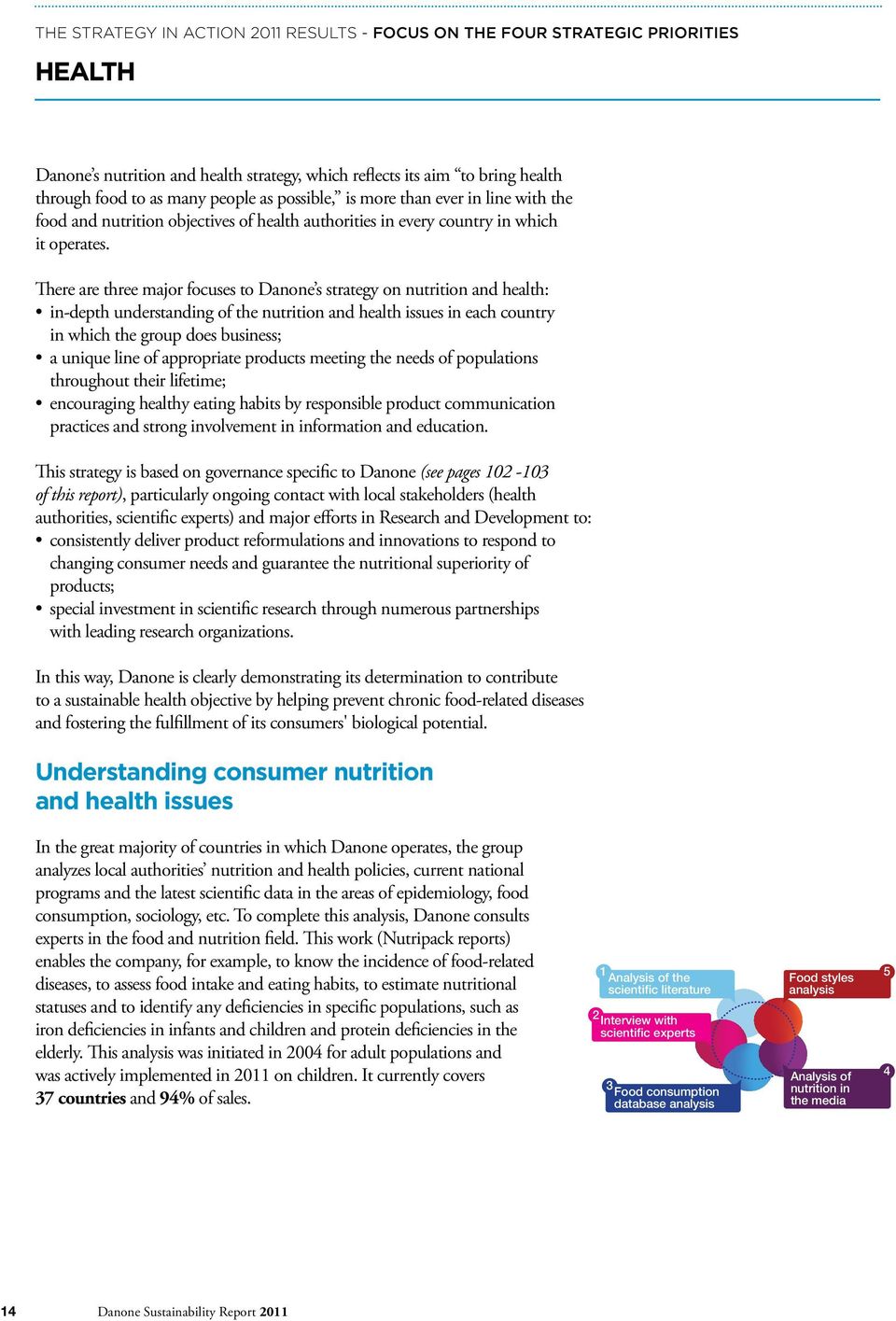
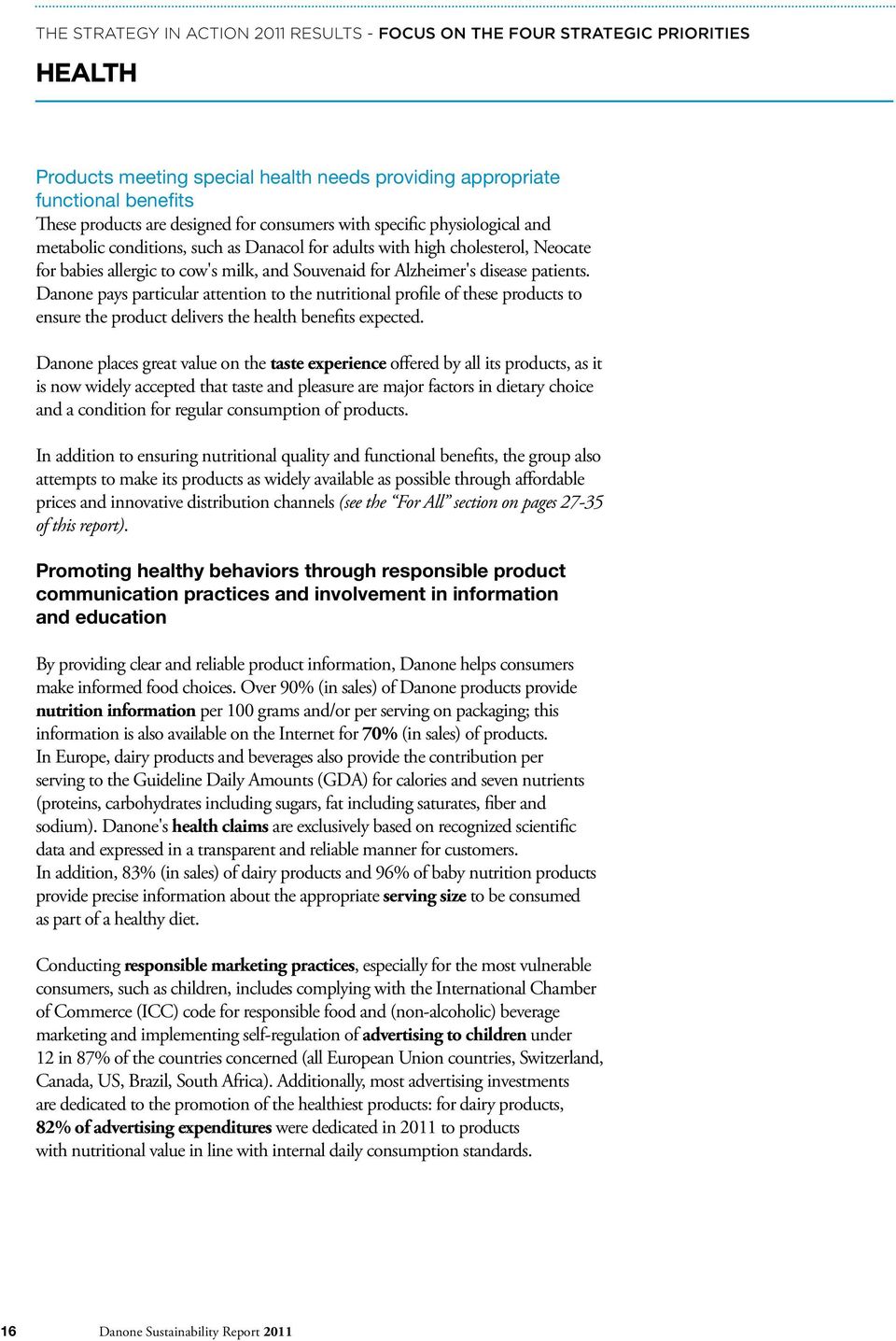
15 A unique line of appropriate products meeting the needs of populations throughout their lifetime Products designed for everyone and belonging to food categories recommended by health authorities 88% (in sales) of products manufactured by Danone (75% of total sales) and intended for the general public are dairy products and water, of which health authorities worldwide recommend consuming respectively one to four servings a day, and 1.2 to 2 liters a day. The nutritional composition of Danone dairy products is also regulated by strict internal nutritional standards (Danone Nutrition Book which defines, for example, maximum fat and sugar content, minimum calcium content) based on health authorities' guidelines (WHO, Eurodiet). Fully 59% (in sales) of Danone dairy products can be consumed on a daily basis, and thus contribute to a healthy diet. In 2011, almost 15.5 billion servings of these daily dairy products and nearly 10 billion portions of water were marketed by Danone. Examples include: yogurts (Danone natural and with fruit), fermented milk (Activia, Kéfir), soft white cheese (Danio), mineral and bottled water (Evian, Aqua), and fruit-based products such as compotes without added sugar (Taillefine Jardins Gourmands) and smoothies (C-Optima), etc. Food products designed for occasional consumption, or "indulgence" products are also regulated by internal nutritional standards, such as dairy desserts (Danette, Fantasia) for example. Products meeting special dietary needs such as those of babies, children and the elderly These products, generally fortified with essential nutrients, include baby nutrition products (infant formula and milk, a variety of solid complementary foods), certain dairy products like Danonino for children, dietary supplements for pregnant and/or breastfeeding women or products designed to fight malnutrition caused by nutritional deficiencies or certain diseases (Fortimel, Forticare, etc.). The composition of these products is generally governed by strict regulations if not, then by very demanding internal standards, such as the Danone Nutrition Book or Baby Nutrition Standards. Danone Sustainability Report
16 THE strategy In action 2011 REsultS - Focus ON THE FOUR STRATEGIC PRIORITIES HEALTH Products meeting special health needs providing appropriate functional benefits These products are designed for consumers with specific physiological and metabolic conditions, such as Danacol for adults with high cholesterol, Neocate for babies allergic to cow's milk, and Souvenaid for Alzheimer's disease patients. Danone pays particular attention to the nutritional profile of these products to ensure the product delivers the health benefits expected. Danone places great value on the taste experience offered by all its products, as it is now widely accepted that taste and pleasure are major factors in dietary choice and a condition for regular consumption of products. In addition to ensuring nutritional quality and functional benefits, the group also attempts to make its products as widely available as possible through affordable prices and innovative distribution channels (see the For All section on pages of this report). Promoting healthy behaviors through responsible product communication practices and involvement in information and education By providing clear and reliable product information, Danone helps consumers make informed food choices. Over 90% (in sales) of Danone products provide nutrition information per 100 grams and/or per serving on packaging; this information is also available on the Internet for 70% (in sales) of products. In Europe, dairy products and beverages also provide the contribution per serving to the Guideline Daily Amounts (GDA) for calories and seven nutrients (proteins, carbohydrates including sugars, fat including saturates, fiber and sodium). Danone's health claims are exclusively based on recognized scientific data and expressed in a transparent and reliable manner for customers. In addition, 83% (in sales) of dairy products and 96% of baby nutrition products provide precise information about the appropriate serving size to be consumed as part of a healthy diet. Conducting responsible marketing practices, especially for the most vulnerable consumers, such as children, includes complying with the International Chamber of Commerce (ICC) code for responsible food and (non-alcoholic) beverage marketing and implementing self-regulation of advertising to children under 12 in 87% of the countries concerned (all European Union countries, Switzerland, Canada, US, Brazil, South Africa). Additionally, most advertising investments are dedicated to the promotion of the healthiest products: for dairy products, 82% of advertising expenditures were dedicated in 2011 to products with nutritional value in line with internal daily consumption standards. 16 Danone Sustainability Report 2011
17 Setting up product information services (labeling, website, brochures) and educational programs on healthy eating (teaching kits, events, etc.) and promoting physical exercise contributes to government efforts to encourage healthy lifestyles. These activities target consumers, employees and other groups, including health professionals. Most of these initiatives are developed in partnership with local institutions, such as the ministry of health, research centers, professional organizations and NGOs, to make sure they were suitable for the local community. In 2011, Danone rolled out 219 information and educational programs to encourage healthy lifestyles, potentially reaching almost 700 million people. In Poland, the CBU Zywiec Zdroj roll-out since 2006 the educational program Mommy, Daddy, I prefer water" for parents and children, which promotes the regular drinking of water. This program, which received the support of the Ministry of Health, the Food and Nutrition Institute and the Mother and Child Institute, increased the contribution of water to total fluid intakes of Polish children aged 6 to 9 from 11% in 2006 to 19% in In Belgium, Danone launched the educational program Enjoy your food, boost your health, which aims to promote healthy habits in children aged 6 to 11. The program was developed in partnership with the European Club of Pediatric Dieticians, the Belgian Pediatric Society and the Danone Institute. The educational kit was sent out to 30% of Belgian primary schools in three weeks, on request. In Mexico, in cooperation with the World Gastroenterology Organization, the Mexican National Institute of Medical Sciences and Nutrition and the Mexican Gastroenterology Association, Danone organized a World Digestive Health Day on the theme of Enteric infections and clean water, food and environment to raise awareness of digestive health issues among health professionals and the general public. Danone also provided active support for the promotion of breastfeeding to health professionals and mothers. In addition, in % of CBUs continued to roll out workplace programs aiming to encourage employees to take charge of their health through a balanced diet and regular physical activity. These programs consist of holding educational conferences, providing doctors' visits and checkups, balanced meals, break rooms, fitness equipment, plus other initiatives. In total, 47% of employees had access to these programs. The impact of the program set up at the Daniel Carasso Research Center in Palaiseau, France, is currently the subject of a scientific impact assessment jointly conducted with INSERM (French National Institute of Health and Medical Research). Danone Sustainability Report

18 THE strategy In action 2011 REsultS - Focus ON THE FOUR STRATEGIC PRIORITIES HEALTH Danone Institutes, a unique international network In 2011, the Danone Institutes network celebrated its 20 th anniversary. Consistently supported by Danone since 1991, the network of Danone Institutes, independent non-profit organizations, work to help advance knowledge about the links between food, nutrition and health. Their programs include providing support for scientific research, informing and training health professionals, and educating the public. The network of 18 Danone Institutes in 19 countries comprises 250 prominent and independent researchers, physicians and dieticians specializing in all aspects of food and nutrition, including biology, medicine and the humanities. In 2011, the 8 th Danone International Nutrition Prize was awarded to Professor Jeffrey Gordon (Saint-Louis University, USA) for his work on human microbiota and links with human health. The Danone Institutes in the Asia region (China, Japan and Indonesia) worked together to organize a unique symposium on Dietary recommendations in Asia. The proceedings were published in The Asia-Pacific Journal of Clinical Nutrition and form a reference document for professionals in this region. In 2011, nearly 1 million was awarded in support of nutrition research. Since 1991, almost 1,060 research projects have been funded by the Danone Institutes, and more than 19 million distributed in the form of research awards and grants. 18 Danone Sustainability Report 2011

19 Unique expertise in Research & Development The three priorities of Danone s nutrition and health strategy largely rely on its unique expertise in R&D and product quality. The development of appropriate nutritional solutions in response to local requirements (dietary needs, taste, cost, eating habits, etc.). This stage generally proceeds with the help of scientific committees, which combine complementary expertise in nutrition, medicine and the humanities. These nutritional solutions can come about by modifying existing products (Nutriprogress program) or developing new ones. The Nutriprogress program continually analyzes the nutritional quality of the product portfolio, compare existing products with competing products and, if necessary, design reformulation programs (by, for example, gradually reducing the fat, sugar or sodium content and/or fortifying the product with vitamins and minerals). Between 2009 and 2011, 20% (in sales) of products were improved in terms of fat, sugar and/or sodium content and 40% (in sales) of dairy products and 47% (in sales) of baby nutrition products were fortified. Innovations cover areas as diverse as product families, eating patterns, new ingredients or health benefits, and geographic expansion. A prior nutritional evaluation (Nutri-Check procedure) is carried out systematically to guarantee consistency between product quality and positioning. 45% (sales) of innovations launched in 2011 had a high nutritional profile (compliance with internal nutritional standards of daily consumption). Examples of major nutrition/health innovations made in 2011 include: Dairy products: Activia Breakfast, a breakfast yogurt with a high-fiber cereal topping in a separate compartment (Italy); Activia Smoothie, a yogurt drink rich in fruit which provides half the recommended daily intake of fruit in each 290g bottle (Russia); Milkuat School, a cereal-enriched milk drink for schoolchildren sold for 0.23 (Indonesia); Mleczny Start, a milk and cereal bar rich in fiber, vitamins and minerals sold for 0.16 (Poland); several geographic expansions such as Danacol (Canada), Densia (Japan), Ser Calci + Densia pocket (Argentina), and Activia pouring yogurt (France); Danone Sustainability Report

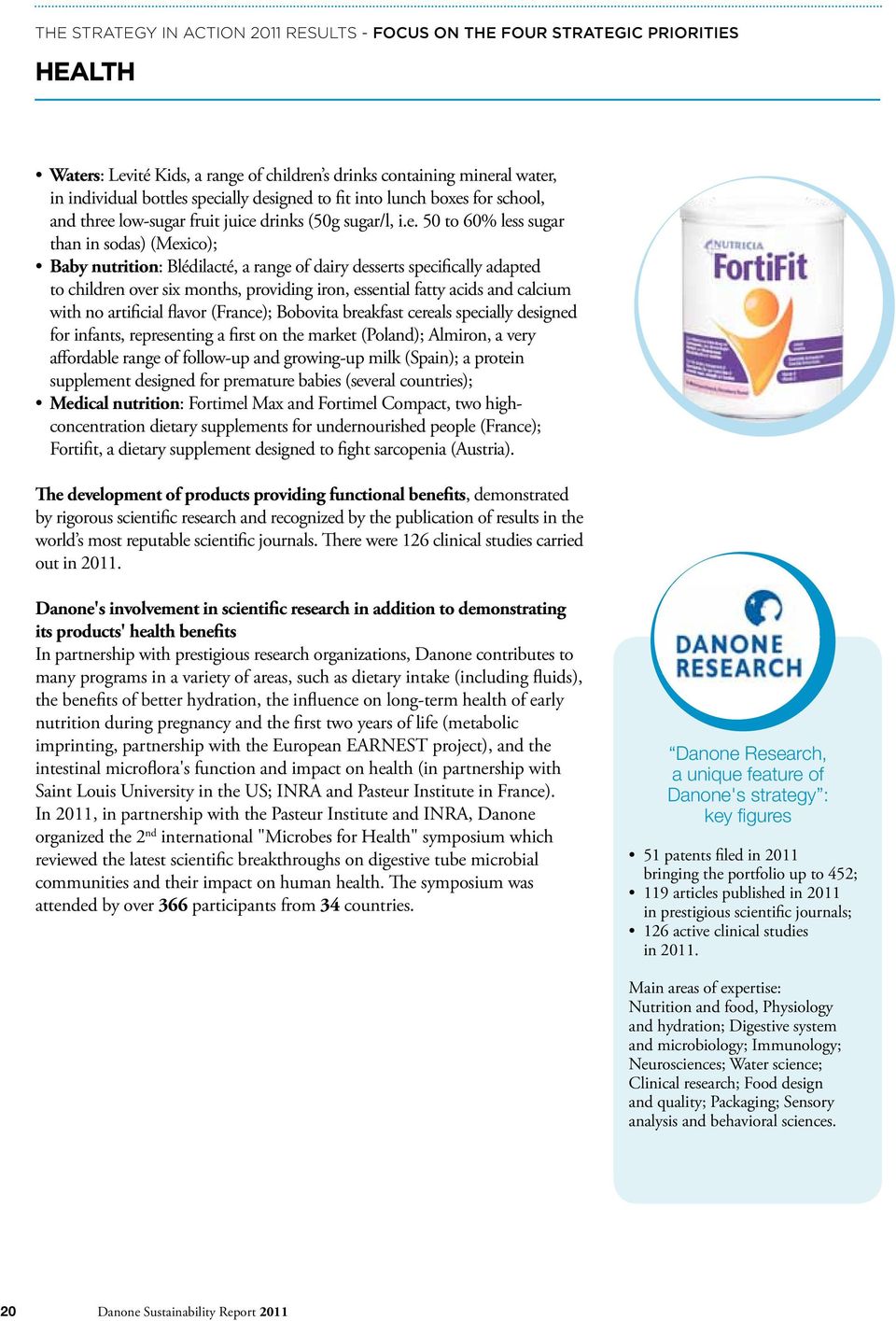
20 THE strategy In action 2011 REsultS - Focus ON THE FOUR STRATEGIC PRIORITIES HEALTH Waters: Levité Kids, a range of children s drinks containing mineral water, in individual bottles specially designed to fit into lunch boxes for school, and three low-sugar fruit juice drinks (50g sugar/l, i.e. 50 to 60% less sugar than in sodas) (Mexico); Baby nutrition: Blédilacté, a range of dairy desserts specifically adapted to children over six months, providing iron, essential fatty acids and calcium with no artificial flavor (France); Bobovita breakfast cereals specially designed for infants, representing a first on the market (Poland); Almiron, a very affordable range of follow-up and growing-up milk (Spain); a protein supplement designed for premature babies (several countries); Medical nutrition: Fortimel Max and Fortimel Compact, two highconcentration dietary supplements for undernourished people (France); Fortifit, a dietary supplement designed to fight sarcopenia (Austria). The development of products providing functional benefits, demonstrated by rigorous scientific research and recognized by the publication of results in the world s most reputable scientific journals. There were 126 clinical studies carried out in Danone's involvement in scientific research in addition to demonstrating its products' health benefits In partnership with prestigious research organizations, Danone contributes to many programs in a variety of areas, such as dietary intake (including fluids), the benefits of better hydration, the influence on long-term health of early nutrition during pregnancy and the first two years of life (metabolic imprinting, partnership with the European EARNEST project), and the intestinal microflora's function and impact on health (in partnership with Saint Louis University in the US; INRA and Pasteur Institute in France). In 2011, in partnership with the Pasteur Institute and INRA, Danone organized the 2 nd international "Microbes for Health" symposium which reviewed the latest scientific breakthroughs on digestive tube microbial communities and their impact on human health. The symposium was attended by over 366 participants from 34 countries. Danone Research, a unique feature of Danone's strategy : key figures 51 patents filed in 2011 bringing the portfolio up to 452; 119 articles published in 2011 in prestigious scientific journals; 126 active clinical studies in Main areas of expertise: Nutrition and food, Physiology and hydration; Digestive system and microbiology; Immunology; Neurosciences; Water science; Clinical research; Food design and quality; Packaging; Sensory analysis and behavioral sciences. 20 Danone Sustainability Report 2011
21 Measuring progress In order to make its achievements more tangible, based on the strategy, approach and commitments laid out in its "Food, Nutrition & Health" charter, Danone introduced a series of performance indicators in 2011 and publishes the results. These indicators address: R&D investments in nutrition and health; Danone's expertise in nutrition and health (internal and external); the nutritional quality of the product portfolio; programs designed to improve products' nutritional value; value-added nutrition/health innovations; products' health benefits; responsible communication practices such as labeling, claims and advertising; contribution to educating the public about healthy lifestyles. Since 2011, these indicators have been consolidated for a scope of 12 countries (Argentina, Brazil, China, France, Germany, Indonesia, Italy, Mexico, Poland, Spain, UK and US), covering the 4 divisions (Dairy Products, Waters, Baby nutrition and Medical nutrition) and representing around 68% of total group revenue. The results are published each year and are available in the dashboard section (see pages of this report). Danone Sustainability Report
22 THE strategy In action 2011 REsultS - Focus ON THE FOUR STRATEGIC PRIORITIES HEALTH Product Quality in hearts and minds During the past years a Product governance policy has been set up, to ensure product safety and quality at every step of the product life cycle, from the marketing brief to the product specifications and throughout the food chain, from farm to fork. This policy supports the credibility of Danone and its brands, drives consumers preference and, through continuous improvement, contributes to economic performance and robustness of the business. Danone corporate quality mission is aiming at: Protecting consumers health and Danone assets; Connecting science to business, Farm to fork, Private to Public and Danone to Consumers; Empowering Danoners to create a strong quality culture within the company. Danone Quality vision is sustained by 4 strong pillars: Food safety and hazard assessment Ensure food safety - the product must be safe and healthy. By linking science to risk assessment, in the early stages and throughout the product life cycle, the Danone Food Safety Center is empowered to give clear and business oriented guidance to everyone involved in product quality and safety processes. In 2011, Danone teams have worked on the consolidation and improvement of organization and processes for risk assessment, guidelines for risk management and product testing through the setting up of the new Danone Food safety Center. 22 Danone Sustainability Report 2011
23 Danone strongly supports public-private partnerships to help develop solutions to complex issues like food safety management worldwide. During the past few years, Danone has been an active member of international organization such as the GFSI (Global Food Safety Initiative). The GFSI is the only global, multi-stakeholder platform which brings together senior quality and food safety experts from all parts of the supply chain from the global food industry. It is a globally recognized and accepted by regulators and all the food safety stakeholders alike. The GFSI vision is: Safe Food for Consumers Everywhere driving continuous improvement in food safety to strengthen consumer confidence worldwide. GFSI has managed to bridge the gap between the public and private sectors and works with governments and other organization around the world to manage food safety risk more efficiently and effectively with the aim of improving public health. Danone has significantly contributed to the drawing up of sector good practices for manufacturing, packaging, animal feed and farming, and in capacity building programs. Quality System robustness along product life cycle Ensured quality procedures throughout the entire food chain from farm to fork, from conception to consumption. This means making the product safe and compliant with its value promises at every step of the three key phases of the product life cycle: Quality in product design; quality in product execution, and finally, quality in the way to listen to consumer s perception at the point of sale and consumption. In 2011 Danone finished drawing up a new set of Operating Models (DOMs) as foundation of the local to global product governance system. These requirements are rooted in DANgo System. (Danone Governance and process system). Danone has also improved the suppliers management process by standardization of suppliers accreditation protocol and assessment including internal auditor competences requirements. Danone Sustainability Report
24 THE strategy In action 2011 REsultS - Focus ON THE FOUR STRATEGIC PRIORITIES HEALTH Consumer trust and confidence Nowadays, consumers expect more than ever - they expect value for their money, that is to say good quality product at a reasonable price, matching its marketing promises. But on top of that, they expect company responsibility to the community, and food safety as a given. With these aims, 2011 has been a year of geographical expansion and functionality extension (from consumers to customers and social network) of the consumer care information system for managing market feedbacks. Danone has settled up formalized, shareable and benchmarkable on-shelves audits for checking up: Danone products availability, presentation and position versus competitors and conformity. Danone is listening to public authorities as voice of the consumers for addressing public health issues, the active participation in the GFSI being the mean to reach this goal (see before). People development At Danone, every point of Danone Quality Policy takes shape around people and the organization ensures people expertise, organization culture and behavior. In 2011, the Quality road book was drew up as reference document for the quality community to provide guidance for career management in quality while giving business sense to the function. Danone continued updating and revamping training packages and organizing successful training sessions for creating a strong quality community through improvement of quality knowledge culture and people empowerment. 24 Danone Sustainability Report 2011
25 2011 Indicators For more information, see the chapters on PR1 and ADD PR2 performance indicators, pages of this report. Reflecting Danone s quality commitments, performance indicators have been deployed and are regularly monitored as part of a continuous improvement approach. The goal is to ensure that our product comply with quality standards every day in every part of the world. A KPI for each consumer's need allows assessing quality performance: Food safety Index for guaranteeing the product safety, which amalgamates seven different indicators (Good hygiene practices, good manufacturing practices, HACCP, Control and monitoring plans, bio-vigilance and traceability); Product conformity for assessing that, everyday and everywhere, Danone supplies the value promises to the consumers; Consumer feedbacks for evaluating the consumer satisfaction level. In Dairy Products division, a drop of 18% in consumer complaints has been achieved, due to a closer action plan follow-up with Country Business Units (CBUs) and a specific effort on foreign objects management. Product conformity has slightly improved thanks to a closer relation between Division, CBUs and plants, enabling a better follow-up. A slight drop in the Food Safety Index hase been registered, due to a new audit grid with a harder rating system implemented that follows a continuous improvement approach. In the Baby division, the Food Safety Index has increased of 0,6% thanks to a reinforced implementation of good practices programs in the factories and the number of factories ISO certified. On the other hand, a slight increase of consumer complaints has been registered due to supply chain issues, such as damaged packaging. Specific actions are being defined to address these points. The product compliance measured through CLF (Central Laboratory of Friedrichsdorf, certified by an independent organism) monitoring of the finished products increased around 1,5%. It should be clarified that, although 2010 and 2011 figures are not completely comparable, a combined effort in supplier management and factory improvements has triggered this positive trend. Danone Sustainability Report
26 THE strategy In action 2011 REsultS - Focus ON THE FOUR STRATEGIC PRIORITIES HEALTH In the Waters division, all indicators on a worldwide basis have improved. Consumer complaints dropped by 21% compared to 2010, due to notable efforts concentrated in improving the processes of the bigger plants of the Division. A significant improvement of 2% has been registered in the Food Safety Index thanks to a hard work on good manufacturing practices on the shopfloor and traceability issues. The Product Compliance indicator remains almost stable at a very good level (99,97). In the Medical division, the 2009 program Fix the Basics is delivering good results with a continuous improvement of KPI's during 2010 and There is a clear focus in factories on doing things First Time Right, which had a positive impact on reducing by 20% the consumer complaints and the occurrence of crisis to 0. All medical factories are ISO certified. Through the four Divisions, no food safety neither extensive quality issues were recorded in 2011, and over the past years, the number of incidents for quality and food safety reasons has significantly dropped. 26 Danone Sustainability Report 2011
27 FOR ALL Danone s mission to bring health through food to as many people as possible gives a central role to the For all focus. The year 2011 was an important one for this strategic focus. It was the first full year of activity for the Base Of the Pyramid (BOP) business in India, created from scratch in November 2010, with a production plant for dairy products dedicated to this new business model. Danone also continued its support for social business in 2011 by pursuing various projects through the danone.communities fund. More globally, 2011 was a year of consolidation and convergence for the various projects making up Danone s social initiatives across its different funds (Danone Ecosystem Fund, Danone Nature/Livelihoods Fund, danone. communities fund), allowing Danone to multiply the impact of its actions on behalf of these various population categories. Increase the number of consumers reached at the different levels of the consumption pyramid Danone s goal of reaching one billion consumers (the number of consumers who purchase one Danone product at least once a month), which was set for 2012, is still the target; the learning curve of the past three years and the challenges encountered indicate that reaching this objective will take longer to achieve. At end-2010, the number of consumers purchasing one Danone product at least once per month was 750 million. In 2011, this figure is estimated at 834 million, an 11.2% progression due primarily to the acquisition of Unimilk in Russia and the increase in the number of consumers in China. More than for simple product innovation, Danone stands out for its innovative project execution involving the creation of new tools and processes, such as the funds (Ecosystem, danone.communities, etc.) or the BOP business created in India. Innovation that is close to the ground and connected to the habits of local consumers has helped in identifying and defining best practices. Various tools have been created and rolled out in the Danone Country Business Units (CBUs) since 2010, notably the GAP and Route To Market tools. Danone Sustainability Report
28 THE strategy In action 2011 REsultS - Focus ON THE FOUR STRATEGIC PRIORITIES FOR ALL GAP: Growth Across the Pyramid, or how to grow every category in the consumption pyramid. GAP (Growth Across the Pyramid) is a methodology for analyzing consumer behavior with a view to reaching new consumers at every level of the pyramid, by developing an appropriate product offer for each economic and social tier (levels A, B, C and D of the consumption pyramid) in the countries where Danone operates. GAP was rolled out beginning in second-half At the end of 2011, 18 Country Business Units (CBUs) across the continents (Mexico, Hungary, Thailand, Indonesia, Kazakhstan, Ukraine, Egypt, Algeria, Tunisia, etc.) had developed this methodology and were able to review their product portfolios, either creating new brands for lower income categories (C or D) with no coverage before now, or adapting the products and/or the prices of existing brands. Route To Market (RTM): new distribution models to cover points of sale and reach consumers that had been out of range before now. The importance of local distribution has grown as the group has increased the share of its business in emerging countries. This approach is based on a tool (Route To Market) whose purpose is to identify the most innovative new distribution channels or models (local, micro-distribution, door-to-door, etc.). Thirty-four additional CBUs across all of Danone s business divisions, including Baby nutrition, and on every continent, adopted this approach in 2011 and were thus able to expand their business and make products physically accessible to new consumers in urban and/or rural areas. In the dairy products sector in Egypt, for example, Danone doubled the number of points of sale by transitioning from 20.6% digital distribution in December 2009 to 40% in December Danone Sustainability Report 2011
29 These tools allowed the Danone CBUs to expand their outreach: In Indonesia, for example, the growth of Milkuat, a range of UHT dairy products, was spurred by a comprehensive renewal of its bottle and pouch offers while maintaining the affordable price of 1,000 rupees in a period of high inflation, increasing penetration of categories C, D and E by 54%. The brand also developed a new 95 ml bottle at the end of the year, sold for 1,500 rupees to target additional categories of consumers. In Indonesia, the Baby nutrition CBU Sari Husada continues to develop the Gizikita range (see page 32 of the 2010 Sustainability Report) targeting babies and infants. In 2011, 4.5 million packets of micronutrient powder (topping) were distributed under an exclusive contract with a local store. Each packet of topping contains 50% of GDAs (guideline daily amounts) of vitamins and minerals essential to children s growth. The packets are sold for 500 rupees ( 0.04) each. Combined with the Ayo Melek Gizi ( Let s talk about nutrition ) education program, they should contribute to reducing childhood malnutrition. A clinical study is underway in partnership with the University of Indonesia to measure the impact of this initiative. In Poland, Milky Start is a brand of porridge that aims to correct childhood malnutrition, co-developed by Danone Poland with the producer Lubella, Biedronka stores who ensure distribution, and the Institute for mothers and children which approves the products nutritional content. The 60g packets are sold for around At end-2010, a complete renovation including the launch of new flavors, special offers and television advertising multiplied monthly volumes by three and increased penetration of socio-economic category D by 14 points (from 3.8 to 18.2 points). The launch of a sandwich offer in 2011 helped maintain very high volume momentum. In Brazil, the Nord Este region was the only region in 2007 in which Danone was not the leader, although it gathers 28% of the country s population and offers the strongest opportunities for growth in dairy product consumption. Eighty percent of the population is in the C, D and E socioeconomic categories, and families, relatively large, need low-cost offers. Danone developed a portfolio of some 20 accessible offers to meet this local demand, and stepped up distribution through the creation of a new production plant and new distribution centers. These initiatives helped increase market share by 11 points between 2007 and 2011, and generate triple-digit volume growth over the same period. Danone Sustainability Report
30 THE strategy In action 2011 REsultS - Focus ON THE FOUR STRATEGIC PRIORITIES FOR ALL Continue the group s geographic expansion In 2011, all Danone s growth took place in the new regions, reflecting the transformed geographic footprint of the group s business. The emerging markets account for more than half of revenues for the first time since end-2011 (51% of the group s total business, compared with 30% more than ten years ago), with expansion in the new regions up by two points between 2010 and Continuing this approach, notably in key countries such as Mexico, Indonesia, China, Russia, the US and Brazil, has ensured revenue growth at a rate of 38% of total group revenues in 2011 and around 60% of its growth over the year. Strong positions developed in these countries have led to sharing of best practices throughout the group and illustrate Danone s strategy of relying on local expertise to drive its growth and development; for example, the creation of the Bonafont and Dan Up brands in Mexico, the development of affordable Baby nutrition products in Indonesia, the rollout of the Mizone brand in China and the OTX platform in Brazil with its natural-focused initiative for the Danonino brand. To continue its geographic expansion and enhance its long-term growth potential, the group is trying out small-scale models in new markets such as Asia and Africa, characterized by their economic and socio-demographic emergence and the appearance of middle classes and so-called medium cities (more than one million inhabitants). Danone thus recently entered India in a limited number of cities with the brand B lue (Waters division), the Danone and Danette brands (Dairy products division), and Fundooz, a range of nutritional products for the most underprivileged populations (Dairy products division). In Africa, Danone Baby nutrition is developing its business in 32 countries, by consolidating its presence in the Maghreb and French-speaking Africa and building up new locations in English-speaking Africa, in compliance with the World Health Organization code. 30 Danone Sustainability Report 2011
31 Create new models to reach consumers at the base of the pyramid (BOP) Danone s first experiments in this field led to the creation of the danone. communities fund at end-2006 (see pages 92 to 94 of the 2009 Sustainability Report) with a first pilot ( lab ) tested in the form of a social business in Bangladesh. Building on the Bangladesh experience, Danone created the in-house organization Base Of the Pyramid (BOP) in 2009, with the goal of radically innovating to transform Danone s business and invent new models focused on the health impact of Danone products for the largest possible number of people. At end-2010, the first BOP business was created in India in the form of a new production unit and a dedicated local team This new BOP ( Base Of the Pyramid ) business, created in under a year in India with the support of local suppliers, aims to provide very low-income populations with products whose nutritional qualities meet the needs of children. Over the course of 2011, four new products for children were launched by this new entity: two fresh dairy yogurts and two long-life dairy products in tetrapaks to compensate for the lack of a cold chain in these regions. The new products have four key features: affordability, access to nutrition, the brand as a guarantee of a health/pleasure balance (Fundooz), and local connections at every level of the value chain. The product mix definition integrated all local specificities while seeking to meet the goal of offering balanced nutritional benefit at a price adapted to the population s standard of living and the value of coins (priced at 10 rupees per pot and five per portion). Nutritional studies based on Danone tools (Nutripack, see page 14 of this report) have made it possible to identify children s nutritional deficiencies, noting for example that 70% of children under age 15 have deficiencies. Danone Sustainability Report
32 THE strategy In action 2011 REsultS - Focus ON THE FOUR STRATEGIC PRIORITIES FOR ALL A 360 innovation underpins this experimentation with a new business model The BOP team innovated not only by creating a very flexible production unit from scratch, inspired by the Bangladesh experience and able to produce a high-nutrition product at low cost, but also in the distribution model which was designed entirely based on the habits of the targeted consumers to maximize the products visibility in every location. Capitalizing on the experience of the Route to Market tools, the entire distribution model was aligned with consumers movement through various locations (schools, public spaces, etc.) at different times of the day, and implemented using local transportation methods (such as carts), with a multi-functional approach to vehicles and a preference for local access. Specific local communication methods were also implemented in the cities to create direct contact with consumers: awareness in schools, door-to-door, city tours, nutrition-based events, etc. One year later, at end-2011, these concrete achievements demonstrate Danone s ability to adapt and transform its organizations to implement, very rapidly (less than one year to create the production plant) and with limited investments, new business forms whose goal is to demonstrate the replicability of the Danone model in the most distant new regions. danone.communities: five years of development danone.communities is a social business incubator whose mission is to promote, support and finance social businesses that want to contribute to eliminating malnutrition and poverty. danone.communities was created in 2007 following an encounter between Danone CEO Franck Riboud and Muhammad Yunus, founder of Grameen Bank and 2006 Nobel Peace Prize winner. The first project arising from the danone.communities initiative is Grameen Danone Foods Ltd, one of the initial cornerstones of the social business edifice. To take things even further, Danone collaborated with Crédit Agricole in 2007 to create an innovative financial tool for supporting the development of social business initiatives, the danone.communities SICAV (French mutual fund). At least 90% of this fund s equity is invested in a selection of fixed-income instruments in the euro zone that favor an SRI approach, and up to 10% is invested in social businesses through the danone.communities FCPR (venture capital fund). 32 Danone Sustainability Report 2011
33 Today danone.communities provides technical and financial support to ten projects, including seven in which the FCPR has already invested, and three in the incubation stage. At end-2011, the SICAV was valued at around 70 million, following a year in which the number of projects receiving FCPR financing rose from five (in 2010) to seven. Through these ten projects, the geographic scope of danone.communities stretches from Mexico to Bangladesh, via France, Senegal, India, Cambodia and China, in three different business sectors: Water (with the Mexican, Indian and Cambodian projects; Nutrition (with five projects including Grameen Danone Foods Ltd and Laiterie du Berger); and Developed countries (with two projects in France). In 2011, the SICAV received Novethic SRI certification which recognizes the strict SRI approach applied by Amundi [who manages the tool], the transparency of its analysis and investment processes and the quality of its non-financial reporting. The FCPR invested in seven projects in 2011, including two new projects, in water, nutrition and the developed countries Water: providing access to drinking water in rural areas thanks to filtration technologies and small or very small plants Fountains (Cambodia) is the first danone.communities project in the water sector (2008). Since its creation, 1001 Fountains has installed 54 water purification stations and impacts almost 70,000 people daily. Chai Lo, its Cambodian founder, received the 2011 Best Social Entrepreneur award for Asia from the Schwab Foundation. Naandi Community Water Services (India) received danone.communities FCPR investment in 2010 and has a model very similar to that of 1001 Fountains, but on a larger scale. Today, with stations installed in nearly 400 villages, Naandi Community Water Services is the danone.communities project with the largest overall impact. El Alberto is the final danone.communities water project in Based in Mexico, El Alberto aims to provide safe drinking water to the communities of the state of Hidalgo. The water purification center was officially opened in October 2011, and the project aims to improve the living conditions of 130,000 people living in these communities. El Alberto Created on the initiative of Xochilt Galvez, President of the Porvenir Foundation and member of the danone.communities board of directors, the El Alberto project aims to bring safe drinking water to the indigenous communities of the state of Hidalgo in the center of the country. This project should provide 130,000 people with access to safe water at an affordable price (9 pesos/20l, or 0.53/20L) and contribute to creating 200 jobs for women from the communities where the water distribution centers are located. Danone Sustainability Report
34 THE strategy In action 2011 REsultS - Focus ON THE FOUR STRATEGIC PRIORITIES FOR ALL Nutrition: providing nutritional solutions adapted to children s tastes and needs in emerging countries. Grameen Danone Foods Ltd. (Bangladesh) is the fund s first project, created in 2007 (see box). Laiterie du Berger (Senegal), the fund s second project, has the specific mission of using local fresh milk production and improving the living conditions of the Pular livestock farmers. In 2011, this mission was reinforced through sales growth (+60% in August) supported by a new advertising campaign and more extensive distribution. The project also crossed an important threshold in its financial consolidation, notably achieving positive gross operating profit in October NutriGO in China is the newest of the danone.communities projects, which aims to combat childhood malnutrition in rural China through an awareness program and a fortified dietary supplement, the YingYang-Bao product. Currently in its pilot phase, the project estimates that the program will benefit 6,000 babies in the coming year. Grameen Danone Foods Ltd The pioneering danone.communities project, Grameen Danone Foods Ltd., aims to combat child malnutrition in Bangladesh with a yogurt fortified with micronutrients, Shokti Doï. With the support of a solid network of Shokti Ladies (878), sales grew significantly at the end of the year, peaking at nearly 2.9 million units in October The encouraging results of a study carried out by Gain and Johns Hopkins University on the health impact for children of Shokti Doï, the micronutrient-fortified yogurt produced by Grameen Danone Foods Ltd, should also be published in NutriGO The NutriGO project is the fruit of a partnership between Dumex, danone.communities, Grand Billion International Trading Limited (GBIT), One Foundation and NPI Foundation (two Chinese NGOs) and the International Life Sciences Institute Focal Point (ILSI-FP), a Chinese public institute for nutrition research. This project aims to combat child malnutrition in rural China through an awareness program and a fortified dietary supplement. The NutriGO project seeks to reach populations that have not had access before now to nutritional information and products, by training rural women in nutrition and sales. 34 Danone Sustainability Report 2011
35 Developed countries: exploring the impact of the social business model and its tools (new types of partnership, social entrepreneurship, product innovations, etc.) in the developed countries. Isomir (France) is one of the two danone.communities projects in France whose aim is to use local production and support sustainable employability for farmers. Isomir launched its second pilot project at end-2011, an Agricultural Equipment Cooperative that unites four organic vegetable farmers whose production is distributed in school canteens in the Val-de- Marne region through a distribution association. The French trade fair Innov Space awarded Isomir two stars for its program and innovative solution for small farmers. The other project in this focus area is the MALIN program, currently in the incubation phase, which involves a partnership with the Red Cross in particular (see box) : ten projects for consolidating and lesson-sharing In addition to the initiatives already underway, danone.communities and its partners are currently examining two projects in the incubation stage, for a total of ten projects in all. Over the next two years, danone.communities will work to consolidate the projects, in terms of the social impact observed in the various regions as well as the sustainability of the models (both financial sustainability and durability of the organizations). The development and consolidation of these ten projects should further enhance the impact of danone.communities, which reaches more than one million people today. The diverse sectors in which these projects are implemented (access to water, child nutrition, agriculture, distribution, etc.) provide danone.communities with great scope for experimentation and learning to share with its various stakeholders and with participants in the public debate around social business. With this goal, danone.communities is beginning a process of organizing these lessons and knowledge to make them available and to inspire new social business initiatives. Le social business en France (Isomir et Malin) danone.communities is working on two social business projects in France: Isomir (see Developed countries focus) and the MALIN program, whose mission is to provide access for families living below the poverty line to low-cost child nutrition products. To truly rise to this challenge, MALIN took the novel step of creating one association (in 2010) to bring together all the stakeholders in this mission (industry, distributors, pediatricians, public agencies including the French Red Cross) to gain a global perspective and offer an optimal response to the needs of the beneficiaries. This project will give rise to three pilots in 2012, including one in Paris. Find the latest danone.communities news at: Danone Sustainability Report
36 THE strategy In action 2011 REsultS - Focus ON THE FOUR STRATEGIC PRIORITIES NATURE Anchoring nature at the heart of corporate strategy Danone products are all derived from nature and its cycles, so a commitment to maintaining a healthy natural environment is key to accomplishing our mission of bringing health through food to as many people as possible. As early as 1972, the dual economic and social project brought nature into Danone s genetic makeup. In 2011, Danone continued to reduce its environmental impact following the fundamental quantitative criteria defined in 2000, and achieved its carbon objectives for the third consecutive year. The group can thus reconfirm its disruptive ambition to reduce its carbon footprint by 30% from 2008 to The rapid spread of best practices continues, while the first projects for reconnecting producers and consumers, such as Acteurs pour un lait durable ( Supporters of sustainable milk ), are having promising results for sales and preference for Danone brands. This not only confirms that preserving nature and developing business do not conflict, but that they can function in synergy. Long-term plan Industrial scope Energy kwh/kg prod Water L/kg prod Factory waste % recovered 2000/ % -41% Base 2000: 64,3% 2010/2011-7,6% (*) -5,2% (*) 87,4% vs 86,1% in 2010 Reduction of Danone s carbon footprint (**) from 2008 to ,5% in line with the goal of -30% Reconnecting producers and consumers In the framework of the Acteurs pour un lait durable ( Supporters of sustainable milk ) approach, Danone gives its farmers in France and Belgium scope to express themselves on certain product packaging, on dedicated websites and by organizing meetings between farmers and consumers. France: Nos-engagements/Nos-eleveurs-et- Vous/Nos-eleveurs-vous-en-parlent Belgium: les-eleveurs-vous-en-parlent (*) On a like-for-like basis. (**) Direct responsibility except upstream agriculture (industrial sites, logistics, packaging and end of life). 36 Danone Sustainability Report 2011
37 Danone s Nature strategy Manage and enhance the fundamentals The program for managing environmental fundamentals in the production plants through deployment of the Green program (Global Risk Evaluation for Environment) now covers 67% of sites (except Unimilk group companies), a 13 points increase over Additionally, 58% of sites are ISO certified (except Unimilk group companies), i.e. six new sites in Focus on key areas where Danone s environmental impact is significant Combat climate change and reduce dependency on fossil fuels Objectives and results Danone s goal is to reduce its carbon footprint by 30% from 2008 to 2012, in terms of intensity, across the entire value chain for which the group holds direct responsibility (industrial sites, logistics, packaging and end of life excluding upstream agriculture). At end-2011 the group had achieved a 27.5% reduction, reconfirming its ability to achieve its goal for end The group s total emissions in 2011 (including upstream agriculture) are estimated at 16 million metric tons equivalent CO 2. Measure Danone has developed and deployed a carbon footprint measurement tool based on lifecycle analysis (Danprint) in all its Country Business units (CBUs). This tool has been successfully integrated into existing information systems thanks to an innovative solution jointly developed with software editor SAP. At end-2012, this solution will cover 35,000 products and 40 CBUs (70% of group revenues). The goal is to allow all group CBUs to monitor carbon emissions within their scope of activity. Danone has also been a pilot participant in the IIRC (International Integrated Reporting Council) integrated reporting program since Reduce Every link in the chain is the focus of a specific strategy with clear prioritizations factory (reduced energy consumption and waste), logistics (site location selection, truck load rates, rail/road choices), packaging (see packaging section) and contributes to reducing CO 2 emissions. Among the year s major achievements are the launch of the biomass boiler at the Poços de Caldas plant in Brazil, and the relocation of home delivery sites for water jugs in Mexico to reduce delivery distances. Carbon measurement Danone is co-developing a brand-new solution with SAP for analyzing and measuring the carbon footprint reduction of its 35,000 products, integrated into Danone s SAP database that already automatically collects 80% of the data needed for lifecycle analysis. The goal is to provide operational managers with concrete information to allow them to analyze the strategic options and make the right decisions within their own scope of action. In addition, all collected data is auditable and traceable. Danone Sustainability Report
38 THE strategy In action 2011 REsultS - Focus ON THE FOUR STRATEGIC PRIORITIES NATURE The group continued to mobilize its suppliers in the framework of the Carbon Pact, particularly in the Baby nutrition division in Factory Logistics Packaging 2008/ ,8% -25,3% -27,5% Danone is also working on reducing its impact within its scope of indirect responsibility, particularly for milk (CO 2 /kg emissions reduction is estimated at 17% for the period) and the cold chain (continuation of the bcool program). Concerning milk, in 2009 Danone began developing an innovative tool in cooperation with Vallorex to help measure methane emissions from cows (Cow2), based on measurements of milk fat content. The pilots implemented made it possible to fine-tune measurement methodologies with the help of external partners (universities, laboratories, etc.). Offset Based on its successful experience in the framework of the Danone Nature Fund created in 2008 (five projects in Africa and Asia which will ultimately represent 70 million trees planted on 26,000 ha), Danone invited other companies to create the Livelihoods Fund in This fund will continue to invest in carbon programs that benefit poor rural communities and offer high environmental value (target of seven million metric tons of carbon stored over 20 years, with a minimum investment of 30 million). Consistent with its commitment, and after reducing its carbon footprint by 40% since 2008, the Evian brand has begun offsetting its remaining emissions. Since October 2011, the brand s carbon emissions are fully offset. Certification of this process is underway and will be published as soon as it is completed (Q2 2012). Livelihoods Danone invites other companies to create the Livelihoods Fund in Danone Sustainability Report 2011
39 Water: protect our water resources, particularly when scarce, and use them in harmony with local ecosystems and communities The group s strategy focuses on four areas: protect water resources, reduce water consumption at the sites, contribute to restoring the global water cycle, promote access to water. Measure In 2011, Danone accelerated the rollout of its tool for measuring the global water footprint (DROP), developed in the Waters division, to its other divisions. In this framework, the group has worked with Quantis and the Livestock Institute (Institut de l élevage) to create a module specific to dairy farms which will be tested in four subsidiaries in Protect our springs and water supply The group measures, audits and sets objectives for the quality of water that reenters circulation after use for each of its sites. Danone also continues to promote the protection of springs through its Ground Water Policy, which is based on local management of the resource in cooperation with local players: respect for natural cycles (not removing more water than can be replenished by nature) and protection of rainwater catchment areas and their ecosystems. In 2011, Danone signed an agreement with the Argentinean Wetlands Foundation that aims to qualify the Villavicencio site in Argentina as a Ramsar site, similar to what was done for Evian. Argentinian Wetlands Foundation Agreement In close proximity to the Andes, the Villavicencio site in Argentina is located in a nature reserve that covers 72,000 hectares and is home to a wealth of biodiversity. Initiatives have been taken to sustainably manage the area and protect water resources. The agreement signed in 2011 with the Wetland Foundation in Argentina aims to qualify this site as a Ramsar site, similar to what was done for Evian. Reduce consumption All Danone CBUs have quantitative objectives. The intensity of water consumption in the group s plants was reduced by 5.2% in 2011 (on a like-forlike basis), and has decreased by 41% since Contribute to protecting our water supply around the world Since 1998, Danone has been a signatory of the Ramsar international convention for wetlands protection that promotes the conservation and wise use of water resources. Danone Sustainability Report
40 THE strategy In action 2011 REsultS - Focus ON THE FOUR STRATEGIC PRIORITIES NATURE Packaging: turning waste into resources and developing renewable materials Results The carbon footprint of packaging decreased by 27.5 % over the period. Reduce In 2011, Danone continued to reduce its packaging, notably for Evian in the Waters division (an 11% reduction in the weight of the Evian one-liter bottle) and for yogurt pots. The Foam (lower density plastic) project was launched in 2009 and extended to an additional 15 production lines in 2011, for a total of 70 production lines. Supporting collection systems in Brazil As part of the Ecosystem fund, Danone is supporting a fourth project for the collection of recycled materials in Brazil, which combines social goals (improved living conditions for the 900 Catadores organized into 24 cooperatives, and professionalization of the sector), and environmental objectives (recycling rate increased from 5 to 20%, reduced carbon footprint arising from product end-of-life). Develop recycling contribute to the collection of materials used in the packaging of Danone products, and when this is not yet in place, try out new collection systems (four projects underway for the Ecosystem Fund, including a new project in Brazil); develop the use of recycled packaging: In 2011, more than a third of packaging was made of recycled materials (73% of cardboard and 10% of PET). Despite limited availability of recycled PET due to the level of investment needed to create a reliable supply chain which is being progressively implemented Danone succeeded in maintaining its average rate of recycled PET use in 2011, with a long-term goal of achieving a rate of 50%. Develop renewable materials Two years of experimentation with plant-based plastics (sugar cane, sugar cane waste and corn) launched by four brands (Volvic, Actimel, Activia Germany and Stonyfield) have taught Danone a great deal, in particular about the environmental implications (lifecycle analyses), compliance with Danone s sustainability criteria (competition with food, end of life, etc.), business issues and consumer perceptions. The group will continue its extensive cooperation with external experts and partners to improve impact measurement and allow the emergence of third-generation renewable materials, that is, materials that are not in direct competition with food. Involve the consumer This involvement is supported by promoting the sorting of packaging. The first plant-based bottle on the fresh dairy market Actimel cut the weight of its small bottle in half over ten years. The bottle is also recyclable. The brand is going even further today with a major innovation launched in several European countries (France, Belgium, Great Britain, etc.): a bottle made from sugar cane plants, which reduces the packaging s carbon footprint by around 2/3. 40 Danone Sustainability Report 2011
41 Agriculture and biodiversity: support competitive agriculture that creates social, environmental and nutritional value Commit to joining with others to promote agriculture that is more respectful of the environment While Danone generally does not control its upstream sectors, and accounts for less than 1% of global milk supply, the group has long been committed to reducing its environmental impact: it has been a member of FARRE (Forum for integrated agriculture that respects the environment) since 1999 and cofounded the SAI (Sustainable Agriculture Initiative) in Since 2010, the group has been involved in reflection with various experts aimed at reinventing agriculture that can feed the world while integrating Health, Economy, Nature and Social dimensions. Work in 2011 focused on defining a vision and major principles that will be restated as operational indicators in 2012 to allow a first status review by major region. Be a Supporter for sustainable milk in partnership with the sector As early as 2004, Danone integrated ten environmental criteria into its Quality charter. In 2011 this program was enhanced (100 technicians mobilized and more than 3,300 audits) to cover 85% of the farms in direct contact with Danone. Additionally, a methodology for assessing animal well-being was designed in 2011 in connection with Compassion in World Farming, and will be rolled out starting in In 2012, in cooperation with the sector and external experts, the group will also begin to design a tool for assessing the impact of business at the level of the farm across the four Nature, Health, Economic and Social focus areas, to allow a review of farms and to define areas for progress. Reine Mathilde : developing the organic milk sector in Normandy Launched by the Danone Ecosystem Fund and managed jointly with the Livestock Institute and the Lower Normandy Regional Council, the Reine Mathilde project supports some 300 suppliers near the Molay-Littry plant, with the aim of expanding their organic knowledge and expertise to foster conversions and turn this region into a benchmark for organic milk production in France. Protect biodiversity While the group carries out numerous initiatives to protect biodiversity in certain production areas (for example, the Natura 2000 zone around the Molay-Littry plant in France) or for the protection of its rainwater catchment areas (Evian Ramsar site; natural reserve area of 72,000 ha at the site of the Villavicencio spring in Argentina), the impact of its business on biodiversity is primarily due to the indirect impact of upstream agriculture (soil and water). This statement will be verified by a lifecycle analysis assessment in at least one pilot CBU in The biodiversity plan for upstream agriculture will be implemented as part of the Actors for a sustainable milk program. Danone Sustainability Report
42 THE strategy In action 2011 REsultS - Focus ON THE FOUR STRATEGIC PRIORITIES NATURE Appropriate governance and processes Organization and internal procedures To achieve its goals, Danone manages the Nature Plan based on an organization at every level of the company with: an administrative board (Social Responsibility Committee), sponsors within the group Executive Board, a group Nature Department (including a finance department) and managers in each CBU (110 carbon masters ). Reducing the carbon footprint is included in the variable compensation of 1,400 managers. The group has also strengthened its processes for consolidating the link between the Nature strategy and the impact on business, notably by deploying a procedure for environmental claims in Reporting and rating of environmental criteria For the third consecutive year in 2011, Danone was recognized by the DJSI (Dow Jones Sustainability Index) as the benchmark company for the agri-food sector in the area of environmental reporting, as well as for criteria related to the environmental management system, packaging and methods of raw materials supply. Danone rose by eight points in the Carbon Disclosure Project (CDP), confirming its membership on the CDP panel of companies most committed to reducing greenhouse gas emissions. 42 Danone Sustainability Report 2011
43 PEOPLE 2011 was the final year of the HR strategic plan formulated at end for the period. It focused on three goals: Strengthen the fundamental social principles for all employees Make employee and subcontractor safety a daily priority The implementation of the WISE program enabled the group to achieve a 50% reduction within five years ( ) in the number of lost-time accidents. This trend continued between 2009 and 2011, with the frequency rate falling from 5.3 lost-time accidents per million hours worked (frequency rate 1) in the year ended December 31, 2008 to 2.2 in the year ended December 31, 2011, i.e. a reduction of almost 60 % in three years. In 2011, results continued to improve (29% drop of frequency rate 1) with, in particular, significant progress in road safety (39% decrease in the sales function and 45% decrease in Mexico a country particularly exposed to road safety risk). The results demonstrate that it is possible to reduce the number of accidents both in spheres outside the Company s direct control (road accidents) and in parts of the world where exposure to this type of accident is very high. Security: 86% satisfaction in the employee survey In addition, the results of the survey conducted among the group employees in 2011 (the Danone People Survey, which is carried out every two years; the previous survey was carried out in 2009) demonstrate that Safety is the topic receiving the highest level of satisfaction (86%) from employees point of view, with a five-point increase over Danone employees note better integration of safety concerns in their work environment. Improve health and well-being at work Several initiatives are being implemented to achieve these objectives: to provide basic medical insurance and other benefits to all employees (Dan Cares program); to prevent stress at work and improve working conditions; to ensure the health and well-being of group employees by promoting best practices linked to good nutrition and a healthy lifestyle. Provide basic medical insurance and other benefits to all employees: the Dan Cares program The Dan Cares program was introduced to achieve Danone s dual economic and social project. It has an ambitious target: by 2013: Danone s 100,000 employees will be entitled to health insurance covering basic care: hospitalization and surgery, maternity care, medical consultations and pharmacy services. Danone Sustainability Report
44 THE strategy In action 2011 REsultS - Focus ON THE FOUR STRATEGIC PRIORITIES PEOPLE In 2010, the program started with an audit carried out in 15 countries and in 56 subsidiaries representing 85% of Danone employees (excluding employees of Unimilk companies); this audit enabled the welfare systems in each country to be assessed and improvements made to ensure that employees receive highquality welfare cover. By 2011, eight countries (China, Spain, Indonesia, Mexico, Brazil, Poland, Russia and Saudi Arabia) had begun to implement Dan Cares: consequently, 28,000 employees benefitted from better medical insurance in The group s target is to extend this cover to a further 30,000 employees by In addition to the progress made in healthcare, this program represents a major social advance as well as a lever to make Danone more attractive to potential recruits, reduce absenteeism and increase the commitment and loyalty of staff. Prevent stress at work, and improve well-being and working conditions The group-wide agreement for France signed in March 2010 has been applied in several French subsidiaries through specific agreements or action plans. This framework agreement was used as a basis for drafting the section covering stress of the global agreement signed by Danone and the IUF on September 29, Ensure the health and well-being of group employees by promoting good nutrition and a healthy lifestyle Each year, the group s subsidiaries are encouraged to develop programs for their employees which promote good nutrition, participation in sports and greater awareness of healthy lifestyles. Strengthen international social dialogue Within Danone, social dialogue is organized as follows: a worldwide labor relations body: the Information and Consultation Committee (Comité d Information et de Consultation - CIC); negotiating and monitoring international framework agreements with the International Union of Food Workers (IUF); dynamic labor relations, within the group s subsidiaries, with trade union representatives and staff representatives. Worldwide labor relations body: the Information and Consultation Committee (CIC) The CIC s annual meeting in Geneva, at the offices of the International Labor Office (ILO), is attended by around 60 trade unionist-employees of Danone s subsidiaries and around 15 national coordinators of trade unions in the sector. 44 Danone Sustainability Report 2011
45 The main features of the manner in which the CIC functions are as follows: it is open to employee representatives of subsidiaries outside Europe: in Asia (Indonesia), North America (United States and Canada), Latin America (Mexico, Argentina, Brazil, etc.) and Africa (South Africa, Algeria, etc.); holding, before CIC Meetings, discussions focused on the group s divisions: Dairy, Waters, Baby nutrition and Medical nutrition. Negotiating and monitoring international framework agreements As of December 31, 2011, Danone had entered into nine agreements with the IUF, relating mainly to diversity, labor relations, and the measures to be implemented when changes to the group s activity affect employment or working conditions. The latest agreement, signed on September 29, 2011, covers health, safety, working conditions and stress. Application of these agreements is the subject, each year, of a joint assessment on the ground by a representative of Danone and a representative of the IUF. In three years, 18 countries have been audited. Dynamic labor relations within the subsidiaries with trade union representatives and staff representatives 90% of Danone s employees (excluding employees of Unimilk companies) work within entities that have staff representation bodies (unionized or not), which give them the opportunity to discuss economic and social related matters at local level was characterized by two milestones in the development of labor relations within Danone: the former Baby and Medical Nutrition European Works Council was integrated into Danone bodies during a meeting of the Information and Consultation Committee in 2011; on September 29, 2011, Danone and the IUF signed the first worldwide agreement on health, safety, working conditions and stress. This agreement covers the 100,000 Danone employees in over 90 countries and is based on best practices observed in both mature and emerging countries. Develop the employability of all employees The goal is to continue to develop skills by maintaining high budgets. As a result, in 2011, 99.6% of employees received training (excluding employees of Unimilk companies) and, at 31 hours per employee, the average number of training hours remained stable in comparison with 2010, but represented a 23% increase over % employees have followed training during 2011 Danone Sustainability Report
46 THE strategy In action 2011 REsultS - Focus ON THE FOUR STRATEGIC PRIORITIES PEOPLE Develop employee autonomy and efficiency Make Danone a Great Place to Grow Danone s goal is to become a Great Place to Grow, recognized both within and outside the company as a place where all employees can learn and develop their skills. In 2011, Danone continued to monitor a personal development indicator, the Great Place to Grow Index (see 2010 Report for the composition of this indicator, page 58). There was significant progress in 2011 compared with 2010: the group exceeded the objective it had set of 80% of GPTG, with improvements in glass breaking (the glass ceiling move of non-managers to managers), safety, and employee opinions on the four topics. The rate of internal promotion for managers and executives, and the number of training hours are slightly lower. CODE and Danone Leadership College (DLC) The objective of this program, which was launched in 2008, is to increase the autonomy and accountability of all group employees and to make Danone a Great Place to Grow (where everyone can learn and develop). As of December 31, 2011, 15,000 first level managers and 25,000 other employees had been trained. Most of this training was provided by 470 specifically appointed internal trainers. The Danone People Survey demonstrated the popularity of this program: in addition to the significantly better rating given to training (+6 points compared to 2009), 81% of the 15,000 first level managers trained considered that the way they worked had improved and 72% noted an improvement in their working environment since the introduction of the CODE leadership values defined by the group (formalizing leadership attitudes in line with the group s values CODE stands for Committed, Open, Doer and Empowered/ Empowering).Additionally, the improved results for local management (+3 points) illustrate the benefit of CODE, as managers are perceived by their teams as better coaches. The DLC s other main strength is the momentum it generates as regards: business performance, by significantly increasing employees involvement and loyalty to their subsidiary s strategy; managerial ability and individual and collective leadership ability, formalized around the group s values. Innovation in education and the Danone Learning Solutions program In 2011, 10,600 employees followed group training programs (compared to 7,000 in 2010) mainly involving the use of new teaching methods (use of training kits like the Danone Learning Solutions as well as traditional classroom training courses). 46 Danone Sustainability Report 2011
47 In addition, during 2011, the group set up the Danone China University to support growth of the group s business and promote career development of employees in China. At the same time, structures such as the Danone Campus brought together 1,700 employees during 2011, mainly in Europe and Asia Pacific, or in countries such as Japan and Thailand. Danone s Growth Commitment Danone s Growth Commitment aims to establish connections between employees professional lives and their personal aspirations: it represents a mutual commitment between the individual and the company covering a medium-term or long-term (three to five years) professional and/or personal project relating to the group s current or future activity. Danone offers support to employees wishing to undertake such projects. This initiative is being gradually implemented in the group s subsidiaries by means of several pilots involving various categories of employees and business lines. As a result, more than 300 Growth Commitments were initialized in 2011 and are now in different stages of progress (exploratory discussions, joint formalization of the project, validation and implementation of the mutual commitment). Increasing diversity of the teams Danone views diversity as a source of wealth for the company. Valuing the cultural, social and generational diversity of our employees, benefiting from what both men and women have to offer as well as from a wide range of experiences and training backgrounds is not just a human resources issue, but a question of economic performance. Diversity contributes to the company s transformation and long-term growth. Danone s goals are to: accelerate innovation by confronting different ways of thinking to enhance collective intelligence; allow all skills and talents to develop and grow, to create a company that can perform well over the long term and remain close to its consumers; contribute to the dynamic energy of the ecosystems in which Danone operates by playing an active social inclusion role for all types of populations. Danone focused in a first phase on the issue of gender diversity. A global action plan was drafted and presented to all the General Managers to ensure that the proportion of women at upper management levels be in line with their total numbers in the organization as a whole. Danone Sustainability Report
48 THE strategy In action 2011 REsultS - Focus ON THE FOUR STRATEGIC PRIORITIES PEOPLE Alongside these internal Danone initiatives, a second EVE seminar was organized in 2011, bringing together 300 employees from 15 partner companies in Evian. This edition was once again a success, fostering the sharing of a large number of experiences in developing female leadership. Finally, a specific gender diversity seminar brought together 60 group General Managers in Evian in September 2011, to raise their awareness of the topic and share with them the issues and best practices encountered by the Country Business Units (CBUs). All these initiatives have contributed to growing female representation over 18 months, at every level of the organization (+2% at Executive level, +4% at Director level). The results are starting to be felt, even if much remains to be done to reach the objective. Based on lessons from various studies on gender diversity (career modularity, flexibility of work organization, etc.), Danone has restated the group s other diversity priorities: cultural diversity in management positions, in particular to significantly increase the proportion of General Managers from countries outside Western Europe; generational diversity, to best utilize all the generations and the diversity of what they have to offer, with appropriate career management, capitalizing on their assets and the ability to manage three or four generations at work; diversity of socio-educational backgrounds, to recruit varied profiles from varied social backgrounds, leading to the integration of people with different training or life experiences, unusual career paths, new ideas, and the ability to surprise, ask questions and rethink ways of doing things. The development of an agile culture based on new working methods Introducing new tools, such as the Danone 2.0 program which makes new technologies available to leverage the networking culture, helps accelerate co-creation and fosters openness and sharing between Danoners. Beyond the exploding number of hours of video conferencing and WebMeetings, which reduces travel while maintaining strong connections between employees, it is the number of communities created using these new tools (more than 300) which testifies to the success and acceptance of these new working methods. 48 Danone Sustainability Report 2011
49 Continuing to create meaning to foster commitment and a sense of exceptionalism Continued very strong employee commitment The 2011 Danone People Survey was addressed to 100% of Danoners (Danone employees) for the first time in all 177 CBUs (except Unimilk). The participation rate was 87%, or nearly 70,000 Danoners who replied to the questionnaire. One reason for this high level of participation is the quality of follow-up for the previous survey: the item results from the previous survey taken into account showed the strongest progression (+14 points compared with 2009). Employees perceive the Danone People Survey as an effective means of expressing their needs and expectations because they know that concrete actions are implemented based on the survey results. The overall results show progress for all the topics evaluated, in most cases exceeding the norms for the mass retail sector and nearing or for certain items joining the category of the best in class companies. The rate of employee commitment (85%) remains at its very high level of 2009 and testifies to the support of the vast majority of employees for the Danone model with its culture and values (86%); they are also proud to work for the company (93%). Even more telling is that 75% of Danoners confirm their well-being at work and their commitment to the company. According to the agency that administered the survey, this correlation is an indicator of the realism and sustainability of this commitment. Employee commitment: 85% through the annual survey Three key topics from the HR strategic plan showed significant progress in terms of satisfaction rates compared with 2009: safety at work: +5 points, training: +6 points, local management: +3 points. Danone Sustainability Report
50 THE strategy In action 2011 REsultS - Focus ON THE FOUR STRATEGIC PRIORITIES PEOPLE Growing differentiation through social initiatives The Danone Ecosystem Fund The creation of the Danone Ecosystem Fund approved at the Danone General Meeting of April 23, 2009 is a feature of the group s dual economic and social project and aims to strengthen the local players in Danone s ecosystem who contribute to the business of the group s CBUs: small farmers, suppliers and subcontractors, transport and logistics operators, distributors, and regions around our plants. Created for a five-year period, it received an initial grant of 100 million (supplemented beginning in 2010 by an annual addition of as much as 1% of Danone s annual net profit). 35 projects launched in two years Twenty-six CBUs (representing 35% of the group s revenues) are committed alongside more than 25 partners primarily NGOs in the co-creation of one or more projects. Initiatives have been launched in more than 17 countries around the world. These 35 projects, of which 34 are active today and which represent total investment of 23.3 million, have had a direct impact on the employment of more than 3,000 individuals (created and/or consolidated jobs) and aim to reach out to more than 37,000 people. Upcoming phases of the projects underway represent around 25 million in expenditures. Five strategic focus areas These projects, which are being developed in the mature countries as well as in emerging countries, are organized around five strategic focus areas: 1. Agricultural development (15 projects underway): locate and secure Danone s milk and fruit supply through partnerships with small producers in particular. 2. Local distribution (7 projects underway, 1 project halted): integrate socially disadvantaged individuals by creating new distribution channels for mass retail products and/or local products with a high nutritional/ health value. 3. Recycling networks (4 projects underway, 1project not yet launched): collect PET in particular by helping organize the work of communities of waste pickers, while also improving their quality of life and that of their families. 4. Personal services (4 projects underway): in the field of nutrition, by professionalizing agents in the sector of services to individuals for childhood development and aging. 5. Developing plants socio-economic basins (4 projects underway): contribute to developing employment and micro businesses with local economic initiatives. 50 Danone Sustainability Report 2011
51 2011: From laboratory to consolidation of the approach The teams worked in 2011 to identify the strengths from which the Ecosystem approach must continue to nurture its projects: CBU support for the ecosystem approach anchored in local business strategies; the positive impact of co-creation on project governance: complementary competencies, balance between economic and social impacts. Challenges were also noted: projects change significantly over their first six to twelve months of existence. Certain results are obtained more rapidly than planned, while others require more time. Project support thus needs to be adjusted over time to consolidate quality of execution for those currently underway, maximize potential impact through a connection to the CBU s strategy, and consolidate feedback. This first review carried out at end-2011 will help in replicating projects in the future and efficiently shaping group practices. A catalyst for change The Fund s goal for 2012 is above all to consolidate existing projects and professionalize their execution. New projects may be initiated if they meet more selective criteria, in particular a higher level of co-financing by the CBUs. Anchoring the five strategic focus areas (supply, distribution, recycling, personal services and regions) into CBU strategies and within the Danone divisions (Dairy products, Waters, Medical nutrition and Baby nutrition) is key. Thus, for the Dairy products division, the aim is to define a new sustainable agriculture goal for the group, particularly through the development of the dairy ecosystem. More generally, four major functions draw from the lessons and new practices generated by the Fund s programs: Procurement, Human Resources, Corporate Affairs and Marketing. Comprehensive impact measurement will also be launched, along with a procedure for utilizing the knowledge gained to better support Danone s transformation (see pages of this report). Danone Sustainability Report
52 THE strategy In action 2011 REsultS - Focus ON THE FOUR STRATEGIC PRIORITIES PEOPLE Danone Supporting Life Danone Supporting Life includes all CBU initiatives in support of local communities, based on a triple win approach that combines development of the CBU s business, increased motivation for Danone employees through their commitment, and local development benefits in the areas that relate to our expertise: nutrition and health, partnering with nature, access to food and water, and promoting the well-being of children and the elderly. Danone Supporting Life: social issues at the heart of the projects Three major goal areas were pursued in 2011, notably in the nutrition/health sector and in support of children s well-being: combating food waste, with the example of partnerships between Danone and the Spanish and Argentinean food banks (to learn more, see pages of this report); children s nutrition education, notably with the Eat Like a Champ initiative launched by Danone in the United Kingdom (to learn more, see pages of this report); emergency assistance: Danone teams mobilized to provide assistance to victims in Haiti, and after the accident at the Fukushima nuclear plant (to learn more, see pages of this report). Dan Awards 2011: focus on the Ukraine Milk Communities project In 2011, 23 projects participated in the in-house Dan Awards for the best triple win projects created by Danone CBUs. Most projects were supported by CBUs in the Baby nutrition and Dairy products divisions, both by teams from so-called mature countries and by their peers in the emerging countries. 52 Danone Sustainability Report 2011
53 The project that won the competition is Ukraine Milk Communities: UKRAINE MILK COMMUNITIES Uniting small dairy producers in cooperatives to make the dairy sector more dynamic and secure supply. In Ukraine, 80% of dairy production is supplied by small farmers, of which one-third live below the poverty line. The number of dairy farmers is decreasing and the country has lost half its dairy herd over the past three years. Danone Ukraine launched the Ukraine Milk Communities project in collaboration with the NGO Heifer to preserve this dairy farming sector. The project aims to: utilize the entire dairy production; increase small farmers income by organizing them into around twenty dairy cooperatives. The farmers receive support, among other things, for milking and collection, feeding their cows and veterinary care. Significant training efforts accompany the creation of the cooperatives, to improve production methods to achieve better quality and productivity. Two successive phases were launched in September 2009 and January 2011, respectively. Initial results: 24 cooperatives supply milk to Danone Ukraine, 2,300 farmers are involved in the program and have received 200 hours of training. 60 jobs were created within the cooperatives. The 6,200 metric tons of milk supplied in 2011 represent 8% of Danone Ukraine s total milk supply. Danone Sustainability Report
54 THE strategy In action 2011 REsultS - Focus ON THE FOUR STRATEGIC PRIORITIES PEOPLE danone communities danone.communities is a social business incubator whose mission is to promote, support and finance social businesses that want to contribute to eliminating malnutrition and poverty. In addition to its project communities, danone.communities leads a network of partners who may be players in the social business debate or in initiatives in France or abroad. Danone employees commitment to supporting the development of social businesses takes two different forms: contributing time and skills: more than 280 employees have taken part directly in danone.communities projects, most frequently through part-time support missions in areas as varied as R&D, marketing and communication, human resources, finance, sales and distribution, production; investment support: 2,353 Danone employees in France have subscribed to the Danone Communities SICAV, meaning that one quarter of French employees have made the choice, year after year, to make their savings more meaningful. Creating meaning as an extension of the Danone culture rooted in the organization Creating meaning is part of the group s culture: since 1972, Danone has based its policy on the notion of the dual economic and social project, which continues to form the basis for its managerial practices. The company is developing a three-tier bonus system for its 1,500 managers to anchor this balanced approach over the long term (see pages of this report for details). Aligning the corporate vision with management systems makes it possible to share a collective ambition across all dimensions, while ensuring that the creation of value for its shareholders, customers, suppliers, employees and consumers is integrated into Danone s strategy and business model. 54 Danone Sustainability Report 2011
55 2011 marked the completion of the Human Resources (HR) strategic plan. The future strategic plan is being drafted. It will be based on the ten-year HR ambition, which was designed in 2010 with more than 200 individuals from the function, and then massively rolled out in 2011 to over 800 HR managers, with the involvement of around one hundred members of Management Committees in more than 100 CBUs in the group s different regions. The purpose of this HR ambition is to accelerate Danone s growth and to cultivate our unique culture in which individuals, teams and partners can develop and make a difference in furthering the group s mission. The HR 2020 ambition will support three major transformations : take action upstream of organizational changes to define appropriate organizational models and build the necessary capacities to accelerate Danone s growth; develop skills, not only for managers and all employees, but also of the partners known as Dan Affiliates (farmers, distributors, subcontractors, etc.) who operate within Danone s ecosystem; expand the scope of the dual economic and social project by opening it to societal dimensions and involving all stakeholders in creating and sharing value. Danone Sustainability Report
56 StratEgY 56 Danone Sustainability Report 2011
57 DASHBOARD 2011 stakeholder commitments and outlook ConsUMERS 58 CommunITIES 64 SUPPLIERS 64 environment 66 EMPLOYEES 68 Danone Sustainability Report
58 CHART OF 2011 STAKEHOLDER COMMITMENTS AND OUTLOOK ConsUmers OUR STAKEHOLDER COMMITMENTS OUR OBJECTIVES 2010 performance (*) CONSUMERS Invest in research and development to develop healthy products Call on external experts Understand and monitor changes to issues and needs related to consumer health and nutrition Offer relevant products that contribute to a balanced diet Adapt products' nutritional content to consumer needs Develop new products suitable for daily consumption and contributing to improved overall nutritional intake Develop (internal and external) nutrition and health expertise, understand global and local nutrition/health issues, develop tools and methods for managing product nutritional quality, reformulate products while retaining consumer preference, scientifically demonstrate product benefits. Form panels of external experts and/or call on individual external experts to identify nutrition and health issues, examine Danone's product development strategy, reflect on the definition of nutrition standards, etc. Extend (in terms of geography, populations and approach) the deployment of Nutripack*. Carry out epidemiological studies if necessary to establish nutritional intake (including fluids) and identify any local deficiencies. Update and provide access to this data in real time for the relevant Danone teams. * Nutripacks: summary of bibliographic references and expert opinions concerning health/nutrition policies, nutritional intake, nutrition status and recommendations, prevalence of nutritional deficiencies and diet-related diseases, etc. Offer products belonging to food categories recommended by health authorities and suitable for daily consumption, or meeting specific nutritional needs. Define internal nutrition standards based on health authority recommendations, regularly assess the nutritional quality of the products portofolio with regard to these standards and compared to competitors' products (NutriProgress program), define reformulation goals if necessary (reduction of sugar, fat, salt; enrichment with vitamins and minerals, etc.). Develop new products complying with internal nutrition standards for daily consumption. 108 clinical studies underway. 140 articles published in peer-reviewed scientific journals. 43 patents pending. 78% of Country Business Units (CBUs) benefit from at least one expert panel. 92 expert panels formed. 1,125 experts involved in the various panels. 8 new countries covered (34 countries total). Extension to new populations (babies and the elderly), new data (fluid intake) and new approach (sociological). Composition of the product portfolio: 64% of products intended for the general public belonging to food categories recommended by public health authorities for daily consumption, including: - 48% of Dairy products; - 16% of Waters. 24% of products intended for people with specific nutritional needs or medical conditions, of which: - 18% of Baby nutrition products; - 6% of Medical nutrition products; 10% of other retail products (beverages, other). 98% of products evaluated in terms of nutritional profile: - 62% of products comply with internal nutrition standards for daily consumption (Dairy products: 63%, Baby nutrition: 62%, Waters: 58%); - 23% of products improved in terms of quantity/quality of fats, sugars and/or salt during the period (Dairy products: 19%, Baby nutrition: 27%; Waters (beverages): 25%); - 27% of products fortified with micronutrients during the period (Dairy products: 26%, Baby nutrition: 27%; Waters (beverages): 25%). Not assessed. (*) Unless otherwise indicated, percentages noted in this column are percentages of number of references. Scope of consolidation: 66% of 2010 references coming from 12 countries: Argentina, Brazil, China, France, Germany, Great Britain, Indonesia, Italy, Mexico, Poland, Spain, United States. (**) Unless otherwise indicated, percentages noted in this column are percentages of revenues. Scope of consolidation: 68% of 2011 net revenues coming from 12 countries: Argentina, Brazil, China, France, Germany, Great Britain, Indonesia, Italy, Mexico, Poland, Spain, United States. 58 Danone Sustainability Report 2011
59 2011 PERFORMANCE (**) AND OUTSTANDING ACHIEVEMENTs Our 2012 commitments and outlook 100% of CBUs have an expert, in-house "Nutrition master". 12,086 employees trained in nutrition over the past 2 years. 228 million invested in R&D. 126 clinical studies underway. 119 articles published in peer-reviewed scientific journals. 51 patents pending. 100% of CBUs benefit from at least one expert panel. 158 expert panels formed. 1,052 experts involved in the various panels. Capitalize on expected new results of clinical studies (ongoing) regarding specific product benefits. Expand the number of panels and constantly diversify the expertise on the panels. 94% of group CBUs covered by the Nutripack approach: - 95% of the Dairy products division (population of adults); - 98% of the Baby nutrition division (population of babies); - 93% of the Waters division (fluid intake for adults). Expansion of the type of data analyzed: sociological data (dietary behavior, change factors, barriers to consumption, etc.) and dietary behavior data (specific regional diets, etc.). Algeria identified as a pilot country. Expansion of the availability of Nutripack data in real time on the NutriPl@net intranet for all relevant functions. Update and provide access in real time to all data for all relevant functions by Explore the value and possibility of sharing this data with the scientific community and policy-makers. Composition of the product portfolio: 66% products intended for the general public belonging to food categories recommended by public health authorities for daily consumption, of which: - 50% of Dairy products; - 16% of Waters. 25% of products intended for people with specific nutritional needs or medical conditions, of which: - 19% of Baby nutrition products; - 6% of Medical nutrition products. 9% of other retail products (beverages, other). Maintain a high proportion of products beneficial to health (products in the categories recommended by public health authorities, meeting specific nutritional needs, or contributing to improving overall nutritional intake). Updating of internal nutrition standards for the Dairy products, Baby nutrition (reinforcement) and Waters divisions (standards available upon request). 63% of products comply with internal nutrition standards for daily consumption (Dairy products: 59%, Baby nutrition: 50% - rate decreased due to higher nutrition standards introduced in 2011; Waters: 72%). 20% of products improved in terms of quantity/quality of fats, sugars and/or salt during the period (Dairy products: 14%, Baby nutrition: 47%; Waters (beverages): 12%). 42% of products fortified with micronutrients during the period (Dairy products: 40%, Baby nutrition: 47%; Waters (beverages): 12%). Bottled waters and Medical nutrition products are not concerned by reformulation issues. Maintain or increase the share of products suitable for daily consumption and of products contributing to improved overall nutritional intake, while taking into account consumer expectations. 45% (sales) of new products complying with internal nutrition standards for daily consumption. Danone Sustainability Report
60 CHART OF 2011 STAKEHOLDER COMMITMENTS AND OUTLOOK ConsUmers OUR STAKEHOLDER COMMITMENTS CONSUMERS Make it easier to meet the public health authorities' recommendations of food intake Provide transparent and practical nutrition information OUR OBJECTIVES 2010 performance (*) Bring to market significant quantities of products that contribute to meeting public health authorities' recommendations of food intake. Provide consumers with practical nutrition information on pack and on the internet, even where there is no regulatory requirement (Dairy products, Waters). In the European Union countries, this information is provided in the form of Guideline Daily Amounts (GDA) per serving with regard to calories, protein, carbohydrates including sugars, fat including saturates, fiber and sodium billion servings of dairy products for daily consumption delivered in 2010 (average serving: 125g for solid products, 200ml for liquid products). 8.7 billion portions of water delivered in 2010 (average portion: 1.2l to 2l depending on the country). 99% of products provide nutrition information on pack. 72% of products provide front-of-package nutrition information (energy icon of the GDA labeling system in Europe). 67% of products provide nutrition information on the internet. Provide consumers with guidance on serving size Indicate to consumers the appropriate serving size for the product to contribute to a healthy diet. Not assessed. Communicate claims about the benefits of our products that are reliable and easy to understand Ensure that all our claims are perfectly understandable to consumers (reflecting scientifically-proven benefits) and reliable (reflecting the level of scientific evidence). Ensure that products with a claim have an appropriate nutrition profile. 100% of health claims covered by an internal validation process. 100% of products with a claim having an appropriate nutritional profile (compliance with internal nutrition standards for daily consumption). Practice responsible marketing Apply the best practices described in the International Chamber of Commerce (ICC) code for responsible marketing of food and beverages. 100% of Country Business Units (CBUs) committed to compliance with the ICC code. Promote the healthiest products to consumers Concentrate advertising resources on products for daily consumption. Not assessed. Limit advertising targeting children (under age 12) to products whose nutrition profile and serving size meets the needs of children, and do not advertise our products in schools Comply with self-limitation commitment in the EU countries (in the framework of the EU pledge uniting 27 countries at end-2007), in the US (in the framework of the CFBAI pledge) and in Brazil (in the framework of the Brazilian Pledge). Extend our commitments to other countries outside the EU. 80% CBUs selling children products are committed to self-limitation. Compliance with commitments measured by the EU Pledge: 99% in the media (television: 99%, press and internet: 100%), 92% in schools. (*) Unless otherwise indicated, percentages noted in this column are percentages of number of references. Scope of consolidation: 66% of 2010 references coming from 12 countries: Argentina, Brazil, China, France, Germany, Great Britain, Indonesia, Italy, Mexico, Poland, Spain, United States. (**) Unless otherwise indicated, percentages noted in this column are percentages of revenues. Scope of consolidation: 68% of 2011 net revenues coming from 12 countries: Argentina, Brazil, China, France, Germany, Great Britain, Indonesia, Italy, Mexico, Poland, Spain, United States. 60 Danone Sustainability Report 2011
61 2011 PERFORMANCE (**) AND OUTSTANDING ACHIEVEMENTs Our 2012 commitments and outlook 15.5 billion portions of dairy products meeting internal nutrition standards for daily consumption in 2011 (average portion: 125g for solid products, 200ml for liquid products). 9.8 billion portions of water delivered in 2011 (average portion: 1.2l to 2l depending on the country). Maintain or increase the share of products suitable for daily consumption and of products contributing to improved overall nutritional intake, while taking into account consumer expectations. 90% of products provide nutrition information on packaging that complies with the Danone charter. 70% of products provide nutrition information on front-of-package that complies with the Danone charter (energy icon of the GDA labeling system in Europe). 72% of products provide nutrition information on the web that complies with the Danone charter. Achieve a rate of 95% of products with nutritional labeling (on pack and on line). 83% of Dairy products and 96% of Baby nutrition products indicate to consumers the appropriate serving size of the product to contribute to a healthy diet. Achieve a rate of 95% of Dairy products, Waters and Baby nutrition products indicating serving size. 100% of nutrition/health claims covered by an internal claim validation process. 100% of products with a claim having an appropriate nutritional profile (compliance with internal nutrition standards for daily consumption). 43% of products carry a nutrition claim. 22% of products carry a health claim. 100% of CBUs committed to compliance with the ICC code. Achieve a rate of 100% of health claims covered by an internal validation process. Achieve a rate of 100% of products carrying a claim along with an appropriate nutritional profile (internal nutrition standards for daily consumption). Achieve a rate of 100% of CBUs in compliance with the ICC code. 82% of advertising expenditures for Dairy products dedicated to promoting the healthiest products (meeting internal nutrition standards for daily consumption). 87% CBUs selling children products are committed to self-limitation. Compliance with commitments measured by the EU Pledge: 99% in the media (television: 99%, press and internet: 100%), 98% in schools. Extension of commitments in 2011 to South Africa, Switzerland and Canada. Maintain or increase the share of advertising expenditures on products for daily consumption and products contributing to improved overall nutritional intake. Extend our commitments to other countries by 2013 (Mexico, Turkey, Russia, etc.). Danone Sustainability Report
62 CHART OF 2011 STAKEHOLDER COMMITMENTS AND OUTLOOK ConsUmers OUR STAKEHOLDER COMMITMENTS CONSUMERS Develop new products with good nutritional value and affordable by low-income populations OUR OBJECTIVES 2010 performance (*) Expand the distribution of existing programs, launch new programs. Extension of distribution of the Gizikita product launched in 2009 in Indonesia, of Shoktidoi in Bangladesh, etc. Initiation of projects in Senegal (Lemateki: product based on milk and local grains for children in schools) and Algeria (Sahazine: product for children providing 30% of Reference Daily Intake of iron) for launch in Expansion of distribution of Gran Compra in Argentina with the launch of a yogurt at ARS 0.95 $/pot. Promote healthy lifestyles contributing to combating obesity and/or malnutrition Carry out shelf audits to evaluate product quality and our positioning compared to our competitors at the moment of purchase, with the goal of reaching the consumer at the point of sale Develop information and education programs to promote a balanced diet and exercise, and whose impact can be assessed. In the Waters division: shelf audits carried out to provide information for sales decisions. In the Dairy products and Baby nutrition divisions: launch of the project in several Country Business Units (CBUs) to assess feasibility. More than 200 programs deployed. More than 220 million people reached. Not assessed. Collect and properly process consumer feedback from the point of sale and at the moment of consumption to ensure that consumers are satisfied with the products offered Update Excipio to expand its functionalities and continue its global deployment - Improve functionalities and continue geographic expansion. Implement Excipio in the Baby nutrition and Medical nutrition divisions before end Continue deployment of Excipio at the global level to better assess consumer feedback for benchmarking and reducing operating costs. Not assessed. (*) Unless otherwise indicated, percentages noted in this column are percentages of number of references. Scope of consolidation: 66% of 2010 references coming from 12 countries: Argentina, Brazil, China, France, Germany, Great Britain, Indonesia, Italy, Mexico, Poland, Spain, United States. (**) Unless otherwise indicated, percentages noted in this column are percentages of revenues. Scope of consolidation: 68% of 2011 net revenues coming from 12 countries: Argentina, Brazil, China, France, Germany, Great Britain, Indonesia, Italy, Mexico, Poland, Spain, United States. 62 Danone Sustainability Report 2011
63 2011 PERFORMANCE (**) AND OUTSTANDING ACHIEVEMENTs Our 2012 commitments and outlook Indonesia: relaunch of Milkuat in ""bottle"" and ""pouch"" offers. Increased penetration of 54% in categories C, D and E. Extension of Gizikita in the baby nutrition category. Poland: complete renewal of Milky Start. Monthly volumes tripled, new consumers in category D. India: creation of a BOP-dedicated dairy product plant with the launch of 4 products (Fundooz) end 2011, at appropriate prices goal: Expand the distribution of existing programs. Launch new programs. 219 programs targeting the general public, parents, children, patients, etc. Almost 700 million people potentially reached by these programs. Sharing of the most significant European initiatives with the EU Platform on Diet, Physical Activity and Health. Continue deployment in the Dairy products division - More than 70% of CBUs should regularly carry out shelf audits by the end of the year. Baby nutrition division: begin deployment in the mature countries and set a budget to prepare rollout to the entire division, with the goal of achieving geographic coverage of more than 90% by Waters: implementation in CBUs representing more than 90% of revenues. Finalize the action plan with a view to its implementation in the Medical nutrition division. Make Excipio a requirement for all Danone CBUs around the world, define action plans for its implementation. Launch of the "Nexus" project in the Baby nutrition and Medical nutrition divisions. Continuation of the global deployment of the system in the Waters and Dairy products divisions. By 2013, expand evaluation of programs impact in terms of change in behavior (dietary, lifestyle). Continue deployment in the Dairy products division - More than 70% of CBUs should regularly carry out shelf audits by the end of the year. Baby nutrition division: begin deployment in the mature countries and set a budget to prepare rollout to the entire division, with the goal of achieving geographic coverage of more than 90% by Waters: implementation in CBUs representing more than 90% of revenues Finalize the action plan with a view to its implementation in the Medical nutrition division. Make Excipio a requirement for all Danone CBUs around the world, define action plans for its implementation. Launch the "Nexus" project in the Baby nutrition and Medical nutrition divisions Continue the global deployment of the system in the Waters and Dairy products divisions. Danone Sustainability Report
64 CHART OF 2011 STAKEHOLDER COMMITMENTS AND OUTLOOK COMMUNITIES AND SUPPLIERS OUR STAKEHOLDER COMMITMENTS COMMUNITIES OUR Objectives 2010 Performance CREATING VALUE WITHIN AND BEYOND OUR WALLS WITH LOCAL COMMUNITIES Strengthen and contribute to development of the Danone ecosystem Replicate community projects initiated by Danone employees in the Country Business Units (Danone Supporting Life) Improve the living conditions of communities through Social Business and share the learnings SCIENTIFIC COMMUNITY Foster the advancement and exchange of scientific knowledge Involve Danone stakeholders in the process of creating economic, social and environmental value through the company's daily business activities and specific community projects. Contribute to the consolidation and development of players in the company's ecosystem with three action fields: developing employment, employability and micro-entrepreneurship. Assess project impacts with a range of tools. Develop initiatives based on the triple win concept in response to the following challenges: - development of the CBU's business; - Danone employees' motivation through their commitment; - local development in Danone's areas of expertise (nutrition/health, partnership with nature, access to food and water, support for well-being of children and the elderly). Consolidate projects and transfer knowledge to social entrepreneurs. Document the lessons learned and share them to inspire other Social Business initiatives. Support nutrition research through grants, awards, university chairs and partnerships. Foster exchange through symposia and conferences, etc. SUPPLIERS CREATE VALUE FOR OUR SUPPLIERS BEYOND THE STANDARD BUSINESS RELATIONSHIP 10.1 million invested. 20 projects launched at end civil society partners (NGOs, institutes). 12,000 potential beneficiaries. The projects cover 5 topics called clusters: purchaising, distribution, recycling, human services and issues relating to areas in which production plants are based. 29 Danone Supporting Life projects took part in the Dan Awards: 62% of projects were based in Europe; 41% of projects were initiated in the Dairy division. Two new projects received investment from the danone.communities fund (Naandi Community Water Services and Isomir). 5 projects receiving Fund investment. 80,000 fortified yogurts sold per day, through the Grameen Danone Foods Ltd. project. 80% of 1001 Fountains sites reached break-even point. 60 grants/awards (total of 1 million euros) by Danone Institutes. 8 Nutricia Research Foundation grants (400,000 ). First Microbes for Health symposium at Pasteur Institute in Paris: 366 participants from 27 countries. Strengthen suppliers in Danone's ecosystem Support Danone's major suppliers in rolling out their Corporate Social Responsibility (CSR) policies Create new, more sustainable procurement models Through the Ecosystem projects, strengthen the business of small suppliers by promoting upstream activity in the value chain. Identify new partnerships. Include the Fundamental Social Principles and/or the Sustainable Development Principles in 100% of contracts/ general terms of procurement. Implement an assessment of the CSR performance of Danone's suppliers, raise their awareness of the topic if necessary, and identify at-risk suppliers. Carry out CSR audits of suppliers identified as at-risk. In the case of significant non-compliance issues, carry out followup audits after implementation of appropriate action plans. Conduct a program to transform the purchaising function, allowing to establish connections between Danone suppliers and Danone consumers. 7 projects launched to develop Danone's dairy products business in Ukraine, France, Egypt and Mexico. Around 80% of suppliers had signed the Fundamental Social Principles and/or the Sustainable Development Principles in their contracts and/or general terms of procurement. 1,282 suppliers registered on the SEDEX platform. 103 suppliers audited by third parties, based on an external CSR benchmark (SMETA), including 15 follow-up audits. Not available (N/A). 64 Danone Sustainability Report 2011
65 2011 Performance Our 2012 Commitments and Outlook 12.7 million invested in 2011, for a total investment of 23.4 million since the fund was created. 35 projects approved at end civil society partners. 29 participating CBUs. 36,000 potential beneficiaries. 49 CBUs informed of the Sustainability Roadmap, a sustainable development strategy tool. 7 CBUs attended a Sustainability Land seminar to define action in line with local sustainable development issues. 14 new Danone Supporting Life projects competed for the 2011 Dan Awards. Almost 25% of projects were submitted by subisdiaries in emerging countries (MICRUB). 74% of projects were initiated by the Dairy & Baby nutrition divisions. Make sure that projects initiated since 2009 are correctly implemented and economically sustainable. For each cluster, measure project impact through global qualitative and quantitative studies conducted by international experts to support Danone's transformation. Initiate new projects integrating feedback from the first rollouts. Support the group's sustainable agriculture approach, particularly the development of Danone's dairy ecosystem. Initiate at least two pilot training sessions on societal innovation project management. Continue developing a network of initiators of community projects, best practice sharing and improved team professionalism. Roll out pilot training sessions in societal innovation project management as part of the Ecosystem approach. Two additional projects received investment from the Fund (El Alberto and NutriGO). 7 projects receiving Fund investment. Naandi Community Water Services present in over 400 villages in India. 150,000 persons informed on Social Business through danone. communities offline and online action, in particular at the annual danone communities General Meeting. The danone.communities Fund was awarded the ISR Novethic label. The Shokti Ladies network (Grameen project) grew, with 878 women selling door-to-door in rural parts. Gradually move from the incubation stage to the investment stage in the 3 latest danone.communities projects. Innovate with a revamped General Community Meeting in 2012, based on year-long community drive for greater impact. Raise money for the Fund and the development of danone.communities projects. Strengthen links to Danone particularly through knowledge sharing. Steer efforts towards consolidating the 10 projects. 60 grants/awards (total of 1 million euros) by Danone Institutes. 8 Nutricia Research Foundation grants (400,000 ). 2 nd Microbes for Health symposium at Pasteur Institute in Paris: 366 participants from 34 countries. 60 grants/awards (total of 1 million euros) by Danone Institutes. 8 Nutricia Research Foundation grants (400,000 ). The promotion of upstream activities expanded to include fruit supplies. 9 projects were launched in 2011 on the two supply sources (milk, fruit). Define the strategy to develop Danone's dairy ecosystem involving the company's key departments, especially purchaising. 90% of suppliers have signed the Sustainable Development Principles in their contracts and/or general terms of procurement. 70% of major suppliers, i.e. 2,060 suppliers in total, are registered on the SEDEX platform. 184 suppliers audited by third parties, based on an external CSR benchmark (SMETA), including 12 follow-up audits. 90% of suppliers have signed the Sustainable Development Principles in their contracts and/or general terms of procurement. 100% of major suppliers will have registered on the SEDEX platform in Eventually, 100% of suppliers regarded as at-risk based on SEDEX 2011/2012 input will have been audited. Launched the "Synapsis" project defining the principal working focuses for Roll out the 4 working focuses identified: - strengthen credibility and reputation (naturality and promotion of upstream agriculture); - define new sourcing models: partnerships with very small farms for example; - innovate through connections with stakeholders, including civil society players; - develop new skills and attitudes with employees from the purchaising departments. Danone Sustainability Report
66 CHART OF 2011 STAKEHOLDER COMMITMENTS AND OUTLOOK environment OUR STAKEHOLDER COMMITMENTS ENVIRONMENT Our objectives 2010 Performance Manage the fundamentals Number of ISO certified sites - (% of production plants): 88 (56%) Number of GREEN (Global Risk Evaluation for Environment) sites, Danone audit method certified by ERM: 85 (54%) Recovery of production plant waste (% of weight): 86.1% Contribute to the prevention of global warming MEASURE Expansion of the DANPRINT tool (Danone's carbon footprint assessment tool): % of volume of products sold by our Country Business Units (CBUs) that used the tool (excluding Unimilk companies): Implementation of the SAP Carbon Footprint module: % of Danone revenue concerned (excluding Unimilk companies): REDUCE 97% 9% Energy consumption (total kwh/t): -2.7% Reduction of carbon intensity (kg eq CO 2 /kg) in Danone's scope of responsibility (production plants, packaging and end of life cycle, transport and storage) since 2008: -22% Carbon Pact committing our "Raws and Packaging" suppliers Number of pacts with Dairy products division suppliers: 66 Number of pacts with Waters division suppliers: - Number of pacts with Baby nutrition suppliers: 33 OFFSET Support the development of agriculture that is more environmentally-friendly Redesign packaging to ultimately turn waste into resources Co-development of carbon offset programs with high social and biodiversity value (Livelihoods Fund - number of active programs): Partnerships supporting projects with high social and environmental value generating certified carbon credits (Emission Reduction Purchase Agreements): Implementation of the sustainable milk management model (FaRM) with farmers (% of the number of farms in direct contact with Danone): COW2 program (assessment of the carbon footprint arising from livestock methane emissions) Number of countries involved in the program: REDUCE / END OF LIFE CYCLE Estimate of % of Danone packaging recovered at end of life cycle (estimate based on the group's 12 largest countries in terms of revenue, accounting for about 85% of packaging): RECYCLE % 9 40% Average rate of rpet in water bottles (% weight): 10% USE RENEWABLE MATERIALS % of packaging based on renewable materials (estimate based on the group's 12 largest countries in terms of revenue, accounting for about 85% of packaging): 2% Protect our springs, reduce our water consumption and help protect water resources worldwide Reduction of water consumption in our plants (l/kg of product): -11% Reduction in the impact of manufacturing activities reduction in pollutant load (COD/kg of product): -12% Contribute to protecting biodiversity at our locations worldwide Protection of our springs rainwater catchment areas % of sites applying the Danone charter and its guidelines: 100% 66 Danone Sustainability Report 2011
67 2011 Performance Cumulative performance Our 2012 Commitments and Outlook 94 (58%) objective: 100% of strategic sites ISO certified. 109 (67%) objective: Audit 100% of strategic sites in Roll out GREEN Light at 10 HOD sites in % Best in class: Rotselaar, Belgium, with 100% of plant waste recovered objective: to be confirmed during the year. 97% - This tool will gradually be replaced by the Carbon Footprint module (co-development with SAP). 42% - Objective: Implement the SAP Carbon Footprint module in 100% of the CBUs having SAP information system by end % * 2000/2011: -45% * -7.6% on a like-for-like basis, 2010/ objective at a constant volume and mix: -5%, 2020 objectives to be confirmed during the year % objective: -30% objectives to be confirmed during the year objective: Focus on coordinating action plans for Carbon Pacts in existence for more than one year objectives to be confirmed during the year. 5 - Develop 3 or 4 new projects as part of the Livelihoods Fund within 3 years (2-3 million additional metric tons of CO 2 equivalent as long as the fund lasts). 3 - Continue the carbon offset program for the Evian brand's remaining emissions. 85% - Ultimate goal: 100% participation by farms directly supplying Danone. 9 - "Sustainable milk" will be included in the long-term plan. Continue our advancements through research and co-development with the agricultural and scientific communities. N/A - We stopped monitoring the pack ratio indicator in A strategy for managing waste and new indicators regarding the end of our packaging's life cycle will be included in the 2020 long-term plan. 10% - Ultimate goal of an average of 50% rpet per bottle. 3% - Continue testing these new materials as a pilot project while continuing the various joint projects with outside experts and partners to improve the reliability of impact assessments (competition with foodstuffs, deforestation, etc.). Help develop third-generation renewable materials, i.e. materials that do not directly compete with foodstuffs. -1%* 2000/2011: -41% -10%* 2000/2011: -36% * -5.2% on a like-for-like basis, 2010/ objective at a constant volume and mix: -3%, 2020 objectives to be confirmed during the year. * - 11% on a like-for-like basis, 2010/ objective at a constant volume and mix: -4%, 2020 objectives to be confirmed during the year. 100% - A life cycle analysis assessment in at least one pilot CBU in Include the impact of food production on biodiversity in the long-term sustainable milk plan. Continue the Livelihoods Fund's biodiversity protection efforts. N/A : information not available Danone Sustainability Report
68 CHART OF 2011 STAKEHOLDER COMMITMENTS AND OUTLOOK employees Our Stakeholder Our objectives Commitments Employees STRENGTHEN SOCIAL FUNDAMENTALS FOR ALL Making the safety of all employees and subcontractors a daily priority By 2011, reduce the frequency rate of lost-time accidents to approach best-in-class levels: 2.5. Develop a general framework to enable the divisions and Country Business Units (CBUs) to set standard guidelines through directives and procedures Performance Objective exceeded, with a lost-time frequency rate of 3 (down by over 20%). Set up a special action plan for countries vulnerable to road safety risks (Saudi Arabia, Russia, Mexico, Indonesia, China, Argentina) and developed structural measures (example: GPS, Danone-certified licenses after specific training, etc.). Results: reduced frequency rate by 29% in these countries. Implementation of the the 4 Safety Standards (Hazardous energy confinement/release, Subcontractor Safety, Driving Safety and Accident Investigation), included in the Danone Way indicators for the 2011 campaign. Checklists for CBU self-assessments on the 4 standards. Provide medical insurance and other benefits for all employees and improve working conditions Provide a minimum level of medical insurance and other benefits for all employees based on an audit of existing systems in 15 countries representing 85% of Danone employees. Prevent stress at work and improve working conditions. Create health awareness/training programs for Danone employees: "health induction" and "health at work" programs. Dan Cares plan launched: 10 countries identified, 55,000 employees, with the objective of a minimum level of medical insurance in CBUs (in-patient, maternal care, outpatient) by Agreement signature in March 2010 for French CBUs, company-level negotiations being finalized (France). Negotiation of a global framework agreement on health, safety, working conditions and stress with IUF (International Union of Food Workers): draft agreement finalized end In 2010, the "health induction program" was carried out at 10 CBUs in eight different countries. Over 100 "Health@work" programs were rolled out. Strenghten the international social dialogue Include representatives from Asia and North and South America while maintaining majority European representation (the Information and Consultation Committee - CIC - acts as the European Works Council). Implement the Danone/IUF agreements in all group countries. Managed the integration of the Baby and Medical Nutrition divisions' European Works Council (EWC) into the ICC: included their representatives on the Danone/IUF Steering Committee and negotiating team. Expanded the current Steering Committee. Joint visits were made to Italy, Belgium, Turkey, Hungary and Brazil, with a focus on safety & working conditions (visit to Brazil + Danone/IUF Steering Committee visit to Spain to analyze the safety program). 68 Danone Sustainability Report 2011
69 2011 Performance Our 2012 Commitments and Outlook Lost-time accidents frequency rate (FR1) reduced from 12 to 2 in 8 years through the WISE initiative. Strong legitimacy and positive perception by Danoners: the 2011 Employee Survey ranks Safety first (86% positive/ very positive perception, + 5 points from 2009). In 2011, FR1 = 2.2 (- 29% from 2010), ahead of targets (2.6 and -14%). Significant progress made by the sales department to 2.4 (-39%). By 2015, reduce FR1 by 50% to reach 1 and reduce together FR1 plus FR2 (Frequency Rate without lost time accidents) by 50% to reach 7. In 2012, achieve an FR1 of 1.79 (i.e. 17% decrease from 2011), secure FR2 indicator reporting in all Zones, define and implement a new Standard called "Workplace Risk Assessment" focusing on risk prevention at the workplace, and proactively manage the professional development of the group's 100 experienced Safety auditors. In 2011, 66% of CBUs implementing the 4 Safety Standards completed self-assessments and developed relevant action plans. 8 countries (China, Spain, Indonesia, Mexico, Brazil, Poland, Russia and Saudi Arabia), representing 28,000 employees, began implementing "Dan Cares". Global agreement signed on September 29, 2011 and presented to the Information and Consultation Committee (ICC) in October before 70 unionists from all countries. 4 Human Feasibility Studies (HFS) carried out in France and 50 people trained in the approach which consists in assessing employees' ability to adapt to a major organizational change in terms of skills, workload, safety, training, etc. Over the past three years, the consistent rise in the percentage of CBUs achieving level 4 on the Danone Way occupational health fundamental (30% in 2009, 48% in 2010 and 59% in 2011), shows that the CBUs are making more and more progress in prevention programs ("Health Induction Program", employee health diagnosis, extending health insurance to family members, etc.). 87% of CBUs have a "Health@work" program. Almost 47% of staff has access to these programs. Partnership being developed with INSERM (French National Institute of Health and Medical Research) to assess the program developed at the French Research and Development site in Palaiseau. Baby nutrition and Medical nutrition divisions successfully integrated into the ICC and the Danone/IUF Steering Committee. Continue deployment of Dan'Cares to cover, by 2013, the additional 30,000 employees in countries that already conducted audits in Initiate audits on medical expenses for countries yet to launch "Dan'Cares". Implement the agreement, introducing a self-assessment for each CBU to evaluate their practices against it, and define related priorities. Integrate self-assessment and the HFS into the 2012 Danone Way campaign. Give priority to rolling out the health component of the Danone/UIF agreement on Health, Safety, Working Conditions and Stress. By 2013, measure the impact of the "Health@work" program in Palaiseau. Keep up dynamic, constructive international social dialogue. Joint visits have been made to 18 countries in 3 years, addressing three topics each time: presentation of background and international social dialogue bodies; talks with management and unions/staff representatives about local social dialogue; and presentation/evaluation of agreements. Annual survey on staff representation conducted: results are stable compared to Prioritize rollout of the new agreement on Health, Safety, Working Conditions and Stress, if necessary with support from the group's Social Affairs department or the IUF in dealings with negotiators in the CBUs (HRD, unions). Danone Sustainability Report
70 CHART OF 2011 STAKEHOLDER COMMITMENTS AND OUTLOOK employees Our Stakeholder Our objectives Commitments Employees STRENGTHEN SOCIAL FUNDAMENTALS FOR ALL Improve the employability and skills of all our employees Increase access to training for all employees. Continue the VAE program in France (accreditation of prior experiential learning) Performance The average number of training hours per employee increased from 27 hours in 2009 to 31 in 2010 (vs. 24 hours in 2008). The number of employees trained, across all categories, increased from 75,000 to more than 83,000. Overall, the number of training hours per employee increased in average of 29% in two years. 65 new employees entered the program, i.e. a total of 1,149 graduates. End of program as such, since its goal was to reach 1,000 employees in training. Hire young people for the apprenticeship program and help them gain the necessary qualifications. Develop sales training methods tailored to the characteristics of local cultures.. As part of the French government s Youth Employment plan, set up a pilot project to create a more diverse group of apprentices (currently 70%: high school diploma + 2 years of higher education and above) in order to accommodate those without diplomas in the pre-qualification period, in cooperation with local partners (employment agencies, non-profit and training organizations). This will enable them to earn their vocational aptitude certificates or BEP (vocational proficiency diploma). 144 contracts signed in 4 regions in France, 11 Danone sites and at our suppliers and subcontractors companies. Over 95% of young people were confirmed after the pre-qualification period. 4,900 salespeople were trained in 11 Country Business Units (CBUs) in Asia, the Middle East, Latin America and Eastern Europe via the Dream Store College, a special training module designed for salespeople in the field. Ensure compliance with fundamental sustainable development criteria by all CBUs (Danone Way) Improve implementation of the 16 Danone Way fundamentals by increasing the number of participating CBUs, particularly Baby nutrition and Medical nutrition. Raise the level of sustainable development standards required for Danone Way. 112 CBUs representing over 94% of Danone s revenue conducted self-assessment under the Danone Way program. 14 CBUs audited by external auditors. Percentage of CBUs rated lower than 3 stars was 17% in 2010, i.e. 12 CBUs (like-for-like basis with 2009). Percentage of 5-star CBUs was 9% in 2010 (7 CBUs). 70 Danone Sustainability Report 2011
71 2011 Performance Our 2012 Commitments and Outlook Training effort maintained in all Regions. The average number of training hours per employee is stable at 31 hours. 85,600 Danoners trained (vs. around 83,000 in 2010) corresponding to 99.6% of average headcounts declared in Ensure there are no longer any employees who have gone without training for two consecutive years. Provide at least 50% of the group's employees with 24 hours of training each year. As part of the 2012 Danone Way campaign, monitor employees who have not received training for 5 years. Continued the Initiative 500 program to accommodate young people without diplomas in the pre-qualification period, in cooperation with local partners (employment agencies, non-profit and training organizations) to help them gain qualifications such as vocational aptitude certificates or BEP (vocational proficiency diploma): 114 contracts signed in 2011 (76 at Danone and 38 with partner entities). Launched the Danone in-house Sales School, in cooperation with the IFRIA (food industry training network): 64 students having completed two years' higher education and wishing to continue for a third year were hired on a sandwich course basis, alternating 50% classroom time and 50% hands-on training time in stores in a Danone geographic area. This initiative is a means of diversifying recruitment and giving students with 2 years of higher education their chance to obtain positions initially intended for students having completed 5 years of higher education. Continue our 3 initiatives for the insertion of young people in France: - Initiative 500; - Sales School; - Atout Jeunes, an inter-company association formed by Danone, L'Oréal and Auchan and several Universities (Villetaneuse, Cergy, Créteil, Marne la Vallée). It aims to improve the employability of young graduates holding bachelor's and master's degrees in Arts subjects and Human and Social Sciences both collectively and individually (tutoring provided by employees of the participating companies). Continued implementing the DreamStore College program in 2011; the next-step review will be held in Objective by end 2012: 10,000 salespeople trained. In 2011, the Danone Way scope was expanded to 142 CBUs, representing 92% of group revenue (including Unimilk). 12 CBUs audited by external auditors. A new framework was designed and set up for the 2012 campaign, including the group's latest initiatives. Pursue the goal of all CBUs achieving 3-star rating following their 3 rd assessment campaign, on the basis of a more demanding framework in Results significantly improved compared with 2010 on a likefor-like-basis (112 CBUs), with the number of 3-star CBUs rising from 19% to 32%. 15% of CBUs are rated lower than 3 stars (for most of them it was only their second campaign). For the global scope in 2011, only 22% of CBUs are rated lower than 3 stars, as most of them have yet to complete their third campaign. Danone Sustainability Report
72 CHART OF 2011 STAKEHOLDER COMMITMENTS AND OUTLOOK employees Our Stakeholder Our objectives 2010 Performance Commitments Employees ENCOURAGE RESPONSIBILITY AND AUTONOMY AMONG ALL EMPLOYEES Increase Danone employees autonomy and efficiency Increase Danone employees autonomy and efficiency. Recruitment guide, including a Danone leadership attitudes observation matrix, currently being distributed. Assessment of managers and directors using CODE leadership attitude standards, with an impact on compensation. 11,500 employees trained, including 8,400 team leaders and 300 in-house trainers. Expanding Diversity by capitalizing on CODE Conduct the 1 st Danone Women s Leadership Lab with 70 participants, facilitating the transition to multiple forms of leadership, with progress in gender parity at all levels of the company. Set Open Sourcing priorities that promote the global diversity agreement signed in 2007 and give everyone the opportunity to join Danone and advance their careers. Set up inter-company diversity networks in a number of European countries in cooperation with the Diverseurop network. Sign agreements with unions on issues specific to seniors in the group s French companies. Gender parity: 2 nd year of Danone Women s Leadership Lab in June 2010, with presentation of results to all general managers during their annual meeting. Action plans adopted for Sales, Industrial and Procurement departments as well as for the Southern Europe and France regions. Mentoring programs expanded: over 80 women enrolled. Women s leadership training: over 200 women trained (100 in France and 100 worldwide). Creation of the EVE seminar with partner companies, a continuation of Danone s in-house seminars on women leadership. The first seminar, which took place in Evian in December 2010, drew 230 women and men. Focusing on the theme, Take action by daring to be yourself, the seminar is designed to develop individuals capable to transform organizations. Recommendations from Open Sourcing laboratories in November 2010: Introduce a new bonus criterion for managers (access for all employees to an individual career development and internal promotion plan). Add a CODE (leadership attitudes) observation matrix to our recruitment methods (identify leadership potential). Hiring without a résumé pilot projects, partnerships with universities and non-profit organizations (HR Mozaik, for example). Develop special emerging country assignments for Danone employees as a recommended stage in their career. Diversity policy/organization: production and distribution of a manual to Country Business Units (CBUs) to share best practices and to formally lay the groundwork for a shared needs assessment. All French CBUs covered by an action plan or senior employee agreement and achieved specific objectives in the areas of job retention, training, and flexible working conditions and transition-to-retirement arrangements. 72 Danone Sustainability Report 2011
73 2011 Performance Our 2012 Commitments and Outlook Continued deployment of the "Recruit with CODE" guide, implementing recruitment methods based on situation scenarios ("Assessment Centers", "Trust" or "UniverSell Night"- type games). Acceleration of the policy for active Danone and CBU presence on various social networks (Facebook, LinkedIn, etc.). Set up a global agreement with LinkedIn to take full advantage of social networks through enhanced visibility. 15,000 team leaders trained, mostly by the 470 specifically accredited in-house trainer. Program highly praised in the Employee Survey: 81% of the 15,000 Danoners who have attended a Danone Leadership College (DLC) course feel that they have since improved the way they work and 72% have noticed a positive change in their working environment since CODE attitudes were adopted. New edition of EVE seminar held with 300 participants and 15 partner companies on Gender diversity: held in September 2011 in Evian, it was attended by 60 group general managers to raise awareness of the topic and share the CBUs' challenges and best practices. Danone won the 2011 "Entreprise et Diversités" prize in France for the Danone Women Leadership program (president of the jury: Rama Yade). Representation of women has improved at every level in the organization in 18 months (+2% at executive level and +4% among Directors). Pilot projects conducted for the integration of CODE into training modules. Continued the "7" action plan for monitoring women with leadership potential by division. Signed a teleworking agreement within the group's headquarters; 40% of employees are concerned. Introduced "People Reviews" by country to optimize career management between CBUs in a given country. Anticipation of the 2 nd half of careers by developing mid-career meetings/reviews and "Growth Conversations", to help people build a long-term project. Reverse mentoring action conducted with a focus on transfering skills between generations, particularly knowledge sharing. Roll out the DLC/CODE approaches to operators, both appropriately (with specific content) and progressively (by starting the approach in production plants), in order to firmly establish these tools in routine managerial practices ("CODE in action"). Continue to drive the community of 470 in-house trainers and promote best practices. Give priority to 4 consolidation sessions on certain topics, particularly for proximity management. Include CODE in all management lines (in group-wide and country-specific programs). Following on from the EVE seminars, launch the OCTAVE program: intergenerational management seminar based on the premise that both senior and junior employees have a contribution to make to the company and that "rubbing shoulders" between generations contribute to the company's performance overall. Continue the various working groups with the aims of: - fostering working life flexibility balance by introducing systems of organizing work and working time (flexitime, tele-working, etc.) adapted both to available new tools and to the different generations' expectations; - promoting parenthood by developing individual fulfilment through greater ability to make the right choices between working and family life (several practices already tested in the CBUs); - establishing and encouraging greater career flexibility to allow individual speed of development and extended career lengths. Develop career paths between functions. Roll out projects on career adjustment and private life - working life flexibility in the 2012 Danone Way campaign. Inter-company Diverseurop meeting held in Poland. Develop the networks by continuing joint initiatives with DiversEurope and ORSE (guide on Diversity, etc.). Launched diagnostics of arduousness at work in French CBUs, with identification of key risk factors. Include arduousness at work in health and prevention policies. Danone Sustainability Report
74 StratEgY Measuring throughout progress and the value performance chain Danone Way 75 Respect 80 danone's evaluation by NON-FINANCIAL rating agencies Danone Sustainability Report 2011
75 Danone Way Danone Way methodology For more information about the Danone Way methodology, see pages in the Danone 2009 Sustainability Report. Change in methods in 2011 Since the new version of Danone Way was introduced in 2007, the group has sought to maintain consistent framework to ensure a clear understanding of the Country Business Units (CBUs) progress over a period of several years. At the same time, the group must make occasional changes in response to developments in the five topic areas, in terms of level of requirements, changes in strategy (New Danone for the period) and integration of the Baby nutrition and Medical nutrition divisions new CBUs. In 2011, the Danone Way methodology changed as follows: implemented the Danone Way program in nearly all Medical nutrition division CBUs; expanded a version called Danone Way Light to 29 CBUs that incorporates 5 of the 16 Danone Way fundamentals (one per topic): Safety at work, Working hours, Environmental footprint, Quality management and Business conduct policy; raised the standards for the "suppliers CSR performance" fundamental following rollout of the RESPECT program, based on the Sedex platform and "SMETA" external audits (see pages in the Danone 2009 Sustainability Report); strengthened the "safety at work" fundamental by having the CBUs conduct a self-assessment of the four "safety standards" (hazardous energy confinement/ release, subcontractor safety, driving safety and accident investigations); strengthened the environmental focus. Emphasis was placed on the need to expand the scope of action beyond CBUs direct responsibility, particularly in their relationship with suppliers, scientific experts, opinion leaders and others. The goal is to create a point of distinction in the consumer's mind in terms of packaging design and management (plastic, cardboard, etc.), raw materials (milk, palm oil) and management of the environmental footprint in the broad sense of the term (carbon, water, electricity, waste, etc.). External audits to certify the program To demonstrate the objectivity of the Danone Way framework and the reliability of the program results to all group stakeholders, the program has been audited by an independent firm since 2002 (KPMG since 2007). Assessments of 12 CBUs representing 22% of the revenue of CBUs involved in Danone Way were audited by KPMG between September 2011 and February Combined with the review of the consolidation method applied to all 2011 CBU results, KPMG thus certifies the Danone Way program's 2011 results (limited assurance level). The resulting opinion is published on pages of this report. Danone Sustainability Report
76 10 0 Social dialogue Working time Compensation Development and benefits and training Measuring progress and performance throughout the value chain Danone Way Environ 2011 Results 20 Scope of assessment By 2010, 112 Country Business Units (CBUs) had joined Danone Way. In 2011, 30 new CBUs, mainly in the Medical Nutrition division, joined the program, representing 92% of the group's revenue including Unimilk and 99% not including Unimilk. Out of the 142 CBUs participating in the program, 29 follow the "Danone Way Light" guidelines for small CBUs. Moreover, it should be noted that some CBUs do not conduct self-assessments on all Danone Way program fundamentals, believing that certain assessment criteria do not apply to them Environmental footprint 44 Environmental Raw materials risks production/supply Packaging impacts 49 Detailed results Methodology note: All of the results presented below show the trend from on a like-for-like basis (2010) to make it easier to compare them Consom Overall scores In accordance with the Danone Way methodology (see the 2009 Danone Sustainability Report, pages 52-56), the CBUs are awarded a certain number of stars for their performance based on the scale below: 0 Quality management Standards on nutrition & health 0 stars Little or no awareness of sustainable development objectives - 1 stars no proactive program 2 stars Aware of certain sustainable development objectives - occasional steps are taken Gouver 3 stars 4 stars 5 stars Aware of sustainable development objectives - the most important practices are implemented Best sustainable development practices are implemented, in some cases using an innovative and/or distinctive approach Innovative and/or distinctive practices are implemented for all sustainable development objectives Business conduct policies Suppliers corporate social responsibility Local communities Star Challenge: Distribution of Country Business Units according to the number of stars obtained The 2011 results are as follows: There is a continuing trend toward overall improvement, and the focus on CBUs with fewer than 3 stars is bearing fruit. The proportion of CBUs under this minimum acceptable threshold has declined from 30% to 15%. In particular, two-thirds of CBUs in the Baby nutrition division rated two-star or below in 2010 received three or more stars in Given that they mainly joined the program in 2010, they have turned in an exceptional performance in terms of understanding the program and expanding their practices. 6% 45% 19% 20% 6% 4% % 45% 32% 13% 1% 1% No stars Star ch 76 Danone Sustainability Report 2011
77 Topics and Fundamentals In 2011, the human resources and governance issues remained stable and the three others are on the rise, with particularly major progress in the following areas: environment: due to the large increase in the number of external audits of manufacturing risks conducted at production sites in compliance with the GREEN guidelines (see page 155 of this report); consumers: due to a major effort by the Baby nutrition and Medical nutrition CBUs to harmonize their food safety and product nutrition-quality management policies since the acquisition of Numico in While practices recommended by the group had already been effective, 2011 was the year of an even more extensive rollout (see pages of this report). Average score by topic Thématiques Human Rights Human Relations Environment Consumers Governance This chart illustrates the change in CBUs' average score (total, policies and indicators) for each of the five Danone Way topics from Average score by fundamental Droits humains Diversity Safety at work Health at work Thématiques Diversity Safety Health Labor 53 at work at work relations Working hours 43 Compensation & benefits Relations humaines Environmenal footprint Environmental risks Training & development Rawmaterial impact Packaging impact Quality management Nutrition & health Business conduct Suppliers CSR Local communities 30 This chart illustrates the change in CBUs' average score (total, policies and indicators) 20 for each of the 16 Danone Way key practices from Social dialogue Working time Compensation and benefits Development and training Danone Sustainability Report
78 Measuring progress and performance throughout the value chain Danone Way Danone Way in 2012 In 2012, the Danone Way program underwent a major review, using a collaborative approach: managers at 89 Country Business Units (CBUs) who are directly involved in the operational management of Danone Way were asked to share their opinion about the program's strengths and weaknesses through a special survey. The survey addressed the program's added value, its daily activities, the CBUs' ability to manage the program based on their size and maturity, their visibility with management committees, whether the double assessment (policies and indicators) was appropriate and other issues; the field survey was submitted to some 15 CBU general managers worldwide to gain a more strategic vision: the guidelines' relevance to sustainable development issues; the ability to address the wide range of CBU concerns; and the role Danone Way plays to protect the group's reputation and foster the development of a corporate culture; 78 Danone Sustainability Report 2011
79 all of this information resulted in an assessment of Danone Way, which was submitted to taskforces made up of representatives from different functions and regions. The taskforces identified major areas for improvement, which are described below; adapt the guidelines to changes in sustainable development issues that have become an increasingly integral part of Danone's business and strengthen the link with "business" objectives for the CBUs: - give greater priority to the Nutritional Quality of consumer products by establishing two separate practices instead of only one: product composition as well as responsible communications related to product; - expand efforts to develop the company's human capital by also transitioning from one to two practices: first, increase employment options for all Danoners with appropriate training programs throughout their careers and second, support individual development by matching employees' personal and professional ambitions with the company's needs; - health at work is incorporated in the safety at work issue to create an expanded fundamental encompassing health, safety and working conditions. This issue now includes stress management-related programs to comply with the agreement signed between Danone and the IUF (see page 191 of this report) and health at work (Dan Cares program; see page 43 of the report); - the fundamental concerning compensation for all Danone employees falls outside Danone Way's scope of responsibility and will now be monitored as part of "Dango", the monitoring program for all Danone processes; give greater consideration to the CBUs' diversity in terms of the size and nature of their business. In particular, questions concerning their products' nutritional quality and related communication practices will be drawn up to address issues specific to each of the four divisions; make it easier for Danone Way contacts in the CBUs to understand the guidelines in order to pave the way for a more direct and user-friendly self-assessment by the CBUs. The renewal of the Danone Way approach may imply a drop in the 2012 results versus 2011, due to the increased requirements on certain topics, the needed period for CBUs to adapt to new policies and the implementation of new indicators. This reflects the group s desire to enroll sustainable development in an ambitious process of continuous improvement. Danone Sustainability Report
80 Measuring progress and performance throughout the value chain respect The RESPECT program In 2011, we continued rolling out the RESPECT program to monitor performance of Danone s major suppliers against CSR (Corporate Social Responsibility) criteria. Over 750 new suppliers conducted a self-evaluation of their CSR performance on the Sedex platform (see page 65 of the 2009 Sustainability Report). A total of 2,060 suppliers performed self-evaluations over the 2009 to 2011 period and across all the divisions, i.e. almost 70% of raw materials, packaging and services suppliers (except milk producers) involved in the program at group level. Danone is thus responsible for nearly 30% of CSR data collected from suppliers since 2009 on behalf of members of AIMprogress, an association of world leaders in the Fast Moving Consumer Goods industry (FMCG). Zone Waters Baby and Medical Nutrition Dairy products Total Africa Americas Asia Europe Total This table shows the breakdown of the number of suppliers that completed the self-evaluation questionnaire on the SEDEX platform by geographic area over the 2010/2011 period. 80 Danone Sustainability Report 2011
81 Based on the self-evaluations of these 2,060 suppliers, 81 new suppliers (on top of the 103 suppliers audited in 2010) underwent SMETA audits by external auditors to confirm or rule out the risks identified during the Sedex pre-analysis and to introduce appropriate action plans where required. Zone Number of audits 2010/2011 Africa 16 Americas 45 Asia 90 Europe 33 Total 184 This table shows the breakdown of the number of supplier sites that completed a SMETA audit by geographic area over the 2010/2011 period. Results in 2011 As in 2010, most of these audits were carried out in Asia and South America, regions viewed as the most at-risk with regard to CSR practices. The results of the external audits conducted in 2011 are given below: Topic Breakdown of non-compliance issues Health & Safety 49% Wages 16% Working hours 15% Environment 5% Forced labor 3% Freedom of association 2% Child labor 2% Discrimination 0% Other 8% This table shows the breakdown of non-compliance issues identified by the 81 audits carried out in Danone Sustainability Report
82 Measuring progress and performance throughout the value chain respect Results in 2011 differ from 2010 on two key points. While Health and Safety is still the area in which non-compliance issues are the most frequent, the proportion significantly increased from 30 to 50% of issues detected by audit. The Working Hours topic, however, which accounted for 23% of non-compliance issues in 2010, dropped to 15%. Audit results in the areas of Child Labor and Forced Labor, which are absolute priorities for Danone, reveal administrative non-compliance (supplier unable to provide a copy of an employee s ID document or employment contract for example), but no proven negligence was brought to light. RESPECT outlook The program's aim and objectives set at end 2010 by the RESPECT Committee and Danone's top management remain unchanged: the objective of recording the CSR data of 100% of suppliers involved in the program proved more ambitious and complicated than expected. Areas of difficulty included the support to be provided by the procurement teams, information sharing on the Sedex platform, and prompting suppliers to disclose confidential information. In addition, the reporting standard did not always reflect their realities (country of origin, business model, etc.). With an achievement of 70% in 2011 and following the introduction of a more appropriate questionnaire in November 2011, the 100% target should be reached in Similarly, the ultimate aim of auditing 100% of suppliers viewed as at-risk is maintained; continue to structure tools and processes to support the RESPECT approach, and work together with other FMCG-sector companies to promote the necessary standardization of these processes and tools; strengthen buyer skills in terms of educating suppliers on the subject of CSR, namely by training them in analyzing the Sedex registration reports and SMETA audit reports. 82 Danone Sustainability Report 2011
83 Danone s EVALUATION by non-financial rating agencies Dow Jones Sustainability Index rating - June 2011 The Dow Jones Sustainability Index (DJSI) is a leading global index that rates the sustainable development performances of the top 342 companies (selected from a peer group of 1,443 companies reviewed), notably with respect to their social, environmental and economic performance. Over the years, the criteria have become increasingly demanding, and companies must constantly improve in order to remain listed on the index. Danone has been included in the index since its creation in 1999, and achieved in 2011 a record score of 81% (74% in 2010), making it a co-leader in the food sector among the top 13 global companies chosen in this sector. Danone DJSI rating in 2011 In 2011, Danone therefore received the Gold class distinction awarded by SAM, the company that administers DJSI. Economic area In 2011, Danone increased its score by 10 points in this area following a decrease in 2010, and climbed to within 2 points of the leader in the economic area. This sharp increase was due to practices in terms of nutrition and health (+20 points) and innovation management (+33 points). Among the areas for improvement, better dissemination/promotion of the business conduct policy is one area where progress can be made. Environmental area Danone remained among the companies receiving the highest scores in the environmental area, with a stable result as it maintained its leadership in four of the eight criteria: environmental policy, environmental reporting, packaging management and raw materials management. With respect to the policy on genetically modified organisms (GMOs), Danone maintained its rating even as the average rating for the sector fell sharply. This area nevertheless remains one where major progress can be made Economic area Environmental area Minimum DJSI global rating Danone rating Maximum DJSI global rating Social area Overall Social area Performance in the social area also increased by 8 points to within 2 points of the leader. Danone improved its performance in the citizenship and philanthropy areas, social reporting (leader) and social policy with suppliers (within 1 point of the leader). Two criteria saw their ratings fall as a result of indicators that were not consolidated in The health at work criteria (reporting for sub-contractors not available in 2010, for example) and some human resources practices (reporting on ethnic diversity, which is prohibited under French law). Danone Sustainability Report
84 Measuring progress and performance throughout the value chain Danone s EVALUATION by non-financial rating agencies VIGEO rating - July 2011 As the leading European non-financial rating company, Vigeo measures the performances of Dow Jones Global 1800 Index companies in Europe, the Americas and Asia with respect to social responsibility in six rating areas (see table). In July 2011, Danone was therefore rated among a peer group of 17 companies in the food sector and maintained its position as the leader in the food industry, with a stable general score of 60/100. Assessment of Danone s environmental, social and governance performance in July 2011 for the six areas of assessment and changes relative to March 2010 Company s performance in comparison with its sector Domain evaluated Scores 03/2010 Ratings 03/2010 Scores 07/2011 Ratings 07/2011 Human Rights Environment Human Resources Business Behavior Corporate Governance 48 = 53 = Community Involvement the company is ranked as a leading performer in its sector + the company is ranked as an active performer in its sector = the company is ranked as an average performer in its sector - the company is ranked as a below average performer in its sector -- the company is ranked as a poor performer in its sector In three of the six areas assessed by Vigéo, Danone s scores remained stable and were the best in the sector: first, in the Environment area, which benefits from a strategy deployed worldwide that addresses the major challenges related to its business and is based on clear objectives. This strategy is sustained through appropriate internal governance and is implemented in conjunction with NGOs; the Business Behavior area also earned favorable mention, given the improvements made in integrating social and environmental factors in the upstream portion of Danone business; the Human Rights area remains a strength thanks to Danone s ability to fully integrate freedom of association, the negotiation of collective agreements and anti-discrimination measures into its strategy. Human Rights Environment Human Resources Business Behavior Corporate Governance Community Involvement Danone Sustainability Report 2011
85 Scores fell in the human resources and societal commitment areas, whose assessment criteria and standards were tightened by Vigéo. Danone nevertheless maintained its leadership in the food sector: with respect to human resources, a highly effective policy for managing talent and employability as well as the establishment of bridges between businesses make it possible to provide optimal support for restructurings conducted by the group at global level; Gouvernance Danone is also recognized d Entreprise for its societal commitment and its ability to incorporate into its strategy 100 Questions the challenges related to access to water 90 Score Danone and Relatives nutritional aux solutions adapted 80 to the most underprivileged populations. Consommateurs Danone still lagged behind the 40 leaders in the areas of Corporate Governance and shareholder rights. Comportement sur les Droits Humains Engagement Sociétal VIGEO Marchés rating based on ISO December Score maximum Score minimum Along with this Ressources assessment, Vigéo Environnement evaluated Danone s performance with respect to the ISO Humaines standard published in late 2010 and representing a generic framework for defining and managing a social responsibility program. The results are described below: Consumer Issues 58 Governance Human Rights Score Highest score Lowest score Fair Operating Practices Community Involvement and Development Labor Practices Environment This evaluation illustrates the consistency of Danone s performance across all seven areas of ISO Along with the Vigéo analysis described at the beginning of this section, the rating with respect to consumer expectations is noteworthy, as it positions Danone at the top of the sector. This achievement is the result of Danone s efforts to address the needs of people in the C and D categories, the so-called bottom of the pyramid (BOP). Danone Sustainability Report
86 Measuring progress and performance throughout the value chain Danone s rating by non-financial rating agencies Lastly, the Vigéo report underscores that the information made available by Danone for these assessments covered 88% of the criteria used for the methodology, or on average 17% more information than the rest of the food sector. This result demonstrates the true recognition of CSR issues by Danone across its entire value chain and its commitment to transparency with stakeholders for its sustainable development strategy. Other ratings Danone is also included in the ASPI and Ethibel sustainable development indexes, which highlight the company s performance with respect to societal performance and respect for the environment at the European level. The Aspi Eurozone index includes the 120 listed euro-zone companies with the highest Vigéo ratings for environmental and societal performance. The Ethibel index provides potential investors with a broad view of leading companies in the sustainable development and societal responsibility areas. It rates Danone in the Ethibel Excellence Europe and Ethibel Excellence Global categories. 86 Danone Sustainability Report 2011
87 Strategy A social initiative built on Danone s specific features SOCIAL INTEGRATION TOOLS in THE COMPANY'S BUSINESS 88 stakeholders AT THE heart OF dialogue 92 corporate governance 100 nutrition and health governance 102 Danone Sustainability Report
88 A social initiative built on Danone s specific features SOCIAL INTEGRATION TOOLS in THE COMPANY'S BUSINESS Danone Way: key practices in Danone Country Business Units (CBUs) for sustainable business development Launched in 2001, the Danone Way program helps to disseminate the sustainable development culture and fundamentals within the group, by measuring the CBUs social and environmental responsibility performance. Every year, each CBU conducts a self-assessment of its policy and indicator levels, based on 16 Fundamentals split into five themes (human rights, human relations, environment, consumers and governance). The Danone Way program meets stakeholders' expectations in terms of Danone s extensive responsibility and is also a driver of ongoing change for all CBUs. Danone Way enables: Danone to provide guidance to startup CBUs, particularly in emerging countries; Danone to integrate its sustainable development strategic priorities and culture into newly acquired, but already structured, CBUs; each CBU to compare its performance to that of its fellow CBUs and learn ways to improve. In 2011, 142 CBUs (representing 92% of revenue including Unimilk and 99% excluding Unimilk) assessed their performance according to the the Danone Way framework, achieving results which show significant progress compared with last year. This is evidence that the CBUs have gained maturity in these practices, and view the program as leverage for setting the group apart and transforming the business. For more information about Danone Way's history, see pages in the Danone 2009 Sustainability Report. For detailed 2011 results, see pages of this report. 88 Danone Sustainability Report 2011
89 RESPECT: Monitoring the suppliers Corporate Social Responsibility Due to Danone's relationships with thousands of suppliers around the world, a significant portion of its environmental and social impact takes place within these companies that evolve in partnership with the group. A direct reflection of Danone's "dual economic and social project," the RESPECT approach launched in 2005 consists in extending this vision to the group's entire supply chain, except milk producers, following a specific process: contractualizing suppliers' Corporate Social Responsibility (CSR) performance by the signature of Sustainable Development Principles and their integration into general terms of procurement; exchanging information through internal Quality audits or self-declarations by suppliers concerning their CSR performance on the Sedex platform connecting players in the consumer goods sector; external CSR auditing carried out on suppliers viewed as at-risk based on this information exchange, with a view to implementing an appropriate action plan (see diagram below). For more details on the RESPECT methodology, see the 2009 Danone Sustainability report, pages The detailed results for 2011 are presented on pages of this report. In taking this proactive approach to CSR issues with its suppliers, Danone secures the durability of both its partners and its own development. RESPECT also represents significant improvement in business relationships, in terms of comprehensiveness and transparency of information to be documented and shared. Well aware of the efforts required from suppliers in this context, Danone, together with other companies in the Aim-progress-Sedex group, has taken on the responsibility of promoting change in commercial practices to support more sustainable development of the agri-food industry. RESPECT control procedure ACTION PLAN EXTERNAL AUDIT Non-compliant suppliers RISK MAPPING via SEDEX shared with other SEDEX members REGISTRATION ON SEDEX CONTRACTUAL CLAUSE (Sustainable Development Principles) At-risk suppliers 0% Suppliers covered 100% Danone Sustainability Report
90 A social initiative built on Danone s specific features SOCIAL INTEGRATION TOOLS in THE COMPANY'S BUSINESS A bonus system that integrates social performance since 2008 The social dimension is a powerful force for giving Danone s employees a sense of meaning and commitment. Since 2008, criteria used to evaluate the performance of the company's 1,400 managing executives have been based on a three-part bonus system: 1/3 for economic objectives; 1/3 for social and environmental objectives; 1/3 for individual performance objectives. More precisely in 2011, management's short-term variable compensation was determined based on specific performance with regard to 10 economic, social and management objectives and calculated using objective, measurable criteria together with the Manager's assessment, in three areas: 1. The group's economic objectives and published market data: Net revenue, Operating Profit/Net revenue, Operating Free Cash Flow (OFCF) for the manager's scope of responsibility; Earnings per Share (EPS) and Operating Profit/Net revenue for the Danone scope. 2. Danone's social objectives, which are divided into two areas: the "Social Fundamentals": Workplace Safety including accident frequency rate and implementation of specific action plans for the Country Business Units (CBUs) identified by the group's Safety Committee; implementation of the Dan Cares project to improve social protection for Danoners; or any Health@Work or Open Sourcing project; the New Danone strategic priorities: - for the Nature priority: reduction of CO 2 emissions; - for the People priority: talents development plan with Successful Planning, the BoLe specific development plan for high-growth geographic areas, or department transformation plans. 3. Specific individual objectives within the scope of each manager and consistent with the group's strategy, in some cases with a specific objective concerning the New Danone Health or Nature priorities. 90 Danone Sustainability Report 2011
91 Danone's unique approach in this area is based on its three-part short-term variable compensation structure which makes it possible to monitor the group's economic and social strategy as "closely" as possible. The system for setting objectives and managing performance continued to prove its effectiveness in 2011: the group's economic objectives are aligned with published market data; the social objectives (reduced accident frequency rate, measurement and reduction of CO 2, rollout of Dan Cares, Work, Open Sourcing, talents or function development plans including BoLe, etc.) are on or ahead of targets. Beyond these results, this bonus system for the group's 1,400 managers and executives allows to reinforce the dual economic and social project that has motivated Danone teams for almost 40 years, for the benefit of Danone employees as well as its Ecosystem. Danone Sustainability Report
92 A social initiative built on Danone s specific features Stakeholders at the heart of dialogue Danone s approcah towards its stakeholders: from dialogue to co-creation In keeping with its vision of its dual economic and social project, Danone considers the relationships it has developed with its stakeholders to be an integral part of its business model. The group has introduced processes and tools for organizing this dialogue with public and private organizations outside the company. For Danone, the main focus is on co-creation, the creation of shared value that benefits both the company and its stakeholders. Danone s approach is not limited to a traditional view of philanthropy, which is essentially external to the company. Danone is convinced that interacting with partners who have developed experience and skills complementary to those of the company can be a powerful driver for change and innovation that benefit both the company and society as a whole. Beyond mere dialogue, the focus is on creating solutions. One principle behind Danone s approach is to develop partnerships based on each local project and situation. In every country, Danone Country Business Units (CBUs) have a great deal of latitude in developing partnerships with organizations offering the greatest synergies. The group s role is to provide guidelines for selecting partners and to encourage the CBUs and these partners to share information and capitalize on their respective best practices. Information-sharing platforms have been established on the group s intranet networks. While the action in support of the projects is local, this co-creation approach is also applied in the group s social project governance at several levels: the Social Innovation Committee is responsible for approving the projects that are initially analyzed by dedicated teams for each Fund. This Committee determines the financing that will be allocated to the projects, and monitors them. It also has a broader role of promoting and proposing social innovation topics to the group Executive Committee. It comprises around ten members, General Managers of the regions, representatives from the various divisions and heads of corporate functions, and is chaired by Muriel Pénicaud, group Human Resources Director, and led by Bernard Giraud, Vice-President responsible for Sustainable Development; 92 Danone Sustainability Report 2011
93 the Social Responsibility Committee is a committee of the Board of Directors tasked with keeping the Board informed on all of these matters. Made up of group directors, the Committee provides an opinion on overall directions, projects and their impact, with particular regard to potential conflicts of interest; While these two committees are composed of Danone employees and directors, each of the social innovation funds created by Danone has governance bodies comprising a majority of people from outside the company: the Board of Directors of danone.communities is co-chaired by Professor Muhammad Yunus and includes representatives from civil society such as Jay Naidoo, Chair of the Global Alliance for Improved Nutrition and Maria Nowak, Chair of the ADIE micro-finance association; the Steering Committee of the Danone Ecosystem Fund is co-chaired by Martin Hirsch, former French government High Commissioner for Active Solidarity and President of the Civic Service Agency, and Pascal Lamy, General Manager of the World Trade Organization; other members include: Bill Drayton, CEO of the social entrepreneur movement Ashoka; Esther Duflo, founder of Poverty Action Lab; Lourdes Arizpe, Doctor of Anthropology and member of the United Nations Research Institute for Social Development; and Ron Oswald, General Secretary of the International Union of Food Workers (IUF); the Danone Nature Fund has been transformed into a fund shared between several companies, the Livelihoods Fund (see pages 38 and 166 of this report). Its governance is shared between these companies and experts from civil society. The Executive Board of the Livelihoods Fund is co-chaired by Anada Tiega, Secretary General of the International Ramsar Convention on wetlands and Julia Marton-Lefèvre, General Manager of the International Union for Conservation of Nature (IUCN). Steering committee members include: Luc Guiau, Chair of the Independent Council of the FAO, Michel Griffon, Chair of the Scientific Committee of the French fund for the global environment and Tony Simons, General Manager of the World Agroforestry Center (ICRAF). Danone Sustainability Report
94 A social initiative built on Danone s specific features Stakeholders at the heart of dialogue People As a pioneer in international labor relations, Danone stood out early on by signing the first-ever international framework agreements with the International Union of Food workers (IUF). Nine framework agreements have now been signed, with Danone and the IUF jointly ensuring their promotion and evaluating their implementation in the group s various Country Business Units (CBUs) in the different countries. A total of 18 countries have been visited over the past three years. Following the Information and Consultation Committee meeting held in October 2009, a new international framework agreement addressing health, safety, working conditions and stress was negotiated between Danone and the IUF, and signed on September 29 th, It was presented to the Information and Consultation Committee (ICC), comprising 70 union representatives from all the different countries, in October Danone takes part in a number of initiatives that aim to stimulate local employment, in particular in France with the Initiative 500 program that promotes skills training for young people classified as highly under-skilled in France, based on a preliminary training period of at least four months, one third of which is provided within the company. After this preliminary training, the young people are generally able to enter apprenticeship training ranging from the French professional aptitude certificate (CAP) to the French baccalaureate. Danone mobilized institutional players in its local environment (French Regional Councils, DDTEFP, local advisory agencies, employment agencies, ADAPT, etc.), as well as its own subcontractors to create places for these youths in the company, and assigned tutors beginning in the preliminary training phase to carry out specific training. There were 114 contracts signed in 2011 (76 with Danone and 38 with its partners). In two years a total of 258 contracts have been signed. Since its launch at end-2009, the Danone Ecosystem Fund has helped finance 35 projects involving in particular upstream agriculture, packaging collection and recycling, local distribution, services to individuals, etc. The Fund s principle of action is that each project be generated and supported by a Danone CBU in partnership with one or more non-profit organizations. These organizations can be local NGOs or local branches of international NGOs. At end-2011, 27 partners from civil society were participating in Danone Ecosystem Fund projects. 94 Danone Sustainability Report 2011
95 Some examples of partnerships for projects financed by the Fund include: development of a company for integrating local sales forces in Mexico, with Ashoka and local NGOs; creation of dairy cooperatives with small milk producers in Ukraine, in partnership with the NGO Heifer; small producer development programs in Egypt with CARE and in Mexico with Technoserve; assistance for converting dairy farms to organic milk in France with the french Institut de l élevage ; program for collecting and recycling plastic from bottles in Indonesia, with Ashoka and local NGOs, etc. In each case, a contract defines the project s economic and social objectives, impact measurement, the actions that will be carried out, the specific resources made available to the partners, and the project s governance. Nature Developing the Nature strategic focus requires dialogue with many different areas of civil society. This dialogue takes the form of consultations and information exchange with stakeholders on specific topics to assess issues and the impacts of the choices to be made, or to explore new areas in which Danone wishes to progress. Consultations were carried out in several countries at group level in They primarily involve new packaging materials, biodiversity, agriculture and sustainable milk, and certain specific raw materials (strategy for sustainable supply of palm oil and paper/cardboard). With the support of the Utopies agency, Danone has also taken the initiative of creating a panel of experts, opinion leaders and NGOs to take part in finalizing the group s Nature 2020 vision and associated commitments in the framework of the new long-term plan that will be disclosed in Organizations such as WWF, IUCN, Ramsar Convention, Rainforest Alliance, UNEP, Greenpeace, Forum for the Future and Ethicity are taking part in these various consultations, at Danone group or Country Business Unit (CBU) level. Beyond these consultations, Danone is developing a number of cooperative efforts relating to important programs addressing environmental issues, in particular with the National Institute for Agronomy Research on sustainable agriculture, climate change and water; with Quantis to measure water footprints; and with the company SAP to develop an information and decision-making system for measuring CO 2 impacts and financial indicators. Danone Sustainability Report
96 A social initiative built on Danone s specific features Stakeholders at the heart of dialogue To complement the actions aimed at reducing its CO 2 emissions, Danone supports NGOs in projects with high social and environmental value that generate certified carbon credits, such as GERES (Renewable Energies, Environment and Solidarities Group) which has developed a program to distribute improved cooking stoves that use less wood to help limit deforestation in Cambodia. Danone has also developed innovative carbon offset projects initiated under the Danone Nature Fund created in 2008 in partnership with the International Union for Conservation of Nature (IUCN) and the International Ramsar Convention. These projects will continue in the framework of the Livelihoods Fund (see pages 38 and 166 of this report for more details). All the projects are implemented by local NGOs: since its creation (2009), the project for restoring mangroves in Senegal, managed by the Senegalese NGO Oceanium, has planted 100 million mangrove trees, which will bind more than 400,000 metric tons of carbon and contribute to replenishing biodiversity and fish stocks, thus improving villages food security. The three other projects were launched in 2010 and 2011: two in India, the first with the NGO NEWS for restoring the Sundarbans mangroves in western Bengal, where 2,800 hectares were planted, and the second with the Naandi Foundation to plant fruit trees (2,900 hectares) among the Adivasis communities in Araku Valley. The final project launched in 2011 is located in Indonesia, involving mangrove restoration with the NGO Yagasu, with 500 hectares planted to date. Health To implement its mission of bringing health through food, the Danone teams work in each country and at corporate level with the public health authorities that are responsible for defining priorities in the areas of food and nutrition. Ongoing dialogue is organized with health ministries, government agencies in charge of nutrition and food, as well as with public health and nutrition experts. This dialogue helps support understanding of the major nutrition and health issues in the different countries where Danone operates, and co-develop the most appropriate solutions (products and services). Since 2002, Danone has been improving its understanding of local situations through the use of Nutripacks, summaries of nutrition issues that come into play in each of the different countries. As evidence of Danone s commitment to develop ever more relevant products, this approach has been extended to include a branch on dietary practices and behaviors as well as food image; a pilot study carried out in 2011 in Algeria confirmed the pertinence of this approach, which is currently being rolled out in India, Indonesia and France. 96 Danone Sustainability Report 2011
97 The partnership formed in 2010 with the International Nutrition Foundation helped launch a study on how the diets of mothers and babies affect the quality of growth at age two. Where epidemiological data is insufficient to make a precise diagnosis of nutritional needs, Danone may cooperate with local stakeholders to carry out ad-hoc studies. Bebelac Turkey, for example, carried out a study of more than 3,000 subjects in 2011 in partnership with the Turkish Health Ministry and a local university, which revealed very high deficiencies in iron (56%) and vitamin D (27%) in babies aged 6 to 17 months. All these initiatives bring Danone teams into close consultation with scientific experts in nutrition, sociologists, physicians, etc. This work with stakeholders is also expressed in the scientific arena through initiatives that go beyond product studies. For example, the ANCA Company Chair (French acronym referring to diet, nutrition and dietary behavior) was created in 2010 with AgroParisTech school in Paris to create new knowledge (research, training, events) at the crossroads of nutrition sciences, technology and sociology, aiming to develop solutions in terms of diet and dietary behaviors and to help raise awareness and educate the public in general. In Mexico, Danone organized an International Health Day in 2011 in association with the World Gastroenterology Organization and the Mexican Institute for Medical Sciences, on the topic of Enteric infections and clean water, food and environment to raise awareness of digestive health issues among health professionals and the general public. The Danone Institutes, non-profit organizations that bring together scientists and nutrition experts in around twenty countries, are another forum for dialogue and information-sharing. The Institutes provide financial support each year in the amount of one million euros to research focused on links between health and diet. The Institutes supported some sixty studies in 2011 on topics such as nutrition, nutritional status, prevention of diet-related diseases and intestinal microflora. Information is also regularly shared with physicians and teaching tools have been developed to help teachers work with children. Danone Sustainability Report
98 A social initiative built on Danone s specific features Stakeholders at the heart of dialogue For example, in Indonesia, Danone co-developed the Milkuat Nutritional Education Program for Primary Schools with PERSAGI (the largest Indonesian nutrition organization). Supported by the Ministry of Education, the Food Security Agency and the Association of Indonesian Teachers, this program aims to educate children about healthy eating habits (food pyramid, importance of breakfast, healthy snacks, importance of exercise, etc.) and to help them adopt healthy behaviors. There were 354 teachers trained in 156 schools in Danone s dialogue with stakeholders in the area of nutrition and health is not limited to scientific research, medicine or education. The company also maintains ongoing dialogue with other food industry players to develop solutions that help consumers make informed and healthy food choices. This is expressed in particular by providing consumers with product nutrition information, and by carrying out responsible marketing and advertising (national and regional pledges). For all To develop models that bring health through food to as many people as possible, Danone works with a few large international partners such as the Global Alliance for Improved Nutrition (GAIN) and a number of private or public local organizations depending on the projects. As the first step is to understand local nutritional situations and needs, so-called immersion projects are designed and implemented with NGOs or universities in the countries involved. Since 2010, Danone s Base of the Pyramid teams have been working with several organizations in India, in particular Drishtee, an Indian NGO that develops local services in rural areas. Designing new products that meet the specific nutritional needs of these populations is carried out through co-creation uniting Danone s research and development or marketing teams with local NGOs and experts. In Senegal, for example, the development of a product designed for school-age children was completed in close collaboration between the danone.communities team and Danone s research and development experts, the Senegalese NGO ENDA, and Senegal s Ministry of Education, with the support of a French NGO, GRET, and of Ms Diouf, a restaurant owner with extraordinary knowledge of local tastes and ingredients. Co-creation is more generally a core feature of the danone.communities mission, as all projects are partnerships in which the danone.communities fund is a minority member. 98 Danone Sustainability Report 2011
99 In 2011, the danone.communities fund continued to support an initiative launched in 2010 with the company distributing bottled water created in India in partnership with the Naandi Foundation to develop access to clean water for poor rural populations. At end-2011, 400 villages had already been equipped with water purification plants. Also in 2011, the danone.communities fund invested in the NutriGO project, the fruit of a partnership between Dumex China, danone. communities, Grand Billion International Trading Limited (GBIT), One Foundation and NPI Foundation (two Chinese NGOs) and the International Life Sciences Institute Focal Point (ILSI-FP), a Chinese public institute for nutrition research. This project aims to combat infant malnutrition in rural China through an awareness program and a fortified dietary supplement. The NutriGO project seeks to reach populations that have not had access before now to nutritional information and products, by training rural women in nutrition and sales. Currently in its pilot phase, the project estimates that the program will benefit 6,000 babies in the coming year. Also of note are the encouraging results of a study carried out by Gain and Johns Hopkins University on the health impact for children of Shokti Doï, a micronutrient-fortified yogurt produced by Grameen Danone Foods Ltd, which should be published in Danone Sustainability Report
100 A social initiative built on Danone s specific features corporate governance Sound governance is not only a management requirement but also an advantage when it comes to weathering crises. This is the attitude guiding Danone s progress, while particular attention is also paid to strengthening dialogue with stakeholders, all with the ambition of harmoniously fulfilling its mission to bring health through food to as many people as possible. Since the mid-1990s, Danone has placed great emphasis on establishing rules and processes implemented throughout the company. This work was supported by the Board of Directors (read following pages) and enabled the company to develop the framework and tools required for good governance in order to guarantee risk control and regulatory compliance of the company s business. Danone s focus on healthy food has further reinforced certain governance issues for the group. The integration of the Baby nutrition and Medical nutrition divisions has been finalized in all areas. Required information about the Company s governance is available in the Danone Registration Document. References to the relevant pages are indicated in the GRI index on pages of this report. The Board of Directors The Board of Directors At the time of writing this report, Danone s Board of Directors comprises fourteen members, seven of whom are independent. On February 14, 2012, Danone s Board of Directors met and approved the draft resolution that will be submitted to the Shareholders General Meeting on 26 April As part of the effort to continuously improve group governance, and in accordance with the recommendations of the Nomination and Compensation Committee, the Board will propose that the Shareholders General Meeting of April 26, 2012 approve the appointments of Mr Jacques-Antoine Granjon, Ms Mouna Sepehri and Ms Virginia Stallings as directors. With its new configuration, and subject to approval by the next General Meeting: the independence of the Board (as defined on the basis of all criteria established by the AFEP-MEDEF code) will increase from 50% to 57% (i.e. 8 members out of 14); the number of women on the Board will rise from 14 to 21% (i.e. 3 members out of 14). Danone's Board of Directors. Franck Riboud. Emmanuel Faber. Bernard Hours. Bruno Bonnell (1). Richard Goblet D alviella (1). Yoshihiro Kawabata. Christian Laubie. Jean Laurent (1). Hakan Mogren (1). Benoît Potier (1). Guylaine Saucier (1). Isabelle Seillier. Jean-Michel Severino (1). Jacques Vincent (1) Independent Director 100 Danone Sustainability Report 2011
101 The Board has noted that these appointments will improve its independence and gender diversity. The Board is committed to continue, in the future, to make proposals to the Shareholders General Meeting that improve governance in terms of both independence and member diversity. Audit Committee, Nomination and Compensation Committee and Social Responsibility Committee A full description of the Audit Committee, the Nomination and Compensation Committee and the Social Responsibility Committee is available in Danone s Registration Document, respectively in chapters 6.2 page 178, 6.3 page 180 and 6.4 page 183. Governance of the danone.communities, Livelihoods and Danone Ecosystem funds is detailed on pages of this report. Internal control and risk management procedures put in place by the group are described in Danone s Registration Document, chapter 6.11, pages 198 to 204. Danone Sustainability Report
102 A social initiative built on Danone s specific features nutrition and health governance To create a Health and Nutrition strategy in line with its mission, Danone has built Nutrition & Health governance structures that meet demanding criteria. These structures are based on principles, mechanisms, commitments and evaluation methods that allow Danone to meet its commitments and fully express its values of social involvement and responsibility in action. Principles A strict scientific approach The first core principle is to apply a strict scientific approach to understanding nutrition and health issues, to developing and improving products, and to demonstrating their nutritional and health benefits. This focus is based on our outstanding Research and Development expertise, as well as ongoing and open communication with the scientific community through public and/or private partnerships, meetings of experts and seminars. The scientific approach involves using benchmark tools (described in detail in the 2010 Sustainability Report on pages 79-89) to ensure project relevance (selected nutrition/health goal, food involved, proposed nutritional response, etc.) and provide convincing science-based evidence of products' effectiveness. A consistently collaborative approach with many stakeholders at national, regional and international levels Danone supports national, regional and international collaborative efforts involving authorities, the scientific community, society and the private sector, particularly those that seek to promote clear consumer information or foster responsible health and nutrition behaviors. Danone is a member of many professional organizations working in nutrition and health (particularly the French food trade organization, scientific organizations such as ILSI, EUFIC, Nutrition societies, etc.), and contributes to discussion forums such as the EU Platform for action on diet, physical activity and health, among other initiatives. Self-discipline that goes beyond official regulations Danone's Nutrition & Health governance also seeks to establish rules that are stricter than existing regulations with the aim of raising up our products' relevance and ensuring greater trust and transparency in the group s communications. This approach is based on several in-house tools (see the 2010 Sustainability Report for a detailed description, pages 79-89), and on the application of national, regional and/or international codes of best practice such as the Code of Advertising and Marketing Communication Practice for Foods and Non-Alcooholic Beverages of the International Chamber of Commerce. 102 Danone Sustainability Report 2011
103 Mechanisms Danone s Nutrition and Health strategy and governance are the responsibility of the Nutrition & Health Committee chaired by the Director of Research and Development, also a member of the group s Executive Board. The Committee brings together several experts (in R&D, regulatory and legal affairs, marketing, communication, etc.) and meets three or four times a year to discuss emerging topics, evaluate potential impacts and define appropriate responses and commitments. It also designs concrete action plans and monitors their rollout in the CBUs. Corporate governance is passed on to the CBUs via local Nutrition & Health Committees that also involve numerous local experts (R&D, regulatory and legal affairs, marketing, communication, quality, public affairs, etc.). Commitments Ensuring safety and quality, from production to the end consumer, is Danone's primary responsibility. Beyond this core responsibility, the Nutrition & Health Committee has defined five fundamental health and nutrition commitments targeting the major food-related public health issues now and in the future: 1. Offer products that are consistently tailored to nutritional needs and recommendations, and to the tastes and incomes of local consumers; 2. Develop products with relevant, scientifically proven health benefits that meet real nutritional needs; 3. Give consumers clear information and advertise responsibly; 4. Promote healthy eating and a healthy lifestyle; 5. Address the major health and nutrition challenges in society. Evaluation of commitments Implementation of the Food, Nutrition and Health Charter, and compliance with its commitments, are the responsibility of every one of Danone's CBUs. They carry out a self-assessment of their Nutrition & Health policy every year as part of the Danone Way approach, under the supervision of the Corporate Affairs and Social Responsibility department and verified by independent auditors (see pages of this report). This approach ensures that Danone's responsibility to support people's social, economic and environmental well-being remains at the heart of its commitment to nutrition and health. Danone Sustainability Report
104 Strategy Historical approach and highlights reference documents 105 highlights and key dates Danone Sustainability Report 2011
105 reference documents Antoine Riboud s speech in Marseille (1972) constitutes the group s cultural heritage. It was formalised in 1974 in the economic and social dual project. The Fundamental Social Principles, based on the standards defined by the International Labour Organisation, provide the basis to be respected by all companies within the group, Country Business Units, partners and suppliers. The joint conventions signed with the International Union of Food (IUF) since 1988, which include the World Convention on Diversity, signed on June 8, 2007, serve as the reference for international trade union dialogue within the group. The Environmental Charter (1996) commits the group from the design of products right through to the recycling of the packaging to a management approach that is more environmentally-responsible. The Danone Business Conduct Policy (1997, revised in 2001, 2005 and 2009) details the behavior expected of managers on issues such as corruption and conflicts of interest. The group s Values, formalised in 1997: openness, enthusiasm, humanism and proximity. The Food Nutrition and Health Charter (2005, revised in October 2009) formalises Danone s commitments. The 5 commitments of the new charter represent a response to the concerns of authorities regarding public health issues related to food. The Global Policy on the Protection of Underground Water Resources (2005) commits Danone to ensuring the sustainable management of its sources. Franck Riboud s speech (of December 2008) for the launch of the Chair in Social Business / Enterprise and Poverty, in partnership with HEC, reaffirms the economic and social dual project supported by Danone. CODE: an initiative launched in 2009 aimed at formalising and developing the leadership style and attitudes expected of all employees, in close alignment with the Danone values. The Danone Inside Pack: created and distributed in 2009 to all employees and all new arrivals. This is the reference document on: the history and background, the Danone values, areas of strategic focus, managerial attitudes (CODE), the Danone Way initiative and the Business Conduct Policy. The Danone Charter (created in 2005 by Blédina then updated in 2011 by Danone) for the marketing of breast-milk substitutes and other foods for babies and infants concerns Danone s governance in accordance with the principles of the WHO Code. Danone s Public Affairs Policy, created in 2011 and issued in January 2012, commits Danone in its relationships with all stakeholders. Danone Sustainability Report
106 Historical approach and highlights Highlights and key dates th Danone IUF global framework agreement on health, safety, working conditions and stress. 35 projects approved and supported by the Danone Ecosystem Fund at end-2011, with 27 partners from civil society. Danone is in the DJSI index for the 13 th year and is joint leader in the Food sector. 94% of CBUs are covered by the Nutripack approach. Second international Microbes for Health symposium, organized in partnership with the Pasteur Institute in Paris: 366 participants from 34 countries. The Danone Nature Fund opens up to external partners and becomes Livelihoods. New carbon offset projects are launched in India. The reduction in Danone s carbon footprint from 2008 to end-2011 is -27.5% (compared with the objective of -30% for the period). Creation of a dedicated plant in India (dairy products) for a Base Of the Pyramid business; initial launch of Fundooz products Launch of the Dan Cares program to bring minimum medical coverage to all employees in every geographic region. The first EVE seminar, a women leadership program created on Danone s initiative in partnership with other companies, uniting 230 women leaded by the common topic Dare to be yourself to act. 84% of Danone products have been assessed in terms of nutritional profile. Final integration of the former Numico subsidiaries in Danone processes. Deployment of the Danone Inside Pack in most of the CBU s (document including Danone Way s history, values, strategy and approach, Business Conduct Policies, etc) Creation of the Danone Ecosystem Fund approved at the Annual General Meeting of Shareholders. First carbon offset project with the Danone Fund for Nature: the restoration of mangroves in Senegal in partnership with a local NGO, Oceanium. Revision of Food Nutrition and Health Charter and the Business Conduct Policy. Safety Charter signed by all General Managers. The Employee Barometer survey is sent for the first time to all employees. Enlargement of the International Consultation Committee outside Europe. CODE launching: corresponds to the formalizing of the leadership styles and attitudes Creation of the Danone Fund for Nature with the International Union for the Conservation of Nature, this coming after 10 years of partnership with Ramsar (International Convention on the Protection of Wetlands in the World). Launch of the Chair Social Business/ Enterprise and Poverty in partnership with the HEC school. Danone commits to reduce its carbon footprint by 30% between 2008 and Creation of the Danone Communities Fund. World Convention on Diversity signed between Danone and the International Union of Food (IUF). Danone completed the sale of its Biscuits and Cereal Products division and took over control of Royal Numico N.V. specialized in Baby nutrition and Medical nutrition. Creation of the Social Responsibility Committee of the Board of Directors. Hosting an internal global network: more than 150 people participated in the Social Innovation Labs which also helped establish contact and relations between members of NGOs from several countries and Danone teams. 106 Danone Sustainability Report 2011
107 1999 Creation of the Managers barometer, an opinion survey for measuring adherence to the group s strategy and values. Danone selected for the Dow Jones Sustainability Index Publication of the first annual social and environmental responsibility report. Support for the Ramsar International Convention on the protection of wetlands Refocusing on 3 businesses with high health-nutrition positioning: Dairy Products, Beverages and Biscuits. Business Conduct Policy. Group s values formalizing: Openness, Enthusiasm, Humanism, Proximity Appointment of Franck Riboud as CEO of Danone. Environmental Charter. Creation of Danone Conseils, consumer relations department in France Creation of the 1 st network for collection and recycling of packaging, Eco-Emballages Creation of the Danone Institute Creation of the company Grameen Danone Foods Limited. Danone refocuses its mission around health: Bringing health through food to as many people as possible. Deployment of the sustainable procurement (RESPECT) initiative in all Country Business Units of the group after a pilot phase between 2003 and Food, Nutrition and Health Charter. Comprehensive global policy on protection of underground water resources. Integration of the Fundamental Social Principles in conventions that were revised and re-signed with the IUF. Blédina charter about commercialization of Baby nutrition products Membership of the Global Compact of the United Nations. Danone a founding member of the Sustainable Agriculture Initiative. Danone s commitment to the Global Compact was reconfirmed in Launch of DANONE Way. Formalisation of the Fundamental Social Principles First meeting at the European level with the IUF, inaugurating an international social dialogue within the group Creation of employment offices in charge of supporting restructuring Antoine Riboud s speech in Marseille (economic and social dual project) Over 70% of group employees outside of Western Europe. Danone Sustainability Report
108 StratEgY Performance 108 Danone Sustainability Report 2011
109 110 GRI Index 134 (*) Self-evaluation of the application of GRI according to version 3.0 guidelines for the GRI with approval by KPMG Audit. PERFORMANCE INDICATORS Governance, Commitments and ENGAGEMENT 134 economic 142 Environmental 154 Social 182 human rights 200 Society 206 product responsibility impacts and responsibilities in business, from end to end 230 Contacts 124 company ProfilE and report parameters COMPANY PROFILE 125 report PARAMETERS 126 Validation of THE report by an external third party 131 Danone Sustainability Report
110 PERFORMANCE GRI Index AND CONTENT Page of this report Scope Chapter and/or page of RD (*) 1. STRATEGY AND ANALYSIS Statement from the most senior decision-makerof the organization (e.g., CEO, chair, or 1.1 equivalent senior position) about the relevance of sustainability to the organization and 4 F its strategy 1.2 Description of key impacts, risks, and opportunities F 2. Organizational Profile 2.1 Name of the organization F p Primary brands, products, and/or services F ch. 2.3, 2.4 Operational structure of the organization, including main divisions, 2.3 operating companies, subsidiaries, and joint ventures F p Location of organization s headquarters F p. 5 Number of countries where the organization operates, and names of countries 2.5 with either major operations or that are specifically relevant to the sustainability F ch. 2.2 issues covered in the report 2.6 Nature of ownership and legal form F p. 5 Markets served (including geographic breakdown, sectors served, 2.7 and types of customers/beneficiaries) F p. 87 à Scale of the reporting organization F ch. 2.2, 7.1 Significant changes during the reporting period regarding size, 2.9 structure, or ownership F ch. 2.1, Awards received in the reporting period 125 F 3. Report Parameters Report Profile 3.1 Reporting period (e.g., fiscal/calendar year) for information provided 126 F 3.2 Date of most recent previous report (if any) 126 F 3.3 Reporting cycle (annual, biennial, etc.) 126 F 3.4 Contact point for questions regarding the report or its contents back cov. F Report Scope and Boundary 3.5 Process for defining report content F Boundary of the report (e.g., countries, divisions, subsidiaries, leased facilities, 3.6 joint ventures, suppliers) F (*) RD: Reference document F: fully reported (across the scope and boundary / perimeter of companies controlled by Danone) // P: partially reported // NR: not reported 110 Danone Sustainability Report 2011
111 Page of this report Scope Chapter and/or page of RD (*) 3.7 State any specific limitations on the scope or boundary of the report F Basis for reporting on joint ventures, subsidiaries, leased facilities, outsourced 3.8 operations, and other entities that can significantly affect comparability from F period to period and/or between organizations 3.9 Data measurement techniques and the bases of calculations, including assumptions and techniques underlying estimations applied to the compilation of the Indicators and F other information in the report 3.10 Explanation of the effect of any re-statements of information provided in earlier reports, and the reasons for such re-statement (e.g., mergers/acquisitions, F change of base years/periods, nature of business, measurement methods) Significant changes from previous reporting periods in the scope, 3.11 boundary, or measurement methods applied in the report F GRI Content Index 3.12 Table identifying the location of the Standard Disclosures in the report F Third party validation 3.13 Policy and current practice with regard to seeking external assurance for the report F 4. GOVERNANCE, COMMITMENTS AND ENGAGEMENT Governance Governance structure of the organization, including committees under the 4.1 highest governance body responsible for specific tasks, such as setting strategy or organizational oversight Indicate whether the Chair of the highest governance body is also an executive 4.2 officer (and, if so, their function within the organization s management and the reasons for this arrangement) For organizations that have a unitary board structure, state the number of members 4.3 of the highest governance body that are independent and/or non-executive members Mechanisms for shareholders and employees to provide recommendations 4.4 or direction to the highest governance body Linkage between compensation for members of the highest governance body, 4.5 senior managers, and executives (including departure arrangements), and the organization s performance (including social and environmental performance) Processes in place for the highest governance body to ensure conflicts of interest 4.6 are avoided Process for determining the qualifications and expertise of the members of the highest 4.7 governance body for guiding the organization s strategy on economic, environmental, and social topics F ch. 6, 11.2 F ch. 6.5 F ch. 6.1 P ch. 7.3 P ch. 6.10, 8.5 F ch. 6.1 F ch. 6.2, 6.3, 6.4 (*) RD: Reference document F: fully reported (across the scope and boundary / perimeter of companies controlled by Danone) // P: partially reported // NR: not reported Danone Sustainability Report
112 PERFORMANCE GRI Index AND CONTENT Page of this report Scope Chapter and/or page of RD (*) Internally developed statements of mission or values, codes of conduct, and principles relevant to economic, environmental, and social performance and the status of their implementation Procedures of the highest governance body for overseeing the organization s identification and management of economic, environmental, and social performance, including relevant risks and opportunities, and adherence or compliance with internationally agreed standards, codes of conduct, and principles Processes for evaluating the highest governance body s own performance, particularly with respect to economic, environmental, and social performance 135 F ch F F ch. 6.1 Commitments to External Initiatives 4.11 Explanation of whether and how the precautionary approach or principle is addressed by the organization 4.12 Externally developed economic, environmental, and social charters, principles, or other initiatives to which the organization subscribes or endorses 4.13 Memberships in associations (such as industry associations) and/or national/ international advocacy organizations Stakeholder Engagement List of stakeholder groups engaged by the organization. Examples of stakeholder 4.14 groups are: communities; civil society; customers; shareholders and providers of capital; suppliers; and employees, other workers, and their trade unions 4.15 Basis for identification and selection of stakeholders with whom to engage Approaches to stakeholder engagement, including frequency of engagement 4.16 by type and by stakeholder group Key topics and concerns that have been raised through stakeholder engagement, 4.17 and how the organization has responded to those key topics and concerns, including through its reporting 136 F 136 F 137 F 138 F & & 139 F F 140 P 5. Management Approach and Performance Indicators 5.1. Economic performance indicators Economic Performance EC1 EC2 Direct economic value generated and distributed, including revenues, operating costs, employee compensation, donations and other community investments, retained earnings, and payments to capital providers and governments Financial implications and other risks and opportunities for the organization s activities due to climate change 143 F ch. 4.1, F (*) RD: Reference document F: fully reported (across the scope and boundary / perimeter of companies controlled by Danone) // P: partially reported // NR: not reported 112 Danone Sustainability Report 2011
113 Page of this report Scope Chapter and/or page of RD (*) EC3 Coverage of the organization s defined benefit plan obligations 144 F EC4 Significant financial assistance received from government 144 NR Market Presence Range of ratios of standard entry level wage compared to local minimum ADD EC5 wage at significant locations of operation Policy, practices, and proportion of spending on locally-based suppliers EC6 at significant locations of operation Procedures for local hiring and proportion of senior management hired EC7 from the local community at locations of significant operation Indirect Economic Impacts Development and impact of infrastructure investments and services provided EC8 primarily for public benefit through commercial, inkind, or pro bono engagement Understanding and describing significant indirect economic impacts, including the ADD EC9 extent of impacts 145 F 146 NR 146 F P 153 P 5.2. Environmental performance indicators Materials EN1 Materials used by weight or volume 156 P EN2 Percentage of materials used that are recycled input materials 156 P Energy EN3 Direct energy consumption by primary energy source 157 P EN4 Indirect energy consumption by primary source 158 P ADD EN5 Energy saved due to conservation and efficiency improvements 159 P Initiatives to provide energy-efficient or renewable energy based products and ADD EN6 services, and reductions in energy requirements as a result of these initiatives P ADD EN7 Initiatives to reduce indirect energy consumption and reductions achieved 160 F (*) RD: Reference document F: fully reported (across the scope and boundary / perimeter of companies controlled by Danone) // P: partially reported // NR: not reported Danone Sustainability Report
114 PERFORMANCE GRI Index AND CONTENT Page of this report Scope Chapter and/or page of RD (*) Water EN8 Total water withdrawal by source P ADD EN9 Water sources significantly affected by withdrawal of water 162 P ADD EN10 Percentage and total volume of water recycled and reused 162 F Biodiversity Location and size of land owned, leased, managed in, or adjacent to, EN11 protected areas and areas of high biodiversity value outside protected areas 163 F Description of significant impacts of activities, products, and services on EN12 biodiversity in protected areas and areas of high biodiversity value outside 164 F protected areas ADD EN13 Habitats protected or restored 165 NR ADD EN14 Strategies, current actions, and future plans for managing impacts on biodiversity P Number of IUCN Red List species and national conservation list species ADD EN15 with habitats in areas affected by operations, by level of extinction risk 166 P Emissions, Effluents and Waste EN16 Total direct and indirect greenhouse gas emissions by weight (t CO 2 eq) 167 P EN17 Other relevant indirect greenhouse gas emissions by weight (t CO 2 eq) P ADD EN18 Initiatives to reduce greenhouse gas emissions and reductions achieved 169 P EN19 Emissions of ozone-depleting substances by weight 170 P EN20 NO, SO, and other significant air emissions by type and weight 170 P EN21 Total water discharge by quality and destination 171 P EN22 Total weight of waste by type and disposal method 171 P EN23 Total number and volume of significant spills 172 F Weight of transported, imported, exported, or treated waste deemed hazardous ADD EN24 under the terms of the Basel Convention Annex I, II, III, and VIII, and percentage 172 NR of transported waste shipped internationally ADD EN25 Identity, size, protected status, and biodiversity value of water bodies and related habitats significantly affected by the reporting organization s discharges of water and runoff 172 P (*) RD: Reference document F: fully reported (across the scope and boundary / perimeter of companies controlled by Danone) // P: partially reported // NR: not reported 114 Danone Sustainability Report 2011
115 Page of this report Scope Chapter and/or page of RD (*) Products and Services Initiatives to mitigate environmental impacts of products and services, EN26 and extent of impact mitigation Percentage of products sold and their packaging materials that are reclaimed EN27 by category P 175 P Compliance EN28 Monetary value of significant fines and total number of non-monetary sanctions for noncompliance with environmental laws and regulations 176 F Transport ADD EN29 Significant environmental impacts of transporting products and other goods and materials used for the organization s operations, and transporting members of the workforce F Overall ADD EN30 Total environmental protection expenditures and investments by type F 5.3. Social performance indicators Employment LA1 Total workforce by employment type, employment contract, and region F LA2 Total number and rate of employee turnover by age group, gender, and region 187 P Benefits provided to full-time employees that are not provided to temporary or ADD LA3 part-time employees, by major operations 187 NR Labor/Management Relations LA4 Percentage of employees covered by collective bargaining agreements 188 P LA5 Minimum notice period(s) regarding operational changes, including whether it is specified in collective agreements 188 P (*) RD: Reference document F: fully reported (across the scope and boundary / perimeter of companies controlled by Danone) // P: partially reported // NR: not reported Danone Sustainability Report
116 PERFORMANCE GRI Index AND CONTENT Page of this report Scope Chapter and/or page of RD (*) Occupational Health and Safety ADD LA6 Percentage of total workforce represented in formal joint management worker health and safety committees that help monitor and advise on occupational health 189 P and safety programs Rates of injury, occupational diseases, lost days, and absenteeism, and number LA7 of workrelated fatalities by region P Education, training, counseling, prevention, and risk-control programs in place LA8 to assist workforce members, their families, or community members regarding 191 P serious diseases ADD LA9 Health and safety topics covered in formal agreements with trade unions P Training and Education LA10 Average hours of training per year per employee by employee category F Programs for skills management and lifelong learning that support the continued ADD LA11 employability of employees and assist them in managing career endings 193 F Percentage of employees receiving regular performance and career development ADD LA12 reviews P Diversity and Equal Opportunity Composition of governance bodies and breakdown of employees per category LA13 according to gender, age group, minority group membership, and other indicators P of diversity LA14 Ratio of basic salary of men to women by employee category F 5.4. Human rights performance indicators Investment and Procurement Practices Percentage and total number of significant investment agreements that HR1 include human rights clauses or that have undergone human rights screening Percentage of significant suppliers and contractors that have undergone HR2 screening on human rights and actions taken ADD HR3 Total hours of employee training on policies and procedures concerning aspects of human rights that are relevant to operations, including the percentage of employees trained F F 203 F (*) RD: Reference document F: fully reported (across the scope and boundary / perimeter of companies controlled by Danone) // P: partially reported // NR: not reported 116 Danone Sustainability Report 2011
117 Page of this report Scope Chapter and/or page of RD (*) Non-Discrimination HR4 Total number of incidents of discrimination and actions taken 204 F Freedom of association and collective bargaining Operations identified in which the right to exercise freedom of association HR5 and collective bargaining may be at significant risk, and actions taken to support these rights 204 F Child Labor HR6 Operations identified as having significant risk for incidents of child labor, and measures taken to contribute to the elimination of child labor 205 F Forced and Compulsory Labor Operations identified as having significant risk for incidents of forced HR7 or compulsory labor, and measures to contribute to the elimination of forced or compulsory labor 205 F Security Practices Percentage of security personnel trained in the organization s policies or ADD HR8 procedures concerning aspects of human rights that are relevant to operations 205 F Indigenous Rights Total number of incidents of violations involving rights of indigenous people ADD HR9 and actions taken 205 NR (*) RD: Reference document F: fully reported (across the scope and boundary / perimeter of companies controlled by Danone) // P: partially reported // NR: not reported Danone Sustainability Report
118 PERFORMANCE GRI Index AND CONTENT Page of this report Scope Chapter and/or page of RD (*) 5.5. Society performance indicators Local Communities S01 Nature, scope, and effectiveness of any programs and practices that assess and manage the impacts of operations on communities, including entering, operating, and exiting F Corruption Percentage and total number of business units analyzed for risks related S02 to corruption 211 P Percentage of employees trained in organization s anti-corruption policies S03 and procedures 211 P S04 Actions taken in response to incidents of corruption 212 F Public Policy Public policy positions and participation in public policy development S05 and lobbying Total value of financial and in-kind contributions to political parties, politicians, ADD S06 and related institutions by country Anti-Competitive Behavior Total number of legal actions for anticompetitive behavior, anti-trust, ADD S07 and monopoly practices and their outcomes Compliance S08 Monetary value of significant fines and total number of non-monetary sanctions for noncompliance with laws and regulations 212 F F 214 F 215 F 5.6. Product Responsibility performance indicators Consumer Health and Safety PR1 ADD PR2 Life cycle stages in which health and safety impacts of products and services are assessed for improvement, and percentage of significant products and services categories subject to such procedures Total number of incidents of non-compliance with regulations and voluntary codes concerning health and safety impacts of products and services during their life cycle, by type of outcomes F 221 P (*) RD: Reference document F: fully reported (across the scope and boundary / perimeter of companies controlled by Danone) // P: partially reported // NR: not reported 118 Danone Sustainability Report 2011
119 Page of this report Scope Chapter and/or page of RD (*) Product and Service Labeling Type of product and service information required by procedures, and percentage PR3 of significant products and services subject to such information requirements Total number of incidents of non-compliance with regulations and voluntary codes ADD PR4 concerning product and service information and labeling, by type of outcomes Practices related to customer satisfaction, including results of surveys measuring ADD PR5 customer satisfaction Marketing Communications Programs for adherence to laws, standards, and voluntary codes related to PR6 marketing communications, including advertising, promotion, and sponsorship Total number of incidents of non-compliance with regulations and voluntary ADD PR7 codes concerning marketing communications, including advertising, promotion, and sponsorship by type of outcomes Consumer Privacy Total number of substantiated complaints regarding breaches of customer privacy ADD PR8 and losses of customer data Compliance PR9 Monetary value of significant fines for noncompliance with laws and regulations concerning the provision and use of products and services F 223 P 224 P F 227 P 228 P 228 F (*) RD: Reference document F: fully reported (across the scope and boundary / perimeter of companies controlled by Danone) // P: partially reported // NR: not reported Danone Sustainability Report
120 Performance impacts and responsibilities in business, from end to end The main potential accident risks related to Danone s direct business are: water pollution (essentially organic and biodegradable pollution); risks relating to refrigeration units (ammonia and other refrigerants); risks relating to the storage of raw materials or hazardous products (acids or alkalis for cleaning and disinfecting facilities); risks relating to on-site electrical equipment. Beyond these accident risks and this scope, the group s daily business has impacts on the environment which are identified and treated at each stage in the value chain, from end to end. The group addresses every environmental impact through responsible decision-making, of which an overview is presented here; this topic is covered in greater detail in the sections presenting the Nature strategy (see pages of this report), the Danone Way approach (see pages of this report) and the Respect program (see pages of this report). 120 Danone Sustainability Report 2011
121 1 Supply of raw and packaging materials Impacts Economic impact: Danone purchased raw and packaging materials in the amount of 5.3 billion in 2011, including: billion worth of raw materials with milk accounting for the largest portion; milk comes from 28,000 farms in around thirty countries,; billion worth of packaging distributed between the Dairy products (56%), Waters (34%) and Baby and Medical nutrition divisions (10%). Primary environmental impacts of agriculture: pollution from fertilizers or pesticides, emissions of methane a greenhouse gas of animal origin (cattle). Increased agricultural productivity and the associated standardization processes put greater pressure on the natural environment and reduce biodiversity. Primary environmental impacts from packaging: consumption of non-renewable resources (oil for plastic) and renewables (wood, recycled paper for cardboard), greenhouse gas emissions related to suppliers operations. Mineral waters: these come from natural reserves for which the group has exclusive operating rights. Danone also has a social impact on all its suppliers, whatever they do, and in particular our milk producers. Industrial production 2 Impacts Economic impact: Danone produces locally for local markets: around 220 production sites with a total of 101,885 employees (and more than 230 non-production sites: central offices, warehouses, etc.) by end December Primary environmental impacts of the sites: energy and water consumption, waste production, wastewater discharge, storage of potentially hazardous products, noise pollution, greenhouse gas emissions caused by all of these activities. Social impact on 101,885 employees as well as the companies and other public and private agencies in relation with Danone through geographic proximity to one of the group s sites. Responsibilities Purchase raw materials at prices that offer sufficient profitability for producers and suppliers and a quality and competitive supply for production sites, as well as ensuring compliance with these partners fundamental social rights. Guarantee the safety, quality and traceability of raw materials. Understand the working conditions and environmental impact of farming operations to contribute to their improvement. Ensure the long-term viability and protection of the water reserves the group operates. Reduce packaging without detriment to the services it provides: food safety, transport, preservation, consumer information. Responsibilities Ensure compliance with fundamental social rights and promote initiatives to further social progress at the group s sites. Contribute to the economic and social development of local communities. Manage the production plants environmental impact and the associated industrial risks. Promote working methods (travel, etc.) that minimize the environmental impact of group employees. Danone Sustainability Report
122 Performance impacts and responsibilities in business, from end to end 3 4 Transports Impacts Transport is almost entirely sub-contracted and is done by road, rail, sea and air (for a small portion). In Europe, trucks carry 95% of dairy products while 55% of water is carried by truck and 45% by rail. Primary environmental impacts: energy consumption, greenhouse gas emissions, atmospheric pollutants, biodiversity and noise pollution. Social impact of the providers of these various types of transport. Sales Impacts Economic impact: throughout a commercial presence in around 130 countries, Danone registered 19,318 million in revenues in Sales are made through various distribution channels: hypermarkets and supermarkets, local stores, hospitals and pharmacies. Primary environmental impacts: energy consumption and greenhouse gas emissions caused by refrigeration equipment in stores and customer travel to points of sale. Responsibilities Minimize the impacts of transporting raw materials and products by limiting the distances traveled and encouraging use of rail transport wherever possible. Ensure a reliable cold chain and product traceability. Contribute to compliance with the fundamental rights of transport service providers, in particular in the road transport sector. Responsibilities Ensure a reliable cold chain and product traceability. Ensure physical accessibility of products, particularly in emerging countries. Guarantee the safety of people handling Danone products through appropriate design. 122 Danone Sustainability Report 2011
123 6 5 Consumption Impacts Economic impact: 4 divisions (or business lines) in 2011: Dairy products (58% of revenues), Waters (17%), Baby nutrition (19%) and Medical nutrition (6%). Primary environmental impacts: energy consumption and greenhouse gas emissions caused by the refrigeration of dairy products and the transport of products to points of consumption. Social impacts: product quality/safety, impact on eating habits, product affordability. End of Product Lifecycle Impacts The consumption of products generates packaging waste which is then recycled, sent to landfill or incinerated depending on locally available options. Primary environmental impacts: pollution of soil, air and water at various levels depending on the waste-treatment method, and visual pollution. Social impact of populations dedicated to managing packaging waste. Responsibilities Guarantee product quality and safety. Contribute to developing healthy eating and meet local nutrition needs in terms of both quantity and quality. Ensure transparent consumer information, practice responsible communication towards children and promote dialogue with consumers. Responsibilities Reduce the impact of packaging end-of-life by integrating these concerns into the initial design. Participate in developing public or private waste collection agencies. Contribute to developing recycling systems for packaging waste. Danone Sustainability Report
124 Performance COMPANY PROFILE and report parameters COMPANY PROFILE 125 report PARAMETERS 126 Validation of THE report by an external third party Danone Sustainability Report 2011
125 COMPANY PROFILE The information relative to this section of the report (company profile) is available in the group s Registration Document. References to the relevant pages are indicated in the GRI index on page of this report. This report covers Danone s economic, social and environmental performance for the period from January 1 to December 31, The indicators and management systems described in this report were prepared in compliance with the guidelines of the Global Reporting Initiative (GRI 3.0). These provide a balanced and reasonable presentation of our economic, environmental and social organization. The indicators are presented using the GRI 3 references (e.g. EC2. Financial implications and other risks and opportunities for the organization s activities relating to climate change). In compliance with the GRI criteria, Danone gave itself a B+ rating. The indicators also meet the information requirements of articles R and R of the Code of Commerce and take into account the annual social indicators jointly agreed upon by the IUF (International Union of Food workers) and Danone in September The figures and data in the present report are communicated, unless otherwise specified, for a worldwide body of companies controlled by Danone (list of consolidated companies in the Registration Document); the complementary Registration Document and Economic and Social Report are available for download at Awards received during the reporting period Danone was selected for the Dow Jones Sustainability Index (DJSI) for the thirteenth year in a row, and is rated Gold Class in the SAM ROBECO ranking for the Food sector; Danone is also included in the major sustainable development indices, Ethibel Sustainability Index and ASPI Eurozone, ranked in the categories Ethibel Excellence Europe and Ethibel Excellence Global. Detailed results of Danone s ranking in 2011 by the major rating indices are presented on pages of this report. A portion of the social and environmental data published in this document was verified by KPMG Audit and is addressed in a report expressing reasonable assurance published on pages of this report. The previous report covering the period from January 1 to December 31, 2010 was published for the Shareholders General Meeting on April 28, Danone Sustainability Report
126 Company profile and report parameters REporT PARAMETERS This section of the report corresponds to GRI indicators 3.1 to 3.11 (see GRI index on pages of this Report). Consolidation scope The financial data included in this report corresponds to consolidated historic data from the 2011 Registration Document. It has been prepared in compliance with IFRS accounting standards as adopted by the European Union on December 31, The workforce at 12/31/2011 includes all globally consolidated Danone CBUs, whatever their activity (production sites, research sites, logistics bases, administrative headquarters, etc.). In 2011, social indicators are reported without including the entities that reported no data, covering 99.8% of the workforce at December 31, The Unimilk, Yocream and Womir SPA entities, acquired in 2010, are included only in the indicators concerning the workforce at December 31, Safety indicators also cover all globally consolidated Danone CBUs except certain entities which were not yet integrated in safety reporting in 2011, covering more than 99 % of the workforce at December 31, Environmental indicators only cover the impacts of production plants, excluding the Unimilk entity acquired in December 2010, covering more than 99% of 2011 revenues and 99% of production sites. The environmental impact of the administrative headquarters and logistics bases is not included in the consolidation scope (except for certain indicators, when the logistics bases are adjacent to an industrial site). Indicators for nutrition and health performance cover 39 CBUs across all divisions in 12 countries, representing 68% of 2011 revenues. Percentages reported for 2010 are percentages of the number of product references sold. Percentages reported for 2011 are percentages of total revenue. For this scope, social, environmental and safety data is 100% integrated (comprehensive integration of data). In order to take into account disparities in data reporting, a coverage rate is calculated for each indicator published. Variations in scope Scope variations arise from CBU creations, acquisitions, disposals or liquidations. The following rules have been established for financial, social and environmental data: acquisition: data for the acquired entity is included in the consolidation scope from the date the group took control; creation: the entity's data is included in the scope from the date of creation; disposal / liquidation: data for the relevant entities is withdrawn from the consolidation scope at the effective disposal or liquidation date in the current financial year. Concerning social indicators, like-for-like basis indicates that data from the previous year has been recalculated based on the consolidated scope at December 31, 2011 in order to allow comparison between this year's data and that of the previous year on a consistent scope. Concerning environmental indicators, variations compared with 2010 are calculated on a comparable basis, for the scope of production sites present during both financial years (excluding production sites acquired or launched in 2011 and production sites sold or shut down in 2011). 126 Danone Sustainability Report 2011
127 Selection of indicators The social indicators presented: correspond to Danone's human resources policy in terms of monitoring staff, social performance and employee management and development performances; take into account cultural specificities and local differences (varying national legislation or legal obligations, etc.). The environmental indicators presented: correspond to Danone's environmental policy and reflect the progress made by production plants; these indicators are relevant to the group's business; make it possible to monitor Danone s environmental performance with regard to its primary environmental challenges. Data reporting guidelines To ensure the homogeneity of indicators across the reporting scope, shared data reporting guidelines for social, safety and environmental data are transmitted and updated each year following data consolidation and comments by contributors. These guidelines specify the methodologies to use for reporting indicators: definitions, primary methodologies, calculation formulas, standard ratios, etc. Shared data collection tools are also in place to facilitate data reporting: social data: a specific bundle in the Magnitude financial data reporting system generally makes it possible to collect social indicators for all Danone entities; safety data: in 2011, safety data was monitored and consolidated each month at group level using a new software tool deployed this year (Wise); environmental data: the environmental indicators presented in this report are generally collected with the specific Enablon tool. These three tools provide a systematic presentation of data from the previous year to facilitate data input and control. Specifications and methodological limits The methodologies used for certain social and environmental indicators may involve de facto limits: due to the absence of shared national and/or international definitions; due to the need to estimate, the representative nature of measurements or the limited availability of external data needed for calculations; due to practical data collection and input modes. This is why the definitions and methodologies used for the indicators below are specified. Workforce A negligible portion of the managerial workforce is not collected in the data reporting framework (a few cases of internationally mobile employees on assignment to other group entities); Short-term contracts and movements within the group are not included in the entries/exits; Long-term leave is not always accounted for homogeneously by the various CBUs; In China, employees remunerated by Danone, but whose contracts are with a third-party company (equivalent to a temporary work agency) are not included in the workforce. Average number of training hours / Number of employees trained Training data from French CBUs includes training categorized as ongoing professional training as well as other types of training; Disparities in the inclusion or non-inclusion of certain training courses may remain, particularly with regard to work station training sessions and internal training; The average number of training hours per year per employee is calculated based on the number of training hours that took place during the year, divided by the average workforce (the average workforce is calculated as the average long-term and short-term workforce excluding temporary workers at the end of each month). Danone Sustainability Report
128 Company profile and report parameters REporT PARAMETERS Employees with disabilities It should be noted that this indicator covers employees declared as disabled workers. The definition of a person with disabilities is determined by local regulations in the different countries. In addition, due to local regulatory specificities, certain countries include both externally documented disability recognition and disability recognized internally by the on-site occupational physician. Frequency of workplace accidents The frequency of workplace accidents is the number of accidents with lost time of one day or more that occur over a twelve-month period, for every one million hours worked. The hours worked are real hours worked; by default, theoretical hours worked are taken into account based on a 40-hour workweek. Indicators for workplace accidents also include accidents impacting temporary personnel working at the sites. Temporary personnel refers to individuals under Danone s direct management for whom working time is available (in number of hours); this can create discrepancies in the scope of the workforce accounted for by the sites. Accidents on the way to and from work are not included in this indicator. Packaging consumption This indicator is also estimated at the global level based on consolidated data provided by the Procurement department. Monetary data is converted into tonnage based on average prices. It includes purchases of rigid and flexible plastics, cardboard, paper, PET, tops and wrappings, which represent the majority of packaging used by Danone. Recycling rate The rate of recycling of packaging by European end consumers is calculated based on national plastics and cardboard recycling data provided by Pro-Europe and weighted by the respective production in each country. Certain countries have a recycling rate higher than 100% because they import packaging for recycling. This explains the excellent recycling rate. Waste The categories of waste addressed in environmental reporting were reviewed in Reporting of waste data in 2011 is based on four categories (packaging waste, materials waste, other non-hazardous waste and hazardous waste). Monitoring of construction site waste was also begun this year and rolled out progressively to Danone entities. Consolidated data for 2011 does not include: inert waste (construction site waste); sludge from water treatment facilities; returned products (raw materials rejected for non-compliance, unsold items due to sales issues). As in previous years, it is therefore possible that some waste not included in these categories is not reported. However, the quantities involved are negligible. Water consumption Consumption of well or surface water may be estimated when sites have no meters. The definitions and methods of accounting for various uses of water (including runoff, i.e. water pumped and returned into streams) are specified in the technical environmental guide and the specific software tool developed by Enablon. 128 Danone Sustainability Report 2011
129 The calculation method used by the group is to: subtract the volumes of water entering into products (particularly bottled water) from the volume of water removed from nature, but certain CBUs may still apply slightly different methods; take into account the water used in open cooling circuits (water pumped and returned without any modification except of temperature). Energy consumption By definition, the environmental indicators only cover the impact of production sites. When Research and Development centers or other non-industrial sites are located adjacent to production sites, estimates may be made by the production sites to only take into account their own energy consumption (estimate and deduction of energy consumed by the non-industrial site adjacent to the plant). Emissions of refrigerants Emissions of refrigerants (CFC, HFC and HCFC) are calculated based on the quantity of gas loaded into facilities; the loading does not generally take place every year. Greenhouse gas emissions Atmospheric emissions of greenhouse gases (scope 1) for 2011 are calculated using the methodology described in the GHG Protocol Corporate Standard (revised 2010 version). Direct emissions (scope 1) are emissions arising from consumption of fuels (coal, natural gas, propane, heating oil and fuel oil) and from consumption of refrigerants (as described in the GHG Protocol, only HFC and PFC consumption is included). No Danone site uses PFCs. Direct emissions are calculated based on the emission factors (1) and global warming potential (1) (GWP) of each fuel. It should be noted that for HFC a single GWP corresponding to the GWP value of the HFC gas most commonly used at group sites (R134a) is applied. Danone is currently integrating emissions from owned or managed vehicles, from recently acquired sites and/or those that have no access as yet to Danone's internal environmental reporting system, as well as from offices and distribution centers, into its global carbon footprint. Wastewater The data presented corresponds to wastewater after internal or external treatment. If no information about external treatment is available, a purified output of 90% is applied. Consolidation and internal control Danone's Human Resources department, Safety department and Environment department respectively consolidate social, safety and environmental data based on the information reported by production sites and group CBUs around the world. Social data is collected in each of the group s CBUs. Reported data is generally derived from wage payment systems installed in the CBUs. Data consistency is verified and then approved by the Human Resources department in each CBU before publication in the Magnitude tool. (1) IPCC is the Intergovernmental Panel on Climate Change. The emission factors and GWPs used in calculating emissions arising from energy consumption correspond to data in the 2006 IPCC guidelines (2006 IPCC Guidelines for National Greenhouse Gas Inventories). Danone Sustainability Report
130 Company profile and report parameters REporT PARAMETERS Safety data is collected at the level of each group site (production sites, administrative headquarters, distribution centers, etc.) and consolidated by the group Safety department. It is entered monthly at the level of each site into the group s safety consolidation system; data is approved through this system at the level of each Country Business Unit, and then at the division level, before the Labor Relations and CSR department communicates monthly group safety results. Consistency is checked at the division and group levels, and a formal post-closure change request procedure is applied for any corrections. Environmental data is collected at the level of each production site by the Environment manager. It is checked and approved by the CBU's Environment coordinator before consolidation in the Enablon tool by ERM. Since the 2010 financial year, the Environment Directors of each division have verified and approved consolidation of environmental data before its final approval by the group's Nature department. External controls To receive an outside opinion on the reliability and robustness of the group s social responsibility data reporting processes, KPMG Audit was mandated to verify a selection of social and environmental indicators in the current report, identified with the following symbol:. Their audit report detailing the work undertaken and their comments and conclusions can be found on pages of this report. KPMG Audit also reviewed and approved the Danone group s self-evaluation of its application of GRI (B+ according to the version 3.0 guidelines). Adjustment of previous data Certain reporting errors during previous financial years may be detected during the course of the current year's reporting. If this situation arises, historic data is readjusted to allow better interpretation of results and trends. During consolidation, data consistency is checked by the group's Human Resources, Safety and Environment departments. These checks involve in particular comparisons with the previous year and calculation of specific ratios to detect anomalies. Any difference seen as significant is investigated and if necessary corrected. 130 Danone Sustainability Report 2011
131 Validation of the report by an external third party Danone Head Office: 17, boulevard Haussmann Paris Limited level of assurance report on the Danone Way initiative results and a selection of environmental and social indicators of Danone for 2011 This is a free translation into English of the original report issued in the French language and is provided solely for the convenience of English-speaking readers: As requested by Danone, we have performed a review to enable us to provide a limited level of assurance on: The results of the Danone Way initiative ( the Results ) presented on pages of the Sustainability Report for 2011; The environmental (1) and social (2) indicators for 2011 ( the Data ) selected by the group and indicated by the symbol presented on pages of the Sustainability Report for This information was prepared under the responsibility of the Group's Social Affairs and Social Responsibility Department, in accordance with the Danone Way internal methodological protocol ( the Protocol ), which may be consulted at the department. The Report Parameters methodological note presented on pages provides further details on the consolidation scope, on the definitions and on the methods used to collect data and consolidate the published indicators. Our role is to provide a conclusion on the Data and on the Results of the 2011 Danone Way initiative based on our work. The conclusions below only relate to this piece of information and do not relate to the whole Sustainability Report for (1) Total production, Total number of ISO certified sites, Energy consumption (electricity and thermal energy), Water consumption, Direct greenhouse gas emissions, Final ejection of COD and Total quantity of waste generated (except for sludge from sewage plants). (2) Total number of employees at 31st December, Average number of training hours per employee, Total employees trained, Frequency of lost-time work accidents. Danone Sustainability Report
132 Company profile and report parameters Validation of the report by an external third party Limited level of assurance report on the results of the Danone Way initiative and a selection of environmental and social indicators of Danone for Nature and scope of the work We performed a review to provide a limited level of assurance that the Results of the Danone Way initiative and the selected Data do not contain any material misstatement. A higher level of assurance would have required more extensive work. For the selected information, we: Assessed the Danone Way Protocol with regard to its relevance, reliability, neutrality, understandability and completeness; Conducted interviews with the persons responsible for implementing the Protocol in the Group Human Resources, Social Affairs and Social Responsibility, and Nature Departments; Conducted interviews and carried out surveys on the implementation of the Protocol in fourteen Country Business Units (3) for social data and/or the Danone Way initiative, and in twenty-one sites (4) for environmental data; the choice of the sample was based on their contribution to the Group consolidated data, their activity, their location and on the results of the work we carried out last year; Conducted consistency tests on Data consolidation and on the Results; Reviewed the work performed by the internal audit relative to the Danone Way initiative. The contribution of the selected entities represents: between 16% and 28% of environmental Data; between 21% and 24% of social Data; and 22% of the turnover for the Danone Way initiative Results. (3) Danone Spain, Danone Mexico, Al Safi Danone, Danone Germany, Danone Belgium, Danone Italy, Danone Portugal, Danone Water China, Danone Eaux France, Nutricia Russia Baby, Dumex Thailand Baby, Dumex Malaysia Baby, Mellin Italy Baby, Nutricia Pharmaceutical Wuxi Medical Supply. (4) Aldaya, Parets*, Salas*, Sevilla*, Tres Cantos*, Irapuato, Rhyad (Al Kharj), Rotselaar*, Castelo Branco, Casale Cremasco, Volvic*, Amphion, St Galmier*, La Salvetat*, Villavicencio*, Chascomus*, Zong-Shang, Istra, Samutprakam, Nilai, Wuxi. * For these sites, we did not perform any on-site work. Our audit was performed at Country Business Unit level or remotely. 132 Danone Sustainability Report 2011
133 Limited level of assurance report on the results of the Danone Way initiative and a selection of environmental and social indicators of Danone for Comments on procedures Based on the work performed, the following comments were made on the Protocol, its implementation and the Data: The criteria and definitions of some Danone Way initiative fundamentals have been reviewed and adapted to further take into account the specificities of the Baby Nutrition and Medical Nutrition divisions. Moreover, the rules for the Danone Way scope definition have been clarified. However, the awareness of the persons in charge of the Danone Way initiative in the Country Business Units should be further increased regarding: - the knowledge of the modifications and the specifications made on the Danone Way Protocol, which is reviewed annually by the Group; - the importance of justifying the fact that some Country Business Units consider that they are not concerned by some Danone Way fundamentals. A new tool has been implemented for the reporting of security Data, and the reporting Protocol has been completed compared to last year. However: - the headcount to consider for the reporting of security Data needs to be specified in order to ensure a higher consistency of Group practices; - the controls performed to allow a reliable implementation of the new monitoring tool for security Data have to be maintained and reinforced. The internal control system on environmental and social Data and the Results of the Danone Way initiative has been improved regarding the consolidation of the Group data, but still needs to be reinforced regarding the collection levels, in particular for Data relating to waste, training and worked hours indicators. Conclusion Based on our review, we did not identify any material misstatement that would call into question the fact that the Data reported on pages , identified by the symbol, and the Danone Way initiative Results reported on pages of the Sustainability Report for 2011 were prepared, in all material respects, in accordance with the above-mentioned Protocol. Paris La Défense, 5 th April 2012 KPMG Audit - Department of KPMG S.A. Philippe Arnaud Partner In Charge of the Climate Change and Sustainability Services Department Danone Sustainability Report
134 Performance Performance Indicators Governance, Commitments and ENGAGEMENT Governance 135 COMMITMENTs TO EXTERNAL INITIATIVES 136 stakeholder ENGAGEMENT Danone Sustainability Report 2011
135 Governance Mandatory information about the company's governance according to GRI guidelines (indicators 4.1 to 4.10) is available in Danone's Registration Document. References to the relevant pages are indicated in the GRI index published on pages 110 and 119 of this report. The key events pertaining to Danone's corporate governance strategy in 2011 are presented on pages of this report. 4.8 Internally developed statements of mission or values, codes of conduct, and principles relevant to economic, environmental and social performance and the status of their implementation The Danone Way initiative has been in place since 2001 to address the goal of managing the group's relations and impacts with regard to its stakeholders, both up- and downstream (see pages of this report) including policies and criteria pertaining to environmental and social performance, governance, health and nutrition policy, etc. This approach makes it possible to measure the implementation of policies and performance criteria in all group Country Business Units every year (see pages 75-79, Danone Way results). Many other initiatives and processes have been implemented in the areas of environmental and social policy and supplier relations. To learn more about these initiatives, see the chapters on the performance indicators relative to the environment (see pages of this report), human rights (pages ), social policy (pages ), and supplier management (pages 80-82). See also the sections about the Nature and People strategies, as well as the charts presenting the Environment, Employees and Communities commitments (see pages 64, 66 and 68 of this report). Danone has been formally defining its missions, values and internal codes of conduct for a number of years in various documents. For more details, see the chapter titled "Reference texts and key dates" on pages of the current report. Danone Sustainability Report
136 Governance, Commitments and ENGAGEMENT PERFORMANCE INDICATORS COMMITMENTs TO EXTERNAL INITIATIVES 4.11 Explanation of whether and how the precautionary approach or principle is addressed by the organization Protecting the consumer means applying the principle of "Due Diligence" which, at Danone, relies on a team of in-house scientific experts and an external network of international experts. The company's Food Safety Management Systems, based on international standard ISO 22000, ensure the implementation of measures for managing risks in this area across all businesses. A periodic review of risks involved in the key processes of most Country Business Units (Vestalis process) also ensures that proper precautions are taken to reduce the impact and/or the probability of risks identified. This issue is also addressed in the framework of indicator PR1 pertaining to consumer health and safety Externally developed economic, environmental, and social charters, principles, or other initiatives to which the organization subscribes or endorses Danone's commitments, as defined in its Business Conduct Policy, are based on certain principles referenced in the following international texts: the Universal Declaration of Human Rights; the international agreements of the International Labor Organization; the guiding principles defined by the Organization for Economic Cooperation and Development for multinational companies; the UN Global Compact on human rights, labor rights, environmental protection and anti-corruption. Danone joined the United Nations Global Compact in 2003 and reaffirmed its commitment in In addition, the 7 Fundamental Social Principles defined by the agreements of the International Labor Organization (ILO) were integrated into the Danone- IUF agreements in Danone Sustainability Report 2011
137 Danone wished to extend these Fundamental Social Principles beyond its Country Business Units (CBUs) to all its suppliers through implementation of its RESPECT program. Since 2009, this policy has been expanded to include Environmental and Ethical Principles to which all suppliers must commit. These commitments are anchored in Danone's values and in the foundations of the Danone Way approach. They apply to all employees of every company controlled by Danone throughout the world. Danone is committed to promoting these principles in all the companies in which it holds shares 4.13 Memberships in associations (such as industry associations) and/or national/international advocacy organization Danone's policy is of membership in all legally constituted and recognized, sector-specific or national professional associations representing the food industry. The group encourages its managers to actively take part in the work of these associations at both local and central level. Danone or its CBUs are members of all national food industry associations in European Union countries where the group has operations, as well as of Food & Drink Europe which represents the industry at EU level. Danone is a member of more than 100 associations of this type. Danone Sustainability Report
138 Governance, Commitments and ENGAGEMENT PERFORMANCE INDICATORS stakeholder ENGAGEMENT 4.14 List of stakeholder groups engaged by the organization; example of stakeholder groups are: communities, civil society, customers, shareholders and providers of capital, suppliers, and employees, other workers and their trade unions The Danone Way approach launched in 2001 was implemented to respond to the goal of dialogue and recognition of impacts with the company's stakeholders, which were defined at the start of the approach: consumers, suppliers, environment, employees, shareholders, local communities (scientific, neighborhood, representatives of public authorities and non-governmental organizations). The annual evaluation carried out by each Country Business Unit (CBUs) on the Danone Way themes allows the group to ensure that stakeholders are truly integrated into the various issues (nutrition-health, employees, environment, local communities, etc.). In addition, for several years Danone has been committed to dialoguing with organizations of civil society. The goal is not only to develop active listening with regard to the changing situations and expectations of various stakeholders, but also to commit the company to partnership or co-development processes with these players, as illustrated by numerous initiatives and projects developed in partnership with NGOs, with the support of funds established by Danone. (To learn more about Danone's stakeholder policy, see the section about stakeholder strategy on pages of this report) Basis for identification and selection of stakeholders with whom to engage Danone has been developing specific dialogue tools for several years to support CBUs in their interactions with the various stakeholders at local level: the "stakeholder mapping" tool allows to identify the company's stakeholders, to analyze the issues and stakeholder expectations, and to define communication priorities. It also presents best practices in place in other countries where the group does business. All CBUs are invited to carry out "stakeholders mapping" every year; this is part of the Danone Way fundamentals evaluation (GOV3 - Local communities). In addition, a Public Affairs kit was designed in 2011 and distributed to Correspondents in the CBUs in January This tool presents an explanatory overview of the field of action of a Danone Public Affairs Correspondent. It defines the expected practices in communicating with stakeholders (elected officials, public authorities, opinion leaders, etc.) and provides practical guidelines for supporting correspondents in their day-to-day activity. The kit can thus be used to make an exhaustive inventory of local issues, and to qualify those issues with a view to prioritizing them, identifying the players involved and mapping them based on their position and influence, and finally determining the best watch mode for monitoring changes to these issues and the players positions. 138 Danone Sustainability Report 2011
139 Danone also has the goal of encouraging all CBUs to integrate stakeholders into their own strategic thinking. To achieve this, methodological tools for strategic thinking have been developed since to firmly include stakeholders' expectations in subsidiaries medium-term strategic planning at local level, whether to build a sustainable development strategy in the broad sense, or to strengthen the nutrition-health focus. These methodological materials are integrated into the group's training programs for the Executive Committees and expert working teams: Sustainability Roadmap, Sustainability Land (see page 207 of this report for more details) and Credibility Land, which aim to define a nutrition and health strategy for the CBUs based on in-depth analysis of its stakeholders (consumers, public agencies, NGOs, employees, etc.) Approaches to stakeholder engagement, including frequency of engagement by type and by stakeholder group The Danone approach is to foster dialogue with stakeholders at CBU level to remain close to local issues. This dialogue may take various forms in each CBU (regular "Advisory Board" meetings on nutrition-health topics, for example), and the frequency depends on local situations. The group does not centrally consolidate all the actions carried out by its CBUs in this area. However, at group level, regular meetings (5 times per year) are held with certain organizations such as representatives of the IUF (International Union of Food workers) on social issues. Danone Sustainability Report
140 Governance, Commitments and ENGAGEMENT PERFORMANCE INDICATORS stakeholder ENGAGEMENT 4.17 Key topics and concerns that have been raised through stakeholder engagement, and how the organization has responded to those key topics and concerns, including through its reporting Listening to stakeholders is a key component of Danone's sustainable development strategy, in order to understand the expectations of its customers, consumers, employees, suppliers, scientists, the populations living near its sites, representatives of public authorities and non-governmental organizations. Taking account of stakeholders' expectations is a foundation of the Danone Way approach initiated in 2001, and is firmly anchored in Danone's culture and social policy approach. The specifics of Danone's strategy of dialogue with stakeholders are presented on pages of this report. The Danone approach is to foster dialogue with stakeholders at Country Business Unit (CBU) level; the group does not centrally consolidate all the actions carried out by its CBUs in this area. However, at corporate level, listening to stakeholders' expectations also allows the company to progress in understanding key shared concerns and to launch initiatives in response. In 2011, for example, Danone signed a framework agreement with the IUF on health, safety, working conditions and stress (see page 191 of this report); along these same lines, Danone also implements the Dan'Cares program that aims to improve healthcare coverage for all employees in all subsidiaries around the world (see pages 43 and 44 of this report to learn more). 140 Danone Sustainability Report 2011
141 Danone Sustainability Report
142 Performance Performance IndicatOrs EconomiC ECONOMIC PERFORMANCE 143 MARKET PRESENCE 145 INDIRECT economic impacts Danone Sustainability Report 2011
143 EconomiC Performance EC1 Direct economic value generated and distributed, including revenues, operating costs, employee compensation, donations and other community investments, retained earnings, and payments to capital providers and governments For data pertaining to directly created economic value, distributed economic value and non-distributed economic value see the Registration Document, chapters 4.1 and 5. EC2 Financial implications and other risks and opportunities for the organization s activities due to climate change In 2011, investments targeting environmental protection amounted to some 46.8 million, or around 5% of the group s total capital investments: this represents a 21% increase over The main investment categories are the following: environmental compliance: waste treatment, wastewater treatment, treatment plants, noise measurement, air quality, etc. These investments are 27% lower than in 2010, building on what had already been accomplished in this area in previous years; investments targeting reduction of CO 2 emissions (energy savings, renewable energy use, logistics, eco-design of packaging). These investments rose by 15%, as reducing our carbon footprint is a priority goal for the group. In addition, since its creation in 2010, the Green Capex approval process (investments for environmental protection) provides financing for projects with high environmental value, but with a return on investment below group standards that would prevent their acceptance under the usual investment approval process. This approach takes into account the number of tons of CO 2 reduction achieved by the projects. Danone Sustainability Report
144 ECONOMIC performance INDICATORS EconomiC Performance Operating expenditures related to the environment amounted to around million in They include 32.2 million for waste, water and air management and for environmental taxes other than fees on packaging. This latter expenditure amounted to 54.5 million in A comprehensive effort to identify risks and opportunities related to climate change was carried out for Danone s response to the Carbon Disclosure Project survey. This task includes a list of risks and opportunities (economic, regulatory, industrial, fiscal, etc.) in three categories: changes in regulations; changes in climate parameters; changes related to other impacts due to climate change (consumer behavior). For each risk and each opportunity, the timeline, probability and potential impact were assessed, as well as preventive measures implemented by the group to deal with them. EC3 Coverage of the organization s defined benefit plan obligations Around 180 executives with the status of Director, and who were under the French pension system at December 31, 2003, are eligible under certain conditions, notably of seniority and presence, to benefit from a defined benefits pension plan. This system involves the payment of a pension, provided the beneficiary is still with the group at the time of retirement, based on seniority and the most recent salaries. The amount is paid out after deduction of certain pensions (corresponding, for a first category of group Directors, to the full amount of pension points acquired over the course of their careers, and for a second category of group Directors, to the full amount of pension points acquired through supplemental retirement plans fully paid for by Danone) and amounting to a maximum of 65% of the last salaries. If the employee leaves the group before the age of 55, or dies before retiring, s/he loses all rights to this plan, with the caveat that in case of a layoff after age 55, the benefits from this plan are maintained as long as no further salaried employment is taken up. This retirement plan was closed to all new beneficiaries on December 31, EC4 Significant financial assistance received from government This indicator is not centrally monitored by Danone. 144 Danone Sustainability Report 2011
145 MARKET PrEsence ADD EC5 Range of ratios of standard entry level wage compared to local minimum wage at significant locations of operation This data is derived from the Magnitude information system dedicated to managing the group s labor information. EC5 - Ratio minimum salary / minimum legal salary The basic starting salary is higher than the local minimum salary for the large majority of sites (122 Country Business Units or CBUs) covering more than 85% of group employees. It is equal to the legal minimum for 14 CBUs, or 5.2% of employees. There is no legal minimum defined for 15 CBUs. Compared with 2010, a movement towards the extremes is noticeable: increase in the number of employees with a basic starting salary above the legal minimum, as well as an increase in those working for a CBU with no legal minimum salary CBUs with a "CBU minimum wage"/"legal minimum wage" ratio greater than 1 CBUs with a "CBU minimum wage"/"legal minimum wage" ratio equal to 1 CBUs to which no legal minimum wage applies Number of CBUs Total % Number of of employees CBUs Total % of employees ,2% ,7% 24 14,5% 14 5,2% 17 1,3% 15 4,0% Total reported % % Total non reported 13 6% 24 5% Total Danone % % These figures are provided on a like-for-like basis with Danone Sustainability Report
146 ECONOMIC performance INDICATORS MARKET PrEsence EC6 Policy, practices, and proportion of spending on locally-based suppliers at significant locations of operation This indicator is not centrally monitored by Danone. EC7 Procedures for local hiring and proportion of senior management hired from the local community at locations of significant operation Danone is a local employer above all, with 95.2% of its 15,552 managers and directors hired locally. Danone s aim is to achieve 80% local managers in all Executive Committees. At end-2011, 76% of Directors had been hired locally Total workforce (Directors and Managers) of which international staff % international 4,6% 4,8% % local 95,4% 95,2% Management Committee Members (Excluding Executives) of which international staff % international 26,6% 24,0% % local 73,4% 76,0% 146 Danone Sustainability Report 2011
147 Indirect economic impacts EC08 Development and impact of infrastructure investments and services provided primarily for public benefit through commercial, in-kind, or pro bono engagement Danone is involved in many actions to support public interest initiatives as part of its mission to bring health through food to as many people as possible. Three main issues were targeted in 2011 through partnerships with public institutions and organizations as well as NGOs, especially in health and nutrition education, to support children s well-being. The fight against food waste. Two examples of close collaboration between Danone and Food banks in Spain and Argentina Juntos Ayudamos el Doble (Spain) Juntos Ayudamos el Doble (Together we double our help) is the social innovation program jointly developed by the Spanish Federation of FoodBanks (FESBAL) and Danone, in which Danone commits to be a strategic partner by helping FoodBank with regular product donations. Danone's commitment to health and nutrition reaches the most disadvantaged communities in Spain through the FoodBank. The FoodBanks are non-profit volunteerbased entities which work to recover surplus food in our communities and redistribute them to those in need, avoiding any waste or misuse. Danone exceeded its goal of doubling its aid by donating more than 10 million product units. In 2010, Danone and the FoodBank created "Juntos Ayudamos el Doble," a social innovation program that shows how companies can work effectively with the FoodBank. This commitment and relationship between the food industry and a non-profit organization is extremely innovative. The company had to evolve from being an intermittent partner to a continuous supplier to the FoodBank. Beyond making occasional donations of surplus product, Danone has worked together with the FoodBank,to analyze its cold storage capacity and distribution schedules, to match the donation with their needs, treating the FoodBank as a proper client for the company. By doing so, it helps to prevent irregularities, potential food supply problems and uncertainty about how much food is available on a weekly basis to distribute to the people most in need. With this project Danone exceeded its target of doubling donations compared with previous years, delivering more than 10 million product units per year since Danone also offers consumers the opportunity to be part of the project. Consumers can donate more product units through Gananones website. Danone Sustainability Report
148 ECONOMIC performance INDICATORS Indirect economic impacts The collaboration between Danone and the FoodBank goes far beyond product donation. Danone has approached its partnership with the FoodBank from a holistic perspective, with collaboration in different areas: Social Awareness: Danone held a social awareness campaign on food resources and hunger in Catalonia, contributing to education and social involvement in solidarity initiatives. Through a public awareness campaign, the company sought to inform and raise awareness about the current food crisis and its impact on the "fourth world." Danone Corporate Volunteer: The Juntos Ayudamos el Doble program was conducted by a cross-functional team consisting of members from different Danone departments and the FoodBank. Since then, employees have been volunteering their business skills for consultancy work. Also, employees and their families have volunteered to help in food collection campaigns organized by the FoodBanks. Donation campaigns with Clients: "The Euro of Solidarity" was a campaign launched in 2011 by the FoodBank, Carrefour and Danone in which Danone group donated one euro from every purchase of a product multipack to the Food Bank to support distribution of European Union food surpluses (35,000 metric tons). In 2011, Danone has been awarded by the Spanish FoodBanks with the Premio Espiga de Oro (Golden Spike Award). The Executive Committee of the Spanish Federation of Food Banks unanimously chose Danone. This award is given annually to an entity or company that, according to the Food Bank, has made the most distinguished contribution to supporting the non-profit organization. The president of Danone Spain, Javier Robles, received the award on October 20 th, Danone Social Commitment (Compromiso Social Danone), our company philosophy Juntos Ayudamos el Doble is a project which is part of the "Danone Social Commitment", social programs that respond to the company s long track record of social responsibility. The DSC proves the ongoing involvement of the company in society in the field of health and nutrition. With the Juntos Ayudamos el Doble, Danone reaffirms its commitment to continue bringing health through food to as many people as possible, including the most disadvantaged. 148 Danone Sustainability Report 2011
149 Food banks bonds in Argentina Zero food waste is the ambitious goal that motivates the Argentinean Food Banks and Danone companies, represented by the local Fundación Danone. Locally, through almost ten years of initiatives, Danone has developed a strategic partnership with the Food Banks network, and particularly with the Buenos Aires Food Bank, the country s largest, in order to make a major shift from product donation towards a broader understanding of food access. Working together with a Food Bank is a very convenient choice for a food company, particularly in a context and in countries with social and economic vulnerability. Food banks represent a single point of contact between Danone and organizations requesting food donations, and they secure product traceability, which is key to work under Danone food safety and quality standards, points out the Fundación Danone team. In most of the countries where they operate, they also have a positive image and strong links among the industry ecosystem. Today, Fundación Danone manages the donation of products out of sale because of due date proximity or extraordinary production or commercial issues. This is carried out in collaboration with various company departments such as supply chain, sales and logistics, who work with commitment and enthusiasm to secure safe and efficient food bank sourcing and prevent product destruction, which is not only a help to community, but also a source of savings for the company. Donations increased almost 50% in 2011, driven by a precise process and teams dedication. The Food Bank network was also the first beneficiary of the deployment of the Fundación Danone s Healthy Habits program (Nutrición) 2 -Nutrición al Cuadrado-. Nine food banks hosted Nutrición al Cuadrado trainings and distributed kits to community centers, soup kitchens and other organizations benefiting from the food banks. Connecting Food Banks with business opportunities is also part of this particular approach, and in this framework, Fundación Danone presented the Food Bank s mission to members of the executive committees of Danone companies in a very rich learning expedition, as well as to customers, brands and various corporate sectors. For instance, the Buenos Aires Food Bank was the social NGO chosen by Trade Marketing to participate in their huge promotion for the traditional channel, inviting more than 33,000 small business owners that contributed with their presence to the Food Bank collection campaign. Challenges will continue in the years to come, and the focus is to continue developing skills among the organizations reaching direct food beneficiaries, providing support and empowering Food Banks all over the country. More information and key figures: This relationship is not only about donations however, which is why Fundación Danone, as a member of the primary donors committee of the Buenos Aires Food Bank, developed the Alimentando Redes (feeding networks) workshops in 2011 with the goal of promoting the network concept among social organizations benefiting from the Food Bank (community centers, soup kitchens, kindergartens, etc.), to support the exchange of resources and optimized purchasing, projects and expenses. During these workshops participants worked on creating a shared resources guide, a well as benefiting from a team-building experience and direct contact with Food Bank representatives. Danone Sustainability Report
150 ECONOMIC performance INDICATORS Indirect economic impacts Children education on nutrition Eat Like a Champ (United Kingdom) Eat Like A Champ is a nutrition education program for primary schools aimed at helping tackle the growing issue of poor nutrition and sedentary lifestyle amongst children. Great Britain is now the fattest nation in Europe, with over one in three children overweight and one in six obese. If behavior doesn t change now, 90% of the British population could be overweight or obese by Research shows that although children understand the concept of a balanced and healthy diet, the majority do not reflect this knowledge in the way they eat. Danone UK have set out to help the government tackle the issue through Eat Like A Champ, a social innovation program with a triple win objective: make nutrition exciting for kids by inspiring them to adopt the healthy choices of famous champions they admire; maintain high employee engagement in Danone UK through a large volunteering scheme; build Danone s corporate reputation on health and nutrition in the UK. This is done through: six fun, engaging and interactive lessons, which have been co-created in collaboration with the British Nutrition Foundation to ensure consistent messages that are linked to the primary school curriculum. Each class teacher receives an extensive toolkit with all the necessary material; inspiring role models, in this case street dance sensation Diversity, who are the ambassadors of the campaign and were the winners of the TV show Britain s Got Talent in They feature in videos and in all the classroom materials; an innovative volunteering: scheme: during the 6 weeks the program is taught, Danone volunteers are invited to go into schools to help teachers deliver the Eat Like A Champ lessons and activities. 150 Danone Sustainability Report 2011
151 At the end of the campaign, all children, teachers and Danone volunteers who took part are invited to meet the champions Diversity at a special Eat Like A Champ show, which is the final reward for the children. Eat Like A Champ was piloted successfully in a few London schools in 2010, then optimized and rolled out in over 50 London schools in In 2012, the program was extended to over 500 schools all over the UK including England, Scotland, Wales and Northern Ireland. The evaluation in July 2011 showed high self-reported change behavior: 95% of children claimed to eat more healthy foods after having completed the lessons. The first campaigns have convinced all stakeholders involved that the hook of celebrities to get the health message across to children is a very powerful model, and so in 2012, the objective is to bring robust evidence of behavior change in children s eating habits after having taken part in Eat like A Champ. To do so, Danone UK has partnered with the School Food Trust to conduct an independent study. This report will help shape the future of Eat Like A Champ, the current ambition being to become a key partner on healthy eating education and be in 5,000 primary schools by To see or learn more about the campaign, go to: or to Emergency aid in disaster areas. In Haiti, and more recently in Japan, Danoners rallied in favor of people in need in the field. Danone per Haiti in Italy In 2009, Danone Italy employees voted for one CSR project from among eight ideas proposed by in-house teams. The winning project addressed malnutrition in Haiti in collaboration with Fondazione Francesca Rava - N.P.H. Italia Onlus, an Italian NGO, which has been present in Haiti for many years. The 2010 earthquake changed the project and we had to refocus it on the emergency situation of the island. Just a couple of days later, Danone employees had raised money, which was multiplied tenfold by the company. The new project, named "Danone per Haiti", is meant to create a completely new type of yoghurt based on the donation of rice servings within the N.P.H. food distribution network in the poorest areas of the country. Thanks to all our stakeholders, we were able to provide more than 4.6 million servings of rice in just eight months. We also launched a dedicated blog ( the first one for Danone Italy, and created pages on the most important social networks (Facebook, Twitter, Flickr) to give visibility to the situation in the country and provide ongoing information about the rollout of the project. Danone Sustainability Report
152 ECONOMIC performance INDICATORS Indirect economic impacts In 2010, a Haitian football team from an N.P.H. orphanage came to Italy to play the Italian DNC and then went to South Africa to play the World Final as the 40th country participating. In 2011 we turned back to the original project focused on malnutrition. Each multipack sold is linked to a health care program and, thanks to our consumers, we were able to provide health care for more than 1,200 Haitian children, supporting the fight against malnutrition pursued by N.P.H. St. Damien Hospital, the only free pediatric hospital in the country, which assists thousands of children every year. As in 2010, a Haitian football team came to Madrid to play the DNC World Final. In 2012 we want to keep on with the program, hoping to reach even better results. At the end of a successful three-year period, 2012 will see the second CSR idea contest. Emergency situation in Japan Following the Fukushima disaster, 2 main types of action were put in place: Contribute to the emergency action plan with a supply of mineral water; Donations program involving Danoners: Danone gave 306,000 to Yakult Japan, which were put back to Unicef charity organization. Of these 306,000, were a direct donation from Danone group, and 81,000 were donations made either by subsidiaries or directly by Danoners. Moreover, a medium- to long-term program has been launched to support the relocation of farmers from the area. A first payment of 100,000 was made through the Danone Ecosystem Fund to design the program with proper needs assessment. Restaurants du cœur: Three years of expanding partnership! For the third year of Danone's partnership with Restaurants du Cœur in France, successful initiatives were completed in all three focus areas. The first was participation in meal collection: around 1,300 Danoners took part in 2011, a figure that has grown steadily since the partnership began (1,054 participants in 2009 and 1,124 in 2010). They helped collect the equivalent of 1.7 million meals in Carrefour and Carrefour Market stores. One million additional meals were co-financed by Danone and Carrefour after a promotional operation in stores. An accompanying social network campaign made it possible to donate an additional 22,750 meals thanks to messages shared by bloggers. Finally, the partnership s third facet, skills sponsorship, allowed 35 Restos du Coeur volunteers to receive nutrition training from Danone professionals in The Danone - Restos Du Coeur partnership proved itself more dynamic than ever in Moreover two additional programs were conducted by Baby nutrition division CBUs: a pediatric program in Senegal by the Nutricia Spain CBU: visit a malnutrition prevention program in Togo launched by the Nutricia Belgium CBU: visit fr/home-2/ More programs and projects have been deployed by Danone CBUs around the world. 152 Danone Sustainability Report 2011
153 EC9 Understanding and description of economic impacts Understanding and description of economic impacts Danone has always had a vision of its business that integrates both economic factors (wages paid, purchasing and subcontracting, local taxes, etc.) and social considerations (employment, contributing knowledge, training, support for local initiatives, support for education in its areas of expertise, partnerships around environmental causes). The company's ability to develop positive relationships with its local environment plays a significant role in its overall performance. The company must strike the right balance between this social commitment and the economic purpose that is its primary mission. Danone s commitment to local communities is part of its dual economic and social project, which involves: knowing the local players and developing sustainable relationships with them; participating in the economic and social development of its labor market; developing products that are affordable to the greatest number of people; participating in maintaining local economies and employment by reindustrializing group sites that have undergone restructuring. In these different areas, Danone has always taken numerous initiatives in its Country Business Units (CBUs) (for example, APIEME at Evian, CEPIV at Volvic, the AQUA factory in Klaten, Indonesia, etc.) to support the economic and social development of the regions where the group has operations. Within the framework defined by the Danone Ecosystem Fund, 29 CBUs (representing 35% of the group s revenues) are committed alongside more than 27 partners primarily NGOs in the co-creation of one or more projects aimed at developing the ecosystems of these CBUs. These initiatives have been launched in more than 17 countries around the world (see planisphere). These 35 projects, of which 34 are active today and which represent total investment of 23.3 million, have had a direct impact on the employment of more than 3,000 individuals (created and/or consolidated jobs) and aim to reach out to more than 37,000 people. Upcoming phases of the projects underway represent around 25 million in expenditures. FOOD SUPPLY Distribution RecyclING personal SERVICES local Development Danone Sustainability Report
154 Performance performance IndicatORS Environmental materials 156 energy 157 water 160 Biodiversity 163 emissions, effluents and waste 167 Products and services 173 COMPLIANCE 176 transport 176 overall 179 governance Danone Sustainability Report 2011
155 Number of ISO certified sites Danone bases its environmental management policy on the international ISO standard. Numerous published guidelines based on this standard help industrial sites progress towards certification. ISO certification is a prerequisite for achieving the highest performance levels in GREEN environmental audits (see page 37 Manage and strengthen the fundamentals ). At end-2011, 94 of 163 Danone plants were ISO certified. The rate of coverage of sites reporting data rose from 94% in 2010 to 99% in 2011 (scope excluding Unimilk). In 2010, this coverage rate represented 98% of the group's revenues. For 2011 data, the coverage rate represents more than 99% of the group's revenues (scope excluding Unimilk). In the following tables, variations compared with 2010 are calculated on a like-for-like basis, for the scope of production sites present during both financial years (excluding production sites acquired or launched in 2011 and production sites sold or shut down in 2011) Total number of sites (excluding Unimilk) Total number of ISO certified sites Percentage of ISO certified sites Coverage (percentage of sites reporting data, excluding Unimilk) % 58% 94% 99% 2011 figures verified by KPMG Audit. Danone Sustainability Report
156 environmental performance INDICATORS materials EN1 Materials used by weight or volume /2011 change on a like-for-like basis EN2 Percentage of materials used that are recycled input materials More than a third of the group's primary and secondary packaging is made of recycled materials, including 73% of boxes. Total production (thousands of metric tonnes) 2011 figures verified by KPMG Audit % Total production in metric tons rose by 4% on a like-forlike basis in 2010/2011, due in particular to increased production by the Waters and Baby nutrition divisions. Total production (in thousands of metric tons) For its plastic packaging, the group is working to increase the percentage of recycled PET (rpet) used in its bottles. Several brands in the Waters division, including Volvic, Evian and Bonafont are already using rpet. At end-2011, the global share of rpet was 10%. For Bonafont, the share of rpet used in 2011 was 25%. Water division % rpet (g rpet/g PET) 4% 8% 10% 10% Despite limited availability of recycled PET due to the level of investment needed to create a reliable supply chain which is being progressively implemented Danone succeeded in maintaining its average rate of recycled PET use in 2011, with a long-term goal of achieving a rate of 50%. EN1 Production Energie thermique (avec vapeur) Electricité 163,3 158, EN4 Energie 156 2,4 Danone Sustainability Report ,2 2,0 EN8
157 1.5 1,48 1,32 1,31 WATER energy EN3 Direct energy consumption by primary energy source MWh Natural gas Fuel oil Heating oil Butane/propane Coal Other sources Direct energy consumption Renewable thermal energy (produced on site) Purchased steam Thermal energy consumption (with steam) Intensity of thermal energy consumption (in kwh/metric ton of product) ,0 84,4 100 The August 2011 start-up of the biomass boiler at the 90 Poços de Caldas plant in Brazil is a noteworthy 85,8 86,1 87,4 84,1 project 82,3 80,6 that produced 18,000 MWh of thermal energy in and generated a corresponding reduction in the site s fossil energy 70 (fuel oil) consumption ,3 The graph below shows changes to the thermal energy consumption 50 intensity at the production sites since Intensity of thermal energy consumption in the production plants (in kwh/metric ton of product) 169,3 130,6 132,5 108,6 93,7 90,0 84, VALORIZED WASTE THERMAL ENERGYs Thermal energy consumption is decreasing while the group s production is rising. This reflects improved thermal energy intensity, which reached 84.4 KWh/ metric ton of product in 2011, a 6.3% improvement over This change is the result of continuous improvement plans and the implementation of new, more environmentally-friendly solutions ,0 226,1 218,2 186,2 163,3 158,9 151,6 TOTAL ENERGY Domaine Économique Profil p127 Domaine Domaine Total Danone Environnemental Sustainability Social Report Score minimum DJSI Monde Score Danone Score maximum DJSI Monde
158 environmental performance INDICATORS energy EN4 Indirect energy consumption by primary source ,3 130,6 132,5 108,6 The graph below shows changes in the total energy consumption intensity at the production sites since 2000, for the 0 reporting scope of each of the years concerned. 93,7 90,0 84, THERMAL ENERGYs MWh Thermal energy (with steam) Electricity including the purchase of electricity specifically generated from 100% renewable sources NA /2011 change on a like-for-like basis Total energy consumption intensity in the production plants (in kwh/metric ton of product) ,0 226,1 218,2 186,2 163,3 158,9 151,6 TOTAL ENERGY Total energy ,9% Intensity of total energy consumption (in kwh/metric ton of product) 1,33 1,32 1, figures verified by KPMG Audit. 1,29-2,0% 1,27 On 1,25a like-for-like basis, the intensity of total energy -3,2% consumption 1,23 was reduced by 7.6% between 2010 and ,21 This improvement is primarily the result of the 1,19 deployment of energy best practices in all group divisions 1,17 (see the ADD EN5 indicator for more details), as well as 1,15 of a slight Water positive Mix effect mix on effect Productivity (increased on Change production Water in consumption a like-for-like a like-for-like of reporting consumption the Waters intensity 2010 division basis sites). basis scope intensity 2011 Intensity of total energy consumption (in KWh/metric ton of product) ,9 Total energy consumption intensity ,1% -6,5% Mix effect Productivity Change of reporting scope 158 Danone Sustainability Report ,9 151,6-7,6% +4,7% 1,31 +3,3% 151,6 Total energy consumption intensity Poids en g ,0 Poids en g 78 30,0 30,0 30,0 28,5 27,5 26, ,0 84 Domaine Économique 65 37, Domaine Environnemental 34, Domaine Social Score minimum DJSI Monde Score Danone Score maximum DJSI Monde 33,0 30, Total 81 Profil p127 Font Vella Volvic
159 ADD EN5 Energy saved due to conservation and efficiency improvements Better management of energy was achieved by two main approaches: optimizing energy production at the plants. For example, thermal energy efficiency improved by 9% in the Medical nutrition division; optimizing energy use. For example, electricity intensity improved by 11% in the Baby nutrition division. Sharing best practices and fostering emulation between plants strengthened this improvement process in In the Waters division, the WattWatcher tool deployed throughout all sites helps to define performance objectives adapted to each plant. Since 2008, this tool has led to a 14% reduction in the division s energy intensity and prevented the emission of 137,000 metric tons of CO 2. The goal is to maintain this effort in the coming years. The energy training known as Energy Campus in the Dairy products division continues to bring energy experts into play to support implementation of best practices in all production plants. In 2011, six meetings were held at various sites in Spain, Poland, Russia, China, Argentina and France to mobilize every geographic region. At each meeting, the host site was audited and an action plan was developed. This process, applied in a spirit of collaboration and cross-fertilization, helped connect the best practices shared through the group network to concrete efforts for improvement on the ground. In 2012, the Campus will expand its scope to other fields, such as reducing raw materials losses, reducing water consumption and managing waste. These new "Nature Campus" courses will be implemented in eight production plants during the first half of 2012 to cover the eight regions in which Dairy product division sites are located. ADD EN6 Initiatives to provide energyefficient or renewable energybased products and services, and reductions in energy requirements as a result of these initiatives Cogeneration Several sites chose to install cogeneration facilities in order to produce electricity and heat from a single energy source, thus improving the plant's energy performance. With cogeneration, up to 90% of energy can be recovered, compared with 40% to 55% for traditional systems. At the Bierun plant in Poland (Dairy products division), this practice prevents emission of some 5,400 metric tons of CO 2 each year. The Ochsenfurt plant in Germany (Dairy products division) reduced its annual CO 2 emissions by 7% with this technology. Thermal energy from renewable sources In Brazil at the Poços de Caldas plant, a biomass boiler was launched in August 2011 to replace the fuel oil used in heat production. This project is based on renewable biomass available in large quantities. It exclusively uses natural wood energy resources that are certified sustainable, and should prevent emission of 18,300 metric tons of CO 2 each year. Thanks to this use of biomass, the thermal energy used by the plant is 97% from renewable sources. Geological conditions in Indonesia make it possible to capture natural geothermal energy. The Brastagi plant is now supplied by this renewable energy source, which prevents emission of some 13,000 metric tons equivalent of CO 2 each year. Danone is examining the possibility of extending this best practice to other Indonesian sites. Danone Sustainability Report
160 environmental performance INDICATORS energy water Purchase of electricity specifically generated from 100% renewable sources Danone takes part in the development of renewable energies. In 2011, 5% of our electricity purchases were from certified renewable sources (geothermal energy, hydraulic power, etc.). ADD EN7 Initiatives to reduce indirect energy consumption and reductions achieved See indicator EN6. EN8 Total water withdrawal by source Thousands of m Total water withdrawn from the surrounding area well water municipal water river water Total water withdrawn includes both water used in the production process, and water used in product formulation. Thousands of m Water consumption in the production process Intensity of water consumption related to the production process (in m 3 /metric ton of product) 2010/2011 change on a like-for-like basis ,4% 1,32 1,31-5,2% 2011 figures verified by KPMG Audit. On a like-for-like basis, the intensity of water consumption related to the production process was reduced by 5.2% between 2010 and This improvement is the result of a positive mix effect (increased production in the Waters division sites) and of the deployment of water management and use improvement processes in all divisions. Water consumption intensity related to production (in m 3 per metric ton of product) 1,33 1,31 1,29 1,27 1,25 1,23 1,21 1,19 1,17 1,15 1,32 Water consumption intensity ,0% Mix effect on a like-for-like basis -3,2% Productivity on a like-for-like basis +4,7% 1,31 Change of reporting scope Water consumption intensity Danone Sustainability Report , ,1%
161 6,0 5,0 5,1 4,2 EN21 Millier tonnes 3,0 1,0 0, Best practices in the Dairy products division, in particular the use of water in cleaning cycles, are consolidated in the NEPTUNE tool and rolled out to all plants. 0 Within the Waters division, the WaterWatcher tool monitors water use in the bottling sites and helps identify areas for improvement. The water use ratio for the production process thus improved by 21% between 2008 and 2011 (0.6 m 3 /m 3 Réel 2009 in 2008, 0.5 m 3 /m 3 Objectif 2009 in 2011), for 0some 6 million m 3 saved. This tool has been rolled out to every division site. In 2011, for example, the Minas - 2 (Salus) site in Uruguay was able to use this tool to identify the stations with the highest water consumption, and - 4 thus to reduce its water use ratio by one third compared with 2010 (0.9 m 3 /m 3 in 2010 to 0.6 m 3 /m 3 in 2011). - 6 The graph below shows the changes in total water - 8-7,4 consumption intensity related to the group's production process since 2000, for the reporting scope of each of the years concerned. - 5,0 Water consumption intensity related to production (in m 3 /metric ton of product) ,22 1,95 1,84 1,67 1,48 1,32 1,31 EN21 Dechets In addition, in collaboration with Quantis, Danone continues to develop the water footprint measurement tool (DROP) based on a Lifecycle Analysis approach, that will enable levers to be identified for improving our water footprint across our products entire lifecycle. This tool inventories consumption at each stage of the product s development (ingredients, packaging, production, packing), and for transport, consumer use and end of life. The impact of this consumption, whether quantitative (availability) or qualitative (pollution), is measured in m 3 EN21 Responsabilités Danone TOTAL WATER equivalent, taking into account local "water stress" where the impacts are generated. Compensatory measures directly related to product formulation (protection policy or CSR program) are also evaluated in the form of m 3 equivalent credits. This new, exhaustive and regional approach to assessing the water footprint (at the level of a rainwater catchment area, of a farm, etc.) is part of current discussions for drafting the international ISO standards (planned for 2013). In 2011, Danone accelerated the adaptation of this tool to its other divisions. In this framework, the group has worked with Quantis and the Livestock Institute to create a module specific to dairy farms which will be tested in four Country Business Units (CBUs) in ,6 84,1 82,3 85,8 86,1 87,4 VALORIZED WASTE 70 64, ,3 Danone Sustainability Report
162 environmental performance INDICATORS water ADD EN9 Water sources significantly affected by withdrawal of water See indicator EN8 for the various sources of water used. Of the 57 million m 3 of water withdrawn, Danone uses some 22 million m 3 in formulating its finished products (not including production processes), essentially sourced from 87 bottling sites. The group has set a goal of ensuring the protection of the source area (rainwater catchment), the transition zone (path taken by the water in the rock layers) and the emergence area (exit zone for the spring). Additionally, every source area is operated in compliance with rules established by the group, in particular with regard to long-term sustainability of stored volumes. Danone drafted a charter titled Groundwater protection policy signed by Franck Riboud in October This policy defines our commitment to sustainable management of groundwater in terms of managing natural and heritage resources. It restates the core protection objectives and describes in detail the principles for application by all Country Business Units (CBUs) around the world. These application principles are systematically assessed for each spring, giving rise to specific action plans. Site evaluation is based on the SPRING tool, which defines management standards for each source of spring water bottled by the group. This tool has been deployed in every Waters division site, which have established a national and regional availability map to identify pollution risks and risks of water scarcity, plus priority action zones. In 2011, a new scientific tool (Hydre) was implemented at the Evian and Health sites (Danone Water China). This tool helps to monitor and plan for changes in water quantity and quality throughout a drainage basin by analyzing geological and hydrogeological data. It is currently being rolled out to all sites of the French CBU (Danone Eaux France). The Polish, Argentinean and Indonesian plants will be integrated during A partnership between Paris 6 University and the University of Gadjah Mada has also been set up to improve training for hydrogeologists, at the initiative of the Indonesian CBU Danone AQUA. See the programs for protection of biodiversity zones under EN11. ADD EN10 Percentage and total volume of water recycled and reused Production plants use water for production line cooling circuits. This water is reused in almost all cases (open cooling circuits are the exception and not the norm). For example, in the Baby nutrition division, the Brive plant reuses a portion of this water for cleaning the production lines, and another portion for sterilizing by steam, allowing the site to reduce its water consumption by around 50%. The production plants also use water for production line cleaning cycles, which are optimized to reuse the most during the pre-cleaning cycles. Investments have been made at several plants to improve water recuperation, as was accomplished previously at the Bailleul site in France. Now, four plants in the Dairy products division have dropped below the threshold of 2m 3 of water consumed per metric ton of product. 162 Danone Sustainability Report 2011
163 biodiversity EN11 Location and size of land owned, leased, managed in, or adjacent to, protected areas and areas of high biodiversity value outside protected areas The group's sites are located in very diverse ecosystems and climates. Among these sites, many benefit from an exceptional environment and specific protections; this is true in particular of the Waters division sites, whose rainwater catchment areas are being more carefully managed. Projects initiated several years ago are still underway (APIEME initiatives in Evian, CEPIV in Volvic and the Lanjaron association in Spain, etc.). In France, together with the Association for the Protection of rainwater catchment for Evian mineral waters (APIEME), Danone has been implementing protective measures in collaboration with local partners since This strategy is not limited to Evian and today covers 80% of the group's springs. In 2009, the Evian spring was added to the list of wetlands covered by the Ramsar Convention (United Nations program), which aims to ensure sustainable management of these regions that are key to maintaining biodiversity. In Argentina, the Villavicencio site extends into a natural reserve of more than 70,000 hectares. Very close to the Andes, the site is home to a wealth of biodiversity and initiatives have been taken to ensure the sustainable management of the area and protection of water resources. Ecotourism and environmental awareness projects are developed in the reserve. In 2011, Danone signed an agreement with the Wetland Foundation that aims to qualify the Villavicencio site in Argentina as a Ramsar site, similar to what was done for Evian. In France, one of the principal approaches is to work together with farmers to promote sustainable agriculture. This involves avoiding the use of pesticides and fertilizers that might infiltrate the water table. In this context, APIEME will soon be installing a biomethanizer in the Evian catchment area, which will ultimately enable the region's farming effluents to be treated to ensure the spread of natural fertilizers and serve both to protect biodiversity and produce renewable energy. Methanization of effluents allows the extraction of biogas which can be injected into a gas distribution network after purification. This project is a dynamic driver for local development of green energy and contributes to reducing greenhouse gas emissions. The association "La Bulle Verte" (the Green Bubble) founded in 2010 and uniting Badoit and its neighboring towns, is dedicated to preserving natural spaces and biodiversity. In 2011 it pursued the creation of partnerships with local structures specialized in agricultural development, such as the Chamber of Agriculture and ARDAB (association of organic farmers of the Rhône and Loire), and with the Loire Brittany water agency. These partners will now support Bulle Verte in assessing farms and developing an action program to roll out agricultural methods that are respectful of water quality. The creation of the association for the protection of la Salvetat mineral water (called PEPS S) is nearly complete. This association includes the La Salvetat plant and the towns of Salvetat-sur-Agout, Fraïsse-sur-Agout (Hérault department) and Nages, Anglès and Lamontélarié (Tarn department). An appropriate action program will be implemented to protect this region of more than 80 square kilometers around the mineral water sources. In Indonesia, Danone, the CIRAD and a local NGO have joined forces in a reforestation project using local species, in the Klaten catchment area. In China at the Longmen site near Shenzhen, a pilot project was launched in cooperation with agronomy institutes and the local authorities and people to eliminate the use of pesticides by mandarin tree producers in the catchment area. In the Dairy products division, the Molay plant in France was designated a Natura 2000 zone in Danone Sustainability Report
164 environmental performance INDICATORS biodiversity EN12 Description of significant impacts of activities, products and services on biodiversity in protected areas and areas of high biodiversity value outside protected areas To minimize our impact on biodiversity and contribute to restoring ecosystems, Danone seeks to adhere to the precautionary principle and to cooperate with leading experts in the field. In the Waters division, protection of biodiversity is one of the core elements of the strategy for protection of natural water resources. The operation of a spring is related to its intrinsic quality. The spring must offer excellent geological and natural protection. The Evian mineral spring, for example, is protected by a waterproof layer several dozen meters thick with an average renewal period of 20 years. In the areas of agriculture and milk supply, the Dairy products division launched the FaRMS initiative with its farmer partners in 1997 (see indicator EN26 concerning initiatives taken to promote sustainable agriculture), to help improve and audit farms environmental practices (energy and water consumption, use of fertilizer and manure, waste, animal well-being, etc.). New biodiversity indicators were added to this approach in This tool encourages farmers to leave hedges and grassy stretches on their land, particularly adjacent to streams, to protect biodiversity. Danone also supports projects that foster rational use of pesticides and fertilizers in the fields, and more integrated (Bleu Blanc Cœur, etc.) or organic ( the two cows, Stonyfield farms, etc.) agricultural models. Each spring is subject to intensive geological research as well as environmental studies to identify risk factors in the area and implement measures to protect natural and rural resources. The group relies on local and national legislation and on contract agreements to obtain operating rights, which may include restrictions (drilling prohibitions, regulation of polluting activities, etc.). Water catchment takes place primarily through drilling within a closed perimeter inaccessible to unauthorized persons. Catchment facilities ensure the hygiene and consistency of operations and are adapted to the resource's hydrodynamics. Danone thus makes full use of experts to ensure the rational and sustainable operation of our springs. For each site under operation, replacement of the natural resource is the single reigning criteria. We never withdraw more than what the spring can naturally produce. The water is checked for consistent composition through regular sampling by certified independent laboratories. Bottling is carried out under strict hygiene procedures, and water quality is verified daily. 164 Danone Sustainability Report 2011
165 ADD EN13 Habitats protected or restored See indicator EN11 concerning the groundwater protection program. ADD EN14 Strategies, current actions, and future plans for managing impacts on biodiversity The impact of Danone s business on biodiversity is primarily related to upstream agriculture (soil and water). This statement will be verified by a lifecycle analysis in at least one pilot CBU in The biodiversity plan for upstream agriculture will be implemented as part of the Acteurs pour un lait durable" (Supporters of sustainable milk) program. Sustainable agriculture Several initiatives aim to develop environmentallyrespectful agricultural practices, in partnership with group suppliers. Intensive use of pesticides and fertilizer has been identified as one factor in the loss of soil fertility, and also affects biodiversity. In this area, Danone has sponsored a thesis project with INRA since 2006 which has identified connections between the micronutrient content of milk (fatty acids, vitamins, polyphenolic compounds) and plant diversity in the meadows of three French regions (perpetual meadows of Haute Normandie, Isère and Monts du Vivarais). This research could lead to development programs for meadows, a biodiversity habitat. Danone supports the development of organic agriculture through its Stonyfield CBU in the USA and in France. Stonyfield is the leading global producer of organic yogurts. Launched by the Danone Ecosystem Fund and run jointly with the Livestock Institute and the Lower Normandy Regional Council, the Reine Mathilde project supports some 300 suppliers near the Molay- Littry plant (which produces the Stonyfield France products), with the aim of expanding their organic knowledge and expertise to foster conversions and make this region a benchmark for organic milk production in France. Danone Sustainability Report
166 environmental performance INDICATORS biodiversity Livelihoods Fund initiatives To effectively implement its offset projects, Danone developed a proprietary tool in 2008, the Danone Nature Fund, in partnership with IUCN and the Ramsar convention. The fund seeks to support projects that combine water resource management, biodiversity conservation, quality improvement of food resources from wetland ecosystems, and improved natural capacity to store large quantities of CO 2. Based on its successful experience with this fund, Danone invited other companies to create the Livelihoods fund in This fund will continue to invest in carbon programs that benefit poor rural communities and offer high environmental value (target of seven million metric tons of carbon stored over 20 years, with a minimum investment of 30 million). The projects initiated in the framework of the Danone Nature Fund will therefore be extended through the Livelihoods Fund, including: the restoration of mangroves in Senegal with the NGO Océanium; the restoration of mangroves in the Sundarbans delta in India, a region that is home to great biological diversity, both plant and animal, including the Bengali tiger; an agri-forestry project in support of local producers, in partnership with the Naandi foundation in the Araku Valley in India. ADD EN15 Number of IUCN Red List species and national conservation list species with habitats in areas affected by operations, by level of extinction risk The group has no production plants within protected zones where species on the IUCN red list are found. Certain regions outside the plants but still necessary to the group's business are subject to increased protection. This is true for rainwater catchment areas needed by the Waters division, as many springs are located in nature zones whose preservation is a primary goal. In partnership with the Bird Protection League (LPO), Volvic takes part in a program to protect the Red Kite and several species of bat in the Massif Central in France. The international CITES report inventories the forest species threatened by deforestation in fragile tropical forests around the world. Under the group s packaging procurement policy, all suppliers must strictly comply with international legislation and not include these species in the paper pulp they use. (See the deforestation position on the Danone group website) At end-2011, a new project for restoring mangroves was launched at the north end of the island of Sumatra (Indonesia) in collaboration with the NGO Yagasu. One major goal of this project, which plans to plant 5,000 hectares of mangroves over three years, is to restore this wetland ecosystems and the biodiversity it houses (fish, crabs, etc.). In Cambodia, Danone also supports the GERES (Renewable energies, environment and solidarity group) in the distribution of improved cooking stoves to help limit deforestation, particularly near the Tonle Sap lake. This lake was named a UNESCO Biosphere Reserve in Water and biodiversity See indicator EN11 concerning the groundwater protection program. 166 Danone Sustainability Report 2011
167 emissions, effluents and waste EN16 Total direct and indirect greenhouse gas emissions by weight (teq CO 2 ) Total direct or indirect emissions of greenhouse gases in teq CO 2 (Kyoto Protocol scope 1) CO 2 emissions CH 4 emissions N 2 O emissions HFC emissions /2011 change on a like-for-like basis Total emissions ,6% 2011 figures verified by KPMG Audit. Danone s carbon footprint continues to trend downward thanks to ongoing reduction efforts, in particular through projects for heat recovery, optimizing production processes, geothermal power, etc. This reduction is achieved even as a larger proportion of sites are being measured, from 94% in 2010 to 99% in 2011 (except Unimilk). On a like-for-like basis, emissions dropped 5.6%, even as production volumes rose by 4% in EN17 Other relevant indirect greenhouse gas emissions by weight (teq CO 2 ) kg eq CO 2 /kg of product in Danone's scope of responsibility Cumulative 2008/2011 Goal 2008/2012 Danone group - 27,5% - 30% With an emissions reduction of 27.5% for the 2008/2011 period, the group continues to demonstrate its capacity to achieve its 30% goal for Danone's carbon footprint Carbon footprint measurement has been carried out since 2008 using the Danprint tool developed for all Danone Country Business Units (CBUs) and which has now been deployed throughout the group. With this lifecycle-analysis-based tool, we can assess our progress in reducing greenhouse gas emissions against goals defined in the Nature Plan for all activities in Danone's direct scope of responsibility (industrial sites, logistics, packaging and end of life). The focus of work in 2011 was on the quality of data provided to the Danprint tool and its alignment with the PAS 2050 standard which specifies the rules for calculating greenhouse gas emissions using product lifecycle analysis. It is in this context that a module co-developed with SAP was implemented and deployed for measuring the carbon footprint based on rules established previously for Danprint. This rollout aims to integrate footprint calculation with the CBUs enterprise resource planning systems (ERP), and is successfully leading to extensive automation of data collection. At end-2011 it was deployed in 20 CBUs accounting for around 42% of revenues (except Unimilk). Danone Sustainability Report
168 environmental performance INDICATORS emissions, effluents and waste Particular attention is given to the carbon offset project for remaining emissions of the Evian brand. This brand, in line with its commitments, has reduced its carbon footprint by 40% since Since October 2011, the brand s carbon emissions are fully offset. Certification of this process is underway for the year 2011 and will be published as soon as it is completed (Q2 2012). We obtain the following estimates in g equivalent CO 2 per kg of product for the group and by division. This data serves as the basis for establishing the Nature plan objectives for 0 1the group s direct scope of responsibility (all emissions arising from Milk industrial 6 Other raw materials sites, logistics, packaging and end of life - except 11 Packaging upstream agriculture) Production Logistics Retail sales Packaging end of life Product end of life Carbon footprint of the Dairy products division (in %) Milk Carbon footprint 6 at group level (in %) Other raw materials 11 Packaging 0 1 Production Milk 6 Logistics Other raw materials Retail sales Packaging Packaging end of life Production Product end of life Logistics Retail sales Packaging end of life Product end of life Milk 8 2 Other raw materials Packaging 1 10 Total 11 scope: 578 g eq CO 2 /kg product Production Milk Danone's scope 2 8 of direct responsibility: Logistics Other raw materials Retail sales Empreinte 217 g Carbone eq COde 2 Danone, /kg product 9 12 Packaging 54 Packaging end of life 11 Production Product end of life Logistics 11 Retail sales Packaging end of life Product end of life Carbon footprint of the Waters division (in %) 11 Emprein Emprein DAYRI Emprein DAYRI Emprein Milk Other raw materials Packaging Production Logistics Retail sales Packaging end of life Product end of life DAYRI Empreinte carbone PLF Other raw materials Packaging Production Logistics Other raw materials Retail sales Packaging Production Logistics Retail sales DAYRI Emprein DAYRI Emprein Total scope: 1,570 g eq CO 2 /kg product Danone's scope of direct responsibility: 548 g eq CO 2 /kg product Other raw materials Packaging Production Logistics Retail sales 37 Total scope: gr eq CO 2 /kg product Danone's scope of direct responsibility: g eq CO 2 /kg product DAYRI Empreinte 12 carbone Milk Other raw materials Packaging Production Milk Logistics Other raw materials Retail sales Packaging Packaging end of life Production Logistics Retail sales Packaging end of life Emprein Nutrition Emprein Nutritio Danone Sustainability Report Milk Other raw materials Milk Other raw materials
169 Logistics Other raw materials Packaging Retail sales Production Packaging end of life Logistics Product end of life Retail sales DAYRI Empreinte carbone PLF 4 37 DAYRI Empreinte carbone 21 Carbon footprint of the Baby nutrition division (in %) Other raw materials Packaging Production Logistics Retail sales Milk Other raw materials Packaging Production Logistics Retail sales Packaging end of life 1 0 Milk 3 Other raw materials Packaging Total scope: 10,725 g eq CO 2 /kg product 3 0 Production Danone's scope of direct responsibility: Milk Logistics 1,846 g eq CO6 2 /product. 12 Other Retail sales raw materials 70 Packaging end of life 14 Production Logistics Retail sales 43 Packaging end of life 12 Product end of life Carbon footprint of the Medical nutrition division (in %) Total scope: 2,488 g eq CO 2 /kg product Danone's scope of direct responsibility: 822 g eq CO 2 /kg product Milk Other raw materials Packaging Production Logistics Retail sales Packaging end of life Product end of life ADD EN18 Initiatives to reduce greenhouse gas emissions and reductions achieved DAYRI Empreinte carbone Empreinte carbone Nutrition Infantile The Danone group pursues a policy of reducing its greenhouse gas emissions based on each phase of its products lifecycle analysis. Among the most important phases are production (reduced energy consumption and waste), transport (choice of site location, truck load rates, choice of transport mode) and packaging (lighter packaging, recycling, use of renewable materials). In addition to the Plan for reducing greenhouse gas emissions by 30%, Danone works together with its suppliers to reduce the carbon footprint throughout the value chain by forming Carbon Pacts which include a reduction commitment and an action plan over three years. These pacts were implemented in the Dairy products division in 2009, and serve as a tool for suppliers who want to commit to better managing their emissions with a view to reducing them. To date, 74 Carbon Pacts have been signed by suppliers in the Dairy products division, and 71 for the Baby and Medical nutrition divisions. The approach has begun in the Waters division with five Carbon Pacts signed in Empreinte carbone Nutrition Infantile Empreinte Carbone de Danone Nutrition médicale Empreinte Carbone de Danone Nutrition médicale For example, in 2011 the Baby nutrition division modified the sourcing of some of its salmon in the framework of the Carbon Pact signed with Ideal Food. This initiative led to a 30% reduction in CO 2 emissions arising from transport compared with Danone's ultimate goal is to work with all of its strategic suppliers. Danone Sustainability Report
170 environmental performance INDICATORS emissions, effluents and waste EN19 Emissions of ozone-depleting substances, by weight teq CFC CFC 0,58 0,00 HCFC 0,46 0,46 EN20 NO, SO, and other significant air emissions by type and weight teq NOx or SOx Consumption of NOx Consumption of SOx Emissions arising from the use of refrigerants that deplete the ozone layer decreased in This reduction was achieved through the progressive modification of the refrigerants used. Certain refrigerants have an impact on the ozone layer, particularly CFCs. Danone has committed to ultimately using only natural refrigerants and technologies that respect the environment. In the framework of the Consumer Goods Forum, Danone has committed to buying only refrigerators with natural refrigerants starting in 2015, to contribute to the emergence of disruptive solutions. Under a policy known as the BCool initiative, Danone began updating its proprietary refrigerator fleet at points of sale (estimated at 150,000 units) in 2010 to ensure that only natural refrigerants based on CH or CO 2 technologies are in use. The 2011 plan determined that some 60% of refrigerators purchased would use these green technologies. By also selecting refrigerators with better energy performance and ensuring their end-of-life recycling, Danone assures both reduced energy consumption and a reduction in ozonedepleting emissions. 170 Danone Sustainability Report 2011
171 8,0 6,0 5,0 5,1 4,2 EN21 Millier tonnes 3,0 1,0 0, EN21 Total water discharge by quality and destination Thousands of metric tons Final discharge of Chemical Oxygen Demand (COD) Net COD ratio (kg/metric ton of product) 2011 figures verified by KPMG Audit. 2010/2011 change on a like-for-like basis 5,320 4,881-7,4% 0,20 0,18-11,0% The net COD ratio (i.e. after treatment) continued to decrease significantly for a total drop of 11% on a like-for-like basis between 2010 and This decrease is the result of a positive mix effect (increased production at Waters division sites), improved measurement at several production sites which have modified their sampling methodology, as well as initiatives to reduce materials loss during production (reduction in rinsing water levels) or to improve performance at on-site wastewater treatment or pre-treatment stations. Some sites are also implementing original approaches: Almirante Brown s logistics base in Argentina has adopted a wastewater treatment method based on lagooning, which combines effluent treatment and biodiversity protection. This system is designed to reproduce a typical wetland ecosystem and maximize the natural biogeochemical reactions that take place there. Local species can also make their homes there, recreating a complete ecosystem. Once purified by flowing through these basins, water can be returned to the natural environment. Gravity and solar energy make lagooning work, without need for additional energy. Almirante Brown has thus reduced its CO 2 emissions tenfold compared with a conventional treatment system, while also drastically reducing its operation costs. EN Total weight of waste by type and disposal method 0 Total quantity of waste generated (in thousands of metric tons excluding sludge from treatment facilities) Ratio 0 of total quantity of waste generated (excluding sludge - 2 from treatment facilities) per metric ton of product (in kg/t) - 4 Total quantity of waste eliminated by a specific process - 6 (in thousands of metric tons excluding sludge from treatment facilities) - 8-7,4 Proportion of waste recovered by a specific process (excluding sludge from treatment facilities) /2011 change on a like-for-like basis ,6% 10,4 10, , ,1% 87,4% Réel 2009 Objectif ,4% 2011 figures verified by KPMG Audit. On a like-for-like basis, the ratio of waste generated per metric ton of product decreased by 4.4% between 2011 and Since 2011, the group has sought to integrate 2,22 inert waste (from 1,95 construction sites) into the published 2.0 1,84 1,67 consolidated quantity of waste. In 2011, 1,48 the inert waste 1.5 1,32 1,31 reported by the sites that implemented tracking of this type 1.0 of waste was 29 kt, in addition to the 284 kt reported 0.5 above. The group continued its waste reclamation 0.0 policy in 2011, achieving an 87.4% recovery rate for a specific process (excluding sludge from treatment facilities). Reclamation takes place through recycling, reuse of waste, composting and waste-to-energy transformation. Proportion of waste recovered by a specific process (excluding sludge from treatment facilities) ,6 84,1 82,3 85,8 86,1 87,4 EN21 Dechets EN21 Responsabilités Danone TOTAL WATER VALORIZED WASTE 70 64, Danone Sustainability Report
172 environmental performance INDICATORS emissions, effluents and waste EN23 Total number and volume of significant spills One accidental chemical product discharge occurred in 2011 at a Waters division site. This discharge had a limited environmental impact (a pond near the site). Corrective actions were immediately taken, notably the creation of a new holding basin at the site and discontinuation of use of the material involved. ADD EN24 Weight of transported, imported, exported, or treated waste deemed hazardous under the terms of the Basel Convention Annex I, II, III and VIII and percentage of transported waste shipped internationally ADD EN25 Identity, size, protected status, and biodiversity value of water bodies and related habitats significantly affected by the reporting organization s discharges of water and runoff See indicators EN9, EN11 and EN14 concerning water supply sources and protecting biodiversity. This indicator does not concern Danone. 172 Danone Sustainability Report 2011
173 Products and services EN26 Initiatives to mitigate environmental impacts of products and services, and extent of impact mitigation Danone s initiatives for reducing the impact of its packaging Innovative practices to reduce weight of packaging Reducing packaging and packaging weight is among Danone's priorities. A number of significant improvements were completed in Reducing the weight of yogurt pots in the Dairy products division continues, thanks to a technique (FOAM) in which air bubbles are injected into the pot to reduce the amount of plastic used. This project was launched in 2009 and extended to an additional 15 production lines in 2011, for a total of 70 production lines. The technique has already reduced the carbon footprint by 55,000 metric tons equivalent CO 2. Projects for reducing the cardboard wrap around yogurt pots, begun in 2010, continued in 2011 in Spain, France and Italy for various products branded Activia and Taillefine. Deployment to other countries such as Poland, the Czech Republic and Romania is planned for Ever lighter bottles Since its creation in 1990, the weight of the Evian 1.5-liter bottle has been reduced by 32%, from 42g to 28.6g. Its new design was studied to make compacting easier, support sorting and improve recycling. This reduction was achieved through various innovations that optimized the distribution of the PET in the mold used to form the bottle. The evolving weight of the Evian bottle (1.5 liters) Use of recycled materials Developing the use of recycled materials has been a major strategic objective for the group for several years, whether through improved collection or optimized packaging end of life. More than a third of the group's primary and secondary packaging is made of recycled materials, including 73% of boxes. The group is strongly committed to a responsible circular from the bottle to the bottle approach, and aims to increase the proportion of recycled PET (rpet) used in its bottles. Several brands in the Waters division, including Volvic, Evian and Bonafont are already using rpet. The average rate of rpet incorporation in the Waters division was 10% worldwide in ,6 Poids bouteille Evian Danone Sustainability Report
174 environmental performance INDICATORS Products and services Recycling as a lever for local development Through its Danone Ecosystem Fund, Danone supports projects that encourage recycling, and in particular recycled PET (rpet), which has a positive impact on local economies. In Indonesia for example, Danone supports the Pemulung community of waste pickers who are active in the informal economy, by helping them organize into a cooperative and developing a model for equitable collection and recycling. A similar project was implemented in Mexico with the Pepenadores, leading to the launch of the first 100% rpet bottle by Bonafont, as well as in Argentina with the Cartoneros. A new project began in 2011 involving 900 Catadores in 24 cooperatives in 22 cities of the state of Minas Gerais in Brazil. These projects combine social and environmental goals and allow Danone to increase its use of rpet and decrease its carbon footprint for product end of life, while also improving working conditions and compensation for waste pickers. In the United Kingdom, Danone launched the Activia Yogurt Brigade initiative with Terracycle, to encourage consumers to join together in brigades to collect Danone yogurt pots for recycling. For every pot sent in, a donation can be made to an association or charity chosen by the participants. This program has helped prevent more than 215,000 yogurt pots from going to landfill since October Plant-derived materials Two years of experimentation with plant-based plastics (from sugar cane, sugar cane waste and corn) launched by four brands (Volvic, Actimel, Activia Germany and Stonyfield) have taught Danone a great deal in this area, in particular about the environmental implications (lifecycle analyses), compliance with Danone s sustainability criteria (competition with food, end of life/ always recyclable...), business issues and consumer perceptions. In 2012 the group will continue its many collaborative initiatives with external experts and partners to improve impact measurement and allow the emergence of third-generation renewable materials, that is, materials that are not in direct competition with foodstuffs. Initiatives taken by Danone to support farmers in developing sustainable agricultural practices that respect the environment The group is involved in reflection with various experts aimed at reinventing agriculture that can feed the world while integrating Health, Economy, Nature and Social dimensions. Work in 2011 focused on defining a vision and major principles that will be restated as operational indicators in 2012 to allow a first status review by major region. The FaRMS program The FaRMS program (Farmers Relationship Management Software) was expanded during 2011 in the Dairy products division with the participation of new countries including Mexico and Brazil. The rate of coverage of farms in direct contact with Danone is now 85%, or more than 6,600 dairy producers now involved in this approach. There were 3,319 farm visits (audits) in 13 countries in New countries will join the program in 2012, including Ukraine and Chile. It supports producers in implementing best practices that are respectful of the environment, and ensures systematic monitoring of farms on nine key environmental criteria such as waste management, use of crop protection products, and energy and water consumption. 174 Danone Sustainability Report 2011
175 The Sustainable Agriculture Initiative platform Danone was a founding member of the Sustainable Agriculture Initiative (SAI) platform in The SAI comprises 25 member companies and aims to: acquire and share knowledge between agri-food businesses; ensure uniform definitions of sustainable agriculture; approve and develop sustainable agricultural practices; communicate with decision-makers and consumers; involve other agri-food industrialists and agents in the sector. EN27 Percentage of products sold and their packaging materials that are reclaimed by category See indicator EN2 on the use of recycled PET. Seven specialized work groups were formed within the SAI (dairy, fruit, vegetables and potatoes, grains, coffee, water and meat). Danone is an active member of the dairy, fruit and water groups. These work groups aim to turn sustainable agriculture principles into farming practices, which have begun implementation for the more advanced groups as global pilot programs. Reducing emissions through animal feed In the framework of the COw2 project, Danone published a method with INRA for evaluating methane emissions based on measurements of certain fatty acids in milk in October This method is designed to help milk producers manage their carbon footprint through animal feed. A pilot phase for monitoring this measurement was launched in nine countries in 2010 (including France, Spain, Hungary, Canada, Brazil and the US) with a group of volunteer producers. Significant progress was made in 2011 with regard to laboratories capacity to carry out these analyses on a routine basis. In France, the omega-3-enriched feeding methodology Danone-Bleu Blanc Cœur was recognized in 2011 by the Environment Ministry as an official method for greenhouse gas reduction. This methodology is now in the public domain. Danone Sustainability Report
176 environmental performance INDICATORS compliance Transport EN28 Monetary value of significant fines and total number of nonmonetary sanctions for noncompliance with environmental laws and regulations Danone paid a total of 138,000 in the form of penalties and fines for environmental issues in 2011, of which 111,000 at a single site. ADD EN 29 Significant environmental impacts from transport of products, other merchandise and materials used by the organization for its business, and from transport of personnel Transport is a major source of greenhouse gas emissions. The share of logistics in products carbon footprint varies by division: Group Dairy Waters products division division Baby nutrition division Medical nutrition division Share of logistics in the carbon footprint 11% 11% 25% 3% 6% Overall, the group s carbon footprint relating to logistics dropped by 25.3% over the 2008/2011 period. While raw milk collection is by nature a local activity (within a radius of 56km on average around production sites in France), Danone seeks to formulate optimal solutions with its transporters for all of its activities. Transport is largely contracted out, but Danone applies numerous best practices to make it more efficient and reduce its energy intensity. In the Dairy products division, two Green Supply Chain Workshops in Europe and the United States, comprising more than 40 Country Business Units (CBUs), helped to share and speed up deployment of these initiatives in In the Waters division, reductions in greenhouse gas emissions for transport represent two-thirds of emission reductions for Evian and Volvic in Danone Sustainability Report 2011
177 Rail transport Mass rail transport is a major strategic focus for the Waters division. In 2011, the rail/road ratio out of Evian and Volvic plants improved by seven points to 54%. This performance is the result of various optimizations, including: an increase from 66% in 2010 to 70% in 2011 of the average rail/road ratio out of the Volvic and Evian plants to Great Britain, thanks to cooperation with rail operators (primarily to the Daventry platform); the success of Project Quicksilver from the Volvic plant to Germany, which increased the rail/road ratio from 32% in 2010 to 55% in Almost seven weekly trains carrying 1,000 metric tons of water leave Volvic for the three German rail link area platforms. This flagship project was supported by two grants from the European Marco Polo program (initiatives for environmental improvements to transport). In addition, a logistics innovation now avoids the return of cases of deposit bottles to the Volvic plant, which amounts to some 26,000 fewer truck-loads per year on the Volvic-Germany line. Initiatives to supply raw materials by rail have also been launched. In 2011, for example, more than 400,000 bare pallets were transported this way from Daventry to our Evian and Volvic plants (reverse logistics). In the Dairy products division, products lifetime is shorter and use of rail transport is not always possible. Nonetheless, several countries have successfully implemented intermodal projects, such as in the United Kingdom with a return synergy to Blédina in France. In Canada, 60% of transport to the west coast is done by rail. The Dannon US and Stonyfield CBUs in the United States have begun supplying their warehouses by train. Road transport Raw milk collection by the Dairy products division was improved with software for route optimization. In Russia, Ukraine and Brazil, transport distances were reduced by 10 to 15%. Similar projects are underway in Turkey and the Czech Republic. On the distribution side, drivers have been trained in responsible driving with the Eco-drive program in Spain, Germany, the Netherlands and the US. Danone is also developing co-logistics projects throughout the world to pool transport resources with other companies and improve truck loading rates: in the United Kingdom with Arla Foods, in Canada with Saputo, in Russia with Ferrero, as well as in Spain, Romania, Saudi Arabia, etc. Constantly streamlining and seeking new solutions In the Dairy products division, the Green Supply Chain Book published for the first time in 2011 lists a dozen or so categories of environmental best practices carried out through concrete applications in the CBUs that have implemented them: back-hauling (avoiding empty truck returns) in Brazil, optimization of weight/space density in the United Kingdom, the use of trucks fueled by natural gas in the Czech Republic, etc. This practical guide, which served as material for the Green Supply Chain Workshops, is freely available so that optimizations already applied in one location can be easily and efficiently reproduced in other CBUs where they are relevant, and will be enhanced over time with new ideas as they arise. Danone Sustainability Report
178 environmental performance INDICATORS Transport In the Waters division, ongoing reflection seeking dual economic and environmental gains leads to introducing specific modes of transport adapted to each line, with the aim of reducing the number of kilometers traveled and of switching from road transport to more environmentallyfriendly methods. For example: Evian transport towards Russia has shifted from road transport to a rail/shipping/road method via the Antwerp platform; the use of multimodal road/rail transport was also supported departing from the Badoit and La Salvetat sites, with 26,000 pallets delivered to customers primarily in the Paris region; in France, an innovative pooled platform design was introduced with Carrefour and its transporter in Miramas, so that this platform can be supplied directly by rail rather than by road. Joint carbon performance promotion with transport providers Environmental performance is regularly promoted with our transport providers, and is reflected in improvements in their own emissions: investment in electric locomotives by rail operators; modernization of the road transport providers truck fleets, investment in Germany in lightweight trailers, etc; continued reduction in emissions by marine transport providers through the modernization of their ships and a significant reduction in speeds (slow steaming), negotiated for the best CO 2 /service balance. 178 Danone Sustainability Report 2011
179 overall ADD EN30 Total environmental protection expenditures and investments by type Environmental expenditure Operating expenditures related to the environment amounted to around million in They include 32.2 million for waste, water and air management and for environmental taxes other than fees on packaging. This latter expenditure amounted to 54.5 million in In thousands of euros /2011 change on a likefor-like basis Fees paid for packaging collection/recycling Cost of industrial treatment: waste, water, atmospheric emissions Taxes and duties Other environmental costs (studies, certifications, audits, etc.) Costs for managing the CO 2 emissions reduction plan Nb Third-party damages Fines and penalties Subsidies received Nb -109 Cost of obligatory CO 2 emissions trading Environmental expenditures before depreciation 9 Nb Depreciation Total environmental expenditures % Nb: The indicators costs for managing the CO 2 emissions reduction plan and subsidies received were added in The indicator cost of obligatory CO 2 emissions trading has been withdrawn. Danone Sustainability Report
180 environmental performance INDICATORS overall Environmental investments In thousands of euros Investments allowing a reduction in CO 2 emissions (excluding Green Capex) Green Capex Investments for environmental compliance: wastewater, waste, air pollution, soil pollution (excluding Green Capex) Variation 2010/2011 In addition, since its creation in 2010, the Green Capex approval process provides financing for projects with high environmental value, but with a return on investment that would prevent their acceptance under the usual investment approval process. This process takes into account a theoretical savings derived from applying a value to metric tons of CO 2 reduction resulting from these projects. More and more initiatives are being implemented under this system, with some 10.3 million committed in 2011, or 22% of the group s total environmental investments. Investments in reducing water consumption (excluding Green Capex) Total environmental investments % In 2011, investments targeting environmental protection amounted to some 46.8 million, or around 5% of the group s total capital investments. This represents a 21% increase over The two primary investment categories are the following: environmental compliance: waste, wastewater, air pollution, soil pollution (waste treatment, wastewater treatment, treatment plants, noise measurement, air quality, etc.). These investments are 27% lower than in 2010 as a result of efforts already made in this area; investments targeting reduction of CO 2 emissions (energy savings, renewable energy use, logistics, eco-design of packaging, etc.). These investments increased by 15%, reflecting ongoing efforts to achieve the group s carbon footprint reduction objectives. 180 Danone Sustainability Report 2011
181 governance Working to connect Nature and Business To achieve its goals, Danone has transformed its organization: appointment of two Nature sponsors to the group's Executive Board; creation of a central Nature department (with a Managing Director from the business side) reporting directly to the group's Executive Board; addition of Environment directors in each business; and creation of a Finance Nature department. All Country Business Unit (CBU) CEOs and group directors have a carbon footprint reduction goal as part of their bonus determination. Finally, the CO 2 indicator is integrated into the company's major decision-making processes (such as in the investment and innovation committee, etc.). Responsible environmental communication In 2011, in collaboration with the British antigreenwashing agency Futerra, Danone introduced and distributed to all CBUs communicating on Nature topics a Guide to Environmental Claims to provide them with all the elements needed to organize responsible communication around their environmental initiatives. This Nature Claim Management approach, which includes an internal approval process for claims, aims to ensure that the group s environmental communication respects strict guidelines for conduct in all strategic areas: climate change, water, packaging, agriculture and biodiversity. A second version, enhanced to include the experiences of the CBUs, will be rolled out in The network of environmental correspondents is seconded in each CBU by a Carbon Master in charge of managing the Carbon Plan (measuring the footprint, defining a three-year goal). To involve the maximum number of employees in reducing its environmental impacts, the Dairy products division organized two Nature Days in 2011, in Europe and in America. A total of more than 80 people from 18 different CBUs took part in these events. Spearheaded by the division Environment Director and the group Nature department, these conferences aimed to train environment, purchasing, marketing managers, etc., in the various components of Danone s Nature strategy, and to promote the exchange of environmental best practices. With the large number of projects that were underway in various group CBUs in 2011, the NatuRevolution initiative gave each CBU the chance to present its project in an original format (film, web platform, etc.) to share its best practices and inspire the other group CBUs. A video documentary summarizing all the contributions will be produced and distributed in Danone Sustainability Report
182 Performance performance indicators Social Employment 183 labor/ management relations 188 occupational health and safety 190 training and education 192 Diversity and equal opportunity Danone Sustainability Report 2011
183 Employment LA1 Total workforce by employment type, employment contract, and region At December 31, 2011, the group had a total workforce of 101,885 employees (long- and short-term contracts), including Unimilk integrated at December 1, 2010 (87,164 excluding Unimilk). The table below indicates the breakdown by geographic region and business division, with a comparison for the years 2009 to For the years 2010 and 2011, the figures are provided with and without the Unimilk CBU. Total workforce (except temporary workers) With Unimilk At December 31 Without Unimilk 2010 (*) (*) 2010 (*) 2011 Total number of employees of which managers in % 15% 16% 16% 16% 17% By geographic region France 8,7% 8,7% 10,6% 10,3% 10,1% Rest of Europe 36,9% 35,6% 26,1% 25,1% 24,7% China 9,1% 8,8% 10,8% 10,8% 10,2% Rest of Asia Pacific 15,3% 15,4% 17,8% 18,2% 18,1% North and South America 24,9% 26,4% 29,0% 29,6% 30,9% Africa and Middle East 5,1% 5,1% 5,7% 6,0% 6,0% Total 100% 100% 100% 100% 100% By business division Dairy products 48,2% 47,0% 38,7% 38,5% 38,1% Waters 35,0% 35,4% 41,1% 41,6% 41,4% Baby nutrition 11,0% 11,2% 13,7% 13,1% 13,1% Medical nutrition 4,5% 5,2% 5,0% 5,3% 6,0% Central functions 1,2% 1,2% 1,5% 1,5% 1,4% Total 100% 100% 100% 100% 100% (*) Historical data figures verified by KPMG Audit. Danone Sustainability Report
184 France 5,1 8,7 Reste of Europe China social performance INDICATORS Employment 26,4 35,6 Rest of Asia Pacific Americas Africa and Middle East Répartition 15,4 8,8 Breakdown of workforce by geographic region in 2011 (in %, including Unimilk) 26,4 5,1 8,7 35,6 France Reste of Europe China Rest of Asia Pacific Americas Africa and Middle East Breakdown of workforce by Business in 2011 (in %, including Unimilk) 11,2 Répartition par zone 5,2 1,2 47,0 Dairy products Waters Baby nutrition Medical nutrition Central functions Répartition 15,4 8,8 35,4 Breakdown of workforce by long-term, short-term and 1,2 temporary contract Dairy products This breakdown between long-term and short-term workforce 5,2 Waters (including short-term and temporary contracts) was calculated 11,2 Baby nutrition based on average workforce (the average Medical workforce nutrition is calculated as the average of the total workforce at the Central end functions of each month). These figures exclude Unimilk. 47,0 Répartition par activité years From 20 to 29 years From 30 to 39 years From 40 to 49 years From 50 to 59 years + 60 years Répartition Average 35,4 workforce 2010 (*) 2011 Asia 82% 18% 84% 16% Rest of the world 1 84% - 20 years 16% 84% 16% By geographic region 8 From 20 to 29 years Africa and Middle East 1 From 30 to 28 87% 39 years 13% 85% 15% < 18 ans From 40 to 49 years 4 Asia Pacific 82% Répartition 18% par âge en % De 18 à 2416% ans 22 From 50 to 59 years 13 Eastern Europe De 25 à 34 ans + 60 years 87% 13% 88% 12% Western Europe 88% 12% 88% De 35 à 44 ans 12% De 45 à 54 ans Latin America 82% 18% 83% > 55 ans 17% North America 95% 5% 95% 5% By business division 31 Dairy products 82% 18% 83% 17% Waters 88% 12% 89% 11% Baby nutrition 78% 22% 81% 19% Medical nutrition 91% 9% 92% 8% Corporate functions 94% 6% 94% 6% (*) 2010 figures on a like-for-like basis Danone Sustainability Report 2011 Long-term employees < 18 ans De 18 à 24 ans De 25 à 34 ans De 35 à 44 ans De 45 à 54 ans > 55 ans Short-term employees Répartition par âge en 2009 Long-term 41employees Short-term employees Total 84% 16% 85% 15% Europe 88% 12% 88% 12% Répartition 31 42
185 S Ages salariés par zone Africa & Middle East 29 Asia Pacific 30 Eastern Europe 16 Western Europe 36 Latin America - 30 years old 30 to 49 years old + 49 years old 17 North America Long-term, short-term and temporary contracts Long-term employees (*) Short-term employees (*) Temporary employees 60 Total 72 85% % 10% Europe 40 89% 6% 5% Asia 20 78% 5% 17% Rest 0 of the world 84% 3% 13% Africa & Asia Eastern Western Latin North Middle East Pacific Europe Europe America America By geographic region - 30 years old 30 to 49 years old + 49 years old Africa and Middle East 83% 11% 6% Asia Pacific 78% 5% 17% Eastern Europe 88% 6% 6% Western Europe 89% 6% 5% Latin America 83% 2% 16% T Ages managers par zone Net job creation At December 31, 2011 on a like-for-like basis (excluding Unimilk and other acquisitions or disposals during 2011), 2,542 net jobs were created, representing 3% growth over end More specifically: by business division, strong workforce growth for Medical nutrition (15.4%) and more moderate growth for the three other divisions (+3.2% for Waters; +2.6% for Baby nutrition; +1.2% for Dairy products); by geographic region, an 8% increase in Latin America, stable numbers in Eastern Europe and an increase of between 1% and 2% for the other regions (Africa and Middle East, Asia Pacific, Western Europe and North America). North America % % % By business division 80 Dairy products 67 84% 3% 13% Waters 85% 6% 10% Baby nutrition 78% 4% 18% 20 Medical nutrition % % 37 4% 19 Central 0 Africa functions & Asia 93% Eastern Western 6% Latin North1% Middle East Pacific Europe Europe America America (*) Under - 30 contract years old with a company 30 to in 49 the years Danone old group years old U Ages staff, supervisors et workers par zone Breakdown of workforce by long-term, short-term and temporary contract U Effectifs par nature de contrats et zone géographique 0 Total Europe Asia Rest of the world Danone long-term employees ( * ) Danone short-term employees ( * ) Temporary employees (*) Under contract with a company in the Danone group , M Salariés à temps partiel Danone Sustainability Report
186 social performance INDICATORS Employment Africa & Middle East 86 Asia Pacific Eastern Europe Western Europe Latin America - 30 years old 30 to 49 years old + 49 years old North America T Ages managers par zone Full time/part time 2010 (*) 2011 Full-time employees Part-time employees Full-time employees Part-time employees Total 97,0% 3,0% 97,0% 3,0% Europe 92,3% 7,7% 91,9% 8,1% Asia 80 99,9% 0,1% 99,9% 0,1% 67 Rest of the world 56 99,4% 0,6% U 99,5% 0,5% Ages staff, supervisors By 40 geographic region et workers par zone Africa 20 and Middle East 98,2% 1,8% 99,6% 0,4% Asia 0 Pacific 99,9% 0,1% 99,9% 0,1% Africa & Asia Eastern Western Latin North Eastern Middle Europe East Pacific Europe Europe 97,5% America America 2,5% 96,8% 3,2% - 30 years old 30 to 49 years old + 49 years old Western Europe 87,9% 12,1% 87,8% 12,2% Latin America 99,9% 0,1% 99,7% 0,3% North America 97,3% 2,7% 97,4% 2,6% By business division Dairy products ,7% ,3% 97,4% 2,6% Waters ,0% 5 3 2,0% 98,1% 1,9% Baby 75 nutrition 95,8% 4,2% 95,8% 4,2% Medical nutrition 89,0% 11,0% U 90,1% 9,9% 50 Effectifs par nature de Central functions 91,8% 8,2% contrats et 92,6% 7,4% zone 25 (*) 2010 figures on a like-for-like basis. géographique 0 Total Europe Asia Rest of the world Danone long-term employees ( * ) Danone short-term employees ( * ) Temporary employees % of part-time employees by geographic region in 2011 (average workforce) ,2 This breakdown is calculated for the workforce at December 31, Part-time work is mainly used in Western Europe, and to a lesser degree in Eastern Europe and North America ,2 2,6 M Salariés à temps partiel zone géographique 0 0,4 0,1 0,3 Africa and Middle East Asia Pacific Eastern Europe Western Europe Latin America North America 186 Danone Sustainability Report 2011
187 LA2 Total number and rate of employee turnover by age group, gender, and region The annual turnover rate for 2011 is 19%. Conditions are extremely varied by region: from 7% in Western Europe to 30% in Latin America. Regions with a high turnover rate reflect the strong demand for qualified workers. ADD LA3 Benefits provided to full-time employees that are not provided to temporary or part-time employees, by major operations This indicator is not monitored at corporate level. On a like-for-like basis, the turnover rate is stable from 2010 to Turnover rate (*) 2010 (**) 2011 Total 20% 19% By geographic region Africa and Middle East 18% 19% Asia Pacific 17% 16% Eastern Europe 19% 19% Western Europe 8% 7% Latin America 32% 30% North America 17% 16% By category WETS (***) 21% 20% Managers 15% 15% Exit rate (****) 2010 (**) 2011 By gender Women 14% 15% Men 18% 17% By category WETS (***) - of which women 15% 16% - of which men 18% 17% Managers - of which women 12% 14% - of which men 14% 15% (*) This indicator is calculated, as per the Danone/IUF agreement, by taking into account external recruitments and departures. (**) Taux 2010 de sortie figures on (*) a like-for-like basis (***) WETS: Workers, Employees, Technicians and Supervisors. Par sexe (****) The exit rates, including all exit reasons, are equal to the number of exits per gender or category over the total workforce, respectively men and women, WETS and Managers, multiplied by 100. Par catégorie Danone Sustainability Report
188 social performance INDICATORS labor/management Relations LA4 Percentage of employees covered by collective bargaining agreements The tables below provide data on the percentage of CBUs and employees covered by a collective bargaining agreement. CBUs covered by a collective bargaining agreement % of CBUs 68% 72% LA5 Minimum notice period(s) regarding operational changes, including whether it is specified in collective agreements Danone has signed a global agreement with the IUF specifically regarding consultation of employee representatives in case of operational changes with consequences on employment (May 1997). It stipulates a minimum three-month notice period and was revised in Employees covered by collective bargaining agreement % of employees 82% 88% These figures are provided on a like-for-like basis and calculated for the CBUs with at least 100 employees, not including Unimilk. The increased share of employees covered by a collective bargaining agreement is a result of Danone s efforts to promote dialogue in labor relations through comprehensive agreements with the IUF at global level and with staff representatives in the CBUs. The introduction of collective bargaining agreements is one element managed through the Danone Way approach. 188 Danone Sustainability Report 2011
189 ADD LA6 Percentage of total workforce represented in formal joint management worker health and safety committees that help monitor and advise on occupational health and safety programs In 2011, Danone strengthened its commitment to systematically introduce Management-Employee committees for defining, assessing, implementing and monitoring workplace health and safety policies and programs. The global agreement signed in September 2011 with the IUF on health, safety, working conditions and stress clearly specifies that Danone is particularly committed to creating a specific system for coordinating health and safety at work and working conditions for every site in all of Danone s consolidated CBUs (including headquarters). In 2012 this agreement will lead to a self-assessment of CBUs and sites, in particular with regard to Management-Employee consultation on health and safety matters. In preparation for this change, Danone resumed collecting data by site in 2011, with regard to coverage by workplace health and safety committees (this had been done by CBU in 2010). LA7 Rates of injury, occupational diseases, lost days and absenteeism, and number of work-related fatalities by region Safety at work has been managed within Danone for several years in the framework of the WISE program, which covers all group CBUs and sites. The lots time accidents frequency rate is based on the number of accidents involving at least one day of medical leave, compared with millions of hours worked; it includes accidents involving short-term, long-term, temporary and trainee employees. After a 20% drop in 2010, the lots time accidents frequency rate decreased by 29% in 2011, to become 2,2. Starting in 2011, Danone introduced accounting of the number of days of medical leave as well as an indicator of severity. This information will be reported when the data at group level has been verified. Data, concerning occupational illnesses and associated absenteeism are not yet collected and consolidated at group level. Safety at work improved in 2011 in all business divisions and regions (except North America). In 2011, 86% of employees had a health and safety committee in their CBU (compared with 89% in 2010), and 70% of employees had a committee at their own site (plant or headquarters). Workplace health and safety committees meet quarterly in 98% of cases (87% of CBUs with more than 100 employees have workplace health and safety committees, compared with 80% in 2010). Danone Sustainability Report
190 social performance INDICATORS occupational health and safety Breakdown by business division Number of fatalities (*) 2010 (without Unimilk) 2011 (without Unimilk) Number of accidents with at least 1 day of leave Frequency rate 1 (FR1): number of accidents per million hours worked Number of fatalities (*) Number of accidents with at least 1 day of leave Frequency rate 1 (FR1): number of accidents per million hours worked Water , ,5 Dairy products , ,8 Other , ,4 Baby nutrition , ,5 Medical nutrition , ,2 Total Business Lines , ,2 Breakdown by geographic region Africa and Middle East , ,8 Asia Pacific , ,5 Eastern Europe , ,9 Latin America , ,1 North America 1 9 2, ,8 Western Europe , ,5 Total regions , ,2 (*) The number of fatalities only includes Danone employees in consolidated CBUs (except Unimilk), excluding subcontractors figures have been audited by KPMG Audit. 190 Danone Sustainability Report 2011
191 LA8 Education, training, counseling, prevention, and risk-control programs in place to assist workforce members, their families, or community members regarding serious diseases With its Dan Cares program, Danone has set the ambitious goal of ensuring that the company s 100,000 employees receive coverage for basic healthcare by 2013: hospitalization and surgery, prenatal and maternal care, medical visits and pharmacy. In 2010 the program began with an audit in 15 countries and 56 CBUs, representing 85% of employees (except Unimilk group companies); this audit assessed existing social protection systems in each of the countries and improvements that would be needed for employees to benefit from quality healthcare coverage. Eight countries (China, Spain, Indonesia, Mexico, Brazil, Poland, Russia and Saudi Arabia) began deploying Dan Cares in 2011, and 28,000 employees benefited from improved medical coverage in The group s goal is to cover an additional 30,000 employees by ADD LA9 Health and safety topics covered in formal agreements with trade unions On September 29, 2011, Danone signed a worldwide framework agreement on health, safety, working conditions and stress with the IUF (International Union of Food workers). This agreement follows on from the framework agreement signed in 2010 with trade unions in France. The agreement declares that health and safety at work, working conditions and preventing stress in the workplace are complex and closely interwoven issues that require shared preventive measures. The Danone-IUF agreement restates each party s responsibilities. The company is responsible for the health and safety of its workers and of all individuals working at the locations for which it is accountable. Among other things, the agreement asserts the following principles: it is imperative to take into account the human consequences of change, in advance of major organizational changes; preserving a balance between personal and professional life must be encouraged, among other things by planning work schedules, break times and vacations as far in advance as possible; involving employees as close to the ground as possible to identify ways of simplifying their work makes it possible not only to find new efficiency levers, but also to improve employee well-being; employee safety requires their participation in safetyrelated preventive measures, but also their right to withdraw from a hazardous situation; medical monitoring must be systematically introduced in all CBUs and sites. Danone Sustainability Report
192 social performance INDICATORS training and education The agreement s implementation in the various companies of the group will be jointly monitored with the IUF. In 2012 this entire agreement will lead to self-assessment in the CBUs with a view to drafting long-term action plans, or even where necessary agreements with local trade union organizations. The implementation of this agreement will rely on the commitment of CBU directors, specific dialogue on these topics with union organizations, and employee participation. LA10 Average hours of training per year per employee by employee category After two years of consecutive increases (29% over two years), indicators pertaining to training were stable from 2010 to 2011, which reflects Danone s ongoing training efforts in all geographic regions. In 2011: the average number of training hours per employee was 31. the number of employees receiving training continues to rise: there were 85,600 employees trained in 2011 (compared with around 83,000 in 2010), which represents 99.6% of the average workforce in 2011 (excluding Unimilk). The significant rise in average number of training hours in 2011 for the Africa and Middle East region is noteworthy: 16 hours in 2011 compared with 13 hours in Figures for the other regions remained relatively flat. Average number of training hours 2010 (*) 2011 Total WETS (**) Managers Numbers of employees trained 2010 (*) 2011 Total employees trained WETS (**) Managers Percentage of employees trained (***) 2010 (*) 2011 Total employees trained trained 99,0% 99,6% WETS (**) 99,0% 99,0% Managers 99,0% 100% NB: these figures include employees trained during the year, whether or not they were still in employment at the end of the period; they do not include Unimilk. (*) 2010 figures on a like-for-like basis. (**) WETS: Workers, Employees, Technicians and Supervisors. (***) Percentage, where the base is the average workforce for the category figures verified by KPMG Audit. 192 Danone Sustainability Report 2011
193 Average number of training hours 2010 (*) 2011 By geographic region Africa and Middle East Asia Pacific Eastern Europe Western Europe Latin America North America Numbers of employees trained 2010 (*) 2011 By geographic region Africa and Middle East Asia Pacific Eastern Europe Western Europe Latin America North America Percentage of employees (**) 2010 (*) 2011 By region Africa and Middle East 67% 60% Asia Pacific 100% 100% Eastern Europe 96% 100% Western Europe 90% 93% Latin America 100% 100% North America 100% 96% NB: To precisely measure the training effort, these figures include employees who received training, but were no longer with the group at Dec. 31, (*) 2010 figures on a like-for-like basis. (**) Percentage, where the base is the average workforce for the category. ADD LA11 Programs for skills management and lifelong learning that support the continued employability of employees and assist them in managing career endings For several years, Danone CBUs impacted by the aging of the working population (primarily in Western Europe and particularly in France) have either signed agreements or adopted action plans that aim to plan for this aging and support continued professional activity to an older age. Measures implemented notably include: training (leadership, ergonomics, skills transmission, preparation for retirement); mid-career reviews; job adaptations to relieve physical and mental stress. Two initiatives currently promote greater coordination and more systematic local initiatives in terms of lifelong skills development and training programs designed to ensure employability: the implementation of legal obligations by the French CBUs in the area of preventing physically straining work. Two prevention topics dictated by law involve the development of skills and qualifications, and transitionto-retirement management, and should lead to joint agreements or action plans; the deployment of CODE Leadership at the level of operational staff. In 2011, efforts were made to adapt Danone Leadership College (DLC) courses and firmly establish them into day-to-day operational workplace routines, particular in the framework of the DaMaWay policy (1). This deployment aims to increase autonomy of operators and teams in the workplace, and to foster the acquisition of transferrable skills. (1) DaMaWay is Danone s industrial performance management system that applies to all plants in all divisions. This system supports all operators of every age and qualification level with training and initiatives to allow them to develop their autonomy, team work and share expertise in industrial performance. Danone Sustainability Report
194 social performance INDICATORS training and education ADD LA12 Percentage of employees receiving regular performance and career development reviews The Individual Development Plan (IDP) that allows every individual to look towards the future and define training initiatives beyond the annual performance reviews, continues to apply to a large portion of group employees. In 2011, 81% of managers and 59% of WETS (Workers, Employees, Technicians and Supervisors) benefited from an IDP (which represents a four-point increase for managers over 2010, and a stable figure for the WETS category). In the WETS categories, in 2011 as in 2010, Asia and the Baby nutrition division are ahead of the other regions and divisions. Also noteworthy is a strong rise in this indicator for the North America region (78% in 2011, or a 28 point increase over 2010) (*) PDR: Performance and Development Review. (**) IDP: Individual Development 98 Plan. (***) 100WETS: 89Workers, Employees,Technicians 92 and Supervisors Managers who Managers who had a PDR (*) had an IDP WETS (***) who have had an IDP for at least 2 years 92 A + B + C Managers RDP + IDP + OETAM D RDP managers par zone In 2011, 84% of group managers had an annual performance review. Asia, Baby nutrition and Medical nutrition are ahead of the other regions and divisions for this indicator. Changes in this indicator are not comparable between 2010 and 2011 as the approved in the information system note was removed from the definition in These figures are provided on a like-for-like basis, the scope representing 100% of the Danone workforce (except Unimilk) at December 31, Africa & Middle East 80 Dairy products Asia Pacific 88 Waters Eastern Europe Baby nutrition Western Europe Latin America Medical nutrition North America 59 Central Functions E RDP managers par pôle d activité F IDP managers par zone 20 0 Africa & Middle East Asia Pacific Eastern Europe Western Europe Latin America North America 194 Danone Sustainability Report
195 products nutrition nutrition Functions had a PDR had an IDP & Workers have had an IDP for Middle East Middle East Pacific Pacific Europe Europe Europe America America America at least 2 years America Europe Africa & Middle Dairy Africa East products & Middle East Asia PacificWaters Asia Pacific Eastern Western Baby Eastern Europe nutrition Western Europe Europe Europe Latin Medical America nutrition Latin America % of managers who had an IDP (**) in 2011 by business division % of managers who had a PDR (*) in 2011 by business division Dairy Africa products & Middle Dairy East products Africa & Middle East Dairy Africa products & Middle East Waters Asia Pacific Waters Asia Pacific Waters Asia Pacific Baby Easternnutrition Western Europe Baby Europe nutrition Eastern Western Europe Baby Europe Eastern nutrition Western Europe Europe Medical nutritionlatin Medical America nutrition Latin America Medical nutrition Latin America North Central America Functions North America Central Functions North Central America Functions North America Central Functions North America D 80 RDP 80 E 60 Fmanagers RDP IDP par zone managers60 managers 60 par pôle 40 par d activité zone E RDP F 60 Gmanagers IDP managers60 IDP par pôle 60 managers d activité par zone 40 par pôle 40 d activité , , , , , A + B + C Managers D 24 RDP + IDP E managers RDP OETAM par managers zone 16 par pôle ,884 10,365 d activité 8 5 2,82 0 2, Managers who Total Managers who Staff, WETS 0 salariés formés Supervisors (***) who Managers had a Africa PDR (*) Asia had an Eastern IDP (**) Latin have had an North IDP for Western Africa & Middle East Asia Pacific Eastern Europe Western America Latin America North Europe Middle Dairy Africa & East Pacific Waters Asia Europe Baby Eastern & Workers Europe Medical Latin least 2 North years America Central Western America products Middle East Pacific nutrition Europe America nutrition America Functions Europe , D RDP E managers 24 RDP F par zone managers IDP par managers pôle d activité par zone ,82 2, Africa 0& Africa & Asia Asia Eastern Eastern Western 12 Latin Latin 12 North North Western Middle Dairy 0East Middle Africa Pacific East & Waters Pacific Asia Europe Baby Eastern Europe Europe Medical America Latin America America North America Central Western Europe Africa products & Femmes Middle East Asia HommesPacific Eastern Femmes nutrition Europe Hommes Western Femmes nutrition America Latin Hommes America Femmes Functions North Europe Hommes Middle East Directeurs Pacific Europe Europe Autres America America Total et Dirigeants Dirigeants Managers Managers % of managers who had an IDP in 2011 by geographical region F 80 IDP managers G Hpar IDP zone 60 PDI managers OETAM managers par pôle par d activité zone % of managers who had a PDR in 2011 by geographical region , E F RDP managers IDP par G pôle managers d activité IDP par managers zone 40 par pôle 5 2,82 d activité , Dairy Africa & Waters Asia Baby Eastern Medical Latin North Central Western products Africa & Femmes Middle East Asia Hommes Pacific nutrition Eastern Femmes Europe Hommes Western Femmes America nutrition Latin Hommes America Functions Femmes North Europe Hommes Middle Dairy East Directeurs PacificWaters Europe Baby Europe Medical Autres America Central America Total products et Dirigeants Dirigeants nutrition nutrition Managers Functions Managers W 64 Nombre 32 X Ymoyen Nombre 48 % heures moyen Salariés 24 heures formés formation X Nombre Y Zmoyen % Salariés 24 Comparais heures Hommes/F formation formés Y 20 % 24 Salariés Z Comparais 80 formés15 Hommes/F % of WETS (***) who had an IDP (**) in 2011 for at least 2 years by business 88division Dairy products Africa & Middle Dairy East products Waters Asia Pacific Waters Baby nutrition Eastern Western Europe Baby Europe nutrition Medical nutrition Latin Medical America nutrition Central Functions North Central America Functions % of WETS who had an IDP in for at least 2 years by geographical region F G IDP IDP H Gmanagers managers 60 PDI OETAM I IDP par zone par pôle H managers40 PDI d activité OETAM 60 managers PDI OETAM par zone 50 managers 40 par managers pôle par pôle 40 d activité 20 par zone d activité Africa 15 0& Asia Eastern Western Latin North Femmes Hommes Femmes Hommes Femmes Hommes Femmes Hommes Middle East Pacific Europe Europe America America 0 Dairy Directeurs Waters Baby Medical Autres Central Total 0 Africa products et Dirigeants Dirigeants & Asia Easternnutrition Western nutrition Managers Latin Functions Managers North Middle East Pacific Europe Europe America America Z Comparais Hommes/F (*) RDP: Performance and Development Review. (**) IDP: Individual Development Plan. (***) 100 WETS: Workers, Employees, Technicians, Supervisors Africa & Asia Eastern Western 16 Latin 0 Middle East Pacific Europe Europe America Dairy Waters Baby Medical Africa products & Asia Eastern nutrition Western nutrition Latin Middle East Pacific Europe Europe America years old 30 to 49 years old + 49 years old North 17 America Central Functions North America H PDI OETAM 80 managers I Spar PDI zone OETAM 60 Ages managers40 salariés 60 par zone pôle d activité Dairy products Africa & Middle Dairy East products Waters Asia PacificWaters Baby nutrition Eastern Europe Baby Western Europe nutrition Medical nutrition Latin Medical America nutrition Central Functions North Central America Functions G IDP Hmanagers PDI par pôle I OETAM managers d activité PDI OETAM par managers zone par pôle d activité Danone Sustainability Report
196 , ,6 Rest of Asia Pacific Americas 90 Africa and Middle East 79 Répart social performance INDICATORS Diversity and equal opportunity ,4 8,8 G IDP managers par pôle d activité LA13 Composition of governance bodies and breakdown of employees by category according to gender, age group, minority group membership, and other indicators of diversity Gender diversity The share of women within the management population continues to increase, by 1% in 2011, at the manager, director and executive levels (*) 2011 Women Men Women Men Total Managers 44% 56% 45% 55% Of which Directors and Executive 28% 72% 29% 71% Of which Executive 11% 89% 12% 88% Of which other managers 45% 55% 46% 54% (*) The comparison concerns the Managers category. The Unimilk workforce is excluded. This progress is underpinned by the Women plan launched in The major items of this plan are the following: Implementation of specific leadership training for women, with more than 200 female employees trained; Creation and promotion of women s networks (over 200 women, 10 networks); Development of mentoring: more than 80 female mentorees, including many mentored by members of the group Executive Board; Introduction of precise guidelines for career management and recruitment: - inclusion of women on recruiting short lists (internal and external recruitment), - specific monitoring by the Resource Committees, - specific resources allotted to women s development in the divisions, - reflection on career management approaches, in particular including management of maternity leave. 0 Dairy products Waters Baby nutrition Medical nutrition Central Functions Age 5,2 Waters Seventy percent 11,2 of Danone employees are Baby under nutrition 40 years 97 of 100 age. The 2011 figures are very similar to Medical those nutrition from 2010 in Western Europe, with only 13% Central of employees functions ,0 under age 30, while in all other regions (except North 62 America) 60 the under-30 category accounts for 30% to 50 40% of the 35,4workforce Africa & Middle East 43 Dairy products Africa & Middle East 31 Asia Pacific 3 Asia Pacific 63 Waters Eastern Europe Breakdown by age in Eastern Europe Baby nutrition Western Europe Breakdown by age group by region All Danoners in 2011 (in %) , Western 42 Europe Latin America From 40 to 49 years 71 From 50 to 59 years + 60 years Medical nutrition Dairy products - 20 years North America From 20 to 29 years From 30 to years 5 < 18 ans Latin America Central Functions 22 De 5918 à 24 ans De 25 à 34 ans 61 De 35 à 44 ans De 45 à 54 ans > ans years old 30 to 49 years old + 49 years old North America H PDI OETAM managers par zone I PDI OETAM managers par pôle d activité S Ages salariés par zone T Ages managers par zone Répart Répart Répart 196 Danone Sustainability Report Africa & Middle East 7 Asia Pacific 19 Eastern Europe 21 Western Europe 25 Latin America - 30 years old 30 to 49 years old + 49 years old 15 North America
197 Africa & Middle East Asia Pacific Eastern Europe Western Europe 59 Latin America - 30 years old 30 to 49 years old + 49 years old Africa & Asia Eastern Western Latin North Middle East Pacific Europe Europe America America years old 30 to 49 years old years old North America par zone S Ages salariés par zone 100 Breakdown by age group by region Managers 80 in 2011 (in %) Africa & Middle East Asia Pacific 7 Asia Pacific Eastern Europe Western Europe Latin America North America In the managers category, only 7% of managers in the Asia-Pacific 10 region are 5 under age 17 30, which indicates the need to speed up recruitment 6 of young local talents 5 3 through specific programs. This is the case 5 of the BOLe program 100 in Asia, for example, whose goal is to create an 6 Asian talent pool 5 by 2013 to support Danone s growth in the region Among 50 the WETS population, there are significant differences between Western Europe and the other 0 geographic 25 Total Europe Asia Rest of regions, with a higher number of older the world workers Danone (28% long-term older employees than 49) and only 13% of workers ( * ) Danone short-term employees ( * ) Temporary employees less 0than 30 Total years old. Europe The stability of Asiathe workforce Rest ofin the world this Western European region, due to low turnover and Danone long-term employees limited growth, leads to ( * ) Danone short-term employees the identification ( * of ) Temporary employees more specific issues 12 (physically straining work, career 12,2 management, etc.) years old to 49 years old years old years old 30 to 49 years old + 49 years old Breakdown by age group by region WETS in 2011 (in %) Africa & Middle East 67 3 Asia Pacific Eastern Europe 13 Western Europe Latin America - 30 years old 30 to 49 years old + 49 years old Africa & Asia Eastern Western Latin North Middle East Pacific Europe Europe America America years old 30 to 49 years old + 49 years old Africa & Middle East Eastern Europe Western Europe Latin America North America North America T Ages managers par zone T Ages managers par zone U Ages staff, supervisors et workers par zone U Ages staff, supervisors et workers par zone Disabilities In France, the integration rate for people with disabilities in the group's French CBUs rose from 3.1% in 2007 to 4.2% in 2008, 4.9% in 2009, 5% at end 2010, and 5.22% in Integrating people with disabilities into headquarters is the most difficult, given the gap between training levels and required qualifications. Many companies have signed specific three-year agreements with labor unions to support a longer-term approach to this issue. At the global level, the number of workers with disabilities rose from 581 employees in 2010 to 757 in Sixty-seven CBUs (compared with 58 in 2010) employ at least one disabled worker. In these 67 CBUs, the percentage of disabled people represents 1.3% of the CBUs overall workforce, i.e. a 30% increase over last year. This average percentage covers a variety of situations in terms of degree of advancement and integration policy for workers with disabilities, particularly depending on whether they are subject to legislative measures and the U Effectifs par nature de contrats et zone géographique U Effectifs par nature de contrats et zone géographique related requirements , ,2 2,6 0,4 0,1 0,3 Africa and Asia 3,2 Eastern Western Latin North 2,6 M Salariés à temps partiel zone géographique M Salariés à temps partiel zone géographique Danone Sustainability Report
198 social performance INDICATORS Diversity and equal opportunity LA14 Ratio of basic salary of men to women by employee category Managers and Directors categories The data is provided by the HIRIS information system dedicated to Human Resources management indicators. The compa-ratio, i.e. the basis chosen for comparison, is the total wages received by the individual compared to the median wages established each year for all managerial and executive categories organized by grade. There are ten grades (excluding Danone Executive Board members) in all 60 countries where the group does business. The compa-ratio indicates this wage gap independently of the currency and country of reference. Examples: A compa-ratio of 1.0 means that the individual is paid exactly the median wage for his or her grade; A compa-ratio of 1.10 means that he or she is paid 10% more than the median. The tables below provide an overview of the gender gaps by level. Directors excluding General Managers: internal Danone grades 6b to 5 (equivalent to grades 20 to 22 of the Hay system). Compa-ratio Grade Women Men Total 2011 gap vs gap 5 1,05 1,05 1,05 0,00-0,02 6A 1,06 1,07 1,07-0,02-0,07 Average age Grade Women Men Total 5 43,9 45,6 45,2 6A 43,7 44,2 44,0 6B 0,96 0,98 0,97-0,02 0,03 Total Directors 1,00 1,02 1,02-0,02-0,01 6B 42,1 42,8 42,6 Total Directors Total workforce of 1,161 directors of which 29.2% are women and 70.8% are men. These figures include the directors of Unimilk and Yocream. 42,8 43,8 43,5 There is a non-significant overall gap of 2% across the entire population, with a reduction of the gap identified in 2010 for the 6A directors. Managers category: Danone internal grades 9.9 to 7 ( Hay system equivalent 15 to 18). Compa-ratio Grade Women Men Total 2011 gap vs gap 7 1,04 1,03 1,03 0,01-0,02 8 0,92 0,94 0,93-0,02-0,02 9 0,88 0,89 0,89 0,00 0,01 Average age Grade Women Men Total 7 39,7 41,0 40,5 8 37,0 39,3 38,2 9 34,5 37,3 36,0 9,9 0,92 0,95 0,93-0,03 0,00 Total Managers 0,91 0,92 0,91-0,01-0, ,3 28,6 27,9 Total Managers 35,0 37,7 36,4 Total workforce of 13,614 managers of which 46.7% are women and 53.5% are men. These figures do not include managers from the 2010 acquisitions: Unimilk and others. 198 Danone Sustainability Report 2011
199 There is a non-significant gap of 1% for the overall population, but which grew in 2011 for the entry salaries of new graduates (category 9.9). Overall, the compensation review procedures, guided by group policies and including a comparison of compensation for men and women, continue to direct attention to this issue where the gaps are small but real. Workers, Employees, Technicians and Supervisors categories As the group does not have a single classification system for these categories, and deployment of the IT system does not cover all these job categories, data is collected from the internal Magnitude reporting system. The male-female comparison is made using the median annual male-female wage ratios. The calculation is done from the median annual malefemale wage ratios for the same scope from 2010 to This reporting covers 98% of the population, excluding Unimilk. The figures published in the 2010 Sustainability Report differ slightly due to the exit of three entities from the scope SR (*) ETS: Employees, Technicians and Supervisors. % total employees Constant Basis vs Constant Basis Gap % total employees 2011 Supervisors, ETS (*) 1,05 98% 1,06 1,03-0,03 98% Workers 1,05 98% 1,05 1,04-0,01 98% The results can be read as follows: 50 % of CBUs pay their male Employees, Technicians and Supervisors 3% more on average than the women in these positions, all levels and jobs combined, and 50% of CBUs pay their male Workers 1% more on average than the women. Compared with 2010, there is a 3% improvement in the ratio for ETS, and a 1% improvement for workers. Danone Sustainability Report
200 Performance performance indicators human rights Investment and Procurement Practices 201 Non-discrimination 204 Freedom of association and collective bargaining 204 child labor 205 Forced and compulsory labor 205 security practices 205 indigenous rights Danone Sustainability Report 2011
201 Investment and Procurement Practices HR1 Percentage and total number of significant investment agreements that include human rights clauses or that have undergone human rights screening the Danone Way policy (since 2001) including 16 Social and Environmental Responsibility Fundamentals at Danone (see pages of this report); the RESPECT approach (since 2006) which aims to support suppliers in applying the fundamental social principles, so that human rights are taken into account in all investment and purchasing decisions (see page 80 of this report). Danone's commitment with regard to practices involving human rights is expressed in: Danone s membership in the Global Compact since 2003; agreements between Danone and the IUF integrating the seven fundamental social principles (see below) drawn from International Labor Organization (ILO) conventions and applied worldwide; The Seven Fundamental Social Principles are: 1. Child labor The company does not employ children aged under 15. If the law sets a higher minimum working age or compulsory schooling is to a higher age, it is this limit that applies. Educational programmes and training are not included in this limitation. 2. Forced labor The company does not use forced or compulsory labor, meaning any work or service performed under threat or that is not consented to by the person concerned. 3. Non-discrimination With due regard for applicable law, the company refuses to engage in any discriminatory practices. Discrimination means any distinction, exclusion or preference limiting equality of opportunity or treatment. It may be based on race, colour, sex, sexual orientation, religion, political opinion, age, nationality, family obligations or other considerations. 4. Freedom of association and right to collective bargaining The company recognises and respects employees freedom of association and their right to freely choose their representatives. The company also recognises employees right to collective bargaining. The company ensures that employee representatives do not suffer any discrimination. 5. Health and safety at work The company ensures that the workplace and its environment do not endanger the nintegrity or health of employees. Action to reduce the causes of accidents and improve working conditions is the object of ongoing programmes. Sanitary equipment, canteens and housing provided to employees are built and maintained in accordance with applicable legal requirements. As a minimum, the company must provide employees with drinking water, clean toilets in adequate numbers, adequate ventilation, emergency exits, proper lighting and access to medical treatment. 6. Work hours The company must ensure that applicable legal restrictions on working hours are complied with. The normal working week is 48 hours at most. Overtime is on a voluntary basis. Employees have at least one day off each week, except in exceptional circumstances and for a limited period. 7. Pay The company ensures that: no wage is lower than the applicable legal minimum; all employees receive a pay slip; employees receive a decent wage relative to country; wage rates for overtime are in all cases higher than for normal hours. Danone Sustainability Report
202 HUMAN RIGHTS performance INDICATORS Investment and Procurement Practices To ensure that all suppliers comply with these fundamental social principles, Danone includes a specific Fundamental Social Principles clause in its General Terms of Purchase. This clause is included in all contracts and is compulsory for all suppliers. By signing the contract, the supplier undertakes to: comply with the Fundamental Social Principles; promote respect for these principles among their own suppliers, subcontractors and partners; give Danone the right to verify application of these principles, in particular through audits; if non-compliance by a supplier is detected during an audit, draft a corrective action plan targeting all identified non-compliance issues for approval by Danone; if a supplier refuses to draft a corrective action plan, or if recurring non-compliance issues are raised in several audits, recognize Danone's right to terminate the contract with this supplier. Since 2009 the scope of supplier responsibility has been expanded to include the Environment and Business Ethics. The contractual clause has been modified accordingly. For more information about these changes, see the 2009 Sustainability Report, pages The Seven Fundamental Social Principles on human rights (see previous page) are included in every agreement involving significant investments, encompassing: 70% of sales agreements with our customers; 90% of purchasing contracts with our major suppliers; 100% of acquisitions of majority interests in external companies; 100% of agreements concerning local community development, in particular with NGOs in the framework of Danone Ecosystem Fund projects. HR2 Percentage of significant suppliers and contractors that have undergone screening on human rights and actions taken In the framework of the RESPECT approach (see pages of this report): 90% of major suppliers have committed their signature to the Fundamental Social Principles; 70% of major packaging, raw materials and service suppliers are registered on the Sedex platform, for a total of 2,060 suppliers. Among these 2,060 suppliers, 184 external SMETA audits have been carried out by independent agencies, with non-compliance issues broken down into the following categories: Topic Percentage of non-compliance issues Health & safety 49% Wages 16% Working hours 15% Environment 5% Forced labor 3% Freedom of association 2% Child labor 2% Discrimination 0% Other 8% 202 Danone Sustainability Report 2011
203 Results in 2011 differ from 2010 on two key points. While Health and Safety is still the area in which noncompliance issues are the most frequent, the proportion significantly increased from 30 to 50% of issues detected by audit. The Working Hours topic, however, which accounted for 23% of non-compliance issues in 2010, dropped to 15%. Audit results in the areas of Child Labor and Forced Labor, which are absolute priorities for Danone, reveal administrative non-compliance (supplier unable to provide a copy of an employee s ID document or employment contract for example), but no proven negligence was brought to light. For more information about the control process, see the 2009 Sustainability Report, pages ADD HR3 Total hours of employees training on policies and procedures concerning aspects of human rights that are relevant to operations, including the percentage of employees trained Employees awareness of human rights practices is raised through: the Danone Way Fundamentals (see pages of this report), the target being the entire Danone workforce, with each employee having received the Danone Inside Pack documentation that describes the complete DANONE Way policy. More specifically concerned are the eight principles relating to Human Rights and Human Relationships. It includes explanations of human rights principles, particularly with regard to the abolition on child labor and forced labor, diversity and equal opportunity, and safety at work; RESPECT (see pages of this report) more specifically targets procurement employees who manage supplier compliance on social responsibility, and in particular respect for human rights. A communication guide about the RESPECT approach and the fundamental social principles, which include human rights, was broadly distributed to the purchasing function in % of buyers have therefore been informed. However, the number of hours of training and/or information has not been consolidated at group level. Danone Sustainability Report
204 HUMAN RIGHTS performance INDICATORS Non-discrimination Freedom of association and collective bargaining HR4 Total number of incidents of discrimination and actions taken An agreement was signed with the IUF concerning anti-discrimination measures and the promotion of diversity. Every year a Danone representative and an IUF representative visit several countries and sites together in order to promote these framework agreements and concretely verify that they are applied on the ground. Between 2009 and 2011, these joint visits were carried out in 18 countries. No case of discrimination was identified during these visits. The Danone Way Fundamentals include prevention of discrimination, particularly by implementing specific procedures and measures on site to identify and eliminate any discriminatory practices. Aside from these joint visits, information about cases of discrimination may be reported via various channels: reporting to the human resources department of each group CBU; reporting to staff representatives in the CBUs where they are present; lastly, some CBUs such as Indonesia, Mexico and the USA have set up a local ethics line that integrates this type of reporting channel. HR5 Operations identified in which the right to exercise freedom of association and collective bargaining may be at significant risk, and actions taken to support these rights An agreement concerning the right to union organization has been signed with the IUF. Every year a Danone representative and an IUF representative visit several countries and sites together in order to promote these framework agreements and international social dialogue, and to concretely verify on the ground that the agreements have been implemented and adapted to local conditions. Between 2009 and 2011, these joint visits were carried out in 18 countries. In addition, the IUF notifies central management if it is informed of failure to respect freedom of association. Freedom of association in the workplace is also a topic addressed by all CBUs in the framework of the Danone Way Fundamentals (see pages of this report) which include the Social Dialogue principle, promoting social dialogue in all group CBUs. Danone Way encourages the CBUs to: implement the necessary conditions for electing staff representatives, whether unionized or not, in compliance with local legislation; guarantee staff representatives independence with regard to management teams and political parties through the organization of ad hoc elections; hold economic and social information meetings between staff representatives and management of each site, and with all employees; confirm agreements between staff representatives and management by signing negotiated agreements. 204 Danone Sustainability Report 2011
205 child labor Forced and compulsory labor HR6 Operations identified as having significant risk for incidents of child labor, and measures taken to contribute to the elimination of child labor Respect for this principle is verified through the Danone Way policy (see pages of this report). All CBUs are required to put in place the necessary procedures and tools to ensure that there is no child labor at their sites. All the CBUs that carried out the Danone Way assessment in 2011 were in compliance with this fundamental; no non-compliance incidents were identified. HR7 Operations identified as having significant risk for incidents of forced or compulsory labor, and measures to contribute to the elimination of forced or compulsory labor This aspect is dealt with in the same way as the indicator for child labor (HR6). security practices indigenous rights ADD HR8 Percentage of security personnel trained in the organization's policies or procedures concerning aspects of human rights that are relevant to operations Service providers in the safety sector commit to comply with the RESPECT approach s Fundamental Social Principles, and are screened by the group manager in charge of life and property safety. ADD HR9 Total number of incidents of violations involving rights of indigenous people and actions taken This criterion does not apply to Danone activities. Danone Sustainability Report
206 Performance performance indicators Society LOCAL Communities 207 Corruption 210 PUBLIc policy 212 anti-competitive behavior 214 compliance Danone Sustainability Report 2011
207 LOCAL Communities S01 Nature, scope, and effectiveness of any programs and practices that assess and manage the impacts of operations on communities, including entering, operating, and exiting The aim shared by all Danone initiatives is to strengthen teams skills and expertise around the following challenges: understanding social issues and stakeholders; measuring social impacts ; co-development and co-management, in particular with NGOs; the commitment of Danone employees to various programs; internal and external communication. Integration of sustainable development issues into local strategies: towards greater CBU autonomy Several projects have been undertaken to respond to these challenges and provide the Country Business Units (CBUs) with tools allowing them to promote or implement their local initiatives. The goal for two of these projects the Sustainability Roadmap and Sustainability Land is to move towards greater CBU autonomy in defining and implementing a sustainability strategy adapted to local conditions. The Sustainability Roadmap Launched in 2010 (see page 211 of the 2010 Sustainable Development Report), the Sustainability Roadmap is a support tool for designing a sustainable development strategy that was deployed in 49 CBUs in By working through four steps (creating a committee in charge of sustainable development issues, identifying the key sustainable development issues for the CBU, prioritizing the challenges identified by the CBU, integrating stakeholders points of view) the CBUs are able to use this tool to design a relevant global strategy that addresses all the necessary issues. It allows the CBU to concretely integrate the sustainable development fundamentals defined with Danone Way (see pages of this report) as well as to raise awareness of how a broad assessment of the CBU s environment can inspire innovation. Sustainability Land A complement to the Sustainability Roadmap diagnosis tool, Sustainability Land is a program that helps the CBUs Executive Committees to define a business vision that integrates local sustainable development issues. This two-day seminar presented by a dedicated team is designed for the CBU Management Committees and targets three objectives: make a precise diagnosis of local issues that support sustainable business for the CBU, by bringing together the key contributors. This diagnosis is based on the Sustainability Roadmap (see previous paragraph); motivate and raise awareness of Management Committee members with regard to issues for their CBU s ecosystem, and spread best practices identified in the group CBUs; prioritize key themes with regard to the CBU s strategic issues. This prioritization leads to the definition of a goal, strategic levers for achieving that goal, and indicators for monitoring action. Seven Sustainability Land seminars were held in 2011: in France and China for the group s Waters division, in Indonesia, Colombia, Hungary and Romania for the Dairy division, and in the Netherlands for the Medical nutrition division. Efforts in 2012 will focus primarily on the MICRUB CBUs (Mexico, Indonesia, China, Russia, Brazil and the United States) and other strategic countries for Danone: 6 to 7 Sustainability Lands are already planned. Danone Sustainability Report
208 SOCIETY performance INDICATORS LOCAL Communities Train teams in managing social innovation projects To go even further in their transformation goal, Danone s teams must be supported in their ability to manage innovative projects, which often require new skills and attitudes. Co-development with partner organizations, measuring the impact of projects implemented, new governance and business models: all this is knowledge that must be consolidated and provided to the teams through training efforts. In the framework of the Phoenix program for transforming the HR function (see People strategy, pages of this report), the HR teams are continuing to improve their expertise in the area of social innovation, in particular in the following areas: mastering the social fundamentals: managing deployment of the Danone Way approach within the Country Business Unit (CBU) and of the RESPECT program with suppliers, identifying the CBU s employment footprint, etc.; developing the interface between CBU social projects, Danone employees engagement, and employer brand positioning; identifying the impacts of social projects on jobs and skills, supporting the transformation of functions, developing new career management models that integrate experience in social projects; capitalizing on knowledge gained from social projects and transferring skills; fostering reflection by the CBU on ways of creating and sharing value within the Danone ecosystem, in cooperation with stakeholders, by coordinating the Sustainability Land process described above and organizing social innovation committees within the CBUs. Measuring the social impact of projects launched Reflection on monitoring and measuring the social impact of projects initiated by Danone CBUs was carried out in the framework of projects supported by the Danone Ecosystem Fund. This reflection is rolled out in two major actions today: adapting and consolidating the Progress Monitoring Grid (internal monitoring tool for Ecosystem projects, see Diagram 1) and organizing audits of the tool; carrying out global impact measurement studies on the various major ecosystem areas (two or three projects per category) by international experts (with priority given to university researchers). 1. Progress Monitoring Grid The Ecosystem Fund monitoring grid is a tool that aims to evaluate whether projects are progressing correctly. The direct goal is to verify all Ecosystem projects and obtain external certification of this tool in order to strengthen its credibility. Social impact measurement tool 2. Global Impact measurement for the five major areas action axes of the Ecosystem Fund The Ecosystem Fund is involved in a global approach for measuring the impact of its projects (social, environmental and economic impact). This approach is based on a comparison of all methods of measuring impact, as well as on interviews with international experts. The goal is to compare recognized impact measurement methods with key Ecosystem Fund projects in the five areas (supply, recycling, services to individuals, regions and micro-distribution). 208 Danone Sustainability Report 2011
209 In-depth monitoring through impact measurement studies Two projects supported by the Ecosystem Fund were used to test both the quantitative and qualitative impact measurement methodologies. These studies by ESSEC s IRENE Institute and IIAC-EHESS reached their initial conclusions at the end of Ukraine Milk Communities Project (with the EHESS School for advanced social science studies and the IIAC interdisciplinary institute of contemporary anthropology) This is an ethnographic field study of the deployment of dairy cooperatives in Ukraine, associating farmers who own two or three cows each with a view to improving dairy production and sales. This type of study is specifically designed to be critical in order to improve project efficiency. The study was completed at end-2011 with a number of major findings: the post-soviet cultural context and village isolation makes implementing cooperation methods difficult; economic empowerment of farmers was not systematically associated with social development for the community (in the village), while expectations run high in this area; quality control systems, and the bonuses associated with this quality, are not well rooted in local mentalities, which sometimes operate using non-monetary modes of exchange; the cooperatives leaders are essential to the project s success, but more collegial governance is necessary and seems possible. To date, about 8% of the milk for the Danone Ukraine CBU is supplied by these cooperatives, which include more than 2,300 small farmers. Pemulung Recycling Communities (with IREN- Research Institute and the ESSEC institute for research and training in negotiation) The project consists in helping the Pemulung (Indonesian waste pickers) gain more value from waste collected by organizing themselves into autonomous groups. It also involves centralizing plastic in centers that carry out a first level of processing and provide socio-economic services to the Pemulung, including access to microcredit. This study aims to monitor the social performance of the Pemulung project based on combined measurements. It seeks to demonstrate that better distribution of the added value created by recycling is possible based on an economic model that enhances the position of the waste pickers: studies of a quantitative nature at the Tangerang site which will provide a measurement of socio-economic impacts on exiting poverty. This study is comparative because it includes waste pickers who are part of the program and others who are not; an evaluation of a qualitative nature based on a sociological study of recycling networks and players operating in an informal economy. These various lessons have allowed the project teams to plan a certain number of future actions: improve the cooperatives socio-economic services by involving member villagers in the choice of services; support leader training and form management committees for each cooperative; communicate more around the vision and values of the cooperative model; clarify and explain the quality measurement system and associated bonuses. Danone Sustainability Report
210 SOCIETY performance INDICATORS Corruption Danone s Business Conduct Policy (BCP) was revised in It comprises founding texts such as the Universal Human Rights Declaration, a list of Danone s commitments within the United Nations Global Compact, OECD guidelines and the Fundamental Social Principles in which prevention of corruption is actively referenced. The latest 2009 version of the Business Conduct Policy was distributed to all directors and managers (and even more broadly in certain CBUs) by the Human Resource Departments of the CBUs, and supported with special initiatives to inform employees. This topic is included in the Danone Way self-assessment, in the evaluation of CBU control environments (known as DANgo), in the internal semi-annual opinion survey, as well as in the internal audit program each time an audit in the CBUs addresses these subjects. The 2006 Q&A document about the BCP was updated in Since 2006, directors and managers sign a specific clause in their employment contracts indicating that they are familiar with the Business Conduct Policy (BCP) and commit to compliance by themselves and their teams. Various tools have been provided to support effective application of these principles (presentations, posters, Q&A booklets, etc.). Additionally, a specific program to prevent fraud was developed in 2006 and has been expanded every year since then. An information booklet updated in 2011 was distributed once again to the Executive Committees of each CBU recommending, inter alia, an annual evaluation of risks of fraud and corruption in the country business unit. There is also half-yearly reporting of allegations and proven cases of fraud, in which corruption incidents are classified as significant fraud, whatever the amounts involved, in order to collect complete information on this type of occurrence. This reporting also includes Unimilk for the two 2011 half-year periods. Finally, since 2005 the DIALERT whistleblowing system has been implemented to allow all employees to notify Danone management directly and in confidence of any breach of: the group's principles and procedures for internal control; accounting and finance rules that could affect the truthfulness of accounts and the financial situation of the employee's company or of another company in the group; anti-corruption rules. The visibility of this whistleblowing system is verified during every CBU audit. There is an internal control item (within the DANgo guidelines) that deals with this topic and for which each CBU must run an annual self-evaluation. Since 2008, the DIALERT system has been extended to Danone suppliers (letter from the CBUs to every major supplier and systematic inclusion in call for tender documents) to allow them to report in confidence any breach of the BCP rules with regard to themselves (in particular possible cases of corruption). The DIALERT system was extended in 2011 to include the WHO Code for Baby nutrition products. In addition to DIALERT, some countries have implemented local ethical whistleblowing systems. A total of 39 ethical notifications that could be processed were received in In each proven case of fraud related to internal control, appropriate disciplinary measures were taken. A training tool available on the web, as well as a questionnaire (COMPLY) have been rolled out to raise awareness of corruption risks in the CBUs. 210 Danone Sustainability Report 2011
211 S02 Percentage and total number of business units analyzed for risks related to corruption Within the group's four divisions, every consolidated CBU (integrated into the Danone accounts) is covered by the group's seven-point anti-fraud and anti-corruption program. In particular, the first point of this program is an evaluation of internal and external fraud risk to be carried out annually in each Country Business Unit. S03 Percentage of employees trained in the organization's anti-corruption policies and procedures All Danone employees were informed of the 2009 revision of the Danone Business Conduct Policy. This was achieved through information meetings, presentations and question-and-answer sessions, and distribution of documents with or without formal acknowledgement of receipt. Managers, and in particular CBU Executive Committees members, received more extensive training and information. Since 2009, an induction document has been drafted and sent to the CBUs to be given to each new hire upon arrival. Titled Danone Inside Pack, it contains several pages covering the Business Conduct Policy. It was also distributed to employees working in the CBUs in 2009 for the first time. The business conduct survey first launched in 2010 in more than 160 group CBUs was repeated in 2011, and supplemented by an analysis of the distribution of communication material on these topics (BCP, Danone Inside Pack, etc.). The overall results indicate significant improvement in terms of familiarity with and distribution of these documents, and best practices relating to professional and business ethics. Discussions were also able to raise new awareness of this topic among employees in the field; a summary of results was examined at the highest levels of Danone's organization. Action plans were drafted and are underway. Danone Sustainability Report
212 SOCIETY performance INDICATORS Corruption public policy S04 Actions taken in response to incidents of corruption Danone strongly condemns all corrupt practices, as highlighted in its Business Conduct Policy distributed to all managers, as well as to many employees in the group's CBUs. The sixth point of the anti-fraud program concerns the corrective and disciplinary measures to be applied within each unit. For major cases, a cross-disciplinary committee (risks, internal audit, HR, safety, etc.) meets monthly to verify investigation quality, fairness of decisions and relevance of disciplinary measures. Half-yearly reporting on internal fraud has been in place for five years, with the participation of 173 units, or almost every unit in the Danone group. The number of suspected and proven cases of fraud reported by CBUs has been stable for two years: in 2011, around 130 suspected cases were registered each half-year, corresponding to around 80 proven cases every six months, a majority of which were minor (products or materials stolen, minor misappropriations). None of these cases of fraud had a significant impact on Danone's accounts in In the huge majority of cases identified, the contracts of the employees involved were terminated following the fraud investigations. Monthly meetings for monitoring cases of fraud are held at group headquarters to verify effective supervision and appropriate management in terms of ethics and internal control. Detailed information about the nature of major cases is therefore collected and analyzed by the Risk, Control and Audit department. S05 Public policy positions and participation in public policy development and lobbying Danone views lobbying as a positive action aimed at giving politicians and legislators the information they need to address current issues and define a legislative and regulatory framework adapted to an increasingly complex environment. Danone has therefore restructured its corporate teams in charge of public policy and lobbying to better distinguish policy development from factors relating to the application and monitoring of regulations. The resources needed to extend these activities to the CBUs have also been defined. In 2011, Danone created a Public Affairs kit and the Public Affairs Policy. These were sent to the CBUs in January These tools are used to define the areas and actions to be implemented in the CBUs. The deployment process has also been formally defined as a Public Affairs best practice (DOM) in the DANgo internal governance system to ensure that this policy is actively implemented and monitored every year in the Danone CBUs. Danone also takes active part in the efforts of industry associations working to contribute to the formalization of public policy at both national and international levels. Finally, the group and its subsidiaries s maintain many direct relations with the national authorities in the countries in which they do business. These relations are maintained in compliance with the Danone Business Conduct Policy. 212 Danone Sustainability Report 2011
213 ADD S06 Total value of financial and in-kind contributions to political parties, politicians and related institutions by country As indicated in the Danone Business Conduct Policy, the use of funds or other group assets, either directly or indirectly, to benefit organizations of a political nature may only take place in the framework of the laws and regulations in effect in each country, and must be applied with complete transparency. This use is only possible with formal management approval. This rule became more restrictive in the new 2009 version of the Business Conduct Policy. However, Danone encourages its employees to be involved in their local community. These principles were further reinforced in the Public Affairs policy sent out to the Danone CBUs in January Danone Sustainability Report
214 SOCIETY performance INDICATORS anti-competitive behavior Danone Business Conduct Policy includes the prohibition of anti-competitive practices. Danone expects its employees to observe applicable fair competition rules. No agreement or arrangement that serves to reduce free competition may be made with competitors. The Business Conduct Policy is distributed to all directors and managers (and more broadly still in certain CBUs) by the CBU Human Resource Departments, which support this communication with appropriate initiatives to ensure that all employees are informed. ADD S07 Total number of legal actions for anti-competitive behavior, anti-trust and monopoly practices and their outcomes No legal proceedings are currently underway. Since 2006, not only directors but all managers sign a specific clause in their employment contract indicating that they are familiar with the Business Conduct Policy and commit to compliance by themselves and by their teams. Specific awareness of these issues is raised among buyers through the regular distribution of a specific and more detailed Code of Conduct for Procurement, and among key account managers in direct connection with supermarket retail distribution. Regular training programs are also organized for Procurement Managers and CBUs Executive Committee members. A Code of Conduct for functions in contact with customers was also rolled out in 2011 in the CBUs in all countries. 214 Danone Sustainability Report 2011
215 Compliance S08 Monetary value of significant fines and total number of non-monetary sanctions for non-compliance with laws and regulations At Danone corporate level, no significant fines or non-monetary disciplinary actions have been registered for non-compliance with laws and regulations. Danone Sustainability Report
216 Performance performance indicators product responsibility consumer health and safety 217 product and service labeling 222 marketing CommunicationS 225 CONSUMER PRIVACY 228 COMPLIANCE Danone Sustainability Report 2011
217 consumer health and safety PR1 Life cycle stages in which health and safety impacts of products and services are assessed for improvement, and percentage of significant products and services categories subject to such procedures Consumer health Consumer health is at the heart of Danone's history and mission to "bring health through food to as many people as possible." Today more than ever, Danone's nutrition and health strategy is aligned with the food and nutrition objectives of public health authorities in every country in which it operates. There are three major focuses to the strategy: in-depth understanding of health and nutrition issues in each country in which the group does business; a unique line of healthy products meeting the health and nutrition needs of populations throughout their lifetime (appropriate products); encouraging healthy eating habits. This strategy is implemented in accordance with strict governance standards, specific to Danone, and documented in the form of commitments in the company s "Food, Nutrition & Health" charter (1). It is based on ongoing contact with local stakeholders (health authorities, scientific experts, NGOs, health professionals, etc.) and on a rigorous scientific approach involving major efforts in Research and Development to: consistently deliver product reformulations and innovations to respond to changing consumer needs and guarantee the nutritional superiority of products; make special investment in scientific research through numerous partnerships with leading research organizations. In order to give more tangible expression to the nutrition and health progress achieved in the framework of its strategy and governance, Danone introduced a series of performance indicators in 2011 and publishes the results each year. Since 2011, these indicators have been consolidated for a scope of 12 countries (Germany, Argentina, Brazil, China, Spain, US, France, Indonesia, Italy, Mexico, Poland and the UK), covering the four divisions (Dairy Products, Waters, Baby nutrition and Medical nutrition) and representing around 68% of total group revenue. Two of Danone s strategic priorities directly impact consumer health. 1. Understanding the health and nutrition issues of populations In the great majority of countries in which Danone operates, the group analyzes in detail local authorities' nutrition and health policies, current national programs and the latest scientific data in the areas of epidemiology, food consumption, sociology, etc. To complete this analysis, Danone consults experts in the food and nutrition field. This work ( Nutripack reports) enables the company, for example, to know the incidence of food-related diseases, to assess food intake and eating habits, to estimate nutritional statuses and to identify any deficiencies in specific populations, such as iron deficiencies in infants and children and protein deficiencies in the elderly. This analysis was initiated in 2004 for adult populations and was actively implemented in 2011 on children. It currently covers 37 countries and, in terms of sales, 95% (2) of dairy products (adult populations), 98% of baby nutrition products (babies and children population) and 93% of products of the Waters division (fluid intakes of adult populations). (1) Available on Application of the commitments in the Food, Nutrition and Health Charter by the CBUs is subject to annual self-assessment guided by the Danone Way Fundamentals framework. (2) Figure consolidated for 12 countries (Germany, Argentina, Brazil, China, Spain, US, France, Indonesia, Italy, Mexico, Poland and the UK), covering the four divisions (Dairy Products, Waters, Baby nutrition and Medical nutrition) and representing around 68% of total group revenue. Danone Sustainability Report
218 PRODUCT RESPONSIBILITY performance INDICATORS consumer health and safety 2. A unique line of healthy products meeting the health and nutrition needs of populations throughout their lifetime a. Products designed for everyone and belonging to food categories recommended by the public health authorities 66% of products (in terms of revenue) manufactured by Danone are designed for all consumer groups (75% of group total sales) and belong to food categories that health authorities recommend consuming on a daily basis, of which: - dairy products (50% of Danone revenue), of which health authorities worldwide recommend consuming one to four servings a day; - water (16% of revenue), of which most health authorities recommend consuming 1.2 to 2 liters a day. The nutritional composition of Danone dairy products is also regulated by strict internal nutritional standards. Fifty-nine percent of Danone dairy products can be consumed on a daily basis, and thus contribute to a healthy diet. In 2011, almost 15.5 billion servings of these daily dairy products and nearly 10 billion portions of water were marketed by Danone. For example: yogurt (Danone natural and with fruit), fermented milk (Activia, Kéfir), soft white cheese (Danio), mineral and bottled water (Evian, Aqua), and fruit-based products such as compotes without added sugar (Taillefine Jardins Gourmands) and smoothies (C-Optima), etc. Food products designed for occasional consumption, or "indulgence" products are also regulated by internal nutritional standards, such as dairy desserts (Danette, Fantasia) for example. b. Products meeting special dietary needs These products, generally fortified with essential nutrients, include baby nutrition products (infant formula and milk, a variety of solid foods), certain dairy products like Danoninio for children, dietary supplements for pregnant and/or breastfeeding women or products designed to fight malnutrition caused by nutritional deficiencies or certain diseases (Fortimel, Forticaire, etc.). The composition of these products is generally governed by strict regulations or else by very demanding internal standards, such as the Danone Nutrition Book or Baby Nutrition Standards. c. Products meeting special health needs providing appropriate functional benefits These products are designed for consumers with specific physiological and metabolic conditions, such as Danacol for adults with high cholesterol, Neocate for babies allergic to cow's milk, and Souvenaid for Alzheimer's disease patients. Danone pays particular attention to the nutrition profile of these products to ensure the product delivers the health benefits expected. Danone places great value on the taste experience offered by all its products, as it is now widely accepted that taste and enjoyment are major factors in dietary choice and a condition for regular consumption of products. In addition to ensuring nutritional quality and functional benefits, Danone also tries to make its products as widely available as possible through affordable prices and innovative distribution channels. 218 Danone Sustainability Report 2011
219 Strategy implementation relies on major strengths in Research and Development: the development of appropriate nutrition solutions in response to local requirements (dietary needs, taste, cost, eating habits, etc.). This stage generally proceeds with the help of scientific committees, which combine complementary expertise in nutrition, medicine and the humanities. These nutrition solutions involve defining internal nutrition standards, modifying existing products (Nutriprogress program), and/or innovation; strict internal nutrition standards based on national, regional and international health authorities' guidelines (Danone Nutrition Book, Baby Nutrition standards, defining, for example, maximum fat and sugar content, minimum calcium content) are developed by Danone based on product positioning (daily/occasional consumption, serving size); with the Nutriprogress program we continually analyze the nutritional quality of our product portfolio, compare existing products with internal standards and competing products and, if necessary, design reformulation programs (by, for example, gradually reducing the fat, sugar or sodium content and/or fortifying the product with vitamins and minerals). Over the period, 40% of dairy products were fortified in micronutrients (vitamins, minerals) and 47% of baby nutrition products were improved nutritionally (reduction in fat, sugar, sodium, fortification, etc.); innovations cover areas as diverse as product families, eating patterns, new ingredients or health benefits, and geographic expansion. A prior nutritional evaluation (Nutri-Check procedure) is carried out systematically to guarantee consistency between product quality and positioning. In 2011, 45% (sales) of new products were complying with internal standards of daily consumption. Examples of major nutrition/health innovations made in 2011 include: - Dairy products: Activia Breakfast, a breakfast yogurt with a high-fiber cereal topping in a separate compartment (Italy); Activia Smoothie, a yogurt drink rich in fruit which provides half the recommended daily intake of fruit in each 290g bottle (Russia); Milkuat School, a cereal-enriched milk drink for schoolchildren sold for 0.23 (Indonesia); Mleczny Start, a milk and cereal bar rich in fiber, vitamins and minerals sold for 0.16 (Poland); several geographic expansions such as Danacol (Canada), Densia (Japan), Ser Calci + Densia pocket (Argentina), and Activia pouring yogurt (France); - Waters: Levité Kids, a range of children's drinks containing mineral water, in individual bottles specially designed to fit into lunch boxes for school, and three low-sugar fruit juice drinks (50g sugar/l, i.e. 50 to 60% less sugar than in sodas) (Mexico); - Baby nutrition: Blédilacté, a range of dairy desserts specifically adapted to children over six months, providing iron, essential fatty acids and calcium with no artificial flavor (France); Bobovita breakfast cereals specially designed for infants, representing a first on the market (Poland); Almiron, a very affordable range of follow-up and growing-up milk (Spain); a protein supplement designed for premature babies (several countries); - Medical nutrition: Fortimel Max and Fortimel Compact, two concentrated dietary supplements for undernourished people (France); Fortifit, a dietary supplement designed to fight sarcopenia (Austria). the development of products providing functional benefits demonstrated by rigorous scientific research and recognized by the publication of results in the world's best scientific journals. There were 126 clinical studies carried out in 2011; Danone Sustainability Report
220 PRODUCT RESPONSIBILITY performance INDICATORS consumer health and safety Danone's involvement in scientific research, beyond demonstrating its products' health benefits. In partnership with prestigious research organizations, Danone contributes to many programs in a variety of areas, such as dietary intake (including fluids), the benefits of better hydration, the influence on long-term health of early nutrition during pregnancy and the first two years of life (metabolic imprinting, partnership with the European EARNEST project), and intestinal microflora's function and impact on health (in partnership with Saint Louis University in the US; INRA and Pasteur Institute in France). In 2011, in partnership with Agro-ParisTech, Danone created the ANCA Chair (French acronym referring to diet, nutrition and dietary behavior) and organized, in partnership with the Pasteur Institute and INRA, the 2nd international "Microbes for Health" symposium which reviewed the latest scientific breakthroughs on digestive tube microbial communities and their impact on human health. The symposium was attended by over 366 participants from 34 countries. Consumer safety Danone has developed a Quality and Food Safety policy rooted upstream in scientific research, and responding to consumer expectations throughout the product lifecycle. All employees responsible for quality assurance are committed to this policy. Quality management is organized according to the internationally recognized ISO 9000 and ISO standards, applicable across the entire production chain "from farm to fork.". The percentage of plants in each division having ISO certification is given in the table below: % of ISO certified plants Compared with 2010 Dairy products 96 +1% Waters 77 +5,5% Baby nutrition ,6% Medical nutrition 100 stable At group level, the Quality department lays out the quality policy and verifies its implementation: definition of standards, systems and performance indicators that are consistent between the different divisions. This policy is based on science, best practices published by the WHO and the Codex and on Danone s own expertise in its own products and manufacturing processes. The Dairy products, Waters, Baby nutrition and Medical nutrition divisions apply this policy based on the specificities of their business (manufacturing processes, number of ingredients, sources of supply, etc.). Each CBU applies the policy in compliance with national legislation and is responsible for integrating consumer expectations into product development. Danone also promises healthy, safe products to its consumers and must therefore be beyond reproach in the assessment and management of potential and actual risks, and in food safety communication. Within the quality department, this task is assigned to the Danone Food Safety Center (DFSC), whose role is to identify, assess, classify and help manage emerging and existing risks (chemical, microbiological, physical and allergen risks). A risk management method common to all of the group s divisions has been developed for this purpose that allows all potential product risks to be managed at every stage in their lifecycle (from design to production). The DFSC ranks risks by severity and frequency in collaboration with each division. This phase identifies the major risks specific to each division. The risks are categorized as chemical, physical, microbiological and allergen. Thanks to active scientific monitoring with the help of international experts, emerging hazards are identified and described as quickly as possible, based on the latest scientific knowledge. The quality directors of the divisions define risk control objectives and resources. The CBUs apply the inspection plans and reinforce them if necessary to meet the specific requirements of their business and local environment, using tools designed by the Quality department of each division. 220 Danone Sustainability Report 2011
221 Risk management objectives and methods are defined globally by Danone (foreign objects, allergens, etc.), and then more specifically within each division (good manufacturing practices, etc.) and lastly within the CBUs (plant cleaning and disinfecting, identification of critical points). All food safety management system components are regularly audited to guarantee their effectiveness and relevance. Food safety is a responsibility shared throughout the food chain, from farm to fork. To ensure the consistency of food safety management systems and to coordinate the requirements of the various stakeholders, Danone actively participates in international forums such as the GFSI (Global Food Safety Initiative) that brings together players from different links in the food chain. The goal is to form collaborative networks, to share knowledge and best practices and to harmonize management systems internationally. This is materialized by the development of a shared platform, complying with local regulations and Codex directives, to which participants can input their own specificities and requirements. This shared platform also supports coordinated management of Danone suppliers according to recognized rating systems together with Danone's own specific requirements. ADD PR2 Total number of incidents of non-compliance with regulations and voluntary codes concerning health and safety impacts of products and services during their life cycle, by type of outcomes In the classification used by Danone, incidents occur at local level and are of limited scope; they are not therefore consolidated as they do not lead to formal litigation or sanctions of any type. "Crises" however, do reach beyond the local level and can have repercussions outside the CBU; they are thus consolidated at group level. The performance indicators for food safety (GMP, GHP, Control and Monitoring Plans, HACCP, Biovigilance, Traceability) are monitored daily at the production sites and combined in the Food Safety Index. This indicator is analyzed within each division (Dairy products, Waters, Baby nutrition, Medical nutrition) by the relevant Quality departments of the divisions and at group level for overall governance. With a 1% increase in 2011, the Food Safety Index reached a plateau. In keeping with our continuous improvement policy, the compliance criteria for this indicator have become stricter, and even though progress may appear slight, on a like-for-like basis it is actually excellent. All the divisions achieved outstanding results, notably with improved application of pre-requisite programs and good manufacturing practices. Whenever a serious and immediate threat is posed to consumer health (precautionary principle), Danone initiates product recalls. "Incidents" are not consolidated at group level. Only significant events classified as "crises" are reported. Danone Sustainability Report
222 PRODUCT RESPONSIBILITY performance INDICATORS product and service labeling PR3 Type of product and service information required by procedures, and percentage of significant products and services subject to such information requirements One focus of Danone's nutrition and health strategy directly concerns the information provided to consumers in the area of nutrition & health. Systematic nutrition information To help consumers make informed food choices, almost all Danone products provide detailed nutrition information, even when no local regulatory requirements exist. For dairy products and beverages, Danone applies its own Nutrition Information Charter based on the system developed by Food Drink Europe (Confederation of the Food and Drink Industries of the EU), which indicates calories and nutrients per portion, in absolute measures and as a percentage of Guideline Daily Amounts (GDA). An icon on the front of the packaging indicates the number of calories per portion and as a percentage of the GDAs. A table on the back of the packaging indicates, per portion and as a percentage of GDAs: calories, protein, carbohydrates including sugars, lipids including saturates, fiber and sodium. This type of information is available on all packaging of products sold in all EU countries; where there is no voluntary code or local regulation to the contrary, Danone is working to roll out this type of information in non-european Union countries, for example in Mexico. Danone also requires its CBUs to give consumers a way of accessing information that is not on the packaging; at a minimum, a mailing address or a website with nutrition information about the products sold in that country. This nutrition information is also available on the Internet for 70% of products. In addition, 83% of dairy products and 96% of baby nutrition products provide precise information about the appropriate serving size to be consumed as part of a healthy diet. Practical information that is easy for consumers to understand Danone pays particular attention to providing practical information that is easy to understand, to help consumers adopt healthy eating habits for themselves and their families. Danone offers information programs and educational tools ranging from paper publications and websites to discussion forums and call centers. These tools and programs are not limited to Danone product information, but also include dietary and nutrition advice in easy-to-read formats. Most education programs have been developed in partnership with local institutions (Ministries of Health, research centers, professional organizations and NGOs), to make sure they are suitable for the local community. In 2011, Danone rolled out 219 information and education programs to encourage healthy lifestyles, potentially reaching almost 700 million people. Three examples are particularly significant: in Poland, the CBU Zywiec Zdroj developed the educational program "Mommy, Daddy, I prefer water" for parents and children, which promotes the regular drinking of water. This program, which received the support of the Ministry of Health, the Food and Nutrition Institute and the Mother and Child Institute, increased the percentage of water in fluid intakes of Polish children aged 6 to 9 from 11% in 2006 to 19% in 2010; 222 Danone Sustainability Report 2011
223 in Belgium, Danone launched the educational program "Enjoy your food, boost your health," which aims to promote healthy habits in children aged 6 to 11. The program was developed in partnership with the European Club of Pediatric Dieticians, the Belgian Pediatric Society and the Danone Institute. The educational kit was sent out to 30% of Belgian primary schools in three weeks, on request; in over a hundred towns in Indonesia, Sari Husada created bi-annual continuous education sessions in nutrition designed for midwives and run by around a hundred local experts and almost 700 employees: over 35,000 midwives attended the sessions in ADD PR4 Total number of incidents of non-compliance with regulations and voluntary codes concerning product and service information and labeling, by type of outcomes In the classification used by Danone, incidents occur at local level and are of limited scope; they are not consolidated as they do not lead to formal litigation or sanctions of any type. "Crises" however, do reach beyond the local level and can have repercussions outside the CBU; they are thus consolidated at group level. For 2011, no incidents were reported under indicators ADD PR4 and ADD PR7, which are also difficult to distinguish as most events relating to product information also relate to advertising. Danone Sustainability Report
224 PRODUCT RESPONSIBILITY performance INDICATORS product and service labeling ADD PR5 Practices related to consumer satisfaction, including results of surveys measuring consumer satisfaction Maintaining relations with consumers through consumer-focus and local community based service The primary mission of Danone's Consumer Services Center is to develop and maintain relationships with consumers. It is a tool that allows the company to offer advice as well as information. The Center helps gather consumers' comments, suggestions and reactions. Danone views it as a local service whose main objective is to rapidly respond to demands and to create added value for the brands. This service can answer any question about the products and brands, and more generally about diet and nutrition. It is also responsible for processing complaints relating to product quality. A global company like Danone must be close to its local suppliers but it must also anticipate needs and global trends liable to impact local business in future. As a leading company, we aim to supply products that are better than those of our competitors, and this is what our customers primarily expect. Over 70 % of Danone s sales, including its flagship products, are screened via this tool in regions with differing cultures and languages in order to respond to or exceed consumer expectations on a daily basis. The Consumer Services Center can be contacted 24/7, on the internet, or by phone (the number is on the packaging). The mailing addresses of the Danone CBUs Consumer Services Centers are also listed on packaging. In France, Danone s Consumer Services Center processes around 50,000 contacts per year by phone, traditional mail and . Its scope of responsibility covers all Danone products sold on the French market. Danone collects and efficiently processes feedback from consumers to ensure they are satisfied with the products offered to them. Today, Danone obtains consumer feedback via most global communication channels, including social networks, using a specially designed computer tool capable of processing each consumer request and turning it into concrete action. The tool has been designed to meet local needs but also to ensure global governance and monitoring and to facilitate best-practice sharing between the CBUs. 224 Danone Sustainability Report 2011
225 Marketing CommunicationS PR6 Programs for adherence to laws, standards, and voluntary codes related to marketing communications, including advertising, promotion, and sponsorship Danone views the consistency of its advertising messages with its products actual nutritional content and health benefits to be of crucial importance. It has set the goal for its advertising and communication to be relevant, reliable and easy for consumers to understand. Claims that are reliable and easy for consumers to understand 43% of Danone products have a nutrition claim, while 22% have a health claim. In all cases, Danone ensures that information about its products' benefits (claims) is reliable and expressed in terms that consumers can easily understand. The Danone Executives Communication Guidelines help the marketing teams and advertising agencies worldwide express the benefits of a product in language that consumers can understand, using illustrations, charts or scientifically valid symbols. In addition, the internal claim approval procedure ensures the accuracy of the nutrition and health claims of Danone products. Danone makes no nutrition and/or health claim for its "indulgence" products. Responsible advertising Danone has committed to complying with the Code of Advertising and Marketing Communication Practice for Foods and Non-Alcooholic Beverages of the International Chamber of Commerce, as well as other national and regional standards, to avoid for example any message that might encourage excessive consumption of one of its products and/or a lifestyle that is not conducive to health. Self-limitation of advertising towards children and in schools Danone is committed to limiting advertising targeting children under 12 years of age to products whose nutritional profile is specifically appropriate for them, and to refrain from advertising its products in schools. This principle is applied throughout the European Union (EU pledge), where independent auditors monitor compliance with commitment, as well as in the United States (US pledge), Brazil (Brazilian Pledge), Canada (Canadian Pledge), South Africa (South African Pledge) and Switzerland (Swiss Pledge). These commitments currently cover 87% of CBUs selling products for children. Danone is working to expand this selfdisciplined approach to all of the CBUs concerned. Additionally, most advertising investments are dedicated to the promotion of the healthiest products: for dairy products, 82% of advertising expenditures were dedicated in 2011 to the healthiest products (compliant with internal nutritional standards of daily consumption. A strict voluntary code for communication in schools Danone requires that its CBUs participating in educational initiatives in schools comply with a strict in-house code in the countries where no official directive or requirement is in place for schools. Danone Sustainability Report
226 PRODUCT RESPONSIBILITY performance INDICATORS Marketing CommunicationS Responsible marketing for breast-milk substitutes compliant with the WHO code The mission of Danone s Baby nutrition division is to partner with parents and provide specialized nutrition to babies and toddlers to complement breastfeeding, for healthy growth and the best start in life. To ensure this mission is live every day, the Baby nutrition division has committed to upholding the following guiding principles: Danone acknowledges the importance of the World Health Organization s International Code of marketing of breast-milk substitutes and subsequent resolutions of the World Health Assembly; Danone supports the WHO s global public health recommendation calling for exclusive breastfeeding during the first six months of life, with continued breastfeeding up to two years along with the introduction of safe and appropriate complementary food thereafter; Danone considers that parents have the right to make feeding choices that are the most appropriate to their family. To do so, they should have access to thruthful, science-based information about all feeding options, including breastfeeding, infant formula and follow-on formulae and other foods intended for infants and young children; Danone believes it has a role in supporting health workers in their capacity of providing objective advice about how and what to feed infants and young children; Danone supports and advocates responsible marketing practices which promote good health and safe nutrition for all infants and young children; Danone works with business partners, trade associations and industry groups in which the company takes part to operate the same high standards; Danone is committed to follow all national regulations in relation to the marketing and the promotion of breast-milk substitutes and respect the role of national governments to develop health policies that are appropriate to their social and legislative framework and overall development objectives; independently of any other measures taken by governments to implement the WHO code, Danone monitors its own marketing practices according to the principles and aims of the WHO code and takes steps to ensure that its conduct at every level conforms to its policy in this regard. In addition to ensuring that all CBUs adhere to this common set of principles, specific actions have also been undertaken relating to two specific areas of the business: management systems and marketing practices. Management systems During the past year, Danone has significantly up-graded its internal management systems to ensure they are more robust and applied consistently across all the CBUs within the Baby nutrition division. They include: the clear accountability in each country for implementing management systems and monitoring marketing practices; regular training of all non-factory based employees in the WHO code on the marketing of breast-milk substitutes to make sure they understand and assume responsibility for the implementation of these principles; establishment of an anonymous whistle-blower system that allows employees to confidentially report instances of non-compliance with Danone s responsible marketing policies; the appointment of an independent auditor to undertake regular audits of both management system and marketing practices; implementation of a lobbying policy to ensure responsible and consistent behavior that does not results in conflict with the aim and principles of the WHO code. 226 Danone Sustainability Report 2011
227 Marketing practices As the leader in the infant nutrition industry, Danone recognizes the important role it plays in both initiating and promoting change, including in the area of responsible marketing practices. Danone constantly seeks to improve its marketing practices and made some significant commitments at the end of 2011: following feedback from stakeholders that the use of the Immunofortis trademark on infant and follow-on formulas may be considered as an implied health claim under EU claims regulations, Danone has made a commitment to stop using this trademark on all product labels globally. No products manufactured after end-2012 will feature the Immunofortis trademark; in 2007, Danone stopped the marketing of complementary foods and drinks for use by infants under six months of age in Africa. Effective 1rst January 2012, Danone expended this commitment and now doesn t market complementary food and drinks for use of infant under less than six month of age in any developing country. ADD PR7 Total number of incidents of non-compliance with regulations and voluntary codes concerning marketing communications, including advertising, promotion, and sponsorship by type of outcomes Danone's commitment to limit advertising towards children under 12 in the EU countries is audited annually by external auditors in various European countries as part of the "EU pledge on advertising to children." In 2011 the audit covered France, Ireland, the Netherlands, Poland, Romania and Slovenia. The 2011 audit report indicates a rate of compliance with 2011 commitments by all committed players of 99.1%, 100% and 100% in the media (respectively TV, printed material and the Internet) and 98% in schools. For Danone, only 1 to 2% of television advertising analyzed in Ireland, Poland and Romania was considered to be non-compliant. Corrective action was taken to reduce these rates of non-compliance. It should be noted that none of these cases of noncompliance gave rise to consumer complaints or to objections by the public authorities. Danone Sustainability Report
228 PRODUCT RESPONSIBILITY performance INDICATORS consumer privacy COMPLIANCE ADD PR8 Total number of substantiated complaints regarding breaches of consumer privacy and losses of consumer data This indicator is not consolidated at group level. PR9 Monetary value of significant fines for non-compliance with laws and regulations concerning the provision and use of products and services At Danone corporate level, no significant fines have been registered for non-compliance with the laws and regulations concerning supply and use of its products. 228 Danone Sustainability Report 2011
229 Danone Sustainability Report
230 This Sustainability Report has been prepared with design, coordination and editing services provided by the Department of Social Affairs and Corporate Social Responsibility. This report is also the product of an ongoing dialogue with our stakeholders. You are invited to share with us your comments and ideas on the manner in which Danone can improve its approach, - via our website: - or by mail: Danone Department of Social Affairs and Corporate Social Responsibility 15, rue du Helder PARIS cedex 09 - France - or via our blog: Contacts: Marc Grosser Social Affairs and Corporate Social Responsibility Director Nathalie Viel Corporate Social Responsibility Director Xavier Marcadé Corporate Social Responsibility Manager Myriam Cohen-Welgryn General Manager Nature - VP Environment Worldwide Agnès Martin Global Nutrition and Health Policy Director Danone - 15, rue du Helder PARIS cedex 09 - France Visitors: 17, boulevard Haussmann PARIS Tel: Self-evaluation of the application of GRI according to version 3.0 guidelines for the GRI with approval by KPMG Audit. Photography credits: Angie, Guillaume Beguin, Rodrigo Cruz - Sipa Press, Luc Henri Fage, Thomas Haley - Sipa Press, Hellio - Van Ingen, Felix Hug, Mac Gregor & Gordon, Eric Manas, Numico, Ohle, Opos, Jose Luis Pelaez Inc, Laurent Vautrin, Ale Ventura - Photoalto, Andhy Zakaria, Danone, Danone Environnement Design :
Second International Conference on Nutrition. Rome, 19-21 November 2014. Conference Outcome Document: Rome Declaration on Nutrition
 October 2014 ICN2 2014/2 Second International Conference on Nutrition Rome, 19-21 November 2014 Conference Outcome Document: Rome Declaration on Nutrition Welcoming the participation of Heads of State
Allergy Obesity Cardiovascular diseases Diabetes. Source: internal data
 Specific nutrition/health needs High Low Growth/ Capital building Babies/ Toddlers Maintenance/ early prevention Adulthood Life stage Aging/ problem solving Elderly/ pathology Source: internal data size
Koninklijke FrieslandCampina
 BMS NUTRITION GENERAL 5 4.0 UNDERNUTRITION 6 2.3 BMS 3 24% RANK 8 19 (2013) SCORE 2.8 A Governance (12.5%) 4.6 B Products (25%) 5.8 C Accessibility (20%) 2.5 D Marketing (20%) 2.9 E Lifestyles (2.5%) 3.8
Every link may trigger a chain reaction. Consumers reward brands that care. MANAGING RISK
 Every link may trigger a chain reaction. Consumers reward brands that care. MANAGING RISK To meet society s needs. THE CHANGING ECONOMY IN A TRANSFORMING WORLD The world and its economy have been changing
Nutrition Education Competencies Aligned with the California Health Education Content Standards
 Nutrition Education Competencies Aligned with the California Health Education Content Standards Center for Nutrition in Schools Department of Nutrition University of California, Davis Project funded by
HLPE report on Nutrition and Food Systems
 HLPE report on Nutrition and Food Systems e-consultation on an Issues Note proposed by the HLPE Steering Committee From 9 December 2015 to 15 February 2016 Short Summary by the HLPE Secretariat 1 There
Driving Sustainable Development: the role of Science, Technology and Innovation
 G-SCIENCE ACADEMIES STATEMENTS 2013 Driving Sustainable Development: the role of Science, Technology and Innovation 1. Introduction The framework of Millennium Development Goals has led to several in-depth
Research to improve the use and conservation of agricultural biodiversity for smallholder farmers
 Research to improve the use and conservation of agricultural biodiversity for smallholder farmers Agricultural biodiversity the variability of crops and their wild relatives, trees, animals, arthropods,
IFBA s 2014 Enhanced Global Policy on Marketing Communications to Children Explained
 IFBA s 2014 Enhanced Global Policy on Marketing Communications to Children Explained What is the IFBA Global Policy? The IFBA global policy on marketing to children was first adopted in 2009, and sets
County of Santa Clara Public Health Department
 County of Santa Clara Public Health Department PH05 042710. DATE: April 27, 2010 Prepared by:. Colleen Martin Health Care Program Manager TO: Board of Supervisors FROM: Dan Peddycord, RN, MPA/HA Public
Presentation Prepared By: Jessica Rivers, BASc., PTS
 Presentation Prepared By: Jessica Rivers, BASc., PTS Presentation Outline Why should we care about our eating habits? Why is nutrition so important as we age? How do we know if we are eating healthy? What
Principles Mandatory June 2010. The Nestlé Corporate Business Principles
 Principles Mandatory June 2010 The Nestlé Corporate Business Principles Nestlé principles and policies map The ten principles of business operations Consumers Human rights and labour practices Our people
Nutrient Reference Values for Australia and New Zealand
 Nutrient Reference Values for Australia and New Zealand Questions and Answers 1. What are Nutrient Reference Values? The Nutrient Reference Values outline the levels of intake of essential nutrients considered,
SCP Issues for Business and Industry
 SCP Issues for Business and Industry Introduction Business and industry are key players in the SCP agenda. They are at the core of production and are also key organizational consumers. As the most important
Deloitte Millennial Innovation survey
 Deloitte Millennial Innovation survey S U M M A R Y O F G L O B A L F I N D I N G S 19 th December 2012 1 Research Approach WHO? Millennials born January 1982 onwards Degree educated In full-time employment
General Corporate Social Responsibility Policy 20/10/15
 General Corporate Social Responsibility Policy 20/10/15 CONTENT GENERAL CORPORATE SOCIAL RESPONSIBILITY POLICY 3 OBJECTIVES 3 1. Objectives of the General Corporate Social Responsibility Policy 3 PRINCIPLES
THE L ORÉAL SUSTAINABILITY COMMITMENT
 THE L ORÉAL SUSTAINABILITY COMMITMENT OUR SHARING BEAUTY WITH ALL COMMITMENT TOGETHER WE WILL MAKE BEAUTY SUSTAINABLE. TOGETHER WE WILL MAKE SUSTAINABILITY BEAUTIFUL. We want to bring beauty to all people.
Prepared by the Commission on Environment & Energy
 Policy statement Energy efficiency: a world business perspective Prepared by the Commission on Environment & Energy Key messages Energy efficiency is a fundamental element in progress towards a sustainable
Sustainability Challenges in Sourcing Agricultural Materials
 Sustainability Challenges in Sourcing Agricultural Materials Hans Jöhr Corporate Head of Agriculture 2 The Nestlé Company The leading food company 98'458 mio CHF in 2006 Swiss based, active world-wide
DEPARTMENT OF AGRICULTURE
 DEPARTMENT OF AGRICULTURE Funding Highlights: Provides $23.7 billion in discretionary resources for the Department of Agriculture to invest in rural communities; nutrition assistance for vulnerable populations;
School Nutrition Policy Background
 School Nutrition Policy Background Overview: From what s offered in lunch lines to what s stocked in vending machines, schools are in a powerful position to influence children s lifelong dietary habits.
Case Study: U.S. Department of Defense Initiatives
 Case Study: U.S. Department of Defense Initiatives June 2012 Case Study: U.S. Department of Defense Initiatives 1 Following the end of World War II, President Truman worried about the impact of poor nutrition
Foods With Healthy Supplements and Organics Have Room for Growth
 Foods With Healthy Supplements and Organics Have Room for Growth Major Perception Gaps Across the Globe Towards Fortified and Organic Foods Popularity Held Back by Pricy Image, Niche Distribution and Credibility
Shutterstock TACstock
 Shutterstock TACstock 10 Introduction Since 2000, the IDF Diabetes Atlas has detailed the extent of diabetes and this seventh edition shows how it is impacting every country, every age group and every
Nutrition for Family Living
 Susan Nitzke, Nutrition Specialist; [email protected] Sherry Tanumihardjo, Nutrition Specialist; [email protected] Amy Rettammel, Outreach Specialist; [email protected] Betsy Kelley,
Second International Conference on Nutrition. Rome, 19-21 November 2014. Conference Outcome Document: Framework for Action
 October 2014 ICN2 2014/3 Corr.1 Second International Conference on Nutrition Rome, 19-21 November 2014 Conference Outcome Document: Framework for Action FROM COMMITMENTS TO ACTION Background 1. There has
IN.N.E.R. INTERNATIONAL NETWORK OF ECO-REGIONS
 IN.N.E.R. INTERNATIONAL NETWORK OF ECO-REGIONS IN.N.E.R INTERNATIONAL NETWORK OF ECO-REGIONS IN.N.E.R. International Network of Eco-Regions is the international association of Bio-districts. The Biodistricts
The firm. of the future. Accelerating sustainable progress. Your business technologists. Powering progress
 The firm of the future Accelerating sustainable progress Your business technologists. Powering progress At Atos we strive to create the firm of the future. We believe that bringing together people, technology
HUGO BOSS ENVIRONMENTAL COMMITMENT. Our claim. Our approach
 HUGO BOSS ENVIRONMENTAL COMMITMENT HUGO BOSS assumes responsibility for future generations. This entails that we also pursue our high standards for quality and performance in environmental protection.
A POWERFUL COMBINATION. This educational resource is intended for healthcare professionals.
 A POWERFUL COMBINATION This educational resource is intended for healthcare professionals. 1 oats dairy= FILLING FOOD GAPS essential NUTRIENTS OATS + DAIRY = BETTER TOGETHER Dairy products and oats contain
Nuclear power is part of the solution for fighting climate change
 Nuclear power is part of the solution for fighting climate change "Nuclear for Climate" is an initiative undertaken by the members of the French Nuclear Energy Society (SFEN), the American Nuclear Society
The Curriculum of Health and Nutrition Education in Czech Republic Jana Koptíková, Visiting Scholar
 The Curriculum of Health and Nutrition Education in Czech Republic Jana Koptíková, Visiting Scholar ABSTRACT The average one-year health expenditure per capita in the European member states has doubled
Everything You Need to Know About Sucralose
 S u c r a l o s e Everything You Need to Know About Sucralose With obesity rates among Americans at an all-time high, many people may think they have to give up sweets in order to lose weight. But there
Milan Urban Food Policy Pact
 Milan Urban Food Policy Pact 15 October 2015 Acknowledging that cities which host over half the world s population have a strategic role to play in developing sustainable food systems and promoting healthy
Field 011: Career and Technical Education Family and Consumer Sciences Assessment Blueprint
 Field 011: Career and Technical Education Family and Consumer Sciences Assessment Blueprint Domain I Family Studies, Human Development, and Education 0001 Career, Community, and Family Connections (Standard
ARIMNet 2 Call 2014-15
 Coordination of the Agricultural Research In the Mediterranean Area Call i text ARIMNet 2 Call 2014-15 SUBMISSION Pre-proposal by December 1 st, 2014 Full Proposal by May 11 th 2015 on http://arimnet-call.eu/
The Business Case for Sustainability
 The Business Case for Sustainability The Business Case for Sustainability Whether managing downside risk, creating business value by incorporating sustainable solutions, or identifying innovative ways
Discussion Paper: Clarification and Guidance on Inappropriate Promotion of Foods for Infants and Young Children
 BACKGROUND Discussion Paper: Clarification and Guidance on Inappropriate Promotion of Foods for Infants and Young Children 1. Appropriate feeding of infants and young children is central to health and
Grand V Challenge We must improve human health, nutrition and wellness of the U.S. population
 Grand V Challenge We must improve human health, nutrition and wellness of the U.S. population 1 Current Health Challenges Large health care costs(estimates range from $2.5 to $3 trillion in 2008 and 2009)
Scaling Up Nutrition (SUN) Movement Strategy [2012-2015]
![Scaling Up Nutrition (SUN) Movement Strategy [2012-2015]](/thumbs/27/12344538.jpg "Scaling Up Nutrition (SUN) Movement Strategy [2012-2015]") Scaling Up Nutrition (SUN) Movement Strategy [2012-2015] September 2012 Table of Contents Synopsis... 3 A: SUN Movement Vision and Goals... 4 B: Strategic Approaches and Objectives... 4 C: Principles of
Scaling Up Nutrition (SUN) Movement Strategy [2012-2015] September 2012 Table of Contents Synopsis... 3 A: SUN Movement Vision and Goals... 4 B: Strategic Approaches and Objectives... 4 C: Principles of
INTRODUCTION THE 2ND EUROPEAN YOUTH WORK CONVENTION
 INTRODUCTION This Declaration, prepared within the framework of the Belgian Chairmanship of the Committee of Ministers of the Council of Europe, is addressed to the Member States of the Council of Europe,
Welcome. Dear Chef, Welcome!
 A Chef s Guide Dear Chef, Welcome! Congratulations on joining Chefs Move to Schools. The Chefs Move to Schools program is an important component of First Lady Michelle Obama s Let s Move! initiative, which
Maintaining Nutrition as We Age
 SS-207-06 For more information, visit the Ohio Department of Aging web site at: http://www.goldenbuckeye.com and Ohio State University Extension s Aging in Ohio web site at: http://www.hec.ohio-state.edu/famlife/aging
18.01.2014 Final Communiqué of the GFFA 2014
 18.01.2014 Final Communiqué of the GFFA 2014 "Empowering Agriculture: Fostering Resilience Securing Food and Nutrition" We, the Agriculture Ministers of 65 states of the world, assembled here in Berlin
Pediatrics. Specialty Courses for Medical Assistants
 Pediatrics Specialty Courses for Medical Assistants 7007 College Boulevard, Suite 385 Overland Park, Kansas 66211 www.ncctinc.com t: 800.875.4404 f: 913.498.1243 Pediatrics Specialty Certificate Course
Section C. Diet, Food Production, and Public Health
 This work is licensed under a Creative Commons Attribution-NonCommercial-ShareAlike License. Your use of this material constitutes acceptance of that license and the conditions of use of materials on this
Co-operatives for Europe: Moving forward together
 Co-operatives for Europe: Moving forward together 3 In Finland, 75% of the population are members of a co-operative enterprise. In Belgium, when you enter a pharmacy, there is a 1 in 5 chance that you
Bio-economy between Food and non Food: The Italian Way
 Bio-economy between Food and non Food: The Italian Way Bio-economy in Europe András Sebők Chairman of Research and Development Expert Group of Food&DrinkEurope Bio-economy concept An approach for integrating
Health Targets for Austria. Relevance Options Contexts
 Health Targets for Austria Relevance Options Contexts Editorial Information Owner, editor and publisher Federal Ministry of Health Radetzkystrasse 2, 1030 Vienna, Austria Editors in charge Dr. Pamela Rendi-Wagner,
WELLNESS POLICY Comprehensive Health Education
 WELLNESS POLICY The Academy recognizes that it cannot achieve their primary mission of educating students for lifelong learning and success if students and staff are not physically, mentally and socially
What impacts blood glucose levels?
 What you eat and how much you eat has an impact on your blood glucose levels. Your blood glucose level reflects how well your diabetes is controlled. There are many aspects to eating for target BG (Blood
MAINTAINING ATTRACTIVE BENEFITS PACKAGES IN A COMPETITIVE ENVIRONMENT
 MAINTAINING ATTRACTIVE BENEFITS PACKAGES IN A COMPETITIVE ENVIRONMENT MAINTAINING ATTRACTIVE BENEFITS PACKAGES IN A COMPETITIVE ENVIRONMENT Benefits packages have an expiry date, just like most other products
A good start to the year, in line with expectations Danone continues to re-balance its model of growth
 First-quarter 206 sales Press release Paris, April 9, 206 A good start to the year, in line with expectations Danone continues to re-balance its model of growth FIRST QUARTER 206 sales growth: +3.5% Solid
Seeing the Forest for the Trees Making the Most of Synergies to Achieve SDGs in a Constrained Environment By Mahmoud Mohieldin and Paula Caballero
 Goal 15 Protect, restore and promote sustainable use of terrestrial ecosystems, sustainably manage forests, combat desertification, and halt and reverse land degradation and halt biodiversity loss Seeing
chocolate milk Tasty Nutrition
 chocolate milk Tasty Nutrition Nutrition is everything. Good nutrition is vital to our children. Moms want it. Schools want it. Everyone agrees. But are they getting it? Many kids are still falling short
NUTRIENTS: THEIR INTERACTIONS
 NUTRIENTS: THEIR INTERACTIONS TEACHER S GUIDE INTRODUCTION This Teacher s Guide provides information to help you get the most out of Nutrients: Their Interactions. The contents in this guide will allow
Understanding consumers' trends on the purchases of dairy products Dr Cesar Revoredo-Giha
 Understanding consumers' trends on the purchases of dairy products Dr Cesar Revoredo-Giha Event Date Improving health attributes of dairy chains workshop, Edinburgh, February, 2013 Outline of the presentation
January 2013 Summary of global findings. Millennial Innovation survey
 January 2013 Summary of global findings Millennial Innovation survey Research information Who? Millennials born January 1982 onwards Degree educated When? 19 November 19 December 2012 In full-time employment
BUSINESS CASE STUDY: General Mills
 BUSINESS CASE STUDY: General Mills Company Overview Sector: Manufacturing (food) Number of Employees: 43,000 Headquarters: Minneapolis, MN 2014 Revenues: $17.9 Billion Initiative Overview: The General
Status of the World s Soil Resources
 5 December 2015 Status of the World s Soil Resources The Intergovernmental Technical Panel on Soils (ITPS), the main scientific advisory body to the Global Soil Partnership (GSP) hosted by the Food and
How To Treat Malnutrition
 Friedensreich Hundertwasser, 738 Grass for those who cry, 1975, 2013 NAMIDA AG, Glarus/Switzerland Healthy people depend on healthy food systems Sustainable Food Systems for Food Security and Nutrition
The agro-ecological transition at INRA
 The agro-ecological transition at INRA Olivier Le Gall Nouvelles orientations pour la recherche agronomique Montpellier, Agropolis International, 10Sep13 #nora13.01 The agro-ecological transition at INRA
Sustainable cocoa. Together with farmers, Cargill is making sustainable cocoa and chocolate a reality.
 Sustainable cocoa Building a transparent and sustainable supply chain Cargill Cocoa & Chocolate Together with farmers, Cargill is making sustainable cocoa and chocolate a reality. Committed to sustainability
High Blood Pressure and Chronic Kidney Disease
 High Blood Pressure and Chronic Kidney Disease For People with CKD Stages 1 4 www.kidney.org National Kidney Foundation's Kidney Disease Outcomes Quality Initiative Did you know that the National Kidney
Consumer Credit Worldwide at year end 2012
 Consumer Credit Worldwide at year end 2012 Introduction For the fifth consecutive year, Crédit Agricole Consumer Finance has published the Consumer Credit Overview, its yearly report on the international
Thank you, Dr. Fan, for that kind introduction.
 Remarks by Dr. Chris Elias, President, Global Development Programs, Bill and Melinda Gates Foundation, at the Second Global Conference on Biofortification March 31, 2014 Kigali, Rwanda Thank you, Dr. Fan,
PRESS RELEASE. Sales in the third quarter and first nine months of 2015
 PRESS RELEASE Sales in the third quarter and first nine months of 2015 October 19, 2015 Solid organic growth with third-quarter sales up +4.6% [1] Full-year 2015 targets confirmed Q3 sales [2] up +4.6%
The Knowledge Share Project. Reporting Practices GRI Organizational Stakeholders share their reporting experiences
 Reporting Practices GRI Organizational Stakeholders share their reporting experiences The Knowledge Share Project REPORTING PRACTICES introduction Welcome to the Organizational Stakeholder (OS) Knowledge
Income is the most common measure
 Income Goal A healthy standard of living for all Income is the most common measure of socioeconomic status, and a strong predictor of the health of an individual or community. When assessing the health
DIABETES & HEALTHY EATING
 DIABETES & HEALTHY EATING Food gives you the energy you need for healthy living. Your body changes most of the food you eat into a sugar called glucose. (glucose) Insulin helps your cells get the sugar
You may continue to use your old manuals by writing in the detailed changes below:
 STANFORD PATIENT EDUCATION RESEARCH CENTER: CHANGES TO THE DSMP LEADER MANUAL (2012 version to the 2015 version) Stanford has corrected the DSMP manuals with the new ADA guidelines. Call- out icons and
Save Time and Money at the Grocery Store
 Save Time and Money at the Grocery Store Plan a Grocery List Making a list helps you recall items you need and also saves you time. Organize your list according to the layout of the grocery store. For
Education for All An Achievable Vision
 Education for All An Achievable Vision Education for All Education is a fundamental human right. It provides children, youth and adults with the power to reflect, make choices and enjoy a better life.
Financial Information
 Financial Information Solid results with in all key financial metrics of 23.6 bn, up 0.4% like-for like Adjusted EBITA margin up 0.3 pt on organic basis Net profit up +4% to 1.9 bn Record Free Cash Flow
Pierre-André Terisse Chief Financial Officer. Société Générale The Premium Review Paris December 4 th, 2013
 Pierre-André Terisse Chief Financial Officer Société Générale The Premium Review Paris December 4 th, 2013 2 Disclaimer This document contains certain forward-looking statements concerning DANONE. Although
Hanover Declaration Local Action Driving Transformation
 Hanover Declaration Local Action Driving Transformation 1 National Governments: Build upon local authority climate leadership! The International Conference on Climate Action 2015 (ICCA2015) showed that
What s on the menu at the Ministry?
 What s on the menu at the Ministry? Dr Harriette Carr Public Health Medicine Specialist Ministry of Health PREPARED BY Dr Harriette Carr, Louise McIntyre, Diana O Neill, Virginia Mills, Martin Dutton,
Gastric Sleeve Guide A Pocket Guide for Any Gastric Sleeve Surgery Candidate
 Gastric Sleeve Guide A Pocket Guide for Any Gastric Sleeve Surgery Candidate What is Gastric Sleeve Surgery? A gastric sleeve, also known as a sleeve gastrectomy, reduces the stomach to approximately 25%
Workshop 1. How to use Moringa leaves and other highly nutritious plants in a medical or nutritional context
 Workshop 1. How to use Moringa leaves and other highly nutritious plants in a medical or nutritional context Summary of discussions 1 Expected Results Product standards with acceptable range of variation
Preparation "Dietitian and Nutritionist Overview"
 Dietitian and Nutritionist Overview The Field - Preparation - Day in the Life - Earnings - Employment - Career Path Forecast - Professional Organizations The Field Dietitians and nutritionists plan food
Safer food supply chains why assessments are great news for your business
 Safer food supply chains why assessments are great news for your business Article By Vel Pillay, a food safety expert for LRQA America; and Cor Groenveld, Global Food Product Manager of LRQA and chairman
Fairtrade certified cotton. How do I get the Fairtrade Certification Mark on a cotton product and what difference will it make?
 Fairtrade certified cotton How do I get the Fairtrade Certification Mark on a cotton product and what difference will it make? Photography: Kennet Havgaard, Morten Holtum, Simon Rawles and Stefan Lechner.
Dietary Fiber. Health and Beyond. Natural Dietary fiber solutions for the food Industry. Psyllium Isabgol Isabgula
 Dietary Fiber. Health and Beyond Natural Dietary fiber solutions for the food Industry Psyllium Isabgol Isabgula Who We Are Fiberich Inc is a fast growing multinational engaged in providing dietary fiber
Resource efficiency. United Nations Environment Programme
 Resource efficiency United Nations Environment Programme An overview Economic growth and social development cannot be sustained with our current consumption and production patterns. Globally, we are extracting
First Global Ministerial Conference on Healthy Lifestyles and Noncommunicable Disease Control Moscow, 28-29 April 2011 MOSCOW DECLARATION PREAMBLE
 First Global Ministerial Conference on Healthy Lifestyles and Noncommunicable Disease Control Moscow, 28-29 April 2011 MOSCOW DECLARATION PREAMBLE We, the participants in the First Global Ministerial Conference
2015 Country RepTrak The World s Most Reputable Countries
 2015 Country RepTrak The World s Most Reputable Countries July 2015 The World s View on Countries: An Online Study of the Reputation of 55 Countries RepTrak is a registered trademark of Reputation Institute.
RESPONSIBLE CARE GLOBAL CHARTER. A Special Supplement Presented with
 RESPONSIBLE CARE GLOBAL CHARTER A Special Supplement Presented with GLOBAL CHARTER INTRODUCTION 4 ELEMENTS OF THE GLOBAL CHARTER 5 CORE PRINCIPLES 6 FUNDAMENTAL FEATURES 6 SUSTAINABLE DEVELOPMENT 8 CONTINUOUS
Speech at the High-Level Conference on World Food Security
 Speech at the High-Level Conference on World Food Security SUN Zhengcai Minister of Agriculture People s Republic of China Rome, June 2008 Distinguished Chairperson, Excellencies, Ladies and Gentlemen,
Detailed Course Descriptions for the Human Nutrition Program
 1 Detailed Course Descriptions for the Human Nutrition Program Major Required Courses NUTR221 Principles of Food Science and Nutrition Credit (Contact) Hours 2 CH(2 Theory) Prerequisites Course Description
Eating Well with Diabetes. Cassie Vanderwall UW Health Nutrition Registered Dietitian Certified Personal Trainer Certified Diabetes Educator
 Eating Well with Diabetes Cassie Vanderwall UW Health Nutrition Registered Dietitian Certified Personal Trainer Certified Diabetes Educator Outline What is Diabetes? Diabetes Self-Management Eating Well
In terms of food quality, you want to be absolutely confident that the results you get are reliable.
 In terms of food quality, you want to be absolutely confident that the results you get are reliable. Welcome to the centre of excellence for food analysis Our strong core competences in food chemistry
Prevention Status Report 2013
 The Prevention Status Reports (PSRs) highlight for all 50 states and the District of Columbia the status of public health policies and practices designed to prevent or reduce important health problems.
Letter from the President
 Letter from the President To Our Communities... In January 1974, Delano Regional Medical Center (DRMC) opened its doors with 10 patients, 50 employees, 5 physicians and 110 volunteers! Celebrating our
EXCELLENCE AND DYNAMISM. University of Jyväskylä 2017
 EXCELLENCE AND DYNAMISM University of Jyväskylä 2017 Approved at the University Board Meeting of 25 March 2010 FOREWORD The compilation of a University Strategy extending until 2017 could hardly have
The affordability of healthy eating for low-income households
 Policy Briefing October 2009 The affordability of healthy eating for low-income households Introduction Healthy Food for All is an all-island multiagency initiative which seeks to combat food poverty by
Joint Knowledge Event on Managing Natural Capital to Ensure Food, Energy, and Water Security Nay Pyi Taw, Myanmar 25 March 2014
 Joint Knowledge Event on Managing Natural Capital to Ensure Food, Energy, and Water Security Nay Pyi Taw, Myanmar 25 March 2014 Opening remarks by Javed H. Mir, Director of Environment, Natural Resources,