
2012 Final. Multiple Choice Identify the choice that best completes the statement or answers the question.
|
|
|
- Joel Cain
- 10 years ago
- Views:
Transcription
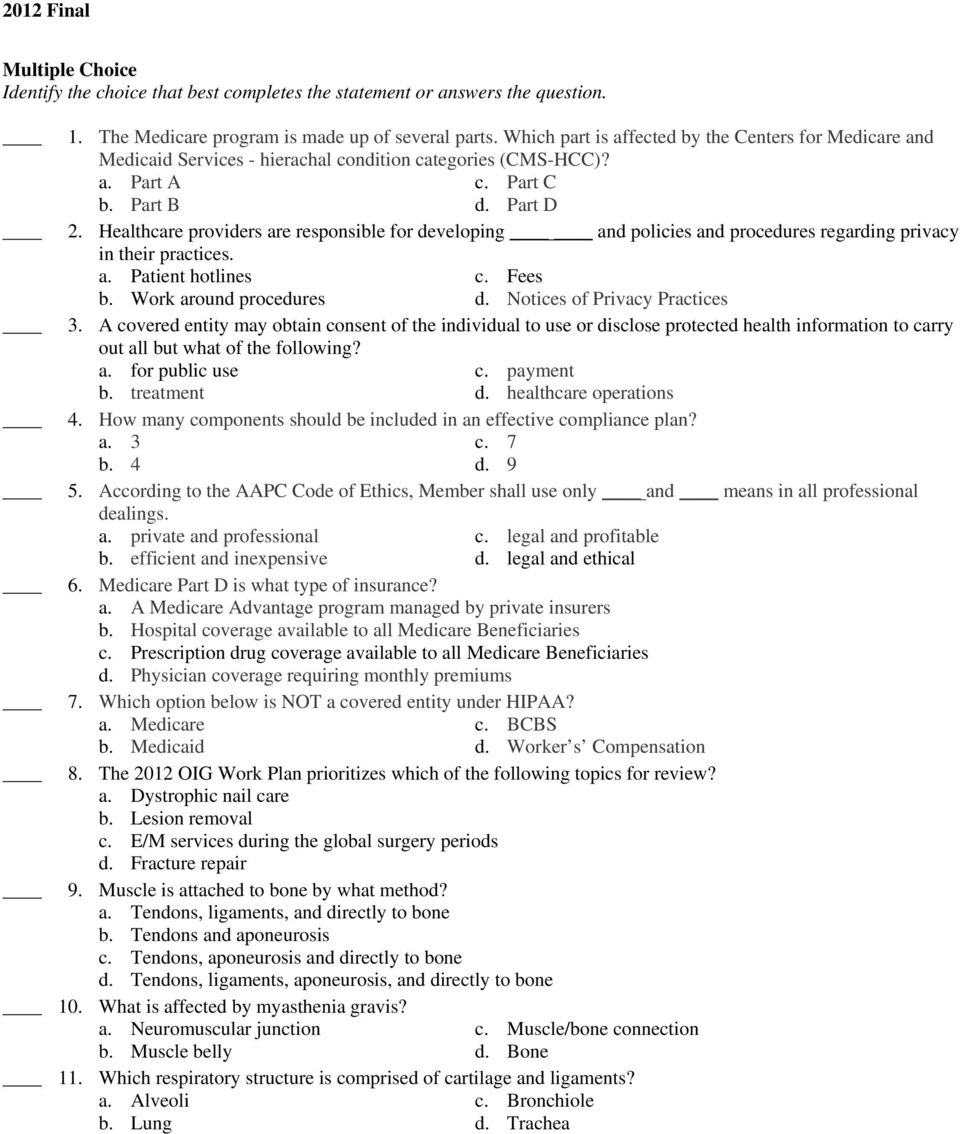
1 2012 Final Multiple Choice Identify the choice that best completes the statement or answers the question. 1. The Medicare program is made up of several parts. Which part is affected by the Centers for Medicare and Medicaid Services - hierachal condition categories (CMS-HCC)? a. Part A c. Part C b. Part B d. Part D 2. Healthcare providers are responsible for developing and policies and procedures regarding privacy in their practices. a. Patient hotlines c. Fees b. Work around procedures d. Notices of Privacy Practices 3. A covered entity may obtain consent of the individual to use or disclose protected health information to carry out all but what of the following? a. for public use c. payment b. treatment d. healthcare operations 4. How many components should be included in an effective compliance plan? a. 3 c. 7 b. 4 d According to the AAPC Code of Ethics, Member shall use only and means in all professional dealings. a. private and professional c. legal and profitable b. efficient and inexpensive d. legal and ethical 6. Medicare Part D is what type of insurance? a. A Medicare Advantage program managed by private insurers b. Hospital coverage available to all Medicare Beneficiaries c. Prescription drug coverage available to all Medicare Beneficiaries d. Physician coverage requiring monthly premiums 7. Which option below is NOT a covered entity under HIPAA? a. Medicare c. BCBS b. Medicaid d. Worker s Compensation 8. The 2012 OIG Work Plan prioritizes which of the following topics for review? a. Dystrophic nail care b. Lesion removal c. E/M services during the global surgery periods d. Fracture repair 9. Muscle is attached to bone by what method? a. Tendons, ligaments, and directly to bone b. Tendons and aponeurosis c. Tendons, aponeurosis and directly to bone d. Tendons, ligaments, aponeurosis, and directly to bone 10. What is affected by myasthenia gravis? a. Neuromuscular junction c. Muscle/bone connection b. Muscle belly d. Bone 11. Which respiratory structure is comprised of cartilage and ligaments? a. Alveoli c. Bronchiole b. Lung d. Trachea
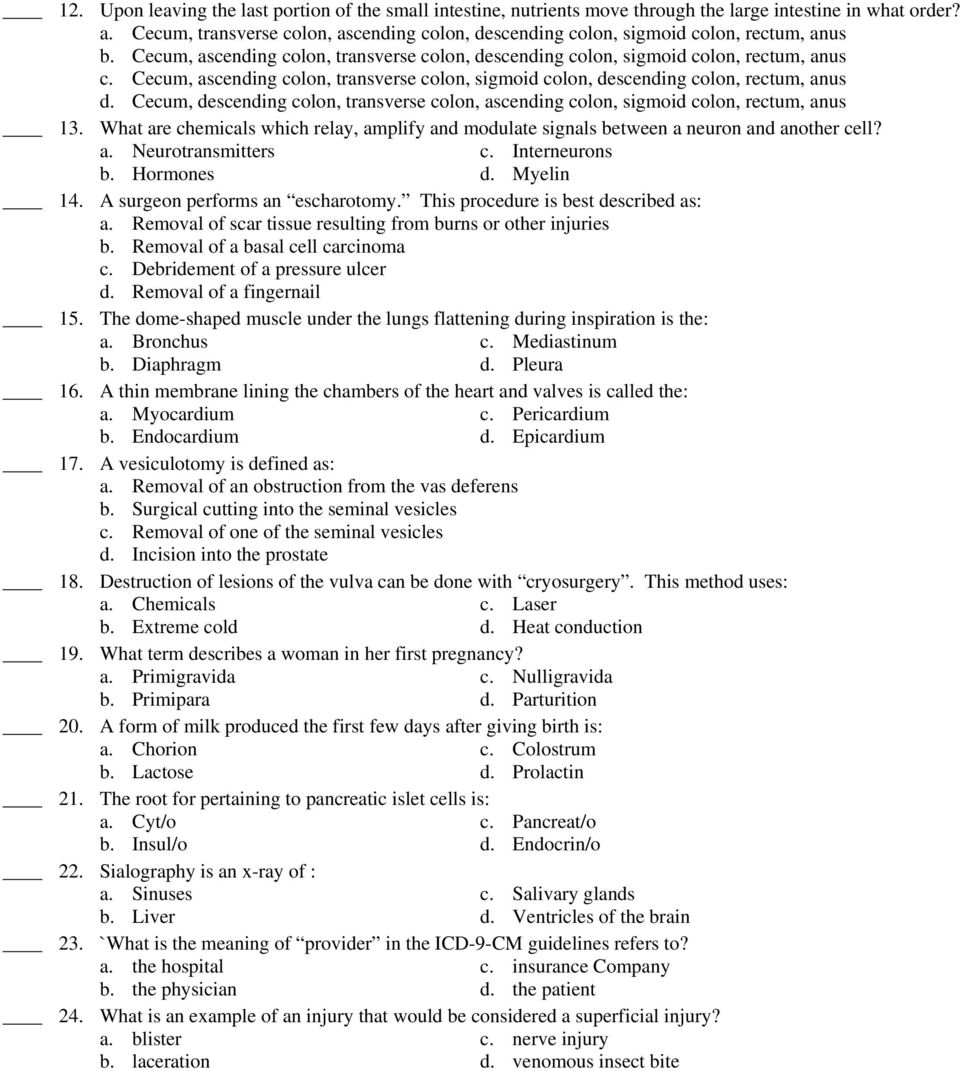
2 12. Upon leaving the last portion of the small intestine, nutrients move through the large intestine in what order? a. Cecum, transverse colon, ascending colon, descending colon, sigmoid colon, rectum, anus b. Cecum, ascending colon, transverse colon, descending colon, sigmoid colon, rectum, anus c. Cecum, ascending colon, transverse colon, sigmoid colon, descending colon, rectum, anus d. Cecum, descending colon, transverse colon, ascending colon, sigmoid colon, rectum, anus 13. What are chemicals which relay, amplify and modulate signals between a neuron and another cell? a. Neurotransmitters c. Interneurons b. Hormones d. Myelin 14. A surgeon performs an escharotomy. This procedure is best described as: a. Removal of scar tissue resulting from burns or other injuries b. Removal of a basal cell carcinoma c. Debridement of a pressure ulcer d. Removal of a fingernail 15. The dome-shaped muscle under the lungs flattening during inspiration is the: a. Bronchus c. Mediastinum b. Diaphragm d. Pleura 16. A thin membrane lining the chambers of the heart and valves is called the: a. Myocardium c. Pericardium b. Endocardium d. Epicardium 17. A vesiculotomy is defined as: a. Removal of an obstruction from the vas deferens b. Surgical cutting into the seminal vesicles c. Removal of one of the seminal vesicles d. Incision into the prostate 18. Destruction of lesions of the vulva can be done with cryosurgery. This method uses: a. Chemicals c. Laser b. Extreme cold d. Heat conduction 19. What term describes a woman in her first pregnancy? a. Primigravida c. Nulligravida b. Primipara d. Parturition 20. A form of milk produced the first few days after giving birth is: a. Chorion c. Colostrum b. Lactose d. Prolactin 21. The root for pertaining to pancreatic islet cells is: a. Cyt/o c. Pancreat/o b. Insul/o d. Endocrin/o 22. Sialography is an x-ray of : a. Sinuses c. Salivary glands b. Liver d. Ventricles of the brain 23. `What is the meaning of provider in the ICD-9-CM guidelines refers to? a. the hospital c. insurance Company b. the physician d. the patient 24. What is an example of an injury that would be considered a superficial injury? a. blister c. nerve injury b. laceration d. venomous insect bite
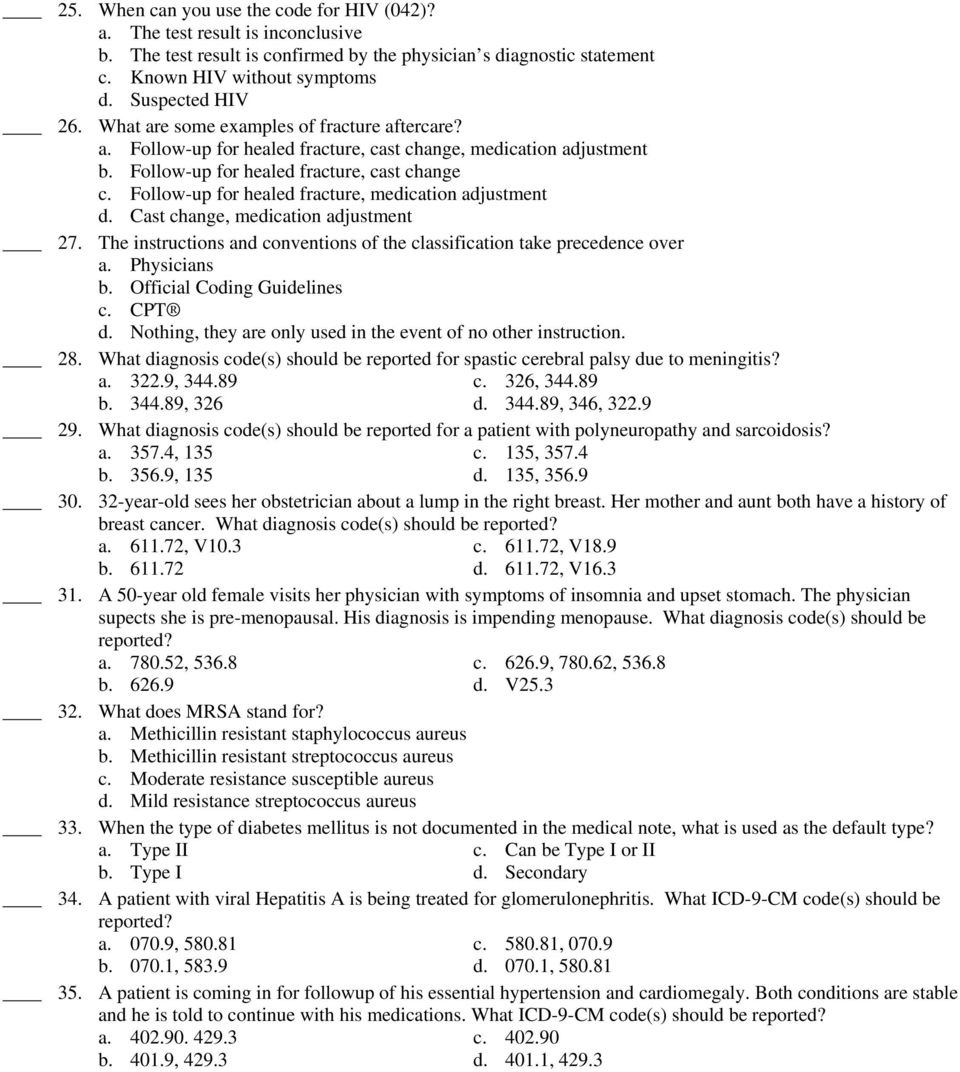
3 25. When can you use the code for HIV (042)? a. The test result is inconclusive b. The test result is confirmed by the physician s diagnostic statement c. Known HIV without symptoms d. Suspected HIV 26. What are some examples of fracture aftercare? a. Follow-up for healed fracture, cast change, medication adjustment b. Follow-up for healed fracture, cast change c. Follow-up for healed fracture, medication adjustment d. Cast change, medication adjustment 27. The instructions and conventions of the classification take precedence over a. Physicians b. Official Coding Guidelines c. CPT d. Nothing, they are only used in the event of no other instruction. 28. What diagnosis code(s) should be reported for spastic cerebral palsy due to meningitis? a , c. 326, b , 326 d , 346, What diagnosis code(s) should be reported for a patient with polyneuropathy and sarcoidosis? a , 135 c. 135, b , 135 d. 135, year-old sees her obstetrician about a lump in the right breast. Her mother and aunt both have a history of breast cancer. What diagnosis code(s) should be reported? a , V10.3 c , V18.9 b d , V A 50-year old female visits her physician with symptoms of insomnia and upset stomach. The physician supects she is pre-menopausal. His diagnosis is impending menopause. What diagnosis code(s) should be reported? a , c , , b d. V What does MRSA stand for? a. Methicillin resistant staphylococcus aureus b. Methicillin resistant streptococcus aureus c. Moderate resistance susceptible aureus d. Mild resistance streptococcus aureus 33. When the type of diabetes mellitus is not documented in the medical note, what is used as the default type? a. Type II c. Can be Type I or II b. Type I d. Secondary 34. A patient with viral Hepatitis A is being treated for glomerulonephritis. What ICD-9-CM code(s) should be reported? a , c , b , d , A patient is coming in for followup of his essential hypertension and cardiomegaly. Both conditions are stable and he is told to continue with his medications. What ICD-9-CM code(s) should be reported? a c b , d , 429.3
4 36. Patient is seeing the ophthalmologist to examine an old retained metal foreign body in his retina There is the possibility of infection. What ICD-9-CM code(s) should be reported? a , V90.10 c , V90.12 b , V90.11 d , V What type of fracture is considered traumatic? a. Pathologic fracture c. Stress fracture b. Malunion fracture d. Compound fracture 38. Under what circumstances would an external cause code be reported? a. Illness and injuries b. Causes of injury, poisoning, and other adverse affects c. Causes of neoplasms, hypertension and medications d. Only for the cause of accidents 39. What chapter contains codes for diseases and disorders of the nails? a. Chapter 13: Diseases of Musculoskeletal adn Connective Tissue c. Chapter 10: Diseases of the Genitourinary system b. Chapter 14: Congenital Anomalies d. Chapter 12: Diseases of the Skin and Subcutaneous Tissue 40. The patient has benign prostate hypertrophy with urinary retention. What ICD-9-CM code(s) should be reported? a c , b , d A 2-month-old is seeing his pediatrician for a routine health check examination. The physician notices a diaper rash and prescribes an ointment to treat it. What ICD-9-CM code(s) should be reported? a c , V20.2 b. V20.2, d. V A three-year-old is brought to the burn unit after pulling a pot of hot soup off the stove spilling onto to her body. She sustained 18% second degree burns on her legs and 20% third degree burns on her chest and arms. Total body surface area burned is 38%. What ICD-9-CM code(s) should be reported for the burns (do not include E codes for the accident)? a , , , c , , , b , , , d , , , A patient is coming in for followup of a second-degree burn on the arm. The physician notes the burn is healing well. He is to come back in two weeks for another check-up. What ICD-9-CM code(s) should be reported? a c. V67.59, b. V58.89, d. V A patient was treated in the emergency department for a nasal fracture. Bleeding was controlled, a splint applied and the patient sent home. He returned to the ED several hours later with new bleeding from both nares. What ICD-9-CM code(s) should be reported for the second ED visit? a c , b d , year-old woman, 25-weeks-pregnant with her second child, is seeing her obstetrician. She is worried about decreased fetal movement. During the examination the obstetrician detects bradycardia in the fetus. What ICD-9-CM code(s) should be reported? a , V23.82 c , V23.82 b , d ,

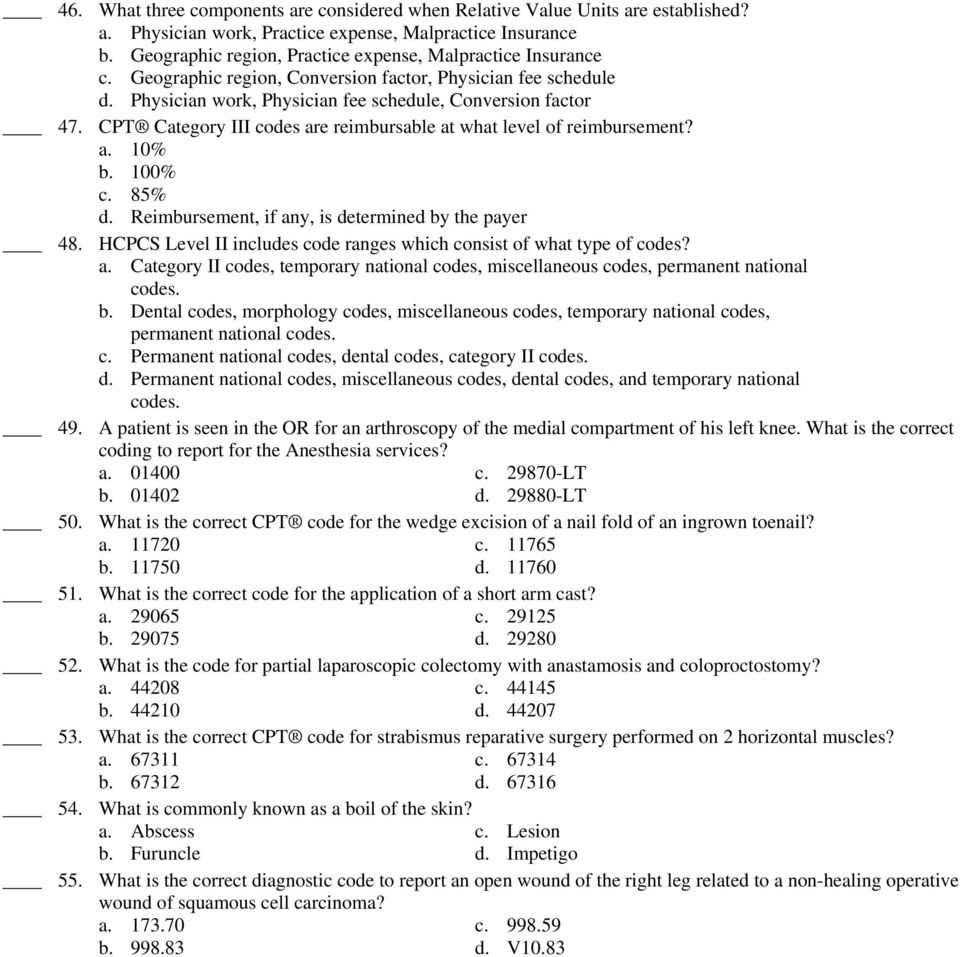
5 46. What three components are considered when Relative Value Units are established? a. Physician work, Practice expense, Malpractice Insurance b. Geographic region, Practice expense, Malpractice Insurance c. Geographic region, Conversion factor, Physician fee schedule d. Physician work, Physician fee schedule, Conversion factor 47. CPT Category III codes are reimbursable at what level of reimbursement? a. 10% b. 100% c. 85% d. Reimbursement, if any, is determined by the payer 48. HCPCS Level II includes code ranges which consist of what type of codes? a. Category II codes, temporary national codes, miscellaneous codes, permanent national codes. b. Dental codes, morphology codes, miscellaneous codes, temporary national codes, permanent national codes. c. Permanent national codes, dental codes, category II codes. d. Permanent national codes, miscellaneous codes, dental codes, and temporary national codes. 49. A patient is seen in the OR for an arthroscopy of the medial compartment of his left knee. What is the correct coding to report for the Anesthesia services? a c LT b d LT 50. What is the correct CPT code for the wedge excision of a nail fold of an ingrown toenail? a c b d What is the correct code for the application of a short arm cast? a c b d What is the code for partial laparoscopic colectomy with anastamosis and coloproctostomy? a c b d What is the correct CPT code for strabismus reparative surgery performed on 2 horizontal muscles? a c b d What is commonly known as a boil of the skin? a. Abscess c. Lesion b. Furuncle d. Impetigo 55. What is the correct diagnostic code to report an open wound of the right leg related to a non-healing operative wound of squamous cell carcinoma? a c b d. V10.83
6 56. The patient is here to follow-up for a keloid excised from his neck in November of last year. He believes it s coming back. He does have a recurrence of the keloid on the superior portion of the scar. Since the keloid is still small, options of an injection or radiation to the area were discussed. It was agreed our next course should be a Kenalog injection. Risks associated with the procedure were discussed with the patient. Informed consent was obtained. The area was infiltrated with 1.5 cc of medication. This was a mixture of 1 cc of 40-mg Kenalog and 0.5 cc of 1% lidocaine with epinephrine. He tolerated the procedure well. What CPT and ICD-9-CM code(s) are reported? a , x 7, J3301, c , J3301, b , J3301, d x 8, J3301, A patient presents with a recurrent seborrheic keratosis of the left cheek. The area was marked for a shave removal. The area was infiltrated with local anesthetic, prepped and draped in a sterile fashion. The lesion measuring 1.8 cm was shaved using an 11-blade. Meticulous hemostasis was achieved using light pressure. The specimen was sent for permanent pathology. The patient tolerated the procedure well. What CPT code(s) is reported? a c b d A 45-year-old male with a previous biopsy positive for malignant melanoma, presents for definitive excision of the lesion. After induction of general anesthesia the patient is placed supine on the OR table, the left thigh prepped and draped in the usual sterile fashion. IV antibiotics are given, patient had previous MRSA infection. The previous excisional biopsy site on the left knee measured approximately 4 cm and was widely elipsed with a 1.5 cm margin. The excision was taken down to the underlying patellar fascia. Hemostasis was achieved via electrocautery. The resulting defect was 11cm x 5cm. Wide advancement flaps were created inferiorly and superiorly using electrocautery. This allowed skin edges to come together without tension. The wound was closed using interrupted 2-0 monocryl and 2 retention sutures were placed using #1 Prolene. Skin was closed with a stapler. What CPT code(s) is/are reported? a c , b d ,

7 59. Operative Report PREOPERATIVE DIAGNOSIS: Diabetic foot ulceration. POSTOPERATIVE DIAGNOSIS: Diabetic foot ulceration. OPERATION PERFORMED: Debridement and split thickness autografting of left foot ANESTHESIA: General endotracheal. INDICATIONS FOR PROCEDURE: This patient with multiple complications from Type II diabetes has developed ulcerations which were debrided and homografted last week. The homograft is taking quite nicely, the wounds appear to be fairly clean; he is ready for autografting. DESCRIPTION OF PROCEDURE: After informed consent the patient is brought to the operating room and placed in the supine position on the operating table. Anesthetic monitoring was instituted, internal anesthesia was induced. The left lower extremity is prepped and draped in a sterile fashion. Staples were removed and the homograft was debrided from the surface of the wounds. One wound appeared to have healed; the remaining two appeared to be relatively clean. We debrided this sharply with good bleeding in all areas. Hemostasis was achieved with pressure, Bovie cautery, and warm saline soaked sponges. With good hemostasis a donor site was then obtained on the left anterior thigh, measuring less than 100 cm 2. The wounds were then grafted with a split-thickness autograft that was harvested with a patch of Brown dermatome set at 12,000 of an inch thick. This was meshed 1.5:1. The donor site was infiltrated with bupivacaine and dressed. The skin graft was then applied over the wound, measured approximately 60 cm 2 in dimension on the left foot. This was secured into place with skin staples and was then dressed with Acticoat 18's, Kerlix incorporating a catheter, and gel pad. The patient tolerated the procedure well. The right foot was redressed with skin lubricant sterile gauze and Ace wrap. Anesthesia was reversed. The patient was brought back to the ICU in satisfactory condition. What CPT and ICD-9-CM codes are reported? a , , , b , , , c , , , d , , , , A patient is seen in the same day surgery unit for an arthroscopy to remove some loose bodies in the shoulder area. What CPT code(s) should be reported? a c b d What is the acromion? a. Part of the elbow joint c. Tendon in the shoulder b. Ligament near the knee d. Extension of the scapula 62. In ICD-9-CM, what do you look for in the alphabetic index, to code a tear of the supraspinatus muscle of the shoulder? a. Rotator cuff, sprain c. Injury, shoulder b. Sprain, shoulder d. Tear, rotator cuff 63. A patient presented with a closed, displaced supracondylar fracture of the left elbow. After conscious sedation, the left upper extremity was draped and closed reduction was performed, achieving anatomical reduction of the fracture. The elbow was then prepped and with the use of fluoroscopic guidance, two K-wires were directed crossing the fracture site and pierced the medial cortex of the left distal humerus. Stable reduction was obtained, with full flexion and extension. K-wires were bent and cut at a 90 degree angle. Telfa padding and splint were applied. What CPT code(s) should be reported? a c b d
8 64. A 27-year-old triathelete is thrown from his bike on a steep downhill ride. He suffered a severely fractured vertebra at C5. An anterior approach is used to dissect out the bony fragments and strengthen the spine with titanium cages and arthrodesis. The surgeon places the patient supine on the OR table and proceeds with an anterior corpectomy at C5 with discectomy above and below. Titanium cages are placed in the resulting defect and morselized allograft bone is placed in and around the cages. Anterior Synthes plates are placed across C2-C3 and C3-C5, and C5-C6. What CPT code(s) should be reported? a , , 22845, 22851, c , , 22845, b , , 22846, 22851, d , , 22846, This 45-year-old male presents to the operating room with a painful mass of the right upper arm. General anesthesia was induced. Soft tissue dissection was carried through the proximal aspect of the teres minor muscle. Upon further dissection a large mass was noted just distal of the IGHL (inferior glenohumeral ligament), which appeared to be benign in nature. With blunt dissection and electrocautery, the 4-cm mass was removed en bloc and sent to pathology. The wound was irrigated, and repair of the teres minor with subcutaneous tissue was closed with triple-0 Vicryl. Skin was closed with double-0 Prolene in a subcuticular fashion. What CPT code(s) should be reported? a RT c RT b RT d RT 66. A 50-year-old male had surgery on his upper leg one day ago and presents with serous drainage from the wound. He was taken back to the operating room for evaluation of the hematoma. His wound was explored, and there was a hematoma at the base of the wound, which was very carefully evacuated. The wound was irrigated with antibacterial solution. What CPT and ICD-9-CM codes should be reported? a , c , b , d , A patient presents with a healed fracture of the left ankle. The patient was placed on the OR table in the supine position. After satisfactory induction of general anesthesia, the patient s left ankle was prepped and draped. A small incision about 1 cm long was made in the previous incision. The lower screws were removed. Another small incision was made just lateral about 1 cm long. The upper screws were removed from the plate. Both wounds were thoroughly irrigated with copious amounts of antibiotic containing saline. Skin was closed in a layered fashion and sterile dressing applied. What CPT code(s) should be reported? a c b , d , A 31-year-old secretary returns to the office with continued complaints of numbness involving three radial digits of the upper right extremity. Upon examination, she has a positive Tinel s test of the median nerve in the left wrist. Anti-inflammatory medication has not relieved her pain. Previous electrodiagnostic studies show sensory mononeuropathy. She has clinical findings consistent with carpal tunnel syndrome. She has failed physical therapy and presents for injection of the left carpal canal. The left carpal area is prepped sterilely. A 1.5 inch 25 or 22 gauge needle is inserted radial to the palmaris longus or ulnar to the carpi radialis tendon at an oblique angle of approximately 30 degrees. The needle is advanced a short distance about 1 or 2 cm observing for any complaints of paresthesias or pain in a median nerve distribution. The mixture of 1 cc of 1% lidocaine and 40 mg of Kenalog is injected slowly along the median nerve. The injection area is cleansed and a bandage is applied to the site. What CPT code(s) should be reported? a , J3301 c , J3303 b , J3302 d , J What CPT code should be reported for a frontal sinusotomy, nonobliterative, with osteoplastic flap, brow incision? a c b d
9 70. A patient s nose was hit with a baseball during a high school baseball game. At that time reconstruction was performed, with local grafts. Patient returns now as an adult, discontent with the bony prominence along the bony pyramid and flat look of the tip of the nose. He underwent major repair with osteotomies and nasal tip work. What CPT code(s) should be reported? a c b d A 14-year-old boy presents at the Emergency Department experiencing an uncontrolled epistaxis. Through the nares, the ED physician packs his entire nose via anterior approach with medicated gauze. In approximately 15 minutes the nosebleed stops. What CPT and ICD-9-CM codes should be reported? a , c , b , d , A surgeon performs a high thoracotomy with resection of a single lung segment on a 57-year-old heavy smoker who had presented with a six-month history of right shoulder pain. An apical lung biopsy had confirmed lung cancer. What CPT and ICD-9-CM code(s) should be reported? a , c , b , d , , What part of the cardiovascular system is responsible for the one-way flow of blood through the chambers of the heart? a. Septum c. Bundle of His b. Heart valves d. Atria 74. Which main coronary artery bifurcates into two smaller ones? a. Right c. Inverted b. Left d. Superficial 75. A patient suffering from an abdominal aortic aneurysm involving a renal artery undergoes endovascular repair using modular prosthesis with two docking limbs. Select the CPT code(s) for this procedure. a c b. 0078T, 0079T d Physician changes the old battery to a new battery on a patient s dual chamber permanent pacemaker. a c , b d A 35-year-old patient presented to the ASC for PTA of an obstructed hemodialysis AV graft in the venous anastomosis and the immediate venous outflow. The procedure was performed under moderate sedation administered by the physician performing the PTA. The physician performed all aspects of the procedure, including radiological supervision and interpretation. Code for all services performed. a , 99144, c , b , d , 99144, What is included in all vascular injection procedures? a. Catheters, drugs, and contrast material b. Selective catheterization c. Just the procedure itself d. Necessary local anesthesia, introduction of needles or catheters, injection of contrast media with or without automatic power injection, and/or necessary pre-and post injection care specifically related to the injection procedure.

10 79. In the cardiac suite, an electrophysiologist performs an EP study. With programmed electrical stimulation, the heart is stimulated to induce arrhythmia. Observed is: right atrial and ventricular pacing, recording of the bundle of His, right atrial and ventricular recording, and left atrial and ventricular pacing and recording from the left atrium. a , 93602, 93603, 93610, 93612, 93618, 93621, b , c , 93621, d , 93618, Preoperative Diagnosis: Coronary artery disease associated with congestive heart failure; in addition, the patient has diabetes and massive obesity. Postoperative Diagnosis: Same Anesthesia: General endotracheal Incision: Median sternotomy Indications: The patient had presented with severe congestive heart failure associated with her severe diabetes. She had significant coronary artery disease, consisting of a chronically occluded right coronary artery but a very important large obtuse marginal artery coming off as the main circumflex system. She also has a left anterior descending artery, which has moderate disease and this supplies quite a bit of collateral to her right system. The decision was therefore made to perform a coronary artery bypass grafting procedure, particularly because she is so symptomatic. The patient was brought to the operating room. Description of Procedure: The patient was brought to the operating room and placed in supine position. Myself, the operating surgeon was scrubbed throughout the entire operation. After the patient was prepared, median sternotomy incision was carried out and conduits were taken from the left arm as well as the right thigh. The patient weighs almost three hundred pounds and with her obesity there was some concern as to taking down the left internal mammary artery. Because the radial artery appeared to be a good conduit, she should have an arterial graft to the left anterior descending artery territory. She was cannulated after the aorta and atrium were exposed and after full heparinization. Attention was turned to the coronary arteries. The first obtuse marginal artery was a very large target and the vein graft to this target indeed produced an excellent amount of flow. Proximal anastomosis was then carried out to the foot of the aorta. The left anterior descending artery does not have severe disease but is also a very good target, and the radial artery was anastomosed to this target, and the proximal anastomosis was then carried out to the root of the aorta. Sternal closure was then done using wires. The subcutaneous layers were closed using Vicryl suture. The skin was approximated using staples. a , c , b d , 33517, 35600
11 81. CLINICAL SUMMARY: The patient is a 55-year-old female with known coronary disease and previous left anterior descending and diagonal artery intervention, with recent recurrent chest pain. Cardiac catheterization demonstrated continued patency of the stented segment, but diffuse borderline changes in the ostial/proximal portion of the right coronary artery. PROCEDURE: With informed consent obtained, the patient was prepped and draped in the usual sterile fashion. With the right groin area infiltrated with 2% Xylocaine and the patient given 2 mg of Versed and 50 mcg of fentanyl intravenously for conscious sedation and pain control, the 6-French catheter sheath from the diagnostic study was exchanged for a 6-French sheath and a 6- French JR4 catheter with side holes utilized. The patient initially received 3000 units of IV heparin, and then IVUS interrogation was carried out using an Atlantis Boston Scientific probe. After it had been determined that there was significant stenosis in the ostial/proximal segment of the right coronary artery, the patient received an additional 3000 units of IV heparin, as well as Integrilin per double-bolus injection. A 3.0, 16-mm-long Taxus stent was then deployed in the ostium and proximal segment of the right coronary artery in a primary stenting procedure with inflation pressure up to 12 atmospheres applied. Final angiographic documentation was carried out, and then the guiding catheter pulled, the sheath upgraded to a 7-French system, because of some diffuse oozing around the 6-French-sized sheath, and the patient is now being transferred to telemetry for post-coronary intervention observation and care. RESULTS: The initial guiding picture of the right coronary artery demonstrates the right coronary artery to be dominant in distribution, with luminal irregularities in its proximal and mid third with up to 50% stenosis in the ostial/proximal segment per angiographic criteria, although some additional increased radiolucency observed in that segment. IVUS interrogation confirms severe, concentric plaque formation in this ostial/proximal portion of the right coronary artery with over 80% area stenosis demonstrated. The mid, distal lesions are not significant, with less than 40% stenosis per IVUS evaluation. Following the coronary intervention with stent placement, there is marked increase in the ostial/proximal right coronary artery size, with no evidence for intimal disruption, no intraluminal filling defect, and TIMI III flow preserved. CONCLUSION: Successful coronary intervention with drug-eluting Taxus stent placement to the ostial/proximal right coronary artery. a RC, RC c RC, RC b RC, RC, RC d RC, RC, RC 82. What is the correct ICD-9-CM coding for a 30-year-old obese patient with a BMI of 32.5? a , V85.32 c , V85.30 b , V85.35 d , V What CPT code(s) is/are reported for a percutaneous endoscopic direct placement of a tube gastrostomy for a patient who previously underwent a partial esophagectomy? a , c b , d

12 84. A patient suffering from cirrhosis of the liver presents with a history of coffee ground emesis. The surgeon diagnoses the patient with esophageal varices. Two days later, in the hospital GI lab, the surgeon ligates the varices with bands via an UGI endoscopy. What CPT and ICD-9-CM codes are reported? a , 571.6, c , 571.6, b , 571.5, d , 571.5, A 45-year-old patient with liver cancer is scheduled for a liver transplant. The patient s brother is a perfect match and will be donating a portion of his liver for a graft. Segments II and III will be taken from the brother and then the backbench reconstruction of the graft will be performed, both a venous and arterial anastomosis. The orthotopic allotransplantation will then be performed on the patient. What CPT code(s) is/are reported? a , 47146, 47147, c , 47147, 47146, b , 47146, d , 47146, Closure of exstrophy of bladder is performed with epispadias repair. What CPT code(s) is/are reported for this service? a c b d Circumcision with adjacent tissue transfer was performed. What CPT code(s) is/are reported for this service? a c b d , The patient presents to the office for CMG (cystometrogram) procedure(s). Complex CMG cystometrogram with voiding pressure studies is done, intrabdominal voiding pressure studies, and complex uroflow are performed. What CPT code(s) is/are reported for this service? a c , 51797, b , 51728, d , , Preoperative diagnosis: Cytologic atypia and gross hematuria Postoperative diagnosis: Cytologic atypia and gross hematuria Procedure performed: Cystoscopy and random bladder biopsies and GreenLight laser ablation of the prostate. Description: Bladder biopsies were taken of the dome, posterior bladder wall and lateral side walls. Bugbee was used to fulgurate the biopsy sites to diminish bleeding. Cystoscope was replaced with the cystoscope designed for the GreenLight laser. We introduced this into the patient's urethra and performed GreenLight laser ablation of the prostate down to the level of verumontanum (a crest near the wall of the urethra). There were some calcifications at the left apex of the prostate, causing damage to the laser but adequate vaporization was achieved. What CPT code(s) is/are reported for this service? a , c , b d , Patient presents for excision of multiple kidney cysts. Three cysts are excised. What CPT code(s) is/are reported for this service? a c b x 3 d What is a root word for vagina? a. Uter/o c. Hyster/o b. Colp/o d. Metri/o 92. What is a bilateral structure of the female reproductive system? a. Bartholin s gland c. Ovaries b. Fallopian tubes d. All of the above 93. The patient presents with a recurrent infection of the Bartholin s gland which has previously been treated with antibiotics and I&D. At this visit her gynecologist incises the cyst, draining the material in it and tacks the edges of the cyst open creating an open pouch to prevent recurrence. How is this procedure coded?

13 a c b d What CPT code is used to report a complete unilateral removal of the vulva and deep subcutaneous tissues? a c b d Vulvar cancer in situ can also be documented as: a. VIN I c. Adenocarcinoma of the vulva b. VIN II d. VIN III 96. What does the abbreviation IVF mean? a. Intravenous fluids c. Intravaginal foreign body b. In vitro fertilization d. Infundibulum via Fallopian tube 97. A pregnant patient presents to the ED with bleeding, cramping, and concerns of loss of tissue and material per vagina. On examination, the physician discovers open cervical os with no products of conception seen. He tells the patient she has had an abortion. What type of abortion has she had? a. Missed c. Spontaneous b. Induced d. None of the above 98. Patient wishes permanent sterilization and elects laparoscopic tubal ligation with falope ring. What is/are the CPT code(s) reported for this service? a c b d A patient presents with cervical cancer, it has spread and metastasized throughout the pelvic area. She receives a total abdominal hysterectomy with bilateral salpingo-oophorectomy, cystectomy and creation of an ileal conduit and partial colectomy. What is/are the CPT code(s) reported for this service? a , 51590, c , 51590, 44140, b , d A pregnant patient presents with the baby in a breech presentation. During the delivery the doctor attempts to turn the baby while it is still in the uterus. The baby turns but then immediately resumes his previous position. Can this service be billed? If so, what is the code? a. No, since the doctor was unable to successfully turn the baby. b. No, this procedure is included in the obstetrical global package c. Yes, since the doctor did the work, even though the outcome was unsuccessful. Report this procedure with code d. Yes, only billing it with postpartum care What are the four lobes of the brain? a. Frontal, Parietal, Temporal, Occipital c. Frontal, Cerebral, Cerebellum, Pons b. Sulci, Cerebellum, Pons, Medulla d. Frontal, Cerebrum, Temporal, Occipital 102. What disease is characterized by enlarged skeletal parts? a. Acromegaly c. Hyperthyroidism b. Goiter d. Cushing s Syndrome 103. What is the term for paralysis affecting one side of the body? a. Monoplegia c. Quadriplegia b. Paraplegia d. Hemiplegia 104. A patient with chronic lumbago is seen by the physician to have an epidural injection at the sacral level. What CPT code(s) is reported for this procedure? a c b d The physician removes the thymus gland in a 27-year-old female with myasthenia gravis. Using a transcervical approach, the blood supply to the thymus is divided and the thymus is dissected free from the pericardium and the thymus is removed. What CPT code(s) is reported for this procedure?
14 a c b d A patient is having a decompression of the nerve root involving two segments of the lumbar spine via transpedicular approach. What CPT code(s) is/are reported? a c , b , d A patient with a herniated cervical disc undergoes a cervical laminotomy with a partial facetectomy and excision of the herniated disc for cervical interspace C3-C4. What CPT and ICD-9-CM codes are reported? a , c , 63035, b , d , Mrs. Marsden slipped on the ice last winter and fractured several lumbar vertebrae. Since then she has required pain management therapy at her local hospital with an anesthesiologist. He injects five percent Marcaine mixed with the steroid Decadron (16mg) into the nerve located in the facet joints at levels L3-L4 and L4-L5 on both sides at each level. What CPT code(s) are reported for this procedure? a x 2 c x 4 50 b , d , A 37-year-old has multilevel lumbar degenerative disc disease and is coming in for an epidural injection. Localizing the skin over the area of L5-S1, the physician uses the transforaminal approach. The spinal needle is inserted, and the patient experienced paresthesias into her left lower extremities. The anesthetic drug is injected into the epidural space. What CPT code(s) is/are reported for this procedure? a , c , b d A patient receives a paravertebral facet joint injection at three levels on both sides of the lumbar spine using fluoroscopic guidance for lumbar pain. What CPT and ICD-9-CM codes are reported? a , x 2, c , x 2, b , , , d , A 47-year old female presents to the OR for a partial corpectomy to three thoracic vertebrae. One surgeon performs the transthoracic approach while another surgeon performs the three vertebral nerve root decompressions necessary. How do both providers involved code for their portions of the surgery? a , x 2 c , x 2 b , x 2 d , x A 15-year-old has been taken to surgery for crushing his index and middle fingers, injuring his digital nerves. The physician located the damaged nerves in both fingers and sutures them to restore sensory function. What CPT code(s) are reported? a , c , b , d , A patient had recently experienced muscle atrophy and noticed she did not have pain when she cut herself on a piece of glass. The provider decides to obtain a biopsy of the spinal cord under fluoroscopic guidance. The biopsy results come back as syringomyelia. What CPT and ICD-9-CM codes are reported? a , , c , , b , d , A 26-year-old patient presents with headache, neck pain, and fever and is concerned he may have meningitis. The patient was placed in the sitting position and given 0.5 mg Ativan IV. His back was prepped and a 20- gauge needle punctured the spine between L4 and L5 with the return of clear fluid. The cerebral spinal fluid was reviewed and showed no sign of meningitis. What CPT code(s) is reported? a c

15 b d What does IOL stand for? a. Interoptic laser c. Interdemensional ocular lengths b. Intraocular lens d. Iridescence over lamina 116. Patient had an abscess in the external auditory canal, which was drained in the office. What CPT code(s) should be reported? a c b d What CPT code(s) should be reported for removal of foreign body from the external auditory canal w/o general anesthesia? a c b d A patient has heavy skin and muscle hooding down and blocking his vision due to ptosis of upper mascular eyelid defect. The physician performed a bilateral upper blepharoplasty. What ICD-9-CM code(s) should be reported? a c b d A patient with a cyst-like mass on his left external auditory canal was visualized under the microscope and a microcup forceps was used to obtain a biopsy of tissue along the posterior superior canal wall. What CPT code(s) should be reported? a RT c RT b LT d LT 120. Using your CPT Index, look up anesthesia for an appendectomy. What CPT code(s) is reported for the anesthesia? a c b d Using your CPT Index, look up anesthesia for a cholecystectomy. No indication of the approach is mentioned. What CPT code(s) is for the anesthesia? a c b d Following labor and delivery, the mother developed acute kidney failure. What ICD-9-CM code(s) is reported? a c b d A 42-year-old patient was undergoing anesthesia in an ASC and began having complications prior to the administration of anesthesia. The surgeon immediately discontinued the planned surgery. If the insurance company requires a reported modifier, what modifier is reported best describing the extenuating circumstances? a. 53 c. 73 b. 23 d Code 00350, Anesthesia for procedures on the major vessels of the neck, has a base value of ten (10) units. The patient is a P3 status, which allows one (1) extra base unit. Anesthesia start time is reported as 11:02, and the surgery began at 11:14. The surgery finished at 12:34 and the patient was turned over to PACU at 12:47, which was reported as the ending anesthesia time. Using fifteen-minute time increments and a conversion factor of $100, what is the correct anesthesia charge? a. $1, c. $1, b. $1, d. $1, A 43-year-old patient with a severe systemic disease is having surgery to remove an integumentary mass from his neck. What CPT code(s) and modifier is reported?
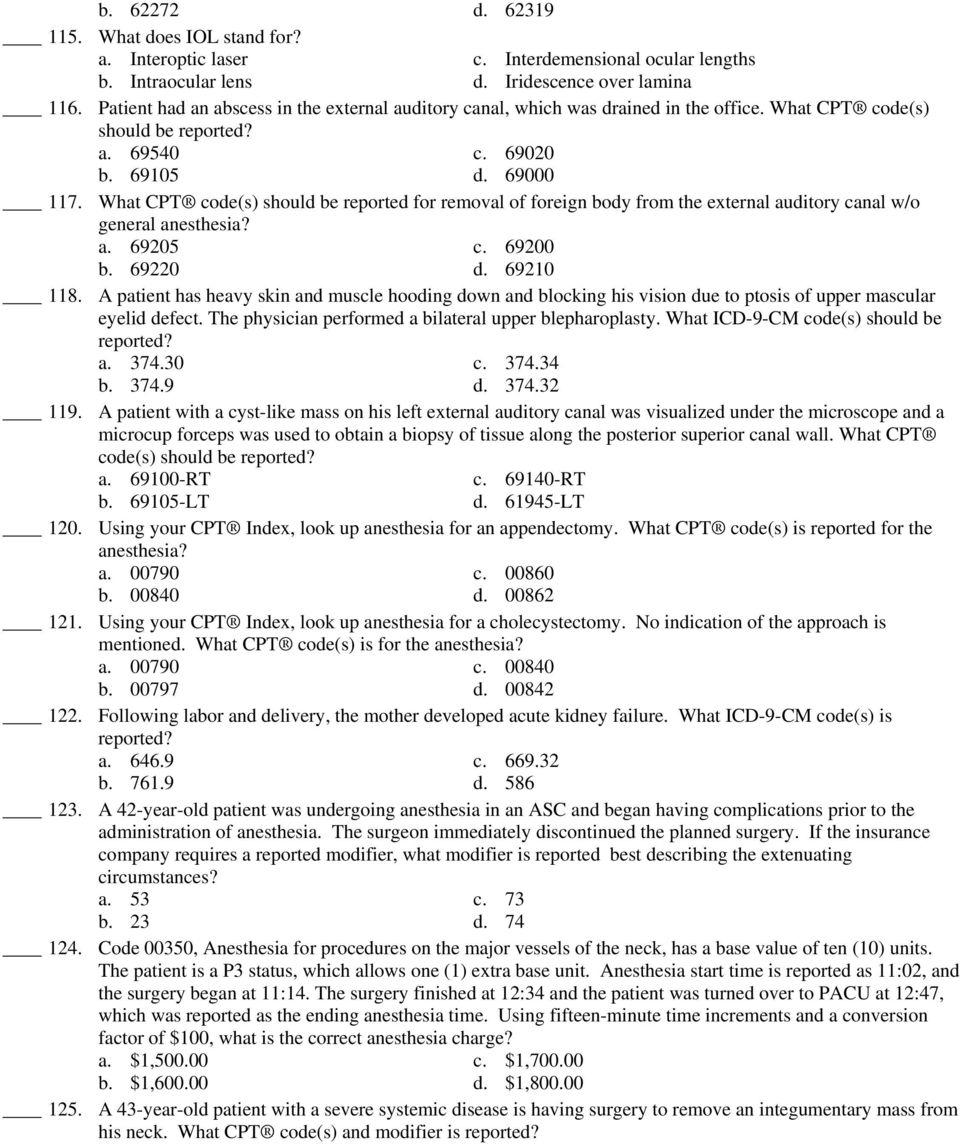
16 a , P2 c , P3 b , P3 d , P A 59-year-old patient is having surgery on the pericardial sac, without use of a pump oxygenator. The perfusionist placed an arterial line. What CPT code(s) is reported for anesthesia? a c b , d A CRNA is personally performing a case, with medical direction from an anesthesiologist. What modifier is appropriately reported for the CRNA services? a. QX c. QK b. QZ d. QS 128. A 40-year-old female in good physical health is having a laparoscopic tubal ligation. The anesthesiologist begins to prepare the patient for surgery at Surgery begins at 0900 and ends at The anesthesiologist releases the patient to recovery nurse at What is the total anesthesia time and anesthesia code? a. 1hr 30 minutes, c. 1 hr, b. 1hr 45 minutes, d. 1 hr 15 minutes, Procedure: Body PET-CT Skull Base to Mid Thigh History: A 65-year-old male Medicare patient with a history of rectal carcinoma presenting for restaging examination. Description: Following the IV administration of mci of F-18 deoxyglucose (FDG), multiplanar image acquisitions of the neck, chest, abdomen and pelvis to the level of mid thigh were obtained at one-hour post-radiopharmaceutical administration. (Nuclear Medicine Tumor imaging).what CPT code(s) is/are reported? a b , c , year old female in her last trimester of her pregnancy comes into her obstetrician s office for a fetal biophysical profile (BPP). An ultrasound is used to first monitor the fetus movements showing three movements of the legs and arms (normal). There are two breathing movements lasting 30 seconds (normal). Non-stress test (NST) of 30 minutes showed the heartbeat at 120 beats per minute and increased with movement (normal or reactive). Arms and legs were flexed with fetus head on it chest, opening and closing of a hand. Two pockets of amniotic fluid at 3cm were seen in the uterine cavity (normal). Biophysical profile scored 9 out of 10 points (normal or reassuring). What CPT code(s) is/are reported reported by the obstetrician? a c b d , year-old female has a 2.5 cm by 2.0 cm non small cell lung cancer in her right upper lobe of her lung. The tumor is inoperable due to severe respiratory conditions. She will be receiving stereotactic body radiation therapy under image guidance. Beams arranged in 8 fields will deliver 25 Gy per fraction for 4 fractions. What CPT and ICD-9-CM codes are reported? a , 162.3, V58.0 c , V58.0, b , d , V58.0, A patient with thickening of the synovial membrane undergoes a fluoroscopic guided radiopharmaceutical therapy joint injection on his right knee. What CPT code(s) is/are reported by the physician if performed in an ASC setting? a c , b , d , , 20610

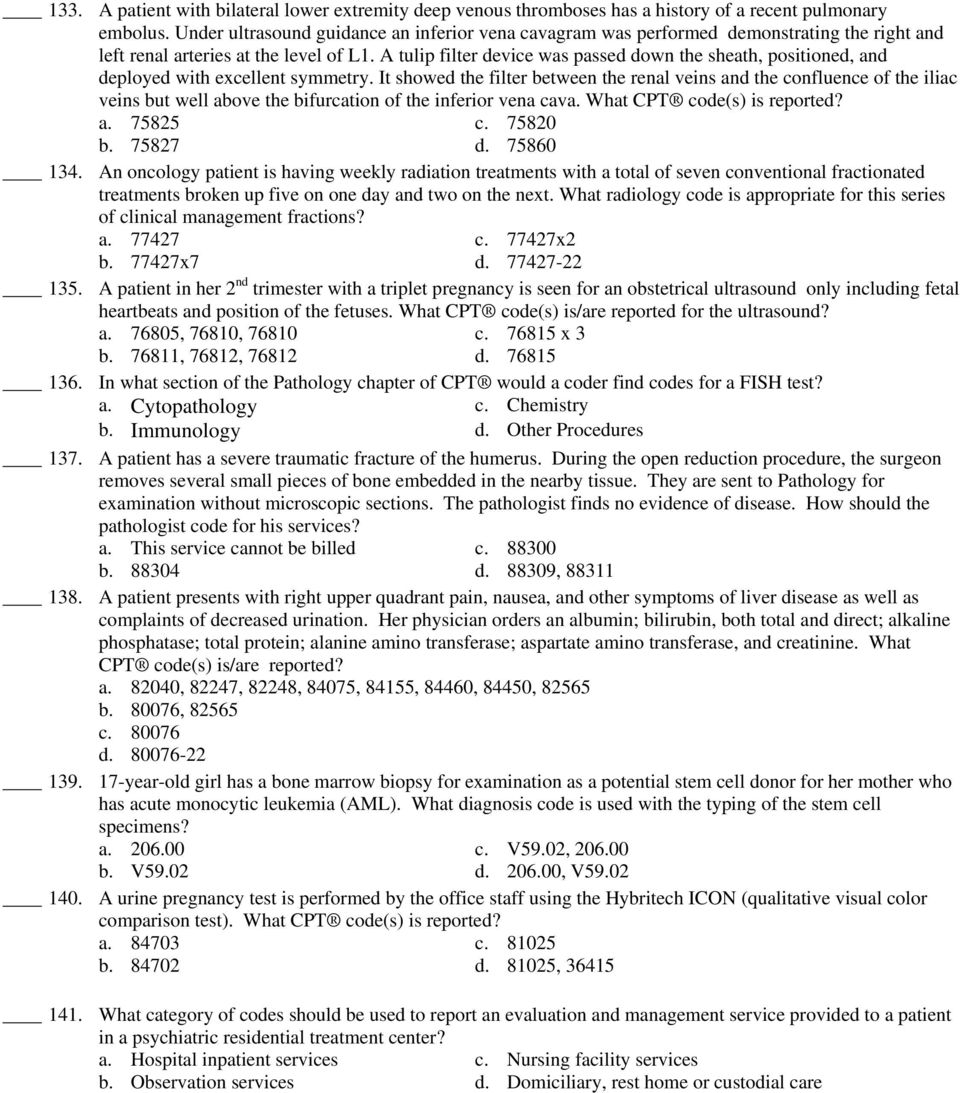
17 133. A patient with bilateral lower extremity deep venous thromboses has a history of a recent pulmonary embolus. Under ultrasound guidance an inferior vena cavagram was performed demonstrating the right and left renal arteries at the level of L1. A tulip filter device was passed down the sheath, positioned, and deployed with excellent symmetry. It showed the filter between the renal veins and the confluence of the iliac veins but well above the bifurcation of the inferior vena cava. What CPT code(s) is reported? a c b d An oncology patient is having weekly radiation treatments with a total of seven conventional fractionated treatments broken up five on one day and two on the next. What radiology code is appropriate for this series of clinical management fractions? a c x2 b x7 d A patient in her 2 nd trimester with a triplet pregnancy is seen for an obstetrical ultrasound only including fetal heartbeats and position of the fetuses. What CPT code(s) is/are reported for the ultrasound? a , 76810, c x 3 b , 76812, d In what section of the Pathology chapter of CPT would a coder find codes for a FISH test? a. Cytopathology c. Chemistry b. Immunology d. Other Procedures 137. A patient has a severe traumatic fracture of the humerus. During the open reduction procedure, the surgeon removes several small pieces of bone embedded in the nearby tissue. They are sent to Pathology for examination without microscopic sections. The pathologist finds no evidence of disease. How should the pathologist code for his services? a. This service cannot be billed c b d , A patient presents with right upper quadrant pain, nausea, and other symptoms of liver disease as well as complaints of decreased urination. Her physician orders an albumin; bilirubin, both total and direct; alkaline phosphatase; total protein; alanine amino transferase; aspartate amino transferase, and creatinine. What CPT code(s) is/are reported? a , 82247, 82248, 84075, 84155, 84460, 84450, b , c d year-old girl has a bone marrow biopsy for examination as a potential stem cell donor for her mother who has acute monocytic leukemia (AML). What diagnosis code is used with the typing of the stem cell specimens? a c. V59.02, b. V59.02 d , V A urine pregnancy test is performed by the office staff using the Hybritech ICON (qualitative visual color comparison test). What CPT code(s) is reported? a c b d , What category of codes should be used to report an evaluation and management service provided to a patient in a psychiatric residential treatment center? a. Hospital inpatient services c. Nursing facility services b. Observation services d. Domiciliary, rest home or custodial care
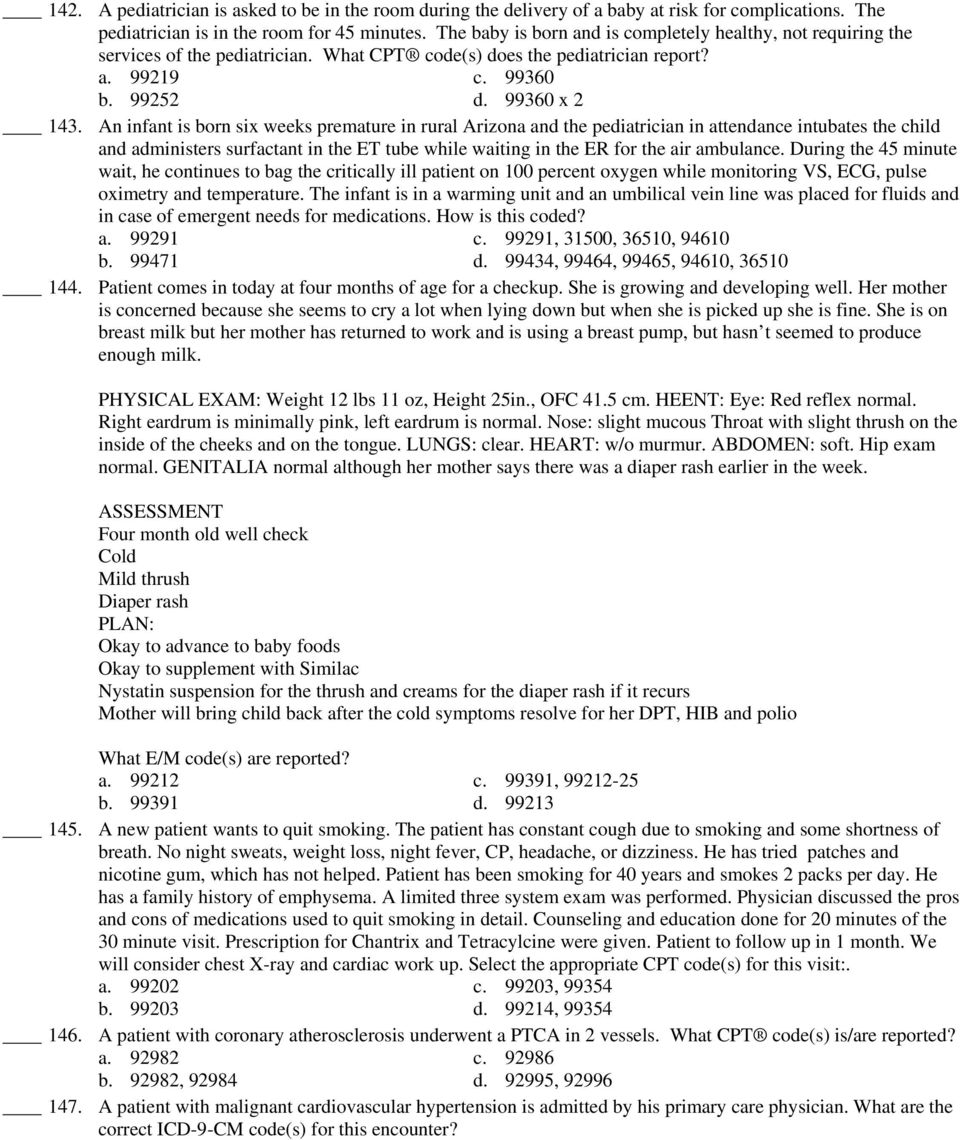
18 142. A pediatrician is asked to be in the room during the delivery of a baby at risk for complications. The pediatrician is in the room for 45 minutes. The baby is born and is completely healthy, not requiring the services of the pediatrician. What CPT code(s) does the pediatrician report? a c b d x An infant is born six weeks premature in rural Arizona and the pediatrician in attendance intubates the child and administers surfactant in the ET tube while waiting in the ER for the air ambulance. During the 45 minute wait, he continues to bag the critically ill patient on 100 percent oxygen while monitoring VS, ECG, pulse oximetry and temperature. The infant is in a warming unit and an umbilical vein line was placed for fluids and in case of emergent needs for medications. How is this coded? a c , 31500, 36510, b d , 99464, 99465, 94610, Patient comes in today at four months of age for a checkup. She is growing and developing well. Her mother is concerned because she seems to cry a lot when lying down but when she is picked up she is fine. She is on breast milk but her mother has returned to work and is using a breast pump, but hasn t seemed to produce enough milk. PHYSICAL EXAM: Weight 12 lbs 11 oz, Height 25in., OFC 41.5 cm. HEENT: Eye: Red reflex normal. Right eardrum is minimally pink, left eardrum is normal. Nose: slight mucous Throat with slight thrush on the inside of the cheeks and on the tongue. LUNGS: clear. HEART: w/o murmur. ABDOMEN: soft. Hip exam normal. GENITALIA normal although her mother says there was a diaper rash earlier in the week. ASSESSMENT Four month old well check Cold Mild thrush Diaper rash PLAN: Okay to advance to baby foods Okay to supplement with Similac Nystatin suspension for the thrush and creams for the diaper rash if it recurs Mother will bring child back after the cold symptoms resolve for her DPT, HIB and polio What E/M code(s) are reported? a c , b d A new patient wants to quit smoking. The patient has constant cough due to smoking and some shortness of breath. No night sweats, weight loss, night fever, CP, headache, or dizziness. He has tried patches and nicotine gum, which has not helped. Patient has been smoking for 40 years and smokes 2 packs per day. He has a family history of emphysema. A limited three system exam was performed. Physician discussed the pros and cons of medications used to quit smoking in detail. Counseling and education done for 20 minutes of the 30 minute visit. Prescription for Chantrix and Tetracylcine were given. Patient to follow up in 1 month. We will consider chest X-ray and cardiac work up. Select the appropriate CPT code(s) for this visit:. a c , b d , A patient with coronary atherosclerosis underwent a PTCA in 2 vessels. What CPT code(s) is/are reported? a c b , d , A patient with malignant cardiovascular hypertension is admitted by his primary care physician. What are the correct ICD-9-CM code(s) for this encounter?
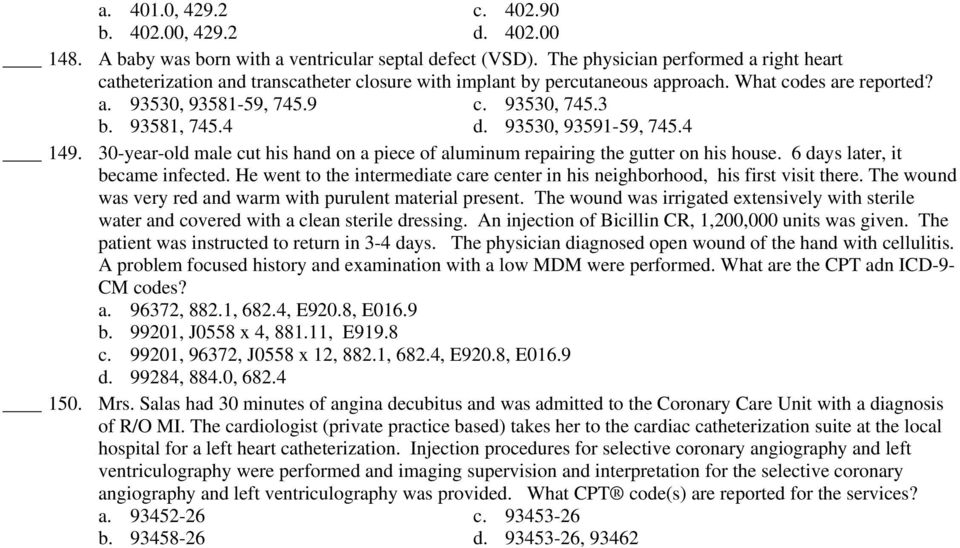
19 a , c b , d A baby was born with a ventricular septal defect (VSD). The physician performed a right heart catheterization and transcatheter closure with implant by percutaneous approach. What codes are reported? a , , c , b , d , , year-old male cut his hand on a piece of aluminum repairing the gutter on his house. 6 days later, it became infected. He went to the intermediate care center in his neighborhood, his first visit there. The wound was very red and warm with purulent material present. The wound was irrigated extensively with sterile water and covered with a clean sterile dressing. An injection of Bicillin CR, 1,200,000 units was given. The patient was instructed to return in 3-4 days. The physician diagnosed open wound of the hand with cellulitis. A problem focused history and examination with a low MDM were performed. What are the CPT adn ICD-9- CM codes? a , 882.1, 682.4, E920.8, E016.9 b , J0558 x 4, , E919.8 c , 96372, J0558 x 12, 882.1, 682.4, E920.8, E016.9 d , 884.0, Mrs. Salas had 30 minutes of angina decubitus and was admitted to the Coronary Care Unit with a diagnosis of R/O MI. The cardiologist (private practice based) takes her to the cardiac catheterization suite at the local hospital for a left heart catheterization. Injection procedures for selective coronary angiography and left ventriculography were performed and imaging supervision and interpretation for the selective coronary angiography and left ventriculography was provided. What CPT code(s) are reported for the services? a c b d , 93462
20 2012 Final and answers Answer Section MULTIPLE CHOICE 1. ANS: C Rationale: Accurate and thorough diagnosis coding is important for Medicare Advantage (Part C) claims because reimbursement is impacted by the patient s health status. The Centers for Medicare and Medicaid Services-hierarchical condition category (CMS-HCC) risk adjustment model provides adjusted payments based on a patient s diseases and demographic factors. If a coder does not include all pertinent diagnoses and co-morbidities, the provider may lose out on additional reimbursement for which he is entitled. 2. ANS: D Rationale: Healthcare providers are responsible for developing Notices of Privacy Practices and policies and procedures regarding privacy in their practices. 3. ANS: A Rationale: A covered entity may obtain consent of the individual to use or disclose protected health information to carry out treatment, payment, or health care operations. 4. ANS: C Rationale: The following list of components, as set forth in previous OIG Compliance Program Guidance for Individual and Small Group Physician Practices, can form the basis of a voluntary compliance program for a physician practice: Conducting internal monitoring and auditing through the performance of periodic audits; Implementing compliance and practice standards through the development of written standards and procedures; Designating a compliance officer or contact(s) to monitor compliance efforts and enforce practice standards; Conducting appropriate training and education on practice standards and procedures; Responding appropriately to detected violations through the investigation of allegations and the disclosure of incidents to appropriate Government entities; Developing open lines of communication, such as (1) discussions at staff meetings regarding how to avoid erroneous or fraudulent conduct and (2) community bulletin boards, to keep practice employees updated regarding compliance activities; and Enforcing disciplinary standards through well-publicized guidelines. These seven components provide a solid basis upon which a physician practice can create a compliance program. 5. ANS: D Rationale: Members shall use only legal and ethical means in all professional dealings and shall refuse to cooperate with, or condone by silence, the actions of those who engage in fraudulent, deceptive or illegal acts. 6. ANS: C Rationale: Medicare Part D is a prescription drug coverage program available to all Medicare beneficiaries. Private companies approved by Medicare provide the coverage.
21 7. ANS: D Rationale: The definition of health plan in the HIPAA regulations exclude any policy, plan, or program that provides or pays for the cost of excepted benefits. Excepted benefits include: Coverage only for accident, or disability income insurance, or any combination thereof; Coverage issued as a supplement to liability insurance; Liability insurance, including general liability insurance and automobile liability insurance; Workers compensation or similar insurance; Automobile medical payment insurance; Credit-only insurance; Coverage for on-site medical clinics; Other similar insurance coverage, specified in regulations, under which benefits for medical care are secondary or incidental to other insurance benefits. 8. ANS: C Rationale: The OIG outlines a review of industry practices related to the number of evaluation and management services provided by physicians and reimbursed as part of the global surgery fee. 9. ANS: C 10. ANS: A 11. ANS: D 12. ANS: B 13. ANS: A 14. ANS: A 15. ANS: B 16. ANS: B 17. ANS: B 18. ANS: B 19. ANS: A 20. ANS: C 21. ANS: B 22. ANS: C 23. ANS: B Rationale: Per ICD-9-CM Official Guidelines for Coding and Reporting: In the context of these guidelines, the term provider is used throughout the guidelines to mean physician or any qualified health care practitioner who is legally accountable for establishing the patient s diagnosis. 24. ANS: A Rationale: In the Volume II index look up Injury. There is a Note that lists examples of a superficial injury: Abrasion, insect bite (nonvenomous), blister, or scratch. 25. ANS: B
22 Rationale: Per the coding guideline Section I.C.1.a.1., confirmation does not require documentation of positive serology or culture for HIV; the provider s diagnostic statement that the patient is HIV positive, or has an HIV-related illness is sufficient. 26. ANS: D Rationale: Per the guidelines Section I.C.18.d.7, use aftercare codes after the patient has received active treatment of the fracture and is receiving routine care for the fracture during the healing or recovery phase. 27. ANS: B Rationale: Per ICD-9-CM Official Guidelines for Coding and Reporting, the instructions and conventions of the classification take precedence over guidelines. 28. ANS: B Rationale: ICD-9-CM, Section.I.B.12 coding guidelines indicate the coding of late effects generally requires two codes sequenced in the following order: The condition or nature of the late effect is sequenced first ( Spastic cerebral palsy). The late effect code is sequenced second (326 Meningitis). The code for the acute phase of an illness or injury that led to the late effect is never used with a code for the late effect. In Volume II look up Palsy/cerebral/spastic guiding you to code ; Late/effect/meningitis/unspecified cause-see Category ANS: C Rationale: In Volume II index look up Polyneuropathy/in/sarcoidosis guiding you to codes 135 [357.4]. Code is a manifestation code. In the Tabular List the description is Polyneuropathy in other diseases classified elsewhere. There s an instructional note to Code first underlying disease as: Sarcoidosis (135) is one of the diseases listed 30. ANS: D Rationale:. In Volume II index look up Lump/breast guiding you to code , Next, look up, History/family/malignant neoplasm/breast guiding you to code V16.3. According to Section IV.K, history codes (V10-V19) may be used as secondary codes if the historical condition or family history has an impact on current care or influences treatment. 31. ANS: A Rationale: ICD-9-CM coding guideline I.B.13 tells us to reference the Alphabetic Index to determine if the condition has a subentry for impending or threatened and also reference main term entries for Impending and Threatened. If the subterms are listed, assign the given code. If the subterms are not listed, code the existing underlying condition(s) and not the condition described as impending or threatened. 32. ANS: A Rationale: Methicillin-resistant Staphylococcus aureus (MRSA) infection is caused by a strain of staph bacteria that's become resistant to the antibiotics commonly used to treat ordinary staph infections. In the alphabetic index look up Infection/ staphylococcal/ aureus/ methicillin / resistant (MRSA).
23 33. ANS: A Rationale: Per the ICD-9-CM guidelines, Section I.C.3.a.2, when the type is not documented the default type it Type II. 34. ANS: D Rationale: In the alphabetic index look up Glomerulonephritis/due to or associated with infectious hepatitis guiding you to codes [580.81]. Category 070 is further divided into types of hepatitis (A, B,C) is coded first if we do not have a classification of the type of hepatitis. In the tabular index, code has a code first instructional note to first code infectious hepatitis ( ). Your primary coded will be 070.1, for Viral Hepatitis A without mention of hepatic coma followed by for the manifestation. 35. ANS: B Rationale: Per ICD-9-CM guidelines, I.C.7.a.2, If the documentation does not have a casual relationship between the hypertension and heart disease (eg. Cardiomegaly due to the hypertension) then the conditions are coded separately. 36. ANS: D Rationale: In the alphabetic index look up foreign body/retained/retina guiding you to code Subcategory code has instructions to use an additional code to identify the foreign body (V V90.10, V90.12, V90.2-V90.9). V90.10 identifies a retained metal fragment, unspecified. 37. ANS: D Rationale: Traumatic fractures will always be coded from categories A compound fracture is a type of open traumatic fracture found listed under the main term Fracture in the Index to Diseases. Pathologic fracture is another term for stress fracture. Malunion fracture is indexed to Stress Fracture is indexed to ANS: B Rationale: ICD-9-CM guideline I.C.19.a.1 General E Code Coding Guidelines instructions state An E code from categories E800-E999 may be used with any code in the range of 001-V91, which indicates an injury, poisoning, or adverse effect due to an external cause. 39. ANS: D Rationale: In the alphabetic index look up Disease, diseased/nail referring you to code In the Tabular List code is in Chapter 12, Diseases of the Skin and Subcutaneous Tissue. 40. ANS: B Rationale: In the alphabetic index look up Hypertrophy/prostate/benign/with/urinary/retention guiding you to code There are instructions below code to Use additional code to identify symptoms. Code is listed as the second code to identify urinary retention.
24 41. ANS: B Rationale: In the Index to Diseases look up Examination/health (of) child, routine which refers you to code V20.2. Per ICD-9-CM guidelines, Section I.C.18.d.13, The infant is coming in for a general check-up. During a routine exam, should a diagnosis or condition be discovered, it should be coded as an additional code. The second code is found in the Index to Diseases by looking for Rash/diaper. All codes should be verified in the Tabular List. 42. ANS: C Rationale: ICD-9-CM Coding guidelines I.C.17.c.1.a state sequence first the code that reflects the highest degree of burn when more than one burn is present. In this case, the burns on her chest and arms are third degree and should be reported first. In the Index to Diseases, look for Burn/chest/third degree referring you to code ; Burn/arm(s)/ third degree guiding you to code ; Burn/legs/second degree guiding you to code Refer to ICD-9-CM guidelines Section I.C.17.c.6 for instructions on assigning a code from category 948. The fourth digit represents the total body surface area (all degrees) that was burned. The fifth digit represents the percentage of third degree burns to the body. In the scenario 38% is documented as the TBSA, making 3 as the fourth digit; 20% is third degree burns making 2 as the fifth digit. E codes would also be reported for the accident. 43. ANS: B Rationale: Per ICD-9-CM guidelines, Section I.C.18.d.7, Aftercare visit codes cover situations when the initial treatment of a disease or injury has been performed and the patient requires continued care during the healing or recovery phase, or for the long-term consequences of the disease. The aftercare codes are generally first listed to explain the specific reason for the encounter. Aftercare codes should be used in conjunction with any other after care codes or other diagnosis codes to provide better detail on the specifics of the aftercare. Look in the Index to Diseases for Aftercare/specified type NEC. To detail the burn, look for Burn/arm/second degree. Verify all codes in the Tabular List. 44. ANS: A Rationale: In the Index to Diseases, look for Hemorrhage/traumatic/recurring or secondary guiding you to code You will not code since that will be reported for the first visit indicating that is when the acute injury was diagnosed. 45. ANS: D Rationale: In the Index to Diseases look for Pregnancy/management affected by fetal/bradycardia guiding you to code 659.7x. Turn to the Tabular List. Fifth digit 3 is reported to indicate an antepartum condition or complication. Pregnancy after age 35 is considered an elderly pregnancy. Pregnancy/management affected by abnormal/advanced maternal age/multigravida (because this is her second child) guiding you to code 659.6x. Turn to the Tabular List. Fifth digit 3 is reported to indicate an antepartum condition or complication, Code V23.82 is only reported when there are no complications reported. 46. ANS: A Rationale: Per CMS - Relative value units (RVUs) RVUs capture the three following components of patient care: Physician work RVU, Practice Expense RVU, and Malpractice RVUs.
25 47. ANS: D Rationale: Per AMA, no relative value units (RVUs) are assigned to these codes. Payment for these services or procedures is based on the policies of payers. 48. ANS: D. Rationale: HCPCS Level II codes consist of permanent national codes, miscellaneous codes, dental codes, and temporary national codes. 49. ANS: A Rationale: In the CPT Index, first look up Anesthesia then knee. You are given multiple codes to choose from. When you turn to these codes in the Anesthesia section and review them, it is code you would report. This represents Anesthesia for arthroscopic procedures performed on the knee. 50. ANS: C Rationale: In the CPT Index, first look up Excision then nail fold. The code you are directed to use is ANS: B Rationale: In the CPT Index, first look up Cast then short arm. The code you are directed to use is ANS: D Rationale: In the CPT Index, first look up Laparoscopy, colectomy and partial. Here you are directed to see codes and When you turn to these codes in the Digestive code section and review them, it is code which represents a partial colectomy with anastomosis and coloproctostomy performed laparoscopic ally. 53. ANS: B Rationale: In the CPT Index, first look up Strabismus, repair and two horizontal muscles. The code you are directed to use is ANS: B Rationale: Carbuncles and furuncles (boils) typically are caused by a staphylococcal infection. Several furuncles together make up a carbuncle and often involve a group of hair follicles. 55. ANS: B Rationale: In the ICD-9-CM Index to Diseases, see Wound/open/non-healing surgical. There is no mention of an infection, code is not appropriate to report. 56. ANS: B
26 Rationale: Using the index in CPT under injection/lesion you are directed to CPT Code selection is based on the number of lesions treated, not the number of injections. In this case one lesion is treated, making the correct code. Using the HCPCS Index or the Table of Drugs find code J3301 for Kenalog 40-mg. Verify the code in the J code section. Using the ICD-9-CM Index to Diseases, Keloid directs you to 701.4, Keloid scar. Verify the code in the Tabular List. 57. ANS: B Rationale: In the CPT Index, see Shaving/Skin Lesion, you are directed to range Code selection is based on location and size. This lesion is on the left cheek narrowing the range to The size is 1.8 cm making the correct code choice. 58. ANS: B Rationale: In the CPT Index, Advancement Flap directs you to Skin, Adjacent Tissue Transfer, directing you to code range Adjacent tissue transfer or rearrangement includes lesion excision and is selected based on size and location. The defect is 11 cm x 5 cm (55 cm 2 ) and located on the knee. Due to the size being 55 sq cm, the correct code is ANS: B Rationale: The wound was prepped with sharp debridement. Look in the CPT Index for Creation/recipient site (range ). Code selection is based on location and size. Then a split thickness graft was performed. Look in the CPT Index for Skin Graft and Flap/Split Graft referring you to range The measurement applies to the recipient area, which is stated as 60 cm². A split thickness autograft to the foot for the first 100 sq cm is coded with The operative note states, The homograft is taking quite nicely, the wounds appear to be fairly clean; he is ready for autografting, indicating this is a staged procedure and modifier 58 is appended. In the ICD-9-CM Index, see Diabetic/ulcer/foot, directing you to 250.8X [707.15]. The 5 th digit 0 indicates it is Type II diabetes. Although there are complications, it does not indicate it is uncontrolled is used for ulcer of the foot. 60. ANS: D Rationale: In the CPT Index, first look up Arthroscopy/Surgical/Shoulder. Here you are directed to see codes When you turn to these codes in the Surgery section to review them, it is code you would report. This represents an arthroscopy on the shoulder to remove loose bodies. 61. ANS: D Rationale: The acromion is an extension of the scapula that meets the clavicle at the shoulder to form the acromioclavicular joint. 62. ANS: D Rationale: The supraspinatus muscle is part of the rotator cuff, and the injury is listed under tear. Although it is a shoulder injury, this definition is not specific enough, and neither is the sprain code. 63. ANS: B
27 Rationale: This is a supracondylar fracture of the elbow repaired by percutaneous fixation. In the CPT index, look up Fracture/Humerus/Supracondylar/Percutaneous Fixation, ANS: B Rationale: Anterior approach is used to perform several procedures on the cervical spine. The corpectomy has the highest RVUs and is listed first. Code is the removal of one single cervical segment. Arthrodesis, anterior interbody technique is coded with Plates are used for anterior instrumentation and placed over a total of five segments (C2, C3, C4, C5, and C6), Modifier 51 is appended to to indicate multiple procedures. The application of the titanium cages is described by add-on code 22851; and the morselized allograft is described by both of which are modifier 51 exempt. 65. ANS: A Rationale: The 4-cm mass was removed from the soft tissue of the shoulder. To access the mass, the provider had to go through the proximal aspect of the teres minor (muscle). The mass was located distal to the inferior glenohumeral ligament (IGHL). Masses that are removed from joint areas as opposed to masses removed close to the skin require special knowledge and become more of an orthopedic concern due to joint involvement. Therefore, it is coded from codes within the orthopedic section is used because dissection was carried through the proximal aspect of the teres minor. 66. ANS: D Rationale: In the CPT index, look up Hematoma/Leg, Upper. You are referred to Verify the code for accuracy. Modifier 78 is appended to to indicate that an unplanned procedure related to the initial procedure was performed during the postoperative period. In the ICD-9-CM index, look up Complications/surgical procedures/hematoma. You are referred to Review the code in the tabular section for accuracy. 67. ANS: A Rationale: When reporting the removal of hardware (pins, screws, nails, rods), the code is selected by fracture site, not the number of items removed or the number of incisions that are made. To report or more than once, there would need to be more than one fracture site involved. In this case, there is only one fracture site even though two incisions are made. We know the removal is deep because the screws were in the bone. From the CPT index, look up Removal/Implantation. The correct code is ANS: A Rationale: Look in your HCPCS book for Kenolog-40 in the Table of Drugs, J3301and then check the tabular listing to verify. This eliminates choices B, C. and D. For the CPT code, look in the CPT index under Injection/Carpal Tunnel/Therapeutic, ANS: D Rationale: In the CPT Index, look up Sinusotomy/Frontal Sinus/Nonobliterative and you are directed to code range Code selection is based on whether it is a brown incision or coronal incision is the correct code.
28 70. ANS: C Rationale: The procedure performed now is a secondary rhinoplasty. In the CPT Index, look up Rhinoplasty/ Secondary, which directs you to code range Code selection is based on the reason for the repair and the extensiveness of the repair reports a secondary revision including osteotomies and nasal tip work. 71. ANS: A Rationale: Epistaxis is the term for nasal hemorrhage. In the CPT Index look up Packing/Nasal Hemorrhage which directs you to code range represents anterior packing for an uncontrolled or extensive nasal hemorrhage. Modifier 50 indicates this was done in both nares (bilaterally). ICD-9-CM indexing is Epistaxis which leads us to code ANS: B Rationale: We are removing a segment of the lung. In the CPT Index, look up remova/lung and then single segment. This directs us to use code We have a confirmed diagnosis of apical lung cancer which is code We find this by looking in the neoplasm table under lung/apical. In the primary malignant column we are directed to code ANS: B Rationale: Heart valves are made of flaps (cusps/leaflets) opening and closing like one way swinging doors, preventing blood from flowing back. 74. ANS: B Rationale: The left main coronary artery branches into two slightly smaller arteries: the left anterior descending coronary artery and the left circumflex coronary artery. 75. ANS: B Rationale: The Category III code states involving a visceral vessel, such as the renal artery. The directions under 0079T state Use 0079T in conjunction with 0078T. Code 0078T reports the endovascular repair of the abdominal aortic aneurysm, and 0079T reports the visceral extension prosthesis. This can be found in the CPT index under Aneurysm Repair/Abdominal Aorta. 76. ANS: D Rationale: CPT guidelines state, when the battery of a pacemaker is changed, it is actually the pulse generator that is changed. It is reported with one code. Look in the CPT index for Pacemaker, Heart/Replacement/Pulse Generator. Code is reported for dual chamber (dual lead system). 77. ANS: C
29 Rationale: Moderate sedation is bundled, so it is not reported. Code is for an open procedure. Venoplasty includes three zones for AV fistulas: the A/V graft and peripheral veins, the central veins, and the vena cava. Only one venoplasty is reported for the A/V graft and peripheral veins. Read the guidelines above 36147, Interventions for Arteriovenous (AV) Shunts Created for Dialysis (AV Grafts and AV Fistulae) for guidance. Code is found in the CPT index under Percutaneous Transluminal Angioplasty/Venous. Modifier 26 reports the professional services. 78. ANS: D Rationale: CPT guidelines under Vascular Injection Procedures indicate the above-listed in d as being included. 79. ANS: C Rationale: The studies performed make up a comprehensive study (93620) which includes: evaluation with right atrial pacing and recording, right ventricular pacing and recording, and His bundle recording with induction of or attempted induction of arrhythmia. Left atrial pacing and recording (93621) and left ventricular pacing and recording (93622) are add-on codes. This is found in the CPT index under Heart/Electrical Recording/Comprehensive. 80. ANS: D Rationale: One arterial graft and one vein graft was performed. Look in the CPT index for Coronary Artery Bypass Graft (CABG),/Arterial-Venous for range Then look under Arterial This was a combination arterial-venous graft with one vein graft (33517) and one an arterial graft (33533). The upper extremity radial artery graft procurement (35600) is separately reportable. Codes and are add-on codes and are modifier 51 exempt. 81. ANS: A Rationale: Stent placement (92980) and IVUS (92978) are reportable. No 51 modifier on IVUS as it is an add-on code. IVUS is reported for each vessel when performed in multiple vessels; therefore, RC is appended to to indicate the right coronary artery. The stent procedure is found in the CPT index under Coronary Artery/Insertion/Stent IVUS is found in the CPT index under Vascular Procedures/Intravascular Ultrasound/Coronary Vessels ANS: A Rationale: Code represents obesity, unspecified. At code category 278.0, we have an instructional note, which tells us to Use additional code to identify Body Mass Index (BMI) if known. Code V85.32 represents an adult BMI of ANS: D Rationale: Code represents the direct percutaneous placement of a gastrostomy tube. We would not code for the partial esophagectomy (43116) as it was not performed at this time but was done prior to the tube placement. 84. ANS: B
30 Rationale: Ligation of esophageal varices laparoscopically is coded with CPT code The patient has cirrhosis (571.5) as well and is coded along with for the esophageal varices. 85. ANS: A Rationale: Code represents the portion of the liver taken from the donor to be allotransplanted. Codes and 4147 represent the backbench work. We have a vein and a artery anastomosed so we only report each of these codes one time. The final code of represents the orthotopic allotransplantation into the patient. 86. ANS: A Rationale: Bladder repair (51860) does not describe closure of exstrophy, nor was there closure of a cystostomy (51880). When reporting the closure of the exstrophy of bladder, you are instructed to also see CPT 54390, which describes a closure of bladder exstrophy with plastic operation on penis for epispadias. As epispadias repair was performed, code would be the correct code to report. 87. ANS: D Rationale: When a circumcision is performed requiring tissue transfer or reconstruction, you report the circumcision and the tissue transfer codes. You do not append modifier 22 to the circumcision code, nor do you report the tissue transfer, alone. Reporting repair of an incomplete circumcision is also incorrect, as there was no previous circumcision performed. 88. ANS: C Rationale: Reporting would be incorrect as the description is for simple cystometrogram. Also, CPT is an add-on code and per description can only be added when CPT or are reported. As the procedures were performed in the office setting, under the direct supervision of the physician, you would not append a modifier to the procedures. 89. ANS: D Rationale: Laser vaporization is coded using CPT 52648, describes laser coagulation of the prostate and laser enucleation of the prostate. As the biopsy would usually not be reported at the same time of the laser procedure, the operative report clearly states that this is a separate procedure from the GreenLight and should be reported separately. Because the site of biopsies were fulgurated, CPT would be the correct code, with modifier 59 appended. 90. ANS: D Rationale: In the Index see Cyst/Kidney/Excision. CPT description of states cyst(s) and therefore, CPT would not be reported 3 times, nor would any modifier be appended. CPT describes the excision of perinephric cyst and describes open removal of a kidney stone. 91. ANS: B Rationale: Colp/o refers to the vagina.
31 92. ANS: D Rationale: The Bartholin s gland glands (also called the greater vestibular glands) are located slightly below and to either side of the vaginal introitus. The Fallopian tubes are two tubes, one on either side of the uterus, leading from the bilateral ovaries into the uterus. 93. ANS: C Rationale: Marsupialization is a procedure where a scalpel is used to cut an opening in the top of the abscess pocket. The leaflets created by this procedure are pulled away from the pocket and attached to the surrounding skin with stitches or glue. This creates an open pouch to help prevent recurrence of the abscess. Marsupialization of the Bartholin s gland is coded with CPT code ANS: A Rationale: The vulva is not a bilateral structure, so removal of 50% of the tissue is a partial vulvectomy. Read the definitions in CPT at the beginning of the section: Vulva, Perineum, and Introitus. 95. ANS: D Rationale: VIN III is coded as cancer in situ. The other VINs listed are coded as hyperplasia and adenocarcinoma is a primary malignancy. 96. ANS: B Rationale: In the CPT index, look under IVF and you are directed to See Artificial Insemination; In Vitro Fertilization. IVF stands for In Vitro Fertilization. 97. ANS: C Rationale: There is no indication this was an induced abortion. A missed abortion does not usually occur with passage of material and tissue, it is silent. kthis is considered a spontaneous abortion or miscarriage. 98. ANS: A Rationale: Patient is having a laparoscopic tubal ligation, her fallopian tubes (oviduct) are surgically blocked off (occlusion) with a falope ring to prevent pregnancy (permanent sterilization). To find the CPT code, look in the index under Laparoscopy/Oviduct Surgery will guide you to codes , Reviewing the codes, is the correct code for the procedure being performed. 99. ANS: D Rationale: Due to the patient having cervical cancer metastasized to the pelvic area (gynecological malignancy) the procedure performed is a pelvic exenteration. This is a total hysterectomy with removal of ovaries and fallopian tubes (salpingo-oophorectomy). This includes the removal of her bladder (cystectomy) with creation of a passageway to drain the kidneys through an opening on the abdomen (ileal conduit) and partial removal of the large bowel or colon (resection of the rectum and colon). This procedure is indexed under, Exenteration/Pelvis guiding you to codes and Code is the only code needed to report this surgical procedure. Reporting the other codes would be considered unbundling.
32 100. ANS: C Rationale: The physician can bill for this service separately ANS: A Rationale: The four lobes of the brain are the Frontal lobe, Parietal Lobe, Temporal Lobe, and Occipital Lobe ANS: A Rationale: Acromegaly is characterized by enlarged skeletal parts, especially the nose, ears, jaws, fingers, and toes; caused by hypersecretion of growth hormone (GH) from the pituitary gland ANS: D Rationale: Hemi is half. Hemiplegia is paralysis affecting one side of the body ANS: D Rationale: Documentation shows a single injection was given at the sacral level. Neither a catheter nor a device is documented as being used. In the CPT Index, look for Epidural, Injection. Single injection codes are selected based on the level of the spine injected. The lumbar sacral area is ANS: A Rationale: Excision of the thymus gland is a thymectomy and is coded based on the approach. Code is for a transcervical approach, as documented. In the index, Thymectomy/Transcervical Approach ANS: B Rationale: In the CPT Index, look for Decompression/Nerve Root, and you are directed to a series of codes. The transpedicular approach is defined by codes specifies the lumbar spine is used for the second segment ANS: B Rationale: A laminotomy is also known as a hemilaminectomy. In the CPT Index, look under Hemilaminectomy and you are directed to code range In the ICD-9-CM Index, look under Hernia/Intervertebral Disc and you are directed to see Displacement/Intervertebral Disc. For the cervical spine, the code is ANS: B Rationale: Codes for the injection of an anesthetic and/or steroid are selected based on the location and number of levels. Code is for injection of the lumbar, single level L3-L4; and is the add-on code for the additional level L-4-L-5. Modifier 50 Bilateral procedure is appended to both codes as the injection was on both sides ANS: D
33 Rationale: In the CPT index, look up Nerves/Injection/Anesthetic. You are referred to or Review the codes to choose appropriate service is the correct code since the anesthetic was injected into the epidural space in one single level (L5-S1) in the transforaminal approach ANS: B Rationale: In the CPT Index, look for Injection/Paravertebral Facet Joint/Nerve with Image Guidance and you are directed to Code selection is based on the section of the spine (lumbar) and the levels injected (3). Modifier 50 is appended since it is bilateral. In the ICD-9-CM Index, look for pain, lumbar and you are directed to ANS: B Rationale: Two co-surgeons performed distinct parts of the same surgery. The surgery performed is a vertebral corpectomy, thoracic. Look in the CPT Index for Vertebral/Corpectomy and you are directed to code range , are for excision of intraspinal lesions. The code selection for is based on location, approach and number of vertebral segments is for a transthoracic approach, thoracic, single segment. The additional two segments are reported with As indicated by the guidelines for this section, each provider will report the same CPT code and append a modifier ANS: D Rationale: is the correct code to report the digital nerve was repaired is the correct secondary code since there was an additional digital nerve that needed repair. 51 is not appended to the secondary code since this code is an add-on code and add-on codes are modifier 51 exempt. (Index: Suture/Nerve.) 113. ANS: D Rationale: In the CPT Index, look for Biopsy/Spinal Cord/Percutaneous and you are directed to code In the ICD-9-CM, Syringomyelia indexes to Verification in the Tabular List confirms code selection ANS: A Rationale: is the correct code since a spinal puncture was performed in the lumbar region(l4 and L5). It was done to withdraw cerebral spinal fluid for testing to determine if the patient had meningitis (diagnostic) ANS: B Rationale: IOL stands for intraocular lens ANS: C Rationale: Code is the appropriate code for drainage of an abscess of the external auditory canal of the ear. The physician makes an incision in the skin and drains an abscess in the external auditory canal ANS: C
34 Rationale: Code is the appropriate code for the removal of a foreign body from the external auditory canal without general anesthesia. Under direct visualization, the foreign body is removed from the external auditory canal using delicate forceps, a cerumen spoon, or suction. No anesthetic or local anesthetic is used ANS: A Rationale: In the ICD-9-CM Index, look for Ptosis, eyelid, and you are directed to Verification in the Tabular List confirms code selection ANS: B Rationale: is the correct code since the biopsy was taken from the left ear in the auditory canal ANS: B Rationale: Appendix or Appendectomy is not listed separately under the Anesthesia Section. The anesthesia code selections are under Abdomen in the CPT Index, Anesthesia/Abdomen. Coder will need to know the appendix is an intraperitoneal organ located in the lower abdomen to assign the correct anesthesia code, ANS: A Rationale: Cholecystectomy is not listed separately in the Anesthesia Section. The anesthesia code selections are listed under Anesthesia/Abdomen in the Index. Coder will need to know cholecystectomy refers to the gallbladder, which is an Intraperitoneal organ located in the upper abdomen to assign the correct anesthesia code, The same code is reported whether the cholecystectomy is an open procedure, or performed laparoscopically. Hint If your anatomy is not up to par, try looking up the surgical code for a cholecystectomy. The Tabular Listing offers an anatomical illustration of the gallbladder removal ANS: C Rationale: indicates the coder went to the Index and referenced Complications/pregnancy and stopped looking. This is not the correct code and it requires a fifth digit indicates complications affecting fetus or newborn. Coding notes in the Tabular listing for acute renal failure (586) state Excludes following labor and delivery (669.3). When referencing the Tabular listing for 669.3, the coder sees it requires a 5th digit 2 to indicate delivered, with mention of postpartum complication ANS: C Rationale: Although not typically reported by physicians, insurance companies may require specific modifiers. The modifier 73 best describes an anesthesia service discontinued prior to administration of anesthesia in an ASC ANS: D
35 Rationale: Determining the base value is the first step in calculating anesthesia charges and payment expected. Time reporting is the second step. Anesthesia time begins when the anesthesiologist begins to prepare the patient for anesthesia in either the operating room or an equivalent area. Anesthesia time ends when the anesthesiologist is no longer in personal attendance. Ending time is generally reported when the patient is safely placed under postoperative supervision, usually in the Post Anesthesia Care Unit (PACU) or equivalent area. Physical status modifiers and/or qualifying circumstances may also be added to the charge. In the scenario above, Base units equal ten (10) plus one (1) physical status modifier unit (Base 10 + PS 1 = 11 units). Seven (7) time units, in fifteen minute increments, is calculated by taking the anesthesia start time (11:02) and the anesthesia end time (12:47) and determining one hour 45 minutes (105/15 = 7) of total anesthesia time. Eighteen units ( = 18) are then multiplied by the $100 conversion factor (18 X $100 = $1,800.00) ANS: B Rationale: Coder may look in the Index under Anesthesia/Neck or Integumentary/Neck to determine the range of codes related to the neck. A P3 modifier may be reported for a patient with severe systemic disease ANS: A Rationale: Coder must look under Anesthesia/Heart in the Index or Anesthesia/Intrathoracic System. Check this listing with the Anesthesia Subsection, Intrathoracic to determine is the correct code reported for patient s age and without use of a pump oxygenator. The arterial line placement is NOT reported as the perfusionist, not the anesthesia provider, performed it ANS: A Rationale: A CRNA with medical direction is appropriately reported with a modifier -QX ANS: B Rationale: According to Anesthesia guidelines, time begins when the anesthesiologist begins to prepare the patient for the induction of anesthesia (08:30) and ends when the patient is transferred to recovery (10:15). In this case, it is a total of 1 hour and 45 minutes. Anesthesia for a tubal ligation is reported with ANS: A Rationale: The procedure performed is a PET-CT scan. The appropriate code is selected based on the anatomical location of the study. In this scenario, we know the test was performed on the skull base to the mid thigh. In the Index, see Nuclear Medicine/Tumor Imaging/Positron Emission/with Computed Tomography. According to CPT coding guidelines, the IV administration of FDG is not reported separately. It is bundled in the service for the radiology procedure ANS: A Rationale: A biophysical test (BPP) measures the health of the fetus during pregnancy. Points are given (0, 1 or 2) in five areas (fetal movement, tone, breathing, amniotic fluid volume). A non-stress test (NST) monitors the baby's heart rate over a period of 20 minutes or more looking for accelerations with baby's movement. Since fetal non-stress test is included in code 76818, code 59025, Fetal non-stress test, should not be reported separately.
36 131. ANS: C Rationale: Patient is having stereotactic radiation therapy technique delivered, not managed, in a large radiation dose to tumor sites in the upper right lobe of the lung. In the CPT index see Radiation Therapy/Stereotactic/Body. According to ICD-9-CM guidelines: Codes V58.0, Radiotherapy, and codes from subcategory V58.1, Encounter for chemotherapy and immunotherapy for neoplastic conditions. These codes are to be first listed, followed by the diagnosis code when a patient s encounter is solely to receive radiation therapy or chemotherapy for the treatment of a neoplasm. In the Index, see Encounter for/radiotherapy to find the V-code. In the Neoplasm table, see lung/upper lobe/malignant/primary ANS: D Rationale: Arthrocentesis is aspiration or injection with a needle involving a joint. According to CPT coding guidelines, when radiopharmaceutical therapy is performed, you should select a code for the injection as well as the radiological guidance. Because the injection is intra-articular, the radiopharmaceutical therapy is reported with The fluoroscopic image guidance for a joint injection is reported with Modifier 26 is appended to both radiology codes to report the professional services performed by the physician in the ASC setting. The joint injection was performed on the knee, which is considered a large joint reported with When multiple procedures are performed, they are listed in RVU order ANS: A Rationale: A radiographic study of the veins was performed in the inferior vena cava to visualize and evaluate any abnormalities. In the Index, see Venography/Vena Cava ANS: A Rationale: There are seven fractions given in this patient s weekly treatment. According to CPT guidelines: Radiation treatment management is reported in units of five fractions or treatment sessions, regardless of the actual time-period in which the services are furnished. Code is also reported if there are three or four fractions beyond a multiple of five at the end of a course of treatment, one or two fractions beyond a multiple of five at the end of a course of treatment are not reported separately. This instruction is found in CPT under the heading Radiation Treatment Management in the Radiology/Radiation Oncology Section of the Radiology Chapter ANS: D Rationale: This is a limited ultrasound performed on three fetuses. CPT code has in its code description the ultrasound is for 1 or more fetuses. There is also a parenthetical note stating: (Use only once per exam and not per element) 136. ANS: A Rationale: The fluorescent in situ hybridization or FISH test is a cytopathology test. You are directed to this by looking at FISH in the CPT Index ANS: C Rationale: Examination without microscopic sections is coded for all types of specimens. Code includes both gross and microscopic exam.
37 138. ANS: B Rationale: Code the panel anytime all of the tests listed in the panel are completed. If additional tests are also performed, they are coded separately. In the Index, see Blood Tests/Panels/Hepatic Function. Also, see Creatinine/Blood 139. ANS: B Rationale: Only the donor code is used. The specimen is being examined to identify a potential donor. The diagnosis of the potential recipient should not be coded. In the Index, see Donor/stem cells ANS: C Rationale: Code is specific for a urine test, (84703 and are typically performed on blood). Code is for obtaining a blood specimen and is inappropriate with a urine test. In the Index, see Pregnancy/Urinalysis ANS: C Rationale: The guidelines for Nursing Facility Services state, These codes should also be used to report evaluation and management services provided to a patient in a psychiatric residential treatment center ANS: C Rationale: The physician performed standby services. In the CPT Index, Look for Standby Services/Physician Services and you are directed to is reported based on time. Each 30 minutes is reported if only the entire 30 minutes is met with 1 unit is the correct code choice ANS: C Rationale: When neonatal services are provided in the outpatient setting, Inpatient Neonatal Critical Care guidelines direct the coder to use critical care codes Critical care, evaluation and management of the critically ill or critically injured patient; first minutes and each additional 30 minutes (List separately in addition to code for primary service). Care is documented as lasting 45 minutes with the physician in constant attendance. The physician also administered intrapulmonary surfactant (94610), placed an umbilical vein line (36510) and intubated the patient (31500). These services can be separately billed as they are not included in ANS: B Rationale: Documentation states the encounter is for a checkup, which is a Preventive Medicine Service. In the Index, see Preventive Medicine/Established Patient. Preventive Medicine Service codes are age specific. Although the child has a cold and thrush, additional history and exam elements beyond what is performed in the preventative exam are not documented. It would be inappropriate to bill for an additional E/M service with the modifier 25. See Appendix A description of modifier ANS: B
38 Rationale: Patient is coming to the doctor s office, wants to quit smoking. The patient is new. The physician documents 20 minutes of the 30 minute visit was spent counseling the patient. E/M Guidelines identify when time is considered the key or controlling factor to qualify for a E/M service. When counseling and/or coordination of care is more than 50% face to face time in the office or other outpatient setting, time may be used to determine the level of E/M. The correct code is based on the total time of the visit which is 30 minutes ANS: B Rationale: PTCA stands for percutaneous transluminal coronary angioplasty. In the Index, look for PTCA; you are directed to see Percutaneous Transluminal Angioplasty. Under Percutaneous Transluminal Angioplasty, Artery, Coronary, you are directed to code range Code is used for one vessel. Code is used to report the second vessel ANS: D Rationale: The Hypertension table indexes cardiovascular disease to in the malignant column. Guidelines Sec. I. C7 a.2 states code 402 is used when a causal relationship is stated or implied. Vol. 1 confirms code is correct, as heart failure is not specified ANS: B Rationale: In the CPT Index, see Septal Defect/Ventricular/Percutaneous you are directed to code Code includes right heart catheterization. It is not separately reported. VSD is a congenital condition (present at birth). In the ICD-9-CM Index see Defect/Ventricular septal, you are directed to Verification in the Tabular List confirms code selection ANS: C Rationale: The patient is a new patient to the clinic. Code selection is made from for the office visit. For a new patient, all three key components must be met. The clinic visit is reported as ICD-9- CM: The administration of the antibiotic is reported with In the Index, see Antibiotic Administration/Injection. The Bicillin CR is reported with J0558. The code descriptor for J0558 is 100,000 units. Report 12 units to correctly charge for the 1,200,000 units delivered to the patient, J0558 x 12. In the Index, see Wound, open/hand/complicated. The hand wound is coded as complicated due to the cellulitis (882.1). Cellulitis is in the Index under Cellulitis/hand (682.4). Report both and The Index to External Causes is a separate index, it is found right before the Tabular List of codes in ICD-9-CM. In the Index to External Causes see Cut, cutting/object, edged, pointed, sharp. The external cause of the injury is reported with E E016.9 is used to identify the activity. In the Index to External Causes, see Activity/maintenance/property ANS: B Rationale: Left heart catheterization in the Index refers you to Cardiac Catheterization, Left Heart. Cardiac Catheterization, Left Heart, with Ventriculography leads to 93452, , is for the left heart catheterization for left ventriculography alone includes coronary artery angiography, left heart catheterization and injection procedures for coronary angiography and left ventriculography with imaging supervision and interpretation. Modifier 26 is reported for the professional radiologic services.
Integumentary System Individual Exercises
 Integumentary System Individual Exercises 1. A physician performs an incision and drainage of a subcutaneous abscess in his office for a particularly uncooperative established patient. How should this
Spinal Arthrodesis Group Exercises
 Spinal Arthrodesis Group Exercises 1. Two surgeons work together to perform an arthrodesis. Dr. Bonet, a general surgeon, makes the anterior incision to gain access to the spine for the arthrodesis procedure.
Percutaneous Transluminal Angioplasty (PTA) and Stenting For PVS Patients
 Percutaneous Transluminal Angioplasty (PTA) and Stenting For PVS Patients There are two types of blood vessels in the body arteries and veins. Arteries carry blood rich in oxygen from the heart to all
Cracking CPT Codes: An Interactive Discussion Presented by Tom Loughrey, CCS-P. Jumping Right In!
 Cracking CPT Codes: An Interactive Discussion Presented by Tom Loughrey, CCS-P Jumping Right In! Code the following: 38 year old female for right breast biopsy with percutaneous needle core using image
Sample test questions for the CPC exam
 Sample test questions for the CPC exam The following 20 questions were developed by Lisa Rae Roper, MHA, PCS, CPC, CPC-I, CCS-P, an adjunct instructor for HCPro s Certified Coder Boot Camp, for preparation
Inferior Vena Cava filter and removal
 Inferior Vena Cava filter and removal What is Inferior Vena Cava Filter Placement and Removal? An inferior vena cava filter placement procedure involves an interventional radiologist (a specialist doctor)
X-Plain Subclavian Inserted Central Catheter (SICC Line) Reference Summary
 X-Plain Subclavian Inserted Central Catheter (SICC Line) Reference Summary Introduction A Subclavian Inserted Central Catheter, or subclavian line, is a long thin hollow tube inserted in a vein under the
The science of medicine. The compassion to heal.
 A PATIENT S GUIDE TO ELECTROPHYSIOLOGY STUDIES OF THE HEART The science of medicine. The compassion to heal. This teaching booklet is designed to introduce you to electrophysiology studies of the heart.
A Guide to Hysteroscopy. Patient Education
 A Guide to Hysteroscopy Patient Education QUESTIONS AND ANSWERS ABOUT HYSTEROSCOPY Your doctor has recommended that you have a procedure called a hysteroscopy. Naturally, you may have questions about
Orthopaedic Spine Center. Anterior Cervical Discectomy and Fusion (ACDF) Normal Discs
 Orthopaedic Spine Center Graham Calvert MD James Woodall MD PhD Anterior Cervical Discectomy and Fusion (ACDF) Normal Discs The cervical spine consists of the bony vertebrae, discs, nerves and other structures.
2. What HCPCS Level II code describes Ensure HN therapy with an enteral infusion pump with alarm?
 Sample test questions for the CPC exam The following 20 questions were developed by Lisa Rae Roper, MHA, CPC, CCS-P, an instructor for HCPro s Certified Coder Boot Camp, for preparation of the Certified
About the Uterus. Hysterectomy may be done to treat conditions that affect the uterus. Some reasons a hysterectomy may be needed include:
 Hysterectomy removal of the uterus is a way of treating problems that affect the uterus. Many conditions can be cured with hysterectomy. Because it is major surgery, your doctor may suggest trying other
X-Plain Inguinal Hernia Repair Reference Summary
 X-Plain Inguinal Hernia Repair Reference Summary Introduction Hernias are common conditions that affect men and women of all ages. Your doctor may recommend a hernia operation. The decision whether or
Laparoscopic Repair of Hernias. A simple guide to help answer your questions
 Laparoscopic Repair of Hernias A simple guide to help answer your questions What is a hernia? A hernia is defined as a hole or defect in the abdominal (belly) wall. A hernia can either be congenital (a
Shoulder Arthroscopy
 Copyright 2011 American Academy of Orthopaedic Surgeons Shoulder Arthroscopy Arthroscopy is a procedure that orthopaedic surgeons use to inspect, diagnose, and repair problems inside a joint. The word
San Luis Dermatology & Laser Clinic, Inc.
 San Luis Dermatology & Laser Clinic, Inc. Patient Name: Pharmacy Name: LOCATION Health History Intake Form The federal government has defined a complete electronic medical record (EMR) or electronic health
Lesions, and Masses, and Tumors Oh My!!
 Lesions, and Masses, and Tumors Oh My!! Presented by: Susan Ward, CPC, CPC-H, CPC-I, CPCD, CEMC, CPRC 1 1 CPT GUIDELINES Agenda CPT DEFINITIONS OP REPORT CASES 2 Definitions Cyst - a closed sac having
James A. Sanfilippo, M.D. CONSENT FOR SPINAL SURGERY PATIENT: DATE:
 James A. Sanfilippo, M.D. CONSENT FOR SPINAL SURGERY PATIENT: DATE: 1. I have been strongly advised to carefully read and consider this operative permit. I realize that it is important that I understand
Laparoscopic Bilateral Salpingo-Oophorectomy
 Laparoscopic Bilateral Salpingo-Oophorectomy What is a? This is a surgery where your doctor uses a thin, lighted camera and small surgical tool placed through a small (1/2 inch) incision usually in the
Smoking and misuse of certain pain medicines can affect the risk of developing renal cell cancer.
 Renal cell cancer Renal cell cancer is a disease in which malignant (cancer) cells form in tubules of the kidney. Renal cell cancer (also called kidney cancer or renal adenocarcinoma) is a disease in which
General Information About Non-Small Cell Lung Cancer
 General Information About Non-Small Cell Lung Cancer Non-small cell lung cancer is a disease in which malignant (cancer) cells form in the tissues of the lung. The lungs are a pair of cone-shaped breathing
Common Regional Nerve Blocks Quick Guide developed by UWHC Acute Pain Service Jan 2011
 Common Regional Nerve Blocks Quick Guide developed by UWHC Acute Pain Service Jan 2011 A single shot nerve block is the injection of local anesthetic to block a specific nerve distribution. It can be placed
Contact your Doctor or Nurse for more information.
 A spinal cord injury is damage to your spinal cord that affects your movement, feeling, or the way your organs work. The injury can happen by cutting, stretching, or swelling of the spinal cord. Injury
Urinary Diversion: Ileovesicostomy/Ileal Loop/Colon Loop
 Urinary Diversion: Ileovesicostomy/Ileal Loop/Colon Loop Why do I need this surgery? A urinary diversion is a surgical procedure that is performed to allow urine to safely pass from the kidneys into a
Procedure. 2 29827 $ 3,560 $ 1,476 Arthroscopy, shoulder, surgical; with rotator cuff repair 5.5% 241.1%
 Exhibit 1 Top 50% of Payments for Surgical s (Physician costs) On average, Workers' payments for Surgical s in are 256% the average allowed claim costs for Healthcare in. $6,000 $5,000 $4,000 Allowed Claim
AUBURN DERMATOLOGY PATIENT DEMOGRAPHIC (Please print legibly)
 AUBURN DERMATOLOGY PATIENT DEMOGRAPHIC (Please print legibly) Patient Legal Name: DOB: M/F Home Phone: Work Phone: Cell Phone: Mailing Address: City: State: Zip: Preferred Email: Married: Single: Widowed:
Radiation Therapy for Prostate Cancer
 Radiation Therapy for Prostate Cancer Introduction Cancer of the prostate is the most common form of cancer that affects men. About 240,000 American men are diagnosed with prostate cancer every year. Your
TOWN CENTER ORTHOPAEDIC ASSOCIATES P.C. Labral Tears
 Labral Tears The shoulder is your body s most flexible joint. It is designed to let the arm move in almost any direction. But this flexibility has a price, making the joint prone to injury. The shoulder
A Patient s Guide to Diffuse Idiopathic Skeletal Hyperostosis (DISH)
 A Patient s Guide to Diffuse Idiopathic Skeletal Hyperostosis (DISH) Introduction Diffuse Idiopathic Skeletal Hyperostosis (DISH) is a phenomenon that more commonly affects older males. It is associated
Cardiac Catheterization
 Page 1 Cardiac Catheterization What Other Terms Are Used To Describe Cardiac Catheterization? Heart Cath (catheter) Angiogram What Is Cardiac Catheterization? This procedure is nonsurgical and is performed
Injury Law Center OTHER INJURIES
 Injury Law Center Note: This information is provided to give you a basic understanding of the injury. It is not intended as medical advice. You should consult a qualified medical provider. OTHER INJURIES
Patient Information. Posterior Cervical Surgery. Here to help. Respond Deliver & Enable
 Here to help Our Health Information Centre (HIC) provides advice and information on a wide range of health-related topics. We also offer: Services for people with disabilities. Information in large print,
MODIFIER 59 ARTICLE. The CPT Manual defines modifier 59 as follows:
 MODIFIER 59 ARTICLE The Medicare National Correct Coding Initiative (NCCI) includes Procedure-to-Procedure (PTP) edits that define when two Healthcare Common Procedure Coding System (HCPCS)/ Current Procedural
ANTERIOR LUMBAR INTERBODY FUSION (ALIF) Basic Anatomical Landmarks: Anterior Lumbar Spine
 (ALIF) Anterior In human anatomy, referring to the front surface of the body or the position of one structure relative to another Lumbar Relating to the loins or the section of the back and sides between
MRI EXAM CPT CODE REFERENCE
 I EXAM REFERENCE Use this reference to quickly determine the correct exam for your patients based on the indications described herein and the for the order. Creatine levels should be obtained prior to
Range of Injury Scale Values
 Range of Injury Scale Values Civil Liability Regulations 2014 SCHEDULE 4 Range of Injury Scale Values (summary) Item Injury ISV Range Part 1-Central Nervous System and Head Injuries 1 Quadriplegia 75 100
Level 1, 131-135 Summer Street ORANGE NSW 2800 Ph: 02 63631688 Fax: 02 63631865
 Write questions or notes here: Level 1, 131-135 Summer Street ORANGE NSW 2800 Ph: 02 63631688 Fax: 02 63631865 Document Title: Revision Total Hip Replacement Further Information and Feedback: Tell us how
Get the Facts, Be Informed, Make YOUR Best Decision. Pelvic Organ Prolapse
 Pelvic Organ Prolapse ETHICON Women s Health & Urology, a division of ETHICON, INC., a Johnson & Johnson company, is dedicated to providing innovative solutions for common women s health problems and to
Posterior Cervical Decompression
 Posterior Cervical Decompression Spinal Unit Tel: 01473 702032 or 702097 Issue 2: January 2009 Following your recent MRI scan and consultation with your spinal surgeon, you have been diagnosed with a
The main surgical options for treating early stage cervical cancer are:
 INFORMATION LEAFLET ON TOTAL LAPAROSCOPIC RADICAL HYSTERECTOMY (TLRH) FOR EARLY STAGE CERVICAL CANCER (TREATING EARLY STAGE CERVICAL CANCER BY RADICAL HYSTERECTOMY THROUGH KEYHOLE SURGERY) Aim of the leaflet
What Every Pregnant Woman Needs to Know About Cesarean Section. Be informed. Know your rights. Protect yourself. Protect your baby.
 Be informed. Know your rights. Protect yourself. Protect your baby. What Every Pregnant Woman Needs to Know About Cesarean Section 2012 Childbirth Connection If you re expecting a baby, there s a good
PATIENT REGISTRATION
 PATIENT REGISTRATION Patient s Last Name: Patient s First Name: MI: Address: City, State Zip code: Patient s Date of Birth: Patient s Social Security: Best Number to contact: Secondary Number: Marital
Saint Francis Kidney Transplant Program Issue Date: 6/9/15
 Kidney Transplant Candidate Informed Consent Education Here are educational materials about Kidney Transplant. Please review and read these before your evaluation visit. The RN Transplant Coordinator will
Common Pathology Diagnoses: ICD-9 to ICD-10 Mapping
 PERFORMANCE THAT MATTERS NUMBER OF CODES 14,000 69,000 ICD-9 DIAGNOSIS CODES ICD-10 DIAGNOSIS CODES CODE STRUCTURE ICD-9-CM CODE FORMAT ICD-10-CM CODE FORMAT X X X X X X X X X X X X CATEGORY ETIOLOGY,
Closed Automobile Insurance Third Party Liability Bodily Injury Claim Study in Ontario
 Page 1 Closed Automobile Insurance Third Party Liability Bodily Injury Claim Study in Ontario Injury Descriptions Developed from Newfoundland claim study injury definitions No injury Death Psychological
surg urin Surgery: Urinary System 1
 Surgery: Urinary System 1 This section contains information to assist providers in billing for surgical procedures related to the urinary system. Extracorporeal Shock Wave Lithotripsy Medi-Cal covers Extracorporeal
Small cell lung cancer
 Small cell lung cancer Small cell lung cancer is a disease in which malignant (cancer) cells form in the tissues of the lung. The lungs are a pair of cone-shaped breathing organs that are found within
.org. Fractures of the Thoracic and Lumbar Spine. Cause. Description
 Fractures of the Thoracic and Lumbar Spine Page ( 1 ) Spinal fractures can vary widely in severity. While some fractures are very serious injuries that require emergency treatment, other fractures can
Enhancements to OneCare Product updates
 Enhancements to Product updates INSURANCE September 2013 Your policy is now even better. Here s what the upgrades mean for you. Your policy includes a guarantee of upgrade. That means that when we improve
THORACIC OUTLET SYNDROME
 THORACIC OUTLET SYNDROME The Problem The term thoracic outlet syndrome is used to describe a condition of compression of the nerves and/or blood vessels in the region around the neck and collarbone, called
Spinal Injections. North American Spine Society Public Education Series
 Spinal Injections North American Spine Society Public Education Series What Is a Spinal Injection? Your doctor has suggested that you have a spinal injection to help reduce pain and improve function. This
How To Choose Between A Vaginal Birth Or A Cesarean Section
 Be informed. Know your rights. Protect yourself. Protect your baby. What Every Pregnant Woman Needs to Know About Cesarean Section 2012 Childbirth Connection If you re expecting a baby, there s a good
Spinal Cord and Bladder Management Male: Intermittent Catheter
 Spinal Cord and Bladder Management Male: Intermittent Catheter The 5 parts of the urinary system work together to get rid of waste and make urine. Urine is made in your kidneys and travels down 2 thin
Meditec.com Free Trial Offer Medical Coding Mini Course. Notice to user:
 Meditec.com Free Trial Offer Medical Coding Mini Course Notice to user: The materials contained in this mini course are copyrighted and may not be reproduced or distributed by any means, or used for any
UW MEDICINE PATIENT EDUCATION. Aortic Stenosis. What is heart valve disease? What is aortic stenosis?
 UW MEDICINE PATIENT EDUCATION Aortic Stenosis Causes, symptoms, diagnosis, and treatment This handout describes aortic stenosis, a narrowing of the aortic valve in your heart. It also explains how this
Informed Patient Tutorial Copyright 2012 by the American Academy of Orthopaedic Surgeons
 Informed Patient Tutorial Copyright 2012 by the American Academy of Orthopaedic Surgeons Informed Patient - Carpal Tunnel Release Surgery Introduction Welcome to the American Academy of Orthopaedic Surgeons'
Laboratory 1 Anatomical Planes and Regions
 Laboratory 1 Anatomical Planes and Regions Goals: Define the anatomical position, including the application of the terms right and left. List and correctly use the major directional terms used in anatomy.
A PATIENT S GUIDE TO CARDIAC CATHETERIZATION
 A PATIENT S GUIDE TO CARDIAC CATHETERIZATION The science of medicine. The compassion to heal. This teaching booklet is designed to introduce you to cardiac catheterization. In the following pages, we will
Streptococcal Infections
 Streptococcal Infections Introduction Streptococcal, or strep, infections cause a variety of health problems. These infections can cause a mild skin infection or sore throat. But they can also cause severe,
ICD-10-CM Official Guidelines for Coding and Reporting
 2013 Narrative changes appear in bold text Items underlined have been moved within the guidelines since the 2012 version Italics are used to indicate revisions to heading changes The Centers for Medicare
UNDERSTANDING & CODING WITH MODIFIERS
 UNDERSTANDING & CODING WITH MODIFIERS -21 Prolonged Evaluation and Management When the service provided is prolonged or otherwise greater than that usually required for the highest level of service in
CERVICAL PROCEDURES PHYSICIAN CODING
 CERVICAL PROCEDURES PHYSICIAN CODING Anterior Cervical Discectomy with Interbody Fusion (ACDF) Anterior interbody fusion, with discectomy and decompression; cervical below C2 22551 first interspace 22552
Laparoscopic Colectomy. What do I need to know about my laparoscopic colorectal surgery?
 Laparoscopic Colectomy What do I need to know about my laparoscopic colorectal surgery? Traditionally, colon & rectal surgery requires a large, abdominal and/or pelvic incision, which often requires a
Oregon CPT Preapproval Grid
 * The following grid only identifies items that require preapproval from. Breast Pumps Notes: No preapproval required for 1st month rental; beyond one month rental requires preapproval Genetic Testing
Critical Illness with Term Assurance
 AIG Life Critical Illness with Term Assurance Our comprehensive Critical Illness with Term Assurance delivers more value and quality to the customer and their family than ever before. It is designed to
Life Insurance Application Form
 Life Insurance Application Form INSTRUCTION To be completed by all applicants PERSONAL DETAILS Surname First name Middle name Sex Female Male Marital status (please tick) Single Married Other Current residential
Percutaneous Abscess Drainage
 Scan for mobile link. Percutaneous Abscess Drainage An abscess is an infected fluid collection within the body. Percutaneous abscess drainage uses imaging guidance to place a thin needle through the skin
Understanding Your Diagnosis of Endometrial Cancer A STEP-BY-STEP GUIDE
 Understanding Your Diagnosis of Endometrial Cancer A STEP-BY-STEP GUIDE Introduction This guide is designed to help you clarify and understand the decisions that need to be made about your care for the
Modifiers 25 and 59. Modifier 25
 Modifiers 25 and 59 This article discusses the appropriate use of modifier 25, Significant, Separately Identifiable Evaluation and Management Service by the Same Physician on the Same Day of the Procedure
Adult Forearm Fractures
 Adult Forearm Fractures Your forearm is made up of two bones, the radius and ulna. In most cases of adult forearm fractures, both bones are broken. Fractures of the forearm can occur near the wrist at
Gastrointestinal Bleeding
 Gastrointestinal Bleeding Introduction Gastrointestinal bleeding is a symptom of many diseases rather than a disease itself. A number of different conditions can cause gastrointestinal bleeding. Some causes
Sample test questions for the CPC exam
 Sample test questions for the CPC exam The following 20 questions were developed by Lisa Rae Roper, MHA, MS, PCS, CPC, CPC-I, CCS-P, an adjunct instructor for HCPro s Certified Coder Boot Camp, for preparation
MEDICAL/DENTAL MALPRACTICE
 Date of Trial: 4/7/06 MEDICAL/DENTAL MALPRACTICE Sex and Age: Plaintiff: Male and Female ages unknown/ Defendant: N/A Last demand before trial: unknown Last offer before trial: unknown Specifics: Repair
If you or a loved one have suffered because of a negligent error during spinal surgery, you will be going through a difficult time.
 If you or a loved one have suffered because of a negligent error during spinal surgery, you will be going through a difficult time. You may be worried about your future, both in respect of finances and
Excision of Vaginal Mesh
 What is excision of vaginal mesh? This procedure is done to remove mesh from the vagina. When is this surgery used? If mesh has eroded into the vagina, bladder, urethra, or bowel If there is pain associated
X-Plain Preparing For Surgery Reference Summary
 X-Plain Preparing For Surgery Reference Summary Introduction More than 25 million surgical procedures are performed each year in the US. This reference summary will help you prepare for surgery. By understanding
Lumbar Laminectomy and Interspinous Process Fusion
 Lumbar Laminectomy and Interspinous Process Fusion Introduction Low back and leg pain caused by pinched nerves in the back is a common condition that limits your ability to move, walk, and work. This condition
Section IV Diagnostic Coding and Reporting for Outpatient Services
 Section IV Diagnostic Coding and Reporting for Outpatient Services Section IV, here we come! Keep that book cracked open and let s go through Diagnostic Coding and Reporting Guidelines for Outpatient Services.
Patient Information Booklet. Endovascular Stent Grafts: A Treatment for Abdominal Aortic Aneurysms
 Patient Information Booklet Endovascular Stent Grafts: A Treatment for Abdominal Aortic Aneurysms TABLE OF CONTENTS Introduction 1 Glossary 2 Abdominal Aorta 4 Abdominal Aortic Aneurysm 5 Causes 6 Symptoms
Total Abdominal Hysterectomy
 What is a total abdominal hysterectomy? Is the removal of the uterus and cervix through an abdominal incision (either an up and down or bikini cut). Removal of the ovaries and tubes depends on the patient.
Thymus Cancer. This reference summary will help you better understand what thymus cancer is and what treatment options are available.
 Thymus Cancer Introduction Thymus cancer is a rare cancer. It starts in the small organ that lies in the upper chest under the breastbone. The thymus makes white blood cells that protect the body against
Interscalene Block. Nancy A. Brown, MD
 Interscalene Block Nancy A. Brown, MD What is an Interscalene Block? An Interscalene block is a form of regional anesthesia used in conjunction with general anesthesia for surgeries of the shoulder and
Human Body Vocabulary Words Week 1
 Vocabulary Words Week 1 1. arteries Any of the blood vessels that carry blood away from the heart to all parts of the body 2. heart The muscular organ inside the chest that pumps blood through the body
Consent for Treatment/Procedure Laparoscopic Sleeve Gastrectomy
 Patient's Name: Today's Date: / / The purpose of this document is to confirm, in the presence of witnesses, your informed request to have Surgery for obesity. You are asked to read the following document
Kaiser Permanente 2015 Sample Fee List 1 Members in any deductible plan can use this list to help estimate their charges.
 Kaiser Permanente 2015 Sample Fee List 1 Members in any deductible plan can use this list to help estimate their charges. COLORADO As your partner in health, we want to help you manage your health care
What You Should Know About Cerebral Aneurysms
 What You Should Know About Cerebral Aneurysms From the Cerebrovascular Imaging and Interventions Committee of the American Heart Association Cardiovascular Radiology Council Randall T. Higashida, M.D.,
Ultrasound Billing CPT Codes Summary and Notes
 Ultrasound Billing CPT Codes Summary and Notes CPT codes for ultrasound examinations are considered to be complete studies unless specified as limited studies in their code definitions. A limited study
Total Vaginal Hysterectomy
 What is a total vaginal hysterectomy? Is the removal of the uterus and cervix through the vagina. Removal of the ovaries and tubes depends on the patient. Why is this surgery used? To treat disease of
A Patient s Guide to Artificial Cervical Disc Replacement
 A Patient s Guide to Artificial Cervical Disc Replacement Each year, hundreds of thousands of adults are diagnosed with Cervical Disc Degeneration, an upper spine condition that can cause pain and numbness
Information for the Patient About Surgical
 Information for the Patient About Surgical Decompression and Stabilization of the Spine Aging and the Spine Daily wear and tear, along with disc degeneration due to aging and injury, are common causes
Uterine fibroids (Leiomyoma)
 Uterine fibroids (Leiomyoma) What are uterine fibroids? Uterine fibroids are fairly common benign (not cancer) growths in the uterus. They occur in about 25 50% of all women. Many women who have fibroids
Minimally Invasive Spine Surgery
 Chapter 1 Minimally Invasive Spine Surgery 1 H.M. Mayer Primum non nocere First do no harm In the long history of surgery it always has been a basic principle to restrict the iatrogenic trauma done to
Inferior Vena Cava Filter Placement and Removal
 Scan for mobile link. Inferior Vena Cava Filter Placement and Removal What is Inferior Vena Cava Filter Placement and Removal? In an inferior vena cava filter placement procedure, interventional radiologists
Treatment Category Inpatient Treatment Categories DRG (MS DRG) ICD9 [Hip & Knee Only]
![Treatment Category Inpatient Treatment Categories DRG (MS DRG) ICD9 [Hip & Knee Only]](/thumbs/27/9641615.jpg "Treatment Category Inpatient Treatment Categories DRG (MS DRG) ICD9 [Hip & Knee Only]") NCCT List of Procedures Treatment Category Inpatient Treatment Categories DRG (MS DRG) ICD9 [Hip & Knee Only] Bariatric Surgery - Laparoscopic Gastric Bypass DRG - 288 MS DRG - 621 Cardiac Angioplasty
NCCT List of Procedures Treatment Category Inpatient Treatment Categories DRG (MS DRG) ICD9 [Hip & Knee Only] Bariatric Surgery - Laparoscopic Gastric Bypass DRG - 288 MS DRG - 621 Cardiac Angioplasty
Open Discectomy. North American Spine Society Public Education Series
 Open Discectomy North American Spine Society Public Education Series What Is Open Discectomy? Open discectomy is the most common surgical treatment for ruptured or herniated discs of the lumbar spine.
The ASA defines anesthesiology as the practice of medicine dealing with but not limited to:
 1570 Midway Pl. Menasha, WI 54952 920-720-1300 Procedure 1205- Anesthesia Lines of Business: All Purpose: This guideline describes Network Health s reimbursement of anesthesia services. Procedure: Anesthesia
Physician Coding and Payment Guide 2015
 Targeted Drug Delivery Physician Coding and Payment Guide 2015 Flowonix Medical has compiled this coding information for your convenience. This information is gathered from third party sources and is subject
BIO 137: CHAPTER 1 OBJECTIVES
 BIO 137: CHAPTER 1 OBJECTIVES 1. Define the terms anatomy and physiology, and explain their relationship using an example of a human structure with its corresponding function. A. ANATOMY = the study of
Spine University s Guide to Cauda Equina Syndrome
 Spine University s Guide to Cauda Equina Syndrome 2 Introduction Your spine is a very complicated part of your body. It s made up of the bones (vertebrae) that keep it aligned, nerves that channel down
Contents. 1. What is Medical coding? (page 1) 2. Medical coding as a career (page 2) 3. Certification exams in Medical coding (page 3-5)
 Thank you for subscribing. This ebook is not too long but I am sure you love the content of every page. If for people who are passionate towards learning medical codes and make a beautiful career in medical