
Level 3 Diploma in Management
|
|
|
- Allen Lindsey
- 10 years ago
- Views:
Transcription
1 Level 3 Diploma in Management Chapter 1 Professional development for the role of leadership and management
2 Managing Personal and Professional Development [Intentionally Blank] Copyright The Institute of Leadership and Management ILM is a registered trade mark of The City and Guilds of London Institute. These materials may not, in whole or part, be copied, reproduced, communicated, or otherwise distributed without the prior written permission of ILM. Permission has been granted to Skills Team Ltd to adapt and include materials relevant to their Diploma in Management programme September

3 Managing Personal and Professional Development Managing Personal and Professional Development (M&L 9) and the role of Leadership and Management (M&L 15 part) Contents Personal and professional development - SFA Unit Specification 3 Introduction 4 Managing Personal and Professional Development 5 Identifying Personal and Professional Development Requirements 5 Professional Development Trend Analysis 6 Professional Development Plans 7 The Benefits of Personal and Professional Development 9 Selecting Different Types of Professional Development 10 Personal and Professional Development Methods of Development and Training 11 Development Needs and Skills Gap Analysis 17 Agreeing your Personal and Professional Development Plan 20 Executing your Personal Development Plan within the Agreed Budget and 21 Timescale Taking Advantage of Development Opportunities Made Available by Professional 21 Networks or Professional Bodies Setting SMART Objectives for Learning and Development 22 Obtaining Feedback on Performance From A Range of Valid Sources 23 Feedback on Performance 24 Key Performance Indicators 25 Reviewing Your Progress Towards Personal and Professional Objectives 26 Amending your Personal and Professional Development Plan in light of Feedback 26 from Others Using the Skills Team development plan and progress review 27 The role of leadership and management - SFA unit specification 29 Understanding the difference between leadership and management 30 Leadership theories 35 The role of managers and management 53 Theories and models of management 71 Bibliography/Further Reading 82 2

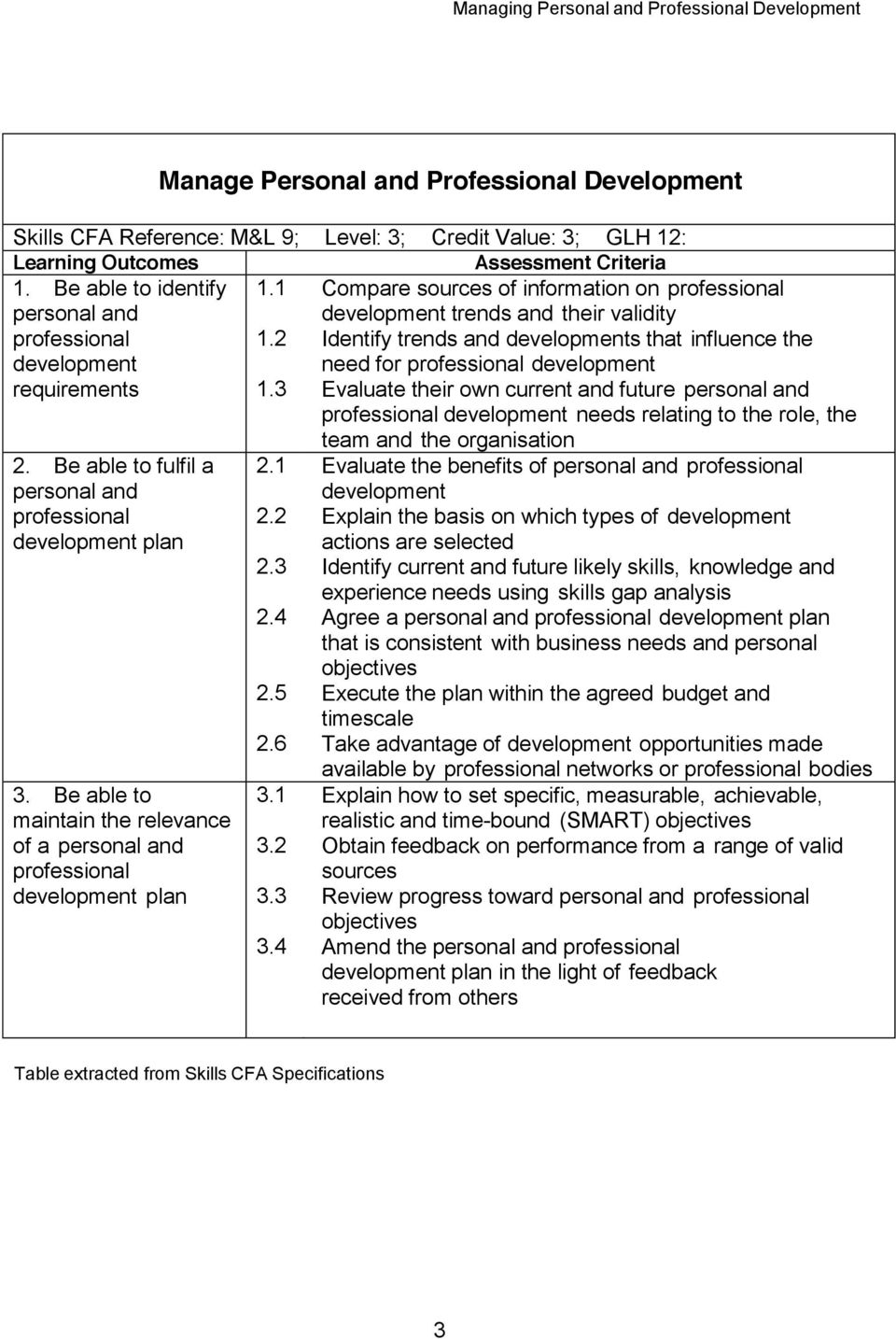
4 Managing Personal and Professional Development Manage Personal and Professional Development Skills CFA Reference: M&L 9; Level: 3; Credit Value: 3; GLH 12: Learning Outcomes Assessment Criteria 1. Be able to identify personal and professional development requirements Compare sources of information on professional development trends and their validity Identify trends and developments that influence the need for professional development Evaluate their own current and future personal and professional development needs relating to the role, the 2. Be able to fulfil a personal and professional development plan 3. Be able to maintain the relevance of a personal and professional development plan team and the organisation Evaluate the benefits of personal and professional development Explain the basis on which types of development actions are selected Identify current and future likely skills, knowledge and experience needs using skills gap analysis Agree a personal and professional development plan that is consistent with business needs and personal objectives Execute the plan within the agreed budget and timescale Take advantage of development opportunities made available by professional networks or professional bodies Explain how to set specific, measurable, achievable, realistic and time-bound (SMART) objectives Obtain feedback on performance from a range of valid sources Review progress toward personal and professional objectives Amend the personal and professional development plan in the light of feedback received from others Table extracted from Skills CFA Specifications 3
5 Managing Personal and Professional Development Introduction This workbook and the various activities within it, introduce you to the principles of managing personal and professional development: key skills are explored that will enable you to confidently tackle these elements of your role or future role as a line manager. The activities will require you to consider theories and ideas that align with each topic but, importantly, you will be expected to make parallels with your own experience in the workplace, which will help in ensuring that you can lead and manage your team effectively. The workbook then considers the role of management within and organisation and the difference between leadership and management. Various theories of leadership and management are then reviewed alongside activities that will help you to put theory into practice. The workbook covers material relating to the requirements of Unit M&L 9 and learning outcomes 2 and 3 of Unit M&L15 within the ILM Diploma in Management (combined qualification) and will be helpful in completing the first assignment "Understanding Leadership and Management". In addition, pages outline how the data gathered from these activities can be used in the development plan and progress reviews that you will develop in conjunction with your line manager and Skills Team assessor as part of your overall Management diploma. l 4

6 Managing Personal and Professional Development Managing Personal and Professional Development Professional Development: is a term describing the means of supporting people in the workplace to understand more about the environment in which they work, their role and how they can become more effective. It is an ongoing process of learning that spans an individual s working life. The workplace is changing rapidly and the pace of change is accelerating. Professional people need to keep abreast of changes that affect the way they work in areas such as the law, social and economic development, technological advances, environmental and political issues. Personal Development: is a term that often refers to development of soft skills (e.g. assertiveness) which can enhance employees career prospects and enable them to feel on top of their job. Also, it can relate to more general development that may or may not have direct relevance to your current role. Personal development includes personal growth, change, improvement, and advancement. The scope of personal development is broad and as the word personal implies, it is about focusing on what matters to you, albeit our personal qualities, which can be enhanced through personal development, have a big impact in the workplace. In other words, personal qualities are highly relevant to success at work. There is a close link between personal development and professional development. It can be a requirement of professional bodies to undertake a clearly defined number of days or hours of continuous professional development to retain membership of the body. Engaging employees in professional and personal development can be stimulating for them but also brings multiple dividends to the organisation that has a workforce with well-honed and current skills. Identifying Personal and Professional Development Requirements Activity: How might you go about identifying personal and professional development requirements? 5

7 Managing Personal and Professional Development There are numerous ways of identifying requirements for personal and professional development, including: Skills gap analysis; Training needs analysis; Performance reports; Environmental scanning looking at what is changing in the world and planning professional development to enable staff to meet the new challenges; and/or, Professional development trend analysis. Professional Development Trend Analysis Trend Analysis is the exercise of collecting and collating relevant information and making comparisons to identify a trend or pattern in the information. The trends are likely to indicate where effort should be concentrated in supporting professional development - providing of course that the trend is in line with your own organisation s goals. Naturally, when making decisions as to where to concentrate professional development initiatives, it is important that the sources are reliable and valid i.e. based on sound research and factually correct. It is all too easy, for example, for web-based information to appear highly credible with the look and feel of the particular site camouflaging inauthentic information. Activity: How might you establish reliable and valid trends in professional development? The main point to be made here is that some sources are known to be more reliable than others. Well-recognised professional bodies are one example of sources that exist to support the interests of members and the profession they serve. Consequently, they are a good source of valid information regarding professional development. Similarly, well-recognised trade or professional journals often have good validity, as do some quality newspapers. Research published in academic journals is a strong source of robustly researched and well-articulated trend analysis. 6

8 Managing Personal and Professional Development Identifying Trends That Influence the Need for Professional Development Activity: Thinking about your own role, undertake some research to discover what the trends in professional development have been over the last year. Also establish what experts in the field predict will be the future trends that will influence your need for professional development. Note your findings and sources, along with comment about how you judged the validity of the information. Professional Development Plans Managers that are committed to developing themselves tend to have Personal/ Professional Development Plans (PDP). The classic PDP is simply a form of action plan and typically sets out the following: The areas(s) for development: what do I need to learn? How the learning might be achieved: training, on-the-job learning, secondment or a combination of appropriate interventions? The support or resources that will be required to enable learning to take place: time off from work for study, study materials, registration fees? How much it will cost the organisation and/or the individual to complete the learning; Success criteria, the criteria by which it will be determined whether the learning has been successful: achievement of objectives, appraisal, obtaining a qualification? The proposed start and end dates; and, Review dates, which will enable progress to be assessed. Activity: Prepare an action plan or PDP setting out the areas you need to develop over the next 24 months relating to your role, the team and the organisation. A template PDP is provided on the next page. 7

9 Managing Personal and Professional Development Professional Development Plan NAME: Covering Period From: To: Planned outcomes Where do I want to be by the end of this period? What do I want to be doing? (This may be evolutionary or more of the same.) What do I want or need to learn? And why (i.e. critical assessment)? What will I do to achieve this? What resources or support will I need? Cost of intervention What will my success criteria be? Priority: H/M/L Start and/or Finish Dates Review date 8

10 The Benefits of Personal and Professional Development Activity: What are the benefits of personal and professional development to you and to the organisation? Benefits to you: Benefits to the organisation: Benefits to you might include: Your job performance improves; Improving career prospects by gaining new skills and achieving additional qualifications; Being able to responding confidently to changing conditions at work; Achieving promotion; Changing career; Fulfilling the stipulations for membership of professional bodies; Re-honing of unused or forgotten skills; Deepening and broadening your understanding of developments in your specialisation; Developing your knowledge of your working environment; Achieving greater levels of personal satisfaction; Networking opportunities; and Re-energising and invigorating experiences. 9

11 Benefits to the organisation might include: Potential for improved profitability; Provision of encouragement and support for professional development makes it easier to recruit and retain talented employees; Helps in informed decision making; Brings fresh perspectives to the workplace; Improved morale leading to higher productivity; Improved ideas generation; and, Making the organisation more adaptable and agile in responding to, and preempting, market changes. Selecting Different Types of Professional Development For development activities to be optimally effective, they need to be suited to the individual(s) undertaking the development. Activity: What might you need to consider in ascertaining the suitability of different types of professional development? You may need to consider issues such as: The delivery method; Time away from productive work; The amount of work involved; The recognition and transferability of any qualification awarded; The learning style of the participant(s); The cost; The duration of the training; Travel and accommodation; The relevance of the development in relation to organisational goals; and, The business case for return on investment. 10

12 Personal and Professional Development Methods of Development and Training In deciding what methods of development are most appropriate for personal and professional development there are numerous options available. Activity: Consider the following list of options for personal development. Consider the advantages and disadvantages of each and score each option on a scale of 1-10 where 1 is not appropriate for you in your current circumstances and 10 is highly appropriate for you. Development Method Advantages Disadvantages Applicability Score Having more challenging work delegated to you Short periods of work shadowing 1=low, 10=high Specific short courses/workshops Web-based learning modules Reading materials Observation of a peer Mentoring Coaching by internal coach 11

13 Development Method Advantages Disadvantages Applicability score Coaching by external coach 1=low, 10=high Internal formal/ informal training and or development programmes External training and or development programmes Distance learning courses Professional qualifications Inclusion on a working group Responsibility for a new area of work Secondment Job swaps Servicing or supporting a committee 12

14 Learning Styles Activity: Think about the training you have done in the past. What approach has been most effective for you and given you the best learning experience? It is likely that your reflection has highlighted a preference relating to: doing (practical challenges), seeing or listening or, some combination of these approaches. Putting formal labels to these approaches, most people have one of 3 preferred learning styles Visual, Auditory or Kinaesthetic (VAK). There is no right or wrong style. People are able to use all 3 of these preferences but will usually have a preferred style. Learning with a training approach that is not a person s preferred learning style will absorb more of the learner s energy and take more effort by him or her to be effective. Some people have a strong preference; others a blend of 2 or all 3 VAK learning styles. Visual Learning Style A visual learning style is one where a person has a preference for seen or observed training, incorporating, for example, films, pictures, diagrams, demonstrations, handouts. Visual learners will be happy working from written information and instructions and their style is often betrayed by their use of phrases such as show me, or, let me have a look. Auditory Learning Style An auditory learning style is one where a person has a preference for learning through listening to the spoken explanations and sounds. Auditory learners will be happy learning by listening to a specialist. They use language such as tell me and talk to me about Kinaesthetic Learning Style A kinaesthetic learning style is one where a person has a preference for learning through practical experience touching, doing, and practical hands-on activity. Kinaesthetic learners use language such as let me have a go. They learn by experience and, often, get bored reading instructions! 13

15 Managing Personal and Professional Development Activity: What are the implications of different learning styles for workplace training? Recognition that people have different learning styles offers us the opportunity to tailor the approach to personal and professional development to match the preferred learning style of the learner. If working with a group of learners where their learning styles are unknown then a range of all 3 VAK leaning styles should be incorporated to ensure that material engages the whole group at least for a proportion of the time. If an individual is aware of his or her leaning style then he or she may well be able to select training that suits their style. Activity: Using the learning styles questionnaire on the following page, answer the questions and then record your preferences below: What are the implications in terms of the best way for you to learn? 14

16 Managing Personal and Professional Development Learning Styles This table helps to determine your learning style; read the word in the far left hand column and then select JUST ONE response from the successive three columns which best describes how you respond to that particular situation. Tick the box next to the statement that applies to you. When you have answered every question, you will most likely have ticks in all three learning style columns, but one column will probably contain the most ticks. The column with the most ticks indicates your primary learning style. When you.. Visual Auditory Kinesthetic & Tactile Spell Talk Concentrate Meet someone again Contact people on business Read Do something new at work Put something together Need help with a computer application Do you try to see the word? Do you sparingly but dislike listening for too long? Do you favour words such as see, picture, and imagine? Do you become distracted by untidiness or movement? Do you forget names but remember faces or remember where you met? Do you prefer direct, face-to-face, personal meetings? Do you like descriptive scenes or pause to imagine the actions? Do you like to see demonstrations, diagrams, slides, or posters? Do you look at the directions and the picture? Do you seek out pictures or diagrams? Do you sound out the word or use a phonetic approach? Do you enjoy listening but are impatient to talk? Do you use words such as hear, tune, and think? Do you become distracted by sounds or noises? Do you forget faces but remember names or remember what you talked about? Do you prefer the telephone? Do you enjoy dialog and conversation or hear the characters talk? Do you prefer verbal instructions or talking about it with someone else? Do you ask for instructions or talk it through with others? Do you call the help desk, ask a neighbour, or growl at the computer? Do you write the word down to find if it feels right? Do you gesture and use expressive movements? Do you use words such as feel, touch, and hold? Do you become distracted by activity around you? Do you remember best what you did together? Do you talk with them while walking or participating in an activity? Do you prefer action stories or are not a keen reader? Do you prefer to jump right in and try it? Do you ignore the directions and figure it out as you go along? Do you keep trying to do it or try it on another computer? Adapted from Colin Rose(1987). Accelerated Learning. Name: Conclusions: 15

17 Managing Personal and Professional Development Honey and Mumford s Learning Styles There are numerous different recognised ways of analysing leaning styles. In addition to the VAK approach to differentiation of style, one of the most popular is that proposed by Honey and Mumford. They see learners as having a bias to one or more of 4 learning styles, which they term: Pragmatists, Activists, Reflectors and Theorists. As with the VAK approach there is no right or wrong style. Activity: Undertake an Internet search and note the meanings of each of the 4 Honey and Mumford learning styles. Then, search for and complete a Honey and Mumford learning styles questionnaire to establish your own learning style. 16

18 Managing Personal and Professional Development The implications for training associated with Honey and Mumford s learning styles are set out below: Implications for learning, they like: Pragmatists To see a clear link to their work See the advantages of a skill or technique To try out skills with feedback To be shown models they can emulate Activists New experiences and problems Interacting with others Team tasks/exercises Engaging in discussions The challenge of a difficult task Reflectors Observing others Having time to review what has happened and think through issues connected to the training material Producing reports, essays, etc Having thinking time, without time pressure Theorists Complex problems to which they can apply theories Structured situations Clarity of purpose Interesting ideas, models or concepts To question and critique ideas Development Needs and Skills Gap Analysis At a practical level, managers who wish to identify individual (and collective) training and development needs could follow a simple 6-step approach to training needs analysis. The ROGUE approach (KW Hamilton, 2012) requires managers to: Review Observe Gather Understand and unpick Engage team members' job descriptions team members at work additional data (e.g. performance metrics) the data, sifting it to determine what is important with team members to agree an Action Plan/Personal Development Plan While ROGUE lends itself particularly well to individual training needs analysis, the amalgamation of the data collected for several team members can soon create a picture of potential collective training needs. For example, staff working in a customer call centre might all report or indicate a need for customer service training to learn how to better handle customer complaints. 17

19 Managing Personal and Professional Development Skills Gap Analysis A skills gap analysis involves defining the skills and knowledge required for a role or future role and then comparing an individual s current skills and knowledge to the requirement. On the basis of the analysis, a plan is created to fill the identified skills and knowledge gaps. The process is outlined graphically below: Step 1: Identify business goals. Assessing the critical skills needed by the organisation to deliver the goals Step 2: Create a skills matrix to list the skills and knowledge to perform each required role. Record each person s skills and level of proficiency Step 3: Identify the missing skills, competencies and knowledge missing to complete work effectively. Step 4: Prepare a training and development plan to address identified skills gaps The Skills Gap Analysis Process (format AH Raymondosn, 2011) Perhaps the simplest method of establishing training needs is to undertake a SWOT analysis. SWOT Strengths, Weaknesses, Opportunities and Threats is easy to use. Simply create a grid and list what you think are: Your strengths what are you good at? Your weaknesses what do you not do very well? Your opportunities what skills might you need or want to develop for the future? Your threats what could stop you developing and addressing your weaknesses? 18

20 Managing Personal and Professional Development Activity: Undertake a personal SWOT analysis. Use the template below: The Current Position Strengths Weaknesses The Future Opportunities Threats Development required in relation to opportunities and threats The insights gained from this exercise can be fed into your personal development plan. 19

21 Managing Personal and Professional Development Agreeing your Personal and Professional Development Plan If you get your line manger to approve and agree your professional development plan then you are likely to get support for such things as cost of development programmes, authorised time to attend programmes and study. Prior to discussing your plan, you need to have thought through how the plan is not only consistent with your personal needs but how it fits into the needs of the business. Activity: Agree your PDP with your line manager. Note any points of contention below and record how you were able to resolve them. Also, note any budget approval you were able to secure and the argument you presented to gain approval. 20
22 Managing Personal and Professional Development Executing your Personal Development Plan within the Agreed Budget and Timescale The next stage after you have agreed your plan is its execution. Activity: Record below the actions you have taken to secure your place on the agreed development activities and outline a detailed plan for undertaking the work involved in the first 3 months of the PDP. Taking Advantage of Development Opportunities Made Available by Professional Networks or Professional Bodies Most professional bodies organise development opportunities for members. Typically, they will invite speakers to deliver a session or workshop on a subject that is trending in the profession. They provide good opportunities to question experts in the field and to get the latest thinking on relevant subjects. Attendance is usually accepted as part of continuing professional development for professional bodies. Similarly, professional networks - there are many such groups that meet face-to-face, or more now on the Internet that provide fantastic opportunities to share thinking and debate issues that are at the vanguard of your industry. Activity: Create a plan of action for accessing and attending events staged by professional bodies and professional networks for the next 6 months. Record you plan below: 21
23 Managing Personal and Professional Development Setting SMART Objectives for Learning and Development PDPs should include learning objectives. A learning objective is the description of a skill or knowledge that a learner will to be able to demonstrate having undertaken the learning. The learning objective describes an intended result of learning, rather than the process of learning itself. Effective learning objectives will answer the following questions: As a result of the learning activity what should the learner be able to do? Under what conditions should the learner be able to do it? How well must it be done? By when should the learning have been undertaken? The widely used and highly reliable method of setting objectives is to think SMART. Objectives should be: Specific Measurable Agreed Realistic (and achievable) Time-bounded It is important to emphasise when setting learning objectives that the objective should be centred on what you want to learn. So the objective might be: To learn PRINCE II Project Management Methodology and gain the PRINCE II practitioner award by Dec XXXX Rather than: To attend a project management course by Dec XXXX Activity: Create 3 SMART learning objectives for your future development. 22
24 Managing Personal and Professional Development Obtaining Feedback on Performance from a Range of Valid Sources Provision of timely feedback is an important element of development, including within a formal training environment and against the many learning opportunities in day-to-day work. People who receive regular feedback are more likely to perform at a higher level. Indeed, Professor John Hattie showed that feedback had more impact on learning quality than any other single factor. Feedback given as part of a training and development programme is known as formative feedback and feedback at the end of a learning programme is known as summative feedback. Example questions for eliciting feedback include: How well did xxx go? How did it feel? If you could do it again, what might you do differently and why? What learning do you take form the activity? What did you notice about the way you performed? Could I make a suggestion? What do you know now that you did not know before? What have you learned about yourself from that? One model for structuring feedback is BOCA, which stands for: Behaviour what you did/experienced/observed Outcome the immediate result of the behaviour Consequence the consequential impact of the behaviour Action what they might do differently Positive Feedback Positive feedback is where a person is told what he or she is doing well and is given praise accordingly. The theory being that if you tell a person what he or she is doing well, that person will be likely to repeat the behaviour to maintain that approval. Effective feedback is specific, not general. For example: the letter you drafted for me was well constructed and made the points about the issue effectively rather than good letter. Negative Feedback Negative feedback is the process of pointing out what someone has not done well or that particular behaviours are causing problems and telling him or her how to change them. This kind of feedback can erode confidence and should be avoided. Far better is to use constructive feedback. 23
25 Managing Personal and Professional Development Constructive Feedback Constructive Feedback focuses on an area in which the learner s performance could improve. Constructive feedback is not criticism; it should be directed to describing what happened, what was experienced or observed. Constructive feedback is important as it helps build confidence and is centred in helping elevate performance in a positive way. Feedback on Performance Feedback on your performance at work can give valuable insights in to where you may need to concentrate your personal and professional development. This could be informal feedback or more formal feedback from sources such as performance questionnaires, your annual appraisals or Feedback Feedback is a mechanism for obtaining feedback on your performance from a range of sources across the people you would with, including your peers, your boss and your subordinates. It gives valuable insight into how you are viewed by others. Activity: To assist in deciding where to concentrate in your CPD, you may wish to find and complete, via the Internet, a management skills assessment and ask your boss or peers to complete it too. Alternatively or in addition, complete the following questionnaire and ask your line manager and peers to so the same so that you can get some good feedback in relation to your performance: Management Competencies and Behaviours Self-Assessment Communication 1 Written skills 2 Verbal skills 3 Listening to others 4 Giving briefings and presentations to groups Professional Knowledge 5 Industry awareness 6 Technical knowledge 7 Financial awareness 8 Using information and communications technology 9 Understanding of legislation, including health and safety at work and corporate social responsibility Team Working 10 Understanding others 11 Building effective relationships with others Score (Low 1 High 10) Comments 24
26 Managing Personal and Professional Development 12 Working cooperatively with others 13 Managing stress and conflict Leading Others 14 Inspiring others 15 Coaching and mentoring others 16 Taking personal responsibility 17 Influencing others (managing upwards and sideways) Personal Effectiveness 18 Commitment to personal development 19 Problem-solving and decisionmaking 20 Time management, including planning and organisation skills Key Performance Indicators There are numerous systems for measuring performance used in organisations including for personal performance. At supervisory level, the focus tends to be on measuring work performance, output and quality in fairly narrow, but clearly defined areas. To achieve this we need to be able to have a benchmark or indicator of performance against which we can measure the work performance, output and quality. These measures are often referred to as key performance indicators (KPIs). Key performance indicators come in three main types: Input KPIs measure assets and resources used (purchases made) to achieve business results. Examples might include: Funding for training; Raw materials; and Quality of raw materials (e.g. grade 1, 2, 3, etc). Process KPIs measure the efficiency or productivity of a business process. Examples might include: Production time; Days to deliver a completed order; Number of days to reply to customer requests; Number of personnel trained in use of a piece of equipment; and, Days taken to fill vacancies. 25
27 Managing Personal and Professional Development Output KPIs measure the financial and non-financial results of business activities. Examples might include: Sales revenue; Number of new customers; Increase in full-time employees; Return on investment; and, Customer satisfaction. A mix of the three types of KPIs process, input, and output would be applied to give a broad picture of your team or organisational performance. Any variances then need to be investigated and appropriate action needs to be undertaken. Activity: List at least 2 examples of KPI that are, or could be, applied in measuring your performance at work: Reviewing Your Progress Towards Personal and Professional Objectives Making time to take stock of your progress against your Plan for achievement of your learning objectives is useful for 2 main reasons. Firstly, it enables you to celebrate the success you have had and secondly it enables you to recalibrate your plans, in line with your other priorities, to ensure completion of the objectives. It is useful to undertake your review jointly with your line manager or your mentor as the act of articulating your thinking to someone else often serves to cement your plans and ideas in your mind. Amending your Personal and Professional Development Plan in light of Feedback from Others It is important that, in seeking feedback on your performance from others and in reviewing your professional development, that you are prepared to amend your development plans to accommodate the observations made. 26
28 Managing Personal and Professional Development Using the Skills Team Development Plan and Progress Review As part of the development programme you are undertaking with Skills Team, you will be setting goals and learning outcomes that you plan to achieve over the course of the year. These goals will be set with input from your line manager and assessor. Reviews with your line manager and assessor will check progress towards these goals, identify any further support required or set new goals The Skills Team development plan looks at four key areas for professional development: Skills development - role or industry specific skills that you need to develop or acquire over the course of the programme in order that you can complete task goals or general progression. Training for these skills are likely to be in addition to the generic leadership and management skills you will develop throughout the programme. You will decide with your line manager how best to develop these skills. Task development - this will be a specific task(s) or function(s) that you and your line manager would like you to be able to perform by the end of the programme. This will be designed to stretch and challenge your experience to date and to encourage you into a higher level of management and leadership. Person development - These are personal or behavioral attributes that you want to work on over the course of the programme. You might have identified these areas for development through your own self-assessment or SWOT analysis, or you might have had specific feedback from your line manager or team members. Topics like presenting, time management, listening or communication skills could be areas for further development. Framework options - as part of your leadership and management programme, you will have to demonstrate competency across a number of areas or units. Some of these units are mandatory but there are several optional units to choose from. Together with your assessor and line manager, we will advise of the best units within the framework to support your wider goals and learning outcomes that have been identified in your plan. The development plan will be agreed at your first 1:1 with your assessor. It is strongly advised that your line manager also attends this session as it is a great help to have their input and support from the outset. At subsequent 1:1 sessions, you assessor will review progress against plan and can seek extra support from your line manager if any is needed. This development plan and subsequent progress reviews will form a key part of your assessment for the personal and professional development unit. Activity: Using the sample development plan on the following page and the information you have gathered from all the earlier activities in the workbook, draft some key development outcomes that you want to focus on over the following year of the course. 27
29 Development Plan Managing Personal and Professional Development Learner: Programme: Line Manager Employer: Development area Desired outcome SMART Target date Methods/Actions to achieve outcome Skills Plan - technical/ job specific skills that need to be developed over the course of the programme Tasks Plan - work-specific tasks or functions that the candidate should be competent to perform Person Plan - behavioural skills that need to be developed over the course of the programme Framework Plan - qualification units that the learner will complete to complement overall personal development Learner comments: Reasons you have selected these outcomes 28
30 Understanding the Principles of Leadership and Management The Role of Leadership and Management The remainder of this chapter covers learning outcome 2 and 3 of the M&L 15 Unit Principles of Leadership and Management Skills CFA Reference: M&L 15; Level: 3 ; Credit Value: 8; GLH 50: Learning Outcomes Assessment Criteria 1. Understand the 1.1 Explain the importance of defining the objectives, scope principles of and success criteria of the decisions to be taken effective decision 1.2 Assess the importance of analysing the potential impact of making decision making 1.3 Explain the importance of obtaining sufficient valid information to enable effective decision making Explain the importance of aligning decisions with business objectives, values and policies Explain how to validate information used in the decision making process Explain how to address issues that hamper the achievement 2. Understand leadership styles and models 3. Understand the role, functions and processes of management 4. Understand performance measurement of targets and quality standards Explain the difference in the influence on managers and leaders on their teams Evaluate the suitability and impact of different leadership styles in different contexts Analyse theories and models of motivation and their application in the workplace Analyse a manager s responsibilities for planning, coordinating and controlling work Explain how managers ensure that team objectives are met Explain how a manager s role contributes to the achievement of an organisation s vision, mission and objectives Analyse theories and models of management Explain how the application of management theories guide a manager s actions Explain the operational constraints imposed by budgets Explain the relationship between business objectives and performance measures Explain the features of a performance measurement system Explain how to set key performance indicators (KPIs) Explain the tools, processes and timetable for monitoring and reporting on business performance Explain the use of management accounts and management information systems in performance management Explain the distinction between outcomes and outputs Table extracted from Skills CFA Specifications 29
31 Understanding the Principles of Leadership and Management Understanding the difference between Leadership and Management People do confuse leadership and management and understandably so. There are jobs and roles in organisations that carry the title of manager and, which, in the person specification, identify the need for leadership skills. Activity: Thinking about what leaders and managers do, in your own words, define: a. Leadership b. Management 30
32 Understanding the Principles of Leadership and Management Activity: List the differences between leadership and management: In your analysis, you might reasonably have focused on the types of activity that a leader or a manager undertakes. For example, you might have identified that leaders typically engage in activities that set the direction of the team, while managers carry out the activities necessary to achieve the required outcome or goal. Warren Bennis, in his book On Becoming a Leader (1989), compared leaders and managers. He concluded that leaders were people who were the driving force in a business or organisation, innovating and initiating change, inspiring people to high levels of performance and challenging the status quo. Managers, on the other hand, were the people who organised, controlled and administered the resources available to achieve the tasks set by leaders. The table below illustrates the differences Bennis observed. Leaders: Inspire Think Motivate Initiate change Challenge the status quo asking what and why Innovate Originate Develop Set the pace the vision Managers: Control Act Organise Adjust to change Accept current practice asking how and when Administer Imitate Maintain Follow procedure 31 (Adapted from Bennis 1989) Another way of looking at the difference between leadership and management is to recognise the difference between doing the right thing and doing things right. Leaders do the right thing while managers concentrate on doing things right.
33 Understanding the Principles of Leadership and Management Leadership There are almost as many different definitions of leadership as there have been great leaders! For example, the British military define leadership as: Getting someone to do what you want them to do even if they don t want to do it This definition is very near to the definition offered by President Dwight Eisenhower. He defined leadership as: Getting someone to want to do what you want them to do Eisenhower s definition sets out a challenge to any potential leader, namely, how to get people to follow you and to carry out your wishes. His assertion suggests that effective leadership is based upon the leader having a positive impact upon the people he is trying to lead. Adrian Gilpin of the Institute of Human Development underlines and reinforces the importance of this in his definition of leadership, stating that leadership is: the impact you have on yourself and the impact you have on people around you These definitions indicate that leadership is as much about the individual leader as it is about his or her training. In other words, while there are things that you can learn that will assist you as a leader, leadership is concerned more with our ability to influence and persuade our colleagues to follow our direction. Thus, effective leadership can depend very much on the personal qualities, characteristics and behaviours of the leader. 32
34 Understanding the Principles of Leadership and Management Activity: Think of up to 3 leaders from different environments (political, sporting, commercial, etc) who you know or know of. What characteristics do they display? List these below. 33
35 Understanding the Principles of Leadership and Management What does your list tell you? It is likely that you have identified leaders with many of the characteristics below: Charismatic Effective communicators Organised Decisive Good listeners Consistent Fair Considerate Dynamic Professional Skilled Trained Motivated Good motivators Command respect Give respect Empower others Inspiring Good delegator Strong interpersonal skills Energetic Assertive Loyal Honest Hard-working Committed Determined Visionary Innovative Risk-takers and/or risk-aware Confident Driven Flexible Adaptable Conscientious Team-players Accountable Selfless Trustworthy Integrity Passionate Skilled manager Courageous Caring As you reflect, you may conclude that leadership is as much about behaviour as it is about skills and knowledge. In other words, leadership is about making choices: choosing to lead in a certain way to achieve the desired or required results. It would be remarkable if every leader possessed all or a significant number of the above characteristics. However, there is one thing that stands out from the list above: the skills required of a leader are subordinate to attitude and behaviour. The characteristics identified in that list, in many cases, imply choice: a leader can choose to lead in a certain way, they can choose to develop certain core skills and, crucially, they can choose to behave in a particular way. For example, the captain of a Premiership football team is not necessarily the best player in the team. It easily can be somebody who is prepared to take responsibility for organising the team on the pitch. To be effective as the captain, the player must be able to communicate effectively and to inspire his fellow players. Communicating and inspiring the team might entail the captain reprimanding some players for a lack of effort, while cajoling and praising other players to achieve higher levels of performance. In this example, the captain is making a choice about how he will lead members of the team taking into account the characteristics of his fellow players. 34
36 Understanding the Principles of Leadership and Management Leadership Theories There are a myriad of leadership theories to choose from, including trait, behavioural, contingency and transactional/transformational. Activity: Using a range of sources, describe the key elements of each type of theory and provide an example of each. Note the source reference for future use. Trait Theories Behavioural Theories 35
37 Understanding the Principles of Leadership and Management Contingency Theories Transformational Theories 36
38 Understanding the Principles of Leadership and Management In your research you should have been able to differentiate between each of the different types of theory and identified the following key characteristics of each type of leadership approach: Trait Theories. With origins in the early to mid-1900s, trait theories focus on the characteristics and attributes hence traits of a leader. These theories propose that it is possible to select people for leadership roles by identifying certain desired physical, social and personal characteristics. In other words, trait leadership theories suggest that people with specific inherent attributes are born leaders. Sometimes referred to as the qualities approach to leadership, trait theories focus on what (or who) the leader is rather than what they do. The earlier exercise in which you identified the characteristics and attributes of effective leaders follows the pattern of earlier research undertaken by psychologists and students of leadership. Considerable attention was given to discovering the traits of successful leaders, assuming that people who shared these traits could also become great leaders. For example, R.M Stogdill, in his Handbook of Leadership. A survey of theory and research (1974) identified the following traits and skills as critical to leaders. Traits Adaptable to situations Alert to social environment Ambitious and achievementorientated Assertive Co-operative Decisive Dependable Dominant (desire to influence others) Energetic (high activity level) Persistent Self-confident Tolerant of stress Willing to assume responsibility Skills Clever (intelligent) Conceptually skilled Creative Diplomatic and tactful Fluent in speaking Knowledgeable about group task Organised (administrative ability) Persuasive Socially skilled (Adapted from Stogdill, 1974) Just over a decade after Stogdill published, McCall and Lombardo in Off the track: Why and how successful executives get derailed (1983) reviewed and developed Stogdill s thinking by focusing on four primary traits which were critical to success and failure. 37
39 Understanding the Principles of Leadership and Management They concluded that an effective leader possessed the following traits: Emotional stability: Calm, confident and predictable, especially under stress; Honesty and self-awareness: Prepared to admit and accept error (making mistakes), rather than expending unnecessary effort covering up; Good interpersonal skills: Able to persuade and influence others without being coercive; and, Intellectual ability: Able to see and understand the bigger picture. Many observers, whilst noting that successful leaders do exhibit a number of common characteristics and attributes, believe that trait theories lack context in so far as the demands placed on a leader will (and do) differ widely from situation to situation. In essence, it should be recognised, for example, that the qualities and attributes required of a military leader would differ significantly from those of a religious leader. Behavioural Theories. The root of behavioural leadership theories is the assumption that leaders can be trained and developed to behave in certain ways. One of the most prominent behavioural theories is Douglas McGregor s Theory X and Theory Y (or Theory XY). McGregor proposes that there are two fundamental approaches to managing people: Theory X and Theory Y. The two different approaches, which, at the extremes, are polar opposites on a continuum, assume that people are either, work-shy (Theory X) or motivated by work (Theory Y). His proposition is simple: for Theory X employees, managers should adopt an authoritarian management approach, and, for Theory Y employees, a more participative management approach should be used. In simple terms, the management styles associated with Theory XY are as follows: Theory X (the authoritarian management style) proposes that the average person dislikes work and will avoid it if they can. It is assumed that the average person prefers to be directed (that is, they want to be told what to do, how to do it and when to do it); they will avoid responsibility. They are lacking in ambition and seek security. To manage Theory X people, the leader must take a coercive approach, threatening sanctions and punishment to ensure that organisational objectives are achieved. Theory Y (the 'participative management' style) proposes that people enjoy work and will be prepared to give of their best. It assumes that people are committed to, and will pursue, organisational goals and objectives without threat of punishment or external control because they crave achievement. Theory Y people are perceived to thrive on responsibility and the opportunity to solve workplace problems. Further it is proposed that there are significant numbers of people with these characteristics in every organisation and that human potential is seldom fully realised. 38
40 Understanding the Principles of Leadership and Management Activity: What are the likely characteristics and behaviours of typical Theory X and Theory Y managers? Theory X Managers Theory Y Managers Typically, Theory X managers are likely to exhibit some or all of these characteristics: Results and deadline-driven, often to the exclusion of everything else; Intolerant; Issues deadlines and ultimatums; Issues instructions, directions, edicts; Issues threats to make people follow instructions; Demands, never asks; Does not participate; Unconcerned about staff welfare or morale; One-way communicator, a poor listener; Does not thank or praise; Withholds rewards; Operates a blame culture, seeking culprits to blame for failure, rather than learning from experience and preventing recurrence; Does not invite or welcome suggestions; Sees the issue of orders as delegating; and/or, Fails to empower his colleagues. The Theory Y manager, unsurprisingly, tends to exhibit the exact opposite behaviours! For example, where the Theory X manager does not invite or welcome suggestions from his team, the Theory Y manager is likely to start any workplace problem-solving by explaining the issue to the team and asking them for their ideas. 39
41 Understanding the Principles of Leadership and Management Contingency Theories. Contingency or situational theories propose that the leader must adapt his or her style of leadership to reflect both the needs of the team and the context in which the task is to be carried out. Thus, a military leader might lead his or her team very differently depending upon whether the task they were engaged in was taking place on the battlefield or supporting the local community in a flood-relief situation during peace-time. Fiedler s Contingency Model and Hersey-Blanchard s Situational Leadership Theory are both examples of contingency theories. Fiedler s Contingency Model Fred E. Fiedler s Contingency Model focuses on the link between leadership and organisational performance, proposing that, while there is no single best way for a manager to lead his or her team, the results will reflect the leadership style used by the leader/manager. In essence, Fiedler argues that the relationship between the leader and his or her team, the structure of the task to be completed and the authority (or power) of the leader predicate different leadership approaches. In his research Fiedler identified that leaders and managers are likely to have a preferred leadership orientation: they would either be task-oriented or relationshiporiented. A manager s leadership orientation was disclosed by a simple questionnaire the least preferred co-worker (LPC) scale in which the leader was asked to score, on a scale of 1 to 8, in 16 key areas what their attitude to the person with whom they least liked to work was. The items in the LPC scale are: 1 8 Unpleasant Pleasant Unfriendly Friendly Rejecting Accepting Unenthusiastic Enthusiastic Tense Relaxed Cold Warm Frustrating Helpful Uncooperative Co-operative Hostile Supportive Quarrelsome Harmonious Inefficient Efficient Gloomy Cheerful Distant Close Boring Interesting Hesitant Self-Assured Guarded Open Fiedler asserts that leaders with a low LPC score are task-oriented while a high LPC score indicates a leader who is relationship-oriented. The key difference between the 2 orientations is the priority given by the leader to the orientation. A relationship-oriented leader focuses on ensuring that his or her relationships with team members are properly established before accomplishing the task. The task-oriented leader will seek to complete the task before paying significant attention to his or her relationships with team members. 40
42 Understanding the Principles of Leadership and Management Fiedler also suggested that, notwithstanding their leadership orientation, leaders and managers might act differently in different situations, depending upon the context of the situation. The term that Fiedler used was the favourability of the leadership situation. He proposed that 3 factors combine to determine the context or favourability of a particular management situation, namely: Leader-member relations: The willingness of team members to follow the leader s guidance, which is usually based on the level of trust held by the leader and his or her popularity Task structure: The complexity of the task in hand. Is the task structured routine and repetitive or unstructured dynamic and imprecise? Position power: To what extent can the leader assert and exercise authority over the team? In other words, is the leader s role in the organisation clearly defined such that he or she can expect team members to comply with and accept his or her direction? Hersey-Blanchard s Situational Theory Paul Hersey and Ken Blanchard in their book published in 1977, Management of Organizational Behaviour 3rd Edition Utilizing Human Resources, developed their Situational Leadership Theory. The essence of the Situational Leadership Model is that a leader has to vary his or her leadership style to take account of the competence of the team, and the competence of each individual within the team. Neither Hersey nor Blanchard uses the word competence, preferring instead to use the phrase maturity level to describe the team or individual s readiness for a particular style of leadership. The Situational Leadership Model defines 4 styles of leadership Telling, Selling, Participating and Delegating and 4 levels of maturity from immaturity through to maturity. The level of maturity of a team or an individual dictates the leadership style to be adopted by the leader. Blanchard further developed his thinking on Situational Leadership to reflect his view that effective leadership was about choosing a behaviour that fitted with the needs of the individual and the team. In his book, Leadership and the One-Minute Manager, first published in the UK in 1986, Blanchard coined the phrase different strokes for different folks to illustrate this. He redefined the 4 leadership styles, preferring the terms Directing, Coaching, Supporting and Delegating and used the phrase development level in place of maturity level to reflect the responsibility of the leader to develop his or her team and the individuals within that team. He also introduced the notion of commitment that is, the individual s motivation to learn and improve as another factor to be considered by the leader when deciding how to lead the team. 41
43 Understanding the Principles of Leadership and Management Blanchard suggests that there are 2 specific types of behaviour that effective leaders use directive and supportive behaviour and that the combination of these behaviours determines the style of leadership used; hence the 4 distinct leadership styles: Directing: The most directive leadership style (S1) in which the leader provides the individual with specific instructions, monitoring closely the work that is done to ensure successful completion of the task. The leader does not need to offer much by way of supportive behaviour since the individual is not given any freedom to determine how the task is to be completed. Coaching: The second leadership style (S2) focuses on enabling the individual to participate more fully in determining how the task should be completed. The leader will explain what the task is and invite the individual to explain how they intend to successfully complete it. The leader will take the final decision on how the task is to be completed but will work closely with the individual to arrive at the final decision. By actively involving the individual in discussion about how the task should be done, the leader s behaviour is both highly directive and highly supportive. Supporting: The third leadership style (S3) is yet more participative. In exercising this leadership style, the leader will outline the required or desired outcome and invite the individual to propose and implement a course of action. While the decision to proceed with a particular course of action ultimately rests with the leader, the leader will facilitate and support the individual in making the decision, exercising more supportive behaviour and less directive behaviour. Delegating: In employing the fourth leadership style (S4), the leader s behaviour is light touch. In delegating a task to an individual, the leader is indicating that responsibility for carrying out the task rests with that individual. This gives the individual the freedom both to determine what needs to be done to achieve the task and to complete it accordingly. 42
44 Understanding the Principles of Leadership and Management Blanchard shows the relationship between the leader s behaviour and the style of leadership to be adopted thus: Blanchard s Four Leadership Styles (High) Supportive Behaviour High Supportive/Low Directive Behaviour S3 Supporting Low Supportive/Low Directive Behaviour S4 Delegating High Directive/High Supportive Behaviour S2 Coaching High Directive/Low Supportive Behaviour S1 Directing (Low) Directive Behaviour (High) (Adapted from Blanchard 1986) Of course, the leadership style selected by the leader must take into account the situation. This means that the leader must consider a whole range of factors. In his Situational Leadership Model, Blanchard focuses upon the development level of the individual their competence and their commitment. 43
45 Understanding the Principles of Leadership and Management He represents this as follows: Competence and Motivation High Competence Medium to High Competence Some-to-Low Competence Low Competence High Commitment Variable Commitment Low Commitment High Commitment D4 D3 D2 D1 Developed Developing Appropriate Leadership Style S4 S3 S2 S1 Delegating Supporting Coaching Directing (Adapted from Blanchard 1986) The diagram above highlights the relationship between an individual s development level and the style of leadership Blanchard suggests is appropriate. Indeed, much of what is portrayed here makes eminent sense. If one of the team is unskilled (D1), they clearly need to develop the skills to do the job for which they are being employed. Blanchard observes that, typically, a D1 individual will display a high degree of commitment. Interestingly, he then proposes that as the individual develops some competence, he or she loses a significant level of commitment; that is, their motivation dips. But why should this be? 44
46 Understanding the Principles of Leadership and Management Activity: Consider Blanchard s Situational Leadership Model and suggest reasons why commitment (or motivation) dips when an individual moves from D1 to D2 and can you think of any situations when this might not be the case? It is an interesting juxtaposition that an individual s commitment should fade just when they are beginning to develop some competence in their job. There is typically one of 2 reasons for this. First, as an individual begins to become effective, they may expect to be given the freedom to get on with the job after all, they can now do the job. The reality, of course, is somewhat different: they can do the job under close supervision. When the leader starts to coach them, they may become frustrated because they perceive that their competence is not recognised by the leader. The second reason why an individual s motivation might wane is that they actually prefer to be supervised. The move to a coaching style of leadership where the individual is expected to start to think for him or herself can be both frightening and challenging for them; they are being forced out of their comfort zone. One other consideration that leaders sometimes fail to take account of when using this model, is that competence is not universal. It is important to recognise that with leadership there is no one-size fits all approach: no two people will acquire the skills, knowledge and experience (competence) in the same way, hence Blanchard s different strokes for different folks. The second thing to bear in mind is that because an individual demonstrates high competence in a particular role or activity, it does not mean that they will be capable to performing to that level in all other roles. This conundrum is often referred to as the halo and horns effect. It is easy for a leader to delegate new tasks and responsibilities to an individual on the basis of previously demonstrated competence. Equally, where someone has failed to develop a particular skill or competence, it is wrong to assume that they cannot demonstrate a competence in other areas. A leader that fails to adequately support a competent team member (the halo effect) by assuming that they need no direction (S4) potentially runs the risk of alienating and de-motivating that person. And, of course, the opposite is true when a 45
47 Understanding the Principles of Leadership and Management leader denies someone of perceived lesser competence (the horns effect) the opportunity to develop by insisting upon a directive style of leadership (S1). Blanchard s Model is often depicted graphically as a quadrant with a bell-curve illustrating the progress of a team or individual through the various leadership styles, thus: Blanchard s Situational Leadership Model (High) S3 S2 Supporting Coaching D3 D4 D2 D1 Delegating Directing (Low) S4 Directive Behaviour S1 (High) Activity: Consider each of the leadership styles in the Blanchard model. What skills and behaviours do you need to display for each style and how effective are you currently in each of these skills? What might you need to concentrate on to improve your leadership in each quadrant? Use the table overleaf to record your thoughts. 46
48 Understanding the Principles of Leadership and Management Leadership Style Skills & behaviours required Current strengths in applying this style Areas for improvement Actions/by when Directing Coaching Supporting Delegating Transformational Theories. Transformational leadership theory is commonly understood to be a blend of both trait and behavioural theories. In simple terms, a transformational leader is someone who possesses several key attributes enabling them to influence others, through their own behaviour, in pursuit of a goal or vision. By definition, they seek to transform the organisation. 47
49 Understanding the Principles of Leadership and Management Charismatic and visionary, transformational leaders achieve much of their success by inspiring others to follow them. They typically possess and share certain core values and beliefs with their colleagues, which gives them credibility with, and instils confidence in, team members. Passionate, enthusiastic and energetic, transformational leaders care about their team as a unit and as individuals. Transformational leadership, which is often closely aligned with change management, involves developing and selling a Vision for the organisation, then leading and driving its implementation. Transformational leaders are persuasive and resilient: their enthusiasm and energy seemingly remaining undimmed even when significant resistance is encountered. They build trust, relying on their own personal integrity and credibility and are highly effective communicators. Typically, they empower team members to participate fully in the transformation process and are receptive to new ideas and changes to their original plan where they see a better idea for implementation. Transformational leaders are visible and accountable, showing in their behaviour the attitudes and action they expect of others. While they exhibit an unswerving commitment to the Vision they are, first and foremost, people-oriented: they believe that success comes through deep and sustained commitment of all. There has been some debate about how transformational leadership fits with transactional leadership, which, at its core, links reward with achievement and/or performance. James MacGregor Burns (1978), in observing how difficult it is at times to differentiate between management and leadership, proposed that the key differences lay in the characteristics and behaviours of the leader. He established 2 concepts: transforming leadership and transactional leadership. In Burns view, the transforming approach creates significant change in the life of people and organisations, redesigning perceptions and values, and changing employee expectations. The transactional approach, on the other hand, he defined as simply reward-based. Burns argued that transforming and transactional leadership were mutually exclusive styles of leadership. Transforming leaders put the good of the team and organisation first, effecting change through their commitment and personal example. Work by Bernard Bass (1985) explored further Burns theory, looking at how transforming leadership renamed by him as transformational could be measured, and the impact it has on team motivation and performance. He asserted that the extent to which a leader is transformational is measured in terms of his influence on others. This level of influence is evident in the behaviours and performance of the team and individual members of the team. Typically, Bass observed, team members are willing to work harder because the leader has inspired them by providing a mission and vision in which they can believe and share. This also gives them a clear identity, stimulating, encouraging and empowering them to challenge the status quo and to deliver change. In contrast to Burns, Bass suggested that leaders can simultaneously display both transformational and transactional leadership. 48
50 Leadership Styles and Culture Understanding the Principles of Leadership and Management While the different theories approach leadership from several different perspectives, one common theme emerges: the concept of adopting or adapting a particular leadership style to reflect the needs of the team, the competence of the team and/or the situation. The leadership style will be a predominant factor in the culture of the organisation culture merely being the way things are done in the organisation. Activity: Consider the culture of the organisation that you work in. What is the predominant leadership style and what impact does that have? Your response could incorporate a broad range of options but may have included differences between a democratic versus autocratic style; autonomy to make decisions; perceived approachability of leaders; willingness to go the extra mile ; willingness of people to accept responsibility; the working context (relates to what it feels like to be a part of the organisation) and so on. Much of the cultural elements of organisational life relate to leadership style. 49
51 Understanding the Principles of Leadership and Management Tannenbaum and Schmidt s Continuum Theory The Tannenbaum and Schmidt Continuum, set out in the Harvard Business Review in 1958, suggested that leaders should make decisions about how they lead based or contingent upon the situation. The Continuum, which comprises 7 distinct leadership styles, has, at either end of the spectrum, the option of an authoritative (autocratic) or a participative (democratic) approach to leadership. Very similar in many ways to McGregor s Theory XY, Tannenbaum and Schmidt s Continuum Theory has considerable utility when used in conjunction with other models. In simple terms, the model shows the relationship between the level of freedom that a leader chooses to give to a team and the level of authority exercised by the leader. As the team's freedom is increased, so the leader's authority decreases. The Continuum is often depicted thus: Tannenbaum and Schmidt s Continuum Model Authoritative Approach Leadership Continuum Participative Approach Use of authority by leader Freedom of team members to make decisions (Adapted from Tannenbaum and Schmidt 1958) The diagram shows how the ability and the freedom of the team to make decisions increases as the chosen style of leadership moves across the Continuum from left to right. The decision to move away from an authoritative approach, in Tannenbaum and Schmidt s view, was linked to the readiness of the team to participate in decisionmaking. In other words, as a team develops and competence within the team rises, it makes sense for a leader to involve the team both in problem solving and in decisionmaking through increased delegation. It is worth defining what is meant by the term delegate. To delegate is to: entrust [a task] to another person (The Concise Oxford English Dictionary) By entrusting another person to carry out a task, the leader must consider a number of factors. 50
52 Understanding the Principles of Leadership and Management Activity: What factors should a leader or manager consider when delegating a task to a member of the team? In your analysis, you may have identified some or all of the following factors: Importance of the task; Urgency of the task; Complexity of the task; Skills, knowledge and experience of individuals within the team to carry out the task; Suitability (competence) of given team members to take on the task; Capacity within the team to take on the task; Impact on other members of the team not selected for the task; Readiness of an individual to take on the task; Willingness of an individual to take on the task; Level of support required to enable the selected individual to complete the task; Consequence of failure on the team if the task is not properly completed; Consequence of failure on the individual; and, Consequence of failure on your credibility as a leader. 51
53 Understanding the Principles of Leadership and Management There are some significant factors, therefore, that a leader must consider before delegating work to members of the team. It is worth just noting and understanding some other terms that arise when a leader is considering delegating tasks. Responsibility: When delegating a task, the leader passes responsibility to the team member for successful completion of that task. The leader is responsible for ensuring that the individual is competent (skilled, trained and experienced) to undertake the task and has the necessary resources (tools, cash and other support) to complete the task successfully. Accountability: Although responsibility for successful completion of a task can be delegated to a team member, the leader always remains accountable to his or her boss for successful completion of that task. A leader cannot transfer accountability to a member of the team for the results achieved. In other words, it remains incumbent upon the leader to ensure that he or she is satisfied that the task has been satisfactorily completed. Tannenbaum and Schmidt s Seven Leadership Styles The seven leadership styles, sometimes described as delegated levels of freedom, proposed by Tannenbaum and Schmidt are: The Leader takes the decision and announces it. The leader considers the options, decides what course of action the team will follow and informs the team of the decision. In telling the team what action is to be taken, the leader chooses not to involve the team in the decision-making process: this may be perceived by the team as a task-based decision taking no account of their views. The Leader takes the decision and 'sells' it to the team. Once again, the leader makes the decision. However, the leader will also explain to the team the rationale for, and the positive benefits of, the decision. The team is likely to perceive the leader more positively because the importance of the team has been recognised by the leader. The leader presents the decision, background information and invites questions. In this scenario, the leader presents the decision and invites questions from the team, encouraging discussion and enabling the team to consider the rationale behind the decision. This more consultative approach enables the team to more fully appreciate all the issues and the implications of all the options. This approach is likely to be perceived by the team as more motivating. The leader proposes a decision and invites discussion about it. More consultative than the previous approach, the leader proposes a decision to the team for discussion. Armed with the views of the team, the leader can change the decision if they wish: the final decision, however, still rests with them. This approach acknowledges that the team has something to contribute to the decision-making process, and is perceived as highly motivating by the team because they have a degree of influence over the final decision. 52
54 Understanding the Principles of Leadership and Management The leader presents the issue, gets suggestions and then decides. The last level of consultative decision-making the leader outlines the issue and possible options to the team. There is free-ranging discussion about the issue, any proposed solutions, including those put forward by the team. The leader then decides which option to take. At this level of decision-making, team members who may have a more detailed knowledge or experience of the issue than the leader are positively encouraged to influence the decision. The leader explains the issue, defines the parameters and asks the team to decide. Often considered to be the first level (of 2) of delegation. In this scenario, the leader gives significant responsibility to the team for arriving at the best decision. While the leader remains accountable for the decision, the parameters set for the team enable the leader to retain appropriate control of the decision. In other words, the leader can mitigate, for example, some of the risk arising from a poor decision by requiring the team to present their solution to the leader before implementation of their preferred solution. The leader allows the team the freedom to identify the problem, develop the options, and decide on the action. The second level of delegation, constrained only by the level of responsibility delegated to the leader, this is the ultimate level of freedom for the team. The team is given full responsibility for identifying and analysing the issue, developing, assessing and evaluating options, before deciding on and implementing their preferred course of action. The leader supports both the decision of the team and implementation of the solution and is accountable for the outcome. Highly motivating for the team, Tannenbaum and Schmidt saw this level of freedom extending only to the most competent and capable of teams. The Continuum showing the seven leadership styles or approaches can be illustrated thus: Tannenbaum and Schmidt s Leadership Continuum Autocratic Democratic Leader-centred approach Team-centred approach Leader announces decision Leader explains decision Leader invites questions Leader proposes solution Leader invites solutions Team proposes decision Team decides Tell Sell Consult Delegate (Adapted from Tannenbaum and Schmidt 1958) 53
55 Understanding the Principles of Leadership and Management Understanding the Role, Functions and Processes of Management The Role of Managers and Management A key role of managers and management is to oversee the work undertaken by the organisation. Managers have, in general terms, quite broad responsibilities. Activity: Obtain the job descriptions of, say, 3 line managers in your organisation. What specific responsibilities do they have? What are the key elements of their roles? 54
56 Understanding the Principles of Leadership and Management Managers responsibilities include overseeing delivery of the organisation s performance and output, through effective: Resource management, including recruitment of staff, and prioritisation and coordination of work; Trouble-shooting and problem-solving; Employee motivation and reward; Resolution of workforce conflict and maintenance of a positive working environment; Enforcement of quality and safety standards; Employee development, including training and succession planning; Provision of timely, meaningful information and advice to more senior managers. They can also contribute by identifying and promoting talent; Ensuring communication upwards and downwards; Providing the workforce with a clear understanding of their roles and responsibilities, enabling them to complete work allotted to them; Explaining to the workforce management decisions and direction; and, Providing more senior managers with feedback from the workforce, representing, as appropriate, the concerns of the workforce. Planning Co-ordinating and Controlling Work Planning, co-ordinating and controlling work sit right at the core of a manager s role and are fundamental to ensuring organisational efficiency and effectiveness. A plan can be defined as: A description of how we intend to reach an objective. Planning is the process of determining how the desired outcome will be achieved. Planning enables the manager to establish what tasks need to be undertaken, the resources necessary to complete the tasks and how work should be scheduled and undertaken. In essence, there are 2 types of plan not good and bad! but narrative and graphical. The 3 most popular planning tools are the Work Breakdown Structure (a form of To Do List or simple Action Plan), the Gantt Chart and Network Diagrams (the product of Project Evaluation and Review Technique). Whichever planning tools you choose to use you need to understand the concept of estimating. Estimating Estimation is simply an assessment of: The likely time an activity will take; and, The likely cost of that activity. Estimation itself is simply your best guess and is usually based upon experience. It is also something we do every day: for example, we estimate how long it will take for us to complete a piece of work or to travel into the office. Where you lack experience in a particular discipline, you can seek estimations from colleagues who are expert in the field, by conducting research or, indeed, by seeking input from experts outside of your 55
57 Understanding the Principles of Leadership and Management own organisation. For example, if you were planning to decorate your kitchen and you had never decorated a kitchen previously, you might draw on experience of decorating other rooms, adjusting the estimate to reflect the greater or lesser complexity of decorating a kitchen. Similarly, you might obtain an estimate or quote from a local decorator and adjust that to reflect your competence when compared with the professional tradesperson. One way of estimating is to assess best case, worst case and middle case where the best case represents your most optimistic estimate and the worst case your most pessimistic estimate; the middle case being the most likely. So, to decorate a kitchen, we might think it will take 3 days best case and 5 days worst case ; you might then decide to settle upon an estimate of 4 days. By accurately estimating the level of effort and the time that will be required to successfully complete the work, managers retain credibility and authority. The most common reason for poor estimation is a failure to take account of the many variables which are difficult to control. For example: Other competing priorities; Annual holidays; Sickness; Equipment failures; Missed deliveries; Unforeseen interruptions; and, Quality failures. Some managers, therefore, might choose to err on the worst case estimate. Planning Tools and Techniques Work Breakdown Structures Work Breakdown Structures (WBS) are a useful tool in planning. A form of simple To Do List, they allow the manager to record every single activity that needs to take place. In its raw form the WBS is simply a list of tasks with the estimate of the effort and duration of each task, although it becomes a comprehensive planning method with the addition of just a little extra detail, such as Start Date, End Date and Who? A template WBS is provided overleaf. Of course, at this stage, it would be useful to understand the difference between effort and duration. In simple terms, effort is the actual time it will take to complete the work, while duration is the period of time that has been allotted for the work to be completed. For example, if you were painting the garden fence, you might estimate that the work will take 10 hours effort but will require a duration of 5 days to complete; this is because you will be painting in the evening after you return from work and there is a maximum of 3 hours light available to you at the end of the day. 56
58 Understanding the Principles of Leadership and Management Activity: Using the WBA template below, plan a small work project. For example, plan how you would decorate the kitchen at home or organise an office party. Task Task Description Effort Duration Start Date End Date Who? 66
59 Gantt Charts Gantt Charts are another extremely useful tool for planning control and coordination of work. Also they are effective for budgeting, and for reporting and presenting and communicating plans and progress easily and quickly. However, as a rule, Gantt Charts are not as good as a Critical Path Analysis Flow Diagram for identifying and showing interdependent factors, or for 'mapping' a plan from and/or into all of its detailed causal or contributing elements. You can construct a Gantt Chart using MSExcel or a similar spreadsheet. Every activity has a separate line allowing you to create an overall time-line for the duration of the work (the example below one day decorating a room shows hours, but normally you would use weeks, or for very big long-term jobs, months). You can colour code the time blocks to denote type of activity (for example, intense, watching brief, directly managed, delegated and left-to-run). You can schedule review and insert break points. At the end of each line you can show as many cost columns for the activities as you need, showing, for example, planned spend, actual spend and spend variances, and calculate any totals, averages, and ratios that you need. Gantt Charts are probably the most flexible and useful of all management planning tools. However, they do not very easily or obviously show the importance and interdependence of related parallel activities. Nor do they clearly show the necessity to complete one task before another can begin, as a Network Diagram will do. Gantt Chart Example Decorating a Room (Day One) Hours Task Activity Remove furniture and curtains Dust and hoover room Sand down blemishes and fill holes Wash walls, skirting boards and doors Tape over plugs/switches/wall lights Mix paints Paint walls Paint woodwork Remove tape and touch up Tidy away Network Diagrams or Project Evaluation and Review Technique A second commonly used planning tool is the Network Diagram or Project Evaluation and Review Technique (PERT). PERT is a specialised method for identifying related and interdependent activities and events. While PERT is not normally relevant in simple management planning, it is invaluable for more complex planning, particularly when timings and interdependency issues are crucial. PERT analysis commonly feeds into 67
60 what is known as Critical Path Analysis. 'Critical Path Analysis' sounds very complicated, but it is a very logical and effective method for planning and managing complex projects. A critical path analysis is normally shown as a flow diagram, whose format is linear (organised in a line), and specifically a time-line. The Critical Path on any work project is defined as the longest route through the project ; that is, the total time that it will take for the longest sequence in time of interdependent events/activities to complete. Critical Path Network diagrams are very good for showing interdependent factors where timings overlap or coincide. They also enable a plan to be scheduled according to a timescale. Taking, as an example, organisation of a family party, we can prepare a Network Diagram and undertake a Critical Path Analysis. We know what activities are involved: identifying a venue, booking a venue, booking catering and entertainment, inviting family and friends to attend, ordering a cake, decorating the room and clearing up. Some of these activities can happen in parallel and some are interdependent. That is to say, if the organiser (manager) tried to book catering before the number of attendees was known, it could be a very costly mistake! Similarly, certain tasks must be started before others, and certain tasks must be completed in order for others to begin. For example, the venue must be booked before invitations can be sent out and, obviously, we cannot clear up until after the party. An example network diagram is on the next page. The Critical Path Analysis calculation is shown at the bottom of this simple network diagram. 68
61 69 Example Network Diagram Collect keys Book disco and band Set-up venue Decide to have a party Identify and view venues Pick venue Invite guests Party Clear-up Book caterer Pick menu Set-up venue Pick cake Day 1 Day Day Day Day Day Day 37 Day 38 69
62 Controlling Work Streams In exercising control over work, there are 5 key activities a manager will undertake, namely: Ensuring quality standards are met and products and services are fit for purpose ; Managing the team: Ensuring that work remains within budget; Ensuring that outputs are delivered on time; and Managing risk and issues. Ensuring that Team Objectives are Met Clear direction for the team aimed at achieving the team objectives is detailed in the team plan. The role that each person will play in achieving the team objectives needs to be defined within the plan. Responsibilities will need to be allocated, sufficient resources provided and each person briefed and made accountable for their part in the implementation of the plan. Wherever possible and when time permits it is worth including the team in preparation of the plan, so that they have shared ownership of the results. Each team member needs to understand their role in terms of their individual: Responsibility, what they have to do; Accountability, what they have to achieve and by when; and, Authority, the level of power and autonomy they have in achieving the objectives. SMART team objectives provide a solid framework for monitoring and control. The manager s job in achieving SMART objectives is to ensure that work is completed to quality, cost and time. This will require ongoing assessment of progress towards completion of the plan and making adjustments as required en route to completion. Activity: Cite an example of where, in delivering a recent team objective, you have had to make adjustments to the plan to ensure that you were able to achieve the objective to quality, cost and time. List each adjustment and rationale for it. 70
63 Theories and Models of Management There are many management theories to choose from and, over time, each of us will develop a preference. It is probably worth considering some of the earlier theories before exploring more recent management thinking. It also is worth reflecting that the consensus today is that leadership and management do overlap and that the balance between leadership and management varies dependent upon the role you are employed in and the level at which you are operating. Line managers, for example, may be required to exhibit strong management skills in order to get the job done, while senior managers will be required to demonstrate greater leadership competence, inspiring and driving change within the organisation. It will come as no surprise, therefore, that the middle manager has to be capable of moving between management and leadership more readily than managers at the other 2 levels! Frederick W. Taylor Arguably one of the first management gurus was Frederick W Taylor ( ); well educated and from a comfortable background, Taylor found his niche as an industrial engineer. Working in a factory environment at Bethlehem Steel, he identified significant inefficiency in the way workers performed their tasks and the resultant adverse impact this had on productivity. Taylor observed and concluded that the majority of workers put minimal effort into their work if they knew they could easily get away with it. He referred to this mode of behaviour as soldiering and he attributed this problem with mismanagement of the work at the lowest levels of the organisation. He judged that this was, in part, as a consequence of a lack of process, inadequate training, poor manager/worker relationships and insufficient direction from managers. The consequence of these behaviours was reduced or poor productivity. In his book Principles of Scientific Management, published in 1911, he proposed a set of techniques that managers could follow which would lead to increased productivity. Taylor s Scientific Method required organisations to introduce a step-by-step method to determine the one best way to perform a job. From this, it would be possible to establish appropriate payment mechanisms and rates for each job. Workers at that time saw their pay reduce once the required level of productivity was achieved, which, in turn, meant that there was no incentive to work harder. Taylor s methodical approach to determine the one best way to perform a job consisted of the following steps: Select a sample of skilled workers and carefully study the job being done; Record in extensive detail the actions undertaken to complete each task; Use a stopwatch to time each task being performed. Repeat this step over a period of time to calculate the average time it takes to perform each task; Identify and eliminate any unnecessary tasks undertaken to complete the job; Identify any improvements, new tools or techniques that can be adopted to reduce the time taken to complete each task or job; Establish new and informed times and pay-rates for the job; and, Train all workers to undertake the job in the one best way identified. 71
64 Following his experiments on the best way to increase productivity in industrial organisations, Taylor proposed his four principles of scientific management: Work methods based on a scientific study of the tasks carried out should be adopted; Employees should be scientifically selected skills, qualifications and experience should be considered and trained by the management and not left to find their own way to complete the work; Managers should train workers and audit the workers' performance to ensure that the adopted scientific methods are being properly performed; and, Work should be divided between managers and workers, with managers applying the established scientific methods and processes of production that is monitoring and controlling activity and workers undertaking the job according to the established procedures. Taylor s scientific method to establish work procedures was proven to reduce the time taken by workers to perform jobs and introduced rules and procedures systems to industrial management. Subsequently known as work study, Taylor s scientific management was widely embraced by organisations throughout the early part of the 20 th Century, revolutionising the organisational structures and behaviours of many organisations and companies. Taylor s methods were subsequently applied by organisations to their office and administrative functions with similar success and are seen by many as the precursor to systems analysis. Activity: Think of a modern organisation that employs all or some of the main elements of Taylorism. What benefits does it bring them and what are the drawbacks? 72
65 Much of the approach employed by MacDonald s accords with Taylorism. Their highly systemised approach to production of fast food ensures consistency in and between branches and means that the work can be done with minimal training. Efficiency is paramount to their service. However, they are likely to have a high turnover of staff given the monotony implicit in the roles. Similarly, the heavily controlled environment means there will be little scope for individual innovation. Henri Fayol A contemporary of Taylor, Henri Fayol ( ), saw the function of organisations slightly differently to Taylor. Whereas Taylor looked closely at the activities of the workforce and sought to improve productivity by applying a bottom-up approach, Fayol favoured a top-down approach placing the primary emphasis of management on implementing the rules and procedures that define the hierarchy of an organisation. He proposed that there were 5 key functions of management: Planning; Organising; Commanding; Coordinating; and, Controlling. Underpinning these functions, he identified and defined in his book General and Industrial Management, published in 1916, 14 principles of management: The Division of Labour Authority Discipline Unity of Command Unity of Direction The Subordination of the Individual Interest to the Company Interest Proper Remuneration Centralisation Fayol observed and proposed that individual employee specialisation enables improved efficiency Fayol posited that for a manager to be effective, he/she must have, and be recognised as having, the authority to give orders to employees Employees must respect the organisation s rules and code of conduct The organisation s hierarchy should be clear and each employee should answer to only one immediate manager For the workforce to be most effective, all employees must work to a single plan and to one shared set of objectives This principle sets out the premise that the interests of the company are paramount. Employees should be prepared to forego their own (narrow) interests for the greater good Employees should be paid a fair salary or wage for their services This principle highlights the importance of consistency. In essence, Fayol proposes that delegation should not remove decision-making from management: he argues that decisions should be taken only by people at the top of the organisation s hierarchy 73
66 The Scalar Chain Order Equity Stability of Tenure Initiative Esprit de Corps The organisation s line of authority should be clear and run from from the top to the bottom of the organisation This principle refers to the importance of structure and process in the organisation, demanding that the organisation s resources should be available when they are required Managers should exercise fairness in their dealings with all employees Retention of employees, through proper development of skills and proficiency, should be encouraged. The cost of high employee turnover and its consequent impact on productivity and efficiency should be avoided While requiring employees to operate within a clear framework of authority and discipline, managers should encourage employees to use their initiative for the good of the company This principle is concerned with the benefits to be derived for both employee and employer high morale and increased productivity of a strong team ethos While both Fayol and Taylor s theories date back to the beginning of the 20 th Century, there is much in both that is still relevant today! Indeed, while the second half of the Century saw many new management theories emerge, many of the themes and ideas outlined by Taylor and Fayol are simply revisited and updated to reflect the context of the generation. Activity: Consider each of Fayol s 14 principles of management and state for each whether you consider it to be relevant or not for your organisation. Also state why you think that this is the case. Management Principle Agree/Disagree and why? The Division of Labour Authority Discipline Unity of Command Unity of Direction 74
67 The Subordination of the Individual Interest to the Company Interest Proper Remuneration Centralisation The Scalar Chain Order Equity Stability of Tenure Initiative Esprit de Corps Peter Drucker Peter Drucker ( ) developed and proposed a range of management and organisational theories over a period of some 60 years, often setting the agenda in management thinking. Central to his philosophy, (not always popular with corporate leaders and managers), is the view that people are an organisation's most valuable resource, and that a manager's job is to prepare, develop and enable people to perform. Responsible for what many consider to be one of the seminal management theories of the last Century Management by Objectives (MBO) (outlined in 'The Practice of Management, 1954) Drucker asserted that by focusing on achievable goals, managers can attain the best possible results from the resources available. He proposed that by aligning goals and subordinate objectives throughout the organisation, organisational performance would be improved. Critical to his thinking was the active participation of employees in the identification and setting of these objectives. He observed that the key to making MBO work was the commitment of managers to effective delegation. In other words, managers should focus on the result while the employee should focus on completing the activity or task in the most efficient way. 75
68 Drucker counselled against managers becoming too involved in the day-to-day activities of their staff, arguing that all managers, not just the senior management team, should participate in development of the organisation s strategy and that their role in ensuring delivery of the required results depends on implementation of effective performance management systems. The key principle of MBO is to make sure that everybody within the organisation has a clear understanding of the aims, or objectives, of the organisation, and how their performance of their role or job contributes to achieving those aims. Drucker s other significant contribution was in setting out the key responsibilities of the modern manager s role. In his book Management: Tasks, Responsibilities, Practices, published in 1973, he made the connection between leadership and management stating that in modern society there is no other leadership group but managers. If the managers of our major institutions, and especially of business, do not take responsibility for the common good, no one else can or will. Taking into account much of his earlier research, he distilled out the key elements of the new managers role as: Setting coherent objectives, consistent with the goals of the organisation, identifying the actions required to achieve these and communicating these effectively to those who were responsible for completing same; Classifying work, ensuring that the right resources are allocated in particular, assigning the correct people to the task; Building the selected people into a team through effective communication and motivation, employing his or her interpersonal skills to achieve this; and, Performance managing the team analysing, appraising and reviewing team and individual performance and providing meaningful feedback to individual team members and senior management. Activity: Using a range of sources, including existing knowledge, books and the Internet, identify 2 modern management theories: summarise the essence of each. Note the source reference for future use. 76
69 In your research, you might have identified one or more of the following management theorists: Nancy Austin; Stephen Covey; Daniel Goleman; Charles Handy; Henry Mintzberg; Tom Peter; Anthony Robbins; Peter Senge; and, Robert H Waterman Jr. While each of these more contemporary management theorists offers something different, there is an increasing tendency to link leadership to management and to focus on the importance of the people. The other theme that emerges is the importance of self-awareness as a manager both in terms of competence and interpersonal relationships. Indeed, many focus closely on this in their respective management theories. Stephen Covey Stephen Covey published his now widely acclaimed book The Seven Habits of Highly Effective People in In it he sets out the case for personal development and how through adopting the Seven Habits we can be fully effective in both our personal and professional lives. There are those who think that the interdependence of work and play is critical to understanding how we function as managers. Indeed, there is a parallel to be drawn between how we choose to behave in our personal lives, when we feel much more in control, and how we manage and tackle the challenges we face in the workplace. The Seven Habits identified and proposed by Covey are: Habit One Be proactive. This is the ability to control the environment around you. The ability to determine how you live and work, the importance of real choice, and the power to decide how you will deal with the variety of stimuli, conditions and circumstances that you face, enable distractions and distress to be eliminated at the earliest possible point. Habit 2 Begin with the end in mind. Covey calls this the habit of personal leadership. In taking control of your own behaviour through effective planning and time management, you can develop the ability to concentrate on tackling the priorities, avoiding distraction and becoming more productive and successful. Habit 3 Put first things first. Covey calls this the habit of personal management. This is about organising and implementing activities in line with the aims established in Habit 2. Covey says that Habit 2 is the first, or mental, creation, while Habit 3 is the second, or physical, creation. 77
70 Habit 4 Think win-win. Covey calls this the habit of interpersonal leadership. He asserts that achievements (both at home and in the office) are largely dependent on co-operative efforts with others. He says that win-win is based on the assumption that there is plenty for everyone, and that success follows a cooperative approach more naturally than the confrontation of win-or-lose. Habit 5 Seek first to understand and then to be understood. One of the great maxims of the modern age, Covey's habit of communication is extremely powerful. Using the simple analogy 'diagnose before you prescribe', he advocates active listening: once we have understood, we can properly relate our position and work towards win-win. This basic approach to communication, Covey says, is critical in developing and maintaining positive relationships in all aspects of life. Habit 6 Synergise. This is Covey s habit of creative co-operation in which he sets out the principle that the whole is greater than the sum of its parts. By seeking to recognise and value difference in the contribution of others, we create a platform for high performance. Habit 7 Sharpen the saw. This is the habit of self-renewal or, more simply, the importance of personal development. Covey posits that this Habit necessarily surrounds all the other habits, enabling and encouraging growth in all 4 parts of the self: the spiritual, mental, physical and the social/emotional. The thinking behind Covey s Seven Habits is interesting on several levels, not least that his focus is very people-centred: he perceives that successful relationships underpin effectiveness and that without true self-awareness, these relationships cannot develop or be nurtured. 78
71 Activity: Assess how well you apply the Seven Habits. Identify potential areas for development. Habit Score (1 low 10 high) 1 Be Proactive eliminating distraction and distress at source. 2 Begin with the end in mind taking the pressure off by effective planning and time management. 3 Put first things f irst ditch the blue-tailed fly syndrome and learn the art of p rioritisation to relieve pressures. 4 Think win-win Principles of Interpersonal Leadership seeking how to dispense with small p politics (i.e. the interaction of all forms of power) and the pressures they bring. 5 Seek first to understand then to be understood. Overcome frustrations and eliminate tensions by utilising good communication technique. 6 Synergise [work together to produce a result] eliminate tensions and create high performance teams. 7 Sharpen the saw this is about personal development and constant self-renewal. Effective managers ensure that they stay effective and don t become disillusioned with yet higher targets, even more pressing deadlines, re-organisations etc. 79
72 Activity: Look back at the commentary above on management theory and, thinking about your own management, record your thoughts on how the application of management theory guides a manager s actions. Management Activity in Relation to Management Theory There is a relatively straightforward explanation as to why application of management theory drives management actions. It relates to the very core of what makes us human. That is that our values and beliefs drive us to operate and interact the way we do. Virtually everything people do is governed and regulated by their belief systems, their associated values and how they see themselves their identity. Values are essentially standards and conditions that relate to what you consider important. Therefore, if our values and beliefs resonate with the theory then we will present behaviours and act in accordance with the theory. To help differentiate between values and beliefs ask: Is this something I aspire to or that I aim to be like? Reveals a value. Is this something I consider to be true and act accordingly? Reveals a belief. Beliefs are founded on our experience and help us make sense of the world. People pay attention to what they believe to be important and disregard things they consider to be unimportant. In this respect, beliefs act as filters. People's belief systems in the workplace are important to driving the success of the business, as it is beliefs that drive behaviour. Indeed, Henry Ford famously emphasised this in saying, whether you 80
73 believe you can or you believe you can't, you're probably right. The link to behaviour and actions is illustrated in the following diagram: & Theories Management Behaviour & Actions Drivers of Management Behaviour & Actions (AH Raymondson, 2013) 81
74 Bibliography/Further Reading Author Title Publisher Gallagher & Costal The Self-Aware Leader ASTD Press Ken Blanchard Leadership and the One Minute Manager Harper Collins Fiona Elsa Dent Leadership Pocketbook Management Pocketbooks Ltd Stephen Covey The 7 Habits of Highly Effective People Simon and Schuster UK Charles Handy Understanding Organisations Penguin Press Hersey and Management of Organizational Behaviour 3rd Edition Utilizing New Jersey/Prentice Hall Blanchard Human Resources Tannenbaum and Schmitt How to choose a leadership pattern Harvard Business Review, 36, March-April, Richard Templar The Rules of Management Pearson/Prentice Hall AH Raymondson & The Art of Management ULR KW Hamilton Daniel Goleman The New Leaders Sphere 2007 (previously Harvard Business School Press) Susan Jeffers Feel The Fear and Do it Anyway Arrow 82
75 Institute of Leadership & Management 1 Giltspur Street London EC1A 9DD l m.com The Institute of Leadership and Management is a company limited by guarantee (Reg No ) and registered as a charity in England and Wales (Reg No ) and in Scotland (Reg No SC039693) Published by the Institute of Leadership & Management Copyright ILM 2014
performance and development
 Unit 205 Manage personal performance and development UAN: L/506/1788 Level: 2 Credit value: 4 GLH: 18 Relationship to NOS: Assessment requirements specified by a sector or regulatory body: Aim: Management
Level 2 Diploma in Business Administration
 Level 2 Diploma in Business Administration Chapter 1 Personal Performance and development Unit M&L 1 [Intentionally Blank] Copyright The Institute of Leadership and Management 2014. ILM is a registered
Interpersonal Skills. Leadership, Change Management and Team Building
 Interpersonal Skills Leadership, Change Management and Team Building Capital s Learning and Development team design and deliver tailored skills and competency based programmes to meet your wide range of
Applies from 1 April 2007 Revised April 2008. Core Competence Framework Guidance booklet
 Applies from 1 April 2007 Revised April 2008 Core Competence Framework Guidance booklet - Core Competence Framework - Core Competence Framework Core Competence Framework Foreword Introduction to competences
Leadership and Management Training
 Bury College Business Solutions Leadership and Management Training The employers choice. For all your company training needs. Bury College Business Solutions - Customer Excellence Award Winner 2011 Develop
Your personal development
 The CARE CERTIFICATE Your personal development What you need to know THE CARE CERTIFICATE WORKBOOK Standard Developing a personal development plan (PDP) Personal development happens throughout your life.
Creating mutual trust
 13. 3and Creating mutual trust respect Organisations that thrive are those where the company culture promotes mutual trust and respect of colleagues, and this is as true in PR as it is elsewhere. In this
What to look for when recruiting a good project manager
 What to look for when recruiting a good project manager Although it isn t possible to provide one single definition of what a good project manager is, certain traits, skills and attributes seem to be advantageous
DFID CORE COMPETENCY FRAMEWORK
 DFID CORE COMPETENCY FRAMEWORK DFID s Core Competency Framework presents competencies in three clusters as shown below. The red cluster groups the work-related competencies, the green has peoplerelated
Volunteer Managers National Occupational Standards
 Volunteer Managers National Occupational Standards Contents 00 Forward 00 Section 1 Introduction 00 Who are these standards for? 00 Why should you use them? 00 How can you use them? 00 What s in a Standard?
Developing your Graduate Attributes: MA in Marketing
 Developing your Graduate Attributes: MA in Marketing The MA in Marketing involves studying theory and practice. The programme is distinctive in that it adopts a critical marketing and management studies
Middlesbrough Manager Competency Framework. Behaviours Business Skills Middlesbrough Manager
 Middlesbrough Manager Competency Framework + = Behaviours Business Skills Middlesbrough Manager Middlesbrough Manager Competency Framework Background Middlesbrough Council is going through significant
DESCRIBING OUR COMPETENCIES. new thinking at work
 DESCRIBING OUR COMPETENCIES new thinking at work OUR COMPETENCIES - AT A GLANCE 2 PERSONAL EFFECTIVENESS Influencing Communicating Self-development Decision-making PROVIDING EXCELLENT CUSTOMER SERVICE
QUALIFICATION SPECIFICATIONS ILM LEVEL 7 CERTIFICATE IN EXECUTIVE COACHING AND LEADERSHIP MENTORING
 QUALIFICATION SPECIFICATIONS ILM LEVEL 7 CERTIFICATE IN EXECUTIVE COACHING AND LEADERSHIP MENTORING QS/L7CECLM/0911 Circulation of Qualification Specifications These Qualification Specifications are provided
Chartered Manager Degree Apprenticeship Assessment Plan
 Chartered Manager Degree Apprenticeship Assessment Plan Crown copyright 2015 You may re-use this information (not including logos) free of charge in any format or medium, under the terms of the Open Government
Management and Leadership. Level 5 NVQ Diploma in Management and Leadership (QCF)
 Management and Leadership Level 5 NVQ Diploma in Management and Leadership (QCF) 2014 Skills CFA Level 5 NVQ Diploma in Management and Leadership (QCF) Page 1 Level 5 NVQ Diploma in Management and Leadership
LSE Knowledge Skills and Behaviours Framework for managers and leaders Guidelines
 LSE Knowledge Skills and Behaviours Framework for managers and leaders Guidelines Contents Introduction 2 A guide to the KSB framework 3 LSE Leadership and Management: 3 Behaviours LSE Leadership and Management:
Your appraisal 360. product guide. Competency Frameworks
 Your appraisal 360 product guide Competency Frameworks ver 1.0 2 of 11 Third Eye Resolutions Ltd Contents What Appraisal360 feedback does for you... 4 Ways of buying Appraisal360... 5 System only packages...
Social Media and Digital Marketing (England)
 Social Media and Digital Marketing (England) Latest framework version? Please use this link to see if this is the latest issued version of this framework: afo.sscalliance.org/frameworkslibrary/index.cfm?id=fr01743
VPQ Level 6 Business, Management and Enterprise
 VPQ Level 6 Business, Management and Enterprise VPQ Level 6 Certificate in Business, Management and Enterprise The VPQ Level 6 Certificate in Business, Management and Enterprise is a 30 credit qualification.
2015 2016 master s courses fashion & luxury brand management
 2015 2016 master s courses fashion & luxury brand management postgraduate programmes master s course fashion & luxury brand management 02 Brief Overview Brief Descriptive Summary These Master s courses
Foundation Degree (Arts) International Hospitality Management
 Foundation Degree (Arts) International Programme Specification Programme Code: 2C44 Programme valid from September 2014 Valid for delivery at: University of Derby Derby College (from September 2015) CONTENTS
Talent Management Glossary
 Talent Management Glossary Employer Toolkit February 2013 0 About Asset Skills Asset Skills is one of 21 Sector Skills Councils (SSCs) that have been established to tackle skills needs and support improvements
BTEC Level 3 in Information Technology. Assignment Brief. Unit 1 Communication and Employability Skills for IT
 BTEC Level 3 in Information Technology BTEC Level 3 in Information Technology In order to ensure that this resource offers high quality support for the associated BTEC qualification, it has been through
Human Resources and Training update
 4 November 2014 Performance and Resources Board 11 To consider Human Resources and Training update Issue 1 This report provides an update on policy developments relating to Human Resources and Training.
Diploma In Coaching For High Performance & Business Improvement
 THE HOUSTON EXCHANGE POWERFUL, PROFITABLE CONVERSATIONS Diploma In Coaching For High Performance & Business Improvement A professional coaching qualification for Leaders, Managers and HR professionals
2015 2016 master s courses fashion & law
 2015 2016 master s courses fashion & law postgraduate programmes master s course fashion & law 02 Brief Overview Brief Descriptive Summary These Master s courses admit students with prior knowledge in
Future Leaders Programme
 Future Leaders Programme LEADERSHIP DEVELOPMENT 1 Message from the Vice-Chancellor Dear colleagues, we have developed a radical, ambitious and achievable Vision for our future. Achieving this Vision requires
National Occupational Standards. Compliance
 National Occupational Standards Compliance NOTES ABOUT NATIONAL OCCUPATIONAL STANDARDS What are National Occupational Standards, and why should you use them? National Occupational Standards (NOS) are statements
Message from the Chief Executive of the RCM
 Message from the Chief Executive of the RCM The Midwifery Leadership Competency Framework has been derived from both the NHS Leadership Qualities Framework and the Clinical Leadership Competency Framework.
D 1. Working with people Develop productive working relationships with colleagues. Unit Summary. effective performance.
 1 Develop productive working relationships with colleagues Unit Summary What is the unit about? This unit is about developing working relationships with colleagues, within your own organisation and within
THREE-YEAR COURSES VISUAL & MULTIMEDIA DESIGN
 THREE-YEAR COURSES VISUAL & MULTIMEDIA DESIGN undergraduate programmes three-year course visual & multimedia design 02 Brief descriptive summary Over the past 80 years Istituto Marangoni has grown and
2014 2015 master s courses fashion photography
 2014 2015 master s courses fashion photography postgraduate programmes master s course fashion photography 02 Brief Overview Brief Descriptive Summary These Master s courses admit students with prior knowledge
2015 2016 master s courses fashion promotion, communication & media
 2015 2016 master s courses fashion promotion, communication & media postgraduate programmes master s course fashion promotion, communication & media 02 Brief Overview Brief Descriptive Summary These Master
AUSTRALIAN PROFESSIONAL STANDARDS FOR TEACHERS I L C O U N C
 AUSTRALIAN PROFESSIONAL STANDARDS FOR TEACHERS QUALITY TEACHING I L C O U N C Contents Introduction 2 Organisation of the Australian Professional Standards for Teachers 4 Professional Knowledge 8 Professional
Kenya Revenue Authority (KRA)
 Kenya Revenue Authority (KRA) Chief Manager - HR Development and Performance Management Job details Reference Number: KRA/HR02/14 Job Title: Chief Manager - HR Development and Performance Management Supervisor:
Coaching: bringing out the best. Opinion piece Philip Brew
 Coaching: bringing out the best Opinion piece Philip Brew Coaching: bringing out the best Philip Brew 1/6 Organisations need fully functioning human beings In today s demanding and complex environments,
Communicating and influencing
 HR SLA Page 1 of 9 Communicating and influencing I communicate confidently, professionally, authoritatively and with clarity both verbally and in writing. I use a range of effective communication skills
The Standards for Leadership and Management: supporting leadership and management development December 2012
 DRIVING FORWARD PROFESSIONAL STANDARDS FOR TEACHERS The Standards for Leadership and Management: supporting leadership and management development December 2012 Contents Page The Standards for Leadership
THE IMPACT OF EMPLOYEE BEHAVIOUR ON ORGANIZATIONAL PERFORMANCE
 THE IMPACT OF EMPLOYEE BEHAVIOUR ON ORGANIZATIONAL PERFORMANCE September 2013-0 - Contents 1. Introduction 2. Business Strategy and its Execution 3. Organisational Culture - Employee Behaviour 4. The Challenges
Cleveland College of Art & Design BA (Hons) Fashion Enterprise Programme Handbook 2013-2014 1
 Cleveland College of Art & Design BA (Hons) Fashion Enterprise Programme Handbook 2013-2014 1 BA (Hons) Fashion Enterprise Programme Handbook 2013-2014 Your Programme Handbook provides you with a range
The dissatisfaction with employee retention was the driver. Everything else stemmed down from that. (Recruitment and Training Manager)
 Case study Dealing with staff turnover a case study on getting and keeping the right people This case study looks at the experience of a high tech organisation that aimed to improve its staff retention..
Training Products Portfolio
 Training Products Portfolio Supporting learning, development and change Training and Consultancy Chapel House are a UK based, accredited, professional training and consultancy organisation with programmes,
CONTINUING PROFESSIONAL DEVELOPMENT FOR EDUCATIONAL LEADERS
 CONTINUING PROFESSIONAL DEVELOPMENT FOR EDUCATIONAL LEADERS 1 When the best leader s work is done, the people say, We did it ourselves. Lao-tsu 2 Context A Teaching Profession for the 21 st Century, the
Pearson Edexcel BTEC Level 7 Diploma in Strategic Management and Leadership
 Pearson Edexcel BTEC Level 7 Diploma in Strategic Management and Leadership at the London College of Business Programme Title Awarding Body Pearson Edexcel BTEC Level 7 Diploma in Strategic Management
Skills Gap Analysis. Employer Toolkit. February 2013
 Skills Gap Analysis Employer Toolkit February 2013 0 About Asset Skills Asset Skills is one of 21 Sector Skills Councils (SSCs) that have been established to tackle skills needs and support improvements
Sam Sample [email protected] RESPONDENT FEEDBACK REPORT 360 APPRAISAL. Psychometrics Ltd.
 Sam Sample [email protected] RESPONDENT FEEDBACK REPORT 360 APPRAISAL ABOUT THE PSYTECH 360 APPRAISAL 360 appraisals compare an individual's self ratings on a number of behavioural competencies to the ratings
MASTER S COURSES FASHION & LUXURY BRAND MANAGEMENT
 MASTER S COURSES FASHION & LUXURY BRAND MANAGEMENT postgraduate programmes master s course fashion & luxury brand management 02 Brief Descriptive Summary Over the past 80 years Istituto Marangoni has grown
Making a positive difference for energy consumers. Competency Framework Band C
 Making a positive difference for energy consumers Competency Framework 2 Competency framework Indicators of behaviours Strategic Cluster Setting Direction 1. Seeing the Big Picture Seeing the big picture
SUCCESS FACTOR QUESTIONS ADVANCED LEVEL
 SUCCESS FACTOR QUESTIONS ADVANCED LEVEL THINKING STRATEGICALLY What do you understand by the bigger picture? How important do you think this is and why? Use an example to illustrate your answer. From information
ILM Level 3 Qualifications in Leadership and Management. Candidate Handbook
 ILM Level 3 Qualifications in Leadership and Management Candidate Handbook 2 Background to ILM The Institute of Leadership & Management (ILM) is Europe s largest independent Leadership and Management Awarding
Catherine Booth College: School for Learning & Development. The Salvation Army Capability Framework: Generic Matrix
 Catherine Booth College: School for Learning & Development The Salvation Army Capability Framework: Generic Matrix V3.0 Sep 2014 Contents ATTRIBUTES... 5 SERVICE USER PERSPECTIVE... 6 TEAM PERSPECTIVE...
Institute of Leadership & Management. Creating a coaching culture
 Institute of Leadership & Management Creating a coaching culture Contents Introduction 01 Executive summary 02 Research findings 03 Conclusion 07 Methodology 08 Introduction The world of work is complex
Personal Development Competency Project Professional Services. A 3-part guide for managers and staff
 Personal Development Competency Project Professional Services A 3-part guide for managers and staff Contents The competencies 3 Background and introduction to the competencies 3 The competencies referenced
WHAT SKILLS DO EMPLOYERS WANT
 Discovering Skills to Succeed in a Job WHAT SKILLS DO EMPLOYERS WANT Everyone talks about skills but, what are they and what do they mean? People skills: Teamwork; Leadership; Interpersonal Skills; oral
2014 2015 one year courses cosmetic and fragrance marketing & management
 2014 2015 one year courses cosmetic and fragrance marketing & management undergraduate programmes one year course cosmetic and fragrance marketing & management 02 Brief descriptive summary Over the past
Reflective Writing. How do you write reflectively? Stages of reflective thinking
 Reflective Writing Reflective Writing There are a variety of reasons you might need to write reflectively. When you apply for jobs, undertake self-evaluation at work or whilst studying, or when writing
Sales Management Competencies
 Sales Management Competencies John Sergeant Associates, Tel: (02) 9972 9900, Fax: (02) 9972 9800, Email: [email protected] Website: www.jsasolutions.com.au js@ John Sergeant Associates Contents Page
IAM Levels 4 and 5. Certificate in Business and Administrative Management. Qualification handbook. 2011 edition
 IAM Levels 4 and 5 Certificate in Business and Administrative Management Qualification handbook 2011 edition Published by the IAM IAM 2011 Registered charity number 254807 Published 2011 All rights reserved.
Management. Level 3 Diploma in Management (QCF) 2014 Skills CFA Level 3 Diploma in Management (QCF) Page 1
 Management Level 3 Diploma in Management (QCF) 2014 Skills CFA Level 3 Diploma in Management (QCF) Page 1 Level 3 Diploma in Management (combined qualification) Qualification Title Credit Value 55 Level
!"#$%&'()"*"++%(*,%-")+.*(#%/"0"#.12"*3
 INTERNATIONAL BUSINESS SKILLS COURSEWARE!"#$%&'()"*"++%(*,%")+.*(#%/"0"#.12"*3!!!!!"#$!%&'()*(+,'(!".)+!""#$%&'%#()#*)+,"%("")./&$'%'%#(/" I hear and I Forget I see and I Remember I do and I Understand
EAST AYRSHIRE COUNCIL CABINET 23 JUNE 2010 REVISED COMPETENCY FRAMEWORK. Report by Executive Director of Finance and Corporate Support
 EAST AYRSHIRE COUNCIL CABINET 23 JUNE 2010 REVISED COMPETENCY FRAMEWORK Report by Executive Director of Finance and Corporate Support 1. PURPOSE OF REPORT 1.1 The purpose of this report is to recommend
Level 6 Certificate in Managing the Supply Chain
 Level 6 Certificate in Managing the Supply Chain Regulator Ofqual Qualification Reference Number 600/7830/3 Qualification Start Date 1 February 2013 Last Date for Registration 31 December 2017 Available
Performance Management Consultancy
 Performance Management Consultancy Facilitating performance improvements through an effective performance management process What are the challenges? While every organisation has performance management
Interviews management and executive level candidates; serves as interviewer for position finalists.
 Plan, direct, and coordinate human resource management activities of the NHBP Tribal government organization to maximize the strategic use of human resources and maintain functions such as employee compensation,
KEY SKILLS OF JUNIOR CYCLE
 KEY SKILLS OF JUNIOR CYCLE Key skills of junior cycle Learners need a wide range of skills to help them face the many challenges presented to them in today s world. They develop specific skills in their
The ins and outs. of successful. leadership. Helping you to be a more effective leader
 The ins and outs of successful leadership Helping you to be a more effective leader What does your team expect from their leader? Someone who high-fives everyone from the post boy to the CEO on his way
Our Framework Summary
 Our Framework Summary REVIEW Evaluate and improve P Develop str improve Take action to improve DO We believe organisations succeed by realising the potential of their people. Because good people make a
Practical guide for using the Continuous Learning Framework and the Changing Lives leadership model to develop leadership in social services
 Practical guide for using the Continuous Learning Framework and the Changing Lives leadership model to develop leadership in social services 1 Introduction Changing Lives 1, the Report of the 21 st Century
Pearson BTEC Nationals in Creative Digital Media Production from 2016
 Pearson BTEC Nationals in Creative Digital Media Production from 2016 Introductory Guide Introducing your new BTEC Nationals in Creative Digital Media Production Your Introductory Guide at a glance Flexible
MASTER S COURSES FASHION RETAIL MANAGEMENT
 MASTER S COURSES FASHION RETAIL MANAGEMENT postgraduate programmes master s course fashion retail management 02 Brief Descriptive Summary Over the past 80 years Istituto Marangoni has grown and developed
Customer Service. Level 3 Diploma in Customer Service (QCF) 2014 Skills CFA Level 3 Diploma in Customer Service (QCF) Page 1
 Customer Service Level 3 Diploma in Customer Service (QCF) 2014 Level 3 Diploma in Customer Service (QCF) Page 1 Level 3 Diploma in Customer Service (combined qualification) Qualification Title Credit
NGN Behavioural Competencies
 NGN Behavioural Competencies July 2012 Change and Improvement Embraces, drives and advocates change and improvement, demonstrating a commitment to keep people engaged. Sets a culture that values diversity
STRATEGIC ALIGNMENT AND CAPACITY BUILDING FOR THE HR COMMUNITY
 STRATEGIC ALIGNMENT AND CAPACITY BUILDING FOR THE HR COMMUNITY An Overview Designing, driving and implementing people management strategies, processes and projects for real business value HR Strategic
GENERIC CORE MANAGEMENT CRITERIA (CMC) AND STANDARDS (SELECT WHICH ONES ARE APPLICABLE)
 ANNEXURE B GENERIC CORE MANAGEMENT CRITERIA (CMC) AND STANDARDS (SELECT WHICH ONES ARE APPLICABLE) CRITERIA Description Generic Stards for Fully Effective Performance 1. Strategic Provides a vision, sets
Manage team performance
 Unit 333 Manage team performance UAN: Level: 3 Credit value: 4 GLH: 21 Relationship to NOS: Assessment requirements specified by a sector or regulatory body: Aim: A/506/1821 Management & Leadership (2012)
british council behaviours www.britishcouncil.org
 british council behaviours Mat Wright Mat Wright Mat Wright CREATING SHARED PURPOSE I gain the active support of other people so they are fully engaged and motivated to contribute effectively. I do this
2015 2016 one year courses digital image creation for luxury brands
 2015 2016 one year courses digital image creation for luxury brands undergraduate programmes one year course digital image creation for luxury brands 02 Brief descriptive summary Over the past 78 years
IAM Level 2. NVQ Certificate in Business and Administration. Qualification handbook. 2012 edition
 IAM Level 2 NVQ Certificate in Business and Administration Qualification handbook 2012 edition Published by the IAM IAM 2012 Registered charity number 254807 Published 2012 All rights reserved. This publication
JOB DESCRIPTION: Senior Manager HR & Talent Management
 JOB DESCRIPTION: Senior Manager HR & Talent Management RESPONSIBLE TO: RESPONSIBLE FOR: Group Director The overall management and development of all aspects of HR and Talent Management for the company,
IAM Level 4. Diploma in Business and Administrative Management. Qualification handbook. 2011 edition
 IAM Level 4 Diploma in Business and Administrative Management Qualification handbook 2011 edition Published by the IAM IAM 2011 Registered charity number 254807 Published 2011 All rights reserved. This
INFORMATION PACK CERTIFICATE IV IN SMALL BUSINESS MANAGEMENT BSB40415
 BSB40407 INFORMATION PACK CERTIFICATE IV IN SMALL BUSINESS MANAGEMENT BSB40415 Overview of Qualification The Certificate IV in Business (Small Business Management) BSB4015 is a recognised leading qualification
Business Administration. Level 3 Diploma in Business Administration (QCF) 2014 Skills CFA Level 3 Diploma in Business Administration (QCF) Page 1
 Business Administration Level 3 Diploma in Business Administration (QCF) 2014 Level 3 Diploma in Business Administration (QCF) Page 1 Level 3 Diploma in Business Administration (combined qualification)
Customer Service. 1 Good Practice Guide
 Customer Service 1 Good Practice Guide Contents Photography by OzShots Foreword 3 The application of this guide to employees in the public service 4 Core principles of customer service 4 Leading and modelling
Blackburn College Teaching, Learning and Assessment Strategy. 25 August 2015
 Blackburn College Teaching, Learning and Assessment Strategy 25 August 2015 1 Introduction This document provides a Teaching, Learning and Assessment Strategy covering all of the College s Further Education
customer experiences Delivering exceptional Customer Service Excellence
 Delivering exceptional customer experiences Customer Service QA can work with you to create customer experiences that consistently reflect the aims, values and aspirations of your organisation. Every organisation
Vernon Park Primary School. Teaching and Learning Policy
 Vernon Park Primary School Teaching and Learning Policy The school s approach to teaching and learning is based upon the school vision: At Vernon Park Primary School we aim to provide all children, parents,
UNDERGRADUATE PROGRAMME SPECIFICATION
 UNDERGRADUATE PROGRAMME SPECIFICATION Programme Title: HNC in Applied Technologies Awarding Body: Teaching Institutions: Staffordshire University Barnsley College Shrewsbury College of Arts and Technology
Performance Review and Development Scheme for Support Staff Policy
 Performance Review and Development Scheme for Support Staff Policy Policy Reviewed by Resource committee Autumn 2013 Reviewed policy shared with staff on: Autumn 2013 Policy to be reviewed again on: Autumn
LONDON SCHOOL OF COMMERCE. Programme Specifications for the. Cardiff Metropolitan University. MSc in International Hospitality Management
 LONDON SCHOOL OF COMMERCE Programme Specifications for the Cardiff Metropolitan University MSc in International Hospitality Management 1 Contents Programme Aims and Objectives 3 Programme Learning Outcomes
Winning Leadership in Turbulent Times Developing Emotionally Intelligent Leaders
 Working Resources is a Leadership Consulting, Training and Executive Coaching Firm Helping Companies Assess, Select, Coach and Retain Emotionally Intelligent Leaders; Emotional Intelligence-Based Interviewing
Doctor of Clinical Psychology
 Doctor of Clinical Psychology Programme of study for the degree of Doctor of Clinical Psychology 1. The following may be accepted as a candidate for the degree of Doctor of Clinical Psychology: Graduates
INFORMATION PACK CERTIFICATE III IN MICRO BUSINESS OPERATIONS BSB30315
 BSB30315 Overview of Qualification INFORMATION PACK CERTIFICATE III IN MICRO BUSINESS OPERATIONS BSB30315 The Certificate III in Micro Business Operations BSB30315 is a recognised leading qualification
Level 1/2/3 Award in Customer Service (8992)
 Level 1/2/3 Award in Customer Service (8992) Qualification handbook Ofqual Level 1: 500/3682/8 Ofqual Level 2: 500/3681/6 Ofqual Level 3: 500/3680/4 www.cityandguilds.com October 2008 Version 6.0 (September
Our workforce is our greatest asset and, as such, supporting departmental staff to continually improve, develop and grow is a priority.
 ance Performance Performance Performance Department Performance of Education, Training Performance and Employment Perform erformance Performance Performance Performance Performance Performance P ance Performance
Personal skills and your career plan
 Unit 14: Career development. 142 Personal skills and your career plan Even from an early stage in your career, it is useful to have thought about your career plan. Having a clear idea about the direction
Cambridge International Certificate in Educational Leadership 6247 Cambridge International Diploma in Educational Leadership 6248
 Cambridge International Certificate in Educational Leadership 6247 Cambridge International Diploma in Educational Leadership 6248 For examination in 2015 Preface This syllabus sets out the details of the