
Credit Card Programs in Canada:
|
|
|
- Andra Hall
- 10 years ago
- Views:
Transcription
1 Programs in Canada: - An evaluation of the major programs - Criteria used in evaluating Programs Walter Schroeder, CFA Huston Loke Jireh Wong (416) Dominion Bond Rating Service Ltd. February 1999

2 Table of Contents Page Retail Programs in Canada Retail Sponsored Plans 1 Bank Sponsored Programs vs. Retail Sponsored Plans 2 Overview 1998 Programs 5 Canadian Canadian Tire Receivables CARDS Eaton Luna Master Reliant Receivables Sears Canada Receivables 1992 Sears Canada Receivables Superior Trillium York Receivables II Questions on Programs in Canada 1-3 -Backed ABS in Canada Introduction and Background 1 Bank Sponsored -Backed ABS Program Comparison - Bank Issues 2 Structure 2 Enhancement 2 Payment Rate 3 Gross Yield 4 Losses 5 Excess Spread 6 Liquidity Facilities 7 Amoritization Triggers 7 Servicer Termination Events 8 Commingling 8 Repayment Method 8 Account Selection Criteria 8 Addition and Removal of Accounts 8 Cash Reserve Events and Accounts 9 Rating Approach - Receivables Securitization Seller 10 Historical Performance 11 Stress Testing 12 Structural Considerations 13 Tables - Eaton, SCRT 1992, Canadian Tire Receivables Tables - CARDS, Canadian, Master, Superior, Luna Tables - Trillium, York Receivables II 22-24

3 Retail Programs in Canada Retail Sponsored Plans RATING CONSIDERATIONS Strengths: Department stores have held interest charges at 28.8% and gross yields remained high for bank sponsored programs cards are extremely liquid with 16%-17% of outstandings repaid in each month (vs. 40% + for big banks) Well diversified portfolios geographically and by obligor Full bank line coverage for commercial paper in the event of market disruption, plus rapid cash repayment of balances results in good liquidity Enhancements still cover losses by at least 3 times Favourable loss rates Challenges: Some margin squeeze possible if funding costs rise Little volume growth in department store programs Legal opinions on structures not as clean as in auto receivables, due to the revolving structure Competition from U.S. banks (new) and Canadian banks is building Reductions in gross yields CREDIT CARD STRUCTURE Strengths: (1) The interest charges on unpaid balances on credit cards at the department store level have held at 28.8% annualized for over thirty years, enabling gross yields to average well over 20%. (2) card receivables are extremely liquid, with an average life below 6 months. The percentage of the portfolio collected in each month ranges from 17%-20%. (3) The portfolios of the s are well diversified by obligor and geography. (4) The programs funded with short term debt are well covered with bank lines. There is full coverage of commercial paper with bank lines, although it should be noted that bank lines are for liquidity purposes only, and not credit enhancement. Bank lines will likely not be honoured if a credit event occurs. (5) The level of enhancements covers loss levels by over four times for most programs despite a recent rise in loss rates. This is good coverage and should improve over time. (6) Long term debt repayments are assured by accumulation accounts, which gather cash 6-12 months before the bullet maturity is due, to assure timely repayment, unless letter of credit or other support is attained instead. (7) Loss rates are stable in the 5% area. squeezed, thereby reducing enhancement levels. (2) The extremely high repayment rate of credit cards is a problem, since they convert to cash so quickly that it is difficult to do a term issue. Accordingly, a revolving structure, where new credit card purchases occur on a regular basis, had to be created. It is more difficult to get a clean legal opinion on a revolving structure (common with credit cards) than it is from a pure, clean sale, as is the case with an amortizing pool of auto receivables. (3) Department store credit cards have had no rate change for over thirty years (28.8%). They have benefited in Canada from falling short term interest rates to the degree to which they are financed with short term debt. Any rise in funding costs would squeeze spreads as would downward pressure on credit card rates. For example, in the U.S., Sears charges only 21.9% on its credit cards vs. 28.8% in Canada. (4) Department store credit card programs are showing very little volume growth with pressure from VISA. (5) Department store credit cards have come under competitive pricing pressure from banks. Competitive pressure can only get worse. Challenges: (1) The bulk of enhancements in credit cards comes from excess spreads, and excess spreads are not a certainty given competitive pressures. If prices charged on the cards come down or interest rates rise, spreads often become LEGAL STRUCTURES The different credit programs used different legal structures and mechanics, which ultimately give protection to the investor. The different structures can be described as follows: The Master Structure with specific credit card assignment. This structure (referred to as the U.S.A. method of credit card structures), was pioneered in the U.S. by Citibank and used in its Canadian program. Canadian Tire also used variations of this structure. Specific individual credit cards are identified and assigned to the with their related receivables. The balances in the accounts change daily as credit cards are used. The amount of debt plus enhancements will establish how much of the security belongs to the senior noteholders. There is an amount beyond this assigned to the Seller (usually at least 5%-10% of the pool balance) which signifies the Seller s portion. (Also included are ineligible accounts.) This Seller s portion swings up and down with seasonal surges in use of the cards. If it falls below limits, cash will accumulate in the, and new receivables have to be found. Otherwise, the would be in a net cash position, lowering excess spreads due to the negative carry on the cash. If use of credit cards surges, the Seller s balances would rise dramatically. (The amount of the Seller Certificates funding the growth would rise). These Certificates rank pari passu with other senior debt. Thus, credit card receivables usually contain

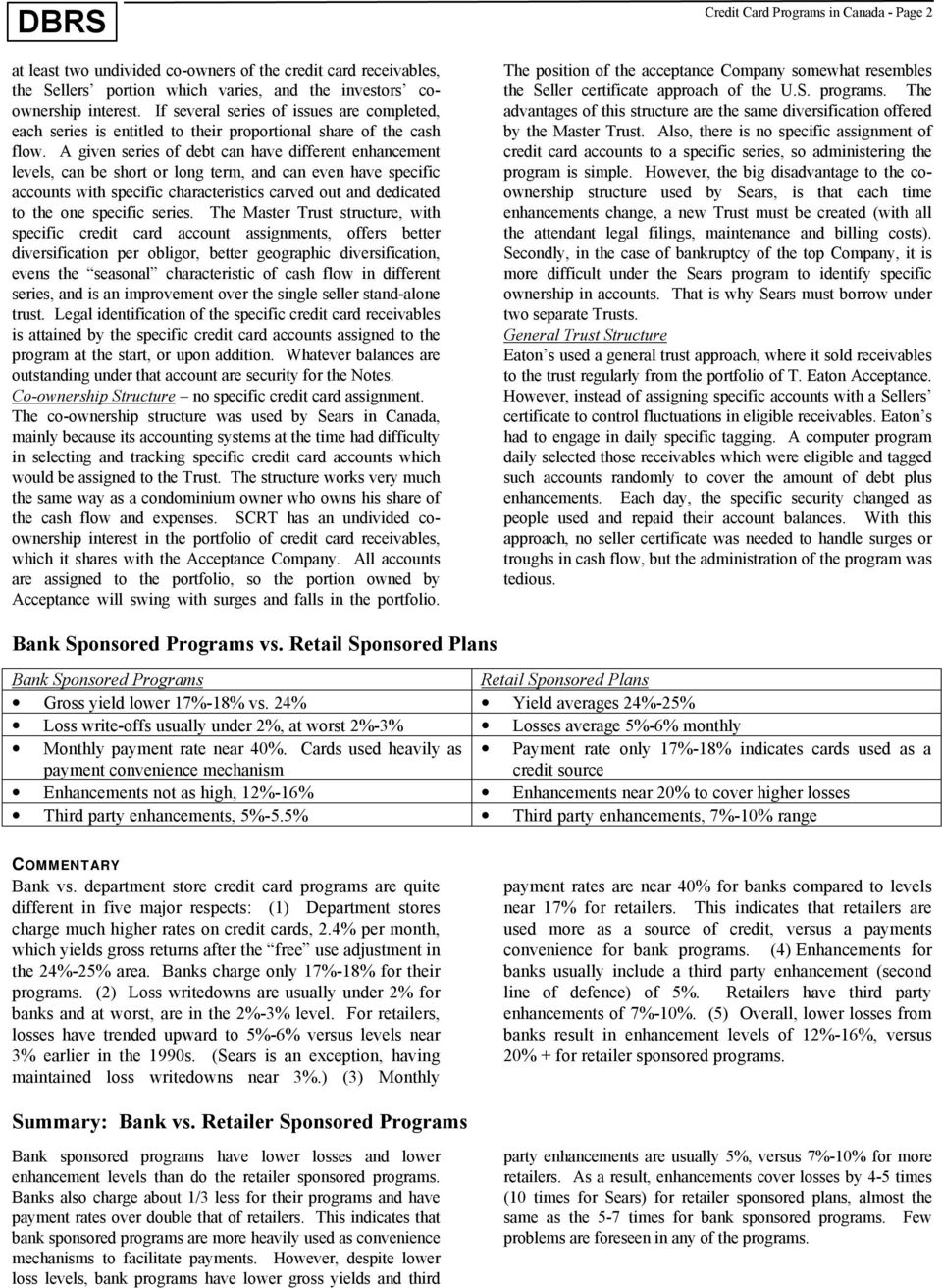
4 at least two undivided co-owners of the credit card receivables, the Sellers portion which varies, and the investors coownership interest. If several series of issues are completed, each series is entitled to their proportional share of the cash flow. A given series of debt can have different enhancement levels, can be short or long term, and can even have specific accounts with specific characteristics carved out and dedicated to the one specific series. The Master structure, with specific credit card account assignments, offers better diversification per obligor, better geographic diversification, evens the seasonal characteristic of cash flow in different series, and is an improvement over the single seller stand-alone trust. Legal identification of the specific credit card receivables is attained by the specific credit card accounts assigned to the program at the start, or upon addition. Whatever balances are outstanding under that account are security for the Notes. Co-ownership Structure no specific credit card assignment. The co-ownership structure was used by Sears in Canada, mainly because its accounting systems at the time had difficulty in selecting and tracking specific credit card accounts which would be assigned to the. The structure works very much the same way as a condominium owner who owns his share of the cash flow and expenses. SCRT has an undivided coownership interest in the portfolio of credit card receivables, which it shares with the Acceptance Company. All accounts are assigned to the portfolio, so the portion owned by Acceptance will swing with surges and falls in the portfolio. Programs in Canada - Page 2 The position of the acceptance Company somewhat resembles the Seller certificate approach of the U.S. programs. The advantages of this structure are the same diversification offered by the Master. Also, there is no specific assignment of credit card accounts to a specific series, so administering the program is simple. However, the big disadvantage to the coownership structure used by Sears, is that each time enhancements change, a new must be created (with all the attendant legal filings, maintenance and billing costs). Secondly, in the case of bankruptcy of the top Company, it is more difficult under the Sears program to identify specific ownership in accounts. That is why Sears must borrow under two separate s. General Structure Eaton s used a general trust approach, where it sold receivables to the trust regularly from the portfolio of T. Eaton Acceptance. However, instead of assigning specific accounts with a Sellers certificate to control fluctuations in eligible receivables. Eaton s had to engage in daily specific tagging. A computer program daily selected those receivables which were eligible and tagged such accounts randomly to cover the amount of debt plus enhancements. Each day, the specific security changed as people used and repaid their account balances. With this approach, no seller certificate was needed to handle surges or troughs in cash flow, but the administration of the program was tedious. Bank Sponsored Programs vs. Retail Sponsored Plans Bank Sponsored Programs Retail Sponsored Plans Gross yield lower 17%-18% vs. 24% Yield averages 24%-25% Loss write-offs usually under 2%, at worst 2%-3% Losses average 5%-6% monthly Monthly payment rate near 40%. s used heavily as payment convenience mechanism Payment rate only 17%-18% indicates cards used as a credit source Enhancements not as high, 12%-16% Enhancements near 20% to cover higher losses Third party enhancements, 5%-5.5% Third party enhancements, 7%-10% range COMMENTARY Bank vs. department store credit card programs are quite different in five major respects: (1) Department stores charge much higher rates on credit cards, 2.4% per month, which yields gross returns after the free use adjustment in the 24%-25% area. Banks charge only 17%-18% for their programs. (2) Loss writedowns are usually under 2% for banks and at worst, are in the 2%-3% level. For retailers, losses have trended upward to 5%-6% versus levels near 3% earlier in the 1990s. (Sears is an exception, having maintained loss writedowns near 3%.) (3) Monthly payment rates are near 40% for banks compared to levels near 17% for retailers. This indicates that retailers are used more as a source of credit, versus a payments convenience for bank programs. (4) Enhancements for banks usually include a third party enhancement (second line of defence) of 5%. Retailers have third party enhancements of 7%-10%. (5) Overall, lower losses from banks result in enhancement levels of 12%-16%, versus 20% + for retailer sponsored programs. Summary: Bank vs. Retailer Sponsored Programs Bank sponsored programs have lower losses and lower enhancement levels than do the retailer sponsored programs. Banks also charge about 1/3 less for their programs and have payment rates over double that of retailers. This indicates that bank sponsored programs are more heavily used as convenience mechanisms to facilitate payments. However, despite lower loss levels, bank programs have lower gross yields and third party enhancements are usually 5%, versus 7%-10% for more retailers. As a result, enhancements cover losses by 4-5 times (10 times for Sears) for retailer sponsored plans, almost the same as the 5-7 times for bank sponsored programs. Few problems are foreseen in any of the programs.
5 Programs in Canada - Page 3 Sponsor Enhancements Comments Eaton Norwest Financial (Wells 10% subordination plus now owned by Wells Fargo Group) 10%-11% excess spread Fargo Group. Has outstanding of near $350 million including $150 million of long debt. Performance good with 20% enhancements supporting 5% in annual writeoffs. Still Eaton is Canadian Tire Receivables Sears Canada Receivables (short term) Sears Canada Receivables (long term) Canadian Tire Corporation 6.35% third party enhancement rising to 9.5% if gross yield falls under 25%. Also, excess spread equals 14% resulting in 20% enhancements. Sears Canada 5% subordinate debt plus 16% plus excess spread equals 20% plus enhancements. Sears Canada 4% subordinate debt, plus 3% Units plus 16% plus excess spread. With different enhancements, a separate is needed from the short debt. s CIBC Net interest spread of 7%- 8% plus L/C of 5.0% issued by Société Générale. Canadian National Bank Enhancements equal 5.5%. L/C from State Street plus 10%-11% excess spread. Master Bank of Montreal Excess spread of 7% plus third party enhancement from State Street Bank and. Superior Royal Bank Excess spread of about 10% plus 5% L/C from Société Générale. dependent for receivables. Good enhancements cover losses of 6% by over 4 times. Yield levels trending down as some Mastercard receivables are included. Excellent coverage of losses near 3% with 20% enhancements. Favourable loss record is especially noteworthy. One of oldest (1991) programs in Canada, using co-ownership interest in a portfolio of credit cards. Coverage of losses 2% better than the short trust. Long shares a undivided coownership interest in the same pool of credit card receivables as the short term. The 12% enhancements cover losses in the 2%-3% range by over 4 times. Outstandings equal $2 billion in long debt. Standard credit card structure, well supported. Performance good with losses near 3% covered by 15%-16% enhancements. Payment rate near 30% versus 40% for other banks indicates program used more as source of credit rather than payments convenience. Long debt outstanding equals $500 million. Loss rates consistently below 2% are easily covered by about 12% in enhancements. Outstandings about $2 billion in long debt. Favourable performance. Exceptionally good loss performance results in over 10 times coverage of losses. Standard pattern for this

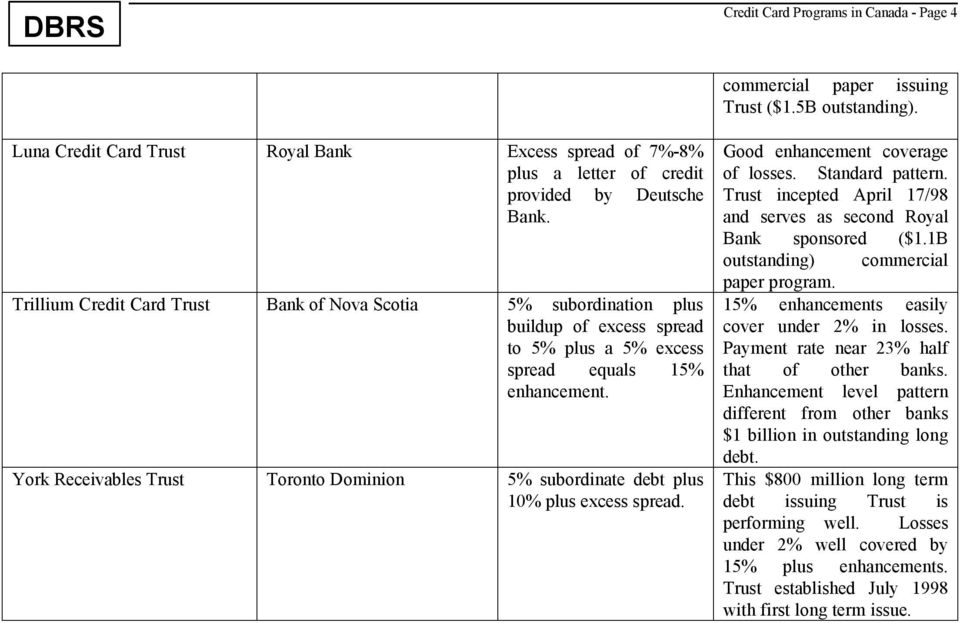
6 Programs in Canada - Page 4 commercial paper issuing ($1.5B outstanding). Luna Royal Bank Excess spread of 7%-8% plus a letter of credit provided by Deutsche Bank. Trillium Bank of Nova Scotia 5% subordination plus buildup of excess spread to 5% plus a 5% excess spread equals 15% enhancement. York Receivables Toronto Dominion 5% subordinate debt plus 10% plus excess spread. Good enhancement coverage of losses. Standard pattern. incepted April 17/98 and serves as second Royal Bank sponsored ($1.1B outstanding) commercial paper program. 15% enhancements easily cover under 2% in losses. Payment rate near 23% half that of other banks. Enhancement level pattern different from other banks $1 billion in outstanding long debt. This $800 million long term debt issuing is performing well. Losses under 2% well covered by 15% plus enhancements. established July 1998 with first long term issue.
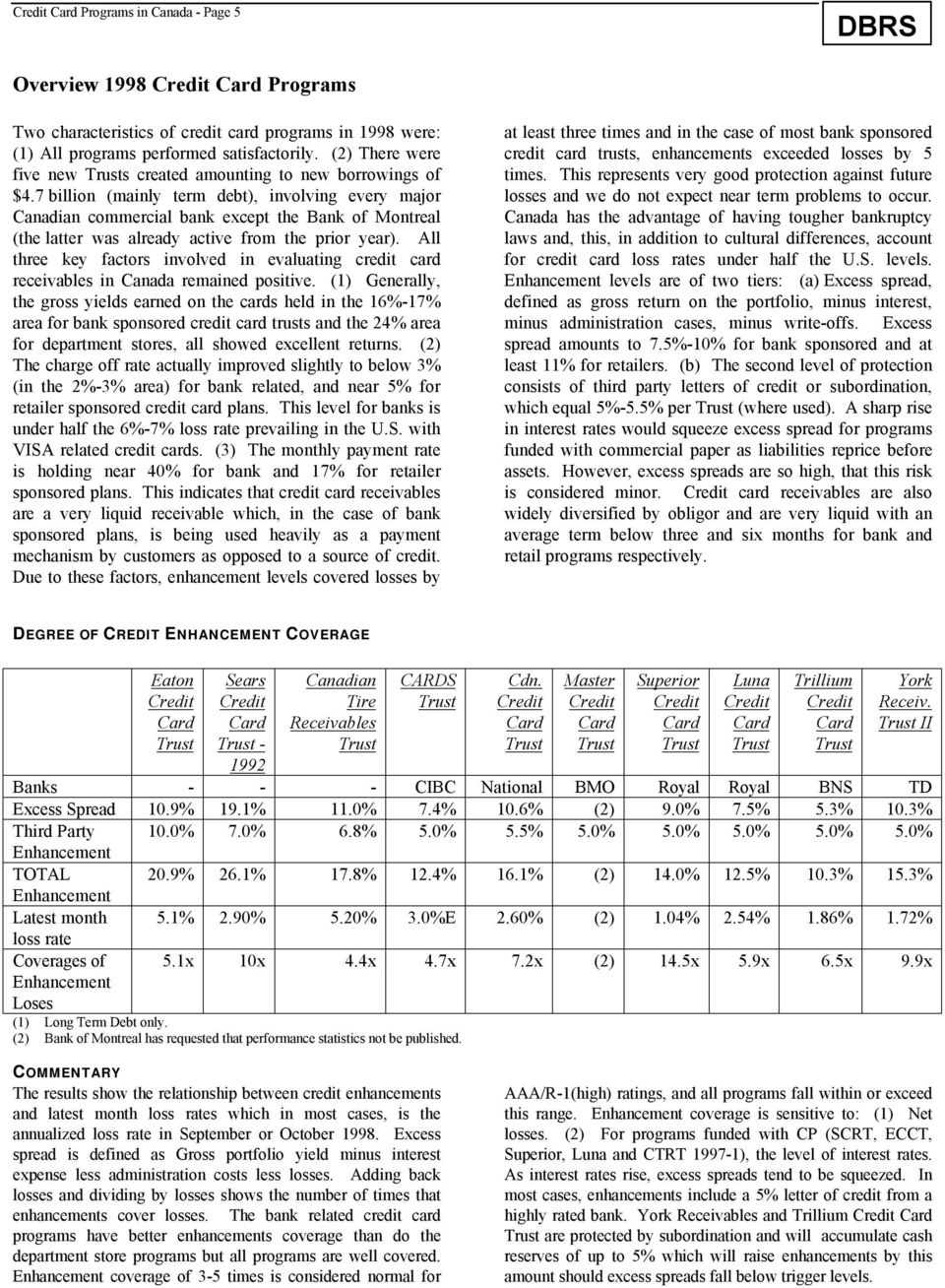
7 Programs in Canada - Page 5 Overview 1998 Programs Two characteristics of credit card programs in 1998 were: (1) All programs performed satisfactorily. (2) There were five new s created amounting to new borrowings of $4.7 billion (mainly term debt), involving every major Canadian commercial bank except the Bank of Montreal (the latter was already active from the prior year). All three key factors involved in evaluating credit card receivables in Canada remained positive. (1) Generally, the gross yields earned on the cards held in the 16%-17% area for bank sponsored credit card trusts and the 24% area for department stores, all showed excellent returns. (2) The charge off rate actually improved slightly to below 3% (in the 2%-3% area) for bank related, and near 5% for retailer sponsored credit card plans. This level for banks is under half the 6%-7% loss rate prevailing in the U.S. with VISA related credit cards. (3) The monthly payment rate is holding near 40% for bank and 17% for retailer sponsored plans. This indicates that credit card receivables are a very liquid receivable which, in the case of bank sponsored plans, is being used heavily as a payment mechanism by customers as opposed to a source of credit. Due to these factors, enhancement levels covered losses by at least three times and in the case of most bank sponsored credit card trusts, enhancements exceeded losses by 5 times. This represents very good protection against future losses and we do not expect near term problems to occur. Canada has the advantage of having tougher bankruptcy laws and, this, in addition to cultural differences, account for credit card loss rates under half the U.S. levels. Enhancement levels are of two tiers: (a) Excess spread, defined as gross return on the portfolio, minus interest, minus administration cases, minus write-offs. Excess spread amounts to 7.5%-10% for bank sponsored and at least 11% for retailers. (b) The second level of protection consists of third party letters of credit or subordination, which equal 5%-5.5% per (where used). A sharp rise in interest rates would squeeze excess spread for programs funded with commercial paper as liabilities reprice before assets. However, excess spreads are so high, that this risk is considered minor. card receivables are also widely diversified by obligor and are very liquid with an average term below three and six months for bank and retail programs respectively. DEGREE OF CREDIT ENHANCEMENT COVERAGE Eaton Sears Canadian Tire Receivables CARDS Cdn. Master Superior Luna Trillium York Receiv. II Banks CIBC National BMO Royal Royal BNS TD Excess Spread 10.9% 19.1% 11.0% 7.4% 10.6% (2) 9.0% 7.5% 5.3% 10.3% Third Party 10.0% 7.0% 6.8% 5.0% 5.5% 5.0% 5.0% 5.0% 5.0% 5.0% Enhancement TOTAL 20.9% 26.1% 17.8% 12.4% 16.1% (2) 14.0% 12.5% 10.3% 15.3% Enhancement Latest month 5.1% 2.90% 5.20% 3.0%E 2.60% (2) 1.04% 2.54% 1.86% 1.72% loss rate Coverages of Enhancement Loses 5.1x 10x 4.4x 4.7x 7.2x (2) 14.5x 5.9x 6.5x 9.9x (1) Long Term Debt only. (2) Bank of Montreal has requested that performance statistics not be published. COMMENTARY The results show the relationship between credit enhancements and latest month loss rates which in most cases, is the annualized loss rate in September or October Excess spread is defined as Gross portfolio yield minus interest expense less administration costs less losses. Adding back losses and dividing by losses shows the number of times that enhancements cover losses. The bank related credit card programs have better enhancements coverage than do the department store programs but all programs are well covered. Enhancement coverage of 3-5 times is considered normal for AAA/R-1(high) ratings, and all programs fall within or exceed this range. Enhancement coverage is sensitive to: (1) Net losses. (2) For programs funded with CP (SCRT, ECCT, Superior, Luna and CTRT ), the level of interest rates. As interest rates rise, excess spreads tend to be squeezed. In most cases, enhancements include a 5% letter of credit from a highly rated bank. York Receivables and Trillium are protected by subordination and will accumulate cash reserves of up to 5% which will raise enhancements by this amount should excess spreads fall below trigger levels.
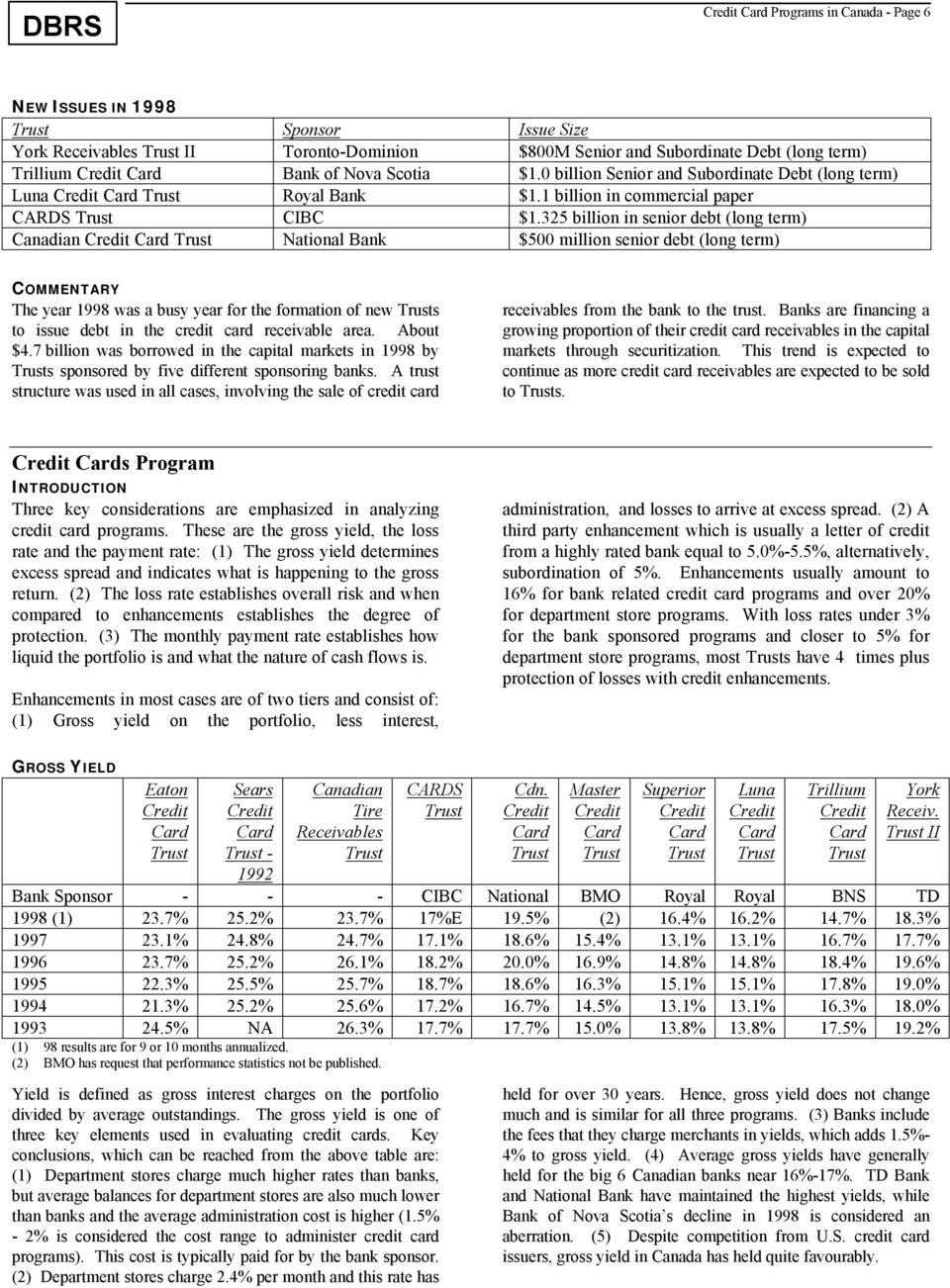
8 Programs in Canada - Page 6 NEW ISSUES IN 1998 Sponsor Issue Size York Receivables II Toronto-Dominion $800M Senior and Subordinate Debt (long term) Trillium Bank of Nova Scotia $1.0 billion Senior and Subordinate Debt (long term) Luna Royal Bank $1.1 billion in commercial paper CARDS CIBC $1.325 billion in senior debt (long term) Canadian National Bank $500 million senior debt (long term) COMMENTARY The year 1998 was a busy year for the formation of new s to issue debt in the credit card receivable area. About $4.7 billion was borrowed in the capital markets in 1998 by s sponsored by five different sponsoring banks. A trust structure was used in all cases, involving the sale of credit card receivables from the bank to the trust. Banks are financing a growing proportion of their credit card receivables in the capital markets through securitization. This trend is expected to continue as more credit card receivables are expected to be sold to s. s Program INTRODUCTION Three key considerations are emphasized in analyzing credit card programs. These are the gross yield, the loss rate and the payment rate: (1) The gross yield determines excess spread and indicates what is happening to the gross return. (2) The loss rate establishes overall risk and when compared to enhancements establishes the degree of protection. (3) The monthly payment rate establishes how liquid the portfolio is and what the nature of cash flows is. Enhancements in most cases are of two tiers and consist of: (1) Gross yield on the portfolio, less interest, administration, and losses to arrive at excess spread. (2) A third party enhancement which is usually a letter of credit from a highly rated bank equal to 5.0%-5.5%, alternatively, subordination of 5%. Enhancements usually amount to 16% for bank related credit card programs and over 20% for department store programs. With loss rates under 3% for the bank sponsored programs and closer to 5% for department store programs, most s have 4 times plus protection of losses with credit enhancements. GROSS YIELD Eaton Sears Canadian Tire Receivables CARDS Cdn. Master Superior Luna Trillium York Receiv. II Bank Sponsor CIBC National BMO Royal Royal BNS TD 1998 (1) 23.7% 25.2% 23.7% 17%E 19.5% (2) 16.4% 16.2% 14.7% 18.3% % 24.8% 24.7% 17.1% 18.6% 15.4% 13.1% 13.1% 16.7% 17.7% % 25.2% 26.1% 18.2% 20.0% 16.9% 14.8% 14.8% 18.4% 19.6% % 25.5% 25.7% 18.7% 18.6% 16.3% 15.1% 15.1% 17.8% 19.0% % 25.2% 25.6% 17.2% 16.7% 14.5% 13.1% 13.1% 16.3% 18.0% % NA 26.3% 17.7% 17.7% 15.0% 13.8% 13.8% 17.5% 19.2% (1) 98 results are for 9 or 10 months annualized. (2) BMO has request that performance statistics not be published. Yield is defined as gross interest charges on the portfolio divided by average outstandings. The gross yield is one of three key elements used in evaluating credit cards. Key conclusions, which can be reached from the above table are: (1) Department stores charge much higher rates than banks, but average balances for department stores are also much lower than banks and the average administration cost is higher (1.5% - 2% is considered the cost range to administer credit card programs). This cost is typically paid for by the bank sponsor. (2) Department stores charge 2.4% per month and this rate has held for over 30 years. Hence, gross yield does not change much and is similar for all three programs. (3) Banks include the fees that they charge merchants in yields, which adds 1.5%- 4% to gross yield. (4) Average gross yields have generally held for the big 6 Canadian banks near 16%-17%. TD Bank and National Bank have maintained the highest yields, while Bank of Nova Scotia s decline in 1998 is considered an aberration. (5) Despite competition from U.S. credit card issuers, gross yield in Canada has held quite favourably.
9 Programs in Canada - Page 7 WRITE-OFFS Eaton Sears (1) Canadian Tire Receivables CARDS Cdn. Master Superior Luna Trillium York Receiv. II Bank Sponsor CIBC National BMO Royal Royal BNS TD 1998 (1) 5.1% 2.9% 6.3% 3%E 2.6% (2) 1.0% 2.5% 1.4% 1.3% % 3.2% 6.8% 3.1% 3.6% 2.0% 1.9% 1.9% 2.2% 2.6% % 3.6% 5.8% 3.0% 3.8% 1.9% 2.1% 2.1% 2.2% 2.3% % 3.1% 5.4% 2.2% 2.2% 1.6% 1.8% 1.8% 1.6% 2.0% % 2.2% 5.2% 2.2% % 1.3% 1.3% 1.3% 2.0% % NA 6.0% 2.3% 2.7% 1.8% 1.3% 1.3% 1.4% 2.7% (1) 1998 results are from 9 or 10 months average. (2) BMO has request that performance statistics not be published. COMMENTARY Losses are defined to be net of recoveries and the following conclusions can be reached. (1) Department store losses average about triple those of the banks except for Sears, whose performance is much closer to that of the banks. (2) Department store credit card programs are used more as a source of credit, while banks credit card programs are used more as a payment mechanism with high monthly repayment. This contributes to a higher risk customer for department stores and larger ultimate losses. (3) Losses rose in 1996 for almost all programs. Bank programs actually improved after 1996, while department store losses generally stabilized. (4) Canadian Tire in most years had the highest loss rates of any of the programs but also priced for this. (5) The Canadian banks, with loss levels near 2%, are about one-third the loss level prevailing in the U.S. This is due to the greater ease of declaring personal bankruptcy in the U.S. relative to Canada, and cultural differences. PAYMENT RATE Eaton Sears (1) Canadian Tire Receiv. CARDS Cdn. Master Superior Luna Trillium York Receiv. II Bank Sponsor CIBC National BMO Royal Royal BNS TD % 22.3% 18.1% 42% 31% (2) 36% 48% 23% 37% % 22.0% 15.3% 37% 32% 41% 42% 42% 26% 38% % 20.2% 14.5% 35% 31% 41% 39% 39% 25% 40% % 18.6% 14.3% 35% 32% 40% 37% 37% 25% 38% % 19.5% 14.9% 36% 34% 40% 33% 33% NA 39% % 21.3% 14.3% 35% 35% 39% 32% 32% NA 39% (1) Long term trust only. (2) BMO has request that performance statistics not be published. COMMENTARY The Monthly Payment Rate is the third key factor in evaluating credit cards. It measures the proportion of a credit card portfolio collected in the next month. (1) Bank credit card programs have payment rates near 40%, indicative of a very liquid portfolio and also that bank credit card programs are being heavily used as payment mechanisms. (3) Two programs stand out as having lower payment rates, those run by National Bank and Bank of Nova Scotia. That means that these programs are being used as a source of credit more so relative to the other programs. The monthly payment rate is partly an aberration, since it captures the high proportion of customers who use credit cards as a convenience or payment mechanism. estimates that the payment rate in the second month (after convenience users have paid out) would fall substantially under a liquidating portfolio scenario.

10 Securitizations Canadian Current Report: February 1999 Walter Schroeder, CFA Huston Loke / Jireh Wong CURRENT RATING [email protected] (416) Rating Trend Rating Action Debt Rated AAA Stable Confirmation -Backed Cert., Series $500M, 5.625% due March 24, 2005 RATING HISTORY Current Backed Cert., Series $500M, 5.625% due March 24, 2005 AAA AAA AAA RATING CONSIDERATIONS This was created on March 31, 1998 and completed a $500 million issue of debt maturing March 24, The gross pool of eligible Mastercard receivables amounts to about $720 million of which the has undivided co-ownership interest amounting to $500 million. The is performing well in all three key areas used to evaluate credit cards. (1) The loss rate, near 3%, although high relative to other commercial banks is still under half the level prevailing in the U.S. and well under the 4%-5% levels where department store losses usually prevail. (2) Gross yield, including interchange, has been holding at very favourable levels in the 18%-19% range which compares favourably with other banks. (3) The monthly payment rate, which measures the percent of outstandings collected in the month, has averaged in the 30% range indicating a relatively liquid portfolio of receivables. However, other banks have payment rates closer to 40%. This is an indication that this s receivables portfolio is being used by clients to a greater degree for credit versus convenience use. With losses near 3% and enhancements near 16%, enhancements cover losses by over 5 times which is favourable for credit cards. The letter of credit of 5.5% is provided by State Street Bank and Company, a AA rated bank in the U.S. FINANCIAL HIGHLIGHTS Largest Seller Industries - October 1998 Largest Asset Types Financial Institutions - 100% Receivables - 100% DEBT OUTSTANDING ($millions) Backed Certificates, Series % due March 24, $500M Inception Date: March 31, 1998 Originator/Servicer: National Bank of Canada Enhancer: Letter of by State Street Bank and Company (5.5%) Co-lead Underwriter: Levesque Beaubien Geoffrion Inc. and Nesbitt Burns Enhancement: Excess spread, an irrevocable letter of credit by a credit enhancer, and a cash collateral account FINANCIAL HIGHLIGHTS ($millions) Principal Long debt Monthly Excess L/C Total Enhancement rec. Outstanding Outstanding Payment Rate Spread plus CCA Dec. 31/ % 9.8% 5.5% 15.3% Nov. 30/ % 11.7% 5.5% 17.2% Oct. 31/ % 10.6% 5.5% 16.1% Sept. 30/ % 11.1% 5.5% 16.6% Aug. 31/ % 10.8% 5.5% 16.3% July 31/ % 11.1% 5.5% 16.3% June 30/ % 12.4% 5.5% 17.9% May 31/ % 11.4% 5.5% 16.9% April 30/98 (1) % 11.2% 5.5% 16.7% (1) April 30/98 was the first reporting period for this. THE TRUST Canadian was established on March 31, 1998, when it completely a $500 million long term debt issue. The is part of the National Bank family of companies. The s lead underwriters are Levesque Beaubien Geoffrion Inc. and Nesbitt Burns. DOMINION BOND RATING SERVICE LIMITED Information used in this Report comes from sources believed to be reliable, but we cannot guarantee that it, or the opinions in this Report, are complete or accurate. This Report is not to be construed as an offering of any securities, and it may not be reproduced without our consent.

11 Securitizations Canadian Tire Receivables Current Report: February 1999 Walter Schroeder, CFA RATING Huston Loke / Jireh Wong Rating Trend Rating Action Debt Rated [email protected] (416) R-1 (high) Stable Confirmation Commercial Paper AAA Stable Confirmation Senior Notes AA (low) Stable Confirmation Subordinate Notes RATING HISTORY Current Commercial Paper R-1 (high) R-1 (high) R-1 (high) NR NR NR Senior Notes AAA AAA AAA AAA AAA NR Subordinated Notes AA (low) AA (low) AA (low) AA (low) AA (low) NR RATING CONSIDERATIONS The continues to function well. The lower yield for long term receivables relates to the fact that funding costs for the commercial paper has been lower than those of the term issues. Each series of notes including commercial paper have specific credit card accounts assigned to them. The receivables have performed well, and generally net spread levels for each of the term debt issues are very similar. Relative to other retailer related credit card programs: (1) The loss rate near 6% compares to levels below 5% for other programs. (2) This is partly offset by gross yield which has averaged 24%-25%. Note that basic enhancement levels have the ability to rise from 6.35% to a maximum of 10.50% (9.50% for one commercial paper program), as gross yield falls below 25%. Starting in June 1997 (Series ) and October 1998 for commercial paper, the falling yield has resulted in an adjusted enhancement of 6.9%-7% versus a base enhancement of 6.35%. (3) The payment rate near 17% is consistent with other retailers which prevailed for much of the 1990s. Despite higher losses, the 20% enhancements for commercial paper cover losses by 3 1/3 times, while long term debt rated securities are covered by about 2.8 times by credit enhancements, all considered reasonable. FINANCIAL HIGHLIGHTS Largest Seller Industries - October 1998 Largest Asset Types Retailing - 100% Receivables - 100% REMAINING DEBT OUTSTANDING (millions) Series and , Series (Senior Notes) - $457 Subordinate Notes and , $5 Asset backed commercial paper, $135 (Dec. 1998) Inception Date: November 1995 (for long term debt) Lead Dealer: Long Term Debt: TD Securities Inc. Commercial Paper: RBC Dominion Securities Legal Structure: Undivided co-ownership interest in a special purpose Enhancements: 6.35% enhancement rising to 10.5% (9.5% for one CP program) if gross yield falls below 25% FINANCIAL HIGHLIGHTS ($millions) Debt Outstanding Gross Yield Payment Rate Net Charge Off Dec. 31/ % 18.4% 4.4% Sept. 30/ % 17.8% 5.2% June 30/ % 18.5% 7.2% March 31/ % 18.2% 6.8% Dec. 31/ % 16.8% 6.7% Mar. 31/ % 16.3% 6.5% (1) Long term debt only. Series Series Series Series (CP) ($millions) Net Spread Enhancement Net Spread Enhancement Net Spread Enhancement Net Spread Enhancement Dec. 31/ % 6.7% 11.2% 6.7% 12.1% 6.7% 12.6% 6.7% Sept. 30/ % 6.8% 10.7% 6.8% 12.0% 6.8% 13.9% 6.4% June 30/98 8.6% 6.9% 8.2% 6.9% 9.2% 6.9% 13.9% 6.4% Mar. 31/98 9.0% 6.9% 8.6% 6.9% 9.5% 6.9% 13.3% 6.4% Dec. 31/97 9.4% 6.6% 9.0% 6.6% 9.9% 6.6% 13.5% 6.4% Mar. 31/ % 6.4% 10.6% 6.4% 11.4% 6.3% 10.6% 6.4% THE TRUST Canadian Tire Receivables issues both commercial paper and long term debt to finance the purchase of credit card receivables from Canadian Tire Acceptance Limited. DOMINION BOND RATING SERVICE LIMITED Information used in this Report comes from sources believed to be reliable, but we cannot guarantee that it, or the opinions in this Report, are complete or accurate. This Report is not to be construed as an offering of any securities, and it may not be reproduced without our consent.

12 Securitizations CARDS Current Report: February 1999 Walter Schroeder, CFA Huston Loke / Jireh Wong CURRENT RATING [email protected] (416) Rating Amount Trend Rating Action Debt Rated AAA $300 million Stable Confirmation 5.4% Series , September 21, 2001 AAA $675 million Stable Confirmation 5.51% Series , June 21, 2003 AAA $350 million Stable Confirmation 5.63% Series , December 21, 2005 RATING HISTORY Current All series shown AAA AAA NR NR NR NR RATING CONSIDERATIONS CARDS is part of a family of securitization trusts established by CIBC Wood Gundy. In 1998, the issued three series of notes, maturing The notes have an undivided interest in a pool of credit card receivables amounting to $5.2 billion, of which the share is $2 billion. The enhancements for this Pool of assets is considerable with excess spreads of 7%, plus a 5% irrevocable letter of credit provided by Société Générale. The 12% enhancements cover the diversified portfolio of credit card receivables by over 4 times the latest loss rate. The whole program is administered by CIBC, one of the most experienced securitization administrators in Canada. The payment rate on the program is also 40%, which means that approximately 40% of the portfolio is collected within the first month indicating a very liquid portfolio. Amortization of the program occurs, among other things, if the spread falls below 2% (current is above 7%) or if the payment rate falls below 10% (current is 40%). The portfolio is extremely well diversified across almost 4 million accounts with an average balance of $495 including all accounts or $1,815 including only those accounts with a credit balance. Inception Date: April 24, 1998 Structure: Co-ownership interest in a pool of credit card receivables in a master trust. Seller: Canadian Imperial Bank of Commerce Monthly Payment Rate: Average is near 40%. Loss Rate: Losses average 2%-3% which is under half the level prevailing in the U.S.A. enhancement: The seller specific enhancement consists of a net interest spread which has averaged at least 7%- 8%, an irrevocable letter of credit issued by Société Générale (currently rated AA (low), R-1 (middle) with a Stable trend) equal to 5% of the face amount of the Series Notes, and a cash collateral account (the CCA is currently zero). Structure: For each Series, the Series has an individual interest in certain specific credit card receivables. Specific credit card accounts have been allocated to the three series and the portfolio amounts must be a minimum 107% of outstanding notes. If it falls below this level, new accounts must be allocated. FINANCIAL HIGHLIGHTS Excess Spread Payment Rate L/C plus CCA Enhancement Dec. 31/98 6.8% 42.3% 5% 11.8% Nov. 30/98 7.3% 41.7% 5% 12.3% Oct. 31/98 7.5% 41.5% 5% 12.5% Sept % 41.6% 5% 12.4% Aug % 43.0% 5% 12.2% July % 43.6% 5% 11.6% June % 43.0% 5% 11.6% May % 41.0% 5% 11.8% (1) The May 31/98 date is the first reporting period. DEBT OUTSTANDING $1.325 billion contained in three series of term debt, as outlined above. THE TRUST CARDS is a single seller formed to buy credit card receivables from CIBC. DOMINION BOND RATING SERVICE LIMITED Information used in this Report comes from sources believed to be reliable, but we cannot guarantee that it, or the opinions in this Report, are complete or accurate. This Report is not to be construed as an offering of any securities, and it may not be reproduced without our consent.

13 Securitizations Eaton Current Report: February 1999 Walter Schroeder, CFA CURRENT RATING Huston Loke / Jireh Wong Rating Trend Rating Action Debt Rated [email protected] (416) R-1 (high) Stable Confirmation Commercial Paper AAA Stable Confirmation Asset-Backed Senior Notes, Series , due Dec. 1, 1999 AAA Stable Confirmation Asset-Backed Senior Notes, Series , due Dec. 1, 2000 RATING HISTORY Current Commercial Paper R-1 (high) R-1 (high) R-1 (high) R-1 (high) R-1 (high) R-1 (high) Series , Debt due Dec. 1, 1999 AAA AAA AAA AAA AAA AAA Series , Debt due Dec. 1, 2000 AAA AAA AAA AAA AAA AAA RATING CONSIDERATIONS Many positive elements have happened to Eaton over the portfolio years. (1) The was sold to Norwest Financial which is part of the Wells Fargo Family of companies from California who have resources to support the. (2) The is aggressively marketing to new clients to attain diversification from Eaton s. The U.S. Group also owns finance company operations in Canada and there are potential synergies between these finance and credit card operations especially in respect to marketing. (3) All three main segments used to measure credit card operations are positive. (a) Loss rates are ranging 4%-5% which is superior to 6%-7% in the U.S., although not as favourable as the 2%-3% low rate which prevailed before (b) The portfolio yield is holding in the 18% range which contributes to the excess spread being near 10% (a first line of defence for credit enhancement). (c) The payment rate is holding near 17%-18% FINANCIAL HIGHLIGHTS Largest Seller Industries - October 1998 Largest Asset Types Retailing - 100% Receivables - 100% which means 17%-18% of the portfolio is retired in the next month indicating a relatively liquid portfolio. (4) As a result, 10% excess spread plus 10% subordinate debt equals 20% enhancements to cover annualized losses of 4%-5%. Thus, enhancements cover losses by 4-5 times which is good and consistent with an R-1 (high), AAA rating. The key challenges with the portfolio are the high dependence on Eaton s. The latter accounts for a high proportion of total receivables. The future direction and ability of Eaton s as a going concern are not clear. Failure of Eaton s would mean that the would not be able to purchase new receivables so the would have to add non Eaton s receivables quickly. However, even with the loss of Eaton s, we would expect a normal liquidation of the Eaton s credit card program with relatively few problems. REMAINING DEBT OUTSTANDING 1998/1997 ($millions) December November October December 97 June 97 Long Term Debt Commercial Paper Inception Date: December 1991 Sponsor: Norwest Financial, now part of Wells Fargo who purchased the from T. Eaton. Agreement: T. Eaton Company signed an agreement with the to exclusively continue to sell receivables to the for a ten year period to Structure: Senior/subordinate structure Support: Net interest spread which has been averaging 9%-10% annually plus 10% subordinate debt. Liquidity Support: Full bank line credit support is provided from banks rated AA (low) or better. FINANCIAL HIGHLIGHTS ($millions) Debt Outstanding Yield Excess Spread Payment Rate Charge off Rate Enhancement Dec % 10.7% 17.1% 3.9% 20.7% Sept % 10.9% 15.8% 5.1% 20.9% June % 11.8% 16.7% 4.5% 21.8% March % 10.7% 15.9% 5.5% 20.7% Dec. 31/ % 9.6% 15.6% 5.5% 19.6% Dec. 31/ % 10.5% 15.5% 7.5% 20.5% Dec. 31/ % 11.3% 12.7% 6.4% 21.3% Dec. 31/ % 11.0% 11.9% 3.5% 21.0% Dec. 31/ % 12.2% 13.9% 3.0% 22.2% Dec. 31/ % 10.4% 14.8% 3.9% 20.4% THE TRUST Eaton was purchased by Norwest Financial who is part of the Wells Fargo Group of companies in California. Since acquiring Eaton in 1998, a marketing program was introduced to add new and reduce dependency of the on Eaton s. Eaton s signed a ten year exclusive contract with the, whereby it will continue to sell financial credit card receivables to the exclusively until DOMINION BOND RATING SERVICE LIMITED Information used in this Report comes from sources believed to be reliable, but we cannot guarantee that it, or the opinions in this Report, are complete or accurate. This Report is not to be construed as an offering of any securities, and it may not be reproduced without our consent.

14 Securitizations Luna Current Report: February 1999 Walter Schroeder, CFA Huston Loke / Jireh Wong CURRENT RATING [email protected] (416) Rating Trend Rating Action Debt Rated R-1 (high) Stable Confirmation Asset-backed Commercial Paper RATING HISTORY Current Asset-backed Commercial Paper R-1 (high) R-1 (high) NR NR NR NR RATING CONSIDERATIONS Luna is part of the Royal Bank family of companies. On April 17, 1998, it made a major purchase of credit card receivables from Royal Bank. It is issuing $1.1 billion in commercial paper to finance this portfolio of credit card receivables. The program is a revolving program and Royal Bank sells enough credit card receivables into the program to keep outstandings near $1.1 billion. The enhancements consist of a letter of credit provided by Deutsche Bank equal to 5% plus an excess spread equal to 8%-10%. With losses ranging 2%-3%, the credit enhancements cover the loss rate by over 6 times, which is an excellent performance. This is under half the loss rates presently being experienced by credit cards in the U.S. Full bank line coverage of commercial paper is provided led by Royal Bank and various other banks rated AA (low) or better. The payment rate is also excellent with over 40% of credit card receivables collected in the month. This gives substantial liquidity to the program supplementing bank lines. In addition, with assets turning into cash so quickly, any build up of delinquencies is known early. COMMERCIAL PAPER OUTSTANDING ($millions) December 98 November October December 97 Commercial Paper Outstanding 1,100 1,100 1,100 0 Inception Date: April 17, 1998 Structure Type: Single seller, credit card receivables which issues commercial paper to fund co-ownership interests in a pool of VISA credit card receivables. Enhancement: Seller specific enhancements equal to the net interest income spread of 8%-10% plus a letter of credit provided by Deutsche Bank, a AA (high), R-1 (high) rated bank. Liquidity Facility: Program Size: Seller: Payment Rate: Near 40% Loss Rate: Under 2% Full bank line coverage provided by Royal Bank and a syndicate of banks rated R-1 (middle) or better. The outstanding commercial paper is $1.1 billion. Royal Bank of Canada FINANCIAL HIGHLIGHTS ($millions) Debt Outstanding Excess Spread Payment Rate L/C Amount Enhancement Dec. 31/98 1, % 47% 5% 14.5% Nov. 30/98 1, % 48% 5% 15.4% Oct. 31/98 1, % 47% 5% 12.5% Sept. 30/98 1, % 46% 5% 14.9% Aug. 31/98 1, % 48% 5% 13.1% July 31/98 1, % 50% 5% 12.6% June 30/98 1, % 49% 5% 10.7% May 31/98 1, % 46% 5% 13.1% THE TRUST Luna is a member of the Royal Bank family of companies. It buys credit card receivables from Royal Bank, a single seller, and has maintained outstanding commercial paper near $1.1 billion since inception. DOMINION BOND RATING SERVICE LIMITED Information used in this Report comes from sources believed to be reliable, but we cannot guarantee that it, or the opinions in this Report, are complete or accurate. This Report is not to be construed as an offering of any securities, and it may not be reproduced without our consent.

15 Securitizations Master Current Report: February 1999 Walter Schroeder, CFA Huston Loke / Jireh Wong [email protected] (416) CURRENT RATING Rating Trend Rating Action Debt Rated AAA Stable Confirmation -backed Investor Certificates, Series , due August 21, 2002 AAA Stable Confirmation -backed Investor Certificates, Series , due December 21, 2004 AAA Stable Confirmation -backed Investor Certificates, Series , due November 21, 2003 AAA Stable Confirmation -backed Investor Certificates, Series , due June 21, 2007 RATING HISTORY Current All Series AAA AAA AAA NR NR NR NR NR RATING CONSIDERATIONS The performance of this credit card receivable operated by the Bank of Montreal is excellent. Performance is strong in all three key areas which are used to evaluate credit card receivables. (1) The gross yield is quite comparable to other credit card programs and is holding steady. (2) Loss rates Under 2% are roughly under 1/3 the levels which prevail in the U.S. for credit cards and are improving. (3) The payment rate which measures the proportion of credit card receivables collected in the month is standard near 40%, indicating a very liquid portfolio. The rating on the debt is a long term rating with no commercial paper outstanding. The level of enhancements including the 5% letter of credit covers present losses by over 6 times which is quite good and well within the AAA rating limits of performance. Loss rates on credit card receivables in the U.S. have been deteriorating and now exceed 6%. Loss rates in this program have actually been improving and amount to under 2%. Inception Date: July 30, 1997 (Series 1 and 2) and October 2, 1997 (Series 3 and 4) Amounts: $550 million, % August 21, 2002 $800 million, % December 21, 2004 $400 million, % November 21, 2003 $250 million, % June 21, 2007 Originator Servicer: Nesbitt Burns/Bank of Montreal Support: Excess spread, cash collateral account and third party letter of credit. State Street Bank and Company is the credit enhancer. Legal Structure: Sale of credit card receivables by a single seller, Bank of Montreal to the. Number of Accounts: 4,369,000 at inception. FINANCIAL HIGHLIGHTS Bank of Montreal has requested that performance statistics related to MCCT not be published. THE TRUST Master is a member of the Nesbitt Burns/Bank of Montreal family of companies. It purchases credit card receivables from the Bank of Montreal and has issued term debt to finance the portfolio. DOMINION BOND RATING SERVICE LIMITED Information used in this Report comes from sources believed to be reliable, but we cannot guarantee that it, or the opinions in this Report, are complete or accurate. This Report is not to be construed as an offering of any securities, and it may not be reproduced without our consent.

16 Securitizations Reliant Receivables Current Report: February 1999 Walter Schroeder, CFA Huston Loke / Jireh Wong CURRENT RATING [email protected] (416) Rating Trend Rating Action Debt Rated R-1 (high) Stable Confirmation Short Term Asset Backed Notes R-1 (middle) Stable Confirmation First Subordinated Short Term Asset Backed Notes RATING HISTORY Current Short Term ABN R-1 (high) R-1 (high) NR NR NR NR First Sub. Short Term Notes R-1 (middle) R-1 (middle) NR NR NR NR RATING CONSIDERATIONS This was incepted July 30, 1998 and is part of the Toronto-Dominion family of companies. It differs from most conduits in Canada because: (a) It is a single seller conduit, purchasing assets from the Toronto-Dominion Bank. (b) At present, it has purchased only credit card receivables from the bank. It has outstanding commercial paper of $909 million and a pool balance near $1 billion. The share of the Pool is about $900 million with the balance mainly owned on a pari passu basis by the junior creditors. enhancements are two tier. (a) The seller enhancement consists of an excess spread after all loan losses, interest expense and operating expenses of 8%-10%. (b) In addition, a letter of credit (third party) equal to 5.25% exists. Thus, total credit enhancements have been in the 14%-16% range. Lastly, the payment rate (95% of outstandings) is 35%-40% per month, resulting in a very liquid portfolio of assets. Full bank line support is provided by banks rated R-1 (middle) or better including TD. The can issue senior R-1 (high) or junior R-1 (middle) rated commercial paper but there is presently no junior commercial paper outstanding. Reliant is relatively new with a July 30, 1998 inception. FINANCIAL HIGHLIGHTS Largest Seller Industries (October 31, 1998) Largest Asset Types Financial Institutions - 100% Receivables - 100% COMMERCIAL PAPER OUTSTANDING ($millions) December 98 November October September December 97 Senior Commercial Paper Junior Commercial Paper Inception Date: July 30, 1998 Structure Type: Single seller, multi-asset master trust Lead Underwriter and Administrative Agent: TD Securities Inc. and TD Bank Enhancement: Two tiers of enhancement exist. Specific seller enhancement includes spreads which have ranged 8%-10% and third party enhancers such as banks. Third Party Enhancers: Must be rated at least AA (low) or be cash collateralized. Liquidity Support: Liquidity lenders must have ratings of at least R-1 (middle). Liquidity lines exist for market disruption only and may be cancelled if credit related problems emerge. Full bank line coverage of short debt is provided. Structure: The is a special purpose vehicle which can purchase a wide range of financial assets. The administration is conducted by the administrative agent. Several Seller pools of assets can act as security for the Series of notes issued, but in case of losses, each pool stands on its own credit strength. Legal: Legal counsel to the, rendered an opinion that the exists, the Issuer ee has the power to perform its obligations and that the trust Indenture is legally binding. When assets are sold (creating a pool), a true sale and bankruptcy remoteness opinion are customarily obtained by. THE TRUST Reliant Receivables was created by Toronto Dominion Bank as a single seller (TD Bank) multi-asset. Presently, it has purchased only credit card receivables of which the share is about $900 million. DOMINION BOND RATING SERVICE LIMITED Information used in this Report comes from sources believed to be reliable, but we cannot guarantee that it, or the opinions in this Report, are complete or accurate. This Report is not to be construed as an offering of any securities, and it may not be reproduced without our consent.

17 Securitizations - Bond Sears Canada Receivables Current Report: February 1999 Walter Schroeder, CFA CURRENT RATING Huston Loke / Jireh Wong Rating Trend Rating Action Debt Rated [email protected] (416) AAA Stable Confirmation Asset Backed Senior Notes RATING HISTORY Current Series (175M, June 1, 2004) AAA AAA AAA AAA AAA AAA AAA AAA Series (150M, April 1, 2001) AAA AAA AAA AAA AAA AAA AAA AAA Series (150M, Dec. 16, 2003) AAA AAA AAA AAA AAA AAA AAA AAA Various series subordinate debt A(high) A(high) A(high) A(high) A(high) A(high) A(high) A(high) units (sub.) NR NR NR NR NR NR NR NR RATING CONSIDERATIONS This finances long term debt and because enhancements for the long term trust are 7% versus 5% for the short term, a separate with a separate dedicated security pool had to be created. Total enhancements consist of 15%-17% excess spread plus 4% subordinate debt plus 3% subordinate Units, which have no specific maturity date. This means that enhancements of 22%-24% cover average losses of under 3% by close to 8 times which is quite exceptional for a credit card receivable portfolio in North America. The three key criteria used in evaluating credit cards are all positive for Sears: (1) The average loss rate has generally been below 3% which is quite impressive compared to other retail programs (which FINANCIAL HIGHLIGHTS Largest Seller Industries - October 1998 Largest Asset Types Retailing 100% Receivables 100% exceed 5%) or U.S. credit card losses between 6%-7%. (2) The gross yield on the credit card portfolio has held in the 20%-22% range. (3) The payment rate continues to be near 20% which is also indicative of a very liquid portfolio of receivables. The long nature of debt means that this long term financing is better able to lock in interest rates over the long term and hence excess spread should be a more stable number than it is for the short term trust. This has consistently outperformed other s with respect to losses. REMAINING DEBT OUTSTANDING ($MILLIONS) Series , $175M 8.95% June 1, 2004 AAA Series , $150M Floating April 1, 2001 AAA Series , $150 M 5.34% Dec. 16, 2003 AAA Series (Sub), $3.9M Floating June 1, 2004 A (high) Series (Sub), $3.9M 9.18% June 1, 2004 A (high) Series (Sub), $6.6M Floating April 1, 2001 A (high) Series (Sub), 6.6M Floating Dec. 16, 2003 A (high) Inception Date: December 1993 Lead Sponsor: Sears Canada Inc. Legal Structure: Senior subordinate structure with the having an undivided interest in a pool of credit card receivables. Enhancement: Excess spread near 16% plus 4% subordinate debt plus 3% Units. FINANCIAL HIGHLIGHTS ($millions) Debt Outstanding Yield Excess Spread Payment Rate Charge off Rate Enhancement Dec % 14.4% 23.3% 2.64% 21.4% Sept % 19.1% 21.1% 2.90% 26.0% June % 15.8% 22.0% 2.94% 22.8% March % 19.2% 23.0% 2.55% 26.2% Dec. 31/ % 16.3% 21.8% 2.32% 23.3% Dec. 31/ % 14.6% 21.4% 3.66% 21.6% Dec. 31/ % 14.7% 18.1% 3.27% 21.7% Dec. 31/ % 15.3% 18.2% 2.27% 22.3% Jan. 31/ % 15.0% 23.4% 2.37% 22.0% THE TRUST Sears Canada Receivables is in business to purchase credit card receivables from the Sears family of companies through an undivided co-ownership interest in a pool of credit card receivables. DOMINION BOND RATING SERVICE LIMITED Information used in this Report comes from sources believed to be reliable, but we cannot guarantee that it, or the opinions in this Report, are complete or accurate. This Report is not to be construed as an offering of any securities, and it may not be reproduced without our consent.

18 Securitizations Sears Canada Receivables Current Report: February 1999 Walter Schroeder, CFA Huston Loke / Jireh Wong CURRENT RATING [email protected] (416) Rating Trend Rating Action Debt Rated R-1(high) Stable Confirmation Commercial Paper A Stable Confirmation Asset-Backed Subordinated Notes, Series RATING HISTORY Current Commercial Paper R-1 (high) R-1 (high) R-1 (high) R-1 (high) R-1 (high) R-1 (high) R-1 (high) Asset-Backed Sub. Notes, Series A A NR NR NR NR NR RATING CONSIDERATIONS Sears Canada Receivables is one of the oldest s in Canada (December 2, 1991 inception) and is in business to buy credit card receivables from Sears Canada purchasing an undivided interest in a pool of credit card receivables. The credit card receivable portfolio ranks as one of the strongest credit card portfolios in Canada with all three areas considered key in evaluating credit cards positive: (1) The loss rate has consistently been below 3% versus 6%-7% in the U.S., and 4%-5% for Eaton s, for example. (2) The gross yield on the portfolio is holding near 20%-22% although there is some fluctuation around these points. (3) The payment rate continues to be near 20% (this means that approximately 20% of the portfolio is collected in the month). Thus, credit card receivables are highly liquid. Enhancements amount to 5% Largest Seller Industries - October 1998 Largest Asset Types Retailing 100% Receivables 100% subordinate trust units plus 15%-17% excess spread leading to a 21% total enhancement. The latter covers losses by close to 7 times which is very good and leaves a large margin for any future problems which may arise. The Servicer is also well qualified to administer the accounts which are well diversified by obligor and geography. As an added strength, the performance of the parent (Sears Canada) in merchandising has been generally improving in a very difficult competitive market in Canada. There is a degree of liability sensitive mismatch as relatively fixed rates earned on the portfolio are partly funded by variable rate debt. This would result in some earnings squeeze if interest rates rise, but, the effects should not be enough to create problems. COMMERCIAL PAPER OUTSTANDING ($millions) December 98 November October December 31/97 June 97 Commercial Paper Inception Date: December 2, 1991 Lead Sponsor and Servicer: Sears Canada Inc. Legal Structure: Senior/Subordinate with the having an undivided co-ownership interest in a portfolio of securities. Enhancement: Subordinate (5%) consisting of Units, plus excess spread which averaged 15%-16% in enhancements exceeded 20% collectively. Liquidity Support: Full bank line coverage of commercial paper is provided. FINANCIAL HIGHLIGHTS ($millions) Debt Outstanding Yield Excess Spread Payment Rate Charge off Rate Enhancement Dec % 14.4% 23.3% 2.64% 19.4% Sept % 19.1% 21.1% 2.90% 24.0% June % 15.8% 22.0% 2.94% 20.8% March % 19.2% 23.0% 2.55% 24.2% Dec. 31/ % 16.3% 21.8% 2.32% 21.3% Dec. 31/ % 14.6% 21.4% 3.66% 19.6% Dec. 31/ % 14.7% 18.1% 3.27% 19.7% Dec. 31/ % 15.3% 18.2% 2.27% 20.3% Dec. 31/ % 17.3% 19.7% 1.80% 22.3% Mar. 31/ % 15.0% 23.4% 2.37% 20.0% THE TRUST Sears Canada Receivables is in business to purchase an undivided co-ownership interest in a credit card receivables pool of credit card receivables, originated by the Sears family of companies. DOMINION BOND RATING SERVICE LIMITED Information used in this Report comes from sources believed to be reliable, but we cannot guarantee that it, or the opinions in this Report, are complete or accurate. This Report is not to be construed as an offering of any securities, and it may not be reproduced without our consent.

19 Securitizations Superior Current Report: February 1999 Walter Schroeder, CFA Huston Loke / Jireh Wong CURRENT RATING [email protected] (416) Rating Trend Rating Action Debt Rated R-1 (high) Stable Confirmation Commercial Paper RATING HISTORY Current Commercial Paper R-1 (high) R-1 (high) R-1 (high) NR NR NR RATING CONSIDERATIONS This portfolio of credit card receivables consists of Royal Bank VISA card accounts originated on or before December 31, 1991, and continues to perform satisfactorily. The is strong in the key three criteria used to measure credit card performance. (1) The most impressive performance is in the area of losses, where losses in recent months have been averaging near 1%. This is exceptional performance compared to U.S. credit card experience where losses are averaging 6%-7%. (2) The gross yield on the portfolio has been near 15% which, after losses and interest expense, contributes to an excess spread of 9%-10%. (3) The payment rate which measures the percentage of outstandings collected in the month is near 38%. This is consistent with the banks and indicates a liquid portfolio of securities which would be monetized on its own (and very quickly) if liquidity was needed. In addition, full bank line coverage of commercial paper led by Royal Bank (rated AA) and other banks rated at least AA (low) is provided. For the last few months, credit enhancements cover the latest monthly loss rates by over 10 times which is a quite exceptional level of performance for a credit card program. The main reason for this is the strong credit worthiness of the well-seasoned underlying obligors. The legal structure is an undivided co-ownership interest in an almost $2 billion portfolio, where Royal Banks residual interest ranks pari passu with the $1.5 billion in outstanding commercial paper. Inception Date: October 17, 1997 Lead Underwriter and Administrative Agent: RBC Dominion Securities Inc. Servicing Agent: Royal Bank of Canada Legal Structure: Special purpose trust which issues commercial paper to fund a co-ownership interest in a pool of VISA credit card receivables. Support: A letter of credit equal to 5% of the Pool plus 10% excess spread amounting to 14%-15% total enhancements in recent months. Letter of Bank: Société Générale (Canada) (5.0%) Liquidity Support: Provided by Royal Bank of Canada and a syndicate of banks with ratings of AA (low) or better. FINANCIAL HIGHLIGHTS Date 1998 Debt Outstanding Excess Spread Payment Rate L/C Amount Enhancement Dec. 31 1, % 36% 5% 14.6% November 1, % 37% 5% 14.6% October 1, % 36% 5% 14.0% September 1, % 36% 5% 15.3% August 1, % 37% 5% 14.1% July 1, % 38% 5% 14.4% June 1, % 36% 5% 15.5% May 1, % 37% 5% 17.9% April 1, % 34% 5% 14.0% March 1, % 34% 5% 18.7% December , % 37% 5% 16.0% THE TRUST Superior is a single purpose should be created to hold an undivided co-ownership interest in credit card receivables from Royal Bank. It is a member of the RBC Dominion Securities family of trusts. DOMINION BOND RATING SERVICE LIMITED Information used in this Report comes from sources believed to be reliable, but we cannot guarantee that it, or the opinions in this Report, are complete or accurate. This Report is not to be construed as an offering of any securities, and it may not be reproduced without our consent.

20 Securitizations Trillium Current Report: February 1999 Walter Schroeder, CFA Huston Loke / Jireh Wong CURRENT RATING [email protected] (416) Rating Trend Rating Action Debt Rated AAA Stable Confirmation CCRBN, Series , Series , Series , Class A A Stable Confirmation CCRBN, Series , Series , Series , Class B BBB Stable Confirmation CCRBN, Series , Series , Series , Class C RATING HISTORY Current 1998 CCRBN, Series , Series , Series , Class A AAA AAA CCRBN, Series , Series , Series , Class B A A CCRBN, Series , Series , Series , Class C BBB BBB RATING CONSIDERATIONS The was incepted in October 1998 so it is a relatively new and part of the ScotiaMcLeod/Bank of Nova Scotia family of companies. It is in business to purchase credit card receivables from Bank of Nova Scotia. The has ratings on three separate issues of notes. The rating on the senior notes is AAA, the next ranked notes are rated A and the Class C third ranking notes are ranked BBB. The structure is different from the customary credit card structures. (a) There is no 5% letter of credit from a high rated bank. Instead, there is a 5% (3% Series B and 2% Series C) level of subordinate debt. (b) A 5% cash reserve builds up from the excess spread. Since the issue was just completed, very little in cash excess spread has accumulated. (c) The excess spread is building to 8%- 10%. On this basis, enhancements are presently near 10%- 13%, but will build to 15% as the cash excess spread accumulates. Collectively, the enhancements are attractive. With loss rates below 2% (consistently) the enhancements at present exceed 5 times and will build to 7-8 times as the cash reserve accumulates. The loss rates in this program are less than 1/3 the level prevailing in the U.S., and few problems are foreseen for this. A unique feature of credit card receivables is the very low payment rate at half the level of other banks. This indicates that these credit cards are used more as a source of credit and less as a payment mechanism. However, effective management on behalf of BNS has resulted in strong loss performance nonetheless. FINANCIAL HIGHLIGHTS (1) ($millions) Date Share Payment Rate Excess Spread Enhancement December 1,000 24% 8.70% 13.7% November 1,000 22% 10.11% 15.17% October 1,000 23% 5.30% 10.3% (1) this is a new, and only three months of information exists. REMAINING DEBT OUTSTANDING ($millions) December November October September December 97 June 97 Senior Debt Outstanding Inception Date: October 9, 1998 Seller and Servicer: Bank of Nova Scotia Underwriter: ScotiaMcLeod Inc. Legal Structure: A master trust structure with co-ownership interests in a pool of credit card receivables. Support: A 5% subordination (Class B and Class C notes) replaces the customary 5% letter of credit. Cash reserve builds (from the net interest spread) up to 5% plus the excess spread which is in the 5% range presently. Mechanics: Minimum Principal Amount: The will have an undivided co-ownership interest of $1 billion out of a gross portfolio of $2.574 billion in credit card receivables. Scotiabank will retain the residual undivided co-ownership interest in the pool of receivables. Additional Series may be issued in the, each of which will have an undivided co-ownership interest in the $2.6 billion (at inception) pool. The minimum principal amount of Receivables in the pool must always be at least 107% of outstanding notes. New credit card receivables must be added if this ratio falls below 107% as defined. THE TRUST Trillium is in business to purchase an undivided co-ownership interest in credit card receivables from the Bank of Nova Scotia and is a member of the Bank of Nova Scotia group. DOMINION BOND RATING SERVICE LIMITED Information used in this Report comes from sources believed to be reliable, but we cannot guarantee that it, or the opinions in this Report, are complete or accurate. This Report is not to be construed as an offering of any securities, and it may not be reproduced without our consent.

21 Securitizations York Receivables II Current Report: February 1999 Walter Schroeder, CFA Huston Loke / Jireh Wong [email protected] (416) CURRENT RATING Rating Trend Rating Action Debt Rated AAA Stable Confirmation , $540 million % Notes - April 21/2002 BBB Stable Confirmation , 28.4 million % Subordinated Notes - April 21/2002 AAA Stable Confirmation , $220 million % Notes - December 21/2003 BBB Stable Confirmation , $11.6 million % Subordinated Notes - December 21/2003 RATING HISTORY Current Senior Notes, , AAA AAA NR NR NR NR Subordinate Notes, , BBB BBB NR NR NR NR RATING CONSIDERATIONS York Receivables II is in business to purchase credit card receivables from the Toronto Dominion Bank. The structure used is a senior/subordinate structure with two separate series of notes. The senior notes are rated AAA while both junior series of notes are rated BBB. The respective series of notes have an undivided ownership interest in a $1.5 billion (roughly) pool of receivables. The amount of Notes outstanding is $800 million with Toronto Dominion Bank having an ownership interest ranked on a pari passu basis on amounts beyond $800 million. All three key components used in evaluating credit cards are favourable for the. (1) The spread after net losses of 10% is over 5 times the latest loss rate. The gross yield excluding interchange is extremely favourable and is holding steady. (2) The loss rate is under 2% which is 1/3 the loss rate of credit cards in the United States. (3) The payment rate is near 40% which means that the percentage of the portfolio collected in the month is very high and liquid. The level of enhancements will grow as the 5% cash reserve accumulates from retained net interest income. A unique feature of the program is that interest on the subordinated debt is paid before principal on the senior debt. This feature is unique but is not considered significant. Inception Date: July 28, 1998 Seller: The Toronto-Dominion Bank Underwriter: TD Securities Inc. Program Size: $800 million Structure: Co-ownership interests in a master trust. Both the and Series of Notes have a co-ownership interest in the pool of assets. Enhancement: A 5% level of subordinate debt plus excess spread which presently exceeds 10%, plus an excess cash reserve which will accumulate to 5% of outstandings. Interest Payments: The Senior/subordinate structure requires that payments of interest on the Subordinate Notes must be made at all times and in priority to payment of principal on the Senior Notes. FINANCIAL HIGHLIGHTS Date Excess Spread Payment Rate Subordinate Debt Enhancement Dec./ % 39% 5% 15.6% Nov./ % 38% 5% 16.0% Oct./ % 41% 5% 15.5% Sept./ % 37% 5% 15.1% Aug./ % 37% 5% 17.3% THE TRUST York Receivables II is part of the Toronto-Dominion family of trusts and purchases credit card receivables from the Toronto-Dominion Bank. DOMINION BOND RATING SERVICE LIMITED Information used in this Report comes from sources believed to be reliable, but we cannot guarantee that it, or the opinions in this Report, are complete or accurate. This Report is not to be construed as an offering of any securities, and it may not be reproduced without our consent.
22 Questions on Programs in Canada A. Principles and Structure (1) Why are credit cards not suited for securitizations? (2) What are positive features concerning credit cards? (3) How are the limitations overcome? (4) There are three distinct credit card methods used in Canada. Describe them. (5) Describe the Eatons method and its strengths and weaknesses. (6) Describe the Sears Pattern and its strengths and weaknesses. (7) Describe the U.S.A. method and its advantages. Answer (1) The average term of credit cards is short and it is difficult to complete a long term financing unless a revolving structure is used. (2) card balances change every day. Thus, a means had to be found to add or subtract daily changes in outstandings while maintaining legal validity. (3) card receivables do not have much security backing them. The ability of the individual to pay is key. If the obligor cannot pay, the collateral is usually worthless. Thus, auto and farm machinery receivables are much more attractive for securitizations. Answer (a) The short maturity makes them very liquid. (b) Obligations are usually well diversified by obligor and geography. (c) cards in Canada are dominated by the commercial banks who are very good at originating and servicing the programs. (d) The limitations can be overcome. Answer (a) A revolving structure is used to overcome the short term of credit cards. New credit card receivables can be added monthly or daily to top up balances which were repaid. Alternatively, the may own a floating allocation percentage of all credit card receivables held by the issuing bank. (b) By adding new balances on a regular basis, the term of credit cards becomes less important. Answer The three different methods are the Eatons method, the Sears method and the U.S.A. method. Answer Eatons sold credit card receivables to the single purpose on a daily basis. The advantage was the simplicity of the method. The disadvantage was that because credit card receivables change daily, Eatons had to engage in daily tagging to identify the credit card receivables owned by the. The key to a securitization is a true sale legal opinion, and to receive this, an entity must clearly be able to identify the assets which have been bought. The Eatons method results in the clean sale opinion (of the three structures used in Canada), since sales of essentially the same receivables occur frequently. Answer The Sears method consists of the buying an undivided coownership interest in a big pool of credit card receivables. Each of the SCR s had share ownerships in this pool. The advantages of this method are: (a) Simpler administration. At the time the program was created in 1991, Sears did not have the computer sophistication to monitor the millions of individual accounts daily. (b) Sears Acceptance had outstanding debt secured by these credit card receivables, so the method used overcame this problem. However, because specific credit card receivables were not allocated to the, identification of receivables became more difficult and the legal opinion on true sale (although stronger than the Eatons case) was not as strong as the U.S.A method. (Note that maturity of the last series of secured debt in Sears Acceptance eliminated a complication.) Answer Two of the bank sponsored programs, MCCT and CCCT, use variations on the U.S.A. method and it can be illustrated by using BMO s Master. The key strength of the U.S.A. method is that specific credit cards with all the amounts outstanding on those cards are sold and assigned to the. As these accounts fluctuate daily, they do so under the control and assignment of the. The process of identifying the specific assets is relatively simple. The long debt issued by MCCT amounted to $2 billion and had an undivided interest in a pool of $3 billion in credit card receivables. This excess amount would likely fluctuate in the range of 115% of notes outstanding. If credit card use is heavy, outstandings could rise to 120% of the $2 billion in debt. If so, BMO-related companies would own the excess
23 Questions on Programs in Canada - Page 2 (8) What are the three key criteria used in evaluating credit cards? (9) What are some characteristics of gross yield in Canada? (10) What is happening with writeoffs? (11) What is the monthly payment rate like? (12) How realistic is the 40% monthly prepayment rate? (13) What is unique about Canadian Tire s gross yield? (14) What are the main differences between bank related and retailer sponsored plans? (15) What levels of credit enhancement are used? receivables ranked pari passu with the $2 billion debt. If the opposite happened, and the assigned credit card receivables fell below 110% of $2 billion, BMO would have to assign more credit card receivables to the. If it could not do so within a specific time period, an amortization event of the program would occur. Thus, the advantages of this U.S.A. method are: (a) The simplicity of identifying receivables sold and assigned. (b) A means has been created to allow for the short average term and severe daily fluctuations characteristic of credit card receivables. The so-called U.S.A. method is being used by MCCT and CCCT. Other Canadian bank programs use the Sears method. Answer (a) The gross yield (net of convenience credit for balances paid off monthly). (b) Write-offs collected in the month. (c) Monthly payment rate usually representing monthly amounts collected. Answer (a) Retailers have charged 2.4% per month on balances, which has resulted in a gross annualized yield of 24%-25% net of convenience use. This rate has prevailed for over 30 years. (b) For their standard credit cards, banks are charging 17%-18% including 1%-3% received from merchants. Gross yields are stable although department stores are starting to experience lower yields. Answer In Canada, retailers are generally experiencing losses in the 5% area today, which is up from 2%-3% in the early 1990s. Banks are experiencing losses below 2% (most programs, a few have losses near 2%-3%) which is quite extraordinary. U.S. credit card programs today have losses of 6%-7%, or 2-3 times greater than in Canada. This is related to greater difficulty filing for personal bankruptcy in Canada and cultural differences between the two countries. Answer The monthly payment rate is near 40% for banks and 17% for retailers. The difference indicates that bank programs are used more for payment convenience, while retailer sponsored plans are used more as a source of credit. Nevertheless, the results show that credit card receivables are very liquid. Answer The statistic is misleading because it includes 100% payment by many users who utilize the credit card as a convenient payment mechanism and not for credit. Thus, the second months payment rate would likely drop substantially. However, during the accumulation period for many credit card-backed ABS issues, investors receive pro rata cash flows (as required) calculated with the s floating allocation percentage, as of the commencement of amoritization. Answer Canadian Tire s gross yield is falling because it is now an issuer of lower yielding Masters. Yields for the Masters are below the 2.4% monthly fee that it levies on its own cards. Secondly, Canadian Tire s minimum third party enhancement of 6.35% climbs to a maximum 9.50% as the gross yield falls. The latter is happening and the base enhancements have now risen to 7%. Answer (a) Bank related plans typically have a gross yield of 17%-18% (including interchange) versus 24%-25% for retailer sponsored programs. (b) Retailer loss rates of 5% compare favourably to under 2% for most bank related programs. (c) Banks have a 40% monthly payment rate vs. 17% for retailers. (d) Some bank credit card structures use revisions on the U.S.A. method while others use the Sears method. The three Canadian retailers each use their own methods, with Canadian Tire close to the U.S.A. method. Answer (a) Excess spread (7%-10% for bank supported) versus 10% for retailer sponsored. (b) Subordinate debt of 7%-10% for retailers. (c) Letters of credit or subordination of 5%-5.5% for bank sponsored plans. Overall, enhancements amount close to 20% for retailer sponsored and 12%-15% for bank sponsored. This provides enhancement coverage of losses of at least 4 times.
24 Questions on Programs in Canada - Page 3 (16) What bank line liquidity support is needed? (17) What liquidity backup is used to assure that maturing long term debt is retired at maturity? (18) When does early amortization occur and what are the trigger points? (19) What new issues were floated in 1998? (20) How many active credit card receivables trusts exist today? Answer 100% bank line support of outstanding commercial paper. Answer Generally, 6-8 months before an issue is slated to mature, cash collected from receivables accumulates in a special account such that 100% cash is available to retire the issue. Alternatively, some companies may post a letter of credit to assure enough liquidity is available to retire an issue. Answer Early amortization occurs when something goes wrong in a program. Cash collected is used to pay down debt. Typically, in bank related programs, early amortization occurs when the excess spread as defined falls below 2% (7% actual level today) or if the payment rate falls below 10% (40% today). Retail sponsored structures also have trigger points when excess spreads go below 2%-3%. Answer Toronto Dominion ($800 million long debt in York Receivables ), Trillium (Bank of Nova Scotia $1 billion long debt), Luna ($1.1 billion in commercial paper involving Royal Bank), CARDS ($1.325 billion long debt, CIBC), Reliant Receivables ($927 million outstanding) and Canadian ($500 million long debt involving National Bank). Answer There are thirteen, including one each from the six major Schedule 2 Canadian banks, a second Royal Bank and T-D program, three Sears programs, and one Eatons and Canadian Tire program. Also, individual conduits also have numerous credit card receivables programs.
25 -Backed ABS in Canada INTRODUCTION AND BACKGROUND Total issuance of ABS backed by credit card receivables, having risen dramatically between January 1997 and April 1998, has continued to grow to a total of $13.3 billion as of the end of November, All of the six largest Canadian Schedule I banks have now completed the securitization of a large percentage of their credit card receivables portfolios. card ABS previous to July 1997 were composed almost entirely of receivables arising from three retail credit card issuers: Eaton ( ECCT ), Sears Canada Receivables ( SCRT ), and Canadian Tire Receivables ( CTRT ). card ABS outstandings for these three issuers ranged from $1.5 billion and $2.3 billion between December 1993 and June The only other credit card ABS issuer at the time was Canadian Master, a vehicle whose notes have been retired. In July 1997, Master ( Master ) issued $1.35 billion of five- and seven-year term notes backed by Master receivables originated by Bank of Montreal ( BMO ) thereby becoming the first Schedule I Bank to issue credit card-backed ABS. Master issued another $650 million of six- and ten-year term notes in October Royal Bank of Canada ( Royal ) subsequently established two credit card-backed commercial paper programs, the $1.5 billion Superior ( Superior ) and the $1.1 billion Luna ( Luna ). Canadian ( CCCT ) issued $500 million in seven-year notes backed by Master receivables originated by National Bank of Canada ( National ) in March 1998, and CARDS issued three tranches of term notes backed by Canadian Imperial Bank of Commerce s ( CIBC ) VISA receivables in April In July 1998, York Receivables II ( York II ) issued $760 million of four- and five-year notes backed by VISA receivables originated by the Toronto-Dominion Bank. TD Bank also sold another portion of its credit card portfolio to Reliant Receivables, a single-seller, multi-asset conduit designed to securitize the assets of TD Bank with commercial paper. Retail credit card securitization, which previously defined the Canadian credit card ABS market, has not tapped the single-seller ABS market since March 1997, with the exception of a few refinancing issues. However, almost $2 billion of credit card receivables from retailers and banks have been securitized in the Canadian multi-seller market over the past two years. Securitized Receivables Outstanding Total Canadian market, Banks and non-banks (multi- and single-seller), January 1997 to November ,000 14,000 Total Banks Non-Banks 12,000 10,000 Volume, millions 8,000 6,000 4,000 2,000 0 Jan-97 Apr-97 Jul-97 Oct-97 Jan-98 Apr-98 Jul-98 Oct-98
26 -Backed ABS in Canada - Page 2 Bank-Sponsored -Backed ABS Program Originator Size Issue Date Term of Issue Master Bank of Montreal $1.35 B July, 1997 five- and seven-year notes Master Bank of Montreal $650 M October, 1997 six- and ten-year notes Superior Royal Bank of Canada $1.5 B October, 1997 commercial paper Canadian National Bank of Canada $500 M March, 1998 seven-year notes Luna Royal Bank of Canada $1.1 B April, 1998 commercial paper CARDS Canadian Imperial Bank of Commerce $1.325 B April, 1998 three-, five-, and seven-year notes York Receivables II Toronto-Dominion Bank $760 M July, 1998 four- and five-year notes Trillium Bank of Nova Scotia $950 M October, 1998 three-year notes PROGRAM COMPARISON - BANK CREDIT CARD ISSUES For a comparison of the terms and conditions of the seven credit card-backed ABS issuers sponsored by Canadian banks please see the table enclosed at the end of this report. Many program features are very similar between the various trusts. For example, all issuers use a master trust legal structure, five of the seven use letters of credit ( LCs ) and cash collateral accounts ( CCAs ) as credit enhancement whereas the latest two use subordinated notes and cash reserve accounts. All are characterized by good portfolio performance featuring stable yields, high payment rates, and relatively low loss rates. However, structural features such as what sources are considered income for the purposes of the trust, servicing fees, and amortization events do vary between the programs. Since Superior and Luna are structurally identical, these programs have been grouped into a single column. STRUCTURE CCCT and Master share similar legal structures. In each of these transactions, specific accounts were identified and sold to the trusts, and investors had a right to their allocation of principal and interest with respect to these accounts. The structure used by Superior and Luna, CARDS, York II and Trillium, is slightly different. Here, investors took an ownership interest in a portfolio of receivables originated by Royal, CIBC, TD and BNS respectively, as opposed to an investor allocation of specific accounts. However, this difference does not alter the strength of the security backing the notes. Both methods rely on the registration of a security interest by the trust. CREDIT ENHANCEMENT All programs prior to July, 1998 used LCs as credit enhancement. Of these programs, only three different credit enhancers were involved. CARDS and Superior both use Société Générale (currently rated AA(low)/R-1(middle) by ) as their credit enhancer, Master and CCCT both use State Street Bank and Company (currently rated AA by S&P and Aa2 by Moody s). Deutsche Bank Canada (currently rated AA(high)/R-1(high) by ) is the credit enhancer for Luna. For all five programs, LC providers must be replaced if their ratings fall below certain thresholds. If the credit enhancer for CARDS, Superior, or Luna falls below R-1(middle), it must be replaced. For CCCT and Master, the credit enhancers must fall below A+ (S&P) and A1 (Moody s), respectively, before they must be replaced. The LC amount is the total maximum dollar value of losses that will be covered by the credit enhancer if required. These programs also have access to a CCA that is not funded from the outset. This CCA will supplement the LC, but the available LC amount will be reduced as funds accumulate in the CCA. The LC amount for each program is 5.0% of the notes outstanding. For CARDS and Master, the LC is available on a series-specific basis (the LC for one series will not make up shortfalls in another series). Since Superior and Luna are separate trusts with separate credit enhancers, enhancement from one program cannot be used to offset losses in the other. The LC amounts for all these programs were set at 5.0%, with the exception of CCCT, which has an LC amount of 5.5%. Reasons for this difference included loss levels that were slightly higher than the rest of the industry as well as reduced payment rates for National s Master program relative to the other Canadian banks (see following sections for further detail). The two most recent bank-sponsored credit card issues to hit the market both employed subordination as enhancement in lieu of an LC. York II issued subordinated notes rated BBB equal to 5% of the total issue size. Trillum issued two tranches of subordinated notes: a 2% A note and a 3% BBB note. There are many similarities in the form of credit enhancement between these two programs. In both cases, upon the occurrence of certain trigger events that are designed to trap excess spread ( Cash Reserve Events, or CRE ), funds that would otherwise go to the seller are held by the trust to protect against potential problems. This cash reserve is capped at 5% for both these issues. In addition, upon the occurrence of an early amortization event, principal payments to the subordinated noteholders cease, making more cash available to satisfy obligations related to the senior notes. The primary difference related to credit enhancement between the two structures is that Trillium s CRE is based on a one-month trigger while York II s CRE is based on a three-month average. In addition, Trillium traps a small percentage of cash for one year following the occurrence of a CRE. These factors, in conjunction with low loss levels, offset the slightly higher risk related to Trillium s significantly lower payment rate.
27 -Backed ABS in Canada - Page 3 PAYMENT RATE Payment rates illustrated in the chart represent total monthly collections received from cardholders divided by receivables balance. Although some issuers calculate payment rates on the basis of principal only, figures shown here represent the average of the total (principal and interest) payment rates for each of the previous six years and are obtained on a portfolio-wide basis for all programs (except Royal programs in 1998). Since Superior and Luna represent distinctly separate pool cuts from the portfolio, performance for these programs differs slightly (see comparison table). For clarity s sake, however, a weighted average of the payment rates for Luna and Superior is shown for 1998 in the figure below. Superior consists of seasoned cardholders who opened accounts on or prior to December 31, Given Royal s underwriting criteria, very low loss rates are expected from such a seasoned pool. Luna, although consisting of less seasoned cardholders, has a significant portion of its cardholders participating in the Canadian Airlines rewards program which encourages convenience use, resulting in even higher payment rates than Superior. Payment rates for Luna are expected to be between 5%~10% higher than those for Superior (the average of the two is around 40%). High payment rates improve the likelihood and ability of a pool of receivables to be repaid, especially in situations where a portfolio may be deteriorating. For example, a program with a 15% payment rate, as is the case for many department store credit cards, would take over seven months to fully repay. The number of months required to fully pay out is not 100 divided by 15 because some of the payment represents interest and must be used to pay for expenses, funding costs, and reimburse losses as required. Meanwhile, a program with a 40% payment rate would take less than three months to fully repay. This helps to ensure that investors will be repaid before the portfolio experiences further portfolio deterioration. Higher payment rates are preferred, although this generally reduces the level of yield available to the portfolio since high payment rates are associated with high rates of interest-free convenience usage. The payment rates shown here vary somewhat from the mid-20 percent range to the mid-40 percent range. However, whereas the trend for CIBC, BMO, and Royal is clearly upwards, the trend for National s and TD s payment rates is somewhat uncertain. BNS s payment rates are typically lower than that of the other banks for the main reason that much of their portfolio consists of Value -type credit cards. These cards feature low interest rates thereby attracting more customers who wish to revolve credit and consequently fewer convenience users. For bank credit card programs in general, payment rates can be distorted by incentives and premiums associated with certain credit cards. Monthly Payment Rates Average of total monthly collections for each year ended October 31 45% 40% 35% 30% CIBC ('98 figure from May~Oct. only) National ('98 figure from Mar.~Oct. only) 25% BMO Royal ('98 fig. wtd. ave. of Luna & Superior) BNS ('98 figure from 9 months' data) TD ('98 figure from 9 months' data) 20%
28 -Backed ABS in Canada - Page 4 GROSS YIELD Gross yields listed in the chart are annualized averages of the monthly income earned on the portfolio divided by receivables balance. Figures shown are on a portfolio-wide basis for all programs (except Royal in 1998 where a weighted average of the two programs is used). Income in all cases includes finance charges, annual fees, and other fees levied on cardholders. However, the various programs differ in their treatment of interchange. Interchange represents fees received by financial institutions from merchants, in connection with honouring the use of credit cards, as partial compensation for taking credit risk, absorbing fraud losses, and funding receivables for the short period prior to billing cardholders. Figures for CIBC, National, BNS, BMO and TD all include interchange, which generally contributes between 1.5%~4.0% to gross yields depending on the bank. Figures for Royal s portfolio do not include interchange since neither Luna nor Superior will have access to interchange income. In the case that any issuing bank is unable to generate further receivables as a result of insolvency, failure to remain a member of the VISA or Master system, or other reasons, interchange will be unavailable. As a result, gives no credit for yield resulting from interchange for AAA/R-1(high) programs due to the seller s potential inability to collect these fees in bankruptcy. Gross yields for all these banks have generally moved together. However, the trend for the past year is upward, which is consistent with the declining trend in payment rates for most of these issuers. Programs producing higher gross yields generally tend to exhibit lower payment rates and higher loss experiences. None of these programs deduct fees from gross yield for costs related to premium card services such as insurance, reward points, or air miles. However, Master is structured to pay a 2.0% annualized servicing fee to BMO in priority to investors; this effectively reduces protection to investors by 2.0%. Given the excellent performance of BMO s portfolio, however, and the availability of this amount to pay for a replacement servicer if required, considers the excess income earned by Master net of servicing fees to be more than adequate. 22% 20% Gross Yield Annualized average of monthly income earned on portfolio for each year ended October 31 CIBC ('98 figure unavailable) National ('98 figure from Mar.~Oct. only) BMO Royal ('98 fig. wtd. ave. of Luna & Superior) BNS ('98 figure from Oct. only) TD ('98 figure from Aug.~Oct. only) 18% 16% 14% 12% 10% Yields for CIBC, National, BMO, BNS and TD include interchange. Yield for Royal does not include interchange since the will not have access to interchange.
29 -Backed ABS in Canada - Page 5 LOSSES Loss rates listed in the chart are averages of annualized monthly charge-offs as a percentage of receivables balance, and are net of any recoveries. Figures show loss performance for each of the previous six years, and are on a portfolio-wide basis for all programs (except Royal in 1998 where a weighted average of the two programs is used). Charge-offs are generally recorded at the earlier of the point in time when an amount owing remains outstanding for more than 180 days, or when deemed appropriate according to the credit and collection policy of the issuing bank. Furthermore, accounts may be re-aged if this is deemed appropriate for the cardholder. Hence, charge-offs are subject to considerable management discretion. The loss rate is indicative of the credit origination standards and collection policies exercised by the issuing bank. Since portfolios can be managed to minimize losses, maximize profits (net spread), or provide for some combination of the two extremes, the wide variations in loss performance between the portfolios are not unexpected. BMO and Royal have exhibited consistently excellent loss performance for each of the previous five years, and even lower loss rates are apparent for In recent years, both banks have performed very similarly and have experienced very low loss rates below 2%, whereas CIBC and National have experienced an industry-wide upwards trend in loss rates for the past three years to a much greater extent. At the end of 1997, CIBC s net loss rate was around 3% and National s was between 3% and 4%. While unavailable for CIBC, the 1998 figures indicate that National has brought its losses down effectively following an industry-wide trend to lower loss rates. It is interesting to note that although National s portfolio has consistently experienced higher losses throughout the years, it also enjoys higher levels of gross yield compared to the other portfolios. This is expected, since consumers who regularly revolve credit card debt thereby generating gross yield are more likely to default on payments than consumers who use their credit cards for convenient, interest-free credit. Due to the differences in pool cut, and reasons previously discussed in the Payment Rate section, Superior experiences considerably lower loss rates than Luna (see comparison table). However, Luna is still expected to perform very well overall, and both programs are supported by an impressive array of protection in the form of amortization triggers. Among the two new credit card programs, the BNS program exhibits very strong loss performance over the previous five years (comparable to BMO and Royal) and preliminary figures show an improvement in Although BNS s portfolio consists of more users that tend to revolve credit, BNS s credit policies and effective management have minimized loss rates and thereby increased net yield significantly. TD s loss rates were comparable to National s and CIBC s until 1995 but have not followed the increasing trend that CIBC and National did between 1995 and The reason for this is that the CIBC program experienced significant growth between 1995 and 1996 and as a result, may have incurred greater losses during the growth period. At any rate, TD has successfully managed to bring loss rates down substantially over the last two years. Net Losses Annualized average of monthly chargeoffs on portfolio for each year ended October % 3.5% CIBC ('98 figure unavailable) National ('98 figure from Mar.~Oct. only) BMO Royal ('98 fig. wtd. ave. of Luna & Superior) BNS ('98 figure from 9 months' data) TD ('98 figure from Aug.~Oct. only) 3.0% 2.5% 2.0% 1.5% 1.0%
30 -Backed ABS in Canada - Page 6 EXCESS SPREAD Excess spread is equal to the annualized income generated by the securitized pool, less net charge-offs, administration and servicing fee (if applicable), and funding costs. Since many of these programs are relatively new, only the monthly figures for 1998 have been presented for comparison. In addition, these figures should only be considered as a very rough gauge of performance. National Bank had consistently experienced the highest levels of excess spread, while Master and Superior, the two oldest programs, have experienced excess spreads between 6% and 9% averaging approximately 7%. Since all the other programs fund with term notes, Superior and Luna will be the only programs subject to varying levels of excess spread as funding costs vary. However, Luna has caps in place to protect against sharp increases in funding costs. In any case, stress testing performed by indicates that either of these programs would be capable of repaying investors in full even if low payment rates, low yields, and high losses were aggravated by high funding costs. In reality, these are an unlikely combination, as the interest rates on credit cards would likely rise commensurately with interest rate increases in general. Among the two new programs, the TD program exhibits stable, yet high levels of excess spread thereby offering increased credit protection to investors. The small sampling period in the BNS program would suggest that the program is still ramping up and excess spread should stabilize in the 8%~10% range. Excess Spread Monthly Excess Spread for % 14.0% 12.0% 10.0% 8.0% 6.0% 4.0% 2.0% CIBC (avg. of CARDS 98-1,2,3) National BMO Luna Superior Trillium TD (avg. of York II 98-1,2) 0.0% Jan-98 Feb-98 Mar-98 Apr-98 May-98 Jun-98 Jul-98 Aug-98 Sep-98 Oct-98 Nov-98 Dec-98
31 -Backed ABS in Canada - Page 7 LIQUIDITY FACILITIES This is only relevant to Superior and Luna, which both have 100% liquidity backstops in case of a commercial paper market disruption. The liquidity providers in both cases are syndicates of financial institutions, all rated at least AA(low), led by Royal Bank of Canada, which provides 75% of the liquidity. has reviewed the terms and conditions of the liquidity lines to ensure that they are in place and backed by sufficiently creditworthy entities. AMORTIZATION TRIGGERS Establishing appropriate amortization triggers is one of the more difficult tasks that must be coordinated between the originator, the underwriter, and the rating agency. The reason is that all parties must account for the nuances of the portfolio to ensure that the program does not trigger unintentionally, yet remains sufficiently robust as to provide full repayment to investors. The term of the issue is also important in developing appropriate triggers. encourages strong triggers to protect holders of asset-backed commercial paper ( ABCP ) backed by credit card receivables because programs must deal not only with changes in portfolio performance but also funding costs. In addition, early amortization in respect of ABCP can be absorbed with ongoing maturities and is hence more tolerable to investors than early amortization of term notes. All credit card-backed securitization programs at a minimum have the following triggers, subject to cure periods: (1) failure on the part of the seller to make payments; (2) untrue representation or warranty made by the seller; (3) pool balance below required levels (that is, the portfolio of receivables in the seller s portfolio does not exceed a certain multiple of the value of the notes outstanding. The receivables between the required pool balance and the minimum pool balance represent protection against dilutions, refunds, billing disputes, and the like for investors); (4) average net spread of the program less than a certain level; (5) servicer termination event; (6) bankruptcy/insolvency of the seller; and (7) failure on the part of the seller to perform or observe covenants. The above triggers vary somewhat between the programs. For example, the required pool balance for Master, Superior, and Luna is 110% of notes outstanding. For CARDS, CCCT, Trillium and York II, the required pool balance in 107% of notes outstanding. However, in all programs except for Superior and Luna, the pool balance may fall to a slightly lower level upon the satisfaction of certain criteria including notification from the rating agency or agencies that the rating of the notes will not be reduced or withdrawn (i.e. Rating Agency Condition ). Net spread triggers also vary between programs. For Master, average net spread over three months cannot be negative, or an amortization event will occur. For CARDS and CCCT, the average net spread takes a notional 2% servicing fee into account (whether or not the fee is actually being charged or paid), with the result that unless the servicer has been replaced, the net spread early amortization trigger is effectively 2% for CARDS and 2.5% for CCCT. Since a servicer termination event is also an amortization event, this method of computation is acceptable. Superior and Luna both require net spread of 2.5% to prevent early amortization, whereas Trillium and York II have set triggers at net spreads of 2.0%. Servicer termination events, bankruptcy/insolvency of the seller, and failure on the part of the seller to perform or observe covenants are also standard amortization events. The Royal programs do not include the bankruptcy or observance of covenants triggers as amortization events. However, these are all servicer termination events which would also result in early amortization. The Royal programs also have a requirement that threemonth average payment rates remain above 25%, which provides considerable comfort that any decline in portfolio performance that lowered the payment rate, and hence the liquidity of the portfolio, would result in early payout, reducing the risks associated with lengthy repayment periods. Payment rates are also important because fast turnover of an interest-yielding portfolio offsets the effects of charge-offs. CARDS, CCCT, Trillium and York II have payment triggers at 10%. All programs (where LCs are used) also have triggers that activate when certain draws are made on the LC. For CCCT and Master, an amortization event will occur if the LC is reduced to less than 3%. For CARDS, the trigger was set slightly higher, at 3.5%. In the Royal transactions, any draw on the LC will cause an amortization event to occur whereas the two new programs by BNS and TD rely on subordination and do not use LCs at all. When performed stress testing on Superior and Luna, the LC draw trigger was always breached first, and hence provides considerable protection to investors in the form of early payout in full. CARDS, Superior, Luna, Trillium and York II all contain amortization event language dealing with the bank s membership in the VISA system. This trigger would provide advance warning if CIBC or Royal, BNS or TD were no longer able to originate receivables. However, this problem would also result in a breach of the minimum pool balance trigger. Since Superior and Luna are the only short-term transactions listed here, they are the only programs containing amortization triggers relating to the availability of liquidity lines and the LC.
32 -Backed ABS in Canada - Page 8 SERVICER TERMINATION EVENTS All transactions rated by contain standard servicer termination event language, which contain the following triggers: 1) failure to make payments when due; 2) failure to perform/observe covenants; 3) untrue representation/warranty; and 4) bankruptcy/insolvency. These triggers are designed to provide noteholders with the option of replacing the bank as the servicer should the bank fail to meet is servicing requirements. None of the programs link portfolio performance to servicer termination events. The likely cause of this is the fact that replacement servicers would be hard pressed to institute servicing procedures that would outperform those already in place at the bank. All programs provide for up to a 2% servicer fee if required. In the case of Master, this 2% fee is paid to BMO as a servicing fee even if no servicer termination event has occurred. However, given the strength of BMO s portfolio, this payment should not harm investors. COMMINGLING Rating triggers have been structured into each of these programs to minimize risks associated with commingling. In all of these programs, servicers are permitted to commingle funds collected from cardholders with the servicer s funds. Remittance is on a monthly basis but if the bank ceases to be the servicer, or if the bank should fall below a certain credit rating level, the permitted commingling period would be reduced to no more than two business days. Rating triggers for the purpose of commingling restrictions vary widely between the programs. CIBC and TD are required to maintain a short term rating of R-1(middle) whereas BNS must maintain a short term rating of R-1(low). In terms of repayment, York II may further commingle amounts in the Accumulation Account provided that it maintains a rating of at least R-1(middle). CCCT and Master requires that National and BMO maintain BBB(high) credit ratings, and Superior and Luna require a BBB(low) credit rating for Royal. For credit card transactions, high administrative overhead and rapid portfolio turnover make short commingling periods absolutely essential. REPAYMENT METHOD The five term deals discussed here use the same principal repayment method. Prior to the maturity of a given series of notes, funds will accumulate from payments of principal ACCOUNT SELECTION CRITERIA For CARDS, CCCT, Master, Trillium and York II, the securitized pools backing each of the respective trusts contains all consumer credit cards issued by CIBC, National, and BMO, BNS and TD respectively. Each series of notes issued by each trust receives a share of the income generated by the portfolio of the respective bank. However, Superior and Luna contain different portfolios. Superior s portfolio is composed of all Royal VISA accounts originated on or before December 31, 1991, while Luna s ADDITION AND REMOVAL OF ACCOUNTS In order to ensure that the quality and composition of the underlying portfolio do not degrade over time with the addition or removal of accounts, each program contains language that inhibits the addition or removal of accounts according to certain criteria. With respect to the addition of new accounts, these criteria dictate the growth rate of the portfolio by limiting, over a fixed duration of time, both the number of new accounts as well as the amount of receivables that can be added to the portfolio. Each program has set growth rate limits that are measured over three and twelve month intervals. Typically, a portfolio would not be allowed to grow at a rate that exceeds 10%~15% in both the number of accounts and the receivables amount over any three month period, and 20%~30% in the number of accounts and receivables amount over any twelve month period (see comparison table). made by cardholders. The amount accumulated depends on the program in question. Superior and Luna are short term programs, so no special repayment mechanisms are used. portfolio consists of accounts originated after this date. As a result, Superior shows stronger loss performance than Luna. The improved seasoning of Superior has resulted in very low loss rates since the program closed in October Still, Luna exhibits low levels of losses in absolute terms, and benefits from increased payment rates due to incentive programs. Both portfolios exclude staff, student, and other cardholders from the securitized pools. With respect to the removal of accounts, each program contains, at a minimum, the following standard conditions: 1) Removal of accounts will not result in an amortization event; 2) Rating Agency Condition (notification in Royal s case). In terms of reduced pool balance caused by the removal of accounts, CARDS, CCCT, MCCT, Superior and Luna all stipulate that the removal of accounts will not decrease Pool Balance below the Required Pool Balance. In addition, Superior and Luna require that the removed accounts not exceed 10% of the Pool Balance and Trillium further dictates that the removed accounts not exceed 10% of Pool Balance both in balance and number of accounts for any four month period. In all cases concerning the removal of accounts, the fact that the Rating Agency Condition must be satisfied ensures additional protection from adverse changes in the quality and composition of the underlying portfolios.
33 -Backed ABS in Canada - Page 9 CASH RESERVE EVENTS AND ACCOUNTS Since Trillium and York II utilize subordination as a form of credit enhancement, there is built into their structures certain Cash Reserve Events triggering the buildup of Cash Reserve Accounts for additional protection. In the case of York II, Non-Principal Collections will be used first to pay certain fees related to and Custodial expenses, servicing fees, if required, and to cover pool losses and interest on the Senior and Subordinated Notes. To the extent that Non-Principal Collections are in excess of the amount required to make these payments, excess cash will be retained by TD unless a Cash Reserve Event has occurred or is continuing. The Cash Reserve Event and other triggers are based on calculations of Net Spread, which is defined, for York II, as the three month average of annualized yield of the portfolio less pool losses and funding costs. A Cash Reserve Event will occur if Net Spread falls below 4%, and will continue until Net Spread rises above 4%. For York II, required amounts in the Cash Reserve Account will vary as indicated in the following chart: Net Spread Required CRA Amount* 4.0% < Net Spread 0.0% 3.5% < Net Spread < 4.0% 1.0% 2.5% < Net Spread < 3.5% 1.5% 1.5% < Net Spread < 2.5% 2.0% Net Spread < 1.5% 5.0% * of Initial Invested Amount Similarly, in the case of the BNS program, collections available after the payment of interest and principal on the Notes, and certain miscellaneous expenses will be used to make deposits to the Cash Reserve Account where required. The Cash Reserve Event and other triggers are also based on calculations of Net Spread, which is defined, for Trillium, as for a single month, the annualized yield of the portfolio less pool losses and funding costs. A Cash Reserve Event will occur if Net Spread falls below 5%, and will continue until Net Spread rises above 5%. The must then maintain a balance, in the Cash Reserve, equal to 0.5% of the aggregate balance of the Notes, for 12 months following the occurrence of a Cash Reserve Event that is subsequently rectified. Required Cash Reserve Account amounts for Trillium vary with Net Spread as follows: Net Spread Required CRA Amount* 5.0% < Net Spread 0.0% 3.5% < Net Spread < 5.0% 1.0% 2.5% < Net Spread < 3.5% 1.5% 1.5% < Net Spread < 2.5% 2.0% Net Spread < 1.5% 5.0% * of Initial Invested Amount In both the BNS and TD programs, funds from the Cash Reserve Account, to the extent they are available, may be used to repay Notes should collections be insufficient.
34 -Backed ABS in Canada - Page 10 Rating Approach - Receivables Securitization SELLER Notwithstanding that a credit card vehicle is bankruptcy remote from the seller, the evaluation of the seller is critical to an assessment of the risks associated with the program. The seller provides on-going services critical to the management of the assets purchased by the vehicle. Without the seller, these services are lost, curtailed and/or are unreliable. Also, with the failure of a seller, there is increased uncertainty that can create havoc with respect to collections of valid credit card receivables and may affect the ability to roll commercial paper (notwithstanding a continuation of the existing rating). Commercial paper that cannot be rolled as a result of a seller bankruptcy would not generally be backstopped by liquidity lines because OSFI regulations limit the use of bank lines for non-credit factors (generally referred to as market disruption ). Evaluation of the seller, in conjunction with appropriate early amortization triggers, provide protection against such losses. An issuance of notes, particularly term notes, is supported by a revolving pool of credit card receivables. Should the seller fail, further generation of new receivables would stop. Cash would be generated from liquidation of the receivables. Were this cash retained in the structure, investors would likely suffer a loss due to negative carry. As a result, all transactions are structured to provide for early repayment in the event of seller insolvency. In evaluating the seller we look, at a minimum, at the following through a mandatory on-site due diligence session: Competitive Position The better positioned strategically, the better is the seller's ability to generate new receivables and the more likely the financial health will at least be maintained. Pricing pressures are likely to have less of an impact on a market leader rather than a follower within a competitive environment. All these factors suggest better financial health, less price sensitivity, continued ability to generate receivables and less pressure to relax credit and underwriting standards which consequently suggest stronger and more stable performance of the credit card receivables. Growth Prospects While not as important as the competitive position of the seller, growth prospects are indicative of the maturity of a market. The higher the growth prospects the more competition is based on innovation and service and less on pricing and stealing market share from competitors. The credit card market is particularly mature in the U.S. market which has lead to innovative programs designed to either tap new markets (usually lower quality credits) or to get business from competition. Some of these programs (such as teaser rates which provide a low interest rate for an initial period of time before reverting to the standard rate) have generated new volume but have also changed the characteristics of the credit card pool, such as drawing marginal credits who are more sensitive to the interest charges versus convenience users who are less concerned about the interest charges. In Canada, performance of the credit card portfolios that have been securitized indicate that the trend towards lower quality credits has not been copied from the U.S. Canadian industry averages indicate that other bank and trust issuers of credit cards have portfolio performance similar to the banks that have thus far securitized. Many new credit cards have been introduced into the Canadian marketplace in recent years. Air miles, reward points and cash rebate programs have become very popular. These programs are generally beneficial to card issuers because they bring customer loyalty, encourage high payment rates, and provide differentiation. Securitization pools benefit even further because the costs of these premium services is borne not by the trust, but by the issuing bank. Although is very sensitive to changes in credit policies and to new marketing programs that may have the impact of adversely affecting the existing receivables pool, no issuer is required to provide notice to with respect to such changes. ratings and portfolio performance are the best indicators of portfolio quality available to us. Experience and stability in the credit card market are additional positive considerations. Financial Health The Structured Finance group co-ordinates its review of the seller with the appropriate corporate rating group. Significant concerns on the part of the corporate rating group are incorporated into the rating and structuring of the securitization vehicle. Any findings during our due diligence review are also factored into the evaluation of the company. Policy The overall approach to the evaluation of credit risk is as important in determining the likely characteristics of the credit card pool as it is for the financial health of the organization, particularly if a financial institution. policies for banks and trust companies are likely to differ from those of retailers. Retail cards are an important part of many retailers strategy and profitability. cards provide a direct input to the profitability of the retailer (through net spread realized after losses) but also serve to increase sales and customer loyalty. cards serve a very useful marketing function. policy can reflect a purely financial strategy (maximization of net earnings from credit card operations in isolation) or can encompass a strategic/marketing and financial strategy (maximization of the retailer level earnings). To the extent that the latter approach is taken there are both positive and negative implications for the securitization. Decisions to maximize total profitability of a
35 -Backed ABS in Canada - Page 11 retailer may have negative effects on the profitability of the credit card receivables such as a decision to relax credit standards for new credit card applicants. On the other hand to the extent that the health of the seller is enhanced, this will bode well for the future in terms of Competitive Position, Growth Prospects and Financial Health. Furthermore, if losses are managed at a higher level, should circumstances warrant they may be reigned in to lower more normal levels albeit potentially over a lengthy period. Lenient credit policies take months or years to manifest in the form of higher credit losses. In addition, credit card volumes may increase substantially. To mitigate risks associated with large-scale departures from established credit policies, credit card retailers are asked to provide with information regarding planned changes in credit policies. Investors should still ensure that they are comfortable with a retailer s credit card strategy, since legal documentation governing credit card programs typically allows for changes in credit policy if such change is either required by law or deemed necessary by the seller to remain competitive in the industry. Bank - cards are also an important offering from financial institutions. However, a credit card is only one of the services offered to customers of the bank. Banks often look at credit cards in the context of a financial services relationship where products such as mortgages, loans, and other services may generate additional profit. Banks in Canada have typically concentrated their efforts on prime, creditworthy consumers. This has resulted in high payment rates and low loss levels. Canadian banks have not HISTORICAL PERFORMANCE A high level of confidence in predicting future performance of the purchased assets can be established by the historical performance of the pool of receivables, provided the historical pool has similar characteristics as the purchased assets. Changes in marketing, underwriting and collection efforts as well as adverse selection methodologies can impair the ability to estimate future performance. It is important to ensure that past data is relevant to the existing pool and in particular, to the selected pool. For example, in rating Luna, which contained less seasoned accounts than Royal s previous issue, Superior, used extremely harsh stress testing criteria before rating the transaction. Because we could not analyze specific pool cut data, we assumed that a large multiple of historical worst case performance in all respects could be sustained with no losses to noteholders. Notwithstanding the importance of the numbers, it is important that the subjective factors also be given their fair weighting in the ultimate setting of enhancement levels and the rating of the securities involved. generally requests extensive monthly data on the breakdown of income (gross yield, annual fees, interchange, etc.), as well as data regarding losses, recoveries, payment rates, and delinquencies. Monthly Payment Rate During a revolving period a lower monthly payment rate within reasonable parameters is attractive to a credit card experienced the deterioration of credit standards that has taken place in the U.S. Over the past year, Canadian bank credit card clients have been the targets of aggressive credit card programs offered by U.S. banks. These programs typically offer teaser rates, lower fees, and affinity programs. In one year, the portfolio size of credit cards issued by foreign bank competitors that are new to this market has grown by more than three quarters of a billion dollars. Canadian banks have been and will continue to be under pressure from these competitive forces. Collection Systems & Approach The efficiency and effectiveness of collection systems can have a significant impact on the performance of a pool of assets. It can also be a significant competitive advantage. This is particularly so for department store type credit cards because average balances and utilization rates tend to be lower than for bank type credit cards. Since profitability of these portfolios depends on maximizing yields and minimizing losses, technology plays a crucial role in servicing. Many issuers use behavioural scoring models and target key strategies to certain consumer groups to optimize cardholder use and payment patterns. Issuers who can successfully target creditworthy customers that regularly revolve balances typically generate both stable and high levels of spread. An evaluation of the systems and approach to credit granting also provides a feel for the quality of management and their business philosophy. While none of these factors are quantifiable nor conclusive, they do help paint a clearer picture of the prospects for the seller and the assets sold. issuer. This means that more balances are subject to credit charges. However, during an amortization or liquidation phase, investors are better served by receiving their funds as quickly as possible before circumstances make it more difficult to collect amounts due. Therefore, in rating securities looks more favourably to higher monthly payment rates. However, has rated issues with respect to which low payment rates have not resulted in increased enhancement or lower ratings due to other factors. For example, the senior notes of Trillium are enhanced and rated similarly to the senior notes of most of the other bank credit card securitizations despite a significantly lower payment rate. because comfortable with The Bank of Nova Scotia s payment rate history (approximately 25% per month) through analysis of the bank s client and product composition. The bank s low rate card, which permits customers to revolve at a cost of funds roughly comparable to lines of credit, is extremely popular. This lowers the overall payment rate. However, low loss and delinquency levels indicate that credit standards remain high, and tight structural triggers accumulate cash more quickly than other bank transactions. In addition, the senior notes of Trillium still meet the stress criteria for AAA transactions. Bank transaction payment rates are typically very high, between 30%-45%. Payment rates for retailers have ranged from 10%-25%.
36 Gross Yield For retail credit card issuers, interest charges are a uniform 28.8%. Maximization of yield thus means maximizing the volume of revolving credit in the portfolio. For bank issuers, interest charges vary widely, and are intended to attract certain types of consumers. For example, all banks offer low rate cards that generate extra annual fee income for creditworthy clients. Banks also offer premium cards that provide incentives in the form of air miles, rewards, or cash, but which may carry high annual fees or interest rates. The cost of these premiums is in all cases borne by the issuing bank. Certain programs such as airline affinity or cash back cards may lower the yield of a portfolio while increasing its payment rate. Gross yields are typically 20%-26% for retail issuers. For banks, the yields are much lower, but are far more stable, at 12%-17%. However, loss rates for bank portfolios are vastly lower than for retail portfolios. Loss History Historical loss rates are an obviously important factor in the determination of appropriate enhancement levels. Key figures are historical high three month running loss rate, average loss rate over the relevant time frame (generally a minimum of five years if available), and one month highest loss rate. Any increase in loss rates ultimately results in the reduction of protection to investors. Furthermore, losses are subject to management discretion and often take many months to appear in a portfolio. As a result, takes high multiples of worst case loss data in calculating appropriate enhancement levels. Losses for retailers typically range from 5%-8%, with Sears being an exception. Sears has experienced very low loss levels near 3%. Bank losses are currently in the 1%-4% range. Volatility & Trend A review of highest or average performance in any category would be misleading and potentially dangerous without consideration of the volatility of that performance as well as the trend. With increased volatility, a higher level of -Backed ABS in Canada - Page 12 protection would be required because of uncertainty associated with future performance profiles. Trends, particularly if negative, must also be considered both in terms of underlying fundamentals or cause and the likely terminus or leveling-off point. To the extent that a trend cannot be seen to end at a reasonable level, a securitization may not be possible or may not be rated as highly, even if current performance measures are within acceptable ranges. Interchange Banks earn interchange fees from merchants in return for processing credit card transactions. Interchange is intended to provide some compensation to the bank for interest costs, default risk, and administrative expenses. Interchange typically ranges from 1.5% to 3.5%, depending on fees charged by the bank and whether the trust has access to full interchange or net interchange (net interchange is interchange less interchange fees payable to other banks). does not give much credit for interchange, reducing assumed interchange levels for all rated credit card ABS, and eliminating interchange altogether for stress testing purposes for transactions rated at or above the A level. takes this view because the property rights of the bank issuing the credit cards are not clearly defined in membership agreements, and because interchange is subject to set off. In addition, interchange rates may be revised periodically. Interchange is only available for bank credit card transactions. Concentration This is generally not a consideration because of the very large number of obligors in a typical credit card program. Where marketing has been targeted on a particular segment of the population, consideration of that focus and its implications for the performance of the credit card program would be incorporated into our overall evaluation of the issue. Concentration of certain bank portfolios in certain provinces are factored into our evaluation processes. STRESS TESTING and the underwriters develop and run independent mathematical financial models of the proposed securitization vehicles prior to our assignment of a provisional rating. The parameters used by are set to simulate an extreme scenario that is sufficiently remote to justify the rating that is sought for the securities. Such stress testing does not just consider individual parameters in isolation but a joint situation with stressed charge-off rates, monthly collection rates and spread compression being the most important variables. To the extent that this financial stress testing is sufficient (and assuming all legal and structural issues have been satisfied) an appropriate rating can be given. However, if the stress testing proves that the vehicle cannot withstand this stressed scenario, changes in the program would be required (or a lower rating would have to be accepted). Changes in the program could include additional enhancement or differing methodologies for allocation of cash flows between series and/or the seller. Multiples As a very general rule, enhancement levels typically range from multiples of between three and five times maximum historic loss rates for securities rated in the highest short- or long-term rating category (the actual multiple will depend on all of the subjective factors discussed above, consideration of volatility and trends in performance and most importantly the results of stress testing). Payment rates are considered based on running six or 12 month averages as well as consideration of any cyclical nature in the payment history. The stress payment rate is set at a level below historical levels based on trend, volatility and 's assessment of the likely minimum collection levels within the industry.
37 -Backed ABS in Canada - Page 13 Runoff Scenarios (Straight Line versus Declining Balance) When a program goes into amortization (the assumption under a stress test) cash flows are diverted to repayment of outstanding notes and are not invested in additional receivables. Because there is very little information about the characteristics of an amortizing credit card pool (either in Canada or the U.S.) it is uncertain whether collection rates would continue in a manner consistent with the past or whether collections would be a function of the size of the remaining pool. As a result, depending on whether a declining balance assumption or a straight line assumption is used, the stress parameter will reflect the conservatism associated with each assumption (the declining balance assumption is inherently more conservative and therefore a slightly higher numerical runoff rate would be used vis-avis a straight line assumption). Stress Tests for Ratings for ABS Securities must be able to withstand the combination of stresses listed below without any loss of principal or interest. However, upon the occurrence of an amortization event, the timing of cash flows received by investors will change. s ratings do not address these changes. The ability of a portfolio to survive a stress test depends not only on its performance, but on the structuring of enhancement and amortization events. runs these stress scenarios over six- and 12-month timeframes. Where the securities being rated are to be structured for a short-term rating of R-1(high), also increases funding costs to historic highs. Ranges in this table can vary depending on our outlook on a particular portfolio, and the absolute level, volatility, and trend of the issuer s performance. For securities rated higher than the issuer s credit rating, annualized replacement servicer fees of 1%-2% are levied at the same time the portfolio begins to decline in quality. Retail programs are typically stressed with a purchase rate of zero, while bank programs are sometimes given the benefit of a very low purchase rate. Spread Compression and Collectibility While credit cards have a convenience element which would suggest the ability to maintain premium rates, competitive pressures may erode this ability or legislative pressures may force reductions. Either way, securities rated in the top short- or long-term rating category are stressed to a level such that interest rates on credit cards are competitive with other forms of unsecured lending. Further, when a program is winding down there is at least a concern on s part that the collectibility of credit charges may deteriorate as the portfolio is liquidating. As such, during this period further spread compression is factored into our rating. AAA AA A BBB BB Yield (reduction of expected) 30%~45% 25%~35% 20%~30% 15%~25% 5%~10% Payment Rate (reduction of expected) 35%~50% 35%~45% 30%~40% 25%~35% 10%~20% Charge-offs (multiple of worst) 4.0~5.0 times 3.0~4.0 times 2.5~3.5 times 2.0~2.5 times 1.5~2.0 times STRUCTURAL CONSIDERATIONS In addition to the more general structural considerations discussed in the first section, there are some specific nuances of programs that should be considered in evaluating a program s characteristics. Some of these are discussed below. Allocation of Cash Flow to Series Unlike other asset-backed securities in which one pool of receivables backs one series of bonds, in master trust structures one pool of receivables backs potentially several series of bonds. Master trust structures are popular with issuers because they are a cost-effective and flexible vehicle with which to meet ongoing funding needs. Each series is allocated a percentage of the pool based on the face amount of the series divided by the total receivables in the master trust. Having one large pool of receivables backing several series of securities has its advantages because issuers generally incorporate rules in the master trust documentation that allow for the sharing of principal and/or finance charges among series (to the extent it is not required by a particular series to which it is allocated). This allows for more efficiency in the use of the receivables. Investors may rightfully conclude that they can benefit from such sharing of cash flows. However, some of the flexibility might mean some surprises for investors. Cash flows of a particular series are affected by existing series but can also be affected by future series. The method of calculating the allocation during an amortization of a series (whether it is fixed at the beginning of the amortization period or whether it floats as the series winds down in size) could have implications for other series shares of the pool. Also, the methodology in calculating excess spread (gross yield of the portfolio less servicing fees, charge-offs and funding costs) can have implications for each series. For example, depending on whether excess spread is calculated on a series basis or at the master trust level can determine whether an existing series will be subject to risks associated with future series issuance. Where excess spread is calculated at the master trust level, a fixed rate series may be subject to some floating rate risk if subsequent series are issued on a floating basis. If rates were to rise significantly, such that the master trust level minimum excess spread trigger was breached (as a possible scenario), an existing fixed series may end up going into amortization when that would not have been the case where excess spread and triggers were on a series specific basis only the floating series would have gone into amortization. The only trust so far that has issued both long- and short-term securities to the public out of the same trust has been CTRT.
38 -Backed ABS in Canada - Page 14 Repayment Mechanism for Term Securities As discussed above, there are basically two mechanisms for repayment of term securities (either an accumulation of cash prior to the maturity date or a distribution of monthly cash after a specified date). Either way, card issuers have to stagger amortization periods so that not too many series will be requiring principal payments at the same time (i.e. the cash accumulation phase and the cash distribution phase). Sharing of principal is advantageous to issuers and it can help investors if the monthly payment rate is high but if at lower levels there may be insufficient funds. Each series will either have a shortfall or take longer than anticipated to amortize (the first would be a default at maturity while the second would result in a longer duration bond than priced on issuance). is cognizant of these issues, but because our long-term rating does not address timeliness of payment, they are not a formal element in our rating. As part of our rating process, however, we do review the timing of required cash flows to amortize term ABS securities. expects issuers to demonstrate a high level of conservatism in staggering amortization/accumulation periods for the various series issued and where we have a concern we would communicate this to the seller involved. Liquidity Coverage Mechanism 100% liquidity coverage is required for all short-term securities issued. However, this 100% coverage can be compromised if insufficient attention has been paid to the actual mechanics of the liquidity lines. Given the length of these documents, it is impossible to ensure that liquidity would be provided in all required circumstances, should the liquidity provider not wish to advance funds. This is a risk inherent to any lengthy legal document and is only one component in our rating evaluation. Of particular concern is the renewal and termination provisions of the liquidity lines which could potentially result in a situation where there is outstanding short-term securities but no liquidity coverage. ensures that the maximum term of issued securities and/or the rollover provisions are sufficient to ensure 100% effective coverage of all outstanding or potentially outstanding short-term securities. For example, if liquidity lines can be cancelled upon 90 days notice, then we would restrict the issuance of asset-backed commercial paper to a term of no more than 90 days. Although all retail credit card programs issue short-term securities, Superior and Luna are the only bank programs to do so. Language in some agreements, such as those pertaining to Superior and Luna, provide for Royal to provide additional liquidity if other liquidity lenders are unable to exercise their commitments. Amortization Events These triggers are placed in the document to protect investors from severe portfolio deterioration. While tight early amortization triggers protect investors from potential problems by providing early payout, if they are too severe, they may serve to unintentionally shut down a program performing within acceptable limits for the assigned rating. Amortization event trigger levels for minimum levels of spread and payment rates, and certain levels of credit enhancement draws, are among those considered in our evaluation. Upon the occurrence of an amortization event, the trust is often structured such that it will receive an allocation of cash flows in proportion to the trust ownership share on the date on which amortization commenced. This structured serves to repay investors much more quickly than the standard payout mechanism, where cash flows are allocated in proportion to the trust ownership share on the date of calculation. However, this mechanism does not benefit investors unless the issuing entity is capable of originating additional receivables from the amortization date. Servicer Considerations While the servicer termination triggers for programs may be identical or similar, the actual ability of and timing of servicer replacement needs to be considered. The ability to appoint a standby servicer prior to a Servicer Termination Event will smooth the transition should it ever be required. Uncertainty and confusion are two of the major concerns with any forced servicer change and to the extent that a standby servicer can be appointed prior to this change the swifter and more trouble-free should be the transition. Another consideration is the practical ability to replace a servicer unique computer systems and/or software, specialized industry or large size of operations and be real impediments to finding a replacement servicer (particularly before a servicer termination event and potentially after as well). These practical concerns become increasingly important as the credit rating of the seller deteriorates and/or the pool performance declines. Furthermore, because of the untested nature of these servicer termination events, we cannot rely on a bankruptcy trigger event. Under the Bankruptcy and Insolvency Act ( BIA ) s. 95.1, a contract cannot be terminated as a result of a company making a filing for bankruptcy under the BIA. A trigger that terminates servicing rights and obligations as a result of bankruptcy might not be enforceable as a result of s of the BIA, therefore, it is prudent not to rely on such trigger, although it is included in agreements as a precaution. typically requires that all programs contain language providing for the payment of a replacement servicer if required.
39 -Backed ABS in Canada - Page 15 Eaton Sears Canada Receivables, SCRT 1992 Description Eaton s and various other retail credit card receivables Sears credit card receivables purchased from Sears purchased from Eaton s and third party Acceptance Company Inc. Inception Date December, 1991 SCRT: December, 1991 SCRT 92: December, 1993 Series, Ratings, Program Size Senior Short Term Notes: R-1(high) Senior : AAA Senior : AAA SCRT Senior Short Term Notes: R-1(high) Asset-Backed Sub Notes Series : A SCRT 92 Senior , , : AAA Subordinated Notes , -5, , : A(high) Lead Underwriter RBC DS RBC DS, Wood Gundy Notes: TDSI CP: RBC DS Structure all Series of Senior Notes rank pari passu Undivided co-ownership interest in Sears credit card Master portfolio Enhancement sub. = subordinated OC = overcollateralization 10% subordination SCRT 5% subordinated trust units Payment Rate (averaged annually) Gross Yield (averaged annually) Year Ending Dec : 17.13% 1997: 16.04% 1996: 13.84% 1995: 12.55% 1994: 12.74% 1993: 14.53% 1992: 14.92% Min. for period: 12.55% Max. for period: 17.13% Average for period: 14.54% Year Ending Dec : 23.07% 1997: 23.21% 1996: 22.49% 1995: 22.04% 1994: 21.38% 1993: 22.52% 1992: 23.09% Min. for period: 21.38% Max. for period: 23.49% Average for period: 22.69% SCRT 92 4% sub. notes 3% sub. trust units SCRT & SCRT (9 mos.): 22.3% Year Ending Dec. 31, 1997: 22.0% 1996: 20.2% 1995: 18.6% 1994: 19.5% 1993: 21.3% Min. for period: 18.6% Max. for period: 22.3% Average for period: 20.65% SCRT & SCRT (9 mos.): 25.16% Year Ending Dec. 31, 1997: 24.83% 1996: 25.33% 1995: 25.52% 1994: 25.15% 1993: N/A Min. for period: 24.83% Max. for period: 25.52% Average for period: 25.20% Canadian Tire Receivables Canadian Tire credit card receivables purchased from Canadian Tire Acceptance Ltd. Series , -2: November, 1995 Series : March, 1997 Series : March, 1997 Senior Notes , -2, : AAA Subordinated Notes , -2, : AA(low) Asset-Backed CP : R-1(high) Series , -2, % subordinated notes Overcollateralization (as at Nov. 98): ,-2: 6.00%, : 5.75% Overcollateralization rises by 1% for every 3% drop in gross yield below 25% to maximum of 9.50% Series % overcollateralization, rising by 1% for every 3% drop in gross yield below 25% to maximum of 9.50% 1998 (10 mos.): 18.14% Year Ending Dec. 31, 1997: 16.32% 1996: 14.47% 1995: 14.34% 1994:14.90% 1993:14.34% Min. for period: 14.34% Max. for period: 18.14% Average for period: 15.42% 1998 (10 mos.): 23.72% Year Ending Dec. 31, 1997: 24.72% 1996: 26.13% 1995: 25.74% 1994: 25.59% 1993: 26.28% Min. for period: 23.72% Max. for period: 26.28% Average for period: 25.36%
40 -Backed ABS in Canada - Page 16 Net Losses (charge-off rates net of recoveries, averaged annually) Excess Spread (gross yield net losses cost of funds admin fees, averaged annually) Eaton Year Ending Dec : 4.90% 1997: 6.23% 1996: 7.49% 1995: 5.06% 1994: 3.50% 1993: 3.43% 1992: 3.73% Min. for period: 3.43% Max. for period: 7.49% Average for period: 4.91% Year Ending Dec : 11.14% 1997: 9.82% 1996: 8.62% 1995: 8.99% 1994: 10.77% 1993: 11.61% 1992: 12.01% Min. for period: 8.62% Max. for period: 12.01% Average for period: 10.42% Sears Canada Receivables, SCRT 1992 SCRT & SCRT (9 mos.): 2.87% Year Ending Dec. 31, 1997: 3.17% 1996: 3.59% 1995: 3.08% 1994: 2.23% 1993: N/A Min. for period: 2.23% Max. for period: 3.59% Average for period: 2.99% Yr./ (Dec. 31) 1998 (9 mos.) SCRT SCRT 92 Yr./Series (Dec. 31) 16.91% 15.34% 1998 (10 mos.) Canadian Tire Receivables 1998 (10 mos.): 6.29% Year Ending Dec. 31, 1997: 6.76% 1996: 5.79% 1995: 5.38% 1994: 5.20% 1993: 6.04% Min. for period: 5.20% Max. for period: 6.76% Average for period: 5.91% % 9.41% 10.28% 13.75% % 15.22% % 10.18% 11.09% 14.80% (10 mos.) % 15.04% % 12.88% 13.09% (10 mos.) % 15.02% N/A % 15.89% Min % 15.02% Min. 9.75% 9.41% 10.28% 13.75% Max % 15.89% Max % 12.88% 13.09% 14.80% Average 16.54% 15.30% Average 11.16% 10.82% 11.49% 14.28% Liquidity Facilities 100% of outstanding Senior Short Term Notes 100% of outstanding CP for SCRT 100% of outstanding CP for Written Off Definition Earlier of 180 days or as per credit and collection policy Earlier of 210 days or as per credit and collection policy Earlier of 180 days or as per credit and collection policy
41 -Backed ABS in Canada - Page 17 Amortization Triggers Eaton With respect to a Seller failure to make payment incorrect rep/warranty bankruptcy/insolvency failure to transfer sufficient receivables With respect to the Program Servicer Termination Event Event of Default 3-month average net spread < 2% Servicer Termination Events failure to make payment incorrect rep/warranty failure to perform or observe covenants bankruptcy/insolvency Default Triggers default by to pay any Senior amount incorrect rep/warranty failure to perform or observe covenants bankruptcy or insolvency an Amortization Event failure to provide notice of Servicer Termination Event, Event of Default, or other default to the or Rating Agency Sears Canada Receivables, SCRT 1992 SCRT & SCRT 92 failure to make payment failure to perform or observe covenants bankruptcy/insolvency Servicer Termination Event failure to accumulate funds as required Cross-default by Acceptance > $10MM SCRT (in addition to all above) Event of Default SCRT 92 (in addition to all above) Net charge-offs exceed credit charges revenue < (Funding Cost + Admin Expense) 3-month average net spread < 3% Acceptance maintains a min. interest of 9.22% + 125% of outstanding Acceptance debentures failure to make payment failure to perform or observe covenants bankruptcy/insolvency withdrawal from retail credit business default by to pay any amount owing failure to perform or observe covenants bankruptcy/insolvency an Amortization Event NAV plus accrued interest is < 3.684% of Senior Indebtedness Canadian Tire Receivables Series-Specific failure to make payment incorrect rep/warranty bankruptcy/insolvency Servicer Termination Event Event of Default 3-month average net spread < 3% 3-month average payment rate < 8% if losses < 10% 3-month average payment rate < 10% if losses are > 10% pool balance is less than required amount Any enhancement draw failure to make payment incorrect rep/warranty bankruptcy/insolvency withdrawal from retail credit business Series-Specific default by to pay any amount owing incorrect rep/warranty failure to perform or observe covenants bankruptcy/insolvency MAC-type clause if Canadian Tire below BBB (low)
42 -Backed ABS in Canada - Page 18 Eaton Sears Canada Receivables, Canadian Tire Receivables SCRT 1992 Commingling two business days In Amortization: one business day Canadian Tire BBB or higher, or 16% LC provided Non-Amortization: three business days monthly remittance Canadian Tire BBB (low) or lower daily remittance Repayment Method cash accumulation prior to maturity date cash accumulation prior to maturity date soft bullet repayment from proceeds collected after liquidation date Account Selection Criteria Revolving credit card accounts originated by T. Eaton Acceptance Corp. & NRCS. s include Eaton s credit cards and various other private label retailers. Each SCR has an undivided co-ownership interest in the portfolio of Sears revolving consumer credit cards. Canadian Tire revolving consumer credit card accounts and certain Master accounts. Addition of Accounts No restrictions No restrictions Adding accounts < 12 months old 15% maximum over 3 months 20% maximum over 12 months Adding accounts > 12 months old 30% maximum over 3 months 40% maximum over 12 months Removal of Accounts No restrictions No restrictions Removals not to exceed 5% annually Cash Reserve Event N/A N/A N/A Cash Reserve Account N/A N/A N/A
43 -Backed ABS in Canada - Page 19 CARDS Canadian Master Superior, Luna Seller Canadian Imperial Bank of Commerce National Bank of Canada Bank of Montreal Royal Bank of Canada Receivables VISA Master Master VISA Inception Date April, 1998 March, 1998 Series , -2: July, 1997 Series , -4: October, 1997 Superior: October, 1997 Luna: April, 1998 Series, Ratings, Program Size $300 million 5.42% of 2001, Series : AAA $675 million 5.51% of 2003, Series : AAA $350 million 5.63% of 2005, Series : AAA $500 million 5.625% of 2005, Series : AAA $550 million 5.76% of 2002, Series : AAA $800 million 6.15% of 2004, Series : AAA $400 million 5.70% of 2003, Series : AAA $250 million 6.06% of 2007, Series : AAA Nesbitt Burns Superior : R-1(high), currently $1.5 billion Luna : R-1 (high), currently $1.1 billion Lead Underwriter CIBC Wood Gundy Levesque Beaubien Geoffrion, Nesbitt Burns Royal Bank Financial Group Structure Master with co-ownership interests Master Master Master with co-ownership interests Enhancement 5.0% Letter of 5.5% Letter of 5.0% Letter of (Société Générale, AA(low)/R-1(middle)) (State Street Bank and Company) (State Street Bank and Company) Payment Rate (total monthly collections from total portfolio divided by receivables balance, average for each year ended October 31) Gross Yield (monthly income earned on total portfolio divided by receivables balance, annualized average for each year ended October 31) Net Losses (net monthly charge-offs of total portfolio divided by receivables balance, annualized average for each year ended October 31) Excess Spread (since program inception, average of annualized monthly net spread) 1998 (May~Oct.): 42.29% 1997: 39.17% 1996: 35.40% 1995: 34.70% 1994: 35.50% 1993: 35.14% 1998: not available 1997: 17.13% 1996: 18.21% 1995: 18.68% 1994: 17.19% 1993: 17.66% Figures above include interchange. The will have access to the first 2.0% of interchange 1998: not available 1997: 3.07% 1996: 2.95% 1995: 2.24% 1994: 2.17% 1993: 2.27% /98~10/98: 7.10% /98~10/98: 7.01% /98~10/98: 6.88% Gross Yield less Net Losses, administration fees, and funding costs 1998 (Mar.~Oct.): 31.06% 1997: 32.1% 1996: 31.3% 1995: 32.4% 1994: 33.8% 1993: 35.1% 1998: (Mar.~Oct.): 19.52% 1997: 18.6% (ave. int.: 4.01%) 1996: 20.0% (ave. int.: 3.81%) 1995: 18.6% (ave. int.: 3.60%) 1994: 16.7% (ave. int.: 3.60%) 1993: 17.7% (ave. int.: 3.79%) Includes interchange. The will have access to interchange 1998: (Mar.~Oct.): 2.60% 1997: 3.6% 1996: 3.8% 1995: 2.2% 1994: 2.1% 1993: 2.7% 1998: (Mar.~Oct.): 11.28% Gross Yield less Net Losses, administration fees, and funding costs 1998: 38.28% 1997: 40.9% 1996: 41.1% 1995: 40.2% 1994: 40.0% 1993: 38.8% 1998: 16.40% 1997: 15.4%* 1996: 16.9% 1995: 16.3% 1994: 14.5% 1993: 15.0% *11 months, excludes Aug. 97 Includes interchange. The will have access to interchange 1998: 1.56% 1997: 2.0%* 1996: 1.9% 1995: 1.6% 1994: 1.4% 1993: 1.8% *11 months, excludes Aug : 6.93% Gross Yield less Net Losses, administration fees, and funding costs 5.0% Letter of (Superior: Société Générale, AA(low)/R-1(middle), Luna: Deutsche Bank Canada, AA(high)/R-1(high)) Superior 1998: 36.36% 1997: 42.0% 1996: 39.1% 1995: 36.5% 1994: 33.1% 1993: 32.4% 1998: 16.35% 1997: 13.1% 1996: 14.8% 1995: 15.1% 1994: 13.1% 1993: 13.8% Luna 5/98~10/98: 47.71% 1997: 42.0% 1996: 39.1% 1995: 36.5% 1994: 33.1% 1993: 32.4% 5/98~10/98: 16.18% 1997: 13.1% 1996: 14.8% 1995: 15.1% 1994: 13.1% 1993: 13.8% Does not include interchange. The will not have access to interchange. 1998: 1.04% 1997: 1.9% 1996: 2.1% 1995: 1.8% 1994: 1.3% 1993: 1.3% 5/98~10/98: 2.54% 1997: 1.9% 1996: 2.1% 1995: 1.8% 1994: 1.3% 1993: 1.3% 1998: 10.53% 5/98~10/98: 7.82% Gross Yield less Net Losses and funding costs
44 -Backed ABS in Canada - Page 20 CARDS Canadian Master Superior, Luna Liquidity Facilities Not applicable Term notes only Not applicable Term notes only Not applicable Term notes only 100% of outstanding CP issued by each (syndicate composed of RBC and other financial institutions rated AA (low) or higher) Written Off Definition Earlier of 180 days or as per credit and collection policy Earlier of 180 days or as per credit and collection policy Earlier of 180 days or as per credit and collection policy Earlier of 180 days or as per credit and collection policy Amortization Triggers (selected) Servicer Termination Events (selected) failure to make payments untrue rep/warranty pool balance below required pool balance (107%* of outstandings), failure to transfer receivables as required average net spread < 2% three month payment rate < 10% LC reduced to less than 3.5% servicer termination event CIBC ceases to be a member in good standing of the VISA system bankruptcy/insolvency failure to perform/observe covenants * may fall to 103% under certain conditions failure to make payment failure to perform/observe covenants untrue rep/warranty bankruptcy/insolvency failure to make payments untrue rep/warranty pool balance below required pool balance (107%* of outstandings), failure to transfer receivables as required average net spread < 2.5% three month payment rate < 10% LC reduced to less than 3% servicer termination event Implicit requirement that National remain part of Master in definition of eligible accounts/receivables bankruptcy/insolvency failure to perform/observe covenants * may fall to 102% under certain conditions failure to make payment failure to perform/observe covenants untrue rep/warranty bankruptcy/insolvency failure to make payments untrue rep/warranty pool balance below required pool balance (110%* of outstandings), failure to transfer receivables as required average net spread < 0% LC reduced to less than 3% servicer termination event Implicit requirement that BMO remain part of Master in definition of eligible accounts/receivables bankruptcy/insolvency failure to perform/observe covenants * may fall to 105% under certain conditions failure to make payment failure to perform/observe covenants untrue rep/warranty bankruptcy/insolvency failure to make payments untrue rep/warranty pool balance below required pool balance (110% of outstandings), failure to transfer receivables as required average net spread < 2.5% three month payment rate < 25% any draw on the LC servicer termination event VISA system materially curtails or changes business activities in North America RBC ceases to be a member in good standing of the VISA system remaining term of LC less than 150 days event relating to termination of liquidity lines bankruptcy/insolvency (a servicer termination event, which is an amortization event) failure to perform/observe covenants (a servicer termination event, which is an amortization event) failure to make payment failure to perform/observe covenants untrue rep/warranty bankruptcy/insolvency
45 -Backed ABS in Canada - Page 21 CARDS Canadian Master Superior, Luna Commingling Monthly deposits unless below R-1(middle), then two business days Monthly deposits unless below BBB (high), then two business days Monthly deposits unless below BBB (high), then two business days Monthly deposits unless below BBB(low), then two business days Repayment Method Cash accumulation prior to maturity date Cash accumulation prior to maturity date Cash accumulation prior to maturity date Not applicable funded with CP Account Selection Criteria All Canadian Imperial Bank of Commerce VISA consumer accounts All National Bank of Canada s consumer Master account All Bank of Montreal Master consumer accounts Superior: all Royal Bank of Canada VISA consumer accounts originated prior to December 31, 1991 Luna: all Royal Bank of Canada VISA consumer accounts originated after December 31, 1991 Addition of Accounts Limited to 15% growth in number of accounts and 15% growth in new account balances in 3 month period Limited to 20% growth in number of accounts and 20% growth in new account balances in 12 month period Removal of Accounts Removal of accounts will not result in amortization event Removal of accounts will not decrease Pool Balance below Required Pool Balance Rating agency condition Limited to 10% growth in number of accounts and 10% growth in new account balances in 3 month period Limited to 20% growth in number of accounts and 20% growth in new account balances in 12 month period Removal of accounts will not result in amortization event Removal of accounts will not decrease Pool Balance below Required Pool Balance Rating agency condition Limited to 15% growth in number of accounts and 15% growth in new account balances in 3 month period Limited to 30% growth in number of accounts and 30% growth in new account balances in 12 month period Removal of accounts will not result in amortization event Removal of accounts will not decrease Pool Balance below Required Pool Balance Rating agency condition Cash Reserve Event N/A N/A N/A N/A Cash Reserve Account N/A N/A N/A N/A Both s exclude certain types of accounts such as student cards and RBC employee cards Limited to 15% growth in number of accounts and 15% growth in new account balances in 3 month period Limited to 30% growth in number of accounts and 30% growth in new account balances in 12 month period Removal of accounts will not result in amortization event Removal of accounts will not decrease Pool Balance below Required Pool Balance Removed accounts not to exceed 10% of Pool Balance Rating agency notification
46 -Backed ABS in Canada - Page 22 Trillium York Receivables II Seller The Bank of Nova Scotia The Toronto Dominion Bank Receivables VISA VISA Inception Date October, 1998 July, 1998 Series, Ratings, Program Size $950 million 5.24% of 2001, Series , Class A: AAA $20 million 6.16% of 2001, Series , Class B: A $30 million 6.66% of 2001, Series , Class C: BBB $540 million 5.67% of 2002, Series , Senior Notes: AAA $28.4 million 6.30% of 2002, Series , Sub. Notes: BBB $220 million 5.69% of 2003, Series , Senior Notes: AAA $11.6 million 6.36% of 2003, Series , Sub. Notes: BBB Lead Underwriter ScotiaMcLeod Inc. TD Securities Inc. Structure Master with co-ownership interests Master with co-ownership interests Enhancement Payment Rate (total monthly collections from total portfolio divided by receivables balance, average for each year ended October 31) Gross Yield (monthly income earned on total portfolio divided by receivables balance, annualized average for each year ended October 31) Net Losses (net monthly charge-offs of total portfolio divided by receivables balance, annualized average for each year ended October 31) Excess Spread (since program inception, average of annualized monthly net spread) Spread, Cash Reserve and Subordination (Principal will not be paid to holders of the subordinated notes while the series is in early amortization until the senior notes have been fully repaid) 1998 (9 mos.): 23.17% 1997: 25.79% 1996: 25.14% 1995: 24.92% 1994: not avail. 1993: not avail (Oct.): 14.66% 1997: 16.72% 1996: 18.44% 1995: 17.81% 1994: 16.33% 1993: 17.53% Includes interchange. Interchange avail. to will be lessor of I) p.a. equiv. of 3% of agg. pool balance of outstanding receivables and ii) amounts received by Scotiabank as interchange 1998 (9 mos.): 1.42% 1997: 2.21% 1996: 2.23% 1995: 1.64% 1994: 1.25% 1993: 1.39% 5.3% (one month s data) Gross Yield less Net Losses and funding costs Subordination and spread, Cash Reserve Account (Principal will not be paid to holders of the subordinated notes while the series is in early amortization until the senior notes have been fully repaid) 1998 (9 mos.): 36.56% 1997: 38.20% 1996: 40.06% 1995: 38.13% 1994: 38.59% 1993: 39.08% 1998 (Aug.~Oct.): 18.33% 1997: 17.70% 1996: 19.57% 1995: 18.96% 1994: 18.01% 1993: 19.18% Includes interchange. The will have access to interchange 1998 (Aug.~Oct.): 1.26% 1997: 2.59% 1996: 2.32% 1995: 2.02% 1994: 2.04% 1993: 2.67% 11.0% (three months data) Gross Yield less Net Losses, administration fees, and funding costs Liquidity Facilities Not applicable Term notes only Not applicable Term notes only Written Off Definition Earlier of 180 days or as per credit and Earlier of 180 days or as per credit and collection policy collection policy
47 -Backed ABS in Canada - Page 23 Amortization Triggers (selected) Trillium failure to make payments untrue rep/warranty pool balance below required pool balance (107% of outstandings), failure to transfer receivables as required net spread < 2.0% three month payment rate < 10.0% During Revolving Period, cumulative amount withdrawn from Cash Reserve Account >3.5% of Initial Invested Amount servicer termination event Scotiabank ceases to be a member in good standing of the VISA system bankruptcy/insolvency York Receivables II failure to make payments untrue rep/warranty pool balance below required pool balance (107% of outstandings), failure to transfer receivables as required net spread < 2.0% three month payment rate < 10% During Revolving Period, cumulative amount withdrawn from Cash Reserve Account >3.5% of Initial Invested Amount During Accum. Period, cumulative amount withdrawn from Cash Reserve Account >2.0% of Initial Invested Amount servicer termination event TD ceases to be a member in good standing of the VISA system bankruptcy/insolvency failure to perform/observe covenants failure to perform/observe covenants Servicer Termination Events failure to make payment failure to make payment (selected) failure to perform/observe covenants failure to perform/observe covenants untrue rep/warranty untrue rep/warranty bankruptcy/insolvency bankruptcy/insolvency Commingling Monthly deposits unless below R-1(low), Monthly deposits unless below R-1(mid), then two business days then two business days Repayment Method Cash accumulation prior to maturity date Cash accumulation prior to maturity date Account Selection Criteria All Bank of Nova Scotia VISA consumer All TD VISA consumer accounts accounts Addition of Accounts Limited to 15% growth in number of Limited to 15% growth in number of accounts and 15% growth in new accounts and 15% growth in new account balances in 3 month period account balances in 3 month period Limited to 20% growth in number of Limited to 20% growth in number of accounts and 20% growth in new accounts and 20% growth in new account balances in 12 month period account balances in 12 month period (may increase to 30% with Rating Agency consent) Removal of Accounts Removal of accounts will not result in amortization event Removed accounts not to exceed 10% of Pool Balance in balance and number for any 4 month period Rating agency condition Removal of accounts will not result in amortization event Rating agency condition
48 -Backed ABS in Canada - Page 24 Cash Reserve Event Cash Reserve Account Trillium York Receivables II Triggered when 1 month Net Spread falls Triggered when 3 month average of Net below 5% and continues until Net Spread Spread falls below 4%, continues until Net rises above 5%. If CRE has occurred, Spread rises above 4%. required CRA amount is the greater of i) amount shown in below table or ii) 0.5% of outstanding notes. CRA buildup continues until 12 consecutive months have passed in which no CRE occurs. Req. CRA Amount* Req. CRA Amount* 5.0% < Net Spread 0.0% 4.0% < Net Spread 0.0% 3.5% < NS < 5.0% 1.0% 3.5% < NS < 4.0% 1.0% 2.5% < NS < 3.5% 1.5% 2.5% < NS < 3.5% 1.5% 1.5% < NS < 2.5% 2.0% 1.5% < NS < 2.5% 2.0% Net Spread < 1.5% 5.0% Net Spread < 1.5% 5.0% * of Initial Invested Amount * of Initial Invested Amount
Consumer Loan Receivables. Greg Nelson President Aileron Capital Inc. October 27, 2013
 Consumer Loan Receivables are an Ideal Asset Greg Nelson President Aileron Capital Inc. October 27, 2013 Disclaimer The material contained herein is for information purposes only and does not constitute
Citibank Credit Card Issuance Trust
 PROSPECTUS SUPPLEMENT DATED JUNE 4, 2002 (to Prospectus dated June 4, 2002) Citibank Credit Card Issuance Trust $750,000,000 Floating Rate Class 2002-A4 Notes of June 2014 (Legal Maturity Date June 2016)
Credit Acceptance Auto Loan Trust 2013-2
 Presale Report Analysts Lain Gutierrez +1.212.806.3922 [email protected] Chris O Connell +1.212.806.3253 [email protected] Credit Acceptance Auto Rating Debt Class Size Coupon Rating Rating Action Class
Fabozzi Bond Markets and Strategies Sixth Ed. CHAPTER 14 ASSET-BACKED SECURITIES
 Fabozzi Bond Markets and Strategies Sixth Ed. CHAPTER 14 ASSET-BACKED SECURITIES CHAPTER SUMMARY In Chapters 11 and 12 we discussed securities backed by a pool of standard mortgage loans (both residential
Structured Finance. College Loan Corp. Trust I, Series 2004-1. Asset-Backed Presale Report. Expected Ratings
 Asset-Backed Presale Report College Loan Corp. Trust I, Series 2004-1 Expected Ratings $293,000,000 Class A-1 Student Loan Asset-Backed Senior Notes... AAA $307,000,000 Class A-2 Student Loan Asset-Backed
Asset Backed Commercial Paper: A Primer
 Asset Backed Commercial Paper: A Primer ABCP delivers several benefits to cash investors, enhanced diversification and attractive yields chief among them With diversification benefits, flexible terms,
Finance Company Limited
 Finance Company Limited A Case Study in Asset-Backed Securities 1 An Irish finance company, Finance Company Limited, has EUR 500 million of automobile hire purchase receivables that are currently financed
Citibank Credit Card Issuance Trust
 PROSPECTUS SUPPLEMENT DATED SEPTEMBER 16, 2013 (to Prospectus dated August 1, 2013) Citibank Credit Card Issuance Trust Issuing Entity $650,000,000 Floating Rate Class 2013-A7 Notes of September 2018 (Legal
Sankaty Advisors, LLC
 Leveraged Loans: A Primer December 2012 In today s market environment of low rates and slow growth, we believe that leveraged loans offer a unique diversification option for fixed income portfolios due
Understanding Fixed Income
 Understanding Fixed Income 2014 AMP Capital Investors Limited ABN 59 001 777 591 AFSL 232497 Understanding Fixed Income About fixed income at AMP Capital Our global presence helps us deliver outstanding
IV CASH FLOWS AND CASH FLOW STRUCTURES
 IV CASH FLOWS AND CASH FLOW STRUCTURES INTRODUCTION This section discusses the sources and uses of cash generated from the securitized credit card receivables and how these cash flows are allocated within
Accessing the Cash Values in Your RBC Insurance Universal Life Plan
 Accessing the Cash Values in Your RBC Insurance Universal Life Plan Learn the advantages and disadvantages of the three ways you can access your money Contents: Three ways to access your Cash Values...............................
Citibank Credit Card Issuance Trust
 PROSPECTUS SUPPLEMENT DATED SEPTEMBER 6, 2007 (to Prospectus dated February 5, 2007) Citibank Credit Card Issuance Trust Issuing Entity $1,000,000,000 Floating Rate Class 2007-A7 Notes of August 2012 (Legal
CANADIAN TIRE BANK. BASEL PILLAR 3 DISCLOSURES December 31, 2014 (unaudited)
 (unaudited) 1. SCOPE OF APPLICATION Basis of preparation This document represents the Basel Pillar 3 disclosures for Canadian Tire Bank ( the Bank ) and is unaudited. The Basel Pillar 3 disclosures included
Why Mortgages: An Investment Comparison
 Why Mortgages: An Investment Comparison Why Mortgages: An Investment Comparison Page 2 of 11 An historical analysis of leading Canadian commercial mortgage funds versus various fixed income indices concludes
UNITED STATES SECURITIES AND EXCHANGE COMMISSION Washington, D.C. 20549. FORM 8-K Current Report
 UNITED STATES SECURITIES AND EXCHANGE COMMISSION Washington, D.C. 20549 FORM 8-K Current Report Pursuant to Section 13 or 15(d) of the Securities Exchange Act of 1934 Date of Report (Date of earliest event
Mawer Canadian Bond Fund. Interim Management Report of Fund Performance
 Interim Management Report of Fund Performance For the Period Ended June 30, 2015 This interim management report of fund performance contains financial highlights but does not contain either interim or
How To Sell The Lily Funding Pty.Linconsistency Mortgage Backed Notes
 INTERNATIONAL STRUCTURED FINANCE PRE SALE REPORT Liberty Funding Pty Limited Series 2001-1 Floating Rate Mortgage-Backed Notes CLOSING DATE: September 12, 2001 AUTHOR: Australia-RMBS This pre-sale report
Special Purpose Entities (SPEs) and the. Securitization Markets
 Special Purpose Entities (SPEs) and the Securitization Markets Prepared by: The Bond Market Association International Swaps & Derivatives Association Securities Industry Association February 1, 2002 Special
A GUIDE TO FLOATING RATE BANK LOANS:
 Contact information: Advisor Services: (631) 629-4908 E-mail: [email protected] Website: www.catalystmf.com A GUIDE TO FLOATING RATE BANK LOANS: An Attractive Investment for a Rising Interest Rate Environment
Structured Finance. Global Credit Card ABS Rating Criteria. Asset-Backed Securities / Global. Sector-Specific Criteria. Scope. Key Rating Drivers
 Global Credit Card ABS Rating Criteria Sector-Specific Criteria Asset-Backed Securities / Global Inside this Report Page Key Rating Drivers 1 Data Adequacy 2 Rating Approach 2 Asset Analysis 3 Rating Stresses
Fixed Income Liquidity in a Rising Rate Environment
 Fixed Income Liquidity in a Rising Rate Environment 2 Executive Summary Ò Fixed income market liquidity has declined, causing greater concern about prospective liquidity in a potential broad market sell-off
Structured Finance.. Rating Methodology..
 Structured Finance.. Rating Methodology.. www.arcratings.com GLOBAL CONSUMER ABS ABS RATING CRITERIA This is an update to the methodology previously published on 5 September 2014. There are no material
Investor Update Fourth Quarter 2015
 Investor Update Fourth Quarter 2015 Caution re: Forward-looking Statements This presentation provides management with the opportunity to discuss the financial performance and condition of Home Capital
Methodology. Canadian Structured Finance Surveillance Methodology
 Methodology Canadian Structured Finance Surveillance Methodology may 2014 CONTACT INFORMATION Clara Vargas Vice President Canadian Structured Finance Tel. +1 416 597 7473 [email protected] Jamie Feehely
Accounting for securitizations treated as a financing (on-balance sheet) verses securitizations treated as a sale (off-balance sheet)
 Accounting for securitizations treated as a financing (on-balance sheet) verses securitizations treated as a sale (off-balance sheet) The hypothetical example below is provided for informational purposes
Spectrum Insights. Bond and stock market around the same size Australian bonds vs Australian stock market
 Market capitalization $b Spectrum Insights Damien Wood, Principal JUNE 9, 2015 Corporate bonds often provides investors with an income stream that is above deposit rates, but less risky than dividends
NOTE ON LOAN CAPITAL MARKETS
 The structure and use of loan products Most businesses use one or more loan products. A company may have a syndicated loan, backstop, line of credit, standby letter of credit, bridge loan, mortgage, or
Strategic and Operational Overview May 11, 2016
 Strategic and Operational Overview May 11, 2016 Safe Harbor Statement This presentation contains several forward-looking statements. Forward-looking statements are those that use words such as believe,
FIA Card Services, National Association. BA Credit Card Funding, LLC. BA Credit Card Trust
 Prospectus Supplement dated July 26, 2007 to Prospectus dated July 17, 2007 FIA Card Services, National Association Sponsor, Servicer and Originator BA Credit Card Funding, LLC Transferor and Depositor
Chase Issuance Trust. Chase Bank USA, National Association
 Prospectus dated August 8, 2011 Chase Issuance Trust Issuing Entity Chase Bank USA, National Association Sponsor, Depositor, Originator, Administrator and Servicer The issuing entity You should consider
Asset Securitisation in Australia 1
 Asset Securitisation in Australia 1 1 8 6 4 2 Graph 1 Australian Securitisation Vehicles Selected assets and liabilities $b Assets Liabilities $b Non-residential mortgages Other loans 1995 1998 21 24 Sources:
UNITED STATES SECURITIES AND EXCHANGE COMMISSION Washington, D.C. 20549. FORM 8-K Current Report
 UNITED STATES SECURITIES AND EXCHANGE COMMISSION Washington, D.C. 20549 FORM 8-K Current Report Pursuant to Section 13 or 15(d) of the Securities Exchange Act of 1934 Date of Report (Date of earliest event
HIGH YIELD FINANCING Middle Market. ELA 45th Annual Convention Palm Desert, CA October 22 24, 2006
 HIGH YIELD FINANCING Middle Market ELA 45th Annual Convention Palm Desert, CA October 22 24, 2006 Värde Partners, Inc. Founded in 1993 $2.5 billion assets under management Minneapolis and London offices
CORPORATE RETIREMENT STRATEGY ADVISOR GUIDE. *Advisor USE ONLY
 CORPORATE RETIREMENT STRATEGY ADVISOR GUIDE *Advisor USE ONLY TABLE OF CONTENTS Introduction to the corporate retirement strategy...2 Identify the opportunity - target markets... 3 Policy ownership: corporate
ICRA Lanka s Credit Rating Methodology for Non-Banking Finance Companies
 ICRA Lanka s Credit Rating Methodology for Non-Banking Finance Companies Non-Banking Finance Companies (NBFCs) play an important role in the Sri Lankan financial market. While the Central bank of Sri Lanka
THE STOCK MARKET GAME GLOSSARY
 THE STOCK MARKET GAME GLOSSARY Accounting: A method of recording a company s financial activity and arranging the information in reports that make the information understandable. Accounts payable: The
Copyright 1999 Ian H. Giddy Managing Credit Risks 3 SELL ASSETS (MAY ADD MORE) Copyright 1999 Ian H. Giddy Managing Credit Risks 5
 Managing the Credit Risks/1 Asset-Backed Securities Managing the Credit Risks Managing the Risks Identifying the risks The role of rating agencies Managing the credit risks Managing the sovereign risks
Glossary of Common Derivatives Terms
 DRAFT: 10/03/07 Glossary of Common Derivatives Terms American Depository Receipts (ADRs). ADRs are receipts issued by a U.S. bank or trust company evidencing its ownership of underlying foreign securities.
Diversify Your Portfolio with Senior Loans
 January 2013 Diversify Your Portfolio with Senior Loans White Paper INVESTMENT MANAGEMENT For financial professional or qualified institutional investor use only. Not for inspection by, distribution or
Mark Weiss, President
 Mark Weiss, President Safe Harbor Certain items in this presentation may constitute forward-looking statements within the meaning of the Private Securities Litigation Reform Act of 1995. These statements
- Short term notes (bonds) Maturities of 1-4 years - Medium-term notes/bonds Maturities of 5-10 years - Long-term bonds Maturities of 10-30 years
 Contents 1. What Is A Bond? 2. Who Issues Bonds? Government Bonds Corporate Bonds 3. Basic Terms of Bonds Maturity Types of Coupon (Fixed, Floating, Zero Coupon) Redemption Seniority Price Yield The Relation
INDEX. Page. Directory 3. Important Notice 4. Background 6. The Waratah Structure 8. Summary of Terms 8. The Issuer 9. Commercial Paper Notes 9
 A$5,000,000,000 Asset Backed Commercial Paper Programme Servicing Agent & Sponsor Dealers Commonwealth Bank of Australia Macquarie Bank Limited Westpac Banking Corporation August 2009 INDEX Page Directory
Financial-Institutions Management. Solutions 6
 Solutions 6 Chapter 25: Loan Sales 2. A bank has made a three-year $10 million loan that pays annual interest of 8 percent. The principal is due at the end of the third year. a. The bank is willing to
Methodology. Rating U.S. Structured Finance Transactions
 Methodology Rating U.S. Structured Finance Transactions december 2014 CONTACT INFORMATION Chris D Onofrio Senior Vice President, U.S. ABS Global Structured Finance +1 212-806-3284 [email protected] Chuck
MassMutual Whole Life Insurance
 A Technical Overview for Clients and their Advisors MassMutual Whole Life Insurance The product design and pricing process Contents 1 Foreword 2 A Brief History of Whole Life Insurance 3 Whole Life Basics
Simplified Prospectus. July 23, 2015
 Simplified Prospectus July 23, 2015 Marquest Money Market Fund Marquest Short Term Income Fund (Corporate Class*) Marquest Canadian Bond Fund Marquest Canadian Fixed Income Fund Marquest Monthly Pay Fund
Citibank (South Dakota), National Association on behalf of Citibank Credit Card Master Trust I. United States of America 46-0358360
 UNITED STATES SECURITIES AND EXCHANGE COMMISSION Washington, D.C. 20549 FORM 8-K Current Report Pursuant to Section 13 or 15(d) of the Securities Exchange Act of 1934 Date of Report (Date of earliest event
An Attractive Income Option for a Strategic Allocation
 An Attractive Income Option for a Strategic Allocation Voya Senior Loans Suite A strategic allocation provides potential for high and relatively steady income through most credit and rate cycles Improves
Methodology. Rating Canadian Home Equity Lines of Credit (HELOCs)
 Methodology Rating Canadian Home Equity Lines of Credit (HELOCs) february 2012 CONTACT INFORMATION Kevin Chiang, CFA, CPA Senior Vice President Canadian Structured Finance Tel. +1 416 597 7583 [email protected]
Policies, Procedures and Guidelines
 Policies, Procedures and Guidelines Complete Policy Title: Statement of Investment Policies and Guidelines Cash and Short Term Investment (formerly Working Capital) Approved by: Board of Governors Policy
Appendix. Debt Position and Debt Management
 Appendix Debt Position and Debt Management BUDGET '97 BUILDING ALBERTA TOGETHER Table of Contents Debt Position and Debt Management... 349 The Consolidated Balance Sheet and Net Debt... 350 Liabilities...
Member Payment Dependent Notes
 Prospectus Member Payment Dependent Notes We may from time to time offer and sell Member Payment Dependent Notes issued by Lending Club. We refer to our Member Payment Dependent Notes as the Notes. We
Auto Sector Surveillance and DBRS Auto PAR (Performance Analytics Report)
 toronto new york chicago london paris frankfurt Commentary Auto Sector Surveillance and DBRS Auto PAR (Performance Analytics Report) june 2007 CONTACT INFORMATION Cherry Allen Vice President U.S. Structured
Reverse Mortgages A Source of Funds for Retirement?
 Reverse Mortgages A Source of Funds for Retirement? Many people make it a goal of their financial lives to invest in a home. It is a great accomplishment when that last mortgage payment is made. Can a
Structured Finance. Criteria for Rating U.S. Equipment Lease and Loan ABS. Asset-Backed Sector-Specific Criteria
 Asset-Backed Sector-Specific Criteria Analysts Du Trieu +1 312 368-2091 [email protected] Peter Manofsky +1 312 368-2068 [email protected] Juveria Mozaffar +1 312 606-2335 [email protected]
Financing DESCOs A framework
 Financing DESCOs A framework A framework discussion about financing working capital for distributed energy services companies Chris Aidun and Dirk Muench March 2015 This paper looks at the growing need
Public Policy and Innovation: Partnering with Capital Markets through Securitization. Antonio Baldaque da Silva November 2007
 Public Policy and Innovation: Partnering with Capital Markets through Securitization Antonio Baldaque da Silva November 2007 Agenda 1. Motivation: Innovation and Public Policy 2. Traditional tools 3. Alternatives:
FIXED INCOME INVESTORS HAVE OPTIONS TO INCREASE RETURNS, LOWER RISK
 1 FIXED INCOME INVESTORS HAVE OPTIONS TO INCREASE RETURNS, LOWER RISK By Michael McMurray, CFA Senior Consultant As all investors are aware, fixed income yields and overall returns generally have been
Simple Interest. and Simple Discount
 CHAPTER 1 Simple Interest and Simple Discount Learning Objectives Money is invested or borrowed in thousands of transactions every day. When an investment is cashed in or when borrowed money is repaid,
$900,000,000 Nissan Master Owner Trust Receivables
 Prospectus Supplement (To accompanying Prospectus dated January 26, 2015) $900,000,000 Nissan Master Owner Trust Receivables Issuing Entity Nissan Wholesale Receivables Corporation II, Nissan Motor Acceptance
RECEIVABLES FINANCING
 RECEIVABLES FINANCING Asset-Based Financing Strategies 2015 Practising Law Institute February 27, 2015 Scott A.Lessne Crowell & Moring LLP I. The Role of Receivables in Asset- Based Lending A. What are
For An Act To Be Entitled
 1 State of Arkansas 2 80th General Assembly A Bill ACT 690 OF 1995 Regular Session, 1995 HOUSE BILL 1825 4 By: Representatives G. Hendrix and Simmons 5 6 7 For An Act To Be Entitled 8 "THE ARKANSAS SOIL
Investor Presentation: Pricing of MRU s Private Student Loan. July 7, 2008 NASDAQ: UNCL
 Investor Presentation: Pricing of MRU s Private Student Loan Securitization July 7, 2008 NASDAQ: UNCL Disclaimer and Disclosure Statement 1 Except for historical information contained herein, this presentation
Methodology. U.S. Credit Card Asset-Backed Securities
 Methodology U.S. Credit Card Asset-Backed Securities february 2014 CONTACT INFORMATION U.S. STRUCTURED FINANCE Chris O Connell Senior Vice President Tel. +1 212 806 3253 [email protected] Eric Rapp Senior
Automobile Loans. JCR outlines whereabouts of risk and points of concern in rating for securitization products of automobile loan receivables below.
 Last Updated: June 2, 2014 Automobile Loans 1. Characteristics of Automobile Loan Receivables Automobile loan receivables are securitized often as receivables with low default rate and high creditworthiness,
Industry Study. Securitizations. Trade Receivable Securitization Methodology. Dominion Bond Rating Service Limited JUNE 2004 SCOTT BRIDGES
 Industry Study Dominion Bond Rating Service Limited Trade Receivable Securitization Methodology Securitizations JUNE 2004 SCOTT BRIDGES HUSTON LOKE, CFA Table of Contents Page Update on the Trade Receivables
Mortgage Loan Conduit & Securitization Two Harbors Investment Corp. November 4, 2015
 Two Harbors Investment Corp. November 4, 2015 Two Harbors Investment Corp. is proud to present a webinar titled: Mortgage Loan Conduit and Securitization. Periodic webinars from Two Harbors will provide
FAQ What do I need to do right now? How can I tell how much non-bank Asset Backed Commercial paper exposure I have in my pension account?
 FAQ What do I need to do right now? You don t need to do anything right now. We are letting members know about this plan to get feedback. If you want to provide feedback please direct it to [email protected].
Sprott Bridging Income Fund LP Sprott Bridging Income RSP Fund
 Sprott Bridging Income Fund LP Sprott Bridging Income RSP Fund Investment Objective The investment objective of the Partnership is to achieve superior risk-adjusted returns with minimal volatility and
ASPE AT A GLANCE Section 3856 Financial Instruments
 ASPE AT A GLANCE Section 3856 Financial Instruments December 2014 Section 3856 Financial Instruments Effective Date Fiscal years beginning on or after January 1, 2011 1 SCOPE Applies to all financial instruments
CHAPTER 22: FUTURES MARKETS
 CHAPTER 22: FUTURES MARKETS PROBLEM SETS 1. There is little hedging or speculative demand for cement futures, since cement prices are fairly stable and predictable. The trading activity necessary to support
IN THIS REVIEW, WE HAVE ARRANGED OUR BUSINESSES AROUND OUR TWO DISTINCT CUSTOMER
 Review of TD s businesses REVIEW OF TD S BUSINESSES PROFILES OF TD S BUSINESSES TODAY IN THIS REVIEW, WE HAVE ARRANGED OUR BUSINESSES AROUND OUR TWO DISTINCT CUSTOMER BASES RETAIL AND WHOLESALE TO SHOW
Methodology. Rating Canadian Trade Receivables Securitization Transactions
 Methodology Rating Canadian Trade Receivables Securitization Transactions november 2014 previous release: november 2013 CONTACT INFORMATION Tim O Neil Senior Vice President CDN ABS, Global Structured Finance
The table below shows Capita Asset Services forecast of the expected movement in medium term interest rates:
 Annex A Forecast of interest rates as at September 2015 The table below shows Capita Asset Services forecast of the expected movement in medium term interest rates: NOW Sep-15 Dec-15 Mar-16 Jun-16 Sep-16
Chase Issuance Trust
 The information in this prospectus is not complete and may be changed. This prospectus is not an offer to sell these securities and we are not seeking an offer to buy these securities in any state where
Diversify Your Portfolio with Senior Loans
 Diversify Your Portfolio with Senior Loans White Paper April 2015 Not FDIC Insured May Lose Value No Bank Guarantee For financial professional or use qualified only. Not institutional for inspection investor
FIIG ESSENTIALS GUIDE. Residential Mortgage Backed Securities
 FIIG ESSENTIALS GUIDE Residential Mortgage Backed Securities Introduction Residential Mortgage Backed Securities (RMBS) are debt securities that are secured by a pool of home loans. RMBS are a subset
NHMFC S HOUSING LOAN RECEIVABLES PURCHASE PROGRAM (HLRPP) Presentation to the 20 TH CREBA National Convention 6-7October, 2011 Marriot Hotel, Manila
 NHMFC S HOUSING LOAN RECEIVABLES PURCHASE PROGRAM (HLRPP) Presentation to the 20 TH CREBA National Convention 6-7October, 2011 Marriot Hotel, Manila ITEMS FOR DISCUSSION NHMFC CHARTER AND MANDATE A SHORT
An Introduction to the Impact of Mark to Market Accounting on MBIA and Financial Guarantors
 An Introduction to the Impact of Mark to Market Accounting on MBIA and Financial Guarantors MBIA provides credit protection on municipal, essential asset and securitized financings, and the terms and conditions
Short-Term and Long-Term Rating Relationships
 Short-Term and Long-Term Rating Relationships The following policy examines the rationale for DBRS s use of two different scales for rating shortand long-term obligations, the similarities and contrasts
AcuityAds Inc. Condensed Consolidated Interim Financial Statements. Three months ended March 31, 2014 and 2013 (Unaudited)
 AcuityAds Inc. Condensed Consolidated Interim Financial Statements Condensed Consolidated Interim Statements of Financial Position March 31, December 31, 2014 2013 Assets Current assets: Cash $ 446,034