
Simplified Prospectus. July 23, 2015
|
|
|
- Darrell Logan
- 10 years ago
- Views:
Transcription
1 Simplified Prospectus July 23, 2015 Marquest Money Market Fund Marquest Short Term Income Fund (Corporate Class*) Marquest Canadian Bond Fund Marquest Canadian Fixed Income Fund Marquest Monthly Pay Fund Marquest Monthly Pay Fund (Corporate Class*) Marquest Global Balanced Fund Marquest American Dividend Growth Fund Marquest American Dividend Growth Fund (Corporate Class*) Marquest Covered Call Canadian Banks Plus Fund Marquest Covered Call Canadian Banks Plus Fund (Corporate Class*) Marquest Small Companies Fund Marquest Canadian Resource Fund Marquest Canadian Resource Fund (Corporate Class*) Unit Types Available A, F A, F A, F A, F A, F, AA, F-AA * All Corporate Class Funds are a series of shares of Marquest Corporate Class Funds Ltd., a mutual fund corporation. Unit Types Available indicates the class of units available for unit trust funds and the series of shares available for corporate class funds. No securities regulatory authority has expressed an opinion about these securities and it is an offence to claim otherwise. A, F A, F A, F A, F A, F A, F A, F A, F A, F 1

2 TABLE OF CONTENTS INTRODUCTION... 1 WHAT IS A MUTUAL FUND AND WHAT ARE THE RISKS OF INVESTING IN A MUTUAL FUND?... 2 ORGANIZATION AND MANAGEMENT OF THE MARQUEST FUNDS... 5 PURCHASES, SWITCHES AND REDEMPTIONS... 7 OPTIONAL SERVICES FEES AND EXPENSES DEALER COMPENSATION DEALER COMPENSATION FROM MANAGEMENT FEES INCOME TAX CONSIDERATIONS FOR INVESTORS WHAT ARE YOUR LEGAL RIGHTS? SPECIFIC INFORMATION ABOUT EACH OF THE MUTUAL FUNDS DESCRIBED IN THIS DOCUMENT MARQUEST MONEY MARKET FUND MARQUEST SHORT TERM INCOME FUND (CORPORATE CLASS) MARQUEST CANADIAN BOND FUND MARQUEST CANADIAN FIXED INCOME FUND MARQUEST MONTHLY PAY FUND MARQUEST MONTHLY PAY FUND (CORPORATE CLASS) MARQUEST GLOBAL BALANCED FUND MARQUEST AMERICAN DIVIDEND GROWTH FUND MARQUEST AMERICAN DIVIDEND GROWTH FUND (CORPORATE CLASS) MARQUEST COVERED CALL CANADIAN BANKS PLUS FUND MARQUEST COVERED CALL CANADIAN BANKS PLUS FUND (CORPORATE CLASS) MARQUEST SMALL COMPANIES FUND MARQUEST CANADIAN RESOURCE FUND MARQUEST CANADIAN RESOURCE FUND (CORPORATE CLASS)

3 In this document: INTRODUCTION we, us, our and the Manager means Marquest Asset Management Inc.. Class means a class of units of a Trust Fund. Constituent Securities means for a Fund the securities of the issuers included in the portfolio, or if applicable, in the index that the Fund seeks to replicate. Corporate Fund means any of Marquest Short Term Income Fund (Corporate Class), Marquest Monthly Pay Fund (Corporate Class), Marquest American Dividend Growth Fund (Corporate Class), Marquest Covered Call Canadian Banks Plus Fund (Corporate Class) and Marquest Canadian Resource Fund (Corporate Class), and Corporate Funds means all of them or some of them as the context requires. dividends means ordinary dividends and eligible dividends (as defined in the Income Tax Act (Canada)). Fund includes any Trust Fund and any Corporate Fund. Fund Corporation means Marquest Corporate Class Funds Ltd. Other Securities securities other than Constituent Securities included in the portfolio of a Fund. Series means a series of shares of the Fund Corporation. share means a share issued by a Corporate Fund. Trust Fund means any of Marquest Money Market Fund, Marquest Canadian Bond Fund, Marquest Canadian Fixed Income Fund, Marquest Monthly Pay Fund, Marquest Global Balanced Fund, Marquest American Dividend Growth Fund, Marquest Covered Call Canadian Banks Plus Fund, Marquest Small Companies Fund and Marquest Canadian Resource Fund and Trust Funds means all of them or some of them as the context requires. unit means a unit of any Class issued by a Trust Fund. This document contains important selected information to help you make an informed investment decision about the Funds and to help you understand your rights as an investor. This document is divided into two parts. The first part, from pages 1 to 19, contains general information about all of the Funds. The second part, from pages 20 to 51, contains specific information about each Fund. Additional information about each Fund is available in the following documents: the Annual Information Form; the most recently filed Fund Facts; the most recently filed annual financial statements; any interim financial statements filed after those annual financial statements; the most recently filed annual management report of fund performance; and any interim management report of fund performance filed after that annual management report of fund performance. These documents are incorporated by reference into this document, which means that they legally form part of this document just as if they were printed as a part of this document. You can obtain a copy of these documents at no cost by contacting us at or [email protected] or by asking your financial advisor. These documents and other information about the Funds are also available on the Internet at 1
4 WHAT IS A MUTUAL FUND AND WHAT ARE THE RISKS OF INVESTING IN A MUTUAL FUND? What is a mutual fund? A mutual fund is a pool of investments made on behalf of a group of individuals who have similar investment objectives. This pool of money is managed by a professional investment manager who selects appropriate investments, such as stocks, bonds, treasury bills or other mutual funds, based on the investment objectives established for the Fund. When a Fund invests in one of our other Funds, we do not charge duplicate management fees. When you invest in a mutual fund, you receive units of the mutual fund or shares of the mutual fund corporation. The value of your investment is realized by selling your units or shares back to the Fund. This is commonly referred to as a redemption. In exceptional circumstances, we may suspend your right to redeem units or shares. See How do I sell units or shares? on page 10 for more information. Each mutual fund investor shares in the fund s income, expenses, and investment gains and losses in proportion to the number of units or shares they own. How are mutual funds structured? Mutual funds are structured as trusts, such as the Trust Funds, or as corporations, such as the Fund Corporation. There are differences between mutual fund trusts and mutual fund corporations that you should be aware of: You buy units of a mutual fund trust and shares of a mutual fund corporation. Units and shares both represent ownership. If a mutual fund corporation has more than one investment objective, each investment objective is represented by a separate class or series of shares. In our case, each of the Corporate Funds has a separate investment objective and works like a separate mutual fund. Each Corporate Fund can issue shares in one or more additional Series tailored to methods of purchase. In comparison, each mutual fund trust has one investment objective. When you change between Series of a mutual fund corporation, this is called a conversion. A conversion is not considered a sale for tax purposes so no taxes are payable solely as a result of the conversion. If you move from one Trust Fund to another Trust Fund or to a Corporate Fund, this is considered a sale for tax purposes and may give rise to taxable capital gains. For tax purposes, a mutual fund corporation is a single entity and taxpayer regardless of how many classes or series it offers. A mutual fund corporation must consolidate its income, capital gains, expenses and capital losses from all the investments made for all classes and series in order to determine the amount of tax payable. For example, capital gains of one Series may be offset by capital losses of another Series. With mutual fund trusts, the capital losses of one trust fund cannot be offset against the capital gains of another trust fund. Trust Funds are separate taxpayers. A mutual fund corporation pays dividends, while a mutual fund trust pays out distributions. A mutual fund corporation may pay capital gains dividends. A mutual fund corporation will have to pay tax on all sources of income other than capital gains in the event that it pays capital gains dividends. For this reason, the investment objective of a series of a mutual fund corporation is usually capital growth and not income. A mutual fund trust will not pay taxes on any source of income or capital gains as long as it distributes its net taxable income to unitholders. See Income Tax Considerations For Investors on page 17 for more information. What are the risks of investing in a mutual fund? When we talk about risk, we are referring to the volatility of a Fund s unit or share price. A Fund that is subject to large price swings is considered to be more volatile or risky than a Fund whose price changes in small increments. Similarly, a Fund whose unit or share price changes each day is considered to be more volatile or risky than a Fund with a relatively constant price. Mutual funds own different types of investments, depending upon their investment objectives. The risk of investing in a Fund is directly related to the risk associated with the investments it makes. The value of these investments will change from day to day. They are affected by such issues as changes in interest and exchange rates, general economic conditions, stock market sentiment and specific company events. As a result, a Fund s price may go up or down, and the value of your investment may be more or less when you redeem than when you first invested. 2

5 Some of the common risks associated with mutual funds are as follows: Asset-backed and mortgage-backed securities risk Asset-backed securities are debt obligations that are backed by pools of consumer or business loans. Mortgage-backed securities are a form of asset-backed securities backed by pools of mortgages on commercial or residential real estate. The value of these securities is based on the perceived risk of default in the underlying pools of loans or mortgages. A change in prevailing economic or financial market conditions can affect the actual default rate experienced within the pool, significantly reducing the value of the security. Changes in dividend policies risk - Dividends on shares are not fixed but are declared at the discretion of an issuer s board of directors. There is no guarantee that the issuers of the shares a Fund invests in will declare dividends in the future or that if declared they will remain at current levels or increase over time. Class risk Mutual funds that have a multiple class structure track fees and expenses of each class separately. If a Fund cannot pay the fees and expenses of one class using that class proportionate share of the Fund s assets, the Fund would have to pay those expenses out of the other class proportionate share of the Fund s assets. This could lower the investment return of the other class. Commodity risk The value of mutual funds whose investments are based on commodities, like oil and gas, will be affected by changes in commodity prices, which can move dramatically in short periods of time. Credit risk Mutual funds that invest in bonds and other fixed income securities (including asset-backed securities, which are debt obligations that are backed by pools of consumer or business loans) are subject to credit risk. This means that the value of these securities depends, in part, upon the ability of borrowers to pay all amounts owed to their lenders. Companies, governments and special purpose vehicles (such as vehicles that issue asset-backed securities) that borrow money, and the debt securities they issue, are rated by specialized rating agencies. A downgrade in an issuer s credit rating or other adverse news regarding an issuer can influence a debt security s market value. Other factors can also influence a debt security s market value such as a change in the market perception of the creditworthiness of the security, the parties involved in structuring the security and the underlying assets, if any. Lower rated and unrated debt instruments generally offer a better return than higher grade debt instruments but have the potential for substantial loss. Funds that invest in companies or markets with higher credit risk tend to be more volatile in the short term. However, they may offer the potential of higher returns over the long term. Concentration risk Funds that concentrate their investments in a relatively small number of securities, certain sectors, specific investment themes or specific regions or countries are susceptible to higher volatility since the value of the Fund s portfolio will vary more in response to changes in the market value of these securities, sectors, regions or countries. Currency risk Mutual funds that invest in securities denominated in a currency other than Canadian dollars may be subject to currency risk. This means that the value of foreign denominated securities will fluctuate based on the value of the Canadian dollar relative to the value of the currency in which the securities are denominated. For example, the value of an investment in a U.S. company may decline if the value of the U.S. dollar declines relative to the value of the Canadian dollar. To reduce this risk, a mutual fund may try to hedge this currency exposure. Hedging is a risk reduction technique that involves using derivatives to lock-in or guarantee a future exchange rate. Derivative risk Mutual funds that invest in derivatives may be subject to derivative risk. A derivative is a type of investment whose value is based on, or derived from, the value of other securities or on changes in interest or exchange rates. Derivatives can be used to reduce transaction costs, increase liquidity, profit from declines in financial markets and to hedge exposure to the volatility of certain securities or to interest or exchange rates. Derivative use involves some risks however. Hedging strategies may not always work and could reduce a Fund s gains. In addition, a Fund may not be able to close a derivative position when it wants to. If this happens, the Fund may be unable to realize its profits or limit its loss until the derivative expires. Also, a Fund is subject to the risk that the other party to a derivative contract might not complete the transaction as required. Use of Options - One type of derivative is an option. Options can be used for hedging as described above. Funds like Marquest Covered Call Canadian Banks Plus Fund and Marquest Covered Call Canadian Banks Plus Fund (Corporate Class) may write covered call options on securities owned by that Fund. The writing of covered call options provides a Fund with a premium and provides the purchaser with the right to exercise the option to acquire the underlying securities at a specified exercise price. If the market price of the security goes above the exercise price, the Fund will likely not participate in a gain above the exercise price on a security subject to a call option because the holder of the option will likely exercise the option. The premiums received on writing covered call options may not exceed the returns that would 3
6 have resulted if a Fund had remained directly invested in the securities subject to call options. The use of options may also limit or reduce the total returns of a Fund if our expectations concerning future events or market conditions prove to be incorrect. A Fund remains subject to the full risk of its investment position if the market price of securities in its portfolio decline. There can be no assurance that a liquid exchange or over-the-counter market will exist to enable a Fund to write covered call options on desired terms or to close out option positions if it wishes to do so. In addition, exchanges may suspend the trading of options in volatile markets. If a Fund is unable to repurchase a call option that is in-the money, it will be unable to realize its profits or limit its losses until the option it has written becomes exercisable or expires. If the Fund is unable to settle an in-the-money option in cash, it may be forced to deliver the underlying equity securities. This could result in the Fund being forced to dispose of equity securities it would otherwise wish to continue to hold. It could also result in different and adverse tax consequences to the Fund. Tax Treatment of Options: In determining its income for tax purposes, a Fund will treat option premiums received on the writing of covered call options and any gains or losses sustained on closing out such options on account of capital. See Income Tax Considerations in our annual information form for more details. The Canada Revenue Agency s practice is not to grant advance income tax rulings on the characterization of items as capital or income and no advance income tax ruling has been applied for or received from the Canada Revenue Agency. Accordingly, there is a risk that the Canada Revenue Agency may not agree with the tax treatment adopted by a Fund. If this happens, the net income of a Fund for tax purposes and the taxable component of distributions to shareholders could increase which may reduce NAV and NAV per unit / share and a Fund could be liable for income tax and for unremitted withholding taxes on prior distributions made to shareholders who were not resident in Canada at the time of the distribution. Foreign investment risk Foreign investment risk is the risk associated with investing in securities of non-canadian issuers. The value of foreign securities may be more affected by international economic, political or social events than comparable Canadian securities. Information about foreign issuers may not be as available or reliable because financial reporting standards and other regulations in foreign countries may be less stringent than those in Canada. Also, foreign countries may not have established stock markets or legal systems. Fund series risk Each of the Corporate Funds is a separate Series of mutual fund shares of the Fund Corporation and has its own assets and liabilities, which are used to calculate its value. Legally, the assets of each Corporate Fund are considered the property of the Fund Corporation, and the liabilities are considered obligations of the Fund Corporation. This means that if any Corporate Fund cannot meet its individual obligations, the assets of the other Corporate Funds may be required to pay for those obligations. Income trust risk Income trusts generally hold debt and/or equity securities of an underlying active business or are entitled to receive a royalty on revenues generated by such businesses. Income trust funds typically invest in oil, gas and other commodity-based royalty trusts, real estate investment trusts and pipeline and power trusts. There are many risks involved in income trusts. These may include business developments such as a decision to expand into a new type of business, the entering into of a favourable supply contract, and the cancellation by a major customer of its contract or significant litigation. Returns on income trusts are neither fixed nor guaranteed. Typically, trust units are more volatile than bonds and preferred shares. Interest rate risk Mutual funds that invest in fixed income securities are subject to interest rate risk. This means that the value of these securities will fluctuate with changes in interest rates. When interest rates rise, the value of fixed income securities tend to fall. Conversely, when interest rates fall, the value of fixed income securities tend to increase. Liquidity risk Liquidity risk is the risk that a mutual fund will not be able to sell an investment when it wants to. This is particularly true for Funds that invest in emerging companies whose shares do not trade as frequently or in the same volume as larger, more established companies. Market risk Mutual funds that invest in equity securities, such as common stock, and equity-related securities, such as convertible securities and warrants, are subject to market risk. This means that the value of these securities will fluctuate with changes in general economic and stock market conditions and specific company developments. Changes in the price of individual equity securities held by the Fund will affect the Fund s price. Return of capital/capital depletion risk Some mutual funds aim to distribute a high level of income. A Fund that pays a distribution may include in that distribution a return of your capital if your share of the net income and net capital gains generated by the Fund are less than the total distribution. Such returns of capital will reduce the adjusted cost base of your units or shares of the Fund, potentially resulting in a higher taxable capital gain to you when your units or shares are sold 4

7 and may result in the return to you of the entire amount of your original investment. Such returns of capital are not sustainable over the long term and may cause the apparent yield on the Fund to exceed the Fund s actual investment performance. Such distributions should not be confused with yield or income and you should not draw any conclusions about a Fund s investment performance from the amount of this distribution. Also, where the total distributions by a Fund in a year exceed the Fund s net income and net realized capital gains for the year, the net asset value of the Fund may be reduced, which could reduce the Fund s ability to generate future income. Securities lending risk The Funds (other than Marquest Canadian Resource Fund (Corporate Class) and Marquest Monthly Pay Fund (Corporate Class)) may enter into securities lending transactions to earn additional income. There are risks associated with securities lending transactions. Over time, the value of the securities loaned might exceed the value of the cash or collateral held by the Fund. If the third party defaults on its obligation to repay the securities to the Fund, the cash or collateral may be insufficient to enable the Fund to purchase replacement securities and the Fund may suffer a loss for the difference. For more information about how the Funds engage in these transactions, see What does the Fund invest in? under Specific information about each of the mutual funds described in this document on page 20. Small company risk Investments in smaller, less established companies may involve greater risks than investments in larger, more established companies. Smaller companies may have more limited markets and financial resources and their securities may be more sensitive to market changes. Specific issuer risk The value of mutual funds that invest in equity or fixed income securities issued by specific issuers will vary in accordance with developments within the specific companies or governments that issue the equity or fixed income securities. Deterioration in the financial condition or outlook for the specific issuer will generally result in a decrease in the current value of the securities issued by it. Substantial securityholder risk The purchase or redemption of a substantial number of units or shares of a Fund may require the portfolio manager to change the composition of the Fund s portfolio significantly or may force the portfolio manager to buy or sell investments at unfavourable prices, which can affect a Fund s returns. Therefore, the purchase or redemption of units or shares by a substantial securityholder may adversely affect the performance of a Fund. Underlying fund risk Mutual funds may invest some or all of their assets in units of another mutual fund (called the underlying fund). If investors in the mutual fund redeem large amounts of their investments, the underlying fund may have to sell its investments at unfavourable values to accommodate the redemptions. This may reduce the returns on the underlying fund. We do not guarantee that the full amount of your original investment in any Fund will be returned to you when you redeem units or shares. Unlike bank accounts or guaranteed investment certificates (GICs), mutual fund securities are not covered by the Canada Deposit Insurance Corporation or any other government deposit insurer. In exceptional circumstances, we may have to suspend your right to redeem units or shares. See How do I sell units or shares? on page 10 for more information. ORGANIZATION AND MANAGEMENT OF THE MARQUEST FUNDS The Manager Marquest Asset Management Inc. 161 Bay Street, Suite 4420 PO Box 204, Toronto Ontario M5J 2S1 Trustee Marquest Asset Management Inc. Toronto Ontario The manager is responsible for the overall management of the Funds, including providing or arranging for the provision of portfolio management services for the Funds. Marquest is the manager of the Funds. The Funds have the ability to invest in other mutual funds, subject to certain conditions. Where we are the manager of the other mutual fund, we will not vote the units or shares of the other mutual fund. The trustee holds title to the assets of each Trust Fund. Marquest is the trustee of all the Trust Funds. 5
8 Principal Distributor Registrar Marquest Asset Management Inc. Toronto Ontario Portfolio Advisor Marquest Asset Management Inc. Toronto Ontario A principal distributor markets and distributes mutual funds through registered dealers and brokers. Neither we nor the Funds are part of any arrangement that grants any person an exclusive right to distribute units or shares in a particular area, or which could give any person a material competitive advantage over others in the distribution of units or shares. There is no principal distributor of the Funds. The Funds are marketed and distributed through registered dealers and brokers. The registrar maintains a record of investors in each Fund and processes orders. We are the registrar of all the Funds. The portfolio advisor provides investment advice to the Funds. The following entities act as portfolio advisor or sub-advisor for the Funds: Portfolio Advisor or Sub-advisor Name of Fund Cassels Investment Management Inc. Toronto Ontario SEAMARK Asset Management (2013) Ltd. ( SEAMARK ) Halifax, Nova Scotia Lorica Investment Counsel Inc. Toronto, Ontario Marquest Asset Management Inc. 1 Cassels Investment Management Inc. 2 SEAMARK Asset Management (2013) Ltd. Lorica Investment Counsel Inc. 3 Marquest Covered Call Canadian Banks Plus Fund Marquest Covered Call Canadian Banks Plus Fund (Corporate Class*) Marquest Small Companies Fund Marquest Canadian Resource Fund Marquest Canadian Resource Fund (and Corporate Class*) Marquest Short Term Income Fund (Corporate Class*) Marquest Money Market Fund Marquest Monthly Pay Fund Marquest Monthly Pay Fund (Corporate Class*) Marquest Global Balanced Fund Marquest American Dividend Growth Fund Marquest American Dividend Growth Fund (Corporate Class*) Marquest Canadian Bond Fund Marquest Canadian Fixed Income Fund * indicates corporate class funds 1 We are the manager and portfolio advisor for these Funds. 2 Under an investment management or sub-advisory agreement, Cassels Investment Management Inc. is the investment manager for Marquest Global Balanced Fund and the sub-advisor for Marquest Monthly Pay Fund, and Marquest Monthly Pay Fund (Corporate Class). Cassels Investment Management Inc. is independent of us. We are responsible for the advice provided by Cassels Investment Management Inc. 3 Under a sub-advisory agreement, Lorica Investment Counsel Inc. is the sub-advisor for the Marquest Canadian Bond Fund and the Marquest Canadian Fixed Income Fund. Lorica Investment Counsel Inc. is independent of us. We are responsible for the advice provided by Lorica Investment Counsel Inc. Custodian RBC Investor Services Ltd. Toronto, Ontario RBC Investor Services Ltd. is the custodian for all of the Funds. It holds the Funds cash and investments on behalf of the Funds. RBC Investor Services Ltd. is independent of us. 6

9 Auditor Collins Barrow Toronto LLP Chartered Accountants Toronto, Ontario Independent Review Committee The auditor conducts an audit of the financial statements of each of the Funds in accordance with generally accepted auditing standards. The auditor is an independent chartered accounting firm. Collins Barrow Toronto LLP of Toronto, Ontario is the auditor of all of the Funds. Securityholder approval is not required for a change in the auditor of any Fund provided the Independent Review Committee has approved such change and securityholders receive notice 60 days in advance of any such change in auditor. In accordance with National Instrument Independent Review Committee for Investment Funds, the mandate of the Independent Review Committee ( IRC ) is to review, and in some cases approve, conflict of interest matters related to the Funds that we refer to it. The IRC is composed of three individuals, each of whom is independent of us and our affiliates. Additional information about the IRC, including the names of its members, is available in the Funds Annual Information Form. The IRC prepares, at least annually, a report of its activities for securityholders which is available on our website at or, at your request and at no cost, by calling toll-free , or by at [email protected]. The IRC may also approve certain mergers or reorganizations involving the Funds, such as a transfer of a Fund s assets to another mutual fund managed by us or an affiliate of ours. Investor approval will not be obtained in these circumstances, but you will be sent a written notice at least 60 days before the effective date of any such transaction. Each Fund that invests in securities of another mutual fund managed by us or any of our affiliates or associates will not vote any of the securities it holds in the other mutual fund. However, we may arrange for you to vote your share of those securities. About different types of securities PURCHASES, SWITCHES AND REDEMPTIONS All of the Trust Funds offer Class A and Class F units. Marquest Monthly Pay Fund also offers Class AA and F-AA units. All of the Corporate Funds offer Series A and Series F shares. You will find a list of all the Funds and the types of units (Classes or Series) they offer on the front cover of this Simplified Prospectus. Class A units of the Trust Funds: Class A units are offered by each of the Trust Funds and are available to all investors. Class AA units of the Trust Funds Class AA units are offered by the Marquest Monthly Pay Fund only and are available to all investors. Class F units of the Trust Funds: Class F units are offered by each of the Trust Funds. They are available to investors who are: participants in a fee-for-service or wrap account program sponsored by certain registered dealers; employed by us or our affiliates; or the Corporate Funds. 7

10 We charge a lower management fee on Class F units because our distribution and servicing costs are reduced. Class F units can be purchased under this Simplified Prospectus only through your financial advisor if they have obtained our consent to offer Class F units. Your financial advisor s participation in the Class F program is subject to our terms and conditions, including a requirement to notify us if you are no longer enrolled in the fee-for-service or wrap account program. If we become aware that you no longer meet the eligibility criteria to hold Class F units, we will reclassify your Class F units as Class A units of the same Trust Fund in accordance with instructions from your financial advisor. In the absence of instructions, we may automatically reclassify your Class F units as Class A units of the same Trust Fund after giving you 30 days notice. If we reclassify your Class F units as Class A units, the number of units you will hold will change since the Class A units and Class F units have a different net asset value per unit. There may be tax implications arising from any such disposition. See Income Tax Considerations for Investors on page 17 for more information. Class F-AA units of the Trust Funds Class F-AA units are offered by the Marquest Monthly Pay Fund only. They are available to investors who are: participants in a fee-for-service or wrap account program sponsored by certain registered dealers; employed by us or our affiliates; or the Corporate Funds. We charge a lower management fee on Class F-AA units because our distribution and servicing costs are reduced. Class F- AA units can be purchased under this Simplified Prospectus only through your financial advisor if they have obtained our consent to offer Class F-AA units. Your financial advisor s participation in the Class F-AA program is subject to our terms and conditions, including a requirement to notify us if you are no longer enrolled in the fee-for-service or wrap account program. If we become aware that you no longer meet the eligibility criteria to hold Class F-AA units, we will reclassify your Class F-AA units as Class AA units of the same Trust Fund in accordance with instructions from your financial advisor. In the absence of instructions, we may automatically reclassify your Class F-AA units as Class AA units of the same Trust Fund after giving you 30 days notice. If we reclassify your Class F-AA units as Class AA units, the number of units you will hold will change since the Class AA units and Class F-AA units have a different net asset value per unit. There may be tax implications arising from any such disposition. See Income Tax Considerations for Investors on page 17 for more information. Series A shares of the Corporate Funds: Each of the Corporate Funds offers Series A shares that are available to all investors. Series F shares of the Corporate Funds: Series F shares are offered by each of the Corporate Funds. Series F shares are offered on the same basis as the Trust Funds offer Class F units. See above. How do we calculate unit and share prices? Whether you are buying, selling, transferring or switching between Funds, we base the transaction on the value of a Fund unit or share. The price of a unit or share is called the net asset value (NAV) per unit or share, or the unit or share price. All of our unit or share prices are quoted in Canadian dollars. We calculate a separate NAV for each Class of a Trust Fund, and for each Series of a Corporate Fund, by taking the value of the assets in the relevant Class or Series, subtracting the total of the liabilities allocated to the relevant Class or Series, and dividing the balance by the number of units or shares held by investors in that Class or Series. You will find more information about the calculation of NAV in the Funds Annual Information Form. We calculate NAV at the end of each business day that The Toronto Stock Exchange is open for trading. We do this at 4:00 p.m. (Toronto time), unless The Toronto Stock Exchange closes earlier. In exceptional circumstances, we may have to suspend calculation of the unit or share price for one or more Funds. This may occur when trading is suspended on markets where more than 50 percent of the assets of the Fund are listed or traded or when we receive permission from appropriate securities regulators. 8

11 How do I buy units or shares? You can buy units or shares by contacting your financial advisor. If you do not have a financial advisor you can contact us at to obtain a Fund information kit, and we can provide you with a list of financial advisors in your area. Your initial investment in the Funds must be at least $500. Each additional purchase must be at least $25. All purchases of units of the Trust Funds are made under one of the following sales charge options: Class A and Class AA units of the Trust Funds which offer those Classes may be purchased under the Sales Charge option, the Deferred Sales Charge option, or the Low Load Deferred Sales Charge option. Class F and Class F-AA units of the Trust Funds which offer those Classes may only be purchased under the No Load option, if your dealer offers it and if you are eligible to purchase that Class of units. All purchases of shares of the Corporate Funds are made under one of the following sales charge options: Series A shares of the Corporate Funds which offer those Series may be purchased under either the Sales Charge option or the Low Load Deferred Sales Charge option. Series F shares of the Corporate Funds which offer those Series may only be purchased under the No Load option, if your dealer offers it and if you are eligible to purchase that Series of shares. The sales charge option you choose will affect the compensation we pay your dealer. Your dealer is the company that your financial advisor works for. See Fees and Expenses on page 13 and Dealer Compensation on page 16 for more information. Your financial advisor must forward your purchase order to us within 24 hours of receiving it. If we receive the order before 4:00 p.m. (Toronto time) on a business day, we will process your purchase using that day s unit or share price. If we receive your purchase order after 4:00 p.m. on a business day, or on a weekend or holiday, we will process your purchase using the next business day s unit or share price. We may refuse your purchase order within 1 business day of receiving it. If we do, we will return your money immediately to your dealer. We must receive payment within 1 business day of receiving your order for a Marquest Money Market Fund purchase. For all other Funds, we must receive payment within 3 business days of receiving your order. If we do not receive payment by these dates or your cheque is returned due to insufficient funds, we will sell the units or shares you bought. If we sell the units or shares for more than the payment you owe, the Fund will keep the difference. If we sell the units or shares for less than the payment you owe, we will charge your dealer for the difference. Your dealer may be entitled to collect this money from you. Can I switch or convert securities of the Funds? You can switch between different units of a Class of Trust Fund or shares of a Corporate Fund, subject to the rules described below, by contacting your financial advisor. A switch is effected by using the proceeds from the redemption of units of a Class to purchase other units or proceeds from the redemption of shares to purchase other shares. In this Simplified Prospectus, we use the term switch and convert interchangeably. Units You can exchange units of any Class of a Trust Fund for units of the same Class of any other Trust Fund. You may also switch into shares of a Corporate Fund. These types of exchanges are considered a disposition for tax purposes, which means that you may realize a capital gain or loss. See Income Tax Considerations for Investors on page 17 for more information. Switching between different classes of units of any Trust Fund is called a reclassification. Any reclassification of units requires our approval. Units of any class of a Trust Fund may be reclassified as units of another class of the same Trust Fund if you meet the criteria for units of that other class and if units of that other class are offered by that Trust Fund. If we become aware that you no longer meet the eligibility criteria to hold Class F units, we will reclassify those units as Class A units of the same Trust Fund in accordance with instructions from your financial advisor. In the absence of 9

12 instructions, we may automatically reclassify your Class F units as Class A units of the same Trust Fund after giving you 30 days notice. If we become aware that you no longer meet the eligibility criteria to hold Class F-AA units, we will reclassify those units as Class AA units of the same Trust Fund in accordance with instructions from your financial advisor. In the absence of instructions, we may automatically reclassify your Class F-AA units as Class AA units of the same Trust Fund after giving you 30 days notice. If we reclassify your Class F units as Class A units, or your F-AA units as Class AA units, the number of units you will hold will change since units of different classes have a different net asset value per unit. A reclassification of units is not considered a disposition for tax purposes, which means that you will not realize a capital gain or loss. See Income Tax Considerations for Investors on page 17 for more information. Shares You can convert shares from one Corporate Fund to another Corporate Fund. This is not considered a disposition for tax purposes, which means that you will not realize a capital gain or loss. See Income Tax Considerations for Investors on page 17 for more information. If we become aware that you no longer meet the eligibility criteria to hold Series F shares, we will convert those shares into Series A shares of the same Corporate Fund in accordance with instructions from your financial advisor. In the absence of instructions, we may automatically convert your Series F shares to Series A shares of the same Corporate Fund after giving you 30 days notice. If we convert your Series F shares into Series A shares, the number of shares you will hold will change since shares of different Series have a different net asset value per share. A conversion of shares is not considered a disposition for tax purposes, which means that you will not realize a capital gain or loss. See Income Tax Considerations for Investors on page 17 for more information. A holder of shares may also switch into units of a Trust Fund, however special rules or tax consequence may apply, in particular, a switch into units is considered a disposition for tax purposes, which means that you may realize a capital gain or loss. See Income Tax Considerations for Investors on page 17 for more information. Fees We do not charge you any fees at the time of a switch transaction, unless a Short-Term Trading Fee applies. Please see Fees and Expenses Payable Directly by You on page 14 for more information. Your financial advisor may, however, negotiate with you and charge a transfer fee of up to 2% of the amount being transferred. If you purchased units before August 28, 1997 on a no-load basis, or purchased units or shares after that date under the Sales Charge option or the No Load option, you will not pay any redemption fees when you sell units or shares of the Fund acquired as part of a switch transaction. When you switch units or shares originally purchased under either of our two deferred sales charge options, we consider the acquired units or shares to have been purchased on the date the original units or shares were purchased for the purpose of calculating the amount of the redemption fee. If you switch into Class A units of the Marquest Money Market Fund or into Marquest Short Term Income Fund (Corporate Class), we consider the purchase to be on the date the original units or shares were purchased. While you hold the acquired units or shares, time will not run for the purpose of calculating the amount of the redemption fee. Time starts running again if you switch the acquired units or shares for units or shares of another Fund. If you never switch the acquired units or shares, the amount of the redemption fee you will pay when you redeem these units or shares will be calculated as if redemption occurred on the original switch date. How do I sell units or shares? You can sell units or shares by contacting your financial advisor. Your financial advisor must forward your redemption order to us within 24 hours of receiving it. If you redeem or switch units or shares (other than units of the Marquest Money Market Fund or shares of Marquest Short Term Income Fund (Corporate Class)) that were purchased under any sales charge option or acquired in a switch transaction within 30 days after the date of the purchase or switch, we will charge you a Short-Term Trading Fee equal to 2% of the value of the units or shares redeemed or switched. Please see Fees and Expenses Payable Directly by You on page 14 for more information. 10

13 You may also send us a redemption request directly. You can contact us at to find out what information needs to be included in the request. If you redeem units or shares worth more than $10,000 or ask that the redemption proceeds be paid to someone other than you, the signature on your redemption request must be guaranteed by a bank, trust company or dealer. We will not process your request until we have received all of the required information. If we receive the order before 4:00 p.m. (Toronto time) on a business day, we will process your redemption using that day s unit or share price. If we receive your redemption request after 4:00 p.m. on a business day, or on a weekend or holiday, we will process your redemption using the next business day s unit or share price. Once your redemption order is forwarded to us, it cannot be revoked. We must receive all documentation required to complete your redemption within 10 business days of receiving your redemption order. If we do not receive this documentation by that date, we will repurchase the units or shares you redeemed. If the cost of the units or shares is less than your redemption proceeds, the Fund will keep the difference. If the cost of the units or shares is more than your redemption proceeds, we will charge your dealer for the difference. Your dealer may be entitled to collect this money from you. We will transfer or mail your redemption proceeds within 3 business days of the settlement of the redemption. When you redeem units or shares, we will deduct any redemption and other fees that may apply to the redemption. See Fees and Expenses on page 13 for more information about these fees. The amount of the redemption fee depends primarily on the amount of your original investment and the length of time you own the units or shares. In order to minimize the amount of the redemption fee, we apply the following rules: units or shares purchased under our distribution or dividend reinvestment program are considered to have been purchased on the same date as the units or shares that gave rise to the distribution. units or shares acquired as part of a switch transaction are considered to have been acquired on the date the original units or shares were purchased. units or shares subject to the 10% free redemption amount (as described below) are redeemed first. After this, your oldest units or shares will be redeemed first. when distributions or dividends are reinvested, the amount of the distribution or dividend is deducted from the cost of the units or shares held before the distribution or dividend. This reduces your unit or share cost and since the redemption fee you pay is based on your unit or share cost, this reduces the amount of redemption fee you will pay in the future when units or share are redeemed. Under our 10% free redemption program you can redeem up to 10% of your units or shares in a Fund that were purchased under either the Deferred Sales Charge option or the Low Load Deferred Sales Charge Option without paying redemption fees. At the beginning of each year, we calculate your 10% free redemption amount. This amount is equal to 10% of the number of units or shares purchased under the Deferred Sales Charge option or the Low Load Deferred Sales Charge option. During the year, this amount is adjusted by adding 10% of the new units or shares purchased under the Deferred Sales Charge option or the Low Load Deferred Sales Charge option and acquired on reinvestment of distributions and by deducting the number of 10% free units or shares redeemed earlier in the calendar year. If you do not use your entire 10% free redemption amount in a calendar year, you cannot carry it forward into the next year. We may change or cancel the use of the 10% free redemption program at any time. Before doing so, however, we will give you at least 60 days notice of the change or cancellation. If the value of your units or shares in a Fund falls below $250 due to redemptions we may redeem your units or shares. Before doing so, we will give you at least 30 days notice. In exceptional circumstances, we may have to suspend your right to redeem units or shares. This may occur when trading is suspended on markets where more than 50 percent of the assets of the Fund are listed or traded or when we receive permission from appropriate securities regulators. You may obtain application forms for the special services described below by contacting us at or by contacting your financial advisor. 11
14 Short-term trading We discourage investors from short-term trading. Short-term trading can harm a Fund s performance and the value of other investors holdings in a Fund because such trading can increase brokerage and other administrative costs of a Fund and interfere with the long-term investment decisions of the portfolio manager. Short-term trading may be particularly problematic when large sums are involved. Short-term trading can include buying and then redeeming or switching a large number of securities of a Fund within 30 days of buying or switching them. We have policies and procedures to detect and deter short-term trading that include the ability to refuse your present or future order(s) to buy or switch securities. If, in our sole discretion, we determine that you are engaging in short-term trading, in addition to taking other available remedies, the relevant Fund will charge a short-term trading fee to be paid directly to the Fund out of the redemption proceeds, reducing the amount otherwise payable to you on the redemption or switch (see Short-Term Trading Fee in the chart in the Fees and Expenses Payable Directly by You section on page 14). The restrictions imposed on short-term trading, including the short-term trading fees, will generally not apply in connection with redemptions or switches (i) from the Marquest Money Market Fund, as this is intended as a short-term investment and therefore not adversely affected by short-term trading, (ii) initiated by us, (iii) under special circumstances, as determined by us in our sole discretion, or (iv) made under the Systematic Withdrawal Program or the 10% free redemption program. Despite these restrictions and our procedures to detect and deter short-term trading, we cannot ensure that such trading will be completely eliminated. Pre-Authorized Chequing Program OPTIONAL SERVICES Using our Pre-Authorized Chequing Program (PAC), you can instruct us to make regular purchases of specified Funds each month or each quarter using money withdrawn from your bank account. The minimum purchase amount is $25. You may change, suspend or cancel a PAC at any time. To do so, please send us written instructions at least 15 days before your next scheduled purchase. Systematic Withdrawal Program Using our Systematic Withdrawal Program (SWP), you can instruct us to make regular redemptions of specified Funds each month or each quarter and deposit the money into your bank account. The following restrictions apply to our SWP: you must elect to reinvest all distributions or dividends to purchase more units or shares. you must have units or shares worth at least $10,000 in your account at the time the SWP is set up. you cannot set up a SWP on an RRSP account. You may change, suspend or cancel a SWP at any time. To do so, please send us written instructions at least 15 days before your next scheduled redemption. If you withdraw more money than a Fund earns, you will reduce the amount of your original investment and may deplete it entirely. Reinvestment Program Distributions for a Fund refers to the net income and net taxable capital gains realized by it and paid to investors (which may be way of dividends in the case of the Corporate Funds). See Income Tax Considerations for Investors on page 17 regarding treatment of distributions. Trust Funds The amount of the distribution depends upon the number of units you own of the Fund making the distribution. For Class A, AA, F and F-AA units, we will reinvest your distributions unless you notify us in writing that you want to receive cash. You can contact us at to find out what information needs to be included in your request. For Marquest offered tax-deferred plans only, all distributions must be re-invested. Distributions may be reinvested in the Fund making the distribution or may be used to acquire units or shares of another Fund. 12

15 Corporate Funds The amount of the distribution depends on the number of shares you own of the Corporate Fund that is making the distribution. For Series A and F shares, we will reinvest your distributions unless you notify us in writing that you want to receive cash. You can contact us at to find out what information needs to be included in your request. For Marquest offered tax-deferred plans only, all distributions must be re-invested. Distributions may be reinvested in the Fund making the distribution or may be used to acquire units or shares of another Fund. Tax-Deferred Plans We offer Retirement Savings Plans (RSP), Retirement Income Funds (RIF) and Tax Free Savings Accounts (TFSA) administration for interested investors. The Royal Trust Company is the trustee of these plans. There are no annual administrative fees for our tax-deferred plans. For Marquest offered tax-deferred plans only, all distributions must be reinvested. FEES AND EXPENSES These tables list the fees and expenses that you may have to pay if you invest in the Funds. You may have to pay some of these fees and expenses directly. The Funds may have to pay some of these fees and expenses, which will therefore reduce the value of your investment in the Funds. In the event of any change to the basis of the calculation of the fees or expenses that are charged to a Fund by an arm s length party that could result in an increase in charges, or the introduction of a fee or expense to be charged to a Fund by an arm s length party that could result in an increase in charges, the consent of securityholders will not be required, but we will give you written notice at least 60 days before the effective date of the change. Fees and Expenses Payable by the Fund The Manager may voluntarily waive, absorb or pay a portion of the following fees and expenses attributable to the Fund, at its discretion. The following fees and expenses may also be abated from time to time, at the Manager s discretion. Management Fee We charge each Fund a management fee based on the net asset value of the Fund. The management fee is unique for each Fund and is contained in the Fund specific information later in this Simplified Prospectus. The management fee is subject to applicable taxes, including HST. We may reduce the management fee rate that we charge with respect to any particular securityholder s Fund securities. If the Fund is a Corporate Fund, we will make a payment equal to the amount of the rebate to the investor. We will then reinvest that payment, on the investor s behalf, in the series of Fund securities in respect of which we authorized the rebate. If the Fund is a Trust Fund, we will make a payment equal to the amount of the rebate to the Trust Fund. The Trust Fund will then make a special distribution to the investor, by issuing Fund securities, from the series in respect of which we authorized the rebate, equal in value to the amount of the rebate payment. The special distributions paid by a Trust Fund will be paid first out of the Trust Fund s income and capital gains and then, if necessary, out of capital. The level of reduction is typically negotiable between the securityholder and the Manager and usually will be based on the size of the securityholder s account and the extent of Fund services required by the securityholder. Reductions will not necessarily be based upon purchases over a specified period of time or on the value of a securityholder s account at a particular point in time. All fee rebates are calculated and paid quarterly on the last valuation day of each quarter. All securities issued under a fee rebate program will be subject to the same Redemption Fee schedule as the original securities. You should discuss management fee rebates with your tax advisor so that you are fully aware of the tax implications for your particular situation. Fee rebates are paid at our discretion 13

16 and our fee rebate program may be revised or cancelled at any time. Operating Expenses Unless otherwise specified in the Fund specific information later in this Simplified Prospectus, each Fund also pays all of its operating expenses, such as: Legal, custodial, banking and other administrative fees and expenses Audit Fees Record keeping and securityholder communication expenses Brokerage fees, commission and other portfolio transaction expenses Taxes payable by the Fund Interest charges should the Fund need to borrow to pay redemptions Fees and expenses payable in connection with the IRC. The fees payable to the IRC are currently set at $33,000 (plus applicable taxes) per annum for the IRC members in total (being $13,000 to the Chair of the IRC and $10,000 to each of the other two IRC members). In addition to paying their proportionate share of IRC fees, the Funds pay their proportionate share of expenses incurred by the IRC including insurance premiums for coverage required by the IRC, travel costs of IRC members in attending meetings of the IRC, and costs of outside advisers retained by the IRC (if any). These fees and expenses are allocated among the Funds and the other investment funds managed by us in a manner that we consider to be fair and reasonable to all of the funds. Funds that offer more than one Class or Series of securities allocate operating expenses proportionately among the Classes or Series, and operating expenses that are specific to a Class or Series are allocated to that Class or Series. Fees and expenses for investments in other mutual funds When a Fund invests in securities of another mutual fund, there are fees and expenses payable by the other mutual fund in addition to the fees and expenses payable by the Fund. Where a Fund invests in securities of another mutual fund, the Fund does not pay management fees or incentive fees that, to a reasonable person, would duplicate a fee payable by the other mutual fund for the same service. Similarly, the Fund does not pay sales or redemption fees in relation to the other mutual fund that, to a reasonable person, would duplicate a fee payable by an investor in the Fund. Where the other mutual fund is also managed by us, the Fund will not pay any sales fees or redemption fees with respect to its purchase or redemption of securities of the other mutual fund. Fees and Expenses Payable Directly by You Sales Charges (applicable to Class A and AA units of the Trust Funds and Series A shares of the Corporate Funds) Optional dealer fees (applicable to Class F and F-AA units of the Trust Funds and Series F shares of the Corporate Funds) Switch Fees If you select the Sales Charge option, you and your financial advisor negotiate the sales charge you pay at the time of purchase. The maximum sales charge is 5% of the amount you are investing (or 2% for Class A units of Marquest Money Market Fund). The sales charge is deducted from your investment and paid to your dealer. Investors in Class F units or Class F-AA units of the Trust Funds and Series F shares of the Corporate Funds will be charged an annual fee by their dealer that is negotiated between the investor and the dealer. No deferred sales charge is payable at the time of the switch transaction. Your financial advisor may, however, negotiate and charge you a transfer fee of up to 2% of the switch amount. 14
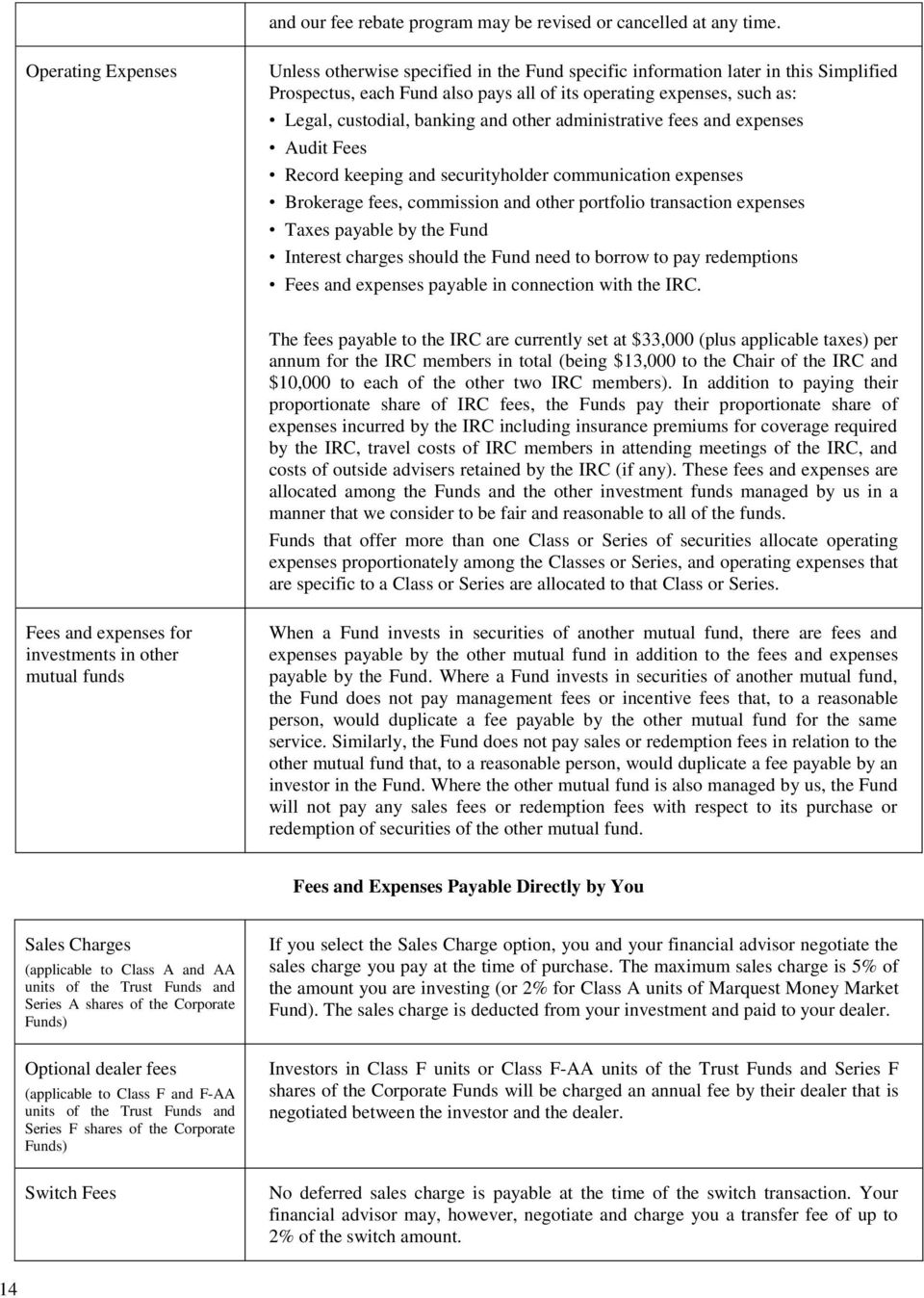
17 Redemption Fees (not applicable to Marquest Money Market Fund) Redemption Fees (continued) (not applicable to Marquest Money Market Fund) Short-Term Trading Fee Tax-Deferred Plan Fees Other Fees and Expenses If you select either of our two deferred sales charge options, you pay no sales charge at the time of purchase but you may pay redemption fees if you redeem units purchased under the Deferred Sales Charge option within seven (7) years of the date of purchase or if you redeem units or shares purchased under the Low Load Deferred Sales Charge option within three (3) years of the date of purchase. We offer both the Deferred Sales Charge option and the Low Load Deferred Sales Charge option for units of the Trust Funds and only the Low Load Deferred Sales Charge option for the Corporate Funds. This table shows the redemption fees, expressed as a percentage of the cost 1 of units or shares being sold, that may apply: If you sell units or shares: Deferred Sales Charge Low Load Deferred Sales Charge During the 1 st year 6.0% 3.50% 2 During the 2 nd year 5.5% 2.75% 3 During the 3 rd year 5.0% 2.00% During the 4 th year 4.5% nil During the 5 th year 4.0% nil During the 6 th year 3.0% nil During the 7 th year 2.0% nil After 7 years Nil nil The cost of deferred sales charge units or shares is reduced to reflect reinvested distributions or dividends and increased to reflect the value of units or shares redeemed under the 10% free redemption amount feature. See How do I sell units or shares? on page 10 for more information. The redemption fee is 3.0% for units of Marquest Global Balanced Fund purchased under the Low Load Deferred Sales Charge option and sold during the first year. The redemption fee is 2.5% for units of Marquest Global Balanced Fund purchased under the Low Load Deferred Sales Charge option and sold during the second year. If you redeem or switch units or shares (other than units of the Marquest Money Market Fund or shares of Marquest Short Term Income Fund (Corporate Class)) that were purchased under any sales charge option or acquired in a switch transaction within 30 days after the date of the purchase or switch, we will charge you a fee equal to 2% of the value of the units or shares redeemed or switched. This fee is not applicable to redemptions under the Systematic Withdrawal Program or the 10% free redemption program. The fee is payable to the applicable Fund. The short-term trading fee is in addition to any other fees to which you would otherwise be subject under this Simplified Prospectus. We have procedures in place to detect and deter inappropriate short-term trading. See Short-term trading on page 12. We do not charge an annual administration fee for our RSPs, RIFs and TFSAs. We charge $25 for each transfer from or closure of an RSP, RIF or TFSA. We do not charge an administration fee for PACs. We charge $10 if you request a certified redemption cheque. We charge $25 when your payment for the purchase of units or shares is returned due to insufficient funds in your bank account. We charge $10 if you request duplicate tax receipts. 15
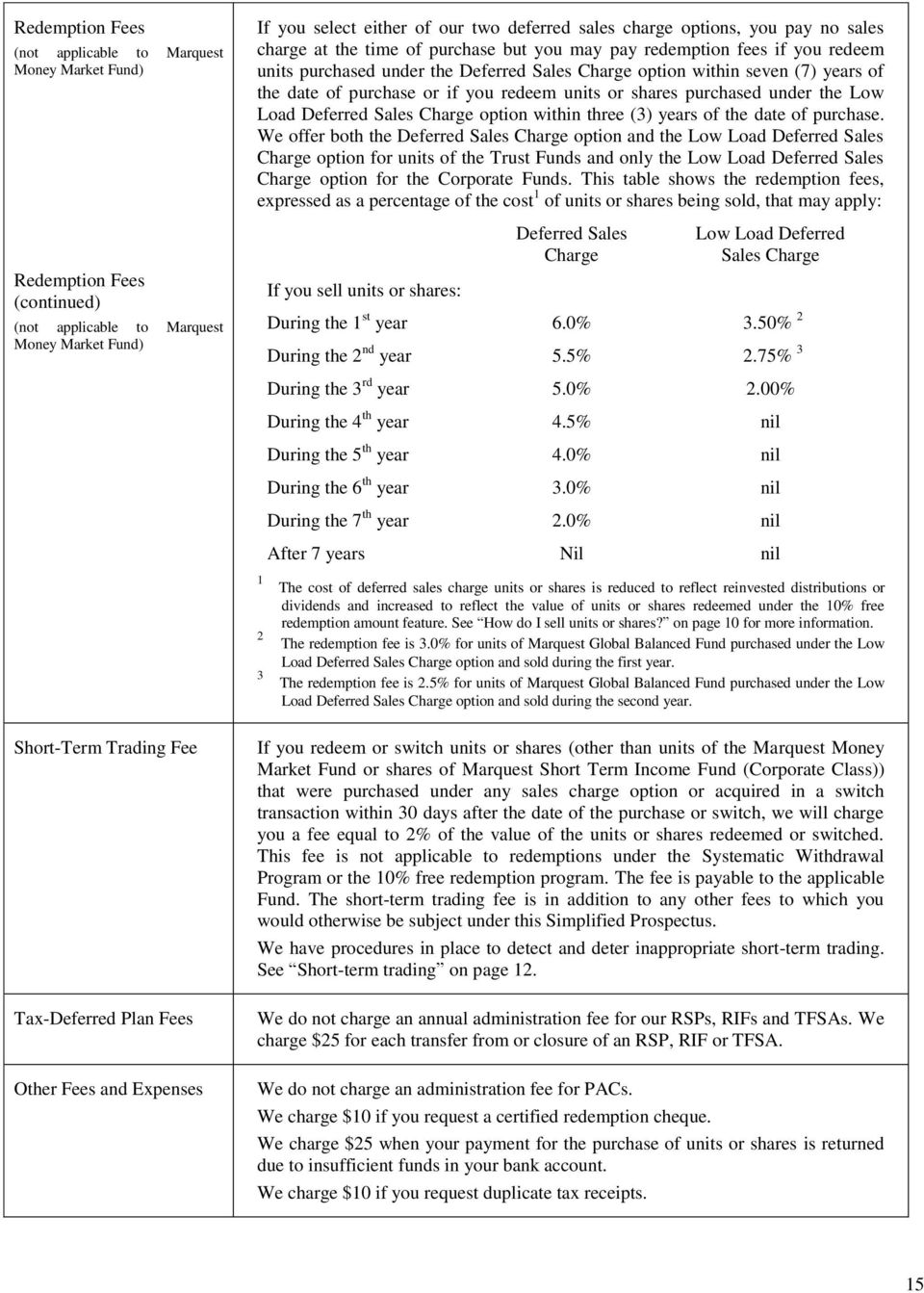
18 Impact of sales charge This table shows the maximum fees that you would have to pay under our different sales charge options if you made an investment of $1,000 and held it for the period shown before redeeming. Fee at time of purchase Redemption fee if units or shares redeemed before the end of 1 1 year 3 years 5 years 10 years Sales Charge option $50 nil nil nil nil Deferred Sales Charge option 1&2 Nil $60 $50 $40 nil Low Load Deferred Sales Charge Option 1&2 nil $35* $20 nil nil No Load option 3 Nil n/a n/a n/a n/a * Except for units of Marquest Global Balanced Fund purchased under the Low Load Deferred Sales Charge Option, in which case the redemption fee would be $30 for units redeemed before the end of one year. Redemption fees may only apply if you redeem your units or shares in a particular year. See Fees and Expenses on page 13 for more information. 2 By applying the 10% free redemption amount, you may be able to reduce the amount of redemption fees you might otherwise pay. 3 Only available for Class F and Class F-AA of the Trust Funds which offer those Classes and Series F shares of the Corporate Funds which offer those Series. DEALER COMPENSATION Sales Commissions Your dealer receives a sales commission when you invest in a Fund. Your financial advisor receives part of this commission. The amount of commission depends upon which sales charge option you choose. If you choose the Sales Charge option, your dealer receives a commission equal to the amount you negotiate with your financial advisor. The maximum commission under this option is 5% of the amount of your investment (or 2% for Class A units of Marquest Money Market Fund. If you choose one of the two deferred sales charge options, we pay your dealer a commission. For the Deferred Sales Charge option the commission is equal to 5.0% of the total amount you invest. For the Low Load Deferred Sales Charge Option the commission is equal to 3.0% of the total amount you invest. Class F and Class F-AA units of the Trust Funds which offer those Classes can only be purchased under the No Load option. Series F shares of the Corporate Funds which offer those Series can only be purchased under the No Load Option. We do not pay your dealer a commission on the purchase of Class F units of the Trust Funds or Series F shares of the Corporate Funds. Trailing Commissions We also pay your dealer a trailing commission to compensate them and your financial advisor for the advice and service they provide you in connection with your investment in the Funds. We may change or terminate the payment of this commission at any time. The amount of the trailing commission depends on the Funds you purchase and the sales charge option you choose. We also pay trailing commissions to discount brokers for securities you purchase through your discount brokerage account. We do not pay any trailing commissions for purchases of Class F units, Class F-AA units or Series F shares to your dealer. Your dealer is paid a fee in respect of Class F units, Class F-AA units and Series F shares under the terms of your arrangement with your dealer. 16
19 The trailing commissions under our different sales charge options, expressed as a percentage of the value of your units or shares that may be paid on a monthly or quarterly basis, is up to the following amounts: Sales Charge Units or Shares Deferred Sales Charge Units 1 Low Load Deferred Sales Charge Units or Shares 2 Marquest Money Market Fund % 0.30% 0.30% Marquest Short Term Income Fund (Corporate Class) % n/a 0.30% Marquest Canadian Bond Fund % 0.25% 0.50% Marquest Canadian Fixed Income Fund % 0.25% 0.50% Marquest Monthly Pay Fund 3, % 0.50% 0.75% Marquest Monthly Pay Fund (Corporate Class) % n/a 0.75% Marquest Global Balanced Fund % 0.50% 1.00% Marquest American Dividend Growth Fund 1.00% 0.50% 1.00% Marquest American Dividend Growth Fund (Corporate Class) % n/a 1.00% Covered Call Canadian Banks Plus Fund 1.00% 0.50% 1.00% Covered Call Canadian Banks Plus Fund (Corporate Class) % n/a 1.00% Marquest Small Companies Fund % 0.50% 1.00% Marquest Canadian Resource Fund % 0.50% 1.00% Marquest Canadian Resource Fund (Corporate Class) % n/a 1.00% The Corporate Funds are not sold by the Deferred Sales Charge option. Low Load Deferred Sales Charge trailing commissions are not payable until the first anniversary of the date of your initial investment. The maximum trailing commissions shown in the table for the Trust Funds apply only to Class A units of that Fund. The maximum trailing commissions shown in the table for the Corporate Funds apply only to Series A shares of that Fund. The trailing commissions for Class AA units of this Fund are as shown for Sales Charge and Deferred Sales Charge Units and 1.00% for Low Load Deferred Sales Charge Units. The actual rates we pay may vary from the maximum trailing commissions indicated in the table above and may also vary from time to time. We may change or cancel the terms of the trailer fees in our discretion and without advance notice. Dealer Sales Incentives We may participate in marketing programs with dealers and their financial advisors by contributing up to 50% of the cost. These costs are paid by us and not by the Funds. DEALER COMPENSATION FROM MANAGEMENT FEES For the financial year ended December 31, 2014, the total cash compensation paid, including sales commissions, trailing commission, and other kinds of dealer compensation such as marketing support payments, to dealers who distributed units of the Funds represented approximately 44.0% of the total management fees received by the Manager. INCOME TAX CONSIDERATIONS FOR INVESTORS Every investor s tax situation is different, so we recommend that you consult your personal tax consultant for advice about your own situation. For a detailed description of the income tax consequences of investing in a Fund, please see our Annual Information Form. 17

20 Introduction The following is a brief general description of Canadian federal income tax consequences for an individual resident Canadian, who is an investor and not a trader, in units or shares of a Fund in respect of: income and capital gains distributions made by the Fund to the investor, return of capital distributions made by a Fund to the investor; and gains or losses that occur on the investor s disposition of units or shares of the Fund. The income tax consequences are different for an investment in units or shares made through an investor s account that is a registered tax-deferred plan such as a registered retirement savings plan, registered retirement income fund, deferred profit sharing plan, registered education savings plan, registered disability savings plan or tax-free savings account than they are for an investment in units or shares made by an investor through a non-registered account. The Fund Corporation As a mutual fund corporation, the Fund Corporation can have three types of income: Canadian dividends, taxable capital gains and other net taxable income. Unless the Fund Corporation meets the definition of an investment corporation for the purposes of the Tax Act, Canadian dividends received by the Fund Corporation are generally subject to a 33 1/3% tax, which is currently fully refundable at the rate of $1.00 for every $3.00 of dividends paid by the Fund Corporation to its shareholders. Taxable capital gains are subject to tax at normal corporate rates and such tax paid is refundable to the Fund Corporation by paying capital gains dividends to shareholders or through the capital gains redemption formula. Other income is subject to tax at normal corporate rates and is not refundable. Mutual fund corporations do not qualify for reduced corporate tax rates that are available to other corporations for certain types of income. The Fund Corporation must include the revenues, deductible expenses, and capital gains and losses of all of its investment portfolios when it calculates its taxable income. We will allocate the taxes payable and recoverable of the Fund Corporation to each of the Corporate Funds. The Fund Corporation may pay dividends or capital gains dividends to shareholders of any Corporate Fund in order to receive a refund of taxes on Canadian dividends and capital gains taxes under the refund mechanisms described above. Distributions paid by the Fund Corporation may also include a return of capital. Several factors determine the amount of the distributions by the Fund Corporation including realized and unrealized gains, distributions or dividends from investments and net conversions. The history of distributions paid is no indication of future distribution payments and the composition of distributions as between dividends, capital gains dividends and return of capital may vary. The Trust Funds A Trust Fund generally distributes to its unitholders the Trust Fund s income and net realized gains in the year of realization. If the Trust Fund did not do so, it would be taxable on the undistributed portion. Each Trust Fund will take appropriate steps to ensure that amounts distributed to holders of units retain their character for tax purposes when distributed to holders. Units or shares held in a Registered Plan Units or shares of all of the Funds are qualified investments for registered plans. Provided a registered plan does not hold non-qualified investments or prohibited investments, the registered plan will receive income and capital gains distributions or dividends, and gains (or losses) that occur on the registered plan s disposition of an investment, without income tax consequence. However, withdrawals from a registered plan may be subject to tax. You should consult your tax advisor about the special rules that apply to each particular registered plan. Units or shares held in a Non-Registered Account If you hold units or shares in a non-registered account, you will be taxable on all capital gains distributions or dividends made by a Fund (including those that are reinvested in additional Fund units or shares), and on any gains (net of losses) that occur on the disposition of units or shares of the Fund. Except in the circumstances discussed below, a return of capital will not be taxable to you but will reduce the adjusted cost base of the relevant shares or units. Where net reductions to the 18

21 adjusted cost base of shares or units would result in the adjusted cost base becoming negative, that amount will be treated as a capital gain realized by the holder of shares or units, as applicable, and the adjusted cost base of shares or units would then be nil. For more information on returns of capital, please see the Annual Information Form under the heading Income Tax Considerations. All Funds receive, retain and reinvest their income and gains, pending periodic distribution or dividends. The value of any retained income and gains is reflected in the Fund s unit value or share price, so if your non-registered account purchases a unit or share shortly before the Fund pays a distribution, the portion of the purchase price that is attributable to the retained income or gain will in effect become taxable when such retained income and gains is distributed or declared as a dividend. For this reason, you should be aware of the timing of a Fund s distributions or declared dividend when you make a nonregistered purchase. Depending upon the nature of a Fund s investments, it will pay its distributions or dividends monthly, quarterly or annually. The frequency and timing of distribution or dividends for each Fund is disclosed in the Fund-specific information set out later in this Simplified Prospectus. Redemptions and Switches of the Funds Any gain or loss that you realize by redeeming units or shares will generally result in a capital gain or capital loss for tax purposes, which is the amount received for the redemption less your adjusted cost base of the units or shares surrendered for redemption. Redesignation or reclassification of any Class as another Class of the same Trust Fund or converting shares from one Corporate Fund to another Corporate Fund are not considered dispositions for tax purposes, so no capital gain or loss will arise. Switching from units into shares or from shares into units or from units of a Trust Fund into units of a different Trust Fund will result in a disposition and a capital gain or capital loss for tax purposes. Generally, at any time, your adjusted cost base of each unit or share of a Fund will be the average calculated by totaling the actual amounts (including any brokerage fees and other costs incidental to the acquisition) that you paid to acquire all of the units or shares of the Fund you hold at the time and dividing by the number of units or shares held. If you hold units or shares acquired by reinvestment of distributions, these units or shares will be included in the calculation. In the event that a Fund has returned capital as part of a distribution, the amount of capital received would be deducted in the averaging calculation. If a Fund has a high portfolio turnover rate, then there is the possibility of higher trading costs and a potential for increased capital gains in a year. However, there is not necessarily a relationship between a high turnover rate and the performance of a Fund. In general, fees paid directly by you in respect of units or shares of the Funds held outside a registered plan should be deductible for income tax purposes to the extent that such fees are reasonable and represent fees for advice to you regarding the purchase or sale of units or shares of the Funds or for services provided to you in respect of the administration or management of your units or shares of the Funds. The portion of the fees that represent services provided by the Manager to the Funds, rather than directly to you, are not deductible for income tax purposes. You should consult your own tax advisor with respect to the deductibility of fees in your own particular circumstances. WHAT ARE YOUR LEGAL RIGHTS? Securities laws in some provinces gives you the right to withdraw from an agreement to buy units or shares of a Fund within 2 business days after receiving this document or to cancel your purchase within 48 hours after receiving a confirmation of your purchase. Securities laws in some provinces and territories also allows you to cancel an agreement to buy units or shares of a Fund and get your money back or to make a claim for damages if this Simplified Prospectus or the Annual Information Form or financial statements incorporated by reference into this document misrepresents any facts about a Fund. These rights must usually be exercised within certain time limits. You should consult a lawyer or refer to the securities law in your province or territory for more information. 19
22 20 SPECIFIC INFORMATION ABOUT EACH OF THE MUTUAL FUNDS DESCRIBED IN THIS DOCUMENT The remainder of this document contains specific information about each of the Funds. Rather than repeat certain information that applies to each Fund, this common information is set out below. What does the Fund invest in? In this section we describe the investment objective of each Fund and the investment strategy used to achieve such objective. Investor approval is required for any change to the fundamental investment objective of a Fund. Use of derivatives All of the Funds may use derivatives as part of their investment strategy provided that such use is consistent with the Fund s investment objectives and complies with rules imposed by securities regulators. Derivatives are securities the value of which are based on the value of another security or changes in interest or exchange rates. The other security or interest or exchange rate change is commonly referred to as the underlying investment. The two most common derivatives used by the Funds are: Futures or forward contracts - these are agreements to buy or sell the underlying investment at a specified price at a future date. Option contracts - these are agreements that give the buyer the right, but not the obligation, to buy or sell the underlying investment at a specified price within a certain period of time. The investment strategies for many of the Funds indicate that derivatives may be used to enhance returns or protect against losses. To enhance returns, the Fund might use derivatives directly rather than purchase the underlying investment. This may be done because derivative transactions can often be completed faster and less expensively. To protect against losses, the Fund might use derivatives to hedge against an anticipated market or economic change. For example, if interest rates are expected to rise, a Fund that invests in fixed income securities might enter into a CGB (Canadian Government Bond) contract that makes money if interest rates rise. The gains earned on the CGB contract would offset the loss in value of the fixed income securities due to the rise in interest rates. In order to supplement the current income received from dividends paid on the equity investments held by Marquest Covered Call Canadian Banks Plus Fund and the Marquest Covered Call Canadian Banks Plus Fund (Corporate Class), these two Funds may write covered call options on equity securities held by the Funds. Selling covered call options enhances the current income of the Funds by the amount of premiums received, which in turn provides overall lower volatility and downside risk mitigation for the portfolio by partially hedging against a decline in the price of the securities on which they are written to the extent of the premiums received by the Funds. If the equity securities underlying the options trade at or below the exercise price of the option at the time of settlement, the Funds receive the full benefit of the premiums received, less transaction costs associated with the sale of the options. If the equity securities underlying the options trade above the exercise price of the option at the time of settlement, the effect of the covered calls is to limit the market value appreciation the Funds would otherwise have received on the underlying equity security, as the Funds will not receive any economic benefit from an increase in the market value of the underlying equity security above the exercise price of the option. A Fund cannot use derivatives for speculative trading. If a Fund uses derivatives, it will hold enough assets or cash to cover its commitments under those derivatives. This limits the amount of losses that could result from the use of derivatives. Investments in other mutual funds All of the Funds have the ability to invest in other mutual funds ( underlying funds ), including other mutual funds managed by us. We will actively choose the underlying funds and determine the percentage of a Fund s assets to be invested in each underlying fund, with regard to the investment objectives of the Fund. We may change the percentages of a Fund invested in each underlying fund as well as replace, add or remove any underlying fund where we believe such change is advisable to improve a Fund s performance. A Fund will only invest in an underlying fund where the following conditions are met: the underlying fund is subject to National Instrument Investment Funds or the underlying fund issues securities that are index participation units under National Instrument Investment Funds;
23 the investment objective of the underlying fund is consistent with the Fund s investment objective; where we are the manager of the underlying fund, we do not vote the Fund s holdings in the underlying fund; at the time the Fund purchases securities of the underlying fund, the underlying fund holds no more than 10% of the market value of its net assets in securities of another mutual fund; the securities of the underlying fund are qualified for distribution in the same jurisdiction as the Fund or are index participation units under National Instrument Investment Funds; no management fees or incentive fees are payable by the Fund that would, to a reasonable person, duplicate a fee payable by the underlying fund; where we are the manager of the underlying fund, no sales fees or redemption fees are payable by the Fund in relation to its purchases or redemptions of the securities of the underlying fund; and no sales fees or redemption fees are payable by the Fund in relation to its purchases or redemptions of the securities of the underlying fund (except if the underlying fund issues securities that are index participation units under National Instrument Investment Funds ) that would, to a reasonable person, duplicate a fee payable by the underlying fund. Securities lending transactions The Funds (other than Marquest Canadian Resource Fund (Corporate Class) and Marquest Monthly Pay Fund (Corporate Class)) may enter into securities lending transactions. A securities lending transaction is where a Fund lends portfolio securities that it owns to a borrower through an authorized agent. The borrower promises to return to the Fund at a later date an equal number of the same securities and to pay a fee to the Fund for borrowing the securities. The Fund may recall the securities at any time. The borrower provides the Fund with collateral consisting of cash, qualified securities or securities that can be immediately converted into identical securities to those that have been loaned. Therefore, the Fund retains exposure to changes in the value of the securities loaned while earning additional income. A Fund will not enter into a securities lending transaction if, immediately thereafter, the aggregate market value of all securities loaned by the Fund and not yet returned to it would exceed 50% of the total assets of the Fund (exclusive of collateral held by the Fund for securities lending transactions). On any securities lending transaction, the Funds will deal only with borrowers who are considered to be creditworthy. The Funds must hold collateral equal to at least 102% of the market value of the portfolio securities loaned, and the amount of collateral is adjusted daily to ensure this collateral coverage is maintained at all times. What are the risks of investing in the Fund? In this section we identify the specific risks associated with each Fund. See What are the risks of investing in a mutual fund? on page 2 for a complete description of these risks. The methodology used to determine each Fund s investment risk classification indicated in the following Fund specific information and in the Fund Facts document is the methodology recommended by the Fund Risk Classification Task Force of The Investment Funds Institute of Canada (the Task Force ). The investment risk classification categories are as follows: Low for funds with a level of risk that is typically associated with investments in money market funds and Canadian fixed income funds; Low to medium for funds with a level of risk that is typically associated with investments in balanced funds and global and/or corporate fixed income funds; Medium for funds with a level of risk that is typically associated with investments in equity portfolios that are diversified among a number of large-capitalization Canadian and/or international equity securities; Medium-high for funds with a level of risk that is typically associated with investments in equity funds that may concentrate their investments in specific regions or in specific sectors of the economy; and High for funds with a level of risk that is typically associated with investments in equity portfolios that may 21
24 concentrate their investments in specific regions or specific sectors of the economy where there is a substantial risk of loss. For Funds with historical performance data, the Task Force concluded that the most comprehensive, easily understood form of risk in this context is historical volatility risk as measured by the standard deviation of fund performance. For the Funds with less than three years of return data, the investment risk classification is based on the Manager s assessment of the benchmark index that most closely resembles the investment mandate of the Fund. However, the Manager and the Task Force recognize that other types of risk, both measurable and non-measurable, may exist and we remind you that a Fund s historical performance may not be indicative of future returns and that a Fund s historical volatility may not be indicative of its future volatility. The level of risk associated with each Fund is reviewed annually by the Manager. You may obtain a copy of the investment risk classification methodology used by the Manager by contacting us at or [email protected]. Who should invest in this Fund? In this section we identify the kind of investor or portfolio the Fund is suitable for. You should seek the advice of your financial advisor to ensure that any Fund you choose is suitable for you given your risk tolerance and investment goals. Distribution Policy In this section, we tell you the distribution policy of the Fund. The history of distributions paid is no indication of future distribution payments and the composition of distributions may vary. There is no guarantee of the amount of distributions that will be paid on any Class or Series of a Fund and the distribution policy for a Class or Series of a Fund can be changed by us at any time, including a reduction in the future, without notice to unitholders. Fund Expenses Indirectly Borne by Investors Mutual funds pay some expenses out of fund assets. That means that you and other investors in a Fund indirectly pay for these expenses through lower returns. In this section we offer a hypothetical example showing the indirect costs associated with investing in a Fund. This information is intended to help you compare the cumulative cost of investing in a Fund with the cost of investing in other mutual funds. Although your actual cost may be higher or lower, the information in this section shows what your costs would be based on the following assumptions: you invest $1,000 in the Class or Series of the Fund shown for the periods shown and then sell all of your units or shares at the end of those periods your investment has a 5% return each year the Fund s management expense ratio during the 10-year period remained the same as it was in its last financial year. Information is shown only for classes or series of securities of a Fund that were outstanding at the end of the last completed financial year. See Fees and Expenses on page 13 for more information about the cost of investing in the Funds. 22
25 MARQUEST MONEY MARKET FUND FUND DETAILS Type of Fund Canadian money market fund Date Established Class A: August 10, 1987 Class F: July 17, 2014 Securities Offered Registered Plan Eligibility Class A and Class F units of a mutual fund trust 100% eligible Management Fee Class A: 0.50% Class F: 0.20% WHAT DOES THE FUND INVEST IN? Investment Objectives The Fund seeks to produce high interest income while maintaining safety of principal and liquidity by investing in high quality short-term debt securities of Canadian governments and companies, such as treasury bills, bankers acceptances of major banks and commercial paper. Investor approval is required for any change to the fundamental investment objective. Investment Strategies In order to achieve the Fund s objective, the portfolio manager: analyzes the yield curve to identify securities offering good relative value. invests in a number of different issuers in order to reduce credit risk. invests only in securities rated R1 or A or better by Dominion Bond Rating Service or the equivalent ratings used by other rating agencies. maintains an average term to maturity of less than 90 days, although this term is adjusted from time to time to take advantage of actual and anticipated changes in interest rates. may enter into securities lending transactions to earn additional income for the Fund (see Securities lending transactions on page 21). WHAT ARE THE RISKS OF INVESTING IN THIS FUND? Fund Risks Most of the Fund s assets will be invested in short-term fixed income securities. As a result, the Fund is exposed to: Credit risk Interest rate risk Specific issuer risk The Fund is also subject to class risk. To the extent the Fund invests in foreign securities, it will also be exposed to currency risk and foreign investment risk. To the extent that the Fund enters into securities lending transactions, it will also be exposed to securities lending risk. Although the Fund intends to maintain a constant price for its units, there is no guarantee that the price will not go up and down. See What are the risks of investing in a mutual fund? on page 2 for a complete description of these risks and other risks which may also apply to the Fund. 23
26 Marquest Money Market Fund WHO SHOULD INVEST IN THIS FUND? Investor Profile DISTRIBUTION POLICY The Fund may be suitable if you: have short-term investment goals require low investment risk require a temporary place to put your money while you are waiting to invest in another Fund The Fund intends to have a monthly distribution of net income, if any. Its net realized capital gains, if any, will be distributed annually in December. Distributions are reinvested unless you notify us in writing that you want to receive cash, except for Marquest offered tax-deferred plans for which distributions must be re-invested. See Income Tax Considerations for Investors. FUND EXPENSES INDIRECTLY BORNE BY INVESTORS Expenses payable over: 1 Year 3 Years 5 Years 10 Years Class A units $4.31 $13.35 $23.32 $52.96 No expense information is provided for Class F units because the Class F units have not been in distribution for a complete financial year. See Fund Expenses Indirectly Borne by Investors on page 22 for the assumptions we are required to use in this table. See Fees and Expenses on page 13 for more information about the cost of investing in the Funds. 24
27 MARQUEST SHORT TERM INCOME FUND (CORPORATE CLASS) FUND DETAILS Type of Fund Canadian money market fund Date Established Series A shares: June 25, 2004 Series F shares: July 17, 2014 Securities Offered Registered Plan Eligibility Mutual fund corporation shares 100% eligible Management Fee Class A: 0.60% Class F: 0.30% WHAT DOES THE FUND INVEST IN? Investment Objectives The Fund seeks to earn current income consistent with preservation of capital and liquidity. The Fund invests in short term debt securities such as commercial paper, bankers acceptances, and treasury bills. Investor approval is required for any change to the fundamental investment objective. Investment Strategies In order to achieve the Fund s objective, the portfolio manager: analyzes the short term yield curve and interest rates. may invest in a number of different issuers in order to reduce credit risk. analyzes the credit rating and risk of the issuer. maintains an average term to maturity of less than 90 days, although this term is adjusted from time to time to take advantage of actual and anticipated changes in interest rates. may enter into securities lending transactions to earn additional income for the Fund (see Securities lending transactions on page 20). WHAT ARE THE RISKS OF INVESTING IN THIS FUND? Fund Risks Most of the Fund s assets will be indirectly invested in short-term fixed income securities. As a result, the Fund is exposed to: Credit risk Interest rate risk Specific issuer risk The Fund is also subject to class risk. To the extent the Fund invests in foreign securities, it will also be exposed to currency risk and foreign investment risk. To the extent that the Fund enters into securities lending transactions, it will also be exposed to securities lending risk. Although the Fund intends to maintain a constant price for its shares, there is no guarantee that the price will not go up and down. See What are the risks of investing in a mutual fund? on page 2 for a complete description of these risks and other risks which may also apply to the Fund. 25
28 Marquest Short Term Income Fund (Corporate Class) WHO SHOULD INVEST IN THIS FUND? Investor Profile The Fund may be suitable if you: DIVIDEND POLICY have short-term investment goals require low investment risk require a temporary place to put your money while you are waiting to invest in another Fund The Fund intends to pay a monthly ordinary dividend consisting of net income, if any. Capital gains, if any, will be paid by dividend annually in December. Dividends are reinvested unless you notify us in writing that you want to receive cash, except for Marquest offered tax-deferred plans for which distributions must be re-invested. See Income Tax Considerations for Investors. FUND EXPENSES INDIRECTLY BORNE BY INVESTORS Expenses payable over: 1 Year 3 Years 5 Years 10 Years Series A shares $4.62 $14.33 $25.03 $56.84 No expense information is provided for Class F units because the Class F units have not been in distribution for a complete financial year. See Fund Expenses Indirectly Borne by Investors on page 22 for the assumptions we are required to use in this table. See Fees and Expenses on page 13 for more information about the cost of investing in the Funds. 26
29 MARQUEST CANADIAN BOND FUND FUND DETAILS Type of Fund Canadian bond fund Date Established Class A: June 4, 1998 Class F: February 7, 2006 Securities Offered Registered Plan Eligibility Class A and Class F units of a mutual fund trust 100% eligible Management Fee Class A: 1.00% Class F: 0.40% WHAT DOES THE FUND INVEST IN? Investment Objectives The Fund seeks to provide income by investing primarily in fixed income securities of Canadian governments and companies. Investor approval is required for any change to the fundamental investment objective. Investment Strategies In order to achieve the Fund s objective, the portfolio manager: analyzes the yield curve to identify securities offering good relative value. invests in a number of different issuers in order to reduce credit risk. invests only in securities rated BBB (low) or better by Dominion Bond Rating Service or the equivalent ratings used by other rating agencies. will typically maintain a minimum of 25% invested in government bonds. will maintain an overall duration within plus or minus three years of the duration of the DEX Universe Bond Index. may invest up to 20% of the net assets of the Fund in securities not included in the DEX Universe Bond Index, including real return bonds, foreign pay bonds, and foreign securities. may invest in securities of other mutual funds (see Investments in other mutual funds on page 20). may enter into securities lending transactions to earn additional income for the Fund (see Securities lending transactions on page 21). WHAT ARE THE RISKS OF INVESTING IN THIS FUND? Fund Risks Most of the Fund s assets will be invested in Canadian fixed income securities. As a result, the Fund is exposed to: Credit risk Interest rate risk Specific issuer risk The Fund is also subject to class risk. To the extent the Fund invests in foreign securities and derivatives, it will also be exposed to currency risk, derivative risk and foreign investment risk. To the extent that the Fund enters into securities lending transactions, it will also be exposed to securities lending risk. See What are the risks of investing in a mutual fund? on page 2 for a complete description of these risks and other risks which may also apply to the Fund. 27
30 Marquest Canadian Bond Fund WHO SHOULD INVEST IN THIS FUND? Investor Profile The Fund may be suitable if you: have short to medium-term investment goals want to diversify your investment portfolio are comfortable with low investment risk DISTRIBUTION POLICY The Fund intends to have a fixed monthly distribution, which may include net income, capital gains or a return of capital. Its net realized capital gains, if any, will be distributed annually in December. Distributions are reinvested unless you notify us in writing that you want to receive cash, except for Marquest offered tax-deferred plans for which distributions must be re-invested. See Income Tax Considerations for Investors. FUND EXPENSES INDIRECTLY BORNE BY INVESTORS Expenses payable over: 1 Year 3 Years 5 Years 10 Years Class A units $17.01 $52.75 $92.16 $ Class F units $10.50 $32.56 $56.86 $ See Fund Expenses Indirectly Borne by Investors on page 22 for the assumptions we are required to use in this table. See Fees and Expenses on page 13 for more information about the cost of investing in the Funds. 28
31 MARQUEST CANADIAN FIXED INCOME FUND FUND DETAILS Type of Fund Fixed income fund Date Established Class A: December 1, 2014 Class F: December 1, 2014 Securities Offered Registered Plan Eligibility Class A and Class F units of a mutual fund trust 100% eligible Management Fee Class A: 1.40% Class F: 0.65% WHAT DOES THE FUND INVEST IN? Investment Objectives The Fund seeks to provide income by investing in a diversified portfolio of investment grade fixed-income assets, primarily denominated in Canadian dollars. The Fund s objective is to exceed, to the extent possible, the performance of the FTSE TMX Canada Universe Bond Index. Investor approval is required for any change to the fundamental investment objective. Investment Strategies In order to achieve the Fund s objective, the portfolio manager may employ some or all of the following active investment strategies: yield curve and duration management through optimal portfolio structuring. sector allocation between government and corporate bonds, asset backed securities, mortgage-backed securities etc. credit selection to achieve reasonable yield pick-up while mitigating credit risk. trading to capitalize on relative value opportunities. invests in a number of different issuers in order to reduce credit risk. invests in securities rated BBB (low) or better by any of DBRS Limited, Fitch, Inc., Moody s Canada Inc., Standard & Poor s Ratings Services Canada or any other designated rating organization. will maintain an overall duration within minus four years and plus two years of the duration of the FTSE TMX Canada Universe Bond Index. may invest in debt issued by Canadian governments and Canadian corporations. may invest up to 30% of the net assets of the Fund in debt issued by foreign governments and corporations. may invest in commercial paper, asset backed commercial paper and asset and mortgaged backed securities. may invest in securities of other mutual funds (see Investments in other mutual funds on page 19). may enter into securities lending transactions to earn additional income for the Fund (see Securities lending transactions on page 20). WHAT ARE THE RISKS OF INVESTING IN THIS FUND? Fund Risks Most of the Fund s assets will be invested in Canadian fixed income securities. As a result, the Fund is exposed to: Asset-backed and mortgage-backed securities risk Credit risk Interest rate risk Specific issuer risk 29
32 WHO SHOULD INVEST IN THIS FUND? Marquest Canadian Fixed Income Fund The Fund is also subject to class risk. To the extent the Fund invests in foreign securities, it will also be exposed to currency risk and foreign investment risk. To the extent that the Fund enters into securities lending transactions, it will also be exposed to securities lending risk. See What are the risks of investing in a mutual fund? on page 2 for a complete description of these risks and other risks which may also apply to the Fund. Investor Profile The Fund may be suitable if you: have short to medium-term investment goals want to diversify your investment portfolio are comfortable with low investment risk DISTRIBUTION POLICY The Fund intends to have a monthly distribution of net income, if any. Its net realized capital gains, if any, will be distributed annually in December. Distributions are reinvested unless you notify us in writing that you want to receive cash, except for Marquest offered tax-deferred plans for which distributions must be re-invested. See Income Tax Considerations for Investors. FUND EXPENSES INDIRECTLY BORNE BY INVESTORS See Fees and Expenses on page 13 for more information about the cost of investing in the Funds. The Fund pays us a management fee and fund costs needed to operate and carry on its business. The Fund s management expense ratio is the fees and expenses payable by the Fund divided by its average net asset value over a year. You do not pay the Fund expenses directly, but they will reduce the Fund s returns. As the Fund has not existed for a complete financial year, we are unable to provide an example of the expenses of the Fund indirectly borne by investors. 30
33 MARQUEST MONTHLY PAY FUND FUND DETAILS Type of Fund Canadian equity and income fund Date Established Class A: June 24, 2003 Class AA: May 28, 2013 Class F: February 7, 2006 Class F-AA: May 28, 2013 Securities Offered Registered Plan Eligibility Class A, Class AA, Class F and Class F-AA units of a mutual fund trust 100% eligible Management Fee Class A: 2.00% Class AA: 2.00% Class F: 0.75% Class F-AA: 0.75% WHAT DOES THE FUND INVEST IN? Investment Objectives The Fund seeks to provide high investment returns by investing primarily in income producing securities such as income trusts, bonds, common and preferred shares. Investor approval is required for any change to the fundamental investment objective. Investment Strategies In respect of the equity component of the Fund s portfolio (including income trusts), the portfolio manager: analyzes financial information of each potential investment to identify undervalued companies with improving fundamentals and high potential for price appreciation. evaluates potential investments by measures such as price-to earnings, price-tobook value, return-on-equity, margin trends, estimated earnings and cash flow growth. reviews economic data, market trends, stock valuations, interest rate levels, monetary policy and other factors to identify business cycle trends. applies qualitative analysis to potential investments and may interview company management to select those with the best risk adjusted potential for price appreciation. For income trusts, specific focus is paid to analyzing the stability of cash-flow in order to assess the reliability of the targeted distribution. may invest up to 49% of the net assets of the Fund in foreign securities (including securities of other funds). may write covered calls and puts (secured by cash) to enhance income. may use derivatives like options, futures and forward contracts to enhance returns or protect against losses, provided their use is consistent with the Fund s investment objectives and complies with rules imposed by securities regulators (see Use of derivatives on page 20). may invest in securities of other mutual funds (see Investments in other mutual funds on page 20). may enter into securities lending transactions to earn additional income for the Fund (see Securities lending transactions on page 21). In respect of the fixed income component of the Fund s portfolio, the portfolio manager: selects maturity terms based on the outlook for interest rates. analyzes the yield curve to identify securities offering good relative value. analyzes credit ratings of issuers to determine securities offering the best risk adjusted yields. 31
34 Marquest Monthly Pay Fund invests in a number of different issuers in order to reduce credit risk. WHAT ARE THE RISKS OF INVESTING IN THIS FUND? Fund Risks Most of the Fund s assets will be invested in fixed income and income producing equity securities of Canadian companies and governments. As a result, the Fund is exposed to: Credit risk Income trust risk Interest rate risk Market risk Return of capital/capital depletion risk Specific issuer risk WHO SHOULD INVEST IN THIS FUND? The Fund is also subject to class risk. To the extent the Fund invests in securities of foreign issuers and derivatives, it will also be exposed to currency risk, derivative risk and foreign investment risk. To the extent that the Fund enters into securities lending transactions, it will also be exposed to securities lending risk. See What are the risks of investing in a mutual fund? on page 2 for a complete description of these risks and other risks which may also apply to the Fund. Investor Profile The Fund may be suitable if you: have medium-term investment goals have a portfolio focus on income and capital appreciation want to diversify your investment portfolio are comfortable with medium investment risk DISTRIBUTION POLICY The Fund intends to pay a fixed monthly distribution of $0.075 per unit in respect of Class A and F units, and $0.115 per unit in respect of Class AA and Class F-AA units, which may include net income, capital gains or a return of capital. Class A and F units will provide a higher annualized distribution yield than Class AA and F-AA. Its net realized capital gains, if any, will be distributed each December. Distributions are reinvested unless you notify us in writing that you want to receive cash, except for Marquest offered tax-deferred plans for which distributions must be re-invested. See Income Tax Considerations for Investors. FUND EXPENSES INDIRECTLY BORNE BY INVESTORS Expenses payable over: 1 Year 3 Years 5 Years 10 Years Class A units $34.76 $ $ $ Class F units $20.48 $63.50 $ $ Class AA units $26.46 $82.06 $ $ Class F-AA units $13.65 $42.33 $73.95 $ See Fund Expenses Indirectly Borne by Investors on page 22 for the assumptions we are required to use in this table. See Fees and Expenses on page 13 for more information about the cost of investing in the Funds. 32
35 MARQUEST MONTHLY PAY FUND (CORPORATE CLASS) FUND DETAILS Type of Fund Canadian equity and income fund Date Established Series A shares: June 30, 2011 Series F shares: June 30, 2011 Securities Offered Registered Plan Eligibility Mutual fund corporation shares 100% eligible Management Fee Series A: 2.00% Series F: 0.75% WHAT DOES THE FUND INVEST IN? Investment Objectives The Fund seeks to provide high investment returns by investing primarily in income producing securities such as income trusts, bonds, common and preferred shares. To achieve this objective, the Fund invests solely in units of the Marquest Monthly Pay Fund, which is called the underlying fund (such investments will be in the Class F units of underlying fund). The investment objective of the underlying fund, which is described on page 31 is consistent with the investment objectives of this Fund. We are the manager of this Fund and the underlying fund. Investor approval is required for any change to the fundamental investment objective. Investment Strategies The Fund invests solely in the Units of the Marquest Monthly Pay Fund. You will find the fund description and investment strategies for the underlying fund starting on page 31. WHAT ARE THE RISKS OF INVESTING IN THIS FUND? Fund Risks The Fund s assets will be invested in Marquest Monthly Pay Fund units. As a result, the principal risks associated with an investment of the Fund are: Changes in dividend policies risk Credit risk Income trust risk Interest rate risk Market risk Return of capital/capital depletion risk Specific issuer risk Underlying fund risk The underlying fund is also subject to class risk. To the extent the underlying fund invests in securities of foreign issuers and derivatives, it will also be exposed to currency risk, derivative risk and foreign investment risk. To the extent that the underlying fund enters into securities lending transactions, it will also be exposed to securities lending risk. As a series of the Fund Corporation, the Fund is subject to fund series risk. See What are the risks of investing in a mutual fund? on page 2 for a complete description of these risks and other risks which may also apply to the Fund. 33
36 Marquest Monthly Pay Fund (Corporate Class) WHO SHOULD INVEST IN THIS FUND? Investor Profile The Fund may be suitable if you: have medium-term investment goals have a portfolio focus on income and capital appreciation want to diversify your investment portfolio are comfortable with medium investment risk DIVIDEND POLICY The Fund expects to pay a monthly ordinary dividend based on the distributions received from its investment in the underlying fund, less applicable expenses. Its net realized capital gains, if any, will be paid by dividend annually in December. Dividends are reinvested unless you notify us in writing that you want to receive cash, except for Marquest offered tax-deferred plans for which distributions must be re-invested. See Income Tax Considerations for Investors. FUND EXPENSES INDIRECTLY BORNE BY INVESTORS Expenses payable over: 1 Year 3 Years 5 Years 10 Years Series A shares $40.32 $ $ $ Series F shares $25.10 $77.83 $ $ See Fund Expenses Indirectly Borne by Investors on page 22 for the assumptions we are required to use in this table. See Fees and Expenses on page 13 for more information about the cost of investing in the Funds. 34
37 MARQUEST GLOBAL BALANCED FUND FUND DETAILS Type of Fund Global equity balanced fund Date Established Class A: October 31, 2006 Class F: September 7, 2006 Securities Offered Registered Plan Eligibility Class A and Class F units of a mutual fund trust 100% eligible Management Fee Class A: 2.1% Class F: 1.1% WHAT DOES THE FUND INVEST IN? Investment Objectives Investment Strategies The investment objective of the Fund is to provide investors with monthly cash distributions and to preserve and enhance the net asset value of the Fund against inflation through appreciation, primarily through the purchase of a diversified pool of global large capitalization dividend-yielding equity securities and fixed income securities. Investor approval is required for any change to the fundamental investment objective. The investment approach of the Fund is to focus on: dividend paying equities and fixed income securities. Cassels Investment Management Inc. (the Investment Manager ) is the investment manager of the Fund. The Investment Manager has hired Brookfield Investment Management Inc. (the Sub-Advisor ) to manage the fixed income portion of the Fund s investment portfolio. The investment weighting in each asset class is a function of the Investment Manager s and the Sub-Advisor s abilities to find attractive investments within the asset class. Within the equities class of the portfolio, the Investment Manager seeks investments in large capitalization dividend-paying equities globally, having regard to solid business and financial fundamentals and a history of and prospects for increasing dividends and growth. The Sub-Advisor invests the fixed income securities class primarily in high yield corporate bonds. Fixed income securities may include secured and unsecured bonds, bank debt, derivative instruments, and other fixed income related securities. The Sub-Advisor may invest in fixed income securities that have a below investment grade credit rating or are unrated, but offer a higher yield than investment grade securities. Security selection consists of both top-down industry analysis, often on industries in transition, to identify key drivers. Analysis includes industries where the Sub-Advisor, and its related funds and affiliated companies have a depth of knowledge and understanding. Security selection also includes detailed bottom-up company-specific analysis to identify a company s strengths, weaknesses, and potential catalysts for price impact. The Fund may from time to time invest a portion of its net assets in index participation units. The criteria used for selecting such investments are the same as the criteria for selecting individual securities. The Fund may use other derivatives for hedging and non-hedging purposes that are consistent with its investment objectives. The Fund may use specified derivatives, such as options, swaps, futures and forward contracts, to: hedge against losses associated with rising interest rates hedge against the default of particular issuers of a security gain exposure to fixed income instruments without actually investing in them directly (when owning the derivative investment is more efficient or less costly than owning the fixed income instrument itself) 35
38 Marquest Global Balanced Fund reduce the risk of currency fluctuations enhance income provide downside risk protection against one or more securities. WHAT ARE THE RISKS OF INVESTING IN THIS FUND? We may change the Fund s investment strategies at our discretion without notice or approval. Fund Risks The risks of investing in the Fund may include: Commodity risk Concentration risk Credit risk Currency risk Foreign investment risk Income trust risk Interest rate risk Liquidity risk Market risk Return of capital/ Capital depletion risk Specific issuer risk The Fund is also subject to class risk. To the extent the Fund invests in derivatives, it will also be exposed to derivative risk. To the extent that the Fund enters into securities lending transactions, it will also be exposed to securities lending risk. See What are the risks of investing in a mutual fund? on page 2 for a complete description of these risks and other risks which may also apply to the Fund. WHO SHOULD INVEST IN THIS FUND? Investor Profile The Fund may be suitable if you: have medium term investment goals are seeking after tax income which will grow over time are seeking to, at the same time, preserve and enhance capital want to contribute to the income component of a diversified portfolio are willing to accept a medium level of risk DISTRIBUTION POLICY The Fund intends to have a fixed monthly distribution, which may include net income, capital gains or a return of capital. Its net realized capital gains, if any, will be distributed annually in December. Distributions are reinvested unless you notify us in writing that you want to receive cash, except for Marquest offered tax-deferred plans for which distributions must be re-invested. See Income Tax Considerations for Investors. FUND EXPENSES INDIRECTLY BORNE BY INVESTORS Expenses payable over: 1 Year 3 Years 5 Years 10 Years Class A units $35.81 $ $ $ Class F units $25.52 $79.13 $ $ See Fund Expenses Indirectly Borne by Investors on page 22 for the assumptions we are required to use in this table. See Fees and Expenses on page 13 for more information about the cost of investing in the Funds. 36
39 MARQUEST AMERICAN DIVIDEND GROWTH FUND FUND DETAILS Type of Fund U.S. equity fund Date Established Class A units: July 17, 2014 Class F units: July 17, 2014 Securities Offered Registered Plan Eligibility Class A and Class F units of a mutual fund trust 100% eligible Management Fee Class A: 2.00% Class F: 1.00% WHAT DOES THE FUND INVEST IN? Investment Objectives The Fund primarily seeks long term capital appreciation, by investing primarily in a portfolio of large cap, dividend paying equity securities listed on a U.S. stock exchange. Investor approval is required for any change to the fundamental investment objective. Investment Strategies In order to achieve the Fund s objective, the portfolio manager will invest in a portfolio of securities whose returns, over time, are expected to exceed the S&P 500 Index on a total return basis. From time to time, the portfolio manager may employ a covered call option writing strategy in order to enhance returns, subject to providing at least 60 days prior written notice before the first use of covered calls. WHAT ARE THE RISKS OF INVESTING IN THIS FUND? Securities will be selected based on the portfolio manager s bottom-up, fundamental approach of identifying companies with superior long-term investment merit based on proven management, competitive position, and strong balance sheets. Preference is given to companies with durable growth prospects. The portfolio manager invests in companies when their current market price represents value relative to their long-term potential, and maintains an investment so long as it continues to offer attractive return potential. The Fund may, from time to time, hold part of its assets in cash reserves or short-term fixed income investments as a result of a lack of attractive investment opportunities or to facilitate cash flows. Fund Risks Most of the Fund s assets will be invested in equity securities of large cap companies listed on a U.S. stock exchange. As a result, the Fund is exposed to: Changes in dividend policies risk Market risk Foreign investment risk Currency risk Concentration risk Return of capital/capital depletion risk Specific issuer risk Substantial securityholder risk To the extent that the Fund invests in derivatives, it will also be exposed to derivative risk. To the extent that the Fund enters into securities lending transactions, the Fund will also be exposed to securities lending risk. See What are the risks of investing in a mutual fund? on page 2 for a complete description of these risks and other risks which may also apply to the Fund. 37
40 Marquest American Dividend Growth Fund WHO SHOULD INVEST IN THIS FUND? Investor Profile The Fund may be suitable if you: have medium to long term investment goals are an investor who seeks exposure to U.S. equities are comfortable with medium investment risk DISTRIBUTION POLICY The Fund intends to have a fixed monthly distribution, which may include net income, capital gains or a return of capital. Its net realized capital gains, if any, will be distributed annually in December. Distributions are reinvested unless you notify us in writing that you want to receive cash, except for Marquest offered tax-deferred plans for which distributions must be re-invested. See Income Tax Considerations for Investors. FUND EXPENSES INDIRECTLY BORNE BY INVESTORS See Fees and Expenses on page 13 for more information about the cost of investing in the Funds. The Fund pays us a management fee and fund costs needed to operate and carry on its business. The Fund s management expense ratio is the fees and expenses payable by the Fund divided by its average net asset value over a year. You do not pay the Fund expenses directly, but they will reduce the Fund s returns. As the Fund has not existed for a complete financial year, we are unable to provide an example of the expenses of the Fund indirectly borne by investors. 38
41 FUND DETAILS Type of Fund MARQUEST AMERICAN DIVIDEND GROWTH FUND (CORPORATE CLASS) U.S. equity fund Date Established Series A shares: July 22, 2010 Series F shares: July 22, 2010 Securities Offered Registered Plan Eligibility Mutual fund corporation shares 100% eligible Management Fee Series A: 2.00% Series F: 1.00% WHAT DOES THE FUND INVEST IN? Investment Objectives The Fund primarily seeks long term capital appreciation, by investing primarily in a portfolio of large cap, dividend paying equity securities listed on a U.S. stock exchange. Investor approval is required for any change to the fundamental investment objective. Investment Strategies In order to achieve the Fund s objective, the portfolio manager will invest in a portfolio of securities whose returns, over time, are expected to exceed the S&P 500 Index on a total return basis. From time to time, the portfolio manager may employ a covered call option writing strategy in order to enhance returns, subject to providing at least 60 days prior written notice before the first use of covered calls. WHAT ARE THE RISKS OF INVESTING IN THIS FUND? Securities will be selected based on the portfolio manager s bottom-up, fundamental approach of identifying companies with superior long-term investment merit based on proven management, competitive position, and strong balance sheets. Preference is given to companies with durable growth prospects. The portfolio manager invests in companies when their current market price represents value relative to their long-term potential, and maintains an investment so long as it continues to offer attractive return potential. The Fund may, from time to time, hold part of its assets in cash reserves or short-term fixed income investments as a result of a lack of attractive investment opportunities or to facilitate cash flows. Fund Risks Most of the Fund s assets will be directly or indirectly invested in equity securities of large cap companies listed on a U.S. stock exchange. As a result, the Fund is exposed to: Changes in dividend policies risk Market risk Foreign investment risk Currency risk Concentration risk Return of capital/capital depletion risk Specific issuer risk To the extent that the Fund invests in derivatives, the fund will also be exposed to derivative risk. To the extent that the Fund enters into securities lending transactions, the fund will also be exposed to securities lending risk. As a series of the Fund Corporation, the Fund is subject to fund series risk. 39
42 WHO SHOULD INVEST IN THIS FUND? Marquest American Dividend Growth Fund (Corporate Class) See What are the risks of investing in a mutual fund? on page 2 for a complete description of these risks and other risks which may also apply to the Fund. Investor Profile The Fund may be suitable if you: have medium to long term investment goals are an investor who seeks exposure to U.S. equities are comfortable with medium investment risk DIVIDEND POLICY The Fund intends to pay a monthly ordinary dividend consisting of income, if any. Its net realized capital gains, if any, will be paid by dividend annually in December. Dividends are reinvested unless you notify us in writing that you want to receive cash, except for Marquest offered tax-deferred plans for which distributions must be re-invested. See Income Tax Considerations for Investors. FUND EXPENSES INDIRECTLY BORNE BY INVESTORS Expenses payable over: 1 Year 3 Years 5 Years 10 Years Series A shares $28.46 $88.25 $ $ Series F shares $16.80 $52.10 $91.02 $ See Fund Expenses Indirectly Borne by Investors on page 22 for the assumptions we are required to use in this table. See Fees and Expenses on page 13 for more information about the cost of investing in the Funds. 40
43 MARQUEST COVERED CALL CANADIAN BANKS PLUS FUND FUND DETAILS Type of Fund Financial services Date Established Class A units: July 17, 2014 Class F units: July 17, 2014 Securities Offered Registered Plan Eligibility Class A and F units of a mutual fund trust 100% eligible Management Fee Class A: 1.65% Class F: 0.65% WHAT DOES THE FUND INVEST IN? Investment Objectives The Fund s objective is to receive dividend and option premium income and seek long term capital appreciation by investing in dividend paying securities in the Canadian financial sector and employing a covered call option writing strategy on certain of those securities. Investor approval is required for any change to the fundamental investment objective. Investment Strategies The Fund expects to invest in a concentrated portfolio of ten or more dividend paying Canadian financial sector equity securities, the majority of which are commercial banks whose businesses consist of commercial lending operations, small and medium enterprise corporate lending, retail banking, and wealth management. A modified equal weight investment strategy will generally be used with each security allocated a fixed weight and rebalanced on a quarterly basis. The fixed weight of some securities is expected to be allocated half the fixed weight of other securities. In order to supplement the current income received from dividends paid on the Fund s equity investments and mitigate some of the downside risk which would otherwise be experienced, the Fund will write covered call options on equity securities owned from time to time. Under such call options, the Fund will sell to the buyer of the option, for a premium (ie. money paid to the writer of the option), either a right to buy the equity security from the Fund at an exercise price or, if the option is cash settled, the right to a payment from the Fund equal to the difference between the value of the equity security and the exercise price on settlement date. The call options may be either exchange traded or over-the-counter options. The amount of covered call options sold by the Fund may vary. Selling covered call options enhances the current income of the Fund by the amount of premiums received, which in turn provides lower volatility and downside risk mitigation by partially hedging against a decline in the price of the securities on which they are written to the extent of the premiums received by the Fund. If the equity securities underlying the options trade at or below the exercise price of the option at the time of settlement, the Fund receives the full benefit of the premiums received, less transaction costs associated with the sale of the options. If the equity securities underlying the options trade above the exercise price of the option at the time of settlement, the effect of the covered calls is to limit the market value appreciation the Fund would otherwise have received on the underlying equity security, as the Fund will not receive any economic benefit from an increase in the market value of the underlying equity security above the exercise price of the option. A portion of the Fund may be held in cash or cash equivalent securities in order to facilitate cash flows, provide a means of settling covered calls, or provide a reserve pending future investment in equity securities. The amount of the Fund so held in cash 41
44 WHAT ARE THE RISKS OF INVESTING IN THIS FUND? Marquest Covered Call Canadian Banks Plus Fund or cash equivalent securities will be determined from time to time based on the current needs of the Fund. The Fund may enter into securities lending transactions to earn additional income for the Fund (see Securities lending transactions on page 21). Fund Risks Given the Fund s investment objectives and strategies, the principal risks associated with an investment in the Fund are: Changes in dividend policies risk Class risk Concentration risk Derivative risk Market risk Return of capital/capital depletion risk Specific issuer risk Substantial securityholder risk WHO SHOULD INVEST IN THIS FUND? To the extent the Fund enters into securities lending transactions, it will also be exposed to securities lending risk. See What are the risks of investing in a mutual fund on page 2 for a complete description of these risks and other risks which may also apply to the Fund. Investor Profile The Fund may be suitable if you: have medium-term investment goals have a need for a sector specific portfolio focus on Canadian Banks are comfortable with medium investment risk DISTRIBUTION POLICY The Fund intends to have a monthly distribution, which may include net income or capital gains. Its net realized capital gains, if any, will be distributed annually in December. Distributions are reinvested unless you notify us in writing that you want to receive cash, except for Marquest offered taxdeferred plans for which distributions must be re-invested. See Income Tax Considerations for Investors. FUND EXPENSES INDIRECTLY BORNE BY INVESTORS See Fees and Expenses on page 13 for more information about the cost of investing in the Funds. The Fund pays us a management fee and fund costs needed to operate and carry on its business. The Fund s management expense ratio is the fees and expenses payable by the Fund divided by its average net asset value over a year. You do not pay the Fund expenses directly, but they will reduce the Fund s returns. As the Fund has not existed for a complete financial year, we are unable to provide an example of the expenses of the Fund indirectly borne by investors. 42
45 MARQUEST COVERED CALL CANADIAN BANKS PLUS FUND (CORPORATE CLASS) FUND DETAILS Type of Fund Financial services Date Established Series A shares: November 10, 2011 Series F shares: November 10, 2011 Securities Offered Registered Plan Eligibility Mutual fund corporation shares 100% eligible Management Fee Series A: 1.65% Series F: 0.65% WHAT DOES THE FUND INVEST IN? Investment Objectives The Fund s objective is to receive dividend and option premium income and seek long term capital appreciation by investing in dividend paying securities in the Canadian financial sector and employing a covered call option writing strategy on certain of those securities. Investor approval is required for any change to the fundamental investment objective. Investment Strategies The Fund expects to invest in a concentrated portfolio of ten or more dividend paying Canadian financial sector equity securities, the majority of which are commercial banks whose businesses consist of commercial lending operations, small and medium enterprise corporate lending, retail banking, and wealth management. A modified equal weight investment strategy will generally be used with each security allocated a fixed weight and rebalanced on a quarterly basis. The fixed weight of some securities is expected to be allocated half the fixed weight of other securities. In order to supplement the current income received from dividends paid on the Fund s equity investments and mitigate some of the downside risk which would otherwise be experienced, the Fund will write covered call options on equity securities owned from time to time. Under such call options, the Fund will sell to the buyer of the option, for a premium (ie. money paid to the writer of the option), either a right to buy the equity security from the Fund at an exercise price or, if the option is cash settled, the right to a payment from the Fund equal to the difference between the value of the equity security and the exercise price on settlement date. The call options may be either exchange traded or over-the-counter options. The amount of covered call options sold by the Fund may vary. Selling covered call options enhances the current income of the Fund by the amount of premiums received, which in turn provides lower volatility and downside risk mitigation by partially hedging against a decline in the price of the securities on which they are written to the extent of the premiums received by the Fund. If the equity securities underlying the options trade at or below the exercise price of the option at the time of settlement, the Fund receives the full benefit of the premiums received, less transaction costs associated with the sale of the options. If the equity securities underlying the options trade above the exercise price of the option at the time of settlement, the effect of the covered calls is to limit the market value appreciation the Fund would otherwise have received on the underlying equity security, as the Fund will not receive any economic benefit from an increase in the market value of the underlying equity security above the exercise price of the option. A portion of the Fund may be held in cash or cash equivalent securities in order to facilitate cash flows, provide a means of settling covered calls, or provide a reserve pending future investment in equity securities. The amount of the Fund so held in cash 43
46 WHAT ARE THE RISKS OF INVESTING IN THIS FUND? Marquest Covered Call Canadian Banks Plus Fund (Corporate Class) or cash equivalent securities will be determined from time to time based on the current needs of the Fund. The Fund may enter into securities lending transactions to earn additional income for the Fund (see Securities lending transactions on page 21). Fund Risks Given the Fund s investment objectives and strategies, the principal risks associated with an investment in the Fund are: Changes in dividend policies risk Class risk Concentration risk Derivative risk Market risk Return of capital/capital depletion risk Specific issuer risk WHO SHOULD INVEST IN THIS FUND? To the extent the Fund enters into securities lending transactions, the fund will also be exposed to securities lending risk. During the 12 month period ending June 30, 2015, the fund has had more than 10% of its net assets invested in the following securities, up to the maximum percentages of its net assets indicated in the table below: Name of Security Maximum Percentage of Net Assets Bank of Montreal 10.11% Canadian Imperial Bank of Commerce 10.12% National Bank of Canada 10.60% Royal Bank of Canada 10.08% See Concentration Risk for more information. See What are the risks of investing in a mutual fund on page 2 for a complete description of these risks and other risks which may also apply to the Fund. Investor Profile The Fund may be suitable if you: have medium-term investment goals have a need for a sector specific portfolio focus on Canadian Banks are comfortable with medium investment risk DIVIDEND POLICY The Fund intends to pay a monthly dividend, consisting of income dividends, or capital gains. Its net realized capital gains, if any, will be paid by dividend annually in December. Dividends are reinvested unless you notify us in writing that you want to receive cash, except for Marquest offered tax-deferred plans for which distributions must be re-invested. See Income Tax Considerations for Investors. 44
47 FUND EXPENSES INDIRECTLY BORNE BY INVESTORS Marquest Covered Call Canadian Banks Plus Fund (Corporate Class) Expenses payable over: 1 Year 3 Years 5 Years 10 Years Series A shares $21.74 $67.41 $ $ Series F shares $9.77 $30.28 $52.91 $ See Fund Expenses Indirectly Borne by Investors on page 22 for the assumptions we are required to use in this table. See Fees and Expenses on page 13 for more information about the cost of investing in the Funds. 45
48 MARQUEST SMALL COMPANIES FUND FUND DETAILS Type of Fund Small capitalization Canadian equity fund Date Established Class A: September 27, 2004 Class F: February 7, 2006 Securities Offered Registered Plan Eligibility Class A and Class F units of a mutual fund trust 100% eligible Management Fee Class A: 2.50% Class F: 1.25% WHAT DOES THE FUND INVEST IN? Investment Objective Investment Strategy The Fund seeks to provide maximum long-term capital growth by investing primarily in equity securities of Canadian companies, with an emphasis on small and micro capitalization companies. Investor approval is required for any change to the fundamental investment objective. In order to achieve the Fund s objective, the portfolio manager: Analyzes financial information of each potential investment to identify undervalued companies with high potential for price appreciation. Evaluates potential investments based on potential revenue, cash flow and earnings growth. Reviews economic data, market trends, stock valuations, interest rate levels, monetary policy and other factors to identify business cycle trends. Applies qualitative analysis to potential investments and may interview company management to select those with the best risk adjusted potential for price appreciation. Tends to significantly overweight exposure to industry sectors that demonstrate the strongest growth potential without exposing the Fund to unreasonable levels of risk. Engages in active trading to take advantage of market opportunities, which may result in a portfolio turnover rate of more than 70%. Active trading may result in a higher proportion of realized (rather than unrealized) capital gains and/or losses on the securities in the Fund s portfolio and higher brokerage fees than might be found in other mutual funds. There is not necessarily a relationship between a high turnover rate and the performance of the Fund. May invest a portion of the Fund s assets in unlisted securities. May invest up to 49% of the net assets of the Fund in foreign securities (including securities of other funds). May use derivatives like rights, warrants, options, futures and forward contracts to enhance returns or protect against losses, provided their use is consistent with the Fund s investment objectives and complies with rules imposed by securities regulators (see Use of derivatives on page 20). May invest in securities of other mutual funds (see Investments in other mutual funds on page 20). May enter into securities lending transactions to earn additional income for the Fund (see Securities lending transactions on page 21). WHAT ARE THE RISKS OF INVESTING IN THIS FUND? Fund Risks Most of the Fund s assets will be invested in common shares of smaller Canadian companies. As a result, the Fund is exposed to: 46
49 Marquest Small Companies Fund Liquidity risk Market risk Small company risk Specific issuer risk WHO SHOULD INVEST IN THIS FUND? The Fund may invest a portion of its assets in unlisted securities, which could expose the Fund to added liquidity risk. To the extent the Fund invests in common shares of foreign companies or derivatives, it will also be exposed to currency risk, derivative risk and foreign investment risk. To the extent that the Fund enters into securities lending transactions, it will also be exposed to securities lending risk. The Fund is also subject to class risk. See What are the risks of investing in a mutual fund? on page 2 for a complete description of these risks and other risks which may also apply to the Fund. Investor Profile The Fund may be suitable if you: have medium to long-term investment goals are an investor who seeks exposure to the small and micro capitalization sectors are comfortable with high investment risk DISTRIBUTION POLICY The Fund intends to distribute its net income and net realized capital gains, if any, in December each year. Distributions are reinvested unless you notify us in writing that you want to receive cash, except for Marquest offered tax-deferred plans for which distributions must be re-invested. See Income Tax Considerations for Investors. FUND EXPENSES INDIRECTLY BORNE BY INVESTORS Expenses payable over: 1 Year 3 Years 5 Years 10 Years Class A units $37.17 $ $ $ Class F units $23.42 $72.62 $ $ See Fund Expenses Indirectly Borne by Investors on page 22 for the assumptions we are required to use in this table. See Fees and Expenses on page 13 for more information about the cost of investing in the Funds. 47
50 MARQUEST CANADIAN RESOURCE FUND FUND DETAILS Type of Fund Canadian equity fund Date Established Class A: June 24, 2002 Class F: February 7, 2006 Securities Offered Registered Plan Eligibility Class A and Class F units of a mutual fund trust 100% eligible Management Fee Class A: 2.00% Class F: 1.00% WHAT DOES THE FUND INVEST IN? Investment Objectives Investment Strategies The Fund seeks long-term capital growth by investing primarily in a diversified portfolio of equity securities of Canadian resource companies. Investor approval is required for any change to the fundamental investment objective. In order to achieve the Fund s objective, the portfolio manager: analyzes financial information of each potential investment to identify undervalued companies with improving fundamentals and high potential for price appreciation. reviews economic data, market trends, stock valuations, interest rate levels, monetary policy and other factors to identify business cycle trends. applies qualitative analysis and may interview company management to select those with the best risk adjusted potential for price appreciation. tends to overweight exposure to industry sectors that demonstrate the strongest potential without exposing the Fund to unreasonable levels of risk. engages in active trading to take advantage of market opportunities, which may result in a portfolio turnover rate of more than 70%. Active trading may result in a higher proportion of realized (rather than unrealized) capital gains and/or losses on the securities in the Fund s portfolio and higher brokerage fees than might be found in other mutual funds. There is not necessarily a relationship between a high turnover rate and the performance of the Fund. may invest up to 49% of the net assets of the Fund in foreign securities (including securities of other funds). may use derivatives like options, futures and forward contracts to enhance returns or protect against losses, provided their use is consistent with the Fund s investment objectives and complies with rules imposed by securities regulators (see Use of derivatives on page 20). may invest in securities of other mutual funds (see Investments in other mutual funds on page 20). may enter into securities lending transactions to earn additional income for the Fund (see Securities lending transactions on page 21). WHAT ARE THE RISKS OF INVESTING IN THIS FUND? Fund Risks Most of the Fund s assets will be invested in equity securities of Canadian resource companies. As a result, the Fund is exposed to: 48 Market risk Concentration risk Commodity risk Specific issuer risk
51 WHO SHOULD INVEST IN THIS FUND? Marquest Canadian Resource Fund The Fund is also subject to class risk. To the extent the Fund also invests in derivatives, foreign securities or other funds that invest in foreign securities, it will also be exposed to currency risk, derivative risk, foreign investment risk and underlying fund risk. To the extent that the fund enters into securities lending transactions, it will also be exposed to securities lending risk. During the 12 month period ending June 30, 2015, the fund has had more than 10% of its net assets invested in the following securities, up to the maximum percentages of its net assets indicated in the table below: Name of Security Maximum Percentage of Net Assets Cordillera Gold Ltd % See Concentration Risk for more information. See What are the risks of investing in a mutual fund? on page 2 for a complete description of these risks and other risks which may also apply to the Fund. Investor Profile The Fund may be suitable if you: have medium to long-term investment goals are an investor who seeks exposure to the resource sectors are comfortable with high investment risk DISTRIBUTION POLICY The Fund intends to distribute its net income and net realized capital gains, if any, in December each year. Distributions are reinvested unless you notify us in writing that you want to receive cash, except for Marquest offered tax-deferred plans for which distributions must be re-invested. See Income Tax Considerations for Investors. FUND EXPENSES INDIRECTLY BORNE BY INVESTORS Expenses payable over: 1 Year 3 Years 5 Years 10 Years Class A units $27.41 $84.99 $ $ Class F units $16.38 $50.80 $88.74 $ See Fund Expenses Indirectly Borne by Investors on page 22 for the assumptions we are required to use in this table. See Fees and Expenses on page 13 for more information about the cost of investing in the Funds. 49
52 MARQUEST CANADIAN RESOURCE FUND (CORPORATE CLASS) FUND DETAILS Type of Fund Canadian equity fund Date Established Series A shares: June 25, 2004 Series F shares: July 22, 2010 Securities Offered Registered Plan Eligibility Mutual fund corporation shares 100% eligible Management Fee Class A: 2.00% Class F: 1.00% WHAT DOES THIS FUND INVEST IN? Investment Objectives The Fund seeks long-term capital growth by investing primarily in a diversified portfolio of equity securities of Canadian resource companies. To achieve this objective, the Fund invests solely in units of the Marquest Canadian Resource Fund, which is called the underlying fund (such investments will be in Class F units of the underlying fund). The investment objective of the underlying fund, which is described on page 48, is consistent with the investment objective of this Fund. We are the manager of this Fund and the underlying fund. Investor approval is required for any change to the fundamental investment objective. Investment Strategies The Fund invests solely in units of the Marquest Canadian Resource Fund. You will find the fund description and investment strategies for the underlying fund starting on page 48. WHAT ARE THE RISKS OF INVESTING IN THIS FUND? Fund Risks The Fund s assets will be invested in Marquest Canadian Resource Fund units. As a result, the principal risks associated with an investment in the Fund are: Changes in dividend policies risk Market risk Concentration risk Commodity risk Specific issuer risk Underlying fund risk WHO SHOULD INVEST IN THIS FUND? To the extent the underlying fund invests in derivatives, foreign securities or other funds that invest in foreign securities, the Fund will also be exposed to currency risk, derivative risk and foreign investment risk. To the extent the underlying fund enters into securities lending transactions, the Fund will be exposed to securities lending risk. As a series of the Fund Corporation, the Fund is subject to fund series risk. See What are the risks of investing in a mutual fund? on page 2 for a complete description of these risks and other risks which may also apply to the Fund. Investor Profile 50 The Fund may be suitable if you: have medium to long-term investment goals are an investor who seeks exposure to the resource sectors are comfortable with high investment risk
53 Marquest Canadian Resource Fund (Corporate Class) DIVIDEND POLICY The Fund expects to pay ordinary dividends and capital gains dividends, if any, in December. Dividends are reinvested unless you notify us in writing that you want to receive cash, except for Marquest offered tax-deferred plans for which distributions must be re-invested. See Income Tax Considerations for Investors. FUND EXPENSES INDIRECTLY BORNE BY INVESTORS Expenses payable over: 1 Year 3 Years 5 Years 10 Years Series A shares $27.30 $84.66 $ $ Series F shares $16.49 $51.12 $89.31 $ See Fund Expenses Indirectly Borne by Investors on page 22 for the assumptions we are required to use in this table. See Fees and Expenses on page 13 for more information about the cost of investing in the Funds. 51
54 Marquest Funds Marquest Money Market Fund Marquest Short Term Income Fund (Corporate Class) Marquest Canadian Bond Fund Marquest Canadian Fixed Income Fund Marquest Monthly Pay Fund Marquest Monthly Pay Fund (Corporate Class) Marquest Global Balanced Fund Marquest American Dividend Growth Fund Marquest American Dividend Growth Fund (Corporate Class) Marquest Covered Call Canadian Banks Plus Fund Marquest Covered Call Canadian Banks Plus Fund (Corporate Class) Marquest Small Companies Fund Marquest Canadian Resource Fund Marquest Canadian Resource Fund (Corporate Class) Additional information about the Marquest Funds is available in the Funds Annual Information Form, Fund Facts, management reports of fund performance and financial statements. These documents are incorporated by reference into this Simplified Prospectus, which means that they legally form part of this document just as if they were printed as a part of this document. You can get a copy of these documents, at your request, and at no cost, by calling toll-free , or from your dealer or by at [email protected] These documents and other information about the Marquest Funds, such as information circulars and material contracts, are also available on our website at or at Some of this information is only available on the website in English. MARQUEST ASSET MANAGEMENT INC. 161 Bay Street, Suite 4420 PO Box 204, Toronto Ontario Tel: Website: [email protected] 52
HSBC Mutual Funds. Simplified Prospectus June 15, 2016
 HSBC Mutual Funds Simplified Prospectus June 15, 2016 Offering Investor Series, Advisor Series, Premium Series, Manager Series and Institutional Series units of the following Funds: Cash and Money Market
HSBC Mutual Funds. Simplified Prospectus June 8, 2015
 HSBC Mutual Funds Simplified Prospectus June 8, 2015 Offering Investor Series, Advisor Series, Premium Series, Manager Series and Institutional Series units of the following Funds: HSBC Global Corporate
SIMPLIFIED PROSPECTUS NOVEMBER 12, 2015
 SIMPLIFIED PROSPECTUS NOVEMBER 12, 2015 Offering Series A, Series A1, Series F, Series I, Series P, Series PF, Series Q and Series QF Shares SPROTT FOCUSED GLOBAL BALANCED CLASS* SPROTT FOCUSED GLOBAL
Simplified Prospectus
 Simplified Prospectus Offering Series A and F units of: REDWOOD DIVERSIFIED EQUITY FUND REDWOOD DIVERSIFIED INCOME FUND REDWOOD GLOBAL SMALL CAP FUND June 27, 2012 No securities regulatory authority has
Series of Shares B, B-6, E, F, F-6, O B, E, F, O O A, B
 No securities regulatory authority has expressed an opinion about these securities and it is an offence to claim otherwise. The Funds and their securities offered under this Annual Information Form are
TD Managed Assets Program
 TD Asset Management TD Managed Assets Program Simplified Prospectus October 27, 2015 TD Managed Portfolios (1)(4) TD Managed Income Portfolio (3)(5) TD Managed Income & Moderate Growth Portfolio (3)(5)
AMENDMENT NO. 1 dated October 26, 2015
 AMENDMENT NO. 1 dated October 26, 2015 To the SIMPLIFIED PROSPECTUS dated June 29, 2015 in respect of EXEMPLAR GROWTH AND INCOME FUND (Series A, AN, F, FN, I, L and LN units) EXEMPLAR YIELD FUND (Series
GUARDIAN CAPITAL FUNDS
 GUARDIAN CAPITAL FUNDS SIMPLIFIED PROSPECTUS DATED APRIL 20, 2015 Offering Series W and Series I units Guardian Balanced Fund Guardian Balanced Income Fund Guardian Canadian Bond Fund Guardian Canadian
SIMPLIFIED PROSPECTUS JULY 6, 2015
 SIMPLIFIED PROSPECTUS JULY 6, 2015 Investors Low Volatility Canadian Equity Fund Investors Low Volatility Global Equity Fund Maestro Income Balanced Portfolio Maestro Balanced Portfolio Maestro Growth
TD Mutual Funds. TD Asset Management. Simplified Prospectus. TD Canadian Corporate Bond Fund (1)(2) TD U.S. Corporate Bond Fund (1)(2)(3)
 TD Asset Management TD Mutual Funds Simplified Prospectus February 4, 2016 TD Canadian Corporate Bond Fund (1)(2) (formerly TD Private Canadian Corporate Bond Fund) TD U.S. Corporate Bond Fund (1)(2)(3)
SIMPLIFIED PROSPECTUS JUNE 30, 2015. Mutual Fund RDSP Series Units. of Eligible Investors Group Unit Trust Funds
 SIMPLIFIED PROSPECTUS JUNE 30, 2015 Mutual Fund RDSP Series Units of Eligible Investors Group Unit Trust Funds 1 Simplified Prospectus for the Mutual Fund RDSP Series Units* of the following Investors
AlphaNorth Mutual Funds Limited
 No securities regulatory authority has expressed an opinion about these shares and it is an offence to claim otherwise. SIMPLIFIED PROSPECTUS June 15, 2015 AlphaNorth Mutual Funds Limited Offering of Series
Simplified Prospectus
 Simplified Prospectus October 29, 2015 OFFERING SERIES A, D AND E SECURITIES (UNLESS OTHERWISE INDICATED) OF: COUNSEL STRATEGIC PORTFOLIOS COUNSEL PORTFOLIO COMPONENTS COUNSEL CONSERVATIVE PORTFOLIO 1
MAWER MUTUAL FUNDS SIMPLIFIED PROSPECTUS
 MAWER MUTUAL FUNDS SIMPLIFIED PROSPECTUS Offering Series A and Series O Units of: MAWER CANADIAN MONEY MARKET FUND MAWER CANADIAN BOND FUND MAWER GLOBAL BOND FUND MAWER BALANCED FUND MAWER TAX EFFECTIVE
GLOBEVEST CAPITAL SECURED PUT WRITING FUND Series A, AH, A3, A5, F, FH, F6H, I, IH, O and OH Units
 No securities regulatory authority has expressed an opinion about these units and it is an offence to claim otherwise. The mutual fund and the units offered under this simplified prospectus are not registered
Simplified Prospectus
 Simplified Prospectus MAY 29, 2014 Templeton Templeton Asian Growth Fund (Series O units) Templeton Asian Growth Corporate Class (Series A, F, I and O shares) Templeton BRIC Corporate Class (Series A,
The Fiera Capital Mutual Funds
 The Fiera Capital Mutual Funds Simplified Prospectus FIERA CAPITAL BOND FUND (Classes A Units, B Units, F Units and O Units) FIERA CAPITAL BALANCED FUND (Classes A Units, AV Units, B Units, F Units, FV
TD Emerald Funds. TD Asset Management. Simplified Prospectus. Offering Institutional Class units of: TD Emerald Canadian Treasury Management Fund
 TD Asset Management TD Emerald Funds Simplified Prospectus Offering Institutional Class units of: TD Emerald Canadian Treasury Management Fund TD Emerald Canadian Treasury Management Government of Canada
IA Clarington Investments Inc. Simplified Prospectus. June 15, 2015. Offering Series A and Series F Units of: IA Clarington Target Click Funds
 IA Clarington Investments Inc. Simplified Prospectus June 15, 2015 Offering Series A and Series F Units of: IA Clarington Target Click Funds IA Clarington Target Click 2015 Fund IA Clarington Target Click
PURPOSE FUNDS. Simplified Prospectus PURPOSE PREMIUM YIELD FUND. ETF shares, Series A shares and Series F shares
 No securities regulatory authority has expressed an opinion about these securities and it is an offence to claim otherwise. PURPOSE FUNDS Simplified Prospectus PURPOSE PREMIUM YIELD FUND ETF shares, Series
The Pinnacle Funds. Simplified Prospectus. December 11, 2009 Class A and Class F units and Class I units where noted. Money Market Fund.
 The Pinnacle Funds Simplified Prospectus December 11, 2009 Class A and Class F units and Class I units where noted Money Market Fund Pinnacle Short Term Income Fund Bond Funds Pinnacle Income Fund Pinnacle
Simplified Prospectus Manulife Mutual Funds
 Simplified Prospectus Manulife Mutual Funds March 22, 2012 (OFFERING ADVISOR SERIES, SERIES F, SERIES I, SERIES IT AND SERIES T6 SECURITIES) Manulife Funds MANULIFE VALUE FUNDS Manulife Canadian Equity
Simplified Prospectus
 Simplified Prospectus Simplified prospectus of the Standard Life Mutual Funds offering A-Series, T-Series, F-Series, E-Series, Legend Series and O-Series 1 units of the following Standard Life Trust Funds
BMO Mutual Funds 2015
 BMO Mutual Funds 2015 SEMI-ANNUAL FINANCIAL STATEMENTS BMO Select Trust Conservative Portfolio NOTICE OF NO AUDITOR REVIEW OF THE SEMI-ANNUAL FINANCIAL STATEMENTS BMO Investments Inc., the Manager of the
Annual Information Form dated December 19, 2014
 Annual Information Form dated December 19, 2014 RESPECTING MUTUAL FUND SHARES OF MARQUEST MUTUAL FUNDS INC. - Explorer Series Fund (Series A/Rollover, Series A/Regular, Series F and Series I) MARQUEST
TD Asian Growth Fund (3)(4) TD Emerging Markets Fund (4)(16) TD Latin American Growth Fund
 TD Asset Management TD Mutual Funds Simplified Prospectus July 23, 2015 Money Market Funds TD Canadian T-Bill Fund (1) TD Canadian Money Market Fund (3)(4)(10) TD Premium Money Market Fund (1)(11) TD U.S.
DAVIS-REA MUTUAL FUNDS
 DAVIS-REA MUTUAL FUNDS SIMPLIFIED PROSPECTUS DATED August 28, 2015 Davis-Rea Balanced Fund Davis-Rea Equity Fund Davis-Rea Fixed Income Fund Class A, Class B, Class F and Class O Units No securities regulatory
CIBC Mutual Funds. Managed Portfolios. and CIBC Family of. Simplified Prospectus June 29, 2015
 Class A Units (unless otherwise noted) CIBC MUTUAL FUNDS SAVINGS FUNDS CIBC Canadian T-Bill Fund 1 CIBC Money Market Fund 3 CIBC U.S. Dollar Money Market Fund 3 INCOME FUNDS CIBC Short-Term Income Fund
Sun Life Global Investments (Canada) Inc. SIMPLIFIED PROSPECTUS
 July 30, 2015 Sun Life Global Investments (Canada) Inc. SIMPLIFIED PROSPECTUS Offering Series A, Series AH, Series AT5, Series T5, Series AT8, Series T8, Series D, Series E, Series EF, Series F, Series
No securities regulatory authority has expressed an opinion about these units and it is an offence to claim otherwise.
 PH&N FUNDS Simplified Prospectus June 27, 2014 Managed by Phillips, Hager & North Investment Management * Offering Series C, Advisor Series, Series H, Series D, Series F, Series I, and Series O units of
Galileo Funds ANNUAL INFORMATION FORM. Galileo High Income Plus Fund Galileo Growth and Income Fund. Dated June 23, 2015. Class A and F units of:
 ANNUAL INFORMATION FORM Dated June 23, 2015 Galileo Funds Class A and F units of: Galileo High Income Plus Fund Galileo Growth and Income Fund No securities regulatory authority has expressed an opinion
SIMPLIFIED PROSPECTUS JUNE 30, 2015. Mutual Fund Units of the Investors Group Unit Trust Funds
 SIMPLIFIED PROSPECTUS JUNE 30, 2015 Mutual Fund Units of the Investors Group Unit Trust Funds 1 Simplified Prospectus for the Mutual Fund Units * of the Investors Group Unit Trust Funds June 30, 2015 Income
IA Clarington Investments Inc. Simplified Prospectus June 23, 2015 Money Market Funds Fixed Income Funds Canadian Equity Funds
 IA Clarington Investments Inc. Simplified Prospectus June 23, 2015 Offering Series A, Series B, Series DA, Series DF, Series E, Series E4, Series E5, Series E6, Series EX, Series EX5, Series EX6, Series
Series A shares, Series F shares, Series I shares, Series D shares, Series XA shares, Series XF shares, Series XUA shares and Series XUF shares
 A copy of this annual information form has been filed with the securities authorities in each of the provinces and territories of Canada but has not yet become final for the purpose of a distribution.
ScotiaFunds. Annual Information Form. May 12, 2014
 ScotiaFunds Annual Information Form May 12, 2014 Scotia Short Term Yield Class (Series M shares) Scotia Conservative Government Bond Capital Yield Class (Series A and M shares) Scotia Canadian Corporate
Fidelity Funds. Simplified Prospectus dated April 22, 2016. Series A, Series B and Series F units (unless otherwise indicated)
 Simplified Prospectus dated April 22, 2016 Fidelity Funds Series A, Series B and Series F units (unless otherwise indicated) Balanced Funds Global Balanced Funds Fidelity Global Monthly Income Currency
Simplified Prospectus
 Simplified Prospectus April 3, 2014 BMO Security Funds BMO Money Market Fund (series A, F, I, Advisor Series and Premium Series) BMO Income Funds BMO Bond Fund (series A, F, D, I, NBA, NBF and Advisor
ScotiaFunds. Simplified Prospectus November 12, 2014
 ScotiaFunds 2014 Simplified Prospectus November 12, 2014 Cash Equivalent Funds Scotia T-Bill Fund (Series A units) Scotia Premium T-Bill Fund (Series A units) Scotia Money Market Fund (Series A, Series
GUARDIAN CANADIAN BOND FUND
 GUARDIAN CANADIAN BOND FUND FINANCIAL STATEMENTS DECEMBER 31, 2010 March 11, 2011 PricewaterhouseCoopers LLP Chartered Accountants PO Box 82 Royal Trust Tower, Suite 3000 Toronto-Dominion Centre Toronto,
CIBC MUTUAL FUNDS AND CIBC FAMILY OF MANAGED PORTFOLIOS ANNUAL INFORMATION FORM
 CIBC MUTUAL FUNDS AND CIBC FAMILY OF MANAGED PORTFOLIOS ANNUAL INFORMATION FORM CIBC Mutual Funds CIBC Savings Funds CIBC Canadian T-Bill Fund CIBC Premium Canadian T-Bill Fund CIBC Money Market Fund (Class
Annual Information Form dated May 12, 2016
 Offering securities of the Investor Series, unless otherwise indicated (and securities of the Advisor, F, Institutional, M, O, R, F5, T5, T, E, FT, N and NR Series where indicated). Annual Information
HSBC Mutual Funds Annual Information Form
 HSBC Mutual Funds Annual Information Form June 8, 2015 HSBC Global Corporate Bond Fund HSBC Global Equity Volatility Focused Fund Investor Series, Advisor Series, Premium Series, Manager Series and Institutional
CIBC Mutual Funds. Simplified Prospectus July 30, 2012
 CIBC Mutual Funds CIBC Family of Managed Portfolios Simplified Prospectus July 30, 2012 Class A Units (unless otherwise noted): CIBC Mutual Funds CIBC Canadian T-Bill Fund 1 CIBC Money Market Fund 3 CIBC
ALLOCATION STRATEGIES A, C, & I SHARES PROSPECTUS August 1, 2015
 ALLOCATION STRATEGIES A, C, & I SHARES PROSPECTUS August 1, 2015 Investment Adviser: RidgeWorth Investments A Shares C Shares I Shares Aggressive Growth Allocation Strategy SLAAX CLVLX CVMGX Conservative
CIBC Mutual Funds and. CIBC Family of Managed Portfolios. Simplified Prospectus June 27, 2014. Class A Units (unless otherwise noted):
 Class A Units (unless otherwise noted): CIBC Mutual Funds and CIBC Family of Managed Portfolios Simplified Prospectus June 27, 2014 1 also offers Premium Class units 2 also offers Class O units 3 also
MACKENZIE MUTUAL FUNDS
 MACKENZIE MUTUAL FUNDS Simplified Prospectus Dated All Funds offer Series A, F, FB and O securities, unless otherwise noted. Additional series offered are as indicated below. Please see the footnotes on
OAKTREE HIGH YIELD BOND FUND
 OAKTREE HIGH YIELD BOND FUND Institutional Class OHYIX Advisor Class OHYDX Before you invest, you may want to review the Fund s prospectus, which contains more information about the Fund and its risks.
Seix Total Return Bond Fund
 Summary Prospectus Seix Total Return Bond Fund AUGUST 1, 2015 (AS REVISED FEBRUARY 1, 2016) Class / Ticker Symbol A / CBPSX R / SCBLX I / SAMFX IS / SAMZX Before you invest, you may want to review the
RBC Money Market Funds Prospectus
 RBC Money Market Funds Prospectus November 25, 2015 Prime Money Market Fund RBC Institutional Class 1: RBC Institutional Class 2: RBC Select Class: RBC Reserve Class: RBC Investor Class: TPNXX TKIXX TKSXX
Annual Information Form dated October 23, 2015
 Offering securities of the Investor Series, unless otherwise indicated (and securities of the Advisor, F, Institutional, M, O, R, F5, T5, T, E, FT, N and NR Series where indicated). Annual Information
Bond Fund of the TIAA-CREF Life Funds
 Summary Prospectus MAY 1, 2015 Bond Fund of the TIAA-CREF Life Funds Ticker: TLBDX Before you invest, you may want to review the Fund s prospectus, which contains more information about the Fund and its
BANK OF MONTREAL SHAREHOLDER DIVIDEND REINVESTMENT AND SHARE PURCHASE PLAN
 BANK OF MONTREAL SHAREHOLDER DIVIDEND REINVESTMENT AND SHARE PURCHASE PLAN This Offering Circular covers common shares of Bank of Montreal (the Bank ) which may be purchased on the open market through
Introducing the potential for equity powered return with principal protection
 This series is available Introducing the potential for equity powered return with principal protection Enjoy full principal protection Invest for growth or income Consider this investment if: You want
National Bank Mutual Funds
 National Bank Mutual Funds Offering securities of the Investor Series, unless otherwise indicated (and securities of the Advisor, F, Institutional, M, O, R, F5, T5, T, E, FT, N and NR Series where indicated).
Industrial and Commercial Bank of China Limited Dealing frequency: Daily on each business day *
 APRIL 2016 This statement provides you with key information about Income Partners RMB Bond Fund (the Sub-Fund ). This statement is a part of the offering document and must be read in conjunction with the
J.P. MORGAN SPECIALTY FUNDS. JPMorgan U.S. Real Estate Fund (All Share Classes) (a series of JPMorgan Trust II)
 J.P. MORGAN SPECIALTY FUNDS JPMorgan U.S. Real Estate Fund (All Share Classes) (a series of JPMorgan Trust II) Supplement dated November 12, 2013 to the Prospectus and Summary Prospectus dated May 1, 2013,
SPDR Wells Fargo Preferred Stock ETF
 SPDR Wells Fargo Preferred Stock ETF Summary Prospectus-October 31, 2015 PSK (NYSE Ticker) Before you invest in the SPDR Wells Fargo Preferred Stock ETF (the Fund ), you may want to review the Fund's prospectus
TD Mutual Funds Fund Profiles
 TD Mutual Funds Fund Profiles Fixed Income Funds TD Ultra Short Term Bond Fund TD Short Term Bond Fund TD Mortgage Fund TD Canadian Bond Fund TD Income Advantage Portfolio July 21, 2010 TD Canadian Core
GNMA Fund PRGMX. T. Rowe Price SUMMARY PROSPECTUS
 SUMMARY PROSPECTUS PRGMX October 1, 2015 T. Rowe Price GNMA Fund A bond fund seeking income and high overall credit quality through investments in mortgage-backed securities issued by the Government National
Brown Advisory Strategic Bond Fund Class/Ticker: Institutional Shares / (Not Available for Sale)
 Summary Prospectus October 30, 2015 Brown Advisory Strategic Bond Fund Class/Ticker: Institutional Shares / (Not Available for Sale) Before you invest, you may want to review the Fund s Prospectus, which
Simplified Prospectus
 Simplified Prospectus for the following SEI FUNDS Canadian Equity Funds Canadian Equity Fund 1,3,5,7,9,11,13,16 Canadian Small Company Equity Fund 1,3,5,7,9,11,13 U.S. Equity Funds U.S. Large Cap Index
DESCRIPTION OF THE PLAN
 DESCRIPTION OF THE PLAN PURPOSE 1. What is the purpose of the Plan? The purpose of the Plan is to provide eligible record owners of common stock of the Company with a simple and convenient means of investing
Understanding mutual fund share classes, fees and certain risk considerations
 Disclosure Understanding mutual fund share classes, fees and certain risk considerations Highlights Mutual funds may offer different share classes most commonly in retail brokerage accounts, Class A, B
Catalyst/Princeton Floating Rate Income Fund Class A: CFRAX Class C: CFRCX Class I: CFRIX SUMMARY PROSPECTUS NOVEMBER 1, 2015
 Catalyst/Princeton Floating Rate Income Fund Class A: CFRAX Class C: CFRCX Class I: CFRIX SUMMARY PROSPECTUS NOVEMBER 1, 2015 Before you invest, you may want to review the Fund s complete prospectus, which
Scotia Aria Moderate Pay Portfolio
 Scotia Aria Moderate Pay Portfolio Semi-Annual Management Report of Fund Performance For the period ended, 2015 This semi-annual management report of fund performance contains financial highlights but
Balanced Fund RPBAX. T. Rowe Price SUMMARY PROSPECTUS
 SUMMARY PROSPECTUS RPBAX May 1, 2016 T. Rowe Price Balanced Fund A fund seeking capital growth and current income through a portfolio of approximately 65% stocks and 35% fixed income securities. Before
DFA INVESTMENT DIMENSIONS GROUP INC.
 PROSPECTUS February 28, 2015 Please carefully read the important information it contains before investing. DFA INVESTMENT DIMENSIONS GROUP INC. DFA ONE-YEAR FIXED INCOME PORTFOLIO Ticker: DFIHX DFA TWO-YEAR
A GUIDE TO MUTUAL FUND INVESTING
 Many investors turn to mutual funds to meet their long-term financial goals. They offer the benefits of diversification and professional management and are seen as an easy and efficient way to invest.
Shareholder Dividend Reinvestment and Stock Purchase Plan
 Shareholder Dividend Reinvestment and Stock Purchase Plan 2012 Offering circular 1 WHAT S INSIDE Introduction 3 Summary 4 Contact Information 4 Questions and Answers 5 Shareholder Dividend Reinvestment
Nuveen Intelligent Risk Conservative Allocation Fund will be liquidated after the close of business on June 24, 2016.
 NUVEEN INTELLIGENT RISK CONSERVATIVE ALLOCATION FUND SUPPLEMENT DATED APRIL 18, 2016 TO THE SUMMARY PROSPECTUS DATED DECEMBER 31, 2015 Nuveen Intelligent Risk Conservative Allocation Fund will be liquidated
Simplified Prospectus
 Investments Simplified Prospectus Manulife Mutual Funds and Manulife Private Investment Pools July 31, 2015 (OFFERING ADVISOR SERIES, SERIES B, SERIES C, SERIES CT6, SERIES D, SERIES F, SERIES FT5, SERIES
24JAN201216220219 SIMPLIFIED PROSPECTUS DATED NOVEMBER 18, 2015
 No securities regulatory authority has expressed an opinion about these securities and it is an offence to claim otherwise. Your simple guide to investing in Dynamic Funds. DYNAMIC TRUST FUNDS Dynamic
City National Rochdale High Yield Bond Fund a series of City National Rochdale Funds
 City National Rochdale High Yield Bond Fund a series of City National Rochdale Funds SUMMARY PROSPECTUS DATED JANUARY 31, 2015, AS SUPPLEMENTED MAY 1, 2015 Class: Institutional Class Servicing Class Class
Prospectus Socially Responsible Funds
 Prospectus Socially Responsible Funds Calvert Social Investment Fund (CSIF) Balanced Portfolio Equity Portfolio Enhanced Equity Portfolio Bond Portfolio Money Market Portfolio Calvert Social Index Fund
EATON VANCE HEXAVEST GLOBAL EQUITY FUND Supplement to Summary Prospectus dated December 1, 2015
 EATON VANCE HEXAVEST GLOBAL EQUITY FUND Supplement to Summary Prospectus dated December 1, 2015 1. The following replaces Fees and Expenses of the Fund : Fees and Expenses of the Fund This table describes
SUMMARY PROSPECTUS. TCW High Yield Bond Fund FEBRUARY 29 I SHARE: TGHYX N SHARE: TGHNX
 TCW High Yield Bond Fund I SHARE: TGHYX N SHARE: TGHNX 20 6 FEBRUARY 29 SUMMARY PROSPECTUS Before you invest, you may want to review the Fund s Prospectus which contain more information about the Fund
THE BERWYN FUNDS. Shareholder Services Ultimus Fund Solutions, LLC P.O. Box 46707 Cincinnati, Ohio 45246-0707 800-992-6757
 THE BERWYN FUNDS Shareholder Services Ultimus Fund Solutions, LLC P.O. Box 46707 Cincinnati, Ohio 45246-0707 800-992-6757 Berwyn Fund (BERWX) Berwyn Income Fund (BERIX) Berwyn Cornerstone Fund (BERCX)
NORTH AMERICAN HIGH YIELD BOND FUND (PUTNAM)
 MANAGEMENT REPORT Management s Responsibility for Financial Reporting The accompanying financial statements have been prepared by Mackenzie Financial Corporation, as Manager of North American High Yield
John Hancock Bond Trust. John Hancock Focused High Yield Fund (the fund )
 John Hancock Bond Trust John Hancock Focused High Yield Fund (the fund ) Supplement dated June 24, 2016 to the current Summary Prospectus, as may be supplemented The following information supplements and
Important Information about Closed-End Funds and Unit Investment Trusts
 Robert W. Baird & Co. Incorporated Important Information about Closed-End Funds and Unit Investment Trusts Baird has prepared this document to help you understand the characteristics and risks associated
Evergreen INSTITUTIONAL MONEY MARKET FUNDS. Prospectus July 1, 2009
 Evergreen INSTITUTIONAL MONEY MARKET FUNDS Prospectus July 1, 2009 Evergreen Institutional 100% Treasury Money Market Fund Evergreen Institutional Money Market Fund Evergreen Institutional Municipal Money
UTILITY SPLIT TRUST. Annual Financial Statements for the year ended December 31, 2011
 Annual Financial Statements for the year ended December 31, 2011 MANAGEMENT S RESPONSIBILITY FOR FINANCIAL REPORTING The accompanying financial statements of Utility Split Trust (the Fund ) are the responsibility
Summary Prospectus Supplement dated January 12, 2016. Invesco Equity and Income Fund
 VK-EQI SUM SUP-1 011216 Summary Prospectus Supplement dated January 12, 2016 The purpose of this mailing is to provide you with changes to the current Summary Prospectuses for A, B, C, R, Y, R5 and R6
TD Asian Growth Fund (3)(4) TD Emerging Markets Fund (4)(16) TD Latin American Growth Fund
 TD Asset Management TD Mutual Funds Simplified Prospectus July 23, 2015 Money Market Funds TD Canadian T-Bill Fund (1) TD Canadian Money Market Fund (3)(4)(10) TD Premium Money Market Fund (1)(11) TD U.S.
ADVISORSHARES YIELDPRO ETF (NASDAQ Ticker: YPRO) SUMMARY PROSPECTUS November 1, 2015
 ADVISORSHARES YIELDPRO ETF (NASDAQ Ticker: YPRO) SUMMARY PROSPECTUS November 1, 2015 Before you invest in the AdvisorShares Fund, you may want to review the Fund s prospectus and statement of additional
The Bond Fund of America
 The Bond Fund of America Summary prospectus March 1, 2015 Class A B C F-1 F-2 529-A 529-B 529-C 529-E ABNDX BFABX BFACX BFAFX ABNFX CFAAX CFABX CFACX CFAEX 529-F-1 R-1 R-2 R-2E R-3 R-4 R-5 R-6 CFAFX RBFAX
CLIENT RELATIONSHIP DISCLOSURE STATEMENT
 A. INTRODUCTION CLIENT RELATIONSHIP DISCLOSURE STATEMENT Securities legislation in Canada requires Deans Knight Capital Management Ltd. ( Deans Knight or the firm ) to provide you with certain information
Product Key Facts. PineBridge Global Funds PineBridge Global Emerging Markets Bond Fund. 22 December 2014
 Issuer: PineBridge Investments Ireland Limited Product Key Facts PineBridge Global Funds PineBridge Global Emerging Markets Bond Fund 22 December 2014 This statement provides you with key information about