
PROCEEDINGS October Halifax, Nova Scotia
|
|
|
- Britton Hicks
- 10 years ago
- Views:
Transcription
1 PROCEEDINGS October Halifax, Nova Scotia

2 DAL.CA

3 Table of Contents 2 Messages 3 Welcome 4 CSPC 5 CSPC 6 Keynote from the Prime Minister of Canada and Premier of Nova Scotia from the CEO and President of the CSPC and President of Dalhousie University Board of Directors CSPC 2014 Co-Chairs and Advisory Board 2014 Agenda at a Glance Sessions 6 The Honourable Ed Holder 7 The Honourable Michel Samson 8 Frank McKenna and John Risley 9 An Audit for Science! Really? 10 Procurement and Industrial Technological Benefits (ITB) and Value Propositions Honorary Conference Chairs Panel Reports Categorized by Theme 14 Advancing Economic Development and Prosperity with S & T 18 Canadian Science and Technology Strategy: Looking toward Innovation and Partnerships: A Recipe for Success 30 The Art and Science of Risk Assessment: A Global Conversation Luncheon Session BACK COVER Supporters Writing services provided by Dovercourt Editorial Services, 1 6th Canadian Science Policy Conference PROCEEDINGS

4 Message from the Prime Minister I am delighted to extend my warmest greetings to all those attending the 2014 Canadian Science Policy Conference. This annual gathering is a vital forum for academia, industry and government to shape the future of science in our country. Our Government supports your vision and shares your commitment to advancing a Canadian science and technology strategy for the 21st century. This is essential to realizing our country s research, development and innovation potential and maintaining our position as a globally competitive and prosperous science leader. We recognize that investments in science and technology are investments in Canada s future. Our Science and Technology Strategy, which is currently being renewed, provides a durable and flexible framework to ensure that Canada remains at the vanguard of scientific and technological achievement. We value the input of our academic and industry partners in formulating our country s science and technology strategy. Together, we can build on the solid foundation provided by record government investments in science, technology and innovation. Programs like the Canada First Research Excellence Fund are supporting world-leading science. The highest funding for granting councils in a decade is providing opportunities for new partnerships. Our country has a long history of scientific achievement and the best is yet to come. On behalf of the Government of Canada, I commend the conference organizers and participants for your commitment to Canadian science. Please accept my best wishes for a productive and thought-provoking conference. Sincerely, The Rt. Hon. Stephen Harper, P.C, M.P. Prime Minister of Canada Message from the Premier On behalf of the Government of Nova Scotia, I am pleased to extend a warm welcome to everyone participating in this year s Canadian Science Policy Conference. We re proud to host this year s gathering of leaders from academia and private, public and non-profit sectors focused on advancing economic development through science and innovation. Finding ways to connect our businesses with the expertise and creativity of our academic institutions will advance economic growth, and help create a culture of innovation and entrepreneurship. It s an important part of building a bright, prosperous future for our province. Gatherings such as this provide a wonderful venue for making these connections, and an important opportunity for all of you to network, share information, and discuss best practices, ideas and emerging technologies. This will allow us to strengthen linkages already in place, and create the foundation necessary for future innovations and new partnerships. Thank you to the delegates and organizers. Best of luck in your discussions and I wish you a very productive conference. Enjoy your time in Nova Scotia. For those visiting, I hope you get time to explore our beautiful province and experience our famous hospitality. Sincerely, Honourable Stephen McNeil, M.L.A. Premier october 15-17, 2014 Halifax, Nova Scotia 2
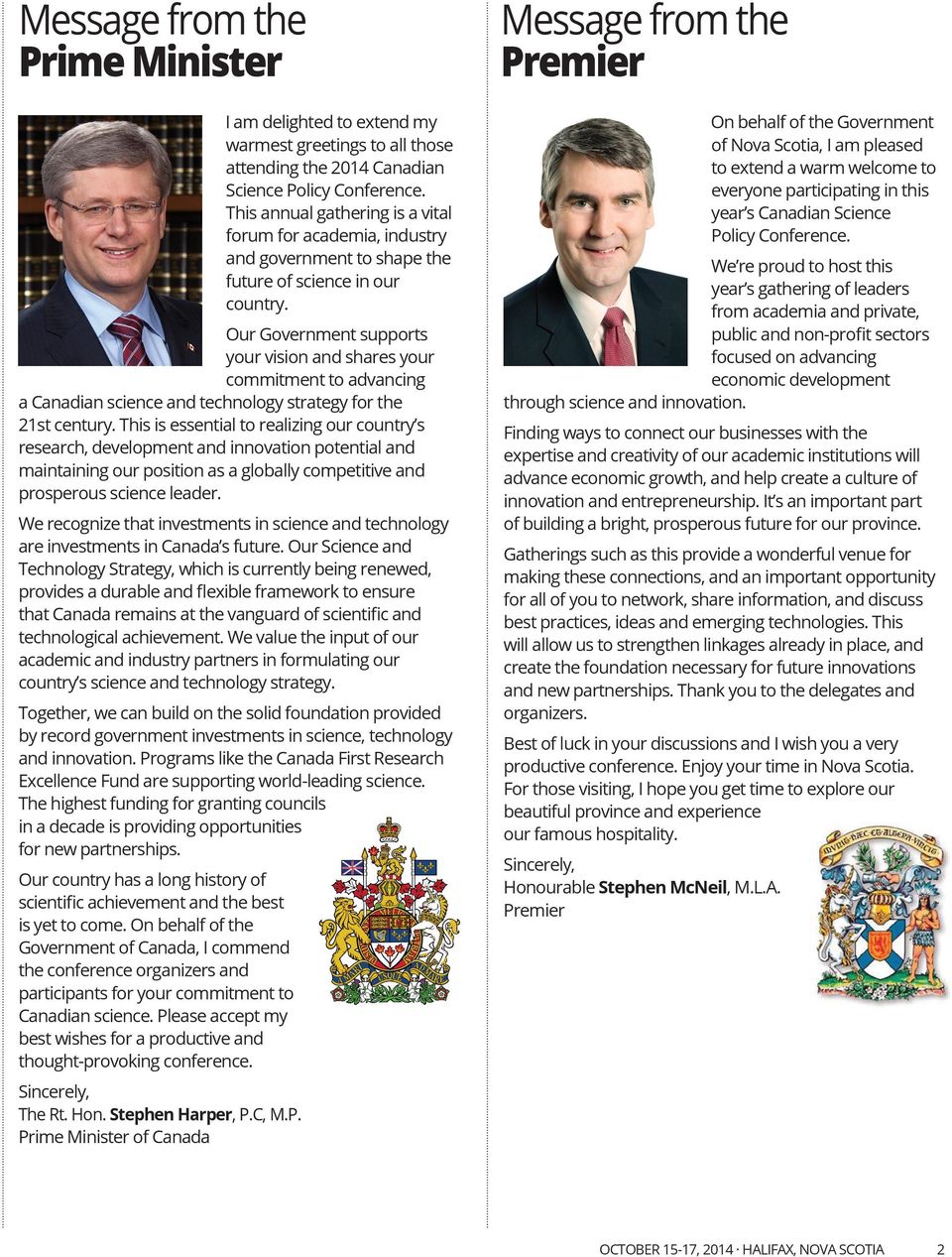
5 Message from CEO and President of the CSPC It is my great pleasure to present you with the proceeding book for CSPC The 6th science policy conference in Halifax featured four themes, more than 50 speakers and 15 panel sessions. CSPC 2014 featured several milestones; regional R&D issues as well as several emerging national issues were discussed. And in a Canadian first, an audit for science was a featured topic, generating many interesting discussions worth further exploration. The presence of Ministers Hon. Ed Holder and Hon Michel Samson, from the federal and Nova Scotia governments, signified the importance of the CSPC in building a national and inclusive dialogue on Canadian science technology and innovation policies. As in every year, the CSPC 2014 would not have been possible without the hard work and dedication of all the volunteers, CSPC board members, and Advisory Committee. Special thanks to Frank McKenna and John Risley for their endorsements as the Hon. Co-Chairs of the conference. CSPC is dependent solely on the financial support of sponsors. We are extremely thankful to all the supporters who made this year s conference possible. Finally I must thank all CSPC delegates for elevating the Canadian science policy discussion to new heights. On behalf of the entire CSPC team, I thank you for your participation and look forward to hearing your feedback, which has always been the best guidance for continuous improvement of the CSPC. In closing, we prepared this year s proceeding book with a different format and approach to the content. This was possible in collaboration with Debbie Lawes and Mark Henderson from Dovercourt Editorial Services and Research Money. I want to thank them for their excellent work. Mehrdad Hariri CEO and President Canadian Science Policy Centre Opening Remarks by Dr. Richard Florizone What Should Canada s Science Policy Be? It is a pleasure for Dalhousie University to be a leading sponsor for this conference along with the Province of Nova Scotia, Genome Canada and Genome Nova Scotia and many others including our colleagues at St. Mary s University. What should the science policy or strategy of a country be? This year s CSPC has brought together many of the leading lights in science policy to tackle a fundamental question that is so important to the future of our country and regions like Atlantic Canada. One of the big questions is how to balance the needs of today versus the needs of tomorrow. There is a very real need for applied science to tackle the challenges we face today, whether it s economic development, climate change, energy, food security or disease. At the same time, we need to continue to support that curiositydriven science that builds a reservoir of new knowledge for tomorrow while feeding the human spirit and our collective desire for a deeper understanding about our universe and where we come from. These discussions are particularly important to Atlantic Canada where we have both economic challenges and opportunities. How can we use the levers of science policy and other public policy tools to improve our social wellbeing and economic prosperity? These questions of science policy and economic development are at the interface between university research, the private sector and government, which is why the CSPC has become so important to this discussion. The CSPC brings together the right mix of people university students, researchers and administrators, along with industry and government decision makers. Together, they are helping Canada build and use its science policy to tackle important challenges and capitalize on economic opportunities both here in Atlantic Canada and across the rest of Canada. Dr. Richard Florizone President Dalhousie University 3 6th Canadian Science Policy Conference PROCEEDINGS
6 Advisory Committee The 2014 Canadian Science Policy Conference is pleased to have a National Advisory Committee made up of prominent members of the Science Policy community. David Burns, VP Research, University of New Brunswick George Cooper, President & Vice Chancellor, University of King s College Martha Crago, VP Research, Dalhousie University Neville Gilfoy, Owner & Publisher, Progress Media Group Robert Gilmour, VP of Research & Graduate Studies, University of Prince Edward Island Organizing Committee Tidimogo Gaamangwe Bryan Rourke Farah Lollmohomed Tracy Lohr Gabrielle John Jay Bhandari Oksana Andreiuk Camille Williams Nelish Lalany Program Development Committee Adam Habayeb francesc Rodriguez Aynslie Ogden Megan McCusker Laxmi Pant Siddhartha Mookerjea Jennifer Zwicker tatevik Poghosyan Jim Hanlon, CEO, Institute for Ocean Research Enterprise Richard Marceau, VP of Research, Memorial University of Newfoundland Wayne Sumarah, Executive Director of Productivity and Innovation Branch, Economic and Rural Development and Tourism, Government of Nova Scotia CSPC Board of Directors Andre Albinati, Principal, Earnscliffe Strategy Group Wendy Cukier, VP of Research and Innovation, Ryerson University Martha Crago, VP Research, Dalhousie University Janet E. Halliwell, Principal, J.E. Halliwell Associates Inc. Mehrdad Hariri, CEO & President, 2014 Canadian Science Policy Centre Paul Smith, VP and Centre Manager, Xerox Research Centre of Canada Dave Watters, President, Global Advantage Consulting Group october 15-17, 2014 Halifax, Nova Scotia 4
7 Agenda at a Glance Wednesday, October 15, 2014 Time Activity 3:00 pm 7:00 pm CSPC 2014 Special Workshop and Dinner the Start-Up Meet-Up: A Lean Entrepreneurship Approach to Advancing Innovation Thursday, October 16, 2014 Time Activity 8:00 am 8:15 am Opening Ceremony 8:15 am 9:15 am Keynote Session Conversation with Frank McKenna and John Risley 9:15 am 10:30 am Plenary Session Procurement and Industrial Technological Benefits (ITB) and Value Propositions 10:30 am 11:00 am Coffee Break 11:00 am 12:30 pm Panel 2 Big Problems, Big Networks, Big Data Panel 3 Mitigating the Risk of Marine Geohazards Panel 4 Building Opportunities for Collaboration Between Government and Academia to Inform Public Policy 12:30 pm - 2:00 pm Luncheon Session Genome Canada and Genome Atlantic; Genomics: Fuelling Canada s Growing Bioeconomy 2:00 pm 3:30 pm Panel 5 Partnerships That Move Innovation From Campus to Commerce Panel 6 the Crucial Role of Small and Medium Size Universities for Advancing Canadian Social and Econ Development Panel 7 industry-academic Partnerships in Canada: A View from the Trenches 3:30 pm 4:00 pm Break and Exhibit Display 4:00 pm 6:00 pm Keynote Session The Honourable Michel Samson, Minister of Economic and Rural Development and Tourism and Reception Friday, October 17, 2014 Time Activity 8:30 am 10:30 am Plenary Session An Audit for Science! Really? 10:30 am 11:00 am Coffee Break 11:00 am 12:30 pm Panel 9 looking to 2020 and Beyond: Training the Next Generation of Innovation Leaders in Canada Panel 10 From Excellence to Impact: How Large Infrastructure Stimulate Growth Panel 11 Communication and Collaboration: Government Science as a Partner for Innovation 12:30 pm 1:30 pm Luncheon Session The Honourable Ed Holder, Minister of State (Science and Technology) 1:30 pm 3:00 pm Panel 12 Data Management Plans Policy and Practice Panel 13 Complex International Science, Technology and Innovation Partnerships: Lessons for Canada Panel 14 Entrepreneurship and Innovation Success in Atlantic Canada 3:00 pm 3:30 pm Coffee Break 3:30 pm 5:00 pm Closing Panel 5 6th Canadian Science Policy Conference PROCEEDINGS

8 Luncheon Session Minister Highlights Importance of Applied and Basic Science to Nation Building The Honourable Ed Holder, Minister of State (Science and Technology); Organizer: CSPC Minister of State for Science and Technology Ed Holder kicked off National Science and Technology Week at the CSPC by reiterating the importance of both basic and applied research to knowledge, job creation, prosperity and improving the quality of life of Canadians. In illustrating how the government supports science that powers commerce, he highlighted the work of Dr. Jeffrey Dahn, a Canada Research Chair at Dalhousie University who is leading an $11.2-million research partnership with 3M, Magna E-Car Systems, GM Canada, Nova Scotia Power and medical devices maker Medtronic. Their goal is to develop longer-lasting, lower-cost and safer lithium-ion batteries for hybrid and electric vehicles as well as medical and power grid applications. (Automotive) is a major Canadian industry that directly employs some 117,000 Canadians and another 377,000 indirectly through the supply chain, said Holder. The government, he added, also supports science that improves Canadians quality of life. Take Dr. Nahum Sonenberg, a James McGill professor of biochemistry at McGill University whose ground-breaking research on proteins and the human immune system has resulted in a new drug that stops the progression of cancer. Federal investments to the Canada Brain Research Fund is now enabling Sonenberg to focus on developing drugs that may lead to cures for autism. In highlighting the importance of science in basic research, Holder pointed to the Institute for Quantum Computing in Waterloo, Ontario, an internationally renowned centre launched with funding from Blackberry founder Mike Lazaridis and the federal government. In addition to pushing the frontiers of knowledge, Holder noted that quantum systems also hold the promise of real-world applications, such as more secure encryption, greater ease and speed in working with massive datasets and the ability to conduct virtual experiments. What s more, enhanced computing speeds will mean that we no longer, for example, have to wait 10 years to see a new drug s long-term effects. Quantum simulation can play it out in a matter of minutes, he explained. Looking ahead Describing Canada s science and technology ecosystem as a group of communities, Holder said his challenge is seeing that everyone pulls in the same direction, while ensuring there are opportunities that play to each group s unique strengths. He noted that the government s renewed science, technology and innovation strategy expected to be released soon would continue to focus on Canadian talent. He noted that while Canada enjoys a positive science culture with Canadians having the highest science literacy rate in the world among OECD developed countries it also has a lower proportion of college and university students graduating with a science diploma. Another challenge is that only a third of Canadian workers are employed in science and technology fields. I will focus on addressing this challenge from the ground floor that is, looking at how we can best instill a curious and a passion for the STEM (the science, technology, engineering and mathematics) disciplines in young Canadians Holder said Canada is uniquely poised to seize the moment: it publishes a disproportionately high number of scientific articles compared to international peers; it boasts the most educated population in the developed world; and, leads the G7 in post-secondary R&D investments. But this can only be achieved, he stressed, if each member of the science community does its part: if governments create a framework and policies that support success; if academic institutions inspire and develop a highlyskilled workforce; and, if businesses continue to invest in R&D that bridges the gap between invention and commercialization. References: Council of Canadian Academies reports: Science Culture: Where Canada Stands: The State of Industrial R&D in Canada: Science and Technology Innovation Council report: State of the Nation 2012: october 15-17, 2014 Halifax, Nova Scotia 6

9 Keynote Session When the Status Quo isn t Working, It s Time to Change Your Game The Honourable Michel Samson, Minister of Economic and Rural Development and Tourism, Government of Nova Scotia; Organizer: CSPC That s the message Nova Scotia s Minister of Economic and Rural Development, Michel Samson, delivered to CSPC in Halifax the conference s first in Atlantic Canada. In his keynote address to delegates, Samson articulated the growing challenges for Canadian businesses, and why things need to change. Costs are increasing, growth has slowed and budgets are constantly under pressure. Canadian businesses need to compete globally to be successful We know we need to do things differently, said Samson, whose department was a key CSPC sponsor this year. To drive innovation and economic growth in Canada and help small- and medium-sized enterprises (SMEs) compete at a global level Samson said governments need to forge partnerships between Canada s academic, business, government and not-for-profit communities. The Minister s comments mirror the recommendations from the Nova Scotia Commission on Building Our New Economy. The document defines the challenges Nova Scotians face and the opportunities they can utilize finding agreement on a different path to avoid accelerating population decline and deepening economic stagnation. Samson referred to the Commission s recommendations to make more strategic use of universities and colleges. A priority for building the new economy, he said, is doubling the amount of research funding for Nova Scotia s academic and research institutions as well as doubling the number of research and development partnerships made annually in the province. Yet there continue to be challenges. He acknowledged that businesses, especially SMEs, are not taking enough advantage of the R&D opportunities available at universities and colleges because of difficulties in navigating these institutions. The province is tackling this challenge on several fronts. For example, he said Nova Scotia s Productivity and Innovation Voucher Program facilities that fundamental, initial handshake between SMEs and post-secondary institutions, similar to the Natural Sciences and Engineering Research Council s Engage grants. Now in its seventh year, the program offers two-tiered vouchers to companies that need access to academic resources such as applied research methods, field testing, prototyping, eco-efficiency audits and feasibility studies, to create more innovative products or services. Another example, said Samson, is the Atlantic Canada Opportunity Agency s support of Industrial Liaison Offices within universities and colleges and of Springboard Atlantic, a not-for-profit commercialization network managed by universities and colleges. These resources help companies navigate the valuable, but often complex opportunities available through programs like the National Research Council s Industrial Research Assistance Program and collaborative research grants with postsecondary institutions. The provincial government and the academic community will need to continually work on promoting awareness of these programs, and eliminating red tape that can discourage industry-academic partnerships. Other areas where he said government needs to do better include developing government-to-government relationships, and making sure programs run seamlessly so businesses are supported throughout their growth and development. In short, said Samson, don t waste (companies ) time. Businesses and entrepreneurs are the ones creating jobs, re-investing in our communities and driving our economy forward, he said. But we all have an important role to play if we are going to realize the growth, prosperity and success we want. It s not going to be easy but we can do it. References: The Ivaney Report: Now or Never: An Urgent Call to Action for Nova Scotians, February 2014: Nova Scotia Productivity and Innovation Voucher Program: 7 6th Canadian Science Policy Conference PROCEEDINGS

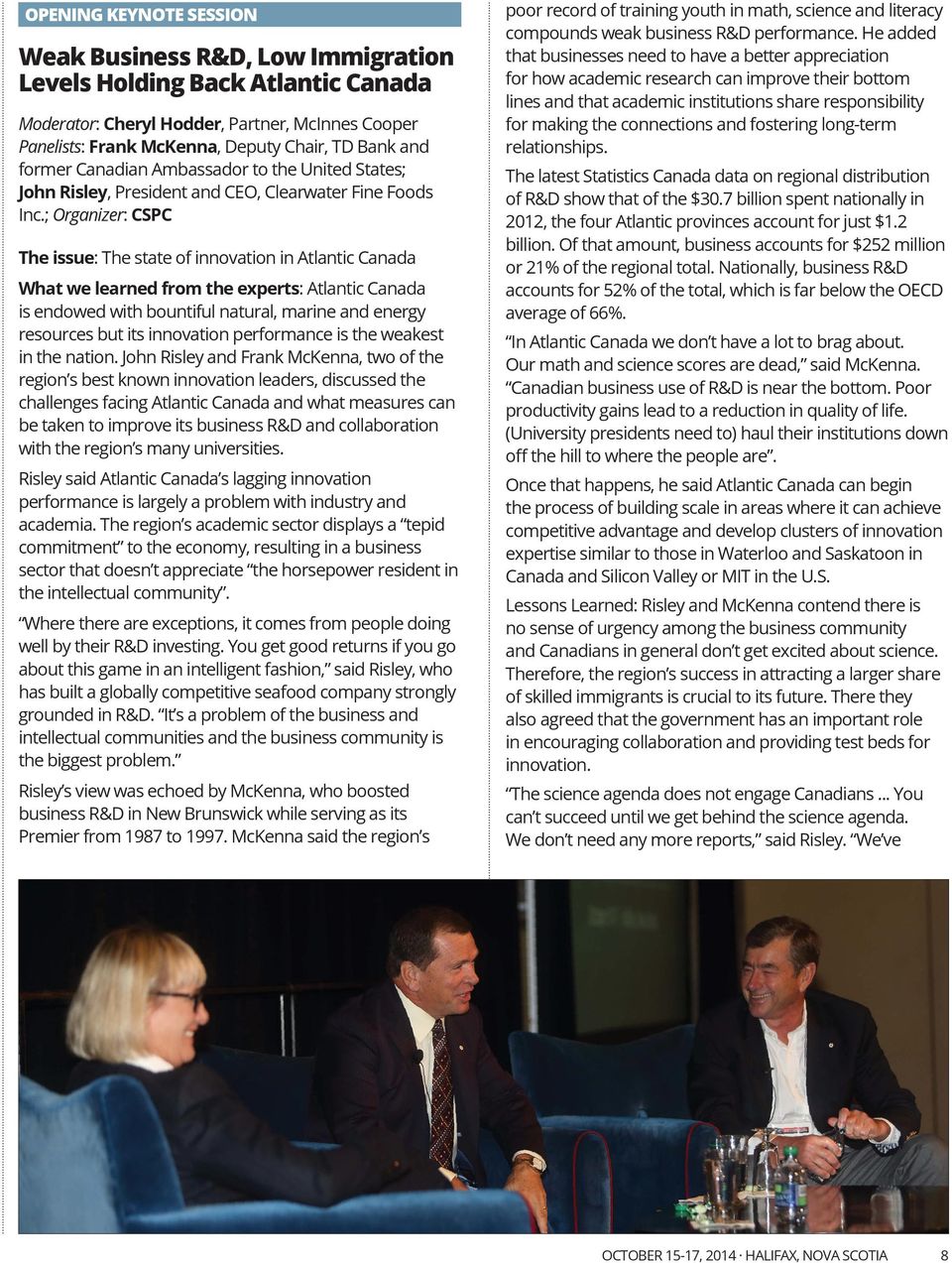
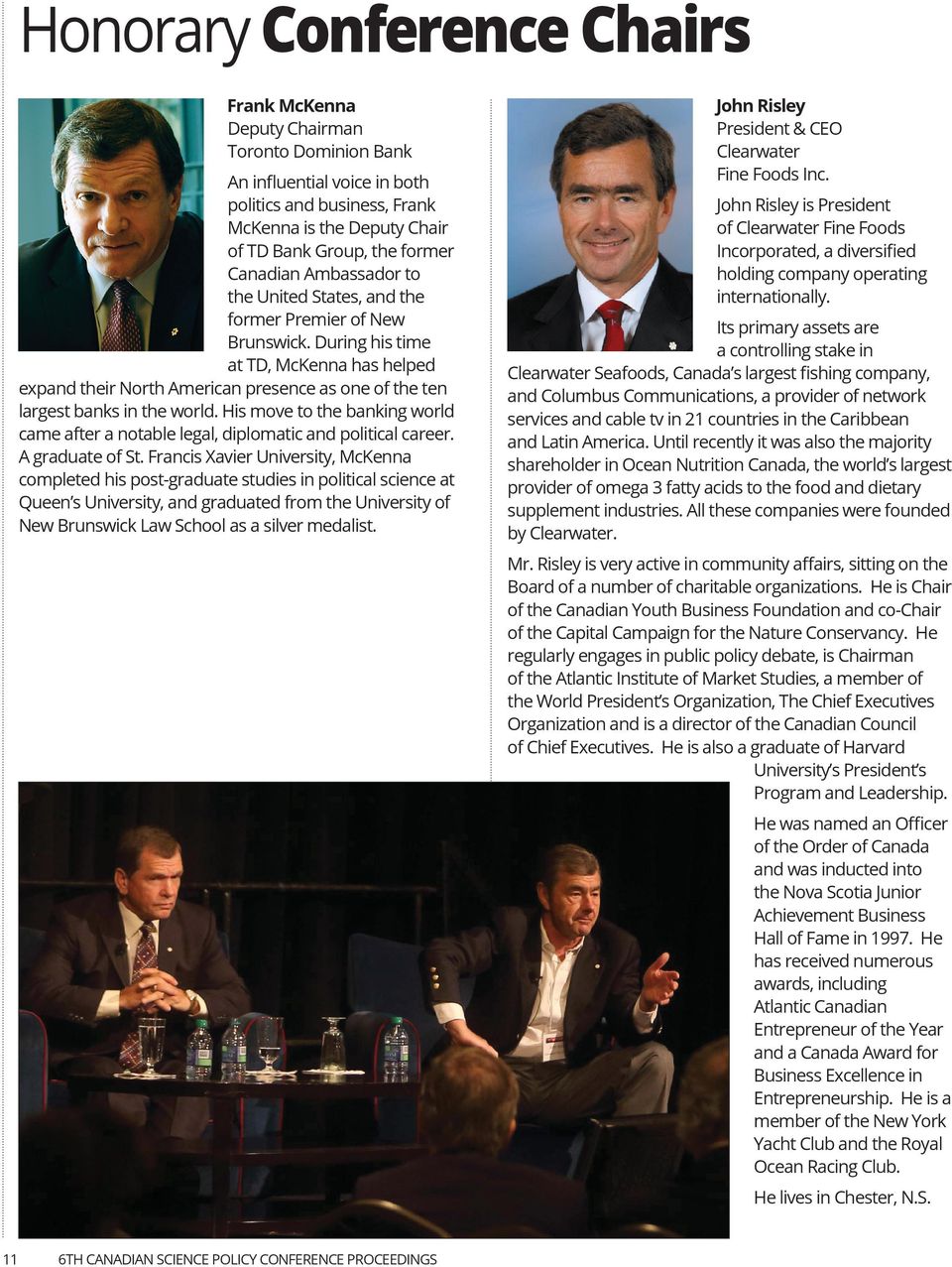
10 Opening Keynote Session Weak Business R&D, Low Immigration Levels Holding Back Atlantic Canada Moderator: Cheryl Hodder, Partner, McInnes Cooper Panelists: Frank McKenna, Deputy Chair, TD Bank and former Canadian Ambassador to the United States; John Risley, President and CEO, Clearwater Fine Foods Inc.; Organizer: CSPC The issue: The state of innovation in Atlantic Canada What we learned from the experts: Atlantic Canada is endowed with bountiful natural, marine and energy resources but its innovation performance is the weakest in the nation. John Risley and Frank McKenna, two of the region s best known innovation leaders, discussed the challenges facing Atlantic Canada and what measures can be taken to improve its business R&D and collaboration with the region s many universities. Risley said Atlantic Canada s lagging innovation performance is largely a problem with industry and academia. The region s academic sector displays a tepid commitment to the economy, resulting in a business sector that doesn t appreciate the horsepower resident in the intellectual community. Where there are exceptions, it comes from people doing well by their R&D investing. You get good returns if you go about this game in an intelligent fashion, said Risley, who has built a globally competitive seafood company strongly grounded in R&D. It s a problem of the business and intellectual communities and the business community is the biggest problem. Risley s view was echoed by McKenna, who boosted business R&D in New Brunswick while serving as its Premier from 1987 to McKenna said the region s poor record of training youth in math, science and literacy compounds weak business R&D performance. He added that businesses need to have a better appreciation for how academic research can improve their bottom lines and that academic institutions share responsibility for making the connections and fostering long-term relationships. The latest Statistics Canada data on regional distribution of R&D show that of the $30.7 billion spent nationally in 2012, the four Atlantic provinces account for just $1.2 billion. Of that amount, business accounts for $252 million or 21% of the regional total. Nationally, business R&D accounts for 52% of the total, which is far below the OECD average of 66%. In Atlantic Canada we don t have a lot to brag about. Our math and science scores are dead, said McKenna. Canadian business use of R&D is near the bottom. Poor productivity gains lead to a reduction in quality of life. (University presidents need to) haul their institutions down off the hill to where the people are. Once that happens, he said Atlantic Canada can begin the process of building scale in areas where it can achieve competitive advantage and develop clusters of innovation expertise similar to those in Waterloo and Saskatoon in Canada and Silicon Valley or MIT in the U.S. Lessons Learned: Risley and McKenna contend there is no sense of urgency among the business community and Canadians in general don t get excited about science. Therefore, the region s success in attracting a larger share of skilled immigrants is crucial to its future. There they also agreed that the government has an important role in encouraging collaboration and providing test beds for innovation. The science agenda does not engage Canadians... You can t succeed until we get behind the science agenda. We don t need any more reports, said Risley. We ve october 15-17, 2014 Halifax, Nova Scotia 8
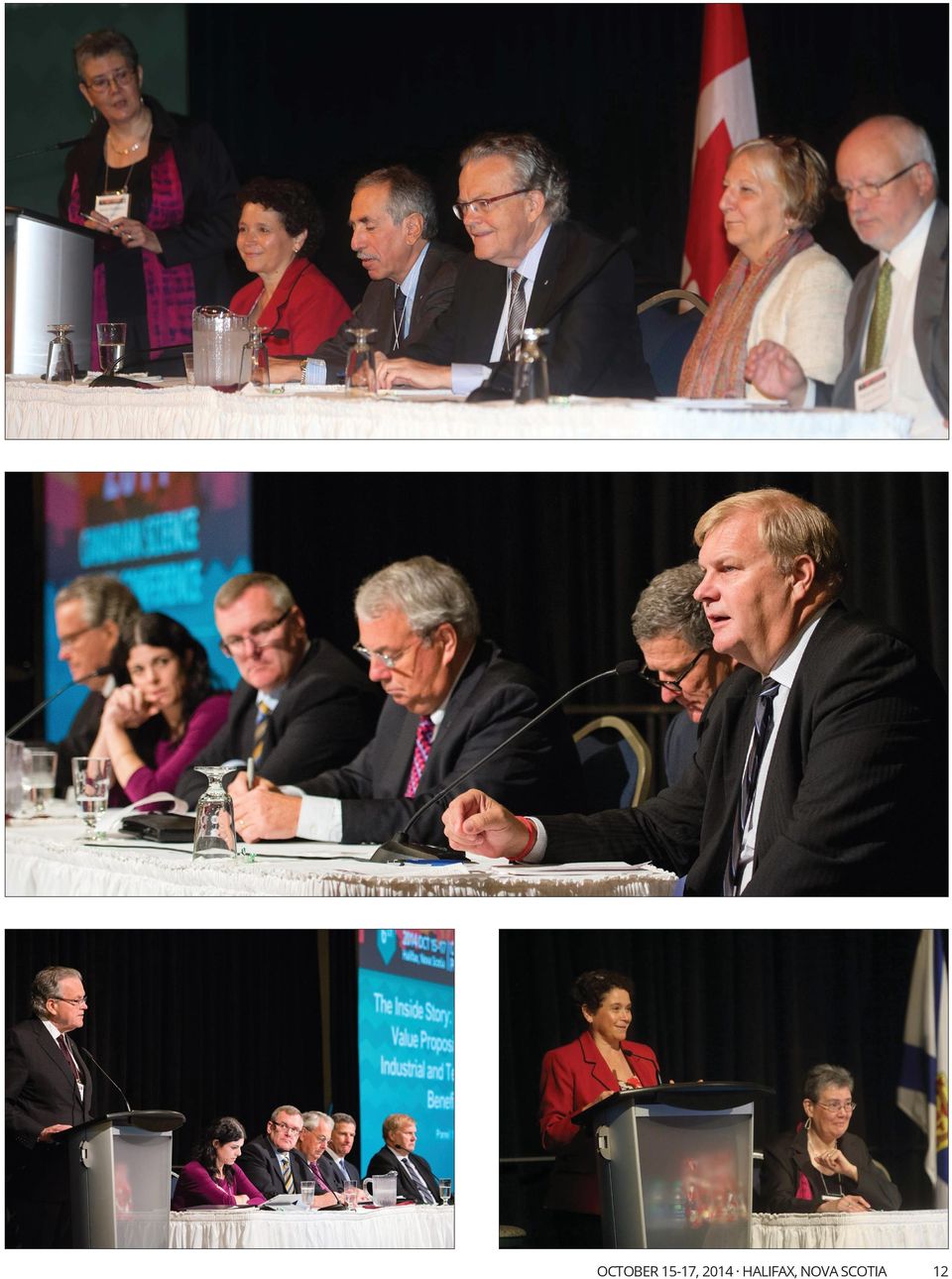
11 been hewers of wood and drawers of water for so long that we ve become quite complacent without having the real difficult conditions that tend to drive innovation and entrepreneurship. We have to replicate those conditions and part of that is bringing people in from other countries who have never had it so easy. It can help fuel innovation. Plenary Science Audit An Audit for Science! Really? Moderator: Janet Halliwell, Principal, J.E. Halliwell Associates Inc.; Keynote: Julie Gelfand, Commissioner of the Environment and Sustainable Development; Discussants: Dr. Alan Bernstein, President and CEO, Canadian Institute for Advanced Research; Dr. Martha Crago, VP Research, Dalhousie University; Dr. Pierre Meulien, President and CEO, Genome Canada; Dr. Peter Nicholson, Chair, Standing Selection Committee, Networks of Centres of Excellence; Organizer: CSPC Auditor General solicits ideas for future science topics The issue: If the federal government has made a commitment on anything related to science or innovation, Julie Gelfand wants to know about it. The new Commissioner of the Environment and Sustainable Development, part of the Auditor General s (AG) office, took her fact-finding mission to the CSPC to solicit ideas for what may become a series of science audits. What we heard from the experts: We want input from you to help us develop a Strategic Audit Plan around science and technology, said Gelfand. We could be looking at a series of audits over time, they could be built up, they could be on different topics, they could be thematic, she explained. The AG s office is soliciting views on which programs are important to review, such as the Industrial Research Assistance Program (last audited in 1999) and potentially grants and contributions. Other potential audit topics include the effectiveness of S&T strategies and S&T governance. Nicholson suggested an audit of the government s inhouse S&T activities is overdue. He described in-house government S&T as by far the most significant weakness in the federal S&T envelope. According to Statistics Canada, S&T staff in government was cut by 3,405 or 8.8% from 39,594 in FY to 35,189 in FY It s a very serious problem, said Nicholson, because we definitely need a healthy and well-motivated scientific capacity to support the mandates of government departments and agencies. Crago questioned if an audit can capture whether the research leads to intended societal outcomes, whether economic, social, intellectual, scientific or cultural. For example, is the Networks of Centres of Excellence meeting its mandate to integrate the social sciences into its research programs? It s not simple to do performance data in the social sciences and humanities, said Crago. There are inherent challenges in conducting an audit of Canada s S&T system, cautioned Bernstein. These include identifying a causal link between a research investment and an outcome; the lengthy time lags between that investment and results; understanding the role of other funders in a complex S&T ecosystem; and recognizing that more science is now global. At the same time, he stressed that an audit is key to accountability of Canada s research enterprise and at its best will encourage carefully thought out outcomes. Another issue worth auditing, added Meulien, is how to measure whether state-of-the-art science is being used when environmental monitoring, food safety or health assessments are conducted. He added that measuring success has to take into account the incentives and impediments to success related to: how science is done ( multidisciplinary is key, including the social sciences and humanities); how collaboration is encouraged (overcoming jurisdictional issues and having the right incentives in place); and the extent of international collaborations. Next steps: To help identify topics for future science audits, the AG needs to know: what areas need improvement; what are the biggest risks facing the federal S&T function; and what criteria would be used to assess how well government is doing. Gelfand stressed that the AG can only audit written commitments that it can see and measure. An audience member suggested auditing the Cabinet directive requiring all memoranda to Cabinet to include a strategic environmental assessment to determine whether departments have enough scientific capacity to provide complete information on the environmental impacts of proposed programs. For Bernstein, an important issue is measuring how well Canada is doing at participating in global research networks. On that question, Gelfand said it is possible to conduct an audit on a particular topic involving auditors general from several countries. References: 2014 Fall Report of the Commissioner of the Environment and Sustainable Development: Report of the Auditor General of Canada: 9 6th Canadian Science Policy Conference PROCEEDINGS
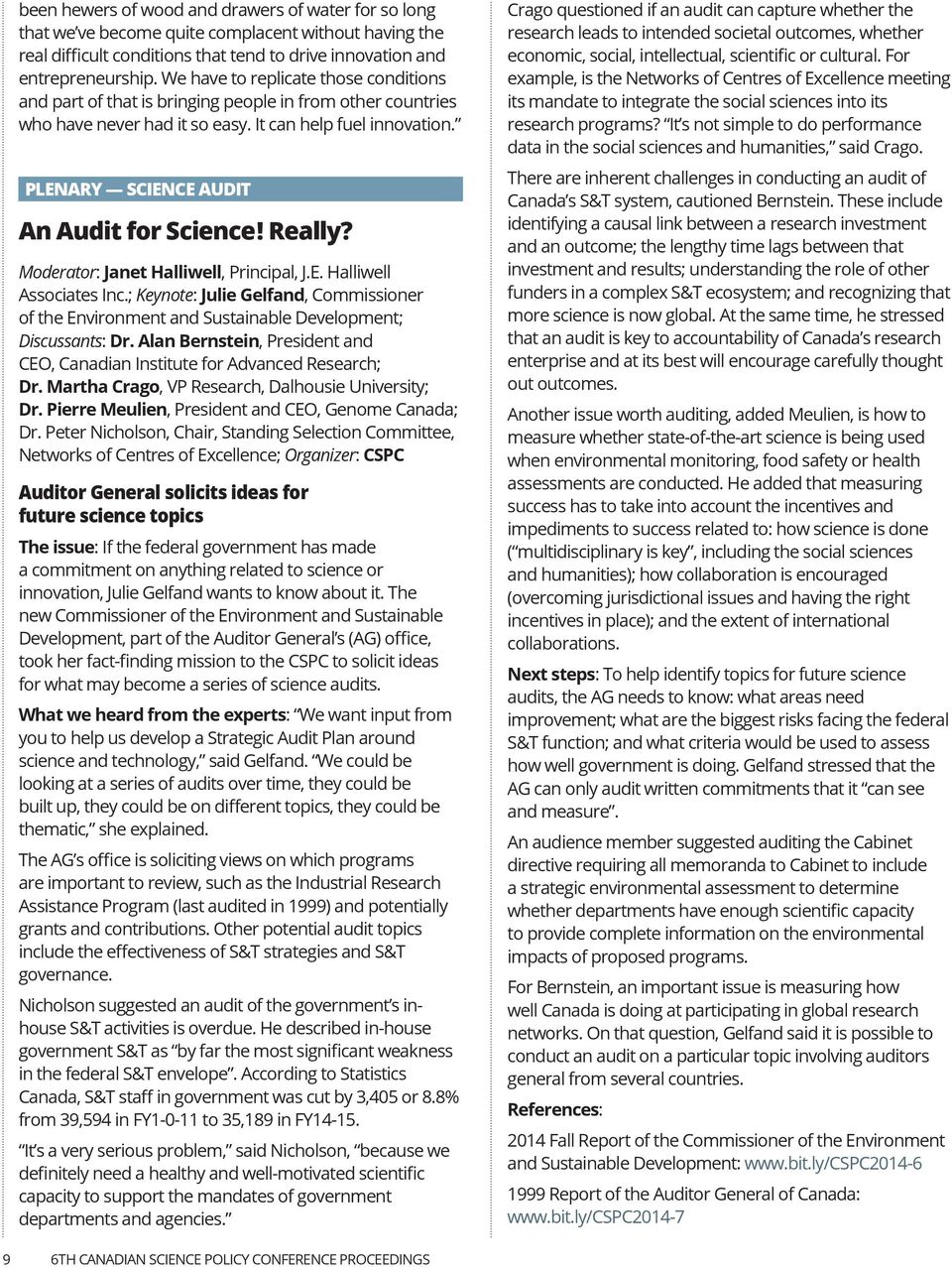
12 Plenary ITB The Inside Story: Procurement, Value Propositions, and Industrial and Technological Benefits Moderator: Peter Nicholson, Chair, Standing Selection Committee, Networks of Centres of Excellence; Panelists: Christyn Cianfarani, President, Canadian Association of Defense and Security Industries; Eric L. Cook, Executive Director/CEO, Research and Productivity Council (RPC); Jim King, Independent Consultant, former Vice-Admiral; Stephen Lund, Vice President, Industrial Regional Benefits & Community Relations; Commentator: John Knubley, Deputy Minister, Industry Canada; Organizer: CSPC New procurement strategy strengthens incentives to invest in STI The issue: A major overhaul of Canada s Defence Procurement Strategy (DPS) is poised to inject billions of dollars into science, technology and innovation (STI) through a new policy tool that will see would-be contractors jostling to invest in R&D, manufacturing and other benefits that promote Canadian business innovation, competitiveness and exports. If done right, government and industry experts agree it could become one of the largest, if not the largest mechanism for increasing business investment in R&D and reversing Canada s poor track record of converting lab discoveries into commercial successes. What we learned from the experts: As Cook explained, Canada does not have an innovation or science and technologies supply problem, what we have is a demand problem. The DPS is designed to address that challenge. The panel discussed two centrepieces of the DPS Industrial and Technological Benefits (ITBs) (formerly called Industrial Research Benefits or IRBs) and the new Value Proposition (VP). ITBs focus on using technology and commercialization to build new skills and industrial capabilities in priority sectors. Each defence procurement bid above $100 million must also include a VP, generally weighted at 10% in the evaluation. For bids below that amount, and above $20 million, the VP will be considered on a case-by-case basis. (The DPS) is designed to change the incentives so the business community pulls the R&D from the work of basic research from across the country and globally, said Knubley. Cianfarani described the VP as the heart of the ITB policy and a game changer. (The VP) is going to trigger competitive behaviour with companies particularly foreign (prime contractors) trying to one-up each other and the ante can escalate quite quickly. King said there are 214 major defence projects that have either been approved or at the planning stages. Those for which contracts have not already been signed would be subject to ITBs and VPs under the new defence policy. Almost all of these projects require some degree of innovation, including science, research and development. The potential for new STI investment is staggering approximately $10 billion annually. This new approach is potentially three times as big as SRED (the Scientific Research and Experimental Development tax credit) and more strategic, said Nicholson. Next steps: Knubley described the DPS as the government s biggest tool for stimulating innovation and competitiveness, if we can do this right. Doing it right, said Cianfarani, will require contractors to engage even more with small- and medium-sized enterprises, noting that outreach is critical to pull companies into the value proposition. Panelists also agreed that closer cooperation is needed between Industry Canada, Public Works and Government Services and the Department of National Defence (DND) to ensure the new policy doesn t further complicate an already complicated procurement process. Knubley noted that all three departments are already meeting regularly to review the overall direction of the strategy and individual cases, saying the goal is to provide sufficient flexibility to best meet the DPS objectives on a procurement-by-procurement basis. Caught in the middle of this policy change is Irving Shipbuilding, the prime contractor for the navy s new fleet of combat vessels the biggest procurement project in Canada s history. Lund said a key goal of the program is to build sustainable economic activity for Canada. This is not about just building ships, said Lund, who recalled when a senior official from the Nova Scotia government told him, at the end of 30 years, if all we have to show for this is the ships that we ve built, then collectively we probably haven t been as successful as we should have been. Relevant documents: Debbie Lawes, New procurement strategy could inject billions in sustained funding for STI, Research Money, October 29, 2014: Defence Procurement Strategy: Jenkins report on Procurement in Support of Business Innovation: october 15-17, 2014 Halifax, Nova Scotia 10

13 Honorary Conference Chairs Frank McKenna Deputy Chairman Toronto Dominion Bank An influential voice in both politics and business, Frank McKenna is the Deputy Chair of TD Bank Group, the former Canadian Ambassador to the United States, and the former Premier of New Brunswick. During his time at TD, McKenna has helped expand their North American presence as one of the ten largest banks in the world. His move to the banking world came after a notable legal, diplomatic and political career. A graduate of St. Francis Xavier University, McKenna completed his post-graduate studies in political science at Queen s University, and graduated from the University of New Brunswick Law School as a silver medalist. John Risley President & CEO Clearwater Fine Foods Inc. John Risley is President of Clearwater Fine Foods Incorporated, a diversified holding company operating internationally. Its primary assets are a controlling stake in Clearwater Seafoods, Canada s largest fishing company, and Columbus Communications, a provider of network services and cable tv in 21 countries in the Caribbean and Latin America. Until recently it was also the majority shareholder in Ocean Nutrition Canada, the world s largest provider of omega 3 fatty acids to the food and dietary supplement industries. All these companies were founded by Clearwater. Mr. Risley is very active in community affairs, sitting on the Board of a number of charitable organizations. He is Chair of the Canadian Youth Business Foundation and co-chair of the Capital Campaign for the Nature Conservancy. He regularly engages in public policy debate, is Chairman of the Atlantic Institute of Market Studies, a member of the World President s Organization, The Chief Executives Organization and is a director of the Canadian Council of Chief Executives. He is also a graduate of Harvard University s President s Program and Leadership. He was named an Officer of the Order of Canada and was inducted into the Nova Scotia Junior Achievement Business Hall of Fame in He has received numerous awards, including Atlantic Canadian Entrepreneur of the Year and a Canada Award for Business Excellence in Entrepreneurship. He is a member of the New York Yacht Club and the Royal Ocean Racing Club. He lives in Chester, N.S. 11 6th Canadian Science Policy Conference PROCEEDINGS
14 October 15-17, 2014 Halifax, Nova Scotia 12
15 Panel Reports Categorized by Theme Advancing Economic Development and Prosperity with S & T Canadian Science and Technology Strategy: Looking toward 2020 Innovation and Partnerships: A Recipe for Success The Art and Science of Risk Assessment: A Global Conversation 13 6th Canadian Science Policy Conference PROCEEDINGS

16 THEME Advancing Economic Development and Prosperity with S&T The role of science and technology in economic development and prosperity is undisputable. However perspectives on what are the optimal investments in S&T for the purpose of economic development have evolved in the past few decades. This theme aims to explore various dimensions of this topic. a. The regional dimension: i Atlantic economic development initiatives ii Learning from best practices and case studies b. The sectoral dimension what are the differences between different science and technology-enabled sectors where are the opportunities and where are the challenges? How can Canada best create and retain high value jobs in these sectors. What are the policies and mechanisms? c. The international dimension opportunities and challenges for S&T: i Benchmarking other nation s strategies ii International trade agreements e.g. NAFTA and CETA iii Theme specific initiatives, e.g. the 2013 Atlantic Ocean Research Alliance (Galway Agreement) PANEL REPORT The Crucial Role of Small and Medium Size Universities for Advancing Canadian Social and Economic Development Moderator: Daniel J. Weeks, President and Vice Chancellor, University of Northern British Colombia; Panelists: David Cruise Malloy, VP Research, University of Regina; André Manseau, Dean of Research, Université du Québec en Outaouais; Michael Owen, VP Research, Innovation and International, University of Ontario Institute of Technology; J. Kevin Vessey, Associate VP of Research and Dean of Graduate Studies, Saint Mary s University; Organizer: Université du Québec Size doesn t matter when it comes to research excellence and impact The issue: Many small- and medium-size universities have unique research programs that play an important role in their communities, while advancing Canadian economic development and prosperity. But national science policies often ignore or underestimate their role and impact. What are some of the impacts these institutes are making on their communities, and how can we ensure the important work they do is recognized? What we learned from the experts: Small- and mediumsized universities have long claimed that when it comes to research impact, their institutions score much higher than many realize. Malloy cited third party data from Thomson Reuters normalized citation index (NCI) showing only a small difference in impact between doctoral, comprehensive and undergraduate universities. We want to make sure provincial and federal governments realize this We ve got good data to demonstrate that we do good research and that can t be ignored size doesn t matter, he said. october 15-17, 2014 Halifax, Nova Scotia 14

17 What differentiates small universities from their larger counterparts is that their strengths are more often built on core competencies and local partnerships that reflect regional needs. As a result, Owen said smaller universities play a significant role in a region s social and economic development. For example, Lakehead University s Thunder Bay campus collaborates with local Métis and First Nations in sustainable mining and exploration research. At Wilfred Laurier University in Waterloo, the International Migration and Research Centre provides a focal point for debate, research and policy analysis on issues of migrant worker health in Ontario. On Canada s east coast, Acadia University has created the Atlantic Wine Institute to support the growing wine industry in the Annapolis Valley. Manseau cited several examples of region-specific programs throughout Quebec, including the Université du Québec à Rimouski s innovation centre for fisheries and aquaculture (MERINOV) in the Gaspesie. Each region has a specific strategy based on their core competencies that s based on the historical, industrial and social base of the community. Vessey explained that smaller institutions punch above their weight in many specific disciplines. For example, Saint Mary s University competes with the University of Toronto in astronomy and computational astrophysics. Also, geology researchers at SMU were important contributors to Nova Scotia s $15-million dollar Play Fairway Analysis (PFA) which provides a geological atlas of Nova Scotia s offshore oil and gas potential. The PFA research resulted in BP and Shell investing over $2 billion in offshore exploration in the Atlantic region. Next steps: All panelists agreed it s important to speak with a unified voice when it comes to raising awareness of the socioeconomic impact made by smaller universities. Such awareness would go a long way in addressing lingering challenges such as retaining excellent researchers and persuading provincial and federal governments to give more consideration to local people, firms and expertise when supporting research projects. Vessey suggested that when research granting agencies review applications, they should put more weight on a balanced set of input, output and impact measures. For example, he noted that the latest data from Research Infosource ranked Saint Mary s 50th in the country according to sponsored research income. But when other factors such as number of publications and citations are included, the university jumps to #39, which Vessey describes as a more accurate measure of return on investment. If NSERC and the other funding agencies in Canada would rate applications more in terms of impact, I would suggest that Saint Mary s and many other smaller- and intermediate-sized universities would be a really good place to invest their research funds, said Vessey. References: Research Infosource, Canada s Top 50 Research Universities List 2014: PANEL REPORT From Excellence to Impact: How Large Research Infrastructure Stimulates Growth Moderator: Mark Henderson, Editor, RE$EARCH MONEY; Panelists: Dr. Robert Lamb, Executive Director, Canadian Light Source; Dr. Jonathan Bagger, Director, TRIUMF; Dr. Martin Taylor, Professor Emeritus, University of Victoria; Dr. Nigel Smith, Director, SNOLAB; Organizer: Canadian Light Source Big science facilities lay foundation for economic growth The issue: Big science is global and Canada s major science facilities are actively participating in confronting and solving some of the world s most intractable challenges. Their success is providing ground breaking insight and social and economic benefits that depend on stable long-term support for infrastructure and operating costs. What we learned from the experts: Neutrino and dark matter, sub-atomic physics, cabled seafloor observatories and materials characterization using the bright light of a synchrotron these are the worlds of Canada s major science facilities and while they conjure up visions of esoteric, fundamental research, their connections to social and economic growth are robust and often surprising. For example, TRIUMF s Advanced Applied Physics Solutions (AAPS) unit seeks to parlay the facility s expertise 15 6th Canadian Science Policy Conference PROCEEDINGS

18 Panel Report Continued in particle accelerators and advanced radiation detection systems into creating or assisting companies that can market new products and services globally. TRIUMF is Canada s entry into this international ecosystem of sub-atomic physics. Seventy percent of our users come from outside Canada we re incredibly internationally competitive, said Bagger. The connection to industry and commerce has been part of TRIUMF from the very beginning. It started over 35 years ago with Nordion, which currently produces 2.5 million doses of medical isotopes each year at TRIUMF, to more recent activity developing various high-tech industries in the Vancouver area and spinning off five companies in the past five years. The Canadian Light Source s synchrotron is targeting 25% industrial usage for its highly specialized beamlines and has hosted hundreds of companies who travel to Saskatoon to conduct experiments. Lamb calls it a $300-million flashlight with perfect and perfectly controllable light. It appeals to a whole range of disciplines and industries which is why many countries have one We make it as accessible as possible to industry and institutions, he said. There are 24 serious synchrotron facilities in the world and the CLS is the most commercial, which is remarkable when you consider the location. Ocean Networks Canada s Innovation Centre has a mandate to help Canadian companies globally market the services and sophisticated networking, digital infrastructure and remotely controlled instruments that comprise Smart Ocean Systems. We work in harsh environments that push the technology envelope On digital infrastructure we re partnered with IBM, said Taylor. We are in the midst of discussions with a number of jurisdictions Korea being one for turnkey systems that will enable them to duplicate observation systems related to gas hydrate deposits. SNOLAB situated deep beneath the earth in an active nickel mine near Sudbury ON is working with a mining innovation group to transfer its expertise in methodologies for managing complex science facilities of international breadth and scale. Smith said SNOLAB s unique expertise has also attracted a $30-million dark matter project from the U.S. We are a facilitator for science but we help experiments exploit their IP (intellectual property) by connecting them to knowledge mobilization experts such as AAPS and Mitacs, said Smith. This IP develops high-efficiency particle detectors like you would find in a hospital. Lessons learned: Large-scale science facilities make significant contributions to Canada s research and economic ecosystems in several ways, via the delivery of world-class science, the development of IP streams and fostering new scientific capabilities and initiatives. Just as important, however, is the inspiration large science facilities can generate as well as the education of new generations of researchers. PANEL REPORT Entrepreneurship and Innovation Success in Atlantic Canada Moderator: Muthu Singaram, Chief Mentor, Muthu Singaram Consulting; Panelists: David Burns, VP research, University of New Brunswick; Jeffrey Crelinsten, President and Co-founder, The Impact Group; Kevin Dunn, Director, Industry Liaison and Innovation, Dalhousie University; Kathleen Rayworth, Executive Director, Entrepreneurs Forum; Larry Shaw, CEO, Knowledge Park Inc.; Organizer: Vibazone Experts share secrets for commercial success in Atlantic Canada The Issue: Atlantic Canada has seen a surge of innovation and commercialization opportunities in the form of new start-ups in the past few years. Much of this momentum is fueled by a growing network of universities, businesses and governments that are supporting the Atlantic region s innovation-focussed S&T policy. Two major challenges still to overcome are how to grow and sustain these starts ups and how to connect them to larger markets outside of the region. The lessons being learned in the Atlantic region are just as important to the rest of Canada. october 15-17, 2014 Halifax, Nova Scotia 16

19 What we learned from the experts: A thing people recognize, said Burns, is that in Atlantic Canada we don t necessarily advertise ourselves all that well. Efforts are underway to overcome that inertia. We re aiming higher than we have in the past Dunn said. We re going after national centres of excellence (and) groups like the National Research Council s Industrial Research Assistance Program (NRC IRAP) are critical to align with to maximize the success stories, added Dunn. Success is still early days but Shaw is optimistic. Looking at what we ve done in such a short period of time, you really start to understand that we re building a huge amount of momentum in this region. Much of this momentum is driven by networking. Since there is less venture capital available in Atlantic Canada, Burns said networking becomes even more important, and that s a fundamental mentality of the Atlantic provinces, we like to work together. Networking and commercialization support is provided by several organizations in the region, including Springboard Atlantic s network of 14 Atlantic universities and five colleges. Another group, the Entrepreneur s Forum, services mainly technology- or knowledge-based companies as well as immigrant entrepreneurs who have received venture capital, business mentoring and incubation support from Innovacorp. The Entrepreneur s Forum has provided practical advice, such as marketing, engineering, product development, technology, finance and management, to over 1200 entrepreneurs with the help of 2000 volunteer advisors. Rayworth said these experienced entrepreneurs provide feedback on how to transfer (the start ups ) tech out of the universities to get commercialization happening. Our main value proposition is our advisory sessions, said Rayworth. We bring one client to the table with four to six well established business people who have been there and done that and they get the challenge to give the clients their feedback, their expertise and their knowledge about the challenges. Next steps: Growing companies in Atlantic Canada reflects the country s larger industry and innovation challenge, said Crelinsten. There aren t enough Canadian R&D intensive companies succeeding to grow. That s the problem. We don t know how to grow companies. It s the soft skills that we need. We re great on technology. Those soft skills, he added, must include giving students learning opportunities to develop the human skills needed for commerce. Customers have to be central. Universities, the Nova Scotia Community College, and the province created such an opportunity earlier this year with the creation of four sandboxes or ideation spaces where student groups get together and try multidisciplinary approaches to thinking about applying their ideas to a start-up, said Dunn. Shaw s final words of advice: focus on commercialization as a process; focus on the entrepreneur, and avoid duplicating efforts. We are way too small of a region to be duplicated efforts, he said. We certainly would have a race to mediocrity if we began to do that too much. 17 6th Canadian Science Policy Conference PROCEEDINGS

20 THEME Canadian Science and Technology Strategy: Looking toward 2020 The Canadian government is renewing the country s science and technology strategy. An unprecedented number of organizations have submitted ideas and proposals in response to a public call. This has increased the level of attention and public discussion to an already heated debate on the need for a national and long-term science and technology strategy. This theme aims to explore this topic further and provide a national stage for some of the most prominent arguments, in particular, those with a long-term perspective. a. What are our aspirational/big national objectives in science and technology b. How will we accomplish these goals? What changes does this entail in policy and practice? PANEL REPORT Big Problems, Big Networks, Big Data Moderator: Sara Iverson, Scientific Director, Ocean Tracking Network; Panelists: Tony Charles, Director, School of the Environment, Saint Mary s University, and Director of the Community Conservation Research Network; Dr. Ronald Pelot, Associate Scientific Director, MEOPAR; Fred Whoriskey, Executive Director, Ocean Tracking Network; Organizer: Dalhousie University Canada exploits expertise in big data networking The issue: The combination of big data and networking is opening up massive opportunities for better understanding, managing and predicting changes to our oceans and those that depend on them. Merging and analyzing complex data sets is helping Canada build research capacity and expertise that can be exported globally. What we learned from the experts: Ocean research networks and big data are proliferating in Canada, spurred by the enormous benefits they offer to a wide range of sectors, organizations, populations and policy makers. Encompassing diverse local, regional, national and international data sets and featuring technologies that assist in their compilation, dissemination and analysis, these networks span the spectrum of research disciplines and are intended for multiple users. However, challenges are emerging due to the complexity of these networks, multiple funding sources and conflicting interests. For example, Whoriskey described big data networks as a disruptive technology compared to classic fisheries management. We re generating all these new measurements and new results are coming forward potentially making losers Follow researchmanitoba.ca October 15-17, 2014 Halifax, Nova Scotia 18
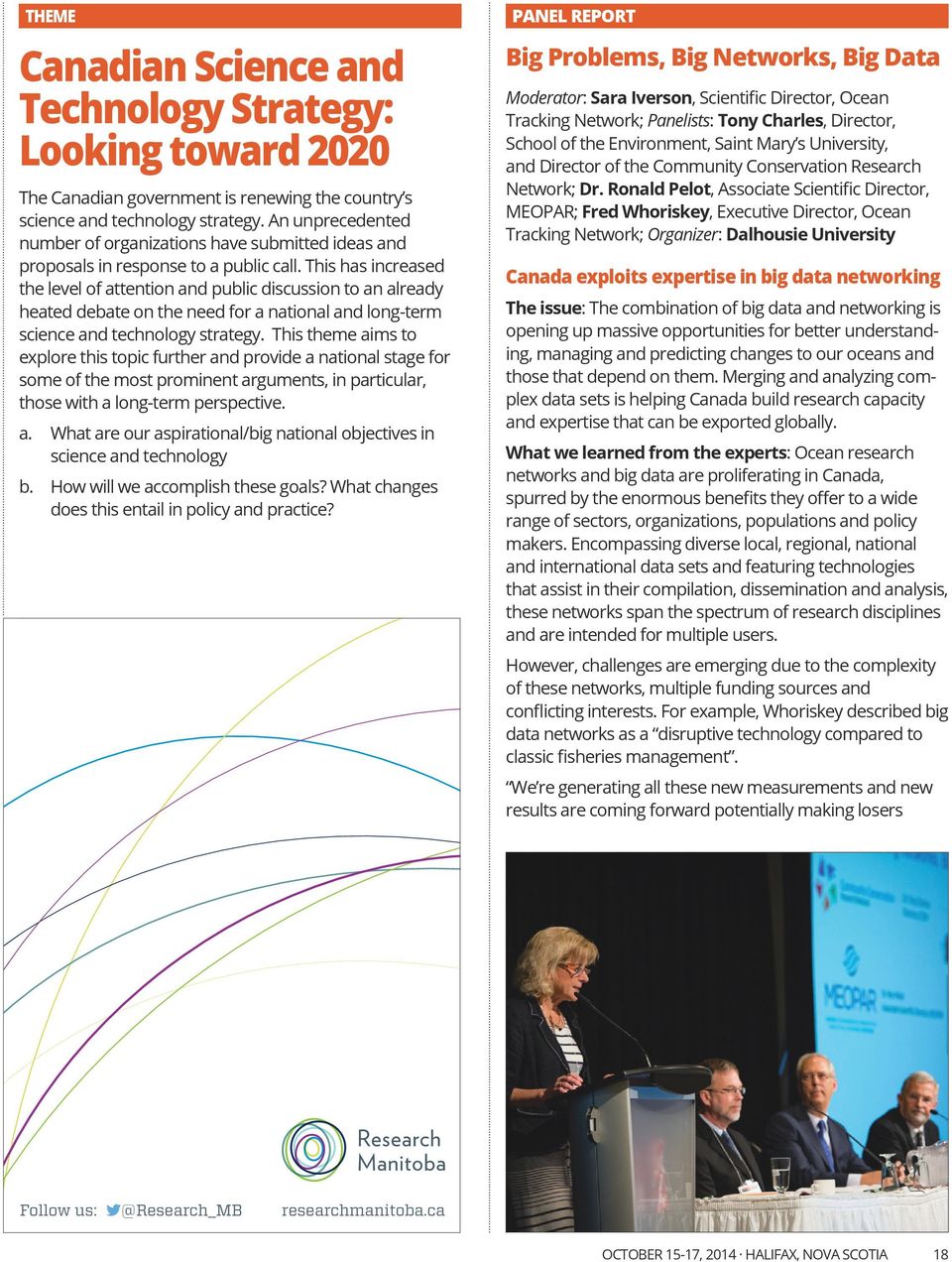
21 in what were formally winners, he explained. If you re showing that there s (fish) mortality occurring in certain places and quotas should be cut, there can be great resistance to the new technology, questioning of its validity and its ability to deliver messages. While there s general consensus on the importance of integrating the research, data sets and directions of these networks, effective collaboration remains elusive. Halifax is home to several networks but their interaction is sporadic at best. It s a big, internally focused task to maintain a network It took this particular Canadian Science Policy Conference to get us at Dalhousie to walk the 10 minutes to SMU (ST. Mary s University) to talk to Tony Charles about what his network (Community Conservation Research Network) is doing and how we might begin to focus on that one, said Whoriskey. How we are going to be able to maintain that interaction is going to be a challenge and something we have to move forward on. With Canada at the forefront of ocean networks, consistent funding and coordination are required to maximize the potential for exporting the models, technologies and methodology upon which they depend. It was agreed that research excellence and capacity building are essential prior to exploring commercial potential. We certainly want more research capacity in Canada, not only to understand our oceans better and think about our ocean policies but to come up with methods and sometimes widgets so we can be more competitive on the world stage and help solve other people s problems, said Pelot, explaining that MEOPAR s project themes are people and biological science. Were trying to create new knowledge and methods and get them into practice and policy These networks are about meeting with stakeholders whether they re government, communities aboriginal groups or NGOs. Although the Community Conservation Research Network isn t explicitly ocean focused, it shares a common goal to utilize big data from multiple sources to examine the links between the environment and the economy. We re trying to delve down into figuring out what makes conservation an environmental initiatives work in practice and how policy can support that, said Charles. There are a whole bunch of components that need to be looked at when you re examining communities, nations and the world. Next steps: Overcoming complexity and integrating data sets will add value to ocean networks both nationally and globally. Sharing core expertise and methodology are first steps to achieving outcomes in which the whole is larger than the sum of its parts. PANEL REPORT Looking to 2020 and Beyond: Training the Next Generation of Innovation Leaders in Canada Moderator: Rachel Brighton, President, Finest Point Periodicals Limited; Panelists: Andre Bezanson, Postdoctoral Research Fellow, Dalhousie University; Ross Laver, VP, Policy and Communications, Canadian Council of Chief Executives; Kevin Dunn, Director, Industry Liaison and Innovation, Dalhousie University; Valerie Walker, Director of Policy, Mitacs; Organizer: Mitacs Bridging the gap between advanced degrees and today s jobs The Issue: Youth unemployment is stubbornly stagnant at around 13%, yet a 2013 Canadian Chamber of Commerce report warned that Canada is facing a severe shortage of skilled labour, mostly in the science, technology, engineering and mathematical (STEM) fields. Then there s the problem of Canada s productivity gap which continues to hinder our global competitiveness. To help solve the problem, universities and funding agencies are creating more opportunities for graduate students to apply their research skills to real-world problems. What we learned from the experts: One group that has made significant gains in addressing this challenge is Mitacs. The national, not-for-profit research organization has leveraged millions of dollars in public and private sector funding to provide more than 10,000 internships to graduate students and postdoctoral fellows. We need to improve both the quantity and the quality of highly-trained students and post-docs and we also need to motivate or increase the amount of business expenditure (on R&D), which is key to increasing productivity, said Walker. She stressed that too many post-docs focus on attaining the skills needed to become professors where job prospects are limited rather than gaining more industry-relevant skills like entrepreneurship, budgeting and project management. What we heard (in post-doc surveys) is that they dedicated everything they did in terms of training to become a professor, but when it didn t look like it wouldn t happen, they didn t have a plan B, said Walker. Bezanson represents a new generation of innovation leaders. The Ph.D. student and former Mitacs intern worked with Halifax start-up Daxsonics Ultrasound to develop a technique that significantly reduces the cost of high resolution ultrasound machines. This experience provided him with the job skills today s employers need. 19 6th Canadian Science Policy Conference PROCEEDINGS
22 Panel Report Continued The best way of doing it is actually to commercialize it, said Bezanson. If you just write a paper then it gets lost in the ether, said Bezanson, who credited several programs for supporting experiential learning, including NSERC s Research Partnerships Program, the Atlantic Innovation Fund and Innovacorp s new sandboxes where students, innovator and entrepreneurs are encouraged to share ideas that could become businesses. Dunn said it s often the soft skills that employers need most, such as problem solving, communications and teamwork. Being able to interpret the problem and communicate that back intelligently rather than using techno-babble to get around it, is very valuable to industry. Collaborating with industry also gives students an opportunity to fail, which Dunn described as the best experience for preparing young graduates for the real world. Some of the strongest professors and researchers are people that have a varied background in academic research, in teaching and in industry, he said. While many companies do succeed in commercializing university research, Laver stressed that the main incentive for collaborating is access to highly skilled individuals. The number one thing we hear from our member companies, and what s driving them to collaborate, is they want access to the brightest minds and they want to gain experience with young people who may be a great fit in their workplaces. Next Steps: A recurring complaint from industry is that academic research can take too long, which can be a disincentive to collaborate. To speed up the process, Mitacs signed an agreement with SSHRC, and discussions are underway with NSERC, to accelerate the peer review process and how quickly interns can be placed. Walker also credited the recent formation of the Canadian Association for Post-Doctoral Administrators which she said will provide valuable data on the challenges facing post-docs and how these can be addressed. References: Canadian Chamber of Commerce; Canada s Skills Crisis: What We Heard, 2013: PANEL REPORT Data Management Plans Policy and Practice Moderator: Walter Stewart, Co-ordinator, Research Data Canada; Panelists: Ernie Boyko, Statistical Development Consultant; Charles Humphrey, Research Data Management Services Coordinator, University of Alberta; Christine Trauttmansdorff, Executive Director, Social Sciences and Humanities Research Council; Organizer: Research Data Canada, Canadian Association of Research Libraries and Social Sciences and Humanities Research Council Data management plans key to fulfilling open data obligations The issue: There is a global trend to make publicly funded data more open and accessible. Canada s three main research granting councils and the Canada Foundation for Innovation (TC3+), in collaboration with Genome Canada, have proposed a collective realignment of funding policies for publicly funded data-rich projects. The new rules will require that all grant applications include a Data Management Plan (DMP). The consultation process is ongoing, and tools are being developed to help researcher agencies prepare. What we learned from the experts: Good data management is probably one of the key elements of our competitiveness as a nation in research and innovation, said Trauttmansdorff. Our ability to compete in research excellence requires us to manage data well. october 15-17, 2014 Halifax, Nova Scotia 20
23 In 2004, OECD countries signed a declaration on access to research data from public funding, and in 2006 released a document outlining the principles and guidelines. This was followed in June 2103 when G8 countries signed the Open Data Charter. In the fall of 2013, the tri-agencies released a consultation paper on Digital Scholarship proposing to make data management plans a requirement in the granting process. In the fall of 2014, the Government of Canada released its Open Government Action Plan which includes open science commitments for federally-funded research. However, Boyco said this isn t something researches and universities are doing because they have to, but because it is an essential tool to manage a project and maximize the return on the investment. Boyco pointed to four key drivers; data sharing, reproducibility, stewardship (the managing of digital objects) and big data. This is a way to chart the pathway so your research gets done and your data is preserved and saved for future use. Trauttmansdorff noted that the research ecosystem has many different players we need to coordinate (institutions, universities and organizations) to ensure all the pieces needed to enable good data management are moving along. Stewart added that Research data is everyone s responsibility. No one organization can say that they manage the data of Canada. Next steps: Awareness and training will be an essential part of the process. The Canadian Association of Research Libraries is helping with a consultation process for researchers to get an idea of how and what to do for a data management plan, said Humphrey. The process is designed to be done with partners whether within the same institution or with collaborative partners. Humphrey presented a demo of the DMP tool, built by the University of Alberta in collaboration with the U.K. Digital Curation Centre, which is designed to help map different research policies onto this new open access landscape. The process is not onerous and has a direct connection to the policy, he explained. The tool asks specific questions about the type, source and restrictions on the data that help guide researchers through their policy and ask the right questions to design an appropriate DMP. Humphrey encouraged researchers to review the U.S. Department of Energy s Data Management Plan, which successfully works their policy into a DMP. Following the current consultation process, the TC3+ plans to go back to the research community on a proposed direction, with a final report expected sometime in Relevant documents: TC3+ consultation document; Capitalizing on Big Data: Toward a Policy Framework for Advancing Digital Scholarship in Canada: DMP Builder Tool: OECD Principles and Guidelines for Access to Research Data from Public Funding, 2007: U.S. Department of Energy Data Management Plan: Government of Canada s Digital Canada 150 strategy: Government of Canada s Open Government initiative: th Canadian Science Policy Conference PROCEEDINGS
24 THEME Innovation and Partnerships: A Recipe for Success In the world of ever changing and multi-disciplinary science and technology, partnership is an indispensable ingredient. At the institutional level, promoting and facilitating effective partnerships is a strategic action. Through its Networks of Centres of Excellence programs, as well as the innovative Community University Research alliances initiatives, Canada has been a leader in fostering national, international and inter-sectoral partnerships. How well have they worked? What have we learned from these models? How well do these models foster regional development and sustainability social and economic? What can and should we learn from other countries? This theme will discuss the status of Canadian science and technology partnerships, at various levels including across disciplines, sectors and at the international level. a. What are the emerging and successful models of partnership, how partnerships will form and how it will boost innovation. b. Public and Private partnership, who to help and what to expect. c. What kind of partnership? Research, research training, research infrastructure, research translation and d. What is the value of partnership? e. Canada s international engagement in science and technology projects; i ii Canada s Strategy for Engagement in the Americas Science and technology Agreements with other nations PANEL REPORT Building Opportunities for Collaboration Between Government and Academia to Inform Public Policy Moderator: Dr. Robert Haché, VP research and innovation, York University; Panelists: Christine Tausig Ford, VP and COO, Association of Universities and Colleges of Canada; Neil Gall, Executive Director, Marine Environmental Observation Prediction and Response Network (MEOPAR) NCE; Anthony Giles, Director General, Strategic Policy, Analysis and Workplace Information, Labour Program of Employment and Social Development Canada; Dr. Rainer Englehardt, Chief Science Officer, Public Health Agency of Canada; Organized by York University How to get academic researchers and policymakers working together The Issue: The federal government s deficit-fighting measures have reduced the ability of departments to meet growing demand for informed public policies a situation that has opened new opportunities to collaborate with toprated talent at Canadian universities. Yet, cultural differences are hampering opportunities to cooperate on national issues such as poverty, the environment, national security and mental health. What we learned from the experts: A new report from the Royal Society of Canada stresses that research should be central to evidence-based policy development, and urged government to establish a more extensive and more diverse system for providing expert advice at all levels. While collaboration is supported in principle, Englehardt noted there is very little in place institutionally to bring these two communities together. Haché suggested creating safe, dedicated spaces such as structured dialogues or roundtable discussions where government officials, academics, communities and business october 15-17, 2014 Halifax, Nova Scotia 22
25 leaders can provide timely and trusted research to inform policies. Such an approach, he added, would extract greater value from federal investments in university-based research. The first step, panelists agreed, is understanding each other s responsibilities and motivations. Giles pointed out that academics are rewarded through peer respect and tenure by how much grant money they attract and how many research papers they publish a reality that was highlighted in a 2013 CD Howe Institute report. For government bureaucrats, annual performance reviews rarely take into account the value of collaboration. As a result, collaborations are generally not rewarded in any formal way even if the exercise produces positive results. Both Englehardt and Giles said it s also important to understand that academic research is just one of many inputs that go into policy. Academics and policymakers also work on very different timelines. Where a university project may take several months, or more likely years to complete, policymakers often have only months, weeks, days or even hours to produce a policy. One of the best ways to translate academic research into public policy is through graduating students, who Tausig Ford describes as knowledge translation and knowledge mobilization on two feet. Co-op students are a good way to connect students to the workplace. Unfortunately, she said, the number of co-op students hired by the Public Service Commission has dropped to 2850 from a high of 3400 in This has implications for students ability to understand how public policy is made and we re calling on federal government this year to increase its hiring of co-op students and to refill that pipeline, she said. More funding would also encourage greater use of the Public-Servant-in-Residence program, said Giles, which allows public servants to spend up to 18 months at a university. Gall said one successful example of academic-government collaboration is the university-led MEOPAR network, which works closely with several government departments. However, he acknowledged that some departmental obligations such as security concerns have made it more difficult to share facilities and infrastructure. You can t talk partnerships on one side and then restrict them on the other. It s a very difficult challenge. Next steps: Opportunities for collaboration are improving, as several panelists highlighted: Several universities are working to redefine academic success to include public engagement and collaboration with industry or government. The Association of Universities and Colleges Canada also struck a committee to work on enhancing public and community engagement. The public service s Blueprint 2020 process recommends creating science policy brokering systems to address the gaps in public policy research. Science-based departments are discussing ways to take a more integrated approach to address the researchpolicy gap. Relevant documents: Royal Society of Canada, Driving Growth Through Research, October 2014: CD Howe Institute, From Curiosity to Wealth Creation, June 2013: Clerk of the Privy Council, Blueprint 2020: PANEL REPORT Partnerships that Move Innovation from Campus to Commerce Moderator: Jim Ghadbane, President and CEO, CANARIE; Panelists: Mark Hoddenbagh, Acting Executive Director, Partnerships and Applied Research, Algonquin College; Dr. Steven Liang, Professor and Entrepreneur, University of Calgary; Laura O Blenis, Founding Director, Association of University Research Parks (AURP); Robin Winsor, President and CEO, Cybera; Organizer: CANARIE Identifying partnerships models that work The issue: The slow pace of moving knowledge from campus to commerce is a longstanding issue that has been highlighted in several reports. Canada, like many countries, is experimenting to identify the right mix of policies, programs and models for accelerating the translation of academic know-how into commerce. Partnerships have proven critical, but which incentives are the best ones to encourage collaboration and sharing between the various players in the innovation ecosystem? 23 6th Canadian Science Policy Conference PROCEEDINGS
26 Panel Report Continued What we learned from the experts: Canada has launched several initiatives that are making it easier for companies to survive and thrive, including a powerful cloud computing service where entrepreneurs test and commercialize new products and services without having to invest in expensive computer servers. The Digital Accelerator for Innovation and Research (DAIR) program offered by CANARIE and its regional consortia, including Cybera has enabled small- and medium-sized enterprises (SMEs) to reduce their time to market by 20 weeks and save 24% on development costs. If people have no money, just an idea, get them their resources, said Winsor. And, reducing the friction for people to get resources is a big part of letting them do what they re smart at. For example, Cybera is now offering free cloud computing resources for up to one year to Alberta-based SMEs, non-profits and researchers not covered by the national DAIR program. A growing number of the 1,400 companies located in Canada s research and technology parks are relying on services like DAIR. O Blenis says R&T parks, which offer incubation space as well as accelerator services, have become critical in filling the innovation cycle, from incubation to commercialization. These parks are really the best connector between industry, government and academia, said O Blenis. You re also in a space with other companies where you can bounce off ideas with others and access funding programs and mentorship programs. Liang knows the benefits of mentorship and networking first-hand. He was a member of the former GEOIDE Students Network that linked geomatics students to industry partners and trained them in the practical realities of commercialization. That experience helped him launch SensorUp, a technology start-up in Calgary that recently partnered with Lockheed Martin. The importance of networking needs to be emphasized more. We need to bring in industry people to show students how important it is, said Liang. The panelists noted that government funding opportunities for SMEs have improved significantly over the past several years. One of the largest programs is the Canada Accelerator and Incubator Program (CAIP), operated by the Industrial Research Assistance Program, which recently awarded more than $180 million to 15 incubators and accelerators across Canada. Increasingly, colleges are playing a larger role in the academic-industry partnerships. Hoddenbagh said these collaborations teach students how to reduce the time between idea and practice, while helping small companies move from development to market launch. We have to be smart about having industry more closely engaged with academia than they currently are, said Hoddenbagh. At colleges, industry relationships are driven by industry. Next steps: Canada is making progress in turning innovation into commerce but challenges remain. Here s what the panelists and delegates suggest is still needed: More access to free open data Lower networking costs and greater public access to telecommunications networks A one-stop shop where industry can find the research expertise they need More administrators within colleges to meet a growing demand from industry for collaborative projects Programs or approaches that systemize opportunity New policies that allow academic researchers rather than their university to own the intellectual property More opportunities for student networking october 15-17, 2014 Halifax, Nova Scotia 24
27 References: Digital Canada 150: Government s open data initiative: PANEL REPORT Industry-Academic Partnerships in Canada: A View from the Trenches Moderator: Marcius Extavour, Director of Government & Corporate Partnerships, Faculty of Applied Science and Engineering, University of Toronto; Panelists: Edward Thomas, Assistant Director, Industry Partnerships, Queen s University; Marianne Romansky, Manager, Global Technology and Innovation, Celestica; David Tweddell, Senior Consultant (Strategic Initiatives), Western University; Stephen Perelgut, Senior Relationship Manager for Academic Relations, IBM Canada; Organizer: University of Toronto Creating a business incentive for companies to work with academia The issue: Collaborations and partnerships are the in vogue, motherhood buzzwords when it comes to science, technology and innovation. But how are these partnerships devised, created and sustained in ways that create real value? Seasoned veterans shared their lessons learned and cautionary tales on what s working, and what isn t, when it comes to strategic partnerships. What we learned from the experts: Forget the traditional technology-push model, where universities develop what they think is a marketable technology only to have industry rejecting it as too early-stage, too highrisk and not what they or their customers want. The more proven approach, according to panelists, is a technology- or market-pull model, where there is government and private sector funding and a business reason for companies to collaborate with academia. For example, the new Refined Manufacturing Acceleration Process (ReMAP) a Business-Led Network of Centres of Excellence is unique in that it is led by industry, and funded by industry and the federal government with universities as key partners. Sharing resources across 38 labs and factories through its 25+ partner network will help companies of all sizes lower costs, improve processes and bring differentiated products to market faster. Celestica was instrumental in establishing ReMAP. (Celestica) has had a significant increase in the (university partnership) trajectory over the past couple of years because we see how much benefit can come from a defined program rather than a one-on-one researcher relationship, said Romansky, who has worked at Celestica for about 18 years. IBM Canada came to the same conclusion about a decade ago. We started realizing there was a need to support programs of research as well as on a project-by-project basis, said Perelgut. That has grown very significantly in the last few years. For example, IBM and Teledyne Dalsa are among the companies partnering with several universities and the Quebec government in the MiQro Innovation Collaborative Centre, a Centre of Excellence for Commercialization and Research that describes itself as the fundamental link between applied research and the rapid commercialization of microelectronic products. IBM Canada also partnered with several Ontario universities to establish the Southern Ontario Smart Computing Innovation Platform which combines high performance, cloud and agile computing resources located at the University of Toronto and Western University. Another problem with the technology-push model, said Thomas, is that it is seen as a linear process, where brainy people who have resources do cool things that they will be able to hand off to someone else who can take it to market. Rather, he said innovation requires an ecosystem 25 6th Canadian Science Policy Conference PROCEEDINGS
28 Panel Report Continued approach that includes public and private capital and well as people with the right business skills and technical skills. The triggers boil down to basic economics. Effective collaborations also require academics to understand what drives business. Tweddell, who worked in the automotive and software industries before joining academia, said he experienced pain that got fixed by doing research right, and also by understanding some of the pain business feels on a day-to-day basis that different perspective meant that I could look at things through a different lens. Lessons learned: The panelists shared several suggestions for improving industry-university collaborations. Among them: Don t look for shortcuts. Effective university-industry collaborations require sustainable, long-term relationships and effort from everyone involved. Broaden the collaboration to include companies, their customers and suppliers, as well as other end-users of the knowledge. Saint Mary s University is pleased to support the 6 th Annual Canadian Science Policy Conference. Execution matters and things will go wrong. Have a plan for resolving conflicts or problems, or an exit strategy just in case. Have a project champion from both industry and academia. Develop a communications plan. PANEL REPORT Communication and Collaboration: Government Science as a Partner for Innovation Moderator: Ivan Semeniuk, Science reporter, Globe and Mail; Panelists: Thomas J. Duck, Department of Physics and Atmospheric Science, Dalhousie University; Katie Gibbs, Executive Director, evidence for Democracy; Michael Halpern, Union of Concerned Scientists (UCS); Peter Morand, former president, Natural Sciences and Engineering Research Council; Organizer: Professional Institute for the Public Service of Canada Standing up for government science The issue: Collaboration between government, industry, academia and the international S&T community is essential to advancing Canada s scientific and innovative capacity. Yet, cuts to science funding, restrictive policies on communication and cumbersome red-tape are limiting the ability of scientists to collaborate, and in some cases, effectively do their jobs. The United States recently experienced a similar problem. What can Canada learn from its southern neighbours and what homegrown solutions could produce results? What we learned from the experts: Canada s science advocates are taking a page from the Union of Concerned Scientists (UCS) in the U.S. when it comes to creating a stronger voice for government scientists here. For example, Evidence for Democracy recently released a report titled Can Scientists Speak? modelled on a similar exercise led by the UCS in the U.S. which graded science-based government departments on their communication and media policies. Canada s Department of National Defence and the National Research Council (NRC) ranked highest. Our audit on media policies showed that most departments are doing quite poorly, said Gibbs, with six departments and agencies receiving a C- and four receiving an F or failing grade. Halpern said their 2008 and 2013 reports on U.S. government media policies, and now Canada s recent report, help raise awareness about what is actually october 15-17, 2014 Halifax, Nova Scotia 26
29 happening Having sustained attention to (this) can make a difference. The UCS s 2013 scorecard, for example, showed which departments had moved up the ranking, prompting departments who were behind to make changes quickly. The U.S. Geological survey changed their media policy within four hours of the release of the new report, said Halpern. Gibbs cautioned that we are already losing out on partnerships and collaboration by the way we are stifling open communication there have been a few instances where industry wanted to partner with government scientists and they were forced to sign confidentiality agreements that said they can t tweet about it or talk about it. In another example, Duck recalled when media minders were sent to accompany Environment Canada scientists to the International Polar Year conference in Montreal in 2012 to ensure scientists didn t say anything they weren t supposed to. Budget cuts are also having an effect, he added: We ve seen a clampdown on conference travel. The panelists agreed that government scientists should play an active role in influencing policy. It s not a matter of whether government scientists should get engaged in politics and policy, but how, stressed Halpern, adding, We need clarity about what is the role of the scientist in informing policy. Next steps: Halpern suggested that we need strong scientific integrity and we need to implement media policies with external accountability. Another idea, said Gibbs, is to include a personal view exemption for scientists in media policy, as the NRC has done. On the political front, Gibbs recommended the creation of a network of advisors to provide science advice and develop government-wide communication and science policies. Morand would like to see more government leaders with a science background and the creation of a new and powerful senior cabinet position. Instead of a minister of state with no clout, consolidate this position with that of Minister of Industry and have a Minister of Science, Technology and Business Innovation. If the right person is selected for this ministry, he or she would undoubtedly play a defining role in terms of Canada s economic performance. References: Union of Concerned Scientists; Grading Government Transparency, 2013: Union of Concerned Scientists; Freedom to Speak? A Report Card, 2008: Evidence for Democracy; Can Scientists Speak?, October, 2014: Ivan Semeniuk; Scientists not shielded from political interference from feds: report, Globe and Mail, October 8, 2014: Professional Institute for the Public Service of Canada new release; Earth to Canada: International Scientists Call for Canadian Science Funding and Freedoms to Be Restored, October 21, 2014: PANEL REPORT Complex International Science, Technology and Innovation Partnerships: Lessons for Canada (CISTIP) Moderator: Dan Roos, Japan Steel industry Professor Emeritus of Engineering Systems and Civil and Environmental Engineering, MIT; Panelists: Pierre Bilodeau, COO, International Science and Technology Partnerships Canada (ISTPCanada); Manuel Heitor, Professor, Instituto Superior Técnico, Lisbon; Mac Hird, PhD Student, MIT; Sebastian Pfotenhauer, Lecturer & Research Scientist, MIT Technology & Policy Program, MIT; Danielle Wood, Research Engineer, Johns Hopkins University; Organizer: MIT Advice for managing complex international S&T partnerships The issue: International research partnerships have become the new norm for dealing with difficult global challenges. But this new reality has also created a web of complexity for everyone from the doers of researcher, to those that manage it, fund it and set policies to support and encourage it. Academics have now begun studying CISTIPs to better understand their design and implementation, how they fit (or do 27 6th Canadian Science Policy Conference PROCEEDINGS
30 TOP Ways Canada Can Lead With Genomics 10 Genomics is a powerful technology that has the potential to transform many of our most important industries. 1 Agriculture Genomics-informed selective breeding in cattle and other livestock can lead to more productive and cost-effective farms. In crops, trait development and pest management strategies can reduce the need for herbicides and pesticides, saving money and decreasing the carbon footprint. 2 Aquaculture Genomics is helping the aquaculture sector improve production, decrease loss from disease and pests, increase traceability, and optimize feed formulas for healthy, profitable and sustainable fish farms. 3 Biofuels Companies are using genomics to gain a deeper understanding of bugs that can help convert biomass to maximize energy outputs. 4 Energy Energy companies are using genomics to better understand the microbes involved in pipeline corrosion, and inform approaches to managing the micro-environment within pipes to mitigate damage. 5 Environment DNA barcoding technology (the equivalent of a human fingerprint) accurately detects the presence (or lack thereof) of various species, which is proving extremely valuable for managing eco-systems and for pre- and post-monitoring of industrial sites. 6 Fisheries Genomics offers powerful tools to monitor wild fish stocks for biodiversity, genetic origins and population health. It can provide critical information for regulation of the fisheries like DNA traceability, which can identify fish captured illegally. 7 Forestry Genomics-assisted tree breeding programs are dramatically reducing the time it takes from 31 years down to 10 years to breed, test and propagate new varieties. 8 Health Care Genomics allows a paradigm shift from a disease-oriented health care system to one that is more personalized, predictive, preventative and cost effective. Canadians are already reaping the benefits with enhanced diagnostics and more informed use of prescription drugs. 9 Mining Genomics is leading to increased understanding of the microbes that safely digest the wastes from mine sites. It s also helping to leverage the microbes involved in precious metal extraction, which can reduce the use of chemicals like cyanide. 10 Oceans As we face environmental challenges such as ocean acidification and climate change, our ability to monitor biodiversity and microbial activity through genomics will be crucial. The lives of all ocean plants and creatures depend on it and so do we. Learn more at genomecanada.ca or contact your local Genome Centre
31 Panel Report Continued not fit) into traditional innovation policy or technology transfer approaches, and how can they be measured and evaluated. What we learned from the experts: International research partnerships have become more complex, said Pfotenhauer, because innovation and science policies have matured over the years to support many national policies and strategies, including research, education, institution building, economic development and foreign trade. Billions of public dollars have been invested worldwide in both the research and the infrastructure and governments want to know if they re getting the best bang for their buck. The number of these complex collaborative partnerships is really skyrocketing. And they are increasingly trying to tackle multiple parallel objectives and activities, often involving multiple institutions, actors, sectors and many new countries (as well as) different funding bodies and different executive bodies, said Pfotenhauer, who studies the role of complex international STI partnerships as instruments for economic and societal development, and the global sharing of innovation models and best practices. Wood, who studies the life-cycle and learning complexities of international partnerships, said one of the main reasons organizations participate in CISTIPs is the opportunity for building a new capacity in STI, specifically the training of highly skilled people. In addition to national policies and strategies, most science-based departments, provincial governments and granting agencies also have their own international strategies and programs which add another layer of complexity, noted Bilodeau. For example, Canada s two largest industry-driven programs supporting bilateral S&T collaborations are ISTPCanada and EUREKA. The latter is managed by the National Research Council s Industrial Research Assistance Program, which reports to Industry Canada. IST For ISTPCanada, International Affairs, Trade and Development is responsible for the program. It is then managed by a joint committee with representatives from each partner country, leaving ISTPCanada to handle the implementation. As a result, Bilodeau says governance is one of their biggest challenges. Next steps: Heitor said successful science policies and CISTIPs must create networks of opportunity for people, institutions and industry. He echoed the views of noted innovation thinker and economist Marianna Mazukato, suggesting that countries need a new generation of science policies that see a more vigorous role for the state, working together with the private sector in fostering innovation. Bilodeau said it would be helpful if Canada integrated all the policy instruments that we have with a focus on the Canadian technology and commercial strength. To ensure proper evaluation at each phase of a project and program s lifecycle something Wood acknowledged is both challenging and expense she said it s important to form partnerships with those who can help with collecting and organizing it in a way that really helps those CISTIPs leaders understand what s going on. In evaluating MIT and Portugal s research collaborations, Hird said they collected big data from more than 300 participants and compared the results to a control group. Among the findings: a 40% increase in collaborations between Portuguese universities and higher publication rates for young researches (2-2½ times). Relevant documents: Marianna Mazukato, The Entrepreneurial State: debunking public vs. private sector myths, 2013: th Canadian Science Policy Conference PROCEEDINGS
32 THEME The Art and Science of Risk Assessment: A Global Conversation Risk assessment has become an important S&T issue, capturing more global attention. Extreme weather occurrences including, hurricanes, floods and earthquakes as a result of climate change, invasive species, pandemics, and concerns around bioterrorism are among the risks that policy makers are increasingly being required to confront. This theme will discuss the role of science to forecast, manage and mitigate these risks. a. What are the key risks real and perceived to Canadian society? Consider in the context of the 9/11 Commission Report findings and implementation efforts as well as recently released documents from the federal Deputy Ministers Committee on Climate Change, Energy and the Environment. b. What have been the initiatives, recommendations, and initiatives dealing with risk assessment in Canada? What have we learned from them? c. What Canada can learn from international examples. PANEL REPORT Mitigating the Risk of Marine Geohazards Moderator: Martin Taylor, Emeritus Professor, University of Victoria; Panelists: Philip Hill, Director, Geological Survey of Canada-Pacific, Natural Resources Canada; Laurie L Heureux, Emergency Planning Coordinator, Alberni Clayoquot Regional District; Kate Moran, President and CEO, Ocean Networks Canada; Douglas Wallace, Scientific Director, Marine Environmental Observation Prediction and Response Network (MEOPAR) NCE; Organizer: University of Victoria How science is safeguarding Canadians from marine disasters The issue: Canada has invested hundreds of millions of dollars in specialized research infrastructure, some of it deep under the ocean, to safeguard Canada s coastal communities and offshore oil and gas facilities rom marine geohazards like tsunamis and earthquakes, storm surges and underwater landslides. Researchers and decision makers are now coming up with innovative ways to translate scientific findings into evidence-based policies that will help federal, provincial and local authorities better plan and respond in the event of a natural disaster. What we learned from the experts: Port Alberni s L Heureux said she needs knowledge that can be turned into solutions that will help her community better predict tsunami flooding in a region that is home to 31,000 geographically dispersed people, including 10 First Nation communities. Anything that can be done to help us plan more specifically is going to save lives, save infrastructure and it s going to get people back to normal a lot of faster, said L Heureux, whose region was hit by a devastating tsunami travelling up the narrow inlet in october 15-17, 2014 Halifax, Nova Scotia 30
33 Taylor said Canada is increasingly well positioned to address these risks as a result of new infrastructures, technologies and major research networks. These include the $200 million Ocean Networks Canada (ONC) with its NEPTUNE and VENUS underwater cabled observatories off the west coast and the $25-million Marine Environmental Observation Prediction and Response Network (MEOPAR) headquartered in Halifax. The challenges, noted Taylor, are finding ways to sustain these networks over the long run, and ensuring scientific findings are translated into risk mitigation policies at the local, provincial and national levels Similar efforts are underway federally. Natural Resources Canada (NRCan), for example, is studying the potential impact of a marine geohazards in Douglas Channel near Kitimat BC the proposed site of the Enbridge Northern Gateway project and at least three liquefied natural gas projects. Science can identify where (these events) have occurred in the past. It can also help to determine the probability that they will occur again so just by locating them, we can start the process of mitigation and informing industry about the potential for a problem, said Hill. ONC is complementing NRCan s research with $9-million in funding from Western Economic Diversification Canada to install underwater observatories in areas off BC targeted for resource development and export terminals. The technologies will provide critical environmental monitoring, as well as public and marine safety in coastal BC waters. ONC is also working with Environment Canada and other partners to develop an early warning system that will provide up to 90 seconds notice before an earthquake strikes just enough time, said Moran, to turn off computers, stop surgery, slow down trains, turn off gas and get kids out of school buildings. MEOPAR focuses on multidisciplinary and multisector research, partnerships with end users and providing a vehicle by which academia can improve resilience and create economic opportunity in the face of new and changing marine hazards. Wallace said the approach generating new ideas and new approaches to research. For example, MEOPAR and Environment Canada are developing a new relocatable prediction system that can be deployed rapidly in the event of a marine emergency. Wallace emphasised the critical importance of prior end-user engagement in the formulation of research: we re learning that early engagement of scientists with users is critical to the generation of knowledge or technique that people want and will use. Lessons learned: Among the main messages from the panelists: engage end users early in the research process; coordinate efforts across all jurisdictions; work across scientific disciplines; and, ensure research results can be turned into practical tools and policies that help emergency planners and local communities save lives and avert economic ruin. As L Heureux observed, I know there has to be newer and better (science) out there but that doesn t always trickle down to the people in my position. Relevant documents: Ocean Science in Canada: Meeting the Challenge, Seizing the Opportunity, Council of Canadian Academies: A history of innovation a future of infinite possibilities 2014 marks a century of innovation for the members of Canada s Research-Based Pharmaceutical Companies, Rx&D. Visit our timeline of Canada s remarkable contribution to global health care advances at th Canadian Science Policy Conference PROCEEDINGS
34 Luncheon Genomics: Fuelling Canada s Growing Bioeconomy Panelists: Dr. Pierre Meulien, President and CEO, Genome Canada; Dr. Steve Armstrong, President and CEO, Genome Atlantic; Organizer: Genome Canada Partnerships and investments in genomics R&D forging strong university-industry linkages The issue: Investments in genomics are propelling Canada to the forefront of this game-changing field and helping to forge strong business linkages to move discoveries into the marketplace. What we learned from the experts: In little more than a decade, rapid advances in genomics have driven down research costs and opened up opportunities in a wide range of industry sectors that offer transformative advances in fields as diverse as human health, forestry, food and mining. Since the formation of Genome Canada 14 years ago, technology has dramatically accelerated the speed of discovery, facilitating the development of targeted applications that can help companies confront and solve intractable problems, reduce the cost of doing business and access new revenue streams. The presidents of Genome Canada and Genome Atlantic (one of six genome centres across Canada) shared their insights into the exciting potential of genomics and its role in advancing Canada s knowledge-based economy. This objective is being accelerated through Genome Canada s new Genomic Applications Partnership Program (GAPP) which recently funded 12 industry-driven projects, two of which were awarded to Genome Atlantic. You ve heard about the innovation dilemma and we are doing our bit with the genome centres to try and create productive interfaces between the university sector and the end user or industry, said Meulien. We ve done this in a number of sectors to bring these people together We re now in a position where we can move some of this great science into society and we have an important part to play in that process. Genome Canada provides one third of the money for each project funded under GAPP, which is matched by industry and other sources to achieve a 2:1 leverage. In Atlantic Canada, two aquaculture-related projects aimed at enhancing salmon stocks and improving feed stocks for farmed fish have attracted three companies an example of how world-leading research can provide industry with competitive advantage. Derisking their (companies ) investment will enhance their level of business expenditure on R&D and make it more likely they will adopt these technologies to make them more competitive and ultimately our economy much stronger, said Armstrong. Ensuring the safe and effective implementation of genomics research is built into all projects. Meulien said research disciplines from the social sciences and humanities known in the genomics field as GELS (Genomics-related Ethical, Environmental, Economic, Legal and Social research) is also critical in overcoming any public skepticism that may arise. We have to transfer this great research into society in a responsible manner so each project has social sciences and humanities research of all kinds to address public perception around GMOs (genetically modified foods) and the ethics around data sharing, said Meulien. Sensitizing industry to the benefits of incorporating genomics into the development of new products and processes is key to the success of GAPP. For sectors such as mining and offshore energy exploration, the connection between genomics and mining wasn t obvious. When it was explained how genomics can address problems associated with those sectors, companies became enthusiastic converts. october 15-17, 2014 Halifax, Nova Scotia 32
35 Genome Atlantic has developed a genomics opportunity review program which matches experts with companies to explain the benefits of genomics. We do a deep dive into their R&D paradigm to identify where genomic technologies can help them, said Armstrong. If there s a natural connection, our team can work with them to develop a proposal that can put them in a much more competitive position. References: Genome Canada s Genomic Applications Partnership Program: Subscribe to University Affairs magazine and start reading Canada s most authoritative information source for and about the university community. University Affairs provides breaking news, provocative commentary, and in-depth articles about trends and key happenings at universities. We should also mention that we re the top source of university job listings and career advice for people seeking academic positions in Canada. Get UA today! News. Careers. Ideas. 33 6th Canadian Science Policy Conference PROCEEDINGS UA AU Understanding the gender gap in academic science L écart entre les sexes dans le domaine des sciences à l université University Affairs Affaires universitaires $4.50 / 4,50 $ An all-important alliance How universities are supporting the graduate student-supervisor relationship Une alliance cruciale Comment les universités appuient la relation étudiant-directeur de recherche PM R09831 Subscribe today
36 We truly appreciate the support of the following companies without whom CSPC 2014 would not have been possible. Innovator level Thinker Level Collaborator Level EXHIBITORS
CAP Statistical Study of the effects of changes to NSERC s Discovery Grants Program On Breadth of Support
 CAP Statistical Study of the effects of changes to NSERC s Discovery Grants Program On Breadth of Support Prepared with the help of Elizabeth Wall-Wieler (Winnipeg) November, 2012 1. Preamble Physics has
Submission on the Government of Canada s design and implementation of the Canada First Research Excellence Fund
 Submission on the Government of Canada s design and implementation of the Canada First Research Excellence Fund On behalf of our 150 members, the (the Council) is pleased to submit our comments on the
Remarks to the 2014 Annual and Special Meeting of Shareholders
 Remarks to the 2014 Annual and Special Meeting of Shareholders May 13, 2014 Halifax, Nova Scotia Bill Morneau Executive Chair Check Against Delivery 2 Good afternoon. I m Bill Morneau, Executive Chair
EXECUTIVE DEVELOPMENT
 EXECUTIVE DEVELOPMENT ppforum.ca Introduction The Public Policy Forum is Canada s premier convener of multi-sector dialogue. Our central purpose is helping Canadians across the public, private, non-profit
TABLE OF CONTENTS FOR TECHNOLOGY TRANSFER AND RESEARCH COMMITTEE
 TABLE OF CONTENTS FOR TECHNOLOGY TRANSFER AND RESEARCH COMMITTEE Committee Meeting: 5/2/2012 Austin, Texas James D. Dannenbaum, Chairman R. Steven Hicks, Vice Chairman Alex M. Cranberg Printice L. Gary
BUSINESS SECTOR STRATEGY:
 BUSINESS SECTOR STRATEGY: MEDICAL TECHNOLOGY Created with: MEDEC - CANADA S MEDICAL TECHNOLOGY COMPANIES February 2011 Open for Business is Ontario s initiative to create faster, smarter and streamlined
UNIVERSITY OF MIAMI SCHOOL OF BUSINESS ADMINISTRATION MISSION, VISION & STRATEGIC PRIORITIES. Approved by SBA General Faculty (April 2012)
 UNIVERSITY OF MIAMI SCHOOL OF BUSINESS ADMINISTRATION MISSION, VISION & STRATEGIC PRIORITIES Approved by SBA General Faculty (April 2012) Introduction In 1926, we embarked on a noble experiment the creation
Building the Creative Economy on Prince Edward Island
 Building the Creative Economy on Prince Edward Island A Presentation by Andrew David Terris Principal, ARTS NOVA Cultural Research and Consulting Chair, Research Committee, Nova Scotia Cultural Action
DaLHOUsie university PlAn 2015
 DaLHOUsie university PlAn 2015 A message from the President DALHOUSIE WAS FOUNDED ON A VISION of global standards, local impact and inclusiveness. It is a vision that provides the basis for our success,
MONIQUE LEROUX S PRESENTATION CANADA- UNITED KINGDOM CHAMBER OF COMMERCE
 MONIQUE LEROUX S PRESENTATION CANADA- UNITED KINGDOM CHAMBER OF COMMERCE MARCH 5, 2015 Canada s High Commissioner in London; Délégué Général du Québec à Londres; President of the chamber of commerce; Distinguished
ACTION PLAN FOR SMALL BUSINESS
 ACTION PLAN FOR SMALL BUSINESS 1 ACTION PLAN FOR SMALL BUSINESS 2010-2013 ACTION PLAN FOR SMALL BUSINESS 3 Message from the Minister As Minister of Small Business, Technology and Economic Development,
collaboration, leadership and resilience SuStainable communities Global ProSPerity carleton university S StrateGic integrated Plan, 2013-2018
 Sustainable communities Global Prosperity THE CARLETON UNIVERSITY STRATEGIC INTEGRATED PLAN 2013-2018 COLLABORATION, LEADERSHIP AND RESILIENCE SUSTAINABLE COMMUNITIES GLOBAL PROSPERITY CARLETON UNIVERSITY
Women in Science and Engineering from Explorers to Practitioners to Leaders
 Women in Science and Engineering from Explorers to Practitioners to Leaders Carolyn J. Emerson* Project Coordinator Canadian Centre for Women in Science, Engineering, Trades and Technology In the previous
Implementing Entrepreneurship Programs Utilizing a Change Management Model
 Implementing Entrepreneurship Programs Utilizing a Change Management Model Presented By Mary M. Secor Executive Director of Workplace Learning Crisis Prevention Institute [email protected] Implementation
Biographies of the Canadian Delegation
 Biographies of the Canadian Delegation David Tilson C - Dufferin-Caledon, Ontario Conservative Party David Tilson was first elected to the House of Commons in 2004. Prior to entering Parliament, Mr. Tilson
Request for Information National Network for Manufacturing Innovation (NNMI)
 Request for Information National Network for Manufacturing Innovation (NNMI) At the College of Engineering at the University of California, Berkeley, we believe that advanced manufacturing has tremendous
Our Employees. CIBC s vision, mission and values are at the centre of our commitment to create an environment where all of our employees can excel.
 Our Employees CIBC s vision, mission and values are at the centre of our commitment to create an environment where all of our employees can excel. CIBC focuses on the things that matter to our employees
VALUE FOR MONEY: Ensuring the sustainability of the healthcare system through a focus on effective, appropriate and efficient care delivery
 SCOPE AND PURPOSE The Women s College Hospital aims to be a world leader in the development, evaluation and implementation of evidence-based health system solutions. WIHV is a laboratory that develops
LEGACIES FOR CANADA. To a Greater Goal
 LEGACIES FOR CANADA To a Greater Goal SPORT DEVELOPMENT AND EXCELLENCE ENGAGEMENT AND EDUCATION ECONOMIC DEVELOPMENT ENVIRONMENTAL STEWARDSHIP SOCIAL INCLUSION, CULTURE AND COMMUNITY GOOD GOVERNANCE Cover
BUILDING ENTREPRENEURSHIP DEVELOPMENT SYSTEMS IN NORTHERN IOWA 1
 BUILDING ENTREPRENEURSHIP DEVELOPMENT SYSTEMS IN NORTHERN IOWA 1 COMMON ROOTS, DIFFERENT APPROACHES BACKGROUND ON THE JOHN PAPPAJOHN ENTREPRENEURIAL CENTERS (JPEC) IN IOWA John Pappajohn s roots are in
Making Connections at ACCES Employment: Employer Engagement that Results in Success for Our Job Seekers
 Making Connections at ACCES Employment: Employer Engagement that Results in Success for Our Job Seekers Introduction As a non-profit, government funded community agency, ACCES Employment speaks from the
Atlantic Provinces 71 COMMUNITIES
 NATIONAL STUDY OF AUTOMOBILE INSURANCE RATES Third Release Atlantic Provinces 71 COMMUNITIES vs. British Columbia, Alberta Saskatchewan, Manitoba & Ontario 3,985,162 Auto Insurance Rates Compared October
Extending the Dialogue Among Canadians
 Nations fic and ization Acting on Climate Change: Extending the Dialogue Among Canadians A collection of texts in response to Acting on Climate Change: Solutions from Canadian Scholars, a consensus document
2016 Canadian Procurement Forecast
 2016 Canadian Procurement Forecast The following report was prepared based on several months of research and interviews with procurement executives conducted by event producer Natasia Langfelder. In addition,
Founding Executive San Francisco Bay Area Learning Hub
 Founding Executive San Francisco Bay Area Learning Hub Executive Summary Northeastern University seeks an entrepreneurial, innovative, and dynamic leader to serve as the Founding Executive of its first
An Update On Toronto's Business Incubation & Commercialization Program (Collaborating for Competitiveness - Implementation Action 1a)
 STAFF REPORT ACTION REQUIRED An Update On Toronto's Business Incubation & Commercialization Program (Collaborating for Competitiveness - Implementation Action 1a) Date: January 30, 2014 To: From: Wards:
Solving for the Future: Addressing Major Societal Challenges Through Innovative Technology and Cloud Computing
 Solving for the Future: Addressing Major Societal Challenges Through Innovative Technology and Cloud Computing As economic challenges persist in communities, nations, and regions around the world, the
Pamplin College of Business Strategic Plan 2014-2019
 Pamplin College of Business Strategic Plan 2014-2019 Adopted: 5-13-2014 Revised: 7-3-2014 1. Introduction Pamplin is a nationally recognized, integral part of Virginia Tech the premier research university
GOVERNMENT RESPONSE TO THE CHILD INTERVENTION SYSTEM REVIEW
 GOVERNMENT RESPONSE TO THE CHILD INTERVENTION SYSTEM REVIEW October 2010 Closing the Gap Between Vision and Reality: Strengthening Accountability, Adaptability and Continuous Improvement in Alberta s Child
In s p i r i n g Ge n e r a t i o n s
 In s p i r i n g Ge n e r a t i o n s Through Knowledge and Discovery executive summary: Strategic Plan Fiscal Years 2010 2015 Introduction In the future, one touch of a screen is all you will need to
The Role of Government in Developing The Innovation Ecosystem in Jalisco, Mexico
 The Role of Government in Developing The Innovation Ecosystem in Jalisco, Mexico Ruy Cervantes, Ph.D. Program Director, Information Society and Knowledge Econ. Ministry of Innovation, Science and Technology
Atlantic Provinces Community College Consortium Business Plan 2005-2006
 Atlantic Provinces Community College Consortium Business Plan 2005-2006 2 Table of Contents 1.0 Introduction.....3 2.0 The Planning Context..... 4 2.1 Vision and Mission..4 2.2 Strategic Planning Themes...4
COLLEGES, INSTITUTES AND COMMUNITIES PARTNERS IN RURAL SUSTAINABILITY
 COLLEGES, INSTITUTES AND COMMUNITIES PARTNERS IN RURAL SUSTAINABILITY ACCC SUBMISSION TO THE STANDING SENATE COMMITTEE ON SOCIAL AFFAIRS, SCIENCE AND TECHNOLOGY Brief prepared by: Association of Canadian
Pamela Gravestock & Emily Gregor Greenleaf University of Toronto
 OVERVIEW OF TENURE AND PROMOTION POLICIES ACROSS CANADA Pamela Gravestock & Emily Gregor Greenleaf University of Toronto The accompanying documents provide summaries of tenure and promotion policies from
The Story of Atlantic School of Theology. Researched and Written by Yvette Swan, MDiv (Hons) AST Class of 2010 In honour of AST s 40th Anniversary
 The Story of Atlantic School of Theology Researched and Written by Yvette Swan, MDiv (Hons) AST Class of 2010 In honour of AST s 40th Anniversary The Story of Atlantic School of Theology AST Past Laying
The Directors Cut. The power of data: What directors need to know about Big Data, analytics and the evolution of information. www.pwc.
 www.pwc.com/ca/acconnect The Directors Cut The power of data: What directors need to know about Big Data, analytics and the evolution of information December 201 This newsletter is brought to you by PwC
ST. LAWRENCE COLLEGE BUSINESS PLAN 2015-2016
 ST. LAWRENCE COLLEGE BUSINESS PLAN 2015-2016 LETTER FROM THE PRESIDENT AND CEO /// The first year of our Strategic Plan, Our Future, is now complete and we are already seeing the positive impact of the
Strategic Plans and Goals.
 Strategic Plans and Goals. To realize its vision for Mississauga to be a global hub of creative and innovative activity where talent and business thrive, the City of Mississauga adopted a 10-year Economic
Queen s Master of Entrepreneurship & Innovation
 Queen s Master of Entrepreneurship & Innovation A 12-month program starting in September at Queen s School of Business in Kingston, ON. Faculty of Engineering and Applied Science Offered in Partnership
FOCUS MONASH. Strategic Plan 2015 2020
 F CUS FOCUS MONASH Strategic Plan 2015 2020 2 Vice-Chancellor s Introduction 4 Over the last half century, Monash University has forged a path that reflects the ambitions of its beginnings and signals
International Society of Exposure Science (ISES) Strategic Plan: Creating a Safer and Healthier World by Advancing The Science of Exposure 2008 2011
 International Society of Exposure Science (ISES) Strategic Plan: Creating a Safer and Healthier World by Advancing The Science of Exposure 2008 2011 Executive Summary Changes in the field of exposure have
DIGITAL MARKETING TECH EVENTS & WEBCONGRESS OFFICIAL GUIDE
 2015 DIGITAL MARKETING TECH EVENTS & WEBCONGRESS OFFICIAL GUIDE ABOUT WEBCONGRESS WebCongress is a leading source for digital marketing strategies, business and new trends in the tech industry. With a
The professional development of physicians is a lifelong. Continuing Medical Education: A New Vision of the Professional Development of Physicians
 A R T I C L E Continuing Medical Education: A New Vision of the Professional Development of Physicians Nancy L. Bennett, PhD, Dave A. Davis, MD, William E. Easterling, Jr., MD, Paul Friedmann, MD, Joseph
Final Assessment Report of the Review of the Cognitive Science Program (Option) July 2013
 Final Assessment Report of the Review of the Cognitive Science Program (Option) July 2013 Review Process This is the second program review of the Cognitive Science Option. The Cognitive Science Program
Overview of the Office of the Executive Council...1. Cabinet Secretariat...2. Communications and Consultation Branch...7
 CONTENTS Overview of the...1 Cabinet Secretariat...2 Communications and Consultation Branch...7 Intergovernmental Affairs Secretariat...10 Financial Statements...14 OVERVIEW OF THE OFFICE OF THE EXECUTIVE
State of Financial Education In Canada
 State of Financial Education In Canada Report: November, 2015 Prepared for TD Bank Group by the Canadian Foundation for Economic Education (CFEE) Executive Summary TD Bank Group has an extensive history
How To Lead The Multiple Sclerosis Society Of Canada
 President, Atlantic Division MS Society of Canada The Opportunity The MS Society of Canada is seeking a new President, Atlantic Division to lead a dedicated team of employees and volunteers to help achieve
DIGITAL ECONOMY ANNUAL REVIEW
 DIGITAL ECONOMY ANNUAL REVIEW LABOUR MARKET DIGITAL ECONOMY TALENT ICT 2 0 1 4 THE INFORMATION AND COMMUNICATIONS TECHNOLOGY COUNCIL (ICTC) RESEARCH BY: THE INFORMATION AND COMMUNICATIONS TECHNOLOGY COUNCIL
AXA Global Graduate Program 2016
 Cynthia AXA Graduate AXA Global Graduate Program 2016 www.axa.com/graduates Contents Welcome 02 Who we are 03 Our Global Graduate Program 04 What graduates mean to our business 05 Meet Gabriel 06 Where
N E W S R E L E A S E Ministry of Small Business, Technology and Economic Development Ministry of Healthy Living and Sport
 For Immediate Release 2010STED0006-000128 Feb. 5, 2010 N E W S R E L E A S E Ministry of Small Business, Technology and Economic Development Ministry of Healthy Living and Sport HOSTING, TICKETING PROGRAM
Canada 2017! A Digital Nation Focus on ICT
 Canada 2017! A Digital Nation Focus on ICT Growing Canada s Prosperity Used for Ministerial Briefing www.itac.ca Page 1 Introduction ICT & Canada s prosperity Importance of ICT to Canada s prosperity:
The Expert Panel on Management, Business, and Finance Research
 The Expert Panel on Management, Business, and Finance Research David Zussman, Chair Peter Aucoin, FRSC Robert L. Brooks Sheila A. Brown Fred Gorbet John H. McArthur Randall Morck Michael Ornstein Jean-Marie
SUSTAINABILITY & EMPLOYEE ENGAGEMENT
 SUSTAINABILITY & EMPLOYEE ENGAGEMENT The State of The Art By John Davies VP Senior Analyst, GreenBiz September 2014 Finding Common Ground with HR Sustainability professionals usually think of their challenges
Statement of. William D. Green. Executive Chairman of the Board, Accenture. and
 Statement of William D. Green Executive Chairman of the Board, Accenture and Member, Committee on Research Universities Board on Higher Education and Workforce Policy and Global Affairs National Research
Application Questions for Bush Foundation Community Innovation Grant
 Application Questions for Bush Foundation Community Innovation Grant PROJECT NARRATIVE 1. Provide a two sentence summary of the proposed work (50 words max) E Democracy s Engagement Tech initiative, led
GE Global Innovation Barometer
 GE Global Innovation Barometer 2013 Results Focus Turkey 1 Copyright 2012 Daniel J Edelman Inc. GE global innovation barometer methodology Now in its third edition and spanning across 25 countries, the
A Policy Framework for Canadian Digital Infrastructure 1
 A Policy Framework for Canadian Digital Infrastructure 1 Introduction and Context The Canadian advanced digital infrastructure (DI) ecosystem is the facilities, services and capacities that provide the
December 1, 2014. Dear Premier Prentice:
 December 1, 2014 Dear Premier Prentice: Alberta s capital city is facing unprecedented population growth pressures. We are Canada s fastest-growing city in Canada s fastestgrowing province an economic
Office of Climate Change, Energy Efficiency and Emissions Trading. Business Plan
 Office of Climate Change, Energy Efficiency and Emissions Trading Business Plan April 1, 2011 - March 31, 2014 Table of Contents Message from the Premier...3 1.0 OVERVIEW...4 2.0 MANDATE...5 3.0 LINES
REGISTERED NURSE EDUCATION REVIEW IN NOVA SCOTIA
 REGISTERED NURSE EDUCATION REVIEW IN NOVA SCOTIA Highlights of the final report Building our future A new, collaborative model for undergraduate nursing education in Nova Scotia 2015 Submitted by Cindy
Vaccines Research & Development. Exhibitor
 International Conference on Vaccines Research & Development Nov 2015 02-04 Baltimore USA Bronze Sponsor Exhibitor Bronze Sponsor : United Scientific Group Welcome Message United Scientific Group takes
Memorial University of Newfoundland 2,550 2,550 8,800 8,800. University of Prince Edward Island 5,360 5,360 11,600 11,600
 TUITION FEES BY CANADIAN UNIVERSITY University tuition fees for full-time Canadian and international students in an arts and humanities program (unless otherwise indicated) at the undergraduate level at
Panel on Emerging Cyber Security Technologies. Robert F. Brammer, Ph.D., VP and CTO. Northrop Grumman Information Systems.
 Panel on Emerging Cyber Security Technologies Robert F. Brammer, Ph.D., VP and CTO Northrop Grumman Information Systems Panel Moderator 27 May 2010 Panel on Emerging Cyber Security Technologies Robert
JOURNEY TO JUSTICE: CREATING CHANGE THROUGH PARTNERSHIPS
 Crowne Plaza French Quarter New Orleans, LA, USA May 11-14, 2016 JOURNEY TO JUSTICE: CREATING CHANGE THROUGH PARTNERSHIPS CCPH 14th International Conference Call for Proposals Community-Campus Partnerships
Peggy Cunningham Dean, Faculty of Management
 Sponsorship Package Ethics in Action is a student-led initiative that exemplifies the importance we place on values-led management at Dalhousie University s Faculty of Management. Its goal is to equip