
51 Combined management report
|
|
|
- Clyde Hutchinson
- 10 years ago
- Views:
Transcription
1 51 51 Combined management report 52 Overview of the financial year 54 Comparison of expectations and actual development at Group level 54 Comparison of actual development and expectations of our stakeholders 55 Highlights in the financial year 60 Group organization 60 Business activities and organization 62 Legal structure of the Deutsche Telekom Group 64 Management and supervision 66 Group strategy 69 Management of the Group 69 Finance strategy 69 Value management and performance management system 71 The economic environment 71 Global economic development 72 Telecommunications market 74 Regulatory influence on Deutsche Telekom s business 76 Development of business in the Group 76 Statement of the Board of Management on business development in 76 Effects from the termination of the agreement to sell T-Mobile USA to AT&T 76 Effect of changes in the composition of the Group in the prior year 77 Results of operations of the Group 83 Financial position of the Group 89 Development of business in the operating segments 90 Germany 96 Europe 102 United States 105 Systems Solutions 108 Group Headquarters & Shared Services 110 Development of business at Deutsche Telekom AG 110 Results of operations of Deutsche Telekom AG 111 Financial position of Deutsche Telekom AG 112 Risk management in hedge accounting 113 Corporate responsibility 120 Innovation and product development 126 Employees 131 Risk and opportunity management 131 Risk management system 132 Risk reporting 134 The risks 144 The opportunities 146 Accounting-related internal control system 147 Significant events after the reporting period 148 Other disclosures 148 Corporate Governance Statement in accordance with 289a HGB 148 Closing statement by the Board of Management on the dependent company report 149 Development of revenue and profits 149 Economic outlook 149 Market expectations 150 Expectations for the Group 152 Expectations for the operating segments

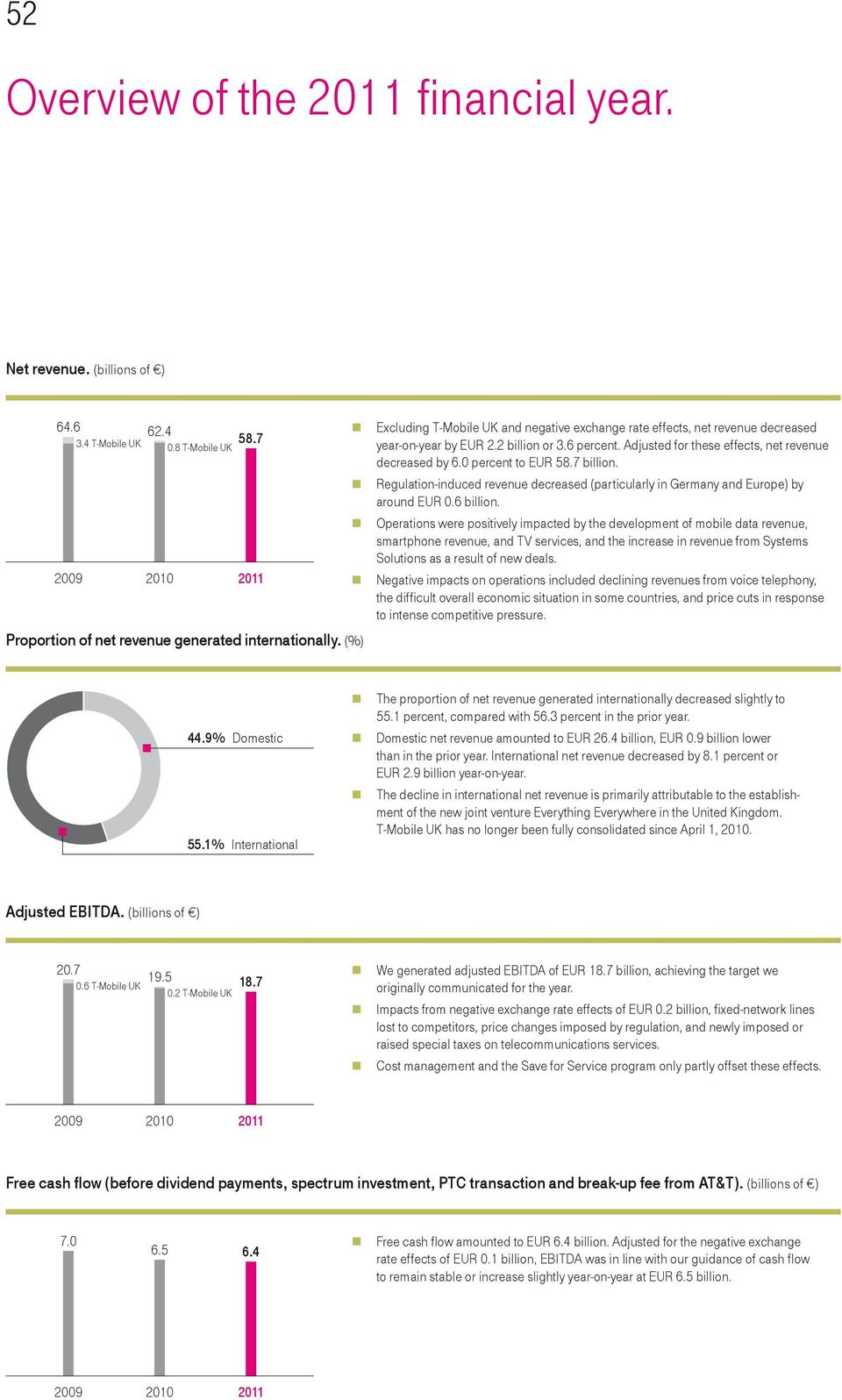
2 52 Overview of the financial year. Net revenue. (billions of ) T-Mobile UK T-Mobile UK Proportion of net revenue generated internationally. (%) Excluding T-Mobile UK and negative exchange rate effects, net revenue decreased year-on-year by EUR 2.2 billion or 3.6 percent. Adjusted for these effects, net revenue decreased by 6.0 percent to EUR 58.7 billion. Regulation-induced revenue decreased (particularly in Germany and Europe) by around EUR 0.6 billion. Operations were positively impacted by the development of mobile data revenue, smartphone revenue, and TV services, and the increase in revenue from Systems Solutions as a result of new deals. Negative impacts on operations included declining revenues from voice telephony, the difficult overall economic situation in some countries, and price cuts in response to intense competitive pressure % Domestic 55.1 % International The proportion of net revenue generated internationally decreased slightly to 55.1 percent, compared with 56.3 percent in the prior year. Domestic net revenue amounted to EUR 26.4 billion, EUR 0.9 billion lower than in the prior year. International net revenue decreased by 8.1 percent or EUR 2.9 billion year-on-year. The decline in international net revenue is primarily attributable to the establishment of the new joint venture Everything Everywhere in the United Kingdom. T-Mobile UK has no longer been fully consolidated since April 1, Adjusted EBITDA. (billions of ) T-Mobile UK T-Mobile UK We generated adjusted EBITDA of EUR 18.7 billion, achieving the target we originally communicated for the year. Impacts from negative exchange rate effects of EUR 0.2 billion, fixed-network lines lost to competitors, price changes imposed by regulation, and newly imposed or raised special taxes on telecommunications services. Cost management and the Save for Service program only partly offset these effects Free cash flow (before dividend payments, spectrum investment, PTC transaction and break-up fee from AT&T). (billions of ) Free cash flow amounted to EUR 6.4 billion. Adjusted for the negative exchange rate effects of EUR 0.1 billion, EBITDA was in line with our guidance of cash flow to remain stable or increase slightly year-on-year at EUR 6.5 billion
3 Combined management report Overview of the financial year 53 For a more detailed explanation, please refer to the section Development of business in the Group, page 76 et seq. Net debt. (billions of ) Net debt decreased by 5.1 percent compared with the end of 2010 to EUR 40.1 billion. We were able to reduce net debt by over EUR 2 billion, despite negative exchange rate effects (primarily from the U.S. dollar) amounting to EUR 0.6 billion, the acquisition of the remaining shares in PTC (PTC transaction) for EUR 1.4 billion, and the purchase of another 10 percent of the shares in OTE for EUR 0.4 billion. Free cash flow (EUR 6.4 billion) and the break-up fee (EUR 2.3 billion) received from AT&T had a positive effect. Dec. 31, 2009 Dec. 31, 2010 Dec. 31, Net profit. (billions of ) Net profit decreased by EUR 0.6 billion to EUR 1.1 billion. Adjusted net profit decreased from EUR 3.4 billion to EUR 2.9 billion, a year-on-year decline of EUR 0.5 billion. Positive effects included the compensation received from AT&T (break-up fee of EUR 2.3 billion, right to the transfer of spectrum licenses worth EUR 0.9 billion). Negative effects included impairment losses on goodwill amounting to EUR 3.1 billion recognized in the reporting year and an increase in income tax expense by EUR 1.4 billion. Shareholders equity. (billions of ) Shareholders equity decreased by EUR 3.1 billion compared with the end of Positive effects from net profit of EUR 0.6 billion. Negative effects primarily from dividend payments (including non-controlling interests) of EUR 3.5 billion. Dec. 31, 2009 Dec. 31, 2010 Dec. 31, Equity ratio. (%) Despite the decrease in shareholders equity, the equity ratio remained at the upper end of our target range of between 25 and 35 percent. Dec. 31, 2009 Dec. 31, 2010 Dec. 31,

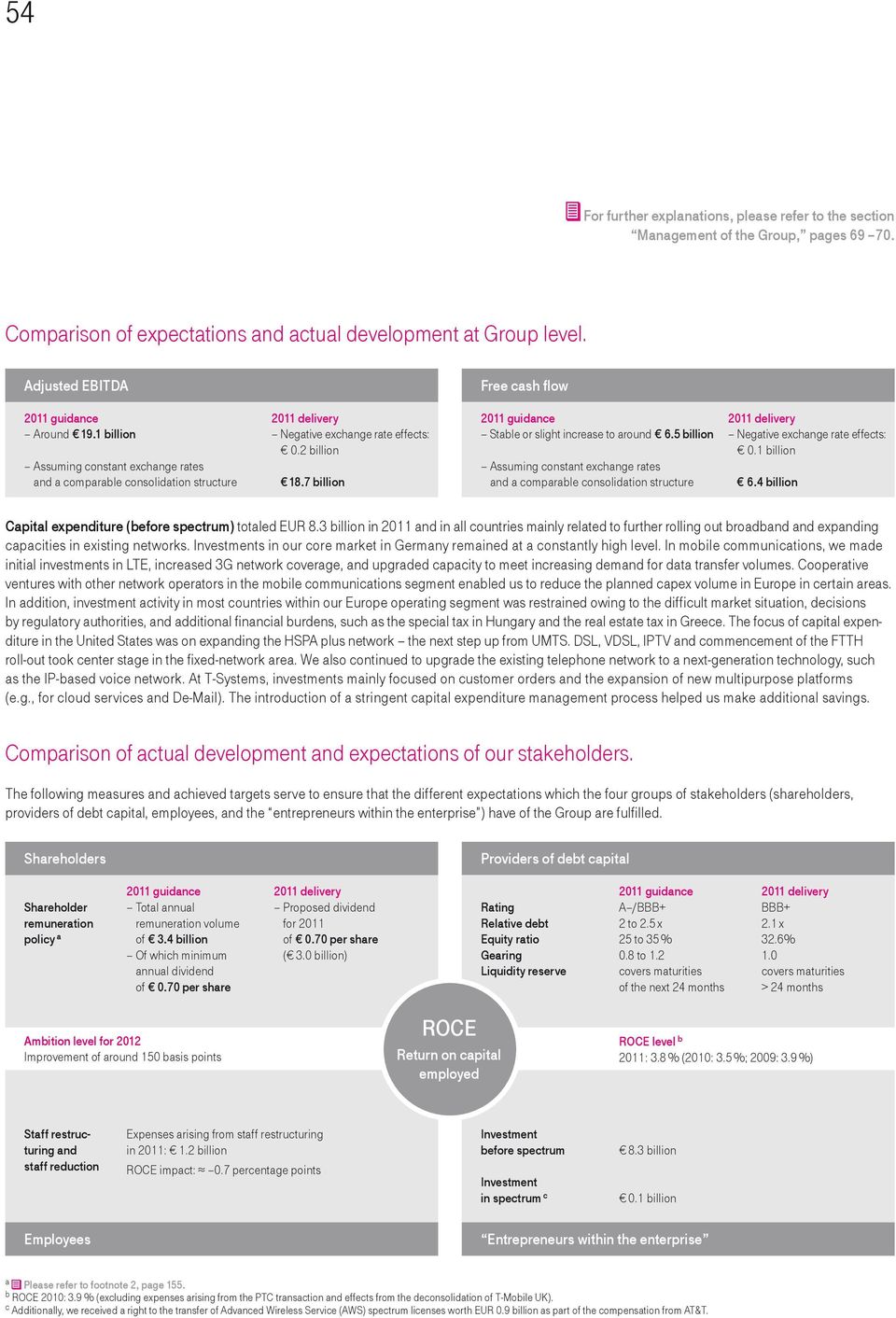
4 54 For further explanations, please refer to the section Management of the Group, pages Comparison of expectations and actual development at Group level. Adjusted EBITDA Free cash flow guidance Around 19.1 billion Assuming constant exchange rates and a comparable consolidation structure delivery Negative exchange rate effects: 0.2 billion 18.7 billion guidance Stable or slight increase to around 6.5 billion Assuming constant exchange rates and a comparable consolidation structure delivery Negative exchange rate effects: 0.1 billion 6.4 billion Capital expenditure (before spectrum) totaled EUR 8.3 billion in and in all countries mainly related to further rolling out broadband and expanding capacities in existing networks. Investments in our core market in Germany remained at a constantly high level. In mobile communications, we made initial investments in LTE, increased 3G network coverage, and upgraded capacity to meet increasing demand for data transfer volumes. Cooperative ventures with other network operators in the mobile communications segment enabled us to reduce the planned capex volume in Europe in certain areas. In addition, investment activity in most countries within our Europe operating segment was restrained owing to the difficult market situation, decisions by regulatory authorities, and additional financial burdens, such as the special tax in Hungary and the real estate tax in Greece. The focus of capital expenditure in the United States was on expanding the HSPA plus network the next step up from UMTS. DSL, VDSL, IPTV and commencement of the FTTH roll-out took center stage in the fixed-network area. We also continued to upgrade the existing telephone network to a next-generation technology, such as the IP-based voice network. At T-Systems, investments mainly focused on customer orders and the expansion of new multipurpose platforms (e.g., for cloud services and D ). The introduction of a stringent capital expenditure management process helped us make additional savings. Comparison of actual development and expectations of our stakeholders. The following measures and achieved targets serve to ensure that the different expectations which the four groups of stakeholders (shareholders, providers of debt capital, employees, and the entrepreneurs within the enterprise ) have of the Group are fulfilled. Shareholders Providers of debt capital Shareholder remuneration policy a guidance Total annual remuneration volume of 3.4 billion Of which minimum annual dividend of 0.70 per share delivery Proposed dividend for of 0.70 per share ( 3.0 billion) Rating Relative debt Equity ratio Gearing Liquidity reserve guidance A /BBB+ 2 to 2.5 x 25 to 35 % 0.8 to 1.2 covers maturities of the next 24 months delivery BBB+ 2.1 x 32.6 % 1.0 covers maturities > 24 months Ambition level for 2012 Improvement of around 150 basis points ROCE Return on capital employed ROCE level b : 3.8 % (2010: 3.5 %; 2009: 3.9 %) Staff restructuring and staff reduction Expenses arising from staff restructuring in : 1.2 billion ROCE impact: 0.7 percentage points Investment before spectrum Investment in spectrum c 8.3 billion 0.1 billion Employees Entrepreneurs within the enterprise a Please refer to footnote 2, page 155. b ROCE 2010: 3.9 % (excluding expenses arising from the PTC transaction and effects from the deconsolidation of T-Mobile UK). c Additionally, we received a right to the transfer of Advanced Wireless Service (AWS) spectrum licenses worth EUR 0.9 billion as part of the compensation from AT&T.
5 Combined management report Highlights in the financial year 55 Highlights in the financial year. Developments at management level. On February 23,, the Supervisory Board of Deutsche Telekom AG complied with Guido Kerkhoff s request to be released from his duties as Member of the Board of Management responsible for Europe as of April 1,. Board member Niek Jan van Damme assumed responsibility for this Board of Management department in an acting capacity with effect from April 1,. At its meeting on July 4,, the Supervisory Board of Deutsche Telekom AG appointed two new members to the Board of Management: Claudia Nemat as the Board member responsible for Europe with effect from October 1, and Prof. Marion Schick as the Board member responsible for Human Resources and Labor Director with effect from May 3, Furthermore, on December 15,, the Supervisory Board extended the contract of Reinhard Clemens Member of the Board of Management responsible for T-Systems by five years. At the same time, the Supervisory Board received a request from Edward R. Kozel to be released from his duties as Board member with effect from January 1, No new member will be appointed to the Technology and Innovation Board department. René Obermann will take charge of Products and Innovation in addition to his other responsibilities. Claudia Nemat will additionally be responsible for Technology. Reinhard Clemens will take all-embracing responsibility for Deutsche Telekom s IT. Sale of T-Mobile USA to AT&T. On March 20,, Deutsche Telekom AG and AT&T Inc., Dallas, United States (AT&T) entered into an agreement on the sale of T-Mobile USA to AT&T. The agreement provided for a purchase price of USD 39 billion, consisting of USD 25 billion in cash and approximately USD 14 billion in AT&T common stock. The transaction was subject to approval by the U.S. Department of Justice (DOJ) and the U.S. regulatory authority, the Federal Communications Commission (FCC). After the DOJ had filed suit to block the transaction at the U.S. District Court in Washington, District of Columbia, in August and the U.S. authorities took a clear stance against the deal, AT&T Inc. and Deutsche Telekom terminated the agreement for the sale of T-Mobile USA to AT&T on December 19,. Following this decision to terminate the agreement for the sale of T-Mobile USA to AT&T, Deutsche Telekom now reports the assets and liabilities of T-Mobile USA as a continuing operation effective December 20,. As a result of the termination, AT&T compensated Deutsche Telekom in line with the provisions of the purchase agreement between the two companies on March 20,. The compensation consists of the following components: Payment of a break-up fee of EUR 2.3 billion (USD 3 billion) in. The right to the transfer of Advanced Wireless Service (AWS) spectrum licenses worth EUR 0.9 billion (USD 1.2 billion). An agreement running for more than seven years which allows the provision of voice and data UMTS roaming services within the United States. For further information, please refer to the section Development of business in the Group, page 76 et seq., and the disclosures in the notes to the consolidated financial statements, page 165 et seq. Corporate transactions. Deutsche Telekom acquires another 10 percent in OTE. On June 6,, we were informed that the Hellenic Republic, within the framework of the provisions of the Share Purchase Agreement dated May 2008, had made use of its right to sell another 10 percent of the shares in the Greek telecommunications company OTE to us. The purchase price for the around 49 million OTE shares was EUR 0.4 billion. Following the transfer of shares as of July 11,, the Hellenic Republic holds directly and indirectly around 10 percent of the shares and we now hold around 40 percent of the shares in OTE. Deutsche Telekom and France Télécom-Orange procurement joint venture BUYIN commences operations. On October 7,, we announced the launch of our procurement cooperation BUYIN together with France Télécom-Orange. We have pooled our procurement activities in the following areas in a 50/50 joint venture: terminal devices, mobile communications networks, significant portions of fixed-network equipment, and service platforms. In addition, the two companies intend to launch pilot projects to explore other areas for inclusion in the joint venture at a later stage, including IT infrastructure and other IT areas. Deutsche Telekom will generate future cost savings from this joint venture.
6 56 PTC rolls out T-Mobile brand. Polska Telefonia Cyfrowa S.A. (PTC) successfully launched the T-Mobile brand on the Polish market in June. Since then, PTC has been operating under the name T-Mobile and using the T as its corporate logo in line with the Company s overall brand strategy. Deutsche Telekom steps up its long-term commitment in Bratislava. Deutsche Telekom Shared Services s.r.o. in Bratislava, Slovakia, will gradually take over the financial and accounting services for all our European subsidiaries. To this end, certain processes will be pooled in Bratislava over the next few years. This step is intended to create more than 500 additional jobs in Bratislava by the end of OTE S.A. sells its 20-percent share to Telekom Srbija a.d. OTE S.A. signed a share purchase agreement with Telekom Srbija to sell its entire stake of 20 percent in Telekom Srbija back to the company. The value of the transaction amounts to EUR 380 million. In addition, OTE will receive a minimum dividend of EUR 17 million for the financial year. For further information, please refer to the section Significant events after the reporting period, page 147. For information about the partnership concluded during the reporting year, please refer to the events described in this section, page 58. Litigation. Federal Court of Justice ruling in favor of Deutsche Telekom. In a U.S. class action, shareholders accused Deutsche Telekom of providing false information in the prospectus for the third public offering in 2000 and of not providing sufficient information. This resulted in a settlement (without acknowledgement of any guilt or misconduct) under which shareholders in the United States received around USD 120 million (part of which was borne by insurance companies). We demanded repayment of the settlement amount plus costs from the Federal Republic of Germany and KfW Bankengruppe. The Federal Court of Justice ruled in our favor on most points and sent the case back to the Cologne Higher Regional Court for further rulings, in particular on the precise amount of the damages to be paid to Deutsche Telekom. U.S. authorities and Bonn public prosecutor s office close investigation into contracts in the F.Y.R.O. Macedonia and Montenegro. Magyar Telekom and Deutsche Telekom reached an agreement with the U.S. Securities and Exchange Commission (SEC) and the U.S. Department of Justice (DOJ) on December 29, to drop investigations into alleged breaches of the U.S. Foreign Corrupt Practices Act (FCPA) in relation to incidents prior to Deutsche Telekom signed an agreement with the SEC, without acknowledging or denying the allegations levied by the SEC, accepting a court ruling permanently obliging Deutsche Telekom not to violate the accounting and control requirements of the FCPA. Deutsche Telekom also reached an out-of-court settlement with the DOJ in the form of what is known as a non-prosecution agreement. Magyar Telekom reached separate agreements with the SEC and the DOJ, the details of which are included in its own reporting. As part of the agreement, Deutsche Telekom made a payment totaling USD 4.36 million (EUR 3.5 million) to the U.S. authorities in early 2012, while Magyar Telekom paid USD 90.8 million (EUR 69.7 million). The Bonn public prosecutor s office dropped its investigation into the matter. Settlement of ADSL patent litigation. CIF Licensing LLC had initiated proceedings against Deutsche Telekom for the alleged infringement of four patents. After two of the patents alleged to have been infringed had been declared invalid by the Federal Patent Court, a settlement was agreed between the parties in October. The settlement brings to an end all related lawsuits between the two parties and grants Deutsche Telekom free licenses to the disputed patents. For further information, please refer to the section Risk and opportunity management, page 131 et seq.

7 Combined management report Highlights in the financial year 57 Regulatory decisions. Regulatory decisions in. For details on this topic, please refer to the section The economic environment, page 71 et seq. Further developments in the area of regulation which we are not yet able to assess are discussed in the section Risk and opportunity management, page 131 et seq. Investments in networks and new spectrum. Deutsche Telekom launches high-speed Internet in rural areas. Our new wireless Call & Surf Comfort via Funk product range has been available exclusively in areas without DSL since April 5,, thereby closing more coverage gaps in rural areas. Seven regional states have already stated that the license conditions for LTE 800 have been met, which means there are no more gaps in these areas. At the same time, we continue to roll out the DSL network. More than 1,100 cooperation agreements to support broadband expansion in rural areas were signed with municipalities in the past year. LTE network roll-out. We have reached an important milestone in our LTE activities: Since July 1,, customers have been able to surf the mobile Internet at up to 100 Mbit/s with Germany s first LTE high-speed network in Cologne using the Web n Walk Connect XXL plan, meaning we succeeded in putting the first LTE high-speed network in a German city into operation just twelve months after the license auction. After Cologne, we will provide more than 100 other cities throughout Germany with next-generation mobile communications. Our subsidiary in Austria has also linked up four cities to the state-of-the-art LTE network: Innsbruck, Vienna, Graz, and Linz. 3G network build-out with HSPA plus technology in Europe. We are also significantly expanding our range of mobile broadband systems in our Europe operating segment. For example, in we built out the 3G network with fast HSPA plus technology in the Czech Republic and Slovakia. Having undertaken large-scale network modernization in May, we are now also able to offer our Hungarian customers a fast HSPA plus solution. In Poland, we started commercial operation of HSPA plus in Warsaw at the beginning of and had covered the entire 3G network of our subsidiary by the end of the year. In Germany, the UMTS base stations were connected via optical fiber and they now operate at speeds of up to 42.2 Mbit/s. Fiber to the Home (FTTH). We are also driving the roll-out of fiber-optic cables, which has already been launched in twelve cities. We will be able to offer our customers speeds of up to 200 Mbit/s from mid Successful participation in license auctions in Europe. In Greece, we purchased spectrum in the 0.9 GHz and 1.8 GHz frequency ranges for around EUR 119 million. As well as the acquisition of additional frequencies, the purchase price also covers the extension of the existing mobile communications license. We acquired mobile communications licenses in the 0.9 GHz frequency range in Albania for a price of EUR 17 million. In Slovakia we spent around EUR 48 million to extend the mobile communications licenses by another ten years. T-Mobile USA 4G network speed acceleration. T-Mobile USA operates the largest 4G network in the United States, reaching more than 200 million people nationwide. T-Mobile USA is also doubling the speed of its 4G network to achieve a theoretical download speed of 42 Mbit/s (HSPA plus 42) in. Over 184 million people in more than 175 markets across the country now have access to T-Mobile USA s HSPA plus 42 network, among the fastest 4G speeds available, as well as increased network capacity and reliability. New products/connected life and work. Our TV service Entertain has also been available by satellite since September 1,. The new service transmits digital TV and radio signals via satellite. Various interactive features including the online video store, electronic program guide, and program manager enable users to remotely program their hard disk recorders via the Internet. Thanks to this service, around 75 percent of all households in Germany can now access our TV channels via satellite. Deutsche Telekom presents PagePlace online kiosk at CeBIT. PagePlace is a digital kiosk and online library for newspapers, magazines and books. It allows our customers to purchase content and pay for it securely and easily at any time, including on the move. PagePlace can be accessed from a range of terminal devices such as PCs, ipads and iphones.

8 58 Cloud service for utilities. We are supplementing our cloud computing services with the SAP for Utilities solution. The housing sector, energy providers, and meter operators can now lease hardware and software for all processes at a fixed monthly price per meter. This makes us the first provider to offer this comprehensive range of services, from reading consumption data through to billing, from a single source. Deutsche Telekom offers products for the housing sector. Together with our cooperation partners we have developed a new service for the housing sector that includes three modules: submetering services for heating, water and electricity, heating thermostat control via the Internet, and a special app for tablet PCs. The application allows property managers to complete the inspection report on their mobile devices when handing over a flat to forward it directly to the database. Partnerships. For more information on our cooperation with France Télécom-Orange (procurement joint venture BUYIN) and the UMTS roaming agreement with AT&T for voice and data traffic within the United States, please refer to the aforementioned highlights in this section, page 55. Network partnership agreements signed in Europe. In February, our Czech subsidiary T-Mobile CZ and Telefónica O 2 CZ signed a 3G network sharing agreement. This agreement currently relates to the provision of high-speed mobile Internet to areas without broadband coverage. Also, in July our Polish subsidiary PTC and PTK Centertel signed an agreement for the shared use of their radio access networks (RANs) and established the NetWorks! joint venture for this purpose, which started operations on September 1,. The joint venture agreement covers the management, planning, service, development, and maintenance of the shared networks and is focused on improving network quality, coverage and service. In December, a binding national roaming agreement was concluded between our Austrian subsidiary T-Mobile Austria and Hutchison 3G. One component of the agreement is the use by Hutchison of our 2G mobile communications network. The other is that we can use Hutchison s 3G mobile communications network in rural areas. Under this agreement, our customers across Austria benefit from Hutchison 3G s fast UMTS network. Strategic partnership with Deutsche Annington. During the reporting year, we entered into a strategic partnership with the real estate group Deutsche Annington. The aim is to equip more than 170,000 of the group s apartments with basic TV services and to connect them to our fiber-optic network step by step. mpass mobile payments. More and more customers are taking advantage of convenient and secure payment from mobile phones using mobile or fixed-network Internet access. Together with Telefónica Germany and Vodafone, we are pushing ahead with our joint activities in mobile payment solutions. We plan to transfer our mpass payment service to a joint venture and have already signed a letter of intent to this effect. The new entity will manage sales and marketing activities and promote new products. Employees. collective bargaining successfully concluded after arbitration. On March 25,, the parties reached agreement in the arbitration proceedings for the collective bargaining for Deutsche Telekom AG, Telekom Deutschland GmbH, and its service companies. As a result, the salaries of the employees of Deutsche Telekom AG, Telekom Deutschland GmbH and its service companies covered by collective agreements were raised by 3.15 percent as of April 1,. The collective agreement remained in force until the end of January Early retirement arrangements for resolved. We had offered our civil servants a limited early retirement program running until the end of. The resulting expense amounts to EUR 0.7 billion; payment will be spread over the next six to seven years. OTE reaches an agreement with unions. OTE and the unions have agreed the framework of a three-year collective labor agreement. The basic terms include the following: ensuring employment for OTE s personnel (the company will not introduce work rotation and stop pronouncing dismissals on financial or operational grounds for the duration of the collective labor agreement), reduction in personnel costs (salary grades will be reduced by approximately 11 percent for a period of three years before reverting to current levels in January 1, 2015), reduction in weekly working hours (full working time will be adjusted to 35 hours per week and increase to the current 40 hours per week from January 1, 2015).

9 Combined management report Highlights in the financial year 59 Awards. connect : Deutsche Telekom wins awards for its products. We were voted Mobile Network Operator of the Year for the twelfth time running by readers of the trade magazine connect. They chose our Entertain TV package as the favorite in the IPTV category with an absolute majority and a large lead. Our DeutschlandLAN service for business customers was a success in the category of virtual PABXs. CHIP Online: Deutsche Telekom s network is the no. 1 choice. Our mobile communications network is the number one choice for telephony and mobile Internet and is well prepared to cope with the growing number of smartphones and tablets. For the second time in a row, it won the award for best network of the year in the CHIP Online portal s national network test. Fastest mobile broadband network in Hungary and best network in the Czech Republic. Based on measuring results published in Hungary as part of an annual data delivery by all Hungarian mobile communications companies to the National Media and Communication Authority (NMHH), T-Mobile has the fastest mobile broadband network in Hungary. In addition, the engineering services provider P3 Communications tested the 2G and 3G networks in many European countries; they found that T -Mobile CZ is the leading provider of voice and data services. T-Systems wins SAP Quality Award. IT-based customer relationship management (CRM) platforms are becoming increasingly important as corporate applications. T-Systems took gold in the SAP Quality Award with its new SAP-based internal CRM platform. It also won the Germanywide award for successful SAP projects in the New Business Application category. The T-Systems CRM solution convinced the judges with its clear structure and quality standards in particular. T-Systems signs new contracts. T-Systems again concluded a number of large-scale international contracts and contract amendments in the financial year just ended, some of which are outlined here: T-Systems Switzerland is upgrading the ICT infrastructure of the trading company Valora and centralizing its European data centers. In the future, the automotive supplier Magna will purchase its applications from the T-Systems Cloud, which enables it to add or cancel IT resources at all its locations worldwide at short notice as required. The oil and gas company TOTAL has commissioned T-Systems to set up and operate its satellite communications. T-Systems will be responsible for the infrastructure consisting of satellite receivers and transmitters including antennas. For the construction equipment manufacturer Komatsu, T-Systems is building an information and management system in South Africa. The Spanish postal service Correos has commissioned T-Systems to provide SAP services from the cloud with the aim of harmonizing and consolidating Correos corporate systems. Manufacturer of franking machines and folder inserters Neopost has commissioned T-Systems to operate its global high-speed network, thereby standardizing its previously heterogeneous networks so it can receive both infrastructure and services centrally from a single source. T-Systems receives Microsoft award. T-Systems took the Microsoft Partner of the Year award in Germany for its cloud solution. The award-winning solution enables users to manage their household energy consumption over the Internet or via cell phone.
10 60 Group organization. For more information on our Group strategy, please refer to the corresponding section, page 66 et seq. // Business activities and organization // Legal structure of the Deutsche Telekom Group // Management and supervision // Business activities and organization. Business activities: Leading service provider in telecommunications and information technology. We are one of the world s leading service providers in the telecommunications and information technology industry and offer our millions of customers all kinds of products and services for connected life and work. We have an international focus and are represented in around 50 countries. In the financial year, we generated over half of our revenue, EUR 32.3 billion, outside of our home market in Germany. Overall, we employ 235,132 people (December 31, ). Our activities are guided by key trends in technology and society, which we play a pivotal role in shaping. One such trend is digital technology, which is increasingly prevalent in many areas of life. Products and services are becoming more personalized, people are more mobile than ever before, and globalization is advancing, too. There is growing convergence among the various technologies. This is why we are building an integrated portfolio of products with which customers can access personalized data such as music, videos or address books from any terminal device. Through fixed-network and mobile communications, we offer network access as well as communication and value-added services with ever-expanding bandwidths. Our innovative products and services enable people to stay in touch. Not only do our customers in Germany receive tailor-made products and services, they also get the best network quality all from a single source. The T is our Group brand and will also be an integral part of the brand identity of our foreign shareholdings in the future. In addition to our core business (traditional fixed-network and mobile access), we are tapping new growth areas with investments in intelligent networks and our portfolio of IT, Internet and network services. We are systematically implementing our Fix Transform Innovate strategy in five strategic action areas. Our aim is to drive up revenues in growth areas. The fixed-network business encompasses all voice and data communications activities based on fixed-network and broadband technology. This includes the sale of terminal equipment and other hardware, as well as the sale of services to resellers. The mobile communications business offers mobile voice and data services to consumers and business customers. When marketing these services, we also sell mobile handsets and other hardware. In addition, we also sell mobile communications services to resellers and to companies that buy network services and market them independently to third parties (mobile virtual network operators, or MVNOs). T-Systems, our corporate customer arm, is active in the field of networkcentric ICT solutions where it offers combined IT and telecommunications services. T-Systems supplies complete solutions for companies with global operations. In addition, it focuses on services such as cloud computing and IT solutions for sectors that are undergoing major changes like energy, healthcare, and the connected car. Organization: Four operating segments. Our financial reporting conforms with the Group strategy and is based on the following organizational structure. The Group is broken down into four operating segments; their business activities are assigned as follows: in three segments by region and in one segment by customer and/or product.

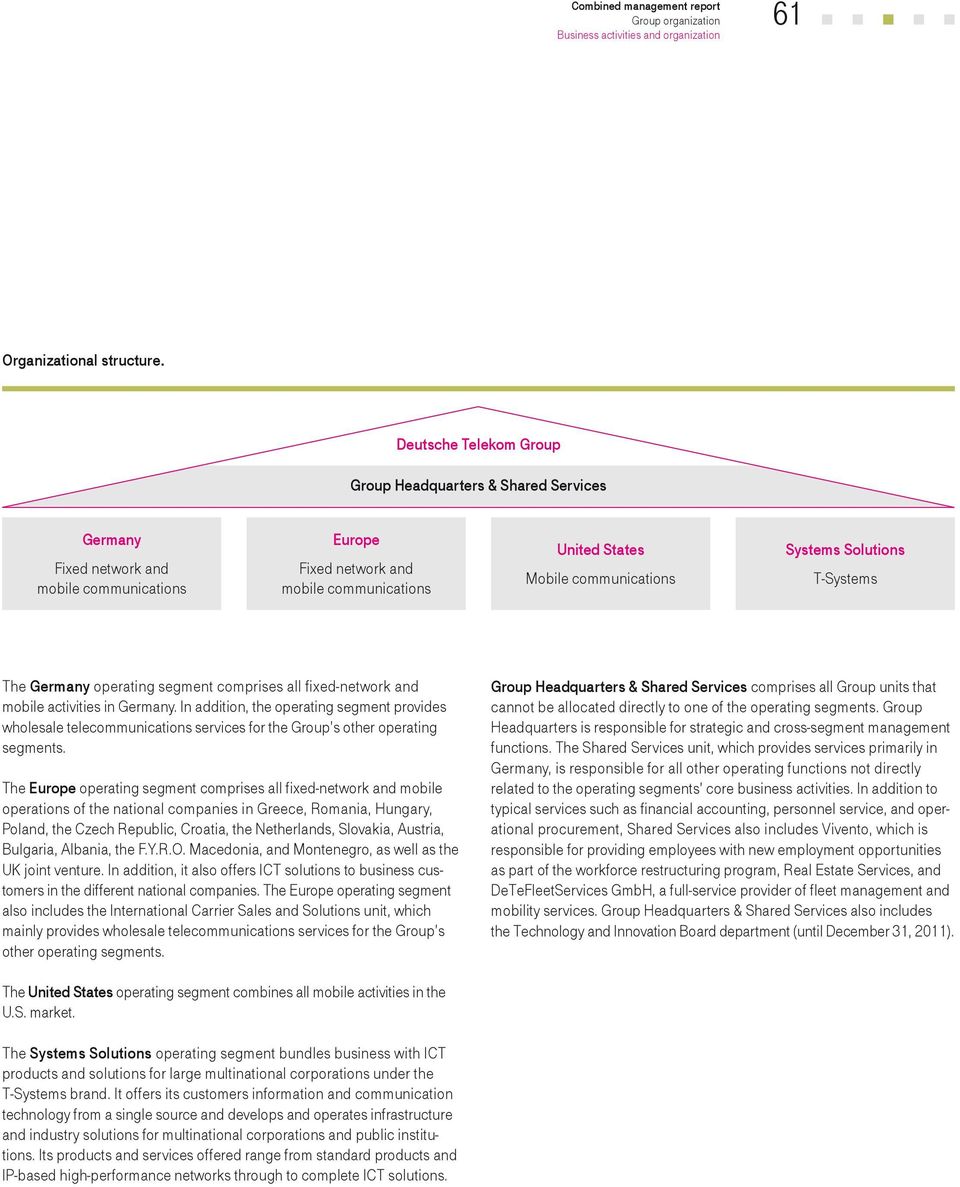
11 Combined management report Group organization Business activities and organization 61 Organizational structure. Deutsche Telekom Group Group Headquarters & Shared Services Germany Fixed network and mobile communications Europe Fixed network and mobile communications United States Mobile communications Systems Solutions T-Systems The Germany operating segment comprises all fixed-network and mobile activities in Germany. In addition, the operating segment provides wholesale telecommunications services for the Group s other operating segments. The Europe operating segment comprises all fixed-network and mobile operations of the national companies in Greece, Romania, Hungary, Poland, the Czech Republic, Croatia, the Netherlands, Slovakia, Austria, Bulgaria, Albania, the F.Y.R.O. Macedonia, and Montenegro, as well as the UK joint venture. In addition, it also offers ICT solutions to business customers in the different national companies. The Europe operating segment also includes the International Carrier Sales and Solutions unit, which mainly provides wholesale telecommunications services for the Group s other operating segments. Group Headquarters & Shared Services comprises all Group units that cannot be allocated directly to one of the operating segments. Group Headquarters is responsible for strategic and cross-segment management functions. The Shared Services unit, which provides services primarily in Germany, is responsible for all other operating functions not directly related to the operating segments core business activities. In addition to typical services such as financial accounting, personnel service, and operational procurement, Shared Services also includes Vivento, which is responsible for providing employees with new employment opportunities as part of the workforce restructuring program, Real Estate Services, and DeTeFleetServices GmbH, a full-service provider of fleet management and mobility services. Group Headquarters & Shared Services also includes the Technology and Innovation Board department (until December 31, ). The United States operating segment combines all mobile activities in the U.S. market. The Systems Solutions operating segment bundles business with ICT products and solutions for large multinational corporations under the T-Systems brand. It offers its customers information and communication technology from a single source and develops and operates infrastructure and industry solutions for multinational corporations and public institutions. Its products and services offered range from standard products and IP-based high-performance networks through to complete ICT solutions.
12 62 Legal structure of the Deutsche Telekom Group. Deutsche Telekom AG, Bonn, is the parent of the Deutsche Telekom Group. Its shares are traded on the Frankfurt Stock Exchange as well as on other German stock exchanges. Information on the share capital in accordance with 289 (4) No. 1 of the German Commercial Code (Handelsgesetzbuch HGB) can be found in Note 15 Shareholders equity in the notes to the consolidated financial statements, pages Shareholders equity. Each share entitles the holder to one vote. These voting rights are nevertheless restricted in relation to treasury shares (around 2 million as of December 31, ) and trust shares (around 19 million as of December 31, ). The trust shares are connected with the acquisition of VoiceStream and Powertel (now T-Mobile USA) in As part of these acquisitions, Deutsche Telekom AG issued new shares from authorized capital to trustees for the benefit of holders of warrants, options, and conversion rights, among others. As regards the shares issued to trusts, the trustees in question waived voting rights and subscription rights and, in general, dividend rights for the duration of the trusts existence. The shares issued to the trusts can be sold on the stock exchange on the instruction of Deutsche Telekom AG if the beneficiaries do not exercise their options or conversion rights or if these expire. The proceeds from the sale accrue to Deutsche Telekom AG. Buy-back of Deutsche Telekom shares. The shareholders meeting resolved on May 12, to authorize the Board of Management to purchase shares in the Company by November 11, 2012, with the amount of share capital accounted for by these shares totaling up to EUR 1,106,257,716.74, provided the shares to be purchased on the basis of this authorization in conjunction with the other shares of the Company which the Company has already purchased and still possesses or are to be assigned to it under 71d and 71e of the German Stock Corporation Act (Aktiengesetz AktG) do not at any time account for more than 10 percent of the Company s share capital. Moreover, the requirements under 71 (2) sentences 2 and 3 AktG must be complied with. Shares shall not be purchased for the purpose of trading in treasury shares. This authorization may be exercised in full or in part. The purchase can be carried out in partial tranches spread over various purchase dates within the authorization period until the maximum purchase volume is reached. Dependent Group companies of Deutsche Telekom AG within the meaning of 17 AktG or third parties acting for the account of Deutsche Telekom AG or for the account of dependent Group companies of Deutsche Telekom AG within the meaning of 17 AktG are also entitled to purchase the shares. The shares are purchased through the stock exchange in adherence to the principle of equal treatment ( 53a AktG). Shares can instead also be purchased by means of a public purchase or share exchange offer addressed to all shareholders, which, subject to a subsequently approved exclusion of the right to offer shares, must also comply with the principle of equal treatment. The shares are to be used for one or several of the purposes permitted by the authorization granted by the shareholders meeting on May 12, under item 7 on the agenda. The shares are also to be used for purposes for which an exclusion of subscription rights is intended, but can also be withdrawn or sold through the stock market or by way of an offer to all shareholders. The shares are to be available to fulfill the rights of Board of Management members to receive shares in Deutsche Telekom AG, which the Supervisory Board has granted to these members as part of the arrangements governing the compensation of the Board of Management, on the basis of a decision by the Supervisory Board to this effect. As part of this authorization, the Board of Management decided on May 27, and September 20, to purchase a total of 316 thousand shares for a total price of EUR 3 million with an average purchase price of EUR 8.74 per share. These buy-backs were executed on June 6, and September 23,. As a result, treasury shares of EUR 1 million were openly deducted from issued capital (imputed value of EUR 2.56 per share) and the retained earnings of the Group decreased by EUR 2 million. Authorized capital and contingent capital. The shareholders meeting on April 30, 2009 authorized the Board of Management to increase the share capital with the approval of the Supervisory Board by up to EUR 2,176,000,000 by issuing up to 850,000,000 no par value registered shares against noncash capital contributions in the period ending April 29, This authorization may be exercised either in full or in one or several partial amounts. The Board of Management is authorized, subject to the approval of the Supervisory Board, to disapply shareholders subscription rights when issuing new shares for business combinations or acquisitions of companies, parts thereof or interests in companies, including increasing existing investment holdings, or other assets eligible for contribution for such acquisitions, including receivables from the Company. The Board of Management is also authorized, subject to the approval of the Supervisory Board, to determine the rights accruing to the shares in the future and the conditions for issuing shares (2009/I authorized capital).
13 Combined management report Group organization Legal structure of the Deutsche Telekom Group 63 The shareholders meeting on April 30, 2009 authorized the Board of Management to increase the share capital with the approval of the Supervisory Board by up to EUR 38,400,000 by issuing up to 15,000,000 no par value registered shares against cash and/or non-cash contributions in the period ending April 29, This authorization may be exercised either in full or in one or several partial amounts. Shareholders subscription rights are disapplied. The new shares may only be issued to grant shares to employees of Deutsche Telekom AG and of lower-tier companies (employee shares). The new shares can also be issued to a bank or some other company meeting the requirements of 186 (5) sentence 1 AktG that assumes the obligation to use these shares for the sole purpose of granting employee shares. Where permitted by law, the employee shares may also be issued in such a way that the contribution to be paid in return is taken from the part of the income after income taxes that the Board of Management and the Supervisory Board may transfer to other retained earnings in accordance with 58 (2) AktG. The shares to be issued as employee shares can also be acquired in the form of a securities loan from a bank or some other company meeting the requirements of 186 (5) sentence 1 AktG and the new shares used to repay this securities loan. The Board of Management is authorized, subject to the approval of the Supervisory Board, to determine the rights accruing to the shares in the future and the conditions for issuing shares (2009/II authorized capital). The share capital has been contingently increased by up to EUR 31,813, as of December 31,, composed of up to 12,426,988 new no par value registered shares (contingent capital II). The contingent capital increase is exclusively for the purpose of meeting subscription rights to shares from stock options granted in the period until December 31, 2003 to members of the Board of Management of the Company, to members of second-tier management, and to other executives, managers, and specialists of the Company and to members of the boards of management, members of management, and other executives, managers, and specialists at lower-tier Group companies in Germany and other countries, on the basis of the authorization for a 2001 Stock Option Plan granted by resolution of the shareholders meeting on May 29, It will be implemented only to the extent that the holders of stock options exercise these options. The share capital was contingently increased by up to EUR 1,100,000,000 as of December 31,, composed of up to 429,687,500 no par value registered shares (2010 contingent capital). The contingent capital increase will be implemented only to the extent that a) the holders or creditors of bonds with warrants, convertible bonds, profit participation rights and/or participating bonds (or combinations of these instruments) with options or conversion rights, which are issued or guaranteed by Deutsche Telekom AG or its direct or indirect majority holdings by May 2, 2015, on the basis of the authorization resolution granted by the shareholders meeting on May 3, 2010, make use of their option and/or conversion rights or b) those obligated as a result of bonds with warrants, convertible bonds, profit participation rights and/or participating bonds (or combinations of these instruments) which are issued or guaranteed by Deutsche Telekom AG or its direct or indirect majority holdings by May 2, 2015, on the basis of the authorization resolution granted by the shareholders meeting on May 3, 2010, fulfill their option or conversion obligations and other forms of fulfillment are not used. The new shares shall participate in profits starting at the beginning of the financial year in which they are issued as the result of the exercise of any option or conversion rights or the fulfillment of any option or conversion obligations. The Supervisory Board is authorized to amend 5 (5) of the Articles of Incorporation in accordance with the particular usage of the contingent capital and after the expiry of all the option or conversion periods. Main agreements including a change of control clause. The main agreements entered into by Deutsche Telekom AG, which include a clause in the event of a change of control, principally relate to bilateral credit lines and several loan agreements. In the event of a change of control, the individual lenders have the right to terminate the credit line and, if necessary, serve notice or demand repayment of the loans. A change of control is assumed when a third party, which can also be a group acting jointly, acquires control over Deutsche Telekom AG.

14 64 In addition, the other members of the Toll Collect consortium (Daimler Financial Services AG and Cofiroute S.A.) have a call option in the event that the ownership structure of Deutsche Telekom AG changes such that over 50 percent of its share capital or voting rights are held by a new shareholder and this change was not approved by the other members of the consortium. The Hellenic Republic shall have the right to purchase all of Deutsche Telekom AG s shares in the Greek company Hellenic Telecommunications Organization S.A., Athens, Greece (OTE) from Deutsche Telekom AG if Deutsche Telekom AG were to be taken over by another company that is not a telecommunications company based in the European Union or the United States of a similar size and stature to Deutsche Telekom AG. For this purpose, a change of control over Deutsche Telekom shall be deemed to have taken place if one or several entities, with the exception of the Federal Republic of Germany, directly or indirectly acquire 35 percent of the voting rights in Deutsche Telekom AG. When establishing the Everything Everywhere joint venture in the United Kingdom, Deutsche Telekom AG and France Télécom S.A. agreed in the joint venture agreement that if Deutsche Telekom comes under the controlling influence of a third party, France Télécom will be exempted from all the restrictions imposed on the shareholders with regard to a transfer of their shares. Transferring shares to competitors would remain prohibited even in this situation, however. In the master agreement establishing the procurement joint venture BUYIN in Belgium, Deutsche Telekom AG and France Télécom S.A./Atlas Services Belgium S.A. agreed that if Deutsche Telekom or France Télécom comes under the controlling influence of a third party or if a third party that is not part of the France Télécom group of companies acquires shares in Atlas Services Belgium S.A., the respective other party can terminate the master agreement with immediate effect. Changes in the consolidated group. In addition to Deutsche Telekom AG, 64 German and 174 foreign subsidiaries are fully consolidated in Deutsche Telekom s consolidated financial statements (December 31, 2010: 64 and 177). 10 associates (December 31, 2010: 13) and 7 joint ventures (December 31, 2010: 5) are also included using the equity method. The principal subsidiaries of Deutsche Telekom AG are listed in the notes to the consolidated financial statements in the section Summary of accounting policies under Principal subsidiaries, page 184. Business combinations. Deutsche Telekom did not effect any material business combinations in the financial year. Other transactions: Procurement joint venture BUYIN. For details of our procurement joint venture BUYIN, please refer to the section Highlights in the financial year, page 55 et seq. Management and supervision. The management and supervisory structures, as well as the compensation system for the Board of Management and the Supervisory Board, are oriented toward the long-term performance of the Group and follow the recommendations of the German Corporate Governance Code. As of December 31,, Board of Management responsibilities were distributed across eight Board departments. Five of these are the central management areas: Chairman of the Board of Management and the Board departments Finance Human Resources Data Privacy, Legal Affairs and Compliance Technology and Innovation In addition, there are three segment-based Board departments: Germany Europe T-Systems Changes in the composition of the Board of Management. On February 23,, the Supervisory Board of Deutsche Telekom AG complied with Guido Kerkhoff s request to be released from his duties as Board member responsible for Europe effective April 1,. Board of Management member Niek Jan van Damme assumed responsibility for the Europe Board of Management department in an acting capacity with effect from April 1,.
15 Combined management report Group organization Management and supervision 65 At its meeting on July 4,, the Supervisory Board appointed Claudia Nemat as the Board member responsible for Europe with effect from October 1, and also appointed Prof. Marion Schick as the Board member responsible for Human Resources and Labor Director with effect from May 3, At its meeting on December 15,, the Supervisory Board complied with Edward R. Kozel s request to be released from his duties as the Board member responsible for Technology and Innovation with effect from January 1, No successor shall be appointed. The CEO, René Obermann, will take charge of Products and Innovation while IT will be assigned to the T-Systems Board department, and strategic management for Technology to the Europe Board department. The Supervisory Board of Deutsche Telekom AG advises the Board of Management and oversees its management of business. The Supervisory Board is composed of 20 members, of whom 10 represent the shareholders and the other 10 the employees. The members of the Board of Management are appointed and discharged in accordance with 84 and 85 AktG, and 31 of the German Codetermination Act (Mitbestimmungsgesetz MitbestG). Amendments to the Articles of Incorporation are made pursuant to 179 and 133 AktG, and 18 of the Articles of Incorporation. According to 21 of the Articles of Incorporation, the Supervisory Board is authorized, without a resolution by the shareholders meeting, to adjust the Articles of Incorporation to comply with new legal provisions that become binding for the Company and to amend the wording of the Articles of Incorporation. Composition of the Board of Management as of December 31,. Members of the Board of Management René Obermann Dr. Manfred Balz Reinhard Clemens Niek Jan van Damme Timotheus Höttges Edward R. Kozel (until December 31, ) Claudia Nemat Thomas Sattelberger Department Chairman of the Board of Management (CEO)/USA Data Privacy, Legal Affairs and Compliance T-Systems Germany Finance (CFO) Technology and Innovation Europe Human Resources Basis of Board of Management compensation. On February 24, 2010, the Supervisory Board resolved on a new system for the compensation of the Board of Management members, taking into account the provisions specified in the German Act on the Appropriateness of Management Board Remuneration (Gesetz zur Angemessenheit der Vorstandsvergütung VorstAG) that has been in effect since August 5, The shareholders meeting of Deutsche Telekom AG on May 3, 2010 approved this new system. Pursuant to the VorstAG explanatory memorandum (document 16/13433), the contracts of the Board of Management members that were in existence before the Act entered into force enjoy vested rights protection. These Board of Management members nevertheless have the option of voluntarily changing over to the new compensation system. For more information on the compensation of the Board of Management and the disclosures required by 314 HGB, German Accounting Standard No. 17 (GAS 17), and the German Corporate Governance Code, please refer to Note 39 Compensation of the Board of Management and the Supervisory Board in the notes to the consolidated financial statements, page 241 et seq. The compensation of Board of Management members comprises various components. Under the terms of their service contracts, members of the Board of Management are entitled to annual fixed remuneration and annual variable performance-based remuneration, a long-term variable remuneration component, as well as fringe benefits and deferred benefits based on a company pension entitlement. The Supervisory Board defines the structure of the compensation system for the Board of Management and reviews this structure and the appropriateness of compensation at regular intervals. The fixed annual remuneration is determined for all Board of Management members based on market conditions in accordance with the requirements of stock corporation law. It is ensured that Board of Management compensation is oriented toward the sustained development of the Company and that there is a multi-year measurement base in the new system for the variable components. At its discretion and after due consideration, the Supervisory Board may also reward extraordinary performance by individual or all Board of Management members in the form of a special bonus. In accordance with market-oriented and corporate standards, the Company grants all members of the Board of Management additional benefits under the terms of their service contracts, some of which are viewed as non-cash benefits and taxed accordingly. This mainly includes being furnished with a company car and accident and liability insurance and reimbursements in connection with maintaining a second household. Sideline employment generally requires prior approval. Generally, no additional compensation is paid for being a member of the management or supervisory board of other Group entities.
16 66 Group strategy. // We have been successfully implementing our Fix Transform Innovate strategy since 2010 // Fix Transform Innovate. Deutsche Telekom is one of the world s leading service companies in the telecommunications and information technology industry. We want to secure this strong position in the long term. We realize, however, that the market environment will remain challenging. After all, ours is an industry that sees permanent, dynamic change and is influenced by global trends. All relevant areas are affected: the fixed network, mobile communications, and the Internet. Infrastructure is and will remain the basis of our business. We expect people to need faster and faster networks on our way toward the gigabit society. If we are to be efficient and successful on the way, two factors are of crucial importance: next-generation networks and standardized IT. Furthermore, it is vital to make the most of any growth potential. In our opinion, the mobile Internet and Internet services, for example, provide huge growth opportunities because customers expect secure and universal access to all services, from all devices. We also expect cloud computing and dynamic computing to hold considerable potential in the business customer segment. Furthermore, intelligent networks will support the upcoming changes in industries such as energy, healthcare, and transportation/automotive. We still firmly believe that a profitable business is only possible through a strong national competitive position. We are standing up to these challenges with the Fix Transform Innovate strategy we presented in March With this strategy we aim to realize our vision of becoming an international market leader for connected life and work. This is why we will continue to restructure our business model in the coming years with investments in intelligent networks, with IT services, and with Internet and network services. The aim of our strategic approach is to systematically expand our activities across the entire value chain and position ourselves as an open partner for consumers and business customers as well as for the Internet sector. At the same time, our strategy forms the framework for all our corporate actions, including for instance on the issues of sustainability and human resources. We are gradually implementing our Fix Transform Innovate strategy in five strategic action areas (see the illustration below). These are: Improve the performance of mobile-centric assets. In all countries where we primarily provide mobile communications services, we are planning to enhance our performance. To this end, we invest in next-generation technologies, develop innovative services, and expand our portfolio of mobile devices. In the United Kingdom, for instance, in 2010 our joint venture Everything Everywhere got off to a good start as the market leader, measured in terms of the combined customer base. In Poland we reached a crucial milestone in further strengthening our subsidiary Polska Telefonia Cyfrowa (PTC) as we clarified the ownership of this national company. In mid-, PTC rebranded Era to T-Mobile. Our agreement for the sale of T-Mobile USA to AT&T Inc. was terminated in December in response to the opposition shown by the U.S. authorities. AT&T subsequently paid Deutsche Telekom the agreed break-up fee of USD 3 billion and will make the agreed 3G roaming services and spectrum licenses available in the near future. Deutsche Telekom will continue to report T-Mobile USA as a continuing operation and is in the process of building a strategy for the coming years. Group strategy. Fix Transform Innovate Improve the performance of mobile-centric assets Leverage One Company in integrated assets Build networks and processes for the gigabit society Connected life across all screens Connected work with unique ICT solutions

17 Combined management report Group strategy Fix Transform Innovate 67 Leverage One Company in integrated assets. We are continuing to integrate fixed-network and mobile communications an approach that originates in the One Company project. On the back of the successfully completed integration in Germany and several European markets, we can generate additional revenues, further improve our customer service and leverage synergies. EBITDA margins in the integrated markets are still at a high level despite the continued challenging economic situation in some countries. Our innovative services and rate plans set us apart from the competition. For instance, via the TelekomCloud our customers already have access to products such as Media Center, an online storage facility, that give them 24/7 access to their music, photos, and other media content, whether on their PCs, TVs or smartphones. LIGA total!, our soccer league service in Germany, can likewise be watched on various screens at home or on the move. Build networks and processes for the gigabit society. We are forecasting a rapid increase in global data volumes in the coming years. Our goal is therefore to continue to transform operations by becoming more efficient, but also by supplying the greater bandwidth required. For this reason, we are focusing on the following: Expanding our fiber-optic networks and enhancing our mobile communications networks by pushing HSPA plus and LTE Systematically implementing the all-ip concept Increasing the speed and flexibility of the IT factory Systematically expanding key enabling skills That is why we have already purchased additional mobile frequency spectrum in several countries, including Germany, the Netherlands, Austria, Albania, and Greece, and extended the agreement for the use of mobile spectrum in Slovakia by ten years. In we continued to invest in network expansion in Germany; more than 16,500 UMTS stations have meanwhile gone live. In many other countries, we are also continuing to upgrade our UMTS network with high-speed HSPA plus technology. On top of this, we have started to roll out the LTE network in several countries; in Germany, for example, we have fitted out some 1,100 stations overall with LTE technology since In addition to our own network expansion activities we also cooperate with other telecommunications providers on improving our network. This approach has already proven successful in, e.g., the Czech Republic, where our subsidiary T-Mobile CZ has signed an agreement with Telefónica O 2 CZ on 3G network sharing. We are also expanding our networks on the fixed-network side. Our billioneuro investments ensure that more and more households will be covered by fast broadband lines. Put into figures: We have marketed 12.3 million broadband lines in Germany, which makes us market leader. On top of this, more than 600,000 customers have opted for a VDSL line from Deutsche Telekom. Connected life across all screens. We want to provide innovative, non-device-specific and convergent services. In our view, the greatest opportunities for growth lie in making data services mobile, particularly on the mobile Internet. In this area we are developing and marketing our own key solutions, such as innovative communication services centered around the personalized, network-based address book that we have successfully launched in six countries (e.g., MyPhonebook in Germany). Needless to say, we also place great importance on ensuring that our customers have attractive handsets. And we have been successful there, since 62 percent of all handsets sold in Germany in were smartphones. We also want to be a pioneer for digital content, by linking and distributing personalized media content. We have made a number of acquisitions (e.g., ClickandBuy and STRATO), all of which are smart additions to our balanced portfolio in the high-growth Internet business. Our prominent position in the European TV market is yet another success factor. During the reporting year, the number of Entertain customers in Germany increased to 1.6 million (up 34 percent year-on-year), of which more than 100,000 use our new Entertain Sat product. Our TV customer base in Southern and Eastern Europe has increased to 2.6 million. Connected work with unique ICT solutions. Through T-Systems, we provide customized ICT solutions for business customers. Internally, we draw on the services of T-Systems for the ongoing standardization of our IT solutions. We are also continuing to restructure T-Systems with the aim of increasing revenue and raising profitability to industry level.
18 68 We have developed intelligent, innovative offerings centering around secure cloud services that our business customers have welcomed with open arms. We are positioning T-Systems as an open partner, also for other sectors, with the aim of leveraging growth opportunities for ICT solutions in sectors that are undergoing major changes. To this end, we have created three new business areas for developing intelligent network solutions: energy, healthcare, and the connected car. These also got off to a good start. In the energy business area we have signed a deal with the meter operator VOLTARIS for the recording, transmission, and processing of energy data as well as trial sales of smart electricity meters and green power rates from E.ON in more than 50 Telekom shops. In the business area of connected cars, we have joined forces with Continental to develop an open, flexible, and future-proof infotainment concept for vehicles. Growth areas of Deutsche Telekom. Advances in our strategic action areas are having a positive and direct effect on our principal growth areas: mobile Internet, the connected home, Internet services, T-Systems, and intelligent network solutions. Our overall objective is to almost double revenue in these growth areas, from EUR 15 billion in 2009 to around EUR 29 billion in Mobile Internet is our largest growth area; it includes all revenue that we generate with mobile data services. Our aim is to achieve revenue of around EUR 10 billion by Connected home is another very important growth area for us. Here, we bundle all revenues that we generate with our existing double- and triple-play packages, i.e., our fixed-network-based voice, data, and TV services. This area also includes future innovative products for the connected home such as the Communication Suite or Home Gateway. Our aim here is to generate around EUR 7 billion in revenue by We are also bundling all our Internet services in a single growth area that essentially consists of three pillars: online advertising (e.g., on the web pages of the Scout group, on cell phones, on our TV offerings); the digital content of our Load family (e.g., Musicload and Videoload); and what are known as near access services, which include the roll-out of websites and the sale of security software. Our goal is to increase revenue from our Internet offerings to between EUR 2 billion and EUR 3 billion by In another growth area, we measure all of T-Systems external revenue, which includes, in particular, the business with innovative cloud services. Our aim is to generate around EUR 8 billion in total revenue in this growth area by The intelligent network solutions growth area comprises business in sectors that are undergoing major changes. Our aim is to generate around EUR 1 billion in revenue by To this end, we have set up three new business areas that are developing and marketing innovative solutions. Growth areas of Deutsche Telekom. Revenue in billions of Ambition level for 2015 Mobile Internet Connected home Internet services to 3 T-Systems (external revenue) * Intelligent network solutions (energy, healthcare, connected car) * Excluding revenue from intelligent network solutions.

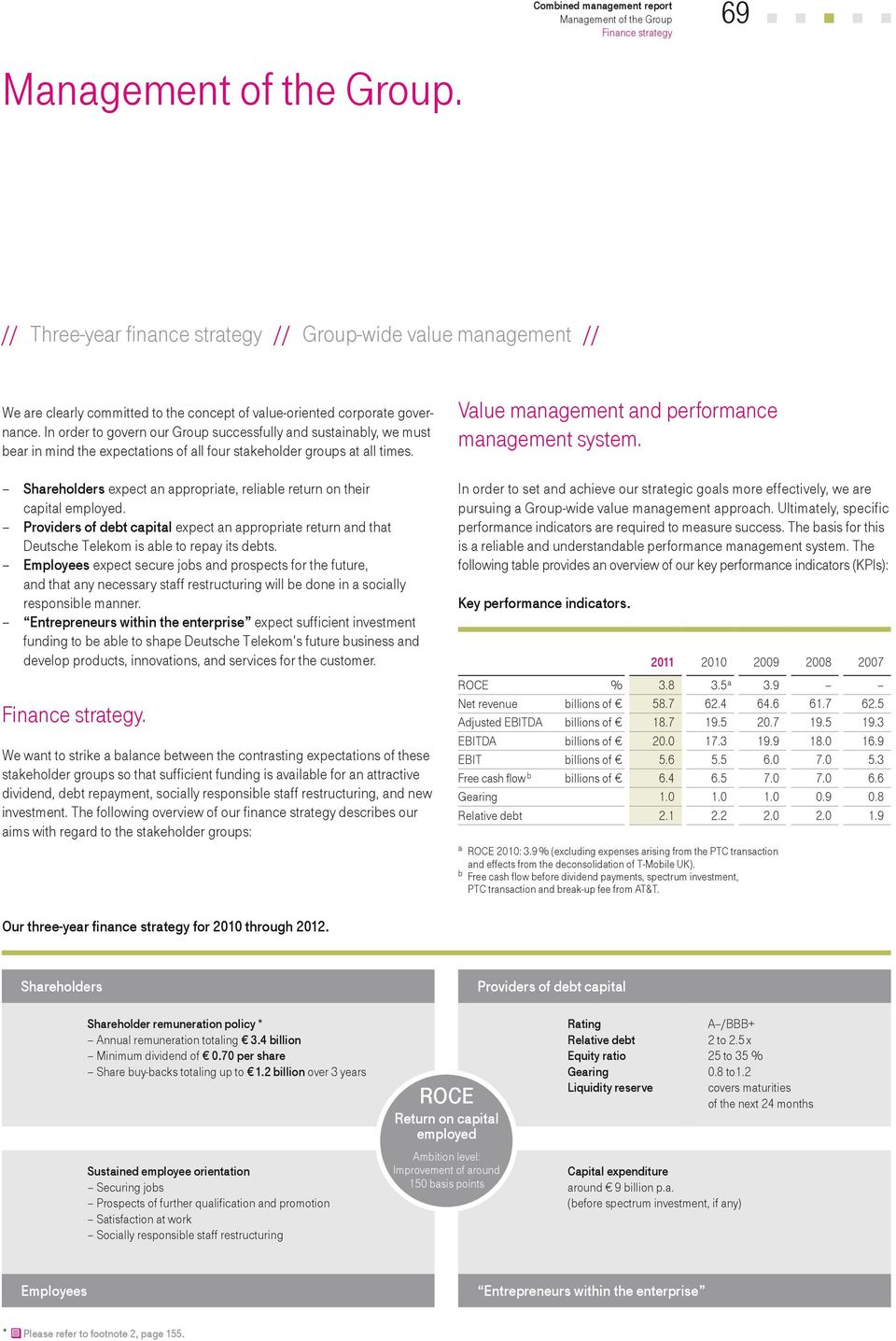
19 Combined management report Management of the Group Finance strategy 69 Management of the Group. // Three-year finance strategy // Group-wide value management // We are clearly committed to the concept of value-oriented corporate governance. In order to govern our Group successfully and sustainably, we must bear in mind the expectations of all four stakeholder groups at all times. Shareholders expect an appropriate, reliable return on their capital employed. Providers of debt capital expect an appropriate return and that Deutsche Telekom is able to repay its debts. Employees expect secure jobs and prospects for the future, and that any necessary staff restructuring will be done in a socially responsible manner. Entrepreneurs within the enterprise expect sufficient investment funding to be able to shape Deutsche Telekom s future business and develop products, innovations, and services for the customer. Finance strategy. We want to strike a balance between the contrasting expectations of these stakeholder groups so that sufficient funding is available for an attractive dividend, debt repayment, socially responsible staff restructuring, and new investment. The following overview of our finance strategy describes our aims with regard to the stakeholder groups: Value management and performance management system. In order to set and achieve our strategic goals more effectively, we are pursuing a Group-wide value management approach. Ultimately, specific performance indicators are required to measure success. The basis for this is a reliable and understandable performance management system. The following table provides an overview of our key performance indicators (KPIs): Key performance indicators ROCE % a 3.9 Net revenue billions of Adjusted EBITDA billions of EBITDA billions of EBIT billions of Free cash flow b billions of Gearing Relative debt a ROCE 2010: 3.9 % (excluding expenses arising from the PTC transaction and effects from the deconsolidation of T-Mobile UK). b Free cash flow before dividend payments, spectrum investment, PTC transaction and break-up fee from AT&T. Our three-year finance strategy for 2010 through Shareholders Providers of debt capital Shareholder remuneration policy * Annual remuneration totaling 3.4 billion Minimum dividend of 0.70 per share Share buy-backs totaling up to 1.2 billion over 3 years Sustained employee orientation Securing jobs Prospects of further qualification and promotion Satisfaction at work Socially responsible staff restructuring ROCE Return on capital employed Ambition level: Improvement of around 150 basis points Rating Relative debt Equity ratio Gearing Liquidity reserve Capital expenditure around 9 billion p.a. (before spectrum investment, if any) A /BBB+ 2 to 2.5 x 25 to 35 % 0.8 to1.2 covers maturities of the next 24 months Employees Entrepreneurs within the enterprise * Please refer to footnote 2, page 155.
20 70 The development of these key performance indicators is illustrated in the table Key performance indicators, page 69. Further details are also provided in the section Development of business in the Group, page 76 et seq. Profitability. In order to underline the importance of the successful long-term development of our Group, we have incorporated sustainable growth in the value of our enterprise into our medium-term aims and implemented it as a separate KPI for the entire Group. ROCE (return on capital employed) has been our central KPI at Group and segment level since ROCE is calculated using the ratio of profit from operations after depreciation, amortization and impairment losses plus imputed taxes (i.e., net operating profit after taxes, or NOPAT) to the average value of the assets tied up for this purpose in the course of the year (i.e., net operating assets, or NOA). ROCE helps us to embed our aim of sustainably increasing the value of our Group across all operational activities. Additional value accrues when the return on capital employed exceeds the cost of capital. Our goal, therefore, is to achieve or exceed the return targets imposed on us by providers of debt capital and equity on the basis of capital market requirements. We measure return targets using the weighted average cost of capital (WACC). In the financial year, we generated ROCE of 3.8 percent. We believe that ROCE best reflects the expectations of the four aforementioned groups of stakeholders. The indicator measures how efficiently we generate revenues with the capital employed. ROCE is especially informative when taking a long-term view, because it takes into account both the immense value of our tied-up assets due to our capital-intensive infrastructure, and their utilization. This reveals the crucial advantage of this KPI. It does not focus on the absolute amount of the earnings generated, but rather on how much earnings the capital employed generates. ROCE gives us a holistic perspective from which we can consider our investments with fresh insight. For operational management, we additionally use the KPIs described in the following. Earnings performance. The development of our revenue is an essential indicator of the Company s success. EBITDA corresponds to EBIT (profit/loss from operations) before depreciation, amortization and impairment losses. EBIT and EBITDA measure the short-term operational performance and the success of individual business areas. We also use the EBIT and EBITDA margins to show how these indicators develop in relation to revenue. This makes it possible to compare the earnings performance of profit-oriented units of different sizes. Financial flexibility. We define free cash flow as net cash from operating activities less net cash outflows for investments in intangible assets (excluding goodwill) and property, plant and equipment. This indicator is the main yardstick for providers of debt capital and equity; it measures the potential for further developing our Company, e.g., for generating organic growth and the ability to pay dividends and repay debt. Our central free cash flow management is aimed at further improving working capital. Free cash flow is responsible for transparency, steering, forecasts, and performance measurement in relation to the Group s free cash flow and especially in relation to working capital. In 2010, we set up CORE (Cash Optimization for ROCE Enhancement), a project to improve working capital on a long-term basis. In the financial year, the focus was on implementing the Group-wide payment policy adopted in 2010 for improved payables management in Germany. We also continued to optimize inventories throughout the Group and on receivables management, especially in our Europe and Systems Solutions operating segments. In the next few years, we want to continue on this path, focusing on the international roll-out of the payment policy, receivables management at T-Mobile USA, and the OTE group s working capital management. Financial stability. In addition to a solid rating, gearing and relative debt are vital when it comes to fulfilling the requirements of debt capital providers and ensuring financial stability. The relative debt indicator expresses net debt in relation to adjusted EBITDA, while gearing is the ratio of net debt to equity.
21 Combined management report The economic environment Global economic development 71 The economic environment. // Positive global economic development only in the first half of // Regulation tightening throughout Europe // Global economic development. As forecast, the global economy began the year with a continued positive growth trend. This dynamism cooled off significantly in the second half of the year, however. With an increasingly dire sovereign debt crisis in Europe and the U.S., financial market volatility increased significantly. Business and consumer confidence gradually worsened as a result of the crisis. In particular, the eurozone crisis cast a significant pall on economic activity. A new aid package for Greece and ongoing discussion about the country s future path, the design of the euro safety net and, last but not least, the significant downgrading of the creditworthiness of countries like Portugal, Ireland, Spain and ultimately Italy, the third-largest economy in the eurozone, caused a high level of uncertainty in financial markets. Moreover, the first ever downgrade of U.S. sovereign debt caused further unrest. There is still no long-term solution to the sovereign debt crisis. The German economy maintained its strength throughout, thanks to its excellent relative competitiveness and robust exports. Growth in the U.S. slowed increasingly towards the end of the year, accompanied by uncharacteristically high unemployment. The economies in our Europe operating segment again showed uneven growth in. Poland and Austria enjoyed robust growth, while the Czech Republic, the Netherlands and Slovakia only grew moderately. In Romania, Croatia and most recently Hungary, the overall economic situation has deteriorated sharply despite initial positive trends. Greece remains in the grip of a severe recession. The GDP growth rate trends in our most important markets for are listed below. GDP growth rates. Q1 compared with Q % Q2 compared with Q % Q3 compared with Q % Q4 compared with Q % Estimate for full year Germany United States Greece (5.5) (7.2) (6.7) (5.4) (6.2) Poland Hungary Czech Republic Croatia (0.8) Netherlands Slovakia Austria United Kingdom Source: Oxford Economics, as of January %
22 72 Telecommunications market. In the telecommunications market, we continued to face tougher competition and stricter regulatory measures during the reporting year, which resulted in additional price declines. Mobile termination rates in Europe decreased significantly as a result of regulation, for example. The initial upswing in the global economy and the slight increase in consumer demand in most of our core markets were able to support the business environment only to a limited extent, however, and were not a major source of impetus. In countries where purchasing power dropped, a negative, decelerating impact continues to be visible in the telecommunications market. As a result of strong pressure to consolidate national budgets, some countries, including Hungary, continued to impose taxes on telecommunications companies in or introduced additional taxes, such as a real estate tax in Greece. More and more households throughout Europe are giving up their fixednetwork lines. In early, 27 percent of households had only a mobile line. This figure was just 24 percent four years previously (source: Eurostat). Figures in Central and Eastern European countries are especially high. One reason for this is the comparatively poor condition of the fixed network, compared to Western Europe. In Germany, in contrast, customers have largely remained faithful to the fixed network: just 12 percent of households exclusively use mobile phones (an increase of just 1 percentage point since 2007). Germany. Total revenue from telecommunications services has been declining since 2005, due primarily to tough competition and regulatory price reductions. Revenue from telecommunications services (mobile and fixed network) in Germany decreased by EUR 0.5 billion in to around EUR 60.3 billion. The main reason for the EUR 0.3 billion decline in mobile communications revenues was the 50 percent cut in termination rates. Revenue from traditional fixed-network business declined by EUR 0.3 billion, while revenue at cable network operators increased by EUR 0.1 billion. Overall, prices for telecommunications services (mobile and fixed-network) decreased by 2.7 percent compared to the previous year. Prices for fixednetwork and Internet services declined by 2.4 percent, while prices for mobile voice and data connections were down 3.5 percent. With around 38 million lines, the fixed-network market in Germany remained nearly stable in. We were able to significantly reduce the speed with which customers are abandoning fixed-network services. The use of lower-priced connections (e.g., call-by-call) continues to decline, a result of increasing use of full packages from other suppliers and our own flat rates. Our competitors are increasingly implementing their own infrastructures and business models, which has a growing impact on competition in the wholesale market. We expect consolidation to continue in the years to come, for instance in the cable market, as well as new partnerships among competitors. The number of broadband connections continues to grow overall. 1.2 million new connections were added in the past year, 400,000 via telecommunications providers and 800,000 via cable operators, resulting in a total of 23.5 million DSL connections and around 3.6 million broadband cable television connections. This is in addition to a small number of connections that utilize other fixed-network technologies, particularly fiber-optics. We project a total of around 27.1 million fixed-network broadband connections in Germany by the end of an increase by some 5 percent compared to Service revenues in the German mobile telephony market remained nearly stable compared to the previous year, despite lowered termination charges. Revenue from text messaging and data services was the greatest driver, due to the growing popularity of smartphones and tablet PCs, which nearly compensated for the decline in conventional mobile telephony. This is the reason why some mobile communications providers are placing greater emphasis on customer loyalty and value-driven growth among contract customers through complete packages. Moreover, we are also seeing growth in new services and apps, imessage, MobileTV, etc. Nearly one in three Internet users in Germany accesses the Internet using a mobile device to read and other messages on a mobile phone or uses a smartphone to post Facebook updates or send tweets, for example. Mobile access to online communities and location-based services is growing rapidly. One in three Internet users uses a smartphone, a tablet PC or an ipad to shop online, for example. We expect the mobile payment business to continue to grow as a result. According to the Federal Network Agency, German network operators invested more than EUR 93 billion in telecommunications networks between 1998 and 2010, and nearly EUR 6 billion last year alone. Broadband connections with speeds of at least 1 Mbit/s are now available to nearly 99 percent of households in Germany. The remaining coverage gaps are provided with fast Internet through wireless technologies. The German government and network operators intend to make connections with transmission rates of at least 50 Mbit/s available to 75 percent of households by 2014.
23 Combined management report The economic environment Telecommunications market 73 To facilitate this expansion, some of our competitors are upgrading their LTE infrastructure. We are building on a mix of technologies, comprising mobile telecommunications, fiber optics and copper-based connections in the fixed network. The result will be a comprehensive, powerful gigabit broadband network, in which information and data will be carried securely, reliably and at high speed. While we are initially deploying the 800 MHz frequency band to supply broadband LTE efficiently to rural areas, frequencies in the 1,800 MHz range will be used in metropolitan areas. This increases the transmission capacity for the rapidly rising volume of data traffic and will enable even higher speeds. At the same time, we have equipped our nationwide mobile network with the powerful HSPA plus technology and can now offer our customers in Germany transmission speeds of up to 42 Mbit/s. Europe. In, the telecommunications markets in the countries of our Europe operating segment were characterized by intense competition, continuously falling retail prices, and strong government and regulatory impact on our business. In particular the cuts in termination rates, some of which were quite severe, presented the companies with considerable challenges. Falling prices, the result of regulatory intervention, major competitive pressure, and in some cases weak purchasing power, caused telecommunications markets in almost three quarters of the countries in this operating segment to either contract or stagnate. The markets in the Czech Republic, Albania, and Romania all experienced a contraction. The situation was particularly severe in Greece, where telecommunications revenues dropped around 8 percent year-on-year. The debt crisis and the government s strict austerity program translated into lower consumption and in turn, less spending on telecommunications. Poland was a positive exception, with total market growth of 3 percent. In contrast, markets in Austria and the Netherlands remained steady or enjoyed slight growth. In the fixed-network area, trends from the previous year continued. Thanks to significant growth in broadband business, we were able to compensate some of the decline in revenue from voice telephony. Broadband coverage varies from country to country. Faced with ever-increasing demand for greater bandwidths, cable network operators are investing in upgrading their broadband networks in addition to telecommunications providers, increasing competition even more. The future technology of fiber optics plays a crucial role in upgrading our broadband networks. We are investing in the construction of a pure-fiber network in the countries in our Europe operating segment. To meet the rising demand for fast data transfer, we are modernizing and upgrading our mobile networks by equipping them with faster HSPA plus technology and driving ahead with the new mobile communications standard LTE. In Austria, for example, LTE was implemented successfully back in December The demand for ever-faster data transmission rates also requires further measures in the area of mobile communications frequencies: Some countries held auctions, which we participated in successfully, to extend existing licenses and distribute additional frequency bands. Telecommunications providers that offer both mobile and fixed-network communications are increasingly consolidating their services for mobile, broadband/tv and fixed network into so-called triple-play and even quadruple-play offers. Moreover, many services are converging. In addition to a TV set or home computer, TV shows can now be watched on smartphones as well. TV accounts for a large proportion of the business in the markets in the Europe operating segment, too. Our TV services are available via IPTV, cable, and in some countries also via satellite, so the majority of our customers can access them via a variety of channels. United States. The slow growth of the U.S. mobile telecommunications market continued. Once again, increasing data revenue more than compensated for declining voice revenue. The market is divided between four national cellular providers AT&T Wireless, Verizon Wireless, Sprint and T-Mobile USA and various regional network operators. There are also a number of mobile virtual network operators which use the networks of one or more of the four national operators. The two largest operators, AT&T Wireless and Verizon Wireless, achieved strong revenue growth and healthy margins in. This was driven by strong growth in smartphone adoption and rising postpaid ARPUs. Due to advantages through size, scale and their ability to bundle wireless service with other non-wireless communication services, AT&T Wireless and Verizon Wireless were able to offer cheaper service and increase their customer base. AT&T has had a competitive advantage in the past three years with its exclusive distribution rights for the Apple iphone, which expired in. Verizon and Sprint became additional distribution partners of the Apple iphone, gaining a competitive advantage as well. Verizon and AT&T were able to increase their net customer gain disproportionately during the reporting year; together with increased competitive pressure from low-cost regional full-service providers, this resulted in a decline in market share for T-Mobile USA. Measured against the total number of mobile communications users in the United States, T-Mobile USA s market share declined from 11.4 percent at September 30, 2010 to 10.6 percent at September 30,.
24 74 A major theme for the industry in the United States is the roll-out of 4G networks. Verizon Wireless has started to roll out the LTE network technology. By the end of LTE was available to a population of over 200 million. AT&T and T-Mobile USA have deployed HSPA plus networks. By the end of, the coverage of T-Mobile USA s 42 Mbit/s HSPA plus network had reached more than 184 million. AT&T began rolling out LTE in. By the end of the year, coverage had risen to 74 million. Sprint does not yet have its own 4G network but is relying on Clearwire, in which it has a non-controlling stake. By the end of the third quarter of Clearwire s WiMAX network covered a population of approximately 133 million. Sprint plans to roll out LTE services in its own spectrum for Systems Solutions. The rebound of the global economy in 2010 and early had a positive impact on the market for IT services. At the same time, uncertainties arose from the natural disaster in Japan, the sovereign debt crisis in the eurozone and a weakening U.S. economy. These developments resulted in continuing cost pressure, delayed investment decisions and stronger competition. Overall demand is undergoing a fundamental shift. Cloud services, embedded systems, and intelligent networks in particular are increasingly transforming the market. Our segments were impacted in very different ways by these market trends: Telecommunications: The economic upswing in 2010 and only had a minor effect on the telecommunications market segment. As in previous years, this market was highly contested and therefore also characterized by falling prices in. IT services: After the crisis years, the market for IT services grew slightly once again during the reporting year. Outsourcing: There was a tangible recovery in the outsourcing business in the area of Computing and Desktop Services in. This is due not only to the traditional outsourcing business, but also the success of cloud services, the provision of IT services over the Internet. IT project business: This business area declined sharply in 2009, followed by mild growth in It picked up speed significantly during the reporting year. Industry-specific systems integration business, driven by IT projects in the healthcare, energy and public sectors, recovered significantly faster than standard project business in the fields of enterprise resource planning, customer relationship management, and supply chain management. Regulatory influence on Deutsche Telekom s business. Our business activities are largely subject to national and European regulation, including extensive powers to intervene in our product design and pricing. In, our fixed-network and mobile businesses were again both subject to regulatory intervention, which depressed revenue in both of these areas. Regulation mainly came to bear in the following areas: Legislative changes in Germany (such as the amendment of the Telecommunications Act) and at the EU level (regulations, directives, and other binding legislation) Regulation of charges Regulation of future wholesale broadband services and investments in new networks and infrastructure (NGN, NGA) Legislative changes in Germany (such as the amendment of the Telecommunications Act) and at the EU level (regulations, directives, and other binding legislation). Amended EU directives require the revision of national telecommunications laws, which form the primary legal framework for regulation. The German national parliament, the Bundestag, passed the amendment to the Telecommunications Act (TKG) on October 27,. The Bundesrat, the chamber representing the federal states, still needs to ratify the law before it takes effect. The amended TKG is intended to define better incentives for investments in new infrastructure; it also contains additional consumer protection requirements. National telecommunications laws are also being adjusted to reflect the EU directives in other EU member states where our subsidiaries are active. The European Commission s proposed new roaming regulation of July 6, aims to tighten up and extend existing price regulation. In addition, the Commission wants to promote competition. To this extent, a general obligation to provide wholesale access for MNVOs, among others is to be introduced in The unbundling of roaming services and national services is to be introduced in 2014; consumers will then be able to conclude a second contract with another provider exclusively for roaming services. These measures will consume a large amount of resources and incur high costs for the European mobile communications industry. They represent a disproportionate level of regulation particularly in light of the growing competition for data roaming services.
25 Combined management report The economic environment Regulatory influence on Deutsche Telekom s business 75 Regulation of charges. On June 17,, the Federal Network Agency announced its final decision setting the monthly rental charges for the ULL for the period from April 1, through June 30, The approved rate for the most important ULL option is EUR 10.08/month (previously EUR 10.20/month). This constitutes a reduction of 1.18 percent. The charge for the cable branch box ULL was also reduced by 0.55 percent to EUR 7.17/month, compared to the previous charge of EUR 7.21/month. The Federal Network Agency re-approved the one-time ULL rates for the period April 2002 through June 2003 in its decision dated January 20,. The rates were cut compared with the decision in 2002 by 3 to 8 percent for the most important provisioning and take-over options and by 11 to 15 percent for termination options. The rates decision applied only for plaintiffs who prevailed in the court case. This is because under the Telecommunications Act in its 2002 form, the rates only applied to individual agreements. The Federal Network Agency published its final decision on fixed network termination charges on September 29,. For the most important rate options termination and origination at the lowest network level, the rate approval resulted in a reduction of approximately 17 percent at peak times (from 0.54 eurocents/min to 0.45 eurocents/min) and of approximately 16 percent at off-peak times (from 0.38 eurocents/min to 0.32 eurocents/min). The approved rates came into effect on July 1, and are valid until November 30, In Romania the prices for shared access to copper local loops were reduced in July as a last step in the imposed glide path to EUR 1.11/month. The monthly tariffs for full ULL access remained unchanged at EUR 6.02/month. In Croatia the Post and Electronic Communications Agency (HAKOM) reduced the monthly fee for the unbundled local loop by some 16 percent as well as the provisioning time for ULL. Moreover, HAKOM obliged Hrvatski Telekom (HT) and its subsidiary Iskon Internet to introduce wholesale line rental, naked DSL and naked bitstream access. On February 24,, the Federal Network Agency approved the new charges for mobile termination rates (MTR) to be applied retroactively by Telekom Deutschland with effect from December 1, This involved cutting Vodafone s and Telekom Deutschland GmbH s previously asymmetric rates by around 50 percent, making them de facto symmetrical. The rates decision by the Federal Network Agency was the subject of EU-wide consultations. These rates will expire on November 30, The regulatory authorities in Hungary, the Czech Republic, and Poland also ordered a cut in mobile termination rates in. In the Netherlands the Highest Appeal Court partially annulled OPTA s decision on the mobile and fixed termination rates on August 31,. As for mobile termination rates, the cost oriented tariff level ends at 2.4 eurocents instead of 1.2 eurocents as of September 1, Net neutrality: An amendment to the Telecommunications Act was submitted and adopted by the politicians regarding net neutrality. As a result of this amendment, operators are no longer allowed to differentiate tariffs on basis of type of usage. Regulation of future wholesale broadband services and investments in new networks and infrastructure (NGN, NGA). At the end of March, the Federal Network Agency issued a regulatory order on unbundled local loop lines (ULLs), confirming the existing obligations for unbundled access to ULLs in principle. The obligation to provide access to the cable duct between the main distribution frame and the multi-functional street cabinet remains in force. The Federal Network Agency also (re)imposed an obligation to provide access to dark fiber for the section between the main distribution frame and the multi-functional street cabinet. However, this access obligation only applies in the event that no cable duct capacity is available. The Federal Network Agency has also extended regulation to include new fiber-optic ULLs, though rates are subject to ex-post control. Under this regime rates have to be approved by the Agency prior to market launch. On September 14, and September 28,, the Federal Network Agency gave notice that the requirements to deploy LTE associated with our license had been fulfilled in the following states: Baden-Württemberg, Bavaria, Hesse, North Rhine-Westphalia, Rhineland-Palatinate, and Saarland. Since then, the allocated 800 MHz frequency spectrum has also been available for use outside of rural regions. Greece. The Greek National Regulatory Authority EETT on March 22, imposed temporary orders on OTE, requesting the company to refrain from providing next-generation network access (FTTC/VDSL2) retail services for six months and to provide wholesale services based on a cost model. On December 1, the NRA (EETT) approved the cost model for VDSL, including the obligation that OTE should abstain from offering retail broadband access services for six months.
26 76 Development of business in the Group. // Company targets achieved // Adjusted EBITDA of EUR 18.7 billion // Free cash flow of EUR 6.4 billion // Statement of the Board of Management on business development in. Bonn, February 6, 2012 We had a successful financial year, in spite of facing saturated markets, growing competitive pressure, intensifying regulatory intervention and the resulting continued price erosion. Nonetheless, we succeeded in meeting our targets with adjusted EBITDA of EUR 18.7 billion and a free cash flow of EUR 6.4 billion (before dividend payments, spectrum investment, the PTC transaction and the break-up fee from AT&T). In addition, we maintain our shareholder remuneration strategy and propose to the shareholders meeting a dividend of EUR 0.70 per share. Despite an unfavorable U.S. dollar exchange rate, the acquisition of the remaining shares in PTC, and the purchase of a further 10 percent in OTE, net debt was reduced by a considerable EUR 2.1 billion to EUR 40.1 billion. Impairment losses of EUR 3.1 billion were recognized on goodwill, yet at 32.6 percent our equity ratio remains at the upper end of our communicated target range of 25 to 35 percent. To ensure the continued viability of our Company, we made investments (before spectrum) in the amount of EUR 8.3 billion, concentrating on a continued broadband build-out and increasing capacities in existing networks. In addition, we invested EUR 0.1 billion in spectrum. In mobile communications, we made initial investments in LTE, increased 3G network coverage, and upgraded capacity to meet increasing demand for data transfer volumes. Under the agreement with AT&T on the sale of T-Mobile USA, the Company would have stood to receive around USD 39 billion in proceeds. However, the U.S. authorities raised objections to the transaction and the agreement with AT&T was terminated. The Company nevertheless benefited from the deal: Under the terms of the agreement, we received a break-up fee in the amount of USD 3 billion (EUR 2.3 billion) as well as a right to the transfer of spectrum licenses worth USD 1.2 billion (EUR 0.9 billion). We also agreed on UMTS roaming services within the United States for more than seven years. For 2012 we remain committed to Fix Transform Innovate, our successful Group strategy. Effects from the termination of the agreement to sell T-Mobile USA to AT&T. Following the termination of the agreement on the sale of T-Mobile USA, AT&T made the agreed compensation. On the one hand, a break-up fee of EUR 2.3 billion (USD 3 billion) was paid before the end of the year. The expense resulting from a cash flow hedge to compensate for exchange rate fluctuations will not impact on cash flow before In addition, we received a right to the transfer of spectrum licenses worth EUR 0.9 billion (USD 1.2 billion). This resulted in a total income tax expense of EUR 0.9 billion in the reporting year. Following impairment testing, impairment losses of EUR 2.3 billion were recognized on the goodwill of the United States cash-generating unit. For further information, please refer to the section Business combinations and other transactions in the notes to the consolidated financial statements, pages Effect of changes in the composition of the Group in the prior year. On April 1, 2010, Deutsche Telekom AG and France Télécom S.A. merged T-Mobile UK and Orange UK to create the Everything Everywhere joint venture in which the two companies hold equal shares of 50 percent. Since then, the assets and liabilities of T-Mobile UK have no longer been shown in the consolidated statement of financial position. Equally, T-Mobile UK s income statement has no longer been included in the consolidated income statement since the same date. Instead, the joint venture is included in the consolidated statement of financial position under investments accounted for using the equity method. The share of the joint venture s profit/loss is reported in the consolidated income statement under profit/loss from financial activities.
27 Combined management report Development of business in the Group Results of operations of the Group 77 The following table shows the impact that Everything Everywhere has on the composition of the Group and, in turn, on our key performance indicators. To this end, we have eliminated the share in T-Mobile UK s profit/loss attributable to Deutsche Telekom from 2010 pro rata temporis, and from the full 2009 financial year to facilitate comparison. Excluding T-Mobile UK Including T-Mobile UK Net revenue 58,653 61,663 61,353 58,653 62,421 64,602 EBITDA (adjusted for special factors) 18,685 19,300 20,057 18,685 19,473 20,668 Net profit (loss) 557 1,775 2, , Net profit (loss) (adjusted for special factors) 2,851 3,439 3,333 2,851 3,364 3,390 Free cash flow (before dividend payments, spectrum investment, PTC transaction and break-up fee from AT&T) 6,421 6,536 6,684 6,421 6,543 6,969 Cash capex (8,406) (9,790) (8,926) (8,406) (9,851) (9,202) Results of operations of the Group. Net revenue. In the financial year, we generated net revenue of EUR 58.7 billion, a decrease of EUR 3.8 billion or 6.0 percent compared with the prior year. Excluding T-Mobile UK and negative exchange rate effects, in particular from the translation of U.S. dollars into euros, net revenue decreased yearon-year by EUR 2.2 billion or 3.6 percent. Price cuts imposed by the regulatory authorities had a negative effect on net revenue of EUR 0.6 billion. The Systems Solutions operating segment increased its revenue, whereas all others recorded decreases. Revenue in the operating segments developed as follows: In our Germany segment, sustained demand for broadband products in the fixed network and in mobile communications has driven revenue in these areas. However, this positive trend was not enough to compensate for the negative revenue effects in other areas. Total revenue decreased by 4.4 percent year-on-year to EUR 24.0 billion, due in particular to the downward trend in voice telephony. Adjusted for the price effects of regulatory decisions and the discontinuation of trade with mobile prepaid cards of other carriers, which was stopped as part of the measures for value-driven growth, we reduced the year-on-year decline in our revenue to 2.8 percent. Our Europe operating segments recorded revenue growth in the fixed network-business in the area of broadband/tv. In addition, strong mobile data revenue growth had a positive impact. These effects only partially offset the revenue decrease of EUR 1.7 billion or 10.2 percent. EUR 0.8 billion of the decrease was attributable to the pro rata temporis inclusion of T-Mobile UK in Excluding the aforementioned effect and adjusted for the slightly negative exchange rate effects, revenue decreased by only 5.4 percent. This decline was primarily caused by the price erosion in almost all European countries. Price reductions were firstly the result of lower mobile termination rates imposed by regulation, and secondly highly intense competition had a negative impact on revenue. The difficult macroeconomic situation in the countries of Southern and Eastern Europe in particular had a considerable impact on total revenue.
28 78 On a U.S. dollar basis, our United States operating segment recorded a year-on-year revenue decrease of 3.3 percent. In addition, exchange rate effects from the translation of U.S. dollars had a negative impact. On a euro basis, we generated revenue of EUR 14.8 billion, 7.9 percent below the prior-year level. This decrease was mainly due to fewer T-Mobile USA branded customers, which was reflected in lower service revenues. The decrease in service revenues was partially offset by continued strong growth in data revenue from customers using smartphones with mobile broadband data plans. Additionally, T-Mobile USA s total revenue for was impacted by lower equipment revenue from decreased volumes only partially offset by positive effects from the launch of T-Mobile USA s handset protection insurance program. Revenue in our Systems Solutions operating segment increased by 2.1 percent year-on-year in. This increase is partly attributable to deals secured with E.ON and Deutsche Post DHL in the prior year as well as contracts signed with companies such as Everything Everywhere, Magna and TOTAL in. The new deals offset the general negative price trend in IT and communications. Contribution of the operating segments to net revenue Change Change % 2009 Net revenue 58,653 62,421 (3,768) (6.0) 64,602 Germany 24,031 25,145 (1,114) (4.4) 25,423 Europe 15,124 16,840 (1,716) (10.2) 19,607 United States 14,811 16,087 (1,276) (7.9) 15,471 Systems Solutions 9,249 9, ,798 Group Headquarters & Shared Services 2,144 2,166 (22) (1.0) 2,410 Intersegment revenue (6,706) (6,874) (7,107) Breakdown of revenue by regions. Contribution of the operating segments to net revenue % Germany 39 % Germany 28.3 % Europe (excluding Germany) 25 % Europe 25.5 % North America 25 % United States 1.3 % Other countries 11% Systems Solutions
29 Combined management report Development of business in the Group Results of operations of the Group 79 At 38.6 percent, the Germany operating segment provided the largest contribution to the net revenue of the Group in the financial year, up 0.9 percentage points against the prior year. The contribution of the Systems Solutions operating segment to net revenue also increased by 0.9 percentage points. In our Europe and United States operating segments, by contrast, the contributions to net revenue decreased year-onyear by 1.3 and 0.6 percentage points, respectively, for the aforementioned reasons. The proportion of net revenue generated internationally decreased from 56.3 percent to 55.1 percent. Both domestic and international net revenue decreased. EBITDA. Compared with the prior year, EBITDA increased by 15.6 percent to EUR 20.0 billion. EBITDA for includes positive special factors totaling EUR 1.3 billion, whereas in the prior year, EBITDA was affected by negative special factors of EUR 2.2 billion. In addition to a decline in operations, EBITDA was impacted by the aforementioned non-recurrence of the con tribution of T-Mobile UK of EUR 0.2 billion. Exchange rate effects, especially from the currency translation of U.S. dollars into euros, had an adverse effect on EBITDA of EUR 0.2 billion. Marketing expenses. In the financial year, marketing expenses amounted to EUR 2.1 billion and were thus on a par with the prior-year level. They comprise costs for market research, market analysis, target market studies, determining marketing strategies, designing the marketing mix, carrying out and managing marketing initiatives. They also cover costs from customer retention programs, market planning and segmentation, as well as product forecasts. Special factors. Special factors have an impact on the presentation of operations, making it more difficult to compare performance indicators with corresponding figures for prior periods. We adjust our figures for the purpose of transparency. In addition, statements about the future development of earnings are only possible to a limited extent unless special factors are eliminated. The adjusted values below are calculated on the basis of the unadjusted performance indicators. Of key importance was the aforementioned break-up fee received from AT&T (EUR 3.0 billion). At EUR 1.3 billion, expenses incurred in connection with staff-related measures and non-staff-related restructuring expenses remained at the prior-year level. Settlements agreed to conclude investigations by the U.S. authorities in the F.Y.R.O. Macedonia and Montenegro accounted for an expense of EUR 0.1 billion. In the prior year, apart from the aforementioned issues, special factors were impacted by expenses of EUR 0.4 billion in connection with the deconsolidation of T-Mobile UK, and also of EUR 0.4 billion in connection with the PTC transaction. In, following impairment testing, we recognized impairment losses on goodwill of EUR 3.1 billion (2010: EUR 0.5 billion). The table on page 80 presents a reconciliation of EBITDA, EBIT and net profit/loss to the respective figures adjusted for special factors. At Deutsche Telekom, marketing communication mainly takes the form of product and brand campaigns, such as Entertain, TelekomCloud, Million Moments, Million Voices, Werde Chef Deines Lebens (Take charge of your life), or LIGA total!.
30 80 Consolidated income statement and effects of special factors. EBITDA EBIT EBITDA 2010 EBIT 2010 EBITDA 2009 EBIT 2009 EBITDA/EBIT 20,022 5,586 17,313 5,505 19,906 6,012 Germany (707) (707) (509) (509) (349) (356) Staff-related measures (604) (604) (401) (401) (300) (300) Non-staff-related restructuring (4) (4) (11) (11) (31) (31) Effects of deconsolidations, disposals and acquisitions Other (99) (99) (97) (97) (28) (35) Europe (246) (1,286) (606) (1,297) (93) (2,443) Staff-related measures (132) (132) (209) (209) (36) (36) Non-staff-related restructuring 0 0 (5) (5) (26) (26) Effects of deconsolidations, disposals and acquisitions 0 0 (355) (355) 0 0 Impairment losses (1,040) (680) (2,345) Other (114) (114) (37) (48) (31) (36) United States (134) (2,431) Staff-related measures (116) (116) Impairment losses (2,297) 0 0 Other (18) (18) Systems Solutions (275) (295) (281) (289) (213) (240) Staff-related measures (81) (81) (113) (113) (68) (68) Non-staff-related restructuring (163) (175) (170) (178) (152) (179) Effects of deconsolidations, disposals and acquisitions Other (31) (39) Group Headquarters & Shared Services 2,698 2,698 (769) (769) (101) (101) Staff-related measures (224) (224) (281) (281) (109) (109) Non-staff-related restructuring (22) (22) (100) (100) 0 0 Effects of deconsolidations, disposals and acquisitions (56) (56) (385) (385) Compensation from AT&T 3,000 3,000 Other 0 0 (3) (3) (16) (16) Group reconciliation (6) (6) Staff-related measures (16) (16) Non-staff-related restructuring Effects of deconsolidations, disposals and acquisitions Other Total special factors 1,337 (2,020) (2,160) (2,859) (762) (3,146) EBITDA/EBIT (adjusted for special factors) 18,685 7,606 19,473 8,364 20,668 9,158 Profit (loss) from financial activities (adjusted for special factors) (2,613) (2,724) (3,125) Profit before income taxes (adjusted for special factors) 4,993 5,640 6,033 Income taxes (adjusted for special factors) (1,708) (1,898) (2,102) Profit (loss) (adjusted for special factors) 3,285 3,742 3,931 Profit (loss) (adjusted for special factors) attributable to: 3,285 3,742 3,931 Owners of the parent (net profit/loss) (adjusted for special factors) 2,851 3,364 3,390 Non-controlling interests (adjusted for special factors)
31 Combined management report Development of business in the Group Results of operations of the Group 81 Adjusted EBITDA. Our EBITDA adjusted for special factors amounted to EUR 18.7 billion compared with EUR 19.5 billion in the prior year. EBITDA was impacted by negative exchange rate effects of EUR 0.2 billion as well as the aforementioned non-recurrence of the contribution of T-Mobile UK of EUR 0.2 billion, which had been deconsolidated in the prior year. Adjusted for these effects, EBITDA decreased by EUR 0.4 billion or 2.1 percent year-on-year. The Germany operating segment generated adjusted EBITDA on a par with the prior-year level of EUR 9.6 billion, despite a decline in revenue. A key contribution came from our effective cost management measures as part of Save for Service. Various technology and sales initiatives and the improvement of support processes further reduced operational costs. In addition, the discontinuation of certain operations as part of our strategy of value-driven growth also contributed to lowering the cost base. The adjusted EBITDA margin reached 39.9 percent, up 1.6 percentage points compared with the prior year. Our Europe operating segment generated adjusted EBITDA of EUR 5.2 billion in, a year-on-year reduction of 8.8 percent. Like the revenue trend, EBITDA was also affected by the contribution of EUR 0.2 billion in the prior year from T-Mobile UK consolidated until April 1, In addition, the real estate tax introduced by the Greek government in had a negative impact on adjusted EBITDA in the segment. The slightly negative net exchange rate effects against the euro were primarily attributable to the Polish zloty and the Croatian kuna. Excluding the aforementioned effects, adjusted EBITDA declined by 5.6 percent. By systematically reducing overhead costs, mainly in Greece and Hungary, we partially offset the negative effects in the Europe operating segment resulting from the year-on-year revenue decline. In U.S. dollars, our United States operating segment reported a 3.1-percent decrease in adjusted EBITDA, primarily due to the aforementioned decline in revenues. Operating expenses decreased by 2.2 percent year-on-year, primarily as a result of lower volume-driven handset and commission costs as well as cost savings achieved. This decline in costs was offset in part by higher expenses related to the build-out of the 4G-HSPA plus network and higher marketing expenses. Negative exchange rate effects also had an adverse effect on adjusted EBITDA; on a euro basis, it decreased by EUR 0.3 billion or 7.8 percent compared with the prior year. In the reporting year, the Systems Solutions operating segment generated adjusted EBITDA of EUR 0.9 billion. Despite an increase in revenue, adjusted EBITDA declined 8.0 percent. This decline is primarily due to increased contract-related expenses, such as for the successful migration of customer infrastructures to T-Systems operational business, start-up expenses for new contracts, and the development of our growth areas, such as intelligent networks, energy, healthcare and connected cars. In addition, EBITDA was negatively affected by measures to improve competitiveness. Savings generated by our comprehensive restructuring and efficiency enhancement program Save for Service did not offset the rise in costs. Besides these developments in our operating segments, adjusted EBITDA at Group Headquarters & Shared Services improved by EUR 0.1 billion compared with the prior year, mainly due to earnings in connection with the procurement joint venture BUYIN established in the reporting year by Deutsche Telekom and France Télécom-Orange, and lower personnel costs at Vivento. Contribution of the operating segments to adjusted Group EBITDA. Proportion of adjusted Group EBITDA % 2010 Proportion of adjusted Group EBITDA % Change Change % 2009 EBITDA (adjusted for special factors) in the Group 18, , (788) (4.0) 20,668 Germany 9, , (19) (0.2) 9,607 Europe 5, , (507) (8.8) 6,390 United States 3, , (325) (7.8) 4,261 Systems Solutions (76) (8.0) 923 Group Headquarters & Shared Services (742) (4.0) (870) (4.5) (315) Reconciliation (116) (0.6) (127) (0.6) (198)
32 82 For further information on the development of earnings, please refer to the disclosures under Notes to the consolidated income statement in the notes to the consolidated financial statements, page 206 et seq. EBIT. EBIT increased slightly in the reporting year by EUR 0.1 billion to EUR 5.6 billion. The aforementioned effects, which had a positive impact on EBIT overall, were partially offset by a EUR 2.6 billion increase in depreciation, amortization and impairment losses compared with the prior year. Goodwill impairment losses of EUR 3.1 billion were recognized in the reporting year. EUR 2.3 billion of this relates to our United States operating segment and EUR 0.8 billion to our Europe operating segment. In addition, impairment losses on property, plant and equipment of EUR 0.2 billion were recognized in the Europe operating segment. In the prior year, impairment losses on goodwill and property, plant and equipment totaled EUR 0.7 billion. Amortization and depreciation remained at the prior-year level. For further details, please refer to Note 5 Intangible assets in the notes to the consolidated financial statemens, page 188 et seq. Profit/loss before income taxes. Profit before income taxes in the reporting period increased EUR 0.3 billion year-on-year to EUR 3.0 billion. Reasons for this increase included the aforementioned effects, as well as a EUR 0.2 billion decrease in the Group s loss from financial activities. The decrease in loss from financial activities was primarily attributable to a EUR 0.2 billion improvement in finance costs, which mainly resulted from a lower interest expense from bonds and securitized liabilities. Save for Service program. The Save for Service program generated savings totaling EUR 5.9 billion in the first phase from 2007 to On the back of this success, we once again set ourselves ambitious targets for the years 2010 through 2012, aiming to achieve Group-wide savings of EUR 4.2 billion to increase profitability and further enhance the quality of our products and services. Thanks to the extremely systematic and successful implementation of the program, we already achieved this target in a year earlier than originally planned. The main levers for savings in included the following: Increased efficiency of service and sales processes and production Reduction in the number of customer complaints Improved terms and conditions of procurement Standardization of the product portfolio Expansion of shared services, e.g., in Finance Net profit. In the financial year, we generated net profit of EUR 0.6 billion compared with EUR 1.7 billion in the prior year. Aside from the aforementioned effects, the main contributing factor was an increase in income tax expense of EUR 1.4 billion year-on-year. Income tax expense more than doubled although profit before income taxes only increased slightly in the reporting period, mainly due to compensation paid by AT&T, which increased profit before income taxes and resulted in a tax expense of EUR 0.9 billion. By contrast, impairment losses recognized on goodwill that had reduced profit/loss before income taxes to a similar extent in the prior year, had no tax effect. Furthermore, in the United States and Austria, write-downs totaling EUR 0.3 billion were recognized on deferred taxes on local loss carryforwards.
33 Combined management report Development of business in the Group Financial position of the Group 83 Financial position of the Group. Consolidated statement of financial position. Dec. 31, Change Dec. 31, 2010 Dec. 31, 2009 Dec. 31, 2008 Dec. 31, 2007 Assets Current assets 15, ,243 23,012 15,431 15,845 Cash and cash equivalents 3, ,808 5,022 3,026 2,200 Trade and other receivables 6,557 (332) 6,889 6,757 7,393 7,696 Non-current assets and disposal groups held for sale , ,103 Other current assets 5,123 (372) 5,495 4,706 4,578 4,846 Non-current assets 106,677 (5,892) 112, , , ,828 Intangible assets 50,097 (3,710) 53,807 51,705 53,927 54,404 Property, plant and equipment 41,927 (2,371) 44,298 45,468 41,559 42,531 Investments accounted for using the equity method 6,873 (369) 7, , Other non-current assets 7, ,222 7,442 8,666 7,775 Total assets 122,542 (5,270) 127, , , ,673 Liabilities and shareholders equity Current liabilities 24,338 (2,114) 26,452 24,794 24,242 22,504 Financial liabilities 10,219 (1,470) 11,689 9,391 9,584 8,364 Trade and other payables 6,436 (314) 6,750 6,304 7,073 6,823 Current provisions 3, ,193 3,369 3,437 3,365 Liabilities directly associated with non-current assets and disposal groups held for sale 1, Other current liabilities 4,466 (354) 4,820 4,307 4,053 3,770 Non-current liabilities 58,263 (69) 58,332 61,043 55,786 52,924 Financial liabilities 38,099 (758) 38,857 41,800 37,010 34,542 Non-current provisions 7,784 (217) 8,001 8,340 8,461 9,019 Other non-current liabilities 12, ,474 10,903 10,315 9,363 Shareholders equity 39,941 (3,087) 43,028 41,937 43,112 45,245 Total liabilities and shareholders equity 122,542 (5,270) 127, , , ,673
34 84 Structure of the statement of financial position. () Assets Liabilities and shareholders equity 100 % Intangible assets 122, , , ,542 41% 42 % 21% 20 % Current liabilities Property, plant and equipment 34 % 35 % 45 % 47 % Non-current liabilities Trade receivables Other assets 5 % 5 % 20 % 18 % 34 % % Shareholders equity Our total assets decreased by EUR 5.3 billion compared with December 31, Current assets increased by EUR 0.6 billion, while non-current assets decreased by EUR 5.9 billion. Current liabilities decreased by EUR 2.1 billion and non-current liabilities by EUR 0.1 billion. The most important changes in the statement of financial position as of December 31, compared with December 31, 2010 are explained in more detail in the following: Cash and cash equivalents increased by EUR 0.9 billion year-on-year. For detailed information on this change, please refer to the consolidated statement of cash flows, page 164, and Note 31 Notes to the consolidated statement of cash flows, pages Trade and other receivables. () 6, ,889 The net carrying amounts of the non-current assets and disposal groups held for sale increased by EUR 0.4 billion due to the shares in Telekom Srbija, which are classified as held for sale and included in this item. Other current assets decreased, primarily due to a EUR 0.2 billion decrease in inventories and a EUR 0.1 billion decrease in current recoverable income taxes. Intangible assets and property, plant and equipment. () 50,097 41,927 92, ,807 44,298 98, ,705 45,468 97, ,927 41,559 95, ,404 42,531 96, ,757 Intangible assets Property, plant and equipment , ,696 Trade and other receivables decreased in line with the revenue trend. The year-on-year decline of 4.8 percent was mainly due to the difficult macroeconomic situation in Europe. The decline in intangible assets and property, plant and equipment of EUR 6.1 billion as of December 31, was due to depreciation and amortization of EUR 11.0 billion as well as to total impairment losses of EUR 3.4 billion, mainly in the United States and Europe operating segments. These effects were contrasted by additions of EUR 8.6 billion. Of the additions to assets, 61 percent related to investments intended to increase operating capacities. Apart from investments in new products and technologies, these were primarily measures to enable the provision of additional capacities and improve quality in existing products and technologies.
35 Combined management report Development of business in the Group Financial position of the Group 85 Investments accounted for using the equity method mainly decreased due to a dividend of EUR 0.5 billion received from our Everything Everywhere joint venture. This amount was partially offset by exchange rate effects attributable to the pound sterling of EUR 0.2 billion. The increase in other non-current assets of EUR 0.8 billion was mainly attributable to the disclosure of the right to the transfer of spectrum licenses worth EUR 0.9 billion. The license package is part of the compensation from AT&T. Financial liabilities. () 10,219 38,099 48, ,689 38,857 50, ,391 41,800 51, ,584 37,010 46, ,364 34,542 42,906 Current Non-current Our financial liabilities decreased by EUR 2.2 billion compared with the prior year. Current financial liabilities decreased by EUR 1.5 billion and non-current financial liabilities by EUR 0.8 billion. For more information, please refer to the following tables and the accompanying explanations. The 4.7 percent decline in trade and other payables to EUR 6.4 billion resulted in part from a year-on-year decrease in investments. Provisions (current and non-current) decreased by EUR 0.2 billion, mainly due to lower provisions for pensions. Other liabilities (current and non-current) increased by EUR 0.6 billion. This is mainly attributable to an increase in deferred tax liabilities at T-Mobile USA (EUR 0.9 billion) and higher liabilities for civil servant early retirement arrangements (EUR 0.2 billion). This was partially offset by decreases in liabilities for voluntary redundancy and severance payments (EUR 0.2 billion), VAT liabilities (EUR 0.1 billion), and deferred income (EUR 0.1 billion). Shareholders equity decreased by EUR 3.1 billion to EUR 39.9 billion, primarily due to dividend payments totaling EUR 3.5 billion and the negative fair value measurement of hedging instruments of EUR 0.5 billion. By contrast, the profit of EUR 0.7 billion and actuarial gains of EUR 0.2 billion recognized directly in equity had a positive effect. Financial liabilities Terms to maturity. Total Due within 1 year Dec. 31, Due > 1 year 5 years Due > 5 years Bonds and other securitized liabilities Non-convertible bonds 20,649 1,997 9,279 9,373 Commercial paper, medium-term notes and similar liabilities 15,579 3,269 7,726 4,584 Liabilities to banks 4,916 1,562 3, ,144 6,828 20,230 14,086 Lease liabilities 1, Liabilities to non-banks from promissory notes 1, Other interest-bearing liabilities 1, Other non-interest-bearing liabilities 1,528 1, Derivative financial liabilities 1, ,174 3,391 2,185 1,598 Financial liabilities 48,318 10,219 22,415 15,684
36 86 Net debt. Dec. 31, Change Dec. 31, 2010 Dec. 31, 2009 Dec. 31, 2008 Dec. 31, 2007 Financial liabilities (current) 10,219 (1,470) 11,689 9,391 9,584 8,364 Financial liabilities (non-current) 38,099 (758) 38,857 41,800 37,010 34,542 Financial liabilities 48,318 (2,228) 50,546 51,191 46,594 42,906 Accrued interest (966) 229 (1,195) (1,175) (988) (767) Liabilities from corporate transactions 1,566 (1,566) (1,455) (1,641) (850) Other (615) (148) (467) (444) (518) (427) Gross debt 46,737 (581) 47,318 48,117 43,447 40,862 Cash and cash equivalents 3, ,808 5,022 3,026 2,200 Available-for-sale/held-for-trading financial assets Derivative financial assets 1, ,048 1, Other financial assets 932 (399) 1, Net debt 40,121 (2,148) 42,269 40,911 38,158 37,236 Changes in net debt. () 42,269 (6,421) 3,521 1,407 (2,289) ,121 Net debt at Jan. 1, Free cash flow * Dividend payments Acquisition of remaining shares in PTC Break-up fee from AT&T OTE Put Option II Payments to external pension funds Acquisition of spectrum Exchange rate and other effects Net debt at Dec. 31, * Before dividend payments, spectrum investment, PTC transaction and break-up fee from AT&T.
37 Combined management report Development of business in the Group Financial position of the Group 87 Net debt decreased by EUR 2.1 billion year-on-year to EUR 40.1 billion. Dividend payments of EUR 3.5 billion, the acquisition of the remaining shares in PTC (EUR 1.4 billion) and of an additional 10 percent of the shares in OTE (EUR 0.4 billion), payments to external pension funds (EUR 0.3 billion), and exchange rate and other effects totaling EUR 0.8 billion increased net debt. Our free cash flow of EUR 6.4 billion and the break-up fee from AT&T of EUR 2.3 billion had a reducing effect on the development of net debt. Off-balance-sheet assets and financial instruments. In addition to the assets recognized in the statement of financial position, we use off-balance-sheet assets. This primarily relates to leased property. For further information, please refer to Note 34 Disclosures on leases in the notes to the consolidated financial statements, page 224 et seq. Off-balance-sheet financial instruments mainly relate to the sale of receivables by means of factoring. Total receivables sold as of December 31, amounted to EUR 1.1 billion (December 31, 2010: EUR 1.1 billion). Finance management. Deutsche Telekom s finance management ensures the Group s ongoing solvency and hence its financial equilibrium. The fundamentals of Deutsche Telekom s finance policy are established each year by the Board of Management and overseen by the Supervisory Board. Group Treasury is responsible for implementing the finance policy and for ongoing risk management. Financial flexibility. Dec Relative debt Net debt EBITDA (adjusted for special factors) Equity ratio % Gearing Net debt Shareholders equity To ensure our financial flexibility, we essentially use two KPIs: gearing and relative debt. One component of the KPIs is net debt, which the Group uses as an important indicator for investors, analysts, and rating agencies. The rating of Deutsche Telekom AG. Standard & Poor s Moody s Fitch Long-term rating Dec. 31, 2007 A A3 A Dec. 31, 2008 BBB + Baa1 A Dec. 31, 2009 BBB + Baa1 BBB + Dec. 31, 2010 BBB + Baa1 BBB + Dec. 31, BBB + Baa1 BBB + Short-term rating A 2 P 2 F2 Outlook Stable Stable Stable
38 88 For further explanations of the consolidated statement of cash flows, please refer to the notes to the consolidated financial statements, pages Condensed consolidated statement of cash flows Net cash from operating activities 16,214 14,731 15,795 Break-up fee received from AT&T (2,289) Cash outflow as part of the PTC transaction 400 Net cash from operating activities (before PTC transaction and break-up fee from AT&T) 14,325 14,731 15,795 Cash outflow for investments in intangible assets (excluding goodwill and before spectrum investment) and property, plant and equipment (cash capex) (8,260) (8,532) (9,202) Proceeds from disposal of intangible assets (excluding goodwill) and property, plant and equipment Free cash flow (before dividend payments, spectrum investment, PTC transaction and break-up fee from AT&T) 6,421 6,543 6,969 Net cash used in investing activities (9,275) (10,711) (8,649) Net cash used in financing activities (5,958) (6,369) (5,123) Effect of exchange rate changes on cash and cash equivalents (40) Changes in cash and cash equivalents associated with non-current assets and disposal groups held for sale 85 (85) Net increase (decrease) in cash and cash equivalents 941 (2,214) 1,996 Cash and cash equivalents 3,749 2,808 5,022 Changes in cash and cash equivalents. () 16,214 (9,275) Free cash flow. Free cash flow of the Group amounted to EUR 6.4 billion, EUR 0.1 billion less than in the prior year. Net cash from operating activities in the financial year increased by EUR 1.5 billion to EUR 16.2 billion. This increase is attributable to the break-up fee of EUR 2.3 billion received from AT&T, EUR 0.4 billion higher cash outflows for civil servant pensions in the prior year, and a EUR 0.1 billion higher dividend received from the Everything Everywhere joint venture. Apart from decreases in cash inflows from operations, this was mainly offset by the cash outflow of EUR 0.4 billion for the PTC transaction. There were no cash inflows in the reporting year comparable with the prior-year cash inflow of EUR 0.3 billion from the canceling of interest-rate swaps. Net cash used in investing activities. Net cash used in investing activities totaled EUR 9.3 billion as compared with EUR 10.7 billion in the previous year. This development was primarily due to the following effects from 2010: our acquisition of LTE licenses (EUR 1.3 billion), a bond issued by the Everything Everywhere joint venture (EUR 0.8 billion), and the derecognition and related changes to cash and cash equivalents in connection with the deconsolidation of the T-Mobile UK fund (EUR 0.4 billion). Net cash used in investing activities also declined as a result of lower cash outflows for investments: The investment activity in most countries within the Europe operating segment was restrained owing to the difficult market situation, decisions by regulatory authorities, and additional financial burdens, such as the special tax in Hungary and the real estate tax in Greece. Investment activity was also restrained in our United States and Systems Solutions operating segments compared with the prior year. Our Germany operating segment invested more in new network infrastructure than in the prior year. Our cash outflows for the acquisition of companies increased to EUR 1.2 billion in the reporting year: We paid EUR 0.8 billion for the PTC transaction and EUR 0.4 billion for the acquisition of another 10 percent of the shares in OTE. In the prior year, this figure mainly included EUR 0.3 billion for the acquisition of STRATO. The financial year also saw cash outflows of EUR 0.3 billion for a payment to a third-party trust company as part of a contractual trust agreement to fund direct pension commitments. 2,808 Cash and cash equivalents at Jan. 1, Net cash from operating activities Net cash used in investing activities (5,958) Net cash used in financing activities (40) Other changes 3,749 Cash and cash equivalents at Dec. 31, Net cash used in financing activities. Net cash used in financing activities amounted to EUR 6.0 billion in the financial year, compared with EUR 6.4 billion in the prior year. This change was mostly attributable to EUR 0.5 billion lower net dividend payments and a EUR 0.2 billion higher net issuance of non-current financial liabilities. In addition, EUR 0.4 billion was paid in the prior year for the purchase of Deutsche Telekom shares. This was contrasted by EUR 0.6 billion higher net repayments of current financial liabilities.
39 Combined management report Development of business in the operating segments 89 Development of business in the operating segments. Share of operating segments in net revenue of the Group. EUR 24.0 billion Germany EUR 15.1 billion Europe EUR 14.8 billion United States EUR 9.2 billion Systems Solutions Share of Group Headquarters & Shared Services of EUR 2.1 billion and reconciliation of EUR 6.7 billion. Share of operating segments in adjusted EBITDA. EUR 9.6 billion Germany EUR 5.2 billion Europe EUR 3.8 billion United States EUR 0.1 billion Systems Solutions Share of Group Headquarters & Shared Services of EUR 0.7 billion and reconciliation of EUR 0.1 billion.
40 90 Germany. Customer development. Fixed-network lines. ( 000) TV customers.* ( 000) 24,650 24,312 24,017 23,694 23,399 1,156 1,257 1,301 1,375 1,553 Dec. 31, 2010 Mar. 31, June 30, Sept. 30, Dec. 31, Dec. 31, 2010 Mar. 31, June 30, Sept. 30, Dec. 31, * Customers connected including Entertain Sat. Retail broadband lines. ( 000) Mobile customers.* ( 000) 11,954 12,069 12,153 12,201 12,265 34,694 34,574 34,517 34,905 35,403 17,173 17,198 17,368 17,834 18,221 Dec. 31, 2010 Mar. 31, June 30, Sept. 30, Dec. 31, Dec. 31, 2010 Mar. 31, June 30, Sept. 30, Dec. 31, Contract customers * Deregistration of inactive prepaid cards: 8.3 million in FY million in FY, of which 1.0 million in Q1, 1.1 million in Q2, 1.0 million in Q3, and 0.9 million in Q4. Since April 1, 2010, Telekom Deutschland GmbH has automatically terminated prepaid cards that have not been topped up for two years and have been inactive for three months.
41 Combined management report Development of business in the operating segments Germany 91 New revenue reporting by customer groups. As part of the One Company initiative, we have aligned our business structure even more closely with the needs of customers. Since the beginning of, we have therefore broken down our revenue reporting according to customer groups: Consumers, Business Customers, Wholesale (upstream services provided to our competitors), Digital Services, and Value-Added Services. We have adjusted the prior-year figures accordingly for better comparability. Consumers. The Consumers area encompasses our mobile voice and data services as well as the sale of the related mobile terminal equipment. It also covers our traditional fixed-network services such as voice telephony, Internet and TV products, including their respective add-on options, as well as revenue from the sale and lease of fixed-network terminal equipment. Our Internet service provider STRATO and the sales channel congstar, our second brand for broadband applications and mobile communications, are also part of the Consumers division. Wholesale. The Wholesale area provides network operators and Internet service providers with upstream services including in particular unbundled local loop lines, bundled and unbundled wholesale lines, and standard telecommunications services such as lines and transmission paths. It also provides and purchases interconnection services and handles intra-group wholesale services and other requirements of Systems Solutions and other domestic Group units. Digital Services. The Digital Services area covers the Internet business segments of Media (e.g., Musicload, Gamesload), Online Advertising (portal business, e.g., t-online.de), ecommerce & Search (e.g., Scout24 and DeTeMedien), and Payment (ClickandBuy). Value-Added Services. The Value-Added Services area is mainly involved in providing premium rate call numbers, audio conferences, digital billboards, and upstream services for call centers. Business Customers. The Business Customers area offers fixed-network and mobile communications services for VSEs (very small enterprises) and small and medium-sized corporations. The Sales unit addresses customers according to their respective needs, and divides them into groups. Apart from sales and support for standard and custom telecommunications products in fixed and mobile, the portfolio also includes a wide range of IT products, services and integrated system solutions.
42 92 Dec. 31, millions Dec. 31, 2010 millions Change millions Change % Dec. 31, 2009 millions Total Fixed-network lines (1.3) (5.3) 26.2 Retail broadband lines a TV Mobile customers Contract customers a Prepay customers (0.3) (1.7) 21.9 Unbundled local loop lines (ULLs) Wholesale unbundled lines Wholesale bundled lines (0.3) (30.0) 1.6 Of which: consumers b Fixed-network lines (1.1) (5.5) 21.4 Retail broadband lines a TV Mobile customers Contract customers a Prepay customers (0.5) (2.9) 21.4 Of which: business customers b Fixed-network lines (0.1) (2.8) 3.6 Retail broadband lines a TV Mobile customers Contract customers a Prepay customers (M2M) c a Stationary wireless solutions have been reported under mobile contract customers since October 1,. b In connection with the One Company initiative, we have aligned our business structure even more closely with the needs of customers. This is why we have been classifying our customer base according to consumer and business use since the first quarter of. Prior-year figures have been adjusted accordingly. c M2M: machine-to-machine. Total. In our Germany operating segment, we bundle all kinds of voice, data and related services from the worlds of mobile, broadband, TV, and fixed-network telephony. The challenges we face include regulatory interventions, increasing market saturation, and rising competition from well-positioned competitors. Under the circumstances, our German business held its own in the market by continuing to focus on high-value business. As of December 31,, 47,000 customers had already used our Call & Surf Comfort via Funk product, which was launched in the second quarter of. This radiobased technology enables fast Internet surfing even in areas without DSL coverage. Fixed network. Telephony, Internet, and TV. At the reporting date of December 31,, some 23.4 million customers had a fixed-network line provided by Deutsche Telekom. Since 2008, customer losses in the field of traditional fixed-network telephony have been decreasing steadily. In the reporting year, we recorded 1.3 million line losses, spread evenly over the four quarters. The vast majority of these losses resulted from customers switching to cable network operators or other providers of network infrastructure, Internet services, and mobile communications.
43 Combined management report Development of business in the operating segments Germany 93 Our share of the German broadband market stood at over 45 percent in. The number of broadband lines increased by 0.3 million to 12.3 million in the reporting year. Of these customers, 0.6 million have VDSL lines and can surf the Internet at a bandwidth of 25 to 50 Mbit/s. As of December 31,, a total of 1.6 million customers were using our television service Entertain. 111,000 of them were using Entertain via Sat, which has been available since September 1, and is aimed at all households that could not previously receive Entertain. It offers an entry into digital television for everyone who will be affected by the switching off of the analog signal from April Mobile communications. Mobile telephony and data services. In relation to the overall market, we continued to be mobile market leader in terms of service revenues in Germany in the. The number of mobile customers increased by 0.7 million year-on-year to 35.4 million. The number of contract customers grew by 1.0 million in the reporting year to 18.2 million, mainly due to the sale of SIM card quotas to resellers and the positive development in the field of business customers. Growth in the reselling business in resulted mainly from cards sold to foreigners living in Germany, most of whose calls are placed to their home countries. The decision to deregister inactive prepaid cards caused a decline in the number of these cards in the consumer business in both 2010 and. Consumers. In the consumer business, our Germany operating segment focuses on high-value customers who purchase both fixed-network services like Internet and TV products (e.g., Entertain) and mobile services with integrated flat rates for data. Since the end of last year, we have offered our customers throughout the country a fixed-network calling plan (Call & Surf Comfort) with more bandwidth at a standard price. Business Customers. Line losses in the business customers segment remained at the prior-year level. Also, many customers are switching from pure voice telephone lines to double-play products with flat rates for telephony and Internet, which means they use higher-value calling plans (such as Business Complete). The trend in Internet usage is toward high bandwidths with all-round service. Accordingly, we recorded an upward growth trend in our CompanyConnect fixed Internet connections. With more performance and higher-value services, these products make a key contribution to retaining our customers and winning new ones. In the field of data communications, we significantly increased the number of networks and connections, especially with Internet-based data networks (IP VPNs) and local networks. In addition, we also introduced a new set of mobile calling plans for our business customers in February. With a clear focus on calling plans with integrated data flat rates for the mobile Internet, this helped to increase subscriber numbers compared with the prior year. Wholesale. The number of our unbundled local loop lines (ULLs) increased by 1.1 percent year-on-year in and now stands at 9.6 million. Network infrastructure providers require this wholesale service for their customer access. The number of our bundled wholesale lines declined by 0.3 million in the reporting year to 0.7 million. We expect this trend to continue for the next few years, due in particular to the fact that our competitors are switching from bundled to unbundled wholesale products in order to optimize their service to their own end-customers. Hence we recorded an increase of 0.2 million in unbundled products, to 1.2 million. In mobile communications, we have upgraded the service content of the contracts, and at the end of 2010 we started to offer an entry-level doubleplay package with a data flat rate for the mobile Internet (Call & Surf Mobil). In the new mobile communications portfolio, packages with integrated data flat rates for the mobile Internet (Call & Surf Mobil and Complete Mobil) have sold especially well. Newly introduced special packages (e.g., Special Call & Surf Mobil) have also been well received by contract customers. The sale of SIM card quotas to resellers also proved positive in.
44 94 Development of operations Change Change % 2009 Total revenue * 24,031 25,145 (1,114) (4.4) 25,423 Consumers 12,584 13,109 (525) (4.0) 13,446 Business Customers 5,613 5,661 (48) (0.8) 5,480 Wholesale 4,207 4,553 (346) (7.6) 4,569 Digital Services (117) (13.5) 838 Value-Added Services (81) (16.3) 578 Other Profit from operations (EBIT) 4,445 4,916 (471) (9.6) 5,062 EBIT margin % Depreciation, amortization and impairment losses (4,447) (4,193) (254) (6.1) (4,196) EBITDA 8,892 9,109 (217) (2.4) 9,258 Special factors affecting EBITDA (707) (509) (198) (38.9) (349) EBITDA (adjusted for special factors) 9,599 9,618 (19) (0.2) 9,607 EBITDA margin (adjusted for special factors) % Cash capex (3,644) (4,765) 1, (3,158) Average number of employees 76,028 79,364 (3,336) (4.2) 84,584 * In connection with the One Company initiative, we have aligned our business structure even more closely with the needs of customers. Since the first quarter of we have reported revenue for the consolidated customer segments in our Germany operating segment. The prior-year figures have been adjusted for better comparability. Total revenue. Continued demand for broadband products in the fixed network and in mobile has driven revenues in these fields. In mobile communications, data revenues rose thanks to smartphone sales. Revenue growth in the fixed network was a result of the successful marketing of Entertain. However, these positive developments were not able to offset the negative effects on revenue. Total revenue amounted to EUR 24.0 billion in, a decrease of 4.4 percent compared with the prior year. This primarily reflects the downward trend in voice telephony, both in mobile business (due to the cut in termination rates) and fixed-network business. Added to this were price effects resulting from regulatory decisions for instance the reduction in termination rates from December 2010 and the decrease in interconnection prices in July. Furthermore, we discontinued the business with prepaid cards of other mobile carriers as part of our valuedriven growth initiative. Adjusted for these effects, the year-on-year decline in revenue is only 2.8 percent.
45 Combined management report Development of business in the operating segments Germany 95 Revenue from our Consumers business fell by 4.0 percent to EUR 12.6 billion. The main reasons for this decrease were the continuing losses of fixed-network lines and the reduction of termination rates in mobile communications. The decrease was partially offset by growth in TV (up 34.5 percent) and mobile data revenues (up 39.5 percent). In the Business Customers area, total revenue decreased by 0.8 percent to EUR 5.6 billion in due to the reduction in termination rates. Growth in mobile data and broadband revenue almost entirely offset the decline in revenue from traditional fixed-network voice telephony. The decline in Wholesale revenue down 7.6 percent to a total of EUR 4.2 billion was primarily attributable to the following factors: regulatory price cuts for digital leased lines, unbundled local loop lines and interconnection calls (from July 1, ) and the declining use of interconnection calls. This was contrasted by a positive trend in the volume of unbundled wholesale lines, which partially offset the decline. In the area of Digital Services revenue decreased by 13.5 percent year-onyear to EUR 0.7 billion in. While our core business remained stable in the reporting year, especially due to revenue growth in the Scout24 group and the online advertising business, at the beginning of a clear distinction was drawn between areas to focus on in the longer term, and areas that will no longer be pursued as part of our growth strategy. Accordingly, we discontinued the business with prepaid mobile cards of other carriers, which played a significant part in the decrease of revenue in this area. Declining revenues from Value-Added Services resulted from a weaker use of premium rate call numbers such as directory inquiry services and of public telephones. EBITDA, adjusted EBITDA. Despite a decline in revenue of around EUR 1.1 billion we succeeded in keeping EBITDA adjusted for special factors at virtually the same level at EUR 9.6 billion, while simultaneously increasing our EBITDA margin. This is thanks to our focus on value-driven business development an approach being systematically pursued in our Germany operating segment. Adjusted EBITDA as a percentage of total revenue the adjusted EBITDA margin reached 39.9 percent, an increase of 1.6 percentage points compared with the prior year. These positive results were largely attributable to more effective cost management under our Save for Service program. We reduced our operating costs further with a range of measures in the fields of technology and sales, and by streamlining our support processes. In addition, the discontinuation of operations as part of the measures for value-driven growth also had a positive effect. EBITDA was adversely affected primarily by early retirement expenses, which we recognized as a special factor. EBIT. Profit from operations for our Germany operating segment amounted to EUR 4.4 billion, down EUR 0.5 billion year-on-year. The decrease was primarily attributable to higher depreciation, amortization and impairment losses as well as early retirement expenses included under special factors. Increased depreciation, amortization and impairment losses mainly related to intangible assets, due in part to the capitalization of LTE licenses in the prior year. Cash capex. The decrease in our cash capex year-on-year was due to the cash outflow for the acquisition of LTE licenses (spectrum) in the prior year. Adjusted for this cash outflow, in our cash capex was around EUR 0.2 billion higher than in In, we primarily invested in network infrastructure for the next-generation Gigabit society, in connecting base stations with high bit rates, and in the transmission network to support the new mobile communications cells. Employees. Our Germany operating segment employed 76,028 people on average in the reporting year. The decline in headcount compared with 2010 is mainly attributable to our socially responsible staff-related measures and to staffing changes within the Group. It was partially offset by new hires, especially of junior staff.
46 96 Europe. Customer development. Fixed-network lines. ( 000) IPTV customers. ( 000) 11,337 11,101 10,929 10,751 10, Dec. 31, 2010 Mar. 31, June 30, Sept. 30, Dec. 31, Dec. 31, 2010 Mar. 31, June 30, Sept. 30, Dec. 31, Retail broadband lines. ( 000) Mobile customers. ( 000) 4,353 4,482 4,524 4,530 4,588 60,100 26,348 59,264 26,052 59,476 26,166 59,467 26,393 60,293 26,651 Dec. 31, 2010 Mar. 31, June 30, Sept. 30, Dec. 31, Dec. 31, 2010 Mar. 31, June 30, Sept. 30, Dec. 31, Contract customers
47 Combined management report Development of business in the operating segments Europe 97 Dec. 31, millions Dec. 31, 2010 millions Change millions Change % Dec. 31, 2009 millions Europe, total a, b Fixed-network lines (0.7) (6.2) 12.3 Retail broadband lines Wholesale bundled lines Unbundled local loop lines (ULLs) Mobile customers Greece Fixed-network lines (0.4) (10.8) 4.2 Broadband lines Mobile customers (0.1) (1.3) 9.2 Romania Fixed-network lines (0.1) (3.8) 2.8 Broadband lines Mobile customers (0.3) (4.4) 7.3 Hungary b Fixed-network lines (0.2) (11.8) 1.8 Broadband lines Mobile customers (0.4) (7.7) 5.1 Poland Mobile customers Czech Republic Fixed-network lines Broadband lines Mobile customers (0.1) (1.8) 5.5 Croatia Fixed-network lines Broadband lines Mobile customers (0.5) (17.2) 2.9 Netherlands Fixed-network lines Broadband lines Mobile customers Slovakia Fixed-network lines (0.1) (9.1) 1.1 Broadband lines Mobile customers (0.1) (4.2) 2.4 Austria Mobile customers Other c Fixed-network lines Broadband lines Mobile customers a For better comparability, the customers of T-Mobile UK, who were transferred to the Everything Everywhere joint venture as of April 1, 2010 following the merger of T-Mobile UK and Orange UK, were subtracted from all historical customer figures. b With effect from January 1,, the business customer base was reclassified and divided between the Europe and Systems Solutions operating segments. As part of this process, the mobile and fixed-network lines of corporate customers in Hungary were reassigned to T-Systems. c Other: national companies of Bulgaria, Albania, the F.Y.R.O. Macedonia, and Montenegro.
48 98 Total. In the countries in the Europe operating segment where we offer mobile and fixed-network communications, we bundle all kinds of mobile communications, broadband and fixed-network services. This approach has led to an increase in broadband lines. In addition, in the last three quarters of we succeeded in stabilizing the decline in fixed-network lines at less than 2 percent over the respective prior quarters. In mobile communications, encouraging growth in contract customers led to a slight increase in the overall customer base over the prior year. We were unable to further expand our broadband customer base in Greece as planned, because the Greek regulatory authority obstructed the introduction of our proposed competitive broadband calling plans. Overall, we faced major challenges from intense competition on our increasingly saturated markets. The reclassification of our business customer base, dividing it between the Europe and Systems Solutions operating segments as of January 1,, whereby we reassigned the mobile and fixed-network lines of our corporate customers in Hungary to T-Systems, also reduced the customer base. Fixed network. Telephony, Internet, and TV. In line with our strategic orientation, we focus on fast and efficient telecommunication networks. For this reason, we are consistently expanding our broadband network. This approach proved successful in the reporting year, with a year-on-year increase in the number of marketed retail broadband lines of 4.5 percent to 4.6 million. Almost all countries in our Europe operating segment contributed to this result. In Romania, for example, the increase in broadband lines was due to substantial growth in both DSL and cable lines. There was also encouraging absolute growth in the number of DSL lines in the Czech Republic. We have further developed our fiber-optic network in Romania, Hungary and Slovakia. The number of IPTV customers also grew steadily, with an increase of around 24 percent compared to the end of The main drivers of absolute growth in this regard were Hungary and Croatia. Mobile communications. Mobile telephony and data services. The total number of mobile customers in our Europe operating segment at the end of was 60.3 million, a slight year-on-year increase of 0.3 percent that was attributable to the contract customer segment. Our contract customer base rose 1.1 percent year-on-year to around 26.7 million. Encouraging growth especially in the Netherlands, Austria, Bulgaria, and the Czech Republic allowed us to compensate for the decline in customers resulting from the reclassification in Hungary. Overall contract customers as a proportion of the total number of customers in the Europe operating segment increased slightly to 44 percent compared with the end of This development was the result of our focus on our aim of winning and retaining high-value customers under our connected life and work approach. For instance, we offered attractive rate plans and innovative data and content services for mobile Internet as well as innovative mobile terminal devices such as smartphones. These devices were in high demand, particularly in the Netherlands and Austria. As a result, smartphones as a proportion of all terminal devices marketed in our Europe operating segment increased yet again. Our prepay customer base in the reporting year was impacted both positively and negatively by two adjustments to our reporting logic. In Poland, from September onwards the number of prepay customers increased by around 1.0 million owing to a change in our deactivation policy in response to a general change in deactivation policies across the industry. In Croatia, the number of prepay customers decreased by around 0.5 million customers as of December 31,, because the reporting logic was switched to the definition stipulated by the local regulatory authority. The number of prepay customers also declined in Romania, because inactive customers were deregistered and because of the difficult economic situation. We concluded deregistration of inactive cards in Greece in the first quarter of ; since then, the prepay customer base has been continuously recovering. Nevertheless, there was still a slight overall decline in the prepay customer base at the end of compared with the prior year. Around 10.6 million customers in our Europe operating segment used a fixed-network line as of December 31,, a year-on-year decrease of 6.2 percent. This development is largely attributable to line losses in Greece, Hungary and Romania, which together accounted for some 90 percent of the line losses in our traditional fixed-network business. In Greece and Romania, the economic situation and the resulting intense competitive pressure caused a decline in the number of customers. In Hungary, the number of fixed-network lines decreased, partly as a result of the aforementioned reclassification of the business customer base.
49 Combined management report Development of business in the operating segments Europe 99 Development of operations Change Change % 2009 Total revenue 15,124 16,840 (1,716) (10.2) 19,607 Of which: Greece 3,546 3,876 (330) (8.5) 3,899 Of which: Romania 1,072 1,165 (93) (8.0) 1,104 Of which: Hungary 1,438 1,517 (79) (5.2) 1,682 Of which: Poland 1,740 1,839 (99) (5.4) 1,757 Of which: Czech Republic 1,092 1,157 (65) (5.6) 1,191 Of which: Croatia 1,084 1,148 (64) (5.6) 1,161 Of which: Netherlands 1,747 1,767 (20) (1.1) 1,807 Of which: Slovakia (48) (5.1) 974 Of which: Austria (59) (6.0) 1,038 Of which: United Kingdom 783 (783) n.a. 3,390 Of which: Other * 1,827 1,937 (110) (5.7) 1,885 Profit from operations (EBIT) (205) (20.8) 140 EBIT margin % Depreciation, amortization and impairment losses (4,215) (4,157) (58) (1.4) (6,157) EBITDA 4,995 5,142 (147) (2.9) 6,297 Special factors affecting EBITDA (246) (606) (93) EBITDA (adjusted for special factors) 5,241 5,748 (507) (8.8) 6,390 Of which: Greece 1,300 1,433 (133) (9.3) 1,447 Of which: Romania (7) (2.5) 293 Of which: Hungary (25) (4.4) 675 Of which: Poland (62) (9.0) 616 Of which: Czech Republic (42) (7.6) 614 Of which: Croatia Of which: Netherlands Of which: Slovakia (15) (3.7) 439 Of which: Austria (30) (10.6) 283 Of which: United Kingdom 167 (167) n.a. 611 Of which: Other * (87) (20.4) 446 EBITDA margin (adjusted for special factors) % Cash capex (1,870) (2,012) (2,489) Average number of employees 60,105 65,435 (5,330) (8.1) 69,277 The contributions of the national companies correspond to their respective unconsolidated financial statements and do not take into consideration consolidation effects at the operating segment level. * Other: national companies of Bulgaria, Albania, the F.Y.R.O. Macedonia, and Montenegro, as well as ICSS (International Carrier Sales & Solutions), Europe Headquarters, and up to the end of May 2010, Deutsche Telekom UK (formerly T-Mobile International UK).
50 100 Total revenue. Our Europe operating segment generated total revenue of EUR 15.1 billion in the reporting year, down by around 10.2 percent year-on-year. Almost half of this decline was attributable to the deconsolidation of T-Mobile UK effective April 1, The exchange rates against the euro had a slightly negative impact, driven by the Polish zloty, the Croatian kuna, and the Hungarian forint. By contrast, the performance of the Czech koruna against the euro had a positive impact on our revenue. Adjusted for these factors, segment revenue was down just 5.4 percent. This decline was mainly caused by the erosion of prices in almost all European countries. As a result of regulation, we had to decrease mobile termination rates, which led to substantial revenue losses in the Netherlands, the Czech Republic and Austria in particular; intense competition also adversely affected our revenue. Furthermore, the difficult economic situation, especially in Southern and Eastern European countries, had a negative impact. The OTE group was hit especially hard, accounting for approximately half of the adjusted revenue decline. The negative effects were in part offset by revenue growth in broadband/ TV in the fixed-network business, as well as by mobile data revenue, which increased by around 15 percent year-on-year. Almost all the countries in our Europe operating segment contributed to this growth, especially the Netherlands, Greece and Poland. EBITDA, adjusted EBITDA. Our Europe operating segment generated adjusted EBITDA of EUR 5.2 billion in, a year-on-year decrease of 8.8 percent. Over one third of this decrease is attributable to the deconsolidation of T-Mobile UK effective April 1, In addition, the real estate tax introduced by the Greek government in had an adverse effect on adjusted EBITDA. Added to this were slightly negative overall exchange rate effects, with the positive performance of the Czech koruna only partially offsetting the negative performance of the Polish zloty, the Croatian kuna, and the Hungarian forint against the euro. Excluding the aforementioned effects, adjusted EBITDA declined by 5.6 percent. Development of operations in selected countries. Greece. Our revenue in Greece totaled EUR 3.5 billion in, a yearon-year decrease of 8.5 percent, with fixed-network and mobile business being affected in equal measure. Declining fixed-network revenue was primarily attributable to line losses; these losses were partially offset by growth in wholesale revenue. With regulation of fixed-network business in Greece continuing to be very strict, we were unable to make planned broadband acquisitions and thus failed to generate the associated revenue. Mobile business in suffered primarily from the difficult overall economic situation and intense competition. Our revenue was also adversely affected by the reduction in termination rates imposed by the regulatory authority. This was partially offset by substantial increases in data revenue. Adjusted EBITDA decreased to EUR 1.3 billion in Greece during the reporting year, a year-on-year decline of 9.3 percent. This decrease was due to lower revenues on the one hand and to decisions by public authorities on the other. In September, the Greek government introduced a real estate tax for. In addition, regulated rates were retroactively adjusted in the second quarter of. Our programs and initiatives to increase efficiency, most tangible in lower personnel costs, partially offset the decline in adjusted EBITDA. Hungary. In Hungary, we generated revenue of EUR 1.4 billion in the financial year, a year-on-year decrease of 5.2 percent. Around 72 percent of this decrease can be attributed to two factors: the reclassification of business customers to T-Systems, which alone accounted for a decrease of some EUR 38 million in revenue, and the negative exchange rate performance of the Hungarian forint against the euro. Adjusted for these two factors, the decline in revenue is just 1.5 percent. Higher broadband/tv revenue only partially offset the revenue losses in our traditional fixed-network business. The decrease in mobile service revenues was primarily due to the reclassification of business customers. Revenue from voice telephony and text messaging also declined as a result of competition-induced price cuts and decreased use of voice telephony per customer. Slightly higher revenue from the sale of terminal devices had an offsetting effect. The decline in adjusted EBITDA is primarily attributable to the lower yearon-year revenue. We partially offset this negative trend by systematically reducing overhead costs, particularly in Greece and Hungary. Nonetheless, one-time effects, for example in Poland and the Netherlands, made a positive contribution to EBITDA in the reporting year.
51 Combined management report Development of business in the operating segments Europe 101 Adjusted EBITDA amounted to EUR 542 million in the reporting year, representing a year-on-year decrease of 4.4 percent. As with revenue, 73 percent of this decrease was due to the reclassification of business customers and the unfavorable exchange rate performance of the Hungarian forint against the euro. Adjusted for these two factors, EBITDA decreased by just 1.2 percent. Savings in overheads largely offset the negative effects of the decline in revenue from operations. Poland. Our revenue in Poland decreased year-on-year by 5.4 percent to EUR 1.7 billion. If the negative exchange rate performance of the Polish zloty against the euro is taken into account, the decline in revenue is just 2.6 percent. This is mainly attributable to a decline in service revenues resulting from intense competition. Significantly higher data revenues had an offsetting effect. We could increase revenue from the sale of terminal devices by successfully marketing smartphones, which had a positive impact on total revenue. Adjusted EBITDA amounted to EUR 629 million, down 9.0 percent year-onyear. Adjusted for negative exchange rate effects, the decrease is 6.0 percent. This decline was primarily attributable to sales and customer service costs for rebranding Era to T-Mobile in June. Optimizing the way we address high-value contract customers had a positive effect on EBITDA. Positive one-time effects also partially offset the negative effects of revenue decreases and rebranding costs. Netherlands. Revenue in the Netherlands totaled around EUR 1.7 billion in the financial year, a year-on-year decrease of just 1.1 percent. The main adverse effect on revenue resulted from multiple cuts in termination rates by the Dutch regulatory authority, which resulted in lower service revenues. This effect was partially offset by a significant increase in our data revenues and by higher proceeds from device sales, the latter thanks to a high demand for smartphones. The decline in revenue was also offset by a one-time effect in the final quarter of. The development of fixed-network business was more or less stable compared to the prior year. EBIT. EBIT in our Europe operating segment totaled EUR 0.8 billion in the reporting year, a year-on-year decrease of 20.8 percent. This was due to the decrease in EBITDA and the higher overall depreciation, amortization and impairment losses at segment level. Impairment losses on goodwill and property, plant and equipment totaled EUR 1.0 billion at the end of, compared to EUR 0.7 billion recorded in Impairment losses on goodwill in were mainly recognized in the cash-generating units of Greece (fixed), Greece (mobile), Bulgaria, Macedonia, and Romania (fixed), while impairment losses on property, plant and equipment were recognized in Romania (fixed). Cash capex. In the financial year, our Europe operating segment reported cash capex of EUR 1.9 billion, a year-on-year decline of 7.1 percent. Over 40 percent of this decrease was attributable to the deconsolidation of T-Mobile UK. In addition, investment activity in most countries within our Europe operating segment was restrained owing to the difficult market situation, decisions by regulatory authorities, and additional financial burdens, such as the special tax in Hungary and the real estate tax in Greece. At the same time, our cash capex increased, for example, for extending existing and/or obtaining new mobile communications licenses in Slovakia, Albania, and Greece. Employees. Average headcount in our Europe operating segment in was 60,105 a year-on-year reduction of 8.1 percent. Romania and Greece were the biggest contributors to this decrease with their downsizing programs. Efficiency enhancement measures for downsizing were also implemented in the other countries, although on a smaller scale. The deconsolidation of T-Mobile UK also contributed to the year-on-year reduction in headcount. Adjusted EBITDA in the Netherlands increased by 9.5 percent year-on-year to EUR 505 million. Adjusted for the aforementioned one-time effect in revenue, it remained stable at the prior-year level. Savings in customer acquisition and overhead costs offset the negative revenue effects from regulation.
52 102 United States. Customer development. Contract customers. ( 000) Prepay customers. ( 000) 26,447 26,065 25,784 25,598 24,797 7,287 7,570 7,801 8,113 8,389 Dec. 31, 2010 Mar. 31, June 30, Sept. 30, Dec. 31, Dec. 31, 2010 Mar. 31, June 30, Sept. 30, Dec. 31, Dec. 31, millions Dec. 31, 2010 millions Change millions Change % Dec. 31, 2009 millions United States Mobile customers (0.5) (1.5) 33.8 As of December 31,, the United States operating segment (T-Mobile USA) served 33.2 million end customers, a net decrease in customers of 549,000 for compared to a net decrease of 56,000 for Compared to 2010, increased contract customer losses in were partially offset by prepaid customer growth. In, T-Mobile USA had 1.7 million net contract customer losses compared to 318,000 net contract customer losses in In, contract customer losses were impacted by a decline in postpay customer gross additions, partially offset by customer growth in partner branded services and mobile broadband. Contract customer additions decreased in part from the implementation of strengthened credit standards as an aspect of T-Mobile USA s focus on improving the overall quality of its contract customer base. Additionally, increased competitive intensity including the launch of the iphone 4S by three competitors in the fourth quarter of and increased churn impacted contract customer losses. Connected devices contributed net customer additions in and totaled 2.4 million at December 31,, but the additions were 195,000 less than 2010 due to increased churn. In, T-Mobile USA had 1.1 million net prepaid customer additions compared to 262,000 net prepaid customer additions in The significant improvement in net prepaid customer additions in was due primarily to growth of unlimited monthly 4G prepaid plans. Additionally, MVNO customer growth continued to be strong, consistent with 2010, as total MVNO customers increased to 3.6 million at December 31, from 2.8 million at December 31, T-Mobile USA s blended churn increased to 3.6 percent per month in, compared to 3.4 percent per month in 2010 driven by higher churn from branded contract customers (total customers excluding MVNO and connected device customers) resulting from competitive intensity, including competition from the iphone (which has not been offered by T-Mobile USA) and connected devices, partially offset by improvement in branded prepaid churn.
53 Combined management report Development of business in the operating segments United States 103 Development of operations Change Change % 2009 Total revenue 14,811 16,087 (1,276) (7.9) 15,471 Profit (loss) from operations (EBIT) (710) 2,092 (2,802) n.a. 2,233 EBIT margin % (4.8) Depreciation, amortization and impairment losses (4,407) (2,064) (2,343) n.a. (2,028) EBITDA 3,697 4,156 (459) (11.0) 4,261 Special factors affecting EBITDA (134) (134) n.a. EBITDA (adjusted for special factors) 3,831 4,156 (325) (7.8) 4,261 EBITDA margin (adjusted for special factors) % Cash capex (1,963) (2,121) (2,666) Average number of employees 34,518 37,795 (3,277) (8.7) 38,231 Total revenue. In, despite a challenging market situation including impacts from the formerly proposed deal with AT&T and increased competitive intensity, total revenues in U.S. dollars only declined by 3.3 percent year-on-year for the United States operating segment (T-Mobile USA). Total revenues of EUR 14.8 billion in decreased by 7.9 percent compared to EUR 16.1 billion in 2010, due largely to fluctuations in the currency exchange rate. T-Mobile USA total revenues declined due primarily to the decrease in T-Mobile USA branded customers (total customers excluding MVNO and connected devices) resulting in service revenue declines. Service revenues declined due to lower subscription revenue partially offset by strong growth in data revenues from customers using smartphones with mobile broadband data plans. In U.S. dollars, data revenues increased by 16.2 percent in compared to The number of customers using 3G and 4G smartphones (which include UMTS/HSPA/HSPA plus enabled smartphones) was 11.0 million at the end of, an increase of over 34 percent compared to the 8.2 million at the end of Additionally, T-Mobile USA s total revenues were impacted by lower equipment revenues from decreased volumes partially offset by revenues from the handset protection insurance program that was launched in the fourth quarter of 2010.
54 104 EBITDA, adjusted EBITDA. The adjusted EBITDA margin was consistent year-on-year despite decreased revenues as described before. In U.S. dollars, adjusted EBITDA fell by 3.1 percent primarily due to the decrease in revenues as discussed above. Adjusted EBITDA decreased year-on-year in by 7.8 percent to EUR 3.8 billion compared to EUR 4.2 billion in Adjusted EBITDA for excludes EUR 134 million in transaction-related expenses associated with the terminated AT&T acquisition of T-Mobile USA. Operating expenses in U.S. dollars decreased 2.2 percent year-on-year due primarily to lower volume-driven handset and commission costs. This decline in costs was offset in part due to higher marketing expenses related to advertising America s largest 4G network and increased network costs associated with the build out of the 4G HSPA plus network. Additionally, the effects of ongoing cost management programs in helped control expense growth. EBIT. EBIT (profit from operations) declined by EUR 2.8 billion to a loss of EUR 710 million, primarily from the recognition of an impairment loss on goodwill of EUR 2.3 billion in and depreciation in connection with the build out of the network, as well as the factors described above. The goodwill impairment loss reflects the impacts from continued contract customer losses and pricing pressures for new and retained customers in the increasingly saturated U.S. market. For more information regarding the annual impairment assessment, please refer to Note 5 Intangible assets in the notes to the consolidated financial statements, page 188 et seq. Cash capex. Cash capex decreased 7.4 percent year-on-year to EUR 2.0 billion in compared to EUR 2.1 billion in In U.S. dollars, cash capex remained consistent year-on-year as lower incurred network capex was partially offset by payment timing differences. Spending in was primarily for network coverage expansion and the upgrade to HSPA plus 42. T-Mobile USA operates America s largest 4G network with HSPA plus service reaching customers nationwide. Additionally with HSPA plus 42, more than 184 million Americans now have access to T-Mobile USA s most advanced 4G mobile broadband network with possible download speeds of 42 Mbits/s and increased network capacity and reliability. Employees. The average number of employees decreased year-on-year in by 8.7 percent compared to This decrease was due in part to fewer customer support employees driven by lower customer care call volumes and a decrease in the number of retail employees due to the implementation of labor efficiency and store rationalization programs.
55 Combined management report Development of business in the operating segments Systems Solutions 105 Systems Solutions. Selected KPIs. Order entry. () Revenue. () 3,206 2,593 2,039 1,926 2,268 2,479 2,260 2,276 2,256 2,457 Q Q1 Q2 Q3 Q4 Q Q1 Q2 Q3 Q4 Adjusted EBIT. () Q Q1 Q2 Q3 Q4 Dec. 31, Dec. 31, 2010 Change Change % Dec. 31, 2009 Order entry 8,826 9,281 (455) (4.9) 9,364 Computing & Desktop Services Number of servers managed and serviced units 58,053 58,073 (20) 47,092 Number of workstations managed and serviced millions Systems Integration Hours billed millions Utilization rate % p 81.3
56 106 Development of business. Developments in our operating segment Systems Solutions were encouraging in, with an increase in both national and international revenue. The segment brokered a number of major deals in 2010 and, including with E.ON, Everything Everywhere, and Daimler, as well as several smaller contracts concerning cloud computing, a growing business. In the financial year T-Systems again signed a number of new, strategically significant agreements in the ICT corporate customer market. Both the aforementioned major deals and many of the contracts signed in the growth area of cloud computing cover dynamic services that allow customers to obtain bandwidth, computing capacity, and storage services as needed, pay only for what they use, and share the infrastructure. Furthermore, companies also increasingly used software that runs via a secure Internet connection (private cloud) to manage their business processes. T-Systems significantly expanded these dynamic resources in. The fact that orders nevertheless declined by 4.9 percent year-on-year was primarily due to strong competition in the ICT market. The number of servers managed and serviced remained at the prior-year level in the reporting period, since the capacity utilization of high-performance servers was further improved. The consolidation of data centers was also continued. The number of workstations managed and serviced increased by 2.6 percent, mainly due to new orders, such as the extensive outsourcing agreement with Everything Everywhere. Systems Integration also continued to perform well, with T-Systems billing substantially more hours than in the prior year and increasing the utilization rate once again. Development of operations Change Change % 2009 Total revenue 9,249 9, ,798 Profit (loss) from operations (EBIT) (43) 44 (87) n.a. (11) Special factors affecting EBIT (295) (289) (6) (2.1) (240) EBIT (adjusted for special factors) (81) (24.3) 229 EBIT margin (adjusted for special factors) % Depreciation, amortization and impairment losses (640) (623) (17) (2.7) (721) EBITDA (70) (10.5) 710 Special factors affecting EBITDA (275) (281) (213) EBITDA (adjusted for special factors) (76) (8.0) 923 EBITDA margin (adjusted for special factors) % Cash capex (553) (725) (681) Average number of employees 48,224 47, ,328
57 Combined management report Development of business in the operating segments Systems Solutions 107 Total revenue. Total revenue in our Systems Solutions operating segment in the financial year amounted to EUR 9.2 billion, a year-on-year increase of 2.1 percent. This was mainly attributable to deals concluded in 2010 with E.ON and Deutsche Post DHL as well as new deals signed in with Everything Everywhere, Magna and TOTAL, which helped to offset the general negative price trend in IT and communications. Revenue generated with our other operating segments amounted to EUR 2.7 billion in the reporting period, a year-on-year increase of 1.4 percent. As a service provider for the Group, T-Systems continues to develop the intra-group IT landscape on an ongoing basis. As part of this process, standardized systems contribute significantly to reducing the Group s IT costs. Net revenue. T-Systems increased its business volume with customers outside our Group in the reporting year, which proves that the new growth course of our systems solutions business is successful. The operating segment generated net revenue of EUR 6.6 billion, 2.4 percent more than in the prior year. This is primarily attributable to the growing systems integration business, which benefited in particular from the development and operation of customer applications (Application Management & Development). Revenue from the telecommunications business also rose, in spite of falling prices. The deals with E.ON and Deutsche Post DHL closed in the prior year also had a positive effect on net revenue. EBITDA, adjusted EBITDA. In the financial year, our Systems Solutions operating segment generated EBITDA of EUR 0.6 billion. There are a number of reasons for the year-onyear decline of some 10.5 percent, including increased contract-related expenses, such as for the successful migration of the customer infrastructure to T-Systems operational business. There were also increases in start-up expenses for new contracts and the development of our growth areas, such as intelligent networks, energy, healthcare, and connected cars. Savings generated by our comprehensive restructuring and efficiency enhancement program Save for Service did not offset this rise in costs. EBIT, adjusted EBIT. Adjusted EBIT for was EUR 81 million lower than in the prior-year period. This decrease is attributable not only to effects of increased expenses related to contracts, but also to increased depreciation, amortization and impairment losses following capital expenditure to expand business in the prior year. Our comprehensive Save for Service restructuring and efficiency enhancement program was not able to fully offset this development. The adjusted EBIT margin decreased from 3.7 percent in 2010 to 2.7 percent in. Cash capex. At EUR 0.6 billion, cash capex in the reporting period was well below the prior year level primarily because T-Systems had significantly built out its dynamic computing platform in the prior year. Systematic measures to increase efficiency (such as the increasing standardization of the ICT platforms) also reduced capital expenditure. Employees. Average headcount grew by 636 in to 48,224, 1.3 percent more than in In Germany, it increased by 453 or 1.8 percent to a total of 25,548; internationally the average rose by 183 or 0.8 percent to 22,676. The increase was largely due to staff taken on in connection with large-scale contracts, an increase in insourcing, i.e., the provision of services previously rendered by third parties, and the set-up and expansion of nearshore and offshore sites. We were able to partially offset this increase thanks to measures taken to cut costs. In addition, EBITDA was negatively affected by measures to improve competitiveness, such as the roll-out and expansion of an internal nearshore and offshore delivery network and staff restructuring measures. By contrast, adjusted EBITDA decreased to a lesser extent, falling to EUR 0.9 billion in the reporting period, a decline of around 8.0 percent.
58 108 Group Headquarters & Shared Services. Vivento, our personnel service provider consistently supported us once again in with staff restructuring in the Group. The focus was on securing external employment opportunities for civil servants and employees, predominantly in the public sector. As of December 31,, Vivento had a workforce of about 8,500 employees, of which around 3,500 were deployed externally, mainly in the public sector, for example at the Federal Employment Agency. Another 3,300 or so employees were employed within the Group, especially in service centers. About 1,700 employees were placed in Vivento s operational and strategic units or continued to be managed by Vivento. While Vivento took on a total of around 1,500 new employees in the reporting year, around 1,900 employees left the personnel service provider to pursue new opportunities. Our property management unit continued to focus on further streamlining and improving the Company s real estate portfolio further in. Overall, we closed a total of 186 property sales in the reporting year, involving 209,000 square meters of floor space and 2.4 million square meters of land. We received cash inflows of EUR 0.1 billion from these sales. We reduced leased floor space by another 52,000 square meters net thanks to the ongoing drive to optimize floor space and corporate sites. Rising rental and ancillary costs, however, meant that leasing and facility management costs in remained at the prior-year level. Development of operations Change Change % 2009 Total revenue 2,144 2,166 (22) (1.0) 2,410 Profit (loss) from operations (EBIT) 1,160 (2,479) 3,639 n.a. (1,249) Depreciation, amortization and impairment losses (796) (840) (833) EBITDA 1,956 (1,639) 3,595 n.a. (416) Special factors affecting EBITDA 2,698 (769) 3,467 n.a. (101) EBITDA (adjusted for special factors) (742) (870) (315) Cash capex (493) (406) (87) (21.4) (449) Average number of employees 21,494 22,312 (818) (3.7) 20,181
59 Combined management report Development of business in the operating segments Group Headquarters & Shared Services 109 Total revenue. Total revenue at Group Headquarters & Shared Services declined by 1.0 percent year-on-year in, this slight decrease being mainly due to more efficient use of floor space by the operating segments. EBITDA, adjusted EBITDA. Adjusted EBITDA at Group Headquarters & Shared Services improved by EUR 0.1 billion year-on-year in. This positive development was mainly attributable to income in connection with the Deutsche Telekom and France Télécom-Orange procurement joint venture BUYIN and to the lower headcount at Vivento. However, this was contrasted by some negative effects: More efficient use of floor space by the operating segments and lower income from the reclassification of real estate from assets held for sale to non-current assets negatively impacted adjusted EBITDA in the reporting period compared to the prior year. EBIT. EBIT improved by EUR 3.6 billion year-on-year due primarily to the aforementioned special factors and to an improvement in adjusted EBITDA. Employees. The average number of employees during the reporting period was 21,494, i.e., 818 less than in This is primarily attributable to the lower headcount at Vivento. Special factors of EUR 2.7 billion had a positive effect on EBITDA in the financial year. This is essentially attributable to the termination of the agreement for the sale of T-Mobile USA to AT&T (positive special factors) and to expenses for staff-related measures, primarily for early retirement (negative special factors). In the same period in 2010, EBITDA had been negatively impacted by special factors of EUR 0.8 billion, primarily expenses relating to the settlement of disputes concerning ownership of the Polish mobile communications company Polska Telefonia Cyfrowa S.A. (PTC) and expenses for staff-related measures, particularly early retirement.
60 110 Development of business at Deutsche Telekom AG. Deutsche Telekom AG, which has various branch offices in the Federal Republic of Germany, prepares its annual financial statements in accordance with the principles of German GAAP, as specified in the German Commercial Code and the German Stock Corporation Act. As the headquarters of the Deutsche Telekom Group, we perform strategic and cross-segment management functions and provide services for other Group companies. The profits and losses of our subsidiaries and Group financing measures have a material effect on our financial position and results of operations. For Deutsche Telekom AG, the financial year was again marked by intense competitive and price pressure in the telecommunications industry, which was also reflected in the income and loss of its subsidiaries. Deutsche Telekom AG reported income after taxes for the financial year of EUR 1.6 billion. The development of business in the reporting year was marked by a number of very different effects (e.g., the extension of early retirement arrangements until December 31,, compensation received from AT&T, amalgamation of shares held in Polska Telefonia Cyfrowa S.A. (PTC)), arising both from the Company s own business and from income related to subsidiaries, associated and related companies. Results of operations of Deutsche Telekom AG. Statement of income of Deutsche Telekom AG under German GAAP (total cost method) Change Change % 2009 Net revenue 3,824 4,269 (445) (10.4) 18,220 Changes in inventories and other own capitalized costs 7 (7) n.a. 37 Total operating performance 3,824 4,276 (452) (10.6) 18,257 Other operating income 7,542 5,146 2, ,160 Goods and services purchased (1,404) (1,596) (6,935) Personnel costs (3,398) (3,394) (4) (0.1) (3,979) Depreciation, amortization and write-downs (491) (525) (3,526) Other operating expenses (5,221) (6,081) (9,160) Operating results 852 (2,174) 3,026 n.a. 1,817 Financial income (expense), net 1,214 4,738 (3,524) (74.4) 3,183 Results from ordinary business activities 2,066 2,564 (498) (19.4) 5,000 Extraordinary income (loss) (19) (24) (329) Taxes (399) 443 (842) n.a. (161) Income after taxes 1,648 2,983 (1,335) (44.8) 4,510 Operating results improved by approximately EUR 3.0 billion year-on-year. The decrease of EUR 0.4 billion in net revenue was offset by the decline in goods and services purchased and other operating expenses. The yearon-year increase of EUR 2.4 billion in other operating income was primarily attributable to the compensation amounting to EUR 2.9 billion, which Deutsche Telekom received from AT&T for the discontinuation of the sale of T-Mobile USA. In addition, the reassignment within the Group of the shares held in PTC at fair values resulted in other operating income of EUR 0.6 billion in the reporting year. Personnel costs and depreciation, amortization and write-downs were stable in the reporting year, remaining almost at the prior-year level. Financial income decreased by EUR 3.5 billion year-on-year to EUR 1.2 billion. This was largely attributable to the decrease of EUR 3.9 billion in income related to subsidiaries, associated and related companies. That decrease was a result in particular of loss transfers from T-Mobile Global Zwischenholding GmbH (TMGZH) amounting to EUR 3.3 billion (as compared with a profit transfer of EUR 1.8 billion in 2010), which was primarily a consequence of a write-down on the net carrying amount of T-Mobile Global Holding GmbH, whose most significant holding is T-Mobile USA. In an offsetting effect, a profit transfer from Telekom Deutschland GmbH amounting to EUR 5.7 billion, which included a dividend payment from PTC of EUR 1.6 billion for the first time in the reporting year, had a positive impact on income related to subsidiaries, associated and related companies.
61 Combined management report Development of business at Deutsche Telekom AG Results of operations and financial position of Deutsche Telekom AG 111 Additionally, financial income decreased in the reporting year on account of write-downs on financial assets amounting to EUR 0.6 billion (primarily on the carrying amount of OTE). Results from ordinary business activities were particularly impacted by the aforementioned effects and decreased by a total of EUR 0.5 billion year-on-year in. Extraordinary expenses of EUR 19 million and a tax expense of EUR 399 million, particularly due to the application of the minimum tax charge to the compensation received from AT&T (compared to a tax income of EUR 0.4 billion attributable to a different period recorded in the prior year), combined with the aforementioned factors resulted in a year-on-year decrease of EUR 1.3 billion in income after taxes to EUR 1.6 billion. Financial position of Deutsche Telekom AG. Balance sheet of Deutsche Telekom AG under German GAAP. Dec. 31, Dec. 31, % Dec. 31, 2010 Change Dec. 31, 2009 Assets Intangible assets ,275 Property, plant and equipment 4, ,034 (336) 17,282 Financial assets 81, , ,759 Non-current assets 86, , ,316 Inventories, materials and supplies (5) 84 Receivables 8, ,571 (3,132) 9,356 Other assets 1, ,112 Marketable securities 14 (14) 226 Cash and cash equivalents 1, ,732 Current assets 11, ,218 (1,631) 13,510 Prepaid expenses and deferred charges (94) 516 Difference between plan assets and partial retirement liabilities Total assets 98, ,084 (1,654) 108,342 Shareholders' equity and liabilities Capital stock and reserves 53, ,310 (3) 53,715 Unappropriated net income 4, ,018 (1,362) 6,421 Shareholders' equity 57, ,328 (1,365) 60,136 Accruals for pensions and similar obligations 2, ,662 (201) 2,769 Tax accruals Other accruals 3, , ,598 Accruals 6, , ,914 Debt 7, , ,195 Other liabilities 26, ,031 (1,546) 33,891 Liabilities 33, ,742 (1,104) 40,086 Deferred income (50) 206 Total liabilities and shareholders' equity 98, ,084 (1,654) 108,342
62 112 In addition to shareholders equity, our financial position is determined in particular by financial assets, receivables from and payables to Group companies, and debt. The balance sheet total decreased by EUR 1.7 billion year-on-year to EUR 98.4 billion. The decrease in total assets was mainly attributable to the decline of EUR 2.5 billion in receivables from subsidiaries. In addition to increased offsetting with the corresponding liabilities in the reporting year, the loss transfer from TMGZH in particular decreased the level of receivables compared with the prior year. The EUR 0.8 billion increase in other assets is primarily the result of the recognition of a receivable from AT&T for spectrum licenses to be granted in connection with the non-completion of the sale of T-Mobile USA. The decrease in shareholders equity and liabilities is mainly due to a reduction in shareholders equity and the lower level of other liabilities. Shareholders equity decreased by EUR 1.4 billion compared with December 31, 2010 as dividend payments of EUR 3.0 billion from the prior year were netted against the income after taxes of EUR 1.6 billion. The equity ratio remained almost constant at 58.9 percent (2010: 59.3 percent). Other liabilities also decreased, due in part to netting against the corresponding receivables, but in particular to repayments of short-term loans from Deutschen Telekom Finance. This was offset mainly by an increase of EUR 0.7 billion in other accruals, primarily from expected currency exchange losses not realized at the balance sheet date. Statement of cash flows Change Income after taxes 1,648 2,983 (1,335) Net cash provided by operating activities 3, ,246 Net cash used for investing activities (571) (329) (242) Net cash used for financing activities (2,673) (2,400) (273) Net change in cash and cash equivalents 753 (1,978) 2,731 Cash and cash equivalents, at beginning of period 754 2,732 (1,978) Cash and cash equivalents, at end of period 1, Although income after taxes decreased, net cash provided by operating activities increased primarily as a result of the compensation received from AT&T. The change in net cash used for investing activities is primarily attributable to the increase in the number of shares held in OTE. Cash outflow for financing activities mainly relates to the payment of the dividend of EUR 3.0 billion for the 2010 financial year. The net issuance of non-current financial liabilities increased the level of net cash used. Combined, these cash flows resulted in an increase in cash and cash equivalents of approximately EUR 0.8 billion in the financial year. Risk management in hedge accounting. We use derivatives to hedge interest rate and currency exposures; i.e., exclusively for hedging purposes, not for speculative gains. In the process, we continuously monitor the effectiveness of the hedge.
63 Corporate responsibility. Combined management report Corporate responsibility Responsible corporate governance 113 For more information relating to our CR strategy, our CR targets, and the most important CR issues, please refer to our online CR Report at: // Easy media use for everyone // Environmentally friendly products // Addressing the digital divide // Responsible corporate governance. Deutsche Telekom s strategic goal is to become a global leader in connected life and work. For us this also means thinking and acting from an overall social perspective. Accordingly, Fix Transform Innovate, our business strategy, forms the basis of our CR strategy. CR stands for corporate responsibility, a company s commitment to promote sustainable development. In our opinion this includes ecological, social, and economic objectives. In line with our strategic goal, we also want to play a leading role in assuming social responsibility. We take responsibility is the way we see ourselves in our position as one of the leading international information and communications technology corporations. We want to be at the forefront of our industry by 2015 when it comes to taking social and ecological responsibility. Our CR strategy also forms the activity framework in which our subsidiaries are working on sustainable development. The three areas of activity involved in our CR strategy are described below. Areas of activity of our CR strategy. We take responsibility for connected life and work. We are helping shape the change in the increasingly digitalized work and living environment in a positive way. Deutsche Telekom supports cultural change with innovative products and solutions toward greater selfdetermination and quality of life both in our professional and personal lives. Our goal is to be a driving force for sustainable life and work.... for active, equal-opportunity participation in the information and knowledge society. Independent of their social or economic opportunities, we try to involve as many people as possible in social development. With this goal in mind, we promote numerous social initiatives and support projects for media competence development.... for a climate-friendly society. One of the biggest challenges for humanity is global warming and its consequences. We are sustainably reducing our own emissions with comprehensive initiatives. At the same time we are also empowering our customers and partners to make their contribution to climate protection with our solutions. * Where the management report refers to Internet pages, the content of these pages does not constitute part of the management report.
64 114 Measuring performance. We derive binding parameters, our CR Key Performance Indicators (CR KPIs), from our CR strategy and take into consideration recognized CR standards to make our achievements in the field of CR transparent and measurable. These KPIs apply throughout the Group and contribute to the action areas of our CR strategy. They also serve as a CR control instrument, enabling systematic, continuous further development in the essential sustainability areas. With the CR KPIs, we laid the cornerstone for centralized CR controlling in. Telekom s annual CR reporting is based on the requirements defined by the Global Reporting Initiative (GRI). The GRI audited our 2010/ CR Report and awarded it its highest application level of A+. Overview of CR KPIs. Name CR KPI Energy Consumption CR KPI CO 2 Emissions CR KPI Social Commitment CR KPI Sustainable Investment Description Amount of electricity consumed in relation to sales, based on the Monetary Power Efficiency Indicator (MPEI). Development of CO 2 emissions (in thousands of metric tons of CO 2 and in %). a Public awareness of Deutsche Telekom s CR activities, based on regular market research studies. b Share of Deutsche Telekom AG stock that is owned by investors who incorporate environmental, social and governance criteria in their investment strategies. a The base year for CR KPI CO 2 Emissions is The Group s climate protection target for Germany, which has already been announced in other publications, takes 1995 as its base year. b The CR KPI Social Commitment is not yet recorded Group-wide. Our contribution to protecting the climate and the environment. Minimizing consumption of energy and resources. In light of the rising global demand for energy, the information and communications technology (ICT) industry is assuming a key role when it comes to containing climate change. Intelligently deployed information technologies can help many industries to reduce their global greenhouse gas emissions. Our products are already contributing to energy savings and energy efficiency in many sectors, such as facility management, logistics and industrial automation. The transition to renewable energies, for example, will only be possible with a smart electricity grid. Many small local power stations such as solar panels or large offshore wind farms must be integrated into the network. This places new demands on the balancing of supply and demand in the electricity market. Modern ICT plays an important role in this process. It helps us tap new growth markets while promoting sustainable development at the same time. Of course, we are aware that the expansion of modern ICT services has resulted in a significant increase in energy consumption in recent years, e.g., for building and operating our infrastructure. This is why we are massively intensifying our efforts to reduce our own CO 2 emissions. By implementing more energy-efficient hardware and data centers, for example, we are driving ahead the roll-out of an environmentally and climate-friendly network infrastructure. We replaced 3,400 first-generation 3G base stations within our mobile network with more efficient next-generation technology in the course of the reporting year. Besides the technical improvements, this led to reduced electricity consumption of up to 8,000 kwh per base station. Reduction of the Group s environmental impact. The Group s ambitious climate target for Germany is to have 40 percent lower CO 2 emissions by the year 2020 than in We continued to pursue our climate protection strategy during the reporting year, particularly in the international arena, with the inclusion of our international subsidiaries. To this end, we compared the Group-wide figures with local potential and will define individual CO 2 reduction targets for each entity one after another. To ensure success, we are constantly improving our operational processes and infrastructure. We also made improvements to the technical systems in place in our fixed network in and made preparations for the implementation of a more efficient network platform (transition from the PSTN to the more energyefficient Internet Protocol (all-ip)). Besides the technical improvements, this also led to a 36.5 GWh cut in electricity consumption in Germany. Our climate protection efforts also include cutting energy consumption and making improvements in facility management. Small contributions all add up to make a difference for example, LED lighting has been introduced at ten administrative sites.
65 Combined management report Corporate responsibility Our contribution to protecting the climate and the environment 115 Deutsche Telekom operates one of the largest fleets of company vehicles in Europe. For years we have specifically selected low-emission models for our service vehicles. The bonus/penalty system included in our Green Car Policy gives an additional incentive to choose low-emission company cars. Our target is to have all new company cars at least 10g below the EU limit for CO 2 emissions by EUR 300,000 in penalty payments was donated to various environmental organizations in the reporting year. Our employees were invited to vote on who should receive the money. The most popular choice was One Earth One Ocean e.v., an organization committed to clearing the oceans of plastic waste. The CO 2 reductions are measured with the CO 2 emissions CR KPI which, along with the energy consumption CR KPI, is one of the key measures of our environmental performance. CR KPI Energy Consumption Revenue (billions of ) Power consumption ( 000 MWh) 5, , , , CR KPI CO 2 Emissions. (thousands of tons of CO 2 ) 0 % Figure in ,500 thousand tons of CO % Changes in CO 2 emissions compared against Emissions are measured in CO 2 equivalent values based on energy and fuel consumption in accordance with the Greenhouse Gas Protocol and employing the International Energy Agency s emission factors. CO 2 emissions in Calculated on the basis of appropriate estimates and extrapolations. Environmental protection and industrial health and safety of our employees. We want to make sustainability a component of all our business processes and of our employees everyday lives. To achieve this goal, we have implemented a health, safety and environment management system that is based on the following international standards: OHSAS for occupational health and safety, ISO for environment management, and ISO 9001 for quality management. Our Headquarters in Bonn and 13 other Group companies were certified according to OHSAS in. 8 % 8 % CR KPI Energy Consumption : Ratio of power consumption in thousands of MWh to relevant revenue in billions of ; produces what is known as the Monetary Power Efficiency Indicator (MPEI). Calculated on the basis of appropriate estimates and extrapolations. The energy consumption CR KPI increased slightly compared with the prior year, as the Group s electricity consumption increased by 2 percent. The corresponding revenue decreased by 5 percent over the same period the revenue relevant in this context accounts for 94 percent of the Group s net revenue. The constant growth in data volumes is another reason for the increased electricity consumption. Nevertheless, our considerable efforts to save energy and to increase energy efficiency prevented the increase in energy consumption from being much higher. This has also had an impact on our CO 2 emissions CR KPI, which remained on the prior-year level of 8 percent over the baseline figure. Contributing factors, besides the aforementioned energy consumption effects, included a clear reduction in fuel consumption in Germany as well as a slightly lower emission factor for electricity in Germany. Establishing sustainable behavior among our customers. Customer satisfaction. As one of the world s leading ICT service providers, we have the potential and bear the responsibility to enable our customers to become sustainable consumers. As a service-oriented, responsible company, we feel obliged to respond to their needs and expectations. That is why we work together with TNS-Infratest, an independent service provider, to perform systematic surveys of customer satisfaction at all our sites (using the TRI*M method) and incorporate the results in our management processes. We use these surveys to measure the intensity of customer loyalty to our company four times a year. The results of this TRI*M analysis at the end of showed a considerable year-on-year increase in customer loyalty by almost 6 percent. We have also set ourselves the target of consistently increasing this figure in Germany by a further 3.6 percent each year through 2015.
66 116 Our German website lets people know what they can do as individuals, for example by receiving bills online instead of paper printouts or holding virtual conferences to avoid business travel. * Solutions for climate-friendly connected life and work. We help our customers take responsibility for sustainable development with our research into sustainable forms of the digital future and a growing range of climatefriendly products and services. For instance, according to an ICT study our download portals (Gamesload, Musicload, Softwareload, and Videoload) are able to cut CO 2 emissions by between 40 and 80 percent compared to our store-based retail infrastructure. One of the topics we pushed in the past fiscal year was cloud computing, where companies utilize computing and storage capacity as well as software from the network according to their needs. This does away with energy costs for their own infrastructure and cuts CO 2 emissions. Promoting sustainable activities. In 2009, we launched our extensive sustainability drive, Big changes start small. With this campaign, we aimed to promote awareness for responsible consumption and a more sustainable lifestyle among our customers and with the general public. We have already motivated many people to join in. The return of used and obsolete cell phones was the focus of. We use the proceeds from returned devices in Germany to make donations to charitable organizations. We collected a total of around 762,000 cell phones in the reporting year, ensuring that a proportion of the phones that still work are reused and the valuable raw materials contained in all the others are recycled and recovered. We increased the number of old phones collected by more than 500,000 compared with 2010, with proceeds benefiting the children s charity BILD hilft e.v. Ein Herz für Kinder. In December, we won a televised bet that we could encourage the German public to hand in half a million old cell phones. During the campaign we donated EUR 2 per returned mobile phone to Ein Herz für Kinder. Responsibility in the supply chain. Sustainable procurement strategy. We want to live up to our social and ecological responsibility across the entire value chain. For this reason, we directly and closely involve our suppliers in our sustainability strategy. Global procurement opens up business opportunities for us and our suppliers but also imposes great responsibility. Sustainable procurement of raw materials in the ICT industry involves major challenges. Many valuable metals are used in making fixed-network and mobile phones, computers, and other ICT products. The majority of these resources originate from emerging and developing markets, and the raw materials are often extracted under problematic conditions. To change this, we request our suppliers to commit to our Statement on Extractives, which requires them to save as many resources as possible and to adhere to the minimum social standards defined therein. In addition, we require all our suppliers to apply our Group-wide Code of Conduct and the guidelines of the social charter it contains consistently within their areas of responsibility. This helps us promote and secure social, environmentally friendly standards and the protection of human rights among our suppliers. We also gradually began to incorporate sustainability criteria in our invitations to tender in the reporting year, the aim being to implement a standardized process and have these criteria firmly embedded in our bidding processes by Industry collaboration in supply chain auditing. We deploy a variety of methods to identify risks in our supply chain and take sustainability into consideration already when selecting our suppliers. Anyone looking to enter into a business relationship with Telekom has to undergo a softwarebased prequalification process. Suppliers in risky industries and suppliers who are significant to our procurement overall, for example due to the scale of the business relationship, are also required to provide detailed information about the social and ecological aspects of their production and management systems. We use the E-TASC information system, an industry-wide solution for the fast, standardized sustainability assessment of suppliers, for this purpose. On-site social audits are also conducted on the suppliers premises, although we usually commission auditing companies to perform them. We established a joint audit cooperation (JAC) with other companies in our industry in 2009 for this purpose. France Télécom and Telecom Italia were co-initiators and partners from day one; four additional telecommunications companies joined in : Belgacom, KPN, Swisscom, and Vodafone. Together, we audit our suppliers around the world according to uniform criteria and push for the establishment of social, ethical and environmental standards among our suppliers. The processes used for accomplishing this goal are based on the inter national social and environmental standards SA 8000 and ISO In the year under review, 15 audits were performed at suppliers and second-tier suppliers within the JAC. We carried out an additional 12 social audits ourselves. This comprehensive, efficient auditing system helps us make our supply chain more transparent, minimize risks, and contribute to our company s positive image. * Where the management report refers to Internet pages, the content of these pages does not constitute part of the management report.
67 Combined management report Corporate responsibility Social commitment 117 Social commitment. Access to the information and knowledge society. To achieve our goal of helping get society into shape for future developments, we want to enable as many people as possible to take part in the information and knowledge society, regardless of their location, age, level of education or physical disabilities. The non-profit Deutsche Telekom Foundation has been the cornerstone of our commitment to education in Germany since It works to improve education in the STEM subjects science, technology, engineering, and mathematics. With a trust capital of EUR 150 million, it is one of the largest corporate foundations in Germany. For example, it provides kits designed to help elementary school children learn all about basic physics issues such as air and air pressure. These kits are now in use at around 1,600 elementary schools throughout Germany. We want to help children and youths better cope with the demands of everyday life and shape their future lives, which is why the Yes, I can! initiative ( Ich kann was! IKW) was launched in 2009 as an important new element of our commitment to education. By the end of, we had supported over 230 projects with a total of around EUR 2 million, reaching over 50,000 adolescents between the ages of 9 and 14. The initiative places great emphasis on supporting institutions for open youth work that are in or close to deprived areas. Both the educational concept and the practical work of our initiative are closely oriented toward the conceptual approach of the OECD which focuses on the attainment of key skills as part of our goal of helping children take an active part in society. The projects supported range from the attainment of everyday skills, to projects with a media-based or cultural focus, to programs offering new experiences. During the reporting year, our employees, executives and board members launched the Ich kann was! Initiative für Kinder und Jugendliche e.v., which aims to solicit additional third-party donations and address potential partners. The Germany Foundation awarded the prestigious Golden Victoria for Integration to our CEO René Obermann for his exemplary dedication to more diversity and equal opportunity. Our commitment needs to be versatile in order to break down the barriers that still cut many people off from the information and knowledge society today. That is why we are also pushing ahead with the nationwide roll-out of our network infrastructure. Bridging the digital divide. Many people and companies still have no or only insufficient access to modern communications technology. We are therefore systematically promoting the connection of so far unconnected regions to our broadband network under our CR category For active, equal-opportunity participation in the information and knowledge society. Cosmote Greece equipped 70 schools on the Greek islands with PCs, WLAN routers, multifunctional devices, and webcameras by the end of as part of its Surfing the World program, giving more than 3,600 school children and their teachers access to fast, wireless broadband Internet. commitment@telekom. Around the world, we are committed to our social environment. We direct this commitment with regard to the design, scope and thematic emphases toward local demands and needs. For example, we have been a partner of Nummer gegen Kummer, a youth counseling hotline, since 1991, providing technical expertise and funding. In addition, our employees give much support to charitable initiatives and organizations whether helping staff of the crisis hotline TelefonSeelsorge, as bone marrow donors, or through individual volunteer work. Entire teams of employees volunteer at social institutions on Social Days. All these activities are consolidated in our commitment@telekom program, which focuses on cooperation with social organizations, corporate volunteering by our employees and corporate giving by Telekom. A pilot project was launched in the summer of calling upon employees to suggest charitable projects to receive donations. For the project to qualify for a donation of EUR 1,000, our employees had to demonstrate voluntary involvement in it. This initiative was so well received that a follow-up campaign was launched in cooperation with the Deutsche Telekom Foundation in December. The focus of this second project was on employees voluntary involvement at kindergardens and schools, particularly in the STEM subjects. We launched a new intranet platform for corporate volunteering in, where employees can find information about various projects to which they can donate their time and effort. They can also suggest projects themselves and seek helpers. Moreover, they can request aid funding from Telekom for the charitable projects they are involved in. The personal commitments are as varied as our employees themselves, ranging from activities to promote a biodiverse countryside and organizing a holiday camp for children with kidney problems through to offering support to immigrants.
68 118 CR KPI Social Commitment Awareness of Deutsche Telekom s CR commitment increased by 1 percentage point in. A survey of the CR community found that awareness of Deutsche Telekom s social activities had increased considerably more. At the same time, the public s assessment of the importance of social commitment jumped from 52 percent to 58 percent. As such, the gap between the assessment of the importance of social commitment and the awareness of Deutsche Telekom s activities in this area increased by 5 percentage points in. Being an attractive employer Activities: Percentage of respondents who considered Deutsche Telekom to be committed to social issues. Importance: Percentage of respondents who considered corporate social commitment to be important or very important. CR KPI Social Commitment : Difference between the assessment of the importance of social commitment and Deutsche Telekom s social commitment activities (expressed in percentage points). Source: TNS Infratest, exclusive telephone survey of 1,000 persons resident in Germany, October. We believe in efficient HR structures and processes and a multifaceted, lively culture that enables and welcomes new ideas. With the right people in the right place and an excellent product and service portfolio we are strengthening the global competitiveness of our company, its customer focus and its flexibility, allowing us to create and safeguard jobs for the long term. For more details about this topic, please refer to the section Employees, page 126 et seq Interaction with our stakeholders. One of the most important tasks of our CR management is managing interaction with our stakeholder groups. To ensure that such interaction is uniform throughout the Group, we developed a strategic program in for involving stakeholders that is based on the principles of the internationally recognized AA 1000 (AccountAbility 1000) standard, a globally valid framework for auditing sustainability management and reporting figures. It defines relevant groups of stakeholders and sets out how the Group intends to manage its relationships with them. Auditors PricewaterhouseCoopers (PwC) performed an independent moderate assurance audit that confirmed that processes and systems at Deutsche Telekom governing activities to involve stakeholders comply with the requirements of the AA1000 standard. We maintain a database that assists us in involving our stakeholder groups as effectively as possible. Internal networking meetings provide a platform for exchanging experiences in dealing with stakeholders, discussing practical examples, and planning and implementing joint activities. We are also constantly working on developing our dialog further as part of our strategic program. One of our dialog events with our stakeholder groups is described below. Sustainable Procurement Stakeholder Dialog Day in China. In cooperation with our suppliers, we brought important non-european members of our value chain together for the first time during the reporting year. Our Sustainable Procurement Stakeholder Dialog Day in the southern Chinese city of Shenzhen reflected the crucial rule of the Chinese market in our global value-added chain. In November, Telekom experts and Chinese suppliers met with government representatives, NGOs and scientific institutes to debate the question of how to work better together to comply with established environmental and social standards. This gave us the ideal opportunity to demonstrate the significance of CR for the success of our company and the resulting requirements for our suppliers, and offer assistance in better meeting these requirements. By working together, companies and their suppliers can resolve problems identified in the global supply chain such as working hours, occupational health and safety, and fair pay, as well challenges such as the conservation of natural resources and climate change. The observation of ecological and social standards in the global supply chain is a fundamental aspect of our CR risk management. That involves creating transparency throughout the entire supply chain, something that still needs improvement. We will demand greater cooperation from our suppliers in this respect in the future.
69 Combined management report Corporate responsibility Sustainability ratings and awards 119 Sustainability ratings and awards. Listing of the T-Share in sustainability indices/ratings. Rating agency Indexes/ratings/ ranking Successfully listed in index SAM DJSI World DJSI Europe Oekom Prime VIGEO ASPI ESI imug/eiris FTSE4Good Sarasin DAX Global Sarasin Sustainability CDP Carbon Disclosure Leadership Carbon Performance Leadership (new since 2010) n.a. n.a. MSCI * MSCI Global Climate MSCI World ESG Newsweek Green Rankings Global 100 Sustainalytics Successfully listed. Not listed. * Previously RiskMetrics/KLD. Rank Germany #6, Global #80, Technology #12 n.a. n.a. STOXX Global ESG Leaders (new since ) n.a. n.a. n.a. Socially responsible investment. As an international corporation, we aim to boost our enterprise value in the long term. Our CR strategy helps us to better deal with risks in the area of sustainability. Our goal is to consistently increase the proportion of shares held by ethically oriented investors. We measure our performance in this area with the sustainable investment CR KPI (SRI). Rating and ranking results. Analysts once again showed increased interest in environmental and social KPIs, as demonstrated by the rising number of sustainability-oriented rating and ranking agencies as well as the growing demands placed on companies. Our KPI remained at a stable level despite the growing demands placed on them. We were included again in various sustainable stock indices such as the Dow Jones Sustainability Index and the FTSE4Good. In another success of our sustainability work, we were added to the new STOXX ESG sustainability index. The STOXX Global ESG Leaders family of indices processes KPIs of 1,800 European stock corporations and rates them according to ESG (environment, social and governance) criteria. CR KPI Sustainable Investment (SRI). (%) Share of Deutsche Telekom AG stock that is owned by investors who incorporate environmental, social and governance criteria in their investment strategies (source of data since 2009: Ipreo; data in 2008: Sustainable Business Institute). Year-on-year comparisons may not be entirely accurate since the calculation base is updated annually. In, 13 percent of Deutsche Telekom s shares were held by investors who take SRI/ESG criteria into account at least partially in their investment decisions. 2 percent of T-Shares are held by investors who give priority to SRI/ESG aspects when managing their funds. 15.1
70 120 Innovation and product development. // Connected life and work drives innovation // Innovation as a growth engine. Innovative products and services that respond directly to consumers needs or even create new needs are immensely important. They set us apart from our competitors, retain existing customer groups, and open up new ones. Innovation and product development therefore play an important role for the long-term success of our Group. We invest in technological innovations so as to be in a position to meet the needs of our customers. The leitmotif for our innovation process is our vision of connected life and work. We want to make this vision a reality. Focus on digital growth markets. We firmly believe in the revenue potential of our strategic growth areas, i.e., mobile Internet, connected home, Internet services and intelligent network solutions for industries such as energy, healthcare, media, and automotive, as well as activities that are mainly managed by T-Systems, such as cloud computing. By reorganizing its Product and Innovation division in the autumn of, Deutsche Telekom prepared the ground for more growth in the digital markets. The Group is thus underlining its strategic aim to open up new fields of revenue outside its core business. Our Products & Innovation unit covers six business areas that develop products and services for consumers and business customers: communication services, media/entertainment, cloud services, advertising, e-commerce, and payment services. The unit s responsibilities include Group-wide research & development, innovation management and marketing, product development and management, and management of our product portfolio. Our aim is to develop innovative and competitive products, services and business models. Products & Innovation is home to the Scout24 group, DeTeMedien, the Internet service provider STRATO, and Telekom Innovation Laboratories. Partnerships are paying off. Innovation is the result of interaction between many different ideas. Besides its in-house R&D units, external partners are becoming increasingly important to Deutsche Telekom. This cooperation is useful to both parties and especially to customers who benefit from innovative products. Deutsche Telekom consistently relies on open innovation processes in which external partners are closely involved. This enabling approach is a crucial part of our corporate strategy. For instance, we maintain simple programming interfaces through which our partners have direct access to core services on Deutsche Telekom s systems and platforms. We also cooperate with young firms that are brimming with ideas that complement the Group s portfolio perfectly. One example is VideoMeet, a cloud-based video conferencing service that runs on a Blue Jeans Network platform. Working together with other large corporations on the basis of partnership agreements is equally important to Deutsche Telekom. Because technological progress is so rapid nowadays, it is usually more efficient to collaborate on innovations rather than bring competing products to the market. Everything starts with an idea. Clear processes provide for targeted innovation and product developments. For this reason, we bring together our Group-wide research and innovation activities at Telekom Innovation Laboratories (T-Labs). T-Labs works closely with Deutsche Telekom s operating units to deliver new ideas and support when it comes to developing and rolling out innovative products, services and infrastructures in our growth areas. With sites in Berlin, Darmstadt, Bonn, Tel Aviv (Israel), and Silicon Valley in the United States, T-Labs focus is on medium-term projects and on technologies that produce USPs and new business for Deutsche Telekom. Around 360 experts, researchers in a variety of disciplines from more than 25 countries, and young entrepreneurs work here side by side. Since 2005 the main T-Labs site in Berlin has worked with a private research institute affiliated with Berlin Technical University (TU Berlin). Together they form one of the largest and best-known public-private partnerships in Europe. Deutsche Telekom has set up six professorships under its partnership with TU Berlin and in cooperation with Berlin University of the Arts. The cooperation with Berlin-based higher education institutions as well as
71 Combined management report Innovation and product development Innovation as a growth engine 121 several other universities, institutes, industry partners, and start-ups around the world ensures close links between the research community and the private sector. This is how we strengthen our innovative power with external expertise, too. Additionally, we participate in national and international forums and committees to help shape future products and services. The results-driven research and innovation of our T-Labs plays an important role for the future of our Group. After all, its activities are aligned with our Fix Transform Innovate Group strategy and the Company s strategic targets and directly contribute to our principal growth areas through targeted projects. Examples of these are: One Internal Cloud: consolidation of Deutsche Telekom s IT production infrastructure Secure Microkernel: a safe operating system for mobile devices such as smartphones Load Adaptive Networks: creating greater efficiency in home and customer networks and in the access network Connected Home platform: a control hub for connected homes Revvl: an innovative software client for voice telephony for Internet users worldwide More information on our growth areas can be found in this report, page 68. The results of the T-Labs research and innovation activities are already being used to develop and prepare the ground for a large number of Deutsche Telekom s existing and future products and services. They include solutions for payment with mobile devices (the mobile wallet), new features for our IPTV service Entertain, and processes that more effectively utilize fiber-optic cables and radio bands. The T-Labs achievements also help to enable start-ups such as Zimory ( wahwah.fm ( and QiSec, all of which are major innovation drivers. The city offers an excellent infrastructure not only is Berlin home to the main T-Labs site, it is also the preferred location for start-ups all over Europe. The T-Labs network extends as far as the United States and Israel, ensuring that the start-up scene outside of Europe is also in the scope. Thanks to this structure, entrepreneurial initiatives and ideas with potential for growth that fall outside defined product planning also receive support. Product design. We continually monitor the very latest trends and developments, highlighting all the opportunities that will shape the digital world of tomorrow. In this respect, identifying developments in society, technology and future customer needs, evaluating markets, and taking into account lifestyle and trends are vital. We choose colors, materials and surfaces with the utmost care after all, we aim to provide customers with an outstanding experience and make products as user-friendly as possible. Bringing ideas to life. T-Gallery. T-Gallery, our future forum in Bonn, showcases what we are developing. Visitors can experience the prototypes for products and services of the future as well as global developments relating to connected life and work. We demonstrate how we will always be there for people in future, at home, on the move, and at work. T-City. T-City has been our joint future lab with the city of Friedrichshafen since February Together we are committed to turning the world of tomorrow into a tangible experience today on the basis of some 40 futureoriented projects with a focus on energy, healthcare, and transport. To this end, we will continue to work closely together with Friedrichshafen over the next three years. Patents and awards. Patents. As markets converge, the patent market is becoming more dynamic. Market players and their areas of activity are changing, with a knock-on effect on Deutsche Telekom s IPR agenda. On the one hand, the scope for action of the Group s business areas must be maintained. On the other, mechanisms need to be put in place to enable open innovation through cooperation and partnerships. Value-driven IPR also facilitates the creation of spin-offs. National and international intellectual property rights are vital for these types of activity. We are dedicated to generating our own IP rights in the context of our research and development activities and in product and technology development. In the reporting year we filed 244 patent applications, taking the total number of IP rights held by the Group to 7,500 (2010: 7,434). Thanks to our intense efforts to develop and structure our IPR portfolio, the rights we hold are highly valuable and firmly in line with the Group s strategic objectives. All legal concerns in this area are managed by professionals specializing in patent law, as is all standardization-related interaction with other market players an approach that delivers even greater stability to Deutsche Telekom s IPR assets. We manage our IP rights based on cost/ benefit aspects, filing only selected applications subject to a strict schedule.
72 122 Awards. The success of our innovation work can also be seen in the numerous awards conferred on our Company, our products and our employees. For example, in T-Labs Professor Anja Feldmann, Ph.D. was awarded the Gottfried-Wilhelm-Leibniz Prize Germany s most highly endowed research award for her research on new ways to adapt the Internet to the needs of the future. The results of our research help make the Web faster and more secure. The Johann-Philipp-Reis Prize was also awarded to a T-Labs professor for the second year in a row. The CELTIC Gold Award was presented to the European research project 100GET (100 Gbit/s Carrier-Grade Ethernet Transport Technologies) for its exceptional results. Innovative products and the continued development of existing products benefit our growth areas. In the Group s strategic growth areas sharpened the profile of a large number of existing innovations and turned them into marketable products: Mobile Internet. Go online anytime using your smartphone, download and edit data or communicate with friends on social network sites the requirements placed on networks and devices are becoming increasingly more demanding. By expanding and converting its infrastructure and cooperating with manufacturers of innovative devices, Deutsche Telekom is making its contribution towards making life and work involving mobile Internet even simpler. Various key technologies are used to achieve this. For instance, the Group is expanding its existing UMTS capacity, increasing the system s speed, and supplementing it with ultrafast LTE and WLAN access. Deutsche Telekom is working to ensure that customers across all of Germany will soon be able to use HSPA plus offering data rates of up to 42 Mbits/s. In addition, the Group has developed new apps, including a HotSpot Finder, for the most common smartphone platforms that make it significantly easier to access Telekom hotspots. There are currently 45,000 of these hotspots all over the world that allow wireless Internet access using a notebook, smartphone or tablet PC. Expanding the Company s infrastructure is just a starting point. Collaboration with manufacturers of innovative devices is also becoming increasingly important. For instance, Telekom marketed Apple s iphone jointly and exclusively with the manufacturer and distributes the first LTE tablet PC in the world in close cooperation with Samsung. With the launch of its first data roaming app, Telekom is also ensuring that its customers are able to use innovative Internet-based services internationally at fair prices. Travel & Surf. Travel & Surf is our first EU-based data roaming flat rate for smartphones, tablets and laptops. The core feature of this product is cost control, so fear of hidden costs is now a thing of the past. When entering their country of destination, customers are informed immediately by SMS and prompted to make a booking. They can then purchase the Travel & Surf pass directly by text message or by clicking on a link on their browser. Smartphone Sync. This service, launched by Telekom in March, synchronizes s, contacts and appointments between mobile devices and the Center. Data is synchronized automatically and wirelessly via the Internet. The free service acts as a back-up for our customers data and makes it easier to set up new smartphones and tablet PCs. Connected home. Our Connected Home offering brings together existing double- and tripleplay packages our fixed-line voice, data and TV products and innovative services such as Deutsche Telekom s Home Management platform. By adding Entertain to the triple-play package Deutsche Telekom has revolutionized the TV experience. Customers receive their TV programs in outstanding quality via the Internet or by satellite and benefit from a large number of easy-to-use features and an interface to the TelekomCloud. Entertain via Sat. Our TV services have also been available via satellite since September 1,, with TV and radio signals being sent as digital satellite signals. They offer a range of interactive features, including the online video store, the electronic program guide, and the program manager that enables our customers to program their hard disk recorders via the Internet. Thanks to Entertain via Sat, our TV services are available to around 75 percent of all households in Germany. Entertain recommendations. Entertain customers have been receiving personalized recommendations since March. These recommendations guide the user through the vast array of movies and programs. The recommendation functions are clearly laid out and intuitive, offering users an unrivaled service in the German TV market: The user can rate movies via the Entertain menu, thus allowing Entertain to get to know the user s own tastes in film. The Entertain customer receives personalized TV tips under My Program based on these ratings as well as the personal wish list and any searches made.
73 Combined management report Innovation and product development Innovative products and the continued development of existing products benefit our growth areas 123 HomeTalk. With HomeTalk customers can use their smartphones at home thanks to Deutsche Telekom s new IP-based telephone line. If their smartphones are connected to their home WLAN network, customers can use them to respond to calls to their fixed-network numbers at home and call out using the fixed-network number. Calls are billed at fixed-network rates. The HomeTalk app is available free of charge to all customers with a Call & Surf IP or Entertain IP package. The service is yet another milestone on the way to full fixed-network/mobile convergence. Connected Home. Our vendor-independent platform for the smart home enables us to offer leading companies from the energy, consumer electronics, and household appliance sectors a secure, flexible infrastructure that supports residential customer solutions for home networking. The aim is to create a cross-industry service that will cover not only energy, but also topics such as security, healthcare and other aspects of daily life. Easy-to-use, flexible applications control, automate and monitor on a vendor-independent basis heating and electrical appliances in the home and garden. The core component of the system is a Home Management Gateway that links the various components in the home with each other and to the Internet via any broadband connection. Coupled with a smartphone or tablet PC, this gateway is then the control center for the home. We are driving forward national and international standards for home networking together with E.ON, EnBW, Miele, Samsung, eq3, and other partners. Connected Home Smart Connect. Photovoltaic Internet services. PagePlace. Convenient reading of digital books, magazines, and newspapers on tablets, smartphones, and computers has been available to a broad user group since June. PagePlace is Deutsche Telekom s independent online store for digital newspapers, magazines and books. It is intended to complement traditional media usage. PagePlace currently offers more than 66,000 e-books, 620 e-magazines, and 60 e-newspapers from more than 930 publishers. It is the central publisher-independent starting point for mobile users who wish to acquire and read digital content anytime, anywhere. All content that customers have purchased via appears on their personal bookshelf so they can take their growing online library with them wherever they go. Interactive advertising with Entertain. With Entertain, Deutsche Telekom is taking matters to a new level in advertising, too. Viewers of the Bundesliga channel LIGA total! can now decide for themselves if and when they want to know more about the advertised products. Via remote control, Entertain customers can call up product descriptions and videoclips and also take part in a prize draw. This interactive advertising service is made possible thanks to Entertain s TV back channel that allows customers to interact with the program. In Deutsche Telekom received the respected IPTV Industry Award in the Best TV App category for its interactive advertising concept. Scout24. The AutoScout24 portal is opening up new sales opportunities for auto repair shops. For a charge, they can advertise their services to thousands of potential new customers and customer segments. For consumers, this innovation creates unprecedented transparency when it comes to auto repair services. emobility Home automation Energy Security Health Telekom Home Management Gateway Multimedia in-house distribution Vertical portals. With and Deutsche Telekom has launched a series of themed Internet portals. They have an extensive reach thanks to the integration with Germany s largest online portal a setup that reflects the trend towards increasing verticalization. These new platforms are highly valuable to advertising companies for whom Deutsche Telekom s subsidiary InteractiveMedia develops tailor-made advertising concepts.
74 124 Cloud Services. TelekomCloud. Bandwidth, storage capacity, computing power, and applications we offer cloud services to meet the requirements of all customer segments. Residential customers, small and medium-sized enterprises, and even multinational corporations benefit from the services offered from the TelekomCloud. Customers can save their photos, s and videos in Deutsche Telekom s virtual Media Center and access the data over the public Internet at anytime using a smartphone app, on their PC or TV set. 25 gigabytes of online storage is available free of charge. Music purchased in the Music Shop is also directly added to the music collection in the Media Center in the cloud, providing access to all of the tracks no matter where you are. DeutschlandLAN. DeutschlandLAN is our network-based solution for all business communications in the office and on the go. The standardized user interface acts as the communications center for connected work to integrate all the communications channels such as telephony, and instant messaging. VideoMeet. VideoMeet is the first video conferencing solution ever to close the gap between proprietary applications such as Cisco/Tandberg, Polycom, and Lifesize on the one hand and mass-market solutions such as Skype and Google Video Chat on the other. With this service, companies of any size can easily organize video conferences with several participants connected with devices ranging from smartphones and tablet PCs to complex HD room systems. Work-related video conferences can now be followed from anywhere, with participants logging in whenever necessary, from whatever location they are in. As the system is completely interoperable with other conferencing systems, video meetings with business partners using other technologies are no longer a problem. Intelligent network solutions. Tapping future markets with intelligent networks. In order to serve our growth area intelligent network solutions ( see page 68) with innovative solutions, we have defined the following new business areas. Connected car. Deutsche Telekom combines car and Internet. The car is increasingly becoming part of connected life and work. With our information and communication technologies, we are helping to make driving more efficient, safe and convenient. By networking their vehicles, automotive manufacturers gain direct access to their customers and can offer and manage their services online throughout the useful life. Below we present several of our projects from the connected car segment: Together with the automotive manufacturer BMW, we provide the telematics service ConnectedDrive which offers more extensive traffic information in all classes of BMW vehicles, automated emergency calls, Google services, and a maintenance system that informs the driver about necessary visits to the repair shop. Together with commercial vehicle manufacturer MAN, we have developed a telematics application which automatically transfers vehicle data to the control center and repair shops. Our TelematicOne product gives logistics companies a central control unit for all their logistics activities. Functions include a digital driver s logbook and fleet and maintenance management systems. Telecommunications also play an important role for new urban mobility concepts. We deliver special SIM cards for the vehicles of car2go, a car sharing company. The rental cars are constantly online and automatically exchange M2M data with the fleet operator s IT system via the mobile communications network. The close interaction of ICT and GPS tracking is a key element of the flexible rental car concept. We gave the green light for the roll-out of LTE (1.8 GHz) mobile communications systems in around 100 towns and cities in the reporting year. This brings us another step closer to launching the new technology for users. Only a few months after 100 antenna sites came online in the pilot city of Cologne, car manufacturer Audi successfully tested the in-car use of LTE in the city. Healthcare. Deutsche Telekom is networking healthcare. In healthcare we are active in a number of fields: For example, we have developed a telemedical workstation that enables doctors from Brandenburg and Cottbus to care for up to 500 high-risk cardiac patients remotely. In our T-City Friedrichshafen, to support living independently in old age, we are trialling special tablet PCs on which customers can order medicines, meals on wheels, or janitorial services with just a few taps on the screen. We are enjoying success in the private healthcare market together with our partner Medisana, where in we began to sell smartphone-based measuring devices for blood glucose, temperature, weight, pulse, and blood pressure in our Telekom Shops. We are currently also working on a secure server connection, which in the future will enable customers to give doctors or family members access to the data gathered. In the hospital sector, we are working with partners on tablet PCs that provide doctors at a patient s bedside with secure, mobile access to all the relevant information about the patient.
75 Combined management report Innovation and product development Expenditure and investment in research and development 125 Energy. Creating the energy revolution with new networks. The government s decision to phase out nuclear power changes the framework for energy production. Smart information and communication technology is a core component of the energy revolution. Energy providers and households are generating more and more energy from wind, solar and hydroelectric power. However, these local sources of energy do not provide as constant a source of power as power stations; power suppliers are as yet unable to manage the fluctuations in the electricity grids. We are currently working on a solution for intelligent electricity grids, so-called smart grids, that reconcile fluctuating production with consumption. A solution is available for efficient energy use in the form of smart electricity meters, which create the necessary transparency by providing readings of power consumption in 15-minute intervals. Our Smart Metering & Home Management is a modular data communications solution designed to fulfill the requirements of all stakeholders: homeowners, the housing sector, meter operators, utilities, sales companies, and distribution network operators. Expenditure and investment in research and development. Research and development expenditure in the narrower sense relates to pre-production research and development, such as the search for alternative products, processes, systems, and services. By contrast, we do not class as research and development expenditure the costs of developing system and user software with the aim of increasing productivity. In, research and development expenditure in the Deutsche Telekom Group amounted to EUR 121 million, which is less than in the previous year. As the parent company, Deutsche Telekom AG bears part of the Group s research and development expenditure. At EUR 48 million, its expenditure is again lower than in the previous year (down EUR 17 million). Deutsche Telekom s investments in internally generated intangible assets to be capitalized increased by EUR 39.8 billion compared with the previous year. These investments predominantly relate to internally developed software, mainly for our Germany operating segment. As in the previous year, over 2,200 employees were involved in projects and activities to create new products and market them efficiently to customers in the reporting year. The majority of employees working for T-Labs, the unit responsible for results-oriented research and innovation, are researchers from a wide variety of disciplines. Expenditure and investment in research and development Research and development expenditure Investments in internally generated intangible assets to be capitalized
76 126 Employees. For more detailed reporting on all HR-related issues please refer to the /2012 HR Report. Information regarding corporate social responsibility can be found in the CR Report. and // // Diversity management // The human success factor // Partner for business: Links between HR strategy and Group strategy. Fix Transform Innovate: We continue to consistently implement the Group strategy we unveiled in March The close links between Group and HR strategy enable us to manage the transformation of our Group into an efficient service company and creative driver of innovation. To promote market- and future-oriented restructuring, we have further developed the cornerstones of our HR Your Partner in Business mission and our Big 4 strategy program. The Annual Report provides an overview of the key HR topics. Big 4: Key strategic focuses for HR. Our HR unit drives forward the customer- and business-oriented transformation of Deutsche Telekom in tune with our Group strategy. To this end, we have reinforced the four strategic cornerstones of our HR mission (HR Your Partner in Business) and further developed the Big 4 strategic program on which these four cornerstones rest: Big I: for the cornerstone Add Value with a competitive workforce Big II: for the cornerstone Enable Transformation with a service culture Big III: for the cornerstone Best People with the talent agenda Big IV: for the cornerstone HR Excellence with HR@2012 Big I Add Value with a competitive workforce. Changing customer needs and markets, demographic change and technological innovations: The engines that drive forward the changes in our Group are running at full speed. Total Workforce Management gives us a tool for effective, global and, above all, future-oriented HR planning to manage this change in line with our goals. Our skill management is also based on this planning, which enables us to manage business-oriented retraining and further training for our employees and executives. We are significantly boosting the productivity of our workforce by focusing the quality, scope and structure of our workforce on future business requirements and the associated restructuring and mix of staff skills, thus creating and safeguarding highly productive and highly qualified jobs with long-term prospects as well as sustainable growth for our Company. Big II Enable Transformation with a service culture. Four factors help us promote the growing service culture. Firstly, the continuing international uptake of our shared corporate values; secondly, the reinforcement of our executives as service role models through intensive coaching in our inhouse Service Academy, and thirdly, the service-oriented realignment of our Group structures. The fourth critical success factor for good service culture is establishing a creative, open innovation culture. This is the only way we can efficiently and extensively utilize our staff s expertise and potential, and offer our customers top services and exhilarating products from a single source. The technological possibilities of Web 2.0 enable us to give the individual greater freedom and autonomy, while also facilitating new forms of Group-wide cooperation. Big III Best People with our talent agenda. By becoming a more attractive employer thanks to the qualities of our corporate culture, attractive working conditions and our forward-looking career and development opportunities we are increasingly managing to secure new talent in a highly competitive global market. We already lead the field in Germany when it comes to investing in training with our wide-ranging Bologna@Telekom training initiative, making us the top company for systematic vocational and further training. We have also been improving our attractiveness as an employer since spring 2010 by substantially and continually increasing the proportion of women in management and expert posts within our Group. That is also a clear competitive advantage. Companies with a diverse employee structure respond much more successfully to demographic movements and challenging business developments. We therefore apply our program to implement the women s quota along the entire talent pipeline. We also continue to build on work-life@telekom, our work-life balance program for women and men alike. * Where the management report refers to Internet pages, the content of these pages does not constitute part of the management report.
77 Combined management report Employees Big 4: Key strategic focuses for HR 127 Big IV HR Excellence with We are promoting the customer-, business- and service-oriented alignment of our HR unit through HR Excellence in order to ensure high-quality, reliable HR work as a partner for business. We are also expanding development within the HR department itself as part of this process. The goal is to create a professional HR product portfolio which makes an efficient contribution to the business and delivers an outstanding experience for customers of HR. We are also standardizing our IT infrastructures and selected key HR products globally; we expect this to generate positive synergies both in terms of efficiency and quality. Our HR strategy. Interaction between HR mission, HR Big 4 and Guiding Principles. Competitive company Our value contributions are a result of systematic total workforce management. Talent agenda We attract, retain and develop talent in expert and management functions as required for our business. HR@2012 Service culture We deliver top quality as a partner in business. We support Deutsche Telekom s transformation into the most highly regarded service company in the industry with professional, business-driven change management. Bologna@Telekom as the gateway to a degree while working. Meet in-house demand for experts Provide training opportunities. Today s world of training and work demands and facilitates more flexible training profiles, greater international mobility and a much larger range of academic, vocational and further training for employees of all ages. Lifelong learning is not simply a virtue - it s a necessity. The Bologna university reform is intended to promote this new diversity of training and career paths. Since the 2009 winter semester, our Bologna@Telekom initiative has been helping high-performing employees study for bachelor s and master s degrees in business and economics, business information systems, information and communication technology, and digital pioneering by providing them with both the time and funding to do so. All of these are fields where we see the greatest need for skilled workers, now and in the medium term. Bologna 40+: Greater access for all ages. The Group is currently sponsoring 433 employees in their studies. Sigrid Mildenberger, expert for HR Development at Telekom Training GmbH, is one of them: When I found out about the availability of a Bologna grant, I realized straight away it was time for me to start studying at the age of 43. Sigrid Mildenberger had already demonstrated that you can be successful at Deutsche Telekom without a degree, but still wanted to learn more and progress further. I m definitely already in a good position, but I don t think you should sit back after 40 and just look back on what you ve achieved. I have at least another 20 years of working life ahead of me. Sigrid Mildenberger is now in her third semester of a business administration degree. Her course has also awoken ambition in her. My goal is to be appointed to a management position in HR Development. The Group offers a whole range of opportunities and prospects I intend to take full advantage of them. Spoilt for choice. Every year we award some 200 Bologna grants to selected employees who would like to study at one of the nine Deutsche Telekom partner universities while continuing to work for the Company. They receive 50 percent of the fees and are released from work for ten days per academic year. The initiative will enter its final stage in 2012, with 600 employees sponsored each year. The program is based on two important underlying principles. The Group provides training opportunities on the one hand while meeting its requirements for specialist staff on the other. The students can choose between 14 bachelor s and 14 master s degrees in four available disciplines, each of which is tailored to the employees needs in terms of content, methodology and time. I ve learned a great deal studying at the Hochschule für Oekonomie und Management (FOM), and I ve often seen direct correlations with my day-to-day work. I have developed a whole new understanding of the issues I deal with on a daily basis, says Sigrid Mildenberger.
78 128 Sponsoring academic studies has also been successful internationally. Local and specific agreements between employees and companies are also in place in our international subsidiaries, govern the sponsorship of academic study and help staff gain university degrees. The agreements cover independent training providers as well as private and state universities. Slovak Telekom, for instance, sponsors its employees on postgraduate and doctoral courses in cooperation with the Technical University of Bratislava. The company provides these employees with additional time off (one day a month) so they can successfully combine the additional demands of university studies with their job. PhD students also teach younger students and conduct expert seminars, thus ensuring the transfer of knowledge and experience to the next generation. Award-winning. In, Bologna@Telekom received the Initiative Award for Vocational and Further Training for excellent training initiatives from the Otto Wolff Foundation and the Association of German Chambers of Industry and Commerce (DIHK). The judges stated that Bologna@Telekom made an outstanding contribution to the development of specialist staff. It was not just the scale of our co-investment in academic study that impressed the judges; they also singled out criteria such as Innovation and Transferability for other companies as particularly important. These criteria were met, for instance, because Bologna@Telekom promotes access to and flexibility within the university system. All university courses are open to employees with vocational qualifications but without highschool diplomas. As such, Bologna@Telekom offers individuals, especially those completing sandwich courses, the opportunity to study further, thus opening up new opportunities. Studying alongside my job is hard work, but it s a great opportunity for my professional development, is how Sigrid Mildenberger sums up her experience so far. Diversity management. For a diverse, flexible corporate culture. Our Group brings together numerous cultures, attitudes and talents from around the world. The aim is to promote and utilize this diversity as a source of creativity and innovation. For us diversity is a decisive factor in the transformation of our corporate culture from a monoculture to an open enterprise, says Mechthilde Maier, Head of Group Diversity Management at Deutsche Telekom. We were the first DAX 30 company to introduce a women s quota for management positions in By the end of 2015, at least 30 percent of upper and middle management posts worldwide are to be filled by women. We apply our program to implement the women s quota along the entire talent pipeline: from hiring computer scientists, through a quota system for executive development programs and selection assessments, to appointments to Group-internal supervisory committees. We also continue to expand work-life@telekom, our work-life balance program. In 2010 we introduced appointed diversity consultants in Germany in order to firmly integrate flexible working models within the Company. We provide employees and executives with support and advice where tailor-made solutions have to be developed to meet the need for flexible working practices, says Sabine Heise, one of the diversity consultants. Work-life balance also provides us with a lever for the women s quota, adds Mechthilde Maier After all, getting more women into management positions also entails creating working environments where private life, family and career can be reconciled. We are also developing in-company crèche facilities to make it easier for women to reconcile these demands while pursuing a career. Our facilities will have been increased by at least 180 places by May 2012, bringing the total to 559. Proportion of women among junior staff and in senior management increased. Recent figures indicate that the introduction of the women s quota has pushed up percentages. The proportion of women in executive positions across the Group increased from 19 percent in February 2010 to 23.3 percent in September. Our Board of Management is becoming more feminine, too. From 2012 onwards there will be seven positions on the Board (previously eight), two of which will be occupied by women from May 3, The number of women in the Business Leader Team, the international management team below the Group Board of Management, increased from two in February 2010 to seven in September. We are specifically feeding our talent pipeline from the lower ranks. We have increased the proportion of women in newly hired top-level junior staff from 33 percent in February 2010 to 56 percent in September. The percentage of women in executive development programs also increased from 18.8 percent in February 2010 to 31.5 percent in September, says Mechthilde Maier. Corporate restructuring successful throughout the Group. Much has been achieved in the field of work-life balance, too, explains Sabine Heise. Executives are becoming role models in the transformation of our corporate culture. While there were just 16 executives in Germany working parttime up to 2010, there are now 29. Another 80 or so have already expressed interest, of which two thirds are men. We have already progressed a lot further at our subsidiary T-Mobile Netherlands, where 25 percent of management now work part-time. The question of whether it s possible to work part-time and have a career has long since been answered with a resounding yes. These days, working from home and on the move is an integral part of the corporate culture.
79 Combined management report Employees Diversity management/the human success factor 129 The human success factor. Our corporate health management. The Health & Safety Management unit brings together a multidisciplinary team of various experts providing comprehensive corporate health management services. Promoting the health of our employees and contributing to their well-being within the working environment enhances our staff s quality of life. This is a key element in retaining capable, motivated staff within the Company. Preventive healthcare is therefore not only in the individual s own interest, but of course also in the Company s interest, too. Preventive and remedial care for our staff are cornerstones of our corporate culture. Comprehensive health promotion is not only a basic principle of sustainable HR management but also the mainstay of the Company s intrinsic value, stresses our chief medic Dr. Anne-Katrin Krempien. Pioneer in German business. Few companies provide the level of preventive corporate healthcare that we do. Where back pain used to be the focus of preventive care in German business, today that focus has shifted to psychological problems, including burnout that is widespread in modern society. For years, we have had 50 psychology experts trained in systemic therapy who provide our employees throughout Germany with support to help them deal with work-related and personal issues. Working together with international providers of the Employee Assistance Program (EAP) ensures that employees at many international subsidiaries also have access to advice and help, says Dr. Krempien. Regular global employee surveys on the issue of health also act as an early-warning system. The effort is well worth it. The results of the last survey provided the basis for numerous sustainable, integrated follow-up measures and developments throughout the Group over the next few years. Our commitment in this area constitutes an unrivalled USP not just vis-à-vis our competitors, but also in the German and international business communities, explains the chief medic. Why is this issue given such prominence? Deutsche Telekom faces multiple challenges, says Dr. Krempien. Demographic shift inevitably increases the competition for talent. Our professional health management helps ensure that applicants and employees perceive our company as an attractive employer. Studies have shown that corporate healthcare has a strong influence on competition for highly qualified staff. What is more, the aging of the workforce is putting more of a focus on the increase in absence and the costs of sick leave. As Dr. Krempien explains, Around 75 percent of absenteeism caused by chronic illness can be averted with preventive healthcare. Studies show that in-company measures can prevent 30 to 40 percent of absences from work. Scientific support & numerous accolades. Instead of spreading our budget around, we focus on target group-specific effects, adds Dr. Krempien. Comprehensive preventive medical checkups during working hours as well as numerous seminars on health & safety issues, especially for executives, help promote a healthier working environment. Employees should be encouraged to assume long-term responsibility for their health in order to improve their employability and their own quality of life. Our health management receives independent scientific support from the University of Dresden. The 2010 Corporate Health Award and several certifications in tell us we are on the right track. On average Deutsche Telekom employees are slightly healthier than employees at other companies, says Dr. Krempien. Dr. Krempien has a few figures that attest to the value of our commitment to healthcare and the positive response of employees to this initiative. In 10,036 employees were vaccinated against flu. 10,891 employees took the opportunity to have a bowel cancer checkup. In over 200 cases, early detection probably prevented the cancer from developing. In Germany, employees have access to some 80 company physicians as well as 120 health and safety specialists, in addition to the aforementioned 50 employee and executive consultants. Group-wide standards & international roll-out. At the international level, a Health & Safety and Environment Management System ensures uniform minimum standards for health and safety are observed throughout the Group. Key performance indicators ensure transparency and comparability, says Dr. Krempien of future plans. The roll-out had already been completed at 16 Group companies by the end of, some of which were also certified externally. Implementation at another 14 companies is slated for 2012, with all our international affiliates due to be included by the end of Only with capable and motivated staff will we succeed in implementing the necessary transformation in a society that demands performance and expertise, is how Dr. Krempien sums up the situation. We are excellently prepared to meet this challenge both domestically and internationally.
80 130 Employee statistics. Headcount development. Employees in the Group Dec. 31, Dec. 31, 2010 Dec. 31, 2009 Dec. 31, 2008 Dec. 31, 2007 Total 235, , , , ,426 Of which: Deutsche Telekom AG a 33,335 35,855 49,122 44,645 51,863 Germany operating segment 75,058 76,478 81,336 85,637 91,337 Europe operating segment 58,010 63,338 71,163 39,140 40,534 United States operating segment 32,868 37,760 40,697 38,031 33,750 Systems Solutions operating segment 48,163 47,707 46,021 45,862 49,835 Group Headquarters & Shared Services 21,033 21,494 20,703 19,077 25,970 Breakdown by geographic area Germany 121, , , , ,938 International 113, , ,433 96,034 92,488 Of which: other EU Member States 64,257 68,941 76,196 45,115 45,709 Of which: rest of Europe 9,736 9,991 10,061 7,908 8,179 Of which: North America 33,511 38,467 41,235 38,621 34,297 Of which: rest of world 6,064 6,204 4,941 4,390 4,303 Productivity trend b Net revenue per employee thousands of a On account of the spin-off of the fixed-network business in 2010, the figures are not comparable with the amounts for the previous year. b Average number of employees. Personnel costs. billions of 2010 billions of 2009 billions of 2008 billions of 2007 billions of Personnel costs in the Group Special factors a Personnel costs in the Group adjusted for special factors Net revenue Adjusted personnel cost ratio % Personnel costs at Deutsche Telekom AG under German GAAP b a Expenses for staff-related measures ( for detailed information, please refer to the section Development of business in the Group, page 76 et seq.). b On account of the spin-off of the fixed-network business in 2010, the figures are not comparable with the amounts for the previous year.
81 Combined management report Risk and opportunity management Risk management system Risk and opportunity management. 131 // Risk early warning system further expanded and improved // Risk management system. In order to operate successfully in the current very volatile environment, we need to anticipate developments at an early stage and systematically identify, assess and manage the resulting risks. It is equally important to recognize and exploit opportunities. Our risk management system is based around a standard process (see diagram below), starting with the definition of the desired risk profile. When opportunities and risks have been identified, we move on to analyze and assess them in more detail. This also includes aggregating opportunities and risks based on their probability of occurrence and magnitude. This is followed by a decision on the actual action to be taken (e.g., reducing risks/seizing opportunities). The associated action plan is implemented, constantly monitored and evaluated. All steps are traversed again and again, and modified to reflect the latest developments and decisions. The risk management system at Deutsche Telekom covers all strategic, operational and financial risks and opportunities. The aim is to identify these early on, monitor them and manage them in accordance with the desired risk profile. The Group Risk Management, Insurance unit is in charge of the methods and systems for the independent risk management system that has been standardized across the Group, and the associated reporting of material risks and opportunities. The risk management system (RMS). Objectives Identification Monitoring Analysis Assessment Correlation and aggregation Aggregate risk Avoid Reduce Transfer Assume Residual risk Reporting Handling Opportunities as planned Leave Seize Enhance Cooperate Enhanced opportunity
82 132 All financial transactions are subject to the principle of risk minimization, which accordingly also applies to the use of derivatives. We use derivatives to hedge interest rate and currency exposures that could have an effect on cash flow as well as other price risks; we do not use them for trading or other speculative purposes. All financial transactions and risk positions are managed in a central treasury system and reported to Group management on a regular basis. Depending on the type and volume of the financial transaction, prior approval is required from the Board of Management, which is also regularly briefed on the scope and amount of the current risk exposure. We use simulations that ideally cover every conceivable market development to assess the impact of various market factors. We use selected derivative and non-derivative hedging instruments to hedge market risks. However, we only hedge risks that affect cash flows. Internal Audit reviews the functionality and effectiveness of the risk management system at regular intervals. The external auditor mandated by law to audit the Company s annual financial statements and the consolidated financial statements examines whether the risk management system is able to identify at an early stage risks and developments that could jeopardize the Company s future. The system complies with the statutory requirements for risk early warning systems and conforms to the German Corporate Governance Code. Risk reporting. Each operating segment produces a quarterly risk report according to the standards laid down by the central Risk Management unit and based on its specific materiality thresholds. The report assesses individual risks and opportunities in relation to their impact on EBITDA, both in terms of magnitude and probability of occurrence. In addition, it identifies actions to be taken and suggests/initiates measures. This information forms the basis for the Group risk report to the Board of Management. This report presents individual risks that are material and assessed according to their impact on EBITDA as a portfolio, draws correlations and reports using a simulation process. The analysis also takes in a number of qualitative factors which could have a bearing on our reputation and image, and help to determine the overall risk. The Board of Management informs the Supervisory Board. The Audit Committee of the Supervisory Board examines the risk report at its meetings. If any unforeseen risks arise outside regular reporting of key risks and opportunities, they are reported ad hoc. In response to the financial crisis in 2008, we expanded the risk management system and significantly enhanced the early warning function. For around two years, we have therefore produced a so-called risk cockpit, as an additional risk monitoring and analysis tool for the Board alongside the risk report. This tool collects a large number of indicators each quarter, e.g., on macroeconomic, political and legal developments in our core countries. When analyzing economic indicators, we use leading, coincident and lagging indicators. The OECD s composite leading indicators, for example, as the product of several upstream sub-indicators, shed light on economic developments overall. Being generated on a monthly basis, they give a more up-to-date view of economic activity than a quarterly publication of gross domestic product ever could (see Extract from risk cockpit Economic trends, page 133). We develop various scenarios based on the entire system of indicators and calculate potential effects on the results of operations, financial position or cash flows of the Group. We have thus developed a tool that creates greater transparency about our risks, assesses the relevance of these risks and prioritizes them. This is essential if we are to focus on all the risks that need to be managed and counter them quickly and effectively when things do not develop as planned.
83 Combined management report Risk and opportunity management Risk reporting 133 Extract from the risk cockpit. Economic trends. Germany United States Greece Poland Hungary UK Leading a Composite leading indicator Consumer climate Trend Coincident b GDP Consumer spending Industrial output Trend 2.1 % 2.6 % 0.7 % 1.3 % 4.3 % 8.1 % 1.6 % 1.5 % 1.9 % 2.2 % 3.5 % 3.7 % 5.5 % 6.7 % 4.8 % 4.8 % 10.5 % 4.9 % 3.9 % 4.2 % 3.1 % 3.0 % 7.2 % 5.7 % 1.2 % 1.4 % 0.8 % 1.1 % 7.5 % 1.8 % 0.8 % 0.5 % 1.6 % 1.5 % 1.8 % 1.4 % Lagging b Unemployment Consumer prices Trend 6.5 % 6.9 % 2.4 % 2.4 % 8.7 % 9.1 % 3.3 % 3.8 % 18.8 % 18.2 % 2.8 % 2.3 % 12.2 % 12.4 % 4.3 % 4.0 % 10.7 % 10.7 % 3.6 % 3.3 % 8.0 % 7.9 % 4.6 % 4.7 % a Current month Corresponding month in prior quarter. b Q4 Q3, compared with the respective prior-year quarter. Sources: OECD, destatis, BEA, Oxford Economics, GfK, Conference Board.
84 134 The risks. Of all the risks identified for the Group, the following section examines those risk areas or individual risks that could, as it stands today, materially affect Deutsche Telekom s financial position and results and, by way of the profits and losses of the Company s subsidiaries, also Deutsche Telekom AG s financial position and results of operations. Our business operations may also be impacted by other risks that we are not currently aware of or did not consider significant. Insurable risks are covered by a Group-wide insurance program. Economic environment. The negative trend that has been in place since July is continuing: a sovereign debt crisis has turned into a banking crisis and now into a crisis of confidence, which is having an ever-increasing impact on the real economy. This so-called euro crisis still constitutes a significant risk to economic development in Europe and around the world. It remains to be seen how European banks can be adequately re-financed and how countries like Greece, Portugal, Ireland, Spain, and Italy which have attracted the attention of the financial markets can be brought back on track in the longer term. A possible breakdown of talks with private-sector creditors in relation to Greece and failed auctions of government bonds from these countries on the capital markets could, for example, cause a further deepening of the crisis. Further downgrades of key national ratings may also cause renewed uncertainty in the financial markets, or further undermine confidence in the countries concerned. This poses risks to economic development in some of our core countries in several ways: Consumers and business customers could increasingly restrain or optimize their consumption in an atmosphere of continued economic depression and increasing uncertainty. National austerity measures could also have further negative effects on telecommunications consumption, caused by reduced government demand and cuts in disposable income in the private sector. In view of such national efforts at consolidation, our operational business also faces the risk of unannounced tax rises or special taxes, particularly in our Southern and Eastern European markets. In addition, there is the risk exposure from the ever more volatile exchange rate movements generated by the euro crisis. We are currently seeing a devaluation of the euro against the U.S. dollar, whereas it has gained in strength against the Southern and Eastern European currencies. Depending on the future development of the euro crisis, these trends could either continue or reverse. However, the relatively high level of volatility is likely to continue until the crisis is resolved. Industry and competition. Prices for voice and data services decreased again in in the fixed network and in mobile communications, caused partly by regulationinduced price cuts but also by intense competition and cannibalization effects of technological progress. Competition-induced pressure, particularly in the fixed network, could increase even further, for example, if (regional) telecommunications carriers significantly expand their market coverage and the trend toward bundled products continues. The competitive situation is also intensified by the fact that mobile communications is increasingly replacing the fixed network. In the fixed-network broadband market, we still observe a growing dominance of cable network operators in the new customer business: They provide private homes and smaller companies throughout Germany with telecommunications products that require them to neither build out their own network nor lease unbundled local loop lines from Deutsche Telekom. In certain regions, competitors are additionally extending their own fiberoptic network to the home so that they are independent of our network in the local loop, too. Another competitive risk lies in the fact that we are increasingly faced with competitors who are not part of the telecommunications sector as such: major companies in the Internet and consumer electronics industries. We are therefore exposed to the risk of a further loss of market share, beyond the loss already suffered, and falling margins. The anticipated renewed decline in prices in mobile voice telephony and mobile data could have a negative effect on our mobile revenue. Among the reasons for the decrease in prices are discount operators that are expanding in Germany and elsewhere in Europe. In the United States, T-Mobile USA is the smallest of the four national mobile communications providers. The company faces the challenge of winning over customers with a combination of product and service quality and attractive pricing.
85 Combined management report Risk and opportunity management The risks 135 The ICT market in our Systems Solutions operating segment is also experiencing continued strong competition, price erosion, long sales cycles, and restraint in the awarding of projects. This creates a potential risk of revenue losses and declining margins for T-Systems. Products, services, and innovations. We are establishing a telco plus, by building the networks of the future and expanding our traditional business to include cloud- and Internetbased services. The idea of connected life and work also drives the innovation process at Deutsche Telekom. Ever shorter innovation cycles confront the telecommunications sector with the challenge of bringing out new products at shorter and shorter intervals. As a result of rapid technological progress, technologies and products may be to some extent interchangeable. This could lead to lower prices and revenues in both voice and data traffic. But new and refined smartphones and data services will be new sources of mobile Internet revenue. Should, however, mobile data applications not develop as expected, revenue targets may be missed. Regulation. We remain subject to sector-specific market regulation, both in Germany and at the international subsidiaries. The national regulatory authorities still have extensive powers to intervene in our product design and pricing, with significant effects on our operations. We can only to a limited extent anticipate such interventions, which may additionally intensify existing price and competitive pressure. There are concerns that regulatory interventions in Germany and other European countries may continue to impact the revenue trend in the fixed and mobile market in the medium and long term. We are always subject to strict regulation in cases where national regulatory bodies consider or prove us to have significant market power in the relevant telecommunications market. In Germany, we therefore still face ex-post control of anti-competitive practices in the market for fixed-network telephone lines and related packages. We also have to offer our competitors cost-based upstream services such as access to the local loop, bitstream access, and fixed-network and mobile termination in wholesale markets. Our European subsidiaries are also subject to corresponding regulatory regimes in the fixed-network and mobile areas. Furthermore, the European Commission is issuing recommendations which are not directly binding but do have to be taken into account by the national regulatory authorities. According to Commission Recommendation of May 7, 2009 on the Regulatory Treatment of Fixed and Mobile Termination Rates in the EU (2009/396/EC), termination rates across the European Union are to be set on the basis of a new costing approach from January 1, This exposes us and our European subsidiaries to the risk of further reductions in termination rates. On October 3,, the European Commission launched a consultation on costing methodologies for access networks The concept favored by the Commission is that the regulated wholesale prices based on copper networks should be reduced if the regulated company does not invest in fiber to the home (FTTH). If this concept is included in a European Commission recommendation, it could lead to a loss of revenue in the wholesale business in the medium term and, rather than promoting next-generation access networks, would make investing in them much more difficult. The European Commission s draft for a new roaming regulation dated July 6, aims to tighten up and extend existing price regulation ( for details, please refer to the section Regulatory influence on Deutsche Telekom s business, pages 74 75). Investments in next-generation access (NGA) require a modified regulatory framework that promotes investments and, among other factors, provides for a fair distribution of risk among investors and access-seekers while also allowing for the necessary price flexibility. Otherwise, there is a risk that these investments will not pay off as planned.
86 136 To this day, there is still no generally accepted but also technically appropriate definition of the term network neutrality and it is increasingly becoming a subject of public debate. There are even demands from some quarters that all data packets should be treated in exactly the same way, both in technical and in commercial terms. Content and application providers in particular expect network operators to continue expanding their transport capacities and their infrastructure in the years to come. There is a risk of regulation restricting the scope for introducing new business models on the Internet. In Germany, in addition to the aforementioned regulatory risks, there are uncertainties arising from the fact that general rate rulings by the regulatory authority may be overturned by administrative courts and have to be revised by the regulatory authority with retroactive effect. Due to complaints from competitors, a number of current and previous rate rulings are not final. Some rate decisions such as the ruling on ULL monthly charges from 1999 and 2001 and ULL one-time charges from 2001 and 2003 have been revoked with final and binding effect. The Federal Network Agency must now decide again on these rates. It is generally not clear whether and to what extent rates will be changed. Furthermore, on November 23,, the Federal Administrative Court decided that the Federal Network Agency should have some scope for discretion in determining the cost basis. Personnel. In, we once again used socially responsible measures to restructure the workforce in the German part of the Group, essentially by means of voluntary redundancies, partial and early retirement, and employment opportunities for civil servants and employees offered by Vivento, especially in the public sector. Staff restructuring will continue in the coming financial year. If it is not possible to implement the measures as planned or at all, this may have negative effects on our financial targets and profitability. Civil servants right to return to Deutsche Telekom AG. When Group entities that employ civil servants are disposed of, it is generally possible to continue to employ them at the Group entity to be sold, provided the civil servant agrees or submits an application to be employed at the respective unit in future. However, there is a risk that they may return to us from a sold entity, for instance after the end of their temporary leave from civil servant status, without the Company being able to offer them jobs. There are currently some 2,850 civil servants who are entitled to return to Deutsche Telekom in this way. On the assumption that all these civil servants were to return to us in 2012, the maximum risk is EUR 0.2 billion per year. This risk can be reduced by compensation payments, for example, but not completely eliminated. Year-end bonus for civil servants. In November 2004, the Federal Republic of Germany passed the first Act to amend the Act on the Legal Provisions for the Former Deutsche Bundespost Staff (Postpersonalrechtsgesetz), which abolished the obligation on Deutsche Telekom and other successor companies to Deutsche Bundespost to pay active civil servants an annual year-end bonus under the German Federal Act on Bonus Payments (Bundessonderzahlungsgesetz). Various court instances saw no conflict with constitutional law in this. In December 2008, the Federal Administrative Court decided to refer the standards in dispute to the Federal Constitutional Court for a judicial review pursuant to Article 100 of the Basic Law. We expect a decision from the Federal Constitutional Court in the next few months. If the court rules that the abolition of the bonus payment was unconstitutional, a supplementary payment of around EUR 0.2 billion for the period 2004 to June 2009 may have to be made. Reduced pay tables. With the entry into force of the reform of civil service law (Dienstrechtsneuordnungsgesetz) on February 11, 2009, the legislator integrated the previous year-end bonus paid annually in accordance with the German Federal Act on Bonus Payments into the basic monthly salary for all federal civil servants. In accordance with 78 of the Federal Civil Service Remuneration Act (Bundes besoldungsgesetz), this does not apply for civil servants employed by the successor companies to Deutsche Bundespost. Some civil servants also appealed the new, reduced pay tables. The Stuttgart Administrative Court has submitted two cases to the Federal Constitutional Court for it to evaluate whether this was constitutional. Depending on the outcome, supplementary payments of up to EUR 0.1 billion may have to be made for the period beginning July Risks from IT/NT infrastructure. We have a complex information/network technology (IT/NT) infrastructure. Technical infrastructure outages cannot be completely ruled out. Any such disruptions could result in revenue losses or increased costs. Our IT/NT infrastructure comprises all buildings (network nodes), communication services (networks), and hardware and software used for information processing. Our IT/NT resources and structures are the organizational and technical backbone for our operations.
87 Combined management report Risk and opportunity management The risks 137 We provide regular reports on the latest developments in these areas on our website at In the reporting year, we again worked to adapt our IT systems and infrastructure to changing customer needs and new organizational structures. This work includes, for example, One.ERP (Enterprise Resource Planning), one of the largest IT projects in Europe, which aims to create a standardized IT system for Finance, Human Resources, Logistics and Procurement. Five Group-wide Next-Generation IT programs help us realize the IT strategy and implement the Group s target IT architecture with a focus on harmonizing, standardizing and consolidating our applications and infrastructure. Group-wide projects are drawing up solutions, for example, for an overall customer relationship management system and IT support for the finance, procurement, logistics and HR functions. We are replacing the many heterogeneous architectures, access types and services with a standardized architecture with shared aggregation, transport and access levels. Risks could arise in this area relating to all IT/NT systems and products that require Internet access. For example, faults between newly developed and existing IT/NT systems could cause interruptions to business processes and products such as smartphones and Entertain. We are arming ourselves against the risk of failures, e.g., from natural disasters or fire, by deploying early warning systems and duplicating IT/NT systems. Based on a standardized Group-wide Business Continuity Management process, we are taking organizational and technical measures to prevent or reduce any damage. Furthermore, we have Group-wide insurance cover for insurable risks. Data privacy and data security. The security and privacy of customer data are our top priority. This also applies to the growing cloud computing business, which is subject to the same rigorous requirements in terms of security and data privacy as all our other products. In order to maintain these high standards and largely exclude risks, we support the view that European data protection rules should be made mandatory where a company offers its services on the European market. This would provide consumers with the same rights all over Europe. Loopholes in data protection in Europe could also be closed and uniform competitive conditions created. With regard to information security, we are faced with numerous new challenges. In recent years, the focus of IT security has shifted from prevention to analysis. This is where our early warning system comes in: It detects new sources and types of cyber attack, analyzes the behavior of the attackers while maintaining strict data privacy, and identifies new trends in the field of security. Along with the so-called honeypot systems (simulated weaknesses in IT systems), our early warning system includes alerts and analytical tools for spam mails, viruses and Trojans. The information obtained from the honeypots is exchanged with public and private bodies to enable future attacks to be detected and prevented. The advantage of internal early warning systems is obvious: They enable us to make an independent and objective assessment of the security situation, and allow a prompt and appropriate reaction to threats from the Internet. Cyber crime and industrial espionage are on the rise. We are addressing these risks with new security concepts. We are increasingly relying on partnerships, e.g., with public and private organizations, to make security as a service a reality: security as a development criterion for new products and information systems. For new products, this means more intensive and mandatory security tests which we intend to establish as a standard within the industry. We want to turn data privacy and data security into fundamental, integral parts of our corporate culture, our products and the mindset of our staff. We have moved closer to this goal. We are among the pioneering companies in this area, and in 2008 we established a dedicated Board of Management department for Data Privacy, Legal Affairs and Compliance. This department ensures that we coordinate actions relating to data privacy and data security across the Group and continue to implement them in line with our Group-wide security regulations. In, the Data Privacy Advisory Council comprising leading data privacy experts and representatives from politics, academia, industry and independent organizations, continued its successful work. In its meetings, the Advisory Council addressed data privacy aspects of the strategic growth areas of healthcare and energy, among other issues. * Where the management report refers to Internet pages, the content of these pages does not constitute part of the management report.
88 138 Health and the environment. Electromagnetic fields (EMFs) are repeatedly associated with potential environmental and health hazards. There is intense public, political and scientific debate of this issue. Acceptance problems among the general public concern both mobile communications networks and the use of handsets. In mobile communications, this affects projects like the build-out of mobile networks and the use of mobile terminal devices. In the fixed network, it affects sales of traditional DECT (digital cordless) phones and devices that use WiFi technology. Apart from legal risks (reduced thresholds), regulatory interventions are also possible, such as precautionary measures in mobile communications, e.g., amendments to building law or labeling requirements for handsets. Institutions like the World Health Organization and the International Commission on Radiological Protection stress that the current state of scientific knowledge provides no evidence of adverse effects on health below the international thresholds. Based on isolated indications, however, the International Agency for Research on Cancer, a branch of the World Health Organization, has rated the high-frequency fields produced by the use of mobile communications devices as potentially carcinogenic the same category as coffee-drinking. Along with enhanced media coverage, this rating could lead to the introduction of consumer protection measures such as warning notices. There is agreement among all the institutions on the need for further research. The basis of our responsible dealing with mobile communications is the EMF Policy. This policy contains ten recommendations, binding on all European mobile communications companies, on the following principles: transparency, information, participation, research and partnership. We aim to overcome uncertainty among the general public by pursuing an objective, scientifically well-founded, and transparent information policy. Procurement. As a service provider and an operator and provider of IT/telecommunications products, we cooperate with a variety of suppliers of technical components, such as software, hardware, transmission systems, switching systems, outside plant, and terminal equipment. Supply risks cannot be entirely ruled out. Delivery bottlenecks, price increases, changes in the prevailing economic conditions or suppliers product strategies may have a negative impact on our business pro - cesses and our results. Risks may result from the dependence on individual suppliers or from individual vendors defaulting as a direct result of the economic crisis. We employ organizational, contractual, and procurement strategy measures to counteract such risks. Measures we have introduced include a supplier evaluation system based on KPIs, some of which have a predictive quality. In this way we can identify supplier risks early on, and introduce risk reduction measures in good time. Legal risks. Major ongoing litigation. Deutsche Telekom is party to several proceedings both in and out of court with government agencies, competitors, and other parties. The proceedings listed below are of particular importance from Deutsche Telekom s point of view. Major ongoing litigation. Contingent asset Claim for compensation against the Federal Republic of Germany and Kreditanstalt für Wiederaufbau Prospectus liability proceedings Toll Collect arbitration proceedings Eutelsat arbitration proceedings Claims for damages concerning the provision of subscriber data Claims for damages due to price squeeze Litigation concerning decisions by the Federal Network Agency Monthly charges for the unbundled local loop Spectrum allocation (auction of LTE frequencies, extension of GSM frequency usage) Shareholder litigation Patent risks Mobile communications patent litigation Claim for compensation against Slovak Telekom Claim for compensation against OTE
89 Combined management report Risk and opportunity management The risks 139 Contingent asset Claim for compensation against the Federal Republic of Germany and Kreditanstalt für Wiederaufbau. In a class action lawsuit by shareholders in the United States, Deutsche Telekom was accused of providing false information in the prospectus in the course of the third public offering in 2000 and of not providing sufficient information about the shares offered. In 2005, Deutsche Telekom had paid out some USD 120 million in a settlement to shareholders in the United States, with part of this amount being refunded from insurance. The settlement was expressly made without acknowledgement of guilt or misconduct. Deutsche Telekom demanded repayment of the settlement amount plus costs from the Federal Republic of Germany and KfW Bankengruppe. The Federal Court of Justice ruled in Deutsche Telekom s favor on most points and referred the case back to the Cologne Higher Regional Court for further rulings, in particular on the precise amount of the damages to be paid to Deutsche Telekom. Prospectus liability proceedings. There are around 2,600 ongoing lawsuits from around 16,000 alleged buyers of T-Shares sold on the basis of the prospectuses published on May 28, 1999 and May 26, The complainants assert that individual figures given in these prospectuses were inaccurate or incomplete. The amount in dispute totals approximately EUR 80 million. Some of the actions are also directed at Kreditanstalt für Wiederaufbau (KfW) and/or the Federal Republic of Germany as well as at the banks that handled the issuances. The Frankfurt/Main Regional Court has issued certified questions to the Frankfurt/Main Higher Regional Court in accordance with the German Capital Investor Model Proceedings Act (Kapitalanleger- Muster verfahrensgesetz) relating to the second and third public offerings (DT2 and DT3) and has temporarily suspended the initial proceedings. The last hearing in the DT3 model proceedings up to now was held on January 25, The parties have the opportunity to respond again in writing. The court scheduled the announcement of a decision for April 25, The proceedings for a preliminary ruling on DT2 are currently suspended. Around 12,000 additional supposed buyers of T-Shares had initiated conciliatory proceedings with a state institution in Hamburg, the Öffentliche Rechtsauskunfts- und Antragsstelle der Freien und Hansestadt Hamburg (ÖRA). Around 8,000 of these proceedings have been completed and the remaining approximately 4,000 that had not yet been fully completed were declared finished by ÖRA in a letter to Deutsche Telekom AG dated March 4, 2010 based on a ruling by the Hamburg Higher Regional Court issued on February 10, Toll Collect arbitration proceedings. In the arbitration proceedings between the principle members of the Toll Collect consortium, Daimler Financial Services AG and Deutsche Telekom as well as the consortium company Toll Collect GbR, on the one hand and the Federal Republic of Germany on the other regarding disputes relating to the truck toll collection system, Deutsche Telekom received the Federal Republic s statement of claim on August 2, In the statement of claim, the Federal Republic claimed to have lost toll revenues of approximately EUR 3.51 billion plus interest owing to a delay in the commencement of operations. The total claim for contractual penalties amounted to EUR 1.65 billion plus interest. The contractual penalty claims are based on alleged violations of the operator agreement (alleged lack of consent to subcontracting, allegedly delayed provision of on-board units and monitoring equipment). In a letter dated May 16, 2008, the Federal Republic recalculated its claim for damages for lost toll revenues and reduced it by EUR 169 million. The new claim is now approximately EUR 3.3 billion plus interest. The main claims by the Federal Republic (including the contractual penalty claims) henceforth amount to around EUR 4.99 billion. A first hearing took place in June 2008 during which the arbitration court discussed legal issues with the parties, yet shed no light on the possible outcome of the case. Various witnesses and experts were heard at another hearing in December We expect the proceedings to continue in Eutelsat arbitration proceedings. On April 12,, Deutsche Telekom AG received a request for arbitration from Eutelsat S.A. initiating ICC arbitration proceedings against Deutsche Telekom AG and Media Broadcast GmbH. Eutelsat particularly requests clarification regarding a right of use of a certain orbit position to which Eutelsat believes it has a long-standing entitlement and the term of an agreement concluded between Deutsche Telekom AG and Eutelsat S.A. on the use of this orbit position by Eutelsat satellites. Eutelsat is also asserting claims to various payments depending on the term of this agreement. Deutsche Telekom had transferred its satellite business to Media Broadcast GmbH, a company with which it is no longer associated. As part of this transaction, Deutsche Telekom AG indemnified the buyer of Media Broadcast GmbH against certain claims, some of which also relate to the agreements with Eutelsat. On January 31, 2012, the ICC arbitral tribunal refused jurisdiction over Media Broadcast GmbH.
90 140 Claims for damages concerning the provision of subscriber data. In 2005, Deutsche Telekom AG received a claim for damages of approximately EUR 86 million plus interest from telegate AG. telegate alleges that Deutsche Telekom AG charged excessive prices for the provision of subscriber data between 1997 and 1999, which resulted in telegate AG not having sufficient funds available for marketing measures, thus preventing it from reaching its planned market share. Also in 2005, Deutsche Telekom AG received a claim for damages of approximately EUR 329 million plus interest from Dr. Harisch. Dr. Harisch alleges that the excessive prices for the provision of subscriber data between 1997 and 1999 caused telegate AG s equity ratio to decrease significantly on several occasions, resulting in the need for capital increases. This required Dr. Harisch and another shareholder to release shares from their own holdings, thereby diluting their remaining shareholdings. The complainant has since lodged an increased claim for EUR 612 million plus interest. A further claim for approximately EUR 14 million plus interest was lodged in 2006 by klicktel AG (now part of telegate AG) on the grounds that the company had lost substantial profits because, without the allegedly excessive prices, it would have launched online directories as early as in All actions are still pending before the Cologne Regional Court in the first instance. Claims for damages due to price squeeze. Competitors have claimed for damages from Deutsche Telekom on the grounds of a price squeeze between local-network wholesale and retail prices that the European Commission had identified in 2003 as part of a decision to impose fines. Vodafone (formerly Arcor) is seeking damages of currently EUR 223 million plus interest. This case had been suspended until the European courts issued a final decision relating to the fine ruling by the European Commission. On April 10, 2008, the European Court of First Instance dismissed Deutsche Telekom AG s claim for reversal of the fine ruling. The appeal filed by Deutsche Telekom AG against this ruling was rejected by the European Court of Justice (ECJ) on October 14, The European Commission s decision, which requires Deutsche Telekom AG to pay a fine of EUR 12.6 million plus interest, therefore became final and binding. The national court will not be permitted to issue any ruling that would be contrary to the ECJ s decision in the continued proceedings for compensation. The amount of the loss suffered by competitors was not the subject of the case brought before the ECJ. In, Versatel and EWE Tel filed claims for damages against Telekom Deutschland GmbH of around EUR 70 million and around EUR 82 million, respectively; NetCologne filed for around EUR 73 million, MNet for around EUR 27.3 million and HanseNet for EUR 126 million, plus interest in each case. In January 2012, HanseNet (now Telefónica Germany) withdrew the action. Litigation concerning decisions by the Federal Network Agency. In many cases, competitor companies have requested the reversal of decisions by the Federal Network Agency that had also been in favor of Deutsche Telekom or Telekom Deutschland GmbH. If these applications were to be successful, they would normally require a new decision by the Federal Network Agency. The proceedings listed below are of particular importance from Deutsche Telekom s point of view. Monthly charges for the unbundled local loop. With the exception of the approval of one-time charges from 1999, approvals for monthly charges of unbundled local loop lines are not final, because competitors have applied to have them revoked by the competent courts. Individual approvals have been revoked, so the Federal Network Agency has to decide again on the charges. In November 2008, the Cologne Administrative Court revoked the approval of monthly charges from When the complaints against nonallowance of appeal before the Federal Administrative Court were dismissed on October 5, 2009, the decision became final. The Federal Network Agency has to decide again on the requested rates approval. In August 2009, the Cologne Administrative Court revoked the approval for the monthly charges and one-time charges from In a judgment of November 23,, the Federal Administrative Court dismissed the appeal by the Federal Republic of Germany and Telekom Deutschland GmbH. The Federal Network Agency has to decide again on the requested rates approvals. In November 2009, the Cologne Administrative Court revoked the rates approval from 2002 for the one-time charges. When the complaints against non-allowance of appeal before the Federal Administrative Court were dismissed on June 30, 2010, the decision became final. The Federal Network Agency approved new rates with its ruling dated January 20,. In May, the Cologne Administrative Court largely revoked the rates approval from 2003 for the one-time charges. The judgment is final, so the Federal Network Agency has to decide again on the requested rates approval. In December, the Cologne Administrative Court revoked the approval of monthly charges from Should the judgment become final, the Federal Network Agency will have to decide again on the requested rates approvals.
91 Combined management report Risk and opportunity management The risks 141 Spectrum allocation. Appeals are pending against the decisions by the Federal Network Agency on the allocation of certain frequencies to individual mobile carriers, including Telekom Deutschland GmbH. Auction of LTE frequencies. In April/May 2010, the Federal Network Agency auctioned off additional frequencies in the 800 MHz, 1.8 GHz, 2.0 GHz and 2.6 GHz ranges, with four mobile network operators participating in the auction. The legal basis for this frequency auction in April/May 2010 was a general order issued by the Federal Network Agency on October 12, 2009 (Decision of the President s Chamber). Several mobile communications, cable TV and radio providers have filed actions to rescind this general order with the Cologne Administrative Court. Telekom Deutschland GmbH has not filed a complaint itself and is not involved in the proceedings. The Cologne Administrative Court has already ruled on most of the proceedings and has rejected them in the first instance. In one set of proceedings, the ruling of the Federal Administrative Court was published at the end of April. Essentially, the Federal Administrative Court found that the facts relevant to the decision were insufficiently investigated and referred the proceedings back to the administrative court for further investigation and reconsideration. Accordingly, no final and legally binding ruling has yet been made on the validity of the Decision of the President s Chamber. Extension of GSM frequency usage. In an administrative act issued on July 31, 2009, the Federal Network Agency extended the usage period of the GSM frequencies assigned to T-Mobile Deutschland GmbH (today Telekom Deutschland GmbH), which were originally assigned until December 31, 2009, until December 31, E-Plus, Telefónica and Airdata objected to the Federal Network Agency s decision to extend the usage period. Telefónica withdrew its objection; E-Plus objection proceedings have meanwhile been suspended. Airdata s objection was rejected by the Federal Network Agency. Airdata has lodged an appeal against this decision, which is pending before the Cologne Administrative Court. Shareholder litigation. In connection with these two aforementioned proceedings on the allocation of spectrum, a shareholder has also filed a nullity and rescission suit against Deutsche Telekom with the Cologne Regional Court, seeking declaration of the nullity of the resolutions passed by the Deutsche Telekom shareholders meeting on May 12, concerning approval of the actions of the members of the Board of Management and Supervisory Board of Deutsche Telekom for the 2010 financial year (items 3 and 5 on the agenda) and of the nullity of the annual financial statements for the 2010 financial year. In a judgment on January 6, 2012, the court dismissed the claim in the first instance. Patent risks. Like many other large telecommunications/internet providers, Deutsche Telekom is exposed to an increasing number of IPR (intellectual property rights) disputes. For Deutsche Telekom, there is a risk that it may have to pay license fees and/or compensation. Some disputes may result in cease-and-desist orders. The proceedings listed below are of particular importance from Deutsche Telekom s point of view. Mobile communications patent litigation. The patent management company IPCom GmbH & Co. KG has initiated proceedings against Deutsche Telekom AG and individual members of the Board of Management of Deutsche Telekom for alleged infringement of patents that are supposedly essential to certain standards in the field of mobile communications. In addition to damages, IPCom is seeking abstention from the use of patents in connection with important mobile services, which could lead to their deactivation. Eight infringement proceedings relating to six different patents are currently pending. IPCom lost two of the proceedings on all counts in the court of first instance and has lodged an appeal in each case; others have been suspended. In the remaining cases, hearings will take place in the course of Several nullity suits and opposition proceedings are running in parallel to the infringement proceedings to review the validity of the patents that IPCom alleges have been infringed. Claim for compensation against Slovak Telekom. In 1999, a lawsuit was filed against Slovak Telekom based on the accusation that the legal predecessor of Slovak Telekom had ceased broadcast of an international radio program contrary to the underlying contract. The claimant originally demanded approximately EUR 100 million plus interest for damages and loss of profit. On November 9,, the Bratislava Regional Court ruled partly in favor of the plaintiff and ordered Slovak Telekom to pay approximately EUR 32 million plus interest. On December 27,, Slovak Telekom appealed to the Supreme Court against this judgment. Deutsche Telekom is examining whether and under what circumstances it can assert claims against third parties in the event of a legally binding ruling against Slovak Telekom. Claim for compensation against OTE. In May 2009, Lannet Communications S.A. filed a lawsuit claiming compensation for damages of EUR 176 million arising from an allegedly unlawful termination of services (mainly interconnection services, unbundling of local loops, and leasing of dedicated lines) by OTE. The hearing was set by the competent court for February 17,, but was postponed until May 30, Furthermore, Deutsche Telekom intends to defend itself and/or pursue its claims resolutely in each of these court, conciliatory, and arbitration proceedings.
92 142 Actions concluded in : Review of contracts in the F.Y.R.O. Macedonia and Montenegro. The audit of the financial statements of Magyar Telekom for the 2005 financial year identified contracts for which it was not possible at the time to fully ascertain an appropriate business background. The Audit Committee of Magyar Telekom then commissioned an independent law firm to investigate the lawfulness of these contracts. Magyar Telekom and Deutsche Telekom reached an agreement with the U.S. Securities and Exchange Commission (SEC) and the U.S. Department of Justice (DOJ) on December 29, to resolve investigations into alleged breaches of the U.S. Foreign Corrupt Practices Act (FCPA) in relation to incidents from As part of this agreement, civil proceedings were opened by the SEC against Deutsche Telekom for violations of the FCPA and closed a few days later; without admitting or denying the alleged offenses, Deutsche Telekom consents to a judicial decision on behalf of the SEC, which places Deutsche Telekom under a permanent obligation not to violate accounting and control requirements laid down in the FCPA. Deutsche Telekom additionally reached an out-ofcourt settlement with the DOJ, a non-prosecution agreement. Deutsche Telekom made a payment totaling USD 4.36 million (EUR 3.5 million) with respect to the settlements with the DOJ and the SEC. With a view to the ongoing discussions with the SEC and the DOJ on potential settlements, Deutsche Telekom made a corresponding provision. As part of the overall settlement with the DOJ and the SEC, Magyar Telekom agreed to pay USD 90.8 million (EUR 69.7 million). Magyar Telekom entered into a two-year deferred prosecution agreement (DPA) with the DOJ, agreeing in particular to cooperate with the DOJ in future investigations, to refrain from any violations of U.S. federal criminal law, to continue to operate a compliance program and to report to the DOJ annually regarding the compliance program during the term of the DPA. Magyar Telekom signed an agreement with the SEC, without acknowledging or denying the allegations levied by the SEC, accepting a court ruling permanently obliging Magyar Telekom not to violate the accounting and anti-bribery provisions of the FCPA. The investigations by the public prosecutor s office in Bonn in connection with these agreements have been terminated completely. ADSL patent litigation. CIF Licensing LLC had initiated proceedings against Deutsche Telekom AG for alleged infringement of four patents relating to the use of ADSL devices and processes. When two of these patents alleged to have been infringed were declared invalid by the Federal Patent Court acting as the court of first instance in response to a nullity suit brought by Deutsche Telekom AG a settlement was agreed between CIF Licensing LLC and Deutsche Telekom on October 20,. The settlement brings to an end all relevant lawsuits between the two parties and grants Deutsche Telekom free licenses to the disputed patents. Breaches of anti-trust and consumer protection law. Like many other companies, the Deutsche Telekom Group is subject to the regulations of anti-trust law. In individual countries, Deutsche Telekom and its subsidiaries, associates and joint ventures are subject to various proceedings under anti-trust or competition law. Deutsche Telekom believes the respective allegations are unfounded. The major anti-trust and consumer protection actions are described below. Proceedings by Anti-Monopoly Commission in Poland. On November 23,, the Anti-Monopoly Commission in Poland (UOKiK) concluded investigations started in It accuses Polska Telefonia Cyfrowa (PTC) and other Polish telecommunications companies of price fixing in breach of anti-trust law and imposed a fine of PLN 34 million (approximately EUR 8 million). PTC continues to believe these allegations are unfounded and filed action against the ruling. As a result, the fine is not yet due. The same applies to another fine of PLN 21 million (approximately EUR 5 million) imposed by UOKiK on PTC on January 2, 2012 for an alleged breach of consumer protection law. Two other actions concerning consumer protection were dropped in November and January 2012 without any fines being imposed. European Commission investigates Slovak Telekom. In April 2009, the European Commission started an investigation into allegedly abusive behavior of Slovak Telekom (ST) in the broadband market in Slovakia. According to the European Commission, such an infringement could consist of refusing access to the unbundled local loop or other wholesale services for the broadband infrastructure as well as price squeeze situations in these areas. In December 2010, the European Commission formally
93 Combined management report Risk and opportunity management The risks 143 extended the investigation to include Deutsche Telekom as Slovak Telekom s parent company, allowing the European Commission to also hold Deutsche Telekom liable for Slovak Telekom s alleged infringements. Should the European Commission ultimately ascertain an infringement of European anti-trust law, it could impose fines against ST and Deutsche Telekom. Search of T-Mobile Netherland s premises. Following a search of T-Mobile Netherland s (TM NL s) premises on December 6,, the Dutch anti-trust authority NMa initiated proceedings against TM NL and other Dutch mobile communications providers. The providers are accused of anti-competitive collusion on rates and sales channels. TM NL considers these accusations to be unfounded, but is assisting the authority with its inquiries. Liquidity reserve and maturities. (billions of ) Q1 Q2 Q3 Q4 Q1 Q2 Q Q4 8.9 Proceedings initiated by the Croatian competition authority against Hrvatski Telekom. In the fall of, the Croatian competition authority AZTN initiated proceedings against Hrvatski Telekom (HT) and other mobile communications providers for alleged anti-competitive collusion. It is investigating whether the mobile communications providers coordinated their response to the introduction of a national mobile communications tax. HT believes these allegations are unfounded. Should the AZTN conclude that HT and the other providers have violated Croatian competition law, it could impose fines. Financial risks. Most of our financial risks arise from liquidity, credit, currency, and interest rate risks. High-risk financial investments by subsidiaries, in particular in banks in Southern and Eastern Europe exist on account of operational requirements and transfer restrictions. We monitor and manage these risks by means of regular analysis and evaluation of the investment risks. To ensure the Group s and Deutsche Telekom AG s solvency and financial flexibility at all times, we maintain a liquidity reserve in the form of credit lines and cash. The primary instruments used for medium- to long-term financing are bonds and medium-term notes (MTNs) issued in a variety of currencies and jurisdictions. These are generally issued via Deutsche Telekom International Finance B.V. and are forwarded within the Group as internal loans. Liquidity reserve (absolute figures) The graphic shows the development of our liquidity reserve in relation to maturity dates. As of the end of and in preceding quarters, we clearly met our targets for the liquidity reserve to cover maturities due in the next 24 months. As of December 31,, 22 banks had granted us credit lines totaling EUR 13.2 billion. Although two banks did not extend their credit lines in, one new line was agreed. From today s perspective, access to the international debt capital markets is not jeopardized. In, Deutsche Telekom issued a bond in the amount of USD 1.25 billion (approximately EUR 0.9 billion). As of December 31,, Deutsche Telekom s credit rating with Moody s was Baa1, while Fitch and Standard & Poor s rated us BBB+. All three agencies gave us a stable outlook. If our rating fell below certain defined levels, interest rates for some of the bonds and MTNs issued would rise. Economic situation in Greece. Maturities in the next 24 months The recession in Greece is continuing. Cuts in tax policy and government spending are additionally impacting on economic development. The continued rise in unemployment, falling incomes, and general uncertainty are negatively affecting private consumption. Further cuts in government spending and a sustained drop in private consumption may continue to impact telecommunications consumption. A possible debt haircut will give rise to uncertainties in the current situation and may have repercussions for our future business development and interest rates, especially in Greece. If Greece is to leave the eurozone, the situation will have to be re-assessed.
94 144 Impairment of Deutsche Telekom s assets. The value of the assets of Deutsche Telekom and its subsidiaries is reviewed periodically. In addition to the regular annual measurements, specific impairment tests may be carried out, for example where changes in the economic, regulatory, business or political environment suggest that the value of goodwill, intangible assets or property, plant and equipment might have decreased ( for a detailed explanation, please refer to the section Summary of accounting policies Judgments and estimates in the notes to the consolidated financial statements, page 179 et seq.). These tests may lead to the recognition of impairment losses that do not, however, result in cash outflows. This could impact to a considerable extent on our results, which in turn may negatively affect the T-Share price. Sales of shares by the Federal Republic or KfW. As of December 31,, the Federal Republic and KfW jointly held approximately 32.0 percent in Deutsche Telekom AG, while the Blackstone Group held 4.4 percent. On April 24, 2006, the Blackstone Group purchased an interest in Deutsche Telekom AG s share capital from KfW. It is possible that the Federal Republic will continue its policy of privatization and sell further equity interests, including shares in Deutsche Telekom AG, in a manner designed not to disrupt the capital markets and with the involvement of KfW. On May 16, 2008, KfW issued a five-year exchangeable on shares of Deutsche Telekom AG. Exchangeables are debt certificates that the holder can exchange during a pre-determined period and at a pre-determined conversion price for shares in another company (in the case of the KfW exchangeable referred to here, for registered shares in Deutsche Telekom AG). If the conversion price is exceeded, KfW may exchange the exchangeables submitted to it for shares in Deutsche Telekom AG and if the holders of the exchangeables exercise the conversion option, it must exchange them. When the exchangeables mature, KfW has the right to pay them out in Deutsche Telekom shares. This exchangeable has a volume of EUR 3.3 billion and a conversion price of EUR There is a risk that the sale of a significant volume of Deutsche Telekom shares by the Federal Republic or KfW, or any speculation to this effect, could have a negative short-term impact on the price of the T-Share. Aggregate risk position. The assessment of the aggregate risk position is the outcome of the consolidated analysis of all material areas of risk or individual risks. The aggregate risk position did not change fundamentally in compared with the previous year. Our major challenges particularly include the economic and regulatory factors, intense competition and price erosion affecting the telecommunications business. As it stands today, management sees no risk to our Company s continued existence as a going concern. We are convinced that we will also be able to exploit future opportunities and challenges, without having to take on any unacceptably high risks. The opportunities. With our Fix Transform Innovate strategy ( please also refer to the section Group strategy, page 66 et seq.), we aim to broaden our revenue mix by focusing on new pockets of growth in addition to the traditional access business in fixed-network and mobile communications. Through our strategic action areas, we intend to focus specifically on the challenges and opportunities in the market and safeguard our successful positioning in the long term. Advances in our strategic action areas are having a positive and direct effect on our principal growth areas: mobile Internet, the connected home, Internet services, T-Systems, and intelligent network solutions. We plan to almost double revenues in these growth areas by The transition to telco plus includes not only building future networks, but also in particular extending our classic line business to include cloud-based services. Cloud computing is the provisioning and usage of IT devices, applications and services over shared networks. The TelekomCloud provides secure online storage for all data music, photos, s, contacts and much more which can be accessed anywhere, on any device (smartphone, computer, tablet or TV) over the Internet. Deutsche Telekom uses this offering to participate in the fast growing business segment. The industry association BITKOM expects the German market for cloud computing to increase from an estimated EUR 1.1 billion in 2010 to EUR 8.2 billion in 2015.
95 Combined management report Risk and opportunity management The opportunities 145 In countries where we offer mobile communications services, we are investing specifically in next-generation technologies to further enhance our performance. We are also developing innovative services and expanding our portfolio of high-quality mobile handsets. We will also systematically continue to integrate fixed-network and mobile communications, which will enable us to further improve customer service, leverage synergies from integration in marketing, distribution and customer service, and open up additional cross-selling revenue potential. New innovative services and calling plans have allowed us to set ourselves apart from our competitors more clearly. We believe the mobilization of data services and, in particular, mobile Internet access, offer the best growth opportunities in our industry. Another strategic opportunity is to offer innovative, non-device-specific and convergent services. Besides our own services and solutions, we are also entering into selected cooperative ventures and positioning ourselves long-term as a strategic partner for key players in other sectors, e.g., as an exclusive online content partner or for the marketing of innovative terminal equipment. We are forecasting significant double-digit growth in global data traffic in the coming years. Our goal is therefore to continue to transform operations by becoming more efficient, but also by supplying the greater bandwidth required. At T-Systems, we are pushing ahead with restructuring and increasing profitability at sector level. T-Systems offers unrivaled expertise and a unique product portfolio on the basis of its global infrastructure of data centers and networks. Cooperative ventures also open up opportunities to tap into new market segments and to cut costs, for example. BUYIN, the procurement joint venture between Deutsche Telekom and France Télécom-Orange, was launched in the fall. The partners have pooled their procurement activities in the areas of terminal devices, mobile communications networks, large parts of their fixed-network equipment, and service platforms in a 50/50 joint venture. The aim is to establish a more competitive standing in procurement and to generate sustainable advantages through economies of scale. For the third year after the launch of operations, global annual savings for Deutsche Telekom and France Télécom-Orange are estimated to have reached more than EUR 400 million and up to EUR 900 million, respectively. Pilot projects in the field of IT infrastructure and other areas of IT have also been scheduled with the aim of integrating them into the joint venture, too. Sharing wireless access networks in Europe, WiFi roaming and the area of machine-to-machine (M2M) services and the utilization of fiber-optic capacity all generate additional potential. Higher infrastructure utilization can be achieved by making the network available to other providers. Numerous cooperation agreements were concluded in both in Germany and in other countries such as in Poland, the Czech Republic and Austria. The shared use of networks can produce significant potential savings. We also entered into various cooperative ventures in the reporting year in order to tap into additional market potential. The conclusion of the strategic partnership with property group Deutsche Annington Immobilien Gruppe also opened up additional market potential for our TV and Internet services. The cooperative venture entails capital expenditure running into the low hundreds of millions and opens up the opportunity to provide TV services to 171,000 households. A strategic partnership was concluded with Groupon, the global market leader among mobile coupon providers. This partnership aims to accelerate growth in the area of mobile location-based services. We will be offering Groupon s online services directly to our customers via various marketing and sales channels in future. This partnership will allow us to further strengthen our role in the mobile Internet. We place security and data privacy at the start of any development of new products and services. Security and data privacy thus become a design criterion. Before a product is placed on the market, we subject it to intensive digital crash and penetration tests. If we discover any new weaknesses, we make the manufacturers aware of them. Security is a process, not a state. We are aware of the fact that there is no such thing as absolute security. But we are setting the trend with our approach.
96 146 Accounting-related internal control system. Deutsche Telekom AG s internal control system (ICS) is based on the internationally recognized COSO (The Committee of Sponsoring Organizations of the Treadway Commission) Internal Control Integrated Framework. The Audit Committee of Deutsche Telekom monitors the effectiveness of the ICS as required by 107 (3) sentence 2 AktG. The Board of Management has the responsibility to define the scope and structure of the ICS at its discretion. Internal Audit is responsible for independently reviewing the functionality and effectiveness of the ICS in the Group and at Deutsche Telekom AG, and, to comply with this task, has comprehensive information, audit and access rights. In addition, the external auditors conduct a riskoriented audit to verify the effectiveness of those parts of the ICS that are relevant to financial reporting. The accounting-related ICS, which is continuously being refined, comprises the principles, methods, and measures used to ensure appropriate accounting. The accounting-related ICS aims to ensure that the consolidated financial statements of Deutsche Telekom are prepared in accordance with the International Financial Reporting Standards (IFRS) as adopted by the European Union (EU), as well as with the regulations under commercial law as set forth in 315a (1) HGB. Another objective of the accountingrelated ICS is the preparation of annual financial statements of Deutsche Telekom AG in accordance with German GAAP. It is generally true of any ICS that regardless of how it is specifically structured there can be no absolute guarantee that it will achieve its objectives. Regarding the accounting-related ICS, there can therefore only ever be relative, but no absolute certainty that material accounting misstatements will be prevented or detected. Group Accounting manages the processes of Group accounting and management reporting. Laws, accounting standards and other pronouncements are continuously analyzed as to whether and to what extent they are relevant and how they impact on financial reporting. The relevant requirements are defined in the Group Accounting Manual, for example, communicated to the relevant units and, together with the financial reporting calendar that is binding throughout the Group, forms the basis of the financial reporting process. In addition, supplementary process directives, standardized reporting formats, IT systems, as well as IT-based reporting and consolidation processes support the process of uniform and compliant Group accounting. Where necessary, we also draw on the services of external service providers, for example, for measuring pension obligations. Group Accounting ensures that these requirements are complied with consistently throughout the Group. The staff involved in the accounting process receive regular training. Deutsche Telekom AG and the Group companies are responsible for ensuring that Group-wide policies and procedures are complied with. The Group companies ensure the compliance and timeliness of their accounting-related processes and systems, being supported and monitored by Group Accounting. Operating accounting processes at the national and international level are increasingly being managed by our shared service centers. Harmonizing the processes enhances their efficiency and quality and in turn, improves the reliability of the ICS. In this context, the ICS safeguards the quality of internal processes as well as of the interfaces to our customer by means of adequate controls and an internal certification process. Internal controls are embedded in the accounting process depending on risk levels. The accounting-related ICS comprises both preventive and detective controls, which include: IT-based and manual data matching The segregation of functions The dual checking principle General IT checks such as access management in IT systems, and change management We have implemented a standardized process throughout the Group for monitoring the effectiveness of the accounting-related ICS. This process systematically focuses on risks of possible misstatements in the consolidated financial statements. At the beginning of the year, specific accounts and accounting processes are selected based on risk factors. They are then reviewed for effectiveness in the course of the year, generally by way of external audits. In order to ensure a high-quality accounting-related ICS, Internal Audit is closely involved in all stages of the process.
97 Significant events after the reporting period. Combined management report Accounting-related internal control system Significant events after the reporting period 147 Sale of stake in Telekom Srbija. OTE signed an agreement with Telekom Srbija on the sale of all shares held by OTE in Telekom Srbija on December 30,. Consequently, the value of these shares was shown as held for sale as of December 31,. The carrying amount of the stake was increased to a fair value of EUR 0.2 billion as of December 31, as a result of a purchase offer and recognized in total other comprehensive income. The sale was closed on January 25, Proceeds of EUR 0.4 billion from the sale were paid to OTE in January As a result, profit (after taxes) of EUR 0.2 billion will be included in profit/loss from financial activities. After deduction of non-controlling interests, an amount of EUR 0.1 billion will be included under profit attributable to owners of Deutsche Telekom (net profit) in the 2012 financial year.
98 148 Other disclosures. Corporate Governance Statement in accordance with 289a HGB. The Corporate Governance Statement in accordance with 289a HGB forms part of the combined management report. It is available to the public on Deutsche Telekom s website ( Closing statement by the Board of Management on the dependent company report. Since the Federal Republic of Germany, as minority shareholder of Deutsche Telekom AG, represents a solid majority at the shareholders meeting due to the average level of attendance, Deutsche Telekom is a dependent company of the Federal Republic of Germany in accordance with 17 (1) AktG. Deutsche Telekom is not subject to any control or profit and loss transfer agreement with the Federal Republic of Germany. Under 312 AktG, the Board of Management of Deutsche Telekom has therefore prepared a dependent company report describing relations between the controlling entity and dependent companies. The Board of Management issued the following statement at the end of the report: The Board of Management hereby declares that under the circumstances known to the Board of Management at the time the corporate transactions were performed, the Company received appropriate remuneration for such transactions. The Company did not perform or omit any actions on behalf of, or on the instructions of, the controlling company or any dependent companies.
99 Combined management report Development of revenue and profits Economic outlook 149 Development of revenue and profits. 1 Economic outlook. The euro crisis is expected to result in a pronounced cooling-off of the global economy, even though most countries are currently anticipated to undergo only a mild recession or none at all. Early indicators, such as the OECD s composite leading indicators and the international purchasing managers indices, point to a clear slowdown in growth in 2012, although not to the extent experienced during the financial and economic crisis in 2008/09. Global discrepancies in growth will continue to persist in 2012 and in some cases become even more severe. The emerging economies are predicted to continue growing robustly, if less strongly than before, whereas most Western industrialized economies will probably stagnate or see only marginal growth. The economic outlook in our core markets continues to vary greatly. After two very strong years in 2010/11, Germany s economy is forecast to stagnate in Nevertheless, it is expected to maintain its relatively strong competitive position over the course of the year, with the export industry continuing to play a significant role. In its Autumn Report for Germany, the Joint Economic Forecast Project Group (Projektgruppe Gemeinschaftsdiagnose) predicted an increase in real GDP of 0.8 percent for Current forecasts, including those by the Bundesbank, predict growth rates of 0.6 percent for The latest forecasts for the United States are predicting a growth rate of between 2 and 2.5 percent for The most recent brightening of the outlook is predominantly due to improved labor market figures in late /early Should these forecasts prove accurate, this may translate into greater private consumption, which is still the most significant driver of the U.S. economy. That said, economic development in the United States remains beset by strong uncertainty. Unemployment is still relatively high, and there is ongoing ambiguity concerning the plans to cut the national debt and how this will impact on economic growth. Economic growth in our core markets in Poland, Austria, the Netherlands, the Czech Republic, and Slovakia is predicted to cool off, yet continue to grow at a moderate pace in 2012, with annual growth rates of between 0.1 and 2.5 percent. A slight recession and in turn, a difficult economic situation is expected for 2012 in our core markets in Hungary, Romania, and Croatia, with growth rates of between 0 and 1 percent. Greece is expected to remain mired in a deep recession in 2012, with current forecasts predicting average growth rates of 5.5 percent. GDP forecasts for compared with % Germany 0.6 United States 2.5 Greece (5.5) Poland 2.0 Hungary (0.7) Czech Republic 0.1 Croatia (0.5) Netherlands 0.1 Slovakia 0.6 Austria 0.7 United Kingdom 0.3 Source: Oxford Economics, last revised: January Market expectations. For 2012, we expect the German telecommunications market to either stagnate or contract slightly, accompanied by severe competition. In the mobile communications market we expect weak customer growth, driven mainly by an ongoing rise in mobile data service uptake. The rising popularity of smartphones and tablet PCs will drive mobile data and Internet usage as well as mobile data revenues in the coming years. In the fixed-network market we expect no more than a slight increase in broadband lines. Traditional voice revenues will continue to decline. By contrast, we anticipate growth in related segments such as TV, D and cloud services. Demand for telecommunications products from small and mediumsized enterprises is expected to continue to grow, especially in mobile data transmission and automated machine-to-machine data exchange.
100 150 In the European markets (excluding Germany) the regulation- and competition-induced decline in voice telephony will continue to impact negatively on all market players. We assume that revenue growth resulting from data usage, innovative products, and an expanding ICT segment will not be entirely capable of compensating for this decline. Although some of our markets in Southern and Eastern Europe may experience a partial recovery from the economic crisis towards the end of 2012, some governments may attempt to rebalance their financial situation through fiscal policy interventions. Such action could negatively affect private consumption and consequently market volumes. We expect the macroeconomic situation in Greece to remain strained. Overall, we do not expect telecommunications markets in the Europe operating segment to stabilize before The United States mobile telecommunications market faces intense competition among the major wireless carriers, while the consumer climate improves and unemployment remains relatively high. In the context of the competitive and economic environment, the telecommunications market is expected to grow driven by marketing mobile broadband non-voice services. This revenue growth is likely to offset declining revenue from providing voice services and text messaging which continues to see price pressure among the U.S. wireless competitors offering unlimited plans. In addition, prepaid products are expected to continue to gain strength. The general development of the economy in recent months, which was impacted by the debt and euro crisis in Western Europe, in late weakened the recovery in the ICT market that had been forecast in early. We expect growth in this market to continue slowing down in 2012, before it begins to pick up in the following years. As for IT services, following a slight decline in 2012 we expect the market to return to stable growth. The long-term outsourcing business will continue to grow despite increasing pressure on prices. Opportunities for business with new customers will result thanks to the pressure on costs and to consolidation tendencies in the market. Pressure on prices in the project business has weakened. Companies are modernizing their IT infrastructures and launching new projects, which will translate into long-term stable growth. However, general developments in Western Europe suggest that growth will slow considerably in Contrary to previous expectations, the market for telecommunications services for corporate customers will continue to be dominated by traditional rather than by all-ip products. Demand for bandwidth, however, will rise steeply while prices in all segments of the telecommunications market will decline. We expect the overall market to remain stable. Expectations for the Group. Despite the general uncertain economic outlook, Deutsche Telekom feels well prepared for the future. In our key markets we are either the market leader or among the most important players, a position we intend to maintain and strengthen in the coming years. Besides stabilizing our traditional fixed-line and mobile communications businesses, we are expanding into new growth areas, especially those related to connected life and work. In early 2012 we consolidated our innovation activities at Group Headquarters & Shared Services, while our internal IT activities will be transferred to the Systems Solutions operating segment from mid-2012 onwards. Our award-winning telecommunications networks will continue to function as a high-performance backbone of our business. Accordingly, our investments will serve to enable us to maintain our leading position when it comes to fast, intelligent networks. In 2012 we expect our net investment levels to remain approximately at the same level as the prior year (excluding any investments in spectrum). Should we find that our plans would benefit from strategic alliances with other companies, we would be open to such partnerships, too. We intend to continue leveraging international economies of scale and synergies in the future, through appropriate acquisitions in markets where we are already represented. There are no plans, however, for major acquisitions or expansion in emerging markets. In light of the macroeconomic situation, severe competition in several markets, and regulatory interventions, we expect revenue to decline slightly in Any regulatory interventions above and beyond what we anticipate today would lead to a further decline in revenue. Assuming constant exchange rates ( see Exchange rates table, page 152) and a comparable consolidation structure, for 2012 we expect adjusted EBITDA of around EUR 18 billion and a free cash flow of around EUR 6 billion. Provided the macroeconomic and regulatory situations do not worsen significantly, we expect earnings to remain at the prior-year level in Exchange rate fluctuations can have a considerable impact on earnings. To account for our guidance, we plan to continue our successful Save for Service cost cutting program beyond In the second phase of Save for Service, costs are to be cut by a further EUR 4.2 billion by 2012 compared with their 2009 level. Thanks to the extremely systematic and successful implementation of the program, we already achieved this target in a year earlier than originally planned. In light of the current state of the economy, however, Save for Service will remain an important part of our efforts to safeguard our profitability. Increased attention will be given to cutting net costs in all areas.
101 Combined management report Development of revenue and profits Expectations for the Group 151 After all, the anticipated savings are to contribute towards improving our return on capital employed (ROCE). Our finance strategy is geared towards improving ROCE by 150 basis points by The macroeconomic situation, regulatory interventions, and the reorientation of our business in the United States following the non-approved sale of T-Mobile USA to AT&T means we now consider that to be an ambitious goal. Although we invest heavily in the Company s continued viability we also plan to remunerate our shareholders appropriately. Accordingly, a minimum dividend of EUR 0.70 per share is to be paid out to Deutsche Telekom AG shareholders in Including the share buy-backs to be carried out in 2012, this amounts to a total shareholder remuneration of EUR 3.4 billion per year. 2 The dual policy of dividend payments and share buy-back aims to ensure the cash inflow for our shareholders and also to support our share price. The general mood on the international finance markets in was dominated by the European debt crisis, which meant that some countries had difficulties refinancing their due debts. In 2012, too, financial market development is anticipated to be dominated by the introduction of suitable measures to address the debt crisis. Deutsche Telekom continues to have excellent access to international capital markets and thanks to its continuous issuing activities is in a position to place issues on these markets at any time. Repayments totaling EUR 3.6 billion in bonds, medium-term notes (MTNs), and promissory notes will be due in As of the end of, we had a comfortable liquidity reserve of around EUR 16.8 billion. For 2012, too, we plan to maintain a liquidity reserve that at a minimum is able to meet all maturities of the next 24 months. To maintain its liquidity, Deutsche Telekom will raise debt capital on the capital market in Expectations for Deutsche Telekom AG. The development of business at Deutsche Telekom AG as the parent company of the Group is reflected particularly in its commercial relationships with our subsidiaries, the results from our domestic reporting units, and other investment income. In other words, the future development of Deutsche Telekom AG s figures is mainly shaped by our subsidiaries operating results and by the opportunities and challenges they face. Accordingly, in addition to our expectations for the Group, the expectations described on the following pages concerning the operating segments revenue and profit developments such as strong competition, regulatory intervention, market and economic developments, etc. have an impact on our expectations concerning the development of Deutsche Telekom AG s future income after taxes. We remain committed to an attractive shareholder remuneration policy, so Deutsche Telekom AG s income after taxes plays an important role in this respect. In light of the described effects at the operating segments, for 2012 and 2013 we expect that Deutsche Telekom AG s income after taxes continues to be dominated by profit transfers from Telekom Deutschland GmbH. Solid financial ratios are expected to ensure continued access to capital markets. Accordingly, Deutsche Telekom has set itself the following targets: Ratio of net debt to EBITDA: 2 to 2.5x Equity ratio: 25 to 35 percent Gearing: 0.8 to 1.2 At the end of, the rating agencies Fitch, Moody s, and Standard & Poor s rated us as a solid investment grade company at BBB+/Baa1/BBB+. The outlook from all three rating agencies was stable. In order to retain secure access to the international financial markets in the future, a solid investment grade rating is part of our finance strategy.
102 152 Expectations for the operating segments. Assuming constant exchange rates and a consolidation structure as described below, the operating segments expect adjusted EBITDA at the levels given in the table. Expectations may change if there is a further deterioration of the macroeconomic situation and/or any unforeseen government or regulatory interventions. The expectations for Europe do not include a weakening of the macroeconomic situation compared to the prior year, nor a return of the Greek drachma, nor any additional government or regulatory interventions. Adjusted EBITDA. Germany Europe United States (in local currency) Systems Solutions * Excluding Group Headquarters & Shared Services and consolidation effects. We have based our forecast on the following exchange rates: Exchange rates (forecast) * Approx. 9.4 billion Approx. 5.0 billion Approx. USD 4.8 billion Approx. 0.9 billion The following table contains a summary of our model calculations and analyses of potential external factors: Factors potentially affecting earnings. External factors Intensity of competition in the telecommunications sectors in the United States and Europe Regulation of fixed-network and mobile communications in Europe Exchange rate trend: USD Exchange rate trend: European currencies Economic development in Europe and the United States Price pressure in telecommunications markets Inflation Euro crisis Additional taxes (in Europe/ United States) ICT market Current trend Effects on income Data traffic Croatian kuna HRK 7.44/ Polish zloty PLN 4.12/ Czech koruna CZK 24.58/ Hungarian forint HUF / U.S. dollar USD 1.39/ Improving Stable Intensifying Positive Unchanged Negative Germany. Germany s fixed-network and mobile communications markets will be exposed to regulatory interventions and intense competition in the coming years. In the fixed network, we continue to successfully market our premium complete packages. A rising number of our broadband customers are also interested in our innovative products and services, such as the TV services Entertain or Entertain Sat. We are also entering new growth areas such as
103 Combined management report Development of revenue and profits Expectations for the operating segments 153 the migration of applications and documents to the TelekomCloud, and D , the secure, legally binding electronic communication service in Germany. The continued build-out of our broadband infrastructure using cost-efficient access technologies (e.g., VDSL and FTTH), in some cases in cooperation with partners such as the housing industry, will play an important role in this respect. In mobile communications, we have an attractive, comprehensive portfolio of smartphones for the full range of operating systems plus a variety of target group-oriented rate plans for voice and data. In the contract customer segment, in particular, we are ahead of the competition. We continue to believe in mobile Internet as a major driver of growth and expect ongoing strong growth in data revenues. Our success in this area is thanks to our mobile communications network, which has repeatedly been voted best network, and an accelerated LTE roll-out. For 2012 we expect the Germany operating segment to make investments of around EUR 3.3 billion. If this target is met, the operating segment s planned volume of capital expenditure for 2010 to 2012 of EUR 10 billion would be exceeded. Our primary investment focus will remain the cost-efficient build-out of the broadband infrastructure using a variety of technologies. The ongoing roll-out of broadband mobile networks such as LTE and UMTS will help us to maintain and even increase our lead in terms of network quality in the long term. In the fixed network, we continue to work on meeting the growing demand for broadband. In this area, the investment focus is clearly on the demand-oriented expansion of our optical-fiber infrastructure (FTTH) and the More broadband for Germany project. For 2012 and 2013 we expect revenues in the Germany operating segment to decline compared with the respective prior year, mainly due to anticipated regulatory decisions, a decline in revenues in traditional voice telephony, and the migration of the Digital Services growth area to Group Headquarters & Shared Services. On a like-for-like basis (excluding Digital Services), we expect largely stable adjusted EBITDA in 2012 and a slight decline in adjusted EBITDA in 2013 compared to Through ongoing stringent cost management and long-term process optimization we intend to continue raising the adjusted EBITDA margin at our Germany operating segment. Europe. As described in the section on market expectations for 2012, we expect the Europe operating segment to be faced with a continued tense and in some areas unstable environment, despite some slight signs of recovery. The markets in this operating segment are beset by intense competition. Most of them are virtually saturated, and line losses affect the traditional fixed-line business. Regulatory measures such as the decision to maintain asymmetric mobile termination rates within the same country and the granting of additional mobile frequency spectrum to potential new market players are exacerbating the competitive situation and depressing prices even further. Despite the intensity of competition in most markets in this segment, we intend to continue defending our strong position. In line with our vision of connected life and work, we aim to win over our consumers and business customers with new, intelligent handsets and attractive rate plans. Moreover, we intend to improve our range of innovative data and content services for smartphones and laptops. In countries where we offer both fixed-network and mobile services, we will push our product portfolio by increasing the number of innovative bundled offers, involving new products such as high-speed Internet access, 3D TV, high-resolution films, and value-added services. In this respect it is crucial that customers have broadband access. Our bundled offers enhance the customer experience in several ways, for instance by enabling them to watch TV using any terminal equipment TV, computer, laptop or mobile device. We also plan to explore new growth areas, such as healthcare and mobile payment systems. In Hungary, for instance, in the coming year we aim to team up with other industry players and with banks to develop innovative payment services via mobile handsets. Intelligent ICT solutions will also become more important in the Europe operating segment as part of our connected work strategy. In the (business-to-business) B2B area, we will hence be stepping up our activities, particularly when it comes to cloud services for small and medium-sized enterprises. Activities and functions previously reported under Digital Services (essentially, the Load and Scout families) in the Germany operating segment, will be consolidated and reported from January 1, 2012 under Group Headquarters & Shared Services. Statements concerning financial development are made on a like-for-like basis excluding the growth area of Digital Services.
104 154 To be able to realize these products, we will focus our capital expenditure on upgrading the network infrastructure. In mobile communications, we will concentrate our efforts on introducing LTE as the fourth-generation mobile technology in Hungary and Croatia, just as we did in in Austria. At the same time we are going to invest in building out the UMTS networks and making them HSPA plus-ready in most of the countries in the operating segment. In 2012, we again plan to take part in spectrum auctions. More investments are to be made in the fixed network to increase broadband coverage. Further investments are planned to improve customer service and make processes more efficient. Our revenue and earnings may be adversely affected by changes in legislation, for instance in connection with government austerity programs. The special tax in Hungary, for instance, will again impact negatively on revenue and earnings in 2012, restricting the potential for investment in this market. The same is true for Greece, which introduced a real estate tax in, as well as for Croatia, which reintroduced a mobile communications tax on January 26, Exchange rate effects could also adversely affect earnings on a euro basis. However, cost-cutting measures and strategic initiatives are to compensate to some extent for any negative effects. We will continue to increase productivity by cutting costs, which will entail headcount reductions in some of the countries in our segment. We also intend to look into the possibility of more network cooperations with competitors in the countries of our Europe operating segment. In the medium term, we plan to leverage cost-cutting potential in Poland and the Czech Republic, for instance, and create positive revenue effects in Austria. In light of this general situation we expect that in 2012 revenue and adjusted EBITDA in the Europe operating segment, assuming constant exchange rates, will decline year-on-year. In 2013, we expect revenue and adjusted EBITDA to stabilize compared with United States. In December, Deutsche Telekom and AT&T jointly terminated their agreement to sell T-Mobile USA to AT&T. Following the termination of the planned sale, T-Mobile USA will continue to focus on implementing its Challenger strategy. Key elements of this strategy include attracting and retaining a loyal customer base through new market initiatives and customer retention programs, driving operational efficiencies, focusing on the continued enhancement of network quality, and developing attractive handset offerings. T-Mobile USA continues to focus on the investment in and enhancement of network quality and coverage, and in particular on the further expansion and upgrade of its mobile broadband communications network. In connection with the termination of the purchase agreement with AT&T, T-Mobile USA will receive Advanced Wireless Solutions (AWS) spectrum licenses from AT&T, contingent upon regulatory approvals. As a result, T-Mobile USA does not expect further investment in spectrum licenses in 2012 and However, T-Mobile USA is exploring the possibility of making significant investments in the deployment of an LTE (Long Term Evolution) network in 2012 and 2013, as well as reviewing further options to leverage the network investments to enhance the Challenger strategy based on these new circumstances. T-Mobile USA expects revenues in local currency to decline in 2012 and to stabilize in Results in 2012 are expected to be positively impacted by growth in non-voice services but be adversely affected by branded customer losses and declining voice revenue from customers moving to unlimited value plans. T-Mobile USA expects adjusted EBITDA in local currency to decline in 2012 and 2013 due to continued investment in the network and increased marketing of the T-Mobile USA brand focused on attracting and retaining customers. However, continued focus on cost-cutting initiatives is expected to contain operating expenses. Additionally, competitive pressures may significantly affect expected revenues and adjusted EBITDA in local currency and exchange rates may significantly affect revenues and adjusted EBITDA in euros in 2012 and Systems Solutions. In the Systems Solutions operating segment, the focus is on the growing market for ICT services and solutions for corporate customers. As companies globalize, the significance of international ICT solutions is on the rise, despite the current tense state of the market. Drawing on a global infrastructure of data centers and networks, T-Systems manages information and communication services for some 400 corporate customers, including multinational corporations and public-sector and public-health institutions. On this basis, our corporate customers arm provides integrated solutions for the networked future of business and society. We have paved the way for enhancing the segment s revenue potential in the coming years, specifically through the outsourcing agreement with Everything Everywhere, new major ICT service deals with respected industry players such as Daimler, and several agreements concerning cloud computing services, which is a growing market. The project business is a further important area of activity for the Systems Solutions operating segment as a whole, with the automotive industry and the public sector being the significant customer segments. Also, the current economic climate is influencing customers outsourcing activities.
105 Combined management report Development of revenue and profits Expectations for the operating segments 155 T-Systems cost-cutting measures showed encouraging effects in the past financial year and will be continued. By contrast, earnings were impacted by a number of factors, including higher expenditure due to agreements concerning the successful migration of customer infrastructures to our operational business, start-up investments for new contracts, and the development of new areas of activity, such as intelligent networks. Overall, in 2012 and 2013 the segment expects revenue to stabilize and adjusted EBITDA to increase slightly. Revenue generated with third parties is expected to grow, while intra-group revenue is anticipated to decline due to efficiency measures. From mid 2012, the internal IT activities of Deutsche Telekom will be consolidated in the Systems Solutions operating segment in order to accelerate processes and respond more rapidly to competition. Revenue and adjusted EBITDA expectations are based on the assumption of an unchanged consolidation structure that does not yet include the aforementioned consolidation of IT activities. Group Headquarters & Shared Services. The activities and functions of the Digital Services growth business that were previously reported under the Germany operating segment, will be bundled and reported from January 1, 2012 under Group Headquarters & Shared Services. Statements concerning financial development are made on a like-for-like basis including the innovation areas. Excluding the onetime effects recorded in (mainly consisting of earnings in connection with the procurement joint venture BUYIN), for 2012 we expect adjusted EBITDA to remain largely stable year-on-year. In the absence of these effects in 2012 we expect adjusted EBITDA to decline. For 2013, adjusted EBITDA is anticipated to remain stable, with a potential improvement coming from efficiency gains at Group Headquarters (through the Shape HQ program). Adjusted EBITDA will be negatively impacted in particular by expenditure at Group Headquarters and staff restructuring at Vivento. By contrast, earnings contributions are anticipated to come from Shared Services and the aforementioned innovation areas, which will be reported under Group Headquarters & Shared Services from January 1, The forecasts for the development of revenue and profits contain forward-looking statements that reflect management s current views with respect to future events. Words such as assume, anticipate, believe, estimate, expect, intend, may, could, plan, project, should, want, and similar expressions identify forward-looking statements. These forward-looking statements include statements on the expected development of net revenue, adjusted EBITDA, capital expenditure, and free cash flow until Such statements are subject to risks and uncertainties, such as an economic downturn in Europe or North America, changes in exchange and interest rates, the outcome of disputes in which Deutsche Telekom is involved, and competitive and regulatory developments. Some uncertainties or other imponderabilities that might influence Deutsche Telekom s ability to achieve its objectives, are described in the Risk and opportunities management section in the combined management report and the disclaimer at the end of the Annual Report. Should these or other uncertainties and imponderabilities materialize or the assumptions underlying any of these statements prove incorrect, the actual results may be materially different from those expressed or implied by such statements. We do not guarantee that our forward-looking statements will prove correct. The forward-looking statements presented here are based on the current structure of the Group, without regard to significant acquisitions, dispositions, business combinations or joint ventures Deutsche Telekom may choose to undertake. These statements are made with respect to conditions as of the date of this document s publication. Without prejudice to existing obligations under capital market law, we do not intend or assume any obligation to update forward-looking statements. 2 This policy is subject to the requisite unappropriated net income being posted in the German GAAP single-entity financial statements of Deutsche Telekom AG for the financial year in question and the ability to form the necessary reserves for the share buy-back. It is also contingent upon the executive bodies adopting resolutions to this effect, taking account of the Company s situation at the time. No resolution has yet been passed regarding the share buy-backs and when they will take place.
In implementing these four areas of operation, we focus on three principles: Compete, Transform and I nnovate. Specifically, this means:
 75 group strategy. Our strategy today is the foundation for our success tomorrow Deutsche Telekom is one of the world s leading providers of telecommunications and information technology, a position that
DEVELOPMENT OF BUSINESS IN THE OPERATING SEGMENTS
 96 DEVELOPMENT OF BUSINESS IN THE OPERATING SEGMENTS GERMANY CUSTOMER DEVELOPMENT G 27 Mobile customers G 29 Fixed-network lines 4, 38,625 39,145 39,337 39,653 38,989 24, 21,417 21,22 21,34 2,841 2,686
Deutsche Telekom wins droves of customers in the second quarter
 MEDIA INFORMATION Bonn, August 8, 2013 Deutsche Telekom wins droves of customers in the second quarter 1.38 million mobile contract net additions Group-wide Net total of 688,000 new branded postpaid customers
Speech at the annual press conference on the 2010 financial year Bonn, February 25, 2011
 The spoken word shall prevail Speech at the annual press conference on the 2010 financial year Bonn, February 25, 2011 Timotheus Höttges Chief Financial Officer Deutsche Telekom AG Thank you, René Obermann!
Articles of Association. SQS Software Quality Systems AG
 Status: 10 November 2015 Articles of Association of SQS Software Quality Systems AG III. General Provisions 1 Name, Registered Office, Fiscal Year 1. The name of the company is SQS Software Quality Systems
Joint report. of the Board of Management of Deutsche Telekom AG. and. the Board of Directors of T-Systems International GmbH
 Joint report of the Board of Management of Deutsche Telekom AG and the Board of Directors of T-Systems International GmbH pursuant to 293a in conjunction with 295 (1) of the Stock Corporation Act (Aktiengesetz
Q4 2012 Results Conference Call
 Q4 2012 Results Conference Call February 28, 2013 at 16:00 CET Good afternoon, everybody, and welcome to Magyar Telekom s fourth quarter 2012 results conference call. I am Chris Mattheisen, Magyar Telekom
O2 Czech Republic January to September 2014 Financial Results
 Interim report O2 Czech Republic January to September 2014 Financial Results November 12, 2014 O2 Czech Republic a. s. announces its unaudited financial results for January to September 2014. These results
Articles of Association of MTU Aero Engines AG. Last revised: June 2015
 Articles of Association of MTU Aero Engines AG Last revised: June 2015 First Part: General Section 1 Company name, registered office, financial year (1) The Company operates under the name of: MTU Aero
IDENTIFY THE CHANCES SHAPE THE FUTURE
 Status: june 2015 Complete text of Memorandum and Articles of Association of DMG MORI Aktiengesellschaft Bielefeld IDENTIFY THE CHANCES SHAPE THE FUTURE 1 (1) The Company exists under the name DMG MORI
ARTICLES OF ASSOCIATION
 ARTICLES OF ASSOCIATION OF STRÖER MEDIA SE I. GENERAL CONDITIONS ARTICLE 1 COMPANY, REGISTERED OFFICE AND TERM (1) The Company has the name Ströer Media SE. (2) The Company s registered office is in Cologne.
Telefónica O2 Czech Republic 2010 First Half Financial Results
 Telefónica O2 Czech Republic 2010 First Half Financial Results July 28, 2010 Telefónica O2 Czech Republic, a.s. announces its unaudited financial results for the first half of 2010. These results are consolidated
June 30, 2015 Dec. 31, 2014
 JANUARY 1 TO JUNE 30, INTERIM GROUP REPORT 2 Selected financial data of the Group FY REVENUE AND EARNINGS Net revenue 17,428 15,114 15.3 34,270 30,008 14.2 62,658 Of which: domestic 35.8 40.4 36.4 40.9
Convenience Translation the German version is the only legally binding version. Articles of Association. Linde Aktiengesellschaft.
 Convenience Translation the German version is the only legally binding version Articles of Association Linde Aktiengesellschaft Munich 9 March 2015 Page 1 of 12 I. General Rules 1. Company Name, Principal
Fourth Quarter and Annual Results 2014
 Fourth Quarter and Annual Results 2014 KPN ends transformational year 2014 with another quarter of good progress. Strong customer base growth in The Netherlands in Q4 2014 Good uptake Consumer fixed-mobile
DEUTSCHE TELEKOM Q3/14 Results
 DEUTSCHE TELEKOM Results DISCLAIMER This presentation contains forward-looking statements that reflect the current views of Deutsche Telekom management with respect to future events. These forwardlooking
DEUTSCHE TELEKOM LEADING TELCO
 DEUTSCHE TELEKOM LEADING TELCO TREND ANALYSIS Digital agenda HetNets Multiple contractual relationships Competitive advantage through best networks Shrinking telecoms margins Internet of things Global
our commitment to europe
 14 by 2018, all countries where we operate a fixed network will migrate to IP: Germany, Greece, Croatia, Montenegro, Romania, and Hungary. by the end of 2017, at least 50 percent of Europe will have LTE
Mobile business: 15% market share just three years after launch
 2014 RESULTS Paris, March 12, 2015 16 million subscribers (landline and mobile) Mobile business: 15% market share just three years after launch Revenues of 4.2 billion, topping the 4 billion mark for the
Articles of Association of. GESCO Aktiengesellschaft, headquartered in Wuppertal
 Articles of Association of GESCO Aktiengesellschaft, headquartered in Wuppertal 1 I. General Provisions (1) The name of the company is Section 1 Company Headquarters Term GESCO Aktiengesellschaft. (2)
MAGYAR TELECOM B.V. 6 St. Andrew Street, London EC4AE United Kingdom Phone +44 20 7832 8936 Fax +44 20 7832 8950
 MAGYAR TELECOM B.V. 6 St. Andrew Street, London EC4AE United Kingdom Phone +44 20 7832 8936 Fax +44 20 7832 8950 FOR: MAGYAR TELECOM B.V. COMPANY CONTACT: Andrea Rába Accounting and Financial Reporting
Explanation on the operation of Makedonski Telekom AD - Skopje for the period from 01.01.2013 until 31.12.2013
 Makedonski Telekom AD - Skopje Kej 13-ti Noemvri br.6, 1000 Skopje, Republika Makedonija To: Date: February 2014 Subject: Macedonian Stock Exchange AD Skopje Orce Nikolov 75, 1000 Skopje Explanation on
net income 110 140-21.4% 407 505-19.4% organic cash flow 2 (guidance definition) 302 369-18.2% 833 851-2.1%
 Current Report (53/) Orange Polska S.A., Warsaw, Poland October 21, Pursuant to art. 56, clause 1, item 1 of the Law of July 29, 2005 on public offering and the conditions for introducing financial instruments
bmp media investors AG, Berlin (WKN 330 420 ISIN DE0003304200) We invite our shareholders to the Annual General Meeting held on
 bmp media investors AG, Berlin (WKN 330 420 ISIN DE0003304200) We invite our shareholders to the Annual General Meeting held on 17 June 2015 at 10:00 a.m. in the Eventpassage, Kantstraße 8-10, 10623 Berlin
A R T I C L E S O F A S S O C I A T I O N X I N G AG XING AG
 A R T I C L E S O F A S S O C I A T I O N OF X I N G AG 1. Name and place of incorporation of the Company 1.1. The name of the Company is: XING AG 1.2. The place of incorporation of the Company is Hamburg.
The 2010 financial year.
 The 2010 financial year. In 2015 mobile customers will send and receive around 14 gigabytes of data per month. Back in 2005, all they needed was a few megabytes. II Selected financial data of the Deutsche
MAGYAR TELEKOM GROUP Q1 2014 RESULTS PRESENTATION MAY 8, 2014
 MAGYAR TELEKOM GROUP Q1 214 RESULTS PRESENTATION MAY 8, 214 Q1 214 HIGHLIGHTS REVENUE Revenues decreased by 3.% to HUF 151.9 billion Lower fixed and mobile voice revenues, coupled with lower revenues from
Anatomy of the digital future. The 2013 financial year.
 Anatomy of the digital future. The 2013 financial year. Contents. Navigation aid. 2 Letter from the Chairman of the Board of Management 4 The Board of Management ANATOMY OF THE DIGITAL FUTURE Further
DVB Bank SE Invitation to the Annual General Meeting on 25 June 2015
 Frankfurt/Main, Germany German Securities Code (WKN): 804 550 ISIN: DE0008045501 Invitation to the Annual General Meeting on 25 June 2015 We hereby invite our shareholders to attend the Annual General
Mobile in-market consolidation in Western Europe: impact of recent mergers on margins and market share
 About Analysys Mason 1 Mobile in-market consolidation in Western Europe: impact of recent mergers on margins and market share August 2013 Pablo Iacopino Executive summary Mobile in-market consolidation
Key Performance Indicators
 Vodafone Performance Key Performance Indicators The Board and the Executive Committee monitor Group and regional performance against budgets and forecasts using financial and non-financial metrics. In
Net attributable income totaled 64.7million in first-half 2015 compared with 69.0 million in firsthalf
 HALF-YEAR RESULTS 2015 H1 2015: FURTHER STRONG GROWTH FOR COMMUNICATION AND SHIPPING SOLUTIONS Sales up 10.4%, or -1.1% organically 1 CSS activities: organic growth of 16.0% Current operating margin 2
*See note 4 to our Summary Financial Information table below concerning our current operational and reporting structure
 INTERIM REPORT 1(39) Nokia Corporation Interim Report for Q1 2014 FINANCIAL AND OPERATING HIGHLIGHTS First quarter 2014 highlights for continuing operations*: Nokia s non-ifrs diluted EPS in Q1 2014 of
English Translation of Finance Companies Control Law
 English Translation of Finance Companies Control Law Article 1 Introductory Chapter Definitions The following terms and phrases wherever mentioned in this Law shall have the meanings assigned thereto unless
INTERIM GROUP REPORT JANUARY 1 TO SEPTEMBER 30, 2014 9M2014
 INTERIM GROUP REPORT JANUARY 1 TO SEPTEMBER 30, 2014 9M2014 2 Selected financial data of the Group. Q3 2014 Q3 2013 Change % Q1 Q3 2014 Q1 Q3 2013 Change % FY 2013 REVENUE AND EARNINGS Net revenue 15,648
ARTICLES OF INCORPORATION ARTICLES OF INCORPORATION
 ARTICLES OF INCORPORATION ARTICLES OF INCORPORATION Version May 21, 2014 2 I. General Provisions Section 1 Corporate Name, Registered Office and Domicile, and Period of Incorporation 1. The name of the
Report on the 1 st quarter of 2009/10
 Report on the st quarter of 009/0 BRAIN FORCE Key Data Earnings Data ) 0-/009 0-/008 Chg. in % 008/09 ) Revenues in million.0 7.5-4 89.0 EBITDA in million.5.5 +56.05 Operating EBITDA ) in million..5-5.44
S&T - Company Presentation. April 2015
 S&T - Company Presentation April 2015 About S&T AG S&T engineers Appliances for vertical markets Appliances comprise of dedicated hardware + combined software solutions Vertical niche solutions for Automation
FINANCIAL SUPPLEMENT December 31, 2015
 FINANCIAL SUPPLEMENT December 31, 2015 Monster Worldwide, Inc. (together with its consolidated subsidiaries, the Company, Monster, we, our or us ) provides this supplement to assist investors in evaluating
ARTICLES OF INCORPORATION. Miba Aktiengesellschaft. I. General provisions. Section 1 Name and seat of the company
 ARTICLES OF INCORPORATION of Miba Aktiengesellschaft I. General provisions Section 1 Name and seat of the company (1) The name of the company is Miba Aktiengesellschaft (2) The company is based in Laakirchen,
Letter from the Management Board 3. Key Financial Figures 4. Management Report 5. Consolidated Income Statement (IFRS) 9
 3-Months Report 2015 Content Letter from the Management Board 3 Key Financial Figures 4 Management Report 5 Consolidated Income Statement (IFRS) 9 Consolidated Statement of Comprehensive Income (IFRS)
2014 CONSOLIDATED RESULTS
 PRESS RELEASE Rabat, February 23, 2015 2014 CONSOLIDATED RESULTS Highlights: - Increase in the Group consolidated revenues (+2.1% at constant exchange rates over 2014) ; - Continued growth in customer
German Corporate Governance Code
 (as amended on May 26, 2010) Government Commission German Corporate Governance Code 1. Foreword 1 This German Corporate Governance Code (the "Code") presents essential statutory regulations for the management
THIRD QUARTER OF 2004
 THIRD QUARTER OF 2004 The third quarter of 2004 showed a growth in revenues excluding gains for the Telenor Group of 15.9% to NOK 15.6 billion compared to the third quarter of 2003. Profit before taxes
Agenda. CEO s review Veli-Matti Mattila, CEO. Financial review Jari Kinnunen, CFO
 Agenda CEO s review Veli-Matti Mattila, CEO Financial review Jari Kinnunen, CFO CEO s review Q1 2013 financial and operational highlights Segment review Strategy execution Outlook for 2013 3 Q1 2013 highlights
DESCRIPTION OF THE PLAN
 DESCRIPTION OF THE PLAN PURPOSE 1. What is the purpose of the Plan? The purpose of the Plan is to provide eligible record owners of common stock of the Company with a simple and convenient means of investing
2 June 2014 Press Release ORCO PROPERTY GROUP. Q1 2014 financial information
 2 June 2014 Press Release ORCO PROPERTY GROUP Q1 2014 financial information Loss of control over GSG GROUP (formerly ORCO Germany S.A.) results in significant balance sheet contraction and contributes
Global Stock Options Survey. Wardynski & Partners Poland
 Global Stock Options Survey Wardynski & Partners Poland CONTACT INFORMATION: Tomasz Wardynski and Danuta Pajewska Wardynski & Partners Ujazdowskie 10, 00-478 Warsaw, Poland Email: [email protected]
Pfaeffikon SZ, 1 April 2010 Oerlikon Group today announces that it has reached agreement on the terms of a set of comprehensive financial
 Media Release Agreement on comprehensive financial restructuring measures leads to sustainable, long-term capital structure and provides basis for future profitable growth of Oerlikon Cornerstones of the
The Warsaw Stock Exchange Rules
 The Warsaw Stock Exchange Rules (text according to legal condition at 1 June 2015)* *The Warsaw Stock Exchange Rules adopted in Resolution No. 1/1110/2006 of the Exchange Supervisory Board dated 4 January
FCC REFINANCING SIGNED
 FCC REFINANCING SIGNED Madrid, 1 st April 2014. In compliance with the disclosure requirements under article 82 of Act 24/1998, of 28 July, on the Securities Market, FOMENTO DE CONSTRUCCIONES Y CONTRATAS,
Bharti Airtel Limited
 Bharti Airtel Limited Registered Office: Bharti Crescent, 1, Nelson Mandela Road, Vasant Kunj, Phase II, New Delhi 110 070, India CIN: L74899DL1995PLC070609 T:+91-11-4666 6100, F:+91-11-4166 6137, Email
Press Release Corporate News Vienna, 18 March 2015
 Press Release Corporate News Vienna, 18 March 2015 IMMOFINANZ with stable operating performance in the first three quarters, Net profit reduced New share buyback program resolved KEY FIGURES (in MEUR)
Panel: How broadband policy can contribute to deploy secured and universal broadband access. Presentation:
 Panel: How broadband policy can contribute to deploy secured and universal broadband access Presentation: Initiatives to deploy broadband access in Europe Erik BOHLIN Chalmers University of Technology,
Liquidity and Funding Resources
 112 Allianz Group Annual Report Liquidity and Funding Resources Organization The liquidity management of the Allianz Group is based on policies and guidelines approved by the Board of Management of Allianz
Definitions of Terms
 Definitions of Terms Operating and financial measures are utilized by T-Mobile's management to evaluate its operating performance and, in certain cases, its ability to meet liquidity requirements. Although
DEUTSCHE TELEKOM AG ANNUAL FINANCIAL STATEMENTS AS OF DECEMBER 31, 2015
 DEUTSCHE TELEKOM AG ANNUAL FINANCIAL STATEMENTS AS OF DECEMBER 31, 2015 2 3 Contents ANNUAL FINANCIAL STATEMENTS OF DEUTSCHE TELEKOM AG 6 Balance sheet 7 Statement of income 8 Notes to the financial statements
DEUTSCHE TELEKOM Q2/15 Results
 DEUTSCHE TELEKOM Results DISCLAIMER This presentation contains forward-looking statements that reflect the current views of Deutsche Telekom management with respect to future events. These forward-looking
Orange Polska reports strong commercial performance in mobile post-paid and satisfactory financial results in 2Q 2015 2Q 2015 highlights:
 Current Report (38/) Orange Polska S.A., Warsaw, Poland July 27, Pursuant to art. 56, clause 1, item 1 of the Law of July 29, 2005 on public offering and the conditions for introducing financial instruments
Rules of Alternative Trading System organised by the BondSpot S.A.
 Rules of Alternative Trading System organised by the BondSpot S.A. text according to legal condition at 1 January 2013 Only the Polish version of these documents is legally binding. This translation is
2015 Quarterly Report II
 2015 Quarterly Report II 2 Key data Eckert & Ziegler 01 06/2015 01 06/2014 Change Sales million 69.0 61.9 + 11 % Return on revenue before tax % 16 % 9 % + 87 % EBITDA million 15.6 9.7 + 61 % EBIT million
T-Mobile USA Reports Third Quarter 2012 Financial Results Net Customer Growth in the Third Quarter; Continued Year-on-Year Churn Improvements
 Reports Third Quarter Financial Results Net Customer Growth in the Third Quarter; Continued Year-on-Year Churn Improvements BELLEVUE, Wash., November 8, --, Inc. ( T-Mobile ) today reported its third quarter
Check against delivery. Hans Dieter Pötsch Speech at the Annual Media Conference and Investor Conference on March 13, 2014.
 Check against delivery Hans Dieter Pötsch Speech at the Annual Media Conference and Investor Conference on March 13, 2014 Part II Good morning, Ladies and Gentlemen, I, too, would like to wish you a very
Memorandum and Articles of Association
 Aareal Bank AG Wiesbaden Memorandum and Articles of Association In accordance with the resolutions passed by the General Meeting on 20 May 2015 (version lodged with the Commercial Register of the Wiesbaden
DEUTSCHE TELEKOM German Corporate. Niek Jan van Damme Board member for Germany
 DEUTSCHE TELEKOM German Corporate conference Niek Jan van Damme Board member for Germany DISCLAIMER This presentation contains forward-looking statements that reflect the current views of Deutsche Telekom
Rules of Alternative Trading System organised by the BondSpot S.A.
 Rules of Alternative Trading System organised by the BondSpot S.A. The Rules adopted by the Management Board by Resolution No. 103/2009 dated 4 November 2009, as amended by the Management Board: by Resolution
BMW Group. Corporate Governance Code. Principles of Corporate Governance.
 BMW Group Corporate Governance Code. Principles of Corporate Governance. - 2 - Contents Page Introduction 3 1. Shareholders and Annual General Meeting of BMW AG 5 1.1 Shareholders of BMW AG 5 1.2 The Annual
TD Securities Telecom & Media Forum
 TD Securities Telecom & Media Forum June 14, 2012 George Cope President & CEO Safe harbour notice Certain statements made in the attached presentation, including, but not limited to, statements relating
REPORT of the Supervisory Board of Mediatel S.A. for the period from 1 January 2009 to 31 December 2009
 REPORT of the Supervisory Board of Mediatel S.A. for the period from 1 January 2009 to 31 December 2009 I. Assessment of the work of the Supervisory Board Composition of the Supervisory Board In 2009 the