
February Best Practices Vibration at the Work Site
|
|
|
- Ilene Fox
- 10 years ago
- Views:
Transcription
1 February 2010 Best Practices Vibration at the Work Site

2 Table of Contents SECTION 1: INTRODUCTION TO THIS GUIDE... 1 How the Guide is Organized... 1 Glossary of Terms... 3 SECTION 2: INTRODUCTION TO VIBRATION What is Vibration? How Vibration Exposure Occurs Types of Vibration Exposure Hand-Arm Vibration Exposure Whole Body Vibration Exposure How Much Exposure is Too Much? How Many People are Affected by Occupational Vibration Overexposure? SECTION 3: VIBRATION HEALTH EFFECTS Hand-Arm Vibration Syndrome Overview Vascular Disorders Nerve Disorders Musculoskeletal Injury Factors Affecting Risk of Hand-Arm Vibration Syndrome Whole Body Vibration SECTION 4: IDENTIFYING AND ASSESSING VIBRATION EXPOSURES Step 1: Identify Activities Causing Vibration Exposure Step 2: Estimate the Duration of Exposure Step 3: Use Published Data to Determine Potential Exposure Intensity Step 4: Compare the Estimated Exposure to Recommended Maximum Permissible Exposure Limits Step 5: Implement Simple Vibration Controls Step 6: Get Expert Assistance if Necessary Examples Estimating Vibration Exposure Estimating Hand-Arm Vibration Exposure from Chain Saw Use Best Practices - Vibration at the Worksite
3 4.7.2 Estimating Whole Body Vibration Exposure from Operating Various Types of Construction Equipment SECTION 5: METHODS FOR REDUCING HAND-ARM VIBRATION HAZARDS Buying and Using Low Vibration Tools and Equipment Identify and Replace Older Higher Vibration Hand Tools Select Tools and Equipment with Built-in Anti-Vibration Features Centre of Gravity of Hand-Held Rotational Power Tools Selecting the Lowest Vibration Tool for the Job Maintaining Tools Properly Use Tools in Ways to Reduce Potential Vibration Exposure Maintain a Proper Grip Proper Hand-Hold Technique Hands-Off and Shut Off at the Right Time Use Sharpness Over Percussion Basic Good Ergonomic Design of Workstations and Tasks Modifications to Tools and Equipment Options for Reducing Vibration and a Cautionary Note Modifications to Handles Tool Handle Wraps Use of Low Vibration Work Methods Use of Protective Clothing and Gloves to Maintain Blood Flow Reduce Exposure Duration and Frequency Work Schedules Staff Rotation Instruction and Training Hand-Arm Vibration Reduction Case Studies Tool Maintenance Training on Proper Tool Use Use of Low Vibration Work Methods Use of Anti-Vibration Gloves SECTION 6: METHODS FOR REDUCING WHOLE BODY VIBRATION HAZARDS General Methods Purchasing Practices Reduce Exposure Duration and Frequency Training and Instruction Best Practices - Vibration at the Worksite
4 6.2 Specific Methods for Reducing Whole Body Vibration Exposure from Vehicles Suspension Systems (Chassis and / or Cab) Seating Driving Surfaces Driving Practices Tires and Wheels Cab Engine Maintenance Remote Operation Specific Methods for Reducing Whole Body Vibration Exposure from Stationary Machinery Conventional Vibration Isolation and Damping Seating Standing Surfaces Maintenance Case Studies SECTION 7: OHS LAWS, GUIDELINES AND STANDARDS RELATED TO VIBRATION OHS Laws Related to Vibration Alberta OHS Laws British Columbia OHS Laws Canadian Federal OHS Laws United States OHS Laws European Union OHS Laws United Kingdom OHS Laws International Labour Organization OHS Guidelines and Standards Related to Vibration American Conference of Governmental Industrial Hygienists Threshold Limit Values International Organization for Standardization Whole Body Vibration Exposure Standard Hand-Arm Vibration Measurement Standards Other Vibration Standards Published by Non-Regulatory Governmental Agencies and Non-Governmental Standards- Promulgating Organizations APPENDIX Best Practices - Vibration at the Worksite

5 Section 1: Introduction to this Guide This guide was prepared to help you understand vibration hazards in the workplace, and to provide guidance on how to identify, assess, and control vibration hazards. How the Guide is Organized Section 1 Section 2 Section 3 Section 4 Section 5 Section 6 Introduction to this Guide Vibration Basics This section outlines ways in which vibration is generated and transmitted, the types of vibration exposure hand-arm and whole body and potential health impacts of overexposure to vibration. Health Effects of Vibration Overexposure Section 3 describes how vibration affects the body, the types of vibrationrelated disorders, signs and symptoms of overexposure and disorders, impacts of vibration-related disorders on the individual and factors affecting health risk. Identifying and Assessing Vibration Exposures This section provides an explanation of a simple approach to identifying handarm and whole body vibration exposures in the workplace, judging the potential for overexposure, and deciding on the need for action to reduce exposure. Methods for Reducing Hand-Arm Vibration Hazards Section 5 presents a survey of methods for reducing hand-arm exposure, and lessening the impacts of exposure. Methods for Reducing Whole Body Vibration Hazards Section 6 presents a survey of methods for reducing whole body exposure, and lessening the impacts of exposure. Best Practices - Vibration at the Worksite 1
6 Section 7 OHS Laws, Guidelines and Standards Related to Vibration This section provides an overview of occupational health and safety laws in Alberta, Canada, and internationally relating to the assessment and control of vibration exposure. It also gives an overview of key voluntary standards relating to vibration exposure assessment and control, and design for minimizing vibration. Best Practices - Vibration at the Worksite 2

7 Glossary of Terms Acceleration The capacity to gain speed. In reference to vibration, it is one of the main items that determines exposure hazard to a worker. Acute Health Effect A health effect with an quick onset. Amplitude Greatness of size. In terms of vibration, it is the maximum extent of an oscillation. Chronic Health Effect A health effect marked by a long duration or frequent reappearance. Cycle A group of events which happen in a particular order, one following the other, and which are often repeated. Cycles per Second Cycles occurring in each second. Damping A way of spreading out the energy in a vibrating system to reduce its effect(s). Digital Arteries Arteries relating to a finger or fingers. Digital Artery Thrombosis A local clotting of the blood in a digital artery. Distal A part situated away from the centre of the body or point of attachment. (e.g. the tip of the finger is the distal part of the finger because it is the furthest part of the finger away from the centre of the body) Exposure Action Value Limit set for occupational exposure. Above this value, employers must take steps to reduce exposure levels. Exposure Limit Value - Maximum occupational exposure limit. Frequency The number of repetitions in a given time, especially per second. In relation to vibration, it is the rate of reappearance of a vibration Hand-Arm Vibration Vibration that is transmitted through the hands and the forearm. Hand-Arm Vibration Syndrome A collection of signs and symptoms resulting from exposure to hand-arm vibration. Hertz (Hz) The System International (SI) unit of frequency. A Hertz is equal to one cycle per second. Best Practices - Vibration at the Worksite 3

8 Isolation The act of isolating; the state of being separated. Ligaments A short band of tough flexible fibrous connective tissue linking bones together. Median Nerve A nerve that passes through the carpal tunnel and can be damaged by repeated trauma during the gripping of some handheld vibrating equipment. Musculoskeletal Disorder (Musculoskeletal Injury (MSI)) Diseases of the muscles and their associated ligaments and other connective tissues. Oscillating Movement Movement to and fro between points with regularity. Posture A position of a person s body when sitting or standing. Power Grip A grip with strong mechanical force. Proximal A part situated closest to the centre of the body or point of attachment (e.g. the shoulder is the most proximal part of the arm because it is closest to the centerline of the body). Raynaud s Phenomenon A condition characterized by spasms of arteries, especially the fingers, leading to paleness, pain, numbness and in severe cases tissue death. Reciprocal Movement Movement back-and-forth or up-and-down. Repetitive Motion Injuries Injury caused by extended repeated use of specific muscles, for example keyboarding. Rotational Movement Movement around a centre axis. Segmental Vibration Vibration of the hands, arms, legs, or a specific part of the body without causing whole body vibration. Static Posture A fixed unmoving posture. Stockholm Scale A scale for classifying cold-induced Raynaud s phenomenon in hand-arm vibration syndrome. Stockholm Workshop Classification System for Vibration-Induced White Finger Same as the Stockholm Scale. Tendons A cord or strand of strong fibrous tissue attaching a muscle to a bone. Best Practices - Vibration at the Worksite 4

9 Threshold Limit Value A term used by the American Conference of Governmental Industrial Hygienists to define the reasonable level of a hazard to which a person can be exposed without adverse health effects. Thrombosis Local clotting of the blood in a part of the circulatory system. Torque A twisting or rotating force. Ulnar Artery Artery near to the ulna, the bone extending from the elbow to the wrist on the side opposite to the thumb in humans. Ulnar Artery Thrombosis (or hypothenar hammer syndrome) Local clotting of the blood in the ulnar artery. Vibrate Move with small movements rapidly to and fro. Oscillate. Vibration The state of vibrating. A continuous rapid shaking movement or sensation. Vibration-Induced White Finger Physiological condition resulting in whitening of one or more fingers upon exposure to vibration. Viscoelastic Material that has both elastic and sticky behaviour. Whole Body Vibration Vibration exposure affecting the entire body. Best Practices - Vibration at the Worksite 5

10 Section 2: Introduction to Vibration 2.1 What is Vibration? An object vibrates when it moves back and forth, up and down, or side to side, usually very rapidly. Vibration describes the physical energy from a vibrating object, and also what we feel when that energy is transmitted to us. The key terms used to describe this movement are frequency and amplitude. Frequency describes the number of vibrating movements in a given time period. Frequency is measured in cycles per second or hertz (Hz). An object vibrating with a frequency of one hertz completes one full vibrating cycle over one second. A cycle is the complete pattern of movement of the vibrating object from start to finish. Amplitude is the intensity or magnitude of vibration. It is measured as the maximum distance an object moves from a central point. Amplitude is measured in metres (m). Figure 1 illustrates these concepts of frequency, amplitude and cycle, using a wave pattern. Best Practices - Vibration at the Worksite 6
11 Figure 1: Cycle, Frequency and Amplitude (Adapted from Occupational Vibration Exposure, Pathak 2005) Cycle is the movement of the wave from its starting position at A along the horizontal line to the point where it returns to a new starting position at B. Frequency is the number of cycles that occur during a defined time period. If the end of the first cycle at B occurs 1 second after the start of the first cycle at A, then 1 cycle has been completed in 1 second. 1 cycle per second equals 1 Hertz. If on the other hand, the end of the third cycle at C occurs 1 second after the start of the first cycle at A, then 3 cycles have been completed in 1 second. 3 cycles per second equals 3 Hertz. Amplitude is the distance from the centre point of movement to the peak (or trough). A wave pattern is often used to describe what vibrating objects look like, but the actual physical movement of the vibrating object can have many patterns. For example: up and down ( reciprocal movement ) like the bit of jackhammer, or a piston around and around ( rotational movement ) like a drill or drive shaft back and forth ( oscillating movement ) like a pendulum, or a paint can shaker 2.2 How Vibration Exposure Occurs Vibration exposure occurs when a vibrating object, such as a machine, tool or surface, transmits vibration energy to a person's body. For this to occur, a part of the person s body must either be in direct contact with the vibrating object, or another object that is itself making contact with the vibrating object, as shown in Figure 2. Best Practices - Vibration at the Worksite 7
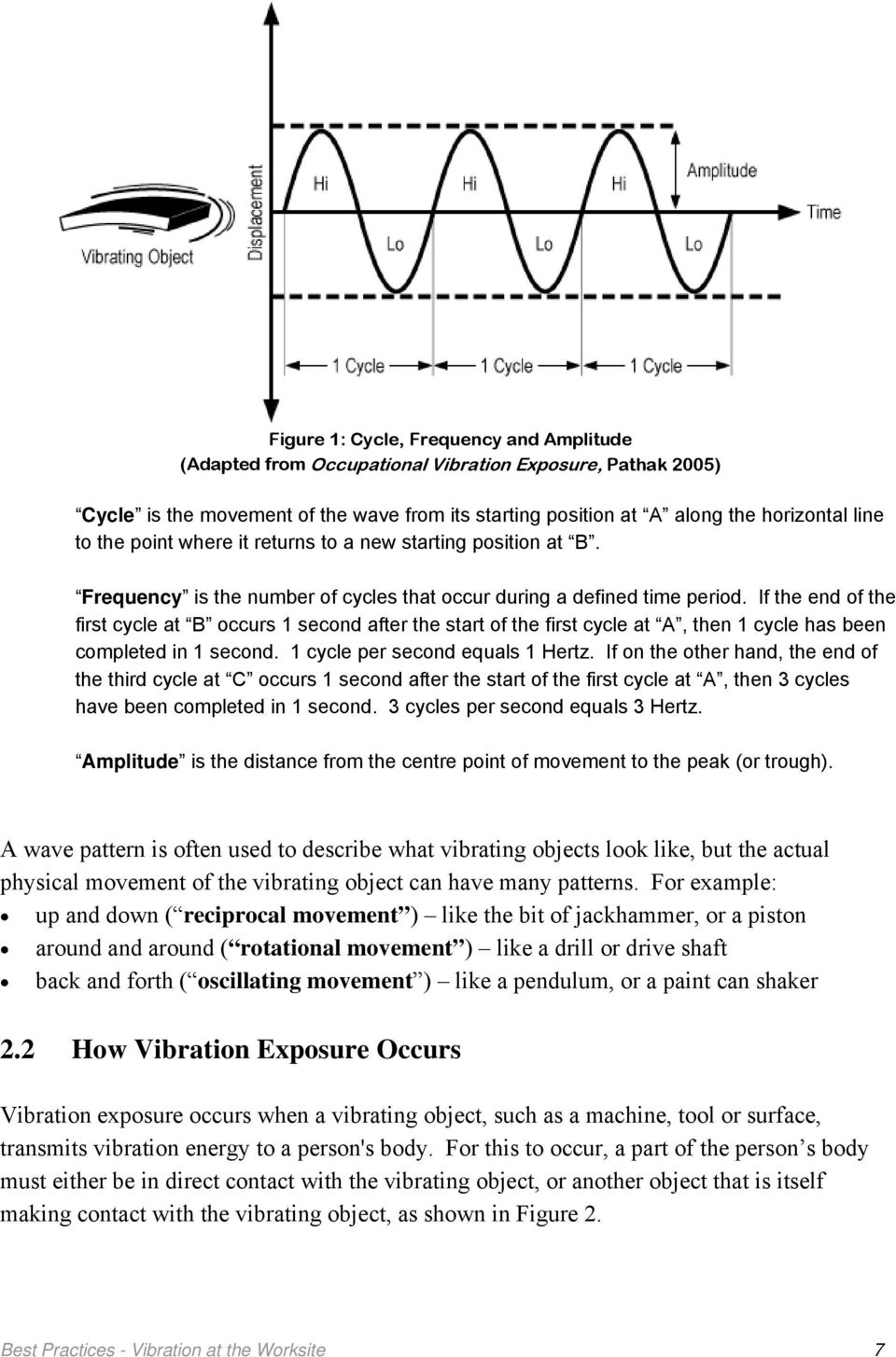
12 Figure 2: Diagram illustrating transmission of vibration from a motor through a wall to a platform, resulting in whole body vibration exposure 2.3 Types of Vibration Exposure There are two types of vibration exposure that are of interest: segmental vibration exposure, and whole body vibration exposure. Segmental vibration exposure refers to exposure that is mainly transmitted to, and concentrated on, a specific part of the body such as the hand, arm, or leg. Whole body vibration exposure is when vibration is transmitted throughout all or most of the body Hand-Arm Vibration Exposure Hand-arm vibration is the most common form of segmental vibration experienced in work settings. Hand-arm vibration occurs when a person holds or guides a vibrating tool or machine with their hand or hands, and vibration is transmitted from the tool to the hand(s) and along the arm(s). A person s exposure to hand-arm vibration and the health impacts of exposure can be influenced by many factors, such as: the temperature of the area the person is working in whether or not the person is wearing gloves Best Practices - Vibration at the Worksite 8
13 how the tool is gripped the frequency and amplitude of the vibration how long and how often exposure occurs Hand-arm vibration exposure can happen in many different jobs such as: building and maintenance of roads and railways construction and demolition maintenance of parks and groundskeeping forestry foundries heavy engineering manufacturing concrete products mines and quarries motor vehicle and equipment manufacture and repair meat cutting oil well drilling and servicing public utilities (e.g. water, gas, electricity, telecommunications) There are hundreds of different kinds of hand-held power tools and equipment that can produce hand-arm vibration exposures that can cause adverse health effects, including: chainsaws jackhammers concrete and masonry saws hammer drills hand-held grinders powered sanders impact wrenches riveting tools chipping tools jigsaws needle scalers pedestal grinders polishers power hammers power chisels gas and electric powered lawn mowers brush cutters grass trimmers hedge trimmers Best Practices - Vibration at the Worksite 9
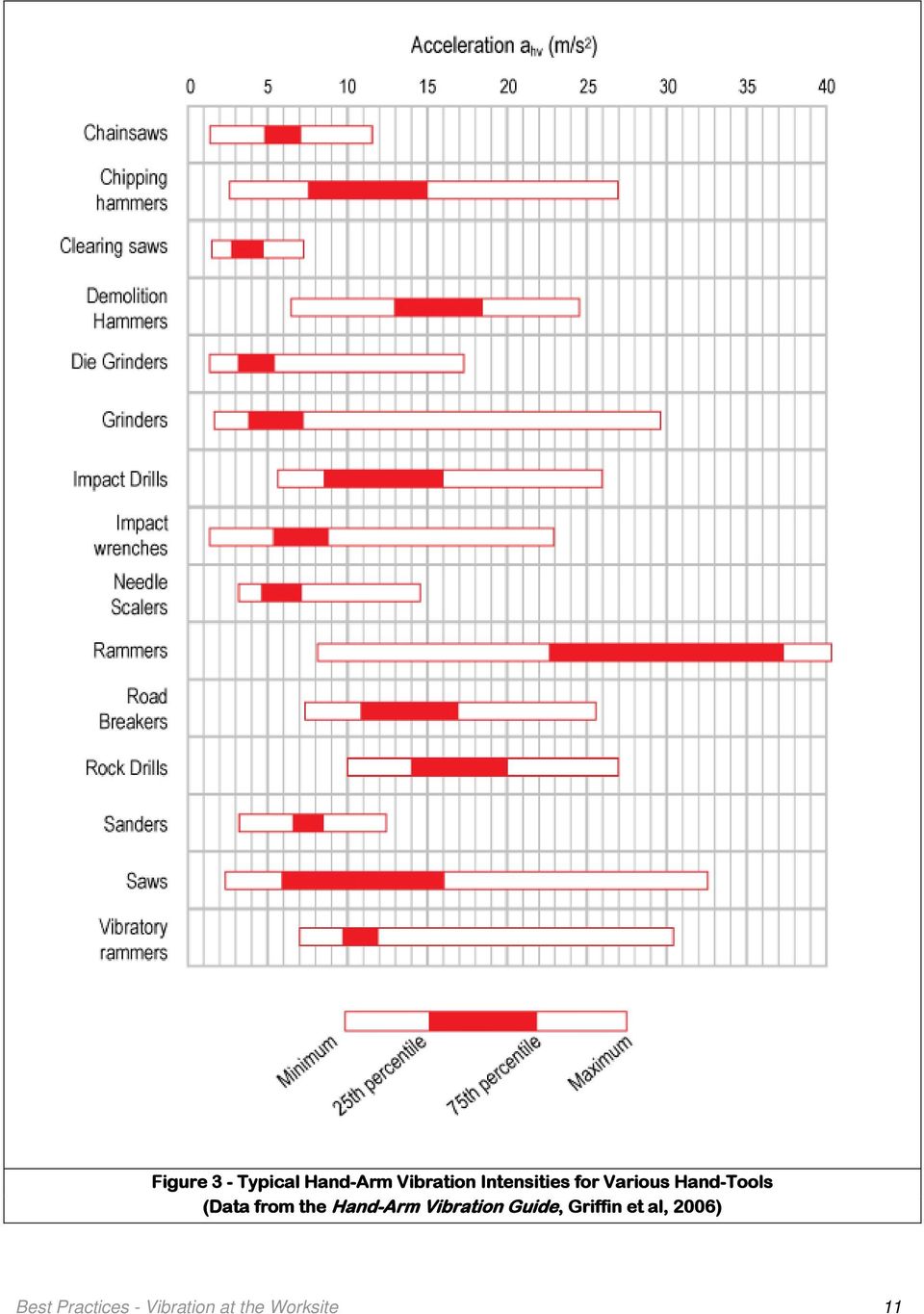
14 ground tampers / compactors snow blowers hand-guided soil tillers / cultivators needle guns / needle scalers concrete vibrators concrete finishers floor sanders floor polishers hand-guided road sweepers power washers Figure 3 shows typical hand-arm vibration exposures from various types of hand-held tools. The 25 th percentile means that 25% of exposures will be below this level and the 75 th percentile means that 75% of exposures will be below this level. The minimum and maximum values are the lowest and highest vibration levels that are typical for the tool represented. Best Practices - Vibration at the Worksite 10
15 Figure 3 - Typical Hand-Arm Vibration Intensities for Various Hand-Tools (Data from the Hand-Arm Vibration Guide, Griffin et al, 2006) Best Practices - Vibration at the Worksite 11
16 2.3.2 Whole Body Vibration Exposure Whole body vibration occurs when a person stands or sits on a vibrating vehicle, machine or surface. The vibration is transmitted through supporting surfaces such as the standing person s feet, the buttocks of a seated person, and the supporting areas of a reclining person. Whole body vibration exposure often comes from a variety of different vibration sources from one or more components of a machine, vehicle or surface. These sources can include: engines and engine parts movement of gears and transmissions rotation of tires, wheels and axles movement of the vehicle over irregular surfaces. Table 1 lists some sources of exposure to whole body vibration. Table 1 Typical Sources of Whole Body Vibration Mobile Crane Dump truck Surface haulage truck Mining vehicles Lift truck Skid Steer Loader Zoom boom Bus Helicopter Fast boat Large fuel-fired electrical generators Long haul transport Backhoe Bulldozer Excavator Compactor Grader / Scraper Farm tractors and similar vehicles Railway vehicles Large static production machines used for compaction, hammering, punching Whole body vibration exposure often involves exposure to several frequencies and amplitudes at the same time, as shown in Figure 4. Each vibration wave shown in the figure represents a different vibration source; each vibrating source can have unique vibration characteristics (i.e. different frequencies and amplitudes). Best Practices - Vibration at the Worksite 12
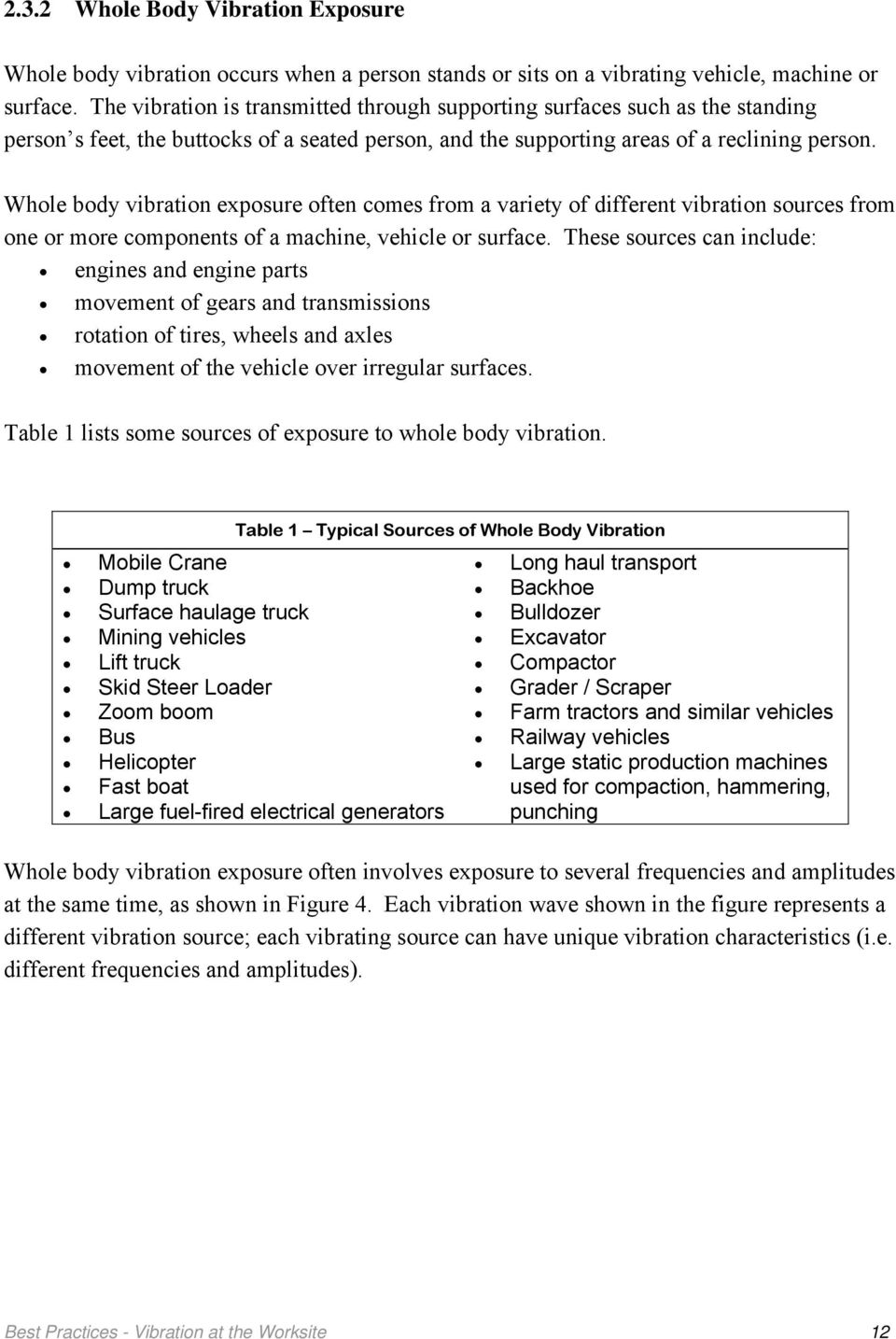
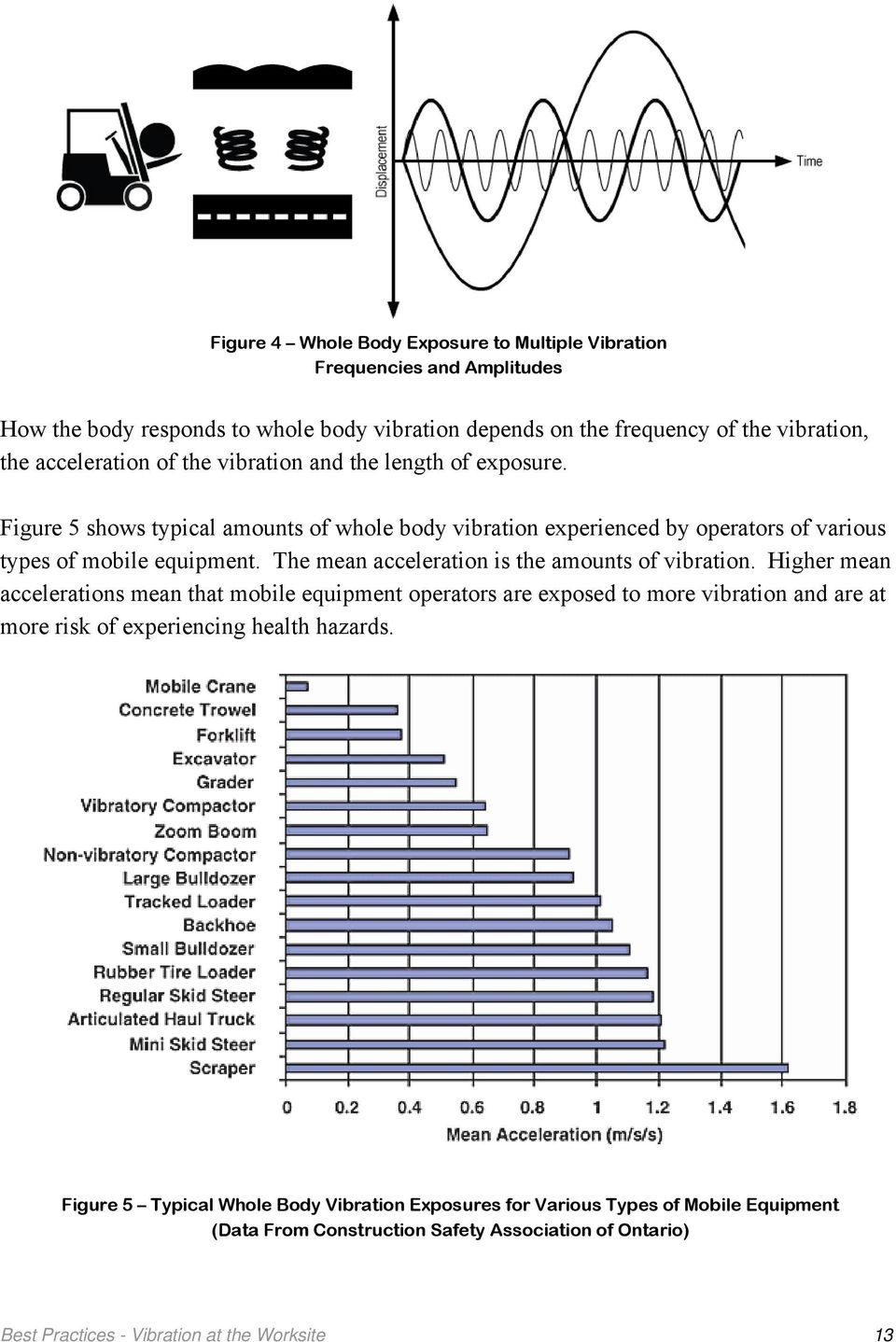
17 Figure 4 Whole Body Exposure to Multiple Vibration Frequencies and Amplitudes How the body responds to whole body vibration depends on the frequency of the vibration, the acceleration of the vibration and the length of exposure. Figure 5 shows typical amounts of whole body vibration experienced by operators of various types of mobile equipment. The mean acceleration is the amounts of vibration. Higher mean accelerations mean that mobile equipment operators are exposed to more vibration and are at more risk of experiencing health hazards. Figure 5 Typical Whole Body Vibration Exposures for Various Types of Mobile Equipment (Data From Construction Safety Association of Ontario) Best Practices - Vibration at the Worksite 13
18 2.4 How Much Exposure is Too Much? Exposure to hand-arm and whole body vibration is measured in units of acceleration. Acceleration is the rate of change in speed of an object. The units used are metres of distance per second per second. The International Organization for Standardization (ISO), the American Conference of Governmental Industrial Hygienists (ACGIH ), and the European Committee for Standardization (CEN) have developed standards and threshold limit values (TLVs ), which are considered to be health-based recommended maximum exposure levels. The ISO standard deals with whole body vibration only, while ACGIH and CEN provide limits for both handarm and whole body vibration. The standards are fairly complex, and the measurement of exposure and evaluation of exposures against the standards requires specialized equipment and expertise. Certain factors such as the way a tool is used, the characteristics of the tool or equipment, the environment in which the tool or equipment is used, protective practices used, etc. affect a worker s susceptibility to vibration. These are discussed in more detail in Section How Many People are Affected by Occupational Vibration Overexposure? Most public and private workers compensation organizations in Canada, the United States and Europe do not yet have specific statistics on the number of claims for injuries and illnesses caused uniquely by vibration exposure. Consequently, there are no good statistics on how common vibration-induced illnesses and injuries are. However, as a result of the implementation of workplace vibration regulations and prevention programs in the United Kingdom, estimates have been produced for that jurisdiction. These figures convey a sense of the potential magnitude of the health impact resulting from vibration overexposure: It is estimated that up to 300,000 working days are lost each year in the United Kingdom due to hand-arm disability related absences. In the United Kingdom, a survey by the Industrial Injuries Disability Benefit in 2005/2006 determined a prevalence of 545 cases of vibration white finger out of a total 1880 reported non-lung industrial diseases. This means that 29% of the total non-lung industrial disease cases were classified as vibration white finger injuries (HSE, 2007). Best Practices - Vibration at the Worksite 14

19 A survey in by the UK Medical Research Council estimated that there were 288,000 vibration white finger sufferers in Great Britain. On the basis of the findings of a large scale questionnaire survey, Palmer et al (2000) estimated that about 2% of the population of Great Britain (over 1 million people) are periodically exposed to high levels of hand-arm vibration in the workplace. Close to 20% of the population (nearly 10 million people) are regularly exposed to high levels of whole body vibration. Various researchers have also looked at the prevalence of vibration-related conditions in workers: A study by Nyantumbu et al (2007) found that 15% of gold miners in South Africa had symptoms of hand-arm vibration syndrome. A study by Bovenzi (1994) found that 31% of a large population of stonecutters in Italy had symptoms of hand-arm vibration syndrome. Lawson and McGeoch (2003) reported that an assessment of former coal miners in the United Kingdom for purposes of disability compensation found 95% to have symptoms of vibration white finger. On the whole, these figures suggest that the size of the working population exposed to vibration is very high. In heavily exposed occupations, the prevalence of vibration-related disorders is also high. Best Practices - Vibration at the Worksite 15

20 Section 3: Vibration Health Effects 3.1 Hand-Arm Vibration Syndrome Overview Hand-arm vibration syndrome is a collection of symptoms caused by vibration transmitted into the hands and arms through the palms and fingers. It develops in workers who use handheld power work equipment. Other common names for hand-arm vibration syndrome are: Raynaud s phenomenon of occupational origin secondary Raynaud s phenomenon vibration white finger dead finger vibration syndrome. The syndrome affects the nerves, blood vessels, muscles, and joints of the hand, wrist and arm. It can become very disabling if early symptoms are ignored and vibration exposure continues. Typical symptoms of hand-arm vibration syndrome include: occasional numbness in fingers tingling in fingers blanching (whitening) of fingers pain when exposed to cold pain when blood circulation returns to the fingers reduced grip strength reduced finger dexterity Vascular Disorders Raynaud s phenomenon is the most common health effect from hand-arm vibration. The small blood vessels of the hand narrow, reducing blood flow through the hands and fingers. The fingers become white, cold and numb. This effect can last for minutes or up to an hour after exposure to vibration. Raynaud s phenomenon can range from mild to very severe. The condition is classified into four stages known as the Stockholm Scale, as shown in Table 2. Best Practices - Vibration at the Worksite 16
21 Table 2 - Stockholm Scale for the Classification of Cold-Induced Raynaud s Phenomenon in Hand-Arm Vibration Syndrome (Scale from Hand-Arm (Segmental) Vibration, ACGIH, 2009, Table 2, pg.204) Symptom Stage Description Severity 0 None No Symptoms 1 Mild Occasional attacks affecting only the tips of one or more fingers 2 Moderate Occasional attacks affecting distal and middle (rarely also proximal) bones of one or more fingers 3 Severe Frequent attacks affecting all bones of most fingers Very As in stage 3, with skin changes in the fingertips 4 Severe In very serious cases, permanent damage can affect blood flow to the worker s fingers. The fingers may turn a dark and blue-black colour, develop open sores, and even become gangrenous. Other conditions from hand-arm vibration exposure include blood clotting in the arteries of the arm and fingers (ulnar artery thrombosis and digital artery thrombosis). In each case, a clot forms in the artery, blocking blood flow. Symptoms of artery thrombosis depend on the degree of blood flow obstruction caused by the clot. Where the clot is small and causes insignificant blood flow reduction, there may be no symptoms at all. As clot size and degree of blood flow obstruction increases, symptoms become more severe, and can include whiteness of the skin, coldness, numbness, pain, weakness, and loss of function Nerve Disorders Hand-arm vibration syndrome can also affect the nerves of the hands and arms. Affected workers sense tingling and numbness in their fingers and hands, their sense of touch and temperature may be reduced, and their manual dexterity may be affected. Symptoms have been categorized as shown in Table 3: Table 3 - Stockholm Scale for Classification of Cold-Induced Raynaud s Phenomenon in Hand-Arm Vibration Syndrome (Scale from Hand-Arm (Segmental) Vibration, ACGIH, 2009, Table 2, pg. 204) Stage Description 0 SN Exposed to vibration but no symptoms 1 SN Intermittent alternating periods of numbness, with or without tingling 2 SN Intermittent alternating periods of or persistent numbness, lessened touch sensation 3 SN Intermittent alternating periods of or persistent numbness, lessened touch sensation, and/or ability to move the hands and fingers Best Practices - Vibration at the Worksite 17
22 Carpal tunnel syndrome is not included in the definition of hand-arm vibration syndrome but often occurs in workers with hand-arm vibration syndrome. It is a nerve disorder that causes pain, tingling, numbness, abnormal skin sensations and weakness in parts of the hand and forearm. It occurs when the median nerve is compressed at the wrist Musculoskeletal Injury Hand-arm vibration can also damage the muscles and bones in the wrist and arms. The wrist and elbow may develop swollen and painful joints (osteoarthritis) and some tissues at tendon attachment sites may harden (ossify). Symptoms include loss of strength in the hands and pain in the arms and wrists. In the later stages, the affected worker may experience loss of hand function and necrosis (tissue death) of the fingers. Dupuytren s contracture is a disease of tissues in the palm of the hand that is associated with vibration. Tissues under the palm of the hand thicken and shorten such that the tendons connected to the fingers cannot move freely and the fingers cannot be straightened. Tendonitis (inflammation of the tendons) and inflammation of the sheaths in the upper limbs may also develop from the use of hand-held power tools. Tendonitis is thought to be a result of poor hand tool ergonomics rather than a direct result of vibration exposure. However, since workers using powered hand-tools do not always use the best ergonomic methods, tendonitis is often associated with hand-arm vibration syndrome. The onset of hand-arm vibration syndrome symptoms may be anywhere from a few months to several years after initial exposure. In the early stages, symptoms may be reversible if exposure is reduced or eliminated. However, as the length of exposure increases, there is greater potential for more damage. Later stage health effects are often irreversible Factors Affecting Risk of Hand-Arm Vibration Syndrome There are a number of factors that affect: the risk of developing hand-arm vibration syndrome, how quickly symptoms appear, the speed of onset and the severity of symptoms. These are listed in Table 4. Best Practices - Vibration at the Worksite 18
23 While many factors are associated with vibration-related disorders, exposure time and intensity provide the greatest predictors of the risk to worker health and how severe the symptoms of exposure will be. Table 4 - Factors Affecting Risk of Hand-Arm Vibration Syndrome Category Exposure Frequency Exposure Time Tool Use Variables Tool Characteristics Environment Vibration Parameters Worker Protective Practices Material Factor - Frequency of vibration worker is exposed to - Length of time tool is in use each day - Total working hours of exposure - Ergonomics of tool use (lifting, posture, repetitive movements, position of hand and arm relative to the body) - Surface area, location and mass of parts of the hand in contact with the source of vibration - Grip forces - Operator control of the tool - Impact (higher vibration) vs. non-impact - Weight of the tool - Operating speed - State of tool maintenance - Texture of tool handle (soft vs. rigid) - Shape of tool handle - Exposure to cold ambient temperatures - Exposure to psychosocial aspects (e.g. events at home, relationships) - Exposure to other physical and chemical agents - Frequency, amplitude and direction of vibration - Area of the contact surface between the vibration source with the hand - Level of acceleration produced by the tool (vibration energy) - Clothing - Body size - Posture - Body tension - Body composition - Medical history - Susceptibility to vibration - Smoking and use of drugs - Skill and productivity - Disease or prior injury to the fingers and hands - Number of years of use with tool - Anti-vibration materials in use (e.g. gloves, boots) - Work rest periods - Hardness of material being contacted (e.g. metal for grinding) Best Practices - Vibration at the Worksite 19
24 3.2 Whole Body Vibration Whole body vibration exposure occurs when vibration is transmitted from machines, vehicles or surfaces through the bones of the lower pelvis during sitting or through the feet and legs of a worker who is standing or sitting. Most of the time vibration is absorbed by the body without harmful effects. However, frequencies between 1 and 20 Hz cause the pelvis and spine to resonate and can lead to many health effects. Vehicles and industrial machinery often vibrate with frequencies in the range where human resonance occurs (4-8 Hertz). Common acute health effects from short-term exposure to whole body vibration include: headache chest pain abdominal pain nausea fatigue vertigo (loss of balance) It is believed that nausea, fatigue and vertigo may be due to vibration affecting the inner ear which controls balance. Headache, chest pain and abdominal pain may be due to increased blood pressure, which may be an involuntary response to whole body vibration, or a result of bracing to resist vibration. Symptoms of acute exposure generally end within minutes or hours of when exposure stops. Common chronic health effects from long-term exposure include: lower back pain damage to the spine major curves in middle-lower portion of the spine (lumbar scoliosis) deterioration of the discs in between the vertebrae of the spine (disc disease) tears or damage to the discs in between the vertebrae of the spine (herniated discs) neck problems 1 1 While neck and shoulder disorders are also commonly associated with exposure to whole body vibration, it is not certain whether these conditions are due entirely to vibration exposure. Workers exposed to whole body vibration often perform tasks that involve poor posture, extended time sitting in unnatural postures, frequent twisting of the spine, frequent lifting of heavy materials, and unexpected movements. These factors could contribute to neck and shoulder disorders. Best Practices - Vibration at the Worksite 20
25 hearing loss sleeping disorders. The musculoskeletal symptoms from vibration are likely due to inflammation and trauma to the spine. Vibration exposure can produce hearing loss in the same way that noise exposure does by over-stimulation of inner ear auditory hair cells. Sleeping disorders could be due to discomfort from musculoskeletal disorders, or could be a direct effect of vibration exposure. The risk to health increases with increasing exposure. The progress and severity of symptoms also depends on the magnitude, frequency, and direction of the vibration. Chronic symptoms often persist for long periods (weeks, months, years) after exposure ends, and are usually permanent. Best Practices - Vibration at the Worksite 21
26 Section 4: Identifying and Assessing Vibration Exposures This section describes methods for identifying and assessing exposures to hand-arm and whole body vibration. These methods help to judge the potential for harmful exposures and to determine the need for reducing exposure. 4.1 Step 1: Identify Activities Causing Vibration Exposure The first step in assessing vibration exposure is to identify the activities that lead to vibration exposure. To do so, hold discussions with workers and supervisors, and observe work activities to develop an understanding of: work operations tasks performed tools and equipment used vehicles used platforms or other surfaces workers stand on that may transmit vibration from stationary equipment. Table 5 can be used to help in the identification of tools and equipment used by workers that can contribute to hand-arm and whole body vibration exposure. 4.2 Step 2: Estimate the Duration of Exposure Once the work activities and equipment leading to vibration exposure have been identified, the next step is to determine the typical frequency (how often) and duration of vibration exposure. This is important in assessing vibration exposure risk because the potential for harm increases with the level and duration of vibration exposure. Table 5 can also be used to record how often and for how long equipment or tools are used. Estimates can be obtained through discussions with workers and their supervisors, review of work activity records, and direct observation and timing of work activities. Best Practices - Vibration at the Worksite 22
27 Vehicles in Use Backhoe loader Compactor - single drum Compactor - tandem Dozer Dumper Dumper - Articulated Excavator - Wheeled Excavator <25t Excavator >25t Farm Tractor Finisher / Asphalt Paver Forestry - Forwarder Forestry - Harvester Fork-lift Truck - Counterbalance Fork-lift Truck - Order Pickers Fork-lift Truck - Reach Grader Pallet-truck - ride-on vertical Scraper Tow Tractor Wheel Loader Other: Other: Other: Powered Hand Tools Brush Cutters Chainsaws Chipping Hammers Chisels Clearing Saws Compactors Cultivators / Tillers Demolition Hammers Die Grinders Grinders Hammer Drills Hedge Trimmers Impact Drills Impact Wrenches Lawn Mowers Needle Scalers Pedestal Grinders Powered Mowers Rammers Riveters Road Breakers Rock Drills Sanders Saws Snow Blowers Vibratory Rammers Other: Table 5 - Inventory of Vibration Exposure Sources Make / Model / Description Make / Model / Description No. How Often the Units Worker is Exposed No. How Often the Units Worker is Exposed Duration of Operation Duration of Operation No. Exposed Workers No. Exposed Workers Best Practices - Vibration at the Worksite 23
28 4.3 Step 3: Use Published Data to Determine Potential Exposure Intensity Many researchers have measured the hand-arm vibration exposures for a variety of hand-held and hand-guided tools (Figure 3), and whole-body vibration exposures (Figure 5) associated with the operation of different types of mobile and stationary equipment. In some European countries it has become mandatory for manufacturers to provide this information as part of the operator s manual. As shown in Figures 3 and 5, vibration levels fall within a range of values. To estimate exposures the highest potential vibration intensity in the published range should be used unless it is certain that the vibration intensity of the tool in question is actually lower. These sources of published information can be used to estimate the potential vibration exposure experienced by workers, and judge the need to reduce vibration exposures. 4.4 Step 4: Compare the Estimated Exposure to Recommended Maximum Permissible Exposure Limits Once the exposure duration and the potential exposure intensity have been estimated, these values can be compared to maximum permissible vibration exposure limits, such as those suggested in the ACGIH, CEN and ISO standards (see Section 7). If the estimated vibration exposure duration and intensity are higher than the suggested limits, then the actual vibration exposure could be unacceptably high. 4.5 Step 5: Implement Simple Vibration Controls If vibration exposures might be too high, then steps should be taken to reduce exposures. The simplest way to reduce vibration exposure is to reduce the duration of time that the worker performs the work. However, reducing the amount of time the worker is exposed to vibration is not always possible. Workers may be under pressure to complete their work. In these cases, other vibration reduction methods should be explored. Table 6 identifies a variety of simple vibration reduction methods that should be considered where assessment identifies the potential for excessive vibration exposure. Best Practices - Vibration at the Worksite 24
29 Table 6 - Common Causes and Solutions to Vibration Problems Possible Solutions Possible Causes Remove tool / vehicle from use Balance vehicle tires Sharpen equipment Arrange for worker to alternate between vibrating and non-vibrating tool use Instruct worker on ergonomic work practices Instruct worker on proper use of personal protective equipment Instruct worker on appropriate maintenance of equipment Instruct worker to perform finger / hand and ergonomic exercises Instruct worker to reduce the tool grip Instruct worker to minimize duration of exposure to vibration Alternate tasks for worker to minimize duration of exposure Provide anti-vibration gloves Provide cold weather clothing Provide wind resistant clothing Provide portable hand warmers Provide water repellant outer layer clothing Tool Design Manual warns of vibration hazard Manual describes vibration control measures Tool not designed for current use Vehicle not designed for roadway conditions Tool Maintenance Maintenance program absent Maintenance program not used Parts are wearing Parts are loose Blade / cutting edge dull Tool Use Wrist joint not at 90 degree angle Elbow joint not at 90 degree angle Shoulder joint not at 90 degree angle Tool positioned far from body Strong grip force required to stabilize tool Sustained static postures Sustained stretched position Awkward posture for manual handling activities Hand in direct contact with Best Practices - Vibration at the Worksite 25
30 Table 6 - Common Causes and Solutions to Vibration Problems Possible Solutions Possible Causes Remove tool / vehicle from use Balance vehicle tires Sharpen equipment Arrange for worker to alternate between vibrating and non-vibrating tool use Instruct worker on ergonomic work practices Instruct worker on proper use of personal protective equipment Instruct worker on appropriate maintenance of equipment Instruct worker to perform finger / hand and ergonomic exercises Instruct worker to reduce the tool grip Instruct worker to minimize duration of exposure to vibration Alternate tasks for worker to minimize duration of exposure Provide anti-vibration gloves Provide cold weather clothing Provide wind resistant clothing Provide portable hand warmers Provide water repellant outer layer clothing vibrating surface Ambient Environment Exposure to shock / jolts during task Off-road work required Cold temperature work required Potholes or uneven road surfaces 4.6 Step 6: Get Expert Assistance if Necessary The vibration exposure assessment method described above may lead to the conclusion that exposure could be close to being, or is likely to be, excessive or cannot be determined. In these cases, expert assistance should be sought to either conduct measurements of vibration intensity to more conclusively determine the potential for adverse health effects; or recommend vibration-reducing control measures. Appendix 1 describes the methods that are used for measurement of vibration exposure. 4.7 Examples Estimating Vibration Exposure Here are two examples of how to make these estimates for hand-arm and whole body vibration exposure using published data Estimating Hand-Arm Vibration Exposure from Chain Saw Use Step 1 - Identify the Vibration Sources: Crews of workers use chain-saws every day to trim tree branches that grow too close to power lines. Each crew consists of two workers, who share all duties. The only hand-held power tool that they use in their work is a chain saw. Best Practices - Vibration at the Worksite 26
31 Step 2 - Estimate the Exposure Duration: You have spoken with the workers, and observed their work operations, and you have found that during a typical day, each worker does the following activities for the times indicated: Activity Average Daily Duration (Hours) Vehicle loading and inspection 0.25 Traveling from site to site in a boom truck 2 Breaks and lunch 1.25 Operating the boom and bucket 0.25 Fuelling and lubricating the chain saw 0.25 Operating the chain saw 3.5 Preparing work records 0.5 So, assuming that the only activity resulting in hand-arm vibration is operating the chain saw, then the total duration of hand-arm vibration exposure is 3.5 hours. Step 3 - Use Published Data to Estimate Vibration Exposure Intensity: Using Figure 6, we see that chain saws have a wide range of vibration intensities anywhere from as low as 1 m/s 2 to as high as 12 m/s 2. Figure 6 also shows that about 50% of all chain saw models fall in the range of about 5 m/s 2 to 7 m/s 2. So, we can do our exposure estimation in a variety of ways, using the lowest, middle, or highest vibration intensities. To be most cautious, we should use the highest vibration intensity, 12 m/s 2. Best Practices - Vibration at the Worksite 27
32 Figure 6 - Typical Hand-Arm Vibration Intensities for Various Hand-Tools (Data from the Hand-Arm Vibration Guide, Griffin et al, 2006) Step 4 - Compare Exposure Levels to Maximum Permissible Exposure Limits: To this point, we have found that workers operating chain saws may be exposed for 3.5 hours per day to a vibration intensity as high as 12 m/s 2. We can now compare this to recommended maximum permissible exposure limits. Table 7 shows ACGIH exposure limits for hand-arm vibration. Best Practices - Vibration at the Worksite 28
33 Table 7 - ACGIH Vibration Exposure Limits Exposure Duration (Hours) Maximum Vibration Amplitude (m/s 2 ) 4 to to to 2 8 < 1 12 Under a worst-case scenario, the chain saws have a vibration intensity of 12 m/s 2. By ACGIH recommendations, the chain saw should not be operated for more than 1 hour per day. If, instead, the chain saw is assumed to have a vibration intensity that is in the middle of the range, say 6 m/s 2, then the chain saw can be used from 2 to 4 hours per day, and our estimated daily duration of 3.5 hours of use would be acceptable. Should this Vibration Exposure Be Considered Acceptable?: In this example, the actual vibration intensity of the chain saw is unknown, and there are large differences between the potentially lowest and highest vibration intensities. In a case such as this, it is best to either obtain information on the actual vibration levels from the chain saw manufacturer or consult an expert to conduct hand-arm vibration exposure measurements Estimating Whole Body Vibration Exposure from Operating Various Types of Construction Equipment Step 1 - Identify the Vibration Sources: A construction company has backhoes and small bulldozers. It is determined that on a typical day, an operator will operate both a backhoe and a bulldozer. These pieces of equipment are the only sources of whole body vibration exposure. Step 2 - Estimate the Exposure Duration: You have spoken with the operators, observed their work, and have found that over the course of a typical day, each operator does the following activities for the times indicated: Activity Average Daily Duration (Hours) Vehicle fuelling, lubrication and inspection 0.5 Operating the backhoe 3 Breaks and lunch 1.25 Operating the small bulldozer 3 Preparing work records 0.25 So, there are two activities resulting in whole body vibration: backhoe operation (for 3 hours), and bulldozer operation (for 3 hours). Best Practices - Vibration at the Worksite 29
34 Step 3 Use Published Data to Estimate Vibration Exposure Intensity: Using Figure 7, we can see that: the backhoe can produce whole body vibration exposure of about 1.05 m/s 2 the small bulldozer can produce whole body vibration exposure of about 1.1 m/s 2 These are fairly similar vibration intensities for both types of equipment, so for simplicity we can say that the operator is exposed to whole body vibration of approximately 1 m/s 2 for 6 hours. Figure 7 - Typical Whole Body Vibration Exposures for Various Types of Mobile Equipment (Data From Construction Safety Association of Ontario) Step 4 - Compare Exposure Levels to Maximum Permissible Exposure Limits: To this point, we have concluded that the operators may be exposed for 6 hours per day to a vibration intensity of 1 m/s 2. We can now compare this to recommended maximum permissible exposure limits. Table 8 shows CEN vibration exposure limits for whole body vibration. Table 8 - European Vibration Directive Exposure Limits Type Daily Exposure Action Value (m/s 2 ) Daily Exposure Limit (m/s 2 ) Whole Body Vibration By CEN recommendations, a worker s daily exposure to whole body vibration (i.e. exposure over an 8 hour day) should not exceed 1.15 m/s 2. Best Practices - Vibration at the Worksite 30
35 Should this Vibration Exposure Be Considered Acceptable?: In this example, if the actual vibration intensity is about 1 m/s 2 for 6 hours, then the exposure is below the CEN daily exposure limit, and the vibration exposure can be considered acceptable. However, if this exposure level were experienced in a European country, it would be necessary for the employer to implement a vibration protection program due to the fact that the exposure exceeds the daily exposure action value. Best Practices - Vibration at the Worksite 31
36 Section 5: Methods for Reducing Hand-Arm Vibration Hazards There are many ways to reduce hand-arm vibration hazards: buy or use low vibration tools and equipment select the lowest vibration tool for the job maintain tools and equipment properly use tools in ways that minimize vibration exposure ensure good ergonomic design of workstations and tasks modify tools and equipment to reduce the vibration they produce use low vibration work methods use gloves and clothing to help maintain blood circulation during work in cold environments reduce exposure time and frequency train workers use anti-vibration gloves 5.1 Buying and Using Low Vibration Tools and Equipment Identify and Replace Older Higher Vibration Hand Tools Newer hand-held tools and hand-guided equipment tend to produce less vibration than older units. So replacing older tools and equipment with newer ones can achieve significant reductions in vibration exposure Select Tools and Equipment with Built-in Anti-Vibration Features Many tools have damping or isolation features to reduce vibration. In damping, a material that absorbs the vibration energy is added to a vibrating component or surface. Isolation blocks the transmission of vibration along its travel pathway by introducing a material that is a poor transmitter of vibration. Both techniques are effective at reducing the amount of vibration transmitted to the hands Centre of Gravity of Hand-Held Rotational Power Tools Hand-held rotational power tools have spinning motors or drive shafts in the same axis as the hand and forearm during use (e.g. a power drill) (see Figure 8). Best Practices - Vibration at the Worksite 32
37 Figure 8: Spinning Axis of Hand-Held Rotational Power Tools Rotational power tools exert torque (rotational force) against the hand and the user involuntarily counteracts this by tightening the wrist and arm (see Figure 9). Without this counteracting torque by the user, the tool would twist the user s hand and arm along its axis. Application of torque by the tool user makes the effects of vibration exposure worse. Drill torque User s counteracting hand-arm torque Drill torque Figure 9: Torque Forces Associated with Rotational Tools The amount of torque exerted by the tool, and conversely, the amount of torque that the wrist and arm must exert to counteract the tool, can be reduced by choosing tools with a centre of gravity located close to, or just below the hand (see Figure 10). Best Practices - Vibration at the Worksite 33
38 Figure 10: Tool Centre of Gravity 5.2 Selecting the Lowest Vibration Tool for the Job The tool must be matched to the job in terms of tool size and power. Workers must use a lot of strength when tools are large and have substantial power. This can result in tightened muscles, tendons and ligaments, and easier transmission of hand-arm vibration. If the tool is too small or underpowered, the task may take too long to complete. This can expose the user to vibration for longer than would otherwise be needed. 5.3 Maintaining Tools Properly Inadequate maintenance can cause parts to become loose, misaligned, worn and unbalanced. This can result in increased vibration output. In addition, blunt, dull and worn cutting edges increase the time needed to complete the job. This results in more exposure to vibration. A maintenance program for vibration reduction should include: replacing worn parts, replacing defective vibration dampers, mounts, bearings and gears sharpening, lubricating and tuning tools tuning engines replacing anti-vibration mounts and suspended handles carrying out necessary balance checks and corrections replacing anti-vibration mounts and suspended handles before they deteriorate checking the manufacturer s specifications and requirements for maintenance. Best Practices - Vibration at the Worksite 34
39 5.4 Use Tools in Ways to Reduce Potential Vibration Exposure Maintain a Proper Grip The type of grip and tightness used to hold a vibrating tool can affect user posture, and the forces applied against the hand, wrist and forearm. Excessive hand grip force increases ligament and tendon tension and reduces local blood circulation worsening the effects of vibration exposure. When a person is at rest, the ligaments and tendons are relatively loose and flexible (think of a loose elastic band). Under these conditions, the ligaments and tendons act as isolators, reducing the transmission of vibration from bone-to-bone and bone-to-muscle. However, when muscles are tensed Ligaments are fibrous connective tissues linking together two or more bones. Tendons are fibrous connective tissues linking together bones and muscles. they contract and tendons and ligaments are pulled and tightened. Under these tightened conditions, the ligaments and tendons no longer act as isolators. Instead they more readily transmit vibration from bone-to-bone and bone-to-muscle. When gripping a vibrating tool, the act of gripping tightens ligaments and tendons in the hand and arm. This assists the transmission of vibration through the hand and to the arm. Vibration grip-effects can be minimized by: using a power grip, which allows the hand to generate the most force while creating the least amount of strain (see Figure 11) selecting tools with a centre of gravity located close to, or just below the hand A power grip (power grasp) is a manner of holding an object whereby the fingers are wrapped around the object and the thumb is placed against it like making a fist. using devices such as jigs and suspension systems to reduce the need to grip heavy tools tightly using tension chains or elastic leashes above work areas to support vibrating tools such as heavy drills, grinders, nut runners, nailing guns (in some cases) and pneumatic chisels, relieving the operator from supporting the tool's weight changing the texture and material of a grip surface to allow the operator to use a smaller grip force to hold and control the tool using techniques such as bench-felling in forestry, where the chainsaw slides along the log during de-branching, rather than holding the full weight of the saw at all times (see Figure 12) Best Practices - Vibration at the Worksite 35
40 Figure 11: Power Grip Figure 12: Bench Felling Proper Hand-Hold Technique Vibration exposure can be lowered by reducing hand contact with the tool. One way to do this is to rest the tool to the greatest extent possible on the material being worked (or in the case of hand-held work pieces, on the support provided). Of course sufficient hand contact must be maintained for safety. With some tools, the operator s hands must be in the correct position to avoid more vibration exposure. For example, many vibration-reduced tools, such as jackhammers with suspended handles, produce high vibration emissions if the operator pushes down too hard while operating the tool. Best Practices - Vibration at the Worksite 36
41 5.4.3 Hands-Off and Shut Off at the Right Time To reduce vibration exposure, tools should be operated only when necessary and at the minimum speed and impact force required to perform the work. For example, jackhammers should be stopped when lifting them to change position, because many have higher vibration output when pulling up on the handles don t needlessly rev chain saws don t oversand or overgrind Use Sharpness Over Percussion Percussive drills (hammer drills) with tungsten bits are often used for drilling and boring into concrete or rock. Often, an ordinary non-percussive drill with a diamond bit will do the job as well and as fast, with much less vibration exposure. 5.5 Basic Good Ergonomic Design of Workstations and Tasks Workstations and tasks should be designed in accordance with good ergonomic principles to minimize loads on workers hands, wrists and arms, and to promote good posture. 5.6 Modifications to Tools and Equipment Options for Reducing Vibration and a Cautionary Note Many types of modifications to tools and equipment can reduce vibration output. These include: increasing the mass of the vibrating body minimizing tolerances of systems balancing machines better installing vibration isolators (typically on handles, or where handles connect to the body of the tool) installing vibration dampeners. In practice, many of these modifications are best done when the tool is manufactured, through changes in design and fabrication. Vibration-reducing modifications can be difficult to retrofit. Without adequate technical understanding of how to make improvements, vibration can be increased and the tool or equipment can be made less safe or less ergonomic. Use of unsuitable dampening or isolation materials, or incorrect adjustments to the mass of the Best Practices - Vibration at the Worksite 37
42 vibrating body, can generate resonances that amplify the vibration output at certain frequencies Modifications to Handles There are success stories, involving modifications to tool and equipment handles to reduce vibration transmission: De Souza & Moore (1993), conducted a study on the use of a cushioned handle for jackleg rock drills. They found it reduced vibration frequencies reaching the hand by a factor of three. The cushion was made from an elastomer handle which was compared to a steel handle. Tudor (1996) developed an ergonomic handle for a string trimmer that would be more comfortable for the operator to use. The handle was slightly curved with a foam surface and reduced vibration. Strydom (2000) developed an attenuating rock-drill handle design. This design uses a diaphragm-type absorber that incorporates fluid inertia principles. This design is easily implemented in rock drills, and is relatively simple and inexpensive. It has shown that the transmissibility of vibration can be reduced by 20-40%, compared to unattenuated rock-drill handle transmissibility. The design can be altered for specific drill types and operating frequencies Tool Handle Wraps Many commercially-available viscoelastic materials have been tested as tool handle wraps. This is similar to wrapping the handle of a hockey stick or tennis racket with tape. The idea is to achieve sufficient thickness to provide some degree of vibration isolation. However, these wraps usually provide insignificant vibration reduction, and can enlarge the tool handle diameter to the point where grip is compromised. There is no evidence that tool wraps are effective in reducing vibration exposure or the risk of hand-arm vibration syndrome. 5.7 Use of Low Vibration Work Methods It is often possible to change the work method in a way that significantly reduces or eliminates vibration exposure. Table 9 identifies some possibilities. Best Practices - Vibration at the Worksite 38
43 Table 9: Examples of Work Method Changes to Reduce Vibration Exposure Vibration Source Jackhammer for road breaking Jackhammer for removal of deteriorating concrete Jackhammer for breaking up concrete foundations and footings Needle scaling on metal Needle scaling on exposed face of newly poured concrete Riveting Percussive drilling Alternative Low Vibration Work Method Mount a jackhammer onto the boom of a tractor / backhoe Water jet blasting Pilot hole driller on tractor / backhoe, followed by hydraulic bursting Grit blasting with vacuum extraction shroud Water jet or grit blasting Bolting, adhesives, or welding Non-percussive drilling with diamond drill bit Several case studies involving vibration-reducing work methods are presented at the end of this Section. 5.8 Use of Protective Clothing and Gloves to Maintain Blood Flow Good blood circulation to the fingers and hands may reduce the risk or slow the onset of vibration white finger. It can also reduce the symptoms in cases where vibration white finger has already occurred. To maintain good blood circulation to the fingers and hands, the hands and arms must be kept warm, and a warm body temperature must be maintained. Consider the following measures to promote blood flow to fingers, hands and arms: avoid working outdoors in cold weather, if possible use machines with heated handles where available maintain the temperature at 16ºC or higher in an indoor workplace avoid machines that might make the hands cold, such as steel-bodied machines or pneumatic tools that blow exhaust air over the operator s hands for work outdoors, wear cold weather gloves and clothing to keep the worker warm use portable hand warmers or battery-powered electrically heated hand gear allow workers to warm up before starting work and during work, as needed provide an outdoor shelter to allow workers to warm-up, if necessary before starting the job, workers should warm their hands keep tools in warm storage plan work to avoid prolonged exposure to vibration and encourage workers to take breaks during long tasks, as several shorter exposures with recovery periods are preferable to one long exposure Best Practices - Vibration at the Worksite 39
44 provide hot drinks and warm food. This helps to maintain body temperature and is particularly important in cold working environments. encourage workers to take regular exercise to help circulation and to exercise and massage the fingers during breaks from work with vibrating equipment encourage workers to stop or cut down smoking, which can impair circulation. 5.9 Reduce Exposure Duration and Frequency When engineering controls cannot reduce vibration exposure enough, exposure duration and frequency must be reduced. In many cases, pursuing this option as a first choice may be the most practical approach Work Schedules Where possible, plan and schedule work to prevent workers from being exposed to vibration for long, continuous periods. The specific length of time that a worker can be exposed to the vibration will depend on the vibration level given off from the particular tool. The tool vibration level can be used along with published occupational health and safety laws, standards and guidelines to determine whether exposures are too long. Several shorter periods of exposure are preferable Staff Rotation Where high vibration tools must be used frequently or continuously, rotate tool use and tasks among workers so that no single worker has too long an exposure Instruction and Training Workers using vibrating hand-held tools must receive instruction and training in the hazards of vibration, how to minimize vibration exposure and how to recognize early signs of overexposure. Specific subjects should include: injury / illness risks from use of vibrating tools and equipment exposure limit values, guidelines and the exposure action values vibration levels associated with the tools and equipment that will be used control measures to eliminate or reduce hand-arm vibration, including - work practices and ergonomics - tool handling techniques - gripping, pushing and guiding - maintenance and upkeep requirements and relationship to vibration levels Best Practices - Vibration at the Worksite 40
45 - minimizing tool use duration early signs and symptoms of injury reporting maintenance requirements for tools and equipment appropriate health surveillance importance of keeping warm impact of home activities and lifestyle factors on risks of vibration injury 5.11 Hand-Arm Vibration Reduction Case Studies Tool Maintenance Vibration Exposure from Circular Knives and Rotary Tools Johnson and Wasserman (2000) studied the relationship between hand-arm vibration exposure and the condition of table-mounted circular knives (essentially circular saws) used for meat cutting. They found that use of this equipment did not result in hand-arm vibration overexposure, but vibration levels were higher when the knives had at least one part that was severely worn or damaged. Vibration decreased an average of 16% when the worn parts were replaced. Proper maintenance was shown to be instrumental in minimizing vibration exposure. More broadly, whenever a machine has a symmetrical rotating part (e.g. circular saw blade, drive shaft, gears, flywheels, etc.), that part will emit more significant amounts of vibration when the part becomes asymmetrical due to wear or damage. Vibration Attenuation Effects from Rock Drill Elastomeric Handles De Souza and Moore (1993) looked at the long-term effectiveness of elastomer-cushioning placed over the handles of pneumatic jack-leg rock drills used for underground mining. They found that overall hand-arm vibration exposure levels were reduced three-fold Training on Proper Tool Use Effects of Training on Jackhammer Vibration Macdonald Air Tools Ltd in England studied the effects of jackhammer operator technique on hand-arm vibration. They found that exposures depended on how the tools were used. For example, when breaking concrete, untrained operators were lifting the tool without switching it off (and so increasing the vibration), and were operating continuously for about a minute without moving the cutting tool. The average vibration level was about 9 m/s 2. This meant Best Practices - Vibration at the Worksite 41
46 that the UK exposure action value was reached after about 35 minutes trigger time, and the exposure limit value was reached after about 135 minutes trigger time. The company produced training material for its customers, which included the following points: selecting the correct cutting tool for the job and keeping it sharp keeping the handles in the horizontal position for lowest vibration letting the weight of the tool do the work not gripping the tool too tightly moving the cutting tool every 8-10 seconds (since the amount of concrete broken is about the same after 10 seconds as after one minute) stopping the tool when lifting it to change position, because the vibration is high when pulling up on the handles when cutting concrete, taking small 'bites' to prevent the cutting tool jamming removing concrete in shallow layers. By training the operators to stop the machine before moving it, the average vibration level was reduced to around 7 m/s 2, allowing a 70% increase in the time before the exposure action and limit values were reached. Further training improved the operators techniques and the average vibration was reduced to about 5.5 m/s 2, allowing about 100 minutes trigger time before reaching the exposure action value. By training the operator to stop and move the cutting tool after about 10 seconds of operating, instead of working continuously for about a minute, the amount of work done (concrete broken) was greatly increased. The overall effect was to allow up to 17 times more concrete to be broken than before, without increasing vibration exposures. User Technique Affects Hand-Arm Vibration Exposure Edwards et al. (2006) monitored hand-arm vibration exposures from three different types of tools - electric breakers, combi-hammers and battery drills made by three different manufacturers. Several operators used each tool to work on a single point of a piece of concrete for 30 seconds, while vibration was measured. There was a significant difference observed between the vibration levels of the tools when the same tool was used by each of the three operators, indicating that the individual s method of use has a significant effect on handarm vibration exposure. Best Practices - Vibration at the Worksite 42
47 Use of Low Vibration Work Methods Methods for Reducing Manual Jackhammering Manual use of pneumatic jackhammers produces hand-arm vibration levels in the range of 5 to 20 m/s 2 with an average of around 12 m/s 2. At the average vibration level, a total of 3 hours use per day which would give a typical exposure of 7 m/s 2, which is more than the maximum exposure limits recommended by ACGIH and the European Vibration Directive. There are ways in which vibration from manual jackhammering can be reduced or eliminated by alternative methods. Use Tractor Mounted Jackhammers Human vibration exposure caused by jackhammering can be greatly reduced by mounting the jackhammer onto the articulating arm of a tractor or excavator, using the machine s hydraulics to power the jackhammer, and operating it from the driver s station. This approach can drop the jackhammer s contribution to hand-arm vibration down to less than 1 m/s 2. If finer work is required, such as scoring the border of an area to be broken out, this work can be done with a hand-held jackhammer. In this case the total amount of hand-held time is still very short (often minutes), still resulting in acceptably low exposures. An added benefit of using a machine-mounted jackhammer is that the work usually proceeds many times faster than by hand-held jackhammering. Use Directional Drilling or Daylighting Instead of Excavation When laying wire or pipe under roads or walkways, one method is to excavate a trench and lay the wire or pipe. Jackhammers are often used to break the surface and manual tampers are often used as part of the backfilling and restoration work. One way of avoiding vibration from jackhammer and tamper operation is to use directional drilling or daylighting to create the underground pipe or wire chase instead of opening a trench. In addition to virtually eliminating hand-arm vibration exposure, these methods are often cheaper than trenching, generally much faster and less disruptive. Use a Drill and Bite Technique to Tear Down Concrete Walls Concrete walls are often broken down by jackhammering. As an alternative, a diamond drill held in a clamp can be used to drill a series of holes through the wall, after which a hydraulic concrete crusher can be used to bite off pieces. The jaws of hydraulic crushers close slowly, so operators can loosen their grip before crushing takes place, further reducing Best Practices - Vibration at the Worksite 43
48 vibration exposure. This technique results in negligible operator exposure to hand-arm vibration and also significantly reduces noise and dust exposures. Using Hydraulic Bursting for Concrete Demolition Jackhammers are often used to break-up concrete slabs and footings. As an alternative, a clamp-mounted diamond drill can be used to drill holes in the concrete, after which a hydraulic bursting tool can be inserted into the holes to split apart the concrete. This method produces very little exposure to vibration, noise and dust. Removal of Large Sections of Brick or Concrete Structures to Modify Buildings In commercial and industrial buildings, very large openings through thick (1m+) concrete or brick slabs and walls to route services, install elevator shafts, install escalators, etc. must sometimes be done. A typical technique is to use lower force hand-held jackhammers to cut out the entire mass of material, since larger jackhammers or machine-mounted jackhammers can produce too much vibration which can cause structural damage to the building. An alternative lower vibration approach is to cut a border around and completely through the material to be removed with a diamond core or wire saw, which essentially vibration isolates the target material from the building, and then use a tractor mounted jackhammer to breakout the isolated section. In addition to resulting in less vibration, this method can be much quicker. Water Jets to Remove Damaged or Weathered Concrete Surfaces Instead of using hand-held jackhammers to remove damaged, weathered and decayed concrete material from buildings or bridges, a robot-mounted water jetting machine can be used. This process uses an extremely high pressure water jet to wear away the old damaged concrete. The jet removes all concrete up to a certain strength, regardless of depth, leaving the good material and removing the damaged material. As a result, operators are not exposed to hand-arm vibration, and airborne dust levels are very low. Best Practices - Vibration at the Worksite 44
49 Methods for Reducing Needle Gun Use For Surface Preparation, Try Grit Blasting Instead For many situations where needle guns are used e.g. removing rust or scale from metal surfaces, roughing-up concrete surfaces to facilitate bonding grit blasters with local exhaust ventilation shrouds can be used instead. Using Concrete Curing Retarders to Create a Rough Bonding Surface Needle guns are sometimes used to rough-up bonding surfaces of newly poured concrete after removal of forms. As an alternative, the surface to which the next pour will be bonded can be coated with a concrete cure retarding compound. Then, when the bulk of the concrete has cured, the surface to which the retarding compound has been applied will still be largely uncured. Then, when forms are removed, the uncured surface can be abraded with a pressure washer to create a rough bonding surface Use of Anti-Vibration Gloves Many conventional gloves dampen higher frequencies of vibration present in some tools. However, it is more difficult to get conventional gloves to dampen and reduce the lower vibration frequencies present in many tools such as pneumatic chipping hammers and jackhammers. Anti-vibration gloves have been available and in use since the early 1980s. The most basic types of anti-vibration gloves have outer skins made of conventional materials (e.g. leather), and an inner liner made of one or more viscoelastic materials intended to dampen vibration. Some inner liners combine two or more layers of different viscoelastic materials, or have air pockets sandwiched between viscoelastic layers. The first standard for testing anti-vibration glove efficiency was published by the American National Standards Institute in 1988 (ANSI S3.40), and in 1997 the International Organization for Standardization published ISO 10819, which is now the most commonly cited antivibration glove test standard. Anti-vibration gloves that meet ISO may confer vibration reducing benefits for workers exposed to mainly high frequency hand-arm vibration (such as from very high speed rotational tools), and several studies have reported some user benefits in terms of reduced Best Practices - Vibration at the Worksite 45
50 high frequency vibration exposure, and mild reduction in the severity of hand-arm vibration symptoms. However, compliance with the ISO standard does not show that a glove provides reduction in the lower frequency range; and tests show that most anti-vibration gloves do not provide significant risk reduction at frequencies below 150Hz. Since the vibration emissions of most powered hand tools are below 150 Hz, the reduction in vibration provided by antivibration gloves is negligible in most cases. If anti-vibration gloves are to be used to protect against high frequency vibration, the gloves should: not compromise grip strength allow the worker to maintain a sense of touch adequately insulate to protect against cold have a relatively thin vibration-damping material that is flexible have vibration damping material that covers the full palm area, fingers and thumb have an opposed thumb be loose fitting allow the necessary dexterity to complete a task allow freedom of movement to control the tool. adequately protect against other hazards (e.g. cuts, abrasions) meet the anti-vibration glove standard ISO Best Practices - Vibration at the Worksite 46
51 Section 6: Methods for Reducing Whole Body Vibration Hazards There are many ways to reduce whole body vibration hazards: purchasing practices reducing exposure time and frequency providing training and instruction implementing suspension systems in vibrating equipment modifying seating maintaining driving surfaces modifying driving practices maintaining tires and wheels changing the cab design maintaining the engine providing remote operation of equipment damping or isolating the vibration source or surface 6.1 General Methods Purchasing Practices When purchasing equipment, determine whether the manufacturer / supplier has data relating to whole body vibration exposure under a range of operating conditions specify to the manufacturer / supplier what the maximum whole body vibration exposures must be under typical operating conditions determine what vibration reduction systems are in place, and their maintenance requirements determine what components of the equipment contribute most significantly to vibration output, and how to maintain those components to minimize vibration Reduce Exposure Duration and Frequency When engineering control measures cannot adequately reduce vibration exposure, exposure duration and frequency must be reduced. In many cases, pursuing this option as a first choice may be the most practical approach. Best Practices - Vibration at the Worksite 47
52 Where possible, plan and schedule work to prevent workers from being exposed to vibration for long, continuous periods. Several shorter periods of exposure are preferable. Where it is necessary to continually operate high vibration equipment, rotate operation among workers so that no single worker has exposures long enough to become overexposed. This could be done by switching operators between higher and lower vibration equipment. Operators of equipment should also take periodic rest breaks of 10 to 15 minutes for every 1 to 2 hours of continuous exposure Training and Instruction Workers operating equipment that results in whole body vibration exposure must receive instruction and training in the hazards of vibration, how to minimize vibration exposure and how to recognize early signs of overexposure. Specific subjects for coverage should include: injury / illness risks from exposure to whole body vibration exposure limit values, guidelines and the exposure action values vibration levels associated with equipment that will be used control measures to reduce risks from vibration exposure, including - equipment maintenance and upkeep requirements and relationship to vibration levels - minimizing exposure duration - proper sitting and posture - how to adjust seats for optimal seating position and posture - driving and routing practices to reduce vibration - need to avoid lifting or bending immediately following exposure, and to avoid twisting or body rotation during equipment operation. early signs and symptoms of injury reporting maintenance requirements for equipment appropriate health surveillance impact of home activities and lifestyle factors on risks of vibration injury. Best Practices - Vibration at the Worksite 48
53 6.2 Specific Methods for Reducing Whole Body Vibration Exposure from Vehicles Suspension Systems (Chassis and / or Cab) Suspension systems must be regularly maintained, and maintenance personnel must be able to recognize and remedy conditions that increase vibration exposure. The suspension system components (springs, shocks, etc.) must be designed for the mass of loads typically carried by the vehicle. Overloading and underloading can both increase whole body vibration exposure. Ideally, suspension systems should be smart and self-adjusting to achieve optimal vibration reduction for a range of load conditions. Where possible, avoid the purchase and use of unsprung vehicles. If the suspension system must be modified to meet job conditions, ensure that modifications are designed and implemented by personnel with expertise in vibration reduction. Improperly sized, configured and tuned systems can amplify rather than reduce vibration Seating Most conventional vehicle seats resonate vertically (z-axis) at around 4 Hz. As a result, they amplify vibration at these frequencies. This is important because the human body is most sensitive to vibration in the range 4-8 Hz in the z-axis. Seats can also amplify vibration in the x-axis (front to back) and the y-axis (side to side). When seats are mounted sideways ( troop carrier style), the x-axis vibration moves the spine from side to side, which can cause injury. Vibration in the x and y-axes can also be significant for vehicles operating on uneven terrain. When seats are not maintained or replaced on a regular basis, they can add to vibration problems because seat suspension systems deteriorate over time. Seats can suffer from a variety of deficiencies that magnify the effects of vibration exposure: many lack adequate back support lack of visibility or the need to twist around to see backwards may limit the benefits of a good seat many are not maintained to the manufacturers design specifications and are not replaced regularly enough many are not designed and installed to minimize vibration transmission to the operator many actually amplify vibration frequencies and increase exposure. Best Practices - Vibration at the Worksite 49
54 Good seating-related practices for vibration reduction include: equipping vehicles with air-ride seats or seats with suspension systems using ergonomically designed seats and back rests, with adequate padding providing seatbelts and supports for the lower back training operators to properly adjust the seat. Seats should be designed to reduce the transmission of vibration to the lowest possible level. Seat suspension systems can amplify vibrations of certain frequencies, and many have been found ineffective in reducing overall vibration exposure. It is therefore important to get professional assistance when retrofitting vehicles with seat suspension systems. The seat should be selected so that the dominant frequency of the vehicle s vibration is not in the amplification range of the suspension system. Additional considerations when selecting a suspension seat include: having sufficient space to allow the workers to move adjustability in various directions (height, fore-aft, backrest) ease of access to adjustment controls, with height adjustments separate from suspension adjustments ability to adjust the seat in accordance with the operator s weight sufficient cab space for fore and aft adjustment Driving Surfaces Poor roads, uneven work areas and off-road terrain contribute significantly to rough rides, jarring and vibration exposure. Practices to minimize the vibration exposure contribution of driving surfaces include: properly maintaining roads and driving surfaces, if possible using the right type of vehicle, suspension system and tires for the surface conditions equipping vehicles with headlights so that drivers can see and judge surface conditions instructing drivers in driving techniques to minimize surface vibration effects ensuring that the vehicle cab and windows are designed and maintained so that the driver can see road surface conditions a few metres in front of the vehicle getting feedback from workers on problems and conditions contributing to rough rides encouraging operators to communicate among themselves on road and surface conditions using markers and signage for particularly rough areas Best Practices - Vibration at the Worksite 50
55 6.2.4 Driving Practices Driving practices can have a large effect on whole body vibration exposure. Exposure reducing practices include: choosing a driving speed for the terrain that minimizes vibration of the vehicle (slower speeds typically result in less vibration) avoiding potholes, ruts, and bumps avoiding long periods of driving without leaving the vehicle to stretch and have a break providing drivers with feedback on the effectiveness of their driving style for reduction of vibration exposure training Tires and Wheels Over inflated tires produce a rougher ride while under inflated tires can produce a bouncier ride. Ensure tires are correctly inflated for the particular type of vehicle and road conditions. Unevenly worn tires (e.g. more worn on the front than back) can also increase vibration, so periodic inspection for tire wear and tire rotation are important. Maintaining proper wheel alignment is also important for reducing vibration Cab Vehicle cabs can be designed and installed to be mechanically isolated from the chassis and engine. This significantly reduces vibration transmission to the operator. Vibration-isolated cabs must be inspected periodically and isolation system components must be properly maintained. For cabs that are not or cannot be vibration isolated, insulating or damping the floor with antivibration materials can sometimes have some vibration reducing benefit, but mainly for higher frequencies. Incorporating good ergonomic design principles into cab design and layout can minimize the impacts of whole body vibration by avoiding the need for the operator to adopt bad postures or engage in undesirable motions. Cabs should: minimize the need for the operator to twist the body or neck, or strain the neck upward to see over obstacles Best Practices - Vibration at the Worksite 51
56 provide adequate head, leg and body room, so that the operator is not cramped and can easily operate the controls allow adequate visibility of the path of operation have high visibility displays and controls be provided with swivel seats if it is necessary for the operator to change directional orientation of their body to operate attachments such as backhoes Engine Maintenance Engines can be sources of both high and low frequency vibration. To minimize the contribution of the engine to overall vibration exposure, it is important to maintain the engine regularly. This way conditions that can increase exposure, such as worn parts, defective vibration dampers, bearings and gears, and engine tuning can be identified and fixed Remote Operation For certain vehicles and situations, operator vibration exposure can be eliminated by designing and equipping the vehicle for remote operation. This has been done successfully with vehicles used for drilling and digging, load-haul-dump vehicles ( LHD ) used in mining, and railway locomotives. In some applications (like tracked drillers), the operator walks beside the machine while it is moving and stands beside the machine during stationary work. It is also possible to provide the operator with a second vehicle (such as an all terrain vehicle or truck) for shelter and lower vibration personal transport. In other applications, like mine LHD and railways, the operator controls the vehicle from a permanent workstation remote from the worksite. 6.3 Specific Methods for Reducing Whole Body Vibration Exposure from Stationary Machinery Conventional Vibration Isolation and Damping The usual way that vibration is reduced for stationary equipment on a mounting platform or the floor of a building is to position the equipment on pads made of rubber bonded cork or similar materials. Therefore the equipment is not in direct physical contact with the platform or building. The pads are made of materials that are poor transmitters of vibration. If an operator must stand or sit on a platform that is attached to the stationary equipment, then this platform, or the structural members that secure it to the equipment, can be separated from Best Practices - Vibration at the Worksite 52
57 direct contact with the vibration-producing stationary equipment by installing vibrationisolating pads. Figure 13 illustrates how vibration-isolating pads are typically installed. Figure 13 - Typical Installation of Vibration-Isolating Pads Since noise is created by vibrating surfaces, the use of vibration-isolating pads also usually reduces noise levels. When installing vibration-isolating pads, it is essential that either there be no penetrations through the pad (such as bolts) which provide a new alternative path for transmission of vibration, or additional vibration-isolators are installed in the manner of washers to isolate the bolts and fasteners. The correct type and size of isolator is determined by the mass of the stationary equipment and the frequency of vibration to be isolated. Specialists in vibration-isolation should be consulted on proper treatments. Best Practices - Vibration at the Worksite 53
58 6.3.2 Seating The information provided for vehicle seating in Section also applies to seating installed as part of a control station for stationary equipment Standing Surfaces As shown in Figure 13, standing surfaces can be vibration-isolated from vibrating components by installing vibration-isolating pads. Anti-fatigue mats placed on the standing or walking surfaces of platforms can reduce higher frequency vibration, primarily by dampening vibration transmitted along the surface. However, these mats are not very effective at reducing vibration transmission in the potentially harmful 4 to 8 Hz range Maintenance The information provided for vehicle maintenance in Section applies equally to the maintenance of stationary equipment. 6.4 Case Studies Impacts of an Education Program on Forklift Driver Whole Body Vibration Exposure A study by Hulshof et al. (2006) monitored the effect of administering an educational program to 180 forklift drivers in Holland. The program included information on major causes of high exposure to whole body vibration and guidance on safe behaviour when operating forklifts. It urged drivers to reduce their speed and adopt a calm driving style. Each of the participants was monitored when operating a forklift to determine the level of vibration to which they were exposed. The intervention resulted in an overall 10% reduction in average exposure to whole body vibration. Multifacted Approach to Reducing Lower Back Pain in Forklift Drivers A study by Shinozaki et al. (2001) assessed the effectiveness of a two stage approach for reducing lower back pain in a group of 260 forklift operators. In the first stage, lumbar supports were provided and a physical exercise program was implemented. One year after implementation, the prevalence of lower back pain fell from 63% to 56%. Improvements Best Practices - Vibration at the Worksite 54
59 were then made to forklift seats and tires. Nine months after these changes were made, the prevalence further decreased to 33%. Best Practices - Vibration at the Worksite 55
60 Section 7: OHS Laws, Guidelines and Standards Related to Vibration 7.1 OHS Laws Related to Vibration This section explains the extent to which Canadian and selected international jurisdictions address vibration exposure hazards and control measures in their occupational health and safety (OHS) laws Alberta OHS Laws Alberta s Occupational Health and Safety (OHS) Act, OHS Regulation, and OHS Code do not contain provisions specific to the control of exposure to vibration. However, Section 2 of the OHS Act establishes a general duty for employers to protect the health and safety of workers from workplace hazards: Every employer shall ensure the health and safety of workers engaged in the work of that employer. Part 2 of the OHS Code requires an employer to assess hazards at the work site. If a hazard (or potential hazard) to workers is identified, workers must be protected British Columbia OHS Laws British Columbia is unique among Canadian jurisdictions since it has set specific standards for worker protection from vibration. British Columbia has adopted by reference the maximum permissible vibration exposure limits set out in ACGIH and ANSI/CEN Standards for hand-arm vibration and whole body vibration, respectively Canadian Federal OHS Laws The Canada Labour Code Part II and regulations provide occupational health and safety rules for federal government workplaces, federal undertakings, and workplaces of federally regulated employers. In clause 125(1)(n), the Canada Labour Code Part II establishes a duty for employers to ensure that the levels of ventilation, lighting, temperature, humidity, sound and vibration are in accordance with prescribed standards (125(1)(n)). Best Practices - Vibration at the Worksite 56
61 The only prescribed standards referenced in clause 125(1)(n) are those in section of the Canadian Occupational Health and Safety Regulations, which states: an employer shall ensure that all motorized materials handling equipment in use is designed and constructed so that any employee required to operate or ride on it will not be injured or its control will not be impaired by any vibration, jolting or uneven movement of the materials handling equipment. In summary, (i) within the federal jurisdiction, occupational health and safety regulatory requirements relating to vibration are those that apply specifically to vibration exposure from operation of mobile material handling equipment and, (ii) the employer is obliged to ensure that no employee is injured by any vibration United States OHS Laws As with Canadian jurisdictions, the United States federal and state occupational health and safety laws establish general duties for employers to protect the health and safety of workers. However, except in California, there are no specific requirements on vibration exposure hazards. California has enacted the Regulations on Repetitive Motion Injuries (Title 8 Regulations, Subchapter 7, Group 15, Article 106, Section 5110). This law requires employers to establish and put in place a program to minimize repetitive motion injuries in cases where such injuries have occurred in the workplace. The regulations do not discriminate among causes of repetitive motion injuries, and so programs are required in cases where injuries are caused by overexposure to hand-arm or whole body vibration. Where a program is required, it must include a worksite evaluation, control of harmful exposure and training for workers European Union OHS Laws European Union Directives set standards that member countries must adopt directly or in country-specific legislation. In 2002, the European Union adopted the European Vibration Directive (2002/44/EC). This Directive sets minimum requirements for the health and safety of workers exposed to vibration. The Directive establishes several requirements for the protection of workers from vibration, including: employers must conduct risk assessments for vibration hazards (this requires the employer to measure vibration levels of tools, machinery and equipment that can expose workers to vibration and determine worker exposure) limits for maximum permissible vibration exposures Best Practices - Vibration at the Worksite 57
62 requirements for employers to reduce worker exposures through control measures recommendations for the health surveillance of workers at significant risk of vibration exposure The legislated maximum permissible vibration exposure limits are: For hand-arm vibration: A daily exposure limit value of 5 m/s 2 standardized to an eight-hour reference period. A daily exposure action value of 2.5 m/s 2 standardized to an eight-hour reference period. For whole body vibration: A daily exposure limit value of 1.15 m/s 2 (or, vibration dose value of 21 m/s 1.75 ) standardized to an eight-hour reference period. A daily exposure action value of 0.5 m/s 2 (or, vibration dose value of 9.1 m/s 1.75 ) standardized to an eight-hour reference period United Kingdom OHS Laws In 2006, the United Kingdom passed The Control of Vibration at Work Regulations 2005, based on the European Vibration Directive (2002/44/EC). It requires employers to: assess vibration exposure risks determine if workers are likely to be exposed above the daily exposure action value where exposures exceed the daily exposure action value, introduce a program of controls to eliminate or reduce exposures to as low a level as is reasonably practicable provide health surveillance to workers who continue to be regularly exposed above the action value or otherwise continue to be at risk provide information and training to workers about health risks and actions to control vibration exposure risks keep a record of risk assessments, control actions, and health surveillance records for vibration exposed workers periodically review and update the risk assessment. The legislated maximum permissible vibration exposure limits are the same as those specified in the European Vibration Directive (see Section 7.1.5). As a result of this law, a considerable amount of in-depth information on workplace vibration exposure and control methods is available from sources in the United Kingdom. Best Practices - Vibration at the Worksite 58
63 7.1.7 International Labour Organization In 1977, the International Labour Organization held the The Convention Concerning the Protection of Workers against Occupational Hazards in the Working Environment Due to Air Pollution, Noise and Vibration (ILO No. 148, 1977). This event focused on the protection of workers from vibration. Resolutions of the Convention include the following: National laws or regulations shall prescribe that measures be taken for the prevention and control of, and protection against, occupational hazards in the working environment due to air pollution, noise and vibration. Article 4(1) Provisions concerning the practical implementation of the measures so prescribed may be adopted through technical standards, codes of practice and other appropriate methods. Article 4(2) As far as possible, the working environment shall be kept free from any hazard due to air pollution, noise or vibration. Article 9 ILO standards are expected to guide public policy in countries that are signatories to specific ILO conventions. Canada has not adopted this ILO standard. 7.2 OHS Guidelines and Standards Related to Vibration This section provides information about non-regulated and voluntary standards relating to vibration exposure limits, vibration measurement techniques, minimizing vibration through design and fabrication, and vibration control methods American Conference of Governmental Industrial Hygienists Threshold Limit Values The American Conference of Governmental Industrial Hygienists (ACGIH ) is a not-forprofit and member-based organization that stimulates workplace and environmental health by providing education and information for professionals on how to apply recommended standards. Allowable workplace exposure limits recommended by ACGIH are published each year in its booklet titled Threshold Limit Values for Chemical Substances and Physical Agents and Biological Exposure Indices ( the TLV booklet ). Best Practices - Vibration at the Worksite 59
64 The TLV booklet presents recommended maximum permissible occupational exposure limits for both hand-arm vibration and whole body vibration. Hand-arm vibration limits are set out in Table 2 of the TLV booklet. These vibration exposure limits are set with the goal of preventing most workers repeatedly exposed at the stated levels from progressing beyond Stage 1 of the Stockholm Workshop Classification System for Vibration-Induced White Finger. Whole body vibration exposure limits are determined in accordance with a specified methodology and reference values set out in Table 3 of the TLV booklet. The exposure limits set mechanically induced whole body vibration levels and durations under which it is thought that most workers may be exposed repeatedly with minimum risk of back pain, adverse health effects to the back, and inability to operate a vehicle properly International Organization for Standardization - Whole Body Vibration Exposure Standard ISO , Mechanical vibration and shock - Evaluation of human exposure to whole-body vibration -- Part 1: General requirements, is a standard that, (i) incorporates assessment methods for both steady state and shock type whole body vibration, and (ii) provides guidance for acceptable workplace vibration exposures. The standard classifies vibration exposures into three categories or zones : likely health risk zone, where vibration exposure is likely to be a risk to health (based on evidence of documented exposure-health effects) caution zone, where vibration exposure is a potential risk to health below the caution zone, where the vibration exposure level is considered acceptable and unlikely to be a risk to health. These zones are not intended to be treated as absolute predictors of risk, but rather as guidance for health risk assessment by professionals Hand-Arm Vibration Measurement Standards Several standards have been developed by the International Organization for Standardization to classify recognized good practices for evaluating hand-arm vibration exposure, and measuring vibration emissions of hand-held tools. These include: Best Practices - Vibration at the Worksite 60
65 ISO (2001): Mechanical vibration measurement and evaluation of human exposure to hand-transmitted vibration, Part 1: General requirements ISO (2001): Mechanical vibration Measurement and evaluation of human exposure to hand-transmitted vibration, Part 2: Practical guidance for measurement at the workplace. ISO (1988): Hand-held portable power tools Measurement of vibrations at the handle, Part 1: General ISO (1992): Hand-held portable power tools Measurement of vibrations at the handle, Part 3: Rock drills and rotary hammers Other Vibration Standards Published by Non-Regulatory Governmental Agencies and Non-Governmental Standards-Promulgating Organizations Several non-regulatory governmental standards agencies and non-governmental standardspromulgating organizations have produced standards for vibration exposure assessment, vibration measurement methods, recommended maximum permissible exposure limits, vibration control measures, and design and fabrication criteria for vibration reduction in equipment and vehicles. Several of these standards are listed below. Canadian Standards Association (CSA) Agricultural Wheeled Tractors Operator s Seat Laboratory Measurement of Transmitted Vibration Earth-Moving Machinery Laboratory Evaluation of Operator Seat Vibration Procedure for Measurement of Sound and Vibration Due to Blasting Operations CAN/CSA-M CAN/CSA-M CAN3-Z M85 (R2001) American National Standards Institute (ANSI) Guide to the Evaluation of Human Exposure to Vibration in Buildings Guide for the Measurement and Evaluation of Human Exposure to Vibration Transmitted to the Hand Mechanical Vibration and Shock Evaluation of human exposure to wholebody vibration ANSI S (R2003) ANSI S ANSI S (R2007) / ISO (R2007) National Institute of Occupational Safety and Health (United States Department of Health and Human Services) Criteria for a Recommended Standard: Occupational Exposure to Hand- NIOSH Arm Vibration Best Practices - Vibration at the Worksite 61
66 European Committee for Standardization (European Normalization (CEN)) Mechanical vibration and shock - Measurement and evaluation of single CEN ISO/TS 15694:2004 shocks transmitted from hand-held and hand-guided machines to the handarm system Hand-held portable power tools - Measurement of vibrations at the handle - Part 11: Fastener driving tools CEN ISO/TS :2004 Whole body vibration - Guidelines for vibration hazards reduction CEN/TR 15172:2005 Mechanical vibration - Guideline for the assessment of exposure to handtransmitted vibration using available information including that provided by CEN/TR 15350:2006 manufacturers of machinery Hand-arm vibration - Guidelines for vibration hazards reduction CR 1030:1995 Mechanical vibration - Guide to the health effects of vibration on the human CR 12349:1996 body Mechanical vibration - Testing of mobile machinery in order to determine the CEN 1032:2003 vibration emission value Mechanical vibration - Declaration and verification of vibration emission CEN 12096:1997 values Safety of industrial trucks - Test methods for measuring vibration CEN 13059:2002 Mechanical vibration - Industrial trucks - Laboratory evaluation and CEN 13490:2001 specification of operator seat vibration Mechanical vibration - Measurement and calculation of occupational CEN 14253:2003+A1:2007 exposure to whole body vibration with reference to health - Practical guidance Hand-held portable power tools - Measurement of vibrations at the handle CEN 28662:1992 Mechanical vibration - Laboratory method for evaluating vehicle seat CEN :1994 vibration - Part 1: Basic requirements (ISO :1992) Mechanical vibration and shock - Hand-arm vibration - Method for the CEN ISO 10819:1996 measurement and evaluation of the vibration transmissibility of gloves at the palm of the hand (ISO 10819:1996) Mechanical vibration and shock - Hand-arm vibration - Method for CEN ISO 13753:1998 measuring the vibration transmissibility of resilient materials when loaded by the hand-arm system (ISO 13753:1998) Mechanical vibration - Hand-held and hand-guided machinery - Principles CEN ISO 20643:2005 for evaluation of vibration emission (ISO 20643:2005) Earth-moving machinery - Laboratory evaluation of operator seat vibration CEN ISO 7096:2000 (ISO 7096:2000) Human response to vibration - Measuring instrumentation (ISO 8041:2005) CEN ISO 8041:2005 International Organization for Standardization (ISO) Human response to vibration Measuring instrumentation ISO 8041:2005 Earth-moving machinery - Laboratory evaluation of operator seat vibration ISO 7096:2000 Agricultural wheeled tractors - Operator s seat - Laboratory measurement of ASABE/ISO 5007:2003 transmitted vibration Mechanical vibration and shock Human exposure - Vocabulary ISO 5805: 1997 Agricultural wheeled tractors and field machinery - Measurement of whole ASABE/ISO 5008:2002 body vibration of the operator Mechanical vibration and shock Evaluation of human exposure to whole ISO (R2007) body vibration Best Practices - Vibration at the Worksite 62
67 Society of Automotive Engineers (SAE) Human Mechanical Response Characteristics, Dynamic Response of the Human Abdomen Human Tolerance to Impact Conditions as Related to Motor Vehicle Design SAE J1460/1 SAE J885 Japanese Standards Association (JIS) Method of Measurement and Description of Hand-Transmitted Vibration Level JIS B4900 Australia Standards Association (ASA) Vibration and Shock - Hand-transmitted vibration - Guidelines for and AS measurement and assessment of human exposure Vibration and Shock - Dynamic characteristics of the human body AS Evaluation of human exposure to whole body vibration General AS requirements Chinese Standards (GB/T) Reduced comfort boundary and evaluation criteria for human exposure to whole body vibration Comfort evaluation of human exposure to whole body vibration in recumbent position Vibration and shock - Mechanical transmissibility of the human body in the z direction GB/T GB/T GB/T Deutsches Institut für Normung Standards (DIN) (Holland) Hand-held portable power tools; measurement of vibrations at the handle DIN CEN Several of the European Committee for Standardization s standards are based on ISO standards, and the standard listed for Holland is a country-specific adoption of the corresponding CEN standard. Also, the ASA standard for evaluation of human exposure to whole body vibration is very similar to the CEN and ISO standards. Best Practices - Vibration at the Worksite 63
68 Appendix Principle for Measuring Vibration Vibration measurement requires the use of an instrument that can convert physical vibration into an electrical signal. The electrical signal is then relayed to a display telling the user how much vibration is coming from a source. The components of a vibration measuring instrument are shown in Figure A1. Figure A1 Components of a Vibration Measurement Instrument (Adapted from Accelerometers, Honeywell, 2007) The typical arrangement of equipment includes a mechanical transducer attached to a vibrating surface or object, a preamplifier, filters and a display. The transducer is a microphone used to pick up a vibration signal. There are various types of transducers, including accelerometers, vibrometers, and displacement meters. The most common is the accelerometer. The transducer is placed firmly and securely on the vibrating surface in an area that most closely approximates where the user holds the vibrating tool or sits on the vibrating equipment. Often the transducer needs to be attached to the vibrating surface by some means (e.g. wax, soft glue, magnet) so that it makes good contact with the vibrating surface. Best Practices - Vibration at the Worksite 64
69 Attached to the transducer is a preamplifier. The preamplifier intensifies the signal that is provided from the transducer. Once amplified, the vibration is converted into an electrical signal. This signal may need to be converted into specific units. In such cases, an integrator / differentiator is used. The integrator is placed between the preamplifier and the filters. It allows vibrations to be measured with an accelerometer or accelerations with a vibrometer. Since vibration is harmful according to its frequency, the electrical signal then passes through filters where the vibration signal is weighted according to frequency. In simple terms, weighting means that the signal is divided into various frequencies and ranked based on the amount of each frequency present. The weighted vibration levels can then be read from a display attached to the filters. Measuring Hand-Arm Vibration In the case of hand-arm vibration, the transducer is affixed to the vibrating surface where the worker holds the tool. The vibration that would normally be transmitted to the worker s hand and arm is transmitted directly to the instrument. The instrument then converts the mechanical energy (vibration acceleration) into an electrical signal. Vibration is characterized by acceleration in multiple directions. The International Organization for Standardization (ISO) specifies that vibration from a tool should be measured in three directions or axes (x, y, z) as illustrated in Figure A2: Figure A2 Axes for Measurement of Hand-Arm Vibration (Adapted from the Hand-Arm Vibration Guide, Griffin et al, 2006) Best Practices - Vibration at the Worksite 65
70 Transducers are highly directional and therefore only measure vibration in one direction at a time. The transducer should be used to measure the acceleration in each of these three axes. Diagrams and descriptions explaining the specific method for placing the transducer are generally outlined in the equipment manufacturer s instruction manual. Figure A3 provides an example of the transducer placement). Measuring Whole Body Vibration Figure A3 Placement of the Transducer The specific procedure for measuring whole body vibration can be found in ISO : 1997, Mechanical vibration and shock Evaluation of human exposure to whole body vibration (Part 1: General requirements). For whole body vibration assessments, the transducer is affixed to a seat cushion in the case of seated workers, or to a standing surface in the case of exposure while standing on a vibrating surface. These positions are intended to closely approximate the worker s position during work so that the exposure can be measured. Unlike hand-arm vibration, whole body vibration is evaluated based on the amount of vibration in all of the axes, rather than in each individual axis. For this reason, specific transducers (e.g. triaxial accelerometers) that are able to integrate vibrations emitted in all Best Practices - Vibration at the Worksite 66
71 directions rather than measuring vibration in each of the axes, are often used to measure whole body vibration exposure. Best Practices - Vibration at the Worksite 67
72 References American Conference of Governmental Hygienists (ACGIH). (2007) Threshold Limit Values for Chemical Substances and Physical Agents & Biological Exposure Indices. Cincinnati: ACGIH. Burdorf A., Swuste, P. (1993) The effect of seat suspension on exposure to whole-body vibration of professional drivers. The Annals of Occupational Hygiene. 37: Donati P. (2002) Survey of technical preventative measures to reduce whole-body vibration effects when designing mobile machinery. Journal of Sound and Vibration. 253(1): Edwards D., Holt G. (2006) Hand-arm vibration exposure from construction tools: results of a field study. Construction Management and Economics. 24(2): European Parliament and the Council of the European Union. (2002) Directive 2002/44/EC of the European Parliament and of the Council of 25 June 2002 on the minimum health and safety requirements regarding the exposure of workers to the risks arising from physical agents (vibration). Official Journal of European Communities. OJ No. L177: European Union. (1989) Council directive 89/392/EEC of June 1989 on the approximation of the laws of the Member States relating to machinery. Brussels: European Union. Gierke H, Coermann R. (1963) The biodynamics of human response to vibration and impact. Industrial Medicine & Surgery. 32(1): Granlund, J. (2000) Whole-body vibration when riding on rough roads. Publication 2000:31E. Swedish National Road Administration. Borlange: Sweden. Griffin M. (1991) Handbook of human vibration. London: Academic Press. Griffin M.J., Howarth H.V.C., Pitts P.M., Fischer S., Kaulbars U., Donati P.M., Bereton P.F. (2006) Good Practice Guide V7.7: Guide to good practice on Hand-Arm Vibration. European Union. Griffin M.J., Howarth H.V.C., Pitts P.M., Fischer S., Kaulbars U., Donati P.M., Bereton P.F. (2006) Good Practice Guide v6.7g: Guide to good practice on whole-body vibration. European Union. Best Practices - Vibration at the Worksite 68
73 Health and Safety Executive. (2005) Control back-pain risks from whole-body vibration: advice for employers on the Control of Vibration at Work Regulations (ISBN ) available from HSE Books. United Kingdom: HSE. Health and Safety Executive. (2007) Hand-arm vibration. (ISBN ) available from HSE Books. United Kingdom: HSE. Health and Safety Executive. (2005) Hand-arm vibration: advice for employees. (ISBN ) available from HSE Books. United Kingdom: HSE. Health and Safety Executive. (2005) Hand-arm vibration: the Control of Vibration at Work Regulations Guidance on Regulations. (ISBN ) available from HSE Books. United Kingdom: HSE. Health and Safety Executive. (1998) Hard to handle: managing the risk of hand-arm vibration. (ISBN ) available from HSE Books. United Kingdom: HSE. Health and Safety Executive. (1998) Health risks from hand-arm vibration: advice for employees and the self employed. (INDG 126) available from HSE Books. United Kingdom: HSE. Health and Safety Executive. (1998) Health risks from hand-arm vibration: advice for employers. (INDG 175W) available from HSE Books. United Kingdom: HSE. Health and Safety Executive. (1997) Vibration solutions: practical ways to reduce the risk of hand-arm vibration injury. (ISBN ) available from HSE Books. United Kingdom: HSE. Health and Safety Executive. (2006) Whole-body vibration calculator (version 1-06). United Kingdom: HSE. Health and Safety Executive. (2005) Whole-body vibration: the Control of Vibration at Work Regulations Guidance on Regulations. (ISBN ) available from HSE Books. United Kingdom: HSE. The Highland Council. (2006) Guidance notes on hand-arm vibration control. Inverness: The Highland Council. Best Practices - Vibration at the Worksite 69
74 Hoy J., Mubarak N., Nelson S., Sweerts de Landas M., Magnusson M., Okunribido O., Pope, M. (2005) Whole body vibration and posture as risk factors for low back pain among forklift truck drivers. Journal of Sound and Vibration. 284(3-5): Hulshof C., Verbeek J., Braam I., Bovenzi M., van Dijk F. (2006) Evaluation of an occupational health intervention programme on whole-body vibration in forklift truck drivers: a controlled trial. Occupational and Environmental Medicine. 63: International Organization for Standardization. (1997) ISO : Vibration and shock - evaluation of human exposure to whole-body vibration - part 1: general requirements. Geneva: ISO. International Organization for Standardization. (2003) ISO : Mechanical vibration and shock - evaluation of human exposure to whole body vibration - part 2: vibration in buildings (1 Hz to 80 Hz). Geneva: ISO. International Organization for Standardization. (1985) ISO : Evaluation of human exposure to whole-body vibration - part 3: evaluation of exposure to whole-body z-axis vertical vibration in the frequency range 0.1 to 0.63 Hz. Geneva: ISO. International Organization for Standardization. (2001) ISO : Mechanical vibration - measurement and evaluation of human exposure to hand-transmitted vibration - part 1: general requirements. Geneva: ISO. Jetzer T., Haydon P., Reynolds, D. (2003) Effective Intervention With Ergonomics, Antivibration Gloves, and Medical Surveillance to Minimize Hand-Arm Vibration Hazards in the Workplace. Journal of Occupational & Environmental Medicine. 45(12): Johnson J., Wasserman, D. (2000) Ergonomics & Vibration in Powered Hand Tools Used in Meat Processing. Journal of Low Frequency Noise, Vibration and Active Control. 19(1): Koskimies K., Pyykko I., Starck J., Inaba R. (1992) Vibration syndrome among Finnish forest workers between 1972 and International Archives of Occupational and Environmental Health. 64: Lawson I.J., McGeoch K.L. (2003) A medical assessment process for a large volume of medico-legal compensation claims for hand arm vibration syndrome. Occupational Medicine. 53: Best Practices - Vibration at the Worksite 70
75 Makhsous M., Crowther Z., Lin F., Taylor E., Patel J., Taylor S., Pedersen J. (2004) Reducing the risk of whole-body vibration injury in a car seat using a new seating design. 20 th International Seating Symposium. Vancouver, Canada. Makhsous M., Hendrix R., Crowther Z., Nam E., Lin F. (2005) Reducing whole-body vibration and musculoskeletal injury with a new car seat design. Ergonomics. 48(9): Malchaire J., Piette A., Mullier I. (1996) Vibration exposure on fork-lift trucks. The Annals of Occupational Hygiene. 40(1): Miyashita K. (1992) Symptoms of construction workers exposed to whole body vibration and local vibration. International Archives of Occupational and Environmental Health. 64(5): Nyantumbu B., Barber C.M., Ross M., Curran A.D., Fishwick D., Dias B., Kgalamono S., Phillips, J.I. (2007) Hand arm vibration syndrome in South African gold miners. Occupational Medicine. 57(1): Paddan G.S., Griffin M.J. (2002) Effect of seating on exposures to whole-body vibration in vehicles. Journal of Sound and Vibration. 253(1): Palmer K.T., Griffin M.J., Bendall H., Pannett B., Coggon D. (2000) Prevalence and pattern of occupational exposure to hand transmitted vibration in Great Britain: findings from a national survey. Occupational and Environmental Medicine. 57: Palmer K.T., Griffin M.J., Bendall H., Pannett B., Coggon D. (2000) Prevalence and pattern of occupational exposure to whole body vibration in Great Britain: findings from a national survey. Occupational and Environmental Medicine. 57: Palmer K.T., Harris E.C., Coggon D. (2007) Carpal tunnel syndrome and its relation to occupation: a systematic literature review. Occupational Medicine. 57: Pathak, B. (2005) Occupational Vibration Exposure (International Occupational Hygiene Association (IOHA) 6 th International Scientific Conference). Canadian Centre for Occupational Health and Safety. Pilanesberg, South Africa. Pelmear PL. (2003) The clinical assessment of hand-arm vibration syndrome. Occupational Medicine. 53(5): Best Practices - Vibration at the Worksite 71
76 Pelmear P.L., Wasserman D.E. (1998). Hand-arm vibration a comprehensive guide for occupational health professionals (2 nd Ed.). Massachusetts: OEM Press. Reynolds D., Jetzer T. (1998) Use of air bladder technology to solve hand tool vibration problems. Proceedings 8 th International Conference on Hand-Arm Vibration. Umea, Sweden. Shinozaki T., Yano E., Murata K. (2001) Intervention for prevention of low back pain in Japanese forklift workers. American Journal of Industrial Medicine. 40(2): Wikström B, Kjellberg A, Dallner M. (1991) Whole-body vibration: a comparison of different methods for the evaluation of mechanical shocks. International Journal of Industrial Ergonomics. 7: Best Practices - Vibration at the Worksite 72
77 Web Resources Health and Safety Executive. (2005) Hand-arm vibration calculator (version 3). United Kingdom: HSE. Honeywell. (2007) Accelerometers. Human Resources and Social Development Canada (HRSDC). (2005) Canadian Ratification of ILO Conventions. www1.servicecanada.gc.ca. GS007 General Safety Best Practices - Vibration at the Worksite 73
PREVENTING HAND-ARM VIBRATION SYNDROME (HAVS)
 PREVENTING HAND-ARM VIBRATION SYNDROME (HAVS) WHAT EMPLOYERS NEED TO KNOW St. Michael s Hospital Occupational Health Clinic 30 Bond Street Toronto ON M5B 1W8 Phone: 416.864.5074 Fax: 416.304.1902 This
GUIDANCE AND PROCEDURE FOR HAND ARM VIBRATION
 Department of Human Resources GUIDANCE AND PROCEDURE FOR HAND ARM VIBRATION 1.0 What is Hand-Arm Vibration Syndrome (HAVS)? Hand-Arm Vibration Syndrome (HAVS) is a widespread industrial disease. The Health
CONSTRUCTION WORK and CUMULATIVE TRAUMA DISORDERS
 Connecticut Department of Public Health Environmental and Occupational Health Assessment Program 410 Capitol Avenue MS # 11OSP, PO Box 340308 Hartford, CT 06134-0308 (860) 509-7740 http://www.ct.gov/dph
Hand-arm vibration at work
 Hand-arm vibration at work A brief guide Introduction This leaflet explains what you, as an employer, may need to do to protect your employees from the risk of hand-arm vibration. It will also be useful
Health and Safety Executive Hand-arm vibration
 Health and Safety Executive Hand-arm vibration Advice for employees What is hand-arm vibration? Hand-arm vibration is vibration transmitted into your hands and arms when you use hand-held powered work
Prevention of vibration risks in the construction sector
 19 Prevention of vibration risks in the construction sector Introduction Employees are frequently exposed to vibration at work. As well as reducing their performance, vibration also damages their health.
Fact Sheet: Occupational Overuse Syndrome (OOS)
 Fact Sheet: Occupational Overuse Syndrome (OOS) What is OOS? Occupational Overuse Syndrome (OOS) is the term given to a range of conditions characterised by discomfort or persistent pain in muscles, tendons
Reference Title Created Owner Review. 01.04.2013 Health, Safety and Wellbeing Office HSWO/JFC
 1 Hand-Arm Vibration Safety Policy April 2013 Reference Title Created Owner Review HSWO- Hand-Arm vibration Policy 01.04.2013 Health, Safety and Wellbeing Office HSWO/JFC 01.04.2013 2 University of Sussex
Professor Alan Hedge, Cornell University, August 2013
 HAND TOOL DESIGN DEA 3250/6510 Professor Alan Hedge Ergonomic Tools? It says that they are ergonomic, but are they and why? Hand Tool Design Issues Hand tools are ubiquitous and integral to technological
HEALTH RISKS FROM HAND-ARM VIBRATION
 HEALTH RISKS FROM HAND-ARM VIBRATION ADVICE FOR EMPLOYERS YOU SHOULD READ THIS LEAFLET IF YOUR BUSINESS INVOLVES REGULAR AND FREQUENT USE OF: hand-held powered tools; hand-guided powered equipment; hand-fed
Lean-Ergonomic methods to reduce workers compensation costs (Part 2 of 2) Cumulative trauma disorders can be classified as: What is CTD?
 #425 Lean-ergonomic methods to reduce workers compensation costs, Part 2 of 2 Lean-Ergonomic methods to reduce workers compensation costs (Part 2 of 2) Govid Bharwani, Ph.D, Biomedical Engineering Thursday,
DEMOLITION Photocopy this profile and distribute it as widely as possible!
 Musculoskeletal hazards and controls DEMOLITION Photocopy this profile and distribute it as widely as possible! Musculoskeletal disorders (MSDs), such as chronic back pain or shoulder problems, often take
Control back-pain risks from whole-body vibration Advice for employers on the Control of Vibration at Work Regulations 2005
 Health and Safety Executive Control back-pain risks from whole-body vibration Advice for employers on the Control of Vibration at Work Regulations 2005 Introduction Who should read this leaflet? You should
(OPERC) HEALTH AND SAFETY STUDY MODULE Module Ref: OPERC-SM-009. Hand-arm Vibration
 (OPERC) HEALTH AND SAFETY STUDY MODULE Module Ref: OPERC-SM-009 Hand-arm Vibration Conditions of Use The material contained within this module represents general guidelines only and is not necessarily
Procedure for Managing Injury Risks Associated with Manual Tasks
 Burgess-Limerick & Associates Ergonomics and Research Consultants ABN 84976421949 Procedure for Managing Injury Risks Associated with Manual Tasks Burgess-Limerick, R. (2008). Procedure for Managing Injury
Tips for Eliminating and Controlling MSD Hazards
 Tips for Eliminating and Controlling MSD Hazards Force Gripping tools/equipment Provide tools that allow workers to grip the tool using a power grip Eliminate the use of pinch or key grips as much as possible
GAP Tool Box Talk: Hand Arm Vibration
 GAP Tool Box Talk: Hand Arm Vibration Purpose Provide guidance on The Control of Vibration at Work Regulations 2005 Increase the awareness of workers who are exposed to vibratory tools Outline the precautions
Pavement Breaker Operators
 Pavement Breaker Operators Prevent Back, Joint and Muscle Injuries! INSIDE: Ways to prevent injuries while using breakers Handling a 90-pound breaker can injure your back muscles, spinal discs and hands.
ERGONOMICS IN CONSTRUCTION
 1.0 1.0 Facilitator / Leader Tasks Before the Tool Box Talk (TBT): 1. Read through this TBT guide. 2. Walk the job site to find ergonomics examples based on the TBT. If possible, take photos of safe and
Workplace Job Accommodations Solutions for Effective Return to Work
 Workplace Job Accommodations Solutions for Effective Return to Work Workplace Job Accommodations Solutions for Effective Return to Work Published by 102 275 Broadway Winnipeg, MB R3C 4M6 www.mflohc.mb.ca
Below is a diagram showing the main bones together with written text on their order of compilation.
 Below is a diagram showing the main bones together with written text on their order of compilation. The hand and wrist contain twenty-seven bones and tendons, eight carpals, five metacarpals and fourteen
CUMMULATIVE DISORDERS OF UPPER EXTIMITY DR HABIBOLLAHI
 CUMMULATIVE DISORDERS OF UPPER EXTIMITY DR HABIBOLLAHI Definition Musculoskeletal disorder (MSD) is an injury or disorder of the muscles, nerves, tendons, joints, cartilage,ligament and spinal discs. It
REFRIGERATION & AIR CONDITIONING
 Musculoskeletal hazards and controls REFRIGERATION & AIR CONDITIONING Photocopy this profile and distribute it as widely as possible! Musculoskeletal disorders (MSDs), such as chronic back pain or shoulder
ERGONOMICS. Improve your ergonomic intelligence by avoiding these issues: Awkward postures Repetitive tasks Forceful exertions Lifting heavy objects
 ERGONOMICS The goal of ergonomics is to reduce your exposure to work hazards. A hazard is defined as a physical factor within your work environment that can harm your body. Ergonomic hazards include working
Ergonomics Monitor Training Manual
 Table of contents I. Introduction Ergonomics Monitor Training Manual II. Definition of Common Injuries Common Hand & Wrist Injuries Common Neck & Back Injuries Common Shoulder & Elbow Injuries III. Ergonomics
HAND-ARM VIBRATION SYNDROME ASSESSMENT TESTS
 HAND-ARM VIBRATION SYNDROME ASSESSMENT TESTS St. Michael s Hospital Occupational Health Clinic 30 Bond Street Toronto ON M5B 1W8 Phone: 416.864.5074 Fax: 416.304.1902 Hand-arm vibration is transmitted
Position Description Questionnaire
 Position Description Questionnaire To the Employee: This written information is of great value in understanding and evaluating the duties and responsibilities of the job that you presently hold. These
ERGONOMICS. University at Albany Office of Environmental Health and Safety 2010
 ERGONOMICS University at Albany Office of Environmental Health and Safety 2010 WHAT IS ERGONOMICS? From the Greek: ergon work and nomoi natural laws Defined by Webster as: Biotechnology WHAT IS ERGONOMICS?
Your Body, Your Job. Preventing Carpal Tunnel Syndrome and Other Upper Extremity Musculoskeletal Disorders
 Your Body, Your Job Preventing Carpal Tunnel Syndrome and Other Upper Extremity Musculoskeletal Disorders Your Body, Your Job Preventing Carpal Tunnel Syndrome and Other Upper Extremity Musculoskeletal
Work with vibrating machines Health hazards:
 Work with vibrating machines Health hazards: Hand-arm vibration syndrome Vibration-related upper extremity disorders Work-related musculoskeletal disorders Stress-related health effects Noise-related hearing
Hand Injuries and Disorders
 Hand Injuries and Disorders Introduction Each of your hands has 27 bones, 15 joints and approximately 20 muscles. There are many common problems that can affect your hands. Hand problems can be caused
ERGONOMICS AND MUSCULOSKELETAL INJURY (MSI) Preventing Injuries by Design
 ERGONOMICS AND MUSCULOSKELETAL INJURY (MSI) Preventing Injuries by Design ERGONOMICS and Musculoskeletal injury (MSI) Some of the tasks we perform at work, such as lifting, reaching and repeating the same
WSN ERGONOMIC SAFETY TALK #3
 What is a safety talk? This safety talk is one of a series of brief meetings held on regular basis with workers and their supervisors to discuss problems and concerns about health and safety. All safety
How To Treat Musculoskeletal Injury In Sonographers
 MUSCULOSKELETAL DISORDERS IN SONOGRAPHERS: ARE WE DOING ENOUGH? Many terms are used to refer to work related injuries among sonographers. Musculosketetal injury (MSI) Repetitive motion injury (RMI) Repetitive
Appendix 1: Step 1 Manual tasks: Hazard identification form (example)
 Appendix 1: Step 1 Manual tasks: Hazard identification form (example) Manual task no./name How identified Note the methods of identification include: reported hazard or injury/illness; consultation; and
COMPUTER-RELATED MUSCLE, TENDON, AND JOINT INJURIES
 CHAPTER ELEVEN COMPUTER-RELATED MUSCLE, TENDON, AND JOINT INJURIES To reduce the risk of pain in your neck and shoulders, stay within these recommended ranges of movement: Neck Flexion: 0 o -15 o (bending
Mechanical vibration. Overview. Terminology. Classification according to effect. Classification according to vibration type.
 Mechanical vibration Overview Terminology Classification according to effect Classification according to vibration type Characteristics Effect of vibration Damage caused by vibration Limit values Technical
Neck Injuries and Disorders
 Neck Injuries and Disorders Introduction Any part of your neck can be affected by neck problems. These affect the muscles, bones, joints, tendons, ligaments or nerves in the neck. There are many common
BACK PAIN: WHAT YOU SHOULD KNOW
 BACK PAIN: WHAT YOU SHOULD KNOW Diane Metzer LOWER BACK PAIN Nearly everyone at some point has back pain that interferes with work, recreation and routine daily activities. Four out of five adults experience
Hazards and risks associated with manual handling in the workplace
 14 Hazards and risks associated with manual handling in the workplace Summary Manual handling occurs in almost all working environments, though workers in construction, agriculture, hotels and restaurants
How to Get and Keep a Healthy Back. Amy Eisenson, B.S. Exercise Physiologist
 How to Get and Keep a Healthy Back Amy Eisenson, B.S. Exercise Physiologist Lesson Objectives Statistics of Back Pain Anatomy of the Spine Causes of Back Pain Four Work Factors Core Muscles Connection
APPENDIX F INTERJURISDICTIONAL RESEARCH
 Ontario Scheduled Presumption: Bursitis, listed in Schedule 3, of the Ontario Workers Compensation Act, entry number 18 Description of Disease Bursitis Process Any process involving constant or prolonged
Neck Pain Overview Causes, Diagnosis and Treatment Options
 Neck Pain Overview Causes, Diagnosis and Treatment Options Neck pain is one of the most common forms of pain for which people seek treatment. Most individuals experience neck pain at some point during
Sample Ergonomics Program
 Sample Ergonomics Program Ergonomics: Fitting the Job to the Employee In recent years, there has been a dramatic increase in the occurrence of cumulative trauma disorders (CTDs), or repetitive motion disorders,
Informed Patient Tutorial Copyright 2012 by the American Academy of Orthopaedic Surgeons
 Informed Patient Tutorial Copyright 2012 by the American Academy of Orthopaedic Surgeons Informed Patient - Carpal Tunnel Release Surgery Introduction Welcome to the American Academy of Orthopaedic Surgeons'
Beware! your mouse can bite your hand!
 Beware! your mouse can bite your hand! Pradnya R. Malandkar K. Munshi When a typical form of work is extensively performed repeatedly over a large time span (years) it causes R.S.I. (Repetitive Stress
Building and Construction
 Checklist for enterprises to use in their workplace assessment Building and Construction Introduction This checklist is a tool for enterprises to use when preparing their workplace assessment (WPA). All
A Patient s Guide to Guyon s Canal Syndrome
 A Patient s Guide to DISCLAIMER: The information in this booklet is compiled from a variety of sources. It may not be complete or timely. It does not cover all diseases, physical conditions, ailments or
Avoid The Dreaded Back Injury by Proper Lifting Techniques
 Avoid The Dreaded Back Injury by Proper Lifting Techniques If you ve ever strained your back while lifting something, you ll know the importance of lifting safely. Agenda Introduction About the Back The
Health surveillance for Hand-arm vibration syndrome
 Health surveillance for Hand-arm vibration syndrome What is health surveillance? Health surveillance is about having procedures to detect work-related ill health at an early stage and acting on the results.
Preventing Overuse Injuries at Work
 Preventing Overuse Injuries at Work The Optimal Office Work Station Use an adjustable chair with good lumbar support. Keep your feet flat on a supportive surface (floor or foot rest). Your knees should
Labour Protect Your Back!
 Building Fair and Productive Workplaces Labour Protect Your Back! LT-006-07-07 Also available: Protect Your Lungs! / Protégez vos poumons! LT-168-10-05 Protect Your Skin! / Protégez votre peau! LT-158-09-05
Conducting a Job Hazard Assessment. Environmental, Health and Safety 275-3241
 Conducting a Job Hazard Assessment Environmental, Health and Safety 275-3241 EH&S Programs: Fire Safety Blood Borne Pathogens Hazard Communication Personal Protective Equipment Emergency Preparedness General
Sit stand desks and musculo skeletal health. Katharine Metters
 Sit stand desks and musculo skeletal health Katharine Metters Topics Sitting Standing Movement and activity Work and human change Sitting uses less energy Sitting provides support for the body to reduce
Texas Department of Insurance. Office Ergonomics. Provided by. Division of Workers Compensation HS03-003C (03-09)
 Texas Department of Insurance Office Ergonomics Provided by Division of Workers Compensation HS03-003C (03-09) Contents Introduction 1 The Ergonomic Checklist 1 Sharp Edge Hazards 1 Equipment Adjustability
These notes are designed to be used in conjunction with the Moving and Handling PowerPoint slides.
 CORE SKILLS FRAMEWORK MOVING AND HANDLING PRINCIPLES FOR STAFF: LESSON NOTES & TIPS FOR A SUGGESTED APPROACH These notes are designed to be used in conjunction with the Moving and Handling PowerPoint slides.
Heavy Mobile Equipment - Ergonomics and the Prevention of Musculoskeletal Injuries. Abstract
 Heavy Mobile Equipment - Ergonomics and the Prevention of Musculoskeletal Injuries Linda Miller, EWI Works International Inc. and Claire Gariepy, EWI Works International Inc. EWI Works International Inc.
Vibration and Noise Information
 Author TOOJH Rev(1) Product Ergonomics & Industrial Design 9 Jan -14 Page 1(25) Vibration and Noise Information VIBRATION AND NOISE INFORMATION... 1 INTRODUCTION... 2 GENERAL INFORMATION VALID FOR MOST
LIFTING AND BACK SAFETY TRAINING LESSON PLAN
 LIFTING AND BACK SAFETY TRAINING LESSON PLAN Topic: Back Safety and Proper Lifting Techniques This presentation is designed to assist trainers conducting Lifting and Back Safety training for workers. Back
Repetitive strain injury (RSI) in the workplace
 AbilityNet Factsheet September 2015 Repetitive strain injury (RSI) in the workplace This factsheet looks at repetitive strain injury (RSI) the term most often used to describe the pain felt in muscles,
Repetitive Strain Injuries (RSI / ASTD)
 Repetitive Strain Injuries (RSI / ASTD) This information should not be distributed to the employer. This information is an overview of the principles derived from the current jurisprudence. Each case is
REDUCING RISK OF HAND-ARM VIBRATION INJURY FROM HAND-HELD POWER TOOLS INTRODUCTION
 Health and Safety Executive Information Document HSE 246/31 REDUCING RISK OF HAND-ARM VIBRATION INJURY FROM HAND-HELD POWER TOOLS INTRODUCTION 1 This document contains internal guidance hich has been made
SPRAINS AND STRAINS. Preventing musculoskeletal injury through workplace design
 SPRAINS AND STRAINS Preventing musculoskeletal injury through workplace design TABLE OF CONTENTS An introduction to musculoskeletal injury............................. 1 Preventing musculoskeletal injury:
THE WRIST. At a glance. 1. Introduction
 THE WRIST At a glance The wrist is possibly the most important of all joints in everyday and professional life. It is under strain not only in many blue collar trades, but also in sports and is therefore
Lumbar Laminectomy and Interspinous Process Fusion
 Lumbar Laminectomy and Interspinous Process Fusion Introduction Low back and leg pain caused by pinched nerves in the back is a common condition that limits your ability to move, walk, and work. This condition
RISK ASSESSMENT WORKSHEETS Worksheet Reference Number
 RISK ASSESSMENT WORKSHEETS Worksheet Reference Number Date: How frequently is the task undertaken Name of assessor: (eg. daily, weekly): Task: Other tasks undertaken by worker that may. of employees that
Temple Physical Therapy
 Temple Physical Therapy A General Overview of Common Neck Injuries For current information on Temple Physical Therapy related news and for a healthy and safe return to work, sport and recreation Like Us
Raynaud s Disease. What is Raynaud s Disease? Raynaud s disease is also sometimes known as Raynaud s phenomenon or Raynaud s syndrome.
 Raynaud s Disease Introduction Raynaud s disease is a rare disorder of the blood vessels. It usually affects the fingers and toes. This disorder causes the blood vessels to narrow which turns the affected
Ergonomics and Repetitive Strain Injury
 Ergonomics and Repetitive Strain Injury Desk Research conducted by StrategyOne for Microsoft April 2008 Ergonomics and Repetitive Strain Injury What is RSI? Repetitive Strain Injury, commonly known as
Title of dissertation. RONPAKU Fellow Name
 Title of dissertation (1) A Comparison of Hand-arm Vibration Syndrome between Malaysian and Japanese Workers (2) Dose-response Relationship between Hand-transmitted Vibration and Hand-arm Vibration Syndrome
Upper Arm. Shoulder Blades R L B R L B WHICH SIDE IS MORE PAINFUL? (CERVICAL PAIN SIDE) RIGHT LEFT EQUAL NOT APPLICABLE (N/A) CERVICAL.
 1 NECK PAIN Patient Name In order to properly assess your condition, we must understand how much your NECK/ARM problems has affected your ability to manage everyday activities. For each item below, please
Manual Handling- The Whole Story!
 Manual Handling- The Whole Story! For Responsible Managers and Assessors Course Notes Mark Mallen Group Health and Safety Manager July 2005 Course Content 1 What is Manual Handling? 2 What s the Problem?
Repetitive Strain Injury (RSI)
 Carpal Tunnel Syndrome and Other Musculoskeletal Problems in the Workplace: What s the Solution? by Richard N. Hinrichs, Ph.D. Dept. of Kinesiology Arizona State University Repetitive Strain Injury (RSI)
Repetitive strain injury (RSI) in the workplace
 AbilityNet Factsheet March 2015 Repetitive strain injury (RSI) in the workplace This factsheet looks at repetitive strain injury (RSI) the term most often used to describe the pain felt in muscles, nerves
Safe Lifting/Back Safety Training. Presented by Rita Gagnon Occupational Health Outreach Coordinator Benefis Health Systems 406-731-8328
 Safe Lifting/Back Safety Training Presented by Rita Gagnon Occupational Health Outreach Coordinator Benefis Health Systems 406-731-8328 Risk Factors Involved with Manual Handling Tasks: Bending at Trunk
Lifting and Handling, a Risk Assessor s Guide
 Lifting and Handling, a Risk Assessor s Guide 1 Introduction Unfortunately manual handling accidents are all too common, and can lead to life-long problems with bad backs. While they do not have the same
THORACIC OUTLET SYNDROME
 THORACIC OUTLET SYNDROME The Problem The term thoracic outlet syndrome is used to describe a condition of compression of the nerves and/or blood vessels in the region around the neck and collarbone, called
Cycling Injury Prevention Workshop
 Cycling Injury Prevention Workshop Focus on Thoracic-Shoulder & Associated Conditions Ian Wee Occupational Therapist / Cycle Coach Chris Thompson Physiotherapist / Cycle Coach/ Exercise Physiologist Workshop
Diagnostic Criteria and Staging of Hand-Arm Vibration Syndrome in the United Kingdom
 Industrial Health 2005, 43, 527 534 Original Article Diagnostic Criteria and Staging of Hand-Arm Vibration Syndrome in the United Kingdom Kenneth L. McGEOCH 1*, Ian J. LAWSON 2, Frank BURKE 3, George PROUD
How To Treat Repetitive Strain Injury
 Repetitive Strain Injury WHAT IS REPETITIVE STRAIN INJURY? Updated April 2010 Repetitive Strain Injury (RSI) is the more commonly known term for a set of disorders called Work Related Upper Limb Disorders
[Project name] Standard Operating Procedures. Body Mechanics
![[Project name] Standard Operating Procedures. Body Mechanics](/thumbs/27/11986346.jpg "[Project name] Standard Operating Procedures. Body Mechanics") [Project name] Standard Operating Procedures Body Mechanics PURPOSE. The purpose of this SOP is to provide information to minimize staff injuries with the focus on back injuries resulting from improper
[Project name] Standard Operating Procedures Body Mechanics PURPOSE. The purpose of this SOP is to provide information to minimize staff injuries with the focus on back injuries resulting from improper
.org. Herniated Disk in the Lower Back. Anatomy. Description
 Herniated Disk in the Lower Back Page ( 1 ) Sometimes called a slipped or ruptured disk, a herniated disk most often occurs in your lower back. It is one of the most common causes of low back pain, as
Aching arms (or RSI) in small businesses. Is ill health due to upper limb disorders a problem in your workplace?
 Aching arms (or RSI) in small businesses Is ill health due to upper limb disorders a problem in your workplace? This booklet is designed to help employers and managers in small businesses to understand
Guidance notes for completing a detailed manual handling risk assessment
 Guidance notes for completing a detailed manual handling risk assessment This guidance should be used in conjunction with the detailed manual handling assessment form in appendix 1. When filling out the
Adult Forearm Fractures
 Adult Forearm Fractures Your forearm is made up of two bones, the radius and ulna. In most cases of adult forearm fractures, both bones are broken. Fractures of the forearm can occur near the wrist at
Industrial HabitAtWork Workbook
 Workbook HabitAtWork is an education and training tool that promotes self-help and problem solving for the prevention and management of discomfort, pain and injury. Contents What is discomfort, pain and
THORACIC OUTLET SYNDROME & BRACHIAL PLEXUS INJURIES
 THORACIC OUTLET SYNDROME & BRACHIAL PLEXUS INJURIES I. THORACIC OUTLET SYNDROME TOS is a compression of nerves or blood vessels, or both, in the thoracic outlet region, which is the space between the collarbone
HealthStream Regulatory Script
 HealthStream Regulatory Script Back Safety Version: May 2007 Lesson 1: Introduction Lesson 2: Back Injury Lesson 3: Spinal Anatomy and Physiology Lesson 4: Safe Operation of the Spine Lesson 5: Preventive
Introduction: Anatomy of the spine and lower back:
 Castleknock GAA club member and Chartered Physiotherapist, James Sherry MISCP, has prepared an informative article on the common causes of back pain and how best it can be treated. To book a physiotherapy
HealthandSafetyOntario.ca. Hazards. Introduction. Legislation
 Manual Materials handling Introduction Manual materials handling operations are carried out in most workplaces. Each handling task poses unique demands on the worker. However, workplaces can help workers
What are Core Muscles?... 2. A Healthy Lumbar Spine...3. What is Low Back Pain?...4. Rehabilitation...6. Stages of Rehabilitation...
 Table of Contents What are Core Muscles?... 2 A Healthy Lumbar Spine...3 What is Low Back Pain?...4 Rehabilitation...6 Stages of Rehabilitation...7 Pain Management....................... 8 Heat/Ice What
Class Term Project Radiology Workplace Assessment Client Henry Ford Hospital - Radiology Department Coordinated by Carl Zylak
 Design & Environmental Analysis 670 Class Term Project Radiology Workplace Assessment Client Henry Ford Hospital - Radiology Department Coordinated by Carl Zylak Professor Alan Hedge Cornell University
ERGONOMIC FIELD ASSESSMENT OF BUCKING BARS DURING RIVETING TASKS
 PROCEEDINGS of the HUMAN FACTORS AND ERGONOMICS SOCIETY 49th ANNUAL MEETING 2005 1354 ERGONOMIC FIELD ASSESSMENT OF BUCKING BARS DURING RIVETING TASKS Michael J. Jorgensen and Muthukurappan Viswanathan
ERGONOMICS COMPLIANCE POLICY
 ERGONOMICS COMPLIANCE POLICY I. OBJECTIVE: To establish a formal proactive plan to reduce the numbers and/or severity of injuries that occur at the workplace that are caused by a disregard for, or lack