
Regulation of Medicare Part D Plans
|
|
|
- Avice Floyd
- 10 years ago
- Views:
Transcription
1 Regulation of Medicare Part D Plans Chapter 6: Medicare Part D Subsidies Paid for and Paid by Medicare Part D Bene ciaries by Kathryn A. Roe, Esq. Managing Member The Health Law Consultancy For Customer Assistance Call Mat #

2 2015 Thomson Reuters This publication was created to provide you with accurate and authoritative information concerning the subject matter covered; however, this publication was not necessarily prepared by persons licensed to practice law in a particular jurisdiction. The publisher is not engaged in rendering legal or other professional advice and this publication is not a substitute for the advice of an attorney. If you require legal or other expert advice, you should seek the services of a competent attorney or other professional. For authorization to photocopy, please contact the Copyright Clearance Center at 222 Rosewood Drive, Danvers, MA 01923, USA (978) ; fax (978) or West s Copyright Services at 610 Opperman Drive, Eagan, MN 55123, fax (651) Please outline the speci c material involved, the number of copies you wish to distribute and the purpose or format of the use.

3 About the Author Kathryn A. Roe, Esq. * Kathryn A. Roe is the managing member of The Health Law Consultancy, a Chicago boutique health law rm she co-founded in Ms. Roe delivers legal counsel to health industry organizations, with particular focus on the regulation and operation of health insurance and government health programs. Ms. Roe s advice and insights draw on over 20 years experience serving health insurers, their trade associations and vendors that support them. She began her legal career in 1992 as a compliance attorney with a publicly-traded life and health insurance company. Entering private practice in 1996, Ms. Roe was involved with the introduction of Medicare+Choice and the launch of Medicare Advantage and Medicare Part D. Ms. Roe s health law excellence is recognized by Chambers USA: America s Leading Lawyers for Business and Best Lawyers in America. A member of the Illinois State Bar, Ms. Roe earned a Juris Doctor from Northwestern University School of Law and a Bachelor of Arts in Economics, summa cum laude, from the University of Notre Dame. * The author wishes to thank Jena M. Grady for her research assistance for this chapter. Ms. Grady, a graduate of the Loyola University Chicago School of Law Class of 2015, interned at The Health Law Consultancy during which she provided her research assistance. iii

4

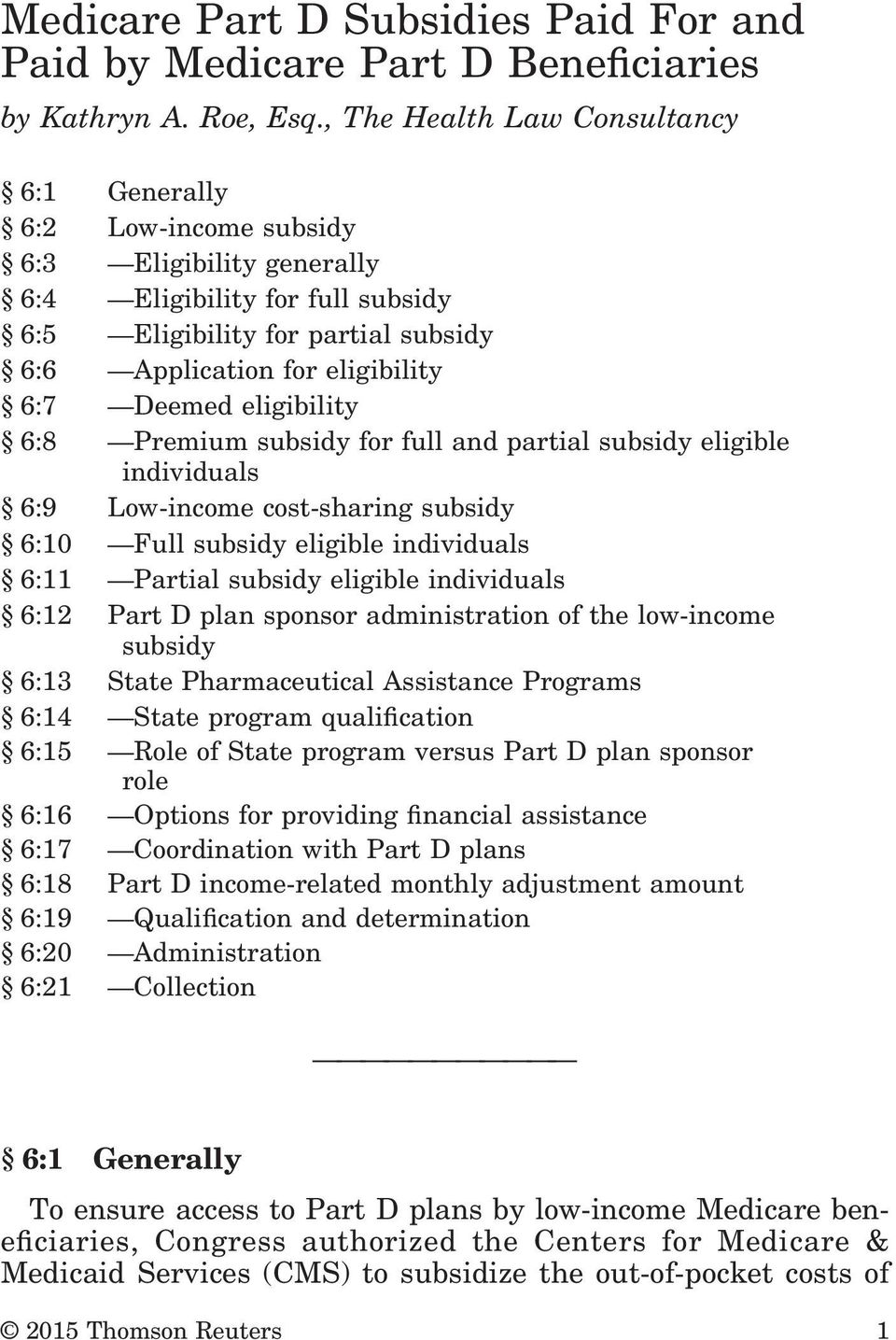
5 Medicare Part D Subsidies Paid For and Paid by Medicare Part D Bene ciaries by Kathryn A. Roe, Esq., The Health Law Consultancy 6:1 Generally 6:2 Low-income subsidy 6:3 Eligibility generally 6:4 Eligibility for full subsidy 6:5 Eligibility for partial subsidy 6:6 Application for eligibility 6:7 Deemed eligibility 6:8 Premium subsidy for full and partial subsidy eligible individuals 6:9 Low-income cost-sharing subsidy 6:10 Full subsidy eligible individuals 6:11 Partial subsidy eligible individuals 6:12 Part D plan sponsor administration of the low-income subsidy 6:13 State Pharmaceutical Assistance Programs 6:14 State program quali cation 6:15 Role of State program versus Part D plan sponsor role 6:16 Options for providing nancial assistance 6:17 Coordination with Part D plans 6:18 Part D income-related monthly adjustment amount 6:19 Quali cation and determination 6:20 Administration 6:21 Collection 6:1 Generally To ensure access to Part D plans by low-income Medicare bene ciaries, Congress authorized the Centers for Medicare & Medicaid Services (CMS) to subsidize the out-of-pocket costs of 2015 Thomson Reuters 1
6 6:1 By Kathryn A. Roe, Esq. purchasing and maintaining a Part D plan for Part D eligible individuals meeting speci ed nancial criteria. 1 Those federal subsidies may not o set all out-of-pocket cost that Part D eligibles incur to purchase and maintain a Part D plan. Low-income Part D eligibles may turn to other third parties for premium and cost-sharing assistance. Among those third parties are State Pharmaceutical Assistance Programs (SPAPs). Congress speci cally preserved a role for SPAPs in assisting lowincome Part D eligibles. 2 Congress returned to the matter of premiums for Medicare Part D in the Patient Protection and A ordable Care Act (PPACA) in This time Congress directed an increase in the Part D premium obligation of Part D eligibles whose annual income exceeds an established threshold. 4 That premium increase e ectively reduces the monthly per enrollee direct subsidy that CMS pays Part D plan sponsors for providing Part D coverage for those high income individuals. 6:2 Low-income subsidy The low-income subsidy (LIS) available to qualifying Part D eligibles is comprised of two components. One component is a low-income premium subsidy to assist Part D eligibles in paying the monthly premium due under the Part D plans in which they enroll. 1 The other is a low-income cost-sharing subsidy to assist Part D eligibles in paying deductible, coinsurance, or co-payment obligations under the Part D plans in which they enroll. 2 CMS pays the low-income premium and cost-sharing subsidies on behalf of Part D eligibles qualifying for LIS to the sponsors of the Part D plans that enroll them. 3 CMS makes payments for the low-income premium subsidy for qualifying Part D eligibles as an adjustment to the monthly per enrollee direct subsidy CMS pays 1 42 U.S.C.A. 1395w-114(c)(1). 2 Medicare Prescription Drug, Improvement, and Modernization Act (MMA), Pub. L. No , Title I, 101(a)(2); 42 U.S.C.A. 1395w Pub. L. No Patient Protection and A ordable Care Act, Pub. L. No , 3308(b)(1)(C); 42 U.S.C.A. 1395w-113(a)(1)(F). 1 Centers for Medicare & Medicaid Services, Medicare Prescription Drug Bene t Manual, CMS Pub , Ch. 13, Centers for Medicare & Medicaid Services, Medicare Prescription Drug Bene t Manual, CMS Pub , Ch. 13, U.S.C.A. 1395w-114(c)(1); 42 C.F.R (d). 2

7 Medicare Part D Subsidies 6:3 Part D plan sponsors for providing Part D coverage. 4 CMS makes payments for the low-income cost-sharing subsidy on an interim prospective basis during the coverage year for qualifying Part D eligibles to Part D plan sponsors pursuant to a CMS-established methodology. 5 After the end of each coverage year, CMS reconciles the low-income premium and cost-sharing subsidy payments CMS made to a sponsor for the coverage year against the actual lowincome premium and cost-sharing subsidy costs incurred by the sponsor. 6 6:3 Low-income subsidy Eligibility generally Individuals are eligible for LIS if they: (a) reside in any State (including the District of Columbia), 1 (b) are a Part D eligible enrolled in a Part D plan (Part D enrollee), 2 and (c) meet applicable income and resources requirements tied to the income and resource provisions for the Supplemental Security Income (SSI) program of Title XVI of the Social Security Act. 3 LIS-eligible individuals are separated into full subsidy and partial subsidy categories based on the income and resources requirements they satisfy. The same standards for income and resources apply to the income and resources requirements for determining full or partial subsidy eligibility. Income generally means income for purposes of determining SSI eligibility. 4 It includes value received in cash 4 42 U.S.C.A. 1395w-114(c)(1)(B) and (C); 42 C.F.R (a)(1) and (b) U.S.C.A. 1395w-114(c)(1)(B), (C) and (2); 42 C.F.R (d), (a)(3) and (d)(2)(i) U.S.C.A. 1395w-114(c)(1)(B) and (2); 42 C.F.R (f), (d)(2)(ii), and (b) and (d)(2). 1 Part D eligibles residing in a U.S. Territory may not be eligible for LIS unless the U.S. Territory applies for and is approved by CMS to receive grant monies to fund the provision of covered Part D drugs to their low-income Part D eligible residents. 42 U.S.C.A. 1395w-114(a)(3)(F); 42 C.F.R Part D eligibles must enroll in a Part D plan to receive the premium and cost-sharing subsidies for which they are eligible. Centers for Medicare & Medicaid Services, Medicare Prescription Drug Bene t Manual, CMS Pub , Ch. 13, U.S.C.A. 1395w-114(a)(3)(A); 42 C.F.R (a) U.S.C.A. 1395w-114(a)(3)(C)(i); 42 C.F.R ( income ); see 42 U.S.C.A. 1382a Thomson Reuters 3

8 6:3 By Kathryn A. Roe, Esq. or in kind and used to meet needs for food and shelter, but income does not include in kind support and maintenance. 5 Resources generally include liquid assets convertible to cash within 20 days and not excluded for purposes of determining SSI eligibility. 6 Resources also include real estate other than a primary residence or property on which a primary residence is located. 7 Resources do not include the value of a life insurance policy. 8 In determining full or partial subsidy eligibility, both income and resources take into account the countable income and countable resources of a LIS-eligible individual and any married spouse who lives in the same household with the LIS-eligible individual. 9 6:4 Low-income subsidy Eligibility for full subsidy A LIS-eligible individual is eligible for a full subsidy if the individual applies to and is determined by the Social Security Administration (SSA) or a State Medicaid agency, or if the individual is deemed by CMS to satisfy the income and resources requirements for full subsidy eligibility. To be determined a full subsidy eligible individual by SSA or a State Medicaid agency, a LIS-eligible individual must have: E countable income below 135% of the Federal Poverty Level (FPL), applicable to the State and family size (Full Subsidy Income Limit); 1 and E countable resources below or equal to three times the maximum amount of resources permitted for SSI eligibility, 5 42 U.S.C.A. 1395w-114(a)(3)(C)(i); 42 C.F.R ( income ); Centers for Medicare & Medicaid Services, Medicare Prescription Drug Bene t Manual, CMS Pub , Ch. 13, 20 ( income ) U.S.C.A. 1395w-114(a)(3)(D) and (E)(i); 42 C.F.R ( resources ); see 70 Fed. Reg. 4194, 4373 to 4374 (Jan. 28, 2005) (explaining CMS's election to narrow the scope of permitted resources for determining LIS eligibility relative to the scope of permitted resources for determining SSI eligibility, which is the resource standard that Congress speci ed in the MMA) U.S.C.A. 1395w-114(a)(3)(D) and (E)(i); 42 C.F.R ( resources ) U.S.C.A. 1395w-114(a)(3)(G)); 42 C.F.R ( resources ) C.F.R ( income, resources ) U.S.C.A. 1395w-114(a)(1); 42 C.F.R (b)(1). 4

9 Medicare Part D Subsidies 6:5 as applicable to a single individual or married couple (Full Subsidy Resource Limit). 2 The income and resources thresholds for full subsidy eligibility are updated annually. 3 A LIS-eligible individual is deemed by CMS to satisfy the income and resources requirements for full subsidy eligibility, and thereby be a full subsidy eligible individual, if the individual is: E a dual eligible individual entitled to full Medicaid bene ts under a State's Medicaid plan as speci ed at 42 C.F.R (full bene t dual eligible); 4 or E a recipient of SSI bene ts; 5 or E a dual eligible individual entitled to less than full Medicaid bene ts under a State's Medicaid plan (partial bene t dual eligible) as either a Quali ed Medicare Bene ciary (QMB), Speci ed Low-Income Medicare Bene ciary (SLMB), or Qualifying Individual (QI). 6 The less than full Medicaid bene ts to which QMBs are entitled is payment of their Medicare Part A and Part B premiums and cost sharing; the less than full Medicaid bene ts to which SLMBs and QIs are entitled is payment of their Medicare Part B premiums. 7 6:5 Low-income subsidy Eligibility for partial subsidy A LIS-eligible individual is eligible for a partial subsidy if the individual applies to and is determined by SSA or a State Medicaid agency to satisfy the income and resources requirements for partial subsidy eligibility U.S.C.A. 1395w-114(a)(1) and (3)(D)(i); 42 C.F.R (b)(2)(i). 3 For purposes of determining a LIS-eligible individual's income level for full subsidy eligibility, the U.S. Department of Health and Human Services (DHHS) updates FPL annually. 42 C.F.R ( Federal Poverty Line ); Centers for Medicare & Medicaid Services, Medicare Prescription Drug Bene t Manual, CMS Pub , Ch. 13, For purposes of determining a LISeligible individual's resource level for full subsidy eligibility, CMS updates the resources thresholds for each successive coverage year by applying the annual percentage increase in the Consumer Price Index (all items, U.S. city average) as of September of the current coverage year to the resources thresholds for the current coverage year, rounded to the nearest multiple of $ U.S.C.A. 1395w-114(a)(3)(D)(ii); 42 C.F.R (b)(2)(ii) U.S.C.A. 1395w-114(a)(3)(B)(v)(I); 42 C.F.R (c)(i) U.S.C.A. 1395w-114(a)(3)(B)(v)(I); 42 C.F.R (c)(ii) U.S.C.A. 1395w-114(a)(3)(B)(v)(II); 42 C.F.R (c)(iii). 7 See 42 U.S.C.A. 1396a(a)(10)(E)(i), (iii), and (iv) Thomson Reuters 5
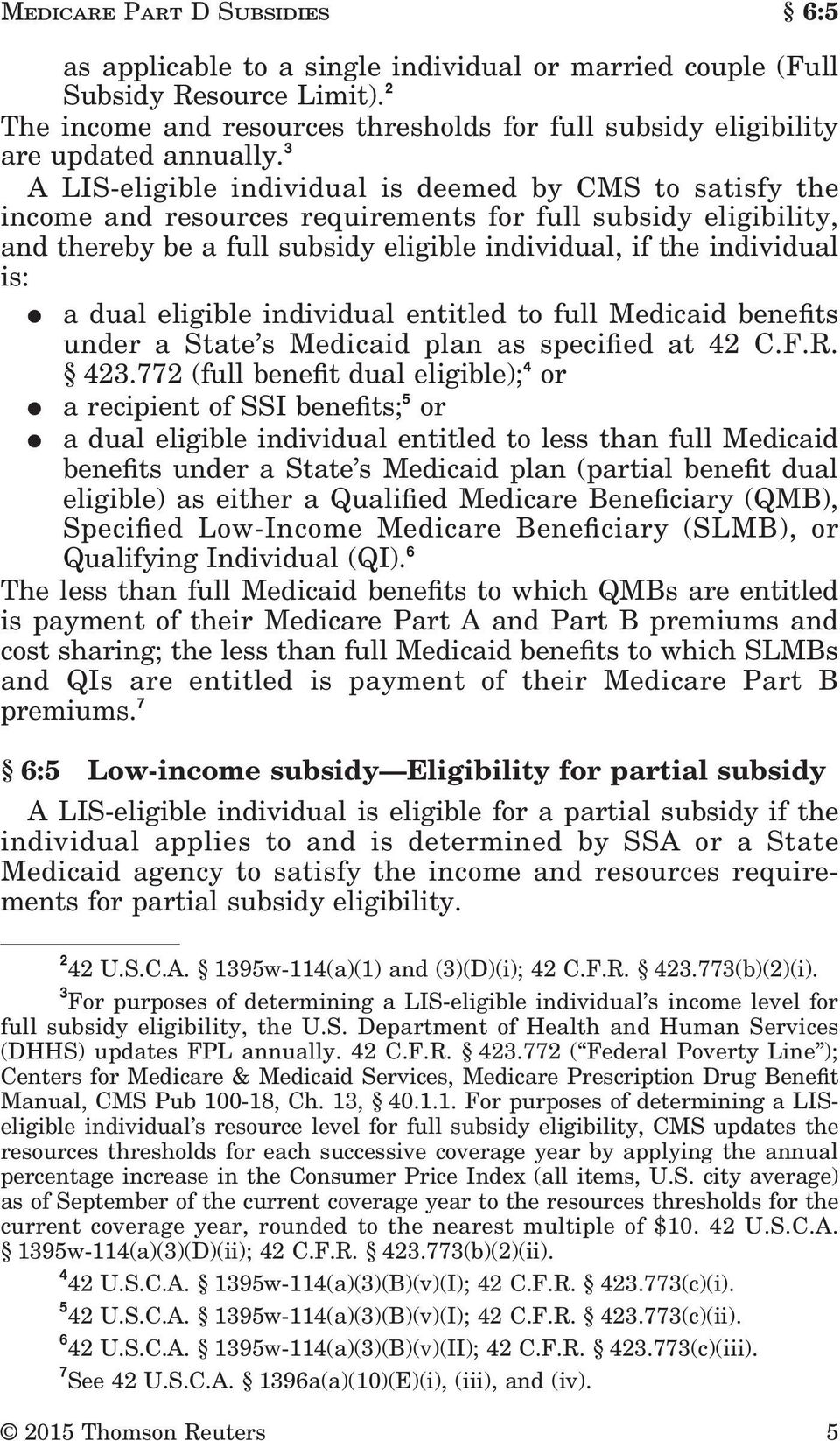
10 6:5 By Kathryn A. Roe, Esq. To be determined a partial subsidy eligible individual by SSA or a State Medicaid agency, a LIS-eligible individual must have: E countable income below 150% of the FPL, applicable to the State and family size (Partial Subsidy Income Limit); 1 and E countable resources below or equal to a statutorily prescribed dollar amount, as applicable to a single individual or married couple (Partial Subsidy Resource Limit). 2 Both the income and resources thresholds for partial subsidy eligibility are higher than the income and resources thresholds for full subsidy eligibility. The income and resources thresholds for partial subsidy eligibility are updated annually, just like the income and resources thresholds for full subsidy eligibility. 3 6:6 Low-income subsidy Application for eligibility An individual may apply to SSA or the State Medicaid agency where the individual resides for a determination of LIS eligibility for full or partial subsidy. 1 SSA and State Medicaid agencies are responsible for notifying CMS of the applicants for LIS eligibility that they determine to be LIS-eligible and of subsequent changes to and terminations of those LIS eligibility determinations. 2 SSA generally makes LIS eligibility determinations based upon information furnished by applicants in the SSA subsidy application and obtained via automated data matches with other federal agency records and pursuant to SSA regulations. 3 Those SSA regulations explain how SSA applies the SSI statutory provisions for income and resources that SSA administers for the SSI 1 42 U.S.C.A. 1395w-114(a)(2); 42 C.F.R (d)(1) U.S.C.A. 1395w-114(a)(3)(E)(i)(I); 42 C.F.R (d)(2)(i). 3 For purposes of determining a LIS-eligible individual's income level for partial subsidy eligibility, DHHS updates FPL annually. 42 C.F.R ( Federal Poverty Line ); Centers for Medicare & Medicaid Services, Medicare Prescription Drug Bene t Manual, CMS Pub , Ch. 13, For purposes of determining a LIS-eligible individual's resource level for partial subsidy eligibility, CMS updates the resources thresholds for each successive coverage year by applying the annual percentage increase in the Consumer Price Index (all items, U.S. city average) as of September of the current coverage year to the resources thresholds for the current coverage year, rounded to the nearest multiple of $ U.S.C.A. 1395w-114(a)(3)(E)(i)(II); 42 C.F.R (d)(2)(ii) U.S.C.A. 1395w-114(a)(3)(B)(i); 42 C.F.R (a) C.F.R (b); Centers for Medicare & Medicaid Services, Medicare Prescription Drug Bene t Manual, CMS Pub , Ch. 13, See 42 C.F.R (a); Centers for Medicare & Medicaid Services, Medicare Prescription Drug Bene t Manual, CMS Pub , Ch. 13,

11 Medicare Part D Subsidies 6:6 program to determine LIS eligibility, in accordance with the MMA and CMS's implementing regulations, and what process SSA follows for making LIS eligibility determinations. 4 A State Medicaid agency may o er applicants for LIS eligibility determinations the opportunity to complete the SSA subsidy application and obtain an SSA determination of LIS eligibility. 5 CMS strongly encourages applicant use of the SSA subsidy application. 6 If an applicant accepts and completes the SSA subsidy application, the State Medicaid agency must forward the completed application to SSA for processing and making of the LIS eligibility determination. 7 If the applicant declines and wants a State determination of LIS eligibility, the State Medicaid agency must have and use its own subsidy application and process for making a LIS eligibility determination in accordance with the MMA and CMS's implementing regulations. 8 A State Medicaid agency must screen each applicant contacting it about LIS eligibility for QMB, SLMB and QI eligibility under the State's Medicaid plan, without regard for whether the applicant seeks an SSA or State determination of LIS eligibility. 9 If the applicant is determined eligible for QMB, SLMB, or QI, the State Medicaid agency must o er the applicant enrollment in the 4 See 20 C.F.R. Part 418, Subpart D. 5 Centers for Medicare & Medicaid Services, Guidance to States on the Low-Income Subsidy, (Feb. 2009), available at care/eligibility-and-enrollment/lowincsubmedicareprescov/downloads/stateli SGuidance pdf. 6 Centers for Medicare & Medicaid Services, Guidance to States on the Low-Income Subsidy, (Feb. 2009), available at care/eligibility-and-enrollment/lowincsubmedicareprescov/downloads/stateli SGuidance pdf; 70 Fed. Reg. 4194, at 4381 ( We encourage States to consider using the SSA application form and process as their default process for processing low-income subsidy applications. ) 7 Centers for Medicare & Medicaid Services, Guidance to States on the Low-Income Subsidy, (Feb. 2009), available at care/eligibility-and-enrollment/lowincsubmedicareprescov/downloads/stateli SGuidance pdf; 70 Fed. Reg. 4194, at C.F.R (a) and (d); Centers for Medicare & Medicaid Services, Guidance to States on the Low-Income Subsidy, (Feb. 2009), available at PresCov/Downloads/StateLISGuidance pdf; 70 Fed. Reg. 4194, at C.F.R (c)(1); Centers for Medicare & Medicaid Services, Guidance to States on the Low-Income Subsidy, 20.1 (Feb. 2009), available at escov/downloads/statelisguidance pdf Thomson Reuters 7
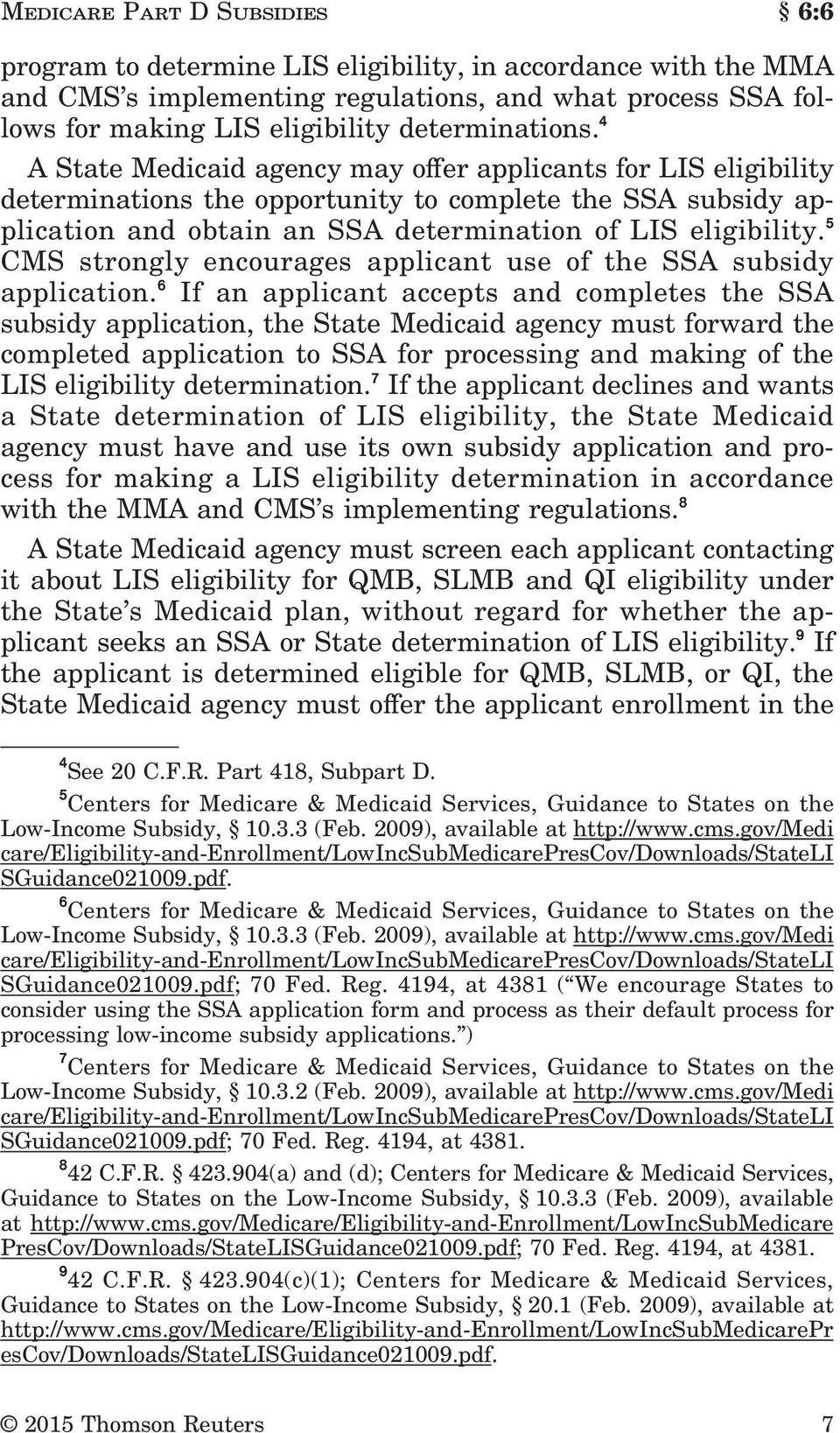
12 6:6 By Kathryn A. Roe, Esq. applicable program. 10 An applicant's acceptance of enrollment will generally result in deemed LIS eligibility for the applicant, without need for further LIS eligibility determination. 11 An applicant's refusal of QMB, SLMB, or QI enrollment will necessitate a State Medicaid agency's continued processing of the application for a LIS eligibility determination if the applicant has sought a State determination. 12 The e ective date of an individual's initial LIS eligibility determination is generally the rst day of the month in which the individual applies for the LIS eligibility determination. 13 LIS eligibility, therefore, takes e ect retroactively for individuals who are eligible for Medicare at the time they apply for a LIS eligibility determination. 14 For individuals who are not yet eligible for Medicare at the time they apply for a LIS eligibility determination, LIS eligibility takes e ect as of the rst day of the month in which their Medicare eligibility begins. 15 In no case may an initial LIS eligibility determination for an individual take e ect before the individual's Medicare eligibility begins, and in no case may LIS be paid for a LIS-eligible individual before the individual's Part D plan enrollment begins. 16 Initial LIS eligibility determinations made by SSA and State C.F.R (c)(2); Centers for Medicare & Medicaid Services, Guidance to States on the Low-Income Subsidy, 20.1 and (Feb. 2009), available at bmedicareprescov/downloads/statelisguidance pdf. 11 Centers for Medicare & Medicaid Services, Guidance to States on the Low-Income Subsidy, 20.1 (Feb. 2009), available at are/eligibility-and-enrollment/lowincsubmedicareprescov/downloads/stateli SGuidance pdf. For applicants determined eligible for SLMB or QI, a State Medicaid agency may close their pending applications for LIS eligibility determinations. For applicants determined eligible for QMB, the State Medicaid agency may not close their pending applications for LIS eligibility determinations in order to enable LIS eligibility determinations for months prior to their QMB eligibility. 12 Centers for Medicare & Medicaid Services, Guidance to States on the Low-Income Subsidy, (Feb. 2009), available at care/eligibility-and-enrollment/lowincsubmedicareprescov/downloads/stateli SGuidance pdf U.S.C.A. 1395w-114(a)(3)(B)(ii); 45 C.F.R (b); Centers for Medicare & Medicaid Services, Medicare Prescription Drug Bene t Manual, CMS Pub , Ch. 13, Centers for Medicare & Medicaid Services, Medicare Prescription Drug Bene t Manual, CMS Pub , Ch. 13, Centers for Medicare & Medicaid Services, Medicare Prescription Drug Bene t Manual, CMS Pub , Ch. 13, See Centers for Medicare & Medicaid Services, Medicare Prescription 8

13 Medicare Part D Subsidies 6:6 Medicaid agencies remain in e ect no more than 12 months. 17 The agency that makes an applicant's initial LIS eligibility determination SSA or a State Medicaid agency is responsible for all subsequent activity related to the determination. 18 That subsequent activity includes redeterminations and appeals of LIS eligibility, LIS level (i.e., full or partial) and LIS termination, and notice delivery to LIS-eligible individuals. 19 SSA conducts redeterminations and appeals for which SSA is responsible in the manner and frequency prescribed by SSA regulations for LIS eligibility determinations. 20 Each State Medicaid agency conducts redeterminations and appeals for which the agency is responsible in the manner and frequency prescribed by the State's Medicaid plan for redeterminations and appeals of Medicaid eligibility. 21 An exception to the standard e ective period for a determination or redetermination of LIS eligibility applies for a LIS-eligible individual whose spouse dies during an e ective period. In that case, the surviving LIS-eligible individual's then-current e ective period is extended 12 months after the date on which the thencurrent e ective period would have otherwise ended. 22 This extension applies regardless whether SSA or a State Medicaid agency made the surviving LIS-eligible individual's determination or redetermination. 23 Drug Bene t Manual, CMS Pub , Ch. 13, U.S.C.A. 1395w-114(a)(3)(B)(ii); 42 C.F.R (b); Centers for Medicare & Medicaid Services, Medicare Prescription Drug Bene t Manual, CMS Pub , Ch. 13, Centers for Medicare & Medicaid Services, Medicare Prescription Drug Bene t Manual, CMS Pub , Ch. 13, 40.1; 70 Fed. Reg. 4194, at Centers for Medicare & Medicaid Services, Medicare Prescription Drug Bene t Manual, CMS Pub , Ch. 13, 40.1, , and U.S.C.A. 1395w-114(a)(3)(B)(iv); 42 C.F.R (c)(2); 70 Fed. Reg. 4194, at 4381; see 20 C.F.R. Part 418, Subpart D U.S.C.A. 1395w-114(a)(3)(B)(iii); 42 C.F.R (c)(1) and (a); 70 Fed. Reg. 4194, at 4381; see Centers for Medicare & Medicaid Services, Guidance to States on the Low-Income Subsidy, 70 and (Feb. 2009), available at IncSubMedicarePresCov/Downloads/StateLISGuidance pdf U.S.C.A. 1395w-114(a)(3)(B)(vi); Centers for Medicare & Medicaid Services, Medicare Prescription Drug Bene t Manual, CMS Pub , Ch. 13, U.S.C.A. 1395w-114(a)(3)(B)(vi); Centers for Medicare & Medicaid Services, Medicare Prescription Drug Bene t Manual, CMS Pub , Ch. 13, Thomson Reuters 9

14 6:7 By Kathryn A. Roe, Esq. 6:7 Low-income subsidy Deemed eligibility CMS deems individuals who are full bene t dual eligible, SSI recipients, QMBs, SLMBs, or QIs to be automatically LIS eligible; these individuals need not apply to SSA or their State Medicaid agency for a LIS eligibility determination. 1 CMS uses data it regularly receives from SSA reporting of SSI recipients and from State Medicaid agencies reporting of full bene t dual eligibles and partial bene t dual eligibles, including QMBs, SLMBs, and QIs, to award automatic LIS eligibility. 2 Should an individual be reported to CMS by SSA or a State Medicaid agency as a full bene t dual eligible, SSI recipient or partial bene t dual eligible after the individual has been determined LIS eligible by application, CMS will establish deemed LIS eligibility and the applicable agency will terminate determined LIS eligibility for the individual. 3 CMS is responsible for notifying full bene t dual eligibles, SSI recipients and partial bene t dual eligibles of their deemed LIS eligibility and resultant quali cation for a full subsidy. 4 The e ective date of an individual's deemed LIS eligibility is the rst day of the month that the individual attains the status of full bene t dual eligible, SSI recipient or partial bene t dual eligible. 5 Deemed LIS eligibility, therefore, takes e ect retroactively for individuals who are eligible for Medicare at the time they apply for full Medicaid bene ts, SSI bene ts, or partial Medicaid bene ts and are determined retroactively eligible for the Medicaid or SSI bene ts for which they applied 6 For individuals who are not yet eligible for Medicare at the time they apply for full Medicaid bene ts, SSI bene ts, or partial Medicaid bene ts, deemed LIS eligibility takes e ect as of the rst day of the month in which their Medicare eligibility begins, so long as 1 42 U.S.C.A. 1395w-114(a)(3)(B)(v); 42 C.F.R (c)(1). 2 Centers for Medicare & Medicaid Services, Medicare Prescription Drug Bene t Manual, CMS Pub , Ch. 13, Centers for Medicare & Medicaid Services, Medicare Prescription Drug Bene t Manual, CMS Pub , Ch. 13, Centers for Medicare & Medicaid Services, Medicare Prescription Drug Bene t Manual, CMS Pub , Ch. 13, Centers for Medicare & Medicaid Services, Medicare Prescription Drug Bene t Manual, CMS Pub , Ch. 13, Centers for Medicare & Medicaid Services, Medicare Prescription Drug Bene t Manual, CMS Pub , Ch. 13,

15 Medicare Part D Subsidies 6:7 CMS has timely received report from SSA or the State Medicaid agency of their Medicaid or SSA bene ts eligibility. 7 Initial deemed LIS eligibility continues from the e ective date through the end of the then-current calendar year, unless the effective date of an individual's deemed LIS eligibility is the rst of any month from July through December of the then-current calendar year. 8 In that case, initial deemed LIS eligibility continues from the e ective date through the end of the following calendar year. 9 The e ective period of an individual's deemed LIS eligibility does not end prematurely if during the e ective period the individual is no longer reported to CMS by the applicable agency as a full bene t dual eligible, SSI recipient or partial bene t dual eligible. 10 The LIS level of a deemed LIS-eligible individual may be changed midyear by CMS following initial deeming but only to increase the cost-sharing subsidy if CMS receives information from SSA or a State Medicaid agency supporting such change. 11 CMS conducts a re-deeming process in July through December of each calendar year to redetermine whether individuals with deemed LIS eligibility for the then-current calendar year continue to qualify for deemed LIS eligibility for the following calendar year. 12 Those individuals with deemed LIS eligibility for the thencurrent calendar year who are reported to CMS by SSA or a State Medicaid agency to be a full bene t dual eligible, SSI recipient or a partial bene t dual eligible for any month of July through December of the then-current calendar year will continue to be deemed LIS eligible by CMS for the following calendar year. 13 CMS is responsible for notifying individuals who do not continue to qualify for deemed LIS eligibility status for the following 7 Centers for Medicare & Medicaid Services, Medicare Prescription Drug Bene t Manual, CMS Pub , Ch. 13, Centers for Medicare & Medicaid Services, Medicare Prescription Drug Bene t Manual, CMS Pub , Ch. 13, Centers for Medicare & Medicaid Services, Medicare Prescription Drug Bene t Manual, CMS Pub , Ch. 13, Centers for Medicare & Medicaid Services, Medicare Prescription Drug Bene t Manual, CMS Pub , Ch. 13, Centers for Medicare & Medicaid Services, Medicare Prescription Drug Bene t Manual, CMS Pub , Ch. 13, Centers for Medicare & Medicaid Services, Medicare Prescription Drug Bene t Manual, CMS Pub , Ch. 13, Centers for Medicare & Medicaid Services, Medicare Prescription Drug Bene t Manual, CMS Pub , Ch. 13, Thomson Reuters 11

16 6:7 By Kathryn A. Roe, Esq. calendar year or who continue to so qualify but at a di erent LIS level for cost sharing. 14 6:8 Low-income subsidy Premium subsidy for full and partial subsidy eligible individuals LIS-eligible individuals whether determined or deemed LIS eligible are entitled to a premium subsidy based on income (without regard to resources). That subsidy reduces the monthly premium charged for basic prescription drug coverage 1 by the sponsor of their Part D plan. 2 The value of the low-income premium subsidy varies depending upon the LIS level for which the LIS-eligible individual quali es. 3 CMS prescribes the premium subsidy amount used to calculate a LIS-eligible individual's premium subsidy. The premium subsidy amount takes into account the monthly premium for basic prescription drug coverage, not just for the individual's selected Part D plan, but for all Part D plans in the PDP region in which a LIS-eligible individual resides. The premium subsidy amount equals the monthly premium for basic prescription drug coverage for the Part D plan in which the LIS-eligible individual enrolls, unless the regional low-income premium subsidy amount for the PDP region in which the individual resides is less. 4 The premium subsidy amount is then the regional low-income premium subsidy amount for that PDP region Centers for Medicare & Medicaid Services, Medicare Prescription Drug Bene t Manual, CMS Pub , Ch. 13, Basic prescription drug coverage means coverage meeting the requirements for either de ned standard, actuarially equivalent standard, or basic alternative prescription drug coverage under Medicare Part D. 42 C.F.R ( alternative prescription drug coverage, basic prescription drug coverage, standard prescription drug coverage ); see 42 C.F.R (d) and (e) (specifying the respective requirements for standard prescription drug coverage and basic alternative prescription drug coverage) U.S.C.A. 1395w-114(a)(1)(A) and (2)(A); 42 C.F.R (e); Centers for Medicare & Medicaid Services, Medicare Prescription Drug Bene t Manual, CMS Pub , Ch. 13, U.S.C.A. 1395w-114(a)(1)(A) and (2)(A); Centers for Medicare & Medicaid Services, Medicare Prescription Drug Bene t Manual, CMS Pub , Ch. 13, See 42 U.S.C.A. 1395w-114(a)(1)(A); 42 C.F.R (b)(1); Centers for Medicare & Medicaid Services, Medicare Prescription Drug Bene t Manual, CMS Pub , Ch. 13, See 42 U.S.C.A. 1395w-114(a)(1)(A); 42 C.F.R (b)(1); Centers for Medicare & Medicaid Services, Medicare Prescription Drug Bene t Manual, 12

17 Medicare Part D Subsidies 6:8 The regional low-income premium subsidy amount for a PDP region equals the greater of: E the low-income benchmark premium amount for basic prescription drug coverage for all Part D plans available in the PDP region in which a LIS-eligible individual resides; 6 or E the lowest monthly premium for a PDP plan providing basic prescription drug coverage in the PDP region in which the individual resides. 7 CMS annually calculates and publishes the regional low-income premium subsidy amount for each PDP region following Part D plan sponsors' submission of their bids for the upcoming coverage year. 8 Full subsidy eligibility entitles a LIS-eligible individual to a premium subsidy equal to 100% of the premium subsidy amount for the PDP region in which the individual resides. 9 Partial subsidy eligibility entitles a LIS-eligible individual to a premium subsidy that ranges from a high of 100% to a low of 25% of the applicable premium subsidy amount, based on the following sliding income scale: 10 Countable Income 11 Up to 135% FPL for applicable calendar year, State and family size Above 135% up to 140% FPL for applicable calendar year, State and family size Above 140% up to 145% FPL for applicable calendar year, State and family size Above 145% but below 150% FPL for applicable calendar year, State and family size Premium Subsidy 100% of premium subsidy amount 75% of premium subsidy amount 50% of premium subsidy amount 25% of premium subsidy amount CMS Pub , Ch. 13, A PDP region's low-income benchmark premium amount equals the weighted average of the monthly premium amounts attributable to basic prescription drug coverage for the PDP plans o ering basic prescription drug coverage, the PDP plans o ering enhanced alternative prescription drug coverage and the MA-PD plans o ering prescription drug coverage in the PDP region, calculated in accordance with 42 C.F.R (b)(2). 7 Centers for Medicare & Medicaid Services, Medicare Prescription Drug Bene t Manual, CMS Pub , Ch. 13, ; see 42 U.S.C.A. 1395w- 114(b)(1); 42 C.F.R (b)(1)(ii). 8 Centers for Medicare & Medicaid Services, Medicare Prescription Drug Bene t Manual, CMS Pub , Ch. 13, U.S.C.A. 1395w-114(a)(1)(A); 42 C.F.R (a) U.S.C.A. 1395w-114(a)(2)(A); 42 C.F.R (d). 11 See current calendar year income limits for low-income premium subsidy eligibility. POMS HI Thomson Reuters 13

18 6:8 By Kathryn A. Roe, Esq. Countable Income % FPL or above for applicable calendar year, State and family size Premium Subsidy 0% of premium subsidy amount In no case may a LIS-eligible individual be subject to an increase in the individual's monthly premium for Part D coverage by a Part D plan's addition of a late enrollment penalty. 12 In that way, the LIS-eligible individual avoids application of the late enrollment penalty even when otherwise appropriate, and CMS avoids application of premium subsidy dollars to premium charges unrelated to providing Part D coverage. This waiver of the late enrollment penalty continues from the e ective date of an individual's LIS eligibility until the individual is no longer continuously enrolled in a Part D plan, even if the individual subsequently loses LIS eligibility. 13 6:9 Low-income cost-sharing subsidy LIS-eligible individuals whether determined or deemed LIS eligible are entitled to a cost-sharing subsidy that reduces the deductible, coinsurance or co-payment amounts charged at the point-of-sale for covered prescription drug purchases under their Part D plan. 1 As with the premium subsidy, the value of the lowincome cost-sharing subsidy varies depending upon the LIS level for which the LIS-eligible individual quali es. 2 Both the full and partial cost-sharing subsidies are re ected in terms of maximum allowable deductible, coinsurance and costsharing amounts to be paid by LIS-eligible individuals for their covered prescription drug purchases under basic prescription drug coverage. If a LIS-eligible individual has certain basic prescription drug coverage such as actuarially equivalent standard or basic alternative prescription drug coverage with any cost sharing lower than the corresponding cost-sharing maximum prescribed for the full or partial cost-sharing subsidy for which the individual quali es, the lower cost sharing under the individual's Part D plan will apply without further reduction. 3 If a LISeligible individual, instead, has enhanced alternative prescription drug coverage, which combines basic prescription drug U.S.C.A. 1395w-113(b)(8); 42 C.F.R (e). 13 Centers for Medicare & Medicaid Services, Medicare Prescription Drug Bene t Manual, CMS Pub , Ch. 13, U.S.C.A. 1395w-114(a)(1)(B) to (E) and (2)(B) to (E) U.S.C.A. 1395w-114(a)(1)(B) to (E) and (2)(B) to (E) C.F.R (c); Centers for Medicare & Medicaid Services, Medicare Prescription Drug Bene t Manual, CMS Pub , Ch. 13,

19 Medicare Part D Subsidies 6:10 coverage with supplemental prescription drug bene ts that reduce covered prescription drug cost sharing, 4 a full or partial cost-sharing subsidy for which the individual quali es can apply to further reduce the cost sharing. 5 In other words, the costsharing subsidy may further reduce a LIS-eligible individual's out-of-pocket liability for a covered prescription drug, but only after the supplemental prescription drug bene ts have been applied to reduce that liability. 6 The maximum co-payment amounts applicable for the full and partial cost-sharing subsidies vary across prescription drug categories recognized by Congress and CMS for the low-income costsharing subsidy. 7 Those prescription drug categories are generic drugs, 8 multiple source preferred drugs, 9 and all other prescription drugs, including brand drugs and drugs that are not preferred drugs. The maximum co-payment amounts applicable for the full and partial cost-sharing subsidies do not, however, vary across prescription lls based on number of days' supply. Rather, the maximum co-payment amounts apply per prescription lled without regard to the number of days' supply. 10 6:10 Low-income cost-sharing subsidy Full subsidy eligible individuals Full subsidy eligibility entitles a LIS-eligible individual to a cost-sharing subsidy with the following general features based on basic prescription drug coverage under a Part D plan: E no annual deductible, 1 E reduced cost sharing in the form of small or no co-payments 4 42 C.F.R (f)(1). 5 Centers for Medicare & Medicaid Services, Medicare Prescription Drug Bene t Manual, CMS Pub , Ch. 13, Centers for Medicare & Medicaid Services, Medicare Prescription Drug Bene t Manual, CMS Pub , Ch. 13, See 42 U.S.C.A. 1395w-114(a)(1)(D) and (2)(D) to (E); 42 C.F.R (a)(2) and (b)(3) C.F.R ( generic drug ). 9 See 42 U.S.C.A. 1396r-8(k)(7)(A)(i) ( multiple source drug ); 42 C.F.R ( preferred drug ). 10 Centers for Medicare & Medicaid Services, Medicare Prescription Drug Bene t Manual, CMS Pub , Ch. 13, U.S.C.A. 1395w-114(a)(1)(B); 42 C.F.R (a)(1) Thomson Reuters 15
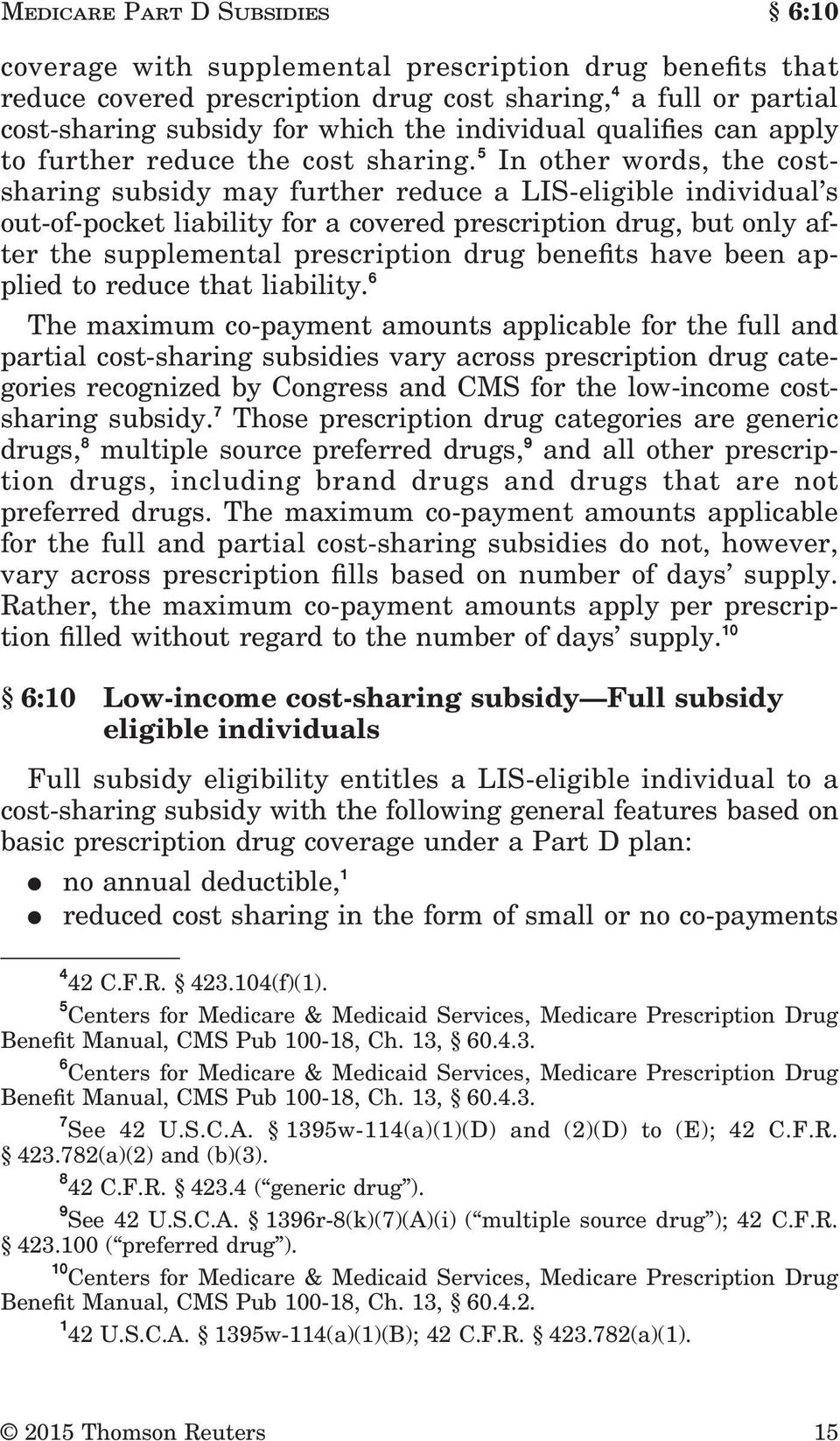
20 6:10 By Kathryn A. Roe, Esq. E for covered prescription drug purchases up to the annual out-of-pocket threshold, 2 and no cost sharing for covered prescription drug purchases above the annual out-of-pocket threshold. 3 Those features mean that full subsidy eligible individuals experience no coverage gap for covered prescription drug purchases above the initial coverage limit up to the annual out-of-pocket threshold. 4 For those covered prescription drug purchases subject to reduced cost sharing up to the annual out-of-pocket threshold, the maximum allowable co-payment amounts for covered prescription drugs vary across di erent categories of full subsidy eligible individuals. 5 CMS annually adjusts the maximum allowable co-payment amounts up to the annual out-of-pocket threshold by the annual percentage increase in the Consumer Price Index for those full subsidy eligible individuals who are noninstitutionalized full bene t dual eligibles with income up to 100% FPL. 6 For all other full subsidy eligible individual categories, CMS annually adjusts the maximum allowable co-payment amounts up to the annual out-of-pocket threshold by the annual percentage increase in average total expenditures for covered prescription drugs. 7 The table below sets forth the maximum allowable deductible, coinsurance and co-payment amounts speci c to each category of full subsidy eligible individual with respect to the low-income cost-sharing subsidy. The table re ects the maximum applicable co-payment amounts up to the annual out-of-pocket threshold for each of these categories for the 2015 coverage year U.S.C.A. 1395w-114(a)(1)(D); 42 C.F.R (a)(2) U.S.C.A. 1395w-114(a)(1)(E); 42 C.F.R (a)(3) U.S.C.A. 1395w-114(a)(1)(C); 42 C.F.R (a)(2). 5 See 42 U.S.C.A. 1395w-114(a)(1)(D); 42 C.F.R (a)(2) C.F.R (a)(2)(iii). 7 See 42 C.F.R (a)(2)(i) (cross-referencing 42 C.F.R (d)(5)(i)(A)(2)). 8 Centers for Medicare & Medicaid Services, Announcement of Calendar Year (CY) 2015 Medicare Advantage Capitation Rates and Medicare Advantage and Part D Payment Policies and Final Call Letter, Attachment V (Apr. 7, 2014), available at pecratestats/downloads/announcement2015.pdf; see past and current plan year maximum copayment amounts applicable up to the annual out-of-pocket threshold for each full subsidy eligible individual category recognized for purposes of LICS. POMS HI

21 Medicare Part D Subsidies 6:11 Full Subsidy Category for Cost Sharing Determined by application as having income less than the Full Subsidy Income Limit and resources less than or equal to the Full Subsidy Resource Limit Deemed SSI recipient or partial bene t dual eligible Deemed full bene t dual eligible with income above 100% FPL, applicable to State and family size, but not institutionalized individual 9 Deemed full bene t dual eligible with income up to 100% FPL, applicable to State and family size, but not institutionalized individual Deemed full bene t dual eligible who is institutionalized individual or individual receiving home and communitybased services 10 Maximum Annual Deductible Maximum Cost Sharingupto Annual Out-of- Pocket Threshold $0 $2.65/generic drug $2.65/preferred multiple source drug $6.60/drug other than generic or preferred multiple source drug $0 $2.55/generic drug $2.65/preferred multiple source drug $6.60/drug other than generic or preferred multiple source drug $0 $2.65/generic drug $2.65/preferred multiple source drug $6.60/drug other than generic or preferred multiple source drug $0 $1.20/generic drug $1.20/preferred multiple source drug $3.60/drug other than generic or preferred multiple source drug Maximum Cost Sharing above Annual Out-of-Pocket Threshold $0 $0 $0 $0 $0 $0 $0 6:11 Low-income cost-sharing subsidy Partial subsidy eligible individuals Partial subsidy eligibility entitles a LIS-eligible individual to a cost-sharing subsidy with the following features applicable to basic prescription drug coverage under a Part D plan: E reduced annual deductible for covered prescription drug purchases, 1 E reduced cost sharing in the form of lower coinsurance for 9 42 C.F.R ( institutionalized individual ) C.F.R ( individual receiving home and community-based services ) U.S.C.A. 1395w-114(a)(2)(B); 42 C.F.R (b)(1) Thomson Reuters 17
22 6:11 By Kathryn A. Roe, Esq. E covered prescription drug purchases above the annual deductible up to the annual out-of-pocket threshold, 2 and reduced cost sharing in the form of small co-payments for covered prescription drug purchases above the annual outof-pocket threshold. 3 As with full subsidy eligibility, partial subsidy eligibility results in no gap in coverage for covered prescription drug purchases above the initial coverage limit up to the annual out-of-pocket threshold. 4 For those covered prescription drug purchases subject to the annual deductible or the reduced cost sharing above the annual out-of-pocket threshold, CMS annually adjusts the maximum allowable deductible and co-payment amounts. 5 CMS adjusts both based upon the annual percentage increase in average total expenditures for covered prescription drugs. 6 The table below sets forth the maximum allowable deductible, coinsurance and co-payment amounts speci c to each category of partial subsidy eligible individual with respect to the low-income cost-sharing subsidy. 7 The table re ects the maximum applicable allowable co-payment amounts above the annual out-of-pocket threshold for each of those categories for the 2015 coverage year U.S.C.A. 1395w-114(a)(2)(D); 42 C.F.R (b)(2) U.S.C.A. 1395w-114(a)(2)(E); 42 C.F.R (b)(3) U.S.C.A. 1395w-114(a)(2)(C); 42 C.F.R (b)(2) U.S.C.A. 1395w-114(a)(2)(E); 42 C.F.R (b)(1), (3) C.F.R (b)(1) and (3). 7 Centers for Medicare & Medicaid Services, Announcement of Calendar Year (CY) 2015 Medicare Advantage Capitation Rates and Medicare Advantage and Part D Payment Policies and Final Call Letter, Attachment V (Apr. 7, 2014) available at ecratestats/downloads/announcement2015.pdf; see past and current plan year deductible amounts applicable for each partial subsidy eligible individual category recognized for purposes of LICS. POMS HI Centers for Medicare & Medicaid Services, Announcement of Calendar Year (CY) 2015 Medicare Advantage Capitation Rates and Medicare Advantage and Part D Payment Policies and Final Call Letter, Attachment V (Apr. 7, 2014) available at ecratestats/downloads/announcement2015.pdf; see current plan year maximum copayment amounts applicable above the annual out-of-pocket threshold for each partial subsidy eligible individual category recognized for purposes of LICS. POMS HI
23 Medicare Part D Subsidies 6:12 Partial Subsidy Category for Cost Sharing Determined by application as having income greater than the Full Subsidy Income Limit but less than Partial Subsidy Income Limit, and resources less than or equal to the Partial Subsidy Resource Limit Determined by application as having income less than the Full Subsidy Income Limit, and resources greater than the Full Subsidy Resource Limit but less than or equal to the Full Subsidy Resource Limit Maximum Annual Deductible Maximum Cost Sharing Above Deductible up to Annual Out-of- Pocket Threshold Maximum Cost Sharing above Annual Out-of-Pocket Threshold $66 15% coinsurance $2.65/generic drug $2.65/preferred multiple source drug $6.60/drug other than generic or preferred multiple source drug $66 15% coinsurance $2.65/generic drug $2.65/preferred multiple source drug $6.60/drug other than generic or preferred multiple source drug 6:12 Part D plan sponsor administration of the lowincome subsidy Notifying Enrollees about LIS Eligibility. Part D plan sponsors are responsible for notifying qualifying enrollees of their initial LIS eligibility, including their LIS e ective dates and levels. Part D plan sponsors are also responsible for e ecting reductions in those enrollees' premiums and cost sharing when and how indicated by their LIS e ective dates and levels. 1 Part D plan sponsors are likewise responsible for notifying enrollees of subsequent changes to their LIS level or terminations of their LIS eligibility, and for implementing those changes and terminations in the determination of those enrollees' premium and cost-sharing obligations. 2 CMS enables Part D plan sponsors to carry out these obligations by regularly reporting on 1 42 U.S.C.A. 1395w-114(c)(1)(B); 42 C.F.R (b); Centers for Medicare & Medicaid Services, Medicare Prescription Drug Bene t Manual, CMS Pub , Ch. 13, U.S.C.A. 1395w-114(c)(1)(B); 42 C.F.R (b); Centers for Medicare & Medicaid Services, Medicare Prescription Drug Bene t Manual, CMS Pub , Ch. 13, Thomson Reuters 19
24 6:12 By Kathryn A. Roe, Esq. LIS eligibility determinations, changes and terminations to Part D plan sponsors for their Part D enrollees. 3 Adhering to CMS's Best Available Evidence Policy for Cost- Sharing Subsidy. Part D plan sponsors must adhere to CMS's best available evidence (BAE) policy for establishing the correct LIS level for cost sharing at the point-of-sale for covered prescription drug purchases by LIS-eligible individuals. 4 The BAE policy requires Part D plan sponsors to: E accept from, or on behalf of, a LIS-eligible individual documentation or information speci ed by CMS, which evidences the individual's status as a noninstitutionalized, institutionalized, or home and community-based servicesreceiving full bene t dual eligible or a SSI recipient or partial bene t dual eligible, and the e ective date of that status, 5 E furnish access to covered prescription drugs at the point-ofsale at the cost sharing appropriate to the LIS-eligible individual's status established by the BAE documentation or information received, 6 E update Part D plan sponsor's systems to re ect the correct LIS level for cost sharing for the LIS-eligible individual based upon the BAE documentation or information received, 7 and E request an update of CMS's systems to the extent CMS's systems do not re ect the correct LIS level for cost sharing for the LIS-eligible individual based upon the BAE documentation or information received. 8 The BAE policy also requires Part D plan sponsors to respond 3 42 U.S.C.A. 1395w-114(c)(1)(A); 42 C.F.R (a); Centers for Medicare & Medicaid Services, Medicare Prescription Drug Bene t Manual, CMS Pub , Ch. 13, 70.1 and App. E C.F.R (d); Centers for Medicare & Medicaid Services, Medicare Prescription Drug Bene t Manual, CMS Pub , Ch. 13, C.F.R ( best available evidence ) and (d)(1); Centers for Medicare & Medicaid Services, Medicare Prescription Drug Bene t Manual, CMS Pub , Ch. 13, C.F.R (d)(2); Centers for Medicare & Medicaid Services, Medicare Prescription Drug Bene t Manual, CMS Pub , Ch. 13, C.F.R (d)(2); CMS, Centers for Medicare & Medicaid Services, Medicare Prescription Drug Bene t Manual, CMS Pub , Ch. 13, C.F.R (d)(2); Centers for Medicare & Medicaid Services, Medicare Prescription Drug Bene t Manual, CMS Pub , Ch. 13, and
25 Medicare Part D Subsidies 6:12 to requests by or on behalf of LIS-eligible individuals for assistance in obtaining CMS-speci ed documentation or information that evidences the individual's status as a noninstitutionalized, institutionalized or home and community-based services-receiving full bene t dual eligible or a SSI recipient or partial bene t dual eligible and the e ective date of that status. 9 Part D plan sponsors receiving such requests must notify LIS-eligible individuals, or their representatives or advocates, of the results of the sponsor's e ort to obtain such CMS-speci ed documentation or information. 10 If a sponsor obtains such BAE documentation or information from CMS or otherwise, the sponsor must furnish the LIS-eligible individual access to covered prescription drugs at the point-of-sale at the cost sharing appropriate to the individual's status established by the BAE documentation or information obtained, update the sponsor's systems to re ect the individual's correct LIS level for cost sharing, and request a similar update of CMS's systems. 11 Refunding and Recouping Incorrect Premium and Cost-Sharing Payments. When LIS eligibility determinations, changes or terminations have retroactive e ect, Part D plan sponsors must make reasonable e orts to determine premium or cost-sharing overpayments or underpayments made prior to enrollee notice of the determination, change, or termination. 12 For retroactively effective LIS eligibility determinations and LIS level changes increasing the subsidy, Part D plan sponsors must refund LISeligible enrollees (or SPAPs or other third parties paying premium or cost sharing on their behalf) 13 amounts paid in excess of the premium or cost sharing owed by the enrollee during the period between the e ective date and the notice date of the deter C.F.R (d)(2); Centers for Medicare & Medicaid Services, Medicare Prescription Drug Bene t Manual, CMS Pub , Ch. 13, C.F.R (d)(2); Centers for Medicare & Medicaid Services, Medicare Prescription Drug Bene t Manual, CMS Pub , Ch. 13, C.F.R (d)(2); Centers for Medicare & Medicaid Services, Medicare Prescription Drug Bene t Manual, CMS Pub , Ch. 13, Centers for Medicare & Medicaid Services, Medicare Prescription Drug Bene t Manual, CMS Pub , Ch. 13, Third parties paying cost sharing on behalf of LIS-eligible enrollees effectively include pharmacies owed cost-sharing amounts by a LIS-eligible enrollee for covered Part D drug purchases between the e ective date and the notice date of the enrollee's LIS eligibility determination or LIS level increase. In that case, the Part D plan sponsor may refund those pharmacies for overpaid cost sharing for covered Part D drug purchases during that period. Centers for Medicare & Medicaid Services, Medicare Prescription Drug Bene t Manual, CMS Pub , Ch. 13, Thomson Reuters 21
26 6:12 By Kathryn A. Roe, Esq. mination or change. 14 For retroactively e ective LIS eligibility terminations or LIS level changes decreasing the subsidy, Part D plans sponsors must recoup from LIS-eligible enrollees (or SPAPs or other third parties paying premium or cost sharing on their behalf) unpaid amounts of premium or cost sharing owed by the enrollee during the period between the e ective date and the notice date of the LIS eligibility termination or change. 15 Part D plan sponsors must comply with these refund and recoupment obligations for both current and former enrollees and within 45 days of receiving complete information about a retroactively e ective LIS eligibility determination, change or termination requiring premium or cost-sharing refund or recoupment. 16 For cost-sharing refunds and recoupments, Part D plan sponsors must modify their prescription drug event (PDE) reporting to CMS to account for the e ect of those refunds and recoupments on the allocation of party responsibility for cost sharing paid for each a ected covered prescription drug purchase. 17 Optional O ering of Grace Period After Loss of Deemed LIS Eligibility. Part D plan sponsors may o er up to a three-month grace period for payment of premiums and cost sharing due from enrollees following their loss of deemed LIS eligibility, so long as the sponsor o ers the same grace period to all enrollees previously deemed LIS eligible and able to demonstrate their application for LIS eligibility. 18 If an enrollee o ered a grace period fails to demonstrate LIS eligibility by the grace period's end, the sponsor must use reasonable e orts to recoup any unpaid amounts of premium or cost sharing owed by the enrollee in accordance with the requirements for recouping unpaid premium or cost sharing for retroactively e ective LIS eligibility terminations or LIS level changes decreasing the subsidy. 19 Tracking LIS Application to Enrollee Premiums and Cost C.F.R (c); Centers for Medicare & Medicaid Services, Medicare Prescription Drug Bene t Manual, CMS Pub , Ch. 13, Centers for Medicare & Medicaid Services, Medicare Prescription Drug Bene t Manual, CMS Pub , Ch. 13, C.F.R (e); Centers for Medicare & Medicaid Services, Medicare Prescription Drug Bene t Manual, CMS Pub , Ch. 13, 70.3 and Centers for Medicare & Medicaid Services, Medicare Prescription Drug Bene t Manual, CMS Pub , Ch. 13, Centers for Medicare & Medicaid Services, Medicare Prescription Drug Bene t Manual, CMS Pub , Ch. 13, Centers for Medicare & Medicaid Services, Medicare Prescription Drug 22
27 Medicare Part D Subsidies 6:13 Sharing. Part D plan sponsors must track the reductions they make to premiums and cost sharing for enrollees who are LISeligible that are funded by subsidies that CMS pays on behalf of LIS-eligible enrollees. That tracking supports the sponsor's required treatment of sponsor-incurred costs for LIS-eligible enrollee cost sharing for covered prescription drugs as enrolleeincurred costs i.e., true out-of-pocket (TrOOP) costs to be applied against the LIS-eligible enrollee's cost-sharing obligations up to the annual out-of-pocket threshold. 20 That tracking also supports the sponsor's required reporting of sponsor premium and cost-sharing costs to CMS to enable reconciliation of CMS's premium and cost-sharing subsidy payments to the sponsor against the amount of those subsidy payments that the sponsor uses to reduce LIS-eligible enrollees' premiums and point-of-sale cost sharing. 21 6:13 State Pharmaceutical Assistance Programs Programs operated by or on behalf of States providing assistance to low-income individuals to obtain and maintain prescription drug coverage long preceded the advent of Medicare Part D. Congress sought through the MMA to encourage continued operation of those State programs and to facilitate coordination between Part D plans and SPAPs on behalf of Part D eligibles qualifying for SPAP assistance. 1 Congress did so by granting an advantage to SPAPs not granted to most other third party providers of prescription drug bene ts for Part D eligibles. 2 The advantage is that SPAP-paid costs for a Part D enrollee's covered prescription drug purchases are treated as enrollee-incurred costs i.e., TrOOP costs to be applied against the enrollee's cost-sharing obligations up to the annual out-of-pocket threshold. 3 Bene t Manual, CMS Pub , Ch. 13, C.F.R ( incurred costs ) and (b); Centers for Medicare & Medicaid Services, Medicare Prescription Drug Bene t Manual, CMS Pub , Ch. 13, U.S.C.A. 1395w-114(c)(1)(B); 42 C.F.R (b). 1 See 42 U.S.C.A. 1395w The same advantage is also granted to charities that are not established, maintained, or otherwise controlled by an employer or union and certain federally authorized government programs. See 42 C.F.R ( incurred costs ); Centers for Medicare & Medicaid Services, Medicare Prescription Drug Bene t Manual, CMS Pub , Ch. 5, See 42 U.S.C.A. 1395w-102(b)(4)(C)(iii); see 42 C.F.R ( incurred costs ) Thomson Reuters 23
28 6:14 By Kathryn A. Roe, Esq. 6:14 State Pharmaceutical Assistance Programs State program quali cation To qualify as a SPAP for Medicare Part D, a State program must satisfy all of the following conditions: E provide nancial assistance for the purchase of prescription drug bene ts or the provision of supplemental prescription drug bene ts for Part D eligibles, E provide nancial assistance to Part D eligibles enrolled in all Part D plans within a Medicare Part D region without discriminating based upon the Part D plan in which a Part D eligible enrolls, E satisfy the applicable coordination of bene t requirements for Medicare Part D, E take no action to change or a ect the primary payer status of a Part D plan, 1 E provide nancial assistance based on nancial need, age, or health condition, but not on past or present employment, and E not engage in mid- or non-calendar year Part D plan enrollment changes on behalf of a substantial number of Part D eligibles receiving nancial assistance from the State program pursuant to their authorization. 2 A State program failing any of these conditions does not qualify as a SPAP for Medicare Part D and thus its payments toward Part D eligibles' covered drug purchases do not count as TrOOP costs. A State program would not qualify as a SPAP for Medicare Part D if, for example, it discriminates against Part D eligibles with respect to eligibility for program participation or amount of nancial assistance based on the Part D plan in which a Part D eligible enrolls. 3 Similarly, a State program would not qualify if it fails to give Part D eligibles equal access to enrollment in, or comparable information about, all available Part D plans. 4 A State program engaging in any such conduct would fail the SPAP condition prohibiting discrimination among available Part D 1 See 42 U.S.C.A. 1395w-133(c)(1); 42 C.F.R (b) U.S.C.A. 1395w-133(b); 42 C.F.R ( State pharmaceutical assistance program ) and (e)(1). 3 See 42 U.S.C.A. 1395w-133(b)(2); 42 C.F.R (e)(1)(ii). 4 Centers for Medicare & Medicaid Services, Medicare Prescription Drug Bene t Manual, CMS Pub , Ch. 14,
29 Medicare Part D Subsidies 6:15 plans 5 CMS construes MMA's SPAP provisions to prohibit SPAP preferencing of, or steering of Part D eligibles to, one Part D plan over another and to require SPAP o ering of equal assistance to qualifying Part D eligibles enrolling or enrolled in any available Part D plan. 6 A State program or component thereof that receives program funding from the federal government via grants, awards, contracts, entitlements, or otherwise may not qualify as a SPAP. 7 That SPAP exclusion reaches State Medicaid and Section 1115 demonstration programs. 8 CMS generally expects a State program qualifying as a SPAP to receive program funding from the State. 9 According to CMS, a State program that receives program funding from private sources, such as charities or independent foundations may qualify as a SPAP, so long as the State program does not receive program funding from disqualifying federal sources. 10 6:15 State Pharmaceutical Assistance Programs Role of State program versus Part D plan sponsor role No State program qualifying as a SPAP for Medicare Part D is required to provide nancial assistance, such as paying Part D plan premiums or supplementing Part D plan coverage, for Part D eligibles enrolled in a Part D plan. 1 Nor is a State program qualifying as a SPAP for Medicare Part D required to coordinate with a Part D plan. 2 That means SPAP quali cation does not create SPAP obligation for a State program absent election by the State program. In contrast, Part D plan sponsors must permit State programs qualifying as SPAPs for Medicare Part D to coordinate with spon- 5 See 42 U.S.C.A. 1395w-133(b)(2); 42 C.F.R (e)(1)(ii) Fed. Reg. 4194, at ; see Centers for Medicare & Medicaid Services, Medicare Prescription Drug Bene t Manual, CMS Pub , Ch. 14, C.F.R (e)(1)(iv); 70 Fed. Reg. 4194, at Note CMS distinguishes between federal programmatic funding and other funding and, thus, states that the exclusion of Federal program funding does not exclude some Federal administrative funding or incidental Federal monies. 70 Fed. Reg. 4194, at C.F.R (e)(1)(iv) Fed. Reg. 4194, at Fed. Reg. 4194, at U.S.C.A. 1395w-133(c)(5); 42 C.F.R (e)(3) U.S.C.A. 1395w-133(c)(5); 42 C.F.R (e)(3) Thomson Reuters 25
30 6:15 By Kathryn A. Roe, Esq. sors' Part D plans. 3 A Part D plan sponsor must comply with CMS processes and requirements for e ective coordination and information exchange between a Part D plan and a SPAP as applicable to: E SPAP payment of premiums for SPAP-eligible individuals enrolled in the Part D plan; E SPAP payment for supplemental prescription drug bene ts for SPAP-eligible individuals enrolled in the Part D plan; and E retroactive claims adjustments and resulting underpayment reimbursements or overpayment recoveries for covered drug purchases by SPAP-eligible individuals enrolled in the Part D plan. 4 6:16 State Pharmaceutical Assistance Programs Options for providing nancial assistance SPAPs may provide nancial assistance for the purchase of prescription drug bene ts or the provision of supplemental prescription drug bene ts for Part D eligibles by any or a combination of the following: E Paying premium on behalf of SPAP-eligible individuals for the basic and/or supplemental prescription drug bene ts provided by the Part D plans in which those individuals are enrolled, E Providing their own prescription drug bene ts that wrap around sponsors' Part D plans and are available at the pointof-sale to SPAP-eligible individuals enrolled in the plans, 1 or E Soliciting bids for and contracting with Part D plan sponsors on a risk or non-risk basis to pay a lump sum per capita amount for plan sponsor provision of prescription drug bene ts that wrap around sponsors' Part D plans for SPAPeligible individuals enrolled in the plans. 2 Supplemental prescription drug bene ts that wrap around a plan 3 42 U.S.C.A. 1395w-111(j); 42 C.F.R (a); see 42 U.S.C.A. 1395w-133(a)(1) U.S.C.A. 1395w-133(a)(1); 42 C.F.R (a). 1 SPAPs electing to provide their own prescription drug bene ts that wrap around Part D plans and are available at the point-of-sale to Part D eligibles enrolled in the plans may contract with a third party, including a Part D plan sponsor, to administer those bene ts for all qualifying Part D eligibles without regard to the Part D plan in which they are enrolled. Centers for Medicare & Medicaid Services, Medicare Prescription Drug Bene t Manual, CMS Pub , Ch. 14, App. E. 2 Centers for Medicare & Medicaid Services, Medicare Prescription Drug 26
31 Medicare Part D Subsidies 6:17 sponsor's Part D plan may include (1) coverage of prescription drugs speci cally excluded from CMS's de nition of a Part D drug, and/or (2) coverage of Part D drugs that results in a reduction of the annual deductible or other cost-sharing or an increase in the initial coverage Iimit under the Part D plan. 3 Congress speci cally directed in the MMA that CMS permit the lump sum per capita option for SPAP provision of supplemental prescription drug bene ts for Part D eligibles. 4 A SPAP electing the lump sum per capita option must solicit all Part D plan sponsors in a Part D region to submit lump sum per capita bids to provide prescription drug bene ts that supplement a Part D plan's basic prescription drug coverage. 5 The SPAP must work with all Part D plan sponsors that bid and all Part D plan sponsor that bid must contractually accept the lump sum per capita amount paid by the SPAP under the chosen lump sum arrangement. 6 6:17 State Pharmaceutical Assistance Programs Coordination with Part D plans While CMS mandates that Part D plan sponsors accept premium payments made by SPAPs on behalf of SPAP-eligible individuals enrolled in sponsors' Part D plans, CMS does not prescribe the terms for a plan sponsor's arrangement with a SPAP to coordinate collection of premium payments. 1 Yet, CMS does require the Part D plan sponsor to work directly with the SPAP and to bill the SPAP not the SPAP-eligible individuals enrolled in the plan for premium payable by the SPAP. 2 No Part D plan sponsor may disenroll Part D eligibles from a Part D plan if the plan sponsor has failed to coordinate the collection of SPAP premium payments for the Part D eligibles. 3 Encompassed within the CMS mandate that Part D plan spon- Bene t Manual, CMS Pub , Ch. 14, See 42 C.F.R (f)(1)(ii) U.S.C.A. 1395w-133(a)(3); 42 C.F.R (a)(2). 5 Centers for Medicare & Medicaid Services, Medicare Prescription Drug Bene t Manual, CMS Pub , Ch. 14, Centers for Medicare & Medicaid Services, Medicare Prescription Drug Bene t Manual, CMS Pub , Ch. 14, Centers for Medicare & Medicaid Services, Medicare Prescription Drug Bene t Manual, CMS Pub , Ch. 14, Centers for Medicare & Medicaid Services, Medicare Prescription Drug Bene t Manual, CMS Pub , Ch. 14, Centers for Medicare & Medicaid Services, Medicare Prescription Drug Bene t Manual, CMS Pub , Ch. 14, Thomson Reuters 27
32 6:17 By Kathryn A. Roe, Esq. sors coordinate bene ts with SPAPs providing supplemental prescription drug bene ts for Part D eligibles is the fact that the nature of the coordination turns on how a SPAP elects to provide the supplemental prescription drug bene ts. For example, if a SPAP elects to provide its own prescription drug bene ts to wrap around Part D plans, a Part D plan will coordinate bene ts for covered prescription drug purchases by Part D eligibles enrolled in the plan on a claim-speci c basis, with the Part D plan paying rst and the SPAP second. 4 If, instead, a SPAP elects the lump sum per capita option to fund Part D plan sponsors' provision of prescription drug bene ts for the SPAP that wrap around the sponsors' Part D plans, each plan sponsor in the Medicare Part D region must participate in any non-risk lump sum arrangement sought by the SPAP. 5 CMS thus limits the obligation of a Part D plan sponsor to coordinate bene ts with SPAPs providing supplemental prescription drug bene ts under the lump sum per capita option such that a Part D plan sponsor may, but need not, participate in a risk-based lump sum arrangement sought by a SPAP. 6 6:18 Part D income-related monthly adjustment amount The Part D income-related monthly adjustment amount (Part D-IRMAA) is a premium amount that Part D eligibles enrolled in a Part D plan with a qualifying income level (IRMAA-subject individuals) must pay each month in addition to the monthly premium otherwise due for their Part D coverage. The application and operation of Part D-IRMAA parallels the application and operation of the income-related monthly adjustment amount 4 See 70 Fed. Reg. 4194, at Centers for Medicare & Medicaid Services, Medicare Prescription Drug Bene t Manual, CMS Pub , Ch. 14, App. E. Should any Part D plan sponsor not participate in a non-risk lump sum arrangement sought by a SPAP, only the plan sponsor (and not the SPAP) will be treated by CMS as out of compliance with the obligation to coordinate bene ts. Centers for Medicare & Medicaid Services, Medicare Prescription Drug Bene t Manual, CMS Pub , Ch. 14, and App. E. 6 Centers for Medicare & Medicaid Services, Medicare Prescription Drug Bene t Manual, CMS Pub , Ch. 14, and App. E. A SPAP is not required to provide supplemental prescription drug bene ts for Part D eligibles enrolled in the Part D plans of a plan sponsor electing to not participate in a lump sum arrangement sought by the SPAP. Centers for Medicare & Medicaid Services, Medicare Prescription Drug Bene t Manual, CMS Pub , Ch. 14,
33 Medicare Part D Subsidies 6:19 for Medicare Part B (Part B-IRMAA). 1 The e ect of the Part D-IRMAA is that IRMAA-subject individuals pay more for their Part D coverage so that CMS may subsidize their Part D coverage less. 2 6:19 Part D income-related monthly adjustment amount Quali cation and determination Part D eligibles whose modi ed adjusted gross income (MAGI) for the tax year two years prior exceeds an established income threshold for the Part D eligible's tax ling status must pay a Part D-IRMAA for the calendar year. 1 MAGI is a Part D eligible's adjusted gross income for federal tax ling purposes to which is added certain forms of tax-exempt income. 2 MAGI is de ned and determined for Part D-IRMAA the same as it is for Part B-IRMAA. 3 The income threshold for Part D-IRMAA is $85,000 for Part D eligibles ling individual income tax returns and $170,000 for married Part D eligibles ling joint income tax returns. 4 That income threshold has been in place since calendar year 2010 and will remain in place through calendar year 2019 because Congress, in PPACA, froze the 2010 income threshold for a 10- year span. 5 The income threshold for Part D-IRMAA is the same as it is for Part B-IRMAA. 6 Above the income threshold for Part D-IRMAA are speci ed MAGI ranges that are also frozen at the 2010 dollar amounts through calendar year A MAGI range determines the premium percentage applicable to an IRMAA-subject individual 1 See 42 U.S.C.A. 1395r(i). 2 See Patient Protection and A ordable Care Act, Pub. L. No (Mar. 23, 2010), as amended, U.S.C.A. 1395w-113(a)(7)(A) and (C); 42 C.F.R (d)(4) U.S.C.A. 1395w-113(a)(7)(C); see 20 C.F.R (b)(5) U.S.C.A. 1395w-113(a)(7)(C); compare 20 C.F.R (b)(5) with 20 C.F.R (b)(6) U.S.C.A. 1395w-113(a)(7)(A); 20 C.F.R (b) U.S.C.A. 1395w-113(a)(7)(A); 20 C.F.R (b); see Patient Protection and A ordable Care Act, Pub. L. No , U.S.C.A. 1395w-113(a)(7)(A); compare 20 C.F.R (b) with 20 C.F.R (c) U.S.C.A. 1395w-113(a)(7)(B)(i)(I); 20 C.F.R (b); see Patient Protection and A ordable Care Act, Pub. L. No , Thomson Reuters 29
34 6:19 By Kathryn A. Roe, Esq. whose MAGI falls in that range. 8 The premium percentage represents a percentage of the national base bene ciary premium, which is the monthly cost for basic prescription drug coverage under Medicare Part D. 9 The MAGI ranges and their corresponding premium percentages are as follows: 10 Individual Income Tax Return Filers with MAGI Above $85,000 up to $107,000 for applicable tax year Above $107,000 up to $160,000 for applicable tax year Above $160,000 up to $214,000 for applicable tax year Above $214,000 for applicable tax year Joint Income Tax Return Filers with MAGI Above $170,000 up to $214,000 for applicable tax year Above $214,000 up to $320,000 for applicable tax year Above $320,000 up to $428,000 for applicable tax year Above $428,000 for applicable tax year Premium Percentage 35% 50% 65% 80% CMS calculates the Part D-IRMAA for each MAGI range for each tax ling status by inserting (1) the premium percentage applicable to the MAGI range for the applicable tax ling status, and (2) the national base bene ciary premium, into the following equation: [(applicable premium percentage 25.5%) / 25.5%] x national base bene ciary premium. 11 CMS makes the Part D-IRMAA calculations each calendar year prior to October 15 to account for changes in the base bene ciary premium planned for the following calendar year. 12 The end result of those calculations is that the higher the MAGI range and corresponding premium percentage, the higher the Part D-IRMAA. 6:20 Part D income-related monthly adjustment amount Administration SSA not CMS nor Part D plan sponsors is responsible for carrying out Part D-IRMAA. 1 SSA uses information furnished by both CMS and the Internal Revenue Service (IRS) to perform its Part D-IRMAA responsibilities, which include determining and 8 42 U.S.C.A. 1395w-113(a)(7)(B)(i)(I); 20 C.F.R (b) C.F.R (b); see 42 C.F.R (c) C.F.R U.S.C.A. 1395w-113(a)(7)(B); 42 C.F.R (d)(4)(ii) U.S.C.A. 1395w-113(a)(7)(E)(i) and (ii)(iii) U.S.C.A. 1395w-113(a)(7)(D). 30
35 Medicare Part D Subsidies 6:21 notifying Part D eligibles of their quali cation as IRMAA-subject individuals and of the Part D-IRMAA they owe. 2 CMS routinely furnishes SSA with information about Part D eligibles newly enrolling in and disenrolling from Part D plans so that SSA may request and obtain tax return information from the IRS to determine IRMAA-subject individuals. 3 CMS furnishes to SSA other information on an annual basis so that SSA may determine the Part D-IRMAA that each IRMAA-subject individual must pay for the applicable calendar year. 4 Among the information that CMS furnishes annually to SSA is the Part D-IRMAA calculated by CMS for each MAGI range for each tax ling status for the following calendar year. 5 A Part D eligible enrolled in a Part D plan who disagrees with the SSA's determination that a Part D-IRMAA is due or the amount of the Part D-IRMAA due for a particular calendar year may appeal the SSA's determination or request a new initial determination. 6 A Part D eligible who seeks to do so must follow SSA's rules for administering Part D-IRMAA. 7 6:21 Part D income-related monthly adjustment amount Collection Part D-IRMAA must be withheld from an IRMAA-subject individual's monthly bene t payments from SSA, the Railroad Retirement Board (RRB) or the O ce of Personnel Management (OPM) to the extent the individual receives such bene t payments and those bene ts payments are su cient to cover the Part D-IRMAA due. 1 If an IRMAA-subject individual does not receive SSA, RRB, or OPM bene t payments or they are insuf- cient to cover the Part D-IRMAA due, CMS will bill and collect the Part D-IRMAA directly from the individual. 2 IRMAA-subject individuals may not pay the Part D-IRMAA they owe to the Part 2 20 C.F.R (c) and (d), , C.F.R (c) and (d); 42 C.F.R (d)(4)(i)(A); 76 Fed. Reg , at U.S.C.A. 1395w-113(a)(7)(E); 42 C.F.R (d)(4)(i)(A) U.S.C.A. 1395w-113(a)(7)(E)(ii) C.F.R (d)(4)(i)(B) C.F.R (d)(4)(i)(B); see 20 C.F.R et seq U.S.C.A. 1395w-113(c)(4)(A); 42 C.F.R (d)(1) U.S.C.A. 1395w-113(c)(4)(B); 42 C.F.R (d)(2) Thomson Reuters 31
36 6:21 By Kathryn A. Roe, Esq. D plans in which they are enrolled because Part D plan sponsors have no responsibility for collecting Part D-IRMAA. 3 Because Part D-IRMAA is additional premium due from IRMAA-subject individuals for their Part D coverage, an IRMAAsubject individual may be disenrolled and terminated from Part D coverage by CMS for failure to timely pay Part D-IRMAA. 4 Those IRMAA-subject individuals billed directly by CMS who become delinquent in their payment of Part D-IRMAA will be granted a three-month grace period in which to remedy their delinquency. 5 The grace period for Part D-IRMAA will end on the last day of the third month after the billing month. 6 At the end of a grace period in which an IRMAA-subject individual does not remedy a delinquency in paying Part D-IRMAA, CMS will disenroll the individual and terminate the individual's Part D coverage e ective as of the rst of the month after the end the grace period. 7 The Part D sponsor will give the notice of termination to the individual as directed by CMS. 8 CMS may reinstate the enrollment of an IRMAA-subject individual disenrolled from Part D coverage for failure to timely pay Part D-IRMAA, without break in the coverage, upon the individual's satisfaction of the following conditions within three months after the date of disenrollment: E The individual must show good cause, E The individual must paying CMS all Part D-IRMAA due, and E The individual must pay the Part D plan sponsor any other premium due for the Part D coverage. 9 The Part D-IRMAA due and the premium due include both past due amounts and amounts due during the period from the date of disenrollment to the date of reinstatement. 10 To show good cause, the individual must establish for CMS by credible state U.S.C.A. 1395w-113(c)(4); 42 C.F.R (d)(1) and (2) U.S.C.A. 1395w-101(b)(5) (incorporating 42 U.S.C.A. 1395w- 21(g)(3)(B)(i)); 42 C.F.R (e)(1) and (d)(3) C.F.R (e)(2) C.F.R (e)(2) C.F.R (e)(1) and (5); Centers for Medicare & Medicaid Services, Medicare Prescription Drug Bene t Manual, CMS Pub , Ch. 3, C.F.R (e)(4); Centers for Medicare & Medicaid Services, Medicare Prescription Drug Bene t Manual, CMS Pub , Ch. 3, C.F.R (e)(3). 10 Centers for Medicare & Medicaid Services, Medicare Prescription Drug 32
37 Medicare Part D Subsidies 6:21 ment that the individual failed to remedy a delinquency in paying Part D-IRMAA during the initial grace pried because of circumstances outside the individual's control or not reasonably foreseeable by the individual. 11 The e ect of the reinstatement provision is to provide IRMAA-subject individuals delinquent in paying Part D-IRMAA and able to establish good cause a second three-month grace period in which to remedy their delinquency. Bene t Manual, CMS Pub , Ch. 3, C.F.R (e)(3) (incorporating 42 C.F.R (d)(1)(vi)); Centers for Medicare & Medicaid Services, Medicare Prescription Drug Bene t Manual, CMS Pub , Ch. 3, Thomson Reuters 33
Medicare Prescription Drug Benefit Manual Chapter 13 - Premium and Cost-Sharing Subsidies for Low-Income Individuals
 Medicare Prescription Drug Benefit Manual Chapter 13 - Premium and Cost-Sharing Subsidies for Low-Income Individuals (Rev. 13, 07-29-11) Transmittals for Chapter 13 10 Introduction 20 Definitions 30 Eligibility
Prescription Drug Plan Sponsors, Medicare Advantage Organizations, Cost Plans, and Demonstration Organizations
 DEPARTMENT OF HEALTH & HUMAN SERVICES Centers for Medicare & Medicaid Services 7500 Security Boulevard Baltimore, MD 21244-1850 CENTER FOR MEDICARE DATE: February 15, 2012 TO: FROM: SUBJECT: Prescription
2015 Medicare Part D Low-Income Subsidy (LIS) Income and Resource Standards
 DEPARTMENT OF HEALTH & HUMAN SERVICES Centers for Medicare & Medicaid Services 7500 Security Boulevard Baltimore, MD 21244-1850 MEDICARE ENROLLMENT & APPEALS GROUP DATE: February 24, 2015 TO: FROM: SUBJECT:
2015 Medicare Low-Income Subsidy (LIS), or Extra Help
 2015 Medicare Low-Income Subsidy (LIS), or Extra Help Extra Help with Prescription Drug Costs Medicare LIS Overview Patient Eligibility and Application Process How LIS Affects Patient Responsibility for
2014 Medicare Part D Low-Income Subsidy (LIS) Income and Resource Standards
 DEPARTMENT OF HEALTH & HUMAN SERVICES Centers for Medicare & Medicaid Services 7500 Security Boulevard Baltimore, MD 21244-1850 MEDICARE ENROLLMENT & APPEALS GROUP DATE: February 21, 2014 TO: FROM: SUBJECT:
Medicare Part D and the Low-Income Subsidy
 Medicare Part D and the Low-Income Subsidy January 2015 Medicare Part D Medicare Part D is the newest part of Medicare. Medicare Part D helps pay the costs of prescription drugs for Medicare beneficiaries
Medicare Prescription Drug Benefit
 Medicare Prescription Drug Benefit Karen Tritz Overview Overview of new Medicare Prescription Drug Benefit The Timing and Process Implications for Working People with Disabilities Overview of Medicare
Cost Sharing for Medicare Advantage Plans
 Cost Sharing for Medicare Advantage Plans CMS/CMSO/DEHPG/DEEO: 5/9/07 Questions have been raised by States, providers and Medicare Advantage plans regarding the obligations of State Medicaid programs,
CHAPTER M20 EXTRA HELP - MEDICARE PART D LOW-INCOME SUBSIDY
 CHAPTER M20 EXTRA HELP - MEDICARE PART D LOW-INCOME SUBSIDY Virginia DSS, Volume XIII M20 Changes Changed With Effective Date Pages Changed TN #96 10/1/11 Table of Contents pages 1, 2 Pages 3-18 and Appendices
Prescription Drug Coverage for Medicare Beneficiaries: A Summary of the Medicare Prescription Drug, Improvement, and Modernization Act of 2003
 Prescription Drug Coverage for Medicare Beneficiaries: A Summary of the Medicare Prescription Drug, Improvement, and Modernization Act of 2003 Prepared by Health Policy Alternatives, Inc. for The Henry
MEDICARE PART D: LET S REVIEW THE LOW INCOME SUBSIDY PROGRAM: February 2010
 MEDICARE PART D: LET S REVIEW THE LOW INCOME SUBSIDY PROGRAM: February 2010 ELIGIBILITY In general, the following groups of people are eligible for Part D low-income subsidies (LIS). o Full Subsidy Eligible
Office of the Actuary
 DEPARTMENT OF HEALTH & HUMAN SERVICES Centers for Medicare & Medicaid Services 7500 Security Boulevard, Mail Stop N3-01-21 Baltimore, Maryland 21244-1850 Office of the Actuary DATE: March 25, 2008 FROM:
Medicare Part D: 2010. Presented by: Howard Houghton Virginia Insurance Counseling & Assistance Program (VICAP)
 Medicare Part D: 2010 Presented by: Howard Houghton Virginia Insurance Counseling & Assistance Program (VICAP) 1 The Basics Medicare Part D is available to all Medicare beneficiaries regardless of their
Gale P. Arden, Director ~ Disabled and Elderly Healt~Programs Group. Medicaid Obligations for Cost-Sharing in Medicare Part C Plans
 DEPARTMENT OF HEALTH & HUMAN SERVICES Centers for Medicare & Medicaid Services 7500 Security Boulevard, Mail Stop S2-14-26 Baltimore, Maryland 21244-1850 CENTERS formed/care & MEDICAID SERVICES Center
What is the Low Income Subsidy? Ginger Rogers Medicare Part D Disability Drug Benefit Helpline Disability Rights Wisconsin
 What is the Low Income Subsidy? Ginger Rogers Medicare Part D Disability Drug Benefit Helpline Disability Rights Wisconsin 1 What is the Low Income Subsidy? Also known as LIS or Extra Help Medicare beneficiaries
Part D payment system
 Part D payment system paymentbasics Revised: October 204 This document does not reflect proposed legislation or regulatory actions. 425 I Street, NW Suite 70 Washington, DC 2000 ph: 202-220-3700 fax: 202-220-3759
Prescription Drug Benefits Under Part D of the Medicare Modernization Act The Genie s Out of the Bottle
 ISSUE BRIEF VOL. 5, NO. 10, 2005 This ongoing series provides information on how to develop programs to educate Medicare beneficiaries and their families. Additional information about this and other projects
Medicare Part D Prescription Drug Coverage
 Medicare Part D Prescription Drug Coverage Part 3 Version 6.0 September 25, 2012 Terms and Conditions This training program is protected under United States Copyright laws, 17 U.S.C.A. 101, et seq. and
Financial assistance for low-income Medicare beneficiaries
 Financial assistance for low-income Medicare beneficiaries C h a p t e r4 C H A P T E R 4 Financial assistance for low-income Medicare beneficiaries Chapter summary In this chapter Medicare Savings Programs
The Medicare Low Income Subsidy (LIS)
 The Medicare Low Income Subsidy (LIS) Extra Help with Prescription Drug Costs An overview of the Medicare LIS Patient eligibility and the application process How the LIS affects patient responsibility
New Medicare Prescription Drug Coverage: An Overview for Pharmacies in Oregon
 New Medicare Prescription Drug Coverage: An Overview for Pharmacies in Oregon Note: All material in this manual is intended for people with Medicare who live in Oregon. It is not indicative of what classes
Increasing participation in the Medicare savings programs and the low-income drug subsidy. Joan Sokolovsky and Hannah Neprash November 8, 2007
 Increasing participation in the Medicare savings programs and the low-income drug subsidy Joan Sokolovsky and Hannah Neprash November 8, 2007 Key findings Medicare beneficiaries typically have lower incomes
EXTRA HELP FOR MEDICARE PRESCRIPTION DRUG COSTS
 Employees Manual Title 6 Chapter E EXTRA HELP FOR MEDICARE PRESCRIPTION DRUG COSTS Iowa Department of Human Services Title 6: Other Income Maintenance Programs TABLE OF CONTENTS Chapter E: Extra Help for
Extra Help. Do you have Medicare? Do you live on a limited income? Do you need help to pay for your prescriptions? 1-855-937-2372
 Extra Help Do you have Medicare? Do you live on a limited income? Do you need help to pay for your prescriptions? Extra Help If so you may qualify for the Medicare Low Income Subsidy (LIS) Program also
Medicare Made Clear. Helping your employees and volunteers understand Medicare.
 Medicare Made Clear Quick Reference Guide Helping your employees and volunteers understand Medicare. Medicare helps nearly 50 million older and disabled Americans save on their health care expenses. But
Medicare Part D Prescription Drug Coverage
 Medicare Part D Prescription Drug Coverage Part 3 Version 9.0 June 22, 2015 Terms and Conditions This training program is protected under United States Copyright laws, 17 U.S.C.A. 101, et seq. and international
8.200.400.1 ISSUING AGENCY: New Mexico Human Services Department (HSD). [8.200.400.1 NMAC - Rp, 8.200.400.1 NMAC, 1-1-14]
![8.200.400.1 ISSUING AGENCY: New Mexico Human Services Department (HSD). [8.200.400.1 NMAC - Rp, 8.200.400.1 NMAC, 1-1-14]](/thumbs/30/14461020.jpg "8.200.400.1 ISSUING AGENCY: New Mexico Human Services Department (HSD). [8.200.400.1 NMAC - Rp, 8.200.400.1 NMAC, 1-1-14]") TITLE 8 SOCIAL SERVICES CHAPTER 200 MEDICAID ELIGIBILITY - GENERAL RECIPIENT RULES PART 400 GENERAL MEDICAID ELIGIBILITY 8.200.400.1 ISSUING AGENCY: New Mexico Human Services Department (HSD). [8.200.400.1
TITLE 8 SOCIAL SERVICES CHAPTER 200 MEDICAID ELIGIBILITY - GENERAL RECIPIENT RULES PART 400 GENERAL MEDICAID ELIGIBILITY 8.200.400.1 ISSUING AGENCY: New Mexico Human Services Department (HSD). [8.200.400.1
Medicare Part D Prescription Drug Coverage
 Medicare Part D Prescription Drug Coverage Part 3 Version 7.1 August 1, 2013 Terms and Conditions This training program is protected under United States Copyright laws, 17 U.S.C.A. 101, et seq. and international
MEDICARE PART D PRESCRIPTION DRUG COVERAGE 2016
 PO Box 350 Willimantic, Connecticut 06226 (860)456-7790 (800)262-4414 1025 Connecticut Ave, NW Suite 709 Washington, DC 20036 (202)293-5760 MEDICARE PART D PRESCRIPTION DRUG COVERAGE 2016 Se habla español
Medicare Coverage Gap Discount Program to Provide Economic Relief to Medicare Part D Enrollees by Closing the Donut Hole
 Medicare Coverage Gap Discount Program to Provide Economic Relief to Medicare Part D Enrollees by Closing the Donut Hole By Cynthia S. Marietta, J.D., LL.M. (Health Law) [email protected] Introduction
0372 SPECIAL TREATMENT COVER GROUPS
 0372 SPECIAL TREATMENT COVER GROUPS 0372.05 MEDICARE PREMIUM PAYMENT PROGRAM REV:01/2014 A. Medicare is the federal health insurance to which individuals who are insured under the Social Security system
Dual Eligible and Low-Income Medicare Beneficiaries and Part D
 Dual Eligible and Low-Income Medicare Beneficiaries and Part D Presentation to National Medicaid Congress by Andy Schneider, Senior Advisor June 5, 2006 What is the Experience of Dual Eligible and Low-Income
Basic Reimbursement - Medicare Part D Specifics
 Basic Reimbursement - Medicare Part D Specifics 60889-R8-V1 (c) 2012 Amgen Inc. All rights reserved 2 This information is provided for your background education and is not intended to serve as guidance
Medicare Part D. MMA establishes a standard Part D drug benefit, which consists of four components or phases.
 Medicare Part D The Medicare Prescription Drug, Improvement, and Modernization Act of 2003 (MMA) added voluntary prescription drug coverage to Medicare, the federal health insurance program for seniors
Low Income Subsidy / Extra Help and Enrollment Assistance
 Low Income Subsidy / Extra Help and Enrollment Assistance Objectives After actively participating in this session, agents will: Identify the value of assisting LISeligible consumers. Identify features
Make Medicare Work Coalition (MMW Coalition)
 FEBRUARY 2005 ILLINOIS MEDICARE CONSUMER PROFILE MEDICARE PART D: WHAT IT MEANS FOR ILLINOIS In response to the growing need for prescription drug coverage for Medicare consumers, in 2003 Congress passed
EFFECT OF THE PART D COVERAGE GAP ON MEDICARE BENEFICIARIES WITHOUT FINANCIAL ASSISTANCE IN 2006
 Department of Health and Human Services OFFICE OF INSPECTOR GENERAL EFFECT OF THE PART D COVERAGE GAP ON MEDICARE BENEFICIARIES WITHOUT FINANCIAL ASSISTANCE IN 2006 Daniel R. Levinson Inspector General
RULES OF TENNESSEE DEPARTMENT OF FINANCE AND ADMINISTRATION BUREAU OF TENNCARE
 RULES OF TENNESSEE DEPARTMENT OF FINANCE AND ADMINISTRATION BUREAU OF TENNCARE CHAPTER 1200-13-17 TENNCARE CROSSOVER PAYMENTS FOR MEDICARE TABLE OF CONTENTS 1200-13-17-.01 Definitions 1200-13-17-.04 Medicare
By Christina Crain, MSW. Director of Programs
 By Christina Crain, MSW Director of Programs What we ll cover Medicare Eligibility Medicaid Eligibility Medicare Parts A, B, C and D New Improvements to Medicare under ACA The Medicare Savings Programs
Some individuals are dual eligible meaning they qualify for both Medicaid and Medicare. In
 Understanding Dual Eligibility The Interplay between Medicare and Medicaid Jason D. Lazarus, Esq. Introduction Some individuals are dual eligible meaning they qualify for both Medicaid and Medicare. In
What s Medicare? What are the different parts of Medicare?
 Revised June 2015 What s Medicare? Medicare is health insurance for: People 65 or older People under 65 with certain disabilities People of any age with End-Stage Renal Disease (ESRD) (permanent kidney
Help Paying for Your Medicare Costs
 Help Paying for Your Medicare Costs A quick guide to assistance programs for people with Medicare This booklet was last revised June 2013. For updates, please call Community Health Advocates at 1-888-614-5400.
Dual Eligibility in Pennsylvania: What Happens When I Am Newly Eligible for Medicare and Medicaid?
 Dual Eligibility in Pennsylvania: What Happens When I Am Newly Eligible for Medicare and Medicaid? Each month through our Helpline, PHLP talks to individuals (or to their family members, advocates or providers)
The Medicare Drug Benefit (Part D)
 THE BASICS The Medicare Drug Benefit (Part D) The Medicare Prescription Drug, Improvement, and Modernization Act of 2003 (MMA) established a voluntary outpatient prescription drug benefit for Medicare
National Training Program
 National Training Program Module 12 Medicaid and the Children s Health Insurance Program Session Objectives This session will help you Describe eligibility, benefits, and administration of Medicaid Define
Ten Things Your Clients Wish You Knew About Medicare A CLE presentation for the CBA Elder Law Section
 1 Ten Things Your Clients Wish You Knew About Medicare A CLE presentation for the CBA Elder Law Section Alice Ierley, Esq. Brown & Ierley, LLC [email protected] 303-835-7001 Higher income clients:
Legal Authority: Social Security Act 1905(p)(1); 42 CFR 400.200; 42 CFR 435.406
 QUALIFIED MEDICARE BENEFICIARIES Legal Authority: Social Security Act 1905(p)(1); 42 CFR 400.200; 42 CFR 435.406 1. Overview The Medicare Catastrophic Coverage Act (MCCA) of 1988 established the Qualified
Medicare Part D. A Guide For Advocates and Providers Who Work With Older Adults in Pennsylvania
 Medicare Part D A Guide For Advocates and Providers Who Work With Older Adults in Pennsylvania Written by M. Francesca Chervenak, Esq. and Erin E. Guay, MA Pennsylvania Health Law Project Pittsburgh Office
Medicare Part A: What You Need to Know
 Medicare Part A: What You Need to Know This material was made possible by the support of Philadelphia Corporation for Aging (PCA). For more information about PCA, please visit pcacares.org. June 2014 OVER
Medicare and Medicaid: What You Need to Know
 Medicare and Medicaid: What You Need to Know This program is sponsored by the Nevada Aging and Disability Services Division and is presented by the Access to Healthcare Network and Nevada Geriatric Education
MEDICARE PART D. Types of Part D Plans: PDP and MAPD. Help with your Prescription Drug Costs
 MEDICARE PART D PRESCRIPTION DRUG 2015 Part D Plan Costs COVERAGE Types of Part D Plans: PDP and MAPD Help with your Prescription Drug Costs Need information about Medicare drug plans? Call the Center
Frequently Asked Questions: Medicare Savings Programs
 Frequently Asked Questions: Medicare Savings Programs Q. What are the Medicare Savings Programs (MSP)? A. The MSP helps to pay some of the out-of-pocket costs of Medicare. There are three levels of the
Faculty Alabama State Health Insurance Assistance Program and Medicare 101
 Faculty Alabama State Health Insurance Assistance Program and Medicare 101 Susan Segrest Community Based Services Division Chief Central Alabama Aging Consortium A Training on Basic Medicare and the Alabama
First Name Middle Initial Last Name. Home Address. City State Zip. E-mail Date of Birth Sex: Male Female
 800.334.1330 254.773.1330 fax 254.774.7652 4912 Midway Drive Post Office Box 6130 Temple, TX 76503-6130 www.carehealthplan.com A. PLEASE INDICATE WHICH PLAN YOU WISH TO ENROLL IN: Plan #4000 - Supplement
Medicare and People with Disabilities: An Overview
 FACT SHEET Medicare and People with Disabilities: An Overview (I-001) p. 1 of 5 Medicare and People with Disabilities: An Overview This fact sheet provides basic information on Medicare for people with
Kansas Health Policy Forums
 Forum Brief 2004 Kansas Health Policy Forums The Medicare Reform Act: What Are the Consequences for Kansas? Thursday, March 18, 2004 Noon 2:30 Lunch provided 212 SW Eighth Avenue, Topeka, KS Lower Level
GAO MEDICARE ADVANTAGE. Relationship between Benefit Package Designs and Plans Average Beneficiary Health Status. Report to Congressional Requesters
 GAO United States Government Accountability Office Report to Congressional Requesters April 2010 MEDICARE ADVANTAGE Relationship between Benefit Package Designs and Plans Average Beneficiary Health Status
GAO MEDICARE SAVINGS PROGRAMS. Implementation of Requirements Aimed at Increasing Enrollment. Report to Congressional Committees
 GAO United States Government Accountability Office Report to Congressional Committees September 2012 MEDICARE SAVINGS PROGRAMS Implementation of Requirements Aimed at Increasing Enrollment To access this
The Medicare Master Beneficiary Summary File
 The Medicare Master Beneficiary Summary File THE OLD AND NEW INFORMATION IT CONTAINS Marshall McBean, M.D., M.Sc. Principle Investigator and Director, ResDAC Professor, University of Minnesota Beneficiary-Level
Agenda. Medicare Overview Medicare Part B Drug Coverage Medicare Part D: How to Find and Compare Medicare Part D Plans Summary Provider Contacts
 2 Medicare Part D Agenda Medicare Overview Medicare Part B Drug Coverage Medicare Part D: Background Benefits of Medicare Part D Enrollment Coverage Specialty Medications Part D Costs How to Find and Compare
As of January 1, 2014, most individuals must have some form of health coverage, or pay a penalty to the federal government.
 Consumer Alert Health Insurance for 2014: What You Need to Know Before You Enroll (Individuals) As of January 1, 2014, most individuals must have some form of health coverage, or pay a penalty to the federal
January, 2014 NEW MEXICO MEDICAID AND PREMIUM ASSISTANCE PROGRAMS. Eligibility Categories
 January, 2014 NEW MEXICO MEDICAID AND PREMIUM ASSISTANCE PROGRAMS Eligibility Categories Individuals become eligible for New Mexico Medicaid when they meet the specific criteria for one of the eligibility
Understanding Medicare Part D. Cynthia Tudor, Ph.D. Acting Director, Medicare Drug Benefit Group
 Understanding Medicare Part D Cynthia Tudor, Ph.D. Acting Director, Medicare Drug Benefit Group Medicare Modernization Act Prescription Drug Coverage The Medicare Modernization Act (MMA) of 2003 provides
Prescription Drug Coverage. Presented by: Medigap Part D & Prescription Drug Helpline Board on Aging & Long Term Care A Wisconsin SHIP
 Prescription Drug Coverage Presented by: Medigap Part D & Prescription Drug Helpline Board on Aging & Long Term Care A Wisconsin SHIP Medicare Part A Prescription Drug Coverage Part A generally pays for
MEDICAID. For SSI-related persons. Iowa Department of Human Services. Comm. 28 (Rev.7/10) PRINTED ON RECYCLED PAPER
 MEDICAID For SSI-related persons Comm. 28 (Rev.7/10) PRINTED ON RECYCLED PAPER Iowa Department of Human Services DHS POLICY ON NONDISCRIMINATION No person shall be discriminated against because of race,
FREQUENTLY ASKED QUESTIONS (FAQs) About Your New Retiree Prescription Drug Plan
 DRAFT: 4B World Bank Group RMIP DATE: 9/08/15 FAQS for Pre-pre-enrollment mailing Sept 2015 FREQUENTLY ASKED QUESTIONS (FAQs) About Your New Retiree Prescription Drug Plan On January 1, 2016, SilverScript
Center for Medicaid and State Operations SMDL #04-004 JULY 19, 2004. Dear State Medicaid Director:
 DEPARTMENT OF HEALTH & HUMAN SERVICES Centers for Medicare & Medicaid Services 7500 Security Boulevard, Mail Stop S2-26-12 Baltimore, Maryland 21244-1850 Center for Medicaid and State Operations SMDL #04-004
Sales Enrollment Calendar. December 31 January 1 January 31 February 1 February 28 March 31
 Election Periods Available to Medicare Beneficiaries. When beneficiaries first become eligible for Medicare, they are considered age-ins and have the ability to enroll into a PDP or Medicare Advantage
Significance of the Coverage Gap Under Medicare Part D
 June 8, 2006 Significance of the Coverage Gap Under Medicare Part D The gap in coverage between spending levels of $2,250 and $3,600 in true out-of-pocket spending is one of the most discussed aspects
OVERVIEW OF PRIVATE INSURANCE MARKET REFORMS IN THE PATIENT PROTECTION AND AFFORDABLE CARE ACT AND RESOURCES FOR FREQUENTLY ASKED QUESTIONS
 OVERVIEW OF PRIVATE INSURANCE MARKET REFORMS IN THE PATIENT PROTECTION AND AFFORDABLE CARE ACT AND RESOURCES FOR FREQUENTLY ASKED QUESTIONS Brief Prepared by MATTHEW COKE Senior Research Attorney LEGISLATIVE
FOLLOW-UP QUESTIONS FROM THE PART D CASH FLOWS WEBINAR PRESENTED JULY 7 TH, 2015
 FOLLOW-UP QUESTIONS FROM THE PART D CASH FLOWS WEBINAR PRESENTED JULY 7 TH, 2015 1. So the goal for 2020 is to continue the Drug Manufacturer responsibility in the GAP at 50% and split the rest between