
Significance of the Coverage Gap Under Medicare Part D
|
|
|
- Noel Grant
- 10 years ago
- Views:
Transcription
1 June 8, 2006 Significance of the Coverage Gap Under Medicare Part D The gap in coverage between spending levels of $2,250 and $3,600 in true out-of-pocket spending is one of the most discussed aspects of the new Medicare Part D prescription drug benefit. The Healthcare Leadership Council engaged PricewaterhouseCoopers to analyze the drug spending patterns and insurance coverage characteristics of Medicare beneficiaries. The purpose of this brief is to assess the impact of the coverage gap of Medicare Part D on Medicare beneficiaries. Overall, we estimate that only 8 percent of Medicare beneficiaries, or 3.4 million, will be fully responsible for any expenditures in the coverage gap under Part D. On average these individuals will have more generous drug coverage under Part D and therefore fare better than they would have in its absence. Background Under Medicare Part D, enrollees in a standard plan would be subject to the following benefit structure: Deductible = $250 Front-end Benefit = 25 percent coinsurance for drug costs up to an initial coverage limit of $2,250 in total drug spending Coverage Gap = 100 percent coinsurance between $2,250 total drug spending and $3,600 out-of-pocket spending, or $5,100 of total spending assuming no supplemental coverage Catastrophic Benefit = greater of $2 generic/$5 brand copayments or 5 percent coinsurance after $3,600 in out-of-pocket spending ($5,100 in total spending assuming no supplemental coverage) These features of the Medicare drug benefit translate into different levels of cost sharing at different spending levels. Sometimes the cost sharing for a dollar of spending is 100 percent and at other times only five percent. On average, however, the prescription drug benefit package pays for about 53 percent of prescription drug costs for non-low-income beneficiaries, and most Medicare beneficiaries fare better under this benefit compared to their previous coverage. (Low income beneficiaries have a higher percentage of their costs covered.)

2 Number of Medicare Beneficiaries Who Enter the Coverage Gap Most Medicare beneficiaries will not face the coverage gap. Many continue to receive coverage through plans outside of Part D which do not feature a coverage gap. At the same time, many of those enrolled in Part D plans have low incomes that qualify them for coverage without a gap. Other Part D enrollees are in enhanced plans that provide at least some coverage in the gap. Finally, of those who are enrolled in Part D plans with a coverage gap, many are not subject to the gap because they will have prescription drug spending below the threshold. These subgroups are described in more detail below and illustrated in Chart 1. About 38 percent of Medicare beneficiaries (as shown in Chart 1 below) obtain their prescription drug coverage from plans outside of Part D and therefore are not subject to the coverage gap: According to CMS, about 6.9 million Medicare beneficiaries are enrolled in employersponsored plans that are eligible for the retiree drug subsidy (RDS). About 3.3 million are enrolled in VA and other federal programs that are considered creditable coverage in place of Medicare Part D. About 3.5 million receive coverage under the Federal Employees Health Benefit program or the TRICARE program. Another 2.5 million Medicare beneficiaries are enrolled in employer plans that are not part of the RDS program. After accounting for those who have the sources of coverage listed above, PricewaterhouseCoopers estimates that 22.7 million, or 52.7 percent of all Medicare beneficiaries, will be enrolled in Part D during Of those who enroll in Part D: About 10 million, or 23 percent of all Medicare beneficiaries, will be eligible for the low-income subsidies and may apply for low-income subsidies at any time during 2006 without being penalized. About 2.4 million, or 6 percent of all beneficiaries, have chosen enhanced Part D plans that provide some coverage in the coverage gap. (Some enhanced plans only offer partial coverage between $2,250 and the catastrophic benefit, for instance, covering only generic drug spending.) Of those remaining, 7 million, or 16 percent of all beneficiaries, will have spending below $2,250 and therefore never reach the coverage gap. 1 Most beneficiaries are not allowed to enroll after May 15 but low-income beneficiaries may continue to enroll until the end of the year. We adopt CMS assumptions regarding total enrollment. Part D coverage includes enrollment in both stand-alone PDPs and MA-PD plans. (2)

3 The remaining 3.4 million Part D enrollees, or about 8 percent of all beneficiaries, will have some spending in the coverage gap during An additional 4.2 million beneficiaries are not enrolled in Part D. Almost three-fourths of these individuals would either qualify for the low-income subsidy or have spending less than $2,250 and therefore would not face the coverage gap if they did enroll in Part D. If the entire non-enrolled group were to enroll in Part D plans, another 1 million individuals would face the coverage gap. Characteristics of Coverage-Gap Population The 3.4 million Medicare beneficiaries who fall into the coverage gap and do not have gapfilling plans are by definition not low-income. We estimate that prior to the establishment of Part D, 54 percent had no prescription drug coverage and the remainder typically had coverage less generous than the standard Part D plan. Chart 1: Drug Spending of Medicare Beneficiaries, by Coverage Coverage Gap 3.4 million 8% OOP in Gap under $750 OOP in Gap $750 to $1,750 OOP in Gap $1750 to $2,850 Enrolled in PDPs or MA-PDs 22.7 million 53% Spending under $2, million 16% Other Creditable Coverage 16.2 million 38% Not Enrolled in PDPs or MA-PDs 20.4 million 47% Enhanced Plan 2.4 million 6% Low-Income and Duals 10.0 million 23% Not enrolled in Part D 4.2 million 10% The drug spending of the group in the coverage gap may be summarized as follows: More than 70 percent of Medicare beneficiaries who enter the coverage gap do not hit the catastrophic threshold of $3,600 (spending under $2,850 in the gap). About 34 percent of Medicare beneficiaries who enter the coverage gap have spending in the coverage gap below $750 (or total out-of-pocket spending of less than $1,500); (3)
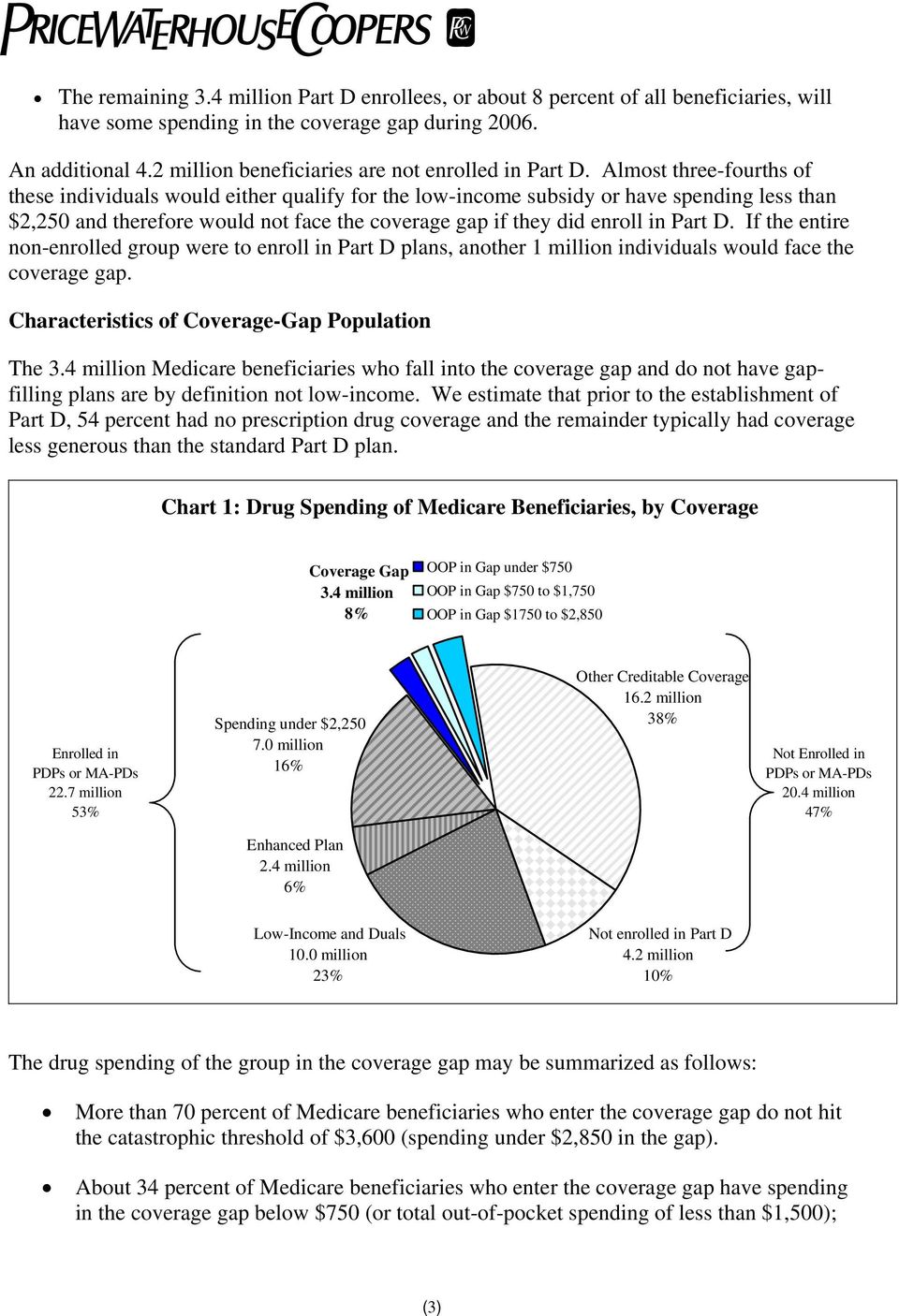
4 another 24 percent are below $1,750 in the gap (less than $2,500 in total out-of-pocket spending). Total prescription drug costs for those in the coverage gap are, on average, about $4,815; average out-of-pocket spending is $2,529. Based on this average level of spending, Medicare beneficiaries with spending in the gap and no previous prescription drug coverage would save about $2,000, after accounting for premium costs. About one-quarter of Medicare enrollees with spending in the gap who are ineligible for the low-income subsidies, or 0.85 million, would have incomes below 200 percent of poverty. 2 Medicare beneficiaries who previously had other prescription drug coverage would, on average, spend less out-of-pocket under Part D as well. For example, Medicare beneficiaries, who previously enrolled in Medigap J plans and whose spending is higher than $2,250, would have $200 less out-of-pocket spending under Medicare Part D -- average out-of-pocket spending of $2,529 under Medicare Part D compared to $2,729 under a Medigap J plan. The premium component of Medicare J is about $800 per year more than the Medicare Part D premium, making the overall savings even larger. 3 This analysis does not adjust for beneficiaries who receive assistance from State Pharmacy Assistance Programs, which may further reduce spending in the coverage gap for some Part D enrollees. Assumptions The figures above incorporate the most recent enrollment data from CMS as well as the CMS prediction of eventual enrollment in Medicare Part D. Of the total Medicare population of 43 million, overall enrollment in Medicare Part D (stand-alone PDPs and MA-PD plans) is expected to be approximately 22.7 million. 4 Another 16.2 million will have other creditable coverage, including 10.4 million with coverage through employers who will receive the Part D retiree subsidy. 5 Overall, approximately 90 percent of the Medicare population will have creditable coverage or choose to join a Part D plan. Health insurance coverage that is not included in the most recent CMS releases was based on CBO estimates of prescription drug coverage of Medicare beneficiaries. 2 Based on figures from the Congressional Budget Office, July Medicare beneficiaries pay 100 percent of the premium costs for the Medicare J plans but only 25.5 percent of the full premium costs for Medicare PDPs. The drug component of the Medigap J premium is approximately $100 per month, compared to an average of $32 for Medicare Part D. 4 The enrollment of 22.7 million includes two million who are expected to enroll after the May 7, 2006 CMS figures. 5 Includes FEHBP and TRICARE. (4)

5 Neither CMS nor CBO has released any official estimates of the number of Medicare beneficiaries with enhanced coverage that fills in and reduces out-of-pocket spending in the coverage gap. Recent information shows that 10 percent of PDPs and 27 percent of MA-PDs include some enhanced coverage in the coverage gap. 6 The enhancements vary from identical coverage above and below $2,250 to only covering generics drugs in the coverage gap. Based on overall enrollment patterns in PDPs and MA-PDs and the above percentages of plans offering enhanced coverage, we assume that about 15 percent of beneficiaries will have enhanced coverage in the coverage gap. The level and distribution of spending by Medicare beneficiaries is based on claims data that have been calibrated to match CBO s published assumptions about prescription drug spending. Spending levels reflect changes in demand caused by changes in coverage levels and average discounts under Part D. The share of the population facing the coverage gap has been calculated based on the distribution of those Medicare beneficiaries participating in Part D but not eligible for the low-income subsidies. 7 Even after accounting for induced demand, the average spending level of this population is considerably lower than that for the overall Medicare population. 8 The lower average spending results in fewer of these individuals reaching the coverage gap. Conclusion The impact of the coverage gap on Medicare beneficiaries has been overstated in many descriptions of the new Medicare prescription drug program. After accounting for the additional coverage to which many Medicare beneficiaries have access, only about 3.4 million, or 8 percent of Medicare beneficiaries, will have spending in the coverage gap. Even if we confine our analysis to those individuals who have uncovered spending in the coverage gap, we find that, on average, they fare better under Medicare Part D than they would have in the absence of Part D. 6 Based on information from CMS, cited in Price and Formulary Design Play Key Role in Part D Enrollment Pattern, Inside Health Policy.com, April 25, Enrollees potentially exposed to the coverage gap includes: beneficiaries who are not dually eligible for Medicare and Medicaid; those without other creditable coverage; those who do not purchase enhanced plans; and those who are not eligible for low-income subsidies. 8 This population consists mainly of individuals who were self-insured prior to Part D. Average spending of this population is significantly lower than the overall Medicare population. See, for example, Kaiser Family Foundation, Medicare and Prescription Drug Spending Chartpack, June (5)
The Medicare Drug Benefit (Part D)
 THE BASICS The Medicare Drug Benefit (Part D) The Medicare Prescription Drug, Improvement, and Modernization Act of 2003 (MMA) established a voluntary outpatient prescription drug benefit for Medicare
Part D payment system
 Part D payment system paymentbasics Revised: October 204 This document does not reflect proposed legislation or regulatory actions. 425 I Street, NW Suite 70 Washington, DC 2000 ph: 202-220-3700 fax: 202-220-3759
Medicare Part D Prescription Drug Coverage
 Medicare Part D Prescription Drug Coverage Part 3 Version 6.0 September 25, 2012 Terms and Conditions This training program is protected under United States Copyright laws, 17 U.S.C.A. 101, et seq. and
Office of the Actuary
 DEPARTMENT OF HEALTH & HUMAN SERVICES Centers for Medicare & Medicaid Services 7500 Security Boulevard, Mail Stop N3-01-21 Baltimore, Maryland 21244-1850 Office of the Actuary DATE: March 25, 2008 FROM:
Frequently Asked Questions: Medicare Supplement & Medicare Advantage
 Frequently Asked Questions: Medicare Supplement & Medicare Advantage Who is eligible for CBIA s Medicare program? A CBIA Health Connections participant is eligible for either plan if they are qualified
Medicare Prescription Drug Benefit
 Medicare Prescription Drug Benefit Karen Tritz Overview Overview of new Medicare Prescription Drug Benefit The Timing and Process Implications for Working People with Disabilities Overview of Medicare
Medicare Part D: 2010. Presented by: Howard Houghton Virginia Insurance Counseling & Assistance Program (VICAP)
 Medicare Part D: 2010 Presented by: Howard Houghton Virginia Insurance Counseling & Assistance Program (VICAP) 1 The Basics Medicare Part D is available to all Medicare beneficiaries regardless of their
What is the Low Income Subsidy? Ginger Rogers Medicare Part D Disability Drug Benefit Helpline Disability Rights Wisconsin
 What is the Low Income Subsidy? Ginger Rogers Medicare Part D Disability Drug Benefit Helpline Disability Rights Wisconsin 1 What is the Low Income Subsidy? Also known as LIS or Extra Help Medicare beneficiaries
2015 Medicare Low-Income Subsidy (LIS), or Extra Help
 2015 Medicare Low-Income Subsidy (LIS), or Extra Help Extra Help with Prescription Drug Costs Medicare LIS Overview Patient Eligibility and Application Process How LIS Affects Patient Responsibility for
Prescription Drug Coverage for Medicare Beneficiaries: A Summary of the Medicare Prescription Drug, Improvement, and Modernization Act of 2003
 Prescription Drug Coverage for Medicare Beneficiaries: A Summary of the Medicare Prescription Drug, Improvement, and Modernization Act of 2003 Prepared by Health Policy Alternatives, Inc. for The Henry
Medicare Annual Enrollment Period Choice & Impact Study
 2011/2012 Medicare Annual Enrollment Period Choice & Impact Study Table of Contents Report Overview...................................... 3 2011/2012 Choice & Impact Study Results................. 5 Stand-Alone
Introducing OneExchange.
 RETIREE BENEFITS Introducing OneExchange. OneExchange provides you with plan advice and enrollment assistance to choose Medicare supplemental healthcare and prescription drug coverage that s right for
CHAPTER M20 EXTRA HELP - MEDICARE PART D LOW-INCOME SUBSIDY
 CHAPTER M20 EXTRA HELP - MEDICARE PART D LOW-INCOME SUBSIDY Virginia DSS, Volume XIII M20 Changes Changed With Effective Date Pages Changed TN #96 10/1/11 Table of Contents pages 1, 2 Pages 3-18 and Appendices
Improving Medicare Part D. Shinobu Suzuki and Rachel Schmidt March 3, 2016
 Improving Medicare Part D Shinobu Suzuki and Rachel Schmidt March 3, 2016 Future challenges require changes to Part D s original structure Designed to encourage broad participation by plans and beneficiaries
Cynthia G. Tudor, Ph.D., Director, Medicare Drug Benefit and C & D Data Group Cheri Rice, Director, Medicare Plan Payment Group
 DEPARTMENT OF HEALTH & HUMAN SERVICES Centers for Medicare & Medicaid Services 7500 Security Boulevard Baltimore, Maryland 21244-1850 CENTER FOR MEDICARE TO: FROM: SUBJECT: All Part D Sponsors Cynthia
Prescription Drug Plan Sponsors, Medicare Advantage Organizations, Cost Plans, and Demonstration Organizations
 DEPARTMENT OF HEALTH & HUMAN SERVICES Centers for Medicare & Medicaid Services 7500 Security Boulevard Baltimore, MD 21244-1850 CENTER FOR MEDICARE DATE: February 15, 2012 TO: FROM: SUBJECT: Prescription
Make sure you re covered for your biologic medicine!
 It s open enrollment time Make sure you re covered for your biologic medicine! Joint Decisions is brought to you by Janssen Biotech, Inc., in partnership with CreakyJoints CreakyJoints Bringing arthritis
Newly-Eligible Medicare Advantage TRAIL Members FAQs What do I need to know about TRAIL as a newly-eligible annuitant or survivor?
 Newly-Eligible Medicare Advantage TRAIL Members FAQs What do I need to know about TRAIL as a newly-eligible annuitant or survivor? TRAIL is a retiree healthcare program sponsored by the Teachers Retirement
Choosing a Medicare prescription drug plan.
 Choosing a Medicare prescription drug plan. Medicare Made Clear TM Get Answers Series Look inside to: Learn about Part D prescription drug coverage options Find out what you need to know about the Part
Medicare Part D. MMA establishes a standard Part D drug benefit, which consists of four components or phases.
 Medicare Part D The Medicare Prescription Drug, Improvement, and Modernization Act of 2003 (MMA) added voluntary prescription drug coverage to Medicare, the federal health insurance program for seniors
Things you need to know about Medicare.
 Things you need to know about Medicare. 1 2 3 1OPTION Original Medicare We re here to help. Approaching 65 is an important milestone in life, and becoming eligible for Medicare is part of that. Whether
Agenda. Medicare Overview Medicare Part B Drug Coverage Medicare Part D: How to Find and Compare Medicare Part D Plans Summary Provider Contacts
 2 Medicare Part D Agenda Medicare Overview Medicare Part B Drug Coverage Medicare Part D: Background Benefits of Medicare Part D Enrollment Coverage Specialty Medications Part D Costs How to Find and Compare
Medicare Part D Prescription Drug Coverage
 Medicare Part D Prescription Drug Coverage Part 3 Version 9.0 June 22, 2015 Terms and Conditions This training program is protected under United States Copyright laws, 17 U.S.C.A. 101, et seq. and international
MEDICARE PART D PRESCRIPTION DRUG COVERAGE 2016
 PO Box 350 Willimantic, Connecticut 06226 (860)456-7790 (800)262-4414 1025 Connecticut Ave, NW Suite 709 Washington, DC 20036 (202)293-5760 MEDICARE PART D PRESCRIPTION DRUG COVERAGE 2016 Se habla español
Prescription Drug Coverage. Presented by: Medigap Part D & Prescription Drug Helpline Board on Aging & Long Term Care A Wisconsin SHIP
 Prescription Drug Coverage Presented by: Medigap Part D & Prescription Drug Helpline Board on Aging & Long Term Care A Wisconsin SHIP Medicare Part A Prescription Drug Coverage Part A generally pays for
The Changing Face of Employer-Sponsored Retiree Prescription Benefits. Long-term strategies for a rapidly evolving market
 The Changing Face of Employer-Sponsored Retiree Prescription Benefits Long-term strategies for a rapidly evolving market February 2015 Executive Summary The past decade has seen fundamental changes in
2012 Medicare Part D Drug Coverage
 2012 Medicare Part D Drug Coverage Consumer Costs Under a Standard 2012 Part D Plan Premiums range from $15.10 to $114.90 per month. The annual deductible is $0 to $320. The deductible is the amount you
CENTERS FOR MEDICARE & MEDICAID SERVICES. Cost
 CENTERS FOR MEDICARE & MEDICAID SERVICES Things to Think about when You Compare Medicare Drug Coverage You have two options to get Medicare coverage for your prescription drugs. If you have Original Medicare,
Express Scripts Medicare TM (PDP) through State of Delaware Medicare Retiree Prescription Plan Frequently Asked Questions
 Express Scripts Medicare TM (PDP) through State of Delaware Medicare Retiree Prescription Plan Frequently Asked Questions Section 1 General Information (Questions 1-5) Section 2 Enrollment Information
Basic Reimbursement - Medicare Part D Specifics
 Basic Reimbursement - Medicare Part D Specifics 60889-R8-V1 (c) 2012 Amgen Inc. All rights reserved 2 This information is provided for your background education and is not intended to serve as guidance
Retiree prescription drug program: time to move to an Employer Group Waiver Plan (EGWP)?
 Retiree prescription drug program: time to move to an Employer Group Waiver Plan (EGWP)? Gail Levenson and Rich Stover Today s areas of focus Overview of Medicare Part D plan Impact of health care reform
On the next page are answers to some important questions that can help you during the Annual Open Enrollment.
 QA 2015 Medicare Prescription Drug Annual Open Enrollment The Annual Open Enrollment for Medicare prescription drug coverage (Part D) is October 15, 2014 December 7, 2014. Certain people with Medicare
Medicare Part D Prescription Drug Coverage
 Medicare Part D Prescription Drug Coverage Part 3 Version 7.1 August 1, 2013 Terms and Conditions This training program is protected under United States Copyright laws, 17 U.S.C.A. 101, et seq. and international
Medicare Part D Creditable Coverage
 Medicare Part D Creditable Coverage What employers need to do If you are an employer (Plan Sponsor) who will be offering prescription drug coverage to any Medicare Eligible individuals in 2012, you are
Medicare Coverage Gap Discount Program to Provide Economic Relief to Medicare Part D Enrollees by Closing the Donut Hole
 Medicare Coverage Gap Discount Program to Provide Economic Relief to Medicare Part D Enrollees by Closing the Donut Hole By Cynthia S. Marietta, J.D., LL.M. (Health Law) [email protected] Introduction
PEACE-OF-MIND IN RETIREMENT. Income Security + Healthcare Security = Retirement Readiness
 PEACE-OF-MIND IN RETIREMENT Income Security + Healthcare Security = Retirement Readiness 1 What s New In 2015 The Traditional Choice Plan will be discontinued A new, significantly enhanced Medicare Advantage
Making Sense of Medicare
 Making Sense of Medicare Stephanie M. Turnbull Manager, Member Benefits 1 Highlights Medicare Eligibility Types of Medicare Coverage Medicare Part A Medicare Part B Medicare Part C Medicare Part D Medicare
CALIFORNIA. By the numbers: Medicare Part D. Medicare Part D is working well for beneficiaries and taxpayers And it s getting better.
 CALIFORNIA By the numbers: Medicare Part D 3,687,561 Medicare Part D beneficiaries in California 1,638,344 278 Beneficiaries enrolled in Medicare Advantage prescription drug plans in 2015 1 Number of Medicare
Kansas Health Policy Forums
 Forum Brief 2004 Kansas Health Policy Forums The Medicare Reform Act: What Are the Consequences for Kansas? Thursday, March 18, 2004 Noon 2:30 Lunch provided 212 SW Eighth Avenue, Topeka, KS Lower Level
3How do I know what changes my plan is
 2012 Medicare Prescription Drug Annual Open Enrollment Questions & Answers The Annual Open Enrollment for Medicare prescription drug (Part D) is October 15, 2011 December 7, 2011. The Open Enrollment Period
 Prescription drugs are a critical component of health care. Because of the role of drugs in treating conditions, it is important that Medicare ensures that its beneficiaries have access to appropriate
Actuarial Equivalence for Prescription Drug Plans and Medicare Advantage Prescription Drug Plans under the Medicare Drug Program
 A Public Policy Practice Note Actuarial Equivalence for Prescription Drug Plans and Medicare Advantage Prescription Drug Plans under the Medicare Drug Program March 2008 American Academy of Actuaries Actuarial
Increasing participation in the Medicare savings programs and the low-income drug subsidy. Joan Sokolovsky and Hannah Neprash November 8, 2007
 Increasing participation in the Medicare savings programs and the low-income drug subsidy Joan Sokolovsky and Hannah Neprash November 8, 2007 Key findings Medicare beneficiaries typically have lower incomes
Faculty Alabama State Health Insurance Assistance Program and Medicare 101
 Faculty Alabama State Health Insurance Assistance Program and Medicare 101 Susan Segrest Community Based Services Division Chief Central Alabama Aging Consortium A Training on Basic Medicare and the Alabama
Medicare Made Clear. Helping your employees and volunteers understand Medicare.
 Medicare Made Clear Quick Reference Guide Helping your employees and volunteers understand Medicare. Medicare helps nearly 50 million older and disabled Americans save on their health care expenses. But
The Medicare Low Income Subsidy (LIS)
 The Medicare Low Income Subsidy (LIS) Extra Help with Prescription Drug Costs An overview of the Medicare LIS Patient eligibility and the application process How the LIS affects patient responsibility
State Pharmacy Assistance Programs vs. Medicare Prescription Drug Plans:
 State Pharmacy Assistance Programs vs. Medicare Prescription Drug Plans: How Do They Contain Rising Costs? By Sarah Goodell, Jack Hoadley, Ellen O Brien, and Claudia Williams* October 2005 This policy
Medicare: Humana s Strategic Actuarial Positioning John M. Bertko, F.S.A., M.A.A.A.
 Medicare: Humana s Strategic Actuarial Positioning John M. Bertko, F.S.A., M.A.A.A. Vice President and Chief Actuary Humana Inc. 1 Cautionary Statement This presentation is intended for instructional purposes
Medicare 101 What is the difference between Medicare and Medicaid? What is Medicare Part A? What is Medicare Part B? What is Medicare Part C?
 Medicare 101 What is the difference between Medicare and Medicaid? Medicare is a national health insurance program administered by the federal government that provides health insurance coverage to most
It s Time for Medicare
 It s Time for Medicare med-waageinbook-1214 Medicare What you need to know. You re turning 65. Or you re already 65 and getting ready to retire and lose your healthcare coverage. You re almost ready for
By Christina Crain, MSW. Director of Programs
 By Christina Crain, MSW Director of Programs What we ll cover Medicare Eligibility Medicaid Eligibility Medicare Parts A, B, C and D New Improvements to Medicare under ACA The Medicare Savings Programs
Guide to Choosing a Medicare Prescription Drug Plan in Connecticut
 Medicare Prescription Drug - Choosing the Plan that s Right for You! Guide to Choosing a Medicare Prescription Drug Plan in Connecticut Medicare Prescription Drug, also called Part D or Medicare Rx, is
MEDICARE PART D. Types of Part D Plans: PDP and MAPD. Help with your Prescription Drug Costs
 MEDICARE PART D PRESCRIPTION DRUG 2015 Part D Plan Costs COVERAGE Types of Part D Plans: PDP and MAPD Help with your Prescription Drug Costs Need information about Medicare drug plans? Call the Center
2015 Medicare Part D Low-Income Subsidy (LIS) Income and Resource Standards
 DEPARTMENT OF HEALTH & HUMAN SERVICES Centers for Medicare & Medicaid Services 7500 Security Boulevard Baltimore, MD 21244-1850 MEDICARE ENROLLMENT & APPEALS GROUP DATE: February 24, 2015 TO: FROM: SUBJECT:
Medicare (History and Financing)
 Medicare (History and Financing) Note: Please pay attention to dates on slides and data; CMS has discontinued the publication of some valuable figures and these are occasionally referenced for prior years.
Summary of benefits. 2009 idaho, utah. Health Net orange prescription drug plan
 Health Net orange prescription drug plan Summary of benefits 2009 idaho, utah Benefits effective January 1, 2009 (S5678-064) PDP Option 1 (S5678-063) PDP Value Option 2 Section I INTRODUCTION TO SUMMARY
Prescription Drug Benefits Under Part D of the Medicare Modernization Act The Genie s Out of the Bottle
 ISSUE BRIEF VOL. 5, NO. 10, 2005 This ongoing series provides information on how to develop programs to educate Medicare beneficiaries and their families. Additional information about this and other projects
Dual Eligible and Low-Income Medicare Beneficiaries and Part D
 Dual Eligible and Low-Income Medicare Beneficiaries and Part D Presentation to National Medicaid Congress by Andy Schneider, Senior Advisor June 5, 2006 What is the Experience of Dual Eligible and Low-Income
THE EMERITI PROGRAM in your retirement years
 2014 Benefits THE EMERITI PROGRAM in your retirement years Helping you achieve healthcare security in retirement This presentation is copyrighted exclusively by Emeriti 1 2 TODAY S AGENDA What s new in
MEDICARE BASICS WHAT TO KNOW AND WHAT TO EXPECT WITH MEDICARE
 MEDICARE BASICS WHAT TO KNOW AND WHAT TO EXPECT WITH MEDICARE AGENDA What is original Medicare? The A, B, C, and D s of Medicare Enrollment periods Medicare Advantage star rating system Where you can find
2014 Medicare Part D Low-Income Subsidy (LIS) Income and Resource Standards
 DEPARTMENT OF HEALTH & HUMAN SERVICES Centers for Medicare & Medicaid Services 7500 Security Boulevard Baltimore, MD 21244-1850 MEDICARE ENROLLMENT & APPEALS GROUP DATE: February 21, 2014 TO: FROM: SUBJECT:
CCW Medicare Part D User Guide. October 2015 Version 5.2
 CCW Medicare Part D User Guide October 2015 Version 5.2 This page intentionally left blank. Overview The Medicare Part D prescription drug benefit was authorized through the Medicare Prescription Drug,
THE A,B,C,D S OF MEDICARE
 THE A,B,C,D S OF MEDICARE An important resource for understanding your healthcare in retirement What you need to know for 2014 How Medicare works What Medicare covers How much Medicare costs INTRODUCTION
Medicare. What you need to know. Choose the plan that s right for you GNHH2ZTHH_15
 Medicare What you need to know Choose the plan that s right for you GNHH2ZTHH_15 Choosing a Medicare plan is a lot like buying a car. There are lots of options to consider. And what s right for you may
Impact of the Health Insurance Marketplace on Participant Cost Sharing for Pharmacy Benefits
 Impact of the Health Insurance Marketplace on Prepared for: (PhRMA) Prepared by: Milliman, Inc. Michael J. Gaal, FSA, MAAA Actuary Jason Gomberg, FSA, MAAA Actuary Troy M. Filipek, FSA, MAAA Principal
PRIVATE MEDICARE DRUG PLANS: HIGH EXPENSES AND LOW REBATES INCREASE THE COSTS OF MEDICARE DRUG COVERAGE
 UNITED STATES HOUSE OF REPRESENTATIVES COMMITTEE ON OVERSIGHT AND GOVERNMENT REFORM MAJORITY STAFF OCTOBER 2007 PRIVATE MEDICARE DRUG PLANS: HIGH EXPENSES AND LOW REBATES INCREASE THE COSTS OF MEDICARE
Social Security/Medicare. Everything You Need to Know. But Didn t Know to Ask. For the. Colorado Bar Association
 Social Security/Medicare Everything You Need to Know But Didn t Know to Ask For the Colorado Bar Association C. Crispin Sargent CS AdvoCare, Inc. 9725 E. Hampden Ave., Suite 102 Denver, CO 80231 303-755-1845
Retiree Health Care Strategy
 Retiree Health Care Strategy Medicare Part D Prescription Drug Coverage for Montgomery County Government Retirees June 4, 2014 Prepared by Consulting Health & Benefits Retirement Medicare Retirees Prescription
Financial assistance for low-income Medicare beneficiaries
 Financial assistance for low-income Medicare beneficiaries C h a p t e r4 C H A P T E R 4 Financial assistance for low-income Medicare beneficiaries Chapter summary In this chapter Medicare Savings Programs
What is a Medicare Advantage Plan?
 CENTERS FOR MEDICARE & MEDICAID SERVICES What is a Medicare Advantage Plan? A Medicare Advantage Plan (like an HMO or PPO) is a way to get your Medicare benefits. Unlike Original Medicare, in which the
Status report on Part D
 C h a p t e r14 Status report on Part D C H A P T E R 14 Status report on Part D Chapter summary In this chapter Each year the Commission provides a status report on the Medicare prescription drug benefit