
Healthy Lifestyles: Alcohol Pathway
|
|
|
- Leslie Moody
- 10 years ago
- Views:
Transcription
1 A Proposed New System for Health and Social Services Healthy Lifestyles: Alcohol Pathway Scheme-level Outline Business Case (OBC) Version June 2012

2 This document Purpose of the Outline Business Case The Green Paper, Caring for each other, caring for ourselves, was produced in May Following public consultation, eight service areas were selected for early service development in Sustaining Acute Services was identified as being Business As Usual, and was removed from the OBC list, therefore, seven OBCs have been produced. Each proposed service change has been developed robustly, with full involvement from stakeholders. Working groups have used an Outline Business Case (OBC) template when discussing and developing the service changes, in order to ensure that all relevant aspects have been considered. The template incorporates guidelines from the UK Government s website on Business Cases as well as the template on the Treasury & Resources website. Once approved, each OBC will be progressed to Full Business Case (FBC) this is anticipated to be by Autumn The FBC will provide detail on the service change, including detailed timescales and action plans for implementation. Service implementation commences once the FBC has been approved and fund secured from the Medium Term Financial Plan, which is due to be agreed in late Autumn Structure of this document This Outline Business Case presents the elements of service change that must be considered in order for plans to be robust, stakeholders to be fully engaged, and risks to be managed effectively. The case for change for healthy lifestyles and alcohol is presented, building from the case for change in the Green Paper. The linkage with the HSSD strategic principles and with the relevant services strategies is clearly identified. The outcome of the Green Paper consultation, and in particular the views of stakeholders received during the consultation period have been presented where applicable, in recognition of the importance of these views. The OBC then outlines the proposed service change, and the elements thereof, for example, the impact on workforce, on costs and on service delivery / quality. Indicative costs and benefits are outlined. Some rounding adjustments have been made. All costs are presented at prices relevant to the each year, to ensure that the full cost of the proposals is understood. Costs and benefits which are quantitative and qualitative, short and long term and relevant to patients / service users / carers / families, clinicians and the public have been considered. Implementation considerations are then presented, including stakeholder engagement and communication, key risks and issues for both the implementation period and for the full service delivery. Healthy Lifestyles: Alcohol Pathway Page 2 of 51
3 Revision history Version Date Author Description Andrew Heaven Second Draft needing Financials to add in Andrew Heaven Third Draft following KPMG changes to OBC structure Fourth Sixth Draft Post IT Recovery Andrew Heaven Seventh Final Scott Maslin Generic updates Andrew Heaven Revised Financials Andrew Heaven Revised Financials Rachel Williams Final review and revision Andrew Heaven Final review and revision Andrew Heaven Final review and revision with SRO comments Rachel Williams Finalisation Healthy Lifestyles: Alcohol Pathway Page 3 of 51

4 Table of Contents Executive Summary 6 Introduction and background 11 The Preferred Option 17 Stakeholders 34 Conclusion and Next Steps 35 Appendices 37 Healthy Lifestyles: Alcohol Pathway Page 4 of 51
5 Abbreviations and Definitions Abbreviation BI DETOX FBC HSSD IAPT MTFP NICE OBC PSSRU SUI Definition Brief Intervention Medically Assisted Withdrawal Full Business Case Health And Social Services Department Improved Access to Psychological Services Medium Term Financial Plan National Institute for Clinical Excellence Outline Business Case Personal Social Services Research Unit Serious Untoward Incident Healthy Lifestyles: Alcohol Pathway Page 5 of 51

6 1 Executive Summary 1.1 Introduction and background In common with jurisdictions and countries across the world, Jersey faces substantial current challenges in ensuring the availability of high quality health and social care for its citizens within a financially affordable sum. The KPMG technical document and the Green Paper, both published in May 2011, demonstrated that health and social care services in Jersey are at a crossroads. Existing capacity is due to be exceeded in some services in the near future, the elderly population is rising disproportionately and almost 60% of the medical workforce is due to retire in the next 10 years. In early 2011 the vision for health and social care in Jersey was agreed. This clearly stated that services must be safe, sustainable and affordable. The public consultation on the future of health and social services in Jersey concluded on 22 August Since that time, a Working Group has been considering the service changes that are required urgently; this Outline Business Case is a result of that process. 1.2 Strategic Context Complex problems require governments to act in an integrated way. There is now a better understanding of what policies need to be in place to give the best chance of reducing the current levels of harm caused from alcohol 12. For example international best practice highlights the need for countries to have a consistent approach to alcohol fiscal policy, a robust licensing law and easily accessible health services. When deployed in conjunction with other considered measures such as education, drink drive legislation, commercial communications a fully integrated approach to alcohol policy can have the desired effect The case for change Islanders have high alcohol consumption - an average of 25 units a week for every person over 16 years 3. A clinical audit in 2008 identified just over 250 alcohol-related emergency admissions, to the Emergency department with 28% being discharged within 24 hours and 11% requiring admission with length of stay > 11 days 4. The JASS survey reported that approximately 11,000 people would meet the criteria for an intervention to reduce their alcohol consumption (7,300 for a brief intervention and 3,700 for intensive treatment). Published best practice 6 indicates that 20% of dependent drinkers should be using alcohol services. In Jersey only 9% of dependent drinkers are accessing services. 1 World Health Organisation (Europe): 2009: Evidence for the effectiveness and cost-effectiveness of interventions to reduce alcohol-related harm: World Health Organisation Regional Office. 2 Anderson.P & Baumberg.B: 2006: Alcohol in Europe, A Public Health Perspective, a report for the European Commission: Institute of Alcohol Studies 3 Medical Officer of Health Report: 2009: Our Island Our Health: Public Health Department 4: Dr Y Arshad, Dr A Luska, Dr P Schinie, Dr V Patel: 2010: The Burden of Alcohol Misuse: Clinical Audit Department 5 Jersey Annual Social Survey: 2010: States of Jersey Statistics Department 6 Alcohol Concern 2010 Making Sense of Alcohol Healthy Lifestyles: Alcohol Pathway Page 6 of 51
7 Currently, the strategic approach to alcohol being pursued by the States of Jersey does not appear to be consistent with international guidance, especially with regard population-level measures such as increasing the cost of alcohol, reducing accessibility and limiting alcohol promotion. In addition, more work needs to be done to improve health services and health promotion relating to alcohol, most notably: Ensuring a consistent approach to alcohol screening within Primary Care or secondary care, despite recent audit figures showing Jersey has the second highest rates for admissions due to alcohol when compared with UK regions. Reducing high rates of emergency detox within the hospital. This type of detox carries more risks for the service user and is 2.5 times more common then a community detox. Increasing capacity to provide support and counselling within the Alcohol and Drug Service. Investing in prevention. Personal Social Health Education in schools is not a compulsory part of the curriculum. The Healthy Schools Programme remains a voluntary for schools and not a minimum standard. The missed opportunities for prevention and early intervention creates pressure on hospital services. Currently, Emergency Department and inpatient hospital beds, are regularly used for interventions that could be delivered and managed in the community. Treating alcohol related conditions is costly. In 2010 (using local activity figures and PSSRU costings) it is estimated that the hospital spent approximately 2 million on alcohol attributable conditions per annum78. Furthermore, Social Security Department estimate that in 2010 alcohol-related benefit payments totalled 353,870. Anecdotal evidence also suggests that nursing staff feel under-equipped to address alcohol issues. As a result there is limited uptake of screening by hospital staff which is evidenced in the low number of referrals to the Alcohol and Drug Service from the Hospital. 1.3 Service Objectives for Healthy Lifestyles (Alcohol) The current Alcohol and Drugs Service provide specialist community detox and relapse prevention and also an alcohol liaison service within the hospital. Staff also support clients with drug misuse problems. The revised alcohol pathway will be based on NICE guidance 910 and other key documents. It will support a consistent approach to addressing alcohol misuse, through a pathway for addressing alcohol misuse, developed in consultation with clinicians and patients. The aim is to: Improve the identification and treatment of alcohol misuse. Increase access to alcohol services toward 20% in three years Encourage more people to proactively seek information to help themselves and others to drink sensibly 7 Estimated average Hospital activity is based methodology developed by Personal Social Services Research Unit at the University of Kent on behalf of Department of Health 8 Estimates of hospital activity related to attributable and specific fractions were generated from methodologies developed by North West Public Health Authority 9 Guidelines on Diagnosis, Assessment and Management of Harmful Drinking and Alcohol Dependence Volume 1-3: NICE 10 Public Health Guidance 24: (2010): Alcohol-Use Disorders; Preventing the Development of Hazardous and Harmful Drinking: NICE Healthy Lifestyles: Alcohol Pathway Page 7 of 51
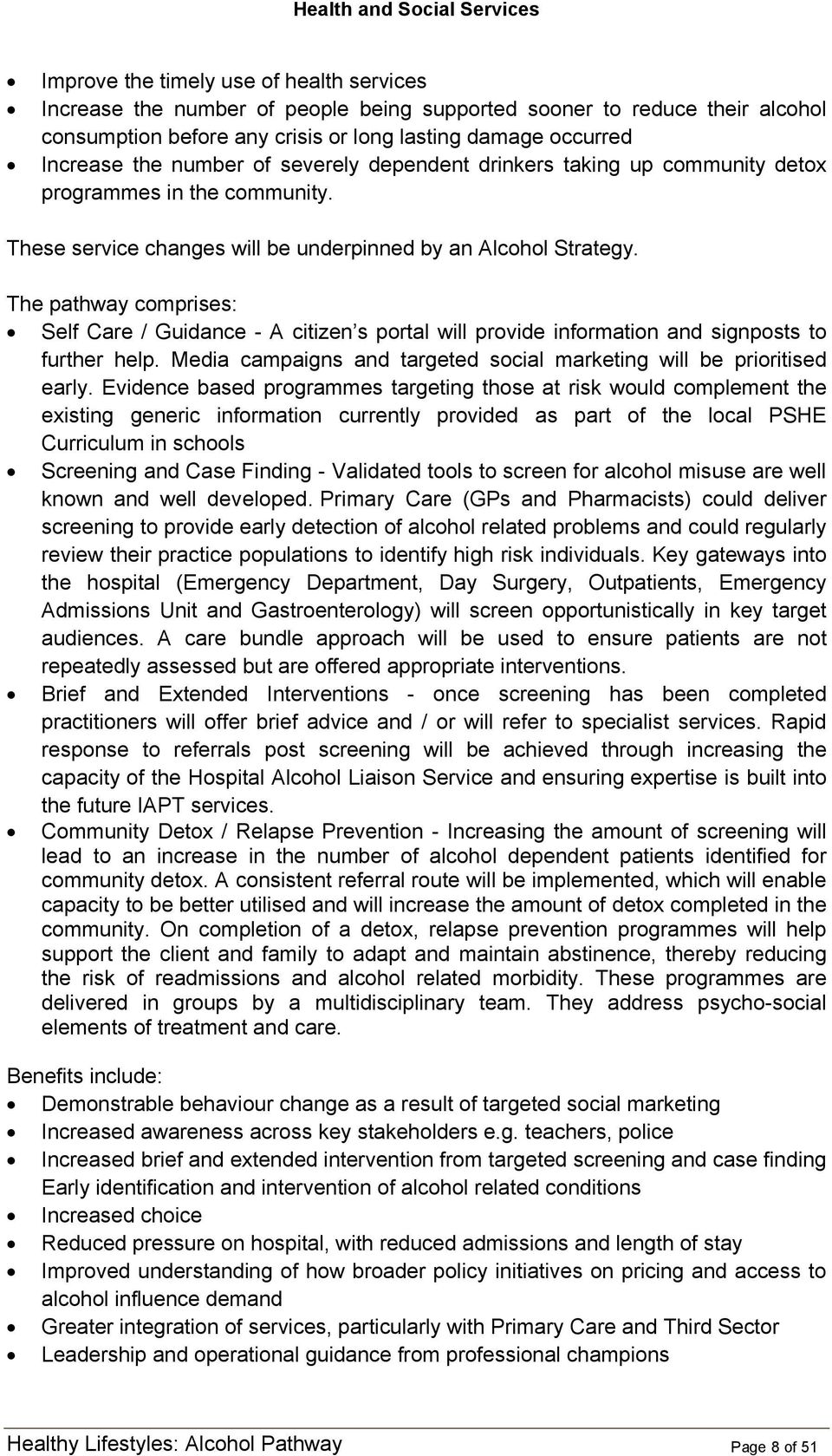
8 Improve the timely use of health services Increase the number of people being supported sooner to reduce their alcohol consumption before any crisis or long lasting damage occurred Increase the number of severely dependent drinkers taking up community detox programmes in the community. These service changes will be underpinned by an Alcohol Strategy. The pathway comprises: Self Care / Guidance - A citizen s portal will provide information and signposts to further help. Media campaigns and targeted social marketing will be prioritised early. Evidence based programmes targeting those at risk would complement the existing generic information currently provided as part of the local PSHE Curriculum in schools Screening and Case Finding - Validated tools to screen for alcohol misuse are well known and well developed. Primary Care (GPs and Pharmacists) could deliver screening to provide early detection of alcohol related problems and could regularly review their practice populations to identify high risk individuals. Key gateways into the hospital (Emergency Department, Day Surgery, Outpatients, Emergency Admissions Unit and Gastroenterology) will screen opportunistically in key target audiences. A care bundle approach will be used to ensure patients are not repeatedly assessed but are offered appropriate interventions. Brief and Extended Interventions - once screening has been completed practitioners will offer brief advice and / or will refer to specialist services. Rapid response to referrals post screening will be achieved through increasing the capacity of the Hospital Alcohol Liaison Service and ensuring expertise is built into the future IAPT services. Community Detox / Relapse Prevention - Increasing the amount of screening will lead to an increase in the number of alcohol dependent patients identified for community detox. A consistent referral route will be implemented, which will enable capacity to be better utilised and will increase the amount of detox completed in the community. On completion of a detox, relapse prevention programmes will help support the client and family to adapt and maintain abstinence, thereby reducing the risk of readmissions and alcohol related morbidity. These programmes are delivered in groups by a multidisciplinary team. They address psycho-social elements of treatment and care. Benefits include: Demonstrable behaviour change as a result of targeted social marketing Increased awareness across key stakeholders e.g. teachers, police Increased brief and extended intervention from targeted screening and case finding Early identification and intervention of alcohol related conditions Increased choice Reduced pressure on hospital, with reduced admissions and length of stay Improved understanding of how broader policy initiatives on pricing and access to alcohol influence demand Greater integration of services, particularly with Primary Care and Third Sector Leadership and operational guidance from professional champions Healthy Lifestyles: Alcohol Pathway Page 8 of 51
9 1.3.1 The Financial Case The recurrent revenue cost for this OBC by 2015 (at 2015 prices) is 530,000. Implementation costs total 52,000 over the period The service will require an additional 6.80 FTE. As a result of the planned investment it is anticipated that an estimated annual cost containment of 264,000 (by 2015) could be achieved, which comprises (by Q2, 2015): Reduction in the number of admissions to the General Hospital with alcohol related conditions Reduction in the number of clients requiring Detox in the General Hospital Implementation Actions and Timescales Public Consultation Alcohol Strategy Agree alcohol related activity in QIF Commissioning priorities Establish Citizen s Portal Create leadership team Roll out pathway in Hospital Alcohol Liaison Nurse recruitment Workforce development Recruit to Community Alcohol Detox Begin brief / extended interventions in Primary Care Strengthening Families Programme Alcohol specific School Prevention Programme Q1 Q2 Q3 Q4 Q1 Q2 Q3 Q4 Q1 Q2 Q3 Q4 Q1 Q2 Q3 Q4 1.4 Stakeholders, risks, issues, dependencies and enablers Stakeholders The OBC was produced by a Working Group comprising Dr Susan Turnbull (SRO), Andrew Heaven (OBC Lead), Claire Farley (HSSD Public Health), Marie Leeming (HSSD Adult Mental Health Services), Michael Gafoor (HSSD Alcohol & Drug Service), Jane Finlay (HSSD Alcohol Drug Service), Dr David Bailey (General Practitioner), Dr Miguel Garcia-Alcaraz (HSSD Consultant Psychiatrist), Jason Wyse (Silkworth Lodge), Vanessa Furness (HSSD Alcohol & Drug Service), Sarah Barry (HSSD Alcohol & Drug Service), Dr Christina Montes (HSSD Adult Mental Health Service), Jill Birbeck (HSSD Health Intelligence), Ian de la Cour (HSSD Finance Department) Ann Kelly (HSSD Children s Services), plus external advisor: Dr Julia Sinclair, Consultant Psychiatrist Healthy Lifestyles: Alcohol Pathway Page 9 of 51

10 Stakeholders to be engaged as the OBC develops into an FBC include Michael Gafoor (HSSD Alcohol & Drug Service), Jane Finlay (HSSD Alcohol Drug Service), Dr David Bailey (General Practitioner), Jason Wyse (Silkworth Lodge), Chris Dunne (Director Adult Services), Ann Kelly (HSSD Children s Services) and representatives from the Shelter Trust, Primary Care Body and Alcoholics Anonymous Risks and Issues Key risks and issues include: Low GP participation in screening if not suitably incentivised Failure to assemble senior clinical team to jointly lead the pathway Failure to provide the necessary skills and expertise for IAPT practitioners to deliver brief / extended interventions Recruitment and retention of appropriate staff Staff reticence to develop new ways of working or models of care, and/or to engage with individuals who have alcohol issues, provide brief advice and refer on There is no existing containment strategy for drunk and incapable vulnerable people. Existing hospital workforce are reluctant to discuss alcohol issues with patients Dependencies The endorsement of the Draft Alcohol Strategy Revision of the Alcohol Licensing Law Third Sector provision Enablers The development of health lifestyles (alcohol) will require workforce training, development and ongoing support. IN addition, the Social Security Department review of short-term incapacity allowance will consider replacing this benefit with a statutory requirement for employers to pay sickness pay. Primary Care legislation and payment systems are also enablers to new ways of working. 1.5 Next steps Continue engagement with stakeholders, including Third Sector and Primary Care Develop detailed service specification, impacts, outcome measures and metrics Consult the public on the proposed Alcohol Strategy Work with the Primary Care Commission and Primary Care Body to agree payment and incentivisation (QIF) Complete the Full Business Case, including developing detailed service design. Healthy Lifestyles: Alcohol Pathway Page 10 of 51

11 2 Introduction and background 2.1 A Global challenge Every health and social care system is experiencing similar challenges: Demographic change is dramatically increasing demand on all health and social care systems. Technological advances are allowing efficiency and quality improvements but also creating major new costs. Societal change is altering the relationship between services and service users, professionals and the public and between the state and individuals. Increasing regulation in health and social care is increasing quality but also reducing freedom to act atypically. Service ethos is shifting from treatment to prevention and promoting independence. Health, social care and Third Sector partners and multi-agency teams need to work closely with one another and with patients, service users and carers to provide tools and evidence-based services aimed at managing demand, promoting health and wellbeing, ensuring equality of access and protecting / safeguarding vulnerable people. Our aspiration is to enable people to be cared for in the most appropriate place, living as productive and independent lives as possible. 2.2 The Challenge for Health and Social Care in Jersey Jersey is experiencing many of the same challenges as all other health and social care systems internationally, but it also has some unique challenges. A small island In normal circumstances our population of just under 100,000 would be considered too small to support comprehensive acute hospital services and very specialist social care services this would normally be provided for a population of over 250,000. However, geographical isolation and infrequent but material travel difficulties mean that providing a significant level of acute and emergency services locally is essential, and that it is desirable to provide local care packages for people with complex needs. Accordingly, the unit cost of delivering hospital and social services in Jersey is higher compared with systems serving larger populations. This is because the fixed costs of key services such as Accident and Emergency, intensive care, and secure residential accommodation, which are still necessary to support relatively low levels of activity. This, along with the cost of living (including the cost of land and buildings) in Jersey leads to an additional funding premium, which increases unit costs. Secondly, it can produce vulnerable services due to workforce models, particularly in the medical workforce, which are relatively light, highly reliant on very small numbers of individuals and where the achievement and maintenance of specialist skills is difficult given relatively low patient numbers Demography Given immigration controls the population of Jersey is rising only slowly. But it is ageing rapidly. Over the 30 years from 2010 to 2040 the numbers of residents over 65 is projected to rise by 95%; in the period to 2020 the increase is projected to be 35%. This demographic change will create a huge surge in demand for health and social care services which will overwhelm the current capacity of the existing services. Healthy Lifestyles: Alcohol Pathway Page 11 of 51

12 Fig 1. Demographic change in Jersey Within 5 years, the current numbers of hospital beds, operating theatres, residential and nursing care beds and other key community services will be inadequate to meet demand. These services therefore need to be expanded, supplemented and/or changed urgently to ensure that services can be safely and sustainably provided for the growing elderly population. 2.3 Strategic Principles The vision of services which are safe, sustainable and affordable was distilled into a set of strategic design principles in late These were developed by stakeholders across health and social care, and ratified by Ministers: Create a sustainable service model efficient, effective, engaging the public in selfmanagement and with consistent access and thresholds Ensure clinical/service viability overcome the challenges of low patient volumes, delivering high quality care and minimising risk Ensure financial viability reduce the impact of diseconomies of scale, with value for money, an understanding of the costs of care in Jersey and robust procurement How should we fund health and social care? establishing a charging model that incentivises care and cooperation Optimising estate utilisation ensuring the estate is fit for purpose and utilised to maximum efficiency Workforce utilisation and development supporting and utilising the workforce to the best of their abilities Clinical governance sustaining a culture of safety, learning and transparency Use of business intelligence - with robust data to support decision making based on fact, and including patients and the public in service design and decision making Service principles and assertions: Social care and health should be integrated as seamlessly as possible on a service user s/patient s life journey, with teams of social care, home care, medical, nursing, occupational therapy, psychology and other staff working together, working with the third sector and private sector providers Integration will be supported by an organisational and professional mindset that puts people first and at the centre of decision making about their care package, and ensures that needs drive services and not the reverse, to improve emotional, social and health wellbeing. Healthy Lifestyles: Alcohol Pathway Page 12 of 51

13 Single, integrated care pathways, single assessment and a move towards personalisation and needs driven care will provide choice and empowerment. At present, complex services are provided by a multiplicity of providers, teams and professionals with different referral and access points, assessment frameworks, eligibility criteria and pathways. Simplifying and standardising the current range of approaches will improve co-ordination, providing a holistic, streamlined service which provides support, enablement and choice of care setting for older people and support for their carers. Services should be planned and delivered within partnerships brining together all sectors of our Islands community and economy Where appropriate, service provision should move away from residential care and institutionalisation within social care towards an increase in community provision to allow service users to integrate and lead independent and productive lives as much as possible. 2.4 Stakeholders and public opinion Between November 2010 and April 2011 a number of stakeholders were interviewed to ascertain their views on the future for health and social care. The key themes were: The development of an overall strategic plan as an overarching context for the development of the above is essential. This should address any changes required in the structure of services and relationships between them, as well as future funding mechanism to ensure the changes in service provision required will be delivered There is a groundswell of appetite for change Considerable scope exists for improvement in the coordination, collaboration and communication between different services and service providers Some gaps in service provision exist Elements of the operational infrastructure would benefit from strengthening. This includes improved mechanisms for data collection and distribution, recruitment and retention of key staff, and improvement and better use of estate 2.5 Results of the Green Paper consultation Between May and August 2010 HSSD consulted on the Green Paper Caring for each other, Caring for ourselves. More than 1,300 Islanders responded to the consultation. The response was overwhelmingly in favour of redesigning health and social services so that they continue to be safe and affordable for the future (86%), and many respondents included detailed comments and viewpoints. The Green Paper sought views on three scenarios for the future of health and social care: Scenario One: Business as usual services continue to be provided in the same way and through the same structures as in 2010; spending increases to meet growing demand. Scenario Two: A small increase in funding the funding allocation does not increase. Services have to be prioritised within this budget and many services will be subject to means testing or will be stopped. Healthy Lifestyles: Alcohol Pathway Page 13 of 51

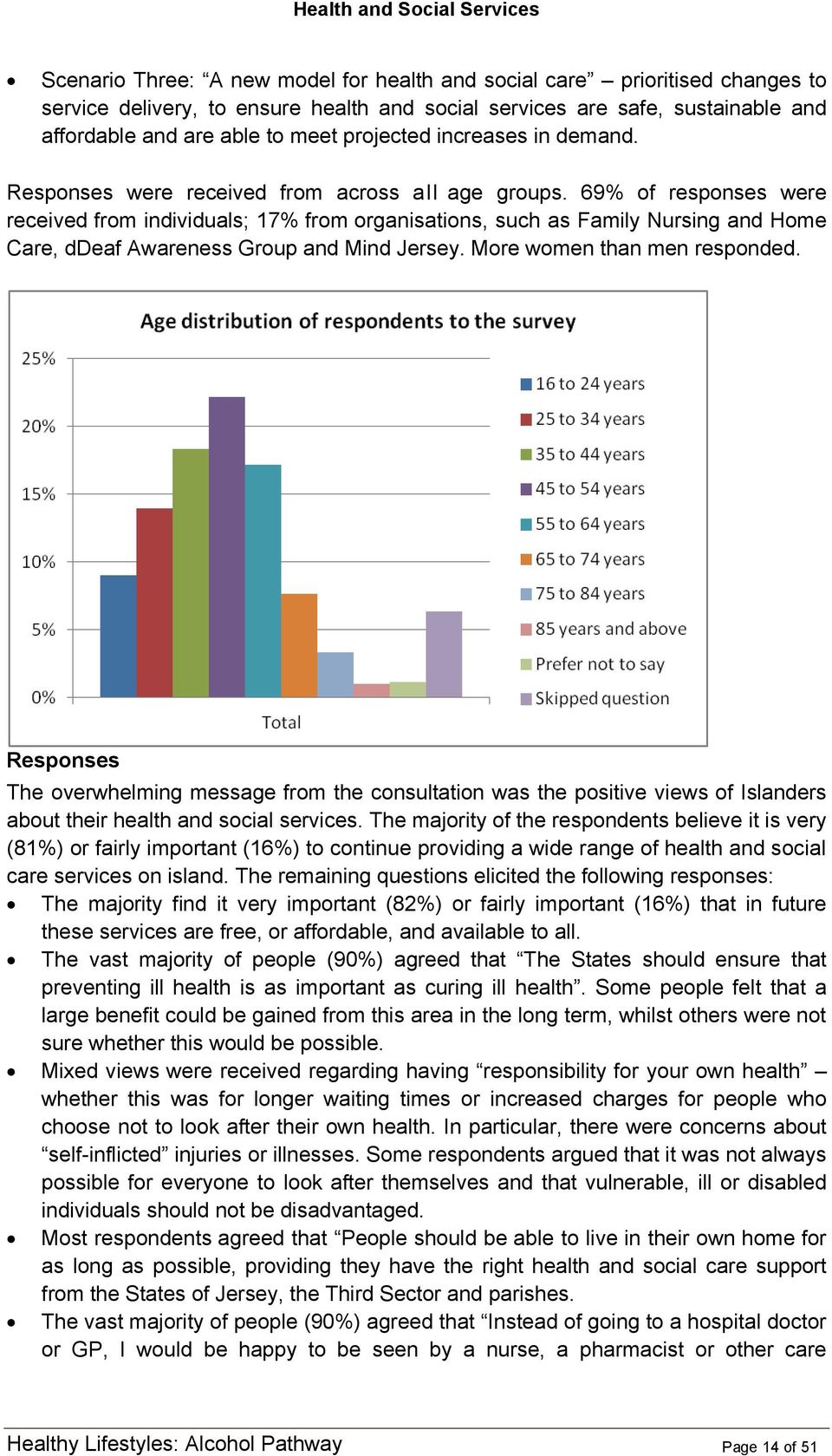
14 Scenario Three: A new model for health and social care prioritised changes to service delivery, to ensure health and social services are safe, sustainable and affordable and are able to meet projected increases in demand. Responses were received from across all age groups. 69% of responses were received from individuals; 17% from organisations, such as Family Nursing and Home Care, ddeaf Awareness Group and Mind Jersey. More women than men responded. Responses The overwhelming message from the consultation was the positive views of Islanders about their health and social services. The majority of the respondents believe it is very (81%) or fairly important (16%) to continue providing a wide range of health and social care services on island. The remaining questions elicited the following responses: The majority find it very important (82%) or fairly important (16%) that in future these services are free, or affordable, and available to all. The vast majority of people (90%) agreed that The States should ensure that preventing ill health is as important as curing ill health. Some people felt that a large benefit could be gained from this area in the long term, whilst others were not sure whether this would be possible. Mixed views were received regarding having responsibility for your own health whether this was for longer waiting times or increased charges for people who choose not to look after their own health. In particular, there were concerns about self-inflicted injuries or illnesses. Some respondents argued that it was not always possible for everyone to look after themselves and that vulnerable, ill or disabled individuals should not be disadvantaged. Most respondents agreed that People should be able to live in their own home for as long as possible, providing they have the right health and social care support from the States of Jersey, the Third Sector and parishes. The vast majority of people (90%) agreed that Instead of going to a hospital doctor or GP, I would be happy to be seen by a nurse, a pharmacist or other care Healthy Lifestyles: Alcohol Pathway Page 14 of 51
15 professional, for appropriate minor procedures such as measuring blood pressure or monitoring my diabetes. Most respondents said they would welcome qualified nurses working with GPs to free up their time, but others were not in favour of nurses doing what they considered to be the work of a GP. Some respondents commented that the GP system in Jersey was already very efficient and they were concerned about damaging patient-gp relations, and others were concerned about the cost of Primary Care to individual patients. Respondents also indicated that off-island travel was acceptable for some treatments. Some respondents would rather not have off island treatment, whilst others felt that going away for care to be inevitable on a small island like Jersey. Respondents also expressed views on whether patients should travel off island to see a doctor, or whether doctors should visit Jersey to treat patients. Professionals working together to deliver better integrated care was important, but some respondents noted that Jersey s charities should receive more funding and support. The vast majority of respondents thought that health and social care should be accessible and affordable, if not free, to all. However, there was a range of views about who should fund this care, and how. The need for affordable care was often stressed, and many respondents felt payment and funding needed to be explored in more depth. Most respondents said that those who cannot pay should still enjoy high quality health and social care. Opinion was then split about whether the amount of free care available for each person should be capped, with respondents expressing concern about the costs of care for people with long term illnesses and whether they would be able to pay. Some respondents commented that if health and social care was capped, for some conditions or for all, this should be means tested. However, others disagreed with means testing and felt that if someone had worked all their lives, they should have as much right to free care as others. Some respondents felt it would be fair that those who had lived in Jersey all their lives received free access to treatment but that people who have not paid into the system should not enjoy the same benefits. According to many respondents, significant numbers of people visit the Emergency Department rather than seeing a GP because there is a charge associated with the GP, while a visit to the Emergency Department is free. The majority agreed that if a charge applied to visit the Emergency Department for treatment of a minor condition, they would be more likely to go to see their GP. Many also suggested that GP consultation costs should be reviewed at the same time as Emergency Department costs. Many respondents felt that there are opportunities to improve current system. Suggested ways to improve efficiency included reducing bureaucracy in health and social services, improving communication between organisations and bringing in more third party and profit making organisations to provide care. 2.6 Development of the Outline Business Case This Outline Business Case (OBC) presents the case for change for the alcohol pathway. It explains, within the context of current and future safety, sustainability and Healthy Lifestyles: Alcohol Pathway Page 15 of 51
16 affordability and against the strategic principles agreed by Ministers in late 2010, the reasons why do nothing is not an option. The OBC was developed by a Working Group between August and November Between November 2011 and March 2012, significant work was undertaken with Treasury to ensure that financial projections are within an indicative cost envelope and sufficiently detailed and accurate for the Medium term Financial Plan submissions in Summer The OBC outlines the preferred priorities that have been identified by the Working Group in connection with the proposed new service being introduced, referring to the three Scenarios outlined in the Technical Document and Green Paper. It presents an outline cost/benefit analysis of the options. The OBC then outlines the features and timescales of the proposed service changes and assesses the potential impact against a range of factors, including workforce, cost and quality. This OBC has been prepared by Andrew Heaven, Head of Health Improvement, with Susan Turnbull, Medical Officer of Health as Senior Responsible Officer, after consultation with service providers, Third Sector organisations, service users and carers. Healthy Lifestyles: Alcohol Pathway Page 16 of 51

17 3 The Preferred Option 3.1 The Service Case International evidence Modern approaches to alcohol misuse have moved away from episodic management often characterised by periods of time where the patient was not in contact with any services. Best practice emphasises the maintenance of periods of wellness, with rapid support provided when exacerbations occur. For example in Manchester the Mental Health and Social Care Trust have developed an integrated pathway which is multi agency and is consistent with this model. Similar initiatives can be seen in other regions. Despite excellent individual practice, local alcohol services do not appear as consistent with national guidelines and models as they could be: For example there are: No consistent approaches to alcohol screening within Primary Care or secondary care, despite recent audit figures showing Jersey has the second highest rates for admissions due to alcohol when compared with UK regions. High rates of emergency detox within the hospital. This type of detox carries more risks for the service user and is 2.5 times more common then a community detox. Only limited capacity to provide psycho- social support and counselling within the Alcohol and Drug Service. 3.2 Current Services in Jersey Islanders have high alcohol consumption - an average of 13.9 litres of pure alcohol each, per year (the UK consumes 11.2 litres). This equates to 26.7 units a week for every person over 16 years 11. The JASS survey reported that approximately 11,000 people would meet the criteria for an intervention to reduce their alcohol consumption. Of those around 7,300 would require a brief intervention or extended interventions whilst a further 3,700 would require intensive treatment for their alcohol dependency. Published best practice 13 indicates that 20% of dependent drinkers should be using alcohol services. Below 10% is considered to represent a poor level of access. Currently Jersey has approximately 7% of its dependent drinkers accessing services. High levels of alcohol consumption lead to increased health risks and increased demand on health and other statutory services Clinical services that already identify and treat alcohol related problems are mainly based in Primary and Secondary Care. Specialist support to these services is provided by the Alcohol and Drugs Unit based at Gloucester Lodge. 11 Medical Officer of Health Report: 2009: Our Island Our Health: Public Health Department 12 Jersey Annual Social Survey: 2010: States of Jersey Statistics Department 13 Alcohol Concern 2010 Making Sense of Alcohol 14 World Health Organisation: 2010: Effectiveness and Cost Effectiveness of Policies and Programmes to Reduce the Harm Caused by Alcohol. 15 Institute of Alcohol Studies: 2006: Alcohol in Europe, A Public Health Perspective. A Report for the European Commission. 16 The Academy of Medical Science: 2004: Calling Time, The Nations Drinking as a Major Health Issue: Healthy Lifestyles: Alcohol Pathway Page 17 of 51
18 Different types and models of social and psychological support are provided by range third sector organisations. These include services which provide residential based support such as; Shelter Trust currently offer a Drunk and Incapable Unit which has four single units which are available 24/7 for those people who are in crisis and still drinking. This capacity is essential to continue to offer a place of safety that is appropriate and a diversion away from a hospital environment. The Trust also offer other accommodation to clients as part of a tiered recovery out of homelessness. The Jersey Addiction Group runs a registered 12 bedded residential centre at Silkworth Lodge and Margaret House. It is commissioned by H&SS to provide residential relapse prevention beds. There are also a range of community based support groups which can be accessed locally, including: Alcoholics Anonymous - group support towards abstinence Al-Anon - a support group for the relatives and friends of alcoholics. There are a number of challenges: Healthy Lifestyles: Alcohol Pathway Page 18 of 51

19 Service design principle Challenges of the current services Create a sustainable service model Pressure on acute services - Over 250 alcohol-related emergency admissions in 2008, with 28% being discharged within 24 hours and 11% requiring admission with length of stay > 11 days During 2008/9 the hospital had a higher rate of alcohol attributable admissions compared to other regions 17 During 2008/9 Jersey experienced 30-50% more deaths then would be expected from chronic liver disease than England and Wales 18 Approximately 200 hospital based alcohol detox in 2010, plus 50 community detox Logistical challenges for the hospital during Friday, Saturday 7pm 12am from intoxicated people presenting in the Emergency Department At least 97 service users used the Drunk and Incapable Unit provided by the Shelter Trust in one year Anecdotal evidence suggests that Nursing staff feel under-equipped to address alcohol issues. As a result there is limited uptake of screening and referral to the Alcohol and Drug Service from the Hospital Only 7% of dependent drinkers are in contact with alcohol services - best practice is 20% Social Policy does not address the high level of alcohol consumption at a population level, e.g. price, access and promotion Population-wide messages about safe drinking levels are confusing with only minimal resources available to promote safe drinking Alcohol Licence Law (1973) is out of date and not fit for purpose e.g. it does not acknowledge the harm caused by alcohol and in so doing reduces opportunity for prevention Personal Social Health Education in schools is not compulsory; the Healthy Schools Programme is voluntary School education on alcohol is predominantly knowledge based. There are limited targeted evidence-based programmes which include parental involvement, which could be effective in delaying drinking 17 Jersey Public Health Department: 2012: Health Profile Jersey 2008/9: Public Health Intelligence Unit 18 Jersey Public Health Department: 2012: Health Profile Jersey 2008/9: Public Health Intelligence Unit Healthy Lifestyles: Alcohol Pathway Page 19 of 51

20 Service design principle Challenges of the current services Ensure Clinical/service viability Anecdotal evidence suggests that Nursing staff feel under-equipped to address alcohol issues Limited visibility of alcohol advice provided in Primary Care Services are predominantly hospital-based Limited integration of Third Sector providers within a pathway Limited opportunistic alcohol screening and coordination across health and social services for the treatment and management of patients with alcohol misuse Limited scope for therapeutic interventions whilst an individual is intoxicated, as the overriding need is to provide a place of safety. This can result in an admission Ensure financial viability On average a hospital detox costs c 2,500. A community detox costs c 570. It is estimated that 250 detox were completed in 2010, 200 of which were completed in a hospital setting 19 (at a total cost of c 500k. It is likely that a proportion of current hospital detox could have been completed in a community setting In addition to Alcohol Detox activity, the hospital treats a growing number of alcohol attributable diseases Based on 2010 figures and Personal Social Services Research Unit costings it is estimated that the hospital spends approximately 2 million on alcohol attributable conditions per annum 2021 The Social Security Department estimates that in 2010 there were 63 alcohol specific individual claims for benefit; 20,713 payment days at a cost of 353,870 Silkworth lodge receive an annual grant of 222,200 from HSSD for providing 8 residential alcohol rehabilitation beds as part of a relapse prevention programme 19 Detox activity taken from existing Alcohol Liaison Service and Adult Mental Health Service. Unit costs developed by H&SS Finance Department 20 Estimated average Hospital activity is based methodology developed by Personal Social Services Research Unit at the University of Kent on behalf of Department of Health 21 Estimates of hospital activity related to attributable and specific fractions were generated from methodologies developed by North West Public Health Authority Healthy Lifestyles: Alcohol Pathway Page 20 of 51

21 Service design principle Challenges of the current services Optimising utilisation estate Current lack of integrated planning for alcohol related services in community settings puts pressure on the hospital Clinical audit shows that over 250 alcohol-related emergency admissions in 2008, with 28% being discharged within 24 hours and 11% requiring admission with length of stay > 11 days Service activity estimates that 200 hospital detox episodes in 2010, of which a proportion of these will be presenting as an emergency Workforce utilisation and development No senior clinical champion A common view that alcohol misuse is a specialist area Anecdotal evidence suggests generic nursing staff feel under-equipped to address alcohol issues Clinical governance Anecdotal evidence of unwarranted variations in prescribing during alcohol detox, both in the community and hospital setting Alcohol is regularly part of a patient s clinical condition but its identification, treatment and management are unlikely to be being addressed adequately due to unclear pathway for onward referral No clinical champion No consistent, evidence-based pathway Limited service integration and joint working Limited co-ordination and communication Limited visibility of services provided and outcomes achieved in Primary Care Limited visibility of services provided and outcomes achieved by Third Sector providers Use of business intelligence Primary Care activity data (treatment, diagnosis, brief interventions) regarding alcohol related conditions is either unknown or difficult to estimate Limited service level reporting on alcohol across acute services Underreporting of alcohol on death certificates due to stigma means that attributable mortality is likely to be an underestimated Healthy Lifestyles: Alcohol Pathway Page 21 of 51
22 3.3 Description of Service The aim is to increase access to alcohol services from the current level of 9% towards 20% by Alcohol services will be based on two principles; prevention and early intervention. NICE guidance 2324 and other key documents have been used to develop the pathway, and existing provision and activity have been reviewed in order to assess the future capacity required. There will be a move away from episodic including emergency management and towards an approach akin to chronic condition management, which has an emphasis on maintaining wellness and responding quickly to acute exacerbations. The alcohol pathway places an emphasis on a collaborative and consistent way of working by those practitioners and services that have a part to play in responding to alcohol misuse. The interventions are informed by the evidence base, and the capacity of services outlined is informed by local health intelligence and/or national projections. This will lead to a more effective and efficient response to reduce harm caused by alcohol. It will also produce wider social and economic benefits, for example by improving community safety through reduced antisocial behaviour, domestic violence and alcohol related road traffic incidents Establishing an alcohol pathway will require extending the role of some key stakeholders who would provide both a coordinating and leadership role. Development of the pathway and future commissioning will be informed by improved activity data and analysis provided by the Public Health Intelligence team. 22 Rush,B: (1990) A systems approach to estimating the required capacity of alcohol treatment services: British Journal of Addiction: (85) p49 59: 23 Guidelines on Diagnosis, Assessment and Management of Harmful Drinking and Alcohol Dependence Volume 1-3: NICE 24 Public Health Guidance 24: (2010): Alcohol-Use Disorders; Preventing the Development of Hazardous and Harmful Drinking: NICE Healthy Lifestyles: Alcohol Pathway Page 22 of 51
23 Summary of Alcohol Pathway Healthy Lifestyles: Alcohol Pathway Page 23 of 51
24 3.3.1 Self Care / Guidance Awareness raising and information: Individuals will be supported to make informed choices about their alcohol consumption. Information and education material regarding alcohol consumption and associated risks will be provided through a variety of communication channels and will format on areas such as fitness, exercise, and nutrition and other risk factors e.g. alcohol and smoking. The citizen s portal will provide appropriate self help information and signposting. It will include clear referral points to assist families and carers in seeking professional help, support and advice in a timely and appropriate manner. Media campaigns and targeted social marketing will be included in the citizen s portal, but will be initiated ahead of the portal s development and launch. Branded materials ill be developed, which will also be used by universal services as part of a guided self-help programme. Targeted Prevention: The pathway will include two evidence based targeted prevention and early intervention programmes: Aimed at year 8 children, and would complement the existing PSHE curriculum Familial intervention, working with children who are known to misuse alcohol and have been in contact with police, parish and police services Screening and case finding Community health and social care services and Primary Care practitioners, including GPs and Community Services such as Community Contraceptive Services and Brook will be asked to extend their services to screen and offer brief advice, as well as to provide onward referral to specialist community services. This screening will be targeted at groups who are at risk initially. General Practitioners could be incentivised to profile and casefind patients within their practice population. The GP will follow a protocol (which forms part of a wider alcohol pathway), for administering subsequent interventions. This will include handing out alcohol related materials, providing brief advice and/or referral to the alcohol liaison team for extended interventions and other levels of support. Key gateways into the hospital (Emergency Department, Day Surgery, and Outpatients, Emergency Admissions Unit and Gastroenterology) will screen opportunistically for alcohol misuse in key target audiences. A care bundle approach will be used to ensure patients are not repeatedly assessed but are offered appropriate interventions as they pass through different parts of the hospital service. Practitioners will provide brief interventions or onward referral depending on the outcome of screening. Fundamental to all the activity described is the ongoing training and support for professionals. Cascade models of training will keep staff informed and supported in the delivery of the pathway. A lead GP will ensure an ongoing programme of CPD is available, in order to support GPs to participate effectively in the pathway. Healthy Lifestyles: Alcohol Pathway Page 24 of 51
25 3.3.3 Brief and Extended Interventions Increasing the capacity of the Alcohol Liaison Service working in the hospital and ensuring expertise is built into the future IAPT services working in the community will help to provide a rapid response to referrals: Alcohol Liaison Services (Hospital): At risk patients attending the Emergency Department will be screened using a validated tool. This will be supported by an enhanced nurse-led alcohol liaison team. Emergency Department practitioners will follow a protocol (which forms part of a wider alcohol pathway), for administering subsequent interventions, including alcohol related self help materials, providing a brief advice and/or referral on to the hospital alcohol liaison team. Alcohol Liaison Services (Community): Patients who are identified as requiring extended interventions following screening in the community will be referred to the IAPT team. This team will provide structured short term interventions aimed at reducing the patient s alcohol consumption. If identified as dependent, individuals will be referred to community detox and relapse prevention team for ongoing management Community Detox and Relapse Prevention Currently residential-based relapse prevention programmes are offered by Silkworth Lodge. These are not appropriate for everyone, and a wider choice will be developed. The increased screening across primary, community and secondary care will lead to an increased number of alcohol dependent patients identified who will need community detox. On completion of a detox, relapse prevention programmes will help support the client and family to adapt and maintain abstinence, there by reducing the risk of readmissions and alcohol related morbidity. A community based multidisciplinary team will provide expert advice, treatment and relapse prevention programmes to support dependent and harmful drinkers in order to prevent hospital readmission and reduce alcohol related morbidity. The team will support an enhanced programme of community detox and relapse prevention. These programmes will be delivered in groups and address psycho-social elements of treatment and care, including specific cognitive behavioural therapy. Social care support will also be provided. By developing a more consistent referral route through the pathway existing capacity can be better utilised and more detox completed in the community. In addition, the team will include one HCA, providing dedicated low level support to the small number of users who consistently use emergency hospital services. A Strengthening Families Programme Coordinator will focus on early intervention for the young people who frequently use health services as a result of alcohol misuse. It should also be noted that Silkworth Lodge are in the early planning stages of planning a community detox unit. Healthy Lifestyles: Alcohol Pathway Page 25 of 51
26 3.3.5 Activity Impacts The table below summarises the estimated impacts on activity across the pathway 25. The demand is based on approximately 12,000 people in the local population who would benefit from an intervention to reduce their alcohol consumption. Of these, approximately 4,000 people within the drinking population are estimated to be alcohol dependent and would benefit from specialist medical intervention. In addition around 4,700 would require a brief advice whilst a further 3,300 would require an extended intervention. The table below estimates different levels of activity resulting from an integrated (pathway) approach to alcohol. The explicit intention is to increase access to alcohol services for harmful and dependent drinkers whilst also providing early intervention and guidance to those drinking at increased risk. Service Self Care / Guidance Activity Impact Citizens portal receive over 4,000 unique visits for alcohol advice and guidance by 2015 Brief and Extended Interventions Community Detox / Relapse Prevention Brief advice offered to 2,000 individuals p.a across the pathway by 2015 Extended interventions offered to 1,000 individuals in a primary care setting p.a by 2015 Reduce the number of individuals requiring repeated hospital detox by 2015 Complete above 200 community detox a year by Reduce alcohol and substance misuse behaviour problems during adolescence for 100 high risk families with children who misuse alcohol by Workforce Impacts The table below summarises the estimated workforce impacts: Service Staff Number Comment (e.g. timing) Leadership Director of Alcohol and Drugs Service No change In post Consultant Nurse General and Acute Consultant time 1.2 FTE GP and consultant time equivalent to 1 session a week backfill Strengthening Families Project GP Lead Project worker 0.5 FTE Evidenced based programme. Programme could be delivered by third sector 25 Activity impact are informed by JASS 2005 and 2009 surveys which asked about alcohol consumption and GP attendance in the last year Healthy Lifestyles: Alcohol Pathway Page 26 of 51
27 Self Care / Guidance Coordination - Specific content developed by key stakeholders Screening and Case Finding Existing Primary Care Capacity - GP existing capacity, QIF used to develop and incentivise activity. Brief and Extended Interventions Community Detox / Relapse Prevention Nurse GP practice based interventions will be provided by IAPT practitioners Nurse Practitioner26 Social Worker HCA Admin support 1 FTE - 2 FTE 0.6 FTE 1 FTE 0.5 FTE In hospital to promote brief interventions and assist with extended interventions and detox and to provide ward based alcohol specific coaching and training Workforce capacity to deliver extended interventions is contained within IAPT advanced practitioners. Case management for detox, relapse and prevention, plus support and supervision of IAPT practitioners To support clients with multiple admissions Strengthening Families Programme Analysis Data Analyst FTE not included in this OBC included as part of the IT & Informatics Cross Cutting workstream TOTAL 6.8 FTE Infrastructure Impacts Estates: Whilst no costings are included within this OBC it is acknowledged that the current premises used by Alcohol and Drugs Department are sub-optimal. The service would be considerably enhanced by new fit for purpose accommodation. Information Technology: A robust Public Health intelligence system will be required to collate and analyse population level information. Establishing a GP central server will enhance this process. Citizen Portal: From 2014, health and social care professionals, children, parents and families will access information via a citizen s portal. The citizens portal will enable care to be designed by the individual and care professional, based on the individual s needs and, where appropriate, they choices. 26 One nurse would develop special interest in young people Healthy Lifestyles: Alcohol Pathway Page 27 of 51
28 Commissioning: A more robust process and performance management process will need to be developed regarding existing Service Level Agreement. This will ensure that investment is securing value for money Service Delivery Benefits Anticipated Benefits would include: Reductions in alcohol consumption in key target audiences. Young adults, particularly women are more likely to be drinking harmfully then other groups27 Delay the onset and frequency of drinking of children in Yr 10 currently and estimated 91% of children who have tried alcohol by the age of 14 Reduction in repeat admissions and pressure on hospital beds Reduction in Emergency Department presentations Reduction in the number of patients with a length of stay > 10 days More consistent approach to medication during the detox period Reduction in alcohol-related criminal activity Improved access to a wider range of services, particularly in community settings and in Primary Care. These locations can be less stigmatising More informed lifestyle changes Support to Primary Care Support to Third Sector organisations Earlier identification of at risk drinking Clinical leadership, focus and support Anticipated risks Anticipated risks include: Reticence to change the service model, pathway or approach Reticence to provide screening and brief intervention Staff lack of confidence and / or knowledge, skills and experience Misalignment of incentives for Primary Care Lack of agreement from Third Sector providers regarding commissioning and provision including outcome measure and metrics Lack of health intelligence on alcohol related activity. Demand may be under/over estimated, and this may lead to recruiting an inappropriate number or skill mix Limited alternatives to hospital out of hours (particularly on Friday and Saturday nights) Dependencies and interactions Continued commitment is required from the States of Jersey to adopt a populationwide alcohol strategy with clear objectives to reduce consumption. This, along with strong leadership and support from across health and social services, including Primary Care and the Third Sector, are essential dependencies. Interactions exist with: IAPT Service - extended interventions following opportunistic GP screening will be delivered by IAPT practitioners who will also be delivering psychological therapies for mild and moderate depression and anxiety Existing Third Sector service providers: 27 Number taken from JASS 2010 Survey Healthy Lifestyles: Alcohol Pathway Page 28 of 51
29 o Shelter Trust currently offer Drunk and Incapable Unit accommodation for those people who are in crisis and still drinking. This capacity is essential to continue to offer a place of safety that is appropriate and a diversion away from a hospital environment o Shelter Trust also offer more long term accommodation which are used by clients with alcohol problems and dependency and are progressing toward independent living o The current Service Level Agreement with Silkworth Lodge provides for 8 residential relapse prevention beds to be provided per annum o Silkworth Lodge are in the early stages of planning a community detox unit. The type of capacity that this type of facility should be considered further at FBC stage when more details are developed HSSD Business Plan 2012 States Strategic Plan Medium Term Financial Plan Health and Social Services White Paper Workforce: Anecdotal evidence indicates that some professionals are reticent to provide alcohol screening and brief advice. This partly stems from a lack of knowledge and understanding, and partly because these services are seen as specialist. All professionals who may come into contact with dependent drinkers and at risk individuals will need to understand the alcohol pathway. Clinical leadership, training and support will be required for all staff. Estates: As noted above, there are limited estates enablers for the new pathway. Commissioning: Robust mechanisms to monitor and quality assure the activity across the pathway will need to be in place so that performance and unwarranted variation can be addressed. Outcome measures and metrics will be agreed as part of the FBC process. Population-level data collection will assist in identifying future need. Strong commissioning, with clear objectives will be supported by accurate, timely data regarding service delivery and value for money. Primary Care: GPs are pivotal to screening, case finding, brief advice and the ongoing support of individuals who are dependent drinkers or at risk. This includes young adults and their families. Metrics and payment mechanisms will need to be agreed for Primary Care. This may inform negotiations for a new Quality Improvement Framework. IT: Healthy Lifestyles: Alcohol Pathway Page 29 of 51
30 Completing the GP Central Server Project is a key enabler to the alcohol pathway. It will allow monitoring of the uptake of screening and brief interventions across GP practices and will provide measurable anonymised population level data on morbidity. The citizen s portal is also critical to increasing awareness and ensuring fast, easy access to information and signposting of services. Informatics: As noted above, population-wide information such as morbidity, mortality and needs will be important to commissioning. Outcome measures and metrics will be agreed as part of the FBC, and will be collected, analysed and reported in order to assess the quality and value for money of services. Legislation: The Jersey Licensing law (1973) is scheduled to be reviewed and updated. This is necessary in order to help drive a reduction in alcohol consumption. 3.4 Financial Case Revenue costs The total additional recurrent cost for Healthy Lifestyles (Alcohol) increases to 530,000 by The revenue cost is estimated to be: , , ,000 Implementation costs total 52,000. Summary costs Implementation Costs Recurrent revenue costs Capital costs TOTAL FTE will be required to implement the changes proposed Revenue savings An estimated cost containment of 129,000 will be achieved in 2014, with 264,000 by The cost containment estimates do not take into account of the wider benefits to the economy or other Departments that are associated with reducing alcohol consumption. Healthy Lifestyles: Alcohol Pathway Page 30 of 51
31 Evidence from the Quality Improvement Prevention Programmes in the UK suggests that on average there is a 5% reduction in hospital admissions for alcohol related activity. It is estimated that the current spend on alcohol specific and alcohol attributable admissions is approximately 2million a year. The forecast cost containment taken from the average 5% reduction is estimated at 52,000 in 2014 and 106,000 in Evidence would support a modest reduction in hospital detox activity. Although the precise number is difficult to identify as some patients will require a hospital environment due to other health conditions. Any future revenue savings would be based on the average cost of community detox at 570 versus a hospital detox at 2,500. In the longer term, further benefits can be expected from reductions in the long term damage caused by alcohol e.g. liver cirrhosis. Further work will be undertaken at FBC to understand the local impact of specific conditions on hospital activity Capital costs None identified Funding It is likely that there will be a range of existing and new sources of funds which would support service development in this area. For example the Quality and Improvement Framework could incentivise GP activity, existing Service Level Agreements may be revised to reflect different ways of working and the Medium Term Financial Plan would support new and enhanced levels of service provision Sensitivity analysis - scenarios Activity estimates are based on a number of assumptions. These will be further tested at FBC: The estimated amount of need is based on the JASS 2010 survey, which included a range of questions about alcohol consumption. This allowed an island wide prevalence to be estimated. However, the survey relies on self-reporting their consumption; this often underestimates actual consumption Estimates of hospital activity are based on UK consumption levels. These are lower than in Jersey, and therefore the hospital activity calculations are probably underestimated Coding for therapeutic Hospital Detox is rare as at present the need for Detox is identified as a result of the patient being admitted for another condition, often alcohol specific e.g. mental or behavioural issue related to alcohol Assessment of affordability and value for money A wide range of savings are quoted in Quality Improvement Prevention Programme literature. It could be reasonable to expect the unique Jersey health and social care economy to exceed some of the average savings for the following reasons: 28 British Society of Gastroenterology and the Royal Bolton Hospital NHS Foundation Trust: 2009: Alcohol Care Teams to reduce acute hospital admissions and improve quality of care. 29 North West Public Health Observatory: : The Economic and Social Costs of Alcohol Related harm in Leeds 2008/9 Healthy Lifestyles: Alcohol Pathway Page 31 of 51
32 A robust, well-resourced pathway in a small definable health system, where constituent parts are known and able to be influenced, may perform better then a similar pathway as part of the larger NHS footprint Many of the regions where alcohol harm is highest have a socio-economic context of deprivation with marked health inequalities. The social context in Jersey is not one of overall deprivation, although some pockets exist. Therefore, returns on investment may be larger than in Beacon sites such as Liverpool An Alcohol Strategy, with evidenced-based population approaches to reduce consumption will further increase benefit and impact Verification procedures and assumptions Quality Improvement Prevention Programmes in the UK suggest that an average of 5% reduction in hospital admissions for alcohol related activity can be expected. Assumptions have been informed by the specialist stakeholders in the OBC Working Group, a range of supporting publications and relevant local and national health intelligence. All staff grading used in this OBC have been verified by appropriate line managers and Human Resources Department, and are comparable to existing employees in existing roles. The development of the OBC also benefited from Dr Julia Sinclair Consultant, Psychiatrist from Southampton Medical School. Dr Sinclair is a Researcher / Academic and specialist in this area; she provided a critical friend role, providing challenge, support and guidance. Dr Sinclair is familiar with Jersey s health and social care system, having led on our recent Suicide Audits. 30 British Society of Gastroenterology and the Royal Bolton Hospital NHS Foundation Trust: 2009: Alcohol Care Teams to reduce acute hospital admissions and improve quality of care. 31 North West Public Health Observatory: : The Economic and Social Costs of Alcohol Related harm in Leeds 2008/9 Healthy Lifestyles: Alcohol Pathway Page 32 of 51
33 3.5 Implementation Actions and Timescales Agree Alcohol Strategy Agree QIF Commissioning priorities Citizen s Portal Create leadership team Roll out pathway in Hospital Alcohol Liaison Nurse recruitment Workforce development Pilot Brief Intervention in Primary Care Begin Brief Intervention in Primary Care Recruit to Community Alcohol Detox Strengthening Families Programme Alcohol Specific School Prevention Programme Q1 Q2 Q3 Q4 Q1 Q2 Q3 Q4 Q1 Q2 Q3 Q4 Q1 Q2 Q3 Q4 Healthy Lifestyles: Alcohol Pathway Page 33 of 51
34 4 Stakeholders 4.1 Stakeholder involvement in service model development The preferred model for service development was identified over the course of three workshops in October and November Follow-up discussions with key stakeholders outside the workshops allowed the model to be developed, reviewed and refined during the two month period. Independent expert advice was received throughout the process from Southampton University Medical School. Name Organisation Responsible Accountable Consulted Informed Michael Gaffoor Alcohol & Drug Service David Bailey General Practitioner Susan Turnbull Medical Officer of Health Marie Leeming Adult Mental Health Services Dr Miguel Garcia Consultant Psychiatrist Jill Birbeck Public Health Department Andrew Heaven Public Health Department Jason Wyse Silkworth Lodge A full outline of stakeholder involvement is presented at Appendix Communications to Internal Stakeholders Monitoring and reporting the performance of the alcohol pathway and enhanced service will be achieved through HSSD Corporate Directors. Monitoring and reporting on metrics associated with General Practice will be completed by the Primary Care Unit and the Public Health Intelligence Unit. 4.3 Communications to External Stakeholders A similar group of stakeholders would need to be engaged and be engaged and updated of progress during the initial FBC development. In the longer term a managed network approach, which included statutory and non-statutory services, would be developed to ensuring key external stakeholders were kept informed of key developments across the alcohol pathway. This will include summary activity for key parts of the pathway as well as opportunities for CPD and pathway revision and development. Healthy Lifestyles: Alcohol Pathway Page 34 of 51
35 5 Conclusion and Next Steps 5.1 Conclusion Jersey consumes more alcohol than comparator jurisdictions. This leads to issues with crime, disorder and domestic violence and, longer term health issues such as liver cirrhosis. We are currently experiencing very high rates of alcohol related hospital admissions and our rate of alcohol specific deaths is almost twice that of the national average. Services are currently not integrated; there is no agreed pathway for alcohol services. There is also limited choice, with the majority of individuals accessing services in hospital. This puts pressure on acute services, both within the Emergency Department and on wards. Some services are provided in Primary Care and by the Third Sector, however, data on activity and outcomes are not provided consistently. The alcohol pathway will support consistent quality of care in the most appropriate setting. It comprises awareness and information, screening and brief advice, and detox in non-hospital settings. The services need to be robustly commissioned, and delivered in partnership. Clinical leadership, clarity of roles and support to staff is also required. 5.2 Capacity and project management requirements At present capacity to develop the FBC does not exist. Careful consideration needs to be given as to who should lead this stage of the process - to date the OBC has been developed by the Public Health Department, who are not specialists in alcohol services. Capacity will also be required to implement the new pathway; this is intended to be secured by backfilling a medical role and employing a Nurse lead. 5.3 Next Steps Continued stakeholder engagement is required in order to ensure the alcohol pathway is robust, deliverable and co-owned. This includes Primary Care and Third Sector organisations. Existing Service Level Agreements need to be reviewed, with a view to ensuring consistency with future direction of services operating within the alcohol pathway. QIF is being considered and developed as part of the Primary Care cross cutting workstream. During 2012, the FBC needs to be developed. Detailed service specifications, outcome measures and metrics will need to be co-produced, working closely with stakeholders. These will then form part of the FBC, which will: Verify the continuing need for investment in the project Healthy Lifestyles: Alcohol Pathway Page 35 of 51
36 Demonstrate that the preferred solution represents value for money Establish that the HSSD is capable of delivering the project Confirm that the planned investment is affordable Demonstrate that HSSD is capable of managing a successful implementation and subsequently sustaining success Provide an essential audit trail for decisions taken Identify how benefits will be realised and monitored Confirm the investment decision The FBC will need to be approved and provide sufficient assurance to senior management that the service change can proceed and resources can be committed. The FBC is used as a reference point in the event of any business changes during the project lifecycle and in the event of a post project review or equivalent major review following implementation of the project. Sign off by Minister... Healthy Lifestyles: Alcohol Pathway Page 36 of 51
37 RESTRICTED Rev Date Author 6 Appendices 6.1 Appendix 1 - Benefits Log What is the benefit Type One-off or ongoing benefit? Earlier identification of at risk drinking Increase in number of referrals to Alcohol and Drugs Service that lead to Community Detox Reduction in repeat admissions and pressure on hospital beds Reduction in Emergency Department presentations Reduction in the number of patients with a length of stay > 10 days Reduction in the proportion of hospital detox compared with community detox Improved access to a wider range of services, particularly in How will the What is the baseline benefit be (in 2010) measured Patient Ongoing Clinical Audit 215 individuals screened in hospital using validated tool in 2010 Patient Ongoing Number of referrals from General Hospital Patient Ongoing Service activity monitoring 135 in 2010 No baseline on bed days 95 individual clients admitted into JGH in 2010 Patient Ongoing Clinical Audit Total of 252 alcohol related admission (2008) Patient Ongoing Clinical Audit 11% admissions in 2008 stayed longer then 10 days (2008) Patient Ongoing Number of detox in hospital Number of detox in community Patient Ongoing SLA activity monitoring 200 hospital detox 50 community detox No baseline Target 2,000 brief interventions across the pathway per year by 2015 Reduction in beds days p.a by ,000 people screened in hospital setting by 2015 Reduction in individuals with more then five repeat admissions in one year No target set No target set No target set No target set Healthy Lifestyles: Alcohol Pathway Page 37 of 51
38 RESTRICTED Rev Date Author community settings and in Primary Care Clinical leadership, focus and support Staff Client Service GP prescribing Ongoing Integration of care across pathway Improved clinical governance, communication and coordination Reduction in clinical risk across the pathway Nurses feel more supported, able to contribute to the pathway Increased skills and increased motivation More consistent prescribing Patient Ongoing Endorsed hospital and Primary Care prescribing guidance for alcohol detox More informed lifestyle changes Patient Ongoing Number of unique visits to Citizens Portal Consistency of care, in accordance with local protocols Staff Clients Ongoing Audit of compliance against pathway protocols agreed by Integrated Estimate 22 nurses completed substance misuse module in last two years Monitoring of alcohol detox prescribing within hospital and General Practice None No baseline Increase capacity of workforce in hospital setting to assess and refer patients with alcohol problems No data 4,000 hits a year by 2015 No target set Healthy Lifestyles: Alcohol Pathway Page 38 of 51
39 RESTRICTED Rev Date Author Governance Group Reductions in alcohol consumption in young adults, particularly women Reduce sickness absence and long term incapacity due to alcohol Broadening of skillset across professions Reduction in alcohol related dementia (long term care) Young People Ongoing Repeat health related behaviour Survey 2014 Clients Society Taxpayer Teams (both specialists and generalists) Other public sector teams e.g. police Clients Community Ongoing Social Security benefit payments Sickness payments Ongoing JASS Staff survey Clients Ongoing Audit of care settings/hospitals Audit 11% of year olds drink alcohol regularly No baseline No baseline No baseline Reduce percentage of children aged drinking alcohol regularly to below 5% by 2015 No target set No target set No target set Healthy Lifestyles: Alcohol Pathway Page 39 of 51
40 RESTRICTED Rev Date Author 6.2 Appendix 2 - Stakeholder log Name Organisation Responsible Accountable Consulted Informed Dr Tracy Wade Psychology Assessment Department Dr Carolyn Coverly Children s Adolescent Mental Health Service Dr Neera Watts Community Contraceptive Service Jackie Boath Brook Advisory Service John Hodge Shelter Trust Hostel Manager Roseneath AXA Manager States of Jersey Occupational Health (AXA) Practice Managers Individual General Practice Jason Wyse Silkworth Lodge Mark Capern Youth Enquiry Service Jill Rattle Occupational Therapy Department Team Leader Workwise / Jobscope Manager Women s Refuge Healthy Lifestyles: Alcohol Pathway Page 40 of 51
41 RESTRICTED Rev Date Author Manager Samaritans Dr Peter Bates Diabetic Centre Alcoholic Anonymous Mike Cutland Prison & Probation Service Director MIND MIND (Jersey) Pam Massey FNHC Andre Bonjour Police Service Chief Ambulance Officer Ambulance Service Manager Citizens Advice Bureau Healthy Lifestyles: Alcohol Pathway Page 41 of 51
42 RESTRICTED Rev Date Author 6.3 Appendix 3 - Risk Log No Risk Consequence Probability L/M/H Impact L/M/H Risk timing Risk owner Action Timing of action Risk status 1. Scope of the change Limited alternatives to hospital out of hours (particularly on Friday and Saturday nights) Lost opportunity to intervene Specialist service fails to work across Inconsistency of care H Primary, secondary and Third Sector H M 2013 SRO H 2014 Q1 SRO Lack of support of multi-disciplinary Limited preventive teams for H intervention Strengthening H 2013 Q1 SRO Families Project 2. Plan and Timescale 2.0 Failure to change referral pathways enough to make a difference between Resources Reductions in Emergency Department activity and length of stay fall below targets H H 2013 Q1 SRO Leadership team to review as part of pathway development Plan a staged roll out of service so that challenges can be identified early and resolved as service builds up its capacity Roll out hospital based pathway first and then progress to Primary and community settings Engage key stakeholders Set up a coordination group Ensure leadership team is able to champion and support key parts of the pathway development H 2014 Q1 M 2013 Q1 H 2013 Q1 H 3.1 Underestimation of Inadequate capacity H H 2014 Q1 SRO Ensure assumptions behind estimates 2012 M Healthy Lifestyles: Alcohol Pathway Page 42 of 51
43 RESTRICTED Rev Date Author No Risk Consequence Probability L/M/H Impact L/M/H Risk timing Risk owner Action Timing of action Risk status demand due to poor data 4. Leadership 4.1 leading to increased waiting times, high DNA rates and poor treatment completion rates for capacity are checked independently for errors Inconsistent and/or Leadership team low use of pathway fails to offer a for screening and H H 2014 Q4 SRO Ensure most appropriate lead identified 2014 Q3 H credible clinical subsequent force for change interventions 5. Commitment of staff 5.1 Staff are reticent to change the service model, pathway or approach Limited commitment to new way of working H H 2013 SRO Leadership team to address as part of pathway development 2013 H 5.2 Generalist staff are reticent to provide screening and brief intervention Limited commitment to new way of working H H 2013 SRO Leadership team to address as part of pathway development 2013 H Staff lack of confidence and / or knowledge, skills and experience Failure to engage key staff across Limited commitment to new way of working H H 2013 SRO Leadership team to address as part of pathway development Low uptake of screening and brief H H 2014 Q1 SRO Ensure key stakeholders are engaged in 2013 H 2012 Q1 H Healthy Lifestyles: Alcohol Pathway Page 43 of 51
44 RESTRICTED Rev Date Author No Risk Consequence Probability L/M/H Impact L/M/H Risk timing Risk owner Action Timing of action Risk status Primary, Secondary Third Sector and interventions 6. Data and Information Availability Hospital remains coded activity poorly Health intelligence capacity is not resourced Poor quality Primary Care data 7. Implementation Unable to measure impact on length of stay and/or reductions in Emergency Department activity H H 2014 Q1 SRO full business case work up and roll out of workforce development training and broader communication planning Agree metrics, develop data collection systems 2013 Q1 M Key metrics and outcomes remain H unidentified and H 2013 Q3 SRO Ensure analyst capacity is increased 2013 Q3 M unmeasured Unable to profile alcohol misuse across practices and H H 2013 SRO monitor alcohol screening activity Insufficient project management Implementation and capacity to lead benefits delayed. implementation Lack of agreement on QIF Lack of agreement from Third Sector Low take up of screening in Primary Care H H 2012 Q1 SRO H H 2012 SRO Ensure GP Central Server is operational before 2014 with time for baseline alcohol misuse practice profiles to be established Identify time specific project management lead Include alcohol screening and brief intervention in QIF 2013 M 2012 Q1 H 2012 H Unable to demonstrate good H H 2013 SRO Need to develop clear metrics for success that will form basis for 2013 H Healthy Lifestyles: Alcohol Pathway Page 44 of 51
45 RESTRICTED Rev Date Author No Risk Consequence Probability L/M/H Impact L/M/H Risk timing Risk owner Action Timing of action Risk status providers regarding commissioning and provision including outcome measure and metrics 8. Financial 8.0 Smaller number of hospital detox are able to be managed in the community value to tax payer Cost containment estimates fall below forecast M M 2014 Q1 SRO commissioning Review and test current assumptions Ensure robust application of alcohol pathway 2013 Q4 M Healthy Lifestyles: Alcohol Pathway Page 45 of 51
46 RESTRICTED Rev Date Author 6.4 Appendix 4 - Issue Log No Issue Consequence Issue owner Action Timing of action No obvious access point for public information Opportunity to self assess and self care lost SRO OBC includes investment for public information that allows independent and guided self help 2014 Q4 Services not High risk of patients connected and receiving SRO Develop a resourced pathway Q siloed in thinking inconsistent and and action suboptimal care No capacity within Public Health to develop FBC Hospital activity difficult to access and poorly coded Slow towards FBC progression developing SRO Slow progression towards FBC with risk of inaccurate estimates relating to impact on service activity SRO Use of secondments and/or reshape resources Develop more sustainable approach to collection and analysis of hospital data Triangulate local estimates with near neighbours wherever possible Q Q Low level of skills and knowledge lead Limited alcohol to reluctance to specific training engage on alcohol exists for key parts issue perceiving it as of the workforce a specialist area requiring other to intervene SRO Review workforce development needs as integral part of developing pathway Provide additional training, targeted to areas of highest need 2013 Q3 5.0 Historical reluctance by hospital clinical staff Low number of referrals from hospital wards and SRO Recruit credible clinical lead 2013 Q1 Healthy Lifestyles: Alcohol Pathway Page 46 of 51
47 RESTRICTED Rev Date Author No Issue Consequence Issue owner Action Timing of action 5.1 to address alcohol issues no consistent screening attempted Historical Low levels of referral reluctance by some to Alcohol and Drugs General Practice to Services and SRO Recruit credible clinical lead 2013 Q1 address alcohol variations in issues prescribing 6.0 Poor data collection 9.0 Difficult to accurately assess baseline and future activity SRO Baseline costs True cost of alcohol difficult to identify activity across and judge SRO health system saving/efficiencies difficult to identify from Estimates using existing activity based on most reliable information we have, triangulated against UK data and activity where possible. Independent expert asked advice on assumptions behind key parts of service planning and activity estimates Finance team need to use examples from other areas to check estimates of costs and efficiencies 2012 Q Q2 Healthy Lifestyles: Alcohol Pathway Page 47 of 51
48 RESTRICTED Rev Date Author 6.5 Appendix 5 - Enablers and dependencies log Description of Dependency (Is this linked to another OBC, Strategy or scheme?) IAPT Service - extended interventions delivered by IAPT practitioners Existing Third Sector service providers: Shelter Trust Silkworth Lodge Silkworth Lodge plans for a community detox unit GP Quality Improvement Framework Pathway and protocols for alcohol related problems being developed and agreed Robust community service provision to cope with increased demand from increased screening Alcohol awareness training for all - HSS, Primary Care, Third Sector Dependency lead Dependency Strength Comments Chris Dunne H IAPT is a new service and workforce will need to be trained in order to take on extended interventions, John Hodge H No obvious previous strategy to commissioning in this area Jason Wyse Susan Turnbull (MOH) Rachel Williams (Service Redesign) Dr Andrew Luska Medial Directors H Incentivisation Primary Care Develop Social Policy Prioritise on MOH agenda H Needs to be undertaken jointly with all providers Develop detailed service specification, outcome measure and metrics for commissioning Monitor and report OBC H Invest in workforce Correct skill mix Effective referral route Based on evidenced models from UK OBC H Clinicians variability in judgment of screening and intervention requirements Increased training and awareness will increase Healthy Lifestyles: Alcohol Pathway Page 48 of 51
49 RESTRICTED Rev Date Author Public awareness of service provision and how to access service, education including citizen s portal Accurate coding within Primary Care (EMIS), Hospital (TrakCare), Mental Health (FACE) to provide data for commissioning and contract monitoring States Alcohol Strategy and policies required to increase accessibility, availability and affordability The Jersey Licensing law (1973) is scheduled to be reviewed and updated consistency Policy campaigns M/L Public expectation re: screening Education/schools / questions from GP OBC Good opportunity to involve Third Sector in information provision Madeline Simpson H Need accurate activity collection (Trackcare) and coding Health Intelligence Team to Ronan Mulhern (FACE) analyse data effectively Paul Bradbury H Fundamental Required for cultural and societal change Nathan Fox H Progress is slow Healthy Lifestyles: Alcohol Pathway Page 49 of 51
50 RESTRICTED Rev Date Author 6.6. Appendix 6 Financial Analysis Note: the costs shown in the table below, and throughout the document, have been inflated to reflect the relevant prices for each year. Initiative title & resource requirements Additional FTE required Implementation date Implementation costs (000) 2013 revenue (000) 2014 revenue (000) 2015 revenue (000) Citizen s portal. Design and maintain website / portal to enable public to access self help materials and service information. Part of cross-cutting workstreams. Included in IT cross cutting workstream Social Marketing. Integrated campaign to help 'at risk' drinkers. Existing workforce Jan Dedicated Leadership Team. To act as alcohol champions, to ensure alcohol policy is co-ordinated across H&SS and provide care co-ordination and case management to staff and users of the service. 1.2 Jan 2013 (begin recruitment); Jul 2013 (estimated start date) Alcohol Liaison Service (Hospital). To provide support to A&E and hospital staff working towards prescribing. 1.0 Jan Alcohol detox and Re-lapse Prevention Team. To increase numbers of individuals treated for alcoholrelated problems within the community. Benefits include a reduction in hospital admissions, a reduced length of stay and a reduction in emergency admissions. 4.1 Jan 2014 (begin recruitment); Jul 2014 (estimated start date), with 1 HCA starting in Jan Screening in Primary Care. Extended 'Brief interventions' via GP's and in-house clinics - net cost of GP screening to be covered by Health Insurance Fund (HIF). Existing workforce Jul to Dec 2013 (50%); Jan 2014 onwards (100%) Healthy Lifestyles: Alcohol Pathway Page 50 of 51
51 RESTRICTED Rev Date Author Initiative title & resource requirements Additional FTE required Implementation date Implementation costs (000) 2013 revenue 2014 revenue 2015 revenue Workforce Development. Ensure staff receive alcohol awareness training that promotes respect and nonjudgemental care of people who misuse alcohol. Education of Young People Delay the start of the consumption of alcohol for children aged between 11 and 15. Strengthen Families Project. This will be achieved through improved skills in nurturing and children by parents and improved interpersonal and personal competencies amongst young people, thereby increasing parenting skills, building life skills in adolescence and strengthening family bonds. This will reduce alcohol and substance misuse and other behaviour problems during adolescence. Existing workforce 0.5 Existing workforce Jun Jul 2015 (estimated start date) Jan Accommodation. Rental of GP rooms N/A Jan Total Healthy Lifestyles: Alcohol Pathway Page 51 of 51
Caring for each other, Caring for ourselves
 HEALTH & SOCIAL SERVICES WHITE PAPER Caring for each other, Caring for ourselves Public consultation Welcome to the White Paper from Health and Social Services. We hope you enjoy reading it, and look forward
NHS Swindon and Swindon Borough Council. Executive Summary: Adult Alcohol Needs Assessment
 NHS Swindon and Swindon Borough Council Executive Summary: Adult Alcohol Needs Assessment Aim and scope The aim of this needs assessment is to identify, through analysis and the involvement of key stakeholders,
Executive Member for Community Health and Wellbeing. Commissioned Alcohol Services and Current Performance Update
 TRAFFORD COUNCIL Report to: Health Scrutiny Committee Date: February 2014 Report of: Executive Member for Community Health and Wellbeing Report Title Commissioned Alcohol Services and Current Performance
Substance misuse and behavioural addictions
 Substance misuse and behavioural addictions Information about our services for primary healthcare professionals PROVIDING QUALITY INSPIRING INNOVATION DELIVERING VALUE Our substance misuse and behavioural
Your local specialist mental health services
 Your local specialist mental health services Primary Care Liaison Service B&NES Primary Care Mental Health Liaison service is a short-term support service to help people with mental health difficulties
SPECIFICATION FOR THE LOCAL COMMISSIONED SERVICE FOR THE MANAGEMENT ALCOHOL MISUSE
 SPECIFICATION FOR THE LOCAL COMMISSIONED SERVICE FOR THE MANAGEMENT OF ALCOHOL MISUSE Date: March 2015 1 1. Introduction Alcohol misuse is a major public health problem in Camden with high rates of hospital
SHEFFIELD TEACHING HOSPITALS NHS FOUNDATION TRUST EXECUTIVE SUMMARY COUNCIL OF GOVERNORS 2 ND DECEMBER 2014
 SHEFFIELD TEACHING HOSPITALS NHS FOUNDATION TRUST C EXECUTIVE SUMMARY COUNCIL OF GOVERNORS 2 ND DECEMBER 2014 Subject: Supporting Director: Author: Status 1 NHS England Five Year Forward View A Summary
Norfolk Drug and Alcohol Partnership: Drug and Alcohol Services Commissioning Project Update.
 Report to Community Services Overview and Scrutiny Panel October 2012 Item No.. Norfolk Drug and Alcohol Partnership: Drug and Alcohol Services Commissioning Project Update. Report by the Director of Community
A Health and Wellbeing Strategy for Bexley Listening to you, working for you
 A Health and Wellbeing Strategy for Bexley Listening to you, working for you www.bexley.gov.uk Introduction FOREWORD Health and wellbeing is everybody s business, and our joint aim is to improve the health
Below you will find information relevant to CCPS members which has been taken from the Single Outcome Agreement published in June 2009.
 East Ayrshire Below you will find information relevant to CCPS members which has been taken from the Single Outcome Agreement published in June 2009. Information is ordered in the following topic groups:
Delivering Local Health Care
 Delivering Local Health Care Accelerating the pace of change Delivering Local Integrated Care Accelerating the Pace of Change WG 17711 Digital ISBN 978 1 0496 0 Crown copyright 2013 2 Contents Joint foreword
SUBJECT: Procurement Strategy for Substance Misuse Residential Detox and Rehabilitation Services
 Housing and Adult Social Services 7 Newington Barrow Way, London, N7 7EP Report of: Executive Member for Health and Well-Being Meeting of: Date Ward(s) Executive 16 July 2015 All Delete as appropriate
GP-led services for alcohol misuse: the Fresh Start Clinic
 London Journal of Primary Care 2011;4:11 15 # 2011 Royal College of General Practitioners GP Commissioning GP-led services for alcohol misuse: the Fresh Start Clinic Johannes Coetzee GP Principle, Bridge
Bsafe Blackpool Community Safety and Drugs Partnership. Drug and Alcohol treatment planning in the community for Young People and Adults 2012/13
 Bsafe Blackpool Community Safety and Drugs Partnership Drug and Alcohol treatment planning in the community for Young People and Adults 2012/13 Planning Framework Treatment plan Planning Framework Bsafe
HSE Transformation Programme. to enable people live healthier and more fulfilled lives. Easy Access-public confidence- staff pride
 HSE Transformation Programme. to enable people live healthier and more fulfilled lives Easy Access-public confidence- staff pride The Health Service Executive 4.1 Chronic Illness Framework July 2008 1
SERVICE FRAMEWORK FOR OLDER PEOPLE
 SERVICE FRAMEWORK FOR OLDER PEOPLE TABLE of CONTENTS SECTION STANDARD TITLE Page No Foreword 4 Summary of Standards 6 1 Introduction to Service Frameworks 36 2 The Service Framework for Older People 42
6.6 Addictions and Substance Misuse
 6.6 Addictions and Substance Misuse Alcohol and drug misuse are significant public health and social issues costing Northern Ireland millions of pounds every year. Alcohol misuse continues to have the
Milton Keynes Drug and Alcohol Strategy 2014-17
 Health and Wellbeing Board Milton Keynes Drug and Alcohol Strategy 2014-17 www.milton-keynes.gov.uk 2 Contents Foreword 4 Introduction 5 National context 6 Local context 7 Values and principles 9 Priorities
Measuring quality along care pathways
 Measuring quality along care pathways Sarah Jonas, Clinical Fellow, The King s Fund Veena Raleigh, Senior Fellow, The King s Fund Catherine Foot, Senior Fellow, The King s Fund James Mountford, Director
Leeds Drug and Alcohol Strategy and Action Plan (2013 2016)
 1 Leeds Drug and Alcohol Strategy and Action Plan (2013 2016) Leeds is a city that promotes a responsible attitude to alcohol and where individuals, families and communities affected by the use of drugs
HOSC Report Integrated community drugs and alcohol service retendering options beyond April 2016
 HOSC Report Integrated community drugs and alcohol service retendering options beyond April 2016 Meeting Date Sponsor Report author Purpose of report (summary) 12 th May 2015 Margaret Willcox Steve O Neill
Simon Community Northern Ireland welcomes the opportunity to respond to the Alcohol and Drug Commissioning Framework for Northern Ireland 2013-2016
 Simon Community Northern Ireland welcomes the opportunity to respond to the Alcohol and Drug Commissioning Framework for Northern Ireland 2013-2016 About the Simon Community Simon Community Northern Ireland
!!!!!!!!!!!! Liaison Psychiatry Services - Guidance
 Liaison Psychiatry Services - Guidance 1st edition, February 2014 Title: Edition: 1st edition Date: February 2014 URL: Liaison Psychiatry Services - Guidance http://mentalhealthpartnerships.com/resource/liaison-psychiatry-servicesguidance/
OPERATIONAL GUIDELINES FOR THE ACCESS TO ALLIED PSYCHOLOGICAL SERVICES INITIATIVE (ATAPS) SUICIDE PREVENTION SERVICE
 OPERATIONAL GUIDELINES FOR THE ACCESS TO ALLIED PSYCHOLOGICAL SERVICES INITIATIVE (ATAPS) SUICIDE PREVENTION SERVICE JANUARY 2012 Mental Health Services Branch Mental Health and Drug Treatment Division
(Health Scrutiny Sub-Committee 9 March 2009)
 Somerset County Council Health Scrutiny Sub-Committee 9 March 2009 Drug and Alcohol Treatment Services Author: Amanda Payne Somerset DAAT Co-ordinator Contact Details: [email protected] Paper
How To Build A Mental Health Inpatient Unit In The North Of Ireland
 Reprovision of mental health inpatient services Consultation Document June 2014 Foreword from the Director of Mental Health and Disability Services The Northern Trust s mental health services have changed
A MANIFESTO FOR BETTER MENTAL HEALTH
 A MANIFESTO FOR BETTER MENTAL HEALTH The Mental Health Policy Group General Election 2015 THE ROAD TO 2020 The challenge and the opportunity for the next Government is clear. If we take steps to improve
IAPT OUTLINE SERVICE SPECIFICATION
 IAPT OUTLINE SERVICE SPECIFICATION Improving Access to Psychological Therapies Programme (IAPT) The IAPT Programme is a Department of Health initiative to improve access to psychological therapies. It
Submission to the Tasmanian Government. Rethink Mental Health Project Discussion Paper
 Submission to the Tasmanian Government Rethink Mental Health Project Discussion Paper February 2015 Alcohol, Tobacco and other Drugs Council of Tas Inc. (ATDC) www.atdc.org.au ABN: 91 912 070 942 Phone:
The Recovery Pathway Service forms a key component of the Sunderland Integrated Substance Misuse Service, as illustrated below:
 SERVICE SPECIFICATION LOT 1 RECOVERY PATHWAY 1.0 SERVICE MODEL The Recovery Pathway Service forms a key component of the Sunderland Integrated Substance Misuse Service, as illustrated below: Recovery Outcomes
Fit for Work. Guidance for employers
 Fit for Work Guidance for employers For details on when referrals to the Fit for Work assessment can be made in your area please visit: www.gov.uk/government/collections/fit-for-work-guidance Fit for
Big Chat 4. Strategy into action. NHS Southport and Formby CCG
 Big Chat 4 Strategy into action NHS Southport and Formby CCG Royal Clifton Hotel, Southport, 19 November 2014 Contents What is the Big Chat? 3 About Big Chat 4 4 How the event worked 4 Presentations 5
APPENDIX 3 SERVICES LINKED WITH DUAL DIAGNOSIS TEAM
 APPENDIX 3 SERVICES LINKED WITH DUAL DIAGNOSIS TEAM Community Mental Health Teams (CMHTs)- five teams operate across RBKC offering assessment and care management services to people with severe and enduring
Mental Health Services Follow-up
 Mental Health Services Follow-up REGIONAL SUMMARY Performance Review Unit Department of Health, Social Services and Public Safety CONTENTS page BACKGROUND... 3 STRATEGIC DIRECTION... 6 PROVISION OF SERVICES...
Summary Strategic Plan 2014-2019
 Summary Strategic Plan 2014-2019 NTWFT Summary Strategic Plan 2014-2019 1 Contents Page No. Introduction 3 The Trust 3 Market Assessment 3 The Key Factors Influencing this Strategy 4 The impact of a do
National Clinical Programmes
 National Clinical Programmes Section 3 Background information on the National Clinical Programmes Mission, Vision and Objectives July 2011 V0. 6_ 4 th July, 2011 1 National Clinical Programmes: Mission
Age-friendly principles and practices
 Age-friendly principles and practices Managing older people in the health service environment Developed on behalf of the Australian Health Ministers Advisory Council (AHMAC) by the AHMAC Care of Older
Luton Alcohol Strategy 2012-2015
 Luton Drug & Alcohol Partnership Luton Alcohol Strategy 2012-2015 The Luton alcohol strategy for 2012 2015 reflects the increasing emphasis on working in partnership to reduce alcohol related harm to young
Lincolnshire Alcohol and Drug Strategy
 ` Lincolnshire Alcohol and Drug Strategy 2014 2019 Foreword Alcohol and drug misuse is the cause of many health and social problems and can devastate families and communities. It is a significant driver
A Route Map to the 2020 Vision for Health and Social Care
 A Route Map to the 2020 Vision for Health and Social Care 02 A Route Map to the 2020 Vision for Health and Social Care Introduction This paper sets out a new and accelerated focus on a number of priority
Addressing Alcohol and Drugs in the Community. Cabinet member: Cllr Keith Humphries - Public Health and Protection Services
 Wiltshire Council Cabinet 17 April 2012 Subject: Addressing Alcohol and Drugs in the Community Cabinet member: Cllr Keith Humphries - Public Health and Protection Services Key Decision: Yes Executive Summary
Warrington Safeguarding Children Board Neglect Strategy
 Warrington Safeguarding Children Board Neglect Strategy Every child and young person in Warrington should be able to grow up safe from maltreatment, neglect, bullying, discrimination and crime -receiving
Consultation Paper on Minimum Benefit Regulations in the Irish Private Health Insurance Market
 Consultation Paper on Minimum Benefit Regulations in the Irish Private Health Insurance Market July, 2010 Introduction The Health Insurance Authority The Authority is a statutory regulator for the Irish
NHS FORTH VALLEY. Substance Misuse Residential Rehabilitation Pathway
 NHS FORTH VALLEY Substance Misuse Residential Rehabilitation Pathway Date of First Issue 19 / 06 / 2014 Approved 19 / 06 / 2014 Current Issue Date 19 / 06 / 2014 Review Date 19 / 06 / 2016 Version 1.0
Alcohol data: JSNA support pack
 Alcohol data: JSNA support pack Technical definitions for the data to support planning for effective alcohol prevention, treatment and recovery in 2016-17 THE TECHNICAL DEFINITIONS The data in the JSNA
Targeted health interventions for each individual school. Develop health needs assessment for each secondary and primary school
 School profiles Aim Targeted health interventions for each individual school Develop health needs assessment for each secondary and primary school Work with school to develop a school action plan based
a five-day medically supervised residential detoxification programme
 Substance PICU and Acute Misuse and Services Detox Services Psychiatric Cygnet Hospital Intensive Harrogate Care and Acute services a five-day medically supervised residential detoxification programme
2. The Aims of a Dual Diagnosis Accommodation Based Support Service
 SERVICE SPECIFICATION FOR: Dual Diagnosis Mental Health and Substance Misuse Supported Housing Service The specification describes the Service to be delivered under the Steady State Contract for Provision
Quality in and Equality of Access to Healthcare Services
 Quality in and Equality of Access to Healthcare Services Executive Summary European Commission Directorate-General for Employment, Social Affairs and Equal Opportunities Manuscript completed in March 2008
drug treatment in england: the road to recovery
 The use of illegal drugs in England is declining; people who need help to overcome drug dependency are getting it quicker; and more are completing their treatment and recovering drug treatment in ENGlaND:
REVIEW OF DRUG TREATMENT AND REHABILITATION SERVICES: SUMMARY AND ACTIONS
 REVIEW OF DRUG TREATMENT AND REHABILITATION SERVICES: SUMMARY AND ACTIONS 1. INTRODUCTION 1.1 Review Process A Partnership for a Better Scotland committed the Scottish Executive to reviewing and investing
Improving Emergency Care in England
 Improving Emergency Care in England REPORT BY THE COMPTROLLER AND AUDITOR GENERAL HC 1075 Session 2003-2004: 13 October 2004 LONDON: The Stationery Office 11.25 Ordered by the House of Commons to be printed
Depression in Adults
 Depression in Adults A chapter of Croydon s mental health Joint Strategic Needs Assessment 2012/13 Health and Wellbeing Board 5 December 2012 Bernadette Alves, Locum Consultant in Public Health Croydon
Alcohol-use disorders: alcohol dependence. Costing report. Implementing NICE guidance
 Alcohol-use disorders: alcohol dependence Costing report Implementing NICE guidance February 2011 (February 2011) 1 of 37 NICE clinical guideline 115 This costing report accompanies the clinical guideline:
Northamptonshire Alcohol Harm Reduction Strategy 2010 2015
 Agenda Item 5 Northamptonshire Alcohol Harm Reduction Strategy 2010 2015 Version 10 (March 2010) Northamptonshire Alcohol Harm Reduction Strategy 1. Background 1.1 Introduction In Northamptonshire alcohol
Level 8 - Job description for an advanced nurse practitioner in general practice
 Level 8 - Job description for an advanced nurse practitioner in general practice Title: Advanced nurse practitioner in general practice Agenda for Change (AfC) banding: 8 Hours of duty: Responsible to:
Morecambe Bay Primary Care Trust PROPOSED DEVELOPMENT OF ALCOHOL SERVICES IN MORECAMBE BAY EXECUTIVE SUMMARY
 TRUST BOARD MEETING AGENDA ITEM NO 7(c) Morecambe Bay Primary Care Trust PROPOSED DEVELOPMENT OF ALCOHOL SERVICES IN MORECAMBE BAY EXECUTIVE SUMMARY 1. Public consultation on proposals for the development
Workforce Management Plan 2013-2017
 Workforce Management Plan 2013-2017 Adopted on Wednesday 19 June 2013 Contents Message from the General Manager 5 city Plan: Cascade of Plans 6 our Vision, Mission and Community Outcomes 7 Introduction
Principles for commissioning a substance misuse treatment system
 Developing Recovery Communities: Treatment Plan Strategic Summary 2013/14 East Sussex Drug and Alcohol Action Team 1. The East Sussex Drug and Alcohol Action Team (DAAT) is the multi-agency partnership
Rehabilitation Network Strategy 2014 2017. Final Version 30 th June 2014
 Rehabilitation Network Strategy 2014 2017 Final Version 30 th June 2014 Contents Foreword 3 Introduction Our Strategy 4 Overview of the Cheshire and Merseyside Rehabilitation Network 6 Analysis of our
Adult drug treatment plan 2009/10. Part 1: Strategic summary, needs assessment and key priorities
 Birmingham Drug and Alcohol Action Team Adult drug treatment plan 2009/10 Part 1: Strategic summary, needs assessment and key priorities The strategic summary incorporating the findings of the needs assessment,
Together for Health Delivering End of Life Care A Delivery Plan up to 2016 for NHS Wales and its Partners
 Together for Health Delivering End of Life Care A Delivery Plan up to 2016 for NHS Wales and its Partners The highest standard of care for everyone at the end of life Digital ISBN 978 0 7504 8708 5 Crown
National Assembly for Wales: Health and Social Care Committee
 2 Ashtree Court, Woodsy Close Cardiff Gate Business Park Cardiff CF23 8RW Tel: 029 2073 0310 [email protected] www.rpharms.com 18 th October 2011 Submission to: Call for Evidence: Response from: National
Self Assessment STANDARDS
 Self Assessment STANDARDS www.wellbeingcharter.org.uk This pack contains an overview of the Workplace Wellbeing Charter, including the Charter Framework, the Assessment Standards and other useful information.
Public Health England. Alcohol & alcohol related harm
 Public Health England Alcohol & alcohol related harm Mission To protect and improve the nation s health and to address inequalities, working with national and local government, the NHS, industry, academia,
Alcohol and Other Drug Youth Clinician. Fixed Term (until 30 June 2015) Part time (0.6 EFT) Negotiable. From $57,500 $63,400
 Position Details Position Title Mode of Employment Time Fraction Award/EBA Classification Remuneration Salary Packaging Unit Location Reports to Direct Reports Probationary Period Working with Children
Protocol for Accessing Residential Detoxification & Rehabilitation
 Protocol for Accessing Residential Detoxification & Rehabilitation Protocol - working group members: Julie Murray, Alcohol & Drugs Partnership Co-ordinator Lynda Mays, Clinical Services Manager, Addictions,
Special educational needs reform England: Frequently Asked Questions
 Special educational needs reform England: Frequently Asked Questions This document was last updated on: 10 September 2014. All children and young people are entitled to an education that enables them to
Report of the Overview and Scrutiny Committees on Health and on Housing, Environmental Health and Adult Social Care
 Report of the Overview and Scrutiny Committees on Health and on Housing, Environmental Health and Adult Social Care Review of Services for Adults at the Interface of Mental Health and Drugs September 2006
NHS LANARKSHIRE ACUTE DIVISION SUBSTANCE MISUSE NURSE LIAISON SERVICE ANNUAL REPORT 2009-2010
 NHS LANARKSHIRE ACUTE DIVISION SUBSTANCE MISUSE NURSE LIAISON SERVICE ANNUAL REPORT 2009-2010 PI/Annual Report 2009/10 1 CONTENTS Executive summary Background Partnership Working Brief Interventions Performance
WRITTEN QUESTION TO THE MINISTER FOR HEALTH AND SOCIAL SERVICES BY DEPUTY M.R. HIGGINS OF ST. HELIER ANSWER TO BE TABLED ON TUESDAY 14th APRIL 2015
 3 1240/5(8729) WRITTEN QUESTION TO THE MINISTER FOR HEALTH AND SOCIAL SERVICES BY DEPUTY M.R. HIGGINS OF ST. HELIER ANSWER TO BE TABLED ON TUESDAY 14th APRIL 2015 Question Further to question (8633) of
The Priory Court Eating Disorder Service
 The Priory Court Eating Disorder Service Enhanced outpatient programme PROVIDING QUALITY INSPIRING INNOVATION DELIVERING VALUE Our eating disorder services Priory hospitals are the UK s leading independent
STATES OF JERSEY DRAFT HEALTH INSURANCE FUND (MISCELLANEOUS PROVISIONS) (JERSEY) LAW 201- STATES GREFFE
 STATES OF JERSEY r DRAFT HEALTH INSURANCE FUND (MISCELLANEOUS PROVISIONS) (JERSEY) LAW 201- Lodged au Greffe on 13th September 2010 by the Minister for Social Security STATES GREFFE 2010 Price code: C
The story of drug treatment
 EFFECTIVE TREATMENT CHANGING LIVES www.nta.nhs.uk www.nta.nhs.uk 1 The story of drug treatment The use of illicit drugs is declining in England; more and more people who need help with drug dependency
Review of Residential Drug Detoxification and Rehabilitation Services in Scotland.
 Review of Residential Drug Detoxification and Rehabilitation Services in Scotland. Background A review of the availability, decision-making process, use and cost of existing residential detoxification
Care, Fairness & Housing Policy Development Panel 21 November 2005
 Agenda Item No: 6 Developing a Corporate Health & Well-being Strategy Head of Environmental Services Summary: This report proposes the development of a health & well-being strategy for the Council, which
Consultation Paper on Commissioning Adults and Young People s Drug and Alcohol Services in Somerset
 Consultation Paper on Commissioning Adults and Young People s Drug and Alcohol Services in Somerset Date: September 2012 Authors: SDAP Staff Team Closing Date for Consultation Submissions: Friday 2 nd
Alcohol and drugs prevention, treatment and recovery: why invest?
 Alcohol and drugs prevention, treatment and recovery: why invest? 1 Alcohol problems are widespread 9 million adults drink at levels that increase the risk of harm to their health 1.6 million adults show
Swansea Drugs Project
 Swansea Drugs Project Sa f ren ing Supporting d Chi r Safegarding and a u l d g e This booklet is aimed at professionals in the City and County of Swansea who work with children and families where there
Nurse Practitioner Led Services in Primary Health Care Two Case Studies Frances Barraclough Master of Philosophy (Medicine) USYD
 Nurse Practitioner Led Services in Primary Health Care Two Case Studies Frances Barraclough Master of Philosophy (Medicine) USYD National Rural Health Conference Darwin 25 th May 2015 NSW North Coast 2
NHS TRAFFORD CLINICAL COMMISSIONING GROUP GOVERNING BODY 29 th October 2013
 Agenda Item No. 6.0 Part 1 X Part 2 NHS TRAFFORD CLINICAL COMMISSIONING GROUP GOVERNING BODY 29 th October 2013 Title of Report Purpose of the Report RADAR This report provides the background to the RADAR
Delivering Appropriate Emergency Care Services - Protocol Development and Design
 Delivering Appropriate Emergency Care Services - Protocol Development and Design Sherrill Evans, Karen Evans, Peter Huxley, Helen Snooks, Ian Russell et al Mental Health Research Team, College of Human
National Standards for Safer Better Healthcare
 National Standards for Safer Better Healthcare June 2012 About the Health Information and Quality Authority The (HIQA) is the independent Authority established to drive continuous improvement in Ireland
A&E Recovery & Improvement Plan
 Engagement and Patient Experience Committee (A Sub-Committee of NHS Southwark CCG Governing Body) ENCLOSURE B A&E Recovery & Improvement Plan DATE OF MEETING: September 2013 CCG DIRECTOR RESPONSIBLE: Tamsin
MR. IAN RODGER, PROGRAMME DIRECTOR, JERSEY ADDICTION GROUP
 MR. IAN RODGER, PROGRAMME DIRECTOR, JERSEY ADDICTION GROUP 1. The Families in Recovery Trust s, Jersey Addiction Group (JAG) - successful evidence based residential treatment regime Silkworth Lodge (SL)
Job Description. Registered Nurse - Case Manager/Crisis Worker, Mental Health & Addiction Services
 Job Description Registered Nurse - Case Manager/Crisis Worker, Mental Health & Addiction Services Report To: Liaise With: Team Leader Nurse Leader Mental Health and Addiction Service Nurse Educator Mental
4. Proposed changes to Mental Health Nursing Pre-Registration Nursing
 Developments in nurse education in England Summary BSMHFT employs 1319 registered nurses and 641 health care assistants 53% of the total workforce. BSMHFT works in partnership with Birmingham City University